SB 252: Public retirement systems: fossil fuels: divestment.
- Session Year: 2023-2024
- House: Senate
- Latest Version Date: 2023-05-18
Current Status:
Failed
(2024-06-19: June 19 set for first hearing canceled at the request of author.)
Introduced
In Committee
First Chamber
In Committee
Second Chamber
Enacted
The California Constitution grants the retirement board of a public employee retirement system plenary authority and fiduciary responsibility for investment of moneys and administration of the retirement fund and system. These provisions qualify this grant of powers by reserving to the Legislature the authority to prohibit investments if it is in the public interest and the prohibition satisfies standards of fiduciary care and loyalty required of a retirement board.
Existing law prohibits the boards of the Public Employees Retirement System and the State Teachers Retirement System from making new investments or renewing existing investments of public employee retirement funds in a thermal coal company, as defined. Existing law requires the boards to liquidate investments in thermal coal companies on or before July 1, 2017, and requires the boards, in making a determination to liquidate investments, to constructively engage with thermal coal companies to establish whether the companies are transitioning their business models to adapt to clean energy generation. Existing law provides that it does not require a board to take any action unless the board determines in good faith that the action is consistent with the boards fiduciary responsibilities established in the California Constitution.
This bill would prohibit the boards of the Public Employees Retirement System and the State Teachers Retirement System from making new investments or renewing existing investments of public employee retirement funds in a fossil fuel company, as defined. The bill would require the boards to liquidate investments in a fossil fuel company on or before July 1, 2031. The bill would temporarily suspend the above-described liquidation provision upon a good faith determination by the board that certain conditions materially impact normal market mechanisms for pricing assets, as specified, and would make this suspension provision inoperative on January 1, 2035. The bill would provide that it does not require a board to take any action unless the board determines in good faith that the action is consistent with the boards fiduciary responsibilities established in the California Constitution.
This bill would require the boards, commencing February 1, 2025, and annually thereafter, to file a report with the Legislature and the Governor, containing specified information, including a list of fossil fuel companies of which the board has liquidated their investments. The bill would provide that board members and other officers and employees shall be held harmless and be eligible for indemnification in connection with actions taken pursuant to the bills requirements, as specified.
The California Constitution grants the retirement board of a public employee retirement system plenary authority and fiduciary responsibility for investment of moneys and administration of the retirement fund and system. These provisions qualify this grant of powers by reserving to the Legislature the authority to prohibit investments if it is in the public interest and the prohibition satisfies standards of fiduciary care and loyalty required of a retirement board.
Existing law prohibits the boards of the Public Employees Retirement System and the State Teachers Retirement System from making new investments or renewing existing investments of public employee retirement funds in a thermal coal company, as defined. Existing law requires the boards to liquidate investments in thermal coal companies on or before July 1, 2017, and requires the boards, in making a determination to liquidate investments, to constructively engage with thermal coal companies to establish whether the companies are transitioning their business models to adapt to clean energy generation. Existing law provides that it does not require a board to take any action unless the board determines in good faith that the action is consistent with the boards fiduciary responsibilities established in the California Constitution.
This bill would prohibit the boards of the Public Employees Retirement System and the State Teachers Retirement System from making new investments or renewing existing investments of public employee retirement funds in a fossil fuel company, as defined. The bill would require the boards to liquidate investments in a fossil fuel company on or before July 1, 2030. 2031. The bill would temporarily suspend the above-described liquidation provision upon a good faith determination by the board that certain conditions materially impact normal market mechanisms for pricing assets, as specified, and would make this suspension provision inoperative on January 1, 2035. The bill would provide that it does not require a board to take any action unless the board determines in good faith that the action is consistent with the boards fiduciary responsibilities established in the California Constitution.
This bill would require the boards, commencing February 1, 2025, and annually thereafter, to file a report with the Legislature and the Governor, containing specified information, including a list of fossil fuel companies of which the board has liquidated their investments. The bill would provide that board members and other officers and employees shall be held harmless and be eligible for indemnification in connection with actions taken pursuant to the bills requirements, as specified.
The California Constitution grants the retirement board of a public employee retirement system plenary authority and fiduciary responsibility for investment of moneys and administration of the retirement fund and system. These provisions qualify this grant of powers by reserving to the Legislature the authority to prohibit investments if it is in the public interest and the prohibition satisfies standards of fiduciary care and loyalty required of a retirement board.
Existing law prohibits the boards of the Public Employees Retirement System and the State Teachers Retirement System from making new investments or renewing existing investments of public employee retirement funds in a thermal coal company, as defined. Existing law requires the boards to liquidate investments in thermal coal companies on or before July 1, 2017, and requires the boards, in making a determination to liquidate investments, to constructively engage with thermal coal companies to establish whether the companies are transitioning their business models to adapt to clean energy generation. Existing law provides that it does not require a board to take any action unless the board determines in good faith that the action is consistent with the boards fiduciary responsibilities established in the California Constitution.
This bill would prohibit the boards of the Public Employees Retirement System and the State Teachers Retirement System from making new investments or renewing existing investments of public employee retirement funds in a fossil fuel company, as defined. The bill would require the boards to liquidate investments in a fossil fuel company on or before July 1, 2030. The bill would temporarily suspend the above-described liquidation provision upon a good faith determination by the board that certain conditions materially impact normal market mechanisms for pricing assets, as specified, and would make this suspension provision inoperative on January 1, 2035. The bill would provide that it does not require a board to take any action unless the board determines in good faith that the action is consistent with the boards fiduciary responsibilities established in the California Constitution.
This bill would require the boards, commencing February 1, 2025, and annually thereafter, to file a report with the Legislature and the Governor, containing specified information, including a list of fossil fuel companies of which the board has liquidated their investments. The bill would provide that board members and other officers and employees shall be held harmless and be eligible for indemnification in connection with actions taken pursuant to the bills requirements, as specified.
(a)The Legislature finds and declares all of the following:
(1)The combustion of coal, oil, and natural gas, known as fossil fuels, is the single largest contributor to global climate change.
(2)Climate change affects all parts of the California economy and environment, and the Legislature has adopted numerous laws to mitigate greenhouse gas emissions and to adapt to a changing climate.
(3)Fossil fuel companies plans to expand production, public relations campaigns, and efforts to obstruct climate stabilization policies are incompatible with Californias climate goals, and our obligation to current and future generations.
(4)The production of fossil fuels and the effects of climate change resulting from the use of fossil fuels all lead to disproportionate adverse impacts on low-income communities and communities of color.
(5)A transition away from fossil fuels to clean energy will create greater employment, support the economy, and improve public health.
(6)The purpose of this section is to require the Public Employees Retirement System and the State Teachers Retirement System, consistent with, and not in violation of, their fiduciary responsibilities, to divest their holdings of fossil fuel company investments as one part of the states broader efforts to decarbonize the California economy and to transition to clean, pollution-free energy resources.
(b)As used in this section, the following definitions shall apply:
(1)Board means the Board of Administration of the Public Employees Retirement System or the Teachers Retirement Board of the State Teachers Retirement System, as applicable.
(2)Company means a sole proprietorship, organization, association, corporation, partnership, venture, or other entity, or its subsidiary or affiliate, that exists for profitmaking purposes or to otherwise secure economic advantage.
(3)Investment means the purchase, ownership, or control of publicly issued stock, corporate bonds, or other debt instruments issued by a company. Investments also includes purchase, ownership, or control of mutual funds and exchange-traded funds, unless the board is satisfied on reasonable grounds that a mutual fund or exchange-traded fund is unlikely to have in excess of 2 percent of its assets, averaged annually, directly or indirectly invested in fossil fuel companies.
(4)Public employee retirement funds means the Public Employees Retirement Fund described in Section 20062 of this code, and the Teachers Retirement Fund described in Section 22167 of the Education Code.
(5)Fossil fuel means petroleum oil, natural gas, and thermal coal. Thermal coal is coal used to generate electricity, such as that which is burned to create steam to run turbines. Thermal coal does not mean metallurgical coal or coking coal used to produce steel.
(6)Fossil fuel company means one of the 200 largest publicly traded fossil fuel companies, as established by carbon content in the companies proven oil, gas, and coal reserves.
(c)The board shall not make additional or new investments or renew existing investments of public employee retirement funds in a fossil fuel company.
(d)(1)The board shall liquidate investments in a fossil fuel company on or before July 1, 2031.
(2)Notwithstanding paragraph (1), this subdivision shall be suspended upon a good faith determination by the board that an act of God, war, or other unforeseeable event creates conditions that materially impact normal market mechanisms for pricing assets and shall only be reinstated upon a subsequent good faith finding of the board that market conditions have substantially returned to normal ex-ante. Upon such a finding, the board shall have six months to liquidate any remaining investments in a fossil fuel company.
(3)Paragraph (2) shall remain in effect only until January 1, 2035, and as of that date is inoperative.
(e)(1)Commencing February 1, 2025, and annually on February 1 thereafter, the board shall create a report that includes the following:
(A)A list of fossil fuel companies of which the board has liquidated its investments pursuant to subdivision (d).
(B)A list of fossil fuel companies with which the board still has not liquidated its investments.
(C)A list of fossil fuel companies of which the board has not liquidated its investments as a result of a determination made pursuant to subdivision (f) that a sale or transfer of investments is inconsistent with the fiduciary responsibilities of the board as described in Section 17 of Article XVI of the California Constitution and the boards findings adopted in support of that determination.
(D)An analysis of methods and opportunities to rapidly and effectively reduce dependence on fossil fuels and transition to alternative energy sources in a realistic timeframe that avoids negatively contributing to economic conditions particularly damaging to public employee retirement funds and to overall net employment earnings of the states workforce.
(2)The board shall submit the report to the Legislature, in compliance with Section 9795, and to the Governor, and shall post the report on the boards internet website.
(f)Nothing in this section shall require a board to take action as described in this section unless the board determines in good faith that the action described in this section is consistent with the fiduciary responsibilities of the board described in Section 17 of Article XVI of the California Constitution.
SEC. 2.Section 16642 of the Government Code, as amended by Section 3 of Chapter 459 of the Statutes of 2019, is amended to read:16642.(a)Present, future, and former board members of the Public Employees Retirement System or the State Teachers Retirement System, jointly and individually, state officers and employees, research firms described in subdivision (d) of Section 7513.6, and investment managers under contract with the Public Employees Retirement System or the State Teachers Retirement System shall be indemnified from the General Fund and held harmless by the State of California from all claims, demands, suits, actions, damages, judgments, costs, charges, and expenses, including court costs and attorneys fees, and against all liability, losses, and damages of any nature whatsoever that these present, future, or former board members, officers, employees, research firms as described in subdivision (d) of Section 7513.6, or contract investment managers shall or may at any time sustain by reason of any decision to restrict, reduce, or eliminate investments pursuant to Sections 7513.6, 7513.7, 7513.74, 7513.75, and 7513.76.
(b)This section shall remain in effect only until Section 7513.74 is repealed, and as of that date is repealed.
SEC. 3.Section 16642 of the Government Code, as added by Section 4 of Chapter 459 of the Statutes of 2019, is amended to read:16642.(a)Present, future, and former board members of the Public Employees Retirement System or the State Teachers Retirement System, jointly and individually, state officers and employees, research firms described in subdivision (d) of Section 7513.6, and investment managers under contract with the Public Employees Retirement System or the State Teachers Retirement System shall be indemnified from the General Fund and held harmless by the State of California from all claims, demands, suits, actions, damages, judgments, costs, charges, and expenses, including court costs and attorneys fees, and against all liability, losses, and damages of any nature whatsoever that these present, future, or former board members, officers, employees, research firms as described in subdivision (d) of Section 7513.6, or contract investment managers shall or may at any time sustain by reason of any decision to restrict, reduce, or eliminate investments pursuant to Sections 7513.6, 7513.7, 7513.75, and 7513.76.
(b)This section shall become operative upon the repeal of Section 7513.74.
(a)The Legislature finds and declares all of the following:
(1)The combustion of coal, oil, and natural gas, known as fossil fuels, is the single largest contributor to global climate change.
(2)Climate change affects all parts of the California economy and environment, and the Legislature has adopted numerous laws to mitigate greenhouse gas emissions and to adapt to a changing climate.
(3)Fossil fuel companies plans to expand production, public relations campaigns, and efforts to obstruct climate stabilization policies are incompatible with Californias climate goals, and our obligation to current and future generations.
(4)The production of fossil fuels and the effects of climate change resulting from the use of fossil fuels all lead to disproportionate adverse impacts on low-income communities and communities of color.
(5)A transition away from fossil fuels to clean energy will create greater employment, support the economy, and improve public health.
(6)The purpose of this section is to require the Public Employees Retirement System and the State Teachers Retirement System, consistent with, and not in violation of, their fiduciary responsibilities, to divest their holdings of fossil fuel company investments as one part of the states broader efforts to decarbonize the California economy and to transition to clean, pollution-free energy resources.
(b)As used in this section, the following definitions apply:
(1)Board means the Board of Administration of the Public Employees Retirement System or the Teachers Retirement Board of the State Teachers Retirement System, as applicable.
(2)Company means a sole proprietorship, organization, association, corporation, partnership, venture, or other entity, or its subsidiary or affiliate, that exists for profitmaking purposes or to otherwise secure economic advantage.
(3)Investment means the purchase, ownership, or control of publicly issued stock, corporate bonds, or other debt instruments issued by a company. Investments also includes purchase, ownership, or control of mutual funds and exchange-traded funds, unless the board is satisfied on reasonable grounds that a mutual fund or exchange-traded fund is unlikely to have in excess of 2 percent of its assets, averaged annually, directly or indirectly invested in fossil fuel companies.
(4)Public employee retirement funds means the Public Employees Retirement Fund described in Section 20062 of this code, and the Teachers Retirement Fund described in Section 22167 of the Education Code.
(5)Fossil fuel means petroleum oil, natural gas, and thermal coal. Thermal coal is coal used to generate electricity, such as that which is burned to create steam to run turbines. Thermal coal does not mean metallurgical coal or coking coal used to produce steel.
(6)Fossil fuel company means one of the 200 largest publicly traded fossil fuel companies, as established by carbon content in the companies proven oil, gas, and coal reserves.
(c)The board shall not make additional or new investments or renew existing investments of public employee retirement funds in a fossil fuel company.
(d)(1)The board shall liquidate investments in a fossil fuel company on or before July 1, 2030. 2031.
(2)Notwithstanding paragraph (1), this subdivision shall be suspended upon a good faith determination by the board that an act of God, war, or other unforeseeable event creates conditions that materially impact normal market mechanisms for pricing assets and shall only be reinstated upon a subsequent good faith finding of the board that market conditions have substantially returned to normal ex-ante. Upon such a finding, the board shall have six months to liquidate any remaining investments in a fossil fuel company.
(3)Paragraph (2) shall remain in effect only until January 1, 2035, and as of that date is inoperative.
(e)(1)Commencing February 1, 2025, and annually on February 1 thereafter, the board shall create a report that includes the following:
(A)A list of fossil fuel companies of which the board has liquidated its investments pursuant to subdivision (d).
(B)A list of fossil fuel companies with which the board still has not liquidated its investments.
(C)A list of fossil fuel companies of which the board has not liquidated its investments as a result of a determination made pursuant to subdivision (f) that a sale or transfer of investments is inconsistent with the fiduciary responsibilities of the board as described in Section 17 of Article XVI of the California Constitution and the boards findings adopted in support of that determination.
(D)An analysis of methods and opportunities to rapidly and effectively reduce dependence on fossil fuels and transition to alternative energy sources in a realistic timeframe that avoids negatively contributing to economic conditions particularly damaging to public employee retirement funds and to overall net employment earnings of the states workforce.
(2)The board shall submit the report to the Legislature, in compliance with Section 9795, and to the Governor, and shall post the report on the boards internet website.
(f)Nothing in this section shall require a board to take action as described in this section unless the board determines in good faith that the action described in this section is consistent with the fiduciary responsibilities of the board described in Section 17 of Article XVI of the California Constitution.
SEC. 2.Section 16642 of the Government Code, as amended by Section 3 of Chapter 459 of the Statutes of 2019, is amended to read:16642.(a)Present, future, and former board members of the Public Employees Retirement System or the State Teachers Retirement System, jointly and individually, state officers and employees, research firms described in subdivision (d) of Section 7513.6, and investment managers under contract with the Public Employees Retirement System or the State Teachers Retirement System shall be indemnified from the General Fund and held harmless by the State of California from all claims, demands, suits, actions, damages, judgments, costs, charges, and expenses, including court costs and attorneys fees, and against all liability, losses, and damages of any nature whatsoever that these present, future, or former board members, officers, employees, research firms as described in subdivision (d) of Section 7513.6, or contract investment managers shall or may at any time sustain by reason of any decision to restrict, reduce, or eliminate investments pursuant to Sections 7513.6, 7513.7, 7513.74, 7513.75, and 7513.76.
(b)This section shall remain in effect only until Section 7513.74 is repealed, and as of that date is repealed.
SEC. 3.Section 16642 of the Government Code, as added by Section 4 of Chapter 459 of the Statutes of 2019, is amended to read:16642.(a)Present, future, and former board members of the Public Employees Retirement System or the State Teachers Retirement System, jointly and individually, state officers and employees, research firms described in subdivision (d) of Section 7513.6, and investment managers under contract with the Public Employees Retirement System or the State Teachers Retirement System shall be indemnified from the General Fund and held harmless by the State of California from all claims, demands, suits, actions, damages, judgments, costs, charges, and expenses, including court costs and attorneys fees, and against all liability, losses, and damages of any nature whatsoever that these present, future, or former board members, officers, employees, research firms as described in subdivision (d) of Section 7513.6, or contract investment managers shall or may at any time sustain by reason of any decision to restrict, reduce, or eliminate investments pursuant to Sections 7513.6, 7513.7, 7513.75, and 7513.76.
(b)This section shall become operative upon the repeal of Section 7513.74.
(a)The Legislature finds and declares all of the following:
(1)The combustion of coal, oil, and natural gas, known as fossil fuels, is the single largest contributor to global climate change.
(2)Climate change affects all parts of the California economy and environment, and the Legislature has adopted numerous laws to mitigate greenhouse gas emissions and to adapt to a changing climate.
(3)Fossil fuel companies plans to expand production, public relations campaigns, and efforts to obstruct climate stabilization policies are incompatible with Californias climate goals, and our obligation to current and future generations.
(4)The production of fossil fuels and the effects of climate change resulting from the use of fossil fuels all lead to disproportionate adverse impacts on low-income communities and communities of color.
(5)A transition away from fossil fuels to clean energy will create greater employment, support the economy, and improve public health.
(6)The purpose of this section is to require the Public Employees Retirement System and the State Teachers Retirement System, consistent with, and not in violation of, their fiduciary responsibilities, to divest their holdings of fossil fuel company investments as one part of the states broader efforts to decarbonize the California economy and to transition to clean, pollution-free energy resources.
(b)As used in this section, the following definitions apply:
(1)Board means the Board of Administration of the Public Employees Retirement System or the Teachers Retirement Board of the State Teachers Retirement System, as applicable.
(2)Company means a sole proprietorship, organization, association, corporation, partnership, venture, or other entity, or its subsidiary or affiliate, that exists for profitmaking purposes or to otherwise secure economic advantage.
(3)Investment means the purchase, ownership, or control of publicly issued stock, corporate bonds, or other debt instruments issued by a company. Investments also includes purchase, ownership, or control of mutual funds and exchange-traded funds, unless the board is satisfied on reasonable grounds that a mutual fund or exchange-traded fund is unlikely to have in excess of 2 percent of its assets, averaged annually, directly or indirectly invested in fossil fuel companies.
(4)Public employee retirement funds means the Public Employees Retirement Fund described in Section 20062 of this code, and the Teachers Retirement Fund described in Section 22167 of the Education Code.
(5)Fossil fuel means petroleum oil, natural gas, and thermal coal. Thermal coal is coal used to generate electricity, such as that which is burned to create steam to run turbines. Thermal coal does not mean metallurgical coal or coking coal used to produce steel.
(6)Fossil fuel company means one of the 200 largest publicly traded fossil fuel companies, as established by carbon content in the companies proven oil, gas, and coal reserves.
(c)The board shall not make additional or new investments or renew existing investments of public employee retirement funds in a fossil fuel company.
(d)(1)The board shall liquidate investments in a fossil fuel company on or before July 1, 2030.
(2)Notwithstanding paragraph (1), this subdivision shall be suspended upon a good faith determination by the board that an act of God, war, or other unforeseeable event creates conditions that materially impact normal market mechanisms for pricing assets and shall only be reinstated upon a subsequent good faith finding of the board that market conditions have substantially returned to normal ex-ante. Upon such a finding, the board shall have six months to liquidate any remaining investments in a fossil fuel company.
(3)Paragraph (2) shall remain in effect only until January 1, 2035, and as of that date is inoperative.
(e)(1)Commencing February 1, 2025, and annually on February 1 thereafter, the board shall create a report that includes the following:
(A)A list of fossil fuel companies of which the board has liquidated its investments pursuant to subdivision (d).
(B)A list of fossil fuel companies with which the board still has not liquidated its investments.
(C)A list of fossil fuel companies of which the board has not liquidated its investments as a result of a determination made pursuant to subdivision (f) that a sale or transfer of investments is inconsistent with the fiduciary responsibilities of the board as described in Section 17 of Article XVI of the California Constitution and the boards findings adopted in support of that determination.
(D)An analysis of methods and opportunities to rapidly and effectively reduce dependence on fossil fuels and transition to alternative energy sources in a realistic timeframe that avoids negatively contributing to economic conditions particularly damaging to public employee retirement funds and to overall net employment earnings of the states workforce.
(2)The board shall submit the report to the Legislature, in compliance with Section 9795, and to the Governor, and shall post the report on the boards internet website.
(f)Nothing in this section shall require a board to take action as described in this section unless the board determines in good faith that the action described in this section is consistent with the fiduciary responsibilities of the board described in Section 17 of Article XVI of the California Constitution.
SEC. 2.Section 16642 of the Government Code, as amended by Section 3 of Chapter 459 of the Statutes of 2019, is amended to read:16642.(a)Present, future, and former board members of the Public Employees Retirement System or the State Teachers Retirement System, jointly and individually, state officers and employees, research firms described in subdivision (d) of Section 7513.6, and investment managers under contract with the Public Employees Retirement System or the State Teachers Retirement System shall be indemnified from the General Fund and held harmless by the State of California from all claims, demands, suits, actions, damages, judgments, costs, charges, and expenses, including court costs and attorneys fees, and against all liability, losses, and damages of any nature whatsoever that these present, future, or former board members, officers, employees, research firms as described in subdivision (d) of Section 7513.6, or contract investment managers shall or may at any time sustain by reason of any decision to restrict, reduce, or eliminate investments pursuant to Sections 7513.6, 7513.7, 7513.74, and 7513.75. 7513.75, and 7513.76.
(b)This section shall remain in effect only until Section 7513.74 is repealed, and as of that date is repealed.
SEC. 3.Section 16642 of the Government Code, as added by Section 4 of Chapter 459 of the Statutes of 2019, is amended to read:16642.(a)Present, future, and former board members of the Public Employees Retirement System or the State Teachers Retirement System, jointly and individually, state officers and employees, research firms described in subdivision (d) of Section 7513.6, and investment managers under contract with the Public Employees Retirement System or the State Teachers Retirement System shall be indemnified from the General Fund and held harmless by the State of California from all claims, demands, suits, actions, damages, judgments, costs, charges, and expenses, including court costs and attorneys fees, and against all liability, losses, and damages of any nature whatsoever that these present, future, or former board members, officers, employees, research firms as described in subdivision (d) of Section 7513.6, or contract investment managers shall or may at any time sustain by reason of any decision to restrict, reduce, or eliminate investments pursuant to Sections 7513.6, 7513.7, and 7513.75. 7513.75, and 7513.76.
(b)This section shall become operative upon the repeal of Section 7513.74.
|
Date
|
Status
|
|---|---|
| Jun 19, 2024 | June 19 set for first hearing canceled at the request of author. |
| Jun 8, 2023 | Referred to Com. on P.E. & R. |
| May 25, 2023 | In Assembly. Read first time. Held at Desk. |
| May 25, 2023 | Read third time. Passed. (Ayes 23. Noes 10. Page 1291.) Ordered to the Assembly. |
| May 22, 2023 | Read second time. Ordered to third reading. |
| May 18, 2023 | Read second time and amended. Ordered to second reading. |
| May 18, 2023 | From committee: Do pass as amended. (Ayes 4. Noes 2. Page 1162.) (May 18). |
| May 12, 2023 | Set for hearing May 18. |
| May 1, 2023 | May 1 hearing: Placed on APPR suspense file. |
| Apr 25, 2023 | Set for hearing May 1. |
| Apr 20, 2023 | Read second time and amended. Re-referred to Com. on APPR. |
| Apr 19, 2023 | From committee: Do pass as amended and re-refer to Com. on APPR. (Ayes 8. Noes 2. Page 798.) (April 18). |
| Apr 13, 2023 | From committee: Do pass and re-refer to Com. on JUD. (Ayes 4. Noes 1. Page 711.) (April 12). Re-referred to Com. on JUD. |
| Apr 11, 2023 | Set for hearing April 18 in JUD. pending receipt. |
| Mar 21, 2023 | Set for hearing April 12. |
| Feb 9, 2023 | Referred to Coms. on L., P.E. & R. and JUD. |
| Jan 31, 2023 | From printer. May be acted upon on or after March 2. |
| Jan 30, 2023 | Introduced. Read first time. To Com. on RLS. for assignment. To print. |
|
Date
|
Description
|
Location
|
Votes
|
|
|---|---|---|---|---|
| May 25, 2023 | Senate 3rd Reading SB252 Gonzalez et al. | Senate Floor |
Passed |
|
| May 18, 2023 | Do pass as amended | Senate Standing Committee on Appropriations |
Passed |
|
| May 1, 2023 | Placed on suspense file | Senate Standing Committee on Appropriations |
Passed |
|
| Apr 18, 2023 | Do pass as amended, but first amend, and re-refer to the Committee on [Appropriations] | Senate Standing Committee on Judiciary |
Passed |
|
| Apr 12, 2023 | Do pass, but first be re-referred to the Committee on [Judiciary] | Senate Standing Committee on Labor, Public Employment and Retirement |
Passed |
This list shows positions taken on this bill by organizations on the date displayed, which is linked to the original source.
Positions by individuals are not included.
|
Organization
|
Position
|
Date
|
|---|---|---|
| 1000 Grandmothers, Bay Area | ** Support | |
| 1000 Grandmothers for Future Generations | ** Support | |
| 350 Bay Area Action | ** Support | |
| 350 Chico | ** Support | |
| 350 Conejo | ** Support | |
| 350 Conejo - San Fernando Valley | ** Support | |
| 350 East Bay | ** Support | |
| 350 Humboldt | ** Support | |
| 350 Humboldt: Grass Roots Climate Action | ** Support | |
| 350 Marin | ** Support | |
| 350 Sacramento | ** Support | |
| 350 South Bay Los Angeles | ** Support | |
| 350 Southland Legislative Alliance | ** Support | |
| 350 Ventura County Climate Hub | ** Support | |
| Active San Gabriel Valley | ** Support | |
| AFSCME | ** Support | |
| Aft 1521 | ** Support | |
| AFT 1521 E Board | ** Support | |
| Alameda County Democratic Party | ** Support | |
| Albany Teachers Association | ** Support | |
| Alliance of Nurses for Healthy Environments | ** Support | |
| Association of California Cities - Orange County | ** Against | |
| Ban Single Use Plastic | ** Support | |
| Bay Area-System Change Not Climate Change | ** Support | |
| Bay Faculty Association | ** Support | |
| black women for wellness | ** Support | |
| Board of Supervisors for the City and County of San Francisco | ** Support | |
| Breast Cancer Action | ** Support | |
| California Climate Voters | ** Support | |
| California Community College Independents | ** Support | |
| California Environmental Voters | ** Support | |
| California Faculty Association | ** Support | |
| California Federation of Teachers, AFL-CIO | ** Support | |
| California Green New Deal Coalition | ** Support | |
| California Independent Petroleum Association | ** Against | |
| California Interfaith Power and Light | ** Support | |
| California Nurses Association | ** Support | |
| California Nurses for Environmental Health and Justice | ** Support | |
| California Professional Firefighters | ** Against | |
| California Public Employees' Retirement System | ** Against | |
| California Public Interest Research Group | ** Support | |
| California School Boards Association | ** Against | |
| California School Employees Association | ** Against | |
| California Special Districts Association | ** Against | |
| california state teachers' retirement system | ** Against | |
| California State Treasurer | ** Support | |
| California State University Long Beach | ** Support | |
| Cascadia Climate Action Now | ** Support | |
| Center For Biological Diversity | ** Support | |
| Center for Community Energy | ** Support | |
| Center on Race, Poverty & the Environment | ** Support | |
| Central Valley Air Quality Coalition | ** Support | |
| Change Begins With Me | ** Support | |
| City of Berkeley | ** Support | |
| City of Brisbane | ** Support | |
| City Of Lake Forest | ** Against | |
| City of Newport Beach | ** Against | |
| City of Pasadena | ** Support | |
| City Of Tustin | ** Against | |
| Clean Earth 4 Kids | ** Support | |
| cleanearth4kids.org | ** Support | |
| Climate Action California | ** Support | |
| Climate Action Campaign | ** Support | |
| Climate Action Now UCLA | ** Support | |
| Climate Crisis Action Team, Unitarian Universalist Church of Davis | ** Support | |
| Climate Equity Policy Center | ** Support | |
| Climate First: Replacing Oil & Gas | ** Support | |
| Climate Hawks Vote | ** Support | |
| Climate Health Now | ** Support | |
| Climate Organizing Hub | ** Support | |
| Climate Reality Leaders / San Francisco | ** Support | |
| Climate Reality Project, Los Angeles Chapter | ** Support | |
| Climate Reality Project, San Fernando Valley | ** Support | |
| Coastside Jewish Community | ** Support | |
| Congregation Shir Ami Dayenu Circle | ** Support | |
| Consumer Watchdog | ** Support | |
| Converging Storms Action Network | ** Support | |
| Cool Davis | ** Support | |
| County of Fresno | ** Against | |
| Courage Campaign | ** Support | |
| CTA BadAss Teachers Association Caucus | ** Support | |
| CTA Bat Caucus | ** Support | |
| Culver City Democratic Club | ** Support | |
| Dayenu: A Jewish Call to Climate Action | ** Support | |
| democratic party of contra costa county | ** Support | |
| Democrats of Pasadena Foothills | ** Support | |
| Democrats of Rossmoor | ** Support | |
| Divest NJ Coalition | ** Support | |
| Duarte Unified Education Association | ** Support | |
| Earth Care Alliance Sonoma Valley | ** Support | |
| Earth Ethics, INC | ** Support | |
| Earth Guardians | ** Support | |
| Earth Guardians Bay Area Crew | ** Support | |
| East Valley Indivisibles | ** Support | |
| Elders Climate Action, Norcal and Socal Chapters | ** Support | |
| El Pueblo Para El Aire Y Agua Limpia De Kettleman City | ** Support | |
| Environmental Working Group | ** Support | |
| Equity Transit | ** Support | |
| Extinction Rebellion San Francisco Bay Area | ** Support | |
| Faculty Association Of California Community Colleges | ** Support | |
| Feminists In Action | ** Support | |
| Feminists In Action Los Angeles | ** Support | |
| Food & Water Watch | ** Support | |
| Foothill-De Anza Community College District | ** Support | |
| Fossil Free California | ** Support | |
| Fridays for Future | ** Support | |
| Fridays for Future Sacramento | ** Support | |
| Friends Committee On Legislation Of California | ** Support | |
| Friends Of The Earth | ** Support | |
| Greenlining Institute | ** Support | |
| Greenpeace Usa | ** Support | |
| Green Team at Francis Parker School | ** Support | |
| Ground Game LA | ** Support | |
| Harmony Union Teachers Association | ** Support | |
| Health Officers Association Of California | ** Support | |
| Health Professionals for Equality and Community Empowerment | ** Support | |
| Healthy Environment for All Lives | ** Support | |
| Human Rights Working Group, First Unitarian Universalist Society of San Francisco | ** Support | |
| Human Rights Working Group, First UU Society of SF | ** Support | |
| Humboldt Unitarian Universalist Fellowship's Climate Action Campaign | ** Support | |
| Indivisible Ca Statestrong | ** Support | |
| Indivisible Sacramento | ** Support | |
| Indivisible San Francisco | ** Support | |
| Indivisible Yolo | ** Support | |
| Labor Network for Sustainability | ** Support | |
| LACCD Sustainability Institute | ** Support | |
| League Of California Cities | ** Against | |
| Let's Green Ca! | ** Support | |
| Los Angeles Community College District | ** Support | |
| Los Angeles County Business Federation | ** Against | |
| Maine Youth Action | ** Support | |
| Napa Climate Now | ** Support | |
| National Resources Defense Council | ** Support | |
| Natural Resources Defense Council | ** Support | |
| North Bay Electric Auto Association | ** Support | |
| Northern California Recycling Association | ** Support | |
| Oakland Education Association | ** Support | |
| Oil & Gas Action Network | ** Support | |
| Our Revolution-feel the Bern, Los Angeles County | ** Support | |
| Pacifica Climate Committee | ** Support | |
| Physicians for Social Responsibility-San Francisco Bay Area Chapter | ** Support | |
| Pierce College | ** Support | |
| Pierce College Sustainability Committee | ** Support | |
| Protect Playa Now! | ** Support | |
| Public Health Advisory Council, Climate Actions Campaign | ** Support | |
| Puvunga Wetlands Protectors | ** Support | |
| Queers 4 Climate | ** Support | |
| Regenerating Paradise | ** Support | |
| Riverside Sheriffs' Association | ** Against | |
| Rural County Representatives of California | ** Against | |
| San Bernardino Valley Audubon Society | ** Support | |
| San Diego 350 | ** Support | |
| San Diego Pediatricians for Clean Air | ** Support | |
| San Diego Physicians for Clean Air | ** Support | |
| San Fernando Valley Chapter of Climate Reality Project | ** Support | |
| San Francisco Bay Area Physicians for Social Responsibility | ** Support | |
| San Francisco Baykeeper | ** Support | |
| San Francisco Board of Supervisors | ** Support | |
| Santa Barbara Standing Rock Coalition | ** Support | |
| Santa Cruz Climate Action Network | ** Support | |
| Saphron Initiative | ** Support | |
| Schools for Climate Action | ** Support | |
| See-la | ** Support | |
| SEE-LA - Sustainable Economic Enterprises of Los Angeles | ** Support | |
| Sierra Club California | ** Support | |
| Silicon Valley Youth Climate Action | ** Support | |
| SoCal350 Climate Action | ** Support | |
| Social Compassion In Legislation | ** Support | |
| Social Eco Education | ** Support | |
| Solidarityinfoservice | ** Support | |
| Sonoma Valley Earth Care Alliance | ** Support | |
| South Bay Progressive Alliance | ** Support | |
| Stand.earth | ** Support | |
| State Building and Construction Trades Council of California | ** Against | |
| Sunflower Alliance | ** Support | |
| Sustainable Rossmoor | ** Support | |
| System Change Not Climate Change | ** Support | |
| The Climate Center | ** Support | |
| The Greenlining Institute | ** Support | |
| The Green Team At Francis Parker School | ** Support | |
| The Leap Institute | ** Support | |
| the River Project | ** Support | |
| The Santa Monica Democratic Club | ** Support | |
| Third ACT | ** Support | |
| Third ACT Educators | ** Support | |
| TIAA-Divest! | ** Support | |
| Tiaa Divest! From Climate Destruction | ** Support | |
| Town of Fairfax | ** Support | |
| Transition Sebastopol | ** Support | |
| Twin Hills Teachers Association | ** Support | |
| UC Green New Deal Coalition | ** Support | |
| United Educators of San Francisco | ** Support | |
| Western States Petroleum Association | ** Against | |
| Youth Climate Strike Los Angeles | ** Support | |
| Youth vs. Apocalypse | ** Support | |
| Zero Hour | ** Support | |
| Zero Waste | ** Support |
Date of Hearing: June 19, 2024
ASSEMBLY COMMITTEE ON PUBLIC EMPLOYMENT AND RETIREMENT
Tina S. McKinnor, Chair
SBPCA Bill Id:SB 252
Author:(Gonzalez) – As Amended Ver:May 18, 2023
SENATE VOTE: 23-10
SUBJECT: Public retirement systems: fossil fuels: divestment
SUMMARY: Restricts investments of the California Public Employees’ Retirement System (CalPERS) and California State Teachers’ Retirement System (CalSTRS) by requiring each to divest their investment holdings in fossil fuel companies, as defined and specified. Specifically, this bill:
- Prohibits CalPERS and CalSTRS from making additional, new, or renewing existing investments of public employee retirement funds in a fossil fuel company, and requires them to liquidate investments in such companies on or before July 1, 2031.
- Establishes that the requirement to liquidate investments in such companies by July 1, 2031, must be suspended upon a good faith determination by the board that an act of God, war, or other unforeseeable event creates condition that materially impact normal maker mechanisms for pricing assets and must only be reinstated upon a subsequent good faith finding of the board that market conditions have substantially returned to normal ex-ante. However, upon such a funding, the board must have six months to liquidate any remaining investments in a fossil fuel company.
- Provides that the provisions stated in “2)” immediately above must remain in effect only until January 1, 2035, and as of that date is inoperative.
- Provides, commencing February 1, 2025, and annually on February 1 thereafter, the board must create and submit a report to the Legislature, Governor, and make it available on its internet website, that includes the following:
- A list of fossil fuel companies that the board has and has not liquidated its investments, as provided.
- A list of fossil fuel companies that the board has not liquidated its investments as a result of a determination, as specified, that a sale or transfer is inconsistent with the fiduciary responsibilities of the board as described in the California Constitution, and the board’s findings adopted in support of that determination.
- An analysis of methods and opportunities to rapidly and effectively reduce dependence on fossil fuels and transition to alternative energy sources in a realistic timeframe that avoids negatively contribution to economic conditions particularly damaging to public employee retirement funds and to overall net employment earnings of the state’s workforce.
- Includes the pro forma and necessary deferential proviso that the board is not required to divest if, upon a good faith determination, the board deems that divestment is contrary to its fiduciary responsibilities pursuant to the California Constitution.
- Defines the following for these purposes:
- “Board” to mean CalPERS or CalSTRS.
- “Company” to mean a sole proprietorship, organization, association, corporation, partnership, venture, or other entity, or its subsidiary or affiliate, that exists for profitmaking purpose or to otherwise secure economic advantage.
- “Investment” to mean the purchase, ownership, or control of publicly issued stock, corporate bonds, or other debt instrument issued by a company. “Investments” also include purchase, ownership, or control of mutual funds and exchange-traded funds, unless the board is satisfied on reasonable grounds that a mutual fund or exchange-traded fund is unlikely to have in excess of two percent of the assets, averaged annually, directly or indirectly invested in fossil fuel companies.
- “Public employee retirement funds” to mean the Public Employees’ Retirement Fund, and the Teachers’ Retirement Fund, as respectively provided.
- “Fossil fuel” to mean petroleum oil, natural gas, and thermal coal. Thermal coal is relating to that which is used to generate electricity which is burned to create steam to run turbines, but does not mean metallurgical coal or coking coal used to produce steel.
- “Fossil fuel company” to mean one of the 200 largest publicly traded fossil fuel companies, as established by carbon content in the companies’ proven oil, gas, and coal reserves.
- Includes codified legislative findings and declarations for these purposes.
EXISTING LAW:
- Provides that California's public pension boards have plenary authority and fiduciary responsibility for [the] investment of monies and administration of the system.[1]
- Reserves authority to the Legislature to, by statute, "continue to prohibit certain investments by a retirement board where it is in the public interest to do so, and provided that the prohibition satisfies the standards of fiduciary care and loyalty required of a retirement board….”[2]
- Requires pension board members to discharge their duties with respect to the system solely in the interest of, and for the exclusive purposes of providing benefits to, participants and their beneficiaries, minimizing employer contributions thereto, and defraying reasonable expenses of administrating the system…[and] the board to diversify the investments of the system so as to minimize the risk of loss and to maximize the rate of return unless under the circumstances it is clearly not prudent to do so.[3]
- Requires CalPERS and CalSTRS to analyze climate-related financial risk to the extent that the respective pension boards identify climate-related financial risk as a material risk to their respective funds.
- Prohibits CalPERS and CalSTRS from investing public employee retirement funds in thermal coal companies, as specified, and among other provisions.[4]
- Requires CalPERS and CalSTRS to report to the Legislature and the Governor, on or before April 1, 2018, information regarding investments in, and engagement with, companies constructing, or funding the construction of, the Dakota Access Pipeline.[5]
FISCAL EFFECT: According to the Senate Appropriations Committee:
- CalPERS indicates that, as of December 31, 2021, the publicly traded securities in its portfolio that meet the criteria of a “fossil fuel company” as defined in the bill totaled $7.4 billion. Divesting from these securities and investing in alternatives would result in one-time transaction costs of $75 million to $100 million (Public Employees Retirement Fund). CalPERS notes that every dollar expended on transaction costs and fees must be offset by employer and employee contributions. Administrative costs would be in the hundreds of thousands of dollars annually to identify the target companies, engage with a consultant, engage outside fiduciary counsel, establish an ongoing tracking and screening process, prepare and transmit associated Legislative reporting, and to ensure oversight and compliance.
- STRS invests in 174 companies with a combined market value of approximately $4.1 billion that meet the bill’s criteria. STRS indicates that it would incur costs of $11.6 million (State Teachers Retirement Fund) resulting from transaction costs for liquidating securities, benchmark modification costs, additional costs related to external research services and staff resources for implementation.
- The pension systems may additionally incur opportunity costs if suitable alternative investments are unavailable.
COMMENTS:
- Background: Proposition 162 and the California Constitution regarding Public Employee Retirement Systems
Among other things, the California Constitution establishes plenary authority to pension system boards over the investments and administration of the system, and mandates fiduciary standards in the exercise of their duties. However, it also simultaneously reserves to the Legislature, authority to prohibit investments by statute, subject to the standards of fiduciary care, loyalty, and diversification of investments required of a retirement board.[6]
The existence of this constitutional provision is a direct result of the Legislature and Governor “raiding” pension fund public employee monies to address a budgetary shortfall in the state budget. Following that action, Proposition 162 (commonly referred to as the “Pension Protection Act of 1992,”), was adopted by voters and established public employee retirement systems in California as legal “trusts” in which public employee retirement fund monies are strictly to be used to provide retirement benefits for system members, and the decisions of pension fund boards must solely be based on administering the “trust” in a manner that exclusively benefits its members, their beneficiaries and survivors.[7] The purpose of the measure and its enshrinement in the constitution is to preclude political “meddling” or “interference” through external influence by the Legislature, Governor, and others over pension system board decisions regarding administration of those systems, and accessing pension system monies for non-public employee retirement purposes.
The fiduciary duties established and imposed upon pension system boards by Proposition 162 are consistent with well-established and long-standing jurisprudence regarding such duties,and as such, neither the Governor, the Legislature, the public, nor anyone else for that matter is burdened by the performance of, and adherence to, such legal duties and standards strictly owed to pension system members. This goes to follow that should a breach of fiduciary duty occur, personal and/or professional legal liability is shouldered by pension system board members.
- The Legislature’s Increasing Fascination with CalPERS and CalSTRS Investments, and its Accelerating Preoccupation to Restrict Their Investments Through Divestment Legislation to Achieve Political, Social, Moral, Symbolic or Philosophical Objectives
Given the prior discussion relating to certain rights reserved to the Legislature following adoption of Proposition 162, it is important to note that during the past 13 ½ years, legislatively mandated pension system investment restriction proposals have substantially increased and continue to be viewed by the Legislature and proponents of such bills as an increasingly attractive option or tool to achieve or remedy political, social, moral, symbolic or philosophical objectives even when such proposals hardly, if ever, move the needle to achieve the associated goals, and that commonly result in financial losses to CalPERS and CalSTRS in a way that also has exponential downstream financial effects.
To put the Legislature’s use of pension system investment restrictions through legislative divestment mandates in context, over an 11-year period, from 1986 to 2007, there were only seven legislatively-mandated pension system investment restriction proposals that covered a variety of subjects. Since then, this trend has significantly increased and continues to accelerate in comparison to where, since 2010 through present day (over a 13 ½-year period), there have been 22 such proposals, also covering a variety of subjects.[8]
As with other prior legislative pension system investment restriction divestment mandates, a plain reading of the legislative findings and declarations of such proposals, including the current bill, evince the Legislature’s rationale and intent for the policy. Moreover, when considering the interests of such proposals, each demonstrate an objective to utilize California’s pension systems to help cure, address, resolve, or align their investments in a way that may conflict with the constitutionally- and statutorily-mandated fiduciary obligations of pension system boards that, as previously discussed, strictly inure to benefit their respective members, survivors, or beneficiaries – above all else. As such, legislative mandates that restrict pension system investments that solely consider political, social, moral, symbolic, or philosophical objectives as a tactic or strategy to achieve a particular objective regularly ignore or completely discount the future downstream exponential effects, including financial, of the proposed means without balancing other interests that extend to nonrelated public policy interests beyond the limited interests of such bills, including the costs resulting from such bills that must be borne by someone else (i.e., taxpayers and generations) in the future.
Given the Legislature’s increasingly accelerated utilization of pension system investments in this manner, some may view such ongoing use as legislative abuse that, while the intents and purposes of such restrictions may be well intended, simultaneously are to the detriment of pension system members, their beneficiaries, survivors, and taxpayers, that eventually could result in efforts to revoke that authority via the ballot in the future.
- What are the Exponential Downstream Effects of Legislative Pension Fund Investment Restrictions?
Historically, restrictions on pension system investments through legislative divestment mandates, more often than not, are preceded by external pressure or event that has either been covered by the media, or external pressure by particular interests placed on pension system boards to act regarding certain investments. In each circumstance, when pension system boards have not acted, not timely acted, or not acted in a manner exactly consistent with the specific requests or demands from that pressure, legislation is then sought and advanced without particular or acute regard, concern, or material understanding as to the rationale of pension system boards in their decision, nor care or concern as to the exponential downstream effects of the proposal such as:
- Whether the means actually may or will achieve the intended objective(s)?
Here, because the inherent nature of the financial market is opportunistic, other investors undoubtedly will seize upon the opportunity to invest where CalPERS and CalSTRS no longer are able to do so following a public policy to restrict their investments. Thus, the legislative mandate to divest may be deemed as merely perfunctory as its effect is negligible, if that, as to success in achieving the objective.
Regarding this bill, for example, unless there are federal restrictions or prohibitions, there is absolutely nothing that stands in the way to prevent a foreign sovereign wealth fund or foreign oil conglomerate from acquiring CalPERS’ and CalSTRS’ previously held assets in the fossil fuel companies targeted by this bill. As such, while California would seek to “dance” to its own “tune,” so to speak, others undoubtedly will dance to another – on California’s dance floor – regardless of what the state thinks or feels about how they dance. Meanwhile, because of the investment restriction, the state has lost substantial leverage through CalPERS and CalSTRS to achieve its objectives because they are required to walk away from the dance floor, and are effectively silenced. Two of the country’s largest public employee pension funds – CalPERS and CalSTRS – will have no ability to help achieve the desired objective and the targeted companies will more than likely continue to operate in a manner that may be objectionable to the state’s values (and perhaps, more so, if another investor(s) fill the void left by CalPERS and CalSTRS, and who care less about the state’s values and are solely interested in shareholder profit).
To an overwhelming large degree, the historically inherent nature of financial market will more than likely continue to operate in this manner for the foreseeable future.
- Consideration of the long-term financial effects of restricting pension system investments.
Here, approximately 50 percent (i.e., $.50) to 60 percent (i.e., $.60) of every single pension dollar paid to retirees comes from the systems’ investments, which also is based on the systems’ ability to achieve their respective assumed rates of return on those investments for a given period.
Investors, while simultaneously opportunistic and relatively risk adverse, are particularly sensitive to uncertainty. Activities that result in uncertainty such as political activity or distractions; public policies; civil unrest; economic activities, e.g., monetary policy/inflation; military conflict; and, numerous other factors have an effect on the financial market, market performance, investment performance, and inherently, gains or losses on those investments. Market reaction to uncertainty and its resulting performance is not solely limited or relegated to what is going on or happening in California or the United States. Like all other investors, institutional or private, CalPERS’ and CalSTRS’ investments are not immune to such matters that are beyond their control that have an impact on investment performance.
As the familiar, aged, and wise maxim states, “[n]ever put all of your eggs in one basket,” prudent investing requires diversification of investments to help minimize risk to offset financial losses towards maximizing (positive) returns. Restrictions on investments reduce the size of the proverbial “basket,” and can have a chilling effect on other investment opportunities due to the level of requirements and risk that come with California public policies, such as the current bill. When the size of the “basket” is reduced, this places a strain on CalPERS’ and CalSTRS’ ability to achieve their assumed rates of return through mandated prudent investor (fiduciary) standards (i.e., diversification), which introduces additional financial risk into the systems that can result in financial instability to pay pensions to millions of present and future retirees, and increases costs to public employers and taxpayers.
- Increased costs to public employers, taxpayers, negative effects on collective bargaining, and potential for increased labor strife.
When, for example, CalPERS does not achieve its assumed rate of return on investments, the gap between the assumption and actual investment performance must be made up by someone to ensure long-term financial sustainability of the system and the payment of a pension to its members, their beneficiaries or survivors.
Who pays that difference? As to CalPERS, its public employers (and ultimately, taxpayers) who must make up that difference. As to CalSTRS, it’s largely the state that covers the difference through additional General Fund (or other state source) monies.
When public employers must allocate additional budgetary monies to pay increased costs for their employees’ pensions due to pension system investment underperformance, there are less monies available to employ individuals or to continue providing public services at a certain level, or in some cases, not provide certain services at all. Deficiencies in the provision of public services affect the public – taxpayers.
As to union members and collective bargaining, when public employers must allocate additional budgetary monies to pay increased costs for their employees’ pensions, this results in fewer dollars of the remaining budgetary “pie” being available for negotiating wage increases, etc., which can lead to increased labor strife – also ultimately affecting the provision public services, and again, taxpayers.
Further, when additional monies amounting to hundreds of millions of dollars (or billions in dollars) from the state General Fund must be appropriated by the Legislature to pay down pension system unfunded liabilities, this results in fewer taxpayer dollars available to finance or fund other public interests such as education, homelessness/housing, transportation, public safety, health and welfare, etc., which again, negatively affect taxpayers. When the state is facing a budgetary deficit, similar to its current fiscal status, even fewer taxpayer dollars are available for those public interests.
It must be noted that, pension system investment underperformance can also result in the same consequences sans legislative restrictions on their investments. However, such restrictions add increased financial risk into the systems that are shouldered by their members, public employers, their employees, and once again, taxpayers.
- Compounding pension system financial losses.
Unwinding investments following a legislative investment restriction mandate, such as this bill, is not free. It comes with very real and steep financial costs and losses.
Another well-known, aged and wise maxim within the financial market industry states, “[s]ell high, buy low.” Under the context of this bill, CalPERS and CalSTRS must liquidate the holdings in a fossil fuel company at some point, regardless of the value of the asset at that time, which could mean a financial loss depending on the value of the asset when it was acquired vs. when the asset must be liquidated. Further, to unwind an investments results in transaction fees amounting to millions of dollars to liquidate the asset, followed by those monies now no longer being invested for a period of time; thus, not earning a return; meaning, losses via opportunity costs. When an opportunity to reinvest those funds is available, millions of more dollars in transaction fees are paid to acquire the new asset.
Again, these are real and steep, not hypothetical, compounding financial costs and losses to the pension systems, and are a loss of monies that otherwise could have been used to invest, or compound an investment return, to benefit their members, their beneficiaries or survivors.
Of course, one may reasonably question whether the same thing applies when CalPERS or CalSTRS engage in a self-directed divestment action of their own accord, similar to tobacco. The answer is yes, but it’s not quite a simple “yes.” There is a material financial and legal distinction between making decisions to minimize losses or risk of losses based on a fiduciary standard and duties as opposed to simply being forced to liquidate an asset regardless of circumstance following a legislative mandate to do so because of some particular interest. Because CalPERS and CalSTRS are obligated to adhere to their fiduciary mandates, they have and do exercise their expertise to the fullest extent possible to ensure that they are adhering to those obligations by exercising prudence in the self-directed divestment action. Legislative restrictive investment proposals hardly, if ever, take such matters into consideration.
- The Legislature Lacks Expertise in Pension System Investments. However, Pension System Boards and their Executives, such as the University of California regarding Fossil Fuel Investments, are Experts Regarding their Respective Systems
In an opinion article in 2019, citing “financial risk” among the reasons to divest from fossil fuel, the Chief Investment Officer of the University of California’s (UC) Retirement System and the chairman of the UC Board of Regents’ Investments Committee stated an intent to make the UC’s $13.4 billion endowment fossil free as of the end of September of that year, and that its $70 billion pension system would soon follow. Among the risks cited, was that fossil fuel assets “posed a long-term risk to generating strong returns for UC’s diversified portfolio,” and that the UC has “chosen to invest for a better planet, and reap the financial rewards for UC, rather than simply divest for a headline.”[9]
In this example of a self-directed or self-imposed divestment decision, the administrator-fiduciaries of the UC endowment and UC retirement plan (UCRP) expressly cited “financial risk” among the reasons to divest from fossil fuel. Because this determination was a self-directed or self-imposed action by the fiduciaries, it is unquestionably presumed that the fiduciaries thoroughly vetted the idea whether to divest prior to arriving to a decision to do so, which involves a significantly in-depth financial analysis that considers its own very specific and unique long-term financial interests, potential implications/unintended consequences, other risks and/or benefits, potential investment alternatives, its specific beneficiaries, and other factors to name a few, that support the rationale to take such action. (Emphasis.)
In comparison to prior and the current proposed pension system legislative investment restriction mandates, which are devoid of such detailed examination and typically are rife with a rationale for the proposals based on reviews, research, articles, or other, by academic, nonacademic, independent experts, and/or others and their own analyses who either are not themselves CalPERS or CalSTRS board fiduciaries, nor contracted by the systems to provide advice and guidance to the fiduciaries. When considering that the Legislature is not an explicitly-designated constitutional or statutory fiduciary of CalPERS and CalSTRS, the UC’s decision to divest may be considered as consistent and aligned with adhering to prudent investor requirements – again, a fiduciary obligation – in a manner in which the administration of both “trusts” by UC fiduciaries must strictly inure to benefit the beneficiaries of the endowment and the UCRP.
CalPERS and CalSTRS directly employ internal and external investment experts and expert consultants who professionally – not casually, academically, tangentially, or otherwise – continuously assess risks and opportunities specifically on behalf of the respective systems’ boards towards the purposeful execution of their constitutional and statutory fiduciary mandates. While the Legislature continues its fascination with CalPERS and CalSTRS investments through restrictive investment policies such as this bill, it lacks such expertise and does not stand in the shoes of a fiduciary; therefore, not having any legal obligation or liability, with regard to pension system administration and investments, should the legislative policy go wrong and cause financial harm.
- Use of Selective Comparative Data: There are Key Differences Between Public Employee Pension Systems
As with similar legislative pension fund investment restriction proposals in the past, the current bill is no different with respect to certain misconceptions regarding public employee retirement systems, in general.
Generally, such proposals typically are advanced partly based on arguments that express, for example, “because X pension system did it, and it worked for that system, CalPERS and CalSTRS should (or must) follow suit.” However, comparing the pension systems and their investments to, for example, the University of California, New York, Maine, Wisconsin, or Canada, to CalPERS and CalSTRS (or even simply comparing CalPERS to CalSTRS) frequently ignores, completely dismisses, or strategically omits the plain fact that institutional investors are as different and unique as each individual. They are governed differently; their boards have different perspectives; they administer their respective plans differently; their actuarial assumptions differ based on their perspectives and respective memberships; they do not have or hold the same level or kind of assets; they invest differently; their investment assumptions differ; and, they utilize different tools for prudent investment decision-making with different metrics for performance, among a host of other material differences. Thus, to advance such proposals simply or partly based on analogizing, for example, a goldfish to a blue whale (including the use of selective data to make such comparison towards supporting a particular agenda) raises substantive questions as to the merit and validity of non-fiduciary speculation and the associated arguments with respect to the underlying objective.
- Public Employee Pension System Monies, Including Their Investments, are Not “Public” Monies
Legislative proposals that restrict CalPERS and CalSTRS investments, including this bill, frequently, through public utterances by some, assert that pension system monies, including their investments, are “public” monies. Unfortunately, such assertions are factually incorrect.
Indeed, the employment of many of CalPERS’ and CalSTRS’ respective members are supported by taxpayer dollars. But, it is important to note that these individuals work for their wages, pay taxes on their wages, and make contributions from their wages towards their retirement towards financial security in retirement.
Their employers, supported by taxpayer dollars, also make contributions towards their employees’ retirement as well. These are statutory requirements. However, when those monies have been contributed or paid to the systems for retirement purposes, they are deposited into a “trust” that exists for the expressly sole purposes of their retirement. As such, those monies (including investment earnings, therefrom) are not “public” monies. They belong to the members of those systems, their beneficiaries or survivors. Again, recall the earlier discussion regarding the history of Proposition 162.
- The Increasing Politicization of Public Employee Pension System Investments
Among the American major two-party political spectrum, many of the political Left (who continue to increasingly demonstrate a desire for more pension system investment activism by restricting investments through divestment legislative policies) and many of the political Right (who continue to increasingly demonstrate a desire for more pension system investments in businesses, sans any activism, and simply want investor-shareholders to be silent and not “ruffle feathers,” so to speak) make the existing complex tasks of pension system boards increasingly more complex when navigating such waters.
As an example, some Governors and Attorneys General have called upon, and continue to call upon, the United States (U.S.) Congress to address what they view as growing institutional investor activism where, in their view, pension system boards’ use of environmental, social, and governance (ESG) policies or strategies are not consistent with, nor a part of, their fiduciary duties. They further decry ESG strategies by characterizing them as “woke capitalism” fomented by the political Left and “their crony labor union friends,” and have gone as far as taking executive, legislative, or legal action against public employee pension systems in their respective states to preclude them from using ESG as an investment tool or strategy.[10]
In another example as recently as last week, a U.S. House Judiciary subcommittee found that Wall Street “colluded” to curb emissions.[11] In addition, recent actions by some Exxon shareholders, including CalPERS and CalSTRS, regarding the Exxon Board of Directors has been vilified by some on the political Right who characterize the action as “climate change activism,” when that action actually was about shareholder rights following Exxon’s effort to silence its shareholders via litigation due to shareholder proposals, which, if successful, could establish a new legal precedent by affecting long-standing and well-established jurisprudence regarding the rights of shareholders, and in a manner that could extent to all shareholders beyond Exxon.
Among other things, both CalPERS and CalSTRS analyze investment opportunities and the sustainability of investments through an ESG strategy. This approach provides a lens in which both systems, respectively, can assess risk, identify, and avail themselves of sustainable opportunities towards fulfilling their fiduciary duties to pay benefits to their respective members, their beneficiaries or survivors. However, CalPERS and CalSTRS must navigate through an increasingly complex environment, including an increasingly ever-changing, diverging values-based socio-political-economic environment to ensure that the promise of a pension in retirement can be paid along with other associated retirement benefits. CalPERS and CalSTRS do not invest based on the ever-changing winds or whims of societal values.
In yet another example, last year, a lawsuit alleging a breach of fiduciary duty against the New York City Employees’ Retirement System, the Teachers’ Retirement System of the City of New York, and the Board of Education Retirement System of the City of New York by city employees was filed in court for divesting from fossil fuels following the Mayor’s declaration that city pension plans must divest from such assets within five years to show that the city is “leading the fight against climate change.”[12] Largely involving placing the interests of addressing climate change over the fiduciary duties of the pension system boards, this case is another example, and a legal test, of the ongoing politicizing of pension system investments by elected officials and aligned special interests against the legal duties of these boards based on the best interests of their beneficiaries.
Regardless of ideology, increasing politicization of pension system investments continues to affect fiduciaries’ ability to fulfill their legal duties, and as to the subjects of fossil fuel and climate change with respect to this bill where CalPERS and CalSTRS already have embarked upon decarbonization, reduced emissions, or net-zero investment portfolio strategies, the increased politicization and sensitivity of the subjects may cause CalPERS, CalSTRS, and other investors to pause or question financing a transition away from fossil fuel due to the risk of increased financial, political, or legal exposure on the other side.
- Challenges: Common Competing Viewpoints or Themes Relating to Fossil Fuels, Climate Change, and the Fossil Fuel Divestment Strategy
Although the causal relationship between the use and effects of fossil fuels and climate change is beyond the purview of this committee and need not be discussed in this writing, a simple internet search of the subjects will yield a substantial amount of information, including competing or contradictory information regarding the subjects.
Generally, critics of the ongoing use of, and investments in suppliers of, this form of energy point to fossil fuels as being the substantial contributing factor to climate change; that this factor in relation to climate change is an existential threat to the welfare and survival of all living organisms on the planet; that investments in the commodity and its suppliers is detrimental to society at large, and financially detrimental to pension system members; and, its resulting effects are more harmful to some more than others on a geographical or socio-economic basis, to name a few. Well documented strategies, include public policy proposals like this bill. In addition, critics of the use of, and investments in, fossil fuel energy frequently assert that, “$41 trillion has been divested from fossil fuel companies.” Meanwhile, humanity’s need for “black gold,” or “Texas tea” continues as it’s the predominant source of energy that moves planes, trains, nonelectric motorized vehicles, and maritime vessels for people, goods, and services that support local, state, national, and international commerce, including international economic codependency, and jobs, because alternatives have not yet been perfected, reasonably perfected, or can be produced, supplied, and made affordable en masse through economies of scale.
Alternatively, those who subscribe to a different viewpoint are generally referred to or castigated as “deniers” of climate change; supporters of fossil fuel companies; supporters of profit or financial gain to the detriment of all living organisms on the planet; or, as otherwise indifferent.
Among a number of other complicating factors relating to the ongoing debate regarding the causal relationship between fossil fuels, climate change, and divestment from fossil fuels, are the overwhelming plethora of academic, scientific, economic, or financial qualitative and quantitative research, studies, and reports by numerous experts and nonexperts alike, that generally are viewed as supporting a particular social or political viewpoint; or, where such work is sourced to an individual, group of individuals, or entity that is sympathetic to selective data to support that particular viewpoint. This includes such data and information commissioned at times by governments (especially, depending on governmental leadership), companies, nonprofits, or academia to advance a particular social, economic, or political narrative, viewpoint, or agenda as a matter of public awareness and/or public policy formation. In many instances, regardless of viewpoint, selective data is used to make apples-to-apples comparisons, where such comparisons are then questioned as suspect based on other comparative, competing, or contrasting data.
Simple online research regarding the subject of climate change and the fossil fuel divestment strategy yields other significant underlying challenges with respect to the subject and strategy to resolve climate change, or achieve climate change goals. Common perceptions that divestment will result in reduced financial risk, change in business model, or business strategy, are met with counter-arguments that characterize the strategy as ineffective or inefficient, and one in which its foundation is built of quicksand since historical, existing, and other substantial factors demonstrate otherwise; namely, that there remains substantial global and economic reliance on, and demand for, fossil fuels since there are no large-scale and widely affordable alternatives available (at least, at this time). Further, because divestment inherently requires someone to “sell” an asset and another to “buy” that asset for the “sale” to occur, the strategy of divestment is meaningless, and begins to unravel. Recall the earlier discussion regarding the inherent opportunistic nature of the financial market. Some supporters of the “fossil fuel divestment movement” have, instead, repeatedly suggested seeking broad, meaningful changes through Securities and Exchange Commission rules.
Further, given notable current changes in global climate patterns and the effects of those changes, the “urgency” also driving the divestment message and strategy may likely take more decades to achieve a semblance of equilibrium before humanity can fully be weaned from fossil fuels. As to this, the message of “urgency” coupled with an inefficient and ineffective divestment strategy also is then questioned.
- Common Sense and Cents Must Coequally Exist. Ongoing Support, Including Financial Support Through Deployment of Investment Capital for Research, Development, and Large-Scale, Cost-Effective Supply of Renewable Energy Sources to Transition from Fossil Fuel Dependency, is a Fundamental Necessity
Generally, fossil fuels are a natural fuel formed from the remains of living organisms in the geological past. Again, fossil fuel is the predominant form of energy that move planes, trains, maritime vessels, other nonelectric motorized vehicles, goods, services, and people, and is also used a source for generating heat, among a litany of other uses.
Fossil fuel is a substantial component of local, state, national, and international economies, including international economic interdependence through global commerce. Regardless of the arguments for or against fossil fuel divestment as proposed by this bill, financial capital and/or governmental subsidies are necessary to support efforts to fully transition away from the nonrenewable to renewable energy sources. This includes financial capital for infrastructure improvements or changes to support mass-scale adaptation of such energy sources.
It is common knowledge that all things come with some form of cost. This too, holds true for institutional investors such as CalPERS and CalSTRS. The investment of financial capital by any investor, including investments by these systems, comes with an inherent expectation that the investment will yield a sustained (i.e., long-term) positive return on the investment with some acceptable level of risk. To wit, why would CalPERS, CalSTRS, or anyone else for that matter using their personal funds, dump dollars into a losing proposition without any hope of financial reward or sustained financial reward, unless losing money for some reason is either the goal, or perhaps, gratifying?
Until such alternatives are fully developed (i.e., perfected or reasonably perfected), made available and affordable to more than those who can afford the alternatives, and can be broadly applied through economies of scale, capital investments (with the inherent expectation of a sustained positive return on such investments) are necessary to achieve a sustainable shift from fossil fuel.
Some of the fossil fuel companies that would be captured by this bill are actors, participants, or leaders in the research, development, deployment or supply of such alternatives, and are either devising plans, have plans, or are currently working to substantially reduce harmful emissions. Some of these known and potentially beneficial alternatives are briefly discussed below, and there may be others.
- Electric Energy. The current and highly popular field of an alternative energy source remains imperfect. For example, electric vehicles relatively remain a luxury item to those who can afford them. “Range anxiety” continues to be an item of significant consideration by those who can afford the luxury with concerns about being stranded on a roadway. In addition, questions and concerns exist regarding insufficient charging infrastructure, and the infrastructure that does exist may not necessarily work 100 percent of the time.
Further, the instability of existing electrical grids, particularly in California during certain peak times each year through planned or unplanned power outages remain a common occurrence, is of concern. Moreover, fires caused by electronics or electric components in an electric vehicle place the safety of the vehicle’s occupants and other roadway users in jeopardy. The high costs of battery replacement when warranty coverage has expired remains a factor, and environmental and public safety concerns relating to the disposal of damaged or spent batteries that may leach toxic chemicals for years into the ground or groundwater sources exist.
- Fuel Cell (Hydrogen) Energy. Although not quite as popular or well-known as electricity, this form of energy exists. When used, it generally only emits water or water vapor. However, it too remains imperfect as it is a relative luxury item that is not yet affordable to the broader socio-economic spectrum. Although “range anxiety” may exist, this form of energy may be considered as somewhat superior since the energy lasts much longer prior to being completely spent or depleted before “refill” or “recharge” is necessary. However, charging stations for this source of energy remain scarce, and the costs to refuel when needed (which typically is infrequent), still can be costly to some.
- Wind Energy. California has numerous wind turbines throughout the state that generate electricity for many purposes. However, to work, they generally are dependent on wind flow patterns and speeds that may be affected by the sun unevenly heating the atmosphere; irregularities of the earth’s surface, and the rotation of the earth. Although renewable, the blades of a wind turbine do not continuously turn; thus, there may be an insufficient supply of this energy to meet the demand. In addition, questions exist as to the disposal (in landfills or incineration) of wind turbine blades made of fiberglass and epoxy resin that must be replaced after a period of time.
- Hydroelectric Energy. The power of water (except for historically and ongoing widespread droughts). As an alternative, desalination (converting salt water to potable water) for broad distribution and application remains a highly costly alternative among other concerns such as land use, construction, and the effects on marine life.
- Geothermal Energy. Heat – a renewable energy naturally produced within the earth. This is typically used to heat buildings, water, and to generate electricity. Such energy comes from the slow decay of radioactive particles in the earth’s core, which happens in all rocks. Here, environmental effects of geothermal development and power generation include concerns regarding land use, exploration and construction, the discharge of water and gas, soil subsidence, and foul odors that may be deemed as pollution. In addition, the sourcing of geothermal energy continues to be a costly option at this time.
- Bioenergy. A rapidly growing renewable energy source from biological sources (i.e., plant materials) generally used for heat, electricity, and vehicle fuel. Ongoing challenges here involve engineering and technological development, environmental impacts, and sustainability.
- Nuclear Energy. Here, a substantial amount of energy is created in the nucleus or core of an atom - a tiny unit that makes up all matter in the known universe. A nuclear reaction occurs and energy is created when two nuclei collide to produce one or more nuclides. Substantial imperfections exist with this form of energy relating to environmental risks, risks of catastrophic meltdown, carbon-equivalent emissions, containment of radioactive waste, and construction and operating costs, to name a few.
- Tidal Energy. A renewable energy in which the power source is produced by the surge of ocean waters during the rise and fall of oceanic tides. Tides are mostly, but not entirely predictable, reliable, and may have a higher energy density than other renewable forms of energy. Tides also do not produce greenhouse gasses or other waste. However, concerns exist regarding environmental disruption, degradation and corrosion, land use and construction, and the source of this energy is largely dependent on unpredictable weather.
- Solar Energy. Power from the sun. Widely popular and currently has broad application and usage. However, the costs for solar energy remains relatively high and therefore, not affordable for everyone. Ongoing concerns involve costs, land use, and other practical, cost-effective applications that can store such energy for later use. In addition, some power suppliers (i.e., utilities) continue to strategically maneuver various public policy proposals that undermine increasing use or reliance on this form or energy, or that address the loss of revenues or other financial capital resulting from solar energy buy-backs and products.
Each of the aforementioned forms of alternative energy have benefits and costs that warrant ongoing examination, exploration, and similar sustainability (including financial sustainability) critique to that of the ongoing debate relating to fossil fuel and its causal relationship to climate change. While some alternatives may be more beneficial or concerning as others, or not as feasible at this time when compared to others, each alternative continues to be researched for further potential development as to whether the alternative may be perfected or reasonably perfected for safe, cost-effective, and broad application that, in time, may be more practically and broadly used to support the movement of planes, trains, nonelectric motorized vehicles, maritime vessels, people, goods and services that support employment, households, communities, economies, and the global environment.
Because of the ongoing collaborative or collective efforts regarding the aforementioned forms of energy (and/or others), including the efforts by some, if not many, of the companies that are targeted by this bill, this may raise the question that, as a matter of state public policy when considering its multiple efforts as a leader to decarbonize, what is the prudence in having California, as a leader, depart from the table and effectively silence itself, when it has a substantial voice and can exercise significant leverage in the decisions of those companies regarding such efforts by legislatively mandating near-term and total divestiture when the health, welfare, and safety of the state’s public and its economy can and should be able benefit from multiple collaborative or collective efforts to achieve its decarbonization and associated goals?
- Balancing Interests and Pension System Fiduciary Requirements
As in other prior public employee retirement system legislative investment restrictions proposals, this bill also includes a fiduciary deferential proviso in which CalPERS and CalSTRS are not required to divest if the divestment action is inconsistent with the board’s fiduciary duties.
While some proponents of this bill frequently express that this proviso is included, and such expressions may be viewed as a means to assist in its legislative process advancement, to be clear, the proviso is not a giveaway or a negotiable item to be construed or used as an attempt to appease concerns or potential concerns regarding this bill. Rather, its inclusion is a non-negotiable necessity, at the very least, to align the proposed statute with the seemingly contradictory constitutional provisions regarding certain limited rights reserved to the Legislature and the fiduciary duties of pension system boards within the California Constitution. If such a proviso were not included in this bill, it is more likely than not, that Senate policy committees and this committee would demand its inclusion, at the very least, as a condition for consideration and advancement.
While there is a degree of balance between the Legislature’s interests here and the fiduciary obligations of the boards, pension system boards may override the mandate of this bill if doing so would be consistent with their fiduciary obligations, which may be of interest to some, but not others. Further, as to this bill, there are a number of material defects within its provisions that may likely render its implementation as a breach of such obligations, which are discussed further below.
- Prior Action by the Governor Relating to Pension System Fossil Fuel Investments and Other Brief, But Relevant Historical Context
Although it is unknown what action the Governor may take relating to this bill should this bill be enacted by the Legislature, the committee is informed that the Governor issued an Executive Order relating to the state’s “climate change goals” and which directed the Department of Finance (DOF) to create a “Climate Investment Framework” to leverage “the state’s $700 billion investment portfolio,” including a proactive investment strategy for the state’s pension funds that reflects the increased risks to the economy and physical environment due to climate change,” among other key points.[13] (Emphasis added.)
Although such Orders may be issued by the Governor, the passage of Proposition 162, which amended Section 17, Article XVI of the California Constitution, makes quite clear that pension system boards have exclusive authority for administration of the system and decisions regarding investments (again, subject to certain limited authority reserved to the Legislature), and over actuarial duties.
To the extent that CalPERS and CalSTRS are participating in, or providing information to, the DOF’s Climate Investment Framework regarding their respective investments, this bill may be akin to “putting the cart before the horse,” or deemed as unnecessary due to the work of the DOF regarding that framework following the Governor’s Executive Order, and/or the ongoing work regarding the subject of this bill by CalPERS and CalSTRS, respectively.
- Complexity Requires Thoughtful Consideration, Deliberation, and a Prudent Approach
CalPERS and CalSTRS are institutional investors in fossil fuel companies that some may consider as being responsible, in part or in whole, for the global climate crisis, and both systems continue to work with many other like-minded investors and non-investors towards addressing climate change through renewable energy alternatives, including with some of the companies that are targeted by this bill that endeavor to provide such alternatives.
Divestment alone, nor divestment by both systems from such companies will lead to a closure, shutdown, redirect, immediate and substantial following by others, nor a complete change away from a core business model since ongoing substantial global market support exists for such companies and their product, as previously discussed. Further, such companies also rely on support through the investment of financial capital to advance research, development, and supply, etc., of safe alternatives.
Because of the significance of the complexities, rather than lofty or overly-ambitious goals that are met (or may be met) with the strong gravitational pull of reality,[14] the means to achieve the end require a surgical approach through precision, rather than what some may view this bill as being a wrecking ball, that balances multiple interests, including long-term or sustainable interests, in a manner that thoughtfully and thoroughly considers various implications, or unintended consequences towards prudently achieving in concert, the state’s primary climate plan, policy, and long-term goal of decarbonization,[15] instead of a policy that has another separate and arbitrary date and objective that may be considered to be misaligned with that primary climate plan and policy. (Emphasis added.)
- Proposed Committee Amendments
As previously mentioned, this bill contains a number of material challenges or detrimental flaws that may result in its implementation being deemed as a breach of CalPERS’ and CalSTRS’ fiduciary duties, and that may unfortunately serve as the impetus for litigation.
Towards addressing the entirety of the prior discussion, and the various material challenges or detrimental flaws of this bill while pragmatically and prudently balancing multiple interests, the committee proposes the following generally-described amendments, including the reasons for each amendment:
- The Term “Fossil Fuel Company”
The term “fossil fuel company” is defined in this bill to mean one of the 200 largest publicly traded fossil fuel companies, as established by carbon content in the companies’ proven oil, gas, and coal reserves. (Emphasis added.) Based on that phraseology, it could be construed that the definition actually means that, although of the 200 largest of such companies, CalPERS and CalSTRS may only be required to divest from one of them. Here, such construing based on the proposed statute’s construction may be inconsistent with the intent of the author. Alternatively, should the proposed definition not be construed to have that meaning, then it may require CalPERS and CalSTRS to periodically, if not constantly, track and monitor more than 200 moving targets, similarly akin to playing Space Invaders. Here, companies that were on (or become one of those now on) that list could be removed, and vice versa. This adds substantial increased costs and overwhelming administrative complexity with regard to their investments; may require more frequent (re)balancing of their respective investment portfolios, and presumes that they have the capability to determine (i.e., trust, but verify) information from other sources regarding the content of a company’s proven oil, gas, and coal reserves.
In addition, the term “fossil fuel company” is a socio-environmental construct that, historically, is used to vilify oil companies and their products to achieve certain objectives. While this term is used in, and defined by, this bill, it is not used in relation to thermal coal (another “fossil fuel”) in the CalPERS and CalSTRS thermal coal company investment restrictions statute.[16] Moreover, the term “fossil fuel,” as defined in Section 7513.76 (b) (5) of this bill includes thermal coal. However, that source of energy in relation to CalPERS’ and CalSTRS’ investments is addressed in separate existing law specifically relating to that energy source (ref. fn. 16). As such, it is duplicative, unnecessary, and not applicable to the specific targeted purposes of this bill.
Further, regardless of how it is used or defined here, “fossil fuel company” is not traded on any financial market index or included as such in an investment vehicle.
Proposed committee amendments: To provide for continued and fundamental statutory consistency and clarity in the public employee retirement law, and to mitigate ambiguity and confusion that may lead to implementation questions or concerns, or serve as the impetus for litigation regarding a breach of fiduciary duties, this term and its definition is proposed to be removed throughout the bill, and instead, replaced with “energy company,” or “energy companies.”
Various market indices refer to such companies as “energy company,” “energy companies,” broadly as the “energy sector,” or they are specifically identified by their respective market index acronym. In addition, the term “company” and its definition in this bill also is proposed to be removed due to unnecessary duplicative terms following the committee’s proposed amendment to define “energy company” or “energy companies” to mean no more than the 100 largest publicly traded companies by revenue that generate 50 percent or more of their revenue from the exploration, extraction, or refinement of petroleum oil and natural gas on June 30, 2025, as exclusively determined by the board.
- The Term “Investment”
In this bill, the term “investment includes mutual funds and exchange traded funds (Section 7513.76 (b) (3)). However, such funds generally do not provide for options in which an investor may select what companies within that fund it invests. Rather, they are passive investment vehicles that group companies or commodities together based on certain similarities through a mixture or combination of opportunities and acceptable adjusted risk. For example, such a fund may be an “energy sector” fund that only includes energy commodities or companies that produce or supply energy, renewable and nonrenewable. As such, if CalPERS and CalSTRS are required to divest their holdings of assets from such a fund, that also would result in divestiture from “clean” or renewable commodities or energy companies as well – likely counterproductive to the state’s plan to decarbonize, as well as any associated tangential goals of this bill. It is noted that CalPERS and CalSTRS may be able to request a fund specifically designed to only include “clean” or renewable energies,; however, this more than likely comes with costs of an unknown amount, and potentially may add or increase risk to their respective investment portfolio strategies.
Further, “investment” also is defined in the CalPERS and CalSTRS thermal coal investment restriction statute, previously mentioned and referenced, as well as the CalPERS and CalSTRS Dakota Access Pipeline investment restrictions statute.[17] However, neither of those statutes relating to nonrenewable coal and oil energies include these investment vehicles.
Proposed committee amendments: To provide for continued and fundamental statutory consistency and clarity in the public employee retirement law; mitigate confusion that may lead to implementation questions or concerns; and, to support and encourage CalPERS’ and CalSTRS’ continued investment in renewable energy companies that may further support the state’s decarbonization climate plan and policy where such companies may be grouped in funds with nonrenewable energy companies or commodities, the committee’s proposed amendment to this definition removes the latter part of the definition relating to mutual funds and exchange traded funds.
- Two Investment Restrictions Provisions
This bill includes two separate and distinct investment restriction provisions.
First, CalPERS and CalSTRS would be prohibited from making additional or new investments, or renewing existing investments in a fossil fuel company.
When the personal bank account of an individual receives interest for a balance of money that has remained in that account for a period of time, the interest earned on that balance may earn additional interest, if the interest on that balance is not withdrawn. Generally, this is referred to as compounding (or compounding interest or compounded interest), and the amount of interest earned is dependent on the balance. When CalPERS and CalSTRS achieve a positive return on an investment, that return remains in the investment which compounds over time; thereby, adding value towards earning an additional return on the investment (assuming that the investment continues to achieve a net positive return).
This provision could be construed as to require CalPERS and CalSTRS to withdraw the return each and every time they achieve a return on that investment because leaving the return on the investment in the investment could be considered a “new,” “additional,” or “renewed” investment. As such, they could be required to withdraw that amount each and every time a dividend is paid or return yielded. Recall from earlier that such transactions have costs in the form of transaction fees. Here, the fee itself, may exceed the amount of that return; thereby, resulting in a compounded financial loss. This provision also adds an abundance of tedious administrative complexity at substantial cost in financial and human capital for both systems to manage their respective investments. Imagine if a personal bank account holder is required to withdraw the interest earned on the balance of their account each and every time it is earned, and there is a fee associated with doing so? Or worse, they are required to do so on multiple or numerous accounts at cost?
Proposed committee amendment: To resolve the very likelihood of increased and compounded financial and human capital costs to the systems by adding substantial administrative complexity, and to reduce the likelihood that this too, may result in implementation questions and concerns, including questions or concerns regarding fiduciary obligations that may serve as the impetus for litigation, the committee’s proposed amendments remove this provision.
Second, the other investment restriction provision requires CalPERS and CalSTRS to divest their holdings of a fossil fuel company on or before July 1, 2031 (Section 7513.76 (c)); includes a provision that authorizes CalPERS and CalSTRS to invest based on unforeseeable circumstances or market conditions determined after the fact, along with a subsequent requirement to liquidate those asset four years later, then renders the exceptions as inoperative on January 1, 2035. (Sections 7513.76 (d), inclusive).
In no uncertain terms, this essentially is the equivalent of a fire sale where CalPERS and CalSTRS would be required to sell their holdings to a buyer on or before that very near future date, regardless of the value of the asset, which could result in a financial loss. Further, because CalPERS and CalSTRS are long-term institutional investors, the short-term in-and-out-after-the-fact investment exception is inconsistent with their long-term investing strategy. Most are familiar with the Oracle of Omaha’s long-term investing strategy and track record of performance. This strategy also is historically documented with demonstrably successful performance by each system. Because it is a “fool’s errand to play the market,” the exception to the divestment provision coupled with the repeal of the exception four years later runs counter to “long-term;” historical investment portfolio performance; and, may be deemed or viewed as an attempt to “play the market,” which raises material questions as to implementation and ability to adhere to fiduciary obligations.
Recall that “selling” an asset or interest in an asset requires by necessity, a “buyer” of that asset or interest in the asset to offload the holding (again, which leads to, or results in, questions as to the underlying logic of divestment, in general). It is acknowledged that CalPERS and CalSTRS also might be able to obtain a nice “sum/price” for their holdings by that date. However, what is not acknowledged, recognized, understood, or appreciated is that bills such as this (including, if they are enacted by the Legislature) also send advance signals to the financial market by informing anticipating market investors as to what may eventually happen, and who may be salivating at the prospects of “scoring a big win” at CalPERS’ and CalSTRS’ expense by waiting until CalPERS and CalSTRS absolutely must sell the asset to be compliant with the statute. Remember the maxim, “buy low, sell high?”
Further, some proponents of this bill also frequently assert that CalPERS’ and CalSTRS’ holdings of fossil fuel investments will result in them holding “stranded assets.” A “stranded asset” is an asset that has become obsolete and its value has significantly diminished or no longer has value, which results in a financial loss if the asset continues to be held at some point before, or by the time, it becomes obsolete. This assertion assumes that investments in fossil fuels or fossil fuel companies may or will completely lose their value sooner, rather than later; or, fossil fuels will become obsolete (particularly, in the nearer future). Both eventually may be true; however, the question that exists is when might that occur, especially when considering continued global fossil fuel reliance for the foreseeable future when no alternative(s) exist to fully replace this form of energy? It also presumes that CalPERS and CalSTRS investors are (or will be) “asleep at the wheel,” so to speak, and not performing their jobs to ensure that the boards are meeting their fiduciary duties on behalf of their respective members, their beneficiaries, or survivors. Thus, this argument used to support the agenda may be viewed as not grounded in or consistent with present reality, nor any reality regarding the competence of CalPERS and CalSTRS boards, their executives and expert investment personnel, and their external expert investment managers or consultants.
The date of the proposed investment restriction also is inconsistent with the state’s plan and policy regarding decarbonization, previously discussed; thus, it appears arbitrary and may complicate the state’s interests and overall efforts to achieve its objectives. Also recall from earlier that CalPERS and CalSTRS are working with the DOF pursuant to the Governor’s Executive Order. In addition, CalPERS and CalSTRS also have embarked on substantial investment plans to address climate-related goals in their respective investment portfolios that also are aligned with the state’s objectives and timeline. These plans were discussed at length during a joint informational hearing of this committee and the Senate Committee on Labor, Public Employment and Retirement on May 29, 2024, titled, “Report from the California Actuarial Advisory Panel and Public Pension Funds’ Emerging Climate Investment Initiatives,” where information was presented by expert representatives from both systems detailing their strategies in these regards, and various viewpoints were offered by the public and the author of this bill.[18]
Proposed committee amendments: To ensure consistency with the state’s overall plan and policy; maintain certain consistency with CalPERS’ and CalSTRS’ work with the DOF pursuant to the Governor’s Executive Order; maintain consistency with the respective investment portfolio plans regarding decarbonization; to mitigate inconsistency with each to guard against implementation questions or concerns, that may result in a breach of fiduciary duties and which could serve as the impetus for litigation; and, to ensure a pragmatic and prudent approach to these matters that minimizes near-term risk of substantial financial loss, the committee’s proposed amendments, instead, require CalPERS and CalSTRS to divest from such companies no later than January 1, 2045, and remove the complex, burdensome, and short-term after-the-fact exceptions.
In addition, the proposed amendments authorize CalPERS and CalSTRS to continue their investments in such companies after January 1, 2045, subject to certain measureable requirements. This allows the state and two of the largest pension systems in the country to continue to exercise substantial financial leverage as leaders and catalysts for sustainable change by keeping them at the table. Removing the systems from the equation effectively silences them in a manner that is likely counter-productive to the state’s plan and policy, and the associated tangential purposes of this bill.
- Ongoing Work to Achieve Climate-Related Goals is Necessary: Constructive Engagement Can (and does) Work, and It Takes Time
Proponents of this bill regularly assert that “engagement doesn’t work.” However, such broad assertions may be questionable for several reasons, at least.
First, the number of fossil fuel companies that are engaged or engaging in strategies to decarbonize or reduce their emissions is a direct result of engagement strategies by like-minded institutional investors, including CalPERS and CalSTRS, private investors in such companies (as well as, perhaps, the efforts of the anti-fossil fuel/pro-clean energy movement).
Second, the number of fossil fuel companies that are involved in the research, development, and supply of alternatives is a direct result of engagement strategies by like-minded institutional investors, including CalPERS and CalSTRS, and private investors in such companies (as well as, perhaps, the efforts of the anti-fossil fuel/pro-clean energy movement).
Third, both CalPERS and CalSTRS have documented such strategies and their outcomes with such companies and others, though, it is acknowledged that not all of their engagement efforts are, or have been, 100 percent successful. As an aside, it would be of interest to know of any investor that can demonstrate and prove a 100 percent effective constructive engagement track record.
Fourth, the fossil fuel divestment movement frequently expresses that it has achieved “… $41 trillion in divestment from fossil fuel companies…,” which, by its own indirect or tacit admission means that its own “engagement efforts” have been, and continue to be, successful in their view. Otherwise, if engagement did not work, why would the fossil fuel divestment movement continue its own engagement efforts to increase that figure and publicly proclaim its track record in that regard? As such, what may appear to be missing from the “engagement doesn’t work” sentiment, could be expressions or sentiments of “urgency” as it may raise questions as to the legitimacy of the urgency given the lack of efficiency in the fossil fuel divestment strategy, as previously discussed. Engagement towards meaningful and sustainable change can be successful, and as the fossil fuel divestment movement is keenly aware from its own direct experience, constructive engagement takes time.
Proposed committee amendments: While the committee’s proposed amendments discussed immediately above would require CalPERS and CalSTRS to divest their investment in energy companies, as defined, by January 1, 2045, the proposed amendments also authorize them to maintain investments in those companies if, upon the exclusive determination by the board, it is determined that the energy company has made measureable progress to transition from the exploration, extraction, or refinement of petroleum oil and natural gas by a date certain (as determined or established by the board), and either: (i) the annual revenue of the energy company from the exploration, extraction, or refinement of petroleum oil and natural gas decreases along with a corresponding, commensurate, or progressive, and sustained increase of its annual expenditures towards climate solutions, including, but not limited to, the research, development, or supply of clean or renewable energy (as exclusively determined by the board), or (ii) the energy company has transitioned from the exploration, extraction, or refinement of petroleum oil and natural gas (as exclusively determined by the board.)
Further, to provide for flexibility, the committee’s amendments encourage CalPERS and CalSTRS to pursue engagement strategies with energy companies, and other investors, towards maximizing common and collective efforts.
- Maintaining Transparency for Accountability Purposes, and Simultaneously Establishing a Baseline for Tracking Purposes – Show and Prove
This bill includes transparency provisions that require CalPERS and CalSTRS to create a report on February 1, 2025, and each year thereafter, regarding their respective investment holdings in fossil fuel companies for purposes of accountability.
Indeed, transparency to track and measure performance for compliance purposes and accountability are supported and encouraged.
Proposed committee amendments: To establish a baseline from which future performance may be tracked, and to maintain transparency for purposes of accountability, the committee’s proposed amendments, instead, establish a baseline in which the boards must determine 100 of the largest publicly traded companies, as previously discussed in “a) The Term Fossil Fuel Company,” above, and create a report on December 31, 2025. Thereafter, beginning on December 31, 2045, and every three years thereafter, they must create a report that includes: (i) a list of energy companies that is has and has not, respectively, liquidated its investments, as prescribed; (ii) a list of energy companies in which the board has determined that liquidation would be inconsistent with its fiduciary duties, as prescribed; and, (iii) the methods and results of its engagement strategy, as prescribed.
The time between the identification of such companies for a baseline, and reporting of their efforts provides both systems with meaningful flexibility to achieve the goals of this bill. During the interim, interested parties may request information and data directly from the systems.
- Codified Legislative Findings and Declarations
The committee’s proposed amendments to the codified legislative findings and declarations make numerous changes to ensure statutory; and therefore, legal consistency among the various operative provisions also proposed to be amended towards mitigating ambiguity and resulting confusion while maintaining the constitutional and statutory tenets governing CalPERS and CalSTRS regarding administration of their systems, their investments, and the actuarial functions for their respective members to whom they solely owe a duty.
- Technical Adjustments
The committee’s proposed amendments make various other technical, clarifying, substantive, nonsubstantive, or conforming changes for these purposes.
In sum, through a prudent and pragmatic surgical approach to this matter, the proposed amendments of the committee provide for meaningful change that consists of a thoughtful, deliberate, and balanced approach. The approach may result in divestment from some companies, but also provides for ongoing investing in those that are engaged in activities that support or are aligned with California’s efforts relating to the health, safety, and welfare of the public, new job creation, and other associated economic benefits and is aligned with the state’s primary plan and policy to decarbonize.
Effectively, the committee’s proposed amendments: (i) keep California, through CalPERS and CalSTRS, at the table to effect such change, rather than simply walking away, being silent, and potentially accepting what will likely follow; (ii) encourage ongoing investments in such companies that are working to assist in the transition from fossil fuels, which requires financial capital to help direct and drive such meaningful and sustainable change that is aligned with the state’s effort and leadership to address climate change; and, (iii) do so in a manner that balances multiples interest regarding climate change objectives, costs, board fiduciary duties, legislative interests, and the financial safety and security in retirement of millions of present and future public employees and retirees.
- Statement by the Author
The author states that, “[c]limate risk is fiscal risk - and hundreds of thousands of pension holders in California are demanding that their retirement funds be protected from risky and failing fossil fuel investments. [This bill] protects pensions from climate risk by seizing on the momentum of the worldwide divestment movement and continuing the bold and progressive actions that California must take to address climate change. [This bill] ends the contradictory and incongruous actions that position our state as a leader in the fight against climate change, while simultaneously investing billions directly in the fossil fuel companies that are responsible for the climate crisis. [This bill] will prohibit CalPERS and CalSTRS from making any new investments in the 200 largest fossil fuel companies, and provides the funds with 7 years to divest any current investments; and an additional 4-year off-ramp should the funds encounter specified market conditions.”
- Comments by Supporters
Generally, numerous supporters express that California should not be facilitating the use of fossil fuels and additional carbon emissions while also working to achieve an opposite goal, and that CalPERS’ and CalSTRS’ investments only serve to provide financial capital to fossil fuel companies that continue to source a form of energy that causes harm to all, and even more harm low-income communities. Such supporters also state that CalPERS’ and CalSTRS’ investments in this regard, should be aligned with the state’s goals regarding low-carbon emissions.
- Comments by Opponents
Generally, numerous opponents state that the investment strategy of CalPERS and CalSTRS allows them, as a shareholder, to use constructive engagement which is important to market participants to influence and effectuate positive change. Because pensions are an important recruitment and retention tool by public employers, and as means of financial security in retirement, this bill threatens those interests and will drive up costs; thereby, creating additional and greater challenges for the state.
- Prior, Related, or Similar Legislation
Senate Bill 1328 (McGuire, 2022) proposed to require CalPERS, CalSTRS, other state agencies, and the Treasurer to divest from Russia and Belarus, associated companies, and establishes the Russia Contracting Act, among other provisions. This bill was held in the Assembly Committee on Public Employment and Retirement.
Senate Bill 1173 (Gonzalez, 2022) was substantially similar to the current bill. This bill was held in the Assembly Committee on Public Employment and Retirement.
Senate Bill 457 (Portantino, 2021) would have required CalSTRS and CalPERS to offer to any school district or contracting city employer an investment portfolio option that does not contain investment vehicles issued or owned by the government of the Republic of Turkey. This bill was amended to address a different subject.
Assembly Bill 1019 (Holden, 2021) proposed an identical purpose to, and following, the enactment and chaptering of Assembly Bill 1320 (Nazarian, 2019) which prohibited certain investments by CalPERS and CalSTRS in Turkey regarding the Armenian Genocide. This bill was held in the Assembly Committee on Public Employment and Retirement without a hearing.
Assembly Bill 2780 (Holden, 2019) proposed an identical purpose to, and following, the enactment and chaptering of Assembly Bill 1320 (Nazarian, 2019) which prohibited certain investments by CalPERS and CalSTRS in Turkey regarding the Armenian Genocide, but also included Azerbejian. This bill held in the held in the Assembly Committee on Public Employment and Retirement without a hearing.
Chapter 459, Statutes of 2019 (Assembly Bill 1320, Nazarian) requires CalPERS and CalSTRS to divest from Turkey upon the occurrence of certain specified concerted actions by the United States federal government, among other provisions.
Assembly Bill 33 (R. Bonta, 2019) requires CalPERS and CalSTRS to divest from private prison companies, from making new or renewing existing investments in such companies, and to constructively engage with private prison companies to establish whether the companies are transitioning their business model to another industry, among other provisions. This bill was held in the Assembly Committee on Public Employment and Retirement.
Chapter 731, Statutes of 2018 (Senate Bill 964, Allen) requires CalPERS and CalSTRS to analyze climate-related financial risk to the extent that the respective pension boards identify climate-related financial risk as a material risk to their respective funds.
Senate Bill 459 (Portantino, 2018) would have required CalPERS to adopt an investment policy for retailers or wholesalers of banned weapons; engage those sellers; exercise proxy votes if engagement is unsuccessful; and, divest from those companies if engagement and the exercise of proxy votes are unsuccessful, among other provisions. This bill was held in the former Assembly Committee on Public Employees, Retirement and Social Security.
Chapter 575, Statutes of 2017 (Assembly Bill 20, Kalra) requires CalPERS and CalSTRS to report to the Legislature and the Governor, on or before April 1, 2018, information regarding investments in, and engagement with, companies constructing or funding the construction of the Dakota Access Pipeline.
Assembly Bill 946 (Ting, 2017) would have prohibited CalPERS and CalSTRS from investing public employee retirement funds in companies engaged in business related to the ‘border wall’ proposed by the Trump Administration. This bill was held in the former Assembly Committee on Public Employees, Retirement and Social Security.
Assembly Bill 1597 (Nazarian, 2017) would have prohibited CalPERS and CalSTRS from investing in any investment vehicle issued, owned, controlled, or managed by the government of Turkey. The Governor vetoed this bill stating in part that:
“The horror of the Armenian Genocide is something no Californian should ever forget. To that end, our school curriculum requires the study of the Armenian Genocide and this year I proclaimed April 24, 2018, as “Day of Remembrance of the Armenian Genocide.” In addition, the state extended the statutory deadline for genocide victims or their heirs to seek legal redress.
“While this subject is profoundly important, the bill as written is mostly symbolic. Moreover, I am reluctant to force yet another disinvestment measure on our already stressed pension systems.”
Assembly Bill 1551 (Allen, 2016) would have required public retirement funds, on or after January 1, 2017, to make no additional investments or renew existing investments in business firms or financial institutions that engage in business practices in furtherance of the boycott of Israel, among other provisions. This bill was held in the Assembly Committee on Rules.
Assembly Bill 2283 (I. Calderon, 2016) would have required CalPERS and CalSTRS to evaluate their investments in securitized home rental properties and ensure certain requirements were met, as specified, prior to investing or reinvesting in securitized home rental properties, among other provisions. This bill was held in the former Assembly Committee on Public Employees, Retirement, and Social Security.
Assembly Bill 2650 (Nazarian, 2016) would have prohibited CalPERS and CalSTRS from investing public employee retirement funds in specified investments issued by, owned, controlled, or managed by the government of Turkey. This bill was held in the Assembly Committee on Appropriations.
Assembly Bill 1410 (Nazarian, 2015) would have prohibited CalPERS and CalSTRS from investing public employee retirement funds in specified investments issued by, owned, controlled, or managed by the government of Turkey. This bill was held in the Assembly Committee on Appropriations.
Chapter 605, Statutes of 2015 (Senate Bill 185, De Leon) prohibits CalPERS and CalSTRS from investing public employee retirement funds in thermal coal companies, as specified, and among other provisions.
Assembly Bill 761 (Dickinson, 2013) would have prohibited CalPERS and CalSTRS from investing in companies that manufacture firearms or ammunition for a recipient other than the U.S. military, subject to a process specified in the bill and consistent with previous divestment legislation, but subject to the board's fiduciary duties. This bill was held in the Assembly Committee on Appropriations.
Senate Resolution 18 (Leno, 2013) encouraged CalPERS and CalSTRS, whenever feasible and consistent with their fiduciary responsibilities, to cease making direct investments in Russia and to encourage companies in which employee retirement funds are invested and that are doing business in Russia not to take actions that promote or otherwise enable human rights violations in Russia. This resolution was adopted.
Chapter 441, Statutes of 2011 (Assembly Bill 1151, Feuer) amended the California Public Divest from Iran Act to, among other things, clarify that the boards of CalPERS and CalSTRS must divest pension funds, unless to do so would breach a fiduciary duty, among other provisions.
Senate Bill 903 (Anderson, 2011) would have amended the California Public Divest from Iran Act to clarify the criteria and process that the boards of CalPERS and CalSTRS must use to invest in Iran. This bill was held in the Senate Committee on Appropriations.
Assembly Bill 2337 (Ammiano, 2010) would have prohibited CalPERS and CalSTRS from participating in predatory real estate investment practices related to rent-regulated housing that results in excessive rent increases, the displacement of tenants, or conversion of rent-regulated housing to market rate units. This bill was held in former Senate Committee on Public Employment and Retirement.
Chapter 671, Statutes of 2007 (Assembly Bill 221, Anderson) prohibits CalPERS and CalSTRS from investing in companies that have specified energy or defense-related operations in Iran.
Chapter 442, Statutes of 2006 (Assembly Bill 2941, Koretz) prohibits CalPERS and CalSTRS from investing public employee retirement funds in a company with business operations in Sudan, as specified.
Assembly Bill 107 (Knox, 2000) would have prohibited new or additional investments in tobacco companies by CalPERS and CalSTRS on and after January 1, 2001, and would have required divestment from existing investments by July 1, 2002. This bill was held in the former Assembly Committee on Public Employees, Retirement and Social Security on concurrence in Senate amendments.
Chapter 341, Statutes of 1999 (Senate Bill 105, Burton) requires CalPERS and CalSTRS to annually investigate the extent to which the U.S. and international corporations operating in Northern Ireland, in which they have invested, adhere to the MacBride Principles of nondiscrimination in employment, among other provisions.
Chapter 1351, Statutes of 1992 (Assembly Bill 2251, Margolin) prohibits state trust fund and state money investments in business firms or financial institutions that engage in discriminatory business practices after January 1, 1994, relating to the Arab League’s economic boycott of Israel.
Chapter 1254, Statues of 1986 (Assembly Bill 134, M. Waters) prohibits the use of state trust funds or state monies to make additional or new investments, or renew existing investments in firms doing business with or in South Africa, as of January 1, 1987.
REGISTERED SUPPORT / OPPOSITION:
Support
California Faculty Association (Co-sponsor)
Fossil Free California (Co-sponsor)
1000 Grandmothers for Future Generations
350 Bay Area Action
350 Chicago
350 Conejo/San Fernando Valley
350 Eastside
350 Humboldt
350 Marin
350 Sacramento
350 San Diego
350 South Bay Los Angeles
350 Southland Legislative Alliance
350 Ventura County Climate Hub
350.Org
Active San Gabriel Valley
Alameda County Democratic Party
Albany Teachers Association
All Rise Alameda
Alliance of Californians for Community Empowerment
Alliance of Nurses for Healthy Environments
American Federation of State, County and Municipal Employees, AFL-CIO
American Federation of Teachers, Local 1521
Arroyo Democratic Club
Asian Pacific Environmental Network
Association of Classified Employees, Foothill - De Anza
AZUL
BAN - Single Use Plastic
Bay Area-system Change Not Climate Change
Bay Faculty Association
Berkeley Federation of Teachers #1078
Bike LA
Black Women for Wellness
Board Family Trust
Breast Cancer Action
Building the Base Face to Face
California Alliance for Retired Americans
California Alliance of Academics and Communities for Public Health Equity (public Health Institute)
California Climate Voters
California Community College Independents
California Council of Churches Impact
California Environmental Justice Alliance Action
California Environmental Voters
California Federation of Teachers, AFT, AFL-CIO
California Green New Deal Coalition
California Interfaith Power and Light
California Nurses Association
California Nurses for Environmental Health and Justice
California Public Interest Research Group
California State University - Emeritus and Retired Faculty and Staff Association
California Teacher Association - El Sol Caucus
California Teachers Association - American Indian/Alaska Native Caucus
California Teachers Association - Badass Teachers Association Caucus
California Teachers Association - Ecology Justice Caucus
California Teachers Association - Raíces Caucus
Carbon Collective Investing
Cascadia Climate Action Now
Catholic Charities, Diocese of Stockton
Center for Biological Diversity
Center for Community Energy
Center for Environmental Health
Center on Race, Poverty & the Environment
Central Valley Air Quality Coalition
Change Begins With Me (INDIVISIBLE)
City of Brisbane
City of Long Beach, Mayor Rex Richardson
City of Oakland
City of Sebastopol
Cleanearth4kids.org
Climate Action California
Climate Action Campaign
Climate Action Campaign - San Diego
Climate Action Campaign of The Humboldt Unitarian Universalist Fellowship
Climate Action Now University of California Los Angeles
Climate Crisis Action Team, Unitarian Universalist Church of Davis
Climate Equity Policy Center
Climate First: Replacing Oil and Gas
Climate Hawks Vote
Climate Health Now
Climate Organizing Hub
Climate Reality Project, California State Coalition
Climate Reality Project, Los Angeles Chapter
Climate Reality Project, San Fernando Valley Chapter
Climate Reality Project, San Francisco Bay Area Chapter
Climate Reality Project, Silicon Valley Chapter
Cloverdale Indivisible
Coastside Jewish Community
Communities for A Better Environment
Congregation Shir Ami Dayenu Circle
Consumer Watchdog
Contra Costa MoveOn
Converging Storms Action Network
Cool Davis
Courage California
Courage Campaign
Culver City Democratic Club
Dayenu Circle of Jewish Silicon Valley
Dayenu: a Jewish Call to Climate Action
Defending Our Future: Indivisible in CA 52nd District
Democratic Club of Carlsbad and Oceanside
Democrats of Pasadena Foothills
Democrats of Rossmoor
Duarte Unified Education Association
Earth Action, INC.
Earth Care Alliance Sonoma Valley
Earth Ethics, INC
Earth Guardians
Earth Guardians Bay Area Crew
East Bay Young Democrats
East Valley Indivisibles
East Yard Communities for Environmental Justice
El Cerrito Progressives
El Pueblo Para El Aire Y Agua Limpia De Kettleman City
Elders Climate Action: Northern California
Elders Climate Action: Southern California
Environment California
Environmental Center of San Diego
Environmental Working Group
Equity Transit
Extinction Rebellion Los Angeles
Extinction Rebellion San Francisco Bay Area
Faculty Association of California Community Colleges
Faculty Association, Foothill-de Anza Community College District
Feel the Bern Democratic Club, Los Angeles County
Feel the Bern, Los Angeles County
Feminists in Action Los Angeles
First Unitarian Universalist Society of San Francisco
Food and Water Watch
Foothill-De Anza Community College District
Foothill-De Anza Faculty Association
Fresnans Against Fracking
Fridays for Future Sacramento
Friends Committee on Legislation of California
Friends of The Earth
Glendale Environmental Coalition
Green Schools Action Coalition
Greenaction for Health and Environmental Justice
Greenfaith
Greenpeace USA
Ground Game Los Angeles
Harmony Union Teachers Association
Health Officers Association of California
Health Professionals for Equality and Community Empowerment
Healthcare for All-California, Humboldt County Chapter
Healthy Environment for All Lives
Hillcrest Indivisible
Humboldt Unitarian Universalist Fellowship's Climate Action Campaign
Indivisible California: Statestrong
Indi Squared
Indian Valley Indivisibles
Indivisible 30/Keep Sherman Accountable
Indivisible 36
Indivisible 41
Indivisible Auburn CA
Indivisible Beach Cities
Indivisible CA-3
Indivisible CA-7
Indivisible CA-25 Simi Valley-Porter Ranch
Indivisible CA-29
Indivisible CA 34 Womens
Indivisible CA-37
Indivisible CA-39
Indivisible CA-43
Indivisible Claremont/Inland Valley
Indivisible Colusa County
Indivisible East Bay
Indivisible El Dorado Hills
Indivisible Elmwood
Indivisible Euclid
Indivisible Lorin
Indivisible Los Angeles
Indivisible Manteca
Indivisible Marin
Indivisible Media City Burbank
Indivisible Mendocino
Indivisible Normal Heights
Indivisible North Oakland Resistance
Indivisible North San Diego County
Indivisible OC 46
Indivisible OC 48
Indivisible Petaluma
Indivisible Sacramento
Indivisible San Bernardino
Indivisible San Jose
Indivisible San Pedro
Indivisible Santa Barbara
Indivisible Santa Cruz County
Indivisible Sausalito
Indivisible Sebastopol
Indivisible San Francisco
Indivisible San Francisco Peninsula and CA-14
Indivisible Sonoma County
Indivisible South Bay Los Angeles
Indivisible Stanislaus
Indivisible Suffragists
Indivisible Ventura
Indivisible Westside Los Angeles
Indivisible Windsor
Indivisible Yolo
Indivisible: San Diego Central
Indivisibles of Sherman Oaks
Interfaith Solidarity Network
John George Democratic Club
John Swett Education Association
Labor Network for Sustainability
Let's Green Ca!
Little Manila Rising
Livermore Indivisible
Los Angeles Community College District
Los Angeles Community College District - Sustainability Environment Institute
Los Angeles County Democratic Party
Lutheran Office of Public Policy - California
Maine Youth Action
Maine Youth for Climate Justice
Mill Valley Community Action Network
Mountain Progressives
Napa Climate Now!
National Resources Defense Council
North Bay Electric Auto Association
Northern California District Council of the International Longshore and Warehouse Union
Northern California Recycling Association
Nothing Rhymes with Orange
Oakland Education Association
Oil and Gas Action Network
Orchard City Indivisible
Orinda Progressive Action Alliance
Our Revolution Long Beach
Pacifica Climate Committee
Peace and Freedom Party of California
Peninsula Interfaith Climate Action
Physicians for Social Responsibility - Los Angeles
Physicians for Social Responsibility - San Francisco Bay Area Chapter
Pierce College Sustainability Committee
Pittsburg Education Association
Professional Engineers in California Government-Fort Sutter Chapter
Protect Playa Now!
Puvunga Wetlands Protectors
Quaker Earthcare Witness
Queers 4 Climate
Reclaim Our Power: Utility Justice Campaign
Regenerating Paradise
Rise Economy
RiseUp
Rooted in Resistance
Ross Valley Indivisible
Sacramento Area Congregations Together
Sacramento Area Move to Amend
San Bernardino Valley Audubon Society
San Diego Indivisible Downtown
San Diego Peace Corps Association
San Diego Physicians for Clean Air
San Fernando Valley Chapter of Climate Reality Project
San Fernando Valley Indivisible
San Francisco Bay Physicians for Social Responsibility
San Francisco Baykeeper
Santa Barbara Standing Rock Coalition
Santa Clara County Democratic Party
Santa Cruz Climate Action Network
Santa Cruz County Democratic Party
Santa Cruz for Bernie
Santa Monica Democratic Club
Saphron Initiative
Schools for Climate Action
Sequoia Forestkeeper
Sierra Club California
Sierra Club, Kern-Kaweah Chapter
SoCal 350 Climate Action
Social Compassion in Legislation
Social Eco Education - Los Angeles
SolidarityINFOservice
Sonoma Valley Earth Care Alliance
South Bay Progressive Alliance
Stand Together Against Neighborhood Drilling - Los Angeles
Stand.earth
Sunflower Alliance
Sustainable Claremont
Sustainable Rossmoor
System Change Not Climate Change
Tehama Indivisible
The Climate Alliance of Santa Cruz County
The Climate Center
The Green Team At Francis Parker School
The Greenlining Institute
The Leap Institute
The Resistance Northridge
The River Project
The San Fernando Valley Young Democrats
Third ACT
Third ACT Bay Area
Third ACT Educators
Third ACT Socal
Tiaa Divest! From Climate Destruction
Titan Young Democratic Socialists of America
Together We Will Contra Costa
Together We Will/Indivisible - Los Gatos
Transition Sebastopol
Twin Hills Teachers Association
United Domestic Workers/American Federation of State, County and Municipal Employees, Local 3930
United Educators of San Francisco
United Teachers Los Angeles
United Teachers of Richmond
University of California Green New Deal Coalition
Vallejo-Benicia Indivisible
Valley Physicians Group
Venice Resistance
Vianova
Vote Solar
We Bring It on
Women's Alliance Los Angeles
Yalla Indivisible
Youth Climate Strike Los Angeles
Youth Vs. Apocalypse
Zero Hour
40 Individual Letters
Opposition
Arcadia Police Officers' Association
Association of California Cities - Orange County
Burbank Police Officers' Association
California Coalition of School Safety Professionals
California Narcotic Officers' Association
California Professional Firefighters
California Public Employees' Retirement System
California Reserve Peace Officers Association
California School Boards Association
California Special Districts Association
California State Association of Counties
California State Council of Laborers
California State Teachers' Retirement System
California-Nevada Conference of Operating Engineers
Chino Valley Independent Fire District
City of La Verne
City of Modesto
City of Norwalk
City of Oceanside
Claremont Police Officers Association
Corona Police Officers Association
County of Fresno
Culver City Police Officers' Association
Deputy Sheriffs' Association of Monterey County
District Council 16, International Union of Painters and Allied Trades
District Council 36, International Union of Painters and Allied Trades
Elderly Care Everywhere
Fullerton Police Officers' Association
Howard Jarvis Taxpayers Association
International Brotherhood of Boilermakers, Iron Ship Builders, Blacksmiths, Forgers and Helpers
International Union of Operating Engineers, Cal-Nevada Conference
League of California Cities
Murrieta Police Officers' Association
Newport Beach Police Association
Novato Police Officers Association
Palos Verdes Police Officers Association
Peace Officers Research Association of California
Placer County Deputy Sheriffs' Association
Pomona Police Officers' Association
Riverside Police Officers Association
Riverside Sheriffs' Association
Rural County Representatives of California
Santa Ana Police Officers Association
State Building & Construction Trades Council of California
Upland Police Officers Association
Western States Petroleum Association
Analysis Prepared by: Michael Bolden / P. E. & R. / (916) 319-3957
Section 17, Art. XVI, Cal. Const. ↑
Ibid. ↑
Ibid. ↑
Section 7513.75 of the Gov. Code. ↑
Section 7513.72, ibid. ↑
Section 17, Article XVI, Cal. Const. ↑
“Fiduciary Duty,” Cornell Law School, Legal Information Institute ↑
Ref. “Prior or Related Legislation” further below. ↑
“Opinion: UC investments are going fossil free. But not exactly for the reasons you may think.” Los Angeles Times, September 17, 2019. ↑
Here, an internet search of “ESG,” for example, will yield results that not only discuss ESG, itself, but also the ongoing political dialogue regarding the topic. ↑
Exclusive: US House panel finds Wall St 'colluded' to curb emissions | Reuters, June 11, 2024. ↑
Wong v. New York City Employees’ Retirement System (2023) Docket number 652297/2023. ↑
“Why New York’s ambitious climate goals are drifting away.” Politico, February 7, 2024; “California’s ambitious 2030 climate target faces serious obstacles, regulator acknowledges.” The Sacramento Bee (Capitol Alert), August 1, 2023; and, “California bans sales of new gas-powered cars by 2035. Now the real work begins.” Los Angeles Times, August 25, 2022. ↑
“California Releases World’s First Plan to Achieve Net Zero Carbon Pollution.” Office of Governor Gavin Newsom, November 16, 2022, as well as Chapter 312, Statutes of 2018 (Senate Bill 100, De León). ↑
Section 7513.75 of the Gov. Code. ↑
Section 7513.72 (a) (4) of the Gov. Code. ↑
https://www.assembly.ca.gov/media/joint-hearing-assembly-public-employment-and-retirement-and-senate-labor-public-employment-and-retirement-20240529, and https://aper.assembly.ca.gov/hearings/2023-24-hearings-and-agendas. ↑
SENATE RULES COMMITTEE Office of Senate Floor Analyses (916) 651-1520 Fax: (916) 327-4478 | SB 252 |
THIRD READING
Bill No: SB 252
Author: Gonzalez (D), Stern (D) and Wiener (D)
Amended: 5/18/23
Vote: 21
SENATE LABOR, PUB. EMP. & RET. COMMITTEE: 4-1, 4/12/23
AYES: Cortese, Durazo, Laird, Smallwood-Cuevas
NOES: Wilk
SENATE JUDICIARY COMMITTEE: 8-2, 4/18/23
AYES: Umberg, Allen, Ashby, Durazo, Laird, McGuire, Min, Wiener
NOES: Wilk, Niello
NO VOTE RECORDED: Caballero
SENATE APPROPRIATIONS COMMITTEE: 4-2, 5/18/23
AYES: Portantino, Ashby, Wahab, Wiener
NOES: Jones, Seyarto
NO VOTE RECORDED: Bradford
SUBJECT: Public retirement systems: fossil fuels: divestment
SOURCE: California Faculty Association
Fossil Free California
DIGEST:
This bill prohibits the California Public Employees' Retirement System (CalPERS) and the California State Teachers' Retirement System (CalSTRS) from investing in the 200 largest fossil fuel companies as determined by carbon content in the companies’ proven oil, gas, and coal reserves effective on January 1, 2024, and requires the two systems to divest existing investments in the companies on or before July 1, 2031.
ANALYSIS:
Existing law:
- Provides, pursuant to the California Constitution, that the boards of California's public retirement systems have "plenary authority and fiduciary responsibility for [the] investment of monies and administration of the system." (Cal. Const., art. XVI, § 17)
- Provides under the California Constitution that "the members of the retirement board of a public pension or retirement system shall discharge their duties with respect to the system solely in the interest of, and for the exclusive purposes of providing benefits to, participants and their beneficiaries, minimizing employer contributions thereto, and defraying reasonable expenses of administrating the system…[and] the board shall diversify the investments of the system so as to minimize the risk of loss and to maximize the rate of return unless under the circumstances it is clearly not prudent to do so." (Cal. Const., art. XVI, § 17)
- Provides that the Legislature retains its authority to, by statute, "continue to prohibit certain investments by a retirement board where it is in the public interest to do so, and provided that the prohibition satisfies the standards of fiduciary care and loyalty required of a retirement board pursuant to this section." (Cal. Const., art. XVI, § 17)
- Prohibits CalPERS and CalSTRS, under previous legislative mandates, from making or holding certain investments in Iran, Sudan, Turkey, in businesses discriminating against Israel related to the Arab Boycott of Israel, and in thermal coal companies. (Government Code §7513.6 et seq.)
This bill:
- Prohibits CalPERS and CalSTRS from making additional or new investments or renewing existing investments of public employee retirement funds in a fossil fuel company.
- Requires the two retirement boards to liquidate existing investments in a fossil fuel company on or before July 1, 2031.
- Provides that the requirement to liquidate investment in fossil fuel companies may be suspended upon a good faith determination by the board that an act of God, war, or other unforeseeable event creates conditions that materially impact normal market mechanisms for pricing assets and shall only be reinstated upon a subsequent good faith finding of the board that market conditions have substantially returned to normal ex-ante. Upon such a finding, the board shall have six months to liquidate any remaining investments in a fossil fuel company.
- Defines “Fossil fuel” to mean petroleum oil, natural gas, and thermal coal. Thermal coal is coal used to generate electricity, such as that which is burned to create steam to run turbines. Thermal coal does not mean metallurgical coal or coking coal used to produce steel.
- Defines “Fossil fuel company” to mean one of the 200 largest publicly traded fossil fuel companies, as established by carbon content in the companies’ proven oil, gas, and coal reserves.
- Requires each board to report on the status of their fossil fuel investments commencing February 1, 2025, and annually thereafter.
- Exempts each board from taking action unless they determine in good faith that the actions are consistent with their fiduciary duty.
- Indemnifies from the General Fund each retirement board’s members and other specified persons from liability associated with claims and losses that may arise due to the bill’s provisions.
Related/Prior Legislation
SB 637 (Min, 2023) prohibits a state agency from entering into a contract with, depositing state funds with, or receiving a loan from a financial institution that invests in or makes loans to a company that manufactures firearms or ammunition. The Senate Rules Committee referred this bill to the Senate Governmental Organization Committee and the Senate Banking and Financial Institutions Committee.
SB 1173 (Gonzalez, 2022) was identical to SB 252 (Gonzalez, 2023). The bill died in the Assembly Public Employment and Retirement Committee.
SB 1328 (McGuire 2022) would have banned investments by public pension funds in companies doing business in Russia and Belarus and prohibited state agencies from investing in or contacting with Russian and Belarusian companies. The bill died in the Assembly Public Employment and Retirement Committee.
SB 185 (De León, Chapter 605, Statutes of 2015) prohibited the respective CalPERS and CalSTRS boards from making new or additional investments of public employee retirement funds in thermal coal companies and requires the boards to engage with thermal coal companies, as specified.
FISCAL EFFECT: Appropriation: No Fiscal Com.: Yes Local: No
According to the Senate Appropriations Committee:
- CalPERS indicates that, as of December 31, 2022, the publicly traded securities in its portfolio that meet the criteria of a “fossil fuel company” as defined in the bill totaled $9.4 billion. Divesting from these securities and investing in alternatives would result in one-time transactions costs of $75 million to $125 million (Public Employees Retirement Fund). CalPERS notes that every dollar that is foregone, or expended on transaction costs and fees, must be offset by employer and employee contributions. Administrative costs would be in the hundreds of thousands of dollars annually to identify the target companies, engage with a consultant, engage outside fiduciary counsel, establish an ongoing tracking and screening process, prepare and transmit associated Legislative reporting, and to ensure oversight and compliance.
- STRS invests in 159 companies with a combined market value of approximately $5.4 billion that meet the bill’s criteria. STRS indicates that it would incur costs of $31 million (State Teachers Retirement Fund) resulting from transaction costs for liquidating securities, benchmark modification costs, additional costs related to external research services and staff resources for implementation.
- The pension systems may additionally incur opportunity costs if suitable alternative investments are unavailable.
SUPPORT: (Verified 5/19/23)
California Faculty Association (co-source)
Fossil Free California (co-source)
California State Treasurer
1000 Grandmothers for Future Generations
1000 Grandmothers, Bay Area
350 Bay Area Action
350 Chico
350 Conejo
350 Conejo / San Fernando Valley
350 East Bay
350 Humboldt
350 Humboldt: Grass Roots Climate Action
350 Marin
350 Sacramento
350 South Bay Los Angeles
350 Southland Legislative Alliance
350 Ventura County Climate Hub
Active San Gabriel Valley
AFSCME
Aft 1521
Aft 1521 E Board
Alameda County Democratic Party
Albany Teachers Association
Alliance of Nurses for Healthy Environments
Ban Single Use Plastic
Bay Area-System Change Not Climate Change
Bay Faculty Association
Black Women for Wellness
Board of Supervisors for the City and County of San Francisco
Breast Cancer Action
California Climate Voters
California Community College Independents
California Environmental Voters
California Federation of Teachers, AFL-CIO
California Green New Deal Coalition
California Interfaith Power and Light
California Nurses Association
California Nurses for Environmental Health and Justice
California Public Interest Research Group
California State University Long Beach
Cascadia Climate Action Now
Center for Biological Diversity
Center for Community Energy
Center on Race, Poverty & the Environment
Central Valley Air Quality Coalition
Change Begins With Me
City of Berkeley
City of Brisbane
City of Pasadena
Clean Earth 4 Kids
Cleanearth4kids.org
Climate Action California
Climate Action Campaign
Climate Action Now UCLA
Climate Crisis Action Team, Unitarian Universalist Church of Davis
Climate Equity Policy Center
Climate First: Replacing Oil & Gas
Climate Hawks Vote
Climate Health Now
Climate Organizing Hub
Climate Reality Leaders / San Francisco
Climate Reality Project, Los Angeles Chapter
Climate Reality Project, San Fernando Valley
Coastside Jewish Community
Congregation Shir Ami Dayenu Circle
Consumer Watchdog
Converging Storms Action Network
Cool Davis
Courage Campaign
CTA Badass Teachers Association Caucus
Culver City Democratic Club
Dayenu: a Jewish Call to Climate Action
Democratic Party of Contra Costa County
Democrats of Pasadena Foothills
Democrats of Rossmoor
Divest NJ Coalition
Duarte Unified Education Association
Earth Care Alliance Sonoma Valley
Earth Ethics, Inc.
Earth Guardians
Earth Guardians Bay Area Crew
East Valley Indivisibles
El Pueblo Para El Aire Y Agua Limpia De Kettleman City
Elders Climate Action, NorCal and SoCal Chapters
Environmental Working Group
Equity Transit
Extinction Rebellion San Francisco Bay Area
Faculty Association of California Community Colleges
Feminists in Action
Feminists in Action Los Angeles
Food & Water Watch
Foothill-De Anza Community College District
Fridays for Future
Fridays for Future Sacramento
Friends Committee on Legislation of California
Friends of the Earth
Greenlining Institute
Greenpeace USA
Ground Game LA
Harmony Union Teachers Association
Health Officers Association of California
Health Professionals for Equality and Community Empowerment
Healthy Environment for All Lives
Human Rights Working Group, First Unitarian Universalist Society of San Francisco
Humboldt Unitarian Universalist Fellowship's Climate Action Campaign
Indivisible CA StateStrong
Indivisible Sacramento
Indivisible San Francisco
Indivisible Yolo
Labor Network for Sustainability
LACCD Sustainability Institute
Let's Green CA!
Los Angeles Community College District
Maine Youth Action
Napa Climate Now
National Resources Defense Council
Natural Resources Defense Council
North Bay Electric Auto Association
Northern California Recycling Association
Oakland Education Association
Oil & Gas Action Network
Our Revolution-feel the Bern, Los Angeles County
Pacifica Climate Committee
Physicians for Social Responsibility - San Francisco Bay Area Chapter
Pierce College
Pierce College Sustainability Committee
Protect Playa Now!
Public Health Advisory Council, Climate Actions Campaign
Puvunga Wetlands Protectors
Queers 4 Climate
Regenerating Paradise
San Bernardino Valley Audubon Society
San Diego 350
San Diego Pediatricians for Clean Air
San Diego Physicians for Clean Air
San Fernando Valley Chapter of Climate Reality Project
San Francisco Bay Area Physicians for Social Responsibility
San Francisco Baykeeper
San Francisco Board of Supervisors
Santa Barbara Standing Rock Coalition
Santa Cruz Climate Action Network
Saphron Initiative
Schools for Climate Action
SEE-LA - Sustainable Economic Enterprises of Los Angeles
Sierra Club California
Silicon Valley Youth Climate Action
Socal350 Climate Action
Social Compassion in Legislation
Social Eco Education
SolidarityINFOService
Sonoma Valley Earth Care Alliance
South Bay Progressive Alliance
Stand.earth
Sunflower Alliance
Sustainable Rossmoor
System Change Not Climate Change
The Climate Center
The Green Team at Francis Parker School
The Greenlining Institute
The Leap Institute
The River Project
The Santa Monica Democratic Club
Third ACT
Third ACT Educators
Tiaa Divest! From Climate Destruction
Town of Fairfax
Transition Sebastopol
Twin Hills Teachers Association
UC Green New Deal Coalition
United Educators of San Francisco
Youth Climate Strike Los Angeles
Youth vs. Apocalypse
Zero Hour
Two individuals
OPPOSITION: (Verified 5/18/23)
Association of California Cities - Orange County
California Independent Petroleum Association
California Professional Firefighters
California Public Employees' Retirement System
California School Boards Association
California School Employees Association
California Special Districts Association
California State Teachers' Retirement System
City of Lake Forest
City of Newport Beach
City of Tustin
County of Fresno
League of California Cities
Los Angeles County Business Federation
Riverside Sheriffs' Association
Rural County Representatives of California
State Building and Construction Trades Council of California
Western States Petroleum Association
Two individuals
ARGUMENTS IN SUPPORT: According to Fossil Free California, “We have experienced unprecedented and continuing wildfires, droughts, flooding and other extreme weather events. Yet, as the state of California burns, teachers’ and public employees’ retirement money is still being invested in climate chaos. If carbon emissions aren’t drastically cut in the next 10 years, there is virtually no chance of avoiding climate disasters that will lead to mass death and displacement. CalSTRS’ and CalPERS’ continued investment in fossil fuels is physically and mentally damaging to students, retirees and public employees.”
According to a coalition of several non-governmental organizations,“CalSTRS and CalPERS have almost 9 billion invested in fossil fuel producers. A Corporate Knights study found that between 2009 and 2019 if CalPERS and CalSTRS had divested they would have gained $11.9 and $$5.5 billion respectively. During the past seven years, the fossil fuel sector had the highest risk of all sectors, and was the only sector to lose value. Divestment is entirely consistent with CalSTRS’ and CalPERS’ missions and fiduciary duties.”
According to the California Faculty Association, “SB 252 seizes the moment of the worldwide divestment movement and continues the bold and progressive actions that California must take to address climate change. SB 252 ends the contradictory and incongruous policies that position the state as a leader in the fight against climate change, while simultaneously investing billions in the fossil fuel companies that are causing climate change.”
ARGUMENTS IN OPPOSITION: According to the California State Teachers' Retirement System, “CalSTRS is focused on ensuring a secure retirement for California’s more than one million working and retired public school educators. Liquidating these investments would reduce the diversification of the portfolio and create deviation from the benchmark, increasing risk and creating potential opportunity costs, which would place the CalSTRS Funding Plan at risk. Any resulting costs would increase the unfunded liability and may also result in an increase in the state’s contribution to the Defined Benefit Program.”
According to the California Professional Firefighters, “The retirement and security of employees who choose to dedicate themselves to public service should not be determined by broad policies that are not the responsibility of a pension fund. SB 252 threatens the futures of California’s public employees, including thousands of firefighters who put their lives on the line every day to protect and serve the public, by prioritizing divestment ahead of the health of the fund.”
According to a coalition representing local public agencies and school boards, “In order to improve the funded status of our employees’ pension funds, it is critical that CalPERS and CalSTRS have healthy investment returns. Recent market turmoil demonstrates the challenges to achieving those returns – CalPERS’ funded status declined more than 9%, from approximately 81.2% down to 72%, during the fiscal year ended June 30, 2022. Divestment makes achieving the returns needed to maintain plan health more challenging.”
Prepared by: Glenn Miles / L., P.E. & R. / (916) 651-1556
5/23/23 13:28:02
**** END ****
SENATE COMMITTEE ON
Senator Anthony Portantino, Chair
2023 - 2024 Regular Session
SB 252 (Gonzalez) - Public retirement systems: fossil fuels: divestment
Version: | Policy Vote: |
Urgency: | Mandate: |
Hearing Date: | Consultant: |
Bill Summary:
SB 252 would (1) prohibits the Board of the California Public Employees’ Retirement System (CalPERS) and the Teachers’ Retirement Board of the California State Teachers’ Retirement System (STRS) from making any additional or new investments or renewing existing investments of public employee retirement funds in a fossil fuel company, and (2) require CalPERS and STRS to liquidate investments in a fossil fuel company on or before July 1, 2031, as provided.
*********** ANALYSIS ADDENDUM – SUSPENSE FILE ***********
The following information is revised to reflect amendments
adopted by the committee on May 18, 2023
Fiscal Impact:
- CalPERS indicates that, as of December 31, 2022, the publicly traded securities in its portfolio that meet the criteria of a “fossil fuel company” as defined in the bill totaled $9.4 billion. Divesting from these securities and investing in alternatives would result in one-time transactions costs of $75 million to $125 million (Public Employees Retirement Fund). CalPERS notes that every dollar that is foregone, or expended on transaction costs and fees, must be offset by employer and employee contributions. Administrative costs would be in the hundreds of thousands of dollars annually to identify the target companies, engage with a consultant, engage outside fiduciary counsel, establish an ongoing tracking and screening process, prepare and transmit associated Legislative reporting, and to ensure oversight and compliance.
- STRS invests in 159 companies with a combined market value of approximately $5.4 billion that meet the bill’s criteria. STRS indicates that it would incur costs of $31 million (State Teachers Retirement Fund) resulting from transaction costs for liquidating securities, benchmark modification costs, additional costs related to external research services and staff resources for implementation.
- The pension systems may additionally incur opportunity costs if suitable alternative investments are unavailable.
Committee Amendments:
Add a coauthor.
-- END --
SENATE COMMITTEE ON APPROPRIATIONS
Senator Anthony Portantino, Chair
2023 - 2024 Regular Session
SB 252 (Gonzalez) - Public retirement systems: fossil fuels: divestment
Version: April 20, 2023 | Policy Vote: L., P.E. & R. 4 - 1, JUD. 8 - 2 |
Urgency: No | Mandate: No |
Hearing Date: May 1, 2023 | Consultant: Robert Ingenito |
Bill Summary:
SB 252 would (1) prohibits the Board of the California Public Employees’ Retirement System (CalPERS) and the Teachers’ Retirement Board of the California State Teachers’ Retirement System (STRS) from making any additional or new investments or renewing existing investments of public employee retirement funds in a fossil fuel company, and (2) require CalPERS and STRS to liquidate investments in a fossil fuel company on or before July 1, 2031, as provided.
Fiscal Impact:
- CalPERS indicates that, as of December 31, 2022, the publicly traded securities in its portfolio that meet the criteria of a “fossil fuel company” as defined in the bill totaled $9.4 billion. Divesting from these securities and investing in alternatives would result in one-time transactions costs of $75 million to $125 million (Public Employees Retirement Fund). CalPERS notes that every dollar that is foregone, or expended on transaction costs and fees, must be offset by employer and employee contributions. Administrative costs would be in the hundreds of thousands of dollars annually to identify the target companies, engage with a consultant, engage outside fiduciary counsel, establish an ongoing tracking and screening process, prepare and transmit associated Legislative reporting, and to ensure oversight and compliance.
- STRS invests in 159 companies with a combined market value of approximately $5.4 billion that meet the bill’s criteria. STRS indicates that it would incur costs of $31 million (State Teachers Retirement Fund) resulting from transaction costs for liquidating securities, benchmark modification costs, additional costs related to external research services and staff resources for implementation.
- The pension systems may additionally incur opportunity costs if suitable alternative investments are unavailable.
Background:
Under existing provisions of Section 17 of Article XVI of the California Constitution, as amended by Proposition 162 of 1992, the STRS board and CalPERS board have plenary authority and fiduciary responsibility over the investment of retirement plan assets and are required to discharge their duties solely in the interests of the members and beneficiaries for the exclusive purpose of providing benefits. The boards must invest the assets of the plan with care, skill and diligence of a prudent person engaged in a similar enterprise so as to maximize the investments and minimize the risk of loss. The Constitution does allow the Legislature by statute to prohibit certain investments by a retirement board when it is in the public interest to do so and provided the prohibition satisfies the standards of fiduciary care and loyalty required of the retirement board.
Measures have been enacted by the Legislature to prohibit certain investments by public pension funds. For instance, AB 221 (Anderson, Chapter 671, Statutes of 2007) prohibits CalPERS and STRS from investing in companies that have specified energy or defense-related operations in Iran, AB 2941 (Koretz, Chapter 442, Statutes of 2006) prohibits CalPERS and STRS from investing public employee retirement funds in a company with business operations in the Sudan, as specified, and SB 185 (De Leon, Chapter 605, Statutes of 2015) prohibits CalPERS and STRS from investing public employee retirement funds in thermal coal companies.
Proposed Law:
This bill would, among other things, do the following:
- Prohibit the board of PERS and STRS from making any additional or new investments (as defined) or renewing existing investments of public employee retirement funds in a fossil fuel company (as defined), and require PERS and STRS to liquidate investments in a fossil fuel company on or before July 1, 2031.
- Provide that the board of PERS and STRS is not required to take action unless the board determines in good faith that the action is consistent with the fiduciary responsibilities of the board described in Section 17 of Article XVI of the California Constitution.
- Require PERS and STRS to submit an annual report to the Legislature, beginning on February 1, 2025, that includes all of the following lists: (1) fossil fuel companies of which the board has liquidated its investments, (2) fossil fuel companies with which the board still has not liquidated its investments, and (3) fossil fuel companies of which the board has not liquidated its investments as a result of a determination made pursuant to Section 17 of Article XVI of the California Constitution and the board’s findings adopted in support of that determination.
Related Legislation:
- SB 1173 (Gonzalez, 2022) was substantially similar to this bill. The bill was not heard in the Assembly Public Employment and Retirement Committee.
- SB 1328 (McGuire, 2022) would have prohibited PERS and STRS from investing public employee retirement funds in companies engaged with business operations in Russia or Belarus or a company that supplies military equipment to Russia or Belarus, as provided. The was not heard in the Assembly Public Employment and Retirement Committee.
- SB 457 (Portantino, 2021) would have required the boards of administration of PERS and STRS to provide employers that are school districts and cities that participate in the systems an option to elect an investment portfolio that does not contain investment vehicles that are issued or owned by the government of the Republic of Turkey. The bill was vetoed by the Governor.
- AB 33 (Bonta, 2018) would have required PERS and STRS to divest from private prison companies, as provided. The bill died without a hearing in the Assembly Public Employment and Retirement Committee.
Staff Comments:
The purpose of this bill is to require the CalPERS and STRS to divest their holding of fossil fuel companies, consistent with their fiduciary responsibilities. This would be one part of the State’s broader efforts to decarbonize the California economy and to transition to clean, pollution free energy resources.
CalPERS notes that fiduciary obligations generally preclude it from sacrificing investment performance for the purpose of achieving goals that do not directly relate to CalPERS’ operations or benefits. Divesting appears to almost invariably harm investment performance, by, for example, causing transaction costs (e.g., the cost of selling assets and reinvesting the proceeds) and compromising investment strategies. In addition, according to CalPERS, there appears to be considerable evidence that divesting is an ineffective strategy for achieving social or political goals, since the usual consequence is often a mere transfer of ownership of divested assets from one investor to another. Investors that divest lose their ability as shareowners to influence the company to act responsibly.
STRS notes that it has its own well-established and longstanding process for thoroughly vetting the environmental, social and governance risks of potential investments. The board adopted its Statement of Investment Responsibility in 1978 and more recently a list of 21 risk factors that help the board identify and evaluate investment risks relating to the existence of conditions such as recognition of the rule of law, shareholder rights, human rights, the environment, acts of terrorism and other unsustainable practices and governance crises with the potential to hurt long-term profits. STRS also has a divestment policy to respond to external or internal initiatives to divest of specific companies or industries, but believes that active and direct engagement is the best way to resolve issues. Consequently, the STRS board has initiated divestment efforts of its own such as the STRS Benchmark Modification Policy in June 2002 to remove tobacco companies from the benchmarks of all STRS managers and has effective divested of tobacco from passive managers; and, has begun the divestment process with two publicly traded U. S. companies that manufacture firearms, as specified. On September 1, 2021, the STRS board adopted a Net Zero Pledge that commits to achieve a net zero portfolio by 2050 or sooner.
To the extent that divesting from fossil fuel companies creates additional restraints on the supply of fossil fuels, energy prices could rise, increasing costs to state operations.
Recommended Amendments:
This bill contains codified findings and declarations. In the interest of code clarity and efficiency, staff recommends this bill be amended to place the findings and declarations in an uncodified section of the bill.
-- END --
Senator Thomas Umberg, Chair
2023-2024 Regular Session
Bill No: SB 252 (Author:Gonzalez)
Version: January 30, 2023
Hearing Date: April 18, 2023
Fiscal: Yes
Urgency: No
Consultant: AM
SUBJECT
Public retirement systems: fossil fuels: divestment
DIGEST
This bill prohibits the Board of the Public Employees’ Retirement System (PERS) and the Teachers’ Retirement Board of the State Teachers’ Retirement System (STRS) from making any additional or new investments or renewing existing investments of public employee retirement funds in a fossil fuel company, and requires PERS and STRS to liquidate investments in a fossil fuel company on or before July 1, 2031, as provided.
EXECUTIVE SUMMARY
A worldwide movement of divestment from fossil fuels is currently underway, with roughly 1,500 institutions that hold over $39 trillion in assets already committing to divestment, including the University of California and the California State University System. This bill seeks to have PERS and STRS follow suit by prohibiting the board of PERS and STRS from making any additional or new investments or renewing existing investments in a fossil fuel company, and requires them to liquidate investments in a fossil fuel company on or before July 1, 2030, as provided. The Legislature has passed bills to require PERS and STRS to divest from South Africa during Apartheid, from Sudan, Iran, and Turkey if a specified federal law is passed, and from coal. This bill is substantially similar to the author’s SB 1173 (2022), which passed this Committee on a vote of 7 to 0, but was never set for a hearing in the Assembly.
The bill is sponsored by California Faculty Association and Fossil Free California. The bill is supported by numerous environmental, consumer, health, and religious organizations and various labor associations. The bill is opposed by PERS, STRS, some local governments, and associations representing the fossil fuel industry. The bill was voted out of the Senate Committee on Labor, Public Employment and Retirement on a vote of 4 to 1.
PROPOSED CHANGES TO THE LAW
Existing law:
- Grants the retirement board of a public employee retirement system plenary authority and fiduciary responsibility for investment of moneys and administration of the retirement fund and system. (Cal. Const., art. XVI, § 17.)
- Provides that the Legislature may by statute continue to prohibit certain investments by a retirement board where it is in the public interest to do so, and provided that the prohibition satisfies the standards of fiduciary care and loyalty required of a retirement board pursuant to the Constitution. (Cal. Const., art. XVI, § 17 (g).)
- Prohibits the retirement boards from making investments in certain countries, such as Sudan and Iran, and in thermal coal companies, as specified, subject to the boards’ plenary authority and fiduciary responsibility for investment of moneys and administration of the systems. (Gov. Code § 7513.6, § 7513.7, § 7513.75.)
- Prohibits the retirement boards from making investments in the government of Turkey upon passage of a federal law imposing sanctions on the government of Turkey for failure to officially acknowledge its responsibility for the Armenian Genocide. (Gov. Code § 7513.74.)
This bill:
- Provides that the Legislature finds and declares all of the following:
- the combustion of coal, oil, and natural gas, known as fossil fuels, is the single largest contributor to global climate change;
- climate change affects all parts of the California economy and environment, and the Legislature has adopted numerous laws to mitigate greenhouse gas emissions and to adapt to a changing climate;
- fossil fuel companies’ plans to expand production, public relations campaigns, and efforts to obstruct climate stabilization policies are incompatible with California’s climate goals, and our obligation to current and future generations;
- the production of fossil fuels and the effects of climate change resulting from the use of fossil fuels all lead to disproportionate adverse impacts on low-income communities and communities of color;
- a transition away from fossil fuels to clean energy will create greater employment, support the economy, and improve public health; and
- the purpose of this section is to require the Public Employees’ Retirement System and the State Teachers’ Retirement System, consistent with, and not in violation of, their fiduciary responsibilities, to divest their holdings of fossil fuel company investments as one part of the state’s broader efforts to decarbonize the California economy and to transition to clean, pollution-free energy resources.
- Prohibits the board of PERS and STRS from making any additional or new investments or renewing existing investments of public employee retirement funds in a fossil fuel company, and requires PERS and STRS to liquidate investments in a fossil fuel company on or before July 1, 2030.
- Provides that the board of PERS and STRS is not required to take action unless the board determines in good faith that the action is consistent with the fiduciary responsibilities of the board described in Section 17 of Article XVI of the California Constitution.
- Requires PERS and STRS to submit an annual report to the Legislature, beginning on February 1, 2025, that includes all of the following:
- a list of fossil fuel companies of which the board has liquidated its investments;
- a list of fossil fuel companies with which the board still has not liquidated its investments; and
- a list of fossil fuel companies of which the board has not liquidated its investments as a result of a determination made pursuant to Section 17 of Article XVI of the California Constitution and the board’s findings adopted in support of that determination.
- Defines the following terms:
- “board” means the Board of Administration of the Public Employees’ Retirement System or the Teachers’ Retirement Board of the State Teachers’ Retirement System, as applicable;
- “company” means a sole proprietorship, organization, association, corporation, partnership, venture, or other entity, or its subsidiary or affiliate, that exists for profitmaking purposes or to otherwise secure economic advantage;
- “investment” means the purchase, ownership, or control of publicly issued stock, corporate bonds, or other debt instruments issued by a company, and also includes purchase, ownership, or control of mutual funds and exchange-traded funds, unless the board is satisfied on reasonable grounds that a mutual fund or exchange-traded fund is unlikely to have in excess of 2 percent of its assets, averaged annually, directly or indirectly invested in fossil fuel companies;
- “public employee retirement funds” means the Public Employees’ Retirement Fund described in Section 20062 of this code, and the Teachers’ Retirement Fund described in Section 22167 of the Education Code;
- “fossil fuel” means petroleum oil, natural gas, and thermal coal. Thermal coal is coal used to generate electricity, such as that which is burned to create steam to run turbines. Thermal coal does not mean metallurgical coal or coking coal used to produce steel; and
- “fossil fuel company” means one of the 200 largest publicly traded fossil fuel companies, as established by carbon content in the companies’ proven oil, gas, and coal reserves.
COMMENTS
- Stated need for the bill
The author writes:
California is a world-leader in combating the causes of climate change, and has set meaningful goals to help prevent climate-related environmental destruction and protect low-income communities that are overburdened by the impacts of climate change. Despite these forward-thinking actions, California’s multi-billion dollar retirement pension systems are actively investing over $15 billion directly into the world’s largest fossil fuel companies, including billions in Exxon, Saudi Aramco, China Petroleum & Chemical, and millions more in Canadian tar sands extraction, and South African coal mining conglomerates.
SB 252 gives CalPERS and CalSTRS a 7 to 12 year off ramp to end this contradictory and incongruous investment policy, which positions the State as a leader in the fight against climate change, while simultaneously investing billions in the companies that drive this climate crisis.
SB 252 seizes the momentum of the worldwide divestment movement and joins an estimated 1,500 institutions with over $39 trillion in assets that have already committed to divest from fossil fuels, including the University of California, the California State University, the State and City of New York, the State of Maine, the Vatican, and the province of Quebec.
The global divestment movement works and can even have positive financial returns for pension funds. California has already directed our state’s pensions systems to divest from some thermal coal companies, Sudan, and Iran; and CalPERS and CalSTRS have independently chosen to divest from tobacco companies, gun manufacturers, and private prisons. All of these active divestments have resulted in a positive financial return for the funds, with the exception of tobacco. Divesting from thermal coal companies resulted in over a $500 million gain for the funds, and studies have shown that the pension funds could have made billions more if they had divested from fossil fuels a decade ago.
- Background
The Senate Committee on Labor, Public Employment and Retirement analyzed the bill’s effect on the fiduciary duty of the Board of PERS and STRS and concluded:
This bill is likely to conflict with the pension board’s fiduciary duty because it interferes with the board’s professional investment judgement for objectives that are unrelated to the purpose of the pension plan and the beneficiaries’ exclusive interest. Moreover, it does so in a manner that is unlikely to achieve its objectives because there continues to exist substantial market support for energy companies, both domestically and internationally. Thus, other institutional investors will likely supplant any divestment by CalSTRS and CalPERS.
The bill, instead of resulting in reduced carbon emissions, will undercut pension funds’ substantial engagement programs with energy companies to convert those companies’ energy production towards carbon-free sources. Instead, this bill will help replace climate conscientious investors with shareholders who will not pressure fossil fuel companies’ management to transform to meet climate control and energy transition challenges.[1]
The author and supporters of the bill counter this by pointing to the fact that roughly 1,500 institutions have committed to divesting from fossil fuels and that these institutions represent nearly $40.51 trillion worth of assets.[2] In addition, Governor Newsom in his Executive Order N-19-19 ordered that the state government “redouble its efforts to reduce greenhouse gas emissions and mitigate the impacts of climate change” by leveraging the state’s $700 billion investment portfolio to advance California’s climate leadership through a framework that, among other things, provides a timeline and criteria to shift investments to, among others, carbon-negative, carbon-neutral, climate resilient, and clean energy technologies. [3] The executive order specifically stated that the framework should align with the fiduciary responsibilities of PERS and STRS. The author and supporters also note that many of the teachers and state employees whose retirement futures are invested by PERS and STRS have passed resolutions calling for the divestment of fossil fuels, including the California Faculty Association, the California Federation of Teachers, associations representing higher education faculty, academic senates at California State University and the University of California, and the Faculty Association of California Community Colleges.
- The bill does not run afoul of the California Constitution
The California Constitution provides that the Legislature may by statute continue to prohibit certain investments by a retirement board where it is in the public interest to do so, and provided that the prohibition satisfies the standards of fiduciary care and loyalty required of a retirement board pursuant to the Constitution. (Cal. Const., art. XVI, § 17 (g)). While this bill does require the termination of investments of public employee retirement funds in a fossil fuel company, the bill also contains a provision that states nothing in the bill requires the board of PERS or STRS to take action unless the board determines in good faith that the action is consistent with the fiduciary responsibilities of the board described in Section 17 of Article XVI of the California Constitution.
- Proposed amendment
This bill is substantially similar to the author’s SB 1173 (2022). That bill passed this Committee with an amendment that made the timeline for divestment by PERS and STRS to be seven years from enactment of the bill—July 1, 2030—instead of four years, as the introduced version of that bill would have required. This bill would provide for divestment within six years of enactment of the bill—July 1, 2030. The author may wish to amend the bill to require divestment within seven years of enactment of the bill, which would be July 1, 2031.
The specific amendments is as follows:
On page 4, in line 8, strike out “2030.” and insert:
2031.
- Statements in support
A coalition of associations representing educators, including the California Faculty Association who is a sponsor of the bill, and the California Nurses Association write in support:
Californians, along with states and nations around the globe, are facing the real and immediate threats of climate change and its ever-growing impacts on our health, safety, environment and our ability to pass on a livable planet to future generations.
California has been a world leader in taking steps to combat the causes of climate change, have set historic carbon reduction goals and taken meaningful actions to help prevent environmental destruction and protect communities who bear the overwhelming brunt of carbon emissions. Despite these forward-thinking actions, California’s multi-billion-dollar retirement pension funds are actively investing billions of dollars in the very fossil fuel companies that are causing climate change.
CalPERS and CalSTRS, which invest the pension funds of state employees and teachers, have an investing power of $440 billion and $302 billion, respectively. A recent report estimates that out of these funds, CalPERS invests $5.5 billion in fossil fuel companies and CalSTRS invests $3.4 billion.
With the explosion of investment and development in carbon-free technologies, and consumer choice and governmental regulation driving markets away from fossil fuels, it has become clear that the fossil fuel industry may be a risky and myopic financial investment. Major investment management firms, BlackRock and Meketa, have concluded that divestment from fossil fuels actually improves, not weakens, investment returns. A further study has shown that if CalPERS and CalSTRS had divested from fossil fuels in 2010 they would have gained $11.9 billion and $5.5 billion respectively in returns by 2019. (footnotes omitted)
Fossil Free California, another sponsor of the bill, writes:
The climate crisis affects all of us, but is especially harmful to young people and to the low income communities of color where most oil and gas infrastructure is located and to indigenous communities. For example, backyard oil drilling in small Central Valley towns as well as Los Angeles poisons the air and water of residents while oil refineries in the San Francisco East Bay have caused repeated fires and explosions, and subjected local communities to unhealthy levels of air pollution and health-related stress.
CalSTRS and CalPERS have almost $11 billion invested in fossil fuel producers. A Corporate Knights study found that between 2009 and 2019 if CalPERS and CalSTRS had divested they would have gained $11.9 and $5.5 billion respectively. During the past seven years, the fossil fuel sector had the highest risk of all sectors, and was the only sector to lose value. Divestment is entirely consistent with CalSTRS’ and CalPERS’ missions and fiduciary duties.
- Statements in opposition
The California Public Employees’ Retirement System (PERS) writes in opposition:
SB 252 imposes a divestment mandate on the CalPERS Board which compromises CalPERS’ investment strategies by eliminating a specific industry from the investment opportunity set and reducing diversification, which may have a detrimental effect on investment returns over the long term. This imposes financial risks on CalPERS’ members and employers which increases risk to the system. Preliminary analysis indicates that CalPERS would need to divest from approximately $9.4 billion in holdings, which would impose $75-$125 million in transaction costs.
Today, the focus is on fossil fuels, but tomorrow it may be social media platforms, vehicle manufacturers, or the meat industry. Regardless of the relative impact on the fund’s investment portfolio, each divestment proposal signed into law weakens CalPERS’ ability to be a responsible fiduciary by limiting investment opportunities, decreasing diversification, limiting returns, and increasing risk to the investment portfolio.
A divestment mandate represents a relatively static investment decision that unfolds comparatively slowly on a timetable of its own and within view of other investors, hampering the ability of CalPERS’ investment staff to reevaluate and reinvest as market conditions warrant. The ultimate effect of divestment mandates is they create increasing economic inefficiencies that compound and damage the ability of the overall System to meet its obligations to its members.
The Teachers’ Retirement Board of the State Teachers’ Retirement System (STRS) writes in opposition:
SB 252 prohibits the CalSTRS and CalPERS boards from making additional or new investments or renewing existing investments in a fossil fuel company, as defined, and requires divestment from such investments by July 1, 2030.
The board's policy is to oppose legislation that restricts or infringes on the plenary authority of the board to administer the retirement plans as provided in Section 17 of Article XVI of the California State Constitution. It is also the board’s policy to oppose legislation that infringes on the investment authority of the board or is inconsistent with the investment policy adopted by the board as presented in the CalSTRS Investment Policy and Management Plan.
By requiring the largest public pension funds in the United States to divest from fossil fuel companies, this bill would severely hinder the future success of institutional investor collaborations to effect meaningful change in the fossil fuel industry. In addition, by limiting engagement and requiring divestment, this bill would ignore CalSTRS’ exposure to the broader economy and undermine efforts to reduce emissions and transition to a low-carbon world. The risks associated with climate change cannot simply be divested away.
SUPPORT
California Faculty Association (sponsor)
Fossil Free California (sponsor)
Active San Gabriel Valley
AFSCME CA
AFT 1521 E Board (LACCD)
Alameda County Democratic Party
Albany Teachers Association
Alliance of Nurses for Healthy Environments
Ban Single Use Plastic
Bay Area System Change Not Climate Change
Black Women for Wellness
Board of Supervisors for The City and County of San Francisco
Breast Cancer Action
California Climate Voters
California Environmental Voters
California Faculty Association
California Federation of Teachers
California Interfaith Power and Light
California Nurses Association
California Nurses for Environmental Health and Justice
California State University Long Beach
California Public Interest Research Group (CALPIRG)
Cascadia Climate Action Now
Center for Biological Diversity
Center for Community Energy
Center on Race, Poverty and the Environment
Central Valley Air Quality Coalition
Change Begins With Me (Indivisible)
City of Berkeley
Clean Earth 4 Kids
Cleanearth4kids.org
Climate Action CA
Climate Action Campaign
Climate Action Campaign of the Humboldt Unitarian Universalist Fellowship
Climate Action Now UCLA!
Climate Crisis Action Team, Unitarian Universalist Church of Davis
Climate Equity Policy Center
Climate First: Replacing Oil & Gas
Climate Hawks Vote
Climate Health Now
Climate Organizing Hub
Climate Reality Project, Los Angeles Chapter
Climate Reality Project, San Fernando Valley
Coastside Jewish Community
Congregation Shir Ami Dayenu Circle
Consumer Watchdog
Converging Storms Action Network
Cool Davis
Courage California
Courage Campaign
CTA Bat Caucus (CTA BadAss Teachers Association Caucus)
Dayenu: A Jewish Call to Climate Action
Democratic Party of Contra Costa County
Democrats of Rossmoor
Divest NJ Coalition
Duarte Unified Education Association
Earth Ethics, Inc.
Earth Care Alliance Sonoma Valley
Earth Guardians
Earth Guardians Bay Area Crew
East Valley Indivisibles
El Pueblo Para El Aire Y Agua Limpia De Kettleman City
Elders Climate Action, Norcal and Socal Chapters
Environmental Working Group
Equity Transit
Extinction Rebellion San Francisco Bay Area
Faculty Association of California Community Colleges
Feminists in Action
Feminists in Action Los Angeles
Food and Water Watch
Fossil Free California
Fridays for Future Sacramento
Friends Committee on Legislation of California
Friends of the Earth
Green Team at Francis Parker School
Greenlining Institute
Ground Game LA
Harmony Union Teachers Association
Health Professionals for Equality and Community Empowerment
Healthy Environment for All Lives
Human Rights Working Group, First UU Society of SF
Humboldt Unitarian Universalist Fellowship's Climate Action Campaign
Indivisible CA: State Strong
Indivisible Sacramento
Indivisible San Francisco
Indivisible Yolo
Labor Network for Sustainability
Let's Green CA
Los Angeles Community College District
Maine Youth Action
Napa Climate Now!
Natural Resources Defense Council (NRDC)
North Bay Electric Auto Association
Oakland Education Association
Oil & Gas Action Network
Pacifica Climate Committee
Physicians for Social Responsibility San Francisco Bay
Pierce College Sustainability Committee
Protect Playa Now
Public Health Advisory Council, Climate Actions Campaign
Puvunga Wetlands Protectors
Queers 4 Climate
Regenerating Paradise
San Bernardino Valley Audubon Society
San Diego 350
San Diego Pediatricians for Clean Air
San Diego Physicians for Clean Air
San Fernando Valley Chapter of Climate Reality Project
San Francisco Bay Area Physicians for Social Responsibility
San Francisco Bay Physicians for Social Responsibility
San Francisco Baykeeper
San Francisco Board of Supervisors
Santa Barbara Standing Rock Coalition
Santa Cruz Climate Action Network
Saphron Initiative
Schools for Climate Action
See-la (social Eco Education-la)
Sierra Club California
Silicon Valley Youth Climate Action
SoCal 350 Climate Action
Social Compassion in Legislation
Social Eco Education Los Angeles
Sonoma Valley Earth Care Alliance
South Bay Progressive Alliance
Stand.earth
Sunflower Alliance
System Change Not Climate Change
The Climate Center
The Green Team at Francis Parker School
The Greenlining Institute
The Leap Institute
The River Project
Third Act
Third Act Educators
TIAA-Divest!
Town of Fairfax
Transition Sebastopol
Twin Hills Teachers Association
UC Green New Deal Coalition
United Educators of San Francisco
Youth vs. Apocalypse
Zero Waste
3 individuals
350 Bay Area Action
350 Chico
350 Conejo
350 East Bay
350 Humboldt
350 Humboldt: Grass Roots Climate Action
350 Marin
350 Sacramento
350 San Diego
350 South Bay LA
350 South Bay Los Angeles
350 Southland Legislative Alliance
350 Ventura County Climate Hub
1000 Grandmothers for Future Generations
1000 Grandmothers, Bay Area
OPPOSITION
Association of California Cities - Orange County
California Independent Petroleum Association
California Public Employees' Retirement System
California School Boards Association
California Special Districts Association
California State Teachers' Retirement System
City of Newport Beach
League of California Cities
Rural County Representatives
Western States Petroleum Association
RELATED LEGISLATION
Pending Legislation: None known
Prior Legislation: SB 1173 (Gonzalez, 2022) was substantially similar to this bill. The bill held on suspense in the Senate Appropriations Committee.
SB 1328 (McGuire, 2022) would have prohibited PERS and STRS from investing public employee retirement funds in companies engaged with business operations in Russia or Belarus or a company that supplies military equipment to Russia or Belarus, as provided. The bill is currently pending in the Senate Appropriations Committee. The bill died without a hearing in the Assembly Public Employment and Retirement Committee.
SB 457 (Portantino, 2021) would have required the boards of administration of PERS and STRS to provide employers that are school districts and cities that participate in the systems an option to elect an investment portfolio that does not contain investment vehicles that are issued or owned by the government of the Republic of Turkey. The bill was vetoed by the Governor.
AB 33 (Bonta, 2018) would have required PERS and STRS to divest from private prison companies, as provided. The bill died without a hearing in the Assembly Public Employment and Retirement Committee.
AB 20 (Kalra, Ch. 575, Stats. 2017) requires PERS and STRS to submit a report to the Legislature and Governor regarding investments in, and engagement activities with, companies constructing, or funding, the construction of the Dakota Access Pipeline.
AB 946 (Garcia, 2017) would have prohibited PERS and STRS from investing public employee retirement funds in companies engaged in business related to the border wall proposed by the Trump Administration. This bill died without a hearing in the Assembly Public Employees, Retirement, and Social Security Committee.
AB 1410 (Nazarian, 2015) would have prohibited PERS and STRS from investing public employee retirement funds in specified investments issued by, owned, controlled, or managed by the government of Turkey. This bill was held on suspense in the Assembly Appropriations Committee.
AB 1551 (Allen, 2015) would have required public retirement funds, on or after January 1, 2017, to make no additional investments or renew existing investments in business firms or financial institutions that engage in business practices in furtherance of the boycott of Israel, among other provisions. This bill was held in the Assembly.
AB 2650 (Nazarian, 2015) would have prohibited PERS and STRS from investing public employee retirement funds in specified investments issued by, owned, controlled, or managed by the government of Turkey. This bill was held in the Assembly.
SB 185 (De León, Ch. 605, Stats. 2015) prohibits PERS and STRS from investing public employee retirement funds in thermal coal companies, as specified.
AB 761 (Dickinson, 2013) would have prohibited PERS and STRS from investing in companies that manufacture firearms or ammunition for a recipient other than the U.S. military, subject to a process specified in the bill and consistent with previous divestment legislation, but subject to the board's fiduciary duties. This bill was held in the Assembly Appropriations Committee.
AB 221 (Anderson, Ch. 671, Stats. 2007) prohibits PERS and STRS from investing in companies that have specified energy or defense-related operations in Iran.
AB 2941 (Koretz, Ch. 442, Stats. 2006) prohibits PERS and STRS from investing public employee retirement funds in a company with business operations in Sudan, as specified.
AB 107 (Knox, 2000) would have prohibited new or additional investments in tobacco companies by PERS and STRS on and after January 1, 2001, and would have required divestment from existing investments by July 1, 2002. This bill was held on concurrence in the Assembly.
AB 2251, (Margolin, Ch. 1351, Stats. 1992) prohibits state trust fund and state money investments in business firms or financial institutions that engage in discriminatory business practices after January 1, 1994, relating to the Arab League’s economic boycott of Israel.
AB 134 (Waters, Ch. 1254, Stats. 1986) prohibits the use of state trust funds or state monies to make additional or new investments, or renew existing investments in firms doing business with or in South Africa, as of January 1, 1987.
PRIOR VOTES:
Senate Labor, Public Employment and Retirement Committee (Ayes 4, Noes 1)
**************
Sen. Com. on Lab., Employment and Retirement, Analysis of Sen. Bill No. 252 (2023-2024 Reg. Sess.) as introduced Jan. 30, 2023 at pg. 3. ↑
Global Fossil Fuel Divestment Commitments Data Base available at https://divestmentdatabase.org/ (as of Mar. 13, 2023). ↑
Governor’s Exec. Order No. N-19-19 (Sept. 20, 2019). ↑
SENATE COMMITTEE ON LABOR, PUBLIC EMPLOYMENT AND RETIREMENT
Senator Dave Cortese, Chair
2023 - 2024 Regular
Bill No: SB 252 Hearing Date: April 12, 2023
Author: | Gonzalez | ||
Version: | January 30, 2023 | ||
Urgency: | No | Fiscal: | Yes |
Consultant: | Glenn Miles | ||
SUBJECT: Public retirement systems: fossil fuels: divestment
KEY ISSUE
Should the Legislature prohibit CalPERS and CalSTRS from investing in the 200 largest fossil fuel companies as determined by carbon content in the companies’ proven oil, gas, and coal reserves effective on January 1, 2024, and require the two systems to divest existing investments in the companies on or before July 1, 2030?
ANALYSIS
Existing law:
- Provides, pursuant to the California Constitution, that the boards of California's public retirement systems have "plenary authority and fiduciary responsibility for [the] investment of monies and administration of the system." (Cal. Const., art. XVI, § 17)
- Provides under the California Constitution that "the members of the retirement board of a public pension or retirement system shall discharge their duties with respect to the system solely in the interest of, and for the exclusive purposes of providing benefits to, participants and their beneficiaries, minimizing employer contributions thereto, and defraying reasonable expenses of administrating the system…[and] the board shall diversify the investments of the system so as to minimize the risk of loss and to maximize the rate of return unless under the circumstances it is clearly not prudent to do so." (Cal. Const., art. XVI, § 17)
- Provides that the Legislature retains its authority to, by statute, "continue to prohibit certain investments by a retirement board where it is in the public interest to do so, and provided that the prohibition satisfies the standards of fiduciary care and loyalty required of a retirement board pursuant to this section." (Cal. Const., art. XVI, § 17)
- Prohibits CalPERS and CalSTRS, under previous legislative mandates, from making or holding certain investments in Iran, Sudan, Turkey, in businesses discriminating against Israel related to the Arab Boycott of Israel, and in thermal coal companies. (Government Code §7513.6 et seq.)
This bill:
- Prohibits CalPERS and CalSTRS from making additional or new investments or renewing existing investments of public employee retirement funds in a fossil fuel company.
- Requires the two retirement boards to liquidate existing investments in a fossil fuel company on or before July 1, 2030.
- Provides that the requirement to liquidate investment in fossil fuel companies may be suspended upon a good faith determination by the board that an act of God, war, or other unforeseeable event creates conditions that materially impact normal market mechanisms for pricing assets and shall only be reinstated upon a subsequent good faith finding of the board that market conditions have substantially returned to normal ex-ante. Upon such a finding, the board shall have six months to liquidate any remaining investments in a fossil fuel company.
- Defines “Fossil fuel” to mean petroleum oil, natural gas, and thermal coal. Thermal coal is coal used to generate electricity, such as that which is burned to create steam to run turbines. Thermal coal does not mean metallurgical coal or coking coal used to produce steel.
- Defines “Fossil fuel company” to mean one of the 200 largest publicly traded fossil fuel companies, as established by carbon content in the companies’ proven oil, gas, and coal reserves.
- Requires each board to report on the status of their fossil fuel investments commencing February 1, 2025, and annually thereafter.
- Exempts each board from taking action unless they determine in good faith that the actions are consistent with their fiduciary duty.
- Indemnifies from the General Fund each retirement board’s members and other specified persons from liability associated with claims and losses that may arise due to the bill’s provisions.
COMMENTS
1. Background
Pension boards have a fiduciary duty to their system’s members and beneficiaries. That duty consists of a duty of care and a duty of loyalty, concepts that derive from the common law of trusts, the state and federal constitutions, and case law. In the most basic terms, the duty of care requires the boards invest trust assets prudently, as a similarly situated investor would. The duty of loyalty requires the board to invest the trust funds for the exclusive benefit of the trust’s beneficiaries. The Legislature cannot define or determine the board’s fiduciary duty. This fiduciary duty generally prohibits state officials from using pension funds and state assets for purposes other than those for which they are dedicated under constitutional, statutory, contract, and customary law. In short, public pension funds are monies contributed by both employer and employee that represent deferred compensation to employees for their services rendered. The funds are held in trust and invested to guarantee that the trust will pay public employees (i.e., the trusts’ beneficiaries) their promised pension benefits at the time of their retirement, or the members’ contributions with interest should the member leave membership and not collect a pension.
Neither trust beneficiaries nor outside parties can negate or excuse the trustees’ fiduciary duty to manage the trusts’ funds in a prudent manner like similarly situated investors for the exclusive benefit of the beneficiaries. The pension board trustees are additionally obligated to accomplish this task in a manner that limits costs to public employers and taxpayers.
Committee Concerns
This bill is likely to conflict with the pension board’s fiduciary duty because it interferes with the board’s professional investment judgement for objectives that are unrelated to the purpose of the pension plan and the beneficiaries’ exclusive interest. Moreover, it does so in a manner that is unlikely to achieve its objectives because there continues to exist substantial market support for energy companies, both domestically and internationally. Thus, other institutional investors will likely supplant any divestment by CalSTRS and CalPERS.
The bill, instead of resulting in reduced carbon emissions, will undercut pension funds’ substantial engagement programs with energy companies to convert those companies’ energy production towards carbon-free sources. Instead, this bill will help replace climate conscientious investors with shareholders who will not pressure fossil fuel companies’ management to transform to meet climate control and energy transition challenges.
While often popular to promote non-pension policy goals for the perception that theoretical economic pressure can promote the proposer’s true intended policy goal, divestment bills are generally bad pension policy because of the following reasons:
- Increased investment risk to the pension funds caused by limiting their ability to spread portfolio assets among the broadest possible investment opportunities (i.e., the more eggs in a smaller basket dilemma);
- Negative effect on investment returns which increases demands on the General Fund to backfill for lost investment return through necessary increases to employer contributions;
- Increased investment management costs caused by requiring individualized stock and index selection, development of specialized benchmarks, and specialized monitoring instead of traditional, low-cost, passive index investing;
- Elimination of pension systems’ ability to engage with corporate management and fellow shareholders to make meaningful change since the pension systems cease being shareholders;
- Failure to achieve purported purposes since other investors less concerned with societal corporate impacts supplant California funds;
- Increased support for other non-pension policy advocates to bring additional divestment actions, further exacerbating the impermissible political interference with pension administration and investment as designed by the constitution and fiduciary law;
- Inappropriate interference with the professional investment skill and counsel of pension boards’ investment staff;
- Increases political pressure on system fiduciaries, especially appointed and ex-officio members, to violate their fiduciary duties to fund beneficiaries.
- To the extent that divestment bills may result in fewer investment opportunities, increased risks, and unanticipated increases in employer and employee contributions, they cause an intergenerational wealth transfer from younger employees to older employees and retirees since younger employees will be required to pay higher contribution rates over the course of their career to fund both their own retirement benefits (which in many circumstances may be less than those of previous generations) and any increased unfunded pension liability associated with older employees and current retirees.
- Divestment mandates create restrictive timelines and signal to other market participants that the pension funds must sell assets and may have to do so during times of unanticipated volatility around which market participants can manipulate available asset price bids.
2. Proponent Arguments:
According to Fossil Free California,
“We have experienced unprecedented and continuing wildfires, droughts, flooding and other extreme weather events. Yet, as the state of California burns, teachers’ and public employees’ retirement money is still being invested in climate chaos. If carbon emissions aren’t drastically cut in the next 10 years, there is virtually no chance of avoiding climate disasters that will lead to mass death and displacement. CalSTRS’ and CalPERS’ continued investment in fossil fuels is physically and mentally damaging to students, retirees and public employees.”
According to the California Fossil Fuel Divestment coalition representing several non- governmental organizations,
“CalSTRS and CalPERS have almost 9 billion invested in fossil fuel producers. A Corporate Knights study found that between 2009 and 2019 if CalPERS and CalSTRS had divested they would have gained $11.9 and $$5.5 billion respectively. During the past seven years, the fossil fuel sector had the highest risk of all sectors, and was the only sector to lose value. Divestment is entirely consistent with CalSTRS’ and CalPERS’ missions and fiduciary duties.”
According to the California Faculty Association,
“SB 252 seizes the moment of the worldwide divestment movement and continues the bold and progressive actions that California must take to address climate change. SB 252 ends the contradictory and incongruous policies that position the state as a leader in the fight against climate change, while simultaneously investing billions in the fossil fuel companies that are causing climate change.”
3. Opponent Arguments:
According to CalSTRS,
“CalSTRS is focused on ensuring a secure retirement for California’s more than one million working and retired public school educators. Liquidating these investments would reduce the diversification of the portfolio and create deviation from the benchmark, increasing risk and creating potential opportunity costs, which would place the CalSTRS Funding Plan at risk. Any resulting costs would increase the unfunded liability and may also result in an increase in the state’s contribution to the Defined Benefit Program.”
According to the California Professional Firefighters,
“The retirement and security of employees who choose to dedicate themselves to public service should not be determined by broad policies that are not the responsibility of a pension fund. SB 252 threatens the futures of California’s public employees, including thousands of firefighters who put their lives on the line every day to protect and serve the public, by prioritizing divestment ahead of the health of the fund.”
According to a coalition representing local public agencies and school boards,
“In order to improve the funded status of our employees’ pension funds, it is critical that CalPERS and CalSTRS have healthy investment returns. Recent market turmoil demonstrates the challenges to achieving those returns – CalPERS’ funded status declined more than 9%, from approximately 81.2% down to 72%, during the fiscal year ended June 30, 2022. Divestment makes achieving the returns needed to maintain plan health more challenging.”
4. Dual Referral:
The Senate Rules committee referred this bill to this committee and to the Senate Judiciary Committee.
5. Related/ Prior Legislation:
SB 637 (Min, 2023) would prohibit a state agency from entering into a contract with, depositing state funds with, or receiving a loan from a financial institution that invests in or makes loans to a company that manufactures firearms or ammunition. The Senate Rules Committee referred this bill to the Senate Committee on Governmental Organization and the Senate Committee on Banking and Financial Institutions
SB 1173 (Gonzalez, 2022) was identical to SB 252 (Gonzalez, 2023). The bill died in the Assembly Committee on Public Employment and Retirement.
SB 1328 (McGuire 2022) would have banned investments by public pension funds in companies doing business in Russia and Belarus and prohibited state agencies from investing in or contacting with Russian and Belarusian companies. The bill died in the Assembly Committee on Public Employment and Retirement.
SB 185 (De León, Chapter 605, Statutes of 2015) prohibits the respective CalPERS and CalSTRS boards from making new or additional investments of public employee retirement funds in thermal coal companies and requires the boards to engage with thermal coal companies, as specified.
SUPPORT
California Faculty Association (co-sponsor)
Fossil Free California (co-sponsor)
1000 Grandmothers for Future Generations
1000 Grandmothers, Bay Area
350 Bay Area Action
350 Chico
350 Conejo
350 East Bay
350 Humboldt
350 Humboldt: Grass Roots Climate Action
350 Marin
350 Sacramento
350 South Bay LA
350 South Bay Los Angeles
350 Southland Legislative Alliance
Active San Gabriel Valley
AFSCME
AFT 1521 E Board (LACCD)
Alameda County Democratic Party
Albany Teachers Association
Alliance of Nurses for Healthy Environments
Ban Sup (Single Use Plastic)
Bay Area-System Change Not Climate Change
Black Women for Wellness
Board of Supervisors for The City and County of San Francisco
Breast Cancer Action
California Climate Voters
California Environmental Voters (formerly CLCV)
California Federation of Teachers AFL-CIO
California Interfaith Power and Light
California Nurses Association
California Nurses for Environmental Health and Justice
California State University Long Beach
CALPIRG
Cascadia Climate Action Now
Center for Biological Diversity
Center for Community Energy
Center on Race, Poverty & the Environment
Central Valley Air Quality Coalition
Change Begins With Me (INDIVISIBLE)
City of Berkeley
Clean Earth 4 Kids
Cleanearth4kids.org
Climate Action California
Climate Action Now UCLA
Climate Equity Policy Center
Climate First: Replacing Oil & Gas (CFROG)
Climate Hawks Vote
Climate Health Now
Climate Organizing Hub
Climate Reality Project, Los Angeles Chapter
Climate Reality Project, San Fernando Valley
Coastside Jewish Community
Congregation Shir Ami Dayenu Circle
Consumer Watchdog
Converging Storms Action Network
Cool Davis
Courage Campaign
CTA BadAss Teachers Association Caucus
Democratic Party of Contra Costa County
Democrats of Rossmoor
Divest NJ Coalition (New Jersey)
Duarte Unified Education Association
Earth Ethics, INC
Earth Guardians
Earth Guardians Bay Area Crew
East Valley Indivisibles
El Pueblo Para El Aire Y Agua Limpia De Kettleman City
Elders Climate Action, Norcal and Socal Chapters
Environmental Working Group
Equity Transit
Extinction Rebellion San Francisco Bay Area
Faculty Association of California Community Colleges
Feminists in Action
Feminists in Action Los Angeles
Food & Water Watch
Fridays for Future Sacramento
Friends Committee on Legislation of California
Friends of The Earth
Greenlining Institute
Ground Game LA
Harmony Union Teachers Association
Health Professionals for Equality and Community Empowerment
Healthy Environment for All Lives
Human Rights Working Group, First UU Society of SF
Humboldt Unitarian Universalist Fellowship's Climate Action Campaign
Indivisible CA Statestrong
Indivisible Sacramento
Indivisible San Francisco
Indivisible Yolo
Let's Green Ca!
Los Angeles Community College District
Maine Youth Action
Napa Climate Now
Natural Resources Defense Council (NRDC)
Oakland Education Association
Oil & Gas Action Network
Pacifica Climate Committee
Pierce College
Pierce College Sustainability Committee
Protect Playa Now!
Public Health Advisory Council, Climate Actions Campaign
Puvunga Wetlands Protectors
Queers 4 Climate
Regenerating Paradise
San Bernardino Valley Audubon Society
San Diego 350
San Diego Pediatricians for Clean Air
San Diego Physicians for Clean Air
San Fernando Valley Chapter of Climate Reality Project
San Francisco Bay Area Physicians for Social Responsibility
San Francisco Baykeeper
San Francisco Board of Supervisors
Santa Barbara Standing Rock Coalition
Santa Cruz Climate Action Network
Saphron Initiative
Schools for Climate Action
See-la (social Eco Education-la)
Sierra Club California
Silicon Valley Youth Climate Action
SoCal 350 Climate Action
Social Compassion in Legislation
Sonoma Valley Earth Care Alliance
South Bay Progressive Alliance
Stand.earth
Sunflower Alliance
Sustainable Rossmoor
The Climate Center
The Green Team At Francis Parker School
The Leap Institute
The River Project
Third ACT
Third ACT Educators
Transition Sebastopol
Twin Hills Teachers Association
UC Green New Deal Coalition
United Educators of San Francisco
Youth Vs. Apocalypse
Zero Hour
OPPOSITION
Association of California Cities - Orange County
California Professional Firefighters
California Public Employees' Retirement System
California School Boards Association
California Special Districts Association
California State Teachers' Retirement System
City of Newport Beach
League of California Cities
Rural County Representatives of California
Western States Petroleum Association
Individual Opposition Letters: 1
-- END --
Discussed in Hearing
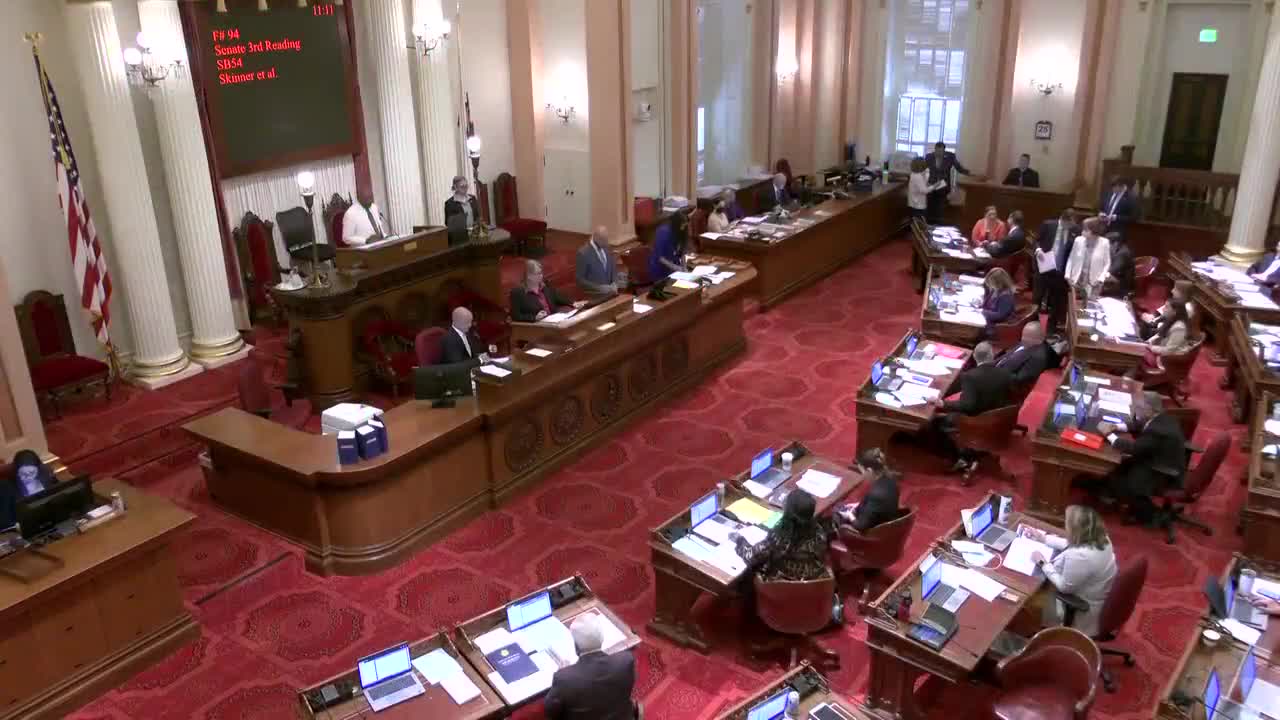 12MIN
Senate Floor
 1MIN
Senate Standing Committee on Appropriations
 36MIN
Senate Standing Committee on Judiciary
 1H
Senate Standing Committee on Labor, Public Employment and Retirement



Bill Co-Author(s):
