AB 812: English proficiency: Los Angeles Unified School District’s Academic English Mastery Program: evaluation.
- Session Year: 2015-2016
- House: Assembly
- Latest Version Date: 2015-05-06
Existing law requires the State Department of Education, with the approval of the State Board of Education, to establish procedures for conducting an assessment of pupils who are English learners in order to determine the level of English proficiency. Existing law requires each school district that has one or more pupils who are English learners, to assess the English language development of each pupil. Existing law requires this assessment to be conducted upon initial enrollment, and annually thereafter, during a period determined by the Superintendent of Public Instruction and the state board.
This bill would, notwithstanding the above provisions, require the department, on or before September 1, 2017, to develop an assessment tool to determine the proficiency level of pupils of limited academic English proficiency, as defined, and as determined by a formal process that the bill would require the Superintendent to develop in consultation with the department and local educational agencies, as provided. The bill would require the assessment to be conducted upon a pupils initial enrollment or as early as possible after enrollment, in order to provide information to determine if the pupil is a pupil of limited academic English proficiency, and annually thereafter, during a period of time determined by the Superintendent and the state board. The bill would require the annual assessments to continue until the pupil is designated as academic English proficient, as provided. The bill would require, if a pupil is still performing at a level of limited academic English proficiency after the grade 8 Smarter Balanced Assessment System summative and interim assessments, the school district to provide targeted resources with the goal of the pupil scoring at the level of 3 or higher on the grade 11 Smarter Balanced Assessment System summative and interim assessments.
By creating new duties for a local educational agency, this bill would impose a state-mandated local program.
This bill would, contingent on the enactment of an appropriation in the annual Budget Act or related legislation for the purpose of implementing these provisions, require the Los Angeles Unified School District, in partnership with the University of California, Los Angeles Center X, to conduct an evaluation of the Los Angeles Unified School Districts Academic English Mastery Program, as specified. The bill would require the evaluation to be completed by an unspecified date and submitted to the appropriate fiscal and policy committees of the Legislature. To the extent the bill would impose additional duties on the Los Angeles Unified School District, the bill would impose a state-mandated local program.
The California Constitution requires the state to reimburse local agencies and school districts for certain costs mandated by the state. Statutory provisions establish procedures for making that reimbursement.
This bill would provide that, if the Commission on State Mandates determines that the bill contains costs mandated by the state, reimbursement for those costs shall be made pursuant to these statutory provisions.
Existing law requires the State Department of Education, with the approval of the State Board of Education, to establish procedures for conducting an assessment of pupils who are English learners in order to determine the level of English proficiency. Existing law requires each school district that has one or more pupils who are English learners, to assess the English language development of each pupil. Existing law requires this assessment to be conducted upon initial enrollment, and annually thereafter, during a period determined by the Superintendent of Public Instruction and the state board.
This bill would, notwithstanding the above provisions, require the department, on or before September 1, 2017, to develop an assessment tool to determine the proficiency level of pupils of limited academic English proficiency, as defined, and as determined by a survey formal process that the bill would require the Superintendent to develop and a in consultation with the department and local educational agency to administer, creating a state program, agencies, as provided. The bill would require the assessment to be conducted upon a pupils initial enrollment, enrollment or as early as possible after enrollment, in order to provide information to determine if the pupil is a pupil of limited academic English proficiency, and annually thereafter, during a period of time determined by the Superintendent and the state board. The bill would require the annual assessments to continue until the pupil is designated as academic English proficient, as provided. The bill would require, if a pupil is still performing at a level of limited academic English proficiency after the grade 8 Smarter Balanced Assessment System summative and interim assessments, the school district to provide targeted resources with the goal of the pupil scoring at the level of 3 or higher on the grade 11 Smarter Balanced Assessment System summative and interim assessments.
By creating new duties for a local educational agency, this bill would impose a state-mandated local program.
The California Constitution requires the state to reimburse local agencies and school districts for certain costs mandated by the state. Statutory provisions establish procedures for making that reimbursement.
This bill would provide that, if the Commission on State Mandates determines that the bill contains costs mandated by the state, reimbursement for those costs shall be made pursuant to these statutory provisions.
Existing law requires the State Department of Education, with the approval of the State Board of Education, to establish procedures for conducting an assessment of pupils who are English learners in order to determine the level of proficiency. Existing law requires each school district that has one or more pupils who are English learners, to assess the English language development of each pupil. Existing law requires this assessment to be conducted upon initial enrollment, and annually thereafter, during a period determined by the Superintendent of Public Instruction and the state board.
This bill would, notwithstanding the above provisions, require the department, on or before September 1, 2017, to develop an assessment tool to determine the proficiency level of pupils of limited English proficiency, as defined, and as determined by a survey the bill would require the Superintendent to develop and a local educational agency to administer, creating a state program, as provided. The bill would require the assessment to be conducted upon a pupils initial enrollment, in order to provide information to determine if the pupil is a pupil of limited English proficiency, and annually thereafter, during a period of time determined by the Superintendent and the state board. The bill would require the annual assessments to continue until the pupil is designated as English proficient, as provided.
By creating new duties for a local educational agency, this bill would impose a state-mandated local program.
The California Constitution requires the state to reimburse local agencies and school districts for certain costs mandated by the state. Statutory provisions establish procedures for making that reimbursement.
This bill would provide that, if the Commission on State Mandates determines that the bill contains costs mandated by the state, reimbursement for those costs shall be made pursuant to these statutory provisions.
Existing law, the Public Schools Accountability Act of 1999, requires the Superintendent of Public Instruction, with approval of the State Board of Education, to develop an Academic Performance Index to measure the performance of schools and school districts, especially the academic performance of pupils. Existing law, for purposes of the act, requires all references to schools to include charter schools.
This bill would make a nonsubstantive change to the provision requiring all references to schools to include charter schools.
(a)For purposes of this chapter, pupils of limited academic English proficiency is defined as pupils who do not have the clearly developed academic English language skills of comprehension, speaking, reading, and writing necessary to receive instruction in English at a level substantially equivalent to pupils of the same age or grade whose primary language is also English.
(b)For purposes of this chapter, academic English and academic language shall have the same meaning and are defined as the oral, written, auditory, and visual language proficiency required to learn effectively in school and academic programs. Academic English and academic language is the language used in classroom lessons, books, tests, and assignments, and it is the language that pupils are expected to learn and achieve fluency in. Frequently contrasted with conversational or social language, academic language includes a variety of formal-language skills such as vocabulary, grammar, punctuation, syntax, discipline-specific terminology, or rhetorical conventions, that allow pupils to acquire knowledge and academic skills while also successfully navigating school policies, assignments, expectations, and cultural norms.
350.1.(a)On or before September 1, 2016, the Superintendent, in consultation with the department and local educational agencies, shall develop a formal process to identify pupils who may meet the definition in subdivision (a) of Section 350.
(b)The process may, at a minimum, provide special consideration to pupils who meet any of the following criteria:
(1)Scores in the lowest achievement levels on the Smarter Balanced Assessment System summative and interim assessments.
(2)Receives less than a passing grade on one or more consecutive progress and report cards in English language arts.
(3)Is identified by teachers or faculty members as a candidate who may meet one or more of the criteria in paragraphs (1) or (2).
350.2.(a)On or before January 1, 2017, the department, in consultation with local educational agencies, shall develop a study on best practices for providing instruction to pupils of limited academic English proficiency, and shall provide this study to members of the Legislature, the Office of the Legislative Analyst, and the Governor. The study shall include, but not be limited to, information relating to all of the following:
(1)Existing state and local programs.
(2)Effective pedagogical and instructional methods for pupils of limited academic English proficiency.
(3)Professional development and training needs for teachers who would be likely to provide instruction to pupils of limited academic English proficiency.
(b)The study required to be submitted to the Legislature pursuant to subdivision (a) shall be submitted in compliance with Section 9795 of the Government Code.
350.3.(a)Notwithstanding any other law, including Article 3.5 (commencing with Section 313) of Chapter 3, on or before September 1, 2017, the department shall develop an assessment tool to determine the proficiency level of pupils of limited academic English proficiency identified through the formal process, pursuant to Section 350.1, for purposes of identifying an adequate method of instruction for these pupils.
(b)The department, with the approval of the state board, shall establish procedures for conducting the assessment required pursuant to subdivision (a) and for the designation of a pupil of limited academic English proficiency to academic English proficient.
350.4.(a)Notwithstanding any other law, including Article 3.5 (commencing with Section 313) of Chapter 3, commencing with the 201819 school year, the assessment developed pursuant to Section 350.3 shall be conducted upon initial enrollment or as early as possible after enrollment, in order to provide information to determine if the pupil is a pupil of limited academic English proficiency, and annually thereafter during a period of time determined by the Superintendent and the state board. The annual assessments shall continue until the pupil is designated as academic English proficient pursuant to Section 350.5.
(b)For purposes of this section, school districts may utilize a pupil scoring at the highest achievement levels of 3 or higher on the Smarter Balanced Assessment System summative and interim assessments to designate the pupil as academic English proficient. If a pupil is still performing at a level of limited academic English proficiency after the grade 8 Smarter Balanced Assessment System summative and interim assessments, the school district shall provide targeted resources with the goal of the pupil scoring at the level of 3 or higher on the grade 11 Smarter Balanced Assessment System summative and interim assessments.
(c)The assessments conducted pursuant to this section shall be conducted in a manner consistent with federal statutes and regulations.
350.5.Notwithstanding any other law, including Article 3.5 (commencing with Section 313) of Chapter 3, the Superintendent shall develop a procedure to designate a pupil of limited academic English proficiency as academic English proficient. The designation procedure developed by the Superintendent shall utilize multiple criteria in determining whether to designate a pupil as proficient in academic English, including, but not limited to, all of the following:
(a)Assessment of academic language proficiency using an objective assessment instrument.
(b)Teacher evaluation, including, but not limited to, a review of the pupils curriculum mastery.
(c)Parental opinion and consultation.
(d)Comparison of the performance of the pupil in basic skills against an empirically established range of performance in basic skills based upon the performance of academic English proficient pupils of the same age, that demonstrates whether the pupil is sufficiently proficient in academic English to participate effectively in a curriculum designed for pupils of the same age.
350.6.This chapter does not preclude a school district or county office of education from testing pupils of limited academic English proficiency more than once in a school year if the school district or county office of education chooses to do so.
SECTION 1.Section 314 is added to the Education Code, to read:314.(a)Contingent on the enactment of an appropriation in the annual Budget Act or related legislation for the purpose of implementing this section, the Los Angeles Unified School District, in partnership with the University of California, Los Angeles Center X, shall conduct an evaluation of the Los Angeles Unified School Districts Academic English Mastery Program. This evaluation shall include data collection and analysis, and shall address policy questions regarding identification, assessment, instruction, and professional development of, and curriculum and definitions of proficiency for, pupils of limited academic English proficiency. The evaluation shall be completed by ____ and shall be submitted to the appropriate fiscal and policy committees of the Legislature.
(b)This section is repealed on January 1, 20____.
SEC. 2.If the Commission on State Mandates determines that this act contains costs mandated by the state, reimbursement to local agencies and school districts for those costs shall be made pursuant to Part 7 (commencing with Section 17500) of Division 4 of Title 2 of the Government Code.
For (a)For purposes of this chapter, pupils of limited academic English proficiency means is defined as pupils who do not have the clearly developed academic English language skills of comprehension, speaking, reading, and writing necessary to receive instruction in English at a level substantially equivalent to pupils of the same age or grade whose primary language is also English.
(b)For purposes of this chapter, academic English and academic language shall have the same meaning and are defined as the oral, written, auditory, and visual language proficiency required to learn effectively in school and academic programs. Academic English and academic language is the language used in classroom lessons, books, tests, and assignments, and it is the language that pupils are expected to learn and achieve fluency in. Frequently contrasted with conversational or social language, academic language includes a variety of formal-language skills such as vocabulary, grammar, punctuation, syntax, discipline-specific terminology, or rhetorical conventions, that allow pupils to acquire knowledge and academic skills while also successfully navigating school policies, assignments, expectations, and cultural norms.
350.1.(a)On or before September 1, 2016, the Superintendent, in consultation with the department, shall develop a survey for local educational agencies that identifies the number of pupils identifiable as pupils of limited English proficiency. department and local educational agencies, shall develop a formal process to identify pupils who may meet the definition in subdivision (a) of Section 350.
(b)Local educational agencies shall develop a process to annually administer the surveys of pupils at the beginning of each school year. At a minimum, local educational agencies shall survey the The process may, at a minimum, provide special consideration to pupils who meet any of the following criteria:
(1)Scores in the lowest achievement levels on the Smarter Balanced Assessment System summative and interim assessments.
(2)Receives less than a passing grade on one or more consecutive progress and report cards in English language arts courses. arts.
(3)Is identified by teachers or faculty members as a candidate who may meet one or more of the criteria in paragraphs (1) or (2).
350.2.(a)On or before January 1, 2017, the department, in consultation with local educational agencies, shall develop a study on best practices for providing instruction to pupils of limited academic English proficiency, and shall provide this study to members of the Legislature, the Office of the Legislative Analyst, and the Governor. The study shall include, but not be limited to, information relating to all of the following:
(1)Existing state and local programs.
(2)Effective pedagogical and instructional methods for pupils of limited academic English proficiency.
(3)Professional development and training needs for teachers who would be likely to provide instruction to pupils of limited academic English proficiency.
(b)(1)The study required to be submitted to the Legislature pursuant to subdivision (a) shall be submitted in compliance with Section 9795 of the Government Code.
(2)This section shall become inoperative on January 1, 2021, pursuant to Section 10231.5 of the Government Code.
350.3.(a)Notwithstanding any other law, including Article 3.5 (commencing with Section 313) of Chapter 3, on or before September 1, 2017, the department shall develop an assessment tool to determine the proficiency level of pupils of limited academic English proficiency identified through the survey formal process, pursuant to Section 350.1, for purposes of identifying an adequate method of instruction for these pupils.
(b)The department, with the approval of the state board, shall establish procedures for conducting the assessment required pursuant to subdivision (a) and for the designation of a pupil of limited academic English proficiency to academic English proficient.
350.4.(a)Notwithstanding any other law, including Article 3.5 (commencing with Section 313) of Chapter 3, commencing with the 201819 school year, the assessment developed pursuant to Section 350.3 shall be conducted upon initial enrollment, enrollment or as early as possible after enrollment, in order to provide information to determine if the pupil is a pupil of limited academic English proficiency, and annually thereafter during a period of time determined by the Superintendent and the state board. The annual assessments shall continue until the pupil is designated as academic English proficient pursuant to Section 350.5.
(b)For purposes of this section, school districts may utilize a pupil scoring at the highest achievement levels of 3 or higher on the Smarter Balanced Assessment System summative and interim assessments to designate the pupil as academic English proficient. If a pupil is still performing at a level of limited academic English proficiency after the grade 8 Smarter Balanced Assessment System summative and interim assessments, the school district shall provide targeted resources with the goal of the pupil scoring at the level of 3 or higher on the grade 11 Smarter Balanced Assessment System summative and interim assessments.
(b)
(c)The assessments conducted pursuant to this section shall be conducted in a manner consistent with federal statutes and regulations.
350.5.Notwithstanding any other law, including Article 3.5 (commencing with Section 313) of Chapter 3, the Superintendent shall develop a procedure to designate a pupil of limited academic English proficiency as academic English proficient. The designation procedure developed by the Superintendent shall utilize multiple criteria in determining whether to designate a pupil as proficient in academic English, including, but not limited to, all of the following:
(a)Assessment of academic language proficiency using an objective assessment instrument.
(b)Teacher evaluation, including, but not limited to, a review of the pupils curriculum mastery.
(c)Parental opinion and consultation.
(d)Comparison of the performance of the pupil in basic skills against an empirically established range of performance in basic skills based upon the performance of academic English proficient pupils of the same age, that demonstrates whether the pupil is sufficiently proficient in academic English to participate effectively in a curriculum designed for pupils of the same age.
350.6.This chapter does not preclude a school district or county office of education from testing pupils of limited academic English proficiency more than once in a school year if the school district or county office of education chooses to do so.
SEC. 2.If the Commission on State Mandates determines that this act contains costs mandated by the state, reimbursement to local agencies and school districts for those costs shall be made pursuant to Part 7 (commencing with Section 17500) of Division 4 of Title 2 of the Government Code.
Chapter 4 (commencing with Section 350) is added to Part 1 of Division 1 of Title 1 of the Education Code, to read:
350. For purposes of this chapter, pupils of limited English proficiency means pupils who do not have the clearly developed English language skills of comprehension, speaking, reading, and writing necessary to receive instruction in English at a level substantially equivalent to pupils of the same age or grade whose primary language is English.
350.1. (a)On or before September 1, 2016, the Superintendent, in consultation with the department, shall develop a survey for local educational agencies that identifies the number of pupils identifiable as pupils of limited English proficiency.
(b)Local educational agencies shall develop a process to annually administer the surveys of pupils at the beginning of each school year. At a minimum, local educational agencies shall survey the pupils who meet any of the following criteria:
(1)Scores in the lowest achievement levels on the Smarter Balanced Assessment System summative and interim assessments.
(2)Receives less than a passing grade on one or more consecutive progress and report cards in English language arts courses.
(3)Is identified by teachers or faculty members as a candidate who may meet one or more of the criteria in paragraphs (1) or (2).
350.2. (a)On or before January 1, 2017, the department, in consultation with local educational agencies, shall develop a study on best practices for providing instruction to pupils of limited English proficiency, and shall provide this study to members of the Legislature, the Office of the Legislative Analyst, and the Governor. The study shall include, but not be limited to, information relating to all of the following:
(1)Existing state and local programs.
(2)Effective pedagogical and instructional methods for pupils of limited English proficiency.
(3)Professional development and training needs for teachers who would be likely to provide instruction to pupils of limited English proficiency.
(b)(1)The study required to be submitted to the Legislature pursuant to subdivision (a) shall be submitted in compliance with Section 9795 of the Government Code.
(2)This section shall become inoperative on January 1, 2021, pursuant to Section 10231.5 of the Government Code.
350.3. (a)Notwithstanding any other law, including Article 3.5 (commencing with Section 313) of Chapter 3, on or before September 1, 2017, the department shall develop an assessment tool to determine the proficiency level of pupils of limited English proficiency identified through the survey process, pursuant to Section 350.1, for purposes of identifying an adequate method of instruction for these pupils.
(b)The department, with the approval of the state board, shall establish procedures for conducting the assessment required pursuant to subdivision (a) and for the designation of a pupil of limited English proficiency to English proficient.
350.4. (a)Notwithstanding any other law, including Article 3.5 (commencing with Section 313) of Chapter 3, commencing with the 201819 school year, the assessment shall be conducted upon initial enrollment, in order to provide information to determine if the pupil is a pupil of limited English proficiency, and annually thereafter during a period of time determined by the Superintendent and the state board. The annual assessments shall continue until the pupil is designated as English proficient pursuant to Section 350.5.
(b)The assessments conducted pursuant to this section shall be conducted in a manner consistent with federal statutes and regulations.
350.5. Notwithstanding any other law, including Article 3.5 (commencing with Section 313) of Chapter 3, the Superintendent shall develop a procedure to designate a pupil of limited English proficiency as English proficient. The designation procedure developed by the Superintendent shall utilize multiple criteria in determining whether to designate a pupil as proficient in English, including, but not limited to, all of the following:
(a)Assessment of language proficiency using an objective assessment instrument.
(b)Teacher evaluation, including, but not limited to, a review of the pupils curriculum mastery.
(c)Parental opinion and consultation.
(d)Comparison of the performance of the pupil in basic skills against an empirically established range of performance in basic skills based upon the performance of English proficient pupils of the same age, that demonstrates whether the pupil is sufficiently proficient in English to participate effectively in a curriculum designed for pupils of the same age.
350.6. This chapter does not preclude a school district or county office of education from testing pupils of limited English proficiency more than once in a school year if the school district or county office of education chooses to do so.
SEC. 2.If the Commission on State Mandates determines that this act contains costs mandated by the state, reimbursement to local agencies and school districts for those costs shall be made pursuant to Part 7 (commencing with Section 17500) of Division 4 of Title 2 of the Government Code.
SECTION 1.Section 52051.5 of the Education Code is amended to read:52051.5.For purposes of this chapter, all references to schools shall also include charter schools.
TextPage 2.For purposes of this chapter, all references to schools shall also include charter schools.
|
Date
|
Status
|
|---|---|
| Feb 1, 2016 | From committee: Filed with the Chief Clerk pursuant to Joint Rule 56. |
| Jan 31, 2016 | Died pursuant to Article IV, Sec. 10(c) of the Constitution. |
| May 7, 2015 | Re-referred to Com. on APPR. |
| May 6, 2015 | Read second time and amended. |
| May 5, 2015 | From committee: Amend, and do pass as amended and re-refer to Com. on APPR. (Ayes 6. Noes 0.) (April 29). |
| Apr 28, 2015 | Re-referred to Com. on ED. |
| Apr 27, 2015 | From committee chair, with author's amendments: Amend, and re-refer to Com. on ED. Read second time and amended. |
| Apr 27, 2015 | (Page 1134.) |
| Apr 27, 2015 | Action rescinded whereby the bill was reported from committee with author's amendments and whereby the bill was read second time and amended on April 21 |
| Apr 22, 2015 | Re-referred to Com. on ED. |
| Apr 21, 2015 | From committee chair, with author's amendments: Amend, and re-refer to Com. on ED. Read second time and amended. |
| Apr 9, 2015 | Measure version as amended on March 26 corrected. |
| Apr 6, 2015 | Re-referred to Com. on ED. |
| Mar 26, 2015 | From committee chair, with author's amendments: Amend, and re-refer to Com. on ED. Read second time and amended. |
| Mar 26, 2015 | Referred to Com. on ED. |
| Feb 27, 2015 | From printer. May be heard in committee March 29. |
| Feb 26, 2015 | Read first time. To print. |
|
Date
|
Description
|
Location
|
Votes
|
|
|---|---|---|---|---|
| Apr 29, 2015 | Do pass as amended and be re-referred to the Committee on [Appropriations] | Assembly Standing Committee on Education |
Passed |
This list shows positions taken on this bill by organizations on the date displayed, which is linked to the original source.
Positions by individuals are not included.
AB 812
Page 6
Date of Hearing: April 29, 2015
ASSEMBLY COMMITTEE ON EDUCATION
Patrick O'Donnell, Chair
AB 812
Weber – As Amended April 27, 2015
SUBJECT: Pupils of limited English proficiency: assessments
SUMMARY: Requires that students of “limited academic English proficiency,” as defined, be identified and annually assessed for academic English proficiency, and requires a study on best instructional practices for these students. Requires the development of an assessment tool and procedures for reclassification of these students. Specifically, this bill:
Defines “pupils of limited academic English proficiency” as students who do not have the clearly developed academic English language skills of comprehension, speaking, reading, and writing necessary to receive instruction in English at a level substantially equivalent to pupils of the same age or grade whose primary language is also English.
Defines Academic English and Academic Language as the oral, written, auditory, and visual language proficiency required to learn effectively in schools and academic programs. Specifically, Academic English and academic language is defined as the language which:
is used in classroom lessons, books, tests, and assignments
pupils are expected to learn and the language in which they are to achieve fluency
includes a variety of formal-language skills such as vocabulary, grammar, punctuation, syntax, discipline-specific terminology, or rhetorical conventions, that allow students to acquire knowledge and academic skills while also successfully navigating school policies, assignments, expectations, and cultural norms
Requires that, by September 1, 2016, the Superintendent of Public Instruction (SPI), in consultation with the California Department of Education (CDE) and local educational agencies (LEAs) develop a formal process to identify pupils of limited academic English proficiency.
Requires that the identification process provide special consideration to students who:
score in the lowest achievement levels on the Smarter Balanced Assessment System summative and interim assessments
receive less than a passing grade on one or more consecutive progress and report cards in English language arts
are identified by teachers or faculty members as meeting the above criteria
Requires, by January 1, 2017, the CDE, in consultation with LEAs, to develop a study on best practices for providing instruction to pupils of limited academic English proficiency, and provide this study to members of the Legislature, the Office of the Legislative Analyst, and the Governor. Requires that this study include information on:
existing state and local programs
effective pedagogical and instructional methods for pupils of limited English proficiency
professional development and training needs for teachers who would be likely to provide instruction to pupils of limited English proficiency
Requires the CDE to develop an assessment tool to determine the proficiency level of pupils of limited academic English proficiency.
Requires the CDE, with the approval of the State Board of Education (SBE) to establish procedures for conducting the assessment and for the designation of a pupil of limited academic English proficiency to English proficient.
Beginning in the 2018–19 school year, requires the assessment to be conducted upon initial enrollment or as early as possible, and annually thereafter during a period of time determined by the SPI and the SBE.
Requires that the annual assessments to continue until a student is designated as academic English proficient. States that LEAs may use a score at the highest achievement level of 3 or higher on the Smarter Balance formative and summative assessments to designate a pupil as academic English proficient.
Requires that, if a student is still performing at a level of limited academic English proficiency after the 8th grade Smarter Balance formative and summative assessment, school districts must provide targeted resources with the goal of the pupil scoring at the level of 3 or higher on the 11th grade Smarter Balance formative and summative assessment
States that the assessments conducted pursuant to this section shall be conducted in a manner consistent with federal statutes and regulations.
Requires the SPI to develop a procedure to designate a pupil of limited academic English proficiency as academic English proficient using multiple criteria, including all of the following:
an assessment of language proficiency using an objective assessment instrument
teacher evaluation, including a review of the student’s curriculum mastery
parent opinion and consultation
comparison of the performance of the student in basic skills relative to his or peers
States that this chapter does not prohibit an LEA from testing pupils of limited English proficiency more than once in a school year if the school district or county office of education chooses to do so.
EXISTING LAW:
Defines “English learner” or “pupil of limited English proficiency,” and requires each school district to assess the English language development of each of those students within 30 days of initial enrollment and annually thereafter to assess until the students are redesignated as fluent English proficient.
Requires the CDE, with the approval of the SBE, to establish procedures for the reclassification of a student from English learner to English proficient.
Requires that the reclassification procedures developed by the CDE use multiple criteria in determining whether to reclassify a student, including, but not limited to, all of the following:
assessment of language proficiency using an objective assessment instrument, including, but not limited to, the California English Language Development Test (CELDT)
teacher evaluation, including, but not limited to, a review of the student’s curriculum mastery
parent opinion and consultation
comparison of the performance of the student in basic skills with those of his or her peers
Establishes an English Language Development assessment to identify students who are limited English proficient, to determine the level of English proficiency of students, and to assess the progress of English learners in acquiring the skills of listening, speaking, reading, and writing in English.
Requires the CDE, by January 1, 2015, to recommend to the SBE any modifications to the ELD standards to link them with the Common Core mathematics standards and the Next Generation Science Standards.
FISCAL EFFECT: This bill has been keyed a state-mandated local program by the Office of Legislative Counsel.
COMMENTS:
Need for the bill. The author’s office states, “Although there is a general consensus among academic researchers that all pupils must be proficient in academic English to thrive in professional or academic settings, a large portion of students still struggle to develop proficiency.
According to research from California State University, Northridge, “Academic language is the language used in instruction, textbooks and exams. Academic language differs in structure and vocabulary from language used in daily social interactions. Academic language includes 1) a common vocabulary used in all disciplines, as well as 2) a technical vocabulary inherent to each individual discipline. Academic English is based more upon Latin and Greek roots than is common spoken English. In addition, academic language features more complex language and precise syntax than common English. Low academic language skills are associated with low performance in school.
The issue transcends race but it certainly disproportionately impacts low-income and pupils of color. As indicated previously, data suggests that pupils who have limited academic English proficiency are generally “underprepared,” and that there is a direct correlation between low performance and not being proficient in academic English. Specifically, one extensive field-test conducted over a ten year period based on student’s performance on “assessment tasks” concluded that “students who are underprepared in academic language are less able to distinguish between important and unimportant information in lectures and text, are less able to recognize or produce correct affixes, are misled by text cues such as bolding, are less able to restate and summarize information, are less able to summarize text, are more likely to misunderstand lecture and text meaning, and take fewer lecture and reading notes.”
Currently, there are small programs such as the Academic English Mastery Program in Los Angeles Unified School District, but no formal or large scale efforts to funnel pupils into these types of programs that have been shown to be successful. Additionally, there is no formal state definition of Academic English, nor is there a description of the type of pupil would benefit from academic English instruction.”
Standard English learners discussed in 2014 English Language Arts Framework. The 2014 California English Language Arts Framework chapter on Access and Equity defines standard English learners as “native speakers of English who are ethnic minority students (e.g., African-American, American Indian Southeast Asian-American, Mexican-American, Native Pacific Islander) and whose mastery of the standard English language that is privileged in schools is limited because they use an ethnic –specific nonstandard dialect of English in their homes and communities and use standard English (SE) in limited ways in those communities.”
The Framework discusses African American English and Chicano/a English and notes: “Non-standard varieties of English are sometimes erroneously considered to be “ungrammatical” or “improper English,” whereas these varieties are, in fact, systematic and rule governed dialects. Instead of taking a subtractive approach, teachers should give clear messages that non-standards varieties of English that students may speak or hear in their home communities are equally as valid as standard English.” The Framework also shares a recommendation from a researcher in this field: “teachers should…make the linguistic features of school language, or SE, explicit to students in order to provide them with extended linguistic resources they can draw upon, depending upon the social context in which they find themselves.”
State once had a Standard English Proficiency program. The CDE once had a program specifically to support school districts in helping students achieve standard English proficiency. In a Senate Education Committee analysis of SB 205 (Haynes) of the 1997-98 Session, the program was described as follows:
The California Department of Education (CDE) is responsible for the distribution of the Standard English Proficiency (SEP) handbook, which is based on a 1981 State Board of Education policy that directs the CDE to provide direction and leadership to local school districts to improve the standard English proficiency of speakers of Black language. The handbook is presently being revised to complement the English Language Arts Materials adopted by the State Board in December, 1996. The SEP is also known as the Proficiency in Standard English for Speakers of Black Language Program.
This program appears to have been eliminated near the time the analysis written, a period during which the issue of standard English was widely debated in the media following the adoption of a controversial resolution by the governing board of the Oakland Unified School District. Committee staff was unable to locate any staff who worked in this program to provide further information.
LAUSD Academic English Mastery Program and SEL policies. The Los Angeles Unified School District’s (LAUSD) Academic English Mastery Program (AEMP) is a program designed to address the language needs of African American, Mexican American, Hawai’ian American, and Native American students for whom Standard English is not native. The program incorporates into the curriculum instructional strategies that facilitate the acquisition of standard and academic English in classroom environments that validate, value, and build upon the language and culture of students. It may be the only such program in the country.
The AEMP promotes proficiency in academic English by working with school staff and parents. The program is currently working with 61 schools, providing training to teams of teachers, administrators, and parents from school sites which volunteer for this training. Over the summer they provide training to approximately 300 teams. In some cases participating schools provide instruction to SELs at the same time as English learners receive English Language Development instruction: students are split into groups according to their language need.
The AEMP uses brief screening tools for the identification of the use of different language features, with a tool for African American, Mexican American, and Hawai’ian American students. The program also uses the LAS Links assessment to determine students’ levels of language proficiency. The program uses curriculum materials available generally, such as California Treasures, Words their Way, and Lucy Calkins Units of Study. The AEMP emphasizes the use of culturally relevant materials, contrastive analysis, and an “additive” approach to teaching standard English.
LAUSD English Learner Master Plan and Board Resolution. The 2012 LAUSD English Learner Master Plan includes a chapter on the education of SELs. It identifies Mainstream English Language Development (MELD) as a responsive instructional intervention that develops listening, speaking, reading, and writing skills in standard and academic English. The plan states:
The purpose of MELD is to assure that SELs will have meaningful access to the core curriculum, post-secondary educational opportunities, and career options. The MELD approach is linguistically responsive, in that it seeks to add Standard and academic English to the students’ existing language repertoire. MELD accomplishes this additive approach by engaging in dual grammar study of the student’s home language variety and target language (Standard English). This dual grammar study is referred to as contrastive analysis and has been shown by research to be effective in teaching Standard English.
In May, 2014, the LAUSD governing board passed a resolution in support of standard English instruction. It calls for:
appropriate assessment of the academic language needs of SELs
professional development for teachers and administrators regarding best practices
targeted resources to support SELs in all schools
research and evaluation
support for a SEL teacher advisor in each Educational Service Center
parent education/engagement
establishment of a model school in every Educational Service Center
an annual count of SEL students beginning in the 2016-17 school year
AEMP has formed a partnership with UCLA’s Center X for the purpose of data collection and analysis, related in part to the above resolution. This collaboration is intended to provide more information on the need for this instruction among students in the district.
Bill raises questions about what improves mastery of academic English. This bill proposes to create a system of identification, assessment, instruction, and reclassification of pupils of limited academic English proficiency which largely mirrors the system used for English learners.
In proposing this system, this bill raises many policy and practice questions. Among them:
How should LEAs identify students who are in need of explicit instruction in standard English?
What assessments exist that could be used to measure proficiency in academic English?
How should the target level of proficiency in academic English be defined?
What curricula are available for explicit instruction in academic English?
What are effective instructional methods for teaching academic English?
What kinds of professional development improves mastery of academic English?
What is the role of culturally relevant curricula in supporting mastery of academic English?
To what extent should proficiency be measured by performance on assessments of core content area skills?
And perhaps the most significant question raised by this bill: to what extent is it appropriate to use a system designed for English learners with students who already proficient in one form of English?
It is not clear whether there are evidence-based answers to all of these questions at this time. But to the extent that mastery of academic English affects overall student academic performance, there may be a state interest in answering them.
To that end, staff recommends that this bill be amended to delete its current contents and instead require, contingent upon an appropriation provided for this purpose, an evaluation of the LAUSD Mastery of Academic English program, through a partnership with the University of California, Los Angeles Center X. This evaluation would support data collection and analysis, focused around policy questions regarding identification, assessment, curriculum, instruction, professional development, and definitions of proficiency, with a specified timeline for completion.
Prior legislation. AB 1249 (Davis) of the 2011-12 Session would have expanded the definition of “English learner” to include pupils whose native language is English and whose mastery of the standard English language or academic English is limited due to their use of nonstandard English. This bill died in the Assembly Education Committee.
AB 1988 (Davis) of the 2011-12 Session would have required that the SBE policies ensure that the English language arts curriculum framework and instructional materials include strategies to address the language and literacy needs of pupils who use African American vernacular English. This bill died in the Assembly Appropriations Committee.
SB 205 (Haynes) of the 1997-98 Session, as heard in the Senate Education Committee, would have required the CDE to terminate the Proficiency in Standard English for Speakers of Black Language program, and would have prohibited the teaching of non-standard English.
REGISTERED SUPPORT / OPPOSITION:
Support
None on file
Opposition
California Teachers Association
Analysis Prepared by: Tanya Lieberman / ED. / (916) 319-2087
Discussed in Hearing
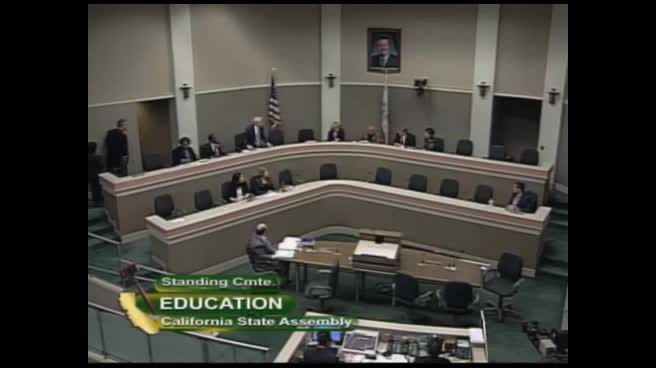 15MIN
Assembly Standing Committee on Education
Bill Author

Bill Co-Author(s):