SB 305: Aliso Canyon Recovery Account.
- Session Year: 2023-2024
- House: Senate
- Latest Version Date: 2023-04-19
Current Status:
Failed
(2023-06-14: From committee: Do pass and re-refer to Com. on APPR. with recommendation: To consent calendar. (Ayes 13. Noes 0.) (June 14). Re-referred to Com. on APPR.)
Introduced
In Committee
First Chamber
In Committee
Second Chamber
Enacted
Existing law vests the Public Utilities Commission with regulatory authority over public utilities, including gas corporations. Existing law creates the Aliso Canyon Recovery Account and requires all moneys collected pursuant to any settlements, unless restricted by a court for another purpose, abatement orders, fines, or penalties by the commission from a gas corporation serving the Los Angeles Basin pursuant to an administrative enforcement or legal proceeding relating to a certain well failure at the Aliso Canyon natural gas storage facility to be deposited into the account. Existing law authorizes moneys in the account to be allocated, upon appropriation by the Legislature, for purposes of mitigating impacts on local air quality, public health, and ratepayers resulting from the well failure at Aliso Canyon, as specified.
This bill would require, rather than authorize, those moneys to be allocated for those purposes, and would clarify that those purposes include mitigating impacts on public health in vulnerable communities. communities, as specified.
Existing law vests the Public Utilities Commission with regulatory authority over public utilities, including gas corporations. Existing law creates the Aliso Canyon Recovery Account and requires all moneys collected pursuant to any settlements, unless restricted by a court for another purpose, abatement orders, fines, or penalties by the commission from a gas corporation serving the Los Angeles Basin pursuant to an administrative enforcement or legal proceeding relating to a certain well failure at the Aliso Canyon natural gas storage facility to be deposited into the account. Existing law authorizes moneys in the account to be allocated, upon appropriation by the Legislature, for purposes of mitigating impacts on local air quality, public health, and ratepayers resulting from the well failure at Aliso Canyon, as specified.
This bill would require, rather than authorize, those moneys to be allocated for those purposes, and would clarify that those purposes include mitigating impacts on public health in vulnerable communities.
(a)Notwithstanding Section 2104, all moneys collected pursuant to any settlements, unless restricted by a court for another purpose, abatement orders, fines, or penalties by the commission from a gas corporation serving the Los Angeles Basin pursuant to an administrative enforcement or legal proceeding relating to the well failure at the Aliso Canyon natural gas storage facility first reported to the commission in October 2015 shall be deposited into the Aliso Canyon Recovery Account, which is hereby created in the State Treasury. Moneys in the account shall may be allocated, upon appropriation by the Legislature, for purposes of mitigating impacts on local air quality, public health, including in vulnerable communities, and ratepayers resulting from the well failure at Aliso Canyon, including evaluation of any negative effects on public health and enhancing the cost-effectiveness and feasibility of implementing Section 2836.7.
(b)For purposes of this section, Los Angeles Basin means the area identified as the Aliso Canyon Delivery Area on page 11 of the Aliso Canyon Risk Assessment Technical Report, dated April 5, 2016.
(a)Notwithstanding Section 2104, all moneys collected pursuant to any settlements, unless restricted by a court for another purpose, abatement orders, fines, or penalties by the commission from a gas corporation serving the Los Angeles Basin pursuant to an administrative enforcement or legal proceeding relating to the well failure at the Aliso Canyon natural gas storage facility first reported to the commission in October 2015 shall be deposited in into the Aliso Canyon Recovery Account, which is hereby created in the State Treasury. Moneys in the account may shall be allocated, upon appropriation by the Legislature, for purposes of mitigating impacts on local air quality, public health, including in vulnerable communities, and ratepayers resulting from the well failure at Aliso Canyon, including evaluation of any negative effects on public health and enhancing the cost-effectiveness and feasibility of implementing Sections 380.6 and Section 2836.7.
(b)For purposes of this section, Los Angeles Basin means the area identified as the Aliso Canyon Delivery Area on page 11 of the Aliso Canyon Risk Assessment Technical Report, dated April 5, 2016.
|
Date
|
Status
|
|---|---|
| Jun 14, 2023 | From committee: Do pass and re-refer to Com. on APPR. with recommendation: To consent calendar. (Ayes 13. Noes 0.) (June 14). Re-referred to Com. on APPR. |
| May 26, 2023 | Referred to Com. on U. & E. |
| May 15, 2023 | In Assembly. Read first time. Held at Desk. |
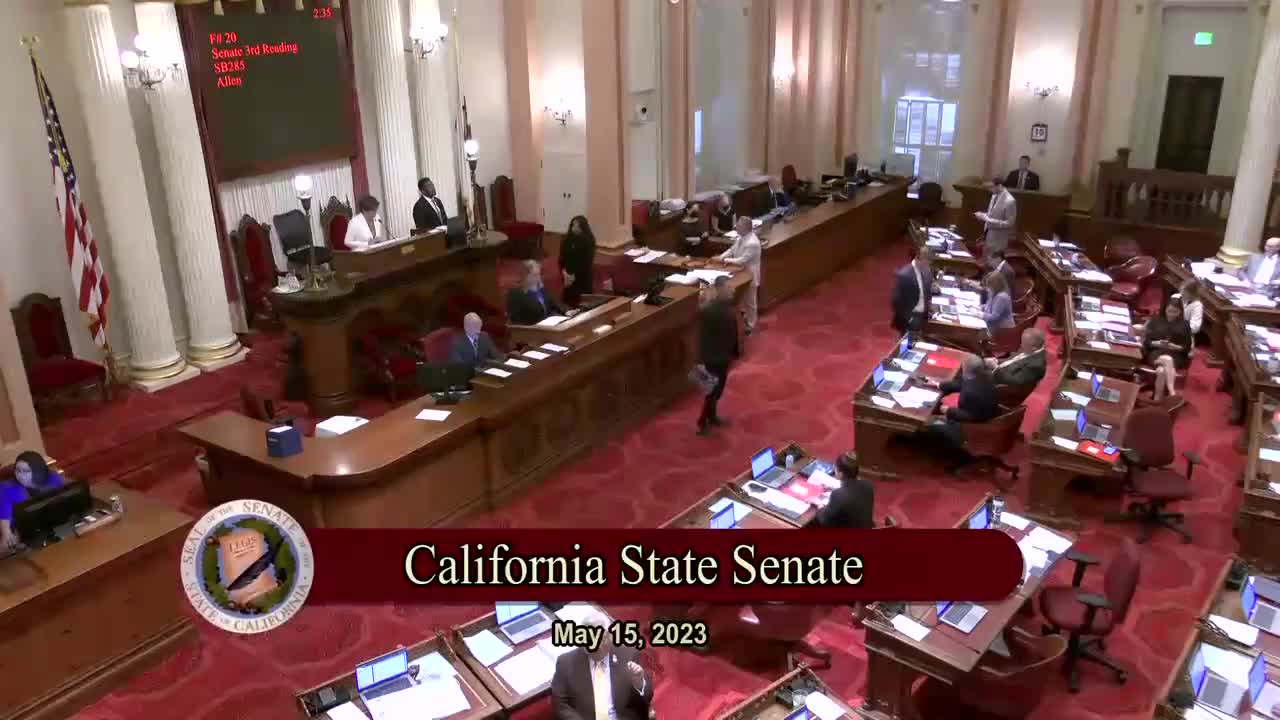
| May 15, 2023 | Read third time. Passed. (Ayes 38. Noes 0. Page 1074.) Ordered to the Assembly. |
| May 2, 2023 | Read second time. Ordered to third reading. |
| May 1, 2023 | From committee: Be ordered to second reading pursuant to Senate Rule 28.8. |
| Apr 21, 2023 | Set for hearing May 1. |
| Apr 19, 2023 | Read second time and amended. Re-referred to Com. on APPR. |
| Apr 18, 2023 | From committee: Do pass as amended and re-refer to Com. on APPR. (Ayes 17. Noes 0. Page 768.) (April 18). |
| Apr 3, 2023 | Set for hearing April 18. |
| Feb 15, 2023 | Referred to Coms. on E., U. & C. and APPR. |
| Feb 3, 2023 | From printer. May be acted upon on or after March 5. |
| Feb 2, 2023 | Introduced. Read first time. To Com. on RLS. for assignment. To print. |
|
Date
|
Description
|
Location
|
Votes
|
|
|---|---|---|---|---|
| Jun 14, 2023 | Do pass and be re-referred to the Committee on [Appropriations] with recommendation: To Consent Calendar | Assembly Standing Committee on Utilities and Energy |
Passed |
|
| May 15, 2023 | Senate 3rd Reading SB305 Stern et al. | Senate Floor |
Passed |
|
| Apr 18, 2023 | Do pass as amended, but first amend, and re-refer to the Committee on [Appropriations] | Senate Standing Committee on Energy, Utilities and Communications |
Passed |
This list shows positions taken on this bill by organizations on the date displayed, which is linked to the original source.
Positions by individuals are not included.
|
Organization
|
Position
|
Date
|
|---|---|---|
| California Association Of Professional Scientists | ** Support | |
| Conservation Concierges | ** Support | |
| Log Cabin Mercantile Heritage, INC. | ** Support | |
| Sierra Club | ** Support |
Date of Hearing: June 14, 2023
ASSEMBLY COMMITTEE ON UTILITIES AND ENERGY
Eduardo Garcia, Chair
SBPCA Bill Id:SB 305
Author:(Stern) – As Amended Ver:April 19, 2023
SENATE VOTE: 38-0
SUBJECT: Aliso Canyon Recovery Account
SUMMARY: Authorizes moneys from the Aliso Canyon Recovery Account to be allocated to include mitigating impacts on public health in vulnerable communities.
EXISTING LAW:
- Creates the Aliso Canyon Recovery Account and requires all moneys collected pursuant to any settlements, unless restricted by a court for another purpose, abatement orders, fines, or penalties by the California Public Utilities Commission (CPUC) from a gas corporation serving the Los Angeles Basin pursuant to an administrative enforcement or legal proceeding relating to a certain well failure at the Aliso Canyon natural gas storage facility to be deposited into the account. Authorizes moneys in the account to be allocated, upon appropriation by the Legislature, for purposes of mitigating impacts on local air quality, public health, and ratepayers resulting from the well failure at Aliso Canyon, as specified. (Public Utilities Code § 2104.7)
- Required, until January 1, 2021, the CPUC, no later than July 1, 2017, to open a proceeding to determine the feasibility of minimizing or eliminating the use of the Aliso Canyon natural gas storage facility located in the County of Los Angeles while still maintaining energy and electric reliability for the region. (Public Utilities Code § 714)
- Requires Los Angeles Department of Water and Power (LADWP), in consultation with the city council of the City of Los Angeles (if the council chooses to participate), by June 1, 2018, to determine the cost-effectiveness and feasibility of deploying a minimum of aggregate total of 100 megawatts (MWs) of cost-effective energy storage solutions, and then consider that deployment, as specified. Requires Southern California Edison (SCE), by June 1, 2018, to deploy a minimum aggregate total of 20 MWs, of cost-effective, energy storage solutions, to the extent doing so is cost-effective, feasible and necessary to meet the energy reliability requirements of the electrical system in the Los Angeles Basin. Authorizes SCE to count this deployment within the distributed energy storage cap and requires that the procurement be done through a competitive solicitation. (Public Utilities Code § 2836.7)
- Requires a local publicly owned electric utility providing electric service to 250,000 or more customers within the Los Angeles Basin to maximize the use of demand response, renewable energy resources, and energy efficiency to reduce demand in the area where electrical reliability has been impacted as a result of reductions in gas storage capacity and gas deliverability resulting from the well failure at the Aliso Canyon facility. (Public Utilities Code § 9616)
- Defines “vulnerable communities” as what was adopted by the Integrated Climate Adaptation and Resiliency Program Technical Advisory Council at the council’s April 2, 2018, meeting and recorded in “Defining Vulnerable Communities in the Context of Climate Adaptation,” the resource guide published by the Office of Planning and Research in July 2018. This definition states “vulnerable communities experience heightened risk and increased sensitivity to climate change and have less capacity and fewer resources to cope with, adapt to, or recover from climate impacts.”[1] (Public Resources Code § 71340)
- Defines “vulnerable communities,” for the purposes of public health equity, as including, but not limited to, women, racial or ethnic groups, low-income individuals and families, individuals who are incarcerated and those who have been incarcerated, individuals with disabilities, individuals with mental health conditions, children, youth and young adults, seniors, immigrants and refugees, individuals who are limited-English proficient (LEP), and lesbian, gay, bisexual, transgender, queer, and questioning (LGBTQQ) communities, or combinations of these populations. (Health and Safety Code § 131019.5 (a)(5))
FISCAL EFFECT: Unknown. This bill is not keyed fiscal.
COMMENTS:
- Author’s Statement. According to the author, “It has been 7 years since the Aliso Canyon Natural Gas Storage blow-out and many of the communities surrounding the storage facility are still dealing with the legacy of that fateful period. A period that did not last for a few days, but lasted for months, endangering nearby communities, public schools, and vulnerable communities. Fortunately, as part of the mitigation and remediation of this catastrophic event, the Aliso Canyon Recovery Account was created to mitigate impacts on local air quality, public health, and ratepayers resulting from the well failure at Aliso Canyon. However it did not specifically include vulnerable communities. SB 305 ensures vulnerable communities are specifically included to be eligible to receive funding.”
- Aliso Canyon Natural Gas Storage Facility. On October 23, 2015, a natural gas leak from a gas storage well (“SS-25”) was discovered at the Southern California Gas’ (SoCalGas’) Aliso Canyon natural gas storage facility located in northeastern Los Angeles County. The facility is the largest underground natural gas storage facility in the western United States. The SS-25 well, originally drilled in 1953 and converted to natural gas storage service in 1973, is located uphill from, and approximately 1.25 miles from homes in the Porter Ranch community. After nearly four months of several attempts to “kill” the well, the SS-25 leak was declared stopped on February 18, 2016 following a successful kill attempt using a newly-drilled relief well. The California Air Resources Board (CARB) estimated that 109,000 metric tons of methane, a potent greenhouse gas (GHG) and short-lived climate pollutant (SLCP), were emitted into the atmosphere from the leak.[2] The leak received extensive news coverage, and is considered one of the largest leaks of its kind. The SS-25 leak caused severe disruption in the surrounding communities. Over 8,000 households relocated at some point during the leak, and thousands of health and odor complaints were received by regulators.
- Aliso Canyon Recovery Account. The Aliso Canyon Recovery Account is a State Treasury account established under SB 801 (Stern, Chapter 814, Statutes of 2017). The account has received no funds to date. However, funds are expected as early as 2027, with additional funds around 2032, pursuant to an existing $119.5 million Mitigation Agreement between SoCalGas, CARB, and the Attorney General.[3] This Mitigation Agreement reflects SoCalGas’ obligation to mitigate 109,000 metric tons of methane emissions, since methane is a GHG and SLCP. The Mitigation Agreement requires SoCalGas to provide partial financing, in the form of loans (10-year terms), to dairy projects, organized into three clusters, which will capture, upgrade, and inject biomethane into a common carrier pipeline. The Mitigation Agreement requires, following five years upon completion of the mitigation, one-third of project proceeds to be transferred to the Aliso Canyon Recovery Account, as well as other specified disbursements.[4]
According to the quarterly reports regarding the Mitigation Agreement posted on CARB’s website, as of May 10, 2022, CARB approved 113,327 metric tons of Mitigation Fund Certified Reductions for the seven mitigation projects constructed pursuant to the Mitigation Agreement, representing 104% of the total reductions required.[5] Subsequent quarterly updates have not yet been posted to CARB’s website.[6]
- Potential CPUC Monetary Fine. In 2019, the CPUC opened an investigation in relation to the Aliso Canyon leak.[7] The investigation posed the possibility of penalties against SoCalGas for potential violations resulting from the leak which may be deposited into the Aliso Canyon Recovery Account.[8]
In October 2022, the Public Advocates Office and Safety and Enforcement Division at the CPUC entered into a settlement agreement with SoCalGas to resolve all claims or violations arising from, or related to, the leak.[9] Among the many violations and items detailed in the proposed settlement agreement is $105.1 million monetary fine related to the leak incident. The $105.1 million fine is offset by $34.1 million for costs incurred by SoCalGas in mitigating the gases emitted by the leak. The balance of the fine, $71 million, is proposed to be paid to the Aliso Canyon Recovery Account. The proposed settlement agreement has not been approved. In December 2022, the CPUC extended the proceeding deadline to December 31, 2023 to allow the parties and administrative law judge to consider the merits of the proposed settlement agreement.[10] As such, no funding to date from CPUC-levied monetary fines has been deposited into the Aliso Canyon Recovery Account.
- Which communities are vulnerable? This bill adds to the list of potential Legislative appropriations from the Aliso Canyon Recovery Account mitigating impacts on public health in vulnerable communities. As currently drafted, this bill does not provide a definition for vulnerable communities or specify which communities would be considered vulnerable. In background provided to this committee, the author indicated the desire for the communities of Northridge, Chatsworth Lake Manor, and Porter Ranch to be considered as vulnerable communities for the purposes of this bill. Current statute provides at least two definitions of “vulnerable communities,” one in the Public Resources Code related to a community’s heightened risk to climate change,[11] and one in the Health and Safety Code related to public health equity.[12] As this bill is seeking to address specified communities’ public health impacts related to the Aliso Canyon leak, the definition in the Health and Safety Code may be more appropriate; however it is unclear if such a definition would be inclusive enough to capture all communities the author seeks. The author may wish to consider adding a specific definition that captures his intent. Otherwise, eligibility will be determined by future appropriations of the Legislature.
- Prior Legislation.
SB 801 (Stern) made several requirements of energy utilities serving ratepayers in the Los Angeles Basin to support energy reliability where it has been affected by reductions in storage gas capacity and gas deliverability resulting from the 2015 leak at the Aliso Canyon storage facility, operated by SoCalGas. Also established the Aliso Canyon Recovery Account. Status: Chapter 814, Statutes of 2017.
SB 380 (Pavley) established specifics governing the Aliso Canyon natural gas storage facility-testing criteria, requirements to be met prior to re-starting injections at the facility, and required a CPUC proceeding to examine the feasibility of shutting down or minimizing the use of the facility due to the 2015 gas leak. Status: Chapter 14, Statutes of 2016.
SB 888 (Allen) directed how penalty funds assessed for the Aliso Canyon gas leak would be expended, and required climate change impacts from gas storage facility leaks be fully offset. Status: Chapter 536, Statutes of 2016.
REGISTERED SUPPORT / OPPOSITION:
Support
California Association of Professional Scientists
Log Cabin Mercantile Heritage, INC.
Sierra Club
Opposition
None on file.
Analysis Prepared by: Laura Shybut / U. & E. / (916) 319-2083
Office of Planning and Research, “Defining Vulnerable Communities in the Context of Climate Adaptation,” July 2018; https://opr.ca.gov/climate/docs/20200720-Vulnerable_Communities.pdf ↑
Stanley Young, CARB Press Release, “Áliso Canyon leak emitted 109,000 metric tons of methane,” October 21, 2016; https://ww2.arb.ca.gov/news/aliso-canyon-leak-emitted-109000-metric-tons-methane#:~:text=CARB%20staff%20estimated%20a%20range,ensure%20full%20and%20complete%20mitigation. ↑
CARB Press Release #19-09, “CARB announces $119.5 million settlement with SoCal Gas over Aliso Canyon natural gas leak,” February 25, 2019; https://content.govdelivery.com/accounts/CARB/bulletins/2325c34 ↑
Pg. 20, Appendix A to Consent Decree, People v. Southern California Gas Company, JCCP no. 4861, https://ww2.arb.ca.gov/sites/default/files/2023-04/Aliso_Canyon_Mitigation_Agreement.pdf ↑
Pg. 3, CARB, Aliso Canyon Mitigation Program Quarter 2 – 2022 Report (April 2022-June 2022), https://ww2.arb.ca.gov/sites/default/files/2022-11/Aliso_Canyon_Mitigation_Program_Q2_2022.pdf ↑
https://ww2.arb.ca.gov/aliso-canyon-mitigation-agreement-reporting-summaries ↑
OII. 19-06-016, Order Instituting Investigation on the Commission’s Own Motion into the Operations and Practices of Southern California Gas Company with Respect to the Aliso Canyon storage facility and the release of natural gas, and Order to Show Cause Why Southern California Gas Company Should Not Be Sanctioned for Allowing the Uncontrolled Release of Natural Gas from its Aliso Canyon Storage Facility. (U904G), June 27, 2019; https://docs.cpuc.ca.gov/PublishedDocs/Published/G000/M306/K041/306041251.PDF ↑
Pg. 12, I. 19-06-016, Ibid. ↑
OII 19-06-016, Joint Motion of the Safety and Enforcement Division, Southern California Gas Company (U 904 G) and the Public Advocates Office for Adoption of Settlement Agreement, October 28, 2019; https://docs.cpuc.ca.gov/PublishedDocs/Efile/G000/M498/K053/498053503.PDF ↑
D. 22-12-047, Order Extending Statutory Deadline, I. 19-06-016, December 15, 2022. ↑
PRC § 71340 ↑
HSC § 131019.5 (a)(5)) ↑
SENATE RULES COMMITTEE Office of Senate Floor Analyses (916) 651-1520 Fax: (916) 327-4478 | SB 305 |
THIRD READING
Bill No: SB 305
Author: Stern (D), et al.
Amended: 4/19/23
Vote: 21
SENATE ENERGY, U. & C. COMMITTEE: 17-0, 4/18/23
AYES: Bradford, Dahle, Ashby, Becker, Caballero, Dodd, Durazo, Eggman, Gonzalez, Grove, McGuire, Min, Newman, Rubio, Seyarto, Skinner, Wilk
NO VOTE RECORDED: Stern
SENATE APPROPRIATIONS COMMITTEE: Senate Rule 28.8
SUBJECT: Aliso Canyon Recovery Account
SOURCE: Author
DIGEST:
This bill authorizes moneys from the Aliso Canyon Recovery Account to be allocated to include mitigating impacts on public health in vulnerable communities.
ANALYSIS:
Existing law:
- Establishes the California Public Utilities Commission (CPUC) and vests it with regulatory authority over public utilities, including gas corporations. (California Constitution Article XII)
- Creates the Aliso Canyon Recovery Account and requires all moneys collected pursuant to any settlements, unless restricted by a court for another purpose, abatement orders, fines, or penalties by the commission from a gas corporation serving the Los Angeles Basin pursuant to an administrative enforcement or legal proceeding relating to a certain well failure at the Aliso Canyon natural gas storage facility to be deposited into the account. Authorizes moneys in the account to be allocated, upon appropriation by the Legislature, for purposes of mitigating impacts on local air quality, public health, and ratepayers resulting from the well failure at Aliso Canyon, as specified. (Public Utilities Code §2104.7)
- Requires Los Angeles Department of Water and Power (LADWP), in consultation with the city council of the City of Los Angeles (if the council chooses to participate), by June 1, 2018, to determine the cost-effectiveness and feasibility of deploying a minimum of aggregate total of 100 megawatts (MWs) of cost-effective energy storage solutions, and then consider that deployment, as specified. Requires Southern California Edison (SCE), by June 1, 2018, to deploy a minimum aggregate total of 20 MWs, of cost-effective, energy storage solutions, to the extent doing so is cost-effective, feasible and necessary to meet the energy reliability requirements of the electrical system in the Los Angeles Basin. Authorizes SCE to count this deployment within the distributed energy storage cap and requires that the procurement be done through a competitive solicitation. (Public Utilities Code §2836.7)
- Required, until January 1, 2021, the CPUC, no later than July 1, 2017, to open a proceeding to determine the feasibility of minimizing or eliminating use of the Aliso Canyon natural gas storage facility located in the County of Los Angeles while still maintaining energy and electric reliability for the region. (Public Utilities Code §714)
- Requires a local publicly owned electric utility providing electric service to 250,000 or more customers within the Los Angeles Basin to maximize the use of demand response, renewable energy resources, and energy efficiency to reduce demand in the area where electrical reliability has been impacted as a result of reductions in gas storage capacity and gas deliverability resulting from the well failure at the Aliso Canyon facility. (Public Utilities Code §9616)
This bill authorizes moneys from the Aliso Canyon Recovery Account to be allocated for the purposes of mitigating impacts on public health in vulnerable communities.
Background
Aliso Canyon Natural Gas Storage Facility. On October 23, 2015, a natural gas leak from a gas storage well (“SS-25”) was discovered at the Southern California Gas’ (SoCalGas’) Aliso Canyon natural gas storage facility located in northeastern Los Angeles County. The facility is the largest underground natural gas storage facility in the western United States. The SS-25 well, originally drilled in 1953 and converted to gas storage service in 1973, is located uphill from, and approximately, 1.25 miles from homes in the Porter Ranch community. After nearly four months of several attempts to “kill” the well, the SS-25 leak was declared stopped on February 18, 2016 following a successful kill attempt using a newly-drilled relief well. The California Air Resources Board’s (CARB’s) estimated that 109,000 metric tons of methane, a potent greenhouse gas (GHG) and short-lived climate pollutant (SLCP), were emitted to the atmosphere from the leak. The leak received local, national and international news coverage, and is considered one of the largest leaks of its kind. The SS-25 leak caused severe disruption in the surrounding communities. Over 8,000 households relocated at some point during the leak, and thousands of health and odor complaints were received by regulators. Since the SS-25 leak was stopped and despite mitigation efforts, public health complaints have continued in the surrounding community.
Aliso Canyon Recovery Account. The Aliso Canyon Recovery Account is a State Treasury account established by SB 801 (Stern, Chapter 814, Statutes of 2017). The account has received no funds to date. However, funds are expected as early as 2027, with additional funds around 2032, pursuant to an existing Mitigation Agreement between SoCalGas, CARB, and the Attorney General. This Mitigation Agreement reflects SoCalGas’ obligation to mitigate 109,000 metric tons of methane emissions, since methane is a GHG and SLCP. The Mitigation Agreement requires SoCalGas to provide partial financing, in the form of loans (10-year terms), to dairy projects, organized into three clusters, which will capture, upgrade, and inject biomethane into a common carrier pipeline. According to the quarterly reports regarding the Mitigation Agreement posted on CARB’s website, as of May 10, 2022, CARB approved 113,327 metric tons of Mitigation Fund Certified Reductions for the seven mitigation projects constructed pursuant to the Mitigation Agreement. The approved reduction represents 104 percent of the total Certified Reductions required to satisfy SoCalGas’ mitigation obligation.
CPUC Investigation settlement agreement proposes monetary fine. A CPUC investigation in relation to the Aliso Canyon leak could also result in SoCalGas providing funds to the Aliso Canyon Recovery Account, (I. 19-06-016) Order Instituting Investigation on the Commission’s Own Motion into the Operations and Practices of Southern California Gas Company with Respect to the Aliso Canyon storage facility and the release of natural gas, and Order to Show Cause Why Southern California Gas Company Should Not Be Sanctioned for Allowing the Uncontrolled Release of Natural Gas from its Aliso Canyon Storage Facility. (U904G).
In the fall of 2022, the Public Advocates Office and Safety and Enforcement Division at the CPUC entered into a settlement agreement with SoCalGas to resolve all claims or violations arising from, or related to, the leak or the proceeding that have been, or could have been, alleged or pursued by Safety and Enforcement Division or Public Advocates Office against SoCalGas or Sempra Energy (the parent company) before the CPUC. Among the many violations and items detailed in the proposed settlement agreement is $105.1 million fine in full resolution of all violations or claims related to the leak incident. The $105.1 million fine is offset by $34.1 million for costs incurred by SoCalGas in fully mitigating the gases emitted by the leak. The balance of the fine, $71 million, is proposed to be paid to the Aliso Canyon Recovery Account pursuant to California Public Utilities Code Section 2104.7, the account that is subject of this legislation. As of the writing of this analysis, the proposed settlement agreement had not been approved and the CPUC proceeding remains active with some stakeholders opposing aspects of the proposed settlement and the administrative law judge recently extending the deadline for the proceeding to December 31, 2023 to allow the parties and administrative law judge to consider the merits of the proposed settlement agreement.
Definition of vulnerable communities. As currently drafted, this bill does not include a definition for vulnerable communities. The language in the bill only authorizes the use of any funds, should they become available, to include impacts to vulnerable communities, and does not require the funds are used for this purpose. However, as the bill proceeds, the author may wish to add a definition for vulnerable communities, perhaps referencing the definition in the statute for communities vulnerable to the impacts of climate change as noted in Public Resources Code Section 71340 (d).
Related/Prior Legislation
SB 801 (Stern, Chapter 814, Statutes of 2017) made several requirements of energy utilities serving ratepayers in the Los Angeles Basin to support energy reliability where it has been affected by reductions in storage gas capacity and gas deliverability resulting for the 2015 leak at the Aliso Canyon storage facility, operated by SoCalGas.
SB 380 (Pavley, Chapter 14, Statutes of 2016) established Aliso Canyon natural gas storage facility-specific law governing testing criteria, requirements to be met prior to re-starting injections at the facility, and required a CPUC proceeding to examine the feasibility of shutting down or minimizing the use of the facility due to the 2015 gas leak.
SB 888 (Allen, Chapter 536, Statutes of 2016) directed how penalty funds assessed for the Aliso Canyon gas leak would be expended, and required climate change impacts from gas storage facility leaks be fully offset.
FISCAL EFFECT: Appropriation: No Fiscal Com.: No Local: No
SUPPORT: (Verified 5/1/23)
California Association of Professional Scientists
Conservation Concierges
Sierra Club California
OPPOSITION: (Verified 5/1/23)
None received
ARGUMENTS IN SUPPORT: According to the author:
It’s been 7 years since the Aliso Canyon Natural Gas Storage blow-out and many of the communities surrounding the storage facility are still dealing with the legacy of that fateful period. A period that did not last for a few days, but lasted for months, endangering nearby communities, public schools, and vulnerable communities. Fortunately, as part of the mitigation and remediation of this catastrophic event, the Aliso Canyon Recovery Account was created to mitigate impacts on local air quality, public health, and ratepayers resulting from the well failure at Aliso Canyon. However it did not include vulnerable communities and it does not have direct legislative oversight on how monies deposited into the account are spent. SB 305 ensures vulnerable communities are specifically included to receive funding and that the Legislature has oversight over the uses for the account.
Prepared by: Nidia Bautista / E., U. & C. / (916) 651-4107
5/3/23 15:16:07
SENATE COMMITTEE ON ENERGY, UTILITIES AND COMMUNICATIONS
Senator Steven Bradford, Chair
2023 - 2024 Regular
Bill No: Hearing Date: 4/18/2023
Author: | |||
Version: | Introduced | ||
Urgency: | Fiscal: | ||
Consultant: | |||
SUBJECT:
DIGEST: This bill requires, rather than authorizes, moneys from the Aliso Canyon Recovery Account to be allocated for the purposes of mitigating impacts on local air quality, public health, and ratepayers resulting from the well failure at Aliso Canyon and clarifies that those purposes include mitigating impacts on public health in vulnerable communities.
ANALYSIS:
Existing law:
- Establishes the California Public Utilities Commission (CPUC) and vests it with regulatory authority over public utilities, including gas corporations. (California Constitution Article XII)
- Creates the Aliso Canyon Recovery Account and requires all moneys collected pursuant to any settlements, unless restricted by a court for another purpose, abatement orders, fines, or penalties by the commission from a gas corporation serving the Los Angeles Basin pursuant to an administrative enforcement or legal proceeding relating to a certain well failure at the Aliso Canyon natural gas storage facility to be deposited into the account. Authorizes moneys in the account to be allocated, upon appropriation by the Legislature, for purposes of mitigating impacts on local air quality, public health, and ratepayers resulting from the well failure at Aliso Canyon, as specified. (Public Utilities Code §2104.7)
- Requires Los Angeles Department of Water and Power (LADWP), in consultation with the city council of the City of Los Angeles (if the council chooses to participate), by June 1, 2018, to determine the cost-effectiveness and feasibility of deploying a minimum of aggregate total of 100 megawatts (MWs) of cost-effective energy storage solutions, and then consider that deployment, as specified. Requires Southern California Edison (SCE), by June 1, 2018, to deploy a minimum aggregate total of 20 MWs, of cost-effective, energy storage solutions, to the extent doing so is cost-effective, feasible and necessary to meet the energy reliability requirements of the electrical system in the Los Angeles Basin. Authorizes SCE to count this deployment within the distributed energy storage cap and requires that the procurement be done through a competitive solicitation. (Public Utilities Code §2836.7)
- Required, until January 1, 2021, the CPUC, no later than July 1, 2017, to open a proceeding to determine the feasibility of minimizing or eliminating use of the Aliso Canyon natural gas storage facility located in the County of Los Angeles while still maintaining energy and electric reliability for the region. (Public Utilities Code §714)
- Requires a local publicly owned electric utility providing electric service to 250,000 or more customers within the Los Angeles Basin to maximize the use of demand response, renewable energy resources, and energy efficiency to reduce demand in the area where electrical reliability has been impacted as a result of reductions in gas storage capacity and gas deliverability resulting from the well failure at the Aliso Canyon facility. (Public Utilities Code §9616)
This bill requires, rather than authorizes, moneys from the Aliso Canyon Recovery Account to be allocated for the purposes of mitigating impacts on local air quality, public health, and ratepayers resulting from the well failure at Aliso Canyon and clarifies that those purposes include mitigating impacts on public health in vulnerable communities.
Background
Aliso Canyon Natural Gas Storage Facility. On October 23, 2015, a natural gas leak from a gas storage well (“SS-25”) was discovered at the Southern California Gas’ (SoCalGas’) Aliso Canyon natural gas storage facility located in northeastern Los Angeles County. The facility is the largest underground natural gas storage facility in the western United States. The SS-25 well, originally drilled in 1953 and converted to gas storage service in 1973, is located uphill from, and approximately, 1.25 miles from homes in the Porter Ranch community. After nearly four months of several attempts to “kill” the well, the SS-25 leak was declared stopped on February 18, 2016 following a successful kill attempt using a newly-drilled relief well. The California Air Resources Board’s (CARB’s) estimated that 109,000 metric tons of methane, a potent greenhouse gas (GHG), were emitted to the atmosphere from the leak. The leak received local, national and international news coverage, and is considered one of the largest leaks of its kind. The SS-25 leak caused severe disruption in the surrounding communities. Over 8,000 households relocated at some point during the leak, and thousands of health and odor complaints were received by regulators. Since the SS-25 leak was stopped and despite mitigation efforts, public health complaints have continued in the surrounding community.
Aliso Canyon Recovery Account. The Aliso Canyon Recovery Account is a State Treasury account and is not overseen by CPUC. The Account has received no funds to date. However, funds are expected as early as 2027, with additional funds around 2032, pursuant to an existing Mitigation Agreement between SoCalGas, the CARB, and the Attorney General. This Mitigation Agreement reflects SoCalGas’ obligation to mitigate 109,000 metric tons of methane emissions, since methane is a GHG.
CPUC Investigation. CPUC Investigation could also result in SoCalGas providing funds to the Aliso Canyon Recovery Account, (I. 19-06-016) Order Instituting Investigation on the Commission’s Own Motion into the Operations and Practices of Southern California Gas Company with Respect to the Aliso Canyon storage facility and the release of natural gas, and Order to Show Cause Why Southern California Gas Company Should Not Be Sanctioned for Allowing the Uncontrolled Release of Natural Gas from its Aliso Canyon Storage Facility. (U904G). In the fall of 2022, the Public Advocates Office and Safety and Enforcement Division at the CPUC entered into a settlement agreement with SoCalGas to resolve all claims or violations arising from or related to the leak or the proceeding that have been or could have been alleged or pursued by Safety and Enforcement Division or Public Advocates against SoCalGas or Sempra Energy before the CPUC. The settlement agreement is pending, other parties to the proceeding commenting on their opposition to the agreement.
Monetary Fine. Among the many violations and items detailed in the proposed settlement agreement is $105.1 million fine in full resolution of all violations or claims related to the leak incident. The $105.1 million fine is offset by $34.1 million for costs incurred by SoCalGas in fully mitigating the gases emitted by the leak. The balance of the fine, $71 million, will be paid to the Aliso Canyon Recovery Account pursuant to California Public Utilities Code Section 2104.7, the subject of this legislation.
Need for amendments. The author and committee may wish to restore the “may” proposed to be a “shall” in this bill, thereby retaining legislative discretion in a potential future appropriation.
Prior/Related Legislation
SB 801 (Stern, Chapter 814, Statutes of 2017) made several requirements of energy utilities serving ratepayers in the Los Angeles Basin to support energy reliability where it has been affected by reductions in storage gas capacity and gas deliverability resulting for the 2015 leak at the Aliso Canyon storage facility, operated by Southern California Gas Company (SoCal Gas).
SB 380 (Pavley, Chapter 14, Statutes of 2016) established Aliso Canyon natural gas storage facility-specific law governing testing criteria, requirements to be met prior to re-starting injections at the facility, and required a CPUC proceeding to examine the feasibility of shutting down or minimizing the use of the facility due to the 2015 gas leak.
SB 888 (Allen, Chapter 536, Statutes of 2016) directed how penalty funds assessed for the Aliso Canyon gas leak would be expended, and required climate change impacts from gas storage facility leaks be fully offset.
FISCAL EFFECT: Appropriation: Fiscal Com.: Local:
SUPPORT:
Sierra Club California
OPPOSITION:
None received
ARGUMENTS IN SUPPORT: According to the author:
It’s been 7 years since the Aliso Canyon Natural Gas Storage blow-out and many of the communities surrounding the storage facility are still dealing with the legacy of that fateful period. A period that did not last for a few days, but lasted for months, endangering nearby communities, public schools, and vulnerable communities. Fortunately, as part of the mitigation and remediation of this catastrophic event, the Aliso Canyon Recovery Account was created to mitigate impacts on local air quality, public health, and ratepayers resulting from the well failure at Aliso Canyon. However it did not include vulnerable communities and it does not have direct legislative oversight on how monies deposited into the account are spent. SB 305 ensures vulnerable communities are specifically included to receive funding and that the Legislature has oversight over the uses for the account.
-- END --
Bill Author

Bill Co-Author(s):
