SB 315: Groundwater: groundwater sustainability agencies: probationary basins.
- Session Year: 2023-2024
- House: Senate
- Latest Version Date: 2023-04-20
Current Status:
Failed
(2024-02-01: Returned to Secretary of Senate pursuant to Joint Rule 56.)
Introduced
In Committee
First Chamber
In Committee
Second Chamber
Enacted
Existing law, the Sustainable Groundwater Management Act, requires all groundwater basins designated as high- or medium-priority basins by the Department of Water Resources that are designated as basins subject to critical conditions of overdraft to be managed under a groundwater sustainability plan or coordinated groundwater sustainability plans by January 31, 2020, and requires all other groundwater basins designated as high- or medium-priority basins to be managed under a groundwater sustainability plan or coordinated groundwater sustainability plans by January 31, 2022, except as specified. The act authorizes the State Water Resources Control Board to designate specified basins as probationary basins if certain conditions are met, including, but not limited to, that the department, in consultation with the board, determines that a groundwater sustainability plan is inadequate or that the groundwater sustainability program is not being implemented in a manner that will likely achieve the sustainability goal. Existing law requires the board, if it designates a basin as a probationary basin pursuant to specified conditions, to identify the specific deficiencies and potential remedies. Existing law authorizes the board to request the department, within 90 days of the designation, to provide technical recommendations to local agencies to remedy the deficiencies and to develop an interim plan for the probationary basin one year after the designation, as specified.
This bill would require any groundwater sustainability agency that hires a third-party consulting firm to ensure that the integrity of the science being used to develop a groundwater sustainability plan is protected and the data is not sold. The bill would delete the authorizations for the board to request technical recommendations from the department and to develop an interim plan as described above. The bill would instead require the board to grant an 18-month grace period before the probationary basin designation becomes effective and would department. The bill would additionally place various requirements on the board in working with a groundwater sustainability agency, including, among other things, requiring the board to provide clear benchmarks and guidance for groundwater sustainability agencies to improve their groundwater management plans.
This bill would establish the Tule SubBasin Critical Facilities Subsidence Mitigation Fund in the State Treasury, to be administered by the department. The bill would, upon appropriation by the Legislature, deposit $50,000,000 in the fund require the Sustainable Groundwater Management Grant Program to allocate at least $50,000,000 of existing funds for a Critical Facilities Subsidence Mitigation subprogram, to be used for groundwater sustainability agencies that meet certain criteria and for certain purposes.
Existing law, the Sustainable Groundwater Management Act, requires all groundwater basins designated as high- or medium-priority basins by the Department of Water Resources that are designated as basins subject to critical conditions of overdraft to be managed under a groundwater sustainability plan or coordinated groundwater sustainability plans by January 31, 2020, and requires all other groundwater basins designated as high- or medium-priority basins to be managed under a groundwater sustainability plan or coordinated groundwater sustainability plans by January 31, 2022, except as specified. The act authorizes the State Water Resources Control Board to designate specified basins as probationary basins if certain conditions are met, including, but not limited to, that the department, in consultation with the board, determines that a groundwater sustainability plan is inadequate or that the groundwater sustainability program is not being implemented in a manner that will likely achieve the sustainability goal. Existing law requires the board, if it designates a basin as a probationary basin pursuant to specified conditions, to identify the specific deficiencies and potential remedies. Existing law authorizes the board to request the department, within 90 days of the designation, to provide technical recommendations to local agencies to remedy the deficiencies and to develop an interim plan for the probationary basin one year after the designation, as specified.
This bill would delete the authorizations for the board to request technical recommendations from the department and to develop an interim plan as described above. The bill would instead require the board to grant an 18-month grace period before the probationary basin designation becomes effective and would place various requirements on the board in working with a groundwater sustainability agency, including, among other things, requiring the board to provide clear benchmarks and guidance for groundwater sustainability agencies to improve their groundwater management plans.
This bill would establish the Tule SubBasin Critical Facilities Subsidence Mitigation Fund in the State Treasury, to be administered by the department. The bill would, upon appropriation by the Legislature, deposit $50,000,000 in the fund to be used for groundwater sustainability agencies that meet certain criteria and for certain purposes.
Existing law requires the State Water Resources Control Board to integrate existing monitoring programs and design new program elements, as necessary, for the purpose of establishing a comprehensive monitoring program capable of assessing each groundwater basin in the state through direct and other statistically reliable sampling approaches, and to create an interagency task force composed of representatives of listed state agencies for various purposes, including to identify actions necessary to establish the monitoring program and to identify measures that would increase coordination among state and federal agencies that collect groundwater contamination information. Existing law requires the state board to convene an advisory committee to the interagency task force with specified members.This bill would alter the membership of the advisory committee by changing the number of representatives of agriculture from 2 to 4.Existing law requires the State Water Resources Control Board to integrate existing monitoring programs and design new program elements, as necessary, for the purpose of establishing a comprehensive monitoring program capable of assessing each groundwater basin in the state through direct and other statistically reliable sampling approaches, and to create an interagency task force composed of representatives of listed state agencies for various purposes, including to identify actions necessary to establish the monitoring program and to identify measures that would increase coordination among state and federal agencies that collect groundwater contamination information. Existing law requires the state board to convene an advisory committee to the interagency task force with specified members.
This bill would alter the membership of the advisory committee by changing the number of representatives of agriculture from 2 to 4.
Existing law, the Sustainable Groundwater Management Act (the act), provides for the sustainable management of groundwater basins, and provides local groundwater agencies with the authority and the technical and financial assistance necessary to sustainably manage groundwater, among other purposes of the act. The act requires all groundwater basins designated as high- or medium-priority basins by the Department of Water Resources that are designated as basins subject to critical conditions of overdraft to be managed under a groundwater sustainability plan or coordinated groundwater sustainability plans by January 31, 2020, and requires all other groundwater basins designated as high- or medium-priority basins to be managed under a groundwater sustainability plan or coordinated groundwater sustainability plans by January 31, 2022, except as specified. Existing law authorizes a local agency or combination of local agencies overlying a groundwater basin to decide to become a groundwater sustainability agency for that basin and requires a groundwater sustainability plan to be developed and implemented for each medium- or high-priority basin by a groundwater sustainability agency. Existing law requires the groundwater sustainability agency to consider the interests of all beneficial uses and users of groundwater, as described, as well as those responsible for implementing groundwater sustainability plans.This bill would express the intent of the Legislature to enact future legislation that would assist groundwater sustainability agencies in fostering discussions among diverse water management interests and local agencies as they strive to implement the act.Existing law, the Sustainable Groundwater Management Act (the act), provides for the sustainable management of groundwater basins, and provides local groundwater agencies with the authority and the technical and financial assistance necessary to sustainably manage groundwater, among other purposes of the act. The act requires all groundwater basins designated as high- or medium-priority basins by the Department of Water Resources that are designated as basins subject to critical conditions of overdraft to be managed under a groundwater sustainability plan or coordinated groundwater sustainability plans by January 31, 2020, and requires all other groundwater basins designated as high- or medium-priority basins to be managed under a groundwater sustainability plan or coordinated groundwater sustainability plans by January 31, 2022, except as specified. Existing law authorizes a local agency or combination of local agencies overlying a groundwater basin to decide to become a groundwater sustainability agency for that basin and requires a groundwater sustainability plan to be developed and implemented for each medium- or high-priority basin by a groundwater sustainability agency. Existing law requires the groundwater sustainability agency to consider the interests of all beneficial uses and users of groundwater, as described, as well as those responsible for implementing groundwater sustainability plans.
This bill would express the intent of the Legislature to enact future legislation that would assist groundwater sustainability agencies in fostering discussions among diverse water management interests and local agencies as they strive to implement the act.
The Legislature finds and declares all of the following:
(a)It is important for the State Water Resources Control Board to provide clear benchmarks for groundwater sustainability agencies (GSAs) to follow.
(b)These benchmarks will allow GSAs to understand exactly what is expected of them and provide a roadmap for how to address deficiencies and avoid a basin being designated as a probationary basin. subject to an interim plan.
(c)Additionally, GSAs should be provided with an acceptable pathway to work on their projects, which may include technical assistance or other forms of support to help them improve their groundwater management plans.
(d)It is important to note that many users rely on both groundwater and surface water, and it is critical that both are managed effectively.
(e)Users may be hesitant to invest time and resources into improving their plans if they are not provided with clear direction on what needs to be improved and how to do it.
(f)Therefore, in order to build trust and confidence in the management of these resources, the state board needs to provide clear guidance on how to improve groundwater management plans and projects.
SEC. 2.Section 10727.3 is added to the Water Code, to read:10727.3.Any groundwater sustainability agency that hires a third-party consulting firm shall ensure that the integrity of the science being used to develop a groundwater sustainability plan is protected and the data is not sold.
SEC. 2.SEC. 3.Section 10735.6 of the Water Code is amended to read:10735.6.(a)If the board designates a basin as a probationary basin pursuant to paragraph (3) or (5) of subdivision (a) of Section 10735.2, the board shall identify the specific deficiencies and identify potential actions to address the deficiencies. The board shall grant an 18-month grace period before the probationary basin designation becomes effective.
(b)In carrying out its duties under subdivision (a), the board shall do all of the following:
(1)Provide clear benchmarks and guidance for groundwater sustainability agencies to improve their groundwater management plans.
(2)(A)Work with stakeholders to develop the benchmarks for groundwater sustainability agencies to follow.
(B)The benchmarks shall provide specific guidance on what is expected of groundwater sustainability agencies, including how to address deficiencies and how to avoid being designated as a probationary basin.
(3)Collaborate with the department and other technical experts to provide groundwater sustainability agencies with technical assistance and support to help them improve their groundwater management plans and projects. This assistance may include workshops, training, and one-on-one consultations.
(4)Provide Identify funding opportunities to groundwater sustainability agencies that would help to improve their groundwater management plans and projects.
(5)Encourage collaboration between groundwater sustainability agencies and other stakeholders, including local governments, environmental groups, and water users in order to identify common goals and develop joint strategies to improve groundwater management.
(6)Provide regular updates to groundwater sustainability agencies and other stakeholders on the status of their groundwater management plans and projects. These updates shall include information on what improvements the board deems necessary.
(c)The board may develop an interim plan pursuant to Section 10735.8 for the probationary basin at least one year after the designation of the basin pursuant to paragraph (3) or (5) of subdivision (a) of Section 10735.2, if the board, in consultation with the department, determines that a local agency has not remedied the deficiency that resulted in designating the basin a probationary basin.
SEC. 3.SEC. 4.Section 10736.7 is added to the Water Code, immediately following Section 10736.6, to read:10736.7.(a)The Tule SubBasin Critical Facilities Subsidence Mitigation Fund is hereby established in the State Treasury. The fund shall be administered by the department. The Sustainable Groundwater Management Grant Program shall allocate at least fifty million dollars ($50,000,000) of the one hundred eighty million dollars ($180,000,000) appropriated for the Sustainable Groundwater Management Act implementation in Item 3860-101-0001 of Section 2.00 of the Budget Act of 2021 for a Critical Facilities Subsidence Mitigation subprogram.
(b)Upon appropriation by the Legislature, the sum of fifty million dollars ($50,000,000) shall be deposited into the fund.(c)(b)Moneys in the fund allocated for the Critical Facilities Subsidence Mitigation subprogram pursuant to subdivision (a) shall only be used for both of the following:
(1)Meeting legal and other obligations related to the mitigation of subsidence within the boundaries of a groundwater sustainability agency.
(2)Meeting any requirements of the board imposed on a groundwater sustainability agency.
(d)(c)A groundwater sustainability agency shall meet all of the following conditions in order to receive moneys from the fund: Critical Facilities Subsidence Mitigation subprogram:
(1)The groundwater sustainability agencys plans have been determined to be adequate.
(2)The groundwater sustainability agency serves disadvantaged communities.
(3)The groundwater sustainability agency provides justification to the department as to why the funds are needed.
(4)The Secretary of the Natural Resources Agency approves the application.
(e)(d)Up to 2 percent of any funds received may be used by a groundwater sustainability agency for administrative costs.
The Legislature finds and declares all of the following:
(a)It is important for the State Water Resources Control Board to provide clear benchmarks for groundwater sustainability agencies (GSAs) to follow.
(b)These benchmarks will allow GSAs to understand exactly what is expected of them and provide a roadmap for how to address deficiencies and avoid a basin being designated as a probationary basin.
(c)Additionally, GSAs should be provided with an acceptable pathway to work on their projects, which may include technical assistance or other forms of support to help them improve their groundwater management plans.
(d)It is important to note that many users rely on both groundwater and surface water, and it is critical that both are managed effectively.
(e)Users may be hesitant to invest time and resources into improving their plans if they are not provided with clear direction on what needs to be improved and how to do it.
(f)Therefore, in order to build trust and confidence in the management of these resources, the state board needs to provide clear guidance on how to improve groundwater management plans and projects.
SEC. 2.Section 10735.6 of the Water Code is amended to read:10735.6.(a)If the board designates a basin as a probationary basin pursuant to paragraph (3) or (5) of subdivision (a) of Section 10735.2, the board shall identify the specific deficiencies and identify potential actions to address the deficiencies. The board may request the department to provide local agencies, within 90 days of the designation of a probationary basin, with technical recommendations to remedy the deficiencies. The board shall grant an 18-month grace period before the probationary basin designation becomes effective.
(b)The board may develop an interim plan pursuant to Section 10735.8 for the probationary basin one year after the designation of the basin pursuant to paragraph (3) or (5) of subdivision (a) of Section 10735.2, if the board, in consultation with the department, determines that a local agency has not remedied the deficiency that resulted in designating the basin a probationary basin.(b)In carrying out its duties under subdivision (a), the board shall do all of the following:
(1)Provide clear benchmarks and guidance for groundwater sustainability agencies to improve their groundwater management plans.
(2)(A)Work with stakeholders to develop the benchmarks for groundwater sustainability agencies to follow.
(B)The benchmarks shall provide specific guidance on what is expected of groundwater sustainability agencies, including how to address deficiencies and how to avoid being designated as a probationary basin.
(3)Collaborate with the department and other technical experts to provide groundwater sustainability agencies with technical assistance and support to help them improve their groundwater management plans and projects. This assistance may include workshops, training, and one-on-one consultations.
(4)Provide funding opportunities to groundwater sustainability agencies that would help to improve their groundwater management plans and projects.
(5)Encourage collaboration between groundwater sustainability agencies and other stakeholders, including local governments, environmental groups, and water users in order to identify common goals and develop joint strategies to improve groundwater management.
(6)Provide regular updates to groundwater sustainability agencies and other stakeholders on the status of their groundwater management plans and projects. These updates shall include information on what improvements the board deems necessary.
SEC. 3.Section 10736.7 is added to the Water Code, immediately following Section 10736.6, to read:10736.7.(a)The Tule SubBasin Critical Facilities Subsidence Mitigation Fund is hereby established in the State Treasury. The fund shall be administered by the department.
(b)Upon appropriation by the Legislature, the sum of fifty million dollars ($50,000,000) shall be deposited into the fund.
(c)Moneys in the fund shall only be used for both of the following:
(1)Meeting legal and other obligations related to the mitigation of subsidence within the boundaries of a groundwater sustainability agency.
(2)Meeting any requirements of the board imposed on a groundwater sustainability agency.
(d)A groundwater sustainability agency shall meet all of the following conditions in order to receive moneys from the fund:
(1)The groundwater sustainability agencys plans have been determined to be adequate.
(2)The groundwater sustainability agency serves disadvantaged communities.
(3)The groundwater sustainability agency provides justification to the department as to why the funds are needed.
(4)The Secretary of the Natural Resources Agency approves the application.
(e)Up to 2 percent of any funds received may be used by a groundwater sustainability agency for administrative costs.
SECTION 1.Section 10781 of the Water Code is amended to read:10781.In order to improve comprehensive groundwater monitoring and increase the availability to the public of information about groundwater contamination, the state board, in consultation with other responsible agencies, as specified in this section, shall do all of the following:(a)Integrate existing monitoring programs and design new program elements as necessary to establish a comprehensive monitoring program capable of assessing each groundwater basin in the state through direct and other statistically reliable sampling approaches. The interagency task force established pursuant to subdivision (b) shall determine the constituents to be included in the monitoring program. In designing the comprehensive monitoring program, the state board, among other things, shall integrate projects established in response to the Supplemental Report of the 1999 Budget Act, strive to take advantage of and incorporate existing data whenever possible, and prioritize groundwater basins that supply drinking water.(b)(1)Create an interagency task force for all of the following purposes:(A)Identifying actions necessary to establish the monitoring program.(B)Identifying measures to increase coordination among state and federal agencies that collect information regarding groundwater contamination in the state.(C)Designing a database capable of supporting the monitoring program that is compatible with the state boards geotracker database.(D)Assessing the scope and nature of necessary monitoring enhancements.(E)Identifying the cost of any recommended measures.(F)Identifying the means by which to make monitoring information available to the public.(2)The interagency task force shall consist of a representative of each of the following entities:(A)The state board.(B)The department.(C)The State Department of Health Services.(D)The Department of Pesticide Regulation.(E)The Department of Toxic Substances Control.(F)The Department of Food and Agriculture.(c)Convene an advisory committee to the interagency task force, with a membership that includes all of the following:(1)Two representatives of appropriate federal agencies, if those agencies wish to participate.(2)Two representatives of public water systems, one of which shall be a representative of a retail water supplier.(3)Two representatives of environmental organizations.(4)Two representatives of the business community.(5)One representative of a local agency that is currently implementing a plan pursuant to Part 2.75 (commencing with Section 10750).(6)Four representatives of agriculture.(7)Two representatives from groundwater management entities.(d)(1)The members of the advisory committee may receive a per diem allowance for each days attendance at a meeting of the advisory committee.(2)The members of the advisory committee may be reimbursed for actual and necessary travel expenses incurred in connection with their official duties.In order to improve comprehensive groundwater monitoring and increase the availability to the public of information about groundwater contamination, the state board, in consultation with other responsible agencies, as specified in this section, shall do all of the following:
(a)Integrate existing monitoring programs and design new program elements as necessary to establish a comprehensive monitoring program capable of assessing each groundwater basin in the state through direct and other statistically reliable sampling approaches. The interagency task force established pursuant to subdivision (b) shall determine the constituents to be included in the monitoring program. In designing the comprehensive monitoring program, the state board, among other things, shall integrate projects established in response to the Supplemental Report of the 1999 Budget Act, strive to take advantage of and incorporate existing data whenever possible, and prioritize groundwater basins that supply drinking water.
(b)(1)Create an interagency task force for all of the following purposes:
(A)Identifying actions necessary to establish the monitoring program.
(B)Identifying measures to increase coordination among state and federal agencies that collect information regarding groundwater contamination in the state.
(C)Designing a database capable of supporting the monitoring program that is compatible with the state boards geotracker database.
(D)Assessing the scope and nature of necessary monitoring enhancements.
(E)Identifying the cost of any recommended measures.
(F)Identifying the means by which to make monitoring information available to the public.
(2)The interagency task force shall consist of a representative of each of the following entities:
(A)The state board.
(B)The department.
(C)The State Department of Health Services.
(D)The Department of Pesticide Regulation.
(E)The Department of Toxic Substances Control.
(F)The Department of Food and Agriculture.
(c)Convene an advisory committee to the interagency task force, with a membership that includes all of the following:
(1)Two representatives of appropriate federal agencies, if those agencies wish to participate.
(2)Two representatives of public water systems, one of which shall be a representative of a retail water supplier.
(3)Two representatives of environmental organizations.
(4)Two representatives of the business community.
(5)One representative of a local agency that is currently implementing a plan pursuant to Part 2.75 (commencing with Section 10750).
(6)Two Four representatives of agriculture.
(7)Two representatives from groundwater management entities.
(d)(1)The members of the advisory committee may receive a per diem allowance for each days attendance at a meeting of the advisory committee.
(2)The members of the advisory committee may be reimbursed for actual and necessary travel expenses incurred in connection with their official duties.
SECTION 1.It is the intent of the Legislature to enact future legislation that would assist groundwater sustainability agencies in fostering discussions among diverse water management interests and local agencies as they strive to implement the Sustainable Groundwater Management Act.It is the intent of the Legislature to enact future legislation that would assist groundwater sustainability agencies in fostering discussions among diverse water management interests and local agencies as they strive to implement the Sustainable Groundwater Management Act.
|
Date
|
Status
|
|---|---|
| Feb 1, 2024 | Returned to Secretary of Senate pursuant to Joint Rule 56. |
| May 18, 2023 | May 18 hearing: Held in committee and under submission. |
| May 12, 2023 | Set for hearing May 18. |
| May 1, 2023 | May 1 hearing: Placed on APPR suspense file. |
| Apr 25, 2023 | Set for hearing May 1. |
| Apr 20, 2023 | Read second time and amended. Re-referred to Com. on APPR. |
| Apr 19, 2023 | From committee: Do pass as amended and re-refer to Com. on APPR. (Ayes 10. Noes 0. Page 801.) (April 18). |
| Apr 10, 2023 | From committee with author's amendments. Read second time and amended. Re-referred to Com. on N.R. & W. |
| Apr 10, 2023 | Set for hearing April 18. |
| Mar 29, 2023 | Re-referred to Com. on N.R. & W. |
| Mar 21, 2023 | From committee with author's amendments. Read second time and amended. Re-referred to Com. on RLS. |
| Feb 15, 2023 | Referred to Com. on RLS. |
| Feb 7, 2023 | From printer. May be acted upon on or after March 9. |
| Feb 6, 2023 | Introduced. Read first time. To Com. on RLS. for assignment. To print. |
|
Date
|
Description
|
Location
|
Votes
|
|
|---|---|---|---|---|
| May 1, 2023 | Placed on suspense file | Senate Standing Committee on Appropriations |
Passed |
|
| Apr 18, 2023 | Do pass as amended, but first amend, and re-refer to the Committee on [Appropriations] | Senate Standing Committee on Natural Resources and Water |
Passed |
This list shows positions taken on this bill by organizations on the date displayed, which is linked to the original source.
Positions by individuals are not included.
|
Organization
|
Position
|
Date
|
|---|---|---|
| California Environmental Voters | ** Against | |
| California Water Research | ** Against | |
| CivicWell | ** Against | |
| Clean Water Action | ** Against | |
| Climate Action California | ** Against | |
| Climate Reality Project, California Coalition | ** Against | |
| Community Water Center | ** Against | |
| Environmental Working Group | ** Against | |
| Leadership Counsel for Justice and Accountability | ** Against | |
| Planning And Conservation League | ** Against | |
| Sierra Club California | ** Against | |
| Union Of Concerned Scientists | ** Against |
SENATE COMMITTEE ON APPROPRIATIONS
Senator Anthony Portantino, Chair
2023 - 2024 Regular Session
SB 315 (Hurtado) - Groundwater: groundwater sustainability agencies: probationary basins
Version: April 20, 2023 | Policy Vote: N.R. & W. 10 - 0 |
Urgency: No | Mandate: No |
Hearing Date: May 1, 2023 | Consultant: Ashley Ames |
Bill Summary:
This bill would place various requirements on the State Water Resources Control Board (SWRCB) in working with a groundwater sustainability agency (GSA), including providing clear benchmarks and guidance for GSAs to improve their groundwater management plans, among other things. It would also require the Sustainable Groundwater Management Grant program to allocate at least $50 million of existing funds for a Critical Facilities Subsidence Mitigation subprogram.
Fiscal Impact:
- The SWRCB estimates ongoing costs of at least $4.1 million annually as well as one-time costs of $480,000 total (General Fund or Water Rights Fund) to develop and provide benchmarks, provide technical assistance and support to improve groundwater management plans and projects, identify funding opportunities, encourage collaboration between GSAs and stakeholders, and provide regular updates to GSAs and stakeholders, among other things.
- Unknown, likely minor costs for the Department of Water Resources (DWR) to rewrite grant requirements.
- One-time cost pressure of up to $50 million (General Fund) to backfill existing SGMA implementation funding that this bill would allocate for a Critical Facilities Subsidence Mitigation subprogram. Staff note that, of the $180 million appropriated for SGMA implementation in the Budget Act of 2021 that is identified by this bill, $150 million has already been spent and the remainder is likely to be expended by the time this bill would go into effect.
Background:
In 2014, the Legislature passed and the Governor signed three new laws—Chapters 346 (SB 1168, Pavley), 347 (AB 1739, Dickinson), and 348 (SB 1319, Pavley)—collectively known as SGMA. With the goal of achieving long‑term groundwater resource sustainability beginning in 2040, the legislation represents the first comprehensive statewide requirement to monitor and operate groundwater basins to avoid overdraft. The act’s requirements apply to 94 of the state’s 515 groundwater basins that DWR has found to be “high and medium priority” based on various factors, including overlying population and irrigated acreage, number of wells, and reliance on groundwater. (The remaining 421 basins ranked as being lower in priority—generally smaller and more remote—are encouraged but not required to adhere to SGMA.) While comprising less than one‑fifth of the groundwater basins in California, the 94 high‑ and medium‑priority basins account for 98 percent of California’s annual groundwater pumping.
SGMA Required Local Agencies to Submit Groundwater Sustainability Plans (GSPs). SGMA assigns primary responsibility for ongoing groundwater management to local entities, through the required formation of groundwater sustainability agencies (GSAs). SGMA requires GSAs to develop and implement long‑term GSPs. These plans define the specific guidelines and practices that govern the use of individual groundwater basins, including potentially limiting extractions from these basins. Among the 94 high‑ and medium‑priority basins, DWR identified 21 as being “critically overdrafted,”which it defines as a condition where a “continuation of present water management practices would probably result in significant adverse overdraft‑related environmental, social, or economic impacts.” The GSAs managing groundwater in those basins were required to submit their GSPs to DWR for review by January 2020, while GSPs for the remaining basins were due by January 2022. SGMA allows DWR two years to review GSPs. Among the critically overdrafted basins, DWR deemed GSPs for 12 basins to be incomplete and required that they be resubmitted in July 2022. DWR continues to review new and resubmitted GSPs.
DWR & SWRCB Undertaking Numerous Key Activities. SGMA tasked DWR with several key responsibilities in the initial phases of the act’s implementation. As GSAs developed and have begun to implement their GSPs, DWR’s role has continued to grow.
The State Water Resources Control Board (SWRCB) also has certain responsibilities in implementing SGMA, such as to intervene when local entities do not follow the law’s requirements. If any basins ultimately fail to comply with SGMA, SWRCB is charged with taking over their management.
State Has Provided Significant Funding to Implement SGMA. As shown in Figure 6, the state has provided more than $800 million since 2014‑15 for SGMA implementation activities. This includes:
- State Operations. DWR has received $314 million ($84 million from Proposition 68 bond funds and $229 million from the General Fund) to support state management of the SGMA program.
- Local Planning Grants. The state has provided $93 million in Proposition 1 bond funds for planning grants, which supported local agencies as they formed GSAs and developed their GSPs.
- Local Implementation Grants. The state has provided $430 million ($134 million from Proposition 68 bond funds and $296 million from the General Fund) for local implementation grants. Examples of grant‑funded activities include developing ways to inject surface water into aquifers, expanding conveyance infrastructure to increase recharge, installing monitoring wells, and developing or upgrading infrastructure to increase the use of recycled water.
State Intervention Under SGMA. SGMA authorizes state intervention of basins in limited circumstances, including, among others:
- For high- and medium-priority basins in critical overdraft, if DWR determines that a GSP is inadequate or not being implemented in a manner that will achieve the sustainability goal.
- For high- and medium-priority basins not in critical overdraft, if DWR determines the GSP is inadequate or not being implemented in a manner that will achieve the sustainability goal and SWRCB determines that the basin is in a condition (1) of long-term overdraft or (2) where groundwater extractions result in significant depletions of interconnected surface water.
State intervention is a process that could result in SWRCB temporarily managing and protecting groundwater resources until local agencies are able to do so adequately. There are several steps in the intervention process. According to DWR and SWRCB’s websites, these steps are:
- DWR’s initial assessment. If DWR finds that the GSP of a basin is incomplete during their initial assessment and evaluation, DWR provides an additional 180 days for the GSA to cure any deficiencies. During this time, DWR works with the GSA to explain the issues that preclude the GSP from approval.
- DWR re-evaluation. After the GSP is resubmitted, DWR reviews the GSP again and, if the deficiencies are still not cured, DWR will find the GSP inadequate, triggering state intervention by SWRCB.
- SWRCB intervention. Once state intervention is triggered, SWRCB considers whether the basin should be designated as a probationary basin. This is done through a noticed public hearing.
- Basin designated as “probationary.” If, after the public hearing, SWRCB designates the basin as “probationary,” the probationary period begins and GSAs have at least one year to address the issues, or deficiencies, that caused the basin to go into probation.
- Probationary period. During the probationary period, SWRCB focuses on data collection and analysis to better understand management challenges in the basin.
- Interim plans. If the issues that caused the basin to go on probation are not addressed during the probationary period, SWRCB may begin another public process to determine whether to implement an interim plan for the basin. An interim plan cannot be implemented until the GSA is allowed at least one year to correct the GSP deficiencies. If SWRCB adopts an interim plan, SWRCB temporarily manages the groundwater in the basin until the GSAs can demonstrate their ability to manage the basin sustainably and resume management.
Current situation. According to a DWR news release, in January 2022, DWR found 12 GSPs of critically overdrafted basins incomplete and identified the significant deficiencies that precluded approval. The GSAs of these 12 basins had 180 days to correct the deficiencies and revise and resubmit their plans to DWR for re-evaluation. In March 2023, after re-evaluation, DWR found that six of the GSPs of critically overdrafted groundwater basins were inadequate: Chowchilla Subbasin in Cadera and Merced counties; Delta-Mendota Subbasin in San Joaquin, Stanislaus, Merced, Fresno, Madera, and San Benito counties; Kaweah Subbasin in Tulare and Kings counties; Tule Subbasin in Tulare County; Tulare Lake Subbasin in Kings County; and Kern Subbasin in Kern County. According to the DWR website, basins deemed inadequate “did not appropriately address deficiencies in how GSAs structured their sustainable management criteria” and “did not analyze and justify continued groundwater level declines and land subsidence. Further the GSPs lacked a clear understanding of how the management criteria may cause undesired effects on groundwater users in the basins or critical infrastructure.” These basins are transitioning from DWR’s oversight to SWRCB for state intervention.
Proposed Law:
This bill would place various requirements on the SWRCB in working with a GSA, including providing clear benchmarks and guidance for GSAs to improve their groundwater management plans, among other things. It would also require the Sustainable Groundwater Management Grant program to allocate at least $50 million of existing funds for a Critical Facilities Subsidence Mitigation subprogram. Specifically, this bill would:
- Require any GSA that hires a third-party consulting firm to ensure that the integrity of the science being used to develop a groundwater sustainability plan is protected and the data is not sold.
- Require SWRCB, in identifying specific deficiencies and identifying potential actions to address the deficiencies, to do all of the following:
- Provide clear benchmarks and guidance for GSAs to improve their GSPs.
- Work with stakeholders to develop benchmarks for GSAs to follow. The benchmarks are required to provide specific guidance on what is expected of GSAs, including how to address deficiencies and how to avoid being designated as a probationary basin.
- Collaborate with DWR and other technical experts to provide GSAs with technical assistance and support to help them improve their GSPs and projects.
- Identify funding opportunities to GSAs that would help improve their GSPs and projects.
- Encourage collaboration between GSAs and other stakeholders to identify common goals and develop joint strategies to improve groundwater management.
- Provide regular updates to GSAs and other stakeholders on the status of their GSPs and projects. The updates are required to include information on what improvements SWRCB deems necessary.
- Authorize SWRCB to develop an interim plan for a probationary basin at least one year after the designation of the basin, as specified, if the board, in consultation with the department, determines that a local agency has not remedied the deficiency that resulted in the probationary designation.
- Require the Sustainable Groundwater Management Grant Program to allocate at least $50 million of the $180 million appropriated for the Sustainable Groundwater Management Act implementation in the Budget Act of 2021 for a Critical Facilities Subsidence Mitigation subprogram.
- Moneys allocated for the Critical Facilities Subsidence Mitigation subprogram pursuant to subdivision (a) shall only be used for both of the following:
- Meeting legal and other obligations related to the mitigation of subsidence within the boundaries of a groundwater sustainability agency.
- Meeting any requirements of the board imposed on a groundwater sustainability agency.
- Up to 2 percent of any funds received may be used by a groundwater sustainability agency for administrative costs.
- Moneys allocated for the Critical Facilities Subsidence Mitigation subprogram pursuant to subdivision (a) shall only be used for both of the following:
- Require a GSA to meet the following conditions to receive money from the Critical Facilities Subsidence Mitigation subprogram:
- The GSA’s GSP has been determined to be adequate.
- The GSA serves disadvantaged communities.
- The GSA provides justification to DWR as to why the funds are needed.
Related Legislation:
AB 429 (Bennett) would prohibit, if 1% of domestic wells go dry in a critically overdrafted basin, a county, city, or any other well permitting agency from approving a permit for a new groundwater well or for an alteration to an existing well in a critically overdrafted basin unless specified conditions are met.
AB 560 (Bennett) would require a court, before entering a final judgement for an adjudication action for a basin required to have a GSP, to refer the proposed judgment to SWRCB for an advisory determination as to whether the proposed judgement will substantially impair the ability of a GSA, SWRCB, or DWR to achieve sustainable groundwater management.
AB 779 (Wilson) would require a GSA with jurisdiction over a basin subject to an adjudication proceeding to submit a comprehensive monitoring plan to the court, and to report monitoring data to the court and DWR.
AB 2857 (Bauer-Kahan, 2022) would have required a GSP to include additional measures to mitigate adverse impacts on domestic wells, including, but not limited to, compensating an owner of a domestic well or a user of water from a domestic well for increased energy costs associated with deeper groundwater pumping and increased costs to households associated with the delivery of water from an existing water supply system or alternative water supply. This bill was held in the Assembly Water, Parks, and Wildlife Committee.
AB 754 (Mathis, 2021) would have authorized DWR to extend the deadline for high- or medium-basins not subject to critical conditions of overdraft to be managed under a GSP by up to 180 days after January 31, 2022, upon request of a local agency or GSA. AB 754 was held in the Senate Natural Resources and Water Committee.
SB 276 (Dodd, 2017) would have required the Department of Food and Agriculture, upon appropriation by the Legislature, to administer the State Water Efficiency and Enhancement Program to provide financial assistance in the form of grants to, among other things, perform outreach to high- and medium- priority basins. SB 276 was held on the Suspense File in this committee.
SB 1317 (Wolk, 2016) would have required, by January 1, 2018, a city or county overlying a high- or medium-priority basin to establish a process for the issuance of a groundwater extraction permit for the development of a groundwater extraction facility, as specified. SB 1317 was held in the Assembly Water, Parks, and Wildlife Committee.
SB 13 (Pavley, Chapter 255, Statutes of 2015) made numerous technical and clarifying amendments SGMA.
AB 937 (Salas, 2015) would have required DWR to provide technical assistance to disadvantaged communities so that they may participate in groundwater planning, including, but not limited to, plans for regional groundwater banking, with any county or other local agency. AB 937 was held on the Suspense File in this committee.
Staff Comments:
The SWRCB notes that as DWR determines whether the groundwater sustainability plans of medium and high priority basins are inadequate, the SWRCB may designate more basins as probationary. As each additional basin is placed on probation, this would create an additional $450,000 in annual, ongoing staffing costs and $80,000 in one-time contracting costs. It is indeterminable at this time how many additional basins would be placed on probation or how long basins would be on probation. As basins leave probation, these costs would decrease. These costs could be paid through fees that would go into the Water Rights Fund, absent a General Fund appropriation.
-- END --
SENATE COMMITTEE ON NATURAL RESOURCES AND WATER
Senator Dave Min, Chair
2023 - 2024 Regular
Bill No: SB 315 Hearing Date: April 18, 2023
Author: | Hurtado | ||
Version: | April 10, 2023 Amended | ||
Urgency: | No | Fiscal: | Yes |
Consultant: | Genevieve Wong | ||
Subject: Groundwater: groundwater sustainability agencies: probationary basins
BACKGROUND AND EXISTING LAW
Sustainable Groundwater Management Act. In contrast to other environmental legislation, California was the last state in the West to adopt a statewide groundwater management system. In 2014, the Legislature passed and then Governor Brown signed SB 1168 (Pavley), SB 1319 (Pavley) and AB 1739 (Dickinson). Those three bills established the Sustainable Groundwater Management Act (SGMA), and made other related changes to the California Water Code. Together, those bills provide a framework for sustainable groundwater management, with the goal of managing and using groundwater in a manner that can be maintained during the planning and implementation horizon without causing undesirable results.
“The foundation of [SGMA] is that groundwater is best managed at the local level, and the State’s primary role is to provide guidance and support.” (DWR website, https://water.ca.gov/Programs/Groundwater-Management/Assistance-and-Engagement, last accessed 4/10/2023). SGMA requires groundwater sustainability agencies (GSAs) in medium- and high-priority groundwater basins, which includes 21 critically overdrafted basins, to develop and implement groundwater sustainability plans (GSPs). GSAs may customize their GSPs to their regional economic and environmental circumstances. Thus, while SGMA provides for the sustainable management of groundwater basins, it does so by empowering local agencies to manage groundwater basins, while minimizing state intervention.
SGMA authorizes state intervention of basins in limited circumstances, including, among others:
- For high- and medium-priority basins in critical overdraft, if DWR determines that a GSP is inadequate or not being implemented in a manner that will achieve the sustainability goal.
- For high- and medium-priority basins not in critical overdraft, if DWR determines the GSP is inadequate or not being implemented in a manner that will achieve the sustainability goal and SWRCB determines that the basin is in a condition (1) of long-term overdraft or (2) where groundwater extractions result in significant depletions of interconnected surface water.
State intervention is a process that could result in SWRCB temporarily managing and protecting groundwater resources until local agencies are able to do so adequately. There are several steps in the intervention process. According to DWR and SWRCB’s websites, these steps are:
- DWR’s initial assessment. If DWR finds that the GSP of a basin is incomplete during their initial assessment and evaluation, DWR provides an additional 180 days for the GSA to cure any deficiencies. During this time, DWR works with the GSA to explain the issues that preclude the GSP from approval.
- DWR re-evaluation. After the GSP is resubmitted, DWR reviews the GSP again and, if the deficiencies are still not cured, DWR will find the GSP inadequate, triggering state intervention by SWRCB.
- SWRCB intervention. Once state intervention is triggered, SWRCB considers whether the basin should be designated as a probationary basin. This is done through a noticed public hearing.
- Basin designated as “probationary.” If, after the public hearing, SWRCB designates the basin as “probationary,” the probationary period begins and GSAs have at least one year to address the issues, or deficiencies, that caused the basin to go into probation.
- Probationary period. During the probationary period, SWRCB focuses on data collection and analysis to better understand management challenges in the basin.
- Interim plans. If the issues that caused the basin to go on probation are not addressed during the probationary period, SWRCB may begin another public process to determine whether to implement an interim plan for the basin. An interim plan cannot be implemented until the GSA is allowed at least one year to correct the GSP deficiencies. If SWRCB adopts an interim plan, SWRCB temporarily manages the groundwater in the basin until the GSAs can demonstrate their ability to manage the basin sustainably and resume management.
Current situation. According to a DWR news release, in January 2022, DWR found 12 GSPs of critically overdrafted basins incomplete and identified the significant deficiencies that precluded approval. The GSAs of these 12 basins had 180 days to correct the deficiencies and revise and resubmit their plans to DWR for re-evaluation. In March 2023, after re-evaluation, DWR found that six of the GSPs of critically overdrafted groundwater basins were inadequate: Chowchilla Subbasin in Cadera and Merced counties; Delta-Mendota Subbasin in San Joaquin, Stanislaus, Merced, Fresno, Madera, and San Benito counties; Kaweah Subbasin in Tulare and Kings counties; Tule Subbasin in Tulare County; Tulare Lake Subbasin in Kings County; and Kern Subbasin in Kern County. According to the DWR website, basins deemed inadequate “did not appropriately address deficiencies in how GSAs structured their sustainable management criteria” and “did not analyze and justify continued groundwater level declines and land subsidence. Further the GSPs lacked a clear understanding of how the management criteria may cause undesired effects on groundwater users in the basins or critical infrastructure.” These basins are transitioning from DWR’s oversight to SWRCB for state intervention.
Existing law, under SGMA:
- Requires high- or medium-priority basins that are subject to critical conditions of overdraft to be managed by a GSP or coordinated GSPs by January 31, 2020, and requires all other high- or medium-priority basins to be managed under a GSP or coordinated GSPs by January 31, 2022. (Wat. C. §10720.7(a))
- Authorizes a local agency or combination of local agencies overlying a groundwater basin to decide to become a GSA for that basin. (Wat. C. §10723)
- Requires a GSA of each medium- and high-priority basin to develop and implement a GSP to meet the sustainability goal of implementing one or more GSPs that achieve sustainable groundwater management, as specified. (Wat. C. §§10721, 10727)
- Authorizes SWRCB, after notice and public hearing, to designate a high- or medium-priority basin as a probationary basin, if certain circumstances are present. (Wat. C. §10735.2(a))
- Requires that a GSA be given 180 days to remedy the deficiency if the reason the basin is designated as probationary is because no GSA has formed for the basin after certain dates or a GSA has not adopted a GSP for the basin after certain dates. (Wat. C. §10735.4)
- Requires SWRCB to identify the specific deficiencies and identify potential actions to address the deficiencies, if SWRCB designates a basin as probationary in the following circumstances:
- The basin is critically overdrafted and DWR determines that the GSP is inadequate or the groundwater sustainability program is not being implemented in a manner that will likely achieve the sustainability goal. (Wat. C. §10735.2(a)(3))
- The basin is not critically overdrafted and DWR determines that the GSP is inadequate or the GSP is not being implemented in a manner that will likely achieve the sustainability goal and SWRCB determines that the basin is in a condition of long-term overdraft. (Wat. C. §10735.2(a)(5)(A))
- The basin is not critically overdrafted and DWR determines that the GSP is inadequate or the GSP is not being implemented in a manner that will likely achieve the sustainability goal and SWRCB determines that the basin is in a condition where groundwater extractions result in significant depletions of interconnected surface waters. (Wat. C. §10735.2(a)(5)(B))
- The basin is critically overdrafted and DWR determines that the GSP is inadequate or the groundwater sustainability program is not being implemented in a manner that will likely achieve the sustainability goal. (Wat. C. §10735.2(a)(3))
- Authorizes SWRCB, when DRW determines that a GSP is inadequate, to request DWR to provide the local agencies, within 90 days of the designation of a basin as probationary, with technical recommendations to remedy deficiencies. (Wat. C. 10735.6)
- Authorizes SWRCB to develop and adopt an interim plan for the probationary basin one year after the designation if SWRCB, in consultation with DWR, determines that the deficiencies have not been remedied. (Wat. C. §§10735.6(b), 10735.8(a))
- Requires SWRCB to determine whether a GSP is adequate, as specified, upon petition of a GSA that has adopted a GSP for the probationary basin and requires SWRCB, if SWRCB determines that the GSP is adequate, to rescind the interim plan. (Wat. C. §10735.8(g))
PROPOSED LAW
Requires SWRCB, under certain circumstances, to give high- or medium-priority basins an 18-month grace period before a probationary basin designation becomes effective and, instead of authorizing SWRCB to develop an interim plan for the probationary basin, requires SWRCB to perform certain actions during the grace period. Specifically, this bill,
- Requires SWRCB to grant an 18-month grace period before the probationary basin designation becomes effective for the following basins:
- High- or medium-priority basins that are subject to critical overdraft and DWR, in consultation with SWRCB, determines that the GSP is inadequate or is not being implemented in a manner that will achieve the sustainability goal.
- High- or medium-priority basins that are not subject to critical overdraft and DWR, in consultation with SWRCB, determines that the GSP is inadequate or is not being implemented in a manner that will achieve the sustainability goal and SWRCB determines that the basin is in a condition of long-term overdraft.
- High- or medium-priority basins that are not subject to critical overdraft and, after January 31, 2025, DWR, in consultation with SWRCB, determines the GSP is inadequate or is not being implemented in a manner that will achieve the sustainability goal and SWRCB determines that the basin is in a condition where groundwater extractions will result in significant depletions of interconnected surface waters.
- High- or medium-priority basins that are subject to critical overdraft and DWR, in consultation with SWRCB, determines that the GSP is inadequate or is not being implemented in a manner that will achieve the sustainability goal.
- Requires SWRCB, in identifying specific deficiencies and identifying potential actions to address the deficiencies, to do all of the following:
- Provide clear benchmarks and guidance for GSAs to improve their GSPs.
- Work with stakeholders to develop benchmarks for GSAs to follow. The benchmarks are required to provide specific guidance on what is expected of GSAs, including how to address deficiencies and how to avoid being designated as a probationary basin.
- Collaborate with DWR and other technical experts to provide GSAs with technical assistance and support to help them improve their GSPs and projects.
- Provide funding opportunities to GSAs that would help improve their GSPs and projects.
- Encourage collaboration between GSAs and other stakeholders to identify common goals and develop joint strategies to improve groundwater management.
- Provide regular updates to GSAs and other stakeholders on the status of their GSPs and projects. The updates are required to include information on what improvements SWRCB deems necessary.
- Removes SWRCB’s authority to develop an interim plan for a probationary basin one year after the designation of the basin if the board determines that a local agency has not remedied the deficiency that resulted in the probationary designation.
- Establishes the Tule SubBasin Critical Facilities Subsidence Mitigation Fund (Fund), to be administered by DWR and requires, upon appropriation by the Legislature, that $50 million be deposited into the fund for the following purposes:
- Meeting legal and other obligations related to the mitigation of subsidence within the boundaries of a GSA.
- Meeting any requirements of SWRCB imposed on a GSA.
- Requires a GSA to meet the following conditions to receive money from the Fund:
- The GSA’s GSP has been determined to be adequate.
- The GSA serves disadvantaged communities.
- The GSA provides justification to DWR as to why the funds are needed.
ARGUMENTS IN SUPPORT
According to the author, “California is a state that faces significant challenges in managing its water resources sustainably due to its semi-arid climate, growing population, and competing demands for water. The state has experienced prolonged droughts, groundwater depletion, and declining water quality in some areas. However, California has also been at the forefront of developing innovative and effective strategies to address these challenges.
One example is the Sustainable Groundwater Management Act (SGMA), which was passed in 2014 to address the long-term over-pumping of groundwater in the state. SGMA requires the establishment of Groundwater Sustainability Agencies (GSAs) in high- and medium-priority basins to develop and implement groundwater sustainability plans. These plans must achieve sustainable groundwater management within 20 years and avoid undesirable results such as groundwater depletion, seawater intrusion, land subsidence, and water quality degradation. The GSAs are required to engage with stakeholders, monitor groundwater conditions, and report progress to the state.
Providing technical assistance to GSAs is important because it can help them overcome some of the challenges they may face in implementing sustainable groundwater management practices. Technical assistance can include a range of services, such as data analysis, hydrologic modeling, monitoring, and outreach and education. By providing these services, technical experts can help GSAs develop and implement effective groundwater sustainability plans that are based on sound science and data.
For example, technical assistance can help GSAs better understand their groundwater resources and identify areas where there may be over-pumping or other sustainability concerns. Technical experts can also help GSAs develop monitoring programs to track changes in groundwater levels, water quality, and land subsidence, which can inform management decisions and identify areas where further action may be needed.
In addition, technical assistance can help GSAs engage stakeholders and the public in the planning process, by providing clear and accessible information about groundwater management practices and their potential impacts. Technical experts can also help GSAs develop communication strategies and outreach materials that are tailored to different audiences and reflect the unique needs and concerns of the communities they serve.
Overall, providing technical assistance to GSAs can help build capacity, improve decision-making, and promote greater transparency and accountability in groundwater management. By working together, GSAs, technical experts, and other stakeholders can develop sustainable groundwater management practices that meet the needs of all water users, protect the environment, and ensure the long-term viability of California's groundwater resources.”
ARGUMENTS IN OPPOSITION
According to Clean Water Action, Community Water Center, and Leadership Counsel for Justice & Accountability, SB 315 “is both unnecessary and is likely to frustrate the intent of SGMA to ensure sustainable groundwater management” and that “SGMA’s statutory structure and subsequently adopted implementing regulations already contain multiple periods for GSAs to remedy deficiencies and avoid additional state intervention.”
COMMENTS
What does this bill do? The purpose of SB 315, according to material provided by the author, is to ensure that GSAs receive the necessary resources, training, and support to improve their projects and avoid designating basins as probationary basins.
SB 315 would require SWRCB to provide an 18-month grace period to a GSA whose basin has been designated as a “probationary basin,” before the probationary status takes effect and removes SWRCB’s authority to develop an interim plan for a probationary basin if a GSA has not cured the deficiencies in the GSP.
SWRCB’s ability to develop interim plans and temporarily manage basins is a critical component of SGMA and removing SWRCB’s ability to develop interim plans makes SGMA’s state intervention provisions ineffective. After further discussions with author’s staff, the intent is not to remove SWRCB’s ability to develop an interim plan for deficient GSPs, but instead to create an 18-month time period for GSAs to work with SWRCB to fix the GSP and to specify the actions SWRCB must take in providing assistance to the GSAs. If the deficiencies are not addressed, it was the author’s intent that SWRCB would be able to develop an interim plan for the basin. Thus, it does not appear that the author is trying to avoid basins being given a “probationary” status, but rather is trying to give basins more time and better guidance from SWRCB to fix their GSPs before being subject to an interim plan.
The committee and author may wish to amend the bill to reinsert SWRCB’s authority to develop an interim plan for the probationary basin. (See Amendment 1)
Is there a demonstrated need for more time? Existing law allows SWRCB to develop interim plans one year after the designation of the basin as probationary if, as determined by SWRCB, the GSA has not remedied the deficiency. According to its website, SWRCB has interpreted this to mean that SWRCB cannot implement an interim plan until the GSAs have at least one year to correct its deficiencies. As such, SWRCB has the discretion to give GSAs longer than one year.
Currently, there are six basins whose GSPs DWR have deemed inadequate and are awaiting a public hearing by SWRCB to determine whether the basins should be “probationary basins.” For those basins placed on probation, this will be SWRCB’s first round of working with GSAs whose GSPs are inadequate. Given SWRCB’s discretion to extend the amount of time a GSA has to cure its GSP, and as there does not yet appear to be a demonstrated need for the extension, it is unclear if extending the minimum timeframe is necessary.
The committee may wish to amend the bill to specify that SWRCB may develop an interim plan at least 1 year after designation of the basin (Incorporated into Amendment 1) and to remove the requirement that SWRCB grant an 18-month grace period, which would maintain the minimum one-year probation period provided under existing law. (See Amendment 2)
Funding required? One of the actions that SWRCB would be required to take under SB 315 is “provide funding opportunities” to GSAs that would help to improve their GSPs and projects. Does this requirement mean that SWRCB would be required to give funding to GSAs? Would that funding be in the form of a grant or a loan? Where does this funding come from? Perhaps a more measured approach would be to require SWRCB to help GSAs identify funding opportunities that would help improve their GSPs and projects.
The committee may wish to amend the bill to instead require SWRCB to help GSAs identify potential funding opportunities. (See Amendment 3)
This bill may overlap with some resources already available. Should the committee vote to move the bill forward, the author may wish to consider the following components of the bill and how they may be modified to supplement existing programs and not potentially duplicate those programs.
- The requirement for SWRCB to collaborate with DWR and other technical experts to provide GSAs with technical assistance and support to help them improve GSPs and projects, which may include workshops, training, and one-on-one consultations.
Existing law authorizes SWRCB to request that DWR provide technical recommendations to local agencies to remedy deficiencies. SGMA also authorizes DWR to provide technical assistance to GSAs, upon request by the GSA, for assistance in the development and implementation of a GSP, and requires DWR to develop and publish best management practices. Further, DWR offers on its website Facilitation Support Services to help local agencies work through challenging water management situations, Technical Support Services to support GSAs as they develop GSPs, information on periodic informational events, guidance and resource documents, and access to “regional coordinators” to help GSAs locate resources such as guidance on communication and engagement, written translation, and financial assistance.
According to the author’s staff, GSAs in the author’s district do not feel that they received enough guidance and technical support from DWR. The purpose of this bill is to ensure that a GSA, when working to cure their GSP during the probationary period, knows exactly what needs to be done to maintain local control of their basins.
- The establishment of the Tule SubBasin Critical Facilities Subsidence Mitigation Fund (fund), which would be administered by DWR, may be comparable to DWR’s Sustainable Groundwater Planning Grant Program (grant program). The fund established by this bill would provide monies to GSAs that have an inadequate GSP and serve disadvantaged communities for the purposes of (1) meeting legal and other obligations related to the mitigation of subsidence within the boundaries of a GSA, and (2) meeting any requirements of SWRCB imposed on a GSA.
This compares to the grant program, which provides funds to develop and implement sustainable groundwater planning and projects consistent with groundwater planning requirements. The mission of the grant program is to provide funding to GSAs and other responsible entities under SGMA to promote healthy and sustainable groundwater basins, to reduce and eliminate undesirable effects, and to promote projects that provide multiple benefits while also improving groundwater supply and quality.
Please note the author’s amendments, below, which may address this potential overlap.
Conforming changes. If the committee decides to amend the bill in accordance with the above suggested amendments, the committee may also wish to make a conforming change to the findings and declarations. (See Amendment 4)
Author’s amendments. The author has offered the following as author’s amendments:
- Add a new Water Code §10727.3 that reads: Any groundwater sustainability agency that hires a third party consulting firm shall ensure that the integrity of the science being used to develop a groundwater sustainability plan is protected and the data are not sold.
- Amend Water Code §10736.7 as follows:
The Tule SubBasin Critical Facilities Subsidence Mitigatin Fund is hereby established in the State Treasury. The fund shall be administered by the department.The Sustainable Groundwater Management Grant Program shall allocate at least 50 million dollars for a Critical Facilities Subsidence Mitigation subprogram.Upon appropriation by the Legislature, the sum of fifty million dollars ($50,000,000) shall be deposited into the fund.
(c) (b) Moneys in the fund allocated for the Critical Facilities Subsidence Mitigation subprogram pursuant to subdivision (a) shall only be used for both of the following:
.
.
.
(d) (c) A groundwater sustainability agency shall meet all of the following conditions in order to receive moneys from the fund Critical Facilities Subsidence Mitigation subprogram:…
.
The committee may wish to allow the author to make these amendments to the bill. (Amendments 5 and 6)
Related legislation.
AB 429 (Bennett) would prohibit, if 1% of domestic wells go dry in a critically overdrafted basin, a county, city, or any other well permitting agency from approving a permit for a new groundwater well or for an alteration to an existing well in a critically overdrafted basin unless specified conditions are met. AB 429 is pending before the Assembly Water, Parks, and Wildlife Committee.
AB 560 (Bennett) would require a court, before entering a final judgement for an adjudication action for a basin required to have a GSP, to refer the proposed judgment to SWRCB for an advisory determination as to whether the proposed judgement will substantially impair the ability of a GSA, SWRCB, or DWR to achieve sustainable groundwater management. AB 560 is pending before the Assembly Judiciary Committee.
AB 779 (Wilson) requires a GSA with jurisdiction over a basin subject to an adjudication proceeding to submit a comprehensive monitoring plan to the court, and to report monitoring data to the court and DWR. AB 779 is pending before the Assembly Appropriations Committee.
Prior legislation.
AB 2857 (Bauer-Kahan, 2022) would have required a GSP to include additional measures to mitigate adverse impacts on domestic wells, including, but not limited to, compensating an owner of a domestic well or a user of water from a domestic well for increased energy costs associated with deeper groundwater pumping and increased costs to households associated with the delivery of water from an existing water supply system or alternative water supply. This bill was held in the Assembly Water, Parks, and Wildlife Committee.
AB 754 (Mathis, 2021) would have authorized DWR to extend the deadline for high- or medium-basins not subject to critical conditions of overdraft to be managed under a GSP by up to 180 days after January 31, 2022, upon request of a local agency or GSA. AB 754 was held in this committee.
SB 276 (Dodd, 2017) would have required the Department of Food and Agriculture, upon appropriation by the Legislature, to administer the State Water Efficiency and Enhancement Program to provide financial assistance in the form of grants to, among other things, perform outreach to high- and medium- priority basins. SB 276 was held in the Senate Appropriations Committee on suspense.
SB 1317 (Wolk, 2016) would have required, by January 1, 2018, a city or county overlying a high- or medium-priority basin to establish a process for the issuance of a groundwater extraction permit for the development of a groundwater extraction facility, as specified. SB 1317 was held in the Assembly Water, Parks, and Wildlife Committee.
SB 13 (Pavley, Chapter 255, Statutes of 2015) made numerous technical and clarifying amendments SGMA.
AB 937 (Salas, 2015) would have required DWR to provide technical assistance to disadvantaged communities so that they may participate in groundwater planning, including, but not limited to, plans for regional groundwater banking, with any county or other local agency. AB 937 was held in the Senate Appropriations Committee on suspense.
SUGGESTED AMENDMENTS
AMENDMENT 1
Amend Water Code §10735.6 to add subdivision (c) as follows: (*Note this is how subdivision (b) currently reads in existing law)
(c) The board may develop an interim plan pursuant to Section 10735.8 for the probationary basin at least one year after the designation of the basin pursuant to paragraph (3) or (5) of subdivision (a) of Section 10735.2, if the board, in consultation with the department, determines that a local agency has not remedied the deficiency that resulted in designating the basin a probationary basin.”
AMENDMENT 2
Amend Water Code §10735.6(a) to read:
(a) If the board designates a basin as a probationary basin pursuant to paragraph (3) or (5) of subdivision (a) of Section, 10735.2, the board shall identify the specific deficiencies and identify potential actions to address the deficiencies. The board shall grant an 18-month grace period before the probationary basin designation becomes effective.
AMENDMENT 3
Amend Water Code §10735.6(b)(4) to read:
(4) Provide Identify funding opportunities to groundwater sustainability agencies that would help to improve their groundwater management plans and projects.
AMENDMENT 4
Amend Section 1 of the bill to read:
(b) These benchmarks will allow GSAs to understand exactly what is expected of them and provide a roadmap for how to address deficiencies and avoid a basin being designated as a probationary basin subject to an interim plan.
AMENDMENT 5
Add a new Water Code §10727.3 that reads:
Any groundwater sustainability agency that hires a third party consulting firm shall ensure that the integrity of the science being used to develop a groundwater sustainability plan is protected and the data is not sold.
AMENDMENT 6
Amend Water Code §10736.7 as follows:
(a) The Tule SubBasin Critical Facilities Subsidence Mitigatin Fund is hereby established in the State Treasury. The fund shall be administered by the department. The Sustainable Groundwater Management Grant Program shall allocate at least 50 million dollars for a Critical Facilities Subsidence Mitigation subprogram.
(b) Upon appropriation by the Legislature, the sum of fifty million dollars ($50,000,000) shall be deposited into the fund.
(c) (b) Moneys in the fund allocated for the Critical Facilities Subsidence Mitigation subprogram pursuant to subdivision (a) shall only be used for both of the following:
.
.
.
(d) (c) A groundwater sustainability agency shall meet all of the following conditions in order to receive moneys from the fund Critical Facilities Subsidence Mitigation subprogram:…
.
SUPPORT
None Received
OPPOSITION
California Environmental Voters (formerly CLCV)
California Water Research
CivicWell
Clean Water Action
Climate Action California
Climate Reality Project, California Coalition
Community Water Center
Environmental Working Group
Leadership Counsel for Justice and Accountability
Planning and Conservation League
Sierra Club California
Union of Concerned Scientists
-- END --
Discussed in Hearing
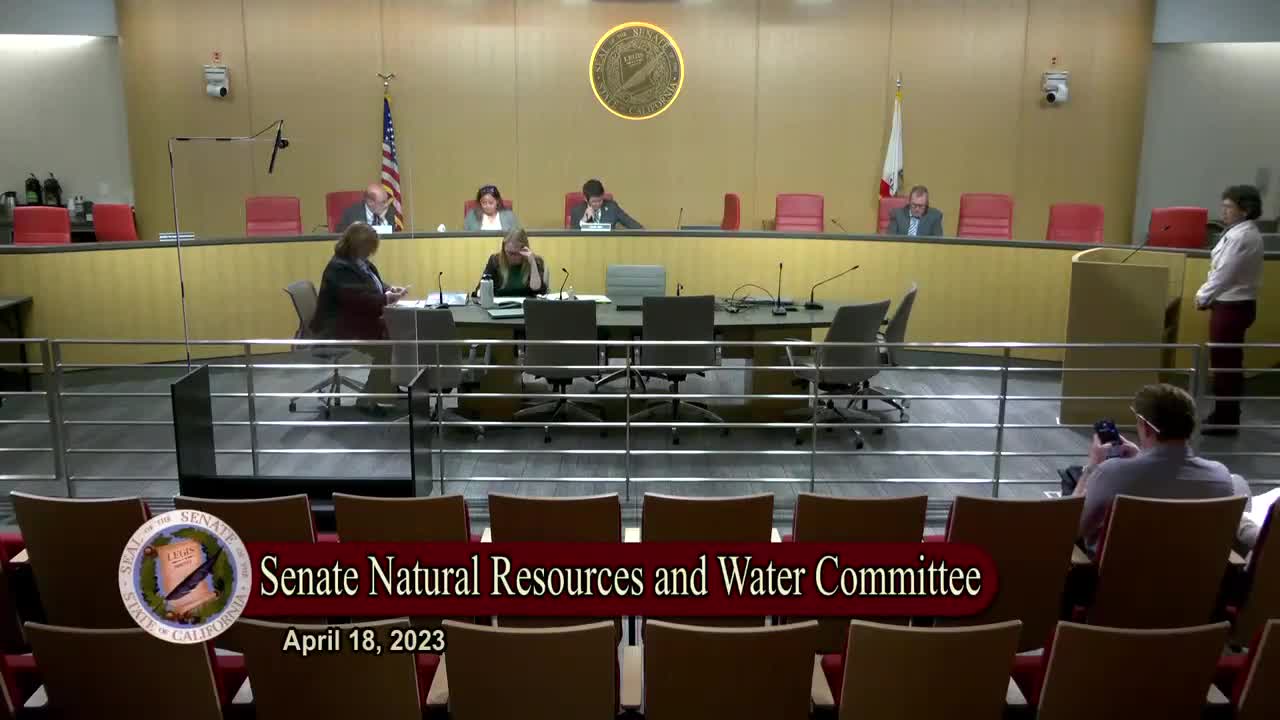 3MIN
Senate Standing Committee on Natural Resources and Water
Bill Author

Bill Co-Author(s):