SB 316: Shoplifting: increased penalties for prior crimes.
- Session Year: 2023-2024
- House: Senate
- Latest Version Date: 2023-02-06
Current Status:
Failed
(2023-11-29: Returned to Secretary of Senate pursuant to Joint Rule 62(a).)
Introduced
In Committee
First Chamber
In Committee
Second Chamber
Enacted
Existing law, the Safe Neighborhoods and Schools Act, enacted as an initiative statute by Proposition 47, as approved by the electors in the November 4, 2014, statewide general election, makes the theft of property that does not exceed $950 in value petty theft and makes that crime punishable as a misdemeanor, with certain exceptions. The initiative statute defines shoplifting as entering a commercial establishment with the intent to commit larceny while that establishment is open during regular hours, where the value of the property that is taken or intended to be taken does not exceed $950. The initiative statute requires that shoplifting be punished as a misdemeanor.
Existing law, as amended by Proposition 47, provides that a registered sex offender or a person with a prior conviction for certain serious or violent felonies, such as a sexually violent offense, who commits petty theft is subject to imprisonment in the county jail for up to one year or in the state prison for 16 months or 2 or 3 years.
This bill would reinstate a provision of law that was repealed by Proposition 47 that provides that a person who has been convicted 3 or more times of petty theft, grand theft, or other specified crimes and who is subsequently convicted of petty theft is subject to imprisonment in a county jail not exceeding one year or in a county jail for 18 months or 2 or 3 years. The bill would also make this provision and the provision relating to a person with serious, violent, or sexual prior offenses applicable to a person whose prior or current conviction is for shoplifting.
This bill would require the Secretary of State to place the provisions of the bill that amend the initiative statute on the ballot for the November 5, 2024, statewide general election.
(a)Notwithstanding Section 459, shoplifting is defined as entering a commercial establishment with intent to commit larceny while that establishment is open during regular business hours, where the value of the property that is taken or intended to be taken does not exceed nine hundred fifty dollars ($950). Any other entry into a commercial establishment with intent to commit larceny is burglary. Shoplifting shall be punished as a misdemeanor, except that a as follows:
(1)A person with one or more prior convictions for an offense specified in clause (iv) of subparagraph (C) of paragraph (2) of subdivision (e) of Section 667 or for an offense requiring registration pursuant to subdivision (c) of Section 290 may be punished pursuant to subdivision (h) of Section 1170.
(2)A person who meets the requirements of subdivision (a) or (b) of Section 666 may be punished pursuant to that section.
(b)Any act of shoplifting as defined in subdivision (a) shall be charged as shoplifting. No A person who is charged with shoplifting may not also be charged with burglary or theft of the same property.
SEC. 2.Section 490.2 of the Penal Code is amended to read:490.2.(a)Notwithstanding Section 487 or any other provision of law defining grand theft, obtaining any property by theft where the value of the money, labor, or real or personal property taken does not exceed nine hundred fifty dollars ($950) shall be considered petty theft and shall be punished as a misdemeanor, except that such as follows:
(1)A person may instead be punished pursuant to subdivision (h) of Section 1170 if that person has one or more prior convictions for an offense specified in clause (iv) of subparagraph (C) of paragraph (2) of subdivision (e) of Section 667 or for an offense requiring registration pursuant to subdivision (c) of Section 290.
(2)A person who meets the requirements of subdivision (a) or (b) of Section 666 may be punished pursuant to that section.
(b)This section shall not be applicable does not apply to any theft that may be charged as an infraction pursuant to any other provision of law.
(c)This section shall does not apply to theft of a firearm.
SEC. 3.Section 666 of the Penal Code is amended to read:666.(a)Notwithstanding Section 490, any a person who has been convicted three or more times of petty theft, shoplifting, grand theft, a conviction pursuant to subdivision (d) or (e) of Section 368, auto theft under Section 10851 of the Vehicle Code, burglary, carjacking, robbery, or a felony conviction of Section 496, and has served a term for that crime in any penal institution or has been imprisoned therein as a condition of probation for that offense, and who is subsequently convicted of petty theft or shoplifting, shall be punished by imprisonment in the county jail not exceeding one year, or imprisonment pursuant to subdivision (h) of Section 1170.
(b)(1)Notwithstanding Section 490, a person described in subdivision (b) who, having paragraph (2) who has been convicted of petty theft, shoplifting, grand theft, a conviction pursuant to subdivision (d) or (e) of Section 368, auto theft under Section 10851 of the Vehicle Code, burglary, carjacking, robbery, or a felony violation of Section 496, and having has served a term of imprisonment therefor in any penal institution or having has been imprisoned therein as a condition of probation for that offense, and who is subsequently convicted of petty theft, is punishable theft or shoplifting, shall be punished by imprisonment in the county jail not exceeding one year, year or in the state prison.
(b)Subdivision (a) shall(2)Paragraph (1) shall apply to any person who is required to register pursuant to the Sex Offender Registration Act, or who has a prior violent or serious felony conviction, as specified in clause (iv) of subparagraph (C) of paragraph (2) of subdivision (e) of Section 667, or has a conviction pursuant to subdivision (d) or (e) of Section 368.
(c)This section shall not be construed to does not preclude prosecution or punishment pursuant to subdivisions (b) to (i), inclusive, of Section 667, 667 or Section 1170.12.
SEC. 4.(a)Sections 1, 2, and 3 of this act amend the Safe Neighborhoods and Schools Act, an initiative statute approved by the voters as Proposition 47 at the November 4, 2014, statewide general election, and shall become effective only when submitted to and approved by the voters at a statewide election.
(b)Notwithstanding the requirements of Sections 9040, 9043, 9044, 9061, 9082, and 9094 of the Elections Code, or any other law, the Secretary of State shall submit Sections 1, 2, and 3 of this act to the voters for their approval at the November 5, 2024, statewide general election.
|
Date
|
Status
|
|---|---|
| Nov 29, 2023 | Returned to Secretary of Senate pursuant to Joint Rule 62(a). |
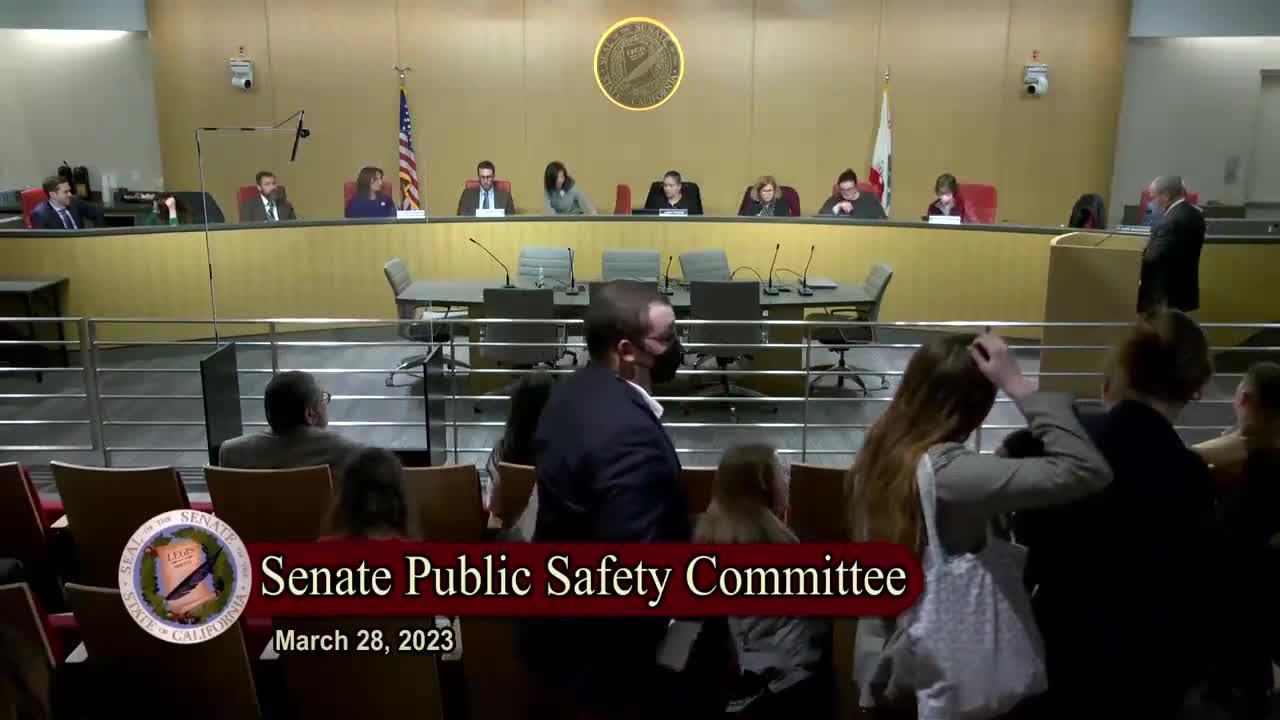
| Mar 28, 2023 | March 28 set for first hearing. Failed passage in committee. (Ayes 1. Noes 3. Page 578.) |
| Mar 1, 2023 | Set for hearing March 28. |
| Feb 15, 2023 | Referred to Com. on PUB S. |
| Feb 7, 2023 | From printer. May be acted upon on or after March 9. |
| Feb 6, 2023 | Introduced. Read first time. To Com. on RLS. for assignment. To print. |
|
Date
|
Description
|
Location
|
Votes
|
|
|---|---|---|---|---|
| Mar 28, 2023 | Do pass, but first be re-referred to the Committee on [Appropriations] | Senate Standing Committee on Public Safety |
Failed |
This list shows positions taken on this bill by organizations on the date displayed, which is linked to the original source.
Positions by individuals are not included.
SENATE COMMITTEE ON PUBLIC SAFETY
Senator Aisha Wahab, Chair
2023 - 2024 Regular
Bill No: SB 316 Hearing Date: March 28, 2023
Author: | Niello | ||
Version: | February 6, 2023 | ||
Urgency: | No | Fiscal: | Yes |
Consultant: | SC | ||
Subject: Shoplifting: increased penalties for prior crimes
HISTORY
Source: Author
Prior Legislation: SB 1108 (Bates), failed passage Sen. Public Safety, 2022
SB 710 (Bates), failed Sen. Public Safety, 2020
SB 979 (Jones), failed Sen. Public Safety, 2020
AB 1326 (Cooper), failed Asm. Public Safety, 2017
AB 875 (Cooper), failed Asm. Public Safety, 2017
AB 2287 (Lackey), never heard in Sen. Public Safety, 2016
AB 2369 (Patterson), failed Asm. Public Safety, 2016
Support: California District Attorneys Association; California State Sheriffs’ Association; El Dorado County Chamber of Commerce; Elk Grove Chamber of Commerce; Folsom Chamber of Commerce; Lincoln Area Chamber of Commerce; Los Angeles Professional Peace Officers Association; Rancho Cordova Chamber of Commerce; Rocklin Area Chamber of Commerce; Roseville Chamber of Commerce; United Chamber Advocacy Network; Yuba Sutter Chamber of Commerce
Opposition: California Public Defenders Association, Sister Warriors Freedom Coalition
PURPOSE
The purpose of this bill is to reinstate the offense of “petty theft with a prior” as it existed prior to the passage Proposition 47 and includes shoplifting in the list of eligible prior crimes.
Existing law divides theft into two degrees, petty theft and grand theft. (Pen. Code, § 486.)
Existing law defines grand theft as when the money, labor, or real or personal property taken is of a value exceeding $950 dollars, except as specified. (Pen. Code, § 487.)
Existing law states that petty theft is punishable by a fine not exceeding $1,000, by imprisonment in the county jail not exceeding six months, or both. (Penal Code § 490.)
Existing law defines “shoplifting” as entering a commercial establishment with intent to commit larceny while that establishment is open during regular business hours, where the value of the property that is taken or intended to be taken does not exceed $950 dollars. (Pen. Code, § 459.5, subd. (a).)
Existing law states that any act of shoplifting must be charged as such, and that a person charged with shoplifting cannot also be charged with burglary or theft of the same property. (Pen. Code, § 459.5, subd. (b).)
Existing law punishes shoplifting as a misdemeanor, except where a person has a prior “super strike” or a registrable sex conviction, in which case the offense is punished as a felony by imprisonment in the county jail pursuant to realignment. (Pen. Code, § 459.5, subd. (a).)
Existing law designates the following offenses to be “super strikes”: specified sex offenses, homicide, solicitation to commit murder, assault with a machine gun on a peace officer or firefighter, possession of a weapon of mass destruction, and any serious or violent felony punishable by life imprisonment or death. (Pen. Code, § 667, subd. (e)(2)(C)(iv).)
Existing law provides that, notwithstanding the punishment for petty theft, if a person is required to register as a sex offender, has a prior “super strike conviction,” or has a conviction for a specified theft-related offense against an elder or dependent adult, and also has been convicted of a specified theft-related offense for which he or she was imprisoned, and is subsequently convicted of petty theft, then the person is to receive an enhanced punishment of imprisonment in the county jail not to exceed one year, or in the state prison. (Pen. Code, § 666.)
This bill states that any person who has been convicted three or more times of petty theft, shoplifting, grand theft, financial elder abuse, auto theft, burglary, carjacking, robbery, or a felony conviction of receiving stolen property, and who has served a term of imprisonment or imprisoned as a condition of probation for that crime, and who is subsequently convicted of petty theft or shoplifting shall be punished by imprisonment in the county jail not exceeding one year, or 16 months, or 2 or 3 years pursuant to realignment.
This bill adds shoplifting to the list of offenses for which a person who is required to register as a sex offender, has a prior “super strike conviction,” or has a prior conviction for a specified theft-related offense against an elder or dependent adult may be punished by imprisonment in the county jail not exceeding one year, or in the state prison.
This bill, if approved by the Legislature, would require the Secretary of State to place provisions of the bill on the ballot for November 5, 2024 statewide general election.
COMMENTS
- Need for This Bill
According to the author of this bill:
Voters approved Proposition 47 in 2014 to ensure that our criminal justice system focused on violent and serious offenses. Instead, it led to dangerous unintended consequences, opening up businesses and individuals to increased economic and psychological damage. Now, even voters are frustrated with the results and want to see order restored. According to a February 2022 Berkley Institute of Governmental Studies poll, two-thirds of California voters supported changing Proposition 47.
- Proposition 47
Proposition 47, approved by voters on November 4, 2014, reduced the penalties for certain drug and property crimes and required that the resulting state savings be directed to mental health and substance abuse treatment, truancy and dropout prevention, and victims’ services. The initiative was enacted to comply with a 2011 California Supreme Court order, which upheld that California’s overcrowded prisons violated incarcerated individuals’ Eighth Amendment rights against cruel and unusual punishment.
Proposition 47 contained specific language reflecting the purpose and intent of the proposition:
“In enacting this act, it is the purpose and intent of the people of the State of California to: “. . . (3) Require misdemeanors instead of felonies for nonserious, nonviolent crimes like petty theft and drug possession, unless the defendant has prior convictions for specified violent or serious crimes. . . ” (http://vig.cdn.sos.ca.gov/2014/general/pdf/text-of-proposed-laws1.pdf#prop47)
“One of Proposition 47’s primary purposes is to reduce the number of nonviolent offenders in state prisons, thereby saving money and focusing prison on offenders considered more serious under the terms of the initiative.” (Harris v. Superior Court (2016) 1 Cal.5th 984, 992, citing Voter Information Guide, Gen. Elec. (Nov. 4, 2014) text of Prop. 47, § 2, p. 70.)
Specifically, the initiative reduced the penalties for possession for personal use of most illegal drugs to misdemeanors. The initiative also directed that theft crimes of $950 or less shall be considered petty theft and be punished as a misdemeanor, with limited exceptions for individuals with specified prior convictions.
Among the theft crimes made misdemeanors by Proposition 47, where the value of the property is $950 or less, are forgery (Pen. Code, § 473), making or delivering a check with insufficient funds (Pen. Code, § 476a), petty theft (Pen. Code, § 490.2), and receiving stolen property (Pen. Code, § 496). (See People v. Rivera (2015) 233 Cal.App.4th 1085, 1091.) Proposition 47 also created the new offense of shoplifting, a misdemeanor, where the value of the property taken or intended to be taken is $950 or less (Pen. Code, § 459.5; People v. Sherow (2015) 239 Cal.App.4th 875, 879); and, pertinent to this bill, limited the application of petty theft with a prior theft conviction. (Pen. Code, § 666; People v. Rivera, supra, 233 Cal.App.4th at p. 1091.)
Prior to Proposition 47, Penal Code section 666 (the petty theft with a prior provision) provided that every person who has been convicted three or more times of petty theft, grand theft, financial crimes against elders, vehicle theft, burglary, carjacking, robbery, or a felony violation of receiving stolen property and has served any time in custody for those offenses, upon a new conviction for petty theft may be punished alternatively with either a felony or misdemeanor, also known as a wobbler. Proposition 47 repealed this part of Penal Code section 666 and limited its application to persons who have previously been convicted of a “super strike,” financial abuse of an elder, or an offense requiring sex offender registration.
This bill seeks to restore the wobbler penalties for petty theft with a prior conviction to any person with three or more theft convictions, and include within the applicable prior convictions the crime of shoplifting which was created by Proposition 47.
- California Constitutional Limitations on Amending a Voter Initiative
Because Proposition 47 was a voter initiative, the Legislature may not amend the statute without subsequent voter approval unless the initiative permits such amendment, and then only upon whatever conditions the voters attached to the Legislature's amendatory powers. (People v. Superior Court (Pearson) (2010) 48 Cal.4th 564, 568; see also Cal. Const., art. II, § 10, subd. (c).) The California Constitution states, "The Legislature may amend or repeal referendum statutes. It may amend or repeal an initiative statute by another statute that becomes effective only when approved by the electors unless the initiative statute permits amendment or repeal without their approval." (Cal. Const., art. II, § 10, subd. (c).) Therefore, unless the initiative expressly authorizes the Legislature to amend, only the voters may alter statutes created by initiative.
The purpose of California's constitutional limitation on the Legislature's power to amend initiative statutes is to protect the people's initiative powers by precluding the Legislature from undoing what the people have done, without the electorate's consent. Courts have a duty to jealously guard the people's initiative power and, hence, to apply a liberal construction to this power wherever it is challenged in order that the right to resort to the initiative process is not improperly annulled by a legislative body. (Proposition 103 Enforcement Project v. Quackenbush (1998) 64 Cal.App.4th 1473.)
As to the Legislature's authority to amend the initiative, Proposition 47 states:
This act shall be broadly construed to accomplish its purposes. The provisions of this measure may be amended by a two‑thirds vote of the members of each house of the Legislature and signed by the Governor so long as the amendments are consistent with and further the intent of this act. The Legislature may by majority vote amend, add, or repeal provisions to further reduce the penalties for any of the offenses addressed by this act. (<http://vig.cdn.sos.ca.gov/2014/general/pdf/text-of-proposed-laws1.pdf#prop47>.)
This bill seeks to increase punishment for repeat offenders for the crimes which were reduced to misdemeanors by Proposition 47. As such, it is inconsistent with the purpose of Proposition 47. Therefore, pursuant to the above-referenced provisions of the California Constitution, only the voters may authorize the provisions.
This bill, if approved by the Legislature, calls for a special election to be consolidated with the November 8, 2022, statewide general election.
- Recent Initiative Efforts to Amend Proposition 47
In the November 2020 election, almost 62% of voters rejected a broader effort to roll back portions of Proposition 47. Proposition 20, among other things, would have created the crime of serial theft for a person with two or more prior convictions for theft-related crimes, would have created a separate crime of organized retail theft, and would have required DNA collection for crimes that were reduced to misdemeanors by Proposition 47. (https://ballotpedia.org/California_Proposition_20,_Criminal_Sentencing,_Parole,_and_DNA_Collection_Initiative_(2020) [as of March 13, 2023].)
In 2022, a proposed initiative for the November 2022 ballot would have authorized felony sentences repeat thefts. Specifically, the proposed initiative:
Authorizes prosecutors to file felony or misdemeanor charges for thefts of any amount under $950—currently chargeable as felonies only in certain circumstances—against any person with two or more prior specified theft convictions. Adds mandatory sentencing enhancement for any felony resulting in significant property loss or damage, ranging from one additional year for losses over $50,000, to four years for losses over $3,000,000, plus one year for each additional $3,000,000. Authorizes prosecution for theft in any county where acts in furtherance occurred.
(https://ballotpedia.org/California_Punishment_for_Repeat_Theft_Convictions_Initiative_(2022) [as of Mar. 13, 2023].) The proposed initiative needed to gather 623,212 signatures by June 30, 2022 in order to be certified for the 2022 ballot but failed to meet this requirement and thus did not qualify for the ballot.
- Increased Penalties are Available for Repeat or Organized Theft Offenses
While Proposition 47 did reduce certain theft offenses to misdemeanors, there are still legal options for charging retail crime that can result in felony penalties. Repeated acts of theft can be aggregated and prosecuted as one felony if they are conducted pursuant to one intention, one general impulse, and one plan. (See People v. Bailey (1961) 55 Cal.2d 514, 518-519.) AB 2356 (Rodriguez), Chapter 22, Statutes of 2022, codified this. It specified that if the value of property taken, or intended to be taken, exceeds $950 over the course of distinct but related acts, the value of the property taken, or intended to be taken, may properly be aggregated to charge a count of grand theft, if the acts are motivated by one intention, one general impulse, and one plan.
Separately, Penal Code section 490.4 punishes “organized retail theft” which include shoplifting schemes undertaken by two or more persons who have organized themselves to commit shoplifting for financial gain. (Pen. Code, § 490.4.) The punishment ranges from one year in the county jail (misdemeanor) to 16 months, or two, or three years in the county jail (felony), depending on the specific circumstances. On February 9, 2023, the California Attorney General, along with CHP and partnering agencies, announced that eight individuals involved in a statewide organized retail theft operation, resulting in a total loss of approximately $ 1 million to date, had been arrested and charged. (https://oag.ca.gov/news/press-releases/attorney-general-bonta-charges-organized-retail-theft-suspects-theft [as of Mar. 13, 2023].)
- Data on the Effects of Proposition 47
According to data from the California Department of Justice, California’s crime rates have risen back to pre-pandemic levels, however, these rates are still historically low. After a steady increase between the 1960s to the 1980s, crime rates have steadily declined and is now similar to the rates seen in the 1960s. This applies to both violent crimes and property crimes, although both have seen an increase since 2020. The violent crime rate increased by 6.0%, from 440 per 100,000 residents in 2020 to 466 in 2021. The property crime rate of 2,178 per 100,000 residents remained low, but has ticked up 2.4% from 2020 to 2021, when it reached the lowest level observed since 1960. (Crime Trends in California, Public Policy Institute of California (PPIC) (Oct. 2022), < https://www.ppic.org/publication/crime-trends-in-california/> [as of Mar. 13, 2023].)
After the passage of Proposition 47, there was a slight increase in property crimes, specifically car thefts and larceny, but in 2016 the property crime rates again declined. (The Impact of Proposition 47 on Crime and Recidivism, PPIC (June 2018), https://www.ppic.org/wp-content/uploads/r_0618mbr.pdf [as of Mar. 13, 2023].) Proposition 47 reduced recidivism and within months of its passage, the prison population dropped below its court-mandated target arising out of lawsuits over poor conditions and overcrowding in the state prisons. (Id. at pp. 4-5.) While property crimes have increased in various parts of the state, some large counties did see a decrease in property crimes. (Crime Trends in California, PPIC, (Oct. 2022), < https://www.ppic.org/publication/crime-trends-in-california/> [as of Mar. 13, 2023].)
Data specific to shoplifting and commercial burglaries show that these crimes were down 10% in 2020 and continued to decrease in 2021 in Los Angeles (-15%), San Diego (-5%) and Oakland (-4%). San Francisco, however, saw a 32% increase in these crimes driven largely by the shoplifting incidents that began late summer 2021 to November 2021 followed by a decrease end of 2021 to beginning of 2022. Los Angeles also saw an increase in these crimes late summer 2021 but those numbers remain below pre-pandemic numbers. (Two Years of Wide Variation in Crime Trends, PPIC (Mar. 2022) https://www.ppic.org/blog/two-years-of-wide-variation-in-crime-trends/ [as of Mar. 13, 2023].)
Proposition 47 also had the impact of decreasing racial disparities in arrests and bookings. Specifically, this decrease in disparity has been driven by trends in arrests for drug and property crimes. According to PPIC, “the gap in arrest rates between African Americans and whites for drug and property offenses (including felonies and misdemeanors) dropped by 24.4 percent after Prop 47, while the gap in booking rates narrowed by 32.6 percent. The decline in arrests and bookings for drug felonies is especially striking. For these offenses, the gap in the arrest and booking rates between African Americans and whites narrowed by about 55 percent. As a result, African American arrest and booking rates for drug felonies are now lower than the rates were for whites before Prop 47 passed.” (https://www.ppic.org/press-release/prop-47-has-reduced-racial-disparities-in-arrests-and-bookings-in-california-but-serious-inequities-remain/ (Jun. 23, 2020) [as of Mar. 13, 2023].)
- Increasing Penalties Has Minimal Deterrent Effect
A comprehensive report published in 2014, entitled The Growth of Incarceration in the United States, discusses the effects on crime reduction through incapacitation and deterrence, and describes general deterrence compared to specific deterrence:
A large body of research has studied the effects of incarceration and other criminal penalties on crime. Much of this research is guided by the hypothesis that incarceration reduces crime through incapacitation and deterrence. Incapacitation refers to the crimes averted by the physical isolation of convicted offenders during the period of their incarceration. Theories of deterrence distinguish between general and specific behavioral responses. General deterrence refers to the crime
prevention effects of the threat of punishment, while specific deterrence concerns the aftermath of the failure of general deterrence—that is, the effect on reoffending that might result from the experience of actually being punished.
(National Research Council (2014) The Growth of Incarceration in the United States: Exploring Causes and Consequences Committee on Causes and Consequences of High Rates of Incarceration, J. Travis, B. Western, and S. Redburn, Editors. Committee on Law and Justice, Division of Behavioral and Social Sciences and Education. Washington, DC: The National Academies Press. (http://johnjay.jjay.cuny.edu/nrc/NAS_report_on_incarceration.pdf.)
In regard to deterrence, the authors note that in “the classical theory of deterrence, crime is averted when the expected costs of punishment exceed the benefits of offending. Much of the empirical research on the deterrent power of criminal penalties has studied sentence enhancements and other shifts in penal policy.” (National Research Council, supra, The Growth of Incarceration in the United States, p. 132.)
Deterrence theory is underpinned by a rationalistic view of crime. In this view, an individual considering commission of a crime weighs the benefits of offending against the costs of punishment. Much offending, however, departs from the strict decision calculus of the rationalistic model. Robinson and Darley (2004) review the limits of deterrence through harsh punishment. They report that offenders must have some knowledge of criminal penalties to be deterred from committing a crime, but in practice often do not.
(Id. at p. 133.) The report concludes: The incremental deterrent effect of increases in lengthy prison sentences is modest at best. “Because recidivism rates decline markedly with age, lengthy prison sentences, unless they specifically target very high-rate or extremely dangerous offenders, are an inefficient approach to preventing crime by incapacitation.” (Id. at p. 5.)
This bill increases the potential sentence for a person who commits petty theft with three prior convictions. Generally, a person convicted of petty theft is subject to misdemeanor penalties. This bill would instead authorize felony penalties if the person has three prior theft-related convictions. As discussed above, increasing penalties does little to deter crimes.
- Argument in Support
According to Rocklin Area Chamber of Commerce:
We support SB 316 to protect our communities and small businesses, neighbors, and customers from increasing incidents of crime as a result of the implementation of Proposition 47, which reduced penalties for specific crimes in California.
If states are indeed the laboratories of democracy, then it’s clear many Californians believe the Proposition 47 experiment has failed. According to a recent survey released by UC Berkeley’s Institute of Governmental Studies, 51% of registered votes in California disapprove of the current administration’s performance on public safety issues.
Prop 47 reduced penalties for shoplifting, check kiting, grand theft and fencing stolen property, and discouraged a criminal’s conviction history when assessing punishment. These actions combined with anti-police messages in our political and cultural spheres have created an environment in which retailers, customers and residents feel unsafe.
SB 316 will reinstate a provision of law that was repealed by Proposition 47 that provides that a person who has been convicted three or more times of petty theft, grand theft, or other specified crimes and who is subsequently convicted of petty theft is subject to imprisonment in a county jail not exceeding one year or in a county jail for 16 months or two or three years.
- Argument in Opposition
According to Sister Warriors Freedom Coalition:
California has been down this road before. In 2014, faced with mass- incarceration of and the economic and human cost of a system built on the insane notion that putting people in prison will “fix” them, California voters overwhelmingly voted in favor of Prop. 47, a proposal that kept most nonviolent offenders out of prisons.
Prop. 47 did not affect serious or violent felonies, but instead targeted low- level property and drug offenses for reform. Political rhetoric notwithstanding, property crime decreased in California following its enactment. (SacBee, Dec, 10, 2021 [“property crime steadily decreased in the years after voters approved Proposition 47”].)
Not dissuaded, in 2020, “tough on crime” advocates tried to persuade the public to repeal Prop. 47 via Prop. 20. Again, California voters rejected the attempt to go back to mass incarceration and the imprisonment of non- violent, low-level offenders at taxpayer expense.
-- END –
Discussed in Hearing
 27MIN