SB 331: Child custody: child abuse and safety.
- Session Year: 2023-2024
- House: Senate
- Latest Version Date: 2023-10-13
Current Status:
Passed
(2023-10-13: Chaptered by Secretary of State. Chapter 865, Statutes of 2023.)
Introduced
In Committee
First Chamber
In Committee
Second Chamber
Enacted
Existing law governs the determination of child custody and visitation in contested proceedings. Existing law requires the court, for purposes of deciding custody, to determine the best interests of the child based on certain factors, including the nature and amount of contact with both parents and, consistent with specified findings, requires the courts primary concern to be the health, safety, and welfare of the child. Existing law prohibits the ordering of family reunification services as part of a child custody or visitation rights proceeding.
Existing law authorizes the court, upon making certain findings, to require the parent or parents, or any other party involved in a custody or visitation dispute, and the minor child to participate in outpatient counseling, as specified.
This bill, Piquis Law: Keeping Children Safe from Family Violence Act, would prohibit the court from ordering family reunification treatments, programs, or services, including, but not limited to, camps, workshops, therapeutic vacations, or educational programs that, as a condition of enrollment or participation, require or result in, among other things, the use of private youth transporters or private transportation agents, as specified, a no-contact order, or a transfer of physical or legal custody of the child.
Existing law requires the Judicial Council to establish judicial training programs for individuals who perform duties in domestic violence matters. Existing law requires the training programs to include a domestic violence session in any orientation session for newly appointed or elected judges and an annual training session in domestic violence. Existing law requires the training programs to include instruction in all aspects of domestic violence, including, but not limited to, the detriment to children of residing with a person who perpetrates domestic violence.
This bill would instead require the Judicial Council to establish judicial training programs for individuals, including judicial officers and referees, who perform duties in domestic violence or child custody matters, including, among other topics, child sexual abuse and coercive control, as specified. The bill would require the Judicial Council to submit an annual report on these training programs, commencing on or before January 1, 2025, to the Legislature and relevant policy committees, that includes the titles of the training courses being offered and the number of judicial officers that attended each training.
Existing law governs the determination of child custody and visitation in contested proceedings. Existing law requires the court, for purposes of deciding custody, to determine the best interests of the child based on certain factors, including the nature and amount of contact with both parents and, consistent with specified findings, requires the courts primary concern to be the health, safety, and welfare of the child. Existing law prohibits the ordering of family reunification services as part of a child custody or visitation rights proceeding.
Existing law authorizes the court, upon making certain findings, to require the parent or parents, or any other party involved in a custody or visitation dispute, and the minor child to participate in outpatient counseling, as specified.
This bill, Piquis Law, the Law: Keeping Children Safe from Family Violence Act, would prohibit the court from ordering counseling, programs, or services to remediate the resistance of a child to connect with, or to improve a deficient relationship with, the parent seeking custody or visitation under specified circumstances. The bill would require court-ordered counseling to comply with various requirements, including, among others, that the counseling primarily addresses the behavior of, or contribution to the resistance of the child by, the parent seeking custody or visitation before ordering the other parent to take steps to improve the childs relationship with the parent seeking custody or visitation. This bill would require the court to state its reasons for ordering counseling, and the evidence it relied on, in a written order on the record. The bill would require the court to make findings that remediation is in the best interest of the child and that the parent seeking custody or visitation has shown they are willing to meaningfully participate in the counseling. family reunification treatments, programs, or services, including, but not limited to, camps, workshops, therapeutic vacations, or educational programs that, as a condition of enrollment or participation, require or result in, among other things, the use of private youth transporters or private transportation agents, as specified, a no-contact order, or a transfer of physical or legal custody of the child.
Existing law requires the Judicial Council to establish judicial training programs for individuals who perform duties in domestic violence matters. Existing law requires the training programs to include a domestic violence session in any orientation session for newly appointed or elected judges and an annual training session in domestic violence. Existing law requires the training programs to include instruction in all aspects of domestic violence, including, but not limited to, the detriment to children of residing with a person who perpetrates domestic violence.
This bill would instead require the Judicial Council to establish judicial training programs for individuals, including judicial officers and referees, who perform duties in domestic violence or child custody matters, including, among other topics, child sexual abuse and coercive control, as specified. The bill would require the Judicial Council to submit an annual report on these training programs, commencing on or before January 1, 2025, to the Legislature and relevant policy committees, that includes the titles of the training courses being offered and the number of judicial officers that attended each training.
Existing law governs the determination of child custody and visitation in contested proceedings. Existing law requires the court, for purposes of deciding custody, to determine the best interests of the child based on certain factors, including the nature and amount of contact with both parents and, consistent with specified findings, requires the courts primary concern to be the health, safety, and welfare of the child. Existing law prohibits the ordering of family reunification services as part of a child custody or visitation rights proceeding.
This bill, Piquis Law, the Children Safe from Family Violence Act, would provide that a person is qualified to testify as an expert in a child custody proceeding in which a parent has been alleged to have committed domestic violence or child abuse if the court finds that the witness possesses special knowledge or demonstrated expertise or experience in working directly with victims of domestic violence or child abuse. This bill would require a judicial officer assigned to family law matters involving child custody proceedings and individual courts to submit the number of hours of continuing instruction in domestic violence completed, as specified. The bill would require the Judicial Council to submit a report to the Legislature and the relevant policy committees on the trainings for judges, as specified.Existing law authorizes the court, upon making certain findings, to require the parent or parents, or any other party involved in a custody or visitation dispute, and the minor child to participate in outpatient counseling, as specified.
This bill bill, Piquis Law, the Keeping Children Safe from Family Violence Act, would prohibit the court from ordering counseling, programs, or services to remediate the resistance of a child to connect with, or to improve a deficient relationship with, the parent seeking custody or visitation under specified circumstances. The bill would require court-ordered counseling to comply with various requirements, including, among others, that the counseling primarily addresses the behavior of, or contribution to the resistance of the child by, the parent seeking custody or visitation before ordering the primary custodial other parent to take steps to improve the childs relationship with the parent seeking custody or visitation. This bill would require the court to state its reasons for ordering counseling, and the evidence it relied on, in a written order on the record. The bill would require the court to make findings that remediation is in the best interest of the child and that the parent seeking custody or visitation has shown they are willing to meaningfully participate in the counseling.
Existing law requires the Judicial Council to establish judicial training programs for individuals who perform duties in domestic violence matters. Existing law requires the training programs to include a domestic violence session in any orientation session for newly appointed or elected judges and an annual training session in domestic violence. Existing law requires the training programs to include instruction in all aspects of domestic violence, including, but not limited to, the detriment to children of residing with a person who perpetrates domestic violence.
This bill would repeal those provisions and instead require the Judicial Council to establish judicial training programs for individuals, including judicial officers and referees, who perform duties in family law domestic violence or child custody matters, including, among other topics, child sexual abuse and coercive control, as specified. The bill would require the Judicial Council to submit an annual report on these training programs, commencing on or before January 1, 2025, to the Legislature and relevant policy committees, that includes the titles of the training courses being offered and the number of judicial officers that attended each training.
Existing law governs the determination of child custody and visitation in contested proceedings. Existing law requires the court, for purposes of deciding custody, to determine the best interests of the child based on certain factors, including the nature and amount of contact with both parents and, consistent with specified findings, requires the courts primary concern to be the health, safety, and welfare of the child. Existing law prohibits the ordering of family reunification services as part of a child custody or visitation rights proceeding.
This bill, Piquis Law, the Safe Child Act, Children Safe from Family Violence Act, would provide that a person is qualified to testify as an expert in a child custody proceeding in which a parent has been alleged to have committed domestic violence or child abuse, as specified, if the person shows by any otherwise admissible evidence that the person has sufficient special knowledge, skill, experience, training, or education relating to the subject of the persons testimony. abuse if the court finds that the witness possesses special knowledge or demonstrated expertise or experience in working directly with victims of domestic violence or child abuse. This bill would require a judge judicial officer assigned to family law matters involving child custody proceedings and individual courts to submit the number of hours of continuing instruction in domestic violence completed to the Judicial Council. completed, as specified. The bill would require the Judicial Council to submit a report to the Legislature and the relevant policy committees on the trainings for judges across all counties, as specified. judges, as specified.
Existing law authorizes the court, upon making certain findings, to require the parent or parents, or any other party involved in a custody or visitation dispute, and the minor child to participate in outpatient counseling, as specified.
This bill would prohibit the court from ordering family reunification treatment, as defined. counseling, programs, or services to remediate the resistance of a child to connect with, or to improve a deficient relationship with, the parent seeking custody or visitation under specified circumstances. The bill would require court-ordered counseling, as specified, to primarily address counseling to comply with various requirements, including, among others, that the counseling primarily addresses the behavior of, or contribution to the resistance of the child by by, the parent seeking custody or visitation before ordering the primary custodial parent to take steps to improve the childs relationship with the parent seeking custody or visitation. This bill would require the court to state all of its reasons for ordering counseling, and the evidence it relied on, in a written order on the record. The bill would require the court to make findings that remediation is in the best interest of the child and that the parent seeking custody or visitation has shown they are willing to meaningfully participate in the counseling.
Existing law requires the Judicial Council to establish judicial training programs for individuals who perform duties in domestic violence matters. Existing law requires the training programs to include a domestic violence session in any orientation session for newly appointed or elected judges and an annual training session in domestic violence. Existing law requires the training programs to include instruction in all aspects of domestic violence, including, but not limited to, the detriment to children of residing with a person who perpetrates domestic violence.
This bill would repeal those provisions and instead require the Judicial Council to establish judicial training programs for individuals, including judges and judges pro tem, judicial officers and referees, who perform duties in family law matters, including, among other topics, child sexual abuse and coercive control, as specified.
Existing law governs the determination of child custody and visitation in contested proceedings. Existing law requires the court, for purposes of deciding custody, to determine the best interests of the child based on certain factors, including the nature and amount of contact with both parents and, consistent with specified findings, requires the courts primary concern to be the health, safety, and welfare of the child. Existing law prohibits the ordering of family reunification services as part of a child custody or visitation rights proceeding.
This bill, Piquis Law, the Safe Child Act, would prohibit court-ordered family reunification services as part of a child custody or visitation rights proceeding, including reunification or reconnection therapy, treatments, programs, workshops, classes, or camps that are predicated on cutting off a child from a parent with whom the child is bonded or to whom the child is attached. The bill would provide that a person is qualified to testify as an expert in a child custody proceeding in which a parent has been alleged to have committed domestic violence or child abuse, as specified, if the person shows by any otherwise admissible evidence that the person has sufficient special knowledge, skill, experience, training, or education relating to the subject of the persons testimony. This bill would require a judge assigned to family law matters involving child custody proceedings and individual courts to submit the number of hours of continuing instruction in domestic violence completed to the Judicial Council. The bill would require the Judicial Council to submit a report to the Legislature and the relevant policy committees on the trainings for judges across all counties, as specified.Existing law authorizes the court, upon making certain findings, to require the parent or parents, or any other party involved in a custody or visitation dispute, and the minor child to participate in outpatient counseling, as specified.
This bill would prohibit the court from ordering family reunification treatment, as defined. The bill would require court-ordered counseling, as specified, to primarily address the behavior or contribution to the resistance of the child by the parent seeking custody or visitation before ordering the primary custodial parent to take steps to improve the childs relationship with the parent seeking custody or visitation. This bill would require the court to state all of its reasons for ordering counseling, and the evidence it relied on, in a written order on the record. The bill would require the court to make findings that remediation is in the best interest of the child and that the parent seeking custody or visitation has shown they are willing to meaningfully participate in the counseling.
Existing law requires the Judicial Council to establish judicial training programs for individuals who perform duties in domestic violence matters. Existing law requires the training programs to include a domestic violence session in any orientation session for newly appointed or elected judges and an annual training session in domestic violence. Existing law requires the training programs to include instruction in all aspects of domestic violence, including, but not limited to, the detriment to children of residing with a person who perpetrates domestic violence.
This bill would repeal those provisions and instead require the Judicial Council to establish mandatory judicial training programs for individuals, including judges and judges pro tem, who perform duties in family law matters, including, among other topics, child sexual abuse and coercive control, as specified.
Existing law governs the determination of child custody and visitation in contested proceedings. Existing law requires the court, for purposes of deciding custody, to determine the best interests of the child based on certain factors, including the nature and amount of contact with both parents and, consistent with specified findings, requires the courts primary concern to be the health, safety, and welfare of the child. Existing law prohibits the ordering of family reunification services as part of a child custody or visitation rights proceeding.
This bill, Piquis Law, the Safe Child Act, would prohibit court-ordered family reunification services as part of a child custody or visitation rights proceeding, including reunification or reconnection therapy, treatments, programs, workshops, classes, or camps that are predicated on cutting off a child from a parent with whom the child is bonded or to whom the child is attached. The bill would provide that a person is qualified to testify as an expert in a child custody proceeding in which a parent has been alleged to have committed domestic violence or child abuse, as specified, if the person shows by any otherwise admissible evidence that the person has sufficient special knowledge, skill, experience, training, or education relating to the subject of the persons testimony. This bill would require a judge assigned to family law matters involving child custody proceedings and individual courts to submit the number of hours of continuing instruction in domestic violence completed to the Judicial Council. The bill would require the Judicial Council to submit a report to the Legislature and the relevant policy committees on the trainings for judges across all counties, as specified.
Existing law requires the Judicial Council to establish judicial training programs for individuals who perform duties in domestic violence matters. Existing law requires the training programs to include a domestic violence session in any orientation session for newly appointed or elected judges and an annual training session in domestic violence. Existing law requires the training programs to include instruction in all aspects of domestic violence, including, but not limited to, the detriment to children of residing with a person who perpetrates domestic violence.
This bill would repeal those provisions and instead require the Judicial Council to establish mandatory judicial training programs for individuals, including judges and judges pro tem, who perform duties in family law matters, including, among other topics, child sexual abuse and coercive control, as specified.
Existing law specifies that the rules of practice and procedure applicable to civil actions generally also apply to and constitute the rules of practice and procedure in family law proceedings.This bill would make technical, nonsubstantive changes to those provisions.Existing law specifies that the rules of practice and procedure applicable to civil actions generally also apply to and constitute the rules of practice and procedure in family law proceedings.
This bill would make technical, nonsubstantive changes to those provisions.
This act shall be known, and may be cited, as Piquis Law: Keeping Children Safe from Family Violence Act.
SEC. 2.(a)The Legislature finds and declares all of the following:
(1)Approximately 1 in 15 children in the United States is exposed to domestic violence each year.
(2)Most child abuse in America is perpetrated in the family and by a parent, and intimate partner violence and child abuse overlap in the same families at rates between 30 and 60 percent. A childs risk of abuse increases after a perpetrator of intimate partner violence separates from a domestic partner, even when the perpetrator has not previously directly abused the child. Children in the United States who have witnessed intimate partner violence are approximately four times more likely to experience direct child maltreatment than children who have not witnessed intimate partner violence.
(3)More than 75 percent of child sexual abuse in America is perpetrated by a family member or a person known to the child. Data from the United States Department of Justice shows that family members are 49 percent, or almost one-half, of the perpetrators of crimes against child sex assault victims younger than six years of age.
(4)Research suggests that a childs exposure to an abuser is among the strongest indicators of risk of incest victimization. One national study found that female children with fathers who are abusers of their mothers were six and one-half times more likely to experience father-daughter incest than female children who do not have abusive fathers.
(5)Child abuse is a major public health issue in the United States. Total lifetime financial costs associated with just one year of confirmed cases of child maltreatment, including child physical abuse, sexual abuse, psychological abuse, and neglect, result in $124 billion in annual costs to the economy of the United States, or approximately 1 percent of the gross domestic product of the United States.
(6)On April 13, 2023, the United Nations Special Rapporteur on violence against women and girls called for a ban on highly traumatizing reunification treatments promoted through unlicensed, unregulated, for-profit industries, which result in children being isolated through extended no-contact orders from the other parent, family, friends, schools, and communities.
(b)It is the intent of the Legislature to do all of the following:
(1)Increase the priority given to child safety in any state court divorce, separation, visitation, paternity, child support, civil protection order, or family custody court proceeding affecting the custody and care of children.
(2)To prohibit family courts from ordering reunification treatments, programs, or services, including, but not limited to, camps, therapeutic vacations, workshops, and parenting programs, that cut off the relationship with a parent or sequester the child from extended family, friends, and community under acutely distressing circumstances, such as utilizing professional transport agents that force a child into a threat-based, coercive environment to address, repair, or remediate the relationship with the other parent whom the child is rejecting or resisting.
(3)Ensure that professional personnel involved in cases containing domestic violence or child abuse allegations receive trauma-informed and culturally appropriate training on the dynamics, signs, and impact of domestic violence and child abuse, including child sexual abuse.
(4)Ensure trainings are designed to improve the ability of judicial officers, referees, commissioners, and if employed by the court, guardians ad litem, custody evaluators, mediators, child custody recommending counselors, and others who are deemed appropriate by the Judicial Council and who perform duties in domestic violence or child custody matters to recognize and respond to child abuse, domestic violence, and trauma in family victims.
(5)Ensure trainings are designed to improve the ability of judicial officers, referees, commissioners, and, if employed by the court, guardians ad litem, custody evaluators, mediators, child custody recommending counselors, and others who are deemed appropriate by the Judicial Council and who perform duties in domestic violence or child custody matters to prioritize children and to make appropriate custody decisions in the best interest of child safety and well-being that are culturally responsive and appropriate for diverse communities.
(6)Move California toward becoming eligible for additional grant funding through the United States Department of Justices STOP Violence Against Women Formula Grant Program, as appropriated for states that meet the requirements of the federal Violence Against Women Act Reauthorization Act of 2022 (Division W of Public Law 117-103).
(c)The Legislature does not intend, by passage of this bill, to discriminate against parents or children based on either a parents or the childs actual or perceived sex, gender, sexual orientation, gender identity or expression, race, color, ancestry, national origin, ethnic group identification, age, religion, marital or parental status, physical or mental disability or genetic information, or association with a person or group with one or more of these actual or perceived characteristics.
SEC. 3.Section 3193 is added to the Family Code, to read:3193.(a)Notwithstanding any other law, a court shall not order family reunification treatments, programs, or services, including, but not limited to, camps, workshops, therapeutic vacations, or educational programs that, as a condition of enrollment or participation, require or result in any of the following:
(1)A no-contact order.
(2)An overnight, out-of-state, or multiday stay.
(3)A transfer of physical or legal custody of the child.
(4)The use of private youth transporters or private transportation agents engaged in the use of force, threat of force, physical obstruction, acutely distressing circumstances, or circumstances that place the safety of the child at risk.
(5)The use of threats of physical force, undue coercion, verbal abuse, isolation from the childs family, community, or other sources of support, or other acutely distressing circumstances.
(b)This section does not affect the applicability of Section 16507 of the Welfare and Institutions Code.
SEC. 4.Section 68555 of the Government Code is amended to read:68555.(a)The Judicial Council shall establish judicial training programs for individuals who perform duties in domestic violence or child custody matters, including, but not limited to, judicial officers, referees, commissioners, and if employed by the court, guardians ad litem, custody evaluators, mediators, and child custody recommending counselors, and others who are deemed appropriate by the Judicial Council.
(b)(1)The training program described in this section shall be an ongoing training and education program designed to improve the ability of courts to recognize and respond to child physical abuse, child sexual abuse, domestic violence, and trauma in family victims, particularly children, and to make appropriate custody decisions that prioritize child safety and well-being and are culturally sensitive and appropriate for diverse communities.
(2)The training program described in this section shall include a domestic violence session in any orientation session conducted for newly appointed or elected judges, an annual training session in domestic violence, and periodic updates in all aspects of domestic violence, including, but not limited to:
(A)Child sexual abuse.
(B)Physical abuse.
(C)Emotional abuse.
(D)Coercive control.
(E)Implicit and explicit bias related to parties involved in domestic violence cases.
(F)Trauma.
(G)Long- and short-term impacts of domestic violence and child abuse on children.
(H)The detriment to children of residing with a person who perpetrates domestic violence.
(I)That domestic violence can occur without a party seeking or obtaining a restraining order, without a substantiated child protective services finding, and without other documented evidence of abuse.
(J)Victim and perpetrator behavioral patterns and relationship dynamics within the cycle of violence.
SEC. 5.Section 68555.5 is added to the Government Code, to read:68555.5.The Judicial Council shall report to the Legislature and the relevant policy committees, on or before January 1, 2025, and each January thereafter, on the trainings for judicial officers provided pursuant to Section 68555. The report shall include both of the following:
(a)The titles of the training courses being offered by Judicial Council.
(b)The number of judicial officers that participated in each training.
This act shall be known, and may be cited, as Piquis Law, the Law: Keeping Children Safe from Family Violence Act.
SEC. 2.(a)The Legislature finds and declares all of the following:
(1)Approximately 1 in 15 children in the United States is exposed to domestic violence each year.
(2)Most child abuse in America is perpetrated in the family and by a parent, and intimate partner violence and child abuse overlap in the same families at rates between 30 and 60 percent. A childs risk of abuse increases after a perpetrator of intimate partner violence separates from a domestic partner, even when the perpetrator has not previously directly abused the child. Children in the United States who have witnessed intimate partner violence are approximately four times more likely to experience direct child maltreatment than children who have not witnessed intimate partner violence.
(3)More than 75 percent of child sexual abuse in America is perpetrated by a family member or a person known to the child. Data from the United States Department of Justice shows that family members are 49 percent, or almost one-half, of the perpetrators of crimes against child sex assault victims younger than six years of age.
(4)Research suggests that a childs exposure to an abuser is among the strongest indicators of risk of incest victimization. One national study found that female children with fathers who are abusers of their mothers were six and one-half times more likely to experience father-daughter incest than female children who do not have abusive fathers.
(5)Child abuse is a major public health issue in the United States. Total lifetime financial costs associated with just one year of confirmed cases of child maltreatment, including child physical abuse, sexual abuse, psychological abuse, and neglect, result in $124 billion in annual costs to the economy of the United States, or approximately 1 percent of the gross domestic product of the United States.
(6)On April 13, 2023, the United Nations Special Rapporteur on violence against women and girls called for a ban on highly traumatizing reunification treatments promoted through unlicensed, unregulated, for-profit industries, which result in children being isolated through extended no-contact orders from the other parent, family, friends, schools, and communities.
(b)It is the intent of the Legislature to do all of the following:
(1)Increase the priority given to child safety in any state court divorce, separation, visitation, paternity, child support, civil protection order, or family custody court proceeding affecting the custody and care of children, excluding child protective, abuse, or neglect proceedings and juvenile justice proceedings. children.
(2)To prohibit family courts from ordering reunification treatments, programs, or services, including, but not limited to, camps, therapeutic vacations, workshops, and parenting programs, that cut off the relationship with a parent or sequester the child from extended family, friends, and community under acutely distressing circumstances, such as utilizing professional transport agents that force a child into a threat-based, coercive environment to address, repair, or remediate the relationship with the other parent whom the child is rejecting or resisting.
(2)(3)Ensure that professional personnel involved in cases containing domestic violence or child abuse allegations receive trauma-informed and culturally appropriate training on the dynamics, signs, and impact of domestic violence and child abuse, including child sexual abuse.
(3)(4)Ensure trainings are designed to improve the ability of judges, judges pro tem, judicial officers, referees, commissioners, and if employed by the court, guardians ad litem, custody evaluators, mediators, child custody recommending counselors, minors counsel, evaluators, and others who are deemed appropriate by the Judicial Council and who perform duties in family law domestic violence or child custody matters to recognize and respond to child abuse, domestic violence, and trauma in family victims.
(4)(5)Ensure trainings are designed to improve the ability of judicial officers, referees, commissioners, and, if employed by the court, guardians ad litem, custody evaluators, mediators, child custody recommending counselors, and others who are deemed appropriate by the Judicial Council and who perform duties in family law domestic violence or child custody matters to prioritize children and to make appropriate custody decisions in the best interest of child safety and well-being that are culturally responsive and appropriate for diverse communities.
(5)(6)Move California toward becoming eligible for additional grant funding through the United States Department of Justices STOP Violence Against Women Formula Grant Program, as appropriated for states that meet the requirements of the federal Violence Against Women Act Reauthorization Act of 2022 (Division W of Public Law 117-103).
(c)The Legislature does not intend, by passage of this bill, to discriminate against parents or children based on either a parents or the childs actual or perceived sex, gender, sexual orientation, gender identity or expression, race, color, ancestry, national origin, ethnic group identification, age, religion, marital or parental status, physical or mental disability or genetic information, or association with a person or group with one or more of these actual or perceived characteristics.
SEC. 3.Section 3190 of the Family Code is amended to read:3190.(a)(1)The court may require parents, or another party involved in a custody or visitation dispute, and the minor child to participate in outpatient counseling with a licensed mental health professional, or through other community programs and services that provide appropriate counseling, including, but not limited to, mental health or substance abuse services, for not more than one year, provided that the program selected does not violate the prohibition in paragraph (2) and complies with the requirements of paragraph (3), if the court finds both of the following:(A)The dispute between the parents, between the parent or parents and the child, between the parent or parents and another party seeking custody or visitation rights with the child, or between a party seeking custody or visitation rights and the child, poses a substantial danger to the best interest of the child.(B)The counseling is in the best interest of the child.(2)A court shall not order counseling programs or services to remediate the resistance of a child to connect with the parent seeking custody or visitation, or to improve a deficient relationship with the parent seeking custody or visitation, that occurs under any of the following circumstances:(A)In a nonclinical setting or out-of-state facility. A nonclinical setting includes, but is not limited to, a parents residence, camp, overnight hotel or motel, or vacation home.(B)For any period that exceeds the generally accepted, age-appropriate length of time according to professional consensus.(C)The child is transported to the premises where the counseling occurs against their will or by force, threat of force, or physical obstruction.(D)The child is not given a reasonable opportunity to communicate with the other parent or a relative, except during a scheduled counseling session. For purposes of this subparagraph, relative has the same meaning as in paragraph (2) of subdivision (h) of Section 319 of the Welfare and Institutions Code.(E)The counseling involves the use of threat, coercion, verbal abuse, intimidation, isolation from sources of support, or other acutely distressing circumstances to compel a child to participate against their will.(3)(A)If a court orders counseling to remediate the resistance of a child to connect with the parent seeking custody or visitation, or to improve a deficient relationship with the parent seeking custody or visitation, the counseling shall comply with all of the following:(i)The counseling will primarily address the behavior of that parent or that parents contribution to the resistance of the child before ordering the other parent to take steps to potentially improve the childs relationship with the parent seeking custody or visitation. (ii)The counseling does not include any of the circumstances described in paragraph (2).(iii)The counseling provider has been informed of the prohibitions set forth in paragraph (2).(iv)The provider is a licensed behavioral health care professional in good standing with their licensing board.(B)This paragraph shall not apply when the resistance is the result of separation due to military service, illness, or other circumstances beyond the parents control.(C)The court shall not order counseling under this paragraph unless there is generally accepted professional consensus on the safety, effectiveness, and therapeutic value of the counseling.(b)In determining whether a dispute, as described in paragraph (1) of subdivision (a), poses a substantial danger to the best interest of the child, the court shall consider, in addition to any other factors the court determines relevant, a history of domestic violence, as defined in Section 6211, within the past five years between the parents, between the parent or parents and the child, between the parent or parents and another party seeking custody or visitation rights with the child, or between a party seeking custody or visitation rights and the child.(c)Subject to Section 3192, if the court finds that the financial burden created by the order for counseling does not otherwise jeopardize a partys other financial obligations, the court shall fix the cost and shall order the entire cost of the services to be borne by the parties in the proportions the court deems reasonable.(d)The court shall state its reasons for ordering counseling, and the evidence relied on, in a written order or on the record, including all of the following:(1)The dispute poses a substantial danger to the best interest of the child, and the counseling is in the best interest of the child.(2)The financial burden created by the court order for counseling does not otherwise jeopardize a partys other financial obligations.(3)If the court is ordering counseling to remediate the resistance of the child to connect with the parent seeking custody or visitation, or to improve a deficient relationship with the parent seeking custody or visitation, the basis for determining that remediation is in the best interest of the child and that the parent seeking custody or visitation has shown that they are willing to meaningfully participate in the counseling.(e)The court shall not order the parties to return to court upon the completion of counseling. A party may file a new order to show cause or motion after counseling has been completed, and the court may again order counseling consistent with this chapter.SEC. 3.Section 3193 is added to the Family Code, to read:3193.(a)Notwithstanding any other law, a court shall not order family reunification treatments, programs, or services, including, but not limited to, camps, workshops, therapeutic vacations, or educational programs that, as a condition of enrollment or participation, require or result in any of the following:
(1)A no-contact order.
(2)An overnight, out-of-state, or multiday stay.
(3)A transfer of physical or legal custody of the child.
(4)The use of private youth transporters or private transportation agents engaged in the use of force, threat of force, physical obstruction, acutely distressing circumstances, or circumstances that place the safety of the child at risk.
(5)The use of threats of physical force, undue coercion, verbal abuse, isolation from the childs family, community, or other sources of support, or other acutely distressing circumstances.
(b)This section does not affect the applicability of Section 16507 of the Welfare and Institutions Code.
SEC. 4.Section 68555 of the Government Code is amended to read:68555.(a)The Judicial Council shall establish judicial training programs for individuals who perform duties in domestic violence or child custody matters, including, but not limited to, judicial officers, referees, commissioners, and if employed by the court, guardians ad litem, custody evaluators, mediators, and child custody recommending counselors, and others who are deemed appropriate by the Judicial Council.
(b)(1)The training program described in this section shall be an ongoing training and education program designed to improve the ability of courts to recognize and respond to child physical abuse, child sexual abuse, domestic violence, and trauma in family victims, particularly children, and to make appropriate custody decisions that prioritize child safety and well-being and are culturally sensitive and appropriate for diverse communities.
(2)The training program described in this section shall include a domestic violence session in any orientation session conducted for newly appointed or elected judges, an annual training session in domestic violence, and periodic updates in all aspects of domestic violence, including, but not limited to:
(A)Child sexual abuse.
(B)Physical abuse.
(C)Emotional abuse.
(D)Coercive control.
(E)Implicit and explicit bias related to parties involved in domestic violence cases.
(F)Trauma.
(G)Long- and short-term impacts of domestic violence and child abuse on children.
(H)The detriment to children of residing with a person who perpetrates domestic violence.
(I)That domestic violence can occur without a party seeking or obtaining a restraining order, without a substantiated child protective services finding, and without other documented evidence of abuse.
(J)Victim and perpetrator behavioral patterns and relationship dynamics within the cycle of violence.
(c)The Judicial Council shall report to the Legislature and the relevant policy committees, on or before January 1, 2025, and each January thereafter, on the trainings for judicial officers provided pursuant to this section. The report shall include both of the following:(1)The titles of the training courses being offered by Judicial Council.(2)The number of judicial officers that participated in each training.SEC. 5.Section 68555.5 is added to the Government Code, to read:68555.5.The Judicial Council shall report to the Legislature and the relevant policy committees, on or before January 1, 2025, and each January thereafter, on the trainings for judicial officers provided pursuant to Section 68555. The report shall include both of the following:
(a)The titles of the training courses being offered by Judicial Council.
(b)The number of judicial officers that participated in each training.
This act shall be known, and may be cited, as Piquis Law, the Keeping Children Safe from Family Violence Act.
SEC. 2.(a)The Legislature finds and declares all of the following:
(1)Approximately 1 in 15 children in the United States is exposed to domestic violence each year.
(2)Most child abuse in America is perpetrated in the family and by a parent, and intimate partner violence and child abuse overlap in the same families at rates between 30 and 60 percent. A childs risk of abuse increases after a perpetrator of intimate partner violence separates from a domestic partner, even when the perpetrator has not previously directly abused the child. Children in the United States who have witnessed intimate partner violence are approximately four times more likely to experience direct child maltreatment than children who have not witnessed intimate partner violence.
(3)More than 75 percent of child sexual abuse in America is perpetrated by a family member or a person known to the child. Data from the United States Department of Justice shows that family members are 49 percent, or almost one-half, of the perpetrators of crimes against child sex assault victims younger than six years of age.
(4)Research suggests that a childs exposure to an abuser is among the strongest indicators of risk of incest victimization. One national study found that female children with fathers who are abusers of their mothers were six and one-half times more likely to experience father-daughter incest than female children who do not have abusive fathers.
(5)Child abuse is a major public health issue in the United States. Total lifetime financial costs associated with just one year of confirmed cases of child maltreatment, including child physical abuse, sexual abuse, psychological abuse, and neglect, result in $124 billion in annual costs to the economy of the United States, or approximately 1 percent of the gross domestic product of the United States.
(b)It is the intent of the Legislature to do all of the following:
(1)Increase the priority given to child safety in any state court divorce, separation, visitation, paternity, child support, civil protection order, or family custody court proceeding affecting the custody and care of children, excluding child protective, abuse, or neglect proceedings and juvenile justice proceedings.
(2)Ensure that professional personnel involved in cases containing domestic violence or child abuse allegations receive trauma-informed and culturally appropriate training on the dynamics, signs, and impact of domestic violence and child abuse, including child sexual abuse.
(3)Ensure trainings are designed to improve the ability of judges, judges pro tem, referees, commissioners, mediators, child custody recommending counselors, minors counsel, evaluators, and others who are deemed appropriate and who perform duties in family law matters to recognize and respond to child abuse, domestic violence, and trauma in family victims.
(4)Ensure trainings are designed to improve the ability of judges, judges pro tem, judicial officers, referees, commissioners, mediators, child custody recommending counselors, minors counsel, evaluators, and others who are deemed appropriate and who perform duties in family law matters to prioritize children and to make appropriate custody decisions in the best interest of child safety and well-being that are culturally responsive and appropriate for diverse communities.
(5)Ensure that California becomes Move California toward becoming eligible for additional grant funding through the United States Department of Justices STOP Violence Against Women Formula Grant Program, as appropriated for states that meet the requirements of the federal Violence Against Women Act Reauthorization Act of 2022 (Division W of Public Law 117-103).
SEC. 3.Section 3033 is added to the Family Code, to read:3033.For purposes of Article 1 (commencing with Section 720) of Chapter 3 of Division 6 of the Evidence Code, a witness is qualified to testify as an expert in a child custody proceeding in which a parent has been alleged to have committed domestic violence or child abuse, including child sexual abuse, if the court finds that the witness possesses special knowledge or demonstrated expertise or experience in working directly with victims of domestic violence or child abuse, including child sexual abuse.SEC. 4.Section 3040.5 is added to the Family Code, to read:3040.5.(a)A judicial officer assigned to family law matters involving child custody proceedings shall report to the court the number of hours in a program of continuing instruction in domestic violence, including, but not limited to, coercive control and child sexual abuse.(b)Each individual court shall submit the hours of completed training to the Judicial Council.(c)The Judicial Council shall report to the Legislature and the relevant policy committees, on or before January 1, 2025, and each January thereafter, on the trainings for judges provided pursuant to Section 68555 of the Government Code.SEC. 5.SEC. 3.Section 3190 of the Family Code is amended to read:3190.(a)(1)The court may require parents, or another party involved in a custody or visitation dispute, and the minor child to participate in outpatient counseling with a licensed mental health professional, or through other community programs and services that provide appropriate counseling, including, but not limited to, mental health or substance abuse services, for not more than one year, provided that the program selected does not violate the prohibition in paragraph (2) and complies with the requirements of paragraph (3), if the court finds both of the following:
(A)The dispute between the parents, between the parent or parents and the child, between the parent or parents and another party seeking custody or visitation rights with the child, or between a party seeking custody or visitation rights and the child, poses a substantial danger to the best interest of the child.
(B)The counseling is in the best interest of the child.
(2)A court shall not order counseling programs or services to remediate the resistance of a child to connect with the parent seeking custody or visitation, or to improve a deficient relationship with the parent seeking custody or visitation, that occurs under any of the following circumstances:
(A)In a nonclinical setting or out-of-state facility. A nonclinical setting includes, but is not limited to, a parents residence, camp, overnight hotel or motel, or vacation home.
(B)For any period that exceeds the generally accepted, age-appropriate length of time according to professional consensus.
(C)The child is transported to the premises where the counseling occurs against their will or by force, threat of force, or physical obstruction.
(D)The child is not given a reasonable opportunity to communicate with the other parent or a relative, except during a scheduled counseling session. For purposes of this subparagraph, relative has the same meaning as in paragraph (2) of subdivision (h) of Section 319 of the Welfare and Institutions Code.
(E)The counseling involves the use of threat, coercion, verbal abuse, intimidation, isolation from sources of support, or other acutely distressing circumstances to compel a child to participate against their will.
(3)(A)If a court orders counseling to remediate the resistance of a child to connect with the parent seeking custody or visitation, or to improve a deficient relationship with the parent seeking custody or visitation, the counseling shall comply with all of the following:
(i)The counseling will primarily address the behavior of that parent or that parents contribution to the resistance of the child before ordering the other parent to take steps to potentially improve the childs relationship with the parent seeking custody or visitation.
(ii)The counseling does not include any of the circumstances described in paragraph (2).
(iii)The counseling provider has been informed of the prohibitions set forth in paragraph (2).
(iv)The provider is a licensed behavioral health care professional in good standing with their licensing board.
(B)This paragraph shall not apply when the resistance is the result of separation due to military service, illness, or other circumstances beyond the parents control.
(C)The court shall not order counseling under this paragraph unless there is generally accepted professional consensus on the safety, effectiveness, and therapeutic value of the counseling.
(b)In determining whether a dispute, as described in paragraph (1) of subdivision (a), poses a substantial danger to the best interest of the child, the court shall consider, in addition to any other factors the court determines relevant, a history of domestic violence, as defined in Section 6211, within the past five years between the parents, between the parent or parents and the child, between the parent or parents and another party seeking custody or visitation rights with the child, or between a party seeking custody or visitation rights and the child.
(c)Subject to Section 3192, if the court finds that the financial burden created by the order for counseling does not otherwise jeopardize a partys other financial obligations, the court shall fix the cost and shall order the entire cost of the services to be borne by the parties in the proportions the court deems reasonable.
(d)The court shall state its reasons for ordering counseling, and the evidence relied on, in a written order or on the record, including all of the following:
(1)The dispute poses a substantial danger to the best interest of the child, and the counseling is in the best interest of the child.
(2)The financial burden created by the court order for counseling does not otherwise jeopardize a partys other financial obligations.
(3)If the court is ordering counseling to remediate the resistance of the child to connect with the parent seeking custody or visitation, or to improve a deficient relationship with the parent seeking custody or visitation, the basis for determining that remediation is in the best interest of the child and that the parent seeking custody or visitation has shown that they are willing to meaningfully participate in the counseling.
(e)The court shall not order the parties to return to court upon the completion of counseling. A party may file a new order to show cause or motion after counseling has been completed, and the court may again order counseling consistent with this chapter.
SEC. 6.Section 68555 of the Government Code is repealed.SEC. 7.Section 68555 is added to the Government Code, to read:68555.(a)The Judicial Council shall establish judicial training programs for individuals who perform duties in family law matters, including, but not limited to, judicial officers, referees, commissioners, guardians ad litem, custody evaluators, mediators, and others who are deemed appropriate by the Judicial Council.(b)(1)The training program described in this section shall be an ongoing training and education program designed to improve the ability of courts to recognize and respond to child physical abuse, child sexual abuse, domestic violence, and trauma in family victims, particularly children, and to make appropriate custody decisions that prioritize child safety and well-being and are culturally sensitive and appropriate for diverse communities.(2)The training program described in this section shall include a domestic violence session in any orientation session conducted for newly appointed or elected judges, an annual training session in domestic violence, and periodic updates in all aspects of domestic violence, including, but not limited to:(A)Child sexual abuse.(B)Physical abuse.(C)Emotional abuse.(D)Coercive control.(E)Implicit and explicit bias related to parties involved in domestic violence cases.(F)Trauma.(G)Long- and short-term impacts of domestic violence and child abuse on children.(H)The detriment to children of residing with a person who perpetrates domestic violence.(I)That domestic violence can occur without a party seeking or obtaining a restraining order, without a substantiated child protective services finding, and without other documented evidence of abuse.(J)Victim and perpetrator behavioral patterns and relationship dynamics within the cycle of violence.SEC. 4.Section 68555 of the Government Code is amended to read:68555.(a)The Judicial Council shall establish judicial training programs for individuals who perform duties in domestic violence or child custody matters, including, but not limited to, judges, judicial officers, referees, commissioners, and if employed by the court, guardians ad litem, custody evaluators, mediators, and child custody recommending counselors, and others as who are deemed appropriate by the Judicial Council. The training programs shall include a domestic violence session in any orientation session conducted for newly appointed or elected judges and an annual training session in domestic violence. The training programs shall include instruction in all aspects of domestic violence, including, but not limited to, the detriment to children of residing with a person who perpetrates domestic violence and that domestic violence can occur without a party seeking or obtaining a restraining order, without a substantiated child protective services finding, and without other documented evidence of abuse.
(b)(1)The training program described in this section shall be an ongoing training and education program designed to improve the ability of courts to recognize and respond to child physical abuse, child sexual abuse, domestic violence, and trauma in family victims, particularly children, and to make appropriate custody decisions that prioritize child safety and well-being and are culturally sensitive and appropriate for diverse communities.
(2)The training program described in this section shall include a domestic violence session in any orientation session conducted for newly appointed or elected judges, an annual training session in domestic violence, and periodic updates in all aspects of domestic violence, including, but not limited to:
(A)Child sexual abuse.
(B)Physical abuse.
(C)Emotional abuse.
(D)Coercive control.
(E)Implicit and explicit bias related to parties involved in domestic violence cases.
(F)Trauma.
(G)Long- and short-term impacts of domestic violence and child abuse on children.
(H)The detriment to children of residing with a person who perpetrates domestic violence.
(I)That domestic violence can occur without a party seeking or obtaining a restraining order, without a substantiated child protective services finding, and without other documented evidence of abuse.
(J)Victim and perpetrator behavioral patterns and relationship dynamics within the cycle of violence.
(c)The Judicial Council shall report to the Legislature and the relevant policy committees, on or before January 1, 2025, and each January thereafter, on the trainings for judicial officers provided pursuant to this section. The report shall include both of the following:
(1)The titles of the training courses being offered by Judicial Council.
(2)The number of judicial officers that participated in each training.
This act shall be known, and may be cited, as Piquis Law, the Safe Child Act. Children Safe from Family Violence Act.
SEC. 2.(a)The Legislature finds and declares all of the following:
(1)Approximately 1 in 15 children in the United States is exposed to domestic violence each year.
(2)Most child abuse in America is perpetrated in the family and by a parent, and intimate partner violence and child abuse overlap in the same families at rates between 30 and 60 percent. A childs risk of abuse increases after a perpetrator of intimate partner violence separates from a domestic partner, even when the perpetrator has not previously directly abused the child. Children in the United States who have witnessed intimate partner violence are approximately four times more likely to experience direct child maltreatment than children who have not witnessed intimate partner violence.
(3)More than 75 percent of child sexual abuse in America is perpetrated by a family member or a person known to the child. Data from the United States Department of Justice shows that family members are 49 percent, or almost one-half, of the perpetrators of crimes against child sex assault victims younger than six years of age.
(4)Federal scientific research Research suggests that a childs exposure to an abuser is among the strongest indicators of risk of incest victimization. One national study found that female children with fathers who are abusers of their mothers were six and one-half times more likely to experience father-daughter incest than female children who do not have abusive fathers.
(5)Child abuse is a major public health issue in the United States. Total lifetime financial costs associated with just one year of confirmed cases of child maltreatment, including child physical abuse, sexual abuse, psychological abuse, and neglect, result in $124 billion in annual costs to the economy of the United States, or approximately 1 percent of the gross domestic product of the United States.
(b)It is the intent of the Legislature to do all of the following:
(1)Increase the priority given to child safety in any state court divorce, separation, visitation, paternity, child support, civil protection order, or family custody court proceeding affecting the custody and care of children, excluding child protective, abuse, or neglect proceedings and juvenile justice proceedings.
(2)Ensure that professional personnel involved in cases containing domestic violence or child abuse allegations receive trauma-informed and culturally appropriate training on the dynamics, signs, and impact of domestic violence and child abuse, including child sexual abuse.
(3)Ensure trainings are designed to improve the ability of judges, judges pro tem, referees, commissioners, mediators, child custody recommending counselors, minors counsel, evaluators, and others who are deemed appropriate and who perform duties in family law matters to recognize and respond to child abuse, domestic violence, and trauma in family victims.
(4)Ensure trainings are designed to improve the ability of judges, judges pro tem, referees, commissioners, mediators, child custody recommending counselors, minors counsel, evaluators, and others who are deemed appropriate and who perform duties in family law matters to prioritize children and to make appropriate custody decisions in the best interest of child safety and well-being that are culturally responsive and appropriate for diverse communities.
(5)Make California Ensure that California becomes eligible for additional grant funding through the United States Department of Justices STOP Violence Against Women Formula Grant Program, as appropriated for states that meet the requirements of the federal Violence Against Women Act Reauthorization Act of 2022 (Division W of Public Law 117-103).
SEC. 3.Section 3033 is added to the Family Code, to read:3033.(a)(1)A person is qualified to testify as an expert in a child custody proceeding in which a parent has been alleged to have committed domestic violence or child abuse, including child sexual abuse, if the person has special knowledge, skill, experience, training, or education sufficient to qualify them as an expert on the subject to which their testimony relates.(2)Against the objection of a party, the special knowledge, skill, experience, training, or education shall be shown before the witness may testify as an expert.(b)A witness special knowledge, skill, experience, training, or education may be shown by otherwise admissible evidence, including their own testimony.SEC. 3.Section 3033 is added to the Family Code, to read:3033.For purposes of Article 1 (commencing with Section 720) of Chapter 3 of Division 6 of the Evidence Code, a witness is qualified to testify as an expert in a child custody proceeding in which a parent has been alleged to have committed domestic violence or child abuse, including child sexual abuse, if the court finds that the witness possesses special knowledge or demonstrated expertise or experience in working directly with victims of domestic violence or child abuse, including child sexual abuse.
SEC. 4.Section 3040.5 is added to the Family Code, to read:3040.5.(a)A judge judicial officer assigned to family law matters involving child custody proceedings shall report to the Judicial Council court the number of hours in a program of continuing instruction in domestic violence, including, but not limited to, coercive control and child sexual abuse.
(b)Each individual court shall submit the hours of completed training to the Judicial Council.
(c)(1)The Judicial Council shall report to the Legislature and the relevant policy committees, on or before January 1, 2025, and each January thereafter, on the trainings for judges across all counties. provided pursuant to Section 68555 of the Government Code.
(2)The report submitted to the Legislature pursuant to paragraph (1) shall be submitted in accordance with Section 9795 of the Government Code.SEC. 5.Section 3190 of the Family Code is amended to read:3190.(a)(1)The court may require parents, or another party involved in a custody or visitation dispute, and the minor child to participate in outpatient counseling with a licensed mental health professional, or through other community programs and services that provide appropriate counseling, including, but not limited to, mental health or substance abuse services, for not more than one year, provided that the program selected has counseling available for the designated period of time, does not violate the prohibition in paragraph (2) and complies with the requirements of paragraph (3), if the court finds both of the following:
(A)The dispute between the parents, between the parent or parents and the child, between the parent or parents and another party seeking custody or visitation rights with the child, or between a party seeking custody or visitation rights and the child, poses a substantial danger to the best interest of the child.
(B)The counseling is in the best interest of the child.
(2)(A)A court shall not order family reunification treatment.(B)(i)Family reunification treatment is any counseling, treatment, program, or service, including reunification or reconnection therapy, workshops, classes, and camps, intended to reunite, reestablish, or repair a relationship between a child and the parent seeking custody or visitation that is predicated on cutting the child off from, or restricting the contact with, the primary custodial parent, provided that the primary custodial parent is not physically or sexually abusive or neglectful of the child to a degree that places the child at substantial risk of serious harm.(ii)Neglect does not include circumstances due solely to the parents indigence or other financial difficulty.(2)A court shall not order counseling programs or services to remediate the resistance of a child to connect with the parent seeking custody or visitation, or to improve a deficient relationship with the parent seeking custody or visitation, that occurs under any of the following circumstances:
(A)In a nonclinical setting or out-of-state facility. A nonclinical setting includes, but is not limited to, a parents residence, camp, overnight hotel or motel, or vacation home.
(B)For any period that exceeds the generally accepted, age-appropriate length of time according to professional consensus.
(C)The child is transported to the premises where the counseling occurs against their will or by force, threat of force, or physical obstruction.
(D)The child is not given a reasonable opportunity to communicate with the other parent or a relative, except during a scheduled counseling session. For purposes of this subparagraph, relative has the same meaning as in paragraph (2) of subdivision (h) of Section 319 of the Welfare and Institutions Code.
(E)The counseling involves the use of threat, coercion, verbal abuse, intimidation, isolation from sources of support, or other acutely distressing circumstances to compel a child to participate against their will.
(3)(A)If a court orders counseling to remediate the resistance of a child to connect with the parent seeking custody or visitation, or to improve a deficient relationship with the parent seeking custody or visitation, the counseling shall primarily address the behavior of that parent or that parents contribution to the resistance of the child before ordering the primary custodial parent to take steps to potentially improve the childs relationship with the parent seeking custody or visitation. comply with all of the following:
(i)The counseling will primarily address the behavior of that parent or that parents contribution to the resistance of the child before ordering the other parent to take steps to potentially improve the childs relationship with the parent seeking custody or visitation.
(ii)The counseling does not include any of the circumstances described in paragraph (2).
(iii)The counseling provider has been informed of the prohibitions set forth in paragraph (2).
(iv)The provider is a licensed behavioral health care professional in good standing with their licensing board.
(B)This paragraph shall not apply when the resistance is the result of separation due to military service, illness, or other circumstances beyond the parents control.
(B)A(C)The court shall not order counseling under this paragraph unless there is generally accepted and scientifically valid proof of professional consensus on the safety, effectiveness, and therapeutic value of the counseling.
(b)In determining whether a dispute, as described in paragraph (1) of subdivision (a), poses a substantial danger to the best interest of the child, the court shall consider, in addition to any other factors the court determines relevant, a history of domestic violence, as defined in Section 6211, within the past five years between the parents, between the parent or parents and the child, between the parent or parents and another party seeking custody or visitation rights with the child, or between a party seeking custody or visitation rights and the child.
(c)Subject to Section 3192, if the court finds that the financial burden created by the order for counseling does not otherwise jeopardize a partys other financial obligations, the court shall fix the cost and shall order the entire cost of the services to be borne by the parties in the proportions the court deems reasonable.
(d)The court shall state all of its reasons for ordering counseling, and the evidence relied on, in a written order or on the record, including all of the following:
(1)The dispute poses a substantial danger to the best interest of the child, and the counseling is in the best interest of the child.
(2)The financial burden created by the court order for counseling does not otherwise jeopardize a partys other financial obligations.
(3)If the court is ordering counseling to remediate the resistance of the child to connect with the parent seeking custody or visitation, or to improve a deficient relationship with the parent seeking custody or visitation, the basis for determining that remediation is in the best interest of the child and that the parent seeking custody or visitation has shown that they are willing to meaningfully participate in the counseling.
(e)The court shall not order the parties to return to court upon the completion of counseling. A party may file a new order to show cause or motion after counseling has been completed, and the court may again order counseling consistent with this chapter.
SEC. 6.Section 68555 of the Government Code is repealed.SEC. 7.Section 68555 is added to the Government Code, to read:68555.(a)The Judicial Council shall establish judicial training programs for individuals who perform duties in family law matters, including, but not limited to, judges, judges pro tem, referees, commissioners, mediators, judicial officers, referees, commissioners, guardians ad litem, custody evaluators, mediators, and others who are deemed appropriate by the Judicial Council.
(b)(1)The training program described in this section shall be an ongoing training and education program designed to improve the ability of courts to recognize and respond to child physical abuse, child sexual abuse, domestic violence, and trauma in family victims, particularly children, and to make appropriate custody decisions that prioritize child safety and well-being and are culturally sensitive and appropriate for diverse communities.
(2)The training program shall include instruction in the following topics: described in this section shall include a domestic violence session in any orientation session conducted for newly appointed or elected judges, an annual training session in domestic violence, and periodic updates in all aspects of domestic violence, including, but not limited to:
(A)Child sexual abuse.
(B)Physical abuse.
(C)Emotional abuse.
(D)Coercive control.
(E)Implicit and explicit bias, including biases relating to parents with disabilities. bias related to parties involved in domestic violence cases.
(F)Trauma.
(G)Long- and short-term impacts of domestic violence and child abuse on children.
(H)The detriment to children of residing with a person who perpetrates domestic violence.
(I)That domestic violence can occur without a party seeking or obtaining a restraining order, without a substantiated child protective services finding, and without other documented evidence of abuse.
(H)(J)Victim and perpetrator behavioral patterns and relationship dynamics within the cycle of violence.
This act shall be known, and may be cited, as Piquis Law, the Safe Child Act.
SEC. 2.(a)The Legislature finds and declares all of the following:
(1)Approximately 1 in 15 children in the United States is exposed to domestic violence each year.
(2)Most child abuse in America is perpetrated in the family and by a parent, and intimate partner violence and child abuse overlap in the same families at rates between 30 and 60 percent. A childs risk of abuse increases after a perpetrator of intimate partner violence separates from a domestic partner, even when the perpetrator has not previously directly abused the child. Children in the United States who have witnessed intimate partner violence are approximately four times more likely to experience direct child maltreatment than children who have not witnessed intimate partner violence.
(3)More than 75 percent of child sexual abuse in America is perpetrated by a family member or a person known to the child. Data from the United States Department of Justice shows that family members are 49 percent, or almost one-half, of the perpetrators of crimes against child sex assault victims younger than six years of age.
(4)Federal scientific research suggests that a childs exposure to an abuser is among the strongest indicators of risk of incest victimization. One national study found that female children with fathers who are abusers of their mothers were six and one-half times more likely to experience father-daughter incest than female children who do not have abusive fathers.
(5)Child abuse is a major public health issue in the United States. Total lifetime financial costs associated with just one year of confirmed cases of child maltreatment, including child physical abuse, sexual abuse, psychological abuse, and neglect, result in $124 billion in annual costs to the economy of the United States, or approximately 1 percent of the gross domestic product of the United States.
(b)It is the intent of the Legislature to do all of the following:
(1)Increase the priority given to child safety in any state court divorce, separation, visitation, paternity, child support, civil protection order, or family custody court proceeding affecting the custody and care of children, excluding child protective, abuse, or neglect proceedings and juvenile justice proceedings.
(2)Ensure that professional personnel involved in cases containing domestic violence or child abuse allegations receive trauma-informed and culturally appropriate training on the dynamics, signs, and impact of domestic violence and child abuse, including child sexual abuse.
(3)Ensure trainings are designed to improve the ability of judges, judges pro tem, referees, commissioners, mediators, child custody recommending counselors, minors counsel, evaluators, and others who are deemed appropriate and who perform duties in family law matters to recognize and respond to child abuse, domestic violence, and trauma in family victims.
(4)Ensure trainings are designed to improve the ability of judges, judges pro tem, referees, commissioners, mediators, child custody recommending counselors, minors counsel, evaluators, and others who are deemed appropriate and who perform duties in family law matters to prioritize children and to make appropriate custody decisions in the best interest of child safety and well-being that are culturally responsive and appropriate for diverse communities.
(5)Make California eligible for additional grant funding through the United States Department of Justices STOP Violence Against Women Formula Grant Program, as appropriated for states that meet the requirements of the federal Violence Against Women Act Reauthorization Act of 2022 (Division W of Public Law 117-103).
SEC. 3.Section 3020 of the Family Code is amended to read:3020.(a)The Legislature finds and declares that it is the public policy of this state to ensure that the health, safety, and welfare of children shall be the courts primary concern in determining the best interests of children when making any orders regarding the physical or legal custody or visitation of children. The Legislature further finds and declares that children have the right to be safe and free from abuse, and that the perpetration of child abuse or domestic violence in a household where a child resides is detrimental to the health, safety, and welfare of the child.(b)The Legislature finds and declares that it is the public policy of this state to ensure that children have frequent and continuing contact with both parents after the parents have separated or dissolved their marriage, or ended their relationship, and to encourage parents to share the rights and responsibilities of child rearing in order to effect this policy, except when the contact would not be in the best interests of the child, as provided in subdivisions (a) and (c) of this section and Section 3011.(c)When the policies set forth in subdivisions (a) and (b) of this section are in conflict, a courts order regarding physical or legal custody or visitation shall be made in a manner that prioritizes the health, safety, and welfare of the child and the safety of all family members.(d)The Legislature finds and declares that it is the public policy of this state to ensure that the sex, gender identity, gender expression, or sexual orientation of a parent, legal guardian, or relative is not considered in determining the best interests of the child.SEC. 4.Section 3026 of the Family Code is amended to read:3026.(a)Family reunification services, including, but not limited to, reunification or reconnection therapy, treatments, programs, workshops, classes, or camps that are predicated on cutting off a child from a parent with whom the child is bonded or to whom the child is attached, shall not be ordered as a part of a child custody or visitation rights proceeding.(b)Notwithstanding any other law, a custody or visitation order issued under this section or Section 3190 or 3191 shall not contain either of the following:(1)An order for a child to attend or participate in a program described in subdivision (a).(2)An order for a parent to not have visitation with or custody of the child for a program described in subdivision (a).(c)This section does not affect the applicability of Section 16507 of the Welfare and Institutions Code.(d)This section does not provide for either of the following:(1)A presumption for joint custody.(2)A presumption that every child needs to be raised by both parents.SEC. 5.SEC. 3.Section 3033 is added to the Family Code, to read:3033.(a)(1)A person is qualified to testify as an expert in a child custody proceeding in which a parent has been alleged to have committed domestic violence or child abuse, including child sexual abuse, if the person has special knowledge, skill, experience, training, or education sufficient to qualify them as an expert on the subject to which their testimony relates.(2)Against the objection of a party, the special knowledge, skill, experience, training, or education shall be shown before the witness may testify as an expert.(b)A witness special knowledge, skill, experience, training, or education may be shown by otherwise admissible evidence, including their own testimony.SEC. 6.SEC. 4.Section 3040.5 is added to the Family Code, to read:3040.5.(a)A judge assigned to family law matters involving child custody proceedings shall report to the Judicial Council the number of hours in a program of continuing instruction in domestic violence, including, but not limited to, coercive control and child sexual abuse.
(b)Each individual court shall submit the hours of completed training to the Judicial Council.(c)(1)The Judicial Council shall report to the Legislature and the relevant policy committees, on or before January 1, 2025, and each January thereafter, on the trainings for judges across all counties.
(2)The report submitted to the Legislature pursuant to paragraph (1) shall be submitted in accordance with Section 9795 of the Government Code.
SEC. 5.Section 3190 of the Family Code is amended to read:3190.(a)(1)The court may require parents or any other parents, or another party involved in a custody or visitation dispute, and the minor child, child to participate in outpatient counseling with a licensed mental health professional, or through other community programs and services that provide appropriate counseling, including, but not limited to, mental health or substance abuse services, for not more than one year, provided that the program selected has counseling available for the designated period of time, if the court finds both of the following:
(1)(A)The dispute between the parents, between the parent or parents and the child, between the parent or parents and another party seeking custody or visitation rights with the child, or between a party seeking custody or visitation rights and the child, poses a substantial danger to the best interest of the child.
(2)(B)The counseling is in the best interest of the child.
(2)(A)A court shall not order family reunification treatment.
(B)(i)Family reunification treatment is any counseling, treatment, program, or service, including reunification or reconnection therapy, workshops, classes, and camps, intended to reunite, reestablish, or repair a relationship between a child and the parent seeking custody or visitation that is predicated on cutting the child off from, or restricting the contact with, the primary custodial parent, provided that the primary custodial parent is not physically or sexually abusive or neglectful of the child to a degree that places the child at substantial risk of serious harm.
(ii)Neglect does not include circumstances due solely to the parents indigence or other financial difficulty.
(3)(A)If a court orders counseling to remediate the resistance of a child to connect with the parent seeking custody or visitation, or to improve a deficient relationship with the parent seeking custody or visitation, the counseling shall primarily address the behavior of that parent or that parents contribution to the resistance of the child before ordering the primary custodial parent to take steps to potentially improve the childs relationship with the parent seeking custody or visitation.
(B)A court shall not order counseling under this paragraph unless there is generally accepted and scientifically valid proof of the safety, effectiveness, and therapeutic value of the counseling.
(b)In determining whether a dispute, as described in paragraph (1) of subdivision (a), poses a substantial danger to the best interest of the child, the court shall consider, in addition to any other factors the court determines relevant, any a history of domestic violence, as defined in Section 6211, within the past five years between the parents, between the parent or parents and the child, between the parent or parents and another party seeking custody or visitation rights with the child, or between a party seeking custody or visitation rights and the child.
(c)Subject to Section 3192, if the court finds that the financial burden created by the order for counseling does not otherwise jeopardize a partys other financial obligations, the court shall fix the cost and shall order the entire cost of the services to be borne by the parties in the proportions the court deems reasonable.
(d)The court, in its finding, shall set forth reasons why it has found both court shall state all of its reasons for ordering counseling, and the evidence relied on, in a written order or on the record, including all of the following:
(1)The dispute poses a substantial danger to the best interest of the child child, and the counseling is in the best interest of the child.
(2)The financial burden created by the court order for counseling does not otherwise jeopardize a partys other financial obligations.
(3)If the court is ordering counseling to remediate the resistance of the child to connect with the parent seeking custody or visitation, or to improve a deficient relationship with the parent seeking custody or visitation, the basis for determining that remediation is in the best interest of the child and that the parent seeking custody or visitation has shown that they are willing to meaningfully participate in the counseling.
(e)The court shall not order the parties to return to court upon the completion of counseling. Any A party may file a new order to show cause or motion after counseling has been completed, and the court may again order counseling consistent with this chapter.
SEC. 7.SEC. 6.Section 68555 of the Government Code is repealed.SEC. 8.SEC. 7.Section 68555 is added to the Government Code, to read:68555.(a)The Judicial Council shall establish mandatory judicial training programs for individuals who perform duties in family law matters, including, but not limited to, judges, judges pro tem, referees, commissioners, mediators, and others who are deemed appropriate by the Judicial Council.
(b)(1)The training program described in this section shall be an ongoing training and education program designed to improve the ability of courts to recognize and respond to child physical abuse, child sexual abuse, domestic violence, and trauma in family victims, particularly children, and to make appropriate custody decisions that prioritize child safety and well-being and are culturally sensitive and appropriate for diverse communities.
(2)The training program shall include instruction in the following topics:
(A)Child sexual abuse.
(B)Physical abuse.
(C)Emotional abuse.
(D)Coercive control.
(E)Implicit and explicit bias, including biases relating to parents with disabilities.
(F)Trauma.
(G)Long- and short-term impacts of domestic violence and child abuse on children.
(H)Victim and perpetrator behavioral patterns and relationship dynamics within the cycle of violence.
(c)(1)The training program described in this section shall include both of the following:(A)An orientation session that is a minimum of 25 hours in duration.(B)A minimum of 20 hours of ongoing training to be completed every three years thereafter to align with current training timelines described in subdivision (d) of Rule 10.462 of the California Rules of Court.(2)These hourly requirements may be satisfied by completing other approved training curriculum on a topic listed in paragraph (2) of subdivision (b).This act shall be known, and may be cited, as Piquis Law, the Safe Child Act.
SEC. 2.(a)The Legislature finds and declares all of the following:
(1)Approximately 1 in 15 children in the United States is exposed to domestic violence each year.
(2)Most child abuse in America is perpetrated in the family and by a parent, and intimate partner violence and child abuse overlap in the same families at rates between 30 and 60 percent. A childs risk of abuse increases after a perpetrator of intimate partner violence separates from a domestic partner, even when the perpetrator has not previously directly abused the child. Children in the United States who have witnessed intimate partner violence are approximately four times more likely to experience direct child maltreatment than children who have not witnessed intimate partner violence.
(3)More than 75 percent of child sexual abuse in America is perpetrated by a family member or a person known to the child. Data from the United States Department of Justice shows that family members are 49 percent, or almost one-half, of the perpetrators of crimes against child sex assault victims younger than six years of age.
(4)Federal scientific research suggests that a childs exposure to an abuser is among the strongest indicators of risk of incest victimization. One national study found that female children with fathers who are abusers of their mothers were six and one-half times more likely to experience father-daughter incest than female children who do not have abusive fathers.
(5)Child abuse is a major public health issue in the United States. Total lifetime financial costs associated with just one year of confirmed cases of child maltreatment, including child physical abuse, sexual abuse, psychological abuse, and neglect, result in $124 billion in annual costs to the economy of the United States, or approximately 1 percent of the gross domestic product of the United States.
(b)It is the intent of the Legislature to do all of the following:
(1)Increase the priority given to child safety in any state court divorce, separation, visitation, paternity, child support, civil protection order, or family custody court proceeding affecting the custody and care of children, excluding child protective, abuse, or neglect proceedings and juvenile justice proceedings.
(2)Ensure that professional personnel involved in cases containing domestic violence or child abuse allegations receive trauma-informed and culturally appropriate training on the dynamics, signs, and impact of domestic violence and child abuse, including child sexual abuse.
(3)Ensure trainings are designed to improve the ability of judges, judges pro tem, referees, commissioners, mediators, child custody recommending counselors, minors counsel, evaluators, and others who are deemed appropriate and who perform duties in family law matters to recognize and respond to child abuse, domestic violence, and trauma in family victims.
(4)Ensure trainings are designed to improve the ability of judges, judges pro tem, referees, commissioners, mediators, child custody recommending counselors, minors counsel, evaluators, and others who are deemed appropriate and who perform duties in family law matters to prioritize children and to make appropriate custody decisions in the best interest of child safety and well-being that are culturally responsive and appropriate for diverse communities.
(5)Make California eligible for additional grant funding through the United States Department of Justices STOP Violence Against Women Formula Grant Program, as appropriated for states that meet the requirements of the federal Violence Against Women Act Reauthorization Act of 2022 (Division W of Public Law 117-103).
SEC. 3.Section 3020 of the Family Code is amended to read:3020.(a)The Legislature finds and declares that it is the public policy of this state to ensure that the health, safety, and welfare of children shall be the courts primary concern in determining the best interests of children when making any orders regarding the physical or legal custody or visitation of children. The Legislature further finds and declares that children have the right to be safe and free from abuse, and that the perpetration of child abuse or domestic violence in a household where a child resides is detrimental to the health, safety, and welfare of the child.
(b)The Legislature finds and declares that it is the public policy of this state to ensure that children have frequent and continuing contact with both parents after the parents have separated or dissolved their marriage, or ended their relationship, and to encourage parents to share the rights and responsibilities of child rearing in order to effect this policy, except when the contact would not be in the best interests of the child, as provided in subdivisions (a) and (c) of this section and Section 3011.
(c)When the policies set forth in subdivisions (a) and (b) of this section are in conflict, a courts order regarding physical or legal custody or visitation shall be made in a manner that ensures prioritizes the health, safety, and welfare of the child and the safety of all family members.
(d)The Legislature finds and declares that it is the public policy of this state to ensure that the sex, gender identity, gender expression, or sexual orientation of a parent, legal guardian, or relative is not considered in determining the best interests of the child.
SEC. 4.Section 3026 of the Family Code is amended to read:3026.(a)Family reunification services services, including, but not limited to, reunification or reconnection therapy, treatments, programs, workshops, classes, or camps that are predicated on cutting off a child from a parent with whom the child is bonded or to whom the child is attached, shall not be ordered as a part of a child custody or visitation rights proceeding. Nothing in this section affects the applicability of Section 16507 of the Welfare and Institutions Code.
(b)Notwithstanding any other law, a custody or visitation order issued under this section or Section 3190 or 3191 shall not contain either of the following:
(1)An order for a child to attend or participate in a program described in subdivision (a).
(2)An order for a parent to not have visitation with or custody of the child for a program described in subdivision (a).
(c)This section does not affect the applicability of Section 16507 of the Welfare and Institutions Code.
(d)This section does not provide for either of the following:
(1)A presumption for joint custody.
(2)A presumption that every child needs to be raised by both parents.
SEC. 5.Section 3033 is added to the Family Code, to read:3033.(a)(1)A person is qualified to testify as an expert in a child custody proceeding in which a parent has been alleged to have committed domestic violence or child abuse, including child sexual abuse, if the person has special knowledge, skill, experience, training, or education sufficient to qualify them as an expert on the subject to which their testimony relates.
(2)Against the objection of a party, the special knowledge, skill, experience, training, or education shall be shown before the witness may testify as an expert.
(b)A witness special knowledge, skill, experience, training, or education may be shown by otherwise admissible evidence, including their own testimony.
SEC. 6.Section 3040.5 is added to the Family Code, to read:3040.5.(a)A judge assigned to family law matters involving child custody proceedings shall report to the Judicial Council the number of hours in a program of continuing instruction in domestic violence, including, but not limited to, coercive control and child sexual abuse.
(b)Each individual court shall submit the hours of completed training to the Judicial Council.
(c)(1)The Judicial Council shall report to the Legislature and the relevant policy committees, on or before January 1, 2025, and each January thereafter, on the trainings for judges across all counties.
(2)The report submitted to the Legislature pursuant to paragraph (1) shall be submitted in accordance with Section 9795 of the Government Code.
SEC. 7.Section 68555 of the Government Code is repealed.68555.The Judicial Council shall establish judicial training programs for individuals who perform duties in domestic violence matters, including, but not limited to, judges, referees, commissioners, mediators, and others as deemed appropriate by the Judicial Council. The training programs shall include a domestic violence session in any orientation session conducted for newly appointed or elected judges and an annual training session in domestic violence. The training programs shall include instruction in all aspects of domestic violence, including, but not limited to, the detriment to children of residing with a person who perpetrates domestic violence and that domestic violence can occur without a party seeking or obtaining a restraining order, without a substantiated child protective services finding, and without other documented evidence of abuse.SEC. 8.Section 68555 is added to the Government Code, to read:68555.(a)The Judicial Council shall establish mandatory judicial training programs for individuals who perform duties in family law matters, including, but not limited to, judges, judges pro tem, referees, commissioners, mediators, and others who are deemed appropriate by the Judicial Council.
(b)(1)The training program described in this section shall be an ongoing training and education program designed to improve the ability of courts to recognize and respond to child physical abuse, child sexual abuse, domestic violence, and trauma in family victims, particularly children, and to make appropriate custody decisions that prioritize child safety and well-being and are culturally sensitive and appropriate for diverse communities.
(2)The training program shall include instruction in the following topics:
(A)Child sexual abuse.
(B)Physical abuse.
(C)Emotional abuse.
(D)Coercive control.
(E)Implicit and explicit bias, including biases relating to parents with disabilities.
(F)Trauma.
(G)Long- and short-term impacts of domestic violence and child abuse on children.
(H)Victim and perpetrator behavioral patterns and relationship dynamics within the cycle of violence.
(c)(1)The training program described in this section shall include both of the following:
(A)An orientation session that is a minimum of 25 hours in duration.
(B)A minimum of 20 hours of ongoing training to be completed every three years thereafter to align with current training timelines described in subdivision (d) of Rule 10.462 of the California Rules of Court.
(2)These hourly requirements may be satisfied by completing other approved training curriculum on a topic listed in paragraph (2) of subdivision (b).
SECTION 1.Section 210 of the Family Code is amended to read:210.Except to the extent that any other statute or rule adopted by the Judicial Council provides applicable rules, the rules of practice and procedure applicable to civil actions generally, including the provisions of Title 3a (commencing with Section 391) of Part 2 of the Code of Civil Procedure, apply to and constitute the rules of practice and procedure in proceedings under this code.Except to the extent that any other statute or rules rule adopted by the Judicial Council provide provides applicable rules, the rules of practice and procedure applicable to civil actions generally, including the provisions of Title 3a (commencing with Section 391) of Part 2 of the Code of Civil Procedure, apply to, to and constitute the rules of practice and procedure in, in proceedings under this code.
|
Date
|
Status
|
|---|---|
| Oct 13, 2023 | Chaptered by Secretary of State. Chapter 865, Statutes of 2023. |
| Oct 13, 2023 | Approved by the Governor. |
| Sep 21, 2023 | Enrolled and presented to the Governor at 4 p.m. |
| Sep 14, 2023 | Assembly amendments concurred in. (Ayes 39. Noes 0. Page 2803.) Ordered to engrossing and enrolling. |
| Sep 13, 2023 | In Senate. Concurrence in Assembly amendments pending. |
| Sep 13, 2023 | Read third time. Passed. (Ayes 80. Noes 0. Page 3399.) Ordered to the Senate. |
| Sep 8, 2023 | Ordered to third reading. |
| Sep 8, 2023 | Read third time and amended. |
| Sep 5, 2023 | Read second time. Ordered to third reading. |
| Sep 1, 2023 | Read second time and amended. Ordered to second reading. |
| Sep 1, 2023 | From committee: Do pass as amended. (Ayes 15. Noes 0.) (September 1). |
| Aug 16, 2023 | August 16 set for first hearing. Placed on suspense file. |
| Jul 12, 2023 | Read second time and amended. Re-referred to Com. on APPR. |
| Jul 11, 2023 | From committee: Do pass as amended and re-refer to Com. on APPR. (Ayes 11. Noes 0.) (July 11). |
| Jun 1, 2023 | Referred to Com. on JUD. |
| May 25, 2023 | In Assembly. Read first time. Held at Desk. |
| May 24, 2023 | Read third time. Passed. (Ayes 38. Noes 0. Page 1253.) Ordered to the Assembly. |
| May 18, 2023 | Read second time. Ordered to third reading. |
| May 18, 2023 | From committee: Do pass. (Ayes 6. Noes 0. Page 1166.) (May 18). |
| May 12, 2023 | Set for hearing May 18. |
| May 8, 2023 | May 8 hearing: Placed on APPR suspense file. |
| May 2, 2023 | Set for hearing May 8. |
| Apr 27, 2023 | Read second time and amended. Re-referred to Com. on APPR. |
| Apr 26, 2023 | From committee: Do pass as amended and re-refer to Com. on APPR. (Ayes 11. Noes 0. Page 892.) (April 25). |
| Apr 12, 2023 | Set for hearing April 25. |
| Mar 29, 2023 | Re-referred to Com. on JUD. |
| Mar 22, 2023 | From committee with author's amendments. Read second time and amended. Re-referred to Com. on RLS. |
| Feb 15, 2023 | Referred to Com. on RLS. |
| Feb 8, 2023 | From printer. May be acted upon on or after March 10. |
| Feb 7, 2023 | Introduced. Read first time. To Com. on RLS. for assignment. To print. |
|
Date
|
Description
|
Location
|
Votes
|
|
|---|---|---|---|---|
| Sep 14, 2023 | Unfinished Business SB331 Rubio et al. Concurrence | Senate Floor |
Passed |
|
| Sep 13, 2023 | SB 331 Rubio Senate Third Reading By Blanca Rubio | Assembly Floor |
Passed |
|
| Sep 1, 2023 | Do pass as amended. | Assembly Standing Committee on Appropriations |
Passed |
|
| Jul 11, 2023 | Do pass as amended and be re-referred to the Committee on [Appropriations] | Assembly Standing Committee on Judiciary |
Passed |
|
| May 24, 2023 | Senate 3rd Reading SB331 Rubio | Senate Floor |
Passed |
|
| May 18, 2023 | Do pass | Senate Standing Committee on Appropriations |
Passed |
|
| May 8, 2023 | Placed on suspense file | Senate Standing Committee on Appropriations |
Passed |
|
| Apr 25, 2023 | Do pass as amended, but first amend, and re-refer to the Committee on [Appropriations] | Senate Standing Committee on Judiciary |
Passed |
This list shows positions taken on this bill by organizations on the date displayed, which is linked to the original source.
Positions by individuals are not included.
|
Organization
|
Position
|
Date
|
|---|---|---|
| Advocates for Child Empowerment & Safety | ** Support | |
| Association of Certified Family Law Specialists | ** Against | |
| Association of Family and Conciliation Courts | ** Against | |
| Association of Family Conciliation Courts | ** Against | |
| A Woman's Friend Pregnancy Resource Clinic | ** Support | |
| California Lawyers Association, Family Law Section | ** Against | |
| California Protective Parents Association | ** Support | |
| Center for Judicial Excellence | ** Support | |
| City Council of the City of Big Bear Lake | ** Support | |
| City of Carson | ** Support | |
| City of El Cajon | ** Support | |
| City Of Inglewood | ** Support | |
| City of Santa Monica | ** Support | |
| Community Legal Aid SoCal | ** Support | |
| Concern | ** Against | |
| Crime Survivors Resource Center | ** Support | |
| Custody Peace | ** Support | |
| Family Court Awareness Month | ** Support | |
| Family Violence Appellate Project | ** Support | |
| Heroes for Children's Rights | ** Against | |
| Incest Survivors Speakers Bureau of California | ** Support | |
| Inner Circle Children’s Advocacy Center | ** Support | |
| Inner Circle Foster Family Agency/Inner Circle Children's Advocacy Center | ** Support | |
| Joyfully Managed Family | ** Support | |
| Joyfully Managed Family Consultants | ** Support | |
| Judicial Council of California | ** Against | |
| LCSW Co-Parenting | ** Support | |
| Legal Aid Foundation of Los Angeles | ** Support | |
| Legislative Coalition to Prevent Child Abuse | ** Support | |
| Los Angeles Chapter of Parents of Murdered Children | ** Support | |
| Los Angeles County Sheriff'S Department | ** Support | |
| marjaree mason center | ** Support | |
| Mothers Against Child Abuse | ** Against | |
| Mothers of Lost Children | ** Support | |
| Movement of Mothers | ** Support | |
| National Parents Organization | ** Against | |
| One Family at a Time | ** Against | |
| One Mom’s Battle | ** Support | |
| One Mom's Battle LLC | ** Support | |
| Parental Alienation Legislative Group | ** Against | |
| Parental Alienation Support Intervention Group | ** Against | |
| PAS Intervention, Maryland Chapter | ** Against | |
| PAS-Intervention MD Chapter | ** Against | |
| Public Counsel | ** Support | |
| RCS Consultants | ** Support | |
| Ridgeway Co-parenting Services | ** Support | |
| Sacramento Regional Family Justice Center Foundation | ** Support | |
| San Gabriel Valley Council Of Governments | ** Support | |
| Senator Dianne Feinstein | ** Support | |
| Stop Abuse for Everyone | ** Against | |
| Supervised Child Visits | ** Support | |
| Team Piqui Alliance | ** Support | |
| The Parental Alienation Legislative Group | ** Against | |
| University of California, Irvine School of Law Domestic Violence Clinic | ** Support | |
| US Senator Dianne Feinstein | ** Support | |
| Wisconsin for Children and Families | ** Against |
SENATE RULES COMMITTEE Office of Senate Floor Analyses (916) 651-1520 Fax: (916) 327-4478 | SB 331 |
UNFINISHED BUSINESS
Bill No: SB 331
Author: Rubio (D), et al.
Amended: 9/8/23
Vote: 21
SENATE JUDICIARY COMMITTEE: 11-0, 4/25/23
AYES: Umberg, Wilk, Allen, Ashby, Caballero, Durazo, Laird, Min, Niello, Stern, Wiener
SENATE APPROPRIATIONS COMMITTEE: 6-0, 5/18/23
AYES: Portantino, Ashby, Bradford, Seyarto, Wahab, Wiener
NO VOTE RECORDED: Jones
SENATE FLOOR: 38-0, 5/24/23
AYES: Allen, Alvarado-Gil, Archuleta, Ashby, Atkins, Becker, Blakespear, Bradford, Caballero, Cortese, Dahle, Dodd, Durazo, Eggman, Glazer, Gonzalez, Grove, Hurtado, Laird, McGuire, Menjivar, Min, Newman, Nguyen, Niello, Ochoa Bogh, Padilla, Portantino, Roth, Rubio, Seyarto, Skinner, Smallwood-Cuevas, Stern, Umberg, Wahab, Wiener, Wilk
NO VOTE RECORDED: Jones, Limón
ASSEMBLY FLOOR: 80-0, 9/13/23 - See last page for vote
SUBJECT: Child custody: child abuse and safety
SOURCE: California Protective Parents Association
Crime Survivors Resource Center
Family Court Awareness Month
DIGEST:
This bill prohibits a court from ordering certain methods of outpatient counseling in child custody and visitation proceedings and modifies training and reporting requirements for judicial personnel on issues of domestic violence and child abuse.
Assembly Amendments
rename the bill and modify the findings and declarations; delete the provision relating to the admissibility of expert testimony in family law matters; delete the earlier provisions modifying when a family court may order counseling and add a provision preventing a court from ordering family reunification treatments that require, or result in, specific circumstances; and add a requirement that the Judicial Council report to the Legislature on January 1, 2025, and annually thereafter, the titles of training courses offered by Judicial Council and the number of judicial officers that participated in each training for judicial officers who perform duties in domestic violence and child custody matters.
ANALYSIS:
Existing law:
- Requires that custody of a child be granted according to a set order of preference, based on the best interests of the child, but that the order of preference establishes neither a preference, nor a presumption, for or against joint legal custody, joint physical custody, or sole custody, but allows the court and the family the widest discretion to choose a parenting plan that is in the best interest of the child. (Fam. Code, § 3040.)
- Requires, when the policies set forth above are in conflict, a court’s order regarding physical or legal custody or visitation to be made in a manner that ensures the health, safety, and welfare of the child and the safety of all family members. (Fam. Code, § 3020(c).)
- Provides that when determining the best interests of a child, a court may consider any relevant factors and must consider: the health, safety, and welfare of the child; any history of abuse by any party seeking custody, any family members of any party seeking custody, or the intimate partner or cohabitant of any party seeking custody; the nature and amount of contact with the parents; and substance abuse by a parent. The court may not consider the sex, gender identity, gender expression, or sexual orientation of a parent, legal guardian, or relative in determining the best interests of the child. (Fam. Code, § 3011.)
- Requires a court to grant reasonable visitation to a parent when it is shown that visitation is in the child's best interests. (Fam. Code, § 3100.)
- Permits a court to require parents or any other party involved in a custody or visitation dispute, and the minor child, to participate in outpatient counseling with licensed mental health professional, or through other community programs and services that provide appropriate counseling, including, but not limited to, mental health or substance abuse services, for not more than one year, provided that the program selected has counseling available for the designated period of time, if the court finds the following:
- The dispute between the parents, between the parent or parents and the child, between the parent or parents and another party seeking custody or visitation rights with the child, or between a party seeking custody or visitation rights and the child, poses a substantial danger to the best interest of the child; and
- The counseling is in the best interest of the child. (Fam. Code, § 3190(a).)
- Provides that a court, in determining whether a dispute under 5) a) poses a substantial danger to the best interest of the child, shall consider, in addition to any other factors the court determines relevant, any history of domestic violence within the past five years between the parents, between the parent or parents and the child, between the parent or parents and another party seeking custody or visitation rights with the child, or between a party seeking custody or visitation rights and the child. (Fam. Code, § 3190(b).)
- Provides that, if a court finds that the financial burden created by an order for counseling under 5) does not otherwise jeopardize a party’s financial obligations, the court shall fix the cost and order the entire cost of the services to be borne by the parties in the proportions that the court deems reasonable. (Fam. Code, § 3190(c).)
- Requires a court, when ordering counseling pursuant to 5), to set forth in its order its reasons for finding that the dispute poses a substantial danger to the best interest of the child and the counseling is in the best interest of the child and that the financial burden created by the court order for counseling does not otherwise jeopardize a party's other financial obligations. (Fam. Code, § 3190(d).)
- Requires the Judicial Council to establish judicial training programs for judges, referees, commissioners, mediators, and others as deemed appropriate by the Judicial Council who perform duties in family law matters.
- The training program must include a family law session in any orientation session conducted for newly appointed or elected judges and an annual training session in family law.
- The training in 7) a) must include instruction in all aspects of family law, including effects of gender, gender identity, and sexual orientation on family law proceedings, the economic effects of dissolution on the involved parties, and the effects of allegations of child abuse or neglect made during family law proceedings. (Gov. Code, § 68553; Cal. Rules of Court, Rule 10.463.)
- Requires the Judicial Council to establish judicial training programs for individuals who perform duties in domestic violence matters, including, but not limited to, judges, referees, commissioners, mediators, and others as deemed appropriate by the Judicial Council.
- The training programs must include a domestic violence session in any orientation session conducted for newly appointed or elected judges and an annual training session in domestic violence.
- The domestic violence training programs must include instruction in all aspects of domestic violence, including, but not be limited to, training on the detriment to children of residing with a person who perpetrates domestic violence and the fact that domestic violence can occur without a party seeking or obtaining a restraining order, without a substantiated child protective services finding, and without other documented evidence of abuse. (Gov. Code, § 68555; Cal. Rules of Court, Rule 10.464.)
- Provides that a person is qualified to testify as an expert witness if they have special knowledge, skill, experience, training, or education sufficient to qualify them as an expert on the subject to which their testimony relates.
- Against the objection of a party, such special knowledge, skill, experience, training, or education must be shown before the witness may testify as an expert.
- A witnesses’ special knowledge, skill, experience, training, or education may be shown by otherwise-admissible evidence, including their own testimony. (Evid. Code, § 720.)
- Permits a witness testifying as an expert to provide opinion testimony, provided that the testimony relates to a subject that is sufficiently beyond common experience that the opinion of an expert would assist the trier of fact and is based on matter that reasonably may be relied on by an expert in forming an opinion on the subject to which the testimony relates, as specified, unless otherwise precluded by law. (Evid. Code, § 801.)
This bill:
- Establishes Piqui’s Law: Keeping Children Safe from Family Violence Act.
- Makes findings and declarations regarding the prevalence of domestic violence and child abuse perpetrated by parents, the risk of exposing a child to an abuser, and the intent of the legislature to provide additional protections to children who are at risk of abuse and better-developed trainings to judges and other decisionmakers in family law matters.
- Prohibits a family court from ordering reunification treatments, programs, or services, including, but not limited to, camps, workshops, therapeutic vacations, or educational programs that, as a condition of enrollment, require or result in any of the following:
- A no-contact order.
- An overnight stay, out-of-state, or multiday stay.
- A transfer of physical or legal custody of the child.
- The use of private youth transporters or private transportation agents engaged in the use of force, threat of force, physical obstruction, acutely distressing circumstances, or circumstances that place the safety of the child at risk.
- The use of threats of physical force, undue coercion, verbal abuse, intimidation, isolation from a child's family, community, or other sources of support, or other acutely distressing circumstances.
- Provides that 1) does not affect the applicability of Welfare and Institutions Code 16507, which authorizes a county welfare department to provide family reunification services for a child who falls under the jurisdiction of the juvenile court and has been removed from the custody of their parents or guardians, as specified.
- Specifies that an existing judicial training and education program for judicial officers and other family court personnel shall be ongoing and designed to improve the ability of courts to recognize and respond to child physical abuse, child sexual abuse, domestic violence, and trauma in family victims, particularly children, and to make appropriate custody decisions that prioritize child safety and well-being and that are culturally sensitive and appropriate for diverse communities.
- Requires the training program described in 5), above, to include a domestic violence session in any orientation session conducted for newly appointed or elected judges, an annual training session in domestic violence, and periodic updates in all aspects of domestic violence, including, but not limited to:
- Child sexual abuse.
- Physical abuse.
- Emotional abuse.
- Coercive control.
- Implicit and explicit bias related to parties involved in domestic violence cases.
- Trauma.
- Long- and short-term impacts of domestic violence and child abuse on children.
- The detriment to children of residing with a person who perpetrates domestic violence.
- That domestic violence can occur without a party seeking or obtaining a restraining order, without a substantiated child protective services finding, and without other documented evidence of abuse.
- Victim and perpetrator behavioral patterns and relationship dynamics within the cycle of violence.
- Requires the Judicial Council to report to the Legislature and the relevant policy committees, on or before January 1, 2025, and each January thereafter, on the trainings for judicial officers provided pursuant 4) and 5), above. The report shall include both of the following
- The titles and training courses being offered by Judicial Council; and
- The number of judicial officers that participated in each training.
Comments
According to the author, “Protecting children and survivors should always be a top priority, but unfortunately, family courts continue to fail. Since 2008, statistics show an abusive parent or custodian have murdered over 900 children nationwide. SB 331 will strengthen protections for children by prioritizing child safety in family court, requiring critical training and reporting for judicial officers and others deemed appropriate in family law matters and would ban the practice of court ordered reunification programs, which may have harmful impacts on children. SB 331, also known as Piqui’s Law, is named after a 5-year-old boy tragically murdered in 2017 by his father during an unsupervised court ordered visitation. This is unacceptable, especially in circumstances where the protective parent, like Ana Estevez, pleaded with the court to request full custody and supervised visitation, knowing her child was in danger. This is just one of over 900 cases that demonstrate the need to strengthen the universal understanding of domestic violence and child abuse within our family courts. We must prevent families from suffering the pain of a murdered child to ensure child safety is a priority by providing relevant and appropriate judicial training and reporting, banning reunification programs and having qualified experts testify in court. Furthering education and training for judges and all individuals relevant in family law matters will ensure courts are able to make the best decision possible, providing equal and fair justice under the law.”
FISCAL EFFECT: Appropriation: No Fiscal Com.: Yes Local: No
According to the Assembly Appropriations Committee, this bill presents costs (Trial Court Trust Fund, General Fund) to the courts of an unknown but significant amount, likely in the millions of dollars annually, to fulfill the training and reporting requirements in the bill. Judicial Council reports one-time costs of approximately $1 million to create and implement the training program for court employees, with ongoing costs of $850,000 annually to support the trainings, data collection, and annual report to the Legislature. Judicial Council reports significant additional ongoing costs of an unknown amount to provide the required training to child custody evaluators, guardians ad litem, child support commissioners, and other affected personnel, which are not typically court employees and are not included in Judicial Council’s existing domestic violence trainings.
SUPPORT: (Verified 9/13/23)
California Protective Parents Association (co-source)
Crime Survivors Resource Center (co-source)
Family Court Awareness Month (co-source)
Advocates for Child Empowerment & Safety
Center for Judicial Excellence
Community Legal Aid SoCal
Family Violence Appellate Project
Incest Survivors’ Speakers Bureau of California
Inner Circle Children’s Advocacy Center
Joyfully Managed Family
LCSW Co-Parenting
Legal Aid Foundation of Los Angeles
Legislative Coalition to Prevent Child Abuse
Mothers of Lost Children
One Mom’s Battle
Public Counsel
RCS Consultants
San Gabriel Valley Council of Governments
Senator Dianne Feinstein
Supervised Child Visits
University of California, Irvine School of Law Domestic Violence Clinic
Approximately 260 individuals
OPPOSITION: (Verified 9/13/23)
Association of Family Conciliation Courts
Judicial Council of California
Mothers Against Child Abuse
Parental Alienation Legislative Group
Parental Alienation Support Intervention Group
PAS-Intervention MD Chapter
Stop Abuse for Everyone
Approximately 50 individuals
ARGUMENTS IN SUPPORT: According to the California Protective Parents Association:
In March of 2022, President Joe Biden signed the reauthorization of VAWA, which included new groundbreaking provisions to improve child safety laws within family courts, otherwise known as “Kayden’s Law.” Under this federal legislation, states may receive federal funding if they adopt child custody and domestic violence statutes to further prioritize child safety. If SB 331, “Piqui’s Law,” is enacted, California will be eligible to receive millions in federal funding over the next several years.
Piqui’s Law was named after a 5-year-old boy who was killed by his father in April 2017. Piqui’s mother, Ana Estevez, fought hard in a California family court to protect her child from her abusive ex-husband and father of Piqui. Despite her efforts, the court refused to stop visitation, leading to her son’s tragic murder. We believe that Piqui’s death was preventable, and that many other California children would not have been killed if our bench officials were better trained to intercede in dangerous cases.
Also, SB 331, will also stop the madness of the reunification FOR PROFIT programs that are literally ripping children from their safe, preferred, parents. These children, not only lose their preferred parent, but additionally lose their friends, schools, and communities to be reunited with alleged abusive parents.
ARGUMENTS IN OPPOSITION: According to the Judicial Council of California:
Government Code section 68555 currently requires that the council establish training programs for judges and other court personnel whose work involves domestic violence to provide them with information about the specific issues that arise when domestic violence is involved in a case before the court. That provision has been in the law since 1996 and was amended to include some clarifying language in 2018. SB 331 would amend that section to include a more prescriptive set of requirements that require that the council provide training on an extensive list of specific topics. This expansion of the Legislature’s efforts to regulate judicial training represents an unnecessary intrusion into the operations of the judicial branch, especially as it has long demonstrated a commitment to robust training in these areas. The Legislature can use its authority as the policy making branch of government to limit the kinds of orders that courts can make based on its analysis of what best serves litigants in family law matters as SB 331 proposes to do, but the principle of separation of powers requires that the Legislature defer to the judicial branch on training judicial officers to ensure that they can implement the legislative changes enacted by the legislative branch.
The Judicial Council has been a leader in ensuring that domestic violence is an issue that is centered in judicial training and education, and there are multiple rules of court requiring domestic violence training for judicial officers, and for family court services personnel who perform duties in child custody disputes.1 These rules demonstrate that the council shares your interest in ensuring that this issue is given prominent consideration among the many other legal topics on which judges receive initial and ongoing training. The concerns regarding SB 331 arise as a result of the overly prescriptive required topic areas included in the current version of the legislation which undermine the ability of the branch to exercise its independence in developing and providing appropriate and necessary training. SB 331 could have been amended to add the proposed list of topics to section 68555 as items for the council to consider when developing the training required pursuant to that section. This approach would signal the Legislature’s strong preference for training to cover these topics, while deferring the final decisions to the judicial branch consistent with its co-equal status.
ASSEMBLY FLOOR: 80-0, 9/13/23
AYES: Addis, Aguiar-Curry, Alanis, Alvarez, Arambula, Bains, Bauer-Kahan, Bennett, Berman, Boerner, Bonta, Bryan, Calderon, Juan Carrillo, Wendy Carrillo, Cervantes, Chen, Connolly, Megan Dahle, Davies, Dixon, Essayli, Flora, Mike Fong, Vince Fong, Friedman, Gabriel, Gallagher, Garcia, Gipson, Grayson, Haney, Hart, Holden, Hoover, Irwin, Jackson, Jones-Sawyer, Kalra, Lackey, Lee, Low, Lowenthal, Maienschein, Mathis, McCarty, McKinnor, Muratsuchi, Stephanie Nguyen, Ortega, Pacheco, Papan, Jim Patterson, Joe Patterson, Pellerin, Petrie-Norris, Quirk-Silva, Ramos, Rendon, Reyes, Luz Rivas, Rodriguez, Blanca Rubio, Sanchez, Santiago, Schiavo, Soria, Ta, Ting, Valencia, Villapudua, Waldron, Wallis, Ward, Weber, Wicks, Wilson, Wood, Zbur, Robert Rivas
Prepared by: Allison Whitt Meredith / JUD. / (916) 651-4113
9/14/23 9:41:29
**** END ****
SENATE THIRD READING
STR Bill Id:SB 331
Author:(Rubio)
As Amended Ver:September 8, 2023
Majority vote
SUMMARY
Prohibits a court from ordering certain methods of outpatient counseling in child custody and visitation proceedings and modifies training and reporting requirements for judicial personnel on issues of domestic violence and child abuse.
Major Provisions
- Prohibits a family court from ordering reunification treatments, programs, or services, including, but not limited to, camps, workshops, therapeutic vacations, or educational programs that, as a condition of enrollment, require or result in any of the following:
- A no-contact order.
- An overnight stay, out-of-state, or multiday stay.
- A transfer of physical or legal custody of the child.
- The use of private youth transporters or private transportation agents engaged in the use of force, threat of force, physical obstruction, acutely distressing circumstances, or circumstances that place the safety of the child at risk.
- The use of threats of physical force, undue coercion, verbal abuse, intimidation, isolation from a child's family, community, or other sources of support, or other acutely distressing circumstances.
- Specifies that an existing judicial training and education program for judicial officers and other family court personnel shall be ongoing and designed to improve the ability of courts to recognize and respond to child physical abuse, child sexual abuse, domestic violence, and trauma in family victims, particularly children, and to make appropriate custody decisions that prioritize child safety and well-being and that are culturally sensitive and appropriate for diverse communities.
- Requires the training program described in 4), above, to include a domestic violence session in any orientation session conducted for newly appointed or elected judges, an annual training session in domestic violence, and periodic updates in all aspects of domestic violence, including, but not limited to:
- Child sexual abuse.
- Physical abuse.
- Emotional abuse.
- Coercive control.
- Implicit and explicit bias related to parties involved in domestic violence cases.
- Trauma.
- Long- and short-term impacts of domestic violence and child abuse on children.
- The detriment to children of residing with a person who perpetrates domestic violence.
- That domestic violence can occur without a party seeking or obtaining a restraining order, without a substantiated child protective services finding, and without other documented evidence of abuse.
- Victim and perpetrator behavioral patterns and relationship dynamics within the cycle of violence.
- Requires the Judicial Council to report to the Legislature and the relevant policy committees, on or before January 1, 2025, and each January thereafter, on the trainings for judicial officers provided pursuant 4) and 5), above. The report shall include both of the following:
- The titles of the training courses being offered by Judicial Council.
- The number of judicial officers that participated in each training.
COMMENTS
This bill, which if enacted will be entitled Piqui's Law, is named for just one of 851 children nationwide who have been murdered by a divorcing or separating parent since 2008, according to statistics collected by the Center for Judicial Excellence. Aramazd Andressian, Jr. – also known as Piqui – was smothered to death by his father in 2017 during a court-approved visitation. Eight days earlier, Piqui's mother, Ana Estevez, had reportedly sought sole custody of the child, with only supervised visitation rights for the father. Her requests were denied, notwithstanding the child reporting that the father had been physically and emotionally abusive toward him. In March of 2020, a father shot and killed his three daughters and the supervising chaperone during a supervised visitation in a church in Citrus Heights, California. As in Piqui's case, the mother had warned authorities about the father's violent tendencies and, indeed, had obtained a temporary restraining order against the father that was in effect at the time of the murder. (Sacramento Bee, March 1, 2020.)
This bill seeks to reduce the kinds of tragedies described above by making several changes in two general areas: 1) judicial training and reporting and 2) court-ordered counseling in custody and visitation disputes. The analysis discusses each of these below.
Judicial training. First, the bill provides specific direction as to the topics covered by the existing judicial training and education programs and establishes new reporting requirements to ensure compliance with those programs. Existing law requires the Judicial Council to establish judicial training programs for judges and other court personnel whose work involves domestic violence. Existing law also requires the training programs to cover general topics. This bill provides a somewhat more specific list of topics that must be covered within these general categories. The bill also requires the Judicial Council to annually report specified information on this training to the Legislature and relevant policy committees.
Limitations on court-ordered counseling. Second, the bill imposes limitations on the court's authority to order outpatient counseling in certain child custody and visitation disputes. Under existing law, the court may order outpatient counseling for the parents and the minor child with a licensed mental health professional, for up to one year. Before ordering such counseling, the court must find that the dispute between the parents poses a "substantial danger" to the best interest of the child and that the ordered counseling will be in the best interest of the child. The court must document its reasons for believing that the dispute poses a "substantial danger" and that the counseling would serve the best interest of the child. (Family Code Section 3190(a)(1) to (2).)
This bill substantially modifies this section of existing law by imposing much more specific limitations on when counseling can be ordered and the conditions under which the counseling may occur. Specifically, the bill prohibits a family court from ordering reunification treatments, programs, or services, including, but not limited to, camps, workshops, therapeutic vacations, or educational programs that, as a condition of enrollment, require or result in a no-contact order, a transfer of physical or legal custody of the child, or otherwise involve the use of force, coercion, threats, or other distressing circumstances.
According to the Author
According to the author, "protecting children and survivors should always be a top priority, but unfortunately, family courts continue to fail." The author references statistics showing that, since 2008, abusive parents or custodians have murdered nearly 900 children nationwide. The author believes that "SB 331 will strengthen protections for children by prioritizing child safety in family court, requiring critical training and reporting for judicial officers and others deemed appropriate in family law matters and would ban the practice of court-ordered reunification programs, which have demonstrated harmful impacts on children."
Arguments in Support
Advocates for Child Empowerment and Safety (ACES), a coalition seeking to improve the human and civil rights of abused children, supports this bill because it will "increase safety for children who are currently being forced to reunify with parents, even when the children identified those parents as dangerous, violent or sexually abusive." ACES claims that some "children are also being cut off from contact with their safe parents and forcibly ordered to reeducation camps, programs or workshops contrary to their wishes and best interests." ACES believes that SB 331 will help address this situation, in part, by requiring experts "to have appropriate expertise and experience in the areas of domestic violence and child abuse. [The bill will also] provide that court personnel have expanded training in domestic violence and child abuse to be better able to address abuse cases."
Arguments in Opposition
The Parental Alienation Support Intervention Group (PASI) strongly opposes this bill, writing that "in our zeal to improve flaws in the system it is negligent to enact legislation that is founded upon misrepresentations and distortions of science and facts." To begin with, PASI rejects the characterization of "reunification therapy" and "parental alienation (PA)" theory put forth by the author and sponsors of the bill. PASI argues that "such reunification therapy is based on well-established therapeutic systems and its effectiveness and safety have been researched and reported upon in peer reviewed journals." PASI contends that SB 331 "crafts a strawman argument against reunification therapy and consequently attempts to prohibit the therapy based upon this fabrication." In sum, PASI argues that this bill will prevent the court from ordering a legitimate therapeutic approach that addresses a real phenomenon and serves the best interest of the child.
FISCAL COMMENTS
According to the Assembly Appropriations Committee, costs (Trial Court Trust Fund, General Fund) to the courts of an unknown but significant amount, likely in the millions of dollars annually, to create and implement training programs for court employees, conduct data collection, and provide the annual report to the Legislature. Although courts are not funded on the basis of workload, increased pressure on the Trial Court Trust Fund may create a need for increased funding for courts from the General Fund. The 2023-24 budget includes $105 million from the General Fund to backfill declining revenue to the Trial Court Trust Fund.
VOTES
SENATE FLOOR: 38-0-2
YES: Allen, Alvarado-Gil, Archuleta, Ashby, Atkins, Becker, Blakespear, Bradford, Caballero, Cortese, Dahle, Dodd, Durazo, Eggman, Glazer, Gonzalez, Grove, Hurtado, Laird, McGuire, Menjivar, Min, Newman, Nguyen, Niello, Ochoa Bogh, Padilla, Portantino, Roth, Rubio, Seyarto, Skinner, Smallwood-Cuevas, Stern, Umberg, Wahab, Wiener, Wilk
ABS, ABST OR NV: Jones, Limón
ASM JUDICIARY: 11-0-0
YES: Maienschein, Essayli, Connolly, Dixon, Haney, Kalra, Pacheco, Papan, Reyes, Sanchez, McKinnor
ASM APPROPRIATIONS: 15-0-1
YES: Holden, Megan Dahle, Bryan, Calderon, Wendy Carrillo, Dixon, Mike Fong, Hart, Lowenthal, Mathis, Papan, Pellerin, Sanchez, Weber, Wilson
ABS, ABST OR NV: Soria
UPDATED
VERSION: September 8, 2023
CONSULTANT: Tom Clark and Alison Merrilees / JUD. / (916) 319-2334 FN: 0002151
SENATE THIRD READING
STR Bill Id:SB 331
Author:(Rubio)
As Amended Ver:September 1, 2023
Majority vote
SUMMARY
Prohibits a court from ordering certain methods of outpatient counseling in child custody and visitation proceedings and modifies training and reporting requirements for judicial personnel on issues of domestic violence and child abuse.
Major Provisions
- Prohibits a court from ordering counseling, programs, or services to remediate the resistance of a child to connect with the parent seeking custody or visitation, or to improve a deficient relationship with the parent seeking custody or visitation, if the counseling occurs under any of the following circumstances:
- In a nonclinical setting, as defined, or out-of-state facility.
- For any period that exceeds the generally accepted, age-appropriate length of time, according to professional consensus.
- The child is transported to the premises where the counseling occurs against their will or by force, threat of force, or physical abduction.
- The child is not given a reasonable opportunity to communicate with the other parent or a relative, as defined, except during a scheduled counseling session.
- The counseling involves the use of threat, coercion, verbal abuse, intimidation, isolation from sources of support, or other acutely distressing circumstances to compel a child to participate against their will.
- Provides that if a court orders counseling to remediate the resistance of a child to connect with a parent seeking custody or visitation, or to improve a deficient relationship with the parent seeking custody or visitation, the counseling shall comply with specified requirements. Specifies that the counseling provider must be informed of the prohibitions set forth in 2), above, and that the provider a licensed behavioral health care professional in good standing with their licensing board.
- Specifies that an existing judicial training and education program for judicial officers and other family court personnel shall be ongoing and designed to improve the ability of courts to recognize and respond to child physical abuse, child sexual abuse, domestic violence, and trauma in family victims, particularly children, and to make appropriate custody decisions that prioritize child safety and well-being and that are culturally sensitive and appropriate for diverse communities.
- Requires the training program described in 4), above, to include a domestic violence session in any orientation session conducted for newly appointed or elected judges, an annual training session in domestic violence, and periodic updates in all aspects of domestic violence, including, but not limited to:
- Child sexual abuse.
- Physical abuse.
- Emotional abuse.
- Coercive control.
- Implicit and explicit bias related to parties involved in domestic violence cases.
- Trauma.
- Long- and short-term impacts of domestic violence and child abuse on children.
- The detriment to children of residing with a person who perpetrates domestic violence.
- That domestic violence can occur without a party seeking or obtaining a restraining order, without a substantiated child protective services finding, and without other documented evidence of abuse.
- Victim and perpetrator behavioral patterns and relationship dynamics within the cycle of violence.
- Requires the Judicial Council to report to the Legislature and the relevant policy committees, on or before January 1, 2025, and each January thereafter, on the trainings for judicial officers provided pursuant 4) and 5), above. The report shall include both of the following:
- The titles of the training courses being offered by Judicial Council.
- The number of judicial officers that participated in each training.
COMMENTS
This bill, which if enacted will be entitled Piqui's Law, is named for just one of 851 children nationwide who have been murdered by a divorcing or separating parent since 2008, according to statistics collected by the Center for Judicial Excellence. Aramazd Andressian, Jr. – also known as Piqui – was smothered to death by his father in 2017 during a court-approved visitation. Eight days earlier, Piqui's mother, Ana Estevez, had reportedly sought sole custody of the child, with only supervised visitation rights for the father. Her requests were denied, notwithstanding the child reporting that the father had been physically and emotionally abusive toward him. In March of 2020, a father shot and killed his three daughters and the supervising chaperone during a supervised visitation in a church in Citrus Heights, California. As in Piqui's case, the mother had warned authorities about the father's violent tendencies and, indeed, had obtained a temporary restraining order against the father that was in effect at the time of the murder. (Sacramento Bee, March 1, 2020.)
This bill seeks to reduce the kinds of tragedies described above by making several changes in two general areas: 1) judicial training and reporting and 2) court-ordered counseling. The analysis discusses each of these below.
Judicial training. First, the bill provides specific direction as to the topics covered by the existing judicial training and education programs and establishes new reporting requirements to ensure compliance with those programs. Existing law requires the Judicial Council to establish judicial training programs for judges and other court personnel whose work involves domestic violence. Existing law also requires the training programs to cover general topics. This bill provides a somewhat more specific list of topics that must be covered within these general categories.
Limitations on court-ordered counseling. Second, the bill imposes limitations on the court's authority to order outpatient counseling in certain child custody and visitation disputes. Under existing law, the court may order outpatient counseling for the parents and the minor child with a licensed mental health professional, for up to one year. Before ordering such counseling, the court must find that the dispute between the parents poses a "substantial danger" to the best interest of the child and that the ordered counseling will be in the best interest of the child. The court must document its reasons for believing that the dispute poses a "substantial danger" and that the counseling would serve the best interest of the child. (Family Code Section 3190(a)(1) to (2).)
Existing law, therefore, gives the judge discretion in determining the type of counseling to be ordered, so long as the counseling is with a licensed mental health professional and the court finds that the counseling will serve the best interest of the child. This bill substantially modifies this section of existing law by imposing much more specific limitations on when counseling can be ordered and the conditions under which the counseling may occur. The Judicial Council and the Family Law Section of California Lawyers Association have expressed concerns with this part of the bill, suggesting that determining the best interest the child is always best done on a "case-by-case" basis, and that overly prescriptive prohibitions do not give the court enough flexibility.
According to the Author
According to the author, "protecting children and survivors should always be a top priority, but unfortunately, family courts continue to fail." The author references statistics showing that, since 2008, abusive parents or custodians have murdered nearly 900 children nationwide. The author believes that "SB 331 will strengthen protections for children by prioritizing child safety in family court, requiring critical training and reporting for judicial officers and others deemed appropriate in family law matters and would ban the practice of court-ordered reunification programs, which have demonstrated harmful impacts on children."
Arguments in Support
Advocates for Child Empowerment and Safety (ACES), a coalition seeking to improve the human and civil rights of abused children, supports this bill because it will "increase safety for children who are currently being forced to reunify with parents, even when the children identified those parents as dangerous, violent or sexually abusive." ACES claims that some "children are also being cut off from contact with their safe parents and forcibly ordered to reeducation camps, programs or workshops contrary to their wishes and best interests." ACES believes that SB 331 will help address this situation, in part, by requiring experts "to have appropriate expertise and experience in the areas of domestic violence and child abuse. [The bill will also] provide that court personnel have expanded training in domestic violence and child abuse to be better able to address abuse cases."
Arguments in Opposition
The Parental Alienation Support Intervention Group (PASI) strongly opposes this bill, writing that "in our zeal to improve flaws in the system it is negligent to enact legislation that is founded upon misrepresentations and distortions of science and facts." To begin with, PASI rejects the characterization of "reunification therapy" and "parental alienation (PA)" theory put forth by the author and sponsors of the bill. PASI argues that "such reunification therapy is based on well-established therapeutic systems and its effectiveness and safety have been researched and reported upon in peer reviewed journals." PASI contends that SB 331 "crafts a strawman argument against reunification therapy and consequently attempts to prohibit the therapy based upon this fabrication." In sum, PASI argues that this bill will prevent the court from ordering a legitimate therapeutic approach that addresses a real phenomenon and serves the best interest of the child.
FISCAL COMMENTS
According to the Assembly Appropriations Committee, costs (Trial Court Trust Fund, General Fund) to the courts of an unknown but significant amount, likely in the millions of dollars annually, to create and implement training programs for court employees, conduct data collection, and provide the annual report to the Legislature. Although courts are not funded on the basis of workload, increased pressure on the Trial Court Trust Fund may create a need for increased funding for courts from the General Fund. The 2023-24 budget includes $105 million from the General Fund to backfill declining revenue to the Trial Court Trust Fund.
VOTES
SENATE FLOOR: 38-0-2
YES: Allen, Alvarado-Gil, Archuleta, Ashby, Atkins, Becker, Blakespear, Bradford, Caballero, Cortese, Dahle, Dodd, Durazo, Eggman, Glazer, Gonzalez, Grove, Hurtado, Laird, McGuire, Menjivar, Min, Newman, Nguyen, Niello, Ochoa Bogh, Padilla, Portantino, Roth, Rubio, Seyarto, Skinner, Smallwood-Cuevas, Stern, Umberg, Wahab, Wiener, Wilk
ABS, ABST OR NV: Jones, Limón
ASM JUDICIARY: 11-0-0
YES: Maienschein, Essayli, Connolly, Dixon, Haney, Kalra, Pacheco, Papan, Reyes, Sanchez, McKinnor
ASM APPROPRIATIONS: 16-0-0
YES: Holden, Megan Dahle, Bryan, Calderon, Wendy Carrillo, Dixon, Mike Fong, Hart, Lowenthal, Mathis, Papan, Pellerin, Sanchez, Soria, Weber, Wilson
UPDATED
VERSION: September 1, 2023
CONSULTANT: Tom Clark and Alison Merrilees / JUD. / (916) 319-2334 FN: 0001582
Date of Hearing: August 16, 2023
ASSEMBLY COMMITTEE ON APPROPRIATIONS
Chris Holden, Chair
SBPCA Bill Id:SB 331
Author:(Rubio) – As Amended Ver:July 12, 2023
Policy Committee: | Judiciary | Vote: | 11 - 0 |
|
| ||
|
|
Urgency: No State Mandated Local Program: No Reimbursable: No
SUMMARY:
This bill prohibits a court from ordering counseling programs or services to remediate the resistance of a child to connect with a parent seeking custody or visitation if the programs or services involve certain coercive or abusive circumstances, as specified. The bill also changes Judicial Council’s family violence training obligations and adds an annual reporting requirement.
Specifically, among other provisions, this bill:
- Provides that a witness is qualified to testify as an expert in a child custody proceeding pertaining to domestic violence or child abuse if the court finds that the witness possesses special knowledge, demonstrated expertise, or experience in working directly with victims of such abuse.
- Prohibits a court from ordering counseling, programs, or services to remediate the resistance of a child to connect with the parent seeking custody or visitation, or to improve a deficient relationship with the parent seeking custody or visitation, if the counseling occurs under any of the following circumstances:
- In a nonclinical setting or out-of-state facility. A nonclinical setting includes, but is not limited to, a parent’s residence, a camp, an overnight hotel or motel, or a vacation home.
- For any period that exceeds the generally accepted, age-appropriate length of time, according to professional consensus.
- The child is transported to the premises where the counseling occurs against their will or by force, threat of force, or physical abduction.
- The child is not given a reasonable opportunity to communicate with the other parent or a relative, as defined, except during a scheduled counseling session.
- The counseling involves the use of threat, coercion, verbal abuse, intimidation, isolation from sources of support, or other acutely distressing circumstances to compel a child to participate against their will.
- Repeals Judicial Council’s existing domestic violence training obligation and requires Judicial Council to establish judicial training programs covering specified family violence topics for individuals who perform duties in family law matters, including, but not limited to, judicial officers, referees, commissioners, guardians ad litem, custody evaluators, and mediators.
- Requires a judicial officer assigned to specified family law matters to report to the court the number of hours spent in domestic violence continuing instruction program. Requires each court to submit the hours of completed training to the Judicial Council, which must report to the Legislature on or before January 1, 2025, and annually thereafter.
FISCAL EFFECT:
Costs (Trial Court Trust Fund, General Fund) to the courts of an unknown but significant amount, likely in the millions of dollars annually, to fulfill the training and reporting requirements in the bill. Judicial Council reports one-time costs of approximately $1 million to create and implement the training program for court employees, with ongoing costs of $850,000 annually to support the trainings, data collection, and annual report to the Legislature. Judicial Council reports significant additional ongoing costs of an unknown amount to provide the required training to child custody evaluators, guardians ad litem, child support commissioners, and other affected personnel, which are not typically court employees and are not included in Judicial Council’s existing domestic violence trainings.
COMMENTS:
- Purpose. According to the author:
SB 331 will strengthen protections for children by prioritizing child safety in family court, requiring critical training and reporting for judicial officers and others deemed appropriate in family law matters and would ban the practice of court-ordered reunification programs, which have demonstrated harmful impacts on children.
- Background. This bill seeks to prevent courts from ordering a child in a custody dispute to participate in controversial reunification treatment, services, or counseling. There is significant disagreement between the bill’s supporters and opponents about how to characterize these services and whether the court should require them for children. In general, reunification services, therapy, and counseling seek to remedy an alienated relationship between a child and their parent – typically a non-custodial parent – during a custody or visitation dispute. As summarized by the Assembly Committee on Judiciary in its analysis of this bill:
[Parental alienation] occurs when one parent has tried to turn the child against (or alienate the child from) the other parent through means of psychological manipulation or false accusations of abuse. The author and supporters contend that “reunification treatment” is based upon a false theory and uses questionable, coercive, and even dangerous methods to “reunify” the child with the supposedly “alienated” parent. The author and supporters presume, too, that the approach is based upon cutting off a child from the parent with whom the child has formed a positive and healthy attachment, in favor of forcing the child to spend time with the parent that the child is adamantly resisting. Not surprisingly, groups that either practice or endorse reunification therapy oppose this bill…They contend that their approach is supported by academic studies and that divorcing and separating parents fighting over custody and visitation sometimes do, in fact, attempt to turn the child against the other parent during a heated custody battle.
This bill does not directly reference “reunification treatment,” but prohibits the court from ordering a child to participate in services or therapies that include certain abusive or coercive elements, as listed above. The bill also replaces Judicial Council’s existing obligations to conduct domestic violence trainings for people who work on domestic violence matters with detailed new training requirements for people who work on “family law matters,” including personnel that are not typically employed by the court and not currently subject to the court’s training programs. As noted in the fiscal estimate above, this significantly expands the Judicial Council’s ongoing training obligations and related costs.
The author believes enacting this bill will make the state eligible for federal funding under Kayden’s Law, which was included in the 2022 reauthorization of the Violence Against Women Act (VAWA). Kayden’s Law authorizes an increase in federal grant funding for states with certain child custody proceedings laws and standards. However, it is unclear whether states must implement the exact language of VAWA to be eligible for increased funding and it appears that a state may not receive a funding increase under Kayden’s Law for more than four years.
- Related Legislation. AB 304 (Holden) shifts responsibility for oversight of batterer’s intervention programs from county probation departments to the Department of Justice and changes Judicial Council’s obligation to conduct domestic violence training programs. AB 304 is pending in the Senate Appropriations Committee.
AB 419 (Bauer-Kahan) requires Judicial Council to establish judicial training programs for judges on best practices for treatment of alleged sexual abuse and assault victims in courtroom cases. AB 419 was held on this committee’s suspense file.
Analysis Prepared by: Annika Carlson / APPR. / (916) 319-2081
Date of Hearing: July 11, 2023
ASSEMBLY COMMITTEE ON JUDICIARY
Brian Maienschein, Chair
SBPCA Bill Id:SB 331
Author:(Rubio) – As Amended Ver:April 27, 2023
As Proposed to be Amended
SENATE VOTE: 38-0
SUBJECT: Child custody: child abuse and safety
KEY ISSUE: should a court be prohibited from ordering certain methods of outpatient counseling in child custody and visitation cases; and should judicial training and reporting requirements be enhanced to better protect children from violence and abuse?
SYNOPSIS
California’s Family Code establishes procedures and sets forth governing principles for resolving child custody and visitation disputes between divorcing or separating parents, and it authorizes the court to issue orders establishing child custody and visitation rights. While one of these principles is to maintain the child’s relationship with both parents, another principle demands that child custody and visitation orders should prioritize the safety of the child. These principles potentially conflict when the effort to maintain parent-child relationships creates a risk to child safety. Recently, a series of high profile reports of children tragically harmed during court-approved custody or visitation arrangements have precipitated calls for family courts to take additional steps to ensure child safety when issuing custody, visitation, or counseling orders.
This bill would address problems of family violence and child abuse in three ways: First, the bill would enhance existing judicial training programs on domestic violence and to provide more transparency by bolstering reporting requirements. Second, the bill clarifies that expert witnesses in child custody cases, where violence or abuse on the part of one parent has been alleged, must have expertise and experience in domestic violence and child abuse. Third, in an effort to decrease the likelihood that a child will be placed in a dangerous situation, the bill would impose limits on the kinds of counseling that judges may order in custody and visitation disputes. The author contends that these changes will not only better protect children from violence and abuse; they will also make the state eligible for federal funding under the recently re-authorized Violence Against Women Act (VAWA).
This bill is supported by many child advocacy groups, several California cities, the domestic violence clinic at the University of California, Irvine, School Law, and U.S. Senator Dianne Feinstein. It is opposed by those who practice or endorse therapies that could be eliminated by the bill. The bill is opposed “unless amended” by other stakeholders who fear that it undermines judicial discretion to determine the “best interest of the child” on a case-by-case basis. It is opposed by the Judicial Council of California unless amended to remove training and reporting requirements that, it believes, impinge upon the independence of the judicial branch. The author has agreed to take amendments in this Committee, though it is unclear if these amendments will remove any opposition. The amendments are already incorporated in the bill summary below and discussed in the analysis.
SUMMARY: Prohibits a court from ordering certain methods of outpatient counseling in child custody and visitation proceedings; modifies and expands judicial training programs on child abuse and family violence prevention; and clarifies requirements for admitting expert testimony in cases of domestic violence or child abuse. Specifically, this bill:
- Provides that a witness is qualified to testify as an expert in a child custody proceeding in which a parent has allegedly committed domestic violence or child abuse, including child sexual abuse, if the court finds that the witness possesses special knowledge, demonstrated expertise, or experience in working directly with victims of domestic violence or child abuse, including child sexual abuse.
- Requires a judicial officer assigned to family law matters involving child custody proceedings to report to the court the number of hours spent in a program of continuing instruction in domestic violence, as prescribed. Requires each individual court to submit the hours of completed training to the Judicial Council, and it requires the Judicial Council to report to the Legislature and the relevant policy committees on or before January 1, 2025, and each January thereafter, as specified.
- Prohibits a court from ordering counseling, programs, or services to remediate the resistance of a child to connect with the parent seeking custody or visitation, or to improve a deficient relationship with the parent seeking custody or visitation, if the counseling occurs under any of the following circumstances:
- In a nonclinical setting or out-of-state facility. A nonclinical setting includes, but is not limited to, a parent’s residence, a camp, an overnight hotel or motel, or a vacation home.
- For any period that exceeds the generally accepted, age-appropriate length of time, according to professional consensus.
- The child is transported to the premises where the counseling occurs against their will or by force, threat of force, or physical abduction.
- The child is not given a reasonable opportunity to communicate with the other parent or a relative, as defined, except during a scheduled counseling session.
- The counseling involves the use of threat, coercion, verbal abuse, intimidation, isolation from sources of support, or other acutely distressing circumstances to compel a child to participate against their will.
- Provides that if a court orders counseling to remediate the resistance of a child to connect with a parent seeking custody or visitation, or to improve a deficient relationship with the parent seeking custody or visitation, the counseling shall comply with all of the following:
- The counseling will primarily address the behavior of the parent seeking custody or visitation and that parent’s contribution to the resistance of the child, before ordering the other parent to take steps to potentially improve the child’s relationship with the parent seeking custody or visitation. Specifies that this provision does not apply if the child’s resistance is the result of separation due to military service, illness, or other circumstances beyond the parent’s control.
- The counseling does not include any of the circumstances described in 3) above.
- The counseling provider has been informed of the prohibitions set forth in 3) above.
- The provider is a licensed behavioral health care professional in good standing with the licensing board, and there is a generally accepted professional consensus on the safety, effectiveness, and therapeutic value of the counseling.
- Specifies that an existing judicial training and education program for judicial officers and other family court personnel shall be ongoing and designed to improve the ability of courts to recognize and respond to child physical abuse, child sexual abuse, domestic violence, and trauma in family victims, particularly children, and to make appropriate custody decisions that prioritize child safety and well-being and that are culturally sensitive and appropriate for diverse communities.
- Requires the training program described in 5) above to include a domestic violence session in any orientation session conducted for newly appointed or elected judges, an annual training session in domestic violence, and periodic updates in all aspects of domestic violence, including, but not limited to:
- Child sexual abuse.
- Physical abuse.
- Emotional abuse.
- Coercive control.
- Implicit and explicit bias related to parties involved in domestic violence cases.
- Trauma.
- Long- and short-term impacts of domestic violence and child abuse on children.
- The detriment to children of residing with a person who perpetrates domestic violence.
- That domestic violence can occur without a party seeking or obtaining a restraining order, without a substantiated child protective services finding, and without other documented evidence of abuse.
- Victim and perpetrator behavioral patterns and relationship dynamics within the cycle of violence.
EXISTING LAW:
- Provides that a person is qualified to testify as an expert if they have special knowledge, skill, experience, training, or education sufficient to qualify as an expert on the subject to which his testimony relates. Specifies a witness’ special knowledge, skill, experience, training, or education may be shown by any otherwise admissible evidence, including the witness’s own testimony. Provides that if a party objects, such special knowledge, skill, experience, training, or education must be shown before the witness may testify as an expert. (Evidence Code Section 720.)
- Requires the Judicial Council of California to establish judicial training programs for individuals who perform duties in domestic violence matters, including, but not limited to, judges, referees, commissioners, mediators, and others as deemed appropriate by the Judicial Council. The training programs shall include a domestic violence session in any orientation session conducted for newly appointed or elected judges and an annual training session in domestic violence. The training programs shall include instruction in all aspects of domestic violence, including, but not limited to, the detriment to children of residing with a person who perpetrates domestic violence and that domestic violence can occur without a party seeking or obtaining a restraining order, without a substantiated child protective services finding, and without other documented evidence of abuse. (Government Code Section 68555.)
- Finds and declares that:
- It is the public policy of California to ensure that the health, safety, and welfare of children shall be the court's primary concern in determining the best interest of children when making any orders regarding the physical or legal custody of, or visitation with, children and that children have the right to be safe and free from abuse, and that the perpetration of child abuse or domestic violence in a household where a child resides is detrimental to the health, safety, and welfare of the child.
- It is the public policy of California to ensure that children have frequent and continuing contact with both parents and to encourage parents to share the rights and responsibilities of child rearing in order to affect this policy, except where the contact would not be in the child's best interests. Provides that where the policies set forth in 3a) and 3b) conflict, any custody or visitation order shall be made in a manner that ensures the health, safety, and welfare of the child and the safety of all family members. (Family Code Section 3020; subsequent section references are to the Family Code unless otherwise indicated.)
- Requires the court, in making a best interests determination, to consider all of the following, among other relevant factors:
- The health, safety, and welfare of the child.
- Any history of abuse or domestic violence by the parent seeking custody of the child against a child, the other parent, or another person, as provided.
- The nature and amount of contact with both parents.
- The habitual or continual use of drugs or abuse of alcohol. (Section 3011.)
- Provides, for purposes of 4) above, that if the court grants custody to a parent when there are allegations of child abuse or domestic violence, or drug or alcohol abuse against that parent, then the court shall state its reasons in writing or on the record. (Section 3011.)
- Requires a court to grant reasonable visitation to a parent when it is shown that visitation is in the child's best interests. (Section 3100.)
- Creates a rebuttable presumption against custody of a child to a parent who, the court finds, has perpetrated domestic violence against the other party, the child, the child’s sibling, or certain other individuals, as provided, within the previous five years. Requires the court, in considering whether to overcome the presumption against custody, to consider, among other things, whether giving that parent custody is in the child’s best interests; whether the perpetrator has completed a batterer’s treatment program, substance abuse program or parenting classes; and whether there have been subsequent acts of domestic violence. (Section 3044.)
- Authorizes a court to require parents and the minor child to participate in outpatient counseling with a licensed mental health professional, or through other community programs and services that provide appropriate counseling, including, but not limited to, mental health or substance abuse services, for not more than one year, provided that the court finds both of the following:
- The dispute between the parents, between the parent or parents and the child, between a parent and another party seeking custody or visitation rights with the child, or between a party seeking custody or visitation rights and the child, poses a substantial danger to the best interest of the child.
- The counseling is in the best interest of the child.
FISCAL EFFECT: As currently in print this bill is keyed fiscal.
COMMENTS: According the author, “protecting children and survivors should always be a top priority, but unfortunately, family courts continue to fail.” The author references statistics showing that, since 2008, abusive parents or custodians have murdered nearly 900 children nationwide. The author believes that “SB 331 will strengthen protections for children by prioritizing child safety in family court, requiring critical training and reporting for judicial officers and others deemed appropriate in family law matters and would ban the practice of court-ordered reunification programs, which have demonstrated harmful impacts on children.”
Background. SB 331, which if enacted will be entitled Piqui’s Law, is named for just one of 851 children nationwide who have been murdered by a divorcing or separating parent since 2008, according to statistics collected by the Center for Judicial Excellence. Aramazd Andressian, Jr. – also known as Piqui – was smothered to death by his father in 2017 during a court-approved visitation. Eight days earlier, Piqui’s mother, Ana Estevez, had reportedly sought sole custody of the child, with only supervised visitation rights for the father. Her requests were denied, notwithstanding the child reporting that the father had been physically and emotionally abusive toward him. In March of 2020, a father shot and killed his three daughters and the supervising chaperone during a supervised visitation in a church in Citrus Heights, California. As in Piqui’s case, the mother had warned authorities about the father’s violent tendencies and, indeed, had obtained a temporary restraining order against the father that was in effect at the time of the murder. (Sacramento Bee, March 1, 2020.)
Another example cited by the author, which shows the need for this bill, involves court orders that force children to participate in counseling with a parent with whom they have resisted making a connection or are otherwise estranged. The supporters point, in particular, to a recent video, posted widely on social media, showing two clearly distressed and terrified children in Santa Cruz being physically dragged from their homes and forcefully transported to a treatment with their non-custodial parent.
According to the author and supporters, the tragedies and abuses noted above are not isolated incidents. Moreover, the author and supporters believe that these tragedies could have been prevented if judicial officers and other family court personnel received better training in recognizing the signs of domestic violence, and if there were more stringent limitations on the courts when issuing orders for custody, visitation, and counseling.
This bill seeks to reduce the kinds of tragedies described above by amending existing law in three areas: (1) judicial training and reporting; (2) expert witnesses; and (3) court-ordered counseling. The analysis discusses each of these below.
Judicial training and reporting. First, the bill provides specific direction as to the topics covered by the existing judicial training and education programs and establishes new reporting requirements to ensure compliance with those programs.
Existing law requires the Judicial Council to establish judicial training programs for judges and other court personnel whose work involves domestic violence. Existing law also requires the training programs to cover general topics. This bill provides a somewhat more specific list of topics that must be covered, but not substantially different from what is already required.
The bill makes a more substantive change by requiring each judicial officer assigned to family law matters to report the number of hours they have spent in training and education to the court, and it requires each court to report the total number of training hours for all judicial officers to the Judicial Council. The Judicial Council would then report this information to the Legislature on an annual basis starting on January 1, 2025. While there is presently no statutory reporting requirement, the California Rules of Court already require the presiding judge to maintain records on each judicial officer’s training hours and report their compliance to the Judicial Council on a three-year cycle. (California Rule of Court, Rule 10.452(e)(7).) As noted below, the Judicial Council of California strongly opposes this part of the bill, arguing that it will not only impose a new burden on already over-worked family law judges, but that it violates the independence of the judicial branch in developing and providing judicial training and education to its judges and employees.
Expert testimony provisions. Second, the bill clarifies existing law on expert witness testimony to require that experts testifying in custody cases involving allegations of domestic violence or child abuse must possess “special knowledge, demonstrated expertise or experience in working directly with victims of domestic violence or child abuse, including child sexual abuse.” Arguably, this provision does not greatly change existing law. Evidence Code Section 720 already requires expert witnesses to have “special knowledge, skill, experience, training, or education sufficient to qualify as an expert on the subject to which his [sic] testimony relates.” This bill merely clarifies that if the “subject to which [the] testimony relates” involves domestic violence or child abuse, then the witness must have knowledge, expertise, or experience in those subjects. Having said that, the need for this provision is not entirely clear. If the bill moves out of this Committee, the author may wish to clarify the relationship of this provision and its relationship to the Evidence Code. To be sure, this provision references the Evidence Code, but it is not entirely clear if the author intends this to be an “additional” requirement to the Evidence Code or an “alternative” to the Evidence Code. The author should also consider removing this provision entirely, especially since this provision was considered but apparently rejected by the Senate Judiciary Committee.
Limitations on court-ordered counseling. Third, the bill would impose limitations on the court’s authority to order outpatient counseling in certain child custody and visitation disputes. Under existing law, the court may order outpatient counseling for the parents and the minor child with a licensed mental health professional, for up to one year. Before ordering such counseling, the court must find that the dispute between the parents poses a “substantial danger” to the best interest of the child and that the ordered counseling will be in the best interest of the child. The court must document its reasons for believing that the dispute poses a “substantial danger” and that the counseling would serve the best interest of the child. (Family Code Section 3190(a)(1)-(2).)
Existing law, therefore, gives the judge discretion in determining the type of counseling to be ordered, so long as the counseling is with a licensed mental health professional and the court finds that the counseling will serve the best interest of the child. This bill would substantially modify this section of existing law by imposing much more specific limitations on when counseling can be ordered and the conditions under which the counseling may occur. While the Judicial Council opposes the training and reporting requirements in this bill, they take no position on this provision because, while it imposes some limits on the orders that the court can make, it preserves “the court’s core discretion to protect the best interests of the children who are the subjects of child custody disputes.” Other groups that have expressed concerns with this part of the bill, suggest that determining the best interest the child is always best done on a “case-by-case” basis, and that overly prescriptive prohibitions do not give the court enough flexibility.
Restrictions on the methods of outpatient counseling. The provisions of this bill that have prompted the greatest concerns from family lawyers and mental health practitioners are those that prohibit courts from ordering certain therapeutic approaches to outpatient counseling. As noted above, existing law authorizes courts to order outpatient counseling if the disputing parents pose a substantial risk to the best interest of the child. The only limitations on the counseling are that it must be conducted by a licensed mental health professional; any counseling ordered must be in the best interest of the child; and the court must find that the nature of the parental dispute poses a substantial risk to the best of interest of child in the absence of such counseling.
Earlier versions of this bill expressly prohibited so-called “reunification treatment” or “reunification therapy,” a counseling approach premised upon “parental alienation” (PA) theory. PA occurs when one parent has tried to turn the child against (or alienate the child from) the other parent through means of psychological manipulation or false accusations of abuse. The author and supporters contend that “reunification treatment” is based upon a false theory and uses questionable, coercive, and even dangerous methods to “reunify” the child with the supposedly “alienated” parent. The author and supporters presume, too, that the approach is based upon cutting off a child from the parent with whom the child has formed a positive and healthy attachment, in favor of forcing the child to spend time with the parent that the child is adamantly resisting. Not surprisingly, groups that either practice or endorse reunification therapy oppose this bill; moreover, they strongly disagree with the author’s and supporter’s characterization of their methods. They contend that their approach is supported by academic studies and that divorcing and separating parents fighting over custody and visitation sometimes do, in fact, attempt to turn the child against the other parent during a heated custody battle.
The Committee lacks the expertise to evaluate the validity of different therapeutic approaches, so long as they are practiced by licensed mental health professionals operating within the scope of their practice. Nonetheless, the Legislature has the authority, and arguably the duty, to prohibit concrete actions or behaviors that pose a serious risk to a child’s safety. The author, therefore, has agreed to amend the bill to prohibit certain objectionable methods of counseling rather than prohibit certain types or schools of therapy. Another advantage of eliminating references to “reunification treatment” is to avoid confusion with “family reunification services” provided to foster children who, after an extended period of living in foster care, are returning to live with their natural or legal parents. These services reflect state policy favoring family reunification to the greatest extent possible, so long as it is in the best interest of the child. “Family reunification services,” as defined in Welfare and Institutions Code Section 16601(d), is not the same thing as “reunification treatment” or “reunification therapy,” as defined or characterized by either the supporters or the opponents.
Specific restrictions imposed by the bill as it is proposed to be amended. Rather than prohibiting a particular form of therapy, therefore, the bill as proposed to be amended will impose limitations on the form that outpatient counseling may take, and only where the purpose of the counseling is to remediate the resistance of a child to connect with the parent seeking custody or visitation, or to improve a deficient relationship with the parent seeking custody or visitation. The supporters contend that, in the past, counseling designed to combat the child’s resistance to one of the parents too often would take place in remote or inappropriate places. The bill, as proposed to be amended, therefore, would prohibit a court from ordering counseling that would take place in an isolated or nonclinical setting, such as a parent’s residence, a camp, a hotel, or an out-of-state location. In addition, the bill specifies that the counseling cannot exceed the generally accepted, age-appropriate length of time. The bill also prohibits the court from ordering any counseling that involves threats, intimidation, or coercion, and it prevents any counseling that does not give the child a reasonable opportunity to communicate with the other parent. Finally, the bill would require that the counseling provider be informed of these restrictions. It may seem that these restrictions amount to common sense, and that no judge would knowingly order a child to participate in counseling of this sort. But the author and supporters contend that courts have nonetheless issued such orders, and this bill would prevent them from doing so.
Does the bill leave adequate discretion to the courts? As noted above, people who practice or endorse therapies that address “parental alienation” oppose this bill, even in its amended form, because it seems to target and malign their therapeutic approach and the theory underlying it. However, these groups are not the only ones who oppose all or parts of the bill, or who have expressed “concerns” to the Committee. For example, the California Lawyers Association Family Law Executive Committee (FLEXCOM), opposes this bill unless it is amended to restore the court’s discretion to order the kinds of therapy and counseling the court finds will serve the best interest of the child. FLEXCOM believes that some forms of “reunification” therapy may be appropriate in limited cases, and it rejects the author’s and supporter’s assumption that a child’s resistance to one parent is always the result of that non-custodial parent’s prior behavior, and that it is never the result of the primary custodial parent’s conduct or behavior.
FLEXCOM also points out that reunification of the parent and child is not the only goal of reunification therapy; sometimes it is needed to determine the cause of the fractured relationship. The bill as proposed to be amended appears to address this concern, at least partially, by removing the absolute prohibition on “reunification treatment.” However, it is less clear that the proposed amendments would address FLEXCOM’s more general objection to decreasing the court’s discretion. Other groups, whether in opposition or merely expressing concern, believe that judges should have the discretion to order appropriate counseling on a case-by-case basis, and that the court should be free to consider the many possible factors that may cause a child to resist one of the parents. (These arguments of opposition, opposition unless amended, or concern are detailed below.)
VAWA and federal funding. Another reason offered in support of this bill is that it will make the state eligible for up to $5 million in federal funds provided pursuant to “Kayden’s Law,” signed last year by President Biden as part of the 2022 reauthorization of the Violence Against Women Act (VAWA). While the author and supporters claim that the provisions in this bill will qualify the state for federal funds, others disagree or express doubts. The disagreement appears to rest, in part, on ambiguity within the federal statute, which does not make it clear whether state laws must exactly track the language of VAWA to be eligible for funds, or if substantial compliance will suffice. This question may not be answered until the first grants are awarded, which apparently has yet to happen.
Proposed author amendments. The author has agreed to take the amendments listed below in this Committee. In short, these amendments (1) eliminate the prohibition on “reunification treatment,” as defined, and instead prohibit counseling that uses certain objectionable methods; (2) make clarifying changes to the provision on expert testimony; and (3) make minor changes to the training and education program, but not in a manner that addresses the concerns of the Judicial Council. The amendments also make several technical, clarifying, and non-substantive changes. Specifically, the substantive amendments include the following:
On page 5, lines 38-40, and page 6, lines 1-10, amend SEC 3, which adds Section 3033 to the Family Code, to read as follows:
3033. For purposes of Article I (commencing with Section 720) of Chapter 3 of Division 6 of the Evidence Code, a witness is qualified to testify as an expert in a child custody proceeding in which a parent has been alleged to have committed domestic violence or child abuse, including child sexual abuse, if the court finds that the witness possesses special knowledge, demonstrated expertise or experience in working directly with victims of domestic violence or child abuse, including child sexual abuse.
On page 6, lines 13-17 amend subdivision (a) of proposed Section 3040.5 to read:
(a) A judge judicial officer assigned to family law matters involving child custody proceedings shall report to the court Judicial Council the number of hours in a program of continuing instruction in domestic violence, including, but not limited to, coercive control and child sexual abuse.
On page 6, lines 20-23 amend subdivision (c) to read:
1) The Judicial Council shall report to the Legislature and the relevant policy committees, on or before January 1, 2025, and each January thereafter, on the trainings for judges provided pursuant to Section 68555 of the Government Code. across all counties.
On page 7, strike lines 5-17 and insert:
(2) (A) A court shall not order counseling, programs, or services to remediate the resistance of a child to connect with the parent seeking custody or visitation, or to improve a deficient relationship with the parent seeking custody or visitation that occurs under any of the following circumstances:
(A) In a nonclinical setting or out-of-state facility. A nonclinical setting includes, but is not limited to, a parent’s residence, camp, overnight hotel or motel, or vacation home.
(B) For any period that exceeds the generally accepted, age appropriate length of time according to professional consensus.
(C) The child is transported to the premises where the counseling occurs against their will or by force, threat of force, or physical obstruction.
(D) The child is not given a reasonable opportunity to communicate with the other parent or a relative, except during a scheduled counseling session. For purposes of this subparagraph, “relative” has the same meaning as in paragraph (2) of subdivision (h) of Section 319 of the Welfare & Institutions Code.
(E) The counseling involves the use of threat, coercion, verbal abuse, intimidation, isolation from sources of support, or other acutely distressing circumstances to compel a child to participate against their will.
On page 7, lines 18-28, amend paragraph (3)(A) and(B) to read:
(3)(A) If a court orders counseling to remediate the resistance of a child to connect with the parent seeking custody or visitation, or to improve a deficient relationship with the parent seeking custody or visitation, the counseling shall comply with all of the following:
(i) The counseling will primarily address the behavior of that parent or that parent’s contribution to the resistance of the child before ordering the primary custodial other parent parent to take steps to potentially improve the child’s relationship with the parent seeking custody or visitation. This subparagraph shall not apply where the resistance is the result of separation due to military service, illness, or other circumstance beyond the parent’s control.
(ii) The counseling does not include any of the circumstances described in paragraph (2) of subdivision (a).
(iii) The counseling provider has been informed of the prohibitions set forth in paragraph (2).
(iv) The provider is a licensed behavioral health care professional in good standing their licensing board.
(B) The Court shall not order counseling under this paragraph unless there is generally accepted professional consensus on the safety, effectiveness, and therapeutic value of the counseling.
On page 8, lines 29-40, and page 9, lines 1-24, amend Government Code Section 68555 to read:
68555. (a) The Judicial Council shall establish judicial training programs for individuals who perform duties in family law matters, including, but not limited to, judges, judges pro tem, judicial officers, referees, commissioners, guardians ad litem, custody evaluators, mediators, and others who are deemed appropriate by the Judicial Council.
(b) (1) The training program described in this section shall be an ongoing training and education program designed to improve the ability of courts to recognize and respond to child physical abuse, child sexual abuse, domestic violence, and trauma in family victims, particularly children, and to make appropriate custody decisions that prioritize child safety and well-being and are culturally sensitive and appropriate for diverse communities.
(2) The training program described in this section shall include a domestic violence session in any orientation session conducted for newly appointed or elected judges, an annual training session in domestic violence, and periodic updates in all aspects of domestic violence, including, but not limited to: instruction in the following topics:
(A) Child sexual abuse.
(B) Physical abuse.
(C) Emotional abuse.
(D) Coercive control.
(E) Implicit and explicit bias, including biases relating to parents with disabilities related to parties involved in domestic violence cases.
(F) Trauma.
(G) Long- and short-term impacts of domestic violence and child abuse on children.
(H) The detriment to children of residing with a person who perpetrates domestic violence.
(I) That domestic violence can occur without a party seeking or obtaining a restraining order, without a substantiated child protective services finding, and without other documented evidence of abuse.
(J) Victim and perpetrator behavioral patterns and relationship dynamics within the cycle of violence.
Arguments in Support: Advocates for Child Empowerment and Safety (ACES), a coalition seeking to improve the human and civil rights of abused children, supports this bill because it will “increase safety for children who are currently being forced to reunify with parents, even when the children identified those parents as dangerous, violent or sexually abusive.” ACES claims that some “children are also being cut off from contact with their safe parents and forcibly ordered to reeducation camps, programs or workshops contrary to their wishes and best interests.” ACES believes that SB 331 will help address this situation, in part, by requiring experts “to have appropriate expertise and experience in the areas of domestic violence and child abuse. [The bill will also] provide that court personnel have expanded training in domestic violence and child abuse to be better able to address abuse cases.”
The Legal Foundation of Los Angeles supports this bill both because it will protect children and make the state eligible for funds under VAWA. They write:
In March of 2022, President Joe Biden signed the reauthorization of Violence Against Women’s Act Kayden’s Law, to improve child new groundbreaking provisions, known as VAWA), which included (federal funding is allocated to states that adopt child under this legislation, safety laws in family court.. If custody and domestic violence statutes to further prioritize child safety as outlined in VAWA passed, California may become eligible to receive millions of dollars in federal funding over the next 5 years.
Senate Bill 331 will help protect victims and children of domestic violence and child abuse by requiring critical judicial training and reporting, banning dangerous court-ordered programs, limiting testimony to expert witnesses and prioritizing child safety and well-being. The number of children murdered by an abusive parent continues to rise across the nation. According to the Center for Judicial Excellence, over 900 children have been murdered by a divorcing or separating parent since 2008. It is time to strengthen the California laws to protect victims and children in family court.
Arguments in Opposition: The Parental Alienation Support Intervention Group (PASI) strongly opposes this bill. PASI agrees that the “murder of a child is tragic and legislation that is appropriately designed to prevent such tragedies is commendable.” However, PASI writes, “in our zeal to improve flaws in the system it is negligent to enact legislation that is founded upon misrepresentations and distortions of science and facts. No amount of extra federal money can justify legislation that will harm the children it seeks to protect.”
To begin with, PASI rejects the characterization of “reunification therapy” and “parental alienation (PA)” theory put forth by the author and sponsors of the bill. PASI claims that in severe cases of PA – that is, where one parent is manipulating the child to turn against the other parent – “it is sometimes necessary to impose no contact orders to protect the child from abuse and reunification programs are used to restore a healthy balance to the family structure. It is not the relationship between the alienated parent and the child that is the issue; rather, a healthy family system needs to be restored and the psychological manipulation of the child needs to be addressed.” PASI argues that “such reunification therapy is based on well-established therapeutic systems and its effectiveness and safety have been researched and reported upon in peer reviewed journals.” PASI contends that SB 331 “crafts a strawman argument against reunification therapy and consequently attempts to prohibit the therapy based upon this fabrication.” In sum, PASI argues that this bill will prevent the court from ordering a legitimate therapeutic approach that addresses a real phenomenon and serves the best interest of the child.
Arguments in Opposition, Unless amended: The Judicial Council of California opposes this bill unless it is amended “to protect the independence of the judicial branch in developing and providing judicial education.” Although the Judicial Council’s letter of opposition reflects the bill in print, it has made it clear that the bill as proposed to be amended does not remove its opposition, for they do not adequately address the education and reporting requirements, which remain a burdensome and “unnecessary intrusion into the operation of the judicial branch, especially since it has long demonstrated a commitment to robust training in these areas.” The Judicial Council contends that it has been a “leader in ensuring that domestic violence is an issue that is centered in judicial training and education,” as is reflected in the existing Rules of Court. The Judicial Council insists that it shares the same goals as the author and has aggressively acted to institute robust training and education programs. “The problems of SB 331 arise,” the Judicial Council contends, “as a result of the overly prescriptive required topic areas,” which “undermine the ability of the branch to exercise its independence in developing and providing appropriate and necessary training.” The Judicial Council wants the bill amended to restore existing Government Code Section 68555 (which required the Judicial Council to develop a program) and then direct the Judicial Council to “consider” including the additional topics laid out in the current bill. The Judicial Council also opposes the new reporting requirements, “because they place unnecessary burdens on judicial officers who hear child custody matters and are not aligned with the proposed training mandate in Government Code Section 68555.” The Judicial Council points out that the California Rules of court already set forth a reasonable reporting requirement.
The Family Law Section Executive Committee (FLEXCOM) of the California Lawyers Association also opposes this bill unless amended. FLEXCOM argues that SB 331 “would effectively eliminate the court’s ability to order family-focused therapy when a child is estranged from a parent, regardless of the reasons for that estrangement.” While FLEXCOM does not necessarily endorse “reunification therapy” based on “parental alienation” theory, it nonetheless argues that in some instances “children may gravitate toward one parent and reject the other for various reasons.” That a child resists one parent does not always mean that the parent is abusive. As FLEXCOM puts it: “Often in these cases, it is not clear from an objective standpoint why the child is rejecting the disfavored parent. A child may not be able to, or want to, articulate the basis for the rejection.” In cases where the child’s resistance stems from the behavior of the favored parent, FLEXCOM contends, this bill would make it nearly impossible to address that situation. [NOTE: Although FLEXCOM’s letter addresses the bill in print, which expressly prohibits “reunification treatment,” as defined in the bill, the bill as proposed to be amended does not appear to provide the level of judicial discretion advocated by FLEXCOM.] Finally, FLEXCOM notes, it is not entirely clear if SB 331 will make the state eligible for VAWA funds if the language of the bill does not exactly track the language of VAWA.
REGISTERED SUPPORT / OPPOSITION:
Support
A Woman's Friend Pregnancy Resource Clinic
Advocates for Child Empowerment and Safety
California Protective Parents Association
City Council of the City of Big Bear Lake
City of Carson
City of El Cajon
City of Inglewood
City of Santa Monica
Community Legal Aid, Southern California
Crime Survivors Resource Center
Custody Peace
Family Court Awareness Month
Family Violence Appellate Project
Incest Survivor's Speakers Bureau of California
Inner Circle Foster Family Agency/Inner Circle Children's Advocacy Center
Joyfully Managed Family Consultants
Legal Aid Foundation of Los Angeles
Los Angeles Chapter of Parents of Murdered Children
Los Angeles County Sheriff's Department
Marjaree Mason Center
Mothers of Lost Children
Movement of Mothers (M.O.M.)
One Mom's Battle LLC
Public Counsel
Ridgeway Co-parenting Services
Sacramento Regional Family Justice Center Foundation
San Gabriel Valley Council of Governments
Supervised Child Visits
Team Piqui Alliance
University of California, Irvine School of Law Domestic Violence Clinic
US Senator Dianne Feinstein
Support if Amended
Legislative Coalition to Prevent Child Abuse
Opposition
Heroes for Children's Rights
National Parents Organization
One Family at a Time
Parental Alienation Support Intervention Group (PASI)
PAS Intervention, Maryland Chapter
The Parental Alienation Legislative Group
Wisconsin for Children and Families
Oppose Unless Amended
Association of Certified Family Law Specialists
California Lawyers Association, Family Law Section
Judicial Council of California
Mother’s Against Child Abuse
Stop Abuse for Everyone
Concern
Association of Family and Conciliation Courts
Analysis Prepared by: Tom Clark/ JUD. / (916) 319-2334
SENATE RULES COMMITTEE Office of Senate Floor Analyses (916) 651-1520 Fax: (916) 327-4478 | SB 331 |
THIRD READING
Bill No: SB 331
Author: Rubio (D)
Amended: 4/27/23
Vote: 21
SENATE JUDICIARY COMMITTEE: 11-0, 4/25/23
AYES: Umberg, Wilk, Allen, Ashby, Caballero, Durazo, Laird, Min, Niello, Stern, Wiener
SENATE APPROPRIATIONS COMMITTEE: 6-0, 5/18/23
AYES: Portantino, Ashby, Bradford, Seyarto, Wahab, Wiener
NO VOTE RECORDED: Jones
SUBJECT: Child custody: child abuse and safety
SOURCE: California Protective Parents Association
Crime Survivors Resource Center
Family Court Awareness Month
DIGEST:
This bill (1) clarifies the standard for testifying as an expert in a child custody or visitation case where a parent has been alleged to have committed domestic violence or child abuse, (2) prohibits a court from ordering family reunification treatments, as defined, and limits when a court may order counseling with a parent with whom the child has a damaged relationship, (3) requires judges involved in child custody proceedings to report to the Judicial Council, and the Judicial Council to report to the Legislature, on their trainings in the area of domestic violence; and (4) modifies the training programs that Judicial Council must establish for individuals who perform duties in family law members.
ANALYSIS:
Existing law:
- Requires that custody of a child be granted according to a set order of preference, based on the best interests of the child, but that the order of preference establishes neither a preference, nor a presumption, for or against joint legal custody, joint physical custody, or sole custody, but allows the court and the family the widest discretion to choose a parenting plan that is in the best interest of the child. (Fam. Code, § 3040.)
- Requires, when the policies set forth above are in conflict, a court’s order regarding physical or legal custody or visitation to be made in a manner that ensures the health, safety, and welfare of the child and the safety of all family members. (Fam. Code, § 3020(c).)
- Provides that when determining the best interests of a child, a court may consider any relevant factors and must consider: the health, safety, and welfare of the child; any history of abuse by any party seeking custody, any family members of any party seeking custody, or the intimate partner or cohabitant of any party seeking custody; the nature and amount of contact with the parents; and substance abuse by a parent. The court may not consider the sex, gender identity, gender expression, or sexual orientation of a parent, legal guardian, or relative in determining the best interests of the child. (Fam. Code, § 3011.)
- Requires a court to grant reasonable visitation to a parent when it is shown that visitation is in the child's best interests. (Fam. Code, § 3100.)
- Permits a court to require parents or any other party involved in a custody or visitation dispute, and the minor child, to participate in outpatient counseling with licensed mental health professional, or through other community programs and services that provide appropriate counseling, including, but not limited to, mental health or substance abuse services, for not more than one year, provided that the program selected has counseling available for the designated period of time, if the court finds the following:
- The dispute between the parents, between the parent or parents and the child, between the parent or parents and another party seeking custody or visitation rights with the child, or between a party seeking custody or visitation rights and the child, poses a substantial danger to the best interest of the child; and
- The counseling is in the best interest of the child. (Fam. Code, § 3190(a).)
- Provides that a court, in determining whether a dispute under 5)(a) poses a substantial danger to the best interest of the child, shall consider, in addition to any other factors the court determines relevant, any history of domestic violence within the past five years between the parents, between the parent or parents and the child, between the parent or parents and another party seeking custody or visitation rights with the child, or between a party seeking custody or visitation rights and the child. (Fam. Code, § 3190(b).)
- Provides that, if a court finds that the financial burden created by an order for counseling under 5) does not otherwise jeopardize a party’s financial obligations, the court shall fix the cost and order the entire cost of the services to be borne by the parties in the proportions that the court deems reasonable. (Fam. Code, § 3190(c).)
- Requires a court, when ordering counseling pursuant to 5), to set forth in its order its reasons for finding that the dispute poses a substantial danger to the best interest of the child and the counseling is in the best interest of the child and that the financial burden created by the court order for counseling does not otherwise jeopardize a party's other financial obligations. (Fam. Code, § 3190(d).)
- Requires the Judicial Council to establish judicial training programs for judges, referees, commissioners, mediators, and others as deemed appropriate by the Judicial Council who perform duties in family law matters.
- The training program must include a family law session in any orientation session conducted for newly appointed or elected judges and an annual training session in family law.
- The training in 7)(a) must include instruction in all aspects of family law, including effects of gender, gender identity, and sexual orientation on family law proceedings, the economic effects of dissolution on the involved parties, and the effects of allegations of child abuse or neglect made during family law proceedings. (Gov. Code, § 68553; Cal. Rules of Court, Rule 10.463.)
- Requires the Judicial Council to establish judicial training programs for individuals who perform duties in domestic violence matters, including, but not limited to, judges, referees, commissioners, mediators, and others as deemed appropriate by the Judicial Council.
- The training programs must include a domestic violence session in any orientation session conducted for newly appointed or elected judges and an annual training session in domestic violence.
- The domestic violence training programs must include instruction in all aspects of domestic violence, including, but not be limited to, training on the detriment to children of residing with a person who perpetrates domestic violence and the fact that domestic violence can occur without a party seeking or obtaining a restraining order, without a substantiated child protective services finding, and without other documented evidence of abuse. (Gov. Code, § 68555; Cal. Rules of Court, Rule 10.464.)
- Provides that a person is qualified to testify as an expert witness if they have special knowledge, skill, experience, training, or education sufficient to qualify them as an expert on the subject to which their testimony relates.
- Against the objection of a party, such special knowledge, skill, experience, training, or education must be shown before the witness may testify as an expert.
- A witnesses’ special knowledge, skill, experience, training, or education may be shown by otherwise-admissible evidence, including their own testimony. (Evid. Code, § 720.)
- Permits a witness testifying as an expert to provide opinion testimony, provided that the testimony relates to a subject that is sufficiently beyond common experience that the opinion of an expert would assist the trier of fact and is based on matter that reasonably may be relied on by an expert in forming an opinion on the subject to which the testimony relates, as specified, unless otherwise precluded by law. (Evid. Code, § 801.)
This bill:
- Establishes Piqui’s Law, the Safe Child Act.
- Makes findings and declarations regarding the prevalence of domestic violence and child abuse perpetrated by parents, the risk of exposing a child to an abuser, and the intent of the legislature to provide additional protections to children who are at risk of abuse and better-developed trainings to judges and other decisionmakers in family law matters.
- Provides that a person is qualified to testify as an expert in a child custody proceeding in which a parent has been alleged to have committed domestic violence or child abuse, including child sexual abuse, if the person has special knowledge, skill, experience, training, or education sufficient to qualify them as an expert on the subject to which their testimony relates.
- Prohibits a court in a custody or visitation dispute from ordering family reunification treatment. “Family reunification treatment” is defined as any counseling, treatment, program, or service, including reunification or reconnection therapy, workshops, classes, and camps, intended to reunite, reestablish, or repair a relationship between a child and the parent seeking custody or visitation that is predicated on cutting the child off from, or restricting the contact with, the primary custodial parent, provided that the primary custodial parent is not physically or sexually abusive or neglectful of the child to a degree that places the child at substantial risk of serious harm. Neglect does not include circumstances due solely to the parent’s indigence or other financial difficulty.
- Provides that, if a court orders counseling to remediate the resistance of a child to connect with the parent seeking custody or visitation, or to improve a deficient relationship with the parent seeking custody or visitation, the counseling must primarily address the behavior of that parent or that parent’s contribution to the resistance of the child before ordering the primary custodial parent to take steps to potentially improve the child’s relationship with the parent seeking custody or visitation. The court may not order counseling unless there is generally accepted and scientifically valid proof of the safety, effectiveness, and therapeutic value of the counseling.
- Requires a court to state all of its reasons for ordering counseling, and the evidence relied on, in a written order or on the record, including all of the following:
- The dispute poses a substantial danger to the best interest of the child and the counseling is in the best interest of the child.
- The financial burden created by the court order for counseling does not otherwise jeopardize a party's other financial obligations.
- If the court is ordering counseling to remediate the resistance of the child to connect with the parent seeking custody or visitation, or to improve a deficient relationship with the parent seeking custody or visitation, the basis for determining that remediation is in the best interest of the child and that the parent seeking custody or visitation has shown that they are willing to meaningfully participate in the counseling.
- Requires judges in family law matters to report to the Judicial Council the number of hours in a program of continuing instruction in domestic violence, including, but not limited to, coercive control and child sexual abuse, and the hours of completed training; and the Judicial Council to report to the Legislature and the relevant policy committees, on or before January 1, 2025, and each January thereafter, on the trainings for judges across all counties.
- Eliminates the existing statute requiring the Judicial Council to establish trainings for judges and other decisionmakers in family law matters, and replaces it with the requirements in 9).
- Requires the Judicial Council to establish judicial training programs for individuals who perform duties in family law matters, as specified, designed to improve the ability of courts to recognize and respond to child physical abuse, child sexual abuse, domestic violence, and trauma in family victims, particularly children, and to make appropriate custody decisions that prioritize child safety and well-being and are culturally sensitive and appropriate for diverse communities. The training shall include instruction on specified topics.
Comments
According to the author,
Protecting children and survivors should always be a top priority, but unfortunately, family courts continue to fail. Since 2008, statistics show an abusive parent or custodian have murdered over 900 children nationwide. SB 331 will strengthen protections for children by prioritizing child safety in family court, requiring critical training and reporting for judicial officers and others deemed appropriate in family law matters and would ban the practice of court ordered reunification programs, which may have harmful impacts on children. SB 331, also known as Piqui’s Law, is named after a 5-year-old boy tragically murdered in 2017 by his father during an unsupervised court ordered visitation. This is unacceptable, especially in circumstances where the protective parent, like Ana Estevez, pleaded with the court to request full custody and supervised visitation, knowing her child was in danger. This is just one of over 900 cases that demonstrate the need to strengthen the universal understanding of domestic violence and child abuse within our family courts. We must prevent families from suffering the pain of a murdered child to ensure child safety is a priority by providing relevant and appropriate judicial training and reporting, banning reunification programs and having qualified experts testify in court. Furthering education and training for judges and all individuals relevant in family law matters will ensure courts are able to make the best decision possible, providing equal and fair justice under the law.
FISCAL EFFECT: Appropriation: No Fiscal Com.: Yes Local: No
According to the Senate Appropriations Committee, the Judicial Council of California reports one-time costs of approximately $1 million to create and implement the training program for individuals, including judges and judges pro tem, and annual, ongoing costs of approximately of $850,000 to support the trainings, for courts to collect the data, and for the Judicial Council to compile and prepare the data to submit annually to the legislature (General Fund).
SUPPORT: (Verified 5/19/23)
California Protective Parents Association (co-source)
Crime Survivors Resource Center (co-source)
Family Court Awareness Month (co-source)
Advocates for Child Empowerment & Safety
Community Legal Aid SoCal
Family Violence Appellate Project
Incest Survivors’ Speakers Bureau of California
Inner Circle Children’s Advocacy Center
Joyfully Managed Family
LCSW Co-Parenting
Legal Aid Foundation of Los Angeles
Legislative Coalition to Prevent Child Abuse
Mothers Against Child Abuse
Mothers of Lost Children
One Mom’s Battle
Public Counsel
RCS Consultants
San Gabriel Valley Council of Governments
Supervised Child Visits
University of California, Irvine School of Law Domestic Violence Clinic
Approximately 260 individuals
OPPOSITION: (Verified 5/19/23)
PAS-Intervention MD Chapter
Stop Abuse for Everyone
Approximately 50 individuals
ARGUMENTS IN SUPPORT: According to the California Protective Parents Association:
In March of 2022, President Joe Biden signed the reauthorization of VAWA, which included new groundbreaking provisions to improve child safety laws within family courts, otherwise known as “Kayden’s Law.” Under this federal legislation, states may receive federal funding if they adopt child custody and domestic violence statutes to further prioritize child safety. If SB 331, “Piqui’s Law,” is enacted, California will be eligible to receive millions in federal funding over the next several years.
Piqui’s Law was named after a 5-year-old boy who was killed by his father in April 2017. Piqui’s mother, Ana Estevez, fought hard in a California family court to protect her child from her abusive ex-husband and father of Piqui. Despite her efforts, the court refused to stop visitation, leading to her son’s tragic murder. We believe that Piqui’s death was preventable, and that many other California children would not have been killed if our bench officials were better trained to intercede in dangerous cases.
Also, SB 331, will also stop the madness of the reunification FOR PROFIT programs that are literally ripping children from their safe, preferred, parents. These children, not only lose their preferred parent, but additionally lose their friends, schools, and communities to be reunited with alleged abusive parents.
ARGUMENTS IN OPPOSITION: According to PAS-Intervention MD Chapter:
This bill creates a strawman argument against reunification therapy and consequently attempts to prohibit the therapy based upon this fabrication. No reunification program is predicated on cutting off a child from a parent with whom the child is bonded or to whom the child is attached. Severe cases of PA are a form of psychological child abuse. Likewise, what appears to be “bonding” is sometimes actually a pathological enmeshment. The purpose of reunification therapy is to restore a healthy balance to the family unit and protect the child from further abuse. To do so, it is sometimes necessary to issue a temporary no-contact order just as it is done in cases of physical abuse.
This bill also ignores the peer-reviewed research studies that confirm the safety and effectiveness of these programs. There are no scientific studies to support the conjectures of this bill; rather, it is based upon anecdotal reports and opinions of advocates in the DV movement.
Prepared by: Allison Whitt Meredith / JUD. / (916) 651-4113
5/20/23 12:44:32
**** END ****
SENATE COMMITTEE ON APPROPRIATIONS
Senator Anthony Portantino, Chair
2023 - 2024 Regular Session
SB 331 (Rubio) - Child custody: child abuse and safety
Version: April 27, 2023 | Policy Vote: JUD. 11 - 0 |
Urgency: No | Mandate: No |
Hearing Date: May 8, 2023 | Consultant: Matthew Fleming |
Bill Summary:
SB 331 would make several changes to family court procedures including 1) clarifying the standard for testifying as an expert in a child custody or visitation case in cases involving abuse, 2) prohibiting a court from ordering family reunification treatments, as specified, 3) modifying training and reporting requirements for judges involved in child custody proceedings.
Fiscal Impact:
The Judicial Council of California (JCC) reports one-time costs of approximately $1 million to create and implement the training program for individuals, including judges and judges pro tem, and annual, ongoing costs of approximately of $850,000 to support the trainings, for courts to collect the data, and for the Judicial Council to compile and prepare the data to submit annually to the legislature (General Fund).
Background:
Children involved in contested custody and visitation matters in family court are often subject to abuse, including child abuse, child sexual abuse, and exposure to domestic violence. California has been diligent in establishing laws to protect children from these abuses, but children involved in family court disputes still experience harm that could potentially be prevented with protective custody and visitation orders that acknowledge the risk of an abusive parent. Research by the Centers for Disease Control on adverse childhood experiences confirms that children exposed to domestic violence in their households can suffer severe and lasting harm even if they are not the direct target of the abuse, further confirming the need to protect children from abuse and exposure to domestic violence.
This bill is intended to make several improvements to the family court system to prevent children from being placed in the custody of, or ordered to visitation with, abusive parents. First the bill clarifies the standard for testifying as an expert in a child custody or visitation case where a parent has been alleged to have committed domestic violence or child abuse. Second, the bill prohibits a court from ordering family reunification treatments, as defined, and limits when a court may order counseling with a parent with whom the child has a damaged relationship; the bill further requires, when the court orders such counseling, the court to explain its reasoning on the record. Third, the bill requires judges involved in child custody proceedings to report to the Judicial Council, and the Judicial Council to report to the Legislature, on their trainings and continuing education completed on domestic violence topics. Fourth, this bill modifies the training programs that Judicial Council must establish and offer for judges and other individuals who perform duties in family law members.
Proposed Law:
- Establishes Piqui’s Law, the Safe Child Act and makes legislative findings and declarations.
- Provides that a person is qualified to testify as an expert in a child custody proceeding in which a parent has been alleged to have committed domestic violence or child abuse, including child sexual abuse, if the person has special knowledge, skill, experience, training, or education sufficient to qualify them as an expert on the subject to which their testimony relates.
- Prohibits a court in a custody or visitation dispute from ordering family reunification treatment and defines “family reunification treatment” as any counseling, treatment, program, or service, including reunification or reconnection therapy, workshops, classes, and camps, intended to reunite, reestablish, or repair a relationship between a child and the parent seeking custody or visitation that is predicated on cutting the child off from, or restricting the contact with, the primary custodial parent, provided that the primary custodial parent is not physically or sexually abusive or neglectful of the child to a degree that places the child at substantial risk of serious harm. Neglect does not include circumstances due solely to the parent’s indigence or other financial difficulty.
- Provides that, if a court orders counseling to remediate the resistance of a child to connect with the parent seeking custody or visitation, or to improve a deficient relationship with the parent seeking custody or visitation, the counseling must primarily address the behavior of that parent or that parent’s contribution to the resistance of the child before ordering the primary custodial parent to take steps to potentially improve the child’s relationship with the parent seeking custody or visitation. The court may not order counseling unless there is generally accepted and scientifically valid proof of the safety, effectiveness, and therapeutic value of the counseling.
- Requires a court to state all of its reasons for ordering counseling, and the evidence relied on, in a written order or on the record, including all of the following:
- The dispute poses a substantial danger to the best interest of the child and the counseling is in the best interest of the child.
- The financial burden created by the court order for counseling does not otherwise jeopardize a party's other financial obligations.
- If the court is ordering counseling to remediate the resistance of the child to connect with the parent seeking custody or visitation, or to improve a deficient relationship with the parent seeking custody or visitation, the basis for determining that remediation is in the best interest of the child and that the parent seeking custody or visitation has shown that they are willing to meaningfully participate in the counseling.
- Requires reporting on judicial training for judges in family law matters as follows:
- A judge assigned to family law matters involving child custody proceedings shall report to the Judicial Council the number of hours in a program of continuing instruction in domestic violence, including, but not limited to, coercive control and child sexual abuse, and the hours of completed training.
- The Judicial Council shall report to the Legislature and the relevant policy committees, on or before January 1, 2025, and each January thereafter, on the trainings for judges across all counties.
- The Judicial Council’s report to the Legislature shall be submitted in accordance with existing requirements for reports by government entities.
- Eliminates the existing statute requiring the Judicial Council to establish trainings for judges and other decisionmakers in family law matters, and replaces it with the requirements in 9).
- Requires the Judicial Council to establish judicial training programs for individuals who perform duties in family law matters, including, but not limited to, judges, judges pro tem, referees, commissioners, mediators, and others who are deemed appropriate by the Judicial Council. The program shall be an ongoing training and education program designed to improve the ability of courts to recognize and respond to child physical abuse, child sexual abuse, domestic violence, and trauma in family victims, particularly children, and to make appropriate custody decisions that prioritize child safety and well-being and are culturally sensitive and appropriate for diverse communities. The training shall include instruction on the following topics:
- Child sexual abuse.
- Physical abuse.
- Emotional abuse.
- Coercive control.
- Implicit and explicit bias, including biases related to parents with disabilities.
- Trauma.
- Long- and short-term impacts of violence and abuse on children.
- Victim and perpetrator behavioral patterns and relationship dynamics within the cycle of violence.
Related Legislation:
- SB 599 (Caballero, 2023) would require a family court to consider specified circumstances when making orders for custody or visitation, and require the court to take into account the fact that a party is staying in a domestic violence shelter or other confidential location when issuing orders for the time, day, place, and manner of visitation or transfer of a child. SB 599 is pending in this Committee.
- AB 304 (Holden, 2023), among other things, requires the Judicial Council to establish the same types of training programs relating to domestic violence, with the same hourly requirements, as those established by this bill. AB 304 is pending before the Assembly Appropriations Committee.
-- END --
Senator Thomas Umberg, Chair
2023-2024 Regular Session
Bill No: SB 331 (Author:Rubio)
Version: March 22, 2023
Hearing Date: April 25, 2023
Fiscal: Yes
Urgency: No
Consultant: AWM
SUBJECT
Child custody: child abuse and safety
DIGEST
This bill, as proposed to be amended, (1) clarifies the standard for testifying as an expert in a child custody or visitation case where a parent has been alleged to have committed domestic violence or child abuse, (2) prohibits a court from ordering family reunification treatments, as defined, and limits when a court may order counseling with a parent with whom the child has a damaged relationship, (3) requires judges involved in child custody proceedings to report to the Judicial Council, and the Judicial Council to report to the Legislature, on their trainings provided in the area of domestic violence; and (4) modifies the training programs that Judicial Council must establish and offer for judges and other individuals who perform duties in family law members.
EXECUTIVE SUMMARY
Children involved in contested custody and visitation matters in family court are often subject to abuse, including child abuse, child sexual abuse, and exposure to domestic violence. California has been diligent in establishing laws to protect children from these abuses, but children involved in family court disputes still experience harm that could potentially be prevented with protective custody and visitation orders that acknowledge the risk of an abusive parent. Research by the Centers for Disease Control on adverse childhood experiences confirms that children exposed to domestic violence in their households can suffer severe and lasting harm even if they are not the direct target of the abuse, further confirming the need to protect children from abuse and exposure to domestic violence.
This bill, as proposed to be amended, is intended to make several improvements to the family court system to prevent children from being placed in the custody of, or ordered to visitation with, abusive parents. First the bill clarifies the standard for testifying as an expert in a child custody or visitation case where a parent has been alleged to have committed domestic violence or child abuse. Second, the bill prohibits a court from ordering family reunification treatments, as defined, and limits when a court may order counseling with a parent with whom the child has a damaged relationship; the bill further requires, when the court orders such counseling, the court to explain its reasoning on the record. Third, the bill requires judges involved in child custody proceedings to report to the Judicial Council, and the Judicial Council to report to the Legislature, on their trainings and continuing education completed on domestic violence topics. Fourth, this bill modifies the training programs that Judicial Council must establish and offer for judges and other individuals who perform duties in family law members. The mock-up of the amendments are set forth in Exhibit A of this analysis.
This bill is sponsored by the California Protective Parents Association, Crime Survivors, and Family Court Awareness Month, and is supported by many organizations dedicated to improving the courts’ decisions in family law cases where there are allegations of abuse and domestic violence and approximately 260 individuals. This bill is opposed by PAS-Intervention MD Chapter, Stop Abuse for Everyone, and approximately 50 individuals.
PROPOSED CHANGES TO THE LAW
Existing law:
- States that it is the public policy of this state to ensure that:
- The health, safety, and welfare of children is the court’s primary concern in determining the best interests of children when making any orders regarding the physical or legal custody or visitation of children;
- Children have the right to be safe and free from abuse, and that the perpetration of child abuse or domestic violence in a household where a child resides is detrimental to the health, safety, and welfare of the child; and
- Children have frequent and continuing contact with both parents after the parents have separated or dissolved their marriage, or ended their relationship, and to encourage parents to share the rights and responsibilities of child rearing in order to effect this policy, except when the contact would not be in the best interests of the child, as provided. (Fam. Code, § 3020(a), (b).)
- Requires that custody of a child be granted according to a set order of preference, based on the best interests of the child, but that the order of preference establishes neither a preference, nor a presumption, for or against joint legal custody, joint physical custody, or sole custody, but allows the court and the family the widest discretion to choose a parenting plan that is in the best interest of the child. (Fam. Code, § 3040.)
- Requires, when the policies set forth above are in conflict, a court’s order regarding physical or legal custody or visitation to be made in a manner that ensures the health, safety, and welfare of the child and the safety of all family members. (Fam. Code, § 3020(c).)
- Provides that when determining the best interests of a child, a court may consider any relevant factors and must consider: the health, safety, and welfare of the child; any history of abuse by any party seeking custody, any family members of any party seeking custody, or the intimate partner or cohabitant of any party seeking custody; the nature and amount of contact with the parents; and substance abuse by a parent. The court may not consider the sex, gender identity, gender expression, or sexual orientation of a parent, legal guardian, or relative in determining the best interests of the child. (Fam. Code, § 3011.)
- Requires a court to grant reasonable visitation to a parent when it is shown that visitation is in the child's best interests. (Fam. Code, § 3100.)
- Permits a court to require parents or any other party involved in a custody or visitation dispute, and the minor child, to participate in outpatient counseling with licensed mental health professional, or through other community programs and services that provide appropriate counseling, including, but not limited to, mental health or substance abuse services, for not more than one year, provided that the program selected has counseling available for the designated period of time, if the court finds the following:
- The dispute between the parents, between the parent or parents and the child, between the parent or parents and another party seeking custody or visitation rights with the child, or between a party seeking custody or visitation rights and the child, poses a substantial danger to the best interest of the child; and
- The counseling is in the best interest of the child. (Fam. Code, § 3190(a).)
- Provides that a court, in determining whether a dispute under 6)(a) poses a substantial danger to the best interest of the child, shall consider, in addition to any other factors the court determines relevant, any history of domestic violence within the past five years between the parents, between the parent or parents and the child, between the parent or parents and another party seeking custody or visitation rights with the child, or between a party seeking custody or visitation rights and the child. (Fam. Code, § 3190(b).)
- Provides that, if a court finds that the financial burden created by an order for counseling under 6) does not otherwise jeopardize a party’s financial obligations, the court shall fix the cost and order the entire cost of the services to be borne by the parties in the proportions that the court deems reasonable. (Fam. Code, § 3190(c).)
- Requires a court, when ordering counseling pursuant to 6), to set forth in its order the reasons for finding both of the following:
- The dispute poses a substantial danger to the best interest of the child and the counseling is in the best interest of the child; and
- The financial burden created by the court order for counseling does not otherwise jeopardize a party's other financial obligations. (Fam. Code, § 3190(d).)
- Creates a rebuttable presumption against custody of a child to a parent who, the court finds, has perpetrated domestic violence against the other party, the child, the child’s sibling, or certain other individuals, as provided, within the previous five years. In considering whether to overcome the presumption against custody, a court must consider, among other things, whether giving that parent custody is in the child’s best interests; whether the perpetrator has completed a batterer’s treatment program, substance abuse program or parenting classes; and whether there have been subsequent acts of domestic violence. (Fam. Court, § 3044.)
- Requires the Judicial Council to establish judicial training programs for judges, referees, commissioners, mediators, and others as deemed appropriate by the Judicial Council who perform duties in family law matters.
- The training program must include a family law session in any orientation session conducted for newly appointed or elected judges and an annual training session in family law.
- The training in 7)(a) must include instruction in all aspects of family law, including effects of gender, gender identity, and sexual orientation on family law proceedings, the economic effects of dissolution on the involved parties, and the effects of allegations of child abuse or neglect made during family law proceedings. (Gov. Code, § 68553; Cal. Rules of Court, Rule 10.463.)
- Requires the Judicial Council to establish judicial training programs for individuals who perform duties in domestic violence matters, including, but not limited to, judges, referees, commissioners, mediators, and others as deemed appropriate by the Judicial Council.
- The training programs must include a domestic violence session in any orientation session conducted for newly appointed or elected judges and an annual training session in domestic violence.
- The domestic violence training programs must include instruction in all aspects of domestic violence, including, but not be limited to, training on the detriment to children of residing with a person who perpetrates domestic violence and the fact that domestic violence can occur without a party seeking or obtaining a restraining order, without a substantiated child protective services finding, and without other documented evidence of abuse. (Gov. Code, § 68555; Cal. Rules of Court, Rule 10.464.)
- Provides that a person is qualified to testify as an expert witness if they have special knowledge, skill, experience, training, or education sufficient to qualify them as an expert on the subject to which their testimony relates.
- Against the objection of a party, such special knowledge, skill, experience, training, or education must be shown before the witness may testify as an expert.
- A witnesses’ special knowledge, skill, experience, training, or education may be shown by otherwise-admissible evidence, including their own testimony. (Evid. Code, § 720.)
- Permits a witness testifying as an expert to provide opinion testimony, provided that the testimony relates to a subject that is sufficiently beyond common experience that the opinion of an expert would assist the trier of fact and is based on matter that reasonably may be relied on by an expert in forming an opinion on the subject to which the testimony relates, as specified, unless otherwise precluded by law. (Evid. Code, § 801.)
This bill, as proposed to be amended:
- Establishes Piqui’s Law, the Safe Child Act.
- Makes findings and declarations regarding the prevalence of domestic violence and child abuse perpetrated by parents, the risk of exposing a child to an abuser, and the intent of the legislature to provide additional protections to children who are at risk of abuse and better-developed trainings to judges and other decisionmakers in family law matters.
- Provides that a person is qualified to testify as an expert in a child custody proceeding in which a parent has been alleged to have committed domestic violence or child abuse, including child sexual abuse, if the person has special knowledge, skill, experience, training, or education sufficient to qualify them as an expert on the subject to which their testimony relates.
- Against the objection of a party, such special knowledge, skill, experience, training, or education must be shown before the witness may testify as an expert.
- A witnesses’ special knowledge, skill, experience, training, or education may be shown by otherwise-admissible evidence, including their own testimony.
- Prohibits a court in a custody or visitation dispute from ordering family reunification treatment.
- “Family reunification treatment” is defined as any counseling, treatment, program, or service, including reunification or reconnection therapy, workshops, classes, and camps, intended to reunite, reestablish, or repair a relationship between a child and the parent seeking custody or visitation that is predicated on cutting the child off from, or restricting the contact with, the primary custodial parent, provided that the primary custodial parent is not physically or sexually abusive or neglectful of the child to a degree that places the child at substantial risk of serious harm. Neglect does not include circumstances due solely to the parent’s indigence or other financial difficulty.
- Provides that, if a court orders counseling to remediate the resistance of a child to connect with the parent seeking custody or visitation, or to improve a deficient relationship with the parent seeking custody or visitation, the counseling must primarily address the behavior of that parent or that parent’s contribution to the resistance of the child before ordering the primary custodial parent to take steps to potentially improve the child’s relationship with the parent seeking custody or visitation. The court may not order counseling unless there is generally accepted and scientifically valid proof of the safety, effectiveness, and therapeutic value of the counseling.
- Requires a court to state all of its reasons for ordering counseling, and the evidence relied on, in a written order or on the record, including all of the following:
- The dispute poses a substantial danger to the best interest of the child and the counseling is in the best interest of the child.
- The financial burden created by the court order for counseling does not otherwise jeopardize a party's other financial obligations.
- If the court is ordering counseling to remediate the resistance of the child to connect with the parent seeking custody or visitation, or to improve a deficient relationship with the parent seeking custody or visitation, the basis for determining that remediation is in the best interest of the child and that the parent seeking custody or visitation has shown that they are willing to meaningfully participate in the counseling.
- Requires reporting on judicial training for judges in family law matters as follows:
- A judge assigned to family law matters involving child custody proceedings shall report to the Judicial Council the number of hours in a program of continuing instruction in domestic violence, including, but not limited to, coercive control and child sexual abuse, and the hours of completed training.
- The Judicial Council shall report to the Legislature and the relevant policy committees, on or before January 1, 2025, and each January thereafter, on the trainings for judges across all counties.
- The Judicial Council’s report to the Legislature shall be submitted in accordance with existing requirements for reports by government entities.
- Eliminates the existing statute requiring the Judicial Council to establish trainings for judges and other decisionmakers in family law matters, and replaces it with the requirements in 9).
- Requires the Judicial Council to establish judicial training programs for individuals who perform duties in family law matters, including, but not limited to, judges, judges pro tem, referees, commissioners, mediators, and others who are deemed appropriate by the Judicial Council. The program shall be an ongoing training and education program designed to improve the ability of courts to recognize and respond to child physical abuse, child sexual abuse, domestic violence, and trauma in family victims, particularly children, and to make appropriate custody decisions that prioritize child safety and well-being and are culturally sensitive and appropriate for diverse communities. The training shall include instruction on the following topics:
- Child sexual abuse.
- Physical abuse.
- Emotional abuse.
- Coercive control.
- Implicit and explicit bias, including biases related to parents with disabilities.
- Trauma.
- Long- and short-term impacts of domestic violence and child abuse on children.
- Victim and perpetrator behavioral patterns and relationship dynamics within the cycle of violence.
COMMENTS
- Author’s comment
According to the author:
Protecting children and survivors should always be a top priority, but unfortunately, family courts continue to fail. Since 2008, statistics show an abusive parent or custodian have murdered over 900 children nationwide. SB 331 will strengthen protections for children by prioritizing child safety in family court, requiring critical training and reporting for judicial officers and others deemed appropriate in family law matters and would ban the practice of court ordered reunification programs, which may have harmful impacts on children. SB 331, also known as Piqui’s Law, is named after a 5-year-old boy tragically murdered in 2017 by his father during an unsupervised court ordered visitation. This is unacceptable, especially in circumstances where the protective parent, like Ana Estevez, pleaded with the court to request full custody and supervised visitation, knowing her child was in danger. This is just one of over 900 cases that demonstrate the need to strengthen the universal understanding of domestic violence and child abuse within our family courts. We must prevent families from suffering the pain of a murdered child to ensure child safety is a priority by providing relevant and appropriate judicial training and reporting, banning reunification programs and having qualified experts testify in court. Furthering education and training for judges and all individuals relevant in family law matters will ensure courts are able to make the best decision possible, providing equal and fair justice under the law.
2. California’s ongoing effort to protect children from domestic violence and child abuse
The Adverse Childhood Experiences (ACE) study, a collaboration between the Centers for Disease Control (CDC) and Kaiser Permanente, studied the effect of child abuse and related childhood adversarial experiences on health consequences through surveys and health exams of over 17,000 members of the Kaiser HMO beginning in 1995.[1] That study found that adverse childhood experiences, including exposure to abuse and household dysfunction, can cause immediate and long-term adverse impacts to children, including increased risk of alcoholism, heart disease, depression, illicit drug use, poor academic achievement, poor work performance, risk of domestic violence and suicide, and early death. The study has been replicated in other states, reaching the same conclusions.[2]
California law already recognizes the harms caused to children by abuse and domestic violence, in a number of ways. When determining the best interests of a child—the key determination of a custody or visitation decision—the court must consider, among other factors, the health, safety, and welfare of the child, and any history of abuse or domestic violence by the parent seeking custody of the child against a child, the other parent, or other person with whom that parent has an intimate relationship. There are also legislative declarations of public policy for child custody which declare that the health, safety, and welfare of children is the court’s primary concern in determining the best interest of children when making any orders regarding the physical or legal custody of, or visitation with, children and the perpetration of child abuse or domestic violence in a household where a child resides is detrimental to the child.[3] There is also a rebuttable presumption against custody to a batterer[4] and a ban on “family reunification services” in a custody or visitation case under the Family Code. Earlier this year, this Committee passed SB 599 (Caballero, 2023), which requires a court to make additional findings and consider additional factors when considering whether to award custody or visitation to a parent who has been accused of abuse or is the subject of a domestic violence restraining order.
Despite California’s existing framework, there are still far too many tragic incidents where a court awards custody or visitation rights to a known abuser, resulting in the further abuse, and sometimes death, of the child. This bill is named after Piqui, a five-year-old boy whose father killed him after the court refused to halt visitation.
3. This bill, as proposed to be amended, seeks to improve California’s protections in child custody and visitation proceedings
This bill makes several changes to further clarify and strengthen California’s child custody laws so as to prevent child abuse. The mock-up of the bill with the amendments is set forth as Appendix A to this analysis.
First, the bill clarifies that, in a custody child custody proceeding in which a parent has been alleged to have committed domestic violence or child abuse, including child sexual abuse, a person is qualified to testify as an expert if they have special knowledge, skill, experience, training, or education sufficient to qualify them as an expert on the subject to which their testimony relates. The bill also clarifies that the opposing party may challenge the supposed expertise before the proffered expert may give their opinions.
Second, the bill prohibits a court from ordering family reunification treatment.[5] Family reunification is a controversial form of “counseling,” of unclear merit and questionable clinical foundation, that is generally predicated on removing a child from the custody of a parent with whom the child has a positive relationship and forcing them into contact with a parent with whom the child has a high level of conflict. In some cases, family reunification has been ordered to force a child to spend time with a parent who has been alleged to be abusive. This bill eliminates that practice in the state. The bill also places guardrails around when a court may order counseling to repair a deficient relationship between a child and a parent seeking custody or visitation, requiring the counseling to be generally accepted as scientifically valid and to be focused on the parent’s contribution to the deterioration of the relationship. The bill additionally requires, where the court orders such counseling, the court to state its reasoning and the evidence relied on in a written order or on the record.
Third, this bill requires judges in family court matters to report to Judicial Council the number of hours they spend in continuing education and training on domestic violence topics, including coercive control and child sexual abuse. Judicial Council is then required to submit to the Legislature and relevant policy committees a report on the trainings for judges across all counties, beginning January 1, 2025. This provision will give the Legislature additional insight into where there may be deficiencies in judicial training in domestic violence topics.
Finally, the bill repeals the existing statute requiring the Judicial Council to establish training programs for judges and other court personnel involved with child custody and domestic violence cases and replaces it with a newly formulated training requirement. The new statute requires the training to be available to judges, judges pro tem, referees, commissioners, mediators, and others who are deemed appropriate by the Judicial Council. The training must include instruction in the following topics:
- Child sexual abuse;
- Physical abuse;
- Emotional abuse;
- Coercive control;
- Implicit and explicit bias, including biases relating to parents with disabilities;
- Trauma;
- Long- and short-term impacts of domestic violence and child abuse on children; and
- Victim and perpetrator behavior patterns and relationship dynamics within the cycle of violence.
The provision in this bill, as proposed to be amended, could help California secure additional funding under the newly reauthorized Violence Against Women Act (VAWA).[6]
The Judicial of California has submitted a letter of concern about the bill; most of the concerns relate to matters that are being amended out of the bill. To the extent the Judicial Council remains concerned following the amendments, it has committed to work with the author as the bill moves forward.
4. Arguments in support
According to the California Protective Parents Association, one of the bill’s sponsors:
In March of 2022, President Joe Biden signed the reauthorization of VAWA, which included new groundbreaking provisions to improve child safety laws within family courts, otherwise known as “Kayden’s Law.” Under this federal legislation, states may receive federal funding if they adopt child custody and domestic violence statutes to further prioritize child safety. If SB 331, “Piqui’s Law,” is enacted, California will be eligible to receive millions in federal funding over the next several years.
Piqui’s Law was named after a 5-year-old boy who was killed by his father in April 2017. Piqui’s mother, Ana Estevez, fought hard in a California family court to protect her child from her abusive ex-husband and father of Piqui. Despite her efforts, the court refused to stop visitation, leading to her son’s tragic murder. We believe that Piqui’s death was preventable, and that many other California children would not have been killed if our bench officials were better trained to intercede in dangerous cases.
Also, SB 331, will also stop the madness of the reunification FOR PROFIT programs that are literally ripping children from their safe, preferred, parents. These children, not only lose their preferred parent, but additionally lose their friends, schools, and communities to be reunited with alleged abusive parents.
SUPPORT
California Protective Parents Association (co-sponsor)
Crime Survivors Resource Center (co-sponsor)
Family Court Awareness Month (co-sponsor)
Advocates for Child Empowerment & Safety
Community Legal Aid SoCal
Incest Survivors’ Speakers Bureau of California
Inner Circle Children’s Advocacy Center
Joyfully Managed Family
LCSW Co-Parenting
Legal Aid Foundation of Los Angeles
Legislative Coalition to Prevent Child Abuse
Mothers Against Child Abuse
Mothers of Lost Children
One Mom’s Battle
Public Counsel
RCS Consultants
San Gabriel Valley Council of Governments
Supervised Child Visits
University of California, Irvine School of Law Domestic Violence Clinic
Approximately 260 individuals
OPPOSITION
PAS-Intervention MD Chapter
Stop Abuse for Everyone
Approximately 50 individuals
RELATED LEGISLATION
Pending Legislation: SB 599 (Caballero, 2023) clarifies and strengthens provisions requiring a family court to take into account a parent’s acts of domestic violence or child abuse or the issuance of a protective order against a parent when making orders for custody or visitation, as well as provisions requiring the court to take into account the fact that a party is staying in a domestic violence shelter or other confidential location when issuing orders for the time, day, place, and manner of visitation or transfer of a child. SB 599 is pending before the Senate Appropriations Committee.
AB 304 (Holden, 2023) among other things, requires the Judicial Council to establish the same types of training programs relating to domestic violence, with the same hourly requirements, as those established by this bill. AB 304 is pending before the Assembly Appropriations Committee.
Prior Legislation:
SB 1265 (Rubio, 2022) would have created a procedure whereby, if a person who is the subject of a restraining order and also has court-ordered custody or visitation with children is arrested for or charged with a crime involving assaultive conduct or use of a weapon on another person, the protected party may file for an ex parte modification to the visitation or custody order. SB 1265 died in the Assembly Judiciary Committee.
SB 616 (Rubio, 2022) was substantially similar to this bill, except it omitted the provisions relating to the qualifications for an expert witness in a Family Law case. SB 616 died on the Senate Floor.
SB 654 (Min, Ch. 768, Stats. 2021) required a court that grants unsupervised visitation to parents with histories of abuse, neglect, or substance abuse to state its reasons for doing so in writing or on the record, and provides that if a child addresses a court regarding custody or visitation, they generally must be permitted to do so without the parties being present.
AB 2044 (Stone, Ch. 941, Stats. 2018) strengthened the presumption against custody for perpetrators of domestic violence by extending the presumption to individuals whom a court found to have perpetrated domestic violence within the previous five years against specified individuals.
**************
Appendix A
Proposed amendments are below, subject to any nonsubstantive changes the Office of Legislative Counsel may make. Additions are in underline and deletions are in strikethrough.
The people of the State of California do enact as follows:
SECTION 1. This act shall be known, and may be cited, as Piqui’s Law, the Safe Child Act.
SEC. 2. (a) The Legislature finds and declares all of the following:
(1) Approximately 1 in 15 children in the United States is exposed to domestic violence each year.
(2) Most child abuse in America is perpetrated in the family and by a parent, and intimate partner violence and child abuse overlap in the same families at rates between 30 and 60 percent. A child’s risk of abuse increases after a perpetrator of intimate partner violence separates from a domestic partner, even when the perpetrator has not previously directly abused the child. Children in the United States who have witnessed intimate partner violence are approximately four times more likely to experience direct child maltreatment than children who have not witnessed intimate partner violence.
(3) More than 75 percent of child sexual abuse in America is perpetrated by a family member or a person known to the child. Data from the United States Department of Justice shows that family members are 49 percent, or almost one-half, of the perpetrators of crimes against child sex assault victims younger than six years of age.
(4) Federal scientific research suggests that a child’s exposure to an abuser is among the strongest indicators of risk of incest victimization. One national study found that female children with fathers who are abusers of their mothers were six and one-half times more likely to experience father-daughter incest than female children who do not have abusive fathers.
(5) Child abuse is a major public health issue in the United States. Total lifetime financial costs associated with just one year of confirmed cases of child maltreatment, including child physical abuse, sexual abuse, psychological abuse, and neglect, result in $124 billion in annual costs to the economy of the United States, or approximately 1 percent of the gross domestic product of the United States.
(b) It is the intent of the Legislature to do all of the following:
(1) Increase the priority given to child safety in any state court divorce, separation, visitation, paternity, child support, civil protection order, or family custody court proceeding affecting the custody and care of children, excluding child protective, abuse, or neglect proceedings and juvenile justice proceedings.
(2) Ensure that professional personnel involved in cases containing domestic violence or child abuse allegations receive trauma-informed and culturally appropriate training on the dynamics, signs, and impact of domestic violence and child abuse, including child sexual abuse.
(3) Ensure trainings are designed to improve the ability of judges, judges pro tem, referees, commissioners, mediators, child custody recommending counselors, minors counsel, evaluators, and others who are deemed appropriate and who perform duties in family law matters to recognize and respond to child abuse, domestic violence, and trauma in family victims.
(4) Ensure trainings are designed to improve the ability of judges, judges pro tem, referees, commissioners, mediators, child custody recommending counselors, minors counsel, evaluators, and others who are deemed appropriate and who perform duties in family law matters to prioritize children and to make appropriate custody decisions in the best interest of child safety and well-being that are culturally responsive and appropriate for diverse communities.
(5) Make California eligible for additional grant funding through the United States Department of Justice’s STOP Violence Against Women Formula Grant Program, as appropriated for states that meet the requirements of the federal Violence Against Women Act Reauthorization Act of 2022 (Division W of Public Law 117-103).
SEC. 3. :
SEC. 3. Section 3033 is added to the Family Code, to read:
3033. (a) (1) A person is qualified to testify as an expert in a child custody proceeding in which a parent has been alleged to have committed domestic violence or child abuse, including child sexual abuse, if the person has special knowledge, skill, experience, training, or education sufficient to qualify them as an expert on the subject to which their testimony relates.
(2) Against the objection of a party, the special knowledge, skill, experience, training, or education shall be shown before the witness may testify as an expert.
(b) A witness’ special knowledge, skill, experience, training, or education may be shown by otherwise admissible evidence, including their own testimony.
SEC. 4. Section 3190 of the Family Code is amended to read:
(a) (1) The court may require parents or any other party involved in a custody or visitation dispute, and the minor child, to participate in outpatient counseling with a licensed mental health professional, or through other community programs and services that provide appropriate counseling, including, but not limited to, mental health or substance abuse services, for not more than one year, provided that the program selected has counseling available for the designated period of time, if the court finds both of the following:
(A) The dispute between the parents, between the parent or parents and the child, between the parent or parents and another party seeking custody or visitation rights with the child, or between a party seeking custody or visitation rights and the child, poses a substantial danger to the best interest of the child.
(B) The counseling is in the best interest of the child.
(2) A court shall not order family reunification treatment. Family reunification treatment is any counseling, treatment, program, or service, including reunification or reconnection therapy, workshops, classes, and camps, intended to reunite, reestablish, or repair a relationship between a child and the parent seeking custody or visitation that is predicated on cutting the child off from, or restricting the contact with, the primary custodial parent, provided that the primary custodial parent is not physically or sexually abusive or neglectful of the child to a degree that places the child at substantial risk of serious harm. Neglect does not include circumstances due solely to the parent’s indigence or other financial difficulty.
(3) (A) If a court orders counseling to remediate the resistance of a child to connect with the parent seeking custody or visitation, or to improve a deficient relationship with the parent seeking custody or visitation, the counseling must primarily address the behavior of that parent or that parent’s contribution to the resistance of the child before ordering the primary custodial parent to take steps to potentially improve the child’s relationship with the parent seeking custody or visitation.
(B) A court shall not order counseling under this paragraph unless there is generally accepted and scientifically valid proof of the safety, effectiveness, and therapeutic value of the counseling.
(b) In determining whether a dispute, as described in paragraph (1) of subdivision (a), poses a substantial danger to the best interest of the child, the court shall consider, in addition to any other factors the court determines relevant, any history of domestic violence, as defined in Section 6211, within the past five years between the parents, between the parent or parents and the child, between the parent or parents and another party seeking custody or visitation rights with the child, or between a party seeking custody or visitation rights and the child.
(c) Subject to Section 3192, if the court finds that the financial burden created by the order for counseling does not otherwise jeopardize a party's other financial obligations, the court shall fix the cost and shall order the entire cost of the services to be borne by the parties in the proportions the court deems reasonable.
(d) The court shall state all of its reasons for ordering counseling, and the evidence relied on, in a written order or on the record, including all of the following:
(1) The dispute poses a substantial danger to the best interest of the child and the counseling is in the best interest of the child.
(2) The financial burden created by the court order for counseling does not otherwise jeopardize a party's other financial obligations.
(3) If the court is ordering counseling to remediate the resistance of the child to connect with the parent seeking custody or visitation, or to improve a deficient relationship with the parent seeking custody or visitation, the basis for determining that remediation is in the best interest of the child and that the parent seeking custody or visitation has shown that they are willing to meaningfully participate in the counseling.
(e) The court shall not order the parties to return to court upon the completion of counseling. Any party may file a new order to show cause or motion after counseling has been completed, and the court may again order counseling consistent with this chapter.
SEC. 5. Section 3040.5 is added to the Family Code, to read:
3040.5. (a) A judge assigned to family law matters involving child custody proceedings shall report to the Judicial Council the number of hours in a program of continuing instruction in domestic violence, including, but not limited to, coercive control and child sexual abuse.
(b) Each individual court shall submit the hours of completed training to the Judicial Council.
(c) (1) The Judicial Council shall report to the Legislature and the relevant policy committees, on or before January 1, 2025, and each January thereafter, on the trainings for judges across all counties.
(2) The report submitted to the Legislature pursuant to paragraph (1) shall be submitted in accordance with Section 9795 of the Government Code.
SEC.6. Section 68555 of the Government Code is repealed.
SEC. 7. Section 68555 is added to the Government Code, to read:
68555. (a) The Judicial Council shall establish judicial training programs for individuals who perform duties in family law matters, including, but not limited to, judges, judges pro tem, referees, commissioners, mediators, and others who are deemed appropriate by the Judicial Council.
(b) (1) The training program described in this section shall be an ongoing training and education program designed to improve the ability of courts to recognize and respond to child physical abuse, child sexual abuse, domestic violence, and trauma in family victims, particularly children, and to make appropriate custody decisions that prioritize child safety and well-being and are culturally sensitive and appropriate for diverse communities.
(2) The training program shall include instruction in the following topics:
(A) Child sexual abuse.
(B) Physical abuse.
(C) Emotional abuse.
(D) Coercive control.
(E) Implicit and explicit bias, including biases relating to parents with disabilities.
(F) Trauma.
(G) Long- and short-term impacts of domestic violence and child abuse on children.
(H) Victim and perpetrator behavioral patterns and relationship dynamics within the cycle of violence.
Felitti et al., Relationship of Childhood Abuse and Household Dysfunction to Many of the Leading Causes of Death in Adults: The Adverse Childhood Experiences (ACE) Study, American Journal of Preventative Medicine (May 1998) Vol. 14, Issue 4, pp. 245-258. ↑
CDC, Adverse Childhood Experiences Reported by Adults --- Five States, 2009, Morbidity and Mortality Weekly Report (Dec. 17, 2010). ↑
Fam. Code, § 3020. ↑
Id., § 3044. ↑
Family Code section 3026 prohibits ordering “family reunification services,” which refers to the services provided by the court to parents in dependency proceedings to avoid a child being placed into foster care or termination of parental rights. (E.g., In re Guardianship of Kaylee J. (1997) 55 Cal.App.4th 1425, 1432.) There has been some confusion as to whether Family Code section 3026 already prohibits the family reunification treatment prohibited by this bill; by addressing family reunification treatment in Family Code section 3190, this bill should eliminate that confusion. ↑
See S. 3623, 117th Congress (2021-2022), signed as part of the omnibus appropriations package. ↑
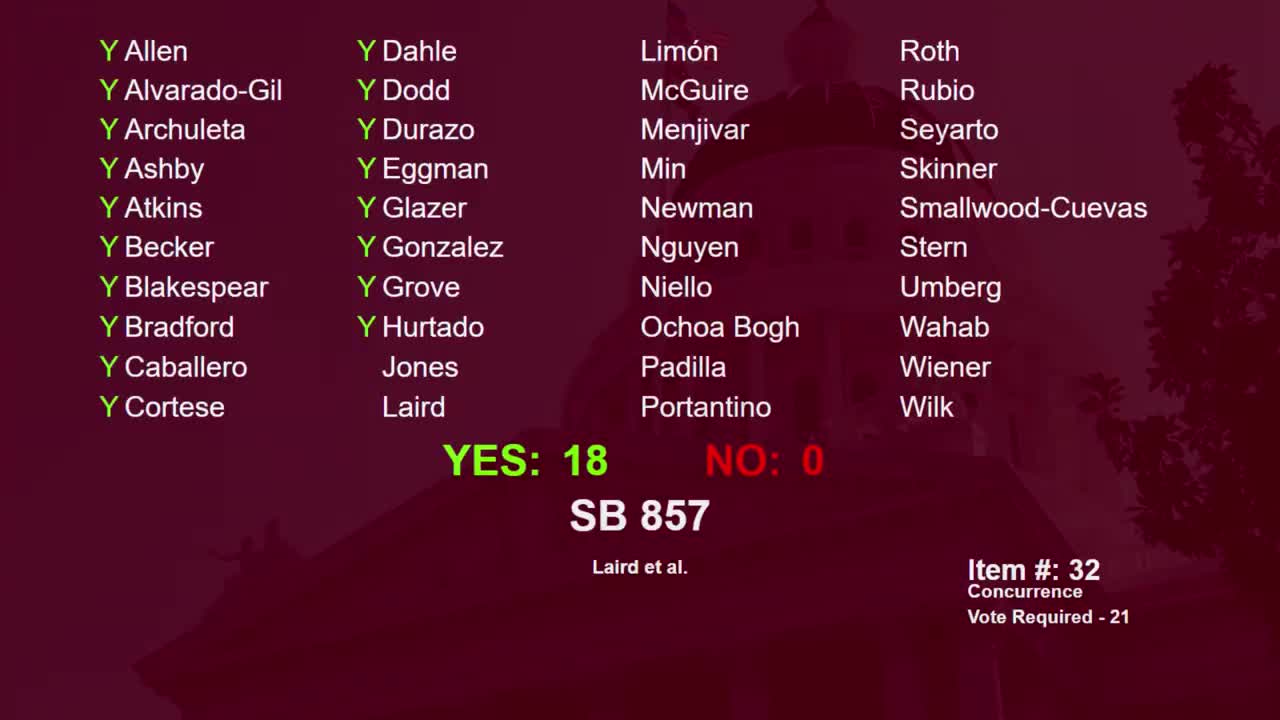
Bill Author