SB 342: Pupil instruction: history-social science curriculum framework: financial literacy.
- Session Year: 2023-2024
- House: Senate
- Latest Version Date: 2023-02-07
Current Status:
Failed
(2023-11-29: Returned to Secretary of Senate pursuant to Joint Rule 62(a).)
Introduced
In Committee
First Chamber
In Committee
Second Chamber
Enacted
Existing law requires the adopted course of study for grades 1 to 6, inclusive, and for grades 7 to 12, inclusive, to offer courses in specified areas of study, including social sciences. Existing law establishes the Instructional Quality Commission and requires the commission to, among other things, recommend curriculum frameworks to the State Board of Education. Existing law requires the state board, concurrently with, but not before, the next revision of textbooks or curriculum frameworks in the social sciences, health, and mathematics curricula, to ensure that these academic areas integrate components of, among other things, financial literacy. Notwithstanding that requirement on the state board, existing law requires the commission, when the history-social science curriculum framework is revised after January 1, 2017, to consider including age-appropriate information for kindergarten and grades 1 to 12, inclusive, regarding certain topics on financial literacy.
This bill instead would require the commission, when the history-social science curriculum framework is revised after January 1, 2024, to include age-appropriate information and content for kindergarten and grades 1 to 12, inclusive, regarding those financial literacy topics.
Notwithstanding Section 51284, when the history-social science curriculum framework is revised after January 1, 2017, 2024, the Instructional Quality Commission shall consider including include both of the following:
(a)Age-appropriate information for grade spans, as listed in paragraphs (1) to (3), inclusive, of subdivision (b), on financial literacy that includes, but is not limited to, all of the following:
(1)Fundamentals of banking for personal use, including, but not limited to, savings and checking.
(2)Principles of budgeting and personal finance.
(3)Employment and understanding factors that affect net income.
(4)Uses and effects of credit, including the relation of debt and interest to credit.
(5)Uses and costs of loans, including student loans.
(6)Types and costs of insurance.
(7)Forms of governmental taxation.
(8)Principles of investing and building wealth.
(9)Identity theft and security.
(10)Planning and paying for postsecondary education.
(11)Charitable giving.
(b)Age-appropriate content related to the topics listed in paragraphs (1) to (11), inclusive, of subdivision (a), at least twice in each of the following grade spans:
(1)Kindergarten and grades 1 to 5, inclusive.
(2)Grades 6 to 8, inclusive.
(3)Grades 9 to 12, inclusive.
|
Date
|
Status
|
|---|---|
| Nov 29, 2023 | Returned to Secretary of Senate pursuant to Joint Rule 62(a). |
| Apr 26, 2023 | April 26 set for second hearing. Failed passage in committee. (Ayes 3. Noes 2. Page 934.) |
| Apr 21, 2023 | Set for hearing April 26. |
| Mar 29, 2023 | March 29 set for first hearing. Failed passage in committee. (Ayes 3. Noes 1. Page 570.) Reconsideration granted. |
| Mar 8, 2023 | Set for hearing March 29. |
| Feb 15, 2023 | Referred to Com. on ED. |
| Feb 8, 2023 | From printer. May be acted upon on or after March 10. |
| Feb 7, 2023 | Introduced. Read first time. To Com. on RLS. for assignment. To print. |
|
Date
|
Description
|
Location
|
Votes
|
|
|---|---|---|---|---|
| Apr 26, 2023 | Do pass, but first be re-referred to the Committee on [Appropriations] | Senate Standing Committee on Education |
Failed |
|
| Mar 29, 2023 | [First] hearing set for [03-29-2023]: Failed passage in Committee. Reconsideration granted | Senate Standing Committee on Education |
Passed |
|
| Mar 29, 2023 | Do pass, but first be re-referred to the Committee on [Appropriations] | Senate Standing Committee on Education |
Failed |
This list shows positions taken on this bill by organizations on the date displayed, which is linked to the original source.
Positions by individuals are not included.
|
Organization
|
Position
|
Date
|
|---|---|---|
| California Association Of Collectors | ** Support | |
| California Bankers Association | ** Support | |
| California Chamber Of Commerce | ** Support | |
| California Community Banking Network | ** Support | |
| California Credit Union League | ** Support | |
| California Parents Union | ** Support | |
| California Society Of Certified Public Accountants | ** Support | |
| Los Angeles County Office Of Education | ** Support | |
| Money Prodigy | ** Support | |
| Office of the Riverside County Superintendent of Schools | ** Support |
SENATE COMMITTEE ON EDUCATION
Senator Josh Newman, Chair
2023 - 2024 Regular
Bill No: SB 342 Hearing Date: April 26, 2023
Author: | |||
Version: | February 7, 2023 | ||
Urgency: | No | Fiscal: | Yes |
Consultant: | Kordell Hampton | ||
Subject: Pupil instruction: history-social science curriculum framework: financial literacy
SUMMARY
This bill requires the Instructional Quality Commission (IQC) to include, rather than consider, age-appropriate information related to financial literacy when the history-social science (H-SS) curriculum framework is revised after January 1, 2024.
BACKGROUND
Existing Law
Education Code (EDC)
- Requires that, when the H-SS framework is revised after January 1, 2017, the IQC consider including content on financial literacy at least twice in three grade spans (Kindergarten through grade 5, grades 6-8, and grades 9-12), including instruction on:
a) Fundamentals of banking for personal use, including, but not limited to, savings and checking.
b) Principles of budgeting and personal finance.
c) Employment and understanding factors that affect net income.
d) Uses and costs of credit, including the relation of debt and interest to credit.
e) Uses and costs of loans, including student loans.
f) Types and costs of insurance.
g) Forms of governmental taxation.
h) Principles of investing and building wealth.
i) Identity theft and security.
j) Planning and paying for postsecondary education.
k) Charitable giving. (EDC § 51284.5)
- Requires the IQC, during but not before the next Specifies, revision of textbooks or curriculum frameworks in the social sciences, health, and mathematics curricula, the State Board of Education (SBE) ensures that these academic areas integrate components of human growth, human development, and human contribution to society, across the life course, and also financial literacy, including, but not limited to, budgeting and managing credit, student loans, consumer debt, and identity theft security. (EDC § 51284)
- Requires that, as a condition of graduating from high school, of the three courses in social studies, two must be year-long courses in United States history and geography, and in world history, culture, and geography, and that the remaining two are a one-semester courses in American government and civics, and a one-semester course in economics. (EDC § 51225.3)
- Requires the Superintendent of Public Instruction (SPI), with the approval of the SBE, to plan and develop a one-semester course entitled consumer economics, which includes instruction on the uses and costs of credit, for use in schools maintaining any grades seventh to twelfth grades. (EDC § 51833)
ANALYSIS
This bill requires the IQC to include, rather than consider, age-appropriate information related to financial literacy when the H-SS curriculum framework is revised after January 1, 2024.
STAFF COMMENTS
- Need for the bill. According to the author, “Addressing financial literacy in the classroom will expose students to basic life skills and to allow them to hit the ground running as young adults. Currently, the Instructional Quality Commission has been encouraged to include financial literacy in its history and social science curriculum, however, SB 342 would necessitate the inclusion of financial literacy education periodically throughout K-12 schooling. Financial literacy will give students the tools they need to become financially educated and be aware of how finances impact every aspect of their lives, setting California students up for future success”
- How Curriculum, Standards, Frameworks, and Model Curricula Are Created and Adopted. The Legislature has vested the IQC and SBE with the authority to develop and adopt state curriculum and instructional materials. The IQC develops curriculum frameworks in each subject by convening expert panels, developing drafts, and holding public hearings to solicit input. Changes are frequently made in response to public comment. The frameworks are then adopted by the SBE in a public meeting. The SBE also adopts, in a public process, instructional materials aligned to those frameworks for grades K-8. School district governing boards and charter schools then adopt instructional materials aligned to these standards and frameworks. This process occurs on a regular schedule which gives schools a predictable timetable to plan and budget for changes to the curriculum. Local adoption of new curricula involves significant local cost and investment of resources professional development.
These existing processes involve practitioners and experts who have in-depth understanding of curriculum and instruction, including the full scope and sequence of the curriculum in each subject and at each grade level, constraints on instructional time and resources, and the relationship of curriculum to state assessments and other measures of student progress.
Model curricula were first developed in the 1990’s in order to provide educators the means to teach about a topic in an in depth manner, on a voluntary basis. At that time, there were few resources available for this purpose on the Internet. Until 2016, only two model curricula were required to be developed.
Recent legislation has required the development of numerous model curricula. In 2021, through the budget , the state changed the process for the development of model curricula. County offices of education are now responsible for developing model curricula, in the form of open source, accessible resources available to California schools. The IQC and SBE no longer develops or approves model curricula.
- Revised History-Social Science Framework Coming In 2024 - 2025. Statute requires the IQC to consider the following content to be include as part of the next revision of the H-SS framework revision, which is currently underway:
- Fundamentals of banking for personal use, including, but not limited to, savings and checking;
b) Principles of budgeting and personal finance;
c) Employment and understanding factors that affect net income;
d) Uses and costs of credit, including the relation of debt and interest to credit;
e) Uses and costs of loans, including student loans;
f) Types and costs of insurance;
g) Forms of governmental taxation;
h) Principles of investing and building wealth;
i) Identity theft and security;
j) Planning and paying for postsecondary education; and
k) Charitable giving.
The H-SS Framework is currently being developed. The next adoption of this framework is scheduled to occur in 2025. Currently, the H-SS Framework, adopted in 2016, contains the following objectives related to financial literacy:
Grade 1: Students acquire a beginning understanding of economics, including how people exchange money for goods and services, and how people make choices about how to spend money, including budgeting.
Grade 2: Students learn basic economic concepts of human wants, scarcity, and choice; the importance of specialization in work today. Students also develop an understanding of their roles as consumers in a complex economy.
Grade 9: elective course outline in financial literacy: Students learn about credit cards and other forms of consumer debt, savings and budgeting, retirement planning, state and federal laws related to personal finance (e.g., bankruptcy), financial credit scores, credit card applications, bank account applications, simple and compound interest calculations, retirement calculations, and mortgage and interest rates. Students also learn about the importance of managing credit and debt, and identity theft security.
The Framework also emphasizes the ability of personal finance concepts to be taught through the required high school economics course, noting: “budgeting can be taught as an example of scarcity; job applications can be taught as examples of human capital inventories; student loans can be taught as an investment in developing human capital; use of credit cards can be taught to explain the opportunity cost of interest and repayment; and interest on credit can be taught as an example of price determination through supply and demand.”
This bill would require the uses and effects of credit, different types and costs of insurance, and the principles of budgeting and personal finance, among other things as specified in statute, to now be required when the History and Social Sciences Framework is revised after 2024. It should be noted that the IQC is currently in the process of revising the History and Social Science Framework, and, as required by statute, is required to consider the inclusion of specific content as described above. The IQC develops curriculum frameworks by convening expert panels, developing drafts, and holding public hearings to solicit input. Changes are frequently made in response to public comment.
The committee has adopted a policy that encourages Members to engage the IQC’s administrative process to ensure that the subject matter of concern is included in the revised frameworks. The revised History and Social Science Framework is set to be adopted in 2025; this bill would affect the following revision, likely to occur in 2032. The committee may wish to consider whether it is appropriate to require specific content regarding financial literacy to be included, rather than considered by the IQC’s panel of subject matter experts, in a future revision of History and Social Sciences Framework.
- Additional resources provided by the California Department of Education (CDE) on financial literacy. On CDE’s website, it provides a host of lesson plans, curricula programs, student contests, professional development, research, and more. These resources span kindergarten through grade twelve (K–12), and many provide customizable support. For example:
California Council on Economic Education (CCEE). Founded as part of the California State University Foundation to provide economics and financial literacy training, the CCEE works with California teachers to support K–12 financial literacy education. They provide comprehensive economic and financial literacy resources for teachers and students, including lesson plans, student contests, and curricula programs.
Jump$tart. This national nonprofit coalition consists of more than 100 organizations that share a commitment to “financial smarts for students” by providing resources and training to support financial literacy education. Their clearinghouse external link opens in a new window or tab and is a database of personal finance resources available from a variety of education providers such as government, business, and nonprofit organizations.
Next Gen Personal Finance (NGPF). NGPF provides a wide variety of up-to-date resources for teachers, students, and families. Resources include games (for both students and instructors), free curriculum units customizable by course length (for both middle and high school), case studies, Questions of the Day, a video library, blog, and podcast.
- Related Legislation.
AB 2546 (Ian Calderon) Chapter 616, Statutes of 2016, requires that, when the history-social science curriculum framework is revised after January 1, 2017, the IQC consider including specified content on financial literacy.
AB 431 (Papan, 2023) would require the Superintendent to allocate these funds to school districts, county offices of education, charter schools, and the state special schools on the basis of an equal amount per unit of average daily attendance, as those numbers were reported at the time of the first principal apportionment for the 2022–23 fiscal year.
AB 526 (Ta, 2023) would require the Superintendent to allocate these funds to school districts, county offices of education, charter schools, and the state special schools on the basis of an equal amount per unit of average daily attendance, as those numbers were reported at the time of the first principal apportionment for the 2021–22 fiscal year.
AB 1161 (Hover, 2023) would require the IQC, when the history-social science curriculum framework is revised after January 1, 2017, to also consider including age-appropriate information and content for kindergarten and grades 1 to 12, inclusive, on the importance of estate planning and the use of trusts.
AB 1456 (Joe Patterson, 2023) would add financial literacy to the adopted course of study for social science instruction.
AB 858 (Dababneh, 2017) would have established the California Financial Literacy Initiative, to be administered by the SPI, for the purpose of improving the availability of instructional materials and programs to help students understand how to manage their finances and protect their financial privacy. This bill was vetoed by Governor Brown:
This bill is unnecessary. The History-Social Science Framework already contains financial literacy content for pupils in kindergarten through grade 12, as well as a financial literacy elective. In addition, the California Department of Education maintains a Web page with financial literacy resources for pupils in kindergarten through grade 12.
AB 391 (Wieckowski, 2013) would have required the history social science framework, when updated, to include financial literacy, and required the one-semester instructional program entitled consumer economics already developed by the SPI and adopted by the SBE to be updated to include instruction in specified areas of financial literacy. This bill was held in the Assembly Appropriations Committee.
SB 1080 (Lieu, 2012) would have authorized instruction provided in economics to include personal finances, including, but not limited to, mathematics, budgeting, savings, credit, and identity theft. The bill would have required the CDE to develop a personal finance curriculum in the next cycle in which the mathematics and history-social science curriculum framework were to be adopted. This bill was held in the Assembly Judiciary Committee.
SB 696 (Lieu, 2012) would have encouraged the instruction provided in economics to include instruction related to the understanding of personal finances, including budgeting, savings, credit, and identity theft. The bill would have also made several legislative findings and declarations. This bill did not receive a hearing.
SB 779 (Lieu, 2011) would have authorized a school district, as part of providing economics instruction in grades 7-12, to include personal finances, including, but not limited to, budget savings, credit, and identify theft. This bill would have also required the CDE to consider developing a personal finance curriculum in the next cycle in which the history/social science curriculum framework would have been adopted. This bill was held in the Assembly Appropriations Committee.
SB 223 (Wyland, 2009) would have required that one-half of the economics course required for high school graduation focus on personal finance and financial literacy. This bill was held in the Assembly Appropriations Committee.
AB 1502 (Lieu, 2008) would have required the SBE and the Curriculum Development and Supplemental Materials Commission (now the IQC) to ensure that information about financial literacy be included in appropriate subject area frameworks, encouraged school districts to include instruction in personal finance, as specified in economics, and authorized the SPI to accept private donations for the purposes of implementing these provisions. This measure was vetoed by Governor Schwarzenegger.
While I acknowledge that teaching students the importance of financial literacy is meritorious, school districts already have the flexibility to incorporate money management into their lesson plans. Moreover, the State Board of Education adopted content standards are developed by a diverse group of experts and are intentionally broad in order to allow coverage of various events, developments, and issues. I continue to believe that the State should establish rigorous academic standards and frameworks, but refrain from being overly prescriptive in specific school curriculum.
AB 1950 (Lieu, 2006) would have authorized school districts to provide instruction in personal finances in economics courses. This measure was vetoed by Governor Schwarzenegger:
School districts already have the flexibility to incorporate money management into their lesson plans and that the state’s content standards are intentionally broad in order to allow instruction on a range of topics.
AB 2435 (Wiggins, 2004) would have authorized school districts to include instruction related to the understanding of personal finances in economics courses. This measure was vetoed by Governor Schwarzenegger:
School districts already have the flexibility to incorporate money management into their lesson plans and that the state’s content standards are intentionally broad in order to allow instruction on a range of topics.
SUPPORT
California Association of Collectors
California Bankers Association
California Chamber of Commerce
California Community Banking Network
California Credit Union League
California Parents Union
California Society of Certified Public Accountants
Los Angeles County Office of Education
Money Prodigy
Office of The Riverside County Superintendent of Schools
Pathways Academy Charter School – Adult Education2 individuals
OPPOSITION
None received
-- END --
SENATE COMMITTEE ON EDUCATION
Senator Josh Newman, Chair
2023 - 2024 Regular
Bill No: Hearing Date: March 29, 2023
Author: | Seyarto | ||
Version: |
| ||
Urgency: | Fiscal: | ||
Consultant: | |||
Subject:
SUMMARY
This bill requires the Instructional Quality Commission (IQC) to include, rather than consider, age-appropriate information related to financial literacy when the history-social science (H-SS) curriculum framework is revised after January 1, 2024.
BACKGROUND
Existing Law
Education Code (EDC)
- Requires that, when the H-SS framework is revised after January 1, 2017, the IQC consider including content on financial literacy at least twice in three grade spans (Kindergarten through grade 5, grades 6-8, and grades 9-12), including instruction on:
a) Fundamentals of banking for personal use, including, but not limited to, savings and checking.
b) Principles of budgeting and personal finance.
c) Employment and understanding factors that affect net income.
d) Uses and costs of credit, including the relation of debt and interest to credit.
e) Uses and costs of loans, including student loans.
f) Types and costs of insurance.
g) Forms of governmental taxation.
h) Principles of investing and building wealth.
i) Identity theft and security.
j) Planning and paying for postsecondary education.
k) Charitable giving. (EDC § 51284.5)
- Requires the IQC, during but not before the next Specifies, revision of textbooks or curriculum frameworks in the social sciences, health, and mathematics curricula, the State Board of Education (SBE) ensures that these academic areas integrate components of human growth, human development, and human contribution to society, across the life course, and also financial literacy, including, but not limited to, budgeting and managing credit, student loans, consumer debt, and identity theft security. (EDC § 51284)
- Requires that, as a condition of graduating from high school, of the three courses in social studies, two must be year-long courses in United States history and geography, and in world history, culture, and geography, and that the remaining two are a one-semester courses in American government and civics, and a one-semester course in economics. (EDC § 51225.3)
- Requires the Superintendent of Public Instruction (SPI), with the approval of the SBE, to plan and develop a one-semester course entitled consumer economics, which includes instruction on the uses and costs of credit, for use in schools maintaining any grades seventh to twelfth grades. (EDC § 51833)
ANALYSIS
This bill requires the IQC to include, rather than consider, age-appropriate information related to financial literacy when the H-SS curriculum framework is revised after January 1, 2024.
STAFF COMMENTS
- Need for the bill. According to the author, “Addressing financial literacy in the classroom will expose students to basic life skills and to allow them to hit the ground running as young adults. Currently, the Instructional Quality Commission has been encouraged to include financial literacy in its history and social science curriculum, however, SB 342 would necessitate the inclusion of financial literacy education periodically throughout K-12 schooling. Financial literacy will give students the tools they need to become financially educated and be aware of how finances impact every aspect of their lives, setting California students up for future success”
- How Curriculum, Standards, Frameworks, and Model Curricula Are Created and Adopted. The Legislature has vested the IQC and SBE with the authority to develop and adopt state curriculum and instructional materials. The IQC develops curriculum frameworks in each subject by convening expert panels, developing drafts, and holding public hearings to solicit input. Changes are frequently made in response to public comment. The frameworks are then adopted by the SBE in a public meeting. The SBE also adopts, in a public process, instructional materials aligned to those frameworks for grades K-8. School district governing boards and charter schools then adopt instructional materials aligned to these standards and frameworks. This process occurs on a regular schedule which gives schools a predictable timetable to plan and budget for changes to the curriculum. Local adoption of new curricula involves significant local cost and investment of resources professional development.
These existing processes involve practitioners and experts who have in-depth understanding of curriculum and instruction, including the full scope and sequence of the curriculum in each subject and at each grade level, constraints on instructional time and resources, and the relationship of curriculum to state assessments and other measures of student progress.
Model curricula were first developed in the 1990’s in order to provide educators the means to teach about a topic in an in depth manner, on a voluntary basis. At that time, there were few resources available for this purpose on the Internet. Until 2016, only two model curricula were required to be developed.
Recent legislation has required the development of numerous model curricula. In 2021, through the budget , the state changed the process for the development of model curricula. County offices of education are now responsible for developing model curricula, in the form of open source, accessible resources available to California schools. The IQC and SBE no longer develops or approves model curricula.
- Revised History-Social Science Framework Coming In 2024 - 2025. Statute requires the IQC to consider the following content to be include as part of the next revision of the H-SS framework revision, which is currently underway:
- Fundamentals of banking for personal use, including, but not limited to, savings and checking;
b) Principles of budgeting and personal finance;
c) Employment and understanding factors that affect net income;
d) Uses and costs of credit, including the relation of debt and interest to credit;
e) Uses and costs of loans, including student loans;
f) Types and costs of insurance;
g) Forms of governmental taxation;
h) Principles of investing and building wealth;
i) Identity theft and security;
j) Planning and paying for postsecondary education; and
k) Charitable giving.
The H-SS Framework is currently being developed. The next adoption of this framework is scheduled to occur in 2025. Currently, the H-SS Framework, adopted in 2016, contains the following objectives related to financial literacy:
Grade 1: Students acquire a beginning understanding of economics, including how people exchange money for goods and services, and how people make choices about how to spend money, including budgeting.
Grade 2: Students learn basic economic concepts of human wants, scarcity, and choice; the importance of specialization in work today. Students also develop an understanding of their roles as consumers in a complex economy.
Grade 9: elective course outline in financial literacy: Students learn about credit cards and other forms of consumer debt, savings and budgeting, retirement planning, state and federal laws related to personal finance (e.g., bankruptcy), financial credit scores, credit card applications, bank account applications, simple and compound interest calculations, retirement calculations, and mortgage and interest rates. Students also learn about the importance of managing credit and debt, and identity theft security.
The Framework also emphasizes the ability of personal finance concepts to be taught through the required high school economics course, noting: “budgeting can be taught as an example of scarcity; job applications can be taught as examples of human capital inventories; student loans can be taught as an investment in developing human capital; use of credit cards can be taught to explain the opportunity cost of interest and repayment; and interest on credit can be taught as an example of price determination through supply and demand.”
This bill would require the uses and effects of credit, different types and costs of insurance, and the principles of budgeting and personal finance, among other things as specified in statute, to now be required when the History and Social Sciences Framework is revised after 2024. It should be noted that the IQC is currently in the process of revising the History and Social Science Framework, and, as required by statute, is required to consider the inclusion of specific content as described above. The IQC develops curriculum frameworks by convening expert panels, developing drafts, and holding public hearings to solicit input. Changes are frequently made in response to public comment.
The committee has adopted a policy that encourages Members to engage the IQC’s administrative process to ensure that the subject matter of concern is included in the revised frameworks. The revised History and Social Science Framework is set to be adopted in 2025; this bill would affect the following revision, likely to occur in 2032. The committee may wish to consider whether it is appropriate to require specific content regarding financial literacy to be included, rather than considered by the IQC’s panel of subject matter experts, in a future revision of History and Social Sciences Framework.
- Additional resources provided by the California Department of Education (CDE) on financial literacy. On CDE’s website, it provides a host of lesson plans, curricula programs, student contests, professional development, research, and more. These resources span kindergarten through grade twelve (K–12), and many provide customizable support. For example:
California Council on Economic Education (CCEE). Founded as part of the California State University Foundation to provide economics and financial literacy training, the CCEE works with California teachers to support K–12 financial literacy education. They provide comprehensive economic and financial literacy resources for teachers and students, including lesson plans, student contests, and curricula programs.
Jump$tart. This national nonprofit coalition consists of more than 100 organizations that share a commitment to “financial smarts for students” by providing resources and training to support financial literacy education. Their clearinghouse external link opens in a new window or tab and is a database of personal finance resources available from a variety of education providers such as government, business, and nonprofit organizations.
Next Gen Personal Finance (NGPF). NGPF provides a wide variety of up-to-date resources for teachers, students, and families. Resources include games (for both students and instructors), free curriculum units customizable by course length (for both middle and high school), case studies, Questions of the Day, a video library, blog, and podcast.
- Related Legislation.
AB 2546 (Ian Calderon) Chapter 616, Statutes of 2016, requires that, when the history-social science curriculum framework is revised after January 1, 2017, the IQC consider including specified content on financial literacy.
AB 431 (Papan, 2023) would require the Superintendent to allocate these funds to school districts, county offices of education, charter schools, and the state special schools on the basis of an equal amount per unit of average daily attendance, as those numbers were reported at the time of the first principal apportionment for the 2022–23 fiscal year.
AB 526 (Ta, 2023) would require the Superintendent to allocate these funds to school districts, county offices of education, charter schools, and the state special schools on the basis of an equal amount per unit of average daily attendance, as those numbers were reported at the time of the first principal apportionment for the 2021–22 fiscal year.
AB 1161 (Hover, 2023) would require the IQC, when the history-social science curriculum framework is revised after January 1, 2017, to also consider including age-appropriate information and content for kindergarten and grades 1 to 12, inclusive, on the importance of estate planning and the use of trusts.
AB 1456 (Joe Patterson, 2023) would add financial literacy to the adopted course of study for social science instruction.
AB 858 (Dababneh, 2017) would have established the California Financial Literacy Initiative, to be administered by the SPI, for the purpose of improving the availability of instructional materials and programs to help students understand how to manage their finances and protect their financial privacy. This bill was vetoed by Governor Brown:
This bill is unnecessary. The History-Social Science Framework already contains financial literacy content for pupils in kindergarten through grade 12, as well as a financial literacy elective. In addition, the California Department of Education maintains a Web page with financial literacy resources for pupils in kindergarten through grade 12.
AB 391 (Wieckowski, 2013) would have required the history social science framework, when updated, to include financial literacy, and required the one-semester instructional program entitled consumer economics already developed by the SPI and adopted by the SBE to be updated to include instruction in specified areas of financial literacy. This bill was held in the Assembly Appropriations Committee.
SB 1080 (Lieu, 2012) would have authorized instruction provided in economics to include personal finances, including, but not limited to, mathematics, budgeting, savings, credit, and identity theft. The bill would have required the CDE to develop a personal finance curriculum in the next cycle in which the mathematics and history-social science curriculum framework were to be adopted. This bill was held in the Assembly Judiciary Committee.
SB 696 (Lieu, 2012) would have encouraged the instruction provided in economics to include instruction related to the understanding of personal finances, including budgeting, savings, credit, and identity theft. The bill would have also made several legislative findings and declarations. This bill did not receive a hearing.
SB 779 (Lieu, 2011) would have authorized a school district, as part of providing economics instruction in grades 7-12, to include personal finances, including, but not limited to, budget savings, credit, and identify theft. This bill would have also required the CDE to consider developing a personal finance curriculum in the next cycle in which the history/social science curriculum framework would have been adopted. This bill was held in the Assembly Appropriations Committee.
SB 223 (Wyland, 2009) would have required that one-half of the economics course required for high school graduation focus on personal finance and financial literacy. This bill was held in the Assembly Appropriations Committee.
AB 1502 (Lieu, 2008) would have required the SBE and the Curriculum Development and Supplemental Materials Commission (now the IQC) to ensure that information about financial literacy be included in appropriate subject area frameworks, encouraged school districts to include instruction in personal finance, as specified in economics, and authorized the SPI to accept private donations for the purposes of implementing these provisions. This measure was vetoed by Governor Schwarzenegger.
While I acknowledge that teaching students the importance of financial literacy is meritorious, school districts already have the flexibility to incorporate money management into their lesson plans. Moreover, the State Board of Education adopted content standards are developed by a diverse group of experts and are intentionally broad in order to allow coverage of various events, developments, and issues. I continue to believe that the State should establish rigorous academic standards and frameworks, but refrain from being overly prescriptive in specific school curriculum.
AB 1950 (Lieu, 2006) would have authorized school districts to provide instruction in personal finances in economics courses. This measure was vetoed by Governor Schwarzenegger:
School districts already have the flexibility to incorporate money management into their lesson plans and that the state’s content standards are intentionally broad in order to allow instruction on a range of topics.
AB 2435 (Wiggins, 2004) would have authorized school districts to include instruction related to the understanding of personal finances in economics courses. This measure was vetoed by Governor Schwarzenegger:
School districts already have the flexibility to incorporate money management into their lesson plans and that the state’s content standards are intentionally broad in order to allow instruction on a range of topics.
SUPPORT
California Chamber of Commerce
California Credit Union League
California Society of Certified Public Accountants
Los Angeles County Office of Education
Office of The Riverside County Superintendent of Schools
2 individuals
OPPOSITION
None received
-- END --
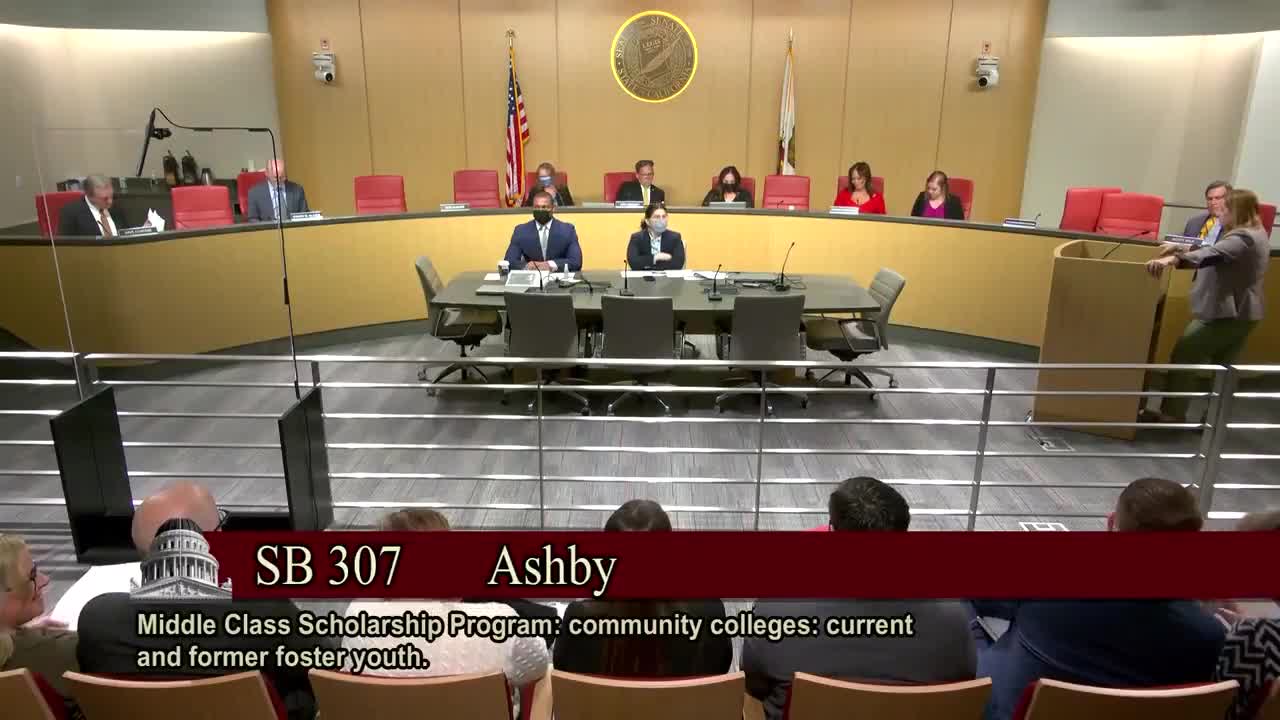
Bill Author