SB 348: Pupil meals.
- Session Year: 2023-2024
- House: Senate
- Latest Version Date: 2023-10-08
Current Status:
Passed
(2023-10-08: Chaptered by Secretary of State. Chapter 600, Statutes of 2023.)
Introduced
In Committee
First Chamber
In Committee
Second Chamber
Enacted
(1)Existing law establishes a system of public elementary and secondary schools in this state. This system is composed of local educational agencies throughout the state that provide instruction to pupils in kindergarten and grades 1 to 12, inclusive, at schoolsites operated by these agencies. Existing law, commencing with the 202223 school year, requires each school district and county superintendent of schools maintaining kindergarten or any of grades 1 to 12, inclusive, and each charter school to provide 2 nutritiously adequate school meals free of charge during each schoolday, regardless of the length of the schoolday, to any pupil who requests a meal without consideration of the pupils eligibility for a federally funded free or reduced-price meal, as specified, with a maximum of one free meal for each meal service period. Existing law requires the department to develop and maintain nutrition guidelines for school lunches and breakfasts, and for all food and beverages sold on public school campuses. Existing law requires a school district, county superintendent of schools, or charter school to provide each needy pupil with one nutritionally adequate free or reduced-price meal during each schoolday, except as provided.
This bill would revise and recast provisions regarding school meals for needy pupils by, among other things, instead requiring each school district, county superintendent of schools, and charter school to make available a nutritionally adequate breakfast, as defined, and a nutritionally adequate lunch, as defined, free of charge during each schoolday, as defined, to any pupil who requests a meal, without consideration of the pupils eligibility for a federally funded free or reduced-price meal, as provided. The bill would require each school district, county office of education, or charter school that offers independent study to meet the above meal requirements for any pupil on any schoolday that the pupil is scheduled for educational activities, as provided. The bill would require the State Department of Education to submit a waiver request to the United States Department of Agriculture to allow for one meal to be provided during a schoolday lasting 4 hours or less to be served in a noncongregate manner. The bill would authorize each school district, county superintendent of schools, and charter school to make available either a nutritionally adequate breakfast or a nutritionally adequate lunch, as defined, in a noncongregate manner, as provided, if the State Department of Education receives approval for the federal noncongregate waiver. The bill would require each school district, county superintendent of schools, and charter school to provide pupils with adequate time to eat, as determined by that school district, county superintendent of schools, or charter school in consideration of the recommendations provided by the department. The bill would require a chartering authority, among other things, to provide technical assistance to a charter school to meet these meal requirements, as provided. If the federal School Breakfast Program and federal National School Lunch Program allow more added sugar or sodium than is recommended by the most recent Dietary Guidelines for Americans, as described, the bill would require the department to convene representatives from specified entities to work in partnership to provide maximum daily added sugar and sodium intake recommendations for each grade level, as provided. The bill also would make conforming changes to related provisions of law. By imposing additional duties on local educational agencies and officials, the bill would impose a state-mandated local program.
(2)Existing law authorizes the governing board of a school district to establish rules to determine which pupils are needy and authorizes a nominal cash payment for school meals to be collected from pupils that are not eligible for free meals and requires the State Department of Education to determine the amount of cash payment that may be required of those pupils. Existing law requires the Superintendent of Public Instruction to reimburse school districts for free and reduced-price meals served or sold based on the median statewide meal costs.
This bill would delete those provisions.
(3)Existing federal law provides for the permanent and nationwide Summer Electronic Benefit Transfer for Children (Summer EBT) program, under which pupils who are eligible for free and reduced-price school meals receive $40 per month during summer months for grocery benefits.
This bill would require the State Department of Education to work in partnership with the State Department of Social Services to maximize participation in the federal Summer EBT program, as provided.
(4)The California Constitution requires the state to reimburse local agencies and school districts for certain costs mandated by the state. Statutory provisions establish procedures for making that reimbursement.
This bill would provide that, if the Commission on State Mandates determines that the bill contains costs mandated by the state, reimbursement for those costs shall be made pursuant to the statutory provisions noted above.
(1)Existing law establishes a system of public elementary and secondary schools in this state. This system is composed of local educational agencies throughout the state that provide instruction to pupils in kindergarten and grades 1 to 12, inclusive, at schoolsites operated by these agencies. Existing law, commencing with the 202223 school year, requires each school district and county superintendent of schools maintaining kindergarten or any of grades 1 to 12, inclusive, and each charter school to provide 2 nutritiously adequate school meals free of charge during each schoolday, regardless of the length of the schoolday, to any pupil who requests a meal without consideration of the pupils eligibility for a federally funded free or reduced-price meal, as specified, with a maximum of one free meal for each meal service period. Existing law requires the department to develop and maintain nutrition guidelines for school lunches and breakfasts, and for all food and beverages sold on public school campuses. Existing law requires a school district, county superintendent of schools, or charter school to provide each needy pupil with one nutritionally adequate free or reduced-price meal during each schoolday, except as provided.
This bill would revise and recast provisions regarding school meals for needy pupils by, among other things, instead requiring each school district, county superintendent of schools, and charter school to make available a nutritionally adequate breakfast, as defined, and a nutritionally adequate lunch, as defined, free of charge during each schoolday, as defined, to any pupil who requests a meal, without consideration of the pupils eligibility for a federally funded free or reduced-price meal, as provided. The bill would require each school district, county office of education, or charter school that offers independent study to meet the above meal requirements for any pupil on any schoolday that the pupil is scheduled for educational activities, as provided. The bill would require the State Department of Education to submit a waiver request to the United States Department of Agriculture to allow for one meal to be provided during a schoolday lasting 4 hours or less to be served in a noncongregate manner. The bill would authorize each school district, county superintendent of schools, and charter school to make available either a nutritionally adequate breakfast or a nutritionally adequate lunch, as defined, in a noncongregate manner, as provided, if the State Department of Education receives approval for the federal noncongregate waiver. The bill would require each school district, county superintendent of schools, and charter school to provide pupils with adequate time to eat, as determined by that school district, county superintendent of schools, or charter school in consideration of the recommendations provided by the department. The bill would require a chartering authority, among other things, to provide technical assistance to a charter school to meet these meal requirements, as provided. The If the federal School Breakfast Program and federal National School Lunch Program allow more added sugar or sodium than is recommended by the most recent Dietary Guidelines for Americans, as described, the bill would require the department to convene representatives from specified entities to work in partnership to, among other things, develop guidelines that establish the amount of added sugar to be allowed in a nutritionally adequate breakfast or lunch, to provide maximum daily added sugar and sodium intake recommendations for each grade level, as provided. The bill also would make conforming changes to related provisions of law. By imposing additional duties on local educational agencies and officials, the bill would impose a state-mandated local program.
(2)Existing law authorizes the governing board of a school district to establish rules to determine which pupils are needy and authorizes a nominal cash payment for school meals to be collected from pupils that are not eligible for free meals and requires the State Department of Education to determine the amount of cash payment that may be required of those pupils. Existing law requires the Superintendent of Public Instruction to reimburse school districts for free and reduced-price meals served or sold based on the median statewide meal costs.
This bill would delete those provisions.
(3)Existing federal law provides for the permanent and nationwide Summer Electronic Benefit Transfer for Children (Summer EBT) program, under which pupils who are eligible for free and reduced-price school meals receive $40 per month during summer months for grocery benefits.
This bill would require the State Department of Education, in partnership with the State Department of Social Services, to maximize participation in the federal Summer EBT program.
(4)Existing law establishes the Expanded Learning Opportunities Program. Existing law authorizes a local educational agency that elects to operate an expanded learning opportunity program to operate a before school component of a program, an after school component of a program, or both, and requires the local educational agency to comply with specified requirements.This bill would, subject to an appropriation by the Legislature, commencing with the 202425 school year, authorize the department to apportion state funds for the sole purpose of providing nutritionally adequate breakfasts or lunches, or both, to pupils participating in expanded learning opportunity programs at specified schoolsites, as provided.(5)(4)The California Constitution requires the state to reimburse local agencies and school districts for certain costs mandated by the state. Statutory provisions establish procedures for making that reimbursement.
This bill would provide that, if the Commission on State Mandates determines that the bill contains costs mandated by the state, reimbursement for those costs shall be made pursuant to the statutory provisions noted above.
(1)Existing law establishes a system of public elementary and secondary schools in this state. This system is composed of local educational agencies throughout the state that provide instruction to pupils in kindergarten and grades 1 to 12, inclusive, at schoolsites operated by these agencies. Existing law, commencing with the 202223 school year, requires each school district and county superintendent of schools maintaining kindergarten or any of grades 1 to 12, inclusive, and each charter school to provide 2 nutritiously adequate school meals free of charge during each schoolday, regardless of the length of the schoolday, to any pupil who requests a meal without consideration of the pupils eligibility for a federally funded free or reduced-price meal, as specified, with a maximum of one free meal for each meal service period. Existing law requires the department to develop and maintain nutrition guidelines for school lunches and breakfasts, and for all food and beverages sold on public school campuses. Existing law requires a school district, county superintendent of schools, or charter school to provide each needy pupil with one nutritionally adequate free or reduced-price meal during each schoolday, except as provided.
This bill would require local educational agencies to serve a 2nd meal to pupils who remain on the schoolsite after a shortened schoolday. revise and recast provisions regarding school meals for needy pupils by, among other things, instead requiring each school district, county superintendent of schools, and charter school to make available a nutritionally adequate breakfast, as defined, and a nutritionally adequate lunch, as defined, free of charge during each schoolday, as defined, to any pupil who requests a meal, without consideration of the pupils eligibility for a federally funded free or reduced-price meal, as provided. The bill would require each school district, county office of education, or charter school that offers independent study to meet the above meal requirements for any pupil on any schoolday that the pupil is scheduled for educational activities, as provided. The bill would require the State Department of Education to submit a waiver request to the United States Department of Agriculture to allow for one meal to be provided during a schoolday lasting 4 hours or less to be served in a noncongregate manner. The bill would authorize local educational agencies each school district, county superintendent of schools, and charter school to provide make available either a nutritionally adequate breakfast or a nutritionally adequate lunch, as defined, in a noncongregate manner manner, as provided, if the State Department of Education receives approval for the federal noncongregate waiver. The bill would require local educational agencies to provide either a nutritionally adequate breakfast or a nutritionally adequate lunch in a congregate setting on schooldays lasting 4 hours or less if the department does not receive approval for the federal noncongregate waiver. The bill would require those local educational agencies each school district, county superintendent of schools, and charter school to provide pupils with adequate time to eat, as determined by the department. The bill would require a chartering authority, among other things, to provide technical assistance to a charter school to meet these meal requirements, as provided. The bill would require the department to convene representatives from specified entities to work in partnership to, among other things, develop guidelines that establish the amount of added sugar to be allowed in a nutritionally adequate breakfast or lunch, as provided. The bill also would make conforming changes to related provisions of law. By imposing additional duties on local educational agencies, agencies and officials, the bill would impose a state-mandated local program.
(2)Existing law requires a school district, county superintendent of schools, or charter school to provide each needy pupil with one nutritionally adequate free or reduced-price meal during each schoolday, except as provided.This bill would revise and recast provisions regarding school meals for needy pupils by, among other things, instead requiring school districts, county superintendents of schools, and charter schools to provide one nutritionally adequate breakfast and one nutritionally adequate lunch free of charge during each schoolday to any pupil who requests a meal without consideration of the pupils eligibility for a federally funded free or reduced-price meal, as provided. By imposing additional duties on local educational agencies, the bill would impose a state-mandated local program.(3)(2)Existing law authorizes the governing board of a school district to establish rules to determine which pupils are needy and authorizes a nominal cash payment for school meals to be collected from pupils that are not eligible for free meals and requires the State Department of Education to determine the amount of cash payment that may be required of those pupils. Existing law requires the Superintendent of Public Instruction to reimburse school districts for free and reduced-price meals served or sold based on the median statewide meal costs.
This bill would delete those provisions.
(4)(3)Existing federal law provides for the permanent and nationwide Summer Electronic Benefit Transfer for Children (Summer EBT) program, under which pupils who are eligible for free and reduced-price school meals receive $40 per month during summer months for grocery benefits.
This bill would require the State Department of Education, in partnership with the State Department of Social Services, to maximize participation in the federal Summer EBT program.
(5)(4)Existing law establishes the Expanded Learning Opportunities Program. Existing law authorizes a local educational agency that elects to operate an expanded learning opportunity program to operate a before school component of a program, an after school component of a program, or both, and requires the local educational agency to comply with specified requirements.
This bill would qualify, to the extent allowable under federal law, expanded learning opportunity programs as instructional time only for purposes of qualifying for the federal School Breakfast Program and the National School Lunch Program.This bill would, subject to an appropriation by the Legislature, commencing with the 202425 school year, authorize the department to apportion state funds for the sole purpose of providing nutritionally adequate breakfasts or lunches, or both, to pupils participating in expanded learning opportunity programs at specified schoolsites, as provided.
(6)(5)The California Constitution requires the state to reimburse local agencies and school districts for certain costs mandated by the state. Statutory provisions establish procedures for making that reimbursement.
This bill would provide that, if the Commission on State Mandates determines that the bill contains costs mandated by the state, reimbursement for those costs shall be made pursuant to the statutory provisions noted above.
(1)Existing law establishes a system of public elementary and secondary schools in this state. This system is composed of local educational agencies throughout the state that provide instruction to pupils in kindergarten and grades 1 to 12, inclusive, at schoolsites operated by these agencies. Existing law, commencing with the 202223 school year, requires each school district and county superintendent of schools maintaining kindergarten or any of grades 1 to 12, inclusive, and each charter school to provide 2 nutritiously adequate school meals free of charge during each schoolday, regardless of the length of the schoolday, to any pupil who requests a meal without consideration of the pupils eligibility for a federally funded free or reduced-price meal, as specified, with a maximum of one free meal for each meal service period. Existing law requires the department to develop and maintain nutrition guidelines for school lunches and breakfasts, and for all food and beverages sold on public school campuses.
This bill would require local educational agencies to provide breakfast and would authorize those local educational agencies to provide lunch on each 4-hour schoolday unless the State Department of Education receives an approval for a waiver from the United States Department of Agriculture to allow for lunch on a 4-hour schoolday to be served in a noncongregate manner, in which case, both meals are required to be served. serve a 2nd meal to pupils who remain on the schoolsite after a shortened schoolday. The bill would require the State Department of Education to submit a waiver request to the United States Department of Agriculture to allow for one meal to be provided during a schoolday lasting 4 hours or less to be served in a noncongregate manner. The bill would authorize local educational agencies to provide either a nutritionally adequate breakfast or a nutritionally adequate lunch, as defined, in a noncongregate manner if the State Department of Education receives approval for the federal noncongregate waiver. The bill would require local educational agencies to provide either a nutritionally adequate breakfast or a nutritionally adequate lunch in a congregate setting on schooldays lasting 4 hours or less if the department does not receive approval for the federal noncongregate waiver. The bill would require those local educational agencies to provide pupils with adequate time to eat, as determined by the State Department of Education. department. The bill would require the State Department of Education, in partnership with department to convene representatives from specified entities to determine the maximum work in partnership to, among other things, develop guidelines that establish the amount of added sugar to be allowed in a nutritionally adequate breakfast or lunch, as provided. The bill also would make conforming changes to related provisions of law. By imposing additional duties on local educational agencies, the bill would impose a state-mandated local program.
(2)Existing law requires a school district, county superintendent of schools, or charter school to provide each needy pupil with one nutritionally adequate free or reduced-price meal during each schoolday, except as provided.
This bill would revise and recast provisions regarding school meals for needy pupils by, among other things, instead requiring school districts and districts, county superintendents of schools, and, commencing with the 202425 school year, requiring a and charter school schools to provide 2 school meals one nutritionally adequate breakfast and one nutritionally adequate lunch free of charge during each schoolday to any pupil who requests a meal without consideration of the pupils eligibility for a federally funded free or reduced-price meal, as provided. By imposing additional duties on local educational agencies, the bill would impose a state-mandated local program.
(3)Existing law authorizes the governing board of a school district to establish rules to determine which pupils are needy and authorizes a nominal cash payment for school meals to be collected from pupils that are not eligible for free meals. meals and requires the State Department of Education to determine the amount of cash payment that may be required of those pupils. Existing law requires the Superintendent of Public Instruction to reimburse school districts for free and reduced-price meals served or sold based on the median statewide meal costs.
This bill would delete those provisions and also would make conforming changes to related provisions of law. provisions.
(4)Existing federal law provides for the permanent and nationwide Summer Electronic Benefit Transfer for Children (Summer EBT) program, under which pupils who are eligible for free and reduced-price school meals receive $40 per month during summer months for grocery benefits.
This bill would require the State Department of Education, in partnership with the State Department of Social Services, to maximize participation in the federal Summer EBT program.
(5)Existing law establishes the Expanded Learning Opportunities Program. Existing law authorizes a local educational agency that elects to operate an expanded learning opportunity program to operate a before school component of a program, an after school component of a program, or both, and requires the local educational agency to comply with specified requirements.
This bill would qualify, to the extent allowable under federal law, expanded learning opportunity programs as instructional time only for purposes of qualifying for the federal School Breakfast Program and the National School Lunch Program.
(5)(6)The California Constitution requires the state to reimburse local agencies and school districts for certain costs mandated by the state. Statutory provisions establish procedures for making that reimbursement.
This bill would provide that, if the Commission on State Mandates determines that the bill contains costs mandated by the state, reimbursement for those costs shall be made pursuant to the statutory provisions noted above.
(1)Existing law establishes a system of public elementary and secondary schools in this state. This system comprises is composed of local educational agencies throughout the state that provide instruction to pupils in kindergarten and grades 1 to 12, inclusive, at schoolsites operated by these agencies. Existing law, commencing with the 202223 school year, requires each school district and county superintendent of schools maintaining kindergarten or any of grades 1 to 12, inclusive, and each charter school to provide 2 nutritiously adequate school meals free of charge during each schoolday, regardless of the length of the schoolday, to any pupil who requests a meal without consideration of the pupils eligibility for a federally funded free or reduced-price meal, as specified, with a maximum of one free meal for each meal service period. Existing law requires the department to develop and maintain nutrition guidelines for school lunches and breakfasts, and for all food and beverages sold on public school campuses.
This bill would require local educational agencies to provide breakfast and would authorize those local educational agencies to provide lunch on each 4-hour schoolday unless the State Department of Education receives an approval for a waiver from the United States Department of Agriculture to allow for lunch on a 4-hour schoolday to be served in a noncongregate manner, in which case, both meals are required to be served. The bill would require those local educational agencies to provide pupils with adequate time to eat, as determined by the State Department of Education. The bill would require the State Department of Education, in partnership with specified entities to determine the maximum amount of added sugar to be allowed in a nutritionally adequate breakfast or lunch, as provided. The bill also would make conforming changes to related provisions of law. By imposing additional duties on local educational agencies, the bill would impose a state-mandated local program.
(2)Existing law requires a school district, county superintendent of schools, or charter school to provide each needy pupil with one nutritionally adequate free or reduced-price meal during each schoolday, except as provided.
This bill would revise and recast provisions regarding school meals for needy pupils by, among other things, instead requiring school districts and county superintendents of schools, and, commencing with the 202425 school year, requiring a charter school to provide 2 school meals free of charge during each schoolday to any pupil who requests a meal without consideration of the pupils eligibility for a federally funded free or reduced-price meal, as provided. By imposing additional duties on local educational agencies, the bill would impose a state-mandated local program.
(3)Existing law authorizes the governing board of a school district to establish rules to determine which pupils are needy and authorizes a nominal cash payment for school meals to be collected from pupils that are not eligible for free meals. Existing law requires the Superintendent of Public Instruction to reimburse school districts for free and reduced-price meals served or sold based on the median statewide meal costs.
This bill would delete those provisions and also would make conforming changes to related provisions of law.
(4)Existing federal law provides for the permanent and nationwide Summer Electronic Benefit Transfer for Children (Summer EBT) program, under which pupils who are eligible for free and reduced price schools reduced-price school meals receive $40 per month during summer months for grocery benefits.
This bill would require the State Department of Education, in partnership with the State Department of Social Services, to maximize participation in the federal Summer EBT program. The bill would also require the State Department of Social Services, subject to appropriation by the Legislature for those purposes, to issue an additional $80 in the form of EBT benefits to pupils who qualify for the federal Summer EBT program.
(5)The California Constitution requires the state to reimburse local agencies and school districts for certain costs mandated by the state. Statutory provisions establish procedures for making that reimbursement.
This bill would provide that, if the Commission on State Mandates determines that the bill contains costs mandated by the state, reimbursement for those costs shall be made pursuant to the statutory provisions noted above.
(1)Existing law establishes a system of public elementary and secondary schools in this state. This system comprises local educational agencies throughout the state that provide instruction to pupils in kindergarten and grades 1 to 12, inclusive, at schoolsites operated by these agencies. Existing law, commencing with the 202223 school year, requires each school district and county superintendent of schools maintaining kindergarten or any of grades 1 to 12, inclusive, and each charter school to provide 2 nutritiously adequate school meals free of charge during each schoolday, regardless of the length of the schoolday, to any pupil who requests a meal without consideration of the pupils eligibility for a federally funded free or reduced-price meal, as specified, with a maximum of one free meal for each meal service period. Existing law requires the department to develop and maintain nutrition guidelines for school lunches and breakfasts, and for all food and beverages sold on public school campuses.
This bill would require local educational agencies to provide breakfast and would authorize those local educational agencies to provide only one meal lunch on each 4-hour schoolday unless the State Department of Education receives an approval for a waiver of the congregate meal requirement from the United States Department of Agriculture to allow for a 2nd meal lunch on a 4-hour schoolday to be served in a noncongregate manner. manner, in which case, both meals are required to be served. The bill would require those local educational agencies to provide pupils with adequate time to eat, as determined by the State Department of Education. The bill would require the State Department of Education, in partnership with specified entities to determine the maximum amount of added sugar to be allowed in a nutritionally adequate breakfast or lunch, as provided. The bill also would make conforming changes to related provisions of law. By imposing additional duties on local educational agencies, the bill would impose a state-mandated local program.
(2)Existing law requires a school district, county superintendent of schools, or charter school to provide each needy pupil with one nutritionally adequate free or reduced-price meal during each schoolday, except as provided.
This bill would revise and recast provisions regarding school meals for needy pupils by, among other things, instead requiring school districts and county superintendents of schools, and, commencing with the 202425 school year, requiring a charter school to provide 2 school meals free of charge during each schoolday to any pupil who requests a meal without consideration of the pupils eligibility for a federally funded free or reduced-price meal, as provided. By imposing additional duties on local educational agencies, the bill would impose a state-mandated local program.
(3)Existing law authorizes the governing board of a school district to establish rules to determine which pupils are needy and authorizes a nominal cash payment for school meals to be collected from pupils that are not eligible for free meals. Existing law requires the Superintendent of Public Instruction to reimburse school districts for free and reduced-price meals served or sold based on the median statewide meal costs.
This bill would delete those provisions and also would make conforming changes to related provisions of law.
(2)(4)Existing federal law provides for the permanent and nationwide Summer Electronic Benefit Transfer (Summer EBT) program, under which pupils who are eligible for free and reduced price schools meals receive $40 per month during summer months for grocery benefits.
This bill would require the State Department of Education, in partnership with the State Department of Social Services, to maximize participation in the federal Summer EBT program. The bill would also require the department, State Department of Social Services, subject to appropriation by the Legislature for those purposes, to issue an additional $80 in the form of EBT benefits to pupils who qualify for the federal Summer EBT program.
(3)(5)The California Constitution requires the state to reimburse local agencies and school districts for certain costs mandated by the state. Statutory provisions establish procedures for making that reimbursement.
This bill would provide that, if the Commission on State Mandates determines that the bill contains costs mandated by the state, reimbursement for those costs shall be made pursuant to the statutory provisions noted above.
(1)Existing law establishes a system of public elementary and secondary schools in this state. This system comprises local educational agencies throughout the state that provide instruction to pupils in kindergarten and grades 1 to 12, inclusive, at schoolsites operated by these agencies. Existing law, commencing with the 202223 school year, requires each school district and county superintendent of schools maintaining kindergarten or any of grades 1 to 12, inclusive, and each charter school to provide 2 nutritiously adequate school meals free of charge during each schoolday, regardless of the length of the schoolday, to any pupil who requests a meal without consideration of the pupils eligibility for a federally funded free or reduced-price meal, as specified, with a maximum of one free meal for each meal service period. Existing law requires the department to develop and maintain nutrition guidelines for school lunches and breakfasts, and for all food and beverages sold on public school campuses.
This bill would authorize local educational agencies to provide only one meal on each 4-hour schoolday unless the State Department of Education receives a waiver of the congregate meal requirement from the United States Department of Agriculture to allow for a 2nd meal on a 4-hour schoolday to be served in a noncongregate manner. The bill would require those local educational agencies to provide pupils with adequate time to eat, as determined by the State Department of Education. The bill would require the State Department of Education, in partnership with specified entities to determine the maximum amount of added sugar to be allowed in a nutritionally adequate breakfast or lunch, as provided. By imposing additional duties on local educational agencies, the bill would impose a state-mandated local program.
(2)Existing federal law provides for the permanent and nationwide Summer Electronic Benefit Transfer (Summer EBT) program, under which pupils who are eligible for free and reduced price schools meals receive $40 per month during summer months for grocery benefits.
This bill would require the State Department of Education, in partnership with the State Department of Social Services, to maximize participation in the federal Summer EBT program. The bill would also require the department, subject to appropriation by the Legislature for those purposes, to issue an additional $80 in the form of EBT benefits to pupils who qualify for the federal Summer EBT program.
(3)The California Constitution requires the state to reimburse local agencies and school districts for certain costs mandated by the state. Statutory provisions establish procedures for making that reimbursement.
This bill would provide that, if the Commission on State Mandates determines that the bill contains costs mandated by the state, reimbursement for those costs shall be made pursuant to the statutory provisions noted above.
A school district or other public or private nonprofit school or agency receiving reimbursement pursuant to this article shall meet standards adopted by the Superintendent for all of the following:
(a)The definition of a nutritionally adequate breakfast.
(b)The definition of a nutritionally adequate lunch.
(c)Standards for determining the eligibility of children to receive free or reduced-price meals.
(d)Standards for the protection of the identity of children for whom reimbursement is made pursuant to this article.
SEC. 4.Section 49500 of the Education Code is repealed.SEC. 5.Section 49501 of the Education Code is repealed.SEC. 6.Section 49501.5 of the Education Code is amended to read:49501.5.(a)Notwithstanding any other provision of this chapter, commencing with the 202223 school year all of the following shall apply:
(1)(A)A school district, county superintendent of schools, or charter school maintaining kindergarten or any of grades 1 to 12, inclusive, shall make available a nutritionally adequate breakfast and a nutritionally adequate lunch free of charge and with adequate time to eat, as determined by that school district, county superintendent of schools, or charter school in consideration of the recommendations provided by the department pursuant to subdivision (e), during each schoolday to any pupil who requests a meal without consideration of the pupils eligibility for a federally funded free or reduced-price meal, except as described in clauses (i) and (ii) of subparagraph (B), with a maximum of one free breakfast meal and one free lunch meal, except for family daycare homes that shall be reimbursed for 75 percent of the meals served. The meals made available under this paragraph shall be nutritionally adequate meals that qualify for federal reimbursement. Participating school districts, county superintendents of schools, and charter schools shall comply with federal regulations for the National School Lunch Program and School Breakfast Program, which includes established mealtimes.
(B)(i)The department shall submit a waiver request to the United States Department of Agriculture to allow for one meal provided during a schoolday lasting four hours or less to be served in a noncongregate manner.
(ii)If the department receives approval for the federal noncongregate waiver required by clause (i), school districts, county superintendents of schools, and charter schools may make available either a nutritionally adequate breakfast or a nutritionally adequate lunch in a noncongregate manner for meal service combinations resulting in either (I) a congregate nutritionally adequate breakfast and a noncongregate nutritionally adequate lunch or (II) a noncongregate nutritionally adequate breakfast and a congregate nutritionally adequate lunch. These meals shall be reimbursed under the provisions of paragraph (2) if both state and federal requirements are met.
(2)The department shall provide state meal reimbursement to school districts, county offices of education, and charter schools that participate in, and meet the requirements of, the federal School Breakfast Program and National School Lunch Program, and any applicable state laws and regulations. State meal reimbursement shall be provided for reduced-price and paid meals served to pupils, as described in subdivision (b).
(b)The amount of per-meal reimbursements provided under this section shall not exceed the difference between the sum of the amounts calculated from meals claimed based on the free combined breakfast and lunch reimbursement rates established by the United States Department of Agriculture and state meal contribution established in Section 49559, and the combined federal and state amounts reimbursed for reduced-price and paid meals claimed.
(c)The reimbursement required pursuant to this section shall be provided upon appropriation by the Legislature. This section shall not be operative until the Legislature has appropriated funds for purposes of this section.
(d)(1)The department may adopt, and as necessary revise, guidelines in accordance with this section at a publicly noticed meeting if the department complies with all of the following:
(A)Provides an opportunity for public comment at the meeting.
(B)Provides written public notice of a meeting at least 30 days before the meeting at which the guideline to be adopted will be considered or approved.
(C)For a substantive revision of the guidelines, the department provides written notice of a meeting at least 15 days before the meeting at which the revision will be considered or approved.
(2)The adoption or revision of guidelines pursuant to this subdivision is exempt from Chapter 3.5 (commencing with Section 11340) of Part 1 of Division 3 of Title 2 of the Government Code until July 1, 2023.
(e)The department shall review available evidence-based research, studies, and survey findings with school food authorities and school food workers, or their representatives, to make a recommendation for the amount of time that is adequate for a pupil to eat a school meal, including, but not limited to, the steps necessary to ensure that a pupil has adequate time to eat school meals that are served pursuant to this section and examining the role that breakfast in the classroom and other innovative breakfast models can play in supporting adequate time to eat. These recommendations shall be made public on the departments internet website on or before June 30, 2025.
(f)Notwithstanding subdivision (a), a school district, county office of education, or charter school that offers independent study, pursuant to Article 5.5 (commencing with Section 51744) of Chapter 5 of Part 28, shall meet the requirements of this section for any pupil on any schoolday that the pupil is scheduled for educational activities, as defined in Section 49010, lasting two or more hours, at a schoolsite, resource center, meeting space, or other satellite facility. Pupils who are present during established meal times shall have a nutritionally adequate breakfast and nutritionally adequate lunch made available.
(g)The chartering authority shall, upon request by a charter school and to the extent feasible within existing resources, provide technical assistance to the charter school in implementing this section.
(h)A charter school may enter into a partnership with an existing school food authority for the purposes of implementing this section.
(i)The chartering authority shall, upon request by a new charter school, contract with a charter school to make available a nutritionally adequate school breakfast and a nutritionally adequate school lunch until the charter school is an approved school food authority or until July 1 of the school year after the charter school becomes operational, whichever occurs first. The contract shall not exceed the actual costs to provide meals to the charter school, including, but not limited to, additional staffing costs and delivery of meals to the schoolsite, that are not covered by federal or state meal reimbursement.
(j)To comply with subdivision (a), a school district, county office of education, or charter school may use funds made available through any federal or state program the purpose of which includes the provision of meals to a pupil, including the federal School Breakfast Program, the federal National School Lunch Program, the federal Summer Food Service Program, the federal Seamless Summer Option, or the state meal program, or may do so at the expense of the school district, county office of education, or charter school.
(k)For purposes of this section, the following definitions apply:
(1)Nutritionally adequate breakfast is one that qualifies for reimbursement under the most current meal pattern for the federal School Breakfast Program, as defined in Section 220.8 of Title 7 of the Code of Federal Regulations.
(2)Nutritionally adequate lunch is one that qualifies for reimbursement under the most current meal pattern for the federal National School Lunch Program, as defined in Section 210.10 of Title 7 of the Code of Federal Regulations.
(3)Schoolday means any day that pupils in kindergarten or any of grades 1 to 12, inclusive, are present at a schoolsite or school facility for purposes of instruction or educational activities, as defined in Section 49010, including, but not limited to, pupil attendance at minimum days, state-funded preschool, transitional kindergarten, summer school including incoming kindergarten pupils, extended school year days, school-sponsored field trips, independent study when a pupil is onsite during the schoolday, and Saturday school sessions.
SEC. 7.Section 49503 of the Education Code is amended to read:49503.School district funds may also be used for the purchase of school meals for pupils, as provided in Sections 49500 and 49501.5.
SEC. 8.Section 49506 is added to the Education Code, immediately following Section 49505, to read:49506.(a)(1)The department shall work with the State Department of Social Services to maximize participation in the federal Summer Electronic Benefit Transfer for Children (Summer EBT) program established pursuant to the federal Consolidated Appropriations Act, 2023.
(2)The department shall share all data determined by the departments to be necessary to adhere to the requirements of paragraph (1) and Section 18901.57 of the Welfare and Institutions Code.
(b)The department shall follow the federal guidelines and regulations established pursuant to Section 502 of Title IV of Division HH of the Consolidated Appropriations Act, 2023 to maximize flexibility for local educational agencies to distribute summer meals through noncongregate distributions.
SEC. 9.Section 49512 of the Education Code is amended to read:49512.(a)The State Department of Education shall establish a statewide program to provide nutritious meals at school for pupils and shall enter into an agreement with the United States Department of Health and Human Services, the United States Department of Education, or the United States Department of Agriculture in order to implement the provisions of this article.
(b)Funds shall be allocated to school districts in accordance with subdivision (b) of Section 49501.5. Determination with respect to the annual income of any household shall be made solely on the basis of an affidavit executed in such form as the United States Secretary of Agriculture may prescribe by an adult member of such household. The income poverty guidelines to be used for any fiscal year shall be those prescribed by the United States Secretary of Agriculture as of July 1 of each year.
SEC. 10.Section 49516 of the Education Code is repealed.SEC. 11.Section 49517 of the Education Code is repealed.SEC. 12.Section 49531 of the Education Code is amended to read:49531.(a)A school district, county superintendent of schools, or charter school may apply to the department for all available federal and state funds that they are eligible for so that a nutritionally adequate breakfast and lunch may be made available to pupils each schoolday at each schoolsite or school facility where pupils are present during the schoolday and to children receiving child development services. A school district, county superintendent of schools, or charter school that receives state funds pursuant to this article shall make available breakfasts and lunches in accordance with state and federal guidelines. If an entitys school meal service is not in compliance with state and federal guidelines or regulations, or both, the entity shall be ineligible for state meal reimbursement.
(b)(1)A nutritionally adequate breakfast, for the purposes of this article, is one that qualifies for reimbursement under the most current meal pattern for the federal School Breakfast Program, as defined in Section 220.8 of Title 7 of the Code of Federal Regulations and paragraph (2). A nutritionally adequate lunch for purposes of this article is one that qualifies for reimbursement under the most current meal pattern for the federal National School Lunch Program, as defined in Section 210.10 of Title 7 of the Code of Federal Regulations and paragraph (2).
(2)A nutritionally adequate breakfast or lunch shall not consist of more added sugar than the amount allowed by the federal School Breakfast program and the federal National School Lunch Program, respectively.
(c)(1)If the federal School Breakfast Program and federal National School Lunch Program allow more added sugar or sodium than is recommended by the most recent Dietary Guidelines for Americans, established by the United States Department of Agriculture and the United States Department of Health and Human Services, the State Department of Education shall convene representatives from the California School Nutrition Association and cafeteria workers, or their representatives, to work in partnership to provide the following:
(A)Maximum daily added sugar intake recommendations for each grade level commensurate with the American Academy of Pediatrics standards for children two years of age and older.
(B)Maximum daily added sodium intake recommendations for each grade level commensurate with recommendations for children and adolescents in the Dietary Guidelines for Americans.
(2)Recommendations pursuant to this subdivision shall encourage the prioritization of foods with higher nutritional density when there is added sugar or sodium in the food.
(d)State reimbursement for meals provided pursuant to this article shall be limited to meals made available to pupils pursuant to Section 49501.5.
SEC. 13.Section 49531.1 of the Education Code is amended to read:49531.1.(a)The department shall develop and maintain nutrition guidelines for school lunches and breakfasts that are provided pursuant to Section 49501.5 and for all food and beverages sold on public school campuses.
(b)The nutrition guidelines for school lunches and breakfasts, pursuant to subdivision (a), shall be consistent with the requirements for a nutritionally adequate breakfast and a nutritionally adequate lunch, as defined in subdivision (b) of Section 49531.
SEC. 14.Section 49547.5 of the Education Code is amended to read:49547.5.(a)The Legislature finds and declares the following:
(1)Needy children rely upon school meals for supplemental nutrition that benefits their health, growth, and academic and social development.
(2)Existing federal law, Section 1761 of Title 42 of the United States Code, establishes the Summer Food Service Program. This program provides assistance to states to support the operation of nonprofit food service programs for needy children during those times of the year when free and reduced-price school meals are not available.
(b)The State Department of Education is designated the state agency for purposes of the Summer Food Service Program (42 U.S.C. Sec. 1761) and shall submit to the Western Regional Office of the Food and Nutrition Service of the United States Department of Agriculture a program management and administration plan. If the plan is approved, the department shall manage and administer the program.
(c)The provisions of Sections 49501.5, 49536, 49550, and 49559 do not apply to the Summer Food Service Program, as set forth in this section.
SEC. 15.Section 49550 of the Education Code is repealed.SEC. 16.Section 49557.5 of the Education Code is amended to read:49557.5.(a)For purposes of this section, local educational agency means a school, school district, county office of education, or charter school.
(b)(1)A local educational agency shall ensure that a pupil is not denied an available reimbursable meal of the pupils choice and is not shamed or treated differently from other pupils due to the pupils eligibility for free or reduced-price meals. This paragraph does not prohibit a school from serving an alternative reimbursable meal to a pupil who may need one for dietary or religious reasons, or as a regular menu item.
(2)If a local educational agency is required to provide to the department or to the United States Department of Agriculture a copy of the meal charge policy required pursuant to memorandum SP 46-2016 issued by the United States Department of Agriculture, the local educational agency or governing board or body of the local educational agency, as applicable, shall make that policy public.
(c)School personnel and volunteers at a local educational agency that serves nutritionally adequate meals to pupils during the instructional day shall not allow any disciplinary action that is taken against a pupil to result in the denial or delay of a nutritionally adequate breakfast or a nutritionally adequate lunch, as defined in Section 49553, to that pupil.
(d)A local educational agency shall not take any action directed at a pupil to collect school meal fees.
(e)This section shall only apply to a local educational agency that provides school meals through the federal National School Lunch Program or the federal School Breakfast Program.
SEC. 17.Section 49559 of the Education Code is amended to read:49559.(a)Any school food authority that participates in a federal child nutrition program and is reimbursed pursuant to subdivision (b) of Section 49501.5 for meals served pursuant to this article may be reimbursed at the current rate as determined by the State Department of Education, pursuant to subdivision (d). If the sum appropriated for purposes of this section is not sufficient to make the allowances specified by this section, the allowances shall be reduced proportionately. This rate shall be in addition to the reimbursement currently provided under Section 49536. The additional funds shall be used exclusively to supplement the meals served pursuant to Section 49501.5.
(b)The State Department of Education shall make allowances to school food authorities from the General Fund on at least a quarterly basis. Program providers shall submit claims to the department within 60 days after the close of each claim month. Within 45 calendar days of submission of a timely and valid claim, the State Department of Education shall tender reimbursement.
(c)(1)The State Department of Education shall, upon enactment of the annual Budget Act, prescribe an adjustment in the state meal contribution rates for the next fiscal year. The adjustments shall reflect the changes in the cost of operating a school breakfast, snack, and lunch program and shall be effective July 1 of each year. The adjustment shall be based on the average of the separate indices of the Food Away From Home Index for Los Angeles and San Francisco, as prepared by the United States Bureau of Labor Statistics.
(2)In giving effect to the cost-of-living provisions of this subdivision, the State Department of Education shall prescribe a calendar month for the computation of the percentage change in the cost of living after July 1, 1985. The same month shall be used annually thereafter. The product of any percentage increase or decrease in the average index and the per meal reimbursement disbursement rate shall be adjusted by the amount of any cost-of-living change currently in effect pursuant to this subdivision. For the purposes of this subdivision, state reimbursement shall be made for the breakfast or lunch that qualifies for reimbursement pursuant to the nutritional requirements of Section 49553.
SEC. 18.If the Commission on State Mandates determines that this act contains costs mandated by the state, reimbursement to local agencies and school districts for those costs shall be made pursuant to Part 7 (commencing with Section 17500) of Division 4 of Title 2 of the Government Code.
A school district or other public or private nonprofit school or agency receiving reimbursement pursuant to this article shall meet standards adopted by the Superintendent for all of the following:
(a)The definition of a nutritionally adequate breakfast.
(b)The definition of a nutritionally adequate lunch.
(c)Standards for determining the eligibility of children to receive free or reduced-price meals.
(d)Standards for the protection of the identity of children for whom reimbursement is made pursuant to this article.
SEC. 5.SEC. 4.Section 49500 of the Education Code is repealed.SEC. 6.SEC. 5.Section 49501 of the Education Code is repealed.SEC. 7.Section 49501.5 of the Education Code is amended to read:49501.5.(a)Notwithstanding any other provision of this chapter, commencing with the 202223 school year all of the following shall apply:(1)(A)A school district, county superintendent of schools, or charter school maintaining kindergarten or any of grades 1 to 12, inclusive, shall make available a nutritionally adequate breakfast and a nutritionally adequate lunch free of charge and with adequate time to eat, as determined by the department pursuant to subdivision (e), during each schoolday to any pupil who requests a meal without consideration of the pupils eligibility for a federally funded free or reduced-price meal, except as described in clauses (i) and (ii) of subparagraph (B), with a maximum of one free breakfast meal and one free lunch meal, except for family daycare homes that shall be reimbursed for 75 percent of the meals served. The meals made available under this paragraph shall be nutritiously adequate meals that qualify for federal reimbursement. Participating school districts, county superintendents of schools, and charter schools shall comply with federal regulations for the National School Lunch Program and School Breakfast Program, which includes established mealtimes.(B)(i)The department shall submit a waiver request to the United States Department of Agriculture to allow for one meal provided during a schoolday lasting four hours or less to be served in a noncongregate manner.(ii)If the department receives approval for the federal noncongregate waiver required by clause (i), school districts, county superintendents of schools, and charter schools may make available either a nutritionally adequate breakfast or a nutritionally adequate lunch in a noncongregate manner for meal service combinations resulting in either (I) a congregate nutritionally adequate breakfast and a noncongregate nutritionally adequate lunch or (II) a noncongregate nutritionally adequate breakfast and a congregate nutritionally adequate lunch. These meals shall be reimbursed under the provisions of paragraph (2) if both state and federal requirements are met.(2)The department shall provide state meal reimbursement to school districts, county offices of education, and charter schools that participate in and meet the requirements of the federal School Breakfast Program and National School Lunch Program and any applicable state laws and regulations. State meal reimbursement shall be provided for reduced-price and paid meals served to pupils as described in subdivision (b).(b)The amount of per-meal reimbursements provided under this section shall not exceed the difference between the sum of the amounts calculated from meals claimed based on the free combined breakfast and lunch reimbursement rates established by the United States Department of Agriculture and state meal contribution established in Section 49559, and the combined federal and state amounts reimbursed for reduced-price and paid meals claimed.(c)The reimbursement required pursuant to this section shall be provided upon appropriation by the Legislature. This section shall not be operative until the Legislature has appropriated funds for purposes of this section.(d)(1)The department may adopt, and as necessary revise, guidelines in accordance with this section at a publicly noticed meeting if the department complies with all of the following:(A)Provides an opportunity for public comment at the meeting.(B)Provides written public notice of a meeting at least 30 days before the meeting at which the guideline to be adopted will be considered or approved.(C)For a substantive revision of the guidelines, the department provides written notice of a meeting at least 15 days before the meeting at which the revision will be considered or approved.(2)The adoption or revision of guidelines pursuant to this subdivision is exempt from Chapter 3.5 (commencing with Section 11340) of Part 1 of Division 3 of Title 2 of the Government Code until July 1, 2023. (e)The department shall review available evidence-based research, studies, and survey findings with school food authorities and school food workers, or their representatives, to make a recommendation for the amount of time that is adequate for a pupil to eat a school meal including, but not limited to, the steps necessary to ensure that a pupil has an adequate time to eat school meals that are served pursuant to this section and examining the role that breakfast in the classroom and other innovative breakfast models can play in supporting adequate time to eat. These recommendations shall be made public on the departments internet website on or before June 30, 2025.(f)Notwithstanding subdivision (a), a school district, county office of education, or charter school that offers independent study, pursuant to Article 5.5 (commencing with Section 51744) of Chapter 5 of Part 28, shall meet the requirements of this section for any pupil on any schoolday that the pupil is scheduled for educational activities, as defined in Section 49010, lasting two or more hours, at a schoolsite, resource center, meeting space, or other satellite facility. Pupils who are present during established meal times shall have a nutritionally adequate breakfast and nutritionally adequate lunch made available.(g)The chartering authority shall, upon request by a charter school and to the extent feasible within existing resources, provide technical assistance to the charter school in implementing this section.(h)A charter school may enter into a partnership with an existing school food authority for the purposes of implementing this section.(i)The chartering authority shall, upon request by a new charter school, contract with a charter school to make available nutritionally adequate school breakfast and nutritionally adequate school lunch until the charter school is an approved school food authority or until July 1 of the school year after the charter school becomes operational, whichever occurs first. The contract shall not exceed the actual costs to provide meals to the charter school, including, but not limited to, additional staffing costs and delivery of meals to the schoolsite, that are not covered by federal or state meal reimbursement.(j)To comply with subdivision (a), a school district, county office of education, or charter school may use funds made available through any federal or state program the purpose of which includes the provision of meals to a pupil, including the federal School Breakfast Program, the federal National School Lunch Program, the federal Summer Food Service Program, the federal Seamless Summer Option, or the state meal program, or may do so at the expense of the school district, county office of education, or charter school.(k)For purposes of this section, the following definitions apply:(1)Nutritionally adequate breakfast is one that qualifies for reimbursement under the most current meal pattern for the federal School Breakfast Program, as defined in Section 220.8 of Title 7 of the Code of Federal Regulations.(2)Nutritionally adequate lunch is one that qualifies for reimbursement under the most current meal pattern for the federal National School Lunch Program, as defined in Section 210.10 of Title 7 of the Code of Federal Regulations.(3)Schoolday means any day that pupils in kindergarten or any of grades 1 to 12, inclusive, are present at a schoolsite or school facility for purposes of instruction or educational activities, as defined in Section 49010, including, but not limited to, pupil attendance at minimum days, state-funded preschool, transitional kindergarten, summer school including incoming kindergarten pupils, extended school year days, school-sponsored field trips, independent study when a pupil is onsite during the schoolday, and Saturday school sessions.SEC. 6.Section 49501.5 of the Education Code is amended to read:49501.5.(a)Notwithstanding any other provision of this chapter, commencing with the 202223 school year all of the following shall apply:
(1)(A)A school district or district, county superintendent of schools schools, or charter school maintaining kindergarten or any of grades 1 to 12, inclusive, shall provide two school meals make available a nutritionally adequate breakfast and a nutritionally adequate lunch free of charge and with adequate time to eat, as determined by that school district, county superintendent of schools, or charter school in consideration of the recommendations provided by the department pursuant to subdivision (e), during each schoolday to any pupil who requests a meal without consideration of the pupils eligibility for a federally funded free or reduced-price meal, except as described in clauses (i) and (ii) of subparagraph (B), with a maximum of one free meal for each meal service period, breakfast meal and one free lunch meal, except for family daycare homes that shall be reimbursed for 75 percent of the meals served. The meals provided made available under this paragraph shall be nutritiously nutritionally adequate meals that qualify for federal reimbursement. Participating school districts, county superintendents of schools, and charter schools shall comply with federal regulations for the National School Lunch Program and School Breakfast Program, which includes established mealtimes.
(2)A charter school shall provide two school meals free of charge during each schoolday to any pupil who requests a meal without consideration of the pupils eligibility for a federally funded free or reduced-price meal, with a maximum of one free meal for each meal service period. The meals provided under this paragraph shall be nutritiously adequate meals that qualify for federal reimbursement.(3)(A)A local educational agency that has a reimbursable school breakfast program shall not charge any pupil enrolled in transitional kindergarten, kindergarten, or any of grades 1 to 12, inclusive, any amount for any breakfast served to that pupil through the program, and shall provide a breakfast free of charge to any pupil who requests one without consideration of the pupils eligibility for a federally funded free or reduced-price meal. The meals provided free of charge pursuant to this paragraph shall be nutritiously adequate, and shall count toward the total of two school meals required to be provided each schoolday under paragraphs (1) and (2).(B)As used in this paragraph, school breakfast program means the nonprofit breakfast program established by Section 4 of the federal Child Nutrition Act of 1966 (42 U.S.C. Sec. 1771 et seq.).(B)(i)The department shall submit a waiver request to the United States Department of Agriculture to allow for one meal provided during a schoolday lasting four hours or less to be served in a noncongregate manner.
(ii)If the department receives approval for the federal noncongregate waiver required by clause (i), school districts, county superintendents of schools, and charter schools may make available either a nutritionally adequate breakfast or a nutritionally adequate lunch in a noncongregate manner for meal service combinations resulting in either (I) a congregate nutritionally adequate breakfast and a noncongregate nutritionally adequate lunch or (II) a noncongregate nutritionally adequate breakfast and a congregate nutritionally adequate lunch. These meals shall be reimbursed under the provisions of paragraph (2) if both state and federal requirements are met.
(4)(2)The department shall provide state meal reimbursement to school districts, county offices of education, and charter schools that participate in, and meet the requirements of, the federal School Breakfast Program and National School Lunch Program, and any applicable state laws or regulations, and regulations. State meal reimbursement shall be provided for reduced-price and paid meals served to pupils, as described in subdivision (b).
(b)The amount of per-meal reimbursements provided under this section shall not exceed the difference between the sum of the amounts calculated from meals claimed based on the free combined breakfast and lunch reimbursement rates established by the United States Department of Agriculture and state meal contribution established in Section 49559, and the combined federal and state amounts reimbursed for reduced-price and paid meals claimed.
(c)For the 202122 school year, the twenty-four cents eighty-seven mills ($0.2487) reimbursement per meal served, as specified in Provision 6 of Item 6100-203-0001 of the Budget Act of 2021, shall apply to all United States Department of Agriculture reimbursable meals served to pupils under the federal Seamless Summer Option, if eligible in accordance with federal regulations.(d)(c)The reimbursement required pursuant to this section shall be provided upon appropriation by the Legislature. This section shall not be operative until the Legislature has appropriated funds for purposes of this section.
(e)(d)(1)The department may adopt, and as necessary revise, guidelines in accordance with this section at a publicly noticed meeting if the department complies with all of the following:
(A)Provides an opportunity for public comment at the meeting.
(B)Provides written public notice of a meeting at least 30 days before the meeting at which the guideline to be adopted will be considered or approved.
(C)For a substantive revision of the guidelines, the department provides written notice of a meeting at least 15 days before the meeting at which the revision will be considered or approved.
(2)The adoption or revision of guidelines pursuant to this subdivision is exempt from Chapter 3.5 (commencing with Section 11340) of Part 1 of Division 3 of Title 2 of the Government Code until July 1, 2023.
(e)The department shall review available evidence-based research, studies, and survey findings with school food authorities and school food workers, or their representatives, to make a recommendation for the amount of time that is adequate for a pupil to eat a school meal, including, but not limited to, the steps necessary to ensure that a pupil has adequate time to eat school meals that are served pursuant to this section and examining the role that breakfast in the classroom and other innovative breakfast models can play in supporting adequate time to eat. These recommendations shall be made public on the departments internet website on or before June 30, 2025.
(f)Notwithstanding subdivision (a), a school district, county office of education, or charter school that offers independent study, pursuant to Article 5.5 (commencing with Section 51744) of Chapter 5 of Part 28, shall meet the requirements of this section for any pupil on any schoolday that the pupil is scheduled for educational activities, as defined in Section 49010, lasting two or more hours, at a schoolsite, resource center, meeting space, or other satellite facility. Pupils who are present during established meal times shall have a nutritionally adequate breakfast and nutritionally adequate lunch made available.
(g)The chartering authority shall, upon request by a charter school and to the extent feasible within existing resources, provide technical assistance to the charter school in implementing this section.
(h)A charter school may enter into a partnership with an existing school food authority for the purposes of implementing this section.
(i)The chartering authority shall, upon request by a new charter school, contract with a charter school to make available a nutritionally adequate school breakfast and a nutritionally adequate school lunch until the charter school is an approved school food authority or until July 1 of the school year after the charter school becomes operational, whichever occurs first. The contract shall not exceed the actual costs to provide meals to the charter school, including, but not limited to, additional staffing costs and delivery of meals to the schoolsite, that are not covered by federal or state meal reimbursement.
(j)To comply with subdivision (a), a school district, county office of education, or charter school may use funds made available through any federal or state program the purpose of which includes the provision of meals to a pupil, including the federal School Breakfast Program, the federal National School Lunch Program, the federal Summer Food Service Program, the federal Seamless Summer Option, or the state meal program, or may do so at the expense of the school district, county office of education, or charter school.
(k)For purposes of this section, the following definitions apply:
(1)Nutritionally adequate breakfast is one that qualifies for reimbursement under the most current meal pattern for the federal School Breakfast Program, as defined in Section 220.8 of Title 7 of the Code of Federal Regulations.
(2)Nutritionally adequate lunch is one that qualifies for reimbursement under the most current meal pattern for the federal National School Lunch Program, as defined in Section 210.10 of Title 7 of the Code of Federal Regulations.
(3)Schoolday means any day that pupils in kindergarten or any of grades 1 to 12, inclusive, are present at a schoolsite or school facility for purposes of instruction or educational activities, as defined in Section 49010, including, but not limited to, pupil attendance at minimum days, state-funded preschool, transitional kindergarten, summer school including incoming kindergarten pupils, extended school year days, school-sponsored field trips, independent study when a pupil is onsite during the schoolday, and Saturday school sessions.
SEC. 8.SEC. 7.Section 49503 of the Education Code is amended to read:49503.School district funds may also be used for the purchase of school meals for pupils, as provided in Sections 49500 and 49501.5.
SEC. 9.SEC. 8.Section 49506 is added to the Education Code, immediately following Section 49505, to read:49506.(a)(1)The department shall work with the State Department of Social Services to maximize participation in the federal Summer Electronic Benefit Transfer for Children (Summer EBT) program established pursuant to the federal Consolidated Appropriations Act, 2023.
(2)The departments department shall share all data determined by the departments to be necessary to adhere to the requirements of paragraph (1). (1) and Section 18901.57 of the Welfare and Institutions Code.
(b)The department shall follow the federal guidelines and regulations established pursuant to Section 502 of Title IV of Division HH of the Consolidated Appropriations Act, 2023 to maximize flexibility for local educational agencies to distribute summer meals through noncongregate distributions.
SEC. 10.SEC. 9.Section 49512 of the Education Code is amended to read:49512.(a)The State Department of Education shall establish a statewide program to provide nutritious meals at school for pupils and shall enter into an agreement with the United States Department of Health and Human Services, the United States Department of Education, or the United States Department of Agriculture in order to implement the provisions of this article.
(b)Funds shall be allocated to school districts in accordance with subdivision (b) of Section 49501.5. Determination with respect to the annual income of any household shall be made solely on the basis of an affidavit executed in such form as the United States Secretary of Agriculture may prescribe by an adult member of such household. The income poverty guidelines to be used for any fiscal year shall be those prescribed by the United States Secretary of Agriculture as of July 1 of each year.
SEC. 11.SEC. 10.Section 49516 of the Education Code is repealed.SEC. 12.SEC. 11.Section 49517 of the Education Code is repealed.SEC. 13.SEC. 12.Section 49531 of the Education Code is amended to read:49531.(a)A school district, county superintendent of schools, or charter school may apply to the department for all available federal and state funds that they are eligible for so that a nutritionally adequate breakfast and lunch may be made available to pupils each schoolday at each schoolsite or school facility where pupils are present during the schoolday and to children receiving child development services. A school district, county superintendent of schools, or charter school that receives state funds pursuant to this article shall make available breakfasts and lunches in accordance with state and federal guidelines. If an entitys school meal service is not in compliance with state and federal guidelines or regulations, or both, the entity shall be ineligible for state meal reimbursement.
(b)(1)A nutritionally adequate breakfast, for the purposes of this article, is one that qualifies for reimbursement under the most current meal pattern for the federal School Breakfast Program, as defined in Section 220.8 of Title 7 of the Code of Federal Regulations and paragraph (2). A nutritionally adequate lunch for purposes of this article is one that qualifies for reimbursement under the most current meal pattern for the federal National School Lunch Program, as defined in Section 210.10 of Title 7 of the Code of Federal Regulations and paragraph (2).
(2)A nutritionally adequate breakfast or lunch shall not consist of more added sugar than what is determined pursuant to subdivision (c). Any meal that is not in compliance with the guidelines and recommendations developed pursuant to subdivision (c) are ineligible for state meal reimbursement. the amount allowed by the federal School Breakfast program and the federal National School Lunch Program, respectively.
(c)The (1)If the federal School Breakfast Program and federal National School Lunch Program allow more added sugar or sodium than is recommended by the most recent Dietary Guidelines for Americans, established by the United States Department of Agriculture and the United States Department of Health and Human Services, the State Department of Education shall convene representatives from the California School Nutrition Association and cafeteria workers, or their representatives, to work in partnership to do all of the following: provide the following:
(1)Develop guidelines that establish the amount of added sugar that can be allowed in a nutritionally adequate breakfast or lunch made available pursuant to this chapter.(2)Develop
(A)Maximum daily added sugar intake recommendations that conform to for each grade level commensurate with the American Academy of Pediatrics recommendation of less than 25 grams of added sugar per day standards for children two years of age and older.
(3)Develop
(B)Maximum daily added sodium intake recommendations that conform to the maximum daily sodium intake for each grade level commensurate with recommendations for children and adolescents in the Dietary Guidelines for Americans, established by the United States Department of Agriculture and the United States Department of Health and Human Services. Americans.
(4)Provide recommendations that
(2)Recommendations pursuant to this subdivision shall encourage the prioritization of foods with higher nutritional density when there is added sugar or salt sodium in the food.
(5)Use a methodology of compliance evaluation that considers an average weekly calculation.(d)State reimbursement for meals provided pursuant to this article shall be limited to meals made available to pupils pursuant to Section 49501.5.
SEC. 14.SEC. 13.Section 49531.1 of the Education Code is amended to read:49531.1.(a)The department shall develop and maintain nutrition guidelines for school lunches and breakfasts that are provided pursuant to Section 49501.5 and for all food and beverages sold on public school campuses.
(b)The nutrition guidelines for school lunches and breakfasts, pursuant to subdivision (a), shall be consistent with the requirements for a nutritionally adequate breakfast and a nutritionally adequate lunch, as defined in subdivision (b) of Section 49531.
SEC. 15.SEC. 14.Section 49547.5 of the Education Code is amended to read:49547.5.(a)The Legislature finds and declares the following:
(1)Needy children rely upon school meals for supplemental nutrition that benefits their health, growth, and academic and social development.
(2)Existing federal law, Section 1761 of Title 42 of the United States Code, establishes the Summer Food Service Program. This program provides assistance to states to support the operation of nonprofit food service programs for needy children during those times of the year when free and reduced-price school meals are not available.
(b)The State Department of Education is designated the state agency for purposes of the Summer Food Service Program (42 U.S.C. Sec. 1761) and shall submit to the Western Regional Office of the Food and Nutrition Service of the United States Department of Agriculture a program management and administration plan. If the plan is approved, the department shall manage and administer the program.
(c)The provisions of Sections 49501.5, 49536, 49550, and 49559 do not apply to the Summer Food Service Program, as set forth in this section.
SEC. 16.SEC. 15.Section 49550 of the Education Code is repealed.SEC. 17.SEC. 16.Section 49557.5 of the Education Code is amended to read:49557.5.(a)For purposes of this section, local educational agency means a school, school district, county office of education, or charter school.
(b)(1)A local educational agency shall ensure that a pupil is not denied an available reimbursable meal of the pupils choice and is not shamed or treated differently from other pupils due to the pupils eligibility for free or reduced-price meals. This paragraph does not prohibit a school from serving an alternative reimbursable meal to a pupil who may need one for dietary or religious reasons, or as a regular menu item.
(2)If a local educational agency is required to provide to the department or to the United States Department of Agriculture a copy of the meal charge policy required pursuant to memorandum SP 46-2016 issued by the United States Department of Agriculture, the local educational agency or governing board or body of the local educational agency, as applicable, shall make that policy public.
(c)School personnel and volunteers at a local educational agency that serves nutritionally adequate meals to pupils during the instructional day shall not allow any disciplinary action that is taken against a pupil to result in the denial or delay of a nutritionally adequate breakfast or a nutritionally adequate lunch, as defined in Section 49553, to that pupil.
(d)A local educational agency shall not take any action directed at a pupil to collect school meal fees.
(e)This section shall only apply to a local educational agency that provides school meals through the federal National School Lunch Program or the federal School Breakfast Program.
SEC. 18.SEC. 17.Section 49559 of the Education Code is amended to read:49559.(a)Any school food authority that participates in a federal child nutrition program and is reimbursed pursuant to subdivision (b) of Section 49501.5 for meals served pursuant to this article may be reimbursed at the current rate as determined by the State Department of Education, pursuant to subdivision (d). If the sum appropriated for purposes of this section is not sufficient to make the allowances specified by this section, the allowances shall be reduced proportionately. This rate shall be in addition to the reimbursement currently provided under Section 49536. The additional funds shall be used exclusively to supplement the meals served pursuant to Section 49501.5.
(b)The State Department of Education shall make allowances to school food authorities from the General Fund on at least a quarterly basis. Program providers shall submit claims to the department within 60 days after the close of each claim month. Within 45 calendar days of submission of a timely and valid claim, the State Department of Education shall tender reimbursement.
(c)(1)The State Department of Education shall, upon enactment of the annual Budget Act, prescribe an adjustment in the state meal contribution rates for the next fiscal year. The adjustments shall reflect the changes in the cost of operating a school breakfast, snack, and lunch program and shall be effective July 1 of each year. The adjustment shall be based on the average of the separate indices of the Food Away From Home Index for Los Angeles and San Francisco, as prepared by the United States Bureau of Labor Statistics.
(2)In giving effect to the cost-of-living provisions of this subdivision, the State Department of Education shall prescribe a calendar month for the computation of the percentage change in the cost of living after July 1, 1985. The same month shall be used annually thereafter. The product of any percentage increase or decrease in the average index and the per meal reimbursement disbursement rate shall be adjusted by the amount of any cost-of-living change currently in effect pursuant to this subdivision. For the purposes of this subdivision, state reimbursement shall be made for the breakfast or lunch which that qualifies for reimbursement pursuant to the nutritional requirements of Section 49553.
SEC. 19.SEC. 18.If the Commission on State Mandates determines that this act contains costs mandated by the state, reimbursement to local agencies and school districts for those costs shall be made pursuant to Part 7 (commencing with Section 17500) of Division 4 of Title 2 of the Government Code.
(a)(1)Subject to an appropriation by the Legislature in the annual Budget Act for these purposes, commencing in the 202425 school year, and for those local educational agencies operating expanded learning opportunity programs pursuant to Section 46120 at schoolsites having less than 50 percent of pupils identified as eligible for free or reduced-price meals, the department may apportion state funds for the sole purpose of providing nutritionally adequate breakfasts or lunches, or both, as described in Section 49501.5 to pupils participating in these programs.
(2)Local educational agencies operating expanded learning opportunity programs pursuant to Section 46120 at schoolsites having greater than or equal to 50 percent of pupils identified as eligible for free or reduced-price meals, are not eligible for the apportionment described in paragraph (1). The local educational agencies described in this paragraph shall participate, to the extent allowable by federal law, in available federal child nutrition programs, including, but not limited to, the School Breakfast Program, the National School Lunch Program, the National School Lunch Afterschool Snack Program, the National School Lunch Programs Seamless Summer Option, and the Summer Food Service Program, to make meals available to pupils participating in expanded learning opportunity programs.
(b)Eligibility for apportionment pursuant to paragraph (1) of subdivision (a) shall be based on a calculation of 75 percent multiplied by the local educational agencys free or reduced-price meal eligibility data, as reported in the California Longitudinal Pupil Achievement Data System Fall 1 Certification for the prior fiscal year.
(c)Local educational agencies shall opt into the apportioned funds using the process and meeting timelines as determined by the department.
(d)Funding provided through the apportionment described in subdivision (a) shall only be used to make meals available during expanded learning opportunities programming. When before school expanded learning is made available on a schoolday, the federal School Breakfast Program shall be used to offer all pupils a nutritionally adequate breakfast. When expanded learning opportunities are offered on a schoolday, these apportionment funds shall be used to make available an additional meal after the end of the schoolday. When expanded learning is provided on a nonschoolday, these apportionment funds may be used to make available a nutritionally adequate breakfast or lunch, or both.
SEC. 3.Section 47613.5 of the Education Code is amended to read:47613.5.(a)A charter school shall provide two school meals free of charge during each schoolday to any pupil who requests a meal without consideration of the pupils eligibility for a federally funded free or reduced-price meal, with a maximum of one free meal for each meal service period. The meals provided under this subdivision shall be nutritiously adequate meals, as described in subdivision (a) of Section 49553.(b)Notwithstanding subdivision (a), a charter school that offers nonclassroom-based instruction, as defined in Section 47612.5, shall meet the requirements of this section for any pupil on any schoolday that the pupil is scheduled for educational activities, as defined in Section 49010, lasting two or more hours, at a schoolsite, resource center, meeting space, or other satellite facility operated by the charter school.SEC. 3.Section 47613.5 of the Education Code is repealed.47613.5.(a)A charter school shall provide each needy pupil, as defined in Section 49552, with one nutritionally adequate free or reduced-price meal, as defined in subdivision (a) of Section 49553, during each schoolday.(b)Notwithstanding subdivision (a), a charter school that offers nonclassroom-based instruction, as defined in Section 47612.5, shall meet the requirements of this section for any eligible pupil on any schoolday that the pupil is scheduled for educational activities, as defined in Section 49010, lasting two or more hours, at a schoolsite, resource center, meeting space, or other satellite facility operated by the charter school.(c)(1)Except as provided in paragraph (2), a charter school shall implement this section commencing with the 201920 school year.(2)A charter school that becomes operational on or after July 1, 2019, shall do both of the following:(A)Implement this section no later than July 1 of the school year after becoming operational.(B)Provide written notification disclosing the period of time for which the charter school will not implement subdivision (a). The written notice shall be provided at the time of application for enrollment in the charter school to the parent or guardian of each pupil or, if the pupil is a foster child or youth or a homeless child or youth, the pupils educational rights holder. The written notice shall be provided in languages other than English, consistent with languages used for the charter school enrollment application.(d)The chartering authority shall, upon request by a charter school and to the extent feasible within existing resources, provide technical assistance to the charter school in implementing this section.(e)A charter school may enter into a partnership with an existing school food authority for the purposes of implementing this section.SEC. 4.Section 49492 of the Education Code is amended to read:49492.A school district or other public or private nonprofit school or agency receiving reimbursement pursuant to this article shall meet standards adopted by the Superintendent for all of the following:
(a)The definition of a nutritionally adequate breakfast.
(b)The definition of a nutritionally adequate lunch.
(c)Standards for determining the eligibility of children to receive free or reduced-price meals.
(d)Standards for the protection of the identity of children for whom reimbursement is made pursuant to this article.
SEC. 5.Section 49500 of the Education Code is amended to read:49500.The governing board of a school district shall provide, without charge, a nutritionally adequate breakfast for any pupil who requests one. The governing board of a school district shall provide, without charge, a nutritionally adequate lunch for any pupil who requests one, regardless of the pupils eligibility for federally funded free or reduced-price meals.SEC. 5.Section 49500 of the Education Code is repealed.49500.The governing board of any school district may provide, without charge or at a reduced price, breakfasts for pupils within the district who are needy. The governing board may provide, without charge or at a reduced price, lunches for pupils who are needy. The governing board of any school district may provide, without charge, lunches for any or all other pupils whether they are needy or not, provided that the governing board has so provided such lunches without charge to all pupils of the district during the 196263 school year. The governing board of any school district may provide, without charge or at a reduced price, other nutrition periods during the schoolday during which foods or beverages, or both, are served to pupils.For purposes of this article a pupil who is needy is one who meets the definition in Section 49552.As used in this article school meals includes breakfasts, lunches, or the serving of foods or beverages, or both, during other nutrition periods, or any combination thereof.SEC. 6.Section 49501 of the Education Code is repealed.SEC. 7.Section 49501.5 of the Education Code is amended to read:49501.5.(a)Notwithstanding any other provision of this chapter, commencing with the 202223 school year all of the following shall apply:
(1)(A)A school district, county superintendent of schools, or charter school maintaining kindergarten or any of grades 1 to 12, inclusive, shall provide two school meals make available a nutritionally adequate breakfast and a nutritionally adequate lunch free of charge and with adequate time to eat, as determined by the department pursuant to subdivision (f), (e), during each schoolday to any pupil who requests a meal without consideration of the pupils eligibility for a federally funded free or reduced-price meal, except as described in clauses (i) and (ii) of subparagraph (B), with a maximum of one free breakfast meal and one free lunch meal, except for family daycare homes that shall be reimbursed for 75 percent of the meals served. The meals provided made available under this paragraph shall be nutritiously adequate meals that qualify for federal reimbursement. Participating school districts, county superintendents of schools, and charter schools shall comply with federal regulations for the National School Lunch Program and School Breakfast Program, which includes established mealtimes.
(B)(i)The department shall submit a waiver request to the United States Department of Agriculture to allow for one meal provided during a schoolday lasting four hours or less to be served in a noncongregate manner.
(ii)If the department receives approval for the federal noncongregate waiver required by clause (i), local educational agencies school districts, county superintendents of schools, and charter schools may provide make available either a nutritionally adequate breakfast or a nutritionally adequate lunch in a noncongregate manner. manner for meal service combinations resulting in either (I) a congregate nutritionally adequate breakfast and a noncongregate nutritionally adequate lunch or (II) a noncongregate nutritionally adequate breakfast and a congregate nutritionally adequate lunch. These meals shall be reimbursed under the provisions of paragraph (2) if both state and federal requirements are met.
(iii)If the department does not receive approval for the federal noncongregate waiver required by clause (i), local educational agencies shall provide either a nutritionally adequate breakfast or a nutritionally adequate lunch in a congregate setting on schooldays lasting four hours or less.(iv)Local educational agencies shall serve a second meal to pupils who remain on the schoolsite after a shortened schoolday.(C)A school district, county superintendent of schools, or a charter school maintaining kindergarten or any of grades 1 to 12, inclusive, may choose to provide two meals, consisting of one nutritionally adequate breakfast and one nutritionally adequate lunch, to pupils during a schoolday lasting four hours or less.(2)The department shall provide additional state meal reimbursement to school districts, county offices of education, and charter schools that participate in and meet the requirements of the federal School Breakfast Program and National School Lunch Program and any applicable state laws and regulations. Additional state State meal reimbursement shall be provided for reduced-price and paid meals served to pupils as described in subdivision (b).
(b)The amount of per-meal reimbursements provided under this section shall not exceed the difference between the sum of the amounts calculated from meals claimed based on the free combined breakfast and lunch reimbursement rates established by the United States Department of Agriculture and state meal contribution established in Section 49559, and the combined federal and state amounts reimbursed for reduced-price and paid meals claimed.
(c)A school district, county office of education, or charter school may choose to opt out of participating in a state or federal reimbursement program or may choose to offer competitive foods, as defined in subdivision (c) of Section 49430, provided the school district, county office of education, or charter school can meet the requirements of paragraph (1) of subdivision (a).(d)(c)The reimbursement required pursuant to this section shall be provided upon appropriation by the Legislature. This section shall not be operative until the Legislature has appropriated funds for purposes of this section.
(e)(d)(1)The department may adopt, and as necessary revise, guidelines in accordance with this section at a publicly noticed meeting if the department complies with all of the following:
(A)Provides an opportunity for public comment at the meeting.
(B)Provides written public notice of a meeting at least 30 days before the meeting at which the guideline to be adopted will be considered or approved.
(C)For a substantive revision of the guidelines, the department provides written notice of a meeting at least 15 days before the meeting at which the revision will be considered or approved.
(2)The adoption or revision of guidelines pursuant to this subdivision is exempt from Chapter 3.5 (commencing with Section 11340) of Part 1 of Division 3 of Title 2 of the Government Code until July 1, 2023.
(f)(e)The department shall review available evidence-based research and studies and conduct a survey research, studies, and survey findings with school food authorities and school food workers, or their representatives, to make a recommendation for the amount of time that is adequate for a pupil to eat a school meal including, but not limited to, the steps necessary to ensure that a pupil has an adequate time to eat school meals that are served pursuant to this section and examining the role that breakfast in the classroom and other innovative breakfast models can play in supporting adequate time to eat. These recommendations shall be made public on the departments internet website on or before March 1, 2024. June 30, 2025.
(f)Notwithstanding subdivision (a), a school district, county office of education, or charter school that offers independent study, pursuant to Article 5.5 (commencing with Section 51744) of Chapter 5 of Part 28, shall meet the requirements of this section for any pupil on any schoolday that the pupil is scheduled for educational activities, as defined in Section 49010, lasting two or more hours, at a schoolsite, resource center, meeting space, or other satellite facility. Pupils who are present during established meal times shall have a nutritionally adequate breakfast and nutritionally adequate lunch made available.
(g)The chartering authority shall, upon request by a charter school and to the extent feasible within existing resources, provide technical assistance to the charter school in implementing this section.
(h)A charter school may enter into a partnership with an existing school food authority for the purposes of implementing this section.
(i)The chartering authority shall, upon request by a new charter school, contract with a charter school to make available nutritionally adequate school breakfast and nutritionally adequate school lunch until the charter school is an approved school food authority or until July 1 of the school year after the charter school becomes operational, whichever occurs first. The contract shall not exceed the actual costs to provide meals to the charter school, including, but not limited to, additional staffing costs and delivery of meals to the schoolsite, that are not covered by federal or state meal reimbursement.
(j)To comply with subdivision (a), a school district, county office of education, or charter school may use funds made available through any federal or state program the purpose of which includes the provision of meals to a pupil, including the federal School Breakfast Program, the federal National School Lunch Program, the federal Summer Food Service Program, the federal Seamless Summer Option, or the state meal program, or may do so at the expense of the school district, county office of education, or charter school.
(g)(k)For purposes of this section, the following definitions apply:
(1)Nutritionally adequate breakfast is one that qualifies for reimbursement under the most current meal pattern for the federal School Breakfast Program, as defined in Section 220.8 of Title 7 of the Code of Federal Regulations.
(2)Nutritionally adequate lunch is one that qualifies for reimbursement under the most current meal pattern for the federal National School Lunch Program, as defined in Section 210.10 of Title 7 of the Code of Federal Regulations.
(3)Schoolday means any day that pupils in kindergarten or any of grades 1 to 12, inclusive, are attending school present at a schoolsite or school facility for purposes of classroom instruction, instruction or educational activities, as defined in Section 49010, including, but not limited to, pupil attendance at minimum days, state-funded preschool, transitional kindergarten, summer school including incoming kindergarten pupils, extended school year days, school-sponsored field trips, independent study when a pupil is onsite during the schoolday, and Saturday school sessions.
SEC. 8.Section 49503 of the Education Code is amended to read:49503.School district funds may also be used for the purchase of school meals for pupils, as provided in Sections 49500 and 49501.5.
SEC. 9.Section 49506 is added to the Education Code, immediately following Section 49505, to read:49506.(a)(1)The department shall work with the State Department of Social Services to maximize participation in the federal Summer Electronic Benefit Transfer for Children (Summer EBT) program established pursuant to the federal Consolidated Appropriations Act, 2023.
(2)The departments shall share all data determined by the departments to be necessary to adhere to the requirements of paragraph (1).
(b)The department shall follow the federal guidelines and regulations established pursuant to Section 502 of Title IV of Division HH of the Consolidated Appropriations Act, 2023 to maximize flexibility for local education authorities educational agencies to distribute summer meals through noncongregate distributions.
SEC. 10.Section 49512 of the Education Code is amended to read:49512.(a)The State Department of Education shall establish a statewide program to provide nutritious meals at school for pupils and shall enter into an agreement with the United States Department of Health and Human Services, the United States Department of Education, or the United States Department of Agriculture in order to implement the provisions of this article.
(b)Funds shall be allocated to school districts in accordance with subdivision (b) of Section 49501.5. Determination with respect to the annual income of any household shall be made solely on the basis of an affidavit executed in such form as the United States Secretary of Agriculture may prescribe by an adult member of such household. The income poverty guidelines to be used for any fiscal year shall be those prescribed by the United States Secretary of Agriculture as of July 1 of each year.
SEC. 11.Section 49516 of the Education Code is repealed.SEC. 12.Section 49517 of the Education Code is repealed.SEC. 13.Section 49531 of the Education Code is amended to read:49531.(a)A child nutrition entity A school district, county superintendent of schools, or charter school may apply to the department for all available federal and state funds that they are eligible for so that a nutritionally adequate breakfast or lunch, or both, and lunch may be provided made available to pupils each schoolday at each school in the school district or maintained by the county superintendents of schools, schoolsite or school facility where pupils are present during the schoolday and to children receiving child development services. A child nutrition entity school district, county superintendent of schools, or charter school that receives state funds pursuant to this article shall provide make available breakfasts and lunches in accordance with state and federal guidelines. If an entitys school meal service is not in compliance with state and federal guidelines or regulations, or both, the entity shall be ineligible for state meal reimbursement.
(b)(1)A nutritionally adequate breakfast, for the purposes of this article, is one that qualifies for reimbursement under the most current meal pattern for the federal School Breakfast Program, as defined in Section 220.8 of Title 7 of the Code of Federal Regulations and paragraph (2). A nutritionally adequate lunch for purposes of this article is one that qualifies for reimbursement under the most current meal pattern for the federal National School Lunch Program, as defined in Section 210.10 of Title 7 of the Code of Federal Regulations and paragraph (2).
(2)A nutritionally adequate breakfast or lunch shall not consist of more added sugar than what is determined pursuant to subdivision (c). Any meal that is not in compliance with the guidelines and recommendations developed pursuant to subdivision (c) are ineligible for state meal reimbursement.
(c)The State Department of Education shall convene representatives from the California School Nutrition Association and cafeteria workers, or their representatives, to work in partnership to do all of the following:
(1)Develop guidelines that establish the amount of added sugar that can be allowed in a nutritionally adequate breakfast or lunch provided made available pursuant to this chapter.
(2)Develop recommendations that conform to the American Academy of Pediatrics recommendation of less than 25 grams of added sugar per day for children two years of age and older.
(3)Develop recommendations that conform to the maximum daily sodium intake recommendations for children and adolescents in the Dietary Guidelines for Americans, established by the United States Department of Agriculture and the United States Department of Health and Human Services.
(4)Ensure that schools prioritize Provide recommendations that encourage the prioritization of foods with higher nutritional density when there is added sugar or salt in the food.
(5)Use a methodology of compliance evaluation that considers an average weekly calculation.
(d)The State Department of Education shall convene representatives from the California School Nutrition Association and cafeteria workers, or their representatives, to work in partnership to develop guidelines and recommendations that allow for a nutritionally adequate breakfast or lunch to include the serving of a second entree to pupils who have a need for more calories during the schoolday.(e)(d)State reimbursement for meals provided pursuant to this article shall be limited to meals provided made available to pupils pursuant to Section 49501.5.
SEC. 14.Section 49531.1 of the Education Code is amended to read:49531.1.(a)The department shall develop and maintain nutrition guidelines for school lunches and breakfasts that are provided pursuant to Section 49501.5 and for all food and beverages sold on public school campuses.
(b)The nutrition guidelines for school lunches and breakfasts, pursuant to subdivision (a), shall be consistent with the requirements for a nutritionally adequate breakfast and a nutritionally adequate lunch, as defined in subdivision (b) of Section 49531.
SEC. 15.Section 49547.5 of the Education Code is amended to read:49547.5.(a)The Legislature finds and declares the following:
(1)Needy children rely upon school meals for supplemental nutrition that benefits their health, growth, and academic and social development.
(2)Existing federal law, Section 1761 of Title 42 of the United States Code, establishes the Summer Food Service Program. This program provides assistance to states to support the operation of nonprofit food service programs for needy children during those times of the year when free and reduced-price school meals are not available.
(b)The State Department of Education is designated the state agency for purposes of the Summer Food Service Program (42 U.S.C. Sec. 1761) and shall submit to the Western Regional Office of the Food and Nutrition Service of the United States Department of Agriculture a program management and administration plan. If the plan is approved, the department shall manage and administer the program.
(c)The provisions of Sections 49501.5, 49536, 49550, and 49559 do not apply to the Summer Food Service Program, as set forth in this section.
SEC. 16.Section 49550 of the Education Code is amended to read:49550.(a)Notwithstanding any other law, a school district or county superintendent of schools maintaining kindergarten or any of grades 1 to 12, inclusive, shall provide one nutritionally adequate breakfast and one nutritionally adequate lunch during each schoolday to each pupil who requests them.(b)To comply with subdivision (a), a school district or county office of education may use funds made available through any federal or state program the purpose of which includes the provision of meals to a pupil, including the federal School Breakfast Program, the federal National School Lunch Program, the federal Summer Food Service Program, the federal Seamless Summer Option, or the state meal program, or may do so at the expense of the school district or county office of education.(c)For purposes of this article, schoolday means any day that pupils in kindergarten or grades 1 to 12, inclusive, are attending school for purposes of classroom instruction, including, but not limited to, pupil attendance at minimum days, state-funded preschool, transitional kindergarten, summer school including incoming kindergarten pupils, extended school year days, and Saturday school sessions.SEC. 16.Section 49550 of the Education Code is repealed.49550.(a)Notwithstanding any other law, a school district or county superintendent of schools maintaining kindergarten or any of grades 1 to 12, inclusive, shall provide each needy pupil with one nutritionally adequate free or reduced-price meal during each schoolday, except for family daycare homes that shall be reimbursed for 75 percent of the meals served.(b)To comply with subdivision (a), a school district or county office of education may use funds made available through any federal or state program the purpose of which includes the provision of meals to a pupil, including the federal School Breakfast Program, the federal National School Lunch Program, the federal Summer Food Service Program, the federal Seamless Summer Option, or the state meal program, or may do so at the expense of the school district or county office of education.(c)For purposes of this article, schoolday means any day that pupils in kindergarten or grades 1 to 12, inclusive, are attending school for purposes of classroom instruction, including, but not limited to, pupil attendance at minimum days, state-funded preschool, transitional kindergarten, summer school including incoming kindergarten pupils, extended school year days, and Saturday school sessions.SEC. 17.Section 49557.5 of the Education Code is amended to read:49557.5.(a)For purposes of this section, local educational agency means a school, school district, county office of education, or charter school.
(b)(1)A local educational agency shall ensure that a pupil is not denied a an available reimbursable meal of the pupils choice and is not shamed or treated differently from other pupils due to the pupils eligibility for free or reduced-price meals. This paragraph does not prohibit a school from serving an alternative reimbursable meal to a pupil who may need one for dietary or religious reasons, or as a regular menu item.
(2)If a local educational agency is required to provide to the department or to the United States Department of Agriculture a copy of the meal charge policy required pursuant to memorandum SP 46-2016 issued by the United States Department of Agriculture, the local educational agency or governing board or body of the local educational agency, as applicable, shall make that policy public.
(c)School personnel and volunteers at a local educational agency that serves nutritionally adequate meals to pupils during the instructional day shall not allow any disciplinary action that is taken against a pupil to result in the denial or delay of a nutritionally adequate breakfast or a nutritionally adequate lunch, as defined in Section 49553, to that pupil.
(d)A local educational agency shall not take any action directed at a pupil to collect school meal fees.
(e)This section shall only apply to a local educational agency that provides school meals through the federal National School Lunch Program or the federal School Breakfast Program.
SEC. 18.Section 49559 of the Education Code is amended to read:49559.(a)Any school food authority that participates in a federal child nutrition program and is reimbursed pursuant to subdivision (b) of Section 41350 49501.5 for meals served pursuant to this article may be reimbursed at the current rate as determined by the State Department of Education, pursuant to subdivision (d). If the sum appropriated for purposes of this section is not sufficient to make the allowances specified by this section, the allowances shall be reduced proportionately. This rate shall be in addition to the reimbursement currently provided under Section 49536. The additional funds shall be used exclusively to supplement the meals served pursuant to Section 49501.5.
(b)The State Department of Education shall make allowances to school food authorities from the General Fund on at least a quarterly basis. Program providers shall submit claims to the department within 60 days after the close of each claim month. Within 45 calendar days of submission of a timely and valid claim, the State Department of Education shall tender reimbursement.
(c)(1)The State Department of Education shall, upon enactment of the annual Budget Act, prescribe an adjustment in the state meal contribution rates for the next fiscal year. The adjustments shall reflect the changes in the cost of operating a school breakfast, snack, and lunch program and shall be effective July 1 of each year. The adjustment shall be based on the average of the separate indices of the Food Away From Home Index for Los Angeles and San Francisco, as prepared by the United States Bureau of Labor Statistics.
(2)In giving effect to the cost-of-living provisions of this subdivision, the State Department of Education shall prescribe a calendar month for the computation of the percentage change in the cost of living after July 1, 1985. The same month shall be used annually thereafter. The product of any percentage increase or decrease in the average index and the per meal reimbursement disbursement rate shall be adjusted by the amount of any cost-of-living change currently in effect pursuant to this subdivision. For the purposes of this subdivision, state reimbursement shall be made for the breakfast or lunch which qualifies for reimbursement pursuant to the nutritional requirements of Section 49553.
SEC. 19.If the Commission on State Mandates determines that this act contains costs mandated by the state, reimbursement to local agencies and school districts for those costs shall be made pursuant to Part 7 (commencing with Section 17500) of Division 4 of Title 2 of the Government Code.
To the extent allowable under federal law, expanded learning opportunity programs operated by local educational agencies pursuant to Section 46120 shall qualify as instructional time only for purposes of qualifying for the federal School Breakfast Program and the National School Lunch Program.
SEC. 2.SEC. 3.Section 47613.5 of the Education Code is amended to read:47613.5.(a)A charter school shall provide two school meals free of charge during each schoolday to any pupil who requests a meal without consideration of the pupils eligibility for a federally funded free or reduced-price meal, with a maximum of one free meal for each meal service period. The meals provided under this subdivision shall be nutritiously adequate meals, as described in subdivision (a) of Section 49553.
(b)Notwithstanding subdivision (a), a charter school that offers nonclassroom-based instruction, as defined in Section 47612.5, shall meet the requirements of this section for any pupil on any schoolday that the pupil is scheduled for educational activities, as defined in Section 49010, lasting two or more hours, at a schoolsite, resource center, meeting space, or other satellite facility operated by the charter school.
(c)(1)Except as provided in paragraph (2), a charter school shall implement this section commencing with the 202425 school year.(2)A charter school that becomes operational on or after July 1, 2025, shall do both of the following:(A)Implement this section no later than July 1 of the school year after becoming operational.(B)Provide written notification disclosing the period of time for which the charter school will not implement subdivision (a). The written notice shall be provided at the time of application for enrollment in the charter school to the parent or guardian of each pupil or, if the pupil is a foster child or youth or a homeless child or youth, the pupils educational rights holder. The written notice shall be provided in languages other than English, consistent with languages used for the charter school enrollment application.(d)The chartering authority shall, upon request by a charter school and to the extent feasible within existing resources, provide technical assistance to the charter school in implementing this section.(e)A charter school may enter into a partnership with an existing school food authority for purposes of implementing this section.SEC. 3.SEC. 4.Section 49492 of the Education Code is amended to read:49492.A school district or other public or private nonprofit school or agency receiving reimbursement pursuant to this article shall meet standards adopted by the Superintendent for all of the following:
(a)The definition of a meal. nutritionally adequate breakfast.
(b)The definition of a nutritionally adequate lunch.
(b)(c)Standards for determining the eligibility of children to receive free or reduced-price meals.
(c)(d)Standards for the protection of the identity of children for whom reimbursement is made pursuant to this article.
SEC. 4.SEC. 5.Section 49500 of the Education Code is amended to read:49500.The governing board of a school district shall provide, without charge, a nutritionally adequate breakfast for any pupil who requests one. The governing board of a school district shall provide, without charge, a nutritionally adequate lunch for any pupil who requests one, regardless of the pupils eligibility for federally funded free or reduced-price meals.
SEC. 5.SEC. 6.Section 49501 of the Education Code is repealed.SEC. 6.SEC. 7.Section 49501.5 of the Education Code is amended to read:49501.5.(a)Notwithstanding any other provision of this chapter, commencing with the 202223 school year all of the following shall apply:
(1)(A)A school district, county superintendent of schools, or charter school maintaining kindergarten or any of grades 1 to 12, inclusive, shall provide two school meals free of charge and with adequate time to eat, as determined by the department pursuant to subdivision (f), during each schoolday to any pupil who requests a meal without consideration of the pupils eligibility for a federally funded free or reduced-price meal, except as described in clauses (i) and (ii) of subparagraph (B), with a maximum of one free breakfast meal and one free lunch meal, except for family daycare homes that shall be reimbursed for 75 percent of the meals served. The meals provided under this paragraph shall be nutritiously adequate meals that qualify for federal reimbursement.
(B)(i)The department shall submit and maintain a waiver request with to the United States Department of Agriculture to allow for a lunch on a four-hour one meal provided during a schoolday lasting four hours or less to be served in a noncongregate manner.
(ii)Except as provided in clause (iii), a school district, county superintendent of schools, or charter school maintaining transitional kindergarten, kindergarten, or any of grades 1 to 12, inclusive, shall provide breakfast and may choose to provide lunch on each four-hour schoolday unless the department receives an approval for the waiver required pursuant to clause (i), in which case, both meals must be served. Those local educational agencies that choose to provide a second meal on a four-hour schoolday shall be fully reimbursed for both meals under the provisions of paragraph (2).(ii)If the department receives approval for the federal noncongregate waiver required by clause (i), local educational agencies may provide either a nutritionally adequate breakfast or a nutritionally adequate lunch in a noncongregate manner. These meals shall be reimbursed under the provisions of paragraph (2) if both state and federal requirements are met.
(iii)If the department does not receive approval for the federal noncongregate waiver required by clause (i), local educational agencies shall provide either a nutritionally adequate breakfast or a nutritionally adequate lunch in a congregate setting on schooldays lasting four hours or less.
(iii)(iv)Local educational agencies shall serve a second meal to pupils who remain on the schoolsite after a shortened schoolday.
(C)A school district, county superintendent of schools, or a charter school maintaining kindergarten or any of grades 1 to 12, inclusive, may choose to provide two meals, consisting of one nutritionally adequate breakfast and one nutritionally adequate lunch, to pupils during a schoolday lasting four hours or less.
(2)The department shall provide additional state meal reimbursement to school districts, county offices of education, and charter schools that participate in and meet the requirements of the federal School Breakfast Program and National School Lunch Program and any applicable state laws and regulations. Additional state meal reimbursement shall be provided for reduced-price and paid meals served to pupils as described in subdivision (b).
(b)The amount of per-meal reimbursements provided under this section shall not exceed the difference between the sum of the amounts calculated from meals claimed based on the free combined breakfast and lunch reimbursement rates established by the United States Department of Agriculture and state meal contribution established in Section 49559, and the combined federal and state amounts reimbursed for reduced-price and paid meals claimed.
(c)A school district, county office of education, or charter school may choose to opt out of participating in a state or federal reimbursement program or may choose to offer competitive foods, as defined in subdivision (c) of Section 49430, provided the school district, county office of education, or charter school can meet the requirements of paragraph (1) of subdivision (a).
(d)The reimbursement required pursuant to this section shall be provided upon appropriation by the Legislature. This section shall not be operative until the Legislature has appropriated funds for purposes of this section.
(e)(1)The department may adopt, and as necessary revise, guidelines in accordance with this section at a publicly noticed meeting if the department complies with all of the following:
(A)Provides an opportunity for public comment at the meeting.
(B)Provides written public notice of a meeting at least 30 days before the meeting at which the guideline to be adopted will be considered or approved.
(C)For a substantive revision of the guidelines, the department provides written notice of a meeting at least 15 days before the meeting at which the revision will be considered or approved.
(2)The adoption or revision of guidelines pursuant to this subdivision is exempt from Chapter 3.5 (commencing with Section 11340) of Part 1 of Division 3 of Title 2 of the Government Code until July 1, 2023.
(f)The department shall review available evidence-based research and studies and conduct a survey with school food authorities and school food workers, or their representatives, to make a recommendation for the amount of time that is adequate for a pupil to eat a school meal including, but not limited to, the steps necessary to ensure that a pupil has an adequate time to eat school meals that are served pursuant to this section and examining the role that breakfast in the classroom and other innovative breakfast models can play in supporting adequate time to eat. These recommendations shall be made public on the departments internet website on or before March 1, 2024.
(g)For purposes of this section, schoolday the following definitions apply:
(1)Nutritionally adequate breakfast is one that qualifies for reimbursement under the most current meal pattern for the federal School Breakfast Program, as defined in Section 220.8 of Title 7 of the Code of Federal Regulations.
(2)Nutritionally adequate lunch is one that qualifies for reimbursement under the most current meal pattern for the federal National School Lunch Program, as defined in Section 210.10 of Title 7 of the Code of Federal Regulations.
(3)Schoolday means any day that pupils in kindergarten or any of grades 1 to 12, inclusive, are attending school for purposes of classroom instruction, including, but not limited to, pupil attendance at minimum days, state-funded preschool, transitional kindergarten, summer school including incoming kindergarten pupils, extended school year days, and Saturday school sessions.
SEC. 7.SEC. 8.Section 49503 of the Education Code is amended to read:49503.School district funds may also be used for the purchase of school meals for pupils, as provided in Sections 49500 and 49501.5.
SEC. 8.SEC. 9.Section 49506 is added to the Education Code, immediately following Section 49505, to read:49506.(a)(1)The department shall work with the State Department of Social Services to maximize participation in the federal Summer Electronic Benefit Transfer for Children (Summer EBT) program established pursuant to the federal Consolidated Appropriations Act, 2023.
(2)The departments shall share all data determined by the departments to be necessary to adhere to the requirements of paragraph (1).
(b)The department shall follow the federal guidelines and regulations established pursuant to Section 502 of Title IV of Division HH of the Consolidated Appropriations Act, 2023 to maximize flexibility for local education authorities to distribute summer meals through noncongregate distributions.
SEC. 9.SEC. 10.Section 49512 of the Education Code is amended to read:49512.(a)The State Department of Education, in cooperation with the State Department of Social Services Education shall establish a statewide program to provide nutritious meals at school for pupils and may cooperate with and shall enter into contracts an agreement with the United States Department of Health and Human Services, the United States Department of Education, or the United States Department of Agriculture in order to implement the provisions of this article.
(b)Funds shall be allocated to school districts in accordance with subdivision (b) of Section 49501.5. Determination with respect to the annual income of any household shall be made solely on the basis of an affidavit executed in such form as the United States Secretary of Agriculture may prescribe by an adult member of such household. The income poverty guidelines to be used for any fiscal year shall be those prescribed by the United States Secretary of Agriculture as of July 1 of each year.
SEC. 10.SEC. 11.Section 49516 of the Education Code is repealed.SEC. 11.Section 49517 of the Education Code is amended to read:49517.In order to avoid unnecessary and costly duplication and overlap of activities, the Department of Education may contract with county social services departments to identify those pupils who are eligible for free meals.SEC. 12.Section 49517 of the Education Code is repealed.49517.In order to avoid unnecessary and costly duplication and overlap of activities, the Department of Education may contract with county welfare departments to identify those pupils who are eligible for the program under this article, and to determine the amount of cash payment that may be required of any pupil so eligible under the provisions of Section 49516.SEC. 12.SEC. 13.Section 49531 of the Education Code is amended to read:49531.(a)A child nutrition entity may apply to the department for all available federal and state funds that they are eligible for so that a nutritionally adequate breakfast or lunch, or both, may be provided to pupils each schoolday at each school in the school district or maintained by the county superintendents of schools, and to children receiving child development services. A child nutrition entity that receives state funds pursuant to this article shall provide breakfasts and lunches in accordance with state and federal guidelines. If an entitys school meal service is not in compliance with state and federal guidelines or regulations, or both, the entity shall be ineligible for state meal reimbursement.
(b)(1)A nutritionally adequate breakfast, for the purposes of this article, is one that qualifies for reimbursement under the most current meal pattern for the federal School Breakfast Program, as defined in Section 220.8 of Title 7 of the Code of Federal Regulations and paragraph (2). A nutritionally adequate lunch for purposes of this article is one that qualifies for reimbursement under the most current meal pattern for the federal National School Lunch Program, as defined in Section 210.10 of Title 7 of the Code of Federal Regulations and paragraph (2).
(2)A nutritionally adequate breakfast or lunch shall not consist of more added sugar than what is determined pursuant to subdivision (c). Any meal that is not in compliance with the guidelines and recommendations developed pursuant to subdivision (c) are ineligible for state meal reimbursement.
(c)The State Department of Education, in partnership with Education shall convene representatives from the California School Nutrition Association and cafeteria workers, or their representatives, shall develop guidelines and recommendations that to work in partnership to do all of the following:
(1)Establish Develop guidelines that establish the amount of added sugar that can be allowed in a nutritionally adequate breakfast or lunch provided pursuant to this chapter.
(2)Conform Develop recommendations that conform to the American Academy of Pediatrics recommendation of less than 25 grams of added sugar per day for children two years of age and older.
(3)Conform Develop recommendations that conform to the maximum daily sodium intake recommendations for children and adolescents in the Dietary Guidelines for Americans, established by the United States Department of Agriculture and the United States Department of Health and Human Services.
(4)Ensure that schools prioritize foods with higher nutritional density when there is added sugar or salt in the food.
(4)(5)Use a methodology of compliance evaluation that considers an average weekly calculation.
(d)The State Department of Education, in partnership with Education shall convene representatives from the California School Nutrition Association and cafeteria workers, or their representatives, shall to work in partnership to develop guidelines and recommendations that allow for a nutritionally adequate breakfast or lunch to include the serving of a second entree to pupils who have a need for more calories during the schoolday.
(e)State reimbursement for meals provided pursuant to this article shall be limited to meals provided to pupils pursuant to Section 49501.5.
SEC. 13.SEC. 14.Section 49531.1 of the Education Code is amended to read:49531.1.(a)The department shall develop and maintain nutrition guidelines for school lunches and breakfasts that are provided pursuant to Section 49501.5 and for all food and beverages sold on public school campuses.
(b)The nutrition guidelines for school lunches and breakfasts, pursuant to subdivision (a), shall be consistent with the requirements for a nutritionally adequate breakfast and a nutritionally adequate lunch, as defined in subdivision (b) of Section 49531.
SEC. 14.SEC. 15.Section 49547.5 of the Education Code is amended to read:49547.5.(a)The Legislature finds and declares the following:
(1)Needy children rely upon school meals for supplemental nutrition that benefits their health, growth, and academic and social development.
(2)Existing federal law, Section 1761 of Title 42 of the United States Code, establishes the Summer Food Service Program. This program provides assistance to states to support the operation of nonprofit food service programs for needy children during those times of the year when free and reduced-price school meals are not available.
(3)In all but a handful of states, the Summer Food Service Program is administered by an appropriate state agency. However, in California, the United States Department of Agriculture administers the program.(4)The Summer Food Service Program in California is severely underutilized. While about 1,600,000 children receive free and reduced-price school meals, only 122,300 (less than eight percent) participate in the Summer Food Service Program.(5)State administration of the Summer Food Service Program will significantly help boost participation. Existing state law already requires the State Department of Education and the Superintendent of Public Instruction to provide leadership to encourage and support schools and public agencies to participate in the program.(6)The State Department of Education presently administers within the state, two closely related federal food programs: the National School Lunch Program and the School Breakfast Program.(b)The State Department of Education is hereby designated the state agency for purposes of the Summer Food Service Program (42 U.S.C. Sec. 1761) and shall submit to the Western Regional Office of the Food and Nutrition Service of the United States Department of Agriculture a program management and administration plan. If the plan is approved, the department shall manage and administer the program.
(c)The provisions of Sections 49501.5, 49536, 49550, and 49559 do not apply to the Summer Food Service Program, as set forth in this section.
SEC. 15.SEC. 16.Section 49550 of the Education Code is amended to read:49550.(a)Notwithstanding any other law, a school district or county superintendent of schools maintaining kindergarten or any of grades 1 to 12, inclusive, shall provide two nutritionally adequate meals one nutritionally adequate breakfast and one nutritionally adequate lunch during each schoolday to each pupil who requests them.
(b)To comply with subdivision (a), a school district or county office of education may use funds made available through any federal or state program the purpose of which includes the provision of meals to a pupil, including the federal School Breakfast Program, the federal National School Lunch Program, the federal Summer Food Service Program, the federal Seamless Summer Option, or the state meal program, or may do so at the expense of the school district or county office of education.
(c)For purposes of this article, schoolday means any day that pupils in kindergarten or grades 1 to 12, inclusive, are attending school for purposes of classroom instruction, including, but not limited to, pupil attendance at minimum days, state-funded preschool, transitional kindergarten, summer school including incoming kindergarten pupils, extended school year days, and Saturday school sessions.
SEC. 16.SEC. 17.Section 49557.5 of the Education Code is amended to read:49557.5.(a)For purposes of this section, local educational agency means a school, school district, county office of education, or charter school.
(b)(1)A local educational agency, including a local educational agency in which there is a school that is required to serve free or reduced-price meals during the schoolday pursuant to Section 49501.5 and at which all pupils are not eligible to be served breakfast and lunch under the Community Eligibility Provision or Provision 2 of the federal National School Lunch Act (42 U.S.C. Sec. 1751 et seq.), agency shall ensure that a pupil is not denied a reimbursable meal of the pupils choice and is not shamed or treated differently from other pupils due to the pupils eligibility for free or reduced-price meals. This paragraph does not prohibit a school from serving an alternative reimbursable meal to a pupil who may need one for dietary or religious reasons, or as a regular menu item.
(2)If a local educational agency is required to provide to the department or to the United States Department of Agriculture a copy of the meal charge policy required pursuant to memorandum SP 46-2016 issued by the United States Department of Agriculture, the local educational agency or governing board or body of the local educational agency, as applicable, shall make that policy public.
(c)School personnel and volunteers at a local educational agency that serves nutritionally adequate meals to pupils during the instructional day shall not allow any disciplinary action that is taken against a pupil to result in the denial or delay of a nutritionally adequate meal, breakfast or a nutritionally adequate lunch, as defined in Section 49553, to that pupil.
(d)A local educational agency shall not take any action directed at a pupil to collect school meal fees.
(e)This section shall only apply to a local educational agency that provides school meals through the federal National School Lunch Program or the federal School Breakfast Program.
SEC. 17.SEC. 18.Section 49559 of the Education Code is amended to read:49559.(a)Any school food authority that participates in a federal child nutrition program and is reimbursed pursuant to subdivision (b) of Section 41350 for meals served pursuant to this article may be reimbursed at the current rate as determined by the State Department of Education, pursuant to subdivision (d). If the sum appropriated for purposes of this section is not sufficient to make the allowances specified by this section, the allowances shall be reduced proportionately. This rate shall be in addition to the reimbursement currently provided under Section 49536. The additional funds shall be used exclusively to supplement the meals served pursuant to Section 49501.5.
(b)The State Department of Education shall make allowances to school food authorities from the General Fund on at least a quarterly basis. Program providers shall submit claims to the department within 10 calendar days of the end of each quarter. 60 days after the close of each claim month. Within 45 calendar days of submission of a timely and valid claim, the State Department of Education shall tender reimbursement.
(c)(1)The State Department of Education shall, upon enactment of the annual Budget Act, prescribe an adjustment in the state meal contribution rates for the next fiscal year. The adjustments shall reflect the changes in the cost of operating a school breakfast, snack, morning supplement, and lunch program and shall be effective July 1 of each year. The adjustment shall be based on the average of the separate indices of the Food Away From Home Index for Los Angeles and San Francisco, as prepared by the United States Bureau of Labor Statistics.
(2)In giving effect to the cost-of-living provisions of this subdivision, the State Department of Education shall prescribe a calendar month for the computation of the percentage change in the cost of living after July 1, 1985. The same month shall be used annually thereafter. The product of any percentage increase or decrease in the average index and the per meal reimbursement disbursement rate shall be adjusted by the amount of any cost-of-living change currently in effect pursuant to this subdivision. For the purposes of this subdivision, state reimbursement shall be made for the breakfast or lunch which qualifies for reimbursement pursuant to the nutritional requirements of Section 49553.
SEC. 18.SEC. 19.If the Commission on State Mandates determines that this act contains costs mandated by the state, reimbursement to local agencies and school districts for those costs shall be made pursuant to Part 7 (commencing with Section 17500) of Division 4 of Title 2 of the Government Code.
(a)A charter school shall provide two school meals free of charge during each schoolday to any pupil who requests a meal without consideration of the pupils eligibility for a federally funded free or reduced-price meal, with a maximum of one free meal for each meal service period. The meals provided under this subdivision shall be nutritiously adequate meals, as described in subdivision (a) of Section 49553.
(b)Notwithstanding subdivision (a), a charter school that offers nonclassroom-based instruction, as defined in Section 47612.5, shall meet the requirements of this section for any pupil on any schoolday that the pupil is scheduled for educational activities, as defined in Section 49010, lasting two or more hours, at a schoolsite, resource center, meeting space, or other satellite facility operated by the charter school.
(c)(1)Except as provided in paragraph (2), a charter school shall implement this section commencing with the 202425 school year.
(2)A charter school that becomes operational on or after July 1, 2025, shall do both of the following:
(A)Implement this section no later than July 1 of the school year after becoming operational.
(B)Provide written notification disclosing the period of time for which the charter school will not implement subdivision (a). The written notice shall be provided at the time of application for enrollment in the charter school to the parent or guardian of each pupil or, if the pupil is a foster child or youth or a homeless child or youth, the pupils educational rights holder. The written notice shall be provided in languages other than English, consistent with languages used for the charter school enrollment application.
(d)The chartering authority shall, upon request by a charter school and to the extent feasible within existing resources, provide technical assistance to the charter school in implementing this section.
(e)A charter school may enter into a partnership with an existing school food authority for purposes of implementing this section.
SEC. 3.Section 49492 of the Education Code is amended to read:49492.A school district or other public or private nonprofit school or agency receiving reimbursement pursuant to this article shall meet standards adopted by the Superintendent for all of the following:
(a)The definition of a meal.
(b)Standards for determining the eligibility of children to receive free or reduced-price meals.
(c)Standards for the protection of the identity of children for whom reimbursement is made pursuant to this article.
SEC. 4.Section 49500 of the Education Code is amended to read:49500.The governing board of a school district shall provide, without charge, breakfast for any pupil who requests one. The governing board of a school district shall provide, without charge, lunch for any pupil who requests one, regardless of the pupils eligibility for federally funded free or reduced-price meals.
SEC. 5.Section 49501 of the Education Code is repealed.SEC. 6.Section 49501.5 of the Education Code is amended to read:49501.5.(a)Notwithstanding any other provision of this chapter, commencing with the 202223 school year all of the following shall apply:
(1)(A)A school district, county superintendent of schools, or charter school maintaining kindergarten or any of grades 1 to 12, inclusive, shall provide two school meals free of charge and with adequate time to eat, as determined by the department pursuant to subdivision (f), during each schoolday to any pupil who requests a meal without consideration of the pupils eligibility for a federally funded free or reduced-price meal, with a maximum of one free breakfast meal and one free lunch meal, except for family daycare homes that shall be reimbursed for 75 percent of the meals served. The meals provided under this paragraph shall be nutritiously adequate meals that qualify for federal reimbursement.
(B)(i)The department shall submit and maintain a waiver request with the United States Department of Agriculture to allow for a lunch on a four-hour schoolday to be served in a noncongregate manner.
(ii)Except as provided in clause (iii), a school district, county superintendent of schools, or charter school maintaining transitional kindergarten, kindergarten, or any of grades 1 to 12, inclusive, shall provide breakfast and may choose to provide lunch on each four-hour schoolday unless the department receives an approval for the waiver required pursuant to clause (i), in which case, both meals must be served. Those local educational agencies that choose to provide a second meal on a four-hour schoolday shall be fully reimbursed for both meals under the provisions of paragraph (2).
(iii)Local educational agencies shall serve a second meal to pupils who remain on the schoolsite after a shortened schoolday.
(2)The department shall provide additional state meal reimbursement to school districts, county offices of education, and charter schools that participate in and meet the requirements of the federal School Breakfast Program and National School Lunch Program and any applicable state laws and regulations. Additional state meal reimbursement shall be provided for reduced-price and paid meals served to pupils as described in subdivision (b).
(b)The amount of per-meal reimbursements provided under this section shall not exceed the difference between the sum of the amounts calculated from meals claimed based on the free combined breakfast and lunch reimbursement rates established by the United States Department of Agriculture and state meal contribution established in Section 49559, and the combined federal and state amounts reimbursed for reduced-price and paid meals claimed.
(c)A school district, county office of education, or charter school may choose to opt out of participating in a state or federal reimbursement program or may choose to offer competitive foods, as defined in subdivision (c) of Section 49430, provided the school district, county office of education, or charter school can meet the requirements of paragraph (1) of subdivision (a).
(d)The reimbursement required pursuant to this section shall be provided upon appropriation by the Legislature. This section shall not be operative until the Legislature has appropriated funds for purposes of this section.
(e)(1)The department may adopt, and as necessary revise, guidelines in accordance with this section at a publicly noticed meeting if the department complies with all of the following:
(A)Provides an opportunity for public comment at the meeting.
(B)Provides written public notice of a meeting at least 30 days before the meeting at which the guideline to be adopted will be considered or approved.
(C)For a substantive revision of the guidelines, the department provides written notice of a meeting at least 15 days before the meeting at which the revision will be considered or approved.
(2)The adoption or revision of guidelines pursuant to this subdivision is exempt from Chapter 3.5 (commencing with Section 11340) of Part 1 of Division 3 of Title 2 of the Government Code until July 1, 2023.
(f)The department shall review available evidence-based research and studies and conduct a survey with school food authorities and school food workers, or their representatives, to make a recommendation for the amount of time that is adequate for a pupil to eat a school meal including, but not limited to, the steps necessary to ensure that a pupil has an adequate time to eat school meals that are served pursuant to this section and examining the role that breakfast in the classroom and other innovative breakfast models can play in supporting adequate time to eat. These recommendations shall be made public on the departments internet website on or before March 1, 2024.
(g)For purposes of this section, schoolday means any day that pupils in kindergarten or any of grades 1 to 12, inclusive, are attending school for purposes of classroom instruction, including, but not limited to, pupil attendance at minimum days, state-funded preschool, transitional kindergarten, summer school including incoming kindergarten pupils, extended school year days, and Saturday school sessions.
SEC. 7.Section 49503 of the Education Code is amended to read:49503.School district funds may also be used for the purchase of school meals for pupils, as provided in Sections 49500 and 49501.5.
SEC. 8.Section 49506 is added to the Education Code, immediately following Section 49505, to read:49506.(a)The department shall work with the State Department of Social Services to maximize participation in the federal Summer Electronic Benefit Transfer for Children (Summer EBT) program established pursuant to the federal Consolidated Appropriations Act, 2023.
(b)Subject to appropriation by the Legislature for purposes of this section, the State Department of Social Services shall provide to a pupil who qualifies for the federal Summer EBT program an additional eighty dollars ($80) per month, in addition to the amount allocated each year by the federal program, in the form of EBT benefits.(c)(b)The department shall follow the federal guidelines and regulations established pursuant to Section 502 of Title IV of Division HH of the Consolidated Appropriations Act, 2023 to maximize flexibility for local education authorities to distribute summer meals through noncongregate distributions.
(d)On or before March 1, 2024, the State Department of Social Services shall report to the appropriate fiscal and policy committees of each house of the Legislature all of the following:(1)The amount of time, the necessary state budget appropriation, and the federal authority needed, if any, to issue a Summer EBT benefit to all pupils that attend a Community Eligibility Provision (CEP) school.(2)The amount of time, the necessary state budget appropriation, and the federal authority needed, if any, to issue a Summer EBT benefit to all pupils for whom a school meal application has been submitted and approved for federal reimbursement.(3)The amount of time and the necessary state budget appropriation needed to implement a Summer EBT program without any changes to the federal program.SEC. 9.Section 49512 of the Education Code is amended to read:49512.(a)The State Department of Education, in cooperation with the State Department of Social Services shall establish a statewide program to provide nutritious meals at school for pupils and may cooperate with and enter into contracts with the United States Department of Health and Human Services, the United States Department of Education, or the United States Department of Agriculture in order to implement the provisions of this article.
(b)Funds shall be allocated to school districts in accordance with subdivision (b) of Section 49501.5. Determination with respect to the annual income of any household shall be made solely on the basis of an affidavit executed in such form as the United States Secretary of Agriculture may prescribe by an adult member of such household. The income poverty guidelines to be used for any fiscal year shall be those prescribed by the United States Secretary of Agriculture as of July 1 of each year.
SEC. 10.Section 49516 of the Education Code is repealed.SEC. 11.Section 49517 of the Education Code is amended to read:49517.In order to avoid unnecessary and costly duplication and overlap of activities, the Department of Education may contract with county social services departments to identify those pupils who are eligible for free meals.
SEC. 12.Section 49531 of the Education Code is amended to read:49531.(a)A child nutrition entity may apply to the department for all available federal and state funds that they are eligible for so that a nutritionally adequate breakfast or lunch, or both, may be provided to pupils each schoolday at each school in the school district or maintained by the county superintendents of schools, and to children receiving child development services. A child nutrition entity that receives state funds pursuant to this article shall provide breakfasts and lunches in accordance with state and federal guidelines. If an entitys school meal service is not in compliance with state and federal guidelines or regulations, or both, the entity shall be ineligible for state meal reimbursement.
(b)(1)A nutritionally adequate breakfast, for the purposes of this article, is one that qualifies for reimbursement under the most current meal pattern for the federal School Breakfast Program, as defined in Section 220.8 of Title 7 of the Code of Federal Regulations and paragraph (2). A nutritionally adequate lunch for purposes of this article is one that qualifies for reimbursement under the most current meal pattern for the federal National School Lunch Program, as defined in Section 210.10 of Title 7 of the Code of Federal Regulations and paragraph (2).
(2)A nutritionally adequate breakfast or lunch shall not consist of more added sugar than what is determined pursuant to subdivision (c). Any meal that is not in compliance with the guidelines and recommendations developed pursuant to subdivision (c) are ineligible for state meal reimbursement.
(c)The State Department of Education, in partnership with the California School Nutrition Association and cafeteria workers, or their representatives, shall develop guidelines and recommendations that do all of the following:
(1)Establish the amount of added sugar that can be allowed in a nutritionally adequate breakfast or lunch provided pursuant to this chapter.
(2)Conform to the American Academy of Pediatrics recommendation of less than 25 grams of added sugar per day for children two years of age and older.
(3)Conform to the maximum daily sodium intake recommendations for children and adolescents in the Dietary Guidelines for Americans, established by the United States Department of Agriculture and the United States Department of Health and Human Services.
(4)Use a methodology of compliance evaluation that considers an average weekly calculation.
(d)The State Department of Education, in partnership with the California School Nutrition Association and cafeteria workers, or their representatives, shall develop guidelines and recommendations that allow for a nutritionally adequate breakfast or lunch to include the serving of a second entree to pupils who have a need for more calories during the school day. schoolday.
(e)State reimbursement for meals provided pursuant to this article shall be limited to meals provided to pupils pursuant to Section 49501.5.
SEC. 13.Section 49531.1 of the Education Code is amended to read:49531.1.(a)The department shall develop and maintain nutrition guidelines for school lunches and breakfasts that are provided pursuant to Section 49501.5 and for all food and beverages sold on public school campuses.
(b)The nutrition guidelines for school lunches and breakfasts, pursuant to subdivision (a), shall be consistent with the requirements for a nutritionally adequate breakfast and a nutritionally adequate lunch, as defined in subdivision (b) of Section 49531.
SEC. 14.Section 49547.5 of the Education Code is amended to read:49547.5.(a)The Legislature finds and declares the following:
(1)Needy children rely upon school meals for supplemental nutrition that benefits their health, growth, and academic and social development.
(2)Existing federal law, Section 1761 of Title 42 of the United States Code, establishes the Summer Food Service Program. This program provides assistance to states to support the operation of nonprofit food service programs for needy children during those times of the year when free and reduced-price school meals are not available.
(3)In all but a handful of states, the Summer Food Service Program is administered by an appropriate state agency. However, in California, the United States Department of Agriculture administers the program.
(4)The Summer Food Service Program in California is severely underutilized. While about 1,600,000 children receive free and reduced-price school meals, only 122,300 (less than eight percent) participate in the Summer Food Service Program.
(5)State administration of the Summer Food Service Program will significantly help boost participation. Existing state law already requires the State Department of Education and the Superintendent of Public Instruction to provide leadership to encourage and support schools and public agencies to participate in the program.
(6)The State Department of Education presently administers within the state, two closely related federal food programs: the National School Lunch Program and the School Breakfast Program.
(b)The State Department of Education is hereby designated the state agency for purposes of the Summer Food Service Program (42 U.S.C. Sec. 1761) and shall submit to the Western Regional Office of the Food and Nutrition Service of the United States Department of Agriculture a program management and administration plan. If the plan is approved, the department shall manage and administer the program.
(c)The provisions of Sections 49536, 49550, and 49559 do not apply to the Summer Food Service Program, as set forth in this section.
SEC. 15.Section 49550 of the Education Code is amended to read:49550.(a)Notwithstanding any other law, a school district or county superintendent of schools maintaining kindergarten or any of grades 1 to 12, inclusive, shall provide two nutritionally adequate meals during each schoolday to each pupil who requests them.
(b)To comply with subdivision (a), a school district or county office of education may use funds made available through any federal or state program the purpose of which includes the provision of meals to a pupil, including the federal School Breakfast Program, the federal National School Lunch Program, the federal Summer Food Service Program, the federal Seamless Summer Option, or the state meal program, or may do so at the expense of the school district or county office of education.
(c)For purposes of this article, schoolday means any day that pupils in kindergarten or grades 1 to 12, inclusive, are attending school for purposes of classroom instruction, including, but not limited to, pupil attendance at minimum days, state-funded preschool, transitional kindergarten, summer school including incoming kindergarten pupils, extended school year days, and Saturday school sessions.
SEC. 16.Section 49557.5 of the Education Code is amended to read:49557.5.(a)For purposes of this section, local educational agency means a school, school district, county office of education, or charter school.
(b)(1)A local educational agency, including a local educational agency in which there is a school that is required to serve free or reduced-price meals during the schoolday pursuant to Section 49501.5 and at which all pupils are not eligible to be served breakfast and lunch under the Community Eligibility Provision or Provision 2 of the federal National School Lunch Act (42 U.S.C. Sec. 1751 et seq.), shall ensure that a pupil is not denied a reimbursable meal of the pupils choice and is not shamed or treated differently from other pupils due to the pupils eligibility for free or reduced-price meals. This paragraph does not prohibit a school from serving an alternative reimbursable meal to a pupil who may need one for dietary or religious reasons, or as a regular menu item.
(2)If a local educational agency is required to provide to the department or to the United States Department of Agriculture a copy of the meal charge policy required pursuant to memorandum SP 46-2016 issued by the United States Department of Agriculture, the local educational agency or governing board or body of the local educational agency, as applicable, shall make that policy public.
(c)School personnel and volunteers at a local educational agency that serves nutritionally adequate meals to pupils during the instructional day shall not allow any disciplinary action that is taken against a pupil to result in the denial or delay of a nutritionally adequate meal, as defined in Section 49553, to that pupil.
(d)A local educational agency shall not take any action directed at a pupil to collect school meal fees.
(e)This section shall only apply to a local educational agency that provides school meals through the federal National School Lunch Program or the federal School Breakfast Program.
SEC. 17.Section 49559 of the Education Code is amended to read:49559.(a)Any school food authority that participates in a federal child nutrition program and is reimbursed pursuant to subdivision (b) of Section 41350 for meals served pursuant to this article may be reimbursed at the current rate as determined by the State Department of Education, pursuant to subdivision (d). If the sum appropriated for purposes of this section is not sufficient to make the allowances specified by this section, the allowances shall be reduced proportionately. This rate shall be in addition to the reimbursement currently provided under Section 49536. The additional funds shall be used exclusively to supplement the meals served pursuant to Section 49501.5.
(b)The State Department of Education shall make allowances to school food authorities from the General Fund on at least a quarterly basis. Program providers shall submit claims to the department within 10 calendar days of the end of each quarter. Within 45 calendar days of submission of a valid claim, the State Department of Education shall tender reimbursement.
(c)(1)The State Department of Education shall, upon enactment of the annual Budget Act, prescribe an adjustment in the state meal contribution rates for the next fiscal year. The adjustments shall reflect the changes in the cost of operating a school breakfast, snack, morning supplement, and lunch program and shall be effective July 1 of each year. The adjustment shall be based on the average of the separate indices of the Food Away From Home Index for Los Angeles and San Francisco, as prepared by the United States Bureau of Labor Statistics.
(2)In giving effect to the cost-of-living provisions of this subdivision, the State Department of Education shall prescribe a calendar month for the computation of the percentage change in the cost of living after July 1, 1985. The same month shall be used annually thereafter. The product of any percentage increase or decrease in the average index and the per meal reimbursement disbursement rate shall be adjusted by the amount of any cost-of-living change currently in effect pursuant to this subdivision. For the purposes of this subdivision, state reimbursement shall be made for the breakfast or lunch which qualifies for reimbursement pursuant to the nutritional requirements of Section 49553.
SEC. 18.If the Commission on State Mandates determines that this act contains costs mandated by the state, reimbursement to local agencies and school districts for those costs shall be made pursuant to Part 7 (commencing with Section 17500) of Division 4 of Title 2 of the Government Code.
(a)A charter school shall provide each needy pupil, as defined in Section 49552, with one nutritionally adequate free or reduced-price meal, as defined in subdivision (a) of Section 49553, during each schoolday. two school meals free of charge during each schoolday to any pupil who requests a meal without consideration of the pupils eligibility for a federally funded free or reduced-price meal, with a maximum of one free meal for each meal service period. The meals provided under this subdivision shall be nutritiously adequate meals, as described in subdivision (a) of Section 49553.
(b)Notwithstanding subdivision (a), a charter school that offers nonclassroom-based instruction, as defined in Section 47612.5, shall meet the requirements of this section for any eligible pupil on any schoolday that the pupil is scheduled for educational activities, as defined in Section 49010, lasting two or more hours, at a schoolsite, resource center, meeting space, or other satellite facility operated by the charter school.
(c)(1)Except as provided in paragraph (2), a charter school shall implement this section commencing with the 201920 202425 school year.
(2)A charter school that becomes operational on or after July 1, 2019, 2025, shall do both of the following:
(A)Implement this section no later than July 1 of the school year after becoming operational.
(B)Provide written notification disclosing the period of time for which the charter school will not implement subdivision (a). The written notice shall be provided at the time of application for enrollment in the charter school to the parent or guardian of each pupil or, if the pupil is a foster child or youth or a homeless child or youth, the pupils educational rights holder. The written notice shall be provided in languages other than English, consistent with languages used for the charter school enrollment application.
(d)The chartering authority shall, upon request by a charter school and to the extent feasible within existing resources, provide technical assistance to the charter school in implementing this section.
(e)A charter school may enter into a partnership with an existing school food authority for the purposes of implementing this section.
SEC. 3.Section 49492 of the Education Code is amended to read:49492.Each A school district or other public or private nonprofit school or agency receiving reimbursement pursuant to the provisions of this article shall meet standards adopted by the Superintendent of Public Instruction for all of the following:
(a)The definition of a meal and at what price a given meal may be considered to be a reduced-price meal. meal.
(b)Standards for determining the eligibility of children to receive free or reduced-price meals.
(c)Standards for the protection of the identity of children for whom reimbursement is made pursuant to this article.
SEC. 4.Section 49500 of the Education Code is amended to read:49500.The governing board of any a school district may shall provide, without charge or at a reduced price, breakfasts charge, breakfast for pupils within the district who are needy. any pupil who requests one. The governing board may of a school district shall provide, without charge or at a reduced price, lunches for pupils who are needy. The governing board of any school district may provide, without charge, lunches for any or all other pupils whether they are needy or not, provided that the governing board has so provided such lunches without charge to all pupils of the district during the 196263 school year. The governing board of any school district may provide, without charge or at a reduced price, other nutrition periods during the schoolday during which foods or beverages, or both, are served to pupils. charge, lunch for any pupil who requests one, regardless of the pupils eligibility for federally funded free or reduced-price meals.
For purposes of this article a pupil who is needy is one who meets the definition in Section 49552.As used in this article school meals includes breakfasts, lunches, or the serving of foods or beverages, or both, during other nutrition periods, or any combination thereof.SEC. 5.Section 49501 of the Education Code is repealed.49501.The governing board of any school district may, for purposes of Section 49500, establish rules by which to determine which pupils are needy except for family day care homes which shall be reimbursed for 75 percent of the meals served. For purposes of this article, any pupil within the category of children eligible for aid or services under Chapter 2 (commencing with Section 11200) of Part 3 of Division 9 of the Welfare and Institutions Code shall be deemed needy.The amendments to this section enacted by the Legislature in the 1981 portion of the 198182 Regular Session of the Legislature shall apply retroactively to July 1, 1981, to the extent that they may legally do so.SECTION 1.SEC. 6.Section 49501.5 of the Education Code is amended to read:49501.5.(a)Notwithstanding any other provision of this chapter, commencing with the 202223 school year all of the following shall apply:
(1)(A)A school district, county superintendent of schools, or charter school maintaining kindergarten or any of grades 1 to 12, inclusive, shall provide two school meals free of charge and with adequate time to eat, as determined by the department pursuant to subdivision (f), during each schoolday to any pupil who requests a meal without consideration of the pupils eligibility for a federally funded free or reduced-price meal, with a maximum of one free breakfast meal and one free lunch meal, except for family daycare homes that shall be reimbursed for 75 percent of the meals served. The meals provided under this paragraph shall be nutritiously adequate meals that qualify for federal reimbursement.
(B)(i)Except The department shall submit and maintain a waiver request with the United States Department of Agriculture to allow for a lunch on a four-hour schoolday to be served in a noncongregate manner.
(ii)Except as provided in clause (ii), (iii), a school district, county superintendent of schools, or charter school maintaining transitional kindergarten, kindergarten, or any of grades 1 to 12, inclusive, shall provide breakfast and may choose to provide one meal or two meals lunch on each four-hour schoolday unless the department receives a waiver of the congregate meal requirement from the United States Department of Agriculture to allow for a second meal on a four-hour schoolday to be served in a noncongregate manner. an approval for the waiver required pursuant to clause (i), in which case, both meals must be served. Those local educational agencies that choose to provide a second meal on a four-hour schoolday shall be fully reimbursed for both meals under the provisions of paragraph (2).
(ii)(iii)Local educational agencies shall serve a second meal to pupils who remain on the schoolsite after a shortened schoolday.
(2)The department shall reimburse provide additional state meal reimbursement to school districts, county offices of education, and charter schools that participate in and meet the requirements of the federal School Breakfast Program and National School Lunch Program for all nonreimbursed expenses accrued in providing United States Department of Agriculture reimbursable and any applicable state laws and regulations. Additional state meal reimbursement shall be provided for reduced-price and paid meals served to pupils as described in subdivision (b).
(b)The amount of per-meal reimbursements provided under this section shall not exceed the difference between the sum of the amounts calculated from meals claimed based on the free combined breakfast and lunch reimbursement rates established by the United States Department of Agriculture and state meal contribution established in Section 49559, and the combined federal and state amounts reimbursed for reduced-price and paid meals claimed.
(c)A school district, county office of education, or charter school may choose to opt out of participating in a state or federal reimbursement program or may choose to offer competitive foods, as defined in subdivision (c) of Section 49430, provided the school district, county office of education, or charter school can meet the requirements of paragraph (1) of subdivision (a).
(d)The reimbursement required pursuant to this section shall be provided upon appropriation by the Legislature. This section shall not be operative until the Legislature has appropriated funds for purposes of this section.
(e)(1)The department may adopt, and as necessary revise, guidelines in accordance with this section at a publicly noticed meeting if the department complies with all of the following:
(A)Provides an opportunity for public comment at the meeting.
(B)Provides written public notice of a meeting at least 30 days before the meeting at which the guideline to be adopted will be considered or approved.
(C)For a substantive revision of the guidelines, the department provides written notice of a meeting at least 15 days before the meeting at which the revision will be considered or approved.
(2)The adoption or revision of guidelines pursuant to this subdivision is exempt from Chapter 3.5 (commencing with Section 11340) of Part 1 of Division 3 of Title 2 of the Government Code until July 1, 2023.
(f)(1)The department shall review available evidence-based research and studies and conduct a study to determine survey with school food authorities and school food workers, or their representatives, to make a recommendation for the amount of time that is adequate for a pupil to eat a school meal including, but not limited to, the steps necessary to ensure that a pupil has an adequate time to eat school meals that are served pursuant to this section and examining the role that breakfast in the classroom and other innovative breakfast models can play in supporting adequate time to eat.
(2)The department shall make findings regarding the study conducted pursuant to paragraph (1) and make recommendations based on those findings including, but not limited to, the steps necessary to ensure that a pupil has an adequate time to eat school meals that are served pursuant to this section. These findings and eat. These recommendations shall be made public on the departments internet website on or before March 1, 2024.
(g)For purposes of this section, schoolday means any day that pupils in kindergarten or any of grades 1 to 12, inclusive, are attending school for purposes of classroom instruction, including, but not limited to, pupil attendance at minimum days, state-funded preschool, transitional kindergarten, summer school including incoming kindergarten pupils, extended school year days, and Saturday school sessions.
SEC. 7.Section 49503 of the Education Code is amended to read:49503.District School district funds may also be used for the purchase of school meals for pupils, as provided in Section 49500. Sections 49500 and 49501.5.
SEC. 2.SEC. 8.Section 49506 is added to the Education Code, immediately following Section 49505, to read:49506.(a)The department shall work with the State Department of Social Services to maximize participation in the federal Summer Electronic Benefit Transfer (Summer EBT) program established pursuant to the federal Consolidated Appropriations Act, 2023.
(b)Subject to appropriation by the Legislature for purposes of this section, the department State Department of Social Services shall provide to a pupil who qualifies for the federal Summer EBT program an additional eighty dollars ($80) per month, in addition to the forty dollars ($40) amount allocated each year by the federal program, in the form of EBT benefits.
(c)The department shall establish guidance and regulations that follow the federal guidelines and regulations established pursuant to Section 502 of Title IV of Division HH of the Consolidated Appropriations Act, 2023 to maximize flexibility for local education authorities to distribute summer meals through noncongregate distributions.
(d)On or before March 1, 2024, the State Department of Social Services shall report to the appropriate fiscal and policy committees of each house of the Legislature both all of the following:
(1)The amount of time, the necessary state budget appropriation, and the federal authority needed, if any, to issue a Summer EBT benefit to a pupil that attends all pupils that attend a Community Eligibility Provision (CEP) school.
(2)The amount of time, the necessary state budget appropriation, and the federal authority needed, if any, to issue a Summer EBT benefit to a pupil who has submitted all pupils for whom a school meal application and has been submitted and approved for federal reimbursement.
(3)The amount of time and the necessary state budget appropriation needed to implement a Summer EBT program without any changes to the federal program.
SEC. 9.Section 49512 of the Education Code is amended to read:49512.(a)The State Department of Education, in cooperation with the Department of Social Welfare, State Department of Social Services shall establish a statewide program to provide nutritious meals at school for pupils. Either or both of such departments pupils and may cooperate with and enter into contracts with the United States Departments of Health, Education and Welfare and Agriculture Department of Health and Human Services, the United States Department of Education, or the United States Department of Agriculture in order to implement the provisions of this article.
The funds(b)Funds shall be allocated to the school districts in such a manner that priority shall be given to providing free meals to the neediest children. accordance with subdivision (b) of Section 49501.5. Determination with respect to the annual income of any household shall be made solely on the basis of an affidavit executed in such form as the United States Secretary of Agriculture may prescribe by an adult member of such household. The income poverty guidelines to be used for any fiscal year shall be those prescribed by the United States Secretary of Agriculture as of July 1 of each year.
SEC. 10.Section 49516 of the Education Code is repealed.49516.In order to encourage the development of a sense of fiscal responsibility among the pupils participating in the school meal program, a nominal cash payment for school meals provided under this article may be required of all pupils except those eligible for free meals. Such payments shall be related to the income of the pupils family.Funds received from payments by participating pupils shall be used to expand the programs under this article.SEC. 11.Section 49517 of the Education Code is amended to read:49517.In order to avoid unnecessary and costly duplication and overlap of activities, the Department of Education may contract with county welfare social services departments to identify those pupils who are eligible for the program under this article, and to determine the amount of cash payment that may be required of any pupil so eligible under the provisions of Section 49516. free meals.
SEC. 3.SEC. 12.Section 49531 of the Education Code is amended to read:49531.(a)A child nutrition entity may apply to the department for all available federal and state funds that they are eligible for so that a nutritionally adequate breakfast or lunch, or both, may be provided to pupils each schoolday at each school in the school district or maintained by the county superintendents of schools, or at private schools and parochial schools and to children receiving child development services. The state board shall adopt rules and regulations for the operation of lunch and breakfast programs in school districts. A child nutrition entity that receives state funds pursuant to this article shall provide breakfasts and lunches in accordance with state and federal guidelines. If an entitys school meal service is not in compliance with state and federal guidelines or regulations, or both, the entity shall be ineligible for state meal reimbursement.
(b)(1)A nutritionally adequate breakfast, for the purposes of this article, is one that qualifies for reimbursement under the most current meal pattern for the federal School Breakfast Program, as defined in Section 220.8 of Title 7 of the Code of Federal Regulations and paragraph (2). A nutritionally adequate lunch for purposes of this article is one that qualifies for reimbursement under the most current meal pattern for the federal National School Lunch Program, as defined in Section 210.10 of Title 7 of the Code of Federal Regulations and paragraph (2).
(2)A nutritionally adequate breakfast or lunch shall not consist of more added sugar than what is determined pursuant to subdivision (c). Any meal that is not in compliance with the guidelines and recommendations developed pursuant to subdivision (c) are ineligible for state meal reimbursement.
(c)The State Department of Education, in partnership with the California School Nutrition Association and cafeteria workers, or their representatives, shall develop guidelines and recommendations that do all of the following:
(1)Establish the amount of added sugar that can be allowed in a nutritionally adequate breakfast or lunch provided pursuant to this chapter.
(2)Conform to the American Academy of Pediatrics recommendation of less than 25 grams of added sugar per day for children two years of age and older.
(3)Conform to the maximum daily sodium intake recommendations for children and adolescents in the Dietary Guidelines for Americans, established by the United States Department of Agriculture and the United States Department of Health and Human Services.
(3)(4)Use a methodology of compliance evaluation that considers an average weekly calculation.
(d)The State Department of Education, in partnership with the California School Nutrition Association and cafeteria workers, or their representatives, shall develop guidelines and recommendations that allow for a nutritionally adequate breakfast or lunch to include the serving of a second entree to pupils who have a need for more calories during the school day.
(e)State reimbursement for meals provided pursuant to this article shall be limited to meals provided to pupils pursuant to Section 49501.5.
SEC. 4.SEC. 13.Section 49531.1 of the Education Code is amended to read:49531.1.(a)The department shall develop and maintain nutrition guidelines for school lunches and breakfasts that are provided pursuant to Section 49501.5 and for all food and beverages sold on public school campuses.
(b)The nutrition guidelines for school lunches and breakfasts, pursuant to subdivision (a), shall be consistent with the requirements for a nutritionally adequate breakfast and a nutritionally adequate lunch, as defined in subdivision (b) of Section 49531.
SEC. 14.Section 49547.5 of the Education Code is amended to read:49547.5.(a)The Legislature finds and declares the following:
(1)Needy children rely upon school meals for supplemental nutrition that benefits their health, growth, and academic and social development.
(2)Existing federal law, Section 1761 of Title 42 of the United States Code, establishes the Summer Food Service Program. This program provides assistance to states to support the operation of nonprofit food service programs for needy children during those times of the year when free and reduced-price school meals are not available.
(3)In all but a handful of states, the Summer Food Service Program is administered by an appropriate state agency. However, in California, the United States Department of Agriculture administers the program.
(4)The Summer Food Service Program in California is severely underutilized. While about 1,600,000 children receive free and reduced-price school meals, only 122,300 (less than eight percent) participate in the Summer Food Service Program.
(5)State administration of the Summer Food Service Program will significantly help boost participation. Existing state law already requires the State Department of Education and the Superintendent of Public Instruction to provide leadership to encourage and support schools and public agencies to participate in the program.
(6)The State Department of Education presently administers within the state three state, two closely related federal food programs: the National School Lunch Program, Program and the School Breakfast Program, and the Child and Adult Care Food Program.
(b)The State Department of Education is hereby designated the state agency for purposes of the Summer Food Service Program (42 U.S.C. Sec. 1761) and shall submit to the Western Regional Office of the Food and Nutrition Service of the United States Department of Agriculture a program management and administration plan. If the plan is approved, the department shall manage and administer the program.
(c)The provisions of Sections 49536, 49550, and 49559 do not apply to the Summer Food Service Program, as set forth in this section.
SEC. 15.Section 49550 of the Education Code is amended to read:49550.(a)Notwithstanding any other law, a school district or county superintendent of schools maintaining kindergarten or any of grades 1 to 12, inclusive, shall provide each needy pupil with one nutritionally adequate free or reduced-price meal during each schoolday, except for family daycare homes that shall be reimbursed for 75 percent of the meals served. two nutritionally adequate meals during each schoolday to each pupil who requests them.
(b)To comply with subdivision (a), a school district or county office of education may use funds made available through any federal or state program the purpose of which includes the provision of meals to a pupil, including the federal School Breakfast Program, the federal National School Lunch Program, the federal Summer Food Service Program, the federal Seamless Summer Option, or the state meal program, or may do so at the expense of the school district or county office of education.
(c)For purposes of this article, schoolday means any day that pupils in kindergarten or grades 1 to 12, inclusive, are attending school for purposes of classroom instruction, including, but not limited to, pupil attendance at minimum days, state-funded preschool, transitional kindergarten, summer school including incoming kindergarten pupils, extended school year days, and Saturday school sessions.
SEC. 16.Section 49557.5 of the Education Code is amended to read:49557.5.(a)For purposes of this section, local educational agency means a school, school district, county office of education, or charter school.
(b)(1)A local educational agency, including a local educational agency in which there is a school that is required to serve a free or reduced-price meal meals during the schoolday pursuant to Section 49550 49501.5 and at which all pupils are not eligible to be served breakfast and lunch under the Community Eligibility Provision or Provision 2 of the federal National School Lunch Act (42 U.S.C. Sec. 1751 et seq.), shall ensure that a pupil whose parent or guardian has unpaid school meal fees is not denied a reimbursable meal of the pupils choice because of the fact that the pupils parent or guardian has unpaid meal fees and shall ensure that the pupil and is not shamed or treated differently from other pupils. pupils due to the pupils eligibility for free or reduced-price meals. This paragraph does not prohibit a school from serving an alternative reimbursable meal to a pupil who may need one for dietary or religious reasons, or as a regular menu item.
(2)If a local educational agency is required to provide to the department or to the United States Department of Agriculture a copy of the meal charge policy required pursuant to memorandum SP 46-2016 issued by the United States Department of Agriculture, the local educational agency or governing board or body of the local educational agency, as applicable, shall make that policy public.
(c)School personnel and volunteers at a local educational agency that serves nutritionally adequate meals to pupils during the instructional day shall not allow any disciplinary action that is taken against a pupil to result in the denial or delay of a nutritionally adequate meal, as defined in Section 49553, to that pupil.
(d)A local educational agency shall not take any action directed at a pupil to collect unpaid school meal fees. A local educational agency may attempt to collect unpaid school meal fees from a parent or guardian, but shall not use a debt collector, as defined in Section 803 of the federal Consumer Credit Protection Act (15 U.S.C. Sec. 1692a).
(e)A local educational agency shall notify a parent or guardian of the negative balance of a pupils school meal account no later than 10 days after the pupils school meal account has reached a negative balance. Before sending this notification to the parent or guardian, the local educational agency shall exhaust all options and methods to directly certify the pupil for free or reduced-price meals. If the local educational agency is not able to directly certify the pupil, the local educational agency shall provide the parent or guardian with a paper copy of, or an electronic link to, an application with the notification and contact the parent or guardian to encourage application submission.(f)To the extent that the expense is reimbursable under the federal National School Lunch Program, a local educational agency shall reimburse school meal fees paid by a pupils parent or guardian when fees were paid or unpaid fees debt accrued during any time that the pupil would have been determined, as identified by the local educational agencys review pursuant to subdivision (e), to be eligible for free or reduced-price school meals.(g)Nothing in this section is intended to allow for the indefinite accrual of unpaid school meal fees.(h)(e)This section shall only apply to a local educational agency that provides school meals through the federal National School Lunch Program or the federal School Breakfast Program.
SEC. 17.Section 49559 of the Education Code is amended to read:49559.(a)Any school food authority that participates in a federal child nutrition program and is reimbursed pursuant to subdivision (b) of Section 41350 for meals served pursuant to this article may be reimbursed at the current rate as determined by the State Department of Education, pursuant to subdivision (d). If the sum appropriated for purposes of this section is not sufficient to make the allowances specified by this section, the allowances shall be reduced proportionately. This rate shall be in addition to the reimbursement currently provided under Section 49536. The additional funds shall be used exclusively to supplement the meals served pursuant to Section 49550. 49501.5.
(b)The State Department of Education shall make allowances to school food authorities from the General Fund on at least a quarterly basis. Program providers shall submit claims to the department within 10 calendar days of the end of each quarter. Within 45 calendar days of submission of a valid claim, the State Department of Education shall tender reimbursement.
(c)(1)The State Department of Education shall, upon enactment of the annual Budget Act, prescribe an adjustment in the state meal contribution rates for the next fiscal year. The adjustments shall reflect the changes in the cost of operating a school breakfast, snack, morning supplement, and lunch program and shall be effective July 1 of each year. The adjustment shall be based on the average of the separate indices of the Food Away From Home Index for Los Angeles and San Francisco, as prepared by the United States Bureau of Labor Statistics.
(2)In giving effect to the cost-of-living provisions of this subdivision, the State Department of Education shall prescribe a calendar month for the computation of the percentage change in the cost of living after July 1, 1985. The same month shall be used annually thereafter. The product of any percentage increase or decrease in the average index and the per meal reimbursement disbursement rate shall be adjusted by the amount of any cost-of-living change currently in effect pursuant to this subdivision. For the purposes of this subdivision, state reimbursement shall be made for the breakfast or lunch which qualifies for reimbursement pursuant to the nutritional requirements of Section 49553.
SEC. 5.SEC. 18.If the Commission on State Mandates determines that this act contains costs mandated by the state, reimbursement to local agencies and school districts for those costs shall be made pursuant to Part 7 (commencing with Section 17500) of Division 4 of Title 2 of the Government Code.
(a)Notwithstanding any other provision of this chapter, commencing with the 202223 school year all of the following shall apply:
(1)(A)A school district or district, county superintendent of schools schools, or charter school maintaining kindergarten or any of grades 1 to 12, inclusive, shall provide two school meals free of charge and with adequate time to eat, as determined by the department pursuant to subdivision (f), during each schoolday to any pupil who requests a meal without consideration of the pupils eligibility for a federally funded free or reduced-price meal, with a maximum of one free breakfast meal for each meal service period, and one free lunch meal, except for family daycare homes that shall be reimbursed for 75 percent of the meals served. The meals provided under this paragraph shall be nutritiously adequate meals that qualify for federal reimbursement.
(2)A charter school shall provide two school meals free of charge during each schoolday to any pupil who requests a meal without consideration of the pupils eligibility for a federally funded free or reduced-price meal, with a maximum of one free meal for each meal service period. The meals provided under this paragraph shall be nutritiously adequate meals that qualify for federal reimbursement.(3)(A)A local educational agency that has a reimbursable school breakfast program shall not charge any pupil enrolled in transitional kindergarten, kindergarten, or any of grades 1 to 12, inclusive, any amount for any breakfast served to that pupil through the program, and shall provide a breakfast free of charge to any pupil who requests one without consideration of the pupils eligibility for a federally funded free or reduced-price meal. The meals provided free of charge pursuant to this paragraph shall be nutritiously adequate, and shall count toward the total of two school meals required to be provided each schoolday under paragraphs (1) and (2).(B)As used in this paragraph, school breakfast program means the nonprofit breakfast program established by Section 4 of the federal Child Nutrition Act of 1966 (42 U.S.C. Sec. 1771 et seq.).(B)(i)Except as provided in clause (ii), a school district, county superintendent of schools, or charter school maintaining transitional kindergarten, kindergarten, or any of grades 1 to 12, inclusive, may choose to provide one meal or two meals on each four-hour schoolday unless the department receives a waiver of the congregate meal requirement from the United States Department of Agriculture to allow for a second meal on a four-hour schoolday to be served in a noncongregate manner. Those local educational agencies that choose to provide a second meal on a four-hour schoolday shall be fully reimbursed for both meals under the provisions of paragraph (2).
(ii)Local educational agencies shall serve a second meal to pupils who remain on the schoolsite after a shortened schoolday.
(4)(2)The department shall reimburse local educational agencies school districts, county offices of education, and charter schools that participate in the federal School Breakfast Program and National School Lunch Program for all nonreimbursed expenses accrued in providing United States Department of Agriculture reimbursable meals to pupils as described in subdivision (b).
(b)The amount of per-meal reimbursements provided under this section shall not exceed the difference between the sum of the amounts calculated from meals claimed based on the free combined breakfast and lunch reimbursement rates established by the United States Department of Agriculture and state meal contribution established in Section 49559, and the combined federal and state amounts reimbursed for reduced-price and paid meals claimed.
(c)For the 202122 school year, the twenty-four cents eighty-seven mills ($0.2487) reimbursement per meal served, as specified in Provision 6 of Item 6100-203-0001 of the Budget Act of 2021, shall apply to all United States Department of Agriculture reimbursable meals served to pupils under the federal Seamless Summer Option, if eligible in accordance with federal regulations.(c)A school district, county office of education, or charter school may choose to opt out of participating in a state or federal reimbursement program or may choose to offer competitive foods, as defined in subdivision (c) of Section 49430, provided the school district, county office of education, or charter school can meet the requirements of paragraph (1) of subdivision (a).
(d)The reimbursement required pursuant to this section shall be provided upon appropriation by the Legislature. This section shall not be operative until the Legislature has appropriated funds for purposes of this section.
(e)(1)The department may adopt, and as necessary revise, guidelines in accordance with this section at a publicly noticed meeting if the department complies with all of the following:
(A)Provides an opportunity for public comment at the meeting.
(B)Provides written public notice of a meeting at least 30 days before the meeting at which the guideline to be adopted will be considered or approved.
(C)For a substantive revision of the guidelines, the department provides written notice of a meeting at least 15 days before the meeting at which the revision will be considered or approved.
(2)The adoption or revision of guidelines pursuant to this subdivision is exempt from Chapter 3.5 (commencing with Section 11340) of Part 1 of Division 3 of Title 2 of the Government Code until July 1, 2023.
(f)(1)The department shall conduct a study to determine the amount of time that is adequate for a pupil to eat a school meal including, but not limited to, examining the role that breakfast in the classroom and other innovative breakfast models can play in supporting adequate time to eat.
(2)The department shall make findings regarding the study conducted pursuant to paragraph (1) and make recommendations based on those findings including, but not limited to, the steps necessary to ensure that a pupil has an adequate time to eat school meals that are served pursuant to this section. These findings and recommendations shall be made public on the departments internet website on or before March 1, 2024.
SEC. 2.Section 49506 is added to the Education Code, immediately following Section 49505, to read:49506.(a)The department shall work with the State Department of Social Services to maximize participation in the federal Summer Electronic Benefit Transfer (Summer EBT) program established pursuant to the federal Consolidated Appropriations Act, 2023.
(b)Subject to appropriation by the Legislature for purposes of this section, the department shall provide to a pupil who qualifies for the federal Summer EBT program an additional eighty dollars ($80) per month, in addition to the forty dollars ($40) allocated by the federal program, in the form of EBT benefits.
(c)The department shall establish guidance and regulations that maximize flexibility for local education authorities to distribute summer meals through noncongregate distributions.
(d)On or before March 1, 2024, the State Department of Social Services shall report to the appropriate fiscal and policy committees of each house of the Legislature both of the following:
(1)The amount of time, the necessary state budget appropriation, and the federal authority needed, if any, to issue a Summer EBT benefit to a pupil that attends a Community Eligibility Provision (CEP) school.
(2)The amount of time, the necessary state budget appropriation, and the federal authority needed, if any, to issue a Summer EBT benefit to a pupil who has submitted a school meal application and has been approved for federal reimbursement.
SEC. 3.Section 49531 of the Education Code is amended to read:49531.(a)Any A child nutrition entity may apply to the department for all available federal and state funds so that a nutritionally adequate breakfast or lunch, or both, may be provided to pupils each schoolday at each school in the districts school district or maintained by the county superintendents of schools, or at private schools and parochial schools and to children receiving child development services. The state board shall adopt rules and regulations for the operation of lunch and breakfast programs in school districts. A child nutrition entity that receives state funds pursuant to this article, article shall provide breakfasts and lunches in accordance with state and federal guidelines.
(b)(1)A nutritionally adequate breakfast, for the purposes of this article, is one that qualifies for reimbursement under the most current meal pattern for the federal School Breakfast Program, as defined in Section 220.8 of Title 7 of the Code of Federal Regulations. Regulations and paragraph (2). A nutritionally adequate lunch for purposes of this article is one that qualifies for reimbursement under the most current meal pattern for the federal National School Lunch Program, as defined in Section 210.10 of Title 7 of the Code of Federal Regulations. Regulations and paragraph (2).
(2)A nutritionally adequate breakfast or lunch shall not consist of more added sugar than what is determined pursuant to subdivision (c).
(c)The State Department of Education, in partnership with the California School Nutrition Association and cafeteria workers, or their representatives, shall develop guidelines and recommendations that do all of the following:
(1)Establish the amount of added sugar that can be allowed in a nutritionally adequate breakfast or lunch provided pursuant to this chapter.
(2)Conform to the American Academy of Pediatrics recommendation of less than 25 grams of added sugar per day for children two years of age and older.
(3)Use a methodology of compliance evaluation that considers an average weekly calculation.
(d)The State Department of Education, in partnership with the California School Nutrition Association and cafeteria workers, or their representatives, shall develop guidelines and recommendations that allow for a nutritionally adequate breakfast or lunch to include the serving of a second entree to pupils who have a need for more calories during the school day.
(c)(e)State reimbursement for meals provided pursuant to this article shall be limited to meals provided to pupils who are within the relevant definitions and criteria in federal statutes and regulations that prescribe eligibility for free and reduced-price meals. pursuant to Section 49501.5.
SEC. 4.Section 49531.1 of the Education Code is amended to read:49531.1.(a)The department shall develop and maintain nutrition guidelines for school lunches and breakfasts, breakfasts that are provided pursuant to Section 49501.5 and for all food and beverages sold on public school campuses.
(b)The nutrition guidelines for school lunches and breakfasts, pursuant to subdivision (a), shall be consistent with the requirements for a nutritionally adequate breakfasts breakfast and a nutritionally adequate lunches, lunch, as defined in subdivision (b) of Section 49531.
SEC. 5.If the Commission on State Mandates determines that this act contains costs mandated by the state, reimbursement to local agencies and school districts for those costs shall be made pursuant to Part 7 (commencing with Section 17500) of Division 4 of Title 2 of the Government Code.
|
Date
|
Status
|
|---|---|
| Oct 8, 2023 | Chaptered by Secretary of State. Chapter 600, Statutes of 2023. |
| Oct 8, 2023 | Approved by the Governor. |
| Sep 13, 2023 | Enrolled and presented to the Governor at 4 p.m. |
| Sep 7, 2023 | Assembly amendments concurred in. (Ayes 40. Noes 0. Page 2469.) Ordered to engrossing and enrolling. |
| Sep 6, 2023 | In Senate. Concurrence in Assembly amendments pending. |
| Sep 6, 2023 | Read third time. Passed. (Ayes 79. Noes 0. Page 2965.) Ordered to the Senate. |
| Sep 5, 2023 | Read second time. Ordered to third reading. |
| Sep 1, 2023 | Read second time and amended. Ordered to second reading. |
| Sep 1, 2023 | From committee: Do pass as amended. (Ayes 11. Noes 0.) (September 1). |
| Aug 23, 2023 | August 23 set for first hearing. Placed on suspense file. |
| Jul 12, 2023 | From committee: Do pass and re-refer to Com. on APPR. with recommendation: To consent calendar. (Ayes 7. Noes 0.) (July 11). Re-referred to Com. on APPR. |
| Jun 30, 2023 | Read second time and amended. Re-referred to Com. on HUM. S. |
| Jun 29, 2023 | From committee: Do pass as amended and re-refer to Com. on HUM. S. (Ayes 7. Noes 0.) (June 28). |
| Jun 14, 2023 | From committee with author's amendments. Read second time and amended. Re-referred to Com. on ED. |
| Jun 8, 2023 | Referred to Coms. on ED. and HUM. S. |
| May 31, 2023 | In Assembly. Read first time. Held at Desk. |
| May 30, 2023 | Read third time. Passed. (Ayes 40. Noes 0. Page 1364.) Ordered to the Assembly. |
| May 26, 2023 | Ordered to special consent calendar. |
| May 22, 2023 | Read second time. Ordered to third reading. |
| May 18, 2023 | Read second time and amended. Ordered to second reading. |
| May 18, 2023 | From committee: Do pass as amended. (Ayes 7. Noes 0. Page 1166.) (May 18). |
| May 12, 2023 | Set for hearing May 18. |
| May 1, 2023 | May 1 hearing: Placed on APPR suspense file. |
| Apr 21, 2023 | Set for hearing May 1. |
| Apr 18, 2023 | From committee: Do pass and re-refer to Com. on APPR. (Ayes 4. Noes 0. Page 748.) (April 17). Re-referred to Com. on APPR. |
| Apr 11, 2023 | Set for hearing April 17. |
| Mar 29, 2023 | From committee: Do pass and re-refer to Com. on HUMAN S. (Ayes 7. Noes 0. Page 570.) (March 29). Re-referred to Com. on HUMAN S. |
| Mar 20, 2023 | From committee with author's amendments. Read second time and amended. Re-referred to Com. on ED. |
| Mar 8, 2023 | Set for hearing March 29. |
| Feb 15, 2023 | Referred to Coms. on ED. and HUMANS S. |
| Feb 9, 2023 | From printer. May be acted upon on or after March 11. |
| Feb 8, 2023 | Introduced. Read first time. To Com. on RLS. for assignment. To print. |
|
Date
|
Description
|
Location
|
Votes
|
|
|---|---|---|---|---|
| Sep 7, 2023 | Unfinished Business SB348 Skinner et al. Concurrence | Senate Floor |
Passed |
|
| Sep 6, 2023 | SB 348 Skinner Senate Third Reading By Blanca Rubio | Assembly Floor |
Passed |
|
| Sep 1, 2023 | Do pass as amended. | Assembly Standing Committee on Appropriations |
Passed |
|
| Jul 11, 2023 | Do pass and be re-referred to the Committee on [Appropriations] with recommendation: To Consent Calendar | Assembly Standing Committee on Human Services |
Passed |
|
| Jun 28, 2023 | Do pass as amended and be re-referred to the Committee on [Human Services] | Assembly Standing Committee on Education |
Passed |
|
| May 30, 2023 | Special Consent SB348 Skinner et al. | Senate Floor |
Passed |
|
| May 18, 2023 | Do pass as amended | Senate Standing Committee on Appropriations |
Passed |
|
| May 1, 2023 | Placed on suspense file | Senate Standing Committee on Appropriations |
Passed |
|
| Apr 17, 2023 | Do pass, but first be re-referred to the Committee on [Appropriations] | Senate Standing Committee on Human Services |
Passed |
|
| Mar 29, 2023 | Do pass, but first be re-referred to the Committee on [Human Services] | Senate Standing Committee on Education |
Passed |
This list shows positions taken on this bill by organizations on the date displayed, which is linked to the original source.
Positions by individuals are not included.
|
Organization
|
Position
|
Date
|
|---|---|---|
| Acterra | ** Support | |
| Agricultural Institute of Marin | ** Support | |
| Alameda County Community Food Bank | ** Support | |
| Alchemist CDC | ** Support | |
| Allensworth Progressive Association | ** Support | |
| Alliance San Diego | ** Support | |
| American Academy Of Pediatrics, California | ** Support | |
| American Diabetes Association | ** Support | |
| American Heart Association | ** Support | |
| Anisha I. Patel, Md, Msph, Mshs | ** Support | |
| asian pacific islander forward movement | ** Support | |
| A Voice for Choice Advocacy | ** Support | |
| Buen Vecino | ** Support | |
| California Academy Of Family Physicians | ** Support | |
| California Academy of Nutrition and Dietetics | ** Support | |
| California Alternative Payment Program Association | ** Support | |
| California Association For Bilingual Education | ** Support | |
| California Association Of Food Banks | ** Support | |
| California Calls | ** Support | |
| California Catholic Conference | ** Support | |
| California Chapter American College Of Cardiology | ** Support | |
| California Charter Schools Association | ** Against | |
| California Children's Hospital Assn | ** Support | |
| California Dental Association | ** Support | |
| California Federation Of Teachers | ** Support | |
| California Food and Farming Network | ** Support | |
| California Immigrant Policy Center | ** Support | |
| California Medical Association | ** Support | |
| Californians for Pesticide Reform | ** Support | |
| California Rural Legal Assistance Foundation | ** Support | |
| Center for Science in the Public Interest | ** Support | |
| Ceres Community Project | ** Support | |
| ChangeLab Solutions | ** Support | |
| Charter Schools Development Center | ** Against | |
| Chef Ann Foundation | ** Support | |
| Children Now | ** Support | |
| cleanearth4kids.org | ** Support | |
| Coastside Farmers' Markets | ** Support | |
| Common Sense Media | ** Support | |
| Community Action Partnership of Orange County | ** Support | |
| Community Action Partnership of San Bernardino County | ** Support | |
| Community Health Councils | ** Support | |
| County of San Mateo | ** Support | |
| Cultiva La Salud | ** Support | |
| Dolores Huerta Foundation | ** Support | |
| Eat. Learn. Play. Foundation | ** Support | |
| Eat Real | ** Support | |
| Ecology Center | ** Support | |
| ETTA | ** Support | |
| Faith Action for All | ** Support | |
| Farm2people | ** Support | |
| Feeding San Diego | ** Support | |
| Food Bank of Contra Costa and Solano | ** Support | |
| Food Bank of Santa Barbara | ** Support | |
| Food Bank of Santa Barbara County | ** Support | |
| Foodcorps | ** Support | |
| Food for People, the Food Bank for Humboldt County | ** Support | |
| Food in Need of Distribution Food Bank | ** Support | |
| Food Research & Action Center | ** Support | |
| Food Share | ** Support | |
| Foodshare Ventura County | ** Support | |
| Friends Committee On Legislation Of California | ** Support | |
| Gasol Foundation | ** Support | |
| Glide | ** Support | |
| Golden State Opportunity | ** Support | |
| Good Samaritan Family Resource Center | ** Support | |
| Grace Institute/end Child Poverty in Ca | ** Support | |
| Hadassah | ** Support | |
| Hunger Action Los Angeles | ** Support | |
| InnerCity Struggle | ** Support | |
| Jacobs and Cushman San Diego Food Bank | ** Support | |
| Jakara Movement | ** Support | |
| JCRC Bay Area | ** Support | |
| Jewish Center for Justice | ** Support | |
| jewish community relations council of sacramento | ** Support | |
| Jewish Community Relations Council of Silicon Valley | ** Support | |
| Jewish Democratic Club of Silicon Valley | ** Support | |
| Jewish Democratic Club of Solano County | ** Support | |
| Jewish Family and Children's Services of San Francisco, the Peninsula, Marin and Sonoma Counties | ** Support | |
| Jewish Family & Children's Service of Long Beach and Orange County | ** Support | |
| Jewish Family & Community Services East Bay | ** Support | |
| Jewish Family Service of Los Angeles | ** Support | |
| Jewish Family Service of the Desert | ** Support | |
| Jewish Family Services of Silicon Valley | ** Support | |
| Jewish Family Services San Diego | ** Support | |
| Jewish Federation of The Greater San Gabriel and Pomona Valleys | ** Support | |
| Jewish Federation Of The Sacramento Region | ** Support | |
| Jewish Long Beach | ** Support | |
| Jewish Public Affairs Committee | ** Support | |
| John Burton Advocates for Youth | ** Support | |
| JVS SoCal | ** Support | |
| Kaiser Permanente | ** Support | |
| Kitchens for Good | ** Support | |
| Kitchen Table Advisors | ** Support | |
| LA Care Health Plan | ** Support | |
| Local Health Plans Of California | ** Support | |
| Los Angeles Community Action Network | ** Support | |
| Los Angeles County Office Of Education | ** Support | |
| Los Angeles Food Policy Council | ** Support | |
| Los Angeles Regional Food Bank | ** Support | |
| Marin Food Policy Council | ** Support | |
| Multi-faith Action Coalition | ** Support | |
| National Association Of Social Workers, California Chapter | ** Support | |
| National Council of Jewish Women, CA | ** Support | |
| NextGen California | ** Support | |
| No Kid Hungry California | ** Support | |
| Office of Kat Taylor | ** Support | |
| Open Heart Kitchen | ** Support | |
| Para Los Ninos | ** Support | |
| Parent Voices California | ** Support | |
| Pesticide Action Network North America | ** Support | |
| Polo's Pantry | ** Support | |
| Progressive Zionists of California | ** Support | |
| Public Health Advocates | ** Support | |
| Public Health Institute Center for Wellness and Nutrition | ** Support | |
| Redwood Empire Food Bank | ** Support | |
| Richards Grassfed Beef | ** Support | |
| Rising Communities | ** Support | |
| Roots of Change | ** Support | |
| Sacramento Food Bank & Family Services | ** Support | |
| Sacramento Food Policy Council | ** Support | |
| San Diego Food Bank | ** Support | |
| San Diego Food System Alliance | ** Support | |
| San Diego Hunger Coalition | ** Support | |
| San Francisco-Marin Food Bank | ** Support | |
| San Luis Obispo Food Bank | ** Support | |
| San Mateo County Board of Supervisors | ** Support | |
| San Mateo Food System Alliance | ** Support | |
| Santa Clara County School Boards Association | ** Support | |
| Second Harvest Food Bank of Orange County | ** Support | |
| second harvest food bank of santa cruz county | ** Support | |
| Second Harvest of Silicon Valley | ** Support | |
| Second Harvest of the Greater Valley | ** Support | |
| Semillas Sociedad Civil | ** Support | |
| Share Our Strength | ** Support | |
| Sierra Harvest | ** Support | |
| Slo Food Bank | ** Support | |
| Southern California Center for Latino Health | ** Support | |
| SPUR | ** Support | |
| State Superintendent of Public Instruction Tony Thurmond | ** Support | |
| Stemple Creek Ranch | ** Support | |
| TCC Family Health | ** Support | |
| The Center for Food Safety | ** Support | |
| The Edible Schoolyard Project | ** Support | |
| The Gubbio Project | ** Support | |
| The Office of Kat Taylor | ** Support | |
| The Praxis Project | ** Support | |
| Tomkat Ranch | ** Support | |
| Tom Kat Ranch | ** Support | |
| Union Of Concerned Scientists | ** Support | |
| United Food And Commercial Workers Western States Council | ** Support | |
| United Food And Commercial Workers, Western States Council | ** Support | |
| United Ways Of California | ** Support | |
| Vecinos Unidos Arvin Chapter | ** Support | |
| Vecinos Unidos Bakersfield Chapter | ** Support | |
| Vecinos Unidos California City Chapter | ** Support | |
| Vecinos Unidos Lamont Chapter | ** Support | |
| Vecinos Unidos Lindsay Chapter | ** Support | |
| Vecinos Unidos Parlier Chapter | ** Support | |
| Vecinos Unidos Sanger Chapter | ** Support | |
| Vecinos Unidos Woodlake Chapter | ** Support | |
| western center on law & poverty | ** Support | |
| Westside Food Bank | ** Support | |
| Women's Foundation of California, Dr. Beatriz Maria Solis Policy Institute | ** Support | |
| Yolo Food Bank | ** Support |
SENATE RULES COMMITTEE Office of Senate Floor Analyses (916) 651-1520 Fax: (916) 327-4478 | SB 348 |
UNFINISHED BUSINESS
Bill No: SB 348
Author: Skinner (D), et al.
Amended: 9/1/23
Vote: 21
SENATE EDUCATION COMMITTEE: 7-0, 3/29/23
AYES: Newman, Ochoa Bogh, Cortese, Glazer, McGuire, Smallwood-Cuevas, Wilk
SENATE HUMAN SERVICES COMMITTEE: 4-0, 4/17/23
AYES: Alvarado-Gil, Ochoa Bogh, Menjivar, Wahab
NO VOTE RECORDED: Hurtado
SENATE APPROPRIATIONS COMMITTEE: 7-0, 5/18/23
AYES: Portantino, Jones, Ashby, Bradford, Seyarto, Wahab, Wiener
SENATE FLOOR: 40-0, 5/30/23
AYES: Allen, Alvarado-Gil, Archuleta, Ashby, Atkins, Becker, Blakespear, Bradford, Caballero, Cortese, Dahle, Dodd, Durazo, Eggman, Glazer, Gonzalez, Grove, Hurtado, Jones, Laird, Limón, McGuire, Menjivar, Min, Newman, Nguyen, Niello, Ochoa Bogh, Padilla, Portantino, Roth, Rubio, Seyarto, Skinner, Smallwood-Cuevas, Stern, Umberg, Wahab, Wiener, Wilk
ASSEMBLY FLOOR: 79-0, 9/6/23 - See last page for vote
SUBJECT: Pupil meals
SOURCE: California Association of Food Banks
Dolores Huerta Foundation
Grace Institute/End Child Poverty in CA
NextGen California
Office of Kat Taylor
DIGEST:
This bill requires schools to provide students with adequate time to eat following guidelines established by the California Department of Education (CDE); makes various conforming changes to the school meal program to implement the free universal school breakfast and lunch program; and, requires the CDE, in partnership with the California School Nutrition Association (CSNA) to develop guidelines to reduce the sugar and sodium content in school meals if the National School Lunch Program allows more added sugar or sodium than is recommended by the most recent Dietary Guidelines for Americans at any time in the future.
Assembly Amendments
:
- Delete the provisions authorizing schools to provide one meal on shortened school days.
- Clarify that local education agencies (LEA) operated extended learning opportunity programs (ELOP) programs operated at sites with less than 50% community eligibility are authorized to receive state apportionment for meals served to students, regardless of approval of federal meal reimbursement.
- Delete the authorization for LEAs to opt out of participating in state or federal meal reimbursement programs.
- Make the breakfast and lunch meal requirements consistent for independent study for school districts, COEs and charter schools, for programs where students are on campus for 2 hours per day or more.
- Reinstate the authorization for charter schools to receive technical assistance from their authorizer and contract with an existing school food authority to provide meals; and, require charter authorizers to contract with new charter schools to provide breakfast and lunch until the charter school is an approved school food authority, or until July 1 after operation began, whichever occurs first.
- Delete the requirement for the CDE to develop guidelines for serving a second entrée to pupils who need more calories during the schoolday.
- Correct references to LEA and instead refer to school districts, COEs and charter schools in Section 49501.5 of the Education Code and consolidate all school meal requirements for school districts, COEs and charter schools into 49501.5.
- Correct references in Section 49531of the Education Code to include charter schools.
- Make other technical and conforming changes.
ANALYSIS:
Existing law:
- Authorizes an additional universal meal service option, known as Provision 2, that allows an LEA that certify children for free and reduced-price meals for up to 4 consecutive school years in the schools that serve meals at no charge to all enrolled children. (42 United States Code (U.S.C.) § 1759a(a)(1)(C); 7 CFR § 245.9(b))
- States that it is hereby declared to be the policy of Congress that these efforts shall be extended, expanded, and strengthened under the authority of the Secretary of Agriculture as a measure to safeguard the health and well-being of the Nation’s children, and to encourage the domestic consumption of agricultural and other foods, by assisting States, through grants-in-aid and other means, to meet more effectively the nutritional needs of our children. (42 U.S.C. § 1771 et seq.)
- Requires, commencing with the 2022–23 school year, a school district or county superintendent of schools maintaining kindergarten or any of grades 1 to 12, inclusive, to provide two school meals free of charge during each schoolday to any pupil who requests a meal without consideration of the pupil’s eligibility for a federally funded free or reduced-price meal, with a maximum of one free meal for each meal service period, except for family daycare homes. Requires the meals provided to be nutritiously adequate meals that qualify for federal reimbursement. (Education Code (EC) § 49501.5)
- Specifies that in order to provide pupils in high-poverty schools with optimal nutrition for learning and to ensure that schools receive the maximum federal meal reimbursement, on or before June 30, 2022, a school district or county superintendent of schools that has a high-poverty school in its jurisdiction shall apply to operate a federal universal meal service provision, which may include, but is not limited to, the Community Eligibility Provision (CEP) or Provision 2. (EC § 49564.3)
- Defines “Competitive foods” as all food and beverages other than meals reimbursed under programs authorized by the federal Richard B. Russell National School Lunch Act (Public Law 113-79) and the federal Child Nutrition Act of 1966 (42 U.S.C. Sec. 1771 et seq.) available for sale to pupils on the school campus during the schoolday. (EC § 49430(c))
- Authorizes a school district or county office of education to use funds made available through any federal or state program for the provision of meals to a pupil, including the federal School Breakfast Program, the federal National School Lunch Program the federal Summer Food Service Program, the federal Seamless Summer Option, or the state meal program, or do so at its own expense. (EC § 49550)
- Requires every public school to post the school district’s nutrition and physical activity policies, in public view within all school cafeterias or other central eating areas. (EC § 49432)
This bill:
- Requires the CDE to review available evidence-based research and studies and conduct a survey with school food authorities and school food workers, or their representatives, to make a recommendation for the amount of time that is adequate for a pupil to eat a school meal including, but not limited to, the steps necessary to ensure that a pupil has an adequate time to eat school meals and examining the role that breakfast in the classroom and other innovative breakfast models can play in supporting adequate time to eat. Requires these recommendations to be made public on the CDE's website on or before June 30, 2025.
- Requires the CDE to submit a waiver request to the United States Department of Agriculture (USDA) to allow for one meal provided during the schoolday lasting four hours or less to be served in a noncongregate manner. States that if a waiver is approved, schools may provide either breakfast or lunch in a noncongregate manner.
- Requires a chartering authority, upon request by a new charter school, to contract with a charter school to make available nutritionally adequate school breakfast and lunch until the charter school is an approved school food authority or until July 1 of the school year after the charter school becomes operational, whichever occurs first.
- Deletes obsolete code sections regarding meal shaming, meal debt collection, charter school meal requirements and funding for school meals enacted prior to implementation of the free universal school breakfast and lunch program, and consolidates all meal requirements for school districts, county offices of education and charter schools in one code section.
Comments
- Need for the bill. According to the author, “The newly proposed national school nutrition standards are a much-needed step to ensure that all American children can access healthy school meals. Now that California provides our K-12 students two free meals a day, we want those meals to be healthy and not contribute to health complications like diabetes, which is now the most common chronic disease among school-age children. SB 348 will ensure that California’s school meals are nutritious and that California is a national leader in the fight against diabetes”
- Meals Service Options: USDA Meal Programs or Competitive Food. The CDE, Nutrition Services Division administers many of the USDA meal programs at the state level:
- The National School Lunch Program (NSLP). The NSLP is a federally assisted meal program operating in public and nonprofit private schools and residential childcare institutions. It provides nutritionally balanced, low-cost or free lunches to children each school day.
- The School Breakfast Program (SBP). The SBP provides reimbursement to states to operate nonprofit breakfast programs in schools and residential childcare institutions. The Food and Nutrition Service (FNS) of the USDA administers the SBP at the federal level.
- The Child and Adult Care Food Program (CACFP). The CACFP is a federal program that provides reimbursements for nutritious meals and snacks to eligible children and adults who are enrolled for care at participating childcare centers, daycare homes, and adult daycare centers. The CACFP also provides reimbursements for meals served to children and youth participating in afterschool programs, children residing in emergency shelters, and adults over the age of 60 or living with a disability and enrolled in daycare facilities.
- The Summer Food Service Program (SFSP). The SFSP is a federally-funded, state-administered program. The SFSP reimburses program operators who serve free healthy meals and snacks to children and teens in low-income areas.
- The Seamless Summer Option (SSO). Schools participating in the NSLP or SBP are eligible to apply for the SSO. This option allows public schools to combine features of the School Nutrition Programs and the SFSP along with reduced paperwork requirements, making it easier for schools to feed children during the traditional summer vacation periods and, for year-round schools, long school vacation periods.
Separate form school meal provisions, competitive food and beverage requirements in California began in 1976 with rules that govern food and beverage sales by student organizations. Since 2001, due to awareness of the obesity epidemic, there have been numerous state laws passed which currently shape the competitive foods environment in California schools for all foods and beverages sold to students outside the meal program. In July 2014, schools implemented the USDA competitive food regulations, called Smart Snacks in School (SSIS). In 2016, California passed SB 1169 (McGuire, Chapter 280, Statutes of 2016) which streamlined state competitive food rules with the federal Smart Snacks in School rule. Today’s rules encompass a comprehensive approach to food and beverage sales by all groups or individuals, during the school day, throughout the school campus.
- New USDA Nutrition Requirements Underway. By law, USDA is required to develop school nutrition standards that reflect the goals of the most recent edition of the Dietary Guidelines for Americans, which found that most kids are consuming too much sugar, sodium, and saturated fat, and not enough fruits, vegetables, and whole grains. This is leading to a rise in diet-related diseases. Following the science and listening to extensive feedback from all school meal partners, FNS is proposing gradual updates to the school nutrition standards in a few key areas to give kids the right balance of nutrients for healthy, tasty meals. In February 2022, USDA published a rule that served as a bridge to give schools the support they need as they work together to build back from the pandemic. The rule establishes transitional standards for school years 2022-2023 and 2023- 2024 in three key areas – milk, whole grains, and sodium per the chart above. On February 7, 2023, the USDA began the public comment process to receive feedback on their proposal making various changes to school meal nutrition. The public comment process, according to the USDA’s website, is expected to end August 10, 2023. In time to plan for the 2024-2025 school year, “USDA plans to issue a final rule establishing practical, implementable, science based school meal standards that work for schools, industry, and – most importantly – the more than 30 million school children that rely on the school meal programs every day.”
FISCAL EFFECT: Appropriation: No Fiscal Com.: Yes Local: Yes
According to the Assembly Appropriations Committee, “Ongoing General Fund costs of about $172,000 annually to CDE for staff to support the requirements of this bill. Ongoing General Fund costs of about $190,000 annually for CDSS for staff to support the requirements of this bill. Proposition 98 General Fund costs of an unknown amount to LEAs to provide adequate time to students to eat school meals. For example, schools may need to rearrange class and staff scheduling to accommodate longer meal period. In addition, Proposition 98 General Fund costs of an unknown amount to an LEA that authorizes a charter school to contract with a new charter school to provide meals. While a charter authorizer presumably would be reimbursed for the meals it provides to charter school students, LEAs would still likely incur costs to enter into contracts. Annual costs would depend on the number of new charter schools opening and the number of new charter schools requesting food contracts with charter authorizers. The state has over 1,000 LEAs and 10,000 schools. If the Commission on State Mandates determines the bill’s requirements to be a reimbursable state mandate, the state would need to reimburse these costs to LEAs or provide funding through the K-12 Mandate Block Grant.”
SUPPORT: (Verified 9/6/23)
California Association of Food Banks (co-source)
Dolores Huerta Foundation (co-source)
Grace Institute/End Child Poverty in CA (co-source)
NextGen California (co-source)
Office of Kat Taylor (co-source)
State Superintendent of Public Instruction Tony Thurmond
A Voice for Choice Advocacy
Acterra
Agricultural Institute of Marin
Alameda County Community Food Bank
Alchemist CDC
Allensworth Progressive Association
Alliance San Diego
American Academy of Pediatrics, California
American Diabetes Association
American Heart Association
Asian Pacific Islander Forward Movement
Buen Vecino
California Academy of Family Physicians
California Academy of Nutrition and Dietetics
California Alternative Payment Program Association
California Association for Bilingual Education
California Calls
California Catholic Conference
California Chapter American College of Cardiology
California Children's Hospital Assn
California Dental Association
California Federation of Teachers
California Food and Farming Network
California Immigrant Policy Center
California Medical Association
California Rural Legal Assistance Foundation
Californians for Pesticide Reform
Center for Science in the Public Interest
Ceres Community Project
Changelab Solutions
Chef Ann Foundation
Children Now
Cleanearth4kids.org
Coastside Farmers' Markets
Common Sense Media
Community Action Partnership of Orange County
Community Action Partnership of San Bernardino County
Community Health Councils
County of San Mateo
Cultiva LA Salud
Eat Real
Eat. Learn. Play. Foundation
Ecology Center
ETTA
Faith Action for All
Farm2People
Feeding San Diego
Food Bank of Contra Costa and Solano
Food Bank of Santa Barbara
Food for People, the Food Bank for Humboldt County
Food in Need of Distribution Food Bank
Food Research & Action Center
Food Share Ventura County
Foodbank of Santa Barbara County
FoodCorps
Friends Committee on Legislation of California
Gasol Foundation
GLIDE
Golden State Opportunity
Good Samaritan Family Resource Center
Hadassah
Hunger Action Los Angeles
InnerCity Struggle
Jacob and Cushman San Diego Food Bank
Jakara Movement
JCRC Bay Area
Jewish Center for Justice
Jewish Community Relations Council of Sacramento
Jewish Community Relations Council of Silicon Valley
Jewish Democratic Club of Silicon Valley
Jewish Democratic Club of Solano County
Jewish Family & Children's Service of Long Beach and Orange County
Jewish Family & Community Services East Bay
Jewish Family and Children's Services of San Francisco, the Peninsula, Marin and Sonoma Counties
Jewish Family Service of Los Angeles
Jewish Family Service of the Desert
Jewish Family Service San Diego
Jewish Family Services of Silicon Valley
Jewish Federation of the Greater San Gabriel and Pomona Valleys
Jewish Federation of The Sacramento Region
Jewish Long Beach
Jewish Public Affairs Committee
John Burton Advocates for Youth
JVS SoCal
Kaiser Permanente
Kitchen Table Advisors
Kitchens for Good
LA Care Health Plan
Local Health Plans of California
Los Angeles Community Action Network
Los Angeles County Office of Education
Los Angeles Food Policy Council
Los Angeles Regional Food Bank
Marin Food Policy Council
Multi-Faith Action Coalition
National Association of Social Workers, California Chapter
National Council of Jewish Women CA
No Kid Hungry California
Open Heart Kitchen
Para Los Ninos
Parent Voices California
Pesticide Action Network North America
Polo's Pantry
Progressive Zionists of California
Public Health Advocates
Public Health Institute's Center for Wellness and Nutrition
Redwood Empire Food Bank
Richards Grassfed Beef
Rising Communities
Roots of Change
Sacramento Food Bank & Family Services
Sacramento Food Policy Council
San Diego Food System Alliance
San Diego Hunger Coalition
San Francisco-Marin Food Bank
San Luis Obispo Food Bank
San Mateo County Board of Supervisors
San Mateo Food System Alliance
Santa Clara County School Boards Association
Second Harvest Food Bank of Orange County
Second Harvest Food Bank of Santa Cruz County
Second Harvest of Silicon Valley
Second Harvest of the Greater Valley
Semillas Sociedad Civil
Share Our Strength
Sierra Harvest
Southern California Center for Latino Health
SPUR
Stemple Creek Ranch
TCC Family Health
The Center for Food Safety
The Edible Schoolyard Project
The Gubbio Project
The Office of Kat Taylor
The Praxis Project
The United Food and Commercial Workers Western States Council
TomKat Ranch
Union of Concerned Scientists
United Food and Commercial Workers, Western States Council
United Ways of California
Vecinos Unidos Arvin Chapter
Vecinos Unidos Bakersfield Chapter
Vecinos Unidos California City Chapter
Vecinos Unidos Lamont Chapter
Vecinos Unidos Lindsay Chapter
Vecinos Unidos Parlier Chapter
Vecinos Unidos Sanger Chapter
Vecinos Unidos Woodlake Chapter
Western Center on Law & Poverty
Westside Food Bank
Women's Foundation of California, Dr. Beatriz Maria Solis Policy Institute
Yolo Food Bank
OPPOSITION: (Verified 9/6/23)
None received
ARGUMENTS IN SUPPORT: The San Diego Hunger Coalition states, "A diet high in added sugar and sodium increases the risk of many health problems for children, including diabetes, digestive issues, and a heightened risk of heart attack and stroke. Nutritional standards guiding added sugar content in school meals do not currently exist in California, and the insufficient time children have to eat at school encourages students to choose foods higher in sugar, fat, and salt. The combination of limited nutritious meal options, inadequate time to eat in school, and acute summertime hunger undermines the physical health and learning potential of California kids.”
ASSEMBLY FLOOR: 79-0, 9/6/23
AYES: Addis, Aguiar-Curry, Alanis, Alvarez, Arambula, Bains, Bauer-Kahan, Bennett, Berman, Boerner, Bonta, Bryan, Calderon, Juan Carrillo, Wendy Carrillo, Cervantes, Chen, Connolly, Megan Dahle, Davies, Dixon, Essayli, Flora, Mike Fong, Vince Fong, Friedman, Gabriel, Gallagher, Garcia, Gipson, Haney, Hart, Holden, Hoover, Irwin, Jackson, Jones-Sawyer, Kalra, Lackey, Lee, Low, Lowenthal, Maienschein, Mathis, McCarty, McKinnor, Muratsuchi, Stephanie Nguyen, Ortega, Pacheco, Papan, Jim Patterson, Joe Patterson, Pellerin, Petrie-Norris, Quirk-Silva, Ramos, Rendon, Reyes, Luz Rivas, Rodriguez, Blanca Rubio, Sanchez, Santiago, Schiavo, Soria, Ta, Ting, Valencia, Villapudua, Waldron, Wallis, Ward, Weber, Wicks, Wilson, Wood, Zbur, Robert Rivas
NO VOTE RECORDED: Grayson
Prepared by: Kordell Hampton / ED. / (916) 651-4105
9/6/23 19:06:16
**** END ****
SENATE THIRD READING
STR Bill Id:SB 348
Author:(Skinner)
As Amended Ver:September 1, 2023
Majority vote
SUMMARY
Requires schools to provide students with adequate time to eat following guidelines established by the California Department of Education (CDE); makes various conforming changes to the school meal program to implement the free universal school breakfast and lunch program; and, requires the CDE, in partnership with the California School Nutrition Association (CSNA) to develop guidelines to reduce the sugar and sodium content in school meals if the National School Lunch Program allows more added sugar or sodium than is recommended by the most recent Dietary Guidelines for Americans at any time in the future.
Major Provisions
- Requires the CDE to review available evidence-based research and studies and conduct a survey with school food authorities and school food workers, or their representatives, to make a recommendation for the amount of time that is adequate for a pupil to eat a school meal including, but not limited to, the steps necessary to ensure that a pupil has an adequate time to eat school meals and examining the role that breakfast in the classroom and other innovative breakfast models can play in supporting adequate time to eat. Requires these recommendations to be made public on the CDE's website on or before June 30, 2025.
- Requires the CDE to submit a waiver request to the United States Department of Agriculture (USDA) to allow for one meal provided during the schoolday lasting four hours or less to be served in a noncongregate manner. States that if a waiver is approved, schools may provide either breakfast or lunch in a noncongregate manner.
- Requires a chartering authority, upon request by a new charter school, to contract with a charter school to make available nutritionally adequate school breakfast and lunch until the charter school is an approved school food authority or until July 1 of the school year after the charter school becomes operational, whichever occurs first.
- Deletes obsolete code sections regarding meal shaming, meal debt collection, charter school meal requirements and funding for school meals enacted prior to implementation of the free universal school breakfast and lunch program, and; consolidates all meal requirements for school districts, county offices of education and charter schools in one code section.
COMMENTS
What is adequate time to eat? The CDE, in the 2006 report "School Nutrition…by Design," specifies that one strategy for increasing student participation in school lunch is, "scheduling sufficient time to enable students to eat after being served – no less than 10 minutes for breakfast and no less than 20 minutes for lunch." This bill requires the CDE to establish guidelines for schools to provide an adequate time to eat, and requires schools to implement the guidelines. The following states have policies in place that require all schools to provide students with adequate time to eat: Colorado, Connecticut, Delaware, District of Columbia, Mississippi, New Mexico, Nevada, South Carolina, Texas, and West Virginia.
Upcoming USDA Nutrition Requirement Changes. By law, USDA is required to develop school nutrition standards that reflect the goals of the most recent edition of the Dietary Guidelines for Americans, which found that most kids are consuming too much sugar, sodium, and saturated fat, and not enough fruits, vegetables, and whole grains. This is leading to a rise in diet-related diseases. In February 2022, USDA published a rule that served as a bridge to give schools the support they need as they work together to build back from the pandemic. The rule establishes transitional standards for school years 2022-2023 and 2023- 2024 in three key areas – milk, whole grains, and sodium. On February 7, 2023, the USDA began the public comment process to receive feedback on their proposal making various changes to school meal nutrition. In time to plan for the 2024-2025 school year, "USDA plans to issue a final rule establishing practical, implementable, science based school meal standards that work for schools, industry, and – most importantly – the more than 30 million school children that rely on the school meal programs every day."
Meals served on shortened school days. Under federal law, schools may only serve federally reimbursable meals in a congregate setting, which means the student is eating the meal on the premises of the school grounds. Some schools operate with shortened days on certain days of the week. On these days, schools can only receive federal reimbursement if they serve a meal at school. With the state's new requirement that schools serve both breakfast and lunch each school day, anecdotal reports suggest that an unconfirmed number of schools are struggling to serve two congregate meals during the shortened day. This bill requires the CDE to apply for a federal waiver to authorize schools to serve one of those meals in a non-congregate setting, such as a grab and go meal.
According to the Author
"The newly proposed national school nutrition standards are a much-needed step to ensure that all American children can access healthy school meals. Now that California provides our K-12 students two free meals a day, we want those meals to be healthy and not contribute to health complications like diabetes, which is now the most common chronic disease among school-age children. SB 348 will ensure that California's school meals are nutritious and that California is a national leader in the fight against diabetes."
Arguments in Support
The San Diego Hunger Coalition states, "A diet high in added sugar and sodium increases the risk of many health problems for children, including diabetes, digestive issues, and a heightened risk of heart attack and stroke. Nutritional standards guiding added sugar content in school meals do not currently exist in California, and the insufficient time children have to eat at school encourages students to choose foods higher in sugar, fat, and salt. The combination of limited nutritious meal options, inadequate time to eat in school, and acute summertime hunger undermines the physical health and learning potential of California kids."
Arguments in Opposition
None
FISCAL COMMENTS
According to the Assembly Appropriations Committee:
- Ongoing General Fund costs of about $172,000 annually to CDE for staff to support the requirements of this bill.
- Ongoing General Fund costs of about $190,000 annually for CDSS for staff to support the requirements of this bill.
- Proposition 98 General Fund costs of an unknown amount to LEAs to provide adequate time to students to eat school meals. For example, schools may need to rearrange class and staff scheduling to accommodate longer meal period. In addition, Proposition 98 General Fund costs of an unknown amount to an LEA that authorizes a charter school to contract with a new charter school to provide meals. While a charter authorizer presumably would be reimbursed for the meals it provides to charter school students, LEAs would still likely incur costs to enter into contracts. Annual costs would depend on the number of new charter schools opening and the number of new charter schools requesting food contracts with charter authorizers.
VOTES
SENATE FLOOR: 40-0-0
YES: Allen, Alvarado-Gil, Archuleta, Ashby, Atkins, Becker, Blakespear, Bradford, Caballero, Cortese, Dahle, Dodd, Durazo, Eggman, Glazer, Gonzalez, Grove, Hurtado, Jones, Laird, Limón, McGuire, Menjivar, Min, Newman, Nguyen, Niello, Ochoa Bogh, Padilla, Portantino, Roth, Rubio, Seyarto, Skinner, Smallwood-Cuevas, Stern, Umberg, Wahab, Wiener, Wilk
ASM EDUCATION: 7-0-0
YES: Muratsuchi, Megan Dahle, Juan Carrillo, Hoover, Lee, McCarty, Quirk-Silva
ASM HUMAN SERVICES: 7-0-1
YES: Jackson, Sanchez, Alanis, Arambula, Bonta, Bryan, Garcia
ABS, ABST OR NV: Calderon
ASM APPROPRIATIONS: 11-0-5
YES: Holden, Bryan, Calderon, Wendy Carrillo, Mike Fong, Hart, Lowenthal, Papan, Pellerin, Weber, Wilson
ABS, ABST OR NV: Megan Dahle, Dixon, Mathis, Sanchez, Soria
UPDATED
VERSION: September 1, 2023
CONSULTANT: Chelsea Kelley / ED. / (916) 319-2087 FN: 0001537
Date of Hearing: August 23, 2023
ASSEMBLY COMMITTEE ON APPROPRIATIONS
Chris Holden, Chair
SBPCA Bill Id:SB 348
Author:(Skinner) – As Amended Ver:June 30, 2023
Policy Committee: | Education | Vote: | 7 - 0 |
Human Services | 7 - 0 | ||
|
|
Urgency: No State Mandated Local Program: Yes Reimbursable: Yes
SUMMARY:
This bill makes numerous changes to school meal programs, including nutritional standards, adequate time to eat, meals served at Expanded Learning Opportunity Programs, the Summer Electronic Benefit Transfer for Children (Summer EBT) program, and non-congregate meals.
Specifically, this bill makes changes to the following areas, among other provisions:
Nutritional Standards
- Requires California Department of Education (CDE) to convene representatives from the California School Nutrition Association and cafeteria workers to develop guidelines and recommendations, including those related to added sugar and sodium intake. In developing the guidelines, the group is to use a methodology of compliance evaluation that considers an average weekly calculation of sugar and sodium intake. The bill does not specify a deadline for completion of these requirements.
- Prohibits any meal served by a local educational agencies (LEA) that is not in compliance with the guidelines in 1), above, from being eligible for state meal reimbursement.
Adequate Time to Eat
- Requires CDE to review available evidence-based research, studies, and survey findings with school food authorities and school food workers to make a recommendation for the amount of time that is adequate for a student to eat a school meal and examine the role that breakfast in the classroom and other innovative breakfast models can play in supporting adequate time to eat. Requires these recommendations be made public on CDE’s website on or before June 30, 2025.
- Requires LEAs to provide students with adequate time to eat school meals, as determined by CDE in 3), above.
Expanded Learning Opportunity Program
- Permits, subject to an appropriation, commencing in the 2024–25 school year, and for those LEAs operating Expanded Learning Opportunity Programs at school sites with less than 50% of students identified as eligible for free or reduced-price meals, CDE to apportion state funds to provide nutritionally adequate breakfasts or lunches, or both, to students participating in these programs.
Summer EBT Program
- Requires CDE, in partnership with the California Department of Social Services (CDSS), to maximize participation in the federal Summer EBT program. The bill further requires CDE and CDSS to share all data determined by the departments to be necessary to maximize program participation.
Non-Congregate Meals
- Requires CDE to follow the federal guidelines and regulations to maximize flexibility for LEAs to distribute summer meals through non-congregate distributions.
- Requires CDE to submit a waiver request to the U.S. Department of Agriculture (USDA) to allow for one meal provided during the schoolday lasting four hours or less to be served in a non-congregate manner. The bill states that if the waiver is approved, LEAs may provide either breakfast or lunch, or both in a non-congregate manner and states these meals will be reimbursed.
Charter Schools
- Requires a chartering authority, upon request by a new charter school, to contract with a charter school to make available nutritionally adequate school breakfast and lunch until the charter school is an approved school food authority or until July 1 of the school year after the charter school becomes operational, whichever occurs first.
FISCAL EFFECT:
- Ongoing General Fund costs of about $172,000 annually to CDE for staff to support the requirements of this bill.
- Ongoing General Fund costs of about $190,000 annually for CDSS for staff to support the requirements of this bill.
- Proposition 98 General Fund costs of an unknown amount to LEAs to provide adequate time to students to eat school meals. For example, schools may need to rearrange class and staff scheduling to accommodate longer meal period. In addition, Proposition 98 General Fund costs of an unknown amount to an LEA that authorizes a charter school to contract with a new charter school to provide meals. While a charter authorizer presumably would be reimbursed for the meals it provides to charter school students, LEAs would still likely incur costs to enter into contracts. Annual costs would depend on the number of new charter schools opening and the number of new charter schools requesting food contracts with charter authorizers.
The state has over 1,000 LEAs and 10,000 schools. If the Commission on State Mandates determines the bill’s requirements to be a reimbursable state mandate, the state would need to reimburse these costs to LEAs or provide funding through the K-12 Mandate Block Grant.
COMMENTS:
- Purpose. According to the author:
The newly proposed national school nutrition standards are a much-needed step to ensure that all American children can access healthy school meals. Now that California provides our K-12 students two free meals a day, we want those meals to be healthy and not contribute to health complications like diabetes, which is now the most common chronic disease among school-age children. [This bill] will ensure that California’s school meals are nutritious and that California is a national leader in the fight against diabetes.
- Background. The CDE Nutrition Services Division administers many USDA meal programs for schools, including the school lunch program and summer feeding programs. Generally, the federal government and state reimburse schools for providing nutritional meals. To receive reimbursement, schools must follow a certain meal pattern determined by the USDA. The federal school lunch reimbursement rates are $4.41 for free lunch and $4.01 for reduced priced lunch. Schools that serve more than 60% low-income students receive $0.02 more for both free and reduced priced lunches.
Beginning with the 2022-23 school year, the state requires schools, including charter schools, to provide two free meals per day to all students, regardless of free meal eligibility. The state reimburses schools for the cost of the meal up to the federal free meal reimbursement rates for all students who are not eligible for federal free meals.
Upcoming USDA Nutrition Standard Changes. By law, USDA is required to develop school nutrition standards that reflect the goals of the most recent edition of the Dietary Guidelines for Americans, which found that most kids are consuming too much sugar, sodium, and saturated fat, and not enough fruits, vegetables, and whole grains. In February 2022, USDA published a rule that establishes transitional standards for school years 2022-2023 and 2023-2024 in three key areas: milk, whole grains, and sodium. On February 7, 2023, the USDA began the public comment process to receive feedback on this proposal. USDA intends to issue a final rule on these standards in time for the beginning of the 2024-25 school year. This bill requires the CDE to convene entities to develop guidelines and recommendations related to added sugar and sodium intake ahead of USDA’s upcoming regulations.
Expanded Learning Opportunity Program. The Budget Act of 2021 provided funding for afterschool and summer school enrichment programs known as Expanded Learning Opportunity Programs for students in transitional kindergarten to grade six. The Budget Act of 2023 provides $4 billion in ongoing funding for the Expanded Learning Opportunity Program. Existing law requires Expanded Learning Opportunity Programs to provide meals to students, however, meals served during these programs are funded under the federal Summer Food Service Program. The Summer Food Service Program provides meal funding only to school sites serving areas that with 50% or more free and reduced priced meal eligible students in the school’s designated area. School sites with fewer than 50% student eligible for free and reduced priced meal eligible students do not qualify for the federal funding. This bill provides funding to Expanded Learning Opportunity Programs that do not receive federal Summer Food Service Program funding, subject to appropriation.
Summer EBT Program. EBT cards allow low-income individuals to access assistance more easily. For the purposes of food assistance through CalFresh, individuals may use EBT cards similarly to debit cards at many businesses. On Dec. 23, 2022, under the Consolidated Appropriations Act of 2023, Congress permanently authorized the Summer EBT program. The program is 100% federally funded and provides families whose children are eligible for free and reduced price school meals with grocery benefits on an EBT card during the summer months. This bill requires CDSS and CDE to work in partnership to maximize participation in the Summer EBT program.
Non-congregate Meals. Congregate meal services are those where school meals are served in a group setting, such as a school cafeteria. Non-congregate meal services are those where schools deliver meals to children who are not able to participate in congregate programs because of lack of access or transportation. Federal law has provided funding for non-congregate meal service in certain situations. Currently, federal law allows for non-congregate meal service in rural areas during the summer. This bill requires CDE to work to maximize flexibility for LEAs to distribute summer meals through non-congregate distributions and to apply for waivers for the service of non-congregate meals.
Charter Schools. Current law requires charter schools to provide school meals. When a chartering authority, typically an LEA, approves a new charter school for operation, it can take six months to be approved to receive reimbursements for the provision of school meals. This bill requires a chartering authority to contract with a new charter school to provide meals to the charter school’s students for a period of time.
Analysis Prepared by: Natasha Collins / APPR. / (916) 319-2081
Date of Hearing: July 11, 2023
ASSEMBLY COMMITTEE ON HUMAN SERVICES
Corey A. Jackson, Chair
SBPCA Bill Id:SB 348
Author:(Skinner) – As Amended Ver:June 30, 2023
SENATE VOTE: 40-0
SUBJECT: Pupil meals
SUMMARY: Revises provisions related to school meals for needy pupils including Expanded Learning Opportunities Programs (ELOPs). Requires the California Department of Education (CDE), in partnership with the California Department of Social Services (CDSS), to maximize participation in the federal Summer Electronic Benefit Transfer for Children (Summer EBT) program. Specifically, this bill:
Summer Electronic Benefit Transfer Program:
- Requires CDE to work with CDSS to maximize participation in the federal Summer EBT program.
- Requires CDE and CDSS to share all data determined by the departments to be necessary to adhere to the requirements.
- Requires CDE to follow the federal guidelines and regulations to maximize flexibility for local educational agencies (LEAs) to distribute summer meals through non-congregate distributions.
Nutritional Requirements:
- Declares that a nutritionally adequate breakfast or lunch shall not consist of more added sugar than what is allowed by the guidelines developed by CDE.
- Requires CDE to convene representatives from the California School Nutrition Association and cafeteria workers, to work in partnership to do all of the following:
- Develop guidelines that establish the amount of added sugar that can be allowed in a nutritionally adequate breakfast or lunch made available pursuant to these provisions;
- Develop recommendations that conform to the American Academy of Pediatrics’ recommendation of less than 25 grams of added sugar per day for children two years of age and older;
- Develop recommendations that conform to the maximum daily sodium intake recommendations for children and adolescents in the Dietary Guidelines for Americans, established by the United States Department of Agriculture (USDA) and the United States Department of Health and Human Services;
- Provide recommendations that encourage the prioritization of foods with higher nutritional density when there is added sugar or salt in the food; and,
- Use a methodology of compliance evaluation that considers an average weekly calculation.
- Prohibits any meal that is not in compliance with the guidelines and recommendations developed by CDE from being eligible for state meal reimbursement.
Schoolday Meal Requirements:
- Permits, subject to an appropriation by the Legislature for these purposes, commencing in the 2024–25 school year, and for those LEAs operating expanded ELOPs at schoolsites having less than 50% of pupils identified as eligible for free or reduced-price meals, CDE to apportion state funds for the sole purpose of providing nutritionally adequate breakfasts or lunches, or both, to pupils participating in these programs.
- Prohibits LEAs operating ELOPs at schoolsites having greater than or equal to 50% of pupils identified as eligible for free or reduced-price meals, are not eligible for the apportionment described in 7) above.
- Requires LEAs to participate, to the extent allowable by federal law, in available federal child nutrition programs, including, but not limited to, the School Breakfast Program, the National School Lunch Program (NSLP), the National School Lunch Afterschool Snack NSLP’s Seamless Summer Option, and the Summer Food Service Program, to make meals available to pupils participating in ELOPs.
- Requires eligibility for apportionment as described in 7) above to be based on a calculation of 75% multiplied by the LEA’s free or reduced-price meal eligibility data, as reported in the California Longitudinal Pupil Achievement Data System Fall 1 Certification for the prior fiscal year.
- Requires LEAs to opt into the apportioned funds using the process and meeting timelines as determined by CDE.
- Provides that funding through the apportionment described in 7) and 8) above shall only be used to make meals available during ELOPs. When before school expanded learning is made available on a schoolday, requires the federal School Breakfast Program to be used to offer all pupils a nutritionally adequate breakfast. When expanded learning opportunities are offered on a schoolday, these apportionment funds shall be used to make available an additional meal after the end of the schoolday. When expanded learning is provided on a nonschoolday, these apportionment funds may be used to make available a nutritionally adequate breakfast or lunch, or both.
- Requires CDE to review available evidence-based research, studies, and survey findings with school food authorities and school food workers, or their representatives, to make a recommendation for the amount of time that is adequate for a pupil to eat a school meal including, but not limited to, the steps necessary to ensure that a pupil has an adequate time to eat school meals that are served pursuant to this section and examining the role that breakfast in the classroom and other innovative breakfast models can play in supporting adequate time to eat. Requires these recommendations to be made public on CDE’s website on or before June 30, 2025.
- Requires CDE to submit a waiver request to the USDA to allow for one meal provided during the schoolday lasting four hours or less to be served in a non-congregate manner. States that if a waiver is approved, school districts, county superintendent or charter schools may provide either breakfast or lunch, or both in a non-congregate manner.
- Requires school districts, county superintendent of schools and charter schools to make available a national adequate breakfast and lunch and provide adequate time to eat, as determined by CDE.
- Make the breakfast and lunch meal requirements consistent for independent study for school districts, county offices of education, and charter schools, for programs where students are on campus for two hours per day or more.
- Defines “nutritionally adequate breakfast” as one that qualifies for reimbursement under the most current meal pattern for the federal School Breakfast Program.
- Defines “nutritionally adequate lunch” as one that qualifies for reimbursement under the most current meal pattern for the federal NSLP.
- Defines “schoolday” to mean any day that pupils in kindergarten or any of grades 1 to 12, inclusive, are attending school for purposes of classroom instruction, including, but not limited to, pupil attendance at minimum days, state-funded preschool, transitional kindergarten (TK), summer school including incoming kindergarten pupils, extended school year days, and Saturday school sessions.
EXISTING LAW:
- Establishes the “Child Nutrition Act of 1966” and declares that the policy of Congress that these efforts be extended, expanded, and strengthened under the authority of the Secretary of Agriculture as a measure to safeguard the health and well-being of the nation's children, and to encourage the domestic consumption of agricultural and other foods, by assisting states, through grants-in-aid and other means, to meet more effectively the nutritional needs of our children. (42 United States Code (USC) 1771 et seq.)
- Establishes the federal Summer Food Service Programs for Children in service institutions to provide food service similar to that made available to children during the school year under the school lunch program or the school breakfast program under the Child Nutrition Act of 1966. (42 USC 1761)
- Requires each district or county superintendent of schools maintaining any kindergarten or any of grades 1 to 12, inclusive, to provide for each needy pupil one nutritionally adequate free or reduced-price meal during each school day, and defines needy children as those who meet federal eligibility criteria for free and reduced-price meals. (Education Code Sections [EDC] 49550 and 49552)
- Requires CDE to establish a statewide program to provide nutritious meals at school for pupils and allows either or both departments to cooperate with and enter into contracts with the UDSA, United States Departments of Health, and Education and Welfare in order to implement the provisions. Further requires the funds to be allocated to the school district in a manner that priority be given to providing free meals to the neediest children. (EDC 49512)
FISCAL EFFECT: According to the Senate Appropriations Committee on May 18, 2023, on a prior version of this bill:
- This bill could result in additional General Fund costs to the CDSS for ongoing outreach activities and payment system automation to enable the state to opt into the SEBTC and maximize participation. The 2023 May Revision includes a total of $47 million for similar purposes which includes $2 million for outreach ($1 million General Fund) and $45 million for automation ($22.5 million General Fund).
- The CDE estimates ongoing General Fund costs of approximately $172,000 and 1.0 position to support the SEBTC program and coordinate with the CDSS.
- By requiring charter schools to provide two meals, rather than one, and also to serve breakfast on four-hour schooldays, this bill will lead to increased participation in the federal and state meal programs. This could result in additional Proposition 98 General Fund costs in the low tens of thousands of dollars each year in meal reimbursements for these students.
- The bill’s costs resulting from the proposed changes to school meal requirements are indeterminate, but could lead to schools not being eligible for reimbursement for meals that are not in compliance with state or federal guidelines or not nutritionally adequate.
COMMENTS:
Background: Child Hunger. Food insecurity and child hunger in the United States remains an issue for many people. The USDA measures food insecurity and reports 1 in 8, or 9 million, children are currently struggling with hunger. This could mean skipped meals and/or incomplete or insufficient meals. The pandemic highlighted how many children and families needed food assistance. Programs like CalFresh were able to respond and provide food assistance for families. Schools also responded by offering free meals to all school age children in the district, and are continuing to offer free breakfast and lunch to students at school. The Public Policy Institute of California (PPIC) reported that 16% of households with children who reported food scarcity in late summer 2020 also reported relying on CalFresh and 13% relied on school meals, but only 6% reported participation in both. Meaning, there are a number of children struggling to have access to food that is necessary for growth, learning, and overall thriving.
Electronic Benefits Transfer system automates the delivery, redemption, and reconciliation of multiple types of public assistance benefits, including CalFresh, CalWORKs, General Assistance/General Relief and Pandemic EBT. These magnetic strip EBT cards are very similar to ATM cards. EBT card holders can access their benefits via point-of-sale terminals at federally approved vendor locations and via ATM machines. EBT cards may be used at more than 27,000 businesses and over 38,000 ATMs across California in all 58 counties, according to CDSS. One of the primary purposes of the EBT card is to provide recipients a more inclusive, and convenient way to use their benefits at a variety of businesses, including farmers’ markets.
Summer EBT. On Dec. 23, 2022, under the Consolidated Appropriations Act of 2023, Congress authorized Summer EBT as a permanent, nationwide program which is overseen by the USDA and is a 100% federally funded program. Summer EBT will provide families whose children are eligible for free and reduced price school meals with grocery benefits on a debit-type card during the summer months. The program is based on the Summer EBT Demonstration, which was funded in 2010 and began in 2011, to study the use of the Supplemental Nutrition Assistance Program (SNAP) and the Women Infant and Children EBT technology in providing food assistance to low-income children during the summer.
A USDA evaluation of the program in 2016 showed that receipt of Summer EBT Demonstration benefits decreased the prevalence of food security among children by one-third. The program also was effective at reaching and preventing hunger among the poorest recipients. In addition, the Summer EBT Demonstration benefits improved nutritional intake, as families had sufficient resources to purchase the healthy items, which often being more expensive, they otherwise could not afford. Now that Summer EBT is permanent, the USDA expects it will help close the summer hunger gap for more than 29 million families nationwide.
Author’s Statement: According to the author, “The newly proposed national school nutrition standards are a much-needed step to ensure that all American children can access healthy school meals. Now that California provides our K-12 students two free meals a day, we want those meals to be healthy and not contribute to health complications like diabetes, which is now the most common chronic disease among school-age children. [This bill] will ensure that California’s school meals are nutritious and that California is a national leader in the fight against diabetes.”
Need for this bill: The provisions of this bill build upon the policy that ensured children are receiving at least two meals a day while at school, by also ensuring that the food children are receiving is nutritious. This bill also requires CDSS and CDE to work in partnership to maximize participation in the Summer EBT program.
Equity Implications: According to the USDA, food insecurity is defined as a household-level economic and social condition of limited or uncertain access to adequate food. Recent data show that approximately 12.3% of households in the country were food insecure at least some time during the last twelve months. The USDA has been monitoring food insecurity for over 20 years and has found that although the levels of food insecurity decline and rise over time, the one gap that persists is the prevalence of food insecurity between people of color and whites. An analysis shows that food insecurity rates for both non-Latino Black and Latino households were at least twice that of non-Latino white households.
Data show that in fiscal year 2019, children accounted for 43% of all SNAP participants, down about 1% from 2018. Children younger than five made up 13% of participants, while school-age children made up 30%.
While the factors contributing to the relationship between race/ethnicity and food insecurity is multi-faceted and intersects with poverty, unemployment, and disability, the concentration of these disadvantages contribute to higher rates of food insecurity.
Many of the meals served by schools are ultra-processed and have levels of sugar and salt. A study by the USDA found that 92% of school breakfasts and 69% of school lunches had above the recommended daily sugar limits. Foods with high levels of sugar and salt have been shown to cause a variety of negative health outcomes including diabetes, hypertension, metabolic illness, anxiety, depression, poor brain development, and childhood obesity. 19% of youth are now obese or overweight and 20% are prediabetic. A 2021 JAMA study found that in 16 years (from 2001 to 2017) there was a 95% increase in youth type 2 diabetes.
These impacts disproportionately harm children living in poverty and people of color. A Washington State University study found that the longer a child lived in poverty, the more likely they would develop insulin resistance and diabetes later in life. 50% of Latino children are expected to develop type 2 diabetes by adulthood and black children are twice as likely to die from diabetes as white children.
Double referral: This bill passed out of the Assembly Education Committee on June 28, 2023, with a 7-0 vote.
RELATED AND PRIOR LEGISLATION:
AB 679 (Wicks) of the current legislative session, would allow licensed family childcare homes to receive 100% reimbursement instead of 75% for eligible meals provided to children in their care and clarifies “family childcare homes” has the same meaning as “family daycare homes” for the purposes of this bill. AB 679 was held on the Assembly Appropriations Committee suspense file.
AB 130 (Committee on Budget), Chapter 44, Statutes of 2021, required, beginning in the 2022-23 school year and upon a budget appropriation, LEAs to offer breakfast and lunch to all students who request it, regardless of a student’s ability to pay. Further required, on or before June 30, 2022, that an LEA that has high-poverty schools in its jurisdiction apply to operate a federal universal meal service program.
SB 364 (Skinner) of 2021, would have required CDSS to issue EBT benefits to certain low-income students for each summer break, contingent on an appropriation, and would have made various changes to free and reduced-price meal processes at LEAs. Portions of SB 364 were included in the budget. SB 364 was held on the Assembly Appropriations Committee suspense file.
AB 842 (Limon) of 2019, would have required each part-day CSPP, effective July 1, 2020, to provide at least one nutritious meal per program day, and each full-day CSPP to provide at least two nutritious meals or two snacks and one nutritious meal per program day. Also would have required each LEA, including a charter school, that maintains a child care and development program to provide at least one nutritionally adequate free or reduced-price meal to each needy child, and would have removed the requirement that family daycare homes, funded through school district programs, be reimbursed for 75% of the meals served. AB 842 was vetoed by Governor Newsom.
AB 1871 (Bonta), Chapter 480, Statutes of 2018, required charter schools, commencing with the 2019-20 school year, to provide each low-income pupil with one nutritionally adequate free or reduced-price meal during each schoolday.
SB 138 (McGuire), Chapter 724, Statutes of 2017, required CDE, in consultation with the California Department of Health Care Services, to develop and implement a process to use Medi-Cal data to directly make eligible children whose families meet the income criteria into the school meal program; required school districts and county offices of education with high poverty schools and high poverty charter schools currently participating in the breakfast or lunch program to provide breakfast and lunch free of charge to all students at those schools; and, authorized a school district, office of education, or charter school to opt-out due to fiscal hardship.
REGISTERED SUPPORT / OPPOSITION:
Support
American Heart Association (Co-Sponsor)
California Association of Food Banks (Co-Sponsor)
GRACE Institute - End Child Poverty in CA (Co-Sponsor)
Office of Kat Taylor (Co-Sponsor)
State Superintendent of Public Instruction Tony Thurmond (Co-Sponsor)
California Alternative Payment Program Association
California Dental Association
Center for Science in The Public Interest
Children Now
National Association of Social Workers, California Chapter
Opposition
None on file
Analysis Prepared by: Jessica Langtry / HUM. S. / (916) 319-2089
Date of Hearing: June 28, 2023
ASSEMBLY COMMITTEE ON EDUCATION
Al Muratsuchi, Chair
SBPCA Bill Id:SB 348
Author:(Skinner) – As Amended Ver:June 14, 2023
[This bill is double referred to the Assembly Committee on Human Services and will be heard by that Committee as it relates to their jurisdiction.]
SENATE VOTE: 40-0
SUBJECT: Pupil meals
SUMMARY: Requires the California Department of Education (CDE), in partnership with the California School Nutrition Association (CSNA) to develop guidelines to reduce the sugar and sodium content in school meals; requires schools to provide students with adequate time to eat following guidelines established by the CDE; authorizes meal reimbursement for meals served during the expanded learning opportunity program (ELOP); and makes various conforming changes to the school meal program to implement the free universal school breakfast and lunch program. Specifically, this bill:
- Requires, to the extent allowable under federal law, ELOPs operated by local educational agencies (LEAs) to qualify as instructional time only for purposes of qualifying for the federal School Breakfast Program and the National School Lunch Program (NSLP).
- Requires the CDE to convene representatives from the CSNA and cafeteria workers, to work in partnership to do all of the following:
- Develop guidelines that establish the amount of added sugar that can be allowed in a nutritionally adequate breakfast or lunch;
- Develop recommendations that conform to the American Academy of Pediatrics’ (AAP) recommendation of less than 25 grams of added sugar per day for children two years of age and older;
- Develop recommendations that conform to the maximum daily sodium intake recommendations for children and adolescents in the Dietary Guidelines for Americans, established by the United States Department of Agriculture (USDA) and the United States Department of Health and Human Services;
- Ensure that schools prioritize foods with higher nutritional density when there is added sugar or salt in the food;
- Use a methodology of compliance evaluation that considers an average weekly calculation; and
- Develop guidelines and recommendations that allow for a nutritionally adequate breakfast or lunch to include the serving of a second entree to pupils who have a need for more calories during the schoolday.
- States that a nutritionally adequate breakfast or lunch shall not consist of more added sugar than what is allowed by the guidelines developed by the CDE. States that any meal that is not in compliance with the guidelines and recommendations developed by the CDE are ineligible for state meal reimbursement.
- Deletes the requirement for a chartering authority to provide technical assistance to a charter school regarding school meals and deletes the authorization for a charter school to contract with an existing school food service authority to provide school meals.
- Requires school districts, county offices of education (COEs) and charter schools to provide adequate time to eat, as determined by the CDE.
- Requires the CDE to submit a waiver request to the USDA to allow for one meal provided during the schoolday lasting four hours or less to be served in a noncongregate manner. States that if a waiver is approved, LEAs may provide either breakfast or lunch in a noncongregate manner. States that if the waiver is denied, LEAs shall serve either breakfast or lunch on schooldays less than four hours. Authorizes LEAs to serve breakfast and lunch on schooldays less than four hours.
- Requires LEAs to serve a second meal to pupils who remain on a schoolsite after a shortened schoolday.
- Authorizes a school district, COE or charter school to opt out of participating in a state or federal reimbursement program to choose to offer competitive foods, provided the entity can meet the nutrition requirements.
- Requires the CDE to review available evidence-based research and studies and conduct a survey with school food authorities and school food workers, or their representatives, to make a recommendation for the amount of time that is adequate for a pupil to eat a school meal including, but not limited to, the steps necessary to ensure that a pupil has an adequate time to eat school meals and examining the role that breakfast in the classroom and other innovative breakfast models can play in supporting adequate time to eat. Requires these recommendations to be made public on the CDEs website on or before March 1, 2024.
- Requires the CDE to work with the State Department of Social Services (DSS) to maximize participation in the federal Summer Electronic Benefit Transfer for Children (Summer EBT) program. Requires the two departments to share all data determined by the departments to be necessary to adhere to the requirements. Requires the CDE to follow the federal guidelines and regulations to maximize flexibility for LEAs to distribute summer meals through noncongregate distributions.
- Deletes obsolete code sections regarding meal shaming, meal debt collection, charter school meal requirements and funding for school meals enacted prior to implementation of the free universal school breakfast and lunch program.
- Defines “nutritionally adequate breakfast” as one that qualifies for reimbursement under the most current meal pattern for the federal School Breakfast Program.
- Defines “nutritionally adequate lunch” as one that qualifies for reimbursement under the most current meal pattern for the federal NSLP.
- Defines “schoolday” to mean any day that pupils in kindergarten or any of grades 1 to 12, inclusive, are attending school for purposes of classroom instruction, including, but not limited to, pupil attendance at minimum days, state-funded preschool, transitional kindergarten (TK), summer school including incoming kindergarten pupils, extended school year days, and Saturday school sessions.
EXISTING LAW:
- Provides that, from one-half hour before the start of the schoolday to one-half hour after the schoolday, the only food that may be sold to students as competitive foods include individually-sold dairy or whole grain foods, and individually-sold portions of nuts, nut butters, seeds, eggs, cheese packaged for individual sale, fruit, vegetables that have not been deep fried, and legumes. (Education Code (EC) 49431)
- Requires the food described above, if sold outside of a USDA meal program at an elementary school, to meet all of the following standards:
- Not more than 35% of its total calories shall be from fat. Exempt from this standard are individually sold portions of nuts, nut butters, seeds, eggs, cheese packaged for individual sale, fruit, vegetables that have not been deep fried, or legumes;
- Not more than 10% of its total calories shall be from saturated fat. Exempt from these standards are eggs or cheese packaged for individual sale;
- Not more than 35% of its total weight shall be composed of sugar, including naturally occurring and added sugar. Exempt from this standard are fruit or vegetables that have not been deep fried; and
- Not more than 200 calories per individual food item. (EC 49431)
- Requires, at each middle school or high school, a competitive entrée sold by the district food service department the day, or the day after, it is served on the federal National School Lunch Program or federal School Breakfast Program menu to meet the following standards:
- Contains not more than 400 calories per entrée item;
- Not more than 35% of its total calories shall be from fat;
- Contains less than 0.5 grams of trans fat per serving; and
- Is offered in the same or smaller portion sizes as in the federal NSLP or federal School Breakfast Program. (EC 49431.2)
- Provides that, from one-half hour before the start of the schoolday to one-half hour after the schoolday at an elementary or middle school, only the following beverages may be sold:
- Fruit-based drinks that are composed of no less than 50% fruit juice and have no added sweetener;
- Vegetable-based drinks that are composed of no less than 50% vegetable juice and have no added sweetener;
- Plain water or plain carbonated water; and
- 1%-fat milk, nonfat milk, soy milk, rice milk, and other similar nondairy milk. (EC 49431.5)
- Provides that, from one-half hour before the start of the schoolday to one-half hour after the schoolday, at a high school, only the following beverages may be sold:
- Fruit-based drinks that are composed of no less than 50% fruit juice and have no added sweetener;
- Vegetable-based drinks that are composed of no less than 50% vegetable juice and have no added sweetener;
- Plain water or plain carbonated water;
- One-percent-fat milk, nonfat milk, soy milk, rice milk, and other similar nondairy milk;
- Flavored water or flavored carbonated water with no added sweetener that is labeled to contain less than 5 calories per 8 fluid ounces in a maximum serving size of 20 fluid ounces;
- Flavored water or flavored carbonated water with no added sweetener that is labeled to contain no more than 40 calories per 8 fluid ounces in a maximum serving size of 12 fluid ounces;
- Electrolyte replacement beverages that are labeled to contain less than 5 calories per 8 fluid ounces in a maximum serving size of 20 fluid ounces; and
- Electrolyte replacement beverages that are labeled to contain no more than 40 calories per 8 fluid ounces in a maximum serving size of 12 fluid ounces. (EC 49431.5)
- Prohibits a school or school district from selling food containing artificial trans fat to K-12 students, from one-half hour before the start of the schoolday to one-half hour after the schoolday. (EC 49431.7)
- Requires, by July 1, 2023, the CDE, in consultation with the DSS, to develop guidance for LEAs that maintain kindergarten or any of grades 1 to 6, inclusive, on how to serve eligible nonschoolaged children breakfast or a morning snack at a LEA schoolsite. (EC 49495)
- Requires, commencing with the 2022–23 school year all of the following:
- A school district or county superintendent of schools maintaining kindergarten or any of grades 1 to 12, inclusive, to provide two school meals free of charge during each schoolday to any pupil who requests a meal, without consideration of the pupil’s eligibility for a federally funded free or reduced-price meal, with a maximum of one free meal for each meal service period, except when it requires family daycare homes to be reimbursed for 75% of the meals served. Requires the meals provided to be nutritiously adequate meals that qualify for federal reimbursement;
- A charter school to provide two school meals free of charge during each schoolday to any pupil who requests a meal, without consideration of the pupil’s eligibility for a federally funded free or reduced-price meal, with a maximum of one free meal for each meal service period. Requires the meals to be nutritiously adequate meals that qualify for federal reimbursement; and
- An LEA that has a reimbursable school breakfast program to not charge any pupil enrolled in transitional kindergarten, kindergarten, or any of grades 1 to 12, inclusive, any amount for any breakfast served to that pupil through the program, and to provide a breakfast free of charge to any pupil who requests one, without consideration of the pupil’s eligibility for a federally funded free or reduced-price meal. Requires the meals provided free of charge to be nutritiously adequate, and to count toward the total of two school meals required to be provided each schoolday. (EC 49501.5)
- Requires each school district, or county superintendent of schools maintaining any kindergarten or any of grades 1 to 12, inclusive, to provide for each needy pupil one nutritionally adequate free or reduced-price meal during each schoolday. (EC 49550)
- Requires a charter school to provide each needy pupil with one nutritionally adequate free or reduced-price meal during each schoolday. Requires a charter school that offers nonclassroom-based instruction to meet the requirements for any eligible pupil on any schoolday that the pupil is scheduled for educational activities lasting two or more hours at a schoolsite, resource center, meeting space, or other satellite facility operated by the charter school. (EC 47613.5)
- Prohibits a school district or COE from denying a meal to any free or reduced-price eligible pupils, and requires that these pupils receive the same meal as all other pupils. (EC 49550 and 49557)
FISCAL EFFECT: According to the Senate Appropriations Committee, this bill could result in additional General Fund costs to the CDSS for ongoing outreach activities and payment system automation to enable the state to opt into the SEBTC and maximize participation. The 2023 May Revision includes a total of $47 million for similar purposes which includes $2 million for outreach ($1 million General Fund) and $45 million for automation ($22.5 million General Fund). The CDE estimates ongoing General Fund costs of approximately $172,000 and 1.0 position to support the SEBTC program and coordinate with the CDSS. By requiring charter schools to provide two meals, rather than one, and also to serve breakfast on four-hour schooldays, this bill will lead to increased participation in the federal and state meal programs. This could result in additional Proposition 98 General Fund costs in the low tens of thousands of dollars each year in meal reimbursements for these students. The bill’s costs resulting from the proposed changes to school meal requirements are indeterminate, but could lead to schools not being eligible for reimbursement for meals that are not in compliance with state or federal guidelines or not nutritionally adequate.
COMMENTS:
Need for the bill. According to the author, “The newly proposed national school nutrition standards are a much-needed step to ensure that all American children can access healthy school meals. Now that California provides our K-12 students two free meals a day, we want those meals to be healthy and not contribute to health complications like diabetes, which is now the most common chronic disease among school-age children. SB 348 will ensure that California’s school meals are nutritious and that California is a national leader in the fight against diabetes.”
What does this bill do? This bill makes numerous changes to school meal requirements in six main areas:
- Requires the CDE, in partnership with the CSNA to develop guidelines to reduce the sugar and sodium content in school meals;
- Requires schools to provide students with adequate time to eat following guidelines established by the CDE;
- Authorizes meal reimbursement for meals served during the ELOP;
- Authorizes schools to serve only one meal, instead of both breakfast and lunch, on shortened schools days less than 4 hours;
- Requires the CDE to work with the DSS to maximize participation in the federal Summer Electronic Benefit Transfer for Children (Summer EBT) program; and
- Deletes obsolete code sections regarding meal shaming, meal debt collection, charter school meal requirements and funding for school meals prior to implementation of the free universal school breakfast and lunch program.
USDA meal programs. The CDE Nutrition Services Division administers many of the USDA meal programs at the state level, including:
- The National School Lunch Program (NSLP). The NSLP is a federally assisted meal program operating in public and nonprofit private schools and residential child care institutions. It provides nutritionally balanced, low-cost or free lunches to children each school day;
- The School Breakfast Program (SBP). The SBP provides reimbursement to states to operate nonprofit breakfast programs in schools and residential childcare institutions. The Food and Nutrition Service of the USDA administers the SBP at the federal level;
- The Child and Adult Care Food Program (CACFP). The CACFP is a federal program that provides reimbursements for nutritious meals and snacks to eligible children and adults who are enrolled for care at participating childcare centers, day care homes, and adult day care centers. The CACFP also provides reimbursements for meals served to children and youth participating in afterschool programs, children residing in emergency shelters, and adults over the age of 60 or living with a disability and enrolled in day care facilities;
- The Summer Food Service Program (SFSP). The SFSP is a federally-funded, state-administered program. The SFSP reimburses program operators who serve free healthy meals and snacks to children and teens in low-income areas; and
- The Seamless Summer Option (SSO). Schools participating in the NSLP or SBP are eligible to apply for the SSO. This option allows public schools to combine features of the School Nutrition Programs and the SFSP along with reduced paperwork requirements, making it easier for schools to feed children during the traditional summer vacation periods and, for year-round schools, long school vacation periods.
School meal reimbursement rates. School meal reimbursement, by both the federal government and the state, varies each year. In order to receive reimbursement, schools must follow a certain meal pattern determined by the USDA. Depending on the age range of the students served, a full meal consists of a specified amount of fruits, vegetables, grains, meat/meat alternative, and milk. Most schools throughout the state participate in “offer versus serve,” which allows a student to pick three of the aforementioned five components in order for the school to receive full reimbursement for that student’s meal.
The federal school lunch reimbursement rates are $4.41 for free lunch and $4.01 for reduced priced lunch. Schools that serve more than 60% low income students receive $0.02 more for both free and reduced priced lunches, as shown in the chart below.

(Source: CDE, 2022-23 school year)
Beginning with the 2022-23 school year, the state requires school districts and charter schools to provide two free meals per day to all students, regardless of free meal eligibility. The state reimburses school districts and charter schools for the cost of the meal, up to the federal free meal reimbursement rates for all students who are not eligible for federal free meals.
Meals served on shortened school days. Under federal law, schools may only serve federally reimbursable meals in a congregate setting, which means the student is eating the meal on the premises of the school grounds. Some schools operate with shortened days on certain days of the week. On these days, schools can only receive federal reimbursement if they serve a meal at school. With the state’s new requirement that schools serve both breakfast and lunch each school day, anecdotal reports suggest that an unconfirmed number of schools are struggling to serve two congregate meals during the shortened day. This bill requires the CDE to apply for a federal waiver to authorize schools to serve one of those meals in a non-congregate setting, such as a grab and go meal. Previous waiver requests have been denied. Further, this bill relaxes the requirement for schools to serve only one meal on school days less than 4 hours. While an unconfirmed number of schools may be struggling to provide two congregate meals during shortened school days, other schools are not having trouble implementing the law. This bill relaxes the requirement to provide two meals on shortened school days for all schools, not just those that are struggling to implement the law. The Committee may wish to consider whether it is in the best interest of children, particularly low income children, for all schools to be authorized to serve only one meal on school days less than 4 hours, and whether to amend this bill to remove the authorization for schools to offer one meal on shortened school days.
What is adequate time to eat? The CDE, in the 2006 report “School Nutrition…by Design,” specifies that one strategy for increasing student participation in school lunch is, “scheduling sufficient time to enable students to eat after being served—no less than 10 minutes for breakfast and no less than 20 minutes for lunch.” This bill requires the CDE to establish guidelines for schools to provide an adequate time to eat, and requires schools to implement the guidelines. The following states have policies in place that require all schools to provide students with adequate time to eat: Colorado, Connecticut, Delaware, District of Columbia, Mississippi, New Mexico, Nevada, South Carolina, Texas, and West Virginia.
If a school does not currently provide the required adequate time for students to eat, a range of solutions could be implemented to increase the time available to eat. Some solutions include increasing the length of the school day, increasing the number of tables available, increasing the number of lunch periods, and increasing the number of lunch lines.
There could be some potential unintended consequences in implementing this bill. If the school determines that the school day must be lengthened to accommodate a longer lunch period, there could be collective bargaining implications. This bill creates a mandate; would the cost of lengthening the school day be reimbursable? The Committee may wish to consider how this bill will be implemented and the potential for unintended consequences.
Sugar and sodium content in school meals. This bill requires the CDE, in partnership with the CSNA to develop guidelines to reduce the sugar and sodium content in school meals to be consistent with current recommendations established by the American Academy of Pediatrics’ and the Dietary Guidelines for Americans, established by the USDA and the United States Department of Health and Human Services.
Reduced sugar and sodium levels are calculated on a weekly average for school meals offered to students. This means that in order to meet the new reduced levels, schools will need to make different choices about the food items that are served. For example, a school may serve both muffins and flavored milk to students, which contain added sugar. Some schools may choose to stop serving flavored milk, while continuing to offer a muffin, in order to meet the new reduced sugar levels. Other schools may choose to offer flavored milk only once per week, while serving the muffin on the other days. How schools choose to change their menu to meet the new reduced sugar levels would be a local decision.
Flavored milk. Current law authorizes the sale of 1% fat and nonfat milk along with other non-dairy milk products. Current law does not prohibit the sale of flavored milk, such as chocolate or strawberry. Flavored milk contains significantly more sugar than plain milk. According to the New York City Center for Health Equity, “Children who drink chocolate milk twice a day consume about 80 grams of added sugar each week. This is more than six pounds of sugar per child each school year. Chocolate milk has more calories, sugar and sodium than plain milk, but no added health benefits.” Because of the increased sugar content, the Committee may wish to consider whether it is appropriate to sell flavored milk in school, particularly to elementary school students.
 Upcoming USDA Nutrition Requirement Changes. By law, USDA is required to develop school nutrition standards that reflect the goals of the most recent edition of the Dietary Guidelines for Americans, which found that most kids are consuming too much sugar, sodium, and saturated fat, and not enough fruits, vegetables, and whole grains. This is leading to a rise in diet-related diseases.
In February 2022, USDA published a rule that served as a bridge to give schools the support they need as they work together to build back from the pandemic. The rule establishes transitional standards for school years 2022-2023 and 2023- 2024 in three key areas – milk, whole grains, and sodium per the chart above. On February 7, 2023, the USDA began the public comment process to receive feedback on their proposal making various changes to school meal nutrition. In time to plan for the 2024-2025 school year, “USDA plans to issue a final rule establishing practical, implementable, science based school meal standards that work for schools, industry, and – most importantly – the more than 30 million school children that rely on the school meal programs every day.”
This bill would require the CDE, in consultation with stakeholders, to develop guidelines and recommendations on the appropriate levels of sugar and sodium content ahead of USDA’s upcoming regulations. This bill proposes sugar requirements that impose stricter guidance than what the USDA is proposing. The USDA has proposed two options:
- Product-based limits: Beginning in school year (SY) 2025-2026, this rule proposes to implement quantitative limits for leading sources of added sugars in school meals, including grain-based desserts, breakfast cereals, yogurts, and flavored milks. For consistency, the rule proposes to apply the product-based added sugars limits for cereals and yogurts to the CACFP; the proposed added sugars limit would replace the current total sugars limits for these products in CACFP. Under the proposed rule:
- Grain-based dessert, which include cereal bars, doughnuts, sweet rolls, toaster pastries, coffee cakes, and fruit turnovers, would be limited to no more than 2 ounce equivalents per week in school breakfast, consistent with the current limit for school lunch;
- Breakfast cereal would be limited to no more than 6 grams of added sugars per dry ounce;
- Yogurt would be limited to no more than 12 grams of added sugars per 6 ounces; and
- Flavored milk would be limited to no more than 10 grams of added sugars per 8 fluid ounces or, for flavored milk sold as a competitive food for middle and high schools, 15 grams of added sugars per 12 fluid ounces.
- Weekly dietary limit: Beginning in SY 2027-2028, this rule proposes to implement a dietary specification limiting school breakfasts and lunches to an average of less than 10% of calories per meal from added sugars. This weekly limit would be in addition to the product-based limits described above.
The proposed regulations regarding sugar content could change after the public comment period.
Charter school meals. AB 130 (Committee on Budget) Chapter 44, Statutes of 2021, requires charter schools to provide breakfast and lunch to students during each school day beginning in the 2022-23 school year. This bill deletes an obsolete code section authorizing charter schools to avoid this requirement during their first year of operation. This bill also deletes the authorization for charter schools to receive technical assistance from their chartering authority and to contract with existing school food authorities to provide school meals. The Committee may wish to consider amending the bill to reinstate the ability of a charter school to receive technical assistance and contract for school meals from existing school food authorities; and to require chartering authorities to contract with new charter schools to provide school meals until the charter school is approved or during the first year of operation, whichever occurs first, to assist charter schools in providing school meals in their first year of operation, before they are an approved school food authority.
Meals for students in independent study and the definition of schoolday. Existing law requires all schools to provide breakfast and lunch each schoolday. This bill redefines schoolday to only include days in which students attend school for classroom instruction for purposes of the universal free meal program. This means that schools that provide independent study, or nonclassroom-based instruction may be exempt from the meal requirements.
Existing law requires nonclassroom-based charter schools, which operate an independent study model, to offer breakfast and lunch to students when they are in activities on the schoolsite for at least 2 hours on any schoolday. It is unclear how the definition of schoolday in Section 49501.5 interacts with the requirements for nonclassroom-based instruction in Section 47613.5. Further, it is unclear what the implications of the new definition would be for school districts and COEs that offer independent study to students who are in activities at the schoolsite during the day. It is possible that they would be exempt from offering breakfast and lunch to these students.
It is the intent of the Legislature that school districts, county offices of education and charter schools that provide independent study programs, where students are on campus for 2 hours or more per day, provide breakfast and lunch at designated meal times to any student on campus. The Committee may wish to consider amending the bill to create consistency among the rules for providing breakfast and lunch to students in independent study across school districts, COEs and charter schools.
Expanded Learning Opportunity Program (ELOP). The ELOP program, established in 2021, provides funding for afterschool and summer school enrichment programs for TK through 6th grade students. The state provided $1.8 billion Proposition 98 funding in 2021-22 to establish this program, with a goal to reach $5 billion annually by 2025-26. The Budget Act of 2022 provided $4 billion in ongoing funding for ELOP.
School districts and charter schools are required to offer at least nine hours of combined in-person instructional time and expanded learning opportunities during the school day and for 30 days during the summer. The program must include educational and enrichment components with maximum student to staff ratios of 20:1.
Funding for ELOP is apportioned on a formula basis rather than through a competitive grant process. Funding is based on the district or charter’s number of English learners and low-income students in grades TK-6th grade. In 2022-23, districts and charter schools with a student body that is equal to or more than 75% unduplicated pupils receive $2,750 per unduplicated student enrolled in TK-6 for ELOP allowable services. LEAs with concentrations of unduplicated pupils less than 75% receive approximately $2,000 per unduplicated student enrolled in TK-6, with a minimum apportionment of $50,000.
Beginning in the 2023-24 school year, as a condition of ELOP funding, districts and charter schools with a student body that is equal to or more than 75% unduplicated pupils must offer the program to all TK through grade 6 students in classroom-based settings and provide access to any student whose parent or guardian requests their placement in a program. LEAs with less than 75% concentrations of unduplicated pupils must offer ELOP to all TK through grade 6 students attending classroom-based programs who are unduplicated and must provide access to at least 50% of those students.
Meals provided to students during ELOP. Existing law requires ELOP to provide meals to students, however, because the time spent in ELOP does not count as “instructional time,” the meals that are served are not reimbursable under the NSLP. Instead, meals served during ELOP fall under the Summer Food Service Program, which only provides meal funding to sites serving areas that are “area eligible” with 50% or more free and reduced priced eligible students in the designated area. This means that ELOP located on school sites that are “area eligible” receive federal meal reimbursement for the meals served to students; and ELOP located on school sites that are not “area eligible” do not receive any federal meal reimbursement. School sites that are not “area eligible” are currently using ELOP funding to pay for the meals provided to students, which is not financially sustainable. In order to provide students with more equitable access to meals during ELOP programs, the author intends to authorize state funding for meals provided during ELOP at school sites that are not “area eligible.” The bill is drafted to make state funding available only if the meals are reimbursed by the federal government which does not achieve the author’s intent, therefore, the Committee may wish consider amending the bill to clarify that state funding will be made available regardless of federal reimbursement.
Arguments in support. The San Diego Hunger Coalition states, “A diet high in added sugar and sodium increases the risk of many health problems for children, including diabetes, digestive issues, and a heightened risk of heart attack and stroke. Nutritional standards guiding added sugar content in school meals do not currently exist in California, and the insufficient time children have to eat at school encourages students to choose foods higher in sugar, fat, and salt. The combination of limited nutritious meal options, inadequate time to eat in school, and acute summertime hunger undermines the physical health and learning potential of California kids.”
Arguments in opposition. The Charter Schools Development Center states, “We share the goal of providing two free healthy meals a day for K-12 students. We appreciate the author’s leadership in reconciling the state and federal child nutrition programs and positioning California as a leader in providing the healthiest food for California kids. However, recent amendments to Education Code Section 47613.5 (a-e) appear to have a few technical deficiencies. We are concerned that striking all of this language may cause serious unintended consequences.”
Recommended Committee Amendments. Staff recommends the bill be amended as follows:
- Delete the provisions authorizing schools to provide one meal on shortened school days.
- Clarify that LEA operated ELOP programs operated at sites with less than 50% community eligibility are authorized to receive state apportionment for meals served to students, regardless of approval of federal meal reimbursement.
- Delete the authorization for LEAs to opt out of participating in state or federal meal reimbursement programs.
- Make the breakfast and lunch meal requirements consistent for independent study for school districts, COEs and charter schools, for programs where students are on campus for 2 hours per day or more.
- Reinstate the authorization for charter schools to receive technical assistance from their authorizer and contract with an existing school food authority to provide meals; and, require charter authorizers to contract with new charter schools to provide breakfast and lunch until the charter school is an approved school food authority, or until July 1 after operation began, whichever occurs first.
- Delete the requirement for the CDE to develop guidelines for serving a second entrée to pupils who need more calories during the schoolday.
- Correct references to LEA and instead refer to school districts, COEs and charter schools in Section 49501.5 and consolidate all school meal requirements for school districts, COEs and charter schools into 49501.5.
- Correct references in Section 49531 to include charter schools.
- Make other technical and conforming changes.
Related legislation. AB 130 (Committee on Budget), Chapter 44, Statutes of 2021, establishes the California Universal Meals Program with changes to the state meal mandate and new requirements for high poverty schools to apply for a federal provision.
AB 1871 (Bonta) Chapter 480, Statutes of 2018, requires charter schools, commencing with the 2019-20 school year, to provide each low-income pupil with one nutritionally adequate free or reduced-price meal during each schoolday.
SB 138 (McGuire) Chapter 724, Statutes of 2017, requires the CDE, in consultation with the State Department of Health Care Services, to develop and implement a process to use Medi-Cal data to directly certify children whose families meet the income criteria into the school meal program; requires school districts and COEs with high poverty schools and high poverty charter schools currently participating in the breakfast or lunch program to provide breakfast and lunch free of charge to all students at those schools; and, authorizes a school district, COE, or charter school to opt-out due to fiscal hardship.
AB 1169 (McGuire), Chapter 280, Statutes of 2016, makes numerous changes to school nutrition standards for competitive food and beverages to better align to the federal Smart Snacks in Schools regulations.
AB 292 (Santiago) of the 2015-16 Session, would have required school districts to ensure that each of their schools provide students adequate time to eat after being served a meal, and requires schools that do not provide students with adequate time to eat to develop a plan to increase students’ time to eat lunch. This bill was held in the Senate Appropriations Committee.
AB 2449 (Bocanegra) of the 2013-14 Session, would have required school districts and COEs to ensure that each of their schools provide students adequate time to eat after being served a meal. This bill was held in the Senate Appropriations Committee.
AB 626 (Skinner), Chapter 706, Statutes of 2013, makes numerous changes to school nutrition standards to conform with the federal Healthy and Hunger Free Kids Act (HHFKA), makes changes relative to the use of cafeteria funds, and deletes obsolete provisions.
SB 12 (Escutia), Chapter 235, Statutes of 2005, eliminates the pilot program on nutrition standards for competitive foods and instead implements nutrition standards for competitive foods in elementary schools, and extends the standards to secondary schools.
SB 19 (Escutia) Chapter 913, Statutes of 2001, establishes a pilot program for nutrition standards for competitive foods for elementary schools and limits the sale of certain beverages at secondary schools.
REGISTERED SUPPORT / OPPOSITION:
Support
Agricultural Institute of Marin
Alameda County Community Food Bank
Alchemist CDC
Allensworth Progressive Association
Alliance San Diego
American Academy of Pediatrics, California
American Diabetes Association
American Heart Association
Asian Pacific Islander Forward Movement
Buen Vecino
California Academy of Nutrition and Dietetics
California Alternative Payment Program Association
California Association for Bilingual Education (CABE)
California Association of Food Banks
California Calls
California Catholic Conference
California Chapter American College of Cardiology
California Dental Association
California Federation of Teachers Afl-cio
California Food and Farming Network
California Immigrant Policy Center
California Medical Association
California Rural Legal Assistance Foundation
Californians for Pesticide Reform
Center for Food Safety; the
Center for Science in The Public Interest
Ceres Community Project
Changelab Solutions
Chef Ann Foundation
Children Now
Coastside Farmers' Markets
Common Sense Media
Community Action Partnership of Orange County
Community Action Partnership of San Bernardino County
Community Health Councils
County of San Mateo
Cultiva LA Salud
Dolores Huerta Foundation
Eat Real
Eat. Learn. Play. Foundation
Ecology Center
Etta
Faith Action for All
Farm2people
Food Bank of Contra Costa & Solano
Food Bank of Santa Barbara
Food for People, the Food Bank for Humboldt County
Food in Need of Distribution Food Bank
Food Research & Action Center
Food Share
Foodbank of Santa Barbara County
Foodcorps
Friends Committee on Legislation of California
Gasol Foundation
Glide
Golden State Opportunity
Good Samaritan Family Resource Center
Grace Institute/end Child Poverty in Ca
Hadassah
Hunger Action Los Angeles
Innercity Struggle
Jacob and Cushman San Diego Food Bank
Jakara Movement
Jcrc Bay Area
Jewish Center for Justice
Jewish Community Relations Council of Sacramento
Jewish Community Relations Council of Silicon Valley
Jewish Democratic Club of Silicon Valley
Jewish Democratic Club of Solano County
Jewish Family & Children's Service of Long Beach and Orange County
Jewish Family & Community Services East Bay
Jewish Family and Children's Services of San Francisco, the Peninsula, Marin and Sonoma Counties
Jewish Family Service of Los Angeles
Jewish Family Service of The Desert
Jewish Family Service San Diego
Jewish Family Services of Silicon Valley
Jewish Federation of The Greater San Gabriel and Pomona Valleys
Jewish Federation of The Sacramento Region
Jewish Long Beach
Jewish Public Affairs Committee
John Burton Advocates for Youth
Jvs Socal
Kaiser Permanente
Kitchen Table Advisors
Kitchens for Good
LA Care Health Plan
Los Angeles Community Action Network
Los Angeles Food Policy Council
Los Angeles Regional Food Bank
Marin Food Policy Council
Multi-faith Action Coalition
National Association of Social Workers, California Chapter
National Council of Jewish Women CA
Nextgen California
No Kid Hungry California
Open Heart Kitchen
Para Los Ninos
Parent Voices California
Pesticide Action Network North America
Polo's Pantry
Progressive Zionists of California
Public Health Advocates
Public Health Institute's Center for Wellness and Nutrition
Redwood Empire Food Bank
Richards Grassfed Beef
Roots of Change
Sacramento Food Bank & Family Services
Sacramento Food Policy Council
San Diego Food System Alliance
San Diego Hunger Coalition
San Francisco-marin Food Bank
San Luis Obispo Food Bank
San Mateo County Board of Supervisors
San Mateo Food System Alliance
Santa Clara County School Boards Association
Second Harvest Food Bank of Orange County
Second Harvest Food Bank of Santa Cruz County
Second Harvest Food Bank Santa Cruz County
Second Harvest of Silicon Valley
Second Harvest of The Greater Valley
Semillas Sociedad Civil
Sierra Harvest
Southern California Center for Latino Health
Spur
State Superintendent of Public Instruction Tony Thurmond
Stemple Creek Ranch
Tcc Family Health
The Edible Schoolyard Project
The Gubbio Project
The Praxis Project
Tomkat Ranch
Union of Concerned Scientists
United Food and Commercial Workers, Western States Council
Vecinos Unidos Arvin Chapter
Vecinos Unidos Bakersfield Chapter
Vecinos Unidos California City Chapter
Vecinos Unidos Lamont Chapter
Vecinos Unidos Lindsay Chapter
Vecinos Unidos Parlier Chapter
Vecinos Unidos Sanger Chapter
Vecinos Unidos Woodlake Chapter
Western Center on Law & Poverty
Women's Foundation of California, Dr. Beatriz Maria Solis Policy Institute
Yolo Food Bank
Opposition
Charter Schools Development Center
California Charter Schools Association
Analysis Prepared by: Chelsea Kelley / ED. / (916) 319-2087
SENATE COMMITTEE ON EDUCATION
Senator Josh Newman, Chair
2023 - 2024 Regular
Bill No: Hearing Date: March 29, 2023
Author: | Skinner | ||
Version: | March 20, 2023 | ||
Urgency: | Fiscal: | ||
Consultant: | |||
Subject:
SUMMARY
NOTE: This bill has been referred to the Committees on Education and Health. A "do pass" motion should include referral to the Committee on Human Services.
SUMMARY
This bill: a) requires charter schools to provide two meals, rather than one, beginning the 2024-25 school year; b) requires a local educational agency (LEA), county superintendent of schools, or charter school to serve breakfast meals on each four-hour schoolday, as specified; c) requires the California Department of Education (CDE) to submit a waiver to the United States Department of Agriculture (USDA) to allow school to serve meals to student in non-congregate setting on short days; d) Permits a LEA, county Office of Education (COE), or charter school to choose to participate in a state or federal reimbursement program or competitive foods, as specified; e) Requires the CDE to conduct a survey to make a recommendation on the appropriate amount of time that is adequate for a pupil to eat school meals; f) Requires CDE, in collaboration with the Department of Social Services (DSS) to maximize participation in the federal Summer Electronic Benefit Transfer For Children (SEBTC), as specified; g) Requires CDE, in conjunction with specified stakeholders, to develop nutrition requirements, as specified.
BACKGROUND
Existing Federal Law
- Authorizes an additional universal meal service option, known as Provision 2, that allows an LEA that certify children for free and reduced-price meals for up to 4 consecutive school years in the schools that serve meals at no charge to all enrolled children. (42 United States Code (U.S.C.) § 1759a(a)(1)(C); 7 CFR § 245.9(b))
- States that it is hereby declared to be the policy of Congress that these efforts shall be extended, expanded, and strengthened under the authority of the Secretary of Agriculture as a measure to safeguard the health and well-being of the Nation’s children, and to encourage the domestic consumption of agricultural and other foods, by assisting States, through grants-in-aid and other means, to meet more effectively the nutritional needs of our children. (42 U.S.C. § 1771 et seq.)
Existing State Law
- Commencing with the 2022–23 school year, requires a school district or county superintendent of schools maintaining kindergarten or any of grades 1 to 12, inclusive, to provide two school meals free of charge during each schoolday to any pupil who requests a meal without consideration of the pupil’s eligibility for a federally funded free or reduced-price meal, with a maximum of one free meal for each meal service period, except for family daycare homes. The meals provided shall be nutritiously adequate meals that qualify for federal reimbursement. (EDC § 49501.5)
- Specifies that in order to provide pupils in high-poverty schools with optimal nutrition for learning and to ensure that schools receive the maximum federal meal reimbursement, on or before June 30, 2022, a school district or county superintendent of schools that has a high-poverty school in its jurisdiction shall apply to operate a federal universal meal service provision, which may include, but is not limited to, the Community Eligibility Provision (CEP) or Provision 2. (EDC § 49564.3)
- Defines “Competitive foods” as all food and beverages other than meals reimbursed under programs authorized by the federal Richard B. Russell National School Lunch Act (Public Law 113-79) and the federal Child Nutrition Act of 1966 (42 U.S.C. Sec. 1771 et seq.) available for sale to pupils on the school campus during the schoolday. (EDC § 49430(c))
- Authorizes a school district or county office of education to use funds made available through any federal or state program for the provision of meals to a pupil, including the federal School Breakfast Program, the federal National School Lunch Program the federal Summer Food Service Program, the federal Seamless Summer Option, or the state meal program, or do so at its own expense. (EC § 49550)
- Requires every public school to post the school district’s nutrition and physical activity policies, in public view within all school cafeterias or other central eating areas. (EC § 49432)
ANALYSIS
This bill: a) requires charter schools to provide two meals, rather than one, beginning the 2024-25 school year; b) requires LEA, county superintendent of schools, or charter school to serve breakfast meals on each four-hour schoolday, as specified; c) requires the CDE to submit a waiver to the USDA to allow school to serve meals to student in non-congregate setting on short days; d) Permits a LEA, COE, or charter school to choose to participate in a state or federal reimbursement program or competitive foods, as specified; e) Requires the CDE to conduct a survey to make a recommendation on the appropriate amount of time that is adequate for a pupil to eat school meals; f) Requires CDE, in collaboration with the DSS to maximize participation in the federal SEBTC, as specified; g) Requires CDE, in conjunction with specified stakeholders, to develop nutrition requirements, as specified. Specifically, this bill:
Meal Service Options
- Requires a charter school to provide a free breakfast and lunch during each school year to any pupil who requires a meal, without consideration of the pupil’s eligibility for a federally funded free or reduced-price meal, as specified.
- Requires a LEA, to provide a free breakfast and lunch meal to any pupil, at their request, without consideration of the pupil’s eligibility for a federally funded free or reduced-price meal.
- Requires a LEA, county superintendent of schools, or charter school, maintaining kindergarten or any grades 1-12 to provide two school meals (breakfast and lunch) with adequate time to eat as determine by the CDE.
- Permits an LEA, COE, or charter school to participate in the state or federal reimbursement program or competitive foods, as specified, to provide two school meals (breakfast and lunch), as specified, free of charge during each schoolday to any pupil who requests a meal without consideration of the pupil’s eligibility for a federally funded free or reduced-price meal.
Shortened Schoolday.
- Requires CDE to submit and maintain a waiver request with the USDA to allow for a lunch on a four-hour school day to be served in a noncongregate manner.
- Requires a county superintendent of schools or charter school, maintaining transitional kindergarten, kindergarten, or any of grades 1 to 12, to provide breakfast and may serve lunch on each four-hour school day. If the waiver is approved, as described in #5, then a county superintendent of schools or charter school must provide a breakfast and lunch school meal. .
- Requires the CDE to provide additional state meal reimbursement to LEAs, COE, and charter schools that participate in, and meet the requirements of the federal School Breakfast Program and National School Lunch Program and any applicable state laws and regulations. Additional state meal reimbursement shall be provided for reduced-price and paid meals served to pupils as specified.
- Requires an LEA to serve a second meal to pupils who remain on the schoolsite after a shortened schoolday and be reimbursed as specified.
Adequate Meal Time Survey
- Requires the CDE to review available evidence-based research and studies and conduct a survey with School Food Authorities and school food workers or their representatives to determine a recommendation for the amount of time that is adequate for a pupil to eat a school meal, as specified, and to make its findings and recommendations available on its website on or before March 1, 2024.
Federal Summer Electronic Benefit Transfer For Children (SEBTC)
- Requires the CDE, in conjunction with the DSS, to maximize participation in the federal SEBTC program established pursuant to the federal Consolidated Appropriations Act of 2023.
- Upon an appropriation, requires the CDE to provide an additional $80 for pupils eligible for the federal SEBTC provides.
- Directs the CDE to follow the federal guidelines and regulations established in Title IV, Section 502 of the Consolidated Appropriations Act of 2023 to maximize flexibility for local education authorities to distribute summer meals through noncongregate distributions.
- Instructs DSS, on or before March 1, 2024, to report to the appropriate fiscal and policy committees of each house of the Legislature detailing the following:
- The amount of time, the necessary state budget appropriation.
- The federal authority needed, if any, to issue a SEBTC benefit to a pupil that attend a CEP school and pupils who have submitted a school meal application and has been approved for federal reimbursement.
- The amount of time and the necessary state budget appropriation needed to implement Summer EBT without any changes to the federal program.
- Authorizes the CDE and the DSS to consult with the United States Department of Health and Human Services, the United States Department of Education, or the USDA to help implement this bill
Nutritionally Adequate Breakfast and Lunch – Sugar and Sodium Requirements
- Requires the CDE and in partnership with the California School Nutrition Association and cafeteria workers, or their representatives, to develop guidelines and recommendations, as specified.
- Prohibits a child nutrition entity, for which they are eligible, that receives state funds from receiving reimbursement for a school meal service if the meal is not in compliance with state and federal guidelines or regulations, or both, the entity shall be ineligible for state meal reimbursement.
- Specifies that a nutritionally adequate breakfast and lunch shall not consist of more added sugar than what is determined by the CDE in partnership with the California School Nutrition Association and cafeteria workers, or their representatives and clarifies that meals that are not nutritionally adequate are not eligible for state meal reimbursement.
- Requires the CDE in partnership with the California School Nutrition Association and cafeteria workers, or their representatives, to develop guidelines and recommendations that do all of the following:
- Establish the amount of added sugar that can be allowed in a nutritionally adequate breakfast or lunch
- Conform to the American Academy of Pediatrics’ recommendation of less than 25 grams of added sugar per day for children two years of age and older.
- Conform to the maximum daily sodium intake recommendations for children and adolescents in the Dietary Guidelines for Americans, established by the USDA and the United States Department of Health and Human Services.
- Use a methodology of compliance evaluation that considers an average weekly calculation.
- Requires the CDE in partnership with the California School Nutrition Association and cafeteria workers, or their representatives, to develop guidelines and recommendations that allow for a nutritionally adequate breakfast or lunch to include the serving of a second entree to pupils who have a need for more calories during the school day.
Other Provisions
- Defines “schoolday” to mean any day that pupils in kindergarten or grades 1 to 12, inclusive, are attending school for purposes of classroom instruction, including, but not limited to, pupil attendance at minimum days, state-funded preschool, transitional kindergarten, summer school including incoming kindergarten pupils, extended school year days, and Saturday school sessions.
- Makes other technical changes.
STAFF COMMENTS
- Need for the bill. According to the author, “The newly proposed national school nutrition standards are a much-needed step to ensure that all American children can access healthy school meals. Now that California provides our K-12 students two free meals a day, we want those meals to be healthy and not contribute to health complications like diabetes, which is now the most common chronic disease among school-age children. SB 348 will ensure that California’s school meals are nutritious and that California is a national leader in the fight against diabetes”
- Meals Service Options: USDA Meal Programs or Competitive Food. The CDE, Nutrition Services Division administers many of the USDA meal programs at the state level:
- The National School Lunch Program (NSLP). The NSLP is a federally assisted meal program operating in public and nonprofit private schools and residential childcare institutions. It provides nutritionally balanced, low-cost or free lunches to children each school day.
- The School Breakfast Program (SBP). The SBP provides reimbursement to states to operate nonprofit breakfast programs in schools and residential childcare institutions. The Food and Nutrition Service of the USDA administers the SBP at the federal level.
- The Child and Adult Care Food Program (CACFP). The CACFP is a federal program that provides reimbursements for nutritious meals and snacks to eligible children and adults who are enrolled for care at participating childcare centers, daycare homes, and adult daycare centers. The CACFP also provides reimbursements for meals served to children and youth participating in afterschool programs, children residing in emergency shelters, and adults over the age of 60 or living with a disability and enrolled in daycare facilities.
- The Summer Food Service Program (SFSP). The SFSP is a federally-funded, state-administered program. The SFSP reimburses program operators who serve free healthy meals and snacks to children and teens in low-income areas.
- The Seamless Summer Option (SSO). Schools participating in the NSLP or SBP are eligible to apply for the SSO. This option allows public schools to combine features of the School Nutrition Programs and the SFSP along with reduced paperwork requirements, making it easier for schools to feed children during the traditional summer vacation periods and, for year-round schools, long school vacation periods.
Separate form school meal provisions, competitive food and beverage requirements in California began in 1976 with rules that govern food and beverage sales by student organizations. Since 2001, due to awareness of the obesity epidemic, there have been numerous state laws passed which currently shape the competitive foods environment in California schools for all foods and beverages sold to students outside the meal program. In July 2014, schools implemented the USDA competitive food regulations, called Smart Snacks in School (SSIS). In 2016, California passed Senate Bill 1169 (McGuire) which streamlines state competitive food rules with the federal Smart Snacks in School rule. Today’s rules encompass a comprehensive approach to food and beverage sales by all groups or individuals, during the school day, throughout the school campus.
Under current statute, it is difficult for some school districts to procure food and dairy products under both Universal Meals and Competitive Foods. While some food and dairy products may be reimbursed may under one Act, schools may not be reimbursed for certain food and dairy products may not be covered under the other Act. As a result, this creates additional costs for schools to provide meals to students that could have otherwise been reimbursed. This bill would provide LEAs the option to choose between state and federal meal service options and Competitive Foods to help schools maximize their reimbursement and provide two free meals (one breakfast and one lunch).
- Summer Electronic Benefit Transfer For Children. The SEBTC program offers an opportunity to reduce summer hunger by providing additional resources to purchase food during the summer months for families whose children are certified to receive free or reduced-price school meals during the school year. SEBTC is a complement to the Summer Nutrition Programs (which support summer meal programs in low-income communities that are frequently combined with educational, enrichment, and recreational activities) and can help reduce food insecurity for low-income families, particularly in rural or other areas with limited access to summer meals.
As part of its efforts to end child hunger, the USDA’s Food and Nutrition Service division (FNS) created the SEBTC demonstration to study the use of SNAP and WIC electronic benefits transfer (EBT) technology in providing food assistance to low-income children during the summer by providing their families with more resources to use at food stores. The small-scale “proof-of-concept” demonstrations of the EBT-based approaches began in summer 2011 in two states for the WIC model (Michigan and Texas) and three states for the SNAP model (Connecticut, Missouri and Oregon) serving 2,500 children in summer 2011. This model has been proven to decrease food insecurity among children through the Summer EBT demonstration projects and has grown significantly to other states since its inception. On Dec. 23, 2022, Congress authorized SEBTC as a permanent, nationwide program. According to the USDA’s FNS website, they are “quickly developing more guidance on SEBTC, and […] look forward to working with our partners in states and local communities as we implement this program.”
Currently, the FNS division is in the process of creating additional guidance given its recent expansion to all 50 states. Previously, this bill required CDE to establish guidance and regulation to maximize flexibility for local education authorities to distribute SBETC. Recent author amendments now require CDE to follow FNS’s current and upcoming guidance on SEBTC.
- New USDA Nutrition Requirements Underway. By law, USDA is required to develop school nutrition standards that reflect the goals of the most recent edition of the Dietary Guidelines for Americans, which found that most kids are consuming too much sugar, sodium, and saturated fat, and not enough fruits, vegetables, and whole grains. This is leading to a rise in diet-related diseases. Following the science and listening to extensive feedback from all school meal partners, FNS is proposing gradual updates to the school nutrition standards in a few key areas to give kids the right balance of nutrients for healthy, tasty meals.
In February 2022, USDA published a rule that served as a bridge to give schools the support they need as they work together to build back from the pandemic. The rule establishes transitional standards for school years 2022-2023 and 2023- 2024 in three key areas – milk, whole grains, and sodium per the chart above. On February 7, 2023, the USDA began the public comment process to receive feedback on their proposal making various changes to school meal nutrition. The public comment process, according to the USDA’s website, is expected to end August 10, 2023. In time to plan for the 2024-2025 school year, “USDA plans to issue a final rule establishing practical, implementable, science based school meal standards that work for schools, industry, and – most importantly – the more than 30 million school children that rely on the school meal programs every day.”
This bill would require the CDE, in consultation with stakeholders, to develop guidelines and recommendations on the appropriate levels of sugar and sodium content either in addition or in conformity with USDA’s upcoming regulations. It should be noted that the USDA is currently in the process of developing new regulations designed to target sugar, sodium, and whole grains content levels in school meals. Recent author amendments require CDE to produce guidelines and recommendations, regarding sodium content, in conformity with the USDA’s proposed regulations.
However, the bill proposes sugar requirements that impose stricter guidance than what the USDA is proposing. The USDA, has proposed two options:
- Product-based limits: Beginning in school year (SY) 2025-2026, this rule proposes to implement quantitative limits for leading sources of added sugars in school meals, including grain-based desserts, breakfast cereals, yogurts, and flavored milks. For consistency, the rule proposes to apply the product-based added sugars limits for cereals and yogurts to the Child and Adult Care Food Program (CACFP); the proposed added sugars limit would replace the current total sugars limits for these products in CACFP. Under the proposed rule:
- Grain-based desserts, which include cereal bars, doughnuts, sweet rolls, toaster pastries, coffee cakes, and fruit turnovers, would be limited to no more than 2 ounce equivalents per week in school breakfast, consistent with the current limit for school lunch.
- Breakfast cereals would be limited to no more than 6 grams of added sugars per dry ounce.
- Yogurts would be limited to no more than 12 grams of added sugars per 6 ounces.
- Flavored milks would be limited to no more than 10 grams of added sugars per 8 fluid ounces or, for flavored milk sold as a competitive food for middle and high schools, 15 grams of added sugars per 12 fluid ounces.
- Weekly dietary limit: Beginning in SY 2027-2028, this rule proposes to implement a dietary specification limiting school breakfasts and lunches to an average of less than 10 percent of calories per meal from added sugars. This weekly limit would be in addition to the product-based limits described above.
The proposed regulation regarding sugar content could change after the public comment period. Further, the impact of USDA’s new regulations in securing school meals for students will be unknown before this bill is implemented. The committee way wish to consider if it is appropriate at this time to create additional sugar requirements while the USDA is currently in the process of developing new school meal nutrition regulations.
- Related Legislation.
AB 130 (Committee on Budget), Chapter 44, Statutes of 2021, establishes a California Universal Meals Program with changes to the state meal mandate and new requirements for high poverty schools to apply for a federal provision.
SB 364 (Skinner) from the 2021-22 Session would have required (1) requires the Department of Social Services (DSS) to issue Electronic Benefit Transfer (EBT) benefits to certain low-income students for each summer break, contingent on an appropriation, and (2) makes various changes to free and-reduced price meal processes at local educational agencies (LEAs). This bill was held in Assembly Appropriations Committee.
AB 1871 (Bonta) Chapter 480, Statutes of 2018, requires charter schools, commencing with the 2019-20 school year, to provide each low-income pupil with one nutritionally adequate free or reduced-price meal during each schoolday.
SB 138 (McGuire) Chapter 724, Statutes of 2017, requires the CDE, in consultation with the State Department of Health Care Services, to develop and implement a process to use Medi-Cal data to directly certify children whose families meet the income criteria into the school meal program; requires school districts and COEs with high poverty schools and high poverty charter schools currently participating in the breakfast or lunch program to provide breakfast and lunch free of charge to all students at those schools; and, authorized a school district, COE, or charter school to opt-out due to fiscal hardship.
SUPPORT
50 Acterra Action for A Healthy Planet
Agricultural Institute of Marin
Alameda County Community Food Bank
Allensworth Progressive Association
American Academy of Pediatrics, California
American Diabetes Association
American Heart Association
Anisha I. Patel, Md, Msph, Mshs
Buen Vecino
California Association of Food Banks
California Chapter American College of Cardiology
California Dental Association
California Food and Farming Network
California Immigrant Policy Center
California Medical Association
California Rural Legal Assistance Foundation, INC.
Californians for Pesticide Reform
Center for Food Safety; the
Ceres Community Project
Changelab Solutions
Chef Ann Foundation
Coastside Farmers' Markets
Common Sense Media
Community Action Partnership of Orange County
Community Action Partnership of San Bernardino County
Community Health Councils
Cultiva LA Salud
Dolores Huerta Foundation
Eat Real
Eat. Learn. Play. Foundation
Ecology Center
Faith Action for All
Farm2people
Food Bank of Contra Costa & Solano
Food Bank of Santa Barbara
Food for People, the Food Bank for Humboldt County
Food in Need of Distribution Food Bank
Food Research & Action Center
Food Share
Foodcorps
Friends Committee on Legislation of California
Gasol Foundation
Glide
Good Samaritan Family Resource Center
Grace Institute - End Child Poverty in Ca
Hunger Action Los Angeles INC
Innercity Struggle
Jakara Movement
Kaiser Permanente
Kitchen Table Advisors
LA Care Health Plan
Los Angeles Community Action Network
Los Angeles Food Policy Council
Los Angeles Regional Food Bank
Marin Food Policy Council
National Association of Social Workers, California Chapter
National Council of Jewish Women CA
Nextgen California
No Kid Hungry California
Office of Kat Taylor
Open Heart Kitchen
Para Los Ninos
Parent Voices California
Pesticide Action Network North America
Public Health Advocates
Public Health Institute's Center for Wellness and Nutrition
Redwood Empire Food Bank
Richards Grassfed Beef
Roots of Change
Sacramento Food Bank & Family Services
Sacramento Food Policy Council
San Diego Food Bank
San Diego Hunger Coalition
San Francisco-marin Food Bank
San Mateo County Board of Supervisors
San Mateo Food System Alliance
Santa Clara County School Boards Association
Second Harvest Food Bank of Orange County
Second Harvest Food Bank Santa Cruz County
Second Harvest of Silicon Valley
Second Harvest of The Greater Valley
Share Our Strength
Slo Food Bank
Spur
Ssg/api Forward Movement (APIFM)
State Superintendent of Public Instruction Tony Thurmond
Stemple Creek Ranch
Tcc Family Health
The Praxis Project
Tomkat Ranch
Union of Concerned Scientists
Vecinos Unidos Arvin
Vecinos Unidos Bakersfield
Vecinos Unidos California City
Vecinos Unidos Lamont
Vecinos Unidos Lindsay
Vecinos Unidos Parlier
Vecinos Unidos Sanger
Vecinos Unidos Woodlake
Women's Foundation of California, Dr. Beatriz Maria Solis Policy Institute (SPI)
6 individuals
OPPOSITION
None received
-- END --
SENATE RULES COMMITTEE Office of Senate Floor Analyses (916) 651-1520 Fax: (916) 327-4478 | SB 348 |
THIRD READING
Bill No: SB 348
Author: Skinner (D), et al.
Amended: 5/18/23
Vote: 21
SENATE EDUCATION COMMITTEE: 7-0, 3/29/23
AYES: Newman, Ochoa Bogh, Cortese, Glazer, McGuire, Smallwood-Cuevas, Wilk
SENATE HUMAN SERVICES COMMITTEE: 4-0, 4/17/23
AYES: Alvarado-Gil, Ochoa Bogh, Menjivar, Wahab
NO VOTE RECORDED: Hurtado
SENATE APPROPRIATIONS COMMITTEE: 7-0, 5/18/23
AYES: Portantino, Jones, Ashby, Bradford, Seyarto, Wahab, Wiener
SUBJECT: Pupil meals
SOURCE: California Association of Food Banks
Dolores Huerta Foundation
Grace Institute/End Child Poverty in California
NextGen California
Office of Kat Taylor
DIGEST:
This bill requires the California Department of Education (CDE), in collaboration with the California Department of Social Services (CDSS) to maximize participation in the federal Summer Electronic Benefit Transfer For Children (SEBTC) and requires CDSS, upon an appropriation by the Legislature, to provide to a pupil who qualifies for federal SEBTC an additional eighty dollars ($80) per month in the form of EBT benefits. This bill also requires charter schools to provide two meals, rather than one, beginning the 2024-25 school year, and requires county superintendent of schools, local educational agency (LEA), or charter school to serve breakfast meals on each four-hour schoolday.
ANALYSIS:
Existing law:
- Requires, commencing with the 2022–23 school year, a school district or county superintendent of schools maintaining kindergarten or any of grades 1 to 12, inclusive, to provide two school meals free of charge during each schoolday to any pupil who requests a meal without consideration of the pupil’s eligibility for a federally funded free or reduced-price meal, with a maximum of one free meal for each meal service period, except for family daycare homes. The meals provided shall be nutritiously adequate meals that qualify for federal reimbursement. (EDC § 49501.5)
- Transfers responsibility for the administration of the child care and development programs from CDE to CDSS in addition to several early care programs, effective July 1, 2021. (WIC 10203)
- Authorizes an additional universal meal service option, known as Provision 2, that allows an LEA that certify children for free and reduced-price meals for up to 4 consecutive school years in the schools that serve meals at no charge to all enrolled children. (42 U.S.C. § 1759a(a)(1)(C); 7 CFR § 245.9(b))
- States that it is hereby declared to be the policy of Congress that these efforts shall be extended, expanded, and strengthened under the authority of the Secretary of Agriculture as a measure to safeguard the health and well-being of the Nation’s children, and to encourage the domestic consumption of agricultural and other foods, by assisting States, through grants-in-aid and other means, to meet more effectively the nutritional needs of our children. (42 U.S.C. § 1771 et seq.)
This bill
- Requires a charter school to provide a free breakfast and lunch during each school year to any pupil who requires a meal, without consideration of the pupil’s eligibility for a federally funded free or reduced-price meal, as specified.
- Requires a LEA, to provide a free breakfast and lunch meal to any pupil, at their request, without consideration of the pupil’s eligibility for a federally funded free or reduced-price meal.
- Requires a LEA, county superintendent of schools, or charter school, maintaining kindergarten or any grades 1-12 to provide two school meals (breakfast and lunch) with adequate time to eat as determine by the CDE.
- Permits an LEA, COE, or charter school to participate in the state or federal reimbursement program or competitive foods, as specified, to provide two school meals (breakfast and lunch), as specified, free of charge during each schoolday to any pupil who requests a meal without consideration of the pupil’s eligibility for a federally funded free or reduced-price meal.
- Requires CDE to submit and maintain a waiver request with the USDA to allow for a lunch on a four-hour school day to be served in a noncongregate manner.
- Requires a county superintendent of schools or charter school, maintaining transitional kindergarten, kindergarten, or any of grades 1 to 12, to provide breakfast and may serve lunch on each four-hour school day. If the waiver is approved, as described in #5, then a county superintendent of schools or charter school must provide a breakfast and lunch school meal.
- Requires the CDE to provide additional state meal reimbursement to LEAs, COE, and charter schools that participate in, and meet the requirements of the federal School Breakfast Program and National School Lunch Program and any applicable state laws and regulations. Additional state meal reimbursement shall be provided for reduced-price and paid meals served to pupils as specified.
- Requires an LEA to serve a second meal to pupils who remain on the schoolsite after a shortened schoolday and be reimbursed as specified.
- Requires the CDE to review available evidence-based research and studies and conduct a survey with School Food Authorities and school food workers or their representatives to determine a recommendation for the amount of time that is adequate for a pupil to eat a school meal, as specified, and to make its findings and recommendations available on its website on or before March 1, 2024.
- Requires the CDE, in conjunction with the DSS, to maximize participation in the federal SEBTC program established pursuant to the federal Consolidated Appropriations Act of 2023.
- Directs the CDE to follow the federal guidelines and regulations established in Title IV, Section 502 of the Consolidated Appropriations Act of 2023 to maximize flexibility for local education authorities to distribute summer meals through noncongregate distributions.
- Instructs DSS, on or before March 1, 2024, to report to the appropriate fiscal and policy committees of each house of the Legislature detailing the following:
- The amount of time, the necessary state budget appropriation.
- The federal authority needed, if any, to issue a SEBTC benefit to a pupil that attend a CEP school and pupils who have submitted a school meal application and has been approved for federal reimbursement.
- The amount of time and the necessary state budget appropriation needed to implement Summer EBT without any changes to the federal program.
- Authorizes the CDE and the DSS to consult with the United States Department of Health and Human Services, the United States Department of Education, or the USDA to help implement this bill.
- Requires the CDE and in partnership with the California School Nutrition Association and cafeteria workers, or their representatives, to develop guidelines and recommendations, as specified.
- Prohibits a child nutrition entity, for which they are eligible, that receives state funds from receiving reimbursement for a school meal service if the meal is not in compliance with state and federal guidelines or regulations, or both, the entity shall be ineligible for state meal reimbursement.
- Specifies that a nutritionally adequate breakfast and lunch shall not consist of more added sugar than what is determined by the CDE in partnership with the California School Nutrition Association and cafeteria workers, or their representatives and clarifies that meals that are not nutritionally adequate are not eligible for state meal reimbursement.
- Requires the CDE in partnership with the California School Nutrition Association and cafeteria workers, or their representatives, to develop guidelines and recommendations as specified.
- Requires the CDE in partnership with the California School Nutrition Association and cafeteria workers, or their representatives, to develop guidelines and recommendations that allow for a nutritionally adequate breakfast or lunch to include the serving of a second entree to pupils who have a need for more calories during the school day.
- Makes other technical changes.
Comments
- New USDA Nutrition Requirements Underway. By law, USDA is required to develop school nutrition standards that reflect the goals of the most recent edition of the Dietary Guidelines for Americans, which found that most kids are consuming too much sugar, sodium, and saturated fat, and not enough fruits, vegetables, and whole grains. This is leading to a rise in diet-related diseases. Following the science and listening to extensive feedback from all school meal partners, FNS is proposing gradual updates to the school nutrition standards in a few key areas to give kids the right balance of nutrients for healthy, tasty meals. In February 2022, USDA published a rule that served as a bridge to give schools the support they need as they work together to build back from the pandemic. The rule establishes transitional standards for school years 2022-2023 and 2023- 2024 in three key areas – milk, whole grains, and sodium per the chart above. On February 7, 2023, the USDA began the public comment process to receive feedback on their proposal making various changes to school meal nutrition. The public comment process, according to the USDA’s website, is expected to end August 10, 2023. In time to plan for the 2024-2025 school year, “USDA plans to issue a final rule establishing practical, implementable, science based school meal standards that work for schools, industry, and – most importantly – the more than 30 million school children that rely on the school meal programs every day.”
- Summer Electronic Benefit Transfer For Children. The SEBTC program offers an opportunity to reduce summer hunger by providing additional resources to purchase food during the summer months for families whose children are certified to receive free or reduced-price school meals during the school year. SEBTC is a complement to the Summer Nutrition Programs (which support summer meal programs in low-income communities that are frequently combined with educational, enrichment, and recreational activities) and can help reduce food insecurity for low-income families, particularly in rural or other areas with limited access to summer meals. As part of its efforts to end child hunger, the USDA’s Food and Nutrition Service division (FNS) created the SEBTC demonstration to study the use of SNAP and WIC electronic benefits transfer (EBT) technology in providing food assistance to low-income children during the summer by providing their families with more resources to use at food stores. The small-scale “proof-of-concept” demonstrations of the EBT-based approaches began in summer 2011 in two states for the WIC model (Michigan and Texas) and three states for the SNAP model (Connecticut, Missouri and Oregon) serving 2,500 children in summer 2011. This model has been proven to decrease food insecurity among children through the Summer EBT demonstration projects and has grown significantly to other states since its inception. On Dec. 23, 2022, Congress authorized SEBTC as a permanent, nationwide program. According to the USDA’s FNS website, they are “quickly developing more guidance on SEBTC, and […] look forward to working with our partners in states and local communities as we implement this program.”
- Meals Service Options: USDA Meal Programs or Competitive Food. The CDE, Nutrition Services Division administers many of the USDA meal programs at the state level. Separate form school meal provisions, competitive food and beverage requirements in California began in 1976 with rules that govern food and beverage sales by student organizations. Since 2001, due to awareness of the obesity epidemic, there have been numerous state laws passed which currently shape the competitive foods environment in California schools for all foods and beverages sold to students outside the meal program. In July 2014, schools implemented the USDA competitive food regulations, called Smart Snacks in School (SSIS). In 2016, California passed Senate Bill 1169 (McGuire) which streamlines state competitive food rules with the federal Smart Snacks in School rule. Today’s rules encompass a comprehensive approach to food and beverage sales by all groups or individuals, during the school day, throughout the school campus.
FISCAL EFFECT: Appropriation: No Fiscal Com.: Yes Local: Yes
According to the Senate Appropriations Committee, “This bill could result in additional General Fund costs to the CDSS for ongoing outreach activities and payment system automation to enable the state to opt into the SEBTC and maximize participation. The 2023 May Revision includes a total of $47 million for similar purposes which includes $2 million for outreach ($1 million General Fund) and $45 million for automation ($22.5 million General Fund).
“The CDE estimates ongoing General Fund costs of approximately $172,000 and 1.0 position to support the SEBTC program and coordinate with the CDSS.
“By requiring charter schools to provide two meals, rather than one, and also to serve breakfast on four-hour schooldays, this bill will lead to increased participation in the federal and state meal programs. This could result in additional Proposition 98 General Fund costs in the low tens of thousands of dollars each year in meal reimbursements for these students.
“The bill’s costs resulting from the proposed changes to school meal requirements are indeterminate, but could lead to schools not being eligible for reimbursement for meals that are not in compliance with state or federal guidelines or not nutritionally adequate.”
SUPPORT: (Verified 5/19/23)
California Association of Food Banks (co-source)
Dolores Huerta Foundation (co-source)
Grace Institute/End Child Poverty in California (co-source)
NextGen California (co-source)
Office of Kat Taylor (co-source)
50 Acterra Action for A Healthy Planet
Agricultural Institute of Marin
Alameda County Community Food Bank
Alchemist CDC
Allensworth Progressive Association
Alliance San Diego
American Academy of Pediatrics, California
American Diabetes Association
American Heart Association
Anisha I. Patel, Md, Msph, Mshs
Asian Pacific Islander Forward Movement
Buen Vecino
California Academy of Nutrition and Dietetics
California Alternative Payment Program Association
California Association for Bilingual Education
California Calls
California Chapter American College of Cardiology
California Dental Association
California Federation of Teachers
California Food and Farming Network
California Immigrant Policy Center
California Medical Association
California Rural Legal Assistance Foundation
Californians for Pesticide Reform
Center for Science in the Public Interest
Ceres Community Project
Changelab Solutions
Chef Ann Foundation
Children Now
Coastside Farmers' Markets
Common Sense Media
Community Action Partnership of Orange County
Community Action Partnership of San Bernardino County
Community Health Councils
Cultiva LA Salud
Eat Real
Eat. Learn. Play. Foundation
Ecology Center
Etta
Faith Action for All
Farm2People
Food Bank of Contra Costa & Solano
Food Bank of Santa Barbara
Food for People, the Food Bank for Humboldt County
Food in Need of Distribution Food Bank
Food Research & Action Center
Food Share Ventura County
FoodCorps
Friends Committee on Legislation of California
Gasol Foundation
GLIDE
Golden State Opportunity
Good Samaritan Family Resource Center
Hadassah
Hunger Action Los Angeles
InnerCity Struggle
Jacob and Cushman San Diego Food Bank
Jakara Movement
JCRC Bay Area
Jewish Center for Justice
Jewish Community Relations Council of Sacramento
Jewish Community Relations Council of Silicon Valley
Jewish Democratic Club of Silicon Valley
Jewish Democratic Club of Solano County
Jewish Family & Children's Service of Long Beach and Orange County
Jewish Family & Community Services East Bay
Jewish Family and Children's Services of San Francisco, the Peninsula, Marin and Sonoma Counties
Jewish Family Service of Los Angeles
Jewish Family Service of the Desert
Jewish Family Service San Diego
Jewish Family Services of Silicon Valley
Jewish Federation of the Greater San Gabriel and Pomona Valleys
Jewish Federation of the Sacramento Region
Jewish Long Beach
Jewish Public Affairs Committee
John Burton Advocates for Youth
JVS Socal
Kaiser Permanente
Kitchen Table Advisors
LA Care Health Plan
Los Angeles Community Action Network
Los Angeles Food Policy Council
Los Angeles Regional Food Bank
Marin Food Policy Council
Multi-faith Action Coalition
National Association of Social Workers, California Chapter
National Council of Jewish Women California
No Kid Hungry California
Open Heart Kitchen
Para Los Ninos
Parent Voices California
Pesticide Action Network North America
Polo's Pantry
Progressive Zionists of California
Public Health Advocates
Public Health Institute's Center for Wellness and Nutrition
Redwood Empire Food Bank
Richards Grassfed Beef
Roots of Change
Sacramento Food Bank & Family Services
Sacramento Food Policy Council
San Diego Hunger Coalition
San Francisco-marin Food Bank
San Luis Obispo Food Bank
San Mateo County Board of Supervisors
San Mateo Food System Alliance
Santa Clara County School Boards Association
Second Harvest Food Bank of Orange County
Second Harvest Food Bank Santa Cruz County
Second Harvest of Silicon Valley
Second Harvest of The Greater Valley
Share Our Strength
Sierra Harvest
Southern California Center for Latino Health
SPUR
State Superintendent of Public Instruction Tony Thurmond
Stemple Creek Ranch
TCC Family Health
The Center for Food Safety
The Edible Schoolyard Project
The Gubbio Project
The Praxis Project
The United Food and Commercial Workers Western States Council
Tom Kat Ranch
Union of Concerned Scientists
United Food and Commercial Workers, Western States Council
Vecinos Unidos Arvin Chapter
Vecinos Unidos Bakersfield Chapter
Vecinos Unidos California City Chapter
Vecinos Unidos Lamont Chapter
Vecinos Unidos Lindsay Chapter
Vecinos Unidos Parlier Chapter
Vecinos Unidos Sanger Chapter
Vecinos Unidos Woodlake Chapter
Women's Foundation of California, Dr. Beatriz Maria Solis Policy Institute
Yolo Food Bank
7 Individuals
OPPOSITION: (Verified 5/19/23)
None received
ARGUMENTS IN SUPPORT: According to the California Association of Food Banks “ The most current data shows that nearly 25.8% of households with children in California are food insecure. Further analyses highlight the role of systemic racism in driving poverty and hunger, particularly for households with children. In March 2022, food insecurity among white households with children was 17.9%, while 31.2% for Latinx and 28.7% for Black households with children. It is well documented that children who grow up in food-insecure households face significant, life-long health, social, and economic consequences. SB 348 builds upon the historic California’s first-in-the-nation School Meals for All legislation that was passed in 2020 and implemented last year. SB 348 aims to make meaningful steps towards ending childhood hunger during the summer months and strengthening school meals.”
Prepared by: Kordell Hampton / ED. / (916) 651-4105
5/23/23 13:07:59
**** END ****
SENATE COMMITTEE ON
Senator Anthony Portantino, Chair
2023 - 2024 Regular Session
SB 348 (Skinner) - Pupil meals
Version: | Policy Vote: |
Urgency: | Mandate: |
Hearing Date: | Consultant: |
Bill Summary:
This bill requires the California Department of Education (CDE), in collaboration with the California Department of Social Services (CDSS) to maximize participation in the federal Summer Electronic Benefit Transfer For Children (SEBTC) and requires CDSS, upon an appropriation by the Legislature, to provide to a pupil who qualifies for federal SEBTC an additional eighty dollars ($80) per month in the form of EBT benefits. The bill also requires charter schools to provide two meals, rather than one, beginning the 2024-25 school year, and requires county superintendent of schools, local educational agency (LEA), or charter school to serve breakfast meals on each four-hour schoolday.
*********** ANALYSIS ADDENDUM – SUSPENSE FILE ***********
The following information is revised to reflect amendments
adopted by the committee on May 18, 2023
Fiscal Impact:
- This bill could result in additional General Fund costs to the CDSS for ongoing outreach activities and payment system automation to enable the state to opt into the SEBTC and maximize participation. The 2023 May Revision includes a total of $47 million for similar purposes which includes $2 million for outreach ($1 million General Fund) and $45 million for automation ($22.5 million General Fund).
- The CDE estimates ongoing General Fund costs of approximately $172,000 and 1.0 position to support the SEBTC program and coordinate with the CDSS.
- By requiring charter schools to provide two meals, rather than one, and also to serve breakfast on four-hour schooldays, this bill will lead to increased participation in the federal and state meal programs. This could result in additional Proposition 98 General Fund costs in the low tens of thousands of dollars each year in meal reimbursements for these students.
- The bill’s costs resulting from the proposed changes to school meal requirements are indeterminate, but could lead to schools not being eligible for reimbursement for meals that are not in compliance with state or federal guidelines or not nutritionally adequate.
Author Amendments:
Eliminate the additional state food benefits.
-- END --
SENATE COMMITTEE ON
Senator Anthony Portantino, Chair
2023 - 2024 Regular Session
SB 348 (Skinner) - Pupil meals
Version: | Policy Vote: |
Urgency: | Mandate: |
Hearing Date: | Consultant: |
Bill Summary:
This bill requires the California Department of Education (CDE), in collaboration with the California Department of Social Services (CDSS) to maximize participation in the federal Summer Electronic Benefit Transfer For Children (SEBTC) and requires CDSS, upon an appropriation by the Legislature, to provide to a pupil who qualifies for federal SEBTC an additional eighty dollars ($80) per month in the form of EBT benefits. The bill also requires charter schools to provide two meals, rather than one, beginning the 2024-25 school year, and requires county superintendent of schools, local educational agency (LEA), or charter school to serve breakfast meals on each four-hour schoolday.
Fiscal Impact:
- While the expansion of benefits would be subject to an appropriation, the CDSS estimates ongoing General Fund costs of approximately $983.5 million each year. This estimate assumes that the additional $80 in state food benefits would be issued to approximately 4.0 million students that qualify for free or reduced-price school meals for three months out of the year. Additionally, this estimate assumes ongoing outreach costs of $2 million each year and that there would be ongoing EBT payment platform related costs and costs for EBT benefits distribution through the existing CalSAWS infrastructure.
- The CDE estimates ongoing General Fund costs of approximately $172,000 and 1.0 position to support the SEBTC program and coordinate with the CDSS.
- By requiring charter schools to provide two meals, rather than one, and also to serve breakfast on four-hour schooldays, this bill will lead to increased participation in the federal and state meal programs. This could result in additional Proposition 98 General Fund costs in the low tens of thousands of dollars each year in meal reimbursements for these students.
- The bill’s costs resulting from the proposed changes to school meal requirements are indeterminate, but could lead to schools not being eligible for reimbursement for meals that are not in compliance with state or federal guidelines or not nutritionally adequate.
Background:
Existing law requires LEAs maintaining any kindergarten or any of grades 1 to 12, inclusive, to provide for each needy pupil one nutritionally adequate free or reduced-price meal during each school day, and defines needy children as those who meet federal eligibility criteria for free and reduced-price meals.
Existing law requires the CDE to reimburse LEAs participating in the federal School Breakfast Program and National School Lunch Program for all non-reimbursed expenses accrued in providing reimbursable meals to students, and prohibits the amount of per-meal reimbursements from exceeding the difference between the sum of the amounts calculated from meals claimed based on the free combined breakfast and lunch reimbursement rates established by the USDA and state meal contributions as established, and the combined federal and state amounts reimbursed for reduced-priced and paid meals claimed.
Existing law requires CDE, in cooperation with CDSS to establish a statewide program to provide nutritious meals at school for pupils and allows either or both departments to cooperate with and enter into contracts with the UDSA, U.S. Departments of Health, and Education and Welfare in order to implement the provisions. It also requires the funds to be allocated to the school district in a manner that priority be given to providing free meals to the neediest children, as specified.
Existing law requires, to the extent that the expense is reimbursable under the federal National School Lunch Program (NSLP), a LEA to reimburse school meal fees paid by a pupil’s parent or guardian when fees were paid or unpaid fees debt accrued during any time that the pupil would have been determined, as identified by the LEA’s review, to be eligible for free or reduced-price school meals and provided. Further states that nothing in this is intended to allow for the indefinite accrual of unpaid school meal fees.
Proposed Law:
This bill requires CDE, in conjunction with CDSS, to maximize participation in the federal SEBTC established pursuant to the federal Consolidated Appropriations Act of 2023. Further, the bill requires CDSS, upon an appropriation, to provide eligible pupils an additional $80 per month, beyond the amount allocated each year by the federal SEBTC, in the form of EBT benefits.
This bill requires CDE to follow established federal guidelines and regulations to maximize flexibility for LEAs to distribute summer meals through noncongregate distributions.
This bill requires CDSS, on or before March 1, 2024, to report to the appropriate fiscal and policy committees of each house of the Legislature on the following:
- The federal authority needed, if any, to issue a SEBTC benefit to all pupils that attend a Community Eligibility Provision (CEP) school.
- The amount of time, the necessary state budget appropriation, and the federal authority needed, if any, to implement the SEBTC to all pupils who (have been directly certified for free or reduced-price meals).
- The amount of time and the necessary state budget appropriation needed to implement the state Summer EBT Program without any changes to the federal SEBTC.
This bill authorizes CDE and CDSS to consult with the United States Department of Health and Human Services, the United States Department of Education, or the USDA to help implement the provisions related to the federal SEBTC.
This bill requires a charter school to provide two nutritiously adequate school meals free of charge during each schoolday to any pupil who requests a meal without consideration of the pupil’s eligibility for a federally funded free or reduced-price meal, as provided, commencing with the 2024-25 school year, and for charter schools that become operational on or after July 1, 2025.
This bill removes provisions for a governing board of a school district regarding free or at a reduced price breakfast for needy pupils within the district, and instead requires a governing board of a school district to provide free breakfast and lunch for any pupil who requests one, regardless of the pupil’s eligibility for federally funded free or reduced-price meals. The bill also requires school districts, county superintendent of schools (CSOS), and charter schools to provide K-12th students one free breakfast meal and one free lunch meal, with adequate time to eat as determined by CDE.
This bill requires CDE to submit and maintain a waiver request with the USDA to allow for a lunch on a four-hour schoolday to be served in a noncongregate manner.
This bill requires an LEA or charter school maintaining transitional kindergarten, kindergarten, or any of grades 1 to 12, inclusive, to provide breakfast and may choose to provide lunch on each four-hour schoolday unless the CDE receives an approval for the waiver required, in which case, both meals must be served. It also requires those LEAs that choose to provide a second meal on a four-hour schoolday to be fully reimbursed for both meals, as specified.
This bill requires an LEA to serve a second meal to pupils who remain on the schoolsite after a shortened schoolday, and permits a school district, COE, or charter school to choose to opt out of participating in a state or federal reimbursement program or to choose to offer competitive foods, as defined, provided the school district, COE, or charter school can meet the requirements of federal SBP or NSLP and any applicable state laws and regulations.
This bill requires CDE to review available evidence-based research and studies and conduct a survey with school food authorities and school food workers, or their representatives, to make a recommendation for the amount of time that is adequate for a pupil to eat a school meal including, but not limited to, the steps necessary to ensure that a pupil has an adequate time to eat school meals that are served pursuant to this section and examining the role that breakfast in the classroom and other innovative breakfast models can play in supporting adequate time to eat and that these recommendations to be made public on the department’s internet website on or before March 1, 2024.
This bill requires the CDE, in partnership with the California School Nutrition Association (CSNA) and cafeteria workers, or their representatives to develop guidelines and recommendations sugar and sodium requirements. It specifies that a child nutrition entity that receives state funds will be prohibited from receiving reimbursement for a school meal service if the meal is not in compliance with state and federal guidelines or regulations, or both. This bill also specifies that a nutritionally adequate breakfast and lunch must not consist of more added sugar than what is determined appropriate by CDE in partnership with the CSNA and cafeteria workers, or their representatives. Further clarifies that meals that are not nutritionally adequate are not eligible for state meal reimbursement.
This bill requires the CDE in partnership with the CSNA and cafeteria workers, or their representatives, to develop guidelines and recommendations, as specified.
Related Legislation:
AB 130 (Committee on Budget, Chapter 44, Statutes of 2021) requires, beginning in the 2022-23 school year and upon a budget appropriation, LEAs to offer breakfast and lunch to all students who request it, regardless of a student’s ability to pay. Further requires, on or before June 30, 2022, that an LEA that has high-poverty schools in its jurisdiction apply to operate a federal universal meal service program, as specified.
SB 364 (Skinner, 2021) would have required CDSS to issue EBT benefits to certain low-income students for each summer break, contingent on an appropriation, and would have made various changes to free and reduced-price meal processes at LEAs. Portions of the bill were included in the budget. SB 364 was held in the Assembly Appropriations Committee.
Staff Comments:
The SEBTC program offers an opportunity to reduce summer hunger by providing additional resources to purchase food during the summer months for families whose children are certified to receive free or reduced-price school meals during the school year. SEBTC is a complement to the Summer Nutrition Programs (which support summer meal programs in low-income communities that are frequently combined with educational, enrichment, and recreational activities) and can help reduce food insecurity for low-income families, particularly in rural or other areas with limited access to summer meals.
-- END --
SENATE COMMITTEE ON HUMAN SERVICES
Senator Alvarado-Gil, Chair
2023 - 2024 Regular
Bill No: | SB 348 | ||
Author: | Skinner | ||
Version: | March 20, 2023 | Hearing Date: | April 17, 2023 |
Urgency: | No | Fiscal: | Yes |
Consultant: | Bridgett Hankerson | ||
Subject: Pupil meals
SUMMARY
This bill requires the California Department of Education (CDE), in collaboration with the Department of Social Services (CDSS) to maximize participation in the federal Summer Electronic Benefit Transfer For Children (SEBTC) and requires CDSS, upon an appropriation by the Legislature, to provide to a pupil who qualifies for federal SEBTC an additional eighty dollars ($80) per month, in addition to the amount allocated each year by the federal program, in the form of EBT benefits. The bill also requires charter schools to provide two meals, rather than one, beginning the 2024-25 school year, and requires county superintendent of schools, local educational agency (LEA), or charter school to serve breakfast meals on each four-hour schoolday. Further, the bill requires CDE to submit a waiver to the United States Department of Agriculture (USDA) to allow school to serve meals to student in non-congregate setting on short days. The bill allows a LEA, county Office of Education (COE), or charter school to choose to participate in a state or federal reimbursement program or competitive foods. Additionally, the bill requires the CDE to conduct a survey to make a recommendation on the appropriate amount of time that is adequate for a pupil to eat school meals, and in conjunction with specified stakeholders, to develop nutrition requirements, as specified.
ABSTRACT
Existing Law:
- Establishes the Child Nutrition Act of 1966 and declares that the policy of Congress that these efforts be extended, expanded, and strengthened under the authority of the Secretary of Agriculture as a measure to safeguard the health and well-being of the nation's children, and to encourage the domestic consumption of agricultural and other foods, by assisting States, through grants-in-aid and other means, to meet more effectively the nutritional needs of our children. (42 United States Code (U.S.C.) 1771 et seq.)
- Establishes the federal Summer Food Service Programs for Children in service institutions to provide food service similar to that made available to children during the school year under the school lunch program or the school breakfast program under the Child Nutrition Act of 1966. (42 U.S.C. 1761)
- Requires each district or county superintendent of schools maintaining any kindergarten or any of grades 1 to 12, inclusive, to provide for each needy pupil one nutritionally adequate free or reduced-price meal during each school day, and defines needy children as those who meet federal eligibility criteria for free and reduced-price meals. (Education Code (EDC) 49550 and 49552)
- Transfers responsibility for the administration of the child care and development programs from CDE to CDSS in addition to several early care programs, effective July 1, 2021. (WIC 10203)
- Requires CDE to reimburse LEAs participating in the federal School Breakfast Program and National School Lunch Program for all non-reimbursed expenses accrued in providing reimbursable meals to students, and prohibits the amount of per-meal reimbursements from exceeding the difference between the sum of the amounts calculated from meals claimed based on the free combined breakfast and lunch reimbursement rates established by the USDA and state meal contributions as established, and the combined federal and state amounts reimbursed for reduced-priced and paid meals claimed. (EDC 49501.5)
- Requires CDE, in cooperation with CDSS to establish a statewide program to provide nutritious meals at school for pupils and allows either or both departments to cooperate with and enter into contracts with the UDSA, U.S. Departments of Health, and Education and Welfare in order to implement the provisions. Further requires the funds to be allocated to the school district in a manner that priority be given to providing free meals to the neediest children, as specified. (EDC 49512)
- Designates CDE as the state agency for purposes of the Summer Food Service Program and requires CDE to submit to the Western Regional Office of the Food and Nutrition of the USDA a program management and administration plan, and if the plan is approved, for CDE to manage and administer the program. (EDC 49547.5 (6)(b))
- Requires, notwithstanding any other law, a school district or county superintendent of schools maintaining kindergarten or any of grades 1 to 12, inclusive, to provide each needy pupil with one nutritionally adequate free or reduced-price meal during each schoolday, except for family daycare homes that will be reimbursed for 75 percent of the meals served. (EDC 49550 (a))
- Requires an LEA to notify a parent or guardian of the negative balance of a pupil’s school meal account no later than 10 days after the pupil’s school meal account has reached a negative balance. Requires the LEA before sending this notification to the parent or guardian, to exhaust all options and methods to directly certify the pupil for free or reduced-price meals. If the LEA is not able to directly certify the pupil, the local educational agency must provide the parent or guardian with a paper copy of, or an electronic link to, an application with the notification and contact the parent or guardian to encourage application submission. (EDC 49557.5 (e))
- Requires, to the extent that the expense is reimbursable under the federal National School Lunch Program (NSLP), a LEA to reimburse school meal fees paid by a pupil’s parent or guardian when fees were paid or unpaid fees debt accrued during any time that the pupil would have been determined, as identified by the LEA’s review, to be eligible for free or reduced-price school meals and provided. Further states that nothing in this is intended to allow for the indefinite accrual of unpaid school meal fees. (EDC 49557.5 (f-g))
This Bill:
Federal Summer Electronic Benefit Transfer for Children (SEBTC)
- Requires CDE, in conjunction with CDSS, to maximize participation in the federal SEBTC established pursuant to the federal Consolidated Appropriations Act of 2023.
- Requires CDSS, upon an appropriation, to provide eligible pupils an additional $80 per month, beyond the amount allocated each year by the federal SEBTC, in the form of EBT benefits.
- Directs CDE to follow established federal guidelines and regulations to maximize flexibility for LEAs to distribute summer meals through noncongregate distributions.
- Directs CDSS, on or before March 1, 2024, to report to the appropriate fiscal and policy committees of each house of the Legislature on the following:
- The federal authority needed, if any, to issue a SEBTC benefit to all pupils that attend a Community Eligibility Provision (CEP) school.
- The amount of time, the necessary state budget appropriation, and the federal authority needed, if any, to implement the SEBTC to all pupils who (have been directly certified for free or reduced-price meals).
- The amount of time and the necessary state budget appropriation needed to implement the state Summer EBT Program without any changes to the federal SEBTC.
- Authorizes CDE and CDSS to consult with the United States Department of Health and Human Services (HHS), the United States Department of Education, or the USDA to help implement the provisions related to the federal SEBTC.
Free School Meals
- Requires a charter school to provide two nutritiously adequate school meals free of charge during each schoolday to any pupil who requests a meal without consideration of the pupil’s eligibility for a federally funded free or reduced-price meal, as provided, commencing with the 2024-25 school year, and for charter schools that become operational on or after July 1, 2025. _____
- Removes provisions for a governing board of a school district regarding free or at a reduced price breakfast for needy pupils within the district, and instead requires a governing board of a school district to provide free breakfast and lunch for any pupil who requests one, regardless of the pupil’s eligibility for federally funded free or reduced-price meals.
- Removes the definition of “needy” pupil and all criteria by which to determine which pupils are needy.
- Requires school districts, county superintendent of schools (CSOS), and charter schools to provide K-12th students one free breakfast meal and one free lunch meal, with adequate time to eat as determined by CDE.
Shortened Schoolday provisions:
- Requires CDE to submit and maintain a waiver request with the USDA to allow for a lunch on a four-hour schoolday to be served in a noncongregate manner.
- Requires a school district, CSOS, or charter school maintaining transitional kindergarten, kindergarten, or any of grades 1 to 12, inclusive, to provide breakfast and may choose to provide lunch on each four-hour schoolday unless the CDE receives an approval for the waiver required, in which case, both meals must be served. Further requires those LEA that choose to provide a second meal on a four-hour schoolday to be fully reimbursed for both meals, as specified.
- Requires a LEA to serve a second meal to pupils who remain on the schoolsite after a shortened schoolday.
- Permits a school district, COE, or charter school to choose to opt out of participating in a state or federal reimbursement program or to choose to offer competitive foods, as defined, provided the school district, COE, or charter school can meet the requirements of federal SBP or NSLP and any applicable state laws and regulations.
- Requires CDE to review available evidence-based research and studies and conduct a survey with school food authorities and school food workers, or their representatives, to make a recommendation for the amount of time that is adequate for a pupil to eat a school meal including, but not limited to, the steps necessary to ensure that a pupil has an adequate time to eat school meals that are served pursuant to this section and examining the role that breakfast in the classroom and other innovative breakfast models can play in supporting adequate time to eat and that these recommendations to be made public on the department’s internet website on or before March 1, 2024.
- Defines “schoolday” as any day that pupils in kindergarten or grades 1 to 12, inclusive, are attending school for purposes of classroom instruction, including, but not limited to, pupil attendance at minimum days, state-funded preschool, transitional kindergarten, summer school including incoming kindergarten pupils, extended school year days, and Saturday school sessions.
Nutritionally Adequate Breakfast and Lunch – Sugar and Sodium Requirements
- Requires the CDE, in partnership with the California School Nutrition Association (CSNA) and cafeteria workers, or their representatives to develop guidelines and recommendations sugar and sodium requirements.
- Specifies that a child nutrition entity that receives state funds will be prohibited from receiving reimbursement for a school meal service if the meal is not in compliance with state and federal guidelines or regulations, or both.
- Specifies that a nutritionally adequate breakfast and lunch must not consist of more added sugar than what is determined appropriate by CDE in partnership with the CSNA and cafeteria workers, or their representatives. Further clarifies that meals that are not nutritionally adequate are not eligible for state meal reimbursement.
- Requires the CDE in partnership with the CSNA and cafeteria workers, or their representatives, to develop guidelines and recommendations that do all of the following:
- Establish the amount of added sugar that can be allowed in a nutritionally adequate breakfast or lunch provided.
- Conform to the American Academy of Pediatrics’ recommendation of less than 25 grams of added sugar per day for children two years of age and older.
- Conform to the maximum daily sodium intake recommendations for children and adolescents in the Dietary Guidelines for Americans, established by the United States Department of Agriculture and the United States Department of Health and Human Services.
- Use a methodology of compliance evaluation that considers an average weekly calculation.
- Makes other technical changes.
FISCAL IMPACT
This bill has not yet been analyzed by a fiscal committee.
BACKGROUND AND DISCUSSION
Purpose of the Bill:
According to the author, “The newly proposed national school nutrition standards are a much-needed step to ensure that all American children can access healthy school meals. Now that California provides our K-12 students two free meals a day, we want those meals to be healthy and not contribute to health complications like diabetes, which is now the most common chronic disease among school-age children. [This bill] will ensure that California’s school meals are nutritious and that California is a national leader in the fight against diabetes.”
Hunger
Hunger is a statewide problem, one that can affect people from all backgrounds. While California is the greatest food-producing state in the country, about 10 million of California’s children and adults face food insecurity, according to the California Association of Food Banks.[1] They also report that, on average, one out of every four Californians does not know where their next meal will come from and Black and Latinx families with children experience greater levels of hunger.
Hunger is also a national problem. Many Americans, as exposed by the COVID-19 pandemic, are just one job loss, unexpected car maintenance, accident, or medical crisis away from food insecurity. Food insecurity is the “lack of consistent access to enough food for every person in a household to live an active, healthy life. This can be a temporary situation for a family or can last a long time.”[2] The U.S. Department of Agriculture (USDA) Economic Research Services found that a little over 10 percent or 13.5 million American households were food insecure throughout 2021. The most recent data on food insecurity from the USDA found that in 2021:
- Nearly 20 percent of African America individuals lived in a food insecure household, and they are almost three times as likely to face hunger as white individuals. Twenty-two percent of African American children lived in food insecure households and were almost three times more likely to face hunger than white children.
- Latinos were 2.5 times more likely to experience food insecurity than white individuals, with 1 in 6 Latinx individuals experienced food insecurity. Eighteen and a half percent of Latinx children lived in food insecure households and were twice as likely as white children to face hunger.[3]
Because of limited financial resources, those who are food insecure sometime use cost cutting measures to stretch budgets that are harmful to their health, such as: engaging in cost-related medication underuse or non-adherence; postponing or declining medical care; forgoing the foods needed for special medical diets; purchasing a low-cost diet that relies on energy-dense, but nutrient-poor, foods; diluting or rationing infant formula; and making trade-offs between food and other basic necessities, like housing, utilities, transportation. Moreover, the impacts of childhood hunger are well known. Children who live in households experiencing food insecurity are at higher risk of health, academic, behavioral, and emotional problems than those who are not.
Electronic Benefits Transfer (EBT) System
The EBT System automates the delivery, redemption, and reconciliation of multiple types of public assistance benefits, including CalFresh, CalWORKs, General Assistance/General Relief and Pandemic EBT. These magnetic strip EBT cards are very similar to ATM cards. EBT card holders can access their benefits via point-of-sale terminals at federally approved vendor locations and via ATM machines. EBT cards may be used at more than 27,000 businesses and over 38,000 ATMs across California in all 58 counties, according to CDSS. One of the primary purposes of the EBT card is to provide recipients a more inclusive, and convenient way to use their benefits at a variety of businesses, including farmers’ markets.
Summer Electronic Benefits Transfer for Children Program
On Dec. 23, 2022 under the Consolidated Appropriations Act of 2023, Congress authorized SEBTC as a permanent, nationwide program which is overseen by the USDA and is a 100 percent federally funded program. SEBTC will provide families whose children are eligible for free and reduced price school meals with grocery benefits on a debit-type card during the summer months. The program is based on the SEBTC Demonstration, which was funded in 2010 and began in 2011, to study the use of the Supplemental Nutrition Assistance Program and the Women Infant and Children (WIC) EBT technology in providing food assistance to low-income children during the summer. Eight states participated in the SEBTC Demonstration (California was not a participant) and those families were given EBT cards with $60 in food benefits per child, for the summer months when the children would not be receiving meals at school.
A USDA evaluation of the program in 2016 showed that receipt of SEBTC Demonstration benefits decreased the prevalence of food security among children by one-third. The program also was effective at reaching and preventing hunger among the poorest recipients. In addition, the SEBTC Demonstration benefits improved nutritional intake, as families had sufficient resources to purchase the healthy items, which often being more expensive, they otherwise could not afford. Now that SEBTC is permanent, the USDA expects it will help close the summer hunger gap for more than 29 million families nationwide. According to the USDA’s FNS website, they are “quickly developing more guidance on SEBTC, and […] look forward to working with our partners in states and local communities as we implement this program.”
This bill would require CDE, in collaboration with CDSS to maximize participation in the federal SEBTC established pursuant to the federal Consolidated Appropriations Act of 2023.This bill would also require CDSS to provide qualified students an additional $80 per month in state-funded EBT benefits, in addition to the amount of federal SEBTC they receive. This bill also would require CDSS, on or before March 1, 2024, to report to the appropriate fiscal and policy committees of each house of the Legislature detailing the budget needs and time to implement SEBTC and the state supplemental benefit to SEBTC.
EBT Programs that Offer Children Food Benefits While School is Out of Session
The state established a system for providing a nutrition benefit to eligible students during school closures in the form of Pandemic EBT. Pandemic EBT was authorized as an emergency benefit during the COVID-19 Pandemic to provide food to children who are eligible for free or reduced priced school meals but unable to access those meals due to school closures during the COVID-19 pandemic. CDSS worked with CDE to implement Pandemic EBT. EBT cards were mailed to eligible families and are reloaded when additional benefits are issued.
The Pandemic EBT program had 5 iterations since its inception in 2020 related to federal guidance changes to the program, and includes Pandemic EBT 1.0, Extension, 2.0, 3.0 and 4.0. The Pandemic EBT 2.0 provided summer Pandemic EBT benefits for the first time, which included a standard benefit of $375 for benefit months June through August 2021.
As of April 2023 over 3.7 million children were issued benefits under Pandemic EBT 3.0. Under the Pandemic EBT 3.0 program, benefits for school-aged children (PK-12th grade) were based on the number of days the student attended an independent study program or had five or more absences in a month from in-person school, while the Young Child benefits (6 and under, not in school) varied between $37 to $59 per month. Summer Pandemic EBT benefits were $391 for the months June-August 2022. CDSS notes they are still awaiting USDA FNS approval to fully implement Pandemic EBT 4.0 for school-aged children. With the end of the public health emergency declaration slated for May 11, 2023, the Pandemic EBT program is scheduled to end in September 2023. All federal funds for the program are required to be distributed to eligible household by this date; however families can still use the benefits after September 2023 in the manner and for the same duration as they would with regular CalFresh benefits.
Related/Prior Legislation:
AB 130 (Committee on Budget, Chapter 44, Statutes of 2021) requires, beginning in the 2022-23 school year and upon a budget appropriation, LEAs to offer breakfast and lunch to all students who request it, regardless of a student’s ability to pay. Further requires, on or before June 30, 2022, that an LEA that has high-poverty schools in its jurisdiction apply to operate a federal universal meal service program, as specified.
SB 364 (Skinner, 2021) would have required CDSS to issue EBT benefits to certain low-income students for each summer break, contingent on an appropriation, and would have made various changes to free and reduced-price meal processes at LEAs. Portions of the bill were included in the budget. SB 364 was held in the Assembly Appropriations Committee.
AB 842 (Limon, 2019) would have required each part-day CSPP, effective July 1, 2020, to provide at least one nutritious meal per program day, and each full-day CSPP to provide at least two nutritious meals or two snacks and one nutritious meal per program day. Also would have required each LEA, including a charter school, that maintains a child care and development program to provide at least one nutritionally adequate free or reduced-price meal to each needy child, and would have removed the requirement that family daycare homes, funded through school district programs, be reimbursed for 75% of the meals served. This bill was vetoed by the Governor.
AB 1871 (Bonta) Chapter 480, Statutes of 2018) requires charter schools, commencing with the 2019-20 school year, to provide each low-income pupil with one nutritionally adequate free or reduced-price meal during each schoolday.
SB 138 (McGuire, Chapter 724, Statutes of 2017) requires the CDE, in consultation with the State Department of Health Care Services, to develop and implement a process to use Medi-Cal data to directly make eligible children whose families meet the income criteria into the school meal program; requires school districts and COEs with high poverty schools and high poverty charter schools currently participating in the breakfast or lunch program to provide breakfast and lunch free of charge to all students at those schools; and, authorizes a school district, COE, or charter school to opt-out due to fiscal hardship.
COMMENTS
This bill was double referred to the Senate Education Committee and was heard on March 29. The focus of this analysis is on the provisions related to CDSS. For an analysis of provision related to CDE, please see the March 29, 2023 Senate Education Committee Analysis.
Per the USDA, “When school is out for summer, hunger doesn’t take a break.” Since 2020, the state has worked to ensure that children receive food benefits either at school or through Pandemic EBT. This bill seeks to continue this work providing food benefits to eligible children by requiring CDE and CDSS to collaborate and maximize participation in the federal SEBTC and by requiring CDSS, upon receipt of an appropriation, to provide a state funded $80 monthly benefit in addition to the federal funds received under the SEBTC Program. The goal of this bill is to ensure that children receive an adequate amount of food so that they are not hungry during the summer months.
PRIOR VOTES
Senate Education Committee: | 7-0 |
| |
| |
|
POSITIONS
Support:
No Kid Hungry California (Co-sponsor)
50 Acterra Action for a Healthy Planet
Agricultural Institute of Marin
Alameda County Community Food Bank
Alchemist CDC
Allensworth Progressive Association
Alliance San Diego
American Academy of Pediatrics, California
American Diabetes Association
American Heart Association
Anisha I. Patel, Md, Msph, Mshs
Asian Pacific Islander Forward Movement
Buen Vecino
California Chapter American College of Cardiology
California Food and Farming Network
California Immigrant Policy Center
California Rural Legal Assistance Foundation, INC.
Californians for Pesticide Reform
Center for Food Safety
Ceres Community Project
Changelab Solutions
Chef Ann Foundation
Coastside Farmers' Markets
Common Sense Media
Community Action Partnership of Orange County
Community Action Partnership of San Bernardino County
Community Health Councils
Cultiva LA Salud
Dolores Huerta Foundation
Eat Real
Eat. Learn. Play. Foundation
Ecology Center
Faith Action for All
Farm2people
Food Bank of Contra Costa & Solano
Food for People, the Food Bank for Humboldt County
Food in Need of Distribution Food Bank
Food Research & Action Center
Food Share
Foodcorps
Friends Committee on Legislation of California
Gasol Foundation
Glide
Golden State Opportunity
Good Samaritan Family Resource Center
Grace Institute - End Child Poverty in Ca
Hunger Action Los Angeles INC
Innercity Struggle
Jakara Movement
Kitchen Table Advisors
LA Care Health Plan
Los Angeles Community Action Network
Los Angeles Food Policy Council
Los Angeles Regional Food Bank
Marin Food Policy Council
Multi-faith Action Coalition
National Association of Social Workers, California Chapter
National Council of Jewish Women CA
Nextgen California
Office of Kat Taylor
Open Heart Kitchen
Para Los Ninos
Parent Voices California
Pesticide Action Network North America
Polo's Pantry
Public Health Advocates
Public Health Institute's Center for Wellness and Nutrition
Redwood Empire Food Bank
Richards Grassfed Beef
Roots of Change
Sacramento Food Bank & Family Services
Sacramento Food Policy Council
San Diego Food Bank
San Diego Hunger Coalition
San Francisco-marin Food Bank
San Mateo County Board of Supervisors
San Mateo Food System Alliance
Santa Clara County School Boards Association
Second Harvest Food Bank of Orange County
Second Harvest Food Bank Santa Cruz County
Second Harvest of Silicon Valley
Second Harvest of the Greater Valley
Slo Food Bank
Southern California Center for Latino Health
Spur
Ssg/api Forward Movement (APIFM)
State Superintendent of Public Instruction Tony Thurmond
Stemple Creek Ranch
Tcc Family Health
The Edible Schoolyard Project
The Praxis Project
The United Food and Commercial Workers Western States Council
Tomkat Ranch
Union of Concerned Scientists
Vecinos Unidos Arvin
Vecinos Unidos Bakersfield
Vecinos Unidos California City
Vecinos Unidos Lamont
Vecinos Unidos Lindsay
Vecinos Unidos Parlier
Vecinos Unidos Sanger
Vecinos Unidos Woodlake
Women's Foundation of California, Dr. Beatriz Maria Solis Policy Institute (SPI)
Yolo Food Bank
Oppose:
None received
-- END --
SENATE COMMITTEE ON HUMAN SERVICES
Senator Alvarado-Gil, Chair
2023 - 2024 Regular
Bill No: | SB 348 | ||
Author: | Skinner | ||
Version: | March 20, 2023 | Hearing Date: | April 17, 2023 |
Urgency: | No | Fiscal: | Yes |
Consultant: | Bridgett Hankerson | ||
Subject: Pupil meals
SUMMARY
This bill requires the California Department of Education (CDE), in collaboration with the Department of Social Services (CDSS) to maximize participation in the federal Summer Electronic Benefit Transfer For Children (SEBTC) and requires CDSS, upon an appropriation by the Legislature, to provide to a pupil who qualifies for federal SEBTC an additional eighty dollars ($80) per month, in addition to the amount allocated each year by the federal program, in the form of EBT benefits. The bill also requires charter schools to provide two meals, rather than one, beginning the 2024-25 school year, and requires county superintendent of schools, local educational agency (LEA), or charter school to serve breakfast meals on each four-hour schoolday. Further, the bill requires CDE to submit a waiver to the United States Department of Agriculture (USDA) to allow school to serve meals to student in non-congregate setting on short days. The bill allows a LEA, county Office of Education (COE), or charter school to choose to participate in a state or federal reimbursement program or competitive foods. Additionally, the bill requires the CDE to conduct a survey to make a recommendation on the appropriate amount of time that is adequate for a pupil to eat school meals, and in conjunction with specified stakeholders, to develop nutrition requirements, as specified.
ABSTRACT
Existing Law:
- Establishes the Child Nutrition Act of 1966 and declares that the policy of Congress that these efforts be extended, expanded, and strengthened under the authority of the Secretary of Agriculture as a measure to safeguard the health and well-being of the nation's children, and to encourage the domestic consumption of agricultural and other foods, by assisting States, through grants-in-aid and other means, to meet more effectively the nutritional needs of our children. (42 United States Code (U.S.C.) 1771 et seq.)
- Establishes the federal Summer Food Service Programs for Children in service institutions to provide food service similar to that made available to children during the school year under the school lunch program or the school breakfast program under the Child Nutrition Act of 1966. (42 U.S.C. 1761)
- Requires each district or county superintendent of schools maintaining any kindergarten or any of grades 1 to 12, inclusive, to provide for each needy pupil one nutritionally adequate free or reduced-price meal during each school day, and defines needy children as those who meet federal eligibility criteria for free and reduced-price meals. (Education Code (EDC) 49550 and 49552)
- Transfers responsibility for the administration of the child care and development programs from CDE to CDSS in addition to several early care programs, effective July 1, 2021. (WIC 10203)
- Requires CDE to reimburse LEAs participating in the federal School Breakfast Program and National School Lunch Program for all non-reimbursed expenses accrued in providing reimbursable meals to students, and prohibits the amount of per-meal reimbursements from exceeding the difference between the sum of the amounts calculated from meals claimed based on the free combined breakfast and lunch reimbursement rates established by the USDA and state meal contributions as established, and the combined federal and state amounts reimbursed for reduced-priced and paid meals claimed. (EDC 49501.5)
- Requires CDE, in cooperation with CDSS to establish a statewide program to provide nutritious meals at school for pupils and allows either or both departments to cooperate with and enter into contracts with the UDSA, U.S. Departments of Health, and Education and Welfare in order to implement the provisions. Further requires the funds to be allocated to the school district in a manner that priority be given to providing free meals to the neediest children, as specified. (EDC 49512)
- Designates CDE as the state agency for purposes of the Summer Food Service Program and requires CDE to submit to the Western Regional Office of the Food and Nutrition of the USDA a program management and administration plan, and if the plan is approved, for CDE to manage and administer the program. (EDC 49547.5 (6)(b))
- Requires, notwithstanding any other law, a school district or county superintendent of schools maintaining kindergarten or any of grades 1 to 12, inclusive, to provide each needy pupil with one nutritionally adequate free or reduced-price meal during each schoolday, except for family daycare homes that will be reimbursed for 75 percent of the meals served. (EDC 49550 (a))
- Requires an LEA to notify a parent or guardian of the negative balance of a pupil’s school meal account no later than 10 days after the pupil’s school meal account has reached a negative balance. Requires the LEA before sending this notification to the parent or guardian, to exhaust all options and methods to directly certify the pupil for free or reduced-price meals. If the LEA is not able to directly certify the pupil, the local educational agency must provide the parent or guardian with a paper copy of, or an electronic link to, an application with the notification and contact the parent or guardian to encourage application submission. (EDC 49557.5 (e))
- Requires, to the extent that the expense is reimbursable under the federal National School Lunch Program (NSLP), a LEA to reimburse school meal fees paid by a pupil’s parent or guardian when fees were paid or unpaid fees debt accrued during any time that the pupil would have been determined, as identified by the LEA’s review, to be eligible for free or reduced-price school meals and provided. Further states that nothing in this is intended to allow for the indefinite accrual of unpaid school meal fees. (EDC 49557.5 (f-g))
This Bill:
Federal Summer Electronic Benefit Transfer for Children (SEBTC)
- Requires CDE, in conjunction with CDSS, to maximize participation in the federal SEBTC established pursuant to the federal Consolidated Appropriations Act of 2023.
- Requires CDSS, upon an appropriation, to provide eligible pupils an additional $80 per month, beyond the amount allocated each year by the federal SEBTC, in the form of EBT benefits.
- Directs CDE to follow established federal guidelines and regulations to maximize flexibility for LEAs to distribute summer meals through noncongregate distributions.
- Directs CDSS, on or before March 1, 2024, to report to the appropriate fiscal and policy committees of each house of the Legislature on the following:
- The federal authority needed, if any, to issue a SEBTC benefit to all pupils that attend a Community Eligibility Provision (CEP) school.
- The amount of time, the necessary state budget appropriation, and the federal authority needed, if any, to implement the SEBTC to all pupils who (have been directly certified for free or reduced-price meals).
- The amount of time and the necessary state budget appropriation needed to implement the state Summer EBT Program without any changes to the federal SEBTC.
- Authorizes CDE and CDSS to consult with the United States Department of Health and Human Services (HHS), the United States Department of Education, or the USDA to help implement the provisions related to the federal SEBTC.
Free School Meals
- Requires a charter school to provide two nutritiously adequate school meals free of charge during each schoolday to any pupil who requests a meal without consideration of the pupil’s eligibility for a federally funded free or reduced-price meal, as provided, commencing with the 2024-25 school year, and for charter schools that become operational on or after July 1, 2025. _____
- Removes provisions for a governing board of a school district regarding free or at a reduced price breakfast for needy pupils within the district, and instead requires a governing board of a school district to provide free breakfast and lunch for any pupil who requests one, regardless of the pupil’s eligibility for federally funded free or reduced-price meals.
- Removes the definition of “needy” pupil and all criteria by which to determine which pupils are needy.
- Requires school districts, county superintendent of schools (CSOS), and charter schools to provide K-12th students one free breakfast meal and one free lunch meal, with adequate time to eat as determined by CDE.
Shortened Schoolday provisions:
- Requires CDE to submit and maintain a waiver request with the USDA to allow for a lunch on a four-hour schoolday to be served in a noncongregate manner.
- Requires a school district, CSOS, or charter school maintaining transitional kindergarten, kindergarten, or any of grades 1 to 12, inclusive, to provide breakfast and may choose to provide lunch on each four-hour schoolday unless the CDE receives an approval for the waiver required, in which case, both meals must be served. Further requires those LEA that choose to provide a second meal on a four-hour schoolday to be fully reimbursed for both meals, as specified.
- Requires a LEA to serve a second meal to pupils who remain on the schoolsite after a shortened schoolday.
- Permits a school district, COE, or charter school to choose to opt out of participating in a state or federal reimbursement program or to choose to offer competitive foods, as defined, provided the school district, COE, or charter school can meet the requirements of federal SBP or NSLP and any applicable state laws and regulations.
- Requires CDE to review available evidence-based research and studies and conduct a survey with school food authorities and school food workers, or their representatives, to make a recommendation for the amount of time that is adequate for a pupil to eat a school meal including, but not limited to, the steps necessary to ensure that a pupil has an adequate time to eat school meals that are served pursuant to this section and examining the role that breakfast in the classroom and other innovative breakfast models can play in supporting adequate time to eat and that these recommendations to be made public on the department’s internet website on or before March 1, 2024.
- Defines “schoolday” as any day that pupils in kindergarten or grades 1 to 12, inclusive, are attending school for purposes of classroom instruction, including, but not limited to, pupil attendance at minimum days, state-funded preschool, transitional kindergarten, summer school including incoming kindergarten pupils, extended school year days, and Saturday school sessions.
Nutritionally Adequate Breakfast and Lunch – Sugar and Sodium Requirements
- Requires the CDE, in partnership with the California School Nutrition Association (CSNA) and cafeteria workers, or their representatives to develop guidelines and recommendations sugar and sodium requirements.
- Specifies that a child nutrition entity that receives state funds will be prohibited from receiving reimbursement for a school meal service if the meal is not in compliance with state and federal guidelines or regulations, or both.
- Specifies that a nutritionally adequate breakfast and lunch must not consist of more added sugar than what is determined appropriate by CDE in partnership with the CSNA and cafeteria workers, or their representatives. Further clarifies that meals that are not nutritionally adequate are not eligible for state meal reimbursement.
- Requires the CDE in partnership with the CSNA and cafeteria workers, or their representatives, to develop guidelines and recommendations that do all of the following:
- Establish the amount of added sugar that can be allowed in a nutritionally adequate breakfast or lunch provided.
- Conform to the American Academy of Pediatrics’ recommendation of less than 25 grams of added sugar per day for children two years of age and older.
- Conform to the maximum daily sodium intake recommendations for children and adolescents in the Dietary Guidelines for Americans, established by the United States Department of Agriculture and the United States Department of Health and Human Services.
- Use a methodology of compliance evaluation that considers an average weekly calculation.
- Makes other technical changes.
FISCAL IMPACT
This bill has not yet been analyzed by a fiscal committee.
BACKGROUND AND DISCUSSION
Purpose of the Bill:
According to the author, “The newly proposed national school nutrition standards are a much-needed step to ensure that all American children can access healthy school meals. Now that California provides our K-12 students two free meals a day, we want those meals to be healthy and not contribute to health complications like diabetes, which is now the most common chronic disease among school-age children. [This bill] will ensure that California’s school meals are nutritious and that California is a national leader in the fight against diabetes.”
Hunger
Hunger is a statewide problem, one that can affect people from all backgrounds. While California is the greatest food-producing state in the country, about 10 million of California’s children and adults face food insecurity, according to the California Association of Food Banks.[1] They also report that, on average, one out of every four Californians does not know where their next meal will come from and Black and Latinx families with children experience greater levels of hunger.
Hunger is also a national problem. Many Americans, as exposed by the COVID-19 pandemic, are just one job loss, unexpected car maintenance, accident, or medical crisis away from food insecurity. Food insecurity is the “lack of consistent access to enough food for every person in a household to live an active, healthy life. This can be a temporary situation for a family or can last a long time.”[2] The U.S. Department of Agriculture (USDA) Economic Research Services found that a little over 10 percent or 13.5 million American households were food insecure throughout 2021. The most recent data on food insecurity from the USDA found that in 2021:
- Nearly 20 percent of African America individuals lived in a food insecure household, and they are almost three times as likely to face hunger as white individuals. Twenty-two percent of African American children lived in food insecure households and were almost three times more likely to face hunger than white children.
- Latinos were 2.5 times more likely to experience food insecurity than white individuals, with 1 in 6 Latinx individuals experienced food insecurity. Eighteen and a half percent of Latinx children lived in food insecure households and were twice as likely as white children to face hunger.[3]
Because of limited financial resources, those who are food insecure sometime use cost cutting measures to stretch budgets that are harmful to their health, such as: engaging in cost-related medication underuse or non-adherence; postponing or declining medical care; forgoing the foods needed for special medical diets; purchasing a low-cost diet that relies on energy-dense, but nutrient-poor, foods; diluting or rationing infant formula; and making trade-offs between food and other basic necessities, like housing, utilities, transportation. Moreover, the impacts of childhood hunger are well known. Children who live in households experiencing food insecurity are at higher risk of health, academic, behavioral, and emotional problems than those who are not.
Electronic Benefits Transfer (EBT) System
The EBT System automates the delivery, redemption, and reconciliation of multiple types of public assistance benefits, including CalFresh, CalWORKs, General Assistance/General Relief and Pandemic EBT. These magnetic strip EBT cards are very similar to ATM cards. EBT card holders can access their benefits via point-of-sale terminals at federally approved vendor locations and via ATM machines. EBT cards may be used at more than 27,000 businesses and over 38,000 ATMs across California in all 58 counties, according to CDSS. One of the primary purposes of the EBT card is to provide recipients a more inclusive, and convenient way to use their benefits at a variety of businesses, including farmers’ markets.
Summer Electronic Benefits Transfer for Children Program
On Dec. 23, 2022 under the Consolidated Appropriations Act of 2023, Congress authorized SEBTC as a permanent, nationwide program which is overseen by the USDA and is a 100 percent federally funded program. SEBTC will provide families whose children are eligible for free and reduced price school meals with grocery benefits on a debit-type card during the summer months. The program is based on the SEBTC Demonstration which began in 2019 to study the use of the Supplemental Nutrition Assistance Program and the Women Infant and Children (WIC) EBT technology in providing food assistance to low-income children during the summer. Eight states participated in the SEBTC Demonstration (California was not a participant) and those families were given EBT cards with $60 in food benefits per child, for the summer months when the children would not be receiving meals at school.
An evaluation of the program showed that receipt of SEBTC Demonstration benefits decreased the prevalence of food security among children by one-third. The program also was effective at reaching and preventing hunger among the poorest recipients. In addition, the SEBTC Demonstration benefits improved nutritional intake, as families had sufficient resources to purchase the healthy items, which often being more expensive, they otherwise could not afford. Now that SEBTC is permanent, the USDA expects it will help close the summer hunger gap for more than 29 million families nationwide. According to the USDA’s FNS website, they are “quickly developing more guidance on SEBTC, and […] look forward to working with our partners in states and local communities as we implement this program.”
This bill would require CDE, in collaboration with CDSS to maximize participation in the federal SEBTC established pursuant to the federal Consolidated Appropriations Act of 2023.This bill would also require CDSS to provide qualified students an additional $80 per month in state-funded EBT benefits, in addition to the amount of federal SEBTC they receive. This bill also would require CDSS, on or before March 1, 2024, to report to the appropriate fiscal and policy committees of each house of the Legislature detailing the budget needs and time to implement SEBTC and the state supplemental benefit to SEBTC.
EBT Programs that Offer Children Food Benefits While School is Out of Session
The state established a system for providing a nutrition benefit to eligible students during school closures in the form of Pandemic EBT. Pandemic EBT was authorized as an emergency benefit during the COVID-19 Pandemic to provide food to children who are eligible for free or reduced priced school meals but unable to access those meals due to school closures during the COVID-19 pandemic. CDSS worked with CDE to implement Pandemic EBT. EBT cards were mailed to eligible families and are reloaded when additional benefits are issued.
The Pandemic EBT program had 5 iterations since its inception in 2020 related to federal guidance changes to the program, and includes Pandemic EBT 1.0, Extension, 2.0, 3.0 and 4.0. The Pandemic EBT 2.0 provided summer Pandemic EBT benefits for the first time, which included a standard benefit of $375 for benefit months June through August 2021.
As of April 2023 over 3.7 million children were issued benefits under Pandemic EBT 3.0. Under the Pandemic EBT 3.0 program, benefits for school-aged children (PK-12th grade) were based on the number of days the student attended an independent study program or had five or more absences in a month from in-person school, while the Young Child benefits (6 and under, not in school) varied between $37 to $59 per month. Summer Pandemic EBT benefits were $391 for the months June-August 2022. CDSS notes they are still awaiting USDA FNS approval to fully implement Pandemic EBT 4.0 for school-aged children. With the end of the public health emergency declaration slated for May 11, 2023, the Pandemic EBT program is scheduled to end in September 2023. All federal funds for the program are required to be distributed to eligible household by this date; however families can still use the benefits after September 2023 in the manner and for the same duration as they would with regular CalFresh benefits.
Related/Prior Legislation:
AB 130 (Committee on Budget, Chapter 44, Statutes of 2021) requires, beginning in the 2022-23 school year and upon a budget appropriation, LEAs to offer breakfast and lunch to all students who request it, regardless of a student’s ability to pay. Further requires, on or before June 30, 2022, that an LEA that has high-poverty schools in its jurisdiction apply to operate a federal universal meal service program, as specified.
SB 364 (Skinner, 2021) would have required CDSS to issue EBT benefits to certain low-income students for each summer break, contingent on an appropriation, and would have made various changes to free and reduced-price meal processes at LEAs. Portions of the bill were included in the budget. SB 364 was held in the Assembly Appropriations Committee.
AB 842 (Limon, 2019) would have required each part-day CSPP, effective July 1, 2020, to provide at least one nutritious meal per program day, and each full-day CSPP to provide at least two nutritious meals or two snacks and one nutritious meal per program day. Also would have required each LEA, including a charter school, that maintains a child care and development program to provide at least one nutritionally adequate free or reduced-price meal to each needy child, and would have removed the requirement that family daycare homes, funded through school district programs, be reimbursed for 75% of the meals served. This bill was vetoed by the Governor.
AB 1871 (Bonta) Chapter 480, Statutes of 2018) requires charter schools, commencing with the 2019-20 school year, to provide each low-income pupil with one nutritionally adequate free or reduced-price meal during each schoolday.
SB 138 (McGuire, Chapter 724, Statutes of 2017) requires the CDE, in consultation with the State Department of Health Care Services, to develop and implement a process to use Medi-Cal data to directly make eligible children whose families meet the income criteria into the school meal program; requires school districts and COEs with high poverty schools and high poverty charter schools currently participating in the breakfast or lunch program to provide breakfast and lunch free of charge to all students at those schools; and, authorizes a school district, COE, or charter school to opt-out due to fiscal hardship.
COMMENTS
This bill was double referred to the Senate Education Committee and was heard on March 29. The focus of this analysis is on the provisions related to CDSS. For an analysis of provision related to CDE, please see the March 29, 2023 Senate Education Committee Analysis.
Per the USDA, “When school is out for summer, hunger doesn’t take a break.” Since 2020, the state has worked to ensure that children receive food benefits either at school or through Pandemic EBT. This bill seeks to continue this work providing food benefits to eligible children by requiring CDE and CDSS to collaborate and maximize participation in the federal SEBTC and by requiring CDSS, upon receipt of an appropriation, to provide a state funded $80 monthly benefit in addition to the federal funds received under the SEBTC Program. The goal of this bill is to ensure that children receive an adequate amount of food so that they are not hungry during the summer months.
PRIOR VOTES
Senate Education Committee: | 7-0 |
| |
| |
|
POSITIONS
Support:
No Kid Hungry California (Co-sponsor)
50 Acterra Action for a Healthy Planet
Agricultural Institute of Marin
Alameda County Community Food Bank
Alchemist CDC
Allensworth Progressive Association
Alliance San Diego
American Academy of Pediatrics, California
American Diabetes Association
American Heart Association
Anisha I. Patel, Md, Msph, Mshs
Asian Pacific Islander Forward Movement
Buen Vecino
California Chapter American College of Cardiology
California Food and Farming Network
California Immigrant Policy Center
California Rural Legal Assistance Foundation, INC.
Californians for Pesticide Reform
Center for Food Safety
Ceres Community Project
Changelab Solutions
Chef Ann Foundation
Coastside Farmers' Markets
Common Sense Media
Community Action Partnership of Orange County
Community Action Partnership of San Bernardino County
Community Health Councils
Cultiva LA Salud
Dolores Huerta Foundation
Eat Real
Eat. Learn. Play. Foundation
Ecology Center
Faith Action for All
Farm2people
Food Bank of Contra Costa & Solano
Food for People, the Food Bank for Humboldt County
Food in Need of Distribution Food Bank
Food Research & Action Center
Food Share
Foodcorps
Friends Committee on Legislation of California
Gasol Foundation
Glide
Golden State Opportunity
Good Samaritan Family Resource Center
Grace Institute - End Child Poverty in Ca
Hunger Action Los Angeles INC
Innercity Struggle
Jakara Movement
Kitchen Table Advisors
LA Care Health Plan
Los Angeles Community Action Network
Los Angeles Food Policy Council
Los Angeles Regional Food Bank
Marin Food Policy Council
Multi-faith Action Coalition
National Association of Social Workers, California Chapter
National Council of Jewish Women CA
Nextgen California
Office of Kat Taylor
Open Heart Kitchen
Para Los Ninos
Parent Voices California
Pesticide Action Network North America
Polo's Pantry
Public Health Advocates
Public Health Institute's Center for Wellness and Nutrition
Redwood Empire Food Bank
Richards Grassfed Beef
Roots of Change
Sacramento Food Bank & Family Services
Sacramento Food Policy Council
San Diego Food Bank
San Diego Hunger Coalition
San Francisco-marin Food Bank
San Mateo County Board of Supervisors
San Mateo Food System Alliance
Santa Clara County School Boards Association
Second Harvest Food Bank of Orange County
Second Harvest Food Bank Santa Cruz County
Second Harvest of Silicon Valley
Second Harvest of the Greater Valley
Slo Food Bank
Southern California Center for Latino Health
Spur
Ssg/api Forward Movement (APIFM)
State Superintendent of Public Instruction Tony Thurmond
Stemple Creek Ranch
Tcc Family Health
The Edible Schoolyard Project
The Praxis Project
The United Food and Commercial Workers Western States Council
Tomkat Ranch
Union of Concerned Scientists
Vecinos Unidos Arvin
Vecinos Unidos Bakersfield
Vecinos Unidos California City
Vecinos Unidos Lamont
Vecinos Unidos Lindsay
Vecinos Unidos Parlier
Vecinos Unidos Sanger
Vecinos Unidos Woodlake
Women's Foundation of California, Dr. Beatriz Maria Solis Policy Institute (SPI)
Yolo Food Bank
Oppose:
None received
-- END --
Discussed in Hearing
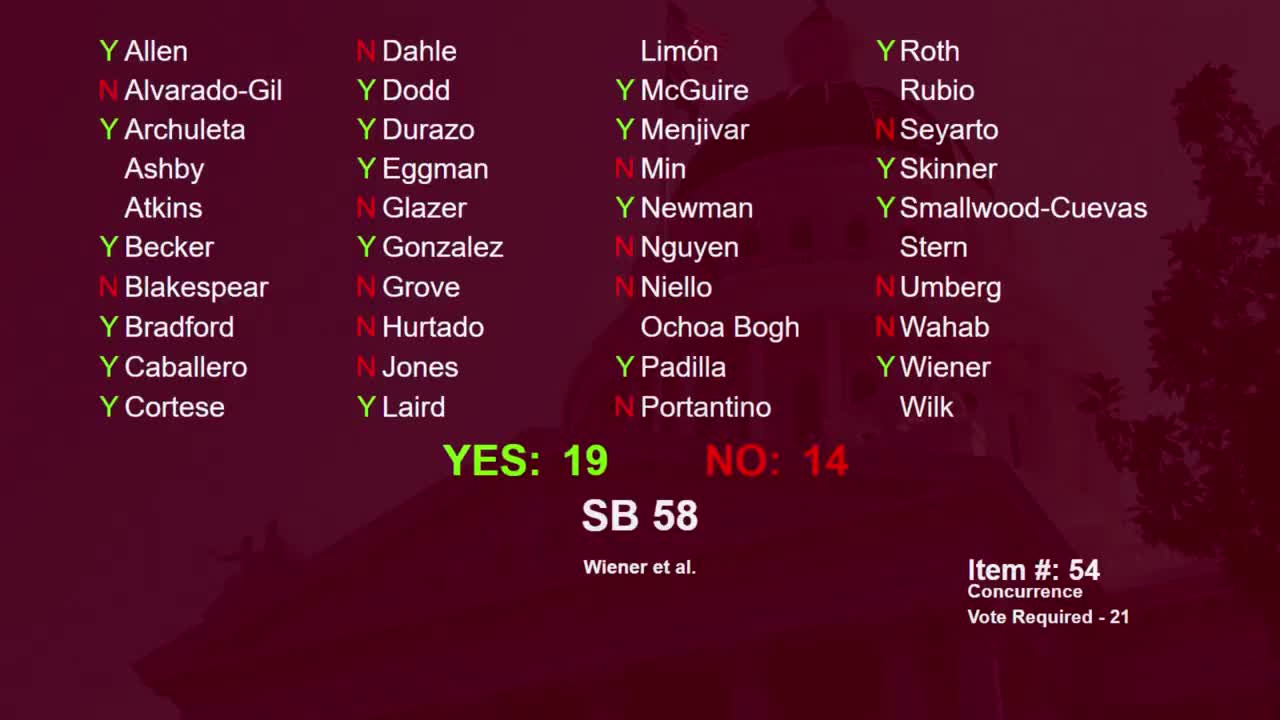 40SEC
Senate Floor
 1MIN
Assembly Floor
 18MIN
Assembly Standing Committee on Education
 1MIN
Senate Standing Committee on Appropriations
 18MIN
Senate Standing Committee on Human Services
 14MIN
Senate Standing Committee on Education
Bill Author