SB 4: Planning and zoning: housing development: higher education institutions and religious institutions.
- Session Year: 2023-2024
- House: Senate
- Latest Version Date: 2023-10-11
Current Status:
Passed
(2023-10-11: Chaptered by Secretary of State. Chapter 771, Statutes of 2023.)
Introduced
In Committee
First Chamber
In Committee
Second Chamber
Enacted
The Planning and Zoning Law requires each county and city to adopt a comprehensive, long-term general plan for its physical development, and the development of certain lands outside its boundaries, that includes, among other mandatory elements, a housing element. That law allows a development proponent to submit an application for a development that is subject to a specified streamlined, ministerial approval process not subject to a conditional use permit, if the development satisfies certain objective planning standards.
Existing law, the Zenovich-Moscone-Chacon Housing and Home Finance Act, establishes the California Tax Credit Allocation Committee within the Department of Housing and Community Development. Existing law requires the committee to allocate state low-income housing tax credits in conformity with state and federal law that establishes a maximum rent that may be charged to a tenant for a project unit constructed using low-income housing tax credits.
This bill would require that a housing development project be a use by right upon the request of an applicant who submits an application for streamlined approval, on any land owned by an independent institution of higher education or religious institution on or before January 1, 2024, if the development satisfies specified criteria, including that the development is not adjoined to any site where more than one-third of the square footage on the site is dedicated to industrial use. The bill would define various terms for these purposes. Among other things, the bill would require that 100% of the units, exclusive of manager units, in a housing development project eligible for approval as a use by right under these provisions be affordable to lower income households, except that 20% of the units may be for moderate-income households, and 5% of the units may be for staff of the independent institution of higher education or the religious institution that owns the land, provided that the units affordable to lower income households are offered at affordable rent, as set in an amount consistent with the rent limits established by the California Tax Credit Allocation Committee, or affordable housing cost, as specified. The bill would authorize the development to include ancillary uses on the ground floor of the development, as specified.
This bill would specify that a housing development project that is eligible for approval as a use by right under the bill is also eligible for a density bonus, incentives, or concessions, or waivers or reductions of development and parking standards, except as specified. The bill would require a development subject to these provisions to provide off-street parking of up to one space per unit, unless a state law or local ordinance provides for a lower standard of parking, in which case the law or ordinance applies. The bill would prohibit a local government from imposing any parking requirement on a development subject to these provisions if the development is located within one-half mile walking distance of public transit, either a high-quality transit corridor or a major transit stop, as those terms are defined, or it is within one block of a car share vehicle.
This bill would require a local government that determines a proposed development is in conflict with any objective planning standards, as specified, to provide the developer with written documentation explaining those conflicts under a specified timeframe. The bill would provide that the development shall be deemed to satisfy the required objective planning standards if the local government fails to provide the requisite documentation explaining any conflicts. The bill would authorize a local government to conduct a design review, as described, only if the design review focuses on compliance with the requisite criteria of a streamlined, ministerial review process. The bill would prohibit a local government from using a design review, as specified, from inhibiting, chilling, or precluding a streamlined, ministerial approval. The bill would require a local government to issue a subsequent permit for developments approved under the provisions of this act.
The bill would include findings that changes proposed by this bill address a matter of statewide concern rather than a municipal affair and, therefore, apply to all cities, including charter cities.
The California Environmental Quality Act (CEQA) requires a lead agency, as defined, to prepare, or cause to be prepared, and certify the completion of, an environmental impact report on a project that it proposes to carry out or approve that may have a significant effect on the environment or to adopt a negative declaration if it finds that the project will not have that effect. CEQA does not apply to the ministerial approval of projects.
This bill, by requiring approval of certain development projects as a use by right, would expand the exemption for ministerial approval of projects under CEQA.
The bill would repeal its provisions as of January 1, 2036.
By adding to the duties of local planning officials with respect to approving certain development projects, this bill would impose a state-mandated local program.
The California Constitution requires the state to reimburse local agencies and school districts for certain costs mandated by the state. Statutory provisions establish procedures for making that reimbursement.
This bill would provide that no reimbursement is required by this act for a specified reason.
The Planning and Zoning Law requires each county and city to adopt a comprehensive, long-term general plan for its physical development, and the development of certain lands outside its boundaries, that includes, among other mandatory elements, a housing element. That law allows a development proponent to submit an application for a development that is subject to a specified streamlined, ministerial approval process not subject to a conditional use permit, if the development satisfies certain objective planning standards.
Existing law, the Zenovich-Moscone-Chacon Housing and Home Finance Act, establishes the California Tax Credit Allocation Committee within the Department of Housing and Community Development. Existing law requires the committee to allocate state low-income housing tax credits in conformity with state and federal law that establishes a maximum rent that may be charged to a tenant for a project unit constructed using low-income housing tax credits.
This bill would require that a housing development project be a use by right upon the request of an applicant who submits an application for streamlined approval, on any land owned by an independent institution of higher education or religious institution on or before January 1, 2024, if the development satisfies specified criteria, including that the development is not adjoined to any site where more than one-third of the square footage on the site is dedicated to industrial use. The bill would define various terms for these purposes. Among other things, the bill would require that 100% of the units, exclusive of manager units, in a housing development project eligible for approval as a use by right under these provisions be affordable to lower income households, except that 20% of the units may be for moderate-income households, and 5% of the units may be for staff of the independent institution of higher education or the religious institution that owns the land, provided that the units affordable to lower income households are offered at affordable rent, as set in an amount consistent with the rent limits established by the California Tax Credit Allocation Committee, or affordable housing cost, as specified. The bill would authorize the development to include ancillary uses on the ground floor of the development, as specified.
This bill would specify that a housing development project that is eligible for approval as a use by right under the bill is also eligible for a density bonus, incentives, or concessions, or waivers or reductions of development and parking standards, except as specified. The bill would require a development subject to these provisions to provide off-street parking of up to one space per unit, unless a state law or local ordinance provides for a lower standard of parking, in which case the law or ordinance applies. The bill would prohibit a local government from imposing any parking requirement on a development subject to these provisions if the development is located within one-half mile walking distance of public transit, either a high-quality transit corridor or a major transit stop, as those terms are defined, or it is within one block of a car share vehicle.
This bill would require a local government that determines a proposed development is in conflict with any objective planning standards, as specified, to provide the developer with written documentation explaining those conflicts under a specified timeframe. The bill would provide that the development shall be deemed to satisfy the required objective planning standards if the local government fails to provide the requisite documentation explaining any conflicts. The bill would authorize a local government to conduct a design review, as described, only if the design review focuses on compliance with the requisite criteria of a streamlined, ministerial review process. The bill would prohibit a local government from using a design review, as specified, from inhibiting, chilling, or precluding a streamlined, ministerial approval. The bill would require a local government to issue a subsequent permit for developments approved under the provisions of this act.
The bill would include findings that changes proposed by this bill address a matter of statewide concern rather than a municipal affair and, therefore, apply to all cities, including charter cities.
The California Environmental Quality Act (CEQA) requires a lead agency, as defined, to prepare, or cause to be prepared, and certify the completion of, an environmental impact report on a project that it proposes to carry out or approve that may have a significant effect on the environment or to adopt a negative declaration if it finds that the project will not have that effect. CEQA does not apply to the ministerial approval of projects.
This bill, by requiring approval of certain development projects as a use by right, would expand the exemption for ministerial approval of projects under CEQA.
By adding to the duties of local planning officials with respect to approving certain development projects, this bill would impose a state-mandated local program.
The California Constitution requires the state to reimburse local agencies and school districts for certain costs mandated by the state. Statutory provisions establish procedures for making that reimbursement.
This bill would provide that no reimbursement is required by this act for a specified reason.
The Planning and Zoning Law requires each county and city to adopt a comprehensive, long-term general plan for its physical development, and the development of certain lands outside its boundaries, that includes, among other mandatory elements, a housing element. That law allows a development proponent to submit an application for a development that is subject to a specified streamlined, ministerial approval process not subject to a conditional use permit, if the development satisfies certain objective planning standards.
Existing law, the Zenovich-Moscone-Chacon Housing and Home Finance Act, establishes the California Tax Credit Allocation Committee within the Department of Housing and Community Development. Existing law requires the committee to allocate state low-income housing tax credits in conformity with state and federal law that establishes a maximum rent that may be charged to a tenant for a project unit constructed using low-income housing tax credits.
This bill would require that a housing development project be a use by right upon the request of an applicant who submits an application for streamlined approval, on any land owned by an independent institution of higher education or religious institution on or before January 1, 2024, if the development satisfies specified criteria, including that the development is not adjoined to any site where more than one-third of the square footage on the site is dedicated to industrial use. The bill would define various terms for these purposes. Among other things, the bill would require that 100% of the units, exclusive of manager units, in a housing development project eligible for approval as a use by right under these provisions be affordable to lower income households, except that 20% of the units may be for moderate-income households, and 5% of the units may be for staff of the independent institution of higher education or the religions religious institution that owns the land, provided that the units affordable to lower income households are offered at affordable rent, as set in an amount consistent with the rent limits established by the California Tax Credit Allocation Committee, or affordable housing cost, as specified. The bill would authorize the development to include ancillary uses on the ground floor of the development, as specified.
This bill would specify that a housing development project that is eligible for approval as a use by right under the bill is also eligible for a density bonus or other incentives or concessions, bonus, incentives, or concessions, or waivers or reductions of development and parking standards, except as specified. The bill would require a development subject to these provisions to provide off-street parking of up to one space per unit, unless a state law or local ordinance provides for a lower standard of parking, in which case the law or ordinance applies. The bill would prohibit a local government from imposing any parking requirement on a development subject to these provisions if the development is located within one-half mile walking distance of public transit, either a high-quality transit corridor or a major transit stop, as those terms are defined, or it is within one block of a car share vehicle.
This bill would require a local government that determines a proposed development is in conflict with any objective planning standards, as specified, to provide the developer with written documentation explaining those conflicts under a specified timeframe. The bill would provide that the development shall be deemed to satisfy the required objective planning standards if the local government fails to provide the requisite documentation explaining any conflicts. The bill would authorize a local government to conduct a design review, as described, only if the design review focuses on compliance with the requisite criteria of a streamlined, ministerial review process. The bill would prohibit a local government from using a design review, as specified, from inhibiting, chilling, or precluding a streamlined, ministerial approval. The bill would require a local government to issue a subsequent permit for developments approved under the provisions of this act.
The bill would include findings that changes proposed by this bill address a matter of statewide concern rather than a municipal affair and, therefore, apply to all cities, including charter cities.
The California Environmental Quality Act (CEQA) requires a lead agency, as defined, to prepare, or cause to be prepared, and certify the completion of, an environmental impact report on a project that it proposes to carry out or approve that may have a significant effect on the environment or to adopt a negative declaration if it finds that the project will not have that effect. CEQA does not apply to the ministerial approval of projects.
This bill, by requiring approval of certain development projects as a use by right, would expand the exemption for ministerial approval of projects under CEQA.
By adding to the duties of local planning officials with respect to approving certain development projects, this bill would impose a state-mandated local program.
The California Constitution requires the state to reimburse local agencies and school districts for certain costs mandated by the state. Statutory provisions establish procedures for making that reimbursement.
This bill would provide that no reimbursement is required by this act for a specified reason.
The Planning and Zoning Law requires each county and city to adopt a comprehensive, long-term general plan for its physical development, and the development of certain lands outside its boundaries, that includes, among other mandatory elements, a housing element. That law allows a development proponent to submit an application for a development that is subject to a specified streamlined, ministerial approval process not subject to a conditional use permit, if the development satisfies certain objective planning standards.
Existing law, the Zenovich-Moscone-Chacon Housing and Home Finance Act, establishes the California Tax Credit Allocation Committee within the Department of Housing and Community Development. Existing law requires the committee to allocate state low-income housing tax credits in conformity with state and federal law that establishes a maximum rent that may be charged to a tenant for a project unit constructed using low-income housing tax credits.
This bill would require that a housing development project be a use by right upon the request of an applicant who submits an application for streamlined approval, on any land owned by an independent institution of higher education or religious institution on or before January 1, 2024, if the development satisfies specified criteria, including that the development is not adjoined to any site where more than one-third of the square footage on the site is dedicated to industrial use. The bill would define various terms for these purposes. Among other things, the bill would require that 100% of the units, exclusive of manager units, in a housing development project eligible for approval as a use by right under these provisions be affordable to lower income households, except that 20% of the units may be for moderate-income households, provided that all of the units and 5% of the units may be for staff of the independent institution of higher education or the religions institution that owns the land, provided that the units affordable to lower income households are provided offered at affordable rent, as set in an amount consistent with the rent limits established by the California Tax Credit Allocation Committee, or affordable housing cost, as specified. The bill would authorize the development to include ancillary uses on the ground floor of the development, as specified.
This bill would specify that a housing development project that is eligible for approval as a use by right under the bill is also eligible for a density bonus or other incentives or concessions, except as specified. The bill would require a development subject to these provisions to provide off-street parking of up to one space per unit, unless a local ordinance provides for a lower standard of parking, in which case the ordinance applies. The bill would prohibit a local government from imposing any parking requirement on a development subject to these provisions if the development is located within one-half mile walking distance of public transit, either a high-quality transit corridor or a major transit stop, as those terms are defined, and or it is within one block of a car share vehicle.
This bill would require a local government that determines a proposed development is in conflict with any objective planning standards, as specified, to provide the developer with written documentation explaining those conflicts under a specified timeframe. The bill would require a local government to approve a development provide that the development shall be deemed to satisfy the required objective planning standards if the local government fails to provide the requisite documentation explaining any conflicts. The bill would authorize a local government to conduct a design review, as described, only if the design review focuses on compliance with the requisite criteria of a streamlined, ministerial review process. The bill would prohibit a local government from using a design review, as specified, from inhibiting, chilling, or precluding a streamlined, ministerial approval. The bill would require a local government to issue a subsequent permit for developments approved under the provisions of this act.
The bill would include findings that changes proposed by this bill address a matter of statewide concern rather than a municipal affair and, therefore, apply to all cities, including charter cities.
The California Environmental Quality Act (CEQA) requires a lead agency, as defined, to prepare, or cause to be prepared, and certify the completion of, an environmental impact report on a project that it proposes to carry out or approve that may have a significant effect on the environment or to adopt a negative declaration if it finds that the project will not have that effect. CEQA does not apply to the ministerial approval of projects.
This bill, by requiring approval of certain development projects as a use by right, would expand the exemption for ministerial approval of projects under CEQA.
By adding to the duties of local planning officials with respect to approving certain development projects, this bill would impose a state-mandated local program.
The California Constitution requires the state to reimburse local agencies and school districts for certain costs mandated by the state. Statutory provisions establish procedures for making that reimbursement.
This bill would provide that no reimbursement is required by this act for a specified reason.
The California Constitution requires the state to reimburse local agencies and school districts for certain costs mandated by the state. Statutory provisions establish procedures for making that reimbursement.This bill would provide that no reimbursement is required by this act for a specified reason.The Planning and Zoning Law requires each county and city to adopt a comprehensive, long-term general plan for its physical development, and the development of certain lands outside its boundaries, that includes, among other mandatory elements, a housing element. That law allows a development proponent to submit an application for a development that is subject to a specified streamlined, ministerial approval process not subject to a conditional use permit, if the development satisfies certain objective planning standards.
Existing law, the Zenovich-Moscone-Chacon Housing and Home Finance Act, establishes the California Tax Credit Allocation Committee within the Department of Housing and Community Development. Existing law requires the committee to allocate state low-income housing tax credits in conformity with state and federal law that establishes a maximum rent that may be charged to a tenant for a project unit constructed using low-income housing tax credits.
This bill would require that a housing development project be a use by right upon the request of an applicant who submits an application for streamlined approval, on any land owned by an independent institution of higher education or religious institution on or before January 1, 2024, if the development satisfies specified criteria, including that the development is not adjoined to any site where more than one-third of the square footage on the site is dedicated to industrial use. The bill would define various terms for these purposes. Among other things, the bill would require that 100% of the units, exclusive of manager units, in a housing development project eligible for approval as a use by right under these provisions be affordable to lower income households, except that 20% of the units may be for moderate-income households, provided that all of the units are provided at affordable rent, as set in an amount consistent with the rent limits established by the California Tax Credit Allocation Committee, or affordable housing cost, as specified. The bill would authorize the development to include ancillary uses on the ground floor of the development, as specified.
This bill would specify that a housing development project that is eligible for approval as a use by right under the bill is also eligible for a density bonus or other incentives or concessions, except as specified. The bill would require a development subject to these provisions to provide off-street parking of up to one space per unit, unless a local ordinance provides for a lower standard of parking, in which case the ordinance applies. The bill would prohibit a local government from imposing any parking requirement on a development subject to these provisions if the development is located within one-half mile walking distance of a high-quality transit corridor or major transit stop, as those terms are defined, and within one block of a car share vehicle.
This bill would require a local government that determines a proposed development is in conflict with any objective planning standards, as specified, to provide the developer with written documentation explaining those conflicts under a specified timeframe. The bill would require a local government to approve a development if the local government fails to provide the requisite documentation explaining any conflicts. The bill would authorize a local government to conduct a design review, as described, only if the design review focuses on compliance with the requisite criteria of a streamlined, ministerial review process. The bill would prohibit a local government from using a design review, as specified, from inhibiting, chilling, or precluding a streamlined, ministerial approval. The bill would require a local government to issue a subsequent permit for developments approved under the provisions of this act.
The bill would include findings that changes proposed by this bill address a matter of statewide concern rather than a municipal affair and, therefore, apply to all cities, including charter cities.
The California Environmental Quality Act (CEQA) requires a lead agency, as defined, to prepare, or cause to be prepared, and certify the completion of, an environmental impact report on a project that it proposes to carry out or approve that may have a significant effect on the environment or to adopt a negative declaration if it finds that the project will not have that effect. CEQA does not apply to the ministerial approval of projects.
This bill, by requiring approval of certain development projects as a use by right, would expand the exemption for ministerial approval of projects under CEQA.
By adding to the duties of local planning officials with respect to approving certain development projects, this bill would impose a state-mandated local program.
The California Constitution requires the state to reimburse local agencies and school districts for certain costs mandated by the state. Statutory provisions establish procedures for making that reimbursement.
This bill would provide that no reimbursement is required by this act for a specified reason.
(a)This section shall be known, and may be cited, as the Affordable Housing on Faith and Higher Education Lands Act of 2023.
(b)For purposes of this section:
(1)Applicant means a qualified developer who submits an application for streamlined approval pursuant to this section.
(2)Development proponent means a developer that submits a housing development project application to a local government under the streamlined, ministerial review process pursuant to this chapter.
(3)Health care expenditures include contributions pursuant to Section 501(c) or (d) or 401(a) of the Internal Revenue Code and payments toward medical care as defined in Section 213(d)(1) of the Internal Revenue Code.
(4)Heavy industrial use means a use that is a source, other than a Title V source, as defined by Section 39053.5 of the Health and Safety Code, that is subject to permitting by a district, as defined in Section 39025 of the Health and Safety Code, pursuant to Division 26 (commencing with Section 39000) of the Health and Safety Code or the federal Clean Air Act (42 U.S.C. Sec. 7401 et seq.). A use where the only source permitted by a district is an emergency backup generator, and the source is in compliance with permitted emissions and operating limits, is not a heavy industrial use.
(5)Housing development project has the same meaning as defined in Section 65589.5.
(6)Independent institution of higher education has the same meaning as defined in Section 66010 of the Education Code.
(7)Light industrial use means a use that is not subject to permitting by a district, as defined in Section 39025 of the Health and Safety Code.
(8)Local government means a city, including a charter city, county, including a charter county, or city and county, including a charter city and county.
(9)Qualified developer means any of the following:
(A)A local public entity, as defined in Section 50079 of the Health and Safety Code.
(B)(i)A developer that is a nonprofit corporation, a limited partnership in which a managing general partner is a nonprofit corporation, or a limited liability company in which a managing member is a nonprofit corporation.
(ii)The developer, at the time of submission of an application for development pursuant to this section, owns property or manages housing units located on property that is exempt from taxation pursuant to the welfare exemption established in subdivision (a) of Section 214 of the Revenue and Taxation Code.
(C)A developer that contracts with a nonprofit corporation that has received a welfare exemption under Section 214.15 of the Revenue and Taxation Code for properties intended to be sold to low-income families with financing in the form of zero interest rate loans.
(D)A developer that the religious institution or independent institution of education, as defined in this section, has contracted with before to construct housing or other improvements to real property.
(10)Religious institution means an institution owned, controlled, and operated and maintained by a bona fide church, religious denomination, or religious organization composed of multidenominational members of the same well-recognized religion, lawfully operating as a nonprofit religious corporation pursuant to Part 4 (commencing with Section 9110), or as a corporation sole pursuant to Part 6 (commencing with Section 10000), of Division 2 of Title 1 of the Corporations Code.
(11)Title V industrial use means a use that is a Title V source, as defined in Section 39053.5 of the Health and Safety Code.
(12)Use by right means a development project that satisfies both of the following conditions:
(A)The development project does not require a conditional use permit, planned unit development permit, or other discretionary local government review.
(B)The development project is not a project for purposes of Division 13 (commencing with Section 21000) of the Public Resources Code.
(c)Notwithstanding any inconsistent provision of a local governments general plan, specific plan, zoning ordinance, or regulation, upon the request of an applicant, a housing development project shall be a use by right, if all of the following criteria are satisfied:
(1)The development is located on land owned on or before January 1, 2024, by an independent institution of higher education or a religious institution, including ownership through an affiliated or associated nonprofit public benefit corporation organized pursuant to the Nonprofit Corporation Law (Part 2 (commencing with Section 5110) of Division 2 of Title 1 of the Corporations Code).
(2)The development is located on a parcel that satisfies the requirements specified in subparagraphs (A) and (B) of paragraph (2) of subdivision (a) of Section 65913.4.
(3)The development is located on a parcel that satisfies the requirements specified in subparagraphs (B) to (K), inclusive, of paragraph (6) of subdivision (a) of Section 65913.4.
(4)The development is located on a parcel that satisfies the requirements specified in paragraph (7) of subdivision (a) of Section 65913.4.
(5)(A)The development is not adjoined to any site where more than one-third of the square footage on the site is dedicated to light industrial use. For purposes of this subdivision, parcels separated by only a street or highway shall be considered to be adjoined.
(B)For purposes of subparagraph (A), a property is dedicated to light industrial use if all of the following requirements are met:
(i)The square footage is currently being put to a light industrial use.
(ii)The most recently permitted use of the square footage is a light industrial use.
(iii)The latest version of the local governments general plan, adopted before January 1, 2022, designates the property for light industrial use.
(6)The housing units on the development site are not located within 1,200 feet of a site that is either of the following:
(A)A site that is currently a heavy industrial use.
(B)A site where the most recent permitted use was a heavy industrial use.
(7)Except as provided in paragraph (8), the housing units on the development site are not located within 1,600 feet of a site that is either of the following:
(A)A site that is currently a Title V industrial use.
(B)A site where the most recent permitted use was a Title V industrial use.
(8)For a site where multifamily housing is not an existing permitted use, the housing units on the development site are not located within 3,200 feet of a facility that actively extracts or refines oil or natural gas.
(9)One hundred percent of the development projects total units, exclusive of a managers unit or units, are for lower income households, as defined by Section 50079.5 of the Health and Safety Code, except that up to 20 percent of the total units in the development may be for moderate-income households, as defined in Section 50053 of the Health and Safety Code, and 5 percent of the units may be for staff of the independent institution of higher education or religious institution that owns the land. Units in the development shall be offered at affordable housing cost, as defined in Section 50052.5 of the Health and Safety Code, or at affordable rent, as set in an amount consistent with the rent limits established by the California Tax Credit Allocation Committee. The rent or sales price for a moderate-income unit shall be affordable and shall not exceed 30 percent of income for a moderate-income household or homebuyer for a unit of similar size and bedroom count in the same ZIP Code in the city, county, or city and county in which the housing development is located. The applicant shall provide the city, county, or city and county with evidence to establish that the units meet the requirements of this paragraph. All units, exclusive of any manager unit or units, shall be subject to a recorded deed restriction as provided in this paragraph for at least the following periods of time:
(A)Fifty-five years for units that are rented unless a local ordinance or the terms of a federal, state, or local grant, tax credit, or other project financing requires, as a condition of the development of residential units, that the development include a certain percentage of units that are affordable to, and occupied by, low-income, lower income, very low income, or extremely low income households for a term that exceeds 55 years for rental housing units.
(B)Forty-five years for units that are owner-occupied or the first purchaser of each unit participates in an equity sharing agreement as described in subparagraph (C) of paragraph (2) of subdivision (c) of Section 65915.
(10)The development project complies with all objective development standards of the city or county that are not in conflict with this section.
(11)If the housing development project requires the demolition of existing residential dwelling units, or is located on a site where residential dwelling units have been demolished within the last five years, the applicant shall comply with subdivision (d) of Section 66300.
(12)The applicant certifies to the local government that either of the following is true for the housing development project, as applicable:
(A)The entirety of the development project is a public work for purposes of Chapter 1 (commencing with Section 1720) of Part 7 of Division 2 of the Labor Code.
(B)A development that contains more than 10 units and is not in its entirety a public work for purposes of Chapter 1 (commencing with Section 1720) of Part 7 of Division 2 of the Labor Code and approved by a local government pursuant to Article 2 (commencing with Section 65912.110) of, or Article 3 (commencing with Section 65912.120) of, Chapter 4.1 shall be subject to all of the following:
(i)All construction workers employed in the execution of the development shall be paid at least the general prevailing rate of per diem wages for the type of work and geographic area, as determined by the Director of Industrial Relations pursuant to Sections 1773 and 1773.9 of the Labor Code, except that apprentices registered in programs provided by the Chief of the Division of Apprenticeship Standards may be paid at least the applicable apprentice prevailing rate.
(ii)The development proponent shall ensure that the prevailing wage requirement is included in all contracts for the performance of the work for those portions of the development that are not a public work.
(iii)All contractors and subcontractors for those portions of the development that are not a public work shall comply with both of the following:
(I)Pay to all construction workers employed in the execution of the work at least the general prevailing rate of per diem wages, except that apprentices registered in the programs approved by the Chief of the Division of Apprenticeship Standards may be paid at least the applicable apprentice prevailing rate.
(II)Maintain and verify payroll records pursuant to Section 1776 of the Labor Code and make those records available for inspection and copying as provided in that section. This subclause does not apply if all contractors and subcontractors performing work on the development are subject to a project labor agreement that requires the payment of prevailing wages to all construction workers employed in the execution of the development and provides for enforcement of that obligation through an arbitration procedure. For purposes of this subclause, project labor agreement has the same meaning as set forth in paragraph (1) of subdivision (b) of Section 2500 of the Public Contract Code.
(13)(A)The development proponent completes a Phase I environmental assessment, as defined in Section 25319.1 of the Health and Safety Code, and a Phase II environmental assessment, as defined in subdivision (o) of Section 25403 of the Health and Safety Code, if warranted.
(B)If a recognized environmental condition is found, the development proponent shall undertake a preliminary endangerment assessment, as defined in Section 25319.5 of the Health and Safety Code, prepared by an environmental assessor to determine the existence of any release of a hazardous substance on the site and to determine the potential for exposure of future occupants to significant health hazards from any nearby property or activity.
(i)If a release of hazardous substance is found to exist on the site, the release shall be removed, or any significant effect of the release shall be mitigated to a level of insignificance in compliance with state and federal requirements.
(ii)If a potential for exposure to significant hazards from surrounding properties or activities is found to exist, the effects of the potential exposure shall be mitigated to a level of insignificance in compliance with current state and federal requirements.
(14)If the development is within 500 feet of a freeway, regularly occupied areas of the building shall provide air filtration media for outside and return air that provide a minimum efficiency reporting value (MERV) of 13.
(15)For a vacant site, the site does not contain tribal cultural resources, as defined in Section 21074 of the Public Resources Code, that could be affected by the development that were found pursuant to a consultation as described in Section 21080.3.1 of the Public Resources Code, and the effects of which cannot be mitigated pursuant to the process described in Section 21080.3.2 of the Public Resources Code.
(d)(1)The obligation of the contractors and subcontractors to pay prevailing wages pursuant to this section may be enforced by any of the following:
(A)The Labor Commissioner, through the issuance of a civil wage and penalty assessment pursuant to Section 1741 of the Labor Code, that may be reviewed pursuant to Section 1742 of the Labor Code, within 18 months after the completion of the development.
(B)An underpaid worker through an administrative complaint or civil action.
(C)A joint labor-management committee through a civil action pursuant to Section 1771.2 of the Labor Code.
(2)If a civil wage and penalty assessment is issued pursuant to this section, the contractor, subcontractor, and surety on a bond or bonds issued to secure the payment of wages covered by the assessment shall be liable for liquidated damages pursuant to Section 1742.1 of the Labor Code.
(3)This subdivision does not apply if all contractors and subcontractors performing work on the development are subject to a project labor agreement that requires the payment of prevailing wages to all construction workers employed in the execution of the development and provides for enforcement of that obligation through an arbitration procedure. For purposes of this subdivision, project labor agreement has the same meaning as set forth in paragraph (1) of subdivision (b) of Section 2500 of the Public Contract Code.
(e)Notwithstanding subdivision (c) of Section 1773.1 of the Labor Code, the requirement that employer payments not reduce the obligation to pay the hourly straight time or overtime wages found to be prevailing does not apply to those portions of a development that are not a public work if otherwise provided in a bona fide collective bargaining agreement covering the worker.
(f)The requirement of this section to pay at least the general prevailing rate of per diem wages does not preclude use of an alternative workweek schedule adopted pursuant to Section 511 or 514 of the Labor Code.
(g)In addition to the requirements of Section 65912.130, a development of 50 or more housing units approved by a local government pursuant to Article 2 (commencing with Section 65912.110) of, or Article 3 (commencing with Section 65912.120) of, Chapter 4.1 shall meet all of the following labor standards:
(1)The development proponent shall require in contracts with construction contractors and shall certify to the local government that each contractor of any tier who will employ construction craft employees or will let subcontracts for at least 1,000 hours shall satisfy the requirements in paragraphs (2) and (3). A construction contractor is deemed in compliance with paragraphs (2) and (3) if it is signatory to a valid collective bargaining agreement that requires use of registered apprentices and expenditures on health care for employees and dependents.
(2)A contractor with construction craft employees shall either participate in an apprenticeship program approved by the Division of Apprenticeship Standards pursuant to Section 3075 of the Labor Code, or request the dispatch of apprentices from a state-approved apprenticeship program under the terms and conditions set forth in Section 1777.5 of the Labor Code. A contractor without construction craft employees shall show a contractual obligation that its subcontractors comply with this subdivision.
(3)Each contractor with construction craft employees shall make health care expenditures for each employee in an amount per hour worked on the development equivalent to at least the hourly pro rata cost of a Covered California Platinum-level plan for two adults 40 years of age and two dependents 0 to 14 years of age for the Covered California rating area in which the development is located. A contractor without construction craft employees shall show a contractual obligation that its subcontractors comply with this paragraph. Qualifying expenditures shall be credited toward compliance with prevailing wage payment requirements set forth in Section 65912.130.
(4)(A)The development proponent shall provide to the local government, on a monthly basis while its construction contracts on the development are being performed, a report demonstrating compliance with paragraphs (2) and (3). The report shall be considered public records under the California Public Records Act (Division 10 (commending with Section 7920.000) of Title 1), and shall be open to public inspection.
(B)A development proponent that fails to provide the monthly report shall be subject to a civil penalty for each month for which the report has not been provided, in the amount of 10 percent of the dollar value of construction work performed by that contractor on the development in the month in question, up to a maximum of ten thousand dollars ($10,000). Any contractor or subcontractor that fails to comply with paragraph (2) or (3) shall be subject to a civil penalty of two hundred dollars ($200) per day for each worker employed in contravention of paragraph (2) or (3).
(C)Penalties may be assessed by the Labor Commissioner within 18 months of completion of the development using the procedures for issuance of civil wage and penalty assessments specified in Section 1741 of the Labor Code, and may be reviewed pursuant to Section 1742 of the Labor Code. Penalties shall be deposited in the State Public Works Enforcement Fund established pursuant to Section 1771.3 of the Labor Code.
(5)Each construction contractor shall maintain and verify payroll records pursuant to Section 1776 of the Labor Code. Each construction contractor shall submit payroll records directly to the Labor Commissioner at least monthly in a format prescribed by the Labor Commissioner in accordance with subparagraph (A) of paragraph (3) of subdivision (a) of Section 1771.4 of the Labor Code. The records shall include a statement of fringe benefits. Upon request by a joint labor-management cooperation committee established pursuant to the federal Labor Management Cooperation Act of 1978 (29 U.S.C. Sec. 175a), the records shall be provided pursuant to subdivision (e) of Section 1776 of the Labor Code.
(6)All construction contractors shall report any change in apprenticeship program participation or health care expenditures to the local government within 10 business days, and shall reflect those changes on the monthly report. The reports shall be considered public records pursuant to the California Public Records Act (Division 10 (commencing with Section 7920.000 of Title 1)) and shall be open to public inspection.
(7)A joint labor-management cooperation committee established pursuant to the federal Labor Management Cooperation Act of 1978 (29 U.S.C. Sec. 175a) shall have standing to sue a construction contractor for failure to make health care expenditures pursuant to paragraph (3) in accordance with Section 218.7 or 218.8 of the Labor Code.
(h)Notwithstanding any other provision of this section, a development project that is eligible for approval as a use by right pursuant to this section may include the following ancillary uses, provided that those uses are limited to the ground floor of the development:
(1)In a single-family residential zone, ancillary uses shall be limited to childcare centers and facilities operated by community-based organizations for the provision of recreational, social, or educational services for use by the residents of the development and members of the local community in which the development is located.
(2)In all other zones, the development may include commercial uses that are permitted without a conditional use permit or planned unit development permit.
(i)Notwithstanding any other provision of this section, a development project that is eligible for approval as a use by right pursuant to this section includes any religious institutional use, or any use that was previously existing and legally permitted by the city or county on the site, if all of the following criteria are met:
(1)The total square footage of nonresidential space on the site does not exceed the amount previously existing or permitted in a conditional use permit.
(2)The total parking requirement for nonresidential space on the site does not exceed the lesser of the amount existing or of the amount required by a conditional use permit.
(3)The new uses abide by the same operational conditions as contained in the previous conditional use permit.
(j)A housing development project that qualifies as a use by right pursuant to subdivision (b) shall be allowed the following density, as applicable:
(1)(A)If the development project is located in a zone that allows residential uses, including in single-family residential zones, the development project shall be allowed a density of the applicable density deemed appropriate to accommodate housing for lower income households identified in subparagraph (B) of paragraph (3) of subdivision (c) of Section 65583.2 and a height of one story above the maximum height otherwise applicable to the parcel.
(B)If the local government allows for greater residential density on that parcel, or greater residential density or building heights on an adjoining parcel, than permitted in subparagraph (A), the greater density or building height shall apply.
(C)A housing development project that is located in a zone that allows residential uses, including in single-family residential zones, shall be eligible for a density bonus, incentives, or concessions, or waivers or reductions of development standards and parking ratios, pursuant to Section 65915.
(2)(A)If the development project is located in a zone that does not allow residential uses, the development project shall be allowed a density of 40 units per acre and a height of one story above the maximum height otherwise applicable to the parcel.
(B)If the local government allows for greater residential density or building heights on that parcel, or an adjoining parcel, than permitted in subparagraph (A), the greater density or building height shall apply. A development project shall not use an incentive, waiver, or concession to increase the height of the development to greater than the height authorized under this subparagraph.
(C)Except as provided in subparagraph (B), a housing development project that is located in a zone that does not allow residential uses shall be eligible for a density bonus, incentives, or concessions, or waivers or reductions of development standards and parking ratios, pursuant to Section 65915.
(k)(1)Except as provided in paragraph (2), the proposed development shall provide off-street parking of up to one space per unit, unless a state law or local ordinance provides for a lower standard of parking, in which case the law or ordinance shall apply.
(2)A local government shall not impose a parking requirement if either of the following is true:
(A)The parcel is located within one-half mile walking distance of public transit, either a high-quality transit corridor or a major transit stop as defined in subdivision (b) of Section 21155 of the Public Resources Code.
(B)There is a car share vehicle located within one block of the parcel.
(l)(1)If the local government determines that the proposed development is in conflict with any of the objective planning standards specified in this section, it shall provide the development proponent written documentation of which standard or standards the development conflicts with, and an explanation for the reason or reasons the development conflicts with that standard or standards, within the following timeframes:
(A)Within 60 days of submittal of the development proposal to the local government if the development contains 150 or fewer housing units.
(B)Within 90 days of submittal of the development proposal to the local government if the development contains more than 150 housing units.
(2)If the local government fails to provide the required documentation pursuant to paragraph (1), the development shall be deemed to satisfy the required objective planning standards.
(3)For purposes of this section, a development is consistent with the objective planning standards if there is substantial evidence that would allow a reasonable person to conclude that the development is consistent with the objective planning standards.
(4)The determination of whether a proposed project submitted pursuant to this section is or is not in conflict with the objective planning standards is not a project as defined in Section 21065 of the Public Resources Code.
(5)Design review of the development may be conducted by the local governments planning commission or any equivalent board or commission responsible for review and approval of development projects, or the city council or board of supervisors, as appropriate. That design review shall be objective and be strictly focused on assessing compliance with criteria required for streamlined, ministerial review of projects, as well as any reasonable objective design standards published and adopted by ordinance or resolution by a local jurisdiction before submittal of the development to the local government, and shall be broadly applicable to developments within the jurisdiction. That design review shall be completed as follows and shall not in any way inhibit, chill, or preclude the ministerial approval provided by this section or its effect, as applicable:
(A)Within 90 days of submittal of the development proposal to the local government pursuant to this section if the development contains 150 or fewer housing units.
(B)Within 180 days of submittal of the development proposal to the local government pursuant to this section if the development contains more than 150 housing units.
(6)The local government shall ensure that the project satisfies the requirements specified in subdivision (d) of Section 66300, regardless of whether the development is within or not within an affected city or within or not within an affected county.
(7)If the development is consistent with all objective subdivision standards in the local subdivision ordinance, an application for a subdivision pursuant to the Subdivision Map Act (Division 2 (commencing with Section 66410)) shall be exempt from the requirements of the California Environmental Quality Act (Division 13 (commencing with Section 21000) of the Public Resources Code).
(8)A local governments approval of a development pursuant to this section shall, notwithstanding any other law, be subject to the expiration timeframes specified in subdivision (f) of Section 65913.4.
(9)Any proposed modifications to a development project approved pursuant to this section shall be undertaken pursuant to subdivision (g) of Section 65913.4.
(10)A local government shall not adopt or impose any requirement, including, but not limited to, increased fees or inclusionary housing requirements, that applies to a project solely or partially on the basis that the project is eligible to receive streamlined, ministerial review pursuant to this section.
(11)A local government shall issue a subsequent permit required for a development approved under this section pursuant to paragraph (2) of subdivision (h) of Section 65913.4.
(12)A public improvement that is necessary to implement a development that is approved pursuant to this section shall be undertaken pursuant to paragraph (3) of subdivision (h) of Section 65913.4.
(m)This section shall not prevent a development from also qualifying as a housing development project entitled to the protections of Section 65589.5.
(n)The Legislature finds and declares that ensuring residential development at greater density on land owned by independent institutions of higher education and religious institutions is a matter of statewide concern and is not a municipal affair as that term is used in Section 5 of Article XI of the California Constitution. Therefore, this section applies to all cities, including charter cities.
(o)The provisions of paragraph (3) of subdivision (g) concerning health care expenditures are distinct and severable from the remaining provisions of this section. However, all other provisions of subdivision (g) are material and integral parts of this section and are not severable. If any provision of subdivision (g), exclusive of those included in paragraph (3), is held invalid, the entire section shall be invalid and shall not be given effect.
(p)This section shall remain in effect only until January 1, 2036, and as of that date is repealed.
SEC. 2.No reimbursement is required by this act pursuant to Section 6 of Article XIIIB of the California Constitution because a local agency or school district has the authority to levy service charges, fees, or assessments sufficient to pay for the program or level of service mandated by this act, within the meaning of Section 17556 of the Government Code.
(a)This section shall be known, and may be cited, as the Affordable Housing on Faith and Higher Education Lands Act of 2023.
(b)For purposes of this section:
(1)Applicant means a qualified developer who submits an application for streamlined approval pursuant to this section.
(2)Development proponent means a developer that submits a housing development project application to a local government under the streamlined, ministerial review process pursuant to this chapter.
(3)Health care expenditures include contributions pursuant to Section 501(c) or (d) or 401(a) of the Internal Revenue Code and payments toward medical care as defined in Section 213(d)(1) of the Internal Revenue Code.
(4)Heavy industrial use means a use that is a source, other than a Title V source, as defined by Section 39053.5 of the Health and Safety Code, that is subject to permitting by a district, as defined in Section 39025 of the Health and Safety Code, pursuant to Division 26 (commencing with Section 39000) of the Health and Safety Code or the federal Clean Air Act (42 U.S.C. Sec. 7401 et seq.). A use where the only source permitted by a district is an emergency backup generator, and the source is in compliance with permitted emissions and operating limits, is not a heavy industrial use.
(5)Housing development project has the same meaning as defined in Section 65589.5.
(6)Independent institution of higher education has the same meaning as defined in Section 66010 of the Education Code.
(7)Light industrial use means a use that is not subject to permitting by a district, as defined in Section 39025 of the Health and Safety Code.
(8)Local government means a city, including a charter city, county, including a charter county, or city and county, including a charter city and county.
(9)Qualified developer means any of the following:
(A)A local public entity, as defined in Section 50079 of the Health and Safety Code.
(B)(i)A developer that is a nonprofit corporation, a limited partnership in which the a managing general partner is a nonprofit corporation, or a limited liability company in which the a managing member is a nonprofit corporation.
(ii)The developer, at the time of submission of an application for development pursuant to this section, owns property or manages housing units located on property that is exempt from taxation pursuant to the welfare exemption established in subdivision (a) of Section 214 of the Revenue and Taxation Code.
(C)A developer that contracts with a nonprofit corporation that has received a welfare exemption under Section 214.15 of the Revenue and Taxation Code for properties intended to be sold to low-income families with financing in the form of zero interest rate loans.
(D)A developer that the religious institution or independent institution of education, as defined in this section, has contracted with before to construct housing or other improvements to real property.
(10)Religious institution means an institution owned, controlled, and operated and maintained by a bona fide church, religious denomination, or religious organization composed of multidenominational members of the same well-recognized religion, lawfully operating as a nonprofit religious corporation pursuant to Part 4 (commencing with Section 9110), or as a corporation sole pursuant to Part 6 (commencing with Section 10000), of Division 2 of Title 1 of the Corporations Code.
(11)Title V industrial use means a use that is a Title V source, as defined in Section 39053.5 of the Health and Safety Code.
(12)Use by right means a development project that satisfies both of the following conditions:
(A)The development project does not require a conditional use permit, planned unit development permit, or other discretionary local government review.
(B)The development project is not a project for purposes of Division 13 (commencing with Section 21000) of the Public Resources Code.
(c)Notwithstanding any inconsistent provision of a local governments general plan, specific plan, zoning ordinance, or regulation, upon the request of an applicant, a housing development project shall be a use by right, if all of the following criteria are satisfied:
(1)The development is located on land owned on or before January 1, 2024, by an independent institution of higher education or a religious institution, including ownership through an affiliated or associated nonprofit public benefit corporation organized pursuant to the Nonprofit Corporation Law (Part 2 (commencing with Section 5110) of Division 2 of Title 1 of the Corporations Code).
(2)The development is located on a parcel that satisfies the requirements specified in subparagraphs (A) and (B) of paragraph (2) of subdivision (a) of Section 65913.4.
(3)The development is located on a parcel that satisfies the requirements specified in subparagraphs (B) to (K), inclusive, of paragraph (6) of subdivision (a) of Section 65913.4.
(4)The development is located on a parcel that satisfies the requirements specified in paragraph (7) of subdivision (a) of Section 65913.4.
(5)(A)The development is not adjoined to any site where more than one-third of the square footage on the site is dedicated to light industrial use. For purposes of this subdivision, parcels separated by only a street or highway shall be considered to be adjoined.
(B)For purposes of subparagraph (A), a property is dedicated to light industrial use if all of the following requirements are met:
(i)The square footage is currently being put to a light industrial use.
(ii)The most recently permitted use of the square footage is a light industrial use.
(iii)The latest version of the local governments general plan, adopted before January 1, 2022, designates the property for light industrial use.
(6)The housing units on the development site are not located within 1,200 feet of a site that is either of the following:
(A)A site that is currently a heavy industrial use.
(B)A site where the most recent permitted use was a heavy industrial use.
(7)Except as provided in paragraph (8), the housing units on the development site are not located within 1,600 feet of a site that is either of the following:
(A)A site that is currently a Title V industrial use.
(B)A site where the most recent permitted use was a Title V industrial use.
(8)For a site where multifamily housing is not an existing permitted use, the housing units on the development site are not located within 3,200 feet of a facility that actively extracts or refines oil or natural gas.
(9)One hundred percent of the development projects total units, exclusive of a managers unit or units, are for lower income households, as defined by Section 50079.5 of the Health and Safety Code, except that up to 20 percent of the total units in the development may be for moderate-income households, as defined in Section 50053 of the Health and Safety Code, and 5 percent of the units may be for staff of the independent institution of higher education or religious institution that owns the land. Units in the development shall be offered at affordable housing cost, as defined in Section 50052.5 of the Health and Safety Code, or at affordable rent, as set in an amount consistent with the rent limits established by the California Tax Credit Allocation Committee. The rent or sales price for a moderate-income unit shall be affordable and shall not exceed 30 percent of income for a moderate-income household or homebuyer for a unit of similar size and bedroom count in the same ZIP Code in the city, county, or city and county in which the housing development is located. The applicant shall provide the city, county, or city and county with evidence to establish that the units meet the requirements of this paragraph. All units, exclusive of any manager unit or units, shall be subject to a recorded deed restriction as provided in this paragraph for at least the following periods of time:
(A)Fifty-five years for units that are rented unless a local ordinance or the terms of a federal, state, or local grant, tax credit, or other project financing requires, as a condition of the development of residential units, that the development include a certain percentage of units that are affordable to, and occupied by, low-income, lower income, very low income, or extremely low income households for a term that exceeds 55 years for rental housing units.
(B)Forty-five years for units that are owner-occupied or the first purchaser of each unit participates in an equity sharing agreement as described in subparagraph (C) of paragraph (2) of subdivision (c) of Section 65915.
(10)The development project complies with all objective development standards of the city or county that are not in conflict with this section.
(11)If the housing development project requires the demolition of existing residential dwelling units, or is located on a site where residential dwelling units have been demolished within the last five years, the applicant shall comply with subdivision (d) of Section 66300.
(12)The applicant certifies to the local government that either of the following is true for the housing development project, as applicable:
(A)The entirety of the development project is a public work for purposes of Chapter 1 (commencing with Section 1720) of Part 7 of Division 2 of the Labor Code.
(B)A development that contains more than 10 units and is not in its entirety a public work for purposes of Chapter 1 (commencing with Section 1720) of Part 7 of Division 2 of the Labor Code and approved by a local government pursuant to Article 2 (commencing with Section 65912.110) of, or Article 3 (commencing with Section 65912.120) of, Chapter 4.1 shall be subject to all of the following:
(i)All construction workers employed in the execution of the development shall be paid at least the general prevailing rate of per diem wages for the type of work and geographic area, as determined by the Director of Industrial Relations pursuant to Sections 1773 and 1773.9 of the Labor Code, except that apprentices registered in programs provided by the Chief of the Division of Apprenticeship Standards may be paid at least the applicable apprentice prevailing rate.
(ii)The development proponent shall ensure that the prevailing wage requirement is included in all contracts for the performance of the work for those portions of the development that are not a public work.
(iii)All contractors and subcontractors for those portions of the development that are not a public work shall comply with both of the following:
(I)Pay to all construction workers employed in the execution of the work at least the general prevailing rate of per diem wages, except that apprentices registered in the programs approved by the Chief of the Division of Apprenticeship Standards may be paid at least the applicable apprentice prevailing rate.
(II)Maintain and verify payroll records pursuant to Section 1776 of the Labor Code and make those records available for inspection and copying as provided in that section. This subclause does not apply if all contractors and subcontractors performing work on the development are subject to a project labor agreement that requires the payment of prevailing wages to all construction workers employed in the execution of the development and provides for enforcement of that obligation through an arbitration procedure. For purposes of this subclause, project labor agreement has the same meaning as set forth in paragraph (1) of subdivision (b) of Section 2500 of the Public Contract Code.
(13)(A)The development proponent completes a Phase I environmental assessment, as defined in Section 25319.1 of the Health and Safety Code, and a Phase II environmental assessment, as defined in subdivision (o) of Section 25403 of the Health and Safety Code, if warranted.
(B)If a recognized environmental condition is found, the development proponent shall undertake a preliminary endangerment assessment, as defined in Section 25319.5 of the Health and Safety Code, prepared by an environmental assessor to determine the existence of any release of a hazardous substance on the site and to determine the potential for exposure of future occupants to significant health hazards from any nearby property or activity.
(i)If a release of hazardous substance is found to exist on the site, the release shall be removed, or any significant effect of the release shall be mitigated to a level of insignificance in compliance with state and federal requirements.
(ii)If a potential for exposure to significant hazards from surrounding properties or activities is found to exist, the effects of the potential exposure shall be mitigated to a level of insignificance in compliance with current state and federal requirements.
(14)If the development is within 500 feet of a freeway, regularly occupied areas of the building shall provide air filtration media for outside and return air that provide a minimum efficiency reporting value (MERV) of 13.
(15)For a vacant site, the site does not contain tribal cultural resources, as defined in Section 21074 of the Public Resources Code, that could be affected by the development that were found pursuant to a consultation as described in Section 21080.3.1 of the Public Resources Code, and the effects of which cannot be mitigated pursuant to the process described in Section 21080.3.2 of the Public Resources Code.
(d)(1)The obligation of the contractors and subcontractors to pay prevailing wages pursuant to this section may be enforced by any of the following:
(A)The Labor Commissioner, through the issuance of a civil wage and penalty assessment pursuant to Section 1741 of the Labor Code, that may be reviewed pursuant to Section 1742 of the Labor Code, within 18 months after the completion of the development.
(B)An underpaid worker through an administrative complaint or civil action.
(C)A joint labor-management committee through a civil action pursuant to Section 1771.2 of the Labor Code.
(2)If a civil wage and penalty assessment is issued pursuant to this section, the contractor, subcontractor, and surety on a bond or bonds issued to secure the payment of wages covered by the assessment shall be liable for liquidated damages pursuant to Section 1742.1 of the Labor Code.
(3)This subdivision does not apply if all contractors and subcontractors performing work on the development are subject to a project labor agreement that requires the payment of prevailing wages to all construction workers employed in the execution of the development and provides for enforcement of that obligation through an arbitration procedure. For purposes of this subdivision, project labor agreement has the same meaning as set forth in paragraph (1) of subdivision (b) of Section 2500 of the Public Contract Code.
(e)Notwithstanding subdivision (c) of Section 1773.1 of the Labor Code, the requirement that employer payments not reduce the obligation to pay the hourly straight time or overtime wages found to be prevailing does not apply to those portions of a development that are not a public work if otherwise provided in a bona fide collective bargaining agreement covering the worker.
(f)The requirement of this section to pay at least the general prevailing rate of per diem wages does not preclude use of an alternative workweek schedule adopted pursuant to Section 511 or 514 of the Labor Code.
(g)In addition to the requirements of Section 65912.130, a development of 50 or more housing units approved by a local government pursuant to Article 2 (commencing with Section 65912.110) of, or Article 3 (commencing with Section 65912.120) of, Chapter 4.1 shall meet all of the following labor standards:
(1)The development proponent shall require in contracts with construction contractors and shall certify to the local government that each contractor of any tier who will employ construction craft employees or will let subcontracts for at least 1,000 hours shall satisfy the requirements in paragraphs (2) and (3). A construction contractor is deemed in compliance with paragraphs (2) and (3) if it is signatory to a valid collective bargaining agreement that requires use of registered apprentices and expenditures on health care for employees and dependents.
(2)A contractor with construction craft employees shall either participate in an apprenticeship program approved by the Division of Apprenticeship Standards pursuant to Section 3075 of the Labor Code, or request the dispatch of apprentices from a state-approved apprenticeship program under the terms and conditions set forth in Section 1777.5 of the Labor Code. A contractor without construction craft employees shall show a contractual obligation that its subcontractors comply with this subdivision.
(3)Each contractor with construction craft employees shall make health care expenditures for each employee in an amount per hour worked on the development equivalent to at least the hourly pro rata cost of a Covered California Platinum-level plan for two adults 40 years of age and two dependents 0 to 14 years of age for the Covered California rating area in which the development is located. A contractor without construction craft employees shall show a contractual obligation that its subcontractors comply with this paragraph. Qualifying expenditures shall be credited toward compliance with prevailing wage payment requirements set forth in Section 65912.130.
(4)(A)The development proponent shall provide to the local government, on a monthly basis while its construction contracts on the development are being performed, a report demonstrating compliance with paragraphs (2) and (3). The report shall be considered public records under the California Public Records Act (Division 10 (commending with Section 7920.000) of Title 1), and shall be open to public inspection.
(B)A development proponent that fails to provide the monthly report shall be subject to a civil penalty for each month for which the report has not been provided, in the amount of 10 percent of the dollar value of construction work performed by that contractor on the development in the month in question, up to a maximum of ten thousand dollars ($10,000). Any contractor or subcontractor that fails to comply with paragraph (2) or (3) shall be subject to a civil penalty of two hundred dollars ($200) per day for each worker employed in contravention of paragraph (2) or (3).
(C)Penalties may be assessed by the Labor Commissioner within 18 months of completion of the development using the procedures for issuance of civil wage and penalty assessments specified in Section 1741 of the Labor Code, and may be reviewed pursuant to Section 1742 of the Labor Code. Penalties shall be deposited in the State Public Works Enforcement Fund established pursuant to Section 1771.3 of the Labor Code.
(5)Each construction contractor shall maintain and verify payroll records pursuant to Section 1776 of the Labor Code. Each construction contractor shall submit payroll records directly to the Labor Commissioner at least monthly in a format prescribed by the Labor Commissioner in accordance with subparagraph (A) of paragraph (3) of subdivision (a) of Section 1771.4 of the Labor Code. The records shall include a statement of fringe benefits. Upon request by a joint labor-management cooperation committee established pursuant to the federal Labor Management Cooperation Act of 1978 (29 U.S.C. Sec. 175a), the records shall be provided pursuant to subdivision (e) of Section 1776 of the Labor Code.
(6)All construction contractors shall report any change in apprenticeship program participation or health care expenditures to the local government within 10 business days, and shall reflect those changes on the monthly report. The reports shall be considered public records pursuant to the California Public Records Act (Division 10 (commencing with Section 7920.000 of Title 1)) and shall be open to public inspection.
(7)A joint labor-management cooperation committee established pursuant to the federal Labor Management Cooperation Act of 1978 (29 U.S.C. Sec. 175a) shall have standing to sue a construction contractor for failure to make health care expenditures pursuant to paragraph (3) in accordance with Section 218.7 or 218.8 of the Labor Code.
(h)Notwithstanding any other provision of this section, a development project that is eligible for approval as a use by right pursuant to this section may include the following ancillary uses, provided that those uses are limited to the ground floor of the development:
(1)In a single-family residential zone, ancillary uses shall be limited to childcare centers and facilities operated by community-based organizations for the provision of recreational, social, or educational services for use by the residents of the development and members of the local community in which the development is located.
(2)In all other zones, the development may include commercial uses that are permitted without a conditional use permit or planned unit development permit.
(i)Notwithstanding any other provision of this section, a development project that is eligible for approval as a use by right pursuant to this section includes any religious institutional use, or any use that was previously existing and legally permitted by the city or county on the site, if all of the following criteria are met:
(1)The total square footage of nonresidential space on the site does not exceed the amount previously existing or permitted in a conditional use permit.
(2)The total parking requirement for nonresidential space on the site does not exceed the lesser of the amount existing or of the amount required by a conditional use permit.
(3)The new uses abide by the same operational conditions as contained in the previous conditional use permit.
(j)A housing development project that qualifies as a use by right pursuant to subdivision (b) shall be allowed the following density, as applicable:
(1)(A)If the development project is located in a zone that allows residential uses, including in single-family residential zones, the development project shall be allowed a density of the applicable density deemed appropriate to accommodate housing for lower income households identified in subparagraph (B) of paragraph (3) of subdivision (c) of Section 65583.2 and a height of one story above the maximum height otherwise applicable to the parcel.
(B)If the local government allows for greater residential density on that parcel, or greater residential density or building heights on an adjacent adjoining parcel, than permitted in subparagraph (A), the greater density or building height shall apply.
(C)A housing development project that is located in a zone that allows residential uses, including in single-family residential zones, shall be eligible for a density bonus, incentives, or concessions, or waivers or reductions of development standards and parking ratios, pursuant to Section 65915.
(2)(A)If the development project is located in a zone that does not allow residential uses, the development project shall be allowed a density of 40 units per acre and a height of one story above the maximum height otherwise applicable to the parcel.
(B)If the local government allows for greater residential density or building heights on that parcel, or an adjacent adjoining parcel, than permitted in subparagraph (A), the greater density or building height shall apply. A development project shall not use an incentive, waiver, or concession to increase the height of the development to greater than the height authorized under this subparagraph.
(C)Except as provided in subparagraph (B), a housing development project that is located in a zone that does not allow residential uses shall be eligible for a density bonus, incentives, or concessions, or waivers or reductions of development standards and parking ratios, pursuant to Section 65915.
(k)(1)Except as provided in paragraph (2), the proposed development shall provide off-street parking of up to one space per unit, unless a state law or local ordinance provides for a lower standard of parking, in which case the law or ordinance shall apply.
(2)A local government shall not impose a parking requirement if either of the following is true:
(A)The parcel is located within one-half mile walking distance of public transit, either a high-quality transit corridor or a major transit stop as defined in subdivision (b) of Section 21155 of the Public Resources Code.
(B)There is a car share vehicle located within one block of the parcel.
(l)(1)If the local government determines that the proposed development is in conflict with any of the objective planning standards specified in this section, it shall provide the development proponent written documentation of which standard or standards the development conflicts with, and an explanation for the reason or reasons the development conflicts with that standard or standards, within the following timeframes:
(A)Within 60 days of submittal of the development proposal to the local government if the development contains 150 or fewer housing units.
(B)Within 90 days of submittal of the development proposal to the local government if the development contains more than 150 housing units.
(2)If the local government fails to provide the required documentation pursuant to paragraph (1), the development shall be deemed to satisfy the required objective planning standards.
(3)For purposes of this section, a development is consistent with the objective planning standards if there is substantial evidence that would allow a reasonable person to conclude that the development is consistent with the objective planning standards.
(4)The determination of whether a proposed project submitted pursuant to this section is or is not in conflict with the objective planning standards is not a project as defined in Section 21065 of the Public Resources Code.
(5)Design review of the development may be conducted by the local governments planning commission or any equivalent board or commission responsible for review and approval of development projects, or the city council or board of supervisors, as appropriate. That design review shall be objective and be strictly focused on assessing compliance with criteria required for streamlined, ministerial review of projects, as well as any reasonable objective design standards published and adopted by ordinance or resolution by a local jurisdiction before submittal of the development to the local government, and shall be broadly applicable to developments within the jurisdiction. That design review shall be completed as follows and shall not in any way inhibit, chill, or preclude the ministerial approval provided by this section or its effect, as applicable:
(A)Within 90 days of submittal of the development proposal to the local government pursuant to this section if the development contains 150 or fewer housing units.
(B)Within 180 days of submittal of the development proposal to the local government pursuant to this section if the development contains more than 150 housing units.
(6)The local government shall ensure that the project satisfies the requirements specified in subdivision (d) of Section 66300, regardless of whether the development is within or not within an affected city or within or not within an affected county.
(7)If the development is consistent with all objective subdivision standards in the local subdivision ordinance, an application for a subdivision pursuant to the Subdivision Map Act (Division 2 (commencing with Section 66410)) shall be exempt from the requirements of the California Environmental Quality Act (Division 13 (commencing with Section 21000) of the Public Resources Code).
(8)A local governments approval of a development pursuant to this section shall, notwithstanding any other law, be subject to the expiration timeframes specified in subdivision (f) of Section 65913.4.
(9)Any proposed modifications to a development project approved pursuant to this section shall be undertaken pursuant to subdivision (g) of Section 65913.4.
(10)A local government shall not adopt or impose any requirement, including, but not limited to, increased fees or inclusionary housing requirements, that applies to a project solely or partially on the basis that the project is eligible to receive streamlined, ministerial review pursuant to this section.
(11)A local government shall issue a subsequent permit required for a development approved under this section pursuant to paragraph (2) of subdivision (h) of Section 65913.4.
(12)A public improvement that is necessary to implement a development that is approved pursuant to this section shall be undertaken pursuant to paragraph (3) of subdivision (h) of Section 65913.4.
(m)This section shall not prevent a development from also qualifying as a housing development project entitled to the protections of Section 65589.5.
(m)(n)The Legislature finds and declares that ensuring residential development at greater density on land owned by independent institutions of higher education and religious institutions is a matter of statewide concern and is not a municipal affair as that term is used in Section 5 of Article XI of the California Constitution. Therefore, this section applies to all cities, including charter cities.
(n)(o)The provisions of paragraph (3) of subdivision (g) concerning health care expenditures are distinct and severable from the remaining provisions of this section. However, all other provisions of subdivision (g) are material and integral parts of this section and are not severable. If any provision of subdivision (g), exclusive of those included in paragraph (3), is held invalid, the entire section shall be invalid and shall not be given effect.
(o)(p)This section shall remain in effect only until January 1, 2036, and as of that date is repealed.
SEC. 2.No reimbursement is required by this act pursuant to Section 6 of Article XIIIB of the California Constitution because a local agency or school district has the authority to levy service charges, fees, or assessments sufficient to pay for the program or level of service mandated by this act, within the meaning of Section 17556 of the Government Code.
(a)This section shall be known, and may be cited, as the Affordable Housing on Faith and Higher Education Lands Act of 2023.
(b)For purposes of this section:
(1)Applicant means a qualified developer who submits an application for streamlined approval pursuant to this section.
(2)Development proponent means a developer that submits a housing development project application to a local government under the streamlined, ministerial review process pursuant to this chapter.
(3)Health care expenditures include contributions pursuant to Section 501(c) or (d) or 401(a) of the Internal Revenue Code and payments toward medical care as defined in Section 213(d)(1) of the Internal Revenue Code.
(4)Heavy industrial use means a use that is a source, other than a Title V source, as defined by Section 39053.5 of the Health and Safety Code, that is subject to permitting by a district, as defined in Section 39025 of the Health and Safety Code, pursuant to Division 26 (commencing with Section 39000) of the Health and Safety Code or the federal Clean Air Act (42 U.S.C. Sec. 7401 et seq.).
(4)(5)Housing development project has the same meaning as defined in Section 65589.5.
(5)(6)Independent institution of higher education has the same meaning as defined in Section 66010 of the Education Code.
(6)Industrial use means utilities, manufacturing, transportation storage and maintenance facilities, and warehousing facilities. Industrial use does not include power substations or utility conveyance such as power lines, broadband wires, and pipes.(7)Light industrial use means a use that is not subject to permitting by a district, as defined in Section 39025 of the Health and Safety Code.
(7)(8)Local government means a city, including a charter city, county, including a charter county, or city and county, including a charter city and county.
(8)(9)Qualified developer means any of the following:
(A)A local public entity, as defined in Section 50079 of the Health and Safety Code.
(B)(i)A developer that is a nonprofit corporation, a limited partnership in which the managing general partner is a nonprofit corporation, or a limited liability company in which the managing member is a nonprofit corporation.
(ii)The developer, at the time of submission of an application for development pursuant to this section, owns property or manages housing units located on property that is exempt from taxation pursuant to the welfare exemption established in subdivision (a) of Section 214 of the Revenue and Taxation Code.
(C)A developer that contracts with a nonprofit corporation that has received a welfare exemption under Section 214.15 of the Revenue and Taxation Code for properties intended to be sold to low-income families with financing in the form of zero interest rate loans.
(D)A developer that the religious institution or independent institution of education, as defined in this section, has contracted with before to construct housing or other improvements to real property.
(9)(10)Religious institution means an institution owned, controlled, and operated and maintained by a bona fide church, religious denomination, or religious organization composed of multidenominational members of the same well-recognized religion, lawfully operating as a nonprofit religious corporation pursuant to Part 4 (commencing with Section 9110), or as a corporation sole pursuant to Part 6 (commencing with Section 10000), of Division 2 of Title 1 of the Corporations Code.
(11)Title V industrial use means a use that is a Title V source, as defined in Section 39053.5 of the Health and Safety Code.
(10)(12)Use by right means a development project that satisfies both of the following conditions:
(A)The development project does not require a conditional use permit, planned unit development permit, or other discretionary local government review.
(B)The development project is not a project for purposes of Division 13 (commencing with Section 21000) of the Public Resources Code.
(c)Notwithstanding any inconsistent provision of a local governments general plan, specific plan, zoning ordinance, or regulation, upon the request of an applicant, a housing development project shall be a use by right, if all of the following criteria are satisfied:
(1)The development is located on land owned on or before January 1, 2024, by an independent institution of higher education or a religious institution, including ownership through an affiliated or associated nonprofit public benefit corporation organized pursuant to the Nonprofit Corporation Law (Part 2 (commencing with Section 5110) of Division 2 of Title 1 of the Corporations Code).
(2)The development is located on a parcel that satisfies the requirements specified in subparagraphs (A) and (B) of paragraph (2) of subdivision (a) of Section 65913.4.
(3)The development is located on a parcel that satisfies the requirements specified in subparagraphs (B) to (K), inclusive, of paragraph (6) of subdivision (a) of Section 65913.4.
(4)The development is located on a parcel that satisfies the requirements specified in paragraph (7) of subdivision (a) of Section 65913.4.
(5)(A)The development is not adjoined to any site where more than one-third of the square footage on the site is dedicated to light industrial use. For purposes of this subdivision, parcels separated by only a street or highway shall be considered to be adjoined.
(B)For purposes of subparagraph (A), a property is dedicated to light industrial use if all of the following requirements are met:
(i)The square footage is currently being put to an a light industrial use.
(ii)The most recently permitted use of the square footage is an a light industrial use.
(iii)The latest version of the local governments general plan, adopted before January 1, 2022, designates the property for light industrial use.
(6)The housing units on the development site are not located within 1,200 feet of a site that is either of the following:
(A)A site that is currently a heavy industrial use.
(B)A site where the most recent permitted use was a heavy industrial use.
(7)Except as provided in paragraph (8), the housing units on the development site are not located within 1,600 feet of a site that is either of the following:
(A)A site that is currently a Title V industrial use.
(B)A site where the most recent permitted use was a Title V industrial use.
(8)For a site where multifamily housing is not an existing permitted use, the housing units on the development site are not located within 3,200 feet of a facility that actively extracts or refines oil or natural gas.
(6)(9)One hundred percent of the development projects total units, exclusive of a managers unit or units, are for lower income households, as defined by Section 50079.5 of the Health and Safety Code, except that up to 20 percent of the total units in the development may be for moderate-income households, as defined in Section 50053 of the Health and Safety Code, and 5 percent of the units may be for staff of the independent institution of higher education or religious institution that owns the land. Units in the development shall be offered at affordable housing cost, as defined in Section 50052.5 of the Health and Safety Code, or at affordable rent, as set in an amount consistent with the rent limits established by the California Tax Credit Allocation Committee. The rent or sales price for a moderate-income unit shall be affordable and shall not exceed 30 percent of income for a moderate-income household or homebuyer for a unit of similar size and bedroom count in the same ZIP Code in the city, county, or city and county in which the housing development is located. The applicant shall provide the city, county, or city and county with evidence to establish that the units meet the requirements of this paragraph. All units, exclusive of any manager unit or units, shall be subject to a recorded deed restriction as provided in this paragraph for at least the following periods of time:
(A)Fifty-five years for units that are rented unless a local ordinance or the terms of a federal, state, or local grant, tax credit, or other project financing requires, as a condition of the development of residential units, that the development include a certain percentage of units that are affordable to, and occupied by, low-income, lower income, very low income, or extremely low income households for a term that exceeds 55 years for rental housing units.
(B)Forty-five years for units that are owner-occupied or the first purchaser of each unit participates in an equity sharing agreement as described in subparagraph (C) of paragraph (2) of subdivision (c) of Section 65915.
(7)(10)The development project complies with all objective development standards of the city or county that are not in conflict with this section.
(8)(11)If the housing development project requires the demolition of existing residential dwelling units, or is located on a site where residential dwelling units have been demolished within the last five years, the applicant shall comply with subdivision (d) of Section 66300.
(9)(12)The applicant certifies to the local government that either of the following is true for the housing development project, as applicable:
(A)The entirety of the development project is a public work for purposes of Chapter 1 (commencing with Section 1720) of Part 7 of Division 2 of the Labor Code.
(B)A development that contains more than 10 units and is not in its entirety a public work for purposes of Chapter 1 (commencing with Section 1720) of Part 7 of Division 2 of the Labor Code and approved by a local government pursuant to Article 2 (commencing with Section 65912.110) of, or Article 3 (commencing with Section 65912.120) of, Chapter 4.1 shall be subject to all of the following:
(i)All construction workers employed in the execution of the development shall be paid at least the general prevailing rate of per diem wages for the type of work and geographic area, as determined by the Director of Industrial Relations pursuant to Sections 1773 and 1773.9 of the Labor Code, except that apprentices registered in programs provided by the Chief of the Division of Apprenticeship Standards may be paid at least the applicable apprentice prevailing rate.
(ii)The development proponent shall ensure that the prevailing wage requirement is included in all contracts for the performance of the work for those portions of the development that are not a public work.
(iii)All contractors and subcontractors for those portions of the development that are not a public work shall comply with both of the following:
(I)Pay to all construction workers employed in the execution of the work at least the general prevailing rate of per diem wages, except that apprentices registered in the programs approved by the Chief of the Division of Apprenticeship Standards may be paid at least the applicable apprentice prevailing rate.
(II)Maintain and verify payroll records pursuant to Section 1776 of the Labor Code and make those records available for inspection and copying as provided in that section. This subclause does not apply if all contractors and subcontractors performing work on the development are subject to a project labor agreement that requires the payment of prevailing wages to all construction workers employed in the execution of the development and provides for enforcement of that obligation through an arbitration procedure. For purposes of this subclause, project labor agreement has the same meaning as set forth in paragraph (1) of subdivision (b) of Section 2500 of the Public Contract Code.
(10)(13)(A)The development proponent completes a Phase I environmental assessment, as defined in Section 25319.1 of the Health and Safety Code, and a Phase II environmental assessment, as defined in subdivision (o) of Section 25403 of the Health and Safety Code, if warranted.
(B)If a recognized environmental condition is found, the development proponent shall undertake a preliminary endangerment assessment, as defined in Section 25319.5 of the Health and Safety Code, prepared by an environmental assessor to determine the existence of any release of a hazardous substance on the site and to determine the potential for exposure of future occupants to significant health hazards from any nearby property or activity.
(i)If a release of hazardous substance is found to exist on the site, the release shall be removed, or any significant effect of the release shall be mitigated to a level of insignificance in compliance with state and federal requirements.
(ii)If a potential for exposure to significant hazards from surrounding properties or activities is found to exist, the effects of the potential exposure shall be mitigated to a level of insignificance in compliance with current state and federal requirements.
(11)(14)If the development is within 500 feet of a freeway, regularly occupied areas of the building shall provide air filtration media for outside and return air that provide a minimum efficiency reporting value (MERV) of 13.
(12)(15)For a vacant site, the site does not contain tribal cultural resources, as defined in Section 21074 of the Public Resources Code, that could be affected by the development that were found pursuant to a consultation as described in Section 21080.3.1 of the Public Resources Code, and the effects of which cannot be mitigated pursuant to the process described in Section 21080.3.2 of the Public Resources Code.
(d)(1)The obligation of the contractors and subcontractors to pay prevailing wages pursuant to this section may be enforced by any of the following:
(A)The Labor Commissioner, through the issuance of a civil wage and penalty assessment pursuant to Section 1741 of the Labor Code, that may be reviewed pursuant to Section 1742 of the Labor Code, within 18 months after the completion of the development.
(B)An underpaid worker through an administrative complaint or civil action.
(C)A joint labor-management committee through a civil action pursuant to Section 1771.2 of the Labor Code.
(2)If a civil wage and penalty assessment is issued pursuant to this section, the contractor, subcontractor, and surety on a bond or bonds issued to secure the payment of wages covered by the assessment shall be liable for liquidated damages pursuant to Section 1742.1 of the Labor Code.
(3)This subdivision does not apply if all contractors and subcontractors performing work on the development are subject to a project labor agreement that requires the payment of prevailing wages to all construction workers employed in the execution of the development and provides for enforcement of that obligation through an arbitration procedure. For purposes of this subdivision, project labor agreement has the same meaning as set forth in paragraph (1) of subdivision (b) of Section 2500 of the Public Contract Code.
(e)Notwithstanding subdivision (c) of Section 1773.1 of the Labor Code, the requirement that employer payments not reduce the obligation to pay the hourly straight time or overtime wages found to be prevailing does not apply to those portions of a development that are not a public work if otherwise provided in a bona fide collective bargaining agreement covering the worker.
(f)The requirement of this section to pay at least the general prevailing rate of per diem wages does not preclude use of an alternative workweek schedule adopted pursuant to Section 511 or 514 of the Labor Code.
(g)In addition to the requirements of Section 65912.130, a development of 50 or more housing units approved by a local government pursuant to Article 2 (commencing with Section 65912.110) of, or Article 3 (commencing with Section 65912.120) of, Chapter 4.1 shall meet all of the following labor standards:
(1)The development proponent shall require in contracts with construction contractors and shall certify to the local government that each contractor of any tier who will employ construction craft employees or will let subcontracts for at least 1,000 hours shall satisfy the requirements in paragraphs (2) and (3). A construction contractor is deemed in compliance with paragraphs (2) and (3) if it is signatory to a valid collective bargaining agreement that requires use of registered apprentices and expenditures on health care for employees and dependents.
(2)A contractor with construction craft employees shall either participate in an apprenticeship program approved by the Division of Apprenticeship Standards pursuant to Section 3075 of the Labor Code, or request the dispatch of apprentices from a state-approved apprenticeship program under the terms and conditions set forth in Section 1777.5 of the Labor Code. A contractor without construction craft employees shall show a contractual obligation that its subcontractors comply with this subdivision.
(3)Each contractor with construction craft employees shall make health care expenditures for each employee in an amount per hour worked on the development equivalent to at least the hourly pro rata cost of a Covered California Platinum-level plan for two adults 40 years of age and two dependents 0 to 14 years of age for the Covered California rating area in which the development is located. A contractor without construction craft employees shall show a contractual obligation that its subcontractors comply with this paragraph. Qualifying expenditures shall be credited toward compliance with prevailing wage payment requirements set forth in Section 65912.130.
(4)(A)The development proponent shall provide to the local government, on a monthly basis while its construction contracts on the development are being performed, a report demonstrating compliance with paragraphs (2) and (3). The report shall be considered public records under the California Public Records Act (Division 10 (commending with Section 7920.000) of Title 1), and shall be open to public inspection.
(B)A development proponent that fails to provide the monthly report shall be subject to a civil penalty for each month for which the report has not been provided, in the amount of 10 percent of the dollar value of construction work performed by that contractor on the development in the month in question, up to a maximum of ten thousand dollars ($10,000). Any contractor or subcontractor that fails to comply with paragraph (2) or (3) shall be subject to a civil penalty of two hundred dollars ($200) per day for each worker employed in contravention of paragraph (2) or (3).
(C)Penalties may be assessed by the Labor Commissioner within 18 months of completion of the development using the procedures for issuance of civil wage and penalty assessments specified in Section 1741 of the Labor Code, and may be reviewed pursuant to Section 1742 of the Labor Code. Penalties shall be deposited in the State Public Works Enforcement Fund established pursuant to Section 1771.3 of the Labor Code.
(5)Each construction contractor shall maintain and verify payroll records pursuant to Section 1776 of the Labor Code. Each construction contractor shall submit payroll records directly to the Labor Commissioner at least monthly in a format prescribed by the Labor Commissioner in accordance with subparagraph (A) of paragraph (3) of subdivision (a) of Section 1771.4 of the Labor Code. The records shall include a statement of fringe benefits. Upon request by a joint labor-management cooperation committee established pursuant to the federal Labor Management Cooperation Act of 1978 (29 U.S.C. Sec. 175a), the records shall be provided pursuant to subdivision (e) of Section 1776 of the Labor Code.
(6)All construction contractors shall report any change in apprenticeship program participation or health care expenditures to the local government within 10 business days, and shall reflect those changes on the monthly report. The reports shall be considered public records pursuant to the California Public Records Act (Division 10 (commencing with Section 7920.000 of Title 1)) and shall be open to public inspection.
(7)A joint labor-management cooperation committee established pursuant to the federal Labor Management Cooperation Act of 1978 (29 U.S.C. Sec. 175a) shall have standing to sue a construction contractor for failure to make health care expenditures pursuant to paragraph (3) in accordance with Section 218.7 or 218.8 of the Labor Code.
(h)Notwithstanding any other provision of this section, a development project that is eligible for approval as a use by right pursuant to this section may include the following ancillary uses, provided that those uses are limited to the ground floor of the development:
(1)In a single-family residential zone, ancillary uses shall be limited to childcare centers and facilities operated by community-based organizations for the provision of recreational, social, or educational services for use by the residents of the development and members of the local community in which the development is located.
(2)In all other zones, the development may include commercial uses that are permitted without a conditional use permit or planned unit development permit.
(i)Notwithstanding any other provision of this section, a development project that is eligible for approval as a use by right pursuant to this section includes any religious institutional use, or any use that was previously existing and legally permitted by the city or county on the site, if all of the following criteria are met:
(1)The total square footage of nonresidential space on the site does not exceed the amount previously existing or permitted in a conditional use permit.
(2)The total parking requirement for nonresidential space on the site does not exceed the lesser of the amount existing or of the amount required by a conditional use permit.
(3)The new uses abide by the same operational conditions as contained in the previous conditional use permit.
(j)A housing development project that qualifies as a use by right pursuant to subdivision (b) shall be allowed the following density, as applicable:
(1)(A)If the development project is located in a zone that allows residential uses, including in single-family residential zones, the development project shall be allowed a density of the applicable density deemed appropriate to accommodate housing for lower income households identified in subparagraph (B) of paragraph (3) of subdivision (c) of Section 65583.2 and a height of one story above the maximum height otherwise applicable to the parcel.
(B)If the local government allows for greater residential density on that parcel, or greater residential density or building heights on an adjacent parcel, than permitted in subparagraph (A), the greater density or building height shall apply.
(C)A housing development project that is located in a zone that allows residential uses, including in single-family residential zones, shall be eligible for a density bonus, incentives, or concessions, or waivers or reductions of development standards and parking ratios, pursuant to Section 65915.
(2)(A)If the development project is located in a zone that does not allow residential uses, the development project shall be allowed a density of 40 units per acre and a height of one story above the maximum height otherwise applicable to the parcel.
(B)If the local government allows for greater residential density or building heights on that parcel, or an adjacent parcel, than permitted in subparagraph (A), the greater density or building height shall apply. A development project shall not use an incentive, waiver, or concession to increase the height of the development to greater than the height authorized under this subparagraph.
(C)Except as provided in subparagraph (B), a housing development project that is located in a zone that does not allow residential uses shall be eligible for a density bonus, incentives, or concessions, or waivers or reductions of development standards and parking ratios, pursuant to Section 65915.
(k)(1)Except as provided in paragraph (2), the proposed development shall provide off-street parking of up to one space per unit, unless a state law or local ordinance provides for a lower standard of parking, in which case the law or ordinance shall apply.
(2)A local government shall not impose a parking requirement if either of the following is true:
(A)The parcel is located within one-half mile walking distance of public transit, either a high-quality transit corridor or a major transit stop as defined in subdivision (b) of Section 21155 of the Public Resources Code.
(B)There is a car share vehicle located within one block of the parcel.
(l)(1)If the local government determines that the proposed development is in conflict with any of the objective planning standards specified in this section, it shall provide the development proponent written documentation of which standard or standards the development conflicts with, and an explanation for the reason or reasons the development conflicts with that standard or standards, within the following timeframes:
(A)Within 60 days of submittal of the development proposal to the local government if the development contains 150 or fewer housing units.
(B)Within 90 days of submittal of the development proposal to the local government if the development contains more than 150 housing units.
(2)If the local government fails to provide the required documentation pursuant to paragraph (1), the development shall be deemed to satisfy the required objective planning standards.
(3)For purposes of this section, a development is consistent with the objective planning standards if there is substantial evidence that would allow a reasonable person to conclude that the development is consistent with the objective planning standards.
(4)The determination of whether a proposed project submitted pursuant to this section is or is not in conflict with the objective planning standards is not a project as defined in Section 21065 of the Public Resources Code.
(5)Design review of the development may be conducted by the local governments planning commission or any equivalent board or commission responsible for review and approval of development projects, or the city council or board of supervisors, as appropriate. That design review shall be objective and be strictly focused on assessing compliance with criteria required for streamlined, ministerial review of projects, as well as any reasonable objective design standards published and adopted by ordinance or resolution by a local jurisdiction before submittal of the development to the local government, and shall be broadly applicable to developments within the jurisdiction. That design review shall be completed as follows and shall not in any way inhibit, chill, or preclude the ministerial approval provided by this section or its effect, as applicable:
(A)Within 90 days of submittal of the development proposal to the local government pursuant to this section if the development contains 150 or fewer housing units.
(B)Within 180 days of submittal of the development proposal to the local government pursuant to this section if the development contains more than 150 housing units.
(6)The local government shall ensure that the project satisfies the requirements specified in subdivision (d) of Section 66300, regardless of whether the development is within or not within an affected city or within or not within an affected county.
(7)If the development is consistent with all objective subdivision standards in the local subdivision ordinance, an application for a subdivision pursuant to the Subdivision Map Act (Division 2 (commencing with Section 66410)) shall be exempt from the requirements of the California Environmental Quality Act (Division 13 (commencing with Section 21000) of the Public Resources Code).
(8)A local governments approval of a development pursuant to this section shall, notwithstanding any other law, be subject to the expiration timeframes specified in subdivision (f) of Section 65913.4.
(9)Any proposed modifications to a development project approved pursuant to this section shall be undertaken pursuant to subdivision (g) of Section 65913.4.
(10)A local government shall not adopt or impose any requirement, including, but not limited to, increased fees or inclusionary housing requirements, that applies to a project solely or partially on the basis that the project is eligible to receive streamlined, ministerial review pursuant to this section.
(11)A local government shall issue a subsequent permit required for a development approved under this section pursuant to paragraph (2) of subdivision (h) of Section 65913.4.
(12)A public improvement that is necessary to implement a development that is approved pursuant to this section shall be undertaken pursuant to paragraph (3) of subdivision (h) of Section 65913.4.
(m)The Legislature finds and declares that ensuring residential development at greater density on land owned by independent institutions of higher education and religious institutions is a matter of statewide concern and is not a municipal affair as that term is used in Section 5 of Article XI of the California Constitution. Therefore, this section applies to all cities, including charter cities.
(n)The provisions of paragraph (3) of subdivision (g) concerning health care expenditures are distinct and severable from the remaining provisions of this section. However, all other provisions of subdivision (g) are material and integral parts of this section and are not severable. If any provision of subdivision (g), exclusive of those included in paragraph (3), is held invalid, the entire section shall be invalid and shall not be given effect.
(o)This section shall remain in effect only until January 1, 2036, and as of that date is repealed.
SEC. 2.No reimbursement is required by this act pursuant to Section 6 of Article XIIIB of the California Constitution because a local agency or school district has the authority to levy service charges, fees, or assessments sufficient to pay for the program or level of service mandated by this act, within the meaning of Section 17556 of the Government Code.
(a)This section shall be known, and may be cited, as the Affordable Housing on Faith and Higher Education Lands Act of 2023.
(b)For purposes of this section:
(1)Applicant means a qualified developer who submits an application for streamlined approval pursuant to this section.
(2)Development proponent means a developer that submits a housing development project application to a local government under the streamlined, ministerial review process pursuant to this chapter.
(3)Health care expenditures include contributions pursuant to Section 501(c) or (d) or 401(a) of the Internal Revenue Code and payments toward medical care as defined in Section 213(d)(1) of the Internal Revenue Code.
(4)Housing development project has the same meaning as defined in Section 65589.5.
(5)Independent institution of higher education has the same meaning as defined in Section 66010 of the Education Code.
(6)Industrial use means utilities, manufacturing, transportation storage and maintenance facilities, and warehousing facilities. Industrial use does not include power substations or utility conveyance such as power lines, broadband wires, and pipes.
(7)Local government means a city, including a charter city, county, including a charter county, or city and county, including a charter city and county.
(8)Qualified developer means any of the following:
(A)A local public entity, as defined in Section 50079 of the Health and Safety Code.
(B)(i)A developer that is a nonprofit corporation, a limited partnership in which the managing general partner is a nonprofit corporation, or a limited liability company in which the managing member is a nonprofit corporation.
(ii)The developer, at the time of submission of an application for development pursuant to this section, owns property or manages housing units located on property that is exempt from taxation pursuant to the welfare exemption established in subdivision (a) of Section 214 of the Revenue and Taxation Code.
(C)A developer that contracts with a nonprofit corporation that has received a welfare exemption under Section 214.15 of the Revenue and Taxation Code for properties intended to be sold to low-income families with financing in the form of zero interest rate loans.
(D)A developer that the religious institution or independent institution of education, as defined in this section, has contracted with before to construct housing or other improvements to real property.
(9)Religious institution means an institution owned, controlled, and operated and maintained by a bona fide church, religious denomination, or religious organization composed of multidenominational members of the same well-recognized religion, lawfully operating as a nonprofit religious corporation pursuant to Part 4 (commencing with Section 9110), or as a corporation sole pursuant to Part 6 (commencing with Section 10000), of Division 2 of Title 1 of the Corporations Code.
(10)Use by right means a development project that satisfies both of the following conditions:
(A)The development project does not require a conditional use permit, planned unit development permit, or other discretionary local government review.
(B)The development project is not a project for purposes of Division 13 (commencing with Section 21000) of the Public Resources Code.
(c)Notwithstanding any inconsistent provision of a local governments general plan, specific plan, zoning ordinance, or regulation, upon the request of an applicant, a housing development project shall be a use by right, if all of the following criteria are satisfied:
(1)The development is located on land owned on or before January 1, 2024, by an independent institution of higher education or a religious institution, including ownership through an affiliated or associated nonprofit public benefit corporation organized pursuant to the Nonprofit Corporation Law (Part 2 (commencing with Section 5110) of Division 2 of Title 1 of the Corporations Code).
(2)The development is located on a parcel that satisfies the requirements specified in subparagraphs (A) and (B) of paragraph (2) of subdivision (a) of Section 65913.4.
(3)The development is located on a parcel that satisfies the requirements specified in subparagraphs (B) to (K), inclusive, of paragraph (6) of subdivision (a) of Section 65913.4.
(4)The development is located on a parcel that satisfies the requirements specified in paragraph (7) of subdivision (a) of Section 65913.4.
(5)(A)The development is not adjoined to any site where more than one-third of the square footage on the site is dedicated to industrial use. For purposes of this subdivision, parcels separated by only a street or highway shall be considered to be adjoined.
(B)For purposes of subparagraph (A), a property is dedicated to industrial use if all of the following requirements are met:
(i)The square footage is currently being put to an industrial use.
(ii)The most recently permitted use of the square footage is an industrial use.
(iii)The latest version of the local governments general plan, adopted before January 1, 2022, designates the property for industrial use.
(6)One hundred percent of the development projects total units, exclusive of a managers unit or units, are for lower income households, as defined by Section 50079.5 of the Health and Safety Code, except that up to 20 percent of the total units in the development may be for moderate-income households, as defined in Section 50053 of the Health and Safety Code, and 5 percent of the units may be for staff of the independent institution of higher education or religious institution that owns the land. Units in the development shall be offered at affordable housing cost, as defined in Section 50052.5 of the Health and Safety Code, or at affordable rent, as set in an amount consistent with the rent limits established by the California Tax Credit Allocation Committee. The rent or sales price for a moderate-income unit shall be affordable and shall not exceed 30 percent of income for a moderate-income household or homebuyer for a unit of similar size and bedroom count in the same ZIP Code in the city, county, or city and county in which the housing development is located. The applicant shall provide the city, county, or city and county with evidence to establish that the units meet the requirements of this paragraph. All units, exclusive of any manager unit or units, shall be subject to a recorded deed restriction as provided in this paragraph for at least the following periods of time:
(A)Fifty-five years for units that are rented unless a local ordinance or the terms of a federal, state, or local grant, tax credit, or other project financing requires, as a condition of the development of residential units, that the development include a certain percentage of units that are affordable to, and occupied by, low-income, lower income, very low income, or extremely low income households for a term that exceeds 55 years for rental housing units.
(B)Forty-five years for units that are owner-occupied or the first purchaser of each unit participates in an equity sharing agreement as described in subparagraph (C) of paragraph (2) of subdivision (c) of Section 65915.
(7)The development project complies with all objective development standards of the city or county that are not in conflict with this section.
(8)If the housing development project requires the demolition of existing residential dwelling units, or is located on a site where residential dwelling units have been demolished within the last five years, the applicant shall comply with subdivision (d) of Section 66300.
(9)The applicant certifies to the local government that either of the following is true for the housing development project, as applicable:
(A)The entirety of the development project is a public work for purposes of Chapter 1 (commencing with Section 1720) of Part 7 of Division 2 of the Labor Code.
(B)A development that contains more than 10 units and is not in its entirety a public work for purposes of Chapter 1 (commencing with Section 1720) of Part 7 of Division 2 of the Labor Code and approved by a local government pursuant to Article 2 (commencing with Section 65912.110) of, or Article 3 (commencing with Section 65912.120) of, Chapter 4.1 shall be subject to all of the following:
(i)All construction workers employed in the execution of the development shall be paid at least the general prevailing rate of per diem wages for the type of work and geographic area, as determined by the Director of Industrial Relations pursuant to Sections 1773 and 1773.9 of the Labor Code, except that apprentices registered in programs provided by the Chief of the Division of Apprenticeship Standards may be paid at least the applicable apprentice prevailing rate.
(ii)The development proponent shall ensure that the prevailing wage requirement is included in all contracts for the performance of the work for those portions of the development that are not a public work.
(iii)All contractors and subcontractors for those portions of the development that are not a public work shall comply with both of the following:
(I)Pay to all construction workers employed in the execution of the work at least the general prevailing rate of per diem wages, except that apprentices registered in the programs approved by the Chief of the Division of Apprenticeship Standards may be paid at least the applicable apprentice prevailing rate.
(II)Maintain and verify payroll records pursuant to Section 1776 of the Labor Code and make those records available for inspection and copying as provided in that section. This subclause does not apply if all contractors and subcontractors performing work on the development are subject to a project labor agreement that requires the payment of prevailing wages to all construction workers employed in the execution of the development and provides for enforcement of that obligation through an arbitration procedure. For purposes of this subclause, project labor agreement has the same meaning as set forth in paragraph (1) of subdivision (b) of Section 2500 of the Public Contract Code.
(10)(A)The development proponent completes a Phase I environmental assessment, as defined in Section 25319.1 of the Health and Safety Code, and a Phase II environmental assessment, as defined in subdivision (o) of Section 25403 of the Health and Safety Code, if warranted.
(B)If a recognized environmental condition is found, the development proponent shall undertake a preliminary endangerment assessment, as defined in Section 25319.5 of the Health and Safety Code, prepared by an environmental assessor to determine the existence of any release of a hazardous substance on the site and to determine the potential for exposure of future occupants to significant health hazards from any nearby property or activity.
(i)If a release of hazardous substance is found to exist on the site, the release shall be removed, or any significant effect of the release shall be mitigated to a level of insignificance in compliance with state and federal requirements.
(ii)If a potential for exposure to significant hazards from surrounding properties or activities is found to exist, the effects of the potential exposure shall be mitigated to a level of insignificance in compliance with current state and federal requirements.
(11)If the development is within 500 feet of a freeway, regularly occupied areas of the building shall provide air filtration media for outside and return air that provide a minimum efficiency reporting value (MERV) of 13.
(12)For a vacant site, the site does not contain tribal cultural resources, as defined in Section 21074 of the Public Resources Code, that could be affected by the development that were found pursuant to a consultation as described in Section 21080.3.1 of the Public Resources Code, and the effects of which cannot be mitigated pursuant to the process described in Section 21080.3.2 of the Public Resources Code.
(d)(1)The obligation of the contractors and subcontractors to pay prevailing wages pursuant to this section may be enforced by any of the following:
(A)The Labor Commissioner, through the issuance of a civil wage and penalty assessment pursuant to Section 1741 of the Labor Code, that may be reviewed pursuant to Section 1742 of the Labor Code, within 18 months after the completion of the development.
(B)An underpaid worker through an administrative complaint or civil action.
(C)A joint labor-management committee through a civil action pursuant to Section 1771.2 of the Labor Code.
(2)If a civil wage and penalty assessment is issued pursuant to this section, the contractor, subcontractor, and surety on a bond or bonds issued to secure the payment of wages covered by the assessment shall be liable for liquidated damages pursuant to Section 1742.1 of the Labor Code.
(3)This subdivision does not apply if all contractors and subcontractors performing work on the development are subject to a project labor agreement that requires the payment of prevailing wages to all construction workers employed in the execution of the development and provides for enforcement of that obligation through an arbitration procedure. For purposes of this subdivision, project labor agreement has the same meaning as set forth in paragraph (1) of subdivision (b) of Section 2500 of the Public Contract Code.
(e)Notwithstanding subdivision (c) of Section 1773.1 of the Labor Code, the requirement that employer payments not reduce the obligation to pay the hourly straight time or overtime wages found to be prevailing does not apply to those portions of a development that are not a public work if otherwise provided in a bona fide collective bargaining agreement covering the worker.
(f)The requirement of this section to pay at least the general prevailing rate of per diem wages does not preclude use of an alternative workweek schedule adopted pursuant to Section 511 or 514 of the Labor Code.
(g)In addition to the requirements of Section 65912.130, a development of 50 or more housing units approved by a local government pursuant to Article 2 (commencing with Section 65912.110) of, or Article 3 (commencing with Section 65912.120) of, Chapter 4.1 shall meet all of the following labor standards:
(1)The development proponent shall require in contracts with construction contractors and shall certify to the local government that each contractor of any tier who will employ construction craft employees or will let subcontracts for at least 1,000 hours shall satisfy the requirements in paragraphs (2) and (3). A construction contractor is deemed in compliance with paragraphs (2) and (3) if it is signatory to a valid collective bargaining agreement that requires use of registered apprentices and expenditures on health care for employees and dependents.
(2)A contractor with construction craft employees shall either participate in an apprenticeship program approved by the Division of Apprenticeship Standards pursuant to Section 3075 of the Labor Code, or request the dispatch of apprentices from a state-approved apprenticeship program under the terms and conditions set forth in Section 1777.5 of the Labor Code. A contractor without construction craft employees shall show a contractual obligation that its subcontractors comply with this subdivision.
(3)Each contractor with construction craft employees shall make health care expenditures for each employee in an amount per hour worked on the development equivalent to at least the hourly pro rata cost of a Covered California Platinum-level plan for two adults 40 years of age and two dependents 0 to 14 years of age for the Covered California rating area in which the development is located. A contractor without construction craft employees shall show a contractual obligation that its subcontractors comply with this paragraph. Qualifying expenditures shall be credited toward compliance with prevailing wage payment requirements set forth in Section 65912.130.
(4)(A)The development proponent shall provide to the local government, on a monthly basis while its construction contracts on the development are being performed, a report demonstrating compliance with paragraphs (2) and (3). The report shall be considered public records under the California Public Records Act (Division 10 (commending with Section 7920.000) of Title 1), and shall be open to public inspection.
(B)A development proponent that fails to provide the monthly report shall be subject to a civil penalty for each month for which the report has not been provided, in the amount of 10 percent of the dollar value of construction work performed by that contractor on the development in the month in question, up to a maximum of ten thousand dollars ($10,000). Any contractor or subcontractor that fails to comply with paragraph (2) or (3) shall be subject to a civil penalty of two hundred dollars ($200) per day for each worker employed in contravention of paragraph (2) or (3).
(C)Penalties may be assessed by the Labor Commissioner within 18 months of completion of the development using the procedures for issuance of civil wage and penalty assessments specified in Section 1741 of the Labor Code, and may be reviewed pursuant to Section 1742 of the Labor Code. Penalties shall be deposited in the State Public Works Enforcement Fund established pursuant to Section 1771.3 of the Labor Code.
(5)Each construction contractor shall maintain and verify payroll records pursuant to Section 1776 of the Labor Code. Each construction contractor shall submit payroll records directly to the Labor Commissioner at least monthly in a format prescribed by the Labor Commissioner in accordance with subparagraph (A) of paragraph (3) of subdivision (a) of Section 1771.4 of the Labor Code. The records shall include a statement of fringe benefits. Upon request by a joint labor-management cooperation committee established pursuant to the federal Labor Management Cooperation Act of 1978 (29 U.S.C. Sec. 175a), the records shall be provided pursuant to subdivision (e) of Section 1776 of the Labor Code.
(6)All construction contractors shall report any change in apprenticeship program participation or health care expenditures to the local government within 10 business days, and shall reflect those changes on the monthly report. The reports shall be considered public records pursuant to the California Public Records Act (Division 10 (commencing with Section 7920.000 of Title 1)) and shall be open to public inspection.
(7)A joint labor-management cooperation committee established pursuant to the federal Labor Management Cooperation Act of 1978 (29 U.S.C. Sec. 175a) shall have standing to sue a construction contractor for failure to make health care expenditures pursuant to paragraph (3) in accordance with Section 218.7 or 218.8 of the Labor Code.
(h)Notwithstanding any other provision of this section, a development project that is eligible for approval as a use by right pursuant to this section may include the following ancillary uses, provided that those uses are limited to the ground floor of the development:
(1)In a single-family residential zone, ancillary uses shall be limited to childcare centers and facilities operated by community-based organizations for the provision of recreational, social, or educational services for use by the residents of the development and members of the local community in which the development is located.
(2)In all other zones, the development may include commercial uses that are permitted without a conditional use permit or planned unit development permit.
(i)Notwithstanding any other provision of this section, a development project that is eligible for approval as a use by right pursuant to this section includes any religious institutional use, or any use that was previously existing and legally permitted by the city or county on the site, if all of the following criteria are met:
(1)The total square footage of nonresidential space on the site does not exceed the amount previously existing or permitted in a conditional use permit.
(2)The total parking requirement for nonresidential space on the site does not exceed the lesser of the amount existing or of the amount required by a conditional use permit.
(3)The new uses abide by the same operational conditions as contained in the previous conditional use permit.
(j)A housing development project that qualifies as a use by right pursuant to subdivision (b) shall be allowed the following density, as applicable:
(1)(A)If the development project is located in a zone that allows residential uses, including in single-family residential zones, the development project shall be allowed a density of the applicable density deemed appropriate to accommodate housing for lower income households identified in subparagraph (B) of paragraph (3) of subdivision (c) of Section 65583.2 and a height of one story above the maximum height otherwise applicable to the parcel.
(B)If the local government allows for greater residential density on that parcel, or greater residential density or building heights on an adjacent parcel, than permitted in subparagraph (A), the greater density or building height shall apply.
(C)A housing development project that is located in a zone that allows residential uses, including in single-family residential zones, shall be eligible for a density bonus, incentives, or concessions, or waivers or reductions of development standards and parking ratios, pursuant to Section 65915.
(2)(A)If the development project is located in a zone that does not allow residential uses, the development project shall be allowed a density of 40 units per acre and a height of one story above the maximum height otherwise applicable to the parcel.
(B)If the local government allows for greater residential density or building heights on that parcel, or an adjacent parcel, than permitted in subparagraph (A), the greater density or building height shall apply. A development project shall not use an incentive, waiver, or concession to increase the height of the development to greater than the height authorized under this subparagraph.
(C)Except as provided in subparagraph (B), a housing development project that is located in a zone that does not allow residential uses shall be eligible for a density bonus, incentives, or concessions, or waivers or reductions of development standards and parking ratios, pursuant to Section 65915.
(k)(1)Except as provided in paragraph (2), the proposed development shall provide off-street parking of up to one space per unit, unless a state law or local ordinance provides for a lower standard of parking, in which case the law or ordinance shall apply.
(2)A local government shall not impose a parking requirement if either of the following is true:
(A)The parcel is located within one-half mile walking distance of public transit, either a high-quality transit corridor or a major transit stop as defined in subdivision (b) of Section 21155 of the Public Resources Code.
(B)There is a car share vehicle located within one block of the parcel.
(l)(1)If the local government determines that the proposed development is in conflict with any of the objective planning standards specified in this section, it shall provide the development proponent written documentation of which standard or standards the development conflicts with, and an explanation for the reason or reasons the development conflicts with that standard or standards, within the following timeframes:
(A)Within 60 days of submittal of the development proposal to the local government if the development contains 150 or fewer housing units.
(B)Within 90 days of submittal of the development proposal to the local government if the development contains more than 150 housing units.
(2)If the local government fails to provide the required documentation pursuant to paragraph (1), the development shall be deemed to satisfy the required objective planning standards.
(3)For purposes of this section, a development is consistent with the objective planning standards if there is substantial evidence that would allow a reasonable person to conclude that the development is consistent with the objective planning standards.
(4)The determination of whether a proposed project submitted pursuant to this section is or is not in conflict with the objective planning standards is not a project as defined in Section 21065 of the Public Resources Code.
(5)Design review of the development may be conducted by the local governments planning commission or any equivalent board or commission responsible for review and approval of development projects, or the city council or board of supervisors, as appropriate. That design review shall be objective and be strictly focused on assessing compliance with criteria required for streamlined, ministerial review of projects, as well as any reasonable objective design standards published and adopted by ordinance or resolution by a local jurisdiction before submittal of the development to the local government, and shall be broadly applicable to developments within the jurisdiction. That design review shall be completed as follows and shall not in any way inhibit, chill, or preclude the ministerial approval provided by this section or its effect, as applicable:
(A)Within 90 days of submittal of the development proposal to the local government pursuant to this section if the development contains 150 or fewer housing units.
(B)Within 180 days of submittal of the development proposal to the local government pursuant to this section if the development contains more than 150 housing units.
(6)The local government shall ensure that the project satisfies the requirements specified in subdivision (d) of Section 66300, regardless of whether the development is within or not within an affected city or within or not within an affected county.
(7)If the development is consistent with all objective subdivision standards in the local subdivision ordinance, an application for a subdivision pursuant to the Subdivision Map Act (Division 2 (commencing with Section 66410)) shall be exempt from the requirements of the California Environmental Quality Act (Division 13 (commencing with Section 21000) of the Public Resources Code).
(8)A local governments approval of a development pursuant to this section shall, notwithstanding any other law, be subject to the expiration timeframes specified in subdivision (f) of Section 65913.4.
(9)Any proposed modifications to a development project approved pursuant to this section shall be undertaken pursuant to subdivision (g) of Section 65913.4.
(10)A local government shall not adopt or impose any requirement, including, but not limited to, increased fees or inclusionary housing requirements, that applies to a project solely or partially on the basis that the project is eligible to receive streamlined, ministerial review pursuant to this section.
(11)A local government shall issue a subsequent permit required for a development approved under this section pursuant to paragraph (2) of subdivision (h) of Section 65913.4.
(12)A public improvement that is necessary to implement a development that is approved pursuant to this section shall be undertaken pursuant to paragraph (3) of subdivision (h) of Section 65913.4.
(m)The Legislature finds and declares that ensuring residential development at greater density on land owned by independent institutions of higher education and religious institutions is a matter of statewide concern and is not a municipal affair as that term is used in Section 5 of Article XI of the California Constitution. Therefore, this section applies to all cities, including charter cities.
(n)The provisions of paragraph (3) of subdivision (g) concerning health care expenditures are distinct and severable from the remaining provisions of this section. However, all other provisions of subdivision (g) are material and integral parts of this section and are not severable. If any provision of subdivision (g), exclusive of those included in paragraph (3), is held invalid, the entire section shall be invalid and shall not be given effect.
SEC. 2.No reimbursement is required by this act pursuant to Section 6 of Article XIIIB of the California Constitution because a local agency or school district has the authority to levy service charges, fees, or assessments sufficient to pay for the program or level of service mandated by this act, within the meaning of Section 17556 of the Government Code.
(a)This section shall be known, and may be cited, as the Affordable Housing on Faith and Higher Education Lands Act of 2023.
(b)For purposes of this section:
(1)Applicant means a qualified developer who submits an application for streamlined approval pursuant to this section.
(2)Development proponent means a developer that submits a housing development project application to a local government under the streamlined, ministerial review process pursuant to this chapter.
(3)Health care expenditures include contributions pursuant to Section 501(c) or (d) or 401(a) of the Internal Revenue Code and payments toward medical care as defined in Section 213(d)(1) of the Internal Revenue Code.
(4)Housing development project has the same meaning as defined in Section 65589.5.
(5)Independent institution of higher education has the same meaning as defined in Section 66010 of the Education Code.
(6)Industrial use means utilities, manufacturing, transportation storage and maintenance facilities, and warehousing facilities. Industrial use does not include power substations or utility conveyance such as power lines, broadband wires, and pipes.
(7)Local government means a city, including a charter city, county, including a charter county, or city and county, including a charter city and county.
(8)Qualified developer means any of the following:
(A)A local public entity, as defined in Section 50079 of the Health and Safety Code.
(B)(i)A developer that is a nonprofit corporation, a limited partnership in which the managing general partner is a nonprofit corporation, or a limited liability company in which the managing member is a nonprofit corporation.
(ii)The developer, at the time of submission of an application for development pursuant to this section, owns property or manages housing units located on property that is exempt from taxation pursuant to the welfare exemption established in subdivision (a) of Section 214 of the Revenue and Taxation Code.
(C)A developer that contracts with a nonprofit corporation that has received a welfare exemption under Section 214.15 of the Revenue and Taxation Code for properties intended to be sold to low-income families with financing in the form of zero interest rate loans.
(D)A developer that the religious institution or independent institution of education, as defined in this section, has contracted with before to construct housing or other improvements to real property.
(9)Religious institution means an institution owned, controlled, and operated and maintained by a bona fide church, religious denomination, or religious organization composed of multidenominational members of the same well-recognized religion, lawfully operating as a nonprofit religious corporation pursuant to Part 4 (commencing with Section 9110), or as a corporation sole pursuant to Part 6 (commencing with Section 10000), of Division 2 of Title 1 of the Corporations Code.
(10)Use by right means a development project that satisfies both of the following conditions:
(A)The development project does not require a conditional use permit, planned unit development permit, or other discretionary local government review.
(B)The development project is not a project for purposes of Division 13 (commencing with Section 21000) of the Public Resources Code.
(c)Notwithstanding any inconsistent provision of a local governments general plan, specific plan, zoning ordinance, or regulation, upon the request of an applicant, a housing development project shall be a use by right, if all of the following criteria are satisfied:
(1)The development is located on land owned on or before January 1, 2024, by an independent institution of higher education or a religious institution, including ownership through an affiliated or associated nonprofit public benefit corporation organized pursuant to the Nonprofit Corporation Law (Part 2 (commencing with Section 5110) of Division 2 of Title 1 of the Corporations Code).
(2)The development is located on a parcel that satisfies the requirements specified in subparagraphs (A) and (B) of paragraph (2) of subdivision (a) of Section 65913.4.
(3)The development is located on a parcel that satisfies the requirements specified in subparagraphs (B) to (K), inclusive, of paragraph (6) of subdivision (a) of Section 65913.4.
(4)The development is located on a parcel that satisfies the requirements specified in paragraph (7) of subdivision (a) of Section 65913.4.
(5)(A)The development is not adjoined to any site where more than one-third of the square footage on the site is dedicated to industrial use. For purposes of this subdivision, parcels separated by only a street or highway shall be considered to be adjoined.
(B)For purposes of subparagraph (A), a property is dedicated to industrial use if all of the following requirements are met:
(i)The square footage is currently being put to an industrial use.
(ii)The most recently permitted use of the square footage is an industrial use.
(iii)The latest version of the local governments general plan, adopted before January 1, 2022, designates the property for industrial use.
(6)One hundred percent of the development projects total units, exclusive of a managers unit or units, are for lower income households, as defined by Section 50079.5 of the Health and Safety Code, except that up to 20 percent of the total units in the development may be for moderate-income households, as defined in Section 50053 of the Health and Safety Code, and 5 percent of the units may be for staff of the independent institution of higher education or religious institution that owns the land. Units in the development shall be offered at affordable housing cost, as defined in Section 50052.5 of the Health and Safety Code, or at affordable rent, as set in an amount consistent with the rent limits established by the California Tax Credit Allocation Committee. The rent or sales price for a moderate-income unit shall be affordable and shall not exceed 30 percent of income for a moderate-income household or homebuyer for a unit of similar size and bedroom count in the same ZIP Code in the city, county, or city and county in which the housing development is located. The applicant shall provide the city, county, or city and county with evidence to establish that the units meet the requirements of this paragraph. All units, exclusive of any manager unit or units, shall be subject to a recorded deed restriction as provided in this paragraph for at least the following periods of time:
(A)Fifty-five years for units that are rented unless a local ordinance or the terms of a federal, state, or local grant, tax credit, or other project financing requires, as a condition of the development of residential units, that the development include a certain percentage of units that are affordable to, and occupied by, low-income, lower income, very low income, or extremely low income households for a term that exceeds 55 years for rental housing units.
(B)Forty-five years for units that are owner-occupied or the first purchaser of each unit participates in an equity sharing agreement as described in subparagraph (C) of paragraph (2) of subdivision (c) of section Section 65915.
(7)The development project complies with all objective development standards of the city or county that are not in conflict with this section.
(8)If the housing development project requires the demolition of existing residential dwelling units, or is located on a site where residential dwelling units have been demolished within the last five years, the applicant shall comply with subdivision (d) of Section 66300.
(9)The applicant certifies to the local government that either of the following is true for the housing development project, as applicable:
(A)The entirety of the development project is a public work for purposes of Chapter 1 (commencing with Section 1720) of Part 7 of Division 2 of the Labor Code.
(B)A development that contains more than 10 units and is not in its entirety a public work for purposes of Chapter 1 (commencing with Section 1720) of Part 7 of Division 2 of the Labor Code and approved by a local government pursuant to Article 2 (commencing with Section 65912.110) of, or Article 3 (commencing with Section 65912.120) of, Chapter 4.1 shall be subject to all of the following:
(i)All construction workers employed in the execution of the development shall be paid at least the general prevailing rate of per diem wages for the type of work and geographic area, as determined by the Director of Industrial Relations pursuant to Sections 1773 and 1773.9 of the Labor Code, except that apprentices registered in programs provided by the Chief of the Division of Apprenticeship Standards may be paid at least the applicable apprentice prevailing rate.
(ii)The development proponent shall ensure that the prevailing wage requirement is included in all contracts for the performance of the work for those portions of the development that are not a public work.
(iii)All contractors and subcontractors for those portions of the development that are not a public work shall comply with both of the following:
(I)Pay to all construction workers employed in the execution of the work at least the general prevailing rate of per diem wages, except that apprentices registered in the programs approved by the Chief of the Division of Apprenticeship Standards may be paid at least the applicable apprentice prevailing rate.
(II)Maintain and verify payroll records pursuant to Section 1776 of the Labor Code and make those records available for inspection and copying as provided in that section. This subclause does not apply if all contractors and subcontractors performing work on the development are subject to a project labor agreement that requires the payment of prevailing wages to all construction workers employed in the execution of the development and provides for enforcement of that obligation through an arbitration procedure. For purposes of this subclause, project labor agreement has the same meaning as set forth in paragraph (1) of subdivision (b) of Section 2500 of the Public Contract Code.
(10)(A)The development proponent completes a phase Phase I environmental assessment, as defined in Section 25319.1 of the Health and Safety Code. Code, and a Phase II environmental assessment, as defined in subdivision (o) of Section 25403 of the Health and Safety Code, if warranted.
(B)If a recognized environmental condition is found, the development proponent shall undertake a preliminary endangerment assessment, as defined in Section 25319.5 of the Health and Safety Code, prepared by an environmental assessor to determine the existence of any release of a hazardous substance on the site and to determine the potential for exposure of future occupants to significant health hazards from any nearby property or activity.
(i)If a release of hazardous substance is found to exist on the site, the release shall be removed, or any significant effect of the release shall be mitigated to a level of insignificance in compliance with state and federal requirements.
(ii)If a potential for exposure to significant hazards from surrounding properties or activities is found to exist, the effects of the potential exposure shall be mitigated to a level of insignificance in compliance with current state and federal requirements.
(11)If the development is within 500 feet of a freeway, regularly occupied areas of the building shall provide air filtration media for outside and return air that provide a minimum efficiency reporting value (MERV) of 13.
(d)(1)The obligation of the contractors and subcontractors to pay prevailing wages pursuant to this section may be enforced by any of the following:
(A)The Labor Commissioner, through the issuance of a civil wage and penalty assessment pursuant to Section 1741 of the Labor Code, that may be reviewed pursuant to Section 1742 of the Labor Code, within 18 months after the completion of the development.
(B)An underpaid worker through an administrative complaint or civil action.
(C)A joint labor-management committee through a civil action pursuant to Section 1771.2 of the Labor Code.
(2)If a civil wage and penalty assessment is issued pursuant to this section, the contractor, subcontractor, and surety on a bond or bonds issued to secure the payment of wages covered by the assessment shall be liable for liquidated damages pursuant to Section 1742.1 of the Labor Code.
(3)This subdivision does not apply if all contractors and subcontractors performing work on the development are subject to a project labor agreement that requires the payment of prevailing wages to all construction workers employed in the execution of the development and provides for enforcement of that obligation through an arbitration procedure. For purposes of this subdivision, project labor agreement has the same meaning as set forth in paragraph (1) of subdivision (b) of Section 2500 of the Public Contract Code.
(e)Notwithstanding subdivision (c) of Section 1773.1 of the Labor Code, the requirement that employer payments not reduce the obligation to pay the hourly straight time or overtime wages found to be prevailing does not apply to those portions of a development that are not a public work if otherwise provided in a bona fide collective bargaining agreement covering the worker.
(f)The requirement of this section to pay at least the general prevailing rate of per diem wages does not preclude use of an alternative workweek schedule adopted pursuant to Section 511 or 514 of the Labor Code.
(g)In addition to the requirements of Section 65912.130, a development of 50 or more housing units approved by a local government pursuant to Article 2 (commencing with Section 65912.110) of, or Article 3 (commencing with Section 65912.120) of, Chapter 4.1 shall meet all of the following labor standards:
(1)The development proponent shall require in contracts with construction contractors and shall certify to the local government that each contractor of any tier who will employ construction craft employees or will let subcontracts for at least 1,000 hours shall satisfy the requirements in paragraphs (2) and (3). A construction contractor is deemed in compliance with paragraphs (2) and (3) if it is signatory to a valid collective bargaining agreement that requires use of registered apprentices and expenditures on health care for employees and dependents.
(2)A contractor with construction craft employees shall either participate in an apprenticeship program approved by the Division of Apprenticeship Standards pursuant to Section 3075 of the Labor Code, or request the dispatch of apprentices from a state-approved apprenticeship program under the terms and conditions set forth in Section 1777.5 of the Labor Code. A contractor without construction craft employees shall show a contractual obligation that its subcontractors comply with this subdivision.
(3)Each contractor with construction craft employees shall make health care expenditures for each employee in an amount per hour worked on the development equivalent to at least the hourly pro rata cost of a Covered California Platinum-level plan for two adults 40 years of age and two dependents 0 to 14 years of age for the Covered California rating area in which the development is located. A contractor without construction craft employees shall show a contractual obligation that its subcontractors comply with this paragraph. Qualifying expenditures shall be credited toward compliance with prevailing wage payment requirements set forth in Section 65912.130.
(4)(A)The development proponent shall provide to the local government, on a monthly basis while its construction contracts on the development are being performed, a report demonstrating compliance with paragraphs (2) and (3). The report shall be considered public records under the California Public Records Act (Division 10 (commending with Section 7920.000) of Title 1), and shall be open to public inspection.
(B)A development proponent that fails to provide the monthly report shall be subject to a civil penalty for each month for which the report has not been provided, in the amount of 10 percent of the dollar value of construction work performed by that contractor on the development in the month in question, up to a maximum of ten thousand dollars ($10,000). Any contractor or subcontractor that fails to comply with paragraph (2) or (3) shall be subject to a civil penalty of two hundred dollars ($200) per day for each worker employed in contravention of paragraph (2) or (3).
(C)Penalties may be assessed by the Labor Commissioner within 18 months of completion of the development using the procedures for issuance of civil wage and penalty assessments specified in Section 1741 of the Labor Code, and may be reviewed pursuant to Section 1742 of the Labor Code. Penalties shall be deposited in the State Public Works Enforcement Fund established pursuant to Section 1771.3 of the Labor Code.
(5)Each construction contractor shall maintain and verify payroll records pursuant to Section 1776 of the Labor Code. Each construction contractor shall submit payroll records directly to the Labor Commissioner at least monthly in a format prescribed by the Labor Commissioner in accordance with subparagraph (A) of paragraph (3) of subdivision (a) of Section 1771.4 of the Labor Code. The records shall include a statement of fringe benefits. Upon request by a joint labor-management cooperation committee established pursuant to the federal Labor Management Cooperation Act of 1978 (29 U.S.C. Sec. 175a), the records shall be provided pursuant to subdivision (e) of Section 1776 of the Labor Code.
(6)All construction contractors shall report any change in apprenticeship program participation or health care expenditures to the local government within 10 business days, and shall reflect those changes on the monthly report. The reports shall be considered public records pursuant to the California Public Records Act (Division 10 (commencing with Section 7920.000 of Title 1)) and shall be open to public inspection.
(7)A joint labor-management cooperation committee established pursuant to the federal Labor Management Cooperation Act of 1978 (29 U.S.C. Sec. 175a) shall have standing to sue a construction contractor for failure to make health care expenditures pursuant to paragraph (3) in accordance with Section 218.7 or 218.8 of the Labor Code.
(h)Notwithstanding any other provision of this section, a development project that is eligible for approval as a use by right pursuant to this section may include the following ancillary uses, provided that those uses are limited to the ground floor of the development:
(1)In a single-family residential zone, ancillary uses shall be limited to uses that provide direct services to the residents of the development and have a community benefit, including childcare centers and community centers. childcare centers and facilities operated by community-based organizations for the provision of recreational, social, or educational services for use by the residents of the development and members of the local community in which the development is located.
(2)In all other zones, the development may include commercial uses that are permitted without a conditional use permit or planned unit development permit.
(i)Notwithstanding any other provision of this section, a development project that is eligible for approval as a use by right pursuant to this section includes any religious institutional use, or any use that was previously existing and legally permitted by the city or county on the site, if all of the following criteria are met:
(1)The total square footage of nonresidential space on the site does not exceed the amount previously existing or permitted in a conditional use permit.
(2)The total parking requirement for nonresidential space on the site does not exceed the lesser of the amount existing or of the amount required by a conditional use permit.
(3)The new uses abide by the same operational conditions as contained in the previous conditional use permit.
(j)A housing development project that qualifies as a use by right pursuant to subdivision (b) shall be allowed the following density, as applicable:
(1)(A)If the development project is located in a zone that allows residential uses, including in single-family residential zones, the development project shall be allowed a density of the applicable density deemed appropriate to accommodate housing for lower income households identified in subparagraph (B) of paragraph (3) of subdivision (c) of Section 65583.2 and a height of one story above the maximum height otherwise applicable to the parcel.
(B)If the local government allows for greater residential density on that parcel, or greater residential density or building heights on an adjacent parcel, than permitted in subparagraph (A), the greater density or building height shall apply.
(C)A housing development project that is located in a zone that allows residential uses uses, including in single-family residential zones, shall be eligible for a density bonus, incentives, or concessions, or waivers or reductions of development standards and parking ratios, pursuant to Section 65915.
(2)(A)If the development project is located in a zone that does not allow residential uses, the development project shall be allowed a density of 40 units per acre and a height of one story above the maximum height otherwise applicable to the parcel.
(B)If the local government allows for greater residential density or building heights on that parcel, or an adjacent parcel, than permitted in subparagraph (A), the greater density or building height shall apply. A development project shall not use an incentive, waiver, or concession to increase the height of the development to greater than the height authorized under this subparagraph.
(C)Except as provided in subparagraph (B), a housing development project that is located in a zone that does not allow residential uses shall be eligible for a density bonus, incentives, or concessions, or waivers or reductions of development standards and parking ratios, pursuant to Section 65915.
(k)(1)Except as provided in paragraph (2), the proposed development shall provide off-street parking of up to one space per unit, unless a state law or local ordinance provides for a lower standard of parking, in which case the law or ordinance shall apply.
(2)A local government shall not impose a parking requirement if either of the following is true:
(A)The parcel is located within one-half mile walking distance of public transit, either a high-quality transit corridor or a major transit stop as defined in subdivision (b) of Section 21155 of the Public Resources Code.
(B)There is a car share vehicle located within one block of the parcel.
(l)(1)If the local government determines that the proposed development is in conflict with any of the objective planning standards specified in this section, it shall provide the development proponent written documentation of which standard or standards the development conflicts with, and an explanation for the reason or reasons the development conflicts with that standard or standards, within the following timeframes:
(A)Within 60 days of submittal of the development proposal to the local government if the development contains 150 or fewer housing units.
(B)Within 90 days of submittal of the development proposal to the local government if the development contains more than 150 housing units.
(2)If the local government fails to provide the required documentation pursuant to paragraph (1), the development shall be deemed to satisfy the required objective planning standards.
(3)For purposes of this section, a development is consistent with the objective planning standards if there is substantial evidence that would allow a reasonable person to conclude that the development is consistent with the objective planning standards.
(4)The determination of whether a proposed project submitted pursuant to this section is or is not in conflict with the objective planning standards is not a project as defined in Section 21065 of the Public Resources Code.
(5)Design review of the development may be conducted by the local governments planning commission or any equivalent board or commission responsible for review and approval of development projects, or the city council or board of supervisors, as appropriate. That design review shall be objective and be strictly focused on assessing compliance with criteria required for streamlined, ministerial review of projects, as well as any reasonable objective design standards published and adopted by ordinance or resolution by a local jurisdiction before submittal of the development to the local government, and shall be broadly applicable to developments within the jurisdiction. That design review shall be completed as follows and shall not in any way inhibit, chill, or preclude the ministerial approval provided by this section or its effect, as applicable:
(A)Within 90 days of submittal of the development proposal to the local government pursuant to this section if the development contains 150 or fewer housing units.
(B)Within 180 days of submittal of the development proposal to the local government pursuant to this section if the development contains more than 150 housing units.
(6)The local government shall ensure that the project satisfies the requirements specified in subdivision (d) of Section 66300, regardless of whether the development is within or not within an affected city or within or not within an affected county.
(7)If the development is consistent with all objective subdivision standards in the local subdivision ordinance, an application for a subdivision pursuant to the Subdivision Map Act (Division 2 (commencing with Section 66410)) shall be exempt from the requirements of the California Environmental Quality Act (Division 13 (commencing with Section 21000) of the Public Resources Code).
(8)A local governments approval of a development pursuant to this section shall, notwithstanding any other law, be subject to the expiration timeframes specified in subdivision (f) of Section 65913.4.
(9)Any proposed modifications to a development project approved pursuant to this section shall be undertaken pursuant to subdivision (g) of Section 65913.4.
(10)A local government shall not adopt or impose any requirement, including, but not limited to, increased fees or inclusionary housing requirements, that applies to a project solely or partially on the basis that the project is eligible to receive streamlined, ministerial review pursuant to this section.
(11)A local government shall issue a subsequent permit required for a development approved under this section pursuant to paragraph (2) of subdivision (h) of Section 65913.4.
(12)A public improvement that is necessary to implement a development that is approved pursuant to this section shall be undertaken pursuant to paragraph (3) of subdivision (h) of Section 65913.4.
(m)The Legislature finds and declares that ensuring residential development at greater density on land owned by independent institutions of higher education and religious institutions is a matter of statewide concern and is not a municipal affair as that term is used in Section 5 of Article XI of the California Constitution. Therefore, this section applies to all cities, including charter cities.
(n)The provisions of paragraph (3) of subdivision (g) concerning health care expenditures are distinct and severable from the remaining provisions of this section. However, all other provisions of subdivision (g) are material and integral parts of this section and are not severable. If any provision of subdivision (g), exclusive of those included in paragraph (3), is held invalid, the entire section shall be invalid and shall not be given effect.
SEC. 2.No reimbursement is required by this act pursuant to Section 6 of Article XIIIB of the California Constitution because a local agency or school district has the authority to levy service charges, fees, or assessments sufficient to pay for the program or level of service mandated by this act, within the meaning of Section 17556 of the Government Code.
(a)For This section shall be known, and may be cited, as the Affordable Housing on Faith and Higher Education Lands Act of 2023.
(b)For purposes of this section:
(1)Applicant means a qualified developer who submits an application for streamlined approval pursuant to this section.
(2)Development proponent means a developer that submits a housing development project application to a local government under the streamlined, ministerial review process pursuant to this chapter.
(3)Health care expenditures include contributions pursuant to Section 501(c) or (d) or 401(a) of the Internal Revenue Code and payments toward medical care as defined in Section 213(d)(1) of the Internal Revenue Code.
(4)Housing development project has the same meaning as defined in Section 65589.5.
(5)Independent institution of higher education has the same meaning as defined in Section 66010 of the Education Code.
(6)Industrial use means utilities, manufacturing, transportation storage and maintenance facilities, and warehousing facilities. Industrial use does not include power substations or utility conveyance such as power lines, broadband wires, and pipes.
(7)Local government means a city, including a charter city, county, including a charter county, or city and county, including a charter city and county.
(8)Qualified developer means any of the following:
(A)A local public entity, as defined in Section 50079 of the Health and Safety Code.
(B)(i)A developer that is a nonprofit corporation, a limited partnership in which the managing general partner is a nonprofit corporation, or a limited liability company in which the managing member is a nonprofit corporation.
(ii)The developer, at the time of submission of an application for development pursuant to this section, owns property or manages housing units located on property that is exempt from taxation pursuant to the welfare exemption established in subdivision (a) of Section 214 of the Revenue and Taxation Code.
(C)A developer that contracts with a nonprofit corporation that has received a welfare exemption under Section 214.15 of the Revenue and Taxation Code for properties intended to be sold to low-income families with financing in the form of zero interest rate loans.
(D)A developer that the religious institution or independent institution of education, as defined in this section, has contracted with before to construct housing or other improvements to real property.
(9)Religious institution means an institution owned, controlled, and operated and maintained by a bona fide church, religious denomination, or religious organization composed of multidenominational members of the same well-recognized religion, lawfully operating as a nonprofit religious corporation pursuant to Part 4 (commencing with Section 9110) 9110), or as a corporation sole pursuant to Part 6 (commencing with Section 10000), of Division 2 of Title 1 of the Corporations Code.
(10)Use by right means a development project that satisfies both of the following conditions:
(A)The development project does not require a conditional use permit, planned unit development permit, or other discretionary local government review.
(B)The development project is not a project for purposes of Division 13 (commencing with Section 21000) of the Public Resources Code.
(b)(c)Notwithstanding any inconsistent provision of a local governments general plan, specific plan, zoning ordinance, or regulation, upon the request of an applicant, a housing development project shall be a use by right, if all of the following criteria are satisfied:
(1)The development is located on land owned on or before January 1, 2024, by an independent institution of higher education or a religious institution, including ownership through an affiliated or associated nonprofit public benefit corporation organized pursuant to the Nonprofit Corporation Law (Part 2 (commencing with Section 5110) of Division 2 of Title 1 of the Corporations Code).
(2)The development is located on a parcel that satisfies the requirements specified in subparagraphs (A) and (B) of paragraph (2) of subdivision (a) of Section 65913.4.
(3)The development is located on a parcel that satisfies the requirements specified in subparagraphs (B) to (K), inclusive, of paragraph (6) of subdivision (a) of Section 65913.4.
(4)The development is located on a parcel that satisfies the requirements specified in paragraph (7) of subdivision (a) of Section 65913.4.
(5)The development is not adjoined to any site where more than one-third of the square footage on the site is dedicated to industrial use. For purposes of this subdivision, parcels separated by only a street or highway shall be considered to be adjoined.
(6)The development project is located on a site that is one-quarter acre in size or greater. (7)(6)One hundred percent of the development projects total units, exclusive of a managers unit or units, are for lower income households, as defined by Section 50079.5 of the Health and Safety Code, except that up to 20 percent of the total units in the development may be for moderate-income households, as defined in Section 50053 of the Health and Safety Code, and 5 percent of the units may be for staff of the independent institution of higher education or religious institution that owns the land. Units in the development shall be offered at affordable housing cost, as defined in Section 50052.5 of the Health and Safety Code, or at affordable rent, as set in an amount consistent with the rent limits established by the California Tax Credit Allocation Committee. The rent or sales price for a moderate-income unit shall be affordable and shall not exceed 30 percent of income for a moderate-income household or homebuyer for a unit of similar size and bedroom count in the same ZIP Code in the city, county, or city and county in which the housing development is located. The applicant shall provide the city, county, or city and county with evidence to establish that the units meet the requirements of this paragraph. All units, exclusive of any manager unit or units, shall be subject to a recorded deed restriction as provided in this paragraph for at least the following periods of time:
(A)Fifty-five years for units that are rented. However, the local government may require that the rental units in the housing development project be restricted to lower income and moderate-income households for a longer period of time if that restriction is consistent with all applicable regulatory requirements for state assistance. rented unless a local ordinance or the terms of a federal, state, or local grant, tax credit, or other project financing requires, as a condition of the development of residential units, that the development include a certain percentage of units that are affordable to, and occupied by, low-income, lower income, very low income, or extremely low income households for a term that exceeds 55 years for rental housing units.
(B)Forty-five years for units that are owner occupied. However, the local government may require that owner-occupied units in the housing development project be restricted to lower income and moderate-income households for a longer period of time if that restriction is consistent with all applicable regulatory requirements for state assistance. owner-occupied or the first purchaser of each unit participates in an equity sharing agreement as described in subparagraph (C) of paragraph (2) of subdivision (c) of section 65915.
(8)(7)The development project complies with all objective development standards of the city or county that are not in conflict with this section.
(9)(8)If the housing development project requires the demolition of existing residential dwelling units, or is located on a site where residential dwelling units have been demolished within the last five years, the applicant shall comply with subdivision (d) of Section 66300, as that section read as of January 1, 2024. 66300.
(10)(9)The applicant certifies to the local government that either of the following is true for the housing development project, as applicable:
(A)The entirety of the development project is a public work for purposes of Chapter 1 (commencing with Section 1720) of Part 7 of Division 2 of the Labor Code.
(B)A development that contains more than 10 units and is not in its entirety a public work for purposes of Chapter 1 (commencing with Section 1720) of Part 7 of Division 2 of the Labor Code and approved by a local government pursuant to Article 2 (commencing with Section 65912.110) of, or Article 3 (commencing with Section 65912.120) of, Chapter 4.1 shall be subject to all of the following:
(i)All construction workers employed in the execution of the development shall be paid at least the general prevailing rate of per diem wages for the type of work and geographic area, as determined by the Director of Industrial Relations pursuant to Sections 1773 and 1773.9 of the Labor Code, except that apprentices registered in programs provided by the Chief of the Division of Apprenticeship Standards may be paid at least the applicable apprentice prevailing rate.
(ii)The development proponent shall ensure that the prevailing wage requirement is included in all contracts for the performance of the work for those portions of the development that are not a public work.
(iii)All contractors and subcontractors for those portions of the development that are not a public work shall comply with both of the following:
(I)Pay to all construction workers employed in the execution of the work at least the general prevailing rate of per diem wages, except that apprentices registered in the programs approved by the Chief of the Division of Apprenticeship Standards may be paid at least the applicable apprentice prevailing rate.
(II)Maintain and verify payroll records pursuant to Section 1776 of the Labor Code and make those records available for inspection and copying as provided in that section. This subclause does not apply if all contractors and subcontractors performing work on the development are subject to a project labor agreement that requires the payment of prevailing wages to all construction workers employed in the execution of the development and provides for enforcement of that obligation through an arbitration procedure. For purposes of this subclause, project labor agreement has the same meaning as set forth in paragraph (1) of subdivision (b) of Section 2500 of the Public Contract Code.
(10)(A)The development proponent completes a phase I environmental assessment, as defined in Section 25319.1 of the Health and Safety Code.
(B)If a recognized environmental condition is found, the development proponent shall undertake a preliminary endangerment assessment, as defined in Section 25319.5 of the Health and Safety Code, prepared by an environmental assessor to determine the existence of any release of a hazardous substance on the site and to determine the potential for exposure of future occupants to significant health hazards from any nearby property or activity.
(i)If a release of hazardous substance is found to exist on the site, the release shall be removed, or any significant effect of the release shall be mitigated to a level of insignificance in compliance with state and federal requirements.
(ii)If a potential for exposure to significant hazards from surrounding properties or activities is found to exist, the effects of the potential exposure shall be mitigated to a level of insignificance in compliance with current state and federal requirements.
(c)(d)(1)The obligation of the contractors and subcontractors to pay prevailing wages pursuant to this section may be enforced by any of the following:
(A)The Labor Commissioner, through the issuance of a civil wage and penalty assessment pursuant to Section 1741 of the Labor Code, that may be reviewed pursuant to Section 1742 of the Labor Code, within 18 months after the completion of the development.
(B)An underpaid worker through an administrative complaint or civil action.
(C)A joint labor-management committee through a civil action pursuant to Section 1771.2 of the Labor Code.
(2)If a civil wage and penalty assessment is issued pursuant to this section, the contractor, subcontractor, and surety on a bond or bonds issued to secure the payment of wages covered by the assessment shall be liable for liquidated damages pursuant to Section 1742.1 of the Labor Code.
(3)This subdivision does not apply if all contractors and subcontractors performing work on the development are subject to a project labor agreement that requires the payment of prevailing wages to all construction workers employed in the execution of the development and provides for enforcement of that obligation through an arbitration procedure. For purposes of this subdivision, project labor agreement has the same meaning as set forth in paragraph (1) of subdivision (b) of Section 2500 of the Public Contract Code.
(d)(e)Notwithstanding subdivision (c) of Section 1773.1 of the Labor Code, the requirement that employer payments not reduce the obligation to pay the hourly straight time or overtime wages found to be prevailing does not apply to those portions of a development that are not a public work if otherwise provided in a bona fide collective bargaining agreement covering the worker.
(e)(f)The requirement of this section to pay at least the general prevailing rate of per diem wages does not preclude use of an alternative workweek schedule adopted pursuant to Section 511 or 514 of the Labor Code.
(f)(g)In addition to the requirements of Section 65912.130, a development of 50 or more housing units approved by a local government pursuant to Article 2 (commencing with Section 65912.110) of, or Article 3 (commencing with Section 65912.120) of, Chapter 4.1 shall meet all of the following labor standards:
(1)The development proponent shall require in contracts with construction contractors and shall certify to the local government that each contractor of any tier who will employ construction craft employees or will let subcontracts for at least 1,000 hours shall satisfy the requirements in paragraphs (2) and (3). A construction contractor is deemed in compliance with paragraphs (2) and (3) if it is signatory to a valid collective bargaining agreement that requires use of registered apprentices and expenditures on health care for employees and dependents.
(2)A contractor with construction craft employees shall either participate in an apprenticeship program approved by the Division of Apprenticeship Standards pursuant to Section 3075 of the Labor Code, or request the dispatch of apprentices from a state-approved apprenticeship program under the terms and conditions set forth in Section 1777.5 of the Labor Code. A contractor without construction craft employees shall show a contractual obligation that its subcontractors comply with this subdivision.
(3)Each contractor with construction craft employees shall make health care expenditures for each employee in an amount per hour worked on the development equivalent to at least the hourly pro rata cost of a Covered California Platinum-level plan for two adults 40 years of age and two dependents 0 to 14 years of age for the Covered California rating area in which the development is located. A contractor without construction craft employees shall show a contractual obligation that its subcontractors comply with this paragraph. Qualifying expenditures shall be credited toward compliance with prevailing wage payment requirements set forth in Section 65912.130.
(4)(A)The development proponent shall provide to the local government, on a monthly basis while its construction contracts on the development are being performed, a report demonstrating compliance with paragraphs (2) and (3). The report shall be considered public records under the California Public Records Act (Division 10 (commending with Section 7920.000) of Title 1), and shall be open to public inspection.
(B)A development proponent that fails to provide the monthly report shall be subject to a civil penalty for each month for which the report has not been provided, in the amount of 10 percent of the dollar value of construction work performed by that contractor on the development in the month in question, up to a maximum of ten thousand dollars ($10,000). Any contractor or subcontractor that fails to comply with paragraph (2) or (3) shall be subject to a civil penalty of two hundred dollars ($200) per day for each worker employed in contravention of paragraph (2) or (3).
(C)Penalties may be assessed by the Labor Commissioner within 18 months of completion of the development using the procedures for issuance of civil wage and penalty assessments specified in Section 1741 of the Labor Code, and may be reviewed pursuant to Section 1742 of the Labor Code. Penalties shall be deposited in the State Public Works Enforcement Fund established pursuant to Section 1771.3 of the Labor Code.
(5)Each construction contractor shall maintain and verify payroll records pursuant to Section 1776 of the Labor Code. Each construction contractor shall submit payroll records directly to the Labor Commissioner at least monthly in a format prescribed by the Labor Commissioner in accordance with subparagraph (A) of paragraph (3) of subdivision (a) of Section 1771.4 of the Labor Code. The records shall include a statement of fringe benefits. Upon request by a joint labor-management cooperation committee established pursuant to the federal Labor Management Cooperation Act of 1978 (29 U.S.C. Sec. 175a), the records shall be provided pursuant to subdivision (e) of Section 1776 of the Labor Code.
(6)All construction contractors shall report any change in apprenticeship program participation or health care expenditures to the local government within 10 business days, and shall reflect those changes on the monthly report. The reports shall be considered public records pursuant to the California Public Records Act (Division 10 (commencing with Section 7920.000 of Title 1)) and shall be open to public inspection.
(7)A joint labor-management cooperation committee established pursuant to the federal Labor Management Cooperation Act of 1978 (29 U.S.C. Sec. 175a) shall have standing to sue a construction contractor for failure to make health care expenditures pursuant to paragraph (3) in accordance with Section 218.7 or 218.8 of the Labor Code.
(g)(h)Notwithstanding any other provision of this section, a development project that is eligible for approval as a use by right pursuant to this section may include the following ancillary uses, provided that those uses are limited to the ground floor of the development:
(1)In a single-family residential zone, ancillary uses shall be limited to uses that provide direct services to the residents of the development and have a community benefit, including childcare centers and community centers.
(2)In all other zones, the development may include commercial uses that are permitted without a conditional use permit or planned unit development permit.
(h)(i)Notwithstanding any other provision of this section, a development project that is eligible for approval as a use by right pursuant to this section may include includes any religious institutional use, or any use that was previously existing and legally permitted by the city or county on the site, if all of the following criteria are met:
(1)The total square footage of nonresidential space on the site does not exceed the amount previously existing or permitted in a conditional use permit.
(2)The total parking requirement for nonresidential space on the site does not exceed the lesser of the amount existing or of the amount required by a conditional use permit.
(3)The new uses abide by the same operational conditions as contained in the pervious previous conditional use permit.
(i)(j)A housing development project that qualifies as a use by right pursuant to subdivision (b) shall be allowed the following density, as applicable:
(1)(A)If the development project is located in a zone that allows residential uses, the development project shall be allowed a density of the applicable density deemed appropriate to accommodate housing for lower income households identified in subparagraph (B) of paragraph (3) of subdivision (c) of Section 65583.2. 65583.2 and a height of one story above the maximum height otherwise applicable to the parcel.
(B)If the local government allows for greater residential density on that parcel, or greater residential density or building heights on an adjacent parcel, than permitted in subparagraph (A), the greater density or building height shall apply.
(C)A housing development project that is located in a zone that allows residential uses shall be eligible for a density bonus or other incentives or concession bonus, incentives, or concessions, or waivers or reductions of development standards and parking ratios, pursuant to Section 65915.
(2)(A)If the development project is located in a zone that does not allow residential uses, the development project shall be allowed a density of 40 units per acre and a height of one story above the maximum height otherwise applicable to the parcel.
(B)If the local government allows for greater residential density or building heights on that parcel, or an adjacent parcel, than permitted in subparagraph (A), the greater density or building height shall apply. A development project shall not use an incentive, waiver, or concession to increase the height of the development to greater than the height authorized under this subparagraph.
(C)Except as provided in subparagraph (B) (B), a housing development project that is located in a zone that does not allow residential uses shall be eligible for a density bonus or other incentives or concession bonus, incentives, or concessions, or waivers or reductions of development standards and parking ratios, pursuant to Section 65915.
(j)(k)(1)Except as provided in paragraph (2), the proposed development shall provide off-street parking of up to one space per unit, unless a state law or local ordinance provides for a lower standard of parking, in which case the law or ordinance shall apply.
(2)A local government shall not impose a parking requirement if either of the following is true:
(A)The parcel is located within one-half mile walking distance of public transit, either a high-quality transit corridor or a major transit stop as defined in subdivision (b) of Section 21155 of the Public Resources Code.
(B)There is a car share vehicle located within one block of the parcel.
(k)(l)(1)If the local government determines that the proposed development is in conflict with any of the objective planning standards specified in this section, it shall provide the development proponent written documentation of which standard or standards the development conflicts with, and an explanation for the reason or reasons the development conflicts with that standard or standards, within the following timeframes:
(A)Within 60 days of submittal of the development proposal to the local government if the development contains 150 or fewer housing units.
(B)Within 90 days of submittal of the development proposal to the local government if the development contains more than 150 housing units.
(2)If the local government fails to provide the required documentation pursuant to paragraph (1), the development shall be deemed to satisfy the required objective planning standards.
(3)For purposes of this section, a development is consistent with the objective planning standards if there is substantial evidence that would allow a reasonable person to conclude that the development is consistent with the objective planning standards.
(4)The determination of whether a proposed project submitted pursuant to this section is or is not in conflict with the objective planning standards is not a project as defined in Section 21065 of the Public Resources Code.
(5)Design review of the development may be conducted by the local governments planning commission or any equivalent board or commission responsible for review and approval of development projects, or the city council or board of supervisors, as appropriate. That design review shall be objective and be strictly focused on assessing compliance with criteria required for streamlined, ministerial review of projects, as well as any reasonable objective design standards published and adopted by ordinance or resolution by a local jurisdiction before submittal of the development to the local government, and shall be broadly applicable to developments within the jurisdiction. That design review shall be completed as follows and shall not in any way inhibit, chill, or preclude the ministerial approval provided by this section or its effect, as applicable:
(A)Within 90 days of submittal of the development proposal to the local government pursuant to this section if the development contains 150 or fewer housing units.
(B)Within 180 days of submittal of the development proposal to the local government pursuant to this section if the development contains more than 150 housing units.
(6)The local government shall ensure that the project satisfies the requirements specified in subdivision (d) of Section 66300, regardless of whether the development is within or not within an affected city or within or not within an affected county.
(7)If the development is consistent with all objective subdivision standards in the local subdivision ordinance, an application for a subdivision pursuant to the Subdivision Map Act (Division 2 (commencing with Section 66410)) shall be exempt from the requirements of the California Environmental Quality Act (Division 13 (commencing with Section 21000) of the Public Resources Code).
(8)A local governments approval of a development pursuant to this section shall, notwithstanding any other law, be subject to the expiration timeframes specified in subdivision (f) of Section 65913.4.
(9)Any proposed modifications to a development project approved pursuant to this section shall be undertaken pursuant to subdivision (g) of Section 65913.4.
(10)A local government shall not adopt or impose any requirement, including, but not limited to, increased fees or inclusionary housing requirements, that applies to a project solely or partially on the basis that the project is eligible to receive streamlined, ministerial review pursuant to this section.
(11)A local government shall issue a subsequent permit required for a development approved under this section pursuant to paragraph (2) of subdivision (h) of Section 65913.4.
(12)A public improvement that is necessary to implement a development that is approved pursuant to this section shall be undertaken pursuant to paragraph (3) of subdivision (h) of Section 65913.4.
(l)(m)The Legislature finds and declares that ensuring residential development at greater density on land owned by independent institutions of higher education and religious institutions is a matter of statewide concern and is not a municipal affair as that term is used in Section 5 of Article XI of the California Constitution. Therefore, this section applies to all cities, including charter cities.
(m)(n)The provisions of paragraph (3) of subdivision (f) (g) concerning health care expenditures are distinct and severable from the remaining provisions of this section. However, all other provisions of subdivision (f) (g) are material and integral parts of this section and are not severable. If any provision of subdivision (f), (g), exclusive of those included in paragraph (3), is held invalid, the entire section shall be invalid and shall not be given effect.
SEC. 2.No reimbursement is required by this act pursuant to Section 6 of Article XIIIB of the California Constitution because a local agency or school district has the authority to levy service charges, fees, or assessments sufficient to pay for the program or level of service mandated by this act, within the meaning of Section 17556 of the Government Code.
(a)For purposes of this section:
(1)Applicant means a qualified developer who submits an application for streamlined approval pursuant to this section.
(2)Development proponent means a developer that submits a housing development project application to a local government under the streamlined, ministerial review process pursuant to this chapter.
(3)Health care expenditures include contributions pursuant to Section 501(c) or (d) or 401(a) of the Internal Revenue Code and payments toward medical care as defined in Section 213(d)(1) of the Internal Revenue Code.
(4)Housing development project has the same meaning as defined in Section 65589.5.
(2)(5)Independent institution of higher education has the same meaning as defined in Section 66010 of the Education Code.
(6)Industrial use means utilities, manufacturing, transportation storage and maintenance facilities, and warehousing facilities. Industrial use does not include power substations or utility conveyance such as power lines, broadband wires, and pipes.
(3)(7)Local government means a city, including a charter city, county, including a charter county, or city and county, whether general law or chartered. including a charter city and county.
(4)(8)Qualified developer means any of the following:
(A)A local public entity, as defined in Section 50079 of the Health and Safety Code.
(B)(i)A developer that is a nonprofit corporation, a limited partnership in which the managing general partner is a nonprofit corporation, or a limited liability company in which the managing member is a nonprofit corporation.
(ii)The developer, at the time of submission of an application for development pursuant to this section, owns property or manages housing units located on property that is exempt from taxation pursuant to the welfare exemption established in subdivision (a) of Section 214 of the Revenue and Taxation Code.
(C)A developer that contracts with a nonprofit corporation that has received a welfare exemption under Section 214.15 of the Revenue and Taxation Code for properties intended to be sold to low-income families with financing in the form of zero interest rate loans.
(5)(9)Religious institution means an institution owned, controlled, and operated and maintained by a bona fide church, religious denomination, or religious organization composed of multidenominational members of the same well-recognized religion, lawfully operating as a nonprofit religious corporation pursuant to Part 4 (commencing with Section 9110) of Division 2 of Title 1 of the Corporations Code.
(6)Use by right means that the local governments review of the development project under this section may not require a conditional use permit, planned unit development permit, or other discretionary local government review or approval that would constitute a project for purposes of Division 13 (commencing with Section 21000) of the Public Resources Code. Any subdivision of the sites shall be subject to all laws, including, but not limited to, the local government ordinance implementing the Subdivision Map Act (Division 2 (commencing with Section 66410)).(10)Use by right means a development project that satisfies both of the following conditions:
(A)The development project does not require a conditional use permit, planned unit development permit, or other discretionary local government review.
(B)The development project is not a project for purposes of Division 13 (commencing with Section 21000) of the Public Resources Code.
(b)Notwithstanding any inconsistent provision of a local governments general plan, specific plan, zoning ordinance, or regulation, upon the request of an applicant, a housing development project shall be a use by right, if all of the following criteria are satisfied:
(1)The development is located on land owned on or before January 1, 2024, by an independent institution of higher education or a religious institution, including ownership through an affiliated nonprofit public benefit corporation organized pursuant to the Nonprofit Corporation Law (Part 2 (commencing with Section 5110) of Division 2 of Title 1 of the Corporations Code).
(2)The development is located on a parcel that satisfies the requirements specified in subparagraphs (A) and (B) of paragraph (2) of subdivision (a) of Section 65913.4.
(3)The development is located on a parcel that satisfies the requirements specified in subparagraphs (B) to (K), inclusive, of paragraph (6) of subdivision (a) of Section 65913.4.
(4)The development is located on a parcel that satisfies the requirements specified in paragraph (7) of subdivision (a) of Section 65913.4.
(5)The development is not adjoined to any site where more than one-third of the square footage on the site is dedicated to industrial use. For purposes of this subdivision, parcels separated by only a street or highway shall be considered to be adjoined.
(6)The development project is located on a site that is one-quarter acre in size or greater.
(7)One hundred percent of the development projects total units, exclusive of a managers unit or units, are for lower income households, as defined by Section 50079.5 of the Health and Safety Code, except that up to 20 percent of the total units in the development may be for moderate-income households, as defined in Section 50053 of the Health and Safety Code. Code, and 5 percent of the units may be for staff of the independent institution of higher education or religious institution that owns the land. Units in the development shall be offered at affordable housing cost, as defined in Section 50052.5 of the Health and Safety Code, or at affordable rent, as set in an amount consistent with the rent limits established by the California Tax Credit Allocation Committee. The rent or sales price for a moderate-income unit shall also be at least 20 percent below the market rate be affordable and shall not exceed 30 percent of income for a moderate-income household or homebuyer for a unit of similar size and bedroom count in the same ZIP Code in the city, county, or city and county in which the housing development is located. The applicant shall provide the city, county, or city and county with evidence to establish that the units meet the requirements of this paragraph. All units, exclusive of any manager unit or units, shall be subject to a recorded deed restriction as provided in this paragraph for at least the following periods of time:
(A)Fifty-five years for units that are rented. However, the local government may require that the rental units in the housing development project be restricted to lower income and moderate-income households for a longer period of time if that restriction is consistent with all applicable regulatory requirements for state assistance.
(B)Forty-five years for units that are owner occupied. However, the local government may require that owner-occupied units in the housing development project be restricted to lower income and moderate-income households for a longer period of time if that restriction is consistent with all applicable regulatory requirements for state assistance.
(8)The development project complies with all objective development standards of the city or county that are not in conflict with this section.
(9)If the housing development project requires the demolition of existing residential dwelling units, the applicant shall comply with subdivision (d) of Section 66300, as that section read as of January 1, 2024.
(10)The applicant certifies to the local government that either of the following is true for the housing development project, as applicable:
(A)The entirety of the development project is a public work for purposes of Chapter 1 (commencing with Section 1720) of Part 7 of Division 2 of the Labor Code.
(B)A development that contains more than 10 units and is not in its entirety a public work for purposes of Chapter 1 (commencing with Section 1720) of Part 7 of Division 2 of the Labor Code and approved by a local government pursuant to Article 2 (commencing with Section 65912.110) of, or Article 3 (commencing with Section 65912.120) of, Chapter 4.1 shall be subject to all of the following:
(i)All construction workers employed in the execution of the development shall be paid at least the general prevailing rate of per diem wages for the type of work and geographic area, as determined by the Director of Industrial Relations pursuant to Sections 1773 and 1773.9 of the Labor Code, except that apprentices registered in programs provided by the Chief of the Division of Apprenticeship Standards may be paid at least the applicable apprentice prevailing rate.
(ii)The development proponent shall ensure that the prevailing wage requirement is included in all contracts for the performance of the work for those portions of the development that are not a public work.
(iii)All contractors and subcontractors for those portions of the development that are not a public work shall comply with both of the following:
(I)Pay to all construction workers employed in the execution of the work at least the general prevailing rate of per diem wages, except that apprentices registered in the programs approved by the Chief of the Division of Apprenticeship Standards may be paid at least the applicable apprentice prevailing rate.
(II)Maintain and verify payroll records pursuant to Section 1776 of the Labor Code and make those records available for inspection and copying as provided in that section. This subparagraph subclause does not apply if all contractors and subcontractors performing work on the development are subject to a project labor agreement that requires the payment of prevailing wages to all construction workers employed in the execution of the development and provides for enforcement of that obligation through an arbitration procedure. For purposes of this subparagraph, subclause, project labor agreement has the same meaning as set forth in paragraph (1) of subdivision (b) of Section 2500 of the Public Contract Code.
(c)(1)The obligation of the contractors and subcontractors to pay prevailing wages pursuant to this section may be enforced by any of the following:
(A)The Labor Commissioner, through the issuance of a civil wage and penalty assessment pursuant to Section 1741 of the Labor Code, that may be reviewed pursuant to Section 1742 of the Labor Code, within 18 months after the completion of the development.
(B)An underpaid worker through an administrative complaint or civil action.
(C)A joint labor-management committee through a civil action pursuant to Section 1771.2 of the Labor Code.
(2)If a civil wage and penalty assessment is issued pursuant to this section, the contractor, subcontractor, and surety on a bond or bonds issued to secure the payment of wages covered by the assessment shall be liable for liquidated damages pursuant to Section 1742.1 of the Labor Code.
(3)This subdivision does not apply if all contractors and subcontractors performing work on the development are subject to a project labor agreement that requires the payment of prevailing wages to all construction workers employed in the execution of the development and provides for enforcement of that obligation through an arbitration procedure. For purposes of this subdivision, project labor agreement has the same meaning as set forth in paragraph (1) of subdivision (b) of Section 2500 of the Public Contract Code.
(d)Notwithstanding subdivision (c) of Section 1773.1 of the Labor Code, the requirement that employer payments not reduce the obligation to pay the hourly straight time or overtime wages found to be prevailing does not apply to those portions of a development that are not a public work if otherwise provided in a bona fide collective bargaining agreement covering the worker.
(e)The requirement of this section to pay at least the general prevailing rate of per diem wages does not preclude use of an alternative workweek schedule adopted pursuant to Section 511 or 514 of the Labor Code.
(f)In addition to the requirements of Section 65912.130, a development of 50 or more housing units approved by a local government pursuant to Article 2 (commencing with Section 65912.110) of, or Article 3 (commencing with Section 65912.120) of, Chapter 4.1 shall meet all of the following labor standards:
(1)The development proponent shall require in contracts with construction contractors and shall certify to the local government that each contractor of any tier who will employ construction craft employees or will let each subcontracts for at least 1,000 hours shall satisfy the requirements in paragraphs (2) and (3). A construction contractor is deemed in compliance with paragraphs (2) and (3) if it is signatory to a valid collective bargaining agreement that requires use of registered apprentices and expenditures on health care for employees and dependents.
(2)A contractor with construction craft employees shall either participate in an apprenticeship program approved by the Division of Apprenticeship Standards pursuant to Section 3075 of the Labor Code, or request the dispatch of apprentices from a state-approved apprenticeship program under the terms and conditions set forth in Section 1777.5 of the Labor Code. A contractor without construction craft employees shall show a contractual obligation that its subcontractors comply with this subdivision.
(3)Each contractor with construction craft employees shall make health care expenditures for each employee in an amount per hour worked on the development equivalent to at least the hourly pro rata cost of a Covered California Platinum-level plan for two adults 40 years of age and two dependents 0 to 14 years of age for the Covered California rating area in which the development is located. A contractor without construction craft employees shall show a contractual obligation that its subcontractors comply with this subdivision. paragraph. Qualifying expenditures shall be credited toward compliance with prevailing wage payment requirements set forth in Section 65912.130.
(4)(A)The development proponent shall provide to the local government, on a monthly basis while its construction contracts on the development are being performed, a report demonstrating compliance with paragraphs (2) and (3). The report shall be considered public records under the California Public Records Act (Division 10 (commending with Section 7920.000) of Title 1), and shall be open to public inspection.
(B)A development proponent that fails to provide the monthly report shall be subject to a civil penalty for each month for which the report has not been provided, in the amount of 10 percent of the dollar value of construction work performed by that contractor on the development in the month in question, up to a maximum of ten thousand dollars ($10,000). Any contractor or subcontractor that fails to comply with paragraph (2) or (3) shall be subject to a civil penalty of two hundred dollars ($200) per day for each worker employed in contravention of paragraph (2) or (3).
(C)Penalties may be assessed by the Labor Commissioner within 18 months of completion of the development using the procedures for issuance of civil wage and penalty assessments specified in Section 1741 of the Labor Code, and may be reviewed pursuant to Section 1742 of the Labor Code. Penalties shall be deposited in the State Public Works Enforcement Fund established pursuant to Section 1771.3 of the Labor Code.
(5)Each construction contractor shall maintain and verify payroll records pursuant to Section 1776 of the Labor Code. Each construction contractor shall submit payroll records directly to the Labor Commissioner at least monthly in a format prescribed by the Labor Commissioner in accordance with subparagraph (A) of paragraph (3) of subdivision (a) of Section 1771.4 of the Labor Code. The records shall include a statement of fringe benefits. Upon request by a joint labor-management cooperation committee established pursuant to the federal Labor Management Cooperation Act of 1978 (29 U.S.C. Sec. 175a), the records shall be provided pursuant to subdivision (e) of Section 1776 of the Labor Code.
(6)All construction contractors shall report any change in apprenticeship program participation or health care expenditures to the local government within 10 business days, and shall reflect those changes on the monthly report. The reports shall be considered public records pursuant to the California Public Records Act (Division 10 (commencing with Section 7920.000 of Title 1)) and shall be open to public inspection.
(7)A joint labor-management cooperation committee established pursuant to the federal Labor Management Cooperation Act of 1978 (29 U.S.C. Sec. 175a) shall have standing to sue a construction contractor for failure to make health care expenditures pursuant to subdivision (c) paragraph (3) in accordance with Section 218.7 or 218.8 of the Labor Code.
(g)Notwithstanding any other provision of this section, a development project that is eligible for approval as a use by right pursuant to this section may include the following ancillary uses, provided that those uses are limited to the ground floor of the development:
(1)In a single-family residential zone, ancillary uses shall be limited to uses that provide direct services to the residents of the development and have a community benefit, including childcare centers and community centers.
(2)In all other zones, the development may include commercial uses that are permitted without a conditional use permit or planned unit development permit.
(h)Notwithstanding any other provision of this section, a development project that is eligible for approval as a use by right pursuant to this section may include any religious institutional use, or any use that was previously existing and legally permitted by the city or county on the site, if all of the following criteria are met:
(1)The total square footage of nonresidential space on the site does not exceed the amount previously existing or permitted in a conditional use permit.
(2)The total parking requirement for nonresidential space on the site does not exceed the lesser of the amount existing or of the amount required by a conditional use permit.
(3)The new uses abide by the same operational conditions as contained in the pervious conditional use permit.
(h)(i)A housing development project that qualifies as a use by right pursuant to subdivision (b) shall be allowed the following density, as applicable:
(1)(A)If the development project is located in a zone that allows residential uses, the development project shall be allowed a density of the applicable density deemed appropriate to accommodate housing for lower income households identified in subparagraph (B) of paragraph (3) of subdivision (c) of Section 65583.2.
(B)If the local government allows for greater residential density on that parcel, or greater residential density or building heights on an adjacent parcel, than permitted in subparagraph (A), the greater density or building height shall apply.
(C)A housing development project that is located in a zone that allows residential uses shall be eligible for a density bonus or other incentives or concession pursuant to Section 65915.
(2)(A)If the development project is located in a zone that does not allow residential uses, the development project shall be allowed a density of 40 units per acre and a height of one story above the maximum height otherwise applicable to the parcel.
(B)If the local government allows for greater residential density or building heights on that parcel, or an adjacent parcel, than permitted in subparagraph (A), the greater density or building height shall apply. A development project shall not use an incentive, waiver, or concession to increase the height of the development to greater than the height authorized under this subparagraph.
(C)Except as provided in subparagraph (B) a housing development project that is located in a zone that does not allow residential uses shall be eligible for a density bonus or other incentives or concession pursuant to Section 65915.
(i)(j)(1)Except as provided in paragraph (2), the proposed development shall provide off-street parking of up to one space per unit, unless a local ordinance provides for a lower standard of parking, in which case the ordinance shall apply.
(2)A local government shall not impose a parking requirement if either of the following is true:
(A)The parcel is located within one-half mile walking distance of public transit, either a high-quality transit corridor or a major transit stop as defined in subdivision (b) of Section 21155 of the Public Resources Code or a major transit stop as defined in Section 21064.3 of the Public Resources Code.
(B)There is a car share vehicle located within one block of the parcel.
(j)(k)(1)If the local government determines that the proposed development is in conflict with any of the objective planning standards specified in this section, it shall provide the development proponent written documentation of which standard or standards the development conflicts with, and an explanation for the reason or reasons the development conflicts with that standard or standards, within the following timeframes:
(A)Within 60 days of submittal of the development proposal to the local government if the development contains 150 or fewer housing units.
(B)Within 90 days of submittal of the development proposal to the local government if the development contains more than 150 housing units.
(2)If the local government fails to provide the required documentation pursuant to paragraph (1), the development shall be deemed to satisfy the required objective planning standards.
(3)For purposes of this section, a development is consistent with the objective planning standards if there is substantial evidence that would allow a reasonable person to conclude that the development is consistent with the objective planning standards.
(4)The determination of whether a proposed project submitted pursuant to this section is or is not in conflict with the objective planning standards is not a project as defined in Section 21065 of the Public Resources Code.
(5)Design review of the development may be conducted by the local governments planning commission or any equivalent board or commission responsible for review and approval of development projects, or the city council or board of supervisors, as appropriate. That design review shall be objective and be strictly focused on assessing compliance with criteria required for streamlined, ministerial review of projects, as well as any reasonable objective design standards published and adopted by ordinance or resolution by a local jurisdiction before submittal of the development to the local government, and shall be broadly applicable to developments within the jurisdiction. That design review shall be completed as follows and shall not in any way inhibit, chill, or preclude the ministerial approval provided by this section or its effect, as applicable:
(A)Within 90 days of submittal of the development proposal to the local government pursuant to this section if the development contains 150 or fewer housing units.
(B)Within 180 days of submittal of the development proposal to the local government pursuant to this section if the development contains more than 150 housing units.
(6)The local government shall ensure that the project satisfies the requirements specified in subdivision (d) of Section 66300, regardless of whether the development is within or not within an affected city or within or not within an affected county.
(7)If the development is consistent with all objective subdivision standards in the local subdivision ordinance, an application for a subdivision pursuant to the Subdivision Map Act (Division 2 (commencing with Section 66410)) shall be exempt from the requirements of the California Environmental Quality Act (Division 13 (commencing with Section 21000) of the Public Resources Code).
(8)A local governments approval of a development pursuant to this section shall, notwithstanding any other law, be subject to the expiration timeframes specified in subdivision (f) of Section 65913.4.
(9)Any proposed modifications to a development project approved pursuant to this section shall be undertaken pursuant to subdivision (g) of Section 65913.4.
(10)A local government shall not adopt or impose any requirement, including, but not limited to, increased fees or inclusionary housing requirements, that applies to a project solely or partially on the basis that the project is eligible to receive streamlined, ministerial review pursuant to this section.
(11)A local government shall issue a subsequent permit required for a development approved under this section pursuant to paragraph (2) of subdivision (h) of Section 65913.4.
(12)A public improvement that is necessary to implement a development that is approved pursuant to this section shall be undertaken pursuant to paragraph (3) of subdivision (h) of Section 65913.4.
(k)(l)The Legislature finds and declares that ensuring residential development at greater density on land owned by independent institutions of higher education and religious institutions is a matter of statewide concern and is not a municipal affair as that term is used in Section 5 of Article XI of the California Constitution. Therefore, this section applies to all cities, including charter cities.
(m)The provisions of paragraph (3) of subdivision (f) concerning health care expenditures are distinct and severable from the remaining provisions of this section. However, all other provisions of subdivision (f) are material and integral parts of this section and are not severable. If any provision of subdivision (f), exclusive of those included in paragraph (3), is held invalid, the entire section shall be invalid and shall not be given effect.
SEC. 2.No reimbursement is required by this act pursuant to Section 6 of Article XIIIB of the California Constitution because a local agency or school district has the authority to levy service charges, fees, or assessments sufficient to pay for the program or level of service mandated by this act, within the meaning of Section 17556 of the Government Code.
(a)For purposes of this section:
(1)Applicant means a qualified developer who submits an application for streamlined approval pursuant to this section.
(2)Independent institution of higher education has the same meaning as defined in Section 66010 of the Education Code.
(3)Local government means a city, county, or city and county, whether general law or chartered.
(4)Qualified developer means any of the following:
(A)A local public entity, as defined in Section 50079 of the Health and Safety Code.
(B)(i)A developer that is a nonprofit corporation, a limited partnership in which the managing general partner is a nonprofit corporation, or a limited liability company in which the managing member is a nonprofit corporation.
(ii)The developer, at the time of submission of an application for development pursuant to this section, owns or manages housing units located on property that is exempt from taxation pursuant to the welfare exemption established in subdivision (a) of Section 214 of the Revenue and Taxation Code.
(C)A developer that contracts with a nonprofit corporation that has received a welfare exemption under Section 214.15 of the Revenue and Taxation Code for properties intended to be sold to low-income families with financing in the form of zero interest rate loans.
(5)Religious institution means an institution owned, controlled, and operated and maintained by a bona fide church, religious denomination, or religious organization composed of multidenominational members of the same well-recognized religion, lawfully operating as a nonprofit religious corporation pursuant to Part 4 (commencing with Section 9110) of Division 2 of Title 1 of the Corporations Code.
(6)Use by right means that the local governments review of the development project under this section may not require a conditional use permit, planned unit development permit, or other discretionary local government review or approval that would constitute a project for purposes of Division 13 (commencing with Section 21000) of the Public Resources Code. Any subdivision of the sites shall be subject to all laws, including, but not limited to, the local government ordinance implementing the Subdivision Map Act (Division 2 (commencing with Section 66410)).
(b)Notwithstanding any inconsistent provision of a local governments general plan, specific plan, zoning ordinance, or regulation, upon the request of an applicant, a housing development project shall be a use by right, if all of the following criteria are satisfied:
(1)The development is located on land owned on or before January 1, 2024, by an independent institution of higher education or a religious institution, including ownership through an affiliated nonprofit public benefit corporation organized pursuant to the Nonprofit Corporation Law (Part 2 (commencing with Section 5110) of Division 2 of Title 1 of the Corporations Code).
(2)The development is located on a parcel that satisfies the requirements specified in subparagraphs (A) and (B) of paragraph (2) of subdivision (a) of Section 65913.4.
(3)The development is located on a parcel that satisfies the requirements specified in subparagraphs (B) to (K), inclusive, of paragraph (6) of subdivision (a) of Section 65913.4.
(4)The development is located on a parcel that satisfies the requirements specified in paragraph (7) of subdivision (a) of Section 65913.4.
(5)The development is not adjoined to any site where more than one-third of the square footage on the site is dedicated to industrial use. For purposes of this subdivision, parcels separated by only a street or highway shall be considered to be adjoined.
(6)The development project is located on a site that is one-quarter acre in size or greater.
(7)One hundred percent of the development projects total units, exclusive of a managers unit or units, are for lower income households, as defined by Section 50079.5 of the Health and Safety Code, except that up to 20 percent of the total units in the development may be for moderate-income households, as defined in Section 50053 of the Health and Safety Code. Units in the development shall be offered at affordable housing cost, as defined in Section 50052.5 of the Health and Safety Code, or at affordable rent, as set in an amount consistent with the rent limits established by the California Tax Credit Allocation Committee. The rent or sales price for a moderate-income unit shall also be at least 20 percent below the market rate for a unit of similar size and bedroom count in the same ZIP Code in the city, county, or city and county in which the housing development is located. The applicant shall provide the city, county, or city and county with evidence to establish that the units meet the requirements of this paragraph. All units, exclusive of any manager unit or units, shall be subject to a recorded deed restriction as provided in this paragraph for at least the following periods of time:
(A)Fifty-five years for units that are rented. However, the local government may require that the rental units in the housing development project be restricted to lower income and moderate-income households for a longer period of time if that restriction is consistent with all applicable regulatory requirements for state assistance.
(B)Forty-five years for units that are owner occupied. However, the local government may require that owner-occupied units in the housing development project be restricted to lower income and moderate-income households for a longer period of time if that restriction is consistent with all applicable regulatory requirements for state assistance.
(8)The development project complies with all objective development standards of the city or county that are not in conflict with this section.
(9)If the housing development project requires the demolition of existing residential dwelling units, the applicant shall comply with subdivision (d) of Section 66300, as that section read as of January 1, 2024.
(10)The applicant certifies to the local government that either of the following is true for the housing development project, as applicable:
(A)The entirety of the development project is a public work for purposes of Chapter 1 (commencing with Section 1720) of Part 7 of Division 2 of the Labor Code.
(B)A development that contains more than 10 units and is not in its entirety a public work for purposes of Chapter 1 (commencing with Section 1720) of Part 7 of Division 2 of the Labor Code and approved by a local government pursuant to Article 2 (commencing with Section 65912.110) of, or Article 3 (commencing with Section 65912.120) of, Chapter 4.1 shall be subject to all of the following:
(i)All construction workers employed in the execution of the development shall be paid at least the general prevailing rate of per diem wages for the type of work and geographic area, as determined by the Director of Industrial Relations pursuant to Sections 1773 and 1773.9 of the Labor Code, except that apprentices registered in programs provided by the Chief of the Division of Apprenticeship Standards may be paid at least the applicable apprentice prevailing rate.
(ii)The development proponent shall ensure that the prevailing wage requirement is included in all contracts for the performance of the work for those portions of the development that are not a public work.
(iii)All contractors and subcontractors for those portions of the development that are not a public work shall comply with both of the following:
(I)Pay to all construction workers employed in the execution of the work at least the general prevailing rate of per diem wages, except that apprentices registered in the programs approved by the Chief of the Division of Apprenticeship Standards may be paid at least the applicable apprentice prevailing rate.
(II)Maintain and verify payroll records pursuant to Section 1776 of the Labor Code and make those records available for inspection and copying as provided in that section. This subparagraph does not apply if all contractors and subcontractors performing work on the development are subject to a project labor agreement that requires the payment of prevailing wages to all construction workers employed in the execution of the development and provides for enforcement of that obligation through an arbitration procedure. For purposes of this subparagraph, project labor agreement has the same meaning as set forth in paragraph (1) of subdivision (b) of Section 2500 of the Public Contract Code.
(c)(1)The obligation of the contractors and subcontractors to pay prevailing wages pursuant to this section may be enforced by any of the following:
(A)The Labor Commissioner, through the issuance of a civil wage and penalty assessment pursuant to Section 1741 of the Labor Code, that may be reviewed pursuant to Section 1742 of the Labor Code, within 18 months after the completion of the development.
(B)An underpaid worker through an administrative complaint or civil action.
(C)A joint labor-management committee through a civil action pursuant to Section 1771.2 of the Labor Code.
(2)If a civil wage and penalty assessment is issued pursuant to this section, the contractor, subcontractor, and surety on a bond or bonds issued to secure the payment of wages covered by the assessment shall be liable for liquidated damages pursuant to Section 1742.1 of the Labor Code.
(3)This subdivision does not apply if all contractors and subcontractors performing work on the development are subject to a project labor agreement that requires the payment of prevailing wages to all construction workers employed in the execution of the development and provides for enforcement of that obligation through an arbitration procedure. For purposes of this subdivision, project labor agreement has the same meaning as set forth in paragraph (1) of subdivision (b) of Section 2500 of the Public Contract Code.
(d)Notwithstanding subdivision (c) of Section 1773.1 of the Labor Code, the requirement that employer payments not reduce the obligation to pay the hourly straight time or overtime wages found to be prevailing does not apply to those portions of a development that are not a public work if otherwise provided in a bona fide collective bargaining agreement covering the worker.
(e)The requirement of this section to pay at least the general prevailing rate of per diem wages does not preclude use of an alternative workweek schedule adopted pursuant to Section 511 or 514 of the Labor Code.
(f)In addition to the requirements of Section 65912.130, a development of 50 or more housing units approved by a local government pursuant to Article 2 (commencing with Section 65912.110) of, or Article 3 (commencing with Section 65912.120) of, Chapter 4.1 shall meet all of the following labor standards:
(1)The development proponent shall require in contracts with construction contractors and shall certify to the local government that each contractor of any tier who will employ construction craft employees or will let each subcontracts for at least 1,000 hours shall satisfy the requirements in paragraphs (2) and (3). A construction contractor is deemed in compliance with paragraphs (2) and (3) if it is signatory to a valid collective bargaining agreement that requires use of registered apprentices and expenditures on health care for employees and dependents.
(2)A contractor with construction craft employees shall either participate in an apprenticeship program approved by the Division of Apprenticeship Standards pursuant to Section 3075 of the Labor Code, or request the dispatch of apprentices from a state-approved apprenticeship program under the terms and conditions set forth in Section 1777.5 of the Labor Code. A contractor without construction craft employees shall show a contractual obligation that its subcontractors comply with this subdivision.
(3)Each contractor with construction craft employees shall make health care expenditures for each employee in an amount per hour worked on the development equivalent to at least the hourly pro rata cost of a Covered California Platinum-level plan for two 40 years of age and two dependents 0 to 14 years of age for the Covered California rating area in which the development is located. A contractor without craft employees shall show a contractual obligation that its subcontractors comply with this subdivision. Qualifying expenditures shall be credited toward compliance with prevailing wage payment requirements set forth in Section 65912.130.
(4)(A)The development proponent shall provide to the local government, on a monthly basis while its construction contracts on the development are being performed, a report demonstrating compliance with paragraphs (2) and (3). The report shall be considered public records under the California Public Records Act (Division 10 (commending with Section 7920.000) of Title 1), and shall be open to public inspection.
(B)A development proponent that fails to provide the monthly report shall be subject to a civil penalty for each month for which the report has not been provided, in the amount of 10 percent of the dollar value of construction work performed by that contractor on the development in the month in question, up to a maximum of ten thousand dollars ($10,000). Any contractor or subcontractor that fails to comply with paragraph (2) or (3) shall be subject to a civil penalty of two hundred dollars ($200) per day for each worker employed in contravention of paragraph (2) or (3).
(C)Penalties may be assessed by the Labor Commissioner within 18 months of completion of the development using the procedures for issuance of civil wage and penalty assessments specified in Section 1741 of the Labor Code, and may be reviewed pursuant to Section 1742 of the Labor Code. Penalties shall be deposited in the State Public Works Enforcement Fund established pursuant to Section 1771.3 of the Labor Code.
(5)Each construction contractor shall maintain and verify payroll records pursuant to Section 1776 of the Labor Code. Each construction contractor shall submit payroll records directly to the Labor Commissioner at least monthly in a format prescribed by the Labor Commissioner in accordance with subparagraph (A) of paragraph (3) of subdivision (a) of Section 1771.4 of the Labor Code. The records shall include a statement of fringe benefits. Upon request by a joint labor-management cooperation committee established pursuant to the federal Labor Management Cooperation Act of 1978 (29 U.S.C. Sec. 175a), the records shall be provided pursuant to subdivision (e) of Section 1776 of the Labor Code.
(6)All construction contractors shall report any change in apprenticeship program participation or health care expenditures to the local government within 10 business days, and shall reflect those changes on the monthly report. The reports shall be considered public records pursuant to the California Public Records Act (Division 10 (commencing with Section 7920.000 of Title 1)) and shall be open to public inspection.
(7)A joint labor-management cooperation committee established pursuant to the federal Labor Management Cooperation Act of 1978 (29 U.S.C. Sec. 175a) shall have standing to sue a construction contractor for failure to make health care expenditures pursuant to subdivision (c) in accordance with Section 218.7 or 218.8 of the Labor Code.
(g)Notwithstanding any other provision of this section, a development project that is eligible for approval as a use by right pursuant to this section may include the following ancillary uses, provided that those uses are limited to the ground floor of the development:
(1)In a single-family residential zone, ancillary uses shall be limited to uses that provide direct services to the residents of the development and have a community benefit, including childcare centers and community centers.
(2)In all other zones, the development may include commercial uses that are permitted without a conditional use permit or planned unit development permit.
(h)A housing development project that qualifies as a use by right pursuant to subdivision (b) shall be allowed the following density, as applicable:
(1)(A)If the development project is located in a zone that allows residential uses, the development project shall be allowed a density of the applicable density deemed appropriate to accommodate housing for lower income households identified in subparagraph (B) of paragraph (3) of subdivision (c) of Section 65583.2.
(B)If the local government allows for greater residential density on that parcel, or greater residential density or building heights on an adjacent parcel, than permitted in subparagraph (A), the greater density or building height shall apply.
(C)A housing development project that is located in a zone that allows residential uses shall be eligible for a density bonus or other incentives or concession pursuant to Section 65915.
(2)(A)If the development project is located in a zone that does not allow residential uses, the development project shall be allowed a density of 40 units per acre and a height of one story above the maximum height otherwise applicable to the parcel.
(B)If the local government allows for greater residential density or building heights on that parcel, or an adjacent parcel, than permitted in subparagraph (A), the greater density or building height shall apply. A development project shall not use an incentive, waiver, or concession to increase the height of the development to greater than the height authorized under this subparagraph.
(C)Except as provided in subparagraph (B) a housing development project that is located in a zone that does not allow residential uses shall be eligible for a density bonus or other incentives or concession pursuant to Section 65915.
(i)(1)Except as provided in paragraph (2), the proposed development shall provide off-street parking of up to one space per unit, unless a local ordinance provides for a lower standard of parking, in which case the ordinance shall apply.
(2)A local government shall not impose a parking requirement if either of the following is true:
(A)The parcel is located within one-half mile walking distance of public transit, either a high-quality transit corridor as defined in subdivision (b) of Section 21155 of the Public Resources Code or a major transit stop as defined in Section 21064.3 of the Public Resources Code.
(B)There is a car share vehicle located within one block of the parcel.
(j)(1)If the local government determines that the proposed development is in conflict with any of the objective planning standards specified in this section, it shall provide the development proponent written documentation of which standard or standards the development conflicts with, and an explanation for the reason or reasons the development conflicts with that standard or standards, within the following timeframes:
(A)Within 60 days of submittal of the development proposal to the local government if the development contains 150 or fewer housing units.
(B)Within 90 days of submittal of the development proposal to the local government if the development contains more than 150 housing units.
(2)If the local government fails to provide the required documentation pursuant to paragraph (1), the development shall be deemed to satisfy the required objective planning standards.
(3)For purposes of this section, a development is consistent with the objective planning standards if there is substantial evidence that would allow a reasonable person to conclude that the development is consistent with the objective planning standards.
(4)The determination of whether a proposed project submitted pursuant to this section is or is not in conflict with the objective planning standards is not a project as defined in Section 21065 of the Public Resources Code.
(5)Design review of the development may be conducted by the local governments planning commission or any equivalent board or commission responsible for review and approval of development projects, or the city council or board of supervisors, as appropriate. That design review shall be objective and be strictly focused on assessing compliance with criteria required for streamlined, ministerial review of projects, as well as any reasonable objective design standards published and adopted by ordinance or resolution by a local jurisdiction before submittal of the development to the local government, and shall be broadly applicable to developments within the jurisdiction. That design review shall be completed as follows and shall not in any way inhibit, chill, or preclude the ministerial approval provided by this section or its effect, as applicable:
(A)Within 90 days of submittal of the development proposal to the local government pursuant to this section if the development contains 150 or fewer housing units.
(B)Within 180 days of submittal of the development proposal to the local government pursuant to this section if the development contains more than 150 housing units.
(6)The local government shall ensure that the project satisfies the requirements specified in subdivision (d) of Section 66300, regardless of whether the development is within or not within an affected city or within or not within an affected county.
(7)If the development is consistent with all objective subdivision standards in the local subdivision ordinance, an application for a subdivision pursuant to the Subdivision Map Act (Division 2 (commencing with Section 66410)) shall be exempt from the requirements of the California Environmental Quality Act (Division 13 (commencing with Section 21000) of the Public Resources Code).
(8)A local governments approval of a development pursuant to this section shall, notwithstanding any other law, be subject to the expiration timeframes specified in subdivision (f) of Section 65913.4.
(9)Any proposed modifications to a development project approved pursuant to this section shall be undertaken pursuant to subdivision (g) of Section 65913.4.
(10)A local government shall not adopt or impose any requirement, including, but not limited to, increased fees or inclusionary housing requirements, that applies to a project solely or partially on the basis that the project is eligible to receive streamlined, ministerial review pursuant to this section.
(11)A local government shall issue a subsequent permit required for a development approved under this section pursuant to paragraph (2) of subdivision (h) of Section 65913.4.
(12)A public improvement that is necessary to implement a development that is approved pursuant to this section shall be undertaken pursuant to paragraph (3) of subdivision (h) of Section 65913.4.
(k)The Legislature finds and declares that ensuring residential development at greater density on land owned by independent institutions of higher education and religious institutions is a matter of statewide concern and is not a municipal affair as that term is used in Section 5 of Article XI of the California Constitution. Therefore, this section applies to all cities, including charter cities.
SEC. 2.No reimbursement is required by this act pursuant to Section 6 of Article XIIIB of the California Constitution because a local agency or school district has the authority to levy service charges, fees, or assessments sufficient to pay for the program or level of service mandated by this act, within the meaning of Section 17556 of the Government Code.
|
Date
|
Status
|
|---|---|
| Oct 11, 2023 | Chaptered by Secretary of State. Chapter 771, Statutes of 2023. |
| Oct 11, 2023 | Approved by the Governor. |
| Sep 15, 2023 | Enrolled and presented to the Governor at 3 p.m. |
| Sep 11, 2023 | Assembly amendments concurred in. (Ayes 32. Noes 2. Page 2596.) Ordered to engrossing and enrolling. |
| Sep 7, 2023 | In Senate. Concurrence in Assembly amendments pending. |
| Sep 7, 2023 | Read third time. Passed. (Ayes 73. Noes 1. Page 3008.) Ordered to the Senate. |
| Sep 5, 2023 | Read second time. Ordered to third reading. |
| Sep 1, 2023 | Read second time and amended. Ordered to second reading. |
| Sep 1, 2023 | From committee: Do pass as amended. (Ayes 11. Noes 0.) (September 1). |
| Aug 23, 2023 | August 23 set for first hearing. Placed on suspense file. |
| Aug 14, 2023 | Read second time and amended. Re-referred to Com. on APPR. |
| Jul 18, 2023 | From committee: Do pass as amended and re-refer to Com. on APPR. (Ayes 9. Noes 1.) (July 10). |
| Jun 30, 2023 | Read second time and amended. Re-referred to Com. on NAT. RES. |
| Jun 29, 2023 | From committee: Do pass as amended and re-refer to Com. on NAT. RES. (Ayes 6. Noes 0.) (June 28). |
| Jun 8, 2023 | Referred to Coms. on H. & C.D. and NAT. RES. |
| May 31, 2023 | In Assembly. Read first time. Held at Desk. |
| May 30, 2023 | Read third time. Passed. (Ayes 33. Noes 2. Page 1356.) Ordered to the Assembly. |
| May 22, 2023 | Read second time. Ordered to third reading. |
| May 18, 2023 | Read second time and amended. Ordered to second reading. |
| May 18, 2023 | From committee: Do pass as amended. (Ayes 6. Noes 1. Page 1156.) (May 18). |
| May 16, 2023 | Set for hearing May 18. |
| May 15, 2023 | May 15 hearing: Placed on APPR suspense file. |
| May 5, 2023 | Set for hearing May 15. |
| Apr 27, 2023 | From committee: Do pass and re-refer to Com. on APPR. (Ayes 5. Noes 2. Page 937.) (April 26). Re-referred to Com. on APPR. |
| Apr 13, 2023 | Set for hearing April 26. |
| Mar 28, 2023 | From committee with author's amendments. Read second time and amended. Re-referred to Com. on GOV. & F. |
| Mar 22, 2023 | From committee: Do pass and re-refer to Com. on GOV. & F. (Ayes 9. Noes 1. Page 452.) (March 21). Re-referred to Com. on GOV. & F. |
| Mar 14, 2023 | Set for hearing March 21. |
| Feb 22, 2023 | From committee with author's amendments. Read second time and amended. Re-referred to Com. on HOUSING. |
| Feb 1, 2023 | Referred to Coms. on HOUSING and GOV. & F. |
| Dec 6, 2022 | From printer. May be acted upon on or after January 5. |
| Dec 5, 2022 | Introduced. Read first time. To Com. on RLS. for assignment. To print. |
|
Date
|
Description
|
Location
|
Votes
|
|
|---|---|---|---|---|
| Sep 11, 2023 | Unfinished Business SB4 Wiener et al. Concurrence | Senate Floor |
Passed |
|
| Sep 7, 2023 | SB 4 Wiener Senate Third Reading By McKinnor | Assembly Floor |
Passed |
|
| Sep 1, 2023 | Do pass as amended. | Assembly Standing Committee on Appropriations |
Passed |
|
| Jul 10, 2023 | Do pass as amended and be re-referred to the Committee on [Appropriations] | Assembly Standing Committee on Natural Resources |
Passed |
|
| Jun 28, 2023 | Do pass as amended and be re-referred to the Committee on [Natural Resources] | Assembly Standing Committee on Housing and Community Development |
Passed |
|
| May 30, 2023 | Senate 3rd Reading SB4 Wiener et al. | Senate Floor |
Passed |
|
| May 18, 2023 | Do pass as amended | Senate Standing Committee on Appropriations |
Passed |
|
| May 15, 2023 | Placed on suspense file | Senate Standing Committee on Appropriations |
Passed |
|
| Apr 26, 2023 | Do pass, but first be re-referred to the Committee on [Appropriations] | Senate Standing Committee on Governance and Finance |
Passed |
|
| Mar 21, 2023 | Do pass, but first be re-referred to the Committee on [Governance and Finance] | Senate Standing Committee on Housing |
Passed |
This list shows positions taken on this bill by organizations on the date displayed, which is linked to the original source.
Positions by individuals are not included.
|
Organization
|
Position
|
Date
|
|---|---|---|
| 21St Century Alliance | ** Support | |
| AARP | ** Support | |
| Abundant Housing LA | ** Support | |
| Active San Gabriel Valley | ** Support | |
| Aids Healthcare Foundation | ** Support | |
| AJC San Francisco | ** Support | |
| All-Electric California | ** Support | |
| All Home | ** Support | |
| American Jewish Committee – Los Angeles | ** Support | |
| American Jewish Committee – San Diego | ** Support | |
| Ascencia | ** Support | |
| Associated General Contractors Of California | ** Support | |
| Bay Area Community Health Advisory Council | ** Support | |
| Bay Area Council | ** Support | |
| Bay District of The California-Nevada Annual Conference of The United Methodist Church | ** Support | |
| Best Techs Contracting Design Build Remodel | ** Support | |
| Best Techs Contracting Design Build Remodel, INC. | ** Support | |
| Bishop of The Episcopal Diocese of Los Angeles | ** Support | |
| Buen Vecino | ** Support | |
| Buildcasa | ** Support | |
| Burlingame United Methodist Church | ** Support | |
| California Apartment Association | ** Support | |
| California Association Of Local Housing Finance Agencies | ** Support | |
| California Association Of Realtors | ** Against | |
| California Building Industry Association | ** Support | |
| California Catholic Conference | ** Support | |
| California community builders | ** Support | |
| California Conference of Carpenters | ** Support | |
| California Contract Cities Association | ** Against | |
| California Environmental Justice Alliance Action | ** Against | |
| California Home Builders Alliance | ** Support | |
| California Housing Consortium | ** Support | |
| California Housing Partnership | ** Support | |
| California Labor Federation, Afl-Cio | ** Against | |
| California Religious Action Center Of Reform Judaism | ** Support | |
| California Rural Legal Assistance Foundation | ** Support | |
| California School Employees Association | ** Support | |
| California State Association Of Counties | ** Support | |
| California State Board of Equalization | ** Support | |
| California State Council Of Laborers | ** Support | |
| California YIMBY | ** Support | |
| Carpenter Local Union 1599 | ** Support | |
| Carpenters Local 152 | ** Support | |
| Carpenters Local 1607 | ** Support | |
| Carpenters Local 213 | ** Support | |
| Carpenters Local 22 | ** Support | |
| Carpenters Local 323 | ** Support | |
| Carpenters Local 35 | ** Support | |
| Carpenters Local 562 | ** Support | |
| Carpenters Local 619 | ** Support | |
| Carpenters Local 661 | ** Support | |
| Carpenters Local 701 | ** Support | |
| Carpenters Local 714 | ** Support | |
| Carpenters Local 721 | ** Support | |
| Carpenters Local 951 | ** Support | |
| Carpenters Local Union #1109 | ** Support | |
| Carpenters Local Union 1789 | ** Support | |
| Carpenters Local Union 2236 | ** Support | |
| Carpenters Union Local 180 | ** Support | |
| Carpenters Union Local 217 | ** Support | |
| Carpenters Union Local 405 | ** Support | |
| Carpenters Union Local 46 | ** Support | |
| Carpenters Union Local 505 | ** Support | |
| Carpenters Union Local 605 | ** Support | |
| Carpenters Union Local 713 | ** Support | |
| Carpenters Union Local 751 | ** Support | |
| Carpenters Union Local 805 | ** Support | |
| Carpenters Women's Auxiliary 007 | ** Support | |
| Carpenters Women's Auxiliary 101 | ** Support | |
| Carpenters Women's Auxiliary 1904 | ** Support | |
| Carpenters Women's Auxiliary 417 | ** Support | |
| Carpenters Women's Auxiliary 710 | ** Support | |
| Carpenters Women's Auxiliary 91 | ** Support | |
| Castro Valley Democratic Club | ** Support | |
| Catalyst For Local Control | ** Against | |
| Catholic Charities San Francisco, Marin, San Mateo Counties | ** Support | |
| Center on Race, Poverty & the Environment | ** Against | |
| Central City Association | ** Support | |
| Century Glen Hoa | ** Against | |
| City and County of San Francisco | ** Support | |
| City of Bakersfield | ** Support | |
| City of Berkeley | ** Support | |
| City Of Beverly Hills | ** Against | |
| City of Brentwood | ** Against | |
| City of Chino | ** Against | |
| City of Emeryville | ** Support | |
| City Of Half Moon Bay | ** Support | |
| City Of Jurupa Valley | ** Against | |
| City Of Los Angeles | ** Support | |
| City of Manhattan Beach | ** Against | |
| City Of Pleasanton | ** Against | |
| City of Rancho Palos Verdes | ** Against | |
| City of San Marcos | ** Against | |
| City of Santa Clarita | ** Against | |
| City of Santa Monica | ** Support | |
| City of Thousand Oaks | ** Against | |
| City Of Visalia | ** Against | |
| CivicWell | ** Support | |
| Claremont United Church of Christ | ** Support | |
| Claremont United Methodist Church | ** Support | |
| Climate Resolve | ** Support | |
| Coastside Jewish Community | ** Support | |
| Communities for a Better Environment | ** Against | |
| Community Coalition | ** Support | |
| Community Corporation of Santa Monica | ** Support | |
| Community Economics, Inc. | ** Support | |
| Con-com-t INC. | ** Support | |
| Con-Com-T, Inc | ** Support | |
| Congregational Church of Belmont | ** Support | |
| Congregational Church of San Mateo | ** Support | |
| Congregation Beth Am | ** Support | |
| Congregation Beth Jacob | ** Support | |
| Construction Employers' Association | ** Support | |
| Council Member Zach Hilton, City of Gilroy | ** Support | |
| Council of Infill Builders | ** Support | |
| Crossroads Umc/Dignity Center Compton | ** Support | |
| Culver City Democratic Club | ** Support | |
| Cupertino for All | ** Support | |
| Destination: Home | ** Support | |
| Dignitymoves | ** Support | |
| District Council 16 International Union Of Painters And Allied Trades | ** Support | |
| District Council of Plasterers and Cement Masons of Northern California | ** Support | |
| Door of Hope | ** Support | |
| Downtown Women's Center | ** Support | |
| Drywall Lathers Local 9109 | ** Support | |
| Drywall Lathers Local Union 9144 | ** Support | |
| Drywall Lathers Union Local 9068 | ** Support | |
| Drywall Lathers Union Local 9083 | ** Support | |
| Drywall Lathers Union Local 9109 | ** Support | |
| Drywall Local Union 9144 | ** Support | |
| East Bay Alliance for a Sustainable Economy | ** Support | |
| East Bay Asian Local Development Corporation | ** Support | |
| East Bay for Everyone | ** Support | |
| East Bay Housing Organizations | ** Support | |
| Eastside Housing for All | ** Support | |
| Eden Housing | ** Support | |
| Eden United Church of Christ | ** Support | |
| End Poverty in California | ** Support | |
| Enterprise Community Partners Inc | ** Support | |
| Episcopal Community Services of San Francisco | ** Support | |
| Episcopal Impact Fund | ** Support | |
| Esperanza Community Housing Corporation | ** Against | |
| ETTA | ** Support | |
| Everybody's Long Beach | ** Support | |
| Faith Action for All | ** Support | |
| Faith And Community Empowerment | ** Support | |
| Faith in the Valley | ** Support | |
| Family Promise, San Gabriel Valley | ** Support | |
| Father Joe's Villages | ** Support | |
| Federation of Zoroastrian Associations of North America | ** Support | |
| Fieldstead And Company, Inc. | ** Support | |
| Firm Foundation Community Housing | ** Support | |
| First Congregational Church of Berkeley, United Church of Christ | ** Support | |
| First Congregational Church of Palo Alto | ** Support | |
| First Congregational Church of San Jose | ** Support | |
| Friends Committee On Legislation Of California | ** Support | |
| Funders Together to End Homelessness San Diego | ** Support | |
| Generation Housing | ** Support | |
| GENup | ** Support | |
| Govern for California | ** Support | |
| Greenbelt Alliance | ** Support | |
| Greenlining Institute | ** Support | |
| Grow the Richmond | ** Support | |
| Habitat For Humanity California | ** Support | |
| Hadassah | ** Support | |
| Hillsdale United Methodist Church | ** Support | |
| Holos Communities | ** Support | |
| Hope Solutions | ** Support | |
| Hopics | ** Support | |
| House Farm Workers! | ** Support | |
| Housing Action Coalition | ** Support | |
| Housing California | ** Support | |
| Housing Contractors Of California | ** Against | |
| Housing Leadership Council of San Mateo County | ** Support | |
| How to ADU | ** Support | |
| ikar | ** Support | |
| Imagine LA | ** Support | |
| Industrial Carpenters Union Local 2236 | ** Support | |
| Inner City Law Center | ** Support | |
| Institute of The Sisters of Mercy of The Americas | ** Support | |
| Interfaith Solidarity Network | ** Support | |
| International Union of Operating Engineers, Cal-Nevada Conference | ** Support | |
| Island United Community Church | ** Support | |
| Island United Community Church, Foster City, CA | ** Support | |
| JCRC Bay Area | ** Support | |
| Jewish Center for Justice | ** Support | |
| Jewish Community Federation and Endowment Fund | ** Support | |
| Jewish Community Relations Council | ** Support | |
| jewish community relations council of sacramento | ** Support | |
| Jewish Community Relations Council of Silicon Valley | ** Support | |
| Jewish Democratic Club of Silicon Valley | ** Support | |
| Jewish Democratic Club of Solano County | ** Support | |
| Jewish Family & Children's Service of Long Beach and Orange County | ** Support | |
| Jewish Family & Community Services East Bay | ** Support | |
| Jewish Family Service of Los Angeles | ** Support | |
| Jewish Family Service of the Desert | ** Support | |
| Jewish Family Services of Silicon Valley | ** Support | |
| Jewish Family Services San Diego | ** Support | |
| Jewish Federation Of Greater Los Angeles The | ** Support | |
| Jewish Federation of Greater Santa Barbara | ** Support | |
| Jewish Federation of The Greater San Gabriel and Pomona Valleys | ** Support | |
| Jewish Federation Of The Sacramento Region | ** Support | |
| Jewish Free Loan Association | ** Support | |
| Jewish Long Beach | ** Support | |
| Jewish Public Affairs Committee | ** Support | |
| John and Marilyn Wells Family Foundation, Stories From the Frontline | ** Support | |
| Justice & Witness Ministry of Plymouth United Church of Christ | ** Support | |
| JVS SoCal | ** Support | |
| LA Family Housing | ** Support | |
| Lafayette Orinda Presbyterian Church | ** Support | |
| la forward | ** Support | |
| Lanterman Housing Alliance | ** Support | |
| LA Voice | ** Support | |
| Leadership Council for Justice & Accountability | ** Against | |
| LeadingAge California | ** Support | |
| League Of California Cities | ** Support | |
| League Of Women Voters Of California | ** Support | |
| Leo Baeck Temple | ** Support | |
| LINC Housing | ** Support | |
| Livable Communities Initiative | ** Support | |
| Local Initiatives Support Corporation Bay Area | ** Support | |
| Long Beach Gray Panthers | ** Support | |
| Los Angeles Area Chamber Of Commerce | ** Support | |
| Los Angeles Business Council | ** Support | |
| los angeles homeless services authority | ** Support | |
| Lutheran Office Of Public Policy - California | ** Support | |
| Making Housing and Community Happen | ** Support | |
| Many Mansions | ** Support | |
| Mayor London Breed, City & County of San Francisco | ** Support | |
| Menlo Together | ** Support | |
| Mercy Housing | ** Support | |
| Merritt Community Capital Corporation | ** Support | |
| Messiah Lutheran Church Redwood City | ** Support | |
| MidPen Housing | ** Support | |
| Millwrights Local 102 | ** Support | |
| Mission Bay Community Church | ** Support | |
| mission housing development corporation | ** Support | |
| Mission Street Neighbors | ** Against | |
| Mountain View YIMBY | ** Support | |
| Move La A Project Of Community Partners | ** Support | |
| Multi-faith Action Coalition | ** Support | |
| Multifaith Voices for Peace & Justice | ** Support | |
| Muslim Public Affairs Council | ** Support | |
| Napa-Solano for Everyone | ** Support | |
| Napa Valley Unitarian Universalists Social Justice Committee | ** Support | |
| New Life Community Church | ** Support | |
| New Livable California Dba Livable California | ** Against | |
| Noho Home Alliance | ** Support | |
| Non-Profit Housing Association of Northern California | ** Support | |
| Nor Cal Carpenters Union | ** Support | |
| Northern Neighbors | ** Support | |
| Novin Development Corp. | ** Support | |
| Oakland Peace Center | ** Support | |
| One San Mateo | ** Support | |
| Our Future Los Angeles | ** Support | |
| pacific palisades community council | ** Against | |
| PACT | ** Support | |
| PACT - People Acting in Community Together | ** Support | |
| Pact: People Acting in Community Together, INC. | ** Support | |
| Park Hill United Methidist Church | ** Support | |
| Parkside Community Church | ** Support | |
| Path | ** Support | |
| Peninsula for Everyone | ** Support | |
| Peninsula Sinai Congregation | ** Support | |
| Peninsula Solidarity Cohort | ** Support | |
| Peninsula Temple Beth El | ** Support | |
| Peninsula Temple Sholom | ** Support | |
| People Acting In Community Together | ** Support | |
| People Assisting the Homeless | ** Support | |
| People For Housing Orange County | ** Support | |
| Physicians for Social Responsibility, Los Angeles | ** Against | |
| Pile Drivers Local 34 | ** Support | |
| Pioneer United Methodist Church | ** Support | |
| Place Initiative | ** Support | |
| Plymouth Jazz and Justice United Church of Christ Oakland, CA | ** Support | |
| Presbytery of San Gabriel | ** Support | |
| Presbytery of The Pacific | ** Support | |
| Progressive Zionists of California | ** Support | |
| Progress Noe Valley | ** Support | |
| Resources for Community Development | ** Support | |
| Rt. Rev. John Harvey Taylor, Bishop of The Episcopal Diocese of Los Angeles | ** Support | |
| San Francisco Bay Area Planning and Urban Research Association | ** Support | |
| San Francisco Foundation | ** Support | |
| San Francisco Housing Accelerator Fund | ** Support | |
| San Francisco Yimby | ** Support | |
| San Gabriel Valley Consortium on Homelessness | ** Support | |
| San Gabriel Valley Council Of Governments | ** Against | |
| San Mateo County Economic Development Association | ** Support | |
| San Pedro United Methodist Church | ** Support | |
| Santa Cruz Yimby | ** Support | |
| Santa Monica Democratic Club | ** Support | |
| Santa Monica Forward | ** Support | |
| Santa Rosa Yimby | ** Support | |
| SEIU California | ** Support | |
| Sherman Oaks Homeowners Association | ** Against | |
| Sierra Foothills Unitarian Universalists | ** Support | |
| Silicon Valley Community Foundation | ** Support | |
| Skyline Community Church, United Church of Christ, | ** Support | |
| SLO County YIMBY | ** Support | |
| South Bay Yimby | ** Support | |
| South District California-Pacific Annual Conference United Methodist Church | ** Support | |
| Southern California Association of Non-Profit Housing | ** Support | |
| Southern California Plasterers' Local Union 200 | ** Support | |
| Southside Forward | ** Support | |
| Southwest Regional Council of Carpenters | ** Support | |
| Ssg-hopics | ** Support | |
| State Building and Construction Trades Council of California | ** Against | |
| Stephen Wise Temple, Los Angeles | ** Support | |
| St Francis Center of Redwood City | ** Support | |
| St James Ame Zion | ** Support | |
| st. joseph center | ** Support | |
| St. Mark's Episcopal Church | ** Support | |
| St. Mark's Episcopal Church Palo Alto | ** Support | |
| St. Mary’s Episcopal Church in Los Angeles | ** Support | |
| Stories From the Frontline | ** Support | |
| Streets for All | ** Support | |
| Sustainable Claremont | ** Support | |
| SvHome Action Fund | ** Support | |
| Sycamores | ** Support | |
| Tabernacle Community Development Corporation | ** Support | |
| Temple Beth Am | ** Support | |
| The John Stewart Company | ** Support | |
| The People Concern | ** Support | |
| The United Way of Greater Los Angeles | ** Support | |
| The Unity Council | ** Support | |
| Town of Atherton | ** Against | |
| Trinity Baptist Church of San Mateo | ** Support | |
| Trinity Baptist Church of San Mateo, Ca.94403 | ** Support | |
| Trinity Church | ** Support | |
| Union Station Homeless Services | ** Support | |
| Unitarian Universalist Fellowship of Los Gatos | ** Support | |
| Unitarian Universalist Fellowship of Redwood City | ** Support | |
| Unitarian Universalists of San Mateo | ** Support | |
| unitarian universatist church of palo alto | ** Support | |
| United Contractors | ** Support | |
| United Way of Greater Los Angeles | ** Support | |
| Urban Environmentalists | ** Support | |
| VALLEY INDUSTRY AND COMMERCE ASSOCIATION | ** Support | |
| Venice Community Housing Corporation | ** Support | |
| Ventura County Clergy and Laity United for Economic Justice | ** Support | |
| Wakeland Housing and Development Corporation | ** Support | |
| Wall and Ceiling Alliance | ** Support | |
| Walnut Creek Homeless Task Force | ** Support | |
| Walnut Creek Presbyterian Church | ** Support | |
| western center on law and poverty | ** Support | |
| Western Wall And Ceiling Contractors Association | ** Support | |
| Westside Coalition | ** Support | |
| Woodside Road United Methodist Church | ** Support | |
| Yimby Action | ** Support | |
| YIMBY Democrats of San Diego County | ** Support |
SENATE RULES COMMITTEE Office of Senate Floor Analyses (916) 651-1520 Fax: (916) 327-4478 | SB 4 |
UNFINISHED BUSINESS
Bill No: SB 4
Author: Wiener (D), et al.
Amended: 9/1/23
Vote: 21
SENATE HOUSING COMMITTEE: 9-1, 3/21/23
AYES: Wiener, Ochoa Bogh, Blakespear, Caballero, Cortese, Padilla, Skinner, Umberg, Wahab
NOES: Seyarto
NO VOTE RECORDED: McGuire
SENATE GOVERNANCE & FIN. COMMITTEE: 5-2, 4/26/23
AYES: Caballero, Blakespear, Durazo, Skinner, Wiener
NOES: Seyarto, Dahle
NO VOTE RECORDED: Glazer
SENATE APPROPRIATIONS COMMITTEE: 6-1, 5/18/23
AYES: Portantino, Jones, Ashby, Bradford, Wahab, Wiener
NOES: Seyarto
SENATE FLOOR: 33-2, 5/30/23
AYES: Allen, Alvarado-Gil, Archuleta, Ashby, Atkins, Becker, Blakespear, Bradford, Caballero, Cortese, Dodd, Durazo, Eggman, Gonzalez, Grove, Hurtado, Jones, Laird, McGuire, Menjivar, Newman, Ochoa Bogh, Padilla, Portantino, Roth, Rubio, Skinner, Smallwood-Cuevas, Stern, Umberg, Wahab, Wiener, Wilk
NOES: Dahle, Seyarto
NO VOTE RECORDED: Glazer, Limón, Min, Nguyen, Niello
ASSEMBLY FLOOR: 73-1, 9/7/23 - See last page for vote
SUBJECT: Planning and zoning: housing development: higher education institutions and religious institutions
SOURCE: California Conference of Carpenters
Inner City Law Center
Jewish Public Affairs Committee
Non-profit Housing Association of Northern California
Southern California Association of Non-profit Housing
DIGEST:
This bill requires a housing development project to be a “use by right” on land owned by an independent institution of higher education or a religious institution, as specified.
Assembly Amendments
provide limits on the proximity of housing units to specified industrial sites, provide that sites shall not contain tribal cultural resources as specified, and add a sunset date of January 1, 2036.
ANALYSIS:
Existing law:
- Requires a local jurisdiction to give public notice of a hearing whenever a person applies for a zoning variance, special use permit, conditional use permit, zoning ordinance amendment, or general or specific plan amendment.
- Requires that cities and counties produce, and the Department of Housing and Community Development (HCD) certify, a housing element to help fulfill the state’s housing goals. In metropolitan areas, these housing elements are required every eight years. Each housing element must contain an inventory of land suitable and available for residential development.
- Requires a local government to determine whether each site in the site inventory can accommodate some portion of the jurisdiction’s share of the RHNA by income category during the housing element planning period. A community either must use the “default zoning densities” or “Mullin densities” to determine whether a site is adequately zoned for lower income housing or must provide an alternative analysis. Current Mullin densities:
- 15 units/acre—cities within non-metropolitan counties; nonmetropolitan counties with metropolitan areas
- 10 units/acre—unincorporated areas in all non-metropolitan counties not included in the 15 units/acre category
- 20 units/acre—suburban jurisdictions
- 30 units/acre—jurisdictions in metropolitan counties
This bill:
- Defines “qualified developer” as a local entity, a developer that is a non-profit corporation, as specified, a developer that contracts with a nonprofit corporation, as specified, or a developer that the religious institution or independent institution of education has contracted with before to construct housing or other improvements to real property.
- Defines “use by right” as a development project that meets both conditions:
- The development project does not require a conditional use permit, planned unit development permit, or other discretionary local government review.
- The development project is not a project for purposes of the California Environmental Quality Act (CEQA).
Affordable Housing on Faith and Higher Education Lands Act of 2023
- Requires, upon request by an applicant, a housing development project to be a use by right if all the following criteria are satisfied:
- The development is on land owned on or before January 1, 2024 by an independent institution of higher education or a religious institution.
- The development is located on a parcel in a city if and only if the city boundaries include some portion of either an urbanized area or urban cluster or, for unincorporated areas, a legal parcel wholly within the boundaries of an urbanized area or urban cluster, and at least 75% of the perimeter of the site adjoins parcels that are developed for urban uses.
- The development is not one of several environmentally sensitive sites, as specified.
- The development is not located on a site where any of the apply:
- The development is not located on a site that would require the demolition of the following housing types:
- Housing subject to a recorded covenant, ordinance, or law that restricts rents to levels affordable to moderate- or lower-income households.
- Housing subject to rent control.
- Housing that has been occupied by tenants within the past 10 years.
- The site was previously used for housing that was occupied by tenants that was demolished within 10 years before the development proponent submitted an application under this bill.
- The development is not located on a site that would require the demolition of the following housing types:
- The development is not adjoined to any site where more than 2/3 of the square footage of the site is dedicated to light industrial use, as specified.
- Housing units are not located within:
- 1,200 feet of a site that is either currently or most recently permitted as a heavy industrial use; or
- 1,600 feet of sites that are currently or were most recently permitted as a Title V industrial use.
- For a site where multifamily housing is not an existing permitted use, the housing units on the development site are not located within 3,200 feet of a facility that actively extracts or refines oil or natural gas.
- All of the units are for lower income households, except that up to 20% of the units may be for moderate-income households and 5% may be for staff of the independent institution of higher education or religious institution that owns the land. Units shall be subject to a recorded deed restriction for at least the following periods of time:
- 55 years for units that are rented, unless required by another federal, state or local law to be rented for longer.
- 45 years for units that are owner occupied or the first purchaser participated in an equity sharing agreement.
- Any demolition of existing dwelling units shall comply with specified relocation assistance and anti-displacement provisions.
- Any development within 500 feet of a freeway shall provide specified air filtration systems.
- For a vacant site, the site does not contain tribal cultural resources that could be affected by the development that were found pursuant to a specified tribal consultation process, as specified, and the effects of which cannot be mitigated, as specified.
- Provides that a housing development project permitted under this bill shall be entitled to the following density:
- If the development is located in a zone that allows residential uses, “Mullin densities” apply (see 3) under the “existing law” section) and a height of one story above the maximum height otherwise applicable to the parcel. If the local government allows for greater density, or greater density or building heights on an adjoining parcel, the greater density or building height shall apply. The housing development project shall be eligible for a density bonus.
- If the development is located in a zone that does not allow residential uses, 40 units per acre and a height of one store above the maximum height otherwise applied to the parcel. If the local government allows for greater residential density or building heights on that parcel, or an adjoining parcel, the greater density or height shall apply. The housing development project shall be eligible for a density bonus.
- Requires a development proponent shall provide off-street parking up to one space per unit, unless a local ordinance provides for a lower standard of parking.
- Prohibits a local government from imposing a parking requirement if either of the following are true:
- The parcel is located within ½ mile walking distance of public transit, as specified.
- There is a car share vehicle located within one block of the parcel.
Labor Standards
- States that an applicant must certify to the local government that either of the following is true:
- The entirety of the project is a public work; or
- A development that contains more than 10 units and is not entirely a public work shall be subject to the following:
- All construction workers employed in the execution of the development must be paid at least the general prevailing rate of per diem wages for the type of work and geographic area, as specified, except that apprentices registered in programs approved by the Chief of the Division of Apprenticeship Standards may be paid at least the applicable apprentice prevailing rate;
- The developer must ensure that the prevailing wage requirement is included in all contracts for the performance of the work for those portions of the development that are not a public work; and
- All contractors and subcontractors for those portions of the development that are not a public work must maintain and verify payroll records, as specified, and make those records available for inspection and copying. This requirement does not apply if all contractors and subcontractors performing work on the development are subject to a project labor agreement that requires the payment of prevailing wages to all construction workers employed in the execution of the development and provides for enforcement of that obligation through an arbitration procedure.
- Requires that the obligation of the contractors and subcontractors to pay prevailing wages are subject to the following enforcement provisions:
- They may be enforced by the Labor Commissioner, an underpaid worker, and a joint labor-management committee through a civil action, as specified; and
- If a civil wage and penalty assessment is issued, the contractor, subcontractor and surety on a bond issued to secure the wages covered by the assessment shall be liable for specified liquidated damages.
- These enforcement provisions do not apply if all contractors and subcontractors performing work on the development are subject to a project labor agreement that requires the payment of prevailing wages to all construction workers employed in the execution of the development and provides for enforcement of that obligation through an arbitration procedure.
- States that the requirement that the employer pay prevailing wages does not apply to those portions of development that are not a public work if otherwise provided in a bona fide collective bargaining agreement covering the worker.
- Provides that for a development of 50 or more housing units, the development proponent must require in contracts with construction contractors, and must certify to the local government, that each contractor of any tier who will employ construction craft employees or will let subcontracts for at least 1,000 hours must ensure all of the following:
- A contractor with construction craft employees must either participate in an apprenticeship program approved by the State of California Division of Apprenticeship Standards, as specified, or request the dispatch of apprentices from a state-approved apprenticeship program, as specified. A contractor without construction craft employees must show a contractual obligation that its subcontractors meet these requirements;
- Each contractor with construction craft employees must make health care expenditures for each employee, as specified. A contractor without construction craft employees must show a contractual obligation that its subcontractors comply with this requirement. Qualifying expenditures are credited toward compliance with prevailing wage payment requirements;
- A construction contractor is deemed in compliance with the requirements of (a) and (b), above, if it is signatory to a valid collective bargaining agreement that requires utilization of registered apprentices and expenditures on health care for employees and dependents; and
- The development proponent is subject to reporting requirements, as specified.
- Includes a sunset of January 1, 2036.
Background
Every city and county in California is required to develop a general plan that outlines the community’s vision of future development through a series of policy statements and goals. Each community’s general plan must include a housing element, which outlines a long-term plan for meeting the community’s existing and projected housing needs.
Before building new housing, housing developers must obtain one or more permits from local planning departments and must also obtain approval from local planning commissions, city councils, or county board of supervisors. Some housing projects can be permitted by city or county planning staff ministerially or without further approval from elected officials. Projects reviewed ministerially require only an administrative review designed to ensure they are consistent with existing general plan and zoning rules, as well as meet standards for building quality, health, and safety. Most large housing projects are not allowed ministerial review. Instead, these projects are vetted through both public hearings and administrative review. Most housing projects that require discretionary review and approval are subject to review under CEQA, while projects permitted ministerially generally are not.
In addition to bypassing the CEQA process and the potential for litigation, housing streamlining provides more certainty as to what is required for permitting approval, and generally also requires approval within specified timelines. This certainty and shortened approval timelines are particularly beneficial to affordable housing developers seeking funding from multiple federal, state, and local public funding sources. Additionally, this certainty provides more opportunities for multifamily developers to build in jurisdictions that are not housing friendly. Some local governments have intentionally made entitlement and permitting onerous to such a degree that developers – and in particular affordable housing developers -- have avoided working in those jurisdictions altogether. Longer, uncertain permitting situations are risky for developers, and could kill projects altogether. Streamlining unlocks more land opportunities, particularly in higher-resource, unfriendly housing cities.
Comments
- Other streamlining bills. Since the passage of SB 35 (Wiener, Chapter 366, Statutes of 2017), the Legislature has passed several other bills to streamline the approval of other multifamily housing developments. Notably, AB 2162 (Chiu, Chapter 753, Statutes of 2018) streamlined affordable housing developments that include a percentage of supportive housing units and onsite services. This process was later expanded by SB 744 (Caballero, Chapter 346, Statutes of 2019), which created a CEQA exemption for developments that qualify for No Place Like Home funding. AB 1783 (Rivas, Chapter 866, Statutes of 2019) created a new streamlined, ministerial approval process for agricultural employee housing that is not dormitory style housing, on land zoned for agricultural uses, and AB 2011 (Wicks, Chapter 647, Statutes of 2022) required specified housing development projects to be a use by right on specified sites zoned for retail, office, or parking.
According to data provided by local governments in their annual progress reports (APRs) between 2018 and 2021[1], SB 35 has resulted in 19,239 units statewide, 60% of which are affordable to lower income households. One affordable housing developer, Related, testified in a joint oversight hearing of the Senate Housing Committee and Assembly Housing and Community Development Committee on February 28th, 2023 that they have entitled 818 units in seven projects, with another 1,176 in process — some just months away. In the same hearing, a representative of San Francisco testified that SB 35 has reduced housing permitting times in San Francisco by four times (three to six months versus 18-24 months). Clear timelines for affordable housing permitting is particularly critical as affordable developers often require between eight and 12 different sources of funding to make an affordable housing development pencil financially, and any delays risk the loss of available public funds.
- Where does this bill apply? This bill applies to land owned by a religious institution and land owned by nonprofit colleges, specifically non-public, non-profit higher education institutions that are accredited by an agency recognized by the US Department of Education. According to a 2020 report UC Berkeley Terner Center, evaluating a prior version of this bill, the potential for siting new housing on religious property is substantial. The Terner Center identified over 38,000 acres of potentially developable land statewide that are currently zoned for religious use. Of this, 45% of land is located in the state’s “high” or “highest” resourced opportunity areas, signaling an opportunity for building housing in neighborhoods with lower poverty rates and greater economic and educational opportunities.
FISCAL EFFECT: Appropriation: No Fiscal Com.: Yes Local: Yes
According to the Assembly Appropriations Committee:
- Estimated ongoing costs of an unknown amount, likely in the low-hundreds of thousands of dollars or more annually, to the Department of Industrial Relations (DIR) to conduct oversight and enforcement activities related to prevailing wage and apprenticeship standards on projects constructed pursuant to the provisions of this bill. (Labor Enforcement and Compliance Fund). These costs may be partially offset to the extent there are annual penalty revenue gains. Actual costs and penalty revenues will depend on the number of qualifying projects constructed under this bill and the number of complaints and referrals to the Division of Labor Standards Enforcement that require enforcement actions, investigations, and appeals. Although the number of qualifying projects under this bill is unknown, it is reasonable to anticipate additional complaints and resulting enforcement activities.
- HCD anticipates minor and absorbable costs (General Fund) to conduct additional monitoring and enforcement efforts, update guidelines, and provide technical assistance to local agencies and developers.
- Local costs of an unknown amount to establish streamlined project review processes for by right housing developments on land owned by a religious institution, or nonprofit higher education institution, and to conduct expedited design reviews of these proposals. These costs are not state-reimbursable because local agencies have general authority to charge and adjust planning and permitting fees to cover their administrative expenses associated with new planning mandates.
SUPPORT: (Verified 9/8/23)
California Conference of Carpenters (co-source)
Inner City Law Center (co-source)
Jewish Public Affairs Committee (co-source)
Non-profit Housing Association of Northern California (co-source)
Southern California Association of Non-profit Housing (co-source)
21st Century Alliance
AARP
Abundant Housing LA
Active San Gabriel Valley
AIDS Healthcare Foundation
All Home
All-Electric California
Ascencia
Bay Area Community Health Advisory Council (BACHAC)
Bay Area Council
Bay District of The California-Nevada Annual Conference of The United Methodist Church
Best Techs Contracting Design Build Remodel
Buen Vecino
BuildCasa
Burlingame United Methodist Church
California Apartment Association
California Association of Local Housing Finance Agencies
California Catholic Conference
California Community Builders
California Home Builders Alliance
California Housing Consortium
California Housing Partnership
California Religious Action Center of Reform Judaism
California Rural Legal Assistance Foundation
California School Employees Association
California State Association of Counties
California State Board of Equalization
California State Council of Laborers
California YIMBY
Carpenters Local 152
Carpenters Local 1607
Carpenters Local 213
Carpenters Local 22
Carpenters Local 323
Carpenters Local 35
Carpenters Local 562
Carpenters Local 619
Carpenters Local 661
Carpenters Local 701
Carpenters Local 714
Carpenters Local 721
Carpenters Local 951
Carpenters Local Union 1109
Carpenters Local Union 1599
Carpenters Local Union 1789
Carpenters Local Union 2236
Carpenters Union Local 180
Carpenters Union Local 217
Carpenters Union Local 405
Carpenters Union Local 46
Carpenters Union Local 505
Carpenters Union Local 605
Carpenters Union Local 713
Carpenters Union Local 751
Carpenters Union Local 805
Carpenters Women's Auxiliary 001
Carpenters Women's Auxiliary 007
Carpenters Women's Auxiliary 101
Carpenters Women's Auxiliary 1904
Carpenters Women's Auxiliary 417
Carpenters Women's Auxiliary 710
Carpenters Women's Auxiliary 91
Castro Valley Democratic Club
Catholic Charities San Francisco, Marin, San Mateo Counties
Central City Association
City and County of San Francisco
City of Berkeley
City of Emeryville
City of Half Moon Bay
City of Los Angeles
City of Santa Monica
CivicWell
Claremont United Church of Christ
Claremont United Methodist Church
Climate Resolve
Coastside Jewish Community
Community Coalition
Community Corporation of Santa Monica
Community Economics, INC.
Con-Com-T, Inc
Congregation Beth Am
Congregation Beth Jacob
Congregational Church of Belmont
Congregational Church of San Mateo
Construction Employers' Association
Council Member Zach Hilton, City of Gilroy
Council of Infill Builders
Crossroads UMC/Dignity Center Compton
Culver City Democratic Club
Cupertino for All
Destination: Home
DignityMoves
District Council 16, International Union of Painters and Allied Trades
District Council 36, International Union of Painters and Allied Trades
District Council of Plasterers and Cement Masons of Northern California
Door of Hope
Downtown Women's Center
Drywall Lathers Local 9109
Drywall Lathers Union Local 9068
Drywall Lathers Union Local 9083
Drywall Local Union 9144
East Bay Alliance for A Sustainable Economy
East Bay Asian Local Development Corporation
East Bay for Everyone
East Bay Housing Organizations
Eastside Housing for All
Eden Housing
Eden United Church of Christ
End Poverty in California
Enterprise Community Partners, Inc.
Episcopal Community Services of San Francisco
Episcopal Impact Fund
Etta
Everybody's Long Beach
Faith Action for All
Faith and Community Empowerment
Faith in The Valley
Family Promise, San Gabriel Valley
Father Joe's Villages
Federation of Zoroastrian Associations of North America
Fieldstead and Company, Inc.
Firm Foundation Community Housing
First Congregational Church of Berkeley, United Church of Christ
First Congregational Church of Palo Alto
First Congregational Church of San Jose
Friends Committee on Legislation of California
Generation Housing
GenUp
Govern for California
Greenbelt Alliance
Grow the Richmond
Habitat for Humanity California
Hadassah
Hillsdale United Methodist Church
Holos Communities
Hope Solutions
Hopics
House Farm Workers!
Housing Action Coalition
Housing California
Housing Leadership Council of San Mateo County
How to ADU
IKAR
Imagine LA
Industrial Carpenters Union Local 2236
Institute of The Sisters of Mercy of The Americas
Interfaith Solidarity Network
International Union of Operating Engineers, Cal-Nevada Conference
Island United Community Church
Jewish Center for Justice
Jewish Community Relations Council of Sacramento
Jewish Democratic Club of Silicon Valley
Jewish Family & Children's Service of Long Beach and Orange County
Jewish Family & Community Services East Bay
Jewish Family Service of Los Angeles
Jewish Family Service San Diego
Jewish Family Services of Silicon Valley
Jewish Federation of The Greater San Gabriel and Pomona Valleys
Jewish Federation of the Sacramento Region
Jewish Long Beach
John and Marilyn Wells Family Foundation, Stories From the Frontline
Justice & Witness Ministry of Plymouth United Church of Christ
JVS SoCal
LA Family Housing
LA Forward
LA Voice
Lafayette Orinda Presbyterian Church
Lanterman Housing Alliance
League of Women Voters of California
Leo Baeck Temple
Linc Housing
Livable Communities Initiative
Local Initiatives Support Corporation (LISC) Bay Area
Long Beach Gray Panthers
Los Angeles Area Chamber of Commerce
Los Angeles Business Council
Los Angeles Homeless Services Authority
Lutheran Office of Public Policy - California
Making Housing and Community Happen
Many Mansions
Mayor London Breed, City & County of San Francisco
Menlo Together
Mercy Housing
Merritt Community Capital Corporation
Messiah Lutheran Church Redwood City
MidPen Housing
Millwrights Local 102
Mission Bay Community Church
Mission Housing Development Corporation
Mountain View YIMBY
Move LA, a Project of Community Partners
Multi-Faith Action Coalition
Multifaith Voices for Peace & Justice
Muslim Public Affairs Council
Napa Valley Unitarian Universalists Social Justice Committee
Napa-Solano for Everyone
New Life Community Church
NoHo Home Alliance
Nor Cal Carpenters Union
Northern Neighbors
Novin Development Corp.
Oakland Peace Center
One San Mateo
Our Future Los Angeles
Park Hill United Methodist Church
Parkside Community Church
Peninsula for Everyone
Peninsula Sinai Congregation
Peninsula Solidarity Cohort
Peninsula Temple Beth El
Peninsula Temple Sholom
People Acting in Community Together
People Assisting the Homeless
People for Housing Orange County
Pile Drivers Local 34
Pioneer United Methodist Church
Place Initiative
Presbytery of San Gabriel
Presbytery of The Pacific
Progress Noe Valley
Progressive Zionists of California
Resources for Community Development
Rt. Rev. John Harvey Taylor, Bishop of The Episcopal Diocese of Los Angeles
San Francisco Bay Area Planning and Urban Research Association
San Francisco Foundation
San Francisco Housing Accelerator Fund
San Francisco YIMBY
San Gabriel Valley Consortium on Homelessness
San Mateo County Economic Development Association
San Pedro United Methodist Church
Santa Cruz YIMBY
Santa Monica Democratic Club
Santa Monica Forward
Santa Rosa YIMBY
SEIU California
Sierra Foothills Unitarian Universalists
Silicon Valley Community Foundation
Skyline Community Church, United Church of Christ
SLO County YIMBY
South Bay YIMBY
South District California-Pacific Annual Conference United Methodist Church
Southern California Plasterers' Local Union 200
Southside Forward
Southwest Regional Council of Carpenters
St Francis Center of Redwood City
St James Ame Zion
St. Joseph Center
St. Mark's Episcopal Church Palo Alto
St. Mary’s Episcopal Church in Los Angeles
Stephen Wise Temple, Los Angeles
Stories From the Frontline
Streets for All
Sustainable Claremont
SV@Home Action Fund
Sycamores
Tabernacle Community Development Corporation
Temple Isaiah
The John Stewart Company
The People Concern
The United Way of Greater Los Angeles
The Unity Council
Trinity Baptist Church of San Mateo
Trinity Church
Union Station Homeless Services
Unitarian Universalist Church of Palo Alto
Unitarian Universalist Fellowship of Redwood City
Unitarian Universalists of San Mateo
United Way of Greater Los Angeles
Urban Environmentalists
Valley Industry and Commerce Association
Venice Community Housing Corporation
Ventura County Clergy and Laity United for Economic Justice
Wakeland Housing and Development Corporation
Wall and Ceiling Alliance
Walnut Creek Homeless Task Force
Walnut Creek Presbyterian Church
Western Center on Law and Poverty
Western Wall and Ceiling Contractors Association
Westside Coalition
Woodside Road United Methodist Church
YIMBY Action
YIMBY Democrats of San Diego County
10 Individuals
OPPOSITION: (Verified 9/8/23)
California Contract Cities Association
Catalysts for Local Control
City of Beverly Hills
City of Brentwood
City of Manhattan Beach
City of Santa Clarita
City of Thousand Oaks
City of Visalia
Housing Contractors of California
Mission Street Neighbors
San Gabriel Valley Council of Governments
State Building and Construction Trades Council of California
Town of Atherton
2 individuals
ARGUMENTS IN SUPPORT: According to the author,
SB 4 would make building affordable housing easier, faster, and cheaper for faith-based institutions and nonprofit colleges that want to do so. Many of these are already community anchors, and this would help them build stable, safe, affordable housing for local residents and families and open doors to high-resource neighborhoods. Unfortunately, many of these institutions are located in areas that are not zoned to permit multifamily housing. This means the religious institution and affordable housing developer partner have to rezone the land, which is a tricky process that costs money and can cause long delays in building the affordable housing units Californians need. These religious institutions and nonprofit colleges would partner with affordable housing developers and agree to maintain the affordability of these homes for at least 55 years for rental housing and 45 years for homeownership opportunities. Depending on the location of the property and proximity to commercial areas and different types of residential neighborhoods, these institutions would be able to build new affordable homes without undergoing costly and time intensive rezonings.
ARGUMENTS IN OPPOSITION: Local governments and neighborhood groups oppose due to concerns over loss of local control and assert that this bill would disregard local zoning and land use planning documents.
The State Building and Construction Trades Council of California argue, in a letter dated March 14th, that the labor standards are insufficient for several reasons, including: (1) that the requirement to pay for healthcare may be preempted by federal law; (2) that the apprenticeship standards are inadequately specified; (3) that developers can split projects into multiple projects to stay under the threshold where healthcare expenditures and apprenticeships are required; and (4) the lack of a skilled and trained workforce. Additionally, they ask that this bill include a sunset.
ASSEMBLY FLOOR: 73-1, 9/7/23
AYES: Addis, Aguiar-Curry, Alanis, Alvarez, Arambula, Bains, Bauer-Kahan, Bennett, Berman, Bonta, Bryan, Calderon, Juan Carrillo, Wendy Carrillo, Cervantes, Chen, Connolly, Megan Dahle, Davies, Dixon, Flora, Mike Fong, Vince Fong, Friedman, Gabriel, Garcia, Gipson, Grayson, Haney, Hart, Holden, Hoover, Irwin, Jackson, Jones-Sawyer, Kalra, Lee, Low, Lowenthal, Maienschein, Mathis, McCarty, McKinnor, Muratsuchi, Stephanie Nguyen, Ortega, Pacheco, Papan, Jim Patterson, Pellerin, Petrie-Norris, Quirk-Silva, Ramos, Rendon, Reyes, Luz Rivas, Rodriguez, Blanca Rubio, Santiago, Schiavo, Soria, Ta, Ting, Valencia, Villapudua, Wallis, Ward, Weber, Wicks, Wilson, Wood, Zbur, Robert Rivas
NOES: Waldron
NO VOTE RECORDED: Boerner, Essayli, Gallagher, Lackey, Joe Patterson, Sanchez
Prepared by: Alison Hughes / HOUSING / (916) 651-4124
9/8/23 14:10:49
**** END ****
2022 APRs are not due to HCD until April 1, 2023, so 2022 data is not yet available. ↑
SENATE THIRD READING
STR Bill Id:SB 4
Author:(Wiener)
As Amended Ver:September 1, 2023
Majority vote
SUMMARY
Establishes the Affordable Housing on Faith and Higher Education Lands Act of 2023, which, until January 1, 2036, enables 100% affordable housing to be a use by right on land owned by religious institutions and independent institution of higher education.
Major Provisions
- Defines "use by right" as a development project that meets both conditions:
- The development project does not require a conditional use permit, planned unit development permit, or other discretionary local government review; and
- The development project is not a project for purposes of the California Environmental Quality Act (CEQA).
- Requires, upon request by a qualified developer, a housing development project to be a use by right if all the following criteria are satisfied:
- The development is on land owned on or before January 1, 2024, by an independent institution of higher education or a religious institution;
- The project meets all of the following locational criteria:
- The development is in an infill location, as specified;
- The development is not located on an environmentally sensitive or hazardous site, as specified;
- The development is not located on a site that would require demolition of specified types of rental housing, or where rental housing had been located within the previous 10 years; and
- The development is not proximal to an industrial use, as specified.
- The project meets all of the following affordability criteria:
- All of the units are provided to lower income households, except that up to 20% of the units may be for moderate-income households and 5% may be for staff of the independent institution of higher education or religious institution that owns the land;
- All the units are provided at a housing cost that is affordable to its occupants, as specified;
- Units shall be subject to a recorded deed restriction for at least 55 years for units that are rented, or 45 years for units that are owner occupied or where the first purchaser participated in an equity sharing agreement.
- The project meets all of the following development standards:
- The development project complies with all objective development standards of the city or county that are not in conflict with this bill;
- The development must provide off-street parking up to one space per unit, unless a local ordinance provides for a lower standard of parking. However, a local government is prohibited from imposing a parking requirement if either of the parcel is located within one-half mile walking distance of public transit, as specified, or there is a car share vehicle located within one block of the parcel.
- Any development within 500 feet of a freeway must provide specified air filtration systems; and
- The development proponent completes environmental assessments of the property, as specified, and remediates as necessary.
- For a vacant site, the site does not contain tribal cultural resources that could be affected by the development that were found pursuant to a consultation, and the effects of which cannot be mitigated.
- The project meets all of the following labor standards:
- If the project is a public work, it must follow the requirements for public works specified in the Labor Code.
- If the project contains more than 10 units and is not entirely a public work, all construction workers employed in the execution of the development must be paid at least the general prevailing rate of per diem wages for the type of work and geographic area, as specified, except that apprentices may be paid at least the applicable apprentice prevailing rate;
- Requires that the obligation of the contractors and subcontractors to pay prevailing wages are subject to the enforcement by the Labor Commissioner, an underpaid worker, and a joint labor-management committee through a civil action, as specified;
- Provides that for a development of 50 or more housing units, the development proponent must require both of the following:
- Contractors and subcontractors with construction craft employees must either participate in an apprenticeship program approved by the State of California Division of Apprenticeship Standards, as specified, or request the dispatch of apprentices from a state-approved apprenticeship program, as specified; and
- Contractor and subcontractors with construction craft employees must make health care expenditures for each employee, as specified.
- Provides that a housing project that meets the criteria in 2) is entitled to the following density and height:
- If the development is located in a zone that allows residential uses:
- The allowed density is the greater of the density limit that is already applicable to the site, the permitted density already applicable on any adjoining parcel, or the "Mullin densities" (generally, 30 units per acre in urban areas, 20 units per acre in suburban areas, and 10 units per acre in rural areas). The development is also eligible for a density bonus; and
- The allowed height is the greater of one story above the maximum already applicable to the site or the height of any adjoining parcel. The development is also eligible to seek greater heights through the density bonus process.
- If the development is located in a zone that does not allow residential uses:
- The allowed density is the greater of the density limit that is already applicable to the site, the permitted density already applicable on any adjoining parcel, or 40 units per acre. The development is also eligible for a density bonus; and
- The allowed height is the greater of one story above the maximum already applicable to the site or the height of any adjoining parcel. The development may not utilize the density bonus process to further increase the height.
- If the development is located in a zone that allows residential uses:
- Provides that the following local review process applies:
- The local government’s determination of whether the proposed development is in conflict with any of the objective planning standards specified by this bill must occur as follows:
- If the local government determines that the proposed development is in conflict with any of the objective planning standards specified by this bill, it must provide the development proponent written documentation of which standards the development conflicts with, and an explanation for the reasons the development conflicts with those standards, within the following timeframes:
- Within 60 days of submittal of the development proposal to the local government if the development contains 150 or fewer housing units; and
- Within 90 days of submittal of the development proposal to the local government if the development contains more than 150 housing units.
- If the local government fails to provide the required documentation, the development satisfies the required objective planning standards.
- If the local government determines that the proposed development is in conflict with any of the objective planning standards specified by this bill, it must provide the development proponent written documentation of which standards the development conflicts with, and an explanation for the reasons the development conflicts with those standards, within the following timeframes:
- Design review of the development may be conducted, as long as is objective, does not inhibit, preclude, or chill the development, and is completed within 90 days for projects of 150 or fewer units, or 180 days for projects containing more than 150 units.
- The local government’s determination of whether the proposed development is in conflict with any of the objective planning standards specified by this bill must occur as follows:
- Provides a sunset provision that the law would only remain in effect until January 1, 2036.
COMMENTS
Many religious institutions and places of higher education, including non-profit colleges, contain ample developable land – particularly on surface parking lots that are often underutilized. This is particularly true for religious institutions, where high parking demand might last only a couple of hours a week.
This bill provides a pathway for the development of affordable housing on land owned by religious institutions and non-profit colleges. It does so by making affordable housing a use "by right," as long as the site is already owned by a religious institution or non-profit college, and meets specified criteria regarding location, affordability, and labor. Such projects would be required to meet objective standards specified in this bill. By-right exempts the project from a local government’s discretionary approval process and from the California Environmental Quality Act (CEQA). Local governments could apply objective standards and design review processes as long as they do not conflict with the provisions in the bill and do not preclude development of the housing.
In terms of affordability, this bill requires that the units be restricted to lower-income households (those making less than 80% of the median income (AMI)), except up to 20% of the households could be for moderate-income households (those making 80% to 120% AMI) as long as they are rented or sold at 20% below the fair market rent.
In terms of location, this bill includes provisions that would preclude development on environmentally unsafe or sensitive areas, per previously established objective standards. It would also require development to occur on sites within infill areas, which would help reduce commutes and, commensurately, greenhouse gas emissions. New development could not result in the demolition of existing housing. The development could be located on a parcel that allows the religious institution or non-profit college use and is adjoining a parcel that allows residential, mixed-use, or commercial uses. It could not be next to a site that contains primarily light industrial uses, or 1,200-3,200 feet from heavier industrial uses, as specified.
In terms of labor standards, this bill would require the workers on all projects greater than 10 units to be paid the prevailing wage. Prevailing wages are the compensation standards applied to public works projects. They are the most common wage found in a region for a construction craft, and are usually based on rates specified in collective bargaining agreements between employers and unions. Prevailing wages are established by the Director of the Department of Industrial Relations (DIR), according to the type of work and location of the project, and are published on DIR’s website.[1] The prevailing wage encompasses an hourly pay rate, as well as compensation for other benefits should the employer not provide them. The developments would also be subject to specified requirement for the use of apprentices on the site, and the provision of health care for the workers.
In terms of objective standards, projects meeting all the criteria above would be allowed to meet a baseline density. For sites located in residential or mixed-use zones, the residential density would need to meet or exceed the Mullin density considered geographically appropriate for affordable housing projects in Housing Element Law. Generally, that density is 30 units per acre in urban areas, 20 units per acre in suburban areas, and 10 units per acre in rural areas.[2] Sites located in commercial zones would be allowed a density of 40 units per acre and a height of one story above the maximum height applicable to the parcel. In both instances, if the local government allows for greater residential density or building heights on the parcel, or on an adjoining parcel, the greater density or building height will apply. Local governments would be prohibited from imposing a parking requirement if either the parcel is within a half-mile of public transit or there is a car share vehicle located within one block of the parcel. The site must otherwise meet the local government’s height limits, objective zoning standards, and objective design review standards.
As for the impacts of this bill on the development of affordable housing, in August 2023, the UC Berkeley Terner Center released a study of the potential for new housing on sites owned by religions institutions and non-profit colleges.[3] The study identified over 170,000 acres of land owned by these entities across the state – 47,000 by religious institutions and 124,000 by universities. The study did not examine the amount of potentially developable land on each site. However, even if only a small fraction of these 171,000 acres is developable, at a typical density of 30 units per acre, this bill would create the potential for hundreds of thousands of units of affordable housing.
According to the Author
According to the author, "SB 4 would make building affordable housing easier, faster, and cheaper for faith-based institutions and nonprofit colleges that want to do so. Many of these are already community anchors, and this would help them build stable, safe, affordable housing for local residents and families and open doors to high-resource neighborhoods. Unfortunately, many of these institutions are located in areas that are not zoned to permit multifamily housing. This means the religious institution and affordable housing developer partner have to rezone the land, which is a tricky process that costs money and can cause long delays in building the affordable housing units Californians need. These religious institutions and nonprofit colleges would partner with affordable housing developers and agree to maintain the affordability of these homes for at least 55 years for rental housing and 45 years for homeownership opportunities. Depending on the location of the property and proximity to commercial areas and different types of residential neighborhoods, these institutions would be able to build new affordable homes without undergoing costly and time intensive rezonings."
Arguments in Support
Supporters of this bill include pro-housing organizations, affordable housing developers, religious organizations, a number of cities, construction unions, and organizations that represent the needs of lower income households. They argue that the bill would facilitate the development of 100-percent affordable housing by freeing up additional land for development and expediting approval of these projects. According to the American Association of Retired People (AARP), "we believe that housing is central to community and well-being. People of all ages and abilities need safe, decent, affordable, and accessible housing that will enable them to continue to live safely in their homes and communities as they get older. Legislation like SB 4, which will encourage the building of more housing, is essential to meet these policy goals and principles."
Arguments in Opposition
Opponents of this bill include a number of local governments. These governments generally argue against state laws that override local control, and that impose a one-size-fits all approach across diverse environments. According to the City of Beverly Hills, "The City of Beverly Hills has long supported the preservation of local control, as localities are best suited to aptly address the needs of their local constituents."
Other opponents of this bill include environmental justice organizations such as the California Environmental Justice Alliance. They would like the bill to include environmental justice safeguards, such as a prohibition of uses within specified distances of freeways, industrial uses, and oil and gas facilities. They would also like to see the inclusion of public process requirements, such as a community meeting and required tribal consultation.
FISCAL COMMENTS
According to the Assembly Appropriations Committee:
- Estimated ongoing costs of an unknown amount, likely in the low-hundreds of thousands of dollars or more annually, to the Department of Industrial Relations (DIR) to conduct oversight and enforcement activities related to prevailing wage and apprenticeship standards on projects constructed pursuant to the provisions of this bill. (Labor Enforcement and Compliance Fund). These costs may be partially offset to the extent there are annual penalty revenue gains. Actual costs and penalty revenues will depend on the number of qualifying projects constructed under this bill and the number of complaints and referrals to the Division of Labor Standards Enforcement that require enforcement actions, investigations, and appeals. Although the number of qualifying projects under this bill is unknown, it is reasonable to anticipate additional complaints and resulting enforcement activities.
- The Department of Housing and Community Development (HCD) anticipates minor and absorbable costs (General Fund) to conduct additional monitoring and enforcement efforts, update guidelines, and provide technical assistance to local agencies and developers.
- Local costs of an unknown amount to establish streamlined project review processes for by right housing developments on land owned by a religious institution, or nonprofit higher education institution, and to conduct expedited design reviews of these proposals. These costs are not state-reimbursable because local agencies have general authority to charge and adjust planning and permitting fees to cover their administrative expenses associated with new planning mandates.
VOTES
SENATE FLOOR: 33-2-5
YES: Allen, Alvarado-Gil, Archuleta, Ashby, Atkins, Becker, Blakespear, Bradford, Caballero, Cortese, Dodd, Durazo, Eggman, Gonzalez, Grove, Hurtado, Jones, Laird, McGuire, Menjivar, Newman, Ochoa Bogh, Padilla, Portantino, Roth, Rubio, Skinner, Smallwood-Cuevas, Stern, Umberg, Wahab, Wiener, Wilk
NO: Dahle, Seyarto
ABS, ABST OR NV: Glazer, Limón, Min, Nguyen, Niello
ASM HOUSING AND COMMUNITY DEVELOPMENT: 6-0-2
YES: Wicks, Wendy Carrillo, Gabriel, Kalra, Quirk-Silva, Ward
ABS, ABST OR NV: Joe Patterson, Sanchez
ASM NATURAL RESOURCES: 9-1-1
YES: Luz Rivas, Addis, Friedman, Mathis, Muratsuchi, Pellerin, Ward, Wood, Zbur
NO: Flora
ABS, ABST OR NV: Hoover
ASM APPROPRIATIONS: 11-0-5
YES: Holden, Bryan, Calderon, Wendy Carrillo, Mike Fong, Hart, Lowenthal, Papan, Pellerin, Weber, Wilson
ABS, ABST OR NV: Megan Dahle, Dixon, Mathis, Sanchez, Soria
UPDATED
VERSION: September 1, 2023
CONSULTANT: Steve Wertheim / H. & C.D. / (916) 319-2085 FN: 0001479
To understand how these requirements apply by jurisdiction, see HCD’s Analysis of Sites and Zoning webpage, in the table entitled "Default Densities Appropriate to Accommodate Housing for Lower-Income Households by Region": https://www.hcd.ca.gov/community-development/building-blocks/site-inventory-analysis/analysis-of-sites-and-zoning.shtml ↑
https://ternercenter.berkeley.edu/wp-content/uploads/2023/08/Faith-Based-and-College-Lands-Housing-2023-.pdf ↑
Date of Hearing: August 23, 2023
ASSEMBLY COMMITTEE ON APPROPRIATIONS
Chris Holden, Chair
SBPCA Bill Id:SB 4
Author:(Wiener) – As Amended Ver:August 14, 2023
Policy Committee: | Housing and Community Development | Vote: | 6 - 0 |
Natural Resources | 9 - 1 | ||
|
|
Urgency: No State Mandated Local Program: Yes Reimbursable: No
SUMMARY:
This bill, until January 1, 2036, provides that an affordable housing development project is a use “by right” on land owned by a religious institution or independent nonprofit institution of higher education, if the development satisfies specified criteria.
Specifically, this bill:
- Requires a housing development project be a use by right (not subject to the California Environmental Quality Act (CEQA) or other discretionary review by the relevant city or county) upon the request of an independent nonprofit institution of higher education or religious institution that partners with a qualified developer on land owned by the applicant on or before January 1, 2024, if the development satisfies specified location, affordability, and labor criteria.
- Requires the development project be located within an infill area, and not be located on an environmentally sensitive or hazardous site, a site that would result in the demolition of existing housing, or next to a site that is primarily dedicated to industrial use.
- Requires all residential units in the development project be restricted to lower income households (those making less than 80% of the area median income (AMI)), except that up to 20% of the units may be designated for moderate incomes (up to 120% AMI) and 5% of the units may be for staff of the institution of higher education or the religious institution that owns the land, for at least 55 years for rental units and at least 45 years for owner-occupied units. All units must offered at an affordable cost, as defined.
- Requires an applicant for an eligible development project certify the project will meet prevailing wage requirements, as specified.
- Allows an eligible development project to include ancillary uses on the ground floor of the development.
- Provides an eligible development project is eligible for a density bonus or other incentives or concessions, except as specified.
- Requires an eligible development project to comply with all objective development standards of the city or county that are not in conflict with this bill and to provide off-street parking of up to one space per unit, with exceptions. Prohibits a local government from imposing a parking requirement if the parcel is located within one-half mile walking distance of public transit or within one block of a car share vehicle.
- Repeals the bill’s provisions as of January 1, 2036.
FISCAL EFFECT:
- Estimated ongoing costs of an unknown amount, likely in the low-hundreds of thousands of dollars or more annually, to the Department of Industrial Relations (DIR) to conduct oversight and enforcement activities related to prevailing wage and apprenticeship standards on projects constructed pursuant to the provisions of this bill. (Labor Enforcement and Compliance Fund). These costs may be partially offset to the extent there are annual penalty revenue gains. Actual costs and penalty revenues will depend on the number of qualifying projects constructed under this bill and the number of complaints and referrals to the Division of Labor Standards Enforcement that require enforcement actions, investigations, and appeals. Although the number of qualifying projects under this bill is unknown, it is reasonable to anticipate additional complaints and resulting enforcement activities.
- The Department of Housing and Community Development (HCD) anticipates minor and absorbable costs (General Fund) to conduct additional monitoring and enforcement efforts, update guidelines, and provide technical assistance to local agencies and developers.
- Local costs of an unknown amount to establish streamlined project review processes for by right housing developments on land owned by a religious institution, or nonprofit higher education institution, and to conduct expedited design reviews of these proposals. These costs are not state-reimbursable because local agencies have general authority to charge and adjust planning and permitting fees to cover their administrative expenses associated with new planning mandates.
COMMENTS:
- Purpose. The author seeks to improve the availability of affordable housing by extending a streamlined approval process to developers who partner with faith-based institutions and nonprofit higher education institutions that want to build affordable housing on their land.
- Background. The Planning and Zoning Law requires every county and city to adopt a general plan showing planned uses for all of the area covered by the plan. A general plan must include seven mandatory elements, including a housing element that establishes the locations and densities of housing, among other requirements. Zoning ordinances establish the type of land uses that are authorized in a designated area, often identifying a primary use for parcels in an area, as well as other uses that may be allowed if they meet conditions imposed by the local agency.
Some local ordinances provide ministerial processes for approving projects that are permitted by right. Projects reviewed ministerially require only an administrative review designed to ensure they are consistent with existing general plan and zoning rules, as well as meet standards for building quality, health, and safety. The local government must approve the permit if the application is complete. Most large housing projects are not allowed ministerial review. Instead, these projects are discretionary and vetted through both public hearings and administrative review, including design review and appeals processes, and most are subject to CEQA review.
Under existing law, use by right prohibits a local government from requiring a conditional use permit, planned unit development permit, or other discretionary local government review or approval that would constitute a “project” for purposes CEQA. A local government may require a “by right” housing development to undergo design review, but cannot require CEQA review.
SB 35 (Wiener) Chapter 366, Statutes of 2017, provided a streamlined, ministerial (by right) process for approving infill multifamily housing developments on sites zoned for residential or mixed use. AB 2011 (Wicks), Chapter 647, Statutes of 2022, provided a streamlined, ministerial (by right) process for approving housing developments on specified commercially-zoned sites. Both bills require a development project to meet specified affordability criteria, labor standards, and objective development standards.
This bill, using similar affordability, labor, and other standards, makes affordable housing a use by right on land owned by a religious institution or independent nonprofit institution of higher education.
- Arguments in Support. According to supporters, including pro-housing organizations, affordable housing developers, religious organizations, a number of cities, construction unions, and organizations representing the needs of lower income households, this bill has the potential to unlock much needed land for additional affordable housing units.
- Arguments in Opposition. Opponents of the bill include a number of local governments. These governments generally argue against state laws that override local control, and that impose a one-size-fits all approach across diverse environments.
- Prior Legislation. SB 1336 (Wiener), of the 2021-22 Legislative Session, was substantially similar to this bill. SB 1336 died in the Assembly Committee on Natural Resources without a hearing.
SB 899 (Wiener), of the 2019-20 Legislative Session, was substantially similar to this bill. SB 899 died in this committee without a hearing.
Analysis Prepared by: Jennifer Swenson / APPR. / (916) 319-2081
Date of Hearing: July 10, 2023
ASSEMBLY COMMITTEE ON NATURAL RESOURCES
Luz Rivas, Chair
SBPCA Bill Id:SB 4
Author:(Wiener) – As Amended Ver:June 30, 2023
SENATE VOTE: 33-2
SUBJECT: Planning and zoning: housing development: higher education institutions and religious institutions
SUMMARY: Provides that an affordable housing development is a use by right (i.e., not subject to the California Environmental Quality Act (CEQA) or other discretionary review by the relevant city or county) on infill sites owned by a church or non-public college, notwithstanding any contrary local planning or zoning.
EXISTING LAW:
- Allows cities and counties to “make and enforce within its limits, all local, police, sanitary and other ordinances and regulations not in conflict with general laws.” (California Constitution, Article XI, Section 7)
- Establishes Planning and Zoning Law, which requires every city and county to adopt a general plan that sets out planned uses for all of the area covered by the plan, and requires the general plan to include seven mandatory elements, including housing and land use elements, and requires major land use decisions by cities and counties, such as development permitting and subdivisions of land, to be consistent with their adopted general plans. (Government Code (GC) Sections 65000 – 66301)
- CEQA requires lead agencies with the principal responsibility for carrying out or approving a proposed project to prepare a negative declaration, mitigated negative declaration, or environmental impact report (EIR) for this action, unless the project is exempt from CEQA. (Public Resources Code (PRC) 21000, et seq.)
- Exempts from CEQA any residential development project, including any subdivision, or any zoning change that is undertaken to implement and is consistent with a specific plan for which an EIR has been certified after January 1, 1980, unless substantial changes or new information require the preparation of a supplemental EIR for the specific plan, in which case the exemption applies once the supplemental EIR is certified. (GC 65457)
- Exempts from CEQA specified residential housing projects which meet detailed criteria established to ensure the project does not have a significant effect on the environment, including:
- Affordable agricultural housing projects not more than 45 units within a city, or 20 units within an agricultural zone, on a site not more than five acres in size;
- Urban affordable housing projects not more than 100 units on a site not more than five acres in size; and,
- Urban infill housing projects not more than 100 units on a site not more than four acres in size which is within one-half mile of a major transit stop.
- Affordable agricultural housing projects not more than 45 units within a city, or 20 units within an agricultural zone, on a site not more than five acres in size;
(PRC 21159.20-21159.24)
- Requires metropolitan planning organizations (MPOs) to include a sustainable communities strategy (SCS), as defined, in their regional transportation plans, or an alternative planning strategy (APS), for the purpose of reducing greenhouse gas (GHG) emissions, aligns planning for transportation and housing, and creates specified incentives for the implementation of the strategies, including CEQA exemption or abbreviated review for residential or mixed-use residential "transit priority projects" if the project is consistent with the use designation, density, building intensity, and applicable policies specified for the project area in either an approved SCS or APS. (PRC 21155.1)
- Exempts from CEQA residential, mixed-use, and "employment center" projects, as defined, located within "transit priority areas," as defined, if the project is consistent with an adopted specific plan and specified elements of an SCS or APS. (PRC 21155.4)
- Exempts from CEQA multi-family residential and mixed-use housing projects on infill sites within cities and unincorporated areas that are within the boundaries of an urbanized area or urban cluster. (PRC 21159.25)
- The CEQA Guidelines include a categorical exemption for infill development projects, as follows:
- The project is consistent with the applicable general plan designation and all applicable general plan policies as well as with applicable zoning designation and regulations;
- The proposed development occurs within city limits on a project site of no more than five acres substantially surrounded by urban uses;
- The project site has no value as habitat for endangered, rare, or threatened species;
- Approval of the project would not result in any significant effects relating to traffic, noise, air quality, or water quality; and,
- The site can be adequately served by all required utilities and public services.
(CEQA Guidelines 15332)
- Establishes a ministerial approval process (i.e., not subject to CEQA) for certain multifamily housing projects that are proposed in local jurisdictions that have not met regional housing needs. Requires eligible projects to meet specified standards, including paying prevailing wage to construction workers and use of a skilled and trained workforce. (GC 65913.4, added by SB 35 (Wiener), Chapter 366, Statutes of 2017)
- Establishes a ministerial approval process for affordable housing projects in commercial zones. Requires eligible projects to pay prevailing wage to construction workers and requires projects of 50 units or more to participate in an apprenticeship program and make specified healthcare contributions for construction workers. (GC 65912.100 et seq., added by AB 2011 (Wicks), Chapter 647, Statutes of 2022)
THIS BILL:
- Provides the following definitions:
- Defines “qualified developer” as a local entity; a developer that is a non-profit corporation, as specified; a developer that contracts with a nonprofit corporation, as specified; or a developer that the religious institution or independent institution of education has contracted with before to construct housing or other improvements to real property; and
- Defines “use by right” as a development project that meets both conditions:
- The development project does not require a conditional use permit, planned unit development permit, or other discretionary local government review; and
- The development project is not a project for purposes of CEQA.
- Requires, upon request by a qualified developer, a housing development project to be a use by right if all the following criteria are satisfied:
- The development is on land owned on or before January 1, 2024 by an independent institution of higher education or a religious institution;
- The project meets all of the following locational criteria:
- The development is located on a parcel that meets one of the following:
- The parcel is in a city whose boundaries include some portion of either an urbanized area or urban cluster; or
- The parcel is in an unincorporated areas that is wholly within the boundaries of an urbanized area or urban cluster.
- At least 75 percent of the perimeter of the site adjoins parcels that are developed for urban uses;
- The development is not located on one of several specified environmentally sensitive or hazardous sites (i.e., incorporating the SB 35 site exclusions in GC 65913.4, except for the Coastal Zone);
- The development is not located on a site that would require demolition of specified types of rental housing, or where rental housing had been located within the previous 10 years; and
- The development is not adjoined to any site where more than one-third of the square footage of the site is dedicated to industrial use, as specified.
- The development is located on a parcel that meets one of the following:
- The project meets all of the following affordability criteria:
- All of the units are provided to lower income households, except that up to 20 percent of the units may be for moderate-income households and five percent may be for staff of the independent institution of higher education or religious institution that owns the land;
- All the units are provided at a housing cost that is affordable to its occupants, as specified;
- Units shall be subject to a recorded deed restriction for at least the following periods of time:
- 55 years for units that are rented, unless required by another federal, state or local law to be restricted for longer; or
- 45 years for units that are owner occupied or where the first purchaser participated in an equity sharing agreement.
- The project meets all of the following development standards:
- The development project complies with all objective development standards of the city or county that are not in conflict with this bill;
- The development must provide off-street parking up to one space per unit, unless a local ordinance provides for a lower standard of parking. However, a local government is prohibited from imposing a parking requirement if either of the following are true:
- The parcel is located within one-half mile walking distance of public transit, as specified; or
- There is a car share vehicle located within one block of the parcel.
- Any development within 500 feet of a freeway must provide specified air filtration systems; and
- The development proponent completes environmental assessments of the property, as specified. If a recognized environmental condition is found, the development proponent must undertake a preliminary endangerment assessment, as specified. If a release of hazardous substance is found to exist on the site, the release must be removed, or any significant effect of the release must be mitigated to a level of insignificance in compliance with state and federal requirements. If a potential for exposure to significant hazards from surrounding properties or activities is found to exist, the effects of the potential exposure must be mitigated to a level of insignificance in compliance with current state and federal requirements.
- For a vacant site, the site does not contain tribal cultural resources that could be affected by the development that were found pursuant to a consultation with the appropriate tribe, and the effects of which cannot be mitigated.
- The project meets all of the following labor standards:
- If the project is a public work, it must follow the requirements for public works specified in the Labor Code.
- If the project contains more than 10 units and is not entirely a public work:
- All construction workers employed in the execution of the development must be paid at least the general prevailing rate of per diem wages for the type of work and geographic area, as specified, except that apprentices may be paid at least the applicable apprentice prevailing rate;
- The developer must ensure that the prevailing wage requirement is included in all contracts; and
- All contractors and subcontractors must maintain and verify payroll records, as specified, and make those records available for inspection and copying.
- Requires that the obligation of the contractors and subcontractors to pay prevailing wages are subject to the following enforcement provisions:
- They may be enforced by the Labor Commissioner, an underpaid worker, and a joint labor-management committee through a civil action, as specified; and
- These enforcement provisions do not apply if all contractors and subcontractors performing work on the development are subject to a project labor agreement that requires the payment of prevailing wages to all construction workers and provides for enforcement through an arbitration procedure.
- Provides that for a development of 50 or more housing units, the development proponent must require both of the following:
- Contractors and subcontractors with construction craft employees must either participate in an apprenticeship program approved by the State of California Division of Apprenticeship Standards, as specified, or request the dispatch of apprentices from a state-approved apprenticeship program, as specified; and
- Contractor and subcontractors with construction craft employees must make health care expenditures for each employee, as specified.
- Provides that a housing project that meets the criteria in 2) is entitled to the following:
- The following density and height:
- If the development is located in a zone that allows residential uses:
- The allowed density is the greater of the density limit that is already applicable to the site, the permitted density already applicable on any adjacent parcel, or the “Mullin densities” (generally, 30 units per acre in urban areas, 20 units per acre in suburban areas, and 10 units per acre in rural areas). The development is also eligible for a density bonus; and
- The allowed height is the greater of one story above the maximum already applicable to the site or the height of any adjacent parcel. The development is also eligible to seek greater heights through the density bonus process.
- If the development is located in a zone that does not allow residential uses:
- The allowed density is the greater of the density limit that is already applicable to the site, the permitted density already applicable on any adjacent parcel, or 40 units per acre. The development is also eligible for a density bonus; and
- The allowed height is the greater of one story above the maximum already applicable to the site or the height of any adjacent parcel. The development may not utilize the density bonus process to further increase the height.
- If the development is located in a zone that allows residential uses:
- The ability to include the following ground-floor ancillary uses:
- In a single-family residential zone, childcare centers and facilities operated by community-based organizations for the provision of recreational, social, or educational services;
- In all other zones, the commercial uses that are permitted without a conditional use permit or planned unit development permit.
- The ability to include a use that was previously existing and legally permitted by the local government, including a religious institutional use, if all of the following criteria are met:
- The total square footage of nonresidential space on the site does not exceed the amount previously existing or permitted in a conditional use permit;
- The total parking requirement for nonresidential space on the site does not exceed the lesser of the amount existing or of the amount required by a conditional use permit; and
- The new uses abide by the same operational conditions as contained in the previous conditional use permit.
- The following density and height:
- Provides that the following local review process applies:
- The local government’s determination of whether the proposed development is in conflict with any of the objective planning standards specified by this bill must occur as follows:
- If the local government determines that the proposed development is in conflict with any of the objective planning standards specified by this bill, it must provide the development proponent written documentation of which standards the development conflicts with, and an explanation for the reasons the development conflicts with those standards, within the following timeframes:
- Within 60 days of submittal of the development proposal to the local government if the development contains 150 or fewer housing units; and
- Within 90 days of submittal of the development proposal to the local government if the development contains more than 150 housing units.
- If the local government fails to provide the required documentation, the development satisfies the required objective planning standards.
- If the local government determines that the proposed development is in conflict with any of the objective planning standards specified by this bill, it must provide the development proponent written documentation of which standards the development conflicts with, and an explanation for the reasons the development conflicts with those standards, within the following timeframes:
- Design review of the development may be conducted by the local government’s planning commission or any equivalent board or commission responsible for review and approval of development projects, or the city council or board of supervisors, as follows:
- It must be objective;
- It must be strictly focused on assessing compliance with criteria required for streamlined, ministerial review of projects, as well as any reasonable objective design standards published and adopted by ordinance or resolution by a local jurisdiction before submittal of the development to the local government;
- It must be broadly applicable to developments within the jurisdiction;
- It must not in any way inhibit, chill, or preclude the ministerial approval provided by this bill; and
- It must be completed within the following timeframes:
- Within 90 days of submittal of the development proposal to the local government pursuant to this section if the development contains 150 or fewer housing units; and
- Within 180 days of submittal of the development proposal to the local government pursuant to this section if the development contains more than 150 housing units.
- A local government must not adopt or impose any requirement, including, but not limited to, increased fees or inclusionary housing requirements, that applies to a project solely or partially on the basis that the project is eligible to be a use by right pursuant to this bill;
- If the development is consistent with all objective subdivision standards in the local subdivision ordinance, an application for a subdivision pursuant to the Subdivision Map Act is exempt from the requirements of CEQA;
- A local government’s approval of a development pursuant to this section is subject to the following expiration timeframes:
- For projects that include public investment in housing affordability, beyond tax credits, the approval cannot expire; and
- For all other projects, the approval expires in three years, as specified.
- If a project approved pursuant to this bill proposes modifications, and the local government has not issued the final building permit required for construction of the development, then the local government must review the modifications within specified timeframes and approve the modifications if they meet specified criteria;
- A local government must issue a subsequent permit required for a development approved pursuant to the provisions of this bill if the application substantially complies with the development as it was approved, as specified; and
- If a public improvement is necessary to implement a development that is approved pursuant to the provisions of this bill, to the extent that the public improvement requires approval from the local government, the local government must not exercise its discretion over any approval relating to the public improvement in a manner that would inhibit, chill, or preclude the development, as specified.
- The local government’s determination of whether the proposed development is in conflict with any of the objective planning standards specified by this bill must occur as follows:
FISCAL EFFECT: According to the Senate Appropriations Committee:
- HCD estimates minor and absorbable costs for staff to conduct any additional monitoring and enforcement efforts, update guidelines, and provide technical assistance to local agencies and developers. HCD notes that it may require additional resources for the cumulative workload associated with this bill in conjunction with several other measures, should they all be enacted. (General Fund)
- Unknown, potentially significant ongoing costs for the Department of Industrial Relations (DIR) to conduct oversight and enforcement activities related to prevailing wage and apprenticeship standards on projects constructed pursuant to the provisions of this bill. There would also be unknown annual penalty revenue gains to partially offset these costs. Actual costs and penalty revenues would depend upon the number of qualifying projects constructed under this bill and the number of complaints and referrals to the Division of Labor Standards and Enforcement that require enforcement actions, investigations, and appeals. (State Public Works Enforcement Fund)
- Unknown local costs to establish streamlined project review processes for “by right” housing developments on land owned by a religious institution, nonprofit hospital, or higher education institution, and to conduct expedited design reviews of these proposals. These costs are not state-reimbursable because local agencies have general authority to charge and adjust planning and permitting fees to cover their administrative expenses associated with new planning mandates. (local funds)
COMMENTS:
- CEQA exemptions for housing. CEQA includes various statutory exemptions, as well as categorical exemptions in the CEQA Guidelines, for a wide range of residential projects. Since 1978, CEQA has included statutory exemptions for housing. There are now at least 14 distinct CEQA exemptions for housing projects. The majority of residential projects are approved via exemption or negative declaration under CEQA, or through ministerial permits where CEQA does not apply.
A few existing CEQA exemptions are specific to projects with an affordable housing fraction, the rest are available to affordable and market-rate projects alike. Each exemption includes a range of conditions, including requirements for prior planning-level review, as well as limitations on the location and characteristics of the site. These conditions are intended to guard against the approval of projects with significant environmental impacts that go undisclosed and unmitigated – endangering workers, residents and the greater environment. More recently, bills such as SB 35 and AB 2011 have established ministerial approval for multifamily housing projects, where local discretionary review, including CEQA, is replaced with construction labor requirements, exclusion of specified sensitive sites, and a checklist of “objective” criteria.
- Author’s statement:
SB 4 would make building affordable housing easier, faster, and cheaper for faith-based institutions and nonprofit colleges that want to do so. Many of these are already community anchors, and this would help them build stable, safe, affordable housing for local residents and families and open doors to high-resource neighborhoods. Unfortunately, many of these institutions are located in areas that are not zoned to permit multifamily housing. This means the religious institution and affordable housing developer partner have to rezone the land, which is a tricky process that costs money and can cause long delays in building the affordable housing units Californians need. These religious institutions and nonprofit colleges would partner with affordable housing developers and agree to maintain the affordability of these homes for at least 55 years for rental housing and 45 years for homeownership opportunities. Depending on the location of the property and proximity to commercial areas and different types of residential neighborhoods, these institutions would be able to build new affordable homes without undergoing costly and time intensive rezonings
- Not just your neighborhood church or college. Eligible religious institutions and private colleges have vast land holdings in California, in addition to sites already developed for congregation or education. These holdings include camps, farms, and open space, as well as commercial and industrial operations, even including oil production.
Some, but not nearly all, of these properties are excluded from eligibility by the environmental site exclusions and/or the infill and urbanized area/urban cluster conditions borrowed from SB 35. (Note the urban cluster language captures the rural outskirts of very small towns and the “infill” site need not have been previously developed.) The bill adds additional, limited exclusion of sites directly adjacent to a few specified industrial uses, as well as the gesture of requiring air filtration for housing built within 500 feet of a freeway.
However, an inevitable consequence of overriding local planning and zoning is that the bill clears the path for development on a variety of sites that are ill-suited for housing and risky for residents. This includes sites that are close to pollution sources and far from schools, parks, and essential services.
- Proposed amendments. The author and the committee may wish to consider incorporating the following site limitations and sunset, consistent with AB 2011 and AB 1449 (Alvarez), which this committee approved in April:
- For a site where multifamily housing is not an existing permitted use:
- None of the housing is located within 500 feet of a freeway (replacing the air filtration requirement in (c)(11));
- None of the housing is located within 3,200 feet of a facility that actively extracts or refines oil or natural gas; and
- The project site is not within a very high fire hazard severity zone (replacing the language referenced in GC 65913.4, which is outdated and includes a clear loophole).
- Sunset January 1, 2033.
- For a site where multifamily housing is not an existing permitted use:
In addition, because this bill freely permits residential development in industrial zones, the author and the committee may wish to consider revising the limits on adjacent industrial uses to protect residents from exposure to industrial hazards, as follows:
Strike out (b)(6) and (c)(5) and insert:
(c)(5)(A) The development site is not located within 1200 feet of a site that is either of the following:
(i) A site that is in current industrial use.
(ii) A site where the most recently permitted use was an industrial use.
(iii) For purposes of this subparagraph, “industrial use” means any of the following:
(I) Utilities, excluding power substations or utility conveyance such as power lines, broadband wires, and pipes.
(II) Private transportation storage and maintenance facilities, including truck and freight depots.
(III) Railroad yards and terminals.
(IV) Warehousing facilities, including distribution and logistics facilities.
(V) Manufacturing, including chemical manufacturing and storage.
(VI) Metal production, metal plating, and metal recycling.
(VII) Glass manufacturing.
(VIII) Waste storage, waste management, and waste transfer land uses, including but not limited to landfills, hazardous waste facilities, and solid waste incinerators.
(IX) Slaughterhouses and meat rendering facilities.
(X) Crematoriums.
(XI) Biomass facilities.
(XII) Any other use that is a Title V source, as defined by the federal Clean Air Act.
- Double referral. This bill was approved by the Assembly Housing and Community Development Committee on June 28, 2023 by a vote of 6-0.
REGISTERED SUPPORT / OPPOSITION:
Support
AARP
Abundant Housing LA
AIDS Healthcare Foundation
All Home
Associated General Contractors of California
Bay Area Council
Build Casa
California Apartment Association
California Housing Consortium
California Housing Partnership
California School Employees Association
California State Association of Counties
California YIMBY
Carpenter Local Union 1599
Carpenters Local 152
Carpenters Local 22
Carpenters Local 35
Carpenters Local 701
Carpenters Local Union 1109
Carpenters Local Union 1789
Carpenters Local Union 2236
Carpenters Union Local 180
Carpenters Union Local 217
Carpenters Union Local 405
Carpenters Union Local 46
Carpenters Union Local 505
Carpenters Union Local 605
Carpenters Union Local 713
Carpenters Union Local 751
Coastside Jewish Community
Construction Employers’ Association
Council of Infill Builders
Culver City Democratic Club
Dignitymoves
District Council of Plasterers and Cement Masons of Northern California
Drywall Lathers Local 9109
Drywall Lathers Union Local 9068
Drywall Lathers Union Local 9083
Drywall Local Union 9144
East Bay Housing Organizations
Enterprise Community Partners
Episcopal Community Services of San Francisco
Fieldstead and Company
Firm Foundation Community Housing
First Congregational Church of Berkeley, United Church of Christ
Friends Committee on Legislation of California
Funders Together to End Homelessness San Diego
Govern for California
Greenlining Institute
Grow the Richmond
Habitat for Humanity California
Housing Action Coalition
How to ADU
Leadingage California
League of Women Voters of California
Local Initiatives Support Corporation (LISC) Bay Area
Long Beach Gray Panthers
Los Angeles Area Chamber of Commerce
Los Angeles Business Council
Mayor of City & County of San Francisco London Breed
Menlo Together
MidPen Housing
Millwrights Local 102
Mission Housing Development Corporation
Mountain View YIMBY
Multifaith Voices for Peace & Justice
Napa-Solano for Everyone
Nor Cal Carpenters Union
Northern Neighbors
Peninsula for Everyone
Peninsula Sinai Congregation
People for Housing Orange County
Pile Drivers Local 34
Plymouth Jazz and Justice United Church of Christ Oakland
Presbytery of San Gabriel
Progress Noe Valley
Resources for Community Development
San Francisco YIMBY
Santa Cruz YIMBY
Santa Monica Democratic Club
Santa Rosa YIMBY
Silicon Valley Community Foundation
SLO County YIMBY
South Bay YIMBY
Southside Forward
Southwest Mountain States Regional Council of Carpenters
SPUR
Streets for All
Temple Beth Am
The People Concern
The United Way of Greater Los Angeles
Unitarian Universalist Fellowship of Los Gatos
Unitarian Universalists of San Mateo
United Contractors (UCON)
Urban Environmentalists
Wall and Ceiling Alliance
Western Wall and Ceiling Contractors Association
YIMBY Action2
Opposition
California Contract Cities Association
California Environmental Justice Alliance Action
Center on Race, Poverty & the Environment
City of Beverly Hills
City of Jurupa Valley
City of Chino
City of Pleasanton
City of Santa Clarita
City of Thousand Oaks
Communities for a Better Environment
Esperanza Community Housing Corporation
Leadership Council for Justice & Accountability
Physicians for Social Responsibility, Los Angeles
San Gabriel Valley Council of Governments
Analysis Prepared by: Lawrence Lingbloom / NAT. RES. /
Date of Hearing: June 28, 2023
ASSEMBLY COMMITTEE ON HOUSING AND COMMUNITY DEVELOPMENT
Buffy Wicks, Chair
SBPCA Bill Id:SB 4
Author:(Wiener) – As Amended Ver:May 18, 2023
SENATE VOTE: 33-2
SUBJECT: Planning and zoning: housing development: higher education institutions and religious institutions
SUMMARY: Establishes the Affordable Housing on Faith and Higher Education Lands Act of 2023, which enables 100-percent affordable housing to be a use by right on land owned by religious institutions and independent institution of higher education. Specifically, this bill:
- Provides the following definitions:
- Defines “qualified developer” as a local entity; a developer that is a non-profit corporation, as specified; a developer that contracts with a nonprofit corporation, as specified; or a developer that the religious institution or independent institution of education has contracted with before to construct housing or other improvements to real property; and
- Defines “use by right” as a development project that meets both conditions:
- The development project does not require a conditional use permit, planned unit development permit, or other discretionary local government review; and
- The development project is not a project for purposes of the California Environmental Quality Act (CEQA).
- Requires, upon request by a qualified developer, a housing development project to be a use by right if all the following criteria are satisfied:
- The development is on land owned on or before January 1, 2024 by an independent institution of higher education or a religious institution;
- The project meets all of the following locational criteria:
- The development is located on a parcel that meets one of the following:
- The parcel is in a city whose boundaries include some portion of either an urbanized area or urban cluster; or
- The parcel is in an unincorporated areas that is wholly within the boundaries of an urbanized area or urban cluster.
- At least 75 percent of the perimeter of the site adjoins parcels that are developed for urban uses;
- The development is not located on an environmentally sensitive or hazardous site, as specified;
- The development is not located on a site that would require demolition of specified types of rental housing, or where rental housing had been located within the previous 10 years; and
- The development is not adjoined to any site where more than one-third of the square footage of the site is dedicated to industrial use, as specified.
- The development is located on a parcel that meets one of the following:
- The project meets all of the following affordability criteria:
- All of the units are provided to lower income households, except that up to 20 percent of the units may be for moderate-income households and five percent may be for staff of the independent institution of higher education or religious institution that owns the land;
- All the units are provided at a housing cost that is affordable to its occupants, as specified;
- Units shall be subject to a recorded deed restriction for at least the following periods of time:
- 55 years for units that are rented, unless required by another federal, state or local law to be restricted for longer; or
- 45 years for units that are owner occupied or where the first purchaser participated in an equity sharing agreement.
- The project meets all of the following development standards:
- The development project complies with all objective development standards of the city or county that are not in conflict with this bill;
- The development must provide off-street parking up to one space per unit, unless a local ordinance provides for a lower standard of parking. However, a local government is prohibited from imposing a parking requirement if either of the following are true:
- The parcel is located within one-half mile walking distance of public transit, as specified; or
- There is a car share vehicle located within one block of the parcel.
- Any development within 500 feet of a freeway must provide specified air filtration systems; and
- The development proponent completes environmental assessments of the property, as specified. If a recognized environmental condition is found, the development proponent must undertake a preliminary endangerment assessment, as specified. If a release of hazardous substance is found to exist on the site, the release must be removed, or any significant effect of the release must be mitigated to a level of insignificance in compliance with state and federal requirements. If a potential for exposure to significant hazards from surrounding properties or activities is found to exist, the effects of the potential exposure must be mitigated to a level of insignificance in compliance with current state and federal requirements.
- The project meets all of the following labor standards:
- If the project is a public work, it must follow the requirements for public works specified in the Labor Code.
- If the project contains more than 10 units and is not entirely a public work:
- All construction workers employed in the execution of the development must be paid at least the general prevailing rate of per diem wages for the type of work and geographic area, as specified, except that apprentices may be paid at least the applicable apprentice prevailing rate;
- The developer must ensure that the prevailing wage requirement is included in all contracts; and
- All contractors and subcontractors must maintain and verify payroll records, as specified, and make those records available for inspection and copying.
- Requires that the obligation of the contractors and subcontractors to pay prevailing wages are subject to the following enforcement provisions:
- They may be enforced by the Labor Commissioner, an underpaid worker, and a joint labor-management committee through a civil action, as specified; and
- These enforcement provisions do not apply if all contractors and subcontractors performing work on the development are subject to a project labor agreement that requires the payment of prevailing wages to all construction workers and provides for enforcement through an arbitration procedure.
- Provides that for a development of 50 or more housing units, the development proponent must require both of the following:
- Contractors and subcontractors with construction craft employees must either participate in an apprenticeship program approved by the State of California Division of Apprenticeship Standards, as specified, or request the dispatch of apprentices from a state-approved apprenticeship program, as specified; and
- Contractor and subcontractors with construction craft employees must make health care expenditures for each employee, as specified.
- Provides that a housing project that meets the criteria in 2) is entitled to the following:
- The following density and height:
- If the development is located in a zone that allows residential uses:
- The allowed density is the greater of the density limit that is already applicable to the site, the permitted density already applicable on any adjacent parcel, or the “Mullin densities” (generally, 30 units per acre in urban areas, 20 units per acre in suburban areas, and 10 units per acre in rural areas). The development is also eligible for a density bonus; and
- The allowed height is the greater of one story above the maximum already applicable to the site or the height of any adjacent parcel. The development is also eligible to seek greater heights through the density bonus process.
- If the development is located in a zone that does not allow residential uses:
- The allowed density is the greater of the density limit that is already applicable to the site, the permitted density already applicable on any adjacent parcel, or 40 units per acre. The development is also eligible for a density bonus; and
- The allowed height is the greater of one story above the maximum already applicable to the site or the height of any adjacent parcel. The development may not utilize the density bonus process to further increase the height.
- If the development is located in a zone that allows residential uses:
- The ability to include the following ground-floor ancillary uses:
- In a single-family residential zone, childcare centers and facilities operated by community-based organizations for the provision of recreational, social, or educational services;
- In all other zones, the commercial uses that are permitted without a conditional use permit or planned unit development permit.
- The ability to include a use that was previously existing and legally permitted by the local government, including a religious institutional use, if all of the following criteria are met:
- The total square footage of nonresidential space on the site does not exceed the amount previously existing or permitted in a conditional use permit;
- The total parking requirement for nonresidential space on the site does not exceed the lesser of the amount existing or of the amount required by a conditional use permit; and
- The new uses abide by the same operational conditions as contained in the previous conditional use permit.
- The following density and height:
- Provides that the following local review process applies:
- The local government’s determination of whether the proposed development is in conflict with any of the objective planning standards specified by this bill must occur as follows:
- If the local government determines that the proposed development is in conflict with any of the objective planning standards specified by this bill, it must provide the development proponent written documentation of which standards the development conflicts with, and an explanation for the reasons the development conflicts with those standards, within the following timeframes:
- Within 60 days of submittal of the development proposal to the local government if the development contains 150 or fewer housing units; and
- Within 90 days of submittal of the development proposal to the local government if the development contains more than 150 housing units.
- If the local government fails to provide the required documentation, the development satisfies the required objective planning standards.
- If the local government determines that the proposed development is in conflict with any of the objective planning standards specified by this bill, it must provide the development proponent written documentation of which standards the development conflicts with, and an explanation for the reasons the development conflicts with those standards, within the following timeframes:
- Design review of the development may be conducted by the local government’s planning commission or any equivalent board or commission responsible for review and approval of development projects, or the city council or board of supervisors, as follows:
- It must be objective;
- It must be strictly focused on assessing compliance with criteria required for streamlined, ministerial review of projects, as well as any reasonable objective design standards published and adopted by ordinance or resolution by a local jurisdiction before submittal of the development to the local government;
- It must be broadly applicable to developments within the jurisdiction;
- It must not in any way inhibit, chill, or preclude the ministerial approval provided by this bill; and
- It must be completed within the following timeframes:
- Within 90 days of submittal of the development proposal to the local government pursuant to this section if the development contains 150 or fewer housing units; and
- Within 180 days of submittal of the development proposal to the local government pursuant to this section if the development contains more than 150 housing units.
- A local government must not adopt or impose any requirement, including, but not limited to, increased fees or inclusionary housing requirements, that applies to a project solely or partially on the basis that the project is eligible to be a use by right pursuant to this bill;
- If the development is consistent with all objective subdivision standards in the local subdivision ordinance, an application for a subdivision pursuant to the Subdivision Map Act is exempt from the requirements of CEQA;
- A local government’s approval of a development pursuant to this section is subject to the following expiration timeframes:
- For projects that include public investment in housing affordability, beyond tax credits, the approval cannot expire; and
- For all other projects, the approval expires in three years, as specified.
- If a project approved pursuant to this bill proposes modifications, and the local government has not issued the final building permit required for construction of the development, then the local government must review the modifications within specified timeframes and approve the modifications if they meet specified criteria;
- A local government must issue a subsequent permit required for a development approved pursuant to the provisions of this bill if the application substantially complies with the development as it was approved, as specified; and
- If a public improvement is necessary to implement a development that is approved pursuant to the provisions of this bill, to the extent that the public improvement requires approval from the local government, the local government must not exercise its discretion over any approval relating to the public improvement in a manner that would inhibit, chill, or preclude the development, as specified.
- The local government’s determination of whether the proposed development is in conflict with any of the objective planning standards specified by this bill must occur as follows:
EXISTING LAW:
- Allows cities and counties to “make and enforce within its limits, all local, police, sanitary and other ordinances and regulations not in conflict with general laws.” (California Constitution, Article XI, Section 7)
- Establishes Planning and Zoning Law, which requires every city and county to adopt a general plan that sets out planned uses for all of the area covered by the plan, and requires the general plan to include seven mandatory elements, including a land use element, and requires major land use decisions by cities and counties, such as development permitting and subdivisions of land, to be consistent with their adopted general plans. (Government Code (GC) Sections 65000 – 66301)
- Establishes, pursuant to AB 2011 (Wicks, Chapter 647, Statutes of 2022), that housing development is allowable on specified commercially-zoned sites, and that housing development on those sites may utilize a streamlined, ministerial approval process, not subject to CEQA, if it meets specified affordability criteria, labor standards, and objective development standards. (GC 65912.100 – 65912.140)
- Establishes, pursuant to SB 35 (Wiener, Chapter 366, Statutes of 2017), that housing development that conforms with local density requirements may utilize a streamlined, ministerial approval process, not subject to CEQA, if it is located in local jurisdictions that have not met their regional housing needs allocation (RHNA), and if the project meets specified affordability criteria, labor standards, and objective development standards. (GC 65913.4)
- Establishes, pursuant to AB 2162 (Chiu, Chapter 753, Statutes of 2018), that supportive housing, in which 100 percent of units are dedicated to lower income households and are receiving public funding to ensure affordability, is a use by right in all zones where multifamily and mixed uses are allowed, as specified. (GC Sections 65650 – 65656)
FISCAL EFFECT: Unknown.
COMMENTS:
Author’s Statement: According to the author, “SB 4 would make building affordable housing easier, faster, and cheaper for faith-based institutions and nonprofit colleges that want to do so. Many of these are already community anchors, and this would help them build stable, safe, affordable housing for local residents and families and open doors to high-resource neighborhoods. Unfortunately, many of these institutions are located in areas that are not zoned to permit multifamily housing. This means the religious institution and affordable housing developer partner have to rezone the land, which is a tricky process that costs money and can cause long delays in building the affordable housing units Californians need. These religious institutions and nonprofit colleges would partner with affordable housing developers and agree to maintain the affordability of these homes for at least 55 years for rental housing and 45 years for homeownership opportunities. Depending on the location of the property and proximity to commercial areas and different types of residential neighborhoods, these institutions would be able to build new affordable homes without undergoing costly and time intensive rezonings.”
California’s Housing Crisis: California is in the midst of a housing crisis. Only 17 percent of households can afford to purchase the median priced single-family home – less than half of the national average, and also less than half of the rate at the start of the pandemic.[1] Over half of renters – and 80 percent of low-income renters – are “rent burdened,” in households paying more than 30 percent of their income toward housing, leaving them less to pay for other essentials such as food, transportation, and health care.[2] In 2022, over 170,000 Californians experienced homelessness on a given night.[3] Californians rank housing affordability and homelessness as the two most important issues for the state to address.[4]
A major cause of our housing crisis is the mismatch between the supply of housing and the need for housing. The Department of Housing and Community Development’s (HCD’s) 2022 Statewide Housing Plan found that California needs approximately 2.5 million units of housing, including one million units affordable to lower income households, in order to address this mismatch over the next eight years.[5] That would require production of over 300,000 units a year, including over 120,000 units a year of housing affordable to lower income households. By contrast, housing production in the past decade has been under 100,000 units per year – including less than 10,000 units of affordable housing per year.[6]
Unlocking the Potential for Affordable Housing on Land Owned by Religious Institutions and Non-Profit Colleges: Many religious institutions and places of higher education, including non-profit colleges, contain ample developable land – particularly on surface parking lots that are often underutilized. This is particularly true for religious institutions, where high parking demand might last only a couple of hours a week.
SB 4 provides a pathway for the development of affordable housing on land owned by religious institutions and non-profit colleges. It does so by making affordable housing a use “by right,” as long as the site is already owned by a religious institution or non-profit college, and meets specified criteria regarding location, affordability, and labor. Such projects would be required to meet objective standards specified in the bill. By-right exempts the project from a local government’s discretionary approval process and from the California Environmental Quality Act (CEQA). Local governments could apply objective standards and design review processes as long as they do not conflict with the provisions in the bill and do not preclude development of the housing.
In terms of affordability, this bill requires that the units be restricted to lower-income households (those making less than 80 percent of the median income (AMI)), except up to 20 percent of the households could be for moderate-income households (those making 80 to 120 percent AMI) as long as they are rented or sold at 20 percent below the fair market rent.
In terms of location, this bill includes provisions that would preclude development on environmentally unsafe or sensitive areas, per previously established objective standards. It would also require development to occur on sites within infill areas, which would help reduce commutes and, commensurately, greenhouse gas emissions. New development could not result in the demolition of existing housing. The development could be located on a parcel that allows the religious institution or non-profit college use and is adjacent to a parcel that allows residential, mixed-use, or commercial uses. It could not be next to a site that contains primarily industrial uses.
In terms of labor standards, this bill would require the workers on all projects greater than 10 units to be paid the prevailing wage. Prevailing wages are the compensation standards applied to public works projects. They are the most common wage found in a region for a construction craft, and are usually based on rates specified in collective bargaining agreements between employers and unions. Prevailing wages are established by the Director of the Department of Industrial Relations (DIR), according to the type of work and location of the project, and are published on DIR’s website.[7] The prevailing wage encompasses an hourly pay rate, as well as compensation for other benefits should the employer not provide them. The developments would also be subject to specified requirement for the use of apprentices on the site, and the provision of health care for the workers.
In terms of objective standards, projects meeting all the criteria above would be allowed to meet a baseline density. For sites located in residential or mixed-use zones, the residential density would need to meet or exceed the Mullin density considered geographically appropriate for affordable housing projects in Housing Element Law. Generally, that density is 30 units per acre in urban areas, 20 units per acre in suburban areas, and 10 units per acre in rural areas.[8] Sites located in commercial zones would be allowed a density of 40 units per acre and a height of one story above the maximum height applicable to the parcel. In both instances, if the local government allows for greater residential density or building heights on the parcel, or on an adjacent parcel, the greater density or building height will apply. Local governments would be prohibited from imposing a parking requirement if either the parcel is within a half-mile of public transit or there is a car share vehicle located within one block of the parcel. The site must otherwise meet the local government’s height limits, objective zoning standards, and objective design review standards.
As for the impacts of this bill on the development of affordable housing, in 2020, the UC Berkeley Terner Center conducted a study of the potential for new housing on sites owned by religions institutions (the study did not examine land owned by non-profit colleges).[9] The study identified over 38,000 acres of land used for religious purposes statewide that were large enough to facilitate development. The study did not examine the amount of potentially developable land on each site. But presuming only 25 percent of this land is developable, at a typical density of 30 units per acre, these sites could yield nearly 300,000 units of affordable housing. Because the bill also applies to land owned by religious institutions that are not used for religious purposes, and for land owned by non-profit colleges, the potential amount of units facilitated by this bill is likely significantly higher.
Arguments in Support: Supporters of the bill include pro-housing organizations, affordable housing developers, religious organizations, a number of cities, construction unions, and organizations that represent the needs of lower income households. They argue that the bill would facilitate the development of 100-percent affordable housing by freeing up additional land for development and expediting approval of these projects. According to the American Association of Retired People (AARP), “we believe that housing is central to community and well-being. People of all ages and abilities need safe, decent, affordable, and accessible housing that will enable them to continue to live safely in their homes and communities as they get older. Legislation like SB 4, which will encourage the building of more housing, is essential to meet these policy goals and principles.”
Arguments in Opposition: Opponents of the bill include a number of local governments. These governments generally argue against state laws that override local control, and that impose a one-size-fits all approach across diverse environments. According to the City of Beverly Hills, “The City of Beverly Hills has long supported the preservation of local control, as localities are best suited to aptly address the needs of their local constituents.”
Other opponents of the bill include environmental justice organizations such as the California Environmental Justice Alliance. They would like the bill to include environmental justice safeguards, such as a prohibition of uses within specified distances of freeways, industrial uses, and oil and gas facilities. They would also like to see the inclusion of public process requirements, such as a community meeting and required tribal consultation.
Committee Amendments:
SB 4 currently does not include any language to facilitate the protection of tribal cultural resources. This is of particular concern on vacant sites, which are more likely to have undisturbed resources. To address this concern, the committee may wish to amend the bill to require a tribal consultation on vacant sites to determine if the site contains tribal cultural resources. Furthermore, the committee may wish to preclude the utilization of the provision of this bill if the tribal consultation determines that the effect of the project on tribal resources cannot be mitigated.
Related Legislation:
AB 2011 (Wicks), Chapter 647, Statutes of 2022: This bill allows 100-percent affordable housing to be a use by right on parcels that are zoned for retail, office, and parking uses, and mixed-income housing to be a use by right along commercial corridors, if they meet specified labor standards.
SB 1336 (Wiener) of 2022 was substantially similar to SB 4. This bill died in the Assembly Committee on Natural Resources.
SB 899 (Wiener) of 2020 was substantially similar to SB 4. This bill died in the Assembly Committee on Appropriations.
AB 1851 (Wicks), Chapter 196, Statutes of 2020: This bill allows a religious institution to develop an affordable housing project at a place of worship owned by the religious institution even if the development requires the religious institution to reduce the number of religious-use parking spaces available at the place of worship.
AB 2162 (Chiu), Chapter 753, Statutes of 2018: This bill streamlines 100 percent affordable housing developments that include a percentage of supportive housing units and onsite services.
SB 35 (Wiener), Chapter 366, Statutes of 2017: This bill requires jurisdictions that have not met their RHNA to allow for a ministerial, streamlined process for housing approvals as long as the project meets specified affordability and labor provisions, meets specified environment criteria, and does not require the demolition of rental or deed restricted housing.
Double Referred: This bill was also referred to the Assembly Committee on Natural Resources, where it will be heard should it pass out of this committee.
REGISTERED SUPPORT / OPPOSITION:
Support
California Conference of Carpenters (Co-Sponsor)
Inner City Law Center (Co-Sponsor)
Jewish Public Affairs Committee (Co-Sponsor)
Non-profit Housing Association of Northern California (NPH) (Co-Sponsor)
Southern California Association of Non-profit Housing (SCANPH) (Co-Sponsor)
AARP
Abundant Housing LA
Aids Healthcare Foundation
AJC San Francisco
American Jewish Committee (AJC) San Diego
American Jewish Committee - Los Angeles
Associated General Contractors of California
Bay Area Council
Build Casa
California Apartment Association
California Catholic Conference
California Housing Consortium
California Housing Partnership
California School Employees Association
California State Association of Counties
California Yimby
Carpenter Local Union 1599
Carpenters Local 152
Carpenters Local 22
Carpenters Local 35
Carpenters Local 701
Carpenters Local Union #1109
Carpenters Local Union 1789
Carpenters Local Union 2236
Carpenters Union Local 180
Carpenters Union Local 217
Carpenters Union Local 405
Carpenters Union Local 46
Carpenters Union Local 505
Carpenters Union Local 605
Carpenters Union Local 713
Carpenters Union Local 751
City of Bakersfield
City of Gilroy Council Member Zach Hilton
Coastside Jewish Community
Construction Employers' Association
Council of Infill Builders
Culver City Democratic Club
DignityMoves
District Council of Plasterers and Cement Masons of Northern California
Drywall Lathers Local 9109
Drywall Lathers Union Local 9068
Drywall Lathers Union Local 9083
Drywall Local Union 9144
East Bay Housing Organizations
Enterprise Community Partners, INC.
Episcopal Community Services of San Francisco
Etta
Fieldstead and Company, INC.
Firm Foundation Community Housing
First Congregational Church of Berkeley, United Church of Christ
Friends Committee on Legislation of California
GENup
Govern for California
Greenlining Institute; the
Grow the Richmond
Habitat for Humanity California
Hadassah
Housing Action Coalition
How to ADU
JCRC Bay Area
Jewish Center for Justice
Jewish Community Federation and Endowment Fund
Jewish Community Relations Council of Sacramento
Jewish Community Relations Council of Silicon Valley
Jewish Democratic Club of Silicon Valley
Jewish Democratic Club of Solano County
Jewish Family & Children's Service of Long Beach and Orange County
Jewish Family & Community Services East Bay
Jewish Family and Children's Services of San Francisco, the Peninsula, Marin and Sonoma Counties
Jewish Family Service of Los Angeles
Jewish Family Service of the Desert
Jewish Family Service San Diego
Jewish Family Services of Silicon Valley
Jewish Federation of Greater Los Angeles, the
Jewish Federation of Greater Santa Barbara
Jewish Federation of the Greater San Gabriel and Pomona Valleys
Jewish Federation of the Sacramento Region
Jewish Free Loan Association
Jewish Long Beach
Jewish Public Affairs Committee of California
JVS SoCal
LeadingAge California
League of Women Voters of California
Local Initiatives Support Corporation (LISC) Bay Area
Los Angeles Area Chamber of Commerce
Mayor of City & County of San Francisco London Breed
Menlo Together
MidPen Housing Corporation
Millwrights Local 102
Mission Housing Development Corporation
Mountain View Yimby
Multifaith Voices for Peace & Justice
Napa-Solano for Everyone
Nor Cal Carpenters Union
Northern Neighbors
Peninsula for Everyone
Peninsula Sinai Congregation
People for Housing Orange County
Pile Drivers Local 34
Plymouth Jazz and Justice United Church of Christ Oakland, CA
Presbytery of San Gabriel
Progress Noe Valley
Progressive Zionists of California
Resources for Community Development
San Francisco Yimby
Santa Cruz Yimby
Santa Monica Democratic Club
Santa Rosa Yimby
Silicon Valley Community Foundation
SLO County Yimby
South Bay Yimby
Southside Forward
Southwest Mountain States Regional Council of Carpenters
Spur
Streets for All
Temple Beth Am
The People Concern
Unitarian Universalists of San Mateo
United Contractors
Urban Environmentalists
Valley Industry and Commerce Association
Wall and Ceiling Alliance
Western Wall and Ceiling Contractors Association
Yimby Action
Individual - 1
Support If Amended
California Building Industry Association
California Rural Legal Assistance Foundation
League of California Cities
Western Center on Law & Poverty
Opposition
California Contract Cities Association
City of Beverly Hills
City of Chino
City of Rancho Palos Verdes
City of San Marcos
City of Santa Clarita
City of Thousand Oaks
Oppose Unless Amended
California Environmental Justice Alliance Action, a Project of Tides Advocacy
Pacific Palisades Community Council
San Gabriel Valley Council of Governments
Analysis Prepared by: Steve Wertheim / H. & C.D. / (916) 319-2085
California Association of Realtors Housing Affordability Index. Data for the 4th quarter of 2022. https://www.car.org/marketdata/data/haitraditional ↑
HCD, California Statewide Housing Plan, February 2018, Table 1.2 ↑
US Department of Housing and Urban Development, “The 2022 Annual Homelessness Assessment Report (AHAR) to Congress”: https://www.huduser.gov/portal/sites/default/files/pdf/2022-AHAR-Part-1.pdf ↑
UC Berkeley’s Institute of Governmental Studies, April 2022: https://escholarship.org/uc/item/7sn293xs ↑
HCD, March 2022, “California Statewide Housing Plan: A Home for Every Californian”: https://storymaps.arcgis.com/stories/94729ab1648d43b1811c1698a748c136 ↑
https://www.hcd.ca.gov/policy-research/housing-challenges.shtml ↑
To understand how these requirements apply by jurisdiction, see HCD’s Analysis of Sites and Zoning webpage, in the table entitled “Default Densities Appropriate to Accommodate Housing for Lower-Income Households by Region”: https://www.hcd.ca.gov/community-development/building-blocks/site-inventory-analysis/analysis-of-sites-and-zoning.shtml ↑
Mapping the Potential and Identifying the Barriers to Faith-Based Housing Development - Terner Center (berkeley.edu) ↑
SENATE RULES COMMITTEE Office of Senate Floor Analyses (916) 651-1520 Fax: (916) 327-4478 | SB 4 |
THIRD READING
Bill No: SB 4
Author: Wiener (D), et al.
Amended: 5/18/23
Vote: 21
SENATE HOUSING COMMITTEE: 9-1, 3/21/23
AYES: Wiener, Ochoa Bogh, Blakespear, Caballero, Cortese, Padilla, Skinner, Umberg, Wahab
NOES: Seyarto
NO VOTE RECORDED: McGuire
SENATE GOVERNANCE & FIN. COMMITTEE: 5-2, 4/26/23
AYES: Caballero, Blakespear, Durazo, Skinner, Wiener
NOES: Seyarto, Dahle
NO VOTE RECORDED: Glazer
SENATE APPROPRIATIONS COMMITTEE: 6-1, 5/18/23
AYES: Portantino, Jones, Ashby, Bradford, Wahab, Wiener
NOES: Seyarto
SUBJECT: Planning and zoning: housing development: higher education institutions and religious institutions
SOURCE: California Conference of Carpenters
Inner City Law Center
Jewish Public Affairs Committee
Non-Profit Housing Association of Northern California
Southern California Association of Nonprofit Housing
DIGEST:
This bill requires a housing development project to be a use by right on land owned by an independent institution of higher education or a religious institution, as specified.
ANALYSIS:
Existing law:
- Requires a local jurisdiction to give public notice of a hearing whenever a person applies for a zoning variance, special use permit, conditional use permit, zoning ordinance amendment, or general or specific plan amendment.
- Requires that cities and counties produce, and the Department of Housing and Community Development (HCD) certify, a housing element to help fulfill the state’s housing goals. In metropolitan areas, these housing elements are required every eight years. Each housing element must contain an inventory of land suitable and available for residential development.
- Requires a local government to determine whether each site in the site inventory can accommodate some portion of the jurisdiction’s share of the RHNA by income category during the housing element planning period. A community either must use the “default zoning densities” or “Mullin densities” to determine whether a site is adequately zoned for lower income housing or must provide an alternative analysis. Current Mullin densities:
- 15 units/acre—cities within non-metropolitan counties; nonmetropolitan counties with metropolitan areas
- 10 units/acre—unincorporated areas in all non-metropolitan counties not included in the 15 units/acre category
- 20 units/acre—suburban jurisdictions
- 30 units/acre—jurisdictions in metropolitan counties
This bill:
- Defines “qualified developer” as a local entity, a developer that is a non-profit corporation, as specified, a developer that contracts with a nonprofit corporation, as specified, or a developer that the religious institution or independent institution of education has contracted with before to construct housing or other improvements to real property.
- Defines “use by right” as a development project that meets both conditions:
- The development project does not require a conditional use permit, planned unit development permit, or other discretionary local government review.
- The development project is not a project for purposes of the California Environmental Quality Act (CEQA).
Affordable Housing on Faith and Higher Education Lands Act of 2023
- Requires, upon request by an applicant, a housing development project to be a use by right if all the following criteria are satisfied:
- The development is on land owned on or before January 1, 2024 by an independent institution of higher education or a religious institution.
- The development is located on a parcel in a city if and only if the city boundaries include some portion of either an urbanized area or urban cluster or, for unincorporated areas, a legal parcel wholly within the boundaries of an urbanized area or urban cluster, and at least 75% of the perimeter of the site adjoins parcels that are developed for urban uses.
- The development is not one of several environmentally sensitive sites, as specified.
- The development is not located on a site where any of the apply:
- The development is not located on a site that would require the demolition of the following housing types:
- Housing subject to a recorded covenant, ordinance, or law that restricts rents to levels affordable to moderate- or lower-income households.
- Housing subject to rent control.
- Housing that has been occupied by tenants within the past 10 years.
- The site was previously used for housing that was occupied by tenants that was demolished within 10 years before the development proponent submitted an application under this bill.
- The development is not located on a site that would require the demolition of the following housing types:
- The development is not adjoined to any site where more than 2/3 of the square footage of the site is dedicated to industrial use, as specified.
- All of the units are for lower income households, except that up to 20% of the units may be for moderate-income households and 5% may be for staff of the independent institution of higher education or religious institution that owns the land. Units shall be subject to a recorded deed restriction for at least the following periods of time:
- 55 years for units that are rented, unless required by another federal, state or local law to be rented for longer.
- 45 years for units that are owner occupied or the first purchaser participated in an equity sharing agreement.
- Any demolition of existing dwelling units shall comply with specified relocation assistance and anti-displacement provisions.
- Any development within 500 feet of a freeway shall provide specified air filtration systems.
- Provides that a housing development project permitted under this bill shall be entitled to the following density:
- If the development is located in a zone that allows residential uses, “Mullin densities” apply (see 3) under the “existing law” section) and a height of one story above the maximum height otherwise applicable to the parcel. If the local government allows for greater density, or greater density or building heights on an adjacent parcel, the greater density or building height shall apply. The housing development project shall be eligible for a density bonus.
- If the development is located in a zone that does not allow residential uses, 40 units per acre and a height of one store above the maximum height otherwise applied to the parcel. If the local government allows for greater residential density or building heights on that parcel, or an adjacent parcel, the greater density or height shall apply. The housing development project shall be eligible for a density bonus.
- Requires a development proponent shall provide off-street parking up to one space per unit, unless a local ordinance provides for a lower standard of parking.
- Prohibits a local government from imposing a parking requirement if either of the following are true:
- The parcel is located within ½ mile walking distance of public transit, as specified.
- There is a car share vehicle located within one block of the parcel.
Labor Standards
- States that an applicant must certify to the local government that either of the following is true:
- The entirety of the project is a public work; or
- A development that contains more than 10 units and is not entirely a public work shall be subject to the following:
- All construction workers employed in the execution of the development must be paid at least the general prevailing rate of per diem wages for the type of work and geographic area, as specified, except that apprentices registered in programs approved by the Chief of the Division of Apprenticeship Standards may be paid at least the applicable apprentice prevailing rate;
- The developer must ensure that the prevailing wage requirement is included in all contracts for the performance of the work for those portions of the development that are not a public work; and
- All contractors and subcontractors for those portions of the development that are not a public work must maintain and verify payroll records, as specified, and make those records available for inspection and copying. This requirement does not apply if all contractors and subcontractors performing work on the development are subject to a project labor agreement that requires the payment of prevailing wages to all construction workers employed in the execution of the development and provides for enforcement of that obligation through an arbitration procedure.
- Requires that the obligation of the contractors and subcontractors to pay prevailing wages are subject to the following enforcement provisions:
- They may be enforced by the Labor Commissioner, an underpaid worker, and a joint labor-management committee through a civil action, as specified; and
- If a civil wage and penalty assessment is issued, the contractor, subcontractor and surety on a bond issued to secure the wages covered by the assessment shall be liable for specified liquidated damages.
- These enforcement provisions do not apply if all contractors and subcontractors performing work on the development are subject to a project labor agreement that requires the payment of prevailing wages to all construction workers employed in the execution of the development and provides for enforcement of that obligation through an arbitration procedure.
- States that the requirement that the employer pay prevailing wages does not apply to those portions of development that are not a public work if otherwise provided in a bona fide collective bargaining agreement covering the worker.
- Provides that for a development of 50 or more housing units, the development proponent must require in contracts with construction contractors, and must certify to the local government, that each contractor of any tier who will employ construction craft employees or will let subcontracts for at least 1,000 hours must ensure all of the following:
- A contractor with construction craft employees must either participate in an apprenticeship program approved by the State of California Division of Apprenticeship Standards, as specified, or request the dispatch of apprentices from a state-approved apprenticeship program, as specified. A contractor without construction craft employees must show a contractual obligation that its subcontractors meet these requirements;
- Each contractor with construction craft employees must make health care expenditures for each employee, as specified. A contractor without construction craft employees must show a contractual obligation that its subcontractors comply with this requirement. Qualifying expenditures are credited toward compliance with prevailing wage payment requirements;
- A construction contractor is deemed in compliance with the requirements of (a) and (b), above, if it is signatory to a valid collective bargaining agreement that requires utilization of registered apprentices and expenditures on health care for employees and dependents; and
- The development proponent is subject to reporting requirements, as specified.
Background
Housing needs and approvals generally. Every city and county in California is required to develop a general plan that outlines the community’s vision of future development through a series of policy statements and goals. Each community’s general plan must include a housing element, which outlines a long-term plan for meeting the community’s existing and projected housing needs.
Before building new housing, housing developers must obtain one or more permits from local planning departments and must also obtain approval from local planning commissions, city councils, or county board of supervisors. Some housing projects can be permitted by city or county planning staff ministerially or without further approval from elected officials. Projects reviewed ministerially require only an administrative review designed to ensure they are consistent with existing general plan and zoning rules, as well as meet standards for building quality, health, and safety. Most large housing projects are not allowed ministerial review. Instead, these projects are vetted through both public hearings and administrative review. Most housing projects that require discretionary review and approval are subject to review under the California Environmental Quality Act (CEQA), while projects permitted ministerially generally are not.
In addition to bypassing the CEQA process and the potential for litigation, housing streamlining provides more certainty as to what is required for permitting approval, and generally also requires approval within specified timelines. This certainty and shortened approval timelines are particularly beneficial to affordable housing developers seeking funding from multiple federal, state, and local public funding sources. Additionally, this certainty provides more opportunities for multifamily developers to build in jurisdictions that are not housing friendly. Some local governments have intentionally made entitlement and permitting onerous to such a degree developers – and in particular affordable housing developers -- have avoided working in those jurisdictions altogether. Longer, uncertain permitting situations are risky for developers, and could kill projects all together. Streamlining unlocks more land opportunities, particularly in higher-resource, unfriendly housing cities.
Comments
- Other streamlining bills. Since the passage of SB 35 in 2017, the Legislature has passed several other bills to streamline the approval of other multifamily housing developments. Notably, AB 2162 (Chiu, Chapter 753, Statutes of 2018) streamlined affordable housing developments that include a percentage of supportive housing units and onsite services. This process was later expanded by SB 744 (Caballero, Chapter 346, Statutes of 2019), which created a CEQA exemption for developments that qualify for No Place Like Home funding. AB 1783 (Rivas, Chapter 866, Statutes of 2019) created a new streamlined, ministerial approval process for agricultural employee housing that is not dormitory style housing, on land zoned for agricultural uses, and AB 2011 (Wicks, Chapter 647, Statutes of 2022) required specified housing development projects to be a use by right on specified sites zoned for retail, office, or parking.
According to data provided by local governments in their annual progress reports (APRs) between 2018 and 2021[1] statewide, SB 35 has resulted in 19,239 units, 60% of which are affordable to lower income households. One affordable housing developer, Related, testified in a joint oversight hearing of the Senate Housing Committee and Assembly Housing and Community Development Committee on February 28th, 2023 that they have entitled 818 Units in seven projects, with another 1,176 in process — some just months away. In the same hearing, a representative of San Francisco testified that SB 35 has reduced housing permitting times in San Francisco by four times (three to six months versus 18-24 months). Clear timelines for affordable housing permitting is particularly critical as affordable developers often require between eight and 12 different sources of funding to make an affordable housing development pencil financially, and any delays risk the loss of available public funds.
- Where does this bill apply? This bill applies to land owned by a religious institution and land owned by nonprofit colleges, specifically non-public, non-profit higher education institutions that are accredited by an agency recognized by the US Department of Education. According to a 2020 report UC Berkeley Terner Center evaluating a prior version of this bill, the potential for siting new housing on religious property is substantial. The Terner Center identified over 38,000 acres of potentially developable land statewide that are currently zoned for religious use. Of this, 45% of land is located in the state’s “high” or “highest” resourced opportunity areas, signaling an opportunity for building housing in neighborhoods with lower poverty rates and greater economic and educational opportunities.
- Appropriations amendments. This bill was amended in the Senate Appropriations Committee per the author to require air filtration systems for projects near freeways, defines “dedicated for industrial use” for purposes of identifying sites that are ineligible for by right approval, and makes other clarifying changes.
FISCAL EFFECT: Appropriation: No Fiscal Com.: Yes Local: Yes
According to the Senate Appropriations Committee:
- HCD estimates minor and absorbable costs for staff to conduct any additional monitoring and enforcement efforts, update guidelines, and provide technical assistance to local agencies and developers. HCD notes that it may require additional resources for the cumulative workload associated with this bill in conjunction with several other measures, should they all be enacted. (General Fund)
- Unknown, potentially significant ongoing costs for the Department of Industrial Relations (DIR) to conduct oversight and enforcement activities related to prevailing wage and apprenticeship standards on projects constructed pursuant to the provisions of this bill. There would also be unknown annual penalty revenue gains to partially offset these costs. Actual costs and penalty revenues would depend upon the number of qualifying projects constructed under this bill and the number of complaints and referrals to the Division of Labor Standards and Enforcement that require enforcement actions, investigations, and appeals. (State Public Works Enforcement Fund)
- Unknown local costs to establish streamlined project review processes for “by right” housing developments on land owned by a religious institution, nonprofit hospital, or higher education institution, and to conduct expedited design reviews of these proposals. These costs are not state-reimbursable because local agencies have general authority to charge and adjust planning and permitting fees to cover their administrative expenses associated with new planning mandates. (local funds).
SUPPORT: (Verified 5/18/23)
California Conference of Carpenters (co-source)
Inner City Law Center (co-source)
Jewish Public Affairs Committee (co-source)
Non-Profit Housing Association of Northern California (co-source)
Southern California Association of Nonprofit Housing (co-source)
21st Century Alliance
AARP
Abundant Housing LA
Active San Gabriel Valley
Activesgv
All-Electric California
Ascencia
Bay Area Community Health Advisory Council
Bay Area Council
Bay District of the California-Nevada Annual Conference of The United Methodist Church
Best Techs Contracting Design Build Remodel
Buen Vecino
BuildCasa
Burlingame United Methodist Church
California Apartment Association
California Association of Local Housing Finance Agencies
California Catholic Conference
California Community Builders
California Home Builders Alliance
California Housing Consortium
California Housing Partnership
California Religious Action Center of Reform Judaism
California School Employees Association
California State Council of Laborers
California State Council of Service Employees International Union
California YIMBY
Carpenter Local Union 1599
Carpenters Local 22
Carpenters Local 35
Carpenters Local 152
Carpenters Local 213
Carpenters Local 323
Carpenters Local 562
Carpenters Local 619
Carpenters Local 661
Carpenters Local 701
Carpenters Local 714
Carpenters Local 721
Carpenters Local 951
Carpenters Local 1607
Carpenters Union Local 46
Carpenters Union Local 180
Carpenters Union Local 217
Carpenters Union Local 405
Carpenters Union Local 505
Carpenters Union Local 605
Carpenters Union Local 713
Carpenters Union Local 751
Carpenters Union Local 805
Carpenters Local Union 1109
Carpenters Local Union 1789
Carpenters Women's Auxiliary 001
Carpenters Women's Auxiliary 007
Carpenters Women's Auxiliary 91
Carpenters Women's Auxiliary 101
Carpenters Women's Auxiliary 417
Carpenters Women's Auxiliary 710
Carpenters Women's Auxiliary 1904
Castro Valley Democratic Club
Catholic Charities San Francisco, Marin, San Mateo Counties
City and County of San Francisco
City of Gilroy Council Member Zach Hilton
City of Los Angeles
City of Santa Monica
Climate Resolve
Coastside Jewish Community
Community Coalition
Community Corporation of Santa Monica
Community Economics, Inc.
Con-Com-T, Inc
Congregation Beth Am
Congregation Beth Jacob
Congregational Church of Belmont
Congregational Church of San Mateo
Construction Employers' Association
Council of Infill Builders
Crossroads Umc/Dignity Center Compton
Culver City Democratic Club
Cupertino for All
District Council 16, International Union of Painters and Allied Trades
District Council 36, International Union of Painters and Allied Trades
District Council of Plasterers and Cement Masons of Northern California
Door of Hope
Downtown Women's Center
Drywall Lathers Local 9109
Drywall Lathers Union Local 9068
Drywall Lathers Union Local 9083
Drywall Local Union 9144
East Bay Asian Local Development Corporation
East Bay for Everyone
Eastside Housing for All
Eden Housing
Eden United Church of Christ
End Poverty in California
Enterprise Community Partners, Inc.
Episcopal Community Services of San Francisco
Everybody's Long Beach
Faith Action for All
Faith in The Valley
Fieldstead and Company, Inc.
Firm Foundation Community Housing
First Congregational Church of San Jose
Friends Committee on Legislation of California
GENup
Greenbelt Alliance
Grow the Richmond
Habitat for Humanity California
Hillsdale United Methodist Church
Holos Communities
Hope Solutions
Hopics
House Farm Workers!
Housing Action Coalition
Housing Leadership Council of San Mateo County
How to ADU
Ikar
Industrial Carpenters Union Local 2236
Institute of the Sisters of Mercy of The Americas
Interfaith Solidarity Network
International Union of Operating Engineers, Cal-Nevada Conference
Island United Community Church
Jewish Community Relations Council - Sacramento
Jewish Family Service of Los Angeles
John and Marilyn Wells Family Foundation, Stories from the Frontline
Justice & Witness Ministry of Plymouth United Church of Christ
LA Forward
LA Voice
Lafayette Orinda Presbyterian Church
Leo Baeck Temple
Linc Housing
Livable Communities Initiative
Local Initiatives Support Corporation Bay Area
Long Beach Gray Panthers
Los Angeles Area Chamber of Commerce
Los Angeles Business Council
Los Angeles Homeless Services Authority
Lutheran Office of Public Policy - California
Mayor of City & County of San Francisco London Breed
Menlo Together
Mercy Housing
Merritt Community Capital Corporation
Messiah Lutheran Church Redwood City
Midpen Housing Corporation
Millwrights Local 102
Mission Bay Community Church
Mountain View YIMBY
Multi-faith Action Coalition
Napa Valley Unitarian Universalists Social Justice Committee
Napa-Solano for Everyone
Noho Home Alliance
Nor Cal Carpenters Union
Northern Neighbors
One San Mateo
Our Future Los Angeles
PACT - People Acting in Community Together
Park Hill United Methodist Church
PATH - People Assisting the Homeless
Peninsula for Everyone
Peninsula Temple Sholom
People for Housing - Orange County
People for Housing Orange County
Pile Drivers Local 34
Place Initiative
Presbytery of San Gabriel
Presbytery of the Pacific
Progress Noe Valley
Resources for Community Development
San Francisco Bay Area Planning and Urban Research Association
San Francisco Foundation
San Francisco Housing Accelerator Fund
San Francisco YIMBY
San Pedro United Methodist Church
Santa Cruz YIMBY
Santa Rosa YIMBY
Sierra Foothills Unitarian Universalists
Silicon Valley Community Foundation
Skyline Community Church, United Church of Christ
SLO County YIMBY
South Bay YIMBY
Southside Forward
Southwest Regional Council of Carpenters
St James Ame Zion
St. Joseph Center
St. Mark's Episcopal Church
St. Mary’s Episcopal Church in Los Angeles
Stephen Wise Temple, Los Angeles, California
Stories From the Frontline
Sustainable Claremont
Sv@home Action Fund
Tabernacle Community Development Corporation
Temple Isaiah
The John Stewart Company
The People Concern
The Santa Monica Democratic Club
The Unity Council
Trinity Baptist Church of San Mateo
Union Station Homeless Services
United Way of Greater Los Angeles
Urban Environmentalists
Venice Community Housing Corporation
Wakeland Housing and Development Corporation
Wall and Ceiling Alliance
Walnut Creek Presbyterian Church
Woodside Road United Methodist Church
YIMBY Action
YIMBY Democrats of San Diego County
Nine individuals
OPPOSITION: (Verified 5/18/23)
California Association of Realtors
California Contract Cities Association
California Labor Federation, AFL-CIO
Catalysts for Local Control
City of Beverly Hills
City of Brentwood
City of Santa Clarita
City of Thousand Oaks
City of Visalia
Housing Contractors of California
Mission Street Neighbors
State Building and Construction Trades Council of California
Town of Atherton
Two individuals
ARGUMENTS IN SUPPORT: According to the author, “SB 4 would make building affordable housing easier, faster, and cheaper for faith-based institutions and nonprofit colleges that want to do so. Many of these are already community anchors, and this would help them build stable, safe, affordable housing for local residents and families and open doors to high-resource neighborhoods. Unfortunately, many of these institutions are located in areas that are not zoned to permit multifamily housing. This means the religious institution and affordable housing developer partner have to rezone the land, which is a tricky process that costs money and can cause long delays in building the affordable housing units Californians need. These religious institutions and nonprofit colleges would partner with affordable housing developers and agree to maintain the affordability of these homes for at least 55 years for rental housing and 45 years for homeownership opportunities. Depending on the location of the property and proximity to commercial areas and different types of residential neighborhoods, these institutions would be able to build new affordable homes without undergoing costly and time intensive rezonings.”
ARGUMENTS IN OPPOSITION: The State Building and Construction Trades Council of California and the California Labor Federation, AFL-CIO argue that the labor standards are insufficient for several reasons, including: (1) that the requirement to pay for healthcare may be preempted by federal law; (2) that the apprenticeship standards are inadequately specified; (3) that developers can split projects into multiple projects to stay under the threshold where healthcare expenditures and apprenticeships are required; and (4) the lack of a skilled and trained workforce. Additionally, they ask that the bill include a sunset. California Contact Cities Association and the City of Brentwood oppose due to concerns over loss of local control and assertion that this bill would disregard local zoning and land use planning documents. The California Association of Realtors are opposed unless amended to place height specified limitations on projects and to limit mixed uses for the projects to childcare facilities and facilities operated by nonprofit community based organizations.
Prepared by: Alison Hughes / HOUSING / (916) 651-4124
5/23/23 11:04:09
**** END ****
2022 APRs are not due to HCD until April 1, 2023, so 2022 data is not yet available. ↑
SENATE COMMITTEE ON APPROPRIATIONS
Senator Anthony Portantino, Chair
2023 - 2024 Regular Session
SB 4 (Wiener) - Planning and zoning: housing development: higher education institutions and religious institutions
Version: March 28, 2023 | Policy Vote: HOUSING 9 - 1, GOV. & F. 5 - 2 |
Urgency: No | Mandate: Yes |
Hearing Date: May 18, 2023 | Consultant: Mark McKenzie |
Bill Summary:
SB 4 would establish that affordable housing development projects are a “use by right” on land owned by religious institutions or independent higher education institutions, as specified.
*********** ANALYSIS ADDENDUM – SUSPENSE FILE ***********
The following information is revised to reflect amendments
adopted by the committee on May 18, 2023
Fiscal Impact:
- HCD estimates minor and absorbable costs for staff to conduct any additional monitoring and enforcement efforts, update guidelines, and provide technical assistance to local agencies and developers. HCD notes that it may require additional resources for the cumulative workload associated with this bill in conjunction with several other measures, should they all be enacted. (General Fund)
- Unknown, potentially significant ongoing costs for the Department of Industrial Relations (DIR) to conduct oversight and enforcement activities related to prevailing wage and apprenticeship standards on projects constructed pursuant to the provisions of this bill. There would also be unknown annual penalty revenue gains to partially offset these costs. Actual costs and penalty revenues would depend upon the number of qualifying projects constructed under this bill and the number of complaints and referrals to the Division of Labor Standards and Enforcement that require enforcement actions, investigations, and appeals. (State Public Works Enforcement Fund)
- Unknown local costs to establish streamlined project review processes for “by right” housing developments on land owned by a religious institution, nonprofit hospital, or higher education institution, and to conduct expedited design reviews of these proposals. These costs are not state-reimbursable because local agencies have general authority to charge and adjust planning and permitting fees to cover their administrative expenses associated with new planning mandates. (local funds).
Author Amendments:
- Clarify that a property is “dedicated to industrial use” for purposes of prohibition against use by right developments on adjacent sites if it meets all of the following requirements:
- The specified square footage is currently put to an industrial use.
- The most recently permitted use of the specified square footage is an industrial use.
- The latest version of the local jurisdiction’s general plan adopted prior to January 1, 2022 designates the property for industrial use.
- Require regularly occupied areas of a building to provide air filtration for outside and return air, as specified, for a development within 500 feet of a freeway.
- Specify that a project eligible for use by right approval that is located in a single-family residential zone may only have ancillary uses for childcare centers and facilities operated by community based organizations for recreational, social, or educational service for use by residents and community members.
-- END --
SENATE COMMITTEE ON APPROPRIATIONS
Senator Anthony Portantino, Chair
2023 - 2024 Regular Session
SB 4 (Wiener) - Planning and zoning: housing development: higher education institutions and religious institutions
Version: March 28, 2023 | Policy Vote: HOUSING 9 - 1, GOV. & F. 5 - 2 |
Urgency: No | Mandate: Yes |
Hearing Date: May 15, 2023 | Consultant: Mark McKenzie |
Bill Summary:
SB 4 would establish that affordable housing development projects are a “use by right” on land owned by religious institutions or independent higher education institutions, as specified.
Fiscal Impact:
- HCD estimates minor and absorbable costs for staff to conduct any additional monitoring and enforcement efforts, update guidelines, and provide technical assistance to local agencies and developers. HCD notes that it may require additional resources for the cumulative workload associated with this bill in conjunction with several other measures, should they all be enacted. (General Fund)
- Unknown, potentially significant ongoing costs for the Department of Industrial Relations (DIR) to conduct oversight and enforcement activities related to prevailing wage and apprenticeship standards on projects constructed pursuant to the provisions of this bill. There would also be unknown annual penalty revenue gains to partially offset these costs. Actual costs and penalty revenues would depend upon the number of qualifying projects constructed under this bill and the number of complaints and referrals to the Division of Labor Standards and Enforcement that require enforcement actions, investigations, and appeals. (State Public Works Enforcement Fund)
- Unknown local costs to establish streamlined project review processes for “by right” housing developments on land owned by a religious institution, nonprofit hospital, or higher education institution, and to conduct expedited design reviews of these proposals. These costs are not state-reimbursable because local agencies have general authority to charge and adjust planning and permitting fees to cover their administrative expenses associated with new planning mandates. (local funds).
Background:
The Planning and Zoning Law requires every county and city to adopt a general plan that sets out planned uses for all of the area covered by the plan. A general plan must include seven mandatory elements, including a housing element that establishes the locations and densities of housing, among other requirements. Cities’ and counties’ major land use decisions—including most zoning ordinances and other aspects of development permitting—must be consistent with their general plans. Zoning ordinances establish the type of land uses that are authorized in a designated area, often identifying a primary use for parcels in an area, or “principally permitted uses,” as well as other uses that may be allowed if they meet conditions imposed by the local agency to address aesthetics, community impacts, or other site-specific considerations.
Some local ordinances provide “ministerial” processes for approving projects that are permitted “by right”—the zoning ordinance clearly states that a particular use is allowable, and a local government does not have any discretion regarding approval of the permit if the application is complete. Local governments have two options for providing landowners with relief from zoning ordinances that might otherwise prohibit or restrict a particular land use: variances and conditional use permits. A variance may be granted to alleviate a unique hardship on a property owner because of the way a generally-applicable zoning ordinance affects a particular parcel, and a conditional use permit allows a land use that is not authorized by right in a zoning ordinance, but may be authorized if the property owner takes certain steps, such as to mitigate the potential impacts of the land use. Both of these processes require hearings by the local zoning board and public notice.
Some housing projects can be permitted by city or county planning staff ministerially or without further approval from elected officials. Projects reviewed ministerially require only an administrative review designed to ensure they are consistent with existing general plan and zoning rules, as well as meet standards for building quality, health, and safety. Most large housing projects are not allowed ministerial review. Instead, these projects are vetted through both public hearings and administrative review, including design review and appeals processes. Most housing projects that require discretionary review and approval are subject to California Environmental Quality Act (CEQA) review, while projects permitted ministerially are not.
Existing law, as enacted by SB 35 (Wiener), Chap. 366/2017, provides for a streamlined, ministerial process for approving infill multifamily housing developments that are in compliance with the applicable objective local planning standards—including the general plan, zoning ordinances, and objective design review standards. To be eligible for streamlining, a specified percentage of the total housing units in the development must be affordable to lower-income households (those under 80 percent of area median income), as specified. An eligible project cannot be located on sensitive environmental sites, such as the prime agricultural land, floodplains, high and very high fire hazard severity zones, and lands with conservation easements. SB 35 also included certain requirements for labor standards, such as the use of a skilled and trained workforce on an eligible project, and sunsets on January 1, 2026. Projects of 10 housing units or fewer are exempt from the affordability requirements and labor standards.
Proposed Law:
SB 4 would enact the Affordable Housing on Faith and Higher Education Lands Act of 2023, and establish that affordable housing development projects are a “use by right” on land owned by an independent institution of higher education or a religious institution, including ownership through an affiliated or associated nonprofit public benefit corporation. Specifically, this bill would:
- Require a housing development project that satisfies the following criteria to be a use by right, upon request of an applicant, and notwithstanding inconsistent provisions in the general plan, specific plan, zoning ordinance, or regulation:
- The development is on land owned by an independent institution of higher education or a religious institution as of January 1, 2024.
- The parcel is in an urbanized area or urban cluster, as specified.
- At least 75% of the site adjoins parcels developed with urban uses.
- The development is not located on a site within specified sensitive land use designations, including prime farm lands, wetlands, fire zones, environmentally-sensitive areas, lands under conservation easements, hazardous waste sites, flood hazard areas, and earthquake fault zones.
- The development is not located on a site that would require demolition of a historic structure, deed-restricted affordable housing, housing subject to rent control, or housing occupied by tenants within the previous 10 years, or a site previously occupied by tenants, but was demolished within the prior 10 years.
- The development is not adjoined to any site where more than 1/3 of the square footage is dedicated to industrial use.
- All residential units in the development project, exclusive of any manager units, are for lower income households, except that 20% can be for moderate-income households, and 5% can be used for staff of a religious institution or institution of higher education. Units must be subject to affordability covenants of 55 years for rental units, unless otherwise specified, and 45 years for owner-occupied or equity sharing units, as specified.
- The development complies with all objective development standards of the city or county that are not in conflict with the bill.
- If the development requires demolition of existing units, or is on a site where units have been demolished in the previous five years, the applicant must comply with specified relocation assistance and anti-displacement provisions.
- The development proponent completes a preliminary assessment of a property to determine whether there has been a release of a hazardous substance, as specified. If an environmental condition is found, the development proponent must undertake a preliminary endangerment assessment, and take steps to mitigate the release.
- Authorize an eligible housing development project to include ancillary uses, provided those uses are limited to the ground floor.
- Require an eligible housing development project to be entitled to the following density:
- For proposed developments in a zone that allows residential uses, specified “Mullin densities” and a height of one story above the maximum height applicable to the parcel apply. If the local government allows for greater density or building heights on an adjacent parcel, the greater density and building height would apply.
- For proposed developments in a zone that does not allow residential uses, the project must be allowed a density of 40 units per acre and a height of one story above the maximum height otherwise allowable on the parcel. If the local government allows for greater density or building height on an adjacent parcel, the greater density and height must apply.
- Require a development proponent to provide off-street parking of up to one space per unit, unless a local ordinance provides for a lower parking standard. A local government must not impose a parking requirement if there is a car share vehicle located within one block of the parcel or the parcel is located within ½ mile of public transit, as specified.
SB 4 would also impose the following labor requirements on eligible housing development projects:
- Require any project approved pursuant to this bill that is not a public work to meet certain labor standards, including for contractors to pay prevailing wages and maintain and verify payroll records.
- Authorize prevailing wage requirements to be enforced by the Labor Commissioner, an underpaid worker, or a joint labor-management committee, as specified. This provision would not apply if all contractors and subcontractors on the development are subject to a project labor agreement that requires the payment of prevailing wages, as specified.
- Require a project of 50 or more units that is approved pursuant to this bill to meet additional standards, including requirements for project proponents to certify with a local agency that contractors will be paid prevailing wages, and for contractors to participate in an apprenticeship program and make health care expenditures for each employee, as specified.
- Specify penalties for failure to provide specified reports and for other violations.
Related Legislation:
AB 2011 (Wicks), Chap. 647/2022, created a ministerial, streamlined approval process for 100% affordable housing projects in commercial zones and for mixed-income housing projects along commercial corridors, as specified. The bill also imposed specified labor standards on those projects, including requirements that contractors pay prevailing wages, participate in apprenticeship programs, and make specified healthcare expenditures.
SB 899 (Wiener), which died in the Assembly Appropriations Committee without a hearing, was substantially similar to this bill.
Staff Comments:
The bill’s mandated local costs would not be subject to state reimbursement because local agencies have the authority to charge and adjust planning and permitting fees as necessary to cover administrative costs. Existing law authorizes planning and zoning fees to “include the costs reasonably necessary to prepare and revise the plans and policies that a local agency is required to adopt before it can make any necessary findings and determinations.” Case law and previous decisions by the Commission on State Mandates support the position that local governments’ planning costs are not reimbursable when the state imposes new planning mandates.
-- END --
SENATE COMMITTEE ON GOVERNANCE AND FINANCE
Senator Anna M. Caballero, Chair
2023 - 2024 Regular
Bill No: | SB 4 | Hearing Date: | 4/26/23 |
Author: | Wiener | Tax Levy: | No |
Version: | 3/28/23 | Fiscal: | Yes |
Consultant: | Peterson, Favorini-Csorba | ||
Planning and zoning: housing development: higher education institutions and religious institutions
Enacts the Affordable Housing on Faith and Higher Education Lands Act of 2023 to streamline housing production on land religious and independent higher education institutions own.
Background
Planning and approving new housing is mainly a local responsibility. The California Constitution allows cities and counties to “make and enforce within its limits, all local, police, sanitary and other ordinances and regulations not in conflict with general laws.” It is from this fundamental power (commonly called the police power) that cities and counties derive their authority to regulate behavior to preserve the health, safety, and welfare of the public—including land use authority.
Planning and Zoning Law. State law provides additional powers and duties for cities and counties regarding land use. The Planning and Zoning Law requires every county and city to adopt a general plan that sets out planned uses for all of the area covered by the plan. A general plan must include specified mandatory “elements,” including a housing element that establishes the locations and densities of housing, among other requirements. Cities’ and counties’ major land use decisions—including most zoning ordinances and other aspects of development permitting—must be consistent with their general plans. The Planning and Zoning Law also establishes a planning agency in each city and county, which may be a separate planning commission, administrative body, or the legislative body of the city or county itself. Cities and counties must provide a path to appeal a decision to the planning commission and/or the city council or county board of supervisors.
Zoning and approval processes. Local governments use their police power to enact zoning ordinances that shape development, such as setting maximum heights and densities for housing units, minimum numbers of required parking spaces, setbacks to preserve privacy, lot coverage ratios to increase open space, and others. These ordinances can also include conditions on development to address aesthetics, community impacts, or other particular site-specific considerations.
Local governments have broad authority to define the specific approval processes needed to satisfy these considerations. Some housing projects can be permitted by city or county planning staff “ministerially” or without further approval from elected officials, but most large housing projects require “discretionary” approvals from local governments, such as a conditional use permit or a change in zoning laws. This process requires hearings by the local planning commission and public notice and may require additional approvals.
Density bonus law. State law, known as density bonus law, grants certain benefits to developers who build affordable units in order to encourage greater affordable housing production. Density bonus law requires cities and counties to grant a density bonus when an applicant for a housing development of five or more units seeks and agrees to construct a project that will contain at least one of the following:
- 10 percent of the total units of a housing development for lower income households;
- 5 percent of the total units of a housing development for very low-income households;
- A senior citizen housing development or mobile home park;
- 10 percent of the units in a common interest development (CID) for moderate-income households;
- 10 percent of the total units for transitional foster youth, disabled veterans, or homeless persons; or
- 20 percent of the total units for lower income students in a student housing development.
If a project meets one of these conditions, the city or county must allow an increase in density on a sliding scale from 20 percent to 50 percent over the otherwise maximum allowable residential density under the applicable zoning ordinance and land use element of the general plan, depending on the percentage of affordable units.
Density bonus law also grants certain reductions in minimum parking requirements and grants “incentives or concessions” that can be used to modify development policies that add costs or reduce the number of units that a developer can build on a site. The number of incentives or concessions that a project may be eligible for is based on the percentage of affordable units contained in the project, up to a maximum of four. Incentives and concessions can vary widely based on the individual projects, but examples can include reduced fees, waivers of zoning codes, or reduced parking requirements. Density bonus law also allows a developer waivers of any development standards that physically prevent the developer from constructing a project at the density allowed to the project, along with the incentives or concessions, under density bonus law. Finally, density bonus law reduces or eliminates the parking that can be required in connection with a project.
“Super” density bonus. Density bonus law provides significantly enhanced benefits to projects that are entirely composed of affordable housing units (AB 1763, Chiu, 2019). These projects may include up to 20 percent of the units affordable to moderate income households—the remaining units must be affordable to lower-income households. Under density bonus law, 100 percent affordable housing projects receive four incentives or concessions (other density bonus projects only get three) and an increase in allowable density that is 80 percent of the percentage of units affordable to lower-income households (other projects max out at a 50 percent increase in density).
If the project is located within one-half mile of a major transit stop, these projects receive even greater benefits: a height increase of up to three additional stories, or 33 feet, and the project also cannot be subject to any maximum controls on density. 100 percent lower-income affordable projects that are located within ½ mile of a major transit stop also escape any minimum parking requirements. Major transit stops include a rail or bus rapid transit station, a ferry terminal, the intersection of two or more major bus routes with a frequency of service interval of 15 minutes or less during the morning and afternoon peak commute periods, and any major transit stop identified in a regional transportation plan.
Last year, AB 2334 (Wicks) geographically expanded super density bonus to projects in areas in sixteen counties where existing residential development generates 15 percent less vehicle miles traveled (VMT) per person than in the rest of the region.
California’s housing challenges. California faces a severe housing shortage. In its most recent statewide housing assessment, the Department of Housing and Community Development (HCD) estimated that California needs to build an additional 100,000 units per year over recent averages of 80,000 units per year to meet the projected need for housing in the state. A variety of causes have contributed to the lack of housing production. Recent reports by the Legislative Analyst’s Office (LAO) and others point to local approval processes as a major factor. They argue that local governments control most of the decisions about where, when, and how to build new housing, and those governments are quick to respond to vocal community members who may not want new neighbors. The building industry also points to California Environmental Quality Act (CEQA) review, and housing advocates note a lack of a dedicated source of funds for affordable housing.
Yes in God’s Backyard (YIGBY). State law, under the Corporations Code, allows a corporation to be formed primarily or exclusively for any religious purposes. Cities and counties establish parking standards for various commercial, residential, and religious uses. The number of parking spaces required for churches and large venues is commonly established by the total square footage of the venue, the number of individual seats, or square inches of bench or pew space. A growing number of religious institutions are seeking to develop affordable housing projects on their existing property, including on or adjacent to the parking lots of their places of worship. In the City of San Diego, the County Tax Collector accelerated this movement, known as “YIGBY,” by identifying more than 1,100 religious use properties, many of which are in areas zoned for housing. Religious institutions in other jurisdictions throughout California have expressed interest in developing housing on their property. These institutions often find that one barrier to developing housing on their property is that local zoning may not allow construction of housing on their sites, or at sufficient density.
A 2020 report by the Terner Center for Housing Innovation further documents the potential for developing housing on land owned by religious institutions. The report, titled “Mapping the Potential and Identifying the Barriers to Faith-Based Housing Development,” identified 38,800 acres of land that are used for religious purposes and potentially developable. It further notes that 45 percent of that land is located in areas designated as higher-opportunity, meaning they provide access to high-quality jobs, schools, and amenities. However, the report identified several barriers to development on these properties, including:
- Fragmented land-ownership, which can complicate the development process and decrease the amount of housing that can be built on a site;
- Difficulty securing financing;
- Lack of real estate development experience among religious institutions; and
- Local zoning regulations, including parking requirements.
To address the impact of parking requirements on land used for religious purposes, the Legislature enacted AB 1851 (Wicks, 2020) to allow a place of worship to reduce its religious-use parking space if it plans to construct a “religious institution affiliated housing development” (RIAHD) on that site. The RIAHD must be sited on land owned by a bona fide nonprofit religious corporation that is on or adjacent to a parcel with religious use parking, or within 1/10th of a mile of such a parcel. The development must also include enough affordable units to qualify for density bonus. Under AB 1851, the developer of a RIAHD can reduce the number of required religious-use parking spaces that the religious institution must have by 50 percent. It also prohibited a local agency from requiring the replacement of religious-use parking spaces that a developer proposes to eliminate at an existing place of worship as part of that housing development. AB 1851 only applied to developments on sites with existing places of worship. The Legislature followed up on these efforts with AB 2244 (Wicks, 2022), which allows a developer of a new place of worship, when also constructing a RIAHD, to reduce by 50 percent the number of religious use parking spaces that would be required for a newly constructed place of worship and makes conforming changes. The bill provides that the reductions allowed do not reduce, eliminate, or preclude any requirements imposed on new development to provide electric vehicle supply equipment-installed parking spaces or parking spaces that are accessible to persons with disabilities that otherwise would apply.
To help address the state’s housing crisis, the author wants to streamline the development of housing projects on lands religious or independent educational institutions own.
Proposed Law
Senate Bill 4 enacts the Affordable Housing on Faith and Higher Education Lands Act of 2023. The measure provides that a housing development project is a use by right, even if it is inconsistent with a local government’s general plan, zoning ordinance, or regulation, if the applicant satisfies specified criteria.
Qualifying projects. To qualify for SB 4’s provisions, the applicant for the project must satisfy the following:
- The development is on land owned, on or before January 1, 2024, by an independent institution of higher education or a religious institution, including ownership through an affiliated or associated nonprofit public benefit corporation;
- The parcel is in an urbanized area or urban cluster as designated by the U.S. Census;
- At least 75 percent of the site adjoins parcels developed with urban uses;
- Is not in an any of the following:
- Prime farmland, or farmland of statewide importance, or land zoned or designated for agricultural protection or preservation;
- Wetlands;
- Very high fire hazard severity zones;
- Hazardous waste sites that have not been determined to be suitable for housing;
- An earthquake fault zone;
- Special flood hazard area unless otherwise specified;
- A regulatory floodway;
- Lands identified for conservation;
- Habitat for protected species; or
- Lands under conservation easement.
- Is not located on a site that meets any of the following:
- Would require demolition of housing subject to a covenant or other instrument that restricts rents to levels affordable to moderate-, low-, or very low-income households;
- Would require demolition of housing subject to rent control or occupied by tenants within the past ten years;
- Was previously used for housing that was demolished within ten years before the development proponent submits an application;
- Would require demolition of a historic structure; or
- Contains units that tenants occupy, and have been offered for sale.
- Is not adjoined to a site where more than one-third of the square footage is dedicated for industrial use;
- All of the units, except for manager’s units, are for low-income households, except that up to 20 percent can be for moderate-income households, and 5 percent can be for staff of the higher education or religious institution that owns the land, and are subject to affordability covenants of 55 years unless otherwise specified for rented units, and 45 years for owner-occupied or equity sharing agreements;
- The development project complies with all objective development standards of the city or county that are not in conflict with this section;
- If the housing development project requires demolition of existing units, or is on a site where units have been demolished within the last five years, the applicant must comply with specified anti-displacement provisions of the Housing Crisis Act of 2019 (SB 330, Skinner, 2019);
- The development proponent completes a preliminary assessment of a property to determine whether there has been, or may have been, a release of a hazardous substance based on reasonably available information about the property and general vicinity. If an environmental condition is found, the development proponent must undertake a preliminary endangerment assessment, and take steps to mitigate the release.
Labor standards. A development project approved pursuant to the bill must meet numerous labor standards. First, the development proponent must require in contracts with construction contractors, and must certify to the local government, that all the standards specified in the bill will be met in project construction.
Second, a development over ten units that is not in its entirety a public work, as specified, must be subject to all of the following wage provisions:
- All construction workers employed in the execution of the development must be paid at least the general prevailing rate of per diem wages for the type of work and geographic area, as specified, except that apprentices registered in programs approved by the Chief of the Division of Apprenticeship Standards may be paid at least the applicable apprentice prevailing rate;
- The development proponent must ensure that the prevailing wage requirement is included in all contracts for the performance of the work for those portions of the development that are not a public work; and
- All contractors and subcontractors for those portions of the development that are not a public work must maintain and verify payroll records, as specified, and make those records available for inspection and copying. This requirement does not apply if all contractors and subcontractors performing work on the development are subject to a project labor agreement that requires the payment of prevailing wages to all construction workers employed in the execution of the development and provides for enforcement of that obligation through an arbitration procedure.
Third, the obligation of the contractors and subcontractors to pay prevailing wages pursuant to this bill are subject to the following enforcement provisions:
- They may be enforced by the Labor Commissioner, an underpaid worker, and a joint labor-management committee through a civil action, as specified; and
- These enforcement provisions do not apply if all contractors and subcontractors performing work on the development are subject to a project labor agreement that requires the payment of prevailing wages to all construction workers employed in the execution of the development and provides for enforcement of that obligation through an arbitration procedure.
However, the requirement that the employer pay prevailing wages does not apply to those portions of a development that are not a public work if otherwise provided in a bona fide collective bargaining agreement covering the worker.
For a development of 50 or more housing units, the development proponent must require in contracts with construction contractors, and must certify to the local government, that each contractor of any tier who will employ construction craft employees or will let subcontracts for at least 1,000 hours must ensure all of the following:
- A contractor with construction craft employees must either participate in an apprenticeship program approved by the State of California Division of Apprenticeship Standards, as specified, or request the dispatch of apprentices from a state-approved apprenticeship program, as specified. A contractor without construction craft employees must show a contractual obligation that its subcontractors meet these requirements.
- Each contractor with construction craft employees must make health care expenditures for each employee comparable to a Covered California Platinum level plan for two 40-year-old adults and two dependents 0 to 14 years of age for the Covered California rating area in which the development is located. A contractor without construction craft employees must show a contractual obligation that its subcontractors comply with this requirement. Qualifying expenditures are credited toward compliance with prevailing wage payment requirements.
A construction contractor is deemed in compliance with the above requirements if it is signatory to a valid collective bargaining agreement that requires utilization of registered apprentices and expenditures on health care for employees and dependents.
The bill subjects the development proponent to monthly compliance reporting with the labor standards above, and other reporting and disclosure requirements regarding payroll records, the apprenticeship program participation, and health care requirements, as specified.
A development proponent that fails to provide the monthly report is subject to a civil penalty for each month for which the report has not been provided, in the amount of 10 percent of the dollar value of construction work performed by that contractor on the development in the month in question, up to a maximum of ten thousand dollars ($10,000). Any contractor or subcontractor that fails to comply with the labor standards is subject to a civil penalty of $200 per day for each worker. Penalties may be assessed, reviewed, and deposited using existing procedures in the Labor Code.
By-right provisions. If the project satisfies the criteria and labor standards described above, it can qualify for by-right approval, and:
- May include ancillary uses on the ground floor, including:
- In a single-family residential zone, ancillary uses must be limited to uses that provide direct services to the residents of the development and have a community benefit, including childcare centers and community centers.
- In all other zones, the development may include commercial uses that are permitted without a conditional use permit or planned unit development permit.
- Is considered to include any religious institutional use, or any use that was previously existing and legally permitted by the city or county on the site, if all of the following criteria are met:
- The total square footage of nonresidential space on the site does not exceed the amount previously existing or permitted in a conditional use permit.
- The total parking requirement for nonresidential space on the site does not exceed the lesser of the amount existing or of the amount required by a conditional use permit.
- The new uses abide by the same operational conditions as contained in the previous conditional use permit.
Eligible projects must meet or exceed specified densities deemed dense enough for lower-income housing in existing law, referred to as “Mullin” densities, and allow an additional story above the maximum height otherwise applicable to the parcel. Additionally, a project located in a zone that allows residential uses is eligible for a density bonus, incentives, or concessions, or waivers or reductions of development standards and parking ratios, pursuant to density bonus law.
For projects in zones that do not allow residential uses, the measure allows the project a density of 40 units per acre, and a height of one story above the maximum height otherwise applicable to the parcel. If the local government allows for greater density on that parcel, or greater density or building heights on an adjacent parcel, the greater density or building height applies. Such a project cannot use an incentive, waiver, or concession to increase the height of the development to greater than the height SB 4 authorizes, but it is eligible for other bonus, incentives, or concessions, or waivers or reductions of development standards and parking ratios under density bonus law.
Local agencies can require that an eligible project provide parking up to one space per unit, unless a state or local law provides for a lower parking standard. However, a local agency cannot impose a parking requirement if the parcel is located within one-half mile walking distance of a high-quality transit corridor or major transit stop, or there is a car share vehicle within one block of the parcel.
Local government review process. SB 4 provides a process for local governments to review whether projects conflict with objective planning standards. If a local government determines such a conflict exists, it must provide the development proponent with documentation of the standard the development conflicts with, and an explanation of why the development conflicts with that standard. It must send this information to the development proponent within 60 days of receiving the development proposal’s application for projects with 150 or fewer units, or within 90 days for projects with more than 150 units. If the local government does not meet these timelines, the development is deemed to satisfy the required objective planning standards. A development is consistent with objective planning standards if there is substantial evidence that would allow a reasonable person to conclude that the development is consistent with the objective planning standards, and that determination is not a project under CEQA.
The planning commission or its equivalent may also conduct design review, or the city council or board of supervisors as appropriate. That design review shall be objective and be strictly focused on assessing compliance with criteria required for streamlined, ministerial review of projects, as well as any reasonable objective design standards published and adopted by ordinance or resolution by a local jurisdiction before submittal of the development to the local government, and shall be broadly applicable to developments within the jurisdiction. It must complete this review within 90 days of receiving the development proposal’s application for projects with 150 or fewer units, or within 180 days for projects with more than 150 units. If the local government does not meet these timelines, the development is deemed to satisfy the required objective planning standards.
The local government must ensure that the project satisfies specified anti-displacement provisions, regardless of its location.
If the development is consistent with all objective subdivision standards in the local subdivision ordinance, the application under the Subdivision Map Act is exempt from review under CEQA. The local government’s approval must not expire if the project includes public investment in housing affordability, beyond tax credits, and at least 50 percent of the units are affordable to households making at or below 80 percent of the area median income.
The development proponent must submit any proposed modifications to a development approved under SB 4 before the local government issues the final building permit required for construction, and meet other specifications. Local governments must not adopt or impose any requirement, including increased fees or inclusionary housing requirements, which apply because the project is eligible for SB 4’s streamlined review process. The local government must issue any subsequent permits if the application substantially complies with the development, and must process the permit without unreasonable delay or with additional requirements. The local government must also not exercise its discretion over any approval relating to a public improvement necessary for the project in a manner that would inhibit, chill, or preclude the development.
Other provisions. SB 4 includes a severability clause that provides that the health care provisions of the bill are severable from the others, but that the other labor standards are integral to the measure and not severable. SB 4 also defines its terms.
State Revenue Impact
No estimate.
Comments
1. Purpose of the bill. According to the author, “SB 4 would make building affordable housing easier, faster, and cheaper for faith-based institutions and nonprofit colleges that want to do so. Many of these are already community anchors, and this would help them build stable, safe, affordable housing for local residents and families and open doors to high-resource neighborhoods. Unfortunately, many of these institutions are located in areas that are not zoned to permit multifamily housing. This means the religious institution and affordable housing developer partner have to rezone the land, which is a tricky process that costs money and can cause long delays in building the affordable housing units Californians need. These religious institutions and nonprofit colleges would partner with affordable housing developers and agree to maintain the affordability of these homes for at least 55 years for rental housing and 45 years for homeownership opportunities. Depending on the location of the property and proximity to commercial areas and different types of residential neighborhoods, these institutions would be able to build new affordable homes without undergoing costly and time intensive rezonings.”
2. Local control. California is a geographically and demographically diverse state, and that is reflected in its 482 cities and 58 counties. The California Constitution charges the local elected officials for each of those municipalities with protecting their citizens’ welfare. One chief way local governments do this is by exercising control over what gets built in their community. Local officials weigh the need for additional housing against the concerns and desires of their constituents. Where appropriate, those officials enact zoning ordinances to shape their communities based on local conditions and desires that allocate areas within their jurisdiction to particular types of uses. SB 4 overrides these local preferences by directing local officials to ministerially approve housing on properties that are zoned for other uses. The bill also allows taller and denser development than the surrounding areas, which could include single family neighborhoods. Specifically, the bill grants an additional story of height for properties in residential areas and density of 30 units an acre in urban areas (less in other areas). In addition, because these projects must be 100 percent affordable to qualify, they also automatically qualify for super density bonus, which allows significantly denser and taller buildings to be built. With the expansion of super density bonus to low VMT areas under AB 2334, a project constructed on a religious or higher-education institution’s property that meets the bill’s requirements would not be subject to minimum restrictions on density and would qualify for an additional three stories in height in most parts of many urban areas in the state. Does the need for affordable housing justify the mismatch between developments that could be constructed under this bill and their surroundings?
3. Worker protections. Most recent streamlining or zoning-related bills enacted by the Legislature in recent years require the use of a skilled and trained workforce in addition to paying prevailing wage, with the notable exception of AB 2011 (Wicks, 2022), which—in exchange for a by-right process and significant height and zoning changes—requires the payment of prevailing wage, various apprenticeship mandates, and payment of certain healthcare expenditures. AB 2011 also included a right of action for labor organizations and workers to sue if the bill’s labor requirements are violated. SB 4 borrows the labor provisions of AB 2011. The State Building and Construction Trades Council states that these standards are insufficient for several reasons, including that (1) the requirement to pay for healthcare may be preempted by federal law, (2) the apprenticeship standards are inadequately specified, and (3) developers can split projects into multiple projects to stay under the threshold where healthcare expenditures and apprenticeships are required. Are the labor standards in SB 4 sufficient to ensure that workers and developers are receiving a fair share of the benefits created by the bill?
4. Prior legislation. SB 4 is substantially similar to SB 899 (Wiener, 2020), which was referred to the Senate Governance and Finance Committee, but that referral was rescinded due to the COVID-19 pandemic. The measure died in the Assembly Appropriations Committee. While similar, SB 4 includes the following changes from SB 899:
- Differing labor standards noted above;
- SB 899 required that the property be in a residential, commercial, or mixed-use zone. SB 4 does not include such a requirement but instead prohibits development on sites that adjoin industrial uses;
- SB 4 applies to land held by a religious institution or higher education institution as of January 1, 2024, instead of 2020 under SB 899;
- Technical changes to the treatment of design review and how the sites may be subdivided;
- Removes requirement that the development project is located on a site that is one-quarter acre in size or greater;
- Makes various changes to enforceability covenant provisions including to apply the 45-year covenants to equity sharing agreements; and
- Requires the development proponent to complete a phase I environmental assessment.
5. Mandate. The California Constitution requires the state to reimburse local governments for the costs of new or expanded state mandated local programs. Because SB 4 imposes new duties on local officials, Legislative Counsel says that it imposes a new state mandate. SB 4 disclaims the state's responsibility for providing reimbursement by citing local governments’ authority to charge for the costs of implementing the bill's provisions.
6. Charter city. The California Constitution allows cities that adopt charters to control their own “municipal affairs.” In all other matters, charter cities must follow the general, statewide laws. Because the Constitution doesn't define “municipal affairs,” the courts determine whether a topic is a municipal affair or an issue of statewide concern. SB 4 says that its statutory provisions apply to charter cities. To support this assertion, the bill includes a legislative finding that ensuring residential development at greater density on land owned by independent institutions of higher education and religious institutions is a matter of statewide concern.
7. Incoming! The Committee on Housing approved SB 4 by a vote of 9 to 1 on March 21st. The Committee on Governance and Finance is hearing the measure as the committee of second reference.
Support and Opposition
(4/21/23)
Support:
California Conference of Carpenters (Co-Sponsor)
Inner City Law Center (Co-Sponsor)
Jewish Public Affairs Committee (Co-Sponsor)
Non-profit Housing Association of Northern California (NPH) (Co-Sponsor)
Southern California Association of Non-profit Housing (SCANPH) (Co-Sponsor)
City of Gilroy Council Member Zach Hilton
Mayor of City & County of San Francisco London Breed
21st Century Alliance
AARP
Abundant Housing LA
Active San Gabriel Valley
Activesgv
Aids Healthcare Foundation
All-electric California
Ascencia
Bay Area Community Health Advisory Council (BACHAC)
Bay Area Council
Bay District of The California-nevada Annual Conference of The United Methodist Church
Best Techs Contracting Design Build Remodel, INC.
Bishop of The Episcopal Diocese of Los Angeles
Buen Vecino
Buildcasa
Burlingame United Methodist Church
California Apartment Association
California Association of Local Housing Finance Agencies
California Catholic Conference
California Community Builders
California Housing Consortium
California Housing Partnership
California Religious Action Center of Reform Judaism
California School Employees Association
California State Board of Equalization
California State Council of Laborers
California State Council of Service Employees International Union (seiu California)
California Yimby
Carpenter Local Union 1599
Carpenters Local 1109
Carpenters Local 152
Carpenters Local 1607
Carpenters Local 1789
Carpenters Local 180
Carpenters Local 213
Carpenters Local 217
Carpenters Local 22
Carpenters Local 323
Carpenters Local 35
Carpenters Local 405
Carpenters Local 46
Carpenters Local 505
Carpenters Local 562
Carpenters Local 605
Carpenters Local 619
Carpenters Local 661
Carpenters Local 701
Carpenters Local 713
Carpenters Local 714
Carpenters Local 721
Carpenters Local 751
Carpenters Local 805
Carpenters Local 951
Carpenters Women's Auxiliary 001
Carpenters Women's Auxiliary 007
Carpenters Women's Auxiliary 101
Carpenters Women's Auxiliary 1904
Carpenters Women's Auxiliary 417
Carpenters Women's Auxiliary 710
Carpenters Women's Auxiliary 91
Castro Valley Democratic Club
Catholic Charities San Francisco, Marin, San Mateo Counties
Central City Association
City and County of San Francisco
City of Santa Monica
Climate Resolve
Coastside Jewish Community
Community Coalition
Community Corporation of Santa Monica
Community Economics, INC.
Con-com-t INC.
Congregation Beth Am
Congregation Beth Jacob
Congregational Church of Belmont
Congregational Church of San Mateo
Construction Employers' Association
Council of Infill Builders
Culver City Democratic Club
Cupertino for All
District Council 16, International Union of Painters and Allied Trades
Door of Hope
Downtown Women's Center
Drywall Lathers Local Union 9144
Drywall Lathers Union Local 9068
Drywall Lathers Union Local 9083
Drywall Lathers Union Local 9109
East Bay Alliance for A Sustainable Economy (EBASE)
East Bay Asian Local Development Corporation
East Bay for Everyone
East Bay Housing Organizations
Eastside Housing for All
Eden Housing
Eden United Church of Christ
End Poverty in California (EPIC)
Enterprise Community Partners, INC.
Episcopal Community Services of San Francisco
Episcopal Impact Fund
Etta
Everybody's Long Beach
Faith Action for All
Faith in The Valley
Fieldstead and Company, INC.
Firm Foundation Community Housing
First Congregational Church of San Jose
Friends Committee on Legislation of California
Genup
Greenbelt Alliance
Grow the Richmond
Habitat for Humanity California
Hadassah
Hillsdale United Methodist Church
Holos Communities
Hope Solutions
House Farm Workers!
Housing Action Coalition
Housing Leadership Council of San Mateo County
How to Adu
Ikar
Industrial Carpenters Union Local 2236
Institute of The Sisters of Mercy of The Americas
Interfaith Solidarity Network
International Union of Operating Engineers, Cal-nevada Conference
Island United Community Church, Foster City, CA
Jewish Center for Justice
Jewish Community Relations Council (Sacramento)
Jewish Community Relations Council of Sacramento
Jewish Democratic Club of Silicon Valley
Jewish Family & Children's Service of Long Beach and Orange County
Jewish Family Service of Los Angeles (UNREG)
Jewish Family Service San Diego
Jewish Family Services of Silicon Valley
Jewish Federation of The Greater San Gabriel and Pomona Valleys
Jewish Federation of The Sacramento Region
Jewish Long Beach
John and Marilyn Wells Family Foundation, Stories From the Frontline
Justice & Witness Ministry of Plymouth United Church of Christt
Jvs Socal
LA Forward
LA Voice
Lafayette Orinda Presbyterian Church
Leo Baeck Temple
Linc Housing
Livable Communities Initiative
Local Initiatives Support Corporation (LISC) Bay Area
Long Beach Gray Panthers
Los Angeles Area Chamber of Commerce
Los Angeles Business Council
Lutheran Office of Public Policy - California
Menlo Together
Mercy Housing
Merritt Community Capital Corporation
Messiah Lutheran Church Redwood City
Midpen Housing Corporation
Millwrights Local 102
Mission Bay Community Church
Mountain View Yimby
Multi-faith Action Coalition
Napa Valley Unitarian Universalists Social Justice Committee
Napa-solano for Everyone
Nor Cal Carpenters Union
Northern Neighbors Sf
Oakland Peace Center
Our Future Los Angeles
Pact: People Acting in Community Together, INC.
Painters and Allied Trades District County 36
Park Hill United Methidist Church
Path (people Assisting the Homeless)
Peninsula for Everyone
Peninsula Temple Sholom
People for Housing - Orange County
Pile Drivers Local 34
Pioneer United Methodist Church
Place Initiative
Presbytery of San Gabriel
Presbytery of The Pacific
Progress Noe Valley
Progressive Zionists of California
Resources for Community Development
San Francisco Bay Area Planning and Urban Research Association (SPUR)
San Francisco Foundation
San Francisco Housing Accelerator Fund
San Francisco Yimby
San Pedro United Methodist Church
Santa Cruz Yimby
Santa Rosa Yimby
Sierra Foothills Unitarian Universalists
Silicon Valley Community Foundation
Skyline Community Church, United Church of Christ,
Slo County Yimby
South Bay Yimby
Southside Forward
Southwest Regional Council of Carpenters
Ssg-hopics
St James Ame Zion
St. Joseph Center
St. Mark's Episcopal Church
St. Mary’s Episcopal Church in Los Angeles
Stephen Wise Temple, Los Angeles, CA
Stories From the Frontline
Streets for All
Sustainable Claremont
Sycamores
Temple Isaiah
The John Stewart Company
The People Concern
The Santa Monica Democratic Club
The Unity Council
Trinity Baptist Church of San Mateo, Ca.94403
Union Station Homeless Services
United Way of Greater Los Angeles
Urban Environmentalists
Valley Industry and Commerce Association (VICA)
Venice Community Housing Corporation
Wakeland Housing and Development Corporation
Wall and Ceiling Alliance (WACA)
Walnut Creek Presbyterian Church
Woodside Road United Methodist Church
Yimby Action
Yimby Democrats of San Diego County
16 Individuals
Opposition:
California Contract Cities Association
Catalysts for Local Control
Century Glen Hoa
City of Beverly Hills
City of Brentwood
City of San Marcos
Mission Street Neighbors
New Livable California Dba Livable California
Sherman Oaks Homeowners Association
State Building and Construction Trades Council of Ca
Town of Atherton
1 Individual
-- END --
SENATE COMMITTEE ON HOUSING
Senator Scott Wiener, Chair
2023 - 2024 Regular
Bill No: SB 4 Hearing Date: 3/21/2023
Author: | Wiener | ||
Version: | 2/22/2023 | ||
Urgency: | No | Fiscal: | Yes |
Consultant: | Alison Hughes | ||
SUBJECT: Planning and zoning: housing development: higher education institutions and religious institutions
DIGEST: This bill requires a housing development project to be a use by right
on land owned by an independent institution of higher education or a religious institution, as specified.
ANALYSIS:
Existing law:
- Requires a local jurisdiction to give public notice of a hearing whenever a person applies for a zoning variance, special use permit, conditional use permit, zoning ordinance amendment, or general or specific plan amendment.
Requires the board of zoning adjustment or zoning administrator to hear and accept applications for conditional uses or other permits when the zoning ordinance requires.
- Establishes, pursuant to SB 35 (Wiener, Chapter 366, Statutes of 2017), a streamlined, ministerial approval process, for certain infill multifamily affordable housing projects proposed in local jurisdictions that have not met their Regional Housing Needs Assessment (RHNA) allocation.
- Establishes, pursuant to AB 2162 (Chiu, Chapter 753, Statutes 2018), that supportive housing shall be a use by right in all zones where multifamily and mixed uses are allowed.
- Requires cities and counties to prepare and adopt a general plan, including a housing element, to guide the future growth of a community.
- Requires that cities and counties produce, and the Department of Housing and Community Development (HCD) certify, a housing element to help fulfill the state’s housing goals. In metropolitan areas, these housing elements are required every eight years. Each housing element must contain:
- An assessment of housing needs and an inventory of resources and constraints relevant to meeting those needs;
- A statement of the community’s goals, quantified objectives, and policies relative to the maintenance, preservation, improvement, and development of housing;
- An implementation plan that identifies any particular programs or strategies being undertaken to meet their goals and objectives, including their RHNA target; and
- An inventory of land suitable and available for residential development, including vacant sites and sites having realistic and demonstrated potential for redevelopment during the planning period.
- Requires a local government to determine whether each site in the site inventory can accommodate some portion of the jurisdiction’s share of the RHNA by income category during the housing element planning period. A community either must use the “default zoning densities” or “Mullin densities” to determine whether a site is adequately zoned for lower income housing or must provide an alternative analysis. Current Mullin densities:
- 15 units/acre—cities within non-metropolitan counties; nonmetropolitan counties with metropolitan areas
- 10 units/acre—unincorporated areas in all non-metropolitan counties not included in the 15 units/acre category
- 20 units/acre—suburban jurisdictions
- 30 units/acre—jurisdictions in metropolitan counties
This bill:
- Defines “qualified developer” as a local entity, a developer that is a non-profit corporation, as specified, or a developer that contracts with a nonprofit corporation, as specified.
- Defines “use by right” as a development project that meets both conditions:
- The development project does not require a conditional use permit, planned unit development permit, or other discretionary local government review.
- The development project is not a project for purposes of the California Environmental Quality Act (CEQA).
Housing project requirements
- Requires, upon request by an applicant, a housing development project to be a use by right if all the following criteria are satisfied:
- The development is on land owned on or before January 1, 2024 by an independent institution of higher education or a religious institution.
- The development is located on a parcel in a city if and only if the city boundaries include some portion of either an urbanized area or urban cluster or, for unincorporated areas, a legal parcel wholly within the boundaries of an urbanized area or urban cluster, and at least 75% of the perimeter of the site adjoins parcels that are developed for urban uses.
- The development is not one of several environmentally sensitive sites, as specified.
- The development is not located on a site where any of the apply:
- The development is not located on a site that would require the demolition of the following housing types:
- Housing subject to a recorded covenant, ordinance, or law that restricts rents to levels affordable to moderate- or lower-income households.
- Housing subject to rent control.
- Housing that has been occupied by tenants within the past 10 years.
- The site was previously used for housing that was occupied by tenants that was demolished within 10 years before the development proponent submitted an application under this bill.
- The development would require the demolition of a historic structure that was placed on a national, state, or local historic register.
- The property contains housing units that are occupied by tenants and the units at the property are, or were, offered to the general public by the subdivider or subsequent owner of the property.
- The development is not located on a site that would require the demolition of the following housing types:
- The development is not adjoined to any site where more than 2/3 of the square footage of the site is dedicated to industrial use.
- The development project is located on a site that is ¼ acre in size or greater.
- All of the units are for lower income households, except that up to 20% of the units may be for moderate-income households and 5% may be for staff of the independent institution of higher education or religious institution that owns the land. Units shall be subject to a recorded deed restriction for at least the following periods of time:
- 55 years for units that are rented.
- 45 years for units that are owner occupied.
- Any demolition of existing dwelling units shall comply with specified relocation assistance and anti-displacement provisions.
- Provides that a housing development project permitted under this bill shall be entitled to the following density:
- If the development is located in a zone that allows residential uses, “Mullin densities” apply (see (7) under the “existing law” section). If the local government allows for greater density, or greater density or building heights on an adjacent parcel, the greater density or building height shall apply. The housing development project shall be eligible for a density bonus.
- If the development is located in a zone that does not allow residential uses, 40 units per acre and a height of one store above the maximum height otherwise applied to the parcel. If the local government allows for greater residential density or building heights on that parcel, or an adjacent parcel, the greater density or height shall apply. The housing development project shall be eligible for a density bonus.
- Requires a development proponent shall provide off-street parking up to one space per unit, unless a local ordinance provides for a lower standard of parking.
- Prohibits a local government from imposing a parking requirement if either of the following are true:
- The parcel is located within ½ mile walking distance of public transit, as specified.
- There is a car share vehicle located within one block of the parcel.
- Requires a local government, within specified timeframes, to provide written documentation if the proposed development is in conflict with any of the objective planning standards.
Labor Standards
- An applicant must certify to the local government that either of the following is true:
- The entirety of the project is a public work; or
- A development that contains more than 10 units and is not entirely a public work shall be subject to the following:
- All construction workers employed in the execution of the development must be paid at least the general prevailing rate of per diem wages for the type of work and geographic area, as specified, except that apprentices registered in programs approved by the Chief of the Division of Apprenticeship Standards may be paid at least the applicable apprentice prevailing rate;
- The developer must ensure that the prevailing wage requirement is included in all contracts for the performance of the work for those portions of the development that are not a public work; and
- All contractors and subcontractors for those portions of the development that are not a public work must maintain and verify payroll records, as specified, and make those records available for inspection and copying. This requirement does not apply if all contractors and subcontractors performing work on the development are subject to a project labor agreement that requires the payment of prevailing wages to all construction workers employed in the execution of the development and provides for enforcement of that obligation through an arbitration procedure.
- Requires that the obligation of the contractors and subcontractors to pay prevailing wages are subject to the following enforcement provisions:
- They may be enforced by the Labor Commissioner, an underpaid worker, and a joint labor-management committee through a civil action, as specified; and
- If a civil wage and penalty assessment is issued, the contractor, subcontractor and surety on a bond issued to secure the wages covered by the assessment shall be liable for specified liquidated damages.
- These enforcement provisions do not apply if all contractors and subcontractors performing work on the development are subject to a project labor agreement that requires the payment of prevailing wages to all construction workers employed in the execution of the development and provides for enforcement of that obligation through an arbitration procedure.
- The requirement that the employer pay prevailing wages does not apply to those portions of development that are not a public work if otherwise provided in a bona fide collective bargaining agreement covering the worker.
- For a development of 50 or more housing units, the development proponent must require in contracts with construction contractors, and must certify to the local government, that each contractor of any tier who will employ construction craft employees or will let subcontracts for at least 1,000 hours must ensure all of the following:
- A contractor with construction craft employees must either participate in an apprenticeship program approved by the State of California Division of Apprenticeship Standards, as specified, or request the dispatch of apprentices from a state-approved apprenticeship program, as specified. A contractor without construction craft employees must show a contractual obligation that its subcontractors meet these requirements;
- Each contractor with construction craft employees must make health care expenditures for each employee, as specified. A contractor without construction craft employees must show a contractual obligation that its subcontractors comply with this requirement. Qualifying expenditures are credited toward compliance with prevailing wage payment requirements;
- A construction contractor is deemed in compliance with the requirements of (a) and (b), above, if it is signatory to a valid collective bargaining agreement that requires utilization of registered apprentices and expenditures on health care for employees and dependents; and
- The development proponent is subject to reporting requirements, as specified.
COMMENTS:
- Author’s statement. “SB 4 would make building affordable housing easier, faster, and cheaper for faith-based institutions and nonprofit colleges that want to do so. Many of these are already community anchors, and this would help them build stable, safe, affordable housing for local residents and families and open doors to high-resource neighborhoods. Unfortunately, many of these institutions are located in areas that are not zoned to permit multifamily housing. This means the religious institution and affordable housing developer partner have to rezone the land, which is a tricky process that costs money and can cause long delays in building the affordable housing units Californians need. These religious institutions and nonprofit colleges would partner with affordable housing developers and agree to maintain the affordability of these homes for at least 55 years for rental housing and 45 years for homeownership opportunities. Depending on the location of the property and proximity to commercial areas and different types of residential neighborhoods, these institutions would be able to build new affordable homes without undergoing costly and time intensive rezonings.”
- Housing needs and approvals generally. Every city and county in California is required to develop a general plan that outlines the community’s vision of future development through a series of policy statements and goals. A community’s general plan lays the foundation for all future land use decisions, as these decisions must be consistent with the plan. General plans are comprised of several elements that address various land use topics. Seven elements are mandated by state law: land use, circulation, housing, conservation, open-space, noise, and safety. Each community’s general plan must include a housing element, which outlines a long-term plan for meeting the community’s existing and projected housing needs, which are allocated through the RHNA process. The housing element demonstrates how the community plans to accommodate its “fair share” of its region’s housing needs. To do so, each community establishes an inventory of sites designated for new housing that is sufficient to accommodate its fair share. Communities also identify regulatory barriers to housing development and propose strategies to address those barriers. State law requires cities and counties to update their housing elements every eight years.
Cities and counties enact zoning ordinances to implement their general plans. Zoning determines the type of housing that can be built. In addition, before building new housing, housing developers must obtain one or more permits from local planning departments and must also obtain approval from local planning commissions, city councils, or county board of supervisors.
Some housing projects can be permitted by city or county planning staff ministerially or without further approval from elected officials. Projects reviewed ministerially require only an administrative review designed to ensure they are consistent with existing general plan and zoning rules, as well as meet standards for building quality, health, and safety. Most large housing projects are not allowed ministerial review. Instead, these projects are vetted through both public hearings and administrative review. Most housing projects that require discretionary review and approval are subject to review under the California Environmental Quality Act (CEQA), while projects permitted ministerially generally are not.
In addition to bypassing the CEQA process and the potential for litigation, housing streamlining provides more certainty as to what is required for permitting approval, and generally also requires approval within specified timelines. This certainty and shortened approval timelines are particularly beneficial to affordable housing developers seeking funding from multiple federal, state, and local public funding sources. Additionally, this certainty provides more opportunities for multifamily developers to build in jurisdictions that are not housing friendly. Some local governments have intentionally made entitlement and permitting onerous to such a degree developers – and in particular affordable housing developers -- have avoided working in those jurisdictions altogether. Longer, uncertain permitting situations are risky for developers, and could kill projects all together. Streamlining unlocks more land opportunities, particularly in higher-resource, unfriendly housing cities.
- Other streamlining bills. Since the passage of SB 35 in 2017, the Legislature has passed several other bills to streamline the approval of other multifamily housing developments. Notably, AB 2162 (Chiu, Chapter 753, Statutes of 2018) streamlined affordable housing developments that include a percentage of supportive housing units and onsite services. This process was later expanded by SB 744 (Caballero, Chapter 346, Statutes of 2019), which created a CEQA exemption for developments that qualify for No Place Like Home funding. AB 1783 (Rivas, Chapter 866, Statutes of 2019) created a new streamlined, ministerial approval process for agricultural employee housing that is not dormitory style housing, on land zoned for agricultural uses, and AB 2011 (Wicks, Chapter 647, Statutes of 2022) requires specified housing development projects to be a use by right on specified sites zoned for retail, office, or parking.
According to data provided by local governments in their annual progress reports (APRs) between 2018 and 2021[1] statewide, SB 35 has resulted in 19,239 units, 60% of which are affordable to lower income households. One affordable housing developer, Related, testified in a joint oversight hearing of the Senate Housing Committee and Assembly Housing and Community Development Committee on February 28th, 2023 that they have entitled 818 Units in seven projects, with another 1,176 in process — some just months away. In the same hearing, a representative of San Francisco testified that SB 35 has reduced housing permitting times in San Francisco by four times (3-6 months versus 18-24 months). Clear timelines for affordable housing permitting is particularly critical as affordable developers often require between eight and 12 different sources of funding to make an affordable housing development pencil financially, and any delays risk the loss of available public funds.
- Where does this bill apply? This bill applies to land owned by a religious institution and land owned by nonprofit colleges, specifically non-public, non-profit higher education institutions that are accredited by an agency recognized by the US Department of Education. According to a 2020 report UC Berkeley Terner Center evaluating a prior version of this bill, the potential for siting new housing on religious property is substantial. The Terner Center identified over 38,000 acres of potentially developable land statewide that are currently zoned for religious use. Of this, 45% of land is located in the state’s “high” or “highest” resourced opportunity areas, signaling an opportunity for building housing in neighborhoods with lower poverty rates and greater economic and educational opportunities.
- Affordability threshold. This bill requires units to be restricted to 80% AMI or lower, except that 20% of units may be designated for moderate incomes up to 120% AMI. The rents for units that are offered to households earning between 80% and 120% of AMI should not exceed 30% of income for a moderate income household or homebuyer for a unit of a similar size and bedroom count in the same zip code.
- Adopting AB 2011 (Wicks, 2022) labor standards. This bill adopts the AB 2011 labor standards. These provisions require prevailing wages for all construction workers on projects with 10 or more units, and with enforcement provisions by private sector labor management committees. Additionally, in projects with over 50 units, all construction workers are entitled to healthcare benefits and paid prevailing wages. These larger projects also require all contactors to either participate in state approved apprenticeship programs or request the dispatch of apprentices. In other words, projects move forward if one trades apprenticeship programs cannot or will not dispatch apprentices. According to the sponsors, half of California’s 300,000 housing construction workers rely on Medi-Cal or are uninsured. These provisions will allow affordable housing projects to move forward only if they provide high wages and, for larger projects, full healthcare benefits. Additionally, the sponsors note the goal is to increase demand for workers who can meet more specific “skilled and trained” standards in the future.
- Opposition. The State Building and Construction Trades and the California Labor Federation argue that the labor standards are insufficient for several reasons, including: (1) that the requirement to pay for healthcare may be preempted by federal law; (2) that the apprenticeship standards are inadequately specified; (3) that developers can split projects into multiple projects to stay under the threshold where healthcare expenditures and apprenticeships are required; and (4) the lack of a skilled and trained workforce. Additionally, they ask that the bill include a sunset. California Contact Cities Association and the City of Brentwood oppose due to concerns over loss of local control and assertion that this bill would disregard local zoning and land use planning documents. The California Association of Realtors are opposed unless amended to place height specified limitations on projects and to limit mixed uses for the projects to childcare facilities and facilities operated by nonprofit community based organizations.
- Double-referral. This bill was also referred to the Senate Governance and Finance Committee.
Related Legislation:
AB 2011 (Wicks, Chapter 647, Statutes of 2022) — required specified housing development projects to be a use by right on specified sites zoned for retail, office, or parking, as specified.
AB 2162 (Chiu, Chapter 753, Statutes of 2018) — streamlined affordable housing developments that include a percentage of supportive housing units and onsite services.
SB 35 (Wiener, Chapter 366, Statutes of 2017) — created a ministerial approval process for specified infill, multifamily housing development projects.
FISCAL EFFECT: Appropriation: Fiscal Com.: Local:
POSITIONS: (Communicated to the committee before noon on Wednesday,
March 15, 2023.)
SUPPORT:
California Conference of Carpenters (Co-Sponsor)
Inner City Law Center (Co-Sponsor)
Jewish Public Affairs Committee (Co-Sponsor)
Non-profit Housing Association of Northern California (NPH) (Co-Sponsor)
Southern California Association of Non-profit Housing (SCANPH) (Co-Sponsor)
21st Century Alliance
Abundant Housing LA
Active San Gabriel Valley
Activesgv
All-Electric California
Ascencia
Bay Area Community Health Advisory Council (BACHAC)
Bay Area Council
Bay District of The California-Nevada Annual Conference of The United Methodist Church
Best Techs Contracting Design Build Remodel
BuildCasa
Burlingame United Methodist Church
California Apartment Association
California Association of Local Housing Finance Agencies
California Community Builders
California Home Builders Alliance
California Housing Consortium
California Housing Partnership
California School Employees Association (CSEA)
California State Council of Laborers
California State Council of Service Employees International Union (SEIU)
California YIMBY
Carpenter Local Union 1599
Carpenters Local 152
Carpenters Local 1607
Carpenters Local 213
Carpenters Local 323
Carpenters Local 35
Carpenters Local 562
Carpenters Local 619
Carpenters Local 661
Carpenters Local 701
Carpenters Local 714
Carpenters Local 721
Carpenters Local 951
Carpenters Local Union #1109
Carpenters Local Union 1789
Carpenters Union Local 180
Carpenters Union Local 217
Carpenters Union Local 405
Carpenters Union Local 46
Carpenters Union Local 505
Carpenters Union Local 605
Carpenters Union Local 713
Carpenters Union Local 751
Carpenters Union Local 805
Carpenters Women's Auxiliary 001
Carpenters Women's Auxiliary 007
Carpenters Women's Auxiliary 101
Carpenters Women's Auxiliary 1904
Carpenters Women's Auxiliary 417
Carpenters Women's Auxiliary 710
Carpenters Women's Auxiliary 91
Castro Valley Democratic Club
Catholic Charities San Francisco, Marin, San Mateo Counties
City and County of San Francisco
City of Santa Monica
Climate Resolve
Coastside Jewish Community
Community Coalition
Community Corporation of Santa Monica
Community Economics, INC.
Con-Com-T, Inc
Congregation Beth Am
Congregation Beth Jacob
Congregational Church of Belmont
Congregational Church of San Mateo
Construction Employers' Association
Council of Infill Builders
Cupertino for All
Door of Hope
Downtown Women's Center
Drywall Lathers Local 9109
Drywall Lathers Union Local 9068
Drywall Lathers Union Local 9083
Drywall Local Union 9144
East Bay Asian Local Development Corporation
East Bay for Everyone
Eden Housing
Eden United Church of Christ
End Poverty in California (EPIC)
Enterprise Community Partners, INC.
Episcopal Community Services of San Francisco
Everybody's Long Beach
Faith Action for All
Faith in The Valley
Fieldstead and Company, INC.
Firm Foundation Community Housing
First Congregational Church of San Jose
Friends Committee on Legislation of California
Greenbelt Alliance
Grow the Richmond
Habitat for Humanity California
Hillsdale United Methodist Church
Holos Communities
Hope Solutions
Hopics
House Farm Workers!
Housing Action Coalition
Housing Leadership Council of San Mateo County
How to ADU
Ikar
Industrial Carpenters Union Local 2236
Institute of The Sisters of Mercy of The Americas
Interfaith Solidarity Network
International Union of Operating Engineers, Cal-Nevada Conference
Island United Community Church
Jewish Community Relations Council (SACRAMENTO)
John and Marilyn Wells Family Foundation, Stories From the Frontline
Justice & Witness Ministry of Plymouth United Church of Christ
LA Forward
LA Voice
Lafayette Orinda Presbyterian Church
Linc Housing
Livable Communities Initiative
Local Initiatives Support Corporation (LISC) Bay Area
Long Beach Gray Panthers
Los Angeles Area Chamber of Commerce
Los Angeles Business Council
Los Angeles Homeless Services Authority
Lutheran Office of Public Policy - California
Mayor of City & County of San Francisco London Breed
Menlo Together
Mercy Housing
Merritt Community Capital Corporation
Messiah Lutheran Church Redwood City
Midpen Housing Corporation
Millwrights Local 102
Mission Bay Community Church
Mountain View YIMBY
Multi-faith Action Coalition
Napa Valley Unitarian Universalists Social Justice Committee
Napa-Solano for Everyone
Nor Cal Carpenters Union
Northern Neighbors
One San Mateo
Our Future Los Angeles
PACT (People Acting in Community Together)
PATH (People Assisting the Homeless)
Peninsula for Everyone
People for Housing - Orange County
People for Housing Orange County
Pile Drivers Local 34
Place Initiative
Presbytery of San Gabriel
Presbytery of The Pacific
Progress Noe Valley
Resources for Community Development
Rt. Rev. John Harvey Taylor, Bishop of The Episcopal Diocese of Los Angeles
San Francisco Bay Area Planning and Urban Research Association (SPUR)
San Francisco Foundation
San Francisco Housing Accelerator Fund
San Francisco YIMBY
San Pedro United Methodist Church
Santa Cruz YIMBY
Santa Rosa YIMBY
Sierra Foothills Unitarian Universalists
Silicon Valley Community Foundation
Skyline Community Church, United Church of Christ,
SLO County YIMBY
South Bay YIMBY
Southside Forward
Southwest Regional Council of Carpenters
St James Ame Zion
St. Joseph Center
St. Mark's Episcopal Church
St. Mary’s Episcopal Church in Los Angeles
Stories From the Frontline
Sustainable Claremont
SV@Home Action Fund
Tabernacle Community Development Corporation
The John Stewart Company
The People Concern
The Unity Council
Trinity Baptist Church of San Mateo
Union Station Homeless Services
United Way of Greater Los Angeles
Urban Environmentalists
Venice Community Housing Corporation
Wakeland Housing and Development Corporation
Walnut Creek Presbyterian Church
Woodside Road United Methodist Church
YIMBY Action
7 Individuals
OPPOSITION:
California Association of Realtors
California Contract Cities Association
California Labor Federation, AFL-CIO
Catalysts for Local Control
City of Brentwood
Housing Contractors of California
Mission Street Neighbors
State Building and Construction Trades Council of CA
1 Individual
-- END --
2022 APRs are not due to HCD until April 1, 2023, so 2022 data is not yet available. ↑
Discussed in Hearing
 2MIN
Senate Floor
 6MIN
Assembly Floor
 41MIN
Assembly Standing Committee on Natural Resources
 29MIN
Assembly Standing Committee on Natural Resources
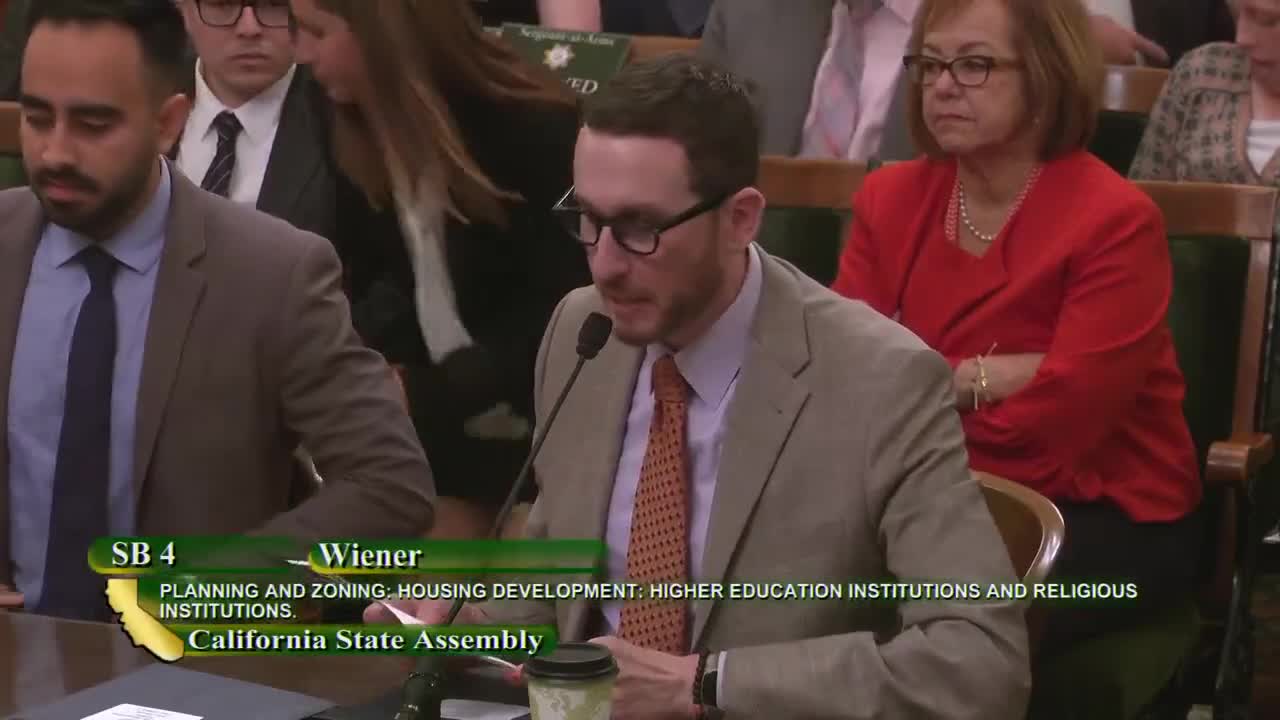 30MIN
Assembly Standing Committee on Housing and Community Development
 3MIN
Senate Floor
 6MIN
Senate Standing Committee on Appropriations
 1H