SB 400: Peace officers: confidentiality of records.
- Session Year: 2023-2024
- House: Senate
- Latest Version Date: 2024-02-29
Current Status:
Passed
(2024-02-29: Chaptered by Secretary of State. Chapter 3, Statutes of 2024.)
Introduced
In Committee
First Chamber
In Committee
Second Chamber
Enacted
Existing law, the California Public Records Act, generally requires public records to be open for inspection by the public. Existing law provides numerous exceptions to this requirement. Under existing law, the personnel records of peace officers and custodial officers are confidential and not subject to public inspection. Existing law provides certain exemptions to this confidentiality, including the reports, investigations, and findings of certain incidents involving the use of force by a peace officer.
This bill would clarify that this confidentiality does not prohibit an agency that formerly employed a peace officer or custodial officer from disclosing the termination for cause of that officer, as specified.
(a)Except as provided in subdivision (b), the personnel records of peace officers and custodial officers and records maintained by a state or local agency pursuant to Section 832.5, or information obtained from these records, are confidential and shall not be disclosed in any criminal or civil proceeding except by discovery pursuant to Sections 1043 and 1046 of the Evidence Code. This section does not apply to investigations or proceedings concerning the conduct of peace officers or custodial officers, or an agency or department that employs those officers, conducted by a grand jury, a district attorneys office, the Attorney Generals office, or the Commission on Peace Officer Standards and Training.
(b)(1)Notwithstanding subdivision (a), Section 7923.600 of the Government Code, or any other law, the following peace officer or custodial officer personnel records and records maintained by a state or local agency shall not be confidential and shall be made available for public inspection pursuant to the California Public Records Act (Division 10 (commencing with Section 7920.000) of Title 1 of the Government Code):
(A)A record relating to the report, investigation, or findings of any of the following:
(i)An incident involving the discharge of a firearm at a person by a peace officer or custodial officer.
(ii)An incident involving the use of force against a person by a peace officer or custodial officer that resulted in death or in great bodily injury.
(iii)A sustained finding involving a complaint that alleges unreasonable or excessive force.
(iv)A sustained finding that an officer failed to intervene against another officer using force that is clearly unreasonable or excessive.
(B)(i)Any record relating to an incident in which a sustained finding was made by any law enforcement agency or oversight agency that a peace officer or custodial officer engaged in sexual assault involving a member of the public.
(ii)As used in this subparagraph, sexual assault means the commission or attempted initiation of a sexual act with a member of the public by means of force, threat, coercion, extortion, offer of leniency or other official favor, or under the color of authority. For purposes of this definition, the propositioning for or commission of any sexual act while on duty is considered a sexual assault.
(iii)As used in this subparagraph, member of the public means any person not employed by the officers employing agency and includes any participant in a cadet, explorer, or other youth program affiliated with the agency.
(C)Any record relating to an incident in which a sustained finding was made by any law enforcement agency or oversight agency involving dishonesty by a peace officer or custodial officer directly relating to the reporting, investigation, or prosecution of a crime, or directly relating to the reporting of, or investigation of misconduct by, another peace officer or custodial officer, including, but not limited to, any false statements, filing false reports, destruction, falsifying, or concealing of evidence, or perjury.
(D)Any record relating to an incident in which a sustained finding was made by any law enforcement agency or oversight agency that a peace officer or custodial officer engaged in conduct including, but not limited to, verbal statements, writings, online posts, recordings, and gestures, involving prejudice or discrimination against a person on the basis of race, religious creed, color, national origin, ancestry, physical disability, mental disability, medical condition, genetic information, marital status, sex, gender, gender identity, gender expression, age, sexual orientation, or military and veteran status.
(E)Any record relating to an incident in which a sustained finding was made by any law enforcement agency or oversight agency that the peace officer made an unlawful arrest or conducted an unlawful search.
(2)Records that are subject to disclosure under clause (iii) or (iv) of subparagraph (A) of paragraph (1), or under subparagraph (D) or (E) of paragraph (1), relating to an incident that occurs before January 1, 2022, shall not be subject to the time limitations in paragraph (11) until January 1, 2023.
(3)Records that shall be released pursuant to this subdivision include all investigative reports; photographic, audio, and video evidence; transcripts or recordings of interviews; autopsy reports; all materials compiled and presented for review to the district attorney or to any person or body charged with determining whether to file criminal charges against an officer in connection with an incident, whether the officers action was consistent with law and agency policy for purposes of discipline or administrative action, or what discipline to impose or corrective action to take; documents setting forth findings or recommended findings; and copies of disciplinary records relating to the incident, including any letters of intent to impose discipline, any documents reflecting modifications of discipline due to the Skelly or grievance process, and letters indicating final imposition of discipline or other documentation reflecting implementation of corrective action. Records that shall be released pursuant to this subdivision also include records relating to an incident specified in paragraph (1) in which the peace officer or custodial officer resigned before the law enforcement agency or oversight agency concluded its investigation into the alleged incident.
(4)A record from a separate and prior investigation or assessment of a separate incident shall not be released unless it is independently subject to disclosure pursuant to this subdivision.
(5)If an investigation or incident involves multiple officers, information about allegations of misconduct by, or the analysis or disposition of an investigation of, an officer shall not be released pursuant to subparagraph (B), (C), (D), or (E) of paragraph (1), unless it relates to a sustained finding regarding that officer that is itself subject to disclosure pursuant to this section. However, factual information about that action of an officer during an incident, or the statements of an officer about an incident, shall be released if they are relevant to a finding against another officer that is subject to release pursuant to subparagraph (B), (C), (D), or (E) of paragraph (1).
(6)An agency shall redact a record disclosed pursuant to this section only for any of the following purposes:
(A)To remove personal data or information, such as a home address, telephone number, or identities of family members, other than the names and work-related information of peace and custodial officers.
(B)To preserve the anonymity of whistleblowers, complainants, victims, and witnesses.
(C)To protect confidential medical, financial, or other information of which disclosure is specifically prohibited by federal law or would cause an unwarranted invasion of personal privacy that clearly outweighs the strong public interest in records about possible misconduct and use of force by peace officers and custodial officers.
(D)Where there is a specific, articulable, and particularized reason to believe that disclosure of the record would pose a significant danger to the physical safety of the peace officer, custodial officer, or another person.
(7)Notwithstanding paragraph (6), an agency may redact a record disclosed pursuant to this section, including personal identifying information, where, on the facts of the particular case, the public interest served by not disclosing the information clearly outweighs the public interest served by disclosure of the information.
(8)An agency may withhold a record of an incident described in paragraph (1) that is the subject of an active criminal or administrative investigation, in accordance with any of the following:
(A)(i)During an active criminal investigation, disclosure may be delayed for up to 60 days from the date the misconduct or use of force occurred or until the district attorney determines whether to file criminal charges related to the misconduct or use of force, whichever occurs sooner. If an agency delays disclosure pursuant to this clause, the agency shall provide, in writing, the specific basis for the agencys determination that the interest in delaying disclosure clearly outweighs the public interest in disclosure. This writing shall include the estimated date for disclosure of the withheld information.
(ii)After 60 days from the misconduct or use of force, the agency may continue to delay the disclosure of records or information if the disclosure could reasonably be expected to interfere with a criminal enforcement proceeding against an officer who engaged in misconduct or used the force. If an agency delays disclosure pursuant to this clause, the agency shall, at 180-day intervals as necessary, provide, in writing, the specific basis for the agencys determination that disclosure could reasonably be expected to interfere with a criminal enforcement proceeding. The writing shall include the estimated date for the disclosure of the withheld information. Information withheld by the agency shall be disclosed when the specific basis for withholding is resolved, when the investigation or proceeding is no longer active, or by no later than 18 months after the date of the incident, whichever occurs sooner.
(iii)After 60 days from the misconduct or use of force, the agency may continue to delay the disclosure of records or information if the disclosure could reasonably be expected to interfere with a criminal enforcement proceeding against someone other than the officer who engaged in the misconduct or used the force. If an agency delays disclosure under this clause, the agency shall, at 180-day intervals, provide, in writing, the specific basis why disclosure could reasonably be expected to interfere with a criminal enforcement proceeding, and shall provide an estimated date for the disclosure of the withheld information. Information withheld by the agency shall be disclosed when the specific basis for withholding is resolved, when the investigation or proceeding is no longer active, or by no later than 18 months after the date of the incident, whichever occurs sooner, unless extraordinary circumstances warrant continued delay due to the ongoing criminal investigation or proceeding. In that case, the agency must show by clear and convincing evidence that the interest in preventing prejudice to the active and ongoing criminal investigation or proceeding outweighs the public interest in prompt disclosure of records about misconduct or use of force by peace officers and custodial officers. The agency shall release all information subject to disclosure that does not cause substantial prejudice, including any documents that have otherwise become available.
(iv)In an action to compel disclosure brought pursuant to Section 7923.000 of the Government Code, an agency may justify delay by filing an application to seal the basis for withholding, in accordance with Rule 2.550 of the California Rules of Court, or any successor rule, if disclosure of the written basis itself would impact a privilege or compromise a pending investigation.
(B)If criminal charges are filed related to the incident in which misconduct occurred or force was used, the agency may delay the disclosure of records or information until a verdict on those charges is returned at trial or, if a plea of guilty or no contest is entered, the time to withdraw the plea pursuant to Section 1018.
(C)During an administrative investigation into an incident described in paragraph (1), the agency may delay the disclosure of records or information until the investigating agency determines whether the misconduct or use of force violated a law or agency policy, but no longer than 180 days after the date of the employing agencys discovery of the misconduct or use of force, or allegation of misconduct or use of force, by a person authorized to initiate an investigation.
(9)A record of a complaint, or the investigations, findings, or dispositions of that complaint, shall not be released pursuant to this section if the complaint is frivolous, as defined in Section 128.5 of the Code of Civil Procedure, or if the complaint is unfounded.
(10)The cost of copies of records subject to disclosure pursuant to this subdivision that are made available upon the payment of fees covering direct costs of duplication pursuant to subdivision (a) of Section 7922.530 of the Government Code shall not include the costs of searching for, editing, or redacting the records.
(11)Except to the extent temporary withholding for a longer period is permitted pursuant to paragraph (8), records subject to disclosure under this subdivision shall be provided at the earliest possible time and no later than 45 days from the date of a request for their disclosure.
(12)(A)For purposes of releasing records pursuant to this subdivision, the lawyer-client privilege does not prohibit the disclosure of either of the following:
(i)Factual information provided by the public entity to its attorney or factual information discovered in any investigation conducted by, or on behalf of, the public entitys attorney.
(ii)Billing records related to the work done by the attorney so long as the records do not relate to active and ongoing litigation and do not disclose information for the purpose of legal consultation between the public entity and its attorney.
(B)This paragraph does not prohibit the public entity from asserting that a record or information within the record is exempted or prohibited from disclosure pursuant to any other federal or state law.
(13)Notwithstanding subdivision (a) or any other law, an agency that formerly employed a peace officer or custodial officer may, without receiving a request for disclosure, disclose to the public the termination for cause of that officer by that agency for any disclosable incident, including those described in subparagraphs (A) to (E), inclusive, of paragraph (1). Any such disclosure shall be at the discretion of the agency and shall not include any information otherwise prohibited from disclosure. This paragraph is declaratory of existing law.
(c)Notwithstanding subdivisions (a) and (b), a department or agency shall release to the complaining party a copy of the complaining partys own statements at the time the complaint is filed.
(d)Notwithstanding subdivisions (a) and (b), a department or agency that employs peace or custodial officers may disseminate data regarding the number, type, or disposition of complaints (sustained, not sustained, exonerated, or unfounded) made against its officers if that information is in a form which does not identify the individuals involved.
(e)Notwithstanding subdivisions (a) and (b), a department or agency that employs peace or custodial officers may release factual information concerning a disciplinary investigation if the officer who is the subject of the disciplinary investigation, or the officers agent or representative, publicly makes a statement they know to be false concerning the investigation or the imposition of disciplinary action. Information may not be disclosed by the peace or custodial officers employer unless the false statement was published by an established medium of communication, such as television, radio, or a newspaper. Disclosure of factual information by the employing agency pursuant to this subdivision is limited to facts contained in the officers personnel file concerning the disciplinary investigation or imposition of disciplinary action that specifically refute the false statements made public by the peace or custodial officer or their agent or representative.
(f)(1)The department or agency shall provide written notification to the complaining party of the disposition of the complaint within 30 days of the disposition.
(2)The notification described in this subdivision is not conclusive or binding or admissible as evidence in any separate or subsequent action or proceeding brought before an arbitrator, court, or judge of this state or the United States.
(g)This section does not affect the discovery or disclosure of information contained in a peace or custodial officers personnel file pursuant to Section 1043 of the Evidence Code.
(h)This section does not supersede or affect the criminal discovery process outlined in Chapter 10 (commencing with Section 1054) of Title 6 of Part 2, or the admissibility of personnel records pursuant to subdivision (a), which codifies the court decision in Pitchess v. Superior Court (1974) 11 Cal.3d 531.
(i)Nothing in this chapter is intended to limit the publics right of access as provided for in Long Beach Police Officers Association v. City of Long Beach (2014) 59 Cal.4th 59.
SECTION 1.Section 832.7 of the Penal Code is amended to read:832.7.(a)Except as provided in subdivision (b), the personnel records of peace officers and custodial officers and records maintained by a state or local agency pursuant to Section 832.5, or information obtained from these records, are confidential and shall not be disclosed in any criminal or civil proceeding except by discovery pursuant to Sections 1043 and 1046 of the Evidence Code. This section does not apply to investigations or proceedings concerning the conduct of peace officers or custodial officers, or an agency or department that employs those officers, conducted by a grand jury, a district attorneys office, or the Attorney Generals office.(b)(1)Notwithstanding subdivision (a), Section 7923.600 of the Government Code, or any other law, the following peace officer or custodial officer personnel records and records maintained by a state or local agency shall not be confidential and shall be made available for public inspection pursuant to the California Public Records Act (Division 10 (commencing with Section 7920.000) of Title 1 of the Government Code):(A)A record relating to the report, investigation, or findings of any of the following:(i)An incident involving the discharge of a firearm at a person by a peace officer or custodial officer.(ii)An incident involving the use of force against a person by a peace officer or custodial officer that resulted in death or in great bodily injury.(iii)A sustained finding involving a complaint that alleges unreasonable or excessive force.(iv)A sustained finding that an officer failed to intervene against another officer using force that is clearly unreasonable or excessive.(B)(i)Any record relating to an incident in which a sustained finding was made by any law enforcement agency or oversight agency that a peace officer or custodial officer engaged in sexual assault involving a member of the public.(ii)As used in this subparagraph, sexual assault means the commission or attempted initiation of a sexual act with a member of the public by means of force, threat, coercion, extortion, offer of leniency or other official favor, or under the color of authority. For purposes of this definition, the propositioning for or commission of any sexual act while on duty is considered a sexual assault.(iii)As used in this subparagraph, member of the public means any person not employed by the officers employing agency and includes any participant in a cadet, explorer, or other youth program affiliated with the agency.(C)Any record relating to an incident in which a sustained finding was made by any law enforcement agency or oversight agency involving dishonesty by a peace officer or custodial officer directly relating to the reporting, investigation, or prosecution of a crime, or directly relating to the reporting of, or investigation of misconduct by, another peace officer or custodial officer, including, but not limited to, any false statements, filing false reports, destruction, falsifying, or concealing of evidence, or perjury.(D)Any record relating to an incident in which a sustained finding was made by any law enforcement agency or oversight agency that a peace officer or custodial officer engaged in conduct including, but not limited to, verbal statements, writings, online posts, recordings, and gestures, involving prejudice or discrimination against a person on the basis of race, religious creed, color, national origin, ancestry, physical disability, mental disability, medical condition, genetic information, marital status, sex, gender, gender identity, gender expression, age, sexual orientation, or military and veteran status.(E)Any record relating to an incident in which a sustained finding was made by any law enforcement agency or oversight agency that the peace officer made an unlawful arrest or conducted an unlawful search.(2)Records that are subject to disclosure under clause (iii) or (iv) of subparagraph (A) of paragraph (1), or under subparagraph (D) or (E) of paragraph (1), relating to an incident that occurs before January 1, 2022, shall not be subject to the time limitations in paragraph (11) until January 1, 2023.(3)Records that shall be released pursuant to this subdivision include all investigative reports; photographic, audio, and video evidence; transcripts or recordings of interviews; autopsy reports; all materials compiled and presented for review to the district attorney or to any person or body charged with determining whether to file criminal charges against an officer in connection with an incident, whether the officers action was consistent with law and agency policy for purposes of discipline or administrative action, or what discipline to impose or corrective action to take; documents setting forth findings or recommended findings; and copies of disciplinary records relating to the incident, including any letters of intent to impose discipline, any documents reflecting modifications of discipline due to the Skelly or grievance process, and letters indicating final imposition of discipline or other documentation reflecting implementation of corrective action. Records that shall be released pursuant to this subdivision also include records relating to an incident specified in paragraph (1) in which the peace officer or custodial officer resigned before the law enforcement agency or oversight agency concluded its investigation into the alleged incident.(4)A record from a separate and prior investigation or assessment of a separate incident shall not be released unless it is independently subject to disclosure pursuant to this subdivision.(5)If an investigation or incident involves multiple officers, information about allegations of misconduct by, or the analysis or disposition of an investigation of, an officer shall not be released pursuant to subparagraph (B), (C), (D), or (E) of paragraph (1), unless it relates to a sustained finding regarding that officer that is itself subject to disclosure pursuant to this section. However, factual information about that action of an officer during an incident, or the statements of an officer about an incident, shall be released if they are relevant to a finding against another officer that is subject to release pursuant to subparagraph (B), (C), (D), or (E) of paragraph (1).(6)An agency shall redact a record disclosed pursuant to this section only for any of the following purposes:(A)To remove personal data or information, such as a home address, telephone number, or identities of family members, other than the names and work-related information of peace and custodial officers.(B)To preserve the anonymity of whistleblowers, complainants, victims, and witnesses.(C)To protect confidential medical, financial, or other information of which disclosure is specifically prohibited by federal law or would cause an unwarranted invasion of personal privacy that clearly outweighs the strong public interest in records about possible misconduct and use of force by peace officers and custodial officers.(D)Where there is a specific, articulable, and particularized reason to believe that disclosure of the record would pose a significant danger to the physical safety of the peace officer, custodial officer, or another person.(7)Notwithstanding paragraph (6), an agency may redact a record disclosed pursuant to this section, including personal identifying information, where, on the facts of the particular case, the public interest served by not disclosing the information clearly outweighs the public interest served by disclosure of the information.(8)An agency may withhold a record of an incident described in paragraph (1) that is the subject of an active criminal or administrative investigation, in accordance with any of the following:(A)(i)During an active criminal investigation, disclosure may be delayed for up to 60 days from the date the misconduct or use of force occurred or until the district attorney determines whether to file criminal charges related to the misconduct or use of force, whichever occurs sooner. If an agency delays disclosure pursuant to this clause, the agency shall provide, in writing, the specific basis for the agencys determination that the interest in delaying disclosure clearly outweighs the public interest in disclosure. This writing shall include the estimated date for disclosure of the withheld information.(ii)After 60 days from the misconduct or use of force, the agency may continue to delay the disclosure of records or information if the disclosure could reasonably be expected to interfere with a criminal enforcement proceeding against an officer who engaged in misconduct or used the force. If an agency delays disclosure pursuant to this clause, the agency shall, at 180-day intervals as necessary, provide, in writing, the specific basis for the agencys determination that disclosure could reasonably be expected to interfere with a criminal enforcement proceeding. The writing shall include the estimated date for the disclosure of the withheld information. Information withheld by the agency shall be disclosed when the specific basis for withholding is resolved, when the investigation or proceeding is no longer active, or by no later than 18 months after the date of the incident, whichever occurs sooner.(iii)After 60 days from the misconduct or use of force, the agency may continue to delay the disclosure of records or information if the disclosure could reasonably be expected to interfere with a criminal enforcement proceeding against someone other than the officer who engaged in the misconduct or used the force. If an agency delays disclosure under this clause, the agency shall, at 180-day intervals, provide, in writing, the specific basis why disclosure could reasonably be expected to interfere with a criminal enforcement proceeding, and shall provide an estimated date for the disclosure of the withheld information. Information withheld by the agency shall be disclosed when the specific basis for withholding is resolved, when the investigation or proceeding is no longer active, or by no later than 18 months after the date of the incident, whichever occurs sooner, unless extraordinary circumstances warrant continued delay due to the ongoing criminal investigation or proceeding. In that case, the agency must show by clear and convincing evidence that the interest in preventing prejudice to the active and ongoing criminal investigation or proceeding outweighs the public interest in prompt disclosure of records about misconduct or use of force by peace officers and custodial officers. The agency shall release all information subject to disclosure that does not cause substantial prejudice, including any documents that have otherwise become available.(iv)In an action to compel disclosure brought pursuant to Section 7923.000 of the Government Code, an agency may justify delay by filing an application to seal the basis for withholding, in accordance with Rule 2.550 of the California Rules of Court, or any successor rule, if disclosure of the written basis itself would impact a privilege or compromise a pending investigation.(B)If criminal charges are filed related to the incident in which misconduct occurred or force was used, the agency may delay the disclosure of records or information until a verdict on those charges is returned at trial or, if a plea of guilty or no contest is entered, the time to withdraw the plea pursuant to Section 1018.(C)During an administrative investigation into an incident described in paragraph (1), the agency may delay the disclosure of records or information until the investigating agency determines whether the misconduct or use of force violated a law or agency policy, but no longer than 180 days after the date of the employing agencys discovery of the misconduct or use of force, or allegation of misconduct or use of force, by a person authorized to initiate an investigation.(9)A record of a complaint, or the investigations, findings, or dispositions of that complaint, shall not be released pursuant to this section if the complaint is frivolous, as defined in Section 128.5 of the Code of Civil Procedure, or if the complaint is unfounded.(10)The cost of copies of records subject to disclosure pursuant to this subdivision that are made available upon the payment of fees covering direct costs of duplication pursuant to Section 7922.530 of the Government Code shall not include the costs of searching for, editing, or redacting the records.(11)Except to the extent temporary withholding for a longer period is permitted pursuant to paragraph (8), records subject to disclosure under this subdivision shall be provided at the earliest possible time and no later than 45 days from the date of a request for their disclosure.(12)(A)For purposes of releasing records pursuant to this subdivision, the lawyer-client privilege does not prohibit the disclosure of either of the following:(i)Factual information provided by the public entity to its attorney or factual information discovered in any investigation conducted by, or on behalf of, the public entitys attorney.(ii)Billing records related to the work done by the attorney so long as the records do not relate to active and ongoing litigation and do not disclose information for the purpose of legal consultation between the public entity and its attorney.(B)This paragraph does not prohibit the public entity from asserting that a record or information within the record is exempted or prohibited from disclosure pursuant to any other federal or state law.(13)Notwithstanding subdivision (a) or any other law, an agency that formerly employed a peace officer or custodial officer may, without receiving a request for disclosure, disclose to the public the termination for cause of that officer by that agency for any disclosable incident, including those described in subparagraphs (A) to (E), inclusive, of paragraph (1). Any such disclosure shall be at the discretion of the agency and shall not include any information otherwise prohibited from disclosure. This paragraph is declaratory of existing law.(c)Notwithstanding subdivisions (a) and (b), a department or agency shall release to the complaining party a copy of the complaining partys own statements at the time the complaint is filed.(d)Notwithstanding subdivisions (a) and (b), a department or agency that employs peace or custodial officers may disseminate data regarding the number, type, or disposition of complaints (sustained, not sustained, exonerated, or unfounded) made against its officers if that information is in a form which does not identify the individuals involved.(e)Notwithstanding subdivisions (a) and (b), a department or agency that employs peace or custodial officers may release factual information concerning a disciplinary investigation if the officer who is the subject of the disciplinary investigation, or the officers agent or representative, publicly makes a statement they know to be false concerning the investigation or the imposition of disciplinary action. Information may not be disclosed by the peace or custodial officers employer unless the false statement was published by an established medium of communication, such as television, radio, or a newspaper. Disclosure of factual information by the employing agency pursuant to this subdivision is limited to facts contained in the officers personnel file concerning the disciplinary investigation or imposition of disciplinary action that specifically refute the false statements made public by the peace or custodial officer or their agent or representative.(f)(1)The department or agency shall provide written notification to the complaining party of the disposition of the complaint within 30 days of the disposition.(2)The notification described in this subdivision is not conclusive or binding or admissible as evidence in any separate or subsequent action or proceeding brought before an arbitrator, court, or judge of this state or the United States.(g)This section does not affect the discovery or disclosure of information contained in a peace or custodial officers personnel file pursuant to Section 1043 of the Evidence Code.(h)This section does not supersede or affect the criminal discovery process outlined in Chapter 10 (commencing with Section 1054) of Title 6 of Part 2, or the admissibility of personnel records pursuant to subdivision (a), which codifies the court decision in Pitchess v. Superior Court (1974) 11 Cal.3d 531.(i)Nothing in this chapter is intended to limit the publics right of access as provided for in Long Beach Police Officers Association v. City of Long Beach (2014) 59 Cal.4th 59.(a)Except as provided in subdivision (b), the personnel records of peace officers and custodial officers and records maintained by a state or local agency pursuant to Section 832.5, or information obtained from these records, are confidential and shall not be disclosed in any criminal or civil proceeding except by discovery pursuant to Sections 1043 and 1046 of the Evidence Code. This section does not apply to investigations or proceedings concerning the conduct of peace officers or custodial officers, or an agency or department that employs those officers, conducted by a grand jury, a district attorneys office, or the Attorney Generals office.
(b)(1)Notwithstanding subdivision (a), Section 7923.600 of the Government Code, or any other law, the following peace officer or custodial officer personnel records and records maintained by a state or local agency shall not be confidential and shall be made available for public inspection pursuant to the California Public Records Act (Division 10 (commencing with Section 7920.000) of Title 1 of the Government Code):
(A)A record relating to the report, investigation, or findings of any of the following:
(i)An incident involving the discharge of a firearm at a person by a peace officer or custodial officer.
(ii)An incident involving the use of force against a person by a peace officer or custodial officer that resulted in death or in great bodily injury.
(iii)A sustained finding involving a complaint that alleges unreasonable or excessive force.
(iv)A sustained finding that an officer failed to intervene against another officer using force that is clearly unreasonable or excessive.
(B)(i)Any record relating to an incident in which a sustained finding was made by any law enforcement agency or oversight agency that a peace officer or custodial officer engaged in sexual assault involving a member of the public.
(ii)As used in this subparagraph, sexual assault means the commission or attempted initiation of a sexual act with a member of the public by means of force, threat, coercion, extortion, offer of leniency or other official favor, or under the color of authority. For purposes of this definition, the propositioning for or commission of any sexual act while on duty is considered a sexual assault.
(iii)As used in this subparagraph, member of the public means any person not employed by the officers employing agency and includes any participant in a cadet, explorer, or other youth program affiliated with the agency.
(C)Any record relating to an incident in which a sustained finding was made by any law enforcement agency or oversight agency involving dishonesty by a peace officer or custodial officer directly relating to the reporting, investigation, or prosecution of a crime, or directly relating to the reporting of, or investigation of misconduct by, another peace officer or custodial officer, including, but not limited to, any false statements, filing false reports, destruction, falsifying, or concealing of evidence, or perjury.
(D)Any record relating to an incident in which a sustained finding was made by any law enforcement agency or oversight agency that a peace officer or custodial officer engaged in conduct including, but not limited to, verbal statements, writings, online posts, recordings, and gestures, involving prejudice or discrimination against a person on the basis of race, religious creed, color, national origin, ancestry, physical disability, mental disability, medical condition, genetic information, marital status, sex, gender, gender identity, gender expression, age, sexual orientation, or military and veteran status.
(E)Any record relating to an incident in which a sustained finding was made by any law enforcement agency or oversight agency that the peace officer made an unlawful arrest or conducted an unlawful search.
(2)Records that are subject to disclosure under clause (iii) or (iv) of subparagraph (A) of paragraph (1), or under subparagraph (D) or (E) of paragraph (1), relating to an incident that occurs before January 1, 2022, shall not be subject to the time limitations in paragraph (11) until January 1, 2023.
(3)Records that shall be released pursuant to this subdivision include all investigative reports; photographic, audio, and video evidence; transcripts or recordings of interviews; autopsy reports; all materials compiled and presented for review to the district attorney or to any person or body charged with determining whether to file criminal charges against an officer in connection with an incident, whether the officers action was consistent with law and agency policy for purposes of discipline or administrative action, or what discipline to impose or corrective action to take; documents setting forth findings or recommended findings; and copies of disciplinary records relating to the incident, including any letters of intent to impose discipline, any documents reflecting modifications of discipline due to the Skelly or grievance process, and letters indicating final imposition of discipline or other documentation reflecting implementation of corrective action. Records that shall be released pursuant to this subdivision also include records relating to an incident specified in paragraph (1) in which the peace officer or custodial officer resigned before the law enforcement agency or oversight agency concluded its investigation into the alleged incident.
(4)A record from a separate and prior investigation or assessment of a separate incident shall not be released unless it is independently subject to disclosure pursuant to this subdivision.
(5)If an investigation or incident involves multiple officers, information about allegations of misconduct by, or the analysis or disposition of an investigation of, an officer shall not be released pursuant to subparagraph (B), (C), (D), or (E) of paragraph (1), unless it relates to a sustained finding regarding that officer that is itself subject to disclosure pursuant to this section. However, factual information about that action of an officer during an incident, or the statements of an officer about an incident, shall be released if they are relevant to a finding against another officer that is subject to release pursuant to subparagraph (B), (C), (D), or (E) of paragraph (1).
(6)An agency shall redact a record disclosed pursuant to this section only for any of the following purposes:
(A)To remove personal data or information, such as a home address, telephone number, or identities of family members, other than the names and work-related information of peace and custodial officers.
(B)To preserve the anonymity of whistleblowers, complainants, victims, and witnesses.
(C)To protect confidential medical, financial, or other information of which disclosure is specifically prohibited by federal law or would cause an unwarranted invasion of personal privacy that clearly outweighs the strong public interest in records about possible misconduct and use of force by peace officers and custodial officers.
(D)Where there is a specific, articulable, and particularized reason to believe that disclosure of the record would pose a significant danger to the physical safety of the peace officer, custodial officer, or another person.
(7)Notwithstanding paragraph (6), an agency may redact a record disclosed pursuant to this section, including personal identifying information, where, on the facts of the particular case, the public interest served by not disclosing the information clearly outweighs the public interest served by disclosure of the information.
(8)An agency may withhold a record of an incident described in paragraph (1) that is the subject of an active criminal or administrative investigation, in accordance with any of the following:
(A)(i)During an active criminal investigation, disclosure may be delayed for up to 60 days from the date the misconduct or use of force occurred or until the district attorney determines whether to file criminal charges related to the misconduct or use of force, whichever occurs sooner. If an agency delays disclosure pursuant to this clause, the agency shall provide, in writing, the specific basis for the agencys determination that the interest in delaying disclosure clearly outweighs the public interest in disclosure. This writing shall include the estimated date for disclosure of the withheld information.
(ii)After 60 days from the misconduct or use of force, the agency may continue to delay the disclosure of records or information if the disclosure could reasonably be expected to interfere with a criminal enforcement proceeding against an officer who engaged in misconduct or used the force. If an agency delays disclosure pursuant to this clause, the agency shall, at 180-day intervals as necessary, provide, in writing, the specific basis for the agencys determination that disclosure could reasonably be expected to interfere with a criminal enforcement proceeding. The writing shall include the estimated date for the disclosure of the withheld information. Information withheld by the agency shall be disclosed when the specific basis for withholding is resolved, when the investigation or proceeding is no longer active, or by no later than 18 months after the date of the incident, whichever occurs sooner.
(iii)After 60 days from the misconduct or use of force, the agency may continue to delay the disclosure of records or information if the disclosure could reasonably be expected to interfere with a criminal enforcement proceeding against someone other than the officer who engaged in the misconduct or used the force. If an agency delays disclosure under this clause, the agency shall, at 180-day intervals, provide, in writing, the specific basis why disclosure could reasonably be expected to interfere with a criminal enforcement proceeding, and shall provide an estimated date for the disclosure of the withheld information. Information withheld by the agency shall be disclosed when the specific basis for withholding is resolved, when the investigation or proceeding is no longer active, or by no later than 18 months after the date of the incident, whichever occurs sooner, unless extraordinary circumstances warrant continued delay due to the ongoing criminal investigation or proceeding. In that case, the agency must show by clear and convincing evidence that the interest in preventing prejudice to the active and ongoing criminal investigation or proceeding outweighs the public interest in prompt disclosure of records about misconduct or use of force by peace officers and custodial officers. The agency shall release all information subject to disclosure that does not cause substantial prejudice, including any documents that have otherwise become available.
(iv)In an action to compel disclosure brought pursuant to Section 7923.000 of the Government Code, an agency may justify delay by filing an application to seal the basis for withholding, in accordance with Rule 2.550 of the California Rules of Court, or any successor rule, if disclosure of the written basis itself would impact a privilege or compromise a pending investigation.
(B)If criminal charges are filed related to the incident in which misconduct occurred or force was used, the agency may delay the disclosure of records or information until a verdict on those charges is returned at trial or, if a plea of guilty or no contest is entered, the time to withdraw the plea pursuant to Section 1018.
(C)During an administrative investigation into an incident described in paragraph (1), the agency may delay the disclosure of records or information until the investigating agency determines whether the misconduct or use of force violated a law or agency policy, but no longer than 180 days after the date of the employing agencys discovery of the misconduct or use of force, or allegation of misconduct or use of force, by a person authorized to initiate an investigation.
(9)A record of a complaint, or the investigations, findings, or dispositions of that complaint, shall not be released pursuant to this section if the complaint is frivolous, as defined in Section 128.5 of the Code of Civil Procedure, or if the complaint is unfounded.
(10)The cost of copies of records subject to disclosure pursuant to this subdivision that are made available upon the payment of fees covering direct costs of duplication pursuant to Section 7922.530 of the Government Code shall not include the costs of searching for, editing, or redacting the records.
(11)Except to the extent temporary withholding for a longer period is permitted pursuant to paragraph (8), records subject to disclosure under this subdivision shall be provided at the earliest possible time and no later than 45 days from the date of a request for their disclosure.
(12)(A)For purposes of releasing records pursuant to this subdivision, the lawyer-client privilege does not prohibit the disclosure of either of the following:
(i)Factual information provided by the public entity to its attorney or factual information discovered in any investigation conducted by, or on behalf of, the public entitys attorney.
(ii)Billing records related to the work done by the attorney so long as the records do not relate to active and ongoing litigation and do not disclose information for the purpose of legal consultation between the public entity and its attorney.
(B)This paragraph does not prohibit the public entity from asserting that a record or information within the record is exempted or prohibited from disclosure pursuant to any other federal or state law.
(13)Notwithstanding subdivision (a) or any other law, an agency that formerly employed a peace officer or custodial officer is not prohibited from disclosing may, without receiving a request for disclosure, disclose to the public the termination for cause of that officer by that agency for any disclosable incident incident, including those described in subparagraphs (A) to (E), inclusive, of paragraph (1). Any such disclosure shall be at the discretion of the agency and shall be limited to the name and rank of the officer, the date of termination, and a general description of the cause for termination. not include any information otherwise prohibited from disclosure. This paragraph is declaratory of existing law.
(c)Notwithstanding subdivisions (a) and (b), a department or agency shall release to the complaining party a copy of the complaining partys own statements at the time the complaint is filed.
(d)Notwithstanding subdivisions (a) and (b), a department or agency that employs peace or custodial officers may disseminate data regarding the number, type, or disposition of complaints (sustained, not sustained, exonerated, or unfounded) made against its officers if that information is in a form which does not identify the individuals involved.
(e)Notwithstanding subdivisions (a) and (b), a department or agency that employs peace or custodial officers may release factual information concerning a disciplinary investigation if the officer who is the subject of the disciplinary investigation, or the officers agent or representative, publicly makes a statement they know to be false concerning the investigation or the imposition of disciplinary action. Information may not be disclosed by the peace or custodial officers employer unless the false statement was published by an established medium of communication, such as television, radio, or a newspaper. Disclosure of factual information by the employing agency pursuant to this subdivision is limited to facts contained in the officers personnel file concerning the disciplinary investigation or imposition of disciplinary action that specifically refute the false statements made public by the peace or custodial officer or their agent or representative.
(f)(1)The department or agency shall provide written notification to the complaining party of the disposition of the complaint within 30 days of the disposition.
(2)The notification described in this subdivision is not conclusive or binding or admissible as evidence in any separate or subsequent action or proceeding brought before an arbitrator, court, or judge of this state or the United States.
(g)This section does not affect the discovery or disclosure of information contained in a peace or custodial officers personnel file pursuant to Section 1043 of the Evidence Code.
(h)This section does not supersede or affect the criminal discovery process outlined in Chapter 10 (commencing with Section 1054) of Title 6 of Part 2, or the admissibility of personnel records pursuant to subdivision (a), which codifies the court decision in Pitchess v. Superior Court (1974) 11 Cal.3d 531.
(i)Nothing in this chapter is intended to limit the publics right of access as provided for in Long Beach Police Officers Association v. City of Long Beach (2014) 59 Cal.4th 59.
(a)Except as provided in subdivision (b), the personnel records of peace officers and custodial officers and records maintained by a state or local agency pursuant to Section 832.5, or information obtained from these records, are confidential and shall not be disclosed in any criminal or civil proceeding except by discovery pursuant to Sections 1043 and 1046 of the Evidence Code. This section does not apply to investigations or proceedings concerning the conduct of peace officers or custodial officers, or an agency or department that employs those officers, conducted by a grand jury, a district attorneys office, or the Attorney Generals office.
(b)(1)Notwithstanding subdivision (a), subdivision (f) of Section 6254 Section 7923.600 of the Government Code, or any other law, the following peace officer or custodial officer personnel records and records maintained by a state or local agency shall not be confidential and shall be made available for public inspection pursuant to the California Public Records Act (Chapter 3.5 (commencing with Section 6250) of Division 7 (Division 10 (commencing with Section 7920.000) of Title 1 of the Government Code):
(A)A record relating to the report, investigation, or findings of any of the following:
(i)An incident involving the discharge of a firearm at a person by a peace officer or custodial officer.
(ii)An incident involving the use of force against a person by a peace officer or custodial officer that resulted in death or in great bodily injury.
(iii)A sustained finding involving a complaint that alleges unreasonable or excessive force.
(iv)A sustained finding that an officer failed to intervene against another officer using force that is clearly unreasonable or excessive.
(B)(i)Any record relating to an incident in which a sustained finding was made by any law enforcement agency or oversight agency that a peace officer or custodial officer engaged in sexual assault involving a member of the public.
(ii)As used in this subparagraph, sexual assault means the commission or attempted initiation of a sexual act with a member of the public by means of force, threat, coercion, extortion, offer of leniency or other official favor, or under the color of authority. For purposes of this definition, the propositioning for or commission of any sexual act while on duty is considered a sexual assault.
(iii)As used in this subparagraph, member of the public means any person not employed by the officers employing agency and includes any participant in a cadet, explorer, or other youth program affiliated with the agency.
(C)Any record relating to an incident in which a sustained finding was made by any law enforcement agency or oversight agency involving dishonesty by a peace officer or custodial officer directly relating to the reporting, investigation, or prosecution of a crime, or directly relating to the reporting of, or investigation of misconduct by, another peace officer or custodial officer, including, but not limited to, any false statements, filing false reports, destruction, falsifying, or concealing of evidence, or perjury.
(D)Any record relating to an incident in which a sustained finding was made by any law enforcement agency or oversight agency that a peace officer or custodial officer engaged in conduct including, but not limited to, verbal statements, writings, online posts, recordings, and gestures, involving prejudice or discrimination against a person on the basis of race, religious creed, color, national origin, ancestry, physical disability, mental disability, medical condition, genetic information, marital status, sex, gender, gender identity, gender expression, age, sexual orientation, or military and veteran status.
(E)Any record relating to an incident in which a sustained finding was made by any law enforcement agency or oversight agency that the peace officer made an unlawful arrest or conducted an unlawful search.
(2)Records that are subject to disclosure under clause (iii) or (iv) of subparagraph (A) of paragraph (1), or under subparagraph (D) or (E) of paragraph (1), relating to an incident that occurs before January 1, 2022, shall not be subject to the time limitations in paragraph (11) until January 1, 2023.
(3)Records that shall be released pursuant to this subdivision include all investigative reports; photographic, audio, and video evidence; transcripts or recordings of interviews; autopsy reports; all materials compiled and presented for review to the district attorney or to any person or body charged with determining whether to file criminal charges against an officer in connection with an incident, whether the officers action was consistent with law and agency policy for purposes of discipline or administrative action, or what discipline to impose or corrective action to take; documents setting forth findings or recommended findings; and copies of disciplinary records relating to the incident, including any letters of intent to impose discipline, any documents reflecting modifications of discipline due to the Skelly or grievance process, and letters indicating final imposition of discipline or other documentation reflecting implementation of corrective action. Records that shall be released pursuant to this subdivision also include records relating to an incident specified in paragraph (1) in which the peace officer or custodial officer resigned before the law enforcement agency or oversight agency concluded its investigation into the alleged incident.
(4)A record from a separate and prior investigation or assessment of a separate incident shall not be released unless it is independently subject to disclosure pursuant to this subdivision.
(5)If an investigation or incident involves multiple officers, information about allegations of misconduct by, or the analysis or disposition of an investigation of, an officer shall not be released pursuant to subparagraph (B), (C), (D), or (E) of paragraph (1), unless it relates to a sustained finding regarding that officer that is itself subject to disclosure pursuant to this section. However, factual information about that action of an officer during an incident, or the statements of an officer about an incident, shall be released if they are relevant to a finding against another officer that is subject to release pursuant to subparagraph (B), (C), (D), or (E) of paragraph (1).
(6)An agency shall redact a record disclosed pursuant to this section only for any of the following purposes:
(A)To remove personal data or information, such as a home address, telephone number, or identities of family members, other than the names and work-related information of peace and custodial officers.
(B)To preserve the anonymity of whistleblowers, complainants, victims, and witnesses.
(C)To protect confidential medical, financial, or other information of which disclosure is specifically prohibited by federal law or would cause an unwarranted invasion of personal privacy that clearly outweighs the strong public interest in records about possible misconduct and use of force by peace officers and custodial officers.
(D)Where there is a specific, articulable, and particularized reason to believe that disclosure of the record would pose a significant danger to the physical safety of the peace officer, custodial officer, or another person.
(7)Notwithstanding paragraph (6), an agency may redact a record disclosed pursuant to this section, including personal identifying information, where, on the facts of the particular case, the public interest served by not disclosing the information clearly outweighs the public interest served by disclosure of the information.
(8)An agency may withhold a record of an incident described in paragraph (1) that is the subject of an active criminal or administrative investigation, in accordance with any of the following:
(A)(i)During an active criminal investigation, disclosure may be delayed for up to 60 days from the date the misconduct or use of force occurred or until the district attorney determines whether to file criminal charges related to the misconduct or use of force, whichever occurs sooner. If an agency delays disclosure pursuant to this clause, the agency shall provide, in writing, the specific basis for the agencys determination that the interest in delaying disclosure clearly outweighs the public interest in disclosure. This writing shall include the estimated date for disclosure of the withheld information.
(ii)After 60 days from the misconduct or use of force, the agency may continue to delay the disclosure of records or information if the disclosure could reasonably be expected to interfere with a criminal enforcement proceeding against an officer who engaged in misconduct or used the force. If an agency delays disclosure pursuant to this clause, the agency shall, at 180-day intervals as necessary, provide, in writing, the specific basis for the agencys determination that disclosure could reasonably be expected to interfere with a criminal enforcement proceeding. The writing shall include the estimated date for the disclosure of the withheld information. Information withheld by the agency shall be disclosed when the specific basis for withholding is resolved, when the investigation or proceeding is no longer active, or by no later than 18 months after the date of the incident, whichever occurs sooner.
(iii)After 60 days from the misconduct or use of force, the agency may continue to delay the disclosure of records or information if the disclosure could reasonably be expected to interfere with a criminal enforcement proceeding against someone other than the officer who engaged in the misconduct or used the force. If an agency delays disclosure under this clause, the agency shall, at 180-day intervals, provide, in writing, the specific basis why disclosure could reasonably be expected to interfere with a criminal enforcement proceeding, and shall provide an estimated date for the disclosure of the withheld information. Information withheld by the agency shall be disclosed when the specific basis for withholding is resolved, when the investigation or proceeding is no longer active, or by no later than 18 months after the date of the incident, whichever occurs sooner, unless extraordinary circumstances warrant continued delay due to the ongoing criminal investigation or proceeding. In that case, the agency must show by clear and convincing evidence that the interest in preventing prejudice to the active and ongoing criminal investigation or proceeding outweighs the public interest in prompt disclosure of records about misconduct or use of force by peace officers and custodial officers. The agency shall release all information subject to disclosure that does not cause substantial prejudice, including any documents that have otherwise become available.
(iv)In an action to compel disclosure brought pursuant to Section 6258 7923.000 of the Government Code, an agency may justify delay by filing an application to seal the basis for withholding, in accordance with Rule 2.550 of the California Rules of Court, or any successor rule, if disclosure of the written basis itself would impact a privilege or compromise a pending investigation.
(B)If criminal charges are filed related to the incident in which misconduct occurred or force was used, the agency may delay the disclosure of records or information until a verdict on those charges is returned at trial or, if a plea of guilty or no contest is entered, the time to withdraw the plea pursuant to Section 1018.
(C)During an administrative investigation into an incident described in paragraph (1), the agency may delay the disclosure of records or information until the investigating agency determines whether the misconduct or use of force violated a law or agency policy, but no longer than 180 days after the date of the employing agencys discovery of the misconduct or use of force, or allegation of misconduct or use of force, by a person authorized to initiate an investigation.
(9)A record of a complaint, or the investigations, findings, or dispositions of that complaint, shall not be released pursuant to this section if the complaint is frivolous, as defined in Section 128.5 of the Code of Civil Procedure, or if the complaint is unfounded.
(10)The cost of copies of records subject to disclosure pursuant to this subdivision that are made available upon the payment of fees covering direct costs of duplication pursuant to subdivision (b) of Section 6253 Section 7922.530 of the Government Code shall not include the costs of searching for, editing, or redacting the records.
(11)Except to the extent temporary withholding for a longer period is permitted pursuant to paragraph (8), records subject to disclosure under this subdivision shall be provided at the earliest possible time and no later than 45 days from the date of a request for their disclosure.
(12)(A)For purposes of releasing records pursuant to this subdivision, the lawyer-client privilege does not prohibit the disclosure of either of the following:
(i)Factual information provided by the public entity to its attorney or factual information discovered in any investigation conducted by, or on behalf of, the public entitys attorney.
(ii)Billing records related to the work done by the attorney so long as the records do not relate to active and ongoing litigation and do not disclose information for the purpose of legal consultation between the public entity and its attorney.
(B)This paragraph does not prohibit the public entity from asserting that a record or information within the record is exempted or prohibited from disclosure pursuant to any other federal or state law.
(13)Notwithstanding subdivision (a) or any other law, an agency that formerly employed a peace officer or custodial officer is not prohibited from disclosing to the public the termination for cause of that officer by that agency for any disclosable incident described in subparagraphs (A) to (E), inclusive, of paragraph (1). Any such disclosure shall be at the discretion of the agency and shall be limited to the name and rank of the officer, the date of termination, and a general description of the cause for termination.
(c)Notwithstanding subdivisions (a) and (b), a department or agency shall release to the complaining party a copy of the complaining partys own statements at the time the complaint is filed.
(d)Notwithstanding subdivisions (a) and (b), a department or agency that employs peace or custodial officers may disseminate data regarding the number, type, or disposition of complaints (sustained, not sustained, exonerated, or unfounded) made against its officers if that information is in a form which does not identify the individuals involved.
(e)Notwithstanding subdivisions (a) and (b), a department or agency that employs peace or custodial officers may release factual information concerning a disciplinary investigation if the officer who is the subject of the disciplinary investigation, or the officers agent or representative, publicly makes a statement they know to be false concerning the investigation or the imposition of disciplinary action. Information may not be disclosed by the peace or custodial officers employer unless the false statement was published by an established medium of communication, such as television, radio, or a newspaper. Disclosure of factual information by the employing agency pursuant to this subdivision is limited to facts contained in the officers personnel file concerning the disciplinary investigation or imposition of disciplinary action that specifically refute the false statements made public by the peace or custodial officer or their agent or representative.
(f)(1)The department or agency shall provide written notification to the complaining party of the disposition of the complaint within 30 days of the disposition.
(2)The notification described in this subdivision is not conclusive or binding or admissible as evidence in any separate or subsequent action or proceeding brought before an arbitrator, court, or judge of this state or the United States.
(g)This section does not affect the discovery or disclosure of information contained in a peace or custodial officers personnel file pursuant to Section 1043 of the Evidence Code.
(h)This section does not supersede or affect the criminal discovery process outlined in Chapter 10 (commencing with Section 1054) of Title 6 of Part 2, or the admissibility of personnel records pursuant to subdivision (a), which codifies the court decision in Pitchess v. Superior Court (1974) 11 Cal.3d 531.
(i)Nothing in this chapter is intended to limit the publics right of access as provided for in Long Beach Police Officers Association v. City of Long Beach (2014) 59 Cal.4th 59.
(a)Except as provided in subdivision (b), the personnel records of peace officers and custodial officers and records maintained by a state or local agency pursuant to Section 832.5, or information obtained from these records, are confidential and shall not be disclosed in any criminal or civil proceeding except by discovery pursuant to Sections 1043 and 1046 of the Evidence Code. This section does not apply to investigations or proceedings concerning the conduct of peace officers or custodial officers, or an agency or department that employs those officers, conducted by a grand jury, a district attorneys office, or the Attorney Generals office.
(b)(1)Notwithstanding subdivision (a), subdivision (f) of Section 6254 of the Government Code, or any other law, the following peace officer or custodial officer personnel records and records maintained by a state or local agency shall not be confidential and shall be made available for public inspection pursuant to the California Public Records Act (Chapter 3.5 (commencing with Section 6250) of Division 7 of Title 1 of the Government Code):
(A)A record relating to the report, investigation, or findings of any of the following:
(i)An incident involving the discharge of a firearm at a person by a peace officer or custodial officer.
(ii)An incident involving the use of force against a person by a peace officer or custodial officer that resulted in death or in great bodily injury.
(iii)A sustained finding involving a complaint that alleges unreasonable or excessive force.
(iv)A sustained finding that an officer failed to intervene against another officer using force that is clearly unreasonable or excessive.
(B)(i)Any record relating to an incident in which a sustained finding was made by any law enforcement agency or oversight agency that a peace officer or custodial officer engaged in sexual assault involving a member of the public.
(ii)As used in this subparagraph, sexual assault means the commission or attempted initiation of a sexual act with a member of the public by means of force, threat, coercion, extortion, offer of leniency or other official favor, or under the color of authority. For purposes of this definition, the propositioning for or commission of any sexual act while on duty is considered a sexual assault.
(iii)As used in this subparagraph, member of the public means any person not employed by the officers employing agency and includes any participant in a cadet, explorer, or other youth program affiliated with the agency.
(C)Any record relating to an incident in which a sustained finding was made by any law enforcement agency or oversight agency involving dishonesty by a peace officer or custodial officer directly relating to the reporting, investigation, or prosecution of a crime, or directly relating to the reporting of, or investigation of misconduct by, another peace officer or custodial officer, including, but not limited to, any false statements, filing false reports, destruction, falsifying, or concealing of evidence, or perjury.
(D)Any record relating to an incident in which a sustained finding was made by any law enforcement agency or oversight agency that a peace officer or custodial officer engaged in conduct including, but not limited to, verbal statements, writings, online posts, recordings, and gestures, involving prejudice or discrimination against a person on the basis of race, religious creed, color, national origin, ancestry, physical disability, mental disability, medical condition, genetic information, marital status, sex, gender, gender identity, gender expression, age, sexual orientation, or military and veteran status.
(E)Any record relating to an incident in which a sustained finding was made by any law enforcement agency or oversight agency that the peace officer made an unlawful arrest or conducted an unlawful search.
(2)Records that are subject to disclosure under clause (iii) or (iv) of subparagraph (A) of paragraph (1), or under subparagraph (D) or (E) of paragraph (1), relating to an incident that occurs before January 1, 2022, shall not be subject to the time limitations in paragraph (11) until January 1, 2023.
(3)Records that shall be released pursuant to this subdivision include all investigative reports; photographic, audio, and video evidence; transcripts or recordings of interviews; autopsy reports; all materials compiled and presented for review to the district attorney or to any person or body charged with determining whether to file criminal charges against an officer in connection with an incident, whether the officers action was consistent with law and agency policy for purposes of discipline or administrative action, or what discipline to impose or corrective action to take; documents setting forth findings or recommended findings; and copies of disciplinary records relating to the incident, including any letters of intent to impose discipline, any documents reflecting modifications of discipline due to the Skelly or grievance process, and letters indicating final imposition of discipline or other documentation reflecting implementation of corrective action. Records that shall be released pursuant to this subdivision also include records relating to an incident specified in paragraph (1) in which the peace officer or custodial officer resigned before the law enforcement agency or oversight agency concluded its investigation into the alleged incident.
(4)A record from a separate and prior investigation or assessment of a separate incident shall not be released unless it is independently subject to disclosure pursuant to this subdivision.
(5)If an investigation or incident involves multiple officers, information about allegations of misconduct by, or the analysis or disposition of an investigation of, an officer shall not be released pursuant to subparagraph (B), (C), (D), or (E) of paragraph (1), unless it relates to a sustained finding regarding that officer that is itself subject to disclosure pursuant to this section. However, factual information about that action of an officer during an incident, or the statements of an officer about an incident, shall be released if they are relevant to a finding against another officer that is subject to release pursuant to subparagraph (B), (C), (D), or (E) of paragraph (1).
(6)An agency shall redact a record disclosed pursuant to this section only for any of the following purposes:
(A)To remove personal data or information, such as a home address, telephone number, or identities of family members, other than the names and work-related information of peace and custodial officers.
(B)To preserve the anonymity of whistleblowers, complainants, victims, and witnesses.
(C)To protect confidential medical, financial, or other information of which disclosure is specifically prohibited by federal law or would cause an unwarranted invasion of personal privacy that clearly outweighs the strong public interest in records about possible misconduct and use of force by peace officers and custodial officers.
(D)Where there is a specific, articulable, and particularized reason to believe that disclosure of the record would pose a significant danger to the physical safety of the peace officer, custodial officer, or another person.
(7)Notwithstanding paragraph (6), an agency may redact a record disclosed pursuant to this section, including personal identifying information, where, on the facts of the particular case, the public interest served by not disclosing the information clearly outweighs the public interest served by disclosure of the information.
(8)An agency may withhold a record of an incident described in paragraph (1) that is the subject of an active criminal or administrative investigation, in accordance with any of the following:
(A)(i)During an active criminal investigation, disclosure may be delayed for up to 60 days from the date the misconduct or use of force occurred or until the district attorney determines whether to file criminal charges related to the misconduct or use of force, whichever occurs sooner. If an agency delays disclosure pursuant to this clause, the agency shall provide, in writing, the specific basis for the agencys determination that the interest in delaying disclosure clearly outweighs the public interest in disclosure. This writing shall include the estimated date for disclosure of the withheld information.
(ii)After 60 days from the misconduct or use of force, the agency may continue to delay the disclosure of records or information if the disclosure could reasonably be expected to interfere with a criminal enforcement proceeding against an officer who engaged in misconduct or used the force. If an agency delays disclosure pursuant to this clause, the agency shall, at 180-day intervals as necessary, provide, in writing, the specific basis for the agencys determination that disclosure could reasonably be expected to interfere with a criminal enforcement proceeding. The writing shall include the estimated date for the disclosure of the withheld information. Information withheld by the agency shall be disclosed when the specific basis for withholding is resolved, when the investigation or proceeding is no longer active, or by no later than 18 months after the date of the incident, whichever occurs sooner.
(iii)After 60 days from the misconduct or use of force, the agency may continue to delay the disclosure of records or information if the disclosure could reasonably be expected to interfere with a criminal enforcement proceeding against someone other than the officer who engaged in the misconduct or used the force. If an agency delays disclosure under this clause, the agency shall, at 180-day intervals, provide, in writing, the specific basis why disclosure could reasonably be expected to interfere with a criminal enforcement proceeding, and shall provide an estimated date for the disclosure of the withheld information. Information withheld by the agency shall be disclosed when the specific basis for withholding is resolved, when the investigation or proceeding is no longer active, or by no later than 18 months after the date of the incident, whichever occurs sooner, unless extraordinary circumstances warrant continued delay due to the ongoing criminal investigation or proceeding. In that case, the agency must show by clear and convincing evidence that the interest in preventing prejudice to the active and ongoing criminal investigation or proceeding outweighs the public interest in prompt disclosure of records about misconduct or use of force by peace officers and custodial officers. The agency shall release all information subject to disclosure that does not cause substantial prejudice, including any documents that have otherwise become available.
(iv)In an action to compel disclosure brought pursuant to Section 6258 of the Government Code, an agency may justify delay by filing an application to seal the basis for withholding, in accordance with Rule 2.550 of the California Rules of Court, or any successor rule, if disclosure of the written basis itself would impact a privilege or compromise a pending investigation.
(B)If criminal charges are filed related to the incident in which misconduct occurred or force was used, the agency may delay the disclosure of records or information until a verdict on those charges is returned at trial or, if a plea of guilty or no contest is entered, the time to withdraw the plea pursuant to Section 1018.
(C)During an administrative investigation into an incident described in paragraph (1), the agency may delay the disclosure of records or information until the investigating agency determines whether the misconduct or use of force violated a law or agency policy, but no longer than 180 days after the date of the employing agencys discovery of the misconduct or use of force, or allegation of misconduct or use of force, by a person authorized to initiate an investigation.
(9)A record of a complaint, or the investigations, findings, or dispositions of that complaint, shall not be released pursuant to this section if the complaint is frivolous, as defined in Section 128.5 of the Code of Civil Procedure, or if the complaint is unfounded.
(10)The cost of copies of records subject to disclosure pursuant to this subdivision that are made available upon the payment of fees covering direct costs of duplication pursuant to subdivision (b) of Section 6253 of the Government Code shall not include the costs of searching for, editing, or redacting the records.
(11)Except to the extent temporary withholding for a longer period is permitted pursuant to paragraph (8), records subject to disclosure under this subdivision shall be provided at the earliest possible time and no later than 45 days from the date of a request for their disclosure.
(12)(A)For purposes of releasing records pursuant to this subdivision, the lawyer-client privilege does not prohibit the disclosure of either of the following:
(i)Factual information provided by the public entity to its attorney or factual information discovered in any investigation conducted by, or on behalf of, the public entitys attorney.
(ii)Billing records related to the work done by the attorney so long as the records do not relate to active and ongoing litigation and do not disclose information for the purpose of legal consultation between the public entity and its attorney.
(B)This paragraph does not prohibit the public entity from asserting that a record or information within the record is exempted or prohibited from disclosure pursuant to any other federal or state law.
(13)Notwithstanding subdivision (a) or any other law, an agency that formerly employed a peace officer or custodial officer is not prohibited from disclosing to the public the termination for cause of that officer by that agency. agency for any disclosable incident described in subparagraphs (A) to (E), inclusive, of paragraph (1). Any such disclosure shall be at the discretion of the agency and shall be limited to the name and rank of the officer, the date of termination, and a general description of the cause for termination.
(c)Notwithstanding subdivisions (a) and (b), a department or agency shall release to the complaining party a copy of the complaining partys own statements at the time the complaint is filed.
(d)Notwithstanding subdivisions (a) and (b), a department or agency that employs peace or custodial officers may disseminate data regarding the number, type, or disposition of complaints (sustained, not sustained, exonerated, or unfounded) made against its officers if that information is in a form which does not identify the individuals involved.
(e)Notwithstanding subdivisions (a) and (b), a department or agency that employs peace or custodial officers may release factual information concerning a disciplinary investigation if the officer who is the subject of the disciplinary investigation, or the officers agent or representative, publicly makes a statement they know to be false concerning the investigation or the imposition of disciplinary action. Information may not be disclosed by the peace or custodial officers employer unless the false statement was published by an established medium of communication, such as television, radio, or a newspaper. Disclosure of factual information by the employing agency pursuant to this subdivision is limited to facts contained in the officers personnel file concerning the disciplinary investigation or imposition of disciplinary action that specifically refute the false statements made public by the peace or custodial officer or their agent or representative.
(f)(1)The department or agency shall provide written notification to the complaining party of the disposition of the complaint within 30 days of the disposition.
(2)The notification described in this subdivision is not conclusive or binding or admissible as evidence in any separate or subsequent action or proceeding brought before an arbitrator, court, or judge of this state or the United States.
(g)This section does not affect the discovery or disclosure of information contained in a peace or custodial officers personnel file pursuant to Section 1043 of the Evidence Code.
(h)This section does not supersede or affect the criminal discovery process outlined in Chapter 10 (commencing with Section 1054) of Title 6 of Part 2, or the admissibility of personnel records pursuant to subdivision (a), which codifies the court decision in Pitchess v. Superior Court (1974) 11 Cal.3d 531.
(i)Nothing in this chapter is intended to limit the publics right of access as provided for in Long Beach Police Officers Association v. City of Long Beach (2014) 59 Cal.4th 59.
(a)Except as provided in subdivision (b), the personnel records of peace officers and custodial officers and records maintained by a state or local agency pursuant to Section 832.5, or information obtained from these records, are confidential and shall not be disclosed in any criminal or civil proceeding except by discovery pursuant to Sections 1043 and 1046 of the Evidence Code. This section does not apply to investigations or proceedings concerning the conduct of peace officers or custodial officers, or an agency or department that employs those officers, conducted by a grand jury, a district attorneys office, or the Attorney Generals office.
(b)(1)Notwithstanding subdivision (a), subdivision (f) of Section 6254 of the Government Code, or any other law, the following peace officer or custodial officer personnel records and records maintained by a state or local agency shall not be confidential and shall be made available for public inspection pursuant to the California Public Records Act (Chapter 3.5 (commencing with Section 6250) of Division 7 of Title 1 of the Government Code):
(A)A record relating to the report, investigation, or findings of any of the following:
(i)An incident involving the discharge of a firearm at a person by a peace officer or custodial officer.
(ii)An incident involving the use of force against a person by a peace officer or custodial officer that resulted in death or in great bodily injury.
(iii)A sustained finding involving a complaint that alleges unreasonable or excessive force.
(iv)A sustained finding that an officer failed to intervene against another officer using force that is clearly unreasonable or excessive.
(B)(i)Any record relating to an incident in which a sustained finding was made by any law enforcement agency or oversight agency that a peace officer or custodial officer engaged in sexual assault involving a member of the public.
(ii)As used in this subparagraph, sexual assault means the commission or attempted initiation of a sexual act with a member of the public by means of force, threat, coercion, extortion, offer of leniency or other official favor, or under the color of authority. For purposes of this definition, the propositioning for or commission of any sexual act while on duty is considered a sexual assault.
(iii)As used in this subparagraph, member of the public means any person not employed by the officers employing agency and includes any participant in a cadet, explorer, or other youth program affiliated with the agency.
(C)Any record relating to an incident in which a sustained finding was made by any law enforcement agency or oversight agency involving dishonesty by a peace officer or custodial officer directly relating to the reporting, investigation, or prosecution of a crime, or directly relating to the reporting of, or investigation of misconduct by, another peace officer or custodial officer, including, but not limited to, any false statements, filing false reports, destruction, falsifying, or concealing of evidence, or perjury.
(D)Any record relating to an incident in which a sustained finding was made by any law enforcement agency or oversight agency that a peace officer or custodial officer engaged in conduct including, but not limited to, verbal statements, writings, online posts, recordings, and gestures, involving prejudice or discrimination against a person on the basis of race, religious creed, color, national origin, ancestry, physical disability, mental disability, medical condition, genetic information, marital status, sex, gender, gender identity, gender expression, age, sexual orientation, or military and veteran status.
(E)Any record relating to an incident in which a sustained finding was made by any law enforcement agency or oversight agency that the peace officer made an unlawful arrest or conducted an unlawful search.
(2)Records that are subject to disclosure under clause (iii) or (iv) of subparagraph (A) of paragraph (1), or under subparagraph (D) or (E) of paragraph (1), relating to an incident that occurs before January 1, 2022, shall not be subject to the time limitations in paragraph (11) until January 1, 2023.
(3)Records that shall be released pursuant to this subdivision include all investigative reports; photographic, audio, and video evidence; transcripts or recordings of interviews; autopsy reports; all materials compiled and presented for review to the district attorney or to any person or body charged with determining whether to file criminal charges against an officer in connection with an incident, whether the officers action was consistent with law and agency policy for purposes of discipline or administrative action, or what discipline to impose or corrective action to take; documents setting forth findings or recommended findings; and copies of disciplinary records relating to the incident, including any letters of intent to impose discipline, any documents reflecting modifications of discipline due to the Skelly or grievance process, and letters indicating final imposition of discipline or other documentation reflecting implementation of corrective action. Records that shall be released pursuant to this subdivision also include records relating to an incident specified in paragraph (1) in which the peace officer or custodial officer resigned before the law enforcement agency or oversight agency concluded its investigation into the alleged incident.
(4)A record from a separate and prior investigation or assessment of a separate incident shall not be released unless it is independently subject to disclosure pursuant to this subdivision.
(5)If an investigation or incident involves multiple officers, information about allegations of misconduct by, or the analysis or disposition of an investigation of, an officer shall not be released pursuant to subparagraph (B), (C), (D), or (E) of paragraph (1), unless it relates to a sustained finding regarding that officer that is itself subject to disclosure pursuant to this section. However, factual information about that action of an officer during an incident, or the statements of an officer about an incident, shall be released if they are relevant to a finding against another officer that is subject to release pursuant to subparagraph (B), (C), (D), or (E) of paragraph (1).
(6)An agency shall redact a record disclosed pursuant to this section only for any of the following purposes:
(A)To remove personal data or information, such as a home address, telephone number, or identities of family members, other than the names and work-related information of peace and custodial officers.
(B)To preserve the anonymity of whistleblowers, complainants, victims, and witnesses.
(C)To protect confidential medical, financial, or other information of which disclosure is specifically prohibited by federal law or would cause an unwarranted invasion of personal privacy that clearly outweighs the strong public interest in records about possible misconduct and use of force by peace officers and custodial officers.
(D)Where there is a specific, articulable, and particularized reason to believe that disclosure of the record would pose a significant danger to the physical safety of the peace officer, custodial officer, or another person.
(7)Notwithstanding paragraph (6), an agency may redact a record disclosed pursuant to this section, including personal identifying information, where, on the facts of the particular case, the public interest served by not disclosing the information clearly outweighs the public interest served by disclosure of the information.
(8)An agency may withhold a record of an incident described in paragraph (1) that is the subject of an active criminal or administrative investigation, in accordance with any of the following:
(A)(i)During an active criminal investigation, disclosure may be delayed for up to 60 days from the date the misconduct or use of force occurred or until the district attorney determines whether to file criminal charges related to the misconduct or use of force, whichever occurs sooner. If an agency delays disclosure pursuant to this clause, the agency shall provide, in writing, the specific basis for the agencys determination that the interest in delaying disclosure clearly outweighs the public interest in disclosure. This writing shall include the estimated date for disclosure of the withheld information.
(ii)After 60 days from the misconduct or use of force, the agency may continue to delay the disclosure of records or information if the disclosure could reasonably be expected to interfere with a criminal enforcement proceeding against an officer who engaged in misconduct or used the force. If an agency delays disclosure pursuant to this clause, the agency shall, at 180-day intervals as necessary, provide, in writing, the specific basis for the agencys determination that disclosure could reasonably be expected to interfere with a criminal enforcement proceeding. The writing shall include the estimated date for the disclosure of the withheld information. Information withheld by the agency shall be disclosed when the specific basis for withholding is resolved, when the investigation or proceeding is no longer active, or by no later than 18 months after the date of the incident, whichever occurs sooner.
(iii)After 60 days from the misconduct or use of force, the agency may continue to delay the disclosure of records or information if the disclosure could reasonably be expected to interfere with a criminal enforcement proceeding against someone other than the officer who engaged in the misconduct or used the force. If an agency delays disclosure under this clause, the agency shall, at 180-day intervals, provide, in writing, the specific basis why disclosure could reasonably be expected to interfere with a criminal enforcement proceeding, and shall provide an estimated date for the disclosure of the withheld information. Information withheld by the agency shall be disclosed when the specific basis for withholding is resolved, when the investigation or proceeding is no longer active, or by no later than 18 months after the date of the incident, whichever occurs sooner, unless extraordinary circumstances warrant continued delay due to the ongoing criminal investigation or proceeding. In that case, the agency must show by clear and convincing evidence that the interest in preventing prejudice to the active and ongoing criminal investigation or proceeding outweighs the public interest in prompt disclosure of records about misconduct or use of force by peace officers and custodial officers. The agency shall release all information subject to disclosure that does not cause substantial prejudice, including any documents that have otherwise become available.
(iv)In an action to compel disclosure brought pursuant to Section 6258 of the Government Code, an agency may justify delay by filing an application to seal the basis for withholding, in accordance with Rule 2.550 of the California Rules of Court, or any successor rule, if disclosure of the written basis itself would impact a privilege or compromise a pending investigation.
(B)If criminal charges are filed related to the incident in which misconduct occurred or force was used, the agency may delay the disclosure of records or information until a verdict on those charges is returned at trial or, if a plea of guilty or no contest is entered, the time to withdraw the plea pursuant to Section 1018.
(C)During an administrative investigation into an incident described in paragraph (1), the agency may delay the disclosure of records or information until the investigating agency determines whether the misconduct or use of force violated a law or agency policy, but no longer than 180 days after the date of the employing agencys discovery of the misconduct or use of force, or allegation of misconduct or use of force, by a person authorized to initiate an investigation.
(9)A record of a complaint, or the investigations, findings, or dispositions of that complaint, shall not be released pursuant to this section if the complaint is frivolous, as defined in Section 128.5 of the Code of Civil Procedure, or if the complaint is unfounded.
(10)The cost of copies of records subject to disclosure pursuant to this subdivision that are made available upon the payment of fees covering direct costs of duplication pursuant to subdivision (b) of Section 6253 of the Government Code shall not include the costs of searching for, editing, or redacting the records.
(11)Except to the extent temporary withholding for a longer period is permitted pursuant to paragraph (8), records subject to disclosure under this subdivision shall be provided at the earliest possible time and no later than 45 days from the date of a request for their disclosure.
(12)(A)For purposes of releasing records pursuant to this subdivision, the lawyer-client privilege does not prohibit the disclosure of either of the following:
(i)Factual information provided by the public entity to its attorney or factual information discovered in any investigation conducted by, or on behalf of, the public entitys attorney.
(ii)Billing records related to the work done by the attorney so long as the records do not relate to active and ongoing litigation and do not disclose information for the purpose of legal consultation between the public entity and its attorney.
(B)This paragraph does not prohibit the public entity from asserting that a record or information within the record is exempted or prohibited from disclosure pursuant to any other federal or state law.
(13)Notwithstanding subdivision (a) or any other law, an agency that formerly employed a peace officer or custodial officer is not prohibited from disclosing to the public the termination for cause of that officer by that agency. Any such disclosure shall be limited to the name and rank of the officer, the date of termination, and a general description of the cause for termination.
(c)Notwithstanding subdivisions (a) and (b), a department or agency shall release to the complaining party a copy of the complaining partys own statements at the time the complaint is filed.
(d)Notwithstanding subdivisions (a) and (b), a department or agency that employs peace or custodial officers may disseminate data regarding the number, type, or disposition of complaints (sustained, not sustained, exonerated, or unfounded) made against its officers if that information is in a form which does not identify the individuals involved.
(e)Notwithstanding subdivisions (a) and (b), a department or agency that employs peace or custodial officers may release factual information concerning a disciplinary investigation if the officer who is the subject of the disciplinary investigation, or the officers agent or representative, publicly makes a statement they know to be false concerning the investigation or the imposition of disciplinary action. Information may not be disclosed by the peace or custodial officers employer unless the false statement was published by an established medium of communication, such as television, radio, or a newspaper. Disclosure of factual information by the employing agency pursuant to this subdivision is limited to facts contained in the officers personnel file concerning the disciplinary investigation or imposition of disciplinary action that specifically refute the false statements made public by the peace or custodial officer or their agent or representative.
(f)(1)The department or agency shall provide written notification to the complaining party of the disposition of the complaint within 30 days of the disposition.
(2)The notification described in this subdivision is not conclusive or binding or admissible as evidence in any separate or subsequent action or proceeding brought before an arbitrator, court, or judge of this state or the United States.
(g)This section does not affect the discovery or disclosure of information contained in a peace or custodial officers personnel file pursuant to Section 1043 of the Evidence Code.
(h)This section does not supersede or affect the criminal discovery process outlined in Chapter 10 (commencing with Section 1054) of Title 6 of Part 2, or the admissibility of personnel records pursuant to subdivision (a), which codifies the court decision in Pitchess v. Superior Court (1974) 11 Cal.3d 531.
(i)Nothing in this chapter is intended to limit the publics right of access as provided for in Long Beach Police Officers Association v. City of Long Beach (2014) 59 Cal.4th 59.
|
Date
|
Status
|
|---|---|
| Feb 29, 2024 | Chaptered by Secretary of State. Chapter 3, Statutes of 2024. |
| Feb 29, 2024 | Approved by the Governor. |
| Feb 27, 2024 | Enrolled and presented to the Governor at 11 a.m. |
| Feb 22, 2024 | Assembly amendments concurred in. (Ayes 39. Noes 0. Page 3200.) Ordered to engrossing and enrolling. |
| Feb 8, 2024 | In Senate. Concurrence in Assembly amendments pending. |
| Feb 8, 2024 | Read third time. Passed. (Ayes 67. Noes 0. Page 4039.) Ordered to the Senate. |
| Jan 25, 2024 | Ordered to third reading. |
| Jan 25, 2024 | Read third time and amended. |
| Jan 16, 2024 | Ordered to third reading. |
| Jan 16, 2024 | From inactive file. |
| Jan 12, 2024 | Notice of intention to remove from inactive file given by Assembly Member Ortega. |
| Sep 13, 2023 | Ordered to inactive file on request of Assembly Member Bryan. |
| Sep 13, 2023 | Action rescinded whereby bill was read third time, passed, and ordered to Senate. |
| Sep 11, 2023 | In Assembly. Held at Desk. |
| Sep 11, 2023 | Ordered to the Assembly. |
| Sep 11, 2023 | Action rescinded whereby Assembly amendments were concurred in, and the bill ordered to engrossing and enrolling. |
| Sep 11, 2023 | Withdrawn from engrossing and enrolling. |
| Sep 7, 2023 | Assembly amendments concurred in. (Ayes 40. Noes 0. Page 2469.) Ordered to engrossing and enrolling. |
| Sep 6, 2023 | In Senate. Concurrence in Assembly amendments pending. |
| Sep 6, 2023 | Read third time. Passed. (Ayes 72. Noes 0. Page 2955.) Ordered to the Senate. |
| Jun 15, 2023 | Read second time. Ordered to third reading. |
| Jun 14, 2023 | Read second time and amended. Ordered to second reading. |
| Jun 13, 2023 | From committee: Do pass as amended. (Ayes 7. Noes 0.) (June 13). |
| Jun 6, 2023 | From committee with author's amendments. Read second time and amended. Re-referred to Com. on PUB. S. |
| May 26, 2023 | Referred to Com. on PUB. S. |
| May 15, 2023 | In Assembly. Read first time. Held at Desk. |
| May 15, 2023 | Read third time. Passed. (Ayes 33. Noes 0. Page 1080.) Ordered to the Assembly. |
| May 11, 2023 | Ordered to third reading. |
| May 11, 2023 | From special consent calendar. |
| May 9, 2023 | Ordered to special consent calendar. |
| Apr 12, 2023 | Read second time and amended. Ordered to third reading. |
| Apr 11, 2023 | From committee: Do pass as amended. (Ayes 4. Noes 0. Page 659.) (April 11). |
| Mar 13, 2023 | Set for hearing April 11. |
| Feb 22, 2023 | Referred to Com. on PUB S. |
| Feb 10, 2023 | From printer. May be acted upon on or after March 12. |
| Feb 9, 2023 | Introduced. Read first time. To Com. on RLS. for assignment. To print. |
|
Date
|
Description
|
Location
|
Votes
|
|
|---|---|---|---|---|
| Feb 22, 2024 | Unfinished Business SB400 Wahab Concurrence | Senate Floor |
Passed |
|
| Feb 8, 2024 | SB 400 Wahab Senate Third Reading By Ortega | Assembly Floor |
Passed |
|
| Sep 7, 2023 | Unfinished Business SB400 Wahab Concurrence | Senate Floor |
Passed |
|
| Sep 6, 2023 | SB 400 Wahab Senate Third Reading By Ortega | Assembly Floor |
Passed |
|
| Jun 13, 2023 | Do pass as amended. | Assembly Standing Committee on Public Safety |
Passed |
|
| May 15, 2023 | Senate 3rd Reading SB400 Wahab | Senate Floor |
Passed |
|
| Apr 11, 2023 | Do pass as amended | Senate Standing Committee on Public Safety |
Passed |
This list shows positions taken on this bill by organizations on the date displayed, which is linked to the original source.
Positions by individuals are not included.
|
Organization
|
Position
|
Date
|
|---|---|---|
| Arcadia Police Officers' Association | ** Against | |
| Association For Los Angeles Deputy Sheriffs | ** Against | |
| Association Of Orange County Deputy Sheriffs | ** Against | |
| Burbank Police Officers' Association | ** Against | |
| California Association Of Highway Patrolmen | ** Against | |
| California Attorneys For Criminal Justice | ** Support | |
| California Coalition of School Safety Professionals | ** Against | |
| California Faculty Association | ** Support | |
| California Fraternal Order of Police | ** Against | |
| California Public Defenders Association | ** Support | |
| California Statewide Law Enforcement Association | ** Against | |
| City of San Jose | ** Support | |
| City of San Jose; San Jose Police Department | ** Support | |
| CLAREMONT POLICE OFFICERS ASSOCIATION | ** Against | |
| Corona Police Officers Association | ** Against | |
| Council on American Islamic Relations | ** Support | |
| Culver City Police Officers' Association | ** Against | |
| Deputy Sheriffs Association of Monterey County | ** Against | |
| Fullerton Police Officers' Association | ** Against | |
| Long Beach Police Officers Association | ** Against | |
| Los Angeles County District AttorneyS Office | ** Support | |
| Los Angeles County Professional Peace Officers Association | ** Against | |
| los angeles school police officers association | ** Against | |
| Murrieta Police Officers' Association | ** Against | |
| National Association Of Social Workers, California Chapter | ** Support | |
| National Police Accountability Project | ** Support | |
| Newport Beach Police Association | ** Against | |
| Oakland Privacy | ** Support | |
| Palos Verdes Police Officers Association | ** Against | |
| Peace Officers Research Association Of California | ** Against | |
| PLACER COUNTY DEPUTY SHERIFFS ASSOCIATION | ** Against | |
| Pomona Police Officers' Association | ** Against | |
| Prosecutors Alliance California | ** Support | |
| RIVERSIDE POLICE OFFICERS ASSOCIATION | ** Against | |
| Riverside Sheriffs' Association | ** Against | |
| Sacramento County Deputy Sheriffs' Association | ** Against | |
| san bernardino county sheriff's employees' benefit association | ** Against | |
| San Francisco Public Defender | ** Support | |
| San Jose Police Department | ** Support | |
| Santa Ana Police Officers Association | ** Against | |
| Smart Justice California | ** Support | |
| Upland Police Officers Association | ** Against |
SENATE RULES COMMITTEE Office of Senate Floor Analyses (916) 651-1520 Fax: (916) 327-4478 | SB 400 |
UNFINISHED BUSINESS
Bill No: SB 400
Author: Wahab (D)
Amended: 1/25/24
Vote: 21
SENATE PUBLIC SAFETY COMMITTEE: 4-0, 4/11/23
AYES: Wahab, Bradford, Skinner, Wiener
NO VOTE RECORDED: Ochoa Bogh
SENATE FLOOR: 33-0, 5/15/23
AYES: Allen, Archuleta, Ashby, Atkins, Becker, Blakespear, Bradford, Caballero, Cortese, Dahle, Dodd, Durazo, Eggman, Glazer, Gonzalez, Grove, Jones, Laird, Limón, McGuire, Menjivar, Nguyen, Niello, Ochoa Bogh, Padilla, Portantino, Seyarto, Skinner, Stern, Umberg, Wahab, Wiener, Wilk
NO VOTE RECORDED: Alvarado-Gil, Hurtado, Min, Newman, Roth, Rubio, Smallwood-Cuevas
ASSEMBLY FLOOR: 67-0, 2/8/24 - See last page for vote
SUBJECT: Peace officers: confidentiality of records
SOURCE: City of San Jose
San Jose Police Department
DIGEST:
This bill clarifies that law enforcement agencies that formerly employed a peace officer are not prohibited from disclosing the termination for cause of that officer, as specified.
Assembly Amendments
recast the language authorizing the disclosure and state that the bill’s provisions are declaratory of existing law.
ANALYSIS:
Existing law:
- Declares the people’s right to transparency in government. (“The people have the right of access to information concerning the conduct of the people’s business, and therefore, the meetings of public bodies and the writings of public officials and agencies shall be open to public scrutiny....”). (Cal. Const., art. I, Sec. 3)
- Provides, pursuant to the California Public Records Act (CPRA), that access to information concerning the conduct of the people’s business is a fundamental and necessary right of every person in this state. (Gov. Code § 7920.000 et. seq.)
- Provides that public records are open to inspection at all times during the office hours of the state or local agency and every person has a right to inspect any public record, except as provided. (Gov. Code § 7922.525)
- Exempts from the CPRA the disclosure of investigations conducted by the Office of the Attorney General and the Department of Justice, the Office of Emergency Services and any state or local police agency, or any investigatory or security files compiled by any other state or local police agency, or any investigatory or security files compiled by any other state or local agency for correctional, law enforcement, or licensing purposes. (Gov. Code §7923.600)
- Authorizes criminal defendants to file a motion requesting to inspect a law enforcement officer’s personnel file for evidence of police misconduct, also known as a “Pitchess motion.” (Pitchess v. Superior Court (1974), 11 Cal. 3d 531; Evid. Code §§1043, 1045, 1046)
- Requires law enforcement agencies to establish a procedure to investigate complaints by members of the public against personnel of those agencies and make a written description of the procedure available to the public. (Pen. Code §832.5(a))
- Specifies circumstances under which a peace officer shall have their certification revoke, and when a peace officer may have their certification suspended or revoked based on termination for cause or serious misconduct. (Pen. Code § 13510.9)
- Requires any agencies employing peace officers to report to the Commission on Peace Officers Standards and Training within 10 days, in a form specified by the Commission, the employment, appointment, or termination or separation from employment or appointment, by that agency, of any peace officer. Separation from employment or appointment includes any involuntary termination, resignation, or retirement. (Pen. Code § 13510.9(a)(1))
- Sets forth a series of procedural protections for California peace officers facing punitive action, known as the Peace Officers’ Procedural Bill of Rights (POBOR). (Gov. Code §3300-3313)
- Defines “personnel records” as any file maintained under that individual’s name by his or her employing agency and containing records relating to personal data, employee advancement, appraisal or discipline, complaints or investigations of complaints concerning specified events, and other specified topics. (Pen. Code §832.8(a))
- Defines “sustained” as a final determination by an investigating agency, commission, board, hearing officer, or arbitrator, as applicable, following an investigation and opportunity for an administrative appeal pursuant to specified provisions of the POBOR, that the actions of the peace officer or custodial officer were found to violate law or department policy. (Pen. Code §832.8(b))
- States that except as specified, peace officer or custodial officer personnel records and records maintained by any state or local agency pursuant to citizens' complaints against personnel are confidential and shall not be disclosed in any criminal or civil proceeding except by discovery. This section does not apply to investigations or proceedings concerning the conduct of peace officers or custodial officers, or any agency or department that employ these officers, conducted by a grand jury, a district attorney's office, or the Office of the Attorney General. (Pen. Code, § 832.7(a))
- Provides that the following peace officer or custodial records maintained by their agencies shall not be confidential and shall be made available for public inspection pursuant to the CPRA:
- A record relating to the report, investigation, or findings of any of the following:
- An incident involving the discharge of a firearm at a person by a peace officer or custodial officer;
- An incident in which the use of force by a peace officer or custodial officer against a person resulted in death, or in great bodily injury;
- A sustained finding involving a complaint that alleges unreasonable or excessive force; or
- A sustained finding that an officer failed to intervene against another officer using force that is clearly unreasonable or excessive.
- Any record relating to an incident in which a sustained finding was made by any law enforcement agency or oversight agency that a peace officer or custodial officer engaged in sexual assault involving a member of the public;
- Any record relating to an incident in which a sustained finding was made by any law enforcement agency involving dishonesty by a peace officer or custodial officer directly relating to the reporting, investigation, or prosecution of a crime, or directly relating to the reporting of, or investigation of misconduct by, another peace officer or custodial officer, as specified;
- Any record relating to an incident in which a sustained finding was made by any law enforcement agency or oversight agency that a peace officer or custodial officer engaged in conduct including, but not limited to, verbal statements, writings, online posts, recordings, and gestures, involving prejudice or discrimination against a person on the basis of a specified protected class; and
- Any record relating to an incident in which a sustained finding was made by any law enforcement agency or oversight agency that the peace officer made an unlawful arrest or conducted an unlawful search. (Pen. Code, § 832.7(b)(1)(A)-(E))
- A record relating to the report, investigation, or findings of any of the following:
This bill:
- Provides that notwithstanding any other law, an agency that formerly employed a peace officer or custodial officer may, without receiving a request for disclosure, disclose to the public the termination for cause of that officer by that agency for any disclosable incident, as specified.
- Provides that any such disclosure shall be at the discretion of the agency and shall not include any information otherwise prohibited from disclosure.
- Provides that these provisions are declaratory of existing law.
Comments
Need for this bill. According to the author, “SB 400 is about building more public trust and transparency, and improving police-community relations and accountability. While there are increased public records disclosures for misconduct upon request, termination disclosure remains a specific area that has not been addressed through legislation. The passage of SB 400 will improve police accountability and rebuild trust between law enforcement agencies and the communities they serve.”
Recent Legislation Requiring Increased Transparency Regarding Police Records. In 2018, the Legislature passed SB 1421 (Skinner, Chapter 988, Statutes of 2018), which represented a paradigm shift in the public’s ability to access previously confidential peace officer personnel records. SB 1421 removed Pitchess protection from records pertaining to officer-involved shootings, uses of force resulting in death or great bodily injury, and sustained findings of sexual assault or dishonesty. SB 1421 led to a surge in CPRA requests submitted to law enforcement agencies across the state, posing a logistical challenge of unprecedented proportions. Not only is universe of responsive records massive, but determining whether a particular record is responsive can be a lengthy process. Moreover, SB 1421 required agencies to redact specified personal information, information the release of which “would cause an unwarranted invasion of personal privacy that clearly outweighs the strong public interest in records about possible misconduct,” and information that, if unredacted, would pose a significant danger to the physical safety of the peace officer or another person.
In 2021, the Legislature passed SB 16 (Skinner, Chapter 402, Statutes of 2021), building upon the transparency provisions enacted by SB 1421, and responding to widespread criticism that law enforcement agencies were flouting the law via litigation and other tactics to delay the release of records. SB 16 exempted four additional categories of peace officer records from the confidentiality requirement in Penal Code Section 832.7, including those pertaining to sustained findings of unreasonable or excessive use of force, sustained findings that an officer failed to intervene in another officer’s unreasonable or excessive use of force, sustained findings that an officer engaged in prejudice or discrimination on the basis of a protected characteristic, and sustained findings that an officer made an unlawful arrest or conducted an unlawful search.
The process for a peace officer to be terminated in California can be complex and varies depending on specific circumstances as well as the jurisdiction or agency in question. However, all peace officers in California enjoy a number of unique procedural protections when being investigated by their employing agency, known as the POBOR. Those protections include notice of an interrogation, specific rules on the timing of interrogations, the right to be represented during the interrogation, the right invoke the privilege against self-incrimination and be granted immunity for the responses to potentially incriminating statements, among others. Under existing law, before an agency can take punitive action against a peace officer, POBOR requires an administrative hearing, commonly referred to as a “Skelly hearing.” At a Skelly hearing, peace officers are entitled to the following: (1) notice of the intended disciplinary action; (2) a copy of all materials upon which the action is based; and (3) an opportunity to respond orally or in writing to an impartial reviewer prior to the effective date of the disciplinary action. Once the Skelly hearing and related proceedings have been completed, an agency may take punitive action against an officer, including termination.
This bill provides that, notwithstanding the confidentiality of peace officer records generally, an agency that formerly employed a peace officer may disclose the termination for cause of that officer by that agency, as long as the disclosure does not include any information otherwise prohibited from disclosure.
This bill only applies to terminations for cause for incidents that fall under one of the eight categories of disclosable peace officer records set forth in SB 1421 and SB 16: incidents involving the discharge of a firearm at a person or use of force against a person resulting in death or great bodily injury, and sustained findings involving excessive or unreasonable force, failure to intervene in another officer’s excessive or unreasonable force, sexual assault, dishonesty, discrimination based on protected class, or an unlawful arrest or search. Thus, whereas under current law it is unclear that disclosable information related to a termination for cause can be made public without the trigger of CPRA request, this bill allows for the affirmative disclosure of limited information related to a termination for cause based on specific conduct or sustained findings of specific conduct.
FISCAL EFFECT: Appropriation: No Fiscal Com.: No Local: No
SUPPORT: (Verified 2/8/24)
City of San Jose (co-source)
San Jose Police Department (co-source)
California Attorneys for Criminal Justice
California Faculty Association
California Public Defenders Association
Council on American Islamic Relations
Los Angeles County District Attorney’s Office
National Association of Social Workers, California Chapter
National Police Accountability Project
Oakland Privacy
Prosecutors Alliance California
San Francisco Public Defender
Smart Justice California
OPPOSITION: (Verified 2/8/24)
None received
ASSEMBLY FLOOR: 67-0, 2/8/24
AYES: Aguiar-Curry, Alanis, Arambula, Bennett, Berman, Boerner, Bonta, Calderon, Juan Carrillo, Cervantes, Chen, Connolly, Davies, Dixon, Flora, Mike Fong, Friedman, Gabriel, Gallagher, Garcia, Gipson, Grayson, Haney, Hart, Holden, Hoover, Irwin, Jackson, Jones-Sawyer, Kalra, Lackey, Lee, Low, Lowenthal, Maienschein, Mathis, McCarty, McKinnor, Muratsuchi, Stephanie Nguyen, Ortega, Pacheco, Papan, Jim Patterson, Joe Patterson, Pellerin, Petrie-Norris, Ramos, Rendon, Reyes, Luz Rivas, Blanca Rubio, Schiavo, Soria, Ta, Ting, Valencia, Villapudua, Waldron, Wallis, Ward, Weber, Wicks, Wilson, Wood, Zbur, Robert Rivas
NO VOTE RECORDED: Addis, Alvarez, Bains, Bauer-Kahan, Bryan, Wendy Carrillo, Megan Dahle, Essayli, Vince Fong, Quirk-Silva, Rodriguez, Sanchez, Santiago
Prepared by: Alex Barnett / PUB. S. /
2/9/24 9:10:27
SENATE THIRD READING
STR Bill Id:SB 400
Author:(Wahab)
As Amended Ver:January 25, 2024
Majority vote
SUMMARY
Clarifies existing law regarding the authority of law enforcement agencies to release certain peace officer and custodial officer personnel records.
Major Provisions
COMMENTS
Overview of California Law Related to Police Personnel Records: In 1968, the Legislature passed the CPRA, declaring that "access to information concerning the conduct of the people's business is a fundamental and necessary right of every person in the state." (Government Code Section (GOV) 7921.000.) The purpose of the CPRA is to prevent secrecy in government and to contribute significantly to the public understanding of government activities. (City of San Jose v. Superior Court (1999) 74 Cal.App.4th 1008, 1016-1017.) According to the California Constitution, statutes, court rules, or other authorities are to be broadly construed if they further the people's right of access, and narrowly construed if they limit the right of access. (California Constitution (CONS) Article I Section 3.) However, even if a record is not expressly exempted, an agency may refuse to disclose records if on balance, the interest of nondisclosure outweighs disclosure. Generally, "records should be withheld from disclosure only where the public interest served by not making a record public outweighs the public interest served by the general policy of disclosure." (GOV 7922.000.)
In the context of peace officer records, the CPRA contains several relevant exemptions to the general policy requiring disclosure, namely 1) records of complaints to, or investigations conducted by, any state or local police agency, 2) personnel records, if disclosure would constitute an unwarranted invasion of personal privacy, and 3) records, the disclosure of which is exempted or prohibited pursuant to federal or state law, including records deemed confidential under state law. (GOV 7923.600, 7927.700, 7927.705.) In 1974, the California Supreme Court decided Pitchess v. Superior Court (hereafter Pitchess) (1974) 11 Cal.3d 531, which allowed a criminal defendant to access to certain kinds of information in citizen complaints against law enforcement officers contained in the officers' personnel records.
In 1978, the Legislature passed SB 1436 (Carpenter), Chapter 630, Statutes of 1978, to limit the discovery of officer misconduct files. (City of Santa Cruz v. Municipal Court (1988) 248 Cal.Rptr. 364, 367-68; Let Sunshine In at 128.) The relevant Penal Code provisions define peace officer "personnel records" and, prior to 2018, provided that such records are confidential and subject to discovery only pursuant to the procedures set forth in the Evidence Code.
In 2018, the Legislature passed SB 1421 (Skinner), Chapter 988, Statutes of 2018, which represented a paradigm shift in the public's ability to access previously confidential peace officer personnel records. SB 1421 removed Pitchess protection from records pertaining to officer-involved shootings, uses of force resulting in death or great bodily injury, and sustained findings of sexual assault or dishonesty. Then in 2021, the Legislature passed SB 16 (Skinner), Chapter 402, Statutes of 2021), building upon the transparency provisions enacted by SB 1421 by exempting other incidents such as excessive use of force complaints and unlawful arrest. (See Penal Code Section (PEN) 832.7.)
As previously mentioned, existing law generally makes officer personnel records confidential, unless it relates to officer involved shootings, excessive force claims, use of force by an officer that led to death or great bodily. (PEN 832.7.) If an officer record contains material relating to one of the outlined circumstances, then the law requires that an agency make such material available pursuant to the CPRA. (PEN 832.7(b).)
The CPRA states that disclosable public records are to be open for public inspection, and further states that an agency may post any public record on its website and, in response to a CPRA request, direct the member of the public to the location of the website. (Gov. Code Sections 7922.525 and 7922.545.) Furthermore, the CPRA authorizes agencies to adopt requirements allowing for faster, more efficient, or greater access to records than prescribed by the minimum standards of the CPRA. (GOV 7922.505.)
Some agencies, like the Los Angeles (L.A.) County Sheriff's Department, will proactively publish certain officer records without having received a CPRA request. In fact, L.A. County requires their Sheriff's Department to release certain officer record information relating to certain incidents. (Los Angeles Ordinance No. 2022-0011added section 2.170.020 to the Los Angeles County Code.) This bill will clarify that agencies are allowed to disclose non-confidential officer personnel records related to an officer's termination without first receiving a CPRA request. This bill, as proposed to be amended in committee, would further clarify the intent that it be declaratory of existing law.
According to the Author
"SB 400 is about building more public trust and transparency, and improving police-community relations and accountability. While there are increased public records disclosures for misconduct upon request, there has been confusion about whether law enforcement agencies can affirmatively disclose those same eligible misconduct records even without a public records request. This bill clarifies that such affirmative disclosure is available to law enforcement agencies under current law. The bill does not expand disclosable misconduct or change the standards of what kinds of information are disclosable upon termination of an officer. The passage of SB 400 will improve police accountability and rebuild trust between law enforcement agencies and the communities they serve."
Arguments in Support
According to the National Police Accountability Project, "NPAP is a nonprofit organization dedicated to holding law enforcement officers accountable and ending police violence in all of its forms. We have hundreds of members in California who regularly represent clients that have been harmed by officers who have extensive and documented histories of abusive conduct. Many of these officers were able to evade detection because their disciplinary history was deemed "confidential" under state public records laws and consequently exempt from public disclosure. While public access to misconduct records has significantly improved in recent years thanks to legislation passed by this body, there is still some confusion over whether the public can know whether an officer was terminated for misconduct.
"SB 400 remedies this issue by providing clarity and affirming the public can access whether an officer was terminated for cause. This information will allow both communities and future potential employers to know whether an officer's conduct was sufficiently egregious to warrant the severe employment consequence of termination."
Arguments in Opposition
According to the California Statewide Law Enforcement Association, "The Association was actively involved in the crafting of law and policy related to the public release of information related to misconduct by peace officers. Senate Bills 1421 (Skinner) and Senate Bill 16 (Skinner) set into place a process for sharing documents and information related to the investigation of sustained misconduct by peace officers. The measures also provided categories of serious misconduct that included use of force that is unreasonable or excessive, any sustained finding that an officer failed to intervene against another officer using unreasonable or excessive force, sustained findings of unlawful arrests and unlawful searches, prejudice or discrimination on the basis of specified protected classes, discharge of a firearm, and sexual assault. The measure also mandated that any investigation that is initiated by an agency must be completed, even if the officer resigns during the investigation.
"One of the key thresholds that is contained throughout the processes established in SB 1421 and SB 16 is the requirement that the investigation into the alleged misconduct has concluded, the complaint or accusation was sustained, and the officer has exhausted all available avenues of appeal. Otherwise, information regarding the investigation would be premature to release, would violate an officer's due process, and could taint the fairness of the investigation. Once the information is released to the community or news outlets, it is impossible to unwind the public opinion of the alleged event and the damage to that person's reputation is done. For peace officers, this can effectively end your career for an accusation that you have yet to be found guilty of.
"Further, the Legislature and Governor have also recently approved Senate Bill 2 (Bradford) which puts into place a State oversight process for local investigations of misconduct and disciplinary processes. All categorical incidents of serious misconduct are flagged for notification to the Decertification Board at POST for further review to ensure the local process was complete and appropriate.
"SB 400 clearly circumvents the fair and just process crafted by SB 1421 and SB 16 and allows employing agencies to release critical information prior to any findings in the investigation. Once, and if, an officer is found to have committed misconduct, the records would be immediately available pursuant to a CPRA request."
FISCAL COMMENTS
Unknown. This bill is keyed non-fiscal by the Legislative Counsel.
VOTES
SENATE FLOOR: 33-0-7
YES: Allen, Archuleta, Ashby, Atkins, Becker, Blakespear, Bradford, Caballero, Cortese, Dahle, Dodd, Durazo, Eggman, Glazer, Gonzalez, Grove, Jones, Laird, Limón, McGuire, Menjivar, Nguyen, Niello, Ochoa Bogh, Padilla, Portantino, Seyarto, Skinner, Stern, Umberg, Wahab, Wiener, Wilk
ABS, ABST OR NV: Alvarado-Gil, Hurtado, Min, Newman, Roth, Rubio, Smallwood-Cuevas
ASM PUBLIC SAFETY: 7-0-1
YES: Jones-Sawyer, Alanis, Bonta, Bryan, Ortega, Santiago, Zbur
ABS, ABST OR NV: Lackey
ASSEMBLY FLOOR: 72-0-8
YES: Addis, Aguiar-Curry, Alanis, Alvarez, Arambula, Bains, Bauer-Kahan, Bennett, Berman, Boerner, Bonta, Bryan, Calderon, Juan Carrillo, Wendy Carrillo, Cervantes, Chen, Connolly, Megan Dahle, Davies, Dixon, Flora, Mike Fong, Friedman, Gabriel, Garcia, Gipson, Haney, Hart, Holden, Hoover, Irwin, Jackson, Jones-Sawyer, Kalra, Lackey, Lee, Low, Lowenthal, Maienschein, McCarty, McKinnor, Muratsuchi, Ortega, Pacheco, Papan, Jim Patterson, Pellerin, Petrie-Norris, Quirk-Silva, Ramos, Rendon, Reyes, Luz Rivas, Blanca Rubio, Sanchez, Santiago, Schiavo, Soria, Ta, Ting, Valencia, Villapudua, Waldron, Wallis, Ward, Weber, Wicks, Wilson, Wood, Zbur, Robert Rivas
ABS, ABST OR NV: Essayli, Vince Fong, Gallagher, Grayson, Mathis, Stephanie Nguyen, Joe Patterson, Rodriguez
SENATE FLOOR: 40-0-0
YES: Allen, Alvarado-Gil, Archuleta, Ashby, Atkins, Becker, Blakespear, Bradford, Caballero, Cortese, Dahle, Dodd, Durazo, Eggman, Glazer, Gonzalez, Grove, Hurtado, Jones, Laird, Limón, McGuire, Menjivar, Min, Newman, Nguyen, Niello, Ochoa Bogh, Padilla, Portantino, Roth, Rubio, Seyarto, Skinner, Smallwood-Cuevas, Stern, Umberg, Wahab, Wiener, Wilk
UPDATED
VERSION: January 25, 2024
CONSULTANT: Elizabeth Potter / PUB. S. / (916) 319-3744 FN: 0002623
SENATE RULES COMMITTEE Office of Senate Floor Analyses (916) 651-1520 Fax: (916) 327-4478 | SB 400 |
UNFINISHED BUSINESS
Bill No: SB 400
Author: Wahab (D)
Amended: 6/14/23
Vote: 21
SENATE PUBLIC SAFETY COMMITTEE: 4-0, 4/11/23
AYES: Wahab, Bradford, Skinner, Wiener
NO VOTE RECORDED: Ochoa Bogh
SENATE FLOOR: 33-0, 5/15/23
AYES: Allen, Archuleta, Ashby, Atkins, Becker, Blakespear, Bradford, Caballero, Cortese, Dahle, Dodd, Durazo, Eggman, Glazer, Gonzalez, Grove, Jones, Laird, Limón, McGuire, Menjivar, Nguyen, Niello, Ochoa Bogh, Padilla, Portantino, Seyarto, Skinner, Stern, Umberg, Wahab, Wiener, Wilk
NO VOTE RECORDED: Alvarado-Gil, Hurtado, Min, Newman, Roth, Rubio, Smallwood-Cuevas
ASSEMBLY FLOOR: 72-0, 9/6/23 - See last page for vote
SUBJECT: Peace officers: confidentiality of records
SOURCE: City of San Jose; San Jose Police Department
DIGEST:
This bill clarifies that law enforcement agencies that formerly employed a peace officer are not prohibited from disclosing the termination for cause of that officer, as specified.
Assembly Amendments
recast the language authorizing the disclosure and state that the bill’s provisions are declaratory of existing law.
ANALYSIS:
Existing law:
- Declares the people’s right to transparency in government. (“The people have the right of access to information concerning the conduct of the people’s business, and therefore, the meetings of public bodies and the writings of public officials and agencies shall be open to public scrutiny....”) (Cal. Const., art. I, Sec. 3.)
- Providies, pursuant to the California Public Records Act (CPRA), that access to information concerning the conduct of the people’s business is a fundamental and necessary right of every person in this state. (Gov. Code § 7920.000 et. seq.)
- Provides that public records are open to inspection at all times during the office hours of the state or local agency and every person has a right to inspect any public record, except as provided. (Gov. Code § 7922.525.)
- Exempts from the California Public Records Act the disclosure of investigations conducted by the office of the Attorney General and the Department of Justice, the Office of Emergency Services and any state or local police agency, or any investigatory or security files compiled by any other state or local police agency, or any investigatory or security files compiled by any other state or local agency for correctional, law enforcement, or licensing purposes. (Gov. Code §7923.600)
- Authorizes criminal defendants to file a motion requesting to inspect a law enforcement officer’s personnel file for evidence of police misconduct, also known as a “Pitchess motion.” (Pitchess v. Superior Court (1974), 11 Cal. 3d 531; Evid. Code §§1043, 1045, 1046.)
- Requires law enforcement agencies to establish a procedure to investigate complaints by members of the public against personnel of those agencies and make a written description of the procedure available to the public. (Pen. Code §832.5(a).)
- Specifies circumstances under which a peace officer shall have their certification revoke, and when a peace officer may have their certification suspended or revoked based on termination for cause or serious misconduct. (Penal Code § 13510.9.)
- Requires any agencies employing peace officers to report to the Commission on Peace Officers Standards and Training (POST) within 10 days, in a form specified by the Commission, the employment, appointment, or termination or separation from employment or appointment, by that agency, of any peace officer. Separation from employment or appointment includes any involuntary termination, resignation, or retirement. (Pen. Code § 13510.9(a)(1).)
- Sets forth a series of procedural protections for California peace officers facing punitive action, known as the Peace Officers’ Procedural Bill of Rights (POBOR). (Gov. Code §3300-3313.)
- Defines “personnel records” as any file maintained under that individual’s name by his or her employing agency and containing records relating to personal data, employee advancement, appraisal or discipline, complaints or investigations of complaints concerning specified events, and other specified topics. (Pen. Code §832.8(a).)
- Defines “sustained” as a final determination by an investigating agency, commission, board, hearing officer, or arbitrator, as applicable, following an investigation and opportunity for an administrative appeal pursuant to specified provisions of the Peace Officer’s Bill of Rights, that the actions of the peace officer or custodial officer were found to violate law or department policy. (Pen. Code §832.8(b).)
- States that except as specified, peace officer or custodial officer personnel records and records maintained by any state or local agency pursuant to citizens' complaints against personnel are confidential and shall not be disclosed in any criminal or civil proceeding except by discovery. This section does not apply to investigations or proceedings concerning the conduct of peace officers or custodial officers, or any agency or department that employ these officers, conducted by a grand jury, a district attorney's office, or the Attorney General's office. (Pen. Code, § 832.7(a).)
- Provides that the following peace officer or custodial records maintained by their agencies shall not be confidential and shall be made available for public inspection pursuant to the CPRA:
- A record relating to the report, investigation, or findings of any of the following:
- An incident involving the discharge of a firearm at a person by a peace officer or custodial officer; or
- An incident in which the use of force by a peace officer or custodial officer against a person resulted in death, or in great bodily injury;
- A sustained finding involving a complaint that alleges unreasonable or excessive force.
- A sustained finding that an officer failed to intervene against another officer using force that is clearly unreasonable or excessive.
- Any record relating to an incident in which a sustained finding was made by any law enforcement agency or oversight agency that a peace officer or custodial officer engaged in sexual assault involving a member of the public;
- Any record relating to an incident in which a sustained finding was made by any law enforcement agency involving dishonesty by a peace officer or custodial officer directly relating to the reporting, investigation, or prosecution of a crime, or directly relating to the reporting of, or investigation of misconduct by, another peace officer or custodial officer, as specified;
- Any record relating to an incident in which a sustained finding was made by any law enforcement agency or oversight agency that a peace officer or custodial officer engaged in conduct including, but not limited to, verbal statements, writings, online posts, recordings, and gestures, involving prejudice or discrimination against a person on the basis of a specified protected class;
- Any record relating to an incident in which a sustained finding was made by any law enforcement agency or oversight agency that the peace officer made an unlawful arrest or conducted an unlawful search. (Pen. Code, § 832.7(b)(1)(A)-(E).)
This bill:
- Provides that notwithstanding any other law, an agency that formerly employed a peace officer or custodial officer may, without receiving a request for disclosure, disclose to the public the termination for cause of that officer by that agency for any disclosable incident, as specified.
- Provides that any such disclosure shall be at the discretion of the agency and shall not include any information otherwise prohibited from disclosure.
- Provides that these provisions are declaratory of existing law.
Comments
Need for this bill. According to the author, “SB 400 is about building more public trust and transparency, and improving police-community relations and accountability. While there are increased public records disclosures for misconduct upon request, termination disclosure remains a specific area that has not been addressed through legislation. The passage of SB 400 will improve police accountability and rebuild trust between law enforcement agencies and the communities they serve.”
Recent Legislation Requiring Increased Transparency Regarding Police Records. In 2018, the Legislature passed SB 1421 (Skinner, Chapter 988, Statutes of 2018), which represented a paradigm shift in the public’s ability to access previously confidential peace officer personnel records. SB 1421 removed Pitchess protection from records pertaining to officer-involved shootings, uses of force resulting in death or great bodily injury, and sustained findings of sexual assault or dishonesty. SB 1421 led to a surge in CPRA requests submitted to law enforcement agencies across the state, posing a logistical challenge of unprecedented proportions. Not only is universe of responsive records massive, but determining whether a particular record is responsive can be a lengthy process. Moreover, SB 1421 required agencies to redact specified personal information, information the release of which “would cause an unwarranted invasion of personal privacy that clearly outweighs the strong public interest in records about possible misconduct,” and information that, if unredacted, would pose a significant danger to the physical safety of the peace officer or another person.
In 2021, the Legislature passed SB 16 (Skinner, Chapter 402, Statutes of 2021), building upon the transparency provisions enacted by SB 1421, and responding to widespread criticism that law enforcement agencies were flouting the law via litigation and other tactics to delay the release of records. SB 16 exempted four additional categories of peace officer records from the confidentiality requirement in Penal Code §832.7, including those pertaining to sustained findings of unreasonable or excessive use of force, sustained findings that an officer failed to intervene in another officer’s unreasonable or excessive use of force, sustained findings that an officer engaged in prejudice or discrimination on the basis of a protected characteristic, and sustained findings that an officer made an unlawful arrest or conducted an unlawful search.
The process for a peace officer to be terminated in California can be complex and varies depending on specific circumstances as well as the jurisdiction or agency in question. However, all peace officers in California enjoy a number of unique procedural protections when being investigated by their employing agency, known as the Peace Officer’s Procedural Bill of Rights (POBOR). Those protections include notice of an interrogation, specific rules on the timing of interrogations, the right to be represented during the interrogation, the right invoke the privilege against self-incrimination and be granted immunity for the responses to potentially incriminating statements, among others. Under existing law, before an agency can take punitive action against a peace officer, POBOR requires an administrative hearing, commonly referred to as a “Skelly hearing.” At a Skelly hearing, peace officers are entitled to the following: (1) notice of the intended disciplinary action; (2) a copy of all materials upon which the action is based, and, (3) an opportunity to respond orally or in writing to an impartial reviewer prior to the effective date of the disciplinary action. Once the Skelly hearing and related proceedings have been completed, an agency may take punitive action against an officer, including termination.
This bill provides that, notwithstanding the confidentiality of peace officer records generally, an agency that formerly employed a peace officer may disclose the termination for cause of that officer by that agency, as long as the disclosure is limited to the name and rank of the officer, the date of termination and a general description of the cause for termination.
This bill only applies to terminations for cause for incidents that fall under one of the eight categories of disclosable peace officer records set forth in SB 1421 and SB 16: incidents involving the discharge of a firearm at a person or use of force against a person resulting in death or great bodily injury, and sustained findings involving excessive or unreasonable force, failure to intervene in another officer’s excessive or unreasonable force, sexual assault, dishonesty, discrimination based on protected class, or an unlawful arrest or search. Thus, whereas under current law it is unclear that disclosable information related to a termination for cause can be made public without the trigger of CPRA request, this bill allows for the affirmative disclosure of limited information related to a termination for cause based on specific conduct or sustained findings of specific conduct.
FISCAL EFFECT: Appropriation: No Fiscal Com.: No Local: No
SUPPORT: (Verified 9/12/23)
City of San Jose; San Jose Police Department (source)
California Attorneys for Criminal Justice
California Faculty Association
California Public Defenders Association
Council on American Islamic Relations
Los Angeles County District Attorneys Office
National Association of Social Workers, California Chapter
National Police Accountability Project
Oakland Privacy
Prosecutors Alliance California
San Francisco Public Defender
Smart Justice California
OPPOSITION: (Verified 9/12/23)
ASSEMBLY FLOOR: 72-0, 9/6/23
AYES: Addis, Aguiar-Curry, Alanis, Alvarez, Arambula, Bains, Bauer-Kahan, Bennett, Berman, Boerner, Bonta, Bryan, Calderon, Juan Carrillo, Wendy Carrillo, Cervantes, Chen, Connolly, Megan Dahle, Davies, Dixon, Flora, Mike Fong, Friedman, Gabriel, Garcia, Gipson, Haney, Hart, Holden, Hoover, Irwin, Jackson, Jones-Sawyer, Kalra, Lackey, Lee, Low, Lowenthal, Maienschein, McCarty, McKinnor, Muratsuchi, Ortega, Pacheco, Papan, Jim Patterson, Pellerin, Petrie-Norris, Quirk-Silva, Ramos, Rendon, Reyes, Luz Rivas, Blanca Rubio, Sanchez, Santiago, Schiavo, Soria, Ta, Ting, Valencia, Villapudua, Waldron, Wallis, Ward, Weber, Wicks, Wilson, Wood, Zbur, Robert Rivas
NO VOTE RECORDED: Essayli, Vince Fong, Gallagher, Grayson, Mathis, Stephanie Nguyen, Joe Patterson, Rodriguez
Prepared by: Alex Barnett / PUB. S. /
9/12/23 13:51:43
**** END ****
SENATE THIRD READING
STR Bill Id:SB 400
Author:(Wahab)
As Amended Ver:June 14, 2023
Majority vote
SUMMARY
Clarifies existing law regarding the authority of law enforcement agencies to release certain peace officer and custodial officer personnel records.
Major Provisions
COMMENTS
Overview of California Law Related to Police Personnel Records: In 1968, the Legislature passed the CPRA, declaring that "access to information concerning the conduct of the people's business is a fundamental and necessary right of every person in the state." (Government (Gov.) Code Section 7921.000.) The purpose of the CPRA is to prevent secrecy in government and to contribute significantly to the public understanding of government activities. (City of San Jose v. Superior Court (1999) 74 Cal.App.4th 1008, 1016-1017.) According to the California Constitution, statutes, court rules, or other authorities are to be broadly construed if they further the people's right of access, and narrowly construed if they limit the right of access. (Cal. Const. Art. I Section 3.) However, even if a record is not expressly exempted, an agency may refuse to disclose records if on balance, the interest of nondisclosure outweighs disclosure. Generally, "records should be withheld from disclosure only where the public interest served by not making a record public outweighs the public interest served by the general policy of disclosure." (Gov. Code Section 7922.000.)
In the context of peace officer records, the CPRA contains several relevant exemptions to the general policy requiring disclosure, namely 1) records of complaints to, or investigations conducted by, any state or local police agency, 2) personnel records, if disclosure would constitute an unwarranted invasion of personal privacy, and 3) records, the disclosure of which is exempted or prohibited pursuant to federal or state law, including records deemed confidential under state law. (Gov. Code, Sections 7923.600, 7927.700, 7927.705.) In 1974, the California Supreme Court decided Pitchess v. Superior Court (hereafter Pitchess) (1974) 11 Cal.3d 531, which allowed a criminal defendant to access to certain kinds of information in citizen complaints against law enforcement officers contained in the officers' personnel records.
In 1978, the Legislature passed SB 1436 (Carpenter), Chapter 630, Statutes of 1978, to limit the discovery of officer misconduct files. (City of Santa Cruz v. Municipal Court (1988) 248 Cal.Rptr. 364, 367-68; Let Sunshine In at 128.) The relevant Penal Code provisions define peace officer "personnel records" and, prior to 2018, provided that such records are confidential and subject to discovery only pursuant to the procedures set forth in the Evidence Code.
In 2018, the Legislature passed SB 1421 (Skinner), Chapter 988, Statutes of 2018, which represented a paradigm shift in the public's ability to access previously confidential peace officer personnel records. SB 1421 removed Pitchess protection from records pertaining to officer-involved shootings, uses of force resulting in death or great bodily injury, and sustained findings of sexual assault or dishonesty. Then in 2021, the Legislature passed SB 16 (Skinner), Chapter 402, Statutes of 2021), building upon the transparency provisions enacted by SB 1421 by exempting other incidents such as excessive use of force complaints and unlawful arrest. (See Penal (Pen.) Code Section 832.7.)
As previously mentioned, existing law generally makes officer personnel records confidential, unless it relates to officer involved shootings, excessive force claims, use of force by an officer that led to death or great bodily. (Pen. Code Section 832.7.) If an officer record contains material relating to one of the outlined circumstances, then the law requires that an agency make such material available pursuant to the CPRA. (Pen. Code Section 832.7(b).)
The CPRA states that disclosable public records are to be open for public inspection, and further states that an agency may post any public record on its website and, in response to a CPRA request, direct the member of the public to the location of the website. (Gov. Code Sections 7922.525 and 7922.545.) Furthermore, the CPRA authorizes agencies to adopt requirements allowing for faster, more efficient, or greater access to records than prescribed by the minimum standards of the CPRA. (Gov. Code Section 7922.505.)
Some agencies, like the Los Angeles (L.A.) County Sheriff's Department, will proactively publish certain officer records without having received a CPRA request. In fact, L.A. County requires their Sheriff's Department to release certain officer record information relating to certain incidents. (Los Angeles Ordinance No. 2022-0011added section 2.170.020 to the Los Angeles County Code.) This bill will clarify that agencies are allowed to disclose non-confidential officer personnel records related to an officer's termination without first receiving a CPRA request. This bill, as proposed to be amended in committee, would further clarify the intent that it be declaratory of existing law.
According to the Author
"SB 400 is about building more public trust and transparency, and improving police-community relations and accountability. While there are increased public records disclosures for misconduct upon request, there has been confusion about whether law enforcement agencies can affirmatively disclose those same eligible misconduct records even without a public records request. This bill clarifies that such affirmative disclosure is available to law enforcement agencies under current law. The bill does not expand disclosable misconduct or change the standards of what kinds of information are disclosable upon termination of an officer. The passage of SB 400 will improve police accountability and rebuild trust between law enforcement agencies and the communities they serve."
Arguments in Support
According to the National Police Accountability Project, "NPAP is a nonprofit organization dedicated to holding law enforcement officers accountable and ending police violence in all of its forms. We have hundreds of members in California who regularly represent clients that have been harmed by officers who have extensive and documented histories of abusive conduct. Many of these officers were able to evade detection because their disciplinary history was deemed "confidential" under state public records laws and consequently exempt from public disclosure. While public access to misconduct records has significantly improved in recent years thanks to legislation passed by this body, there is still some confusion over whether the public can know whether an officer was terminated for misconduct.
"SB 400 remedies this issue by providing clarity and affirming the public can access whether an officer was terminated for cause. This information will allow both communities and future potential employers to know whether an officer's conduct was sufficiently egregious to warrant the severe employment consequence of termination."
Arguments in Opposition
According to the California Statewide Law Enforcement Association, "The Association was actively involved in the crafting of law and policy related to the public release of information related to misconduct by peace officers. Senate Bills 1421 (Skinner) and Senate Bill 16 (Skinner) set into place a process for sharing documents and information related to the investigation of sustained misconduct by peace officers. The measures also provided categories of serious misconduct that included use of force that is unreasonable or excessive, any sustained finding that an officer failed to intervene against another officer using unreasonable or excessive force, sustained findings of unlawful arrests and unlawful searches, prejudice or discrimination on the basis of specified protected classes, discharge of a firearm, and sexual assault. The measure also mandated that any investigation that is initiated by an agency must be completed, even if the officer resigns during the investigation.
"One of the key thresholds that is contained throughout the processes established in SB 1421 and SB 16 is the requirement that the investigation into the alleged misconduct has concluded, the complaint or accusation was sustained, and the officer has exhausted all available avenues of appeal. Otherwise, information regarding the investigation would be premature to release, would violate an officer's due process, and could taint the fairness of the investigation. Once the information is released to the community or news outlets, it is impossible to unwind the public opinion of the alleged event and the damage to that person's reputation is done. For peace officers, this can effectively end your career for an accusation that you have yet to be found guilty of.
"Further, the Legislature and Governor have also recently approved Senate Bill 2 (Bradford) which puts into place a State oversight process for local investigations of misconduct and disciplinary processes. All categorical incidents of serious misconduct are flagged for notification to the Decertification Board at POST for further review to ensure the local process was complete and appropriate.
"SB 400 clearly circumvents the fair and just process crafted by SB 1421 and SB 16 and allows employing agencies to release critical information prior to any findings in the investigation. Once, and if, an officer is found to have committed misconduct, the records would be immediately available pursuant to a CPRA request."
FISCAL COMMENTS
Unknown. This bill is keyed non-fiscal by the Legislative Counsel.
VOTES
SENATE FLOOR: 33-0-7
YES: Allen, Archuleta, Ashby, Atkins, Becker, Blakespear, Bradford, Caballero, Cortese, Dahle, Dodd, Durazo, Eggman, Glazer, Gonzalez, Grove, Jones, Laird, Limón, McGuire, Menjivar, Nguyen, Niello, Ochoa Bogh, Padilla, Portantino, Seyarto, Skinner, Stern, Umberg, Wahab, Wiener, Wilk
ABS, ABST OR NV: Alvarado-Gil, Hurtado, Min, Newman, Roth, Rubio, Smallwood-Cuevas
ASM PUBLIC SAFETY: 7-0-1
YES: Jones-Sawyer, Alanis, Bonta, Bryan, Ortega, Santiago, Zbur
ABS, ABST OR NV: Lackey
UPDATED
VERSION: June 14, 2023
CONSULTANT: Mureed Rasool / PUB. S. / (916) 319-3744 FN: 0001074
Date of Hearing: June 13, 2023
Counsel: Mureed Rasool
ASSEMBLY COMMITTEE ON PUBLIC SAFETY
Reginald Byron Jones-Sawyer, Sr., Chair
SBPCA Bill Id:SB 400
Author:(Wahab) – As Amended Ver:June 6, 2023
As Proposed to be Amended in Committee
SUMMARY: Clarifies existing law regarding the authority of law enforcement agencies to release certain peace officer and custodial officer personnel records.
EXISTING LAW:
- Declares that people have the right of access to information concerning government business, and balances such right with the right to privacy as well as any disclosure statutes governing the official performance of peace officers. (Cal. Const., art. I § 3, subds. (a)(1) & (3).)
- Establishes the California Public Records Act (CPRA) and requires government agencies to disclose government records to the general public upon request, unless such records are exempted from disclosure, as specified. (Gov. Code, §§ 7920.000 et seq.)
- Provides that public records are open to inspection at all times during office hours and every person has a right to inspect any public record, except those exempted. (Gov. Code, § 7922.525.)
- States that a public agency may post any public record on its website, and, in response to a CPRA request, may direct the requester to the website where the public record is posted. (Gov. Code, § 7922.545.)
- Authorizes agencies to adopt requirements for itself allowing for faster, more efficient, or greater access to records than prescribed by the minimum standards of the CPRA. (Gov. Code, § 7922.505.)
- Provides, that records of investigations conducted by law enforcement are confidential, and outlines specific procedures for the disclosure of certain crime, weapon, and law enforcement records. (Gov. Code, § 7923.600 et seq.)
- Provides that the personnel records of peace officers and custodial officers are confidential and cannot be disclosed except as provided. (Pen. Code, § 832.7, subd. (a).)
- Defines a “personnel record” as any file for an employee that is maintained by their employer and relates, among other things, to personal data, medical history, and complaints or investigations of complaints lodged against the employee. (Pen. Code, § 832.8, subd. (a).)
- Requires any agency in the state that employs peace officers to make a record of any misconduct investigation involving a peace officer and to place that record in the officer’s general personnel file or a separate file designated by the agency. (Pen. Code, § 832.12, subd. (a).)
- Sets forth a series of procedural protections for California peace officers facing punitive action, known as the Peace Officers’ Procedural Bill of Rights (POBOR). (Gov. Code, § 3300 et seq.)
- Provides that, notwithstanding the general provision making peace officer and custodial officer personnel records confidential, personnel records relating to certain conduct must be made available pursuant to the CPRA. (Pen. Code, § 832.7, subd. (b)(1).)
- States that records related to the following circumstances are not confidential and must be made available for public inspection pursuant to the CPRA:
- A record relating to the report, investigation, or findings of:
- Any incident involving the discharge of a firearm at a person by an officer;
- Any incident involving the use of force by an officer that results in great bodily injury or death;
- A sustained finding involving a complaint alleging excessive force; or,
- A sustained finding that an officer failed to intervene when another officer clearly used excessive force.
- A sustained finding that an officer sexually assaulted a member of the public, as defined;
- A sustained finding involving dishonesty by an officer that directly relates to the reporting, investigation, or prosecution of a crime;
- A sustained finding that an officer engaged in prejudicial or discriminatory conduct, as defined;
- A sustained finding that an officer made an unlawful arrest or conducted an unlawful search. (Pen. Code, § 832.7, subd. (b)(1)(A)-(E).)
- States that records related to the conduct include all investigative reports, photographs, videos, autopsy reports, all material compiled for a district attorney to review when determining whether to file charges, documents setting forth findings, and disciplinary records, among other things. (Pen. Code, § 832.7, subd. (b)(3).)
- Defines a “sustained finding” as a final determination by an investigating agency, board, commission, or other specified body, following an investigation and opportunity for appeal, that the officer violated the law or departmental policy. (Pen. Code, § 832.8, subd. (b).)
- Prohibits records of complaints found frivolous or unfounded, as defined, from being released. (Pen. Code, § 832.7, subd. (b)(9).)
- Provides a procedure for redacting specified information, such as those that are unwarranted invasions of personal privacy that clearly outweigh the strong public interest in misconduct records. (Pen. Code, § 832.7, subd. (b)(6).)
- Outlines the process and timeline for which an agency can withhold disclosable records when circumstances, such as ongoing investigations, exist. (Pen. Code, § 832.7, subd. (b)(8).)
FISCAL EFFECT: Unknown.
COMMENTS:
- Author's Statement: According to the author, “SB 400 is about building more public trust and transparency, and improving police-community relations and accountability. While there are increased public records disclosures for misconduct upon request, there has been confusion about whether law enforcement agencies can affirmatively disclose those same eligible misconduct records even without a public records request. This bill clarifies that such affirmative disclosure is available to law enforcement agencies under current law. The bill does not expand disclosable misconduct or change the standards of what kinds of information are disclosable upon termination of an officer. The passage of SB 400 will improve police accountability and rebuild trust between law enforcement agencies and the communities they serve.”
- Overview of California Law Related to Police Personnel Records: In 1968, the Legislature passed the CPRA, declaring that “access to information concerning the conduct of the people’s business is a fundamental and necessary right of every person in the state.” (Gov. Code, § 7921.000.) The purpose of the CPRA is to prevent secrecy in government and to contribute significantly to the public understanding of government activities. (City of San Jose v. Superior Court (1999) 74 Cal.App.4th 1008, 1016-1017.) According to the California Constitution, statutes, court rules, or other authorities are to be broadly construed if they further the people’s right of access, and narrowly construed if they limit the right of access. (Cal. Const. Art. I § 3.) However, even if a record is not expressly exempted, an agency may refuse to disclose records if on balance, the interest of nondisclosure outweighs disclosure. Generally, “records should be withheld from disclosure only where the public interest served by not making a record public outweighs the public interest served by the general policy of disclosure.” (Gov. Code, § 7922.000.)
In the context of peace officer records, the CPRA contains several relevant exemptions to the general policy requiring disclosure, namely 1) records of complaints to, or investigations conducted by, any state or local police agency, 2) personnel records, if disclosure would constitute an unwarranted invasion of personal privacy, and 3) records, the disclosure of which is exempted or prohibited pursuant to federal or state law, including records deemed confidential under state law. (Gov. Code, §§ 7923.600, 7927.700, 7927.705.) In 1974, the California Supreme Court decided Pitchess v. Superior Court (hereafter Pitchess) (1974) 11 Cal.3d 531, which allowed a criminal defendant to access to certain kinds of information in citizen complaints against law enforcement officers contained in the officers’ personnel records.
In 1978, the Legislature passed SB 1436 (Carpenter) Chapter 630, Statutes of 1978, to limit the discovery of officer misconduct files. (City of Santa Cruz v. Municipal Court (1988) 248 Cal.Rptr. 364, 367-68; Let Sunshine In at 128.) The relevant Penal Code provisions define peace officer “personnel records” and, prior to 2018, provided that such records are confidential and subject to discovery only pursuant to the procedures set forth in the Evidence Code.
In 2018, the Legislature passed SB 1421 (Skinner, Ch. 988, Stats. of 2018), which represented a paradigm shift in the public’s ability to access previously confidential peace officer personnel records. SB 1421 removed Pitchess protection from records pertaining to officer-involved shootings, uses of force resulting in death or great bodily injury, and sustained findings of sexual assault or dishonesty. Then in 2021, the Legislature passed SB 16 (Skinner, Ch. 402, Stats. of 2021), building upon the transparency provisions enacted by SB 1421 by exempting other incidents such as excessive use of force complaints and unlawful arrest. (See Pen. Code, § 832.7.)
As previously mentioned, existing law generally makes officer personnel records confidential, unless it relates to officer involved shootings, excessive force claims, use of force by an officer that led to death or great bodily. (Pen. Code, § 832.7.) If an officer record contains material relating to one of the outlined circumstances, then the law requires that an agency make such material available pursuant to the CPRA. (Pen. Code, § 832.7, subd. (b).)
The CPRA states that disclosable public records are to be open for public inspection, and further states that an agency may post any public record on its website and, in response to a CPRA request, direct the member of the public to the location of the website. (Gov. Code, §§ 7922.525 & 7922.545.) Furthermore, the CPRA authorizes agencies to adopt requirements allowing for faster, more efficient, or greater access to records than prescribed by the minimum standards of the CPRA. (Gov. Code, § 7922.505.)
Some agencies, like the L.A. County Sheriff’s Department, will proactively publish certain officer records without having received a CPRA request. In fact, L.A. County requires their Sheriff’s Department to release certain officer record information relating to certain incidents. (Los Angeles Ordinance No. 2022-0011added section 2.170.020 to the Los Angeles County Code.) This bill will clarify that agencies are allowed to disclose non-confidential officer personnel records related to an officer’s termination without first receiving a CPRA request. This bill, as proposed to be amended in committee, would further clarify the intent that it be declaratory of existing law. - Argument in Support: According to the National Police Accountability Project, “NPAP is a nonprofit organization dedicated to holding law enforcement officers accountable and ending police violence in all of its forms. We have hundreds of members in California who regularly represent clients that have been harmed by officers who have extensive and documented histories of abusive conduct. Many of these officers were able to evade detection because their disciplinary history was deemed “confidential” under state public records laws and consequently exempt from public disclosure. While public access to misconduct records has significantly improved in recent years thanks to legislation passed by this body, there is still some confusion over whether the public can know whether an officer was terminated for misconduct.
“SB 400 remedies this issue by providing clarity and affirming the public can access whether an officer was terminated for cause. This information will allow both communities and future potential employers to know whether an officer’s conduct was sufficiently egregious to warrant the severe employment consequence of termination.” - Argument in Opposition: According to the California Statewide Law Enforcement Association, “The Association was actively involved in the crafting of law and policy related to the public release of information related to misconduct by peace officers. Senate Bills 1421 (Skinner) and Senate Bill 16 (Skinner) set into place a process for sharing documents and information related to the investigation of sustained misconduct by peace officers. The measures also provided categories of serious misconduct that included use of force that is unreasonable or excessive, any sustained finding that an officer failed to intervene against another officer using unreasonable or excessive force, sustained findings of unlawful arrests and unlawful searches, prejudice or discrimination on the basis of specified protected classes, discharge of a firearm, and sexual assault. The measure also mandated that any investigation that is initiated by an agency must be completed, even if the officer resigns during the investigation.
“One of the key thresholds that is contained throughout the processes established in SB 1421 and SB 16 is the requirement that the investigation into the alleged misconduct has concluded, the complaint or accusation was sustained, and the officer has exhausted all available avenues of appeal. Otherwise, information regarding the investigation would be premature to release, would violate an officer’s due process, and could taint the fairness of the investigation. Once the information is released to the community or news outlets, it is impossible to unwind the public opinion of the alleged event and the damage to that person’s reputation is done. For peace officers, this can effectively end your career for an accusation that you have yet to be found guilty of.
“Further, the Legislature and Governor have also recently approved Senate Bill 2 (Bradford) which puts into place a State oversight process for local investigations of misconduct and disciplinary processes. All categorical incidents of serious misconduct are flagged for notification to the Decertification Board at POST for further review to ensure the local process was complete and appropriate.
“SB 400 clearly circumvents the fair and just process crafted by SB 1421 and SB 16 and allows employing agencies to release critical information prior to any findings in the investigation. Once, and if, an officer is found to have committed misconduct, the records would be immediately available pursuant to a CPRA request.” - Prior Legislation:
- SB 16 (Skinner) Chapter 402, Statutes of 2021, authorized further disclosures of certain officer records related to incidents such as excessive use of force complaints and unlawful arrest.
- SB 1421 (Skinner) Chapter 988, Statutes of 2018, authorized disclosure of certain officer records related to specified incidents such as officer-involved shootings, uses of force resulting in death or great bodily injury, and sustained findings of sexual assault or dishonesty.
- SB 1436 (Carpenter) Chapter 630, Statutes of 1978, in part, strengthened officer personnel record confidentiality, and created a statutory process through which such records could be examined.
- SB 16 (Skinner) Chapter 402, Statutes of 2021, authorized further disclosures of certain officer records related to incidents such as excessive use of force complaints and unlawful arrest.
REGISTERED SUPPORT / OPPOSITION:
Support
California Attorneys for Criminal Justice
California Faculty Association
California Public Defenders Association
California Public Defenders Association (CPDA)
Council on American Islamic Relations
National Association of Social Workers, California Chapter
National Police Accountability Project (UNREG)
Oakland Privacy
Prosecutors Alliance California
San Francisco Public Defender
Smart Justice California
Opposition
Arcadia Police Officers' Association
Association for Los Angeles Deputy Sheriffs (ALADS)
Association of Orange County Deputy Sheriffs
Burbank Police Officers' Association
California Association of Highway Patrolmen
California Coalition of School Safety Professionals
California Fraternal Order of Police
California Statewide Law Enforcement Association
California Statewide Law Enforcement Association
Claremont Police Officers Association
Corona Police Officers Association
Culver City Police Officers' Association
Deputy Sheriffs' Association of Monterey County
Fullerton Police Officers' Association
Long Beach Police Officers Association
Los Angeles County Professional Peace Officers Association
Los Angeles School Police Officers Association
Murrieta Police Officers' Association
Newport Beach Police Association
Palos Verdes Police Officers Association
Peace Officers Research Association of California (PORAC)
Placer County Deputy Sheriffs' Association
Pomona Police Officers' Association
Riverside Police Officers Association
Riverside Sheriffs' Association
Sacramento County Deputy Sheriffs' Association
San Bernardino County Sheriff's Employees' Benefit Association
Santa Ana Police Officers Association
Upland Police Officers Association
Analysis Prepared by: Mureed Rasool / PUB. S. / (916) 319-3744
SENATE RULES COMMITTEE Office of Senate Floor Analyses (916) 651-1520 Fax: (916) 327-4478 | SB 400 |
THIRD READING
Bill No: SB 400
Author: Wahab (D)
Amended: 4/12/23
Vote: 21
SENATE PUBLIC SAFETY COMMITTEE: 4-0, 4/11/23
AYES: Wahab, Bradford, Skinner, Wiener
NO VOTE RECORDED: Ochoa Bogh
SUBJECT: Peace officers: confidentiality of records
SOURCE: City of San Jose; San Jose Police Department
DIGEST:
This bill clarifies that law enforcement agencies that formerly employed a peace officer are not prohibited from disclosing the termination for cause of that officer.
ANALYSIS:
Existing law:
- Declares the people’s right to transparency in government. (“The people have the right of access to information concerning the conduct of the people’s business, and therefore, the meetings of public bodies and the writings of public officials and agencies shall be open to public scrutiny....”) (Cal. Const., art. I, Sec. 3.)
- Providies, pursuant to the California Public Records Act (CPRA), that access to information concerning the conduct of the people’s business is a fundamental and necessary right of every person in this state. (Gov. Code § 7920.000 et. seq.)
- Provides that public records are open to inspection at all times during the office hours of the state or local agency and every person has a right to inspect any public record, except as provided. (Gov. Code § 7922.525.)
- Exempts from the California Public Records Act the disclosure of investigations conducted by the office of the Attorney General and the Department of Justice, the Office of Emergency Services and any state or local police agency, or any investigatory or security files compiled by any other state or local police agency, or any investigatory or security files compiled by any other state or local agency for correctional, law enforcement, or licensing purposes. (Gov. Code §7923.600)
- Authorizes criminal defendants to file a motion requesting to inspect a law enforcement officer’s personnel file for evidence of police misconduct, also known as a “Pitchess motion.” (Pitchess v. Superior Court (1974), 11 Cal. 3d 531; Evid. Code §§1043, 1045, 1046.)
- Requires law enforcement agencies to establish a procedure to investigate complaints by members of the public against personnel of those agencies and make a written description of the procedure available to the public. (Pen. Code §832.5(a).)
- Specifies circumstances under which a peace officer shall have their certification revoke, and when a peace officer may have their certification suspended or revoked based on termination for cause or serious misconduct. (Penal Code § 13510.9.)
- Requires any agencies employing peace officers to report to the Commission on Peace Officers Standards and Training (POST) within 10 days, in a form specified by the Commission, the employment, appointment, or termination or separation from employment or appointment, by that agency, of any peace officer. Separation from employment or appointment includes any involuntary termination, resignation, or retirement. (Pen. Code § 13510.9(a)(1).)
- Sets forth a series of procedural protections for California peace officers facing punitive action, known as the Peace Officers’ Procedural Bill of Rights (POBOR). (Gov. Code §3300-3313.)
- Defines “personnel records” as any file maintained under that individual’s name by his or her employing agency and containing records relating to personal data, employee advancement, appraisal or discipline, complaints or investigations of complaints concerning specified events, and other specified topics. (Pen. Code §832.8(a).)
- Defines “sustained” as a final determination by an investigating agency, commission, board, hearing officer, or arbitrator, as applicable, following an investigation and opportunity for an administrative appeal pursuant to specified provisions of the Peace Officer’s Bill of Rights, that the actions of the peace officer or custodial officer were found to violate law or department policy. (Pen. Code §832.8(b).)
- States that except as specified, peace officer or custodial officer personnel records and records maintained by any state or local agency pursuant to citizens' complaints against personnel are confidential and shall not be disclosed in any criminal or civil proceeding except by discovery. This section does not apply to investigations or proceedings concerning the conduct of peace officers or custodial officers, or any agency or department that employ these officers, conducted by a grand jury, a district attorney's office, or the Attorney General's office. (Pen. Code, § 832.7(a).)
- Provides that the following peace officer or custodial records maintained by their agencies shall not be confidential and shall be made available for public inspection pursuant to the CPRA:
- A record relating to the report, investigation, or findings of any of the following:
- An incident involving the discharge of a firearm at a person by a peace officer or custodial officer; or
- An incident in which the use of force by a peace officer or custodial officer against a person resulted in death, or in great bodily injury;
- A sustained finding involving a complaint that alleges unreasonable or excessive force.
- A sustained finding that an officer failed to intervene against another officer using force that is clearly unreasonable or excessive.
- Any record relating to an incident in which a sustained finding was made by any law enforcement agency or oversight agency that a peace officer or custodial officer engaged in sexual assault involving a member of the public;
- Any record relating to an incident in which a sustained finding was made by any law enforcement agency involving dishonesty by a peace officer or custodial officer directly relating to the reporting, investigation, or prosecution of a crime, or directly relating to the reporting of, or investigation of misconduct by, another peace officer or custodial officer, as specified;
- Any record relating to an incident in which a sustained finding was made by any law enforcement agency or oversight agency that a peace officer or custodial officer engaged in conduct including, but not limited to, verbal statements, writings, online posts, recordings, and gestures, involving prejudice or discrimination against a person on the basis of a specified protected class;
- Any record relating to an incident in which a sustained finding was made by any law enforcement agency or oversight agency that the peace officer made an unlawful arrest or conducted an unlawful search. (Pen. Code, § 832.7(b)(1)(A)-(E).)
This bill:
- Provides that an agency that formerly employed a peace officer or custodial officer is not prohibited from disclosing to the public the termination for cause of that officer for specified incidents.
- Specifies that any disclosure of an officer’s termination for cause shall be at the discretion of the employing agency and shall be limited to the name and rank of the officer, the date of termination, and a general description of the cause for termination.
Comments
Need for this bill. According to the author, “SB 400 is about building more public trust and transparency, and improving police-community relations and accountability. While there are increased public records disclosures for misconduct upon request, termination disclosure remains a specific area that has not been addressed through legislation. The passage of SB 400 will improve police accountability and rebuild trust between law enforcement agencies and the communities they serve.”
Recent Legislation Requiring Increased Transparency Regarding Police Records. In 2018, the Legislature passed SB 1421 (Skinner, Ch. 988, Stats. of 2018), which represented a paradigm shift in the public’s ability to access previously confidential peace officer personnel records. SB 1421 removed Pitchess protection from records pertaining to officer-involved shootings, uses of force resulting in death or great bodily injury, and sustained findings of sexual assault or dishonesty. SB 1421 led to a surge in CPRA requests submitted to law enforcement agencies across the state, posing a logistical challenge of unprecedented proportions. Not only is universe of responsive records massive, but determining whether a particular record is responsive can be a lengthy process. Moreover, SB 1421 required agencies to redact specified personal information, information the release of which “would cause an unwarranted invasion of personal privacy that clearly outweighs the strong public interest in records about possible misconduct,” and information that, if unredacted, would pose a significant danger to the physical safety of the peace officer or another person.
In 2021, the Legislature passed SB 16 (Skinner, Chapter 402, Statutes of 2021), building upon the transparency provisions enacted by SB 1421, and responding to widespread criticism that law enforcement agencies were flouting the law via litigation and other tactics to delay the release of records. SB 16 exempted four additional categories of peace officer records from the confidentiality requirement in Penal Code §832.7, including those pertaining to sustained findings of unreasonable or excessive use of force, sustained findings that an officer failed to intervene in another officer’s unreasonable or excessive use of force, sustained findings that an officer engaged in prejudice or discrimination on the basis of a protected characteristic, and sustained findings that an officer made an unlawful arrest or conducted an unlawful search.
The process for a peace officer to be terminated in California can be complex and varies depending on specific circumstances as well as the jurisdiction or agency in question. However, all peace officers in California enjoy a number of unique procedural protections when being investigated by their employing agency, known as the Peace Officer’s Procedural Bill of Rights (POBOR). Those protections include notice of an interrogation, specific rules on the timing of interrogations, the right to be represented during the interrogation, the right invoke the privilege against self-incrimination and be granted immunity for the responses to potentially incriminating statements, among others. Under existing law, before an agency can take punitive action against a peace officer, POBOR requires an administrative hearing, commonly referred to as a “Skelly hearing.” At a Skelly hearing, peace officers are entitled to the following: (1) notice of the intended disciplinary action; (2) a copy of all materials upon which the action is based, and, (3) an opportunity to respond orally or in writing to an impartial reviewer prior to the effective date of the disciplinary action. Once the Skelly hearing and related proceedings have been completed, an agency may take punitive action against an officer, including termination.
This bill provides that, notwithstanding the confidentiality of peace officer records generally, an agency that formerly employed a peace officer may disclose the termination for cause of that officer by that agency, as long as the disclosure is limited to the name and rank of the officer, the date of termination and a general description of the cause for termination.
This bill only applies to terminations for cause for incidents that fall under one of the eight categories of disclosable peace officer records set forth in SB 1421 and SB 16: incidents involving the discharge of a firearm at a person or use of force against a person resulting in death or great bodily injury, and sustained findings involving excessive or unreasonable force, failure to intervene in another officer’s excessive or unreasonable force, sexual assault, dishonesty, discrimination based on protected class, or an unlawful arrest or search. Thus, whereas under current law it is unclear that disclosable information related to a termination for cause can be made public without the trigger of CPRA request, this bill allows for the affirmative disclosure of limited information related to a termination for cause based on specific conduct or sustained findings of specific conduct.
FISCAL EFFECT: Appropriation: No Fiscal Com.: No Local: No
SUPPORT: (Verified 4/11/23)
City of San Jose; San Jose Police Department (source)
California Public Defenders Association
Council on American Islamic Relations
National Police Accountability Project
Oakland Privacy
San Francisco Public Defender
Smart Justice California
OPPOSITION: (Verified 4/11/23)
Association for Los Angeles Deputy Sheriffs
Association of Orange County Deputy Sheriffs
California Association of Highway Patrolmen
California Fraternal Order of Police
California Statewide Law Enforcement Association
Long Beach Police Officers Association
Riverside Sheriffs Association
Sacramento County Deputy Sheriffs Association
San Bernardino County Sheriff’s Employees Benefit Association
Prepared by: Alex Barnett / PUB. S. /
4/12/23 14:04:20
SENATE COMMITTEE ON PUBLIC SAFETY
Senator Aisha Wahab, Chair
2023 - 2024 Regular
Bill No: SB 400 Hearing Date: April 11, 2023
Author: | Wahab | ||
Version: | February 9, 2023 | ||
Urgency: | No | Fiscal: | No |
Consultant: | AB | ||
Subject: Peace officers: confidentiality of records
HISTORY
Source: City of San Jose; San Jose Police Department
Prior Legislation: AB 2557 (Bonta, 2022), not heard in Assembly Judiciary
SB 2 (Bradford), Ch. 409, Stats. of 2021
SB 16 (Skinner), Ch. 402, Stats. of 2021
SB 776 (Skinner), 2020, never heard on Senate concurrence
SB 1421 (Skinner), Ch. 988, Stats. of 2018
SB 1286 (Leno, 2016) held in Senate Appropriations
AB 1106 (Horton), Ch. 102, Stats. of 2003
AB 1873 (Koretz), Ch. 65, Stats. of 2002
Support: California Public Defenders Association, Council on American Islamic Relations, Oakland Privacy, San Francisco Public Defender, and Smart Justice California.
Opposition: Arcadia Police Officers Association, Burbank Police Officers Association, California Association of Highway Patrolmen, California Coalition of School Safety Professionals, Claremont Police Officers Association, Corona Police Officers Association, Culver City Police Officers Association, Deputy Sheriffs’ Association of Monterey County, Fullerton Police Officers Association, Los Angeles School Police Officers Association, Murrieta Police Officers Association, Newport Beach Police Association, Palos Verdes Police Officers Association, Placer County Deputy Sheriffs Association, Pomona Police Officers Association, Riverside Police Officers Association, Riverside Sheriffs Association, Santa Ana Police Officers Association, Upland Police Officers Association.
PURPOSE
The purpose of this bill is to clarify that law enforcement agencies that formerly employed a peace officer are not prohibited from disclosing the termination for cause of that officer.
Existing law, the California Constitution, declares the people’s right to transparency in government. (“The people have the right of access to information concerning the conduct of the people’s business, and therefore, the meetings of public bodies and the writings of public officials and agencies shall be open to public scrutiny....”) (Cal. Const., art. I, Sec. 3.)
Existing law, the California Public Records Act (CPRA), generally provides that access to information concerning the conduct of the people’s business is a fundamental and necessary right of every person in this state. (Gov, Code § 6250 et. seq.)
Existing law provides that public records are open to inspection at all times during the office hours of the state or local agency and every person has a right to inspect any public record, except as provided. (Gov. Code § 6253)
Existing law exempts from the California Public Records Act the disclosure of investigations conducted by the office of the Attorney General and the Department of Justice, the Office of Emergency Services and any state or local police agency, or any investigatory or security files compiled by any other state or local police agency, or any investigatory or security files compiled by any other state or local agency for correctional, law enforcement, or licensing purposes. (Gov. Code § 6254(f).)
Existing law authorizes criminal defendants to file a motion requesting to inspect a law enforcement officer’s personnel file for evidence of police misconduct, also known as a “Pitchess motion.” (Pitchess v. Superior Court (1974), 11 Cal. 3d 531; Evid. Code §§1043, 1045, 1046.)
Existing law requires law enforcement agencies to establish a procedure to investigate complaints by members of the public against personnel of those agencies and make a written description of the procedure available to the public. (Pen. Code §832.5(a).)
Existing law specifies circumstances under which a peace officer shall have their certification revoke, and when a peace officer may have their certification suspended or revoked based on termination for cause or serious misconduct. (Penal Code § 13510.9.)
Existing law requires any agencies employing peace officers to report to the Commission on Peace Officers Standards and Training (POST) within 10 days, in a form specified by the Commission, the employment, appointment, or termination or separation from employment or appointment, by that agency, of any peace officer. Separation from employment or appointment includes any involuntary termination, resignation, or retirement. (Pen. Code § 13510.9(a)(1).)
Existing law sets forth a series of procedural protections for California peace officers facing punitive action, known as the Peace Officers’ Procedural Bill of Rights (POBOR). Gov’t Code §3300-3313.)
Existing law defines “personnel records” as any file maintained under that individual’s name by his or her employing agency and containing records relating to personal data, employee advancement, appraisal or discipline, complaints or investigations of complaints concerning specified events, and other specified topics. (Pen. Code §832.8(a).)
Existing law defines “sustained” as a final determination by an investigating agency, commission, board, hearing officer, or arbitrator, as applicable, following an investigation and opportunity for an administrative appeal pursuant to specified provisions of the Peace Officer’s Bill of Rights, that the actions of the peace officer or custodial officer were found to violate law or department policy. (Pen. Code §832.8(b).)
Existing law states that except as specified, peace officer or custodial officer personnel records and records maintained by any state or local agency pursuant to citizens' complaints against personnel are confidential and shall not be disclosed in any criminal or civil proceeding except by discovery. This section does not apply to investigations or proceedings concerning the conduct of peace officers or custodial officers, or any agency or department that employ these officers, conducted by a grand jury, a district attorney's office, or the Attorney General's office. (Pen. Code, § 832.7(a).)
Existing law provides that the following peace officer or custodial records maintained by their agencies shall not be confidential and shall be made available for public inspection pursuant to the CPRA:
- A record relating to the report, investigation, or findings of any of the following:
- An incident involving the discharge of a firearm at a person by a peace officer or custodial officer; or
- An incident in which the use of force by a peace officer or custodial officer against a person resulted in death, or in great bodily injury;
- A sustained finding involving a complaint that alleges unreasonable or excessive force.
- A sustained finding that an officer failed to intervene against another officer using force that is clearly unreasonable or excessive.
- Any record relating to an incident in which a sustained finding was made by any law enforcement agency or oversight agency that a peace officer or custodial officer engaged in sexual assault involving a member of the public;
- Any record relating to an incident in which a sustained finding was made by any law enforcement agency involving dishonesty by a peace officer or custodial officer directly relating to the reporting, investigation, or prosecution of a crime, or directly relating to the reporting of, or investigation of misconduct by, another peace officer or custodial officer, as specified;
- Any record relating to an incident in which a sustained finding was made by any law enforcement agency or oversight agency that a peace officer or custodial officer engaged in conduct including, but not limited to, verbal statements, writings, online posts, recordings, and gestures, involving prejudice or discrimination against a person on the basis of a specified protected class;
- Any record relating to an incident in which a sustained finding was made by any law enforcement agency or oversight agency that the peace officer made an unlawful arrest or conducted an unlawful search. (Pen. Code, § 832.7(b)(1)(A)-(E).)
Existing law specifies the purposes for which an agency shall redact a disclosed record, including the removal of personal information, the preservation of anonymity of witnesses, and where there is a reason to believe that disclosure would pose a significant danger to the physical safety of the peace officer, custodial officer or another person. (Pen. Code § 832.7(b)(6)(A)-(D).)
Existing law provides that an agency may withhold a record of an incident otherwise subject to disclosure if there is an active criminal or administrative investigation, as specified. (Pen. Code § 832.7(b)(8).)
Existing law provides that records subject to disclosure shall be provided at the earliest possible time and no later than 45 days from the date of a request for their disclosure, except as specified. (Pen. Code § 832.7(b)(11).)
Existing law provides that a department or agency that employs peace or custodial officers may disseminate data regarding the number, type, or disposition of complaints (sustained, not sustained, exonerated, or unfounded) made against its officers if that information is in a form which does not identify the individuals involved. (Pen. Code § 832.7(d).)
Existing law provides that a department or agency that employs peace or custodial officers may release factual information concerning a disciplinary investigation if the officer who is the subject of the disciplinary investigation, or the officer’s agent or representative, publicly makes a statement they know to be false concerning the investigation or the imposition of disciplinary action, as specified. (Pen. Code § 832.7(e).)
This bill provides that an agency that formerly employed a peace officer or custodial officer is not prohibited from disclosing to the public the termination for cause of that officer by that agency.
This bill specifies that any disclosure of an officer’s termination for cause shall be limited to the name and rank of the officer, the date of termination, and a general description of the cause for termination.
COMMENTS
- Need for the Bill
According to the Author:
SB 400 is about building more public trust and transparency, and improving police-community relations and accountability. While there are increased public records disclosures for misconduct upon request, termination disclosure remains a specific area that has not been addressed through legislation. The passage of SB 400 will improve police accountability and rebuild trust between law enforcement agencies and the communities they serve.
- Background on California Law Related to Police Personnel Records
In 1968, the Legislature passed the California Public Records Act (CPRA), declaring that “access to information concerning the conduct of the people’s business is a fundamental and necessary right of every person in the state.”[1] The purpose of the CPRA is to prevent secrecy in government and to contribute significantly to the public understanding of government activities.[2] Under the law, virtually all public records are open to public inspection unless express exempted in statute. However, even if a record is not expressly exempted, an agency may refuse to disclose records if on balance, the interest of nondisclosure outweighs disclosure. Generally, “records should be withheld from disclosure only where the public interest served by not making a record public outweighs the public interest served by the general policy of disclosure.”[3] In the context of peace officer records, the CPRA contains several relevant exemptions to the general policy requiring disclosure, namely 1) records of complaints to, or investigations conducted by any state or local police agency, 2) personnel records, if disclosure would constitute an unwarranted invasion of personal privacy, and 3) records, the disclosure of which is exempted or prohibited pursuant to federal or state law, including records deemed confidential under state law.[4]
In 1974, the California Supreme Court decided Pitchess v. Superior Court (1974) 11 Cal. 3d 531, which allowed a criminal defendant to access to certain kinds of information in citizen complaints against law enforcement officers contained in the officers’ personnel records. After Pitchess was decided, several law enforcement agencies launched record-destroying campaigns, leading the Legislature to enact record retention laws and codify the privileges and discovery procedures related to Pitchess motions.[5] In a natural response, law enforcement agencies began pushing for stronger confidentiality measures, many of which are currently still in effect. The relevant Penal Code provisions define peace officer “personnel records” and, prior to 2018, provided that such records are confidential and subject to discovery only pursuant to the procedures set forth in the Evidence Code.
In 2006, the California Supreme Court re-interpreted a key Penal Code provision, Section 832.7, to hold that the record of a police officer’s administrative disciplinary appeal from a sustained finding of misconduct was confidential and could not be disclosed to the public.[6] This decision had the practical effect of preventing the public from learning the extent to which police officers had been disciplined as a result of misconduct, and closed to the public all independent oversight investigations, hearings and reports. This decision also rendered California one of the most secretive states in the nation in terms of transparency into peace officer misconduct, and carved out a unique confidentiality exception for law enforcement that does not exist for public employees, doctors and lawyers, whose records on misconduct and resulting discipline are public records.
- Recent Legislation Requiring Increased Transparency
In 2018, the Legislature passed SB 1421 (Skinner, Ch. 988, Stats. of 2018), which represented a paradigm shift in the public’s ability to access previously confidential peace officer personnel records. SB 1421 removed Pitchess protection from records pertaining to officer-involved shootings, uses of force resulting in death or great bodily injury, and sustained findings of sexual assault or dishonesty. SB 1421 led to a surge in CPRA requests submitted to law enforcement agencies across the state, posing a logistical challenge of unprecedented proportions. Not only is universe of responsive records massive, but determining whether a particular record is responsive can be a lengthy process. Moreover, SB 1421 required agencies to redact specified personal information, information the release of which “would cause an unwarranted invasion of personal privacy that clearly outweighs the strong public interest in records about possible misconduct,” and information that, if unredacted, would pose a significant danger to the physical safety of the peace officer or another person.[7]
In 2021, the Legislature passed SB 16 (Skinner, Ch. 402, Stats of 2021), building upon the transparency provisions enacted by SB 1421, and responding to widespread criticism that law enforcement agencies were flouting the law via litigation and other tactics to delay the release of records. SB 16 exempted four additional categories of peace officer records from the confidentiality requirement in Penal Code §832.7, including those pertaining to sustained findings of unreasonable or excessive use of force, sustained findings that an officer failed to intervene in another officer’s unreasonable or excessive use of force, sustained findings that an officer engaged in prejudice or discrimination on the basis of a protected characteristic, and sustained findings that an officer made an unlawful arrest or conducted an unlawful search.
- Termination of Peace Officers and Effect of This Bill
The process for a peace officer to be terminated in California can be complex and varies depending on specific circumstances as well as the jurisdiction or agency in question. However, all peace officers in California enjoy a number of unique procedural protections when being investigated by their employing agency, known as the Peace Officer’s Procedural Bill of Rights (POBOR).[8] Those protections include notice of an interrogation, specific rules on the timing of interrogations, the right to be represented during the interrogation, the right invoke the privilege against self-incrimination and be granted immunity for the responses to potentially incriminating statements, among others. Under existing law, before an agency can take punitive action against a peace officer, POBOR requires an administrative hearing, commonly referred to as a “Skelly hearing.” At a Skelly hearing, peace officers are entitled to the following: (1) notice of the intended disciplinary action; (2) a copy of all materials upon which the action is based, and, (3) an opportunity to respond orally or in writing to an impartial reviewer prior to the effective date of the disciplinary action.[9] Once the Skelly hearing and related proceedings have been completed, an agency may take punitive action against an officer, including termination.
This bill provides that, notwithstanding the confidentiality of peace officer records generally, an agency that formerly employed a peace officer may disclose the termination for cause of that officer by that agency, as long as the disclosure is limited to the name and rank of the officer, the date of termination and a general description of the cause for termination. Initial discussions between committee staff and stakeholders produced diverging interpretations of the bill’s scope and applicability. However, based on the bill’s plain language and its situation within the statute, it is apparent that it is not meant to supersede the general rule protecting the confidentiality of police records, and only applies to records related to terminations for cause that, under existing law, are subject to public inspection pursuant to the CPRA. Put another way, this bill only applies to terminations for cause for incidents that fall under one of the eight categories of disclosable peace officer records set forth in SB 1421 and SB 16: incidents involving the discharge of a firearm at a person or use of force against a person resulting in death or great bodily injury, and sustained findings involving excessive or unreasonable force, failure to intervene in another officer’s excessive or unreasonable force, sexual assault, dishonesty, discrimination based on protected class, or an unlawful arrest or search. Given the confusion surrounding the bill’s scope and applicability, the Author and Committee may wish to consider amending the bill to include a specific cross-reference to the categories of conduct to which the bill applies.[10]
In summary, whereas under current law it is unclear that disclosable information related to a termination for cause can be made public without the trigger of CPRA request, this bill allows for the affirmative disclosure of limited information related to a termination for cause based on specific conduct or sustained findings of specific conduct.
- Argument in Support
According to the California Public Defenders Association:
SB 400 would make a much-needed clarification to Penal Code Section 832.7 to add the following language: (13) Notwithstanding subdivision (a) or any other law, an agency that formerly employed a peace officer or custodial officer is not prohibited from disclosing to the public the termination for cause of that officer by that agency. Any such disclosure shall be limited to the name and rank of the officer, the date of termination, and a general description of the cause for termination.
We agree that SB 400 provides an important clarification to ensure that confidentiality rules about peace officers do not prohibit a law enforcement agency that formerly employed a peace officer or custodial officer from disclosing the termination for cause of that officer, as specified. This bill allows, but does not require, law enforcement agencies to disclose critical information to their communities, which in turn builds trust and ensures more transparency and accountability in law enforcement.
- Argument in Opposition
According to the California Association of Highway Patrolmen:
The California Public Records Act generally requires public records to be open for inspection by the public. Current law provides numerous exceptions to this requirement. Under current law, the personnel records of peace officers and custodial officers are confidential and not subject to public inspection. Current law provides certain exemptions to this confidentiality, including the reports, investigations, and findings of certain incidents involving the use of force by a peace officer. This bill would clarify that this confidentiality does not prohibit an agency that formerly employed a peace officer or custodial officer from disclosing the termination for cause of that officer, as specified.
Under current law, the department has the right to tell the public that a named officer no longer works for the department. They simply have to wait for the employee’s due process rights to occur before they can disparage that employee’s reputation by revealing what the department feels the officer did and why they were terminated. Often times, the officer is exonerated and ordered to be put back to work by the courts or a third party hearing officer and that officer can return to a job where their reputation has not been damaged because of the protections afforded them in current statute. SB 400 would bypass the important safeguards afforded all employees as to a right to due process and would supersede laws recently passed by the legislature regarding the release of information of incidents of serious misconduct, and police. This will seriously hurt innocent officers whose reputations have been damaged and cause barriers when they re-enter the workforce.
-- END –
California Government Code §7921.000 ↑
City of San Jose v. Superior Court (1999) 74 Cal.App.4th 1008, 1016-1017. ↑
Gov. Code, § 7922.000 ↑
Gov. Code, §§ 7923.600; 7927.700, 7927.705 ↑
These were primarily codified in Penal Code §§ 832.7 and 832.8, and Evidence Code §§1043 through 1045. ↑
Copley Press, Inc. v. Superior Court (2006) 39 Cal.4th 1272 ↑
Penal Code §832.7(b)(6). ↑
Penal Code §3300-3313 ↑
California Statewide Law Enforcement Association, Legal FAQ. https://cslea.com/legal/legal-faq/ ↑
It is important to note that under existing case law, peace officer names, employing departments, and hiring and termination dates are currently not exempt from disclosure under the CPRA. Commission on Peace Officer Standards and Training v. Superior Court (2007) 42 Cal.4th 278. Thus, given the bill’s limitations on what may be disclosed, the only additional information that could be made public under the bill is the officer’s rank, and a general description of the cause for termination. ↑
Discussed in Hearing
 1MIN
Senate Floor
 1MIN
Assembly Floor
 1MIN
Assembly Floor
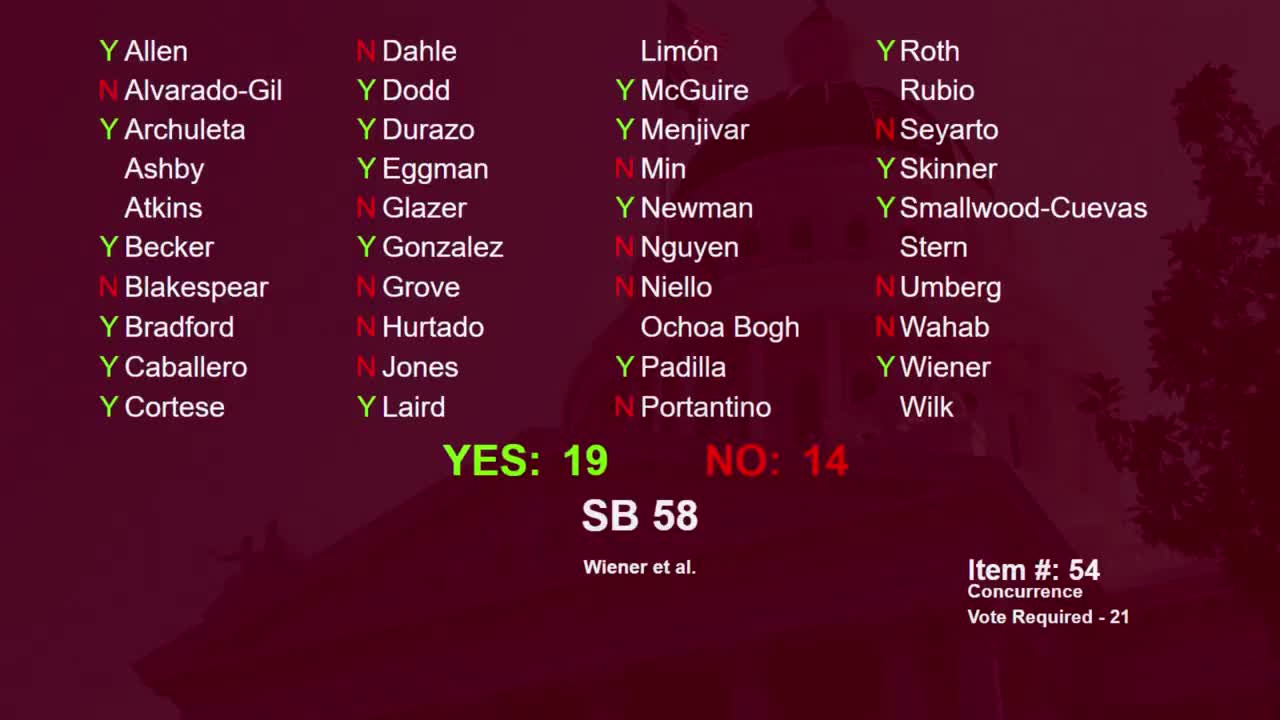 1MIN
Senate Floor
 1MIN
Assembly Floor
 4MIN
Assembly Standing Committee on Public Safety
 2MIN
Senate Floor
 7MIN
Senate Standing Committee on Public Safety
Bill Author

Bill Co-Author(s):