SB 407: Foster care: resource families.
- Session Year: 2023-2024
- House: Senate
- Latest Version Date: 2023-09-23
Current Status:
Passed
(2023-09-23: Chaptered by Secretary of State. Chapter 226, Statutes of 2023.)
Introduced
In Committee
First Chamber
In Committee
Second Chamber
Enacted
(1)Existing law generally provides for the placement of foster youth in various placement settings. Existing law provides for the implementation of the resource family approval process and defines a resource family as an individual or family who has successfully met both the home environment assessment standards and permanency assessment criteria, as specified, necessary for providing care for a child placed by a public or private child placement agency by court order, or voluntarily placed by a parent or legal guardian. Under existing law, the resource family permanency standards include a family evaluation, including, but not limited to, interviews of an applicant, as specified, and a risk assessment.
This bill would require a resource family to demonstrate an ability and willingness to meet the needs of a child, regardless of the childs sexual orientation, gender identity, or gender expression, as specified. To the extent this bill would create new duties for counties, the bill would impose a state-mandated local program.
(2)Existing law requires counties to ensure resource family applicants and resource families have the necessary knowledge, skills, and abilities to support children in foster care by completing caregiver training. Existing law requires that training to include a curriculum that supports the role of a resource family in parenting vulnerable children and should be ongoing in order to provide resource families with information on trauma-informed practices and requirements and other topics within the foster care system.
This bill would require counties to ensure that the caregiver training described above supports children of all races, ethnic group identifications, ancestries, national origins, colors, religions, sexes, sexual orientations, gender identities, mental or physical disabilities, or HIV statuses in foster care. To the extent this bill would create new duties for counties, the bill would impose a state-mandated local program.
(3)The California Constitution requires the state to reimburse local agencies and school districts for certain costs mandated by the state. Statutory provisions establish procedures for making that reimbursement.
This bill would provide that no reimbursement is required by this act for a specified reason.
(1)Existing law generally provides for the placement of foster youth in various placement settings. Existing law provides for the implementation of the resource family approval process and defines a resource family as an individual or family who has successfully met both the home environment assessment standards and permanency assessment criteria, as specified, necessary for providing care for a child placed by a public or private child placement agency by court order, or voluntarily placed by a parent or legal guardian. Under existing law, the resource family permanency standards include a family evaluation, including, but not limited to, interviews of an applicant, as specified, and a risk assessment.
This bill would require a resource family to demonstrate the capacity an ability and willingness to meet the needs of a child, regardless of the childs sexual orientation or orientation, gender identity, or gender expression, as specified. To the extent this bill would create new duties for counties, the bill would impose a state-mandated local program.
(2)Existing law requires counties to ensure resource family applicants and resource families have the necessary knowledge, skills, and abilities to support children in foster care by completing caregiver training. Existing law requires that training to include a curriculum that supports the role of a resource family in parenting vulnerable children and should be ongoing in order to provide resource families with information on trauma-informed practices and requirements and other topics within the foster care system. Existing law also requires counties to ensure that resource families that care for children who are 10 years of age or older attend, within 12 months of approval as a resource family, a training on understanding how to use best practices for providing care and supervision to children who have been commercially sexually exploited or who have been victims of child labor trafficking. Existing law requires this training to be survivor informed, culturally relevant and appropriate, address issues relating to stigma, and address specified topics, including, among others, recognizing indicators of commercial sexual exploitation and child labor trafficking.
This bill would require counties to ensure that the caregiver training described above supports children of all races, ethnic group identifications, ancestries, national origins, colors, religions, sexes, sexual orientations, gender identities, mental or physical disabilities, or HIV statuses in foster care. The bill would also require the training of children who have been commercially sexually exploited or who have been victims of child labor trafficking to include the experiences of LGBTQ and gender-expansive youth who are exploited or trafficked. To the extent this bill would create new duties for counties, the bill would impose a state-mandated local program. To the extent this bill would create new duties for counties, the bill would impose a state-mandated local program.
(3)Existing law requires the State Department of Social Services to provide ongoing oversight and monitoring of county systems and operations. Existing law requires the department to, among other things, adopt and require the use of standardized documentation for the home environment and permanency assessments of resource families and review an adequate number of county-approved resource families in each county to ensure that approval standards are being properly applied.This bill would require the department to require the above-described standardized documentation to include documents for assessing the ability to care for and supervise children and youth of all sexual orientations and gender identities.(4)(3)The California Constitution requires the state to reimburse local agencies and school districts for certain costs mandated by the state. Statutory provisions establish procedures for making that reimbursement.
This bill would provide that no reimbursement is required by this act for a specified reason.
(1)Existing law generally provides for the placement of foster youth in various placement settings. Existing law provides for the implementation of the resource family approval process and defines a resource family as an individual or family who has successfully met both the home environment assessment standards and permanency assessment criteria, as specified, necessary for providing care for a child placed by a public or private child placement agency by court order, or voluntarily placed by a parent or legal guardian. Under existing law, the resource family permanency standards include a family evaluation, including, but not limited to, interviews of an applicant, as specified, and a risk assessment.
This bill would require a resource family to demonstrate the capacity to meet the needs of a child, regardless of the childs sexual orientation or gender identity, as specified. To the extent this bill would create new duties for counties, the bill would impose a state-mandated local program.
(2)Existing law states that it is the policy of the state that all minors and nonminors in foster care have specified rights, including, among others, the right to receive medical, dental, vision, and mental health services, the right to be placed in out-of-home care according to their gender identity, regardless of the gender or sex listed in their court or child welfare records, and the right to maintain the privacy of their sexual orientation and gender identity and expression, except as provided. Existing law requires, as part of the resource family home environment assessment standards, that an applicant demonstrate an understanding of the rights of children in care and the applicants responsibility to safeguard those rights.This bill would require the applicant to demonstrate that understanding through signing a document acknowledging foster youth rights. To the extent this bill would create new duties for counties, the bill would impose a state-mandated local program.(2)Existing law requires counties to ensure resource family applicants and resource families have the necessary knowledge, skills, and abilities to support children in foster care by completing caregiver training. Existing law requires that training to include a curriculum that supports the role of a resource family in parenting vulnerable children and should be ongoing in order to provide resource families with information on trauma-informed practices and requirements and other topics within the foster care system. Existing law also requires counties to ensure that resource families that care for children who are 10 years of age or older attend, within 12 months of approval as a resource family, a training on understanding how to use best practices for providing care and supervision to children who have been commercially sexually exploited or who have been victims of child labor trafficking. Existing law requires this training to be survivor informed, culturally relevant and appropriate, address issues relating to stigma, and address specified topics, including, among others, recognizing indicators of commercial sexual exploitation and child labor trafficking.
This bill would require counties to ensure that the caregiver training described above supports children of all races, ethnic group identifications, ancestries, national origins, colors, religions, sexes, sexual orientations, gender identities, mental or physical disabilities, or HIV statuses in foster care. The bill would also require the training of children who have been commercially sexually exploited or who have been victims of child labor trafficking to include the experiences of LGBTQ and gender-expansive youth who are exploited or trafficked. To the extent this bill would create new duties for counties, the bill would impose a state-mandated local program.
(3)Existing law requires the State Department of Social Services to provide ongoing oversight and monitoring of county systems and operations. Existing law requires the department to, among other things, adopt and require the use of standardized documentation for the home environment and permanency assessments of resource families and review an adequate number of county-approved resource families in each county to ensure that approval standards are being properly applied.
This bill would require the department to require the above-described standardized documentation to include documents for assessing the ability to care for and supervise children and youth of all sexual orientations and gender identities and to ensure that county-approved resource families are upholding the rights of a child in foster care and meeting the resource familys responsibility to safeguard those rights, including the right to have fair and equal access to all available services, placement, care, treatment, and benefits, and to not be subjected to discrimination or harassment on the basis of actual or perceived race, ethnic group identification, ancestry, national origin, color, religion, sex, sexual orientation, gender identity, mental or physical disability, or HIV status. The bill would require the department to work with stakeholders, including counties, the California Alliance of Child and Family Services, and LGBTQ advocates, to develop standards and a caregiver handbook for caring for children and youth of all sexual orientations and gender identities. identities.
(4)The California Constitution requires the state to reimburse local agencies and school districts for certain costs mandated by the state. Statutory provisions establish procedures for making that reimbursement.
This bill would provide that no reimbursement is required by this act for a specified reason.
(1)Existing law generally provides for the placement of foster youth in various placement settings. Existing law provides for the implementation of the resource family approval process and defines a resource family as an individual or family who has successfully met both the home environment assessment standards and permanency assessment criteria, as specified, necessary for providing care for a child placed by a public or private child placement agency by court order, or voluntarily placed by a parent or legal guardian. Under existing law, the resource family permanency standards include a family evaluation, including, but not limited to, interviews of an applicant, as specified, and a risk assessment.
This bill would require a resource family to demonstrate an understanding of the unique needs of lesbian, gay, bisexual, transgender, or plus (LGBTQ+) and gender-expansive youth, and the capacity and willingness to meet those needs, as specified. The bill would additionally require the family evaluation to include assessing the ability of an applicant to provide care and supervision for LGBTQ+ and gender-expansive youth. By creating the capacity to meet the needs of a child, regardless of the childs sexual orientation or gender identity, as specified. To the extent this bill would create new duties for counties, the bill would impose a state-mandated local program.
(2)Existing law states that it is the policy of the state that all minors and nonminors in foster care have specified rights, including, among others, the right to receive medical, dental, vision, and mental health services, the right to be placed in out-of-home care according to their gender identity, regardless of the gender or sex listed in their court or child welfare records, and the right to maintain the privacy of their sexual orientation and gender identity and expression, except as provided. Existing law requires, as part of the resource family home environment assessment standards, that an applicant demonstrate an understanding of the rights of children in care and the applicants responsibility to safeguard those rights.
This bill would expressly include among those the rights of LGBTQ+ and gender-expansive youth among those rights of which an applicant is required to demonstrate an understanding. The bill would also require the applicant to demonstrate that understanding through signing a document acknowledging foster youth rights. To the extent this bill would create new duties for counties, the bill would impose a state-mandated local program.
(3)Existing law requires the State Department of Social Services to provide ongoing oversight and monitoring of county systems and operations. Existing law requires the department to to, among other things, adopt and require the use of standardized documentation for the home environment and permanency assessments of resource families and review an adequate number of county-approved resource families in each county to ensure that approval standards are being properly applied.
This bill would require the department to require the above-described standardized documentation to include documents for assessing the ability to care for and supervise children and youth of all sexual orientations and gender identities and to ensure that county-approved resource families are upholding the rights of a child in foster care and meeting the resource familys responsibility to safeguard those rights, including the right to have fair and equal access to all available services, placement, care, treatment, and benefits, and to not be subjected to discrimination or harassment on the basis of actual or perceived race, ethnic group identification, ancestry, national origin, color, religion, sex, sexual orientation, gender identity, mental or physical disability, or HIV status. The bill would require the department to work with stakeholders, including counties, the California Alliance of Child and Family Services, and LGBTQ+ LGBTQ advocates, to develop standards and a caregiver handbook for caring for LGBTQ+ and gender-expansive youth. children and youth of all sexual orientations and gender identities.
(4)Existing law requires a county to investigate all complaints against a resource family and take action as necessary, including, but not limited to, investigating any incidents reported about a resource family indicating that the approval standard is not being maintained and inspecting the resource family home.This bill additionally would require a county to investigate incidents reported about a resource family not meeting the specific needs of LGBTQ+ and gender-expansive youth. By creating new duties for counties, the bill would impose a state-mandated local program. (5)Existing law authorizes a county or the department to deny a resource family application or rescind the approval of a resource family, and the department to exclude an individual from any resource family home for specified reasons, including conduct that poses a risk or threat to the health and safety, protection, or well-being of a child. Existing law requires counties to ensure resource family applicants and resource families have the necessary knowledge, skills, and abilities to support children in foster care by completing caregiver training. This bill would expand the application of these provisions to include LGBTQ+ and gender-expansive children. By creating new duties for counties, the bill would impose a state-mandated local program.(6)(4)The California Constitution requires the state to reimburse local agencies and school districts for certain costs mandated by the state. Statutory provisions establish procedures for making that reimbursement.
This bill would provide that no reimbursement is required by this act for a specified reason.
(1)Existing law generally provides for the placement of foster youth in various placement settings. Existing law provides for the implementation of the resource family approval process and defines a resource family as an individual or family who has successfully met both the home environment assessment standards and permanency assessment criteria, as specified, necessary for providing care for a child placed by a public or private child placement agency by court order, or voluntarily placed by a parent or legal guardian. Under existing law, the resource family permanency standards include a family evaluation, including, but not limited to, interviews of an applicant, as specified, and a risk assessment.
This bill would require a resource family to demonstrate an understanding of the unique needs of lesbian, gay, bisexual, transgender, or plus (LGBTQ+) and gender-expansive youth, and the capacity and willingness to meet those needs, as specified. The bill would additionally require the family evaluation to include assessing the ability of an applicant to provide care and supervision for LGBTQ+ and gender-expansive youth. By creating new duties for counties, the bill would impose a state-mandated local program.
(2)Existing law states that it is the policy of the state that all minors and nonminors in foster care have specified rights, including, among others, the right to receive medical, dental, vision, and mental health services, the right to be placed in out-of-home care according to their gender identity, regardless of the gender or sex listed in their court or child welfare records, and the right to maintain the privacy of their sexual orientation and gender identity and expression, except as provided. Existing law requires, as part of the resource family home environment assessment standards, that an applicant demonstrate an understanding of the rights of children in care and the applicants responsibility to safeguard those rights.
This bill would expressly include among those the rights of LGBTQ+ and gender-expansive youth among those rights of which an applicant is required to demonstrate an understanding. The bill would also require the applicant to demonstrate that understanding through signing a document acknowledging foster youth rights. To the extent this bill would create new duties for counties, the bill would impose a state-mandated local program.
(3)Existing law requires the State Department of Social Services to provide ongoing oversight and monitoring of county systems and operations. Existing law requires the department to review an adequate number of county-approved resource families in each county to ensure that approval standards are being properly applied.
This bill would require the department to ensure that county-approved resource families are upholding the rights of a child in foster care and meeting the resource familys responsibility to safeguard those rights, including the right to have fair and equal access to all available services, placement, care, treatment, and benefits, and to not be subjected to discrimination or harassment on the basis of actual or perceived race, ethnic group identification, ancestry, national origin, color, religion, sex, sexual orientation, gender identity, mental or physical disability, or HIV status. The bill would require the department to work with stakeholders, including counties, the California Alliance of Child and Family Services, and LGBTQ+ advocates, to develop standards and a caregiver handbook for caring for LGBTQ+ and gender-expansive youth.
(4)Existing law requires a county to investigate all complaints against a resource family and take action as necessary, including, but not limited to, investigating any incidents reported about a resource family indicating that the approval standard is not being maintained and inspecting the resource family home.
This bill additionally would require a county to investigate incidents reported about a resource family not meeting the specific needs of LGBTQ+ and gender-expansive youth. By creating new duties for counties, the bill would impose a state-mandated local program.
(5)Existing law authorizes a county or the department to deny a resource family application or rescind the approval of a resource family, and the department to exclude an individual from any resource family home for specified reasons, including conduct that poses a risk or threat to the health and safety, protection, or well-being of a child. Existing law requires counties to ensure resource family applicants and resource families have the necessary knowledge, skills, and abilities to support children in foster care by completing caregiver training.
This bill would expand the application of these provisions to include LGBTQ+ and gender-expansive children. By creating new duties for counties, the bill would impose a state-mandated local program.
(6)The California Constitution requires the state to reimburse local agencies and school districts for certain costs mandated by the state. Statutory provisions establish procedures for making that reimbursement.
This bill would provide that no reimbursement is required by this act for a specified reason.
Existing law generally provides for the placement of foster youth in various placement settings, and governs the provision of child welfare services, which is defined to mean public social services that are directed toward the accomplishment of specified purposes, including protecting and promoting the welfare of all children, preventing the unnecessary separation of children from their families, and restoring to their families children who have been removed.Existing law provides that it is the policy of the state that all minors and nonminors in foster care have specified rights, including, among others, the right to receive medical, dental, vision, and mental health services and the right to be informed of these rights in an age and developmentally appropriate manner and to receive a copy of these rights, at specified intervals.This bill would state the intent of the Legislature to enact legislation to ensure that LGBTQ foster youth in California are placed in homes that are affirming of LGBTQ identities.Existing law generally provides for the placement of foster youth in various placement settings, and governs the provision of child welfare services, which is defined to mean public social services that are directed toward the accomplishment of specified purposes, including protecting and promoting the welfare of all children, preventing the unnecessary separation of children from their families, and restoring to their families children who have been removed.
Existing law provides that it is the policy of the state that all minors and nonminors in foster care have specified rights, including, among others, the right to receive medical, dental, vision, and mental health services and the right to be informed of these rights in an age and developmentally appropriate manner and to receive a copy of these rights, at specified intervals.
This bill would state the intent of the Legislature to enact legislation to ensure that LGBTQ foster youth in California are placed in homes that are affirming of LGBTQ identities.
The Legislature finds and declares all of the following:
(a)According to the University of California, Berkeley, California Child Welfare Indicators Project, as of October 1, 2022, there were 53,371 youth in foster care in California.
(b)Youth who identify as lesbian, gay, bisexual, transgender, questioning, or another diverse identity (LGBTQ) and gender-expansive youth are overrepresented in foster care, with at least three studies estimating about 30 percent of youth in foster care identify as LGBTQ (Baams et al., LGBTQ Youth in Unstable Housing and Foster Care (2019); Matarese et al., The Cuyahoga Youth Count: A Report on LGBTQ+ Youth Experience in Foster Care (2021); Sandfort, Experiences and Well-Being of Sexual and Gender Diverse Youth in Foster Care in New York City: Disproportionality and Disparities (2020)).
(c)Like all young people, LGBTQ (including Native American Two-Spirit) children and youth in foster care need the support of a nurturing family to help them navigate their teenage years and grow into healthy adults.
(d)Foster youth have a right to be placed in out-of-home care according to their gender identity and the right to have caregivers that have received instruction on cultural competency and sensitivity relating to sexual orientation, gender identity and expression, and best practices for providing adequate care to lesbian, gay, bisexual, and transgender children in out-of-home care.
(e)LGBTQ foster youth are currently being placed in nonaffirming families that have been approved by counties and the state, causing additional harm and trauma. According to the Trevor Project, teens who perceived parental support regarding gender identity were 93 percent less likely to attempt suicide than youth who did not perceive parents as supportive.
(f)It is the intent of the Legislature to have LGBTQ-affirming resource families for youth in out-of-home care in county and foster family agency homes.
SEC. 2.Section 16519.5 of the Welfare and Institutions Code is amended to read:16519.5.(a)The State Department of Social Services, in consultation with county child welfare agencies, foster parent associations, and other interested community parties, shall implement a unified, family friendly, and child-centered resource family approval process to replace the existing multiple processes for licensing foster family homes, certifying foster homes by licensed foster family agencies, approving relatives and nonrelative extended family members as foster care providers, and approving guardians and adoptive families.
(b)(1)Counties shall be selected to participate on a voluntary basis as early implementation counties for the purpose of participating in the initial development of the approval process. Early implementation counties shall be selected according to criteria developed by the department in consultation with the County Welfare Directors Association of California. In selecting the five early implementation counties, the department shall promote diversity among the participating counties in terms of size and geographic location.
(2)Additional counties may participate in the early implementation of the program upon authorization by the department.
(3)The State Department of Social Services shall be responsible for all of the following:
(A)Selecting early implementation counties, based on criteria established by the department in consultation with the County Welfare Directors Association of California.
(B)Establishing timeframes for participating counties to submit an implementation plan, enter into terms and conditions for early implementation participation in the program, train appropriate staff, and accept applications from resource families.
(C)Entering into terms and conditions for early implementation participation in the program by counties.
(4)Counties participating in the early implementation of the program shall be responsible for all of the following:
(A)Submitting an implementation plan.
(B)Entering into terms and conditions for early implementation participation in the program.
(C)Consulting with the county probation department in the development of the implementation plan.
(D)Training appropriate staff.
(E)Accepting applications from resource families within the timeframes established by the department.
(5)(A)Approved relatives and nonrelative extended family members, licensed foster family homes, or approved adoptive homes that have completed the license or approval process prior to statewide implementation of the program shall not be considered part of the program. The otherwise applicable assessment and oversight processes shall continue to be administered for families and facilities not included in the program.
(B)Upon implementation of the program in a county, that county shall not accept new applications for the licensure of foster family homes, the approval of relative and nonrelative extended family members, or the approval of prospective guardians and adoptive homes.
(6)The department may waive regulations that pose a barrier to the early implementation and operation of this program. The waiver of a regulation by the department pursuant to this section applies to only those counties or foster family agencies participating in the early implementation of the program and only for the duration of the program.
(7)This subdivision is inoperative on January 1, 2017.
(c)(1)For purposes of this article, resource family means an individual or family that has successfully met both the home environment assessment standards and the permanency assessment criteria adopted pursuant to subdivision (d) necessary for providing care for a child placed by a public or private child placement agency by court order, or voluntarily placed by a parent or legal guardian. A resource family shall demonstrate all of the following:
(A)An understanding of the safety, permanence, and well-being needs of children who have been victims of child abuse and neglect, and the capacity and willingness to meet those needs, including the need for protection, and the willingness to make use of support resources offered by the agency, or a support structure in place, or both.
(B)An understanding of childrens needs and development, effective parenting skills or knowledge about parenting, and the capacity to act as a reasonable, prudent parent in day-to-day decisionmaking.
(C)An understanding of the role of the individual or family as a resource family and the capacity to work cooperatively with the agency and other service providers in implementing the childs case plan.
(D)The financial ability within the household to ensure the stability and financial security of the family. This requirement may be waived for relative and nonrelative extended family member resource families on a case-by-case basis. For purposes of this subparagraph, there is no minimum income requirement and an applicant who will rely on the funding described in subdivision (l) to meet additional household expenses incurred due to the placement of a child shall not, for this reason, be denied approval as a resource family.
(E)(i)An ability and willingness to provide a family setting that promotes normal childhood experiences that serves the needs of the child.
(F)An ability and willingness to meet the needs of the child regardless of the childs sexual orientation, gender identity, or gender expression, and that, should difficulties around these issues arise, a willingness to obtain resources offered by the county or foster family agency or other available resources to meet those needs.
(2)For purposes of this article, and unless otherwise specified, references to a child include a nonminor dependent and nonminor former dependent or ward, as defined in subdivision (v) and paragraph (1) of subdivision (aa) of Section 11400.
(3)There is no fundamental right to approval as a resource family. Emergency placement of a child pursuant to Section 309, 319, 361.45, or 727.05, or with a resource family applicant pursuant to subdivision (e), does not entitle an applicant to approval as a resource family.
(4)(A)A resource family shall be considered eligible to provide foster care for children in out-of-home placement and approved for adoption and guardianship.
(B)(i)Notwithstanding subparagraph (A), a county may approve a resource family to care for a specific child, as specified in the written directives or regulations adopted pursuant to this section. Child-specific approval shall be considered if the applicant is a relative or nonrelative extended family member who has an established and significant relationship with a child or a child is already placed in the home of the relative or nonrelative extended family member pursuant to subdivision (e) or Section 309, 319, 361.45, or 727.05.
(ii)When child-specific approval is granted to a relative who has received a criminal records exemption pursuant to clause (iv) of subparagraph (A) of paragraph (2) of subdivision (g) of Section 1522 of the Health and Safety Code, the childs placement shall be funded pursuant to Section 11461.3 and the relative shall not be eligible for federal financial participation while the child is placed with them.
(iii)In the case of an Indian child for whom the childs tribe is not exercising its right to approve a home, the county shall apply the prevailing social and cultural standards of the Indian community to resource family approval for that child, as required by subdivision (f) of Section 361.31 and the federal Indian Child Welfare Act of 1978 (25 U.S.C. Sec. 1901 et seq.). The department shall engage in the tribal consultation process and develop regulations to implement this clause. Notwithstanding the rulemaking provisions of the Administrative Procedure Act (Chapter 3.5 (commencing with Section 11340) of Part 1 of Division 3 of Title 2 of the Government Code), the department may implement this clause through all-county letters or other similar instruction, and provide guidance to counties regarding consistent implementation of this clause.
(5)For purposes of this article, resource family approval means that the applicant or resource family successfully meets the home environment assessment and permanency assessment standards. This approval is in lieu of a foster family home license issued pursuant to Chapter 3 (commencing with Section 1500) of Division 2 of the Health and Safety Code, a certificate of approval issued by a licensed foster family agency, as described in subdivision (b) of Section 1506 of the Health and Safety Code, relative or nonrelative extended family member approval, guardianship approval, and the adoption home study approval.
(6)Approval of a resource family does not guarantee an initial, continued, or adoptive placement of a child with a resource family or with a relative or nonrelative extended family member. Approval of a resource family does not guarantee the establishment of a legal guardianship of a child with a resource family.
(7)(A)Notwithstanding paragraphs (1) to (6), inclusive, the county shall, consistent with Sections 1520.3 and 1558.1 of the Health and Safety Code, cease any further review of an application if the applicant has had a previous application denial by the department or a county within the preceding year, or if the applicant has had a previous rescission, revocation, or exemption denial or exemption rescission by the department or a county within the preceding two years.
(B)Notwithstanding subparagraph (A), the county may continue to review an application if it has determined that the reasons for the previous denial, rescission, or revocation were due to circumstances and conditions that either have been corrected or are no longer in existence. If an individual was excluded from a resource family home or facility licensed by the department, the county shall cease review of the individuals application unless the excluded individual has been reinstated pursuant to subdivision (g) of Section 16519.6 of this code or pursuant to Section 1569.53, subdivision (h) of Section 1558, subdivision (h) of Section 1569.58, or subdivision (h) of Section 1596.8897, of the Health and Safety Code.
(C)(i)The county may cease any further review of an application if, after written notice to the applicant, the applicant fails to complete an application without good faith effort and within 30 days of the date of the notice, as specified in the written directives or regulations adopted pursuant to this section.
(ii)Clause (i) does not apply if a child is placed with the applicant pursuant to Section 309, 361.45, 727.05, or paragraph (1) of subdivision (e) of Section 16519.5.
(D)The cessation of an application review pursuant to this paragraph does not constitute a denial of the application for purposes of this section or any other law.
(E)For purposes of this section, the date of a previous denial, rescission, revocation, exemption denial or exemption rescission, or exclusion shall be either of the following:
(i)The effective date of a final decision or order upholding a notice of action or exclusion order.
(ii)The date on the notice of the decision to deny, rescind, revoke, or exclude if the notice was not appealed or otherwise constitutes a final decision.
(8)A resource family shall meet the approval standards set forth in this section, and, as applicable, Chapter 6.3 (commencing with Section 18360) of Part 6, to maintain approval. A resource family shall comply with the written directives or regulations adopted pursuant to this section and applicable laws in order to maintain approval.
(9)A resource family may be approved by a county child welfare department or a probation department pursuant to this section or by a foster family agency pursuant to Section 1517 of the Health and Safety Code.
(10)A resource family shall not be licensed to operate a residential facility, as defined in Section 1502 of the Health and Safety Code, a residential care facility for the elderly, as defined in Section 1569.2 of the Health and Safety Code, or a residential care facility for persons with chronic life-threatening illnesses, as defined in Section 1568.01 of the Health and Safety Code, on the same premises used as the residence of the resource family.
(11)(A)An applicant who withdraws an application prior to its approval or denial may resubmit the application within 12 months of the withdrawal.
(B)This paragraph does not preclude a county from requiring an applicant to complete an application activity, even if that activity was previously completed.
(d)(1)The department shall adopt standards pertaining to the home environment and permanency assessments of a resource family.
(2)Resource family home environment assessment standards shall include, but not be limited to, all of the following:
(A)(i)(I)A criminal record clearance of each applicant and all adults residing in, or regularly present in, the home, and not exempted from fingerprinting, as set forth in subdivision (b) of Section 1522 of the Health and Safety Code, pursuant to Section 8712 of the Family Code, utilizing a check of the Child Abuse Central Index pursuant to Section 1522.1 of the Health and Safety Code, and receipt of a fingerprint-based state and federal criminal offender record information search response. The criminal history information shall include subsequent notifications pursuant to Section 11105.2 of the Penal Code.
(II)Consideration of any substantiated allegations of child abuse or neglect against the applicant and any other adult residing in, or regularly present in, the home pursuant to Section 1522.1 of the Health and Safety Code.
(III)If the criminal records check indicates that the person has been convicted of an offense described in subparagraph (A) of paragraph (2) of subdivision (g) of Section 1522 of the Health and Safety Code, home approval shall be denied unless the person has received a criminal records exemption pursuant to clause (iv) of subparagraph (A) of paragraph (2) of subdivision (g) of Section 1522 of the Health and Safety Code. If the criminal records check indicates that the person has been convicted of an offense described in subparagraph (B) or (D) of paragraph (2) of subdivision (g) of Section 1522 of the Health and Safety Code, the home shall not be approved unless a criminal record exemption has been granted pursuant to subclause (IV).
(IV)If the resource family parent, applicant, or any other person specified in subclause (I) has been convicted of a crime other than an infraction or arrested for an offense specified in subdivision (e) of Section 1522 of the Health and Safety Code, except for the civil penalty language, the criminal background check provisions specified in subdivisions (d) through (f) of Section 1522 of the Health and Safety Code shall apply. Exemptions from the criminal records clearance requirements set forth in this section may be granted by the department or the county, if that county has been granted permission by the department to issue criminal record exemptions pursuant to Section 361.4, using the exemption criteria currently used for foster care licensing, as specified in subdivision (g) of Section 1522 of the Health and Safety Code.
(V)If it is determined, on the basis of the fingerprint images and related information submitted to the Department of Justice, that subsequent to obtaining a criminal record clearance or exemption from disqualification, the person has been convicted of, or is awaiting trial for, a sex offense against a minor, or has been convicted for an offense specified in Section 243.4, 273a, 273ab, 273d, 273g, or 368 of the Penal Code, or a felony, the department or county shall notify the resource family to act immediately to remove or bar the person from entering the resource familys home. The department or county, as applicable, may subsequently grant an exemption from disqualification pursuant to subdivision (g) of Section 1522 of the Health and Safety Code. If the conviction or arrest was for another crime, the resource family shall, upon notification by the department or county, act immediately to either remove or bar the person from entering the resource familys home, or require the person to seek an exemption from disqualification pursuant to subdivision (g) of Section 1522 of the Health and Safety Code. The department or county, as applicable, shall determine if the person shall be allowed to remain in the home until a decision on the exemption from disqualification is rendered.
(ii)For public foster family agencies approving resource families, the criminal records clearance process set forth in clause (i) shall be utilized.
(iii)For private foster family agencies approving resource families, the criminal records clearance process set forth in clause (i) shall be utilized, but the Department of Justice shall disseminate a fitness determination resulting from the federal criminal offender record information search.
(B)A home and grounds evaluation to ensure the health and safety of children.
(C)In addition to the foregoing requirements, the resource family home environment assessment standards shall require the following:
(i)That the applicant demonstrates an understanding of the rights of children in care and the applicants responsibility to safeguard those rights.
(ii) That the total number of children residing in the home of a resource family shall be no more than the total number of children the resource family can properly care for, regardless of status, and shall not exceed six children, unless exceptional circumstances that are documented in the foster childs case file exist to permit a resource family to care for more children, including, but not limited to, the need to place siblings together, consistent with Section 16002.
(iii) That the applicant understands the applicants responsibilities with respect to acting as a reasonable and prudent parent, and maintaining the least restrictive environment that serves the needs of the child.
(3)The resource family permanency assessment standards shall include, but not be limited to, all of the following:
(A)Caregiver training, as described in subdivisions (g) and (h).
(B)A family evaluation, which shall include, but not be limited to, interviews of an applicant to assess the applicants personal history, family dynamic, and need for support or resources, and a risk assessment.
(i)When the applicant is a relative or nonrelative extended family member to an identified child, the family evaluation shall consider the nature of the relationship between the relative or nonrelative extended family member and the child. The relative or nonrelative extended family members expressed desire to only care for a specific child or children shall not be a reason to deny the approval.
(ii)A caregiver risk assessment shall include, but not be limited to, physical and mental health, alcohol and other substance use and abuse, family and domestic violence, and the factors listed in paragraph (1) of subdivision (c).
(iii)A county may review and discuss data contained in the statewide child welfare database with an applicant for purposes of conducting a family evaluation, as specified in the written directives or regulations adopted pursuant to this section.
(C)Completion of any other activities that relate to the ability of an applicant or a resource family to achieve permanency with a child.
(4)(A)For a child placed on an emergency basis pursuant to Section 309, 361.45, or 727.05, the home environment assessment, the permanency assessment, and the written report shall be completed within 90 days of the placement, unless good cause exists based upon the needs of the child.
(B)If additional time is needed to complete the home environment assessment or the permanency assessment, the county shall document the extenuating circumstances for the delay and generate a timeframe for the completion of those assessments.
(C)The county shall report to the department, on a quarterly basis, the number of families with emergency placements whose home environment assessment or permanency assessment goes beyond 90 days and summarize the reasons for these delays.
(e)(1)A county may place a child with a resource family applicant who has successfully completed the home environment assessment prior to completion of a permanency assessment only if a compelling reason for the placement exists based on the needs of the child.
(A)The permanency assessment and the written report described in paragraph (5) of subdivision (g) shall be completed within 90 days of the childs placement in the home, unless good cause exists.
(B)If additional time is needed to comply with subparagraph (A), the county shall document the extenuating circumstances for the delay and generate a timeframe for the completion of the permanency assessment.
(C)The county shall report to the department, on a quarterly basis, the number of applicants for whom the requirements of subparagraph (A) exceed 90 days and summarize the reasons for these delays.
(2)The home environment and permanency assessments, and the written report described in paragraph (5) of subdivision (g), shall be completed within 90 days of a childs placement with a relative or nonrelative extended family member pursuant to Section 309, 361.45, or 727.05, unless good cause exists.
(3)For any placement made pursuant to this subdivision, AFDC-FC funding shall not be available until approval of the resource family has been completed.
(4)A child placed pursuant to this subdivision shall be afforded all the rights set forth in Section 16001.9.
(5)This section does not limit the countys authority to inspect the home of a resource family applicant as often as necessary to ensure the quality of care provided.
(6)This subdivision does not limit the countys obligation under law to assess and give placement consideration to relatives and nonrelative extended family members and to place a child pursuant to Section 309, 361.3, 361.45, 706.6, or 727.1.
(f)The State Department of Social Services shall be responsible for all of the following:
(1)(A)Until regulations are adopted, administering the program through the issuance of written directives that shall have the same force and effect as regulations. Any directive affecting Article 1 (commencing with Section 700) of Chapter 7 of Division 1 of Title 11 of the California Code of Regulations shall be approved by the Department of Justice. The directives shall be exempt from the rulemaking provisions of the Administrative Procedure Act (Chapter 3.5 (commencing with Section 11340) of Part 1 of Division 3 of Title 2 of the Government Code).
(B)Adopting, amending, or repealing, in accordance with Chapter 4.5 (commencing with Section 11400) of Part 1 of Division 3 of Title 2 of the Government Code, any reasonable rules, regulations, and standards that may be necessary or proper to carry out the purposes and intent of this article and to enable the department to exercise the powers and perform the duties conferred upon it by this section, consistent with the laws of this state.
(2)Approving and requiring the use of a single standard for resource family approval.
(3)Adopting and requiring the use of standardized documentation for the home environment and permanency assessments of resource families. The department shall permit counties to maintain documentation relating to the resource family approval process in an electronic format.
(4)Adopting core competencies for county staff to participate in the assessment and evaluation of an applicant or resource family.
(5)Requiring counties to monitor county-approved resource families, including, but not limited to, both of the following:
(A)Investigating complaints regarding resource families.
(B)Developing and monitoring resource family corrective action plans to correct identified deficiencies and to rescind resource family approval if compliance with corrective action plans is not achieved.
(6)Ongoing oversight and monitoring of county systems and operations including all of the following:
(A)Reviewing the countys implementation plan and implementation of the program.
(B)Reviewing an adequate number of county-approved resource families in each county to ensure that approval standards are being properly applied.
(i)The review shall include case file documentation and may include onsite inspection of individual resource families.
(ii)The review shall occur on a biennial basis and more frequently if the department becomes aware that a county is experiencing a disproportionate number of complaints against individual resource family homes.
(C)Reviewing county reports of serious complaints and incidents involving resource families, as determined necessary by the department. The department may conduct an independent review of the complaint or incident and change the findings depending on the results of its investigation.
(D)Investigating unresolved complaints against counties.
(E)Requiring corrective action of counties that are not in full compliance with this section.
(7)Excluding a resource family parent, applicant, or other individual from presence in any resource family home, consistent with the established standard for any of the reasons specified in Section 16519.61.
(8)Implementing due process procedures, including, but not limited to, all of the following:
(A)Providing a statewide fair hearing process for application denials, rescissions of approval, exclusion actions, or criminal record exemption denials or rescissions by a county or the department.
(B)Providing an excluded individual with due process pursuant to Section 16519.6.
(C)Amending the departments applicable state hearing procedures and regulations or using the Administrative Procedure Act (Chapter 3.5 (commencing with Section 11340) of Part 1 of Division 3 of Title 2 of the Government Code), when applicable, as necessary for the administration of the program.
(g)Counties shall be responsible for all of the following:
(1)Submitting an implementation plan and consulting with the county probation department in the development of the implementation plan.
(2)Complying with the written directives or regulations adopted pursuant to this section.
(3)Implementing the requirements for resource family approval and utilizing standardized documentation established by the department. A county may maintain documentation relating to the resource family approval process in an electronic format.
(4)Training appropriate staff, including ensuring staff have the education and experience or core competencies necessary to participate in the assessment and evaluation of an applicant or resource family.
(5)(A)Taking the following actions, as applicable, for any of the reasons specified in Section 16519.61:
(i)(I)Approving or denying resource family applications, including preparing a written report that evaluates an applicants capacity to foster, adopt, and provide legal guardianship of a child based on all of the information gathered through the resource family application and assessment processes.
(II)The applicants preference to provide a specific level of permanency, including adoption, guardianship, or, in the case of a relative, placement with a fit and willing relative, shall not be a basis to deny an application.
(ii)Rescinding approvals of resource families.
(iii)When applicable, referring a case to the department for an action to exclude a resource family parent, applicant, or other individual from presence in any resource family home, consistent with the established standard.
(iv)Issuing a temporary suspension order that suspends the resource family approval prior to a hearing when, in the opinion of the county, urgent action is needed to protect a child from physical or mental abuse, abandonment, or any other substantial threat to health or safety. The county shall serve the resource family with the temporary suspension order and a copy of available discovery in the possession of the county, including, but not limited to, affidavits, declarations, names of witnesses, and other evidence upon which the county relied in issuing the temporary suspension order. The temporary suspension order shall be served upon the resource family with a notice of action, and if the matter is to be heard before the Office of Administrative Hearings, an accusation. The temporary suspension order shall list the effective date on the order.
(v)Granting, denying, or rescinding criminal record exemptions.
(B)Providing a resource family parent, applicant, or individual who is the subject of a criminal record exemption denial or rescission with due process pursuant to Section 16519.6.
(C)Notifying the department of any decisions denying an application for resource family approval, rescinding the approval of a resource family, or denying or rescinding a criminal record exemption and, if applicable, notifying the department of the results of an administrative action.
(6)(A)Updating resource family approval biennially and as necessary to address any changes that have occurred in the resource familys circumstances, including, but not limited to, moving to a new home location or commencing operation of a family daycare home, as defined in Section 1596.78 of the Health and Safety Code.
(B)A county shall conduct an announced inspection of a resource family home during the biennial update, and as necessary to address any changes specified in subparagraph (A), in order to ensure that the resource family is conforming to all applicable laws and the written directives or regulations adopted pursuant to this section.
(7)Monitoring resource families through all of the following:
(A)Ensuring that social workers who identify a condition in the home that may not meet the approval standards set forth in subdivision (d) while in the course of a routine visit to children placed with a resource family take appropriate action as needed.
(B)Requiring resource families to meet the approval standards set forth in this section and to comply with the written directives or regulations adopted pursuant to this section, other applicable laws, and corrective action plans as necessary to correct identified deficiencies. If corrective action is not completed, as specified in the plan, the county may rescind the resource family approval.
(C)Requiring resource families to report any incidents consistent with the reporting requirements pursuant to the written directives or regulations adopted pursuant to this section.
(D)Inspecting resource family homes as often as necessary to ensure the quality of care provided.
(8)(A)Investigating all complaints against a resource family and taking action as necessary, including, but not limited to, investigating any incidents reported about a resource family indicating that the approval standard is not being maintained and inspecting the resource family home.
(B)The childs social worker shall not conduct the investigation into the complaint received concerning a family providing services pursuant to the standards required by subdivision (d). To the extent that adequate resources are available, complaints shall be investigated by a worker who did not conduct the home environment assessment or family evaluation or prepare the written report determining approval of the resource family.
(C)Upon conclusion of the complaint investigation, the final disposition shall be reviewed and approved by a supervising staff member.
(D)The department shall be notified of any serious incidents or serious complaints or any incident that falls within the definition of Section 11165.5 of the Penal Code. If those incidents or complaints result in an investigation, the department shall also be notified as to the status and disposition of that investigation.
(9)Performing corrective action as required by the department.
(10)Assessing county performance in related areas of the California Child and Family Services Review System, and remedying problems identified.
(11)Submitting information and data that the department determines is necessary to study, monitor, and prepare the update specified in paragraph (7) of subdivision (f).
(12)Ensuring resource family applicants and resource families have the necessary knowledge, skills, and abilities to support children of all races, ethnic group identifications, ancestries, national origins, colors, religions, sexes, sexual orientations, gender identities, mental or physical disabilities, or HIV statuses in foster care by completing caregiver training. The training should include a curriculum that supports the role of a resource family in parenting vulnerable children and should be ongoing in order to provide resource families with information on trauma-informed practices and requirements and other topics within the foster care system.
(13)Ensuring that a resource family applicant completes a minimum of 12 hours of preapproval caregiver training. The training shall include, but not be limited to, all of the following courses:
(A)An overview of the child protective and probation systems.
(B)The effects of trauma, including grief and loss, and child abuse and neglect, on child development and behavior, and methods to behaviorally support children impacted by that trauma or child abuse and neglect.
(C)Positive discipline and the importance of self-esteem.
(D)Health issues in foster care.
(E)Accessing services and supports to address education needs, physical, mental, and behavioral health, and substance use disorders, including culturally relevant services.
(F)The rights of a child in foster care and the resource familys responsibility to safeguard those rights, including the right to have fair and equal access to all available services, placement, care, treatment, and benefits, and to not be subjected to discrimination or harassment on the basis of actual or perceived race, ethnic group identification, ancestry, national origin, color, religion, sex, sexual orientation, gender identity, mental or physical disability, or HIV status.
(G)Cultural needs of children, including instruction on cultural competency and sensitivity, and related best practices for providing adequate care for children or youth across diverse ethnic and racial backgrounds, as well as children or youth identifying as lesbian, gay, bisexual, or transgender.
(H)Basic instruction on existing laws and procedures regarding the safety of foster youth at school.
(I)Permanence, well-being, and education needs of children.
(J)Child and adolescent development, including sexual orientation, gender identity, and expression.
(K)The role of resource families, including working cooperatively with the child welfare or probation agency, the childs family, and other service providers implementing the case plan.
(L)The role of a resource family on the child and family team as defined in paragraph (4) of subdivision (a) of Section 16501.
(M)A resource familys responsibility to act as a reasonable and prudent parent, as described in subdivision (c) of Section 1522.44 of the Health and Safety Code, and to provide a family setting that promotes normal childhood experiences and that serves the needs of the child.
(N)An overview of the specialized training identified in subdivision (h).
(O)The information described in subdivision (i) of Section 16521.5. The program may use the curriculum created pursuant to subdivision (h), and described in subdivision (i), of Section 16521.5.
(P)Information on providing care and supervision to children who have been commercially sexually exploited or who have been victims of child labor trafficking. For purposes of this subparagraph, information may include, but not be limited to, informational pamphlets addressing the identification of victims of commercial sexual exploitation and child labor trafficking and the provision of existing resources, including crisis hotline numbers, survivor and caregiver supports, and contact information for law enforcement entities.
(14)Ensuring resource families complete a minimum of eight hours of caregiver training annually, a portion of which shall be from subparagraph (M) of paragraph (13) and from one or more of the other topics listed in paragraph (13).
(15)(A)(i)Ensuring that resource families complete cardiopulmonary resuscitation (CPR) training and first aid training, or demonstrate equivalent certification, no later than 90 days following resource family approval.
(ii)A resource family parent who has a certificate of completion for Basic Life Support (BLS) for health care professionals, or Pediatric Advanced Life Support (PALS), or a higher standard of training that certifies CPR, and for whom the certification is currently active, is exempt from completing the resource family approval CPR training requirement as described in clause (i), upon demonstrating proof of certification of completion and until the date the certification expires.
(iii)A resource family parent who has active and unrestricted licensure as a health care professional, issued by the Department of Consumer Affairs or the Emergency Medical Services Authority, is exempt from completing the resource family approval first aid training requirement as described in clause (i), upon demonstrating proof of active and unrestricted licensure and until the date the licensure expires.
(B)(i)Ensuring that resource families, prior to expiration of the CPR and first aid certificates, obtain training to remain certified in CPR and first aid, or demonstrate equivalent certification, and submit copies of the certificates verifying completion of the training.
(ii)Clause (i) does not apply to first aid training for a resource family parent who is exempt from the first aid training requirement pursuant to clause (iii) of subparagraph (A).
(16)(A)Ensuring that resource families that care for children who are 10 years of age or older attend, within 12 months of approval as a resource family, a training on understanding how to use best practices for providing care and supervision to children who have been commercially sexually exploited or who have been victims of child labor trafficking. This training shall be survivor informed, culturally relevant and appropriate, and address issues relating to stigma. The training required by this subparagraph shall address all of the following topics:
(i)Recognizing indicators of commercial sexual exploitation and child labor trafficking.
(ii)Harm reduction.
(iii)Trauma-informed care.
(iv)Available county and state resources.
(v)Perspectives of individuals or families who have experiences with commercial sexual exploitation and child labor trafficking.
(B)The information provided in subparagraph (P) of paragraph (13) shall also be provided during the training described in this paragraph.
(C)After completing the training required by subparagraph (A), a resource family shall not be required to attend training relating to children who have been commercially sexually exploited or who have been victims of child labor trafficking, except as required pursuant to subdivision (h).
(D)This section does not prevent an entity from providing the training specified in this paragraph in person, virtually, by recorded means, or by any other available means.
(h)In addition to any training required by this section, a county may require a resource family or applicant to receive relevant specialized training for the purpose of preparing the resource family to meet the needs of a particular child in care. This training may include, but is not limited to, the following:
(1)Understanding how to use best practices for providing care and supervision to commercially sexually exploited children and children who have been victims of child labor trafficking.
(2)Understanding how to use best practices for providing care and supervision to lesbian, gay, bisexual, and transgender children.
(3)Understanding the requirements and best practices regarding psychotropic medications, including, but not limited to, court authorization, benefits, uses, side effects, interactions, assistance with self-administration, misuse, documentation, storage, and metabolic monitoring of children prescribed psychotropic medications.
(4)Understanding the federal Indian Child Welfare Act (25 U.S.C. Sec. 1901 et seq.), its historical significance, the rights of children covered by the act, and the best interests of Indian children, including the role of the caregiver in supporting culturally appropriate, child-centered practices that respect Native American history, culture, retention of tribal membership, and connection to the tribal community and traditions.
(5)Understanding how to use best practices for providing care and supervision to nonminor dependents.
(6)Understanding how to use best practices for providing care and supervision to children with special health care needs.
(7)Understanding the different permanency options and the services and benefits associated with the options.
(i)This section does not preclude a county from requiring training in excess of the requirements in this section.
(j)(1)Resource families who move home locations shall retain their resource family status pending the outcome of the update conducted pursuant to paragraph (6) of subdivision (g).
(2)(A)If a resource family moves from one county to another county, the department, or the county to which a resource family has moved, shall submit a written request to the Department of Justice to transfer the individuals subsequent arrest notification, as specified in subdivision (h) of Section 1522 of the Health and Safety Code.
(B)A request to transfer a subsequent arrest notification shall contain all prescribed data elements and format protocols pursuant to a written agreement between the department and the Department of Justice.
(3)Subject to the requirements in paragraph (1), the resource family shall continue to be approved for guardianship and adoption. This subdivision shall not limit a county, foster family agency, or adoption agency from determining that the family is not approved for guardianship or adoption based on changes in the familys circumstances or family evaluation.
(k)Implementation of the program shall be contingent upon the continued availability of federal Social Security Act Title IV-E (42 U.S.C. Sec. 670) funds for costs associated with placement of children with resource families assessed and approved pursuant to the program.
(l)A child placed with a resource family is eligible for the resource family basic rate, pursuant to Sections 11460, 11461, 11461.3, and 11463, at the childs assessed level of care.
(m)Sharing ratios for nonfederal expenditures for all costs associated with activities related to the approval of relatives and nonrelative extended family members shall be in accordance with Section 10101.
(n)The Department of Justice shall charge fees sufficient to cover the cost of initial or subsequent criminal offender record information and Child Abuse Central Index searches, processing, or responses, as specified in this section.
(o)Except as provided, resource families shall be exempt from both of the following:
(1)Licensure requirements established pursuant to the California Community Care Facilities Act (Chapter 3 (commencing with Section 1500) of Division 2 of the Health and Safety Code) and all regulations promulgated to implement the act.
(2)Relative and nonrelative extended family member approval requirements as those approval requirements existed prior to January 1, 2017.
(p)(1)Early implementation counties shall be authorized to continue through December 31, 2016. The program shall be implemented by each county on or before January 1, 2017.
(2)(A)(i)On and after January 1, 2017, a county to which the department has delegated its licensing authority pursuant to Section 1511 of the Health and Safety Code shall approve resource families in lieu of licensing foster family homes.
(ii)Notwithstanding clause (i), the existing licensure and oversight processes shall continue to be administered for foster family homes licensed prior to January 1, 2017, or as specified in subparagraph (C), until the license is revoked or forfeited by operation of law pursuant to Section 1517.1 of the Health and Safety Code.
(B)(i)On and after January 1, 2017, a county shall approve resource families in lieu of approving relative and nonrelative extended family members.
(ii)Notwithstanding clause (i), the existing approval and oversight processes shall continue to be administered for relatives and nonrelative extended family members approved prior to January 1, 2017, or as specified in subparagraph (C), until the approval is revoked or forfeited by operation of law pursuant to this section.
(C)Notwithstanding subparagraph (D), a county shall approve or deny all applications for foster family home licenses and requests for relative or nonrelative extended family member approvals received on or before December 31, 2016, in accordance with Chapter 3 (commencing with Section 1500) of Division 2 of the Health and Safety Code or provisions providing for the approval of relatives or nonrelative extended family members, as applicable.
(D)On and after January 1, 2017, a county shall not accept applications for foster family home licenses or requests to approve relatives or nonrelative extended family members.
(3)No later than July 1, 2019, each county shall provide the following information to all licensed foster family homes and approved relatives and nonrelative extended family members licensed or approved by the county:
(A)A detailed description of the resource family approval program.
(B)Notification that, in order to care for a foster child, resource family approval is required by December 31, 2020.
(C)Notification that a foster family home license and an approval of a relative or nonrelative extended family member shall be forfeited by operation of law, as specified in paragraph (8).
(4)The following applies to all licensed foster family homes and approved relative and nonrelative extended family members:
(A)A licensed foster family home or an approved relative or nonrelative extended family member with an approved adoptive home study completed prior to January 1, 2018, shall be deemed to be a resource family.
(B)A licensed foster family home or an approved relative or nonrelative extended family member who had a child in placement at any time between January 1, 2017, and December 31, 2017, inclusive, may be approved as a resource family on the date of successful completion of a family evaluation.
(C)A licensed foster family home that provided county-authorized respite services at any time between January 1, 2017, and December 31, 2017, inclusive, may be approved as a resource family on the date of successful completion of a family evaluation.
(5)A county may provide supportive services to all licensed foster family homes, relatives, and nonrelative extended family members with a child in placement to assist with the resource family transition and to minimize placement disruptions.
(6)(A)In order to approve a licensed foster family home or approved relative or nonrelative extended family member as a resource family pursuant to paragraph (4), a county shall submit a written request to the Department of Justice to transfer any subsequent arrest and Child Abuse Central Index notifications, as specified in subdivision (h) of Section 1522 of the Health and Safety Code.
(B)A request to transfer a subsequent arrest notification shall contain all prescribed data elements and format protocols pursuant to a written agreement between the department and the Department of Justice.
(7)An individual who is a member of a resource family approved pursuant to subparagraph (B) or (C) of paragraph (4) shall be fingerprinted pursuant to Section 8712 of the Family Code upon filing an application for adoption.
(8)All foster family licenses and approvals of relatives and nonrelative extended family members shall be forfeited by operation of law on December 31, 2020, except as provided in this paragraph or Section 1524 of the Health and Safety Code:
(A)All licensed foster family homes that did not have a child in placement or did not provide county-authorized respite services at any time between January 1, 2017, and December 31, 2017, inclusive, shall forfeit the license by operation of law on January 1, 2018.
(B)For foster family home licensees and approved relatives or nonrelative extended family members who have a pending resource family application on December 31, 2020, the foster family home license or relative and nonrelative extended family member approval shall be forfeited by operation of law upon approval as a resource family. If approval is denied, forfeiture by operation of law shall occur on the date of completion of any proceedings required by law to ensure due process.
(C)A foster family home license shall be forfeited by operation of law, pursuant to Section 1517.1 of the Health and Safety Code, upon approval as a resource family.
(D)Approval as a relative or nonrelative extended family member shall be forfeited by operation of law upon approval as a resource family.
(q)On and after January 1, 2017, all licensed foster family agencies shall approve resource families in lieu of certifying foster homes, as set forth in Section 1517 of the Health and Safety Code.
(r)The department may establish participation conditions, and select and authorize foster family agencies that voluntarily submit implementation plans and revised plans of operation in accordance with requirements established by the department, to approve resource families in lieu of certifying foster homes.
(1)Notwithstanding any other law, a participating foster family agency shall require resource families to meet and maintain the resource family approval standards and requirements set forth in this chapter and in the written directives adopted consistent with the chapter prior to approval and in order to maintain approval.
(2)A participating foster family agency shall implement the resource family approval program pursuant to Section 1517 of the Health and Safety Code.
(3)This section does not limit the authority of the department to inspect, evaluate, or investigate a complaint or incident, or initiate a disciplinary action against a foster family agency pursuant to Article 5 (commencing with Section 1550) of Chapter 3 of Division 2 of the Health and Safety Code, or to take any action it may deem necessary for the health and safety of children placed with the foster family agency.
(4)The department may adjust the foster family agency AFDC-FC rate pursuant to Section 11463 for implementation of this subdivision.
(5)This subdivision is inoperative on January 1, 2017.
(s)The department or a county is authorized to obtain any arrest or conviction records or reports from any court or law enforcement agency as necessary to the performance of its duties, as provided in this section or subdivision (e) of Section 1522 of the Health and Safety Code.
(t)A resource family approved pursuant to this section shall forfeit its approval concurrent with resource family approval by a foster family agency.
SEC. 3.Section 16519.61 of the Welfare and Institutions Code is amended to read:16519.61.A county or the department may deny a resource family application or rescind the approval of a resource family, and the department may exclude an individual from any resource family home, for any of the following reasons:
(a)Violation of Section 16519.5, the written directives or regulations adopted pursuant to Section 16519.5, or any applicable law.
(b)Aiding, abetting, or permitting the violation of Section 16519.5, the written directives or regulations adopted pursuant to Section 16519.5, or any applicable law.
(c)Conduct that poses a risk or threat to the health and safety, protection, or well-being of a child, another individual, or the people of the State of California.
(d)The conviction of the resource family applicant, parent, or associated individual at any time before or during their approval of a crime described in Section 1522 of the Health and Safety Code.
(e)Engaging in acts of financial malfeasance, including, but not limited to, improper use or embezzlement of the money or property of a child, fraudulent appropriation for personal gain of money or property, or willful or negligent failure to provide services.
(f)Any other reason specified in the written directives or regulations adopted pursuant to Section 16519.5.
SEC. 4.To the extent that this act has an overall effect of increasing the costs already borne by a local agency for programs or levels of service mandated by the 2011 Realignment Legislation within the meaning of Section 36 of Article XIII of the California Constitution, it shall apply to local agencies only to the extent that the state provides annual funding for the cost increase. Any new program or higher level of service provided by a local agency pursuant to this act above the level for which funding has been provided shall not require a subvention of funds by the state or otherwise be subject to Section 6 of Article XIIIB of the California Constitution.
The Legislature finds and declares all of the following:
(a)According to the University of California, Berkeley, California Child Welfare Indicators Project, as of October 1, 2022, there were 53,371 youth in foster care in California.
(b)Youth who identify as lesbian, gay, bisexual, transgender, questioning, or another diverse identity (LGBTQ) and gender-expansive youth are overrepresented in foster care, with at least three studies estimating about 30 percent of youth in foster care identify as LGBTQ (Baams et al., LGBTQ Youth in Unstable Housing and Foster Care (2019); Matarese et al., The Cuyahoga Youth Count: A Report on LGBTQ+ Youth Experience in Foster Care (2021); Sandfort, Experiences and Well-Being of Sexual and Gender Diverse Youth in Foster Care in New York City: Disproportionality and Disparities (2020)).
(c)Like all young people, LGBTQ (including Native American Two-Spirit) children and youth in foster care need the support of a nurturing family to help them navigate their teenage years and grow into healthy adults.
(d)Foster youth have a right to be placed in out-of-home care according to their gender identity and the right to have caregivers that have received instruction on cultural competency and sensitivity relating to sexual orientation, gender identity and expression, and best practices for providing adequate care to lesbian, gay, bisexual, and transgender children in out-of-home care.
(e)LGBTQ foster youth are currently being placed in nonaffirming families that have been approved by counties and the state, causing additional harm and trauma. According to the Trevor Project, teens who perceived parental support regarding gender identity were 93 percent less likely to attempt suicide than youth who did not perceive parents as supportive.
(f)It is the intent of the Legislature to have LGBTQ-affirming resource families for youth in out-of-home care in county and foster family agency homes.
SEC. 2.Section 16519.5 of the Welfare and Institutions Code is amended to read:16519.5.(a)The State Department of Social Services, in consultation with county child welfare agencies, foster parent associations, and other interested community parties, shall implement a unified, family friendly, and child-centered resource family approval process to replace the existing multiple processes for licensing foster family homes, certifying foster homes by licensed foster family agencies, approving relatives and nonrelative extended family members as foster care providers, and approving guardians and adoptive families.
(b)(1)Counties shall be selected to participate on a voluntary basis as early implementation counties for the purpose of participating in the initial development of the approval process. Early implementation counties shall be selected according to criteria developed by the department in consultation with the County Welfare Directors Association of California. In selecting the five early implementation counties, the department shall promote diversity among the participating counties in terms of size and geographic location.
(2)Additional counties may participate in the early implementation of the program upon authorization by the department.
(3)The State Department of Social Services shall be responsible for all of the following:
(A)Selecting early implementation counties, based on criteria established by the department in consultation with the County Welfare Directors Association of California.
(B)Establishing timeframes for participating counties to submit an implementation plan, enter into terms and conditions for early implementation participation in the program, train appropriate staff, and accept applications from resource families.
(C)Entering into terms and conditions for early implementation participation in the program by counties.
(4)Counties participating in the early implementation of the program shall be responsible for all of the following:
(A)Submitting an implementation plan.
(B)Entering into terms and conditions for early implementation participation in the program.
(C)Consulting with the county probation department in the development of the implementation plan.
(D)Training appropriate staff.
(E)Accepting applications from resource families within the timeframes established by the department.
(5)(A)Approved relatives and nonrelative extended family members, licensed foster family homes, or approved adoptive homes that have completed the license or approval process prior to statewide implementation of the program shall not be considered part of the program. The otherwise applicable assessment and oversight processes shall continue to be administered for families and facilities not included in the program.
(B)Upon implementation of the program in a county, that county shall not accept new applications for the licensure of foster family homes, the approval of relative and nonrelative extended family members, or the approval of prospective guardians and adoptive homes.
(6)The department may waive regulations that pose a barrier to the early implementation and operation of this program. The waiver of a regulation by the department pursuant to this section applies to only those counties or foster family agencies participating in the early implementation of the program and only for the duration of the program.
(7)This subdivision is inoperative on January 1, 2017.
(c)(1)For purposes of this article, resource family means an individual or family that has successfully met both the home environment assessment standards and the permanency assessment criteria adopted pursuant to subdivision (d) necessary for providing care for a child placed by a public or private child placement agency by court order, or voluntarily placed by a parent or legal guardian. A resource family shall demonstrate all of the following:
(A)An understanding of the safety, permanence, and well-being needs of children who have been victims of child abuse and neglect, and the capacity and willingness to meet those needs, including the need for protection, and the willingness to make use of support resources offered by the agency, or a support structure in place, or both.
(B)An understanding of childrens needs and development, effective parenting skills or knowledge about parenting, and the capacity to act as a reasonable, prudent parent in day-to-day decisionmaking.
(C)An understanding of the role of the individual or family as a resource family and the capacity to work cooperatively with the agency and other service providers in implementing the childs case plan.
(D)The financial ability within the household to ensure the stability and financial security of the family. This requirement may be waived for relative and nonrelative extended family member resource families on a case-by-case basis. For purposes of this subparagraph, there is no minimum income requirement and an applicant who will rely on the funding described in subdivision (l) to meet additional household expenses incurred due to the placement of a child shall not, for this reason, be denied approval as a resource family.
(E)(i)An ability and willingness to provide a family setting that promotes normal childhood experiences that serves the needs of the child.
(F)The capacity to meet those needs of a child regardless of the childs sexual orientation or gender identity, including an understanding that sexual orientation, gender identity and expression can evolve over time, and that, should difficulties around these issues arise, that they agree to seek out any and all available resources offered by the county, foster family agency, and other offered resources to meet those needs.(F)An ability and willingness to meet the needs of the child regardless of the childs sexual orientation, gender identity, or gender expression, and that, should difficulties around these issues arise, a willingness to obtain resources offered by the county or foster family agency or other available resources to meet those needs.
(2)For purposes of this article, and unless otherwise specified, references to a child include a nonminor dependent and nonminor former dependent or ward, as defined in subdivision (v) and paragraph (1) of subdivision (aa) of Section 11400.
(3)There is no fundamental right to approval as a resource family. Emergency placement of a child pursuant to Section 309, 319, 361.45, or 727.05, or with a resource family applicant pursuant to subdivision (e), does not entitle an applicant to approval as a resource family.
(4)(A)A resource family shall be considered eligible to provide foster care for children in out-of-home placement and approved for adoption and guardianship.
(B)(i)Notwithstanding subparagraph (A), a county may approve a resource family to care for a specific child, as specified in the written directives or regulations adopted pursuant to this section. Child-specific approval shall be considered if the applicant is a relative or nonrelative extended family member who has an established and significant relationship with a child or a child is already placed in the home of the relative or nonrelative extended family member pursuant to subdivision (e) or Section 309, 319, 361.45, or 727.05.
(ii)When child-specific approval is granted to a relative who has received a criminal records exemption pursuant to clause (iv) of subparagraph (A) of paragraph (2) of subdivision (g) of Section 1522 of the Health and Safety Code, the childs placement shall be funded pursuant to Section 11461.3 and the relative shall not be eligible for federal financial participation while the child is placed with them.
(iii)In the case of an Indian child for whom the childs tribe is not exercising its right to approve a home, the county shall apply the prevailing social and cultural standards of the Indian community to resource family approval for that child, as required by subdivision (f) of Section 361.31 and the federal Indian Child Welfare Act of 1978 (25 U.S.C. Sec. 1901 et seq.). The department shall engage in the tribal consultation process and develop regulations to implement this clause. Notwithstanding the rulemaking provisions of the Administrative Procedure Act (Chapter 3.5 (commencing with Section 11340) of Part 1 of Division 3 of Title 2 of the Government Code), the department may implement this clause through all-county letters or other similar instruction, and provide guidance to counties regarding consistent implementation of this clause.
(5)For purposes of this article, resource family approval means that the applicant or resource family successfully meets the home environment assessment and permanency assessment standards. This approval is in lieu of a foster family home license issued pursuant to Chapter 3 (commencing with Section 1500) of Division 2 of the Health and Safety Code, a certificate of approval issued by a licensed foster family agency, as described in subdivision (b) of Section 1506 of the Health and Safety Code, relative or nonrelative extended family member approval, guardianship approval, and the adoption home study approval.
(6)Approval of a resource family does not guarantee an initial, continued, or adoptive placement of a child with a resource family or with a relative or nonrelative extended family member. Approval of a resource family does not guarantee the establishment of a legal guardianship of a child with a resource family.
(7)(A)Notwithstanding paragraphs (1) to (6), inclusive, the county shall, consistent with Sections 1520.3 and 1558.1 of the Health and Safety Code, cease any further review of an application if the applicant has had a previous application denial by the department or a county within the preceding year, or if the applicant has had a previous rescission, revocation, or exemption denial or exemption rescission by the department or a county within the preceding two years.
(B)Notwithstanding subparagraph (A), the county may continue to review an application if it has determined that the reasons for the previous denial, rescission, or revocation were due to circumstances and conditions that either have been corrected or are no longer in existence. If an individual was excluded from a resource family home or facility licensed by the department, the county shall cease review of the individuals application unless the excluded individual has been reinstated pursuant to subdivision (g) of Section 16519.6 of this code or pursuant to Section 1569.53, subdivision (h) of Section 1558, subdivision (h) of Section 1569.58, or subdivision (h) of Section 1596.8897, of the Health and Safety Code.
(C)(i)The county may cease any further review of an application if, after written notice to the applicant, the applicant fails to complete an application without good faith effort and within 30 days of the date of the notice, as specified in the written directives or regulations adopted pursuant to this section.
(ii)Clause (i) does not apply if a child is placed with the applicant pursuant to Section 309, 361.45, 727.05, or paragraph (1) of subdivision (e) of Section 16519.5.
(D)The cessation of an application review pursuant to this paragraph does not constitute a denial of the application for purposes of this section or any other law.
(E)For purposes of this section, the date of a previous denial, rescission, revocation, exemption denial or exemption rescission, or exclusion shall be either of the following:
(i)The effective date of a final decision or order upholding a notice of action or exclusion order.
(ii)The date on the notice of the decision to deny, rescind, revoke, or exclude if the notice was not appealed or otherwise constitutes a final decision.
(8)A resource family shall meet the approval standards set forth in this section, and, as applicable, Chapter 6.3 (commencing with Section 18360) of Part 6, to maintain approval. A resource family shall comply with the written directives or regulations adopted pursuant to this section and applicable laws in order to maintain approval.
(9)A resource family may be approved by a county child welfare department or a probation department pursuant to this section or by a foster family agency pursuant to Section 1517 of the Health and Safety Code.
(10)A resource family shall not be licensed to operate a residential facility, as defined in Section 1502 of the Health and Safety Code, a residential care facility for the elderly, as defined in Section 1569.2 of the Health and Safety Code, or a residential care facility for persons with chronic life-threatening illnesses, as defined in Section 1568.01 of the Health and Safety Code, on the same premises used as the residence of the resource family.
(11)(A)An applicant who withdraws an application prior to its approval or denial may resubmit the application within 12 months of the withdrawal.
(B)This paragraph does not preclude a county from requiring an applicant to complete an application activity, even if that activity was previously completed.
(d)(1)The department shall adopt standards pertaining to the home environment and permanency assessments of a resource family.
(2)Resource family home environment assessment standards shall include, but not be limited to, all of the following:
(A)(i)(I)A criminal record clearance of each applicant and all adults residing in, or regularly present in, the home, and not exempted from fingerprinting, as set forth in subdivision (b) of Section 1522 of the Health and Safety Code, pursuant to Section 8712 of the Family Code, utilizing a check of the Child Abuse Central Index pursuant to Section 1522.1 of the Health and Safety Code, and receipt of a fingerprint-based state and federal criminal offender record information search response. The criminal history information shall include subsequent notifications pursuant to Section 11105.2 of the Penal Code.
(II)Consideration of any substantiated allegations of child abuse or neglect against the applicant and any other adult residing in, or regularly present in, the home pursuant to Section 1522.1 of the Health and Safety Code.
(III)If the criminal records check indicates that the person has been convicted of an offense described in subparagraph (A) of paragraph (2) of subdivision (g) of Section 1522 of the Health and Safety Code, home approval shall be denied unless the person has received a criminal records exemption pursuant to clause (iv) of subparagraph (A) of paragraph (2) of subdivision (g) of Section 1522 of the Health and Safety Code. If the criminal records check indicates that the person has been convicted of an offense described in subparagraph (B) or (D) of paragraph (2) of subdivision (g) of Section 1522 of the Health and Safety Code, the home shall not be approved unless a criminal record exemption has been granted pursuant to subclause (IV).
(IV)If the resource family parent, applicant, or any other person specified in subclause (I) has been convicted of a crime other than an infraction or arrested for an offense specified in subdivision (e) of Section 1522 of the Health and Safety Code, except for the civil penalty language, the criminal background check provisions specified in subdivisions (d) through (f) of Section 1522 of the Health and Safety Code shall apply. Exemptions from the criminal records clearance requirements set forth in this section may be granted by the department or the county, if that county has been granted permission by the department to issue criminal record exemptions pursuant to Section 361.4, using the exemption criteria currently used for foster care licensing, as specified in subdivision (g) of Section 1522 of the Health and Safety Code.
(V)If it is determined, on the basis of the fingerprint images and related information submitted to the Department of Justice, that subsequent to obtaining a criminal record clearance or exemption from disqualification, the person has been convicted of, or is awaiting trial for, a sex offense against a minor, or has been convicted for an offense specified in Section 243.4, 273a, 273ab, 273d, 273g, or 368 of the Penal Code, or a felony, the department or county shall notify the resource family to act immediately to remove or bar the person from entering the resource familys home. The department or county, as applicable, may subsequently grant an exemption from disqualification pursuant to subdivision (g) of Section 1522 of the Health and Safety Code. If the conviction or arrest was for another crime, the resource family shall, upon notification by the department or county, act immediately to either remove or bar the person from entering the resource familys home, or require the person to seek an exemption from disqualification pursuant to subdivision (g) of Section 1522 of the Health and Safety Code. The department or county, as applicable, shall determine if the person shall be allowed to remain in the home until a decision on the exemption from disqualification is rendered.
(ii)For public foster family agencies approving resource families, the criminal records clearance process set forth in clause (i) shall be utilized.
(iii)For private foster family agencies approving resource families, the criminal records clearance process set forth in clause (i) shall be utilized, but the Department of Justice shall disseminate a fitness determination resulting from the federal criminal offender record information search.
(B)A home and grounds evaluation to ensure the health and safety of children.
(C)In addition to the foregoing requirements, the resource family home environment assessment standards shall require the following:
(i)That the applicant demonstrates an understanding of the rights of children in care and the applicants responsibility to safeguard those rights.
(ii) That the total number of children residing in the home of a resource family shall be no more than the total number of children the resource family can properly care for, regardless of status, and shall not exceed six children, unless exceptional circumstances that are documented in the foster childs case file exist to permit a resource family to care for more children, including, but not limited to, the need to place siblings together, consistent with Section 16002.
(iii) That the applicant understands the applicants responsibilities with respect to acting as a reasonable and prudent parent, and maintaining the least restrictive environment that serves the needs of the child.
(3)The resource family permanency assessment standards shall include, but not be limited to, all of the following:
(A)Caregiver training, as described in subdivisions (g) and (h).
(B)A family evaluation, which shall include, but not be limited to, interviews of an applicant to assess the applicants personal history, family dynamic, and need for support or resources, and a risk assessment.
(i)When the applicant is a relative or nonrelative extended family member to an identified child, the family evaluation shall consider the nature of the relationship between the relative or nonrelative extended family member and the child. The relative or nonrelative extended family members expressed desire to only care for a specific child or children shall not be a reason to deny the approval.
(ii)A caregiver risk assessment shall include, but not be limited to, physical and mental health, alcohol and other substance use and abuse, family and domestic violence, and the factors listed in paragraph (1) of subdivision (c).
(iii)A county may review and discuss data contained in the statewide child welfare database with an applicant for purposes of conducting a family evaluation, as specified in the written directives or regulations adopted pursuant to this section.
(C)Completion of any other activities that relate to the ability of an applicant or a resource family to achieve permanency with a child.
(4)(A)For a child placed on an emergency basis pursuant to Section 309, 361.45, or 727.05, the home environment assessment, the permanency assessment, and the written report shall be completed within 90 days of the placement, unless good cause exists based upon the needs of the child.
(B)If additional time is needed to complete the home environment assessment or the permanency assessment, the county shall document the extenuating circumstances for the delay and generate a timeframe for the completion of those assessments.
(C)The county shall report to the department, on a quarterly basis, the number of families with emergency placements whose home environment assessment or permanency assessment goes beyond 90 days and summarize the reasons for these delays.
(e)(1)A county may place a child with a resource family applicant who has successfully completed the home environment assessment prior to completion of a permanency assessment only if a compelling reason for the placement exists based on the needs of the child.
(A)The permanency assessment and the written report described in paragraph (5) of subdivision (g) shall be completed within 90 days of the childs placement in the home, unless good cause exists.
(B)If additional time is needed to comply with subparagraph (A), the county shall document the extenuating circumstances for the delay and generate a timeframe for the completion of the permanency assessment.
(C)The county shall report to the department, on a quarterly basis, the number of applicants for whom the requirements of subparagraph (A) exceed 90 days and summarize the reasons for these delays.
(2)The home environment and permanency assessments, and the written report described in paragraph (5) of subdivision (g), shall be completed within 90 days of a childs placement with a relative or nonrelative extended family member pursuant to Section 309, 361.45, or 727.05, unless good cause exists.
(3)For any placement made pursuant to this subdivision, AFDC-FC funding shall not be available until approval of the resource family has been completed.
(4)A child placed pursuant to this subdivision shall be afforded all the rights set forth in Section 16001.9.
(5)This section does not limit the countys authority to inspect the home of a resource family applicant as often as necessary to ensure the quality of care provided.
(6)This subdivision does not limit the countys obligation under law to assess and give placement consideration to relatives and nonrelative extended family members and to place a child pursuant to Section 309, 361.3, 361.45, 706.6, or 727.1.
(f)The State Department of Social Services shall be responsible for all of the following:
(1)(A)Until regulations are adopted, administering the program through the issuance of written directives that shall have the same force and effect as regulations. Any directive affecting Article 1 (commencing with Section 700) of Chapter 7 of Division 1 of Title 11 of the California Code of Regulations shall be approved by the Department of Justice. The directives shall be exempt from the rulemaking provisions of the Administrative Procedure Act (Chapter 3.5 (commencing with Section 11340) of Part 1 of Division 3 of Title 2 of the Government Code).
(B)Adopting, amending, or repealing, in accordance with Chapter 4.5 (commencing with Section 11400) of Part 1 of Division 3 of Title 2 of the Government Code, any reasonable rules, regulations, and standards that may be necessary or proper to carry out the purposes and intent of this article and to enable the department to exercise the powers and perform the duties conferred upon it by this section, consistent with the laws of this state.
(2)Approving and requiring the use of a single standard for resource family approval.
(3)Adopting and requiring the use of standardized documentation for the home environment and permanency assessments of resource families, including documents for assessing the ability to care for and supervise children and youth of all sexual orientations and gender identities. families. The department shall permit counties to maintain documentation relating to the resource family approval process in an electronic format.
(4)Adopting core competencies for county staff to participate in the assessment and evaluation of an applicant or resource family.
(5)Requiring counties to monitor county-approved resource families, including, but not limited to, both of the following:
(A)Investigating complaints regarding resource families.
(B)Developing and monitoring resource family corrective action plans to correct identified deficiencies and to rescind resource family approval if compliance with corrective action plans is not achieved.
(6)Ongoing oversight and monitoring of county systems and operations including all of the following:
(A)Reviewing the countys implementation plan and implementation of the program.
(B)Reviewing an adequate number of county-approved resource families in each county to ensure that approval standards are being properly applied.
(i)The review shall include case file documentation and may include onsite inspection of individual resource families.
(ii)The review shall occur on a biennial basis and more frequently if the department becomes aware that a county is experiencing a disproportionate number of complaints against individual resource family homes.
(C)Reviewing county reports of serious complaints and incidents involving resource families, as determined necessary by the department. The department may conduct an independent review of the complaint or incident and change the findings depending on the results of its investigation.
(D)Investigating unresolved complaints against counties.
(E)Requiring corrective action of counties that are not in full compliance with this section.
(7)Excluding a resource family parent, applicant, or other individual from presence in any resource family home, consistent with the established standard for any of the reasons specified in Section 16519.61.
(8)Implementing due process procedures, including, but not limited to, all of the following:
(A)Providing a statewide fair hearing process for application denials, rescissions of approval, exclusion actions, or criminal record exemption denials or rescissions by a county or the department.
(B)Providing an excluded individual with due process pursuant to Section 16519.6.
(C)Amending the departments applicable state hearing procedures and regulations or using the Administrative Procedure Act (Chapter 3.5 (commencing with Section 11340) of Part 1 of Division 3 of Title 2 of the Government Code), when applicable, as necessary for the administration of the program.
(g)Counties shall be responsible for all of the following:
(1)Submitting an implementation plan and consulting with the county probation department in the development of the implementation plan.
(2)Complying with the written directives or regulations adopted pursuant to this section.
(3)Implementing the requirements for resource family approval and utilizing standardized documentation established by the department. A county may maintain documentation relating to the resource family approval process in an electronic format.
(4)Training appropriate staff, including ensuring staff have the education and experience or core competencies necessary to participate in the assessment and evaluation of an applicant or resource family.
(5)(A)Taking the following actions, as applicable, for any of the reasons specified in Section 16519.61:
(i)(I)Approving or denying resource family applications, including preparing a written report that evaluates an applicants capacity to foster, adopt, and provide legal guardianship of a child based on all of the information gathered through the resource family application and assessment processes.
(II)The applicants preference to provide a specific level of permanency, including adoption, guardianship, or, in the case of a relative, placement with a fit and willing relative, shall not be a basis to deny an application.
(ii)Rescinding approvals of resource families.
(iii)When applicable, referring a case to the department for an action to exclude a resource family parent, applicant, or other individual from presence in any resource family home, consistent with the established standard.
(iv)Issuing a temporary suspension order that suspends the resource family approval prior to a hearing when, in the opinion of the county, urgent action is needed to protect a child from physical or mental abuse, abandonment, or any other substantial threat to health or safety. The county shall serve the resource family with the temporary suspension order and a copy of available discovery in the possession of the county, including, but not limited to, affidavits, declarations, names of witnesses, and other evidence upon which the county relied in issuing the temporary suspension order. The temporary suspension order shall be served upon the resource family with a notice of action, and if the matter is to be heard before the Office of Administrative Hearings, an accusation. The temporary suspension order shall list the effective date on the order.
(v)Granting, denying, or rescinding criminal record exemptions.
(B)Providing a resource family parent, applicant, or individual who is the subject of a criminal record exemption denial or rescission with due process pursuant to Section 16519.6.
(C)Notifying the department of any decisions denying an application for resource family approval, rescinding the approval of a resource family, or denying or rescinding a criminal record exemption and, if applicable, notifying the department of the results of an administrative action.
(6)(A)Updating resource family approval biennially and as necessary to address any changes that have occurred in the resource familys circumstances, including, but not limited to, moving to a new home location or commencing operation of a family daycare home, as defined in Section 1596.78 of the Health and Safety Code.
(B)A county shall conduct an announced inspection of a resource family home during the biennial update, and as necessary to address any changes specified in subparagraph (A), in order to ensure that the resource family is conforming to all applicable laws and the written directives or regulations adopted pursuant to this section.
(7)Monitoring resource families through all of the following:
(A)Ensuring that social workers who identify a condition in the home that may not meet the approval standards set forth in subdivision (d) while in the course of a routine visit to children placed with a resource family take appropriate action as needed.
(B)Requiring resource families to meet the approval standards set forth in this section and to comply with the written directives or regulations adopted pursuant to this section, other applicable laws, and corrective action plans as necessary to correct identified deficiencies. If corrective action is not completed, as specified in the plan, the county may rescind the resource family approval.
(C)Requiring resource families to report any incidents consistent with the reporting requirements pursuant to the written directives or regulations adopted pursuant to this section.
(D)Inspecting resource family homes as often as necessary to ensure the quality of care provided.
(8)(A)Investigating all complaints against a resource family and taking action as necessary, including, but not limited to, investigating any incidents reported about a resource family indicating that the approval standard is not being maintained and inspecting the resource family home.
(B)The childs social worker shall not conduct the investigation into the complaint received concerning a family providing services pursuant to the standards required by subdivision (d). To the extent that adequate resources are available, complaints shall be investigated by a worker who did not conduct the home environment assessment or family evaluation or prepare the written report determining approval of the resource family.
(C)Upon conclusion of the complaint investigation, the final disposition shall be reviewed and approved by a supervising staff member.
(D)The department shall be notified of any serious incidents or serious complaints or any incident that falls within the definition of Section 11165.5 of the Penal Code. If those incidents or complaints result in an investigation, the department shall also be notified as to the status and disposition of that investigation.
(9)Performing corrective action as required by the department.
(10)Assessing county performance in related areas of the California Child and Family Services Review System, and remedying problems identified.
(11)Submitting information and data that the department determines is necessary to study, monitor, and prepare the update specified in paragraph (7) of subdivision (f).
(12)Ensuring resource family applicants and resource families have the necessary knowledge, skills, and abilities to support children of all races, ethnic group identifications, ancestries, national origins, colors, religions, sexes, sexual orientations, gender identities, mental or physical disabilities, or HIV statuses in foster care by completing caregiver training. The training should include a curriculum that supports the role of a resource family in parenting vulnerable children and should be ongoing in order to provide resource families with information on trauma-informed practices and requirements and other topics within the foster care system.
(13)Ensuring that a resource family applicant completes a minimum of 12 hours of preapproval caregiver training. The training shall include, but not be limited to, all of the following courses:
(A)An overview of the child protective and probation systems.
(B)The effects of trauma, including grief and loss, and child abuse and neglect, on child development and behavior, and methods to behaviorally support children impacted by that trauma or child abuse and neglect.
(C)Positive discipline and the importance of self-esteem.
(D)Health issues in foster care.
(E)Accessing services and supports to address education needs, physical, mental, and behavioral health, and substance use disorders, including culturally relevant services.
(F)The rights of a child in foster care and the resource familys responsibility to safeguard those rights, including the right to have fair and equal access to all available services, placement, care, treatment, and benefits, and to not be subjected to discrimination or harassment on the basis of actual or perceived race, ethnic group identification, ancestry, national origin, color, religion, sex, sexual orientation, gender identity, mental or physical disability, or HIV status.
(G)Cultural needs of children, including instruction on cultural competency and sensitivity, and related best practices for providing adequate care for children or youth across diverse ethnic and racial backgrounds, as well as children or youth identifying as lesbian, gay, bisexual, or transgender.
(H)Basic instruction on existing laws and procedures regarding the safety of foster youth at school.
(I)Permanence, well-being, and education needs of children.
(J)Child and adolescent development, including sexual orientation, gender identity, and expression.
(K)The role of resource families, including working cooperatively with the child welfare or probation agency, the childs family, and other service providers implementing the case plan.
(L)The role of a resource family on the child and family team as defined in paragraph (4) of subdivision (a) of Section 16501.
(M)A resource familys responsibility to act as a reasonable and prudent parent, as described in subdivision (c) of Section 1522.44 of the Health and Safety Code, and to provide a family setting that promotes normal childhood experiences and that serves the needs of the child.
(N)An overview of the specialized training identified in subdivision (h).
(O)The information described in subdivision (i) of Section 16521.5. The program may use the curriculum created pursuant to subdivision (h), and described in subdivision (i), of Section 16521.5.
(P)Information on providing care and supervision to children who have been commercially sexually exploited or who have been victims of child labor trafficking. For purposes of this subparagraph, information may include, but not be limited to, informational pamphlets addressing the identification of victims of commercial sexual exploitation and child labor trafficking and the provision of existing resources, including crisis hotline numbers, survivor and caregiver supports, and contact information for law enforcement entities.
(14)Ensuring resource families complete a minimum of eight hours of caregiver training annually, a portion of which shall be from subparagraph (M) of paragraph (13) and from one or more of the other topics listed in paragraph (13).
(15)(A)(i)Ensuring that resource families complete cardiopulmonary resuscitation (CPR) training and first aid training, or demonstrate equivalent certification, no later than 90 days following resource family approval.
(ii)A resource family parent who has a certificate of completion for Basic Life Support (BLS) for health care professionals, or Pediatric Advanced Life Support (PALS), or a higher standard of training that certifies CPR, and for whom the certification is currently active, is exempt from completing the resource family approval CPR training requirement as described in clause (i), upon demonstrating proof of certification of completion and until the date the certification expires.
(iii)A resource family parent who has active and unrestricted licensure as a health care professional, issued by the Department of Consumer Affairs or the Emergency Medical Services Authority, is exempt from completing the resource family approval first aid training requirement as described in clause (i), upon demonstrating proof of active and unrestricted licensure and until the date the licensure expires.
(B)(i)Ensuring that resource families, prior to expiration of the CPR and first aid certificates, obtain training to remain certified in CPR and first aid, or demonstrate equivalent certification, and submit copies of the certificates verifying completion of the training.
(ii)Clause (i) does not apply to first aid training for a resource family parent who is exempt from the first aid training requirement pursuant to clause (iii) of subparagraph (A).
(16)(A)Ensuring that resource families that care for children who are 10 years of age or older attend, within 12 months of approval as a resource family, a training on understanding how to use best practices for providing care and supervision to children who have been commercially sexually exploited or who have been victims of child labor trafficking. This training shall be survivor informed, culturally relevant and appropriate, and address issues relating to stigma. The training required by this subparagraph shall address all of the following topics:
(i)Recognizing indicators of commercial sexual exploitation and child labor trafficking.
(ii)Harm reduction.
(iii)Trauma-informed care.
(iv)Available county and state resources.
(v)Perspectives of individuals or families who have experiences with commercial sexual exploitation and child labor trafficking.
(vi)The experiences of LGBTQ and gender-expansive youth who are exploited or trafficked.(B)The information provided in subparagraph (P) of paragraph (13) shall also be provided during the training described in this paragraph.
(C)After completing the training required by subparagraph (A), a resource family shall not be required to attend training relating to children who have been commercially sexually exploited or who have been victims of child labor trafficking, except as required pursuant to subdivision (h).
(D)This section does not prevent an entity from providing the training specified in this paragraph in person, virtually, by recorded means, or by any other available means.
(h)In addition to any training required by this section, a county may require a resource family or applicant to receive relevant specialized training for the purpose of preparing the resource family to meet the needs of a particular child in care. This training may include, but is not limited to, the following:
(1)Understanding how to use best practices for providing care and supervision to commercially sexually exploited children and children who have been victims of child labor trafficking.
(2)Understanding how to use best practices for providing care and supervision to lesbian, gay, bisexual, and transgender children.
(3)Understanding the requirements and best practices regarding psychotropic medications, including, but not limited to, court authorization, benefits, uses, side effects, interactions, assistance with self-administration, misuse, documentation, storage, and metabolic monitoring of children prescribed psychotropic medications.
(4)Understanding the federal Indian Child Welfare Act (25 U.S.C. Sec. 1901 et seq.), its historical significance, the rights of children covered by the act, and the best interests of Indian children, including the role of the caregiver in supporting culturally appropriate, child-centered practices that respect Native American history, culture, retention of tribal membership, and connection to the tribal community and traditions.
(5)Understanding how to use best practices for providing care and supervision to nonminor dependents.
(6)Understanding how to use best practices for providing care and supervision to children with special health care needs.
(7)Understanding the different permanency options and the services and benefits associated with the options.
(i)This section does not preclude a county from requiring training in excess of the requirements in this section.
(j)(1)Resource families who move home locations shall retain their resource family status pending the outcome of the update conducted pursuant to paragraph (6) of subdivision (g).
(2)(A)If a resource family moves from one county to another county, the department, or the county to which a resource family has moved, shall submit a written request to the Department of Justice to transfer the individuals subsequent arrest notification, as specified in subdivision (h) of Section 1522 of the Health and Safety Code.
(B)A request to transfer a subsequent arrest notification shall contain all prescribed data elements and format protocols pursuant to a written agreement between the department and the Department of Justice.
(3)Subject to the requirements in paragraph (1), the resource family shall continue to be approved for guardianship and adoption. This subdivision shall not limit a county, foster family agency, or adoption agency from determining that the family is not approved for guardianship or adoption based on changes in the familys circumstances or family evaluation.
(k)Implementation of the program shall be contingent upon the continued availability of federal Social Security Act Title IV-E (42 U.S.C. Sec. 670) funds for costs associated with placement of children with resource families assessed and approved pursuant to the program.
(l)A child placed with a resource family is eligible for the resource family basic rate, pursuant to Sections 11460, 11461, 11461.3, and 11463, at the childs assessed level of care.
(m)Sharing ratios for nonfederal expenditures for all costs associated with activities related to the approval of relatives and nonrelative extended family members shall be in accordance with Section 10101.
(n)The Department of Justice shall charge fees sufficient to cover the cost of initial or subsequent criminal offender record information and Child Abuse Central Index searches, processing, or responses, as specified in this section.
(o)Except as provided, resource families shall be exempt from both of the following:
(1)Licensure requirements established pursuant to the California Community Care Facilities Act (Chapter 3 (commencing with Section 1500) of Division 2 of the Health and Safety Code) and all regulations promulgated to implement the act.
(2)Relative and nonrelative extended family member approval requirements as those approval requirements existed prior to January 1, 2017.
(p)(1)Early implementation counties shall be authorized to continue through December 31, 2016. The program shall be implemented by each county on or before January 1, 2017.
(2)(A)(i)On and after January 1, 2017, a county to which the department has delegated its licensing authority pursuant to Section 1511 of the Health and Safety Code shall approve resource families in lieu of licensing foster family homes.
(ii)Notwithstanding clause (i), the existing licensure and oversight processes shall continue to be administered for foster family homes licensed prior to January 1, 2017, or as specified in subparagraph (C), until the license is revoked or forfeited by operation of law pursuant to Section 1517.1 of the Health and Safety Code.
(B)(i)On and after January 1, 2017, a county shall approve resource families in lieu of approving relative and nonrelative extended family members.
(ii)Notwithstanding clause (i), the existing approval and oversight processes shall continue to be administered for relatives and nonrelative extended family members approved prior to January 1, 2017, or as specified in subparagraph (C), until the approval is revoked or forfeited by operation of law pursuant to this section.
(C)Notwithstanding subparagraph (D), a county shall approve or deny all applications for foster family home licenses and requests for relative or nonrelative extended family member approvals received on or before December 31, 2016, in accordance with Chapter 3 (commencing with Section 1500) of Division 2 of the Health and Safety Code or provisions providing for the approval of relatives or nonrelative extended family members, as applicable.
(D)On and after January 1, 2017, a county shall not accept applications for foster family home licenses or requests to approve relatives or nonrelative extended family members.
(3)No later than July 1, 2019, each county shall provide the following information to all licensed foster family homes and approved relatives and nonrelative extended family members licensed or approved by the county:
(A)A detailed description of the resource family approval program.
(B)Notification that, in order to care for a foster child, resource family approval is required by December 31, 2020.
(C)Notification that a foster family home license and an approval of a relative or nonrelative extended family member shall be forfeited by operation of law, as specified in paragraph (8).
(4)The following applies to all licensed foster family homes and approved relative and nonrelative extended family members:
(A)A licensed foster family home or an approved relative or nonrelative extended family member with an approved adoptive home study completed prior to January 1, 2018, shall be deemed to be a resource family.
(B)A licensed foster family home or an approved relative or nonrelative extended family member who had a child in placement at any time between January 1, 2017, and December 31, 2017, inclusive, may be approved as a resource family on the date of successful completion of a family evaluation.
(C)A licensed foster family home that provided county-authorized respite services at any time between January 1, 2017, and December 31, 2017, inclusive, may be approved as a resource family on the date of successful completion of a family evaluation.
(5)A county may provide supportive services to all licensed foster family homes, relatives, and nonrelative extended family members with a child in placement to assist with the resource family transition and to minimize placement disruptions.
(6)(A)In order to approve a licensed foster family home or approved relative or nonrelative extended family member as a resource family pursuant to paragraph (4), a county shall submit a written request to the Department of Justice to transfer any subsequent arrest and Child Abuse Central Index notifications, as specified in subdivision (h) of Section 1522 of the Health and Safety Code.
(B)A request to transfer a subsequent arrest notification shall contain all prescribed data elements and format protocols pursuant to a written agreement between the department and the Department of Justice.
(7)An individual who is a member of a resource family approved pursuant to subparagraph (B) or (C) of paragraph (4) shall be fingerprinted pursuant to Section 8712 of the Family Code upon filing an application for adoption.
(8)All foster family licenses and approvals of relatives and nonrelative extended family members shall be forfeited by operation of law on December 31, 2020, except as provided in this paragraph or Section 1524 of the Health and Safety Code:
(A)All licensed foster family homes that did not have a child in placement or did not provide county-authorized respite services at any time between January 1, 2017, and December 31, 2017, inclusive, shall forfeit the license by operation of law on January 1, 2018.
(B)For foster family home licensees and approved relatives or nonrelative extended family members who have a pending resource family application on December 31, 2020, the foster family home license or relative and nonrelative extended family member approval shall be forfeited by operation of law upon approval as a resource family. If approval is denied, forfeiture by operation of law shall occur on the date of completion of any proceedings required by law to ensure due process.
(C)A foster family home license shall be forfeited by operation of law, pursuant to Section 1517.1 of the Health and Safety Code, upon approval as a resource family.
(D)Approval as a relative or nonrelative extended family member shall be forfeited by operation of law upon approval as a resource family.
(q)On and after January 1, 2017, all licensed foster family agencies shall approve resource families in lieu of certifying foster homes, as set forth in Section 1517 of the Health and Safety Code.
(r)The department may establish participation conditions, and select and authorize foster family agencies that voluntarily submit implementation plans and revised plans of operation in accordance with requirements established by the department, to approve resource families in lieu of certifying foster homes.
(1)Notwithstanding any other law, a participating foster family agency shall require resource families to meet and maintain the resource family approval standards and requirements set forth in this chapter and in the written directives adopted consistent with the chapter prior to approval and in order to maintain approval.
(2)A participating foster family agency shall implement the resource family approval program pursuant to Section 1517 of the Health and Safety Code.
(3)This section does not limit the authority of the department to inspect, evaluate, or investigate a complaint or incident, or initiate a disciplinary action against a foster family agency pursuant to Article 5 (commencing with Section 1550) of Chapter 3 of Division 2 of the Health and Safety Code, or to take any action it may deem necessary for the health and safety of children placed with the foster family agency.
(4)The department may adjust the foster family agency AFDC-FC rate pursuant to Section 11463 for implementation of this subdivision.
(5)This subdivision is inoperative on January 1, 2017.
(s)The department or a county is authorized to obtain any arrest or conviction records or reports from any court or law enforcement agency as necessary to the performance of its duties, as provided in this section or subdivision (e) of Section 1522 of the Health and Safety Code.
(t)A resource family approved pursuant to this section shall forfeit its approval concurrent with resource family approval by a foster family agency.
SEC. 3.Section 16519.61 of the Welfare and Institutions Code is amended to read:16519.61.A county or the department may deny a resource family application or rescind the approval of a resource family, and the department may exclude an individual from any resource family home, for any of the following reasons:
(a)Violation of Section 16519.5, the written directives or regulations adopted pursuant to Section 16519.5, or any applicable law.
(b)Aiding, abetting, or permitting the violation of Section 16519.5, the written directives or regulations adopted pursuant to Section 16519.5, or any applicable law.
(c)Conduct that poses a risk or threat to the health and safety, protection, or well-being of a child, another individual, or the people of the State of California.
(d)The conviction of the resource family applicant, parent, or associated individual at any time before or during their approval of a crime described in Section 1522 of the Health and Safety Code.
(e)Engaging in acts of financial malfeasance, including, but not limited to, improper use or embezzlement of the money or property of a child, fraudulent appropriation for personal gain of money or property, or willful or negligent failure to provide services.
(f)Any other reason specified in the written directives or regulations adopted pursuant to Section 16519.5.
SEC. 4.To the extent that this act has an overall effect of increasing the costs already borne by a local agency for programs or levels of service mandated by the 2011 Realignment Legislation within the meaning of Section 36 of Article XIII of the California Constitution, it shall apply to local agencies only to the extent that the state provides annual funding for the cost increase. Any new program or higher level of service provided by a local agency pursuant to this act above the level for which funding has been provided shall not require a subvention of funds by the state or otherwise be subject to Section 6 of Article XIIIB of the California Constitution.
The Legislature finds and declares all of the following:
(a)According to the University of California, Berkeley, California Child Welfare Indicators Project, as of October 1, 2022, there were 53,371 youth in foster care in California.
(b)Youth who identify as lesbian, gay, bisexual, transgender, questioning, or another diverse identity (LGBTQ) and gender-expansive youth are overrepresented in foster care, with at least three studies estimating about 30 percent of youth in foster care identify as LGBTQ (Baams et al., LGBTQ Youth in Unstable Housing and Foster Care (2019); Matarese et al., The Cuyahoga Youth Count: A Report on LGBTQ+ Youth Experience in Foster Care (2021); Sandfort, Experiences and Well-Being of Sexual and Gender Diverse Youth in Foster Care in New York City: Disproportionality and Disparities (2020)).
(c)Like all young people, LGBTQ (including Native American Two-Spirit) children and youth in foster care need the support of a nurturing family to help them navigate their teenage years and grow into healthy adults.
(d)Foster youth have a right to be placed in out-of-home care according to their gender identity and the right to have caregivers that have received instruction on cultural competency and sensitivity relating to sexual orientation, gender identity and expression, and best practices for providing adequate care to lesbian, gay, bisexual, and transgender children in out-of-home care.
(e)LGBTQ foster youth are currently being placed in nonaffirming families that have been approved by counties and the state, causing additional harm and trauma. According to the Trevor Project, teens who perceived parental support regarding gender identity were 93 percent less likely to attempt suicide than youth who did not perceive parents as supportive.
(f)It is the intent of the Legislature to have LGTBQ-affirming LGBTQ-affirming resource families for youth in out-of-home care in county and foster family agency homes.
SEC. 2.Section 16519.5 of the Welfare and Institutions Code is amended to read:16519.5.(a)The State Department of Social Services, in consultation with county child welfare agencies, foster parent associations, and other interested community parties, shall implement a unified, family friendly, and child-centered resource family approval process to replace the existing multiple processes for licensing foster family homes, certifying foster homes by licensed foster family agencies, approving relatives and nonrelative extended family members as foster care providers, and approving guardians and adoptive families.
(b)(1)Counties shall be selected to participate on a voluntary basis as early implementation counties for the purpose of participating in the initial development of the approval process. Early implementation counties shall be selected according to criteria developed by the department in consultation with the County Welfare Directors Association of California. In selecting the five early implementation counties, the department shall promote diversity among the participating counties in terms of size and geographic location.
(2)Additional counties may participate in the early implementation of the program upon authorization by the department.
(3)The State Department of Social Services shall be responsible for all of the following:
(A)Selecting early implementation counties, based on criteria established by the department in consultation with the County Welfare Directors Association of California.
(B)Establishing timeframes for participating counties to submit an implementation plan, enter into terms and conditions for early implementation participation in the program, train appropriate staff, and accept applications from resource families.
(C)Entering into terms and conditions for early implementation participation in the program by counties.
(4)Counties participating in the early implementation of the program shall be responsible for all of the following:
(A)Submitting an implementation plan.
(B)Entering into terms and conditions for early implementation participation in the program.
(C)Consulting with the county probation department in the development of the implementation plan.
(D)Training appropriate staff.
(E)Accepting applications from resource families within the timeframes established by the department.
(5)(A)Approved relatives and nonrelative extended family members, licensed foster family homes, or approved adoptive homes that have completed the license or approval process prior to statewide implementation of the program shall not be considered part of the program. The otherwise applicable assessment and oversight processes shall continue to be administered for families and facilities not included in the program.
(B)Upon implementation of the program in a county, that county shall not accept new applications for the licensure of foster family homes, the approval of relative and nonrelative extended family members, or the approval of prospective guardians and adoptive homes.
(6)The department may waive regulations that pose a barrier to the early implementation and operation of this program. The waiver of a regulation by the department pursuant to this section applies to only those counties or foster family agencies participating in the early implementation of the program and only for the duration of the program.
(7)This subdivision is inoperative on January 1, 2017.
(c)(1)For purposes of this article, resource family means an individual or family that has successfully met both the home environment assessment standards and the permanency assessment criteria adopted pursuant to subdivision (d) necessary for providing care for a child placed by a public or private child placement agency by court order, or voluntarily placed by a parent or legal guardian. A resource family shall demonstrate all of the following:
(A)An understanding of the safety, permanence, and well-being needs of children who have been victims of child abuse and neglect, and the capacity and willingness to meet those needs, including the need for protection, and the willingness to make use of support resources offered by the agency, or a support structure in place, or both.
(B)An understanding of childrens needs and development, effective parenting skills or knowledge about parenting, and the capacity to act as a reasonable, prudent parent in day-to-day decisionmaking.
(C)An understanding of the role of the individual or family as a resource family and the capacity to work cooperatively with the agency and other service providers in implementing the childs case plan.
(D)The financial ability within the household to ensure the stability and financial security of the family. This requirement may be waived for relative and nonrelative extended family member resource families on a case-by-case basis. For purposes of this subparagraph, there is no minimum income requirement and an applicant who will rely on the funding described in subdivision (l) to meet additional household expenses incurred due to the placement of a child shall not, for this reason, be denied approval as a resource family.
(E)(i)An ability and willingness to provide a family setting that promotes normal childhood experiences that serves the needs of the child.
(F)The capacity to meet those needs of a child regardless of the childs sexual orientation or gender identity, including an understanding that sexual orientation, gender identity and expression can evolve over time, and that, should difficulties around these issues arise, that they agree to seek out any and all available resources offered by the county, foster family agency, and other offered resources to meet those needs.
(2)For purposes of this article, and unless otherwise specified, references to a child include a nonminor dependent and nonminor former dependent or ward, as defined in subdivision (v) and paragraph (1) of subdivision (aa) of Section 11400.
(3)There is no fundamental right to approval as a resource family. Emergency placement of a child pursuant to Section 309, 319, 361.45, or 727.05, or with a resource family applicant pursuant to subdivision (e), does not entitle an applicant to approval as a resource family.
(4)(A)A resource family shall be considered eligible to provide foster care for children in out-of-home placement and approved for adoption and guardianship.
(B)(i)Notwithstanding subparagraph (A), a county may approve a resource family to care for a specific child, as specified in the written directives or regulations adopted pursuant to this section. Child-specific approval shall be considered if the applicant is a relative or nonrelative extended family member who has an established and significant relationship with a child or a child is already placed in the home of the relative or nonrelative extended family member pursuant to subdivision (e) or Section 309, 319, 361.45, or 727.05.
(ii)When child-specific approval is granted to a relative who has received a criminal records exemption pursuant to clause (iv) of subparagraph (A) of paragraph (2) of subdivision (g) of Section 1522 of the Health and Safety Code, the childs placement shall be funded pursuant to Section 11461.3 and the relative shall not be eligible for federal financial participation while the child is placed with them.
(iii)In the case of an Indian child for whom the childs tribe is not exercising its right to approve a home, the county shall apply the prevailing social and cultural standards of the Indian community to resource family approval for that child, as required by subdivision (f) of Section 361.31 and the federal Indian Child Welfare Act of 1978 (25 U.S.C. Sec. 1901 et seq.). The department shall engage in the tribal consultation process and develop regulations to implement this clause. Notwithstanding the rulemaking provisions of the Administrative Procedure Act (Chapter 3.5 (commencing with Section 11340) of Part 1 of Division 3 of Title 2 of the Government Code), the department may implement this clause through all-county letters or other similar instruction, and provide guidance to counties regarding consistent implementation of this clause.
(5)For purposes of this article, resource family approval means that the applicant or resource family successfully meets the home environment assessment and permanency assessment standards. This approval is in lieu of a foster family home license issued pursuant to Chapter 3 (commencing with Section 1500) of Division 2 of the Health and Safety Code, a certificate of approval issued by a licensed foster family agency, as described in subdivision (b) of Section 1506 of the Health and Safety Code, relative or nonrelative extended family member approval, guardianship approval, and the adoption home study approval.
(6)Approval of a resource family does not guarantee an initial, continued, or adoptive placement of a child with a resource family or with a relative or nonrelative extended family member. Approval of a resource family does not guarantee the establishment of a legal guardianship of a child with a resource family.
(7)(A)Notwithstanding paragraphs (1) to (6), inclusive, the county shall, consistent with Sections 1520.3 and 1558.1 of the Health and Safety Code, cease any further review of an application if the applicant has had a previous application denial by the department or a county within the preceding year, or if the applicant has had a previous rescission, revocation, or exemption denial or exemption rescission by the department or a county within the preceding two years.
(B)Notwithstanding subparagraph (A), the county may continue to review an application if it has determined that the reasons for the previous denial, rescission, or revocation were due to circumstances and conditions that either have been corrected or are no longer in existence. If an individual was excluded from a resource family home or facility licensed by the department, the county shall cease review of the individuals application unless the excluded individual has been reinstated pursuant to subdivision (g) of Section 16519.6 of this code or pursuant to Section 1569.53, subdivision (h) of Section 1558, subdivision (h) of Section 1569.58, or subdivision (h) of Section 1596.8897, of the Health and Safety Code.
(C)(i)The county may cease any further review of an application if, after written notice to the applicant, the applicant fails to complete an application without good faith effort and within 30 days of the date of the notice, as specified in the written directives or regulations adopted pursuant to this section.
(ii)Clause (i) does not apply if a child is placed with the applicant pursuant to Section 309, 361.45, 727.05, or paragraph (1) of subdivision (e) of Section 16519.5.
(D)The cessation of an application review pursuant to this paragraph does not constitute a denial of the application for purposes of this section or any other law.
(E)For purposes of this section, the date of a previous denial, rescission, revocation, exemption denial or exemption rescission, or exclusion shall be either of the following:
(i)The effective date of a final decision or order upholding a notice of action or exclusion order.
(ii)The date on the notice of the decision to deny, rescind, revoke, or exclude if the notice was not appealed or otherwise constitutes a final decision.
(8)A resource family shall meet the approval standards set forth in this section, and, as applicable, Chapter 6.3 (commencing with Section 18360) of Part 6, to maintain approval. A resource family shall comply with the written directives or regulations adopted pursuant to this section and applicable laws in order to maintain approval.
(9)A resource family may be approved by a county child welfare department or a probation department pursuant to this section or by a foster family agency pursuant to Section 1517 of the Health and Safety Code.
(10)A resource family shall not be licensed to operate a residential facility, as defined in Section 1502 of the Health and Safety Code, a residential care facility for the elderly, as defined in Section 1569.2 of the Health and Safety Code, or a residential care facility for persons with chronic life-threatening illnesses, as defined in Section 1568.01 of the Health and Safety Code, on the same premises used as the residence of the resource family.
(11)(A)An applicant who withdraws an application prior to its approval or denial may resubmit the application within 12 months of the withdrawal.
(B)This paragraph does not preclude a county from requiring an applicant to complete an application activity, even if that activity was previously completed.
(d)(1)The department shall adopt standards pertaining to the home environment and permanency assessments of a resource family.
(2)Resource family home environment assessment standards shall include, but not be limited to, all of the following:
(A)(i)(I)A criminal record clearance of each applicant and all adults residing in, or regularly present in, the home, and not exempted from fingerprinting, as set forth in subdivision (b) of Section 1522 of the Health and Safety Code, pursuant to Section 8712 of the Family Code, utilizing a check of the Child Abuse Central Index pursuant to Section 1522.1 of the Health and Safety Code, and receipt of a fingerprint-based state and federal criminal offender record information search response. The criminal history information shall include subsequent notifications pursuant to Section 11105.2 of the Penal Code.
(II)Consideration of any substantiated allegations of child abuse or neglect against the applicant and any other adult residing in, or regularly present in, the home pursuant to Section 1522.1 of the Health and Safety Code.
(III)If the criminal records check indicates that the person has been convicted of an offense described in subparagraph (A) of paragraph (2) of subdivision (g) of Section 1522 of the Health and Safety Code, home approval shall be denied unless the person has received a criminal records exemption pursuant to clause (iv) of subparagraph (A) of paragraph (2) of subdivision (g) of Section 1522 of the Health and Safety Code. If the criminal records check indicates that the person has been convicted of an offense described in subparagraph (B) or (D) of paragraph (2) of subdivision (g) of Section 1522 of the Health and Safety Code, the home shall not be approved unless a criminal record exemption has been granted pursuant to subclause (IV).
(IV)If the resource family parent, applicant, or any other person specified in subclause (I) has been convicted of a crime other than an infraction or arrested for an offense specified in subdivision (e) of Section 1522 of the Health and Safety Code, except for the civil penalty language, the criminal background check provisions specified in subdivisions (d) through (f) of Section 1522 of the Health and Safety Code shall apply. Exemptions from the criminal records clearance requirements set forth in this section may be granted by the department or the county, if that county has been granted permission by the department to issue criminal record exemptions pursuant to Section 361.4, using the exemption criteria currently used for foster care licensing, as specified in subdivision (g) of Section 1522 of the Health and Safety Code.
(V)If it is determined, on the basis of the fingerprint images and related information submitted to the Department of Justice, that subsequent to obtaining a criminal record clearance or exemption from disqualification, the person has been convicted of, or is awaiting trial for, a sex offense against a minor, or has been convicted for an offense specified in Section 243.4, 273a, 273ab, 273d, 273g, or 368 of the Penal Code, or a felony, the department or county shall notify the resource family to act immediately to remove or bar the person from entering the resource familys home. The department or county, as applicable, may subsequently grant an exemption from disqualification pursuant to subdivision (g) of Section 1522 of the Health and Safety Code. If the conviction or arrest was for another crime, the resource family shall, upon notification by the department or county, act immediately to either remove or bar the person from entering the resource familys home, or require the person to seek an exemption from disqualification pursuant to subdivision (g) of Section 1522 of the Health and Safety Code. The department or county, as applicable, shall determine if the person shall be allowed to remain in the home until a decision on the exemption from disqualification is rendered.
(ii)For public foster family agencies approving resource families, the criminal records clearance process set forth in clause (i) shall be utilized.
(iii)For private foster family agencies approving resource families, the criminal records clearance process set forth in clause (i) shall be utilized, but the Department of Justice shall disseminate a fitness determination resulting from the federal criminal offender record information search.
(B)A home and grounds evaluation to ensure the health and safety of children.
(C)In addition to the foregoing requirements, the resource family home environment assessment standards shall require the following:
(i)That the applicant demonstrates an understanding of the rights of children in care and the applicants responsibility to safeguard those rights. The applicant shall demonstrate that understanding through signing a document acknowledging the foster youth rights enumerated in Section 16001.9.
(ii) That the total number of children residing in the home of a resource family shall be no more than the total number of children the resource family can properly care for, regardless of status, and shall not exceed six children, unless exceptional circumstances that are documented in the foster childs case file exist to permit a resource family to care for more children, including, but not limited to, the need to place siblings together, consistent with Section 16002.
(iii) That the applicant understands the applicants responsibilities with respect to acting as a reasonable and prudent parent, and maintaining the least restrictive environment that serves the needs of the child.
(3)The resource family permanency assessment standards shall include, but not be limited to, all of the following:
(A)Caregiver training, as described in subdivisions (g) and (h).
(B)A family evaluation, which shall include, but not be limited to, interviews of an applicant to assess the applicants personal history, family dynamic, and need for support or resources, and a risk assessment.
(i)When the applicant is a relative or nonrelative extended family member to an identified child, the family evaluation shall consider the nature of the relationship between the relative or nonrelative extended family member and the child. The relative or nonrelative extended family members expressed desire to only care for a specific child or children shall not be a reason to deny the approval.
(ii)A caregiver risk assessment shall include, but not be limited to, physical and mental health, alcohol and other substance use and abuse, family and domestic violence, and the factors listed in paragraph (1) of subdivision (c).
(iii)A county may review and discuss data contained in the statewide child welfare database with an applicant for purposes of conducting a family evaluation, as specified in the written directives or regulations adopted pursuant to this section.
(C)Completion of any other activities that relate to the ability of an applicant or a resource family to achieve permanency with a child.
(4)(A)For a child placed on an emergency basis pursuant to Section 309, 361.45, or 727.05, the home environment assessment, the permanency assessment, and the written report shall be completed within 90 days of the placement, unless good cause exists based upon the needs of the child.
(B)If additional time is needed to complete the home environment assessment or the permanency assessment, the county shall document the extenuating circumstances for the delay and generate a timeframe for the completion of those assessments.
(C)The county shall report to the department, on a quarterly basis, the number of families with emergency placements whose home environment assessment or permanency assessment goes beyond 90 days and summarize the reasons for these delays.
(e)(1)A county may place a child with a resource family applicant who has successfully completed the home environment assessment prior to completion of a permanency assessment only if a compelling reason for the placement exists based on the needs of the child.
(A)The permanency assessment and the written report described in paragraph (5) of subdivision (g) shall be completed within 90 days of the childs placement in the home, unless good cause exists.
(B)If additional time is needed to comply with subparagraph (A), the county shall document the extenuating circumstances for the delay and generate a timeframe for the completion of the permanency assessment.
(C)The county shall report to the department, on a quarterly basis, the number of applicants for whom the requirements of subparagraph (A) exceed 90 days and summarize the reasons for these delays.
(2)The home environment and permanency assessments, and the written report described in paragraph (5) of subdivision (g), shall be completed within 90 days of a childs placement with a relative or nonrelative extended family member pursuant to Section 309, 361.45, or 727.05, unless good cause exists.
(3)For any placement made pursuant to this subdivision, AFDC-FC funding shall not be available until approval of the resource family has been completed.
(4)A child placed pursuant to this subdivision shall be afforded all the rights set forth in Section 16001.9.
(5)This section does not limit the countys authority to inspect the home of a resource family applicant as often as necessary to ensure the quality of care provided.
(6)This subdivision does not limit the countys obligation under law to assess and give placement consideration to relatives and nonrelative extended family members and to place a child pursuant to Section 309, 361.3, 361.45, 706.6, or 727.1.
(f)The State Department of Social Services shall be responsible for all of the following:
(1)(A)Until regulations are adopted, administering the program through the issuance of written directives that shall have the same force and effect as regulations. Any directive affecting Article 1 (commencing with Section 700) of Chapter 7 of Division 1 of Title 11 of the California Code of Regulations shall be approved by the Department of Justice. The directives shall be exempt from the rulemaking provisions of the Administrative Procedure Act (Chapter 3.5 (commencing with Section 11340) of Part 1 of Division 3 of Title 2 of the Government Code).
(B)Adopting, amending, or repealing, in accordance with Chapter 4.5 (commencing with Section 11400) of Part 1 of Division 3 of Title 2 of the Government Code, any reasonable rules, regulations, and standards that may be necessary or proper to carry out the purposes and intent of this article and to enable the department to exercise the powers and perform the duties conferred upon it by this section, consistent with the laws of this state.
(2)Approving and requiring the use of a single standard for resource family approval.
(3)Adopting and requiring the use of standardized documentation for the home environment and permanency assessments of resource families, including documents for assessing the ability to care for and supervise children and youth of all sexual orientations and gender identities. The department shall permit counties to maintain documentation relating to the resource family approval process in an electronic format.
(4)Adopting core competencies for county staff to participate in the assessment and evaluation of an applicant or resource family.
(5)Requiring counties to monitor county-approved resource families, including, but not limited to, both of the following:
(A)Investigating complaints regarding resource families.
(B)Developing and monitoring resource family corrective action plans to correct identified deficiencies and to rescind resource family approval if compliance with corrective action plans is not achieved.
(6)Ongoing oversight and monitoring of county systems and operations including all of the following:
(A)Reviewing the countys implementation plan and implementation of the program.
(B)Reviewing an adequate number of county-approved resource families in each county to ensure that approval standards are being properly applied.
(i)The review shall include case file documentation and may include onsite inspection of individual resource families.
(ii)The review shall occur on a biennial basis and more frequently if the department becomes aware that a county is experiencing a disproportionate number of complaints against individual resource family homes.
(iii)The review shall ensure that county-approved resource families are upholding the rights of a child in foster care and meeting the resource familys responsibility to safeguard those rights, including the right to have fair and equal access to all available services, placement, care, treatment, and benefits, and to not be subjected to discrimination or harassment on the basis of actual or perceived race, ethnic group identification, ancestry, national origin, color, religion, sex, sexual orientation, gender identity, mental or physical disability, or HIV status.(C)Reviewing county reports of serious complaints and incidents involving resource families, as determined necessary by the department. The department may conduct an independent review of the complaint or incident and change the findings depending on the results of its investigation.
(D)Investigating unresolved complaints against counties.
(E)Requiring corrective action of counties that are not in full compliance with this section.
(7)Excluding a resource family parent, applicant, or other individual from presence in any resource family home, consistent with the established standard for any of the reasons specified in Section 16519.61.
(8)Implementing due process procedures, including, but not limited to, all of the following:
(A)Providing a statewide fair hearing process for application denials, rescissions of approval, exclusion actions, or criminal record exemption denials or rescissions by a county or the department.
(B)Providing an excluded individual with due process pursuant to Section 16519.6.
(C)Amending the departments applicable state hearing procedures and regulations or using the Administrative Procedure Act (Chapter 3.5 (commencing with Section 11340) of Part 1 of Division 3 of Title 2 of the Government Code), when applicable, as necessary for the administration of the program.
(9)Working with stakeholders, including counties, the California Alliance of Child and Family Services, and LGBTQ advocates, to develop standards and a caregiver handbook for caring for children and youth of all sexual orientations and gender identities.(g)Counties shall be responsible for all of the following:
(1)Submitting an implementation plan and consulting with the county probation department in the development of the implementation plan.
(2)Complying with the written directives or regulations adopted pursuant to this section.
(3)Implementing the requirements for resource family approval and utilizing standardized documentation established by the department. A county may maintain documentation relating to the resource family approval process in an electronic format.
(4)Training appropriate staff, including ensuring staff have the education and experience or core competencies necessary to participate in the assessment and evaluation of an applicant or resource family.
(5)(A)Taking the following actions, as applicable, for any of the reasons specified in Section 16519.61:
(i)(I)Approving or denying resource family applications, including preparing a written report that evaluates an applicants capacity to foster, adopt, and provide legal guardianship of a child based on all of the information gathered through the resource family application and assessment processes.
(II)The applicants preference to provide a specific level of permanency, including adoption, guardianship, or, in the case of a relative, placement with a fit and willing relative, shall not be a basis to deny an application.
(ii)Rescinding approvals of resource families.
(iii)When applicable, referring a case to the department for an action to exclude a resource family parent, applicant, or other individual from presence in any resource family home, consistent with the established standard.
(iv)Issuing a temporary suspension order that suspends the resource family approval prior to a hearing when, in the opinion of the county, urgent action is needed to protect a child from physical or mental abuse, abandonment, or any other substantial threat to health or safety. The county shall serve the resource family with the temporary suspension order and a copy of available discovery in the possession of the county, including, but not limited to, affidavits, declarations, names of witnesses, and other evidence upon which the county relied in issuing the temporary suspension order. The temporary suspension order shall be served upon the resource family with a notice of action, and if the matter is to be heard before the Office of Administrative Hearings, an accusation. The temporary suspension order shall list the effective date on the order.
(v)Granting, denying, or rescinding criminal record exemptions.
(B)Providing a resource family parent, applicant, or individual who is the subject of a criminal record exemption denial or rescission with due process pursuant to Section 16519.6.
(C)Notifying the department of any decisions denying an application for resource family approval, rescinding the approval of a resource family, or denying or rescinding a criminal record exemption and, if applicable, notifying the department of the results of an administrative action.
(6)(A)Updating resource family approval biennially and as necessary to address any changes that have occurred in the resource familys circumstances, including, but not limited to, moving to a new home location or commencing operation of a family daycare home, as defined in Section 1596.78 of the Health and Safety Code.
(B)A county shall conduct an announced inspection of a resource family home during the biennial update, and as necessary to address any changes specified in subparagraph (A), in order to ensure that the resource family is conforming to all applicable laws and the written directives or regulations adopted pursuant to this section.
(7)Monitoring resource families through all of the following:
(A)Ensuring that social workers who identify a condition in the home that may not meet the approval standards set forth in subdivision (d) while in the course of a routine visit to children placed with a resource family take appropriate action as needed.
(B)Requiring resource families to meet the approval standards set forth in this section and to comply with the written directives or regulations adopted pursuant to this section, other applicable laws, and corrective action plans as necessary to correct identified deficiencies. If corrective action is not completed, as specified in the plan, the county may rescind the resource family approval.
(C)Requiring resource families to report any incidents consistent with the reporting requirements pursuant to the written directives or regulations adopted pursuant to this section.
(D)Inspecting resource family homes as often as necessary to ensure the quality of care provided.
(8)(A)Investigating all complaints against a resource family and taking action as necessary, including, but not limited to, investigating any incidents reported about a resource family indicating that the approval standard is not being maintained and inspecting the resource family home.
(B)The childs social worker shall not conduct the investigation into the complaint received concerning a family providing services pursuant to the standards required by subdivision (d). To the extent that adequate resources are available, complaints shall be investigated by a worker who did not conduct the home environment assessment or family evaluation or prepare the written report determining approval of the resource family.
(C)Upon conclusion of the complaint investigation, the final disposition shall be reviewed and approved by a supervising staff member.
(D)The department shall be notified of any serious incidents or serious complaints or any incident that falls within the definition of Section 11165.5 of the Penal Code. If those incidents or complaints result in an investigation, the department shall also be notified as to the status and disposition of that investigation.
(9)Performing corrective action as required by the department.
(10)Assessing county performance in related areas of the California Child and Family Services Review System, and remedying problems identified.
(11)Submitting information and data that the department determines is necessary to study, monitor, and prepare the update specified in paragraph (7) of subdivision (f).
(12)Ensuring resource family applicants and resource families have the necessary knowledge, skills, and abilities to support children of all races, ethnic group identifications, ancestries, national origins, colors, religions, sexes, sexual orientations, gender identities, mental or physical disabilities, or HIV statuses in foster care by completing caregiver training. The training should include a curriculum that supports the role of a resource family in parenting vulnerable children and should be ongoing in order to provide resource families with information on trauma-informed practices and requirements and other topics within the foster care system.
(13)Ensuring that a resource family applicant completes a minimum of 12 hours of preapproval caregiver training. The training shall include, but not be limited to, all of the following courses:
(A)An overview of the child protective and probation systems.
(B)The effects of trauma, including grief and loss, and child abuse and neglect, on child development and behavior, and methods to behaviorally support children impacted by that trauma or child abuse and neglect.
(C)Positive discipline and the importance of self-esteem.
(D)Health issues in foster care.
(E)Accessing services and supports to address education needs, physical, mental, and behavioral health, and substance use disorders, including culturally relevant services.
(F)The rights of a child in foster care and the resource familys responsibility to safeguard those rights, including the right to have fair and equal access to all available services, placement, care, treatment, and benefits, and to not be subjected to discrimination or harassment on the basis of actual or perceived race, ethnic group identification, ancestry, national origin, color, religion, sex, sexual orientation, gender identity, mental or physical disability, or HIV status.
(G)Cultural needs of children, including instruction on cultural competency and sensitivity, and related best practices for providing adequate care for children or youth across diverse ethnic and racial backgrounds, as well as children or youth identifying as lesbian, gay, bisexual, or transgender.
(H)Basic instruction on existing laws and procedures regarding the safety of foster youth at school.
(I)Permanence, well-being, and education needs of children.
(J)Child and adolescent development, including sexual orientation, gender identity, and expression.
(K)The role of resource families, including working cooperatively with the child welfare or probation agency, the childs family, and other service providers implementing the case plan.
(L)The role of a resource family on the child and family team as defined in paragraph (4) of subdivision (a) of Section 16501.
(M)A resource familys responsibility to act as a reasonable and prudent parent, as described in subdivision (c) of Section 1522.44 of the Health and Safety Code, and to provide a family setting that promotes normal childhood experiences and that serves the needs of the child.
(N)An overview of the specialized training identified in subdivision (h).
(O)The information described in subdivision (i) of Section 16521.5. The program may use the curriculum created pursuant to subdivision (h), and described in subdivision (i), of Section 16521.5.
(P)Information on providing care and supervision to children who have been commercially sexually exploited or who have been victims of child labor trafficking. For purposes of this subparagraph, information may include, but not be limited to, informational pamphlets addressing the identification of victims of commercial sexual exploitation and child labor trafficking and the provision of existing resources, including crisis hotline numbers, survivor and caregiver supports, and contact information for law enforcement entities.
(14)Ensuring resource families complete a minimum of eight hours of caregiver training annually, a portion of which shall be from subparagraph (M) of paragraph (13) and from one or more of the other topics listed in paragraph (13).
(15)(A)(i)Ensuring that resource families complete cardiopulmonary resuscitation (CPR) training and first aid training, or demonstrate equivalent certification, no later than 90 days following resource family approval.
(ii)A resource family parent who has a certificate of completion for Basic Life Support (BLS) for health care professionals, or Pediatric Advanced Life Support (PALS), or a higher standard of training that certifies CPR, and for whom the certification is currently active, is exempt from completing the resource family approval CPR training requirement as described in clause (i), upon demonstrating proof of certification of completion and until the date the certification expires.
(iii)A resource family parent who has active and unrestricted licensure as a health care professional, issued by the Department of Consumer Affairs or the Emergency Medical Services Authority, is exempt from completing the resource family approval first aid training requirement as described in clause (i), upon demonstrating proof of active and unrestricted licensure and until the date the licensure expires.
(B)(i)Ensuring that resource families, prior to expiration of the CPR and first aid certificates, obtain training to remain certified in CPR and first aid, or demonstrate equivalent certification, and submit copies of the certificates verifying completion of the training.
(ii)Clause (i) does not apply to first aid training for a resource family parent who is exempt from the first aid training requirement pursuant to clause (iii) of subparagraph (A).
(16)(A)Ensuring that resource families that care for children who are 10 years of age or older attend, within 12 months of approval as a resource family, a training on understanding how to use best practices for providing care and supervision to children who have been commercially sexually exploited or who have been victims of child labor trafficking. This training shall be survivor informed, culturally relevant and appropriate, and address issues relating to stigma. The training required by this subparagraph shall address all of the following topics:
(i)Recognizing indicators of commercial sexual exploitation and child labor trafficking.
(ii)Harm reduction.
(iii)Trauma-informed care.
(iv)Available county and state resources.
(v)Perspectives of individuals or families who have experiences with commercial sexual exploitation and child labor trafficking.
(vi)The experiences of LGBTQ and gender-expansive youth who are exploited or trafficked.
(B)The information provided in subparagraph (P) of paragraph (13) shall also be provided during the training described in this paragraph.
(C)After completing the training required by subparagraph (A), a resource family shall not be required to attend training relating to children who have been commercially sexually exploited or who have been victims of child labor trafficking, except as required pursuant to subdivision (h).
(D)This section does not prevent an entity from providing the training specified in this paragraph in person, virtually, by recorded means, or by any other available means.
(h)In addition to any training required by this section, a county may require a resource family or applicant to receive relevant specialized training for the purpose of preparing the resource family to meet the needs of a particular child in care. This training may include, but is not limited to, the following:
(1)Understanding how to use best practices for providing care and supervision to commercially sexually exploited children and children who have been victims of child labor trafficking.
(2)Understanding how to use best practices for providing care and supervision to lesbian, gay, bisexual, and transgender children.
(3)Understanding the requirements and best practices regarding psychotropic medications, including, but not limited to, court authorization, benefits, uses, side effects, interactions, assistance with self-administration, misuse, documentation, storage, and metabolic monitoring of children prescribed psychotropic medications.
(4)Understanding the federal Indian Child Welfare Act (25 U.S.C. Sec. 1901 et seq.), its historical significance, the rights of children covered by the act, and the best interests of Indian children, including the role of the caregiver in supporting culturally appropriate, child-centered practices that respect Native American history, culture, retention of tribal membership, and connection to the tribal community and traditions.
(5)Understanding how to use best practices for providing care and supervision to nonminor dependents.
(6)Understanding how to use best practices for providing care and supervision to children with special health care needs.
(7)Understanding the different permanency options and the services and benefits associated with the options.
(i)This section does not preclude a county from requiring training in excess of the requirements in this section.
(j)(1)Resource families who move home locations shall retain their resource family status pending the outcome of the update conducted pursuant to paragraph (6) of subdivision (g).
(2)(A)If a resource family moves from one county to another county, the department, or the county to which a resource family has moved, shall submit a written request to the Department of Justice to transfer the individuals subsequent arrest notification, as specified in subdivision (h) of Section 1522 of the Health and Safety Code.
(B)A request to transfer a subsequent arrest notification shall contain all prescribed data elements and format protocols pursuant to a written agreement between the department and the Department of Justice.
(3)Subject to the requirements in paragraph (1), the resource family shall continue to be approved for guardianship and adoption. This subdivision shall not limit a county, foster family agency, or adoption agency from determining that the family is not approved for guardianship or adoption based on changes in the familys circumstances or family evaluation.
(k)Implementation of the program shall be contingent upon the continued availability of federal Social Security Act Title IV-E (42 U.S.C. Sec. 670) funds for costs associated with placement of children with resource families assessed and approved pursuant to the program.
(l)A child placed with a resource family is eligible for the resource family basic rate, pursuant to Sections 11460, 11461, 11461.3, and 11463, at the childs assessed level of care.
(m)Sharing ratios for nonfederal expenditures for all costs associated with activities related to the approval of relatives and nonrelative extended family members shall be in accordance with Section 10101.
(n)The Department of Justice shall charge fees sufficient to cover the cost of initial or subsequent criminal offender record information and Child Abuse Central Index searches, processing, or responses, as specified in this section.
(o)Except as provided, resource families shall be exempt from both of the following:
(1)Licensure requirements established pursuant to the California Community Care Facilities Act (Chapter 3 (commencing with Section 1500) of Division 2 of the Health and Safety Code) and all regulations promulgated to implement the act.
(2)Relative and nonrelative extended family member approval requirements as those approval requirements existed prior to January 1, 2017.
(p)(1)Early implementation counties shall be authorized to continue through December 31, 2016. The program shall be implemented by each county on or before January 1, 2017.
(2)(A)(i)On and after January 1, 2017, a county to which the department has delegated its licensing authority pursuant to Section 1511 of the Health and Safety Code shall approve resource families in lieu of licensing foster family homes.
(ii)Notwithstanding clause (i), the existing licensure and oversight processes shall continue to be administered for foster family homes licensed prior to January 1, 2017, or as specified in subparagraph (C), until the license is revoked or forfeited by operation of law pursuant to Section 1517.1 of the Health and Safety Code.
(B)(i)On and after January 1, 2017, a county shall approve resource families in lieu of approving relative and nonrelative extended family members.
(ii)Notwithstanding clause (i), the existing approval and oversight processes shall continue to be administered for relatives and nonrelative extended family members approved prior to January 1, 2017, or as specified in subparagraph (C), until the approval is revoked or forfeited by operation of law pursuant to this section.
(C)Notwithstanding subparagraph (D), a county shall approve or deny all applications for foster family home licenses and requests for relative or nonrelative extended family member approvals received on or before December 31, 2016, in accordance with Chapter 3 (commencing with Section 1500) of Division 2 of the Health and Safety Code or provisions providing for the approval of relatives or nonrelative extended family members, as applicable.
(D)On and after January 1, 2017, a county shall not accept applications for foster family home licenses or requests to approve relatives or nonrelative extended family members.
(3)No later than July 1, 2019, each county shall provide the following information to all licensed foster family homes and approved relatives and nonrelative extended family members licensed or approved by the county:
(A)A detailed description of the resource family approval program.
(B)Notification that, in order to care for a foster child, resource family approval is required by December 31, 2020.
(C)Notification that a foster family home license and an approval of a relative or nonrelative extended family member shall be forfeited by operation of law, as specified in paragraph (8).
(4)The following applies to all licensed foster family homes and approved relative and nonrelative extended family members:
(A)A licensed foster family home or an approved relative or nonrelative extended family member with an approved adoptive home study completed prior to January 1, 2018, shall be deemed to be a resource family.
(B)A licensed foster family home or an approved relative or nonrelative extended family member who had a child in placement at any time between January 1, 2017, and December 31, 2017, inclusive, may be approved as a resource family on the date of successful completion of a family evaluation.
(C)A licensed foster family home that provided county-authorized respite services at any time between January 1, 2017, and December 31, 2017, inclusive, may be approved as a resource family on the date of successful completion of a family evaluation.
(5)A county may provide supportive services to all licensed foster family homes, relatives, and nonrelative extended family members with a child in placement to assist with the resource family transition and to minimize placement disruptions.
(6)(A)In order to approve a licensed foster family home or approved relative or nonrelative extended family member as a resource family pursuant to paragraph (4), a county shall submit a written request to the Department of Justice to transfer any subsequent arrest and Child Abuse Central Index notifications, as specified in subdivision (h) of Section 1522 of the Health and Safety Code.
(B)A request to transfer a subsequent arrest notification shall contain all prescribed data elements and format protocols pursuant to a written agreement between the department and the Department of Justice.
(7)An individual who is a member of a resource family approved pursuant to subparagraph (B) or (C) of paragraph (4) shall be fingerprinted pursuant to Section 8712 of the Family Code upon filing an application for adoption.
(8)All foster family licenses and approvals of relatives and nonrelative extended family members shall be forfeited by operation of law on December 31, 2020, except as provided in this paragraph or Section 1524 of the Health and Safety Code:
(A)All licensed foster family homes that did not have a child in placement or did not provide county-authorized respite services at any time between January 1, 2017, and December 31, 2017, inclusive, shall forfeit the license by operation of law on January 1, 2018.
(B)For foster family home licensees and approved relatives or nonrelative extended family members who have a pending resource family application on December 31, 2020, the foster family home license or relative and nonrelative extended family member approval shall be forfeited by operation of law upon approval as a resource family. If approval is denied, forfeiture by operation of law shall occur on the date of completion of any proceedings required by law to ensure due process.
(C)A foster family home license shall be forfeited by operation of law, pursuant to Section 1517.1 of the Health and Safety Code, upon approval as a resource family.
(D)Approval as a relative or nonrelative extended family member shall be forfeited by operation of law upon approval as a resource family.
(q)On and after January 1, 2017, all licensed foster family agencies shall approve resource families in lieu of certifying foster homes, as set forth in Section 1517 of the Health and Safety Code.
(r)The department may establish participation conditions, and select and authorize foster family agencies that voluntarily submit implementation plans and revised plans of operation in accordance with requirements established by the department, to approve resource families in lieu of certifying foster homes.
(1)Notwithstanding any other law, a participating foster family agency shall require resource families to meet and maintain the resource family approval standards and requirements set forth in this chapter and in the written directives adopted consistent with the chapter prior to approval and in order to maintain approval.
(2)A participating foster family agency shall implement the resource family approval program pursuant to Section 1517 of the Health and Safety Code.
(3)This section does not limit the authority of the department to inspect, evaluate, or investigate a complaint or incident, or initiate a disciplinary action against a foster family agency pursuant to Article 5 (commencing with Section 1550) of Chapter 3 of Division 2 of the Health and Safety Code, or to take any action it may deem necessary for the health and safety of children placed with the foster family agency.
(4)The department may adjust the foster family agency AFDC-FC rate pursuant to Section 11463 for implementation of this subdivision.
(5)This subdivision is inoperative on January 1, 2017.
(s)The department or a county is authorized to obtain any arrest or conviction records or reports from any court or law enforcement agency as necessary to the performance of its duties, as provided in this section or subdivision (e) of Section 1522 of the Health and Safety Code.
(t)A resource family approved pursuant to this section shall forfeit its approval concurrent with resource family approval by a foster family agency.
SEC. 3.Section 16519.61 of the Welfare and Institutions Code is amended to read:16519.61.A county or the department may deny a resource family application or rescind the approval of a resource family, and the department may exclude an individual from any resource family home, for any of the following reasons:
(a)Violation of Section 16519.5, the written directives or regulations adopted pursuant to Section 16519.5, or any applicable law.
(b)Aiding, abetting, or permitting the violation of Section 16519.5, the written directives or regulations adopted pursuant to Section 16519.5, or any applicable law.
(c)Conduct that poses a risk or threat to the health and safety, protection, or well-being of a child, another individual, or the people of the State of California.
(d)The conviction of the resource family applicant, parent, or associated individual at any time before or during their approval of a crime described in Section 1522 of the Health and Safety Code.
(e)Engaging in acts of financial malfeasance, including, but not limited to, improper use or embezzlement of the money or property of a child, fraudulent appropriation for personal gain of money or property, or willful or negligent failure to provide services.
(f)Any other reason specified in the written directives or regulations adopted pursuant to Section 16519.5.
SEC. 4.To the extent that this act has an overall effect of increasing the costs already borne by a local agency for programs or levels of service mandated by the 2011 Realignment Legislation within the meaning of Section 36 of Article XIII of the California Constitution, it shall apply to local agencies only to the extent that the state provides annual funding for the cost increase. Any new program or higher level of service provided by a local agency pursuant to this act above the level for which funding has been provided shall not require a subvention of funds by the state or otherwise be subject to Section 6 of Article XIIIB of the California Constitution.
The Legislature finds and declares all of the following:
(a)According to the University of California, Berkeley, California Child Welfare Indicators Project, as of October 1, 2022, there were 53,371 youth in foster care in California.
(b)Youth who identify as lesbian, gay, bisexual, transgender, questioning, or another diverse identity (LGBTQ+) (LGBTQ) and gender-expansive youth are overrepresented in foster care (Human Rights Campaign, 2015), care, with at least three studies estimating about 30 percent of youth in foster care identify as LGBTQ+ LGBTQ (Baams et al., LGBTQ Youth in Unstable Housing and Foster Care (2019); Matarese et al., The Cuyahoga Youth Count: A Report on LGBTQ+ Youth Experience in Foster Care (2021); Sandfort, Experiences and Well-Being of Sexual and Gender Diverse Youth in Foster Care in New York City: Disproportionality and Disparities (2020)).
(c)Like all young people, LGBTQ+ LGBTQ (including Native American Two-Spirit) children and youth in foster care need the support of a nurturing family to help them navigate their teenage years and grow into healthy adults.
(d)Foster youth have a right to be placed in out-of-home care according to their gender identity and the right to have caregivers that have received instruction on cultural competency and sensitivity relating to sexual orientation, gender identity and expression, and best practices for providing adequate care to lesbian, gay, bisexual, and transgender children in out-of-home care.
(e)LGBTQ+ LGBTQ foster youth are currently being placed in nonaffirming families that have been approved by counties and the state, causing additional harm and trauma. According to the Trevor Project, teens who perceived parental support regarding gender identity were 93 percent less likely to attempt suicide than youth who did not perceive parents as supportive.
(f)It is the intent of the Legislature to have LGBTQ+ affirming LGTBQ-affirming resource families for youth in out-of-home care in county and foster family agency homes.
SEC. 2.Section 16519.5 of the Welfare and Institutions Code is amended to read:16519.5.(a)The State Department of Social Services, in consultation with county child welfare agencies, foster parent associations, and other interested community parties, shall implement a unified, family friendly, and child-centered resource family approval process to replace the existing multiple processes for licensing foster family homes, certifying foster homes by licensed foster family agencies, approving relatives and nonrelative extended family members as foster care providers, and approving guardians and adoptive families.
(b)(1)Counties shall be selected to participate on a voluntary basis as early implementation counties for the purpose of participating in the initial development of the approval process. Early implementation counties shall be selected according to criteria developed by the department in consultation with the County Welfare Directors Association of California. In selecting the five early implementation counties, the department shall promote diversity among the participating counties in terms of size and geographic location.
(2)Additional counties may participate in the early implementation of the program upon authorization by the department.
(3)The State Department of Social Services shall be responsible for all of the following:
(A)Selecting early implementation counties, based on criteria established by the department in consultation with the County Welfare Directors Association of California.
(B)Establishing timeframes for participating counties to submit an implementation plan, enter into terms and conditions for early implementation participation in the program, train appropriate staff, and accept applications from resource families.
(C)Entering into terms and conditions for early implementation participation in the program by counties.
(4)Counties participating in the early implementation of the program shall be responsible for all of the following:
(A)Submitting an implementation plan.
(B)Entering into terms and conditions for early implementation participation in the program.
(C)Consulting with the county probation department in the development of the implementation plan.
(D)Training appropriate staff.
(E)Accepting applications from resource families within the timeframes established by the department.
(5)(A)Approved relatives and nonrelative extended family members, licensed foster family homes, or approved adoptive homes that have completed the license or approval process prior to statewide implementation of the program shall not be considered part of the program. The otherwise applicable assessment and oversight processes shall continue to be administered for families and facilities not included in the program.
(B)Upon implementation of the program in a county, that county shall not accept new applications for the licensure of foster family homes, the approval of relative and nonrelative extended family members, or the approval of prospective guardians and adoptive homes.
(6)The department may waive regulations that pose a barrier to the early implementation and operation of this program. The waiver of a regulation by the department pursuant to this section applies to only those counties or foster family agencies participating in the early implementation of the program and only for the duration of the program.
(7)This subdivision is inoperative on January 1, 2017.
(c)(1)For purposes of this article, resource family means an individual or family that has successfully met both the home environment assessment standards and the permanency assessment criteria adopted pursuant to subdivision (d) necessary for providing care for a child placed by a public or private child placement agency by court order, or voluntarily placed by a parent or legal guardian. A resource family shall demonstrate all of the following:
(A)An understanding of the safety, permanence, and well-being needs of children who have been victims of child abuse and neglect, and the capacity and willingness to meet those needs, including the need for protection, and the willingness to make use of support resources offered by the agency, or a support structure in place, or both.
(B)An understanding of childrens needs and development, effective parenting skills or knowledge about parenting, and the capacity to act as a reasonable, prudent parent in day-to-day decisionmaking.
(C)An understanding of the role of the individual or family as a resource family and the capacity to work cooperatively with the agency and other service providers in implementing the childs case plan.
(D)The financial ability within the household to ensure the stability and financial security of the family. This requirement may be waived for relative and nonrelative extended family member resource families on a case-by-case basis. For purposes of this subparagraph, there is no minimum income requirement and an applicant who will rely on the funding described in subdivision (l) to meet additional household expenses incurred due to the placement of a child shall not, for this reason, be denied approval as a resource family.
(E)(i)An ability and willingness to provide a family setting that promotes normal childhood experiences that serves the needs of the child, including lesbian, gay, bisexual, transgender, queer, or plus (LGBTQ+) and gender-expansive youth. child.
(ii)For purposes of this article, gender expansive means an umbrella term to describe individuals who expand notions of gender expression and identity beyond binary gender norms.(F)An understanding of the unique needs of LGBTQ+ and gender-expansive youth, and the capacity and willingness to meet those needs, The capacity to meet those needs of a child regardless of the childs sexual orientation or gender identity, including an understanding that sexual orientation, gender identity and expression can evolve over time, acceptance of these identities is fundamental to healthy development, and that time, and that, should difficulties around these issues arise, that they agree to seek out any and all available resources offered by the county, foster family agency, and other offered resources to meet those needs.
(2)For purposes of this article, and unless otherwise specified, references to a child include a nonminor dependent and nonminor former dependent or ward, as defined in subdivision (v) and paragraph (1) of subdivision (aa) of Section 11400.
(3)There is no fundamental right to approval as a resource family. Emergency placement of a child pursuant to Section 309, 319, 361.45, or 727.05, or with a resource family applicant pursuant to subdivision (e), does not entitle an applicant to approval as a resource family.
(4)(A)A resource family shall be considered eligible to provide foster care for children in out-of-home placement and approved for adoption and guardianship.
(B)(i)Notwithstanding subparagraph (A), a county may approve a resource family to care for a specific child, as specified in the written directives or regulations adopted pursuant to this section. Child-specific approval shall be considered if the applicant is a relative or nonrelative extended family member who has an established and significant relationship with a child or a child is already placed in the home of the relative or nonrelative extended family member pursuant to subdivision (e) or Section 309, 319, 361.45, or 727.05.
(ii)When child-specific approval is granted to a relative who has received a criminal records exemption pursuant to clause (iv) of subparagraph (A) of paragraph (2) of subdivision (g) of Section 1522 of the Health and Safety Code, the childs placement shall be funded pursuant to Section 11461.3 and the relative shall not be eligible for federal financial participation while the child is placed with them.
(iii)In the case of an Indian child for whom the childs tribe is not exercising its right to approve a home, the county shall apply the prevailing social and cultural standards of the Indian community to resource family approval for that child, as required by subdivision (f) of Section 361.31 and the federal Indian Child Welfare Act of 1978 (25 U.S.C. Sec. 1901 et seq.). The department shall engage in the tribal consultation process and develop regulations to implement this clause. Notwithstanding the rulemaking provisions of the Administrative Procedure Act (Chapter 3.5 (commencing with Section 11340) of Part 1 of Division 3 of Title 2 of the Government Code), the department may implement this clause through all-county letters or other similar instruction, and provide guidance to counties regarding consistent implementation of this clause.
(5)For purposes of this article, resource family approval means that the applicant or resource family successfully meets the home environment assessment and permanency assessment standards. This approval is in lieu of a foster family home license issued pursuant to Chapter 3 (commencing with Section 1500) of Division 2 of the Health and Safety Code, a certificate of approval issued by a licensed foster family agency, as described in subdivision (b) of Section 1506 of the Health and Safety Code, relative or nonrelative extended family member approval, guardianship approval, and the adoption home study approval.
(6)Approval of a resource family does not guarantee an initial, continued, or adoptive placement of a child with a resource family or with a relative or nonrelative extended family member. Approval of a resource family does not guarantee the establishment of a legal guardianship of a child with a resource family.
(7)(A)Notwithstanding paragraphs (1) to (6), inclusive, the county shall, consistent with Sections 1520.3 and 1558.1 of the Health and Safety Code, cease any further review of an application if the applicant has had a previous application denial by the department or a county within the preceding year, or if the applicant has had a previous rescission, revocation, or exemption denial or exemption rescission by the department or a county within the preceding two years.
(B)Notwithstanding subparagraph (A), the county may continue to review an application if it has determined that the reasons for the previous denial, rescission, or revocation were due to circumstances and conditions that either have been corrected or are no longer in existence. If an individual was excluded from a resource family home or facility licensed by the department, the county shall cease review of the individuals application unless the excluded individual has been reinstated pursuant to subdivision (g) of Section 16519.6 of this code or pursuant to Section 1569.53, subdivision (h) of Section 1558, subdivision (h) of Section 1569.58, or subdivision (h) of Section 1596.8897, of the Health and Safety Code.
(C)(i)The county may cease any further review of an application if, after written notice to the applicant, the applicant fails to complete an application without good faith effort and within 30 days of the date of the notice, as specified in the written directives or regulations adopted pursuant to this section.
(ii)Clause (i) does not apply if a child is placed with the applicant pursuant to Section 309, 361.45, 727.05, or paragraph (1) of subdivision (e) of Section 16519.5.
(D)The cessation of an application review pursuant to this paragraph does not constitute a denial of the application for purposes of this section or any other law.
(E)For purposes of this section, the date of a previous denial, rescission, revocation, exemption denial or exemption rescission, or exclusion shall be either of the following:
(i)The effective date of a final decision or order upholding a notice of action or exclusion order.
(ii)The date on the notice of the decision to deny, rescind, revoke, or exclude if the notice was not appealed or otherwise constitutes a final decision.
(8)A resource family shall meet the approval standards set forth in this section, and, as applicable, Chapter 6.3 (commencing with Section 18360) of Part 6, to maintain approval. A resource family shall comply with the written directives or regulations adopted pursuant to this section and applicable laws in order to maintain approval.
(9)A resource family may be approved by a county child welfare department or a probation department pursuant to this section or by a foster family agency pursuant to Section 1517 of the Health and Safety Code.
(10)A resource family shall not be licensed to operate a residential facility, as defined in Section 1502 of the Health and Safety Code, a residential care facility for the elderly, as defined in Section 1569.2 of the Health and Safety Code, or a residential care facility for persons with chronic life-threatening illnesses, as defined in Section 1568.01 of the Health and Safety Code, on the same premises used as the residence of the resource family.
(11)(A)An applicant who withdraws an application prior to its approval or denial may resubmit the application within 12 months of the withdrawal.
(B)This paragraph does not preclude a county from requiring an applicant to complete an application activity, even if that activity was previously completed.
(d)(1)The department shall adopt standards pertaining to the home environment and permanency assessments of a resource family.
(2)Resource family home environment assessment standards shall include, but not be limited to, all of the following:
(A)(i)(I)A criminal record clearance of each applicant and all adults residing in, or regularly present in, the home, and not exempted from fingerprinting, as set forth in subdivision (b) of Section 1522 of the Health and Safety Code, pursuant to Section 8712 of the Family Code, utilizing a check of the Child Abuse Central Index pursuant to Section 1522.1 of the Health and Safety Code, and receipt of a fingerprint-based state and federal criminal offender record information search response. The criminal history information shall include subsequent notifications pursuant to Section 11105.2 of the Penal Code.
(II)Consideration of any substantiated allegations of child abuse or neglect against the applicant and any other adult residing in, or regularly present in, the home pursuant to Section 1522.1 of the Health and Safety Code.
(III)If the criminal records check indicates that the person has been convicted of an offense described in subparagraph (A) of paragraph (2) of subdivision (g) of Section 1522 of the Health and Safety Code, home approval shall be denied unless the person has received a criminal records exemption pursuant to clause (iv) of subparagraph (A) of paragraph (2) of subdivision (g) of Section 1522 of the Health and Safety Code. If the criminal records check indicates that the person has been convicted of an offense described in subparagraph (B) or (D) of paragraph (2) of subdivision (g) of Section 1522 of the Health and Safety Code, the home shall not be approved unless a criminal record exemption has been granted pursuant to subclause (IV).
(IV)If the resource family parent, applicant, or any other person specified in subclause (I) has been convicted of a crime other than an infraction or arrested for an offense specified in subdivision (e) of Section 1522 of the Health and Safety Code, except for the civil penalty language, the criminal background check provisions specified in subdivisions (d) through (f) of Section 1522 of the Health and Safety Code shall apply. Exemptions from the criminal records clearance requirements set forth in this section may be granted by the department or the county, if that county has been granted permission by the department to issue criminal record exemptions pursuant to Section 361.4, using the exemption criteria currently used for foster care licensing, as specified in subdivision (g) of Section 1522 of the Health and Safety Code.
(V)If it is determined, on the basis of the fingerprint images and related information submitted to the Department of Justice, that subsequent to obtaining a criminal record clearance or exemption from disqualification, the person has been convicted of, or is awaiting trial for, a sex offense against a minor, or has been convicted for an offense specified in Section 243.4, 273a, 273ab, 273d, 273g, or 368 of the Penal Code, or a felony, the department or county shall notify the resource family to act immediately to remove or bar the person from entering the resource familys home. The department or county, as applicable, may subsequently grant an exemption from disqualification pursuant to subdivision (g) of Section 1522 of the Health and Safety Code. If the conviction or arrest was for another crime, the resource family shall, upon notification by the department or county, act immediately to either remove or bar the person from entering the resource familys home, or require the person to seek an exemption from disqualification pursuant to subdivision (g) of Section 1522 of the Health and Safety Code. The department or county, as applicable, shall determine if the person shall be allowed to remain in the home until a decision on the exemption from disqualification is rendered.
(ii)For public foster family agencies approving resource families, the criminal records clearance process set forth in clause (i) shall be utilized.
(iii)For private foster family agencies approving resource families, the criminal records clearance process set forth in clause (i) shall be utilized, but the Department of Justice shall disseminate a fitness determination resulting from the federal criminal offender record information search.
(B)A home and grounds evaluation to ensure the health and safety of children.
(C)In addition to the foregoing requirements, the resource family home environment assessment standards shall require the following:
(i)That the applicant demonstrates an understanding of the rights of children in care and the applicants responsibility to safeguard those rights, including the rights of LGBTQ+ and gender-expansive foster children. rights. The applicant shall demonstrate that understanding through signing a document acknowledging the foster youth rights enumerated in Section 16001.9.
(ii)That the total number of children residing in the home of a resource family shall be no more than the total number of children the resource family can properly care for, regardless of status, and shall not exceed six children, unless exceptional circumstances that are documented in the foster childs case file exist to permit a resource family to care for more children, including, but not limited to, the need to place siblings together, consistent with Section 16002.
(iii)That the applicant understands the applicants responsibilities with respect to acting as a reasonable and prudent parent, and maintaining the least restrictive environment that serves the needs of the child.
(3)The resource family permanency assessment standards shall include, but not be limited to, all of the following:
(A)Caregiver training, as described in subdivisions (g) and (h).
(B)A family evaluation, which shall include, but not be limited to, interviews of an applicant to assess the applicants personal history, family dynamic, and need for support or resources, and a risk assessment, including assessing the ability to provide care and supervision for LGBTQ+ and gender-expansive foster youth. assessment.
(i)When the applicant is a relative or nonrelative extended family member to an identified child, the family evaluation shall consider the nature of the relationship between the relative or nonrelative extended family member and the child. The relative or nonrelative extended family members expressed desire to only care for a specific child or children shall not be a reason to deny the approval.
(ii)A caregiver risk assessment shall include, but not be limited to, physical and mental health, alcohol and other substance use and abuse, family and domestic violence, and the factors listed in paragraph (1) of subdivision (c).
(iii)A county may review and discuss data contained in the statewide child welfare database with an applicant for purposes of conducting a family evaluation, as specified in the written directives or regulations adopted pursuant to this section.
(C)Completion of any other activities that relate to the ability of an applicant or a resource family to achieve permanency with a child.
(4)(A)For a child placed on an emergency basis pursuant to Section 309, 361.45, or 727.05, the home environment assessment, the permanency assessment, and the written report shall be completed within 90 days of the placement, unless good cause exists based upon the needs of the child.
(B)If additional time is needed to complete the home environment assessment or the permanency assessment, the county shall document the extenuating circumstances for the delay and generate a timeframe for the completion of those assessments.
(C)The county shall report to the department, on a quarterly basis, the number of families with emergency placements whose home environment assessment or permanency assessment goes beyond 90 days and summarize the reasons for these delays.
(e)(1)A county may place a child with a resource family applicant who has successfully completed the home environment assessment prior to completion of a permanency assessment only if a compelling reason for the placement exists based on the needs of the child.
(A)The permanency assessment and the written report described in paragraph (5) of subdivision (g) shall be completed within 90 days of the childs placement in the home, unless good cause exists.
(B)If additional time is needed to comply with subparagraph (A), the county shall document the extenuating circumstances for the delay and generate a timeframe for the completion of the permanency assessment.
(C)The county shall report to the department, on a quarterly basis, the number of applicants for whom the requirements of subparagraph (A) exceed 90 days and summarize the reasons for these delays.
(2)The home environment and permanency assessments, and the written report described in paragraph (5) of subdivision (g), shall be completed within 90 days of a childs placement with a relative or nonrelative extended family member pursuant to Section 309, 361.45, or 727.05, unless good cause exists.
(3)For any placement made pursuant to this subdivision, AFDC-FC funding shall not be available until approval of the resource family has been completed.
(4)A child placed pursuant to this subdivision shall be afforded all the rights set forth in Section 16001.9.
(5)This section does not limit the countys authority to inspect the home of a resource family applicant as often as necessary to ensure the quality of care provided.
(6)This subdivision does not limit the countys obligation under law to assess and give placement consideration to relatives and nonrelative extended family members and to place a child pursuant to Section 309, 361.3, 361.45, 706.6, or 727.1.
(f)The State Department of Social Services shall be responsible for all of the following:
(1)(A)Until regulations are adopted, administering the program through the issuance of written directives that shall have the same force and effect as regulations. Any directive affecting Article 1 (commencing with Section 700) of Chapter 7 of Division 1 of Title 11 of the California Code of Regulations shall be approved by the Department of Justice. The directives shall be exempt from the rulemaking provisions of the Administrative Procedure Act (Chapter 3.5 (commencing with Section 11340) of Part 1 of Division 3 of Title 2 of the Government Code).
(B)Adopting, amending, or repealing, in accordance with Chapter 4.5 (commencing with Section 11400) of Part 1 of Division 3 of Title 2 of the Government Code, any reasonable rules, regulations, and standards that may be necessary or proper to carry out the purposes and intent of this article and to enable the department to exercise the powers and perform the duties conferred upon it by this section, consistent with the laws of this state.
(2)Approving and requiring the use of a single standard for resource family approval.
(3)Adopting and requiring the use of standardized documentation for the home environment and permanency assessments of resource families, including documents for assessing the ability to care for and supervise LGBTQ+ and gender-expansive youth. children and youth of all sexual orientations and gender identities. The department shall permit counties to maintain documentation relating to the resource family approval process in an electronic format.
(4)Adopting core competencies for county staff to participate in the assessment and evaluation of an applicant or resource family.
(5)Requiring counties to monitor county-approved resource families, including, but not limited to, both of the following:
(A)Investigating complaints regarding resource families.
(B)Developing and monitoring resource family corrective action plans to correct identified deficiencies and to rescind resource family approval if compliance with corrective action plans is not achieved.
(6)Ongoing oversight and monitoring of county systems and operations including all of the following:
(A)Reviewing the countys implementation plan and implementation of the program.
(B)Reviewing an adequate number of county-approved resource families in each county to ensure that approval standards are being properly applied.
(i)The review shall include case file documentation and may include onsite inspection of individual resource families.
(ii)The review shall occur on a biennial basis and more frequently if the department becomes aware that a county is experiencing a disproportionate number of complaints against individual resource family homes.
(iii)The review shall ensure that county-approved resource families are upholding the rights of a child in foster care and meeting the resource familys responsibility to safeguard those rights, including the right to have fair and equal access to all available services, placement, care, treatment, and benefits, and to not be subjected to discrimination or harassment on the basis of actual or perceived race, ethnic group identification, ancestry, national origin, color, religion, sex, sexual orientation, gender identity, mental or physical disability, or HIV status.
(C)Reviewing county reports of serious complaints and incidents involving resource families, as determined necessary by the department. The department may conduct an independent review of the complaint or incident and change the findings depending on the results of its investigation.
(D)Investigating unresolved complaints against counties.
(E)Requiring corrective action of counties that are not in full compliance with this section.
(7)Excluding a resource family parent, applicant, or other individual from presence in any resource family home, consistent with the established standard for any of the reasons specified in Section 16519.61. This includes resource families that do not meet standards for caring for LGBTQ+ and gender-expansive children.
(8)Implementing due process procedures, including, but not limited to, all of the following:
(A)Providing a statewide fair hearing process for application denials, rescissions of approval, exclusion actions, or criminal record exemption denials or rescissions by a county or the department.
(B)Providing an excluded individual with due process pursuant to Section 16519.6.
(C)Amending the departments applicable state hearing procedures and regulations or using the Administrative Procedure Act (Chapter 3.5 (commencing with Section 11340) of Part 1 of Division 3 of Title 2 of the Government Code), when applicable, as necessary for the administration of the program.
(9)Working with stakeholders, including counties, the California Alliance of Child and Family Services, and LGBTQ+ LGBTQ advocates, to develop standards and a caregiver handbook for caring for LGBTQ+ and gender-expansive youth. children and youth of all sexual orientations and gender identities.
(g)Counties shall be responsible for all of the following:
(1)Submitting an implementation plan and consulting with the county probation department in the development of the implementation plan.
(2)Complying with the written directives or regulations adopted pursuant to this section.
(3)Implementing the requirements for resource family approval and utilizing standardized documentation established by the department. A county may maintain documentation relating to the resource family approval process in an electronic format.
(4)Training appropriate staff, including ensuring staff have the education and experience or core competencies necessary to participate in the assessment and evaluation of an applicant or resource family.
(5)(A)Taking the following actions, as applicable, for any of the reasons specified in Section 16519.61:
(i)(I)Approving or denying resource family applications, including preparing a written report that evaluates an applicants capacity to foster, adopt, and provide legal guardianship of a child based on all of the information gathered through the resource family application and assessment processes.
(II)The applicants preference to provide a specific level of permanency, including adoption, guardianship, or, in the case of a relative, placement with a fit and willing relative, shall not be a basis to deny an application.
(ii)Rescinding approvals of resource families.
(iii)When applicable, referring a case to the department for an action to exclude a resource family parent, applicant, or other individual from presence in any resource family home, consistent with the established standard.
(iv)Issuing a temporary suspension order that suspends the resource family approval prior to a hearing when, in the opinion of the county, urgent action is needed to protect a child from physical or mental abuse, abandonment, or any other substantial threat to health or safety. The county shall serve the resource family with the temporary suspension order and a copy of available discovery in the possession of the county, including, but not limited to, affidavits, declarations, names of witnesses, and other evidence upon which the county relied in issuing the temporary suspension order. The temporary suspension order shall be served upon the resource family with a notice of action, and if the matter is to be heard before the Office of Administrative Hearings, an accusation. The temporary suspension order shall list the effective date on the order.
(v)Granting, denying, or rescinding criminal record exemptions.
(B)Providing a resource family parent, applicant, or individual who is the subject of a criminal record exemption denial or rescission with due process pursuant to Section 16519.6.
(C)Notifying the department of any decisions denying an application for resource family approval, rescinding the approval of a resource family, or denying or rescinding a criminal record exemption and, if applicable, notifying the department of the results of an administrative action.
(6)(A)Updating resource family approval biennially and as necessary to address any changes that have occurred in the resource familys circumstances, including, but not limited to, moving to a new home location or commencing operation of a family daycare home, as defined in Section 1596.78 of the Health and Safety Code.
(B)A county shall conduct an announced inspection of a resource family home during the biennial update, and as necessary to address any changes specified in subparagraph (A), in order to ensure that the resource family is conforming to all applicable laws and the written directives or regulations adopted pursuant to this section.
(7)Monitoring resource families through all of the following:
(A)Ensuring that social workers who identify a condition in the home that may not meet the approval standards set forth in subdivision (d) while in the course of a routine visit to children placed with a resource family take appropriate action as needed.
(B)Requiring resource families to meet the approval standards set forth in this section and to comply with the written directives or regulations adopted pursuant to this section, other applicable laws, and corrective action plans as necessary to correct identified deficiencies. If corrective action is not completed, as specified in the plan, the county may rescind the resource family approval.
(C)Requiring resource families to report any incidents consistent with the reporting requirements pursuant to the written directives or regulations adopted pursuant to this section.
(D)Inspecting resource family homes as often as necessary to ensure the quality of care provided.
(8)(A)Investigating all complaints against a resource family and taking action as necessary, including, but not limited to, investigating any incidents reported about a resource family indicating that the approval standard is not being maintained and inspecting the resource family home. This provision includes investigating incidents reported about a resource family not meeting the specific needs of LGBTQ+ and gender-expansive youth.
(B)The childs social worker shall not conduct the investigation into the complaint received concerning a family providing services pursuant to the standards required by subdivision (d). To the extent that adequate resources are available, complaints shall be investigated by a worker who did not conduct the home environment assessment or family evaluation or prepare the written report determining approval of the resource family.
(C)Upon conclusion of the complaint investigation, the final disposition shall be reviewed and approved by a supervising staff member.
(D)The department shall be notified of any serious incidents or serious complaints or any incident that falls within the definition of Section 11165.5 of the Penal Code. If those incidents or complaints result in an investigation, the department shall also be notified as to the status and disposition of that investigation.
(9)Performing corrective action as required by the department.
(10)Assessing county performance in related areas of the California Child and Family Services Review System, and remedying problems identified.
(11)Submitting information and data that the department determines is necessary to study, monitor, and prepare the update specified in paragraph (7) of subdivision (f).
(12)Ensuring resource family applicants and resource families have the necessary knowledge, skills, and abilities to support children in foster care, including LGBTQ+ and gender-expansive youth, of all races, ethnic group identifications, ancestries, national origins, colors, religions, sexes, sexual orientations, gender identities, mental or physical disabilities, or HIV statuses in foster care by completing caregiver training. The training should include a curriculum that supports the role of a resource family in parenting vulnerable children and should be ongoing in order to provide resource families with information on trauma-informed practices and requirements and other topics within the foster care system.
(13)Ensuring that a resource family applicant completes a minimum of 12 hours of preapproval caregiver training. The training shall include, but not be limited to, all of the following courses:
(A)An overview of the child protective and probation systems.
(B)The effects of trauma, including grief and loss, and child abuse and neglect, on child development and behavior, and methods to behaviorally support children impacted by that trauma or child abuse and neglect.
(C)Positive discipline and the importance of self-esteem.
(D)Health issues in foster care.
(E)Accessing services and supports to address education needs, physical, mental, and behavioral health, and substance use disorders, including culturally relevant services.
(F)The rights of a child in foster care and the resource familys responsibility to safeguard those rights, including the right to have fair and equal access to all available services, placement, care, treatment, and benefits, and to not be subjected to discrimination or harassment on the basis of actual or perceived race, ethnic group identification, ancestry, national origin, color, religion, sex, sexual orientation, gender identity, mental or physical disability, or HIV status.
(G)Cultural needs of children, including instruction on cultural competency and sensitivity, and related best practices for providing adequate care for children or youth across diverse ethnic and racial backgrounds, as well as children or youth identifying as lesbian, gay, bisexual, or transgender.
(H)Basic instruction on existing laws and procedures regarding the safety of foster youth at school.
(I)Permanence, well-being, and education needs of children.
(J)Child and adolescent development, including sexual orientation, gender identity, and expression.
(K)The role of resource families, including working cooperatively with the child welfare or probation agency, the childs family, and other service providers implementing the case plan.
(L)The role of a resource family on the child and family team as defined in paragraph (4) of subdivision (a) of Section 16501.
(M)A resource familys responsibility to act as a reasonable and prudent parent, as described in subdivision (c) of Section 1522.44 of the Health and Safety Code, and to provide a family setting that promotes normal childhood experiences and that serves the needs of the child.
(N)An overview of the specialized training identified in subdivision (h).
(O)The information described in subdivision (i) of Section 16521.5. The program may use the curriculum created pursuant to subdivision (h), and described in subdivision (i), of Section 16521.5.
(P)Information on providing care and supervision to children who have been commercially sexually exploited or who have been victims of child labor trafficking. For purposes of this subparagraph, information may include, but not be limited to, informational pamphlets addressing the identification of victims of commercial sexual exploitation and child labor trafficking and the provision of existing resources, including crisis hotline numbers, survivor and caregiver supports, and contact information for law enforcement entities.
(14)Ensuring resource families complete a minimum of eight hours of caregiver training annually, a portion of which shall be from subparagraph (M) of paragraph (13) and from one or more of the other topics listed in paragraph (13).
(15)(A)(i)Ensuring that resource families complete cardiopulmonary resuscitation (CPR) training and first aid training, or demonstrate equivalent certification, no later than 90 days following resource family approval.
(ii)A resource family parent who has a certificate of completion for Basic Life Support (BLS) for health care professionals, or Pediatric Advanced Life Support (PALS), or a higher standard of training that certifies CPR, and for whom the certification is currently active, is exempt from completing the resource family approval CPR training requirement as described in clause (i), upon demonstrating proof of certification of completion and until the date the certification expires.
(iii)A resource family parent who has active and unrestricted licensure as a health care professional, issued by the Department of Consumer Affairs or the Emergency Medical Services Authority, is exempt from completing the resource family approval first aid training requirement as described in clause (i), upon demonstrating proof of active and unrestricted licensure and until the date the licensure expires.
(B)(i)Ensuring that resource families, prior to expiration of the CPR and first aid certificates, obtain training to remain certified in CPR and first aid, or demonstrate equivalent certification, and submit copies of the certificates verifying completion of the training.
(ii)Clause (i) does not apply to first aid training for a resource family parent who is exempt from the first aid training requirement pursuant to clause (iii) of subparagraph (A).
(16)(A)Ensuring that resource families that care for children who are 10 years of age or older attend, within 12 months of approval as a resource family, a training on understanding how to use best practices for providing care and supervision to children who have been commercially sexually exploited or who have been victims of child labor trafficking. This training shall be survivor informed, culturally relevant and appropriate, and address issues relating to stigma. The training required by this subparagraph shall address all of the following topics:
(i)Recognizing indicators of commercial sexual exploitation and child labor trafficking.
(ii)Harm reduction.
(iii)Trauma-informed care.
(iv)Available county and state resources.
(v)Perspectives of individuals or families who have experiences with commercial sexual exploitation and child labor trafficking.
(vi)The disproportionate number of LGBTQ+ experiences of LGBTQ and gender-expansive youth who experience exploitation. are exploited or trafficked.
(B)The information provided in subparagraph (P) of paragraph (13) shall also be provided during the training described in this paragraph.
(C)After completing the training required by subparagraph (A), a resource family shall not be required to attend training relating to children who have been commercially sexually exploited or who have been victims of child labor trafficking, except as required pursuant to subdivision (h).
(D)This section does not prevent an entity from providing the training specified in this paragraph in person, virtually, by recorded means, or by any other available means.
(h)In addition to any training required by this section, a county may require a resource family or applicant to receive relevant specialized training for the purpose of preparing the resource family to meet the needs of a particular child in care. This training may include, but is not limited to, the following:
(1)Understanding how to use best practices for providing care and supervision to commercially sexually exploited children and children who have been victims of child labor trafficking.
(2)Understanding how to use best practices for providing care and supervision to lesbian, gay, bisexual, and transgender children.
(3)Understanding the requirements and best practices regarding psychotropic medications, including, but not limited to, court authorization, benefits, uses, side effects, interactions, assistance with self-administration, misuse, documentation, storage, and metabolic monitoring of children prescribed psychotropic medications.
(4)Understanding the federal Indian Child Welfare Act (25 U.S.C. Sec. 1901 et seq.), its historical significance, the rights of children covered by the act, and the best interests of Indian children, including the role of the caregiver in supporting culturally appropriate, child-centered practices that respect Native American history, culture, retention of tribal membership, and connection to the tribal community and traditions.
(5)Understanding how to use best practices for providing care and supervision to nonminor dependents.
(6)Understanding how to use best practices for providing care and supervision to children with special health care needs.
(7)Understanding the different permanency options and the services and benefits associated with the options.
(i)This section does not preclude a county from requiring training in excess of the requirements in this section.
(j)(1)Resource families who move home locations shall retain their resource family status pending the outcome of the update conducted pursuant to paragraph (6) of subdivision (g).
(2)(A)If a resource family moves from one county to another county, the department, or the county to which a resource family has moved, shall submit a written request to the Department of Justice to transfer the individuals subsequent arrest notification, as specified in subdivision (h) of Section 1522 of the Health and Safety Code.
(B)A request to transfer a subsequent arrest notification shall contain all prescribed data elements and format protocols pursuant to a written agreement between the department and the Department of Justice.
(3)Subject to the requirements in paragraph (1), the resource family shall continue to be approved for guardianship and adoption. This subdivision shall not limit a county, foster family agency, or adoption agency from determining that the family is not approved for guardianship or adoption based on changes in the familys circumstances or family evaluation.
(k)Implementation of the program shall be contingent upon the continued availability of federal Social Security Act Title IV-E (42 U.S.C. Sec. 670) funds for costs associated with placement of children with resource families assessed and approved pursuant to the program.
(l)A child placed with a resource family is eligible for the resource family basic rate, pursuant to Sections 11460, 11461, 11461.3, and 11463, at the childs assessed level of care.
(m)Sharing ratios for nonfederal expenditures for all costs associated with activities related to the approval of relatives and nonrelative extended family members shall be in accordance with Section 10101.
(n)The Department of Justice shall charge fees sufficient to cover the cost of initial or subsequent criminal offender record information and Child Abuse Central Index searches, processing, or responses, as specified in this section.
(o)Except as provided, resource families shall be exempt from both of the following:
(1)Licensure requirements established pursuant to the California Community Care Facilities Act (Chapter 3 (commencing with Section 1500) of Division 2 of the Health and Safety Code) and all regulations promulgated to implement the act.
(2)Relative and nonrelative extended family member approval requirements as those approval requirements existed prior to January 1, 2017.
(p)(1)Early implementation counties shall be authorized to continue through December 31, 2016. The program shall be implemented by each county on or before January 1, 2017.
(2)(A)(i)On and after January 1, 2017, a county to which the department has delegated its licensing authority pursuant to Section 1511 of the Health and Safety Code shall approve resource families in lieu of licensing foster family homes.
(ii)Notwithstanding clause (i), the existing licensure and oversight processes shall continue to be administered for foster family homes licensed prior to January 1, 2017, or as specified in subparagraph (C), until the license is revoked or forfeited by operation of law pursuant to Section 1517.1 of the Health and Safety Code.
(B)(i)On and after January 1, 2017, a county shall approve resource families in lieu of approving relative and nonrelative extended family members.
(ii)Notwithstanding clause (i), the existing approval and oversight processes shall continue to be administered for relatives and nonrelative extended family members approved prior to January 1, 2017, or as specified in subparagraph (C), until the approval is revoked or forfeited by operation of law pursuant to this section.
(C)Notwithstanding subparagraph (D), a county shall approve or deny all applications for foster family home licenses and requests for relative or nonrelative extended family member approvals received on or before December 31, 2016, in accordance with Chapter 3 (commencing with Section 1500) of Division 2 of the Health and Safety Code or provisions providing for the approval of relatives or nonrelative extended family members, as applicable.
(D)On and after January 1, 2017, a county shall not accept applications for foster family home licenses or requests to approve relatives or nonrelative extended family members.
(3)No later than July 1, 2019, each county shall provide the following information to all licensed foster family homes and approved relatives and nonrelative extended family members licensed or approved by the county:
(A)A detailed description of the resource family approval program.
(B)Notification that, in order to care for a foster child, resource family approval is required by December 31, 2020.
(C)Notification that a foster family home license and an approval of a relative or nonrelative extended family member shall be forfeited by operation of law, as specified in paragraph (8).
(4)The following applies to all licensed foster family homes and approved relative and nonrelative extended family members:
(A)A licensed foster family home or an approved relative or nonrelative extended family member with an approved adoptive home study completed prior to January 1, 2018, shall be deemed to be a resource family.
(B)A licensed foster family home or an approved relative or nonrelative extended family member who had a child in placement at any time between January 1, 2017, and December 31, 2017, inclusive, may be approved as a resource family on the date of successful completion of a family evaluation.
(C)A licensed foster family home that provided county-authorized respite services at any time between January 1, 2017, and December 31, 2017, inclusive, may be approved as a resource family on the date of successful completion of a family evaluation.
(5)A county may provide supportive services to all licensed foster family homes, relatives, and nonrelative extended family members with a child in placement to assist with the resource family transition and to minimize placement disruptions.
(6)(A)In order to approve a licensed foster family home or approved relative or nonrelative extended family member as a resource family pursuant to paragraph (4), a county shall submit a written request to the Department of Justice to transfer any subsequent arrest and Child Abuse Central Index notifications, as specified in subdivision (h) of Section 1522 of the Health and Safety Code.
(B)A request to transfer a subsequent arrest notification shall contain all prescribed data elements and format protocols pursuant to a written agreement between the department and the Department of Justice.
(7)An individual who is a member of a resource family approved pursuant to subparagraph (B) or (C) of paragraph (4) shall be fingerprinted pursuant to Section 8712 of the Family Code upon filing an application for adoption.
(8)All foster family licenses and approvals of relatives and nonrelative extended family members shall be forfeited by operation of law on December 31, 2020, except as provided in this paragraph or Section 1524 of the Health and Safety Code:
(A)All licensed foster family homes that did not have a child in placement or did not provide county-authorized respite services at any time between January 1, 2017, and December 31, 2017, inclusive, shall forfeit the license by operation of law on January 1, 2018.
(B)For foster family home licensees and approved relatives or nonrelative extended family members who have a pending resource family application on December 31, 2020, the foster family home license or relative and nonrelative extended family member approval shall be forfeited by operation of law upon approval as a resource family. If approval is denied, forfeiture by operation of law shall occur on the date of completion of any proceedings required by law to ensure due process.
(C)A foster family home license shall be forfeited by operation of law, pursuant to Section 1517.1 of the Health and Safety Code, upon approval as a resource family.
(D)Approval as a relative or nonrelative extended family member shall be forfeited by operation of law upon approval as a resource family.
(q)On and after January 1, 2017, all licensed foster family agencies shall approve resource families in lieu of certifying foster homes, as set forth in Section 1517 of the Health and Safety Code.
(r)The department may establish participation conditions, and select and authorize foster family agencies that voluntarily submit implementation plans and revised plans of operation in accordance with requirements established by the department, to approve resource families in lieu of certifying foster homes.
(1)Notwithstanding any other law, a participating foster family agency shall require resource families to meet and maintain the resource family approval standards and requirements set forth in this chapter and in the written directives adopted consistent with the chapter prior to approval and in order to maintain approval.
(2)A participating foster family agency shall implement the resource family approval program pursuant to Section 1517 of the Health and Safety Code.
(3)This section does not limit the authority of the department to inspect, evaluate, or investigate a complaint or incident, or initiate a disciplinary action against a foster family agency pursuant to Article 5 (commencing with Section 1550) of Chapter 3 of Division 2 of the Health and Safety Code, or to take any action it may deem necessary for the health and safety of children placed with the foster family agency.
(4)The department may adjust the foster family agency AFDC-FC rate pursuant to Section 11463 for implementation of this subdivision.
(5)This subdivision is inoperative on January 1, 2017.
(s)The department or a county is authorized to obtain any arrest or conviction records or reports from any court or law enforcement agency as necessary to the performance of its duties, as provided in this section or subdivision (e) of Section 1522 of the Health and Safety Code.
(t)A resource family approved pursuant to this section shall forfeit its approval concurrent with resource family approval by a foster family agency.
SEC. 3.Section 16519.61 of the Welfare and Institutions Code is amended to read:16519.61.A county or the department may deny a resource family application or rescind the approval of a resource family, and the department may exclude an individual from any resource family home, for any of the following reasons:
(a)Violation of Section 16519.5, the written directives or regulations adopted pursuant to Section 16519.5, or any applicable law.
(b)Aiding, abetting, or permitting the violation of Section 16519.5, the written directives or regulations adopted pursuant to Section 16519.5, or any applicable law.
(c)Conduct that poses a risk or threat to the health and safety, protection, or well-being of a child, including LGBTQ+ and gender-expansive youth, another individual, or the people of the State of California.
(d)The conviction of the resource family applicant, parent, or associated individual at any time before or during their approval of a crime described in Section 1522 of the Health and Safety Code.
(e)Engaging in acts of financial malfeasance, including, but not limited to, improper use or embezzlement of the money or property of a child, fraudulent appropriation for personal gain of money or property, or willful or negligent failure to provide services.
(f)Any other reason specified in the written directives or regulations adopted pursuant to Section 16519.5.
SEC. 4.To the extent that this act has an overall effect of increasing the costs already borne by a local agency for programs or levels of service mandated by the 2011 Realignment Legislation within the meaning of Section 36 of Article XIII of the California Constitution, it shall apply to local agencies only to the extent that the state provides annual funding for the cost increase. Any new program or higher level of service provided by a local agency pursuant to this act above the level for which funding has been provided shall not require a subvention of funds by the state or otherwise be subject to Section 6 of Article XIIIB of the California Constitution.
The Legislature finds and declares all of the following:
(a)According to the University of California, Berkeley, California Child Welfare Indicators Project, as of October 1, 2022, there were 53,371 youth in foster care in California.
(b)Youth who identify as lesbian, gay, bisexual, transgender, questioning, or another diverse identity (LGBTQ+) and gender-expansive youth are overrepresented in foster care (Human Rights Campaign, 2015), with at least three studies estimating about 30 percent of youth in foster care identify as LGBTQ+ (Baams et al., LGBTQ Youth in Unstable Housing and Foster Care (2019); Matarese et al., The Cuyahoga Youth Count: A Report on LGBTQ+ Youth Experience in Foster Care (2021); Sandfort, Experiences and Well-Being of Sexual and Gender Diverse Youth in Foster Care in New York City: Disproportionality and Disparities (2020)).
(c)Like all young people, LGBTQ+ (including Native American Two-Spirit) children and youth in foster care need the support of a nurturing family to help them navigate their teenage years and grow into healthy adults.
(d)Foster youth have a right to be placed in out-of-home care according to their gender identity and the right to have caregivers that have received instruction on cultural competency and sensitivity relating to sexual orientation, gender identity and expression, and best practices for providing adequate care to lesbian, gay, bisexual, and transgender children in out-of-home care.
(e)LGBTQ+ foster youth are currently being placed in nonaffirming families that have been approved by counties and the state, causing additional harm and trauma. According to the Trevor Project, teens who perceived parental support regarding gender identity were 93 percent less likely to attempt suicide than youth who did not perceive parents as supportive.
(f)It is the intent of the Legislature to have LGBTQ+ affirming resource families for youth in out-of-home care in county and foster family agency homes.
SEC. 2.Section 16519.5 of the Welfare and Institutions Code is amended to read:16519.5.(a)The State Department of Social Services, in consultation with county child welfare agencies, foster parent associations, and other interested community parties, shall implement a unified, family friendly, and child-centered resource family approval process to replace the existing multiple processes for licensing foster family homes, certifying foster homes by licensed foster family agencies, approving relatives and nonrelative extended family members as foster care providers, and approving guardians and adoptive families.
(b)(1)Counties shall be selected to participate on a voluntary basis as early implementation counties for the purpose of participating in the initial development of the approval process. Early implementation counties shall be selected according to criteria developed by the department in consultation with the County Welfare Directors Association of California. In selecting the five early implementation counties, the department shall promote diversity among the participating counties in terms of size and geographic location.
(2)Additional counties may participate in the early implementation of the program upon authorization by the department.
(3)The State Department of Social Services shall be responsible for all of the following:
(A)Selecting early implementation counties, based on criteria established by the department in consultation with the County Welfare Directors Association of California.
(B)Establishing timeframes for participating counties to submit an implementation plan, enter into terms and conditions for early implementation participation in the program, train appropriate staff, and accept applications from resource families.
(C)Entering into terms and conditions for early implementation participation in the program by counties.
(4)Counties participating in the early implementation of the program shall be responsible for all of the following:
(A)Submitting an implementation plan.
(B)Entering into terms and conditions for early implementation participation in the program.
(C)Consulting with the county probation department in the development of the implementation plan.
(D)Training appropriate staff.
(E)Accepting applications from resource families within the timeframes established by the department.
(5)(A)Approved relatives and nonrelative extended family members, licensed foster family homes, or approved adoptive homes that have completed the license or approval process prior to statewide implementation of the program shall not be considered part of the program. The otherwise applicable assessment and oversight processes shall continue to be administered for families and facilities not included in the program.
(B)Upon implementation of the program in a county, that county shall not accept new applications for the licensure of foster family homes, the approval of relative and nonrelative extended family members, or the approval of prospective guardians and adoptive homes.
(6)The department may waive regulations that pose a barrier to the early implementation and operation of this program. The waiver of a regulation by the department pursuant to this section applies to only those counties or foster family agencies participating in the early implementation of the program and only for the duration of the program.
(7)This subdivision is inoperative on January 1, 2017.
(c)(1)For purposes of this article, resource family means an individual or family that has successfully met both the home environment assessment standards and the permanency assessment criteria adopted pursuant to subdivision (d) necessary for providing care for a child placed by a public or private child placement agency by court order, or voluntarily placed by a parent or legal guardian. A resource family shall demonstrate all of the following:
(A)An understanding of the safety, permanence, and well-being needs of children who have been victims of child abuse and neglect, and the capacity and willingness to meet those needs, including the need for protection, and the willingness to make use of support resources offered by the agency, or a support structure in place, or both.
(B)An understanding of childrens needs and development, effective parenting skills or knowledge about parenting, and the capacity to act as a reasonable, prudent parent in day-to-day decisionmaking.
(C)An understanding of the role of the individual or family as a resource family and the capacity to work cooperatively with the agency and other service providers in implementing the childs case plan.
(D)The financial ability within the household to ensure the stability and financial security of the family. This requirement may be waived for relative and nonrelative extended family member resource families on a case-by-case basis. For purposes of this subparagraph, there is no minimum income requirement and an applicant who will rely on the funding described in subdivision (l) to meet additional household expenses incurred due to the placement of a child shall not, for this reason, be denied approval as a resource family.
(E)(i)An ability and willingness to provide a family setting that promotes normal childhood experiences that serves the needs of the child. child, including lesbian, gay, bisexual, transgender, queer, or plus (LGBTQ+) and gender-expansive youth.
(ii)For purposes of this article, gender expansive means an umbrella term to describe individuals who expand notions of gender expression and identity beyond binary gender norms.
(F)An understanding of the unique needs of LGBTQ+ and gender-expansive youth, and the capacity and willingness to meet those needs, including an understanding that sexual orientation, gender identity and expression can evolve over time, acceptance of these identities is fundamental to healthy development, and that should difficulties around these issues arise, that they agree to seek out any and all available resources offered by the county, foster family agency, and other offered resources to meet those needs.
(2)For purposes of this article, and unless otherwise specified, references to a child include a nonminor dependent and nonminor former dependent or ward, as defined in subdivision (v) and paragraph (1) of subdivision (aa) of Section 11400.
(3)There is no fundamental right to approval as a resource family. Emergency placement of a child pursuant to Section 309, 319, 361.45, or 727.05, or with a resource family applicant pursuant to subdivision (e), does not entitle an applicant to approval as a resource family.
(4)(A)A resource family shall be considered eligible to provide foster care for children in out-of-home placement and approved for adoption and guardianship.
(B)(i)Notwithstanding subparagraph (A), a county may approve a resource family to care for a specific child, as specified in the written directives or regulations adopted pursuant to this section. Child-specific approval shall be considered if the applicant is a relative or nonrelative extended family member who has an established and significant relationship with a child or a child is already placed in the home of the relative or nonrelative extended family member pursuant to subdivision (e) or Section 309, 319, 361.45, or 727.05.
(ii)When child-specific approval is granted to a relative who has received a criminal records exemption pursuant to clause (iv) of subparagraph (A) of paragraph (2) of subdivision (g) of Section 1522 of the Health and Safety Code, the childs placement shall be funded pursuant to Section 11461.3 and the relative shall not be eligible for federal financial participation while the child is placed with them.
(iii)In the case of an Indian child for whom the childs tribe is not exercising its right to approve a home, the county shall apply the prevailing social and cultural standards of the Indian community to resource family approval for that child, as required by subdivision (f) of Section 361.31 and the federal Indian Child Welfare Act of 1978 (25 U.S.C. Sec. 1901 et seq.). The department shall engage in the tribal consultation process and develop regulations to implement this clause. Notwithstanding the rulemaking provisions of the Administrative Procedure Act (Chapter 3.5 (commencing with Section 11340) of Part 1 of Division 3 of Title 2 of the Government Code), the department may implement this clause through all-county letters or other similar instruction, and provide guidance to counties regarding consistent implementation of this clause.
(5)For purposes of this article, resource family approval means that the applicant or resource family successfully meets the home environment assessment and permanency assessment standards. This approval is in lieu of a foster family home license issued pursuant to Chapter 3 (commencing with Section 1500) of Division 2 of the Health and Safety Code, a certificate of approval issued by a licensed foster family agency, as described in subdivision (b) of Section 1506 of the Health and Safety Code, relative or nonrelative extended family member approval, guardianship approval, and the adoption home study approval.
(6)Approval of a resource family does not guarantee an initial, continued, or adoptive placement of a child with a resource family or with a relative or nonrelative extended family member. Approval of a resource family does not guarantee the establishment of a legal guardianship of a child with a resource family.
(7)(A)Notwithstanding paragraphs (1) to (6), inclusive, the county shall, consistent with Sections 1520.3 and 1558.1 of the Health and Safety Code, cease any further review of an application if the applicant has had a previous application denial by the department or a county within the preceding year, or if the applicant has had a previous rescission, revocation, or exemption denial or exemption rescission by the department or a county within the preceding two years.
(B)Notwithstanding subparagraph (A), the county may continue to review an application if it has determined that the reasons for the previous denial, rescission, or revocation were due to circumstances and conditions that either have been corrected or are no longer in existence. If an individual was excluded from a resource family home or facility licensed by the department, the county shall cease review of the individuals application unless the excluded individual has been reinstated pursuant to subdivision (g) of Section 16519.6 of this code or pursuant to Section 1569.53, subdivision (h) of Section 1558, subdivision (h) of Section 1569.58, or subdivision (h) of Section 1596.8897, of the Health and Safety Code.
(C)(i)The county may cease any further review of an application if, after written notice to the applicant, the applicant fails to complete an application without good faith effort and within 30 days of the date of the notice, as specified in the written directives or regulations adopted pursuant to this section.
(ii)Clause (i) does not apply if a child is placed with the applicant pursuant to Section 309, 361.45, 727.05, or paragraph (1) of subdivision (e) of Section 16519.5.
(D)The cessation of an application review pursuant to this paragraph does not constitute a denial of the application for purposes of this section or any other law.
(E)For purposes of this section, the date of a previous denial, rescission, revocation, exemption denial or exemption rescission, or exclusion shall be either of the following:
(i)The effective date of a final decision or order upholding a notice of action or exclusion order.
(ii)The date on the notice of the decision to deny, rescind, revoke, or exclude if the notice was not appealed or otherwise constitutes a final decision.
(8)A resource family shall meet the approval standards set forth in this section, and, as applicable, Chapter 6.3 (commencing with Section 18360) of Part 6, to maintain approval. A resource family shall comply with the written directives or regulations adopted pursuant to this section and applicable laws in order to maintain approval.
(9)A resource family may be approved by a county child welfare department or a probation department pursuant to this section or by a foster family agency pursuant to Section 1517 of the Health and Safety Code.
(10)A resource family shall not be licensed to operate a residential facility, as defined in Section 1502 of the Health and Safety Code, a residential care facility for the elderly, as defined in Section 1569.2 of the Health and Safety Code, or a residential care facility for persons with chronic life-threatening illnesses, as defined in Section 1568.01 of the Health and Safety Code, on the same premises used as the residence of the resource family.
(11)(A)An applicant who withdraws an application prior to its approval or denial may resubmit the application within 12 months of the withdrawal.
(B)This paragraph does not preclude a county from requiring an applicant to complete an application activity, even if that activity was previously completed.
(d)(1)The department shall adopt standards pertaining to the home environment and permanency assessments of a resource family.
(2)Resource family home environment assessment standards shall include, but not be limited to, all of the following:
(A)(i)(I)A criminal record clearance of each applicant and all adults residing in, or regularly present in, the home, and not exempted from fingerprinting, as set forth in subdivision (b) of Section 1522 of the Health and Safety Code, pursuant to Section 8712 of the Family Code, utilizing a check of the Child Abuse Central Index pursuant to Section 1522.1 of the Health and Safety Code, and receipt of a fingerprint-based state and federal criminal offender record information search response. The criminal history information shall include subsequent notifications pursuant to Section 11105.2 of the Penal Code.
(II)Consideration of any substantiated allegations of child abuse or neglect against the applicant and any other adult residing in, or regularly present in, the home pursuant to Section 1522.1 of the Health and Safety Code.
(III)If the criminal records check indicates that the person has been convicted of an offense described in subparagraph (A) of paragraph (2) of subdivision (g) of Section 1522 of the Health and Safety Code, home approval shall be denied unless the person has received a criminal records exemption pursuant to clause (iv) of subparagraph (A) of paragraph (2) of subdivision (g) of Section 1522 of the Health and Safety Code. If the criminal records check indicates that the person has been convicted of an offense described in subparagraph (B) or (D) of paragraph (2) of subdivision (g) of Section 1522 of the Health and Safety Code, the home shall not be approved unless a criminal record exemption has been granted pursuant to subclause (IV).
(IV)If the resource family parent, applicant, or any other person specified in subclause (I) has been convicted of a crime other than an infraction or arrested for an offense specified in subdivision (e) of Section 1522 of the Health and Safety Code, except for the civil penalty language, the criminal background check provisions specified in subdivisions (d) through (f) of Section 1522 of the Health and Safety Code shall apply. Exemptions from the criminal records clearance requirements set forth in this section may be granted by the department or the county, if that county has been granted permission by the department to issue criminal record exemptions pursuant to Section 361.4, using the exemption criteria currently used for foster care licensing, as specified in subdivision (g) of Section 1522 of the Health and Safety Code.
(V)If it is determined, on the basis of the fingerprint images and related information submitted to the Department of Justice, that subsequent to obtaining a criminal record clearance or exemption from disqualification, the person has been convicted of, or is awaiting trial for, a sex offense against a minor, or has been convicted for an offense specified in Section 243.4, 273a, 273ab, 273d, 273g, or 368 of the Penal Code, or a felony, the department or county shall notify the resource family to act immediately to remove or bar the person from entering the resource familys home. The department or county, as applicable, may subsequently grant an exemption from disqualification pursuant to subdivision (g) of Section 1522 of the Health and Safety Code. If the conviction or arrest was for another crime, the resource family shall, upon notification by the department or county, act immediately to either remove or bar the person from entering the resource familys home, or require the person to seek an exemption from disqualification pursuant to subdivision (g) of Section 1522 of the Health and Safety Code. The department or county, as applicable, shall determine if the person shall be allowed to remain in the home until a decision on the exemption from disqualification is rendered.
(ii)For public foster family agencies approving resource families, the criminal records clearance process set forth in clause (i) shall be utilized.
(iii)For private foster family agencies approving resource families, the criminal records clearance process set forth in clause (i) shall be utilized, but the Department of Justice shall disseminate a fitness determination resulting from the federal criminal offender record information search.
(B)A home and grounds evaluation to ensure the health and safety of children.
(C)In addition to the foregoing requirements, the resource family home environment assessment standards shall require the following:
(i)That the applicant demonstrates an understanding of the rights of children in care and the applicants responsibility to safeguard those rights. rights, including the rights of LGBTQ+ and gender-expansive foster children. The applicant shall demonstrate that understanding through signing a document acknowledging the foster youth rights enumerated in Section 16001.9.
(ii)That the total number of children residing in the home of a resource family shall be no more than the total number of children the resource family can properly care for, regardless of status, and shall not exceed six children, unless exceptional circumstances that are documented in the foster childs case file exist to permit a resource family to care for more children, including, but not limited to, the need to place siblings together, consistent with Section 16002.
(iii)That the applicant understands the applicants responsibilities with respect to acting as a reasonable and prudent parent, and maintaining the least restrictive environment that serves the needs of the child.
(3)The resource family permanency assessment standards shall include, but not be limited to, all of the following:
(A)Caregiver training, as described in subdivisions (g) and (h).
(B)A family evaluation, which shall include, but not be limited to, interviews of an applicant to assess the applicants personal history, family dynamic, and need for support or resources, and a risk assessment. assessment, including assessing the ability to provide care and supervision for LGBTQ+ and gender-expansive foster youth.
(i)When the applicant is a relative or nonrelative extended family member to an identified child, the family evaluation shall consider the nature of the relationship between the relative or nonrelative extended family member and the child. The relative or nonrelative extended family members expressed desire to only care for a specific child or children shall not be a reason to deny the approval.
(ii)A caregiver risk assessment shall include, but not be limited to, physical and mental health, alcohol and other substance use and abuse, family and domestic violence, and the factors listed in paragraph (1) of subdivision (c).
(iii)A county may review and discuss data contained in the statewide child welfare database with an applicant for purposes of conducting a family evaluation, as specified in the written directives or regulations adopted pursuant to this section.
(C)Completion of any other activities that relate to the ability of an applicant or a resource family to achieve permanency with a child.
(4)(A)For a child placed on an emergency basis pursuant to Section 309, 361.45, or 727.05, the home environment assessment, the permanency assessment, and the written report shall be completed within 90 days of the placement, unless good cause exists based upon the needs of the child.
(B)If additional time is needed to complete the home environment assessment or the permanency assessment, the county shall document the extenuating circumstances for the delay and generate a timeframe for the completion of those assessments.
(C)The county shall report to the department, on a quarterly basis, the number of families with emergency placements whose home environment assessment or permanency assessment goes beyond 90 days and summarize the reasons for these delays.
(e)(1)A county may place a child with a resource family applicant who has successfully completed the home environment assessment prior to completion of a permanency assessment only if a compelling reason for the placement exists based on the needs of the child.
(A)The permanency assessment and the written report described in paragraph (5) of subdivision (g) shall be completed within 90 days of the childs placement in the home, unless good cause exists.
(B)If additional time is needed to comply with subparagraph (A), the county shall document the extenuating circumstances for the delay and generate a timeframe for the completion of the permanency assessment.
(C)The county shall report to the department, on a quarterly basis, the number of applicants for whom the requirements of subparagraph (A) exceed 90 days and summarize the reasons for these delays.
(2)The home environment and permanency assessments, and the written report described in paragraph (5) of subdivision (g), shall be completed within 90 days of a childs placement with a relative or nonrelative extended family member pursuant to Section 309, 361.45, or 727.05, unless good cause exists.
(3)For any placement made pursuant to this subdivision, AFDC-FC funding shall not be available until approval of the resource family has been completed.
(4)A child placed pursuant to this subdivision shall be afforded all the rights set forth in Section 16001.9.
(5)This section does not limit the countys authority to inspect the home of a resource family applicant as often as necessary to ensure the quality of care provided.
(6)This subdivision does not limit the countys obligation under law to assess and give placement consideration to relatives and nonrelative extended family members and to place a child pursuant to Section 309, 361.3, 361.45, 706.6, or 727.1.
(f)The State Department of Social Services shall be responsible for all of the following:
(1)(A)Until regulations are adopted, administering the program through the issuance of written directives that shall have the same force and effect as regulations. Any directive affecting Article 1 (commencing with Section 700) of Chapter 7 of Division 1 of Title 11 of the California Code of Regulations shall be approved by the Department of Justice. The directives shall be exempt from the rulemaking provisions of the Administrative Procedure Act (Chapter 3.5 (commencing with Section 11340) of Part 1 of Division 3 of Title 2 of the Government Code).
(B)Adopting, amending, or repealing, in accordance with Chapter 4.5 (commencing with Section 11400) of Part 1 of Division 3 of Title 2 of the Government Code, any reasonable rules, regulations, and standards that may be necessary or proper to carry out the purposes and intent of this article and to enable the department to exercise the powers and perform the duties conferred upon it by this section, consistent with the laws of this state.
(2)Approving and requiring the use of a single standard for resource family approval.
(3)Adopting and requiring the use of standardized documentation for the home environment and permanency assessments of resource families. families, including documents for assessing the ability to care for and supervise LGBTQ+ and gender-expansive youth. The department shall permit counties to maintain documentation relating to the resource family approval process in an electronic format.
(4)Adopting core competencies for county staff to participate in the assessment and evaluation of an applicant or resource family.
(5)Requiring counties to monitor county-approved resource families, including, but not limited to, both of the following:
(A)Investigating complaints regarding resource families.
(B)Developing and monitoring resource family corrective action plans to correct identified deficiencies and to rescind resource family approval if compliance with corrective action plans is not achieved.
(6)Ongoing oversight and monitoring of county systems and operations including all of the following:
(A)Reviewing the countys implementation plan and implementation of the program.
(B)Reviewing an adequate number of county-approved resource families in each county to ensure that approval standards are being properly applied. The
(i)The review shall include case file documentation and may include onsite inspection of individual resource families. The
(ii)The review shall occur on a biennial basis and more frequently if the department becomes aware that a county is experiencing a disproportionate number of complaints against individual resource family homes.
(iii)The review shall ensure that county-approved resource families are upholding the rights of a child in foster care and meeting the resource familys responsibility to safeguard those rights, including the right to have fair and equal access to all available services, placement, care, treatment, and benefits, and to not be subjected to discrimination or harassment on the basis of actual or perceived race, ethnic group identification, ancestry, national origin, color, religion, sex, sexual orientation, gender identity, mental or physical disability, or HIV status.
(C)Reviewing county reports of serious complaints and incidents involving resource families, as determined necessary by the department. The department may conduct an independent review of the complaint or incident and change the findings depending on the results of its investigation.
(D)Investigating unresolved complaints against counties.
(E)Requiring corrective action of counties that are not in full compliance with this section.
(7)Excluding a resource family parent, applicant, or other individual from presence in any resource family home, consistent with the established standard for any of the reasons specified in Section 16519.61. This includes resource families that do not meet standards for caring for LGBTQ+ and gender-expansive children.
(8)Implementing due process procedures, including, but not limited to, all of the following:
(A)Providing a statewide fair hearing process for application denials, rescissions of approval, exclusion actions, or criminal record exemption denials or rescissions by a county or the department.
(B)Providing an excluded individual with due process pursuant to Section 16519.6.
(C)Amending the departments applicable state hearing procedures and regulations or using the Administrative Procedure Act (Chapter 3.5 (commencing with Section 11340) of Part 1 of Division 3 of Title 2 of the Government Code), when applicable, as necessary for the administration of the program.
(9)Working with stakeholders, including counties, the California Alliance of Child and Family Services, and LGBTQ+ advocates, to develop standards and a caregiver handbook for caring for LGBTQ+ and gender-expansive youth.
(g)Counties shall be responsible for all of the following:
(1)Submitting an implementation plan and consulting with the county probation department in the development of the implementation plan.
(2)Complying with the written directives or regulations adopted pursuant to this section.
(3)Implementing the requirements for resource family approval and utilizing standardized documentation established by the department. A county may maintain documentation relating to the resource family approval process in an electronic format.
(4)Training appropriate staff, including ensuring staff have the education and experience or core competencies necessary to participate in the assessment and evaluation of an applicant or resource family.
(5)(A)Taking the following actions, as applicable, for any of the reasons specified in Section 16519.61:
(i)(I)Approving or denying resource family applications, including preparing a written report that evaluates an applicants capacity to foster, adopt, and provide legal guardianship of a child based on all of the information gathered through the resource family application and assessment processes.
(II)The applicants preference to provide a specific level of permanency, including adoption, guardianship, or, in the case of a relative, placement with a fit and willing relative, shall not be a basis to deny an application.
(ii)Rescinding approvals of resource families.
(iii)When applicable, referring a case to the department for an action to exclude a resource family parent, applicant, or other individual from presence in any resource family home, consistent with the established standard.
(iv)Issuing a temporary suspension order that suspends the resource family approval prior to a hearing when, in the opinion of the county, urgent action is needed to protect a child from physical or mental abuse, abandonment, or any other substantial threat to health or safety. The county shall serve the resource family with the temporary suspension order and a copy of available discovery in the possession of the county, including, but not limited to, affidavits, declarations, names of witnesses, and other evidence upon which the county relied in issuing the temporary suspension order. The temporary suspension order shall be served upon the resource family with a notice of action, and if the matter is to be heard before the Office of Administrative Hearings, an accusation. The temporary suspension order shall list the effective date on the order.
(v)Granting, denying, or rescinding criminal record exemptions.
(B)Providing a resource family parent, applicant, or individual who is the subject of a criminal record exemption denial or rescission with due process pursuant to Section 16519.6.
(C)Notifying the department of any decisions denying an application for resource family approval, rescinding the approval of a resource family, or denying or rescinding a criminal record exemption and, if applicable, notifying the department of the results of an administrative action.
(6)(A)Updating resource family approval biennially and as necessary to address any changes that have occurred in the resource familys circumstances, including, but not limited to, moving to a new home location or commencing operation of a family daycare home, as defined in Section 1596.78 of the Health and Safety Code.
(B)A county shall conduct an announced inspection of a resource family home during the biennial update, and as necessary to address any changes specified in subparagraph (A), in order to ensure that the resource family is conforming to all applicable laws and the written directives or regulations adopted pursuant to this section.
(7)Monitoring resource families through all of the following:
(A)Ensuring that social workers who identify a condition in the home that may not meet the approval standards set forth in subdivision (d) while in the course of a routine visit to children placed with a resource family take appropriate action as needed.
(B)Requiring resource families to meet the approval standards set forth in this section and to comply with the written directives or regulations adopted pursuant to this section, other applicable laws, and corrective action plans as necessary to correct identified deficiencies. If corrective action is not completed, as specified in the plan, the county may rescind the resource family approval.
(C)Requiring resource families to report any incidents consistent with the reporting requirements pursuant to the written directives or regulations adopted pursuant to this section.
(D)Inspecting resource family homes as often as necessary to ensure the quality of care provided.
(8)(A)Investigating all complaints against a resource family and taking action as necessary, including, but not limited to, investigating any incidents reported about a resource family indicating that the approval standard is not being maintained and inspecting the resource family home. This provision includes investigating incidents reported about a resource family not meeting the specific needs of LGBTQ+ and gender-expansive youth.
(B)The childs social worker shall not conduct the investigation into the complaint received concerning a family providing services pursuant to the standards required by subdivision (d). To the extent that adequate resources are available, complaints shall be investigated by a worker who did not conduct the home environment assessment or family evaluation or prepare the written report determining approval of the resource family.
(C)Upon conclusion of the complaint investigation, the final disposition shall be reviewed and approved by a supervising staff member.
(D)The department shall be notified of any serious incidents or serious complaints or any incident that falls within the definition of Section 11165.5 of the Penal Code. If those incidents or complaints result in an investigation, the department shall also be notified as to the status and disposition of that investigation.
(9)Performing corrective action as required by the department.
(10)Assessing county performance in related areas of the California Child and Family Services Review System, and remedying problems identified.
(11)Submitting information and data that the department determines is necessary to study, monitor, and prepare the update specified in paragraph (7) of subdivision (f).
(12)Ensuring resource family applicants and resource families have the necessary knowledge, skills, and abilities to support children in foster care care, including LGBTQ+ and gender-expansive youth, by completing caregiver training. The training should include a curriculum that supports the role of a resource family in parenting vulnerable children and should be ongoing in order to provide resource families with information on trauma-informed practices and requirements and other topics within the foster care system.
(13)Ensuring that a resource family applicant completes a minimum of 12 hours of preapproval caregiver training. The training shall include, but not be limited to, all of the following courses:
(A)An overview of the child protective and probation systems.
(B)The effects of trauma, including grief and loss, and child abuse and neglect, on child development and behavior, and methods to behaviorally support children impacted by that trauma or child abuse and neglect.
(C)Positive discipline and the importance of self-esteem.
(D)Health issues in foster care.
(E)Accessing services and supports to address education needs, physical, mental, and behavioral health, and substance use disorders, including culturally relevant services.
(F)The rights of a child in foster care and the resource familys responsibility to safeguard those rights, including the right to have fair and equal access to all available services, placement, care, treatment, and benefits, and to not be subjected to discrimination or harassment on the basis of actual or perceived race, ethnic group identification, ancestry, national origin, color, religion, sex, sexual orientation, gender identity, mental or physical disability, or HIV status.
(G)Cultural needs of children, including instruction on cultural competency and sensitivity, and related best practices for providing adequate care for children or youth across diverse ethnic and racial backgrounds, as well as children or youth identifying as lesbian, gay, bisexual, or transgender.
(H)Basic instruction on existing laws and procedures regarding the safety of foster youth at school.
(I)Permanence, well-being, and education needs of children.
(J)Child and adolescent development, including sexual orientation, gender identity, and expression.
(K)The role of resource families, including working cooperatively with the child welfare or probation agency, the childs family, and other service providers implementing the case plan.
(L)The role of a resource family on the child and family team as defined in paragraph (4) of subdivision (a) of Section 16501.
(M)A resource familys responsibility to act as a reasonable and prudent parent, as described in subdivision (c) of Section 1522.44 of the Health and Safety Code, and to provide a family setting that promotes normal childhood experiences and that serves the needs of the child.
(N)An overview of the specialized training identified in subdivision (h).
(O)The information described in subdivision (i) of Section 16521.5. The program may use the curriculum created pursuant to subdivision (h), and described in subdivision (i), of Section 16521.5.
(P)Information on providing care and supervision to children who have been commercially sexually exploited or who have been victims of child labor trafficking. For purposes of this subparagraph, information may include, but not be limited to, informational pamphlets addressing the identification of victims of commercial sexual exploitation and child labor trafficking and the provision of existing resources, including crisis hotline numbers, survivor and caregiver supports, and contact information for law enforcement entities.
(14)Ensuring resource families complete a minimum of eight hours of caregiver training annually, a portion of which shall be from subparagraph (M) of paragraph (13) and from one or more of the other topics listed in paragraph (13).
(15)(A)(i)Ensuring that resource families complete cardiopulmonary resuscitation (CPR) training and first aid training, or demonstrate equivalent certification, no later than 90 days following resource family approval.
(ii)A resource family parent who has a certificate of completion for Basic Life Support (BLS) for health care professionals, or Pediatric Advanced Life Support (PALS), or a higher standard of training that certifies CPR, and for whom the certification is currently active, is exempt from completing the resource family approval CPR training requirement as described in clause (i), upon demonstrating proof of certification of completion and until the date the certification expires.
(iii)A resource family parent who has active and unrestricted licensure as a health care professional, issued by the Department of Consumer Affairs or the Emergency Medical Services Authority, is exempt from completing the resource family approval first aid training requirement as described in clause (i), upon demonstrating proof of active and unrestricted licensure and until the date the licensure expires.
(B)(i)Ensuring that resource families, prior to expiration of the CPR and first aid certificates, obtain training to remain certified in CPR and first aid, or demonstrate equivalent certification, and submit copies of the certificates verifying completion of the training.
(ii)Clause (i) does not apply to first aid training for a resource family parent who is exempt from the first aid training requirement pursuant to clause (iii) of subparagraph (A).
(16)(A)Ensuring that resource families that care for children who are 10 years of age or older attend, within 12 months of approval as a resource family, a training on understanding how to use best practices for providing care and supervision to children who have been commercially sexually exploited or who have been victims of child labor trafficking. This training shall be survivor informed, culturally relevant and appropriate, and address issues relating to stigma. The training required by this subparagraph shall address all of the following topics:
(i)Recognizing indicators of commercial sexual exploitation and child labor trafficking.
(ii)Harm reduction.
(iii)Trauma-informed care.
(iv)Available county and state resources.
(v)Perspectives of individuals or families who have experiences with commercial sexual exploitation and child labor trafficking.
(vi)The disproportionate number of LGBTQ+ and gender-expansive youth who experience exploitation.
(B)The information provided in subparagraph (P) of paragraph (13) shall also be provided during the training described in this paragraph.
(C)After completing the training required by subparagraph (A), a resource family shall not be required to attend training relating to children who have been commercially sexually exploited or who have been victims of child labor trafficking, except as required pursuant to subdivision (h).
(D)This section does not prevent an entity from providing the training specified in this paragraph in person, virtually, by recorded means, or by any other available means.
(h)In addition to any training required by this section, a county may require a resource family or applicant to receive relevant specialized training for the purpose of preparing the resource family to meet the needs of a particular child in care. This training may include, but is not limited to, the following:
(1)Understanding how to use best practices for providing care and supervision to commercially sexually exploited children and children who have been victims of child labor trafficking.
(2)Understanding how to use best practices for providing care and supervision to lesbian, gay, bisexual, and transgender children.
(3)Understanding the requirements and best practices regarding psychotropic medications, including, but not limited to, court authorization, benefits, uses, side effects, interactions, assistance with self-administration, misuse, documentation, storage, and metabolic monitoring of children prescribed psychotropic medications.
(4)Understanding the federal Indian Child Welfare Act (25 U.S.C. Sec. 1901 et seq.), its historical significance, the rights of children covered by the act, and the best interests of Indian children, including the role of the caregiver in supporting culturally appropriate, child-centered practices that respect Native American history, culture, retention of tribal membership, and connection to the tribal community and traditions.
(5)Understanding how to use best practices for providing care and supervision to nonminor dependents.
(6)Understanding how to use best practices for providing care and supervision to children with special health care needs.
(7)Understanding the different permanency options and the services and benefits associated with the options.
(i)This section does not preclude a county from requiring training in excess of the requirements in this section.
(j)(1)Resource families who move home locations shall retain their resource family status pending the outcome of the update conducted pursuant to paragraph (6) of subdivision (g).
(2)(A)If a resource family moves from one county to another county, the department, or the county to which a resource family has moved, shall submit a written request to the Department of Justice to transfer the individuals subsequent arrest notification, as specified in subdivision (h) of Section 1522 of the Health and Safety Code.
(B)A request to transfer a subsequent arrest notification shall contain all prescribed data elements and format protocols pursuant to a written agreement between the department and the Department of Justice.
(3)Subject to the requirements in paragraph (1), the resource family shall continue to be approved for guardianship and adoption. This subdivision shall not limit a county, foster family agency, or adoption agency from determining that the family is not approved for guardianship or adoption based on changes in the familys circumstances or family evaluation.
(k)Implementation of the program shall be contingent upon the continued availability of federal Social Security Act Title IV-E (42 U.S.C. Sec. 670) funds for costs associated with placement of children with resource families assessed and approved pursuant to the program.
(l)A child placed with a resource family is eligible for the resource family basic rate, pursuant to Sections 11460, 11461, 11461.3, and 11463, at the childs assessed level of care.
(m)Sharing ratios for nonfederal expenditures for all costs associated with activities related to the approval of relatives and nonrelative extended family members shall be in accordance with Section 10101.
(n)The Department of Justice shall charge fees sufficient to cover the cost of initial or subsequent criminal offender record information and Child Abuse Central Index searches, processing, or responses, as specified in this section.
(o)Except as provided, resource families shall be exempt from both of the following:
(1)Licensure requirements established pursuant to the California Community Care Facilities Act (Chapter 3 (commencing with Section 1500) of Division 2 of the Health and Safety Code) and all regulations promulgated to implement the act.
(2)Relative and nonrelative extended family member approval requirements as those approval requirements existed prior to January 1, 2017.
(p)(1)Early implementation counties shall be authorized to continue through December 31, 2016. The program shall be implemented by each county on or before January 1, 2017.
(2)(A)(i)On and after January 1, 2017, a county to which the department has delegated its licensing authority pursuant to Section 1511 of the Health and Safety Code shall approve resource families in lieu of licensing foster family homes.
(ii)Notwithstanding clause (i), the existing licensure and oversight processes shall continue to be administered for foster family homes licensed prior to January 1, 2017, or as specified in subparagraph (C), until the license is revoked or forfeited by operation of law pursuant to Section 1517.1 of the Health and Safety Code.
(B)(i)On and after January 1, 2017, a county shall approve resource families in lieu of approving relative and nonrelative extended family members.
(ii)Notwithstanding clause (i), the existing approval and oversight processes shall continue to be administered for relatives and nonrelative extended family members approved prior to January 1, 2017, or as specified in subparagraph (C), until the approval is revoked or forfeited by operation of law pursuant to this section.
(C)Notwithstanding subparagraph (D), a county shall approve or deny all applications for foster family home licenses and requests for relative or nonrelative extended family member approvals received on or before December 31, 2016, in accordance with Chapter 3 (commencing with Section 1500) of Division 2 of the Health and Safety Code or provisions providing for the approval of relatives or nonrelative extended family members, as applicable.
(D)On and after January 1, 2017, a county shall not accept applications for foster family home licenses or requests to approve relatives or nonrelative extended family members.
(3)No later than July 1, 2019, each county shall provide the following information to all licensed foster family homes and approved relatives and nonrelative extended family members licensed or approved by the county:
(A)A detailed description of the resource family approval program.
(B)Notification that, in order to care for a foster child, resource family approval is required by December 31, 2020.
(C)Notification that a foster family home license and an approval of a relative or nonrelative extended family member shall be forfeited by operation of law, as specified in paragraph (8).
(4)The following applies to all licensed foster family homes and approved relative and nonrelative extended family members:
(A)A licensed foster family home or an approved relative or nonrelative extended family member with an approved adoptive home study completed prior to January 1, 2018, shall be deemed to be a resource family.
(B)A licensed foster family home or an approved relative or nonrelative extended family member who had a child in placement at any time between January 1, 2017, and December 31, 2017, inclusive, may be approved as a resource family on the date of successful completion of a family evaluation.
(C)A licensed foster family home that provided county-authorized respite services at any time between January 1, 2017, and December 31, 2017, inclusive, may be approved as a resource family on the date of successful completion of a family evaluation.
(5)A county may provide supportive services to all licensed foster family homes, relatives, and nonrelative extended family members with a child in placement to assist with the resource family transition and to minimize placement disruptions.
(6)(A)In order to approve a licensed foster family home or approved relative or nonrelative extended family member as a resource family pursuant to paragraph (4), a county shall submit a written request to the Department of Justice to transfer any subsequent arrest and Child Abuse Central Index notifications, as specified in subdivision (h) of Section 1522 of the Health and Safety Code.
(B)A request to transfer a subsequent arrest notification shall contain all prescribed data elements and format protocols pursuant to a written agreement between the department and the Department of Justice.
(7)An individual who is a member of a resource family approved pursuant to subparagraph (B) or (C) of paragraph (4) shall be fingerprinted pursuant to Section 8712 of the Family Code upon filing an application for adoption.
(8)All foster family licenses and approvals of relatives and nonrelative extended family members shall be forfeited by operation of law on December 31, 2020, except as provided in this paragraph or Section 1524 of the Health and Safety Code:
(A)All licensed foster family homes that did not have a child in placement or did not provide county-authorized respite services at any time between January 1, 2017, and December 31, 2017, inclusive, shall forfeit the license by operation of law on January 1, 2018.
(B)For foster family home licensees and approved relatives or nonrelative extended family members who have a pending resource family application on December 31, 2020, the foster family home license or relative and nonrelative extended family member approval shall be forfeited by operation of law upon approval as a resource family. If approval is denied, forfeiture by operation of law shall occur on the date of completion of any proceedings required by law to ensure due process.
(C)A foster family home license shall be forfeited by operation of law, pursuant to Section 1517.1 of the Health and Safety Code, upon approval as a resource family.
(D)Approval as a relative or nonrelative extended family member shall be forfeited by operation of law upon approval as a resource family.
(q)On and after January 1, 2017, all licensed foster family agencies shall approve resource families in lieu of certifying foster homes, as set forth in Section 1517 of the Health and Safety Code.
(r)The department may establish participation conditions, and select and authorize foster family agencies that voluntarily submit implementation plans and revised plans of operation in accordance with requirements established by the department, to approve resource families in lieu of certifying foster homes.
(1)Notwithstanding any other law, a participating foster family agency shall require resource families to meet and maintain the resource family approval standards and requirements set forth in this chapter and in the written directives adopted consistent with the chapter prior to approval and in order to maintain approval.
(2)A participating foster family agency shall implement the resource family approval program pursuant to Section 1517 of the Health and Safety Code.
(3)This section does not limit the authority of the department to inspect, evaluate, or investigate a complaint or incident, or initiate a disciplinary action against a foster family agency pursuant to Article 5 (commencing with Section 1550) of Chapter 3 of Division 2 of the Health and Safety Code, or to take any action it may deem necessary for the health and safety of children placed with the foster family agency.
(4)The department may adjust the foster family agency AFDC-FC rate pursuant to Section 11463 for implementation of this subdivision.
(5)This subdivision is inoperative on January 1, 2017.
(s)The department or a county is authorized to obtain any arrest or conviction records or reports from any court or law enforcement agency as necessary to the performance of its duties, as provided in this section or subdivision (e) of Section 1522 of the Health and Safety Code.
(t)A resource family approved pursuant to this section shall forfeit its approval concurrent with resource family approval by a foster family agency.
SEC. 3.Section 16519.61 of the Welfare and Institutions Code is amended to read:16519.61.A county or the department may deny a resource family application or rescind the approval of a resource family, and the department may exclude an individual from any resource family home, for any of the following reasons:
(a)Violation of Section 16519.5, the written directives or regulations adopted pursuant to Section 16519.5, or any applicable law.
(b)Aiding, abetting, or permitting the violation of Section 16519.5, the written directives or regulations adopted pursuant to Section 16519.5, or any applicable law.
(c)Conduct that poses a risk or threat to the health and safety, protection, or well-being of a child, including LGBTQ+ and gender-expansive youth, another individual, or the people of the State of California.
(d)The conviction of the resource family applicant, parent, or associated individual at any time before or during his or her their approval of a crime described in Section 1522 of the Health and Safety Code.
(e)Engaging in acts of financial malfeasance, including, but not limited to, improper use or embezzlement of the money or property of a child, fraudulent appropriation for personal gain of money or property, or willful or negligent failure to provide services.
(f)Any other reason specified in the written directives or regulations adopted pursuant to Section 16519.5.
SEC. 4.To the extent that this act has an overall effect of increasing the costs already borne by a local agency for programs or levels of service mandated by the 2011 Realignment Legislation within the meaning of Section 36 of Article XIII of the California Constitution, it shall apply to local agencies only to the extent that the state provides annual funding for the cost increase. Any new program or higher level of service provided by a local agency pursuant to this act above the level for which funding has been provided shall not require a subvention of funds by the state or otherwise be subject to Section 6 of Article XIIIB of the California Constitution.
SECTION 1.It is the intent of the Legislature to enact legislation to ensure that LGBTQ foster youth in California are placed in homes that are affirming of LGBTQ identities.It is the intent of the Legislature to enact legislation to ensure that LGBTQ foster youth in California are placed in homes that are affirming of LGBTQ identities.
|
Date
|
Status
|
|---|---|
| Sep 23, 2023 | Chaptered by Secretary of State. Chapter 226, Statutes of 2023. |
| Sep 23, 2023 | Approved by the Governor. |
| Sep 21, 2023 | Enrolled and presented to the Governor at 4 p.m. |
| Sep 14, 2023 | Assembly amendments concurred in. (Ayes 32. Noes 8. Page 2842.) Ordered to engrossing and enrolling. |
| Sep 13, 2023 | In Senate. Concurrence in Assembly amendments pending. |
| Sep 13, 2023 | Read third time. Passed. (Ayes 61. Noes 14. Page 3429.) Ordered to the Senate. |
| Sep 7, 2023 | Ordered to third reading. |
| Sep 7, 2023 | Read third time and amended. |
| Sep 7, 2023 | Assembly Rule 69 suspended. |
| Sep 5, 2023 | Read second time. Ordered to third reading. |
| Sep 1, 2023 | Read second time and amended. Ordered to second reading. |
| Sep 1, 2023 | From committee: Do pass as amended. (Ayes 11. Noes 4.) (September 1). |
| Aug 16, 2023 | August 16 set for first hearing. Placed on suspense file. |
| Jun 21, 2023 | From committee: Do pass and re-refer to Com. on APPR. (Ayes 6. Noes 2.) (June 20). Re-referred to Com. on APPR. |
| Jun 1, 2023 | Referred to Com. on HUM. S. |
| May 25, 2023 | In Assembly. Read first time. Held at Desk. |
| May 24, 2023 | Read third time. Passed. (Ayes 31. Noes 5. Page 1254.) Ordered to the Assembly. |
| May 18, 2023 | From committee: Do pass. (Ayes 5. Noes 2. Page 1169.) (May 18). |
| May 18, 2023 | Read second time. Ordered to third reading. |
| May 12, 2023 | Set for hearing May 18. |
| May 8, 2023 | May 8 hearing: Placed on APPR suspense file. |
| May 2, 2023 | Set for hearing May 8. |
| Apr 27, 2023 | Read second time and amended. Re-referred to Com. on APPR. |
| Apr 26, 2023 | From committee: Do pass as amended and re-refer to Com. on APPR. (Ayes 8. Noes 2. Page 893.) (April 25). |
| Apr 18, 2023 | From committee: Do pass and re-refer to Com. on JUD. (Ayes 3. Noes 0. Page 748.) (April 17). Re-referred to Com. on JUD. |
| Apr 12, 2023 | Set for hearing April 25 in JUD. pending receipt. |
| Apr 11, 2023 | Set for hearing April 17. |
| Mar 29, 2023 | Re-referred to Coms. on HUMAN S. and JUD. |
| Mar 16, 2023 | From committee with author's amendments. Read second time and amended. Re-referred to Com. on RLS. |
| Feb 22, 2023 | Referred to Com. on RLS. |
| Feb 10, 2023 | From printer. May be acted upon on or after March 12. |
| Feb 9, 2023 | Introduced. Read first time. To Com. on RLS. for assignment. To print. |
|
Date
|
Description
|
Location
|
Votes
|
|
|---|---|---|---|---|
| Sep 14, 2023 | Unfinished Business SB407 Wiener et al. Concurrence | Senate Floor |
Passed |
|
| Sep 13, 2023 | SB 407 Wiener Senate Third Reading By Ward | Assembly Floor |
Passed |
|
| Sep 1, 2023 | Do pass as amended. | Assembly Standing Committee on Appropriations |
Passed |
|
| Jun 20, 2023 | Do pass and be re-referred to the Committee on [Appropriations] | Assembly Standing Committee on Human Services |
Passed |
|
| May 24, 2023 | Senate 3rd Reading SB407 Wiener et al. | Senate Floor |
Passed |
|
| May 18, 2023 | Do pass | Senate Standing Committee on Appropriations |
Passed |
|
| May 8, 2023 | Placed on suspense file | Senate Standing Committee on Appropriations |
Passed |
|
| Apr 25, 2023 | Do pass as amended, but first amend, and re-refer to the Committee on [Appropriations] | Senate Standing Committee on Judiciary |
Passed |
|
| Apr 17, 2023 | Do pass, but first be re-referred to the Committee on [Judiciary] | Senate Standing Committee on Human Services |
Passed |
This list shows positions taken on this bill by organizations on the date displayed, which is linked to the original source.
Positions by individuals are not included.
|
Organization
|
Position
|
Date
|
|---|---|---|
| Alliance Defending Freedom | ** Against | |
| Alliance of Child and Family Services | ** Support | |
| ASPIRANET | ** Support | |
| California Alliance of Caregivers | ** Support | |
| California CASA Association | ** Support | |
| California Catholic Conference | ** Against | |
| California Catholic Policy | ** Against | |
| California Court Appointed Special Advocate Association | ** Support | |
| California Democratic Party | ** Support | |
| California Family Council | ** Against | |
| California LGBTQ Health and Human Services Network | ** Support | |
| Californians for Justice | ** Support | |
| California Parents Union | ** Against | |
| Cal Voices | ** Support | |
| Carlsbad Citizens for Community Oversight | ** Against | |
| Child Abuse Prevention Center | ** Support | |
| Children'S Law Center Of California | ** Support | |
| City of Long Beach | ** Support | |
| City Of Sacramento | ** Support | |
| County of Los Angeles Board of Supervisors | ** Support | |
| County of Santa Clara | ** Support | |
| Desert Aids Project D/b/a Dap Health | ** Support | |
| Equality California | ** Support | |
| Fieldstead And Company, Inc. | ** Against | |
| Hefesh | ** Support | |
| John Burton Advocates for Youth | ** Support | |
| Los Angeles LGBT Center | ** Support | |
| Lyon-Martin Health Services | ** Support | |
| National Association Of Social Workers, California Chapter | ** Support | |
| National Center for Lesbian Rights | ** Support | |
| Nefesh LA | ** Support | |
| pacific justice institute - center for public policy | ** Against | |
| Perk Advocacy | ** Against | |
| Sacramento LGBT Community Center | ** Support | |
| Seneca Family of Agencies | ** Support | |
| Somos Familia Valle | ** Support | |
| The Source Lgbt+ Center | ** Support | |
| The Translatin@ Coalition | ** Support | |
| Transfamily Support Services | ** Support | |
| Trans Youth Liberation | ** Support |
SENATE RULES COMMITTEE Office of Senate Floor Analyses (916) 651-1520 Fax: (916) 327-4478 | SB 407 |
UNFINISHED BUSINESS
Bill No: SB 407
Author: Wiener (D), et al.
Amended: 9/7/23
Vote: 21
SENATE HUMAN SERVICES COMMITTEE: 3-0, 4/17/23
AYES: Alvarado-Gil, Menjivar, Wahab
NO VOTE RECORDED: Ochoa Bogh, Hurtado
SENATE JUDICIARY COMMITTEE: 8-2, 4/25/23
AYES: Umberg, Allen, Ashby, Caballero, Durazo, Laird, Min, Wiener
NOES: Wilk, Niello
NO VOTE RECORDED: Stern
SENATE APPROPRIATIONS COMMITTEE: 5-2, 5/18/23
AYES: Portantino, Ashby, Bradford, Wahab, Wiener
NOES: Jones, Seyarto
SENATE FLOOR: 31-5, 5/24/23
AYES: Allen, Alvarado-Gil, Archuleta, Ashby, Atkins, Becker, Blakespear, Bradford, Caballero, Cortese, Dodd, Durazo, Eggman, Glazer, Gonzalez, Hurtado, Laird, McGuire, Menjivar, Min, Newman, Padilla, Portantino, Roth, Rubio, Skinner, Smallwood-Cuevas, Stern, Umberg, Wahab, Wiener
NOES: Jones, Nguyen, Niello, Seyarto, Wilk
NO VOTE RECORDED: Dahle, Grove, Limón, Ochoa Bogh
ASSEMBLY FLOOR: 61-14, 9/13/23 - See last page for vote
SUBJECT: Foster care: resource families
SOURCE: Alliance of Child and Family Services
Equality California
DIGEST:
This bill requires resource families to demonstrate an ability and willingness to meet the needs of a child, regardless of the child's sexual orientation, gender identity, or gender expression and adds specified responsibilities to the California Department of Social Services (CDSS) and counties related to ensuring that foster youth will be placed with lesbian, gay, bisexual, transgender, questioning, or another diverse identity (LGBTQ)-affirming resource families
Assembly Amendments
make technical and clarifying changes.
ANALYSIS:
Existing law:
- Establishes a state and local system of child welfare services, including foster care, for children who have been adjudged by the court to be at risk of abuse and neglect or to have been abused or neglected, as specified. (WIC 202)
- Establishes a system of juvenile dependency for children for specified reasons, and designates that a child who meets certain criteria is within the jurisdiction of the juvenile court and may be adjudged as a dependent child of the court, as specified. (WIC 300 et seq.)
- Requires out-of-home placement of a child in foster care to be based upon the selection of a safe setting that is the least restrictive family setting that promotes normal childhood experiences and the most appropriate setting that meets the child’s individual needs and is available, in proximity to the parent’s home, in proximity to the child’s school, consistent with the selection of the environment best suited to meet the child’s special needs and best interests. (WIC 16501.1(d)(1))
- Defines a “resource family” to mean an individual or family that has successfully met both the home environment assessment and the permanency assessment criteria, as specified, necessary for providing care for a child placed by a public or private child placement agency by court order, or voluntarily placed by a parent or legal guardian. (HSC 1517; WIC 16519.5(c)(1))
- Requires CDSS to implement the Resource Family Approval (RFA) process as a unified, family friendly, and child-centered process to replace the existing multiple processes for licensing foster family homes, certifying foster homes by licensed foster family agencies, approving relatives and nonrelative extended family members as foster care providers, and approving guardians and adoptive families. (WIC 16519.5(a))
- Stipulates that a resource family shall be considered eligible to provide foster care for children in out-of-home placement and shall be considered approved for adoption and guardianship, and authorizes a county to approve a resource family to care for a specific child, as specified. (WIC 16519.5(c)(4))
- Provides that approval of a resource family does not guarantee an initial, continued, or adoptive placement of a child with a resource family or with a relative or non-relative extended family member. Further, approval of a resource family does not guarantee the establishment of a legal guardianship of a child with a resource family. (WIC 16519.5(c)(6))
- Provides that it is the policy of this state that all persons engaged in providing care and services to foster children, including, but not limited to, foster parents, adoptive parents, relative caregivers, and other caregivers contracting with a county welfare department, shall have fair and equal access to all available programs, services, benefits, and licensing processes, and shall not be subjected to discrimination or harassment on the basis of their clients’ or their own actual or perceived race, ethnic group identification, ancestry, national origin, color, religion, sex, sexual orientation, gender identity, mental or physical disability, or HIV status. Further, clarifies that these provisions shall not be interpreted to create or modify existing preferences for foster parents or to limit the local placement agency’s ability to make placement decisions for a child based on the child’s best interest. (WIC 16013)
- Specifies when placing foster children, the placing agency shall not decline to place a child with a resource family because of a resource family parent’s actual or perceived sexual orientation, gender identity, or gender expression. (WIC 16518.5)
This bill:
- Makes findings and declarations regarding LGBTQ youth in foster care and their right to be placed in out-of-home care according to their gender identity and the right to have caregivers that have received instruction on cultural competency and sensitivity relating to sexual orientation, gender identity and expression.
- States the intent of the Legislature to have LGBTQ affirming resource families for youth in out-of-home care in county and foster family agency homes.
- Requires a resource family to demonstrate an ability and willingness to meet the needs of the child regardless of the child’s sexual orientation, gender identity, or gender expression, and that, should difficulties around these issues arise, a willingness to obtain resources offered by the county or foster family agency or other available resources to meet those needs.
- Requires CDSS to review an adequate number of county-approved resource families in each county to ensure that approval standards are being properly applied and requiring the review to include case file documentation and may include onsite inspection of individual resource families.
- Requires counties to ensure that resource family applicants and resource families have completed caregiver training to have the necessary knowledge, skills, and abilities to support children of all races, ethnic group identifications, ancestries, national origins, colors, religions, sexes, sexual orientations, gender identities, mental or physical disabilities, or HIV statuses in foster care.
Background
According to the author, “SB 407 ensures that LGBTQ foster youth receive essential support by specifically requiring LGBTQ acceptance to be considered in the resource family approval (RFA) process, creating standard documentation for the assessment of LGBTQ youth needs, and ensuring more frequent follow-up. These youth are at greater risk for homelessness, criminal justice involvement, and mental health challenges, and we must do everything in our power to ensure they have a safe home in the state of California”
Resource Families and the Resource Family Approval (RFA) Program A resource family is a caregiver who provides out-of-home care for children in foster care, previously referred to as foster parents. Resource families play a critical role in the CWS system, providing placements for foster youth in a family-based setting. A resource family can include individuals, couples, and families, who may be related to the child, have a familiar or mentoring relationship, or have no previous relationship to the child. Resource families are approved to provide care on a temporary (foster care) and/or permanent (adoption and legal guardianship) basis. Resource families work together with the CWS system and the child’s biological family to provide for the needs of the child, and, when appropriate, facilitate family reunification, and provide a child with a feeling of safety, permanence, and well-being. Furthermore, resource families facilitate the implementation of CCR by providing committed, nurturing, family-based settings as placements for children being served by the CWS system, instead of congregate care facilities.
The RFA Program created a single process for the approval of foster family homes, relative or non-relative extended family member (NREFM) homes for foster care, and legal guardianship or adoption. It combines elements of each of these prior processes into a single approval standard, regardless of the child’s case plan. RFA was designed to be a unified, family friendly, child centered process for the approval of home-based placements. The RFA process includes a psychosocial assessment, home environment check, and training for all resource families, including relatives, in order to prepare families to better meet the needs of vulnerable children and youth in the CWS system. Additionally, because RFA is the same process for both temporary and permanent placements, RFA can create opportunities for more direct routes to permanency for foster youth.
Prohibition on Discrimination Existing law, Welfare and Institutions Code (WIC) Section 16013, requires that all persons engaged in providing care and services to foster children, including all types of resource families – whether they are relative caregivers, adoptive parents, or foster parents, not be subjected to discrimination or harassment on the basis of their actual or perceived race, ethnic group identification, ancestry, national origin, color, religion, sex, sexual orientation, gender identity, mental or physical disability, or HIV status. This prohibition on discrimination and harassment does not guarantee placement, as the local placement agency still has the obligation to make placement decisions for a child based on that individual child’s best interests. Additionally, existing law, WIC Sections 319 and 361.3, creates preferential consideration for placement requests by a relative or NREFM of the child; this preferential consideration is also ultimately limited by the best interest of the child.
Ensuring Foster Care Meets the Needs of LGBTQ Youth LGBTQ youth come into the foster care system for many of the same reasons as non-LGBTQ youth. However, for some LGBTQ youth, their entry into the foster care system is a result of their family rejecting or mistreating them because of their sexual orientation, gender identity or gender expression. Further, LGBTQ youth are overrepresented in foster care, with studies estimating about 30 percent of youth in foster care identify as LGBTQ.
LGBTQ youth face the potential of multiple levels of discrimination including race, class, disability, sexual orientation and gender identity. A survey of LGBTQ youth in New York City in out-of-home placement found that 78 percent were removed or ran away from their foster placements as a result of hostility toward their sexual orientation or gender identity, 100 percent reported verbal harassment in group homes, and 70 percent reported physical violence in group homes. 1 Facing this kind of hostility in the system of care they are placed in places LGBTQ youth in an untenable position – staying in a system that doesn’t meant their needs, or run away.
Created by the Interagency Group on Youth Programs, Youth.gov reports that a high percentage of LGBTQ youth experience verbal harassment and physical violence after they are place in out-of-home care. A study of Los Angeles youth found 13 percent of LGBTQ youth reported being treated poorly by the foster care system, compared with 6 percent of non-LGBTQ youth. The author reports, “This bill came about from tragic reports of foster youth being placed in homes that were not affirming of their LGBTQ identities – even outright rejection of these youth. Furthermore, we have information from counties indicating that they were being forced to approve resource family applications even when applicants indicated that they were anti-LGBTQ.”
LGBTQ youth often run away or are removed from their foster homes because of caregiver’s hostility toward their sexual orientation or gender identity. These youth are also less likely than other youth to find permanent homes, either through reunification or adoption.
Related/Prior Legislation
AB 2466 (Cervantes, Chapter 967, Statutes of 2022) provided additional protections to resource families by prohibiting, when placing foster children, the placing agency from declining to place a child with a resource family because of a resource family parent’s actual or perceived sexual orientation, gender identity, or gender expression.
AB 175 (Gipson, Chapter 416, Statutes of 2019) expanded the duties of the Office of the State Foster Care Ombudsperson, and expanded, clarified, and revised the rights of foster youth found under the Foster Youth Bill of Rights.
FISCAL EFFECT: Appropriation: No Fiscal Com.: Yes Local: Yes
According to the Assembly Appropriations Committee, ongoing General Fund (GF) costs to counties of approximately $730,000 annually for increased administrative workload to provide a more in-depth assessment of an applicant family during the resource family approval (RFA) process. Although these county costs are state-mandated costs, they are not reimbursable, but instead must be funded by the state pursuant to Proposition 30 (2012). Proposition 30 requires legislation that has an overall effect of increasing the costs already borne by a local agency for programs or levels of service mandated by 2011 Realignment (including child welfare services and foster care) to apply to local agencies only to the extent the state provides annual funding for the cost increase.
CDSS estimates minor and absorbable GF costs to work with stakeholders to develop standards and a caregiver handbook for caring for children and youth of all sexual orientations and gender identities.
SUPPORT: (Verified 9/13/23)
Alliance of Child and Family Services (co-source)
Equality California (co-source)
Aspiranet
Cal Voices
California Alliance of Caregivers
California Court Appointed Special Advocate Association
California Democratic Party
California Lgbtq Health and Human Services Network
California Transgender Advisory Council - Office of Lieutenant Governor
Californians for Justice
Child Abuse Prevention Center
Children's Law Center of California
City of Long Beach
City of Sacramento
County of Los Angeles Board of Supervisors
County of Santa Clara
Desert Aids Project D/b/a Dap Health
Equality California
John Burton Advocates for Youth
Los Angeles LGBT Center
Lyon-martin Health Services
National Association of Social Workers, California Chapter
National Center for Lesbian Rights
Nefesh LA
Sacramento Lgbt Community Center
Seneca Family of Agencies
Somos Familia Valle
The Source Lgbt+ Center
The Translatin@ Coalition
Transfamily Support Services
Transyouth Liberation
OPPOSITION: (Verified 9/13/23)
California Catholic Conference
California Family Council
California Parents Union
Carlsbad Citizens for Community Oversight
Fieldstead and Company, Inc.
Pacific Justice Institute - Center for Public Policy
Perk Advocacy
ASSEMBLY FLOOR: 61-14, 9/13/23
AYES: Addis, Aguiar-Curry, Alvarez, Arambula, Bains, Bauer-Kahan, Bennett, Berman, Boerner, Bonta, Bryan, Calderon, Juan Carrillo, Wendy Carrillo, Cervantes, Connolly, Mike Fong, Friedman, Gabriel, Garcia, Gipson, Grayson, Haney, Hart, Holden, Irwin, Jackson, Jones-Sawyer, Kalra, Lee, Low, Lowenthal, Maienschein, McCarty, McKinnor, Muratsuchi, Stephanie Nguyen, Ortega, Pacheco, Papan, Pellerin, Petrie-Norris, Quirk-Silva, Ramos, Rendon, Reyes, Luz Rivas, Rodriguez, Blanca Rubio, Santiago, Schiavo, Soria, Ting, Villapudua, Ward, Weber, Wicks, Wilson, Wood, Zbur, Robert Rivas
NOES: Megan Dahle, Davies, Dixon, Essayli, Flora, Vince Fong, Gallagher, Hoover, Lackey, Mathis, Jim Patterson, Joe Patterson, Sanchez, Ta
NO VOTE RECORDED: Alanis, Chen, Valencia, Waldron, Wallis
Prepared by: Heather Hopkins / HUMAN S. / (916) 651-1524
9/14/23 10:00:56
**** END ****
SENATE THIRD READING
STR Bill Id:SB 407
Author:(Wiener)
As Amended Ver:September 7, 2023
Majority vote
SUMMARY
Requires resource families to demonstrate an ability and willingness to meet the needs of a child, regardless of the child's sexual orientation, gender identity, or gender expression and adds specified responsibilities to the California Department of Social Services (CDSS) and counties related to ensuring that foster youth will be placed with lesbian, gay, bisexual, transgender, questioning, or another diverse identity (LGBTQ)-affirming resource families.
Major Provisions
- Requires that a resource family demonstrate an ability and willingness to meet the needs of the child regardless of the child's sexual orientation, gender identity, or gender expression, and that, should difficulties around these issues arise, a willingness to obtain resources offered by the county or foster family agency or other available resources to meet those needs.
- Requires CDSS to review an adequate number of county-approved resource families in each county to ensure that approval standards are being properly applied and requiring the review to include case file documentation and may include onsite inspection of individual resource families.
- Requires counties to ensure that resource family applicants and resource families have completed caregiver training to have the necessary knowledge, skills, and abilities to support children of all races, ethnic group identifications, ancestries, national origins, colors, religions, sexes, sexual orientations, gender identities, mental or physical disabilities, or HIV statuses in foster care.
- Makes Legislative findings and declarations related to the disproportionate number of youth who identify as LGBTQ in foster care and in need of a nurturing LGBTQ-affirming resource family in out-of-home care.
COMMENTS
Background: Resource Family Approval (RFA) Program. A resource family is a caregiver who may be related, have a familiar or mentoring relationship, or no previous relationship with the child and provides out-of-home care in a family-based setting for children in foster care. When out-of-home placement is needed to the keep the child safe, CWS make efforts to identify, consider and evaluate relatives, family friends and those closely tied to the family as the primary placement option. When relatives cannot be a placement option for the child, the placing agency makes efforts to actively recruit and support resource families that are able to keep the child or youth connected to their community and culture. These approved individuals, couples or families then provide care on a temporary (foster care) and/or permanent (adoption and legal guardianship) basis, with the ultimate goal of successfully reuniting the child with their parents. Research shows that children in out-of-home care placed with relatives and NREFMs are more stable, more likely to be placed with siblings, and more likely to stay connected to their community and extended family.
The RFA Program is a family friendly and child-centered caregiver single approval standard that replaced previous processes for licensing foster family homes, approving relatives and NREFMs as foster care providers, and approving families for legal guardianship or adoption. CDSS has issued Written Directives and forms for implementing the RFA Program to ensure consistent standards among all counties and approving agencies. Components of the RFA process include a Home Environment Assessment and Permanency Assessment, as well as filling out and signing documentation, including the Written Report of the Comprehensive Assessment for purposes of determining the applicant's suitability as a resource family. The Home Environment Assessment comprises a background check and an assessment of the home and grounds. The Permanency Assessment includes verification that each applicant completed caregiver training, a family evaluation of each applicant (i.e. psychosocial assessment), and any other activities related to an applicant's ability to achieve permanency with a child. Approval of a resource family does not guarantee placement of a child with that resource family.
Cultural Competency and Sensitivity. Within the training that resource families receive, topics covered include, the personal rights of youth in foster care, including the resource family's responsibility to safeguard those rights; the cultural needs of children, including instruction on cultural competency and sensitivity, and related best practices for providing adequate care for children or youth identifying as LGBT; and, child and adolescent development, including sexual orientation, gender identity, and expression. Information is also gathered during the family evaluation of an applicant related to demonstrating an understanding the needs of foster youth.
While the training that resource families receive discuss topics of sexual orientation, gender identity, and gender expression, trainings only take place at one point in time, which at times, may occur early on in a child's life. As time goes on in the child's development, and the foster youth actualizes and expresses their gender identity and and/or sexual orientation, resource families may come to the conclusion that they are not well equipped to support the needs of LGBTQ+ youth and wish to terminate care for the child in their custody, or at worst, become hostile toward them – even when resource families have received training. This bill seeks to require a resource family to demonstrate an ability and willingness to meet the needs of a child, regardless of the child's sexual orientation, gender identity, or gender expression, and should any difficulties around this issue arise, a willingness to obtain resources offered by the county or foster family agency or other available resources to meet those needs.
LGBTQ+ Foster Youth in California. LGBTQ+ youth are overrepresented in foster care, with 30% of foster youth identifying as LGBQ, and 5% as transgender, compared to 11% and 1% of California's youth not in foster care. Furthermore, LGBTQ youth of color are disproportionately overrepresented and stay longer in the CWS system, while also having an increased risk of experiencing discrimination and violence compared to their peers. A common pathway for LGBTQ+ youth to land in foster care include family rejection, neglect or abuse as a result of their sexual orientation, gender identity or gender expression.
Once a LGBTQ+ youth has been casted out of their biological family due to their identity as LGBTQ+ and are placed in the CWS system, a high percentage of these youth continue to experience maltreatment after they are placed in out-of-home care due to the same factor. LGBTQ youth already endure the trauma associated with leaving their families of origin, coupled with multiple disrupted placements leads to an increased chance of homelessness. Moreover, LGBT youth in foster care are less likely to find a permanent home, whether that be through reunification with their birth family or extended relatives, or through adoption and guardianship.
Research demonstrates a clear connection between LGBTQ affirmations by biological parents and a youth's mental health. A 2022 survey from the Trevor Project found that the odds of transgender or nonbinary youth attempting suicide reduces by over 50% when at least one parent affirms the child's gender identity. This bill seeks to ensure LGBTQ youth will be placed in affirming resource families that will support them and demonstrate an understanding of the unique needs of LGBTQ youth and gender-expansive youth, as well as the capacity and willingness to meet those needs. While adding this requirement may reduce the number of eligible applicant's willing to care for a LGBTQ youth, it also prevents the possibility of placing a child in a home that lacks compassion and understanding of the needs of LGBTQ youth, especially in cases where transgender youth may wish to seek gender-affirming care or have a preferred name that is different from their birth name.
According to the Author
"[This bill] ensures that LGBTQ foster youth receive essential support by specifically requiring LGBTQ acceptance to be considered in the resource family approval (RFA) process, creating standard documentation for the assessment of LGBTQ youth needs, and ensuring more frequent follow-up. These youth are at greater risk for homelessness, criminal justice involvement, and mental health challenges, and we must do everything in our power to ensure they have a safe home in the state of California."
Arguments in Support
Equality California writes, "This bill is in no way directed at the beliefs of potential resource families, religious or otherwise, but it will clarify the resource family approval process to ensure that all resource families are willing and able to uphold the rights of foster youth in their care."
Arguments in Opposition
Perk Advocacy writes, "SB 407 would make affirmation of a self-selected gender a determining factor regarding foster care placement. With limited availability of candidates to provide foster care and with the overwhelming rate of foster children being people of color and at risk youth, limiting the pool of candidates who can foster a child will have negative consequences for these children."
FISCAL COMMENTS
According to the Assembly Appropriations Committee on September 1, 2023, ongoing General Fund (GF) costs to counties of approximately $500,000 annually for increased administrative workload to provide a more in-depth assessment of an applicant family during the resource family approval (RFA) process. Although these county costs are state-mandated costs, they are not reimbursable, but instead must be funded by the state pursuant to Proposition 30 (2012). Proposition 30 requires legislation that has an overall effect of increasing the costs already borne by a local agency for programs or levels of service mandated by 2011 Realignment (including child welfare services and foster care) to apply to local agencies only to the extent the state provides annual funding for the cost increase.
VOTES
SENATE FLOOR: 31-5-4
YES: Allen, Alvarado-Gil, Archuleta, Ashby, Atkins, Becker, Blakespear, Bradford, Caballero, Cortese, Dodd, Durazo, Eggman, Glazer, Gonzalez, Hurtado, Laird, McGuire, Menjivar, Min, Newman, Padilla, Portantino, Roth, Rubio, Skinner, Smallwood-Cuevas, Stern, Umberg, Wahab, Wiener
NO: Jones, Nguyen, Niello, Seyarto, Wilk
ABS, ABST OR NV: Dahle, Grove, Limón, Ochoa Bogh
ASM HUMAN SERVICES: 6-2-0
YES: Jackson, Arambula, Bonta, Juan Carrillo, Calderon, Garcia
NO: Alanis, Lackey
ASM APPROPRIATIONS: 11-4-1
YES: Holden, Bryan, Calderon, Wendy Carrillo, Mike Fong, Hart, Lowenthal, Papan, Pellerin, Weber, Wilson
NO: Megan Dahle, Dixon, Mathis, Sanchez
ABS, ABST OR NV: Soria
UPDATED
VERSION: September 7, 2023
CONSULTANT: Bri-Ann Hernandez / HUM. S. / (916) 319-2089 FN: 0002081
SENATE THIRD READING
STR Bill Id:SB 407
Author:(Wiener)
As Amended Ver:September 1, 2023
Majority vote
SUMMARY
Requires resource families to demonstrate the capacity to meet the needs of a child, regardless of the child's sexual orientation or gender identity and adds specified responsibilities to the California Department of Social Services (CDSS) and counties related to ensuring that foster youth will be placed with lesbian, gay, bisexual, transgender, questioning, or another diverse identity (LGBTQ)-affirming resource families.
Major Provisions
- Adds to the list of standards a resource family must demonstrate, the capacity to meet the needs of a child regardless of the child's sexual orientation or gender identity, including an understanding that sexual orientation, gender identity, and expression can evolve over time, and that, should difficulties around these issues arise, that they agree to seek out any and all available resources offered by the county, foster family agency, and other offered resources to meet those needs.
- Adds the following to the list of CDSS' responsibilities:
- The inclusion of documents for assessing the ability to care for and supervise children and youth of all sexual orientations and gender identities; and,
- Reviewing an adequate number of county-approved resource families in each county to ensure that approval standards are being properly applied and requiring the review to include case file documentation and may include onsite inspection of individual resource families.
- Requires counties to ensure that resource family applicants and resource families have completed caregiver training to have the necessary knowledge, skills, and abilities to support children of all races, ethnic group identifications, ancestries, national origins, colors, religions, sexes, sexual orientations, gender identities, mental or physical disabilities, or HIV statuses in foster care.
- Requires counties to add to the topics that must be included in the training that resource families that care for children who are 10 years of age or older are required to take, within 12 months of approval as a resource family, to include the experiences of LGBTQ and gender-expansive youth who are exploited or trafficked.
- Makes Legislative findings and declarations related to the disproportionate number of youth who identify as LGBTQ+ in foster care and in need of a nurturing LGBTQ+ affirming resource family in out-of-home care.
COMMENTS
Background: Resource Family Approval (RFA) Program. A resource family is a caregiver who may be related, have a familiar or mentoring relationship, or no previous relationship with the child and provides out-of-home care in a family-based setting for children in foster care. When out-of-home placement is needed to the keep the child safe, CWS make efforts to identify, consider and evaluate relatives, family friends and those closely tied to the family as the primary placement option. When relatives cannot be a placement option for the child, the placing agency makes efforts to actively recruit and support resource families that are able to keep the child or youth connected to their community and culture. These approved individuals, couples or families then provide care on a temporary (foster care) and/or permanent (adoption and legal guardianship) basis, with the ultimate goal of successfully reuniting the child with their parents. Research shows that children in out-of-home care placed with relatives and NREFMs are more stable, more likely to be placed with siblings, and more likely to stay connected to their community and extended family.
The RFA Program is a family friendly and child-centered caregiver single approval standard that replaced previous processes for licensing foster family homes, approving relatives and NREFMs as foster care providers, and approving families for legal guardianship or adoption. CDSS has issued Written Directives and forms for implementing the RFA Program to ensure consistent standards among all counties and approving agencies. Components of the RFA process include a Home Environment Assessment and Permanency Assessment, as well as filling out and signing documentation, including the Written Report of the Comprehensive Assessment for purposes of determining the applicant’s suitability as a resource family. The Home Environment Assessment comprises a background check and an assessment of the home and grounds. The Permanency Assessment includes verification that each applicant completed caregiver training, a family evaluation of each applicant (i.e. psychosocial assessment), and any other activities related to an applicant’s ability to achieve permanency with a child. Approval of a resource family does not guarantee placement of a child with that resource family.
Cultural Competency and Sensitivity. Within the training that resource families receive, topics covered include, the personal rights of youth in foster care, including the resource family's responsibility to safeguard those rights; the cultural needs of children, including instruction on cultural competency and sensitivity, and related best practices for providing adequate care for children or youth identifying as LGBT; and, child and adolescent development, including sexual orientation, gender identity, and expression. Information is also gathered during the family evaluation of an applicant related to demonstrating an understanding the needs of foster youth.
While the training that resource families receive discuss topics of sexual orientation, gender identity, and gender expression, trainings only take place at one point in time, which at times, may occur early on in a child's life. As time goes on in the child's development, and the foster youth actualizes and expresses their gender identity and and/or sexual orientation, resource families may come to the conclusion that they are not well equipped to support the needs of LGBTQ+ youth and wish to terminate care for the child in their custody, or at worst, become hostile toward them – even when resource families have received training. This bill seeks to require a resource family to demonstrate the capacity to meet the needs of a child, regardless of the child's sexual orientation or gender identity, and should any difficulties around this issue arise, they agree to seek out any and all available resources offered by the county or foster family agency to meet those needs.
LGBTQ+ Foster Youth in California. LGBTQ+ youth are overrepresented in foster care, with 30% of foster youth identifying as LGBQ, and 5% as transgender, compared to 11% and 1% of California's youth not in foster care. Furthermore, LGBTQ youth of color are disproportionately overrepresented and stay longer in the CWS system, while also having an increased risk of experiencing discrimination and violence compared to their peers. A common pathway for LGBTQ+ youth to land in foster care include family rejection, neglect or abuse as a result of their sexual orientation, gender identity or gender expression.
Once a LGBTQ+ youth has been casted out of their biological family due to their identity as LGBTQ+ and are placed in the CWS system, a high percentage of these youth continue to experience maltreatment after they are placed in out-of-home care due to the same factor. LGBTQ youth already endure the trauma associated with leaving their families of origin, coupled with multiple disrupted placements leads to an increased chance of homelessness. Moreover, LGBT youth in foster care are less likely to find a permanent home, whether that be through reunification with their birth family or extended relatives, or through adoption and guardianship.
Research demonstrates a clear connection between LGBTQ affirmations by biological parents and a youth's mental health. A 2022 survey from the Trevor Project found that the odds of transgender or nonbinary youth attempting suicide reduces by over 50% when at least one parent affirms the child's gender identity. This bill seeks to ensure LGBTQ youth will be placed in affirming resource families that will support them and demonstrate an understanding of the unique needs of LGBTQ youth and gender-expansive youth, as well as the capacity and willingness to meet those needs. While adding this requirement may reduce the number of eligible applicant's willing to care for a LGBTQ youth, it also prevents the possibility of placing a child in a home that lacks compassion and understanding of the needs of LGBTQ youth, especially in cases where transgender youth may wish to seek gender-affirming care or have a preferred name that is different from their birth name.
According to the Author
"[This bill] ensures that LGBTQ foster youth receive essential support by specifically requiring LGBTQ acceptance to be considered in the resource family approval (RFA) process, creating standard documentation for the assessment of LGBTQ youth needs, and ensuring more frequent follow-up. These youth are at greater risk for homelessness, criminal justice involvement, and mental health challenges, and we must do everything in our power to ensure they have a safe home in the state of California"
Arguments in Support
Equality California writes, "This bill is in no way directed at the beliefs of potential resource families, religious or otherwise, but it will clarify the resource family approval process to ensure that all resource families are willing and able to uphold the rights of foster youth in their care."
Arguments in Opposition
Perk Advocacy writes, "SB 407 would make affirmation of a self-selected gender a determining factor regarding foster care placement. With limited availability of candidates to provide foster care and with the overwhelming rate of foster children being people of color and at risk youth, limiting the pool of candidates who can foster a child will have negative consequences for these children."
FISCAL COMMENTS
According to the Assembly Appropriations Committee on September 1, 2023, ongoing General Fund (GF) costs to counties of approximately $500,000 annually for increased administrative workload to provide a more in-depth assessment of an applicant family during the resource family approval (RFA) process. Although these county costs are state-mandated costs, they are not reimbursable, but instead must be funded by the state pursuant to Proposition 30 (2012). Proposition 30 requires legislation that has an overall effect of increasing the costs already borne by a local agency for programs or levels of service mandated by 2011 Realignment (including child welfare services and foster care) to apply to local agencies only to the extent the state provides annual funding for the cost increase.
VOTES
SENATE FLOOR: 31-5-4
YES: Allen, Alvarado-Gil, Archuleta, Ashby, Atkins, Becker, Blakespear, Bradford, Caballero, Cortese, Dodd, Durazo, Eggman, Glazer, Gonzalez, Hurtado, Laird, McGuire, Menjivar, Min, Newman, Padilla, Portantino, Roth, Rubio, Skinner, Smallwood-Cuevas, Stern, Umberg, Wahab, Wiener
NO: Jones, Nguyen, Niello, Seyarto, Wilk
ABS, ABST OR NV: Dahle, Grove, Limón, Ochoa Bogh
ASM HUMAN SERVICES: 6-2-0
YES: Jackson, Arambula, Bonta, Juan Carrillo, Calderon, Garcia
NO: Alanis, Lackey
ASM APPROPRIATIONS: 11-4-1
YES: Holden, Bryan, Calderon, Wendy Carrillo, Mike Fong, Hart, Lowenthal, Papan, Pellerin, Weber, Wilson
NO: Megan Dahle, Dixon, Mathis, Sanchez
ABS, ABST OR NV: Soria
UPDATED
VERSION: September 1, 2023
CONSULTANT: Bri-Ann Hernandez / HUM. S. / (916) 319-2089 FN: 0001608
Date of Hearing: August 16, 2023
ASSEMBLY COMMITTEE ON APPROPRIATIONS
Chris Holden, Chair
SBPCA Bill Id:SB 407
Author:(Wiener) – As Amended Ver:April 27, 2023
Policy Committee: | Human Services | Vote: | 6 - 2 |
|
| ||
|
|
Urgency: No State Mandated Local Program: Yes Reimbursable: No
SUMMARY:
This bill requires a resource family (foster family) to demonstrate the capacity to meet the needs of a child regardless of the child’s sexual orientation or gender identity.
Specifically, this bill:
- Adds to the list of standards a resource family must successfully demonstrate the capacity to meet the needs of a child, regardless of the child’s sexual orientation or gender identity, including an understanding that sexual orientation, gender identity and expression can evolve over time, and that, should difficulties around these issues arise, that the resource family agrees to seek out any and all available resources offered by the county, foster family agency, and other offered resources to meet those needs.
- Requires a resource family applicant, in order to demonstrate the understanding described in 1, above, to sign a document acknowledging foster youth rights.
- Requires the California Department of Social Services (CDSS) to include, in its required standardized documentation for assessing resource families, documents for assessing the ability of a resource family to care for and supervise children and youth of all sexual orientations and gender identities.
- Requires CDSS, as part of its existing oversight and monitoring, to ensure that county-approved resource families are upholding the rights of a child in foster care and meeting the resource family’s responsibility to safeguard those rights, including the right, among others, to not be subjected to discrimination or harassment on the basis of actual or perceived race, ethnic group identification, ancestry, national origin, color, religion, sex, sexual orientation, gender identity, mental or physical disability, or HIV status.
- Requires CDSS to work with specified stakeholders to develop standards and a caregiver handbook for caring for children and youth of all sexual orientations and gender identities.
- Requires counties to ensure that resource family applicants and resource families have completed caregiver training necessary to have the knowledge, skills, and abilities to support children of all races, ethnic group identifications, ancestries, national origins, colors, religions, sexes, sexual orientations, gender identities, mental or physical disabilities, or HIV statuses in foster care.
- Requires counties to add to the topics included in the required training for resource families that care for children 10 years of age or older the experiences of lesbian, gay, bisexual, transgender, questioning, or another diverse identity (LGBTQ+) and gender-expansive youth who are exploited or trafficked.
FISCAL EFFECT:
- Ongoing General Fund (GF) costs to counties of approximately $730,000 annually for increased administrative workload to provide a more in-depth assessment of an applicant family during the resource family approval (RFA) process. Although these county costs are state-mandated costs, they are not reimbursable, but instead must be funded by the state pursuant to Proposition 30 (2012). Proposition 30 requires legislation that has an overall effect of increasing the costs already borne by a local agency for programs or levels of service mandated by 2011 Realignment (including child welfare services and foster care) to apply to local agencies only to the extent the state provides annual funding for the cost increase.
- CDSS estimates minor and absorbable GF costs to work with stakeholders to develop standards and a caregiver handbook for caring for children and youth of all sexual orientations and gender identities.
COMMENTS:
- Purpose. This bill seeks to ensure LGBTQ+ youth will be placed in affirming resource families that demonstrate an understanding of the unique needs of LGBTQ+ youth, as well as the capacity and willingness to meet those needs. According to the author:
[This bill] ensures that LGBTQ foster youth receive essential support by specifically requiring LGBTQ acceptance to be considered in the RFA process, creating standard documentation for the assessment of LGBTQ youth needs, and ensuring more frequent follow-up. These youth are at greater risk for homelessness, criminal justice involvement, and mental health challenges, and we must do everything in our power to ensure they have a safe home in the state of California.
- Background. Numerous studies indicate LGBTQ+ youth are overrepresented in foster care, with 30% of foster youth identifying as lesbian, gay, bisexual, or questioning, and 5% as transgender, compared to 11% and 1%, respectively, of California’s youth not in foster care. LGBTQ+ youth enter the Child Welfare Services (CWS) system for similar reasons as other foster youth; however, family rejection and neglect or abuse as a result of their sexual orientation, gender identity, or gender expression are a common pathway to foster care for LGBTQ+ youth. Moreover, LGBTQ+ youth in foster care are less likely to find a permanent home, than are other youth in foster care, whether through reunification with their birth family or extended relatives, or through adoption and guardianship.
RFA is a process for the approval of foster family homes, relative or nonrelative extended-family-member homes for foster care, and legal guardianship or adoption. The RFA process includes a psychosocial assessment, a home environment check, and training for all resource families, including relatives, to prepare families to better meet the needs of vulnerable children and youth in the CWS system. The RFA program is administered at the local level by county human services departments. Existing law requires resource families to receive training on a variety of topics, including topics relevant to LGBTQ+ foster youth, such as:
- The rights of a child in foster care and the resource family’s responsibility to safeguard those rights, including the right to not be subjected to discrimination or harassment on the basis of actual or perceived sex, sexual orientation, gender identity, or HIV status, among others.
- The cultural needs of children, including instruction on cultural competency and sensitivity, and related best practices for providing adequate care for children or youth identifying as LGBTQ+.
- Child and adolescent development, including sexual orientation, gender identity, and expression.
- Information on providing care to children who have been commercially sexually exploited or who have been victims of child labor trafficking.
This bill adds an oversight function to both CDSS and counties to ensure resource families have not only received adequate training regarding the needs and rights of LGBTQ+ youth in foster care, but also have demonstrated the capacity and willingness to meet those needs and uphold those rights as a resource family.
- Related Legislation. AB 957 (Wilson) clarifies that a family court, when determining the best interest of the child in a proceeding to determine custody or visitation for a child, is required to consider a parent’s affirmation of the child’s gender identity as part of the consideration of the healthy, safety, and welfare of the child. AB 957 is pending on the Senate Floor.
Analysis Prepared by: Jennifer Swenson / APPR. / (916) 319-2081
Date of Hearing: June 20, 2023
ASSEMBLY COMMITTEE ON HUMAN SERVICES
Corey A. Jackson, Chair
SBPCA Bill Id:SB 407
Author:(Wiener) – As Amended Ver:April 27, 2023
SENATE VOTE: 31-5
SUBJECT: Foster care: resource families
SUMMARY: Expands the California Department of Social Services’ (CDSS) and counties’ responsibilities related to implementing a resource family approval (RFA) process to require resource families to demonstrate the capacity to meet the needs of a child, regardless of the child’s sexual orientation or gender identity, as specified. Specifically, this bill:
- Adds to the list of standards a resource family must demonstrate to include the capacity to meet the needs of a child regardless of the child’s sexual orientation or gender identity, including an understanding that sexual orientation, gender identity, and expression can evolve over time, and that, should difficulties around these issues arise, that they agree to seek out any and all available resources offered by the county, foster family agency, and other offered resources to meet those needs.
- Adds to the list of CDSS’ responsibilities related to the resource family home environment assessment standards to include that an applicant is required to demonstrate an understanding of the rights of children in care and the applicant’s responsibility to safeguard those rights by signing a document acknowledging the foster youth rights enumerated in existing law.
- Adds to the list of CDSS’ responsibilities related to adopting and requiring the use of standardized documentation for the home environment and permanency assessments of resource families to include documents for assessing the ability to care for and supervise children and youth of all sexual orientations and gender identities.
- Requires the CDSS review of county-approved resource families in each county to ensure that approval standards are being properly applied, to also ensure that county-approved resource families are upholding the rights of a child in foster care and meeting the resource family’s responsibility to safeguard those rights, including the right to have fair and equal access to all available services, placement, care, treatment, and benefits, and to not be subjected to discrimination or harassment on the basis of actual or perceived race, ethnic group identification, ancestry, national origin, color, religion, sex, sexual orientation, gender identity, mental or physical disability, or HIV status.
- Requires the CDSS to work with stakeholders, including counties, the California Alliance of Child and Family Services, and LGBTQ advocates, to develop standards and a caregiver handbook for caring for children and youth of all sexual orientations and gender identities.
- Requires counties to ensure that resource family applicants and resource families have completed caregiver training to have the necessary knowledge, skills, and abilities to support children of all races, ethnic group identifications, ancestries, national origins, colors, religions, sexes, sexual orientations, gender identities, mental or physical disabilities, or HIV statuses in foster care.
- Requires counties to add to the topics that must be included in the training that resource families that care for children who are 10 years of age or older are required to take, within 12 months of approval as a resource family, to include the experiences of lesbian, gay, bisexual, transgender, questioning, or another diverse identity (LGBTQ+) and gender-expansive youth who are exploited or trafficked.
- Makes Legislative findings and declarations related to the disproportionate number of youth who identify as LGBTQ+ in foster care and in need of a nurturing LGBTQ+ affirming resource family in out-of-home care.
EXISTING LAW:
- Establishes a state and local system of child welfare services, including foster care, for children who have been adjudged by the court to be at risk of abuse and neglect or to have been abused or neglected, as specified. (Welfare and Institutions Code Section [WIC] 202)
- States that the purpose of foster care law is to provide maximum safety and protection for children who are currently being physically, sexually, or emotionally abused, neglected or exploited, and to ensure the safety, protection, and physical and emotional well-being of children who are at risk of harm. (WIC 300.2)
- Declares legislative intent to, whenever possible, preserve and strengthen a child’s family ties and, when a child must be removed from the physical custody of their parents, to give preferential consideration to placement with relatives. States legislative intent to reaffirm its commitment to children who are in out-of-home placement to live in the least restrictive family setting and as close to the child’s family as possible, as specified. Further states legislative intent that all children live with a committed, permanent, nurturing family and states that services and supports should be tailored to meet the specific needs of the individual child and family being served, as specified. (WIC 16000)
- Requires out-of-home placement of a child in foster care to be based upon the selection of a safe setting that is the least restrictive family setting that promotes normal childhood experiences and the most appropriate setting that meets the child’s individual needs and is available, in proximity to the parent’s home, in proximity to the child’s school, consistent with the selection of the environment best suited to meet the child’s special needs and best interests. (WIC 16501.1(d)(1))
- Provides that children in foster care live in a variety of out-of-home care settings: licensed foster family homes, approved relative and nonrelative extended family member (NREFM) homes, foster family agencies, and group homes. All of these placement types, considered facilities under current law, are required to meet the respective health and safety standards in order to be licensed or approved. (WIC 16519)
- Defines a “resource family” to mean an individual or family that has successfully met both the home environment assessment and the permanency assessment criteria, as specified, necessary for providing care for a child placed by a public or private child placement agency by court order, or voluntarily placed by a parent or legal guardian. (Health and Safety Code [HSC] 1517; WIC 16519.5(c)(1))
- Requires CDSS to implement the RFA process as a unified, family friendly, and child-centered process to replace the existing multiple processes for licensing foster family homes, certifying foster homes by licensed foster family agencies, approving relatives, and NREFM as foster care providers, and approving guardians and adoptive families. (WIC 16519.5(a))
- Stipulates that a resource family shall be considered eligible to provide foster care for children in out-of-home placement and shall be considered approved for adoption and guardianship, and authorizes a county to approve a resource family to care for a specific child, as specified. (WIC 16519.5(c)(4))
- Provides that approval of a resource family does not guarantee an initial, continued, or adoptive placement of a child with a resource family or with a relative or non-relative extended family member. Further, approval of a resource family does not guarantee the establishment of a legal guardianship of a child with a resource family. (WIC 16519.5(c)(6))
- Establishes requirements for foster family agencies (FFAs) that approve resource families, including, among other things, requiring an FFA to be responsible for approving or denying resource family applications, and preparing a written evaluation of an applicant’s capacity to foster, adopt, or provide legal guardianship, as specified. (HSC 1517(b))
- Provides that it is the policy of this state that all persons engaged in providing care and services to foster children, including, but not limited to, foster parents, adoptive parents, relative caregivers, and other caregivers contracting with a county welfare department, shall have fair and equal access to all available programs, services, benefits, and licensing processes, and shall not be subjected to discrimination or harassment on the basis of their clients’ or their own actual or perceived race, ethnic group identification, ancestry, national origin, color, religion, sex, sexual orientation, gender identity, mental or physical disability, or HIV status. Further, clarifies that these provisions shall not be interpreted to create or modify existing preferences for foster parents or to limit the local placement agency’s ability to make placement decisions for a child based on the child’s best interest. (WIC 16013)
- States legislative intent recognizing the importance of ensuring that prospective foster family homes meet specified health and safety requirements and acknowledging that there is a further need to evaluate a licensed foster parent’s ability, readiness, and willingness to meet the varying needs of children in order to ensure competent placement resources. (WIC 521.6(a))
- Specifies when placing foster children, the placing agency shall not decline to place a child with a resource family because of a resource family parent’s actual or perceived sexual orientation, gender identity, or gender expression. (WIC 16518.5)
FISCAL EFFECT: According to the Senate Appropriations Committee analysis on May 8, 2023:
- CDSS estimates unknown, potential one-time General Fund costs to hire a facilitator to convene a workgroup to develop the handbook.
- To the extent the bill increases county costs already borne by a local agency for programs or levels of service mandated by the 2011 Realignment, the bill would apply to local agencies only to the extent that the state provides annual funding for the cost increases.
COMMENTS:
Background: Child Welfare Services (CWS). The CWS system aims to provide for the safety, permanency, and well-being of children and their families. Each of California’s 58 counties administers its own child welfare program. County governments are directly involved with children and families to address child abuse and neglect, keep families together, and place a child who is at risk in either a temporary or permanent out-of-home placement. When suspicions of abuse or neglect arise, often as a result of a report to law enforcement or a county child welfare agency by a mandated reporter, like a healthcare provider or teacher, Child Protective Services is tasked with investigating the report. If the allegation of abuse or neglect is substantiated, a social worker then determines whether it is in the best interest of the child to remain in their parent’s custody or be placed within the CWS system. If the court orders a child to be removed from the home, the county’s juvenile dependency court holds legal jurisdiction, and the CWS system appoints a social worker to ensure that the needs of the youth are met. It is the state’s goal to reunify a foster child or youth with their biological family whenever possible. In instances where reunification is not possible, it is the state’s goal to provide a permanent placement alternative, such as adoption or guardianship, with other relatives or NREFMs, or with resource families. As of January 1, 2023, there are 52,265 youth between birth and up to 21 years of age old in foster care.
Resource Family Approval (RFA) Program. A resource family, previously referred to as foster parents, approved relatives or approved NREFMs, plays a critical role in the CWS system by providing placements for foster youth in a family-based setting. A resource family is a caregiver who may be related, have a familiar or mentoring relationship, or no previous relationship with the child and provides out-of-home care for children in foster care. When out-of-home placement is needed to the keep the child safe, CWS and probation departments make efforts to identify, consider and evaluate relatives, family friends and those closely tied to the family as the primary placement option. When relatives cannot be a placement option for the child, the placing agency makes efforts to actively recruit and support resource families that are able to keep the child or youth connected to their community and culture. These approved individuals, couples or families then provide care on a temporary (foster care) and/or permanent (adoption and legal guardianship) basis, with the ultimate goal of successfully reuniting the child with their parents. Aligned with the purpose of CWS, a resource family seeks to provide a child with a feeling of safety, permanence, and well-being through placement in a committed and nurturing family home rather than a congregate or institutional care facility. Research shows that children in out-of-home care placed with relatives and NREFMs are more stable, more likely to be placed with siblings, and more likely to stay connected to their community and extended family.
The RFA Program was implemented in January 2017 as a family friendly and child-centered caregiver approval process. The RFA Program has a single approval standard that replaced previous processes for licensing foster family homes, approving relatives and NREFMs as foster care providers, and approving families for legal guardianship or adoption. Tribally approved homes are not required to adhere to the RFA standards. CDSS has issued Written Directives and forms for implementing the RFA Program to ensure consistent standards among all counties and approving agencies. Components of the RFA process include a Home Environment Assessment and Permanency Assessment, as well as filling out and signing documentation, including the Written Report of the Comprehensive Assessment for purposes of determining the applicant’s suitability as a resource family. The Home Environment Assessment comprises a background check and an assessment of the home and grounds, which include the type of residence, such as a single-family home, apartment, or duplex, number of bedrooms and bathrooms, and other relevant information, such as the presence of weapons, animals, pools, or other bodies of water; outdoor activity space, and storage areas of the applicant’s home. The Permanency Assessment includes verification that each applicant completed caregiver training, a family evaluation of each applicant (i.e. psychosocial assessment), and any other activities related to an applicant’s ability to achieve permanency with a child.
If a county approves an application, then the county is required to complete a RFA Certificate, and the resource family may choose to provide short or long-term care. However, approval of a resource family does not guarantee placement of a child with that resource family. The child’s social worker will continue to make placement decisions based on what is in the best interest of the child.
Cultural Competency and Sensitivity. Within the training that resource families receive, topics covered include:
- The personal rights of children and nonminor dependents (NMDs) in foster care, including the resource family’s responsibility to safeguard those rights, including the right to have fair and equal access to all available services, placement, care, treatment and benefits, and to not be subjected to discrimination or harassment on the basis of actual or perceived race, ethnic group identification, ancestry, national origin, color, religion, sex, sexual orientation, gender identity, mental or physical disability, or HIV status;
- The cultural needs of children, including instruction on cultural competency and sensitivity, and related best practices for providing adequate care for children or youth across diverse ethnic and racial background, as well as children or youth identifying as LGBT;
- Child and adolescent development, including sexual orientation, gender identity, and expression; and,
- Information on providing care to children who have been commercially sexually exploited or who have been victims of child labor trafficking.
Additionally, during the family evaluation of an applicant, which requires one-on-one interviews to assess family structures, values, discipline practices, and coping strategies, a social worker will gather information to learn more about the family system and evaluate their strengths and areas where more support may be needed for safer and more effective parenting. Information gathered includes, but is not limited to:
- Knowledge or ability to demonstrate an understanding of: a) the safety, permanence, protection and well-being of youth who have been victims of child abuse and neglect; b) the needs and development of youth; c) effective parenting skills or knowledge about parenting; d) a resource family’s role and capacity to work cooperatively with the county, birth parents, extended family, Tribe, and other service providers in implementing the youth’s case plan; and e) the rights of youth in care and a resource family’s responsibility to safeguard those rights;
- An ability and willingness to: a) meet the needs of youths; b) make use of support resources offered by a county or by a support structure in place, or both; c) prepare a child for adulthood or prepare a NMD for the transition to independent living; d) honor the natural connections of a youth; in the case of an Indian child, the ability to help maintain the child’s connection with the Tribe, such as by visitation and participation in cultural events and ceremonies; and e) support permanency plans for a child or NMD, including reunification, and help prepare a youth for permanence or provide permanency.
LGBTQ+ Foster Youth in California. According to research conducted in 2020, LGBTQ+ youth are overrepresented in foster care, with 30% of foster youth identifying as lesbian, gay, bisexual, or questioning, and 5% as transgender, compared to 11% and 1% of California’s youth not in foster care. Furthermore, LGBTQ+ youth of color are disproportionately overrepresented and stay longer in the CWS system, while also having an increased risk of experiencing discrimination and violence compared to their peers. LGBTQ+ youth enter the CWS system for similar reasons as other foster youth; however, family rejection, neglect or abuse as a result of their sexual orientation, gender identity or gender expression is a common pathway for LGBTQ+ youth to land in foster care.
Once a LGBTQ+ youth has been casted out of their biological family due to their identity as LGBTQ+ and are placed in the CWS system, a high percentage of these youth continue to experience maltreatment after they are placed in out-of-home care due to the same factor. In a Los Angeles study, 13% of LGBTQ+ youth reported being treated poorly by the foster care system, compared with 6% of non-LGBTQ+ youth. LGBTQ+ youth already endure the trauma associated with leaving their families of origin, coupled with multiple disrupted placements leads to an increased chance of homelessness. It is estimated that youth who are homeless and LGBTQ+ is as high as 40%. One study found that 65% of LGBT youth experiencing homelessness had lived in group or foster homes and that 39% of these youth had been forced to leave their homes because of their LGBTQ identity. Moreover, LGBT youth in foster care are less likely to find a permanent home, whether that be through reunification with their birth family or extended relatives, or through adoption and guardianship. This bill seeks to ensure LGBTQ+ youth will be placed in affirming resource families that will support them and demonstrate an understanding of the unique needs of LGBTQ+ youth and gender-expansive youth, as well as the capacity and willingness to meet those needs.
While LGBTQ+ resource families represent a pool of highly motivated and qualified prospective foster parents and expand the options for permanency for youth, in many parts of the United States, LGBTQ+ families remain largely untapped for adoption or foster care services. Last year, Governor Newsom signed AB 2466 (Cervantes), Chapter 967, Statutes of 2022, into law that provided additional protections to resource families by prohibiting a placing agency from declining to place a child with a resource family because of a resource family parent’s actual or perceived sexual orientation, gender identity, or gender expression.
Author’s Statement: According to the author, “[This bill] ensures that LGBTQ foster youth receive essential support by specifically requiring LGBTQ acceptance to be considered in the resource family approval (RFA) process, creating standard documentation for the assessment of LGBTQ youth needs, and ensuring more frequent follow-up. These youth are at greater risk for homelessness, criminal justice involvement, and mental health challenges, and we must do everything in our power to ensure they have a safe home in the state of California”
Need for this bill: The provisions of the bill seek to require resource families to demonstrate an understanding of the unique needs of LGBTQ+ and gender-expansive youth, and the capacity and willingness to meet those needs. This bill further requires the CDSS to ensure that county-approved resource families are upholding the rights of a child in foster care and meeting the resource family’s responsibility to safeguard those rights, including the right to have fair and equal access to all available services, placement care, and benefits, and to not be subjected to discrimination or harassment on the basis of actual or perceived race, ethnic group identification, ancestry, national origin, color, religion, sex, sexual orientation, gender identity, mental or physical disability, or HIV status.
While the training that resource families receive discuss topics of sexual orientation, gender identity, and gender expression, trainings only take place at one point in time, which at times, may occur early on in a child’s life. As time goes on in the child’s development, and the foster youth actualizes and expresses their gender identity and and/or sexual orientation, resource families may come to the conclusion that they are not well equipped to support the needs of LGBTQ+ youth and wish to terminate care for the child in their custody, or at worst, become hostile toward them – even when resource families have received training. By requiring a resource family to demonstrate the capacity to meet the needs of a child, regardless of the child’s sexual orientation or gender identity, and that should any difficulties around this issue arise, that they agree to seek out any and all available resources offered by the county or foster family agency to meet those needs, youth will be better served by the homes in which they are placed.
Equity Implications: LGBTQ+ youth are overrepresented in the CWS system, face poorer treatment in foster care, and have lower rates of achieving permanency due to their LGBTQ+ identity. More than 60% of LGBTQ+ youth said their home was not affirming. The provisions of this bill seek to amend statutes related to resource families by adding language that ensures all LGBTQ+ foster youth are placed in homes that are accepting and supportive of them.
The affirmation of a child’s LGBTQ+ identity is strongly correlated to the health, safety, and wellbeing of a child. According to a 2022 survey from the Trevor Project, nearly one in five transgender or nonbinary youth in California have attempted suicide, and over half of them have seriously considered suicide. However, the odds that a transgender or nonbinary youth will attempt suicide reduces by over 50% when at least one parent affirms the child’s gender identity. Native/Indigenous youth in particular have the highest rates of suicide attempts. Furthermore, LGBTQ+ Native/Indigenous (Two-Spirit) youth have the highest rates of being physically threatened or harmed due to their sexual orientation (47%) or gender identity (49%), and the highest rates of discrimination due to their sexual orientation (76%) or gender identity (78%).
In recognition of the clear connection between LGBTQ+ affirmations by biological parents and a child’s mental health, this bill seeks to include in its standards for assessing potential resource families, a requirement that the potential resource family demonstrate the capacity and willingness to care for a child, regardless of the child’s sexual orientation or gender identity. While adding this requirement may reduce the number of eligible applicant’s willing to care for a LGBTQ+ youth, it also prevents the possibility of placing a child in a home that lacks compassion and understanding of the needs of LGBTQ+ youth, especially in cases where transgender youth may wish to seek gender-affirming care or have a preferred name that is different from their birth name. When LGBTQ+ foster youth are placed in supportive affirming homes, a child’s health, permanency, and wellbeing will more likely improve. Overall, this bill aims to strengthen the RFA process by preventing discrimination occurring within the CWS system and providing additional protections for foster youth of all sexual orientations and gender identities.
Policy Considerations: This bill requires a resource family applicant to sign a document acknowledging LGBTQ+ foster youth rights and understanding that sexual orientation, gender identity and expression can evolve over time. The health and safety assessment checklist includes a set of standards that an applicant must meet to become approved as a resource family, and once approved, must continue to meet the standards to maintain approval. One of the standards cites: “Each child and NMD shall be accorded their personal rights as specified in WIC section 16001.9 and the RFA Written Directives.” While the specified code section makes references to provisions of the bill related to meeting the needs of a child, regardless of sexual orientation and gender identity and expression, the aforementioned standard does not make it explicitly clear that the applicant is acknowledging and understanding the specific rights of LGBTQ+ children. The author may wish to consider amending this bill to add language that requires the CDSS to update existing documentation that clarifies the acknowledgement and understanding of the rights of LGBTQ+ children, or create a new document that reflects this standard.
Similarly, the foster parents’ agreement form lists a set of agreed responsibilities that the agency and foster parents are required to meet and then sign as an acknowledgment, and is used when the child is placed with a resource family. The foster parents’ agreement form makes no mention of a foster parent agreeing to acknowledge and understand the rights of LGBTQ+ youth or agreeing to seek out any and all available resources offered by the county or foster family agency to meet the needs of LGBTQ+ youth. The author may wish to consider amending this bill to add language that requires CDSS to update the foster parents’ agreement form to make explicitly clear the acknowledgment and understanding of the rights of LGBTQ+ youth, and the acknowledgement to seek out any and all resources offered by the CWS system.
RELATED AND PRIOR LEGISLATION:
AB 957 (Wilson) of 2023, clarifies that a family court, when determining the best interest of the child in a proceeding to determine custody or visitation for a child, is required to consider a parent’s affirmation of the child’s gender identity, as part of the consideration of the healthy, safety, and welfare of the child. AB 957 is currently pending a vote on the Senate Floor.
AB 1522 (Cervantes) of 2023, would have required CDSS to convene a workgroup to create a report with recommendations to prevent housing instability among LGBTQ youth in foster care. AB 1522 was held on the Assembly Appropriations Committee suspense file.
AB 2466 (Cervantes) Chapter 967, Statutes of 2022, provided additional protections to resource families by prohibiting, when placing foster children, the placing agency from declining to place a child with a resource family because of a resource family parent’s actual or perceived sexual orientation, gender identity, or gender expression.
AB 175 (Gipson), Chapter 416, Statutes of 2019, expanded the foster youth bill of rights to include rights to be referred to by the youth’s preferred name and pronoun and maintain privacy of the child’s sexual orientation and gender identity and expression.
AB 2119 (Gloria) Chapter 385, Statutes of 2018, clarified the right of foster youth to gender affirming health care and gender affirming mental health care and required CDSS, in consultation with stakeholders, to develop and issue written guidance regarding foster youth access to gender affirming health care and gender affirming mental health by January 1, 2020.
REGISTERED SUPPORT / OPPOSITION:
Support
Alliance of Child and Family Services (Co-Sponsor)
Equality California (Co-Sponsor)
Aspiranet
Cal Voices
California Alliance of Caregivers
California LGBTQ Health and Human Services Network
Californians for Justice
Children's Law Center of California
City of Sacramento
County of Los Angeles Board of Supervisors
County of Santa Clara
John Burton Advocates for Youth
Los Angeles LGBT Center
Lyon-Martin Health Services
National Association of Social Workers, California Chapter
Sacramento LGBT Community Center
Seneca Family of Agencies
Somos Familia Valle
The Source LGBT+ Center
The Translatin@ Coalition
TransFamily Support Services
TransYouth Liberation
Opposition
California Catholic Conference
California Family Council
California Parents Union
12 private citizens
Analysis Prepared by: Bri-Ann Hernandez / HUM. S. / (916) 319-2089
0SENATE RULES COMMITTEE Office of Senate Floor Analyses (916) 651-1520 Fax: (916) 327-4478 | SB 407 |
THIRD READING
Bill No: SB 407
Author: Wiener (D), et al.
Amended: 4/27/23
Vote: 21
SENATE HUMAN SERVICES COMMITTEE: 3-0, 4/17/23
AYES: Alvarado-Gil, Menjivar, Wahab
NO VOTE RECORDED: Ochoa Bogh, Hurtado
SENATE JUDICIARY COMMITTEE: 8-2, 4/25/23
AYES: Umberg, Allen, Ashby, Caballero, Durazo, Laird, Min, Wiener
NOES: Wilk, Niello
NO VOTE RECORDED: Stern
SENATE APPROPRIATIONS COMMITTEE: 5-2, 5/18/23
AYES: Portantino, Ashby, Bradford, Wahab, Wiener
NOES: Jones, Seyarto
SUBJECT: Foster care: resource families
SOURCE: California Alliance of Child and Family Services
Equality California
DIGEST:
This bill requires the Department of Social Services (DSS) to include, in its standards for assessing potential resource families, a requirement that the potential resource family demonstrate the capacity and willingness to care for a child regardless of the child’s sexual orientation or gender identity.
ANALYSIS:
Existing law:
- Establishes a state and local system of child welfare services, including foster care, for children who have been adjudged by the court to be at risk of abuse and neglect or to have been abused or neglected, as specified. (WIC 202)
- Declares the intent of the Legislature to, whenever possible, preserve and strengthen a child’s family ties and, when a child must be removed from the physical custody of their parents, to give preferential consideration to placement with relatives. States the intent of the Legislature to reaffirm its commitment to children who are in out-of-home placement to live in the least restrictive family setting and as close to the child’s family as possible, as specified. Further states the intent of the Legislature that all children live with a committed, permanent, nurturing family and states that services and supports should be tailored to meet the specific needs of the individual child and family being served, as specified. (WIC 16000)
- Requires out-of-home placement of a child in foster care to be based upon the selection of a safe setting that is the least restrictive family setting that promotes normal childhood experiences and the most appropriate setting that meets the child’s individual needs and is available, in proximity to the parent’s home, in proximity to the child’s school, consistent with the selection of the environment best suited to meet the child’s special needs and best interests. (WIC 16501.1(d)(1))
- Defines a “resource family” to mean an individual or family that has successfully met both the home environment assessment and the permanency assessment criteria, as specified, necessary for providing care for a child placed by a public or private child placement agency by court order, or voluntarily placed by a parent or legal guardian. (HSC 1517; WIC 16519.5(c)(1))
- Requires DSS to implement the Resource Family Approval (RFA) process as a unified, family friendly, and child-centered process to replace the existing multiple processes for licensing foster family homes, certifying foster homes by licensed foster family agencies, approving relatives and nonrelative extended family members as foster care providers, and approving guardians and adoptive families. (WIC 16519.5(a))
- Stipulates that a resource family shall be considered eligible to provide foster care for children in out-of-home placement and shall be considered approved for adoption and guardianship, and authorizes a county to approve a resource family to care for a specific child, as specified. (WIC 16519.5(c)(4))
- Provides that approval of a resource family does not guarantee an initial, continued, or adoptive placement of a child with a resource family or with a relative or non-relative extended family member. Further, approval of a resource family does not guarantee the establishment of a legal guardianship of a child with a resource family. (WIC 16519.5(c)(6))
- Establishes requirements for Foster Family Agencies (FFAs) that approve resource families, including, among other things, requiring an FFA to be responsible for approving or denying resource family applications, and preparing a written evaluation of an applicant’s capacity to foster, adopt, or provide legal guardianship, as specified. (HSC 1517(b))
- Provides that it is the policy of this state that all persons engaged in providing care and services to foster children, including, but not limited to, foster parents, adoptive parents, relative caregivers, and other caregivers contracting with a county welfare department, shall have fair and equal access to all available programs, services, benefits, and licensing SB 407 (Wiener) Page 3 of 8 processes, and shall not be subjected to discrimination or harassment on the basis of their clients’ or their own actual or perceived race, ethnic group identification, ancestry, national origin, color, religion, sex, sexual orientation, gender identity, mental or physical disability, or HIV status. Further, clarifies that these provisions shall not be interpreted to create or modify existing preferences for foster parents or to limit the local placement agency’s ability to make placement decisions for a child based on the child’s best interest. (WIC 16013)
This bill:
- Makes findings and declarations about the over-representation of LGBRQ and gender-expansive youth in the foster system and the trauma that occurs when LGBTQ and gender-expansive youth are not placed with affirming families.
- Defines “gender expansive” as an umbrella term to describe individuals who expand notions of gender expression and identity beyond binary gender norms.
- Specifies, as part of a resource family’s obligation to demonstrate an ability and willingness to provide a family setting that promotes normal childhood experiences that serve the needs of the child, that “child” includes LGBTQ and gender-expansive youth.
- Requires a resource family to demonstrate an understanding of the unique needs of LGBTQ and gender-expansive youth, and the capacity and willingness to meet those needs, including an understanding that sexual orientation, gender identity and expression can evolve over time, acceptance of these identities is fundamental to healthy development, and that should difficulties around these issues arise, that they agree to seek out any and all available resources offered by the county, foster family agency, and other offered resources to meet those needs.
- Specifies, as part of DSS’s standards for resource family home environment assessments requiring a resource family applicant to demonstrate an understanding of the rights of children in care and the applicant’s responsibility to safeguard those rights, that the rights include those of LGBTQ and gender-expansive foster children; and requires the applicant to demonstrate that understanding by signing a document acknowledging the foster youth rights.
- Requires, as part of DSS’s family evaluation conducted as part of its resource family permanency standards, that the risk assessment include an assessment of the ability to provide care and supervision for LGBTQ and gender-expansive youth.
- Provides that DSS is responsible, as part of its obligation for adopting and requiring the use of standardized documentation for the home environment and permanency assessments of resource families, to include documents for assessing the ability to care for and supervise LGBTQ and gender-expansive youth.
- Requires DSS, as part of its obligation to review an adequate number of county-approved resource families to ensure that approval standards are being properly applied, to ensure that county-approved resource families are upholding the rights of a child in foster care and meeting the resource family’s responsibility to safeguard those rights, including the right to have fair and equal access to all available services, placement, care, treatment, and benefits, and to not be subjected to discrimination or harassment on the basis of actual or perceived race, ethnic group identification, ancestry, national origin, color, religion, sex, sexual orientation, gender identity, mental or physical disability, or HIV status.
- Requires DSS to have standards for excluding a resource family parent, applicant, or other individual from presence in any resource family home when they do not meet standards for caring for LGBTQ and gender-expansive children.
- Requires DSS to work with stakeholders, including counties, the California Alliance of Child and Family Services, and LGBTQ advocates, to develop standards and a caregiver handbook for caring for LGBTQ and gender-expansive youth.
- Includes the obligation that counties, as part of their obligations to investigate complaints against a resource family and take action if necessary, investigate incidents reported about a resource family not meeting the specific needs of LGBTQ and gender-expansive youth.
- Requires that counties ensure that resource family applicants have the necessary knowledge, skills, and abilities to support LGBTQ and gender-expansive youth in foster care.
- Requires a county to address, in its required training for resource families that care for children who 10 years or older, the disproportionate number of LGBTQ and gender-expansive youth who experience exploitation.
- Permits a county or DSS to deny a resource family application or rescind the approval of a resource family, and for DSS to exclude an individual from any resource family home, for conduct that poses a risk or threat to the health and safety, protection, or well-being of an LGBTQ and gender-expansive youth.
Comments
According to the author, “SB 407 ensures that LGBTQ foster youth receive essential support by specifically requiring LGBTQ acceptance to be considered in the resource family approval (RFA) process, creating standard documentation for the assessment of LGBTQ youth needs, and ensuring more frequent follow-up. These youth are at greater risk for homelessness, criminal justice involvement, and mental health challenges, and we must do everything in our power to ensure they have a safe home in the state of California”
Child Welfare Services (CWS) The CWS system is an essential component of the state’s safety net. Social workers in each county receive reports of abuse or neglect, and work to investigate and resolve those reports. When a case is substantiated, a family is either provided with services to ensure a child’s wellbeing and avoid court involvement, or a child is removed from the family and placed into foster care. In 2022, the state’s child welfare agencies received 440,212 reports of abuse or neglect. Of these, 51,806 reports contained allegations that were substantiated and 19,953 children were removed from their homes and placed into foster care via the CWS system.
After the county child welfare department becomes involved with families, approximately 12 months of services are provided to children who are able to remain safely in their home while the family receives services. This is considered family preservation services and the child does not come under the jurisdiction of the juvenile dependency court during this time.
If it is determined that a child cannot remain in the home, even with family preservation and support services, the child comes under the jurisdiction of the county’s juvenile dependency court while the family is served by a CWS system social worker. This system seeks to ensure the safety and protection of these children, and where possible, preserve and strengthen families through visitation and family reunification. It is the state’s goal to reunify a foster child or youth with their biological family whenever possible.
Generally, if a child cannot be safely returned home after the time allotted for reunification services ends, the court terminates the parental rights of the child’s parents. The child’s case plan then focuses on permanency services, in an effort to connect the child to a permanent placement through adoption or guardianship. If an adoption or guardianship is not established, a child may remain in long-term foster care. The child is always supposed to be placed in the most family like setting, with short-term residential treatment programs used only as necessary to provide intensive services. A child remains eligible for services for the length of their time in the child welfare system; time limits relate to the provision of services to the child’s parents.
Resource Families and the Resource Family Approval (RFA) Program A resource family is a caregiver who provides out-of-home care for children in foster care, previously referred to as foster parents. Resource families play a critical role in the CWS system, providing placements for foster youth in a family-based setting. A resource family can include individuals, couples, and families, who may be related to the child, have a familiar or mentoring relationship, or have no previous relationship to the child. Resource families are approved to provide care on a temporary (foster care) and/or permanent (adoption and legal guardianship) basis. Resource families work together with the CWS system and the child’s biological family to provide for the needs of the child, and, when appropriate, facilitate family reunification, and provide a child with a feeling of safety, permanence, and well-being. Furthermore, resource families facilitate the implementation of CCR by providing committed, nurturing, family-based settings as placements for children being served by the CWS system, instead of congregate care facilities.
The RFA Program created a single process for the approval of foster family homes, relative or non-relative extended family member (NREFM) homes for foster care, and legal guardianship or adoption. It combines elements of each of these prior processes into a single approval standard, regardless of the child’s case plan. RFA was designed to be a unified, family friendly, child-centered process for the approval of home-based placements. The RFA process includes a psychosocial assessment, home environment check, and training for all resource families, including relatives, in order to prepare families to better meet the needs of vulnerable children and youth in the CWS system. Additionally, because RFA is the same process for both temporary and permanent placements, RFA can create opportunities for more direct routes to permanency for foster youth.
Prohibition on Discrimination Existing law, Welfare and Institutions Code (WIC) Section 16013, requires that all persons engaged in providing care and services to foster children, including all types of resource families – whether they are relative caregivers, adoptive parents, or foster parents, not be subjected to discrimination or harassment on the basis of their actual or perceived race, ethnic group identification, ancestry, national origin, color, religion, sex, sexual orientation, gender identity, mental or physical disability, or HIV status. This prohibition on discrimination and harassment does not guarantee placement, as the local placement agency still has the obligation to make placement decisions for a child based on that individual child’s best interests. Additionally, existing law, WIC Sections 319 and 361.3, creates preferential consideration for placement requests by a relative or NREFM of the child; this preferential consideration is also ultimately limited by the best interest of the child.
Last year, AB 2466 (Cervantes, Chapter 967, Statutes of 2022) provided additional protections to resource families by prohibiting, when placing foster children, the placing agency from declining to place a child with a resource family because of a resource family parent’s actual or perceived sexual orientation, gender identity, or gender expression.
Within the training that resource families currently receive, topics of sexual orientation, gender identity and gender expression are covered. This bill seeks to build on that by ensuring that resource families demonstrate an understanding of the unique needs of LGBTQ and gender-expansive youth, and the capacity and willingness to meet those needs.
Ensuring Foster Care Meets the Needs of LGBTQ Youth LGBTQ youth come into the foster care system for many of the same reasons as non-LGBTQ youth. However, for some LGBTQ youth, their entry into the foster care system is a result of their family rejecting or mistreating them because of their sexual orientation, gender identity or gender expression. Further, LGBTQ youth are overrepresented in foster care, with studies estimating about 30 percent of youth in foster care identify as LGBTQ. LGBTQ youth face the potential of multiple levels of discrimination including race, class, disability, sexual orientation and gender identity. A survey of LGBTQ youth in New York City in out-of-home placement found that 78 percent were removed or ran away from their foster placements as a result of hostility toward their sexual orientation or gender identity, 100 percent reported verbal harassment in group homes, and 70 percent reported physical violence in group homes. Facing this kind of hostility in the system of care they are placed in places LGBTQ youth in an untenable position – staying in a system that doesn’t meant their needs, or run away. Created by the Interagency Group on Youth Programs, Youth.gov reports that a high percentage of LGBTQ youth experience verbal harassment and physical violence after they are place in out-of-home care. A study of Los Angeles youth found 13 percent of LGBTQ youth reported being treated poorly by the foster care system, compared with 6 percent of non-LGBTQ youth.
The author reports, “This bill came about from tragic reports of foster youth being placed in homes that were not affirming of their LGBTQ+ identities – even outright rejection of these youth. Furthermore, we have information from counties indicating that they were being forced to approve resource family applications even when applicants indicated that they were antiLGBTQ.” LGBTQ youth often run away or are removed from their foster homes because of caregiver’s hostility toward their sexual orientation or gender identity. These youth are also less likely than other youth to find permanent homes, either through reunification or adoption. This bill requires resource families to demonstrate an understanding of the unique needs of LGBTQ and gender-expansive youth, and the capacity and willingness to meet those needs in an effort to ensure that youth are placed with families that will affirm and support them.
Related/Prior Legislation
AB 1522 (Cervantes, 2023) requires DSS to convene a workgroup to create a report with recommendations to prevent housing instability among LGBTQ youth in foster care. The bill was held in the Assembly Appropriations Committee.
AB 2466 (Cervantes, Chapter 967, Statutes of 2022) provided additional protections to resource families by prohibiting, when placing foster children, the placing agency from declining to place a child with a resource family because of a resource family parent’s actual or perceived sexual orientation, gender identity, or gender expression.
AB 175 (Gipson, Chapter 416, Statutes of 2019) expanded the duties of the Office of the State Foster Care Ombudsperson, and expanded, clarified, and revised the rights of foster youth found under the Foster Youth Bill of Rights.
FISCAL EFFECT: Appropriation: No Fiscal Com.: Yes Local: Yes
According to the Senate Appropriations Committee, DSS estimates unknown, potential one-time General Fund costs to hire a facilitator to convene a workgroup to develop the handbook. To the extent this bill increases county costs already borne by a local agency for programs or levels of service mandated by the 2011 Realignment, the bill would apply to local agencies only to the extent that the state provides annual funding for the cost increases.
SUPPORT: (Verified 5/19/23)
California Alliance of Child and Family Services (co-source)
Equality California (co-source)
Aspiranet
California Alliance of Caregivers
California Court Appointed Special Advocate Association
Child Abuse Prevention Center
Children's Law Center of California
Desert Aids Project - DAP Health
John Burton Advocates for Youth
National Association of Social Workers, California Chapter
National Center for Lesbian Rights
Nefesh LA
Seneca Family of Agencies
Transyouth Liberation
OPPOSITION: (Verified 5/19/23)
None received
Prepared by: Heather Hopkins / HUMAN S. / (916) 651-1524
5/20/23 12:51:28
**** END ****
SENATE COMMITTEE ON APPROPRIATIONS
Senator Anthony Portantino, Chair
2023 - 2024 Regular Session
SB 407 (Wiener) - Foster care: resource families
Version: April 27, 2023 | Policy Vote: HUMAN S. 3 - 0, JUD. 8 - 2 |
Urgency: No | Mandate: Yes |
Hearing Date: May 8, 2023 | Consultant: Agnes Lee |
Bill Summary:
SB 407 would require a resource family to demonstrate the capacity to meet the needs of a child regardless of the child’s sexual orientation or gender identity, as specified.
Fiscal Impact:
- The California Department of Social Services (CDSS) estimates unknown, potential one-time General Fund costs to hire a facilitator to convene a workgroup to develop the handbook.
- To the extent the bill increases county costs already borne by a local agency for programs or levels of service mandated by the 2011 Realignment, the bill would apply to local agencies only to the extent that the state provides annual funding for the cost increases.
Background:
A resource family is a caregiver who provides out-of-home care for children in foster care, previously referred to as foster parents. Resource families play a critical role in the Child Welfare Services (CWS) system, providing placements for foster youth in a family-based setting. A resource family can include individuals, couples, and families, who may be related to the child, have a familiar or mentoring relationship, or have no previous relationship to the child. Resource families are approved to provide care on a temporary (foster care) and/or permanent (adoption and legal guardianship) basis.
The Resource Family Approval (RFA) program is a process for the approval of foster family homes, relative or non-relative extended family member homes for foster care, and legal guardianship or adoption. The RFA process includes a psychosocial assessment, home environment check, and training for all resource families, including relatives, in order to prepare families to better meet the needs of vulnerable children and youth in the CWS system. The RFA program is administered at the local level by county welfare departments.
Proposed Law:
Specific provisions of the bill would:
- Require a resource family to demonstrate the capacity to meet those needs of a child regardless of the child’s sexual orientation or gender identity, including an understanding that sexual orientation, gender identity and expression can evolve over time, and that, should difficulties around these issues arise, that they agree to seek out any and all available resources offered by the county, foster family agency, and other offered resources to meet those needs.
- Require that a resource family applicant sign a document acknowledging foster youth rights, as specified.
- Require CDSS, as part of their existing review, to ensure that county-approved resource families are upholding the rights of a child in foster care and meeting the resource family’s responsibility to safeguard those rights, including the right to have fair and equal access to all available services, placement, care, treatment, and benefits, and to not be subjected to discrimination or harassment on the basis of actual or perceived race, ethnic group identification, ancestry, national origin, color, religion, sex, sexual orientation, gender identity, mental or physical disability, or HIV status.
- Require CDSS to work with stakeholders, as specified, to develop standards and a caregiver handbook for caring for children and youth of all sexual orientations and gender identities.
-- END --
Senator Thomas Umberg, Chair
2023-2024 Regular Session
Bill No: SB 407 (Author:Wiener)
Version: March 16, 2023
Hearing Date: April 25, 2023
Fiscal: Yes
Urgency: No
Consultant: AWM
SUBJECT
Foster care: resource families
DIGEST
This bill requires the Department of Social Services (DSS) to include, in its standards for assessing potential resource families, a requirement that the potential resource family demonstrate the capacity and willingness to care for a child regardless of the child’s sexual orientation or gender identity.
EXECUTIVE SUMMARY
California’s child welfare system seeks to ensure the safety and protection of children, and where possible, preserve and strengthen families through visitation and family reunification. When a child is removed from their home because of abuse or neglect, it is the state’s goal to reunify a foster child or youth with their biological family whenever possible. In instances where reunification is not possible, it is the state’s goal to provide a permanent placement alternative, such as adoption or guardianship.
The individuals and families who take children in on a temporary or permanent basis are known as “resource families.” These resource families do the essential work of caring for children who have been removed from the custody of their parents or guardians. Over the last ten years, California has moved away from the use of group homes to house these children, making it all the more essential that qualified resource families allowed to serve.
Youth who identify as LGBTQ or gender-expansive are overrepresented in the foster system. An affirming resource family can make all the difference for an LGBTQ or gender-expansive child; LGBTQ and gender-expansive foster children and youths have more positive outcomes overall, including significantly lower rates of attempted suicide and suicidal ideation. While California’s foster youth bill of rights provides rights to foster children and youth regarding preferred names and pronouns, and provides training to resource families regarding cultural competency and best practices, stakeholders report that some resource families are still treating foster children and youth poorly on the basis of their sexual orientation or gender identity.
This bill is intended to add clarity to the resource family approval process by requiring potential resource families to demonstrate a capacity and willingness to meet a foster child’s needs regardless of their sexual orientation or gender identity, and to agree to seek out all available resources if issues arise. The author has agreed to amendments to streamline the bill and make clear that the bill’s protections apply to all foster children and youth of all sexual orientations and gender identities, while maintaining the bill’s goal of ensuring that LGBTQ and gender-expansive foster children are placed in safe, caring homes.
This bill is sponsored by the California Alliance of Child and Family Services and Equality California, and is supported by Aspiranet,, the California Alliance of Caregivers, the California CASA Association, the Child Abuse Prevention Center, DAP Health, Hefesh, John Burton Advocates for Youth, the National Association of Social Workers – California Chapter, the National Center for Lesbian Rights, TransFamily Support Services, and TransYouth Liberation. This bill is opposed by California Catholic Policy, the Pacific Justice Institute – Center for Public Policy, and three individuals. The Senate Human Services Committee passed this bill out with a vote of 3-0.
PROPOSED CHANGES TO THE LAW
Existing law:
- Establishes a state and local system of child welfare services, including foster care, for children who have been adjudged by the court to be at risk of abuse and neglect or to have been abused or neglected, as specified. (Welf. & Inst. Code, § 202.)
- Establishes the juvenile court, which is intended to provide for the protection and safety of the public and minors who fall under its jurisdiction; a minor may become a dependent of the juvenile court and be removed from the custody of their parent or guardian[1] on the basis of enumerated forms of abuse or neglect. (Welf. & Inst. Code, §§ 202, 245, 300(a)-(j).)
- Declares that it the intent of the Legislature to reaffirm its commitment to children who are in out-of-home placements to live in the least restrictive family setting and as close to the child’s family as possible, as specified. (Welf. & Inst. Code, § 16000.)
- Requires an out-of-home placement of a child in foster care to be based upon the selection of a safe setting that is the least restrictive family setting that promotes normal childhood experiences and the most appropriate setting that meets the child’s individual needs and is available, in proximity to the parent’s home and to the child’s school, consistent with the selection of the environment best suited to meet the child’s special needs and best interests. (Welf. & Inst. Code, § 16501.1(d).)
- Defines the following relevant terms:
- A “placing agency” is a county child welfare department, county probation department, or foster family agency with responsibility for the placement of a child or nonminor dependent. (Welf. & Inst. Code, § 362.06(a)(4).)
- A “resource family” is an individual or family that has successfully met both the home environment assessment and the permanency assessment criteria, as specified, necessary for providing care for a child placed by a public or private child placement agency by court order, or voluntarily placed by a parent. (Health & Saf. Code, § 1517; Welf. & Inst. Code, § 16519.(c)(1).)
- Requires DSS to implement the Resource Family Approval (RFA) process as a unified, family friendly, and child-centered process to replace the existing multiple processes for licensing foster family homes, certifying foster homes by licensed foster family agencies, approving relatives and nonrelative extended family members as foster care providers, and approving guardians and adoptive families. (Welf. & Inst. Code, § 16519.5(a).)
- Stipulates that a resource family shall be considered eligible to provide foster care for children in out-of-home placement and shall be considered approved for adoption and guardianship, and authorizes a county to approve a resource family to care for a specific child, as specified. (Welf. & Inst. Code, § 16519.5(c)(4).)
- Provides that approval of a resource family does not guarantee an initial, continued, or adoptive placement of a child with a resource family or with a relative or non-relative extended family member. Further, approval of a resource family does not guarantee the establishment of a legal guardianship of a child with a resource family. (Welf. & Inst. Code, § 16519.5(c)(6).)
- Requires DSS to adopt standards pertaining to the home environment and permanency assessments of a resource family. (Welf. & Inst. Code, § 16519.5(d).)
- Establishes requirements for Foster Family Agencies (FFAs) that approve resource families, including, among other things, requiring an FFA to be responsible for approving or denying resource family applications, and preparing a written evaluation of an applicant’s capacity to foster, adopt, or provide legal guardianship, as specified. (Health & Saf. Code, § 1517(b).)
- Provides that it the state’s policy that all persons engaged in providing care and services to foster children, including, but not limited to, foster parents, adoptive parents, relative caregivers, and other caregivers contracting with a county welfare department, shall not be subjected to discrimination or harassment on the basis of their clients’ or their own actual or perceived race, ethnic group identification, ancestry, national origin, color, religion, sex, sexual orientation, gender identity, mental or physical disability, or HIV status. (Welf. & Inst. Code, § 16013.)
- Requires DSS, in consultation with county placement agencies, foster care providers, and other interested community parties, to establish criteria to be used for conducting a comprehensive home study of a licensed or foster parent that evaluates the ability, readiness, and willingness of the licensed foster parent to meet the varying needs of children. (Welf. & Inst. Code, § 16518.)
- Provides that, when placing a child, a placing agency shall not decline to place a child with a resource family because of a resource family parent’s actual or perceived sexual orientation, gender identity, or gender expression. (Welf. & Inst. Code, § 16518.5.)
This bill:
- Makes findings and declarations about the over-representation of LGBRQ and gender-expansive youth in the foster system and the trauma that occurs when LGBTQ and gender-expansive youth are not placed with affirming families.
- Defines “gender expansive” as an umbrella term to describe individuals who expand notions of gender expression and identity beyond binary gender norms.
- Specifies, as part of a resource family’s obligation to demonstrate an ability and willingness to provide a family setting that promotes normal childhood experiences that serve the needs of the child, that “child” includes LGBTQ and gender-expansive youth.
- Requires a resource family to demonstrate an understanding of the unique needs of LGBTQ and gender-expansive youth, and the capacity and willingness to meet those needs, including an understanding that sexual orientation, gender identity and expression can evolve over time, acceptance of these identities is fundamental to healthy development, and that should difficulties around these issues arise, that they agree to seek out any and all available resources offered by the county, foster family agency, and other offered resources to meet those needs.
- Specifies, as part of DSS’s standards for resource family home environment assessments requiring a resource family applicant to demonstrate an understanding of the rights of children in care and the applicant’s responsibility to safeguard those rights, that the rights include those of LGBTQ and gender-expansive foster children; and requires the applicant to demonstrate that understanding by signing a document acknowledging the foster youth rights.
- Requires, as part of DSS’s family evaluation conducted as part of its resource family permanency standards, that the risk assessment include an assessment of the ability to provide care and supervision for LGBTQ and gender-expansive youth.
- Provides that DSS is responsible, as part of its obligation for adopting and requiring the use of standardized documentation for the home environment and permanency assessments of resource families, to include documents for assessing the ability to care for and supervise LGBTQ and gender-expansive youth.
- Requires DSS, as part of its obligation to review an adequate number of county-approved resource families to ensure that approval standards are being properly applied, to ensure that county-approved resource families are upholding the rights of a child in foster care and meeting the resource family’s responsibility to safeguard those rights, including the right to have fair and equal access to all available services, placement, care, treatment, and benefits, and to not be subjected to discrimination or harassment on the basis of actual or perceived race, ethnic group identification, ancestry, national origin, color, religion, sex, sexual orientation, gender identity, mental or physical disability, or HIV status.
- Requires DSS to have standards for excluding a resource family parent, applicant, or other individual from presence in any resource family home when they do not meet standards for caring for LGBTQ and gender-expansive children.
- Requires DSS to work with stakeholders, including counties, the California Alliance of Child and Family Services, and LGBTQ advocates, to develop standards and a caregiver handbook for caring for LGBTQ and gender-expansive youth.
- Includes the obligation that counties, as part of their obligations to investigate complaints against a resource family and take action if necessary, investigate incidents reported about a resource family not meeting the specific needs of LGBTQ and gender-expansive youth.
- Requires that counties ensure that resource family applicants have the necessary knowledge, skills, and abilities to support LGBTQ and gender-expansive youth in foster care.
- Requires a county to address, in its required training for resource families that care for children who 10 years or older, the disproportionate number of LGBTQ and gender-expansive youth who experience exploitation.
- Permits a county or DSS to deny a resource family application or rescind the approval of a resource family, and for DSS to exclude an individual from any resource family home, for conduct that poses a risk or threat to the health and safety, protection, or well-being of an LGBTQ and gender-expansive youth.
COMMENTS
- Author’s comment
According to the author:
SB 407 ensures that LGBTQ foster youth receive essential support by specifically requiring LGBTQ acceptance to be considered in the resource family approval (RFA) process, creating standard documentation for the assessment of LGBTQ youth needs, and ensuring more frequent follow-up. These youth are at greater risk for homelessness, criminal justice involvement, and mental health challenges, and we must do everything in our power to ensure they have a safe home in the state of California.
2. The dependency system and California’s foster population
The child welfare system is intended to achieve a delicate balance of values, including “protecting children from harm, preserving family ties, and avoiding unnecessary intrusion into family life.”[2] The overarching goal of dependency proceedings is to safeguard the welfare of California’s children.[3] When a child is found to be under the jurisdiction of the juvenile court, the court is determined to be a dependent of that court and the court may begin proceedings to remove the child from the custody of their parent(s); if, after a series of hearings, a parent is found to be unfit, the court can terminate the parent’s parental rights.[4] The overarching inquiry is whether the child would suffer, or is likely to suffer, harm if they remain with their parent.
The status of every child in the child welfare system is reviewed at least every six months.[5] The goal is to establish a permanent plan for the child 12 months after removal, but in some circumstances the permanency review hearing may be extended to 18 months or 24 months after removal.[6] Generally, if a child cannot be safely returned home after the time allotted for reunification services ends, the court terminates the parental rights of the child’s parents.[7] The child’s case plan then focuses on permanency services, in an effort to connect the child to a permanent placement through adoption or guardianship.[8] If an adoption or guardianship is not established, a child may remain in long-term foster care. The child is always supposed to be placed in the most family-like setting, with short-term residential treatment programs used only as necessary to provide intensive services.[9]
When a child is removed from their parent’s custody, a social worker must initiate an assessment of the suitability of any able and willing relative or nonrelative extended family member who is available and requests temporary placement of the child.[10] Preferential consideration must first be given to the home of any relative seeking placement of the child.[11] If the child is not placed with a relative, consideration should also be given to placing the child with a “nonrelative extended family member,” defined as an adult caregiver who has an established family relationship with the child or a familial or mentoring relationship with the child that has been verified by the social services agency.[12]
The individuals and families who take children in on a temporary or permanent basis are known as “resource families.” These resource families do the essential work of caring for children who have been removed from the custody of their parents or guardians. The process of obtaining approval to serve as a resource family is extensive and includes a psychosocial assessment, home environment check, and training for all resource families, including relatives, in order to prepare families to better meet the needs of vulnerable children and youth.[13] Certain special consideration is given to family members and nonrelative family members who request custody of the child, subject to a court’s determination as to whether the placement is in the child’s best interest.[14]
As of January 2023, over 52,000 children and young adults were in foster care in California; the population has generally hovered around 60,000.[15] Black and Native American children are dramatically overrepresented in the foster care system, with rates of 19.7 and 16.2 children in care per 1,000 children, respectively.[16] LGBTQ youth are also overrepresented in foster care, and have much higher rates of attempting suicide and of being kicked out of their homes or abandoned than LGBTQ youth not in foster care.[17]
3. This bill provides additional protections to ensure children in the dependency systems are placed in safe, nurturing resource homes
According to the Alliance of Children’s Rights, a sponsor of the bill:
In 2019, California passed AB 175 (Gipson, [Ch. 416, Stats. 2019]), which expanded the foster youth bill of rights to include rights to be referred to by the youth’s preferred name and pronoun and maintain privacy of the child’s sexual orientation and gender identity and expression. Existing rights also include the right to have caregivers and child welfare personnel that have received instruction on cultural competency and best practices for providing care for LGBTQ+ youth in out-of-home care.
However, while the foster youth bill of rights is strong, it has not translated into the [resource family approval] process or into considerations made when approving caregivers. LGBTQ+ foster youth are still being placed in homes with families that discriminate against or are hostile toward them based on their sexual orientation and/or gender identity.
This bill provides clarity with respect to the resource family approval process to ensure that children of all sexual orientations and gender identities are placed with an affirming, caring family. The author has agreed to amendments to clarify that DSS’s approval guidelines should apply equally across orientation and gender-identity categories, as well as to make clear that the approval criteria relate to a potential resource family’s behavior, not their beliefs. The relevant inquiry is whether a resource family will be able to provide a caring home for the child regardless of the child’s sexual orientation or gender identity, and whether they will agree to seek out available resources if issues arise.
The Pacific Justice Institute – Center for Public Policy, writing in opposition, argues that this bill is contrary to the Supreme Court’s recent Fulton v. City of Philadelphia opinion.[18] But Fulton does not address, much less restrict, a state’s ability to set standards for resource homes to ensure children are placed in safe and loving environments. In Fulton, the City of Philadelphia’s standards of practice prohibited its foster care referral agencies from discriminating against potential foster families on the basis of a number of characteristics, including sexual orientation; however, the standards also permitted the City to grant an exception to the anti-discrimination provision, at the discretion of the commissioner. [19] The Court held that, because the City retained the discretion to grant an exemption, the City’s refusal to grant an exemption for a Catholic referral agency that refused to approve same-sex resource families for religious reasons was not a general law of neutral applicability. [20] Because the City’s program of allowing exemptions for some bases for discrimination while not allowing an exemption for religiously based discrimination could not withstand strict scrutiny, the Court held that the City’s program violated the Free Exercise Clause of the First Amendment.[21]
This framework is not applicable to this bill. This bill is not directed at the beliefs of potential resource families, religious or otherwise. This bill is directed at conduct, namely, the ability of potential resource families to care for the children entrusted to their care, regardless of a child’s sexual orientation or gender identity. California clearly has an “ ‘interest[] of the highest order’ ”[22] in ensuring that its children are placed in caring , safe homes, and the general, neutrally applied standards set forth in this bill advance that interest.
SUPPORT
California Alliance of Child and Family Services (co-sponsor)
Equality California (co-sponsor)
Aspiranet
California Alliance of Caregivers
California CASA Association
Child Abuse Prevention Center
DAP Health
Hefesh
John Burton Advocates for Youth
National Association of Social Workers – California Chapter
National Center for Lesbian Rights
TransFamily Support Services
TransYouth Liberation
OPPOSITION
California Catholic Policy
Pacific Justice Institute – Center for Public Policy
Three individuals
RELATED LEGISLATION
Pending Legislation:
SB 824 (Ashby, 2023) expands DSS’s authority to grant an exemption to restrictions on a person serving as a resource family for a specific child when that person has a criminal conviction, to permit DSS to grant an exception to a person who is an extended family member or a nonrelative extended family member, provided that DSS finds the exemption is justified and other specified conditions are met. SB 824 is pending before this Committee and is scheduled to be heard on the same date as this bill.
AB 1522 (Cervantes, 2023) requires DSS to convene a workgroup to create a report with recommendations to prevent housing instability among LGBTQ youth in foster care. AB 1522 is currently in the Assembly Human Services Committee. AB 1522 is pending before the Assembly Human Services Committee.
Prior Legislation:
AB 2466 (Cervantes, Ch. 967, Stats. 2022) prohibited a placing agency, when placing a foster child, from declining to place a child with a resource family because of a resource parent’s actual or perceived sexual orientation, gender identity, or gender expression; and removed the term “hard to place children” from certain statutes.
AB 175 (Gipson, Ch. 416, Stats. 2019) among other things, expanded the foster youth bill of rights to include rights to be referred to by the youth’s preferred name and pronoun and maintain privacy of the child’s sexual orientation and gender identity and expression.
PRIOR VOTES:
Senate Human Services Committee (Ayes 3, Noes 0)
**************
Appendix A
Proposed amendments are below, subject to any nonsubstantive changes the Office of Legislative Counsel may make. Additions are in bold/underline and deletions are in strikethrough.
The people of the State of California do enact as follows:
SECTION 1. The Legislature finds and declares all of the following:
(a) According to the University of California, Berkeley, California Child Welfare Indicators Project, as of October 1, 2022, there were 53,371 youth in foster care in California.
(b) Youth who identify as lesbian, gay, bisexual, transgender, questioning, or another diverse identity (LGBTQ+) and gender-expansive youth are overrepresented in foster care (Human Rights Campaign, 2015), with at least three studies estimating about 30 percent of youth in foster care identify as LGBTQ+ (Baams et al., LGBTQ Youth in Unstable Housing and Foster Care (2019); Matarese et al., The Cuyahoga Youth Count: A Report on LGBTQ+ Youth Experience in Foster Care (2021); Sandfort, Experiences and Well-Being of Sexual and Gender Diverse Youth in Foster Care in New York City: Disproportionality and Disparities (2020)).
(c) Like all young people, LGBTQ+ (including Native American Two-Spirit) children and youth in foster care need the support of a nurturing family to help them navigate their teenage years and grow into healthy adults.
(d) Foster youth have a right to be placed in out-of-home care according to their gender identity and the right to have caregivers that have received instruction on cultural competency and sensitivity relating to sexual orientation, gender identity and expression, and best practices for providing adequate care to lesbian, gay, bisexual, and transgender children in out-of-home care.
(e) LGBTQ+ foster youth are currently being placed in nonaffirming families that have been approved by counties and the state, causing additional harm and trauma. According to the Trevor Project, teens who perceived parental support regarding gender identity were 93 percent less likely to attempt suicide than youth who did not perceive parents as supportive.
(f) It is the intent of the Legislature to have LGBTQ+ affirming resource families for youth in out-of-home care in county and foster family agency homes.
SEC. 2. Section 16519.5 of the Welfare and Institutions Code is amended to read:
16519.5. (a) The State Department of Social Services, in consultation with county child welfare agencies, foster parent associations, and other interested community parties, shall implement a unified, family friendly, and child-centered resource family approval process to replace the existing multiple processes for licensing foster family homes, certifying foster homes by licensed foster family agencies, approving relatives and nonrelative extended family members as foster care providers, and approving guardians and adoptive families.
(b) (1) Counties shall be selected to participate on a voluntary basis as early implementation counties for the purpose of participating in the initial development of the approval process. Early implementation counties shall be selected according to criteria developed by the department in consultation with the County Welfare Directors Association of California. In selecting the five early implementation counties, the department shall promote diversity among the participating counties in terms of size and geographic location.
(2) Additional counties may participate in the early implementation of the program upon authorization by the department.
(3) The State Department of Social Services shall be responsible for all of the following:
(A) Selecting early implementation counties, based on criteria established by the department in consultation with the County Welfare Directors Association of California.
(B) Establishing timeframes for participating counties to submit an implementation plan, enter into terms and conditions for early implementation participation in the program, train appropriate staff, and accept applications from resource families.
(C) Entering into terms and conditions for early implementation participation in the program by counties.
(4) Counties participating in the early implementation of the program shall be responsible for all of the following:
(A) Submitting an implementation plan.
(B) Entering into terms and conditions for early implementation participation in the program.
(C) Consulting with the county probation department in the development of the implementation plan.
(D) Training appropriate staff.
(E) Accepting applications from resource families within the timeframes established by the department.
(5) (A) Approved relatives and nonrelative extended family members, licensed foster family homes, or approved adoptive homes that have completed the license or approval process prior to statewide implementation of the program shall not be considered part of the program. The otherwise applicable assessment and oversight processes shall continue to be administered for families and facilities not included in the program.
(B) Upon implementation of the program in a county, that county shall not accept new applications for the licensure of foster family homes, the approval of relative and nonrelative extended family members, or the approval of prospective guardians and adoptive homes.
(6) The department may waive regulations that pose a barrier to the early implementation and operation of this program. The waiver of a regulation by the department pursuant to this section applies to only those counties or foster family agencies participating in the early implementation of the program and only for the duration of the program.
(7) This subdivision is inoperative on January 1, 2017.
(c) (1) For purposes of this article, “resource family” means an individual or family that has successfully met both the home environment assessment standards and the permanency assessment criteria adopted pursuant to subdivision (d) necessary for providing care for a child placed by a public or private child placement agency by court order, or voluntarily placed by a parent or legal guardian. A resource family shall demonstrate all of the following:
(A) An understanding of the safety, permanence, and well-being needs of children who have been victims of child abuse and neglect, and the capacity and willingness to meet those needs, including the need for protection, and the willingness to make use of support resources offered by the agency, or a support structure in place, or both.
(B) An understanding of children’s needs and development, effective parenting skills or knowledge about parenting, and the capacity to act as a reasonable, prudent parent in day-to-day decisionmaking.
(C) An understanding of the role of the individual or family as a resource family and the capacity to work cooperatively with the agency and other service providers in implementing the child’s case plan.
(D) The financial ability within the household to ensure the stability and financial security of the family. This requirement may be waived for relative and nonrelative extended family member resource families on a case-by-case basis. For purposes of this subparagraph, there is no minimum income requirement and an applicant who will rely on the funding described in subdivision (l) to meet additional household expenses incurred due to the placement of a child shall not, for this reason, be denied approval as a resource family.
(E) (i) An ability and willingness to provide a family setting that promotes normal childhood experiences that serves the needs of the child, including lesbian, gay, bisexual, transgender, queer, or plus (LGBTQ+) and gender-expansive youth.
(ii) For purposes of this article, “gender expansive” means an umbrella term to describe individuals who expand notions of gender expression and identity beyond binary gender norms.
(F) An understanding of the unique needs of LGBTQ+ and gender-expansive youth, and tThe capacity and willingness to meet those the needs of a child regardless of the child’s sexual orientation or gender identity, including an understanding that sexual orientation, gender identity and expression can evolve over time, acceptance of these identities is fundamental to healthy development, and that, should difficulties around these issues arise, that they agree to seek out any and all available resources offered by the county, foster family agency, and other offered resources to meet those needs.
(2) For purposes of this article, and unless otherwise specified, references to a “child” include a “nonminor dependent” and “nonminor former dependent or ward,” as defined in subdivision (v) and paragraph (1) of subdivision (aa) of Section 11400.
(3) There is no fundamental right to approval as a resource family. Emergency placement of a child pursuant to Section 309, 319, 361.45, or 727.05, or with a resource family applicant pursuant to subdivision (e), does not entitle an applicant to approval as a resource family.
(4) (A) A resource family shall be considered eligible to provide foster care for children in out-of-home placement and approved for adoption and guardianship.
(B) (i) Notwithstanding subparagraph (A), a county may approve a resource family to care for a specific child, as specified in the written directives or regulations adopted pursuant to this section. Child-specific approval shall be considered if the applicant is a relative or nonrelative extended family member who has an established and significant relationship with a child or a child is already placed in the home of the relative or nonrelative extended family member pursuant to subdivision (e) or Section 309, 319, 361.45, or 727.05.
(ii) When child-specific approval is granted to a relative who has received a criminal records exemption pursuant to clause (iv) of subparagraph (A) of paragraph (2) of subdivision (g) of Section 1522 of the Health and Safety Code, the child’s placement shall be funded pursuant to Section 11461.3 and the relative shall not be eligible for federal financial participation while the child is placed with them.
(iii) In the case of an Indian child for whom the child’s tribe is not exercising its right to approve a home, the county shall apply the prevailing social and cultural standards of the Indian community to resource family approval for that child, as required by subdivision (f) of Section 361.31 and the federal Indian Child Welfare Act of 1978 (25 U.S.C. Sec. 1901 et seq.). The department shall engage in the tribal consultation process and develop regulations to implement this clause. Notwithstanding the rulemaking provisions of the Administrative Procedure Act (Chapter 3.5 (commencing with Section 11340) of Part 1 of Division 3 of Title 2 of the Government Code), the department may implement this clause through all-county letters or other similar instruction, and provide guidance to counties regarding consistent implementation of this clause.
(5) For purposes of this article, “resource family approval” means that the applicant or resource family successfully meets the home environment assessment and permanency assessment standards. This approval is in lieu of a foster family home license issued pursuant to Chapter 3 (commencing with Section 1500) of Division 2 of the Health and Safety Code, a certificate of approval issued by a licensed foster family agency, as described in subdivision (b) of Section 1506 of the Health and Safety Code, relative or nonrelative extended family member approval, guardianship approval, and the adoption home study approval.
(6) Approval of a resource family does not guarantee an initial, continued, or adoptive placement of a child with a resource family or with a relative or nonrelative extended family member. Approval of a resource family does not guarantee the establishment of a legal guardianship of a child with a resource family.
(7) (A) Notwithstanding paragraphs (1) to (6), inclusive, the county shall, consistent with Sections 1520.3 and 1558.1 of the Health and Safety Code, cease any further review of an application if the applicant has had a previous application denial by the department or a county within the preceding year, or if the applicant has had a previous rescission, revocation, or exemption denial or exemption rescission by the department or a county within the preceding two years.
(B) Notwithstanding subparagraph (A), the county may continue to review an application if it has determined that the reasons for the previous denial, rescission, or revocation were due to circumstances and conditions that either have been corrected or are no longer in existence. If an individual was excluded from a resource family home or facility licensed by the department, the county shall cease review of the individual’s application unless the excluded individual has been reinstated pursuant to subdivision (g) of Section 16519.6 of this code or pursuant to Section 1569.53, subdivision (h) of Section 1558, subdivision (h) of Section 1569.58, or subdivision (h) of Section 1596.8897, of the Health and Safety Code.
(C) (i) The county may cease any further review of an application if, after written notice to the applicant, the applicant fails to complete an application without good faith effort and within 30 days of the date of the notice, as specified in the written directives or regulations adopted pursuant to this section.
(ii) Clause (i) does not apply if a child is placed with the applicant pursuant to Section 309, 361.45, 727.05, or paragraph (1) of subdivision (e) of Section 16519.5.
(D) The cessation of an application review pursuant to this paragraph does not constitute a denial of the application for purposes of this section or any other law.
(E) For purposes of this section, the date of a previous denial, rescission, revocation, exemption denial or exemption rescission, or exclusion shall be either of the following:
(i) The effective date of a final decision or order upholding a notice of action or exclusion order.
(ii) The date on the notice of the decision to deny, rescind, revoke, or exclude if the notice was not appealed or otherwise constitutes a final decision.
(8) A resource family shall meet the approval standards set forth in this section, and, as applicable, Chapter 6.3 (commencing with Section 18360) of Part 6, to maintain approval. A resource family shall comply with the written directives or regulations adopted pursuant to this section and applicable laws in order to maintain approval.
(9) A resource family may be approved by a county child welfare department or a probation department pursuant to this section or by a foster family agency pursuant to Section 1517 of the Health and Safety Code.
(10) A resource family shall not be licensed to operate a residential facility, as defined in Section 1502 of the Health and Safety Code, a residential care facility for the elderly, as defined in Section 1569.2 of the Health and Safety Code, or a residential care facility for persons with chronic life-threatening illnesses, as defined in Section 1568.01 of the Health and Safety Code, on the same premises used as the residence of the resource family.
(11) (A) An applicant who withdraws an application prior to its approval or denial may resubmit the application within 12 months of the withdrawal.
(B) This paragraph does not preclude a county from requiring an applicant to complete an application activity, even if that activity was previously completed.
(d) (1) The department shall adopt standards pertaining to the home environment and permanency assessments of a resource family.
(2) Resource family home environment assessment standards shall include, but not be limited to, all of the following:
(A) (i) (I) A criminal record clearance of each applicant and all adults residing in, or regularly present in, the home, and not exempted from fingerprinting, as set forth in subdivision (b) of Section 1522 of the Health and Safety Code, pursuant to Section 8712 of the Family Code, utilizing a check of the Child Abuse Central Index pursuant to Section 1522.1 of the Health and Safety Code, and receipt of a fingerprint-based state and federal criminal offender record information search response. The criminal history information shall include subsequent notifications pursuant to Section 11105.2 of the Penal Code.
(II) Consideration of any substantiated allegations of child abuse or neglect against the applicant and any other adult residing in, or regularly present in, the home pursuant to Section 1522.1 of the Health and Safety Code.
(III) If the criminal records check indicates that the person has been convicted of an offense described in subparagraph (A) of paragraph (2) of subdivision (g) of Section 1522 of the Health and Safety Code, home approval shall be denied unless the person has received a criminal records exemption pursuant to clause (iv) of subparagraph (A) of paragraph (2) of subdivision (g) of Section 1522 of the Health and Safety Code. If the criminal records check indicates that the person has been convicted of an offense described in subparagraph (B) or (D) of paragraph (2) of subdivision (g) of Section 1522 of the Health and Safety Code, the home shall not be approved unless a criminal record exemption has been granted pursuant to subclause (IV).
(IV) If the resource family parent, applicant, or any other person specified in subclause (I) has been convicted of a crime other than an infraction or arrested for an offense specified in subdivision (e) of Section 1522 of the Health and Safety Code, except for the civil penalty language, the criminal background check provisions specified in subdivisions (d) through (f) of Section 1522 of the Health and Safety Code shall apply. Exemptions from the criminal records clearance requirements set forth in this section may be granted by the department or the county, if that county has been granted permission by the department to issue criminal record exemptions pursuant to Section 361.4, using the exemption criteria currently used for foster care licensing, as specified in subdivision (g) of Section 1522 of the Health and Safety Code.
(V) If it is determined, on the basis of the fingerprint images and related information submitted to the Department of Justice, that subsequent to obtaining a criminal record clearance or exemption from disqualification, the person has been convicted of, or is awaiting trial for, a sex offense against a minor, or has been convicted for an offense specified in Section 243.4, 273a, 273ab, 273d, 273g, or 368 of the Penal Code, or a felony, the department or county shall notify the resource family to act immediately to remove or bar the person from entering the resource family’s home. The department or county, as applicable, may subsequently grant an exemption from disqualification pursuant to subdivision (g) of Section 1522 of the Health and Safety Code. If the conviction or arrest was for another crime, the resource family shall, upon notification by the department or county, act immediately to either remove or bar the person from entering the resource family’s home, or require the person to seek an exemption from disqualification pursuant to subdivision (g) of Section 1522 of the Health and Safety Code. The department or county, as applicable, shall determine if the person shall be allowed to remain in the home until a decision on the exemption from disqualification is rendered.
(ii) For public foster family agencies approving resource families, the criminal records clearance process set forth in clause (i) shall be utilized.
(iii) For private foster family agencies approving resource families, the criminal records clearance process set forth in clause (i) shall be utilized, but the Department of Justice shall disseminate a fitness determination resulting from the federal criminal offender record information search.
(B) A home and grounds evaluation to ensure the health and safety of children.
(C) In addition to the foregoing requirements, the resource family home environment assessment standards shall require the following:
(i) That the applicant demonstrates an understanding of the rights of children in care and the applicant’s responsibility to safeguard those rights, including the rights of LGBTQ+ and gender-expansive foster children. The applicant shall demonstrate that understanding through signing a document acknowledging the foster youth rights enumerated in Section 16001.9.
(ii) That the total number of children residing in the home of a resource family shall be no more than the total number of children the resource family can properly care for, regardless of status, and shall not exceed six children, unless exceptional circumstances that are documented in the foster child’s case file exist to permit a resource family to care for more children, including, but not limited to, the need to place siblings together, consistent with Section 16002.
(iii) That the applicant understands the applicant’s responsibilities with respect to acting as a reasonable and prudent parent, and maintaining the least restrictive environment that serves the needs of the child.
(3) The resource family permanency assessment standards shall include, but not be limited to, all of the following:
(A) Caregiver training, as described in subdivisions (g) and (h).
(B) A family evaluation, which shall include, but not be limited to, interviews of an applicant to assess the applicant’s personal history, family dynamic, and need for support or resources, and a risk assessment, including assessing the ability to provide care and supervision for LGBTQ+ and gender-expansive foster youth.
(i) When the applicant is a relative or nonrelative extended family member to an identified child, the family evaluation shall consider the nature of the relationship between the relative or nonrelative extended family member and the child. The relative or nonrelative extended family member’s expressed desire to only care for a specific child or children shall not be a reason to deny the approval.
(ii) A caregiver risk assessment shall include, but not be limited to, physical and mental health, alcohol and other substance use and abuse, family and domestic violence, and the factors listed in paragraph (1) of subdivision (c).
(iii) A county may review and discuss data contained in the statewide child welfare database with an applicant for purposes of conducting a family evaluation, as specified in the written directives or regulations adopted pursuant to this section.
(C) Completion of any other activities that relate to the ability of an applicant or a resource family to achieve permanency with a child.
(4) (A) For a child placed on an emergency basis pursuant to Section 309, 361.45, or 727.05, the home environment assessment, the permanency assessment, and the written report shall be completed within 90 days of the placement, unless good cause exists based upon the needs of the child.
(B) If additional time is needed to complete the home environment assessment or the permanency assessment, the county shall document the extenuating circumstances for the delay and generate a timeframe for the completion of those assessments.
(C) The county shall report to the department, on a quarterly basis, the number of families with emergency placements whose home environment assessment or permanency assessment goes beyond 90 days and summarize the reasons for these delays.
(e) (1) A county may place a child with a resource family applicant who has successfully completed the home environment assessment prior to completion of a permanency assessment only if a compelling reason for the placement exists based on the needs of the child.
(A) The permanency assessment and the written report described in paragraph (5) of subdivision (g) shall be completed within 90 days of the child’s placement in the home, unless good cause exists.
(B) If additional time is needed to comply with subparagraph (A), the county shall document the extenuating circumstances for the delay and generate a timeframe for the completion of the permanency assessment.
(C) The county shall report to the department, on a quarterly basis, the number of applicants for whom the requirements of subparagraph (A) exceed 90 days and summarize the reasons for these delays.
(2) The home environment and permanency assessments, and the written report described in paragraph (5) of subdivision (g), shall be completed within 90 days of a child’s placement with a relative or nonrelative extended family member pursuant to Section 309, 361.45, or 727.05, unless good cause exists.
(3) For any placement made pursuant to this subdivision, AFDC-FC funding shall not be available until approval of the resource family has been completed.
(4) A child placed pursuant to this subdivision shall be afforded all the rights set forth in Section 16001.9.
(5) This section does not limit the county’s authority to inspect the home of a resource family applicant as often as necessary to ensure the quality of care provided.
(6) This subdivision does not limit the county’s obligation under law to assess and give placement consideration to relatives and nonrelative extended family members and to place a child pursuant to Section 309, 361.3, 361.45, 706.6, or 727.1.
(f) The State Department of Social Services shall be responsible for all of the following:
(1) (A) Until regulations are adopted, administering the program through the issuance of written directives that shall have the same force and effect as regulations. Any directive affecting Article 1 (commencing with Section 700) of Chapter 7 of Division 1 of Title 11 of the California Code of Regulations shall be approved by the Department of Justice. The directives shall be exempt from the rulemaking provisions of the Administrative Procedure Act (Chapter 3.5 (commencing with Section 11340) of Part 1 of Division 3 of Title 2 of the Government Code).
(B) Adopting, amending, or repealing, in accordance with Chapter 4.5 (commencing with Section 11400) of Part 1 of Division 3 of Title 2 of the Government Code, any reasonable rules, regulations, and standards that may be necessary or proper to carry out the purposes and intent of this article and to enable the department to exercise the powers and perform the duties conferred upon it by this section, consistent with the laws of this state.
(2) Approving and requiring the use of a single standard for resource family approval.
(3) Adopting and requiring the use of standardized documentation for the home environment and permanency assessments of resource families, including documents for assessing the ability to care for and supervise LGBTQ+ and gender-expansive children and youth of all sexual orientations and gender identities. The department shall permit counties to maintain documentation relating to the resource family approval process in an electronic format.
(4) Adopting core competencies for county staff to participate in the assessment and evaluation of an applicant or resource family.
(5) Requiring counties to monitor county-approved resource families, including, but not limited to, both of the following:
(A) Investigating complaints regarding resource families.
(B) Developing and monitoring resource family corrective action plans to correct identified deficiencies and to rescind resource family approval if compliance with corrective action plans is not achieved.
(6) Ongoing oversight and monitoring of county systems and operations including all of the following:
(A) Reviewing the county’s implementation plan and implementation of the program.
(B) Reviewing an adequate number of county-approved resource families in each county to ensure that approval standards are being properly applied.
(i) The review shall include case file documentation and may include onsite inspection of individual resource families.
(ii) The review shall occur on a biennial basis and more frequently if the department becomes aware that a county is experiencing a disproportionate number of complaints against individual resource family homes.
(iii) The review shall ensure that county-approved resource families are upholding the rights of a child in foster care and meeting the resource family’s responsibility to safeguard those rights, including the right to have fair and equal access to all available services, placement, care, treatment, and benefits, and to not be subjected to discrimination or harassment on the basis of actual or perceived race, ethnic group identification, ancestry, national origin, color, religion, sex, sexual orientation, gender identity, mental or physical disability, or HIV status.
(C) Reviewing county reports of serious complaints and incidents involving resource families, as determined necessary by the department. The department may conduct an independent review of the complaint or incident and change the findings depending on the results of its investigation.
(D) Investigating unresolved complaints against counties.
(E) Requiring corrective action of counties that are not in full compliance with this section.
(7) Excluding a resource family parent, applicant, or other individual from presence in any resource family home, consistent with the established standard for any of the reasons specified in Section 16519.61. This includes resource families that do not meet standards for caring for LGBTQ+ and gender-expansive children.
(8) Implementing due process procedures, including, but not limited to, all of the following:
(A) Providing a statewide fair hearing process for application denials, rescissions of approval, exclusion actions, or criminal record exemption denials or rescissions by a county or the department.
(B) Providing an excluded individual with due process pursuant to Section 16519.6.
(C) Amending the department’s applicable state hearing procedures and regulations or using the Administrative Procedure Act (Chapter 3.5 (commencing with Section 11340) of Part 1 of Division 3 of Title 2 of the Government Code), when applicable, as necessary for the administration of the program.
(9) Working with stakeholders, including counties, the California Alliance of Child and Family Services, and LGBTQ+ advocates, to develop standards and a caregiver handbook for caring for LGBTQ+ and gender-expansive children and youth of all sexual orientations and gender identities.
(g) Counties shall be responsible for all of the following:
(1) Submitting an implementation plan and consulting with the county probation department in the development of the implementation plan.
(2) Complying with the written directives or regulations adopted pursuant to this section.
(3) Implementing the requirements for resource family approval and utilizing standardized documentation established by the department. A county may maintain documentation relating to the resource family approval process in an electronic format.
(4) Training appropriate staff, including ensuring staff have the education and experience or core competencies necessary to participate in the assessment and evaluation of an applicant or resource family.
(5) (A) Taking the following actions, as applicable, for any of the reasons specified in Section 16519.61:
(i) (I) Approving or denying resource family applications, including preparing a written report that evaluates an applicant’s capacity to foster, adopt, and provide legal guardianship of a child based on all of the information gathered through the resource family application and assessment processes.
(II) The applicant’s preference to provide a specific level of permanency, including adoption, guardianship, or, in the case of a relative, placement with a fit and willing relative, shall not be a basis to deny an application.
(ii) Rescinding approvals of resource families.
(iii) When applicable, referring a case to the department for an action to exclude a resource family parent, applicant, or other individual from presence in any resource family home, consistent with the established standard.
(iv) Issuing a temporary suspension order that suspends the resource family approval prior to a hearing when, in the opinion of the county, urgent action is needed to protect a child from physical or mental abuse, abandonment, or any other substantial threat to health or safety. The county shall serve the resource family with the temporary suspension order and a copy of available discovery in the possession of the county, including, but not limited to, affidavits, declarations, names of witnesses, and other evidence upon which the county relied in issuing the temporary suspension order. The temporary suspension order shall be served upon the resource family with a notice of action, and if the matter is to be heard before the Office of Administrative Hearings, an accusation. The temporary suspension order shall list the effective date on the order.
(v) Granting, denying, or rescinding criminal record exemptions.
(B) Providing a resource family parent, applicant, or individual who is the subject of a criminal record exemption denial or rescission with due process pursuant to Section 16519.6.
(C) Notifying the department of any decisions denying an application for resource family approval, rescinding the approval of a resource family, or denying or rescinding a criminal record exemption and, if applicable, notifying the department of the results of an administrative action.
(6) (A) Updating resource family approval biennially and as necessary to address any changes that have occurred in the resource family’s circumstances, including, but not limited to, moving to a new home location or commencing operation of a family daycare home, as defined in Section 1596.78 of the Health and Safety Code.
(B) A county shall conduct an announced inspection of a resource family home during the biennial update, and as necessary to address any changes specified in subparagraph (A), in order to ensure that the resource family is conforming to all applicable laws and the written directives or regulations adopted pursuant to this section.
(7) Monitoring resource families through all of the following:
(A) Ensuring that social workers who identify a condition in the home that may not meet the approval standards set forth in subdivision (d) while in the course of a routine visit to children placed with a resource family take appropriate action as needed.
(B) Requiring resource families to meet the approval standards set forth in this section and to comply with the written directives or regulations adopted pursuant to this section, other applicable laws, and corrective action plans as necessary to correct identified deficiencies. If corrective action is not completed, as specified in the plan, the county may rescind the resource family approval.
(C) Requiring resource families to report any incidents consistent with the reporting requirements pursuant to the written directives or regulations adopted pursuant to this section.
(D) Inspecting resource family homes as often as necessary to ensure the quality of care provided.
(8) (A) Investigating all complaints against a resource family and taking action as necessary, including, but not limited to, investigating any incidents reported about a resource family indicating that the approval standard is not being maintained and inspecting the resource family home. This provision includes investigating incidents reported about a resource family not meeting the specific needs of LGBTQ+ and gender-expansive youth.
(B) The child’s social worker shall not conduct the investigation into the complaint received concerning a family providing services pursuant to the standards required by subdivision (d). To the extent that adequate resources are available, complaints shall be investigated by a worker who did not conduct the home environment assessment or family evaluation or prepare the written report determining approval of the resource family.
(C) Upon conclusion of the complaint investigation, the final disposition shall be reviewed and approved by a supervising staff member.
(D) The department shall be notified of any serious incidents or serious complaints or any incident that falls within the definition of Section 11165.5 of the Penal Code. If those incidents or complaints result in an investigation, the department shall also be notified as to the status and disposition of that investigation.
(9) Performing corrective action as required by the department.
(10) Assessing county performance in related areas of the California Child and Family Services Review System, and remedying problems identified.
(11) Submitting information and data that the department determines is necessary to study, monitor, and prepare the update specified in paragraph (7) of subdivision (f).
(12) Ensuring resource family applicants and resource families have the necessary knowledge, skills, and abilities to support children of all races, ethnic group identifications, ancestries, national origins, colors, religions, sexes, sexual orientations, gender identities, mental or physical disabilities, or HIV statuses in foster care, including LGBTQ+ and gender-expansive youth, by completing caregiver training. The training should include a curriculum that supports the role of a resource family in parenting vulnerable children and should be ongoing in order to provide resource families with information on trauma-informed practices and requirements and other topics within the foster care system.
(13) Ensuring that a resource family applicant completes a minimum of 12 hours of preapproval caregiver training. The training shall include, but not be limited to, all of the following courses:
(A) An overview of the child protective and probation systems.
(B) The effects of trauma, including grief and loss, and child abuse and neglect, on child development and behavior, and methods to behaviorally support children impacted by that trauma or child abuse and neglect.
(C) Positive discipline and the importance of self-esteem.
(D) Health issues in foster care.
(E) Accessing services and supports to address education needs, physical, mental, and behavioral health, and substance use disorders, including culturally relevant services.
(F) The rights of a child in foster care and the resource family’s responsibility to safeguard those rights, including the right to have fair and equal access to all available services, placement, care, treatment, and benefits, and to not be subjected to discrimination or harassment on the basis of actual or perceived race, ethnic group identification, ancestry, national origin, color, religion, sex, sexual orientation, gender identity, mental or physical disability, or HIV status.
(G) Cultural needs of children, including instruction on cultural competency and sensitivity, and related best practices for providing adequate care for children or youth across diverse ethnic and racial backgrounds, as well as children or youth identifying as lesbian, gay, bisexual, or transgender.
(H) Basic instruction on existing laws and procedures regarding the safety of foster youth at school.
(I) Permanence, well-being, and education needs of children.
(J) Child and adolescent development, including sexual orientation, gender identity, and expression.
(K) The role of resource families, including working cooperatively with the child welfare or probation agency, the child’s family, and other service providers implementing the case plan.
(L) The role of a resource family on the child and family team as defined in paragraph (4) of subdivision (a) of Section 16501.
(M) A resource family’s responsibility to act as a reasonable and prudent parent, as described in subdivision (c) of Section 1522.44 of the Health and Safety Code, and to provide a family setting that promotes normal childhood experiences and that serves the needs of the child.
(N) An overview of the specialized training identified in subdivision (h).
(O) The information described in subdivision (i) of Section 16521.5. The program may use the curriculum created pursuant to subdivision (h), and described in subdivision (i), of Section 16521.5.
(P) Information on providing care and supervision to children who have been commercially sexually exploited or who have been victims of child labor trafficking. For purposes of this subparagraph, “information” may include, but not be limited to, informational pamphlets addressing the identification of victims of commercial sexual exploitation and child labor trafficking and the provision of existing resources, including crisis hotline numbers, survivor and caregiver supports, and contact information for law enforcement entities.
(14) Ensuring resource families complete a minimum of eight hours of caregiver training annually, a portion of which shall be from subparagraph (M) of paragraph (13) and from one or more of the other topics listed in paragraph (13).
(15) (A) (i) Ensuring that resource families complete cardiopulmonary resuscitation (CPR) training and first aid training, or demonstrate equivalent certification, no later than 90 days following resource family approval.
(ii) A resource family parent who has a certificate of completion for Basic Life Support (BLS) for health care professionals, or Pediatric Advanced Life Support (PALS), or a higher standard of training that certifies CPR, and for whom the certification is currently active, is exempt from completing the resource family approval CPR training requirement as described in clause (i), upon demonstrating proof of certification of completion and until the date the certification expires.
(iii) A resource family parent who has active and unrestricted licensure as a health care professional, issued by the Department of Consumer Affairs or the Emergency Medical Services Authority, is exempt from completing the resource family approval first aid training requirement as described in clause (i), upon demonstrating proof of active and unrestricted licensure and until the date the licensure expires.
(B) (i) Ensuring that resource families, prior to expiration of the CPR and first aid certificates, obtain training to remain certified in CPR and first aid, or demonstrate equivalent certification, and submit copies of the certificates verifying completion of the training.
(ii) Clause (i) does not apply to first aid training for a resource family parent who is exempt from the first aid training requirement pursuant to clause (iii) of subparagraph (A).
(16) (A) Ensuring that resource families that care for children who are 10 years of age or older attend, within 12 months of approval as a resource family, a training on understanding how to use best practices for providing care and supervision to children who have been commercially sexually exploited or who have been victims of child labor trafficking. This training shall be survivor informed, culturally relevant and appropriate, and address issues relating to stigma. The training required by this subparagraph shall address all of the following topics:
(i) Recognizing indicators of commercial sexual exploitation and child labor trafficking.
(ii) Harm reduction.
(iii) Trauma-informed care.
(iv) Available county and state resources.
(v) Perspectives of individuals or families who have experiences with commercial sexual exploitation and child labor trafficking.
(vi) The disproportionate number experiences of LGBTQ+ and gender-expansive youth who are exploited or trafficked experience exploitation.
(B) The information provided in subparagraph (P) of paragraph (13) shall also be provided during the training described in this paragraph.
(C) After completing the training required by subparagraph (A), a resource family shall not be required to attend training relating to children who have been commercially sexually exploited or who have been victims of child labor trafficking, except as required pursuant to subdivision (h).
(D) This section does not prevent an entity from providing the training specified in this paragraph in person, virtually, by recorded means, or by any other available means.
(h) In addition to any training required by this section, a county may require a resource family or applicant to receive relevant specialized training for the purpose of preparing the resource family to meet the needs of a particular child in care. This training may include, but is not limited to, the following:
(1) Understanding how to use best practices for providing care and supervision to commercially sexually exploited children and children who have been victims of child labor trafficking.
(2) Understanding how to use best practices for providing care and supervision to lesbian, gay, bisexual, and transgender children.
(3) Understanding the requirements and best practices regarding psychotropic medications, including, but not limited to, court authorization, benefits, uses, side effects, interactions, assistance with self-administration, misuse, documentation, storage, and metabolic monitoring of children prescribed psychotropic medications.
(4) Understanding the federal Indian Child Welfare Act (25 U.S.C. Sec. 1901 et seq.), its historical significance, the rights of children covered by the act, and the best interests of Indian children, including the role of the caregiver in supporting culturally appropriate, child-centered practices that respect Native American history, culture, retention of tribal membership, and connection to the tribal community and traditions.
(5) Understanding how to use best practices for providing care and supervision to nonminor dependents.
(6) Understanding how to use best practices for providing care and supervision to children with special health care needs.
(7) Understanding the different permanency options and the services and benefits associated with the options.
(i) This section does not preclude a county from requiring training in excess of the requirements in this section.
(j) (1) Resource families who move home locations shall retain their resource family status pending the outcome of the update conducted pursuant to paragraph (6) of subdivision (g).
(2) (A) If a resource family moves from one county to another county, the department, or the county to which a resource family has moved, shall submit a written request to the Department of Justice to transfer the individual’s subsequent arrest notification, as specified in subdivision (h) of Section 1522 of the Health and Safety Code.
(B) A request to transfer a subsequent arrest notification shall contain all prescribed data elements and format protocols pursuant to a written agreement between the department and the Department of Justice.
(3) Subject to the requirements in paragraph (1), the resource family shall continue to be approved for guardianship and adoption. This subdivision shall not limit a county, foster family agency, or adoption agency from determining that the family is not approved for guardianship or adoption based on changes in the family’s circumstances or family evaluation.
(k) Implementation of the program shall be contingent upon the continued availability of federal Social Security Act Title IV-E (42 U.S.C. Sec. 670) funds for costs associated with placement of children with resource families assessed and approved pursuant to the program.
(l) A child placed with a resource family is eligible for the resource family basic rate, pursuant to Sections 11460, 11461, 11461.3, and 11463, at the child’s assessed level of care.
(m) Sharing ratios for nonfederal expenditures for all costs associated with activities related to the approval of relatives and nonrelative extended family members shall be in accordance with Section 10101.
(n) The Department of Justice shall charge fees sufficient to cover the cost of initial or subsequent criminal offender record information and Child Abuse Central Index searches, processing, or responses, as specified in this section.
(o) Except as provided, resource families shall be exempt from both of the following:
(1) Licensure requirements established pursuant to the California Community Care Facilities Act (Chapter 3 (commencing with Section 1500) of Division 2 of the Health and Safety Code) and all regulations promulgated to implement the act.
(2) Relative and nonrelative extended family member approval requirements as those approval requirements existed prior to January 1, 2017.
(p) (1) Early implementation counties shall be authorized to continue through December 31, 2016. The program shall be implemented by each county on or before January 1, 2017.
(2) (A) (i) On and after January 1, 2017, a county to which the department has delegated its licensing authority pursuant to Section 1511 of the Health and Safety Code shall approve resource families in lieu of licensing foster family homes.
(ii) Notwithstanding clause (i), the existing licensure and oversight processes shall continue to be administered for foster family homes licensed prior to January 1, 2017, or as specified in subparagraph (C), until the license is revoked or forfeited by operation of law pursuant to Section 1517.1 of the Health and Safety Code.
(B) (i) On and after January 1, 2017, a county shall approve resource families in lieu of approving relative and nonrelative extended family members.
(ii) Notwithstanding clause (i), the existing approval and oversight processes shall continue to be administered for relatives and nonrelative extended family members approved prior to January 1, 2017, or as specified in subparagraph (C), until the approval is revoked or forfeited by operation of law pursuant to this section.
(C) Notwithstanding subparagraph (D), a county shall approve or deny all applications for foster family home licenses and requests for relative or nonrelative extended family member approvals received on or before December 31, 2016, in accordance with Chapter 3 (commencing with Section 1500) of Division 2 of the Health and Safety Code or provisions providing for the approval of relatives or nonrelative extended family members, as applicable.
(D) On and after January 1, 2017, a county shall not accept applications for foster family home licenses or requests to approve relatives or nonrelative extended family members.
(3) No later than July 1, 2019, each county shall provide the following information to all licensed foster family homes and approved relatives and nonrelative extended family members licensed or approved by the county:
(A) A detailed description of the resource family approval program.
(B) Notification that, in order to care for a foster child, resource family approval is required by December 31, 2020.
(C) Notification that a foster family home license and an approval of a relative or nonrelative extended family member shall be forfeited by operation of law, as specified in paragraph (8).
(4) The following applies to all licensed foster family homes and approved relative and nonrelative extended family members:
(A) A licensed foster family home or an approved relative or nonrelative extended family member with an approved adoptive home study completed prior to January 1, 2018, shall be deemed to be a resource family.
(B) A licensed foster family home or an approved relative or nonrelative extended family member who had a child in placement at any time between January 1, 2017, and December 31, 2017, inclusive, may be approved as a resource family on the date of successful completion of a family evaluation.
(C) A licensed foster family home that provided county-authorized respite services at any time between January 1, 2017, and December 31, 2017, inclusive, may be approved as a resource family on the date of successful completion of a family evaluation.
(5) A county may provide supportive services to all licensed foster family homes, relatives, and nonrelative extended family members with a child in placement to assist with the resource family transition and to minimize placement disruptions.
(6) (A) In order to approve a licensed foster family home or approved relative or nonrelative extended family member as a resource family pursuant to paragraph (4), a county shall submit a written request to the Department of Justice to transfer any subsequent arrest and Child Abuse Central Index notifications, as specified in subdivision (h) of Section 1522 of the Health and Safety Code.
(B) A request to transfer a subsequent arrest notification shall contain all prescribed data elements and format protocols pursuant to a written agreement between the department and the Department of Justice.
(7) An individual who is a member of a resource family approved pursuant to subparagraph (B) or (C) of paragraph (4) shall be fingerprinted pursuant to Section 8712 of the Family Code upon filing an application for adoption.
(8) All foster family licenses and approvals of relatives and nonrelative extended family members shall be forfeited by operation of law on December 31, 2020, except as provided in this paragraph or Section 1524 of the Health and Safety Code:
(A) All licensed foster family homes that did not have a child in placement or did not provide county-authorized respite services at any time between January 1, 2017, and December 31, 2017, inclusive, shall forfeit the license by operation of law on January 1, 2018.
(B) For foster family home licensees and approved relatives or nonrelative extended family members who have a pending resource family application on December 31, 2020, the foster family home license or relative and nonrelative extended family member approval shall be forfeited by operation of law upon approval as a resource family. If approval is denied, forfeiture by operation of law shall occur on the date of completion of any proceedings required by law to ensure due process.
(C) A foster family home license shall be forfeited by operation of law, pursuant to Section 1517.1 of the Health and Safety Code, upon approval as a resource family.
(D) Approval as a relative or nonrelative extended family member shall be forfeited by operation of law upon approval as a resource family.
(q) On and after January 1, 2017, all licensed foster family agencies shall approve resource families in lieu of certifying foster homes, as set forth in Section 1517 of the Health and Safety Code.
(r) The department may establish participation conditions, and select and authorize foster family agencies that voluntarily submit implementation plans and revised plans of operation in accordance with requirements established by the department, to approve resource families in lieu of certifying foster homes.
(1) Notwithstanding any other law, a participating foster family agency shall require resource families to meet and maintain the resource family approval standards and requirements set forth in this chapter and in the written directives adopted consistent with the chapter prior to approval and in order to maintain approval.
(2) A participating foster family agency shall implement the resource family approval program pursuant to Section 1517 of the Health and Safety Code.
(3) This section does not limit the authority of the department to inspect, evaluate, or investigate a complaint or incident, or initiate a disciplinary action against a foster family agency pursuant to Article 5 (commencing with Section 1550) of Chapter 3 of Division 2 of the Health and Safety Code, or to take any action it may deem necessary for the health and safety of children placed with the foster family agency.
(4) The department may adjust the foster family agency AFDC-FC rate pursuant to Section 11463 for implementation of this subdivision.
(5) This subdivision is inoperative on January 1, 2017.
(s) The department or a county is authorized to obtain any arrest or conviction records or reports from any court or law enforcement agency as necessary to the performance of its duties, as provided in this section or subdivision (e) of Section 1522 of the Health and Safety Code.
(t) A resource family approved pursuant to this section shall forfeit its approval concurrent with resource family approval by a foster family agency.
SEC. 3. Section 16519.61 of the Welfare and Institutions Code is amended to read:
16519.61. A county or the department may deny a resource family application or rescind the approval of a resource family, and the department may exclude an individual from any resource family home, for any of the following reasons:
(a) Violation of Section 16519.5, the written directives or regulations adopted pursuant to Section 16519.5, or any applicable law.
(b) Aiding, abetting, or permitting the violation of Section 16519.5, the written directives or regulations adopted pursuant to Section 16519.5, or any applicable law.
(c) Conduct that poses a risk or threat to the health and safety, protection, or well-being of a child, including LGBTQ+ and gender-expansive youth, another individual, or the people of the State of California.
(d) The conviction of the resource family applicant, parent, or associated individual at any time before or during their approval of a crime described in Section 1522 of the Health and Safety Code.
(e) Engaging in acts of financial malfeasance, including, but not limited to, improper use or embezzlement of the money or property of a child, fraudulent appropriation for personal gain of money or property, or willful or negligent failure to provide services.
(f) Any other reason specified in the written directives or regulations adopted pursuant to Section 16519.5.
SEC. 4. To the extent that this act has an overall effect of increasing the costs already borne by a local agency for programs or levels of service mandated by the 2011 Realignment Legislation within the meaning of Section 36 of Article XIII of the California Constitution, it shall apply to local agencies only to the extent that the state provides annual funding for the cost increase. Any new program or higher level of service provided by a local agency pursuant to this act above the level for which funding has been provided shall not require a subvention of funds by the state or otherwise be subject to Section 6 of Article XIII B of the California Constitution.
Going forward, this analysis uses “parent” to include “guardian” and the single includes the plural. ↑
In re R.T. (2017) 3 Cal.5th 622, 638. ↑
In re Josiah Z. (2005) 36 Cal.4th 664, 673. ↑
See Welf. & Inst. Code, §§ 360, 361.3, 366.26. ↑
Id., §§ 361.21, 366(b). ↑
See id., §§ 366.21(e) (six-month review), 366.21(f) (12-month review), 366.22(a) (18-month review), 366.25 (24-month review). ↑
Id., § 366.26. ↑
Id., § 366.3. ↑
Id., 16501.1. ↑
Id., § 390(d)(1). ↑
Id., § 361.3(a).) ↑
Id., § 362.7. ↑
Id., § 16519.5. ↑
Ibid. ↑
California Child Welfare Indicators Project, University of California at Berkeley, Report: Children in Foster Care, CWS/CMS 2022 Quarter 4 Extract (Apr. 8, 2023), available at https://ccwip.berkeley.edu/childwelfare/reports/PIT/MTSG/r/ab636/s. All links in this analysis are current as of April 21, 2023. ↑
California Child Welfare Indicators Project, University of California at Berkeley, Report: Children in Foster Care by Ethnic Group, CWS/CMS 2022 Quarter 4 Extract (Apr. 8, 2023), available at https://ccwip.berkeley.edu/childwelfare/reports/InCareRates/MTSG/r/rts/s. Latino children are in care at a rate of 5.7 children per 1,000; white children are in care at a rate of 3.7 children per 1,000; children of Asian and Pacific Islander descent are in care at a rate of .9 children per 1,000. (Ibid.) There rate for multiracial children is set at 0, which may reflect a data collection issue. (Ibid.) ↑
The Trevor Project, The Trevor Project Research Brief: LGBTQ Youth with a History of Foster Care (May 2021), available at https://www.thetrevorproject.org/wp-content/uploads/2021/07/LGBTQ-Youth-with-a-History-of-Foster-Care_-May-2021.pdf. ↑
(2021) 141 S.Ct. 1868. ↑
Id. at p. 1878. ↑
Id. at p. 1881. ↑
Id. at p. 1882. ↑
Id. at p. 1881. ↑
SENATE COMMITTEE ON HUMAN SERVICES
Senator Alvarado-Gil, Chair
2023 - 2024 Regular
Bill No: | SB 407 | ||
Author: | Wiener | ||
Version: | March 16, 2023 | Hearing Date: |
|
Urgency: | No | Fiscal: | Yes |
Consultant: | Heather Hopkins | ||
Subject: Foster care: resource families
SUMMARY
This bill requires resource families to demonstrate an understanding of the unique needs of LGBTQ+ and gender-expansive youth, and the capacity and willingness to meet those needs. This bill would expressly include the rights of LGBTQ+ and gender-expansive youth among those rights of which an applicant is required to demonstrate an understanding. This bill requires the California Department of Social Services (CDSS) to ensure that county-approved resource families are upholding the rights of a child in foster care and meeting the resource family’s responsibility to safeguard those rights, including the right to have fair and equal access to all available services, placement, care, treatment, and benefits, and to not be subjected to discrimination or harassment on the basis of actual or perceived race, ethnic group identification, ancestry, national origin, color, religion, sex, sexual orientation, gender identity, mental or physical disability, or HIV status.
ABSTRACT
Existing Law:
- Establishes a state and local system of child welfare services, including foster care, for children who have been adjudged by the court to be at risk of abuse and neglect or to have been abused or neglected, as specified. (WIC 202)
- Establishes a system of juvenile dependency for children for specified reasons, and designates that a child who meets certain criteria is within the jurisdiction of the juvenile court and may be adjudged as a dependent child of the court, as specified. (WIC 300 et seq.)
- Declares the intent of the Legislature to, whenever possible, preserve and strengthen a child’s family ties and, when a child must be removed from the physical custody of their parents, to give preferential consideration to placement with relatives. States the intent of the Legislature to reaffirm its commitment to children who are in out-of-home placement to live in the least restrictive family setting and as close to the child’s family as possible, as specified. Further states the intent of the Legislature that all children live with a committed, permanent, nurturing family and states that services and supports should be tailored to meet the specific needs of the individual child and family being served, as specified. (WIC 16000)
- Requires out-of-home placement of a child in foster care to be based upon the selection of a safe setting that is the least restrictive family setting that promotes normal childhood experiences and the most appropriate setting that meets the child’s individual needs and is available, in proximity to the parent’s home, in proximity to the child’s school, consistent with the selection of the environment best suited to meet the child’s special needs and best interests. (WIC 16501.1(d)(1))
- Defines “placing agency” to mean a county child welfare department, a county probation department, or a foster family agency with responsibility for the placement of the child or nonminor dependent. (WIC 362.06(a)(4))
- Defines a “resource family” to mean an individual or family that has successfully met both the home environment assessment and the permanency assessment criteria, as specified, necessary for providing care for a child placed by a public or private child placement agency by court order, or voluntarily placed by a parent or legal guardian. (HSC 1517; WIC 16519.5(c)(1))
- Requires CDSS to implement the Resource Family Approval (RFA) process as a unified, family friendly, and child-centered process to replace the existing multiple processes for licensing foster family homes, certifying foster homes by licensed foster family agencies, approving relatives and nonrelative extended family members as foster care providers, and approving guardians and adoptive families. (WIC 16519.5(a))
- Stipulates that a resource family shall be considered eligible to provide foster care for children in out-of-home placement and shall be considered approved for adoption and guardianship, and authorizes a county to approve a resource family to care for a specific child, as specified. (WIC 16519.5(c)(4))
- Provides that approval of a resource family does not guarantee an initial, continued, or adoptive placement of a child with a resource family or with a relative or non-relative extended family member. Further, approval of a resource family does not guarantee the establishment of a legal guardianship of a child with a resource family. (WIC 16519.5(c)(6))
- Establishes requirements for Foster Family Agencies (FFAs) that approve resource families, including, among other things, requiring an FFA to be responsible for approving or denying resource family applications, and preparing a written evaluation of an applicant’s capacity to foster, adopt, or provide legal guardianship, as specified. (HSC 1517(b))
- Provides that it is the policy of this state that all persons engaged in providing care and services to foster children, including, but not limited to, foster parents, adoptive parents, relative caregivers, and other caregivers contracting with a county welfare department, shall have fair and equal access to all available programs, services, benefits, and licensing processes, and shall not be subjected to discrimination or harassment on the basis of their clients’ or their own actual or perceived race, ethnic group identification, ancestry, national origin, color, religion, sex, sexual orientation, gender identity, mental or physical disability, or HIV status. Further, clarifies that these provisions shall not be interpreted to create or modify existing preferences for foster parents or to limit the local placement agency’s ability to make placement decisions for a child based on the child’s best interest. (WIC 16013)
- States legislative intent recognizing the importance of ensuring that prospective foster family homes meet specified health and safety requirements and acknowledging that there is a further need to evaluate a licensed foster parent’s ability, readiness, and willingness to meet the varying needs of children in order to ensure competent placement resources. (WIC 1521.6(a))
- Requires CDSS, in consultation with county placement agencies, foster care providers, and other interested community parties, to establish criteria to be used for conducting a comprehensive home study of a licensed or foster parent that evaluates the ability, readiness, and willingness of the licensed foster parent to meet the varying needs of children. (WIC 16518)
- Specifies the following appropriations out of any money in the State Treasury not otherwise appropriated, the following sums:
- To each county for the support and maintenance of needy children, as specified;
- To each county for the support and maintenance of pregnant mothers, as specified;
- After deducting federal funds available for the adequate care of each child receiving Aid to Families with Dependent Children – Foster Care (AFDC-FC), as specified. (WIC 15200)
- To each county for the support and maintenance of needy children, as specified;
- Specifies when placing foster children, the placing agency shall not decline to place a child with a resource family because of a resource family parent’s actual or perceived sexual orientation, gender identity, or gender expression. (WIC 16518.5)
This Bill:
- Makes findings and declarations regarding LGBTQ+ youth in foster care and their right to be placed in out-of-home care according to their gender identity and the right to have caregivers that have received instruction on cultural competency and sensitivity relating to sexual orientation, gender identity and expression. States the intent of the Legislature to have LGBTQ+ affirming resource families for youth in out-of-home care in county and foster family agency homes.
- Requires a resource family to have an ability and willingness to provide a family setting that promotes normal childhood experiences to include that of lesbian, gay, bisexual, transgender, queer, or plus (LGBTQ+) and gender expansive youth.
- Requires a resource family to demonstrate an understanding of the unique needs of LGBTQ+ and gender-expansive youth, and their capacity and willingness to meet those needs, including an understanding that sexual orientation, gender identity and expression can evolve over time, acceptance of these identities is fundamental to healthy development.
- Requires a resource family, should difficulties around issues of sexual orientation and gender identity arise, that they agree to seek out any and all available resources offered by the county, foster family agency, and other offered resources to meet those needs.
- Requires resource family home environment assessment standards to include that the applicant demonstrates an understanding the rights of LGBTQ+ and gender expansive foster children.
- Requires resource family permanency assessment standards to include an assessment of the applicant’s ability to provide care and supervision for LGBTQ+ and gender-expansive foster youth.
FISCAL IMPACT
This bill has not yet been analyzed by a fiscal committee.
BACKGROUND AND DISCUSSION
Purpose of the Bill:
According to the author, “SB 407 ensures that LGBTQ+ foster youth receive essential support by specifically requiring LGBTQ+ acceptance to be considered in the resource family approval (RFA) process, creating standard documentation for the assessment of LGBTQ+ youth needs, and ensuring more frequent follow-up. These youth are at greater risk for homelessness, criminal justice involvement, and mental health challenges, and we must do everything in our power to ensure they have a safe home in the state of California”
Child Welfare Services (CWS)
The CWS system is an essential component of the state’s safety net. Social workers in each county receive reports of abuse or neglect, and work to investigate and resolve those reports. When a case is substantiated, a family is either provided with services to ensure a child’s wellbeing and avoid court involvement, or a child is removed from the family and placed into foster care. In 2022, the state’s child welfare agencies received 440,212 reports of abuse or neglect. Of these, 51,806 reports contained allegations that were substantiated and 19,953 children were removed from their homes and placed into foster care via the CWS system.
After the county child welfare department becomes involved with families, approximately 12 months of services are provided to children who are able to remain safely in their home while the family receives services. This is considered family preservation services and the child does not come under the jurisdiction of the juvenile dependency court during this time.
If it is determined that a child cannot remain in the home, even with family preservation and support services, the child comes under the jurisdiction of the county’s juvenile dependency court while the family is served by a CWS system social worker. This system seeks to ensure the safety and protection of these children, and where possible, preserve and strengthen families through visitation and family reunification. It is the state’s goal to reunify a foster child or youth with their biological family whenever possible.
Generally, if a child cannot be safely returned home after the time allotted for reunification services ends, the court terminates the parental rights of the child’s parents. The child’s case plan then focuses on permanency services, in an effort to connect the child to a permanent placement through adoption or guardianship. If an adoption or guardianship is not established, a child may remain in long-term foster care. The child is always supposed to be placed in the most family like setting, with short-term residential treatment programs used only as necessary to provide intensive services. A child remains eligible for services for the length of their time in the child welfare system; time limits relate to the provision of services to the child’s parents.
Resource Families and the Resource Family Approval (RFA) Program
A resource family is a caregiver who provides out-of-home care for children in foster care, previously referred to as foster parents. Resource families play a critical role in the CWS system, providing placements for foster youth in a family-based setting. A resource family can include individuals, couples, and families, who may be related to the child, have a familiar or mentoring relationship, or have no previous relationship to the child. Resource families are approved to provide care on a temporary (foster care) and/or permanent (adoption and legal guardianship) basis. Resource families work together with the CWS system and the child’s biological family to provide for the needs of the child, and, when appropriate, facilitate family reunification, and provide a child with a feeling of safety, permanence, and well-being. Furthermore, resource families facilitate the implementation of CCR by providing committed, nurturing, family-based settings as placements for children being served by the CWS system, instead of congregate care facilities.
The RFA Program created a single process for the approval of foster family homes, relative or non-relative extended family member (NREFM) homes for foster care, and legal guardianship or adoption. It combines elements of each of these prior processes into a single approval standard, regardless of the child’s case plan. RFA was designed to be a unified, family friendly, child-centered process for the approval of home-based placements. The RFA process includes a psychosocial assessment, home environment check, and training for all resource families, including relatives, in order to prepare families to better meet the needs of vulnerable children and youth in the CWS system. Additionally, because RFA is the same process for both temporary and permanent placements, RFA can create opportunities for more direct routes to permanency for foster youth.
Prohibition on Discrimination
Existing law, Welfare and Institutions Code (WIC) Section 16013, requires that all persons engaged in providing care and services to foster children, including all types of resource families – whether they are relative caregivers, adoptive parents, or foster parents, not be subjected to discrimination or harassment on the basis of their actual or perceived race, ethnic group identification, ancestry, national origin, color, religion, sex, sexual orientation, gender identity, mental or physical disability, or HIV status. This prohibition on discrimination and harassment does not guarantee placement, as the local placement agency still has the obligation to make placement decisions for a child based on that individual child’s best interests. Additionally, existing law, WIC Sections 319 and 361.3, creates preferential consideration for placement requests by a relative or NREFM of the child; this preferential consideration is also ultimately limited by the best interest of the child.
Last year, AB 2466 (Cervantes, Chapter 967, Statutes of 2022) provided additional protections to resource families by prohibiting, when placing foster children, the placing agency from declining to place a child with a resource family because of a resource family parent’s actual or perceived sexual orientation, gender identity, or gender expression.
Within the training that resource families currently receive, topics of sexual orientation, gender identity and gender expression are covered. This bill seeks to build on that by ensuring that resource families demonstrate an understanding of the unique needs of LGBTQ+ and gender-expansive youth, and the capacity and willingness to meet those needs.
Ensuring Foster Care Meets the Needs of LGBTQ+ Youth
LGBTQ+ youth come into the foster care system for many of the same reasons as non-LGBTQ+ youth. However, for some LGBTQ+ youth, their entry into the foster care system is a result of their family rejecting or mistreating them because of their sexual orientation, gender identity or gender expression. Further, LGBTQ+ youth are overrepresented in foster care, with studies estimating about 30 percent of youth in foster care identify as LGBTQ+.
LGBTQ+ youth face the potential of multiple levels of discrimination including race, class, disability, sexual orientation and gender identity. A survey of LGBTQ+ youth in New York City in out-of-home placement found that 78 percent were removed or ran away from their foster placements as a result of hostility toward their sexual orientation or gender identity, 100 percent reported verbal harassment in group homes, and 70 percent reported physical violence in group homes. [1] Facing this kind of hostility in the system of care they are placed in places LGBTQ+ youth in an untenable position – staying in a system that doesn’t meant their needs, or run away.
Created by the Interagency Group on Youth Programs, Youth.gov reports that a high percentage of LGBTQ+ youth experience verbal harassment and physical violence after they are place in out-of-home care. A study of Los Angeles youth found 13 percent of LGBTQ+ youth reported being treated poorly by the foster care system, compared with 6 percent of non-LGBTQ+ youth.
The author reports, “This bill came about from tragic reports of foster youth being placed in homes that were not affirming of their LGBTQ+ identities – even outright rejection of these youth. Furthermore, we have information from counties indicating that they were being forced to approve resource family applications even when applicants indicated that they were anti-LGBTQ+.”
LGBTQ+ youth often run away or are removed from their foster homes because of caregiver’s hostility toward their sexual orientation or gender identity. These youth are also less likely than other youth to find permanent homes, either through reunification or adoption.
This bill would require resource families to demonstrate an understanding of the unique needs of LGBTQ+ and gender-expansive youth, and the capacity and willingness to meet those needs in an effort to ensure that youth are placed with families that will affirm and support them.
Related/Prior Legislation:
AB 1522 (Cervantes, 2023) would require CDSS to convene a workgroup to create a report with recommendations to prevent housing instability among LGBTQ youth in foster care. AB 1522 is currently in the Assembly Human Services Committee.
AB 2466 (Cervantes, Chapter 967, Statutes of 2022) provided additional protections to resource families by prohibiting, when placing foster children, the placing agency from declining to place a child with a resource family because of a resource family parent’s actual or perceived sexual orientation, gender identity, or gender expression.
AB 175 (Gipson, Chapter 416, Statutes of 2019) expanded the duties of the Office of the State Foster Care Ombudsperson, and expanded, clarified, and revised the rights of foster youth found under the Foster Youth Bill of Rights.
COMMENTS
When CPS becomes involved in a youth’s life, the state takes responsibility for the safety and care of that child. The potential of placing a LGBTQ+ youth in a home that will not accept them, places those youth in an unsupportive and potentially unsafe environment. It is impossible when youth are placed with a family to know how those youth may change in their identities as they age and grow. By ensuring resource families have training, access to resources, and demonstrate an understanding of the unique needs of LGBTQ+ and gender-expansive youth, and the capacity and willingness to meet those needs, youth will be better served by the homes in which they are placed.
Adding additional requirements for resource families may lead to fewer resource families being approved for placement, but it would work to ensure all youth are placed in homes that are accepting and supportive of them.
PRIOR VOTES
Senate Committee: |
|
Assembly Floor: |
|
Assembly Appropriations Committee: |
|
Assembly Committee: |
|
POSITIONS
Support:
Alliance of Child and Family Services (Co-sponsor)
Equality California (Co-sponsor)
California Alliance of Caregivers
California Court Appointed Special Advocate Association
Child Abuse Prevention Center
Desert Aids Project D/b/a Dap Health
John Burton Advocates for Youth
National Association of Social Workers, California Chapter
Nefesh LA
Transyouth Liberation
Oppose:
None received
-- END --
Feinstein, Randi et al. Justice for All? A Report on Lesbian, Gay, Bisexual and Transgendered Youth in the New York Juvenile Justice System. (New York City: Urban Justice Center, 2001). ↑
Discussed in Hearing
 2MIN
Senate Floor
 3MIN
Assembly Floor
 33MIN
Assembly Standing Committee on Human Services
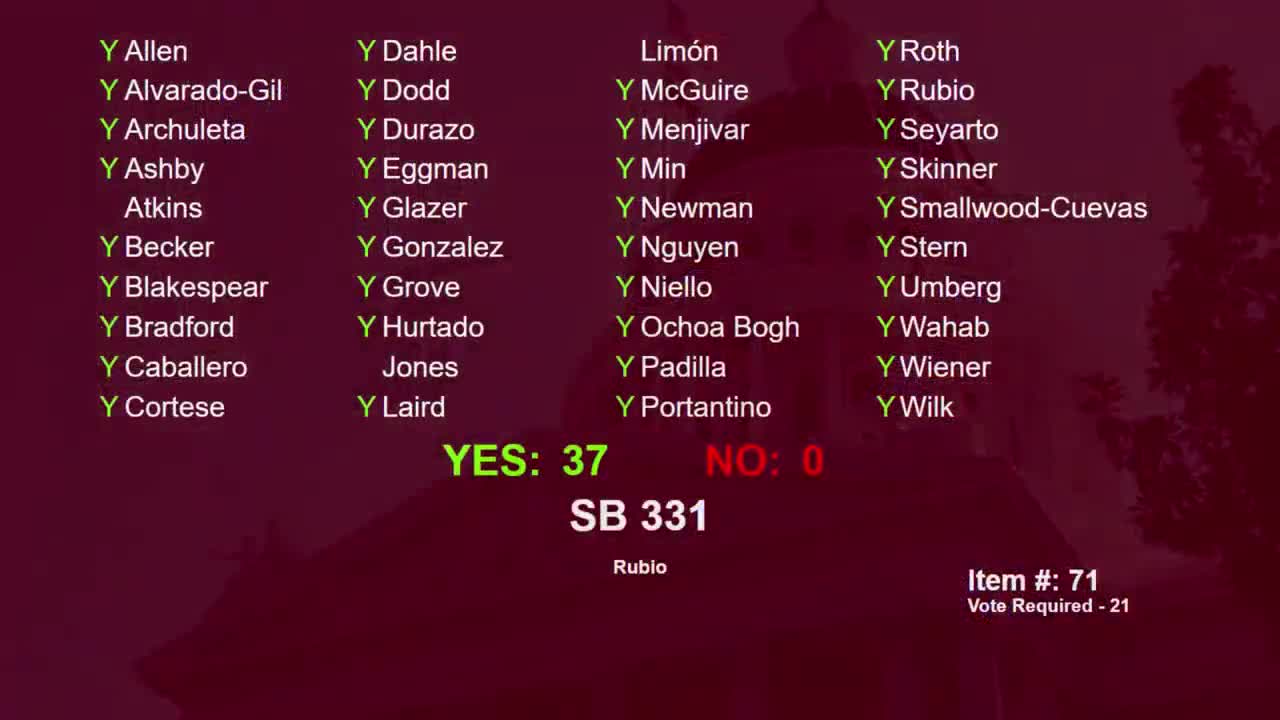 23MIN
Senate Floor
 22MIN
Senate Standing Committee on Judiciary
 43MIN
Senate Standing Committee on Human Services
Bill Author


