SB 420: Electricity: electrical transmission facility projects.
- Session Year: 2023-2024
- House: Senate
- Latest Version Date: 2023-09-18
Current Status:
Failed
(2024-01-25: Veto sustained.)
Introduced
In Committee
First Chamber
In Committee
Second Chamber
Enacted
Existing law vests the Public Utilities Commission (PUC) with regulatory authority over public utilities, including electrical corporations, while local publicly owned electric utilities are under the direction of their governing boards. Existing law, implemented by the PUC through a general order, generally prohibits an electrical corporation from beginning the construction of a line, plant, or system, or of any extension thereof, without having first obtained from the commission a certificate that the present or future public convenience and necessity require or will require its construction, as specified. However, existing law exempts the extension, expansion, upgrade, or other modification of an existing electrical transmission facility, including transmission lines and substations, from that certification requirement.
This bill would additionally exempt the rebuilding of an existing electrical transmission facility from that requirement, and would provide that the construction of a new electrical transmission facility, or the extension, expansion, upgrade, rebuilding, or other modification of an electrical transmission facility, including lines and substations, by an electrical corporation serving 10,000 or more retail customers does not require that certification, a permit to construct, or any other discretionary permit from the commission, if the new or modified electrical transmission facility meets certain requirements. The bill would also require the PUC, no later than January 1, 2025, to revise the general order to implement these changes, as specified.
Under existing law, a violation of the Public Utilities Act or any order, decision, rule, direction, demand, or requirement of the commission is a crime.
Because certain provisions of this bill would be a part of the act and a violation of a commission action implementing its requirements would be a crime, the bill would impose a state-mandated local program.
The California Constitution requires the state to reimburse local agencies and school districts for certain costs mandated by the state. Statutory provisions establish procedures for making that reimbursement.
This bill would provide that no reimbursement is required by this act for a specified reason.
Existing law vests the Public Utilities Commission (PUC) with regulatory authority over public utilities, including electrical corporations, while local publicly owned electric utilities are under the direction of their governing boards. Existing law, implemented by the PUC through a general order, generally prohibits an electrical corporation from beginning the construction of a line, plant, or system, or of any extension thereof, without having first obtained from the commission a certificate that the present or future public convenience and necessity require or will require its construction, as specified. However, existing law exempts the extension, expansion, upgrade, or other modification of an existing electrical transmission facility, including transmission lines and substations, from that certification requirement.
This bill would additionally exempt the reconstruction rebuilding of an existing electrical transmission facility from that requirement, and would provide that the construction of a new electrical transmission facility, or the extension, expansion, upgrade, reconstruction, rebuilding, or other modification of an electrical transmission facility, including lines and substations, by an electrical corporation serving 10,000 or more retail customers does not require that certification, a permit to construct, or any other discretionary permit from the commission, if the new or modified electrical transmission facility meets certain requirements. The bill would also require the PUC, no later than June 30, 2024, January 1, 2025, to revise the general order to implement these changes, as specified.
Under existing law, a violation of the Public Utilities Act or any order, decision, rule, direction, demand, or requirement of the commission is a crime.
Because certain provisions of this bill would be a part of the act and a violation of a commission action implementing its requirements would be a crime, the bill would impose a state-mandated local program.
The California Constitution requires the state to reimburse local agencies and school districts for certain costs mandated by the state. Statutory provisions establish procedures for making that reimbursement.
This bill would provide that no reimbursement is required by this act for a specified reason.
Existing law vests the Public Utilities Commission (PUC) with regulatory authority over public utilities, including electrical corporations, while local publicly owned electric utilities are under the direction of their governing boards. Existing law law, implemented by the PUC through a general order, generally prohibits an electrical corporation from beginning the construction of a line, plant, or system, or of any extension thereof, without having first obtained from the commission a certificate that the present or future public convenience and necessity require or will require its construction, as specified. Under existing law, However, existing law exempts the extension, expansion, upgrade, or other modification of an existing electrical transmission facility, including transmission lines and substations, does not require a certificate that the present or future public convenience and necessity requires or will require its construction. from that certification requirement.
This bill would include additionally exempt the reconstruction of an existing electrical transmission facility in the above exemption. The bill would additionally from that requirement, and would provide that the construction of a new electrical transmission facility, or the extension, expansion, upgrade, reconstruction, or other modification of an electrical transmission facility, including lines and substations, by an electrical corporation serving 10,000 or more retail customers does not require a certificate that the present or future public convenience and necessity requires or will require its construction, that certification, a permit to construct, or any other discretionary permit from the commission, if the new or modified electrical transmission facility meets certain requirements. The bill would also require the PUC, no later than June 30, 2024, to revise the general order to implement these changes, as specified.
Under existing law, a violation of the Public Utilities Act or any order, decision, rule, direction, demand, or requirement of the commission is a crime.
Because certain provisions of this bill would be a part of the act and a violation of a commission action implementing its requirements would be a crime, the bill would impose a state-mandated local program.
The California Constitution requires the state to reimburse local agencies and school districts for certain costs mandated by the state. Statutory provisions establish procedures for making that reimbursement.
This bill would provide that no reimbursement is required by this act for a specified reason.
Existing law vests the Public Utilities Commission with regulatory authority over public utilities, including electrical corporations, while local publicly owned electric utilities are under the direction of their governing boards. Existing law prohibits an electrical corporation from beginning the construction of a line, plant, or system, or of any extension thereof, without having first obtained from the commission a certificate that the present or future public convenience and necessity require or will require its construction, as specified. Under existing law, the extension, expansion, upgrade, or other modification of an existing electrical transmission facility, including transmission lines and substations, does not require a certificate that the present or future public convenience and necessity requires or will require its construction.
This bill would include the reconstruction of an existing electrical transmission facility in the above exemption and would specify that those projects also do not require a permit to construct or any other discretionary permit from the commission. exemption. The bill would additionally provide that the construction of a new electrical transmission facility, including lines and substations, by an electrical corporation serving 10,000 or more retail customers does not require a certificate that the present or future public convenience and necessity requires or will require its construction, a permit to construct, or any other discretionary permit from the commission, if the electrical transmission facility meets certain requirements.
Existing law establishes the Independent System Operator as a nonprofit, public benefit corporation to ensure efficient use and reliable operation of the transmission grid and to manage the transmission grid and related energy markets, as specified. Existing law requires the commission, on or before January 15, 2023, to request the Independent System Operator to identify the highest priority transmission facilities that are needed to allow for increased transmission capacity into local capacity areas to deliver renewable energy resources or zero-carbon resources that are expected to be developed by 2035 into those areas, and to consider whether to approve those projects as part of its 202223 transmission planning process.The Jobs and Economic Improvement Through Environmental Leadership Act of 2021 authorizes the Governor, until January 1, 2024, to certify environmental leadership development projects that meet specified requirements for certain streamlining benefits related to the California Environmental Quality Act (CEQA). Existing law requires the lead agency to approve a certified environmental leadership development project before January 1, 2025, for the project to be eligible for those CEQA streamlining benefits.This bill would require the Governor to identify a primary agency to monitor clean energy and electrical transmission facility planning and deployment, and require that agency to identify those electrical transmission facility projects necessary to maintain system reliability and to meet specified targets. The bill would require electrical transmission facility projects identified by the Independent System Operator in its annual transmission planning process and certain electrical transmission facility projects that would satisfy a transmission expansion need approved by the governing body of a local publicly owned electric utility to be eligible for certification and streamlining as environmental leadership development projects for purposes of the Jobs and Economic Improvement Through Environmental Leadership Act of 2021, except as provided. The bill would extend the deadline for the Governor to certify these projects to January 1, 2028, and the deadline for the lead agency to approve the project to January 1, 2029.Under existing law, a violation of the Public Utilities Act or any order, decision, rule, direction, demand, or requirement of the commission is a crime.
Because certain provisions of this bill would be a part of the act and a violation of a commission action implementing its requirements would be a crime, the bill would impose a state-mandated local program.
The California Constitution requires the state to reimburse local agencies and school districts for certain costs mandated by the state. Statutory provisions establish procedures for making that reimbursement.
This bill would provide that no reimbursement is required by this act for a specified reason.
Existing law vests the Public Utilities Commission with regulatory authority over public utilities, including electrical corporations, while local publicly owned electric utilities are under the direction of their governing boards. Existing law prohibits an electrical corporation from beginning the construction of a line, plant, or system, or of any extension thereof, without having first obtained from the commission a certificate that the present or future public convenience and necessity require or will require its construction, as specified. Under existing law, the extension, expansion, upgrade, or other modification of an existing electrical transmission facility, including transmission lines and substations, does not require a certificate that the present or future public convenience and necessity requires or will require its construction.
This bill would include the reconstruction of an existing electrical transmission facility in the above exemption and would specify that those projects also do not require a permit to construct or any other discretionary permit from the commission. The bill would additionally provide that the construction of a new electrical facility, including lines and substations, by an electrical corporation serving 10,000 or more retail customers does not require a certificate that the present or future public convenience and necessity requires or will require its construction, a permit to construct, or any other discretionary permit from the commission, if the electrical facility meets certain requirements.
Existing law establishes the Independent System Operator as a nonprofit, public benefit corporation to ensure efficient use and reliable operation of the transmission grid and to manage the transmission grid and related energy markets, as specified. Existing law requires the commission, on or before January 15, 2023, to request the Independent System Operator to identify the highest priority transmission facilities that are needed to allow for increased transmission capacity into local capacity areas to deliver renewable energy resources or zero-carbon resources that are expected to be developed by 2035 into those areas, and to consider whether to approve those projects as part of its 202223 transmission planning process.
The Jobs and Economic Improvement Through Environmental Leadership Act of 2021 authorizes the Governor, until January 1, 2024, to certify environmental leadership development projects that meet specified requirements for certain streamlining benefits related to the California Environmental Quality Act (CEQA). Existing law requires the lead agency to approve a certified environmental leadership development project before January 1, 2025, for the project to be eligible for those CEQA streamlining benefits.
This bill would require the Governor to identify a primary agency to monitor clean energy and electrical transmission facility planning and deployment, and require that agency to identify those electrical transmission facility projects necessary to maintain system reliability and to meet specified targets. The bill would require electrical transmission facility projects identified by the Independent System Operator in its annual transmission planning process and certain electrical transmission facility projects that would satisfy a transmission expansion need approved by the governing body of a local publicly owned electric utility to be eligible for certification and streamlining as environmental leadership development projects for purposes of the Jobs and Economic Improvement Through Environmental Leadership Act of 2021, except as provided. The bill would extend the deadline for the Governor to certify these projects to January 1, 2028, and the deadline for the lead agency to approve the project to January 1, 2029.
Under existing law, a violation of the Public Utilities Act or any order, decision, rule, direction, demand, or requirement of the commission is a crime.
Because certain provisions of this bill would be a part of the act and a violation of a commission action implementing its requirements would be a crime, the bill would impose a state-mandated local program.
The California Constitution requires the state to reimburse local agencies and school districts for certain costs mandated by the state. Statutory provisions establish procedures for making that reimbursement.
This bill would provide that no reimbursement is required by this act for a specified reason.
Existing law vests the Public Utilities Commission with regulatory authority over public utilities, including electrical corporations. Existing law prohibits an electrical corporation from beginning the construction of a line, plant, or system, or of any extension thereof, without having first obtained from the commission a certificate that the present or future public convenience and necessity require or will require its construction, as specified. Under existing law, the extension, expansion, upgrade, or other modification of an existing electrical transmission facility, including transmission lines and substations, does not require a certificate that the present or future public convenience and necessity requires or will require its construction. corporations, while local publicly owned electric utilities are under the direction of their governing boards.
Existing law establishes the Independent System Operator as a nonprofit, public benefit corporation to ensure efficient use and reliable operation of the transmission grid and to manage the transmission grid and related energy markets, as specified. Existing law requires the commission, on or before January 15, 2023, to request the Independent System Operator to identify the highest priority transmission facilities that are needed to allow for increased transmission capacity into local capacity areas to deliver renewable energy resources or zero-carbon resources that are expected to be developed by 2035 into those areas, and to consider whether to approve those projects as part of its 202223 transmission planning process.
The Jobs and Economic Improvement Through Environmental Leadership Act of 2021 authorizes the Governor, until January 1, 2024, to certify environmental leadership development projects that meet specified requirements for certain streamlining benefits related to the California Environmental Quality Act (CEQA). Existing law requires the lead agency to approve a certified environmental leadership development project before January 1, 2025, for the project to be eligible for those CEQA streamlining benefits.
This bill would require the Governor to identify a lead primary agency to monitor clean energy and electrical transmission facility planning and deployment, and require that agency to identify those electrical transmission facility projects necessary to maintain system reliability and to meet specified targets. The bill would make that agency the lead agency for those projects for purposes of CEQA and deem those projects to be environmental leadership development projects for purposes of the Jobs and Economic Improvement Through Environmental Leadership Act of 2021, except as provided. The bill would require the commission, in proceedings evaluating the issuance of certificates of public convenience and necessity for those projects, to establish a rebuttable presumption with regard to need for the project in favor of an Independent System Operator governing board-approved need evaluation if certain requirements related to the Independent System Operator are satisfied. The bill would require electrical transmission facility projects identified by the Independent System Operator in its annual transmission planning process and certain electrical transmission facility projects that would satisfy a transmission expansion need approved by the governing body of a local publicly owned electric utility to be eligible for certification and streamlining as environmental leadership development projects for purposes of the Jobs and Economic Improvement Through Environmental Leadership Act of 2021, except as provided. The bill would extend the deadline for the Governor to certify these projects to January 1, 2028, and the deadline for the lead agency to approve the project to January 1, 2029.
Existing law vests the Public Utilities Commission with regulatory authority over public utilities, including electrical corporations. Existing law prohibits an electrical corporation from beginning the construction of a line, plant, or system, or of any extension thereof, without having first obtained from the commission a certificate that the present or future public convenience and necessity require or will require its construction, as specified. Under existing law, the extension, expansion, upgrade, or other modification of an existing electrical transmission facility, including transmission lines and substations, does not require a certificate that the present or future public convenience and necessity requires or will require its construction.
Existing law establishes the Independent System Operator, Operator as a nonprofit, public benefit corporation to ensure efficient use and reliable operation of the transmission grid and to manage the transmission grid and related energy markets, as specified. Existing law requires the commission, on or before January 15, 2023, to request the Independent System Operator to identify the highest priority transmission facilities that are needed to allow for increased transmission capacity into local capacity areas to deliver renewable energy resources or zero-carbon resources that are expected to be developed by 2035 into those areas, and to consider whether to approve those projects as part of its 202223 transmission planning process.
The Jobs and Economic Improvement Through Environmental Leadership Act of 2021 authorizes the Governor, until January 1, 2024, to certify environmental leadership development projects that meet specified requirements for certain streamlining benefits related to the California Environmental Quality Act (CEQA).
This bill would require the Governor to identify a lead agency to monitor clean energy and electrical transmission facility planning and deployment, and require that agency, in consultation with the Natural Resources Agency, agency to identify those electrical transmission facility projects necessary to maintain system reliability and to meet specified targets. The bill would make that agency the lead agency for those projects for purposes of CEQA and deem those projects to be environmental leadership development projects for purposes of the Jobs and Economic Improvement Through Environmental Leadership Act of 2021, except as provided. The bill would require the commission, in proceedings evaluating the issuance of certificates of public convenience and necessity for those projects, to establish a rebuttable presumption with regard to need for the project in favor of an Independent System Operator governing board-approved need evaluation if certain requirements related to the Independent System Operator are satisfied.
Existing law vests the Public Utilities Commission with regulatory authority over public utilities, including electrical corporations. Existing law prohibits an electrical corporation from beginning the construction of a line, plant, or system, or of any extension thereof, without having first obtained from the commission a certificate that the present or future public convenience and necessity require or will require its construction, as specified. Under existing law, the extension, expansion, upgrade, or other modification of an existing electrical transmission facility, including transmission lines and substations, does not require a certificate that the present or future public convenience and necessity requires or will require its construction.
Existing law establishes the Independent System Operator, as a nonprofit, public benefit corporation to ensure efficient use and reliable operation of the transmission grid and to manage the transmission grid and related energy markets, as specified. Existing law requires the commission, on or before January 1, 15, 2023, to request the Independent System Operator to identify the highest priority transmission facilities that are needed to allow for increased transmission capacity into local capacity areas to deliver renewable energy resources or zero-carbon resources that are expected to be developed by 2035 into those areas, and to consider whether to approve those projects as part of its 202223 transmission planning process.
The Jobs and Economic Improvement Through Environmental Leadership Act of 2021 authorizes the Governor, until January 1, 2024, to certify environmental leadership development projects that meet specified requirements for certain streamlining benefits related to the California Environmental Quality Act (CEQA).
This bill would require the Governor to identify a lead agency to monitor clean energy and electrical transmission facility planning and deployment, and require that agency agency, in consultation with the Natural Resources Agency, to identify those electrical transmission facility projects necessary to maintain system reliability and to meet specified targets. The bill would make that agency the lead agency for those projects for purposes of CEQA and deem those projects to be environmental leadership development projects for purposes of the Jobs and Economic Improvement Through Environmental Leadership Act of 2021. 2021, except as provided. The bill would require the commission, in proceedings evaluating the issuance of certificates of public convenience and necessity for those projects, to establish a rebuttable presumption with regard to need for the project in favor of an Independent System Operator governing board-approved need evaluation if certain requirements related to the Independent System Operator are satisfied.
Existing law vests the Public Utilities Commission with regulatory authority over public utilities, including electrical corporations. Existing law prohibits an electrical corporation from beginning the construction of a line, plant, or system, or of any extension thereof, without having first obtained from the commission a certificate that the present or future public convenience and necessity require or will require its construction, as specified. Under existing law, the extension, expansion, upgrade, or other modification of an existing electrical transmission facility, including transmission lines and substations, does not require a certificate that the present or future public convenience and necessity requires or will require its construction.
Existing law establishes the Independent System Operator, as a nonprofit, public benefit corporation to ensure efficient use and reliable operation of the transmission grid and to manage the transmission grid and related energy markets, as specified. Existing law requires the commission, on or before January 1, 2023, to request the Independent System Operator to identify the highest priority transmission facilities that are needed to allow for increased transmission capacity into local capacity areas to deliver renewable energy resources or zero-carbon resources that are expected to be developed by 2035 into those areas, and to consider whether to approve those projects as part of its 202223 transmission planning process.
The Jobs and Economic Improvement Through Environmental Leadership Act of 2021 authorizes the Governor, until January 1, 2024, to certify environmental leadership development projects that meet specified requirements for certain streamlining benefits related to the California Environmental Quality Act (CEQA).
This bill would require the Governor to identify a lead agency to monitor clean energy and electrical transmission facility planning and deployment, and require that agency to identify those electrical transmission facility projects necessary to maintain system reliability and to meet specified targets. The bill would make that agency the lead agency for those projects for purposes of CEQA and deem those projects to be environmental leadership development projects for purposes of the Jobs and Economic Improvement Through Environmental Leadership Act of 2021. In a commission proceeding to determine whether to issue certificates The bill would require the commission, in proceedings evaluating the issuance of certificates of public convenience and necessity for those projects, the bill would to establish a rebuttable presumption that with regard to need for the project is necessary in favor of an Independent System Operator governing board-approved need evaluation if certain requirements related to the Independent System Operator are satisfied.
Existing law vests the Public Utilities Commission with regulatory authority over public utilities, including electrical corporations. Existing law prohibits an electrical corporation from beginning the construction of a line, plant, or system, or of any extension thereof, without having first obtained from the commission a certificate that the present or future public convenience and necessity require or will require its construction, as specified. Under existing law, the extension, expansion, upgrade, or other modification of an existing electrical transmission facility, including transmission lines and substations, does not require a certificate that the present or future public convenience and necessity requires or will require its construction.
Existing law establishes the Independent System Operator, as a nonprofit, public benefit corporation to ensure efficient use and reliable operation of the transmission grid and to manage the transmission grid and related energy markets, as specified. Existing law requires the commission, on or before January 1, 2023, to request the Independent System Operator to identify the highest priority transmission facilities that are needed to allow for increased transmission capacity into local capacity areas to deliver renewable energy resources or zero-carbon resources that are expected to be developed by 2035 into those areas, and to consider whether to approve those projects as part of its 202223 transmission planning process.
The Jobs and Economic Improvement Through Environmental Leadership Act of 2021 authorizes the Governor, until January 1, 2024, to certify environmental leadership development projects that meet specified requirements for certain streamlining benefits related to the California Environmental Quality Act (CEQA).
This bill would require the Governor to identify a lead agency to monitor clean energy and electrical transmission facility planning and deployment, and require that agency to identify those electrical transmission facility projects necessary to maintain system reliability and to meet specified targets. The bill would make that agency the lead agency for those projects for purposes of CEQA and deem those projects to be environmental leadership development projects for purposes of the Jobs and Economic Improvement Through Environmental Leadership Act of 2021. In a commission proceeding to determine whether to issue certificates of public convenience and necessity for those projects, the bill would establish a rebuttable presumption that the project is necessary if certain requirements related to the Independent System Operator are satisfied.
It is the intent of the Legislature in enacting this act to streamline the regulatory approval process for electrical transmission lines and equipment that are critical to maintaining electrical reliability and meeting Californias renewable and zero-carbon energy resource goals established in Senate Bill 100 (Chapter 312 of the Statutes of 2018).
SEC. 2.Section 1001 of the Public Utilities Code is amended to read:1001.(a)A railroad corporation whose railroad is operated primarily by electricity, street railroad corporation, gas corporation, electrical corporation, telegraph corporation, telephone corporation, water corporation, or sewer system corporation shall not begin the construction of a street railroad, of a line, plant, or system, or of any extension thereof, without having first obtained from the commission a certificate that the present or future public convenience and necessity require or will require its construction.
(b)(1)The extension, expansion, upgrade, rebuilding, or other modification of an existing electrical transmission facility, including transmission lines and substations, does not require a certificate that the present or future public convenience and necessity requires or will require its construction.
(2)The construction of a new electrical transmission facility, or the extension, expansion, upgrade, rebuilding, or other modification of an electrical transmission facility, including lines and substations, by an electrical corporation serving 10,000 or more retail customers, does not require a certificate that the present or future public convenience and necessity requires or will require its construction, a permit to construct, or any other discretionary permit from the commission, if the new or modified electrical transmission facility meets all of the following requirements:
(A)It will be rated at not more than 138 kilovolts.
(B)It will meet one of the following requirements:
(i)It will be located entirely on previously disturbed land, as described in subdivision (b) of Section 25794.6 of the Public Resources Code.
(ii)It will be located entirely in an urbanized area, as delineated by the United States Census Bureau.
(iii)It will be part of a project that has undergone review pursuant to the California Environmental Quality Act (Division 13 (commencing with Section 21000) of the Public Resources Code).
(C)It will not be located on any of the following:
(i)A wetland, as defined by the State Water Resources Control Board.
(ii)Any unremediated hazardous waste site designated under the federal Comprehensive Environmental Response, Compensation and Liability Act, as amended (42 U.S.C. Sec. 9601 et seq.), or pursuant to Section 25356 of the Health and Safety Code.
(iii)A critical habitat as designated by the United States Fish and Wildlife Service pursuant to the federal Endangered Species Act of 1973 (16 U.S.C. Sec. 1531 et seq.), or habitat essential to the continued existence of an endangered or threatened species as determined by the Department of Fish and Wildlife pursuant to the California Endangered Species Act (Chapter 1.5 (commencing with Section 2050) of Division 3 of the Fish and Game Code).
(3)No later than January 1, 2025, the commission shall update General Order 131 to implement paragraph (2) so that all facilities that qualify under paragraph (2) will be treated as electric distribution facilities are treated under General Order 131-D.
(c)This article does not require those corporations to secure that certificate for an extension within any city or city and county within which it has lawfully commenced operations, for an extension into territory either within or without a city or city and county contiguous to its street railroad, line, plant, or system, and not served by a public utility of like character, or for an extension within or to territory already served by it, necessary in the ordinary course of its business. If any public utility, in constructing or extending its line, plant, or system, interferes or is about to interfere with the operation of the line, plant, or system of any other public utility or of the water system of a public agency, already constructed, the commission, on complaint of the public utility or public agency claiming to be injuriously affected, may, after hearing, make an order and prescribe terms and conditions for the location of the lines, plants, or systems affected as it may seem just and reasonable.
SEC. 3.No reimbursement is required by this act pursuant to Section 6 of Article XIIIB of the California Constitution because the only costs that may be incurred by a local agency or school district will be incurred because this act creates a new crime or infraction, eliminates a crime or infraction, or changes the penalty for a crime or infraction, within the meaning of Section 17556 of the Government Code, or changes the definition of a crime within the meaning of Section 6 of Article XIIIB of the California Constitution.
It is the intent of the Legislature in enacting this act to streamline the regulatory approval process for electrical transmission lines and equipment that are critical to maintaining electrical reliability and meeting Californias renewable and zero-carbon energy resource goals established in Senate Bill 100 (Chapter 312 of the Statutes of 2018).
SEC. 2.Section 1001 of the Public Utilities Code is amended to read:1001.(a)A railroad corporation whose railroad is operated primarily by electricity, street railroad corporation, gas corporation, electrical corporation, telegraph corporation, telephone corporation, water corporation, or sewer system corporation shall not begin the construction of a street railroad, of a line, plant, or system, or of any extension thereof, without having first obtained from the commission a certificate that the present or future public convenience and necessity require or will require its construction.
(b)(1)The extension, expansion, upgrade, reconstruction, rebuilding, or other modification of an existing electrical transmission facility, including transmission lines and substations, does not require a certificate that the present or future public convenience and necessity requires or will require its construction.
(2)The construction of a new electrical transmission facility, or the extension, expansion, upgrade, reconstruction, rebuilding, or other modification of an electrical transmission facility, including lines and substations, by an electrical corporation serving 10,000 or more retail customers, does not require a certificate that the present or future public convenience and necessity requires or will require its construction, a permit to construct, or any other discretionary permit from the commission, if the new or modified electrical transmission facility meets all of the following requirements:
(A)It will be rated at not more than 138 kilovolts.
(B)It will meet one of the following requirements:
(i)It will be located entirely on previously disturbed land, as described in subdivision (b) of Section 25794.6 of the Public Resources Code.
(ii)It will be located entirely in an urbanized area, as delineated by the United States Census Bureau.
(iii)It will be part of a project that has undergone review pursuant to the California Environmental Quality Act (Division 13 (commencing with Section 21000) of the Public Resources Code).
(C)It will not be located on any of the following:
(i)A wetland, as defined by the State Water Resources Control Board.
(ii)Any unremediated hazardous waste site designated under the federal Comprehensive Environmental Response, Compensation and Liability Act, as amended (42 U.S.C. Sec. 9601 et seq.), or pursuant to Section 25356 of the Health and Safety Code.
(iii)A critical habitat as designated by the United States Fish and Wildlife Service pursuant to the federal Endangered Species Act of 1973 (16 U.S.C. Sec. 1531 et seq.), or habitat essential to the continued existence of an endangered or threatened species as determined by the Department of Fish and Wildlife pursuant to the California Endangered Species Act (Chapter 1.5 (commencing with Section 2050) of Division 3 of the Fish and Game Code).
(3)No later than June 30, 2024, January 1, 2025, the commission shall update General Order 131 to implement paragraph (2) so that all facilities that qualify under paragraph (2) will be treated as electric distribution facilities are treated under General Order 131-D.
(c)This article does not require those corporations to secure that certificate for an extension within any city or city and county within which it has lawfully commenced operations, for an extension into territory either within or without a city or city and county contiguous to its street railroad, line, plant, or system, and not served by a public utility of like character, or for an extension within or to territory already served by it, necessary in the ordinary course of its business. If any public utility, in constructing or extending its line, plant, or system, interferes or is about to interfere with the operation of the line, plant, or system of any other public utility or of the water system of a public agency, already constructed, the commission, on complaint of the public utility or public agency claiming to be injuriously affected, may, after hearing, make an order and prescribe terms and conditions for the location of the lines, plants, or systems affected as it may seem just and reasonable.
SEC. 3.No reimbursement is required by this act pursuant to Section 6 of Article XIIIB of the California Constitution because the only costs that may be incurred by a local agency or school district will be incurred because this act creates a new crime or infraction, eliminates a crime or infraction, or changes the penalty for a crime or infraction, within the meaning of Section 17556 of the Government Code, or changes the definition of a crime within the meaning of Section 6 of Article XIIIB of the California Constitution.
It is the intent of the Legislature in enacting this bill act to streamline the regulatory approval process for electrical transmission lines and equipment that are critical to maintaining electrical reliability and meeting Californias grid decarbonization targets. renewable and zero-carbon energy resource goals established in Senate Bill 100 (Chapter 312 of the Statutes of 2018).
SEC. 2.Section 1001 of the Public Utilities Code is amended to read:1001.(a)A railroad corporation whose railroad is operated primarily by electricity, street railroad corporation, gas corporation, electrical corporation, telegraph corporation, telephone corporation, water corporation, or sewer system corporation shall not begin the construction of a street railroad, of a line, plant, or system, or of any extension thereof, without having first obtained from the commission a certificate that the present or future public convenience and necessity require or will require its construction.
(b)(1)The extension, expansion, upgrade, reconstruction, or other modification of an existing electrical transmission facility, including transmission lines and substations, does not require a certificate that the present or future public convenience and necessity requires or will require its construction.
(2)The construction of a new electrical transmission facility, or the extension, expansion, upgrade, reconstruction, or other modification of an electrical transmission facility, including lines and substations, by an electrical corporation serving 10,000 or more retail customers, does not require a certificate that the present or future public convenience and necessity requires or will require its construction, a permit to construct, or any other discretionary permit from the commission, if the new or modified electrical transmission facility meets all of the following requirements:
(A)It will be rated at not more than 138 kilovolts.
(B)It will meet one of the following requirements:
(i)It will be located entirely on previously disturbed land, as described in subdivision (b) of Section 25794.6 of the Public Resources Code.
(ii)It will be located entirely in an urbanized area, as delineated by the United States Census Bureau.
(iii)It will be part of a project that has undergone review pursuant to the California Environmental Quality Act (Division 13 (commencing with Section 21000) of the Public Resources Code).
(C)It will not be located on any of the following:
(i)A wetland, as defined by the State Water Resources Control Board.
(ii)Any unremediated hazardous waste site designated under the federal Comprehensive Environmental Response, Compensation and Liability Act, as amended (42 U.S.C. Sec. 9601 et seq.), or pursuant to Section 25356 of the Health and Safety Code.
(iii)A critical habitat as designated by the United States Fish and Wildlife Service pursuant to the federal Endangered Species Act of 1973 (16 U.S.C. Sec. 1531 et seq.), or habitat essential to the continued existence of an endangered or threatened species as determined by the Department of Fish and Wildlife pursuant to the California Endangered Species Act (Chapter 1.5 (commencing with Section 2050) of Division 3 of the Fish and Game Code).
(3)No later than June 30, 2024, the commission shall update General Order 131 to implement paragraph (2) so that all facilities that qualify under paragraph (2) will be treated as electric distribution facilities are treated under General Order 131-D.
(c)This article does not require those corporations to secure that certificate for an extension within any city or city and county within which it has lawfully commenced operations, for an extension into territory either within or without a city or city and county contiguous to its street railroad, line, plant, or system, and not served by a public utility of like character, or for an extension within or to territory already served by it, necessary in the ordinary course of its business. If any public utility, in constructing or extending its line, plant, or system, interferes or is about to interfere with the operation of the line, plant, or system of any other public utility or of the water system of a public agency, already constructed, the commission, on complaint of the public utility or public agency claiming to be injuriously affected, may, after hearing, make an order and prescribe terms and conditions for the location of the lines, plants, or systems affected as it may seem just and reasonable.
SEC. 3.No reimbursement is required by this act pursuant to Section 6 of Article XIIIB of the California Constitution because the only costs that may be incurred by a local agency or school district will be incurred because this act creates a new crime or infraction, eliminates a crime or infraction, or changes the penalty for a crime or infraction, within the meaning of Section 17556 of the Government Code, or changes the definition of a crime within the meaning of Section 6 of Article XIIIB of the California Constitution.
It is the intent of the Legislature in enacting this bill to streamline the regulatory approval process for electrical transmission lines that are critical to maintaining electrical reliability and meeting Californias grid decarbonization targets.
SEC. 2.Section 1001 of the Public Utilities Code is amended to read:1001.(a)A railroad corporation whose railroad is operated primarily by electricity, street railroad corporation, gas corporation, electrical corporation, telegraph corporation, telephone corporation, water corporation, or sewer system corporation shall not begin the construction of a street railroad, of a line, plant, or system, or of any extension thereof, without having first obtained from the commission a certificate that the present or future public convenience and necessity require or will require its construction.
(b)(1)The extension, expansion, upgrade, reconstruction, or other modification of an existing electrical transmission facility, including transmission lines and substations, does not require a certificate that the present or future public convenience and necessity requires or will require its construction, a permit to construct, or any other discretionary permit from the commission. construction.
(2)The construction of a new electrical transmission facility, including lines and substations, by an electrical corporation serving 10,000 or more retail customers, does not require a certificate that the present or future public convenience and necessity requires or will require its construction, a permit to construct, or any other discretionary permit from the commission, if the electrical transmission facility meets all of the following requirements:
(A)It will be rated at not more than 138 kilovolts.
(B)It will meet one of the following requirements:
(i)It will be located on previously disturbed land. land, as described in subdivision (b) of Section 25794.6 of the Public Resources Code.
(ii)It will be located in an urbanized area, as delineated by the United States Census Bureau.
(iii)It will be part of a project that has undergone review pursuant to the California Environmental Quality Act (Division 13 (commencing with Section 21000) of the Public Resources Code).
(C)It will not be located on any of the following:
(i)A wetland, as defined by the State Water Resources Control Board.
(ii)Any unremediated hazardous waste site designated under the federal Comprehensive Environmental Response, Compensation and Liability Act, as amended (42 U.S.C. Sec. 9601 et seq.), or pursuant to Section 25356 of the Health and Safety Code.
(iii)A critical habitat as designated by the United States Fish and Wildlife Service pursuant to the federal Endangered Species Act of 1973 (16 U.S.C. Sec. 1531 et seq.), or habitat essential to the continued existence of an endangered or threatened species as determined by the Department of Fish and Wildlife pursuant to the California Endangered Species Act (Chapter 1.5 (commencing with Section 2050) of Division 3 of the Fish and Game Code).
(c)This article does not require those corporations to secure that certificate for an extension within any city or city and county within which it has lawfully commenced operations, for an extension into territory either within or without a city or city and county contiguous to its street railroad, line, plant, or system, and not served by a public utility of like character, or for an extension within or to territory already served by it, necessary in the ordinary course of its business. If any public utility, in constructing or extending its line, plant, or system, interferes or is about to interfere with the operation of the line, plant, or system of any other public utility or of the water system of a public agency, already constructed, the commission, on complaint of the public utility or public agency claiming to be injuriously affected, may, after hearing, make an order and prescribe terms and conditions for the location of the lines, plants, or systems affected as to it may seem just and reasonable.
SEC. 3.Section 1005.3 is added to the Public Utilities Code, to read:1005.3.(a)The Governor shall identify a primary agency to monitor clean energy and electrical transmission facility planning and deployment.(b)The primary agency identified pursuant to subdivision (a) shall identify those electrical transmission facility projects necessary to maintain system reliability and to meet the targets set pursuant to Chapter 312 of the Statutes of 2018 and Chapter 361 of the Statutes of 2022. For purposes of this subdivision, the primary agency shall strategically consider clean energy planning alongside land conservation to minimize environmental impact.SEC. 4.Chapter 8 (commencing with Section 8400) is added to Division 4.1 of the Public Utilities Code, to read:8.Environmental Review of Electrical Transmission Projects8400.(a)Notwithstanding Sections 21181, 21189.1, and 21189.3 of the Public Resources Code, and except as provided in subdivision (b), the following electrical transmission facility projects shall be eligible for certification and streamlining as environmental leadership development projects for purposes of Chapter 6.5 (commencing with Section 21178) of Division 13 of the Public Resources Code, as that chapter read on January 1, 2024:(1)An electrical transmission facility project identified by the Independent System Operator in its annual transmission planning process.(2)An electrical transmission facility project identified by a local publicly owned electric utility that would satisfy a transmission expansion need approved by the governing body of the local publicly owned electric utility, which meets either of the following criteria:(A)The project will facilitate delivery of electricity from renewable energy resources or zero-carbon resources.(B)The project will facilitate delivery of electricity from energy storage projects.(b)Notwithstanding subdivision (a), an electrical transmission facility project described in subdivision (a) is not an environmental leadership development project pursuant to Chapter 6.5 (commencing with Section 21178) of Division 13 of the Public Resources Code if it is located in any of the following areas:(1)Lands within the state park system, except for a state vehicular recreation area.(2)A national park, national monument, national recreation area, or national preserve.(3)The coastal zone, as defined in Division 20 (commencing with Section 30000) of the Public Resources Code.(4)Wetlands, as defined in the United States Fish and Wildlife Service Manual, Part 660 FW 2 (June 21, 1993).(c)Notwithstanding Section 21181 of the Public Resources Code, the deadline for the Governor to certify an electrical transmission facility project that is an environmental leadership development project pursuant to this section is January 1, 2028. Notwithstanding Section 21189.1 of the Public Resources Code, the deadline for the lead agency to approve an electrical transmission facility project certified by the Governor is January 1, 2029.8401.This chapter shall remain in effect only until January 1, 2030, and as of that date is repealed.SEC. 5.SEC. 3.No reimbursement is required by this act pursuant to Section 6 of Article XIIIB of the California Constitution because the only costs that may be incurred by a local agency or school district will be incurred because this act creates a new crime or infraction, eliminates a crime or infraction, or changes the penalty for a crime or infraction, within the meaning of Section 17556 of the Government Code, or changes the definition of a crime within the meaning of Section 6 of Article XIIIB of the California Constitution.
It is the intent of the Legislature in enacting this bill to streamline the regulatory approval process for electrical transmission lines that are critical to maintaining electrical reliability and meeting Californias grid decarbonization targets.
SEC. 2.Section 1001 of the Public Utilities Code is amended to read:1001.(a)A railroad corporation whose railroad is operated primarily by electricity, street railroad corporation, gas corporation, electrical corporation, telegraph corporation, telephone corporation, water corporation, or sewer system corporation shall not begin the construction of a street railroad, of a line, plant, or system, or of any extension thereof, without having first obtained from the commission a certificate that the present or future public convenience and necessity require or will require its construction.
(b)(1)The extension, expansion, upgrade, reconstruction, or other modification of an existing electrical transmission facility, including transmission lines and substations, does not require a certificate that the present or future public convenience and necessity requires or will require its construction. construction, a permit to construct, or any other discretionary permit from the commission.
(2)The construction of a new electrical facility, including lines and substations, by an electrical corporation serving 10,000 or more retail customers, does not require a certificate that the present or future public convenience and necessity requires or will require its construction, a permit to construct, or any other discretionary permit from the commission, if the electrical facility meets all of the following requirements:
(A)It will be rated at not more than 138 kilovolts.
(B)It will meet one of the following requirements:
(i)It will be located on previously disturbed land.
(ii)It will be located in an urbanized area, as delineated by the United States Census Bureau.
(iii)It will be part of a project that has undergone review pursuant to the California Environmental Quality Act (Division 13 (commencing with Section 21000) of the Public Resources Code).
(C)It will not be located on any of the following:
(i)A wetland, as defined by the State Water Resources Control Board.
(ii)Any unremediated hazardous waste site designated under the federal Comprehensive Environmental Response, Compensation and Liability Act, as amended (42 U.S.C. Sec. 9601 et seq.), or pursuant to Section 25356 of the Health and Safety Code.
(iii)A critical habitat as designated by the United States Fish and Wildlife Service pursuant to the federal Endangered Species Act of 1973 (16 U.S.C. Sec. 1531 et seq.), or habitat essential to the continued existence of an endangered or threatened species as determined by the Department of Fish and Wildlife pursuant to the California Endangered Species Act (Chapter 1.5 (commencing with Section 2050) of Division 3 of the Fish and Game Code).
(c)This article does not require those corporations to secure that certificate for an extension within any city or city and county within which it has lawfully commenced operations, for an extension into territory either within or without a city or city and county contiguous to its street railroad, line, plant, or system, and not served by a public utility of like character, or for an extension within or to territory already served by it, necessary in the ordinary course of its business. If any public utility, in constructing or extending its line, plant, or system, interferes or is about to interfere with the operation of the line, plant, or system of any other public utility or of the water system of a public agency, already constructed, the commission, on complaint of the public utility or public agency claiming to be injuriously affected, may, after hearing, make an order and prescribe terms and conditions for the location of the lines, plants, or systems affected as to it may seem just and reasonable.
SEC. 2.SEC. 3.Section 1005.3 is added to the Public Utilities Code, to read:1005.3.(a)The Governor shall identify a primary agency to monitor clean energy and electrical transmission facility planning and deployment.
(b)The primary agency identified pursuant to subdivision (a) shall identify those electrical transmission facility projects necessary to maintain system reliability and to meet the targets set pursuant to Chapter 312 of the Statutes of 2018 and Chapter 361 of the Statutes of 2022. For purposes of this subdivision, the primary agency shall strategically consider clean energy planning alongside land conservation to minimize environmental impact.
SEC. 3.SEC. 4.Chapter 8 (commencing with Section 8400) is added to Division 4.1 of the Public Utilities Code, to read:8.Environmental Review of Electrical Transmission Projects8400.(a)Notwithstanding Sections 21181, 21189.1, and 21189.3 of the Public Resources Code, and except as provided in subdivision (b), the following electrical transmission facility projects shall be eligible for certification and streamlining as environmental leadership development projects for purposes of Chapter 6.5 (commencing with Section 21178) of Division 13 of the Public Resources Code, as that chapter read on January 1, 2024:
(1)An electrical transmission facility project identified by the Independent System Operator in its annual transmission planning process.
(2)An electrical transmission facility project identified by a local publicly owned electric utility that would satisfy a transmission expansion need approved by the governing body of the local publicly owned electric utility, which meets either of the following criteria:
(A)The project will facilitate delivery of electricity from renewable energy resources or zero-carbon resources.
(B)The project will facilitate delivery of electricity from energy storage projects.
(b)Notwithstanding subdivision (a), an electrical transmission facility project described in subdivision (a) is not an environmental leadership development project pursuant to Chapter 6.5 (commencing with Section 21178) of Division 13 of the Public Resources Code if it is located in any of the following areas:
(1)Lands within the state park system, except for a state vehicular recreation area.
(2)A national park, national monument, national recreation area, or national preserve.
(3)The coastal zone, as defined in Division 20 (commencing with Section 30000) of the Public Resources Code.
(4)Wetlands, as defined in the United States Fish and Wildlife Service Manual, Part 660 FW 2 (June 21, 1993).
(c)Notwithstanding Section 21181 of the Public Resources Code, the deadline for the Governor to certify an electrical transmission facility project that is an environmental leadership development project pursuant to this section is January 1, 2028. Notwithstanding Section 21189.1 of the Public Resources Code, the deadline for the lead agency to approve an electrical transmission facility project certified by the Governor is January 1, 2029.
8401.This chapter shall remain in effect only until January 1, 2030, and as of that date is repealed.
SEC. 5.No reimbursement is required by this act pursuant to Section 6 of Article XIIIB of the California Constitution because the only costs that may be incurred by a local agency or school district will be incurred because this act creates a new crime or infraction, eliminates a crime or infraction, or changes the penalty for a crime or infraction, within the meaning of Section 17556 of the Government Code, or changes the definition of a crime within the meaning of Section 6 of Article XIIIB of the California Constitution.
It is the intent of the Legislature in enacting this bill to streamline the regulatory approval process for electrical transmission lines that are critical to maintaining electrical reliability and meeting Californias grid decarbonization targets.
SEC. 2.Section 21180 of the Public Resources Code is amended to read:21180.For purposes of this chapter, the following definitions apply:(a)Applicant means a public or private entity or its affiliates, or a person or entity that undertakes a public works project, that proposes a project and its successors, heirs, and assignees.(b)Environmental leadership development project, leadership project, or project means a project as described in Section 21065 that is one of the following:(1)A residential, retail, commercial, sports, cultural, entertainment, or recreational use project that is certified as Leadership in Energy and Environmental Design (LEED) gold or better by the United States Green Building Council and, where applicable, that achieves a 15-percent greater standard for transportation efficiency than for comparable projects. These projects must be located on an infill site. For a project that is within a metropolitan planning organization for which a sustainable communities strategy or alternative planning strategy is in effect, the infill project shall be consistent with the general use designation, density, building intensity, and applicable policies specified for the project area in either a sustainable communities strategy or an alternative planning strategy, for which the State Air Resources Board has accepted a metropolitan planning organizations determination, under subparagraph (H) of paragraph (2) of subdivision (b) of Section 65080 of the Government Code, that the sustainable communities strategy or the alternative planning strategy would, if implemented, achieve the greenhouse gas emission reduction targets.(2)A clean renewable energy project that generates electricity exclusively through wind or solar, but not including waste incineration or conversion.(3)A clean energy manufacturing project that manufactures products, equipment, or components used for renewable energy generation, energy efficiency, or for the production of clean alternative fuel vehicles.(4)(A)A housing development project that meets all of the following conditions:(i)The housing development project is located on an infill site.(ii)For a housing development project that is located within a metropolitan planning organization for which a sustainable communities strategy or alternative planning strategy is in effect, the project is consistent with the general use designation, density, building intensity, and applicable policies specified for the project area in either a sustainable communities strategy or an alternative planning strategy, for which the State Air Resources Board has accepted a metropolitan planning organizations determination, under subparagraph (H) of paragraph (2) of subdivision (b) of Section 65080 of the Government Code, that the sustainable communities strategy or the alternative planning strategy would, if implemented, achieve the greenhouse gas emission reduction targets.(iii) Notwithstanding paragraph (1) of subdivision (a) of Section 21183, the housing development project will result in a minimum investment of fifteen million dollars ($15,000,000), but less than one hundred million dollars ($100,000,000), in California upon completion of construction.(iv)(I)Except as provided in subclause (II), at least 15 percent of the housing development project is dedicated as housing that is affordable to lower income households, as defined in Section 50079.5 of the Health and Safety Code. Upon completion of a housing development project that is qualified under this paragraph and is certified by the Governor, the lead agency or applicant of the project shall notify the Office of Planning and Research of the number of housing units and affordable housing units established by the project.(II)Notwithstanding subclause (I), if a local agency has adopted an inclusionary zoning ordinance that establishes a minimum percentage for affordable housing within the jurisdiction in which the housing development project is located that is higher than 15 percent, the percentage specified in the inclusionary zoning ordinance shall be the threshold for affordable housing.(v)(I)Except for use as a residential hotel, as defined in Section 50519 of the Health and Safety Code, no part of the housing development project shall be used for a rental unit for a term shorter than 30 days, or designated for hotel, motel, bed and breakfast inn, or other transient lodging use.(II)No part of the housing development project shall be used for manufacturing or industrial uses.(B)For purposes of this paragraph, housing development project means a project for any of the following:(i) Residential units only.(ii)Mixed-use developments consisting of residential and nonresidential uses with at least two-thirds of the square footage designated for residential use.(iii)Transitional housing or supportive housing.(5)An electrical transmission facility project identified pursuant to Section 1005.3 of the Public Utilities Code.(c)Infill site has the same meaning as set forth in Section 21061.3.(d)Transportation efficiency means the number of vehicle trips by employees, visitors, or customers of the residential, retail, commercial, sports, cultural, entertainment, or recreational use project divided by the total number of employees, visitors, and customers.SEC. 3.Section 21183 of the Public Resources Code is amended to read:21183.The Governor may certify a leadership project for streamlining before a lead agency certifies a final environmental impact report for a project under this chapter if all the following conditions are met:(a)(1)Except as provided in paragraph (2), the project will result in a minimum investment of one hundred million dollars ($100,000,000) in California upon completion of construction.(2)Paragraph (1) does not apply to a leadership project described in paragraph (4) of subdivision (b) of Section 21180.(b)The project creates high-wage, highly skilled jobs that pay prevailing wages and living wages, provides construction jobs and permanent jobs for Californians, helps reduce unemployment, and promotes apprenticeship training. For purposes of this subdivision, a project is deemed to create jobs that pay prevailing wages, create highly skilled jobs, and promote apprenticeship training if the applicant demonstrates to the satisfaction of the Governor that the project will comply with Section 21183.5.(c)(1)For a project described in paragraph (1), (2), (3), or (5) of subdivision (b) of Section 21180, the project does not result in any net additional emission of greenhouse gases, including greenhouse gas emissions from employee transportation. For purposes of this paragraph, a project is deemed to meet the requirements of this paragraph if the applicant demonstrates to the satisfaction of the Governor that the project will comply with Section 21183.6.(2)For a project described in paragraph (4) of subdivision (b) of Section 21180, the project does not result in any net additional emission of greenhouse gases, including greenhouse gas emissions from employee transportation.(d)The applicant demonstrates compliance with the requirements of Chapter 12.8 (commencing with Section 42649) and Chapter 12.9 (commencing with Section 42649.8) of Part 3 of Division 30, as applicable.(e)The applicant has entered into a binding and enforceable agreement that all mitigation measures required under this division to certify the project under this chapter shall be conditions of approval of the project, and those conditions will be fully enforceable by the lead agency or another agency designated by the lead agency. In the case of environmental mitigation measures, the applicant agrees, as an ongoing obligation, that those measures will be monitored and enforced by the lead agency for the life of the obligation.(f)The applicant agrees to pay the costs of the trial court and the court of appeal in hearing and deciding any case challenging a lead agencys action on a certified project under this division, including payment of the costs for the appointment of a special master if deemed appropriate by the court, in a form and manner specified by the Judicial Council, as provided in the California Rules of Court adopted by the Judicial Council under Section 21185.(g)The applicant agrees to pay the costs of preparing the record of proceedings for the project concurrent with review and consideration of the project under this division, in a form and manner specified by the lead agency for the project.(h)For a project for which environmental review has commenced, the applicant demonstrates that the record of proceedings is being prepared in accordance with Section 21186.SEC. 4.Section 21183.6 of the Public Resources Code is amended to read:21183.6.(a)The quantification and mitigation of the impacts of a project described in paragraph (1), (2), (3), or (5) of subdivision (b) of Section 21180 from the emissions of greenhouse gases shall be as follows:(1)The environmental baseline for greenhouse gas emissions shall be established based upon the physical environmental conditions in the vicinity of the project site at the time the application is submitted in a manner consistent with Section 15125 of Title 14 of the California Code of Regulations as those regulations existed on January 1, 2021.(2)The mitigation of the impacts resulting from the emissions of greenhouse gases shall be achieved in accordance with the following priority:(A)Direct emissions reductions from the project that also reduce emissions of criteria air pollutants or toxic air contaminants through implementation of project features, project design, or other measures, including, but not limited to, energy efficiency, installation of renewable energy electricity generation, and reductions in vehicle miles traveled.(B)If all of the project impacts cannot be feasibly and fully mitigated by direct emissions reductions as described in subparagraph (A), the remaining unmitigated impacts shall be mitigated by direct emissions reductions that also reduce emissions of criteria air pollutants or toxic air contaminants within the same air pollution control district or air quality management district in which the project is located.(C)If all of the project impacts cannot be feasibly and fully mitigated by direct emissions reductions as described in subparagraph (A) or (B), the remaining unmitigated impacts shall be mitigated through the use of offsets that originate within the same air pollution control district or air quality management district in which the project is located. The offsets shall be undertaken in a manner consistent with Division 25.5 (commencing with Section 38500) of the Health and Safety Code, including, but not limited to, the requirement that the offsets be real, permanent, quantifiable, verifiable, and enforceable, and shall be undertaken from sources in the community in which the project is located or in adjacent communities.(D)If all of the project impacts cannot be feasibly and fully mitigated by the measures described in subparagraph (A), (B), or (C), the remaining unmitigated impacts shall be mitigated through the use of offsets that originate from sources that provide a specific, quantifiable, and direct environmental and public health benefit to the region in which the project is located.(b)It is the intent of the Legislature, in enacting this section, to maximize the environmental and public health benefits from measures to mitigate the project impacts resulting from the emissions of greenhouse gases to those people that are impacted most by the project.SEC. 5.Section 454.53 of the Public Utilities Code is amended to read:454.53.(a)It is the policy of the state that eligible renewable energy resources and zero-carbon resources supply 90 percent of all retail sales of electricity to California end-use customers by December 31, 2035, 95 percent of all retail sales of electricity to California end-use customers by December 31, 2040, 100 percent of all retail sales of electricity to California end-use customers by December 31, 2045, and 100 percent of electricity procured to serve all state agencies by December 31, 2035. The achievement of this policy for California shall not increase carbon emissions elsewhere in the western grid and shall not allow resource shuffling. The commission and Energy Commission, in consultation with the State Air Resources Board, shall take steps to ensure that a transition to a zero-carbon electric system for the State of California does not cause or contribute to greenhouse gas emissions increases elsewhere in the western grid, and is undertaken in a manner consistent with clause 3 of Section 8 of Article I of the United States Constitution. The commission, the Energy Commission, the State Air Resources Board, and all other state agencies shall incorporate this policy into all relevant planning.(b)The commission, Energy Commission, State Air Resources Board, and all other state agencies shall ensure that actions taken in furtherance of subdivision (a) do all of the following:(1)Maintain and protect the safety, reliable operation, and balancing of the electric system.(2)Prevent unreasonable impacts to electricity, gas, and water customer rates and bills resulting from implementation of this section, taking into full consideration the economic and environmental costs and benefits of renewable energy and zero-carbon resources.(3)To the extent feasible and authorized under law, lead to the adoption of policies and taking of actions in other sectors to obtain greenhouse gas emission reductions that ensure equity between other sectors and the electricity sector.(4)Not affect in any manner the rules and requirements for the oversight of, and enforcement against, retail sellers and local publicly owned utilities pursuant to the California Renewables Portfolio Standard Program (Article 16 (commencing with Section 399.11) of Chapter 2.3) and Sections 454.51, 454.52, 9621, and 9622.(c)Nothing in this section shall affect a retail sellers obligation to comply with the federal Public Utility Regulatory Policies Act of 1978 (16 U.S.C. Sec. 2601 et seq.).(d)The commission, Energy Commission, and State Air Resources Board shall do all of the following:(1)Use programs authorized under existing statutes to achieve the policy described in subdivision (a).(2)In consultation with all California balancing authorities, as defined in subdivision (d) of Section 399.12, as part of a public process, issue a joint report to the Legislature by January 1, 2021, and at least every four years thereafter. The joint report shall include all of the following:(A)A review of the policy described in subdivision (a) focused on technologies, forecasts, then-existing transmission, and maintaining safety, environmental and public safety protection, affordability, and system and local reliability.(B)An evaluation identifying the potential benefits and impacts on system and local reliability associated with achieving the policy described in subdivision (a).(C)An evaluation identifying the nature of any anticipated financial costs and benefits to electric, gas, and water utilities, including customer rate impacts and benefits.(D)The barriers to, and benefits of, achieving the policy described in subdivision (a).(E)Alternative scenarios in which the policy described in subdivision (a) can be achieved and the estimated costs and benefits of each scenario.(3)On or before December 1, 2023, and annually thereafter, in consultation with California balancing authorities, as defined in subdivision (d) of Section 399.12, and as part of, or an interim addendum to, the quadrennial joint report required by paragraph (2), as applicable, issue a joint reliability progress report that reviews system and local reliability within the context of the policy described in subdivision (a), with a particular focus on summer reliability. The joint reliability progress report shall identify challenges and gaps, if any, to achieving system and local reliability and identify the amount and cause of any delays to achieving compliance with all energy and capacity procurement requirements set by the commission.(e)In a proceeding evaluating the issuance of a certificate of public convenience and necessity for an electrical transmission facility project identified pursuant to subdivision (b) of Section 1005.3, the commission shall establish a rebuttable presumption with regard to need for the project in favor of an Independent System Operator governing board-approved need evaluation if all of the following are satisfied:(1)The Independent System Operator governing board has made explicit findings regarding the need for the project and has determined that it is the most cost-effective transmission solution.(2)The Independent System Operator is a party to the proceeding.(3)The Independent System Operator governing board-approved need evaluation is submitted to the commission within sufficient time to be included within the scope of the proceeding.(4)The project would clearly satisfy a specific transmission expansion need identified in a decision adopted by the commission recommending resource portfolios to the Independent System Operator for transmission planning.(5)There has been no substantial change to the scope, estimated cost, or timeline of the project as approved by the Independent System Operator governing board.(f)This section does not authorize the commission to establish any requirements on a nonmobile self-cogeneration or cogeneration facility that served onsite load, or that served load pursuant to an over-the-fence arrangement if that arrangement existed on or before December 20, 1995.(g)This section does not limit any entity, including local governments, from accelerating their achievement of the states electric sector decarbonization targets.SEC. 6.SEC. 2.Section 1005.3 is added to the Public Utilities Code, to read:1005.3.(a)The Governor shall identify a lead primary agency to monitor clean energy and electrical transmission facility planning and deployment.
(b)The lead primary agency identified pursuant to subdivision (a) shall identify those electrical transmission facility projects necessary to maintain system reliability and to meet the targets set pursuant to Chapter 312 of the Statutes of 2018 and Chapter 361 of the Statutes of 2022. For purposes of this subdivision, the lead primary agency shall strategically consider clean energy planning alongside land conservation to minimize environmental impact.
(c)The lead agency identified pursuant to subdivision (a) shall be the lead agency, as defined in Section 21067 of the Public Resources Code, for purposes of the California Environmental Quality Act (Division 13 (commencing with Section 21000) of the Public Resources Code) for the electrical transmission facility projects identified pursuant to subdivision (b).(d)(1)Except as provided in paragraph (2), an electrical transmission facility project identified pursuant to subdivision (b) shall be an environmental leadership development project pursuant to Section 21180 of the Public Resources Code.(2)An electrical transmission facility project identified pursuant to subdivision (b) shall not be an environmental leadership development project pursuant to Section 21180 of the Public Resources Code if it is located in any of the following areas:(A)Lands within the state park system, except for a state vehicular recreation area.(B)A national park, national monument, national recreation area, or national preserve.SEC. 3.Chapter 8 (commencing with Section 8400) is added to Division 4.1 of the Public Utilities Code, to read:8.Environmental Review of Electrical Transmission Projects8400.(a)Notwithstanding Sections 21181, 21189.1, and 21189.3 of the Public Resources Code, and except as provided in subdivision (b), the following electrical transmission facility projects shall be eligible for certification and streamlining as environmental leadership development projects for purposes of Chapter 6.5 (commencing with Section 21178) of Division 13 of the Public Resources Code, as that chapter read on January 1, 2024:
(1)An electrical transmission facility project identified by the Independent System Operator in its annual transmission planning process.
(2)An electrical transmission facility project identified by a local publicly owned electric utility that would satisfy a transmission expansion need approved by the governing body of the local publicly owned electric utility, which meets either of the following criteria:
(A)The project will facilitate delivery of electricity from renewable energy resources or zero-carbon resources.
(B)The project will facilitate delivery of electricity from energy storage projects.
(b)Notwithstanding subdivision (a), an electrical transmission facility project described in subdivision (a) is not an environmental leadership development project pursuant to Chapter 6.5 (commencing with Section 21178) of Division 13 of the Public Resources Code if it is located in any of the following areas:
(1)Lands within the state park system, except for a state vehicular recreation area.
(2)A national park, national monument, national recreation area, or national preserve.
(3)The coastal zone, as defined in Division 20 (commencing with Section 30000) of the Public Resources Code.
(4)Wetlands, as defined in the United States Fish and Wildlife Service Manual, Part 660 FW 2 (June 21, 1993).
(c)Notwithstanding Section 21181 of the Public Resources Code, the deadline for the Governor to certify an electrical transmission facility project that is an environmental leadership development project pursuant to this section is January 1, 2028. Notwithstanding Section 21189.1 of the Public Resources Code, the deadline for the lead agency to approve an electrical transmission facility project certified by the Governor is January 1, 2029.
8401.This chapter shall remain in effect only until January 1, 2030, and as of that date is repealed.
It is the intent of the Legislature in enacting this bill to streamline the regulatory approval process for electrical transmission lines that are critical to maintaining electrical reliability and meeting Californias grid decarbonization targets.
SEC. 2.Section 21180 of the Public Resources Code is amended to read:21180.For purposes of this chapter, the following definitions apply:
(a)Applicant means a public or private entity or its affiliates, or a person or entity that undertakes a public works project, that proposes a project and its successors, heirs, and assignees.
(b)Environmental leadership development project, leadership project, or project means a project as described in Section 21065 that is one of the following:
(1)A residential, retail, commercial, sports, cultural, entertainment, or recreational use project that is certified as Leadership in Energy and Environmental Design (LEED) gold or better by the United States Green Building Council and, where applicable, that achieves a 15-percent greater standard for transportation efficiency than for comparable projects. These projects must be located on an infill site. For a project that is within a metropolitan planning organization for which a sustainable communities strategy or alternative planning strategy is in effect, the infill project shall be consistent with the general use designation, density, building intensity, and applicable policies specified for the project area in either a sustainable communities strategy or an alternative planning strategy, for which the State Air Resources Board has accepted a metropolitan planning organizations determination, under subparagraph (H) of paragraph (2) of subdivision (b) of Section 65080 of the Government Code, that the sustainable communities strategy or the alternative planning strategy would, if implemented, achieve the greenhouse gas emission reduction targets.
(2)A clean renewable energy project that generates electricity exclusively through wind or solar, but not including waste incineration or conversion.
(3)A clean energy manufacturing project that manufactures products, equipment, or components used for renewable energy generation, energy efficiency, or for the production of clean alternative fuel vehicles.
(4)(A)A housing development project that meets all of the following conditions:
(i)The housing development project is located on an infill site.
(ii)For a housing development project that is located within a metropolitan planning organization for which a sustainable communities strategy or alternative planning strategy is in effect, the project is consistent with the general use designation, density, building intensity, and applicable policies specified for the project area in either a sustainable communities strategy or an alternative planning strategy, for which the State Air Resources Board has accepted a metropolitan planning organizations determination, under subparagraph (H) of paragraph (2) of subdivision (b) of Section 65080 of the Government Code, that the sustainable communities strategy or the alternative planning strategy would, if implemented, achieve the greenhouse gas emission reduction targets.
(iii) Notwithstanding paragraph (1) of subdivision (a) of Section 21183, the housing development project will result in a minimum investment of fifteen million dollars ($15,000,000), but less than one hundred million dollars ($100,000,000), in California upon completion of construction.
(iv)(I)Except as provided in subclause (II), at least 15 percent of the housing development project is dedicated as housing that is affordable to lower income households, as defined in Section 50079.5 of the Health and Safety Code. Upon completion of a housing development project that is qualified under this paragraph and is certified by the Governor, the lead agency or applicant of the project shall notify the Office of Planning and Research of the number of housing units and affordable housing units established by the project.
(II)Notwithstanding subclause (I), if a local agency has adopted an inclusionary zoning ordinance that establishes a minimum percentage for affordable housing within the jurisdiction in which the housing development project is located that is higher than 15 percent, the percentage specified in the inclusionary zoning ordinance shall be the threshold for affordable housing.
(v)(I)Except for use as a residential hotel, as defined in Section 50519 of the Health and Safety Code, no part of the housing development project shall be used for a rental unit for a term shorter than 30 days, or designated for hotel, motel, bed and breakfast inn, or other transient lodging use.
(II)No part of the housing development project shall be used for manufacturing or industrial uses.
(B)For purposes of this paragraph, housing development project means a project for any of the following:
(i) Residential units only.
(ii)Mixed-use developments consisting of residential and nonresidential uses with at least two-thirds of the square footage designated for residential use.
(iii)Transitional housing or supportive housing.
(5)An electrical transmission facility project identified pursuant to Section 1005.3 of the Public Utilities Code.
(c)Infill site has the same meaning as set forth in Section 21061.3.
(d)Transportation efficiency means the number of vehicle trips by employees, visitors, or customers of the residential, retail, commercial, sports, cultural, entertainment, or recreational use project divided by the total number of employees, visitors, and customers.
SEC. 3.Section 21183 of the Public Resources Code is amended to read:21183.The Governor may certify a leadership project for streamlining before a lead agency certifies a final environmental impact report for a project under this chapter if all the following conditions are met:
(a)(1)Except as provided in paragraph (2), the project will result in a minimum investment of one hundred million dollars ($100,000,000) in California upon completion of construction.
(2)Paragraph (1) does not apply to a leadership project described in paragraph (4) of subdivision (b) of Section 21180.
(b)The project creates high-wage, highly skilled jobs that pay prevailing wages and living wages, provides construction jobs and permanent jobs for Californians, helps reduce unemployment, and promotes apprenticeship training. For purposes of this subdivision, a project is deemed to create jobs that pay prevailing wages, create highly skilled jobs, and promote apprenticeship training if the applicant demonstrates to the satisfaction of the Governor that the project will comply with Section 21183.5.
(c)(1)For a project described in paragraph (1), (2), (3), or (5) of subdivision (b) of Section 21180, the project does not result in any net additional emission of greenhouse gases, including greenhouse gas emissions from employee transportation. For purposes of this paragraph, a project is deemed to meet the requirements of this paragraph if the applicant demonstrates to the satisfaction of the Governor that the project will comply with Section 21183.6.
(2)For a project described in paragraph (4) of subdivision (b) of Section 21180, the project does not result in any net additional emission of greenhouse gases, including greenhouse gas emissions from employee transportation.
(d)The applicant demonstrates compliance with the requirements of Chapter 12.8 (commencing with Section 42649) and Chapter 12.9 (commencing with Section 42649.8) of Part 3 of Division 30, as applicable.
(e)The applicant has entered into a binding and enforceable agreement that all mitigation measures required under this division to certify the project under this chapter shall be conditions of approval of the project, and those conditions will be fully enforceable by the lead agency or another agency designated by the lead agency. In the case of environmental mitigation measures, the applicant agrees, as an ongoing obligation, that those measures will be monitored and enforced by the lead agency for the life of the obligation.
(f)The applicant agrees to pay the costs of the trial court and the court of appeal in hearing and deciding any case challenging a lead agencys action on a certified project under this division, including payment of the costs for the appointment of a special master if deemed appropriate by the court, in a form and manner specified by the Judicial Council, as provided in the California Rules of Court adopted by the Judicial Council under Section 21185.
(g)The applicant agrees to pay the costs of preparing the record of proceedings for the project concurrent with review and consideration of the project under this division, in a form and manner specified by the lead agency for the project.
(h)For a project for which environmental review has commenced, the applicant demonstrates that the record of proceedings is being prepared in accordance with Section 21186.
SEC. 4.Section 21183.6 of the Public Resources Code is amended to read:21183.6.(a)The quantification and mitigation of the impacts of a project described in paragraph (1), (2), (3), or (5) of subdivision (b) of Section 21180 from the emissions of greenhouse gases shall be as follows:
(1)The environmental baseline for greenhouse gas emissions shall be established based upon the physical environmental conditions in the vicinity of the project site at the time the application is submitted in a manner consistent with Section 15125 of Title 14 of the California Code of Regulations as those regulations existed on January 1, 2021.
(2)The mitigation of the impacts resulting from the emissions of greenhouse gases shall be achieved in accordance with the following priority:
(A)Direct emissions reductions from the project that also reduce emissions of criteria air pollutants or toxic air contaminants through implementation of project features, project design, or other measures, including, but not limited to, energy efficiency, installation of renewable energy electricity generation, and reductions in vehicle miles traveled.
(B)If all of the project impacts cannot be feasibly and fully mitigated by direct emissions reductions as described in subparagraph (A), the remaining unmitigated impacts shall be mitigated by direct emissions reductions that also reduce emissions of criteria air pollutants or toxic air contaminants within the same air pollution control district or air quality management district in which the project is located.
(C)If all of the project impacts cannot be feasibly and fully mitigated by direct emissions reductions as described in subparagraph (A) or (B), the remaining unmitigated impacts shall be mitigated through the use of offsets that originate within the same air pollution control district or air quality management district in which the project is located. The offsets shall be undertaken in a manner consistent with Division 25.5 (commencing with Section 38500) of the Health and Safety Code, including, but not limited to, the requirement that the offsets be real, permanent, quantifiable, verifiable, and enforceable, and shall be undertaken from sources in the community in which the project is located or in adjacent communities.
(D)If all of the project impacts cannot be feasibly and fully mitigated by the measures described in subparagraph (A), (B), or (C), the remaining unmitigated impacts shall be mitigated through the use of offsets that originate from sources that provide a specific, quantifiable, and direct environmental and public health benefit to the region in which the project is located.
(b)It is the intent of the Legislature, in enacting this section, to maximize the environmental and public health benefits from measures to mitigate the project impacts resulting from the emissions of greenhouse gases to those people that are impacted most by the project.
SEC. 5.Section 454.53 of the Public Utilities Code is amended to read:454.53.(a)It is the policy of the state that eligible renewable energy resources and zero-carbon resources supply 90 percent of all retail sales of electricity to California end-use customers by December 31, 2035, 95 percent of all retail sales of electricity to California end-use customers by December 31, 2040, 100 percent of all retail sales of electricity to California end-use customers by December 31, 2045, and 100 percent of electricity procured to serve all state agencies by December 31, 2035. The achievement of this policy for California shall not increase carbon emissions elsewhere in the western grid and shall not allow resource shuffling. The commission and Energy Commission, in consultation with the State Air Resources Board, shall take steps to ensure that a transition to a zero-carbon electric system for the State of California does not cause or contribute to greenhouse gas emissions increases elsewhere in the western grid, and is undertaken in a manner consistent with clause 3 of Section 8 of Article I of the United States Constitution. The commission, the Energy Commission, the State Air Resources Board, and all other state agencies shall incorporate this policy into all relevant planning.
(b)The commission, Energy Commission, State Air Resources Board, and all other state agencies shall ensure that actions taken in furtherance of subdivision (a) do all of the following:
(1)Maintain and protect the safety, reliable operation, and balancing of the electric system.
(2)Prevent unreasonable impacts to electricity, gas, and water customer rates and bills resulting from implementation of this section, taking into full consideration the economic and environmental costs and benefits of renewable energy and zero-carbon resources.
(3)To the extent feasible and authorized under law, lead to the adoption of policies and taking of actions in other sectors to obtain greenhouse gas emission reductions that ensure equity between other sectors and the electricity sector.
(4)Not affect in any manner the rules and requirements for the oversight of, and enforcement against, retail sellers and local publicly owned utilities pursuant to the California Renewables Portfolio Standard Program (Article 16 (commencing with Section 399.11) of Chapter 2.3) and Sections 454.51, 454.52, 9621, and 9622.
(c)Nothing in this section shall affect a retail sellers obligation to comply with the federal Public Utility Regulatory Policies Act of 1978 (16 U.S.C. Sec. 2601 et seq.).
(d)The commission, Energy Commission, and State Air Resources Board shall do all of the following:
(1)Use programs authorized under existing statutes to achieve the policy described in subdivision (a).
(2)In consultation with all California balancing authorities, as defined in subdivision (d) of Section 399.12, as part of a public process, issue a joint report to the Legislature by January 1, 2021, and at least every four years thereafter. The joint report shall include all of the following:
(A)A review of the policy described in subdivision (a) focused on technologies, forecasts, then-existing transmission, and maintaining safety, environmental and public safety protection, affordability, and system and local reliability.
(B)An evaluation identifying the potential benefits and impacts on system and local reliability associated with achieving the policy described in subdivision (a).
(C)An evaluation identifying the nature of any anticipated financial costs and benefits to electric, gas, and water utilities, including customer rate impacts and benefits.
(D)The barriers to, and benefits of, achieving the policy described in subdivision (a).
(E)Alternative scenarios in which the policy described in subdivision (a) can be achieved and the estimated costs and benefits of each scenario.
(3)On or before December 1, 2023, and annually thereafter, in consultation with California balancing authorities, as defined in subdivision (d) of Section 399.12, and as part of, or an interim addendum to, the quadrennial joint report required by paragraph (2), as applicable, issue a joint reliability progress report that reviews system and local reliability within the context of the policy described in subdivision (a), with a particular focus on summer reliability. The joint reliability progress report shall identify challenges and gaps, if any, to achieving system and local reliability and identify the amount and cause of any delays to achieving compliance with all energy and capacity procurement requirements set by the commission.
(e)In a proceeding evaluating the issuance of a certificate of public convenience and necessity for an electrical transmission facility project identified pursuant to subdivision (b) of Section 1005.3, the commission shall establish a rebuttable presumption with regard to need for the project in favor of an Independent System Operator governing board-approved need evaluation if all of the following are satisfied:
(1)The Independent System Operator governing board has made explicit findings regarding the need for the project and has determined that it is the most cost-effective transmission solution.
(2)The Independent System Operator is a party to the proceeding.
(3)The Independent System Operator governing board-approved need evaluation is submitted to the commission within sufficient time to be included within the scope of the proceeding.
(4)The project would clearly satisfy a specific transmission expansion need identified in a decision adopted by the commission recommending resource portfolios to the Independent System Operator for transmission planning.
(5)There has been no substantial change to the scope, estimated cost, or timeline of the project as approved by the Independent System Operator governing board.
(e)Nothing in this section authorizes(f)This section does not authorize the commission to establish any requirements on a nonmobile self-cogeneration or cogeneration facility that served onsite load, or that served load pursuant to an over-the-fence arrangement if that arrangement existed on or before December 20, 1995.
(f)(g)This section does not limit any entity, including local governments, from accelerating their achievement of the states electric sector decarbonization targets.
SEC. 5.SEC. 6.Section 1005.3 is added to the Public Utilities Code, to read:1005.3.(a)The Governor shall identify a lead agency to monitor clean energy and electrical transmission facility planning and deployment.
(b)The lead agency identified pursuant to subdivision (a), in consultation with the Natural Resources Agency, (a) shall identify those electrical transmission facility projects necessary to maintain system reliability and to meet the targets set pursuant to Chapter 312 of the Statutes of 2018 and Chapter 361 of the Statutes of 2022. For purposes of this subdivision, the lead agency, in consultation with the Natural Resources Agency, agency shall strategically consider clean energy planning alongside land conservation to minimize environmental impact.
(c)The lead agency identified pursuant to subdivision (a) shall be the lead agency, as defined in Section 21067 of the Public Resources Code, for purposes of the California Environmental Quality Act (Division 13 (commencing with Section 21000) of the Public Resources Code) for the electrical transmission facility projects identified pursuant to subdivision (b).
(d)(1)Except as provided in paragraph (2), an electrical transmission facility project identified pursuant to subdivision (b) shall be an environmental leadership development project pursuant to Section 21180 of the Public Resources Code.
(2)An electrical transmission facility project identified pursuant to subdivision (b) shall not be an environmental leadership development project pursuant to Section 21180 of the Public Resources Code if it is located in any of the following areas:
(A)Lands within the state park system, except for a state vehicular recreation area.
(B)A national park, national monument, national recreation area, or national preserve.
(e)In a proceeding evaluating the issuance of a certificate of public convenience and necessity for an electrical transmission facility project identified pursuant to subdivision (b), the commission shall establish a rebuttable presumption with regard to need for the project in favor of an Independent System Operator governing board-approved need evaluation if all of the following are satisfied:(1)The Independent System Operator governing board has made explicit findings regarding the need for the project and has determined that it is the most cost-effective transmission solution.(2)The Independent System Operator is a party to the proceeding.(3)The Independent System Operator governing board-approved need evaluation is submitted to the commission within sufficient time to be included within the scope of the proceeding.(4)The project would clearly satisfy a specific transmission expansion need identified in a decision adopted by the commission recommending resource portfolios to the Independent System Operator for transmission planning.(5)There has been no substantial change to the scope, estimated cost, or timeline of the project as approved by the Independent System Operator governing board.It is the intent of the Legislature in enacting this bill to streamline the regulatory approval process for electrical transmission lines that are critical to maintaining electrical reliability and meeting Californias grid decarborization decarbonization targets.
SEC. 2.Section 21180 of the Public Resources Code is amended to read:21180.For purposes of this chapter, the following definitions apply:
(a)Applicant means a public or private entity or its affiliates, or a person or entity that undertakes a public works project, that proposes a project and its successors, heirs, and assignees.
(b)Environmental leadership development project, leadership project, or project means a project as described in Section 21065 that is one of the following:
(1)A residential, retail, commercial, sports, cultural, entertainment, or recreational use project that is certified as Leadership in Energy and Environmental Design (LEED) gold or better by the United States Green Building Council and, where applicable, that achieves a 15-percent greater standard for transportation efficiency than for comparable projects. These projects must be located on an infill site. For a project that is within a metropolitan planning organization for which a sustainable communities strategy or alternative planning strategy is in effect, the infill project shall be consistent with the general use designation, density, building intensity, and applicable policies specified for the project area in either a sustainable communities strategy or an alternative planning strategy, for which the State Air Resources Board has accepted a metropolitan planning organizations determination, under subparagraph (H) of paragraph (2) of subdivision (b) of Section 65080 of the Government Code, that the sustainable communities strategy or the alternative planning strategy would, if implemented, achieve the greenhouse gas emission reduction targets.
(2)A clean renewable energy project that generates electricity exclusively through wind or solar, but not including waste incineration or conversion.
(3)A clean energy manufacturing project that manufactures products, equipment, or components used for renewable energy generation, energy efficiency, or for the production of clean alternative fuel vehicles.
(4)(A)A housing development project that meets all of the following conditions:
(i)The housing development project is located on an infill site.
(ii)For a housing development project that is located within a metropolitan planning organization for which a sustainable communities strategy or alternative planning strategy is in effect, the project is consistent with the general use designation, density, building intensity, and applicable policies specified for the project area in either a sustainable communities strategy or an alternative planning strategy, for which the State Air Resources Board has accepted a metropolitan planning organizations determination, under subparagraph (H) of paragraph (2) of subdivision (b) of Section 65080 of the Government Code, that the sustainable communities strategy or the alternative planning strategy would, if implemented, achieve the greenhouse gas emission reduction targets.
(iii) Notwithstanding paragraph (1) of subdivision (a) of Section 21183, the housing development project will result in a minimum investment of fifteen million dollars ($15,000,000), but less than one hundred million dollars ($100,000,000), in California upon completion of construction.
(iv)(I)Except as provided in subclause (II), at least 15 percent of the housing development project is dedicated as housing that is affordable to lower income households, as defined in Section 50079.5 of the Health and Safety Code. Upon completion of a housing development project that is qualified under this paragraph and is certified by the Governor, the lead agency or applicant of the project shall notify the Office of Planning and Research of the number of housing units and affordable housing units established by the project.
(II)Notwithstanding subclause (I), if a local agency has adopted an inclusionary zoning ordinance that establishes a minimum percentage for affordable housing within the jurisdiction in which the housing development project is located that is higher than 15 percent, the percentage specified in the inclusionary zoning ordinance shall be the threshold for affordable housing.
(v)(I)Except for use as a residential hotel, as defined in Section 50519 of the Health and Safety Code, no part of the housing development project shall be used for a rental unit for a term shorter than 30 days, or designated for hotel, motel, bed and breakfast inn, or other transient lodging use.
(II)No part of the housing development project shall be used for manufacturing or industrial uses.
(B)For purposes of this paragraph, housing development project means a project for any of the following:
(i) Residential units only.
(ii)Mixed-use developments consisting of residential and nonresidential uses with at least two-thirds of the square footage designated for residential use.
(iii)Transitional housing or supportive housing.
(5)An electrical transmission facility project identified pursuant to Section 1005.3 of the Public Utilities Code.
(c)Infill site has the same meaning as set forth in Section 21061.3.
(d)Transportation efficiency means the number of vehicle trips by employees, visitors, or customers of the residential, retail, commercial, sports, cultural, entertainment, or recreational use project divided by the total number of employees, visitors, and customers.
SEC. 3.Section 21183 of the Public Resources Code is amended to read:21183.The Governor may certify a leadership project for streamlining before a lead agency certifies a final environmental impact report for a project under this chapter if all the following conditions are met:
(a)(1)Except as provided in paragraph (2), the project will result in a minimum investment of one hundred million dollars ($100,000,000) in California upon completion of construction.
(2)Paragraph (1) does not apply to a leadership project described in paragraph (4) of subdivision (b) of Section 21180.
(b)The project creates high-wage, highly skilled jobs that pay prevailing wages and living wages, provides construction jobs and permanent jobs for Californians, helps reduce unemployment, and promotes apprenticeship training. For purposes of this subdivision, a project is deemed to create jobs that pay prevailing wages, create highly skilled jobs, and promote apprenticeship training if the applicant demonstrates to the satisfaction of the Governor that the project will comply with Section 21183.5.
(c)(1)For a project described in paragraph (1), (2), or (3) (3), or (5) of subdivision (b) of Section 21180, the project does not result in any net additional emission of greenhouse gases, including greenhouse gas emissions from employee transportation. For purposes of this paragraph, a project is deemed to meet the requirements of this paragraph if the applicant demonstrates to the satisfaction of the Governor that the project will comply with Section 21183.6.
(2)For a project described in paragraph (4) of subdivision (b) of Section 21180, the project does not result in any net additional emission of greenhouse gases, including greenhouse gas emissions from employee transportation.
(d)The applicant demonstrates compliance with the requirements of Chapter 12.8 (commencing with Section 42649) and Chapter 12.9 (commencing with Section 42649.8) of Part 3 of Division 30, as applicable.
(e)The applicant has entered into a binding and enforceable agreement that all mitigation measures required under this division to certify the project under this chapter shall be conditions of approval of the project, and those conditions will be fully enforceable by the lead agency or another agency designated by the lead agency. In the case of environmental mitigation measures, the applicant agrees, as an ongoing obligation, that those measures will be monitored and enforced by the lead agency for the life of the obligation.
(f)The applicant agrees to pay the costs of the trial court and the court of appeal in hearing and deciding any case challenging a lead agencys action on a certified project under this division, including payment of the costs for the appointment of a special master if deemed appropriate by the court, in a form and manner specified by the Judicial Council, as provided in the California Rules of Court adopted by the Judicial Council under Section 21185.
(g)The applicant agrees to pay the costs of preparing the record of proceedings for the project concurrent with review and consideration of the project under this division, in a form and manner specified by the lead agency for the project.
(h)For a project for which environmental review has commenced, the applicant demonstrates that the record of proceedings is being prepared in accordance with Section 21186.
SEC. 4.Section 21183.6 of the Public Resources Code is amended to read:21183.6.(a)The quantification and mitigation of the impacts of a project described in paragraph (1), (2), or (3) (3), or (5) of subdivision (b) of Section 21180 from the emissions of greenhouse gases shall be as follows:
(1)The environmental baseline for greenhouse gas emissions shall be established based upon the physical environmental conditions in the vicinity of the project site at the time the application is submitted in a manner consistent with Section 15125 of Title 14 of the California Code of Regulations as those regulations existed on January 1, 2021.
(2)The mitigation of the impacts resulting from the emissions of greenhouse gases shall be achieved in accordance with the following priority:
(A)Direct emissions reductions from the project that also reduce emissions of criteria air pollutants or toxic air contaminants through implementation of project features, project design, or other measures, including, but not limited to, energy efficiency, installation of renewable energy electricity generation, and reductions in vehicle miles traveled.
(B)If all of the project impacts cannot be feasibly and fully mitigated by direct emissions reductions as described in subparagraph (A), the remaining unmitigated impacts shall be mitigated by direct emissions reductions that also reduce emissions of criteria air pollutants or toxic air contaminants within the same air pollution control district or air quality management district in which the project is located.
(C)If all of the project impacts cannot be feasibly and fully mitigated by direct emissions reductions as described in subparagraph (A) or (B), the remaining unmitigated impacts shall be mitigated through the use of offsets that originate within the same air pollution control district or air quality management district in which the project is located. The offsets shall be undertaken in a manner consistent with Division 25.5 (commencing with Section 38500) of the Health and Safety Code, including, but not limited to, the requirement that the offsets be real, permanent, quantifiable, verifiable, and enforceable, and shall be undertaken from sources in the community in which the project is located or in adjacent communities.
(D)If all of the project impacts cannot be feasibly and fully mitigated by the measures described in subparagraph (A), (B), or (C), the remaining unmitigated impacts shall be mitigated through the use of offsets that originate from sources that provide a specific, quantifiable, and direct environmental and public health benefit to the region in which the project is located.
(b)It is the intent of the Legislature, in enacting this section, to maximize the environmental and public health benefits from measures to mitigate the project impacts resulting from the emissions of greenhouse gases to those people that are impacted most by the project.
SEC. 3.SEC. 5.Section 1005.3 is added to the Public Utilities Code, to read:1005.3.(a)The Governor shall identify a lead agency to monitor clean energy and electrical transmission facility planning and deployment.
(b)The lead agency identified pursuant to subdivision (a) (a), in consultation with the Natural Resources Agency, shall identify those electrical transmission facility projects necessary to maintain system reliability and to meet the targets set pursuant to Chapter 312 of the Statutes of 2018 and Chapter 361 of the Statutes of 2022. For purposes of this subdivision, the lead agency, in consultation with the Natural Resources Agency, shall strategically consider clean energy planning alongside land conservation to minimize environmental impact.
(c)The lead agency identified pursuant to subdivision (a) shall be the lead agency, as defined in Section 21067 of the Public Resources Code, for purposes of the California Environmental Quality Act (Division 13 (commencing with Section 21000) of the Public Resources Code) for the electrical transmission facility projects identified pursuant to subdivision (b).
(d)An (1)Except as provided in paragraph (2), an electrical transmission facility project identified pursuant to subdivision (b) shall be an environmental leadership development project pursuant to Section 21180 of the Public Resources Code.
(2)An electrical transmission facility project identified pursuant to subdivision (b) shall not be an environmental leadership development project pursuant to Section 21180 of the Public Resources Code if it is located in any of the following areas:
(A)Lands within the state park system, except for a state vehicular recreation area.
(B)A national park, national monument, national recreation area, or national preserve.
(e)In a proceeding evaluating the issuance of a certificate of public convenience and necessity for an electrical transmission facility project identified pursuant to subdivision (b), the commission shall establish a rebuttable presumption with regard to need for the project in favor of an Independent System Operator governing board-approved need evaluation if all of the following are satisfied:
(1)The Independent System Operator governing board has made explicit findings regarding the need for the project and has determined that it is the most cost-effective transmission solution.
(2)The Independent System Operator is a party to the proceeding.
(3)The Independent System Operator governing board-approved need evaluation is submitted to the commission within sufficient time to be included within the scope of the proceeding.
(4)The project would clearly satisfy a specific transmission expansion need identified in a decision adopted by the commission recommending resource portfolios to the Independent System Operator for transmission planning.
(5)There has been no substantial change to the scope, estimated cost, or timeline of the project as approved by the Independent System Operator governing board.
It is the intent of the Legislature in enacting this bill to streamline the regulatory approval process for electrical transmission lines that are critical to maintaining electrical reliability and meeting Californias grid decarborization targets.
SEC. 2.Section 21180 of the Public Resources Code is amended to read:21180.For purposes of this chapter, the following definitions apply:
(a)Applicant means a public or private entity or its affiliates, or a person or entity that undertakes a public works project, that proposes a project and its successors, heirs, and assignees.
(b)Environmental leadership development project, leadership project, or project means a project as described in Section 21065 that is one of the following:
(1)A residential, retail, commercial, sports, cultural, entertainment, or recreational use project that is certified as Leadership in Energy and Environmental Design (LEED) gold or better by the United States Green Building Council and, where applicable, that achieves a 15-percent greater standard for transportation efficiency than for comparable projects. These projects must be located on an infill site. For a project that is within a metropolitan planning organization for which a sustainable communities strategy or alternative planning strategy is in effect, the infill project shall be consistent with the general use designation, density, building intensity, and applicable policies specified for the project area in either a sustainable communities strategy or an alternative planning strategy, for which the State Air Resources Board has accepted a metropolitan planning organizations determination, under subparagraph (H) of paragraph (2) of subdivision (b) of Section 65080 of the Government Code, that the sustainable communities strategy or the alternative planning strategy would, if implemented, achieve the greenhouse gas emission reduction targets.
(2)A clean renewable energy project that generates electricity exclusively through wind or solar, but not including waste incineration or conversion.
(3)A clean energy manufacturing project that manufactures products, equipment, or components used for renewable energy generation, energy efficiency, or for the production of clean alternative fuel vehicles.
(4)(A)A housing development project that meets all of the following conditions:
(i)The housing development project is located on an infill site.
(ii)For a housing development project that is located within a metropolitan planning organization for which a sustainable communities strategy or alternative planning strategy is in effect, the project is consistent with the general use designation, density, building intensity, and applicable policies specified for the project area in either a sustainable communities strategy or an alternative planning strategy, for which the State Air Resources Board has accepted a metropolitan planning organizations determination, under subparagraph (H) of paragraph (2) of subdivision (b) of Section 65080 of the Government Code, that the sustainable communities strategy or the alternative planning strategy would, if implemented, achieve the greenhouse gas emission reduction targets.
(iii) Notwithstanding paragraph (1) of subdivision (a) of Section 21183, the housing development project will result in a minimum investment of fifteen million dollars ($15,000,000), but less than one hundred million dollars ($100,000,000), in California upon completion of construction.
(iv)(I)Except as provided in subclause (II), at least 15 percent of the housing development project is dedicated as housing that is affordable to lower income households, as defined in Section 50079.5 of the Health and Safety Code. Upon completion of a housing development project that is qualified under this paragraph and is certified by the Governor, the lead agency or applicant of the project shall notify the Office of Planning and Research of the number of housing units and affordable housing units established by the project.
(II)Notwithstanding subclause (I), if a local agency has adopted an inclusionary zoning ordinance that establishes a minimum percentage for affordable housing within the jurisdiction in which the housing development project is located that is higher than 15 percent, the percentage specified in the inclusionary zoning ordinance shall be the threshold for affordable housing.
(v)(I)Except for use as a residential hotel, as defined in Section 50519 of the Health and Safety Code, no part of the housing development project shall be used for a rental unit for a term shorter than 30 days, or designated for hotel, motel, bed and breakfast inn, or other transient lodging use.
(II)No part of the housing development project shall be used for manufacturing or industrial uses.
(B)For purposes of this paragraph, housing development project means a project for any of the following:
(i) Residential units only.
(ii)Mixed-use developments consisting of residential and nonresidential uses with at least two-thirds of the square footage designated for residential use.
(iii)Transitional housing or supportive housing.
(5)An electrical transmission facility project identified pursuant to Section 1005.3 of the Public Utilities Code.
(c)Infill site has the same meaning as set forth in Section 21061.3.
(d)Transportation efficiency means the number of vehicle trips by employees, visitors, or customers of the residential, retail, commercial, sports, cultural, entertainment, or recreational use project divided by the total number of employees, visitors, and customers.
SEC. 3.Section 1005.3 is added to the Public Utilities Code, to read:1005.3.(a)The Governor shall identify a lead agency to monitor clean energy and electrical transmission facility planning and deployment.
(b)The lead agency identified pursuant to subdivision (a) shall identify those electrical transmission facility projects necessary to maintain system reliability and to meet the targets set pursuant to Chapter 312 of the Statutes of 2018 and Chapter 361 of the Statutes of 2022.
(c)The lead agency identified pursuant to subdivision (a) shall be the lead agency, as defined in Section 21067 of the Public Resources Code, for purposes of the California Environmental Quality Act (Division 13 (commencing with Section 21000) of the Public Resources Code) for the electrical transmission facility projects identified pursuant to subdivision (b).
(d)An electrical transmission facility project identified pursuant to subdivision (b) shall be an environmental leadership development project pursuant to Section 21180 of the Public Resources Code.
(e)In a commission proceeding to determine whether to issue evaluating the issuance of a certificate of public convenience and necessity for an electrical transmission facility project identified pursuant to subdivision (b), there shall be the commission shall establish a rebuttable presumption that with regard to need for the project is necessary in favor of an Independent System Operator governing board-approved need evaluation if all of the following requirements are met: satisfied:
(1)The Independent System Operator has issued a board-approved needs assessment of the project. governing board has made explicit findings regarding the need for the project and has determined that it is the most cost-effective transmission solution.
(2)The board-approved needs assessment of the project was submitted to the commission within sufficient time to be included within the scope of the proceeding.(3)The governing board of the Independent System Operator expressly found that the project is necessary.(4)(2)The Independent System Operator is a party to the proceeding.
(3)The Independent System Operator governing board-approved need evaluation is submitted to the commission within sufficient time to be included within the scope of the proceeding.
(4)The project would clearly satisfy a specific transmission expansion need identified in a decision adopted by the commission recommending resource portfolios to the Independent System Operator for transmission planning.
(5)There has been no substantial change to the scope, estimated cost, or timeline of the project as approved by the Independent System Operator governing board.
It is the intent of the Legislature in enacting this bill to streamline the regulatory approval process for electrical transmission lines that are critical to maintaining electrical reliability and meeting Californias grid decarborization targets.
SEC. 2.Section 21180 of the Public Resources Code is amended to read:21180.For purposes of this chapter, the following definitions apply:
(a)Applicant means a public or private entity or its affiliates, or a person or entity that undertakes a public works project, that proposes a project and its successors, heirs, and assignees.
(b)Environmental leadership development project, leadership project, or project means a project as described in Section 21065 that is one of the following:
(1)A residential, retail, commercial, sports, cultural, entertainment, or recreational use project that is certified as Leadership in Energy and Environmental Design (LEED) gold or better by the United States Green Building Council and, where applicable, that achieves a 15-percent greater standard for transportation efficiency than for comparable projects. These projects must be located on an infill site. For a project that is within a metropolitan planning organization for which a sustainable communities strategy or alternative planning strategy is in effect, the infill project shall be consistent with the general use designation, density, building intensity, and applicable policies specified for the project area in either a sustainable communities strategy or an alternative planning strategy, for which the State Air Resources Board has accepted a metropolitan planning organizations determination, under subparagraph (H) of paragraph (2) of subdivision (b) of Section 65080 of the Government Code, that the sustainable communities strategy or the alternative planning strategy would, if implemented, achieve the greenhouse gas emission reduction targets.
(2)A clean renewable energy project that generates electricity exclusively through wind or solar, but not including waste incineration or conversion.
(3)A clean energy manufacturing project that manufactures products, equipment, or components used for renewable energy generation, energy efficiency, or for the production of clean alternative fuel vehicles.
(4)(A)A housing development project that meets all of the following conditions:
(i)The housing development project is located on an infill site.
(ii)For a housing development project that is located within a metropolitan planning organization for which a sustainable communities strategy or alternative planning strategy is in effect, the project is consistent with the general use designation, density, building intensity, and applicable policies specified for the project area in either a sustainable communities strategy or an alternative planning strategy, for which the State Air Resources Board has accepted a metropolitan planning organizations determination, under subparagraph (H) of paragraph (2) of subdivision (b) of Section 65080 of the Government Code, that the sustainable communities strategy or the alternative planning strategy would, if implemented, achieve the greenhouse gas emission reduction targets.
(iii) Notwithstanding paragraph (1) of subdivision (a) of Section 21183, the housing development project will result in a minimum investment of fifteen million dollars ($15,000,000), but less than one hundred million dollars ($100,000,000), in California upon completion of construction.
(iv)(I)Except as provided in subclause (II), at least 15 percent of the housing development project is dedicated as housing that is affordable to lower income households, as defined in Section 50079.5 of the Health and Safety Code. Upon completion of a housing development project that is qualified under this paragraph and is certified by the Governor, the lead agency or applicant of the project shall notify the Office of Planning and Research of the number of housing units and affordable housing units established by the project.
(II)Notwithstanding subclause (I), if a local agency has adopted an inclusionary zoning ordinance that establishes a minimum percentage for affordable housing within the jurisdiction in which the housing development project is located that is higher than 15 percent, the percentage specified in the inclusionary zoning ordinance shall be the threshold for affordable housing.
(v)(I)Except for use as a residential hotel, as defined in Section 50519 of the Health and Safety Code, no part of the housing development project shall be used for a rental unit for a term shorter than 30 days, or designated for hotel, motel, bed and breakfast inn, or other transient lodging use.
(II)No part of the housing development project shall be used for manufacturing or industrial uses.
(B)For purposes of this paragraph, housing development project means a project for any of the following:
(i) Residential units only.
(ii)Mixed-use developments consisting of residential and nonresidential uses with at least two-thirds of the square footage designated for residential use.
(iii)Transitional housing or supportive housing.
(5)An electrical transmission facility project identified pursuant to Section 1005.3 of the Public Utilities Code.
(c)Infill site has the same meaning as set forth in Section 21061.3.
(d)Transportation efficiency means the number of vehicle trips by employees, visitors, or customers of the residential, retail, commercial, sports, cultural, entertainment, or recreational use project divided by the total number of employees, visitors, and customers.
SEC. 3.Section 1005.3 is added to the Public Utilities Code, to read:1005.3.(a)The Governor shall identify a lead agency to monitor clean energy and electrical transmission facility planning and deployment.
(b)The lead agency identified pursuant to subdivision (a) shall identify those electrical transmission facility projects necessary to maintain system reliability and to meet the targets set pursuant to Chapter 312 of the Statutes of 2018 and Chapter 361 of the Statutes of 2022.
(c)The lead agency identified pursuant to subdivision (a) shall be the lead agency, as defined in Section 21067 of the Public Resources Code, for purposes of the California Environmental Quality Act (Division 13 (commencing with Section 21000) of the Public Resources Code) for the electrical transmission facility projects identified pursuant to subdivision (b).
(d)An electrical transmission facility project identified pursuant to subdivision (b) shall be an environmental leadership development project pursuant to Section 21180 of the Public Resources Code.
(e)In a commission proceeding to determine whether to issue a certificate of public convenience and necessity for an electrical transmission facility project identified pursuant to subdivision (b), there shall be a rebuttable presumption that the project is necessary if all of the following requirements are met:
(1)The Independent System Operator has issued a board-approved needs assessment of the project.
(2)The board-approved needs assessment of the project was submitted to the commission within sufficient time to be included within the scope of the proceeding.
(3)The governing board of the Independent System Operator expressly found that the project is necessary.
(4)The Independent System Operator is a party to the proceeding.
|
Date
|
Status
|
|---|---|
| Jan 25, 2024 | Veto sustained. |
| Jan 25, 2024 | Stricken from file. |
| Oct 7, 2023 | In Senate. Consideration of Governor's veto pending. |
| Oct 7, 2023 | Vetoed by the Governor. |
| Sep 21, 2023 | Enrolled and presented to the Governor at 4 p.m. |
| Sep 14, 2023 | Assembly amendments concurred in. (Ayes 40. Noes 0. Page 2839.) Ordered to engrossing and enrolling. |
| Sep 13, 2023 | From committee: That the Assembly amendments be concurred in. (Ayes 15. Noes 0. Page 2770.) |
| Sep 12, 2023 | From committee: Be re-referred to Com. on E., U. & C. pursuant to Senate Rule 29.10(d). (Ayes 4. Noes 0. Page 2611.) Re-referred to Com. on E., U. & C. |
| Sep 12, 2023 | Re-referred to Com. on RLS pursuant to Senate Rule 29.10(d). |
| Sep 11, 2023 | In Senate. Concurrence in Assembly amendments pending. |
| Sep 11, 2023 | Read third time. Passed. (Ayes 78. Noes 1. Page 3146.) Ordered to the Senate. |
| Sep 7, 2023 | Ordered to third reading. |
| Sep 7, 2023 | Read third time and amended. |
| Sep 7, 2023 | Assembly Rule 69 suspended. |
| Sep 1, 2023 | Ordered to third reading. |
| Sep 1, 2023 | Read third time and amended. |
| Aug 28, 2023 | Ordered to third reading. |
| Aug 28, 2023 | From consent calendar on motion of Assembly Member Bryan. |
| Aug 24, 2023 | Read second time. Ordered to consent calendar. |
| Aug 23, 2023 | From committee: Do pass. Ordered to consent calendar. (Ayes 15. Noes 0.) (August 23). |
| Aug 16, 2023 | August 16 hearing postponed by committee. |
| Jul 13, 2023 | From committee: Do pass and re-refer to Com. on APPR. (Ayes 13. Noes 0.) (July 12). Re-referred to Com. on APPR. |
| Jul 11, 2023 | From committee: Do pass and re-refer to Com. on U. & E. (Ayes 11. Noes 0.) (July 10). Re-referred to Com. on U. & E. |
| Jul 6, 2023 | Assembly Rule 56 suspended. |
| Jun 30, 2023 | From committee with author's amendments. Read second time and amended. Re-referred to Com. on NAT. RES. |
| Jun 28, 2023 | June 28 hearing postponed by committee. |
| Jun 27, 2023 | Re-referred to Coms. on NAT. RES. and U. & E. pursuant to Assembly Rule 96. |
| Jun 20, 2023 | From committee with author's amendments. Read second time and amended. Re-referred to Com. on U. & E. |
| Jun 15, 2023 | Referred to Coms. on U. & E. and NAT. RES. |
| May 31, 2023 | In Assembly. Read first time. Held at Desk. |
| May 30, 2023 | Read third time. Passed. (Ayes 40. Noes 0. Page 1364.) Ordered to the Assembly. |
| May 26, 2023 | Ordered to special consent calendar. |
| May 22, 2023 | Read second time. Ordered to third reading. |
| May 18, 2023 | Read second time and amended. Ordered to second reading. |
| May 18, 2023 | From committee: Do pass as amended. (Ayes 7. Noes 0. Page 1169.) (May 18). |
| May 16, 2023 | Set for hearing May 18. |
| May 15, 2023 | May 15 hearing: Placed on APPR suspense file. |
| May 5, 2023 | Set for hearing May 15. |
| May 1, 2023 | Read second time and amended. Re-referred to Com. on APPR. |
| Apr 27, 2023 | From committee: Do pass as amended and re-refer to Com. on APPR. (Ayes 17. Noes 0. Page 870.) (April 24). |
| Apr 14, 2023 | Set for hearing April 24. |
| Apr 13, 2023 | April 18 set for first hearing canceled at the request of author. |
| Apr 10, 2023 | Set for hearing April 18. |
| Mar 30, 2023 | Read second time and amended. Re-referred to Com. on E., U. & C. |
| Mar 29, 2023 | From committee: Do pass as amended and re-refer to Com. on E., U. & C. with recommendation: To consent calendar. (Ayes 7. Noes 0. Page 571.) (March 29). |
| Mar 16, 2023 | From committee with author's amendments. Read second time and amended. Re-referred to Com. on E.Q. |
| Mar 7, 2023 | Set for hearing March 29. |
| Feb 22, 2023 | Referred to Coms. on E.Q. and E., U. & C. |
| Feb 10, 2023 | From printer. May be acted upon on or after March 12. |
| Feb 9, 2023 | Introduced. Read first time. To Com. on RLS. for assignment. To print. |
|
Date
|
Description
|
Location
|
Votes
|
|
|---|---|---|---|---|
| Sep 14, 2023 | Unfinished Business SB420 Becker et al. Concurrence | Senate Floor |
Passed |
|
| Sep 13, 2023 | That the Assembly amendments be concurred in | Senate Standing Committee on Energy, Utilities and Communications |
Passed |
|
| Sep 11, 2023 | SB 420 Becker Senate Third Reading By Muratsuchi | Assembly Floor |
Passed |
|
| Aug 23, 2023 | Do pass. To Consent Calendar. | Assembly Standing Committee on Appropriations |
Passed |
|
| Jul 12, 2023 | Do pass and be re-referred to the Committee on [Appropriations] | Assembly Standing Committee on Utilities and Energy |
Passed |
|
| Jul 10, 2023 | Do pass and be re-referred to the Committee on [Utilities and Energy] | Assembly Standing Committee on Natural Resources |
Passed |
|
| May 30, 2023 | Special Consent SB420 Becker | Senate Floor |
Passed |
|
| May 18, 2023 | Do pass as amended | Senate Standing Committee on Appropriations |
Passed |
|
| May 15, 2023 | Placed on suspense file | Senate Standing Committee on Appropriations |
Passed |
|
| Apr 24, 2023 | Do pass as amended, but first amend, and re-refer to the Committee on [Appropriations] | Senate Standing Committee on Energy, Utilities and Communications |
Passed |
|
| Mar 29, 2023 | Do pass as amended, but first amend, and re-refer to the Committee on [Energy, Utilities and Communications] with the recommendation: To Consent Calendar | Senate Standing Committee on Environmental Quality |
Passed |
This list shows positions taken on this bill by organizations on the date displayed, which is linked to the original source.
Positions by individuals are not included.
|
Organization
|
Position
|
Date
|
|---|---|---|
| 350 Bay Area Action | ** Support | |
| 350 Humboldt: Grass Roots Climate Action | ** Support | |
| 350 Sacramento | ** Support | |
| Advanced Energy United | ** Support | |
| American Clean Power Association | ** Support | |
| american council of engineering companies | ** Support | |
| Bay Area Council | ** Support | |
| BOMA California | ** Support | |
| California Building Industry Association | ** Support | |
| California Business Property Association | ** Support | |
| California Business Roundtable | ** Support | |
| California Chamber Of Commerce | ** Support | |
| California Community Choice Association | ** Support | |
| California Construction And Industrial Materials Association | ** Support | |
| California Electric Transportation Coalition | ** Support | |
| California Environmental Voters | ** Support | |
| California Grain and Feed Association | ** Support | |
| California Manufacturers & Technology Association | ** Support | |
| California Municipal Utilities Association | ** Support | |
| California Retailers Association | ** Support | |
| California State Association Of Electrical Workers | ** Support | |
| California Warehouse Association | ** Support | |
| California Wind Energy Association | ** Support | |
| Carlsbad Chamber of Commerce | ** Support | |
| chico chamber of commerce | ** Support | |
| Clean Air Task Force | ** Support | |
| Clean Power Alliance | ** Support | |
| Clean Power Campaign | ** Support | |
| Climate Action California | ** Support | |
| Coalition of California Utility Employees | ** Support | |
| Elders Climate Action Norcal Chapter | ** Support | |
| Elders Climate Action Socal Chapter | ** Support | |
| Electric Vehicle Charging Association | ** Support | |
| Environmental Defense Fund | ** Support | |
| Escondido, Greater High Desert, La Verne, Livermore Valley, Long Beach | ** Support | |
| Family Business Association of California | ** Support | |
| Garden Grove Chamber Of Commerce | ** Support | |
| Greater Bakersfield Chamber of Commerce | ** Support | |
| Greater Chamber of Commerce | ** Support | |
| Greater Coachella Valley Chamber of Commerce | ** Support | |
| Greater Conejo Chamber of Commerce | ** Support | |
| Greater Conejo Valley Chamber of Commerce | ** Support | |
| Greater Escondido Chamber of Commerce | ** Support | |
| Greater High Desert Chamber of Commerce | ** Support | |
| Harbor Association of Industry and Commerce | ** Support | |
| Harbor Association of Industry & Commerce | ** Support | |
| Independent Energy Producers Association | ** Support | |
| Indivisible San Jose | ** Support | |
| Large-Scale Solar Association | ** Support | |
| La Verne Chamber of Commerce | ** Support | |
| livermore valley chamber of commerce | ** Support | |
| Long Beach Area Chamber of Commerce | ** Support | |
| Move Faster | ** Support | |
| Murrieta Wildomar Chamber of Commerce | ** Support | |
| Naiop California | ** Support | |
| Oceanside Chamber of Commerce | ** Support | |
| Pacific Gas & Electric | ** Support | |
| Redding Chamber of Commerce | ** Support | |
| Redondo Beach Chamber of Commerce | ** Support | |
| Sacramento Municipal Utility District | ** Support | |
| San Pedro Chamber of Commerce | ** Support | |
| Sempra Energy And Its Affiliates: San Diego Gas & Electric Company And Southern California Gas Company | ** Support | |
| Silicon Valley Leadership Group | ** Support | |
| Silicon Valley Youth Climate Action | ** Support | |
| Solar Energy Industry Association | ** Support | |
| South Bay Association Chamber of Commerce | ** Support | |
| South Bay Association, Torrance, Vista, and Walnut Creek | ** Support | |
| Southern California Edison | ** Support | |
| Southern California Leadership Council | ** Support | |
| Southern California Public Power Authority | ** Support | |
| Terra-Gen Development Company | ** Support | |
| The Chamber Newport Beach | ** Support | |
| The Climate Center | ** Support | |
| The Climate Reality Project-Silicon Valley Chapter | ** Support | |
| Torrance Chamber of Commerce | ** Support | |
| Vista Chamber Of Commerce | ** Support | |
| Walnut Creek Chamber of Commerce | ** Support | |
| Waste Management | ** Support | |
| Western Growers Association | ** Support |
SENATE RULES COMMITTEE Office of Senate Floor Analyses (916) 651-1520 Fax: (916) 327-4478 | SB 420 |
VETO
Bill No: SB 420
Author: Becker (D), et al.
Amended: 9/7/23
Vote: 27
SENATE ENVIRONMENTAL QUALITY COMMITTEE: 7-0, 3/29/23
AYES: Allen, Dahle, Gonzalez, Hurtado, Menjivar, Nguyen, Skinner
SENATE ENERGY, U. & C. COMMITTEE: 17-0, 4/24/23
AYES: Bradford, Ashby, Becker, Caballero, Dodd, Durazo, Eggman, Gonzalez, Grove, McGuire, Min, Newman, Rubio, Seyarto, Skinner, Stern, Wilk
NO VOTE RECORDED: Dahle
SENATE APPROPRIATIONS COMMITTEE: 7-0, 5/18/23
AYES: Portantino, Jones, Ashby, Bradford, Seyarto, Wahab, Wiener
SENATE FLOOR: 40-0, 5/30/23
AYES: Allen, Alvarado-Gil, Archuleta, Ashby, Atkins, Becker, Blakespear, Bradford, Caballero, Cortese, Dahle, Dodd, Durazo, Eggman, Glazer, Gonzalez, Grove, Hurtado, Jones, Laird, Limón, McGuire, Menjivar, Min, Newman, Nguyen, Niello, Ochoa Bogh, Padilla, Portantino, Roth, Rubio, Seyarto, Skinner, Smallwood-Cuevas, Stern, Umberg, Wahab, Wiener, Wilk
SENATE ENERGY, U. & C. COMMITTEE: 15-0, 9/13/23 (Pursuant to Senate Rule 29.10)
AYES: Bradford, Dahle, Ashby, Becker, Dodd, Durazo, Eggman, Gonzalez, Min, Newman, Rubio, Seyarto, Skinner, Stern, Wilk
NO VOTE RECORDED: Caballero, Grove, McGuire
SENATE FLOOR: 40-0, 9/14/23
AYES: Allen, Alvarado-Gil, Archuleta, Ashby, Atkins, Becker, Blakespear, Bradford, Caballero, Cortese, Dahle, Dodd, Durazo, Eggman, Glazer, Gonzalez, Grove, Hurtado, Jones, Laird, Limón, McGuire, Menjivar, Min, Newman, Nguyen, Niello, Ochoa Bogh, Padilla, Portantino, Roth, Rubio, Seyarto, Skinner, Smallwood-Cuevas, Stern, Umberg, Wahab, Wiener, Wilk
ASSEMBLY FLOOR: 78-1, 9/11/23 - See last page for vote
SUBJECT: Electricity: electrical transmission facility projects
SOURCE: American Clean Power Association
DIGEST:
This bill exempts, among its provisions, construction of a new electrical transmission facility, or other modification, including electrical lines and substations, by an electrical corporation from the requirement to obtain discretionary permit from the California Public Utilities Commission (CPUC), if the electrical transmission facility meets certain requirements.
ANALYSIS:
Existing law:
- Establishes and vests the CPUC with regulatory authority over public utilities, including electrical corporations. (California Constitution Article XII)
- Provides that the CPUC may supervise and regulate every public utility in the state and may do all things, whether specifically designated or in addition, which are necessary and convenient in the exercise of such power and jurisdiction. (Public Utilities Code §701)
- Prohibits an electrical corporation from beginning the construction of a line, plant, or system, or of any extension thereof, without having first obtained from the CPUC a certificate that the present or future public convenience and necessity require or will require its construction. (Public Utilities Code §1001(a))
- Provides that the extension, expansion, upgrade, or other modification of an existing electrical transmission facility, including transmission lines and substations, does not require a certificate that the present or future public convenience and necessity requires or will require its construction. (Public Utilities Code §1001(b))
- Requires the CPUC, by January 1, 2024, to update General Order (GO)131-D to authorize each public utility electrical corporation to use the permit-to-construct process or claim an exemption under Section III(B) of that general order to seek approval to construct an extension, expansion, upgrade, or other modification to its existing electrical transmission facilities, including electric transmission lines and substations within existing transmission easements, rights of way, or franchise agreements, irrespective of whether the electrical transmission facility is above a 200-kilovolt voltage (kV) level. (Public Utilities Code §564)
This bill:
- States the intent of the Legislature to streamline the regulatory approval process for electrical transmission lines and equipment that are critical to maintaining electrical reliability and meeting California’s renewable and zero-carbon energy goals.
- Expands the existing exemption from the requirement to obtain a certificate of public convenience and necessity (CPCN) to include the rebuilding of an existing electrical transmission facility.
- Provides that the construction of a new electrical transmission facility, or other modification, including lines and substations, by an electrical corporation serving 10,000 or more retail customers does not require a certificate that the present or future public convenience and necessity requires or will require its construction, a permit to construct (PTC), or any other discretionary permit from the CPUC, if the electrical transmission facility meets certain requirements, including that is rated at not more than 138 kV.
- Requires the CPUC, no later than January 1, 2025, to revise the general order to implement these changes so that all facilities that qualify under the provisions noted in 3) above will be treated as electric distribution facilities under the general order.
Background
Transmission projects. Electric transmission lines are generally high voltage lines that move electricity from generation resources (power plants) to distribution lines in neighborhoods. Companies, usually electric investor-owned utilities (IOUs), proposing the construction of new transmission, are required to obtain a permit from the CPUC for construction of certain specified infrastructure listed under Public Utilities Code Section 1001, including transmission projects. The CPUC reviews permit applications under two concurrent processes: (1) an environmental review pursuant to California Environmental Quality Act (CEQA), and (2) the review of project need and costs pursuant to Public Utilities Code Section 1001 and General Order (GO) 131-D (CPCN).
CPUC’s GO 131-D. GO 131-D specifically addresses the procedures to be followed in applications for siting of electric transmission infrastructure. In essence, it implements the requirements of Public Utilities Code Section 1001. Under GO 131-D, the CPUC has established the criteria that would trigger the need for a permit to build or renovate electrical facilities, including transmission lines and substations. Of the hundreds of major capital electric transmission projects completed in California each year, on average one to two per year may trigger a permit, and thus CEQA. Most projects are reviewed through the CPUC’s advice letter approval process, which tends to be more simplified and expedient than a full application for a CPCN.
The level of analysis performed by the CPUC varies with the size (measured in voltage) of the transmission project.
- Projects below 50 kV are considered distribution projects, rather than transmission projects, and in general do not require CPUC approval.
- Projects between 50 kV and 200 kV require a PTC from the CPUC, which consists primarily of an environmental review pursuant to CEQA. The CPUC process generally does not require a detailed analysis of the need for or economics of these projects.
- Projects over 200 kV require a CPCN from the CPUC. The CPCN process analyzes the need for the project and the economics of the project, as well as, the environmental impacts of the project.
CAISO 20-year Transmission Outlook. The California Independent System Operator (CAISO) conducts its transmission planning process to identify potential system limitations as well as opportunities for system reinforcements that improve reliability and efficiency. The annual transmission plan fulfills the CAISO’s core responsibility to identify and plan the development of solutions, transmission or otherwise, to meet the future needs of the electricity grid. The CAISO identifies projects that address grid reliability requirements, identify upgrades needed to successfully meet California’s policy goals, and explore projects that can bring economic benefits to consumers. In 2021, the CAISO created a 20-Year Transmission Outlook for the electric grid, in collaboration with the CPUC and the California Energy Commission (CEC), with the goal of exploring the longer-term grid requirements and options for meeting the state’s SB 100 clean energy objectives reliably and cost-effectively. The 20-Year Transmission Outlook estimates a significant amount, and expense, to construct and expand transmission facilities, including an estimated $10.74 billion in upgrades to existing facilities.
SB 529 (Hertzberg, Chapter 357, Statutes of 2022). SB 529 exempted extensions, expansions, upgrades, or other modifications of transmission projects from the more involved CPCN review and approval process. Instead, SB 529 authorized these projects to undergo the more streamlined and expedient PTC review and approval process at the CPUC. The bill required the CPUC to update GO 131-D to authorize electric IOUs to use the PTC process or claim an exemption under Section III of the general order. GO 131-D mentions upgrades and modifications for specific types of projects (like substations in relation to PTC). The CPUC has noted it will need to define, or clarify terms, mentioned in the bill that are currently not defined (or mentioned) in the general order. These definitions include defining the thresholds under which projects may be exempted or utilize the PTC process. The existing GO 131-D was last adopted in 1994. SB 529 required the CPUC to update GO 131-D by January 1, 2024. In May of this year the CPUC opened a proceeding (R. 2305018) and issued a Scoping Memo in July outlining the schedule for the proceeding, including a goal to adopt changes from SB 529 to GO 131-D by first quarter 2024.
Comments
SB 420. This bill is intended to expand the threshold for smaller voltage distribution lines which do not need to receive a discretionary permit at the CPUC, specifically raising the threshold from 50 kV to 138 kV, for projects meeting specified requirements. As such, these projects would be removed from CPUC review of these transmission projects for both the CEQA review and the PTC. Given that most of these sized projects only receive a PTC, treating them as distribution line project would for practical purposes remove the requirement for a PTC.
Proponents seek expediency in reviewing and approving transmission projects. The proponents of this bill argue that the estimated of transmission project noted in the CAISO 20-year Transmission Outlook necessitate moving expeditiously with review and approval of these projects. They argue that the current requirements for a CPUC permit process hampers the ability of deploying necessary transmission projects in a timely fashion to support deployment of zero-carbon and renewable energy resources.
Concerns this bill’s provisions could have unintended implications. The interest of proponents to simplify the process to review and approve transmission upgrades, modifications, and replacements to existing transmission projects is understandable, especially of those representing generating resources who have experienced frustrating delays to connect to the electrical transmission system. However, exempting these lower voltage projects from a CPUC permit could result in unintended consequences. These projects could be subject to other state agency or local agency authority over environmental review. However, the proponents of this bill contend that local jurisdictions may likely be preempted from exercising any authority granted to the CPUC, as noted in the existing GO 131-D under XIV, B. which states:
The General Order clarifies that local jurisdictions acting pursuant to local authority are preempted from regulating electric power line projects, distribution lines, substations, or electric facilities constructed by public utilities subject to the Commission’s [CPUC’s] jurisdiction.
This perspective may be further bolstered by Article XII of the California Constitution, Section 8 which states: “A city, county, or other public body may not regulate matters over which the Legislature grants regulatory power to the Commission [CPUC].” The supporters of this bill state that SB 420 does not shift the discretionary permit authority to another entity. It strictly moves the voltage threshold for the need for a permit from the CPUC.
Judicial review. According to the CPUC, historically court review of CPUC environmental review for PTC or CPCN have not been a significant issue for transmission projects. If parties wish to challenge a CPUC CEQA decision, the challenge follows a unique judicial process, as set forth in the Public Utilities Codes Section 1756 et seq. Among its provisions, parties must file an application for rehearing at the CPUC, then wait 60 days or until the CPUC issues a decision resolving the applicant’s complaint. Parties can then file a petition for review in the Court of Appeal or the California Supreme Court which generally processes all petitions in a 90-day timeframe. The CPUC shared they are unaware of the California Supreme Court overturning a CPUC PTC or CPCN decision based on a CEQA challenge. Additionally, most transmission projects are exempted from CEQA review and the CPUC finds most transmission projects that require a CEQA review to have the potential to cause little or no environmental damage. As such, the CPUC issues a negative declaration or a mitigated negative declaration for such projects. However, such streamlined judicial processes are not afforded to challenges to the CEQA decisions of other state agencies or local governments. Additionally, these projects may also be subject to federal environmental review under National Environmental Policy Act (NEPA). In this regard, it is not clear whether this bill will help expedite permitting of transmission projects as intended. Nonetheless, the proponents of this bill, including electric utilities, suggest there may be much to be gained by the proposed changes.
Related/Prior Legislation
AB 914 (Friedman, 2023) would have established a two-year time limit, from the date the application is accepted as complete, for a lead state agency to complete the CEQA review and approve or deny an application for an electrical infrastructure project. The bill was held in the Senate Appropriations Committee.
SB 149 (Caballero, Chapter 60, Statutes of 2023), among its provisions, revised the procedures regarding CEQA administrative records and expedited administrative and judicial review procedures for 1) Environmental Leadership Development Projects (ELDPs) for specified projects, including transmission projects, that required the courts to resolve CEQA litigation within 270 days to the extent feasible and extends the ELDP sunset to January 1, 2034.
SB 319 (McGuire, Chapter 390, Statutes of 2023) required the CEC and the CPUC, in coordination with the CAISO, to better and regularly coordinate planning and permitting of energy transmission infrastructure to ensure the state meets its clean energy goals and to evaluate and report on that planning and related infrastructure development. The bill also required the state energy agencies to jointly develop an electrical transmission infrastructure development guidebook.
SB 619 (Padilla, 2023) would have authorized an electrical corporation that applies to the CPUC to authorize a construction of a new electrical transmission line rated at 138 kV or greater to apply to the CEC for certification of the facility pursuant to CEQA, instead of the CPUC conducting the CEQA review. The bill was vetoed.
AB 205 (Committee on Budget, Chapter 21, Statutes of 2022) allowed certain energy projects, including electric transmission lines between certain non-fossil fuel energy generation facilities to become certified leadership projects under the Jobs and Economic Improvement Through Environmental Leadership Act of 2021 through a certification process through the CEC. With this certification, actions or proceedings related to the certification of an environmental impact report need to be resolves within 270 days to the extent feasible.
SB 529 (Hertzberg, Chapter 357, Statutes of 2022) exempted an extension, expansion, upgrade, or other modification of an existing transmission line or substations from the requirement of a CPCN and directs the CPUC to revise its general orders, by January 1, 2024, to instead use its PTC process for these approvals.
SB 887 (Becker, Chapter 358, Statutes of 2022) required 15-year projections of energy resource portfolios and energy demand to inform transmission planning to achieve the state’s clean energy goals, among other provisions.
SB 1174 (Hertzberg, Chapter 229, Statutes of 2022) added consideration of transmission to some renewable and clean energy reports that existing statute requires retail electricity suppliers provide to the CPUC.
FISCAL EFFECT: Appropriation: No Fiscal Com.: Yes Local: Yes
According to the Assembly Appropriations Committee, minimal costs to the state, if any. This analysis assumes, to the extent this bill results in a state agency other than CPUC—such as the Department of Fish and Wildlife or the Coastal Commission—serving as a lead CEQA agency, costs would be transferred, generally, from CPUC to the other state agency, but no new state costs would be created as a result of this bill.
SUPPORT: (Verified 10/13/23)
American Clean Power Association (source)
350 Bay Area Action
350 Humboldt: Grass Roots Climate Action
350 Sacramento
Advanced Energy United
American Council of Engineering Companies
Bay Area Council
BOMA California
California Building Industry Association
California Business Property Association
California Business Roundtable
California Community Choice Association
California Construction and Industrial Materials Association
California Electric Transportation Coalition
California Environmental Voters
California Grain and Feed Association
California Manufacturers & Technology Association
California Municipal Utilities Association
California Retailers Association
California State Association of Electrical Workers
California Warehouse Association
California Wind Energy Association
Chamber of Commerce: Carlsbad, Chico, California, Garden Grove, Greater Bakersfield, Greater Coachella Valley, Greater Conejo Valley, Greater Escondido, Greater High Desert, La Verne, Livermore Valley, Long Beach Area, Murrieta Wildomar, Oceanside, Redding, Redondo Beach, San Pedro, South Bay Association, Torrance, Vista, and Walnut Creek
Clean Air Task Force
Clean Power Alliance
Clean Power Campaign
Climate Action California
Coalition of California Utility Employees
Elders Climate Action, NorCal Chapter
Elders Climate Action, SoCal Chapter
Electric Vehicle Charging Association
Environmental Defense Fund
Family Business Association of California
Harbor Association of Industry and Commerce
Independent Energy Producers Association
Indivisible San Jose
Large-Scale Solar Association
NAIOP California
Pacific Gas & Electric
Sacramento Municipal Utility District
Silicon Valley Leadership Group
Silicon Valley Youth Climate Action
Southern California Edison
Southern California Leadership Council
Southern California Public Power Authority
Terra-Gen Development Company
The Chamber Newport Beach
The Climate Center
The Climate Reality Project-Silicon Valley Chapter
Waste Management
Western Growers Association
OPPOSITION: (Verified 10/13/23)
None received
ARGUMENTS IN SUPPORT: According to the author:
To meet California's target of 100% clean electricity by 2045, California will need to build out an unprecedented amount of new transmission and distribution capacity to connect the grid to where were are generating clean energy. Unfortunately, these lines aren’t being built quickly enough to meet California’s goals. Prior to the adoption of a 1994 Public Utilities Commission decision, the construction of small-voltage transmission projects below 200 kilovolts did not require utilities to obtain a discretionary permit from the Public Utilities Commission. Today, this discretionary permit exemption is only applied to lines under 50 kilovolts. These inconsistently applied permits result in substantial delays, lawsuits, and increases to the costs of projects such as distribution substations that are needed to expand the grid to accommodate demand electrification. SB 420 aims to reduce the time of transmission buildout by reverting this threshold, while still maintaining all other environmental protections provided by the state.
GOVERNOR'S VETO MESSAGE:
This bill would revise the California Public Utilities Commission (CPUC) environmental permitting authority over specific types of electric transmission projects, which would largely reassign this responsibility to local agencies.
While I agree with the author's intent to accelerate the development of new and needed electric transmission projects to move electricity from clean energy resources to consumers, this bill compounds existing permitting complexity for these projects by devolving permitting authority of mid-sized electric transmission projects from a single state agency to local agencies.
Building out the electric transmission system is critical for delivering clean electricity to customers from our growing portfolio of zero-carbon resources. I welcome further partnership with the Legislature to develop targeted policies that would accelerate the development of this needed electric infrastructure. Last year and this year, I signed a number of bills that advance our electric infrastructure needs, helping us progress towards our decarbonization goals. We should build on these efforts thoughtfully. To that end, I'm directing my Administration to work through the infrastructure Strike Team established by Executive Order N-8-23 to do just this.
I look forward to advancing these efforts through the Strike Team to avoid any unintended consequences that will further complicate statewide electric transmission planning and delay permitting for these projects.
ASSEMBLY FLOOR: 78-1, 9/11/23
AYES: Addis, Aguiar-Curry, Alanis, Alvarez, Arambula, Bains, Bennett, Berman, Boerner, Bonta, Bryan, Calderon, Juan Carrillo, Wendy Carrillo, Cervantes, Chen, Connolly, Megan Dahle, Davies, Dixon, Flora, Mike Fong, Vince Fong, Friedman, Gabriel, Gallagher, Garcia, Gipson, Grayson, Haney, Hart, Holden, Hoover, Irwin, Jackson, Jones-Sawyer, Kalra, Lackey, Lee, Low, Lowenthal, Maienschein, Mathis, McCarty, McKinnor, Muratsuchi, Stephanie Nguyen, Ortega, Pacheco, Papan, Jim Patterson, Joe Patterson, Pellerin, Petrie-Norris, Quirk-Silva, Ramos, Rendon, Reyes, Luz Rivas, Rodriguez, Blanca Rubio, Sanchez, Santiago, Schiavo, Soria, Ta, Ting, Valencia, Villapudua, Waldron, Wallis, Ward, Weber, Wicks, Wilson, Wood, Zbur, Robert Rivas
NOES: Essayli
NO VOTE RECORDED: Bauer-Kahan
Prepared by: Nidia Bautista / E., U. & C. / (916) 651-4107
10/25/23 10:52:41
**** END ****
SENATE RULES COMMITTEE Office of Senate Floor Analyses (916) 651-1520 Fax: (916) 327-4478 | SB 420 |
UNFINISHED BUSINESS
Bill No: SB 420
Author: Becker (D), et al.
Amended: 9/7/23
Vote: 21
SENATE ENVIRONMENTAL QUALITY COMMITTEE: 7-0, 3/29/23
AYES: Allen, Dahle, Gonzalez, Hurtado, Menjivar, Nguyen, Skinner
SENATE ENERGY, U. & C. COMMITTEE: 17-0, 4/24/23
AYES: Bradford, Ashby, Becker, Caballero, Dodd, Durazo, Eggman, Gonzalez, Grove, McGuire, Min, Newman, Rubio, Seyarto, Skinner, Stern, Wilk
NO VOTE RECORDED: Dahle
SENATE APPROPRIATIONS COMMITTEE: 7-0, 5/18/23
AYES: Portantino, Jones, Ashby, Bradford, Seyarto, Wahab, Wiener
SENATE FLOOR: 40-0, 5/30/23
AYES: Allen, Alvarado-Gil, Archuleta, Ashby, Atkins, Becker, Blakespear, Bradford, Caballero, Cortese, Dahle, Dodd, Durazo, Eggman, Glazer, Gonzalez, Grove, Hurtado, Jones, Laird, Limón, McGuire, Menjivar, Min, Newman, Nguyen, Niello, Ochoa Bogh, Padilla, Portantino, Roth, Rubio, Seyarto, Skinner, Smallwood-Cuevas, Stern, Umberg, Wahab, Wiener, Wilk
SENATE ENERGY, U. & C. COMMITTEE: 15-0, 9/13/23 (Pursuant to Senate Rule 29.10)
AYES: Bradford, Dahle, Ashby, Becker, Dodd, Durazo, Eggman, Gonzalez, Min, Newman, Rubio, Seyarto, Skinner, Stern, Wilk
NO VOTE RECORDED: Caballero, Grove, McGuire
ASSEMBLY FLOOR: 78-1, 9/11/23 - See last page for vote
SUBJECT: Electricity: electrical transmission facility projects
SOURCE: American Clean Power Associatio
DIGEST:
This bill, among its provisions, exempts construction of a new electrical transmission facility, or other modification, including lines and substations, by an electrical corporation from the requirement to obtain discretionary permit from the California Public Utilities Commission (CPUC), if the electrical transmission facility meets certain requirements.
Assembly Amendments
re-write this bill, specifically deleting the previous contents of this bill and replacing them with the current language.
ANALYSIS:
Existing law:
- Establishes and vests the CPUC with regulatory authority over public utilities, including electrical corporations. (California Constitution Article XII)
- Provides that the CPUC may supervise and regulate every public utility in the state and may do all things, whether specifically designated or in addition, which are necessary and convenient in the exercise of such power and jurisdiction. (Public Utilities Code §701)
- Prohibits an electrical corporation from beginning the construction of a line, plant, or system, or of any extension thereof, without having first obtained from the CPUC a certificate that the present or future public convenience and necessity require or will require its construction. (Public Utilities Code §1001(a))
- Provides that the extension, expansion, upgrade, or other modification of an existing electrical transmission facility, including transmission lines and substations, does not require a certificate that the present or future public convenience and necessity requires or will require its construction. (Public Utilities Code §1001(b))
- Requires the CPUC, by January 1, 2024, to update General Order (GO)131-D to authorize each public utility electrical corporation to use the permit-to-construct process or claim an exemption under Section III(B) of that general order to seek approval to construct an extension, expansion, upgrade, or other modification to its existing electrical transmission facilities, including electric transmission lines and substations within existing transmission easements, rights of way, or franchise agreements, irrespective of whether the electrical transmission facility is above a 200-kilovolt voltage (kV) level. (Public Utilities Code §564)
This bill:
- States the intent of the Legislature to streamline the regulatory approval process for electrical transmission lines and equipment that are critical to maintaining electrical reliability and meeting California’s renewable and zero-carbon energy goals.
- Expands the existing exemption from the requirement to obtain a certificate of public convenience and necessity (CPCN) to include the rebuilding of an existing electrical transmission facility.
- Provides that the construction of a new electrical transmission facility, or other modification, including lines and substations, by an electrical corporation serving 10,000 or more retail customers does not require a certificate that the present or future public convenience and necessity requires or will require its construction, a permit to construct (PTC), or any other discretionary permit from the CPUC, if the electrical transmission facility meets certain requirements, including that is rated at not more than 138 kV.
- Requires the CPUC, no later than January 1, 2025, to revise the general order to implement these changes so that all facilities that qualify under the provisions noted in (3) above will be treated as electric distribution facilities under the general order.
Background
Transmission projects. Electric transmission lines are generally high voltage lines that move electricity from generation resources (power plants) to distribution lines in neighborhoods. Companies, usually electric investor-owned utilities (IOUs), proposing the construction of new transmission, are required to obtain a permit from the CPUC for construction of certain specified infrastructure listed under Public Utilities Code §1001, including transmission projects. The CPUC reviews permit applications under two concurrent processes: (1) an environmental review pursuant to California Environmental Quality Act (CEQA), and (2) the review of project need and costs pursuant to Public Utilities Code §1001 and General Order (GO) 131-D (CPCN).
CPUC’s GO 131-D. GO 131-D specifically addresses the procedures to be followed in applications for siting of electric transmission infrastructure. In essence, it implements the requirements of Public Utilities Code §1001. Under GO 131-D, the CPUC has established the criteria that would trigger the need for a permit to build or renovate electrical facilities, including transmission lines and substations. Of the hundreds of major capital electric transmission projects completed in California each year, on average 1-2 per year may trigger a permit, and thus CEQA. Most projects are reviewed through the CPUC’s advice letter approval process, which tends to be more simplified and expedient than a full application for a CPCN.
The level of analysis performed by the CPUC varies with the size (measured in voltage) of the transmission project.
- Projects below 50 kV are considered distribution projects, rather than transmission projects, and in general do not require CPUC approval.
- Projects between 50 kV and 200 kV require a PTC from the CPUC, which consists primarily of an environmental review pursuant to CEQA. The CPUC process generally does not require a detailed analysis of the need for or economics of these projects.
- Projects over 200 kV require a CPCN from the CPUC. The CPCN process analyzes the need for the project and the economics of the project, as well as, the environmental impacts of the project.
CAISO 20-year Transmission Outlook. The California Independent System Operator (CAISO) conducts its transmission planning process to identify potential system limitations as well as opportunities for system reinforcements that improve reliability and efficiency. The annual transmission plan fulfills the CAISO’s core responsibility to identify and plan the development of solutions, transmission or otherwise, to meet the future needs of the electricity grid. The CAISO identifies projects that address grid reliability requirements, identify upgrades needed to successfully meet California’s policy goals, and explore projects that can bring economic benefits to consumers. In 2021, the CAISO created a 20-Year Transmission Outlook for the electric grid, in collaboration with the CPUC and the CEC, with the goal of exploring the longer-term grid requirements and options for meeting the state’s SB 100 clean energy objectives reliably and cost-effectively. The 20-Year Transmission Outlook estimates a significant amount, and expense, to construct and expand transmission facilities, including an estimated $10.74 billion in upgrades to existing facilities.
SB 529 (Hertzberg, Chapter 357, Statutes of 2022). SB 529 exempts extensions, expansions, upgrades, or other modifications of transmission projects from the more involved CPCN review and approval process. Instead, SB 529 authorizes these projects to undergo the more streamlined and expedient PTC review and approval process at the CPUC. The bill requires the CPUC to update GO 131-D to authorize electric IOUs to use the PTC process or claim an exemption under Section III of the general order. GO 131-D mentions upgrades and modifications for specific types of projects (like substations in relation to PTC). The CPUC has noted it will need to define, or clarify terms, mentioned in the bill that are currently not defined (or mentioned) in the general order. These definitions include defining the thresholds under which projects may be exempted or utilize the PTC process. The existing GO 131-D was last adopted in 1994. SB 529 requires the CPUC to update GO 131-D by January 1, 2024. In May of this year the CPUC opened a proceeding (R. 2305018) and issued a Scoping Memo in July outlining the schedule for the proceeding, including a goal to adopt changes from SB 529 to GO 131-D by first quarter 2024.
Comments
SB 420. This bill is intended to expand the threshold for smaller voltage distribution lines which do not need to receive a discretionary permit at the CPUC, specifically raising the threshold from 50 kV to 138 kV, for projects meeting specified requirements. As such, these projects would be removed from CPUC review of these transmission projects for both the CEQA review and the PTC. Given that most of these sized projects only receive a PTC, treating them as distribution line project would for practical purposes remove the requirement for a PTC.
Proponents seek expediency in reviewing and approving transmission projects. The proponents of this bill argue that the estimated of transmission project noted in the CAISO 20-year Transmission Outlook necessitate moving expeditiously with review and approval of these projects. They argue that the current requirements for a CPUC permit process hampers the ability of deploying necessary transmission projects in a timely fashion to support deployment of zero-carbon and renewable energy resources.
Concerns this bill’s provisions could have unintended implications. The interest of proponents to simplify the process to review and approve transmission upgrades, modifications, and replacements to existing transmission projects is understandable, especially of those representing generating resources who have experienced frustrating delays to connect to the electrical transmission system. However, exempting these lower voltage projects from a CPUC permit could result in unintended consequences. These projects could be subject to other state agency or local agency authority over environmental review. However, the proponents of this bill contend that local jurisdictions may likely be preempted from exercising any authority granted to the CPUC, as noted in the existing GO 131-D under XIV, B. which states:
The General Order clarifies that local jurisdictions acting pursuant to local authority are preempted from regulating electric power line projects, distribution lines, substations, or electric facilities constructed by public utilities subject to the Commission’s [CPUC’s] jurisdiction.
This perspective may be further bolstered by Article XII of the California Constitution, Section 8 which states: “A city, county, or other public body may not regulate matters over which the Legislature grants regulatory power to the Commission [CPUC].” The supporters of the bill state that SB 420 does not shift the discretionary permit authority to another entity. It strictly moves the voltage threshold for the need for a permit from the CPUC.
Judicial review. According to the CPUC, historically court review of CPUC environmental review for PTC or CPCN have not been a significant issue for transmission projects. If parties wish to challenge a CPUC CEQA decision, the challenge follows a unique judicial process, as set forth in the Public Utilities Codes §1756 et seq. Among its provisions, parties must file an application for rehearing at the CPUC, then wait 60 days or until the CPUC issues a decision resolving the applicant’s complaint. Parties can then file a petition for review in the Court of Appeal or the California Supreme Court which generally processes all petitions in a 90-day timeframe. The CPUC shared they are unaware of the California Supreme Court overturning a CPUC PTC or CPCN decision based on a CEQA challenge. Additionally, most transmission projects are exempted from CEQA review and the CPUC finds most transmission projects that require a CEQA review to have the potential to cause little or no environmental damage. As such, the CPUC issues a negative declaration or a mitigated negative declaration for such projects. However, such streamlined judicial processes are not afforded to challenges to the CEQA decisions of other state agencies or local governments. Additionally, these projects may also be subject to federal environmental review under National Environmental Policy Act (NEPA). In this regard, it is not clear whether this bill will help expedite permitting of transmission projects as intended. Nonetheless, the proponents of the bill, including electric utilities, suggest there may be much to be gained by the proposed changes.
Related/Prior Legislation
AB 914 (Friedman, 2023) establishes a two-year time limit, from the date the application is accepted as complete, for a lead state agency to complete the CEQA review and approve or deny an application for an electrical infrastructure project. The bill was held in the Senate Committee on Appropriations.
SB 149 (Caballero, Chapter 60, Statutes of 2023) among its provisions, revised the procedures regarding CEQA administrative records and expedited administrative and judicial review procedures for ELDPs for specified projects, including transmission projects, that required the courts to resolve CEQA litigation within 270 days to the extent feasible and extends the ELDP sunset to January 1, 2034.
SB 319 (McGuire, 2023) requires the CEC and the CPUC, in coordination with the CAISO, to better and regularly coordinate planning and permitting of energy transmission infrastructure to ensure the state meets its clean energy goals and to evaluate and report on that planning and related infrastructure development. The bill also requires these state energy agencies to jointly develop an electrical transmission infrastructure development guidebook. The bill is pending on the Senate Floor.
SB 619 (Padilla, 2023) authorizes an electrical corporation that applies to the CPUC to authorize a construction of a new electrical transmission line rated at 138 kV or greater to apply to the CEC for certification of the facility pursuant to CEQA, instead of the CPUC conducting the CEQA review. The bill is pending in the Senate.
AB 205 (Committee on Budget, Chapter 21, Statutes of 2022) allowed certain energy projects, including electric transmission lines between certain non-fossil fuel energy generation facilities to become certified leadership projects under the Jobs and Economic Improvement Through Environmental Leadership Act of 2021 through a certification process through the CEC. With this certification, actions or proceedings related to the certification of an environmental impact report need to be resolves within 270 days to the extent feasible.
SB 529 (Hertzberg, Chapter 357, Statutes of 2022) exempts an extension, expansion, upgrade, or other modification of an existing transmission line or substations from the requirement of a CPCN and directs the CPUC to revise its general orders, by January 1, 2024, to instead use its PTC process for these approvals.
SB 887 (Becker, Chapter 358, Statutes of 2022) required 15-year projections of energy resource portfolios and energy demand to inform transmission planning to achieve the state’s clean energy goals, among other provisions.
SB 1174 (Hertzberg, Chapter 229, Statutes of 2022) added consideration of transmission to some renewable and clean energy reports that existing statute requires retail electricity suppliers provide to the CPUC.
FISCAL EFFECT: Appropriation: No Fiscal Com.: Yes Local: Yes
According to the Assembly Committee on Appropriations, minimal costs to the state, if any. This analysis assumes, to the extent this bill results in a state agency other than CPUC—such as the Department of Fish and Wildlife or the Coastal Commission—serving as a lead CEQA agency, costs would be transferred, generally, from CPUC to the other state agency, but no new state costs would be created as a result of this bill.
SUPPORT: (Verified 9/11/23)
American Clean Power Association (source)
350 Bay Area Action
350 Humboldt: Grass Roots Climate Action
350 Sacramento
Advanced Energy United
American Council of Engineering Companies
Bay Area Council
BOMA California
California Building Industry Association
California Business Property Association
California Business Roundtable
California Community Choice Association
California Construction and Industrial Materials Association
California Electric Transportation Coalition
California Environmental Voters
California Grain and Feed Association
California Manufacturers & Technology Association
California Municipal Utilities Association
California Retailers Association
California State Association of Electrical Workers
California Warehouse Association
California Wind Energy Association
Chamber of Commerce: Carlsbad, Chico, California, Garden Grove, Greater
Bakersfield, Greater Coachella Valley, Greater Conejo Valley, Greater
Escondido, Greater High Desert, La Verne, Livermore Valley, Long Beach
Area, Murrieta Wildomar, Oceanside, Redding, Redondo Beach, San Pedro,
South Bay Association, Torrance, Vista, and Walnut Creek
Clean Air Task Force
Clean Power Alliance
Clean Power Campaign
Climate Action California
Coalition of California Utility Employees
Elders Climate Action, NorCal Chapter
Elders Climate Action, SoCal Chapter
Electric Vehicle Charging Association
Environmental Defense Fund
Family Business Association of California
Harbor Association of Industry and Commerce
Independent Energy Producers Association
Indivisible San Jose
Large-Scale Solar Association
NAIOP California
Pacific Gas & Electric
Sacramento Municipal Utility District
Silicon Valley Leadership Group
Silicon Valley Youth Climate Action
Southern California Edison
Southern California Leadership Council
Southern California Public Power Authority
Terra-Gen Development Company
The Chamber Newport Beach
The Climate Center
The Climate Reality Project-Silicon Valley Chapter
Waste Management
Western Growers Association
OPPOSITION: (Verified 9/11/23)
None received
ARGUMENTS IN SUPPORT: According to the author:
To meet California's target of 100% clean electricity by 2045, California will need to build out an unprecedented amount of new transmission and distribution capacity to connect the grid to where were are generating clean energy. Unfortunately, these lines aren’t being built quickly enough to meet California’s goals. Prior to the adoption of a 1994 Public Utilities Commission decision, the construction of small-voltage transmission projects below 200 kilovolts did not require utilities to obtain a discretionary permit from the Public Utilities Commission. Today, this discretionary permit exemption is only applied to lines under 50 kilovolts. These inconsistently applied permits result in substantial delays, lawsuits, and increases to the costs of projects such as distribution substations that are needed to expand the grid to accommodate demand electrification. SB 420 aims to reduce the time of transmission buildout by reverting this threshold, while still maintaining all other environmental protections provided by the state.
ASSEMBLY FLOOR: 78-1, 9/11/23
AYES: Addis, Aguiar-Curry, Alanis, Alvarez, Arambula, Bains, Bennett, Berman, Boerner, Bonta, Bryan, Calderon, Juan Carrillo, Wendy Carrillo, Cervantes, Chen, Connolly, Megan Dahle, Davies, Dixon, Flora, Mike Fong, Vince Fong, Friedman, Gabriel, Gallagher, Garcia, Gipson, Grayson, Haney, Hart, Holden, Hoover, Irwin, Jackson, Jones-Sawyer, Kalra, Lackey, Lee, Low, Lowenthal, Maienschein, Mathis, McCarty, McKinnor, Muratsuchi, Stephanie Nguyen, Ortega, Pacheco, Papan, Jim Patterson, Joe Patterson, Pellerin, Petrie-Norris, Quirk-Silva, Ramos, Rendon, Reyes, Luz Rivas, Rodriguez, Blanca Rubio, Sanchez, Santiago, Schiavo, Soria, Ta, Ting, Valencia, Villapudua, Waldron, Wallis, Ward, Weber, Wicks, Wilson, Wood, Zbur, Robert Rivas
NOES: Essayli
NO VOTE RECORDED: Bauer-Kahan
Prepared by: Nidia Bautista / E., U. & C. / (916) 651-4107
9/13/23 19:39:53
**** END ****
SENATE COMMITTEE ON ENERGY, UTILITIES AND COMMUNICATIONS
Senator Steven Bradford, Chair
2023 - 2024 Regular
Bill No: Hearing Date: 9/13/2023
Author: | |||
Version: | Amended | ||
Urgency: | Fiscal: | ||
Consultant: | |||
SUBJECT:
DIGEST: This bill would, among its provisions, exempt construction of a new electrical transmission facility, or other modification, including lines and substations, by an electrical corporation serving 10,000 or more retail customers from the requirement to obtain a Certificate of Public Convenience and Necessity (CPCN) or require a permit to construct (PTC) or any other discretionary permit from the California Public Utilities Commission (CPUC), if the electrical
transmission facility meets certain requirements.
ANALYSIS:
Existing law:
- Establishes and vests the CPUC with regulatory authority over public utilities, including electrical corporations. (California Constitution Article XII)
- Provides that the CPUC may supervise and regulate every public utility in the state and may do all things, whether specifically designated or in addition, which are necessary and convenient in the exercise of such power and jurisdiction. (Public Utilities Code §701)
- Prohibits an electrical corporation from beginning the construction of a line, plant, or system, or of any extension thereof, without having first obtained from the CPUC a certificate that the present or future public convenience and necessity require or will require its construction. (Public Utilities Code §1001(a))
- Provides that the extension, expansion, upgrade, or other modification of an existing electrical transmission facility, including transmission lines and substations, does not require a certificate that the present or future public convenience and necessity requires or will require its construction. (Public Utilities Code §1001(b))
- Requires the CPUC, by January 1, 2024, to update General Order (GO)131-D to authorize each public utility electrical corporation to use the permit-to-construct process or claim an exemption under Section III(B) of that general order to seek approval to construct an extension, expansion, upgrade, or other modification to its existing electrical transmission facilities, including electric transmission lines and substations within existing transmission easements, rights of way, or franchise agreements, irrespective of whether the electrical transmission facility is above a 200-kilovolt voltage (kV) level. (Public Utilities Code §564)
This bill:
- States the intent of the Legislature to streamline the regulatory approval process for electrical transmission lines and equipment that are critical to maintaining electrical reliability and meeting California’s renewable and zero-carbon energy goals.
- Expands the existing exemption from the requirement to obtain a CPCN to include the rebuilding of an existing electrical transmission facility.
- Provides that the construction of a new electrical transmission facility, or other modification, including lines and substations, by an electrical corporation serving 10,000 or more retail customers does not require a certificate that the present or future public convenience and necessity requires or will require its construction, a PTC, or any other discretionary permit from the CPUC, if the electrical transmission facility meets certain requirements, including:
- It is rated at not more than 138 kV.
- It will meet one of the following:
- It will be located on previously disturbed land, as described in subdivision (b) of Section 25794.6 of the Public Resources Code.
- It will be located in an urbanized areas, as delineated by the U.S. Census Bureau.
- It will be part of a project that has undergone review pursuant to the California Environmental Quality Act (CEQA).
- It will not be located on any of the following:
- A wetland, as defined by the State Water Resources Control Board.
- Any unremediated hazardous waste site designated under the federal Comprehensive Environmental Response, Compensation and Liability Act.
- A critical habitat as designated by the U.S. Fish and Wildlife Service pursuant to the Endangered Species Act of 1973 or habitat essential to the continued existence of an endangered or threatened species as determined by the Department of Fish and Wildlife.
- Requires the CPUC, no later than January 1, 2025, to revise the general order to implement these changes so that all facilities that qualify under the provisions noted in (3) above will be treated as electric distribution facilities under the general order.
Background
Transmission projects. Electric transmission lines are generally high voltage lines that move electricity from generation resources (power plants) to distribution lines in neighborhoods. Companies, usually electric investor-owned utilities (IOUs), proposing the construction of new transmission, are required to obtain a permit from the CPUC for construction of certain specified infrastructure listed under Public Utilities Code §1001, including transmission projects. The CPUC reviews permit applications under two concurrent processes: (1) an environmental review pursuant to CEQA, and (2) the review of project need and costs pursuant to Public Utilities Code §1001 and General Order (GO) 131-D (CPCN).
CPUC’s GO 131-D. GO 131-D specifically addresses the procedures to be followed in applications for siting of electric transmission infrastructure. In essence, it implements the requirements of Public Utilities Code §1001. Under GO 131-D, the CPUC has established the criteria that would trigger the need for a permit to build or renovate electrical facilities, including transmission lines and substations. Of the hundreds of major capital electric transmission projects completed in California each year, on average 1-2 per year may trigger a permit, and thus CEQA. Most projects are reviewed through the CPUC’s advice letter approval process, which tends to be more simplified and expedient than a full application for a CPCN.
The level of analysis performed by the CPUC varies with the size (measured in voltage) of the transmission project.
- Projects below 50 kV are considered distribution projects, rather than transmission projects, and in general do not require CPUC approval.
- Projects between 50 kV and 200 kV require a PTC from the CPUC, which consists primarily of an environmental review pursuant to CEQA. The CPUC process generally does not require a detailed analysis of the need for or economics of these projects.
- Projects over 200 kV require a CPCN from the CPUC. The CPCN process analyzes the need for the project and the economics of the project, as well as, the environmental impacts of the project.
CAISO 20-year Transmission Outlook. The California Independent System Operator (CAISO) conducts its transmission planning process to identify potential system limitations as well as opportunities for system reinforcements that improve reliability and efficiency. The annual transmission plan fulfills the CAISO’s core responsibility to identify and plan the development of solutions, transmission or otherwise, to meet the future needs of the electricity grid. The CAISO identifies projects that address grid reliability requirements, identify upgrades needed to successfully meet California’s policy goals, and explore projects that can bring economic benefits to consumers. In 2021, the CAISO created a 20-Year Transmission Outlook for the electric grid, in collaboration with the CPUC and the CEC, with the goal of exploring the longer-term grid requirements and options for meeting the state’s SB 100 clean energy objectives reliably and cost-effectively. The 20-Year Transmission Outlook estimates a significant amount, and expense, to construct and expand transmission facilities, including an estimated $10.74 billion in upgrades to existing facilities.
SB 529 (Hertzberg, Chapter 357, Statutes of 2022). SB 529 exempts extensions, expansions, upgrades, or other modifications of transmission projects from the more involved CPCN review and approval process. Instead, SB 529 authorizes these projects to undergo the more streamlined and expedient PTC review and approval process at the CPUC. The bill requires the CPUC to update GO 131-D to authorize electric IOUs to use the PTC process or claim an exemption under Section III of the general order. GO 131-D mentions upgrades and modifications for specific types of projects (like substations in relation to PTC). The CPUC has noted it will need to define, or clarify terms, mentioned in the bill that are currently not defined (or mentioned) in the general order. These definitions include defining the thresholds under which projects may be exempted or utilize the PTC process. The existing GO 131-D was last adopted in 1994. SB 529 requires the CPUC to update GO 131-D by January 1, 2024. In May of this year the CPUC opened a proceeding (R. 2305018) and issued a Scoping Memo in July outlining the schedule for the proceeding, including a goal to adopt changes from SB 529 to GO 131-D by first quarter 2024.
Comments
SB 420. This bill is intended to expand the threshold for smaller voltage distribution lines which do not need to receive a discretionary permit at the CPUC, specifically raising the threshold from 50 kV to 138 kV, for projects meeting specified requirements. As such, these projects would be removed from CPUC review of these transmission projects for both the CEQA review and the PTC. Given that most of these sized projects only receive a PTC, treating them as distribution line project would for practical purposes remove the requirement for a PTC.
Proponents seek expediency in reviewing and approving transmission projects. The proponents of this bill argue that the estimated of transmission project noted in the CAISO 20-year Transmission Outlook necessitate moving expeditiously with review and approval of these projects. They argue that the current requirements for a CPUC permit process hampers the ability of deploying necessary transmission projects in a timely fashion to support deployment of zero-carbon and renewable energy resources.
Concerns this bill’s provisions could have unintended implications. The interest of proponents to simplify the process to review and approve transmission upgrades, modifications, and replacements to existing transmission projects is understandable, especially of those representing generating resources who have experienced frustrating delays to connect to the electrical transmission system. However, exempting these lower voltage projects from a CPUC permit could result in unintended consequences. These projects could be subject to other state agency or local agency authority over environmental review. However, the proponents of this bill contend that local jurisdictions may likely be preempted from exercising any authority granted to the CPUC, as noted in the existing GO 131-D under XIV, B. which states:
The General Order clarifies that local jurisdictions acting pursuant to local authority are preempted from regulating electric power line projects, distribution lines, substations, or electric facilities constructed by public utilities subject to the Commission’s [CPUC’s] jurisdiction.
This perspective may be further bolstered by Article XII of the California Constitution, Section 8 which states: “A city, county, or other public body may not regulate matters over which the Legislature grants regulatory power to the Commission [CPUC].” The supporters of the bill state that SB 420 does not shift the discretionary permit authority to another entity. It strictly moves the voltage threshold for the need for a permit from the CPUC.
Judicial review. According to the CPUC, historically court review of CPUC environmental review for PTC or CPCN have not been a significant issue for transmission projects. If parties wish to challenge a CPUC CEQA decision, the challenge follows a unique judicial process, as set forth in the Public Utilities Codes §1756 et seq. Among its provisions, parties must file an application for rehearing at the CPUC, then wait 60 days or until the CPUC issues a decision resolving the applicant’s complaint. Parties can then file a petition for review in the Court of Appeal or the California Supreme Court which generally processes all petitions in a 90-day timeframe. The CPUC shared they are unaware of the California Supreme Court overturning a CPUC PTC or CPCN decision based on a CEQA challenge. Additionally, most transmission projects are exempted from CEQA review and the CPUC finds most transmission projects that require a CEQA review to have the potential to cause little or no environmental damage. As such, the CPUC issues a negative declaration or a mitigated negative declaration for such projects. However, such streamlined judicial processes are not afforded to challenges to the CEQA decisions of other state agencies or local governments. Additionally, these projects may also be subject to federal environmental review under National Environmental Policy Act (NEPA). In this regard, it is not clear whether this bill will help expedite permitting of transmission projects as intended. Nonetheless, the proponents of the bill, including electric utilities, suggest there may be much to be gained by the proposed changes.
Prior/Related Legislation
AB 914 (Friedman, 2023) establishes a two-year time limit, from the date the application is accepted as complete, for a lead state agency to complete the CEQA review and approve or deny an application for an electrical infrastructure project. The bill was held in the Senate Committee on Appropriations.
SB 149 (Caballero, Chapter 60, Statutes of 2023) among its provisions, revised the procedures regarding CEQA administrative records and expedited administrative and judicial review procedures for ELDPs for specified projects, including transmission projects, that required the courts to resolve CEQA litigation within 270 days to the extent feasible and extends the ELDP sunset to January 1, 2034.
SB 319 (McGuire, 2023) requires the CEC and the CPUC, in coordination with the CAISO, to better and regularly coordinate planning and permitting of energy transmission infrastructure to ensure the state meets its clean energy goals and to evaluate and report on that planning and related infrastructure development. The bill also requires these state energy agencies to jointly develop an electrical transmission infrastructure development guidebook. The bill is pending on the Assembly Floor.
SB 619 (Padilla, 2023) authorizes an electrical corporation that applies to the CPUC to authorize a construction of a new electrical transmission line rated at 138 kV or greater to apply to the CEC for certification of the facility pursuant to CEQA, instead of the CPUC conducting the CEQA review. The bill is pending in the Senate.
AB 205 (Committee on Budget, Chapter 21, Statutes of 2022) allowed certain energy projects, including electric transmission lines between certain non-fossil fuel energy generation facilities to become certified leadership projects under the Jobs and Economic Improvement Through Environmental Leadership Act of 2021 through a certification process through the CEC. With this certification, actions or proceedings related to the certification of an environmental impact report need to be resolves within 270 days to the extent feasible.
SB 529 (Hertzberg, Chapter 357, Statutes of 2022) exempts an extension, expansion, upgrade, or other modification of an existing transmission line or substations from the requirement of a CPCN and directs the CPUC to revise its general orders, by January 1, 2024, to instead use its PTC process for these approvals.
SB 887 (Becker, Chapter 358, Statutes of 2022) required 15-year projections of energy resource portfolios and energy demand to inform transmission planning to achieve the state’s clean energy goals, among other provisions.
SB 1174 (Hertzberg, Chapter 229, Statutes of 2022) added consideration of transmission to some renewable and clean energy reports that existing statute requires retail electricity suppliers provide to the CPUC.
FISCAL EFFECT: Appropriation: Fiscal Com.: Local:
SUPPORT:
American Clean Power Association, (source)
350 Bay Area Action
350 Humboldt: Grass Roots Climate Action
350 Sacramento
Advanced Energy United
American Council of Engineering Companies
Bay Area Council
BOMA California
California Building Industry Association
California Business Property Association
California Business Roundtable
California Chamber of Commerce
California Construction and Industrial Materials Association
California Electric Transportation Coalition
California Environmental Voters
California Grain and Feed Association
California Manufacturers & Technology Association
California Municipal Utilities Association
California Retailers Association
California State Association of Electrical Workers
California Warehouse Association
California Wind Energy Association
Carlsbad Chamber of Commerce
Chico Chamber of Commerce
Clean Air Task Force
Clean Power Alliance
Clean Power Campaign
Climate Action California
Coalition of California Utility Employees
Elders Climate Action, NorCal Chapter
Elders Climate Action, SoCal Chapter
Electric Vehicle Charging Association
Environmental Defense Fund
Family Business Association of California
Garden Grove Chamber of Commerce
Greater Bakersfield Chamber of Commerce
Greater Coachella Valley Chamber of Commerce
Greater Conejo Valley Chamber of Commerce
Greater Escondido Chamber of Commerce
Greater High Desert Chamber of Commerce
Harbor Association of Industry and Commerce
Independent Energy Producers Association
Indivisible San Jose
Large-Scale Solar Association
La Verne Chamber of Commerce
Livermore Valley Chamber of Commerce
Long Beach Area Chamber of Commerce
Murrieta Wildomar Chamber of Commerce
NAIOP California
Oceanside Chamber of Commerce
Pacific Gas & Electric
Redding Chamber of Commerce
Redondo Beach Chamber of Commerce
Sacramento Municipal Utility District
San Pedro Chamber of Commerce
Silicon Valley Leadership Group
Silicon Valley Youth Climate Action
South Bay Association of Chambers of Commerce
Southern California Edison
Southern California Leadership Council
Southern California Public Power Authority
Terra-Gen Development Company
The Chamber Newport Beach
The Climate Center
The Climate Reality Project-Silicon Valley Chapter
Torrance Chamber of Commerce
Vista Chamber of Commerce
Walnut Creek Chamber of Commerce
Waste Management
Western Growers Association
OPPOSITION:
None received
ARGUMENTS IN SUPPORT: According to the author:
To meet California's target of 100% clean electricity by 2045, California will need to build out an unprecedented amount of new transmission and distribution capacity to connect the grid to where were are generating clean energy. Unfortunately, these lines aren’t being built quickly enough to meet California’s goals. Prior to the adoption of a 1994 Public Utilities Commission decision, the construction of small-voltage transmission projects below 200 kilovolts did not require utilities to obtain a discretionary permit from the Public Utilities Commission. Today, this discretionary permit exemption is only applied to lines under 50 kilovolts. These inconsistently applied permits result in substantial delays, lawsuits, and increases to the costs of projects such as distribution substations that are needed to expand the grid to accommodate demand electrification. SB 420 aims to reduce the time of transmission buildout by reverting this threshold, while still maintaining all other environmental protections provided by the state.
-- END --
SENATE THIRD READING
STR Bill Id:SB 420
Author:(Becker)
As Amended Ver:September 7, 2023
Majority vote
SUMMARY
This bill exempts construction of certain lower-voltage electrical lines and associated equipment from the need to receive a discretionary permit from the California Public Utilities Commission (CPUC).
Major Provisions
- Specifically, this bill exempts construction of a new electrical transmission facility, or modifications of an existing electrical transmission facility, by an electrical investor-owned utility (IOU) serving 10,000 or more retail customers from the need to receive from the CPUC, prior to construction, a certificate of present or future public convenience or necessity (CPCN), a permit to construct (PTC), or any other discretionary permit if the project meets all the following requirements:
- It will be rated at not more than 138 kilovolts (kV).
- It will meet one of the following requirements:
- It will be located entirely on "previously disturbed land."
- It will be located entirely in an "urbanized area."
- It will be part of a project that has undergone review pursuant to the California Environmental Quality Act (CEQA).
- It will not be located on a "wetland," an "unremediated hazardous waste site," critical habitat or habitat essential to the continued existence of an endangered or threatened species.
- Additionally requires the CPUC to update its General Order (GO) 131 by January 1, 2025, to implement the new exemptions put forward under this bill so that all eligible facilities under 138 kV will be "treated as electric distribution facilities are treated under GO 131-D.
COMMENTS
The impact of this bill, should it be adopted, would be to completely remove CPUC review of new transmission projects below 138kV, as specified, proposed by the six largest IOUs in the state. The removal of CPUC review would be for both the CEQA analysis and the PTC. (Projects below 138kV are not subject to a CPCN currently; only a PTC.) Importantly, this bill's exclusions are specific to CPUC review; it does not remove other state agency authority over CEQA review for these projects.
Recent amendments make explicit that electrical lines below 138 kV would be treated as electric distribution facilities are treated under the CPUC's GO 131. Under that GO, distribution lines are defined as those under 50 kV, and do not require the issuance of a CPCN or PTC from the CPUC, nor discretionary permits or approvals by local governments. The previous version of this bill was unclear regarding local government authority over electrical lines between 50 kV and 138 kV. The effect of these new amendments is to explicitly exclude all eligible lines below 138 kV from environmental review, except in certain circumstances where other state agencies—such as the Coastal Commission—may review these projects.
Bill Applies to Only a Small Number of Projects. The author describes the aim of this bill as reducing the time it takes to build transmission projects, which the author notes, accurately, is critical to allowing the state to achieve its clean energy goals. However, statute exempts most transmission projects from CEQA review, and the CPUC finds most transmission projects for which it does conduct a CEQA review to have the potential to cause little or no environmental damage, meaning the CPUC issues a negative declaration or a mitigated negative declaration for such projects. Based on this, it does not seem the existing CPUC process significantly delays many projects to construct electrical lines designed to operate between 50 kV and 138 kV.
What's more, projects affected by this bill may be subject, nonetheless, to review and permitting under the federal National Environmental Policy Act (NEPA). And any such project may still require CEQA permitting from a state agency other than CPUC. Such state agencies tend to lack the CPUC's general land use authority. In addition, a party wishing to challenge a CPUC CEQA decision may appeal the decision directly to the California Court of Appeal or the California Supreme Court; such expedited appeal is not provided to challenges to the CEQA decisions of other state agencies or local governments. It seems unlikely, therefore, that this bill would significantly accelerate permitting or completion of a significant number of transmission projects and may even slow some projects that do not benefit from expedited judicial review.
According to the Author
According to the author, "To meet California's target of 100% clean electricity by 2045, California will need to build out an unprecedented amount of new transmission and distribution capacity to connect the grid to zero emission energy generation. Unfortunately, these lines aren't being built quickly enough to meet California's goals. Prior to the adoption of a 1994 Public Utilities Commission decision, the construction of small-voltage transmission projects below 200 kilovolts did not require utilities to obtain a discretionary permit from the Public Utilities Commission. Today, this discretionary permit exemption is only applied to lines under 50 kilovolts. These permits are applied inconsistently to low-voltage, low-impact transmission lines and result in substantial delays, lawsuits, and project cost increases. SB 420 aims to reduce the time of transmission build-out by reverting this threshold, while still maintaining all other environmental protections provided by the state."
Arguments in Support
Bill supporters – representatives of Southern California Edison (SCE) and the Coalition of California Utility Employees (CUE), specifically – assume the bill will affect only about two dozen projects. However, they assert these projects, while small in number, given the overall universe of IOU transmission and distribution projects, are critical to achieving the state's clean energy goals, such as those driving the Air Resources Board's regulations for transportation electrification – the Advanced Clean Cars rule and the Advanced Clean Fleet rule. These bill supporters also acknowledge appeal of a CEQA ruling by a state agency other than CPUC may take longer to for courts to resolve; however, they contend such appeals of CEQA decisions are exceedingly rare.
Arguments in Opposition
None on file.
FISCAL COMMENTS
According to the Assembly Committee on Appropriations, this bill will result in minimal costs to the state, if any. This analysis assumes, to the extent this bill results in a state agency other than CPUC – such as the Department of Fish and Wildlife or the Coastal Commission – serving as a lead CEQA agency, costs would be transferred, generally, from CPUC to the other state agency, but no new state costs would be created as a result of this bill.
Recent amendments require the CPUC to update its General Order by January 1, 2025. Mandating such a timeline may trigger cost impacts to the CPUC that were not contemplated during the Appropriations Committee review.
VOTES
SENATE FLOOR: 40-0-0
YES: Allen, Alvarado-Gil, Archuleta, Ashby, Atkins, Becker, Blakespear, Bradford, Caballero, Cortese, Dahle, Dodd, Durazo, Eggman, Glazer, Gonzalez, Grove, Hurtado, Jones, Laird, Limón, McGuire, Menjivar, Min, Newman, Nguyen, Niello, Ochoa Bogh, Padilla, Portantino, Roth, Rubio, Seyarto, Skinner, Smallwood-Cuevas, Stern, Umberg, Wahab, Wiener, Wilk
ASM NATURAL RESOURCES: 11-0-0
YES: Luz Rivas, Flora, Addis, Friedman, Hoover, Mathis, Muratsuchi, Pellerin, Ward, Wood, Zbur
ASM UTILITIES AND ENERGY: 13-0-2
YES: Jim Patterson, Wendy Carrillo, Chen, Connolly, Hart, Mathis, Muratsuchi, Reyes, Santiago, Schiavo, Ting, Wallis, Wood
ABS, ABST OR NV: Garcia, Bauer-Kahan
ASM APPROPRIATIONS: 15-0-1
YES: Holden, Megan Dahle, Bryan, Calderon, Wendy Carrillo, Dixon, Mike Fong, Hart, Mathis, Papan, Pellerin, Sanchez, Soria, Weber, Wilson
ABS, ABST OR NV: McCarty
UPDATED
VERSION: September 7, 2023
CONSULTANT: Laura Shybut / U. & E. / (916) 319-2083 FN: 0002125
SENATE THIRD READING
STR Bill Id:SB 420
Author:(Becker)
As Amended Ver:September 1, 2023
Majority vote
SUMMARY
This bill exempts construction of certain lower-voltage electrical lines and associated equipment from the need to receive a discretionary permit from the California Public Utilities Commission (CPUC).
Major Provisions
- Specifically, this bill exempts construction of a new electrical transmission facility, or modifications of an existing electrical transmission facility, by an electrical investor-owned utility (IOU) serving 10,000 or more retail customers from the need to receive from the CPUC, prior to construction, a certificate of present or future public convenience or necessity (CPCN), a permit to construct (PTC), or any other discretionary permit if the project meets all the following requirements:
- It will be rated at not more than 138 kilovolts (kV).
- It will meet one of the following requirements:
- It will be located entirely on "previously disturbed land."
- It will be located entirely in an "urbanized area."
- It will be part of a project that has undergone review pursuant to the California Environmental Quality Act (CEQA).
- It will not be located on a "wetland," an "unremediated hazardous waste site," critical habitat or habitat essential to the continued existence of an endangered or threatened species.
- Additionally requires the CPUC to update its General Order (GO) 131 by June 30, 2024, to implement the new exemptions put forward under this bill so that all eligible facilities under 138 kV will be "treated as electric distribution facilities are treated under GO 131-D."
COMMENTS
The impact of this bill, should it be adopted, would be to completely remove CPUC review of new transmission projects below 138kV, as specified, proposed by the six largest IOUs in the state. The removal of CPUC review would be for both the CEQA analysis and the PTC. (Projects below 138kV are not subject to a CPCN currently; only a PTC.) Importantly, this bill's exclusions are specific to CPUC review; it does not remove other state agency authority over CEQA review for these projects.
Recent amendments make explicit that electrical lines below 138 kV would be treated as electric distribution facilities are treated under the CPUC's GO 131. Under that GO, distribution lines are defined as those under 50 kV, and do not require the issuance of a CPCN or PTC from the CPUC, nor discretionary permits or approvals by local governments. The previous version of this bill was unclear regarding local government authority over electrical lines between 50 kV and 138 kV. The effect of these new amendments is to explicitly exclude all eligible lines below 138 kV from environmental review, except in certain circumstances where other state agencies – such as the Coastal Commission – may review these projects.
Bill Applies to Only a Small Number of Projects. The author describes the aim of this bill as reducing the time it takes to build transmission projects, which the author notes, accurately, is critical to allowing the state to achieve its clean energy goals. However, statute exempts most transmission projects from CEQA review, and the CPUC finds most transmission projects for which it does conduct a CEQA review to have the potential to cause little or no environmental damage, meaning the CPUC issues a negative declaration or a mitigated negative declaration for such projects. Based on this, it does not seem the existing CPUC process significantly delays many projects to construct electrical lines designed to operate between 50 kV and 138 kV.
What's more, projects affected by this bill may be subject, nonetheless, to review and permitting under the federal National Environmental Policy Act (NEPA). And any such project may still require CEQA permitting from a state agency other than CPUC. Such state agencies tend to lack the CPUC's general land use authority. In addition, a party wishing to challenge a CPUC CEQA decision may appeal the decision directly to the California Court of Appeal or the California Supreme Court; such expedited appeal is not provided to challenges to the CEQA decisions of other state agencies or local governments. It seems unlikely, therefore, that this bill would significantly accelerate permitting or completion of a significant number of transmission projects and may even slow some projects that do not benefit from expedited judicial review.
According to the Author
According to the author, "To meet California's target of 100% clean electricity by 2045, California will need to build out an unprecedented amount of new transmission and distribution capacity to connect the grid to zero emission energy generation. Unfortunately, these lines aren't being built quickly enough to meet California's goals. Prior to the adoption of a 1994 Public Utilities Commission decision, the construction of small-voltage transmission projects below 200 kilovolts did not require utilities to obtain a discretionary permit from the Public Utilities Commission. Today, this discretionary permit exemption is only applied to lines under 50 kilovolts. These permits are applied inconsistently to low-voltage, low-impact transmission lines and result in substantial delays, lawsuits, and project cost increases. SB 420 aims to reduce the time of transmission build-out by reverting this threshold, while still maintaining all other environmental protections provided by the state."
Arguments in Support
Bill supporters – representatives of Southern California Edison (SCE) and the Coalition of California Utility Employees (CUE), specifically – assume the bill will affect only about two dozen projects. However, they assert these projects, while small in number, given the overall universe of IOU transmission and distribution projects, are critical to achieving the state's clean energy goals, such as those driving the Air Resources Board's regulations for transportation electrification – the Advanced Clean Cars rule and the Advanced Clean Fleet rule. These bill supporters also acknowledge appeal of a CEQA ruling by a state agency other than CPUC may take longer to for courts to resolve; however, they contend such appeals of CEQA decisions are exceedingly rare.
Arguments in Opposition
None on file.
FISCAL COMMENTS
According to the Assembly Appropriations Committee, this bill will result in minimal costs to the state, if any. This analysis assumes, to the extent this bill results in a state agency other than CPUC – such as the Department of Fish and Wildlife or the Coastal Commission – serving as a lead CEQA agency, costs would be transferred, generally, from CPUC to the other state agency, but no new state costs would be created as a result of this bill.
Recent amendments require the CPUC to update its General Order by June 30, 2024. Mandating such an accelerated timeline may trigger cost impacts to the CPUC that were not contemplated during the Appropriations Committee review.
VOTES
SENATE FLOOR: 40-0-0
YES: Allen, Alvarado-Gil, Archuleta, Ashby, Atkins, Becker, Blakespear, Bradford, Caballero, Cortese, Dahle, Dodd, Durazo, Eggman, Glazer, Gonzalez, Grove, Hurtado, Jones, Laird, Limón, McGuire, Menjivar, Min, Newman, Nguyen, Niello, Ochoa Bogh, Padilla, Portantino, Roth, Rubio, Seyarto, Skinner, Smallwood-Cuevas, Stern, Umberg, Wahab, Wiener, Wilk
ASM NATURAL RESOURCES: 11-0-0
YES: Luz Rivas, Flora, Addis, Friedman, Hoover, Mathis, Muratsuchi, Pellerin, Ward, Wood, Zbur
ASM UTILITIES AND ENERGY: 13-0-2
YES: Jim Patterson, Wendy Carrillo, Chen, Connolly, Hart, Mathis, Muratsuchi, Reyes, Santiago, Schiavo, Ting, Wallis, Wood
ABS, ABST OR NV: Garcia, Bauer-Kahan
ASM APPROPRIATIONS: 15-0-1
YES: Holden, Megan Dahle, Bryan, Calderon, Wendy Carrillo, Dixon, Mike Fong, Hart, Mathis, Papan, Pellerin, Sanchez, Soria, Weber, Wilson
ABS, ABST OR NV: McCarty
UPDATED
VERSION: September 1, 2023
CONSULTANT: Laura Shybut / U. & E. / (916) 319-2083 FN: 0001365
SENATE THIRD READING
STR Bill Id:SB 420
Author:(Becker)
As Amended Ver:June 30, 2023
Majority vote
SUMMARY
This bill exempts construction of certain lower-voltage electrical lines and associated equipment from the need to receive a discretionary permit from the California Public Utilities Commission (CPUC).
Major Provisions
Specifically, this bill exempts construction of a new electrical transmission facility by an electrical investor-owned utility (IOU) serving 10,000 or more retail customers from the need to receive from the CPUC, prior to construction, a certificate of present or future public convenience or necessity (CPCN), a permit to construct (PTC), or any other discretionary permit if the project meets all the following requirements:
- It will be rated at not more than 138 kilovolts (kV).
- It will meet one of the following requirements:
- It will be located on "previously disturbed land."
- It will be located in an "urbanized area."
- It will be part of a project that has undergone review pursuant to the California Environmental Quality Act (CEQA).
- It will not be located on a "wetland," an "unremediated hazardous waste site," critical habitat or habitat essential to the continued existence of an endangered or threatened species.
COMMENTS
The impact of this bill, should it be adopted, would be to completely remove CPUC review of new transmission projects below 138kV, as specified, proposed by the six largest IOUs in the state. The removal of CPUC review would be for both the CEQA analysis and the PTC. (Projects below 138kV are not subject to a CPCN currently; only a PTC.) Importantly, this bill's exclusions are specific to CPUC review; it does not remove other state agency or local government authority over CEQA review for these projects.
Bill Applies to Only a Small Number of Projects. The author describes the aim of this bill as reducing the time it takes to build transmission projects, which the author notes, accurately, is critical to allowing the state to achieve its clean energy goals. However, statute exempts most transmission projects from CEQA review, and the CPUC finds most transmission projects for which it does conduct a CEQA review to have the potential to cause little or no environmental damage, meaning the CPUC issues a negative declaration or a mitigated negative declaration for such projects. Based on this, it does not seem the existing CPUC process significantly delays many projects to construct electrical lines designed to operate between 50 kV and 138 kV.
What's more, projects affected by this bill may be subject, nonetheless, to review and permitting under the federal National Environmental Policy Act (NEPA). And any such project may still require CEQA permitting from a state agency other than CPUC. Such state agencies tend to lack the CPUC's general land use authority. In addition, a party wishing to challenge a CPUC CEQA decision may appeal the decision directly to the California Court of Appeal or the California Supreme Court; such expedited appeal is not provided to challenges to the CEQA decisions of other state agencies or local governments. It seems unlikely, therefore, that this bill would significantly accelerate permitting or completion of a significant number of transmission projects and may even slow some projects that do not benefit from expedited judicial review.
According to the Author
According to the author, "To meet California's target of 100% clean electricity by 2045, California will need to build out an unprecedented amount of new transmission and distribution capacity to connect the grid to zero emission energy generation. Unfortunately, these lines aren't being built quickly enough to meet California's goals. Prior to the adoption of a 1994 Public Utilities Commission decision, the construction of small-voltage transmission projects below 200 kilovolts did not require utilities to obtain a discretionary permit from the Public Utilities Commission. Today, this discretionary permit exemption is only applied to lines under 50 kilovolts. These permits are applied inconsistently to low-voltage, low-impact transmission lines and result in substantial delays, lawsuits, and project cost increases. SB 420 aims to reduce the time of transmission build-out by reverting this threshold, while still maintaining all other environmental protections provided by the state."
Arguments in Support
Bill supporters – representatives of Southern California Edison (SCE) and the Coalition of California Utility Employees (CUE), specifically – assume the bill will affect only about two dozen projects. However, they assert these projects, while small in number, given the overall universe of IOU transmission and distribution projects, are critical to achieving the state's clean energy goals, such as those driving the Air Resources Board's regulations for transportation electrification—the Advanced Clean Cars rule and the Advanced Clean Fleet rule. These bill supporters also acknowledge appeal of a CEQA ruling by a state agency other than CPUC may take longer to for courts to resolve; however, they contend such appeals of CEQA decisions are exceedingly rare.
Arguments in Opposition
None on file.
FISCAL COMMENTS
According to the Assembly Appropriations Committee, this bill will result in minimal costs to the state, if any. This analysis assumes, to the extent this bill results in a state agency other than CPUC – such as the Department of Fish and Wildlife or the Coastal Commission – serving as a lead CEQA agency, costs would be transferred, generally, from CPUC to the other state agency, but no new state costs would be created as a result of this bill.
VOTES
SENATE FLOOR: 40-0-0
YES: Allen, Alvarado-Gil, Archuleta, Ashby, Atkins, Becker, Blakespear, Bradford, Caballero, Cortese, Dahle, Dodd, Durazo, Eggman, Glazer, Gonzalez, Grove, Hurtado, Jones, Laird, Limón, McGuire, Menjivar, Min, Newman, Nguyen, Niello, Ochoa Bogh, Padilla, Portantino, Roth, Rubio, Seyarto, Skinner, Smallwood-Cuevas, Stern, Umberg, Wahab, Wiener, Wilk
ASM NATURAL RESOURCES: 11-0-0
YES: Luz Rivas, Flora, Addis, Friedman, Hoover, Mathis, Muratsuchi, Pellerin, Ward, Wood, Zbur
ASM UTILITIES AND ENERGY: 13-0-2
YES: Jim Patterson, Wendy Carrillo, Chen, Connolly, Hart, Mathis, Muratsuchi, Reyes, Santiago, Schiavo, Ting, Wallis, Wood
ABS, ABST OR NV: Garcia, Bauer-Kahan
ASM APPROPRIATIONS: 15-0-1
YES: Holden, Megan Dahle, Bryan, Calderon, Wendy Carrillo, Dixon, Mike Fong, Hart, Mathis, Papan, Pellerin, Sanchez, Soria, Weber, Wilson
ABS, ABST OR NV: McCarty
UPDATED
VERSION: June 30, 2023
CONSULTANT: Laura Shybut / U. & E. / (916) 319-2083 FN: 0001356
Date of Hearing: August 23, 2023
ASSEMBLY COMMITTEE ON APPROPRIATIONS
Chris Holden, Chair
SBPCA Bill Id:SB 420
Author:(Becker) – As Amended Ver:June 30, 2023
Policy Committee: | Natural Resources | Vote: | 11 - 0 |
Utilities and Energy | 13 - 0 | ||
|
|
Urgency: No State Mandated Local Program: Yes Reimbursable: No
SUMMARY:
This bill exempts construction of certain lower-voltage electrical lines and associated equipment from the need to receive a discretionary permit from the California Public Utilities Commission (CPUC).
Specifically, this bill exempts construction of a new electrical transmission facility by an electrical investor-owned utility (IOU) serving 10,000 or more retail customers from the need to receive from CPUC, prior to construction, a certificate of present or future public convenience or necessity (CPCN), a permit to construct or any other discretionary permit if the project meets all the following requirements:
- It will be rated at not more than 138 kilovolts (kV).
- It will meet one of the following requirements:
- It will be located on “previously disturbed land.”
- It will be located in an “urbanized area.”
- It will be part of a project that has undergone review pursuant to the California Environmental Quality Act (CEQA).
- It will not be located on a “wetland,” an “unremediated hazardous waste site,” critical habitat or habitat essential to the continued existence of an endangered or threatened species.
FISCAL EFFECT:
Minimal costs to the state, if any. This analysis assumes, to the extent this bill results in a state agency other than CPUC—such as the Department of Fish and Wildlife or the Coastal Commission—serving as a lead CEQA agency, costs would be transferred, generally, from CPUC to the other state agency, but no new state costs would be created as a result of this bill.
COMMENTS:
- Purpose. The author intends this bill to reduce the time is takes to build electricity transmission projects by exempting certain transmission projects from CPUC review so that the state may better achieve its clean energy goals. According to the author:
Prior to the adoption of a 1994 Public Utilities Commission decision, the construction of small-voltage transmission projects below 200 kilovolts did not require utilities to obtain a discretionary permit from the Public Utilities Commission. Today, this discretionary permit exemption is only applied to lines under 50 kilovolts. These permits are applied inconsistently to low-voltage, low-impact transmission lines and result in substantial delays, lawsuits, and project cost increases. SB 420 aims to reduce the time of transmission build-out by reverting this threshold, while still maintaining all other environmental protections provided by the state.
- Background.
Legislature Grants to CPUC the Power to Regulate the Construction of Electric Lines. The California Constitution (Article XII, Section 8) provides that a local government or other public body “may not regulate matters over which the Legislature grants regulatory power to the [CPUC].” Through enactment of law (starting with Public Utilities Code section 1001), the Legislature granted CPUC the power to regulate an IOU’s construction of an electric line, by specifying that an IOU may not begin construction of a transmission line without having first obtained from the CPUC a certificate that the present or future public convenience and necessity require or will require its construction. Such a certificate is known a certificate of public convenience or necessity or CPCN. The statute provides an IOU does not need a CPCN for the extension, expansion, upgrade, or other modification of an existing electrical transmission facility, including transmission lines and substations.
Acting on this power granted by the Legislature, the CPUC adopted rules governing a utility’s construction of an electrical line. Specifically, CPUC General Order (GO) 131-D establishes the rules relating to the planning and construction of electric generation facilities, electric line facilities and substations. The general order distinguishes electrical lines according to their operating capacities: a transmission line being one designed to operate at or above 200 kV, a power line being one designed to operate between 50 kV and 200kV, and a distribution line being one designed to operate under 50 kV. And it makes differing permit requirements applicable to each type of electrical line:
- An IOU seeking to construct a major electric transmission line in California—again, one designed to operate at or above 200kV—must first receive a CPCN from the CPUC.
- An IOU seeking to construct a power line—again, one designed to operate between 50 kV and 200 kV—must first receive from the CPUC a “permit to construct.”
- An IOU seeking to construct a distribution line—again, one designed to operate below 50kV—needs neither a CPCN nor a permit to construct; nor does it need a discretionary permit or approval by local governments (though the CPUC general order requires the IOU to communicate with, and obtain the input of, local authorities regarding land use matters and obtain any nondiscretionary local permits).
CEQA and CPUC Permitting. CEQA provides a process for evaluating the environmental effects of applicable projects undertaken or approved by public agencies. If a project is not exempt from CEQA, the lead agency prepares an initial study to determine whether the project may have a significant effect on the environment. If the initial study shows the project would not have a significant effect on the environment, the lead agency must prepare a “negative declaration.” If the initial study shows the project may have a significant effect, the lead agency must prepare an “environmental impact report” (EIR)
The CPUC serves as the lead agency on an IOU project to construct electric facilities, including both transmission lines and power lines as those terms are used by CPUC’s general order. A project to construct either a transmission line or a power line, as GO 131-D defines those terms, must first receive from the CPUC, consistent with CEQA, either a finding that there is no possibility the construction of the facility may have a significant effect on the environment or that that the project is otherwise exempt from CEQA, or the CPUC must adopt for the project a final EIR, a mitigated negative declaration or a negative declaration. A distribution line is not subject to CEQA review by the CPUC.
Prior to 1994, CPUC rules required a project to construct an electric line receive from CPUC a CPCN only if the line was designed to operate at or above 200 kV. In 1994, CPUC adopted GO 131-D, described above, to establish the requirement that a power line designed to operate over 50 kV, but under 200 kV, receive from CPUC a permit to construct. Thus, CPUC provides environmental (CEQA) review and discretionary permitting of any project to construct and electric line designed to operate above 50 kV. A line designed to operate below 50 kV needs obtain only ministerial permits, as applicable, from local government, per CPUC rules. Such a project undergoes neither economic nor environmental review.
Bill Revokes CPUC’s Power to Regulate Construction of Smaller Electrical Lines. This bill would make a project to construct a power line that is designed to operate at not more than 138 kV exempt from the need to receive from the CPUC either a CPCN or a permit to construct. In effect, under this bill, projects designed to operate at no more than 138 kV would not receive environmental (CEQA) review by CPUC. Such a project might need a discretionary permit from local government, however, as the bill revokes the CPUC’s power to regulate construction of those projects, thereby empowering local government to do so.
Bill Applies to Only a Small Number of Projects. The author describes the aim of this bill as reducing the time it takes to build transmission projects, which the author notes, accurately, is critical to allowing the state to achieve its clean energy goals. However, as reported in the analysis of this bill prepared by the Assembly Committee on Utilities and Energy, and confirmed by the CPUC, statute exempts most transmission projects from CEQA review, and CPUC finds most transmission projects for which it does conduct a CEQA review to have the potential to cause little or no environmental damage, meaning CPUC issues a negative declaration or a mitigated negative declaration for such projects.
Years | Categorical Exemption1) | Statutory Exemption | ND/MND | EIR | Joint EIR/NEPA | Total |
2012-2023 | 602 | 6 | 29 | 27 | 14 | 664 |
| ||||||
Based on this data, it does not seem the existing CPUC permit-to-construct process significantly delays many projects to construct electrical lines designed to operate between 50 kV and 138 kV.
What’s more, projects affected by this bill may be subject, nonetheless, to review and permitting under the federal National Environmental Policy Act (NEPA). And any such project may still require CEQA permitting from a state agency other than CPUC, such as the Department of Fish and Wildlife or the Coastal Commission, this bill notwithstanding, and such state agencies tend to lack CPUC’s general land use authority. In addition, a party wishing to challenge a CPUC CEQA decision may appeal the decision directly to the California Court of Appeal or the California Supreme Court; such expedited appeal is not provided to challenges to the CEQA decisions of other state agencies. It seems unlikely, therefore, that this bill would significantly accelerate permitting or completion of a significant number of transmission projects and may even slow some projects that do not benefit from expedited judicial review.
Bill supporters—representatives of Southern California Edison (SCE) and the Coalition of California Utility Employees (CUE), specifically—assume the bill will affect only about two dozen projects. However, they assert these projects, while small in number, given the overall universe of IOU transmission and distribution projects, are critical to achieving the state’s clean energy goals, such as those driving the Air Resources Board’s regulations for transportation electrification—the Advanced Clean Cars rule and the Advanced Clean Fleet rule. These bill supporters also acknowledge appeal of a CEQA ruling by a state agency other than CPUC may take longer to for courts to resolve; however, they contend such appeals of CEQA decisions are exceedingly rare.
Bill proponents also contend the bill does not empower local governments to require discretionary permits of electrical lines designed to operate at not more than 138 kV. This analysis disagrees with this interpretation, as detailed above. Perhaps a court would resolve the disagreement if it were to hear a challenge to a local government’s authority to regulate construction of electrical lines.
- Related Legislation. There are several still-active bills this session to improve and expedite the time it takes to provide electrical service to customers.
- AB 50 (Wood), requires CPUC to determine criteria for timely energization for electric customers. AB 50 is pending in the Senate Appropriations Committee.
- AB 914 (Friedman) establishes a two-year time limit, from the date an application is accepted as complete, for a lead state agency to complete the CEQA review and approve or deny an application for an electrical infrastructure project. AB 914 is pending in the Senate Appropriations Committee.
- SB 319 (McGuire) codifies a December 2022 memorandum of understanding between the CPUC, the California Energy Commission (CEC) and the California Independent System Operator regarding transmission and resource planning and implementation, and makes other related changes. SB 319 is pending in this committee.
- SB 619 (Padilla) adds “electrical transmission projects” to the opt-in permitting process at CEC established by AB 205 (Budget Committee, Chapter 61, Statutes of 2022), which includes authorizing transmission permitting pursuant CEQA to go through the CEC rather than CPUC. SB 619 is pending in this committee.
- Prior Legislation.
- AB 205 (Committee on Budget), Chapter 61, Statutes of 2022, among other things, allows specified clean energy projects, including certain transmission projects, to seek consolidated permitting at the CEC by June 30, 2029, if they adhere to specified labor standards and provide certain community benefits. The CEC consolidated permit to replace all local, state, and federal permits, with some exceptions.
- SB 529 (Hertzberg), Chapter 357, Statutes of 2022, exempted an extension, expansion, upgrade or other modification of an existing transmission line or substations from the requirement of a CPCN and directs the CPUC to revise its general orders, by January 1, 2024, to instead use its permit-to-construct process for these approvals.
- SB 887 (Becker), Chapter 358, Statutes of 2022, directed the CPUC, on or before January 15, 2023, to request CAISO to identify the highest priority anticipated transmission facilities that are needed to deliver renewable energy resources or zero-carbon resources.
Analysis Prepared by: Jay Dickenson / APPR. / (916) 319-2081
Date of Hearing: July 12, 2023
ASSEMBLY COMMITTEE ON UTILITIES AND ENERGY
Eduardo Garcia, Chair
SBPCA Bill Id:SB 420
Author:(Becker) – As Amended Ver:June 30, 2023
SENATE VOTE: 40-0
SUBJECT: Electricity: electrical transmission facility projects
SUMMARY: Removes the requirement on new electrical transmission facility projects less than 138 kilovolts (kV) proposed by the state’s six largest investor-owned utilities (IOUs)[1] from a determination of need from the California Public Utilities Commission (CPUC) before construction. These new projects must either be located on previously disturbed land, located in an urbanized area, or be part of a project that has undergone a California Environmental Quality Act (CEQA) review. Excludes from eligibility projects that are located in wetlands, any unremediated hazardous waste site, or critical habit, as specified
EXISTING LAW:
- Vests the CPUC with regulatory authority over public utilities, including electrical corporations. (California Constitution, Article XII)
- Requires the CPUC to certify the public convenience and necessity require a transmission line over 200 kilovolts (kV) before an investor-owned utility (IOU) may begin construction (Certificate of Public Convenience and Necessity, or CPCN). The CPCN process includes CEQA review of the proposed project. The CPCN confers eminent domain authority for construction of the project. A CPCN is not required for the extension, expansion, upgrade, or other modification of an existing electrical transmission facility, including transmission lines and substations. (Public Utilities Code § 1001)
- IOU electrical power line projects between 50-200 kV require a discretionary permit to construct (PTC) from the CPUC, but may be exempt from CEQA pursuant to CPUC orders and existing provisions of CEQA. IOU electrical distribution line projects under 50 kV do not require a CPCN or PTC from the CPUC, nor discretionary approval from local governments, and therefore are not subject to CEQA. (General Order (GO) 131-D)
- Requires the CPUC, by January 1, 2024, to update GO 131-D to authorize IOUs to use the PTC process or claim an exemption under GO 131-D Section III(B) to seek approval to construct an extension, expansion, upgrade, or other modification to its existing electrical transmission facilities, including electric transmission lines and substations within existing transmission easements, rights of way, or franchise agreements, irrespective of whether the electrical transmission facility is above 200 kV. (Public Utilities Code § 564)
- Requires, under the Public Utilities Act, the CPUC to identify a diverse and balanced portfolio of resources needed to ensure a reliable electricity supply that provides optimal integration of renewable energy in a cost-effective manner. (Public Utilities Code § 454.51)
- Requires, pursuant to CEQA, lead agencies with the principal responsibility for carrying out or approving a proposed project to prepare a negative declaration, mitigated negative declaration, or environmental impact report (EIR) for this action, unless the project is exempt from CEQA. CEQA includes several statutory exemptions, as well as categorical exemptions in the CEQA guidelines. (Public Resources Code §§ 21000, et seq.)
- Defines “project” as an activity which may cause either a direct physical change in the environment, or a reasonably foreseeable indirect physical change in the environment, including an activity that involves the issuance of a lease, permit, license, certificate, or other entitlement for use by one or more public agencies. (Public Resources Code § 21065)
- For such projects subject to state agency review, requires the lead state agency to establish time limits that do not exceed one year for completing and certifying EIRs and 180 days for completing and adopting negative declarations. Requires these time limits to be measured from the date on which an application is received and accepted as complete by the state agency. (Public Resources Code § 21000.2)
- Requires the CEQA Guidelines to include a list of classes of projects that have been determined by the Secretary of the Natural Resources Agency to not have a significant effect on the environment and that shall be exempt from CEQA. (Public Resources Code § 21084) The list of "categorical exemptions" includes:
- Repair and maintenance of existing public or private facilities, involving negligible or no expansion of use, including existing facilities of both investor and publicly owned utilities used to provide electric power, natural gas, sewerage, or other public utility services. (Guidelines 15301)
- Replacement or reconstruction of existing facilities on the same site with the same purpose and capacity, including existing utility systems and/or facilities involving negligible or no expansion of capacity. (Guidelines 15302)
- New construction or conversion of small structures, including electrical, gas, and other utility extensions of reasonable length to serve such construction. (Guidelines 15303)
- Establishes the Jobs and Economic Improvement Through Environmental Leadership Act of 2011, later extended by SB 7 (Atkins, Chapter 19, Statues of 2021). The Act establishes CEQA administrative and judicial review procedures for an "environmental leadership development project" (ELDP). Under SB 7, the Governor has until January 1, 2024, to certify a project and the Act will be repealed by its own provisions on January 1, 2026. (Public Resources Code § 21178 et seq.)
FISCAL EFFECT: Unknown. This bill has been amended to remove all provisions reviewed by the Senate Committee on Appropriations. It is keyed fiscal and will be referred to the Assembly Committee on Appropriations for its review.
BACKGROUND: [for a comprehensive background, please review the background document prepared by this committee for our June 14th, 2023, hearing Building Transmission for a Clean Energy Transition.]
Transmission Needs and Urgent Actions – California has ambitious clean energy goals: 100% renewable and zero-carbon energy-producing resources by December 31, 2045. For state agencies that mandate is accelerated by a decade, to December 31, 2035.[2] The state has had some success in this effort, though, arguably, the greatest challenges (and costs) lie ahead. Meeting these targets requires rapid actions to shift every sector of California’s economy away from fossil fuels which coincides with the need to decarbonize our electrical grid. In March 2021, the California Energy Commission (CEC), the CPUC, and CARB released the SB 100 report, to determine how best to implement the 100% Clean Energy Policy, and found that in order to meet our goals, California will need to roughly triple its current electricity power capacity.[3] The report has also found 6 gigawatts (GW) of new solar, wind, and battery storage resources were needed annually, roughly triple the build rate for solar and wind and an eightfold increase for battery storage.[4]
In early 2022, the California Independent System Operator (CAISO) published a study outside their normal transmission planning cycle to explore the longer-term grid requirements and options for meeting the State’s 100% Clean Energy Policy reliably and cost-effectively.[5] The CAISO embarked on this study to evaluate what transmission needs would be necessary to meet new resource development as required under SB 100 and the increase in demand from electrification of transportation and other industries. The CAISO noted the projected “transmission needs will range from high-voltage lines that traverse significant distances to access out-of-state resources, as well as major generation pockets, including offshore wind and geothermal resources located inside the state. Given the lead times needed for these facilities primarily due to right-of-way acquisition and environmental permitting requirements, the CAISO has found that the longer-term blueprint is essential to chart the transmission planning horizon beyond the conventional 10-year timeframe,”[6] as used in the annual transmission plans. The CAISO collaborated with the CEC and CPUC on the analysis. The resulting plan estimated over $30 billion in cost would be needed to meet our 2045 clean energy goals; $10.7 billion for upgrades to existing infrastructure, $8.1 billion for offshore wind integration, and $11.6 billion for out-of-state wind integration.[7] The CAISO noted the 20-Year Outlook would provide a baseline to guide long-term planning, but cautioned that resource planning and procurement will likely differ over the years relative to the assumptions made in the report.
The CAISO’s most recent transmission planning process (TPP) was released in May 2023, and reflects a more coordinated and strategic approach in studying and recommending new infrastructure as stipulated in a recent joint-entity Memorandum of Understanding between the CAISO, CPUC, and CEC.[8] The 2022-20233 TPP is centered on state projections that call for more than 40 GW of new resources in the next decade and a study projections of 70 GW by 2032.[9] This evaluation reflects the potential of increased electrification occurring notably in the building and transportation sectors.[10] To meet this target requires 45 new transmission projects for a total infrastructure investment of about $7.3 billion with a vast majority of them being located in California.[11] Almost half of the identified projects were selected to achieve a state policy objective; a departure from past TPPs.[12]
The Transmission Permitting Process – Usually, utilities proposing the construction of new transmissions facilities are required to obtain approval from the CPUC for construction of certain specified infrastructure, pursuant to Public Utilities Code §1001. The CPUC reviews permit applications under two concurrent processes:
- An environmental review of applicable projects pursuant to CEQA and CPUC environmental rules. However, some projects may trigger a federal National Environmental Policy Act (NEPA; the federal equivalent of CEQA) review if they cross federal land or use federal funds.
- The review of project needs and costs according to Public Utilities Code §1001 and General Order (GO) 131-D, also known as a Certificate of Public Convenience and Necessity (CPCN), or—depending on project size—a Permit to Construct (PTC).
CEQA provides a process for evaluating the environmental effects of applicable projects undertaken or approved by public agencies. There are three general buckets of CEQA-eligible projects:
- Exempted from CEQA – projects that either have a categorical exemption (projects that belong to a category that have been found by the Secretary of Natural Resources to not have a significant effect on the environment are exempt from CEQA) or a statutory exemption (projects that belong to a class that have been granted exemptions by the Legislature).
- Subject to a Negative Declaration (ND) or Mitigated Negative Declaration (MND) – a process granted to certain projects that allow a statement describing the reasons a proposed, non-exempt project will not have a significant effect on the environment (ND) or a statement describing how a project’s plans have been modified to avoid potentially significant effects on the environment that were identified in an initial review (MND).
- Subject to an EIR – a detailed statement describing and analyzing the significant environmental effects of a project and discussing ways to mitigate or avoid the effects. Of the projects for which an EIR was prepared, many may also be subject to NEPA. For projects that are subject to both CEQA and NEPA, the lead agency may file a joint document that covers both.
If a project is not exempt from CEQA, an initial study is prepared to determine whether the project may have a significant effect on the environment. If the initial study shows that there would not be a significant effect on the environment, the lead agency must prepare an ND or MND. If the initial study shows that the project may have a significant effect on the environment, the lead agency must prepare an EIR.
CEQA requires state and local lead agencies to establish time limits of one year for completing and certifying EIRs and 180 days for completing and adopting negative declarations. These limits are measured from the date on which an application is received and accepted as complete by the lead agency. Agencies may provide for a reasonable extension in the event that compelling circumstances justify additional time and the project applicant consents.
Parallel to the CEQA review, the CPUC reviews the utility’s application for a CPCN or a PTC, depending on the size of the project. The CPUC’s decision on the CPCN or PTC cannot be issued until the environmental review is complete. Most of the CPCN/PTC process is outlined in General Order (GO) 131-D.
CPUC’s GO 131-D – GO 131-D establishes the criteria to be followed to trigger the need for a permit to build or renovate electrical facilities, including transmission lines and substations, and also sets out public notice requirements for proposed transmission projects.[13] The level of analysis performed by the CPUC pursuant to GO 131-D varies with the scale (measured in voltage) of the transmission project.
- Projects below 50 kV are considered distribution projects, rather than transmission projects, and in general, do not require CPUC approval.
- Projects between 50 kV and 200 kV require a PTC, which consists primarily of an environmental review pursuant to CEQA. The CPUC process generally does not require a detailed analysis of the need for or economics of these projects.
- Projects over 200 kV require a CPCN and are consistently subject to complete CEQA review, including an EIR. The CPCN process analyzes the need for the project and the economics of the project, in addition to, the environmental impacts of the project covered under a concurrent CEQA review.
Only larger, high-voltage projects over 200 kV, which also require a CPCN, are consistently subject to complete CEQA review, including an EIR. According to CPUC data shown in Table 1 below, from 2012 to 2023, of a total 664 projects that required CPUC review: 608 projects were exempt from CEQA, 29 projects were approved via ND/MND, and 27 required an EIR. This represents that over 90% of IOU projects over the last decade were exempt from CEQA, not even counting the thousands of projects < 50 kV that do not require any review from the CPUC. Of the projects that had to go through a full EIR, over half of them were subject to NEPA; meaning, even if a specific project received a statutory exemption from CEQA, a federal NEPA review would still be required. These data showcase that efforts to offer CEQA streamlining impact only a small fraction of the needed transmission projects developed in California every year.
Table 1: CPUC CEQA Report[14]
Years | Categorical Exemption[15] | Statutory Exemption | ND/MND | EIR | Joint EIR/NEPA | Total |
2012-2023 | 602 | 6 | 29 | 27 | 14 | 664 |
COMMENTS:
- Author’s Statement. According to the author, “To meet California's target of 100% clean electricity by 2045, California will need to build out an unprecedented amount of new transmission and distribution capacity to connect the grid to zero emission energy generation. Unfortunately, these lines aren’t being built quickly enough to meet California’s goals. Prior to the adoption of a 1994 Public Utilities Commission decision, the construction of small-voltage transmission projects below 200 kilovolts did not require utilities to obtain a discretionary permit from the Public Utilities Commission. Today, this discretionary permit exemption is only applied to lines under 50 kilovolts. These permits are applied inconsistently to low-voltage, low-impact transmission lines and result in substantial delays, lawsuits, and project cost increases. SB 420 aims to reduce the time of transmission build-out by reverting this threshold, while still maintaining all other environmental protections provided by the state.”
- The Changing Rules to Streamline Transmission. Infrastructure, particularly clean energy infrastructure, has been the topic du jour for the last several years. Much attention and legislative focus has been given to streamline or accelerate clean energy projects, such that it may be difficult to track what all has been done or what remains to do given the various policies that have been enacted. These various efforts involve either administrative acceleration (time agencies must take to act on a project application) or judicial streamlining (time to resolve litigation, normally CEQA litigation; as well as CEQA record streamlining) or both. As shown in Table 2, various transmission project types and aspects of their development have received streamlining in recent years, or are subject to further changes if this bill and other proposed legislation are adopted.
Table 2: Recent Policy Actions to Streamline Transmission Development
Eligible Transmission Projects | Expedited Administr-ative Timeline | Lead CEQA Agency | CEQA Judicial Streamlining | Needs Assessment (CPCN or PTC) | Additional Project Requirements | Sunset | |
AB 205[16] | Transmission needed to connect specified eligible energy resources to the larger grid. Not dependent on voltage. All: electrical corporations (IOU or 3rd party developer) and publicly owned utility (POU) projects. | No later than 270 days after application deemed complete | “Opt-in” Developer choice: CEC or locals (as applicable) Preserves authority of SLC, CCC, SFBCDC, SWRCB, local water boards or air districts, or DTSC, as applicable. | 270 days to resolve litigation, to the extent feasible. (initial filing in superior courts) Concurrent preparation of documents. Applicants pay the costs of expedited administrative and judicial review. | Generally no. But yes, at CPUC if an investor-owned utility (IOU) project. | Yes, the procedures and requirements applicable to ELDPs including mitigation of GHG emissions and specified labor standards.[17] | Application deadline: June 30, 2029 |
SB 529[18] | Modifications to existing transmission facilities (including lines and substations) Not dependent on voltage. Only electrical corporation projects. | None. | CPUC | Unchanged – Challenges to CPUC CEQA are taken directly to the Courts of Appeal or the California Supreme Court,[19] and receive judicial calendar preference.[20] | Only PTC [Prior to passage of SB 529, projects on existing infrastructure above 200kV had to go through a CPCN] | None. | None. |
SB 149[21] | Transmission that facilitates delivery of electricity from renewable energy resources, zero-carbon resources, or energy storage projects, and are: 1) identified by CAISO in its annual plan; or 2) a POU project, as specified. Not dependent on voltage. | None. | Unchanged – Generally for these transmission projects, the CPUC. Or for POU projects, the POU or local government. | 270 days to resolve litigation, to the extent feasible. (initial filing in superior courts) Concurrent preparation of documents. Excludes certain documents from record. Applicants pay the costs of expedited administrative and judicial review. For CPUC-jurisdictional projects: challenges will still go directly to the Courts of Appeal or the California Supreme Court,[22] and receive judicial calendar preference.[23] | Unchanged – CPCN, PTC, or none, depending on project voltage for electrical corporation projects. POU projects subject to their own local procedures. | Yes, CAISO-identified projects cannot result in any net additional GHG emissions, including employee transportation. [POU projects are excluded from this requirement.] Must avoid or minimize significant environmental impacts in any disadvantaged community | Project certification by Governor: January 1, 2032. |
Pending Legislation: | |||||||
SB 619[24] | Transmission to “support the state’s efforts to achieve” SB 100 goals. As proposed to be amended – all transmission projects. Not dependent on voltage. All: electrical corporations (IOU or 3rd party developer) and publicly owned utility (POU) projects. | If developer chooses CEC as lead: No later than 270 days after application deemed complete | “Opt-in” Developer choice: CEC or CPUC (as applicable) | If developer chooses CEC as lead: CPUC judicial preference is removed, but projects will be eligible for all AB 205 protections as noted above. | Unchanged – CPCN or PTC depending on voltage. CPUC would still conduct a needs assessment even if CEC is lead agency for CEQA. | Yes, the procedures and requirements applicable to ELDPs including mitigation of GHG emissions and specified labor standards.[25] As proposed to be amended – must also avoid or minimize significant environmental impacts in any disadvantaged community. | Application deadline: December 31, 2039. As proposed to be amended – January 1, 2032. |
This bill | New construction <138kV Specific to only 6 IOUs Located on: previously disturbed land, an urbanized area, or part of a project that has undergone CEQA. Excludes certain protected locations, as specified. | None. | Not CPUC. Potential for CEQA review to then revert to other agencies, depending on project. [Bill does not explicitly exclude CEQA review, just excludes CPUC CEQA review.] | Unchanged – Challenges to CPUC CEQA are taken directly to the Courts of Appeal or the California Supreme Court,[26] and receive judicial calendar preference.[27] | Unchanged – This bill explicitly removes the requirement for a needs assessment; however current CPUC practice does not usually subject these projects to a needs assessment. | None. | None. |
The impact of this recent legislation is that for most transmission projects the administrative review, lead CEQA agency, and requirement for a needs assessment remain unchanged (except for transmission work on existing transmission facilities where higher voltage projects would not be subject to a needs assessment, depending on CPUC implementation of SB 529.) The impact of this bill, should it be adopted, would be to completely remove CPUC review of new transmission projects below 138kV, as specified, proposed by the six largest IOUs in the state. The removal of CPUC review would be for both the CEQA analysis and the PTC. (Projects below 138kV are not subject to a CPCN currently; only a PTC.) However, since PTCs primarily consist of the environmental review and not a needs assessment, the impact of this bill would be to remove the CPUC’s CEQA review for these projects. Importantly, this bill’s exclusions are specific to CPUC review; it does not remove other state agency or local government authority over CEQA review for these projects.
- Does the Proposed Solution Solve the Problem? This bill proposes a rewrite of Public Utilities Code § 1001, which as noted above, guides CPUC review and approval of utility infrastructure projects, with specific detail on electrical transmission facilities. This bill proposes to remove construction of new facilities rated at or below 138kV from any CPUC environmental permitting approval. The inclusion of new facilities is limited to projects either located on previously disturbed land, located in an urbanized area, or part of a project that has undergone CEQA. The bill additionally excludes new construction projects that are located in wetlands, any unremediated hazardous waste site, or critical habit, as specified.
The author and sponsors of this measure view the removal of the CPUC review for these projects as providing a streamlined process to getting these projects constructed in the state. As noted above, the buildout of transmission infrastructure needed over the next 20 years to meet statewide clean energy goals is immense. Any delay to project development is viewed by the bill’s sponsors as potentially impacting clean energy development and sidelining state climate goals.
However, it is unclear whether the proposed solution put forward by this bill—the removal of CPUC approval for these project types—will have the intended impact sought. Currently, transmission projects operating between 50-200 kV, which is the operational range for new construction projects under this measure, only require a PTC through the CPUC. The PTC process generally does not require a detailed analysis of the need for nor the economics of these projects; only an environmental review is conducted. Yet the bill does not explicitly remove the requirement that these projects undergo CEQA. Rather, the bill specifies that the CPUC will not conduct the needs assessment or CEQA, but does not expressly forbid other agencies from requiring a discretionary permit nor limit ministerial approvals at other agencies. As a result, other agencies may need to conduct a CEQA review and take the mantle as lead CEQA agency; these agencies would likely include the California Department of Fish and Wildlife, regional water quality control boards or air quality districts, the Coastal Commission or State Lands Commission, among other entities. Which agency would be the lead CEQA agency would be determined on a project-by-project basis. Moreover, as shown in Table 1, over half of the projects needing a full EIR by the CPUC also needed a NEPA. This bill would not impact those projects, as federal environmental review would still be required.
As a result, in seeking to streamline project permitting this measure may have the unintended consequence of scattering transmission project CEQA review across various agencies and local governments, who would not necessarily benefit from the expertise nor frequency of having transmission environmental reviews all occur under one agency. Further, CEQA review conducted by the CPUC is subject to streamlined judicial review where any challenges to CPUC CEQA documents are taken directly to the Courts of Appeal or the California Supreme Court,[28] and receive judicial calendar preference.[29] Challenges to CEQA review for other agencies do not receive such treatment, except for statutory exceptions for ELDPs,[30] thus creating potential for additional delays in the construction of transmission.
- Related Legislation.
AB 914 (Friedman) establishes a two-year time limit, from the date the application is accepted as complete, for a lead state agency to complete the CEQA review and approve or deny an application for an electrical infrastructure project. Status: pending hearing in the Senate Committee on Energy, Utilities, and Communication after passage in the Senate Committee on Environmental Quality on July 5, 2023 on a 7-0-0 vote.
AB 1358 (Muratsuchi) directs the joint agencies—the CEC, the CPUC, and CARB—to include in the periodic report they produce with California balancing authorities on achieving the state’s clean and renewable energy goals a statewide transmission plan to facilitate the timely attainment of those goals. Status: Held in the Assembly Committee on Appropriations.
SB 149 (Caballero) revises procedures regarding CEQA administrative record and expedited administrative and judicial review procedures (i.e., requiring the courts to resolve CEQA litigation within 270 days, to the extent feasible) for environmental leadership development projects (ELDPs) for specified projects. Relevant to this bill, includes transmission projects, as defined, in the list of infrastructure projects eligible for new expedited (270 days, if feasible) judicial review procedures subject to being certified by the governor, approved by the lead agency on or before January 1, 2033, and meeting specified environmental and labor requirements. Status: In engrossing and enrolling.
SB 319 (McGuire) codifies a December 2022 memorandum of understanding between the CPUC, CEC, and CAISO regarding transmission and resource planning and implementation. Status: set for hearing in this committee on July 12, 2023.
SB 619 (Padilla) adds “electrical transmission projects” to the opt-in permitting process at the California Energy Commission (CEC) established by AB 205 (Budget Committee, Chapter 61, Statutes of 2022), which includes authorizing transmission permitting pursuant to the California Environmental Quality Act (CEQA) to go through the CEC rather than at the California Public Utilities Commission (CPUC) Status: set for hearing in this committee on July 12, 2023.
- Prior Legislation.
AB 205 (Committee on Budget) allowed certain energy projects, including electric transmission lines between certain non-fossil fuel energy generation facilities, to become certified leadership projects under the Jobs and Economic Improvement Through Environmental Leadership Act of 2021 through a certification process through the CEC. With this certification, actions or proceedings related to the certification of an environmental impact report need to be resolved within 270 days to the extent feasible. Status: Chapter 61, Statutes of 2022
SB 529 (Hertzberg) exempted an extension, expansion, upgrade, or other modification of an existing transmission line or substations from the requirement of a CPCN and directs the CPUC to revise its general orders, by January 1, 2024, to instead use its PTC process for these approvals. Status: Chapter 357, Statutes of 2022.
SB 887 (Becker) directed, among other provisions, the CPUC, on or before January 15, 2023, to request CAISO to identify the highest priority anticipated transmission facilities that are needed to deliver renewable energy resources or zero-carbon resources. Status: Chapter 358, Statutes of 2022.
SB 7 (Atkins) extended the Jobs and Economic Improvement Through Environmental Leadership Act, specifically providing the Governor until January 1, 2024, to certify a project and the Act will be repealed by its own provisions on January 1, 2026. Status: Chapter 19, Statutes of 2021.
AB 900 (Buchanan) established the Jobs and Economic Improvement Through Environmental Leadership Act of 2011. Status: Chapter 354, Statutes of 2011.
- Double Referral. This bill was heard in the Assembly Committee on Natural Resources on July 10, 2023, where it passed out on an 11-0 vote.
REGISTERED SUPPORT / OPPOSITION:
Support
350 Bay Area Action
350 Humboldt: Grass Roots Climate Action
350 Sacramento
Advanced Energy United
American Clean Power Association
American Council of Engineering Companies
Bay Area Council
Boma California
California Building Industry Association
California Building Industry Association (CBIA)
California Business Properties Association
California Business Roundtable
California Chamber of Commerce
California Construction & Industrial Materials Association
California Electric Transportation Coalition
California Environmental Voters (formerly Clcv)
California Grain & Feed Association
California Grain and Feed Association
California Manufacturers & Technology Association
California Municipal Utilities Association
California Retailers Associaiton
California State Association of Electrical Workers
California Warehouse Association
California Wind Energy Association
Carlsbad Chamber of Commerce
Chico Chamber of Commerce
Clean Air Task Force
Clean Power Campaign
Climate Action California
Climate Reality Project - Silicon Valley Chapter
Coalition of California Utility Employees
Edison International and Affiliates, Including Southern California Edison
Elders Climate Action, Norcal and Socal Chapters
Environmental Defense Fund
Family Business Association of California
Garden Grove Chamber of Commerce
Greater Bakersfield Chamber of Commerce
Greater Coachella Valley Chamber of Commerce
Greater Conejo Chamber of Commerce
Greater Conejo Valley Chamber of Commerce
Greater Escondido Chamber of Commerce
Greater High Desert Chamber of Commerce
Habor Association of Industry & Commerce
Harbor Association of Industry & Commerce
Independent Energy Producers Association
Indivisible San Jose
LA Verne Chamber of Commerce
Large Scale Solar Association
Livermore Valley Chamber of Commerce
Long Beach Area Chamber of Commerce
Move Faster
Murrieta Wildomar Chamber of Commerce
Naiop California
Oceanside Chamber of Commerce
Pacific Gas and Electric Company
Redding Chamber of Commerce
Redondo Beach Chamber of Commerce
Sacramento Municipal Utility District
San Pedro Chamber of Commerce
Silicon Valley Leadership Group
Silicon Valley Youth Climate Action
Solar Energy Industry Association
South Bay Association of Chambers of Commerce
Southern California Leadership Council
Southern California Public Power Authority (SCPPA)
The Chamber Newport Beach
The Climate Center
Torrance Area Chamber of Commerce
Torrance Chamber of Commerce
Vista Chamber of Commerce
Walnut Creek Chamber of Commerce
Waste Management
Western Growers Association
Other
Sempra Energy and Its Affiliates: San Diego Gas & Electric Company and Southern California Gas Company
Opposition
None on file.
Analysis Prepared by: Laura Shybut / U. & E. / (916) 319-2083
Pacific Gas and Electric, Southern California Edison, San Diego Gas and Electric, PacifiCorp, Bear Valley Electric Service, and Liberty Utilities. ↑
Public Utilities Code § 454.53 ↑
Pg. 10, CEC, CPUC, & CARB; “Achieving 100% Clean Electricity in California,” 2021 SB 100 Joint Agency Report Summary: An Initial Assessment, March 2021. ↑
Pg. 11, Ibid. ↑
CAISO 20-Year Transmission Outlook, January 31, 2022; http://www.caiso.com/InitiativeDocuments/Draft20-YearTransmissionOutlook.pdf ↑
Pg. 1, Ibid. ↑
Pg. 3, Ibid. ↑
28California ISO; “Memorandum of Understanding between the California Public Utilities Commission (CPUC), the California Energy Commission (CEC) and the California Independent System Operator (ISO) regarding Transmission and Resource Planning and Implementation,” http://www.caiso.com/planning/Pages/TransmissionPlanning/Default.aspx, December 2022 ↑
Via CAISO 2022-2023 Transmission Plan. In planning for the new resources required to meet system-wide resource needs, CPUC portfolios also took into account the announced retirements of approximately 3700 MW of gas-fired generation to comply with state requirements for thermal generation relying on coastal water for once-through cooling, and the planned retirement of the Diablo Canyon Power Plant. The ISO is not relying on the gas fired generation or Diablo Canyon Power Plant to meet any local capacity or grid support purposes beyond the planned retirement dates. However, the ISO must continue to ensure that they are reliably interconnected and can continue to operate through any potential extension period, so the resources are modeled in the ISO’s studies for those purposes only. ↑
Pg. 2, CAISO; “2022-2023 Transmission Plan,” May 2023. ↑
Pg. 3, Ibid. ↑
Pg. 19, Ibid. ↑
Subject to Public Utilities Code § 451,701,702,761, 762,768,770, and 1001. ↑
From a data request to the CPUC by this committee on March 29, 2023 ↑
According to the CPUC, this column represents categories for projects where the applicant utility filed at the CPUC via Advice Letter to note they were taking an exemption to a CEQA document requirement process. There are a variety of exemptions claimed, including categorical exemptions. The CPUC does not track the type of exemptions claimed per Advice Letter. ↑
Budget Committee, Chapter 61, Statutes of 2022; Public Resources Code §§ 25545, et seq ↑
Public Resources Code §§21178-21189.3 ↑
Hertzberg, Chapter 357, Statutes of 2022; Public Utilities Code §1001 ↑
Public Utilities Code § 1756 ↑
Public Utilities Code § 1767 ↑
Caballero, 2023 ↑
Public Utilities Code § 1756 ↑
Public Utilities Code § 1767 ↑
Padilla, 2023 ↑
Public Resources Code §§21178-21189.3 ↑
Public Utilities Code § 1756 ↑
Public Utilities Code § 1767 ↑
Public Utilities Code § 1756 ↑
Public Utilities Code § 1767 ↑
Which, if SB 619 (Padilla, 2023) were to pass, all of the projects under this bill would receive judicial streamlining. ↑
Date of Hearing: July 10, 2023
ASSEMBLY COMMITTEE ON NATURAL RESOURCES
Luz Rivas, Chair
SBPCA Bill Id:SB 420
Author:(Becker) – As Amended Ver:June 30, 2023
SENATE VOTE: 40-0 (not relevant)
SUBJECT: Electricity: electrical transmission facility projects
SUMMARY: Exempts reconstruction of an existing transmission facility, and the construction of a new transmission facility, by an electrical corporation, from the requirement to obtain specified discretionary permits from the Public Utilities Commission (PUC), if the facility meets specified requirements.
EXISTING LAW:
- Requires, pursuant to the California Environmental Quality Act (CEQA), lead agencies with the principal responsibility for carrying out or approving a proposed project to prepare a negative declaration, mitigated negative declaration, or environmental impact report (EIR) for this action, unless the project is exempt from CEQA. CEQA includes several statutory exemptions, as well as categorical exemptions in the CEQA Guidelines. (Public Resources Code (PRC) 21000, et seq.)
- Defines “project” as an activity which may cause either a direct physical change in the environment, or a reasonably foreseeable indirect physical change in the environment, including an activity that involves the issuance of a lease, permit, license, certificate, or other entitlement for use by one or more public agencies. (PRC 21065)
- For such projects subject to state agency review, requires the lead state agency to establish time limits that do not exceed one year for completing and certifying EIRs and 180 days for completing and adopting negative declarations. Requires these time limits to be measured from the date on which an application is received and accepted as complete by the state agency. (PRC 21100.2)
- Requires the CEQA Guidelines to include a list of classes of projects that have been determined by the Secretary of the Natural Resources Agency to not to have a significant effect on the environment and that shall be exempt from CEQA. (PRC 21084)
The list of “categorical exemptions” includes:
- Repair and maintenance of existing public or private facilities, involving negligible or no expansion of use, including existing facilities of both investor and publicly owned utilities used to provide electric power, natural gas, sewerage, or other public utility services. (Guidelines 15301)
- Replacement or reconstruction of existing facilities on the same site with the same purpose and capacity, including existing utility systems and/or facilities involving negligible or no expansion of capacity. (Guidelines 15302)
- New construction or conversion of small structures, including electrical, gas, and other utility extensions of reasonable length to serve such construction. (Guidelines 15303)
- Requires the PUC to certify the “public convenience and necessity” require a transmission line over 200 kilovolts (kV) before an electrical corporation may begin construction (Certificate of Public Convenience and Necessity, or CPCN). The CPCN process includes CEQA review of the proposed project. The CPCN confers eminent domain authority for construction of the project. A CPCN is not required for the extension, expansion, upgrade, or other modification of an existing electrical transmission facility, including transmission lines and substations. (Public Utilities Code (PU Code) 1001)
- Requires an electrical corporation to obtain a discretionary permit to construct (PTC) from the PUC for electrical power line projects between 50-200 kV. A PTC may be exempt from CEQA pursuant to PUC orders and existing provisions of CEQA. Electrical corporation distribution line projects under 50 kV do not require a CPCN or PTC from the PUC, nor discretionary approval from local governments, and therefore are not subject to CEQA. (PUC General Order (GO) 131-D)
- Requires the PUC, by January 1, 2024, to update GO 131-D to authorize electrical corporations to use the PTC process or claim an exemption under GO 131-D Section III(B) to seek approval to construct an extension, expansion, upgrade, or other modification to its existing electrical transmission facilities, including electric transmission lines and substations within existing transmission easements, rights of way, or franchise agreements, irrespective of whether the electrical transmission facility is above 200 kV. (PU Code 564)
THIS BILL:
- Adds “reconstruction” of an existing transmission facility to the list of actions that do not require a CPCN from the PUC pursuant to PU Code 1001.
- Exempts the construction of a new electrical transmission facility, including lines and substations, by an electrical corporation serving 10,000 or more retail customers, from the requirement to obtain a CPCN, PTC, or any other discretionary permit from the PUC, if the facility meets all of the following requirements:
- It will be rated at not more than 138 kV.
- It will meet one of the following requirements:
- It will be located on a site that has been previously disturbed, including, but not limited to, site clearing, excavating, grading, or other manipulation of the terrain.
- It will be located in an urbanized area, as delineated by the United States Census Bureau.
- It will be part of a project that has undergone review pursuant to CEQA.
- It will not be located on any of the following:
- A wetland, as defined by the State Water Resources Control Board.
- Any unremediated hazardous waste site designated under the federal Comprehensive Environmental Response, Compensation and Liability Act, or pursuant to Health and Safety Code 25356.
- A critical habitat as designated by the United States Fish and Wildlife Service pursuant to the federal Endangered Species Act, or habitat essential to the continued existence of an endangered or threatened species as determined by the Department of Fish and Wildlife pursuant to the California Endangered Species Act.
FISCAL EFFECT: Unknown
COMMENTS:
- Background. CEQA provides a process for evaluating the environmental effects of applicable projects undertaken or approved by public agencies. If a project is not exempt from CEQA, an initial study is prepared to determine whether the project may have a significant effect on the environment. If the initial study shows that there would not be a significant effect on the environment, the lead agency must prepare a negative declaration. If the initial study shows that the project may have a significant effect on the environment, the lead agency must prepare an EIR.
Generally, an EIR must accurately describe the proposed project, identify and analyze each significant environmental impact expected to result from the proposed project, identify mitigation measures to reduce those impacts to the extent feasible, and evaluate a range of reasonable alternatives to the proposed project. Prior to approving any project that has received environmental review, an agency must make certain findings. If mitigation measures are required or incorporated into a project, the agency must adopt a reporting or monitoring program to ensure compliance with those measures.
CEQA requires state and local lead agencies to establish time limits of one year for completing and certifying EIRs and 180 days for completing and adopting negative declarations. These limits are measured from the date on which an application is received and accepted as complete by the lead agency. Agencies may provide for a reasonable extension in the event that compelling circumstances justify additional time and the project applicant consents.
As noted above, electrical transmission line projects are eligible for a number of CEQA exemptions pursuant to the CEQA Guidelines and GO 131-D. Only larger, high-voltage projects over 200 kV, which also require a CPCN, are consistently subject to complete CEQA review, including an EIR. According to PUC data, from 2012 to 2023, 608 projects have been exempted from CEQA, 29 projects have been approved via negative declaration, and 27 have required an EIR.
GO 131-D specifically addresses the procedures to be followed in applications for siting of electric transmission infrastructure. GO 131-D establishes the distinction in the levels of review based on the voltage level of the project (under 50 kV, 50 to 200 kV, and above 200 kV) as described above. The PUC reviews permit applications under two concurrent processes: (1) an environmental review pursuant to CEQA, and (2) the review of project need and costs pursuant to PU Code 1001 et seq. and GO 131-D.
Prior to the adoption of GO 131-D in 1994, the construction of projects below 200 kV did not require utilities to obtain a permit. In GO 131-D, the PUC lowered that threshold to 50 kV, requiring most projects rated between 50-200 kV to obtain a permit to construct.
- Author’s statement:
To meet California's target of 100% clean electricity by 2045, California will need to build out an unprecedented amount of new transmission and distribution capacity to connect the grid to zero emission energy generation. Unfortunately, these lines aren’t being built quickly enough to meet California’s goals. Prior to the adoption of a 1994 PUC decision, the construction of small-voltage transmission projects below 200 kV did not require utilities to obtain a discretionary permit from the PUC. Today, this discretionary permit exemption is only applied to lines under 50 kV. These permits are applied inconsistently to low-voltage, low-impact transmission lines and result in substantial delays, lawsuits, and project cost increases. SB 420 aims to reduce the time of transmission build-out by reverting this threshold, while still maintaining all other environmental protections provided by the state.
- Environmental conditions do not address all of the issues addressed in CEQA review. This bill includes several environmental conditions, even though PU Code 1001 and the CPCN process have nothing directly to do with environmental review.
- The project will be located on previously disturbed land or located in an urbanized area. While these conditions limit some sites, eligible sites may still contain Native American cultural resources, high pollution burdens, or other unique environmental impacts.
- The project will be part of a project that has undergone review pursuant to CEQA. There are no explicit exceptions, which might otherwise apply when relying on prior CEQA review, and no deadlines, to assure the prior review is still relevant.
- The project will not be located on a wetland, an un-remediated hazardous waste site, or habitat for an endangered or threatened species. These three categories cover some, but not all, of the potentially inappropriate sites for construction of a transmission line.
These conditions also seem to do nothing to address common impacts of construction, such as air pollution.
- How does this bill affect CEQA review? This bill removes the PUC’s discretion, but not the discretion other state and local agencies may have under current law. So the direct effect of the bill seems to be to eliminate the PUC’s role as lead agency for eligible projects, and shift that role to another state or local agency that has discretionary review of the project. One effect may be to expose projects to greater litigation risk, as judicial review of PUC decisions, including its CEQA review, is very limited and the litigation rate is relatively low.
- Double referral. This bill has been double-referred to the Assembly Utilities and Energy Committee.
REGISTERED SUPPORT / OPPOSITION:
Support
350 Bay Area Action
American Clean Power Association
American Council of Engineering Companies
Bay Area Council
BOMA California
California Building Industry Association
California Business Properties Association
California Business Roundtable
California Chamber of Commerce
California Construction & Industrial Materials Association
California Grain and Feed Association
California Manufacturers & Technology Association
California Retailers Association
California State Association of Electrical Workers
California Warehouse Association
Carlsbad Chamber of Commerce
Chico Chamber of Commerce
Coalition of California Utility Employees
Edison International and Affiliates, Including Southern California Edison
Elders Climate Action, NorCal and SoCal Chapters
Family Business Association of California
Garden Grove Chamber of Commerce
Greater Bakersfield Chamber of Commerce
Greater Conejo Chamber of Commerce
Greater Escondido Chamber of Commerce
Greater High Desert Chamber of Commerce
Harbor Association of Industry & Commerce
Independent Energy Producers Association
LA Verne Chamber of Commerce
Large Scale Solar Association
Livermore Valley Chamber of Commerce
Long Beach Area Chamber of Commerce
Murrieta Wildomar Chamber of Commerce
NAIOP California
Oceanside Chamber of Commerce
Pacific Gas and Electric Company
Redding Chamber of Commerce
Redondo Beach Chamber of Commerce
San Pedro Chamber of Commerce
Silicon Valley Youth Climate Action
South Bay Association of Chambers of Commerce
Southern California Leadership Council
The Chamber Newport Beach
The Climate Center
Torrance Chamber of Commerce
Vista Chamber of Commerce
Walnut Creek Chamber of Commerce
Waste Management
Western Growers Association
Opposition
None on file
Analysis Prepared by: Lawrence Lingbloom / NAT. RES. /
SENATE RULES COMMITTEE Office of Senate Floor Analyses (916) 651-1520 Fax: (916) 327-4478 | SB 420 |
THIRD READING
Bill No: SB 420
Author: Becker (D)
Amended: 5/18/23
Vote: 21
SENATE ENVIRONMENTAL QUALITY COMMITTEE: 7-0, 3/29/23
AYES: Allen, Dahle, Gonzalez, Hurtado, Menjivar, Nguyen, Skinner
SENATE ENERGY, U. & C. COMMITTEE: 17-0, 4/24/23
AYES: Bradford, Ashby, Becker, Caballero, Dodd, Durazo, Eggman, Gonzalez, Grove, McGuire, Min, Newman, Rubio, Seyarto, Skinner, Stern, Wilk
NO VOTE RECORDED: Dahle
SENATE APPROPRIATIONS COMMITTEE: 7-0, 5/18/23
AYES: Portantino, Jones, Ashby, Bradford, Seyarto, Wahab, Wiener
SUBJECT: Electricity: electrical transmission facility projects
SOURCE: American Clean Power Association
DIGEST:
This bill directs an agency determined by the Governor to monitor clean energy and electrical transmission facility planning and deployment and allows certain transmission projects to become environmental leadership development projects eligible for expedited judicial review under CEQA.
ANALYSIS:
Existing law:
- Requires, under the Global Warming Solutions Act of 2006, the California Air Resources Board (CARB) to approve a statewide greenhouse gas (GHG) emissions limit equivalent to the statewide GHG emissions level in 1990 to be achieved by 2020 and to ensure that statewide GHG emissions are reduced to at least 40% below the 1990 level by 2030. (Health and Safety Code (HSC) § 38500 et seq.)
- States that, under the California Climate Crisis Act, it is the policy of the state to achieve net zero GHG emissions no later than 2045, and to ensure that by 2045 statewide anthropogenic GHG emissions are reduced to at least 85% below the 1990 level. (HSC § 38562.2)
- Establishes a state goal that renewable energy and zero-carbon resources supply 90% of all retail sales of electricity by the end of 2025, 95% by the end of 2040, and 100% by end of 2045. Existing law requires state agencies, including the California Public Utilities Commission (CPUC), California Energy Commission (CEC), and CARB, to take certain actions to support the state’s clean energy goals. (Public Utilities Code (PUC) § 454.53)
- Vests the CPUC with regulatory authority over public utilities, including electrical corporations. (California Constitution, Article XII)
- Requires, under the Public Utilities Act, the CPUC to identify a diverse and balanced portfolio of resources needed to ensure a reliable electricity supply that provides optimal integration of renewable energy in a cost-effective manner. (PUC § 454.51)
- Establishes CAISO as a nonprofit, public benefit corporation to ensure efficient use and reliable operation of the transmission grid and to manage the transmission grid and related energy markets. (PUC § 345 et seq.)
- Requires, through the California Environmental Quality Act (CEQA), lead agencies responsible for approving a project to prepare a negative declaration, mitigated negative declaration, or environmental impact report (EIR), unless the project is exempt from CEQA. (Public Resources Code (PRC) §21000 et seq.)
- Establishes the Jobs and Economic Improvement Through Environmental Leadership Act of 2011, later extended by SB 7 (Atkins, Chapter 19, Statues of 2021). The Act establishes CEQA administrative and judicial review procedures for an "environmental leadership development project" (ELDP). Under SB 7, the Governor has until January 1, 2024, to certify a project and the Act will be repealed by its own provisions on January 1, 2026. (PRC §21178 et seq.)
This bill:
- Directs the Governor to identify a primary agency to:
- Monitor clean energy and electrical transmission facility planning and deployment;
- Identify transmission facility projects necessary to maintain system reliability and meet the state’s clean energy targets; and
- Consider clean energy planning alongside land conservation to minimize environmental impact.
- Makes certain electrical transmission projects environmental leadership development projects (ELDPs) for the purposes of the Jobs and Economic Improvement through Environmental Leadership Act of 2021. These projects are identified either by:
- CAISO in its annual transmission planning process; or
- A publicly owned electric utility (POU), where the transmission project would satisfy a transmission expansion need approved by the governing body of the POU and facilitates delivery of renewable energy or electricity from energy storage projects.
- Excludes from ELDP eligibility transmission projects that are located in specified areas: lands within the state park system, certain federally designated lands, wetlands, and coastal zones.
- Extends the statutory deadlines in the Jobs and Economic Improvement through Environmental Leadership Act for the purposes of these transmission projects to January 1, 2025 for Governor certification and January 1, 2029 for lead agency approval.
Background
- We need a lot of new transmission, fast. California has made astonishing progress on building clean energy resources, but it has a long way to go and an extremely fast pace of build out required to meet its goals. The state has transformed its electricity generation portfolio and now receives roughly 68% of its electricity from carbon-free resources. As sectors such as transportation and housing are increasingly electrified, electricity demand will increase. This is not just an energy generation problem; it’s also an energy transmission problem.
CAISO’s first-ever 20 Year Outlook for transmission planning, written in partnership with the CPUC and CEC and released in 2022, estimates that more than $30 billion in new transmission capacity will be needed by 2040 to support the development of over 120 Gigawatts of new generating resources to meet the state’s goals. While CAISO’s 2020-2021 transmission plan was based on an addition of approximately 1,000 Megawatts of renewable energy capacity per year over the next decade, its 2021-2022 plan used an intermediate level of 2,700 MW of new resources per year in anticipation of its 2022-2023 draft plan (not yet finalized) projecting 4,000 MW of capacity added annually, with future transmission plans likely needing even more growth to meet state goals. Princeton’s “Net-Zero America” study finds that electricity transmission capacity in California would need to triple by 2050. This level of expansion would be the equivalent of roughly 150 new 100-mile-long transmission lines.
- Electric transmission planning and permitting. Electric transmission lines are generally high voltage lines that move electricity from generation resources (power plants) to distribution lines in neighborhoods. CAISO annually conducts a Transmission Planning Process which evaluates the electricity system’s needs based on portfolios developed by the CPUC and in consultation with the CEC, identifies new transmission lines and upgrades to existing transmission lines needed to improve reliability and further public policy goals. These projects are then taken on by incumbent transmission owners or less often, by a utility following a competitive solicitation process. The CPUC conducts environmental review and permit/certificate review for these transmission projects.
Comments
- Purpose of Bill. According to the author, "California needs more transmission to meet its clean energy goals, to improve reliability, and be able to shut down more fossil fuel plants in disadvantaged communities. California’s Independent System Operator estimates that we need an additional $30 billion in new transmission capacity by 2040. Under status quo permitting approvals, new construction of transmission lines can take up to 10 years, stalling California’s climate progress.”
- How often is CEQA the issue? Determining how often CEQA litigation actually slows down transmission projects is challenging and reports disagree. The CPUC typically anticipates major transmission projects require five or six years to progress from a concept to fully constructed under ideal conditions. The CPUC estimates that just CEQA and CPCN review take about 3-4 years, with lawsuits potentially extending this timing further. Of the hundreds of major capital electric transmission projects completed in California each year, on average one to two per year may trigger a permit, and thus CEQA. A Clean Air Task Force review of 13 projects approved in CAISO’s Transmission Plans between 2012 and 2019 found that environmental reviews lasted between 16 months and four years. An analysis from the Rose Foundation for Communities and the Environment found that, of more than 54,000 CEQA-reviewed projects from 2013 through 2015, just 0.7% faced litigation. A frequently-referenced 2015 legal report “In the Name of the Environment: Litigation Abuse Under CEQA” (Hernandez and Friedman, Holland and Knight Law), which analyzed all CEQA lawsuits filed between 2010 and 2012, the first study of its kind, found that renewable energy is the most frequently challenged type of industrial/utility project. Critics of this study dispute that assertion, noting that the report found only five solar projects and two wind projects challenged under CEQA (for comparison, over 120 were housing-related). These projects were not specifically energy transmission projects. As an unprecedented amount of clean energy infrastructure is developed over the coming years, it is near-impossible to predict how much and how often CEQA litigation will slow down construction. Importantly, slowing down construction is not necessarily a bad thing: evaluating and mitigating for environmental damage is critical to protect our environment and communities. Electrical transmission lines, especially in undeveloped areas that cross through different types of natural and working lands, can entail complicated environmental impacts. It is unclear how often CEQA really slows down transmission projects and therefore, how large the problem is that this bill is trying to solve.
- CEQA streamlining should not be given out lightly. Current law already requires the courts to give CEQA-related cases preference over “all other civil actions… so that the action or proceeding shall be quickly heard and determined.” In addition to this existing mandate, ELDP certification provides that the courts, to the extent feasible, must complete the judicial review process in a given time frame (270 days) for certain CEQA-related actions or proceedings. Such mandates delay access for other cases which may include medical malpractice suits, wrongful death suits, or contract disputes, as well as potentially exacerbate a court’s backlog on civil documents. Calendar preferences and guaranteed time frames, such as those given to certified ELDPs, create additional demands and burdens on the courts that have very limited resources and a never-ending supply of cases to hear.
Further, the more projects qualify for judicial streamlining under CEQA, the harder it will be for courts to meet the 270 day time frame. Adding a potentially large number of additional transmission projects to this fast track could reduce the impact of the benefit for all streamlined CEQA projects. In other words, absent an expansion of the court system, if everything is prioritized, nothing is prioritized.
- Existing law enables some transmission projects to receive CEQA streamlining. Electrical transmission lines carrying power from solar, wind and thermal energy plants that generate a minimum of 50 MW power and energy storage systems with a capacity of 200 MW of power already qualify as ELDPs under AB 205 (Committee on Budget, Chapter 61, Statutes of 2022). That means in the event of a CEQA challenge, the courts are instructed – to the extent feasible – resolve the entire issue in 270 days. It is not clear how many future transmission projects this bill would afford CEQA streamlining that are not already eligible.
- Avoiding ecosystem damage. Electrical transmission, especially long-range projects in undeveloped areas, have the potential to significantly damage ecosystems. The Nature Conservancy’s 2019 report “Power of Place California” demonstrated that it is possible to largely avoid impacts to natural areas and working lands while decarbonizing the electricity sector in a minimally costly way. As the state works towards rapidly constructing transmission, it may wish to minimize detrimental effects to vulnerable ecosystems and species. One way to avoid detrimental ecological effects is to prohibit expedited CEQA review when construction will be occurring in sensitive habitats. Amendments to the bill disqualify a transmission project from becoming an ELDP if they are to be built in certain lands of conservation concern.
- What qualifies? A lack of specific guidelines for identifying candidate transmission projects runs the risk of these transmission projects falling flat on the “environmental leadership” part of ELDPs. While transmission projects identified by a POU must facilitate delivery of renewable energy or electricity from energy storage projects, any transmission projects identified in CAISO’s annual plan for any purpose would be eligible for expedited permitting review. CAISO annually identifies projects that address grid reliability needs, identify upgrades needed to successfully meet California’s policy goals, and explore projects that can bring economic benefits to consumers. Greater specificity could direct the significant benefit of CEQA judicial review only to those projects truly needed to meet environmental goals.
Related/Prior Legislation
AB 205 (Committee on Budget, Chapter 21, Statutes of 2022) allowed certain energy projects, including electric transmission lines between certain non-fossil fuel energy generation facilities, to become certified leadership projects under the Jobs and Economic Improvement Through Environmental Leadership Act of 2021 through a certification process through the CEC. With this certification, actions or proceedings related to the certification of an environmental impact report need to be resolved within 270 days to the extent feasible.
SB 887 (Becker, Chapter 358, Statutes of 2022) directed, among other provisions, the CPUC, on or before January 15, 2023, to request CAISO to identify the highest priority anticipated transmission facilities that are needed to deliver renewable energy resources or zero-carbon resources.
SB 7 (Atkins, Chapter 19, Statutes of 2021) extended the Jobs and Economic Improvement Through Environmental Leadership Act, specifically providing the Governor until January 1, 2024, to certify a project and the Act will be repealed by its own provisions on January 1, 2026.
AB 900 (Buchanan, Chapter 354, Statutes of 2011) established the Jobs and Economic Improvement Through Environmental Leadership Act of 2011.
[NOTE: See the Senate Environmental Quality Committee analysis for detailed background of this bill.]
FISCAL EFFECT: Appropriation: No Fiscal Com.: Yes Local: No
According to the Senate Appropriations Committee:
- Unknown ongoing costs, likely in the hundreds of thousands of dollars annually (General Fund), for the Office of Planning and Research (OPR) to support additional projects subject to OPR’s review and certification.
- Unknown ongoing costs, likely in the hundreds of thousands of dollars annually (ratepayer funds), for the California Public Utilities Commission (CPUC) to identify specific transmission projects needed for reliability and maintain a separate tracking process for infrastructure projects that would be deemed approved for CEQA requirements.
- Unknown but potentially significant cost pressure (General Fund) to the state-funded court system to process and hear challenges to the project's environmental review within the timeframes prescribed by this bill.
- Potential unknown but likely minor costs (General Fund) to Judicial Council to adopt rules of the court to guide implementation of the provisions of this bill and to report to the Legislature.
SUPPORT: (Verified 5/19/23)
American Clean Power Association (source)
350 Humboldt: Grass Roots Climate Action
350 Sacramento
American Clean Power Association
California Environmental Voters
Clean Air Task Force
Climate Action California
Elders Climate Action, NorCal and SoCal Chapters
Independent Energy Producers Association
Indivisible San Jose
Large Scale Solar Association
Move Faster
Silicon Valley Youth Climate Action
Solar Energy Industry Association
The Climate Center
OPPOSITION: (Verified 5/19/23)
None received
ARGUMENTS IN SUPPORT: According to the American Clean Power Association, “This legislation would take meaningful steps to expedite the buildout of transmission needed to bring clean energy projects online, reduce emissions and support grid reliability. […] Achieving California’s clean energy goals reliably and affordably will require a significant expansion in the pace and scale of transmission deployment. While much more work lies ahead, the reforms in SB 420 will help alleviate three of the key bottlenecks and merit your support.”
Prepared by: Theresa Keates / E.Q. / (916) 651-4108
5/23/23 11:31:37
**** END ****
SENATE COMMITTEE ON APPROPRIATIONS
Senator Anthony Portantino, Chair
2023 - 2024 Regular Session
SB 420 (Becker) - Electricity: electrical transmission facility projects
Version: May 1, 2023 | Policy Vote: E.Q. 7 - 0, E., U. & C. 17 - 0 |
Urgency: No | Mandate: No |
Hearing Date: May 15, 2023 | Consultant: Ashley Ames |
Bill Summary:
This bill would allow transmission projects, identified by an agency chosen by the Governor to be necessary for reliability and to meet the state’s clean energy goals, to become environmental leadership development projects eligible for streamlining under the California Environmental Quality Act (CEQA).
Fiscal Impact:
- The Office of Planning and Research (OPR) estimates ongoing costs of about $308,000 annually (General Fund) and one position to support additional projects subject to OPR’s review and certification.
- The California Public Utilities Commission (CPUC) estimates ongoing costs of about $426,000 (ratepayer funds) to identify specific transmission projects needed for reliability and maintain a separate tracking process for infrastructure projects that would be deemed approved for CEQA requirements.
- Unknown but potentially significant cost pressure (General Fund) to the state-funded court system to process and hear challenges to the project's environmental review within the timeframes prescribed by the bill. (See staff comments.)
- Potential unknown but likely minor costs (General Fund) to Judicial Council to adopt rules of the court to guide implementation of the provisions of this bill and to report to the Legislature.
Background:
The Jobs and Economic Improvement Through Environmental Leadership Act of 2011 (AB 900). AB 900 established specified administrative and judicial review procedures for the review of the environmental review documents and public agency approvals granted for designated residential, retail, commercial, sports, cultural, entertainment, or recreational use projects, known as Environmental Leadership Development Projects (ELDP). To qualify as an ELDP, the project must meet specified objective environmental standards. The Legislature has also applied similar expedited frameworks for specific sports stadiums that meet certain objective environmental standards. The Act sunset on January 1, 2021.
California Environmental Quality Act (CEQA) proceedings. Current law requires the courts to give CEQA-related cases preference over “all other civil actions… so that the action or proceeding shall be quickly heard and determined” (PRC §21167.1). In addition to this existing mandate, the AB 900 process provides that the courts, to the extent feasible, must complete the judicial review process in a given timeframe for certain CEQA-related actions or proceedings. Such mandates on a court can delay access for other cases, such as medical malpractice suits, wrongful death suits, or contract disputes, as well as potentially exacerbate a court’s backlog on civil documents, such as filing a new civil complaint, processing answers and cross complaints, or processing a demurrer or summary judgement. Calendar preferences and guaranteed timeframes create additional demands on our courts that have very limited resources and a never-ending supply of cases to hear.
AB 900 lawsuits. Of the projects that have been subject to AB 900, or similar expedited judicial review, four projects have been challenged under CEQA. Expedited judicial review does not always guarantee a 270 day timeframe and cases can take longer to resolve due to, among other reasons, (1) ambiguity if the 270 days applies to business days or calendar days and if it includes appeals to the Supreme Court, (2) non-CEQA related actions which are not subject to the 270 day timeframe that are filed in addition to CEQA actions, or (3) consolidation of many, and sometimes complicated, actions.
Transmission project permitting. Electric transmission lines are generally high voltage lines that move electricity from generation resources (power plants) to distribution lines in neighborhoods. Companies, usually electric investor-owned utilities, proposing the construction of new transmission, are required to obtain a permit from the CPUC for construction of certain specified infrastructure listed under Public Utilities Code §1001, including transmission projects. The CPUC reviews permit applications under two concurrent processes: (1) an environmental review pursuant to the California Environmental Quality Act (CEQA), and (2) the review of project need and costs pursuant to Public Utilities Code §1001 and General Order (GO) 131-D (Certificate of Public Necessity and Convenience (CPCN)).
Under CPUC’s GO 131-D, the CPUC has established the criteria that would trigger the need for a permit to build or renovate electrical facilities, including transmission lines and substations. Of the hundreds of major capital electric transmission projects completed in California each year, on average one-two per year may trigger a permit, and thus CEQA. Most projects are reviewed through the CPUC’s advice letter approval process, which tends to be more simplified and expedient than a full application for a CPCN.
Transmission planning process. Each year, the CAISO conducts its transmission planning process to identify potential system limitations as well as opportunities for system reinforcements that improve reliability and efficiency. The transmission plan fulfills the CAISO’s core responsibility to identify and plan the development of solutions, transmission or otherwise, to meet the future needs of the electricity grid. The CAISO Transmission Plan provides a comprehensive evaluation of the CAISO transmission grid to address grid reliability requirements, identify upgrades needed to successfully meet California’s policy goals, and explore projects that can bring economic benefits to consumers. The plan relies heavily on key inputs from state agencies in translating legislative policy into actionable policy driven inputs. Transmission owners recover the costs of CAISO-approved projects through the Transmission Access Charge (TAC). The transmission owner submits an application to FERC to recover project costs. FERC approves just and reasonable costs and rate of return. CAISO charges transmission customers based on FERC-approved costs. These costs are collected from electric utility customers as part of the transmission and distribution portion of the electric utility bill.
CAISO Annual Transmission Planning Process (TPP) evaluates the electricity system’s needs based on portfolios developed by the CPUC and in consultation with the CEC, identifies the necessary new transmission lines and upgrades to existing transmission lines required to assure reliability and to further public policy goals. The most recent 2023-24 TPP Portfolios were transmitted to CAISO last month, planning for approximately 86 gigawatts of new resources by 2035.
Proposed Law:
This bill would allow transmission projects, identified by an agency chosen by the Governor to be necessary for reliability and to meet the state’s clean energy goals, to become environmental leadership development projects eligible for CEQA streamlining. Specifically, this bill would:
- Require the Governor to identify a lead agency to monitor clean energy and electrical transmission facility planning and deployment, and require that agency to identify those electrical transmission facility projects necessary to maintain system reliability and to meet specified targets.
- Make that agency the lead agency for those projects for purposes of CEQA and deem those projects to be environmental leadership development projects for purposes of the Jobs and Economic Improvement Through Environmental Leadership Act of 2021, except as provided.
- Require the CPUC in proceedings evaluating the issuance of certificates of public convenience and necessity for those projects, to establish a rebuttable presumption with regard to need for the project in favor of an Independent System Operator governing board-approved need evaluation if certain requirements related to the Independent System Operator are satisfied.
Related Legislation:
SB 319 (McGuire, 2023) would codify a December 2022 memorandum of understanding between the CPUC, CEC, and the CAISO regarding transmission and resource planning and implementation.
SB 619 (Padilla, 2023) would require facilities eligible to be certified by the CEC to include electrical transmission lines carrying electricity from certain generation facilities regardless of whether the electricity is carried to a point of junction with any interconnected electrical transmission system. The bill would also give priority to applications for eligible electrical transmission facilities applying for the opt-in permit streamlining, if the applicant certifies that a capital investment of at least $250 million will be made over a period of five years.
AB 205 (Committee on Budget, Chapter 21, Statutes of 2022) allows certain energy projects, including electric transmission lines between certain non-fossil fuel energy generation facilities to become certified leadership projects under the Jobs and Economic Improvement Through Environmental Leadership Act of 2021 through a certification process through the CEC. With this certification, actions or proceedings related to the certification of an environmental impact report need to be resolved within 270 days to the extent feasible.
SB 529 (Hertzberg, Chapter 357, Statutes of 2022) exempts an extension, expansion, upgrade, or other modification of an existing transmission line or substations from the requirement of a CPCN and directs the CPUC to revise its general orders, by January 1, 2024, to instead use its permit to construct process for these approvals.
SB 887 (Becker, Chapter 358, Statutes of 2022) directed, among other provisions, the CPUC, on or before January 15, 2023, to request CAISO to identify the highest priority anticipated transmission facilities that are needed to deliver renewable energy resources or zero-carbon resources.
SB 1274 (McGuire, 2022) would have made a clean energy transmission project that upgrades existing transmission infrastructure to bring renewable energy from an offshore wind project located within or adjacent to the County of Humboldt eligible for ELDP certification. This bill was held in the Senate Environmental Quality Committee without a hearing.
SB 1174 (Herzberg, Chapter 229, Statutes of 2022) requires certain CPUC reports and assessments, including reporting relating to the California Renewables Portfolio Standard Program, to consider the role of transmission.
SB 7 (Atkins, Chapter 19, Statues of 2021) extended the Jobs and Economic Improvement Through Environmental Leadership Act, specifically providing the Governor until January 1, 2024, to certify a project and the Act will be repealed by its own provisions on January 1, 2026.
AB 900 (Buchanan, Chapter 354, Statutes of 2011) established the Jobs and Economic Improvement Through Environmental Leadership Act of 2011.
Staff Comments:
It is unknown how many expedited judicial reviews might be necessary related to SB 420. However, the estimated workload cost of one hour of court time is approximately $1,000. If additional causes of action are filed that combined, result in 50 hours or more of court time, then this bill would meet the Suspense File threshold based on court workload cost pressure alone. Although courts are not funded on the basis of workload, increased pressure court staff time and resources may create a need for increased funding for courts from the General Fund to perform existing duties. Numerous trial court operations are funded through the imposition and collection of fines and fees. However, the Legislature has reduced and eliminated fines and fees over the past decade. As a result, the 2023-24 proposed budget anticipates an ongoing annual allocation of $109.3 million from the General Fund to the Trial Court Trust Fund in order to address the decline in revenue.
Judicial Council notes that, as of January 1, 2023, Rule of Court 3.2240 establishes a $180,000 filing fee for cases concerning environmental leadership development projects. Judicial Council anticipates that this filing fee would offset the costs of expedited review for the trial courts.
-- END --
SENATE COMMITTEE ON
Senator Anthony Portantino, Chair
2023 - 2024 Regular Session
SB 420 (Becker) - Electricity: electrical transmission facility projects
Version: | Policy Vote: |
Urgency: | Mandate: |
Hearing Date: | Consultant: |
Bill Summary:
This bill would allow transmission projects, identified by an agency chosen by the Governor to be necessary for reliability and to meet the state’s clean energy goals, to become environmental leadership development projects eligible for streamlining under the California Environmental Quality Act (CEQA).
*********** ANALYSIS ADDENDUM – SUSPENSE FILE ***********
The following information is revised to reflect amendments
adopted by the committee on May 18, 2023
Fiscal Impact:
- Unknown ongoing costs, likely in the hundreds of thousands of dollars annually (General Fund), for the Office of Planning and Research (OPR) to support additional projects subject to OPR’s review and certification.
- Unknown ongoing costs, likely in the hundreds of thousands of dollars annually (ratepayer funds), for the California Public Utilities Commission (CPUC) to identify specific transmission projects needed for reliability and maintain a separate tracking process for infrastructure projects that would be deemed approved for CEQA requirements.
- Unknown but potentially significant cost pressure (General Fund) to the state-funded court system to process and hear challenges to the project's environmental review within the timeframes prescribed by the bill. (See staff comments.)
- Potential unknown but likely minor costs (General Fund) to Judicial Council to adopt rules of the court to guide implementation of the provisions of this bill and to report to the Legislature.
Author Amendments:
These amendments would allow local governments to identify needed lines.
Committee Amendments:
These amendments would strike out the rebuttable presumption for new transmission designated by the CAISO.
-- END --
SENATE COMMITTEE ON ENERGY, UTILITIES AND COMMUNICATIONS
Senator Steven Bradford, Chair
2023 - 2024 Regular
Bill No: Hearing Date: 4/24/2023
Author: | |||
Version: | Amended | ||
Urgency: | Fiscal: | ||
Consultant: | |||
SUBJECT:
DIGEST: This bill allows transmission projects, identified by an agency chosen by the Governor to be necessary for reliability and to meet the state’s clean energy goals, to become environmental leadership development projects eligible for California Environmental Quality Act (CEQA) streamlining. It further directs the California Public Utilities Commission (CPUC) to streamline its Certificate of Public Convenience and Necessity (CPCN) review if the California Independent System Operator (CAISO) has already identified that project to be necessary.
ANALYSIS:
Existing law:
- Establishes and vests the CPUC with regulatory authority over public utilities, including electrical corporations. (California Constitution, Article XII)
- Requires the CPUC to identify a diverse and balanced portfolio of resources needed to ensure a reliable electricity supply that provides optimal integration of renewable energy in a cost-effective manner. (Public Utilities Code §454.51)
- Establishes a state goal that renewable energy and zero-carbon resources supply 90 percent of all retail sales of electricity by the end of 2025, 95 percent by the end of 2040, and 100 percent by end of 2045. Requires state agencies, including CPUC, California Energy Commission (CEC), and the California Air Resources Board (CARB), to take certain actions to support the state’s clean energy goals. (Public Utilities Code §454.53)
- Establishes the CAISO as a nonprofit, public benefit corporation to ensure efficient use and reliable operation of the transmission grid and to manage the transmission grid and related energy markets. (Public Utilities Code §345 et seq.)
- Requires, through CEQA, lead agencies responsible for approving a project to prepare a negative declaration, mitigated negative declaration, or environmental impact report, unless the project is exempt from CEQA. (Public Resources Code §21000 et seq.)
- Establishes the Jobs and Economic Improvement Through Environmental Leadership Act of 2021 which authorizes the Governor, until January 1, 2024, to certify environmental leadership development projects that meet specified requirements for certain streamlining benefits related to the CEQA. The Act establishes CEQA administrative and judicial review procedures for an "environmental leadership development project". Repeals the Act on January 1, 2026. (Public Resources Code §21178 et seq.)
- Prohibits an electrical corporation from beginning the construction of a line, plant, or system, or of any extension thereof, without having first obtained from the CPUC a certificate that the present or future public convenience and necessity require or will require its construction, as specified. Under existing law, the extension, expansion, upgrade, or other modification of an existing electrical transmission facility, including transmission lines and substations, does not require a certificate that the present or future public convenience and necessity requires or will require its construction. (Public Utilities Code §1001)
- Requires the CPUC, on or before January 15, 2023, to request the CAISO to identify the highest priority transmission facilities that are needed to allow for increased transmission capacity into local capacity areas to deliver renewable energy resources or zero-carbon resources that are expected to be developed by 2035 into those areas, and to consider whether to approve those projects as part of its 2022–23 transmission planning process. (Public Utilities Code §454.57)
This bill:
- Requires the Governor to identify a lead agency to monitor clean energy and electrical transmission facility planning and deployment, and require that agency, in consultation with the Natural Resources Agency, to identify those electrical transmission facility projects necessary to maintain system reliability and to meet specified targets.
- Makes that agency the lead agency for those projects for purposes of CEQA and deem those projects to be environmental leadership development projects for purposes of the Jobs and Economic Improvement Through Environmental Leadership Act of 2021, except as provided.
- Requires the CPUC in proceedings evaluating the issuance of certificates of public convenience and necessity for those projects, to establish a rebuttable presumption with regard to need for the project in favor of an Independent System Operator governing board-approved need evaluation if certain requirements related to the Independent System Operator are satisfied.
Background
Electric transmission planning projects. Electric transmission lines are generally high voltage lines that move electricity from generation resources (power plants) to distribution lines in neighborhoods. Companies, usually electric investor-owned utilities (IOUs), proposing the construction of new transmission, are required to obtain a permit from the CPUC for construction of certain specified infrastructure listed under Public Utilities Code §1001, including transmission projects. The CPUC reviews permit applications under two concurrent processes: (1) an environmental review pursuant to CEQA, and (2) the review of project need and costs pursuant to Public Utilities Code §1001 and General Order (GO) 131-D CPCN.
CPUC’s GO 131-D. GO 131-D specifically addresses the procedures to be followed in applications for siting of electric transmission infrastructure, in essence, implementing the requirements of Public Utilities Code §1001. Under GO 131-D, the CPUC has established the criteria that would trigger the need for a permit to build or renovate electrical facilities, including transmission lines and substations. Of the hundreds of major capital electric transmission projects completed in California each year, on average one-two per year may trigger a permit, and thus CEQA. Most projects are reviewed through the CPUC’s advice letter approval process, which tends to be more simplified and expedient than a full application for a CPCN.
The level of analysis performed by the CPUC varies with the size (measured in voltage) of the transmission project.
- Projects below 50 kilovolts (kV) are considered distribution projects, rather than transmission projects, and in general do not require CPUC approval.
- Projects between 50 kV and 200 kV require a Permit to Construct from the CPUC, which consists primarily of an environmental review pursuant to CEQA. The CPUC process generally does not require a detailed analysis of the need for or economics of these projects.
- Projects over 200 kV require a CPCN from the CPUC. The CPCN process analyzes the need for the project and the economics of the project, as well as, the environmental impacts of the project.
CAISO 20-Year Transmission Outlook. The CAISO conducts its transmission planning process to identify potential system limitations as well as opportunities for system reinforcements that improve reliability and efficiency. The annual transmission plan fulfills the CAISO’s core responsibility to identify and plan the development of solutions, transmission or otherwise, to meet the future needs of the electricity grid. The CAISO identifies projects that address grid reliability requirements, identify upgrades needed to successfully meet California’s policy goals, and explore projects that can bring economic benefits to consumers. The CAISO created a 20-Year Transmission Outlook for the electric grid, in collaboration with the CPUC and the CEC, with the goal of exploring the longer-term grid requirements and options for meeting the state’s SB 100 clean energy objectives reliably and cost-effectively. The 20-year Outlook was released in September 2021 and the CAISO intends for the expanded planning horizon to provide valuable input for resource planning processes conducted by the CPUC and CEC, and to provide a longer-term context and framing of pertinent issues in the CAISO’s ongoing annual 10-Year Transmission Plan. The CAISO identified the system needs by mapping resources to the appropriate regions, identifying the transmission additions necessary to add those resources to the grid, and then examining the need to deliver those resources over the bulk transmission system. The 20-Year Transmission Outlook estimates a significant amount, and expense, to construct and expand transmission facilities, including an estimate that more than $30 billion in new transmission capacity will be needed by 2040.
Comments
A lead agency? As noted above, the CPUC retains exclusive authority over the siting of transmission lines, including in relation to CEQA and issuance of the CPCN. This bill attempts to provide the Governor with the option of selecting an agency, other than the CPUC, for the purposes of siting transmission lines that that would be eligible to the streamlining afforded by the Jobs and Economic Improvement Through Environmental Leadership Act of 2021 for environmental leadership development projects. These projects would be eligible for certain streamlining benefits related to CEQA, these include administrative and judicial review procedures. However, the existing authority to site transmission lines in the statutes continues to rest with the CPUC, as such, it unclear whether legally and practically, an agency, other and the CPUC, can serve in this capacity. Given the lack of clarity, as San Diego Gas & Electric (SDG&E) expresses, this process may conflict with existing CPUC processes, including the expedited processes afforded by SB 529 (Hertzberg, Chapter 357, Statutes of 2022). Moreover, the requirement to identify the transmission projects needed for reliability and to meet the state’s clean energy targets. However, as noted above, the CAISO already provides this needed identification. It is unclear how this process would be informed or conflict with the CAISO process.
Amendments needed. This bill was amended in the Senate Committee on Environmental Quality with language that requires consultation with the Natural Resources Agency. However, given the concerns raised about this consultation, the author and Senate Committee on Environmental Quality have informed this committee that they have agreed to remove this reference in combination with other additions pertaining the exempting additional sensitive lands from the application of this bill. While the sensitive land amendments are better addressed by author amendments as this bill moves forward, the desire to remove the references to required consultation with the Natural Resources Agency is one that can help alleviate concerns from stakeholders. As such, the author and committee may wish to amend this bill to delete references to in consultation with the Natural Resources Agency.
Additional amendments needed. This bill includes language that was adopted in SB 846 (Dodd, Chapter 249, Statutes of 2022) that were subsequently chaptered out by the passage of SB 1020 (Laird, Chapter 361, Statutes of 2022) which would require in a CPUC proceeding evaluating the issuance of a CPCN that the CAISO shall have rebuttal presumption when they have made explicit findings regarding the need for the transmission project and has determined it is the most cost-effective transmission solution. The proposed language is an effort to reduce the need for duplicative review in cases where it may not be necessary. This language is also in Energy trailer bill language proposed by the Administration this year. However, in SB 846 and the trailer bill, the language is included in Public Utilities Code §454.53. The author and committee may wish to amend this bill to ensure consistency with the action in SB 846 by moving this language to Public Utilities Code §454.53.
Dual referral: This bill passed out of the Senate Committee on Environmental Quality on March 29, 2023 with a vote of 7-0.
Prior/Related Legislation
SB 319 (McGuire, 2023) codifies a December 2022 memorandum of understanding between the CPUC, CEC, and the CAISO regarding transmission and resource planning and implementation. The bill is pending in this committee.
SB 619 (Padilla, 2023) requires facilities eligible to be certified by the CEC to include electrical transmission lines carrying electricity from certain generation facilities regardless of whether the electricity is carried to a point of junction with any interconnected electrical transmission system. The bill also gives priority to applications for eligible electrical transmission facilities applying for the opt-in permit streamlining, if the applicant certifies that a capital investment of at least $250 million will be made over a period of five years. The bill is pending in this committee.
AB 205 (Committee on Budget, Chapter 21, Statutes of 2022) allows certain energy projects, including electric transmission lines between certain non-fossil fuel energy generation facilities to become certified leadership projects under the Jobs and Economic Improvement Through Environmental Leadership Act of 2021 through a certification process through the CEC. With this certification, actions or proceedings related to the certification of an environmental impact report need to be resolved within 270 days to the extent feasible.
SB 529 (Hertzberg, Chapter 357, Statutes of 2022) exempts an extension, expansion, upgrade, or other modification of an existing transmission line or substations from the requirement of a CPCN and directs the CPUC to revise its general orders, by January 1, 2024, to instead use its permit to construct process for these approvals.
SB 887 (Becker, Chapter 358, Statutes of 2022) directed, among other provisions, the CPUC, on or before January 15, 2023, to request CAISO to identify the highest priority anticipated transmission facilities that are needed to deliver renewable energy resources or zero-carbon resources.
SB 1274 (McGuire, 2022) would have made a clean energy transmission project that upgrades existing transmission infrastructure to bring renewable energy from an offshore wind project located within or adjacent to the County of Humboldt eligible for ELDP certification. This bill was held in the Senate Environmental Quality Committee without a hearing.
SB 1174 (Herzberg, Chapter 229, Statutes of 2022) requires certain CPUC reports and assessments, including reporting relating to the California Renewables Portfolio Standard Program, to consider the role of transmission.
SB 7 (Atkins, Chapter 19, Statues of 2021) extended the Jobs and Economic Improvement Through Environmental Leadership Act, specifically providing the Governor until January 1, 2024, to certify a project and the Act will be repealed by its own provisions on January 1, 2026.
AB 900 (Buchanan, Chapter 354, Statutes of 2011) established the Jobs and Economic Improvement Through Environmental Leadership Act of 2011.
FISCAL EFFECT: Appropriation: Fiscal Com.: Local:
SUPPORT:
American Clean Power Association, Sponsor
350 Bay Area Action
350 Humboldt: Grass Roots Climate Action
350 Sacramento
California Environmental Voters
Clean Air Task Force
Clean Power Campaign
Climate Action California
Elders Climate Action, NorCal Chapter
Elders Climate Action, SoCal Chapter
Independent Energy Producers Association
Indivisible San Jose
The Climate Center
OPPOSITION:
San Diego Gas & Electric Company, unless amended
ARGUMENTS IN SUPPORT: According to the author:
California needs more transmission to meet its clean energy goals, to improve reliability, and be able to shut down more fossil fuel plants in disadvantaged communities. California’s Independent System Operator estimates that we need an additional $30 billion in new transmission capacity by 2040. Under status quo permitting approvals, new construction of transmission lines can take up to 10 years, stalling California’s climate progress.
SB 420 makes two good-governance changes to how transmission lines are approved, without sacrificing relevant environmental protections and economic considerations. First, the bill provides expedited judicial review of California Environmental Quality Act lawsuits against transmission lines that agencies deem necessary to meet our climate and reliability plans. Second, the bill requires the Public Utilities Commission to reuse the economic analysis from the California Independent System Operator so that they can focus on ensuring cost-savings, rather than reevaluating whether the project is needed at all. These small tweaks will shave additional months of review, speeding up the approval of transmission lines and helping California meet its clean energy goals.
ARGUMENTS IN OPPOSITION: San Diego Gas & Electric raises concerns that the bill’s provisions would require an unspecified agency to consult with the Natural Resources Agency to identify the transmission projects necessary to maintain system reliability and meet specified targets—a process similar to the mission of the CAISO. SDG&E also raises concerns that the bill may duplicate part of the existing CEQA process. SDG&E is concerned that the bill will create a new and conflicting process that would take time for state agencies to implement. “SDG&E strongly suggests establishing time certainty under existing permit and environmental review processes, as this would provide substantial streamlining benefits that will help the state meet its greenhouse gas emissions reduction goals.”
-- END --
SENATE COMMITTEE ON ENVIRONMENTAL QUALITY
Senator Allen, Chair
2023 - 2024 Regular
Bill No: SB 420
Author: | Becker | ||
Version: | 3/16/2023 | Hearing Date: | 3/29/2023 |
Urgency: | No | Fiscal: | Yes |
Consultant: | Theresa Keates | ||
SUBJECT: Electricity: electrical transmission facility projects
DIGEST: This bill allows transmission projects, identified by an agency chosen by the Governor to be necessary for reliability and to meet the state’s clean energy goals, to become environmental leadership development projects eligible for CEQA streamlining. It further directs the California Public Utilities Commission (CPUC) to streamline its Certificate of Public Convenience and Necessity (CPCN) review if the California Independent System Operator (CAISO) has already identified that project to be necessary.
ANALYSIS:
Existing law:
- Under the Global Warming Solutions Act of 2006, requires the California Air Resources Board (CARB) to approve a statewide greenhouse gas (GHG) emissions limit equivalent to the statewide GHG emissions level in 1990 to be achieved by 2020 (AB 32, Nunez, 2006) and to ensure that statewide GHG emissions are reduced to at least 40% below the 1990 level by 2030 (SB 32, Pavley, 2016). (Health and Safety Code (HSC) § 38500 et seq.)
- Under the California Climate Crisis Act (AB 1279, Muratsuchi, 2022), states that it is the policy of the state to achieve net zero GHG emissions no later than 2045, and to ensure that by 2045 statewide anthropogenic GHG emissions are reduced to at least 85% below the 1990 level. (HSC § 38562.2)
- Establishes a state goal that renewable energy and zero-carbon resources supply 90% of all retail sales of electricity by the end of 2025, 95% by the end of 2040, and 100% by end of 2045 (SB 1020, Laird, 2022). Existing law requires state agencies, including CPUC, California Energy Commission (CEC), and the California Air Resources Board (CARB), to take certain actions to support the state’s clean energy goals. (Public Utilities Code (PUC) § 454.53)
- Vests the California Public Utilities Commission (CPUC) with regulatory authority over public utilities, including electrical corporations. (California Constitution, Article XII)
- Under the Public Utilities Act, requires the CPUC to identify a diverse and balanced portfolio of resources needed to ensure a reliable electricity supply that provides optimal integration of renewable energy in a cost-effective manner. (PUC § 454.51)
- Establishes the California Independent System Operator (CAISO) as a nonprofit, public benefit corporation to ensure efficient use and reliable operation of the transmission grid and to manage the transmission grid and related energy markets. (PUC § 345 et seq.)
- Requires, through the California Environmental Quality Act (CEQA), lead agencies responsible for approving a project to prepare a negative declaration, mitigated negative declaration, or environmental impact report (EIR), unless the project is exempt from CEQA. (Public Resources Code (PRC) §21000 et seq.)
- Establishes the Jobs and Economic Improvement Through Environmental Leadership Act of 2011 (AB 900, Buchanan, Chapter 354, Statutes of 2011), later extended by SB 7 (Atkins, Chapter 19, Statues of 2021). The Act establishes CEQA administrative and judicial review procedures for an "environmental leadership development project" (ELDP). Under SB 7, the Governor has until January 1, 2024, to certify a project and the Act will be repealed by its own provisions on January 1, 2026. (PRC §21178 et seq.)
This bill:
- Directs the Governor to identify a lead agency to monitor clean energy and electric transmission facility planning and development and determine transmission facility projects necessary to maintain system reliability and meet the state’s clean energy goals.
- Makes that agency the lead agency for those projects for the purposes of CEQA.
- Deems those projects to be environmental leadership development projects for the purposes of the Jobs and Economic Improvement through Environmental Leadership Act of 2021.
- Directs the CPUC to establish a rebuttable presumption with regard to the need for a project if CAISO’s evaluation has already established the need for the project.
Background
- We need a lot of new transmission, fast. California has made astonishing progress on building clean energy resources, but it has a long way to go and an extremely fast pace of build out required to meet its goals. The state has transformed its electricity generation portfolio and now receives roughly 68% of its electricity from carbon-free resources. As sectors such as transportation and housing are increasingly electrified, electricity demand will increase. This is not just an energy generation problem; it’s also an energy transmission problem.
CAISO’s first-ever 20 Year Outlook for transmission planning, written in partnership with the CPUC and CEC and released in 2022, estimates that more than $30 billion in new transmission capacity will be needed by 2040 to support the development of over 120 Gigawatts of new generating resources to meet the state’s goals. While CAISO’s 2020-2021 transmission plan was based on an addition of approximately 1,000 Megawatts of renewable energy capacity per year over the next decade, its 2021-2022 plan used an intermediate level of 2,700 MW of new resources per year in anticipation of its 2022-2023 draft plan (not yet finalized) projecting 4,000 MW of capacity added annually, with future transmission plans likely needing even more growth to meet state goals. Princeton’s “Net-Zero America” study finds that electricity transmission capacity in California would need to triple by 2050. This level of expansion would be the equivalent of roughly 150 new 100-mile-long transmission lines.
- Multiple players in transmission building. The CEC, CPUC, and CAISO have an MOU regarding transmission and resource planning and implementation.
- CAISO plans transmission. CAISO annually conducts a Transmission Planning Process which evaluates the electricity system’s needs and identifies new transmission lines and upgrades to existing transmission lines needed to improve reliability and further public policy goals. These projects are then taken on by incumbent transmission owners or less often, by a utility following a competitive solicitation process.
- The CPUC reviews transmission projects. At the CPUC, transmission projects undergo environmental review and permit/certificate review.
- Environmental review: The CPUC is the lead agency for environmental review under CEQA.
- Permit/certificate review: Parallel to environmental review (CEQA), the CPUC reviews the utility’s application for a Certificate of Public Convenience and Necessity (CPCN) or a Permit to Construct (PTC), depending on the size of the project. The CPUC’s decision on the CPCN or PTC cannot be issued until the environmental review is complete.
Through General Order 131-D, the CPUC prohibits an electrical corporation from beginning construction of a new electric generating plant, electric transmission, power, or distribution line facility without first without having obtained from the Commission a certificate that the present or future public convenience and necessity requires or will require its construction. SB 529 (Herzberg, 2022) provided that the extension, expansion, upgrade, or other modification of an existing electrical transmission facility, including transmission lines and substations, does not require a CPCN. (Public Utilities Code (PUC) § 1001)
- Can we move faster? California has never undergone planning, siting, and build-out of its transmission system at the speed of required to meet its clean energy goals. The legislature and agencies are adjusting to this reality. According to CAISO data, major transmission projects take years to complete and major projects in California often require twice as much time as originally anticipated. The CPUC typically anticipates major transmission projects require five or six years to progress from a concept to fully constructed under ideal conditions. The CPUC estimates that just CEQA and CPCN review add around 3-4 years for a project, with lawsuits potentially extending this timing further. CAISO’s most recent Transmission Plan for 2021-2022 illustrates the extent of current delays. Ongoing projects approved before this plan with anticipated costs exceeding $50 million have accrued, on average, more than five years of delay. As a result, in reality, the process can take ten or more years to complete.
- Environmental Leadership Development Projects (ELDPs). Certified ELDPs receive CEQA administrative and judicial. Energy projects that can be certified included are “a clean renewable energy project that generates electricity exclusively through wind or solar, but not including waste incineration or conversion” (PRC § 21180).
AB 205 (Committee on Budget, 2022) expanded the energy projects that could become ELDPs. It allowed certain energy projects, including certain renewable energy transmission lines, to apply for a certification with the CEC until June 30, 2029. Transmission projects that qualify under AB 205 are electrical transmission lines in the state carrying power from a facility meeting certain requirements (listed below) to a point of junction with any interconnected electrical transmission system. Those facilities can be:
- A solar photovoltaic or terrestrial wind electrical generating powerplant with a generating capacity of at least 50 MW and any related facilities
- An energy storage system (as defined in Section 2835 of the Public Utilities Code) that is capable of storing 200 megawatthours or more of electrical energy
- A stationary electrical generating powerplant using any source of thermal energy, with a generating capacity of 50 MW or more, excluding any powerplant that burns, uses, or relies on fossil or nuclear fuels. (PRC § 21178 et seq.)
Comments
- Purpose of Bill. According to the author, "California needs more transmission to meet its clean energy goals, to improve reliability, and be able to shut down more fossil fuel plants in disadvantaged communities. California’s Independent System Operator estimates that we need an additional $30 billion in new transmission capacity by 2040. Under status quo permitting approvals, new construction of transmission lines can take up to 10 years, stalling California’s climate progress.
“SB 420 makes two good-governance changes to how transmission lines are approved, without sacrificing relevant environmental protections and economic considerations. First, the bill provides expedited judicial review of California Environmental Quality Act lawsuits against transmission lines that agencies deem necessary to meet our climate and reliability plans. Second, the bill requires the Public Utilities Commission to reuse the economic analysis from the California Independent System Operator so that they can focus on ensuring cost-savings, rather than reevaluating whether the project is needed at all. These small tweaks will shave additional months of review, speeding up the approval of transmission lines and helping California meet its clean energy goals.”
- What qualifies? Rather than have statutorily-specified requirements for a project to qualify as an ELDP, as in the Jobs and Economic Improvement Through Economic Leadership Act (“Act”), this bill leaves it to an agency, specified by the Governor, to choose transmission projects it deems “necessary.” This difference could be a strength: prioritization decisions made by an agency that is tracking the big picture of clean energy development in the state could give valuable perspective and enable better prioritization to meet state goals than a “first in, first out” model for the ELDP benefits. On the flip side, no specific guidelines for determining what “necessary” means could run the risk of these transmission projects falling flat on the “environmental leadership” part of ELDPs. The Act describes ELDPs as projects that “present an unprecedented opportunity to implement nation-leading innovative measures that will significantly reduce traffic, air quality, and other significant environmental impacts, and fully mitigate the greenhouse gas emissions resulting from passenger vehicle trips attributed to the projects.” Since their inception in 2011, ELDPs’ environmental requirements have become more stringent. For example, the original LEED Silver or better requirement has been amended to requiring LEED Gold certification and transportation efficiency minimums increased from 10% to 15%. Previous expansions on ELDPs, such the inclusion of transmission projects under AB 205, discussed earlier, have outlined requirements those projects must meet, including clean energy requirements. This bill currently does not specify requirements.
The committee may wish to reincorporate the ELDP’s existing statutory GHG emission requirements to apply to the added electrical transmission projects.
- Avoiding ecosystem damage. Electrical transmission, especially long-range projects in undeveloped areas, have the potential to significantly damage ecosystems. The Nature Conservancy’s 2019 report “Power of Place California” demonstrated that it is possible to largely avoid impacts to natural areas and working lands while decarbonizing the electricity sector in minimally costly way. As the state works towards rapidly constructing transmission, it may wish to minimize detrimental effects to vulnerable ecosystems and species.
The committee may wish to direct the Governor-determined agency identifying candidate transmission projects to do so in consultation with the Natural Resources Agency.
One way to avoid detrimental ecological effects is to prohibit expedited CEQA review when construction will be occurring in sensitive habitats.
The committee may wish to not allow electrical transmission facility projects to be eligible for ELDP designation that would be located in the following areas:
- Lands within the state parks system (excluding State Vehicular Recreation Areas)
- National parks
- National monuments
- National recreation areas
- National preserves
- How often is CEQA the issue? Determining how often CEQA litigation actually slows down transmission projects is challenging and reports disagree. An analysis from the Rose Foundation for Communities and the Environment found that, of more than 54,000 CEQA-reviewed projects from 2013 through 2015, just 0.7% faced litigation. A frequently-referenced 2015 legal report “In the Name of the Environment: Litigation Abuse Under CEQA” (Hernandez and Friedman, Holland and Knight Law), which analyzed all CEQA lawsuits filed between 2010 and 2012, the first study of its kind, found that renewable energy is the most frequently challenged type of industrial/utility project. Critics of this study dispute that assertion, noting that the report found only five solar projects and two wind projects challenged under CEQA (for comparison, over 120 were housing-related). These projects were not specifically energy transmission projects. A Clean Air Task Force review of 13 projects approved in CAISO’s Transmission Plans between 2012 and 2019 found that environmental reviews lasted between 16 months and four years, a limited insight into the extent of CEQA slowdowns. As an unprecedented amount of clean energy infrastructure is developed over the coming years, it is near-impossible to predict how much and how often CEQA litigation will slow down construction. Importantly, slowing down construction is not necessarily a bad thing: evaluating and mitigating for environmental damage is critical to protect our environment and communities. Electrical transmission lines, especially in undeveloped areas that cross through different types of natural and working lands, can entail complicated environmental impacts. It is unclear how often CEQA really slows down transmission projects and therefore, how large the problem is this bill is trying to solve.
- CEQA streamlining should not be given out lightly. Current law already requires the courts to give CEQA-related cases preference over “all other civil actions… so that the action or proceeding shall be quickly heard and determined.” In addition to this existing mandate, ELDP certification provides that the courts, to the extent feasible, must complete the judicial review process in a given time frame (270 days) for certain CEQA-related actions or proceedings. As a consequence, such mandates delay access for other cases which may include for example, medical malpractice suits, wrongful death suits, or contract disputes, as well as potentially exacerbate a court’s backlog on civil documents. Calendar preferences and guaranteed time frames, such as those given to certified ELDPs, create additional demands and burdens on the courts that have very limited resources and a never-ending supply of cases to hear.
Further, the more projects qualify for “CEQA streamlining”, the harder it will be for courts to meet the 270 day time frame. Adding a potentially large number of additional transmission projects to this fast track could reduce the impact of the benefit for all streamlined CEQA projects. In other words, absent an expansion of the court system, if everything is prioritized, nothing is prioritized.
- Existing law enables some transmission projects to receive CEQA streamlining. As noted in the “Background” section, electrical transmission lines carrying power from solar, wind and thermal energy plants that generate a minimum of 50 MW power and energy storage systems with a capacity of 200 MW of power already qualify as ELDPs under AB 205. That means in the event of a CEQA challenge, the courts are instructed – to the extent feasible – resolve the entire issue in 270 days.
This bill expands that list of ELDPs to include any transmission project that a Governor-identified agency determines helps California meet its goal of requiring eligible renewable energy resources and zero-carbon resources to supply 90% of all retail sales of electricity by December 31, 2035, 95% of all retail sales of electricity by December 31, 2040, 100% of all retail sales of by December 31, 2045, and 100% of electricity procured to serve all state agencies by December 31, 2035.
It is not clear how many future transmission projects critical to meeting the state’s clean energy goals that are not already eligible for CEQA streamlining.
- Who is in charge of this? This bill directs the Governor to determine an agency to decide which transmission projects are necessary and act as the projects’ lead agency for the purposes of CEQA. AB 205 designated the CEC as the lead agency but the CPUC permits transmission. The need to explicitly assign responsibility has been pointed to by a number of entities. According to the Clean Air Task Force’s 2022 report “Growing the Grid: A Plan to Accelerate California’s Clean Energy Transition”: “Achieving the physical foundation to achieve California's climate goals is now spread among more than a dozen agencies. But as the old saying goes, "When everyone is in charge, no one is in charge."” If this bill passes through this committee, it will be heard in EU&C, who may choose to evaluate agency responsibility.
- Committee amendments. Staff recommends the committee adopt the bolded amendments contained in comments 2 and 3 above.
DOUBLE REFERRAL:
If this measure is approved by the Senate Environmental Quality Committee, the do pass motion must include the action to re-refer the bill to the Senate Energy, Utilities, and Communications Committee.
Related/Prior Legislation
AB 205 (Committee on Budget, Chapter 21, Statutes of 2022) allows certain energy projects, including electric transmission lines between certain non-fossil fuel energy generation facilities to become certified leadership projects under the Jobs and Economic Improvement Through Environmental Leadership Act of 2021 through a certification process through the CEC. With this certification, actions or proceedings related to the certification of an environmental impact report need to be resolved within 270 days to the extent feasible.
SB 887 (Becker, Chapter 358, Statutes of 2022) directs, among other provisions, d the CPUC, on or before January 15, 2023, to request CAISO to identify the highest priority anticipated transmission facilities that are needed to deliver renewable energy resources or zero-carbon resources.
SB 529 (Herzberg, Chapter 357, Statutes of 2022) excepts extensions, expansions, upgrades, or other modifications of existing transmission from the CPUC’s CPCN review.
SB 1274 (McGuire, 2022) would have made a clean energy transmission project that upgrades existing transmission infrastructure to bring renewable energy from an offshore wind project located within or adjacent to the County of Humboldt eligible for ELDP certification. This bill was held in the Senate Environmental Quality Committee without a hearing.
SB 1174 (Herzberg, Chapter 229, Statutes of 2022) requires certain CPUC reports and assessments, including reporting relating to the California Renewables Portfolio Standard Program, to consider the role of transmission.
SOURCE:
American Clean Power Association
SUPPORT:
350 Humboldt: Grass Roots Climate Action
350 Sacramento
Clean Air Task Force
Climate Action California
Elders Climate Action, Norcal and Socal Chapters
Independent Energy Producers Association
Indivisible San Jose
Move Faster
Silicon Valley Youth Climate Action
Solar Energy Industry Association
OPPOSITION:
None received
ARGUMENTS IN SUPPORT:
According to Clean Air Task Force, “Based upon our review and assessment of clean energy and transmission infrastructure deployment obstacles in California, as outlined in two recent reports titled Growing the Grid (co-authored with Environmental Defense Fund) and Transmission Development in California – What’s the Slowdown?, we view SB 420’s proposed transmission planning and permitting reforms as necessary and reasonable for the purpose of achieving California’s 2030 and 2045 climate change mitigation targets.
[…]
“This series of work indicates that transmission planning and permitting reforms could meaningfully improve the pace and scale of transmission deployment aligned with the ambition of the state’s climate goals. SB 420’s designation of a lead agency for transmission planning and CEQA, the establishment of rebuttable presumption in favor of CAISO to avoid a duplicative permitting review at the CPUC, and extending the “Environmental Leadership Development Project” designation to transmission facilities are examples of reforms that are consistent with both Growing the Grid and What’s the Slowdown.”
-- END --
Discussed in Hearing
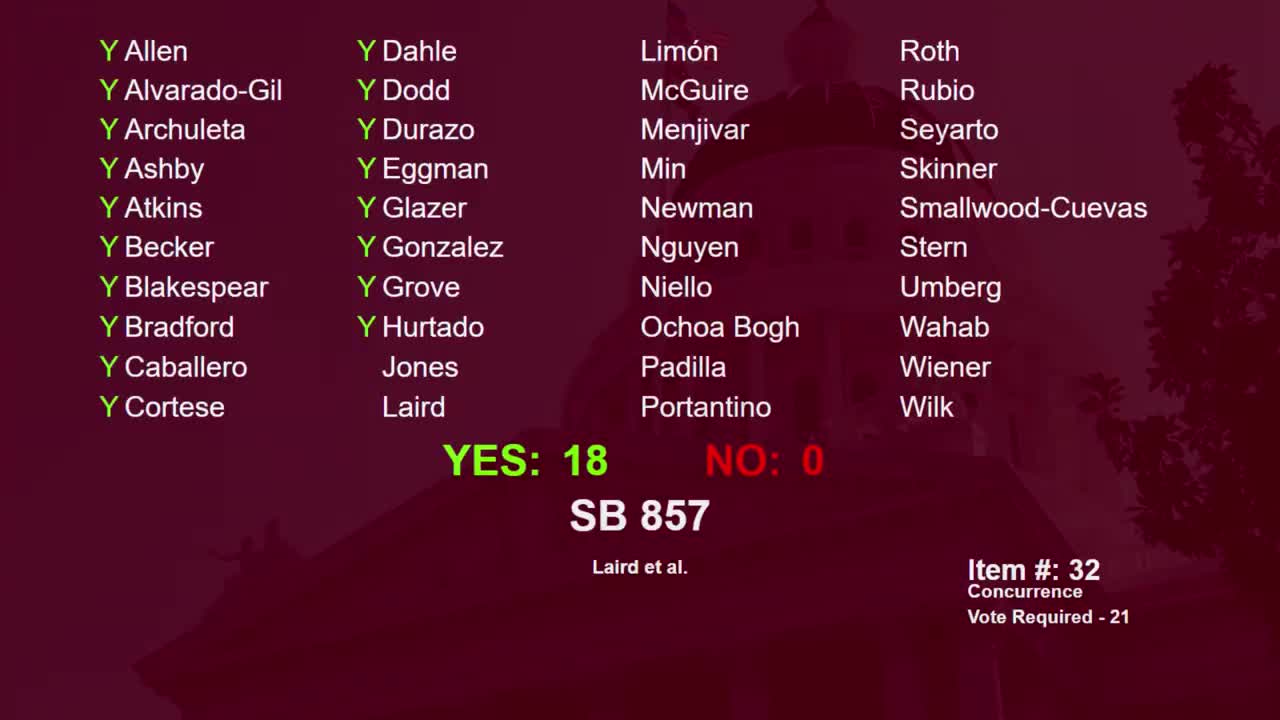 2MIN
Senate Floor
 5MIN
Senate Standing Committee on Energy, Utilities and Communications
 36SEC
Assembly Floor
 1MIN
Assembly Floor
 8MIN
Assembly Standing Committee on Utilities and Energy
 11MIN
Assembly Standing Committee on Natural Resources
 1MIN
Senate Standing Committee on Appropriations
 6MIN
Senate Standing Committee on Energy, Utilities and Communications
Bill Author
Bill Co-Author(s):
