SB 422: Unemployment compensation: motion picture industry: loan-out companies.
- Session Year: 2023-2024
- House: Senate
- Latest Version Date: 2024-09-30
Current Status:
Passed
(2024-09-30: Chaptered by Secretary of State. Chapter 1011, Statutes of 2024.)
Introduced
In Committee
First Chamber
In Committee
Second Chamber
Enacted
Existing law establishes the Employment Development Department, administered by the Director of Employment Development who is vested with certain duties relating to unemployment compensation. Existing unemployment insurance law requires any employing unit that is a motion picture payroll services company, as defined, to be treated as an employer of a motion picture production worker, as defined, and to file a statement of intent with the Employment Development Department. Existing law makes specified violations of unemployment insurance law a misdemeanor.
This bill would specify that a loan-out company is the employer of its employee-owners or members who are engaged to provide services to a motion picture production company or to an allied motion picture services company for purposes of remitting employment taxes and related obligations, as specified. The bill would prohibit a loan-out company or an individual whose services are provided by a loan-out company from being considered an employee of a motion picture payroll services company. The bill would require a motion picture payroll services company to file a quarterly report with the Director of Employment Development relating to payments made to a loan-out company, as specified. The bill would define loan-out company for these purposes. By expanding the scope of an existing crime, this bill would impose a state-mandated local program.
The California Constitution requires the state to reimburse local agencies and school districts for certain costs mandated by the state. Statutory provisions establish procedures for making that reimbursement.
This bill would provide that no reimbursement is required by this act for a specified reason.
Existing law establishes the Employment Development Department, administered by the Director of Employment Development who is vested with certain duties relating to unemployment compensation. Existing unemployment insurance law requires any employing unit that is a motion picture payroll services company, as defined, to be treated as an employer of a motion picture production worker, as defined, and to file a statement of intent with the Employment Development Department. Existing law makes specified violations of unemployment insurance law a misdemeanor.
This bill would specify that a loan-out company is the employer of its employee-owners or members who are engaged to provide services to a motion picture production company or to an allied motion picture services company for purposes of remitting employment taxes and related obligations, as specified. The bill would prohibit a loan-out company or an individual whose services are provided by a loan-out company from being considered an employee of a motion picture payroll services company. The bill would require a motion picture payroll services company to file a quarterly report with the Director of Employment Development relating to payments made to a loan-out company, as specified. The bill would define loan-out company for these purposes. By expanding the scope of an existing crime, this bill would impose a state-mandated local program.
The California Constitution requires the state to reimburse local agencies and school districts for certain costs mandated by the state. Statutory provisions establish procedures for making that reimbursement.
This bill would provide that no reimbursement is required by this act for a specified reason.
Existing law establishes the Employment Development Department, administered by the Director of Employment Development who is vested with certain duties relating to unemployment compensation. Existing unemployment insurance law requires any employing unit that is a motion picture payroll services company, as defined, to be treated as an employer of a motion picture production worker, as defined, and to file a statement of intent with the Employment Development Department. Existing law makes specified violations of unemployment insurance law a misdemeanor.
This bill would specify that a loan-out company is the employer of its employee-owners or members who are engaged to provide services to a motion picture production company or to an allied motion picture services company for purposes of remitting employment taxes and related obligations, as specified. The bill would prohibit a loan-out company or an individual whose services are provided by a loan-out company from being considered an employee of a motion picture payroll services company. The bill would require a motion picture payroll services company to file a quarterly report with the Director of Employment Development relating to payments made to a loan-out company, as specified. The bill would define loan-out company for these purposes. By expanding the scope of an existing crime, this bill would impose a state-mandated local program.
The California Constitution requires the state to reimburse local agencies and school districts for certain costs mandated by the state. Statutory provisions establish procedures for making that reimbursement.
This bill would provide that no reimbursement is required by this act for a specified reason.
The California Environmental Quality Act (CEQA) requires a lead agency, as defined, to prepare, or cause to be prepared, and certify the completion of an environmental impact report (EIR) on a project that it proposes to carry out or approve that may have a significant effect on the environment or to adopt a negative declaration if it finds that the project will not have that effect. CEQA also requires a lead agency to prepare a mitigated negative declaration for a project that may have a significant effect on the environment if revisions in the project would avoid or mitigate that effect and there is no substantial evidence that the project, as revised, would have a significant effect on the environment. CEQA requires specified public agencies, including air pollution control districts and air quality management districts, to perform, at the time of adoption of a rule or regulation requiring the installation of pollution control equipment or a performance standard or treatment requirement, an environmental analysis of the reasonably foreseeable methods of compliance.This bill would also require those specified public agencies, at the time of adoption of a rule or regulation requiring the reduction in emissions of greenhouse gases, criteria air pollutants, or toxic air contaminants, to perform an environmental analysis of the reasonably foreseeable methods of compliance. By imposing additional requirements on air districts, this bill would impose a state-mandated local program.CEQA authorizes the use of a focused EIR for a project that consists solely of the installation of pollution control equipment required by those specified public agencies in compliance with those rules or regulations. This bill would require those projects to comply with certain labor requirements in order for the use of a focused EIR.CEQA requires lead agencies to perform the environmental review for projects consisting solely of compliance with a performance standard or treatment requirement imposed by those specified public agencies in a certain manner.This bill would additionally require those projects to comply with certain labor requirements. To the extent that this requirement would impose additional duties on lead agencies, this bill would impose a state-mandated local program.The California Constitution requires the state to reimburse local agencies and school districts for certain costs mandated by the state. Statutory provisions establish procedures for making that reimbursement.This bill would provide that no reimbursement is required by this act for a specified reason.The California Environmental Quality Act (CEQA) requires a lead agency, as defined, to prepare, or cause to be prepared, and certify the completion of an environmental impact report (EIR) on a project that it proposes to carry out or approve that may have a significant effect on the environment or to adopt a negative declaration if it finds that the project will not have that effect. CEQA also requires a lead agency to prepare a mitigated negative declaration for a project that may have a significant effect on the environment if revisions in the project would avoid or mitigate that effect and there is no substantial evidence that the project, as revised, would have a significant effect on the environment. CEQA requires specified public agencies, including air pollution control districts and air quality management districts, to perform, at the time of adoption of a rule or regulation requiring the installation of pollution control equipment or a performance standard or treatment requirement, an environmental analysis of the reasonably foreseeable methods of compliance.
This bill would also require those specified public agencies, at the time of adoption of a rule or regulation requiring the reduction in emissions of greenhouse gases, criteria air pollutants, or toxic air contaminants, to perform an environmental analysis of the reasonably foreseeable methods of compliance. By imposing additional requirements on air districts, this bill would impose a state-mandated local program.
CEQA authorizes the use of a focused EIR for a project that consists solely of the installation of pollution control equipment required by those specified public agencies in compliance with those rules or regulations.
This bill would require those projects to comply with certain labor requirements in order for the use of a focused EIR.
CEQA requires lead agencies to perform the environmental review for projects consisting solely of compliance with a performance standard or treatment requirement imposed by those specified public agencies in a certain manner.
This bill would additionally require those projects to comply with certain labor requirements. To the extent that this requirement would impose additional duties on lead agencies, this bill would impose a state-mandated local program.
The California Constitution requires the state to reimburse local agencies and school districts for certain costs mandated by the state. Statutory provisions establish procedures for making that reimbursement.
This bill would provide that no reimbursement is required by this act for a specified reason.
The California Environmental Quality Act (CEQA) requires a lead agency, as defined, to prepare, or cause to be prepared, and certify the completion of an environmental impact report on a project that the lead agency proposes to carry out or approve that may have a significant effect on the environment or to adopt a negative declaration if it finds that the project will not have that effect. CEQA also requires a lead agency to prepare a mitigated negative declaration for a project that may have a significant effect on the environment if revisions in the project would avoid or mitigate that effect and there is no substantial evidence that the project, as revised, would have a significant effect on the environment.Existing law, the Jobs and Economic Improvement Through Environmental Leadership Act of 2021, authorizes the Governor, until January 1, 2024, to certify projects that meet specified requirements for streamlining benefits related to CEQA. This bill would state the intent of the Legislature to enact subsequent legislation to adopt permit streamlining guidance for projects that will reduce greenhouse gas emissions.The California Environmental Quality Act (CEQA) requires a lead agency, as defined, to prepare, or cause to be prepared, and certify the completion of an environmental impact report on a project that the lead agency proposes to carry out or approve that may have a significant effect on the environment or to adopt a negative declaration if it finds that the project will not have that effect. CEQA also requires a lead agency to prepare a mitigated negative declaration for a project that may have a significant effect on the environment if revisions in the project would avoid or mitigate that effect and there is no substantial evidence that the project, as revised, would have a significant effect on the environment.
Existing law, the Jobs and Economic Improvement Through Environmental Leadership Act of 2021, authorizes the Governor, until January 1, 2024, to certify projects that meet specified requirements for streamlining benefits related to CEQA.
This bill would state the intent of the Legislature to enact subsequent legislation to adopt permit streamlining guidance for projects that will reduce greenhouse gas emissions.
The Legislature finds and declares that unemployment benefits are a fundamental protection for California workers who are unemployed through no fault of their own. This protection is all the more important for workers in industries like the entertainment industry, in which work is often sporadic and unpredictable. With this act, the Legislature intends to eliminate ambiguities and clarify, in particular situations, the party bearing responsibility for the employer share of payroll taxes that support the unemployment and disability insurance systems and other worker-protective benefits. It is the intent of the Legislature to recognize the role of loan-out companies and clarify their obligations to remit employment taxes under the Unemployment Insurance Code. This act is not intended to alter or modify any other laws with regard to loan-out companies or their employees. It is not the intent of the Legislature to limit, in any way, eligibility for unemployment benefits or to abrogate the analysis of California court decisions, including in Cooperman v. Unemployment Ins. Appeals Bd. (1975) 49 Cal.App.3d 1, affirming the importance of those benefits to workers. The Legislature finds and declares that the amendments to Section 679 of the Unemployment Insurance Code made by this act are declaratory of, and not a change in, existing law.
SEC. 2.Section 679 of the Unemployment Insurance Code is amended to read:679.(a)(1)Notwithstanding Sections 606.5 and 678, for the purposes of this code, employer means any employing unit that is a motion picture payroll services company that pays and controls the payment of wages of a motion picture production worker for services either to a motion picture production company or to an allied motion picture services company, and files a timely statement of its intent to be the employer of motion picture production workers pursuant to subdivision (b).
(2)Notwithstanding Sections 606.5 and 678 and paragraph (1), solely for the purpose of remitting employment taxes under this code, and any related obligations arising therefrom under this code, including, but not limited to, this division and Division 6 (commencing with Section 13000), a loan-out company is the employer of the employee-owners or members who are engaged by the loan-out company to provide services to a motion picture production company or an allied motion picture services company.
(3)For purposes of this code, and consistent with paragraph (2), neither a loan-out company nor an individual whose services are provided by a loan-out company shall be considered an employee of the motion picture payroll services company.
(b)(1)Any employing unit meeting the requirements of a motion picture payroll services company that intends to be treated as an employer of motion picture production workers pursuant to subdivision (a) shall file a statement with the department that declares its intent to be the employer of motion picture production workers, pursuant to this section, within 15 days after first paying wages to the workers. The statement shall include identification of each affiliated entity.
(2)Any employing unit operating as a motion picture payroll services company as of January 1, 2007, that intends to be treated as an employer of motion picture production workers pursuant to this section, shall file a statement with the department that declares its intent to be the employer of motion picture production workers, pursuant to this section, by January 15, 2007. The statement shall include identification of each affiliated entity.
(3)Any motion picture payroll company that quits business shall:
(A)Within 10 days of quitting business:
(i)File with the director a final return and report of wages of its workers, as required by Section 1116.
(ii)File all statements required by this subdivision.
(B)Forty-five days in advance of quitting business, notify each motion picture production company and allied motion picture services company, with respect to which they have been treated as the employer of the motion picture production workers, of its intent to quit business.
(4)The director may prevent a motion picture payroll services company that fails to file a timely statement from being treated as an employer of motion picture production workers, for a period not to exceed the period for which the statement is required.
(5)Any statement filed by a motion picture payroll services company pursuant to this subdivision shall be applied to each affiliated entity of the motion picture payroll services company in existence at the time the statement is filed.
(c)For each rating period beginning on or after January 1, 2007, in which an employer operating as a motion picture payroll services company obtains or attempts to obtain a more favorable rate of contributions under this section in a manner that is due to deliberate ignorance, reckless disregard, fraud, intent to evade, misrepresentation, or willful nondisclosure, the director shall assign the maximum contribution rate plus 2 percent for each applicable rating period, the current rating period, and the subsequent rating period. Contributions paid in excess of the maximum rate under this section shall not be credited to the employing units reserve account.
(d)(1)On and after January 1, 2007, whenever a motion picture payroll services company creates or acquires a motion picture payroll services company, or acquires substantially all of the assets of a motion picture payroll services company, the created or acquired motion picture payroll services company shall:
(A)Constitute a separate employing unit, notwithstanding Sections 135.1 and 135.2.
(B)Have its reserve account and rate of contributions determined in accordance with subdivision (e).
(C)Notify the department of the entity being created or acquired and the nature of its affiliation to that entity.
(2)The department may promulgate regulations requiring a motion picture payroll services company, prior to the creation or acquisition of a motion picture payroll services company that will be an affiliated entity, to seek the approval of the department to apply this section to the created or acquired entity.
(e)When a motion picture payroll services company transfers all or part of its business or payroll to another motion picture payroll services company the reserve account attributable to the transferor shall be transferred to the transferee motion picture payroll services company, and the transferees rate of contribution shall be determined in accordance with Section 1052. The transferee shall notify the department within 15 days of the transfer of the business or payroll.
(f)For purposes of this section:
(1)Affiliated entity means any one or more motion picture payroll services company or companies that are united by factors of common ownership, management, or control as prescribed by Section 1061.
(2)Allied motion picture services company means any person engaged in an industry closely allied with, and whose work is integral to, a motion picture production company in the development, production, or postproduction of a motion picture, excluding the distribution of the completed motion picture and any activity occurring thereafter, and who hires from the same pool of craft and guild or union workers, actors, or extras as a motion picture production company.
(3)Loan-out company means a corporation, or limited liability company that is classified as a corporation for federal income tax purposes, the principal activity of which is the performance of personal services for a motion picture production company or allied motion picture services company, provided that those services are substantially performed by an employee of the corporation who owns, on any day during the taxable year, more than 10 percent of the outstanding stock of the corporation.
(4)Motion picture means a motion picture of any type, including, but not limited to, a theatrical motion picture, a television production, a television commercial, or a music video, regardless of its theme or the technology used in its production or distribution.
(5)(A)Motion picture payroll services company means any employing unit that directly or through its affiliated entities meets all of the following criteria:
(i)Contractually provides the services of motion picture production workers to a motion picture production company or to an allied motion picture services company, or provides payments to a loan-out company as directed by a motion picture production company or an allied motion picture services company.
(ii)Is a signatory to a collective bargaining agreement for one or more of its clients.
(iii)Controls the payment of wages to the motion picture production workers and pays those wages from its own account or accounts.
(iv)Is contractually obligated to pay wages to the motion picture production workers without regard to payment or reimbursement by the motion picture production company or allied motion picture services company.
(v)At least 80 percent of the wages paid by the motion picture payroll services company each calendar year are paid to workers associated between contracts with motion picture production companies and motion picture payroll services companies.
(B)If the director determines that any employing unit is operating as a motion picture payroll services company but is failing to comply with any of the provisions of subparagraph (A) of paragraph (4), the employing unit is subject to determination of the employer-employee relationship pursuant to this code. When the directors ruling becomes final, the director may preclude the employing unit from being classified as a motion picture payroll services company pursuant to this section for up to three years from the date of the determination.
(6)Motion picture production company means any employing unit engaged in the development, production, and postproduction of a motion picture, excluding the distribution of the completed motion picture and any activities occurring thereafter.
(7)Motion picture production worker means an individual who provides services to a motion picture production company or allied motion picture services company and who, with regard to those services, is reported under this part as an employee by the motion picture payroll services company. An individual who has been reported as an employee by the motion picture payroll services company, without regard to the individuals status as an employee or independent contractor, shall be the employee of the motion picture payroll services company for the purposes of this code throughout the contractual period with the motion picture payroll services company.
(8)Wages shall have the same meaning given the term in Article 2 (commencing with Section 926) of Chapter 4 of Part 1 of Division 1, and shall include residual payments.
(g)If the director determines that an entity does not meet any requirement of this section, the director shall give notice of its determination to that entity pursuant to Section 1206. The notice shall contain a statement of the facts and circumstances upon which the determination was made. The entity so noticed shall have the right to petition for review of the directors determination within 30 days of the notice, as provided in Section 1222.
(h)The director shall prescribe the form and manner of the statements and information required to be filed or reported by this section.
SEC. 3.Section 1088.9 is added to the Unemployment Insurance Code, to read:1088.9.(a)Commencing with the first calendar quarter of calendar year 2026, a motion picture payroll services company shall file with the director, within the same time required by subdivision (a) of Section 1110 for payment of employer contributions, a report of payments made to a loan-out company pursuant to subdivision (b).
(b)The report shall include all of the following information:
(1)The total amount of payments made to the loan-out company.
(2)The business name, address, and telephone number of the loan-out company.
(3)The federal employer identification number, California employer account number, or other identifying number of the loan-out corporation, as required by the Employment Development Department, in consultation with the Franchise Tax Board.
(4)The full name, address, and social security number of any individual whose services were provided through the loan-out company.
(5)The name, address, and federal employer identification number, California employer account number, or other identifying number of the motion picture payroll services company, as required by the Employment Development Department, in consultation with the Franchise Tax Board.
(6)Any other information as the director shall prescribe.
(c)The Franchise Tax Board may access the information filed with the department pursuant to this section.
(d)A lack of access to the information required to be reported under this section does not relieve any obligation on a motion picture payroll services company to continue to timely pay a loan-out company all payments due.
(e)(1)For each failure to fully comply with subdivisions (a), (b), and (d), unless the failure is due to good cause, the department may assess a penalty of twenty-four dollars ($24), or, if the failure is willful or fraudulent, the department may assess a penalty of four hundred ninety dollars ($490).
(2)A failure to fully comply with subdivisions (a) and (b) shall be deemed to be for good cause pursuant to paragraph (1) if a motion picture payroll services company has requested that a loan-out company provide information required by subdivision (b) and the loan-out company does not provide the requested information, or provides incorrect or incomplete information.
(f)For purposes of this section, the definitions in Section 679 shall apply, as applicable.
SEC. 4.No reimbursement is required by this act pursuant to Section 6 of Article XIIIB of the California Constitution because the only costs that may be incurred by a local agency or school district will be incurred because this act creates a new crime or infraction, eliminates a crime or infraction, or changes the penalty for a crime or infraction, within the meaning of Section 17556 of the Government Code, or changes the definition of a crime within the meaning of Section 6 of Article XIIIB of the California Constitution.
The Legislature finds and declares that unemployment benefits are a fundamental protection for California workers who are unemployed through no fault of their own. This protection is all the more important for workers in industries like the entertainment industry, in which work is often sporadic and unpredictable. With this act, the Legislature intends to eliminate ambiguities and clarify, in particular situations, the party bearing responsibility for the employer share of payroll taxes that support the unemployment and disability insurance systems and other worker-protective benefits. It is the intent of the Legislature to recognize the role of loan-out companies and clarify their obligations to remit employment taxes under the Unemployment Insurance Code. This act is not intended to alter or modify any other laws with regard to loan-out companies or their employees. It is not the intent of the Legislature to limit, in any way, eligibility for unemployment benefits or to abrogate the analysis of California court decisions, including in Cooperman v. Unemployment Ins. Appeals Bd. (1975) 49 Cal.App.3d 1, affirming the importance of those benefits to workers. The Legislature finds and declares that the amendments to Section 679 of the Unemployment Insurance Code made by this act are declaratory of, and not a change in, existing law.
SEC. 2.Section 679 of the Unemployment Insurance Code is amended to read:679.(a)(1)Notwithstanding Sections 606.5 and 678, for the purposes of this code, employer means any employing unit that is a motion picture payroll services company that pays and controls the payment of wages of a motion picture production worker for services either to a motion picture production company or to an allied motion picture services company, and files a timely statement of its intent to be the employer of motion picture production workers pursuant to subdivision (b).
(2)Notwithstanding Sections 606.5 and 678 and paragraph (1), solely for the purpose of remitting employment taxes under this code, and any related obligations arising therefrom under this code, including, but not limited to, this division and Division 6 (commencing with Section 13000), a loan-out company is the employer of the employee-owners or members who are engaged by the loan-out company to provide services to a motion picture production company or an allied motion picture services company.
(3)For purposes of this code, and consistent with paragraph (2), neither a loan-out company nor an individual whose services are provided by a loan-out company shall be considered an employee of the motion picture payroll services company.
(b)(1)Any employing unit meeting the requirements of a motion picture payroll services company that intends to be treated as an employer of motion picture production workers pursuant to subdivision (a) shall file a statement with the department that declares its intent to be the employer of motion picture production workers, pursuant to this section, within 15 days after first paying wages to the workers. The statement shall include identification of each affiliated entity.
(2)Any employing unit operating as a motion picture payroll services company as of January 1, 2007, that intends to be treated as an employer of motion picture production workers pursuant to this section, shall file a statement with the department that declares its intent to be the employer of motion picture production workers, pursuant to this section, by January 15, 2007. The statement shall include identification of each affiliated entity.
(3)Any motion picture payroll company that quits business shall:
(A)Within 10 days of quitting business:
(i)File with the director a final return and report of wages of its workers, as required by Section 1116.
(ii)File all statements required by this subdivision.
(B)Forty-five days in advance of quitting business, notify each motion picture production company and allied motion picture services company, with respect to which they have been treated as the employer of the motion picture production workers, of its intent to quit business.
(4)The director may prevent a motion picture payroll services company that fails to file a timely statement from being treated as an employer of motion picture production workers, for a period not to exceed the period for which the statement is required.
(5)Any statement filed by a motion picture payroll services company pursuant to this subdivision shall be applied to each affiliated entity of the motion picture payroll services company in existence at the time the statement is filed.
(c)For each rating period beginning on or after January 1, 2007, in which an employer operating as a motion picture payroll services company obtains or attempts to obtain a more favorable rate of contributions under this section in a manner that is due to deliberate ignorance, reckless disregard, fraud, intent to evade, misrepresentation, or willful nondisclosure, the director shall assign the maximum contribution rate plus 2 percent for each applicable rating period, the current rating period, and the subsequent rating period. Contributions paid in excess of the maximum rate under this section shall not be credited to the employing units reserve account.
(d)(1)On and after January 1, 2007, whenever a motion picture payroll services company creates or acquires a motion picture payroll services company, or acquires substantially all of the assets of a motion picture payroll services company, the created or acquired motion picture payroll services company shall:
(A)Constitute a separate employing unit, notwithstanding Sections 135.1 and 135.2.
(B)Have its reserve account and rate of contributions determined in accordance with subdivision (e).
(C)Notify the department of the entity being created or acquired and the nature of its affiliation to that entity.
(2)The department may promulgate regulations requiring a motion picture payroll services company, prior to the creation or acquisition of a motion picture payroll services company that will be an affiliated entity, to seek the approval of the department to apply this section to the created or acquired entity.
(e)When a motion picture payroll services company transfers all or part of its business or payroll to another motion picture payroll services company the reserve account attributable to the transferor shall be transferred to the transferee motion picture payroll services company, and the transferees rate of contribution shall be determined in accordance with Section 1052. The transferee shall notify the department within 15 days of the transfer of the business or payroll.
(f)For purposes of this section:
(1)Affiliated entity means any one or more motion picture payroll services company or companies that are united by factors of common ownership, management, or control as prescribed by Section 1061.
(2)Allied motion picture services company means any person engaged in an industry closely allied with, and whose work is integral to, a motion picture production company in the development, production, or postproduction of a motion picture, excluding the distribution of the completed motion picture and any activity occurring thereafter, and who hires from the same pool of craft and guild or union workers, actors, or extras as a motion picture production company.
(3)Loan-out company means a corporation, or limited liability company that is classified as a corporation for federal income tax purposes, the principal activity of which is the performance of personal services for a motion picture production company or allied motion picture services company, provided that those services are substantially performed by an employee of the corporation who owns, on any day during the taxable year, more than 10 percent of the outstanding stock of the corporation.
(4)Motion picture means a motion picture of any type, including, but not limited to, a theatrical motion picture, a television production, a television commercial, or a music video, regardless of its theme or the technology used in its production or distribution.
(5)(A)Motion picture payroll services company means any employing unit that directly or through its affiliated entities meets all of the following criteria:
(i)Contractually provides the services of motion picture production workers to a motion picture production company or to an allied motion picture services company, or provides payments to a loan-out company as directed by a motion picture production company or an allied motion picture services company.
(ii)Is a signatory to a collective bargaining agreement for one or more of its clients.
(iii)Controls the payment of wages to the motion picture production workers and pays those wages from its own account or accounts.
(iv)Is contractually obligated to pay wages to the motion picture production workers without regard to payment or reimbursement by the motion picture production company or allied motion picture services company.
(v)At least 80 percent of the wages paid by the motion picture payroll services company each calendar year are paid to workers associated between contracts with motion picture production companies and motion picture payroll services companies.
(B)If the director determines that any employing unit is operating as a motion picture payroll services company but is failing to comply with any of the provisions of subparagraph (A) of paragraph (4), the employing unit is subject to determination of the employer-employee relationship pursuant to this code. When the directors ruling becomes final, the director may preclude the employing unit from being classified as a motion picture payroll services company pursuant to this section for up to three years from the date of the determination.
(6)Motion picture production company means any employing unit engaged in the development, production, and postproduction of a motion picture, excluding the distribution of the completed motion picture and any activities occurring thereafter.
(7)Motion picture production worker means an individual who provides services to a motion picture production company or allied motion picture services company and who, with regard to those services, is reported under this part as an employee by the motion picture payroll services company. An individual who has been reported as an employee by the motion picture payroll services company, without regard to the individuals status as an employee or independent contractor, shall be the employee of the motion picture payroll services company for the purposes of this code throughout the contractual period with the motion picture payroll services company.
(8)Wages shall have the same meaning given the term in Article 2 (commencing with Section 926) of Chapter 4 of Part 1 of Division 1, and shall include residual payments.
(g)If the director determines that an entity does not meet any requirement of this section, the director shall give notice of its determination to that entity pursuant to Section 1206. The notice shall contain a statement of the facts and circumstances upon which the determination was made. The entity so noticed shall have the right to petition for review of the directors determination within 30 days of the notice, as provided in Section 1222.
(h)The director shall prescribe the form and manner of the statements and information required to be filed or reported by this section.
SEC. 3.Section 1088.9 is added to the Unemployment Insurance Code, to read:1088.9.(a)Commencing with the first calendar quarter of calendar year 2026, a motion picture payroll services company shall file with the director, within the same time required by subdivision (a) of Section 1110 for payment of employer contributions, a report of payments made to a loan-out company pursuant to subdivision (b).
(b)The report shall include all of the following information:
(1)The total amount of payments made to the loan-out company.
(2)The business name, address, and telephone number of the loan-out company.
(3)The federal employer identification number, California employer account number, or other identifying number of the loan-out corporation, as required by the Employment Development Department, in consultation with the Franchise Tax Board.
(4)The full name, address, and social security number of any individual whose services were provided through the loan-out company.
(5)The name, address, and federal employer identification number, California employer account number, or other identifying number of the motion picture payroll services company, as required by the Employment Development Department, in consultation with the Franchise Tax Board.
(6)Any other information as the director shall prescribe.
(c)The Franchise Tax Board may access the information filed with the department pursuant to this section.
(d)A lack of access to the information required to be reported under this section does not relieve any obligation on a motion picture payroll services company to continue to timely pay a loan-out company all payments due.
(e)(1)For each failure to fully comply with subdivisions (a), (b), and (d), unless the failure is due to good cause, the department may assess a penalty of twenty-four dollars ($24), or, if the failure is willful or fraudulent, the department may assess a penalty of four hundred ninety dollars ($490).
(2)A failure to fully comply with subdivisions (a) and (b) shall be deemed to be for good cause pursuant to paragraph (1) if a motion picture payroll services company has requested that a loan-out company provide information required by subdivision (b) and the loan-out company does not provide the requested information, or provides incorrect or incomplete information.
(f)For purposes of this section, the definitions in Section 679 shall apply, as applicable.
SEC. 4.No reimbursement is required by this act pursuant to Section 6 of Article XIIIB of the California Constitution because the only costs that may be incurred by a local agency or school district will be incurred because this act creates a new crime or infraction, eliminates a crime or infraction, or changes the penalty for a crime or infraction, within the meaning of Section 17556 of the Government Code, or changes the definition of a crime within the meaning of Section 6 of Article XIIIB of the California Constitution.
The Legislature finds and declares that unemployment benefits are a fundamental protection for California workers who are unemployed through no fault of their own. This protection is all the more important for workers in industries like the entertainment industry, in which work is often sporadic and unpredictable. With this act, the Legislature intends to eliminate ambiguities and clarify, in particular situations, the party bearing responsibility for the employer share of payroll taxes that support the unemployment and disability insurance systems and other worker-protective benefits. It is the intent of the Legislature to recognize the role of loan-out companies and clarify their obligations to remit employment taxes under the Unemployment Insurance Code. This act is not intended to alter or modify any other laws with regard to loan-out companies or their employees. It is not the intent of the Legislature to limit, in any way, eligibility for unemployment benefits or to abrogate the analysis of California court decisions, including in Cooperman v. Unemployment Ins. Appeals Bd. (1975) 49 Cal.App.3d 1, affirming the importance of those benefits to workers. The Legislature finds and declares that the amendments to Section 679 of the Unemployment Insurance Code made by this act are declaratory of, and not a change in, existing law.
SEC. 2.Section 679 of the Unemployment Insurance Code is amended to read:679.(a)(1)Notwithstanding Sections 606.5 and 678, for the purposes of this code, employer means any employing unit that is a motion picture payroll services company that pays and controls the payment of wages of a motion picture production worker for services either to a motion picture production company or to an allied motion picture services company, and files a timely statement of its intent to be the employer of motion picture production workers pursuant to subdivision (b).
(2)Notwithstanding Sections 606.5 and 678 and paragraph (1), solely for the purpose of remitting employment taxes under this code, and any related obligations arising therefrom under this code, including, but not limited to, this division and Division 6 (commencing with Section 13000), a loan-out company is the employer of the employee-owners or members who are engaged by the loan-out company to provide services to a motion picture production company or an allied motion picture services company.
(3)For purposes of this code, and consistent with paragraph (2), neither a loan-out company nor an individual whose services are provided by a loan-out company shall be considered an employee of the motion picture payroll services company.
(b)(1)Any employing unit meeting the requirements of a motion picture payroll services company that intends to be treated as an employer of motion picture production workers pursuant to subdivision (a) shall file a statement with the department that declares its intent to be the employer of motion picture production workers, pursuant to this section, within 15 days after first paying wages to the workers. The statement shall include identification of each affiliated entity.
(2)Any employing unit operating as a motion picture payroll services company as of January 1, 2007, that intends to be treated as an employer of motion picture production workers pursuant to this section, shall file a statement with the department that declares its intent to be the employer of motion picture production workers, pursuant to this section, by January 15, 2007. The statement shall include identification of each affiliated entity.
(3)Any motion picture payroll company that quits business shall:
(A)Within 10 days of quitting business:
(i)File with the director a final return and report of wages of its workers, as required by Section 1116.
(ii)File all statements required by this subdivision.
(B)Forty-five days in advance of quitting business, notify each motion picture production company and allied motion picture services company, with respect to which they have been treated as the employer of the motion picture production workers, of its intent to quit business.
(4)The director may prevent a motion picture payroll services company that fails to file a timely statement from being treated as an employer of motion picture production workers, for a period not to exceed the period for which the statement is required.
(5)Any statement filed by a motion picture payroll services company pursuant to this subdivision shall be applied to each affiliated entity of the motion picture payroll services company in existence at the time the statement is filed.
(c)For each rating period beginning on or after January 1, 2007, in which an employer operating as a motion picture payroll services company obtains or attempts to obtain a more favorable rate of contributions under this section in a manner that is due to deliberate ignorance, reckless disregard, fraud, intent to evade, misrepresentation, or willful nondisclosure, the director shall assign the maximum contribution rate plus 2 percent for each applicable rating period, the current rating period, and the subsequent rating period. Contributions paid in excess of the maximum rate under this section shall not be credited to the employing units reserve account.
(d)(1)On and after January 1, 2007, whenever a motion picture payroll services company creates or acquires a motion picture payroll services company, or acquires substantially all of the assets of a motion picture payroll services company, the created or acquired motion picture payroll services company shall:
(A)Constitute a separate employing unit, notwithstanding Sections 135.1 and 135.2.
(B)Have its reserve account and rate of contributions determined in accordance with subdivision (e).
(C)Notify the department of the entity being created or acquired and the nature of its affiliation to that entity.
(2)The department may promulgate regulations requiring a motion picture payroll services company, prior to the creation or acquisition of a motion picture payroll services company that will be an affiliated entity, to seek the approval of the department to apply this section to the created or acquired entity.
(e)When a motion picture payroll services company transfers all or part of its business or payroll to another motion picture payroll services company the reserve account attributable to the transferor shall be transferred to the transferee motion picture payroll services company, and the transferees rate of contribution shall be determined in accordance with Section 1052. The transferee shall notify the department within 15 days of the transfer of the business or payroll.
(f)For purposes of this section:
(1)Affiliated entity means any one or more motion picture payroll services company or companies that are united by factors of common ownership, management, or control as prescribed by Section 1061.
(2)Allied motion picture services company means any person engaged in an industry closely allied with, and whose work is integral to, a motion picture production company in the development, production, or postproduction of a motion picture, excluding the distribution of the completed motion picture and any activity occurring thereafter, and who hires from the same pool of craft and guild or union workers, actors, or extras as a motion picture production company.
(3)Loan-out company means a corporation, or limited liability company that is classified as a corporation for federal income tax purposes, the principal activity of which is the performance of personal services for a motion picture production company or allied motion picture services company, provided that those services are substantially performed by an employee of the corporation who owns, on any day during the taxable year, more than 10 percent of the outstanding stock of the corporation.
(3)(4)Motion picture means a motion picture of any type, including, but not limited to, a theatrical motion picture, a television production, a television commercial, or a music video, regardless of its theme or the technology used in its production or distribution.
(4)(5)(A)Motion picture payroll services company means any employing unit that directly or through its affiliated entities meets all of the following criteria:
(i)Contractually provides the services of motion picture production workers to a motion picture production company or to an allied motion picture services company. company, or provides payments to a loan-out company as directed by a motion picture production company or an allied motion picture services company.
(ii)Is a signatory to a collective bargaining agreement for one or more of its clients.
(iii)Controls the payment of wages to the motion picture production workers and pays those wages from its own account or accounts.
(iv)Is contractually obligated to pay wages to the motion picture production workers without regard to payment or reimbursement by the motion picture production company or allied motion picture services company.
(v)At least 80 percent of the wages paid by the motion picture payroll services company each calendar year are paid to workers associated between contracts with motion picture production companies and motion picture payroll services companies.
(B)If the director determines that any employing unit is operating as a motion picture payroll services company but is failing to comply with any of the provisions of subparagraph (A) of paragraph (4), the employing unit is subject to determination of the employer-employee relationship pursuant to this code. When the directors ruling becomes final, the director may preclude the employing unit from being classified as a motion picture payroll services company pursuant to this section for up to three years from the date of the determination.
(5)(6)Motion picture production company means any employing unit engaged in the development, production, and postproduction of a motion picture, excluding the distribution of the completed motion picture and any activities occurring thereafter.
(6)(7)Motion picture production worker means an individual who provides services to a motion picture production company or allied motion picture services company and who, with regard to those services, is reported under this part as an employee by the motion picture payroll services company. An individual who has been reported as an employee by the motion picture payroll services company, without regard to the individuals status as an employee or independent contractor, shall be the employee of the motion picture payroll services company for the purposes of this code throughout the contractual period with the motion picture payroll services company.
(7)(8)Wages shall have the same meaning given the term in Article 2 (commencing with Section 926) of Chapter 4 of Part 1 of Division 1, and shall include residual payments.
(g)If the director determines that an entity does not meet any requirement of this section, the director shall give notice of its determination to that entity pursuant to Section 1206. The notice shall contain a statement of the facts and circumstances upon which the determination was made. The entity so noticed shall have the right to petition for review of the directors determination within 30 days of the notice, as provided in Section 1222.
(h)The director shall prescribe the form and manner of the statements and information required to be filed or reported by this section.
SEC. 3.Section 1088.9 is added to the Unemployment Insurance Code, to read:1088.9.(a)Commencing with the first calendar quarter of calendar year 2026, a motion picture payroll services company shall file with the director, within the same time required by subdivision (a) of Section 1110 for payment of employer contributions, a report of payments made to a loan-out company pursuant to subdivision (b).
(b)The report shall include all of the following information:
(1)The total amount of payments made to the loan-out company.
(2)The business name, address, and telephone number of the loan-out company.
(3)The federal employer identification number, California employer account number, or other identifying number of the loan-out corporation, as required by the Employment Development Department, in consultation with the Franchise Tax Board.
(4)The full name, address, and social security number of any individual whose services were provided through the loan-out company.
(5)The name, address, and federal employer identification number, California employer account number, or other identifying number of the motion picture payroll services company, as required by the Employment Development Department, in consultation with the Franchise Tax Board.
(6)Any other information as the director shall prescribe.
(c)The Franchise Tax Board may access the information filed with the department pursuant to this section.
(d)A lack of access to the information required to be reported under this section does not relieve any obligation on a motion picture payroll services company to continue to timely pay a loan-out company all payments due.
(e)(1)For each failure to fully comply with subdivisions (a), (b), and (d), unless the failure is due to good cause, the department may assess a penalty of twenty-four dollars ($24), or, if the failure is willful or fraudulent, the department may assess a penalty of four hundred ninety dollars ($490).
(2)A failure to fully comply with subdivisions (a) and (b) shall be deemed to be for good cause pursuant to paragraph (1) if a motion picture payroll services company has requested that a loan-out company provide information required by subdivision (b) and the loan-out company does not provide the requested information, or provides incorrect or incomplete information.
(f)For purposes of this section, the definitions in Section 679 shall apply, as applicable.
SEC. 4.No reimbursement is required by this act pursuant to Section 6 of Article XIIIB of the California Constitution because the only costs that may be incurred by a local agency or school district will be incurred because this act creates a new crime or infraction, eliminates a crime or infraction, or changes the penalty for a crime or infraction, within the meaning of Section 17556 of the Government Code, or changes the definition of a crime within the meaning of Section 6 of Article XIIIB of the California Constitution.
SECTION 1.The Legislature finds and declares all of the following:(a) The impacts of climate change in California include wildfire, drought, heat waves, and catastrophic weather events of increasing severity and unpredictability. These impacts pose significant threats to public health, public safety, and the economy in California.(b)To address the impacts of climate change, California has established a number of ambitious greenhouse gas (GHG) emission reduction goals, targets, and programs, including a target to cut GHG emissions 40 percent below 1990 levels by 2030, and Executive Order No. B-55-18 creates a state goal to achieve net carbon neutrality by 2045, consistent with science-based assessments to achieve global climate stabilization.(c)California is a leader in driving the affordable and equitable transition to a clean reliable energy system and economy. However, the impacts of climate change are occurring sooner and with more intensity and frequency than previously anticipated.(d)Extreme events from climate change, including heat waves, wildfires, and drought, combined with other factors, such as supply chain disruptions, are jeopardizing Californias ability to build out the energy infrastructure needed to maintain affordability and reliability.(e)Climate authorities such as the United Nations Intergovernmental Panel on Climate Change have declared that carbon management measures such as carbon capture and sequestration and direct air capture will be required to meet climate goals established under the Paris Agreement.(f)As California transitions to a clean energy future and contends with climate impacts and other challenges, sufficient capacity of new and existing generation assets will be required to maintain reliability during extreme events.SEC. 2.Section 21159 of the Public Resources Code is amended to read:21159.(a)An agency listed in Section 21159.4 shall perform, at the time of the adoption of a rule or regulation requiring the installation of pollution control equipment or the reduction in emissions of greenhouse gases, criteria air pollutants, or toxic air contaminants, or compliance with a performance standard or treatment requirement, including a rule or regulation that requires the installation of pollution control equipment or the reduction in emissions of greenhouse gases, criteria air pollutants, or toxic air contaminant, or compliance with a performance standard or treatment requirement adopted pursuant to the California Global Warming Solutions Act of 2006 (Division 25.5 (commencing with Section 38500) of the Health and Safety Code), an environmental analysis of the reasonably foreseeable methods of compliance. In preparing this analysis, the agency may use numerical ranges or averages where specific data is not available; however, the agency shall not be required to engage in speculation or conjecture. The environmental analysis shall, at minimum, include all of the following:(1)An analysis of the reasonably foreseeable environmental impacts of the methods of compliance.(2)An analysis of reasonably foreseeable feasible mitigation measures.(3)An analysis of reasonably foreseeable alternative means of compliance with the rule or regulation.(4)For a rule or regulation that requires the installation of pollution control equipment adopted pursuant to the California Global Warming Solutions Act of 2006 (Division 25.5 (commencing with Section 38500) of the Health and Safety Code), the analysis shall also include reasonably foreseeable greenhouse gas emission impacts of compliance with the rule or regulation.(b)The preparation of an environmental impact report at the time of adopting a rule or regulation pursuant to this division shall be deemed to satisfy the requirements of this section.(c)The environmental analysis shall take into account a reasonable range of environmental, economic, and technical factors, population and geographic areas, and specific sites.(d)This section does not require the agency to conduct a project-level analysis.(e)For purposes of this article, performance standard includes process or raw material changes or product reformulation.(f)This section is not intended, and may not be used, to delay the adoption of any rule or regulation for which an analysis is required to be performed pursuant to this section.SEC. 3.Section 21159.1 of the Public Resources Code is amended to read:21159.1.(a)A focused environmental impact report may be used if a project meets all of the following requirements:(1)The project consists solely of either of the following:(A)Installation of pollution control equipment required by a rule or regulation of an agency listed in subdivision (a) of Section 21159.4 and other components necessary to complete the installation of that equipment.(B)Installation of pollution control equipment and other components necessary to complete the installation of that equipment that reduces greenhouse gases required by a rule or regulation of an agency listed in Section 21159.4 pursuant to the California Global Warming Solutions Act of 2006 (Division 25.5 (commencing with Section 38500) of the Health and Safety Code).(2)The agency certified an environmental impact report on the rule or regulation or reviewed it pursuant to a certified regulatory program, and, in either case, the review included an assessment of growth inducing impacts and cumulative impacts of, and alternatives to, the project.(3)The environmental review required by paragraph (2) was completed within five years of certification of the focused environmental impact report.(4)An environmental impact report is not required pursuant to Section 21166.(5)The project satisfies the requirements of Section 21159.5.(b)The discussion of significant effects on the environment in the focused environmental impact report shall be limited to project-specific potentially significant effects on the environment of the project that were not discussed in the environmental analysis of the rule or regulation required pursuant to subdivision (a) of Section 21159. A discussion of growth-inducing impacts or cumulative impacts shall not be required in the focused environmental impact report, and the discussion of alternatives shall be limited to a discussion of alternative means of compliance, if any, with the rule or regulation.SEC. 4.Section 21159.2 of the Public Resources Code is amended to read:21159.2.(a)If a project consists solely of compliance with a performance standard or treatment requirement imposed by an agency listed in Section 21159.4, the lead agency for the compliance project shall, to the greatest extent feasible, use the environmental analysis required pursuant to subdivision (a) of Section 21159 in the preparation of a negative declaration, mitigated negative declaration, or environmental impact report on the compliance project or in otherwise fulfilling its responsibilities under this division. The use of numerical averages or ranges in an environmental analysis shall not relieve a lead agency of its obligations under this division to identify and evaluate the environmental effects of a compliance project.(b)If the lead agency determines that an environmental impact report on the compliance project is required, the lead agency shall prepare an environmental impact report which addresses only the project-specific issues related to the compliance project or other issues that were not discussed in sufficient detail in the environmental analysis to enable the lead agency to fulfill its responsibilities under Section 21100 or 21151, as applicable. The mitigation measures imposed by the lead agency for the project shall relate only to the significant effects on the environment to be mitigated. The discussion of alternatives shall be limited to a discussion of alternative means of compliance, if any, with the rule or regulation.(c)This section applies only to projects that comply with the requirements of Section 21159.5.SEC. 5.Section 21159.4 of the Public Resources Code is amended to read:21159.4.(a)This article shall apply to all of the following agencies:(1)The State Air Resources Board.(2)A district as defined in Section 39025 of the Health and Safety Code.(3)The State Water Resources Control Board.(4)A California regional water quality control board.(5)The Department of Toxic Substances Control.(6)The Department of Resources Recycling and Recovery.(b)(1)This article shall apply to the State Energy Resources Conservation and Development Commission and the Public Utilities Commission for rules and regulations requiring the installation of pollution control equipment adopted pursuant to the California Global Warming Solutions Act of 2006 (Division 25.5 (commencing with Section 38500) of the Health and Safety Code).(2)This article does not apply to an action that is not subject to this division.SEC. 6.Section 21159.5 is added to the Public Resources Code, to read:21159.5.(a)For purposes of this section, the following definitions apply:(1)Project means a project described in Section 21159.1 or 21159.2.(2)Project labor agreement has the same meaning as set forth in paragraph (1) of subdivision (b) of Section 2500 of the Public Contract Code.(3)Skilled and trained workforce has the same meaning as set forth in Chapter 2.9 (commencing with Section 2600) of Part 1 of Division 2 of the Public Contract Code.(b)(1)To qualify for the application of Section 21159.1 or 21159.2, a project undertaken by a public agency shall be a public work for which prevailing wages shall be paid for purposes of Chapter 1 (commencing with Section 1720) of Part 7 of Division 2 of the Labor Code, as applicable.(2)To qualify for the application of Section 21159.1 or 21159.2, for a project undertaken by a public agency, except as provided in paragraph (3), an entity shall not be prequalified or shortlisted or awarded a contract by the public agency to perform any portion of the project unless the entity provides an enforceable commitment to the public agency that the entity and its contractors and subcontractors at every tier will use a skilled and trained workforce to perform all work on the project or contract that falls within an apprenticeable occupation in the building and construction trades.(3)Paragraph (2) does not apply if any of the following requirements are met:(A)The public agency has entered into a project labor agreement that will bind all contractors and subcontractors at every tier performing work on the project or contract to use a skilled and trained workforce, and the entity agrees to be bound by that project labor agreement.(B)The project or contract is being performed under the extension or renewal of a project labor agreement that was entered into by the public agency before January 1, 2024.(C)The entity has entered into a project labor agreement that will bind the entity and all of its contractors and subcontractors at every tier performing work on the project or contract to use a skilled and trained workforce.(c)To qualify for the application of Section 21159.1 or 21159.2, for a project undertaken by a private entity, the applicant shall do both of the following:(1)Certify to the lead agency that either of the following is true:(A)The entirety of the project is a public work for purposes of Chapter 1 (commencing with Section 1720) of Part 7 of Division 2 of the Labor Code.(B)If the project is not in its entirety a public work, all construction workers employed in the execution of the project will be paid at least the general prevailing rate of per diem wages for the type of work and geographic area, as determined by the Director of Industrial Relations under Sections 1773 and 1773.9 of the Labor Code, except that apprentices registered in programs approved by the Chief of the Division of Apprenticeship Standards may be paid at least the applicable apprentice prevailing rate. If the project is subject to this subparagraph, then, for those portions of the project that are not a public work, all of the following shall apply:(i)The applicant shall ensure that the prevailing wage requirement is included in all contracts for the performance of the work.(ii)All contractors and subcontractors at every tier shall pay to all construction workers employed in the execution of the work on the project or contract at least the general prevailing rate of per diem wages, except that apprentices registered in programs approved by the Chief of the Division of Apprenticeship Standards may be paid at least the applicable apprentice prevailing rate.(iii)(I)Except as provided in subclause (III), all contractors and subcontractors at every tier shall maintain and verify payroll records under Section 1776 of the Labor Code and make those records available for inspection and copying as provided by that section.(II)Except as provided in subclause (III), the obligation of all contractors and subcontractors at every tier to pay prevailing wages may be enforced by the Labor Commissioner through the issuance of a civil wage and penalty assessment under Section 1741 of the Labor Code, which may be reviewed under Section 1742 of the Labor Code, within 18 months after the completion of the project, by an underpaid worker through an administrative complaint or civil action, or by a joint labor-management committee through a civil action under Section 1771.2 of the Labor Code. If a civil wage and penalty assessment is issued, the contractor, subcontractor, and surety on a bond or bonds issued to secure the payment of wages covered by the assessment shall be liable for liquidated damages under Section 1742.1 of the Labor Code.(III)Subclauses (I) and (II) do not apply if all contractors and subcontractors at every tier performing work on the project or contract are subject to a project labor agreement that requires the payment of prevailing wages to all construction workers employed in the execution of the project or contract and provides for enforcement of that obligation through an arbitration procedure.(iv)Notwithstanding subdivision (c) of Section 1773.1 of the Labor Code, the requirement that employer payments not reduce the obligation to pay the hourly straight time or overtime wages found to be prevailing shall not apply if otherwise provided in a bona fide collective bargaining agreement covering the worker. The requirement to pay at least the general prevailing rate of per diem wages does not preclude use of an alternative workweek schedule adopted under Section 511 or 514 of the Labor Code.(2)Certify to the lead agency that a skilled and trained workforce will be used to perform all construction work on the project or contract. All of the following requirements shall apply to the project:(A)The applicant shall require in all contracts for the performance of work that every contractor and subcontractor at every tier will individually use a skilled and trained workforce to complete the project.(B)Every contractor and subcontractor at every tier shall use a skilled and trained workforce to complete the project.(C)(i)Except as provided in clause (ii), the applicant shall provide to the lead agency, on a monthly basis while the project or contract is being performed, a report demonstrating compliance with Chapter 2.9 (commencing with Section 2600) of Part 1 of Division 2 of the Public Contract Code. A monthly report provided to the lead agency under this clause shall be a public record under the California Public Records Act (Chapter 3.5 (commencing with Section 6250) of Division 7 of Title 1 of the Government Code) and shall be open to public inspection. An applicant that fails to provide a monthly report demonstrating compliance with Chapter 2.9 (commencing with Section 2600) of Part 1 of Division 2 of the Public Contract Code shall be subject to a civil penalty of ten thousand dollars ($10,000) per month for each month for which the report has not been provided. Any contractor or subcontractor that fails to use a skilled and trained workforce shall be subject to a civil penalty of two hundred dollars ($200) per day for each worker employed in contravention of the skilled and trained workforce requirement. Penalties may be assessed by the Labor Commissioner within 18 months of completion of the project using the same procedures for issuance of civil wage and penalty assessments under Section 1741 of the Labor Code, and may be reviewed under the same procedures in Section 1742 of the Labor Code. Penalties shall be paid to the State Public Works Enforcement Fund.(ii)Clause (i) does not apply if all contractors and subcontractors at every tier performing work on the project are subject to a project labor agreement that requires compliance with the skilled and trained workforce requirement and provides for enforcement of that obligation through an arbitration procedure.SEC. 7. No reimbursement is required by this act pursuant to Section 6 of Article XIIIB of the California Constitution because a local agency or school district has the authority to levy service charges, fees, or assessments sufficient to pay for the program or level of service mandated by this act, within the meaning of Section 17556 of the Government Code.(a)The Legislature finds and declares all of the following:
(1)(a) The impacts of climate change in California include wildfire, drought, heat waves, and catastrophic weather events of increasing severity and unpredictability. These impacts pose significant threats to public health, public safety, and the economy in California.
(2)(b)To address the impacts of climate change, California has established a number of ambitious greenhouse gas (GHG) emission reduction goals, targets, and programs, including a target to cut GHG emissions 40 percent below 1990 levels by 2030, and Executive Order No. B-55-18 creates a state goal to achieve net carbon neutrality by 2045, consistent with science-based assessments to achieve global climate stabilization.
(3)(c)California is a leader in driving the affordable and equitable transition to a clean reliable energy system and economy. However, the impacts of climate change are occurring sooner and with more intensity and frequency than previously anticipated.
(4)(d)Extreme events from climate change, including heat waves, wildfires, and drought, combined with other factors, such as supply chain disruptions, are jeopardizing Californias ability to build out the energy infrastructure needed to maintain affordability and reliability.
(5)(e)Climate authorities such as the United Nations Intergovernmental Panel on Climate Change have declared that carbon management measures such as carbon capture and sequestration and direct air capture will be required to meet climate goals established under the Paris Agreement.
(6)(f)As California transitions to a clean energy future and contends with climate impacts and other challenges, sufficient capacity of new and existing generation assets will be required to maintain reliability during extreme events.
(b)It is the intent of the Legislature to enact subsequent legislation to adopt permit streamlining guidance for projects that will reduce GHG emissions.SEC. 2.Section 21159 of the Public Resources Code is amended to read:21159.(a)An agency listed in Section 21159.4 shall perform, at the time of the adoption of a rule or regulation requiring the installation of pollution control equipment, equipment or the reduction in emissions of greenhouse gases, criteria air pollutants, or toxic air contaminants, or compliance with a performance standard or treatment requirement, including a rule or regulation that requires the installation of pollution control equipment or the reduction in emissions of greenhouse gases, criteria air pollutants, or toxic air contaminant, or compliance with a performance standard or treatment requirement adopted pursuant to the California Global Warming Solutions Act of 2006 (Division 25.5 (commencing with Section 38500) of the Health and Safety Code), an environmental analysis of the reasonably foreseeable methods of compliance. In the preparation of preparing this analysis, the agency may utilize use numerical ranges or averages where specific data is not available; however, the agency shall not be required to engage in speculation or conjecture. The environmental analysis shall, at minimum, include all of the following:
(1)An analysis of the reasonably foreseeable environmental impacts of the methods of compliance.
(2)An analysis of reasonably foreseeable feasible mitigation measures.
(3)An analysis of reasonably foreseeable alternative means of compliance with the rule or regulation.
(4)For a rule or regulation that requires the installation of pollution control equipment adopted pursuant to the California Global Warming Solutions Act of 2006 (Division 25.5 (commencing with Section 38500) of the Health and Safety Code), the analysis shall also include reasonably foreseeable greenhouse gas emission impacts of compliance with the rule or regulation.
(b)The preparation of an environmental impact report at the time of adopting a rule or regulation pursuant to this division shall be deemed to satisfy the requirements of this section.
(c)The environmental analysis shall take into account a reasonable range of environmental, economic, and technical factors, population and geographic areas, and specific sites.
(d)This section does not require the agency to conduct a project-level analysis.
(e)For purposes of this article, the term performance standard includes process or raw material changes or product reformulation.
(f)This section is not intended, and may not be used, to delay the adoption of any rule or regulation for which an analysis is required to be performed pursuant to this section.
SEC. 3.Section 21159.1 of the Public Resources Code is amended to read:21159.1.(a)A focused environmental impact report may be utilized used if a project meets all of the following requirements:
(1)The project consists solely of the installation of either of the following:
(A)Pollution Installation of pollution control equipment required by a rule or regulation of an agency listed in subdivision (a) of Section 21159.4 and other components necessary to complete the installation of that equipment.
(B)Pollution Installation of pollution control equipment and other components necessary to complete the installation of that equipment that reduces greenhouse gases required by a rule or regulation of an agency listed in Section 21159.4 pursuant to the California Global Warming Solutions Act of 2006 (Division 25.5 (commencing with Section 38500) of the Health and Safety Code).
(2)The agency certified an environmental impact report on the rule or regulation or reviewed it pursuant to a certified regulatory program, and, in either case, the review included an assessment of growth inducing impacts and cumulative impacts of, and alternatives to, the project.
(3)The environmental review required by paragraph (2) was completed within five years of certification of the focused environmental impact report.
(4)An environmental impact report is not required pursuant to Section 21166.
(5)The project satisfies the requirements of Section 21159.5.
(b)The discussion of significant effects on the environment in the focused environmental impact report shall be limited to project-specific potentially significant effects on the environment of the project that were not discussed in the environmental analysis of the rule or regulation required pursuant to subdivision (a) of Section 21159. A discussion of growth-inducing impacts or cumulative impacts shall not be required in the focused environmental impact report, and the discussion of alternatives shall be limited to a discussion of alternative means of compliance, if any, with the rule or regulation.
SEC. 4.Section 21159.2 of the Public Resources Code is amended to read:21159.2.(a)If a project consists solely of compliance with a performance standard or treatment requirement imposed by an agency listed in Section 21159.4, the lead agency for the compliance project shall, to the greatest extent feasible, utilize use the environmental analysis required pursuant to subdivision (a) of Section 21159 in the preparation of a negative declaration, mitigated negative declaration, or environmental impact report on the compliance project or in otherwise fulfilling its responsibilities under this division. The use of numerical averages or ranges in an environmental analysis shall not relieve a lead agency of its obligations under this division to identify and evaluate the environmental effects of a compliance project.
(b)If the lead agency determines that an environmental impact report on the compliance project is required, the lead agency shall prepare an environmental impact report which addresses only the project-specific issues related to the compliance project or other issues that were not discussed in sufficient detail in the environmental analysis to enable the lead agency to fulfill its responsibilities under Section 21100 or 21151, as applicable. The mitigation measures imposed by the lead agency for the project shall relate only to the significant effects on the environment to be mitigated. The discussion of alternatives shall be limited to a discussion of alternative means of compliance, if any, with the rule or regulation.
(c)This section applies only to projects that comply with the requirements of Section 21159.5.
SEC. 5.Section 21159.4 of the Public Resources Code is amended to read:21159.4.(a)This article shall apply to all of the following agencies:
(1)The State Air Resources Board.
(2)A district as defined in Section 39025 of the Health and Safety Code.
(3)The State Water Resources Control Board.
(4)A California regional water quality control board.
(5)The Department of Toxic Substances Control.
(6)The Department of Resources Recycling and Recovery.
(b)(1)This article shall apply to the State Energy Resources Conservation and Development Commission and the California Public Utilities Commission for rules and regulations requiring the installation of pollution control equipment adopted pursuant to the California Global Warming Solutions Act of 2006 (Division 25.5 (commencing with Section 38500) of the Health and Safety Code).
(2)This article does not apply to an action that is not subject to this division.
SEC. 6.Section 21159.5 is added to the Public Resources Code, to read:21159.5.(a)For purposes of this section, the following definitions apply:
(1)Project means a project described in Section 21159.1 or 21159.2.
(2)Project labor agreement has the same meaning as set forth in paragraph (1) of subdivision (b) of Section 2500 of the Public Contract Code.
(3)Skilled and trained workforce has the same meaning as set forth in Chapter 2.9 (commencing with Section 2600) of Part 1 of Division 2 of the Public Contract Code.
(b)(1)To qualify for the application of Section 21159.1 or 21159.2, a project undertaken by a public agency shall be a public work for which prevailing wages shall be paid for purposes of Chapter 1 (commencing with Section 1720) of Part 7 of Division 2 of the Labor Code, as applicable.
(2)To qualify for the application of Section 21159.1 or 21159.2, for a project undertaken by a public agency, except as provided in paragraph (3), an entity shall not be prequalified or shortlisted or awarded a contract by the public agency to perform any portion of the project unless the entity provides an enforceable commitment to the public agency that the entity and its contractors and subcontractors at every tier will use a skilled and trained workforce to perform all work on the project or contract that falls within an apprenticeable occupation in the building and construction trades.
(3)Paragraph (2) does not apply if any of the following requirements are met:
(A)The public agency has entered into a project labor agreement that will bind all contractors and subcontractors at every tier performing work on the project or contract to use a skilled and trained workforce, and the entity agrees to be bound by that project labor agreement.
(B)The project or contract is being performed under the extension or renewal of a project labor agreement that was entered into by the public agency before January 1, 2024.
(C)The entity has entered into a project labor agreement that will bind the entity and all of its contractors and subcontractors at every tier performing work on the project or contract to use a skilled and trained workforce.
(c)To qualify for the application of Section 21159.1 or 21159.2, for a project undertaken by a private entity, the applicant shall do both of the following:
(1)Certify to the lead agency that either of the following is true:
(A)The entirety of the project is a public work for purposes of Chapter 1 (commencing with Section 1720) of Part 7 of Division 2 of the Labor Code.
(B)If the project is not in its entirety a public work, all construction workers employed in the execution of the project will be paid at least the general prevailing rate of per diem wages for the type of work and geographic area, as determined by the Director of Industrial Relations under Sections 1773 and 1773.9 of the Labor Code, except that apprentices registered in programs approved by the Chief of the Division of Apprenticeship Standards may be paid at least the applicable apprentice prevailing rate. If the project is subject to this subparagraph, then, for those portions of the project that are not a public work, all of the following shall apply:
(i)The applicant shall ensure that the prevailing wage requirement is included in all contracts for the performance of the work.
(ii)All contractors and subcontractors at every tier shall pay to all construction workers employed in the execution of the work on the project or contract at least the general prevailing rate of per diem wages, except that apprentices registered in programs approved by the Chief of the Division of Apprenticeship Standards may be paid at least the applicable apprentice prevailing rate.
(iii)(I)Except as provided in subclause (III), all contractors and subcontractors at every tier shall maintain and verify payroll records under Section 1776 of the Labor Code and make those records available for inspection and copying as provided by that section.
(II)Except as provided in subclause (III), the obligation of all contractors and subcontractors at every tier to pay prevailing wages may be enforced by the Labor Commissioner through the issuance of a civil wage and penalty assessment under Section 1741 of the Labor Code, which may be reviewed under Section 1742 of the Labor Code, within 18 months after the completion of the project, by an underpaid worker through an administrative complaint or civil action, or by a joint labor-management committee through a civil action under Section 1771.2 of the Labor Code. If a civil wage and penalty assessment is issued, the contractor, subcontractor, and surety on a bond or bonds issued to secure the payment of wages covered by the assessment shall be liable for liquidated damages under Section 1742.1 of the Labor Code.
(III)Subclauses (I) and (II) do not apply if all contractors and subcontractors at every tier performing work on the project or contract are subject to a project labor agreement that requires the payment of prevailing wages to all construction workers employed in the execution of the project or contract and provides for enforcement of that obligation through an arbitration procedure.
(iv)Notwithstanding subdivision (c) of Section 1773.1 of the Labor Code, the requirement that employer payments not reduce the obligation to pay the hourly straight time or overtime wages found to be prevailing shall not apply if otherwise provided in a bona fide collective bargaining agreement covering the worker. The requirement to pay at least the general prevailing rate of per diem wages does not preclude use of an alternative workweek schedule adopted under Section 511 or 514 of the Labor Code.
(2)Certify to the lead agency that a skilled and trained workforce will be used to perform all construction work on the project or contract. All of the following requirements shall apply to the project:
(A)The applicant shall require in all contracts for the performance of work that every contractor and subcontractor at every tier will individually use a skilled and trained workforce to complete the project.
(B)Every contractor and subcontractor at every tier shall use a skilled and trained workforce to complete the project.
(C)(i)Except as provided in clause (ii), the applicant shall provide to the lead agency, on a monthly basis while the project or contract is being performed, a report demonstrating compliance with Chapter 2.9 (commencing with Section 2600) of Part 1 of Division 2 of the Public Contract Code. A monthly report provided to the lead agency under this clause shall be a public record under the California Public Records Act (Chapter 3.5 (commencing with Section 6250) of Division 7 of Title 1 of the Government Code) and shall be open to public inspection. An applicant that fails to provide a monthly report demonstrating compliance with Chapter 2.9 (commencing with Section 2600) of Part 1 of Division 2 of the Public Contract Code shall be subject to a civil penalty of ten thousand dollars ($10,000) per month for each month for which the report has not been provided. Any contractor or subcontractor that fails to use a skilled and trained workforce shall be subject to a civil penalty of two hundred dollars ($200) per day for each worker employed in contravention of the skilled and trained workforce requirement. Penalties may be assessed by the Labor Commissioner within 18 months of completion of the project using the same procedures for issuance of civil wage and penalty assessments under Section 1741 of the Labor Code, and may be reviewed under the same procedures in Section 1742 of the Labor Code. Penalties shall be paid to the State Public Works Enforcement Fund.
(ii)Clause (i) does not apply if all contractors and subcontractors at every tier performing work on the project are subject to a project labor agreement that requires compliance with the skilled and trained workforce requirement and provides for enforcement of that obligation through an arbitration procedure.
SEC. 7.No reimbursement is required by this act pursuant to Section 6 of Article XIIIB of the California Constitution because a local agency or school district has the authority to levy service charges, fees, or assessments sufficient to pay for the program or level of service mandated by this act, within the meaning of Section 17556 of the Government Code.
(a)The Legislature finds and declares all of the following:
(1) The impacts of climate change in California include wildfire, drought, heat waves, and catastrophic weather events of increasing severity and unpredictability. These impacts pose significant threats to public health, public safety, and the economy in California.
(2)To address the impacts of climate change, California has established a number of ambitious greenhouse gas (GHG) emission reduction goals, targets, and programs, including a target to cut GHG emissions 40 percent below 1990 levels by 2030, and Executive Order No. B-55-18 creates a state goal to achieve net carbon neutrality by 2045, consistent with science-based assessments to achieve global climate stabilization.
(3)California is a leader in driving the affordable and equitable transition to a clean reliable energy system and economy. However, the impacts of climate change are occurring sooner and with more intensity and frequency than previously anticipated.
(4)Extreme events from climate change, including heat waves, wildfires, and drought, combined with other factors, such as supply chain disruptions, are jeopardizing Californias ability to build out the energy infrastructure needed to maintain affordability and reliability.
(5)Climate authorities such as the United Nations Intergovernmental Panel on Climate Change have declared that carbon management measures such as carbon capture and sequestration and direct air capture will be required to meet climate goals established under the Paris Agreement.
(6)As California transitions to a clean energy future and contends with climate impacts and other challenges, sufficient capacity of new and existing generation assets will be required to maintain reliability during extreme events.
(b)It is the intent of the Legislature to enact subsequent legislation to adopt permit streamlining guidance for projects that will reduce GHG emissions.
|
Date
|
Status
|
|---|---|
| Sep 30, 2024 | Chaptered by Secretary of State. Chapter 1011, Statutes of 2024. |
| Sep 30, 2024 | Approved by the Governor. |
| Sep 12, 2024 | Enrolled and presented to the Governor at 3 p.m. |
| Aug 31, 2024 | Assembly amendments concurred in. (Ayes 38. Noes 0. Page 5797.) Ordered to engrossing and enrolling. |
| Aug 31, 2024 | In Senate. Concurrence in Assembly amendments pending. |
| Aug 31, 2024 | Read third time. Passed. (Ayes 76. Noes 0. Page 7114.) Ordered to the Senate. |
| Aug 30, 2024 | From committee: Do pass. (Ayes 14. Noes 0.) (August 30). |
| Aug 29, 2024 | Joint Rule 62(a) suspended. |
| Aug 22, 2024 | Read third time and amended. |
| Aug 22, 2024 | Re-referred to Com. on INS. pursuant to Assembly Rule 77.2. |
| Aug 22, 2024 | Assembly Rule 63 and 78 suspended. |
| Aug 22, 2024 | Ordered to third reading. |
| Aug 22, 2024 | From inactive file. |
| Aug 21, 2024 | Notice of intention to remove from inactive file given by Assembly Member Zbur. |
| Sep 12, 2023 | Ordered to inactive file on request of Assembly Member Garcia. |
| Sep 5, 2023 | Read second time. Ordered to third reading. |
| Sep 1, 2023 | From committee: Do pass. (Ayes 16. Noes 0.) (September 1). |
| Aug 16, 2023 | August 16 set for first hearing. Placed on suspense file. |
| Jul 13, 2023 | From committee: Do pass and re-refer to Com. on APPR. with recommendation: To consent calendar. (Ayes 7. Noes 0.) (July 12). Re-referred to Com. on APPR. |
| Jun 27, 2023 | From committee: Do pass and re-refer to Com. on L. & E. with recommendation: To consent calendar. (Ayes 11. Noes 0.) (June 26). Re-referred to Com. on L. & E. |
| Jun 1, 2023 | Referred to Coms. on NAT. RES. and L. & E. |
| May 25, 2023 | In Assembly. Read first time. Held at Desk. |
| May 24, 2023 | Read third time. Passed. (Ayes 38. Noes 0. Page 1275.) Ordered to the Assembly. |
| May 18, 2023 | Read second time. Ordered to third reading. |
| May 18, 2023 | From committee: Do pass. (Ayes 6. Noes 0. Page 1169.) (May 18). |
| May 12, 2023 | Set for hearing May 18. |
| May 8, 2023 | May 8 hearing: Placed on APPR suspense file. |
| May 1, 2023 | Set for hearing May 8. |
| Apr 26, 2023 | From committee: Do pass and re-refer to Com. on APPR with recommendation: To consent calendar. (Ayes 5. Noes 0. Page 897.) (April 26). Re-referred to Com. on APPR. |
| Apr 21, 2023 | Set for hearing April 26. |
| Apr 19, 2023 | From committee: Do pass and re-refer to Com. on L., P.E. & R. (Ayes 7. Noes 0. Page 794.) (April 19). Re-referred to Com. on L., P.E. & R. |
| Apr 11, 2023 | Set for hearing April 19. |
| Mar 29, 2023 | Re-referred to Coms. on E.Q. and L., P.E. & R. |
| Mar 20, 2023 | From committee with author's amendments. Read second time and amended. Re-referred to Com. on RLS. |
| Feb 22, 2023 | Referred to Com. on RLS. |
| Feb 14, 2023 | From printer. May be acted upon on or after March 16. |
| Feb 13, 2023 | Introduced. Read first time. To Com. on RLS. for assignment. To print. |
|
Date
|
Description
|
Location
|
Votes
|
|
|---|---|---|---|---|
| Aug 31, 2024 | SB 422 Portantino Senate Third Reading By Zbur | Assembly Floor |
Passed |
|
| Aug 31, 2024 | Unfinished Business SB422 Portantino Concurrence | Senate Floor |
Passed |
|
| Aug 30, 2024 | Do pass. | Assembly Standing Committee on Insurance |
Passed |
|
| Sep 1, 2023 | Do pass. | Assembly Standing Committee on Appropriations |
Passed |
|
| Jul 12, 2023 | Do pass and be re-referred to the Committee on [Appropriations] with recommendation: To Consent Calendar | Assembly Standing Committee on Labor and Employment |
Passed |
|
| Jun 26, 2023 | Do pass and be re-referred to the Committee on [Labor and Employment] with recommendation: To Consent Calendar | Assembly Standing Committee on Natural Resources |
Passed |
|
| May 24, 2023 | Senate 3rd Reading SB422 Portantino | Senate Floor |
Passed |
|
| May 18, 2023 | Do pass | Senate Standing Committee on Appropriations |
Passed |
|
| May 8, 2023 | Placed on suspense file | Senate Standing Committee on Appropriations |
Passed |
|
| Apr 26, 2023 | Do pass, but first be re-referred to the Committee on [Appropriations] with the recommendation: To Consent Calendar | Senate Standing Committee on Labor, Public Employment and Retirement |
Passed |
|
| Apr 19, 2023 | Do pass, but first be re-referred to the Committee on [Labor, Public Employment and Retirement ] | Senate Standing Committee on Environmental Quality |
Passed |
This list shows positions taken on this bill by organizations on the date displayed, which is linked to the original source.
Positions by individuals are not included.
|
Organization
|
Position
|
Date
|
|---|---|---|
| California Carbon Solutions Coalition | ** Support | |
| California Council For Environmental & Economic Balance | ** Support | |
| California Iatse Council | ** Support | |
| Entertainment Union Coalition | ** Support | |
| State Building And Construction Trades Council Of Ca | ** Support |
SENATE RULES COMMITTEE Office of Senate Floor Analyses (916) 651-1520 Fax: (916) 327-4478 | SB 422 |
UNFINISHED BUSINESS
Bill No: SB 422
Author: Portantino (D)
Amended: 8/22/24
Vote: 21
PRIOR VOTES NOT RELEVANT
ASSEMBLY FLOOR: 61-0, 8/31/24 – Roll call vote not available
SUBJECT: Unemployment compensation: motion picture industry: loan-out companies
SOURCE: Author
DIGEST:
This bill clarifies the responsibilities of loan-out companies and motion picture payroll services companies for the purposes of remitting unemployment insurance (UI) taxes and related obligations.
Assembly Amendments
gut the bill’s prior provisions, which expedited California Environmental Quality Act (CEQA) review provisions, applied climate change environmental analyses, and mandated certain labor requirements to utilize the expedited process. Instead, the Assembly Amendments amend the bill to clarify the responsibilities of loan-out companies and motion picture payroll services companies for the purposes of remitting unemployment insurance (UI) taxes and related obligations.
ANALYSIS:
Existing law:
- Creates a comprehensive Unemployment Insurance (UI) system, administered by the Employment Development Department (EDD), where employers pay an experienced-based tax on total payroll that are used to fund UI benefits to unemployed workers. (Unemployment Insurance Code (UIC) §§ 301, 602, 675, 926, 970, 977 & 1251)
- Requires every employer to pay a 6 percent excise tax on the total wages paid to their workers each calendar year to support state workforce agencies. (26 U.S. Code § 3301)
- Caps this tax liability at $7,000 of wages paid to an individual worker by an employer. (UIC § 930)
- Defines “employee” to mean, inter alia, that any individual providing labor or services for remuneration has the status of an employee rather than an independent contractor unless the hiring entity demonstrates all of the following conditions:
- The individual is free from the control and direction of the hiring entity in connection with the performance of the work, both under the contract for the performance of the work and in fact.
- The individual performs work that is outside the usual course of the hiring entity’s business.
- The individual is customarily engaged in an independently established trade, occupation, or business of the same nature as that involved in the work performed. (UIC § 621 (b) )
- Defines “employer” to mean any employing unit which pursuant to a collective bargaining agreement between an employer and a labor organization in the motion picture, radio, or television industry, pays wages, as specified. (UIC § 678)
- Defines “employer” to mean any employing unit that is a motion picture payroll services company that pays and controls the payment of wages of a motion picture production worker, as specified. (UIC § 679 (a))
- Defines “motion picture payroll services company” to mean any employing unit that directly or through its affiliated entities meets all of the following criteria:
- Contractually provides the services of motion picture production workers to a motion picture production company or to an allied motion picture services company.
- Is a signatory to a collective bargaining agreement for one or more of its clients.
- Controls the payment of wages to the motion picture production workers and pays those wages from its own account or accounts.
- Is contractually obligated to pay wages to the motion picture production workers without regard to payment or reimbursement by the motion picture production company or allied motion picture services company.
- At least 80 percent of the wages paid by the motion picture payroll services company each calendar year are paid to workers associated between contracts with motion picture production companies and motion picture payroll services companies. (UIC § 679 (f) (5)
- Defines “motion picture production company” to mean any employing unit engaged in the development, production, and postproduction of a motion picture, excluding the distribution of the completed motion picture and any activities occurring thereafter. (UIC § 679 (f) (4))
- Defines “motion picture production worker” to mean an individual who provides services to a motion picture production company or allied motion picture services company and who is reported as an employee by the motion picture payroll services company. (UIC § 679 (f) (6))
- Establishes the Unemployment Fund as a special fund under EDD, consisting of employer contributions, interest earned upon any money in the fund, any property or securities acquired through the use of money belonging to the fund, all earnings of such property or securities and all other money received for the fund from any other source. This fund is to be used for the payment of benefits and for the payment of expenses incurred for the administration of the fund. (UIC § 1521)
- Establishes the Unemployment Compensation Disability Fund as a special fund in the State Treasury, separate and apart from all other public money or funds of this state and funded by worker contributions. The fund shall be held in trust by the State Treasurer and administered under by the director of EDD. Unemployment compensation disability benefits are payable from the Disability Fund to individuals who are eligible to receive such benefit payments. (UIC §§ 2625 and 3001)
- Establishes the State Disability Insurance (SDI) program as a partial wage replacement plan funded through employee payroll deductions. This program provides wage replacement for workers who are unable to work due to a non work-related injury and funds the Paid Family Leave (PFL) program to eligible individuals who are unable to work due to sickness or injury of the employee (including pregnancy), the sickness or injury of a family member, or the birth, adoption, or foster care placement of a new child. (UIC § 3300)
This bill:
- Makes legislative findings and declarations and states related legislative intent as follows:
- Unemployment benefits are a fundamental protection for California workers who are unemployed through no fault of their own.
- This protection is all the more important for workers in industries like the entertainment industry, in which work is often sporadic and unpredictable.
- The Legislature intends to eliminate ambiguities and clarify, in particular situations, the party bearing responsibility for the employer share of payroll taxes that support the unemployment and disability insurance systems and other worker-protective benefits.
- The Legislature intends to recognize the role of loan-out companies and clarify their obligations to remit employment taxes under the UIC.
- The Legislature does not intend this bill to alter or modify any other laws with regard to loan-out companies or their employees.
- The Legislature does not intend to limit, in any way, eligibility for unemployment benefits or to abrogate the analysis of California court decisions, including in Cooperman v. Unemployment Ins. Appeals Bd. (1975) 49 Cal.App.3d 1, affirming the importance of those benefits to workers. The Legislature finds and declares that the amendments to Section 679 of the UIC made by this act are declaratory of, and not a change in, existing law.
- The Legislature finds and declares that the amendments to Section 679 of the UIC made by this act are declaratory of, and not a change in, existing law.
- Deems a loan-out company, solely for the purpose of remitting employment taxes as specified, as the employer of the employee-owners or members who are engaged by the loan-out company to provide services to a motion picture production company or an allied motion picture services company.
- Provides that neither a loan-out company nor an individual whose services are provided by a loan-out company shall be considered an employee of the motion picture payroll services company for purposes related to paying employment taxes, as specified.
- Defines a “loan-out company” to mean a corporation, or limited liability company that is classified as a corporation for federal income tax purposes, and whose principal activity is the performance of personal services for a motion picture production company or allied motion picture services company, provided that those services are substantially performed by an employee of the corporation who owns, on any day during the taxable year, more than 10 percent of the outstanding stock of the corporation.
- Amends the definition of “motion picture payroll services company” to include a company that provides payments to a loan-out company as directed by a motion picture production company or an allied motion picture services company.
- Requires a motion picture payroll services company to file with the Employment Development Department (EDD) Director a report of payments made to a loan-out company, as specified, commencing with the first calendar quarter of calendar year 2026.
- Requires the motion picture payroll services company’s report to EDD to include the following:
- The total amount of payments the motion picture payroll services company made to the loan-out company.
- The loan-out company’s business name, address, and telephone number.
- The loan-out corporation’s federal employer identification number, California employer account number, or other identifying number, as required by EDD, in consultation with the Franchise Tax Board (FTB).
- Any individual’s full name, address, and social security number, whose services the loan-out company provided.
- The motion picture payroll services company’s name, address, and federal employer identification number, California employer account number, or other identifying number, as required by EDD, in consultation with FTB.
- Any other information prescribed by the EDD director.
- Authorizes FTB to access the information that the motion picture payroll services company files with EDD pursuant to the specified bill provision.
- Declares that a lack of access to the information required to be reported under this section does not relieve any obligation on a motion picture payroll services company to continue to timely pay a loan-out company all payments due.
- Authorizes EDD to assess penalties for each failure to comply with the bill’s provisions, as specified, a penalty of twenty-four dollars ($24) unless the failure is due to good cause, or, if the failure is willful or fraudulent, EDD may assess a penalty of four hundred ninety dollars ($490).
- Provides that good cause for a failure to fully comply with the bill’s provisions, as specified, occurs if a motion picture payroll services company has requested that a loan-out company provide the bill’s required information and the loan-out company does not provide the requested information, or provides incorrect or incomplete information.
- Applies, as applicable, existing definitions in the UIC related to motion picture payroll services companies.
- Provides that no reimbursement is required by this act pursuant to Section 6 of Article XIII B of the California Constitution because the only costs that may be incurred by a local agency or school district will be incurred because this act creates a new crime or infraction, eliminates a crime or infraction, or changes the penalty for a crime or infraction, within the meaning of Section 17556 of the Government Code, or changes the definition of a crime within the meaning of Section 6 of Article XIII B of the California Constitution.
Comments
Loan-Out Companies. Loan-out companies are a corporate form whereby individual personal service providers organize as a corporation or limited liability company to take advantage of tax benefits, administrative efficiencies, and liability protections when providing services to clients. Specifically, many creative and specialized workers in the motion picture industry establish loan-out companies to regulate and organize their work relationship with motion picture production companies under norms established through collective bargaining between industry employers and union-represented skilled workers. In this relationship, the motion picture production company contracts with the loan-out company for the services provided by the loan-out company workers. Typically, a motion picture payroll services company administers the payroll functions of the relationship, ensuring that loan-out workers receive payment for their services to the motion picture production company, make required tax and benefits adjustments, and administer specified industry collective bargaining requirements. This traditional movie industry business practice provides advantages for creative workers whose work is transitory and project dependent since it provides flexibility to work on multiple discrete job projects, access to union-negotiated benefits, opportunities to smooth income over different tax years, and business expense deductions that increase workers’ net income.
Determining who is ultimately responsible for paying the loan-out workers’ unemployment insurance tax can be ambiguous under current statute if loan-out companies fail to pay UI taxes for member workers. Post-pandemic EDD audits of some loan-out companies has generated concern that EDD may disregard the corporate form established by loan-out companies’ owners to pursue affiliated contracting motion picture production companies or their payroll services companies. Such measures would recover UI tax payments in the short-term but in the long-term would be counterproductive to supporting the entertainment industry workforce and would jeopardize the traditional loan-out system. Instead, this bill will provide clarity to loan-out companies of their UI tax responsibilities, require registration with EDD, and ensure that EDD pursues loan-out companies that fail to meet their UI obligations instead.
Need for this bill?According to the author, “During the pandemic, there was an overwhelming increase in claims for state Unemployment Benefits and additional federal benefits available to workers. The California Employment Development Department (EDD) conducted various audits to determine if loan-outs had been fully compliant with their employer payroll tax obligations.”
“Rather than determining which loan-outs were compliant or non-compliant with payment of taxes and seeking payment from those entities, EDD took the position of disregarding loan outs as legitimate business entities and argued that loan-outs are employees of the payroll services company rather than independent businesses. This decision has the potential to disrupt the entire structure of the industry overnight, creating chaos and challenges for union members and their loan-out companies.”
Related/Prior Legislation
SB 271 (Wiener, Chapter 246, Statutes of 2019) clarified that California motion picture production workers dispatched to work in other states but who intend to return to California may still access California Unemployment Insurance and State Disability Insurance benefits if they reside in California.
AB 55 (Gatto, Chapter 160, Statutes of 2011) removed the January 1, 2012, sunset date on the law that allows a motion picture payroll services company to serve as the employer of motion picture production workers for purposes of payroll tax reporting and employee benefits pursuant to the unemployment insurance and state disability insurance programs.
SB 1173 (Scott, Chapter 391, Statutes of 2008) extended, from 30 days to 45 days, the time period within which a motion picture payroll services company must notify the motion picture production companies and allied motion picture services companies of its intent to quit business. The bill also authorized a motion picture payroll services company to extend a current voluntary plan for disability benefits to workers of affiliated professional entities.
SB 1428 (Scott, Statutes of 2006, Chapter 811) created the motion picture payroll services employment-unit tax remittance structure.
FISCAL EFFECT: Appropriation: No Fiscal Com.: Yes Local: Yes
Current bill not referred to fiscal committee. Fiscal impact unknown.
SUPPORT: (Verified 8/31/24)
California IATSE Council
Entertainment Union Coalition (California IATSE Council, Directors Guild of America, LiUNA! Local 724, SAG AFTRA and Teamsters Local 744)
OPPOSITION: (Verified 8/31/24)
None received.
ARGUMENTS IN SUPPORT: According to the California International Alliance of Theatrical Stage Employees (IATSE) Council and the Entertainment Union Coalition, “The entertainment industry in California is made up of a highly unionized freelance workforce. Our members work on time-limited productions for multiple employers over the course of the year under the IATSE Collective Bargaining Agreement. To ensure that workers have a steady paycheck and access to stable benefits, a unique employment structure has operated within the industry for over 50 years.”
“The transitory and episodic nature of the motion picture industry led many specialized craftspeople to form personal services corporations, referred to as ‘loan out’ companies, as part of managing their career. As the name implies, a loan out company is a legal business entity established for ‘loaning out’ the services of its employee owner to a production company to make a particular production. When an individual creates a loan out company, they become its owner and employee. Because employment is sporadic, and idle periods occur between productions, loan outs allow workers to regularize their compensation. In many cases they might also ‘loan out’ their highly specialized equipment to fulfill specified service obligations like cinematography and sound, costume and production design, editing, production and construction or special effects.”
“Most importantly, loan outs are created by, and are under the direct and complete control of, the worker/owner involved. The loan out structure is specifically referenced in and permitted under our collective bargaining agreement. It is the worker’s choice to be a direct employee or a loan out. Whether an individual is a direct, W-2 employee paid by a payroll services company or they are a loan out—they have the same protection and benefits, such as health insurance and pensions, as a direct employee under the IATSE’s Collective Bargaining Agreement.”
“This bill amends Section 679 of the UI Code to codify longstanding industry practice regarding loan outs, provides a definition of a loan out corporation and confirms their existing obligation to remit employer taxes for purposes of the UI code. It also creates a new reporting requirement for payroll companies to provide an extra layer of transparency and accountability that reflects the complex structure of the entertainment industry.
It will prevent any upending of our industry at a time when we face huge upheavals and the unemployment of many of our members.”
Prepared by: Glenn Miles / L., P.E. & R. / (916) 651-1556
8/31/24 23:08:22
**** END ****
Date of Hearing: August 30, 2024
ASSEMBLY COMMITTEE ON INSURANCE
Lisa Calderon, Chair
SBPCA Bill Id:SB 422
Author:(Portantino) – As Amended Ver:August 22, 2024
SENATE VOTE: Vote not relevant
SUBJECT: Unemployment compensation: motion picture industry: loan-out companies
SUMMARY: Clarifies the responsibilities of loan-out companies and motion picture payroll services companies for the purposes of remitting unemployment insurance (UI) taxes and related obligations. Specifically, this bill:
- Defines loan-out company to mean a corporation or limited liability company that is classified as a corporation for federal income tax purposes, as provided.
- Specifies that a loan-out company is the employer of its employee-owners or members who are engaged to provide services to a motion picture production company or an allied motion pictures payroll services company for purposes of UI taxes and related obligations, as provided.
- Prohibits a loan-out company or an individual whose services are provided by a loan-out company from being considered an employee of a motion picture payroll services company, as provided.
- Requires, starting with the first calendar quarter of calendar year 2026, a motion picture payroll services company to file a quarterly report with the Director of the Employment Development Department (EDD), as provided.
- Makes several findings and declarations.
EXISTING LAW:
- Creates a comprehensive UI system, administered by EDD, where employers pay an experienced-based tax on total payroll that are used to fund unemployment benefits to unemployed workers. (UI Code Sections 301, 602, 675, 926, 970, 977 & 1251)
- Requires any employing unit that is a motion picture payroll services company to be treated as the employer of a motion picture payroll services company. (UI 679)
- Defines “motion picture payroll services company” to mean any employing unit that directly or through its affiliated entities meets all of the following criteria:
- Contractually provides the services of motion picture production workers to a motion picture production company or to an allied motion picture services company.
- Is a signatory to a collective bargaining agreement for one or more of its clients.
- Controls the payment of wages to the motion picture production workers and pays those wages from its own account or accounts.
- Is contractually obligated to pay wages to the motion picture production workers without regard to payment or reimbursement by the motion picture production company or allied motion picture services company.
- At least 80 percent of the wages paid by the motion picture payroll services company each calendar year are paid to workers associated between contracts with motion picture production companies and motion picture payroll services companies.
(UI 679(f))
- Defines “motion picture production worker” to mean an individual who provides services to a motion picture production company or allied motion picture services company and who, with regard to those services, is reported under this part as an employee by the motion picture payroll services company, as provided. (UI 679(f))
- Requires each employer to file with the Director of EDD a report of payment of employer contributions, as provided. (UI 1088)
FISCAL EFFECT: Unknown
COMMENTS:
- Purpose. According to the author:
For over 100 years, the motion picture industry of California has been an economic engine for good union jobs and small businesses, as well as a generator of state and local tax revenue.
The project-by-project nature of the industry means that cast, crew, directors, and writers often work time-limited assignments for different employers over the course of a year. To ensure workers have a steady paycheck and access to stable benefits, a unique employment structure has evolved. For decades, film and television studios have engaged some of these workers through personal service corporations commonly known as a “loan-out company”. Payments to those loan-out employees, along with many other employees in this industry, are often processed through payroll companies rather than directly paid by the studios.
Recent action by the California Employment Development Department disregarding loan-outs as legitimate business entities and asserts that loan-outs are employees of the payroll services company rather than independent businesses. This decision has the potential to disrupt the entire structure of the industry overnight, creating chaos and challenges for union members and their loan-out companies.
AB 422 will ensure that the loan-out structure remains accessible to the entertainment industry by codifying the definition of a loan-out company and confirms that loan-outs and the employees of loan-outs are not employees of the motion picture payroll services companies.
- Discussion. Due to the transitory and episodic nature of the motion picture industry many specialized workers in the industry form personal service corporations, referred to as “loan-out” companies, to manage their business affairs. Loan-outs are created by, and are under the direct and complete control of, the industry worker/owner involved. When engaged on a production, the worker/owner of the loan-out company is an employee of their own corporation, but still a member of their union or guild.
As the name implies, loan-out companies negotiate a contract to “loan-out” the services of their owner/employee to the production company to make a particular production. Under this arrangement, the loan-out company is traditionally treated as the “employer” of their loaned employee/owner and is responsible for registering with EDD and paying income tax withholding and state employment taxes due on those wages it pays to its worker/owner.
Loan-outs allow the worker/owner greater flexibility to manage their affairs in the motion picture industry. Because employment is sporadic, and idle periods occur between engagements, loan-outs also allow workers to regularize their compensation. They also permit the worker/owner to employ others through the loan-out (e.g. personal assistants, publicists, stylists, security personnel), as well as pay other legitimate business expenses (e.g. accounting, legal and equipment fees, union and guild dues) and maintain supplemental health and pension plans. Payments to loan-outs are often processed through motion picture payroll services companies rather than directly through the studios.
During the pandemic, there was an overwhelming increase in claims for state UI benefits and additional federal benefits available to workers. As a result, after the benefits had been paid, EDD conducted various audits to determine if loan-outs had been fully compliant with their employer payroll tax obligations. It appears that most loan-outs were in compliance.
However, a lack of clarity in existing law has created ambiguity regarding who EDD treats as the employer for the purpose of UI payroll taxes when dealing with loan-outs.
This bill would codify longstanding industry practice regarding loan-out companies and their employee-owners. It would also establish new reporting requirements to simplify compliance administration for EDD and address EDD concerns, including preventing abuse of workers and ensuring that loan-outs are not being misused (that loan-outs aren’t failing to properly register, make UI contributions, and pay taxes).
REGISTERED SUPPORT / OPPOSITION:
Support
California Iatse Council
Entertainment Union Coalition
Opposition
None on file
Analysis Prepared by: Claire Wendt / INS. / (916) 319-2086
SENATE THIRD READING
STR Bill Id:SB 422
Author:(Portantino)
As Amended Ver:August 22, 2024
Majority vote
SUMMARY
Clarifies the responsibilities of loan-out companies and motion picture payroll services companies for the purposes of remitting unemployment insurance (UI) taxes and related obligations.
Major Provisions
- Defines loan-out company to mean a corporation or limited liability company that is classified as a corporation for federal income tax purposes, as provided.
- Specifies that a loan-out company is the employer of its employee-owners or members who are engaged to provide services to a motion picture production company or an allied motion pictures payroll services company for purposes of UI taxes and related obligations, as provided.
- Prohibits a loan-out company or an individual whose services are provided by a loan-out company from being considered an employee of a motion picture payroll services company, as provided.
- Requires, starting with the first calendar quarter of calendar year 2026, a motion picture payroll services company to file a quarterly report with the Director of the Employment Development Department (EDD), as provided.
- Makes several findings and declarations.
COMMENTS
Due to the transitory and episodic nature of the motion picture industry many specialized workers in the industry form personal service corporations, referred to as "loan-out" companies, to manage their business affairs. Loan-outs are created by, and are under the direct and complete control of, the industry worker/owner involved. When engaged on a production, the worker/owner of the loan-out company is an employee of their own corporation, but still a member of their union or guild.
As the name implies, loan-out companies negotiate a contract to "loan-out" the services of their owner/employee to the production company to make a particular production. Under this arrangement, the loan-out company is traditionally treated as the "employer" of their loaned employee/owner and is responsible for registering with EDD and paying income tax withholding and state employment taxes due on those wages it pays to its worker/owner.
Loan-outs allow the worker/owner greater flexibility to manage their affairs in the motion picture industry. Because employment is sporadic, and idle periods occur between engagements, loan-outs also allow workers to regularize their compensation. They also permit the worker/owner to employ others through the loan-out (e.g. personal assistants, publicists, stylists, security personnel), as well as pay other legitimate business expenses (e.g. accounting, legal and equipment fees, union and guild dues) and maintain supplemental health and pension plans. Payments to loan-outs are often processed through motion picture payroll services companies rather than directly through the studios.
During the pandemic, there was an overwhelming increase in claims for state UI benefits and additional federal benefits available to workers. As a result, after the benefits had been paid, EDD conducted various audits to determine if loan-outs had been fully compliant with their employer payroll tax obligations. It appears that most loan-outs were in compliance.
However, a lack of clarity in existing law has created ambiguity regarding who EDD treats as the employer for the purpose of UI payroll taxes when dealing with loan-outs.
This bill would codify longstanding industry practice regarding loan-out companies and their employee-owners. It would also establish new reporting requirements to simplify compliance administration for EDD and address EDD concerns, including preventing abuse of workers and ensuring that loan-outs are not being misused (that loan-outs aren't failing to properly register, make UI contributions, and pay taxes).
According to the Author
For over 100 years, the motion picture industry of California has been an economic engine for good union jobs and small businesses, as well as a generator of state and local tax revenue.
The project-by-project nature of the industry means that cast, crew, directors, and writers often work time-limited assignments for different employers over the course of a year. To ensure workers have a steady paycheck and access to stable benefits, a unique employment structure has evolved. For decades, film and television studios have engaged some of these workers through personal service corporations commonly known as a "loan-out company". Payments to those loan-out employees, along with many other employees in this industry, are often processed through payroll companies rather than directly paid by the studios.
Recent action by the California Employment Development Department disregarding loan-outs as legitimate business entities and asserts that loan-outs are employees of the payroll services company rather than independent businesses. This decision has the potential to disrupt the entire structure of the industry overnight, creating chaos and challenges for union members and their loan-out companies.
AB 422 will ensure that the loan-out structure remains accessible to the entertainment industry by codifying the definition of a loan-out company and confirms that loan-outs and the employees of loan-outs are not employees of the motion picture payroll services companies.
Arguments in Support
The Entertainment Union Coalition writes the following in support:
This bill amends Section 679 of the UI Code to codify longstanding industry practice regarding loan outs, provides a definition of a loan out corporation and confirms their existing obligation to remit employer taxes for purposes of the UI code. It also creates a new reporting requirement for payroll companies to provide an extra layer of transparency and accountability that reflects the complex structure of the entertainment industry.
Importantly, it will prevent any upending of our industry at a time when we face huge upheavals and high unemployment among our members. We urge your AYE vote when SB 422 comes before you in committee. The Entertainment Union Coalition stands ready to ensure that California's motion picture industry continues to be a healthy and essential part of the California economy as it has been for over a century.
Arguments in Opposition
None on file
FISCAL COMMENTS
Unknown. Prior fiscal not applicable.
VOTES
SENATE FLOOR: 38-0-2
YES: Allen, Alvarado-Gil, Archuleta, Ashby, Atkins, Becker, Blakespear, Bradford, Caballero, Cortese, Dahle, Dodd, Durazo, Eggman, Glazer, Gonzalez, Hurtado, Jones, Laird, Limón, McGuire, Menjivar, Min, Newman, Nguyen, Niello, Ochoa Bogh, Padilla, Portantino, Roth, Rubio, Skinner, Smallwood-Cuevas, Stern, Umberg, Wahab, Wiener, Wilk
ABS, ABST OR NV: Grove, Seyarto
ASM NATURAL RESOURCES: 11-0-0
YES: Luz Rivas, Flora, Addis, Friedman, Hoover, Mathis, Muratsuchi, Pellerin, Ward, Wood, Zbur
ASM LABOR AND EMPLOYMENT: 7-0-0
YES: Kalra, Flora, Chen, Haney, Ortega, Reyes, Ward
ASM APPROPRIATIONS: 16-0-0
YES: Holden, Megan Dahle, Bryan, Calderon, Wendy Carrillo, Dixon, Mike Fong, Hart, Lowenthal, Mathis, Papan, Pellerin, Sanchez, Soria, Weber, Wilson
ASM INSURANCE: 14-0-1
YES: Calderon, Chen, Alvarez, Bauer-Kahan, Berman, Gipson, Jones-Sawyer, Lowenthal, Joe Patterson, Petrie-Norris, Blanca Rubio, Valencia, Wallis, Wood
ABS, ABST OR NV: Ortega
UPDATED
VERSION: August 22, 2024
CONSULTANT: Claire Wendt / INS. / (916) 319-2086 FN: 0005037
SENATE THIRD READING
STR Bill Id:SB 422
Author:(Portantino)
As Amended Ver:August 22, 2024
Majority vote
SUMMARY
Clarifies the responsibilities of loan-out companies and motion picture payroll services companies for the purposes of remitting unemployment insurance (UI) taxes and related obligations.
Major Provisions
- Define loan-out company to mean a corporation or limited liability company that is classified as a corporation for federal income tax purposes, as provided.
- Specify that a loan-out company is the employer of its employee-owners or members who are engaged to provide services to a motion picture production company or an allied motion pictures services company for purposes of UI taxes and related obligations, as provided.
- Prohibits a loan-out company or an individual whose services are provided by a loan-out company from being considered an employee of a motion picture payroll services company, as provided.
- Requires, starting with the first calendar quarter of calendar year 2026, a motion picture payroll services company to file a quarterly report with the Director of the Employment Development Department (EDD), as provided.
- Makes several findings and declarations.
COMMENTS
Due to the transitory and episodic nature of the motion picture industry many specialized workers in the industry form personal service corporations, referred to as "loan-out" companies, to manage their business affairs. Loan-outs are created by, and are under the direct and complete control of, the industry worker/owner involved. When engaged on a production, the worker/owner of the loan-out company is an employee of their own corporation, but still a member of their union or guild.
As the name implies, loan-out companies negotiate a contract to "loan-out" the services of their owner/employee to the production company to make a particular production. Under this arrangement, the loan-out company is traditionally treated as the "employer" of their loaned employee/owner and is responsible for registering with EDD and paying income tax withholding and state employment taxes due on those wages it pays to its worker/owner.
Loan-outs allow the worker/owner greater flexibility to manage their affairs in the motion picture industry. Because employment is sporadic, and idle periods occur between engagements, loan-outs also allow workers to regularize their compensation. They also permit the worker/owner to employ others through the loan-out (e.g. personal assistants, publicists, stylists, security personnel) as well as pay other legitimate business expenses (e.g. accounting, legal and equipment fees, union and guild dues) and maintain supplemental health and pension plans. Payments to loan-outs are often processed through motion picture payroll services companies rather than directly through the studios.
During the pandemic, there was an overwhelming increase in claims for state UI benefits and additional federal benefits available to workers. As a result, after the benefits had been paid, EDD conducted various audits to determine if loan-outs had been fully compliant with their employer payroll tax obligations. It appears that most loan-outs were in compliance.
However, a lack of clarity in existing law has created ambiguity regarding who EDD treats of the employer for the purpose of UI payroll taxes when dealing with loan-outs.
This bill would codify longstanding industry practice regarding loan-out companies and their employee-owners. It would also establish new reporting requirements to simplify compliance administration for EDD and address EDD concerns, including preventing abuse of workers and ensuring that loan-outs are not being misused (that loan-outs aren't failing to properly register, make UI contributions, and pay taxes).
According to the Author
For over 100 years, the motion picture industry of California has been an economic engine for good union jobs and small businesses, as well as a generator of state and local tax revenue.
The project-by-project nature of the industry means that cast, crew, directors, and writers often work time-limited assignments for different employers over the course of a year. To ensure workers have a steady paycheck and access to stable benefits, a unique employment structure has evolved. For decades, film and television studios have engaged some of these workers through personal service corporations commonly known as a "loan-out company". Payments to those loan-out employees, along with many other employees in this industry, are often processed through payroll companies rather than directly paid by the studios.
Recent action by the California Employment Development Department disregarding loan-outs as legitimate business entities and asserts that loan-outs are employees of the payroll services company rather than independent businesses. This decision has the potential to disrupt the entire structure of the industry overnight, creating chaos and challenges for union members and their loan-out companies.
AB 422 will ensure that the loan-out structure remains accessible to the entertainment industry by codifying the definition of a loan-out company and confirms that loan-outs and the employees of loan-outs are not employees of the motion picture payroll services companies.
Arguments in Support
None on file.
Arguments in Opposition
None on file.
FISCAL COMMENTS
Unknown. Prior fiscal not applicable.
VOTES
SENATE FLOOR: 38-0-2
YES: Allen, Alvarado-Gil, Archuleta, Ashby, Atkins, Becker, Blakespear, Bradford, Caballero, Cortese, Dahle, Dodd, Durazo, Eggman, Glazer, Gonzalez, Hurtado, Jones, Laird, Limón, McGuire, Menjivar, Min, Newman, Nguyen, Niello, Ochoa Bogh, Padilla, Portantino, Roth, Rubio, Skinner, Smallwood-Cuevas, Stern, Umberg, Wahab, Wiener, Wilk
ABS, ABST OR NV: Grove, Seyarto
ASM NATURAL RESOURCES: 11-0-0
YES: Luz Rivas, Flora, Addis, Friedman, Hoover, Mathis, Muratsuchi, Pellerin, Ward, Wood, Zbur
ASM LABOR AND EMPLOYMENT: 7-0-0
YES: Kalra, Flora, Chen, Haney, Ortega, Reyes, Ward
ASM APPROPRIATIONS: 16-0-0
YES: Holden, Megan Dahle, Bryan, Calderon, Wendy Carrillo, Dixon, Mike Fong, Hart, Lowenthal, Mathis, Papan, Pellerin, Sanchez, Soria, Weber, Wilson
UPDATED
VERSION: August 22, 2024
CONSULTANT: Claire Wendt / INS. / (916) 319-2086 FN: 0004514
SENATE THIRD READING
STR Bill Id:SB 422
Author:(Portantino)
As Amended Ver:March 20, 2023
Majority vote
SUMMARY
Expands expedited California Environmental Quality Act (CEQA) review provisions, which currently apply to regulations requiring the installation of pollution control equipment or a performance standard, to apply to regulations requiring the reduction in emissions of greenhouse gases (GHG), criteria air pollutants, or toxic air contaminants, and requires all eligible projects to comply with specified construction labor requirements.
Major Provisions
- Expands the application of existing expedited environmental review procedures for environmentally mandated projects to also apply to regulations requiring the reduction in emissions of GHGs, criteria air pollutants, or toxic air contaminants.
- Requires specified public agencies to perform an environmental analysis of the reasonably foreseeable methods of compliance.
- Requires projects to meet certain labor requirements to utilize the expedited review processes established for environmentally mandated projects, including payment of prevailing wage and use of a "skilled and trained" workforce, as defined.
COMMENTS
CEQA provides a process for evaluating the environmental effects of applicable projects undertaken or approved by public agencies. If a project is not exempt from CEQA, an initial study is prepared to determine whether the project may have a significant effect on the environment. If the initial study shows that there would not be a significant effect on the environment, the lead agency must prepare a negative declaration. If the initial study shows that the project may have a significant effect on the environment, the lead agency must prepare an environmental impact report (EIR).
Generally, an EIR must accurately describe the proposed project, identify and analyze each significant environmental impact expected to result from the proposed project, identify mitigation measures to reduce those impacts to the extent feasible, and evaluate a range of reasonable alternatives to the proposed project. Prior to approving any project that has received environmental review, an agency must make certain findings. If mitigation measures are required or incorporated into a project, the agency must adopt a reporting or monitoring program to ensure compliance with those measures.
In 1993, as part of a package of CEQA reforms in AB 1888 (Allen), Chapter 1130, Statutes of 1993, the Legislature authorized the use of a "focused" EIR for specified projects, including installation of pollution control equipment pursuant to air, water, toxics, and waste regulations. A focused EIR expedites the review process by limiting the analysis to project-specific significant effects that were not discussed in the analysis of the underlying regulation. In 2010, AB 1846 (V. Manuel Pérez), Chapter 195, Statutes of 2010, expanded the focused EIR to include a pollution control project that reduces GHG emissions to comply with AB 32 (Nuñéz), Chapter 488, Statutes of 2006).
According to the Author
SB 422 aims to expedite the CEQA review process for projects that reduce GHG emissions, incorporate pollution control equipment, and meet energy efficiency standards while providing for a skilled and trained workforce. California is a leader in addressing climate change policy, innovation, and technology. To implement the state's ambitious climate goals and achieve the target reductions in emissions, significant modifications must be made to existing facilities and infrastructure. To ensure that the state can meet its climate goals and minimize duplication of work and expenses, SB 422 will eliminate unnecessary layers of environmental review for certain projects, without compromising necessary environmental review. These policies will help facilitate the building of climate-oriented projects by providing certainty in designing, financing, permitting and provide for a skilled workforce.
Arguments in Support
The California Council for Environmental and Economic Balance, which is co-sponsoring this bill along with the State Building and Construction Trades Council, states:
We cannot afford delays in the permitting process that challenge and delay construction of necessary environmental, energy, and transportation projects. SB 422 prioritizes climate policy and shows the world that California is serious about building a wide array of carbon-reducing projects to meet its climate goals. It would allow the use of a focused EIR for projects that meet certain criteria, which would streamline the permitting process and help reduce GHG emissions. In addition to its environmental benefits, SB 422 has the potential to create thousands of new prevailing wage jobs for Californians in new and emerging industries.
Arguments in Opposition
None received.
FISCAL COMMENTS
According to the Assembly Appropriations Committee:
- ARB estimates ongoing costs of approximately $2.1 million beginning in fiscal year 2023-24 (Greenhouse Gas Reduction Fund) to hire five new positions and for contract costs to execute approximately 11 additional environmental analyses for regulations each year, contract for CEQA expertise, and ensure the bill's legal requirements are met, among other things.
- Costs of an unknown, but potentially significant, amount (Legal Services Revolving Fund (LSRF), General Fund) for the Department of Justice (DOJ) due to a potential increase in CEQA litigation as well as potential referrals from client agencies as a result of this bill. Actual costs would depend on the number of CEQA cases and client referrals to DOJ. Costs to the LSRF will be reimbursable through direct billings to the client agency.
- The Department of Resources, Recycling, and Recovery (CalRecycle) estimates one-time contract costs of roughly $500,000 (special fund) for each new rulemaking related to the reduction of GHG emissions, criteria air pollutants, or toxic air contaminants. CalRecycle contends this amount is subject to increase with inflation. CalRecycle also notes it would need additional staff to manage these contracts and associated workload, but the number of contracts and staff needed would depend on the number of statutes and associated rulemakings in subsequent years. CalRecycle does not have an estimate for how frequently this cost would apply, as it would depend on the statutes the Legislature passes in the future.
- No costs to the State Water Resources Control Board or the Department of Toxic Substances Control.
- Costs of an unknown, but likely minor, amount (various funds) for other state departments to implement the provisions of this bill.
VOTES
SENATE FLOOR: 38-0-2
YES: Allen, Alvarado-Gil, Archuleta, Ashby, Atkins, Becker, Blakespear, Bradford, Caballero, Cortese, Dahle, Dodd, Durazo, Eggman, Glazer, Gonzalez, Hurtado, Jones, Laird, Limón, McGuire, Menjivar, Min, Newman, Nguyen, Niello, Ochoa Bogh, Padilla, Portantino, Roth, Rubio, Skinner, Smallwood-Cuevas, Stern, Umberg, Wahab, Wiener, Wilk
ABS, ABST OR NV: Grove, Seyarto
ASM NATURAL RESOURCES: 11-0-0
YES: Luz Rivas, Flora, Addis, Friedman, Hoover, Mathis, Muratsuchi, Pellerin, Ward, Wood, Zbur
ASM LABOR AND EMPLOYMENT: 7-0-0
YES: Kalra, Flora, Chen, Haney, Ortega, Reyes, Ward
ASM APPROPRIATIONS: 16-0-0
YES: Holden, Megan Dahle, Bryan, Calderon, Wendy Carrillo, Dixon, Mike Fong, Hart, Lowenthal, Mathis, Papan, Pellerin, Sanchez, Soria, Weber, Wilson
UPDATED
VERSION: March 20, 2023
CONSULTANT: Lawrence Lingbloom / NAT. RES. / (916) 319-2092 FN: 0001455
Date of Hearing: August 16, 2023
ASSEMBLY COMMITTEE ON APPROPRIATIONS
Chris Holden, Chair
SBPCA Bill Id:SB 422
Author:(Portantino) – As Amended Ver:March 20, 2023
Policy Committee: | Natural Resources | Vote: | 11 - 0 |
Labor and Employment | 7 - 0 | ||
|
|
Urgency: No State Mandated Local Program: Yes Reimbursable: No
SUMMARY:
This bill expands expedited California Environmental Quality Act (CEQA) review provisions to apply to regulations requiring the reduction in emissions of greenhouse gases (GHGs), criteria air pollutants, or toxic air contaminants.
Specifically, this bill:
- Expands the application of existing expedited environmental review procedures for environmentally mandated projects, which currently apply to regulations requiring the installation of pollution control equipment or a performance standard, to also apply to regulations requiring the reduction in emissions of GHGs, criteria air pollutants, or toxic air contaminants.
- Requires specified public agencies to perform an environmental analysis of the reasonably foreseeable methods of compliance.
- Requires environmentally mandated projects to meet certain labor requirements to utilize the expedited review processes established for environmentally mandated projects, including payment of prevailing wage and use of a "skilled and trained" workforce, as defined.
FISCAL EFFECT:
1) ARB estimates ongoing costs of approximately $2.1 million beginning in fiscal year 2023-24 (Greenhouse Gas Reduction Fund) to hire five new positions and for contract costs to execute approximately 11 additional environmental analyses for regulations each year, contract for CEQA expertise, and ensure the bill’s legal requirements are met, among other things.
2) Costs of an unknown, but potentially significant, amount (Legal Services Revolving Fund (LSRF), General Fund) for the Department of Justice (DOJ) due to a potential increase in CEQA litigation as well as potential referrals from client agencies as a result of this bill. Actual costs would depend on the number of CEQA cases and client referrals to DOJ. Costs to the LSRF will be reimbursable through direct billings to the client agency.
3) The Department of Resources, Recycling, and Recovery (CalRecycle) estimates one-time contract costs of roughly $500,000 (special fund) for each new rulemaking related to the reduction of GHG emissions, criteria air pollutants, or toxic air contaminants. CalRecycle contends this amount is subject to increase with inflation. CalRecycle also notes it would need additional staff to manage these contracts and associated workload, but the number of contracts and staff needed would depend on the number of statutes and associated rulemakings in subsequent years. CalRecycle does not have an estimate for how frequently this cost would apply, as it would depend on the statutes the Legislature passes in the future.
4) No costs to the State Water Resources Control Board or the Department of Toxic Substances Control.
5) Costs of an unknown, but likely minor, amount (various funds) for other state departments to implement the provisions of this bill.
COMMENTS:
1) Purpose. According to the author:
SB 422 aims to expedite the CEQA review process for projects that reduce GHG emissions, incorporate pollution control equipment, and meet energy efficiency standards while providing for a skilled and trained workforce. California is a leader in addressing climate change policy, innovation, and technology. To implement the state’s ambitious climate goals and achieve the target reductions in emissions, significant modifications must be made to existing facilities and infrastructure. To ensure that the state can meet its climate goals and minimize duplication of work and expenses, SB 422 will eliminate unnecessary layers of environmental review for certain projects, without compromising necessary environmental review. These policies will help facilitate the building of climate-oriented projects by providing certainty in designing, financing, permitting and provide for a skilled workforce.
2) Background. CEQA provides a process for evaluating the environmental effects of applicable projects undertaken or approved by public agencies. If a project is not exempt from CEQA, the lead agency prepares an initial study to determine whether the project may have a significant effect on the environment. If the initial study shows the project would not have a significant effect on the environment, the lead agency must prepare a negative declaration. If the initial study shows the project may have a significant effect, the lead agency must prepare an environmental impact report (EIR). Generally, an EIR must accurately describe the proposed project, identify and analyze each significant environmental impact expected to result from the proposed project, identify mitigation measures to reduce those impacts to the extent feasible, and evaluate a range of reasonable alternatives to the proposed project.
As part of a package of CEQA reforms in AB 1888 (Allen), Chapter 1130, the Legislature authorized the use of a "focused" EIR for “environmentally mandated projects” for specified state agencies. A focused EIR expedites the review process by limiting an environmental analysis to project-specific significant effects that were not discussed in the analysis of the underlying regulation. AB 1846 (V. Manuel Pérez), Chapter 195, Statutes of 2010, expanded the focused EIR to include a pollution control project that reduces GHG emissions to comply with AB 32 (Núñez), Chapter 488, Statutes of 2006.
Current law requires specified public agencies to prepare an environmental analysis of the reasonably foreseeable methods that entities will use to comply with a regulatory action. The applicable regulatory actions are those that require “the installation of pollution control equipment or a performance standard or treatment requirement” including those done to comply with AB 32. This bill expands the applicable regulatory actions to also include “the reduction in emissions of greenhouse gases, criteria air pollutants, or toxic air contaminants” This encompasses a much broader range of possible actions entities may take to comply, and thus expands the scope of both eligible projects and the public agencies’ necessary environmental review. To continue to be eligible for CEQA streamlining, this bill requires environmentally mandated projects to also employ a skilled and trained workforce and pay prevailing wages.
Writing in support, the California Council for Environmental and Economic Balance, which is co-sponsoring this bill along with the State Building and Construction Trades Council, AFL-CIO, states:
We cannot afford delays in the permitting process that challenge and delay construction of necessary environmental, energy, and transportation projects. SB 422 prioritizes climate policy and shows the world that California is serious about building a wide array of carbon-reducing projects to meet its climate goals. It would allow the use of a focused EIR for projects that meet certain criteria, which would streamline the permitting process and help reduce GHG emissions. In addition to its environmental benefits, SB 422 has the potential to create thousands of new prevailing wage jobs for Californians in new and emerging industries.
The Natural Resources Defense Council, the Center on Race, Poverty & the Environment, and the California Efficiency and Demand Management Council have submitted a letter of concern, stating:
It is unclear exactly what additional projects this bill is intended to include, or what the true impact would be. We are also concerned with the precedent that expedited review be granted based solely on labor standards, rather than environmental leadership criteria and the merits of the project itself
3) Previous Legislation. SB 1136 (Portantino), of the 2021-2022 Legislative Session, was substantially similar to this bill but was vetoed by the Governor. The Governor’s veto message stated, in part:
This bill expands the environmental review process for California Air Resources Board (CARB) regulations that require the reduction in emissions of greenhouse gases, criteria air pollutants, or toxic air contaminants. I share the author's goal in seeking ways to streamline and accelerate critical projects to reduce greenhouse gas emissions. However, this bill restricts CARB from using standard California Environmental Quality Act streamlining tools for environmentally beneficial regulations. In addition, this bill would create significant delays in the promulgation of environmentally beneficial regulations. This bill also exposes state and local public agencies to new litigation risks and results in millions of dollars in costs not accounted for in the budget.
Analysis Prepared by: Nikita Koraddi / APPR. / (916) 319-2081
Date of Hearing: July 12, 2023
ASSEMBLY COMMITTEE ON LABOR AND EMPLOYMENT
Ash Kalra, Chair
SBPCA Bill Id:SB 422
Author:(Portantino) – As Amended Ver:March 20, 2023
SENATE VOTE: 38-0
SUBJECT: California Environmental Quality Act: expedited environmental review: climate change regulations
SUMMARY: Requires certain projects that support the state’s greenhouse gas emission reduction targets or that use pollution control equipment to employ a skilled and trained workforce and pay the prevailing wage to be eligible for an expedited environmental review process. Specifically, this bill:
[Please note that this analysis only addresses the labor provisions of the bill]
- Finds and declares, among other things, that California is a leader in driving the affordable and equitable transition to a clean reliable energy system and economy. However, the impacts of climate change are occurring sooner and with more intensity and frequency than previously anticipated.
- Requires public agency projects with environmental mandates to meet specified labor requirements in order to utilize the expedited review processes. These labor requirements encompass various criteria, including, but not limited to:
- The project undertaken by the specified public agency is designated as a public work for which a prevailing wage is required to be paid.
- The entity being awarded a contract provides an enforceable commitment to the public agency that the entity and its contractors and subcontractors at every tier will use a skilled and trained workforce to perform all work on the project or contract that falls within an apprenticeable occupation in the building and construction trades.
- Specifies that the requirement in 2) above does not apply if any of the following requirements are met:
- The public agency has entered into a project labor agreement that will bind all contractors and subcontractors at every tier performing work on the project or contract to use a skilled and trained workforce, and the entity agrees to be bound by that project labor agreement.
- The project or contract is being performed under the extension or renewal of a project labor agreement that was entered into by the public agency before January 1, 2024.
- The entity being awarded a contract has entered into a project labor agreement that will bind the entity and all of its contractors and subcontractors at every tier performing work on the project or contract to use a skilled and trained workforce.
- Requires public agency projects, undertaken by a private entity, with environmental mandates to meet specified labor requirements in order to utilize the expedited review processes. These labor requirements encompass various criteria, including, but not limited to:
- Certifying to the lead agency that either, the entirety of the project is a public work or if the project is not in its entirety a public work, all construction workers employed in the execution of the project will be paid at least the general prevailing rate of per diem wages for the type of work and geographic area, as specified.
- Ensuring that a prevailing wage requirement is included in all contracts for the performance of the work.
- Complying with certified payroll requirements and requests for inspection, as specified.
- Certifying to the lead agency that a skilled and trained workforce will be used to perform all construction work on the project or contract, as specified.
- Provides that contractors and subcontractors are exempt from specified labor requirements in 4) above if all contractors and subcontractors at every tier performing work on the project or contract are subject to a project labor agreement that requires the payment of prevailing wages to all construction workers employed in the execution of the project or contract and provides for enforcement of that obligation through an arbitration procedure.
- Provides that an applicant that fails to provide a monthly report demonstrating compliance is subject to a civil penalty of $10,000 per month for each month the report was not provided within 18 months of project completion.
- Provides that any contractor or subcontractor that fails to use a skilled and trained workforce is subject to a civil penalty of $200 per day for each worker employed in contravention of the skilled and trained workforce requirement within 18 months of project completion.
- Specifies that the environmentally mandated project provisions do not apply to an action that is not subject to the California Environmental Quality Act (CEQA).
EXISTING LAW:
- Establishes the Department of Labor Standards Enforcement (DLSE) under the direction of the Labor Commissioner (LC) and authorizes the LC to investigate employee complaints and enforce labor laws, including the payment of prevailing wage, as specified. (Lab. Code, § 79 et seq.)
- Authorizes a public entity to require a bidder, contractor, or other entity to use a skilled and trained workforce to complete a contract or project, and requires that the commitment to use a skilled and trained workforce be made in an enforceable agreement that meets specified requirements. (Pub. Cont. Code, § 2600.)
- Defines “project labor agreement” as a pre-hire collective bargaining agreement with one or more labor organizations that establishes the terms and conditions of employment for a specific construction project and is an agreement. (Pub. Cont. Code, § 2500 (b)(1).)
- Defines “public works,” to include among other things, construction, alteration, demolition, installation, or repair work done under contract and paid for in whole or in part out of public funds, except as specified. (Lab. Code, § 1720 (a).)
- Requires that the applicable general prevailing rate of per diem wages be paid to workers employed on public works projects in California. This rate is determined by the Director of the Department of Industrial Relations (DIR) for each locality in which the public work is to be performed and for each craft, classification, or type of worker needed to execute the public works project. (Lab. Code, § 1773.)
- Defines a “skilled and trained workforce” as a workforce where all the workers performing work in an apprenticeable occupation, as defined, in the building and construction trades are either skilled journeypersons or apprentices registered in an apprenticeship program approved by the chief of the Division of Apprenticeship Standards (DAS). (Pub. Cont. Code, § 2601 (d).)
FISCAL EFFECT: According to the Senate Appropriations Committee:
- The California Air Resources Board (ARB) estimates ongoing costs of about $2.1 million annually (Greenhouse Gas Reduction Fund [GGRF]) to execute approximately 11 additional environmental analyses for regulations each year, contract for CEQA expertise, and ensure the bill’s legal requirements are met, among other things.
- The Department of Resources, Recycling, and Recovery (CalRecycle) estimates one-time contract costs of roughly $500,000 (special fund) for each new rulemaking related to the reduction of GHG emissions, criteria air pollutants, or toxic air contaminants. CalRecycle notes that this amount is subject to increase with inflation. CalRecycle also notes it would need additional staff to manage these contracts and associated workload, but the number of contracts and staff needed would depend on the number of statutes and associated rulemakings in subsequent years. CalRecycle does not have an estimate for how frequently this cost will apply, as it would be dependent on the statutes the legislature passes in the future. This cost would be part of the fiscal estimate of those future bills.
- Unknown but likely minor costs (various funds) for other state departments to implement the provisions of this bill.
- Unknown but potentially significant costs (Legal Services Revolving Fund, General Fund) for the Department of Justice (DOJ) due to a potential increase in CEQA litigation as well as potential referrals from client agencies as a result of this bill. Actual costs would depend on the number of CEQA cases and client referrals to DOJ.
- Unknown but potentially significant cost pressure (General Fund) to the state-funded court system to process and hear challenges to projects eligible for expedited judicial review as a result of this bill.
COMMENTS: California has enacted a number of laws over the last few years that attach labor standards to projects advancing the state’s climate agenda. For example, in 2021, the “California Just Transition Act[1]” took effect and required that guidelines for the awarding of grants under the Greenhouse Gas Reduction Fund be updated to include fair and responsible employer standards. As state policymakers address the current and impending impacts of climate change, they have also considered legislation to encourage “high road employment” so that future jobs include good wages, health benefits, a retirement plan, and a skilled workforce.
A substantial body of research points to the benefits of requiring higher wages and a skilled workforce on climate projects. Generally speaking, studies suggest that paying low wages creates a high cost to the public. In fact, low wage work costs “U.S. taxpayers $153 billion each year in safety net programs for working families whose low income makes them eligible for public assistance.[2]” In addition, when a climate project incorporates a skilled and trained workforce requirement, it largely improves the quality and operation of the technology that is installed. A study by North Carolina State University found that prior to the implementation of a green infrastructure skilled worker certification program, roughly 95 percent of some 425 green infrastructure projects in Cary, North Carolina failed inspections because they were not properly maintained.[3]
According to the author, “[This bill] aims to expedite the CEQA review process for projects that reduce greenhouse gas (GHG) emissions, incorporate pollution control equipment, and meet energy efficiency standards while providing for a skilled and trained workforce. California is a leader in addressing climate change policy, innovation, and technology. To implement the state’s ambitious climate goals and achieve the target reductions in emissions, significant modifications must be made to existing facilities and infrastructure. To ensure that the state can meet its climate goals and minimize duplication of work and expenses, [this bill] will eliminate unnecessary layers of environmental review for certain projects, without compromising necessary environmental review. These policies will help facilitate the building of climate-oriented projects by providing certainty in designing, financing, permitting and provide for a skilled workforce.”
Additionally, the author notes that this bill will promote equity solutions and maximize benefits for marginalized and underserved communities because, “[This bill] will accelerate decarbonization projects thus reducing the pollution burden on vulnerable communities. Eligible projects will transition Californians, their businesses and industries to lower or zero emission technologies that also eliminate criteria pollutants and air toxics in communities, which will have the additional co-benefit of improving public health outcomes.”
Arguments in Support
The State Building and Construction Trades Council of California, co-sponsor of the bill, states, “To implement the state’s ambitious climate goals and achieve the target reductions in emissions needed, significant modifications must be made to existing facilities and infrastructure. These types of projects will create thousands of middle-class jobs for building trades members and construction site learning environments for our apprentices.
The types of projects and modifications needed for the state to meet its GHG-reduction goals can be weighed down by administrative delays. These include a build-out of electricity generation, storage capacity, transmission, and other infrastructure-related projects. By requiring specified public agencies, including air pollution control districts and air quality management districts to perform an environmental analysis of the reasonably foreseeable methods of compliance, [this bill] will formalize the process and make it less burdensome.
This bill would additionally authorize the use of a focused EIR by certain public agencies for a project that consists of the installation of pollution control equipment to achieve compliance with an energy efficiency or performance standard. To use a focused EIR, the bill would require the use of a skilled and trained workforce and the payment of the prevailing wage to the workers on these projects. This requirement will ensure that workers on these projects will be protected, taxpayer dollars will be spent on only the most highly skilled and trained workers, and public agencies will receive projects done once, done right, in the most efficient way possible.
Given the large amount of work the state still needs to complete to meet our ambitious GHG-reduction goals, these projects will need to employ thousands of construction workers, thereby churning the apprenticeship system and creating more journeymen and journeywomen. California will prove that meeting the climate crisis can be done in conjunction with the economic benefits that come from paying construction workers a living wage and using only the most highly skilled and trained workers.”
Related and Prior Legislation
SB 740 (Cortese) of 2023 would expand skilled and trained workforce requirements, currently applicable to an owner or operator of a stationary source that is engaged in certain petroleum-related activities, to also include contracts awarded, extended, or renewed on or after January 1, 2024, by an owner or operator of a stationary source that is engaged in manufacturing hydrogen, biofuels, or certain specified chemicals, or in capturing, sequestering, or using carbon dioxide in specified conditions. This bill is currently pending a hearing in this Committee.
SB 1136 (Portantino) of 2022 was substantially similar to this bill and would have expanded expedited California Environmental Quality Act (CEQA) review provisions and would have required all eligible projects to comply with specified labor requirements. This bill was vetoed by Governor Newsom.
AB 680 (Burke) Chapter 746, Statutes of 2021 enacts the California Just Transition Act, which requires the Labor and Workforce Development Agency to update the funding guidelines for administering agencies to ensure that all applicants to grant programs funded by the Greenhouse Gas Reduction Fund meet fair and responsible employer standards and provide inclusive procurement policies.
REGISTERED SUPPORT / OPPOSITION:
Support
California Council for Environmental & Economic Balance (Co-Sponsor)
State Building and Construction Trades Council of CA (Co-Sponsor)
California Carbon Solutions Coalition
Opposition
None on file.
Analysis Prepared by: Martin Vindiola / L. & E. /
AB 680 (Burke) Chapter 746, Statutes of 2021. ↑
Ken Jacobs, Ian Perry, and Jenifer MacGillvary, “The High Public Cost of Low Wages” (UC Berkeley Center for Labor Research and Education, April 2015), http:// laborcenter.berkeley.edu/the-high-public-cost-of-low-wages/. ↑
Jon Zerolnick, “Liquid Assets: How Stormwater Infrastructure Builds Resilience, Health, Jobs, & Equity” (LAANE: A New Economy For All, March 2018), p. 30. ↑
Date of Hearing: June 26, 2023
ASSEMBLY COMMITTEE ON NATURAL RESOURCES
Luz Rivas, Chair
SBPCA Bill Id:SB 422
Author:(Portantino) – As Amended Ver:March 20, 2023
SENATE VOTE: 38-0
SUBJECT: California Environmental Quality Act: expedited environmental review: climate change regulations
SUMMARY: Expands expedited California Environmental Quality Act (CEQA) review provisions, which currently apply to regulations requiring the installation of pollution control equipment or a performance standard, to apply to regulations requiring the reduction in emissions of greenhouse gases, criteria air pollutants, or toxic air contaminants, and requires all eligible projects to comply with specified construction labor requirements.
EXISTING LAW:
- Requires lead agencies with the principal responsibility for carrying out or approving a proposed project to prepare a negative declaration (ND), mitigated negative declaration (NMD), or environmental impact report (EIR) for this action, unless the project is exempt from CEQA.
- Authorizes use of a "focused" EIR (an EIR that evaluates potential impacts on a limited number of environmental issue areas because a prior EIR has evaluated the full range of impacts) for projects that consist solely of the installation of pollution control equipment required by specified agencies [i.e., Air Resources Board (ARB), local air districts, state and regional water boards, Department of Toxic Substances Control, the Department of Resources Recycling and Recovery (CalRecycle), the California Energy Commission (CEC), and the Public Utilities Commission (PUC)].
- Requires the specified public agencies to perform an environmental analysis of the reasonably foreseeable methods of compliance when adopting a rule or regulation requiring installation of pollution control equipment, or a performance standard or treatment requirement. The environmental analysis must include an analysis of: (a) reasonably foreseeable environmental impacts of the methods of compliance, (b) reasonably foreseeable feasible mitigation measures, (c) reasonably foreseeable alternative means of compliance with the rule or regulation, and (d) reasonably foreseeable greenhouse gas emission impacts of compliance with a rule or regulation that requires the installation of pollution control equipment adopted pursuant to the California Global Warming Solutions Act of 2006 (AB 32, (Nuñez), Chapter 488, Statutes of 2006).
- Authorizes a focused EIR to be used for a project consisting solely of installing pollution control equipment required by a rule of regulation of the specified public entities or pollution control equipment that reduces greenhouse gases required by a rule or regulation of the specified public entities pursuant to AB 32 (environmentally mandated projects) if certain conditions are met.
- Requires the lead agency of an environmentally mandated project, to the greatest extent feasible, use the environmental analysis in the preparation of an ND, MND, or EIR on the project or in otherwise complying with CEQA.
- Requires, if an EIR is required for an environmentally mandated project, the lead agency to prepare an EIR which addresses only the project-specific issues related to the project or other issues not discussed in sufficient detail in the environmental analysis.
- Applies, when preparing an EIR or focused EIR under these provisions, certain expedited deadlines.
THIS BILL:
- Expands the application of existing expedited environmental review procedures for environmentally mandated projects to also apply to regulations requiring the reduction in emissions of greenhouse gases, criteria air pollutants, or toxic air contaminants.
- Requires specified public agencies to perform an environmental analysis of the reasonably foreseeable methods of compliance.
- Requires environmentally mandated projects to meet certain labor requirements to utilize the expedited review processes established for environmentally mandated projects, including payment of prevailing wage and use of a "skilled and trained" workforce, as defined.
FISCAL EFFECT: According to the Senate Appropriations Committee:
- ARB estimates ongoing costs of about $2.1 million annually (Greenhouse Gas Reduction Fund [GGRF]) to execute approximately 11 additional environmental analyses for regulations each year, contract for CEQA expertise, and ensure the bill’s legal requirements are met, among other things.
- CalRecycle estimates one-time contract costs of roughly $500,000 (special fund) for each new rulemaking related to the reduction of GHG emissions, criteria air pollutants, or toxic air contaminants. CalRecycle notes that this amount is subject to increase with inflation. CalRecycle also notes it would need additional staff to manage these contracts and associated workload, but the number of contracts and staff needed would depend on the number of statutes and associated rulemakings in subsequent years. CalRecycle does not have an estimate for how frequently this cost will apply, as it would be dependent on the statutes the legislature passes in the future. This cost would be part of the fiscal estimate of those future bills.
- Unknown but likely minor costs (various funds) for other state departments to implement the provisions of this bill.
- Unknown but potentially significant costs (Legal Services Revolving Fund, General Fund) for the Department of Justice (DOJ) due to a potential increase in CEQA litigation as well as potential referrals from client agencies as a result of this bill. Actual costs would depend on the number of CEQA cases and client referrals to DOJ.
- Unknown but potentially significant cost pressure (General Fund) to the state-funded court system to process and hear challenges to projects eligible for expedited judicial review as a result of this bill.
COMMENTS:
- Background. CEQA provides a process for evaluating the environmental effects of applicable projects undertaken or approved by public agencies. If a project is not exempt from CEQA, an initial study is prepared to determine whether the project may have a significant effect on the environment. If the initial study shows that there would not be a significant effect on the environment, the lead agency must prepare a negative declaration. If the initial study shows that the project may have a significant effect on the environment, the lead agency must prepare an EIR.
Generally, an EIR must accurately describe the proposed project, identify and analyze each significant environmental impact expected to result from the proposed project, identify mitigation measures to reduce those impacts to the extent feasible, and evaluate a range of reasonable alternatives to the proposed project. Prior to approving any project that has received environmental review, an agency must make certain findings. If mitigation measures are required or incorporated into a project, the agency must adopt a reporting or monitoring program to ensure compliance with those measures.
In 1993, as part of a package of CEQA reforms in AB 1888 (Allen), Chapter 1130, the Legislature authorized the use of a "focused" EIR for specified projects, including installation of pollution control equipment pursuant to air, water, toxics, and waste regulations. A focused EIR expedites the review process by limiting the analysis to project-specific significant effects that were not discussed in the analysis of the underlying regulation. In 2010, AB 1846 (V. Manuel Pérez), Chapter 195, expanded the focused EIR to include a pollution control project that reduces GHG emissions to comply with AB 32.
- Author’s statement:
SB 422 aims to expedite the CEQA review process for projects that reduce GHG emissions, incorporate pollution control equipment, and meet energy efficiency standards while providing for a skilled and trained workforce. California is a leader in addressing climate change policy, innovation, and technology. To implement the state’s ambitious climate goals and achieve the target reductions in emissions, significant modifications must be made to existing facilities and infrastructure. To ensure that the state can meet its climate goals and minimize duplication of work and expenses, SB 422 will eliminate unnecessary layers of environmental review for certain projects, without compromising necessary environmental review. These policies will help facilitate the building of climate-oriented projects by providing certainty in designing, financing, permitting and provide for a skilled workforce.
- Prior legislation. This bill is substantially similar to SB 1136 (Portantino), which passed this committee and the Legislature in 2022, but was vetoed by the Governor:
I am returning Senate Bill 1136 without my signature.
This bill expands the environmental review process for California Air Resources Board (CARB) regulations that require the reduction in emissions of greenhouse gases, criteria air pollutants, or toxic air contaminants.
I share the author's goal in seeking ways to streamline and accelerate critical projects to reduce greenhouse gas emissions. However, this bill restricts CARB from using standard California Environmental Quality Act streamlining tools for environmentally beneficial regulations.
In addition, this bill would create significant delays in the promulgation of environmentally beneficial regulations. This bill also exposes state and local public agencies to new litigation risks and results in millions of dollars in costs not accounted for in the budget.
With our state facing lower-than-expected revenues over the first few months of this fiscal year, it is important to remain disciplined when it comes to spending, particularly spending that is ongoing. We must prioritize existing obligations and priorities, including education, health care, public safety and safety-net programs.
The Legislature sent measures with potential costs of well over $20 billion in one-time spending commitments and more than $10 billion in ongoing commitments not accounted for in the state budget.
For these reasons, I cannot sign this bill.
- Double referral. This bill has been double referred to the Labor and Employment Committee.
REGISTERED SUPPORT / OPPOSITION:
Support
California Carbon Solutions Coalition
California Council for Environmental & Economic Balance
State Building and Construction Trades Council of California
Opposition
None on file
Analysis Prepared by: Lawrence Lingbloom / NAT. RES. /
SENATE RULES COMMITTEE Office of Senate Floor Analyses (916) 651-1520 Fax: (916) 327-4478 | SB 422 |
THIRD READING
Bill No: SB 422
Author: Portantino (D)
Amended: 3/20/23
Vote: 21
SENATE ENVIRONMENTAL QUALITY COMMITTEE: 7-0, 4/19/23
AYES: Allen, Dahle, Gonzalez, Limón, Menjivar, Nguyen, Skinner
SENATE LABOR, PUB. EMP. & RET. COMMITTEE: 5-0, 4/26/23
AYES: Cortese, Wilk, Durazo, Laird, Smallwood-Cuevas
SENATE APPROPRIATIONS COMMITTEE: 6-0, 5/18/23
AYES: Portantino, Jones, Ashby, Bradford, Wahab, Wiener
NO VOTE RECORDED: Seyarto
SUBJECT: California Environmental Quality Act: expedited environmental review: climate change regulations
SOURCE: California Council for Environmental & Economic Balance
State Building and Construction Trades Council of California
DIGEST:
This bill expands expedited California Environmental Quality Act (CEQA) review provisions, which currently apply to regulations requiring the installation of pollution control equipment or a performance standard, to apply to regulations requiring the reduction in emissions of greenhouse gases (GHGs), criteria air pollutants, or toxic air contaminants, and requires all eligible projects to comply with specified construction labor requirements.
ANALYSIS:
Existing law, under CEQA:
- Requires lead agencies with the principal responsibility for carrying out or approving a proposed discretionary project to prepare a negative declaration (ND), mitigated negative declaration (MND), or EIR for this action, unless the project is exempt from CEQA. (Public Resources Code §21000 et seq.). If there is substantial evidence, in light of the whole record before a lead agency, that a project may have a significant effect on the environment, the lead agency must prepare a draft EIR. (CEQA Guidelines §15064(a)(1), (f)(1))
- Provides for the following, under expedited environmental review procedures for environmentally mandated projects:
- Authorizes a focused EIR to be used for an “environmentally mandated project,” i.e. one consisting solely of installing pollution control equipment required by a rule of regulation of specified public entities or pollution control equipment that reduces GHGs required by a rule or regulation of the specified public entities pursuant to AB 32 (Nunez, 2006) if certain conditions are met. (PRC §21159.1)
- Provides that these procedures apply to the following state entities: the California Air Resources Board (CARB), air pollution control district or air quality management district, State Water Resources Control Board, regional water quality control boards, Department of Toxic Substances Control, Department of Resources Recycling and Recovery, State Energy Resources Conservation and Development Commission, and Public Utilities Commission, as specified. (Public Resources Code §21159.4)
- Requires the specified public agencies to perform an environmental analysis of the reasonably foreseeable methods of compliance when adopting a rule or regulation requiring installation of pollution control equipment, or a performance standard or treatment requirement. The environmental analysis must include an analysis of: a) reasonably foreseeable environmental impacts of the methods of compliance, b) reasonably foreseeable feasible mitigation measures, c) reasonably foreseeable alternative means of compliance with the rule or regulation, and d) reasonably foreseeable greenhouse gas emission impacts of compliance with a rule or regulation that requires the installation of pollution control equipment adopted pursuant to AB 32 (Nunez, 2006). (PRC §21159(a))
- Requires the lead agency, if an EIR is required for an environmentally mandated project, to prepare an EIR which addresses only the project-specific issues related to the project or other issues not discussed in sufficient detail in the environmental analysis. (PRC §21159.2(b))
- Applies certain expedited deadlines when preparing an EIR or focused EIR under these provisions. (PRC §21159.3(a))
This bill:
- Requires the specified public agencies, when adopting a rule or regulation requiring the reduction in emissions of GHGs, criteria air pollutants, or toxic air contaminants, to perform an environmental analysis of the reasonably foreseeable methods of compliance.
- Requires environmentally mandated projects to meet certain labor requirements to utilize the expedited review processes established for environmentally mandated projects.
- Specifies that these environmentally mandated project provisions do not apply to an action that is not subject to CEQA.
Background
- Overview of CEQA Process. CEQA provides a process for evaluating the environmental effects of a project. If a project is not exempt from CEQA, an initial study is prepared to determine whether a project may have a significant effect on the environment. If the initial study shows that there would not be a significant effect on the environment, the lead agency must prepare a negative declaration (ND). If the initial study shows that the project may have a significant effect on the environment, the lead agency must prepare an environmental impact report (EIR).
Generally, an EIR must accurately describe the proposed project, identify and analyze each significant environmental impact expected to result from the proposed project, identify mitigation measures to reduce those impacts to the extent feasible, and evaluate a range of reasonable alternatives to the proposed project.
- CEQA streamlining processes. AB 1888 (Allen, Chapter 1130, Statutes of 1993) amended and added various provisions of CEQA, including provisions for master EIRs, focused EIRs, and expedited environmental review for certain “environmentally mandated projects.” A master EIR may be prepared for certain projects, allowing for limited review of subsequent projects described in the master EIR. A focused EIR is an EIR on a subsequent project identified in a master EIR. These all seem to be intended to prevent redundant or otherwise excessive CEQA requirements from slowing down projects that were necessary to comply with other regulatory obligations.
- Environmentally mandated projects. In 1993, AB 1888 established special procedures for “environmentally mandated projects” for specific state agencies. Those special procedures include requiring certain analysis for rules and regulations requiring installation of pollution control equipment, allowing focused EIRs for pollution control equipment required by rules or regulations under certain conditions, and applying specified expedited deadlines.
In 2010, AB 1846 (V. Manuel Perez) later revised the list of state entities subject to these provisions, added AB 32-related projects subject to these provisions, and revised the type of analysis required for rules and regulations subject to these provisions.
Comments
- Purpose of Bill. According to the author, “While California is a leader in addressing climate change, significant investment and development is urgently needed to meet the state’s ambitious goals. The Scoping Plan developed by the California Air Resources Board (CARB) calls for broad deployment of greenhouse gas reduction and alternative technologies: a build-out of electricity generation, storage capacity, and transmission; and other infrastructure-related projects. However, projects can be weighed down by inconsistencies and unnecessary delays, and redundant costs can slow progress. To facilitate the rapid growth needed to meet California’s climate goals in a coordinated fashion, SB 422 will clarify and streamline the California Environmental Quality Act (CEQA) process by expanding the range of projects that quality for a focused environmental impact report (EIR). Allowing focused EIRs to be used for more projects will enable rapid investment and a skilled workforce, facilitating climate-oriented projects by providing certainty in designing, financing, and permitting. SB 422 will eliminate unnecessary layers of environmental review for specific projects, without compromising necessary environmental review.”
- In a nutshell. The streamlining provisions added to CEQA by 1993’s AB 1888 and 2010’s AB 1846 were done with an eye towards projects that were necessary under state laws and regulations. This process for expedited environmental review for environmentally mandated projects has remained untouched in statute since 2010. This bill expands what projects can use those CEQA streamlining provisions, and adds labor requirements to all of them.
First, the expansion. PRC §21159 currently requires specified public agencies to prepare an environmental analysis of the reasonably foreseeable methods that entities will use to comply with a regulatory action. Today, the applicable regulatory actions are those that require “…the installation of pollution control equipment or a performance standard or treatment requirement…” including those done to comply with AB 32. SB 422 expands the applicable regulatory actions to also include “…the reduction in emissions of greenhouse gases, criteria air pollutants, or toxic air contaminants…” This encompasses a much broader range of possible actions entities may take to comply, and thus expands the scope of both eligible projects and the public agencies’ necessary environmental review.
Given the open-ended nature of complying with “regulations requiring the reduction of GHGs” this expansion may be extensive, both in terms of the projects that may be eligible for CEQA streamlining under the bill, and the environmental review needed to assess all feasible methods of compliance.
On the labor standards in the bill, in order to continue to be eligible for CEQA streamlining, environmentally mandated projects must also:- Pay prevailing wages, if it is a public work undertaken by a public agency; and either
- Commit to using a skilled and trained workforce, as defined, to perform all work that falls within an apprenticeable occupation in the building and construction trades; or
- Be subject to a new or existing project labor agreement that uses a skilled and trained workforce.
Without meeting these labor standards, environmentally mandated projects would no longer be able to utilize the applicable CEQA streamlining provisions and would need to go through the full CEQA process.
- Another go. SB 422 is identical to last year’s SB 1136 (Portantino), which was vetoed by Governor Newsom. That bill had several changes made to it between its last hearing in this committee on April 20, 2022 and its veto. Namely, amendments taken in the Assembly:
- Clarified that a focused EIR could only be used for a project done to comply with AB 32 if that project was required by regulation and CARB completed an environmental analysis of the method of compliance at the rulemaking stage; and
- Clarified that the provisions of the bill did not apply to actions that would not otherwise require an EIR under CEQA.
These changes removed the opposition of a coalition of environmental groups who had been concerned that the “bill would allow the oil industry and other heavily polluting industries to take short cuts in their disclosure of environmental impacts any time they can claim a project will be completed for the purpose of compliance with a rule or regulation or otherwise is claimed to be beneficial to the environment.” With the amendments, the bill had no opposition, but did potentially expand the requirements upon state agencies to complete the CEQA process associated with their regulations in a way that would allow eligible projects to use a focused EIR.
In part because of those changes, the Governor still chose not to sign the bill into law. His veto message, in part, read, “this bill would create significant delays in the promulgation of environmentally beneficial regulations. This bill also exposes state and local public agencies to new litigation risks and results in millions of dollars in costs not accounted for in the budget.”
As introduced, SB 422 maintains the Assembly amendments to SB 1136.
- No carbon capture, yet. As amended by this bill, a number of actions taken to reduce one’s emissions (GHG and otherwise) to comply with AB 32 could be eligible for CEQA streamlining. Notably, captured carbon does not count towards entities’ emission reduction obligations under AB 32. However, this is an active topic of discussion.
A 2020 letter from the “California Decarbonization Partnership” to CARB asked the Board to consider incorporating carbon capture and sequestration (CCS) into cap-and-trade. Doing so, they argue, would allow covered entities to have more options for complying with the emission reduction limits of AB 32. The letter references that this has been a point of contention since 2010 when the cap-and-trade regulations were initially adopted.
Thus, at this time installing CCS at a facility would not help that facility comply with AB 32 and therefore would not seem to be eligible for the existing CEQA streamlining for environmentally mandated projects. However, if at some point in the future CCS is included as an acceptable means of AB 32 compliance, then the expedited review provided by this bill would apply to those projects.
FISCAL EFFECT: Appropriation: No Fiscal Com.: Yes Local: Yes
According to the Senate Appropriations Committee:
- The California Air Resources Board (ARB) estimates ongoing costs of about $2.1 million annually (Greenhouse Gas Reduction Fund [GGRF]) to execute approximately 11 additional environmental analyses for regulations each year, contract for CEQA expertise, and ensure the bill’s legal requirements are met, among other things.
- The Department of Resources, Recycling, and Recovery (CalRecycle) estimates one-time contract costs of roughly $500,000 (special fund) for each new rulemaking related to the reduction of GHG emissions, criteria air pollutants, or toxic air contaminants. CalRecycle notes that this amount is subject to increase with inflation. CalRecycle also notes it would need additional staff to manage these contracts and associated workload, but the number of contracts and staff needed would depend on the number of statutes and associated rulemakings in subsequent years. CalRecycle does not have an estimate for how frequently this cost will apply, as it would be dependent on the statutes the legislature passes in the future. This cost would be part of the fiscal estimate of those future bills.
- Unknown but likely minor costs (various funds) for other state departments to implement the provisions of this bill.
- Unknown but potentially significant costs (Legal Services Revolving Fund, General Fund) for the Department of Justice (DOJ) due to a potential increase in CEQA litigation as well as potential referrals from client agencies as a result of this bill. Actual costs would depend on the number of CEQA cases and client referrals to DOJ.
- Unknown but potentially significant cost pressure (General Fund) to the state-funded court system to process and hear challenges to projects eligible for expedited judicial review as a result of this bill.
SUPPORT: (Verified 5/18/23)
California Council for Environmental & Economic Balance (co-source)
State Building and Construction Trades Council of California (co-source)
California Carbon Solutions Coalition
OPPOSITION: (Verified 5/18/23)
None received
Prepared by: Eric Walters / E.Q. / (916) 651-4108
5/20/23 12:51:30
**** END ****
SENATE COMMITTEE ON
Senator Anthony Portantino, Chair
2023 - 2024 Regular Session
SB 422 (Portantino) - California Environmental Quality Act: expedited environmental review: climate change regulations
Version: | Policy Vote: |
Urgency: | Mandate: |
Hearing Date: | Consultant: |
Bill Summary:
This bill would expand expedited California Environmental Quality Act (CEQA) review provisions, which currently apply to regulations requiring the installation of pollution control equipment or a performance standard, to apply to regulations requiring the reduction in emissions of greenhouse gases (GHGs), criteria air pollutants, or toxic air contaminants, and requires all eligible projects to comply with specified construction labor requirements.
Fiscal Impact:
- The California Air Resources Board (ARB) estimates ongoing costs of about $2.1 million annually (Greenhouse Gas Reduction Fund [GGRF]) to execute approximately 11 additional environmental analyses for regulations each year, contract for CEQA expertise, and ensure the bill’s legal requirements are met, among other things.
- The Department of Resources, Recycling, and Recovery (CalRecycle) estimates one-time contract costs of roughly $500,000 (special fund) for each new rulemaking related to the reduction of GHG emissions, criteria air pollutants, or toxic air contaminants. CalRecycle notes that this amount is subject to increase with inflation. CalRecycle also notes it would need additional staff to manage these contracts and associated workload, but the number of contracts and staff needed would depend on the number of statutes and associated rulemakings in subsequent years. CalRecycle does not have an estimate for how frequently this cost will apply, as it would be dependent on the statutes the legislature passes in the future. This cost would be part of the fiscal estimate of those future bills.
- Unknown but likely minor costs (various funds) for other state departments to implement the provisions of this bill.
- Unknown but potentially significant costs (Legal Services Revolving Fund, General Fund) for the Department of Justice (DOJ) due to a potential increase in CEQA litigation as well as potential referrals from client agencies as a result of this bill. Actual costs would depend on the number of CEQA cases and client referrals to DOJ.
- Unknown but potentially significant cost pressure (General Fund) to the state-funded court system to process and hear challenges to projects eligible for expedited judicial review as a result of this bill. (See staff comments.)
Background:
Overview of CEQA Process. CEQA provides a process for evaluating the environmental effects of a project. If a project is not exempt from CEQA, an initial study is prepared to determine whether a project may have a significant effect on the environment. If the initial study shows that there would not be a significant effect on the environment, the lead agency must prepare a negative declaration (ND). If the initial study shows that the project may have a significant effect on the environment, the lead agency must prepare an environmental impact report (EIR).
Generally, an EIR must accurately describe the proposed project, identify and analyze each significant environmental impact expected to result from the proposed project, identify mitigation measures to reduce those impacts to the extent feasible, and evaluate a range of reasonable alternatives to the proposed project.
CEQA streamlining processes. AB 1888 (Allen, Chapter 1130, Statutes of 1993) amended and added various provisions of CEQA, including provisions for master EIRs, focused EIRs, and expedited environmental review for certain “environmentally mandated projects.” A master EIR may be prepared for certain projects, allowing for limited review of subsequent projects described in the master EIR. A focused EIR is an EIR on a subsequent project identified in a master EIR. These all seem to be intended to prevent redundant or otherwise excessive CEQA requirements from slowing down projects that were necessary to comply with other regulatory obligations.
Environmentally mandated projects. In 1993, AB 1888 established special procedures for “environmentally mandated projects” for specific state agencies. Those special procedures include requiring certain analysis for rules and regulations requiring installation of pollution control equipment, allowing focused EIRs for pollution control equipment required by rules or regulations under certain conditions, and applying specified expedited deadlines.
In 2010, AB 1846 (V. Manuel Perez) later revised the list of state entities subject to these provisions, added AB 32-related projects subject to these provisions, and revised the type of analysis required for rules and regulations subject to these provisions.
Proposed Law:
This bill would expand expedited CEQA review provisions, which currently apply to regulations requiring the installation of pollution control equipment or a performance standard, to apply to regulations requiring the reduction in emissions of GHGs, criteria air pollutants, or toxic air contaminants, and requires all eligible projects to comply with specified construction labor requirements. Specifically, this bill would:
- Require the specified public agencies, when adopting a rule or regulation requiring the reduction in emissions of GHGs, criteria air pollutants, or toxic air contaminants, to perform an environmental analysis of the reasonably foreseeable methods of compliance.
- Require environmentally mandated projects to meet certain labor requirements to utilize the expedited review processes established for environmentally mandated projects.
- Specify that these environmentally mandated project provisions do not apply to an action that is not subject to CEQA.
Related Legislation:
AB 1279 (Muratsuchi - Chapter 337, Statutes of 2022) declared it the policy of the state to achieve net-zero GHG emissions no later than 2045, to achieve that goal with at least an 85% reduction in GHG emissions, and to achieve and maintain net negative GHG emissions thereafter.
SB 1136 (Portantino, 2022) was identical to this bill. In his veto message, the Governor stated the bill would “create significant delays in the promulgation of environmentally beneficial regulations. This bill also exposes state and local public agencies to new litigation risks and results in millions of dollars in costs not accounted for in the budget.”
Staff Comments:
This bill could result in potential cost pressure of an unknown amount to the state-funded court system to process and hear challenges under CEQA to certain water projects that would be eligible for expedited administrative and judicial review as a result of this bill. It is possible that, absent this bill, the state would face similar costs resulting from challenges to a project that would occur over a period longer than timeframes prescribed by this bill. However, the acceleration of some cases due to this bill could result in the need for extra personnel and resources in order for the courts to hear them within the required period.
-- END --
SENATE COMMITTEE ON LABOR, PUBLIC EMPLOYMENT AND RETIREMENT
Senator Dave Cortese, Chair
2023 - 2024 Regular
Bill No: SB 422 Hearing Date: April 26, 2023
Author: | Portantino | ||
Version: | March 20, 2023 | ||
Urgency: | No | Fiscal: | Yes |
Consultant: | Dawn Clover | ||
SUBJECT: California Environmental Quality Act: expedited environmental review: climate change regulations
KEY ISSUE
Should the Legislature require certain labor standards for specified pollution control projects to use the expedited California Environmental Quality Act (CEQA) review process?
ANALYSIS
Existing law:
- Requires lead agencies with the principal responsibility for carrying out or approving a proposed discretionary project to prepare a negative declaration (ND), mitigated negative declaration (MND), or Environmental Impact Report (EIR) for this action, unless the project is exempt from CEQA. (Public Resources Code §21000 et seq.) If there is substantial evidence, in light of the whole record before a lead agency, that a project may have a significant effect on the environment, the lead agency must prepare a draft EIR. (CEQA Guidelines §15064(a)(1), (f)(1))
- Defines “project” as the installation of pollution control equipment and other components necessary to complete the installation of that equipment that reduces greenhouse gases (GHGs) by a rule or regulation of an agency pursuant to the California Global Warming Solutions Act of 2006 (CGWSA). (Public Resources Code §21159.1-21159.2)
- Defines “project labor agreement” as a prehire collective bargaining agreement that establishes terms and conditions of employment for a specific construction project or projects and is an agreement described in Section 158(f) of Title 29 of the United States Code. (Public Contract Code §2500(b)(1))
- Defines “skilled and trained workforce” as meeting all of the following criteria:
- All those performing work in an apprenticeable occupation in the building and construction trades are either skilled journeypersons or apprentices registered in an approved apprenticeship program and at least 60 percent of the workers are graduates of an apprenticeship program for the applicable occupation, except the following shall comprise at least 30 percent of the following are skilled journeypersons shall continue to apply in the occupation of teamster: acoustical installer, bricklayer, carpenter, cement mason, drywall installer or lather, marble mason, finisher, or setter, modular furniture or systems installer, operating engineer, pile driver, plasterer, roofer or waterproofer, stone mason, surveyor, teamster, terrazzo worker or finisher, and tile layer, setter, or finisher.
- For an apprenticeable occupation in which no apprenticeship program had been approved before January 1, 1995, up to one-half of the graduation percentage requirements may be satisfied by skilled journeypersons who commenced working in the apprenticeable occupation before approval of an apprenticeship program for that occupation in the county in which the project is located.
- The requirements of a) and b) can be met if they are satisfied in a particular calendar month.
- The contractor or subcontractor need not meet the apprenticeship graduation requirements if, during the calendar month, the contractor or subcontractor employs skilled journeypersons to perform fewer than 10 hours of work on the contract or project.
- A subcontractor need not meet the apprenticeship graduation requirements if they are not a listed public works subcontractor, are a substitute for a listed subcontractor, and do not exceed one-half of 1 percent of the price of the contract. (Public Contract Code §2600 et seq.)
- Defines "public work" to include, among other things, construction, alteration, demolition, installation or repair work done under contract and paid for in whole or in part out of public funds. (Labor Code §1720)
This bill:
- Requires specified public agencies, when adopting a rule or regulation requiring the reduction in emissions of GHGs, criteria air pollutants, or toxic air contaminants, to perform an environmental analysis of the reasonably foreseeable methods of compliance.
- Requires environmentally mandated projects to meet the following labor requirements to utilize the established expedited review processes:
- A project undertaken by a public agency shall be a public work for which prevailing wages will be paid.
- For a project undertaken by a public agency, an entity shall not be prequalified or shortlisted or awarded a contract by the public agency to perform any portion of the project unless the entity provides an enforceable commitment to the public agency that the entity and its contractors and subcontractors at every tier will use a skilled and trained workforce to perform all work on the project or contract that falls within an apprenticeable occupation in the building and construction trades, except if any of the following requirements are met:
- The public agency has entered into a project labor agreement that will bind all contractors and subcontractors at every tier performing work on the project or contract to use a skilled and trained workforce, and the entity agrees to be bound by that project labor agreement.
- The project or contract is being performed under the extension or renewal of a project labor agreement that was entered into by the public agency before January 1, 2024.
- The entity has entered into a project labor agreement that will bind the entity and all of its contractors and subcontractors at every tier performing work on the project or contract to use a skilled and trained workforce.
- Certify to the lead agency that it is a public works project or if it is not entirely a public works project, all construction workers employed in the execution of the project will be paid at least the general prevailing rate of per diem wages for the type of work and geographic area, except that apprentices registered in approved programs may be paid at least the applicable apprentice prevailing rate.
- Certify to the lead agency that a skilled and trained workforce will be used to perform all construction work on the project or contract. The applicant shall require in all contracts for the performance of work that every contractor and subcontractor at every tier will individually use a skilled and trained workforce to complete the project and the applicant will provide a monthly report demonstrating compliance and open to public inspection.
- A project undertaken by a public agency shall be a public work for which prevailing wages will be paid.
- Provides that an applicant that fails to provide a monthly report demonstrating compliance shall be subject to a civil penalty of $10,000 per month for reach month the report was not provided within 18 months of project completion.
- Provides that any contractor or subcontractor that fails to use a skilled and trained workforce shall be subject to a civil penalty of $200 per day for each worker employed in contravention of the skilled and trained workforce requirement within 18 months of project completion.
- Specifies that the environmentally mandated project provisions do not apply to an action that is not subject to CEQA.
- Makes Legislative findings and declarations.
COMMENTS
1. Need for this bill?
The specifics of the CEQA streamlining provisions are the purview of the Senate Committee
on Environmental Quality, which this bill passed with a 7-0 vote on April 19, 2023. In summary, CEQA includes master EIRs, focused EIRs, and expedited environmental review for certain “environmentally mandated projects.” Master EIRs apply to specified projects under these provisions and allow for limited review of subsequent projects described in the master EIR. A focused EIR is an EIR on a subsequent project identified in a master EIR. There are also special procedures for “environmentally mandated projects” for specific state agencies. Those special procedures include requiring a more limited analysis for rules and regulations requiring installation of pollution control equipment, allowing focused EIRs for pollution control equipment required by rules or regulations under certain conditions, and applying specified expedited deadlines. These procedures were further updated in 2010 with the passage of AB 1846 (V. Manuel Perez), which revised the list of applicable state entities, added CGWSA related projects, and revised the type of analysis required for rules and regulations subject to these provisions.
This bill would alter the above expedited CEQA processes by expanding them to include projects which allow specified public agencies to comply with a performance standard, treatment requirement, or energy efficiency standard. It would also allow projects which require the installation of pollution control equipment or implementation of a facility process change necessary to comply with the CGWSA. However, SB 422 would then condition access to these expedited CEQA provisions on making these projects public works, or for private entities, certifying that all contractors and subcontractors will pay prevailing wage to their workers and utilize a “skilled and trained workforce.”
According to the author, “California is a leader in addressing climate change policy,
innovation, and technology. To implement the State’s ambitious climate goals and achieve the target reductions in emissions, significant modifications must be made to existing facilities and infrastructure. California must act with urgency to ensure that carbon reduction projects can be built in a streamlined and coordinated fashion, without unnecessary delays or redundant costs. Providing a focused environmental impact report (EIR) for projects that work towards the state’s climate goals will enable rapid investment and a skilled workforce.
The California Global Warming Solutions Act of 2006 (AB 32) created a comprehensive program to reduce greenhouse gas (GHG) emissions. The resulting Scoping Plan developed by the California Air Resources Board (CARB) outlined the state’s strategy towards achieving its climate goals. These goals include a 40% reduction below 1990 levels of GHG emissions by 2030 and carbon neutrality by 2045. Planning to meet both goals—especially the rapidly-approaching 2030 goal—will take a massive, coordinated effort.
Last year the legislature adopted AB 1279 (Muratsuchi) - Chapter 337, Statutes of 2022 - The Climate Crisis Act which declared it is the policy of the state to achieve net-zero greenhouse gas (GHG) emissions as soon as possible, but no later than 2045, to achieve that goal with at least an 85% reduction in GHG emissions, and to achieve and maintain net negative GHG emissions thereafter. CARB adjusted the 2022 Scoping Plan to address this goal. However, our near-term energy, air quality, and climate change goals remain in question due to permitting, as noted throughout CARB’s Appendix J: Uncertainty Analysis, which was part of the 2022 Scoping Plan.
The Scoping Plan scenario calls for broad deployment of GHG reduction and alternative technologies; a build-out of electricity generation, storage capacity, and transmission; and other infrastructure-related projects. However, projects can be weighed down by inconsistencies and administrative delays.
To ensure that the state can meet its GHG reduction goals and minimize unnecessary duplication of work and expenses, SB 422 will clarify and streamline the California Environmental Quality Act (CEQA) process for projects that are necessary to comply with the state’s climate goals. These policies will help facilitate the building of climate-oriented projects by providing certainty in designing, financing, and permitting. SB 422 will eliminate unnecessary layers of environmental review for specific projects without compromising necessary environmental review.”
2. Proponent Arguments:
According to the State Building and Construction Trades Council, “The types of projects and modifications needed for the state to meet its GHG-reduction goals can be weighed down by administrative delays. These include a build-out of electricity generation, storage capacity, transmission, and other infrastructure-related projects. By requiring specified public agencies, including air pollution control districts and air quality management districts to perform an environmental analysis of the reasonably foreseeable methods of compliance, SB 422 will formalize the process and make it less burdensome.
This bill would additionally authorize the use of a focused EIR by certain public agencies for a project that consists of the installation of pollution control equipment to achieve compliance with an energy efficiency or performance standard. To use a focused EIR, the bill would require the use of a skilled and trained workforce and the payment of the prevailing wage to the workers on these projects. This requirement will ensure that workers on these projects will be protected, taxpayer dollars will be spent on only the most highly skilled and trained workers, and public agencies will receive projects done once, done right, in the most efficient way possible.
Given the large amount of work that the state still needs to complete to meet our ambitious GHG reduction goals, these projects will need to employ thousands of construction workers, thereby churning the apprenticeship system and creating more journeymen and journeywomen. California will prove that meeting the climate crisis can be done in conjunction with the economic benefits that come from paying construction workers a living wage and using only the most highly skilled and trained workers.”
According to the California Council for Environmental and Economic Balance, “the need to meet the state's ambitious climate goals calls for a new approach to planning and building infrastructure in California. The fundamental transformation of our transportation and energy systems will require infrastructure buildout at a pace and scale not seen since the New Deal. California is now developing a blueprint to meet longer-term climate goals, including the targets set by SB 32 (Pavley, 2016) and AB 1279 (Muratsuchi, 2022), the state's greenhouse gas emissions must be 40 percent below 1990 levels by 2030 and carbon neutral by 2045. To have a chance of meeting these ambitious goals, we must recognize the need to adapt the state's permitting process to meet this moment. We cannot afford delays in the permitting process that challenge and delay construction of necessary environmental, energy, and transportation projects.
SB 422 prioritizes climate policy and shows the world that California is serious about building a wide array of carbon-reducing projects to meet its climate goals. It would allow the use of a focused EIR for projects that meet certain criteria, which would streamline the permitting process and help reduce GHG emissions.
In addition to its environmental benefits, SB 422 has the potential to create thousands of new prevailing wage jobs for Californians in new and emerging industries. Many carbon-reducing projects that are currently being discussed or going through the approval process can benefit from this bill. Without committing to streamlining the permitting process, many of these projects will ultimately be built elsewhere without California workers.”
3. Opponent Arguments:
None received
4. Double Referral:
This bill was first heard in the Senate Committee on Environmental Quality, where it passed 7-0 on April 19, 2023.
5. Prior Legislation:
AB 1279 (Muratsuchi - Chapter 337, Statutes of 2022) declared it the policy of the state to achieve net-zero GHG emissions no later than 2045, to achieve that goal with at least an 85% reduction in GHG emissions, and to achieve and maintain net negative GHG emissions thereafter.
SB 1136 (Portantino, 2022) was identical to this bill. In his veto message, the Governor stated the bill would “create significant delays in the promulgation of environmentally beneficial regulations. This bill also exposes state and local public agencies to new litigation risks and results in millions of dollars in costs not accounted for in the budget.”
SUPPORT
California Council for Environmental & Economic Balance (Co-sponsor)
State Building and Construction Trades Council of California (Co-sponsor)
California Carbon Solutions Coalition
OPPOSITION
None received
-- END --
SENATE COMMITTEE ON ENVIRONMENTAL QUALITY
Senator Allen, Chair
2023 - 2024 Regular
Bill No: SB 422
Author: | Portantino | ||
Version: | 3/20/2023 | Hearing Date: | 4/19/2023 |
Urgency: | No | Fiscal: | Yes |
Consultant: | Eric Walters | ||
SUBJECT: California Environmental Quality Act: expedited environmental review: climate change regulations
DIGEST: This bill expands expedited California Environmental Quality Act (CEQA) review provisions, which currently apply to regulations requiring the installation of pollution control equipment or a performance standard, to apply to regulations requiring the reduction in emissions of greenhouse gases (GHGs), criteria air pollutants, or toxic air contaminants, and requires all eligible projects to comply with specified construction labor requirements.
ANALYSIS:
Existing law, under CEQA:
- Requires lead agencies with the principal responsibility for carrying out or approving a proposed discretionary project to prepare a negative declaration (ND), mitigated negative declaration (MND), or EIR for this action, unless the project is exempt from CEQA. (Public Resources Code §21000 et seq.). If there is substantial evidence, in light of the whole record before a lead agency, that a project may have a significant effect on the environment, the lead agency must prepare a draft EIR. (CEQA Guidelines §15064(a)(1), (f)(1))
- Provides for the following, under expedited environmental review procedures for environmentally mandated projects:
- Authorizes a focused EIR to be used for an “environmentally mandated project,” i.e. one consisting solely of installing pollution control equipment required by a rule of regulation of specified public entities or pollution control equipment that reduces GHGs required by a rule or regulation of the specified public entities pursuant to AB 32 (Nunez, 2006) if certain conditions are met. (PRC §21159.1)
- Provides that these procedures apply to the following state entities: the California Air Resources Board (CARB), air pollution control district or air quality management district, State Water Resources Control Board, regional water quality control boards, Department of Toxic Substances Control, Department of Resources Recycling and Recovery, State Energy Resources Conservation and Development Commission, and Public Utilities Commission, as specified. (Public Resources Code §21159.4)
- Requires the specified public agencies to perform an environmental analysis of the reasonably foreseeable methods of compliance when adopting a rule or regulation requiring installation of pollution control equipment, or a performance standard or treatment requirement. The environmental analysis must include an analysis of: a) reasonably foreseeable environmental impacts of the methods of compliance, b) reasonably foreseeable feasible mitigation measures, c) reasonably foreseeable alternative means of compliance with the rule or regulation, and d) reasonably foreseeable greenhouse gas emission impacts of compliance with a rule or regulation that requires the installation of pollution control equipment adopted pursuant to AB 32 (Nunez, 2006). (PRC §21159(a))
- Requires the lead agency, if an EIR is required for an environmentally mandated project, to prepare an EIR which addresses only the project-specific issues related to the project or other issues not discussed in sufficient detail in the environmental analysis. (PRC §21159.2(b))
- Applies certain expedited deadlines when preparing an EIR or focused EIR under these provisions. (PRC §21159.3(a))
This bill:
- Requires the specified public agencies, when adopting a rule or regulation requiring the reduction in emissions of GHGs, criteria air pollutants, or toxic air contaminants, to perform an environmental analysis of the reasonably foreseeable methods of compliance.
- Requires environmentally mandated projects to meet certain labor requirements to utilize the expedited review processes established for environmentally mandated projects.
- Specifies that these environmentally mandated project provisions do not apply to an action that is not subject to CEQA.
Background
- Overview of CEQA Process. CEQA provides a process for evaluating the environmental effects of a project. If a project is not exempt from CEQA, an initial study is prepared to determine whether a project may have a significant effect on the environment. If the initial study shows that there would not be a significant effect on the environment, the lead agency must prepare a negative declaration (ND). If the initial study shows that the project may have a significant effect on the environment, the lead agency must prepare an environmental impact report (EIR).
Generally, an EIR must accurately describe the proposed project, identify and analyze each significant environmental impact expected to result from the proposed project, identify mitigation measures to reduce those impacts to the extent feasible, and evaluate a range of reasonable alternatives to the proposed project.
- CEQA streamlining processes. AB 1888 (Allen, Chapter 1130, Statutes of 1993) amended and added various provisions of CEQA, including provisions for master EIRs, focused EIRs, and expedited environmental review for certain “environmentally mandated projects.” A master EIR may be prepared for certain projects, allowing for limited review of subsequent projects described in the master EIR. A focused EIR is an EIR on a subsequent project identified in a master EIR. These all seem to be intended to prevent redundant or otherwise excessive CEQA requirements from slowing down projects that were necessary to comply with other regulatory obligations.
- Environmentally mandated projects. In 1993, AB 1888 established special procedures for “environmentally mandated projects” for specific state agencies. Those special procedures include requiring certain analysis for rules and regulations requiring installation of pollution control equipment, allowing focused EIRs for pollution control equipment required by rules or regulations under certain conditions, and applying specified expedited deadlines.
In 2010, AB 1846 (V. Manuel Perez) later revised the list of state entities subject to these provisions, added AB 32-related projects subject to these provisions, and revised the type of analysis required for rules and regulations subject to these provisions.
Comments
- Purpose of Bill. According to the author, “While California is a leader in addressing climate change, significant investment and development is urgently needed to meet the state’s ambitious goals. The Scoping Plan developed by the California Air Resources Board (CARB) calls for broad deployment of greenhouse gas reduction and alternative technologies: a build-out of electricity generation, storage capacity, and transmission; and other infrastructure-related projects. However, projects can be weighed down by inconsistencies and unnecessary delays, and redundant costs can slow progress. To facilitate the rapid growth needed to meet California’s climate goals in a coordinated fashion, SB 422 will clarify and streamline the California Environmental Quality Act (CEQA) process by expanding the range of projects that quality for a focused environmental impact report (EIR). Allowing focused EIRs to be used for more projects will enable rapid investment and a skilled workforce, facilitating climate-oriented projects by providing certainty in designing, financing, and permitting. SB 422 will eliminate unnecessary layers of environmental review for specific projects, without compromising necessary environmental review.”
- In a nutshell. The streamlining provisions added to CEQA by 1993’s AB 1888 and 2010’s AB 1846 were done with an eye towards projects that were necessary under state laws and regulations. This process for expedited environmental review for environmentally mandated projects has remained untouched in statute since 2010. This bill expands what projects can use those CEQA streamlining provisions, and adds labor requirements to all of them.
First, the expansion. PRC §21159 currently requires specified public agencies to prepare an environmental analysis of the reasonably foreseeable methods that entities will use to comply with a regulatory action. Today, the applicable regulatory actions are those that require “…the installation of pollution control equipment or a performance standard or treatment requirement…” including those done to comply with AB 32. SB 422 expands the applicable regulatory actions to also include “…the reduction in emissions of greenhouse gases, criteria air pollutants, or toxic air contaminants…” This encompasses a much broader range of possible actions entities may take to comply, and thus expands the scope of both eligible projects and the public agencies’ necessary environmental review.
Given the open-ended nature of complying with “regulations requiring the reduction of GHGs” this expansion may be extensive, both in terms of the projects that may be eligible for CEQA streamlining under the bill, and the extent of the environmental review needed to assess all feasible methods of compliance.
The specifics of the imposed labor standards are more the purview of the Senate Labor, Public Employment, and Retirement Committee, where this bill will go next if approved today. Briefly though, to continue to be eligible for CEQA streamlining, environmentally mandated projects must also:- Pay prevailing wages, if it is a public work undertaken by a public agency; and either
- Commit to using a skilled and trained workforce, as defined, to perform all work that falls within an apprenticeable occupation in the building and construction trades; or
- Be subject to a new or existing project labor agreement that uses a skilled and trained workforce.
Without meeting these labor standards, environmentally mandated projects would no longer be able to utilize the applicable CEQA streamlining provisions and would need to go through the full CEQA process.
- Another go. SB 422 is identical to last year’s SB 1136 (Portantino), which was vetoed by Governor Newsom. That bill had several changes made to it between its last hearing in this committee on April 20, 2022 and its veto. Namely, amendments taken in the Assembly:
- Clarified that a focused EIR could only be used for a project done to comply with AB 32 if that project was required by regulation and CARB completed an environmental analysis of the method of compliance at the rulemaking stage; and
- Clarified that the provisions of the bill did not apply to actions that would not otherwise require an EIR under CEQA.
These changes removed the opposition of a coalition of environmental groups who had been concerned that the “bill would allow the oil industry and other heavily polluting industries to take short cuts in their disclosure of environmental impacts any time they can claim a project will be completed for the purpose of compliance with a rule or regulation or otherwise is claimed to be beneficial to the environment.” With the amendments, the bill had no opposition, but did potentially expand the requirements upon state agencies to complete the CEQA process associated with their regulations in a way that would allow eligible projects to use a focused EIR.
In part because of those changes, the Governor still chose not to sign the bill into law. His veto message, in part, read, “this bill would create significant delays in the promulgation of environmentally beneficial regulations. This bill also exposes state and local public agencies to new litigation risks and results in millions of dollars in costs not accounted for in the budget.”
As introduced, SB 422 maintains the Assembly amendments to SB 1136.
- No carbon capture, yet. As amended by this bill, a number of actions taken to reduce one’s emissions (GHG and otherwise) to comply with AB 32 could be eligible for CEQA streamlining. Notably, captured carbon does not count towards entities’ emission reduction obligations under AB 32. However, this is an active topic of discussion.
A 2020 letter from the “California Decarbonization Partnership” to CARB asked the Board to consider incorporating carbon capture and sequestration (CCS) into the cap-and-trade program. Doing so, they argue, would allow covered entities to have more options for complying with the emission reduction limits of AB 32. The letter references that this has been a point of contention since at least 2010 when the cap-and-trade regulations were initially adopted.
Thus, at this time installing CCS at a facility would not help that facility comply with AB 32 and therefore would not seem to be eligible for the existing CEQA streamlining for environmentally mandated projects. However, if at some point in the future CCS is included as an acceptable means of AB 32 compliance, then the expedited review provided by this bill would apply to those projects.
Related/Prior Legislation
SB 1136 (Portantino, 2022) was identical to this bill. It was vetoed by Governor Newsom.
DOUBLE REFERRAL:
If this measure is approved by the Senate Environmental Quality Committee, the do pass motion must include the action to re-refer the bill to the Senate Labor, Public Employment and Retirement Committee.
SOURCE:
California Council for Environmental and Economic Balance
State Building and Construction Trades Council
SUPPORT:
California Council for Environmental & Economic Balance (CCEEB)
State Building and Construction Trades Council of Ca
OPPOSITION:
None received
-- END --
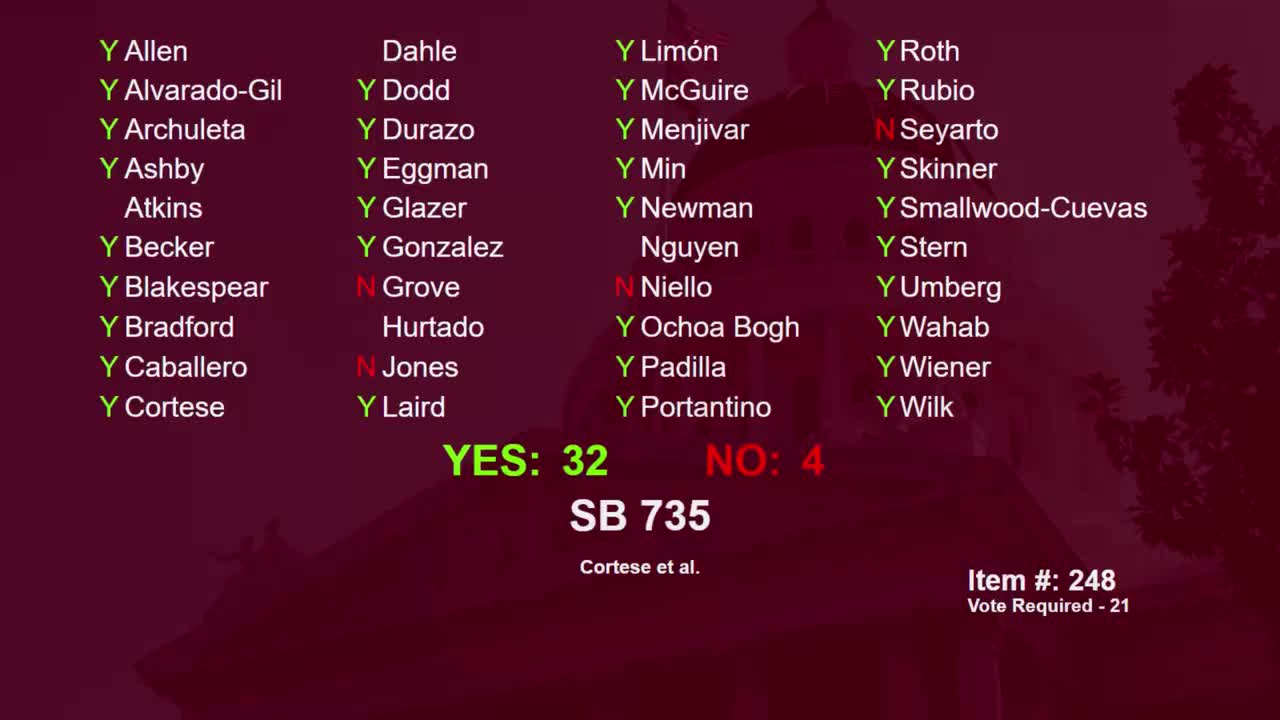
Bill Author

Bill Co-Author(s):