SB 447: GO-Biz: Building and Reinforcing Inclusive, Diverse, Gender-Supportive Equity Project.
- Session Year: 2023-2024
- House: Senate
- Latest Version Date: 2023-09-13
Current Status:
Passed
(2023-09-13: Chaptered by Secretary of State. Chapter 199, Statutes of 2023.)
Introduced
In Committee
First Chamber
In Committee
Second Chamber
Enacted
(1)Existing law establishes the Governors Office of Business and Economic Development (GO-Biz) to serve the Governor as the lead entity for economic strategy and the marketing of California on issues relating to business development, private sector investment, and economic growth. In this regard, existing law authorizes GO-Biz to make recommendations to the Governor and the Legislature on new state policies and to provide data, information, and assistance, as specified.
This bill would further authorize GO-Biz to establish the Building and Reinforcing Inclusive, Diverse, Gender-Supportive Equity Project (BRIDGE Project) to promote social equity, civil rights, and antidiscrimination through marketing and advertising campaigns. The bill would establish the BRIDGE Project Fund and would make the money available to the office upon appropriation by the Legislature for the purpose of implementing the project, and would authorize the office to receive donations into the fund. The bill would authorize the office to contract with a private, nonprofit agency, as specified, and to use the services of volunteer advertising agencies and donated media to conduct marketing activities. The bill would require the office to convene an advisory committee of no more than 10 members, as defined, to advise the office on BRIDGE Project media campaigns, as specified. The bill would authorize the office to consult with any state agency with expertise relating to the purpose of the BRIDGE Project, as specified.
The bill would provide that any media campaign funded pursuant to this project may, among other things, be on a national scale and, to the extent possible, may target audiences in a state or states, or a media market that includes a state or states that have enacted a law that voids or repeals, or has the effect of voiding or repealing, an existing state or local protection against discrimination on the basis of sexual orientation, gender identity, or gender expression, or have enacted a law that authorizes or requires discrimination against same-sex couples or their families or on the basis of sexual orientation, gender identity, or gender expression, including any law that creates an exemption to antidiscrimination laws in order to permit discrimination against same-sex couples or their families or on the basis of sexual orientation, gender identity, or gender expression. The bill would also add a provision specifying that nothing in the provisions regarding GO-Biz shall be interpreted to require a state employee or officer to travel to a state or states that have enacted a law that would discriminate on the basis of sex, sexual orientation, gender identity, or gender expression, or that has the effect of prohibiting conduct or activities otherwise protected under the laws of this state.
(2)Existing law prohibits a state agency and the Legislature from requiring any of its employees, officers, or members to travel to, or from approving a request for state-funded or state-sponsored travel to, any state that has enacted a law that voids or repeals, or that has the effect of voiding or repealing, existing state or local protections against discrimination on the basis of sexual orientation, gender identity, or gender expression or that has enacted a law that authorizes or requires discrimination against same-sex couples or their families or on the basis of sexual orientation, gender identity, or gender expression, as specified.
This bill would repeal those provisions prohibiting a state agency and the Legislature from requiring travel to specified states and would make a conforming change.
(3)This bill would declare that it is to take effect immediately as an urgency statute.
(1)Existing law establishes the Governors Office of Business and Economic Development (GO-Biz) to serve the Governor as the lead entity for economic strategy and the marketing of California on issues relating to business development, private sector investment, and economic growth. In this regard, existing law authorizes GO-Biz to make recommendations to the Governor and the Legislature on new state policies and to provide data, information, and assistance, as specified.
This bill would further authorize GO-Biz to establish the Building and Reinforcing Inclusive, Diverse, Gender-Supportive Equity Project (BRIDGE Project) to promote social equity, civil rights, and antidiscrimination through marketing and advertising campaigns. The bill would establish the BRIDGE Project Fund and would make the money available to the office upon appropriation by the Legislature for the purpose of implementing the project, and would require authorize the office to establish a process to receive donations into the fund. The bill would authorize the office to contract with a private, nonprofit agency, as specified, and to use the services of volunteer advertising agencies and donated media to conduct marketing activities. The bill would require the office to convene an advisory committee of no more than 10 members, as defined, to advise the office on BRIDGE Project media campaigns, as specified. The bill would authorize the office to consult with any state agency with expertise relating to the purpose of the BRIDGE Project, as specified.
The bill would provide that any media campaign funded pursuant to this project may, among other things, be on a national scale and, to the extent possible, may target audiences in a state or states, or a media market that includes a state or states that have enacted a law that voids or repeals, or has the effect of voiding or repealing, an existing state or local protection against discrimination on the basis of sexual orientation, gender identity, or gender expression, or have enacted a law that authorizes or requires discrimination against same-sex couples or their families or on the basis of sexual orientation, gender identity, or gender expression, including any law that creates an exemption to antidiscrimination laws in order to permit discrimination against same-sex couples or their families or on the basis of sexual orientation, gender identity, or gender expression. The bill would also add a provision specifying that nothing in the provisions regarding GO-Biz shall be interpreted to require a state employee or officer to travel to a state or states that have enacted a law that would discriminate on the basis of sex, sexual orientation, gender identity, or gender expression, or that has the effect of prohibiting conduct or activities otherwise protected under the laws of this state.
(2)Existing law prohibits a state agency and the Legislature from requiring any of its employees, officers, or members to travel to, or from approving a request for state-funded or state-sponsored travel to, any state that has enacted a law that voids or repeals, or that has the effect of voiding or repealing, existing state or local protections against discrimination on the basis of sexual orientation, gender identity, or gender expression or that has enacted a law that authorizes or requires discrimination against same-sex couples or their families or on the basis of sexual orientation, gender identity, or gender expression, as specified.
This bill would repeal those provisions prohibiting a state agency and the Legislature from requiring travel to specified states and would make a conforming change.
(1)Existing law establishes the Governors Office of Business and Economic Development (GO-Biz) to serve the Governor as the lead entity for economic strategy and the marketing of California on issues relating to business development, private sector investment, and economic growth. In this regard, existing law authorizes GO-Biz to make recommendations to the Governor and the Legislature on new state policies and to provide data, information, and assistance, as specified.
This bill would further authorize GO-Biz to establish the Building and Reinforcing Inclusive, Diverse, Gender-Supportive Equity Project (BRIDGE Project) to promote social equity, civil rights, and antidiscrimination through marketing and advertising campaigns. The bill would establish the BRIDGE Project Fund and would make the money available to the office upon appropriation by the Legislature for the purpose of implementing the project, and would require the office to establish a process to receive donations into the fund. The bill would authorize the office to contract with a private, nonprofit agency, as specified, and to use the services of volunteer advertising agencies and donated media to conduct marketing activities. The bill would require the office to convene an advisory committee of no more than 10 members, as defined, to advise the office on BRIDGE Project media campaigns, as specified.
The bill would provide that any media campaign funded pursuant to this project may, among other things, be on a national scale and, to the extent possible, may target audiences in a state or states, or a media market that includes a state or states that have enacted a law that voids or repeals, or has the effect of voiding or repealing, an existing state or local protection against discrimination on the basis of sexual orientation, gender identity, or gender expression, or have enacted a law that authorizes or requires discrimination against same-sex couples or their families or on the basis of sexual orientation, gender identity, or gender expression, including any law that creates an exemption to antidiscrimination laws in order to permit discrimination against same-sex couples or their families or on the basis of sexual orientation, gender identity, or gender expression. The bill would also add a provision specifying that nothing in the provisions regarding GO-Biz shall be interpreted to require a state employee or officer to travel to a state or states that have enacted a law that would discriminate on the basis of sex, sexual orientation, gender identity, or gender expression, or that has the effect of prohibiting conduct or activities otherwise protected under the laws of this state.
(2)Existing law prohibits a state agency and the Legislature from requiring any of its employees, officers, or members to travel to, or from approving a request for state-funded or state-sponsored travel to, any state that has enacted a law that voids or repeals, or that has the effect of voiding or repealing, existing state or local protections against discrimination on the basis of sexual orientation, gender identity, or gender expression or that has enacted a law that authorizes or requires discrimination against same-sex couples or their families or on the basis of sexual orientation, gender identity, or gender expression, as specified.
This bill would repeal those provisions prohibiting a state agency and the Legislature from requiring travel to specified states and would make a conforming change.
(1) Existing law establishes the Governors Office of Business and Economic Development (GO-Biz) to serve the Governor as the lead entity for economic strategy and the marketing of California on issues relating to business development, private sector investment, and economic growth. In this regard, existing law authorizes GO-Biz to make recommendations to the Governor and the Legislature on new state policies and to provide data, information, and assistance, as specified.
This bill would further authorize GO-Biz to establish the Building and Reinforcing Inclusive, Diverse, Gender-Supportive Equity Project (BRIDGE Project) to promote social equity, civil rights, and antidiscrimination through marketing and advertising campaigns. The bill would establish the BRIDGE Project Fund and would make the money available to the office upon appropriation by the Legislature for the purpose of implementing the project, and would require the office to establish a process to receive donations into the fund. The bill would authorize the office to contract with a private, nonprofit agency, as specified, and to use the services of volunteer advertising agencies and donated media to conduct marketing activities.
The bill would provide that any media campaign funded pursuant to this project may, among other things, be on a national scale and, to the extent possible, may target audiences in a state or states, or a media market that includes a state or states that have enacted a law that voids or repeals, or has the effect of voiding or repealing, an existing state or local protection against discrimination on the basis of sexual orientation, gender identity, or gender expression, or have enacted a law that authorizes or requires discrimination against same-sex couples or their families or on the basis of sexual orientation, gender identity, or gender expression, including any law that creates an exemption to antidiscrimination laws in order to permit discrimination against same-sex couples or their families or on the basis of sexual orientation, gender identity, or gender expression.
(2)Existing law prohibits a state agency and the Legislature from requiring any of its employees, officers, or members to travel to, or from approving a request for state-funded or state-sponsored travel to, any state that has enacted a law that voids or repeals, or that has the effect of voiding or repealing, existing state or local protections against discrimination on the basis of sexual orientation, gender identity, or gender expression or that has enacted a law that authorizes or requires discrimination against same-sex couples or their families or on the basis of sexual orientation, gender identity, or gender expression, as specified.
This bill would repeal those provisions prohibiting a state agency and the Legislature from requiring travel to specified states and would make a conforming change.
Existing law establishes the Governors Office of Business and Economic Development (GO-Biz) to serve the Governor as the lead entity for economic strategy and the marketing of California on issues relating to business development, private sector investment, and economic growth. In this regard, existing law authorizes GO-Biz to make recommendations to the Governor and the Legislature on new state policies and to provide data, information, and assistance, as specified.This bill would further authorize the GO-Biz to establish a program to promote social equity, civil rights, and anti-discrimination through marketing and advertising campaigns. The bill would also make nonsubstantive changes to these provisions.Existing law establishes the Governors Office of Business and Economic Development (GO-Biz) to serve the Governor as the lead entity for economic strategy and the marketing of California on issues relating to business development, private sector investment, and economic growth. In this regard, existing law authorizes GO-Biz to make recommendations to the Governor and the Legislature on new state policies and to provide data, information, and assistance, as specified.
This bill would further authorize the GO-Biz to establish a program to promote social equity, civil rights, and anti-discrimination through marketing and advertising campaigns. The bill would also make nonsubstantive changes to these provisions.
The California Tourism Marketing Act sets forth the findings and declarations of the Legislature with regard to travel and tourism in the state. Those findings and declarations state, in part, that generic promotion of California as a tourism destination is intended and designed to maintain or increase the overall demand for California tourism and to maintain or increase the size of that market, often by utilizing promotional methods and techniques that individual businesses typically are unable, or have no incentive, to employ.This bill would change the above-described finding to additionally specify that generic promotion is intended and designed to express Californias values and attributes.The California Tourism Marketing Act sets forth the findings and declarations of the Legislature with regard to travel and tourism in the state. Those findings and declarations state, in part, that generic promotion of California as a tourism destination is intended and designed to maintain or increase the overall demand for California tourism and to maintain or increase the size of that market, often by utilizing promotional methods and techniques that individual businesses typically are unable, or have no incentive, to employ.
This bill would change the above-described finding to additionally specify that generic promotion is intended and designed to express Californias values and attributes.
The office shall serve the Governor as the lead entity for economic strategy and the marketing of California on issues relating to business development, private sector investment, and economic growth. In this capacity, the office may:
(a)Recommend to the Governor and the Legislature new state policies, programs, and actions, or amendments to existing programs, advance statewide economic goals and respond to emerging economic problems and opportunities, and ensure that all state policies and programs conform to the adopted state economic and business development goals.
(b)Coordinate the development of policies and criteria to ensure that federal grants administered or directly expended by state government advance statewide economic goals and objectives.
(c)Market the business and investment opportunities available in California by working in partnership with local, regional, federal, and other state public and private institutions to encourage business development and investment in the state.
(d)Provide, including, but not limited to, all of the following:
(1)Economic and demographic data.
(2)Financial information to help link businesses with state and local public and private programs.
(3)Workforce information, including, but not limited to, labor availability, training, and education programs.
(4)Transportation and infrastructure information.
(5)Assistance in obtaining state and local permits.
(6)Information on tax credits and other incentives.
(7)Permitting, siting, and other regulatory information pertinent to business operations in the state.
(e)Establish a well-advertised telephone number, an interactive internet website, and an administrative structure that effectively supports the facilitation of business development and investment in the state.
(f)Encourage collaboration among research institutions, startup companies, local governments, venture capitalists, and economic development agencies to promote innovation.
(g)In cooperation with the federal government, foster relationships with overseas entities to improve the states image as a destination for business investment and expansion.
(h)Conduct research on the states business climate, including, but not limited to, research on how the state can remain on the leading edge of innovation and emerging sectors.
(i)Support small businesses by providing information about accessing capital, complying with regulations, and supporting state initiatives that support small business.
(j)Establish the Building and Reinforcing Inclusive, Diverse, Gender-Supportive Equity Project (BRIDGE Project) to promote social equity, civil rights, and antidiscrimination through marketing and advertising campaigns.
SEC. 3.Article 16 (commencing with Section 12100.170) is added to Chapter 1.6 of Part 2 of Division 3 of Title 2 of the Government Code, to read:16.Building and Reinforcing Inclusive, Diverse, Gender-Supportive Equity Project12100.170.This article shall be known, and may be cited, as the Building and Reinforcing Inclusive, Diverse, Gender-Supportive Equity Project (BRIDGE Project).
12100.171.(a)There is hereby established, within the office, the BRIDGE Project.
(b)The purpose of the BRIDGE Project is to raise public awareness and promote civil rights and antidiscrimination through education, advertising, and marketing activities.
(c)There is hereby created the BRIDGE Project Fund within the office. Moneys in the account shall be available, upon appropriation by the Legislature, for the purposes of this article. The office is authorized to receive donations into the fund.
(d)The office may contract with a private, nonprofit agency that is the leading producer of public service advertisements and is able to use the services of volunteer advertising agencies and donated media to conduct the marketing activities required by this article.
(e)Any media campaign funded pursuant to this article is subject to all of the following requirements:
(1)A media campaign funded pursuant to this article shall not promote a political purpose or feature in any manner the image or voice of any elected public official or candidate for elected office, or directly represent the views of any elected public official or candidate for elected office.
(2)Media campaigns may be on a national scale and, to the extent possible, may target audiences in a state or states, or a media market that includes a state or states that have enacted a law that voids or repeals, or has the effect of voiding or repealing, an existing state or local protection against discrimination on the basis of sexual orientation, gender identity, or gender expression, or have enacted a law that authorizes or requires discrimination against same-sex couples or their families or on the basis of sexual orientation, gender identity, or gender expression, including any law that creates an exemption to antidiscrimination laws in order to permit discrimination against same-sex couples or their families or on the basis of sexual orientation, gender identity, or gender expression.
(3)Media campaigns funded pursuant to this article shall be designed to educate the public and promote antidiscrimination, issues LGBTQ+ communities face, civil rights, acceptance and inclusion of all people regardless of race, religion, gender, sexual orientation, age, and ability.
(f)The office shall convene an advisory committee of no more than 10 members to advise the office on BRIDGE Project media campaigns, including, but not limited to, the content of media campaigns, emerging issues relevant to the purpose of the BRIDGE Project, evaluation of current and potential campaigns, and strategic outreach to communities affected by the campaign. The advisory committee members shall include LGBTQ+ advocates, marketing and public relations professionals, and representatives from research institutions as necessary to develop and evaluate media campaigns funded pursuant to this article. The advisory committee members shall be determined by the director.
(g)Nothing in this article shall be interpreted to require a state employee or officer to travel to a state or states that have enacted a law that would discriminate on the basis of sex, sexual orientation, gender identity, or gender expression, or that has the effect of prohibiting conduct or activities otherwise protected under the laws of this state.
(h)When implementing this article, the office may consult with any state agency with expertise relating to the purpose of the BRIDGE Project, as outlined in subdivision (b).
SEC. 4.Section 4646 of the Welfare and Institutions Code, as amended by Section 17 of Chapter 44 of the Statutes of 2023, is amended to read:4646.(a)It is the intent of the Legislature to ensure that the individual program plan and provision of services and supports by the regional center system is centered on the individual and the family of the individual with developmental disabilities and takes into account the needs and preferences of the individual and the family, if appropriate, as well as promoting community integration, independent, productive, and normal lives, and stable and healthy environments. It is the further intent of the Legislature to ensure that the provision of services to consumers and their families be effective in meeting the goals stated in the individual program plan, reflect the preferences and choices of the consumer, and reflect the cost-effective use of public resources.
(b)The individual program plan is developed through a process of individualized needs determination. The individual with developmental disabilities and, if appropriate, the individuals parents, legal guardian or conservator, or authorized representative, shall have the opportunity to actively participate in the development of the plan.
(c)An individual program plan shall be developed for any person who, following intake and assessment, is found to be eligible for regional center services. These plans shall be completed within 60 days of the completion of the assessment. At the time of intake, the regional center shall inform the consumer and, if appropriate, the consumers parents, legal guardian or conservator, or authorized representative, of the services available through the state council and the protection and advocacy agency designated by the Governor pursuant to federal law, and shall provide the address and telephone numbers of those agencies.
(d)Individual program plans shall be prepared jointly by the planning team. Decisions concerning the consumers goals, objectives, and services and supports that will be included in the consumers individual program plan and purchased by the regional center or obtained from generic agencies shall be made by agreement between the regional center representative and the consumer or, if appropriate, the parents, legal guardian, conservator, or authorized representative at the program plan meeting.
(e)Regional centers shall comply with the request of a consumer or, if appropriate, the request of the consumers parents, legal guardian, conservator, or authorized representative, that a designated representative receive written notice of all meetings to develop or revise the individual program plan and of all notices sent to the consumer pursuant to Section 4710. The designated representative may be a parent or family member.
(f)Notwithstanding any other law, until June 30, 2024, a meeting regarding the provision of services and supports by the regional center, including a meeting to develop or revise the individual program plan, shall be held by remote electronic communications if requested by the consumer or, if appropriate, if requested by the consumers parents, legal guardian, conservator, or authorized representative.
(g)At the conclusion of an individual program plan meeting, an authorized representative of the regional center shall provide to the consumer, in written or electronic format, a list of the agreed-upon services and supports, and, if known, the projected start date, the frequency and duration of the services and supports, and the provider. The authorized representative of the regional center shall sign the list of agreed-upon services and supports at that time. The consumer, or if appropriate, the consumers parent, legal guardian, conservator, or authorized representative shall sign the list of agreed-upon services and supports prior to its implementation. The consumer, or if appropriate, the consumers parent, legal guardian, conservator, or authorized representative, may elect to delay receipt of the list of agreed-upon services and supports pending final agreement, as described in subdivision (h). If the consumer, or if appropriate, the consumers parent, legal guardian, conservator, or authorized representative, elects to delay the receipt of the list of agreed-upon services and supports for 15 days, the list shall be provided in the preferred language of the consumer, or of the consumers parent, legal guardian, or authorized representative.
(h)If a final agreement regarding the services and supports to be provided to the consumer cannot be reached at a program plan meeting, then a subsequent program plan meeting shall be convened within 15 days, or later at the request of the consumer or, if appropriate, the parents, legal guardian, conservator, or authorized representative or if agreed to by the planning team. The list of the agreed-upon services and supports described in subdivision (g) and signed by the authorized representative of the regional center shall be provided, in writing or electronically, at the conclusion of the subsequent program plan meeting, and shall be provided in the preferred language of the consumer, or of the consumers parent, legal guardian, conservator, or authorized representative. Additional program plan meetings may be held with the agreement of the regional center representative and the consumer or, if appropriate, the parents, legal guardian, conservator, or authorized representative.
(i)An authorized representative of the regional center and the consumer or, if appropriate, the consumers parent, legal guardian, conservator, or authorized representative shall sign the individual program plan and the list of the agreed-upon services and supports prior to its implementation. If the consumer or, if appropriate, the consumers parent, legal guardian, conservator, or authorized representative, does not agree with all components of the individual program plan, the consumer may indicate that disagreement on the plan. Disagreement with specific plan components shall not prohibit the implementation of services and supports agreed to by the consumer or, if appropriate, the consumers parent, legal guardian, conservator, or authorized representative. If the consumer or, if appropriate, the consumers parent, legal guardian, conservator, or authorized representative, does not agree with the plan in whole or in part, the consumer shall be sent written notice of their appeal rights, as required by Sections 4701 and 4710.
(j)(1)A regional center shall communicate in the consumers preferred language, or, if appropriate, the preferred language of the consumers family, legal guardian, conservator, or authorized representative, during the planning process for the individual program plan, including during the program plan meeting, and including providing alternative communication services, as required by Sections 11135 to 11139, inclusive, of the Government Code and implementing regulations.
(2)A regional center shall provide alternative communication services, including providing copies of the list of services and supports, and the individual program plan in the preferred language of the consumer or the consumers family, legal guardian, conservator, or authorized representative, or both, as required by Sections 11135 to 11139, inclusive, of the Government Code and implementing regulations.
(3)The preferred language of the consumer or the consumers family, legal guardian, conservator, or authorized representative, or both, shall be documented in the individual program plan.
SEC. 5.This act is an urgency statute necessary for the immediate preservation of the public peace, health, or safety within the meaning of Article IV of the California Constitution and shall go into immediate effect. The facts constituting the necessity are:
To protect civil rights and prevent discrimination, it is necessary that this act go into effect immediately.
The office shall serve the Governor as the lead entity for economic strategy and the marketing of California on issues relating to business development, private sector investment, and economic growth. In this capacity, the office may:
(a)Recommend to the Governor and the Legislature new state policies, programs, and actions, or amendments to existing programs, advance statewide economic goals and respond to emerging economic problems and opportunities, and ensure that all state policies and programs conform to the adopted state economic and business development goals.
(b)Coordinate the development of policies and criteria to ensure that federal grants administered or directly expended by state government advance statewide economic goals and objectives.
(c)Market the business and investment opportunities available in California by working in partnership with local, regional, federal, and other state public and private institutions to encourage business development and investment in the state.
(d)Provide, including, but not limited to, all of the following:
(1)Economic and demographic data.
(2)Financial information to help link businesses with state and local public and private programs.
(3)Workforce information, including, but not limited to, labor availability, training, and education programs.
(4)Transportation and infrastructure information.
(5)Assistance in obtaining state and local permits.
(6)Information on tax credits and other incentives.
(7)Permitting, siting, and other regulatory information pertinent to business operations in the state.
(e)Establish a well-advertised telephone number, an interactive internet website, and an administrative structure that effectively supports the facilitation of business development and investment in the state.
(f)Encourage collaboration among research institutions, startup companies, local governments, venture capitalists, and economic development agencies to promote innovation.
(g)In cooperation with the federal government, foster relationships with overseas entities to improve the states image as a destination for business investment and expansion.
(h)Conduct research on the states business climate, including, but not limited to, research on how the state can remain on the leading edge of innovation and emerging sectors.
(i)Support small businesses by providing information about accessing capital, complying with regulations, and supporting state initiatives that support small business.
(j)Establish the Building and Reinforcing Inclusive, Diverse, Gender-Supportive Equity Project (BRIDGE Project) to promote social equity, civil rights, and antidiscrimination through marketing and advertising campaigns.
SEC. 3.Article 16 (commencing with Section 12100.170) is added to Chapter 1.6 of Part 2 of Division 3 of Title 2 of the Government Code, to read:16.Building and Reinforcing Inclusive, Diverse, Gender-Supportive Equity Project12100.170.This chapter article shall be known, and may be cited, as the Building and Reinforcing Inclusive, Diverse, Gender-Supportive Equity Project (BRIDGE Project).
12100.171.(a)There is hereby established, within the office, the BRIDGE Project.
(b)The purpose of the BRIDGE Project is to raise public awareness and promote civil rights and antidiscrimination through education, advertising, and marketing activities.
(c)There is hereby created the BRIDGE Project Fund within the office. Moneys in the account shall be available, upon appropriation by the Legislature, for the purposes of this article. The office is authorized to receive donations into the fund.
(d)The office may contract with a private, nonprofit agency that is the leading producer of public service advertisements and is able to use the services of volunteer advertising agencies and donated media to conduct the marketing activities required by this article.
(e)Any media campaign funded pursuant to this article is subject to all of the following requirements:
(1)A media campaign funded pursuant to this article shall not promote a political purpose or feature in any manner the image or voice of any elected public official or candidate for elected office, or directly represent the views of any elected public official or candidate for elected office.
(2)Media campaigns may be on a national scale and, to the extent possible, may target audiences in a state or states, or a media market that includes a state or states that have enacted a law that voids or repeals, or has the effect of voiding or repealing, an existing state or local protection against discrimination on the basis of sexual orientation, gender identity, or gender expression, or have enacted a law that authorizes or requires discrimination against same-sex couples or their families or on the basis of sexual orientation, gender identity, or gender expression, including any law that creates an exemption to antidiscrimination laws in order to permit discrimination against same-sex couples or their families or on the basis of sexual orientation, gender identity, or gender expression.
(3)Media campaigns funded pursuant to this article shall be designed to educate the public and promote antidiscrimination, issues LGBTQ+ communities face, civil rights, acceptance and inclusion of all people regardless of race, religion, gender, sexual orientation, age, and ability.
(f)The office shall convene an advisory committee of no more than 10 members to advise the office on BRIDGE Project media campaigns, including, but not limited to, the content of media campaigns, emerging issues relevant to the purpose of the BRIDGE Project, evaluation of current and potential campaigns, and strategic outreach to communities affected by the campaign. The advisory committee members shall include LGBTQ+ advocates, marketing and public relations professionals, and representatives from research institutions as necessary to develop and evaluate media campaigns funded pursuant to this article. The advisory committee members shall be determined by the director.
(g)Nothing in this chapter article shall be interpreted to require a state employee or officer to travel to a state or states that have enacted a law that would discriminate on the basis of sex, sexual orientation, gender identity, or gender expression, or that has the effect of prohibiting conduct or activities otherwise protected under the laws of this state.
(h)When implementing this article, the office may consult with any state agency with expertise relating to the purpose of the BRIDGE Project, as outlined in subdivision (b).
SEC. 4.Section 4646 of the Welfare and Institutions Code, as amended by Section 17 of Chapter 44 of the Statutes of 2023, is amended to read:4646.(a)It is the intent of the Legislature to ensure that the individual program plan and provision of services and supports by the regional center system is centered on the individual and the family of the individual with developmental disabilities and takes into account the needs and preferences of the individual and the family, if appropriate, as well as promoting community integration, independent, productive, and normal lives, and stable and healthy environments. It is the further intent of the Legislature to ensure that the provision of services to consumers and their families be effective in meeting the goals stated in the individual program plan, reflect the preferences and choices of the consumer, and reflect the cost-effective use of public resources.
(b)The individual program plan is developed through a process of individualized needs determination. The individual with developmental disabilities and, if appropriate, the individuals parents, legal guardian or conservator, or authorized representative, shall have the opportunity to actively participate in the development of the plan.
(c)An individual program plan shall be developed for any person who, following intake and assessment, is found to be eligible for regional center services. These plans shall be completed within 60 days of the completion of the assessment. At the time of intake, the regional center shall inform the consumer and, if appropriate, the consumers parents, legal guardian or conservator, or authorized representative, of the services available through the state council and the protection and advocacy agency designated by the Governor pursuant to federal law, and shall provide the address and telephone numbers of those agencies.
(d)Individual program plans shall be prepared jointly by the planning team. Decisions concerning the consumers goals, objectives, and services and supports that will be included in the consumers individual program plan and purchased by the regional center or obtained from generic agencies shall be made by agreement between the regional center representative and the consumer or, if appropriate, the parents, legal guardian, conservator, or authorized representative at the program plan meeting.
(e)Regional centers shall comply with the request of a consumer or, if appropriate, the request of the consumers parents, legal guardian, conservator, or authorized representative, that a designated representative receive written notice of all meetings to develop or revise the individual program plan and of all notices sent to the consumer pursuant to Section 4710. The designated representative may be a parent or family member.
(f)Notwithstanding any other law, until June 30, 2024, a meeting regarding the provision of services and supports by the regional center, including a meeting to develop or revise the individual program plan, shall be held by remote electronic communications if requested by the consumer or, if appropriate, if requested by the consumers parents, legal guardian, conservator, or authorized representative.
(g)At the conclusion of an individual program plan meeting, an authorized representative of the regional center shall provide to the consumer, in written or electronic format, a list of the agreed-upon services and supports, and, if known, the projected start date, the frequency and duration of the services and supports, and the provider. The authorized representative of the regional center shall sign the list of agreed-upon services and supports at that time. The consumer, or if appropriate, the consumers parent, legal guardian, conservator, or authorized representative shall sign the list of agreed-upon services and supports prior to its implementation. The consumer, or if appropriate, the consumers parent, legal guardian, conservator, or authorized representative, may elect to delay receipt of the list of agreed-upon services and supports pending final agreement, as described in subdivision (h). If the consumer, or if appropriate, the consumers parent, legal guardian, conservator, or authorized representative, elects to delay the receipt of the list of agreed-upon services and supports for 15 days, the list shall be provided in the preferred language of the consumer, or of the consumers parent, legal guardian, or authorized representative.
(h)If a final agreement regarding the services and supports to be provided to the consumer cannot be reached at a program plan meeting, then a subsequent program plan meeting shall be convened within 15 days, or later at the request of the consumer or, if appropriate, the parents, legal guardian, conservator, or authorized representative or if agreed to by the planning team. The list of the agreed-upon services and supports described in subdivision (g) and signed by the authorized representative of the regional center shall be provided, in writing or electronically, at the conclusion of the subsequent program plan meeting, and shall be provided in the preferred language of the consumer, or of the consumers parent, legal guardian, conservator, or authorized representative. Additional program plan meetings may be held with the agreement of the regional center representative and the consumer or, if appropriate, the parents, legal guardian, conservator, or authorized representative.
(i)An authorized representative of the regional center and the consumer or, if appropriate, the consumers parent, legal guardian, conservator, or authorized representative shall sign the individual program plan and the list of the agreed-upon services and supports prior to its implementation. If the consumer or, if appropriate, the consumers parent, legal guardian, conservator, or authorized representative, does not agree with all components of the individual program plan, the consumer may indicate that disagreement on the plan. Disagreement with specific plan components shall not prohibit the implementation of services and supports agreed to by the consumer or, if appropriate, the consumers parent, legal guardian, conservator, or authorized representative. If the consumer or, if appropriate, the consumers parent, legal guardian, conservator, or authorized representative, does not agree with the plan in whole or in part, the consumer shall be sent written notice of their appeal rights, as required by Sections 4701 and 4710.
(j)(1)A regional center shall communicate in the consumers preferred language, or, if appropriate, the preferred language of the consumers family, legal guardian, conservator, or authorized representative, during the planning process for the individual program plan, including during the program plan meeting, and including providing alternative communication services, as required by Sections 11135 to 11139, inclusive, of the Government Code and implementing regulations.
(2)A regional center shall provide alternative communication services, including providing copies of the list of services and supports, and the individual program plan in the preferred language of the consumer or the consumers family, legal guardian, conservator, or authorized representative, or both, as required by Sections 11135 to 11139, inclusive, of the Government Code and implementing regulations.
(3)The preferred language of the consumer or the consumers family, legal guardian, conservator, or authorized representative, or both, shall be documented in the individual program plan.
SEC. 5.This act is an urgency statute necessary for the immediate preservation of the public peace, health, or safety within the meaning of Article IV of the California Constitution and shall go into immediate effect. The facts constituting the necessity are:
To protect civil rights and prevent discrimination, it is necessary that this act go into effect immediately.
The office shall serve the Governor as the lead entity for economic strategy and the marketing of California on issues relating to business development, private sector investment, and economic growth. In this capacity, the office may:
(a)Recommend to the Governor and the Legislature new state policies, programs, and actions, or amendments to existing programs, advance statewide economic goals and respond to emerging economic problems and opportunities, and ensure that all state policies and programs conform to the adopted state economic and business development goals.
(b)Coordinate the development of policies and criteria to ensure that federal grants administered or directly expended by state government advance statewide economic goals and objectives.
(c)Market the business and investment opportunities available in California by working in partnership with local, regional, federal, and other state public and private institutions to encourage business development and investment in the state.
(d)Provide, including, but not limited to, all of the following:
(1)Economic and demographic data.
(2)Financial information to help link businesses with state and local public and private programs.
(3)Workforce information, including, but not limited to, labor availability, training, and education programs.
(4)Transportation and infrastructure information.
(5)Assistance in obtaining state and local permits.
(6)Information on tax credits and other incentives.
(7)Permitting, siting, and other regulatory information pertinent to business operations in the state.
(e)Establish a well-advertised telephone number, an interactive internet website, and an administrative structure that effectively supports the facilitation of business development and investment in the state.
(f)Encourage collaboration among research institutions, startup companies, local governments, venture capitalists, and economic development agencies to promote innovation.
(g)In cooperation with the federal government, foster relationships with overseas entities to improve the states image as a destination for business investment and expansion.
(h)Conduct research on the states business climate, including, but not limited to, research on how the state can remain on the leading edge of innovation and emerging sectors.
(i)Support small businesses by providing information about accessing capital, complying with regulations, and supporting state initiatives that support small business.
(j)Establish the Building and Reinforcing Inclusive, Diverse, Gender-Supportive Equity Project (BRIDGE Project) to promote social equity, civil rights, and antidiscrimination through marketing and advertising campaigns.
SEC. 3.Article 16 (commencing with Section 12100.170) is added to Chapter 1.6 of Part 2 of Division 3 of Title 2 of the Government Code, to read:16.Building and Reinforcing Inclusive, Diverse, Gender-Supportive Equity Project12100.170.This chapter shall be known, and may be cited, as the Building and Reinforcing Inclusive, Diverse, Gender-Supportive Equity Project (BRIDGE Project).
12100.171.(a)There is hereby established, within the office, the BRIDGE Project.
(b)The purpose of the BRIDGE Project is to raise public awareness and promote civil rights and antidiscrimination through education, advertising, and marketing activities.
(c)There is hereby created the BRIDGE Project Fund within the office. Moneys in the account shall be available, upon appropriation by the Legislature, for the purposes of this article. The office shall establish a process is authorized to receive donations into the fund.
(d)The office may contract with a private, nonprofit agency that is the leading producer of public service advertisements and is able to use the services of volunteer advertising agencies and donated media to conduct the marketing activities required by this article.
(e)Any media campaign funded pursuant to this article is subject to all of the following requirements:
(1)A media campaign funded pursuant to this article shall not promote a political purpose or feature in any manner the image or voice of any elected public official or candidate for elected office, or directly represent the views of any elected public official or candidate for elected office.
(2)Media campaigns may be on a national scale and, to the extent possible, may target audiences in a state or states, or a media market that includes a state or states that have enacted a law that voids or repeals, or has the effect of voiding or repealing, an existing state or local protection against discrimination on the basis of sexual orientation, gender identity, or gender expression, or have enacted a law that authorizes or requires discrimination against same-sex couples or their families or on the basis of sexual orientation, gender identity, or gender expression, including any law that creates an exemption to antidiscrimination laws in order to permit discrimination against same-sex couples or their families or on the basis of sexual orientation, gender identity, or gender expression.
(3)Media campaigns funded pursuant to this article shall be designed to educate the public and promote antidiscrimination, issues LGBTQ+ communities face, civil rights, acceptance and inclusion of all people regardless of race, religion, gender, sexual orientation, age, and ability.
(f)The office shall convene an advisory committee of no more than 10 members to advise the office on BRIDGE Project media campaigns, including, but not limited to, the content of media campaigns, emerging issues relevant to the purpose of the BRIDGE Project, evaluation of current and potential campaigns, and strategic outreach to communities affected by the campaign. The advisory committee members shall include LGBTQ+ advocates, marketing and public relations professionals, and representatives from research institutions as necessary to develop and evaluate media campaigns funded pursuant to this article. The advisory committee members shall be determined by the director.
(g)Nothing in this chapter shall be interpreted to require a state employee or officer to travel to a state or states that have enacted a law that would discriminate on the basis of sex, sexual orientation, gender identity, or gender expression, or that has the effect of prohibiting conduct or activities otherwise protected under the laws of this state.
(h)When implementing this article, the office may consult with any state agency with expertise relating to the purpose of the BRIDGE Project, as outlined in subdivision (b).
SEC. 4.Section 4646 of the Welfare and Institutions Code, as amended by Section 17 of Chapter 44 of the Statutes of 2023, is amended to read:4646.(a)It is the intent of the Legislature to ensure that the individual program plan and provision of services and supports by the regional center system is centered on the individual and the family of the individual with developmental disabilities and takes into account the needs and preferences of the individual and the family, if appropriate, as well as promoting community integration, independent, productive, and normal lives, and stable and healthy environments. It is the further intent of the Legislature to ensure that the provision of services to consumers and their families be effective in meeting the goals stated in the individual program plan, reflect the preferences and choices of the consumer, and reflect the cost-effective use of public resources.
(b)The individual program plan is developed through a process of individualized needs determination. The individual with developmental disabilities and, if appropriate, the individuals parents, legal guardian or conservator, or authorized representative, shall have the opportunity to actively participate in the development of the plan.
(c)An individual program plan shall be developed for any person who, following intake and assessment, is found to be eligible for regional center services. These plans shall be completed within 60 days of the completion of the assessment. At the time of intake, the regional center shall inform the consumer and, if appropriate, the consumers parents, legal guardian or conservator, or authorized representative, of the services available through the state council and the protection and advocacy agency designated by the Governor pursuant to federal law, and shall provide the address and telephone numbers of those agencies.
(d)Individual program plans shall be prepared jointly by the planning team. Decisions concerning the consumers goals, objectives, and services and supports that will be included in the consumers individual program plan and purchased by the regional center or obtained from generic agencies shall be made by agreement between the regional center representative and the consumer or, if appropriate, the parents, legal guardian, conservator, or authorized representative at the program plan meeting.
(e)Regional centers shall comply with the request of a consumer or, if appropriate, the request of the consumers parents, legal guardian, conservator, or authorized representative, that a designated representative receive written notice of all meetings to develop or revise the individual program plan and of all notices sent to the consumer pursuant to Section 4710. The designated representative may be a parent or family member.
(f)Notwithstanding any other law, until June 30, 2024, a meeting regarding the provision of services and supports by the regional center, including a meeting to develop or revise the individual program plan, shall be held by remote electronic communications if requested by the consumer or, if appropriate, if requested by the consumers parents, legal guardian, conservator, or authorized representative.
(g)At the conclusion of an individual program plan meeting, an authorized representative of the regional center shall provide to the consumer, in written or electronic format, a list of the agreed-upon services and supports, and, if known, the projected start date, the frequency and duration of the services and supports, and the provider. The authorized representative of the regional center shall sign the list of agreed-upon services and supports at that time. The consumer, or if appropriate, the consumers parent, legal guardian, conservator, or authorized representative shall sign the list of agreed-upon services and supports prior to its implementation. The consumer, or if appropriate, the consumers parent, legal guardian, conservator, or authorized representative, may elect to delay receipt of the list of agreed-upon services and supports pending final agreement, as described in subdivision (h). If the consumer, or if appropriate, the consumers parent, legal guardian, conservator, or authorized representative, elects to delay the receipt of the list of agreed-upon services and supports for 15 days, the list shall be provided in the preferred language of the consumer, or of the consumers parent, legal guardian, or authorized representative.
(h)If a final agreement regarding the services and supports to be provided to the consumer cannot be reached at a program plan meeting, then a subsequent program plan meeting shall be convened within 15 days, or later at the request of the consumer or, if appropriate, the parents, legal guardian, conservator, or authorized representative or if agreed to by the planning team. The list of the agreed-upon services and supports described in subdivision (g) and signed by the authorized representative of the regional center shall be provided, in writing or electronically, at the conclusion of the subsequent program plan meeting, and shall be provided in the preferred language of the consumer, or of the consumers parent, legal guardian, conservator, or authorized representative. Additional program plan meetings may be held with the agreement of the regional center representative and the consumer or, if appropriate, the parents, legal guardian, conservator, or authorized representative.
(i)An authorized representative of the regional center and the consumer or, if appropriate, the consumers parent, legal guardian, conservator, or authorized representative shall sign the individual program plan and the list of the agreed-upon services and supports prior to its implementation. If the consumer or, if appropriate, the consumers parent, legal guardian, conservator, or authorized representative, does not agree with all components of the individual program plan, the consumer may indicate that disagreement on the plan. Disagreement with specific plan components shall not prohibit the implementation of services and supports agreed to by the consumer or, if appropriate, the consumers parent, legal guardian, conservator, or authorized representative. If the consumer or, if appropriate, the consumers parent, legal guardian, conservator, or authorized representative, does not agree with the plan in whole or in part, the consumer shall be sent written notice of their appeal rights, as required by Sections 4701 and 4710.
(j)(1)A regional center shall communicate in the consumers preferred language, or, if appropriate, the preferred language of the consumers family, legal guardian, conservator, or authorized representative, during the planning process for the individual program plan, including during the program plan meeting, and including providing alternative communication services, as required by Sections 11135 to 11139, inclusive, of the Government Code and implementing regulations.
(2)A regional center shall provide alternative communication services, including providing copies of the list of services and supports, and the individual program plan in the preferred language of the consumer or the consumers family, legal guardian, conservator, or authorized representative, or both, as required by Sections 11135 to 11139, inclusive, of the Government Code and implementing regulations.
(3)The preferred language of the consumer or the consumers family, legal guardian, conservator, or authorized representative, or both, shall be documented in the individual program plan.
The office shall serve the Governor as the lead entity for economic strategy and the marketing of California on issues relating to business development, private sector investment, and economic growth. In this capacity, the office may:
(a)Recommend to the Governor and the Legislature new state policies, programs, and actions, or amendments to existing programs, advance statewide economic goals and respond to emerging economic problems and opportunities, and ensure that all state policies and programs conform to the adopted state economic and business development goals.
(b)Coordinate the development of policies and criteria to ensure that federal grants administered or directly expended by state government advance statewide economic goals and objectives.
(c)Market the business and investment opportunities available in California by working in partnership with local, regional, federal, and other state public and private institutions to encourage business development and investment in the state.
(d)Provide, including, but not limited to, all of the following:
(1)Economic and demographic data.
(2)Financial information to help link businesses with state and local public and private programs.
(3)Workforce information, including, but not limited to, labor availability, training, and education programs.
(4)Transportation and infrastructure information.
(5)Assistance in obtaining state and local permits.
(6)Information on tax credits and other incentives.
(7)Permitting, siting, and other regulatory information pertinent to business operations in the state.
(e)Establish a well-advertised telephone number, an interactive internet website, and an administrative structure that effectively supports the facilitation of business development and investment in the state.
(f)Encourage collaboration among research institutions, startup companies, local governments, venture capitalists, and economic development agencies to promote innovation.
(g)In cooperation with the federal government, foster relationships with overseas entities to improve the states image as a destination for business investment and expansion.
(h)Conduct research on the states business climate, including, but not limited to, research on how the state can remain on the leading edge of innovation and emerging sectors.
(i)Support small businesses by providing information about accessing capital, complying with regulations, and supporting state initiatives that support small business.
(j)Establish the Building and Reinforcing Inclusive, Diverse, Gender-Supportive Equity Project (BRIDGE Project) to promote social equity, civil rights, and antidiscrimination through marketing and advertising campaigns.
SEC. 3.Article 16 (commencing with Section 12100.170) is added to Chapter 1.6 of Part 2 of Division 3 of Title 2 of the Government Code, to read:16.Building and Reinforcing Inclusive, Diverse, Gender-Supportive Equity Project12100.170.This chapter shall be known, and may be cited, as the Building and Reinforcing Inclusive, Diverse, Gender-Supportive Equity Project (BRIDGE Project).
12100.171.(a)There is hereby established, within the office, the BRIDGE Project.
(b)The purpose of the BRIDGE Project is to raise public awareness and promote civil rights and antidiscrimination through education, advertising, and marketing activities.
(c)There is hereby created the BRIDGE Project Fund within the office. Moneys in the account shall be available, upon appropriation by the Legislature, for the purposes of this article. The office shall establish a process to receive donations into the fund.
(d)The office may contract with a private, nonprofit agency that is the leading producer of public service advertisements and is able to use the services of volunteer advertising agencies and donated media to conduct the marketing activities required by this article.
(e)Any media campaign funded pursuant to this article is subject to all of the following requirements:
(1)A media campaign funded pursuant to this article shall not promote a political purpose or feature in any manner the image or voice of any elected public official or candidate for elected office, or directly represent the views of any elected public official or candidate for elected office.
(2)Media campaigns may be on a national scale and, to the extent possible, may target audiences in a state or states, or a media market that includes a state or states that have enacted a law that voids or repeals, or has the effect of voiding or repealing, an existing state or local protection against discrimination on the basis of sexual orientation, gender identity, or gender expression, or have enacted a law that authorizes or requires discrimination against same-sex couples or their families or on the basis of sexual orientation, gender identity, or gender expression, including any law that creates an exemption to antidiscrimination laws in order to permit discrimination against same-sex couples or their families or on the basis of sexual orientation, gender identity, or gender expression.
(3)Media campaigns funded pursuant to this article shall be designed to educate the public and promote antidiscrimination, issues LGBTQ+ communities face, civil rights, acceptance and inclusion of all people regardless of race, religion, gender, sexual orientation, age, and ability.
(f)The office shall convene an advisory committee of no more than 10 members to advise the office on BRIDGE Project media campaigns, including, but not limited to, the content of media campaigns, emerging issues relevant to the purpose of the BRIDGE Project, evaluation of current and potential campaigns, and strategic outreach to communities affected by the campaign. The advisory committee members shall include LGBTQ+ advocates, marketing and public relations professionals, and representatives from research institutions as necessary to develop and evaluate media campaigns funded pursuant to this article. The advisory committee members shall be determined by the director.
(g)Nothing in this chapter shall be interpreted to require a state employee or officer to travel to a state or states that have enacted a law that would discriminate on the basis of sex, sexual orientation, gender identity, or gender expression, or that has the effect of prohibiting conduct or activities otherwise protected under the laws of this state.
SEC. 4.Section 4646 of the Welfare and Institutions Code is amended to read:4646.(a)It is the intent of the Legislature to ensure that the individual program plan and provision of services and supports by the regional center system is centered on the individual and the family of the individual with developmental disabilities and takes into account the needs and preferences of the individual and the family, if appropriate, as well as promoting community integration, independent, productive, and normal lives, and stable and healthy environments. It is the further intent of the Legislature to ensure that the provision of services to consumers and their families be effective in meeting the goals stated in the individual program plan, reflect the preferences and choices of the consumer, and reflect the cost-effective use of public resources.(b)The individual program plan is developed through a process of individualized needs determination. The individual with developmental disabilities and, if appropriate, the individuals parents, legal guardian or conservator, or authorized representative, shall have the opportunity to actively participate in the development of the plan.(c)An individual program plan shall be developed for any person who, following intake and assessment, is found to be eligible for regional center services. These plans shall be completed within 60 days of the completion of the assessment. At the time of intake, the regional center shall inform the consumer and, if appropriate, the consumers parents, legal guardian or conservator, or authorized representative, of the services available through the state council and the protection and advocacy agency designated by the Governor pursuant to federal law, and shall provide the address and telephone numbers of those agencies.(d)Individual program plans shall be prepared jointly by the planning team. Decisions concerning the consumers goals, objectives, and services and supports that will be included in the consumers individual program plan and purchased by the regional center or obtained from generic agencies shall be made by agreement between the regional center representative and the consumer or, if appropriate, the parents, legal guardian, conservator, or authorized representative at the program plan meeting.(e)Regional centers shall comply with the request of a consumer or, if appropriate, the request of the consumers parents, legal guardian, conservator, or authorized representative, that a designated representative receive written notice of all meetings to develop or revise the individual program plan and of all notices sent to the consumer pursuant to Section 4710. The designated representative may be a parent or family member.(f)Notwithstanding any other law, until June 30, 2023, a meeting regarding the provision of services and supports by the regional center, including a meeting to develop or revise the individual program plan, shall be held by remote electronic communications if requested by the consumer or, if appropriate, if requested by the consumers parents, legal guardian, conservator, or authorized representative.(g)At the conclusion of an individual program plan meeting, an authorized representative of the regional center shall provide to the consumer, in written or electronic format, a list of the agreed-upon services and supports, and, if known, the projected start date, the frequency and duration of the services and supports, and the provider. The authorized representative of the regional center shall sign the list of agreed-upon services and supports at that time. The consumer, or if appropriate, the consumers parent, legal guardian, conservator, or authorized representative shall sign the list of agreed-upon services and supports prior to its implementation. The consumer, or if appropriate, the consumers parent, legal guardian, conservator, or authorized representative, may elect to delay receipt of the list of agreed-upon services and supports pending final agreement, as described in subdivision (h). If the consumer, or if appropriate, the consumers parent, legal guardian, conservator, or authorized representative, elects to delay the receipt of the list of agreed-upon services and supports for 15 days, the list shall be provided in the preferred language of the consumer, or of the consumers parent, legal guardian, or authorized representative.(h)If a final agreement regarding the services and supports to be provided to the consumer cannot be reached at a program plan meeting, then a subsequent program plan meeting shall be convened within 15 days, or later at the request of the consumer or, if appropriate, the parents, legal guardian, conservator, or authorized representative or if agreed to by the planning team. The list of the agreed-upon services and supports described in subdivision (g) and signed by the authorized representative of the regional center shall be provided, in writing or electronically, at the conclusion of the subsequent program plan meeting, and shall be provided in the preferred language of the consumer, or of the consumers parent, legal guardian, conservator, or authorized representative. Additional program plan meetings may be held with the agreement of the regional center representative and the consumer or, if appropriate, the parents, legal guardian, conservator, or authorized representative.(i)An authorized representative of the regional center and the consumer or, if appropriate, the consumers parent, legal guardian, conservator, or authorized representative shall sign the individual program plan and the list of the agreed-upon services and supports prior to its implementation. If the consumer or, if appropriate, the consumers parent, legal guardian, conservator, or authorized representative, does not agree with all components of the individual program plan, the consumer may indicate that disagreement on the plan. Disagreement with specific plan components shall not prohibit the implementation of services and supports agreed to by the consumer or, if appropriate, the consumers parent, legal guardian, conservator, or authorized representative. If the consumer or, if appropriate, the consumers parent, legal guardian, conservator, or authorized representative, does not agree with the plan in whole or in part, the consumer shall be sent written notice of their appeal rights, as required by Sections 4701 and 4710.(j)(1)A regional center shall communicate in the consumers preferred language, or, if appropriate, the preferred language of the consumers family, legal guardian, conservator, or authorized representative, during the planning process for the individual program plan, including during the program plan meeting, and including providing alternative communication services, as required by Sections 11135 to 11139, inclusive, of the Government Code and implementing regulations.(2)A regional center shall provide alternative communication services, including providing copies of the list of services and supports, and the individual program plan in the preferred language of the consumer or the consumers family, legal guardian, conservator, or authorized representative, or both, as required by Sections 11135 to 11139, inclusive, of the Government Code and implementing regulations.(3)The preferred language of the consumer or the consumers family, legal guardian, conservator, or authorized representative, or both, shall be documented in the individual program plan.SEC. 4.Section 4646 of the Welfare and Institutions Code, as amended by Section 17 of Chapter 44 of the Statutes of 2023, is amended to read:4646.(a)It is the intent of the Legislature to ensure that the individual program plan and provision of services and supports by the regional center system is centered on the individual and the family of the individual with developmental disabilities and takes into account the needs and preferences of the individual and the family, if appropriate, as well as promoting community integration, independent, productive, and normal lives, and stable and healthy environments. It is the further intent of the Legislature to ensure that the provision of services to consumers and their families be effective in meeting the goals stated in the individual program plan, reflect the preferences and choices of the consumer, and reflect the cost-effective use of public resources.
(b)The individual program plan is developed through a process of individualized needs determination. The individual with developmental disabilities and, if appropriate, the individuals parents, legal guardian or conservator, or authorized representative, shall have the opportunity to actively participate in the development of the plan.
(c)An individual program plan shall be developed for any person who, following intake and assessment, is found to be eligible for regional center services. These plans shall be completed within 60 days of the completion of the assessment. At the time of intake, the regional center shall inform the consumer and, if appropriate, the consumers parents, legal guardian or conservator, or authorized representative, of the services available through the state council and the protection and advocacy agency designated by the Governor pursuant to federal law, and shall provide the address and telephone numbers of those agencies.
(d)Individual program plans shall be prepared jointly by the planning team. Decisions concerning the consumers goals, objectives, and services and supports that will be included in the consumers individual program plan and purchased by the regional center or obtained from generic agencies shall be made by agreement between the regional center representative and the consumer or, if appropriate, the parents, legal guardian, conservator, or authorized representative at the program plan meeting.
(e)Regional centers shall comply with the request of a consumer or, if appropriate, the request of the consumers parents, legal guardian, conservator, or authorized representative, that a designated representative receive written notice of all meetings to develop or revise the individual program plan and of all notices sent to the consumer pursuant to Section 4710. The designated representative may be a parent or family member.
(f)Notwithstanding any other law, until June 30, 2024, a meeting regarding the provision of services and supports by the regional center, including a meeting to develop or revise the individual program plan, shall be held by remote electronic communications if requested by the consumer or, if appropriate, if requested by the consumers parents, legal guardian, conservator, or authorized representative.
(g)At the conclusion of an individual program plan meeting, an authorized representative of the regional center shall provide to the consumer, in written or electronic format, a list of the agreed-upon services and supports, and, if known, the projected start date, the frequency and duration of the services and supports, and the provider. The authorized representative of the regional center shall sign the list of agreed-upon services and supports at that time. The consumer, or if appropriate, the consumers parent, legal guardian, conservator, or authorized representative shall sign the list of agreed-upon services and supports prior to its implementation. The consumer, or if appropriate, the consumers parent, legal guardian, conservator, or authorized representative, may elect to delay receipt of the list of agreed-upon services and supports pending final agreement, as described in subdivision (h). If the consumer, or if appropriate, the consumers parent, legal guardian, conservator, or authorized representative, elects to delay the receipt of the list of agreed-upon services and supports for 15 days, the list shall be provided in the preferred language of the consumer, or of the consumers parent, legal guardian, or authorized representative.
(h)If a final agreement regarding the services and supports to be provided to the consumer cannot be reached at a program plan meeting, then a subsequent program plan meeting shall be convened within 15 days, or later at the request of the consumer or, if appropriate, the parents, legal guardian, conservator, or authorized representative or if agreed to by the planning team. The list of the agreed-upon services and supports described in subdivision (g) and signed by the authorized representative of the regional center shall be provided, in writing or electronically, at the conclusion of the subsequent program plan meeting, and shall be provided in the preferred language of the consumer, or of the consumers parent, legal guardian, conservator, or authorized representative. Additional program plan meetings may be held with the agreement of the regional center representative and the consumer or, if appropriate, the parents, legal guardian, conservator, or authorized representative.
(i)An authorized representative of the regional center and the consumer or, if appropriate, the consumers parent, legal guardian, conservator, or authorized representative shall sign the individual program plan and the list of the agreed-upon services and supports prior to its implementation. If the consumer or, if appropriate, the consumers parent, legal guardian, conservator, or authorized representative, does not agree with all components of the individual program plan, the consumer may indicate that disagreement on the plan. Disagreement with specific plan components shall not prohibit the implementation of services and supports agreed to by the consumer or, if appropriate, the consumers parent, legal guardian, conservator, or authorized representative. If the consumer or, if appropriate, the consumers parent, legal guardian, conservator, or authorized representative, does not agree with the plan in whole or in part, the consumer shall be sent written notice of their appeal rights, as required by Sections 4701 and 4710.
(j)(1)A regional center shall communicate in the consumers preferred language, or, if appropriate, the preferred language of the consumers family, legal guardian, conservator, or authorized representative, during the planning process for the individual program plan, including during the program plan meeting, and including providing alternative communication services, as required by Sections 11135 to 11139.8, 11139, inclusive, of the Government Code and implementing regulations.
(2)A regional center shall provide alternative communication services, including providing copies of the list of services and supports, and the individual program plan in the preferred language of the consumer or the consumers family, legal guardian, conservator, or authorized representative, or both, as required by Sections 11135 to 11139.8, 11139, inclusive, of the Government Code and implementing regulations.
(3)The preferred language of the consumer or the consumers family, legal guardian, conservator, or authorized representative, or both, shall be documented in the individual program plan.
The office shall serve the Governor as the lead entity for economic strategy and the marketing of California on issues relating to business development, private sector investment, and economic growth. In this capacity, the office may:
(a)Recommend to the Governor and the Legislature new state policies, programs, and actions, or amendments to existing programs, advance statewide economic goals and respond to emerging economic problems and opportunities, and ensure that all state policies and programs conform to the adopted state economic and business development goals.
(b)Coordinate the development of policies and criteria to ensure that federal grants administered or directly expended by state government advance statewide economic goals and objectives.
(c)Market the business and investment opportunities available in California by working in partnership with local, regional, federal, and other state public and private institutions to encourage business development and investment in the state.
(d)Provide, including, but not limited to, all of the following:
(1)Economic and demographic data.
(2)Financial information to help link businesses with state and local public and private programs.
(3)Workforce information, including, but not limited to, labor availability, training, and education programs.
(4)Transportation and infrastructure information.
(5)Assistance in obtaining state and local permits.
(6)Information on tax credits and other incentives.
(7)Permitting, siting, and other regulatory information pertinent to business operations in the state.
(e)Establish a well-advertised telephone number, an interactive internet website, and an administrative structure that effectively supports the facilitation of business development and investment in the state.
(f)Encourage collaboration among research institutions, startup companies, local governments, venture capitalists, and economic development agencies to promote innovation.
(g)In cooperation with the federal government, foster relationships with overseas entities to improve the states image as a destination for business investment and expansion.
(h)Conduct research on the states business climate, including, but not limited to, research on how the state can remain on the leading edge of innovation and emerging sectors.
(i)Support small businesses by providing information about accessing capital, complying with regulations, and supporting state initiatives that support small business.
(j)Establish the Building and Reinforcing Inclusive, Diverse, Gender-Supportive Equity Project (BRIDGE Project) to promote social equity, civil rights, and anti-discrimination antidiscrimination through marketing and advertising campaigns.
SEC. 3.Article 16 (commencing with Section 12100.170) is added to Chapter 1.6 of Part 2 of Division 3 of Title 2 of the Government Code, to read:16.Building and Reinforcing Inclusive, Diverse, Gender-Supportive Equity Project12100.170.This chapter shall be known, and may be cited, as the Building and Reinforcing Inclusive, Diverse, Gender-Supportive Equity Project (BRIDGE Project).
12100.171.(a)There is hereby established, within the office, the BRIDGE Project.
(b)The purpose of the BRIDGE Project is to raise public awareness and promote civil rights and antidiscrimination through education, advertising, and marketing activities.
(c)There is hereby created the BRIDGE Project Fund within the office. Moneys in the account shall be available, upon appropriation by the Legislature, for the purposes of this article. The office shall establish a process to receive donations into the fund.
(d)The office may contract with a private, nonprofit agency that is the leading producer of public service advertisements and is able to use the services of volunteer advertising agencies and donated media to conduct the marketing activities required by this article.
(e)Any media campaign funded pursuant to this article is subject to all of the following requirements:
(1)A media campaign funded pursuant to this article shall not promote a political purpose or feature in any manner the image or voice of any elected public official or candidate for elected office, or directly represent the views of any elected public official or candidate for elected office.
(2)Media campaigns may be on a national scale and, to the extent possible, may target audiences in a state or states, or a media market that includes a state or states that have enacted a law that voids or repeals, or has the effect of voiding or repealing, an existing state or local protection against discrimination on the basis of sexual orientation, gender identity, or gender expression, or have enacted a law that authorizes or requires discrimination against same-sex couples or their families or on the basis of sexual orientation, gender identity, or gender expression, including any law that creates an exemption to antidiscrimination laws in order to permit discrimination against same-sex couples or their families or on the basis of sexual orientation, gender identity, or gender expression.
(3)Media campaigns funded pursuant to this article shall be designed to educate the public and promote antidiscrimination, issues LGBTQ+ communities face, civil rights, acceptance and inclusion of all people regardless of race, religion, gender, sexual orientation, age, and ability.
(f)The office shall convene an advisory committee of no more than 10 members to advise the office on BRIDGE Project media campaigns, including, but not limited to, the content of media campaigns, emerging issues relevant to the purpose of the BRIDGE Project, evaluation of current and potential campaigns, and strategic outreach to communities affected by the campaign. The advisory committee members shall include LGBTQ+ advocates, marketing and public relations professionals, and research institutions as necessary to develop and evaluate media campaigns funded pursuant to this article. The advisory committee members shall be determined by the director.
(g)Nothing in this chapter shall be interpreted to require a state employee or officer to travel to a state or states that have enacted a law that would discriminate on the basis of sex, sexual orientation, gender identity, or gender expression, or that has the effect of prohibiting conduct or activities otherwise protected under the laws of this state.
SEC. 4.Section 4646 of the Welfare and Institutions Code is amended to read:4646.(a)It is the intent of the Legislature to ensure that the individual program plan and provision of services and supports by the regional center system is centered on the individual and the family of the individual with developmental disabilities and takes into account the needs and preferences of the individual and the family, if appropriate, as well as promoting community integration, independent, productive, and normal lives, and stable and healthy environments. It is the further intent of the Legislature to ensure that the provision of services to consumers and their families be effective in meeting the goals stated in the individual program plan, reflect the preferences and choices of the consumer, and reflect the cost-effective use of public resources.
(b)The individual program plan is developed through a process of individualized needs determination. The individual with developmental disabilities and, if appropriate, the individuals parents, legal guardian or conservator, or authorized representative, shall have the opportunity to actively participate in the development of the plan.
(c)An individual program plan shall be developed for any person who, following intake and assessment, is found to be eligible for regional center services. These plans shall be completed within 60 days of the completion of the assessment. At the time of intake, the regional center shall inform the consumer and, if appropriate, the consumers parents, legal guardian or conservator, or authorized representative, of the services available through the state council and the protection and advocacy agency designated by the Governor pursuant to federal law, and shall provide the address and telephone numbers of those agencies.
(d)Individual program plans shall be prepared jointly by the planning team. Decisions concerning the consumers goals, objectives, and services and supports that will be included in the consumers individual program plan and purchased by the regional center or obtained from generic agencies shall be made by agreement between the regional center representative and the consumer or, if appropriate, the parents, legal guardian, conservator, or authorized representative at the program plan meeting.
(e)Regional centers shall comply with the request of a consumer or, if appropriate, the request of the consumers parents, legal guardian, conservator, or authorized representative, that a designated representative receive written notice of all meetings to develop or revise the individual program plan and of all notices sent to the consumer pursuant to Section 4710. The designated representative may be a parent or family member.
(f)Notwithstanding any other law, until June 30, 2023, a meeting regarding the provision of services and supports by the regional center, including a meeting to develop or revise the individual program plan, shall be held by remote electronic communications if requested by the consumer or, if appropriate, if requested by the consumers parents, legal guardian, conservator, or authorized representative.
(g)At the conclusion of an individual program plan meeting, an authorized representative of the regional center shall provide to the consumer, in written or electronic format, a list of the agreed-upon services and supports, and, if known, the projected start date, the frequency and duration of the services and supports, and the provider. The authorized representative of the regional center shall sign the list of agreed-upon services and supports at that time. The consumer, or if appropriate, the consumers parent, legal guardian, conservator, or authorized representative shall sign the list of agreed-upon services and supports prior to its implementation. The consumer, or if appropriate, the consumers parent, legal guardian, conservator, or authorized representative, may elect to delay receipt of the list of agreed-upon services and supports pending final agreement, as described in subdivision (h). If the consumer, or if appropriate, the consumers parent, legal guardian, conservator, or authorized representative, elects to delay the receipt of the list of agreed-upon services and supports for 15 days, the list shall be provided in the preferred language of the consumer, or of the consumers parent, legal guardian, or authorized representative.
(h)If a final agreement regarding the services and supports to be provided to the consumer cannot be reached at a program plan meeting, then a subsequent program plan meeting shall be convened within 15 days, or later at the request of the consumer or, if appropriate, the parents, legal guardian, conservator, or authorized representative or if agreed to by the planning team. The list of the agreed-upon services and supports described in subdivision (g) and signed by the authorized representative of the regional center shall be provided, in writing or electronically, at the conclusion of the subsequent program plan meeting, and shall be provided in the preferred language of the consumer, or of the consumers parent, legal guardian, conservator, or authorized representative. Additional program plan meetings may be held with the agreement of the regional center representative and the consumer or, if appropriate, the parents, legal guardian, conservator, or authorized representative.
(i)An authorized representative of the regional center and the consumer or, if appropriate, the consumers parent, legal guardian, conservator, or authorized representative shall sign the individual program plan and the list of the agreed-upon services and supports prior to its implementation. If the consumer or, if appropriate, the consumers parent, legal guardian, conservator, or authorized representative, does not agree with all components of the individual program plan, the consumer may indicate that disagreement on the plan. Disagreement with specific plan components shall not prohibit the implementation of services and supports agreed to by the consumer or, if appropriate, the consumers parent, legal guardian, conservator, or authorized representative. If the consumer or, if appropriate, the consumers parent, legal guardian, conservator, or authorized representative, does not agree with the plan in whole or in part, the consumer shall be sent written notice of their appeal rights, as required by Sections 4701 and 4710.
(j)(1)A regional center shall communicate in the consumers preferred language, or, if appropriate, the preferred language of the consumers family, legal guardian, conservator, or authorized representative, during the planning process for the individual program plan, including during the program plan meeting, and including providing alternative communication services, as required by Sections 11135 to 11139, inclusive, of the Government Code and implementing regulations.
(2)A regional center shall provide alternative communication services, including providing copies of the list of services and supports, and the individual program plan in the preferred language of the consumer or the consumers family, legal guardian, conservator, or authorized representative, or both, as required by Sections 11135 to 11139, inclusive, of the Government Code and implementing regulations.
(3)The preferred language of the consumer or the consumers family, legal guardian, conservator, or authorized representative, or both, shall be documented in the individual program plan.
The office shall serve the Governor as the lead entity for economic strategy and the marketing of California on issues relating to business development, private sector investment, and economic growth. In this capacity, the office may:
(a)Recommend to the Governor and the Legislature new state policies, programs, and actions, or amendments to existing programs, advance statewide economic goals and respond to emerging economic problems and opportunities, and ensure that all state policies and programs conform to the adopted state economic and business development goals.
(b)Coordinate the development of policies and criteria to ensure that federal grants administered or directly expended by state government advance statewide economic goals and objectives.
(c)Market the business and investment opportunities available in California by working in partnership with local, regional, federal, and other state public and private institutions to encourage business development and investment in the state.
(d)Provide, including, but not limited to, all of the following:
(1)Economic and demographic data.
(2)Financial information to help link businesses with state and local public and private programs.
(3)Workforce information, including, but not limited to, labor availability, training, and education programs.
(4)Transportation and infrastructure information.
(5)Assistance in obtaining state and local permits.
(6)Information on tax credits and other incentives.
(7)Permitting, siting, and other regulatory information pertinent to business operations in the state.
(e)Establish a well-advertised telephone number, an interactive internet website, and an administrative structure that effectively supports the facilitation of business development and investment in the state.
(f)Encourage collaboration among research institutions, startup companies, local governments, venture capitalists, and economic development agencies to promote innovation.
(g)In cooperation with the federal government, foster relationships with overseas entities to improve the states image as a destination for business investment and expansion.
(h)Conduct research on the states business climate, including, but not limited to, research on how the state can remain on the leading edge of innovation and emerging sectors.
(i)Support small businesses by providing information about accessing capital, complying with regulations, and supporting state initiatives that support small business.
(j)Establish a program the Building and Reinforcing Inclusive, Diverse, Gender-Supportive Equity Project (BRIDGE Project) to promote social equity, civil rights, and anti-discrimination through marketing and advertising campaigns.
SEC. 3.Article 16 (commencing with Section 12100.170) is added to Chapter 1.6 of Part 2 of Division 3 of Title 2 of the Government Code, to read:16.Building and Reinforcing Inclusive, Diverse, Gender-Supportive Equity Project12100.170.This chapter shall be known, and may be cited, as the Building and Reinforcing Inclusive, Diverse, Gender-Supportive Equity Project (BRIDGE Project).
12100.171.(a)There is hereby established, within the office, the BRIDGE Project.
(b)The purpose of the BRIDGE Project is to raise public awareness and promote civil rights and antidiscrimination through education, advertising, and marketing activities.
(c)There is hereby created the BRIDGE Project Fund within the office. Moneys in the account shall be available, upon appropriation by the Legislature, for the purposes of this article. The office shall establish a process to receive donations into the fund.
(d)The office may contract with a private, nonprofit agency that is the leading producer of public service advertisements and is able to use the services of volunteer advertising agencies and donated media to conduct the marketing activities required by this article.
(e)Any media campaign funded pursuant to this article is subject to all of the following requirements:
(1)A media campaign funded pursuant to this article shall not promote a political purpose or feature in any manner the image or voice of any elected public official or candidate for elected office, or directly represent the views of any elected public official or candidate for elected office.
(2)Media campaigns may be on a national scale and, to the extent possible, may target audiences in a state or states, or a media market that includes a state or states that have enacted a law that voids or repeals, or has the effect of voiding or repealing, an existing state or local protection against discrimination on the basis of sexual orientation, gender identity, or gender expression, or have enacted a law that authorizes or requires discrimination against same-sex couples or their families or on the basis of sexual orientation, gender identity, or gender expression, including any law that creates an exemption to antidiscrimination laws in order to permit discrimination against same-sex couples or their families or on the basis of sexual orientation, gender identity, or gender expression.
(3)Media campaigns funded pursuant to this article shall be designed to educate the public and promote antidiscrimination, issues LGBTQ+ communities face, civil rights, acceptance and inclusion of all people regardless of race, religion, gender, sexual orientation, age, and ability.
SEC. 4.Section 4646 of the Welfare and Institutions Code is amended to read:4646.(a)It is the intent of the Legislature to ensure that the individual program plan and provision of services and supports by the regional center system is centered on the individual and the family of the individual with developmental disabilities and takes into account the needs and preferences of the individual and the family, if appropriate, as well as promoting community integration, independent, productive, and normal lives, and stable and healthy environments. It is the further intent of the Legislature to ensure that the provision of services to consumers and their families be effective in meeting the goals stated in the individual program plan, reflect the preferences and choices of the consumer, and reflect the cost-effective use of public resources.
(b)The individual program plan is developed through a process of individualized needs determination. The individual with developmental disabilities and, if appropriate, the individuals parents, legal guardian or conservator, or authorized representative, shall have the opportunity to actively participate in the development of the plan.
(c)An individual program plan shall be developed for any person who, following intake and assessment, is found to be eligible for regional center services. These plans shall be completed within 60 days of the completion of the assessment. At the time of intake, the regional center shall inform the consumer and, if appropriate, the consumers parents, legal guardian or conservator, or authorized representative, of the services available through the state council and the protection and advocacy agency designated by the Governor pursuant to federal law, and shall provide the address and telephone numbers of those agencies.
(d)Individual program plans shall be prepared jointly by the planning team. Decisions concerning the consumers goals, objectives, and services and supports that will be included in the consumers individual program plan and purchased by the regional center or obtained from generic agencies shall be made by agreement between the regional center representative and the consumer or, if appropriate, the parents, legal guardian, conservator, or authorized representative at the program plan meeting.
(e)Regional centers shall comply with the request of a consumer or, if appropriate, the request of the consumers parents, legal guardian, conservator, or authorized representative, that a designated representative receive written notice of all meetings to develop or revise the individual program plan and of all notices sent to the consumer pursuant to Section 4710. The designated representative may be a parent or family member.
(f)Notwithstanding any other law, until June 30, 2023, a meeting regarding the provision of services and supports by the regional center, including a meeting to develop or revise the individual program plan, shall be held by remote electronic communications if requested by the consumer or, if appropriate, if requested by the consumers parents, legal guardian, conservator, or authorized representative.
(g)At the conclusion of an individual program plan meeting, an authorized representative of the regional center shall provide to the consumer, in written or electronic format, a list of the agreed-upon services and supports, and, if known, the projected start date, the frequency and duration of the services and supports, and the provider. The authorized representative of the regional center shall sign the list of agreed-upon services and supports at that time. The consumer, or if appropriate, the consumers parent, legal guardian, conservator, or authorized representative shall sign the list of agreed-upon services and supports prior to its implementation. The consumer, or if appropriate, the consumers parent, legal guardian, conservator, or authorized representative, may elect to delay receipt of the list of agreed-upon services and supports pending final agreement, as described in subdivision (h). If the consumer, or if appropriate, the consumers parent, legal guardian, conservator, or authorized representative, elects to delay the receipt of the list of agreed-upon services and supports for 15 days, the list shall be provided in the preferred language of the consumer, or of the consumers parent, legal guardian, or authorized representative.
(h)If a final agreement regarding the services and supports to be provided to the consumer cannot be reached at a program plan meeting, then a subsequent program plan meeting shall be convened within 15 days, or later at the request of the consumer or, if appropriate, the parents, legal guardian, conservator, or authorized representative or if agreed to by the planning team. The list of the agreed-upon services and supports described in subdivision (g) and signed by the authorized representative of the regional center shall be provided, in writing or electronically, at the conclusion of the subsequent program plan meeting, and shall be provided in the preferred language of the consumer, or of the consumers parent, legal guardian, conservator, or authorized representative. Additional program plan meetings may be held with the agreement of the regional center representative and the consumer or, if appropriate, the parents, legal guardian, conservator, or authorized representative.
(i)An authorized representative of the regional center and the consumer or, if appropriate, the consumers parent, legal guardian, conservator, or authorized representative shall sign the individual program plan and the list of the agreed-upon services and supports prior to its implementation. If the consumer or, if appropriate, the consumers parent, legal guardian, conservator, or authorized representative, does not agree with all components of the individual program plan, the consumer may indicate that disagreement on the plan. Disagreement with specific plan components shall not prohibit the implementation of services and supports agreed to by the consumer or, if appropriate, the consumers parent, legal guardian, conservator, or authorized representative. If the consumer or, if appropriate, the consumers parent, legal guardian, conservator, or authorized representative, does not agree with the plan in whole or in part, the consumer shall be sent written notice of their appeal rights, as required by Sections 4701 and 4710.
(j)(1)A regional center shall communicate in the consumers preferred language, or, if appropriate, the preferred language of the consumers family, legal guardian, conservator, or authorized representative, during the planning process for the individual program plan, including during the program plan meeting, and including providing alternative communication services, as required by Sections 11135 to 11139.8, 11139, inclusive, of the Government Code and implementing regulations.
(2)A regional center shall provide alternative communication services, including providing copies of the list of services and supports, and the individual program plan in the preferred language of the consumer or the consumers family, legal guardian, conservator, or authorized representative, or both, as required by Sections 11135 to 11139.8, 11139, inclusive, of the Government Code and implementing regulations.
(3)The preferred language of the consumer or the consumers family, legal guardian, conservator, or authorized representative, or both, shall be documented in the individual program plan.
The office shall serve the Governor as the lead entity for economic strategy and the marketing of California on issues relating to business development, private sector investment, and economic growth. In this capacity, the office may:
(a)Recommend to the Governor and the Legislature new state policies, programs, and actions, or amendments to existing programs, advance statewide economic goals and respond to emerging economic problems and opportunities, and ensure that all state policies and programs conform to the adopted state economic and business development goals.
(b)Coordinate the development of policies and criteria to ensure that federal grants administered or directly expended by state government advance statewide economic goals and objectives.
(c)Market the business and investment opportunities available in California by working in partnership with local, regional, federal, and other state public and private institutions to encourage business development and investment in the state.
(d)Provide, including, but not limited to, all of the following:
(1)Economic and demographic data.
(2)Financial information to help link businesses with state and local public and private programs.
(3)Workforce information, including, but not limited to, labor availability, training, and education programs.
(4)Transportation and infrastructure information.
(5)Assistance in obtaining state and local permits.
(6)Information on tax credits and other incentives.
(7)Permitting, siting, and other regulatory information pertinent to business operations in the state.
(e)Establish a well-advertised telephone number, an interactive Internet Web site, internet website, and an administrative structure that effectively supports the facilitation of business development and investment in the state.
(f)Encourage collaboration among research institutions, startup companies, local governments, venture capitalists, and economic development agencies to promote innovation.
(g)In cooperation with the federal government, foster relationships with overseas entities to improve the states image as a destination for business investment and expansion.
(h)Conduct research on the states business climate, including, but not limited to, research on how the state can remain on the leading edge of innovation and emerging sectors.
(i)Support small businesses by providing information about accessing capital, complying with regulations, and supporting state initiatives that support small business.
(j)Establish a program to promote social equity, civil rights, and anti-discrimination through marketing and advertising campaigns.
SECTION 1.Section 13995.1 of the Government Code is amended to read:13995.1.The Legislature hereby finds and declares all of the following:(a)Tourism is among Californias biggest industries, contributing over fifty-two billion dollars ($52,000,000,000) to the state economy and employing nearly 700,000 Californians in 1995.(b)In order to retain and expand the tourism industry in California, it is necessary to market travel to and within California.(c)State funding, while an important component of marketing, has been unable to generate sufficient funds to meet the threshold levels of funding necessary to reverse recent losses of Californias tourism market share.(d)In regard to the need for a cooperative partnership between business and industry:(1)It is in the states public interest and vital to the welfare of the states economy to expand the market for, and develop, California tourism through a cooperative partnership funded in part by the state that will allow generic promotion and communication programs.(2)The mechanism established by this chapter is intended to play a unique role in advancing the opportunity to expand tourism in California, and it is intended to increase the opportunity for tourism to the benefit of the tourism industry and the consumers of the State of California.(3)Programs implemented pursuant to this chapter are intended to complement the marketing activities of individual competitors within the tourism industry.(4)While it is recognized that smaller businesses participating in the tourism market often lack the resources or market power to conduct these activities on their own, the programs are intended to be of benefit to businesses of all sizes.(5)These programs are not intended to, and they do not, impede the right or ability of individual businesses to conduct activities designed to increase the tourism market generally or their own respective shares of the California tourism market, and nothing in the mechanism established by this chapter shall prevent an individual business or participant in the industry from seeking to expand its market through alternative or complementary means, or both.(6)(A)An individual businesss own advertising initiatives are typically designed to increase its share of the California tourism market rather than to increase or expand the overall size of that market.(B)In contrast, generic promotion of California as a tourism destination is intended and designed to express Californias values and attributes, to maintain or increase the overall demand for California tourism, and to maintain or increase the size of that market, often by utilizing promotional methods and techniques that individual businesses typically are unable, or have no incentive, to employ.(7)This chapter creates a mechanism to fund generic promotions that, pursuant to the required supervision and oversight of the director as specified in this chapter, further specific state governmental goals, as established by the Legislature, and result in a promotion program that produces nonideological and commercial communication that bears the characteristics of, and is entitled to all the privileges and protections of, government speech.(8)The programs implemented pursuant to this chapter shall be carried out in an effective and coordinated manner that is designed to strengthen the tourism industry and the states economy as a whole.(9)Independent evaluation of the effectiveness of the programs will assist the Legislature in ensuring that the objectives of the programs as set out in this section are met.(e)An industry-approved assessment provides a private-sector financing mechanism that, in partnership with state funding, will provide the amount of marketing necessary to increase tourism marketing expenditures by California.(f)The goal of the assessments is to assess the least amount per business, in the least intrusive manner, spread across the greatest practical number of tourism industry segments.(g)The California Travel and Tourism Commission shall target an amount determined to be sufficient to market effectively travel and tourism to and within the state.(h)In the course of developing its written marketing plan pursuant to Section 13995.45, the California Travel and Tourism Commission shall, to the maximum extent feasible, do both of the following:(1)Seek advice and recommendations from all segments of Californias travel and tourism industry and from all geographic regions of the state.(2)Harmonize, as appropriate, its marketing plan with the travel and tourism marketing activities and objectives of the various industry segments and geographic regions.(i)The California Travel and Tourism Commissions marketing budget shall be spent principally to bring travelers and tourists into the state. No more than 15 percent of the commissions assessed funds in any year shall be spent to promote travel within California, unless approved by at least two-thirds of the commissioners.The Legislature hereby finds and declares all of the following:
(a)Tourism is among Californias biggest industries, contributing over fifty-two billion dollars ($52,000,000,000) to the state economy and employing nearly 700,000 Californians in 1995.
(b)In order to retain and expand the tourism industry in California, it is necessary to market travel to and within California.
(c)State funding, while an important component of marketing, has been unable to generate sufficient funds to meet the threshold levels of funding necessary to reverse recent losses of Californias tourism market share.
(d)In regard to the need for a cooperative partnership between business and industry:
(1)It is in the states public interest and vital to the welfare of the states economy to expand the market for, and develop, California tourism through a cooperative partnership funded in part by the state that will allow generic promotion and communication programs.
(2)The mechanism established by this chapter is intended to play a unique role in advancing the opportunity to expand tourism in California, and it is intended to increase the opportunity for tourism to the benefit of the tourism industry and the consumers of the State of California.
(3)Programs implemented pursuant to this chapter are intended to complement the marketing activities of individual competitors within the tourism industry.
(4)While it is recognized that smaller businesses participating in the tourism market often lack the resources or market power to conduct these activities on their own, the programs are intended to be of benefit to businesses of all sizes.
(5)These programs are not intended to, and they do not, impede the right or ability of individual businesses to conduct activities designed to increase the tourism market generally or their own respective shares of the California tourism market, and nothing in the mechanism established by this chapter shall prevent an individual business or participant in the industry from seeking to expand its market through alternative or complementary means, or both.
(6)(A)An individual businesss own advertising initiatives are typically designed to increase its share of the California tourism market rather than to increase or expand the overall size of that market.
(B)In contrast, generic promotion of California as a tourism destination is intended and designed to express Californias values and attributes, to maintain or increase the overall demand for California tourism tourism, and to maintain or increase the size of that market, often by utilizing promotional methods and techniques that individual businesses typically are unable, or have no incentive, to employ.
(7)This chapter creates a mechanism to fund generic promotions that, pursuant to the required supervision and oversight of the director as specified in this chapter, further specific state governmental goals, as established by the Legislature, and result in a promotion program that produces nonideological and commercial communication that bears the characteristics of, and is entitled to all the privileges and protections of, government speech.
(8)The programs implemented pursuant to this chapter shall be carried out in an effective and coordinated manner that is designed to strengthen the tourism industry and the states economy as a whole.
(9)Independent evaluation of the effectiveness of the programs will assist the Legislature in ensuring that the objectives of the programs as set out in this section are met.
(e)An industry-approved assessment provides a private-sector financing mechanism that, in partnership with state funding, will provide the amount of marketing necessary to increase tourism marketing expenditures by California.
(f)The goal of the assessments is to assess the least amount per business, in the least intrusive manner, spread across the greatest practical number of tourism industry segments.
(g)The California Travel and Tourism Commission shall target an amount determined to be sufficient to market effectively travel and tourism to and within the state.
(h)In the course of developing its written marketing plan pursuant to Section 13995.45, the California Travel and Tourism Commission shall, to the maximum extent feasible, do both of the following:
(1)Seek advice and recommendations from all segments of Californias travel and tourism industry and from all geographic regions of the state.
(2)Harmonize, as appropriate, its marketing plan with the travel and tourism marketing activities and objectives of the various industry segments and geographic regions.
(i)The California Travel and Tourism Commissions marketing budget shall be spent principally to bring travelers and tourists into the state. No more than 15 percent of the commissions assessed funds in any year shall be spent to promote travel within California, unless approved by at least two-thirds of the commissioners.
|
Date
|
Status
|
|---|---|
| Sep 13, 2023 | Chaptered by Secretary of State. Chapter 199, Statutes of 2023. |
| Sep 13, 2023 | Approved by the Governor. |
| Sep 12, 2023 | Enrolled and presented to the Governor at 3 p.m. |
| Sep 12, 2023 | Assembly amendments concurred in. (Ayes 31. Noes 6. Page 2614.) Ordered to engrossing and enrolling. |
| Sep 12, 2023 | Urgency clause adopted. |
| Sep 11, 2023 | In Senate. Concurrence in Assembly amendments pending. |
| Sep 11, 2023 | Read third time. Urgency clause adopted. Passed. (Ayes 64. Noes 12. Page 3152.) Ordered to the Senate. |
| Sep 7, 2023 | Ordered to third reading. |
| Sep 7, 2023 | Read third time and amended. |
| Sep 5, 2023 | Read second time. Ordered to third reading. |
| Sep 1, 2023 | Read second time and amended. Ordered to second reading. |
| Sep 1, 2023 | From committee: Do pass as amended. (Ayes 11. Noes 4.) (September 1). |
| Aug 16, 2023 | August 16 set for first hearing. Placed on suspense file. |
| Jul 13, 2023 | Read second time and amended. Re-referred to Com. on APPR. |
| Jul 12, 2023 | From committee: Do pass as amended and re-refer to Com. on APPR. (Ayes 6. Noes 1.) (July 11). |
| Jul 3, 2023 | From committee with author's amendments. Read second time and amended. Re-referred to Com. on J., E.D., & E. |
| Jun 1, 2023 | Referred to Com. on J., E.D., & E. |
| May 25, 2023 | In Assembly. Read first time. Held at Desk. |
| May 24, 2023 | Read third time. Passed. (Ayes 31. Noes 8. Page 1260.) Ordered to the Assembly. |
| May 18, 2023 | Read second time. Ordered to third reading. |
| May 18, 2023 | From committee: Do pass. (Ayes 5. Noes 2. Page 1171.) (May 18). |
| May 12, 2023 | Set for hearing May 18. |
| May 1, 2023 | May 1 hearing: Placed on APPR suspense file. |
| Apr 21, 2023 | Set for hearing May 1. |
| Apr 17, 2023 | From committee: Do pass and re-refer to Com. on APPR. (Ayes 10. Noes 3. Page 747.) (April 17). Re-referred to Com. on APPR. |
| Apr 12, 2023 | Set for hearing April 17. |
| Mar 29, 2023 | From committee with author's amendments. Read second time and amended. Re-referred to Com. on B., P. & E. D. |
| Mar 29, 2023 | Re-referred to Com. on B., P. & E. D. |
| Mar 20, 2023 | From committee with author's amendments. Read second time and amended. Re-referred to Com. on RLS. |
| Feb 22, 2023 | Referred to Com. on RLS. |
| Feb 14, 2023 | From printer. May be acted upon on or after March 16. |
| Feb 13, 2023 | Introduced. Read first time. To Com. on RLS. for assignment. To print. |
|
Date
|
Description
|
Location
|
Votes
|
|
|---|---|---|---|---|
| Sep 12, 2023 | Unfinished Business SB447 Atkins Urgency Clause Concurrence | Senate Floor |
Passed |
|
| Sep 11, 2023 | SB 447 Atkins Third Reading Urgency By Zbur | Assembly Floor |
Passed |
|
| Sep 1, 2023 | Do pass as amended. | Assembly Standing Committee on Appropriations |
Passed |
|
| Jul 11, 2023 | Amendments (Committee's) | Assembly Standing Committee on Jobs, Economic Development, and the Economy |
Passed |
|
| Jul 11, 2023 | Do pass as amended and be re-referred to the Committee on [Appropriations] | Assembly Standing Committee on Jobs, Economic Development, and the Economy |
Passed |
|
| May 24, 2023 | Senate 3rd Reading SB447 Atkins | Senate Floor |
Passed |
|
| May 18, 2023 | Do pass | Senate Standing Committee on Appropriations |
Passed |
|
| May 1, 2023 | Placed on suspense file | Senate Standing Committee on Appropriations |
Passed |
|
| Apr 17, 2023 | Do pass, but first be re-referred to the Committee on [Appropriations] | Senate Standing Committee on Business, Professions and Economic Development |
Passed |
This list shows positions taken on this bill by organizations on the date displayed, which is linked to the original source.
Positions by individuals are not included.
|
Organization
|
Position
|
Date
|
|---|---|---|
| California Adult Education Administrators Association | ** Support | |
| California Council For Adult Education | ** Support | |
| California Department of Insurance | ** Support | |
| California Faculty Association | ** Support | |
| California State University, Office Of The Chancellor | ** Support | |
| Equality California | ** Support | |
| Our Duty | ** Against | |
| Trans Youth Liberation | ** Support |
SENATE RULES COMMITTEE Office of Senate Floor Analyses (916) 651-1520 Fax: (916) 327-4478 | SB 447 |
UNFINISHED BUSINESS
Bill No: SB 447
Author: Atkins (D)
Amended: 9/7/23
Vote: 27- Urgency
SENATE BUS., PROF. & ECON. DEV. COMMITTEE: 10-3, 4/17/23
AYES: Roth, Alvarado-Gil, Archuleta, Ashby, Becker, Dodd, Eggman, Glazer, Smallwood-Cuevas, Wahab
NOES: Nguyen, Niello, Wilk
SENATE APPROPRIATIONS COMMITTEE: 5-2, 5/18/23
AYES: Portantino, Ashby, Bradford, Wahab, Wiener
NOES: Jones, Seyarto
SENATE FLOOR: 31-8, 5/24/23
AYES: Allen, Alvarado-Gil, Archuleta, Ashby, Atkins, Becker, Blakespear, Bradford, Caballero, Cortese, Dodd, Durazo, Eggman, Glazer, Gonzalez, Hurtado, Laird, McGuire, Menjivar, Min, Newman, Padilla, Portantino, Roth, Rubio, Skinner, Smallwood-Cuevas, Stern, Umberg, Wahab, Wiener
NOES: Dahle, Grove, Jones, Nguyen, Niello, Ochoa Bogh, Seyarto, Wilk
NO VOTE RECORDED: Limón
ASSEMBLY FLOOR: 64-12, 9/11/23 - See last page for vote
SUBJECT: GO-Biz: Building and Reinforcing Inclusive, Diverse, Gender-Supportive Equity Project
SOURCE: Author
DIGEST:
This bill establishes the Building and Reinforcing Inclusive, Diverse, Gender-Supportive Equity Project (BRIDGE Project) within the Governor’s Office of Business and Economic Development (GO-Biz), to raise public awareness and promote civil rights and antidiscrimination through education, advertising, and marketing activities. This bill also permits GO-Biz to contract with appropriate advertising agencies, and requires any media campaign to not promote political purposes or feature a public official or candidate for elected office, as specified. This bill also requires GO-Biz to convene an advisory committee to advise the office on BRIDGET Project media campaigns, as specified, notes that nothing in this bill will require a state employee or officer to travel to a state or state that have enacted a law that would discriminate as defined, and permits GO-Biz to consult with a state agency with expertise relating to the purpose of the BRIDGE Project, as specified.
Assembly Amendments
require GO-Biz to convene an advisory committee to advise the office on BRIDGE Project media campaigns; clarify the provisions will not require a state employee or officer to travel to a state or states that have enacted a law that would discriminate as defined; permit GO-Biz to consult with a state agency with expertise relating to the purpose of the BRIDGE Project and; add an urgency clause so that the bill takes effect immediately in order to protect civil rights and prevent discrimination.
ANALYSIS:
Existing law:
- Establishes GO-Biz for the purpose of serving as the lead state entity for economic strategy and marketing of California on issues relating to business development, private sector investment, and economic growth. (Government Code (GC) §§ 12096 – 12098.5)
- Authorizes GO-Biz as the lead entity for economic strategy and the marketing of California on issues relating to business development, private sector investment, and economic growth. Authorizes GO-Biz, in this capacity, to coordinate the development of policies and criteria to ensure that federal grants administered or directly expended by state government advance statewide economic goals and objectives. Authorizes GO-Biz to market the business and investment opportunities available in California by working in partnership with local, regional, federal, and other state public and private institutions to encourage business development and investment in the state. Authorizes GO-Biz to support small businesses by providing information about accessing capital, complying with regulations, and supporting state initiatives that support small business. (GC § 12096.3)
This bill:
- Establishes the BRIDGE Project within GO-Biz, to raise public awareness and promote civil rights and antidiscrimination through education, advertising, and marketing activities.
- Permits GO-Biz to contract with appropriate advertising agencies, and requires any media campaign to not promote political purposes or feature a public official or candidate for elected office, as specified.
- Requires GO-Biz to convene an advisory committee to advise the office on BRIDGET Project media campaigns, as specified, notes that nothing in this bill will require a state employee or officer to travel to a state or state that have enacted a law that would discriminate as defined, and permits GO-Biz to consult with a state agency with expertise relating to the purpose of the BRIDGE Project, as specified.
Background
In 2016, AB 1887 (Low, Chapter 687, Statutes of 2016) prohibited a California state agency and Legislature from requiring any of its employees, officers, or members to engage in non-essential travel to, or approving a request for state-funded or state-sponsored travel to, any state discriminated against someone on the basis of sexual orientation after June 26, 2015. It also required the Attorney General to develop, maintain, and post a current list of states that enacted such laws on their website. According to The New York Times, when the bill was originally enacted, there were only four states that were included on this list. Today, there are twenty-three states on this list: Alabama, Arizona, Arkansas, Florida, Georgia, Idaho, Indiana, Iowa, Kansas, Kentucky, Louisiana, Mississippi, Montana, North Carolina, North Dakota, Ohio, Oklahoma, South Carolina, South Dakota, Tennessee, Texas, Utah, and West Virginia. Since the travel ban was enacted, California lawmakers and officials have continued to travel to these states, albeit not in a non-essential state capacity. Most notably, in 2022, Governor Newsom and his family took a personal vacation to Montana in July, which garnered media attention. According to The Los Angeles Times, the bill has also required California lawmakers to use “political donations to attend National Conference of State Legislatures when the association met in Tennessee a few years back. In other cases, lawmakers have skipped events in prohibited states, missing an opportunity to speak with and perhaps persuade their more conservative counterparts.” While this bill does not directly contradict existing law because this bill’s main goal is to raise public awareness and promote civil rights and antidiscrimination through education, advertising, and marketing activities, this certainly would interact with it.
In 2019, the Strategic Growth Council (SGC), housed within the Office of Research and Planning (OPR) created its Racial Equity Action Plan (Plan), which is a plan “to outline concrete actions that the Council and staff will take to achieve racial equity in our organization, operations, programs, and policies.” When the plan ended in 2022, SGC and OPR continued its efforts in the space by launching the Racial Equity Resource Hub (Hub). According to SGC, the goal of the Hub is to “create a central resource for state practitioners and partners to access and advance racial equity across government.” The Hub “includes over 90 resources from several dozen State entities organized across eight different categories, including racial equity action plans, funding resources, data tools, communications resources, and groups and initiatives.” SGC intends to continuously update the Hub to reflect new resources and progress.
FISCAL EFFECT: Appropriation: No Fiscal Com.: Yes Local: No
According to the Assembly Appropriations Committee, this bill will result in ongoing General Fund costs of about $583,000 annually for four staff at GO-Biz to oversee the BRIDGE Project fund as well as ongoing costs for the BRIDGE Projects’ education, marketing, and advertising campaigns. State costs could be offset by donations. AB 102 (Ting, Chapter 38, Statutes of 2023) included $5 million for GO-Biz to contract with a nonprofit agency to conduct outreach efforts, including a media campaign, pursuant to legislation enacted in 2023.
SUPPORT: (Verified 9/8/23)
California Adult Education Administrators Association
California Council for Adult Education
California Department of Insurance
California Faculty Association
California State University, Office of the Chancellor
Equality California
TransYouth Liberation
OPPOSITION: (Verified 9/8/23)
Our Duty
ARGUMENTS IN SUPPORT: Generally, supporters argue that this bill would develop marketing campaigns designed to raise awareness and educate the public on critically important social issues.
ARGUMENTS IN OPPOSITION: Our Duty claims the bill is “funding advertising and media specifically aimed at unduly influencing other state’s laws.”
ASSEMBLY FLOOR: 64-12, 9/11/23
AYES: Addis, Aguiar-Curry, Alanis, Alvarez, Arambula, Bains, Bauer-Kahan, Bennett, Berman, Boerner, Bonta, Bryan, Calderon, Juan Carrillo, Wendy Carrillo, Cervantes, Connolly, Mike Fong, Friedman, Gabriel, Garcia, Gipson, Grayson, Haney, Hart, Holden, Irwin, Jackson, Jones-Sawyer, Kalra, Lee, Lowenthal, Maienschein, McCarty, McKinnor, Muratsuchi, Stephanie Nguyen, Ortega, Pacheco, Papan, Pellerin, Petrie-Norris, Quirk-Silva, Ramos, Rendon, Reyes, Luz Rivas, Rodriguez, Blanca Rubio, Santiago, Schiavo, Soria, Ting, Valencia, Villapudua, Waldron, Wallis, Ward, Weber, Wicks, Wilson, Wood, Zbur, Robert Rivas
NOES: Chen, Megan Dahle, Dixon, Essayli, Vince Fong, Gallagher, Hoover, Mathis, Jim Patterson, Joe Patterson, Sanchez, Ta
NO VOTE RECORDED: Davies, Flora, Lackey, Low
Prepared by: Dana Shaker / B., P. & E.D. /
9/11/23 19:51:23
SENATE THIRD READING
STR Bill Id:SB 447
Author:(Atkins)
As Amended Ver:September 7, 2023
Majority vote
SUMMARY
This bill lifts California's travel ban to states with anti-LGBTQ+ laws and establishes at the Governor's Office of Business and Economic Development (GO-Biz) the Building and Reinforcing Inclusive, Diverse, Gender-Supportive Equity Project (BRIDGE Project) to promote social equity, civil rights, and antidiscrimination through education, marketing, and advertising campaigns. The bill allows media campaigns on a national scale and allows campaigns to target states with anti-LGBTQ+ laws.
Major Provisions
Adds an urgency clause necessary for the immediate preservation of the public peace, health, or safety within the meaning of Article IV of the California Constitution and shall go into immediate effect. The facts constituting the necessity are: To protect civil rights and prevent discrimination, it is necessary that this act go into effect immediately.
- Establishes the BRIDGE Project BRIDGE Project to raise public awareness and promote civil rights and antidiscrimination through education, advertising, and marketing activities.
- Authorizes GO-Biz to contract with a private, nonprofit agency that is the leading producer of public service advertisements and is able to use the services of volunteer advertising agencies and donated media to conduct the marketing activities required by this article.
- Establishes requirements for the media campaigns established under the BRIDGE Project, including that they are designed to educate the public and promote antidiscrimination, issues LGBTQ+ communities face, civil rights, acceptance and inclusion of all people regardless of race, religion, gender, sexual orientation, age, and ability.
COMMENTS
This bill eliminates the current travel ban and creates a new program to create campaigns and other outreach designed to educate the public and promote antidiscrimination, issues LGBTQ+ communities face, civil rights, acceptance and inclusion of all people.
According to the Author
According to the author, "SB 447 would replace the travel prohibitions established by AB 1887 (Low, Ch. 2016) with the Building and Reinforcing Inclusive, Diverse, Gender-Supportive Equity Project (BRIDGE Project), a new program that would engage in out-of-state marketing campaigns designed to raise awareness and educate the public on issues relating to social equity, civil rights, and anti-discrimination.
The BRIDGE Project would develop marketing campaigns designed to raise awareness and educate the public on critically important social issues. The intent of BRIDGE Project campaigns is to target audiences in states that have established discriminatory laws with compelling messaging regarding ant-discrimination, issues LGBTQ+ communities face, civil rights, and acceptance and inclusion of all people regardless of race, religion, gender, sexual orientation, age and ability.
BRIDGE Project campaigns would be prohibited from promoting a political purpose or featuring any elected public official or candidate for elected office, or directly represent the views of any elected public official or candidate for elected office."
Arguments in Support
Those in support argue, this bill will raise public awareness and promote civil rights and antidiscrimination through education, advertising, and marketing activities. Additionally, those in support argue, rescinding the travel restrictions and focusing on development of a robust civil rights and antidiscrimination campaign will ensure California's values and priorities for protecting and serving the most marginalized and underrepresented in our communities and are heard in those states.
Arguments in Opposition
Those in opposition argue this bill is funding advertising and media specifically aimed at unduly influencing other state's laws. The opposition also claims the state will spend a minimum of $583,000 to push an agenda that results in physical and mental harms to children and vulnerable adults.
FISCAL COMMENTS
According to the Assembly Appropriations Committee:
- Ongoing General Fund costs of about $583,000 annually for four staff at GO-Biz to oversee the BRIDGE Project fund.
- Ongoing General Fund costs, likely in the millions of dollars, to provide funding for the BRIDGE Projects' education, marketing, and advertising campaigns. State costs could be offset by donations.
AB 102 (Ting), Chapter 38, Statutes of 2023, includes $5 million for GO-Biz to contract with a nonprofit agency to conduct outreach efforts, including a media campaign, pursuant to legislation enacted in 2023.
VOTES
SENATE FLOOR: 31-8-1
YES: Allen, Alvarado-Gil, Archuleta, Ashby, Atkins, Becker, Blakespear, Bradford, Caballero, Cortese, Dodd, Durazo, Eggman, Glazer, Gonzalez, Hurtado, Laird, McGuire, Menjivar, Min, Newman, Padilla, Portantino, Roth, Rubio, Skinner, Smallwood-Cuevas, Stern, Umberg, Wahab, Wiener
NO: Dahle, Grove, Jones, Nguyen, Niello, Ochoa Bogh, Seyarto, Wilk
ABS, ABST OR NV: Limón
ASM JOBS, ECONOMIC DEVELOPMENT, AND THE ECONOMY: 6-1-0
YES: Villapudua, Haney, Jackson, Petrie-Norris, Ramos, Wallis
NO: Hoover
ASM APPROPRIATIONS: 11-4-1
YES: Holden, Bryan, Calderon, Wendy Carrillo, Mike Fong, Hart, Lowenthal, Papan, Pellerin, Weber, Wilson
NO: Megan Dahle, Dixon, Mathis, Sanchez
ABS, ABST OR NV: Soria
UPDATED
VERSION: September 7, 2023
CONSULTANT: Ashley Bennett / J., E.D., & E. / (916) 319-2090 FN: 0001897
SENATE THIRD READING
STR Bill Id:SB 447
Author:(Atkins)
As Amended Ver:September 1, 2023
Majority vote
SUMMARY
This bill lifts California's travel ban to states with anti-LGBTQ+ laws and establishes at the Governor's Office of Business and Economic Development (GO-Biz) the Building and Reinforcing Inclusive, Diverse, Gender-Supportive Equity Project (BRIDGE Project) to promote social equity, civil rights, and antidiscrimination through education, marketing, and advertising campaigns. The bill allows media campaigns on a national scale and allows campaigns to target states with anti-LGBTQ+ laws.
Major Provisions
- Establishes the BRIDGE Project BRIDGE Project to raise public awareness and promote civil rights and antidiscrimination through education, advertising, and marketing activities.
- Authorizes GO-Biz to contract with a private, nonprofit agency that is the leading producer of public service advertisements and is able to use the services of volunteer advertising agencies and donated media to conduct the marketing activities required by this article.
- Establishes requirements for the media campaigns established under the BRIDGE Project, including that they are designed to educate the public and promote antidiscrimination, issues LGBTQ+ communities face, civil rights, acceptance and inclusion of all people regardless of race, religion, gender, sexual orientation, age, and ability.
COMMENTS
This bill eliminates the current travel ban and creates a new program to create campaigns and other outreach designed to educate the public and promote antidiscrimination, issues LGBTQ+ communities face, civil rights, acceptance and inclusion of all people.
According to the Author
According to the author, "SB 447 would replace the travel prohibitions established by AB 1887 (Low, Ch. 2016) with the Building and Reinforcing Inclusive, Diverse, Gender-Supportive Equity Project (BRIDGE Project), a new program that would engage in out-of-state marketing campaigns designed to raise awareness and educate the public on issues relating to social equity, civil rights, and anti-discrimination.
The BRIDGE Project would develop marketing campaigns designed to raise awareness and educate the public on critically important social issues. The intent of BRIDGE Project campaigns is to target audiences in states that have established discriminatory laws with compelling messaging regarding ant-discrimination, issues LGBTQ+ communities face, civil rights, and acceptance and inclusion of all people regardless of race, religion, gender, sexual orientation, age and ability.
BRIDGE Project campaigns would be prohibited from promoting a political purpose or featuring any elected public official or candidate for elected office, or directly represent the views of any elected public official or candidate for elected office."
Arguments in Support
Those in support argue, this bill will raise public awareness and promote civil rights and antidiscrimination through education, advertising, and marketing activities. Additionally, those in support argue, rescinding the travel restrictions and focusing on development of a robust civil rights and antidiscrimination campaign will ensure California's values and priorities for protecting and serving the most marginalized and underrepresented in our communities and are heard in those states.
Arguments in Opposition
Those in opposition argue this bill is funding advertising and media specifically aimed at unduly influencing other state's laws. The opposition also claims the state will spend a minimum of $583,000 to push an agenda that results in physical and mental harms to children and vulnerable adults.
FISCAL COMMENTS
According to the Assembly Appropriations Committee:
- Ongoing General Fund costs of about $583,000 annually for four staff at GO-Biz to oversee the BRIDGE Project fund.
- Ongoing General Fund costs, likely in the millions of dollars, to provide funding for the BRIDGE Projects' education, marketing, and advertising campaigns. State costs could be offset by donations.
AB 102 (Ting), Chapter 38, Statutes of 2023, includes $5 million for GO-Biz to contract with a nonprofit agency to conduct outreach efforts, including a media campaign, pursuant to legislation enacted in 2023.
VOTES
SENATE FLOOR: 31-8-1
YES: Allen, Alvarado-Gil, Archuleta, Ashby, Atkins, Becker, Blakespear, Bradford, Caballero, Cortese, Dodd, Durazo, Eggman, Glazer, Gonzalez, Hurtado, Laird, McGuire, Menjivar, Min, Newman, Padilla, Portantino, Roth, Rubio, Skinner, Smallwood-Cuevas, Stern, Umberg, Wahab, Wiener
NO: Dahle, Grove, Jones, Nguyen, Niello, Ochoa Bogh, Seyarto, Wilk
ABS, ABST OR NV: Limón
ASM JOBS, ECONOMIC DEVELOPMENT, AND THE ECONOMY: 6-1-0
YES: Villapudua, Haney, Jackson, Petrie-Norris, Ramos, Wallis
NO: Hoover
ASM APPROPRIATIONS: 11-4-1
YES: Holden, Bryan, Calderon, Wendy Carrillo, Mike Fong, Hart, Lowenthal, Papan, Pellerin, Weber, Wilson
NO: Megan Dahle, Dixon, Mathis, Sanchez
ABS, ABST OR NV: Soria
UPDATED
VERSION: September 1, 2023
CONSULTANT: Carla Castilla / J., E.D., & E. / (916) 319-2090 FN: 0001607
Date of Hearing: August 16, 2023
ASSEMBLY COMMITTEE ON APPROPRIATIONS
Chris Holden, Chair
SBPCA Bill Id:SB 447
Author:(Atkins) – As Amended Ver:July 13, 2023
Policy Committee: | Jobs, Economic Development, and the Economy | Vote: | 6 - 1 |
|
| ||
|
|
Urgency: No State Mandated Local Program: No Reimbursable: No
SUMMARY:
This bill lifts California’s travel ban to states with anti-LGBTQ+ laws and establishes at the Governor’s Office of Business and Economic Development (GO-Biz) the Building and Reinforcing Inclusive, Diverse, Gender-Supportive Equity Project (BRIDGE Project) to promote social equity, civil rights, and antidiscrimination through education, marketing, and advertising campaigns. The bill allows media campaigns to be on a national scale and allows campaigns to target states with anti-LGBTQ+ laws.
This bill specifies GO-Biz is to create a BRIDGE Project fund where money is to be available, upon appropriation by the Legislature, to support the BRIDGE Project. GO-Biz is to establish a process to receive donations to the fund. In addition, the bill specifies GO-Biz may contract with a nonprofit agency that is the “leading producer of public service advertisements and is able to use the services of volunteer advertising agencies and donated media to conduct the marketing activities.” The bill also requires GO-Biz to convene an advisory committee of no more than ten members to advise GO-Biz on BRIDGE Project media campaigns. Lastly, the bill establishes certain requirements for media campaigns funded by the project.
FISCAL EFFECT:
- Ongoing General Fund costs of about $583,000 annually for four staff at GO-Biz to oversee the BRIDGE Project fund.
- Ongoing General Fund costs, likely in the millions of dollars, to provide funding for the BRIDGE Projects’ education, marketing, and advertising campaigns. State costs could be offset by donations.
AB 102 (Ting), Chapter 38, Statutes of 2023, includes $5 million for GO-Biz to contract with a nonprofit agency to conduct outreach efforts, including a media campaign, pursuant to legislation enacted in 2023.
COMMENTS:
AB 1887 (Low), Chapter 687, Statutes of 2016, banned non-essential, state-funded travel to states that discriminate against LGBTQ+ people. The bill also required the Attorney General to develop and maintain a current list of states that enacted such laws on their website. At bill enactment, the travel ban extended to four states. Now, the ban extends to 23 states. According to Equality California, the sponsor of AB 1887 and a supporter of this bill:
California’s travel ban served an important purpose at the time and sent a clear message that taxpayer dollars would not be used to fund bigotry and hatred. Unfortunately, the LGBTQ+ community is now facing unprecedented attacks jeopardizing hard-fought protections and even our very right to exist…SB 447 is an innovative approach to help bridge the divide in our nation and show support for LGBTQ+ people across country. We know that personal stories are essential to open hearts and minds, and putting a program in place to infuse inclusive, positive messages in other states is a way that California can spread its values.
This bill eliminates the travel ban and creates a new program to create campaigns and other outreach “designed to educate the public and promote antidiscrimination, issues LGBTQ+ communities face, civil rights, acceptance and inclusion of all people.”
Analysis Prepared by: Natasha Collins / APPR. / (916) 319-2081
Date of Hearing: Tuesday, July 11, 2023
ASSEMBLY COMMITTEE ON JOBS, ECONOMIC DEVELOPMENT, AND THE ECONOMY
Carlos Villapudua, Chair
SBPCA Bill Id:SB 447
Author:(Atkins) – As Amended Ver:March 29, 2023
SENATE VOTE: 31-8
SUBJECT: GO-Biz
SUMMARY: This bill establishes the Building and Reinforcing Inclusive, Diverse, Gender-Supportive Equity Project (BRIDGE Project) within the Governor’s Office of Business and Economic Development (GO-Biz), to raise public awareness and promote civil rights and antidiscrimination through education, advertising, and marketing activities. Permits GO-Biz to contract with appropriate advertising agencies, and requires any media campaign to not promote political purposes or feature a public official or candidate for elected office, as specified.
EXISTING LAW:
- Establishes GO-Biz for the purpose of serving as the lead state entity for economic strategy and marketing of California on issues relating to business development, private sector investment, and economic growth. (Government Code (GC) §§ 12096 – 12098.5)
- Authorizes GO-Biz as the lead entity for economic strategy and the marketing of California on issues relating to business development, private sector investment, and economic growth. Authorizes GO-Biz, in this capacity, to coordinate the development of policies and criteria to ensure that federal grants administered or directly expended by state government advance statewide economic goals and objectives. Authorizes GO-Biz to market the business and investment opportunities available in California by working in partnership with local, regional, federal, and other state public and private institutions to encourage business development and investment in the state. Authorizes GO-Biz to support small businesses by providing information about accessing capital, complying with regulations, and supporting state initiatives that support small business. (GC § 12096.3)
- States it is the intent of the Legislature to ensure that the individual program plan and provision of services and supports by the regional center system is centered on the individual and the family of the individual with developmental disabilities and takes into account the needs and preferences of the individual and the family, if appropriate, as well as promoting community integration, independent, productive, and normal lives, and stable and healthy environments. It is the further intent of the Legislature to ensure that the provision of services to consumers and their families be effective in meeting the goals stated in the individual program plan, reflect the preferences and choices of the consumer, and reflect the cost-effective use of public resources. (Welfare and Institutions Code (WIC) § 4646 et seq.)
This bill:
- Establishes the BRIDGE Project BRIDGE Project to raise public awareness and promote civil rights and antidiscrimination through education, advertising, and marketing activities.
- Authorizes GO-Biz to contract with a private, nonprofit agency that is the leading producer of public service advertisements and is able to use the services of volunteer advertising agencies and donated media to conduct the marketing activities required by this article. Establishes requirements for the media campaigns established under the BRIDGE Project, including that they are designed to educate the public and promote antidiscrimination, issues LGBTQ+ communities face, civil rights, acceptance and inclusion of all people regardless of race, religion, gender, sexual orientation, age, and ability.
Background
In 2016, AB 1887 (Low, Chapter 687, Statutes of 2016) prohibited a California state agency and Legislature from requiring any of its employees, officers, or members to engage in non-essential travel to, or approving a request for state-funded or state-sponsored travel to, any state discriminated against someone on the basis of sexual orientation after June 26, 2015. It also required the Attorney General to develop, maintain, and post a current list of states that enacted such laws on their website. According to The New York Times, when the bill was originally enacted, there were only four states that were included on this list. Today, there are twenty-three states on this list: Alabama, Arizona, Arkansas, Florida, Georgia, Idaho, Indiana, Iowa, Kansas, Kentucky, Louisiana, Mississippi, Montana, North Carolina, North Dakota, Ohio, Oklahoma, South Carolina, South Dakota, Tennessee, Texas, Utah, and West Virginia. Since the travel ban was enacted, California lawmakers and officials have continued to travel to these states, albeit not in a non-essential state capacity. Most notably, in 2022, Governor Newsom and his family took a personal vacation to Montana in July, which garnered media attention. According to The Los Angeles Times, the bill has also required California lawmakers to use “political donations to attend National Conference of State Legislatures when the association met in Tennessee a few years back. In other cases, lawmakers have skipped events in prohibited states, missing an opportunity to speak with and perhaps persuade their more conservative counterparts.” While this bill does not directly contradict existing law because this bill’s main goal is to raise public awareness and promote civil rights and antidiscrimination through education, advertising, and marketing activities, this certainly would interact with it.
In 2019, the Strategic Growth Council (SGC), housed within the Office of Research and Planning (OPR) created its Racial Equity Action Plan (Plan), which is a plan “to outline concrete actions that the Council and staff will take to achieve racial equity in our organization, operations, programs, and policies.” When the plan ended in 2022, SGC and OPR continued its efforts in the space by launching the Racial Equity Resource Hub (Hub). According to SGC, the goal of the Hub is to “create a central resource for state practitioners and partners to access and advance racial equity across government.” The Hub “includes over 90 resources from several dozen State entities organized across eight different categories, including racial equity action plans, funding resources, data tools, communications resources, and groups and initiatives.” SGC intends to continuously update the Hub to reflect new resources and progress.
FISCAL EFFECT: According to the Senate Committee on Appropriations, GO-Biz indicates that it would incur annual staffing costs of $583,000 to implement the provisions of the bill and anticipates that a significant portion of advertising monies would come through donations. The analysis notes that, however, to the extent that sufficient donations fail to materialize, the bill would result in a cost pressure to fund the shortfall. The magnitude is unknown, but potentially significant.
COMMENTS:
Purpose: According to the Author, “SB 447 would replace the travel prohibitions established by AB 1887 (Low, Ch. 2016) with the Building and Reinforcing Inclusive, Diverse, Gender-Supportive Equity Project (BRIDGE Project), a new program that would engage in out-of-state marketing campaigns designed to raise awareness and educate the public on issues relating to social equity, civil rights, and anti-discrimination.
The BRIDGE Project would develop marketing campaigns designed to raise awareness and educate the public on critically important social issues. The intent of BRIDGE Project campaigns is to target audiences in states that have established discriminatory laws with compelling messaging regarding ant-discrimination, issues LGBTQ+ communities face, civil rights, and acceptance and inclusion of all people regardless of race, religion, gender, sexual orientation, age and ability.
BRIDGE Project campaigns would be prohibited from promoting a political purpose or featuring any elected public official or candidate for elected office, or directly represent the views of any elected public official or candidate for elected office.”
REGISTERED SUPPORT / OPPOSITION:
Support (Verified 7/5/23)
California Adult Education Administrators Association
California Council for Adult Education
California Department of Insurance
California Faculty Association
California State University, Office of The Chancellor
Equality California
Transyouth Liberation
Opposition (Verified 6/2/23)
No Opposition on file.
Analysis Prepared by: Carla Castilla / J., E.D., & E. / (916) 319-2090
SENATE RULES COMMITTEE Office of Senate Floor Analyses (916) 651-1520 Fax: (916) 327-4478 | SB 447 |
THIRD READING
Bill No: SB 447
Author: Atkins (D)
Amended: 3/29/23
Vote: 21
SENATE BUS., PROF. & ECON. DEV. COMMITTEE: 10-3, 4/17/23
AYES: Roth, Alvarado-Gil, Archuleta, Ashby, Becker, Dodd, Eggman, Glazer, Smallwood-Cuevas, Wahab
NOES: Nguyen, Niello, Wilk
SENATE APPROPRIATIONS COMMITTEE: 5-2, 5/18/23
AYES: Portantino, Ashby, Bradford, Wahab, Wiener
NOES: Jones, Seyarto
SUBJECT: GO-Biz
SOURCE: Author
DIGEST:
This bill establishes the Building and Reinforcing Inclusive, Diverse, Gender-Supportive Equity Project (BRIDGE Project) within the Governor’s Office of Business and Economic Development (GO-Biz), to raise public awareness and promote civil rights and antidiscrimination through education, advertising, and marketing activities. Permits GO-Biz to contract with appropriate advertising agencies, and requires any media campaign to not promote political purposes or feature a public official or candidate for elected office, as specified.
ANALYSIS:
Existing law:
- Establishes GO-Biz for the purpose of serving as the lead state entity for economic strategy and marketing of California on issues relating to business development, private sector investment, and economic growth. (Government Code (GC) §§ 12096 – 12098.5)
- Authorizes GO-Biz as the lead entity for economic strategy and the marketing of California on issues relating to business development, private sector investment, and economic growth. Authorizes GO-Biz, in this capacity, to coordinate the development of policies and criteria to ensure that federal grants administered or directly expended by state government advance statewide economic goals and objectives. Authorizes GO-Biz to market the business and investment opportunities available in California by working in partnership with local, regional, federal, and other state public and private institutions to encourage business development and investment in the state. Authorizes GO-Biz to support small businesses by providing information about accessing capital, complying with regulations, and supporting state initiatives that support small business. (GC § 12096.3)
This bill:
- Establishes the BRIDGE Project BRIDGE Project to raise public awareness and promote civil rights and antidiscrimination through education, advertising, and marketing activities.
- Authorizes GO-Biz to contract with a private, nonprofit agency that is the leading producer of public service advertisements and is able to use the services of volunteer advertising agencies and donated media to conduct the marketing activities required by this article. Establishes requirements for the media campaigns established under the BRIDGE Project, including that they are designed to educate the public and promote antidiscrimination, issues LGBTQ+ communities face, civil rights, acceptance and inclusion of all people regardless of race, religion, gender, sexual orientation, age, and ability.
Background
In 2016, AB 1887 (Low, Chapter 687, Statutes of 2016) prohibited a California state agency and Legislature from requiring any of its employees, officers, or members to engage in non-essential travel to, or approving a request for state-funded or state-sponsored travel to, any state discriminated against someone on the basis of sexual orientation after June 26, 2015. It also required the Attorney General to develop, maintain, and post a current list of states that enacted such laws on their website. According to The New York Times, when the bill was originally enacted, there were only four states that were included on this list. Today, there are twenty-three states on this list: Alabama, Arizona, Arkansas, Florida, Georgia, Idaho, Indiana, Iowa, Kansas, Kentucky, Louisiana, Mississippi, Montana, North Carolina, North Dakota, Ohio, Oklahoma, South Carolina, South Dakota, Tennessee, Texas, Utah, and West Virginia. Since the travel ban was enacted, California lawmakers and officials have continued to travel to these states, albeit not in a non-essential state capacity. Most notably, in 2022, Governor Newsom and his family took a personal vacation to Montana in July, which garnered media attention. According to The Los Angeles Times, the bill has also required California lawmakers to use “political donations to attend National Conference of State Legislatures when the association met in Tennessee a few years back. In other cases, lawmakers have skipped events in prohibited states, missing an opportunity to speak with and perhaps persuade their more conservative counterparts.” While this bill does not directly contradict existing law because this bill’s main goal is to raise public awareness and promote civil rights and antidiscrimination through education, advertising, and marketing activities, this certainly would interact with it.
In 2019, the Strategic Growth Council (SGC), housed within the Office of Research and Planning (OPR) created its Racial Equity Action Plan (Plan), which is a plan “to outline concrete actions that the Council and staff will take to achieve racial equity in our organization, operations, programs, and policies.” When the plan ended in 2022, SGC and OPR continued its efforts in the space by launching the Racial Equity Resource Hub (Hub). According to SGC, the goal of the Hub is to “create a central resource for state practitioners and partners to access and advance racial equity across government.” The Hub “includes over 90 resources from several dozen State entities organized across eight different categories, including racial equity action plans, funding resources, data tools, communications resources, and groups and initiatives.” SGC intends to continuously update the Hub to reflect new resources and progress.
FISCAL EFFECT: Appropriation: No Fiscal Com.: Yes Local: No
According to the Senate Committee on Appropriations, GO-Biz indicates that it would incur annual staffing costs of $583,000 to implement the provisions of the bill and anticipates that a significant portion of advertising monies would come through donations. The analysis notes that, however, to the extent that sufficient donations fail to materialize, the bill would result in a cost pressure to fund the shortfall. The magnitude is unknown, but potentially significant.”
SUPPORT: (Verified 5/19/23)
Equality California
TransYouth Liberation
OPPOSITION: (Verified 5/19/23)
None received
ARGUMENTS IN SUPPORT: Generally, supporters argue that this bill would develop marketing campaigns designed to raise awareness and educate the public on critically important social issues.
Prepared by: Dana Shaker / B., P. & E.D. /
5/20/23 12:51:33
**** END ****
SENATE COMMITTEE ON APPROPRIATIONS
Senator Anthony Portantino, Chair
2023 - 2024 Regular Session
SB 447 (Atkins) - GO-Biz
Version: March 29, 2023 | Policy Vote: B., P. & E.D. 10 - 3 |
Urgency: No | Mandate: No |
Hearing Date: May 1, 2023 | Consultant: Robert Ingenito |
Bill Summary:
SB 447 would establish the Building and Reinforcing Inclusive, Diverse, Gender-Supportive Equity Project (BRIDGE Project) within the Governor’s Office of Business and Economic Development (GO-Biz), as specified. Additionally the bill would (1) permit GO-Biz to contract with appropriate advertising agencies, and (2) require any media campaign to not promote political purposes or feature a public official or candidate for elected office, as specified.
Fiscal Impact:
GO-Biz indicates that it would incur annual staffing costs of $583,000 to implement the provisions of the bill (General Fund). GO-BIZ anticipates that a significant portion of advertising monies would come through donations. However, to the extent that sufficient donations fail to materialize, the bill would result in a cost pressure to fund the shortfall. The magnitude is unknown, but potentially significant.
Background:
The State has had various economic development departments through the decades. Prior to 2003, the majority of the State’s economic development programs were housed within the Technology, Trade, and Commerce Agency. The 2003 04 Budget Act abolished both the Agency and state funding for many of its programs designed to encourage economic development.
GO Biz was established statutorily in 2011 to be the lead entity for economic strategy and the marketing of California on issues relating to business development, private sector investment, and economic growth. GO-Biz staff provide a wide range of advisory and coordinating roles across the administration related to economic development. Several units of GO Biz serve as points of contact for businesses considering relocating to or expanding in California. For example, the California Office of the Small Business Advocate (CalOSBA) provides resources for small businesses and financial assistance for small business advisory centers. Other units assist international investors, help businesses obtain information about business permits, administer the California Competes Tax Credit Program, and administer the Cannabis Local Equity Grant Program. Additionally, the California Film Commission, Travel and Tourism Commission, and the Infrastructure and Economic Development Bank have been assigned for oversight purposes to GO Biz.
In 2016, AB 1887 (Low, 2016) prohibited California state agencies and the Legislature from requiring any of its employees, officers, or members to engage in non-essential travel to, or approving a request for state-funded or state-sponsored travel to, any state discriminated against someone on the basis of sexual orientation after June 26, 2015. It also required the Attorney General to develop, maintain, and post a current list of states that enacted such laws on their website. When the bill was originally enacted, only four states were reportedly on the list. The list currently totals 23 states.
In 2019, the Strategic Growth Council (SGC), housed within the Office of Planning and Research (OPR) created its Racial Equity Action Plan, “to outline concrete actions that the Council and staff will take to achieve racial equity in our organization, operations, programs, and policies.” When the Plan ended in 2022, SGC and OPR continued its efforts in the space by launching the Racial Equity Resource Hub (Hub). According to SGC, the goal of the Hub is to “create a central resource for state practitioners and partners to access and advance racial equity across government.” The Hub “includes over 90 resources from several dozen State entities organized across eight different categories, including racial equity action plans, funding resources, data tools, communications resources, and groups and initiatives.” SGC intends to continuously update the Hub to reflect new resources and progress.
Proposed Law:
This bill would, among other things, do the following:
- Establish the BRIDGE Project within GO-Biz.
- State the purpose of the BRIDGE Project is to raise public awareness and promote civil rights and antidiscrimination through education, advertising, and marketing activities.
- Create the BRIDGE Project Fund within GO-Biz. Moneys in the account would be available, upon appropriation by the Legislature, for the purposes of this article. The office shall establish a process to receive donations into the fund.
- Permit GO-Biz to contract with appropriate advertising agencies, and requires any media campaign to not promote political purposes or feature a public official or candidate for elected office, as specified.
- Require media campaigns to educate the public and promote antidiscrimination, issues LGBTQ+ communities face, civil rights, acceptance and inclusion of all people regardless of race, religion, gender, sexual orientation, age, and ability.
Related Legislation:
AB 1887 (Low, Chapter 687, Statutes of 2016) prohibited a California state agency and Legislature from requiring any of its employees, officers, or members to engage in non-essential travel to, or approving a request for state-funded or state-sponsored travel to, any state discriminated against someone on the basis of sexual orientation after June 26, 2015. It also required the Attorney General to develop, maintain, and post a current list of states that enacted such laws on their website.
Staff Comments:
As noted previously, GO-Biz expects many of the services related to running a national media campaign to be donated, but would nevertheless require staff for oversight of the newly created Fund. Specifically, GO-Biz anticipate needing four new positions, for an annual cost of $583,000.
-- END --
SENATE COMMITTEE ON
BUSINESS, PROFESSIONS AND ECONOMIC DEVELOPMENT
Senator Richard Roth, Chair
2023 - 2024 Regular
Bill No: Hearing Date: April 17, 2023
Author: | |||
Version: |
| ||
Urgency: | Fiscal: | ||
Consultant: | |||
Subject:
SUMMARY:
Establishes the Building and Reinforcing Inclusive, Diverse, Gender-Supportive Equity Project (BRIDGE Project) within the Governor’s Office of Business and Economic Development (GO-Biz), to raise public awareness and promote civil rights and antidiscrimination through education, advertising, and marketing activities. Permits GO-Biz to contract with appropriate advertising agencies, and requires any media campaign to not promote political purposes or feature a public official or candidate for elected office, as specified.
Existing law:
- Establishes GO-Biz for the purpose of serving as the lead state entity for economic strategy and marketing of California on issues relating to business development, private sector investment, and economic growth. (Government Code (GC) §§ 12096 – 12098.5)
- Authorizes GO-Biz as the lead entity for economic strategy and the marketing of California on issues relating to business development, private sector investment, and economic growth. Authorizes GO-Biz, in this capacity, to coordinate the development of policies and criteria to ensure that federal grants administered or directly expended by state government advance statewide economic goals and objectives. Authorizes GO-Biz to market the business and investment opportunities available in California by working in partnership with local, regional, federal, and other state public and private institutions to encourage business development and investment in the state. Authorizes GO-Biz to support small businesses by providing information about accessing capital, complying with regulations, and supporting state initiatives that support small business. (GC § 12096.3)
- States it is the intent of the Legislature to ensure that the individual program plan and provision of services and supports by the regional center system is centered on the individual and the family of the individual with developmental disabilities and takes into account the needs and preferences of the individual and the family, if appropriate, as well as promoting community integration, independent, productive, and normal lives, and stable and healthy environments. It is the further intent of the Legislature to ensure that the provision of services to consumers and their families be effective in meeting the goals stated in the individual program plan, reflect the preferences and choices of the consumer, and reflect the cost-effective use of public resources. (Welfare and Institutions Code (WIC) § 4646 et seq.)
This bill:
- Establishes the BRIDGE Project within GO-Biz.
- States the purpose of the BRIDGE Project is to raise public awareness and promote civil rights and antidiscrimination through education, advertising, and marketing activities.
- Creates a fund within GO-Biz.
- Permits GO-Biz to contract with appropriate advertising agencies, and requires any media campaign to not promote political purposes or feature a public official or candidate for elected office, as specified.
- Requires media campaigns to educate the public and promote antidiscrimination, issues LGBTQ+ communities face, civil rights, acceptance and inclusion of all people regardless of race, religion, gender, sexual orientation, age, and ability.
FISCAL EFFECT:
Unknown. This bill is keyed fiscal by Legislative Counsel.
COMMENTS:
Purpose. The Author is the Sponsor of this bill. According to the Author, “SB 447 would replace the travel prohibitions established by AB 1887 (Low, Ch. 2016) with the Building and Reinforcing Inclusive, Diverse, Gender-Supportive Equity Project (BRIDGE Project), a new program that would engage in out-of-state marketing campaigns designed to raise awareness and educate the public on issues relating to social equity, civil rights, and anti-discrimination.
The BRIDGE Project would develop marketing campaigns designed to raise awareness and educate the public on critically important social issues. The intent of BRIDGE Project campaigns is to target audiences in states that have established discriminatory laws with compelling messaging regarding ant-discrimination, issues LGBTQ+ communities face, civil rights, and acceptance and inclusion of all people regardless of race, religion, gender, sexual orientation, age and ability.
BRIDGE Project campaigns would be prohibited from promoting a political purpose or featuring any elected public official or candidate for elected office, or directly represent the views of any elected public official or candidate for elected office.”
- Background.
GO-Biz. In February 2010, the Little Hoover Commission undertook a review of the state's economic and workforce development programs. In its final report, Making up for Lost Ground: Creating a Governor's Office of Economic Development, it analyzed the status and effectiveness of current programs since the 2003 demise of the Technology, Trade and Commerce Agency and recommended the creation of a new governmental entity to fill the void left by the dismantled agency.
In April 2010, Governor Schwarzenegger issued Executive Order S-05-10 as a means to operationalize the report recommendations including the creation of the Governor's Office of Economic Development (GOED). In October 2011, the Governor signed AB 29 (John A. Pérez, Chapter 475, Statutes of 2011), which effectively codified GOED and changed its name to GO-Biz.
In March 2012, Governor Brown initiated a reorganization process to realign the state's administrative structure. Key changes include dismantling of the Business, Transportation and Housing Agency (BTH) and the shifting of a number of key programs to GO-Biz including the Small Business Loan Guarantee Program, the California Travel and Tourism Commission, the California Film Commission, the Film California First Program, and the Infrastructure and Economic Development Bank (IBank). Currently, GO-Biz administers the following programs and units:
- “Made In California” program for the purpose of encouraging consumer product awareness and to foster the purchases of products manufactured in California.
- The California Inclusive Innovation Hub Program (iHub2) to incubate and/or accelerate technology and science-based firms, with a focus on underserved regions and communities.
- The California Competes Tax Credit Program under which “businesses who want to come to California or stay and grow in California” can receive an income tax credit.
- The California Business Investment Services Unit, which provides no-fee, tailored site selection services to employers and others who may be considering California for relocation or expansion.
- The California Business Portal, which provides information to California businesses about common questions, permitting, financial options, and more.
- The California Community Reinvestment Grants Program, which was included in Proposition 64, authorized GO-Biz to award grants to local health departments and certain nonprofit organizations to support communities disproportionately affected by the War on Drugs.
- Office of the Small Business Advocate which provides information and assistance to small businesses.
- The Zero Emission Vehicles (ZEV) Infrastructure Unit which works to accelerate the deployment of ZEV infrastructure.
- The International Affairs and Business Development Unit, which serves as California’s primary point of contact for expanding international trade and investment relations. This unit focuses on foreign direct investment (services for foreign investors, foreign investment technical assistance, and the EB-5 Investor Visa Program), international trade promotion (STEP program, trade missions, export assistance, and the California-China Trade Office), and international agreements.
AB 1887. In 2016, AB 1887 (Low, Chapter 687, Statutes of 2016) prohibited a California state agency and Legislature from requiring any of its employees, officers, or members to engage in non-essential travel to, or approving a request for state-funded or state-sponsored travel to, any state discriminated against someone on the basis of sexual orientation after June 26, 2015. It also required the Attorney General to develop, maintain, and post a current list of states that enacted such laws on their website. According to The New York Times, when the bill was originally enacted, there were only four states that were included on this list. Today, there are twenty-three states on this list: Alabama, Arizona, Arkansas, Florida, Georgia, Idaho, Indiana, Iowa, Kansas, Kentucky, Louisiana, Mississippi, Montana, North Carolina, North Dakota, Ohio, Oklahoma, South Carolina, South Dakota, Tennessee, Texas, Utah, and West Virginia. Since the travel ban was enacted, California lawmakers and officials have continued to travel to these states, albeit not in a non-essential state capacity. Most notably, in 2022, Governor Newsom and his family took a personal vacation to Montana in July, which garnered media attention. According to The Los Angeles Times, the bill has also required California lawmakers to use “political donations to attend National Conference of State Legislatures when the association met in Tennessee a few years back. In other cases, lawmakers have skipped events in prohibited states, missing an opportunity to speak with and perhaps persuade their more conservative counterparts.” While this bill does not directly contradict existing law because this bill’s main goal is to raise public awareness and promote civil rights and antidiscrimination through education, advertising, and marketing activities, this certainly would interact with it.
Strategic Growth Council Racial Equity Plan and Resource Hub. In 2019, the Strategic Growth Council (SGC), housed within the Office of Research and Planning (OPR) created its Racial Equity Action Plan (Plan), which is a plan “to outline concrete actions that the Council and staff will take to achieve racial equity in our organization, operations, programs, and policies.” When the plan ended in 2022, SGC and OPR continued its efforts in the space by launching the Racial Equity Resource Hub (Hub). According to SGC, the goal of the Hub is to “create a central resource for state practitioners and partners to access and advance racial equity across government.” The Hub “includes over 90 resources from several dozen State entities organized across eight different categories, including racial equity action plans, funding resources, data tools, communications resources, and groups and initiatives.” SGC intends to continuously update the Hub to reflect new resources and progress.
SUPPORT AND OPPOSITION:
Support:
Equality California
Opposition:
None received
-- END --
Discussed in Hearing
 3MIN
Senate Floor
 8MIN
Assembly Floor
 43SEC
Assembly Floor
 11MIN
Assembly Standing Committee on Jobs, Economic Development, and the Economy
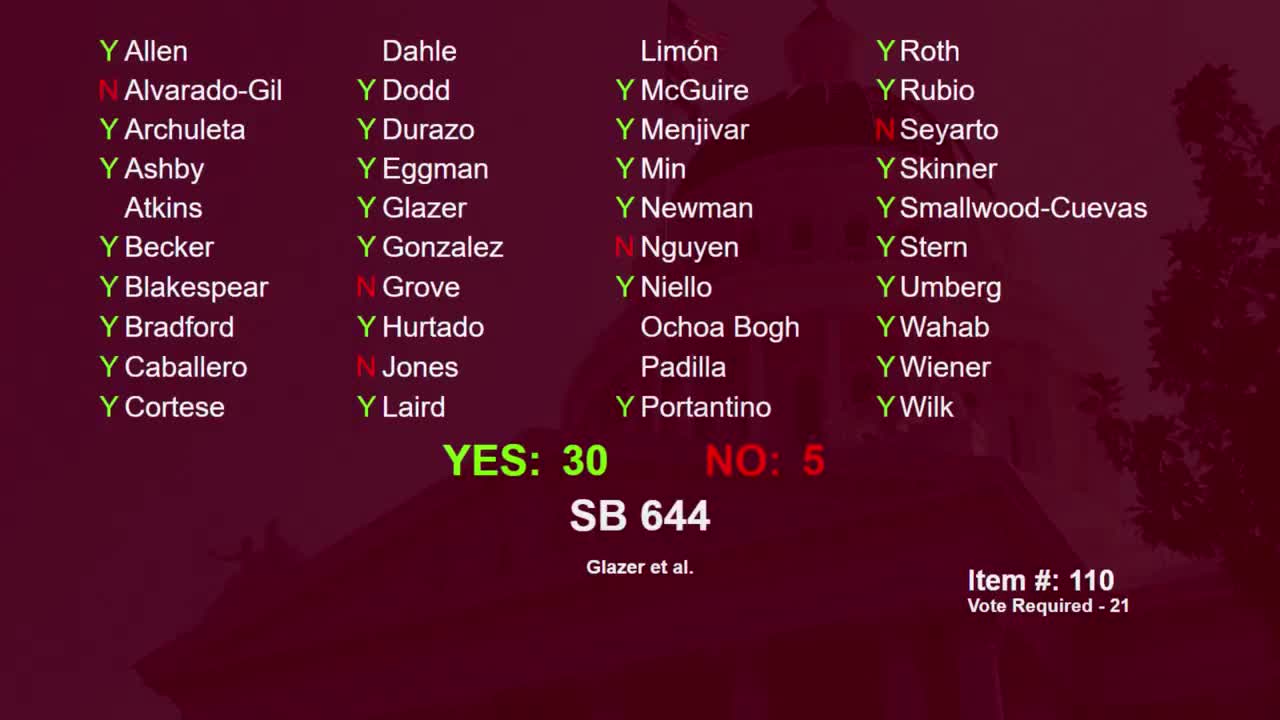 4MIN
Senate Floor
 13MIN
Senate Standing Committee on Business, Professions and Economic Development
Bill Author

Bill Co-Author(s):