AB 83: Personal data.
- Session Year: 2015-2016
- House: Assembly
- Latest Version Date: 2016-08-19
Existing law requires a person or business that owns, licenses, or maintains personal information, as defined, about a California resident to implement and maintain reasonable security procedures and practices appropriate to the nature of the information, to protect the personal information from unauthorized access, destruction, use, modification, or disclosure.
This bill would expand the definition of personal information for purposes of these provisions to include any unique an individual tax identification number, passport number, military identification, number government-issued employment identification number, an individuals geophysical location, health insurance, geolocation information, or biometric information, or an individuals signature. information. The bill would also define reasonable security procedures and practices for purposes of these provisions as requiring, at a minimum, requiring security of personal information to the degree that any reasonably prudent business would provide, as specified.
Existing law requires a person or business that owns, licenses, or maintains personal information, as defined, about a California resident to implement and maintain reasonable security procedures and practices appropriate to the nature of the information, to protect the personal information from unauthorized access, destruction, use, modification, or disclosure.
This bill would define reasonable security procedures and practices expand the definition of personal information for purposes of these provisions as requiring, at a minimum, security of personal information, including to include any unique government-issued identification number, an individuals geophysical location information and location, health insurance, or biometric information, or an individuals signature. The bill would also define reasonable security procedures and practices for purposes of these provisions as requiring, at a minimum, security of personal information to the degree that any reasonably prudent business would provide, as specified.
Existing law requires a person or business that owns, licenses, or maintains personal information about a California resident to implement and maintain reasonable security procedures and practices appropriate to the nature of the information, to protect the personal information from unauthorized access, destruction, use, modification, or disclosure.
This bill would define reasonable security procedures and practices for purposes of these provisions as requiring, at a minimum, security of personal information, including geophysical location information and biometric information, to the degree that any reasonably prudent business would provide, as specified.
Existing law requires a person or business that owns, licenses, or maintains personal information about a California resident to implement and maintain reasonable security procedures and practices appropriate to the nature of the information, to protect the personal information from unauthorized access, destruction, use, modification, or disclosure.
This bill would define reasonable security procedures and practices for purposes of these provisions as requiring, at a minimum, the encryption of private data to the degree that any reasonably prudent business would provide, security of personal information, including geophysical location information, to the degree that any reasonably prudent business would provide, as specified. The bill would define private data to include specified types personally identifying medical, financial, and geophysical information. The bill would also authorize the Department of Justice to specify security procedures, practices, and technical standards that it deems to be presumptively reasonable within a particular industry.
Existing law requires a person or business that owns, licenses, or maintains personal information about a California resident to implement and maintain reasonable security procedures and practices appropriate to the nature of the information, to protect the personal information from unauthorized access, destruction, use, modification, or disclosure.
This bill would define reasonable security procedures and practices for purposes of these provisions as requiring, at a minimum, the encryption of private data to the degree that any reasonably prudent business would provide, as specified. The bill would define private data to include specified types personally identifying medical, financial, and geophysical information. The bill would also authorize the Department of Justice to specify security procedures, practices, and technical standards that it deems to be presumptively reasonable within a particular industry.
Existing law, the Information Practices Act of 1977, defines specified terms for its purposes.
This bill would make nonsubstantive changes to those provisions.
Existing law, the Information Practices Act of 1977, defines specified terms for its purposes.
This bill would make nonsubstantive changes to those provisions.
(a)(1)It is the intent of the Legislature to ensure that personal information about California residents is protected. To that end, the purpose of this section is to encourage businesses that own, license, or maintain personal information about Californians to provide reasonable security for that information.
(2)For the purpose of this section, the terms own and license include personal information that a business retains as part of the business internal customer account or for the purpose of using that information in transactions with the person to whom the information relates. The term maintain includes personal information that a business maintains but does not own or license.
(b)A business that owns, licenses, or maintains personal information about a California resident shall implement and maintain reasonable security procedures and practices appropriate to the nature of the information, to protect the personal information from unauthorized access, destruction, use, modification, or disclosure.
(c)A business that discloses personal information about a California resident pursuant to a contract with a nonaffiliated third party that is not subject to subdivision (b) shall require by contract that the third party implement and maintain reasonable security procedures and practices appropriate to the nature of the information, to protect the personal information from unauthorized access, destruction, use, modification, or disclosure.
(d)For purposes of this section, the following terms have the following meanings:
(1)Personal information means either of the following:
(A) An individuals first name or first initial and his or her last name in combination with any one or more of the following data elements, when either the name or the data elements are not encrypted or redacted:
(i)Social security number. number, individual tax identification number, passport number, military identification number, or government issued employment identification number.
(ii)Drivers license number or California identification card number.
(iii)Account number, credit or debit card number, in combination with any required security code, access code, or password that would permit access to an individuals financial account.
(iv)Medical information.
(v)Health insurance information.
(vi)Geolocation information.
(vii)Biometric information.
(B)A username or email address in combination with a password or security question and answer that would permit access to an online account.
(2)Geolocation information means location data generated by a consumer device capable of connecting to the Internet that directly identifies the precise physical location of the identified individual at particular times and that is compiled and retained. Geolocation information does not include the contents of a communication or information used solely for 911 emergency purposes.
(3)Biometric information means data generated by automatic measurements of an individuals fingerprint, voice print, eye retinas or irises, identifying DNA information, or unique facial characteristics, which are used by the owner or licensee to uniquely authenticate an individuals identity.
(2)
(4)Medical information means any individually identifiable information, in electronic or physical form, regarding the individuals medical history or medical treatment or diagnosis by a health care professional.
(3)
(5)Health insurance information means an individuals health insurance policy number or subscriber identification number, any unique identifier used by a health insurer to identify the individual, or any medical information in an individuals insurance application and claims history, including any appeals records.
(4)
(6)Personal information does not include publicly available information that is lawfully made available to the general public from federal, state, or local government records. public.
(e)The provisions of this section do not apply to any of the following:
(1)A provider of health care, health care service plan, or contractor regulated by the Confidentiality of Medical Information Act (Part 2.6 (commencing with Section 56) of Division 1).
(2)A financial institution as defined in Section 4052 of the Financial Code and subject to the California Financial Information Privacy Act (Division 1.2 (commencing with Section 4050) of the Financial Code).
(3)A covered entity governed by the medical privacy and security rules issued by the federal Department of Health and Human Services, Parts 160 and 164 of Title 45 of the Code of Federal Regulations, established pursuant to the Health Insurance Portability and Availability Act of 1996 (HIPAA).
(4)An entity that obtains information under an agreement pursuant to Article 3 (commencing with Section 1800) of Chapter 1 of Division 2 of the Vehicle Code and is subject to the confidentiality requirements of the Vehicle Code.
(5)A business that is regulated by state or federal law providing greater protection to personal information than that provided by this section in regard to the subjects addressed by this section. Compliance with that state or federal law shall be deemed compliance with this section with regard to those subjects. This paragraph does not relieve a business from a duty to comply with any other requirements of other state and federal law regarding the protection and privacy of personal information.
(f)For purposes of this section, reasonable security procedures and practices as they pertain to the storage and transmission of personal information shall require the security of that information to the degree that any reasonably prudent business would provide. All of the following shall also apply:
(1)The business shall undertake reasonable efforts, appropriate to the nature of the information, to do the following:
(A)Identify reasonably foreseeable internal and external risks to the security of personal information that could result in the unauthorized disclosure, misuse, alteration, destruction, or other compromise of the information.
(B)Establish, implement, and maintain safeguards reasonably designed to secure the personal information, including, but not limited to, protecting against unauthorized access, acquisition, destruction, use, modification, or disclosure of the information.
(C)Regularly assess the sufficiency of the safeguards required pursuant to subparagraph (B) to control reasonably foreseeable internal and external risks, and evaluate and adjust those safeguards in light of the assessment.
(2)The reasonableness of the security procedures and practices appropriate to the nature of the information shall be determined in light of all of the following:
(A)The type of personal information under the businesss control.
(B)The foreseeability of threats to the security of the information.
(C)The existence of widely accepted practices in administrative, technical, and physical safeguards for protecting personal information.
(D)The cost of implementing and regularly assessing the safeguards.
(E)The size of the business.
SECTION 1.Section 1798.81.5 of the Civil Code is amended to read:1798.81.5.(a)(1)It is the intent of the Legislature to ensure that personal information about California residents is protected. To that end, the purpose of this section is to encourage businesses that own, license, or maintain personal information about Californians to provide reasonable security for that information.
(2)For the purpose of this section, the terms own and license include personal information that a business retains as part of the business internal customer account or for the purpose of using that information in transactions with the person to whom the information relates. The term maintain includes personal information that a business maintains but does not own or license.
(b)A business that owns, licenses, or maintains personal information about a California resident shall implement and maintain reasonable security procedures and practices appropriate to the nature of the information, to protect the personal information from unauthorized access, destruction, use, modification, or disclosure.
(c)A business that discloses personal information about a California resident pursuant to a contract with a nonaffiliated third party that is not subject to subdivision (b) shall require by contract that the third party implement and maintain reasonable security procedures and practices appropriate to the nature of the information, to protect the personal information from unauthorized access, destruction, use, modification, or disclosure.
(d)For purposes of this section, the following terms have the following meanings:
(1)Personal information means either of the following:
(A) An individuals first name or first initial and his or her last name in combination with any one or more of the following data elements, when either the name or the data elements are not encrypted or redacted:
(i)Social security number, tax identification number, passport number, or any other unique government-issued identification number.
(ii)Drivers license number or California identification card number.
(iii)Account number, credit or debit card number, in combination with any required security code, access code, or password that would permit access to an individuals financial account.
(iv)Medical information.
(v)Health insurance information.
(vi)Geophysical location information.
(vii)Biometric information.
(viii)Signature.
(B)Username or email address in combination with a password or security question and answer that would permit access to an online account.
(2)Geophysical location information means any location data generated to assess the past or current location of, or travel by, an individual, including, but not limited to, geographic coordinates, street address, or WiFi positioning system.
(3)Biometric information means data generated by automatic measurements of an individuals biological characteristics that are used by the owner or licensee to authenticate an individuals identity, such as a fingerprint, voice print, eye retinas or irises, or other unique biological characteristic.
(4)Medical information means any individually identifiable information, in electronic or physical form, regarding the individuals medical history or medical treatment or diagnosis by a health care professional.
(5)Health insurance information means an individuals insurance policy number or subscribed identification number, any unique identifier used by a health insurer to identify the individual, or any information in an individuals application and claims history, including any appeals records.
(6)Personal information does not include publicly available information that is lawfully made available to the general public from federal, state, or local government records.
(e)The provisions of this section do not apply to any of the following:
(1)A provider of health care, health care service plan, or contractor regulated by the Confidentiality of Medical Information Act (Part 2.6 (commencing with Section 56) of Division 1).
(2)A financial institution as defined in Section 4052 of the Financial Code and subject to the California Financial Information Privacy Act (Division 1.2 (commencing with Section 4050) of the Financial Code).
(3)A covered entity governed by the medical privacy and security rules issued by the federal Department of Health and Human Services, Parts 160 and 164 of Title 45 of the Code of Federal Regulations, established pursuant to the Health Insurance Portability and Availability Act of 1996 (HIPAA).
(4)An entity that obtains information under an agreement pursuant to Article 3 (commencing with Section 1800) of Chapter 1 of Division 2 of the Vehicle Code and is subject to the confidentiality requirements of the Vehicle Code.
(5)A business that is regulated by state or federal law providing greater protection to personal information than that provided by this section in regard to the subjects addressed by this section. Compliance with that state or federal law shall be deemed compliance with this section with regard to those subjects. This paragraph does not relieve a business from a duty to comply with any other requirements of other state and federal law regarding the protection and privacy of personal information.
(f)For purposes of this section, reasonable security procedures and practices as they pertain to the storage and transmission of personal information shall require, at a minimum, the security of that information to the degree that any reasonably prudent business would provide. All of the following shall also apply:
(1)At a minimum, the business shall:
(A)Identify reasonably foreseeable internal and external risks to the privacy and security of personal information that could result in the unauthorized disclosure, misuse, alteration, destruction, or other compromise of the information.
(B)Establish, implement, and maintain safeguards reasonably designed to ensure the security of the personal information, including, but not limited to, protecting against unauthorized loss, misuse, alteration, destruction, access to, or use of the information.
(C)Regularly assess the sufficiency of any safeguards in place to control reasonably foreseeable internal and external risks, and evaluate and adjust those safeguards in light of the assessment.
(D)Evaluate and adjust any material changes in the operations or business arrangements of the business, or any other circumstances, that create a material impact on the privacy or security of personal information under control of the business.
(2)The reasonableness of the security procedures and practices shall be determined in light of all of the following:
(A)The type of personal information under the businesss control.
(B)The foreseeability of threats to the security of the information.
(C)The existence of widely accepted practices in administrative, technical, and physical safeguards for protecting personal information.
(D)The cost of implementing and regularly reviewing the safeguards.
(a)(1)It is the intent of the Legislature to ensure that personal information about California residents is protected. To that end, the purpose of this section is to encourage businesses that own, license, or maintain personal information about Californians to provide reasonable security for that information.
(2)For the purpose of this section, the terms own and license include personal information that a business retains as part of the business internal customer account or for the purpose of using that information in transactions with the person to whom the information relates. The term maintain includes personal information that a business maintains but does not own or license.
(b)A business that owns, licenses, or maintains personal information about a California resident shall implement and maintain reasonable security procedures and practices appropriate to the nature of the information, to protect the personal information from unauthorized access, destruction, use, modification, or disclosure.
(c)A business that discloses personal information about a California resident pursuant to a contract with a nonaffiliated third party that is not subject to subdivision (b) shall require by contract that the third party implement and maintain reasonable security procedures and practices appropriate to the nature of the information, to protect the personal information from unauthorized access, destruction, use, modification, or disclosure.
(d)For purposes of this section, the following terms have the following meanings:
(1)Personal information means either of the following:
(A) An individuals first name or first initial and his or her last name in combination with any one or more of the following data elements, when either the name or the data elements are not encrypted or redacted:
(i)Social security number, tax identification number, passport number, or any other unique government-issued identification number.
(ii)Drivers license number or California identification card number.
(iii)Account number, credit or debit card number, in combination with any required security code, access code, or password that would permit access to an individuals financial account.
(iv)Medical information.
(v)Health insurance information.
(v)
(vi)Geophysical location information.
(vi)
(vii)Biometric information.
(vii)
(viii)Signature.
(B)Username or email address in combination with a password or security question and answer that would permit access to an online account.
(2)Geophysical location information means any location data generated to assess the past or current location of, or travel by, an individual, including, but not limited to, geographic coordinates, street address, or WiFi positioning system.
(3)Biometric information means data generated by automatic measurements of an individuals biological characteristics that are used by the owner or licensee to authenticate an individuals identity, such as a fingerprint, voice print, eye retinas or irises, or other unique biological characteristic.
(4)Medical information means any individually identifiable information, in electronic or physical form, regarding the individuals medical history or medical treatment or diagnosis by a health care professional.
(5)Health insurance information means an individuals insurance policy number or subscribed identification number, any unique identifier used by a health insurer to identify the individual, or any information in an individuals application and claims history, including any appeals records.
(6)Personal information does not include publicly available information that is lawfully made available to the general public from federal, state, or local government records.
(e)The provisions of this section do not apply to any of the following:
(1)A provider of health care, health care service plan, or contractor regulated by the Confidentiality of Medical Information Act (Part 2.6 (commencing with Section 56) of Division 1).
(2)A financial institution as defined in Section 4052 of the Financial Code and subject to the California Financial Information Privacy Act (Division 1.2 (commencing with Section 4050) of the Financial Code).
(3)A covered entity governed by the medical privacy and security rules issued by the federal Department of Health and Human Services, Parts 160 and 164 of Title 45 of the Code of Federal Regulations, established pursuant to the Health Insurance Portability and Availability Act of 1996 (HIPAA).
(4)An entity that obtains information under an agreement pursuant to Article 3 (commencing with Section 1800) of Chapter 1 of Division 2 of the Vehicle Code and is subject to the confidentiality requirements of the Vehicle Code.
(5)A business that is regulated by state or federal law providing greater protection to personal information than that provided by this section in regard to the subjects addressed by this section. Compliance with that state or federal law shall be deemed compliance with this section with regard to those subjects. This paragraph does not relieve a business from a duty to comply with any other requirements of other state and federal law regarding the protection and privacy of personal information.
(f)For purposes of this section, reasonable security procedures and practices as they pertain to the storage and transmission of personal information shall require, at a minimum, the security of that information to the degree that any reasonably prudent business would provide. All of the following shall also apply:
(1)At a minimum, the business shall:
(A)Identify reasonably foreseeable internal and external risks to the privacy and security of personal information that could result in the unauthorized disclosure, misuse, alteration, destruction, or other compromise of the information.
(B)Establish, implement, and maintain safeguards reasonably designed to ensure the security of the personal information, including, but not limited to, protecting against unauthorized loss, misuse, alteration, destruction, access to, or use of the information.
(C)Regularly assess the sufficiency of any safeguards in place to control reasonably foreseeable internal and external risks, and evaluate and adjust those safeguards in light of the assessment.
(D)Evaluate and adjust any material changes in the operations or business arrangements of the business, or any other circumstances, that create a material impact on the privacy or security of personal information under control of the business.
(2)The reasonableness of the security procedures and practices shall be determined in light of all of the following:
(A)The type of personal information under the businesss control.
(B)The foreseeability of threats to the security of the information.
(C)The existence of widely accepted practices in administrative, technical, and physical safeguards for protecting personal information.
(D)The cost of implementing and regularly reviewing the safeguards.
(a)(1)It is the intent of the Legislature to ensure that personal information about California residents is protected. To that end, the purpose of this section is to encourage businesses that own, license, or maintain personal information about Californians to provide reasonable security for that information.
(2)For the purpose of this section, the terms own and license include personal information that a business retains as part of the business internal customer account or for the purpose of using that information in transactions with the person to whom the information relates. The term maintain includes personal information that a business maintains but does not own or license.
(b)A business that owns, licenses, or maintains personal information about a California resident shall implement and maintain reasonable security procedures and practices appropriate to the nature of the information, to protect the personal information from unauthorized access, destruction, use, modification, or disclosure.
(c)A business that discloses personal information about a California resident pursuant to a contract with a nonaffiliated third party that is not subject to subdivision (b) shall require by contract that the third party implement and maintain reasonable security procedures and practices appropriate to the nature of the information, to protect the personal information from unauthorized access, destruction, use, modification, or disclosure.
(d)For purposes of this section, the following terms have the following meanings:
(1)Personal information means an either of the following:
(A) An individuals first name or first initial and his or her last name in combination with any one or more of the following data elements, when either the name or the data elements are not encrypted or redacted:
(A)
(i)Social security number. number, tax identification number, passport number, or any other unique government-issued identification number.
(B)
(ii)Drivers license number or California identification card number.
(C)
(iii)Account number, credit or debit card number, in combination with any required security code, access code, or password that would permit access to an individuals financial account.
(D)
(iv)Medical information.
(E)
(v)Geophysical location information.
(vi)Biometric information.
(vii)Signature.
(B)Username or email address in combination with a password or security question and answer that would permit access to an online account.
(2)Geophysical location information means any personally identifiable information describing or concerning the duration of a transportation service provided to an individual, the location and route of a transportation service provided to an individual, or, if applicable, the monetary exchange associated with a transportation service provided to an individual. location data generated to assess the past or current location of, or travel by, an individual, including, but not limited to, geographic coordinates, street address, or WiFi positioning system.
(3)Biometric information means data generated by automatic measurements of an individuals biological characteristics that are used by the owner or licensee to authenticate an individuals identity, such as a fingerprint, voice print, eye retinas or irises, or other unique biological characteristic.
(3)
(4)Medical information means any individually identifiable information, in electronic or physical form, regarding the individuals medical history or medical treatment or diagnosis by a health care professional.
(5)Health insurance information means an individuals insurance policy number or subscribed identification number, any unique identifier used by a health insurer to identify the individual, or any information in an individuals application and claims history, including any appeals records.
(4)
(6)Personal information does not include publicly available information that is lawfully made available to the general public from federal, state, or local government records.
(e)The provisions of this section do not apply to any of the following:
(1)A provider of health care, health care service plan, or contractor regulated by the Confidentiality of Medical Information Act (Part 2.6 (commencing with Section 56) of Division 1).
(2)A financial institution as defined in Section 4052 of the Financial Code and subject to the California Financial Information Privacy Act (Division 1.2 (commencing with Section 4050) of the Financial Code).
(3)A covered entity governed by the medical privacy and security rules issued by the federal Department of Health and Human Services, Parts 160 and 164 of Title 45 of the Code of Federal Regulations, established pursuant to the Health Insurance Portability and Availability Act of 1996 (HIPAA).
(4)An entity that obtains information under an agreement pursuant to Article 3 (commencing with Section 1800) of Chapter 1 of Division 2 of the Vehicle Code and is subject to the confidentiality requirements of the Vehicle Code.
(5)A business that is regulated by state or federal law providing greater protection to personal information than that provided by this section in regard to the subjects addressed by this section. Compliance with that state or federal law shall be deemed compliance with this section with regard to those subjects. This paragraph does not relieve a business from a duty to comply with any other requirements of other state and federal law regarding the protection and privacy of personal information.
(f)For purposes of this section, reasonable security procedures and practices as they pertain to the storage and transmission of personal information shall require, at a minimum, the security of that information to the degree that any reasonably prudent business would provide. All of the following shall also apply:
(1)At a minimum, the business shall:
(A)Identify reasonably foreseeable internal and external risks to the privacy and security of personal information that could result in the unauthorized disclosure, misuse, alteration, destruction, or other compromise of the information.
(B)Establish, implement, and maintain safeguards reasonably designed to ensure the security of the personal information, including, but not limited to, protecting against unauthorized loss, misuse, alteration, destruction, access to, or use of the information.
(C)Regularly assess the sufficiency of any safeguards in place to control reasonably foreseeable internal and external risks, and evaluate and adjust those safeguards in light of the assessment.
(D)Evaluate and adjust any material changes in the operations or business arrangements of the business, or any other circumstances, that create a material impact on the privacy or security of personal information under control of the business.
(2)The reasonableness of the security procedures and practices shall be determined in light of all of the following:
(A)The degree of the privacy risk associated with the type of personal information under the businesss control.
(B)The foreseeability of threats to the security of the information.
(C)The existence of widely accepted practices in administrative, technical, and physical safeguards for protecting personal information.
(D)The cost of implementing and regularly reviewing the safeguards.
(a)(1)It is the intent of the Legislature to ensure that personal information about California residents is protected. To that end, the purpose of this section is to encourage businesses that own, license, or maintain personal information about Californians to provide reasonable security for that information.
(2)For the purpose of this section, the terms own and license include personal information that a business retains as part of the business internal customer account or for the purpose of using that information in transactions with the person to whom the information relates. The term maintain includes personal information that a business maintains but does not own or license.
(b)A business that owns, licenses, or maintains personal information about a California resident shall implement and maintain reasonable security procedures and practices appropriate to the nature of the information, to protect the personal information from unauthorized access, destruction, use, modification, or disclosure.
(c)A business that discloses personal information about a California resident pursuant to a contract with a nonaffiliated third party that is not subject to subdivision (b) shall require by contract that the third party implement and maintain reasonable security procedures and practices appropriate to the nature of the information, to protect the personal information from unauthorized access, destruction, use, modification, or disclosure.
(d)For purposes of this section, the following terms have the following meanings:
(1)Personal information means an individuals first name or first initial and his or her last name in combination with any one or more of the following data elements, when either the name or the data elements are not encrypted or redacted:
(A)Social security number.
(B)Drivers license number or California identification card number.
(C)Account number, credit or debit card number, in combination with any required security code, access code, or password that would permit access to an individuals financial account.
(D)Medical information.
(E)Geophysical location information.
(2)Geophysical location information means any personally identifiable information describing or concerning the duration of a transportation service provided to an individual, the location and route of a transportation service provided to an individual, or, if applicable, the monetary exchange associated with a transportation service provided to an individual.
(2)
(3)Medical information means any individually identifiable information, in electronic or physical form, regarding the individuals medical history or medical treatment or diagnosis by a health care professional.
(3)
(4)Personal information does not include publicly available information that is lawfully made available to the general public from federal, state, or local government records.
(4)Private data means any of the following information:
(A)Medical information.
(B)Personally identifiable financial information, as that term is defined in subdivision (b) of Section 4052 of the Financial Code.
(C)Geophysical location information.
(D)The combination of an individuals first name or first initial and his or her last name, with any of the following:
(i)Mothers maiden name.
(ii)Social Security Number.
(iii)Date of birth.
(e)The provisions of this section do not apply to any of the following:
(1)A provider of health care, health care service plan, or contractor regulated by the Confidentiality of Medical Information Act (Part 2.6 (commencing with Section 56) of Division 1).
(2)A financial institution as defined in Section 4052 of the Financial Code and subject to the California Financial Information Privacy Act (Division 1.2 (commencing with Section 4050) of the Financial Code).
(3)A covered entity governed by the medical privacy and security rules issued by the federal Department of Health and Human Services, Parts 160 and 164 of Title 45 of the Code of Federal Regulations, established pursuant to the Health Insurance Portability and Availability Act of 1996 (HIPAA).
(4)An entity that obtains information under an agreement pursuant to Article 3 (commencing with Section 1800) of Chapter 1 of Division 2 of the Vehicle Code and is subject to the confidentiality requirements of the Vehicle Code.
(5)A business that is regulated by state or federal law providing greater protection to personal information than that provided by this section in regard to the subjects addressed by this section. Compliance with that state or federal law shall be deemed compliance with this section with regard to those subjects. This paragraph does not relieve a business from a duty to comply with any other requirements of other state and federal law regarding the protection and privacy of personal information.
(f)For purposes of this section, reasonable security procedures and practices as they pertain to the storage and transmission of private data personal information shall require, at a minimum, the encryption security of that information to the degree that any reasonably prudent business would provide, taking into account factors, including, but not limited to, the business size, available technology, publically available threat information, generally accepted standards, and the customs and practices of the specific industry within which the business operates, to the extent commercially reasonable. provide. All of the following shall also apply:
(1)At a minimum, the business shall:
(A)Identify reasonably foreseeable internal and external risks to the privacy and security of personal information that could result in the unauthorized disclosure, misuse, alteration, destruction, or other compromise of the information.
(B)Establish, implement, and maintain safeguards reasonably designed to ensure the security of the personal information, including, but not limited to, protecting against unauthorized loss, misuse, alteration, destruction, access to, or use of the information.
(C)Regularly assess the sufficiency of any safeguards in place to control reasonably foreseeable internal and external risks, and evaluate and adjust those safeguards in light of the assessment.
(D)Evaluate and adjust any material changes in the operations or business arrangements of the business, or any other circumstances, that create a material impact on the privacy or security of personal information under control of the business.
(2)The reasonableness of the security procedures and practices shall be determined in light of all of the following:
(A)The degree of the privacy risk associated with the personal information under the businesss control.
(B)The foreseeability of threats to the security of the information.
(C)The existence of widely accepted practices in administrative, technical, and physical safeguards for protecting personal information.
(D)The cost of implementing and regularly reviewing the safeguards.
(g)The Department of Justice may, at its discretion, specify security procedures and practices, including related technical standards, that it deems to be presumptively reasonable within a particular industry.
(a)(1)It is the intent of the Legislature to ensure that personal information about California residents is protected. To that end, the purpose of this section is to encourage businesses that own, license, or maintain personal information about Californians to provide reasonable security for that information.
(2)For the purpose of this section, the terms own and license include personal information that a business retains as part of the business internal customer account or for the purpose of using that information in transactions with the person to whom the information relates. The term maintain includes personal information that a business maintains but does not own or license.
(b)A business that owns, licenses, or maintains personal information about a California resident shall implement and maintain reasonable security procedures and practices appropriate to the nature of the information, to protect the personal information from unauthorized access, destruction, use, modification, or disclosure.
(c)A business that discloses personal information about a California resident pursuant to a contract with a nonaffiliated third party that is not subject to subdivision (b) shall require by contract that the third party implement and maintain reasonable security procedures and practices appropriate to the nature of the information, to protect the personal information from unauthorized access, destruction, use, modification, or disclosure.
(d)For purposes of this section, the following terms have the following meanings:
(1)Personal information means an individuals first name or first initial and his or her last name in combination with any one or more of the following data elements, when either the name or the data elements are not encrypted or redacted:
(A)Social security number.
(B)Drivers license number or California identification card number.
(C)Account number, credit or debit card number, in combination with any required security code, access code, or password that would permit access to an individuals financial account.
(D)Medical information.
(2)Medical information means any individually identifiable information, in electronic or physical form, regarding the individuals medical history or medical treatment or diagnosis by a health care professional.
(3)Personal information does not include publicly available information that is lawfully made available to the general public from federal, state, or local government records.
(4)Private data means any of the following information:
(A)Medical information.
(B)Personally identifiable financial information, as that term is defined in subdivision (b) of Section 4052 of the Financial Code.
(C)Geophysical location information.
(D)The combination of an individuals first name or first initial and his or her last name, with any of the following:
(i)Mothers maiden name.
(ii)Social Security Number.
(iii)Date of birth.
(e)The provisions of this section do not apply to any of the following:
(1)A provider of health care, health care service plan, or contractor regulated by the Confidentiality of Medical Information Act (Part 2.6 (commencing with Section 56) of Division 1).
(2)A financial institution as defined in Section 4052 of the Financial Code and subject to the California Financial Information Privacy Act (Division 1.2 (commencing with Section 4050) of the Financial Code).
(3)A covered entity governed by the medical privacy and security rules issued by the federal Department of Health and Human Services, Parts 160 and 164 of Title 45 of the Code of Federal Regulations, established pursuant to the Health Insurance Portability and Availability Act of 1996 (HIPAA).
(4)An entity that obtains information under an agreement pursuant to Article 3 (commencing with Section 1800) of Chapter 1 of Division 2 of the Vehicle Code and is subject to the confidentiality requirements of the Vehicle Code.
(5)A business that is regulated by state or federal law providing greater protection to personal information than that provided by this section in regard to the subjects addressed by this section. Compliance with that state or federal law shall be deemed compliance with this section with regard to those subjects. This paragraph does not relieve a business from a duty to comply with any other requirements of other state and federal law regarding the protection and privacy of personal information.
(f)For purposes of this section, reasonable security procedures and practices as they pertain to the storage and transmission of private data shall require, at a minimum, the encryption of that information to the degree that any reasonably prudent business would provide, taking into account factors, including, but not limited to, the business size, available technology, publically available threat information, generally accepted standards, and the customs and practices of the specific industry within which the business operates, to the extent commercially reasonable.
(g)The Department of Justice may, at its discretion, specify security procedures and practices, including related technical standards, that it deems to be presumptively reasonable within a particular industry.
SECTION 1.Section 1798.3 of the Civil Code is amended to read:1798.3.As used in this chapter:
(a)Personal information means any information that is maintained by an agency that identifies or describes an individual, including, but not limited to, his or her name, social security number, physical description, home address, home telephone number, education, financial matters, and medical or employment history. It includes statements made by, or attributed to, the individual.
(b)Agency means a state office, officer, department, division, bureau, board, commission, or other state agency, except that agency shall not include:
(1)The California Legislature.
(2)An agency established under Article VI of the California Constitution.
(3)The State Compensation Insurance Fund, except as to any records which contain personal information about the employees of the State Compensation Insurance Fund.
(4)A local agency, as defined in subdivision (a) of Section 6252 of the Government Code.
(c)Disclose means to disclose, release, transfer, disseminate, or otherwise communicate all or any part of any record orally, in writing, or by electronic or any other means to any person or entity.
(d)Individual means a natural person.
(e)Maintain includes maintain, acquire, use, or disclose.
(f)Person means any natural person, corporation, partnership, limited liability company, firm, or association.
(g)Record means any file or grouping of information about an individual that is maintained by an agency by reference to an identifying particular such as the individuals name, photograph, finger or voice print, or a number or symbol assigned to the individual.
(h)System of records means one or more records, which pertain to one or more individuals, which is maintained by any agency, from which information is retrieved by the name of an individual or by some identifying number, symbol or other identifying particular assigned to the individual.
(i)Governmental entity except as used in Section 1798.26, means any branch of the federal government or of the local government.
(j)Commercial purpose means any purpose which has financial gain as a major objective. It does not include the gathering or dissemination of newsworthy facts by a publisher or broadcaster.
(k)Regulatory agency means the Department of Business Oversight, the Department of Insurance, the Bureau of Real Estate, and agencies of the United States or of any other state responsible for regulating financial institutions.
As used in this chapter:
(a)The term personal Personal information means any information that is maintained by an agency that identifies or describes an individual, including, but not limited to, his or her name, social security number, physical description, home address, home telephone number, education, financial matters, and medical or employment history. It includes statements made by, or attributed to, the individual.
(b)The term agency Agency means every a state office, officer, department, division, bureau, board, commission, or other state agency, except that the term agency shall not include:
(1)The California Legislature.
(2)Any An agency established under Article VI of the California Constitution.
(3)The State Compensation Insurance Fund, except as to any records which contain personal information about the employees of the State Compensation Insurance Fund.
(4)A local agency, as defined in subdivision (a) of Section 6252 of the Government Code.
(c)The term disclose Disclose means to disclose, release, transfer, disseminate, or otherwise communicate all or any part of any record orally, in writing, or by electronic or any other means to any person or entity.
(d)The term individual Individual means a natural person.
(e)The term maintain Maintain includes maintain, acquire, use, or disclose.
(f)The term person Person means any natural person, corporation, partnership, limited liability company, firm, or association.
(g)The term record Record means any file or grouping of information about an individual that is maintained by an agency by reference to an identifying particular such as the individuals name, photograph, finger or voice print, or a number or symbol assigned to the individual.
(h)The term system of records System of records means one or more records, which pertain to one or more individuals, which is maintained by any agency, from which information is retrieved by the name of an individual or by some identifying number, symbol or other identifying particular assigned to the individual.
(i)The term governmental entity, Governmental entity except as used in Section 1798.26, means any branch of the federal government or of the local government.
(j)The term commercial purpose Commercial purpose means any purpose which has financial gain as a major objective. It does not include the gathering or dissemination of newsworthy facts by a publisher or broadcaster.
(k)The term regulatory agency Regulatory agency means the Department of Business Oversight, the Department of Insurance, the Bureau of Real Estate, and agencies of the United States or of any other state responsible for regulating financial institutions.
|
Date
|
Status
|
|---|---|
| Aug 24, 2016 | Failed passage. |
| Aug 24, 2016 | In committee: |
| Aug 24, 2016 | In committee: Set, first hearing. Failed passage. |
| Aug 22, 2016 | From committee: Be re-referred to Com. on JUD. pursuant to Senate Rule 29.10(b). (Ayes 5. Noes 0.) Re-referred to Com. on JUD. |
| Aug 22, 2016 | From committee: Be re-referred to Com. on JUD. pursuant to Senate Rule 29.10. Re-referred to Com. on JUD. |
| Aug 22, 2016 | Re-referred to Com. on RLS. pursuant to Senate Rule 29.10(b). |
| Aug 22, 2016 | Read second time. Ordered to third reading. |
| Aug 19, 2016 | Read third time and amended. Ordered to second reading. |
| Aug 9, 2016 | Read second time. Ordered to third reading. |
| Aug 8, 2016 | Ordered to second reading. |
| Aug 8, 2016 | From inactive file. |
| Sep 9, 2015 | Ordered to inactive file at the request of Senator Jackson. |
| Jul 15, 2015 | Read second time and amended. Ordered to third reading. |
| Jul 14, 2015 | From committee: Amend, and do pass as amended. (Ayes 5. Noes 1.) (July 7). |
| Jun 25, 2015 | From committee chair, with author's amendments: Amend, and re-refer to committee. Read second time, amended, and re-referred to Com. on JUD. |
| May 21, 2015 | Referred to Com. on JUD. |
| May 7, 2015 | In Senate. Read first time. To Com. on RLS. for assignment. |
| May 7, 2015 | Read third time. Passed. Ordered to the Senate. (Ayes 66. Noes 4. Page 1339.) |
| May 7, 2015 | Read third time. Passed. Ordered to the Senate. |
| May 4, 2015 | Read second time. Ordered to third reading. |
| Apr 30, 2015 | From committee: Do pass. (Ayes 9. Noes 1.) (April 30). |
| Apr 28, 2015 | Re-referred to Com. on P. & C.P. |
| Apr 27, 2015 | From committee chair, with author's amendments: Amend, and re-refer to Com. on P. & C.P. Read second time and amended. |
| Apr 20, 2015 | In committee: Hearing postponed by committee. |
| Apr 15, 2015 | In committee: Hearing postponed by committee. |
| Apr 6, 2015 | Re-referred to Com. on P. & C.P. |
| Mar 26, 2015 | From committee chair, with author's amendments: Amend, and re-refer to Com. on P. & C.P. Read second time and amended. |
| Mar 26, 2015 | Referred to Com. on P. & C.P. |
| Jan 7, 2015 | From printer. May be heard in committee February 6. |
| Jan 6, 2015 | Read first time. To print. |
|
Date
|
Description
|
Location
|
Votes
|
|
|---|---|---|---|---|
| Aug 24, 2016 | That the measure be returned to Senate Floor for consideration. Ordered to third reading. | Senate Standing Committee on Judiciary |
Failed |
|
| Jul 7, 2015 | Do pass as amended | Senate Standing Committee on Judiciary |
Passed |
|
| May 7, 2015 | AB 83 GATTO Assembly Third Reading | Assembly Floor |
Passed |
|
| Apr 30, 2015 | Do pass. | Assembly Standing Committee on Privacy and Consumer Protection |
Passed |
This list shows positions taken on this bill by organizations on the date displayed, which is linked to the original source.
Positions by individuals are not included.
Senator Hannah-Beth Jackson, Chair
2015-2016 Regular Session
Bill No: AB 83 (Author:Gatto)
Version: August 19, 2016
Hearing Date: August 24, 2016
Fiscal: No
Urgency: No
Consultant: TH
PURSUANT TO SENATE RULE 29.10
SUBJECT
Personal Data
DESCRIPTION
This bill modifies the scope of “personal information” for which businesses must implement and maintain reasonable security procedures and practices in order to protect the information from unauthorized access, destruction, use, modification, or disclosure. Specifically, this bill adds geolocation information, tax identification numbers, passport numbers, biometric information, military identification numbers, and government issued employment identification numbers, to the list of protected personal information. This bill reduces the scope of protected personal information that falls within the definition of “health insurance information,” and expands the scope of personal information excluded from these protections when the information has been made publicly available. This bill also specifies certain criteria for determining the reasonableness of security procedures and practices, including the cost of implementing these procedures and practices, and the size of the business tasked with such responsibilities.
BACKGROUND
In 2004, the Legislature enacted AB 1950 (Wiggins, Ch. 877, Stats. 2004), which established broadly applicable security standards for the protection of personal information about California residents that is owned or leased by businesses. Before AB 1950 became law, federal and state laws generally provided only industry-specific requirements for the protection of personal information. For example, state medical privacy laws like the Confidentiality of Medical Information Act (Civ. Code Sec. 56 et seq.) govern the use and sharing of medical information by health care entities, but do not regulate this information when obtained by other businesses.
AB 1950 required businesses that own or license personal information -- including social security numbers, payment card information, and medical information -- about a California resident to implement and maintain reasonable security procedures and practices appropriate to the nature of the information, to protect the personal information from unauthorized access, destruction, use, modification, or disclosure. Despite this requirement, the frequency at which data breaches expose the personal information of California residents has increased dramatically since 2004. An October 2014 article in the Los Angeles Times made the following observations about this trend:
Data breaches soared last year in California as cybercriminals leaped over digital security gates to endanger the personal data of millions of consumers, California Atty. Gen. Kamala Harris said. Harris, in a report released Tuesday, highlighted the effect that headline-producing data breaches had on the Golden State: two massive hacks last year at Target Corp. and daily deals website LivingSocial each hit roughly 7.5 million Californians. In all, 18.5 million people in the state had their data stolen last year, a more than 600 [percent] jump from 2012. The number of breaches reported to Harris’ office climbed 28 [percent] to 167, and is expected to rise again in 2014. “Data breaches … threaten the privacy, the security and the economic well-being of consumers and businesses,” Harris said at a news conference in Los Angeles.
California residents aren’t any more prone to data hijacking than others, but an unusual state law requires businesses and state agencies to notify customers of any breach involving more than 500 accounts. That law resulted in the California Data Breach Report, which underscored the difficulties faced by companies who are constantly racing against wily thieves to secure sensitive information. The parade of companies that has been targeted recently by hackers includes Home Depot, Michaels, Neiman Marcus and P.F. Chang’s.
Security experts predict that the number of breaches, especially on a big scale, will keep growing. “The data breaches are going to continue and will probably get worse with the short term,” said Jim Penrose, former chief of the Operational Discovery Center at the National Security Agency.
. . .
Harris said businesses need to adopt stronger encryption technologies that safeguard sensitive consumer data. And retailers must make their breach notifications to consumers more visible and should upgrade their systems to handle payment cards equipped with microchips, which make cards more difficult to counterfeit, Harris said. (Shan Li and Andrew Khouri, Data Breaches Jump in California and are Expected to Keep Climbing, Los Angeles Times (Oct. 28, 2014) <http://www.latimes.com/business/la-fi-data-breaches-20141029-story.html> [as of Aug. 22, 2016].)
This bill responds to the growing frequency of data breaches by adding additional requirements to the “reasonable security procedures and practices” that businesses are mandated to implement under existing law with respect to personal information. This bill also adds new categories of personal information subject to protection, including individual tax identification numbers, passport numbers, military identification numbers, government issued employment identification numbers, geolocation information, and biometric information.
An earlier version of this bill was heard by this Committee on July 7, 2016, and was approved on a vote of 5-1. This bill was subsequently amended and has been re-referred to this Committee pursuant to Senate Rule 29.10.
CHANGES TO EXISTING LAW
Existing law, the California Constitution, provides that all people are by nature free and independent and have inalienable rights. Among these are enjoying and defending life and liberty, acquiring, possessing, and protecting property, and pursuing and obtaining safety, happiness, and privacy. (Cal. Const, art. I, Sec. 1.)
Existing law requires state agencies, under the Information Practices Act (IPA), to establish appropriate and reasonable administrative, technical, and physical safeguards to ensure compliance with the IPA, to ensure the security and confidentiality of records, and to protect against anticipated threats or hazards to their security or integrity which could result in any injury. (Civ. Code Sec. 1798.21.)
Existing law requires a business that owns, licenses, or maintains personal information about a California resident to implement and maintain reasonable security procedures and practices appropriate to the nature of the information, to protect the personal information from unauthorized access, destruction, use, modification, or disclosure. (Civ. Code Sec. 1798.81.5(b).)
Existing law requires a business that discloses personal information about a California resident pursuant to a contract with a nonaffiliated third party that is not subject to the restriction above to require by contract that the third party implement and maintain reasonable security procedures and practices appropriate to the nature of the information, to protect the personal information from unauthorized access, destruction, use, modification, or disclosure. (Civ. Code Sec. 1798.81.5(c).)
Existing law defines “personal information” to mean an individual’s first name or first initial and his or her last name in combination with any one or more of the following data elements, when either the name or the data elements are not encrypted or redacted:
- social security number;
- driver’s license number or California identification card number;
- account number, credit or debit card number, in combination with any required security code, access code, or password that would permit access to an individual’s financial account;
- medical information; and
- health insurance information. (Civ. Code Sec. 1798.81.5(d).)
Existing law specifies that “personal information” also includes a username or email address in combination with a password or security question and answer that would permit access to an online account. (Civ. Code Sec. 1798.81.5(d).)
Existing law states that “personal information” does not include publicly available information that is lawfully made available to the general public from federal, state, or local government records. (Civ. Code Sec. 1798.81.5(d).)
This bill modifies the above provision to state that “personal information” does not include publicly available information that is lawfully made available to the general public.
This bill expands the definition of “personal information” to include the following:
- an individual tax identification number, passport number, military identification number, or government issued employment identification number;
- geolocation information; and
- biometric information.
This bill states that for purposes of the above provisions, “reasonable security procedures and practices” as they pertain to the storage and transmission of personal information shall require the security of that information to the degree that any reasonably prudent business would provide, including undertaking reasonable efforts, appropriate to the nature of the information, to:
- identify reasonably foreseeable internal and external risks to the security of personal information that could result in the unauthorized disclosure, misuse, alteration, destruction, or other compromise of the information; and
- establish, implement, and maintain safeguards reasonably designed to secure the personal information, including, but not limited to, protecting against unauthorized access, acquisition, destruction, use, modification, or disclosure of the information; and
- regularly assess the sufficiency of these safeguards to control reasonably foreseeable internal and external risks, and evaluate and adjust those safeguards in light of the assessment.
This bill states that the reasonableness of the security procedures and practices appropriate to the nature of the information shall be determined in light of all of the following:
- the type of personal information under the business’s control;
- the foreseeability of threats to the security of the information;
- the existence of widely accepted practices in administrative, technical, and physical safeguards for protecting personal information;
- the cost of implementing and regularly assessing the safeguards; and
- the size of the business.
This bill defines “geolocation information” to mean location data generated by a consumer device capable of connecting to the Internet that directly identifies the precise physical location of the identified individual at particular times and that is compiled and retained. This bill specifies that geolocation information does not include the contents of a communication or information used solely for 911 emergency purposes.
This bill defines “biometric information” to mean data generated by automatic measurements of an individual’s fingerprint, voice print, eye retinas or irises, identifying DNA information, or unique facial characteristics, which are used by the owner or licensee to uniquely authenticate an individual’s identity.
This bill modifies the definition of “health insurance information” to mean an individual’s health insurance policy number or subscriber identification number, any unique identifier used by a health insurer to identify the individual, or any medical information in an individual’s insurance application and claims history, including any appeals records.
COMMENT
- Stated need for the bill
According to the author:
The California Information Practices Act of 1977 sets the rules for the collection, maintenance and dissemination of information that identifies an individual to guarantee that privacy is protected to the greatest extent possible. California’s data protection statutes, among other things, require businesses that own, license, or maintain personal information about Californians to provide reasonable security for that information.
Before the United States was rocked by a December 2013 data breach at Target stores that captured the information of almost 40 million credit and debit cards, many consumers did not think about the protection of their personal and transaction data. Since the Target incident, however, data breaches have haunted consumers, businesses, and government entities, alike.
While credit card information is valuable and breaches have affected businesses like Home Depot, Neiman Marcus and JP Morgan Chase, credit card information is not the only lure. Hackers have hit different branches of California government, including the Bureau of Automotive Repair, Mt. Diablo Unified School District and the California Department of Public Health. In May 2014, hackers breached a database owned by ride-sharing app Uber, which contained the names and drivers’ license numbers of 50,000 of its drivers. Then, in November 2014, Sony hackers not only released five unreleased films, but they also posted 47,000 employee Social Security numbers online, which appeared on more than 600 publicly-posted files. These numbers appeared with other personal information, such as full names, dates of birth, and home addresses.
One of the most alarming parts of increasingly-frequent cyberattacks is the risk of breached biometric information, which entities and businesses are storing at an alarming rate. In 2013, a German hacking group discovered how to breach Apple’s biometric security system using a high-resolution image of a fingerprint, and in 2015, the Federal Office of Personnel Management revealed that 5.6 million people’s fingerprints were stolen as part of a larger breach. While biometric information makes it easier to prove and authenticate your own identity, coupled with it are increased security concerns. Unlike a debit card, password or even social security number, an individual’s fingerprint, iris pattern, or voice print cannot be changed with the stroke of a keyboard.
In today’s world of computer and internet-based data storage, no information is exempt or unattractive to those wanting to breach our privacy and pry into our personal lives. Consumers need the assurance that their data is being stored at robust standards that are as flexible and timely as the changing technology landscape.
- Fundamental right to privacy
The right to privacy is a fundamental right protected by article I, section 1 of the California Constitution. The Legislature has expressly declared that “all individuals have a right of privacy in information pertaining to them,” and has found that:
(1) The right to privacy is being threatened by the indiscriminate collection, maintenance, and dissemination of personal information and the lack of effective laws and legal remedies.
(2) The increasing use of computers and other sophisticated information technology has greatly magnified the potential risk to individual privacy that can occur from the maintenance of personal information.
(3) In order to protect the privacy of individuals, it is necessary that the maintenance and dissemination of personal information be subject to strict limits. (Civ. Code Sec. 1798.1.)
This bill seeks to build upon the fundamental right to privacy by expanding the scope of personal information required to be kept reasonably secure under existing law. The Civil Code imposes a general obligation on all businesses “to implement and maintain reasonable security procedures and practices.” (Civ. Code Sec. 1798.81.5(b).) Already, businesses must reasonably protect California residents’ social security numbers, driver’s license or California ID card numbers, financial account numbers, and medical information from unauthorized access and use. This bill would add, among other things, individual tax identification numbers, passport numbers, geolocation information, and biometric information to the list of protected “personal information.”
As authentication technologies move beyond usernames and passwords, the use of biometric information to secure sensitive accounts and computer systems is likely to grow, making it an attractive target for hackers. Personal information like tax identification numbers, passport numbers, and other government-issued ID numbers, may be used by some to commit identity theft. And locational information, particularly that which covers a long time period, could be used to learn a great deal of sensitive information about a person. As the U.S. Supreme Court recently noted, this sort of information could enable one to “ascertain, more or less at will, [the] political and religious beliefs, sexual habits, and so on” of an individual. (United States v. Jones (2012) 132 S. Ct. 945, 955-956 [internal citations and quotation marks omitted].) Adding these additional classes of data to the existing list of personal information subject to reasonable security protection will help ensure that Californians’ fundamental right to privacy is protected.
- Limiting existing protections
While certain aspects of this bill enhance the protection of sensitive personal information, other recently amended sections of the bill could greatly reduce or limit the scope of existing protections. Under existing law, for example, personal information exempted from the data security standards in this section of the Civil Code includes publicly available information that is lawfully made available to the general public from federal, state, or local government records. This bill would enlarge the scope of personal information subject to this exemption beyond government records to include “publicly available information that is lawfully made available to the general public.” Such a change, without further clarification, could greatly enlarge the scope of information subject to the current “public records” exemption. According to a coalition of privacy organizations opposed to the amended version of this bill:
[e]xcept where existing law specifically prohibits disclosure of certain types of personal information, this information could otherwise be made lawfully available to the general public and would therefore no longer be considered personal information . . . This revised definition would mean that personal information from social media accounts, fitness applications, and even other more sensitive personal health and educational data would be exempt from the protections outlined in both the current law and the proposed amendments. The exemption also implicates information that someone could observe from the street, such as a person’s entrance to an AA meeting, placing it outside the definition of personal information. This change to existing law would represent an enormous step backwards for California’s consumer privacy and protection laws.
Recent amendments to this bill also re-define the term “health insurance information” – a category of personal information protected under existing law – in a manner that restricts the scope of personal information subject to protection. According to the opposition coalition:
[c]urrent law defines all information contained in an individual’s insurance application and claims history -- not only that which is purely medical in nature -- as personal health insurance information. Such documents contain a wealth of personal information and, as such, are afforded protections under current law. Recent amendments to AB 83, however, limit the definition of health insurance information only to include the specific “medical” information, thereby narrowing the scope of information afforded these protections by removing existing protections for other sensitive information included as part of an individual’s health insurance information.
- Improved data security standards
Existing law requires businesses that own, license, or maintain personal information to implement and maintain reasonable security procedures and practices to protect the information from unauthorized access, destruction, use, modification, or disclosure. (Civ. Code Sec. 1798.81.5(b).) This bill would refine this existing duty by providing businesses with guidance on what constitutes “reasonable security procedures and practices.” Specifically, this bill would require businesses to identify reasonably foreseeable internal and external risks to the security of personal information, and to establish, implement, and maintain safeguards reasonably designed to ensure the security of that information, as soon as such information is acquired. More importantly, this bill would place a continuing duty on businesses to regularly assess the sufficiency of the safeguards in place to control reasonably foreseeable internal and external risks, to evaluate and adjust those safeguards in light of the assessment.
As the recent data breach at the Office of Personnel Management made clear,[1] even state-of-the-art data security systems must continually assess their vulnerability to unauthorized penetration and intrusion, especially when faced with persistent threats. This bill would require businesses that own, license, or maintain personal information about California residents to regularly evaluate the security procedures and practices they use to protect that information in light of reasonably foreseeable threats. This continuing obligation would bring California’s business security standard more in-line with the standard required of state agencies, which requires agencies to establish appropriate and reasonable administrative, technical, and physical safeguards to ensure the security and confidentiality of records, and to protect against anticipated threats or hazards to their security or integrity which could result in injury. (Civ. Code Sec. 1798.21.)
- Evaluating “reasonableness”
This bill, like existing law, requires businesses to implement security procedures and practices that are “reasonable” in nature. This bill would provide guidelines to help businesses determine what security measures are reasonable by stating that the reasonableness of security procedures and practices shall be determined in light of the following:
- the type of personal information under the business’s control;
- the foreseeability of threats to the security of the information;
- the existence of widely accepted practices in administrative, technical, and physical safeguards for protecting personal information; and
- the cost of implementing and regularly reviewing the safeguards.
Although not set out explicitly in existing law, a reviewing court would likely consider these factors, and others, when determining whether a business has acted reasonably in protecting the personal information of California residents.
Recent amendments, however, add a further condition to the reasonableness of security practices and procedures based on the size of the business holding personal information – a concept that is completely new to California’s data security law. Under existing law, all businesses that hold covered personal information are subject to the same standard of care for securing that covered information, regardless of their size or technological sophistication. To the extent standards of care differ in this area of California law, they differ based upon the nature of the information held and the related threat of misappropriation or breach, recognizing that some additional security measures may be needed to protect data that is more valuable to a hacker or data thief because of its relative value in the underground market for stolen information. Existing law does not evaluate the reasonableness of security measures based on the size of a business, its market capitalization, the technological prowess of its employees, or any other factor unrelated to the information itself. This proposed change to the reasonableness standard, in effect, means that the same sensitive information held by two different sized businesses would receive different levels of protection, even though the harm resulting from a breach would be the same. Such a change could greatly expose Californians’ personal information to breach just because it happens to be held by, for example, a small startup company instead of Amazon.com or Google.
- Other opposition concerns
The coalition of privacy organizations opposed to this bill also raise concerns with the proposed definitions of “geolocation” and “biometric” information as modified by the latest round of amendments. They write:
The definition of “geolocational information,” as amended, eliminates the clear language previously contained in the bill and replaces it with a series of loopholes that exempt the vast majority of geolocational tracking activities from coverage under this bill. Specifically, the definition:
- recognizes geolocation information only when that information is generated by “a consumer device capable of connecting to the internet.” This definition exempts information contained from cell phones and electronic devices that do not directly connect to the internet. Because this definition recognizes geolocation only when that information is “generated by a consumer device," it also exempts geolocational information or coordinates that are collected from satellites and cell phone towers . . .
- requires that the specific individual responsible for generating the geolocational information must be directly identifiable in order to be included in the definition. This provides an enormous loophole in which businesses and technology providers can claim they were unsure who “specifically" was using a device or application at the time the coordinates were generated . . .
- requires that the information “directly identifies the precise physical location of the identified individual at particular times.” With no definition of “precise,” particularly when this language is coupled with “at particular times," this language appears to exempt data collected through approximate, but still easily identifiable, coordinates, thereby creating another large loophole.
- requires that in order to be considered, the information must be “compiled and retained” by the entity. Given that neither of these words are defined, it is unclear who and what would fall under the scope of this definition . . . The definition appears to also exempt out data simply collected through the use of a device or application and immediately transferred to a third-party service provider, implying that no one is responsible for securing the information.
The definition of “biometric information” is similarly problematic. It includes only a list of some types of biometric information and is not representative of the broad scope of biological and behavioral information used to identify and authenticate individuals . . . The definition as amended is extremely limited and will result in the same types of data, with the same security implications, being subject to different requirements based upon their intended use - even if the data itself could in fact be used in the same manner.
Support: California Credit Union League; Utility Reform Network
Opposition: American Civil Liberties Union of California; California Grocers Association; Consumer Federation of California; CTIA – The Wireless Association; Direct Marketing Association; Electronic Frontier Foundation; Privacy Rights Clearinghouse; World Privacy Forum
HISTORY
Source: Author
Related Pending Legislation:
SB 1444 (Hertzberg, 2016) requires state agencies that own or license computerized data that includes personal information to prepare a security plan that details the agency’s strategy to respond to a security breach of that information and its associated consequences. The bill lists certain minimum requirements to be included in an agency’s security plan, including a requirement to inventory personal information stored or transmitted by the agency and procedures for facilitating communication between an incident response team, agency officials, and individuals affected by a breach. The bill is on the Senate inactive file.
Prior Legislation:
AB 1541 (Committee on Privacy and Consumer Protection, Ch. 96, Stats. 2015) added health insurance information, as defined, and a username or email address combined with a password or security question and answer for access to an online account, to the definition of “personal information” for which businesses must implement and maintain reasonable security procedures and practices to protect the information from unauthorized access, destruction, use, modification, or disclosure.
AB 1710 (Dickinson, Ch. 855, Stats. 2014) amended California’s Data Breach Notification Law to require a person or business to offer appropriate identity theft prevention and mitigation services to an affected person at no cost for not less than 12 months if the person or business was the source of a data breach. This bill also prohibited the sale, advertisement for sale, or offer to sell an individual’s social security number.
AB 1950 (Wiggins, Ch. 877, Stats. 2004) required a business that owns or licenses personal information about a California resident to implement and maintain reasonable security procedures and practices to protect personal information from unauthorized access, destruction, use, modification, or disclosure. AB 1950 also required a business that discloses personal information to a nonaffiliated third party to require by contract that those entities maintain reasonable security procedures.
Prior Vote:
Senate Judiciary Committee (Ayes 5, Noes 1)
Assembly Floor (Ayes 66, Noes 4)
Assembly Privacy and Consumer Protection Committee (Ayes 9, Noes 1)
**************
Last year, the Office of Personnel Management suffered a massive data breach that revealed the personal information of an estimated 4 to 18 million federal workers, including many with secret-level security clearances. (See Adam Elkus, The Devastating Breach of US Government Data Highlights an Illusory Cybersecurity Paradox, Business Insider (Jun. 18, 2015) <http://www.businessinsider.com/the-opm-breachs-cybersecurity-paradox-2015-6> [as of Aug. 23, 2016].) ↑
AB 83
Page 9
|
Office of Senate Floor Analyses (916) 651-1520 Fax: (916) 327-4478 |
THIRD READING
Bill No: AB 83
Amended: 7/15/15 in Senate
SENATE JUDICIARY COMMITTEE: 5-1, 7/7/15
AYES: Jackson, Hertzberg, Leno, Monning, Wieckowski
NOES: Moorlach
NO VOTE RECORDED: Anderson
ASSEMBLY FLOOR: 66-4, 5/7/15 - See last page for vote
SUBJECT: Information Practices Act of 1977
DIGEST: This bill expands the definition of “personal information” for which businesses must implement and maintain reasonable security procedures and practices in order to protect the information from unauthorized access, destruction, use, modification, or disclosure. Specifically, this bill adds geophysical location information, tax identification numbers, passport numbers, biometric information, health insurance information, usernames or email addresses in combination with passwords or other specified authentication credentials, and signatures to the list of protected personal information. This bill also establishes certain minimum criteria for the reasonable security procedures and practices that must be followed, including identifying reasonably foreseeable internal and external risks and regularly assessing the sufficiency of security safeguards in place to control those risks.
Existing law:
Provides, in the California Constitution, that all people are by nature free and independent and have inalienable rights. Among these are enjoying and defending life and liberty, acquiring, possessing, and protecting property, and pursuing and obtaining safety, happiness, and privacy. (Cal. Const, art. I, Sec. 1.)
Requires state agencies, under the Information Practices Act (IPA), to establish appropriate and reasonable administrative, technical, and physical safeguards to ensure compliance with the IPA, to ensure the security and confidentiality of records, and to protect against anticipated threats or hazards to their security or integrity which could result in any injury. (Civ. Code Sec. 1798.21.)
Requires a business that owns, licenses, or maintains personal information about a California resident to implement and maintain reasonable security procedures and practices appropriate to the nature of the information, to protect the personal information from unauthorized access, destruction, use, modification, or disclosure. (Civ. Code Sec. 1798.81.5(b).)
Requires a business that discloses personal information about a California resident pursuant to a contract with a nonaffiliated third party that is not subject to the restriction above to require by contract that the third party implement and maintain reasonable security procedures and practices appropriate to the nature of the information, to protect the personal information from unauthorized access, destruction, use, modification, or disclosure. (Civ. Code Sec. 1798.81.5(c).)
Defines “personal information” to mean an individual’s first name or first initial and his or her last name in combination with any one or more of the following data elements, when either the name or the data elements are not encrypted or redacted:
Social security number;
Driver’s license number or California identification card number;
Account number, credit or debit card number, in combination with any required security code, access code, or password that would permit access to an individual’s financial account; and
Medical information, as specified. (Civ. Code Sec. 1798.81.5(d).)
States that “personal information” does not include publicly available information that is lawfully made available to the general public from federal, state, or local government records. (Civ. Code Sec. 1798.81.5(d).)
This bill:
Specifies that “reasonable security procedures and practices” as they pertain to the storage and transmission of personal information shall require, at a minimum, the security of that information to the degree that any reasonably prudent business would provide.
Specifies that “reasonable security procedures and practices” shall, at a minimum, require businesses to:
Identify reasonably foreseeable internal and external risks to the privacy and security of personal information that could result in the unauthorized disclosure, misuse, alteration, destruction, or other compromise of the information;
Establish, implement, and maintain safeguards reasonably designed to ensure the security of the personal information, including, but not limited to, protecting against unauthorized loss, misuse, alteration, destruction, access to, or use of the information;
Regularly assess the sufficiency of any safeguards in place to control reasonably foreseeable internal and external risks, and evaluate and adjust those safeguards in light of the assessment; and
Evaluate and adjust any material changes in the operations or business arrangements of the business, or any other circumstances, that create a material impact on the privacy or security of personal information under control of the business.
Provides that the reasonableness of the security procedures and practices shall be determined in light of all of the following:
The type of personal information under the business’s control;
The foreseeability of threats to the security of the information;
The existence of widely accepted practices in administrative, technical, and physical safeguards for protecting personal information; and
The cost of implementing and regularly reviewing the safeguards.
Expands the definition of “personal information” to include the following:
A tax identification number, passport number, or any other unique government-issued identification number;
Geophysical location information;
Health insurance information;
Biometric information;
A username or email address in combination with a password or security question and answer that would permit access to an online account; and
Signature.
Defines geophysical location information to mean any location data generated to assess the past or current location of, or travel by, an individual, including but not limited to, geographic coordinates, street address, or WiFi positioning system.
Defines “biometric information” to mean data generated by automatic measurements of an individual’s biological characteristics that are used by the owner or licensee to authenticate an individual’s identity, such as a fingerprint, voice print, eye retinas or irises, or other unique biological characteristic.
Defines “health insurance information” to mean an individual’s insurance policy number or subscriber identification number, any unique identifier used by a health insurer to identify the individual, or any information in an individual’s application and claims history, including any appeals records.
Background
In 2004, the Legislature enacted AB 1950 (Wiggins, Chapter 877, Statutes of 2004), which established broadly applicable security standards for the protection of personal information about California residents that is owned or leased by businesses. Before AB 1950 became law, federal and state laws generally provided only industry-specific requirements for the protection of personal information. For example, state medical privacy laws like the Confidentiality of Medical Information Act (Civ. Code Sec. 56 et seq.) govern the use and sharing of medical information by health care entities, but do not regulate this information when obtained by other businesses.
AB 1950 required businesses that own or license personal information -- including social security numbers, payment card information, and medical information -- about a California resident to implement and maintain reasonable security procedures and practices appropriate to the nature of the information, to protect the personal information from unauthorized access, destruction, use, modification, or disclosure. Despite this requirement, the frequency at which data breaches expose the personal information of California residents has increased dramatically since 2004. An October 2014 article in the Los Angeles Times made the following observations about this trend:
Data breaches soared last year in California as cybercriminals leaped over digital security gates to endanger the personal data of millions of consumers, California Atty. Gen. Kamala Harris said. Harris, in a report released Tuesday, highlighted the effect that headline-producing data breaches had on the Golden State: two massive hacks last year at Target Corp. and daily deals website LivingSocial each hit roughly 7.5 million Californians. In all, 18.5 million people in the state had their data stolen last year, a more than 600 [percent] jump from 2012. The number of breaches reported to Harris’ office climbed 28 [percent] to 167, and is expected to rise again in 2014. “Data breaches … threaten the privacy, the security and the economic well-being of consumers and businesses,” Harris said at a news conference in Los Angeles.
California residents aren’t any more prone to data hijacking than others, but an unusual state law requires businesses and state agencies to notify customers of any breach involving more than 500 accounts. That law resulted in the California Data Breach Report, which underscored the difficulties faced by companies who are constantly racing against wily thieves to secure sensitive information. The parade of companies that has been targeted recently by hackers includes Home Depot, Michaels, Neiman Marcus and P.F. Chang’s.
Security experts predict that the number of breaches, especially on a big scale, will keep growing. “The data breaches are going to continue and will probably get worse with the short term,” said Jim Penrose, former chief of the Operational Discovery Center at the National Security Agency.
. . .
Harris said businesses need to adopt stronger encryption technologies that safeguard sensitive consumer data. And retailers must make their breach notifications to consumers more visible and should upgrade their systems to handle payment cards equipped with microchips, which make cards more difficult to counterfeit, Harris said. (Shan Li and Andrew Khouri, Data Breaches Jump in California and are Expected to Keep Climbing, Los Angeles Times (Oct. 28, 2014) <http://www.latimes.com/business/la-fi-data-breaches-20141029-story.html [as of Jun. 22, 2015].)
This bill responds to the growing frequency of data breaches by adding additional requirements to the “reasonable security procedures and practices” that businesses are mandated to implement under existing law with respect to personal information. Recognizing the sensitivity of such information, this bill also expands the definition of “personal information” subject to protection to include tax identification numbers, passport numbers, and any other unique government-issued identification numbers; geophysical location information; health insurance information; biometric information; usernames or email addresses in combination with passwords or other specified account credentials, and signatures.
Comments
According to the author:
The California Information Practices Act of 1977 sets the rules for the collection, maintenance and dissemination of information that identifies an individual to guarantee that privacy is protected to the greatest extent possible. California’s data protection statutes, among other things, require businesses that own, license, or maintain personal information about Californians to provide reasonable security for that information.
Before the United States was rocked by a December 2013 data breach at Target stores that captured the information of almost 40 million credit and debit cards, many consumers did not think about the protection of their personal and transaction data. Since the Target incident, however, data breaches have haunted consumers, businesses, and government entities, alike.
While credit card information is valuable and breaches have affected businesses like Home Depot, Neiman Marcus and JP Morgan Chase, credit card information is not the only lure. Hackers have hit different branches of California government, including the Bureau of Automotive Repair, Mt. Diablo Unified School District and the California Department of Public Health. In May 2014, hackers breached a database owned by ride-sharing app Uber, which contained the names and drivers’ license numbers of 50,000 of its drivers. Then, in November 2014, Sony hackers not only released five unreleased films, but they also posted 47,000 employee Social Security numbers online, which appeared on more than 600 publicly-posted files. These numbers appeared with other personal information, such as full names, dates of birth, and home addresses. And, just last February, 80 million Anthem clients had their names, dates of birth, Social Security numbers, addresses, phone numbers, email addresses and employment information stolen.
In today’s world of computer and internet-based data storage, no information is exempt or unattractive to those wanting to breach our privacy and pry into our personal lives. Consumers need the assurance that their data is being stored at robust standards that are as flexible and timely as the changing technology landscape.
Related/Prior Legislation
AB 1541 (Committee on Privacy and Consumer Protection, Chapter 96, Statutes of 2015) adds health insurance information, as defined, and a username or email address combined with a password or security question and answer for access to an online account, to the definition of “personal information” for which businesses must implement and maintain reasonable security procedures and practices to protect the information from unauthorized access, destruction, use, modification, or disclosure.
AB 1710 (Dickinson, Chapter 855, Statutes of 2014) amended California’s Data Breach Notification Law to require a person or business to offer appropriate identity theft prevention and mitigation services to an affected person at no cost for not less than 12 months if the person or business was the source of a data breach. The bill also prohibited the sale, advertisement for sale, or offer to sell an individual’s social security number.
AB 1950 (Wiggins, Chapter 877, Statutes of 2004) required a business that owns or licenses personal information about a California resident to implement and maintain reasonable security procedures and practices to protect personal information from unauthorized access, destruction, use, modification, or disclosure. AB 1950 also required a business that discloses personal information to a nonaffiliated third party to require by contract that those entities maintain reasonable security procedures.
FISCAL EFFECT: Appropriation: No Fiscal Com.: No Local: No
California Credit Union League
Privacy Rights Clearinghouse
Utility Reform Network
California Chamber of Commerce
California Grocers Association
California Retailers Association
CTIA – The Wireless Association
Direct Marketing Association
TechNet
ARGUMENTS IN SUPPORT: According to the Utility Reform Network, AB 83 requires businesses that collect, maintain, or disseminate information that identifies an individual to meet stronger standards for protecting their stored data. Specifically, this bill defines “private data” to include medical information, financial information, geolocation or travel information, and any combination of information that identifies an individual – including a maiden name, social security number or date of birth. This bill then applies a minimum standard for the security of this private data. The California Information Practices Act is meant to guarantee that privacy is protected to the greatest extent possible. AB 83 updates this Act to ensure that our privacy protection standards continue to meet the highest standards.
ARGUMENTS IN OPPOSITION: According to the California Chamber of Commerce, the current California data security statute requires businesses to “implement and maintain reasonable security procedures and practices” in order to protect a consumer’s personal information from unauthorized access, destruction, use, modification, or disclosure.” This statute is designed to protect highly sensitive personal data maintained by businesses including social security numbers, health information and financial account information. AB 83 significantly broadens the scope of the definition of “personal information” under this statute, thereby requiring businesses to expand security resources and face increased litigation risk for data that has not been included in other state or federal data security proposals and is not sensitive for consumers.
ASSEMBLY FLOOR: 66-4, 5/7/15
AYES: Achadjian, Alejo, Baker, Bigelow, Bloom, Bonilla, Bonta, Brown, Burke, Calderon, Chang, Chau, Chávez, Chiu, Chu, Cooley, Cooper, Dababneh, Daly, Dodd, Eggman, Frazier, Beth Gaines, Cristina Garcia, Eduardo Garcia, Gatto, Gipson, Gomez, Gonzalez, Gordon, Gray, Grove, Hadley, Holden, Irwin, Jones-Sawyer, Lackey, Levine, Linder, Lopez, Low, Maienschein, Mathis, Mayes, McCarty, Medina, Melendez, Mullin, Obernolte, O'Donnell, Olsen, Perea, Quirk, Rendon, Ridley-Thomas, Rodriguez, Salas, Santiago, Mark Stone, Thurmond, Ting, Weber, Wilk, Williams, Wood, Atkins
NOES: Travis Allen, Jones, Kim, Patterson
NO VOTE RECORDED: Brough, Campos, Dahle, Gallagher, Harper, Roger Hernández, Nazarian, Steinorth, Wagner, Waldron
Prepared by: Tobias Halvarson / JUD. / (916) 651-4113
7/15/15 16:47:02
**** END ****
AB 83
Page 9
|
Office of Senate Floor Analyses (916) 651-1520 Fax: (916) 327-4478 |
THIRD READING
Bill No: AB 83
Amended: 6/25/15 in Senate
SENATE JUDICIARY COMMITTEE: 5-1, 7/7/15
AYES: Jackson, Hertzberg, Leno, Monning, Wieckowski
NOES: Moorlach
NO VOTE RECORDED: Anderson
ASSEMBLY FLOOR: 66-4, 5/7/15 - See last page for vote
SUBJECT: Information Practices Act of 1977
DIGEST: This bill expands the definition of “personal information” for which businesses must implement and maintain reasonable security procedures and practices in order to protect the information from unauthorized access, destruction, use, modification, or disclosure. Specifically, this bill adds geophysical location information, tax identification numbers, passport numbers, biometric information, health insurance information, usernames or email addresses in combination with passwords or other specified authentication credentials, and signatures to the list of protected personal information. This bill also establishes certain minimum criteria for the reasonable security procedures and practices that must be followed, including identifying reasonably foreseeable internal and external risks and regularly assessing the sufficiency of security safeguards in place to control those risks.
Existing law:
Provides, in the California Constitution, that all people are by nature free and independent and have inalienable rights. Among these are enjoying and defending life and liberty, acquiring, possessing, and protecting property, and pursuing and obtaining safety, happiness, and privacy. (Cal. Const, art. I, Sec. 1.)
Requires state agencies, under the Information Practices Act (IPA), to establish appropriate and reasonable administrative, technical, and physical safeguards to ensure compliance with the IPA, to ensure the security and confidentiality of records, and to protect against anticipated threats or hazards to their security or integrity which could result in any injury. (Civ. Code Sec. 1798.21.)
Requires a business that owns, licenses, or maintains personal information about a California resident to implement and maintain reasonable security procedures and practices appropriate to the nature of the information, to protect the personal information from unauthorized access, destruction, use, modification, or disclosure. (Civ. Code Sec. 1798.81.5(b).)
Requires a business that discloses personal information about a California resident pursuant to a contract with a nonaffiliated third party that is not subject to the restriction above to require by contract that the third party implement and maintain reasonable security procedures and practices appropriate to the nature of the information, to protect the personal information from unauthorized access, destruction, use, modification, or disclosure. (Civ. Code Sec. 1798.81.5(c).)
Defines “personal information” to mean an individual’s first name or first initial and his or her last name in combination with any one or more of the following data elements, when either the name or the data elements are not encrypted or redacted:
Social security number;
Driver’s license number or California identification card number;
Account number, credit or debit card number, in combination with any required security code, access code, or password that would permit access to an individual’s financial account; and
Medical information, as specified. (Civ. Code Sec. 1798.81.5(d).)
States that “personal information” does not include publicly available information that is lawfully made available to the general public from federal, state, or local government records. (Civ. Code Sec. 1798.81.5(d).)
This bill:
Specifies that “reasonable security procedures and practices” as they pertain to the storage and transmission of personal information shall require, at a minimum, the security of that information to the degree that any reasonably prudent business would provide.
Specifies that “reasonable security procedures and practices” shall, at a minimum, require businesses to:
Identify reasonably foreseeable internal and external risks to the privacy and security of personal information that could result in the unauthorized disclosure, misuse, alteration, destruction, or other compromise of the information;
Establish, implement, and maintain safeguards reasonably designed to ensure the security of the personal information, including, but not limited to, protecting against unauthorized loss, misuse, alteration, destruction, access to, or use of the information;
Regularly assess the sufficiency of any safeguards in place to control reasonably foreseeable internal and external risks, and evaluate and adjust those safeguards in light of the assessment; and
Evaluate and adjust any material changes in the operations or business arrangements of the business, or any other circumstances, that create a material impact on the privacy or security of personal information under control of the business.
Provides that the reasonableness of the security procedures and practices shall be determined in light of all of the following:
The type of personal information under the business’s control;
The foreseeability of threats to the security of the information;
The existence of widely accepted practices in administrative, technical, and physical safeguards for protecting personal information; and
The cost of implementing and regularly reviewing the safeguards.
Expands the definition of “personal information” to include the following:
A tax identification number, passport number, or any other unique government-issued identification number;
Geophysical location information;
Health insurance information;
Biometric information;
A username or email address in combination with a password or security question and answer that would permit access to an online account; and
Signature.
Defines geophysical location information to mean any location data generated to assess the past or current location of, or travel by, an individual, including but not limited to, geographic coordinates, street address, or WiFi positioning system.
Defines “biometric information” to mean data generated by automatic measurements of an individual’s biological characteristics that are used by the owner or licensee to authenticate an individual’s identity, such as a fingerprint, voice print, eye retinas or irises, or other unique biological characteristic.
Defines “health insurance information” to mean an individual’s insurance policy number or subscriber identification number, any unique identifier used by a health insurer to identify the individual, or any information in an individual’s application and claims history, including any appeals records.
Background
In 2004, the Legislature enacted AB 1950 (Wiggins, Chapter 877, Statutes of 2004), which established broadly applicable security standards for the protection of personal information about California residents that is owned or leased by businesses. Before AB 1950 became law, federal and state laws generally provided only industry-specific requirements for the protection of personal information. For example, state medical privacy laws like the Confidentiality of Medical Information Act (Civ. Code Sec. 56 et seq.) govern the use and sharing of medical information by health care entities, but do not regulate this information when obtained by other businesses.
AB 1950 required businesses that own or license personal information -- including social security numbers, payment card information, and medical information -- about a California resident to implement and maintain reasonable security procedures and practices appropriate to the nature of the information, to protect the personal information from unauthorized access, destruction, use, modification, or disclosure. Despite this requirement, the frequency at which data breaches expose the personal information of California residents has increased dramatically since 2004. An October 2014 article in the Los Angeles Times made the following observations about this trend:
Data breaches soared last year in California as cybercriminals leaped over digital security gates to endanger the personal data of millions of consumers, California Atty. Gen. Kamala Harris said. Harris, in a report released Tuesday, highlighted the effect that headline-producing data breaches had on the Golden State: two massive hacks last year at Target Corp. and daily deals website LivingSocial each hit roughly 7.5 million Californians. In all, 18.5 million people in the state had their data stolen last year, a more than 600 [percent] jump from 2012. The number of breaches reported to Harris’ office climbed 28 [percent] to 167, and is expected to rise again in 2014. “Data breaches … threaten the privacy, the security and the economic well-being of consumers and businesses,” Harris said at a news conference in Los Angeles.
California residents aren’t any more prone to data hijacking than others, but an unusual state law requires businesses and state agencies to notify customers of any breach involving more than 500 accounts. That law resulted in the California Data Breach Report, which underscored the difficulties faced by companies who are constantly racing against wily thieves to secure sensitive information. The parade of companies that has been targeted recently by hackers includes Home Depot, Michaels, Neiman Marcus and P.F. Chang’s.
Security experts predict that the number of breaches, especially on a big scale, will keep growing. “The data breaches are going to continue and will probably get worse with the short term,” said Jim Penrose, former chief of the Operational Discovery Center at the National Security Agency.
. . .
Harris said businesses need to adopt stronger encryption technologies that safeguard sensitive consumer data. And retailers must make their breach notifications to consumers more visible and should upgrade their systems to handle payment cards equipped with microchips, which make cards more difficult to counterfeit, Harris said. (Shan Li and Andrew Khouri, Data Breaches Jump in California and are Expected to Keep Climbing, Los Angeles Times (Oct. 28, 2014) <http://www.latimes.com/business/la-fi-data-breaches-20141029-story.html [as of Jun. 22, 2015].)
This bill responds to the growing frequency of data breaches by adding additional requirements to the “reasonable security procedures and practices” that businesses are mandated to implement under existing law with respect to personal information. Recognizing the sensitivity of such information, this bill also expands the definition of “personal information” subject to protection to include tax identification numbers, passport numbers, and any other unique government-issued identification numbers; geophysical location information; health insurance information; biometric information; usernames or email addresses in combination with passwords or other specified account credentials, and signatures.
Comments
According to the author:
The California Information Practices Act of 1977 sets the rules for the collection, maintenance and dissemination of information that identifies an individual to guarantee that privacy is protected to the greatest extent possible. California’s data protection statutes, among other things, require businesses that own, license, or maintain personal information about Californians to provide reasonable security for that information.
Before the United States was rocked by a December 2013 data breach at Target stores that captured the information of almost 40 million credit and debit cards, many consumers did not think about the protection of their personal and transaction data. Since the Target incident, however, data breaches have haunted consumers, businesses, and government entities, alike.
While credit card information is valuable and breaches have affected businesses like Home Depot, Neiman Marcus and JP Morgan Chase, credit card information is not the only lure. Hackers have hit different branches of California government, including the Bureau of Automotive Repair, Mt. Diablo Unified School District and the California Department of Public Health. In May 2014, hackers breached a database owned by ride-sharing app Uber, which contained the names and drivers’ license numbers of 50,000 of its drivers. Then, in November 2014, Sony hackers not only released five unreleased films, but they also posted 47,000 employee Social Security numbers online, which appeared on more than 600 publicly-posted files. These numbers appeared with other personal information, such as full names, dates of birth, and home addresses. And, just last February, 80 million Anthem clients had their names, dates of birth, Social Security numbers, addresses, phone numbers, email addresses and employment information stolen.
In today’s world of computer and internet-based data storage, no information is exempt or unattractive to those wanting to breach our privacy and pry into our personal lives. Consumers need the assurance that their data is being stored at robust standards that are as flexible and timely as the changing technology landscape.
Related/Prior Legislation
AB 1541 (Committee on Privacy and Consumer Protection, Chapter 96, Statutes of 2015) adds health insurance information, as defined, and a username or email address combined with a password or security question and answer for access to an online account, to the definition of “personal information” for which businesses must implement and maintain reasonable security procedures and practices to protect the information from unauthorized access, destruction, use, modification, or disclosure.
AB 1710 (Dickinson, Chapter 855, Statutes of 2014) amended California’s Data Breach Notification Law to require a person or business to offer appropriate identity theft prevention and mitigation services to an affected person at no cost for not less than 12 months if the person or business was the source of a data breach. The bill also prohibited the sale, advertisement for sale, or offer to sell an individual’s social security number.
AB 1950 (Wiggins, Chapter 877, Statutes of 2004) required a business that owns or licenses personal information about a California resident to implement and maintain reasonable security procedures and practices to protect personal information from unauthorized access, destruction, use, modification, or disclosure. AB 1950 also required a business that discloses personal information to a nonaffiliated third party to require by contract that those entities maintain reasonable security procedures.
FISCAL EFFECT: Appropriation: No Fiscal Com.: No Local: No
American Civil Liberties Union of California
California Credit Union League
Privacy Rights Clearinghouse
Utility Reform Network
California Chamber of Commerce
California Grocers Association
California Retailers Association
CTIA – The Wireless Association
Direct Marketing Association
Internet Association
TechNet
ARGUMENTS IN SUPPORT: According to the Utility Reform Network, AB 83 requires businesses that collect, maintain, or disseminate information that identifies an individual to meet stronger standards for protecting their stored data. Specifically, this bill defines “private data” to include medical information, financial information, geolocation or travel information, and any combination of information that identifies an individual – including a maiden name, social security number or date of birth. This bill then applies a minimum standard for the security of this private data. The California Information Practices Act is meant to guarantee that privacy is protected to the greatest extent possible. AB 83 updates this Act to ensure that our privacy protection standards continue to meet the highest standards.
ARGUMENTS IN OPPOSITION: According to the California Chamber of Commerce, the current California data security statute requires businesses to “implement and maintain reasonable security procedures and practices” in order to protect a consumer’s personal information from unauthorized access, destruction, use, modification, or disclosure.” This statute is designed to protect highly sensitive personal data maintained by businesses including social security numbers, health information and financial account information. AB 83 significantly broadens the scope of the definition of “personal information” under this statute, thereby requiring businesses to expand security resources and face increased litigation risk for data that has not been included in other state or federal data security proposals and is not sensitive for consumers.
ASSEMBLY FLOOR: 66-4, 5/7/15
AYES: Achadjian, Alejo, Baker, Bigelow, Bloom, Bonilla, Bonta, Brown, Burke, Calderon, Chang, Chau, Chávez, Chiu, Chu, Cooley, Cooper, Dababneh, Daly, Dodd, Eggman, Frazier, Beth Gaines, Cristina Garcia, Eduardo Garcia, Gatto, Gipson, Gomez, Gonzalez, Gordon, Gray, Grove, Hadley, Holden, Irwin, Jones-Sawyer, Lackey, Levine, Linder, Lopez, Low, Maienschein, Mathis, Mayes, McCarty, Medina, Melendez, Mullin, Obernolte, O'Donnell, Olsen, Perea, Quirk, Rendon, Ridley-Thomas, Rodriguez, Salas, Santiago, Mark Stone, Thurmond, Ting, Weber, Wilk, Williams, Wood, Atkins
NOES: Travis Allen, Jones, Kim, Patterson
NO VOTE RECORDED: Brough, Campos, Dahle, Gallagher, Harper, Roger Hernández, Nazarian, Steinorth, Wagner, Waldron
Prepared by: Tobias Halvarson / JUD. / (916) 651-4113
7/15/15 17:33:20
**** END ****
AB 83 (Gatto)
Page 11 of 11
Senator Hannah-Beth Jackson, Chair
2015-2016 Regular Session
AB 83 (Gatto)
Version: June 25, 2015
Hearing Date: July 7, 2015
Fiscal: No
Urgency: No
TH
SUBJECT
Information Practices Act of 1977
DESCRIPTION
This bill would expand the definition of “personal information” for which businesses must implement and maintain reasonable security procedures and practices in order to protect the information from unauthorized access, destruction, use, modification, or disclosure. Specifically, this bill would add geophysical location information, tax identification numbers, passport numbers, biometric information, usernames or email addresses in combination with passwords or other specified authentication credentials, and signatures to the list of protected personal information. This bill would also establish certain minimum criteria for the reasonable security procedures and practices that must be followed, including identifying reasonably foreseeable internal and external risks and regularly assessing the sufficiency of security safeguards in place to control those risks.
BACKGROUND
In 2004, the Legislature enacted AB 1950 (Wiggins, Ch. 877, Stats. 2004), which established broadly applicable security standards for the protection of personal information about California residents that is owned or leased by businesses. Before AB 1950 became law, federal and state laws generally provided only industry-specific requirements for the protection of personal information. For example, state medical privacy laws like the Confidentiality of Medical Information Act (Civ. Code Sec. 56 et seq.) govern the use and sharing of medical information by health care entities, but do not regulate this information when obtained by other businesses.
AB 1950 required businesses that own or license personal information -- including social security numbers, payment card information, and medical information -- about a California resident to implement and maintain reasonable security procedures and practices appropriate to the nature of the information, to protect the personal information from unauthorized access, destruction, use, modification, or disclosure. Despite this requirement, the frequency at which data breaches expose the personal information of California residents has increased dramatically since 2004. An October 2014 article in the Los Angeles Times made the following observations about this trend:
Data breaches soared last year in California as cybercriminals leaped over digital security gates to endanger the personal data of millions of consumers, California Atty. Gen. Kamala Harris said. Harris, in a report released Tuesday, highlighted the effect that headline-producing data breaches had on the Golden State: two massive hacks last year at Target Corp. and daily deals website LivingSocial each hit roughly 7.5 million Californians. In all, 18.5 million people in the state had their data stolen last year, a more than 600 [percent] jump from 2012. The number of breaches reported to Harris’ office climbed 28 [percent] to 167, and is expected to rise again in 2014. “Data breaches … threaten the privacy, the security and the economic well-being of consumers and businesses,” Harris said at a news conference in Los Angeles.
California residents aren’t any more prone to data hijacking than others, but an unusual state law requires businesses and state agencies to notify customers of any breach involving more than 500 accounts. That law resulted in the California Data Breach Report, which underscored the difficulties faced by companies who are constantly racing against wily thieves to secure sensitive information. The parade of companies that has been targeted recently by hackers includes Home Depot, Michaels, Neiman Marcus and P.F. Chang’s.
Security experts predict that the number of breaches, especially on a big scale, will keep growing. “The data breaches are going to continue and will probably get worse with the short term,” said Jim Penrose, former chief of the Operational Discovery Center at the National Security Agency.
. . .
Harris said businesses need to adopt stronger encryption technologies that safeguard sensitive consumer data. And retailers must make their breach notifications to consumers more visible and should upgrade their systems to handle payment cards equipped with microchips, which make cards more difficult to counterfeit, Harris said. (Shan Li and Andrew Khouri, Data Breaches Jump in California and are Expected to Keep Climbing, Los Angeles Times (Oct. 28, 2014) <http://www.latimes.com/business/la-fi-data-breaches-20141029-story.html> [as of Jun. 22, 2015].)
This bill responds to the growing frequency of data breaches by adding additional requirements to the “reasonable security procedures and practices” that businesses are mandated to implement under existing law with respect to personal information. Recognizing the sensitivity of such information, this bill would also expand the definition of “personal information” subject to protection to include tax identification numbers, passport numbers, and any other unique government-issued identification numbers; geophysical location information; biometric information; usernames or email addresses in combination with passwords or other specified account credentials, and signatures.
CHANGES TO EXISTING LAW
Existing law, the California Constitution, provides that all people are by nature free and independent and have inalienable rights. Among these are enjoying and defending life and liberty, acquiring, possessing, and protecting property, and pursuing and obtaining safety, happiness, and privacy. (Cal. Const, art. I, Sec. 1.)
Existing law requires state agencies, under the Information Practices Act (IPA), to establish appropriate and reasonable administrative, technical, and physical safeguards to ensure compliance with the IPA, to ensure the security and confidentiality of records, and to protect against anticipated threats or hazards to their security or integrity which could result in any injury. (Civ. Code Sec. 1798.21.)
Existing law requires a business that owns, licenses, or maintains personal information about a California resident to implement and maintain reasonable security procedures and practices appropriate to the nature of the information, to protect the personal information from unauthorized access, destruction, use, modification, or disclosure. (Civ. Code Sec. 1798.81.5(b).)
Existing law requires a business that discloses personal information about a California resident pursuant to a contract with a nonaffiliated third party that is not subject to the restriction above to require by contract that the third party implement and maintain reasonable security procedures and practices appropriate to the nature of the information, to protect the personal information from unauthorized access, destruction, use, modification, or disclosure. (Civ. Code Sec. 1798.81.5(c).)
Existing law defines “personal information” to mean an individual’s first name or first initial and his or her last name in combination with any one or more of the following data elements, when either the name or the data elements are not encrypted or redacted:
social security number;
driver’s license number or California identification card number;
account number, credit or debit card number, in combination with any required security code, access code, or password that would permit access to an individual’s financial account; and
medical information, as specified. (Civ. Code Sec. 1798.81.5(d).)
Existing law states that “personal information” does not include publicly available information that is lawfully made available to the general public from federal, state, or local government records. (Civ. Code Sec. 1798.81.5(d).)
This bill would specify that “reasonable security procedures and practices” as they pertain to the storage and transmission of personal information shall require, at a minimum, the security of that information to the degree that any reasonably prudent business would provide.
This bill would further specify that “reasonable security procedures and practices” shall, at a minimum, require businesses to:
identify reasonably foreseeable internal and external risks to the privacy and security of personal information that could result in the unauthorized disclosure, misuse, alteration, destruction, or other compromise of the information;
establish, implement, and maintain safeguards reasonably designed to ensure the security of the personal information, including, but not limited to, protecting against unauthorized loss, misuse, alteration, destruction, access to, or use of the information;
regularly assess the sufficiency of any safeguards in place to control reasonably foreseeable internal and external risks, and evaluate and adjust those safeguards in light of the assessment; and
evaluate and adjust any material changes in the operations or business arrangements of the business, or any other circumstances, that create a material impact on the privacy or security of personal information under control of the business.
This bill would provide that the reasonableness of the security procedures and practices shall be determined in light of all of the following:
the type of personal information under the business’s control;
the foreseeability of threats to the security of the information;
the existence of widely accepted practices in administrative, technical, and physical safeguards for protecting personal information; and
the cost of implementing and regularly reviewing the safeguards.
This bill would expand the definition of “personal information” to include the following:
a tax identification number, passport number, or any other unique government-issued identification number;
geophysical location information;
biometric information;
a username or email address in combination with a password or security question and answer that would permit access to an online account; and
signature.
This bill would define geophysical location information to mean any location data generated to assess the past or current location of, or travel by, an individual, including but not limited to, geographic coordinates, street address, or WiFi positioning system.
This bill would define “biometric information” to mean data generated by automatic measurements of an individual’s biological characteristics that are used by the owner or licensee to authenticate an individual’s identity, such as a fingerprint, voice print, eye retinas or irises, or other unique biological characteristic.
This bill would define “health insurance information” to mean an individual’s insurance policy number or subscriber identification number, any unique identifier used by a health insurer to identify the individual, or any information in an individual’s application and claims history, including any appeals records.
COMMENT
Stated need for the bill
According to the author:
The California Information Practices Act of 1977 sets the rules for the collection, maintenance and dissemination of information that identifies an individual to guarantee that privacy is protected to the greatest extent possible. [California’s data protection statutes], among other things, [require] businesses that own, license, or maintain personal information about Californians to provide reasonable security for that information.
Before the United States was rocked by a December 2013 data breach at Target stores that captured the information of almost 40 million credit and debit cards, many consumers did not think about the protection of their personal and transaction data. Since the Target incident, however, data breaches have haunted consumers, businesses, and government entities, alike.
While credit card information is valuable and breaches have affected businesses like Home Depot, Neiman Marcus and JP Morgan Chase, credit card information is not the only lure. Hackers have hit different branches of California government, including the Bureau of Automotive Repair, Mt. Diablo Unified School District and the California Department of Public Health. In May 2014, hackers breached a database owned by ride-sharing app Uber, which contained the names and drivers’ license numbers of 50,000 of its drivers. Then, in November 2014, Sony hackers not only released five unreleased films, but they also posted 47,000 employee Social Security numbers online, which appeared on more than 600 publicly-posted files. These numbers appeared with other personal information, such as full names, dates of birth, and home addresses. And, just last February, 80 million Anthem clients had their names, dates of birth, Social Security numbers, addresses, phone numbers, email addresses and employment information stolen.
In today’s world of computer and internet-based data storage, no information is exempt or unattractive to those wanting to breach our privacy and pry into our personal lives. Consumers need the assurance that their data is being stored at robust standards that are as flexible and timely as the changing technology landscape.
Fundamental Right to Privacy
The right to privacy is a fundamental right protected by article I, section 1 of the California Constitution. The Legislature has expressly declared that “all individuals have a right of privacy in information pertaining to them,” and has found that:
(1) The right to privacy is being threatened by the indiscriminate collection, maintenance, and dissemination of personal information and the lack of effective laws and legal remedies.
(2) The increasing use of computers and other sophisticated information technology has greatly magnified the potential risk to individual privacy that can occur from the maintenance of personal information.
(3) In order to protect the privacy of individuals, it is necessary that the maintenance and dissemination of personal information be subject to strict limits. (Civ. Code Sec. 1798.1.)
This bill builds upon the fundamental right to privacy by expanding the scope of personal information required to be kept reasonably secure under existing law. The Civil Code imposes a general obligation on all businesses “to implement and maintain reasonable security procedures and practices.” (Civ. Code Sec. 1798.81.5(b).) Already, businesses must reasonably protect California residents’ social security numbers, driver’s license or California ID card numbers, financial account numbers, and medical information from unauthorized access and use. This bill would add, among other things, tax identification numbers, passport numbers, other unique government-issued identification numbers, geophysical location information, biometric information, and signatures to the list of protected “personal information.”
As authentication technologies move beyond usernames and passwords, the use of biometric information and signatures to secure sensitive accounts and computer systems is likely to grow, making it an attractive target for hackers. Personal information like tax identification numbers, passport numbers, and other government-issued ID numbers, may be used by some to commit identity theft. And locational information, particularly that which covers a long time period, could be used to learn a great deal of sensitive information about a person. As the U.S. Supreme Court recently noted, this sort of information could enable one to “ascertain, more or less at will, [the] political and religious beliefs, sexual habits, and so on” of an individual. (United States v. Jones (2012) 132 S. Ct. 945, 955-956 [internal citations and quotation marks omitted].) Adding these additional classes of data to the existing list of personal information subject to reasonable security protection will help ensure that Californian’s fundamental right to privacy is protected.
Improved Data Security Standards
Existing law requires businesses that own, license, or maintain personal information to implement and maintain reasonable security procedures and practices to protect the information from unauthorized access, destruction, use, modification, or disclosure. (Civ. Code Sec. 1798.81.5(b).) This bill would refine this existing duty by providing businesses with guidance on what constitutes “reasonable security procedures and practices.” Specifically, this bill would require businesses to identify reasonably foreseeable internal and external risks to the privacy and security of personal information, and to establish, implement, and maintain safeguards reasonably designed to ensure the security of that information, as soon as such information is acquired. More importantly, this bill would place a continuing duty on businesses to regularly assess the sufficiency of the safeguards in place to control reasonably foreseeable internal and external risks, to evaluate and adjust those safeguards in light of the assessment, and to evaluate and adjust any material changes in the operations or business arrangements of the business that create a material impact on the privacy or security of personal information under its control.
As the recent data breach at the Office of Personnel Management made clear,1 even state-of-the-art data security systems must continually assess their vulnerability to unauthorized penetration and intrusion, especially when faced with persistent threats. This bill would require businesses that own, license, or maintain personal information about California residents to regularly evaluate the security procedures and practices they use to protect that information in light of reasonably foreseeable threats. This continuing obligation would bring California’s business security standard more in-line with the standard required of state agencies, which requires agencies to establish appropriate and reasonable administrative, technical, and physical safeguards to ensure the security and confidentiality of records, and to protect against anticipated threats or hazards to their security or integrity which could result in injury. (Civ. Code Sec. 1798.21.)
Evaluating “Reasonableness”
This bill, like existing law, requires businesses to implement security procedures and practices that are “reasonable” in nature. This bill would provide guidelines to help businesses determine what security measures are reasonable by stating that the reasonableness of security procedures and practices shall be determined in light of the following:
the type of personal information under the business’s control;
the foreseeability of threats to the security of the information;
the existence of widely accepted practices in administrative, technical, and physical safeguards for protecting personal information, and
the cost of implementing and regularly reviewing the safeguards.
These guidelines should assist businesses as they decide where investments in information technology security should be made.
An earlier version of this bill used the “degree of the privacy risk” as one of the benchmarks for determining the reasonableness of a business’ security practices and procedures. The use of the phrase “privacy risk” in that benchmark could have potentially mislead businesses into evaluating security standards in light of whether harm would result from the breach of personal information under its control. Unlike other states, California’s data breach and data protection statutes are not triggered upon a showing of harm. Rather, harm is presumed to occur when protected information is compromised. To ensure that this bill did not unintentionally incorporate a showing of harm into California’s data protection statutes, the author amended the bill on June 25, 2015, to provide that the reasonableness of security procedures and practices should be viewed instead in light of the nature of the information under the business’s control. This alternate standard recognizes that some additional security measures may be needed to protect data that is more valuable to a hacker or data thief, not because of the privacy risk resulting from its loss in a breach, but because the thief can receive a higher price for it in the underground market for stolen information.
Incorporation of Changes Proposed in AB 1541
This bill amends the same section of the Civil Code as AB 1541, the Assembly Privacy and Consumer Protection Committee’s privacy omnibus bill. AB 1541 would add health insurance information, and a username or email address combined with a password or security question and answer for access to an online account, to the definition of “personal information” for which businesses must implement and maintain reasonable security procedures and practices. In order to avoid the prospect of these two bills chaptering one or the other out, the author decided to incorporate the provisions from AB 1541 into this bill when this bill was last amended. The Senate Judiciary Committee heard AB 1541 on June 16, 2015, and passed it out on a vote of 7-0. One provision from AB 1541 was unintentionally omitted in the last set of amendments, and the author offers the following technical amendment to incorporate that missing provision into this bill.
Author’s Amendments:
On page 3, line 10, insert “(v) Health insurance information.”
Opposition Concerns
A coalition of business and industry groups, in opposition, states that this bill will create unnecessary and costly obligations and increased litigation exposure by requiring businesses to develop and maintain heightened security procedures for many types of data that do not pose a risk to consumers. Summarizing these concerns, the California Chamber of Commerce states:
The current California data security statute requires businesses to “implement and maintain reasonable security procedures and practices” in order to protect a consumer’s personal information from unauthorized access, destruction, use, modification, or disclosure.” This statute is designed to protect highly sensitive personal data maintained by businesses including social security numbers, health information and financial account information. AB 83 significantly broadens the scope of the definition of “personal information” under this statute, thereby requiring businesses to expand security resources and face increased litigation risk for data that has not been included in other state or federal data security proposals and is not sensitive for consumers.
As an example, the California Chamber of Commerce makes the following observation:
AB 83 . . . adds “geophysical location information” to the definition of personal information and creates a new, vague and overbroad definition for this term. The definition for geolocation information is overly expansive - it could include general geolocation information such as a zip code or an area code as opposed to the precise location of an individual. The revelation of general geolocation information creates little potential harm to a consumer. The definition is also problematic because it would add a home address within the personal information definition even though this information is commonly made public for a variety of legitimate reasons from mailing labels to telephone directories. Further, this definition also lacks clarity regarding whether it would apply to real time geolocation information or only location information which is stored or logged.
The coalition in opposition raises similar concerns with the addition of signatures and unique government-issued identification numbers to California’s data protection statute, and notes that the statute would not apply to government entities which, like private businesses, suffer security breaches.
Support: California Credit Union League; Privacy Rights Clearinghouse; Utility Reform Network
Opposition: California Chamber of Commerce; California Grocers Association; California Retailers Association; CTIA – The Wireless Association; Direct Marketing Association; TechNet
HISTORY
Source: Author
Related Pending Legislation: AB 1541 (Committee on Privacy and Consumer Protection, 2015) would add health insurance information, as defined, and a username or email address combined with a password or security question and answer for access to an online account, to the definition of “personal information” for which businesses must implement and maintain reasonable security procedures and practices to protect the information from unauthorized access, destruction, use, modification, or disclosure. This bill is pending on the Senate Floor.
Prior Legislation:
AB 1710 (Dickinson, Ch. 855, Stats. 2014) amended California’s Data Breach Notification Law to require a person or business to offer appropriate identity theft prevention and mitigation services to an affected person at no cost for not less than 12 months if the person or business was the source of a data breach. This bill also prohibited the sale, advertisement for sale, or offer to sell an individual’s social security number.
AB 1950 (Wiggins, Ch. 877, Stats. 2004) required a business that owns or licenses personal information about a California resident to implement and maintain reasonable security procedures and practices to protect personal information from unauthorized access, destruction, use, modification, or disclosure. AB 1950 also required a business that discloses personal information to a nonaffiliated third party to require by contract that those entities maintain reasonable security procedures.
Prior Vote:
Assembly Floor (Ayes 66, Noes 4)
Assembly Privacy and Consumer Protection Committee (Ayes 9, Noes 1)
**************
1 Last month, the Office of Personnel Management suffered a massive data breach that revealed the personal information of an estimated 4 to 18 million federal workers, including many with secret-level security clearances. (See Adam Elkus, The Devastating Breach of US Government Data Highlights an Illusory Cybersecurity Paradox, Business Insider (Jun. 18, 2015) <http://www.businessinsider.com/the-opm-breachs-cybersecurity-paradox-2015-6> [as of Jun. 23, 2015].)
AB 83
Page 2
ASSEMBLY THIRD READING
AB 83
(Gatto)
As Amended April 27, 2015
Majority vote
Committee |
Votes |
Ayes |
Noes |
Privacy |
9-1 |
Gatto, Baker, Calderon, Chang, Chau, Cooper, Dababneh, Gordon, Low |
Wilk |
SUMMARY: Requires businesses that own or maintain personal information to secure that data to the extent that any "reasonably prudent business" would provide, adds "geophysical location information" to the definition of personal information, and specifies certain requirements and considerations that must be part of any set of reasonable security procedures and practices. Specifically, this bill:
Defines, for purposes of the existing requirement that businesses implement and maintain reasonable security procedures and practices to protect personal information, "reasonable security procedures and practices" as they pertain to the storage and transmission of personal information to require, at a minimum, the security of that information to the degree that any reasonably prudent business would provide.
Requires, as part of "reasonable security procedures and practices", a business to do, at a minimum, the following:
Identify reasonably foreseeable internal and external risks to the privacy and security of personal information that could result in the unauthorized disclosure, misuse, alteration, destruction, or other compromise of such information;
Establish, implement, and maintain safeguards reasonably designed to ensure the security of such personal information, including but not limited to, protecting against unauthorized loss, misuse, alteration, destruction, access to, or use of such information;
Regularly assess the sufficiency of any safeguards in place to control reasonably foreseeable internal and external risks; and,
Evaluate and adjust such safeguards in response to regular sufficiency assessments, any material changes in the operations or business arrangements of the business, or any other circumstances that create a material impact on the privacy or security of personal information under control of the business.
Provides that the reasonableness of the security procedures and practices shall be determined in light of:
The degree of the privacy risk associated with the personal information under the business's control;
The foreseeability of threats to the security of such information;
Widely accepted practices in administrative, technical, and physical safeguards for protecting personal information; and,
The cost of implementing and regularly reviewing such safeguards.
Adds "geophysical location information" to the definition of "personal information" for purposes of existing data security requirements for businesses that own, license or maintain such personal information.
Defines "geophysical location information" to mean "any personally identifiable information describing or concerning the duration of the transportation service provided to an individual, the location and route of a transportation service provided to an individual, or, if applicable, the monetary exchange associated with a transportation service provided to an individual."
FISCAL EFFECT: None. This bill is keyed non-fiscal by the Legislative Counsel.
COMMENTS:
Purpose of this bill. This bill is intended to clarify the existing standard for the security of personal information held by businesses by explicitly imposing a "reasonably prudent business" standard, and specifying certain practices and procedures that are inherently reasonable. This bill also adds geophysical location information to the definition of personal information as it applies to existing data security requirements for businesses. This bill is author-sponsored.
The "reasonably prudent business" standard. The core concept of this bill is that "reasonable security procedures and practices" for the maintenance and transmission of personal information are those that a "reasonably prudent business" would apply. This bill would import this standard and all relevant case law to apply to the data protection efforts of businesses holding the personal information of Californians, as well as specify certain practices and considerations that must be part of any set of "reasonable security practices and procedures."
Related legislation. AB 964 (Chau), of the current legislative session, would require data breach notifications made by businesses and public agencies to include the date of discovery of the breach in their notice to the Attorney General. AB 964 is currently pending in the Assembly Appropriations Committee.
Analysis Prepared by: Hank Dempsey / P. & C.P. / (916) 319-2200 FN: 0000266
AB 83
Page 5
Date of Hearing: April 30, 2015
ASSEMBLY COMMITTEE ON PRIVACY AND CONSUMER PROTECTION
Mike Gatto, Chair
AB 83
(Gatto) – As Amended April 27, 2015
SUBJECT: Information Practices Act of 1977
SUMMARY: Requires businesses that own or maintain personal information to secure that data to the extent that any ”reasonably prudent business” would provide, adds "geophysical location information" to the definition of personal information, and specifies certain requirements and considerations that must be part of any set of reasonable security procedures and practices. Specifically, this bill:
Defines, for purposes of the existing requirement that businesses implement and maintain reasonable security procedures and practices to protect personal information, "reasonable security procedures and practices" as they pertain to the storage and transmission of personal information to require, at a minimum, the security of that information to the degree that any reasonably prudent business would provide.
Requires, as part of "reasonable security procedures and practices", a business to do, at a minimum, the following:
identify reasonably foreseeable internal and external risks to the privacy and security of personal information that could result in the unauthorized disclosure, misuse, alteration, destruction, or other compromise of such information;
establish, implement, and maintain safeguards reasonably designed to ensure the security of such personal information, including but not limited to, protecting against unauthorized loss, misuse, alteration, destruction, access to, or use of such information;
regularly assess the sufficiency of any safeguards in place to control reasonably foreseeable internal and external risks; and,
evaluate and adjust such safeguards in response to regular sufficiency assessments, any material changes in the operations or business arrangements of the business, or any other circumstances that create a material impact on the privacy or security of personal information under control of the business.
Provides that the reasonableness of the security procedures and practices shall be determined in light of:
the degree of the privacy risk associated with the personal information under the business’s control;
the foreseeability of threats to the security of such information;
widely accepted practices in administrative, technical, and physical safeguards for protecting personal information; and,
the cost of implementing and regularly reviewing such safeguards.
Adds "geophysical location information" to the definition of "personal information" for purposes of existing data security requirements for businesses that own, license or maintain such personal information.
Defines "geophysical location information" to mean "any personally identifiable information describing or concerning the duration of the transportation service provided to an individual, the location and route of a transportation service provided to an individual, or, if applicable, the monetary exchange associated with a transportation service provided to an individual."
EXISTING LAW:
Requires a person or business that owns, licenses, or maintains personal information about a California resident to implement and maintain reasonable security procedures and practices appropriate to the nature of the information, and to protect the personal information from unauthorized access, destruction, use, modification, or disclosure. (Civil Code (CC) Section 1798.81.5(b))
Defines “personal information,” for purposes of the data security statute, to include the individual’s first name or first initial and last name in combination with one or more of the following data elements, when either the name or the data elements are not encrypted or redacted: Social Security number; driver’s license number or California Identification Card number; account number, credit or debit card number, in combination with any required security code, access code, or password that would permit access to an individual’s financial account; or medical information, as defined. Personal information does not include publicly available information that is lawfully made available to the general public from government records. (CC 1798.81.5(d))
FISCAL EFFECT: None. This bill is currently keyed non-fiscal by the Legislative Counsel.
COMMENTS:
Purpose of this bill. This bill is intended to clarify the existing standard for the security of personal information held by businesses by explicitly imposing a "reasonably prudent business" standard, and specifying certain practices and procedures that are inherently reasonable. This bill also adds geophysical location information to the definition of personal information as it applies to existing data security requirements for businesses. AB 83 is author-sponsored.
Author's statement. According to the author, "Before the United States was rocked by a December 2013 data breach at Target stores that captured the information of almost 40 million credit and debit cards, many consumers did not think about the protection of their personal and transaction data. Since the Target incident, however, data breaches have haunted consumers, businesses, and government entities, alike."
"While credit card information is valuable and breaches have affected businesses like Home Depot, Neiman Marcus and JP Morgan Chase, credit card information is not the only lure. Hackers have hit different branches of California government, including the Bureau of Automotive Repair, Mt. Diablo Unified School District and the California Department of Public Health. In May 2014, hackers breached a database owned by ride-sharing app Uber, which contained the names and drivers’ license numbers of 50,000 of its drivers. Then, in November 2014, Sony hackers not only released five unreleased films, but they also posted 47,000 employee Social Security numbers online, which appeared on more than 600 publicly-posted files. These numbers appeared with other personal information, such as full names, dates of birth, and home addresses. And, just last February, 80 million Anthem clients had their names, dates of birth, Social Security numbers, addresses, phone numbers, email addresses and employment information stolen.
"In today’s world of computer and internet-based data storage, no information is exempt or unattractive to those wanting to breach our privacy and pry into our personal lives. Consumers need the assurance that their data is being stored at robust standards that are as flexible and timely as the changing technology landscape.
"…[AB 83] applies a minimum standard for personal data security, which is that of a “reasonably prudent business.” The standard is similar to that of a “reasonable person,” a standard applied regularly in tort law. Conceptually, it means that a business failed in its duty of care (i.e., acted negligently and is therefore subject to legal liability) if it did not act as a reasonable and prudent business in the same position would have."
Recent trends in data breaches. According to the California Attorney General's October 2014 Data Breach report, California is "uniquely impacted by data breaches. In 2012, 17 percent of the data breaches recorded in the United States took place in California – more than any other state. Even more troubling, the number of reported breaches in California increased by 28 percent in 2013…and the number of Californians’ records affected increased by over 600 percent." The AG's office received reports of 167 breaches affected more than 500 Californians for 2013, meaning that records containing personal information of more than 18.5 million California residents were compromised.
These breaches are not only growing more frequent, they are expensive events to consumers and businesses alike. According to the California Attorney General's February 2014 "Cybersecurity in the Golden State" report, one study found that "the average cost to victims of a data breach per compromised record is now $136, or $157 if it results from malicious criminal conduct. Additionally, the study notes that costs for businesses that are victims of Internet–based attacks have risen 78 percent per year, on average, over the past four years. And from 2010 through 2013, the time needed to recover from a breach has increased 130 percent. Just as there is a cost involved in cybersecurity protection, there is a cost involved in not protecting the information stored in your systems."
The "reasonably prudent business" standard. The core concept of this bill is that "reasonable security procedures and practices" for the maintenance and transmission of personal information are those that a "reasonably prudent business" would apply. This term is taken from the larger concept of negligence in tort law and merits further explanation.
According to Black's Law Dictionary, the definition of negligence is: "The omission to do something which a reasonable man, guided by those considerations which ordinarily regulate the conduct of human affairs, would do; or doing something which a prudent and reasonable man would not do. It must be determined in all cases by reference to the situation and knowledge of the parties and all the attendant circumstances."
In order to bring suit for negligence, a plaintiff must generally prove five things: the existence of a legal duty to exercise reasonable care; a failure to exercise reasonable care; cause in fact of physical harm by the negligent conduct; physical harm in the form of actual damages; and proximate cause, a showing that the harm is within the scope of liability.
From this, Anglo-American common law developed over many years what is called the "reasonably prudent person" standard, which tries to capture the relevant community's judgment as to how a typical member of that community should behave in situations that might pose a threat of harm (through action or inaction) to the public. And while the specific circumstances of each case will require different kinds of conduct and degrees of care, the "reasonable person" is not an average person or a typical person, but someone who would act "reasonably" under the same or similar circumstances.
This standard
applies to the first two elements of the definition of negligence:
duty and breach. One academic
treatise on the standard analyzed the application of the standard
this way:
"Duty
is the standard of care the defendant owes for the protection of
others; it is a question of law for the court.
This
standard is objective…[it is not] measured in terms of the
individual's own knowledge and abilities.
To
be sure, there are some no-duty situations,
and
some instances in which the standard might be heightened or lowered,
but
by and large the court's input is limited to defining the standard.
The
court therefore constructs 'an ideal, a standard, the embodiment of
all those qualities which we demand of the good citizen.'"
"Application
of this standard is left to the jury in the second element of
negligence, breach, which is a question of fact.
To determine whether the defendant breached a duty of care owed to
the plaintiff, the jury answers whether the defendant acted like a
reasonably
prudent
person
under the same or similar circumstances. If yes, then the defendant
is not negligent. If no, then the defendant is negligent and will be
liable if her breach was the actual and proximate cause of
plaintiff's damages. The
reasonably
prudent
person
standard therefore functions as a yardstick against which the jury
measures the conduct of the defendant."
(The Poetics and Ethics of Negligence, by Jeff Todd, 50
Cal. W. L. Rev. 75, 2013)
This same concept can be applied to a business
as well, which becomes the standard that would be exercised by the
reasonably prudent business (or manufacturer, or professional, etc.),
in order to determine whether negligence has occurred. But context
matters – the customary practices and general procedures of the
industry or profession influence whether or not specific behaviors
are reasonable.
Reasonable prudence standards are used
throughout the California Codes, with uses beyond the "reasonably
prudent person" including reasonably prudent home inspectors,
manufactured housing dealers, real estate licensees, investors, and
charter boat operators. The term "reasonably prudent business"
is only explicitly used once in existing state law (Health and Safety
Code Section 25395.42), which requires an insured party seeking
payments from cost-overrun insurance under the Cleanup Loans and
Environmental Assistance to Neighborhoods Account.
This
bill would import this standard and all relevant case law to apply to
the data protection efforts of businesses holding the personal
information of Californians, as well as specify certain practices and
considerations that must be part of any set of "reasonable
security practices and procedures."
Related legislation. AB 964 (Chau) of 2015 would require data breach notifications made by businesses and public agencies to include the date of discovery of the breach in their notice to the Attorney General. AB 964 is currently pending in the Assembly Privacy and Consumer Protection Committee.
AB 1541 (Privacy and Consumer Protection) of 2015 is the Committee's annual omnibus bill and would make technical or non-substantive corrections and clarification to existing privacy-related law. AB 1541 is currently pending in the Assembly Privacy and Consumer Protection Committee.
Previous legislation. AB 1710 (Dickinson), Chapter 855, Statutes of 2014, required the source of the data breach to offer appropriate identity theft prevention and mitigation services to the affected person at no cost for not less than 12 months if the breach exposed or may have exposed specified personal information; expanded existing security practice and procedure provisions to businesses that own, license, or maintain personal information about a California resident; and prohibited the sale, advertisement for sale, or offer to sell of an individual’s social security number.
REGISTERED SUPPORT / OPPOSITION:
Support
Privacy Rights Clearinghouse (3/26/15 version)
The Utility Reform Network (TURN) (3/26/15 version)
Opposition
None on file.
Analysis Prepared by: Hank Dempsey / P. & C.P. / (916) 319-2200
Discussed in Hearing
 52MIN
Senate Standing Committee on Judiciary
 26MIN
Senate Standing Committee on Judiciary
 51SEC
Assembly Floor
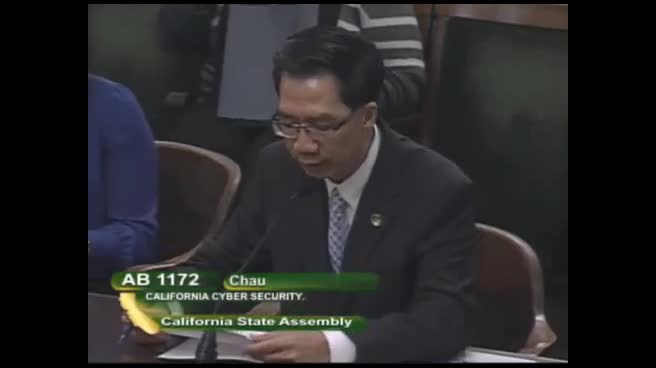 6MIN
Assembly Standing Committee on Privacy and Consumer Protection
Bill Author
Bill Co-Author(s):