SB 49: Renewable energy: Department of Transportation: evaluation.
- Session Year: 2023-2024
- House: Senate
- Latest Version Date: 2023-10-07
Current Status:
Passed
(2023-10-07: Chaptered by Secretary of State. Chapter 379, Statutes of 2023.)
Introduced
In Committee
First Chamber
In Committee
Second Chamber
Enacted
Existing law vests the Department of Transportation with full possession and control of all state highways and all property and rights in property acquired for state highway purposes. Existing law authorizes the department to lease, for up to 99 years, areas above or below state highways to public or private entities, as specified. Existing law also authorizes the department to issue certain permits for a state highways right-of-way necessary for telegraph, telephone, or electrical lines or of any ditches, pipes, drains, sewers, or underground structures, unless otherwise specifically provided in the instrument conveying title.
This bill would require the department, in coordination with the State Energy Resources Conservation and Development Commission and the Public Utilities Commission, to evaluate the issues and policies impeding the development of land within department-owned rights-of-way for renewable energy generation facilities, energy storage facilities, and electrical transmission and distribution facilities, as specified. The bill would require the evaluation to, among other things, consider the department owning the facilities, or leasing, granting easements, or entering into joint-use agreements with public utilities or other entities for this purpose.
Existing law vests the Department of Transportation with full possession and control of all state highways and all property and rights in property acquired for state highway purposes. Existing law authorizes the department to lease, for up to 99 years, areas above or below state highways to public or private entities, as specified. Existing law also authorizes the department to issue certain permits for a state highways right-of-way necessary for telegraph, telephone, or electrical lines or of any ditches, pipes, drains, sewers, or underground structures, unless otherwise specifically provided in the instrument conveying title.
This bill would require the department, in coordination with the State Energy Resources Conservation and Development Commission and the Public Utilities Commission, to develop a strategic plan to develop evaluate the issues and policies impeding the development of land within department-owned rights-of-way for renewable energy generation facilities, energy storage facilities, and electrical transmission and distribution facilities, as specified. The bill would require the strategic plan to evaluation to, among other things, consider the department owning the facilities, or leasing, granting easements, or entering into joint-use agreements with public utilities or other entities for this purpose. On or before July 1, 2027, the bill would also require the department to publish specified information on its internet website, including the actual amount of area of department-owned rights-of-way subject to a lease, easement, or joint-use agreement for renewable energy generation or energy storage.
Existing law vests the Department of Transportation with full possession and control of all state highways and all property and rights in property acquired for state highway purposes. Existing law authorizes the department to lease, for up to 99 years, areas above or below state highways to public or private entities, as specified. Existing law also authorizes the department to issue certain permits for a state highways right-of-way necessary for telegraph, telephone, or electrical lines or of any ditches, pipes, drains, sewers, or underground structures, unless otherwise specifically provided in the instrument conveying title.
This bill would require the department, in coordination with the State Energy Resources Conservation and Development Commission and the Public Utilities Commission, to develop a strategic plan to develop land within department-owned rights-of-way for renewable energy generation facilities, energy storage facilities, and electrical transmission and distribution facilities, as specified. The bill would require the strategic plan to consider the department owning the facilities, or leasing, granting easements, or entering into joint-use agreements with public utilities or other entities for this purpose. On or before July 1, 2027, the bill would also require the department to publish specified information on its internet website, including the actual amount of area of department-owned rights-of-way subject to a lease, easement, or joint-use agreement for renewable energy generation or energy storage.
The Personal Income Tax Law and the Corporation Tax Law allow various credits against the taxes imposed by those laws.
This bill would allow a credit against those taxes for each taxable year beginning on or after January 1, 2024, and before January 1, 2032, 2029, in an amount equal to 5% of the qualified costs paid or incurred during the taxable year for constructing a qualified solar canopy project, as specified.
Existing law requires any bill authorizing a new tax credit to contain, among other things, specific goals that the tax credit will achieve, detailed performance indicators, and data collection requirements.
This bill would make specified findings detailing the goal of the above-described tax credit, performance indicators for determining whether the credit meets that goal, and data collection requirements.
Existing law vests the Department of Transportation with full possession and control of all state highways and all property and rights in property acquired for state highway purposes. Existing law authorizes the department to lease, for up to 99 years, areas above or below state highways to public or private entities, as specified. Existing law also authorizes the department to issue certain permits for a state highways right-of-way necessary for telegraph, telephone, or electrical lines or of any ditches, pipes, drains, sewers, or underground structures, unless otherwise specifically provided in the instrument conveying title.
This bill would require the department, in coordination with the State Energy Resources Conservation and Development Commission and the Public Utilities Commission, to develop a strategic plan to develop land within department-owned rights-of-way for renewable energy generation facilities, energy storage facilities, and electrical transmission and distribution facilities, as specified. The bill would require the strategic plan to consider the department owning the facilities, or leasing, granting easements, or entering into joint-use agreements with public utilities or other entities for this purpose. On or before July 1, 2027, the bill would also require the department to publish specified information on its internet website, including the actual amount of area of department-owned rights-of-way subject to a lease, easement, or joint-use agreement for renewable energy generation or energy storage.
The Personal Income Tax Law and the Corporation Tax Law allow various credits against the taxes imposed by those laws.
This bill would allow a credit against those taxes for each taxable year beginning on or after January 1, 2024, and before January 1, 2032, in an amount equal to 5% of costs incurred during the taxable year for constructing a solar canopy project, as specified.
Existing law requires any bill authorizing a new tax credit to contain, among other things, specific goals that the tax credit will achieve, detailed performance indicators, and data collection requirements.
This bill would make specified findings detailing the goal of the above-described tax credit, performance indicators for determining whether the credit meets that goal, and data collection requirements.
Existing law vests the Department of Transportation with full possession and control of all state highways and all property and rights in property acquired for state highway purposes. Existing law authorizes the department to lease, for up to 99 years, areas above or below state highways to public or private entities, as specified. Existing law also authorizes the department to issue certain permits for a state highways right-of-way necessary for telegraph, telephone, or electrical lines or of any ditches, pipes, drains, sewers, or underground structures, unless otherwise specifically provided in the instrument conveying title.
This bill would require the department, in coordination with the State Energy Resources Conservation and Development Commission and the Public Utilities Commission, to develop a strategic plan to lease, grant easements over, or enter into joint-use agreements for develop land within department-owned rights-of-way to public utilities or other entities to build and operate rights-of-way for renewable energy generation facilities, energy storage facilities, and electrical transmission and distribution facilities, as specified. The bill would require the strategic plan to consider the department owning the facilities, or leasing, granting easements, or entering into joint-use agreements with public utilities or other entities for this purpose. On or before July 1, 2027, the bill would also require the department to publish specified information on its internet website, including the actual amount of area of department-owned rights-of-way subject to a lease, easement, or joint-use agreement for renewable energy generation or energy storage.
The Personal Income Tax Law and the Corporation Tax Law allow various credits against the taxes imposed by those laws.
This bill would allow a credit against those taxes for each taxable year beginning on or after January 1, 2024, and before January 1, 2032, in an amount equal to 5% of costs incurred during the taxable year for constructing a solar canopy project, as specified.
Existing law requires any bill authorizing a new tax credit to contain, among other things, specific goals that the tax credit will achieve, detailed performance indicators, and data collection requirements.
This bill would make specified findings detailing the goal of the above-described tax credit, performance indicators for determining whether the credit meets that goal, and data collection requirements.
Existing law vests the Department of Transportation with full possession and control of all state highways and all property and rights in property acquired for state highway purposes. Existing law authorizes the department to lease, for up to 99 years, areas above or below state highways to public or private entities, as specified. Existing law also authorizes the department to issue certain permits for a state highways right-of-way necessary for telegraph, telephone, or electrical lines or of any ditches, pipes, drains, sewers, or underground structures, unless otherwise specifically provided in the instrument conveying title.
This bill would require the department, in coordination with the State Energy Resources Conservation and Development Commission and the Public Utilities Commission, to develop a strategic plan to lease and license lease, grant easements over, or enter into joint-use agreements for land within department-owned rights-of-way to public utilities or other entities to build and operate renewable energy generation facilities, energy storage facilities connected to renewable energy generation facilities, facilities, and electrical transmission and distribution facilities, as specified. On or before July 1, 2027, the bill would also require the department to publish specified information on its internet website, including the actual amount of area of department-owned rights-of-way subject to a lease, easement, or joint-use agreement for renewable energy generation or energy storage.
Existing law vests the Department of Transportation with full possession and control of all state highways and all property and rights in property acquired for state highway purposes. Existing law authorizes the department to lease, for up to 99 years, areas above or below state highways to public or private entities, as specified. Existing law also authorizes the department to issue certain permits for a state highways right-of-way necessary for telegraph, telephone, or electrical lines or of any ditches, pipes, drains, sewers, or underground structures, unless otherwise specifically provided in the instrument conveying title.
This bill would require the department, in coordination with the State Energy Resources Conservation and Development Commission and the Public Utilities Commission, to develop a strategic plan to lease and license department-owned rights-of-way to public utilities or other entities to build and operate renewable energy generation facilities, energy storage facilities connected to renewable energy generation facilities, and electrical transmission facilities, as specified.
(3)Existing law requires any bill authorizing a new tax expenditure to contain, among other things, specific goals, purposes, and objectives the tax expenditure will achieve, detailed performance indicators, and data collection requirements.This bill would provide findings to comply with the additional information requirement for any bill authorizing a new tax expenditure.(4)The Bradley-Burns Uniform Local Sales and Use Tax Law authorizes counties and cities to impose local sales and use taxes in conformity with the Sales and Use Tax Law, and existing laws authorize districts, as specified, to impose transactions and use taxes in accordance with the Transactions and Use Tax Law, which generally conforms to the Sales and Use Tax Law. Amendments to the Sales and Use Tax Law are automatically incorporated into the local tax laws.Existing law requires the state to reimburse counties and cities for revenue losses caused by the enactment of sales and use tax exemptions.This bill would provide that, notwithstanding Section 2230 of the Revenue and Taxation Code, no appropriation is made and the state shall not reimburse any local agencies for sales and use tax revenues lost by them pursuant to this bill.(1)Existing state sales and use tax laws impose a tax on retailers measured by the gross receipts from the sale of tangible personal property sold at retail in this state of, or on the storage, use, or other consumption in this state of, tangible personal property purchased from a retailer for storage, use, or other consumption in this state. The Sales and Use Tax Law provides various exemptions from those taxes.
This bill would provide an exemption from those taxes for the sale and use of materials and supplies purchased to construct a qualified solar canopy project, as specified.
(2)Existing law vests the Department of Transportation with full possession and control of all state highways and all property and rights in property acquired for state highway purposes. Existing law authorizes the department to lease, for up to 99 years, areas above or below state highways to public or private entities, as specified. Existing law also authorizes the department to issue certain permits for a state highways right-of-way necessary for telegraph, telephone, or electrical lines or of any ditches, pipes, drains, sewers, or underground structures, unless otherwise specifically provided in the instrument conveying title.
This bill would require the department, in coordination with the State Energy Resources Conservation and Development Commission and the Public Utilities Commission, to develop a strategic plan to lease and license department-owned rights-of-way to public utilities or other entities to build and operate renewable energy generation facilities, energy storage facilities connected to renewable energy generation facilities, and electrical transmission facilities, as specified.
(3)Existing law requires any bill authorizing a new tax expenditure to contain, among other things, specific goals, purposes, and objectives the tax expenditure will achieve, detailed performance indicators, and data collection requirements.
This bill would provide findings to comply with the additional information requirement for any bill authorizing a new tax expenditure.
(4)The Bradley-Burns Uniform Local Sales and Use Tax Law authorizes counties and cities to impose local sales and use taxes in conformity with the Sales and Use Tax Law, and existing laws authorize districts, as specified, to impose transactions and use taxes in accordance with the Transactions and Use Tax Law, which generally conforms to the Sales and Use Tax Law. Amendments to the Sales and Use Tax Law are automatically incorporated into the local tax laws.
Existing law requires the state to reimburse counties and cities for revenue losses caused by the enactment of sales and use tax exemptions.
This bill would provide that, notwithstanding Section 2230 of the Revenue and Taxation Code, no appropriation is made and the state shall not reimburse any local agencies for sales and use tax revenues lost by them pursuant to this bill.
Existing law provides tax credits and deductions for various purposes. This bill would state the intent of the Legislature to enact legislation to provide tax incentives for the construction of solar canopies over large parking lots to boost the local generation of clean electricity in urban and suburban areas, as specified.Existing law provides tax credits and deductions for various purposes.
This bill would state the intent of the Legislature to enact legislation to provide tax incentives for the construction of solar canopies over large parking lots to boost the local generation of clean electricity in urban and suburban areas, as specified.
(a)On or before December 31, 2025, the department, in coordination with the State Energy Resources Conservation and Development Commission and the Public Utilities Commission, shall evaluate the issues and policies impeding development of land within department-owned rights-of-way as renewable energy generation facilities, energy storage facilities, and electrical transmission and distribution facilities.
(b)The evaluation described in subdivision (a) shall do all of the following:
(1)Consider the department owning the facilities, or leasing, granting easements over, or entering into joint-use agreements with public utilities or other entities for facility development within department-owned rights-of-way.
(2)Evaluate the suitability of the various types of department-owned rights-of-way for the development of renewable energy generation and energy storage facilities.
(3)Identify the issues and policies impeding the use of department-owned rights-of-way that could be made available for the development of renewable energy generation and energy storage facilities, to the maximum extent economically feasible, including consideration of existing laws, safety, suitability, and other priorities that the department has identified for the department-owned rights-of-way.
(4)Identify, to the extent possible, the amount of renewable energy generation and energy storage capacity on the various types of department-owned rights-of-way that could feasibly be developed to achieve the goals stated in Section 454.53 of the Public Utilities Code.
(5)Evaluate, in coordination with the Public Utilities Commission, the Independent System Operator, and other balancing authorities, as defined in subdivision (b) of Section 399.12 of the Public Utilities Code, the suitability of the various types of department-owned rights-of-way for the development of needed electrical transmission and distribution facilities. The evaluation of suitability shall consider and prioritize the need for increased electrical transmission and distribution capacity as identified by the Public Utilities Commission, the Independent System Operator, or other balancing authorities.
(6)Identify issues and policies impeding the use of department-owned rights-of-way for the development of needed electrical transmission and distribution facilities, including consideration of existing laws, safety, suitability, and other priorities that the department has identified for the department-owned rights-of-way.
(7)Include requirements for the development of renewable energy generation, energy storage facilities, and electrical transmission and distribution facilities within department-owned rights-of-way, including any safety or environmental issues and the steps that projects will be required to take to mitigate these issues.
(8)Establish a process for entities interested in leasing or obtaining an easement or joint-use agreement for land within department-owned rights-of-way to operate and build a renewable energy generation facility, an energy storage facility, or an electrical transmission or distribution facility to apply to the department for land use agreements under terms that reasonably encompass the useful life of the project.
(9)Provide recommendations to facilitate the development of renewable energy generation facilities, energy storage facilities, and electrical transmission and distribution facilities on department-owned rights-of-way.
(a)On or before December 31, 2025, the department, in coordination with the State Energy Resources Conservation and Development Commission and the Public Utilities Commission, shall develop a strategic plan for evaluate the issues and policies impeding development of land within department-owned rights-of-way to build and operate as renewable energy generation facilities, energy storage facilities, and electrical transmission and distribution facilities. The strategic plan shall consider the department owning the facilities, or leasing, granting easements over, or entering into joint-use agreements with public utilities or other entities for facility development within department-owned rights-of-way.
(b)The strategic plan evaluation described in subdivision (a) shall do all of the following:
(1)Consider the department owning the facilities, or leasing, granting easements over, or entering into joint-use agreements with public utilities or other entities for facility development within department-owned rights-of-way.
(1)(2)Evaluate the suitability of the various types of department-owned rights-of-way for the development of renewable energy generation and energy storage facilities.
(2)Identify and quantify(3)Identify the issues and policies impeding the use of department-owned rights-of-way that could be made available for the development of renewable energy generation and energy storage facilities, to the maximum extent economically feasible, after including consideration of suitability, safety, existing laws, safety, suitability, and other priorities that the department has identified for the department-owned rights-of-way.
(3)Establish goals for(4)Identify, to the extent possible, the amount of renewable energy generation capacity for and energy storage capacity on the various types of department-owned rights-of-way that will could feasibly be developed by 2030 and 2045. to achieve the goals stated in Section 454.53 of the Public Utilities Code.
(4)(5)Evaluate, in coordination with the Public Utilities Commission, the Independent System Operator, and other balancing authorities, as defined in subdivision (b) of Section 399.12 of the Public Utilities Code, the suitability of the various types of department-owned rights-of-way for the development of needed electrical transmission and distribution facilities. The evaluation of suitability shall consider and prioritize the need for increased electrical transmission and distribution capacity as identified by the Public Utilities Commission, the Independent System Operator, or other balancing authorities, as well as wildfire mitigation projects for electrical transmission and distribution facilities, as identified in state-approved wildfire mitigation plans submitted pursuant to Section 8386 of the Public Utilities Code. authorities.
(5)Identify department-owned rights-of-way corridors that could be made available for(6)Identify issues and policies impeding the use of department-owned rights-of-way for the development of needed electrical transmission and distribution facilities, to the maximum extent feasible, after consideration of suitability, safety, including consideration of existing laws, safety, suitability, and other priorities that the department has identified for the department-owned rights-of-way.
(6)Publish(7)Include requirements for the development of renewable energy generation, energy storage facilities, and electrical transmission and distribution facilities within department-owned rights-of-way, including any safety or environmental issues and the steps that projects will be required to take to mitigate these issues.
(7)(8)Establish a process for entities interested in leasing or obtaining an easement or joint-use agreement for land within department-owned rights-of-way to operate and build a renewable energy generation facility, an energy storage facility, or an electrical transmission or distribution facility to apply to the department for land use agreements under terms that reasonably encompass the useful life of the project.
(8)Recommend regulatory or statutory changes that, if enacted, would(9)Provide recommendations to facilitate the development of renewable energy generation facilities, energy storage facilities, and electrical transmission and distribution facilities on department-owned rights-of-way.
(c)On or before July 1, 2027, and annually thereafter, the department shall annually publish on its internet website progress toward the goals established under paragraph (3) of subdivision (b). Measurement of progress shall include, but not be limited to, all of the following information collected during the prior year: (1)The actual amount of area of department-owned rights-of-way subject to a lease, easement, or joint-use agreement for renewable energy generation or energy storage.(2)The nameplate capacity of renewable energy generation or energy storage that are operating on department-owned rights-of-way.(3)The nameplate capacity of renewable energy generation or energy storage that is in the development pipeline to operate on department-owned rights-of-way, and their scheduled commercial operation date.(4)The number of megawatt-miles of transmission and distribution facilities developed within department-owned rights-of-way.(a)The Legislature finds and declares all of the following:
(1)With Senate Bill 100 (Chapter 312 of the Statutes of 2018) and Senate Bill 1020 (Chapter 361 of the Statutes of 2022), the state has established a target for 100 percent of retail sales of electricity to be from renewable or zero-carbon resources by 2045, with interim targets of 90 percent by 2035 and 95 percent by 2040.
(2)To achieve the 100 percent target for retail sales of electricity, the Senate Bill 100 Joint Agency report from March 2021 estimated that the state will need to add 110 gigawatts of solar generation capacity by 2045.
(3)According to the Solar Energy Industry Association, solar energy generation generally requires 5 to 10 acres per megawatt of generation capacity, and the need for space to support large-scale solar generation can compete against other beneficial uses for that land, including agricultural uses, recreational uses, and land conservation as part of the states 30x30 strategy.
(4)It is in the interest of the state to encourage and enable the development of renewable energy generation, including solar energy generation, on land with limited beneficial use, such as along highway rights-of-way, or in rights-of-way where the land can be used for renewable energy generation without interfering with current uses, such as building solar energy generation on canopies above parking lots.
(5)The County of Los Angeles alone has an estimated 101 square miles of parking lots that could provide about 6,500 megawatts of power if they were covered by solar canopies. Encouraging the development of solar canopies could make a significant contribution to achieving the states need for increased solar energy generation capacity while reducing the amount of other land required.(6)(5)Additional renewable energy generation, especially if paired with energy storage, can also help the state achieve better grid reliability and lower the risk of power outages.
(7)(6)Renewable energy generation from solar canopies over surface parking lots and from solar energy generation facilities along highway rights-of-way can provide a local source of electricity for electric vehicle charging stations that are also often located within surface parking lots and along highways.
(8)(7)The Independent System Operator has estimated the need for $30,000,000,000 in investments in increased transmission capacity by 2040 in order to achieve the Senate Bill 100 target.
(9)(8)High-voltage transmission lines are extremely difficult to site and permit, in part because they often require coordination with a large number of landowners and local jurisdictions. Numerous studies have recommended siting new transmission lines along existing rights-of-way as an approach for getting past these siting challenges.
(10)(9)In April 2021, the Federal Highway Administration issued guidance to encourage state departments of transportation to use highway rights-of-way for pressing public needs relating to climate change, including renewable energy generation and electrical transmission and distribution projects.
(11)(10)Increasing renewable energy generation in urban and suburban areas, including from solar canopies, areas can also reduce the need for long-distance transmission of renewable energy generated in rural areas into population centers.
(12)(11)Leasing, granting easements over, or entering into joint-use agreements for land within transportation rights-of-way for renewable energy generation, energy storage, and electrical transmission and distribution can be a source of revenue for the state.
(13)(12)Developing renewable energy generation within the transportation rights-of-way can also reduce the states roadside maintenance burden by shifting the responsibility for vegetation management to private companies.
(b)It is the intent of the Legislature to do both of the following:
(1)Provide incentives for the development of solar canopies to boost the local generation of renewable energy in urban and suburban areas, thereby reducing the need for dedicated land in rural areas to generate clean energy and for long-distance transmission to deliver that clean energy into population centers.(2)Increase increase the availability of state-controlled land within transportation rights-of-way for renewable energy development, energy storage, and electrical transmission and distribution.
SEC. 2.Section 17053.10 is added to the Revenue and Taxation Code, to read:17053.10.(a)(1)For each taxable year beginning on or after January 1, 2024, and before January 1, 2029, there shall be allowed a credit against the net tax, as defined in Section 17039, to the owner of a qualified solar canopy project in an amount equal to 5 percent of qualified costs paid or incurred for constructing a qualified solar canopy project.(2)The credit allowed by this section shall be claimed for the taxable year in which the qualified solar canopy project is first placed in service.(3)The credit allowed by this section shall not exceed one hundred thousand dollars ($100,000) per qualified solar canopy project.(b)For the purposes of this section, the following definitions apply:(1)(A)Eligible area means a multifamily residential, commercial, governmental, or industrial site containing an area dedicated to both the placement of a solar canopy and another use, including, but not limited to, use as a parking lot, outdoor seating, or recreation area.(B)Eligible area does not include either of the following:(i)The roof of a building.(ii)A site located over a surface parking lot within one-half mile of a major transit stop or a future major transit stop identified in an applicable regional transportation plan.(2)Major transit stop has the same meaning as defined in Section 21064.3 of the Public Resources Code.(3)Nameplate capacity means the maximum rated output of electrical power in alternating current of a solar energy system or an energy storage system.(4)(A)Qualified costs shall include, but not be limited to, costs for materials and equipment, labor, project design and engineering, and permitting.(B)Notwithstanding subparagraph (A), qualified costs shall not include costs for site acquisition or remediation, environmental mitigation, or any other costs not directly related to the design or construction of the solar canopy. (5)Qualified solar canopy project means construction of a solar canopy over an eligible area with a nameplate capacity of more than 15 kilowatts.(6)Solar canopy means an elevated structure containing a solar energy system. Solar canopy includes the solar energy system and powerlines or other equipment required to connect the solar canopy to the electrical grid or a building on the site.(7)Solar energy system means a solar energy device, with associated energy storage connected to and primarily charged by the solar energy device, that has the purpose of providing for the collection and distribution of solar energy for the generation of electricity. Solar energy systems pursuant to this section must be solar paired with storage systems.(c)In the case where the credit allowed by this section exceeds the net tax, the excess credit may be carried over to reduce the net tax in the following taxable year, and succeeding five taxable years, if necessary, until the credit has been exhausted.(d)Any deduction otherwise allowed under this part for any amount paid or incurred by the taxpayer upon which the credit is based shall be reduced by the amount of the credit allowed under this section.(e)(1)The Franchise Tax Board may prescribe any regulations necessary or appropriate to carry out the purposes of this section. (2)Chapter 3.5 (commencing with Section 11340) of Part 1 of Division 3 of Title 2 of the Government Code shall not apply to any regulation, rule, guideline, or procedure prescribed by the Franchise Tax Board pursuant to this section. (f)(1)For purposes of complying with Section 41, the Legislature finds and declares that the objective of the credit created by this section and Section 23605 is to provide incentives for the development of solar canopies to boost the local generation of renewable energy in urban and suburban areas while reducing the need for dedicated land in rural areas and the need for transmission to deliver the clean energy into population centers.(2)The performance indicators the Legislature can use to determine if the credit is achieving the objective stated in subdivision (a) shall be the dollar amount of tax credit claimed and the nameplate capacity of solar canopies, including both the solar energy device and the energy storage systems, constructed by eligible projects that claimed the tax credits pursuant to this act.(3)The Franchise Tax Board shall annually prepare a written report that includes both of the following:(A)The dollar amount of tax credits claimed for eligible solar canopy projects pursuant to this section and Section 23605.(B)The nameplate capacity of solar canopies and energy storage systems constructed by those eligible projects.(4)(A)The Franchise Tax Board shall submit the report prepared pursuant to paragraph (3) to the Senate Committee on Budget and Fiscal Review, the Assembly Committee on Budget, the Senate and Assembly Committees on Appropriations, the Senate Committee on Governance and Finance, and the Assembly Committee on Revenue and Taxation beginning in the 2026 calendar year and then on an annual basis each year thereafter, while the credit is in effect, for the most recent taxable year for which information is available.(B)The disclosure requirements of this paragraph shall be treated as an exception to Section 19542.(g)This section shall remain operative until December 1, 2029, and as of that date is repealed.SEC. 3.Section 23605 is added to the Revenue and Taxation Code, to read:23605.(a)(1)For each taxable year beginning on or after January 1, 2024, and before January 1, 2029, there shall be allowed a credit against the tax, as defined in Section 23036, to the owner of a qualified solar canopy project in an amount equal to 5 percent of qualified costs paid or incurred for constructing a qualified solar canopy project.(2)The credit allowed by this section shall be claimed for the taxable year in which the qualified solar canopy project is first placed in service.(3)The credit allowed by this section shall not exceed one hundred thousand dollars ($100,000) per qualified solar canopy project.(b)For the purposes of this section, the following definitions apply:(1)(A)Eligible area means a residential, commercial, governmental, or industrial site containing an area dedicated to both the placement of a solar canopy and another use, including, but not limited to, use as a parking lot, outdoor seating, or recreation area.(B)Eligible area does not include either of the following:(i)The roof of a building.(ii)A site located over a surface parking lot within one-half mile of a major transit stop or a future major transit stop identified in an applicable regional transportation plan.(2)Major transit stop has the same meaning as defined in Section 21064.3 of the Public Resources Code.(3)Nameplate capacity means the maximum rated output of electrical power in alternating current of a solar energy system or an energy storage system.(4)(A)Qualified costs shall include, but not be limited to, costs for materials and equipment, labor, project design and engineering, and permitting.(B)Notwithstanding subparagraph (A), qualified costs shall not include costs for site acquisition or remediation, environmental mitigation, or any other costs not directly related to the design or construction of the solar canopy. (5)Qualified solar canopy project means construction of a solar canopy over an eligible area with a nameplate capacity of more than 15 kilowatts of alternating current.(6)Solar canopy means an elevated structure containing a solar energy system. Solar canopy includes the solar energy system and powerlines or other equipment required to connect the solar canopy to the electrical grid or a building on the site.(7)Solar energy system means a solar energy device, with associated energy storage connected to and primarily charged by the solar energy device, that has the purpose of providing for the collection and distribution of solar energy for the generation of electricity. Solar energy systems pursuant to this section must be solar paired with storage systems.(c)In the case where the credit allowed by this section exceeds the tax, the excess credit may be carried over to reduce the tax in the following taxable year, and succeeding five taxable years, if necessary, until the credit has been exhausted.(d)Any deduction otherwise allowed under this part for any amount paid or incurred by the taxpayer upon which the credit is based shall be reduced by the amount of the credit allowed under this section.(e)(1)The Franchise Tax Board may prescribe any regulations necessary or appropriate to carry out the purposes of this section.(2)Chapter 3.5 (commencing with Section 11340) of Part 1 of Division 3 of Title 2 of the Government Code shall not apply to any regulation, rule, guideline, or procedure prescribed by the Franchise Tax Board pursuant to this section. (f)This section shall remain operative until December 1, 2029, and as of that date is repealed.SEC. 4.SEC. 2.Section 91.9 is added to the Streets and Highways Code, to read:91.9.(a)On or before December 31, 2025, the department, in coordination with the State Energy Resources Conservation and Development Commission and the Public Utilities Commission, shall develop a strategic plan for development of land within department-owned rights-of-way to build and operate renewable energy generation facilities, energy storage facilities, and electrical transmission and distribution facilities. The strategic plan shall consider the department owning the facilities, or leasing, granting easements over, or entering into joint-use agreements with public utilities or other entities for facility development within department-owned rights-of-way.
(b)The strategic plan described in subdivision (a) shall do all of the following:
(1)Evaluate the suitability of department-owned rights-of-way for the development of renewable energy generation and energy storage facilities.
(2)Identify and quantify department-owned rights-of-way that could be made available for the development of renewable energy generation and energy storage facilities, to the maximum extent feasible, after consideration of suitability, safety, and other priorities that the department has identified for the department-owned rights-of-way.
(3)Establish goals for the amount of renewable energy generation capacity for department-owned rights-of-way that will be developed by 2030 and 2045.
(4)Evaluate, in coordination with the Public Utilities Commission, the Independent System Operator, and other balancing authorities, as defined in subdivision (b) of Section 399.12 of the Public Utilities Code, the suitability of department-owned rights-of-way for the development of electrical transmission and distribution facilities. The evaluation of suitability shall consider and prioritize the need for increased electrical transmission and distribution capacity as identified by the Public Utilities Commission, the Independent System Operator, or other balancing authorities, as well as wildfire mitigation projects for electrical transmission and distribution facilities, as identified in state-approved wildfire mitigation plans submitted pursuant to Section 8386 of the Public Utilities Code.
(5)Identify department-owned rights-of-way corridors that could be made available for the development of electrical transmission and distribution facilities, to the maximum extent feasible, after consideration of suitability, safety, and other priorities that the department has identified for the department-owned rights-of-way.
(6)Publish requirements for the development of renewable energy generation, energy storage facilities, and electrical transmission and distribution facilities within department-owned rights-of-way, including any safety or environmental issues and the steps that projects will be required to take to mitigate these issues.
(7)Establish a process for entities interested in leasing or obtaining an easement or joint-use agreement for land within department-owned rights-of-way to operate and build a renewable energy generation facility, an energy storage facility, or an electrical transmission or distribution facility to apply to the department for land use agreements under terms that reasonably encompass the useful life of the project.
(8)Recommend regulatory or statutory changes that, if enacted, would facilitate the development of renewable energy generation facilities, energy storage facilities, and electrical transmission and distribution facilities on department-owned rights-of-way.
(c)On or before July 1, 2027, and annually thereafter, the department shall annually publish on its internet website progress toward the goals established under paragraph (3) of subdivision (b). Measurement of progress shall include, but not be limited to, all of the following information collected during the prior year:
(1)The actual amount of area of department-owned rights-of-way subject to a lease, easement, or joint-use agreement for renewable energy generation or energy storage.
(2)The nameplate capacity of renewable energy generation or energy storage that are operating on department-owned rights-of-way.
(3)The nameplate capacity of renewable energy generation or energy storage that is in the development pipeline to operate on department-owned rights-of-way, and their scheduled commercial operation date.
(4)The number of megawatt-miles of transmission and distribution facilities developed within department-owned rights-of-way.
(a)The Legislature finds and declares all of the following:
(1)With Senate Bill 100 (Chapter 312 of the Statutes of 2018) and Senate Bill 1020 (Chapter 361 of the Statutes of 2022), the state has established a target for 100 percent of retail sales of electricity to be from renewable or zero-carbon resources by 2045, with interim targets of 90 percent by 2035 and 95 percent by 2040.
(2)To achieve the 100 percent target for retail sales of electricity, the Senate Bill 100 Joint Agency report from March 2021 estimated that the state will need to add 110 gigawatts of solar generation capacity by 2045.
(3)According to the Solar Energy Industry Association, solar energy generation generally requires 5 to 10 acres per megawatt of generation capacity, and the need for space to support large-scale solar generation can compete against other beneficial uses for that land, including agricultural uses, recreational uses, and land conservation as part of the states 30x30 strategy.
(4)It is in the interest of the state to encourage and enable the development of renewable energy generation, including solar energy generation, on land with limited beneficial use, such as along highway rights-of-way, or in rights-of-way where the land can be used for renewable energy generation without interfering with current uses, such as building solar energy generation on canopies above parking lots.
(5)The County of Los Angeles alone has an estimated 101 square miles of parking lots that could provide about 6,500 megawatts of power if they were covered by solar canopies. Encouraging the development of solar canopies could make a significant contribution to achieving the states need for increased solar energy generation capacity while reducing the amount of other land required.
(6)Additional renewable energy generation, especially if paired with energy storage, can also help the state achieve better grid reliability and lower the risk of power outages.
(7)Renewable energy generation from solar canopies over surface parking lots and from solar energy generation facilities along highway rights-of-way can provide a local source of electricity for electric vehicle charging stations that are also often located within surface parking lots and along highways.
(8)The Independent System Operator has estimated the need for $30,000,000,000 in investments in increased transmission capacity by 2040 in order to achieve the Senate Bill 100 target.
(9)High-voltage transmission lines are extremely difficult to site and permit, in part because they often require coordination with a large number of landowners and local jurisdictions. Numerous studies have recommended siting new transmission lines along existing rights-of-way as an approach for getting past these siting challenges.
(10)In April 2021, the Federal Highway Administration issued guidance to encourage state departments of transportation to use highway rights-of-way for pressing public needs relating to climate change, including renewable energy generation and electrical transmission and distribution projects.
(11)Increasing renewable energy generation in urban and suburban areas, including from solar canopies, can also reduce the need for long-distance transmission of renewable energy generated in rural areas into population centers.
(12)Leasing, granting easements over, or entering into joint-use agreements for land within transportation rights-of-way for renewable energy generation, energy storage, and electrical transmission and distribution can be a source of revenue for the state.
(13)Developing renewable energy generation within the transportation rights-of-way can also reduce the states roadside maintenance burden by shifting the responsibility for vegetation management to private companies.
(b)It is the intent of the Legislature to do both of the following:
(1)Provide incentives for the development of solar canopies to boost the local generation of renewable energy in urban and suburban areas, thereby reducing the need for dedicated land in rural areas to generate clean energy and for long-distance transmission to deliver that clean energy into population centers.
(2)Increase the availability of state-controlled land within transportation rights-of-way for renewable energy development, energy storage, and electrical transmission and distribution.
SEC. 2.Section 17053.10 is added to the Revenue and Taxation Code, to read:17053.10.(a)(1)For each taxable year beginning on or after January 1, 2024, and before January 1, 2032, 2029, there shall be allowed a credit against the net tax, as defined in Section 17039, to the owner of a qualified solar canopy project in an amount equal to 5 percent of qualified costs paid or incurred during the taxable year for constructing a qualified solar canopy project.
(2)The credit allowed by this section shall be claimed for the taxable year in which the qualified solar canopy project is first placed in service.
(3)The credit allowed by this section shall not exceed one hundred thousand dollars ($100,000) per qualified solar canopy project.
(b)For the purposes of this section, the following definitions apply:
(1)(A)Eligible area means a multifamily residential, commercial, governmental, or industrial site containing an area dedicated to both the placement of a solar canopy and another use, including, but not limited to, use as a parking lot, outdoor seating, or recreation area.
(B)Eligible area does not include either of the following:
(i)The roof of a building.
(ii)A site located over a surface parking lot within one-half mile of a major transit stop or a future major transit stop identified in an applicable regional transportation plan.
(2)Major transit stop has the same meaning as defined in Section 21064.3 of the Public Resources Code.
(3)Nameplate capacity means the maximum rated output of electrical power in alternating current of a solar energy system or an energy storage system.
(4)(A)Qualified costs shall include, but not be limited to, costs for materials and equipment, labor, project design and engineering, and permitting.
(B)Notwithstanding subparagraph (A), qualified costs shall not include costs for site acquisition or remediation, environmental mitigation, or any other costs not directly related to the design or construction of the solar canopy.
(2)(5)Qualified solar canopy project means construction of a solar canopy over an eligible area with a nameplate capacity of more than 15 kilowatts of alternating current. kilowatts.
(3)(6)Solar canopy means an elevated structure containing a solar energy system. Solar canopy includes the solar energy system and powerlines or other equipment required to connect the solar canopy to the electrical grid or a building on the site.
(4)(7)Solar energy system means a solar energy device, with associated energy storage connected to and primarily charged by the solar energy device, that has the purpose of providing for the collection and distribution of solar energy for the generation of electricity. Solar energy systems pursuant to this section must be solar paired with storage systems.
(5)Major transit stop has the same meaning as defined in Section 21064.3 of the Public Resources Code.(c)In the case where the credit allowed by this section exceeds the net tax, the excess credit may be carried over to reduce the net tax in the following taxable year, and succeeding five taxable years, if necessary, until the credit has been exhausted.
(d)Any deduction otherwise allowed under this part for any amount paid or incurred by the taxpayer upon which the credit is based shall be reduced by the amount of the credit allowed under this section.
(e)(1)The Franchise Tax Board may prescribe any regulations necessary or appropriate to carry out the purposes of this section.
(2)Chapter 3.5 (commencing with Section 11340) of Part 1 of Division 3 of Title 2 of the Government Code shall not apply to any regulation, rule, guideline, or procedure prescribed by the Franchise Tax Board pursuant to this section.
(d)(f)(1)For purposes of complying with Section 41, the Legislature finds and declares that the objective of the credit created by this section and Section 23605 is to provide incentives for the development of solar canopies to boost the local generation of renewable energy in urban and suburban areas while reducing the need for dedicated land in rural areas and the need for transmission to deliver the clean energy into population centers.
(2)The performance indicators the Legislature can use to determine if the credit is achieving the objective stated in subdivision (a) shall be the dollar amount of tax credit claimed and the nameplate capacity of solar canopies, including both the solar energy device and the energy storage systems, constructed by eligible projects that claimed the tax credits pursuant to this act.
(3)The Franchise Tax Board shall annually prepare a written report that includes both of the following:
(A)The dollar amount of tax credits claimed for eligible solar canopy projects pursuant to this section and Section 23605.
(B)The nameplate capacity of solar canopies and energy storage systems constructed by those eligible projects.
(4)(A)No later than July 1, 2024, and each July 1 thereafter, the Franchise Tax Board shall submit the report prepared pursuant to paragraph (3) to the Senate Committee on Budget and Fiscal Review, the Assembly Committee on Budget, the Senate and Assembly Committees on Appropriations, the Senate Committee on Governance and Finance, and the Assembly Committee on Revenue and Taxation. The report shall be submitted in compliance with Section 9795 of the Government Code. The Franchise Tax Board shall submit the report prepared pursuant to paragraph (3) to the Senate Committee on Budget and Fiscal Review, the Assembly Committee on Budget, the Senate and Assembly Committees on Appropriations, the Senate Committee on Governance and Finance, and the Assembly Committee on Revenue and Taxation beginning in the 2026 calendar year and then on an annual basis each year thereafter, while the credit is in effect, for the most recent taxable year for which information is available.
(B)The disclosure requirements of this paragraph shall be treated as an exception to Section 19542.
(e)(g)This section shall remain operative until December 1, 2032, 2029, and as of that date is repealed.
SEC. 3.Section 23605 is added to the Revenue and Taxation Code, to read:23605.(a)(1)For each taxable year beginning on or after January 1, 2024, and before January 1, 2032, 2029, there shall be allowed a credit against the tax, as defined in Section 23036, to the owner of a qualified solar canopy project in an amount equal to 5 percent of qualified costs paid or incurred during the taxable year for constructing a qualified solar canopy project.
(2)The credit allowed by this section shall be claimed for the taxable year in which the qualified solar canopy project is first placed in service.
(3)The credit allowed by this section shall not exceed one hundred thousand dollars ($100,000) per qualified solar canopy project.
(b)For the purposes of this section, the following definitions apply:
(1)(A)Eligible area means a residential, commercial, governmental, or industrial site containing an area dedicated to both the placement of a solar canopy and another use, including, but not limited to, use as a parking lot, outdoor seating, or recreation area.
(B)Eligible area does not include either of the following:
(i)The roof of a building.
(ii)A site located over a surface parking lot within one-half mile of a major transit stop or a future major transit stop identified in an applicable regional transportation plan.
(2)Major transit stop has the same meaning as defined in Section 21064.3 of the Public Resources Code.
(3)Nameplate capacity means the maximum rated output of electrical power in alternating current of a solar energy system or an energy storage system.
(4)(A)Qualified costs shall include, but not be limited to, costs for materials and equipment, labor, project design and engineering, and permitting.
(B)Notwithstanding subparagraph (A), qualified costs shall not include costs for site acquisition or remediation, environmental mitigation, or any other costs not directly related to the design or construction of the solar canopy.
(2)(5)Qualified solar canopy project means construction of a solar canopy over an eligible area with a nameplate capacity of more than 15 kilowatts of alternating current.
(3)(6)Solar canopy means an elevated structure containing a solar energy system. Solar canopy includes the solar energy system and powerlines or other equipment required to connect the solar canopy to the electrical grid or a building on the site.
(4)(7)Solar energy system means a solar energy device, with associated energy storage connected to and primarily charged by the solar energy device, that has the purpose of providing for the collection and distribution of solar energy for the generation of electricity. Solar energy systems pursuant to this section must be solar paired with storage systems.
(5)Major transit stop has the same meaning as defined in Section 21064.3 of the Public Resources Code.(c)In the case where the credit allowed by this section exceeds the tax, the excess credit may be carried over to reduce the tax in the following taxable year, and succeeding five taxable years, if necessary, until the credit has been exhausted.
(d)Any deduction otherwise allowed under this part for any amount paid or incurred by the taxpayer upon which the credit is based shall be reduced by the amount of the credit allowed under this section.
(e)(1)The Franchise Tax Board may prescribe any regulations necessary or appropriate to carry out the purposes of this section.
(2)Chapter 3.5 (commencing with Section 11340) of Part 1 of Division 3 of Title 2 of the Government Code shall not apply to any regulation, rule, guideline, or procedure prescribed by the Franchise Tax Board pursuant to this section.
(d)(f)This section shall remain operative until December 1, 2032, 2029, and as of that date is repealed.
SEC. 4.Section 91.9 is added to the Streets and Highways Code, to read:91.9.(a)On or before December 31, 2025, the department, in coordination with the State Energy Resources Conservation and Development Commission and the Public Utilities Commission, shall develop a strategic plan for development of land within department-owned rights-of-way to build and operate renewable energy generation facilities, energy storage facilities, and electrical transmission and distribution facilities. The strategic plan shall consider the department owning the facilities, or leasing, granting easements over, or entering into joint-use agreements with public utilities or other entities for facility development within department-owned rights-of-way.
(b)The strategic plan described in subdivision (a) shall do all of the following:
(1)Evaluate the suitability of department-owned rights-of-way for the development of renewable energy generation and energy storage facilities.
(2)Identify and quantify department-owned rights-of-way that could be made available for the development of renewable energy generation and energy storage facilities, to the maximum extent feasible, after consideration of suitability, safety, and other priorities that the department has identified for the department-owned rights-of-way.
(3)Establish goals for the amount of renewable energy generation capacity for department-owned rights-of-way that will be developed by 2030 and 2045.
(4)Evaluate, in coordination with the Public Utilities Commission, the Independent System Operator, and other balancing authorities, as defined in subdivision (b) of Section 399.12 of the Public Utilities Code, the suitability of department-owned rights-of-way for the development of electrical transmission and distribution facilities. The evaluation of suitability shall consider and prioritize the need for increased electrical transmission and distribution capacity as identified by the Public Utilities Commission, the Independent System Operator, or other balancing authorities, as well as wildfire mitigation projects for electrical transmission and distribution facilities, as identified in state-approved wildfire mitigation plans submitted pursuant to Section 8386 of the Public Utilities Code.
(5)Identify department-owned rights-of-way corridors that could be made available for the development of electrical transmission and distribution facilities, to the maximum extent feasible, after consideration of suitability, safety, and other priorities that the department has identified for the department-owned rights-of-way.
(6)Publish requirements for the development of renewable energy generation, energy storage facilities, and electrical transmission and distribution facilities within department-owned rights-of-way, including any safety or environmental issues and the steps that projects will be required to take to mitigate these issues.
(7)Establish a process for entities interested in leasing or obtaining an easement or joint-use agreement for land within department-owned rights-of-way to operate and build a renewable energy generation facility, an energy storage facility, or an electrical transmission or distribution facility to apply to the department for land use agreements under terms that reasonably encompass the useful life of the project.
(8)Recommend regulatory or statutory changes that, if enacted, would facilitate the development of renewable energy generation facilities, energy storage facilities, and electrical transmission and distribution facilities on department-owned rights-of-way.
(c)On or before July 1, 2027, and annually thereafter, the department shall annually publish on its internet website progress toward the goals established under paragraph (3) of subdivision (b). Measurement of progress shall include, but not be limited to, all of the following information collected during the prior year:
(1)The actual amount of area of department-owned rights-of-way subject to a lease, easement, or joint-use agreement for renewable energy generation or energy storage.
(2)The nameplate capacity of renewable energy generation or energy storage that are operating on department-owned rights-of-way.
(3)The nameplate capacity of renewable energy generation or energy storage that is in the development pipeline to operate on department-owned rights-of-way, and their scheduled commercial operation date.
(4)The number of megawatt-miles of transmission and distribution facilities developed within department-owned rights-of-way.
(a)The Legislature finds and declares all of the following:
(1)With Senate Bill 100 (Chapter 312 of the Statutes of 2018) and Senate Bill 1020 (Chapter 361 of the Statutes of 2022), the state has established a target for 100 percent of retail sales of electricity to be from renewable or zero-carbon resources by 2045, with interim targets of 90 percent by 2035 and 95 percent by 2040.
(2)To achieve the 100 percent target for retail sales of electricity, the Senate Bill 100 Joint Agency report from March 2021 estimated that the state will need to add 110 gigawatts of solar generation capacity by 2045.
(3)Solar energy generation requires a lot of land and competes According to the Solar Energy Industry Association, solar energy generation generally requires 5 to 10 acres per megawatt of generation capacity, and the need for space to support large-scale solar generation can compete against other beneficial uses for that land, including agricultural uses, recreational uses, and land conservation as part of the states 30x30 strategy.
(4)It is in the interest of the state to encourage and enable the development of renewable energy generation, including solar energy generation, on land with no other planned limited beneficial use, such as along highway rights-of-way, or in rights-of-way where the land can be used for renewable energy generation without interfering with current uses, such as building solar energy generation on canopies above parking lots.
(5)The County of Los Angeles alone has an estimated 101 square miles of parking lots that could provide about 6,500 megawatts of power if they were covered by solar canopies. Encouraging the development of solar canopies could make a significant contribution to achieving the states need for increased solar energy generation capacity while reducing the amount of other land required.
(6)Additional renewable energy generation, especially if paired with energy storage, can also help the state achieve better grid reliability and lower the risk of power outages.
(7)Renewable energy generation from solar canopies over surface parking lots and from solar energy generation facilities along highway rights-of-way can provide a local source of electricity for electric vehicle charging stations that are also often located within surface parking lots and along highways.
(8)The Independent System Operator has estimated the need for $30,000,000,000 in investments in increased transmission capacity by 2040 in order to achieve the Senate Bill 100 target.
(9)High-voltage transmission lines are extremely difficult to site and permit, in part because they often require coordination with a large number of landowners and local jurisdictions. Numerous studies have recommended siting new transmission lines along existing rights-of-way as an approach for getting past these siting challenges.
(10)In April 2021, the Federal Highway Administration issued guidance to encourage state departments of transportation to use highway rights-of-way for pressing public needs relating to climate change, including renewable energy generation and electrical transmission and distribution projects.
(11)Increasing renewable energy generation in urban and suburban areas, including from solar canopies, can also reduce the need for long-distance transmission of renewable energy generated in rural areas into population centers.
(12)Leasing, granting easements over, or entering into joint-use agreements for land within transportation rights-of-way for renewable energy generation, energy storage, and electrical transmission and distribution can be a source of revenue for the state.
(13)Developing renewable energy generation within the transportation rights-of-way can also reduce the states roadside maintenance burden by reducing the need for vegetation management. shifting the responsibility for vegetation management to private companies.
(b)It is the intent of the Legislature to do both of the following:
(1)Provide incentives for the development of solar canopies to boost the local generation of renewable energy in urban and suburban areas, thereby reducing the need for dedicated land in rural areas to generate clean energy and for long-distance transmission to deliver that clean energy into population centers.
(2)Increase the availability of state-controlled land within transportation rights-of-way for renewable energy development, energy storage, and electrical transmission and distribution.
SEC. 2.Section 17053.10 is added to the Revenue and Taxation Code, to read:17053.10.(a)For each taxable year beginning on or after January 1, 2024, and before January 1, 2032, there shall be allowed a credit against the net tax, as defined in Section 17039, in an amount equal to 5 percent of costs incurred during the taxable year for constructing a qualified solar canopy project.
(b)For the purposes of this section, the following definitions apply:
(1)(A)Eligible area means a residential, commercial, government, governmental, or industrial site containing an area dedicated to both the placement of a solar canopy and another use, including, but not limited to, use as a parking lot, outdoor seating, or recreation area.
(B)Eligible area does not include either of the following:
(i)The roof of a building.
(ii)A site located over a surface parking lot within one-half mile of a major transit stop or a future major transit stop identified in an applicable regional transportation plan.
(2)Qualified solar canopy project means construction of a solar canopy over an eligible area with a nameplate capacity of at least more than 15 kilowatts of alternating current.
(3)Solar canopy means an elevated structure containing a solar energy system. Solar canopy includes the solar energy system, energy storage connected to and primarily charged by the solar energy system, system and powerlines or other equipment required to connect the solar canopy to the electrical grid or a building on the site.
(4)Solar energy system means a solar energy device that has the primary device, with associated energy storage connected to and primarily charged by the solar energy device, that has the purpose of providing for the collection and distribution of solar energy for the generation of electricity. Solar energy systems pursuant to this section must be solar paired with storage systems.
(5)Major transit stop has the same meaning as defined in Section 21064.3 of the Public Resources Code.
(c)In the case where the credit allowed by this section exceeds the net tax, the excess credit may be carried over to reduce the net tax in the following taxable year, and succeeding five taxable years, if necessary, until the credit has been exhausted.
(d)(1)For purposes of complying with Section 41, the Legislature finds and declares that the objective of the credit created by this section and Section 23605 is to provide incentives for the development of solar canopies to boost the local generation of renewable energy in urban and suburban areas while reducing the need for dedicated land in rural areas and the need for transmission to deliver the clean energy into population centers.
(2)The performance indicators the Legislature can use to determine if the credit is achieving the objective stated in subdivision (a) shall be the dollar amount of tax credit claimed and the nameplate capacity of solar canopies, including both the solar energy device and the energy storage systems, constructed by eligible projects that claimed the tax credits pursuant to this act.
(3)The Franchise Tax Board shall annually prepare a written report that includes both of the following:
(A)The dollar amount of tax credits claimed for eligible solar canopy projects pursuant to this section and Section 23605.
(B)The nameplate capacity of solar canopies and energy storage systems constructed by those eligible projects.
(4)(A)No later than July 1, 2024, and each July 1 thereafter, the Franchise Tax Board shall submit the report prepared pursuant to paragraph (3) to the Senate Committee on Budget and Fiscal Review, the Assembly Committee on Budget, the Senate and Assembly Committees on Appropriations, the Senate Committee on Governance and Finance, and the Assembly Committee on Revenue and Taxation. The report shall be submitted in compliance with Section 9795 of the Government Code.
(B)The disclosure requirements of this paragraph shall be treated as an exception to Section 19542.
(e)This section shall remain operative until December 1, 2032, and as of that date is repealed.
SEC. 3.Section 23605 is added to the Revenue and Taxation Code, to read:23605.(a)For each taxable year beginning on or after January 1, 2024, and before January 1, 2032, there shall be allowed a credit against the tax, as defined in Section 23036, in an amount equal to 5 percent of costs incurred during the taxable year for constructing a qualified solar canopy project.
(b)For the purposes of this section, the following definitions apply:
(1)(A)Eligible area means a residential, commercial, government, governmental, or industrial site containing an area dedicated to both the placement of a solar canopy and another use, including, but not limited to, use as a parking lot, outdoor seating, or recreation area.
(B)Eligible area does not include either of the following:
(i)The roof of a building.
(ii)A site located over a surface parking lot within one-half mile of a major transit stop or a future major transit stop identified in an applicable regional transportation plan.
(2)Qualified solar canopy project means construction of a solar canopy over an eligible area with a nameplate capacity of at least more than 15 kilowatts of alternating current.
(3)Solar canopy means an elevated structure containing a solar energy system. Solar canopy includes the solar energy system, energy storage connected to and primarily charged by the solar energy system, system and powerlines or other equipment required to connect the solar canopy to the electrical grid or a building on the site.
(4)Solar energy system means a solar energy device that has the primary device, with associated energy storage connected to and primarily charged by the solar energy device, that has the purpose of providing for the collection and distribution of solar energy for the generation of electricity. Solar energy systems pursuant to this section must be solar paired with storage systems.
(5)Major transit stop has the same meaning as defined in Section 21064.3 of the Public Resources Code.
(c)In the case where the credit allowed by this section exceeds the tax, the excess credit may be carried over to reduce the tax in the following taxable year, and succeeding five taxable years, if necessary, until the credit has been exhausted.
(d)This section shall remain operative until December 1, 2032, and as of that date is repealed.
SEC. 4.Section 91.9 is added to the Streets and Highways Code, to read:91.9.(a)On or before December 31, 2025, the department, in coordination with the State Energy Resources Conservation and Development Commission and the Public Utilities Commission, shall develop a strategic plan to lease, grant easements over, or enter into joint-use agreements for for development of land within department-owned rights-of-way to public utilities or other entities to build and operate renewable energy generation facilities, energy storage facilities, and electrical transmission and distribution facilities. The strategic plan shall consider the department owning the facilities, or leasing, granting easements over, or entering into joint-use agreements with public utilities or other entities for facility development within department-owned rights-of-way.
(b)The strategic plan described in subdivision (a) shall do all of the following:
(1)Evaluate the suitability of department-owned rights-of-way for the development of renewable energy generation and energy storage facilities.
(2)Identify and quantify department-owned rights-of-way that could be made available for leasing, granting easements, or entering into joint-use agreements for the development of renewable energy generation and energy storage facilities, to the maximum extent feasible, after consideration of safety suitability, safety, and other priorities that the department has identified for the department-owned rights-of-way.
(3)Establish goals for the amount of renewable energy generation capacity for department-owned rights-of-way that will be leased or subject to an easement or joint-used agreement developed by 2030 and 2045.
(4)Evaluate, in coordination with the Public Utilities Commission, the Independent System Operator, and other balancing authorities, as defined in subdivision (b) of Section 399.12 of the Public Utilities Code, the suitability of department-owned rights-of-way for the development of electrical transmission and distribution facilities. The evaluation of suitability shall consider and prioritize the need for increased electrical transmission and distribution capacity as identified by the Public Utilities Commission, the Independent System Operator, or other balancing authorities, as well as wildfire mitigation projects for electrical transmission and distribution facilities, as identified in state-approved wildfire mitigation plans submitted pursuant to Section 8386 of the Public Utilities Code.
(4)(5)Identify department-owned rights-of-way corridors that are aligned with the needs for increased electrical transmission and distribution capacity as identified by the Public Utilities Commission, the Independent System Operator, or other balancing authorities, as defined in subdivision (b) of Section 399.12 of the Public Utilities Code, and wildfire mitigation projects for electrical transmission and distribution facilities, as identified in state-approved wildfire mitigation plans submitted pursuant to Section 8386 of the Public Utilities Code, and prioritize making those corridors available for the purpose of electrical transmission and distribution facility development. could be made available for the development of electrical transmission and distribution facilities, to the maximum extent feasible, after consideration of suitability, safety, and other priorities that the department has identified for the department-owned rights-of-way.
(5)(6)Publish requirements for the development of renewable energy generation, energy storage facilities, and electrical transmission and distribution facilities within department-owned rights-of-way, including any safety or environmental issues and the steps that projects will be required to take to mitigate these issues.
(6)(7)Establish a process for entities interested in leasing or obtaining an easement or joint-use agreement for land within department-owned rights-of-way to operate and build a renewable energy generation facility, an energy storage facility, or an electrical transmission or distribution facility to apply to the department for land use agreements under terms that reasonably allow the entities to obtain financing and enforce rights to protect the facilities, reduce the risk and costs of relocations, and encourage and facilitate the development. encompass the useful life of the project.
(7)(8)Recommend regulatory or statuary statutory changes that, if enacted, would facilitate the development of renewable energy generation facilities, energy storage facilities, and electrical transmission and distribution facilities on department-owned rights-of-way.
(c)On or before July 1, 2027, and annually thereafter, the department shall annually publish on its internet website progress toward the goals established under paragraph (3) of subdivision (b). Measurement of progress shall include, but not be limited to, all of the following information collected during the prior year:
(1)The goals established under paragraph (3) of subdivision (b). (2)(1)The actual amount of area of department-owned rights-of-way subject to a lease, easement, or joint-use agreement for renewable energy generation or energy storage.
(3)(2)The nameplate capacity of renewable energy generation or energy storage that are operating on department-owned rights-of-way.
(3)The nameplate capacity of renewable energy generation or energy storage that is in the development pipeline to operate on department-owned rights-of-way, and their scheduled commercial operation date.
(4)The number of megawatt-miles of transmission and distribution facilities developed within department-owned rights-of-way.
SEC. 5.(a)For purposes of complying with Section 41 of the Revenue and Taxation Code, the Legislature finds and declares that the objective of the exemption created by Sections 17053.10 and 23605 of the Revenue and Taxation Code, as added by Sections 2 and 3 of this act, is to provide incentives for the development of solar canopies to boost the local generation of renewable energy in urban and suburban areas while reducing the need for dedicated land in rural areas and the need for transmission to deliver the clean energy into population centers.(b)The performance indicators the Legislature can use to determine if the exemption is achieving the objective stated in subdivision (a) shall be the dollar amount of tax credit claimed and the nameplate capacity of solar canopies and energy storage systems constructed by eligible projects that claimed the tax credits pursuant to this act.(c)The Franchise Tax Board shall annually prepare a written report that includes both of the following:(1)The dollar amount of tax credits claimed for eligible solar canopy projects pursuant to this act.(2)The nameplate capacity of solar canopies and energy storage systems constructed by those eligible projects.(d)No later than July 1, 2024, and each July 1 thereafter, the Franchise Tax Board shall submit the report prepared pursuant to subdivision (c) to the Senate Committee on Budget and Fiscal Review, the Assembly Committee on Budget, the Senate and Assembly Committees on Appropriations, the Senate Committee on Governance and Finance, and the Assembly Committee on Revenue and Taxation. The report shall be submitted in compliance with Section 9795 of the Government Code.(a)The Legislature finds and declares all of the following:
(1)With Senate Bill 100 (Chapter 312 of the Statutes of 2018) and Senate Bill 1020 (Chapter 361 of the Statutes of 2022), the state has established a target for 100 percent of retail sales of electricity to be from renewable or zero-carbon resources by 2045, with interim targets of 90 percent by 2035 and 95 percent by 2040.
(2)To achieve the 100 percent target for retail sales of electricity, the Senate Bill 100 Joint Agency report from March 2021 estimated that the state will need to add 110 gigawatts of solar generation capacity by 2045.
(3)Solar energy generation requires a lot of land and competes against other beneficial uses for that land, including agricultural uses, recreational uses, and land conservation as part of the states 30x30 strategy.
(4)It is in the interest of the state to encourage and enable the development of renewable energy generation, including solar energy generation, on land with no other planned beneficial use, such as along highway rights-of-way. rights-of-way, or in rights-of-way where the land can be used for renewable energy generation without interfering with current uses, such as building solar energy generation on canopies above parking lots.
(5)The County of Los Angeles alone has an estimated 101 square miles of parking lots that could provide about 6,500 megawatts of power if they were covered by solar canopies. Encouraging the development of solar canopies could make a significant contribution to achieving the states need for increased solar energy generation capacity while reducing the amount of other land required.
(5)(6)Additional renewable energy generation, especially if paired with energy storage, can also help the state achieve better grid reliability and lower the risk of power outages.
(6)(7)Renewable energy generation from solar canopies over surface parking lots and from solar energy generation facilities along highway rights-of-way can provide a local source of electricity for electric vehicle charging stations that are also often located within surface parking lots and along highways.
(7)(8)The Independent System Operator has estimated the need for $30,000,000,000 in investments in increased transmission capacity by 2040 in order to achieve the Senate Bill 100 target.
(8)(9)High-voltage transmission lines are extremely difficult to site and permit, in part because they often require coordination with a large number of landowners and local jurisdictions. Numerous studies have recommended siting new transmission lines along existing rights-of-way as an approach for getting past these siting challenges.
(9)(10)In April 2021, the Federal Highway Administration issued guidance to encourage state departments of transportation to use highway rights-of-way for pressing public needs relating to climate change, including renewable energy generation and electrical transmission and distribution projects.
(11)Increasing renewable energy generation in urban and suburban areas, including from solar canopies, can also reduce the need for long-distance transmission of renewable energy generated in rural areas into population centers.
(10)Leasing or licensing(12)Leasing, granting easements over, or entering into joint-use agreements for land within transportation rights-of-way for renewable energy generation, energy storage, and electrical transmission and distribution can be a source of revenue for the state.
(11)(13)Developing renewable energy generation within the transportation rights-of-way can also reduce the states roadside maintenance burden by reducing the need for vegetation management.
(b)It is the intent of the Legislature to increase the availability of state-controlled land within transportation rights-of-way for renewable energy development, energy storage, and electrical transmission. do both of the following:
(1)Provide incentives for the development of solar canopies to boost the local generation of renewable energy in urban and suburban areas, thereby reducing the need for dedicated land in rural areas to generate clean energy and for long-distance transmission to deliver that clean energy into population centers.
(2)Increase the availability of state-controlled land within transportation rights-of-way for renewable energy development, energy storage, and electrical transmission and distribution.
SEC. 2.Section 17053.10 is added to the Revenue and Taxation Code, to read:17053.10.(a)For each taxable year beginning on or after January 1, 2024, and before January 1, 2032, there shall be allowed a credit against the net tax, as defined in Section 17039, in an amount equal to 5 percent of costs incurred during the taxable year for constructing a qualified solar canopy project.
(b)For the purposes of this section, the following definitions apply:
(1)(A)Eligible area means a residential, commercial, government, or industrial site containing an area dedicated to both the placement of a solar canopy and another use, including, but not limited to, use as a parking lot, outdoor seating, or recreation area.
(B)Eligible area does not include either of the following:
(i)The roof of a building.
(ii)A site located over a surface parking lot within one-half mile of a major transit stop or a future major transit stop identified in an applicable regional transportation plan.
(2)Qualified solar canopy project means construction of a solar canopy over an eligible area with a nameplate capacity of at least 15 kilowatts of alternating current.
(3)Solar canopy means an elevated structure containing a solar energy system. Solar canopy includes the solar energy system, energy storage connected to and primarily charged by the solar energy system, and powerlines or other equipment required to connect the solar canopy to the electrical grid or a building on the site.
(4)Solar energy system means a solar energy device that has the primary purpose of providing for the collection and distribution of solar energy for the generation of electricity.
(5)Major transit stop has the same meaning as defined in Section 21064.3 of the Public Resources Code.
(c)In the case where the credit allowed by this section exceeds the net tax, the excess credit may be carried over to reduce the net tax in the following taxable year, and succeeding five taxable years, if necessary, until the credit has been exhausted.
SEC. 3.Section 23605 is added to the Revenue and Taxation Code, to read:23605.(a)For each taxable year beginning on or after January 1, 2024, and before January 1, 2032, there shall be allowed a credit against the tax, as defined in Section 23036, in an amount equal to 5 percent of costs incurred during the taxable year for constructing a qualified solar canopy project.
(b)For the purposes of this section, the following definitions apply:
(1)(A)Eligible area means a residential, commercial, government, or industrial site containing an area dedicated to both the placement of a solar canopy and another use, including, but not limited to, use as a parking lot, outdoor seating, or recreation area.
(B)Eligible area does not include either of the following:
(i)The roof of a building.
(ii)A site located over a surface parking lot within one-half mile of a major transit stop or a future major transit stop identified in an applicable regional transportation plan.
(2)Qualified solar canopy project means construction of a solar canopy over an eligible area with a nameplate capacity of at least 15 kilowatts of alternating current.
(3)Solar canopy means an elevated structure containing a solar energy system. Solar canopy includes the solar energy system, energy storage connected to and primarily charged by the solar energy system, and powerlines or other equipment required to connect the solar canopy to the electrical grid or a building on the site.
(4)Solar energy system means a solar energy device that has the primary purpose of providing for the collection and distribution of solar energy for the generation of electricity.
(5)Major transit stop has the same meaning as defined in Section 21064.3 of the Public Resources Code.
(c)In the case where the credit allowed by this section exceeds the tax, the excess credit may be carried over to reduce the tax in the following taxable year, and succeeding five taxable years, if necessary, until the credit has been exhausted.
SEC. 2.SEC. 4.Section 91.9 is added to the Streets and Highways Code, to read:91.9.(a)On or before December 31, 2025, the department, in coordination with the State Energy Resources Conservation and Development Commission and the Public Utilities Commission, shall develop a strategic plan to lease and license lease, grant easements over, or enter into joint-use agreements for land within department-owned rights-of-way to public utilities or other entities to build and operate renewable energy generation facilities, energy storage facilities connected to a renewable energy generation facility, facilities, and electrical transmission and distribution facilities.
(b)The strategic plan described in subdivision (a) shall do all of the following:
(1)Evaluate the suitability of department-owned rights-of-way for the development of renewable energy generation and energy storage facilities.
(2)Identify and quantify department-owned rights-of-way that could be made available for leasing or licensing leasing, granting easements, or entering into joint-use agreements for the development of renewable energy generation and energy storage facilities, to the maximum extent feasible, after consideration of safety and other priorities that the department has identified for the department-owned rights-of-way.
(3)Establish goals for the amount of renewable energy generation capacity for department-owned rights-of-way that will be leased or subject to an easement or joint-used agreement by 2030 and 2045.
(4)Identify department-owned rights-of-way corridors that are aligned with the needs for increased electrical transmission and distribution capacity as identified by the Public Utilities Commission, the Independent System Operator, or other balancing authorities, as defined in subdivision (b) of Section 399.12 of the Public Utilities Code, and wildfire mitigation projects for electrical transmission and distribution facilities, as identified in state-approved wildfire mitigation plans submitted pursuant to Section 8386 of the Public Utilities Code, and prioritize making those corridors available for the purpose of electrical transmission and distribution facility development.
(5)Publish requirements for the development of solar renewable energy generation and generation, energy storage facilities or facilities, and electrical transmission and distribution facilities within department-owned rights-of-way, including any safety or environmental issues and the steps that projects will be required to take to mitigate these issues.
(6)Establish a process for entities interested in leasing or licensing obtaining an easement or joint-use agreement for land within department-owned rights-of-way to operate and build a renewable energy generation facility, an energy storage facility connected to a renewable energy generation facility, facility, or an electrical transmission or distribution facility to apply to the department for land use agreements. agreements under terms that reasonably allow the entities to obtain financing and enforce rights to protect the facilities, reduce the risk and costs of relocations, and encourage and facilitate the development.
(7)Recommend regulatory or statuary changes that, if enacted, would facilitate the development of renewable energy generation facilities, energy storage facilities, and electrical transmission and distribution facilities on department-owned rights-of-way.
(c)On or before July 1, 2027, and annually thereafter, the department shall annually publish on its internet website all of the following information during the prior year:
(1)The goals established under paragraph (3) of subdivision (b).
(2)The actual amount of area of department-owned rights-of-way leased or licensed subject to a lease, easement, or joint-use agreement for renewable energy generation or energy storage.
(3)The nameplate capacity of renewable energy generation or energy storage that are operating on department-owned rights-of-way.
(4)The number of megawatt-miles of transmission and distribution facilities developed within department-owned rights-of-way.
SEC. 5.(a)For purposes of complying with Section 41 of the Revenue and Taxation Code, the Legislature finds and declares that the objective of the exemption created by Sections 17053.10 and 23605 of the Revenue and Taxation Code, as added by Sections 2 and 3 of this act, is to provide incentives for the development of solar canopies to boost the local generation of renewable energy in urban and suburban areas while reducing the need for dedicated land in rural areas and the need for transmission to deliver the clean energy into population centers.
(b)The performance indicators the Legislature can use to determine if the exemption is achieving the objective stated in subdivision (a) shall be the dollar amount of tax credit claimed and the nameplate capacity of solar canopies and energy storage systems constructed by eligible projects that claimed the tax credits pursuant to this act.
(c)The Franchise Tax Board shall annually prepare a written report that includes both of the following:
(1)The dollar amount of tax credits claimed for eligible solar canopy projects pursuant to this act.
(2)The nameplate capacity of solar canopies and energy storage systems constructed by those eligible projects.
(d)No later than July 1, 2024, and each July 1 thereafter, the Franchise Tax Board shall submit the report prepared pursuant to subdivision (c) to the Senate Committee on Budget and Fiscal Review, the Assembly Committee on Budget, the Senate and Assembly Committees on Appropriations, the Senate Committee on Governance and Finance, and the Assembly Committee on Revenue and Taxation. The report shall be submitted in compliance with Section 9795 of the Government Code.
(a)The Legislature finds and declares all of the following:
(1)With Senate Bill 100 (Chapter 312 of the Statutes of 2018) and Senate Bill 1020 (Chapter 361 of the Statutes of 2022), the state has established a target for 100 percent of retail sales of electricity to be from renewable or zero-carbon resources by 2045, with interim targets of 90 percent by 2035 and 95 percent by 2040.
(2)To achieve the 100 percent target for retail sales of electricity, the Senate Bill 100 Joint Agency report from March 2021 estimated that the state will need to add 110 gigawatts of solar generation capacity by 2045.
(3)Solar energy generation requires a lot of land and competes against other beneficial uses for that land, including agricultural uses, recreational uses, and land conservation as part of the states 30x30 strategy.
(4)It is in the interest of the state to encourage and enable the development of renewable energy generation, including solar energy generation, on land with no other planned beneficial use, such as along highway rights-of-way, or in ways where the land can be used for renewable energy generation without interfering with current uses, such as building solar energy generation on canopies above parking lots. rights-of-way.
(5)The County of Los Angeles alone has an estimated 101 square miles of parking lots that could provide about 6,500 megawatts of power if they were covered by solar canopies. Encouraging the development of solar canopies could make a significant contribution to achieving the states need for increased solar energy generation capacity while reducing the amount of other land required.(6)(5)Additional renewable energy generation, especially if paired with energy storage, can also help the state achieve better grid reliability and lower the risk of power outages.
(7)(6)Renewable energy generation from solar canopies over parking lots and from solar energy generation facilities along highway rights-of-way can provide a local source of electricity for electric vehicle charging stations that are also usually often located within parking lots and along highways.
(8)(7)The Independent System Operator has estimated the need for $30,000,000,000 in investments in increased transmission capacity by 2040 in order to achieve the Senate Bill 100 target.
(9)(8)High-voltage transmission lines are extremely difficult to site and permit, in part because they often require coordination with a large number of landowners and local jurisdictions. Numerous studies have recommended siting new transmission lines along existing rights-of-way as an approach for getting past these siting challenges.
(10)(9)In April 2021, the Federal Highway Administration issued guidance to encourage state departments of transportation to use highway rights-of-way for pressing public needs relating to climate change, including renewable energy generation and electrical transmission and distribution projects.
(11)Increasing renewable energy generation in urban and suburban areas, including from solar canopies, can also reduce the need for long-distance transmission of renewable energy generated in rural areas into population centers.(12)(10)Leasing or licensing land within transportation rights-of-way for renewable energy generation, energy storage, and electrical transmission can be a source of revenue for the state.
(13)(11)Developing renewable energy generation within the transportation rights-of-way can also reduce the states roadside maintenance burden by reducing the need for vegetation management.
(b)It is the intent of the Legislature to do both of following:
(1)Provide incentives for the development of solar canopies to boost the local generation of renewable energy in urban and suburban areas thereby reducing the need for dedicated land in rural areas to generate clean energy and for long-distance transmission to deliver that clean energy into population centers.(2)Increase to increase the availability of state-controlled land within transportation rights-of-way for renewable energy development, energy storage, and electrical transmission.
SEC. 2.Section 6377.5 is added to the Revenue and Taxation Code, to read:6377.5.(a)There are exempted from the taxes imposed by this part, the gross receipts from the sale in this state of, and the storage, use, or other consumption in this state of, materials and supplies purchased to construct a qualified solar canopy project.(b)For the purposes of this section, the following definitions apply:(1)Eligible area means a residential, commercial, government, or industrial site, containing an area dedicated to both the placement of a solar canopy and another use, including, but not limited to, use as a parking lot, outdoor seating, or recreation area. Eligible area does not include the roof of a building.(2)Qualified solar canopy project means construction of a solar canopy over an eligible area with a nameplate capacity of at least 15 kilowatts of alternating current.(3)Solar energy system means a solar energy device that has the primary purpose of providing for the collection and distribution of solar energy for the generation of electricity.(4)Solar canopy means an elevated structure, containing a solar energy system. Solar canopy includes the solar energy system, energy storage connected to and primarily charged by the solar energy system, and power lines or other equipment required to connect the solar canopy to the electrical grid or a building on the site.SEC. 3.SEC. 2.Section 91.9 is added to the Streets and Highways Code, to read:91.9.(a)On or before December 31, 2025, the department, in coordination with the State Energy Resources Conservation and Development Commission and the Public Utilities Commission, shall develop a strategic plan to lease and license department-owned rights-of-way to public utilities or other entities to build and operate renewable energy generation facilities, energy storage facilities connected to a renewable energy generation facility, and electrical transmission facility. facilities.
(b)The strategic plan described in subdivision (a) shall do all of the following:
(1)Evaluate the suitability of department-owned rights-of-way for the development of renewable energy generation and energy storage facilities.
(2)Identify and quantify department-owned rights-of-way that could be made available for leasing or licensing for the development of renewable energy generation and energy storage facilities, to the maximum extent feasible, after consideration of safety and other priorities that the department has identified for the department-owned rights-of-way.
(3)Establish goals for the amount of renewable energy generation capacity for department-owned rights-of-way that will be leased by 2030 and 2045.
(4)Identify department-owned rights-of-way corridors that are aligned with the needs for increased electrical transmission capacity as identified by the Public Utilities Commission, the Independent System Operator, or other balancing authorities, as defined in subdivision (b) of Section 399.12 of the Public Utilities Code, and prioritize making those corridors available for the purpose of electrical transmission facility development.
(5)Publish requirements for the development of solar energy generation and energy storage facilities or electrical transmission facilities within department-owned rights-of-way, including any safety or environmental issues and the steps that projects will be required to take to mitigate these issues.
(6)Establish a process for entities interested in leasing or licensing department-owned rights-of-way to operate and build a renewable energy generation facility, an energy storage facility connected to a renewable energy generation facility, or an electrical transmission facility to apply to the department for land use agreements.
(7)Recommend regulatory or statuary changes that, if enacted, would facilitate the development of renewable energy generation facilities, energy storage facilities, and electrical transmission facilities on department-owned rights-of-way.
(c)On or before July 1, 2027, and annually thereafter, the department shall annually publish on its internet website all of the following information during the prior year:
(1)The goals established under paragraph (3) of subdivision (b).
(2)The actual amount of area of department-owned rights-of-way leased or licensed for renewable energy generation or energy storage.
(3)The nameplate capacity of renewable energy generation or energy storage that are operating on department-owned rights-of-way.
(4)The number of megawatt-miles of transmission facilities developed within department-owned rights-of-way.
SEC. 4.(a)For purposes of complying with Section 41 of the Revenue and Taxation Code, the Legislature finds and declares that the objective of the exemption created by Section 6377.5 of the Revenue and Taxation Code, as added by Section 2 of this act, is to provide incentives for the development of solar canopies to boost the local generation of renewable energy in urban and suburban areas while reducing the need for dedicated land in rural areas and the need for transmission to deliver the clean energy into population centers.(b)The performance indicators the Legislature can use to determine if the exemption is achieving the objective stated in subdivision (a) shall be the dollar amount of taxes that would have been collected if there was no exemption, and the number of materials and supplies purchased to construct solar canopies exempted from sales and use taxes pursuant to this act.(c)The California Department of Tax and Fee Administration shall annually prepare a written report that includes both of the following:(1)The dollar amount of taxes not collected for materials and supplies purchased to construct solar canopies exempted from sales and use tax pursuant to this act.(2)The nameplate capacity of solar canopies connected to the electrical grid each year.(d)No later than July 1, 2024, and each July 1 thereafter, the California Department of Tax and Fee Administration shall submit the report prepared pursuant to subdivision (c) to the Senate Committee on Budget and Fiscal Review, the Assembly Committee on Budget, the Senate and Assembly Committees on Appropriations, the Senate Committee on Governance and Finance, and the Assembly Committee on Revenue and Taxation. The report shall be submitted in compliance with Section 9795 of the Government Code.SEC. 5.Notwithstanding Section 2230 of the Revenue and Taxation Code, no appropriation is made by this act and the state shall not reimburse any local agency for any sales and use tax revenues lost by it under this act.(a)The Legislature finds and declares all of the following:
(1)With Senate Bill 100 (Chapter 312 of the Statutes of 2018) and Senate Bill 1020 (Chapter 361 of the Statutes of 2022), the state has established a target for 100 percent of retail sales of electricity to be from renewable or zero-carbon resources by 2045, with interim targets of 90 percent by 2035 and 95 percent by 2040.
(2)To achieve the 100 percent target for retail sales of electricity, the Senate Bill 100 Joint Agency report from March 2021 estimated that the state will need to add 110 gigawatts of solar generation capacity by 2045.
(3)Solar energy generation requires a lot of land and competes against other beneficial uses for that land, including agricultural uses, recreational uses, and land conservation as part of the states 30x30 strategy.
(4)It is in the interest of the state to encourage and enable the development of renewable energy generation, including solar energy generation, on land with no other planned beneficial use, such as along highway rights-of-way, or in ways where the land can be used for renewable energy generation without interfering with current uses, such as building solar energy generation on canopies above parking lots.
(5)The County of Los Angeles alone has an estimated 101 square miles of parking lots that could provide about 6,500 megawatts of power if they were covered by solar canopies. Encouraging the development of solar canopies could make a significant contribution to achieving the states need for increased solar energy generation capacity while reducing the amount of other land required.
(6)Additional renewable energy generation, especially if paired with energy storage, can also help the state achieve better grid reliability and lower the risk of power outages.
(7)Renewable energy generation from solar canopies over parking lots and from solar energy generation facilities along highway rights-of-way can provide a local source of electricity for electric vehicle charging stations that are also usually located within parking lots and along highways.
(8)The Independent System Operator has estimated the need for $30,000,000,000 in investments in increased transmission capacity by 2040 in order to achieve the Senate Bill 100 target.
(9)High-voltage transmission lines are extremely difficult to site and permit, in part because they often require coordination with a large number of landowners and local jurisdictions. Numerous studies have recommended siting new transmission lines along existing rights-of-way as an approach for getting past these siting challenges.
(10)In April 2021, the Federal Highway Administration issued guidance to encourage state departments of transportation to use highway rights-of-way for pressing public needs relating to climate change, including renewable energy generation and electrical transmission and distribution projects.
(11)Increasing renewable energy generation in urban and suburban areas, including from solar canopies, can also reduce the need for long-distance transmission of renewable energy generated in rural areas into population centers.
(12)Leasing or licensing land within transportation rights-of-way for renewable energy generation, energy storage, and electrical transmission can be a source of revenue for the state.
(13)Developing renewable energy generation within the transportation rights-of-way can also reduce the states roadside maintenance burden by reducing the need for vegetation management.
(b)It is the intent of the Legislature to do both of following:
(1)Provide incentives for the development of solar canopies to boost the local generation of renewable energy in urban and suburban areas thereby reducing the need for dedicated land in rural areas to generate clean energy and for long-distance transmission to deliver that clean energy into population centers.
(2)Increase the availability of state-controlled land within transportation rights-of-way for renewable energy development, energy storage, and electrical transmission.
SEC. 2.Section 6377.5 is added to the Revenue and Taxation Code, to read:6377.5.(a)There are exempted from the taxes imposed by this part, the gross receipts from the sale in this state of, and the storage, use, or other consumption in this state of, materials and supplies purchased to construct a qualified solar canopy project.
(b)For the purposes of this section, the following definitions apply:
(1)Eligible area means a residential, commercial, government, or industrial site, containing an area dedicated to both the placement of a solar canopy and another use, including, but not limited to, use as a parking lot, outdoor seating, or recreation area. Eligible area does not include the roof of a building.
(2)Qualified solar canopy project means construction of a solar canopy over an eligible area with a nameplate capacity of at least 15 kilowatts of alternating current.
(3)Solar energy system means a solar energy device that has the primary purpose of providing for the collection and distribution of solar energy for the generation of electricity.
(4)Solar canopy means an elevated structure, containing a solar energy system. Solar canopy includes the solar energy system, energy storage connected to and primarily charged by the solar energy system, and power lines or other equipment required to connect the solar canopy to the electrical grid or a building on the site.
SEC. 3.Section 91.9 is added to the Streets and Highways Code, to read:91.9.(a)On or before December 31, 2025, the department, in coordination with the State Energy Resources Conservation and Development Commission and the Public Utilities Commission, shall develop a strategic plan to lease and license department-owned rights-of-way to public utilities or other entities to build and operate renewable energy generation facilities, energy storage facilities connected to a renewable energy generation facility, and electrical transmission facility.
(b)The strategic plan described in subdivision (a) shall do all of the following:
(1)Evaluate the suitability of department-owned rights-of-way for the development of renewable energy generation and energy storage facilities.
(2)Identify and quantify department-owned rights-of-way that could be made available for leasing or licensing for the development of renewable energy generation and energy storage facilities, to the maximum extent feasible, after consideration of safety and other priorities that the department has identified for the department-owned rights-of-way.
(3)Establish goals for the amount of renewable energy generation capacity for department-owned rights-of-way that will be leased by 2030 and 2045.
(4)Identify department-owned rights-of-way corridors that are aligned with the needs for increased electrical transmission capacity as identified by the Public Utilities Commission, the Independent System Operator, or other balancing authorities, as defined in subdivision (b) of Section 399.12 of the Public Utilities Code, and prioritize making those corridors available for the purpose of electrical transmission facility development.
(5)Publish requirements for the development of solar energy generation and energy storage facilities or electrical transmission facilities within department-owned rights-of-way, including any safety or environmental issues and the steps that projects will be required to take to mitigate these issues.
(6)Establish a process for entities interested in leasing or licensing department-owned rights-of-way to operate and build a renewable energy generation facility, an energy storage facility connected to a renewable energy generation facility, or an electrical transmission facility to apply to the department for land use agreements.
(7)Recommend regulatory or statuary changes that, if enacted, would facilitate the development of renewable energy generation facilities, energy storage facilities, and electrical transmission facilities on department-owned rights-of-way.
(c)On or before July 1, 2027, and annually thereafter, the department shall annually publish on its internet website all of the following information during the prior year:
(1)The goals established under paragraph (3) of subdivision (b).
(2)The actual amount of area of department-owned rights-of-way leased or licensed for renewable energy generation or energy storage.
(3)The nameplate capacity of renewable energy generation or energy storage that are operating on department-owned rights-of-way.
SEC. 4.(a)For purposes of complying with Section 41 of the Revenue and Taxation Code, the Legislature finds and declares that the objective of the exemption created by Section 6377.5 of the Revenue and Taxation Code, as added by Section 2 of this act, is to provide incentives for the development of solar canopies to boost the local generation of renewable energy in urban and suburban areas while reducing the need for dedicated land in rural areas and the need for transmission to deliver the clean energy into population centers.
(b)The performance indicators the Legislature can use to determine if the exemption is achieving the objective stated in subdivision (a) shall be the dollar amount of taxes that would have been collected if there was no exemption, and the number of materials and supplies purchased to construct solar canopies exempted from sales and use taxes pursuant to this act.
(c)The California Department of Tax and Fee Administration shall annually prepare a written report that includes both of the following:
(1)The dollar amount of taxes not collected for materials and supplies purchased to construct solar canopies exempted from sales and use tax pursuant to this act.
(2)The nameplate capacity of solar canopies connected to the electrical grid each year.
(d)No later than July 1, 2024, and each July 1 thereafter, the California Department of Tax and Fee Administration shall submit the report prepared pursuant to subdivision (c) to the Senate Committee on Budget and Fiscal Review, the Assembly Committee on Budget, the Senate and Assembly Committees on Appropriations, the Senate Committee on Governance and Finance, and the Assembly Committee on Revenue and Taxation. The report shall be submitted in compliance with Section 9795 of the Government Code.
SEC. 5.Notwithstanding Section 2230 of the Revenue and Taxation Code, no appropriation is made by this act and the state shall not reimburse any local agency for any sales and use tax revenues lost by it under this act.
SECTION 1.It is the intent of the Legislature to enact legislation to provide tax incentives for the construction of solar canopies over large parking lots to boost the local generation of clean electricity in urban and suburban areas while reducing the need for dedicated land in rural areas and transmission to deliver the clean energy into population centers.It is the intent of the Legislature to enact legislation to provide tax incentives for the construction of solar canopies over large parking lots to boost the local generation of clean electricity in urban and suburban areas while reducing the need for dedicated land in rural areas and transmission to deliver the clean energy into population centers.
|
Date
|
Status
|
|---|---|
| Oct 7, 2023 | Chaptered by Secretary of State. Chapter 379, Statutes of 2023. |
| Oct 7, 2023 | Approved by the Governor. |
| Sep 21, 2023 | Enrolled and presented to the Governor at 4 p.m. |
| Sep 14, 2023 | Assembly amendments concurred in. (Ayes 40. Noes 0. Page 2800.) Ordered to engrossing and enrolling. |
| Sep 13, 2023 | In Senate. Concurrence in Assembly amendments pending. |
| Sep 13, 2023 | Read third time. Passed. (Ayes 79. Noes 0. Page 3394.) Ordered to the Senate. |
| Sep 5, 2023 | Read second time. Ordered to third reading. |
| Sep 1, 2023 | Read second time and amended. Ordered to second reading. |
| Sep 1, 2023 | From committee: Do pass as amended. (Ayes 11. Noes 0.) (September 1). |
| Aug 23, 2023 | August 23 set for first hearing. Placed on suspense file. |
| Jul 12, 2023 | Read second time and amended. Re-referred to Com. on APPR. |
| Jul 11, 2023 | From committee: Do pass as amended and re-refer to Com. on APPR. (Ayes 10. Noes 0.) (July 10). |
| Jul 10, 2023 | July 10 set for first hearing. Placed on REV. & TAX. suspense file. |
| Jul 3, 2023 | From committee with author's amendments. Read second time and amended. Re-referred to Com. on REV. & TAX. |
| Jun 30, 2023 | Read second time and amended. Re-referred to Com. on REV. & TAX. |
| Jun 29, 2023 | From committee: Do pass as amended and re-refer to Com. on REV. & TAX. with recommendation: To consent calendar. (Ayes 14. Noes 0.) (June 28). |
| Jun 19, 2023 | Re-referred to Coms. on U. & E. and REV. & TAX. pursuant to Assembly Rule 96. |
| Jun 15, 2023 | From committee with author's amendments. Read second time and amended. Re-referred to Com. on TRANS. |
| Jun 8, 2023 | Referred to Coms. on TRANS. and U. & E. |
| May 25, 2023 | In Assembly. Read first time. Held at Desk. |
| May 25, 2023 | Read third time. Passed. (Ayes 40. Noes 0. Page 1296.) Ordered to the Assembly. |
| May 23, 2023 | Ordered to special consent calendar. |
| May 18, 2023 | Read second time. Ordered to third reading. |
| May 18, 2023 | From committee: Do pass. (Ayes 7. Noes 0. Page 1158.) (May 18). |
| May 12, 2023 | Set for hearing May 18. |
| May 8, 2023 | May 8 hearing: Placed on APPR suspense file. |
| May 1, 2023 | Set for hearing May 8. |
| Apr 25, 2023 | Re-referred to Com. on APPR. |
| Apr 25, 2023 | Withdrawn from committee. |
| Apr 24, 2023 | April 26 set for first hearing canceled at the request of author. |
| Apr 24, 2023 | From committee with author's amendments. Read second time and amended. Re-referred to Com. on GOV. & F. |
| Apr 13, 2023 | Set for hearing April 26. |
| Apr 12, 2023 | From committee: Do pass and re-refer to Com. on GOV. & F. (Ayes 16. Noes 0. Page 688.) (April 11). Re-referred to Com. on GOV. & F. |
| Mar 30, 2023 | Set for hearing April 11. |
| Mar 29, 2023 | Re-referred to Coms. on TRANS. and GOV. & F. |
| Mar 21, 2023 | From committee with author's amendments. Read second time and amended. Re-referred to Com. on RLS. |
| Jan 18, 2023 | Referred to Com. on RLS. |
| Dec 6, 2022 | From printer. May be acted upon on or after January 5. |
| Dec 5, 2022 | Introduced. Read first time. To Com. on RLS. for assignment. To print. |
|
Date
|
Description
|
Location
|
Votes
|
|
|---|---|---|---|---|
| Sep 14, 2023 | Unfinished Business SB49 Becker Concurrence | Senate Floor |
Passed |
|
| Sep 13, 2023 | SB 49 Becker Senate Third Reading By Connolly | Assembly Floor |
Passed |
|
| Sep 1, 2023 | Do pass as amended. | Assembly Standing Committee on Appropriations |
Passed |
|
| Jul 10, 2023 | Do pass as amended and be re-referred to the Committee on [Appropriations] | Assembly Standing Committee on Revenue and Taxation |
Passed |
|
| Jun 28, 2023 | Do pass as amended, and be re-referred to the Committee on [Revenue and Taxation] with recommendation: To Consent Calendar | Assembly Standing Committee on Utilities and Energy |
Passed |
|
| May 25, 2023 | Special Consent SB49 Becker | Senate Floor |
Passed |
|
| May 18, 2023 | Do pass | Senate Standing Committee on Appropriations |
Passed |
|
| May 8, 2023 | Placed on suspense file | Senate Standing Committee on Appropriations |
Passed |
|
| Apr 11, 2023 | Do pass, but first be re-referred to the Committee on [Governance and Finance] | Senate Standing Committee on Transportation |
Passed |
This list shows positions taken on this bill by organizations on the date displayed, which is linked to the original source.
Positions by individuals are not included.
|
Organization
|
Position
|
Date
|
|---|---|---|
| 350 Bay Area Action | ** Support | |
| 350 Conejo - San Fernando Valley | ** Support | |
| 350 Humboldt: Grass Roots Climate Action | ** Support | |
| 350 Ventura County Climate Hub | ** Support | |
| Acela Biotek | ** Support | |
| Active San Gabriel Valley | ** Support | |
| Alliance of Nurses for Healthy Environments | ** Support | |
| All Rise Alameda | ** Support | |
| Asuc External Affairs Vice President's Office | ** Support | |
| Ban SUP | ** Support | |
| Building the Base Face to Face | ** Support | |
| California Environmental Voters | ** Support | |
| California Interfaith Power & Light | ** Support | |
| California Municipal Utilities Association | ** Support | |
| California Native Plant Society | ** Support | |
| Californians for Western Wilderness | ** Support | |
| California Religious Action Center Of Reform Judaism | ** Support | |
| California Solar & Storage Association | ** Support | |
| California State Association Of Electrical Workers | ** Support | |
| CALPIRG | ** Support | |
| Carbon Free Palo Alto | ** Support | |
| Carbon Free Silicon Valley | ** Support | |
| Catholic Charities, Diocese of Stockton | ** Support | |
| Catholic Charities of the Diocese of Stockton | ** Support | |
| Center For Biological Diversity | ** Support | |
| Center for Community Energy | ** Support | |
| Central California Asthma Collaborative | ** Support | |
| Change Begins With Me | ** Support | |
| Citizens' Climate Lobby Socal Tri-counties Chapter | ** Support | |
| cleanearth4kids.org | ** Support | |
| Climate Action California | ** Support | |
| Climate Action Campaign | ** Support | |
| Climate Action Mendocino | ** Support | |
| Climate Hawks Vote | ** Support | |
| Climate Reality Project, Los Angeles Chapter | ** Support | |
| Climate Reality Project, Orange County | ** Support | |
| Climate Reality Project, San Fernando Valley | ** Support | |
| Contra Costa Move On | ** Support | |
| Direct Connect Development Company | ** Support | |
| El Cerrito Progressives | ** Support | |
| Elders Climate Action, Norcal and Socal Chapters | ** Support | |
| El Dorado Progressives | ** Support | |
| Electreon Wireless INC. | ** Support | |
| Emerald Blue LLC | ** Support | |
| Engie North America | ** Support | |
| Environmental Defense Fund | ** Support | |
| Environmental Justice Coalition for Water | ** Support | |
| Environmental Protection Information Center | ** Support | |
| Environmental Working Group | ** Support | |
| Environment California | ** Support | |
| Environteers.org | ** Support | |
| ETTA | ** Support | |
| Extinction Rebellion San Francisco Bay Area | ** Support | |
| Feminists In Action Los Angeles | ** Support | |
| Food & Water Watch | ** Support | |
| Friends Committee On Legislation Of California | ** Support | |
| Friends of Harbors, Beaches and Parks | ** Support | |
| Green New Deal At UC San Diego | ** Support | |
| Habitable Designs | ** Support | |
| Hadassah | ** Support | |
| Hammond Climate Solutions Foundation | ** Support | |
| Humboldt County Democratic Central Committee | ** Support | |
| Indivisible Ca: Statestrong | ** Support | |
| Indivisible Marin | ** Support | |
| Indivisible Sonoma County | ** Support | |
| Indivisible Yolo | ** Support | |
| Jewish Center for Justice | ** Support | |
| jewish community relations council of sacramento | ** Support | |
| Jewish Community Relations Council of Silicon Valley | ** Support | |
| Jewish Democratic Club of Silicon Valley | ** Support | |
| Jewish Democratic Club of Solano County | ** Support | |
| Jewish Family & Children's Service of Long Beach and Orange County | ** Support | |
| Jewish Family & Community Services East Bay | ** Support | |
| Jewish Family Services of Silicon Valley | ** Support | |
| Jewish Family Services San Diego | ** Support | |
| Jewish Federation of Greater Santa Barbara | ** Support | |
| Jewish Federation of The Greater San Gabriel and Pomona Valleys | ** Support | |
| Jewish Federation Of The Sacramento Region | ** Support | |
| Jewish Long Beach | ** Support | |
| Jewish Public Affairs Committee | ** Support | |
| League Of California Cities | ** Support | |
| League Of Women Voters Of California | ** Support | |
| Little USA Community Solar Campus | ** Support | |
| Los Angeles Business Council | ** Support | |
| mill valley community action network | ** Support | |
| Mono Lake Committee | ** Support | |
| Mountain Progressives | ** Support | |
| National Parks Conservation Association | ** Support | |
| Natural Heritage Institute | ** Support | |
| Neutral | ** Support | |
| Nothing Rhymes With Orange | ** Support | |
| Orinda Progressive Action Alliance | ** Support | |
| our revolution, long beach | ** Support | |
| Pacific Environment | ** Support | |
| peninsula interfaith climate action | ** Support | |
| Progressive Zionists of California | ** Support | |
| recolte energy | ** Support | |
| Riseup | ** Support | |
| Rooted in Resistance | ** Support | |
| Sacramento Area Congregations Together | ** Support | |
| San Diego 350 | ** Support | |
| San Joaquin Valley Democratic Club | ** Support | |
| San Luis Obispo Mothers for Peace | ** Support | |
| Santa Cruz Climate Action Network | ** Support | |
| Sesame Solar | ** Support | |
| Sierra Club, Tehipite Chapter | ** Support | |
| Slo Climate Action | ** Support | |
| SLO Climate Coalition | ** Support | |
| SoCal 350 Climate Action | ** Support | |
| Sunflower Alliance | ** Support | |
| Sunrun Inc. | ** Support | |
| Sustainable Claremont | ** Support | |
| The Climate Alliance of Santa Cruz County | ** Support | |
| The Climate Center | ** Support | |
| The Ray | ** Support | |
| Together We Will Contra Costa | ** Support | |
| Venice Resistance | ** Support | |
| Visceral | ** Support | |
| Vote Solar | ** Support | |
| West End Revitalization Association | ** Support | |
| Wild Energy Center | ** Support | |
| Women's Alliance Los Angeles | ** Support |
SENATE RULES COMMITTEE Office of Senate Floor Analyses (916) 651-1520 Fax: (916) 327-4478 | SB 49 |
UNFINISHED BUSINESS
Bill No: SB 49
Author: Becker (D)
Amended: 9/1/23
Vote: 21
SENATE TRANSPORTATION COMMITTEE: 16-0, 4/11/23
AYES: Gonzalez, Niello, Allen, Archuleta, Becker, Blakespear, Cortese, Dahle, Dodd, Limón, McGuire, Newman, Nguyen, Seyarto, Umberg, Wahab
SENATE APPROPRIATIONS COMMITTEE: 7-0, 5/18/23
AYES: Portantino, Jones, Ashby, Bradford, Seyarto, Wahab, Wiener
SENATE FLOOR: 40-0, 5/25/23
AYES: Allen, Alvarado-Gil, Archuleta, Ashby, Atkins, Becker, Blakespear, Bradford, Caballero, Cortese, Dahle, Dodd, Durazo, Eggman, Glazer, Gonzalez, Grove, Hurtado, Jones, Laird, Limón, McGuire, Menjivar, Min, Newman, Nguyen, Niello, Ochoa Bogh, Padilla, Portantino, Roth, Rubio, Seyarto, Skinner, Smallwood-Cuevas, Stern, Umberg, Wahab, Wiener, Wilk
ASSEMBLY FLOOR: 79-0, 9/13/23 - See last page for vote
SUBJECT: Renewable energy: Department of Transportation: evaluation
SOURCE: Author
DIGEST:
This bill requires, by December 31, 2025, the Department of Transportation (Caltrans), in coordination with the California Energy Commission (CEC) and the California Public Utilities Commission (CPUC), to evaluate the issues and policies impeding development of land within the Caltrans right of way for renewable energy, energy storage, and electric transmission and distribution facilities.
Assembly Amendments
replace the requirement for Caltrans to develop a strategic plan for leasing its facilities with a requirement for Caltrans to evaluate the barriers to making its facilities and right-of-way available for specified energy infrastructure. In addition, all the findings and declarations are deleted.
ANALYSIS:
Existing law:
- Vests Caltrans with control of all state highways and all property acquired for state highway purposes.
- Authorizes Caltrans to issue permits for use of a state highway right-of-way necessary for telephone or electrical lines.
This bill:
- Requires Caltrans, in coordination with CEC and CPUC to evaluate the issues and policies impeding development of land within Caltrans right-of-way for renewable energy generation facilities, energy storage facilities, and electrical transmission and distribution facilities.
- Requires the evaluation to do all of the following:
- Consider various ownership structures for the facilities.
- Identify the issues and policies impeding the use of Caltrans right-of-way that could be made available for the development of renewable energy and energy storage facilities to the maximum extent economically feasible.
- Identify the amount of renewable energy generation and energy storage capacity that could feasibly be developed.
- Evaluate, in coordination with the CPUC and the California Independent System Operator, the suitability of the various types of Caltrans right-of-way for the development of electrical transmission and distribution facilities.
- Identify issues and policies impeding the use of Caltrans right-of-way for the development of electrical transmission and distribution facilities.
- Establish a process for entities interested in using Caltrans right-of-way to operate and build electric facilities to apply to the department for agreements.
Comments
- Author’s Statement. According to the author, “California needs to build more than 100,000 megawatts of new solar generation (3 times our current amount), along with transmission to deliver it to our cities, in order to achieve our 100% clean energy goal. SB 49 supports solar and transmission lines that avoid construction on undeveloped or agricultural land.”
- Ambitious Goals. California has ambitious clean energy goals. Current law commits the state to getting all of its electricity from renewable and zero-emission resources by 2045 and requires state agencies to do so by 2035. Key to the state’s clean energy strategy is the electrification of nearly everything. Not only will the state need electricity from clean resources, it will need a lot more of it. For California to meet its goals, unprecedented amounts of renewable generation, electricity storage and electricity transmission will need to be developed in the coming decade. Siting these energy facilities will require a lot of land.
- Easier. The highway right-of-way (ROW) is an extremely valuable resource, particularly as a way to build electric transmission lines. Building new transmission lines is arduous, lengthy and costly, due in no small part to the difficulty of negotiating with hundreds, if not thousands, of landowners to acquire the necessary of right-of-way (ROW). Using the existing highway ROW greatly simplifies this.
- Federal Government on Board. In April 2021 the Federal Highway Administration (FHWA) issued guidance on how renewable energy, electric transmission and distribution, and broadband projects can be installed in the highway ROW. That guidance noted that it is in the public’s interest to accommodate utility facilities on the highway ROW “when such use does not adversely affect highway or traffic safety, or otherwise impair the highway or its aesthetic quality…”
- Been Thinking About That. Caltrans has also been investigating using their ROW for solar projects. In December 2020 a researcher from the University of California, Merced submitted a research report to Caltrans, at their request, to provide guidance on the installation of utility-scale solar electric generation facilities in their ROW.[1]
- Careful Out There. The enthusiasm for using the highway ROW for energy infrastructure must be tempered by the hazards present in the ROW. It is a dangerous environment where pedestrians, bicycles and slow-moving vehicles are often prohibited. Adding structures to support solar panels or electric transmission lines creates additional obstacles which could be accidentally struck by vehicles. Installation, operation, and maintenance of electric facilities bring people and equipment into uncomfortably close proximity with fast-moving vehicles.
FISCAL EFFECT: Appropriation: No Fiscal Com.: Yes Local: No
According to the Assembly Appropriations Committee, this bill will result in costs of an unknown, but presumably significant amount, likely in the hundreds of thousands of dollars one time, for Caltrans to evaluate the issues and policies impeding development of land within department-owned ROW. Additional costs to the CPUC to coordinate with Caltrans on the evaluation will likely cost in the low to mid hundreds of thousands of dollars, one time. Finally, costs to the CEC should be in the tens of thousands to low hundreds of thousands of dollars one time to coordinate with Caltrans.
SUPPORT: (Verified 9/11/23)
350 Bay Area Action
350 Conejo / San Fernando Valley
350 Humboldt: Grass Roots Climate Action
350 Ventura County Climate Hub
Acela Biotek
Active San Gabriel Valley
Alliance of Nurses for Healthy Environments
Asuc External Affairs Vice President's Office
Ban SUP
California Environmental Voters
California Interfaith Power & Light
California Native Plant Society
California Religious Action Center of Reform Judaism
California Solar & Storage Association
California State Association of Electrical Workers
Californians for Western Wilderness
CALPIRG
Catholic Charities of the Diocese of Stockton
Catholic Charities, Diocese of Stockton
Center for Biological Diversity
Center for Community Energy
Central California Asthma Collaborative
Citizens' Climate Lobby SoCal Tri-Counties Chapter
Cleanearth4kids.org
Climate Action California
Climate Action Campaign
Climate Action Mendocino
Climate Hawks Vote
Climate Reality Project, Los Angeles Chapter
Climate Reality Project, Orange County
Climate Reality Project, San Fernando Valley
Direct Connect Development Company
Elders Climate Action, NorCal and SoCal Chapters
Electreon Wireless Inc.
Emerald Blue LLC
Environment California
Environmental Defense Fund
Environmental Justice Coalition for Water
Environmental Protection Information Center
Environmental Working Group
Environteers.org
Extinction Rebellion San Francisco Bay Area
Feminists in Action Los Angeles
Food & Water Watch
Friends Committee on Legislation of California
Friends of Harbors, Beaches and Parks
Green New Deal at UC San Diego
Habitable Designs
Hammond Climate Solutions Foundation
Humboldt County Democratic Central Committee
Indivisible CA: Statestrong
Indivisible Marin
Indivisible Sonoma County
Indivisible Yolo
League of Women Voters of California
Little USA Community Solar Campus
Los Angeles Business Council
Natural Heritage Institute
Pacific Environment
Peninsula Interfaith Climate Action
Progressive Zionists of California
Recolte Energy
Sacramento Area Congregations Together
San Diego 350
San Joaquin Valley Democratic Club
San Luis Obispo Mothers for Peace
Santa Cruz Climate Action Network
Sesame Solar
Sierra Club, Tehipite Chapter
SLO Climate Action
SoCal 350 Climate Action
Sunflower Alliance
Sunrun Inc.
Sustainable Claremont
The Climate Alliance of Santa Cruz County
The Climate Center
The Ray
Visceral
West End Revitalization Association
Wild Energy Center
OPPOSITION: (Verified 9/11/23)
None received
ASSEMBLY FLOOR: 79-0, 9/13/23
AYES: Addis, Aguiar-Curry, Alanis, Alvarez, Arambula, Bains, Bauer-Kahan, Bennett, Berman, Boerner, Bonta, Bryan, Calderon, Juan Carrillo, Wendy Carrillo, Cervantes, Chen, Connolly, Megan Dahle, Davies, Dixon, Flora, Mike Fong, Vince Fong, Friedman, Gabriel, Gallagher, Garcia, Gipson, Grayson, Haney, Hart, Holden, Hoover, Irwin, Jackson, Jones-Sawyer, Kalra, Lackey, Lee, Low, Lowenthal, Maienschein, Mathis, McCarty, McKinnor, Muratsuchi, Stephanie Nguyen, Ortega, Pacheco, Papan, Jim Patterson, Joe Patterson, Pellerin, Petrie-Norris, Quirk-Silva, Ramos, Rendon, Reyes, Luz Rivas, Rodriguez, Blanca Rubio, Sanchez, Santiago, Schiavo, Soria, Ta, Ting, Valencia, Villapudua, Waldron, Wallis, Ward, Weber, Wicks, Wilson, Wood, Zbur, Robert Rivas
NO VOTE RECORDED: Essayli
Prepared by: Randy Chinn / TRANS. / (916) 651-4121
9/14/23 9:36:51
**** END ****
“Solar Power Initiative Using Caltrans Right-of-Way; Final Research Report” by Sarah Kurtz, University of California Merced; December 2020; Caltrans Project No. P1253. ↑
SENATE THIRD READING
STR Bill Id:SB 49
Author:(Becker)
As Amended Ver:September 1, 2023
Majority vote
SUMMARY
Requires the California Department of Transportation (Caltrans), in coordination with the California Energy Commission (CEC) and the California Public Utilities Commission (CPUC), on or before December 31, 2025, to evaluate the issues and policies impeding development of land within Caltrans-owned rights-of-way (ROW) for renewable energy generation facilities and other electricity infrastructure.
Requires, as part of the evaluation, for Caltrans to consider the department owning the facilities, or other contractual arrangements, for development with Caltrans ROW; the suitability of its ROWs for these purposes; to identify issues and policies impeding the use of ROWs that could be made available; to identify the amount of renewable energy generation and energy storage capacity for ROWs to achieve statewide clean energy goals; to include requirements for the energy development in ROWs; to establish a process for entities to apply to Caltrans for land use agreements; and to provide recommendations to facilitate further energy development in the ROWs.
Major Provisions
COMMENTS
California has ambitious clean energy goals. Statute commits the state to getting all of its electricity from renewable and zero-emission resources by 2045 and requires state agencies to do so by 2035. Key to the state’s clean energy strategy is the electrification of nearly everything. So, not only will the state need electricity from clean resources; it will need a lot more of it. For California to meet its goals, unprecedented amounts of renewable generation, electricity storage and electricity transmission will need to be developed in the coming decade. Siting these energy facilities will require a lot of land.
Competing land uses often hinder the development of energy resources. Energy facilities on land usually preclude other uses of that land. Sometimes, energy facilities occupy, cross or lie near sensitive habitats or vulnerable populations. Negotiations with land owners can drag out, and local opposition can derail a project.
These land use conflicts might be avoided if the state were to use its own land for energy resource development. This possibility led Caltrans to contract with the University of California, Merced, in which academics sought to guide Caltrans on the installation of utility-scale solar electrical generation facilities in its ROWs. The technical report was released in December 2020. Nonetheless, Caltrans has done little to develop energy facilities in its ROW.
This bill requires Caltrans to pick up where the technical report left off. It requires Caltrans, in coordination with the CEC and CPUC, to evaluate the issues and policies impeding development of land within department-owned ROW to build and operate renewable energy generation facilities, energy storage facilities and electrical transmission and distribution facilities. The bill does not require any particular outcome, other than evaluating; though, it does require Caltrans to identify the amount of renewable energy generation or storage Caltrans could feasibly develop on their ROWs to achieve statewide clean energy goals.
According to the Author
According to the author, "California needs to build more than 100,000 megawatts of new solar generation (three times our current amount), along with transmission to deliver it to our cities, in order to achieve our 100% clean energy goal. SB 49 supports solar and transmission lines that avoid construction on undeveloped or agricultural land by directing the Department of Transportation (CalTrans) to develop a strategic plan for making unused land within highway rights-of-way available for renewable energy generation, energy storage, and transmission lines."
Arguments in Support
A large coalition of environmental organizations, clean energy developers, municipal utilities, and consumer advocates support this bill, noting "the tremendous solar potential alongside highways" which would help meet our statewide clean energy goals.
Arguments in Opposition
None on file.
FISCAL COMMENTS
According to the Assembly Appropriations Committee , this bill will result in costs of an unknown, but presumably significant amount, likely in the hundreds of thousands of dollars one time, for Caltrans to evaluate the issues and policies impeding development of land within department-owned ROW. Additional costs to the CPUC to coordinate with Caltrans on the evaluation will likely cost in the low to mid hundreds of thousands of dollars, one time. Finally, costs to the CEC should be in the tens of thousands to low hundreds of thousands of dollars one time to coordinate with Caltrans.
VOTES
SENATE FLOOR: 40-0-0
YES: Allen, Alvarado-Gil, Archuleta, Ashby, Atkins, Becker, Blakespear, Bradford, Caballero, Cortese, Dahle, Dodd, Durazo, Eggman, Glazer, Gonzalez, Grove, Hurtado, Jones, Laird, Limón, McGuire, Menjivar, Min, Newman, Nguyen, Niello, Ochoa Bogh, Padilla, Portantino, Roth, Rubio, Seyarto, Skinner, Smallwood-Cuevas, Stern, Umberg, Wahab, Wiener, Wilk
ASM UTILITIES AND ENERGY: 14-0-1
YES: Garcia, Jim Patterson, Bauer-Kahan, Calderon, Wendy Carrillo, Chen, Connolly, Hart, Mathis, Muratsuchi, Reyes, Santiago, Schiavo, Wallis
ABS, ABST OR NV: Holden
ASM REVENUE AND TAXATION: 10-0-1
YES: Irwin, Wallis, Bains, Grayson, Pacheco, Jim Patterson, Petrie-Norris, Ta, Valencia, Zbur
ABS, ABST OR NV: Luz Rivas
ASM APPROPRIATIONS: 11-0-5
YES: Holden, Bryan, Calderon, Wendy Carrillo, Mike Fong, Hart, Lowenthal, Papan, Pellerin, Weber, Wilson
ABS, ABST OR NV: Megan Dahle, Dixon, Mathis, Sanchez, Soria
UPDATED
VERSION: September 1, 2023
CONSULTANT: Laura Shybut / U. & E. / (916) 319-2083 FN: 0001628
Date of Hearing: August 23, 2023
ASSEMBLY COMMITTEE ON APPROPRIATIONS
Chris Holden, Chair
SBPCA Bill Id:SB 49
Author:(Becker) – As Amended Ver:July 12, 2023
Policy Committee: | Utilities and Energy | Vote: | 14 - 0 |
Revenue and Taxation | 10 - 0 | ||
|
|
Urgency: No State Mandated Local Program: No Reimbursable: No
SUMMARY:
This bill requires the California Department of Transportation (Caltrans) to develop a strategic plan for development of land within Caltrans-owned rights-of-way to build and operate renewable energy generation facilities and other electricity infrastructure.
Specifically, this bill requires Caltrans, in coordination with the California Energy Commission (CEC) and the California Public Utilities Commission (CPUC), on or before December 31, 2025, to develop a strategic plan for development of land within department-owned rights-of-way to build and operate renewable energy generation facilities, energy storage facilities and electrical transmission and distribution facilities.
Regarding renewable energy generation and storage facilities, the strategic plan is to, among other things, (a) evaluate the suitability of department-owned rights-of-way for the development of renewable energy generation and energy storage facilities, (b) identify and quantify department-owned rights-of-way that could be made available for the development of renewable energy generation and energy storage facilities and (c) establish goals for the amount of renewable energy generation capacity for department-owned rights-of-way that will be developed by 2030 and 2045. Regarding electricity transmission and distribution facilities, the strategic plan is to, among other things, (a) evaluate, in coordination with the CPUC, the California Independent System Operator (CAISO) and other balancing authorities, the suitability of Caltrans-owned rights-of-way for the development of electrical transmission and distribution facilities and (b) identify Caltrans-owned rights-of-way corridors that could be made available for the development of electrical transmission and distribution facilities.
Caltrans is to publish requirements for the development of renewable energy generation, energy storage facilities and electrical transmission and distribution facilities within department-owned rights-of-way and establish a process for entities interested in leasing or obtaining an easement or joint-use agreement for land within department-owned rights-of-way to operate and build a renewable energy generation facility, an energy storage facility or an electrical transmission or distribution facility to apply to Caltrans for land use agreements.
Finally, the bill requires Caltrans to annually publish on its website progress towards meeting goals for the amount of renewable energy generation capacity for department-owned rights-of-way that will be developed by 2030 and 2045.
FISCAL EFFECT:
Both Caltrans and the CPUC anticipate significant costs as a result of this bill.
- Caltrans estimates costs of several million to (a) inventory available right-of-way land, (b) determine the feasibility of the proposed use, (c) quantify energy production capacities and (d) provide continued support to project development on right-of-way land. The costs support three positions at Caltrans headquarters—a senior right-of-way agent (166,000 annually), a surveyor ($230,000 annually), and an administrative manager ($160,000 annually)—and 24 positions at district locations throughout the state—12 right-of-way agents ($166,000 annually each) and 12 surveyors ($230,000 annually each).
Caltrans costs may be overstated and, presumably, they will come down in future years, after Caltrans has developed the strategic plan.
- The CPUC contends it will face one-time costs of $1 million for a third-party contract to produce a report on the feasibility and impacts of development of solar canopies and other electricity infrastructure on highway rights-of-way that will guide development of Caltrans’ strategic plan (Public Utilities Commission Utilities Reimbursement Account).
- Costs to the CEC should be in the tens of thousands to low hundreds of thousands of dollars one time to coordinate with Caltrans (Energy Resource Programs Account (ERPA)).
COMMENTS:
- Purpose. The author intends this bill to enable use of land for renewable energy generation, electricity storage and electricity transmission to help meet the state’s clean energy goals. According to the author:
SB 49 supports solar and transmission lines that avoid construction on undeveloped or agricultural land by directing the Department of Transportation (CalTrans) to develop a strategic plan for making unused land within highway rights-of-way available for renewable energy generation, energy storage, and transmission lines…To get to our 100% clean electricity goals, we are going to need a lot more solar – and that means a lot more land. SB 49 will open up state-controlled land along highways, spurring the growth of solar while also creating high wage clean energy jobs, increasing state revenue, reducing its highway maintenance costs, and helping build transmission faster and cheaper.
- Background. California has ambitious clean energy goals. Statute commits the state to getting all of its electricity from renewable and zero-emission resources by 2045 and requires state agencies to do so by 2035. And key to the state’s clean energy strategy is the electrification of nearly everything. So, not only will the state need electricity from clean resources; it will need a lot more of it. For California to meet its goals, unprecedented amounts of renewable generation, electricity storage and electricity transmission will need to be developed in the coming decade. Siting these energy facilities will require a lot of land.
Competing land uses often hinder the development of energy resources. Energy facilities on land usually preclude other uses of that land. Sometimes, energy facilities occupy, cross or lie near sensitive habitats or vulnerable populations. Negotiations with land owners can drag out, and local opposition can derail a project.
These land use conflicts might be avoided if the state were to use its own land for energy resource development. This possibility led Caltrans to contract with the University of California, Merced, in which academics sought to guide Caltrans on the installation of utility-scale solar electrical generation facilities in its rights-of-way. The technical report was released in December 2020. Nonetheless, Caltrans has done little to develop energy facilities in its right-of-way.
This bill requires Caltrans to pick up where the technical report left off. It requires Caltrans, in coordination with the CEC and CPUC, to develop a strategic plan for development of land within department-owned rights-of-way to build and operate renewable energy generation facilities, energy storage facilities and electrical transmission and distribution facilities. The bill does not require any particular outcome, other than planning, though, clearly the author assumes Caltrans will identify land suitable for siting energy facilities: as part of its planning, Caltrans is to establish goals for the amount of renewable energy generation capacity for department-owned rights-of-way that will be developed by 2030 and 2045 and report annually on progress towards meeting those goals.
Analysis Prepared by: Jay Dickenson / APPR. / (916) 319-2081
Date of Hearing: July 10, 2023
ASSEMBLY COMMITTEE ON REVENUE AND TAXATION
Jacqui Irwin, Chair
SBPCA Bill Id:SB 49
Author:(Becker) – As Amended Ver:July 3, 2023
Majority vote. Fiscal committee.
SENATE VOTE: 40-0
SUBJECT: Renewable energy: solar canopies: income tax credits and Department of Transportation strategic plan
SUMMARY: Allows a tax credit equal to 5 percent of the "qualified costs" related to the design or construction of a "qualified solar canopy project", as specified. Additionally, requires the Department of Transportation (Caltrans), in coordination with the California Energy Commission (CEC) and the California Public Utilities Commission (CPUC), to develop a strategic plan to lease its right-of-ways (ROWs) for energy infrastructure. Specifically, this bill:
- Makes various findings and declarations regarding the importance of solar energy generation and its role in helping California meet its renewable energy goals.
- Allows, under the Personal Income Tax (PIT) Law and Corporate Tax (CT) Law, a credit equal to 5% of "qualified costs" paid or incurred by the owner of a "qualified solar canopy project" beginning on January 1, 2024 through January 1, 2029.
- Requires the credit to be claimed for the taxable year in which the "qualified solar canopy project" is first placed into service.
- Provides that the credit amount shall not exceed $100,000 per "qualified solar canopy project" and that any deduction otherwise allowed shall be reduced by the amount of the credit allowed by this bill.
- Provides that, if the amount of the credit exceeds the taxpayer's tax liability, the remaining amount may be carried forward to reduce tax liability for the following six years, if necessary, until the credit is exhausted.
- Sunsets the credit's statutory provisions on December 1, 2029.
- Defines the following terms:
- "Qualified costs" include, but are not limited to, costs for materials and equipment, labor, project design and engineering, and permitting. "Qualified costs" does not include costs for site acquisition or remediation, environmental mitigation, or any other costs not directly related to the design or construction of the solar canopy;
- "Qualified solar canopy project" is the construction of a solar canopy over an eligible area with a nameplate capacity of more than 15 kilowatts;
- "Solar canopy" is an elevated structure containing a solar energy system, which includes the solar energy system and power lines or other equipment required to connect the solar canopy to the electrical grid or a building on the site;
- "Solar energy system" is a solar energy device, with associated energy storage connected to and primarily charged by the solar energy device, that has the purpose of providing for the collection and distribution of solar energy for the generation of electricity;
- "Nameplate capacity" is the maximum rated output of electrical power in alternating current of a solar energy system or an energy storage system;
- "Eligible area" is a multifamily residential, commercial, governmental, or industrial site containing an area dedicated to both the placement of a solar canopy and another use, including, but not limited to, use as a parking lot, outdoor seating, or recreation area. "Eligible area" does not include the roof of a building or a site located over a surface parking lot within one-half mile of a major transit stop or a future major transit stop identified in an applicable regional transportation plan; and,
- "Major transit stop" is defined by cross reference to Public Resources Code Section 21064.3.
- Authorizes the Franchise Tax Board (FTB) to prescribe rules, guidelines, procedures, or other guidance to carry out the purposes of this bill. The Administrative Procedure Act shall not apply to any rule, guideline, or procedure prescribed by the FTB pursuant to this bill.
- Finds and declares the following for the purposes of satisfying the requirements of Revenue & Taxation Code (R&TC) Section 41:
- The goal and objective of the credit is to provide incentives for the development of solar canopies to boost the local generation of renewable energy in urban and suburban areas while reducing the need for dedicated land in rural areas and the need for transmission to deliver the clean energy into population centers; and,
- The performance indicators the Legislature can use to determine if the credit is achieving the stated objective are the dollar amount of tax credits claimed and the nameplate capacity of solar canopies, including both the solar energy device and the energy storage systems, constructed by eligible projects that claimed the tax credit.
- Requires, beginning in 2026, the FTB to prepare an annual report summarizing the above performance indicators and to submit that report to the Senate Committee on Budget, the Assembly Committee on Budget, the Senate and Assembly Appropriations Committees, the Senate Committee on Governance and Finance, and the Assembly Committee on Revenue and Taxation for each year that the credit is in effect.
- Requires by December 31, 2025, Caltrans, in coordination with the CEC and CPUC, to develop a strategic plan to lease, grant easements over, or enter into joint-use agreements for land within the Caltrans ROWs to public utilities or other entities to build and operate renewable energy generation facilities, energy storage facilities, and electrical transmission and distribution facilities.
- Requires, as part of the strategic plan, for Caltrans to evaluate the suitability of its ROWs for these purposes; to identify ROWs that could be made available; to establish goals for the amount of renewable energy generation capacity for ROWs by 2030 and 2045; publish requirements for the energy development in ROWs; establish a process for entities to apply to Caltrans for land use agreements; and recommend regulatory or statutory changes to facilitate further energy development in the ROWs.
- Requires Caltrans by July 1, 2027, and annually thereafter, to publish on its website data collected on energy development in the ROW, as specified.
EXISTING FEDERAL LAW:
- Establishes the Business Energy Investment Tax Credit (ITC), which allows qualified taxpayers to reduce their federal tax liability by a certain percentage of the cost of a solar system that is installed during the taxable year. For the 2023 taxable year, the base credit amount equals 30% of the costs paid or incurred for projects that satisfy specified labor requirements and have a generation capacity of over 1 megawatt (mW). Additional bonus percentages may be claimed for projects that comply with other requirements, including being located on a low-income residential building and using only materials produced in the United States. (26 U.S.C. Section 48.)
- Establishes the Production Tax Credit (PTC), which allows qualified taxpayers to reduce their federal income tax liability by providing a tax credit on a per kilowatt-hour (kWh) basis for electricity generated by solar and other qualifying technologies for the first 10 years of a system's operation. For the 2023 taxable year, the base credit amount is 2.75 cents/kWh for projects that satisfy specified labor requirements. Additional bonus amounts may be claimed for projects that comply with other requirements, including being located in an "energy community", as defined, and using only materials produced in the United States. (26 U.S.C. Section 45.)
EXISTING STATE LAW:
- Allows various tax credits under the PIT and CT Laws. These credits are generally designed to encourage socially beneficial behavior or to provide relief to taxpayers who incur specified expenses.
- Requires any bill authorizing a new tax expenditure to contain all of the following:
- Specific goals, purposes, and objectives that the tax expenditure will achieve;
- Detailed performance indicators for the Legislature to use when measuring whether the tax expenditure meets the goals, purposes, and objectives stated in the bill; and,
- Data collection requirements to enable the Legislature to determine whether the tax expenditure is meeting, failing to meet, or exceeding those specific goals, purposes, and objectives. The requirements shall include the specific data and baseline measurements to be collected and remitted in each year the expenditure is in effect, for the Legislature to measure the change in performance indicators, and the specific taxpayers, state agencies, or other entities required to collect and remit data. (R&TC Section 41.)
FISCAL EFFECT: According to the FTB, the tax credit allowed by this bill is estimated to result in significant General Fund revenue losses in each fiscal year that is in effect. The scale of the revenue reduction is unknown as it is difficult to estimate the number of projects that would qualify and the number of taxpayers that would claim the credit.
COMMENTS:
- The author has provided the following statement in support of this bill:
California needs to build more than 100,000 megawatts of new solar generation (3 times our current amount), along with transmission to deliver it to our cities, in order to achieve our 100% clean energy goal. SB 49 supports solar and transmission lines that avoid construction on undeveloped or agricultural land, with a two-pronged strategy:
1. It incentivizes solar canopies (over parking lots, for example) by offering a 5% investment tax credit for those projects.
2. It directs the Department of Transportation (Caltrans) to develop a strategic plan for making unused land within highway rights-of-way available for renewable energy generation, energy storage, and transmission lines.
Los Angeles County alone has an estimated 101 square miles of parking lots that could produce about 6500 MW of power if covered by solar canopies. Statewide, that could provide 13,000 MW of power if half of the parking lots had solar canopies, which is more than 10% of the state's additional need. Besides parking lots, solar canopies can also be built over school lunch areas and playgrounds at parks, for example. In fact, solar canopies often make the space below them better. They provide shade for parked cars or kids eating lunch along with generating renewable energy.
However, solar canopies are more expensive to build than rooftop solar, and now that the state has gotten rid of net energy metering, the incentives to build solar canopies are much lower than before. We are not going to make use of all of that parking lot space to generate solar unless we help make the economics of it work. The 5% tax credit proposed in this bill is a modest extra incentive to help get more renewable energy built, support clean energy jobs, and provide shade for cars and kids.
- In support of this bill, the California Solar & Storage Association notes, in part:
Reaching California's clean energy targets will require unprecedented levels of renewable energy project development. A decision at the California Public Utilities Commission earlier this year estimates that approximately 85 Gigawatts (GW) of new generation will be needed by 2035 for the state to meet both energy reliability and greenhouse gas reduction goals. That is more than 7 GW of new large-scale renewables per year. This expected annual build rate is far more than we have ever built in one year, and is needed, on average, for each of the next 12 years.
While much of that renewable energy development will necessarily happen in remote areas, this will strain our ability to achieve land conservation goals and to contain the costs of the transmission system. We need to maximize opportunities to install solar energy and energy storage systems near population centers. This bill would take important steps toward that end.
- Committee Staff Comments:
- Double referral: This bill was first referred to the Assembly Utilities and& Energy Committee, where the bill passed on the consent calendar with a vote of 14-0. Please refer to that committee's analysis for a more in-depth description of the provisions relating to Caltrans and distributed solar generation.
- What is a "tax expenditure"? Existing law provides various credits, deductions, exclusions, and exemptions for particular taxpayer groups. In the late 1960s, U.S. Treasury officials began arguing that these features of the tax law should be referred to as "expenditures" since they are generally enacted to accomplish some governmental purpose and there is a determinable cost associated with each (in the form of foregone revenues).
As the Department of Finance notes in its annual Tax Expenditure Report, there are several key differences between tax expenditures and direct expenditures. First, tax expenditures are typically reviewed less frequently than direct expenditures. Second, there is generally no control over the amount of revenue losses associated with any given tax expenditure. Finally, it should also be noted that, once enacted, it takes a two-thirds vote to rescind an existing tax expenditure absent a sunset date. This effectively results in a "one-way ratchet" whereby tax expenditures can be conferred by majority vote, but cannot be rescinded, irrespective of their efficacy or cost, without a supermajority vote.
- Inflation Reduction Act & Existing Federal Tax Credits: The Inflation Reduction Act (IRA), effective January 1, 2023, is the most significant climate legislation in U.S. history according to the Environmental Protection Agency (EPA).[1] By offering funding, programs, and incentives to accelerate the transition to a clean energy economy, the IRA seeks to significantly increase deployment of new clean electricity resources by subsidizing green technologies, including solar, wind, fuel cell, geothermal, biomass, hydroelectric, and more. There are two tax credits available for businesses and other entities such as nonprofits and local and tribal governments that purchase solar energy systems: the Investment Tax Credit (ITC) and the Production Tax Credit (PTC).[2]
Generally, project owners cannot claim both the ITC and the PTC for the same property, although they could claim different credits for co-located systems, such as solar and storage, subject to certain limitations as outlined by the Internal Revenue Service (IRS). Both the ITC and PTC require projects to satisfy labor requirements, which entail certain prevailing wage and apprenticeship conditions, in order to receive the maximum credit amounts. Additionally, bonus amounts may be claimed for projects that comply with further requirements that seek to benefit low-income and at-risk communities. Given the sizable investment in solar generation technologies provided by the IRA, the Committee may wish to consider whether providing additional incentives at the state level is necessary to encourage additional projects that would not occur but for the financial incentive provided with state funding. - Committee's tax expenditure policy: Both R&TC Section 41 and Committee policy require any tax expenditure bill to outline specific goals, purposes, and objectives that the tax expenditure will achieve, along with detailed performance indicators for the Legislature to use when measuring whether the tax expenditure meets those stated goals, purposes, and objectives. A tax expenditure bill will not be eligible for a Committee vote unless it has complied with these requirements.
- Inflation Reduction Act & Existing Federal Tax Credits: The Inflation Reduction Act (IRA), effective January 1, 2023, is the most significant climate legislation in U.S. history according to the Environmental Protection Agency (EPA).[1] By offering funding, programs, and incentives to accelerate the transition to a clean energy economy, the IRA seeks to significantly increase deployment of new clean electricity resources by subsidizing green technologies, including solar, wind, fuel cell, geothermal, biomass, hydroelectric, and more. There are two tax credits available for businesses and other entities such as nonprofits and local and tribal governments that purchase solar energy systems: the Investment Tax Credit (ITC) and the Production Tax Credit (PTC).[2]
In its current form, this bill states that the credit is designed to provide incentives for the development of solar canopies to boost the local generation of renewable energy in urban and suburban areas while reducing the need for dedicated land in rural areas and the need for transmission to deliver the clean energy into population centers. In addition, this bill provides that the credit's effectiveness shall be measured by the dollar amount of tax credits claimed and the nameplate capacity of solar canopies, including both the solar energy device and the energy storage systems.
In addition to the R&TC Section 41 requirements, this Committee's policy also requires that all tax expenditure proposals contain an appropriate sunset provision to be eligible for a vote. According to this policy, an "appropriate sunset provision" means five years, except in the case of a tax expenditure measure providing relief to California veterans, in which case "appropriate sunset provision" means ten years. This bill, as recently amended, complies with the Committee's policy on sunset dates.
- Implementation considerations: As currently drafted, the tax provisions contained in this bill raise a number of considerations that may impact the FTB's ability to administer this credit, including the following:
- Location, location, location: This bill restricts which solar canopy projects qualify for the credit based on the site of their location. Specifically, this bill does not allow credits for otherwise qualifying projects located within one-half mile of a current major transit stop, as well as a future major transit stop that are identified by a regional transportation plan. Given that land use and planning are outside of the scope of the FTB's normal duties, this may prove complicated and lead to potential confusion with taxpayers who believe they qualify based on their own estimates.
- Capacity: This bill restricts which solar canopy projects qualify for the credit based on how much energy they generate, also known as "nameplate capacity". Specifically, this bill allows the credit for solar canopy projects that have a nameplate capacity of more than 15 kilowatts. Further, this bill requires the FTB to annually report total nameplate capacity for projects allowed credits by this bill. As currently drafted, it is unclear how the FTB will have information regarding the nameplate capacity of each project or how figures provided by the taxpayer could be verified.
- Location, location, location: This bill restricts which solar canopy projects qualify for the credit based on the site of their location. Specifically, this bill does not allow credits for otherwise qualifying projects located within one-half mile of a current major transit stop, as well as a future major transit stop that are identified by a regional transportation plan. Given that land use and planning are outside of the scope of the FTB's normal duties, this may prove complicated and lead to potential confusion with taxpayers who believe they qualify based on their own estimates.
- Prior legislation:
- SB 1266 (Borgeas), of the 2021-22 Legislative Session, would have allowed a credit to qualified taxpayers located in a designated wildfire zone under the PIT Law equal to 50% of the cost of a backup electricity generator or a solar battery. SB 1266 was held in this Committee.
- AB 2359 (Mathis), of the 2019-20 Legislative Session, would have allowed a credit under the PIT Law for taxpayers who purchase a battery storage system unit for a solar energy system. AB 2359 was not heard by this Committee.
- SB 1017 (Campbell), of the 2005-06 Legislative Session, would have extended the operative date for a tax credit relating to the installation of qualified solar and wind energy systems for taxable years before January 1, 2017. SB 1017 did not receive hearing in the Senate Revenue and Taxation Committee.
- SBx2 17 (Brulte), Chapter 12, Extraordinary Statutes of 2001, established a tax credit under the PIT Law and CT Law for specified costs related to the installation of a solar or wind-powered energy generation system for taxable years beginning on or after January 1, 2001 and before January 1, 2006.
- AB 872 (Nakano), of the 2001-02 Legislative Session, would have allowed a credit under the PIT Law for up to 40% of the costs paid or incurred to install a solar energy system on a residential building. AB 872 was held in this Committee.
- AB 1264 (Campbell), of the 2001-02 Legislative Session, would have allowed a credit under the PIT Law for up to 75% of the costs paid or incurred to install a solar generation device on a residential building. AB 1264 was not heard by this Committee.
- SB 365 (McPherson), of the 2001-02 Legislative Session, would have allowed a credit under the PIT Law for up to 10% of the costs paid or incurred to install a solar generation device on a residential building. SB 365 was heard for testimony only in the Senate Revenue and Taxation Committee.
- SB 1266 (Borgeas), of the 2021-22 Legislative Session, would have allowed a credit to qualified taxpayers located in a designated wildfire zone under the PIT Law equal to 50% of the cost of a backup electricity generator or a solar battery. SB 1266 was held in this Committee.
- Implementation considerations: As currently drafted, the tax provisions contained in this bill raise a number of considerations that may impact the FTB's ability to administer this credit, including the following:
REGISTERED SUPPORT / OPPOSITION:
Support
350 Humboldt: Grass Roots Climate Action
52nd District
All Rise Alameda
Building the Base Face to Face
California Municipal Utilities Association
California Solar & Storage Association
California State Association of Electrical Workers
Carbon Free Palo Alto
Carbon Free Silicon Valley
Change Begins With Me (INDIVISIBLE)
Cloverdale Indivisible
Contra Costa MoveOn
Defending Our Future: Indivisible in Ca
East Valley Indivisibles
El Cerrito Progressives
El Dorado Progressives
Elders Climate Action, Norcal and Socal Chapters
Engie North America
Feminists in Action (formerly Indivisible CA 34 Womens)
Hillcrest Indivisible
Indi Squared
Indian Valley Indivisibles
Indivisible 30/keep Sherman Accountable
Indivisible 36
Indivisible 41
Indivisible Auburn CA
Indivisible Beach Cities
Indivisible Ca-25 Simi Valley-porter Ranch
Indivisible Ca-3
Indivisible Ca-37
Indivisible Ca-39
Indivisible Ca-43
Indivisible Ca-7
Indivisible Ca29
Indivisible Ca: Statestrong
Indivisible Claremont/inland Valley
Indivisible Colusa County
Indivisible East Bay
Indivisible El Dorado Hills
Indivisible Elmwood
Indivisible Euclid
Indivisible Lorin
Indivisible Los Angeles
Indivisible Manteca
Indivisible Marin
Indivisible Media City Burbank
Indivisible Mendocino
Indivisible Normal Heights
Indivisible North Oakland Resistance
Indivisible North San Diego County
Indivisible Oc 46
Indivisible Oc 48
Indivisible Petaluma
Indivisible Sacramento
Indivisible San Bernardino
Indivisible San Jose
Indivisible San Pedro
Indivisible Santa Barbara
Indivisible Santa Cruz County
Indivisible Sausalito
Indivisible Sebastopol
Indivisible Sf
Indivisible Sf Peninsula and Ca-14
Indivisible Sonoma County
Indivisible South Bay LA
Indivisible Stanislaus
Indivisible Suffragists
Indivisible Ventura
Indivisible Westside L.A.
Indivisible Windsor
Indivisible Yolo
Indivisible: San Diego Central
Indivisibles of Sherman Oaks
League of Women Voters of California
Livermore Indivisible
Mill Valley Community Action Network
Mountain Progressives
Nothing Rhymes With Orange
Orchard City Indivisible
Orinda Progressive Action Alliance
Our Revolution Long Beach
Riseup
Rooted in Resistance
Ross Valley Indivisible
San Diego Indivisible Downtown
Sfv Indivisible
Tehama Indivisible
The Resistance Northridge-indivisible
Together We Will Contra Costa
Tww/indivisible - Los Gatos
Vallejo-benicia Indivisible
Venice Resistance
Women's Alliance Los Angeles
Yalla Indivisible
Opposition
None on file
Analysis Prepared by: Wesley Whitaker / REV. & TAX. / (916) 319-2098
"Summary of Inflation Reduction Act provisions related to renewable energy." United States Environmental Protection Agency. https://www.epa.gov/green-power-markets/summary-inflation-reduction-act-provisions-related-renewable-energy. ↑
"Federal Solar Tax Credits for Businesses." United States Department of Energy. June 2023. https://www.energy.gov/eere/solar/federal-solar-tax-credits-businesses. ↑
Date of Hearing: June 28, 2023
ASSEMBLY COMMITTEE ON UTILITIES AND ENERGY
Eduardo Garcia, Chair
SBPCA Bill Id:SB 49
Author:(Becker) – As Amended Ver:June 15, 2023
SENATE VOTE: 40-0
SUBJECT: Renewable energy: solar canopies: income tax credits and Department of Transportation strategic plan
SUMMARY: Establishes a 5% tax credit for qualified solar canopy projects, as defined. Also requires the Department of Transportation (Caltrans), in coordination with the California Energy Commission (CEC) and the California Public Utilities Commission (CPUC), to develop a strategic plan to lease its right-of-way (ROW) for energy infrastructure. Specifically, this bill:
- Allows a 5% tax credit against both the Personal Income Tax and the Corporation Tax for qualified solar canopy projects beginning on January 1, 2024 through January 1, 2032.
- Defines “qualified solar canopy project” for the purpose of the tax credits as an elevated structure containing a solar energy system of at least 15 kilowatts (kW), that could include energy storage and powerlines or other equipment required to connect the system to the electrical grid or building. Qualified solar canopies must be installed in an area providing a secondary use, and cannot be located on a roof nor a surface parking lot within one-half mile of a current or future major transit stop, as defined in the Public Resources Code.
- Allows for the tax credit to be carried over for up to five years if the credit exceeds the “net tax.”
- Requires by December 31, 2025, Caltrans, in coordination with the CEC and CPUC, to develop a strategic plan to lease, grant easements over, or enter into joint-use agreements for land within the Caltrans ROWs to public utilities or other entities to build and operate renewable energy generation facilities, energy storage facilities, and electrical transmission and distribution facilities.
- Requires, as part of the strategic plan, for Caltrans to evaluate the suitability of its ROWs for these purposes; to identify ROWs that could be made available; to establish goals for the amount of renewable energy generation capacity for ROWs by 2030 and 2045; publish requirements for the energy development in ROWs; establish a process for entities to apply to Caltrans for land use agreements; and recommend regulatory or statutory changes to facilitate further energy development in the ROWs.
- Requires Caltrans by July 1, 2027, and annually thereafter, to publish on its website data collected on energy development in the ROW, as specified.
EXISTING LAW:
- Allows for various credits, as specified, against the taxes imposed by both the Personal Income Tax Law and the Corporation Tax Law. Previous tax credits, now expired, were specific to solar energy systems. (Revenue and Taxation Code §§ 17039 and 23036, respectively)
- Provides that all property is taxable unless explicitly exempted by the Constitution or federal law. (Article XIII of the California Constitution)
- Limits the maximum amount of any ad valorem tax on real property to 1% of full cash value, and directs assessors to set assessed values at 1975 market value levels and only reappraise property thereafter if there is new construction or a change in ownership. Authorizes the Legislature to exclude from the definition of "new construction," the construction or addition of any active solar energy system. (Article XIIIA of the California Constitution)
- Excludes, until January 1, 2027, an active solar energy system, as defined, from the definition of "new construction," regardless of the owning entity, such that homeowners installing systems as part of their homes or businesses generating solar energy at larger scales for sale to investor-owned or municipal utilities may take advantage of this exclusion. (Revenue and Taxation Code § 73)
- Vests Caltrans with control of all state highways and all property acquired for state highway purposes. (Streets and Highway Code § 90)
- Authorizes Caltrans to issue permits for use of a state highway ROW necessary for telephone or electrical lines. (Streets and Highway Code § 117)
- Defines a “major transit stop” as a site with either an existing rail or bus rapid transit station; a ferry terminal served by either a bus or rail transit service; or the intersection of two or more major bus routes with service frequencies of 15 minutes or less during peak commute. (Public Resources Code § 21064.3)
- Requires funding collected from fuel and vehicle taxes be used only for the research, planning, construction, improvement, maintenance, and operation of public streets and highways, and public mass transit. (Article XIX of the California Constitution)
- Establishes the policy of the state that eligible renewable energy resources and zero-carbon resources supply 100% of electricity procured to serve all state agencies by December 31, 2035, known as the “100% Clean Energy Policy.” (Public Utilities Code § 454.53)
- Allows state agencies to satisfy the 100% Clean Energy Policy by installing eligible resources behind the customer meter on state-owned or state-leased buildings or by procuring eligible resources or participating in shared renewable programs through their local publicly owned electric utility (POU) or load-serving entity (LSE). New energy resources developed to satisfy state obligations must meet specified criteria, including that the resource be located in California, be newly developed, and meet project labor agreement requirements. (Public Utilities Code § 454.59)
FISCAL EFFECT: According to the Senate Committee on Appropriations, this bill will result in unknown costs estimated to range up to the low millions for Caltrans to develop the strategic plan and develop potential facility permitting. The potential revenue to Caltrans for leasing land to energy developers is unknown. Additionally, the impact of the tax credit proposed in this bill on state funding has not been analyzed, as those amendments were recently adopted.
BACKGROUND:
Investment Tax Credits – Tax credits reduce tax liability on a dollar-for-dollar basis (i.e., $1 in tax credits reduces a taxpayer's tax liability by $1). After the taxpayer computes tax due for their taxable income, they subtract the credits to which they are entitled, thereby reducing the amount of tax due. Thus, credits have a greater impact than deductions, whose value in reducing tax liability equals the amount of the deduction times the tax rate. Most state tax credits are not refundable if they exceed the total tax due. However, in some cases credits that exceed tax liability may be carried forward and claimed against a taxpayer's future years' taxes. Credits are usually provided to give tax relief to people who incur certain non-discretionary costs, have limited ability to pay taxes, or to provide incentives to people to engage in certain activities that are socially or economically desirable. State tax reform legislation enacted in 1987 placed sunset dates (i.e., automatic repeal) on many credits in the Personal Income Tax Law in order to give the Legislature an opportunity to evaluate their impact. Some of the tax credits allowed in state law are similar to credits offered in federal law. However, in most cases the federal credits are larger.
An investment Tax Credit (ITC) is a tax credit given to individual taxpayers or corporations that invest in specific types of projects. The federal government has for decades promoted ITCs to help American businesses against foreign competition. Today, federal ITCs are used for projects ranging from pollution control, energy conservation, renewable technology, and other economic development. Related to this bill, the federal energy investment tax credit was enacted in 2006, and extended under the Inflation Reduction Act (IRA) of 2022.[1] Under the IRA, the energy ITC extends the date of eligibility to 2024, and maintains a 30% credit for solar energy property, amongst other clean energy resources. The ITC applies to all types of solar installation, from the customer-side of the meter (i.e., rooftop solar) to large-scale utility solar farms. The energy ITC also applies a 10% bonus for domestic manufacturing and another 10% bonus for projects located in energy communities, as specified. After 2024, the energy ITC is replaced with the new Clean Electricity ITC, which will have additional bonuses for specified projects. The new Clean Electricity ITC is set to phase out around 2032. Facilities can claim credit at 100% value in the first year, then 75%, then 50%, then 0%.[2]
Property tax treatment of solar energy systems – In 1980, the voters approved Proposition 7, which authorized the Legislature to exclude from the definition of "newly constructed" the construction or addition of any active solar energy system. In response, the Legislature enacted AB 1306 (Alquist, Chapter 1245, Statutes of 1980), which implemented the authorization provided by Proposition 7. The exclusion has undergone a number of repeals and reenactments in the intervening period, with the most recent extension of the exclusion to the 2025-26 fiscal year authorized by SB 1340 (Hertzberg, Chapter 425, Statutes of 2022).
Two years ago, the Legislature enacted SB 267 (Hertzberg, Chapter 424, Statutes of 2021), which excluded active solar energy systems subject to a partnership flip transaction from being considered to have undergone a change in ownership for purposes of property taxation. SB 267's exclusion was intended to ensure that certain financing arrangements used to finance the vast majority of new solar energy systems built in California were likewise not subject to increased property taxation.
Evolutions in the Net Energy Metering (NEM) program – California’s NEM program started in 1997, prompted by SB 656 (Alquist, Chapter 369, Statutes of 1995). It allows customers who install eligible renewable electrical generation facilities to serve onsite energy needs and receive credits on their electric bills for surplus energy sent to the electric grid. Most customer-sited, grid-connected renewable generation in California is rooftop solar, and is interconnected through NEM tariffs. Enrollment in the first NEM program, now colloquially known as “NEM 1.0,” was phased out between 2016 and 2017.
The Legislature called for revision of NEM 1.0 per AB 327 (Perea, Chapter 611, Statutes of 2013) primarily to address cost shifting associated with the full retail credits available under NEM 1.0. The CPUC responded to AB 327 with what is commonly referred to as NEM 2.0 in 2016. Customers taking service under NEM 2.0 pay the cost to connect to the grid; take service on a “time-of-use” rate plan; and pay “non-bypassable” charges that are not offset with surplus energy credits from the solar facility. In December 2022, the CPUC issued a decision adopting “NEM 3.0” seeking to further address the cost disparity between solar generators and those not on a NEM tariff,[3] after an earlier proposed decision[4] to refine NEM met obstacles.
The decision adopted a new tariff, and renamed it “Net Billing Tariff” (NBT), to replace the earlier NEM tariffs. The NBT’s major difference from NEM 2.0 is that under the NBT, compensation for excess generation exported to the electric grid is applied to a customer’s bill at a rate reflecting the value of this generation to the grid. The value of the export compensation is usually lower than the retail rate, but can rise above the retail rate on late summer evenings. Customer-generators can maximize bill savings under the NBT by installing battery storage along with their generation, so they can use or export stored energy during these high-value hours. NEM 2.0 ended on April 14, 2023; now all customers seeking interconnection under a NEM tariff will be under the NBT.
COMMENTS:
- Author’s Statement. According to the author, “California needs to build more than 100,000 megawatts of new solar generation (3 times our current amount), along with transmission to deliver it to our cities, in order to achieve our 100% clean energy goal. SB 49 supports solar and transmission lines that avoid construction on undeveloped or agricultural land, with a two-pronged strategy: 1) It incentivizes solar canopies (over parking lots, for example) by offering a 5% investment tax credit for those projects; and 2) It directs the Department of Transportation (CalTrans) to develop a strategic plan for making unused land within highway rights-of-way available for renewable energy generation, energy storage, and transmission lines. With these two approaches, we will get more renewable energy built, support clean energy jobs, provide shade for cars and kids, and even earn the state revenue from leasing land for solar development.”
- Maximizing Space to Meet Our Clean Energy Goals. California has ambitious clean energy goals: 100% renewable and zero-carbon energy-producing resources by December 31, 2045. For state agencies that mandate is accelerated by a decade, to December 31, 2035.[5] The state has had some success in this effort, though, arguably, the greatest challenges (and costs) lie ahead. One challenge that has been raised is the potential for increased land-use conflicts, where the development of clean energy resources (and their subsequent large footprint) may be at odds with land conservation efforts or local development plans. In their 2019 study, Power of Place, the Nature Conservancy examined the environmental constraints and impacts of new renewable energy development required to achieve California’s clean energy goals.[6] The study highlighted various tradeoffs between land conservation and the cost of clean energy development, and recommended further planning to study siting constraints. Since that study, the CEC and CPUC have incorporated more land use considerations (known as busbar mapping) into their energy resource planning.[7] Recent budget action—such as the passage under AB 205 (Committee on Budget, Chapter 61, Statutes of 2022) to expand the list of clean energy resources that may seek environmental permitting through the CEC, or the Newsom Administration’s 2023 Infrastructure proposals—offer solutions to clean energy land use issues that favor accelerated clean energy development.
This bill proposes a potential solution to these energy resource land-use conflicts: maximizing currently used or under-developed space. It does this in two ways. The first is by incentivizing through a tax credit the development of solar energy canopies in spaces currently used for another purpose. This could range from a solar energy system covering a parking lot at an industrial park, to a solar energy system providing shade to agriculture or livestock. The requirement in this bill is that the canopy be located in an area dedicated to another use. The second is by requiring Caltrans to develop a plan for using its ROW for renewable energy generation, energy storage, and electrical grid development. The Caltrans ROWs provide large areas of under- or un-developed state-owned land that hold the potential for energy development.
- The Right Way for the Right-of-Way. The highway ROW is an extremely valuable resource, particularly as an area in which to build electric transmission lines. New transmission lines can span hundreds of miles, and require negotiating with hundreds, if not thousands, of landowners for utilities to acquire their own ROW via eminent domain of the land. Using already-established ROW greatly simplifies this. Most utility transmission projects over the last decade have been expansions or upgrades to existing utility ROW for this very reason.
Yet seemingly minimal effort has been made to leverage existing state-owned ROW with clean energy development goals. In December 2020, Caltrans received a solicited study from the University of California, Merced providing guidance on the installation of utility-scale solar electric generation facilities in Caltrans ROW.[8] This report includes best practices, information on nationwide Departments of Transportation (DOT) solar deployments, planned DOT solar deployments across the country, and solar deployment evaluations. The report notes various states have successfully installed solar projects on DOT ROW, including Colorado, Ohio, Massachusetts, and Oregon.
According to the Assembly Committee on Transportation, the American Association of State Highway and Transportation Officials policy states that DOTs have “various degrees of authority to regulate the use of utilities within highway ROWs generally through their authority to designate and to control the use made of ROW acquired for public highway purposes.” A DOT’s authority depends not only on federal law but also on the individual laws and regulations of the state.
This bill intends to increase the availability of state-controlled land within Caltrans’ ROW for energy development. To that end, this bill requires Caltrans to identify opportunities within existing Caltrans owned ROW to lease, agree to an easement, or enter into a joint-use agreement for land to be used for energy development. It also provides appropriate considerations to Caltrans’ evaluation of ROW suitability for energy generation and storage development, including consideration of safety and other Department priorities. However, the safety considerations are not unique to generation and storage resources. Rather safety concerns are especially relevant around distribution and transmission infrastructure, where such infrastructure can block necessary egress pathways during an emergency (such as wind events knocking powerlines into roads during a wildfire) or car collisions with utility infrastructure can lead to unplanned outages. As such, the author and committee may wish to consider an amendment to include safety and Department priorities related to the identification of transmission and distribution facilities, not just renewable generation and storage, as considerations during the development of Caltrans’ strategic plan.
- Fair Market Value. Many states provide public utilities with free access to state ROWs; however, others require compensation for ROW access that might be defined in a lease agreement or shared resources agreement. In California, Caltrans’ ability to offer access to its ROW is limited by Article 19 of the California Constitution. Article 19 requires funding collected from fuel and vehicle taxes to be used only for the research, planning, construction, improvement, maintenance, and operation of public streets and highways, and public mass transit. Caltrans has shared in conversation with the committee the interpretation that land purchased and maintained with Article 19 funds must be used for strictly transportation purposes, otherwise a fair market value must be charged. Caltrans cites this as one of the main reasons utilities have not developed extensively in Caltrans’ ROWs.
Depending on the circumstances of ROW acquisition, federal law requires DOTs to receive fair market value when leasing their property. The federal highway administration (FHWA) allows non-highway uses of ROW but requires compliance with the expectation of fair market value return for the use of the ROW.[9] Fair market value of the ROW may be difficult to define. Comparisons to adjacent private property may be insufficient or not accurate. According to the Assembly Committee on Transportation, research is underway at the federal and state level to review fair market value determination. Until that time, it may be financially disadvantageous for anyone besides Caltrans to use their ROWs for clean energy development.
- Agency Autonomy. This bill focuses the Caltrans strategic plan on leasing, granting easements, and providing joint-use agreements between Caltrans and public utilities or third-party developers. Given the existing constraints on the fair market value structure of Caltrans ROW arrangements, this focus on third-party development may produce a strategic plan that identifies suitable land, but that land remains stubbornly undeveloped due to unfavorable financing.
As noted in the 2020 UC Merced report cited above, “One of the most basic approaches to developing solar would be for Caltrans to self-fund and own solar power systems within its ROWs.”[10] As a state agency, Caltrans is required to have 100% of its electricity procurement be renewable or zero-carbon by December 31, 2035. According to data provided to this committee by the Department of General Services, Caltrans used approximately 67,279,240 kW-hours of electricity in 2018, placing it in the higher tier of California agency energy users. This electricity usage is likely to increase as the California Air Resources Board regulations on transit electrification go into effect. As a result, Caltrans will need to rapidly plan for its renewable energy future and operationalize its development.
As of the writing of this analysis, Caltrans has not provided the committee with its plan for meeting the 100% Clean Energy Policy; however, statute does provide an option for state agencies to meet their requirements through self-ownership of energy resources.[11] The author and committee may wish to consider an amendment to add, as part of the strategic plan, the potential for Caltrans to own the energy infrastructure in its ROW, rather than constraining the plan to only consider arrangements with third-parties.
- How Many Incentives are Enough? The solar canopy projects eligible for tax credits under this bill are currently eligible for a 30% federal ITC, and would very likely receive compensation for exported power through the recently-adopted NBT set by the CPUC. This is in addition to the existing state exclusion from property tax assessments for the construction or addition of any active solar energy system. [See Background section above for explanations of these various financial arrangements.]
Despite these existing incentives, this bill provides for a new 5% statewide ITC for qualifying solar canopy projects. The author states that despite these stacked incentives, solar canopies are still more expensive than other solar installations; although data on just how much more expensive is scarce.[12] Unlike rooftop solar which utilizes an existing structure, solar canopies are often reliant on a new structure to be built to elevate the panels off the ground, while still providing access for an alternate use for the land underneath, leading to higher costs. As noted above, these solar canopy projects may aide California’s clean energy development without infringing as strongly on land and wildlife conservation. However, it is worthwhile for the Legislature to consider on balance, across the various state tax credits, whether these projects should receive additional priority through a statewide ITC. In considering eligibility of certain projects for tax credits, the author and committee may wish to prioritize those projects that align most closely with our clean energy priorities, grid resiliency benefits, and workforce standards. As such, the author and committee may at the very least consider amendments requiring eligible solar canopy projects include energy storage to maximize electrical grid benefits and be rated greater than [current language is “at least”] 15kW to ensure the projects require prevailing wage pursuant to AB 2143 (Carrillo, Chapter 774, Statutes of 2022).
- Prior Legislation.
AB 205 (Committee on Budget), among its many provisions, established a streamlined permitting and environmental review process for specified energy resources at the CEC, rather than at local permitting agencies. Also allows specified energy projects to become certified leadership projects under the Jobs and Economic Improvement Through Environmental Leadership Act of 2021 through a certification process through the CEC. With this certification, actions or proceedings related to the certification of CEQA need to be resolved within 270 days, to the extent feasible. Status: Chapter 61, Statutes of 2022.
AB 2143 (Carrillo) declares construction, after December 31, 2023, of any renewable electrical generation facility and any associated battery storage with a maximum generating capacity of more than 15 kWs and installed on a non-single family home that receives service pursuant to an electric utility's net energy metering (NEM) offering to be a public works project for which prevailing wage must be paid. Status: Chapter 774, Statutes of 2022.
SB 1020 (Laird) establishes interim targets to the statewide 100% clean energy policy. Additionally requires state agencies to accelerate their 100% clean energy policy goal by 10 years. Status: Chapter 361, Statutes of 2022.
SB 1340 (Hertzberg) extends the new construction exclusion for active solar energy systems from the 2023-24 fiscal year through the 2025-26 fiscal year, and its sunset date from January 1, 2025 to January 1, 2027. Status: Chapter 425, Statutes of 2022.
- Double Referral. This bill is double-referred; upon passage in this Committee, this bill will be referred to the Assembly Committee on Revenue and Taxation for its review.
REGISTERED SUPPORT / OPPOSITION:
Support
350 Bay Area Action
350 Conejo / San Fernando Valley
350 Humboldt: Grass Roots Climate Action
350 Ventura County Climate Hub
52nd District
Acela Biotek
Active San Gabriel Valley
All Rise Alameda
Alliance of Nurses for Healthy Environments
Asuc External Affairs Vice President's Office
Ban Sup (single Use Plastic)
Building the Base Face to Face
California Environmental Voters
California Interfaith Power & Light
California Municipal Utilities Association
California Native Plant Society
California Religious Action Center of Reform Judaism
California Solar & Storage Association
California State Association of Electrical Workers
Californians for Western Wilderness
Calpirg
Catholic Charities of The Diocese of Stockton
Catholic Charities, Diocese of Stockton
Center for Biological Diversity
Center for Community Energy
Central California Asthma Collaborative
Change Begins With Me (INDIVISIBLE)
Citizens' Climate Lobby Socal Tri-counties Chapter
Cleanearth4kids.org
Climate Action California
Climate Action Campaign
Climate Action Mendocino
Climate Hawks Vote
Climate Reality Project, Los Angeles Chapter
Climate Reality Project, Orange County
Climate Reality Project, San Fernando Valley
Cloverdale Indivisible
Contra Costa Moveon
Defending Our Future: Indivisible in Ca
Direct Connect Development Company
East Valley Indivisibles
El Cerrito Progressives
El Dorado Progressives
Elders Climate Action, Norcal and Socal Chapters
Electreon Wireless INC.
Emerald Blue LLC
Engie North America
Environment California
Environmental Defense Fund
Environmental Justice Coalition for Water
Environmental Protection Information Center
Environmental Working Group
Environteers.org
Etta
Extinction Rebellion San Francisco Bay Area
Feminists in Action (formerly Indivisible CA 34 Womens)
Feminists in Action Los Angeles
Food & Water Watch
Friends Committee on Legislation of California
Friends of Harbors, Beaches and Parks
Green New Deal At UC San Diego
Habitable Designs
Hadassah
Hammond Climate Solutions Foundation
Hillcrest Indivisible
Humboldt County Democratic Central Committee
Indi Squared
Indian Valley Indivisibles
Indivisible 30/keep Sherman Accountable
Indivisible 36
Indivisible 41
Indivisible Auburn CA
Indivisible Beach Cities
Indivisible CA Statestrong
Indivisible Ca-25 Simi Valley-porter Ranch
Indivisible Ca-3
Indivisible Ca-37
Indivisible Ca-39
Indivisible Ca-43
Indivisible Ca-7
Indivisible Ca29
Indivisible Ca: Statestrong
Indivisible Claremont/inland Valley
Indivisible Colusa County
Indivisible East Bay
Indivisible El Dorado Hills
Indivisible Elmwood
Indivisible Euclid
Indivisible Lorin
Indivisible Los Angeles
Indivisible Manteca
Indivisible Marin
Indivisible Media City Burbank
Indivisible Mendocino
Indivisible Normal Heights
Indivisible North Oakland Resistance
Indivisible North San Diego County
Indivisible Oc 46
Indivisible Oc 48
Indivisible Petaluma
Indivisible Sacramento
Indivisible San Bernardino
Indivisible San Jose
Indivisible San Pedro
Indivisible Santa Barbara
Indivisible Santa Cruz County
Indivisible Sausalito
Indivisible Sebastopol
Indivisible Sf
Indivisible Sf Peninsula and Ca-14
Indivisible Sonoma County
Indivisible South Bay LA
Indivisible Stanislaus
Indivisible Suffragists
Indivisible Ventura
Indivisible Westside L.a.
Indivisible Windsor
Indivisible Yolo
Indivisible: San Diego Central
Indivisibles of Sherman Oaks
Jewish Center for Justice
Jewish Community Relations Council of Sacramento
Jewish Community Relations Council of Silicon Valley
Jewish Democratic Club of Silicon Valley
Jewish Democratic Club of Solano County
Jewish Family & Children's Service of Long Beach and Orange County
Jewish Family & Community Services East Bay
Jewish Family Service San Diego
Jewish Family Services of Silicon Valley
Jewish Federation of Greater Santa Barbara
Jewish Federation of The Greater San Gabriel and Pomona Valleys
Jewish Federation of The Sacramento Region
Jewish Long Beach
Jewish Public Affairs Committee
League of Women Voters of California
Little USA Community Solar Campus
Livermore Indivisible
Los Angeles Business Council
Mill Valley Community Action Network
Mono Lake Committee
Mountain Progressives
National Parks Conservation Association
Natural Heritage Institute
Nothing Rhymes With Orange
Orchard City Indivisible
Orinda Progressive Action Alliance
Our Revolution Long Beach
Pacific Environment
Peninsula Interfaith Climate Action
Progressive Zionists of California
Recolte Energy
Riseup
Rooted in Resistance
Ross Valley Indivisible
Sacramento Area Congregations Together
San Diego 350
San Diego Indivisible Downtown
San Joaquin Valley Democratic Club
San Luis Obispo Mothers for Peace
Santa Cruz Climate Action Network
Sesame Solar
Sfv Indivisible
Sierra Club, Tehipite Chapter
Slo Climate Action
Slo Climate Coalition
Socal 350 Climate Action
Sunflower Alliance
Sunrun INC.
Sustainable Claremont
Tehama Indivisible
The Climate Alliance of Santa Cruz County
The Climate Center
The Ray
The Resistance Northridge-indivisible
Together We Will Contra Costa
Tww/indivisible - Los Gatos
Vallejo-benicia Indivisible
Venice Resistance
Visceral
Vote Solar
West End Revitalization Association
Wild Energy Center
Women's Alliance Los Angeles
Yalla Indivisible
Neutral
League of California Cities
Opposition
None on file.
Analysis Prepared by: Laura Shybut / U. & E. / (916) 319-2083
Solar Energy Industries Association factsheet on Solar ITC; https://www.seia.org/initiatives/solar-investment-tax-credit-itc ↑
Pg 5-6; Department of Energy; Inflation Reduction Act Summary; October 2022; https://www.energy.gov/sites/default/files/2022-10/IRA-Energy-Summary_web.pdf ↑
CPUC D.22-12-056, Decision Revising Net Energy Metering Tariff and Subtariffs, R. 20-08-020, December 15, 2022; https://docs.cpuc.ca.gov/PublishedDocs/Published/G000/M500/K043/500043682.PDF ↑
See Decision Revising Net Energy Metering and Subtariffs, CPUC, December 13, 2021, at: https://docs.cpuc.ca.gov/PublishedDocs/Efile/G000/M430/K903/430903088.PDF ↑
Public Utilities Code § 454.53 ↑
Wu, G.C., et al.; Power of Place: Land Conservation and Clean Energy Pathways for California, June 2019. ↑
CPUC Energy Division, “Methodology for Resource-to-Busbar mapping & Assumptions for the Annual TPP,” January 2023; REV-2023-01-09; https://www.cpuc.ca.gov/-/media/cpuc-website/divisions/energy-division/documents/integrated-resource-plan-and-long-term-procurement-plan-irp-ltpp/2022-irp-cycle-events-and-materials/2023-2024-tpp-portfolios-and-modeling-assumptions/busbarmethodologyfortppv20230109.pdf ↑
Kurtz, S., et al.; Solar Power Initiative Using Caltrans Right-of-Way Final Research Report; UC Merced, CA20-3177; December 19, 2020. ↑
Exceptions to the requirement to charge fair market value are defined, and FHWA policy guidance acknowledges the following: “The regulations do provide an exception to charging fair market rent if the State DOT shows, and the FHWA approves, that such an exception is in the overall public interest for social, environmental, or economic purposes. This exception may be appropriate for activities that positively address climate change, contribute to improvements in air quality, and similar environmental initiatives.” ↑
Pg. 170; Kurtz, S., et al.; Solar Power Initiative Using Caltrans Right-of-Way Final Research Report; UC Merced, CA20-3177; December 19, 2020. ↑
PUC § 454.59 ↑
https://blog.stationa.com/onsite-solar-vs.-carport-solar-how-to-choose-the-right-option-for-your-business ↑
SENATE RULES COMMITTEE Office of Senate Floor Analyses (916) 651-1520 Fax: (916) 327-4478 | SB 49 |
THIRD READING
Bill No: SB 49
Author: Becker (D)
Amended: 4/24/23
Vote: 21
SENATE TRANSPORTATION COMMITTEE: 16-0, 4/11/23
AYES: Gonzalez, Niello, Allen, Archuleta, Becker, Blakespear, Cortese, Dahle, Dodd, Limón, McGuire, Newman, Nguyen, Seyarto, Umberg, Wahab
SENATE APPROPRIATIONS COMMITTEE: 7-0, 5/18/23
AYES: Portantino, Jones, Ashby, Bradford, Seyarto, Wahab, Wiener
SUBJECT: Renewable energy: Department of Transportation strategic plan
SOURCE: Author
DIGEST:
This bill requires the Department of Transportation (Caltrans) to develop a strategic plan to lease its right-of-way for energy infrastructure.
ANALYSIS:
Existing law:
- Vests Caltrans with control of all state highways and all property acquired for state highway purposes.
- Authorizes Caltrans to issue permits for use of a state highway right-of-way necessary for telephone or electrical lines.
This bill requires Caltrans, in coordination with the California Energy Commission (CEC) and the California Public Utilities Commission (CPUC) to develop a strategic plan to lease and license department-owned rights-of-way to public utilities or other entities to build and operate renewable energy generation facilities, energy storage facilities connected to renewable energy generation facilities, and electrical transmission facilities.
Comments
- Author’s Statement. According to the author, “California needs to build more than 100,000 megawatts of new solar generation (3 times our current amount), along with transmission to deliver it to our cities, in order to achieve our 100% clean energy goal. SB 49 supports solar and transmission lines that avoid construction on undeveloped or agricultural land.”
- Easier. The highway right-of-way (ROW) is an extremely valuable resource, particularly as a way to build electric transmission lines. Building new transmission lines is arduous, lengthy and costly, due in no small part to the difficulty of negotiating with hundreds, if not thousands, of landowners to acquire the necessary of right-of-way (ROW). Using the existing highway ROW greatly simplifies this.
- Federal Government on Board. In April 2021 the Federal Highway Administration (FHWA) issued guidance on how renewable energy, electric transmission and distribution, and broadband projects can be installed in the highway ROW. That guidance noted that it is in the public’s interest to accommodate utility facilities on the highway ROW “when such use does not adversely affect highway or traffic safety, or otherwise impair the highway or its aesthetic quality…”
- Been Thinking About That. Caltrans has also been investigating using their ROW for solar projects. In December 2020 a researcher from the University of California, Merced submitted a research report to Caltrans, at their request, to provide guidance on the installation of utility-scale solar electric generation facilities in their ROW.[1]
- Careful Out There. The enthusiasm for using the highway ROW for energy infrastructure must be tempered by the hazards present in the ROW. It is a dangerous environment where pedestrians, bicycles and slow-moving vehicles are often prohibited. Adding structures to support solar panels or electric transmission lines creates additional obstacles which could be accidentally struck by vehicles. Installation, operation, and maintenance of electric facilities bring people and equipment into uncomfortably close proximity with fast-moving vehicles. These are among the considerations for Caltrans as it develops its strategic plan.
- Transmission Too. This bill establishes an annual reporting requirement for Caltrans on the amount of renewable energy and storage built. The author and the Legislature may wish to consider adding to this reporting requirement the number of miles of transmission line built.
- Double Referral. This bill was double-referred to the Governance and Finance Committee. Amendments were taken to remove the provisions of interest to the committee.
FISCAL EFFECT: Appropriation: No Fiscal Com.: Yes Local: No
According to the Senate Appropriations Committee:
- Caltrans costs are unknown at the time of this analysis, but are estimated to range from the high hundreds of thousands to low millions in initial implementation costs. Staff would need to perform district-level coordination, inventory available rights-of-way suitable for this work, determine the feasibility of each proposed use, quantify energy production capacities of each project, and provide continued support to project development. These positions would also lead the strategic plan development and provide statewide coordination for its implementation. (State Highway Account)
- Unknown future Caltrans staffing costs, likely in the hundreds of thousands of dollars annually, to develop and support a facilities permitting process. These costs could be offset by future lease revenues. (State Highway Account)
- Unknown potential lease revenue gains, to the extent Caltrans enters into lease agreements in the future that include direct payments to Caltrans. (State Highway Account)
- The CPUC indicates that any administrative costs to coordinate with Caltrans as it develops its strategic plan, and to review any utility filings related to permitting and cost recovery for new transmission facilities, would be minor and absorbable. (PUC Utilities Reimbursement Account).
- The CEC indicates that any administrative costs to coordinate with Caltrans on the development of the strategic plan would be minor and absorbable. (Energy Resources Programs Account)
SUPPORT: (Verified 5/18/23)
350 Bay Area Action
350 Conejo / San Fernando Valley
350 Humboldt: Grass Roots Climate Action
350 Ventura County Climate Hub
Acela Biotek
Active San Gabriel Valley
Alliance of Nurses for Healthy Environments
Asuc External Affairs Vice President's Office
Ban SUP
California Environmental Voters
California Interfaith Power & Light
California Native Plant Society
California Religious Action Center of Reform Judaism
California Solar & Storage Association
California State Association of Electrical Workers
Californians for Western Wilderness
CALPIRG
Catholic Charities of the Diocese of Stockton
Catholic Charities, Diocese of Stockton
Center for Biological Diversity
Center for Community Energy
Central California Asthma Collaborative
Citizens' Climate Lobby SoCal Tri-Counties Chapter
Cleanearth4kids.org
Climate Action California
Climate Action Campaign
Climate Action Mendocino
Climate Hawks Vote
Climate Reality Project, Los Angeles Chapter
Climate Reality Project, Orange County
Climate Reality Project, San Fernando Valley
Direct Connect Development Company
Elders Climate Action, NorCal and SoCal Chapters
Electreon Wireless INC.
Emerald Blue LLC
Environment California
Environmental Defense Fund
Environmental Justice Coalition for Water
Environmental Protection Information Center
Environmental Working Group
Environteers.org
Extinction Rebellion San Francisco Bay Area
Feminists in Action Los Angeles
Food & Water Watch
Friends Committee on Legislation of California
Friends of Harbors, Beaches and Parks
Green New Deal at UC San Diego
Habitable Designs
Hammond Climate Solutions Foundation
Humboldt County Democratic Central Committee
Indivisible CA Statestrong
Indivisible Marin
Indivisible Sonoma County
Indivisible Yolo
League of Women Voters of California
Little USA Community Solar Campus
Los Angeles Business Council
Natural Heritage Institute
Pacific Environment
Peninsula Interfaith Climate Action
Progressive Zionists of California
Recolte Energy
Sacramento Area Congregations Together
San Diego 350
San Joaquin Valley Democratic Club
San Luis Obispo Mothers for Peace
Santa Cruz Climate Action Network
Sesame Solar
Sierra Club, Tehipite Chapter
SLO Climate Action
SoCal 350 Climate Action
Sunflower Alliance
Sunrun INC.
Sustainable Claremont
The Climate Alliance of Santa Cruz County
The Climate Center
The Ray
Visceral
West End Revitalization Association
Wild Energy Center
OPPOSITION: (Verified 5/18/23)
None received
Prepared by: Randy Chinn / TRANS. / (916) 651-4121
5/20/23 12:37:45
**** END ****
“Solar Power Initiative Using Caltrans Right-of-Way; Final Research Report” by Sarah Kurtz, University of California Merced; December 2020; Caltrans Project No. P1253. ↑
SENATE COMMITTEE ON APPROPRIATIONS
Senator Anthony Portantino, Chair
2023 - 2024 Regular Session
SB 49 (Becker) - Renewable energy: Department of Transportation strategic plan
Version: April 24, 2023 | Policy Vote: TRANS. 16 - 0 |
Urgency: No | Mandate: No |
Hearing Date: May 8, 2023 | Consultant: Mark McKenzie |
Bill Summary:
SB 49 would require the Department of Transportation (Caltrans) to coordinate with the California Public Utilities Commission (CPC) and the State Energy Resources Conservation and Development Commission (CEC) to develop a plan to lease and license Caltrans rights-of-way for renewable energy generation, energy storage, and electrical transmission facilities, as specified.
Fiscal Impact:
- Caltrans costs are unknown at the time of this analysis, but are estimated to range from the high hundreds of thousands to low millions in initial implementation costs. Staff would need to perform district-level coordination, inventory available rights-of-way suitable for this work, determine the feasibility of each proposed use, quantify energy production capacities of each project, and provide continued support to project development. These positions would also lead the strategic plan development and provide statewide coordination for its implementation. (State Highway Account)
- Unknown future Caltrans staffing costs, likely in the hundreds of thousands of dollars annually, to develop and support a facilities permitting process. These costs could be offset by future lease revenues. (State Highway Account)
- Unknown potential lease revenue gains, to the extent Caltrans enters into lease agreements in the future that include direct payments to Caltrans. (State Highway Account)
- The CPUC indicates that any administrative costs to coordinate with Caltrans as it develops its strategic plan, and to review any utility filings related to permitting and cost recovery for new transmission facilities, would be minor and absorbable. (PUC Utilities Reimbursement Account).
- The CEC indicates that any administrative costs to coordinate with Caltrans on the development of the strategic plan would be minor and absorbable. (Energy Resources Programs Account)
Background:
Existing law vests Caltrans with full possession and control of state highways and associated property, which includes the entire width of the right-of-way, whether or not the entire area is used for highway purposes. Existing law authorizes Caltrans to issue a written permit to place an encroachment on the state highway and to charge a fee, except to a public corporation, for the issuance of a permit to recover the department’s costs. Existing law defines an “encroachment” as any tower, pole, pole line, pipe, pipe line, fence, billboard, stand or building, or any structure, object of any kind or character, or special event, which is in, under, or over any portion of the highway.
Existing law requires the CPUC to identify state highway rights-of-way where installation of open-access middle-mile broadband infrastructure should be prioritized, and requires Caltrans to install a broadband conduit as part of each project located in a priority area or an area that connects broadband infrastructure to a priority area, as specified. Existing law requires Caltrans to notify specified companies or organizations working on broadband deployment of department-led highway construction projects that are parallel to the highway and involve construction methods that are suitable for broadband conduit installations. Those companies or organizations may then collaborate with Caltrans to install broadband conduits as part of a project in the state highway right-of-way.
In April 2021 the Federal Highway Administration (FHWA) issued guidance on how renewable energy, electric transmission and distribution, and broadband projects can be installed in the highway right-of-way. That guidance noted that it is in the public’s interest to accommodate utility facilities on the highway right-of-way “when such use does not adversely affect highway or traffic safety, or otherwise impair the highway or its aesthetic quality…”
Proposed Law:
SB 49 would require Caltrans to coordinate with the CPUC and CEC to develop a strategic plan, by December 31, 2025, to lease and license Caltrans rights-of-way to public utilities or other entities to build and operate renewable energy generation facilities, energy storage facilities connected to a renewable energy generation facility, and electrical transmission facilities. The strategic plan must do all of the following:
- Evaluate the suitability of Caltrans rights-of-way for the development of renewable energy generation and storage facilities.
- Identify and quantify rights-of-way that could be made available for leasing or licensing of those facilities, to the maximum extent feasible, after consideration of safety and other priorities Caltrans has identified for those rights-of-way.
- Establish goals for the amount of renewable energy generation capacity for Caltrans rights-of-way that will be leased by 2030 and 2045.
- Identify right-of-way corridors that are aligned with the needs for increased electrical transmission capacity, as identified by the CPUC, the Independent System Operator, or other specified authorities, and prioritize making those corridors available for electrical transmission facility development.
- Publish requirements for the development of solar energy generation and storage facilities or electrical transmission facilities within rights-of-way, including any safety or environmental issues and steps for mitigating those issues.
- Establish a process for entities interested in leasing or licensing Caltrans rights-of-way to operate and build the specified generation, storage, or transmission facilities to apply to the department for land use agreements.
- Recommend regulatory or statutory changes that would facilitate development of the specified generation, storage, or transmission facilities on Caltrans rights-of-way.
The bill would also require Caltrans, by July 1, 2027 and annually thereafter, to publish specified information on its website during the prior year, including: the 2030 and 2045 capacity goals; the amount of rights-of-way leased or licensed for renewable energy generation or storage; the nameplate capacity of those facilities operating on rights-of-way; and the number of megawatt-miles of transmission facilities developed within Caltrans rights-of-way.
Related Legislation:
AB 41 (Wood), Chap. 659/2021, required the CPUC to identify state highway rights-of-way where installation of open-access middle-mile broadband infrastructure should be prioritized, and required Caltrans to install a broadband conduit as part of each project located in a priority area or an area that connects broadband infrastructure to a priority area, as specified.
Staff Comments:
In recent years, Caltrans has begun exploring the feasibility of using its rights-of-way for siting solar electrical generation facilities. For example, Caltrans commissioned a report through the University of California, Merced, in partnership with researchers at Texas A&M University, in 2019-20. The final report, published December 9, 2020 and entitled Solar Power Initiative Using Caltrans Right-of-Way, Final Research Report, provides guidance to Caltrans on the installation of utility-scale solar electrical generation facilities in its right-of-way. Specifically, the project developed a written summary and a website that describe the current rules, regulations, and policies from regulatory agencies external to Caltrans and California utilities that affect Caltrans’ ability to install utility-grade solar generation sites within its right-of-way. Additionally, the project determined best practices that other state departments of transportation (DOTs) have developed based on their experience with the deployment of utility-grade solar generation sites within their rights-of-way. Third, the project documented best practices of how to install utility-grade solar generation sites within the Caltrans rights-of-way. And finally, the project explored and summarized design-build-own strategies that Caltrans could use as part of a public-private partnership to finance the installation and/or maintenance of utility-grade solar generation sites within the Caltrans right-of-way.
Leasing and licensing rights-of-way is only one model that could be used to develop renewable energy facilities in Caltrans highway corridors. The research report notes several models that could be utilized, including self-ownership, public-private partnerships (including a solar lease/license model), and various power purchase agreement models. This bill focuses on the leasing and licensing model for the development of renewable energy facilities in Caltrans rights-of-way.
-- END --
SENATE COMMITTEE ON TRANSPORTATION
Senator Lena Gonzalez, Chair
2023 - 2024 Regular
Bill No: Hearing Date: 4/11/2023
Author: | Becker | ||
Version: | 3/21/2023 | ||
Urgency: | No | Fiscal: | Yes |
Consultant: | Randy Chinn | ||
SUBJECT:
DIGEST: This bill requires the Department of Transportation (Caltrans) to develop a strategic plan to lease its right-of-way for energy infrastructure and exempts from sales and use tax the materials and supplies used to build solar canopy projects.
ANALYSIS:
Existing law:
- Vests Caltrans with control of all state highways and all property acquired for state highway purposes.
- Authorizes Caltrans to issue permits for use of a state highway right-of-way necessary for telephone or electrical lines.
This bill requires Caltrans, in coordination with the California Energy Commission (CEC) and the California Public Utilities Commission (CPUC) to develop a strategic plan to lease and license department-owned rights-of-way to public utilities or other entities to build and operate renewable energy generation facilities, energy storage facilities connected to renewable energy generation facilities, and electrical transmission facilities.
Existing law, with regard to taxes:
- Imposes sales and use taxes on retailers based on the gross receipts from the sale of personal property sold at retail in this state.
- Requires the state to reimburse counties and cities for revenue losses caused by sales and use tax exemptions.
This bill:
- Exempts from sales and use taxes the materials and supplies purchased to construct solar canopy projects, as defined.
- Provides that the state shall not reimburse any local agencies for sales and use tax revenues lost pursuant to this bill.
- Makes numerous findings and declarations regarding the state’s renewable energy goals.
COMMENTS:
- Author’s Statement. According to the author, “California needs to build more than 100,000 megawatts of new solar generation (3 times our current amount), along with transmission to deliver it to our cities, in order to achieve our 100% clean energy goal. SB 49 supports solar and transmission lines that avoid construction on undeveloped or agricultural land, with a two-pronged strategy:
- It incentivizes solar canopies (over parking lots, for example) by exempting those projects from sales tax.
- It directs the Department of Transportation (Caltrans) to develop a strategic plan for making unused land within highway rights-of-way available for renewable energy generation, energy storage, and transmission lines.
With these two approaches, we will get more renewable energy built, support clean energy jobs, provide shade for cars and kids, and even earn the state revenue from leasing land for solar development.”
- Easier. The highway right-of-way (ROW) is an extremely valuable resource, particularly as a way to build electric transmission lines. Building new transmission lines is arduous, lengthy and costly, due in no small part to the difficulty of negotiating with hundreds, if not thousands, of landowners to acquire the necessary of right-of-way (ROW). Using the existing highway ROW greatly simplifies this.
- Federal Government on Board. In April 2021 the Federal Highway Administration (FHWA) issued guidance on how renewable energy, electric transmission and distribution, and broadband projects can be installed in the highway ROW. That guidance noted that it is in the public’s interest to accommodate utility facilities on the highway ROW “when such use does not adversely affect highway or traffic safety, or otherwise impair the highway or its aesthetic quality…”
- Been Thinking About That. Caltrans has also been investigating using their ROW for solar projects. In December 2020 a researcher from the University of California, Merced submitted a research report to Caltrans, at their request, to provide guidance on the installation of utility-scale solar electric generation facilities in their ROW.[1]
- Careful Out There. The enthusiasm for using the highway ROW for energy infrastructure must be tempered by the hazards present in the ROW. It is a dangerous environment where pedestrians, bicycles and slow-moving vehicles are often prohibited. Adding structures to support solar panels or electric transmission lines creates additional obstacles which could be accidentally struck by vehicles. Installation, operation and maintenance of electric facilities bring people and equipment into uncomfortably close proximity with fast-moving vehicles. These are among the considerations for Caltrans as it develops its strategic plan.
- Transmission Too. The bill establishes an annual reporting requirement for Caltrans on the amount of renewable energy and storage built. The author and committee may wish to consider adding to this reporting requirement the number of miles of transmission line built.
- Opposition. The League of California Cities is opposed to the bill because of the exemption from the sales and use tax.
- Technical Amendment. On page 5, line 26 replace “facility” with “facilities”
- Double-referral. This bill is double-referred to the Senate Committee Governance and Finance, which will cover the tax exemption sections of this proposal.
Related Legislation:
None
FISCAL EFFECT: Appropriation: No Fiscal Com.: Yes Local: No
Unknown
POSITIONS: (Communicated to the committee before noon on Wednesday, April 5, 2023.)
SUPPORT:
350 Bay Area Action
350 Conejo / San Fernando Valley
350 Ventura County Climate Hub
Acela Biotek
Active San Gabriel Valley
Alliance of Nurses for Healthy Environments
Asuc External Affairs Vice President's Office
Ban Sup (single Use Plastic)
California Environmental Voters
California Interfaith Power & Light
California Native Plant Society
California Religious Action Center of Reform Judaism
California Solar & Storage Association
California State Association of Electrical Workers
Californians for Western Wilderness
Calpirg
Catholic Charities of the Diocese of Stockton
Center for Biological Diversity
Center for Community Energy
Central California Asthma Collaborative
Citizens' Climate Lobby Socal Tri-counties Chapter
Cleanearth4kids.org
Climate Action California
Climate Action Campaign
Climate Action Mendocino
Climate Hawks Vote
Climate Reality Project, Los Angeles Chapter
Climate Reality Project, Orange County
Climate Reality Project, San Fernando Valley
Direct Connect Development Company
Electreon Wireless INC.
Emerald Blue LLC
Environment California
Environmental Justice Coalition for Water
Environmental Protection Information Center
Environmental Working Group
Environteers.org
Extinction Rebellion San Francisco Bay Area
Feminists in Action Los Angeles
Food & Water Watch
Friends Committee on Legislation of California
Friends of Harbors, Beaches and Parks
Green New Deal at UC San Diego
Habitable Designs
Hammond Climate Solutions Foundation
Humboldt County Democratic Central Committee
Indivisible CA Statestrong
Indivisible Marin
Indivisible Sonoma County
Indivisible Yolo
Little USA Community Solar Campus
Los Angeles Business Council
Natural Heritage Institute
Pacific Environment
Peninsula Interfaith Climate Action
Progressive Zionists of California
Recolte Energy
Sacramento Area Congregations Together
San Diego 350
San Joaquin Valley Democratic Club
San Luis Obispo Mothers for Peace
Santa Cruz Climate Action Network
Sesame Solar
Sierra Club, Tehipite Chapter
Slo Climate Action
Socal 350 Climate Action
Sunflower Alliance
Sustainable Claremont
The Climate Alliance of Santa Cruz County
The Climate Center
The Ray
Visceral
West End Revitalization Association
OPPOSITION:
League of California Cities
-- END --
“Solar Power Initiative Using Caltrans Right-of-Way; Final Research Report” by Sarah Kurtz, University of California Merced; December 2020; Caltrans Project No. P1253. ↑
Discussed in Hearing
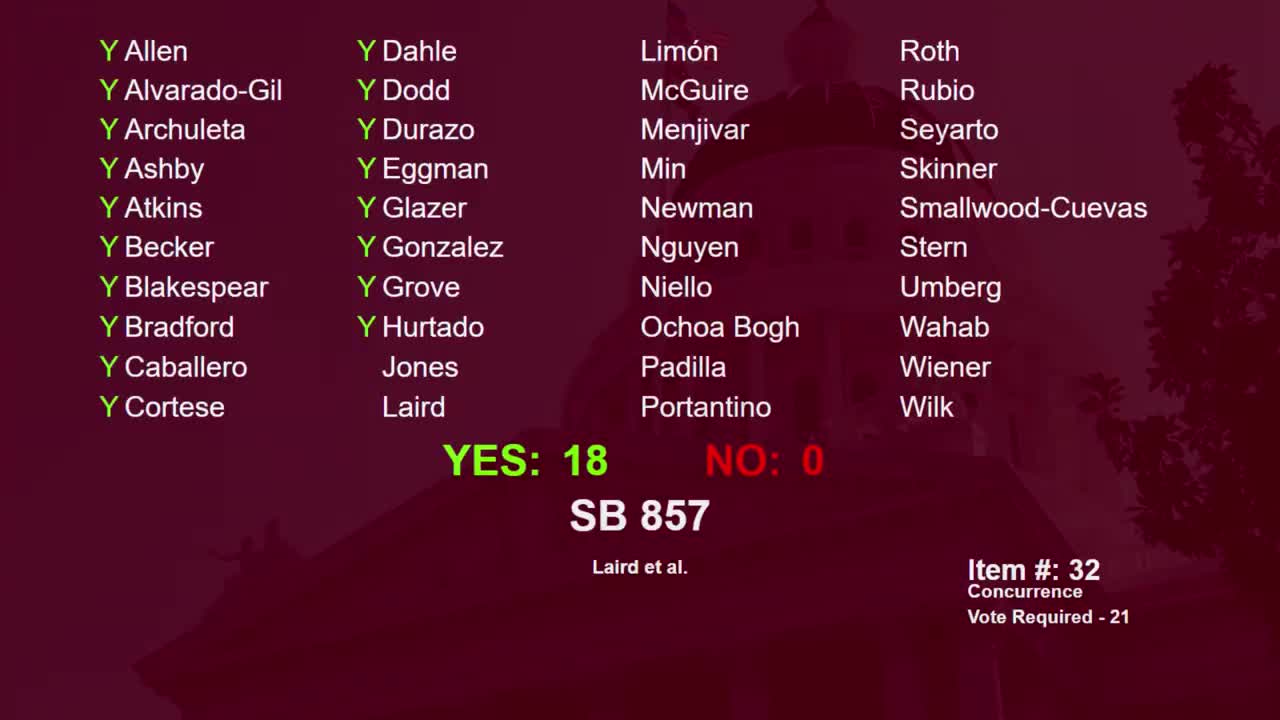 55SEC
Senate Floor
 1MIN
Assembly Floor
 24MIN
Senate Standing Committee on Transportation
Bill Author

Bill Co-Author(s):