SB 493: Air pollution: alternative vehicles and electric and hydrogen infrastructure.
- Session Year: 2023-2024
- House: Senate
- Latest Version Date: 2023-09-14
Current Status:
Failed
(2024-01-25: Veto sustained.)
Introduced
In Committee
First Chamber
In Committee
Second Chamber
Enacted
Existing law requires the State Energy Resources Conservation and Development Commission (Energy Commission) to undertake various actions in furtherance of meeting the states clean energy and pollution reduction objectives, including actions related to electric vehicles. Existing law requires the Energy Commission, in consultation with the State Air Resources Board (state board) and the Public Utilities Commission (PUC), to prepare a statewide assessment of fuel cell electric vehicle fueling infrastructure and fuel production needed to support the adoption of zero-emission trucks, buses, and off-road vehicles at levels necessary for the state to meet the goals and requirements of Executive Order No. N-79-20 and any state board regulatory action that requires or allows zero-emission vehicles in the heavy-duty vehicle and off-road sectors. Existing law also requires the Energy Commission, working with the state board and the PUC, to prepare a statewide assessment of the electric vehicle charging infrastructure needed to support the levels of electric vehicle adoption required for the state to meet its goals of putting at least 5,000,000 zero-emission vehicles on California roads by 2030, and of reducing emissions of greenhouse gases to 40% below 1990 levels by 2030.
This bill would require the assessment of the fuel cell electric vehicle fueling infrastructure and fuel production to additionally include an assessment of storage and transport facilities, and the assessment of the electric vehicle charging infrastructure to additionally include electric system infrastructure and electric generation. The bill would expand the scope of the latter assessment to include the electric vehicle charging infrastructure, electric system infrastructure, and electric generation needed for the state to meet the goals of Executive Order No. N-79-20 and any state board regulatory action that requires or allows zero-emission vehicles in the heavy-duty vehicle and off-road sectors. The bill would require both assessments to identify any barriers to the deployment of hydrogen infrastructure and any barriers to the deployment of electric infrastructure, respectively, for medium- and heavy-duty fleets and recommendations for addressing those barriers. The bill would require the Energy Commission to publish a determination regarding the adequacy of completed or planned charging or fueling sites for the 5 years following the completion of the initial statewide assessment and the findings of the electric vehicle charging infrastructure assessment, as provided. The bill would also require the Energy Commission to identify any charging or fueling site deficiencies and categorize those deficiencies by refueling speed and by type of facility, as either a public facility or a private facility. The bill would require the Energy Commission to update the electric vehicle charging infrastructure assessment and the determination at least once every 2 years.
The California Global Warming Solutions Act of 2006 designates the state board as the state agency charged with monitoring and regulating sources of emissions of greenhouse gases. Existing law requires the state board, at least every 5 years, as provided, in consultation with the Department of Transportation, the Energy Commission, and the Governors Office of Business and Economic Development and in collaboration with relevant stakeholders, to update the state boards 2016 mobile source strategy to include a comprehensive strategy for the deployment of medium-duty and heavy-duty vehicles in the state for the purpose of bringing the state into compliance with federal ambient air quality standards and reducing motor vehicle greenhouse gas emissions from the medium-duty and heavy-duty vehicle sector. Existing law requires the state board to recommend reasonable and achievable goals for reducing emissions from medium-duty and heavy-duty vehicles by 2030 and 2050, respectively, as part of the comprehensive strategy based on factors that include specified goals.
This bill would require those goals to include the goals established in Executive Order No. N-79-20 for the transition of medium- and heavy-duty fleets to zero-emission vehicles. The bill would also require the state boards updates to the mobile source strategy to include a strategic plan to meet the deadlines in Executive Order No. N-79-20 and would also require the state board, in developing the comprehensive strategy, to incorporate the findings of the above-described assessments.
Existing law requires the State Energy Resources Conservation and Development Commission (Energy Commission) to undertake various actions in furtherance of meeting the states clean energy and pollution reduction objectives, including actions related to electric vehicles. Existing law requires the Energy Commission, in consultation with the State Air Resources Board (state board) and the Public Utilities Commission (PUC), to prepare a statewide assessment of fuel cell electric vehicle fueling infrastructure and fuel production needed to support the adoption of zero-emission trucks, buses, and off-road vehicles at levels necessary for the state to meet the goals and requirements of Executive Order No. N-79-20 and any state board regulatory action that requires or allows zero-emission vehicles in the heavy-duty vehicle and off-road sectors. Existing law also requires the Energy Commission, working with the state board and the PUC, to prepare a statewide assessment of the electric vehicle charging infrastructure needed to support the levels of electric vehicle adoption required for the state to meet its goals of putting at least 5,000,000 zero-emission vehicles on California roads by 2030, and of reducing emissions of greenhouse gases to 40% below 1990 levels by 2030.
This bill would require the assessment of the fuel cell electric vehicle fueling infrastructure and fuel production to additionally include an assessment of storage and transport facilities, and the assessment of the electric vehicle charging infrastructure to additionally include electric system infrastructure and electric generation. The bill would expand the scope of the latter assessment to include the electric vehicle charging infrastructure, electric system infrastructure, and electric generation needed for the state to meet the goals of Executive Order No. N-79-20 and any state board regulatory action that requires or allows zero-emission vehicles in the heavy-duty vehicle and off-road sectors. The bill would require both assessments to identify any barriers to the deployment of hydrogen infrastructure and any barriers to the deployment of electric infrastructure, respectively, for medium- and heavy-duty fleets and recommendations for addressing those barriers. The bill would require the state board to incorporate the findings of the assessments into a strategic plan to meet the deadlines in Executive Order No. N-79-20 for the transition of medium- and heavy-duty fleets to zero-emission vehicles. The bill would require the state board to post the strategic plan on its internet website and submit the plan to the Legislature on or before December 31, 2026. The bill would require the Energy Commission to publish a determination regarding the adequacy of completed or planned charging or fueling sites for the 5 years following the completion of the initial statewide assessment and the findings of the electric vehicle charging infrastructure assessment, as provided. The bill would also require the Energy Commission to identify any charging or fueling site deficiencies and categorize those deficiencies by refueling speed and by type of facility, as either a public facility or a private facility. The bill would require the Energy Commission to update the electric vehicle charging infrastructure assessment and the determination at least once every 2 years.
The California Global Warming Solutions Act of 2006 designates the state board as the state agency charged with monitoring and regulating sources of emissions of greenhouse gases. Existing law requires the state board, at least every 5 years, as provided, in consultation with the Department of Transportation, the Energy Commission, and the Governors Office of Business and Economic Development and in collaboration with relevant stakeholders, to update the state boards 2016 mobile source strategy to include a comprehensive strategy for the deployment of medium-duty and heavy-duty vehicles in the state for the purpose of bringing the state into compliance with federal ambient air quality standards and reducing motor vehicle greenhouse gas emissions from the medium-duty and heavy-duty vehicle sector. Existing law requires the state board to recommend reasonable and achievable goals for reducing emissions from medium-duty and heavy-duty vehicles by 2030 and 2050, respectively, as part of the comprehensive strategy based on factors that include specified goals.
This bill would require those goals to include the goals established in Executive Order No. N-79-20 for the transition of medium- and heavy-duty fleets to zero-emission vehicles. The bill would also require the state boards updates to the mobile source strategy to include a strategic plan to meet the deadlines in Executive Order No. N-79-20 and would also require the state board, in developing the comprehensive strategy, to incorporate the findings of the above-described assessments.
Existing law requires the State Energy Resources Conservation and Development Commission (Energy Commission) to undertake various actions in furtherance of meeting the states clean energy and pollution reduction objectives, including actions related to electric vehicles. Existing law requires the Energy Commission, in consultation with the State Air Resources Board and the Public Utilities Commission (PUC), to prepare a statewide assessment of fuel cell electric vehicle fueling infrastructure and fuel production needed to support the adoption of zero-emission trucks, buses, and off-road vehicles at levels necessary for the state to meet the goals and requirements of Executive Order No. N-79-20 and any state board regulatory action that requires or allows zero-emission vehicles in the heavy-duty vehicle and off-road sectors. Existing law also requires the Energy Commission, working with the State Air Resources Board and the Public Utilities Commission (PUC), state board and the PUC, to prepare a statewide assessment of the electric vehicle charging infrastructure needed to support the levels of electric vehicle adoption required for the state to meet its goals of putting at least 5,000,000 zero-emission vehicles on California roads by 2030, and of reducing emissions of greenhouse gases to 40% below 1990 levels by 2030. Executive Order No. N-79-20 establishes a goal that 100% of in-state sales of new passenger cars and trucks be zero-emission by 2035.
This bill would require the Energy Commission, in consultation with the state board and the PUC, to conduct an assessment, as specified, of the electric and hydrogen infrastructure needed to meet the deadlines in Executive Order No. N-79-20 for the transition of medium- and heavy-duty vehicles to zero-emission vehicles. The bill would require the Energy Commission, on or before December 31, 2024, to post the assessment on its internet website and submit the assessment to the Legislature. the assessment of the fuel cell electric vehicle fueling infrastructure and fuel production to additionally include an assessment of storage and transport facilities, and the assessment of the electric vehicle charging infrastructure to additionally include electric system infrastructure and electric generation. The bill would expand the scope of the latter assessment to include the electric vehicle charging infrastructure, electric system infrastructure, and electric generation needed for the state to meet the goals of Executive Order No. N-79-20 and any state board regulatory action that requires or allows zero-emission vehicles in the heavy-duty vehicle and off-road sectors. The bill would require both assessments to identify any barriers to the deployment of hydrogen infrastructure and any barriers to the deployment of electric infrastructure, respectively, for medium- and heavy-duty fleets and recommendations for addressing those barriers. The bill would require the state board to incorporate the findings of the assessment assessments into a strategic plan to meet the deadlines in Executive Order No. N-79-20 for the transition of medium- and heavy-duty fleets to zero-emission vehicles. The bill would require the state board to post the strategic plan on its internet website and submit the plan to the Legislature on or before December 31, 2025. 2026.
Existing law requires the State Energy Resources Conservation and Development Commission (Energy Commission) to undertake various actions in furtherance of meeting the states clean energy and pollution reduction objectives, including actions related to electric vehicles. Existing law requires the Energy Commission, working with the State Air Resources Board and the Public Utilities Commission (PUC), to prepare a statewide assessment of the electric vehicle charging infrastructure needed to support the levels of electric vehicle adoption required for the state to meet its goals of putting at least 5,000,000 zero-emission vehicles on California roads by 2030, and of reducing emissions of greenhouse gases to 40% below 1990 levels by 2030. Executive Order No. N-79-20 establishes a goal that 100% of in-state sales of new passenger cars and trucks be zero-emission by 2035.
This bill would require the Energy Commission, in consultation with the state board and the PUC, to conduct an assessment, as specified, of the electric and hydrogen infrastructure needed to meet the deadlines in Executive Order No. N-79-20 for the transition of medium- and heavy-duty vehicles to zero-emission vehicles. The bill would require the Energy Commission, on or before December 31, 2024, to post the assessment on its internet website and submit the assessment to the Legislature. The bill would require the state board to incorporate the findings of the assessment into a strategic plan to meet the deadlines in Executive Order No. N-79-20 for the transition of medium- and heavy-duty fleets to zero-emission vehicles. The bill would require the state board to post the strategic plan on its internet website and submit the plan to the Legislature on or before December 31, 2025.
(a)(1)No later than January 1, 2021, and at least every five years thereafter, the state board, in consultation with the Department of Transportation, the State Energy Resources Conservation and Development Commission, and the Governors Office of Business and Economic Development and in collaboration with relevant stakeholders, shall update the state boards 2016 mobile source strategy to include a comprehensive strategy for the deployment of medium-duty and heavy-duty vehicles in the state for the purpose of bringing the state into compliance with federal ambient air quality standards and reducing motor vehicle greenhouse gas emissions from the medium-duty and heavy-duty vehicle sector. The state board shall recommend reasonable and achievable goals for reducing emissions from medium-duty and heavy-duty vehicles by 2030 and 2050, respectively, as part of the comprehensive strategy based on factors that include, but are not limited to, the states overarching emissions reduction goal established in Section 38566, the goals established in the California Sustainable Freight Action Plan completed in response to Executive Order No. B-32-15, technological feasibility, the goals established in Executive Order No. N-79-20 for the transition of medium- and heavy-duty fleets to zero-emission vehicles, and cost-effectiveness.
(2)The state boards updates to the mobile source strategy shall include all of the following:
(A)An identification of policies that provide advantages to fleets that reduce greenhouse gas emissions earlier than required by law.
(B)The coordination of plans for the attainment of federal ambient air quality standards with relevant greenhouse gas emissions reduction goals.
(C)A strategic plan to meet the deadlines in Executive Order No. N-79-20 for the transition of medium- and heavy-duty fleets to zero-emission vehicles.
(b)In developing the comprehensive strategy, the state board shall do all of the following:
(1)Seek to maximize the reduction of criteria air pollutants.
(2)Identify regulation that could improve market acceptance, spur technology advancements, reduce technology costs, and support the commercialization and deployment of medium-duty and heavy-duty vehicles that reduce emissions of greenhouse gases.
(3)Identify research needs to address any data gaps.
(4)Identify areas where the state should coordinate with other state agencies, districts, utilities providers, and technology providers to implement measures identified as part of the comprehensive strategy.
(5)Identify benefits to low-income communities and communities disproportionally impacted by diesel pollution.
(6)Identify policies that provide advantages to fleets that reduce greenhouse gas emissions early.
(7)Incorporate the findings of the assessments prepared pursuant to Section 43871 of this code and Section 25229 of the Public Resources Code.
(c)The state board, through a public process, may establish a process to identify medium-duty and heavy-duty vehicle segments that can more quickly reduce motor vehicle emissions, consistent with the state boards three-year heavy-duty vehicle investment strategy required pursuant to the California Clean Truck, Bus, and Off-Road Vehicle and Equipment Technology Program, established pursuant to Section 39719.2, with a beachhead market analysis.
(d)The state board shall submit the updated mobile source strategy to the relevant policy and fiscal committees of the Legislature.
SEC. 2.Section 43871 of the Health and Safety Code is amended to read:43871.(a)The State Energy Resources Conservation and Development Commission, in consultation with the state board and the Public Utilities Commission, shall prepare a statewide assessment of the fuel cell electric vehicle fueling infrastructure, fuel production, storage, and transport facilities needed to support the adoption of zero-emission trucks, buses, and off-road vehicles at levels necessary for the state to meet the goals and requirements of Executive Order No. N-79-20 and any state board regulatory action that requires or allows zero-emission vehicles in the heavy-duty vehicle and off-road sectors. The assessment shall complement and not duplicate the Joint Agency Staff Report on Assembly Bill 8: Annual Assessment of Time and Cost Needed to Attain 100 Hydrogen Refueling Stations in California.
(b)The statewide assessment shall consider all necessary fuel production and distribution infrastructure, including, but not limited to, dispensing equipment, distribution equipment, production equipment, storage equipment, storage and transport facilities, and supporting hardware and software, all heavy-duty and off-road vehicle categories, road, highway, and off-road electrification, port and airport electrification, and other programs to accelerate the adoption of fuel cell electric vehicles to meet the goals and requirements described in subdivision (a). The statewide assessment shall examine existing and future fuel production and distribution infrastructure needs throughout the state, including in low-income communities. The statewide assessment shall also list synergies and estimate the potential for hydrogen to contribute to emissions reductions across sectors, including, but not limited to, the truck, bus, off-road vehicle, locomotive, maritime, and aviation sectors. The statewide assessment shall take into consideration the process for creating hydrogen and include an evaluation of the ability of hydrogen to enable a more renewable grid, provide grid services, decarbonize hard-to-electrify industries and remote locations, contribute to microgrids, and improve energy resilience. The statewide assessment shall also identify any barriers to the deployment of hydrogen infrastructure for medium- and heavy-duty fleets and recommendations for addressing those barriers.
(c)The State Energy Resources Conservation and Development Commission shall regularly seek data and input relating to fuel cell electric vehicle fuel production and fueling infrastructure from the state board, the Public Utilities Commission, the Department of Food and Agriculture, the Governors Office of Business and Economic Development, and interested stakeholders, including, but not limited to, electrical corporations, gas corporations, local publicly owned electric utilities, state and local transportation and transit agencies, fueling infrastructure developers, fuel producers, environmental groups, fuel cell manufacturers, and hydrogen fuel cell vehicle manufacturers.
(d)The State Energy Resources Conservation and Development Commission shall complete the statewide assessment by December 31, 2023, and shall post the statewide assessment on its internet website. The commission shall update the statewide assessment at least once every three years and shall post the updated statewide assessment on its internet website.
(e)The statewide assessment prepared pursuant to this section does not constitute a directive instituting a mandate on state funding.
(f)This section does not limit the ability of the State Energy Resources Conservation and Development Commission to award funds related to any of the following on a competitive basis:
(1)Alternative and renewable fuel development, production, demonstration, and deployment projects.
(2)Alternative and renewable fuel infrastructure projects, including, but not limited to, fueling stations and equipment.
(3)Projects to develop and improve light-, medium-, and heavy-duty vehicle technologies, including zero-emission and near-zero emission vehicles and vehicle technologies.
(g)The State Energy Resources Conservation and Development Commission shall publish a determination regarding the adequacy of completed or planned charging or fueling sites for the five years following the completion of the initial statewide assessment prepared pursuant to subdivision (a) and the findings of the assessment prepared pursuant to Section 25229 of the Public Resources Code. The commission shall identify any charging or fueling site deficiencies and categorize those deficiencies by refueling speed and by type of facility, as either a public facility or a private facility.
(h)This section shall remain in effect only until January 1, 2030, and as of that date is repealed.
SEC. 3.Section 25229 of the Public Resources Code is amended to read:25229.(a)The commission, working with the State Air Resources Board and the Public Utilities Commission, shall prepare a statewide assessment of the electric vehicle charging infrastructure, electric system infrastructure, and electric generation needed to support the levels of electric vehicle adoption required for the state to meet its goals of putting at least five million zero-emission vehicles on California roads by 2030, and of reducing emissions of greenhouse gases to 40 percent below 1990 levels by 2030, and for the state to meet the goals and requirements of Executive Order No. N-79-20 and any state board regulatory action that requires or allows zero-emission vehicles in the heavy-duty vehicle and off-road sectors.
(b)The assessment shall expand on the commissions electric vehicle infrastructure projections to consider all necessary charging infrastructure, including, but not limited to, the chargers, make-ready electrical equipment, and supporting hardware and software, all vehicle categories, road, highway, and off-road electrification, port and airport electrification, and other programs to accelerate the adoption of electric vehicles to meet the goals described in subdivision (a). The assessment shall examine existing and future infrastructure needs throughout California, including in low-income communities. The statewide assessment shall also identify any barriers to the deployment of electric infrastructure for medium- and heavy-duty fleets and recommendations for addressing those barriers.
(c)As a part of the assessment, the commission, in consultation with stakeholders, shall identify workforce development and training resources needed to meet the goals described in subdivision (a). These resources shall include, but are not limited to, qualified apprenticeships, on-the-job training programs, and other training opportunities that build career pipelines in the zero-emission transportation sector and provide long-term employment in disadvantaged communities.
(d)The commission shall regularly seek data and input relating to electric vehicle charging infrastructure from stakeholders, including, but not limited to, the Public Utilities Commission, the State Air Resources Board, electrical corporations, local publicly owned electric utilities, state and local transportation and transit agencies, charging infrastructure companies, environmental groups, and automobile manufacturers.
(e)The commission shall update the statewide assessment prepared pursuant to subdivision (a) and the determination published pursuant to subdivision (g) of Section 43871 of the Health and Safety Code at least once every two years.
(a)(1)No later than January 1, 2021, and at least every five years thereafter, the state board, in consultation with the Department of Transportation, the State Energy Resources Conservation and Development Commission, and the Governors Office of Business and Economic Development and in collaboration with relevant stakeholders, shall update the state boards 2016 mobile source strategy to include a comprehensive strategy for the deployment of medium duty medium-duty and heavy-duty vehicles in the state for the purpose of bringing the state into compliance with federal ambient air quality standards and reducing motor vehicle greenhouse gas emissions from the medium duty medium-duty and heavy-duty vehicle sector. The state board shall recommend reasonable and achievable goals for reducing emissions from medium duty medium-duty and heavy-duty vehicles by 2030 and 2050, respectively, as part of the comprehensive strategy based on factors that include, but are not limited to, the states overarching emissions reduction goal established in Section 38566, the goals established in the California Sustainable Freight Action Plan completed in response to Executive Order No. B-32-15, technological feasibility, the goals established in Executive Order No. N-79-20 for the transition of medium- and heavy-duty fleets to zero-emission vehicles, and cost-effectiveness.
(2)The state boards updates to the mobile source strategy shall include both all of the following:
(A)An identification of policies that provide advantages to fleets that reduce greenhouse gas emissions earlier than required by law.
(B)The coordination of plans for the attainment of federal ambient air quality standards with relevant greenhouse gas emissions reduction goals.
(C)A strategic plan to meet the deadlines in Executive Order No. N-79-20 for the transition of medium- and heavy-duty fleets to zero-emission vehicles.
(b)In developing the comprehensive strategy, the state board shall do all of the following:
(1)Seek to maximize the reduction of criteria air pollutants.
(2)Identify regulation that could improve market acceptance, spur technology advancements, reduce technology costs, and support the commercialization and deployment of medium duty medium-duty and heavy-duty vehicles that reduce emissions of greenhouse gases.
(3)Identify research needs to address any data gaps.
(4)Identify areas where the state should coordinate with other state agencies, districts, utilities providers, and technology providers to implement measures identified as part of the comprehensive strategy.
(5)Identify benefits to low-income communities and communities disproportionally impacted by diesel pollution.
(6)Identify policies that provide advantages to fleets that reduce greenhouse gas emissions early.
(7)Incorporate the findings of the assessments prepared pursuant to Section 43871 of this code and Section 25229 of the Public Resources Code.
(c)The state board, through a public process, may establish a process to identify medium duty medium-duty and heavy-duty vehicle segments that can more quickly reduce motor vehicle emissions, consistent with the state boards three-year heavy-duty vehicle investment strategy required pursuant to the California Clean Truck, Bus, and Off-Road Vehicle and Equipment Technology Program, established pursuant to Section 39719.2, with a beachhead market analysis.
(d)The state board shall submit the updated mobile source strategy to the relevant policy and fiscal committees of the Legislature.
SECTION 1.SEC. 2.Section 43871 of the Health and Safety Code is amended to read:43871.(a)The State Energy Resources Conservation and Development Commission, in consultation with the state board and the Public Utilities Commission, shall prepare a statewide assessment of the fuel cell electric vehicle fueling infrastructure, fuel production, storage, and transport facilities needed to support the adoption of zero-emission trucks, buses, and off-road vehicles at levels necessary for the state to meet the goals and requirements of Executive Order No. N-79-20 and any state board regulatory action that requires or allows zero-emission vehicles in the heavy-duty vehicle and off-road sectors. The assessment shall complement and not duplicate the Joint Agency Staff Report on Assembly Bill 8: Annual Assessment of Time and Cost Needed to Attain 100 Hydrogen Refueling Stations in California.
(b)The statewide assessment shall consider all necessary fuel production and distribution infrastructure, including, but not limited to, dispensing equipment, distribution equipment, production equipment, storage equipment, storage and transport facilities, and supporting hardware and software, all heavy-duty and off-road vehicle categories, road, highway, and off-road electrification, port and airport electrification, and other programs to accelerate the adoption of fuel cell electric vehicles to meet the goals and requirements described in subdivision (a). The statewide assessment shall examine existing and future fuel production and distribution infrastructure needs throughout the state, including in low-income communities. The statewide assessment shall also list synergies and estimate the potential for hydrogen to contribute to emissions reductions across sectors, including, but not limited to, the truck, bus, off-road vehicle, locomotive, maritime, and aviation sectors. The statewide assessment shall take into consideration the process for creating hydrogen and include an evaluation of the ability of hydrogen to enable a more renewable grid, provide grid services, decarbonize hard-to-electrify industries and remote locations, contribute to microgrids, and improve energy resilience. The statewide assessment shall also identify any barriers to the deployment of hydrogen infrastructure for medium- and heavy-duty fleets and recommendations for addressing those barriers.
(c)The State Energy Resources Conservation and Development Commission shall regularly seek data and input relating to fuel cell electric vehicle fuel production and fueling infrastructure from the state board, the Public Utilities Commission, the Department of Food and Agriculture, the Governors Office of Business and Economic Development, and interested stakeholders, including, but not limited to, electrical corporations, gas corporations, local publicly owned electric utilities, state and local transportation and transit agencies, fueling infrastructure developers, fuel producers, environmental groups, fuel cell manufacturers, and hydrogen fuel cell vehicle manufacturers.
(d)The State Energy Resources Conservation and Development Commission shall complete the statewide assessment by December 31, 2023, and shall post the statewide assessment on its internet website. The commission shall update the statewide assessment at least once every three years and shall post the updated statewide assessment on its internet website.
(e)The statewide assessment prepared pursuant to this section does not constitute a directive instituting a mandate on state funding.
(f)This section does not limit the ability of the State Energy Resources Conservation and Development Commission to award funds related to any of the following on a competitive basis:
(1)Alternative and renewable fuel development, production, demonstration, and deployment projects.
(2)Alternative and renewable fuel infrastructure projects, including, but not limited to, fueling stations and equipment.
(3)Projects to develop and improve light-, medium-, and heavy-duty vehicle technologies, including zero-emission and near-zero emission vehicles and vehicle technologies.
(g)(1)The state board shall incorporate the findings of the assessment prepared pursuant to this section and the findings of the assessment prepared pursuant to Section 25229 of the Public Resources Code into a strategic plan to meet the deadlines in Executive Order No. N-79-20 for the transition of medium- and heavy-duty fleets to zero-emissions vehicles.(2)On or before December 31, 2026, the state board shall post the strategic plan described in paragraph (1) on its internet website and submit the plan to the Legislature in compliance with Section 9795 of the Government Code.(g)The State Energy Resources Conservation and Development Commission shall publish a determination regarding the adequacy of completed or planned charging or fueling sites for the five years following the completion of the initial statewide assessment prepared pursuant to subdivision (a) and the findings of the assessment prepared pursuant to Section 25229 of the Public Resources Code. The commission shall identify any charging or fueling site deficiencies and categorize those deficiencies by refueling speed and by type of facility, as either a public facility or a private facility.
(h)This section shall remain in effect only until January 1, 2030, and as of that date is repealed.
SEC. 2.SEC. 3.Section 25229 of the Public Resources Code is amended to read:25229.(a)The commission, working with the State Air Resources Board and the Public Utilities Commission, shall prepare a statewide assessment of the electric vehicle charging infrastructure, electric system infrastructure, and electric generation needed to support the levels of electric vehicle adoption required for the state to meet its goals of putting at least five million zero-emission vehicles on California roads by 2030, and of reducing emissions of greenhouse gases to 40 percent below 1990 levels by 2030, and for the state to meet the goals and requirements of Executive Order No. N-79-20 and any state board regulatory action that requires or allows zero-emission vehicles in the heavy-duty vehicle and off-road sectors.
(b)The assessment shall expand on the commissions electric vehicle infrastructure projections to consider all necessary charging infrastructure, including, but not limited to, the chargers, make-ready electrical equipment, and supporting hardware and software, all vehicle categories, road, highway, and offroad off-road electrification, port and airport electrification, and other programs to accelerate the adoption of electric vehicles to meet the goals described in subdivision (a). The assessment shall examine existing and future infrastructure needs throughout California, including in low-income communities. The statewide assessment shall also identify any barriers to the deployment of electric infrastructure for medium- and heavy-duty fleets and recommendations for addressing those barriers.
(c)As a part of the assessment, the commission, in consultation with stakeholders, shall identify workforce development and training resources needed to meet the goals described in subdivision (a). These resources shall include, but are not limited to, qualified apprenticeships, on-the-job training programs, and other training opportunities that build career pipelines in the zero-emission transportation sector and provide long-term employment in disadvantaged communities.
(d)The commission shall regularly seek data and input relating to electric vehicle charging infrastructure from stakeholders, including, but not limited to, the Public Utilities Commission, the State Air Resources Board, electrical corporations, local publicly owned electric utilities, state and local transportation and transit agencies, charging infrastructure companies, environmental groups, and automobile manufacturers.
(e)(1)The state board shall incorporate the findings of the assessment prepared pursuant to this section and the findings of the assessment prepared pursuant to Section 43871 of the Health and Safety Code into a strategic plan to meet the deadlines in Executive Order No. N-79-20 for the transition of medium- and heavy-duty fleets to zero-emissions vehicles.(2)On or before December 31, 2026, the state board shall post the strategic plan described in paragraph (1) on its internet website and submit the plan to the Legislature in compliance with Section 9795 of the Government Code.(f)(e)The commission shall update the assessment statewide assessment prepared pursuant to subdivision (a) and the determination published pursuant to subdivision (g) of Section 43871 of the Health and Safety Code at least once every two years.
REVISIONS: HeadingLines 2 and 3.(a)The State Energy Resources Conservation and Development Commission, in consultation with the state board and the Public Utilities Commission, shall prepare a statewide assessment of the fuel cell electric vehicle fueling infrastructure and fuel production infrastructure, fuel production, storage, and transport facilities needed to support the adoption of zero-emission trucks, buses, and off-road vehicles at levels necessary for the state to meet the goals and requirements of Executive Order No. N-79-20 and any state board regulatory action that requires or allows zero-emission vehicles in the heavy-duty vehicle and off-road sectors. The assessment shall complement and not duplicate the Joint Agency Staff Report on Assembly Bill 8: Annual Assessment of Time and Cost Needed to Attain 100 Hydrogen Refueling Stations in California.
(b)The statewide assessment shall consider all necessary fuel production and distribution infrastructure, including, but not limited to, dispensing equipment, distribution equipment, production equipment, storage equipment, storage and transport facilities, and supporting hardware and software, all heavy-duty and off-road vehicle categories, road, highway, and off-road electrification, port and airport electrification, and other programs to accelerate the adoption of fuel cell electric vehicles to meet the goals and requirements described in subdivision (a). The statewide assessment shall examine existing and future fuel production and distribution infrastructure needs throughout the state, including in low-income communities. The statewide assessment shall also list synergies and estimate the potential for hydrogen to contribute to emissions reductions across sectors, including, but not limited to, the truck, bus, off-road vehicle, locomotive, maritime, and aviation sectors. The statewide assessment shall take into consideration the process for creating hydrogen and include an evaluation of the ability of hydrogen to enable a more renewable grid, provide grid services, decarbonize hard-to-electrify industries and remote locations, contribute to microgrids, and improve energy resilience. The statewide assessment shall also identify any barriers to the deployment of hydrogen infrastructure for medium- and heavy-duty fleets and recommendations for addressing those barriers.
(c)The State Energy Resources Conservation and Development Commission shall regularly seek data and input relating to fuel cell electric vehicle fuel production and fueling infrastructure from the state board, the Public Utilities Commission, the Department of Food and Agriculture, the Governors Office of Business and Economic Development, and interested stakeholders, including, but not limited to, electrical corporations, gas corporations, local publicly owned electric utilities, state and local transportation and transit agencies, fueling infrastructure developers, fuel producers, environmental groups, fuel cell manufacturers, and hydrogen fuel cell vehicle manufacturers.
(d)The State Energy Resources Conservation and Development Commission shall complete the statewide assessment by December 31, 2023, and shall post the statewide assessment on its internet website. The commission shall update the statewide assessment at least once every three years and shall post the updated statewide assessment on its internet website.
(e)The statewide assessment prepared pursuant to this section does not constitute a directive instituting a mandate on state funding.
(f)This section does not limit the ability of the State Energy Resources Conservation and Development Commission to award funds related to any of the following on a competitive basis:
(1)Alternative and renewable fuel development, production, demonstration, and deployment projects.
(2)Alternative and renewable fuel infrastructure projects, including, but not limited to, fueling stations and equipment.
(3)Projects to develop and improve light-, medium-, and heavy-duty vehicle technologies, including zero-emission and near-zero emission vehicles and vehicle technologies.
(g)(1)The state board shall incorporate the findings of the assessment prepared pursuant to this section and the findings of the assessment prepared pursuant to Section 25229 of the Public Resources Code into a strategic plan to meet the deadlines in Executive Order No. N-79-20 for the transition of medium- and heavy-duty fleets to zero-emissions vehicles.
(2)On or before December 31, 2026, the state board shall post the strategic plan described in paragraph (1) on its internet website and submit the plan to the Legislature in compliance with Section 9795 of the Government Code.
(g)(h)This section shall remain in effect only until January 1, 2030, and as of that date is repealed.
SEC. 2.Section 25229 of the Public Resources Code is amended to read:25229.(a)The commission, working with the State Air Resources Board and the Public Utilities Commission, shall prepare a statewide assessment of the electric vehicle charging infrastructure infrastructure, electric system infrastructure, and electric generation needed to support the levels of electric vehicle adoption required for the state to meet its goals of putting at least five million zero-emission vehicles on California roads by 2030, and of reducing emissions of greenhouse gases to 40 percent below 1990 levels by 2030. 2030, and for the state to meet the goals and requirements of Executive Order No. N-79-20 and any state board regulatory action that requires or allows zero-emission vehicles in the heavy-duty vehicle and off-road sectors.
(b)The assessment shall expand on the commissions electric vehicle infrastructure projections to consider all necessary charging infrastructure, including, but not limited to, the chargers, make-ready electrical equipment, and supporting hardware and software, all vehicle categories, road, highway, and offroad electrification, port and airport electrification, and other programs to accelerate the adoption of electric vehicles to meet the goals described in subdivision (a). The assessment shall examine existing and future infrastructure needs throughout California, including in low-income communities. The statewide assessment shall also identify any barriers to the deployment of electric infrastructure for medium- and heavy-duty fleets and recommendations for addressing those barriers.
(c)As a part of the assessment, the commission, in consultation with stakeholders, shall identify workforce development and training resources needed to meet the goals described in subdivision (a). These resources shall include, but are not limited to, qualified apprenticeships, on-the-job training programs, and other training opportunities that build career pipelines in the zero-emission transportation sector and provide long-term employment in disadvantaged communities.
(d)The commission shall regularly seek data and input relating to electric vehicle charging infrastructure from stakeholders, including, but not limited to, the Public Utilities Commission, the State Air Resources Board, electrical corporations, local publicly owned electric utilities, state and local transportation and transit agencies, charging infrastructure companies, environmental groups, and automobile manufacturers.
(e)(1)The state board shall incorporate the findings of the assessment prepared pursuant to this section and the findings of the assessment prepared pursuant to Section 43871 of the Health and Safety Code into a strategic plan to meet the deadlines in Executive Order No. N-79-20 for the transition of medium- and heavy-duty fleets to zero-emissions vehicles.
(2)On or before December 31, 2026, the state board shall post the strategic plan described in paragraph (1) on its internet website and submit the plan to the Legislature in compliance with Section 9795 of the Government Code.
(e)(f)The commission shall update the assessment at least once every two years.
SECTION 1.Section 25229.1 is added to the Public Resources Code, to read:25229.1.(a)(1)The commission, in consultation with the state board and the Public Utilities Commission, shall conduct an assessment of the electric and hydrogen infrastructure needed to meet the deadlines in Executive Order No. N-79-20 for the transition of medium- and heavy-duty vehicles to zero-emission vehicles. This assessment shall include, but is not limited to, analyses of each of the following:(A)The hydrogen production, storage, and transport facilities needed to support medium- and heavy-duty fleet transitions to zero-emission hydrogen vehicles.(B)The electric vehicle infrastructure, electric system infrastructure, and electric generation needed to support medium- and heavy-duty fleet transitions to zero-emission battery electric vehicles.(C)Barriers to the deployment of electric and hydrogen infrastructure for medium- and heavy-duty fleets and recommendations for addressing these barriers.(2)On or before December 31, 2024, the commission shall post the assessment described in paragraph (1) on its internet website and submit the assessment to the Legislature in compliance with Section 9795 of the Government Code.(b)(1)The state board shall incorporate the findings of the assessment prepared pursuant to subdivision (a) into a strategic plan to meet the deadlines in Executive Order No. N-79-20 for the transition of medium- and heavy-duty fleets to zero-emission vehicles.(2)On or before December 31, 2025, the state board shall post the strategic plan described in paragraph (1) on its internet website and submit the plan to the Legislature in compliance with Section 9795 of the Government Code.(c)This section shall remain in effect only until January 1, 2026, and as of that date is repealed.(a)(1)The commission, in consultation with the state board and the Public Utilities Commission, shall conduct an assessment of the electric and hydrogen infrastructure needed to meet the deadlines in Executive Order No. N-79-20 for the transition of medium- and heavy-duty vehicles to zero-emission vehicles. This assessment shall include, but is not limited to, analyses of each of the following:
(A)The hydrogen production, storage, and transport facilities needed to support medium- and heavy-duty fleet transitions to zero-emission hydrogen vehicles.
(B)The electric vehicle infrastructure, electric system infrastructure, and electric generation needed to support medium- and heavy-duty fleet transitions to zero-emission battery electric vehicles.
(C)Barriers to the deployment of electric and hydrogen infrastructure for medium- and heavy-duty fleets and recommendations for addressing these barriers.
(2)On or before December 31, 2024, the commission shall post the assessment described in paragraph (1) on its internet website and submit the assessment to the Legislature in compliance with Section 9795 of the Government Code.
(b)(1)The state board shall incorporate the findings of the assessment prepared pursuant to subdivision (a) into a strategic plan to meet the deadlines in Executive Order No. N-79-20 for the transition of medium- and heavy-duty fleets to zero-emission vehicles.
(2)On or before December 31, 2025, the state board shall post the strategic plan described in paragraph (1) on its internet website and submit the plan to the Legislature in compliance with Section 9795 of the Government Code.
(c)This section shall remain in effect only until January 1, 2026, and as of that date is repealed.
|
Date
|
Status
|
|---|---|
| Jan 25, 2024 | Veto sustained. |
| Jan 25, 2024 | Stricken from file. |
| Sep 30, 2023 | In Senate. Consideration of Governor's veto pending. |
| Sep 30, 2023 | Vetoed by the Governor. |
| Sep 20, 2023 | Enrolled and presented to the Governor at 4:30 p.m. |
| Sep 12, 2023 | Assembly amendments concurred in. (Ayes 39. Noes 0. Page 2676.) Ordered to engrossing and enrolling. |
| Sep 11, 2023 | In Senate. Concurrence in Assembly amendments pending. |
| Sep 11, 2023 | Read third time. Passed. (Ayes 80. Noes 0. Page 3159.) Ordered to the Senate. |
| Sep 5, 2023 | Read second time. Ordered to third reading. |
| Sep 1, 2023 | From committee: Do pass. (Ayes 16. Noes 0.) (September 1). |
| Aug 23, 2023 | August 23 set for first hearing. Placed on suspense file. |
| Jul 13, 2023 | From committee: Do pass and re-refer to Com. on APPR. with recommendation: To consent calendar. (Ayes 14. Noes 0.) (July 12). Re-referred to Com. on APPR. |
| Jul 6, 2023 | From committee: Do pass and re-refer to Com. on U. & E. with recommendation: To consent calendar. (Ayes 15. Noes 0.) (July 5). Re-referred to Com. on U. & E. |
| Jul 6, 2023 | Coauthors revised. |
| Jun 19, 2023 | From committee with author's amendments. Read second time and amended. Re-referred to Com. on TRANS. |
| Jun 8, 2023 | Referred to Coms. on TRANS. and U. & E. |
| May 26, 2023 | In Assembly. Read first time. Held at Desk. |
| May 26, 2023 | Read third time. Passed. (Ayes 36. Noes 0. Page 1326.) Ordered to the Assembly. |
| May 18, 2023 | Read second time. Ordered to third reading. |
| May 18, 2023 | From committee: Do pass. (Ayes 7. Noes 0. Page 1172.) (May 18). |
| May 12, 2023 | Set for hearing May 18. |
| May 1, 2023 | May 1 hearing: Placed on APPR suspense file. |
| Apr 25, 2023 | Set for hearing May 1. |
| Apr 24, 2023 | Read second time and amended. Re-referred to Com. on APPR. |
| Apr 20, 2023 | From committee: Do pass as amended and re-refer to Com. on APPR with recommendation: To consent calendar. (Ayes 7. Noes 0. Page 794.) (April 19). |
| Mar 27, 2023 | Set for hearing April 19. |
| Mar 21, 2023 | From committee: Do pass and re-refer to Com. on E.Q. (Ayes 17. Noes 0. Page 425.) (March 21). Re-referred to Com. on E.Q. |
| Mar 13, 2023 | Set for hearing March 21. |
| Feb 22, 2023 | Referred to Coms. on E., U. & C. and E.Q. |
| Feb 15, 2023 | From printer. May be acted upon on or after March 17. |
| Feb 14, 2023 | Introduced. Read first time. To Com. on RLS. for assignment. To print. |
|
Date
|
Description
|
Location
|
Votes
|
|
|---|---|---|---|---|
| Sep 12, 2023 | Unfinished Business SB493 Min et al. Concurrence | Senate Floor |
Passed |
|
| Sep 11, 2023 | SB 493 Min Senate Third Reading By Alvarez | Assembly Floor |
Passed |
|
| Sep 1, 2023 | Do pass. | Assembly Standing Committee on Appropriations |
Passed |
|
| Jul 12, 2023 | Do pass and be re-referred to the Committee on [Appropriations] with recommendation: To Consent Calendar | Assembly Standing Committee on Utilities and Energy |
Passed |
|
| Jul 5, 2023 | Favorable With Committee Substitute (Post-Secondary Education Subcommittee) | Assembly Standing Committee on Transportation |
Passed |
|
| May 26, 2023 | Senate 3rd Reading SB493 Min | Senate Floor |
Passed |
|
| May 18, 2023 | Do pass | Senate Standing Committee on Appropriations |
Passed |
|
| May 1, 2023 | Placed on suspense file | Senate Standing Committee on Appropriations |
Passed |
|
| Apr 19, 2023 | Do pass as amended, but first amend, and re-refer to the Committee on [Appropriations] with the recommendation: To Consent Calendar | Senate Standing Committee on Environmental Quality |
Passed |
|
| Mar 21, 2023 | Do pass, but first be re-referred to the Committee on [Environmental Quality] | Senate Standing Committee on Energy, Utilities and Communications |
Passed |
This list shows positions taken on this bill by organizations on the date displayed, which is linked to the original source.
Positions by individuals are not included.
|
Organization
|
Position
|
Date
|
|---|---|---|
| Association Of California Water Agencies | ** Support | |
| California Special Districts Association | ** Support | |
| California Trucking Association | ** Support | |
| Climate Action California | ** Support | |
| Palmdale Water District | ** Support | |
| Port Of Oakland | ** Support |
SENATE RULES COMMITTEE Office of Senate Floor Analyses (916) 651-1520 Fax: (916) 327-4478 | SB 493 |
VETO
Bill No: SB 493
Author: Min (D), et al.
Amended: 6/19/23
Vote: 27
SENATE ENERGY, U. & C. COMMITTEE: 17-0, 3/21/23
AYES: Bradford, Dahle, Ashby, Becker, Caballero, Dodd, Durazo, Eggman, Gonzalez, Grove, McGuire, Min, Newman, Rubio, Seyarto, Skinner, Wilk
NO VOTE RECORDED: Stern
SENATE ENVIRONMENTAL QUALITY COMMITTEE: 7-0, 4/19/23
AYES: Allen, Dahle, Gonzalez, Limón, Menjivar, Nguyen, Skinner
SENATE APPROPRIATIONS COMMITTEE: 7-0, 5/18/23
AYES: Portantino, Jones, Ashby, Bradford, Seyarto, Wahab, Wiener
SENATE FLOOR: 36-0, 5/26/23
AYES: Allen, Archuleta, Ashby, Atkins, Becker, Blakespear, Bradford, Cortese, Dahle, Dodd, Durazo, Eggman, Glazer, Gonzalez, Grove, Hurtado, Jones, Laird, Limón, McGuire, Menjivar, Min, Newman, Nguyen, Niello, Ochoa Bogh, Padilla, Portantino, Roth, Seyarto, Skinner, Smallwood-Cuevas, Umberg, Wahab, Wiener, Wilk
NO VOTE RECORDED: Alvarado-Gil, Caballero, Rubio, Stern
SENATE FLOOR: 39-0, 9/12/23
AYES: Allen, Alvarado-Gil, Archuleta, Ashby, Atkins, Becker, Blakespear, Bradford, Cortese, Dahle, Dodd, Durazo, Eggman, Glazer, Gonzalez, Grove, Hurtado, Jones, Laird, Limón, McGuire, Menjivar, Min, Newman, Nguyen, Niello, Ochoa Bogh, Padilla, Portantino, Roth, Rubio, Seyarto, Skinner, Smallwood-Cuevas, Stern, Umberg, Wahab, Wiener, Wilk
NO VOTE RECORDED: Caballero
ASSEMBLY FLOOR: 80-0, 9/11/23 - See last page for vote
SUBJECT: Air pollution: alternative vehicles and electric and hydrogen infrastructure
SOURCE: Author
DIGEST:
This bill requires the California Energy Commission (CEC) to assess the energy resources needed to meet state goals to transition medium- and heavy-duty vehicles to zero-emission vehicles (ZEVs), and it requires the California Air Resources Board (CARB) to incorporate the CEC’s assessments and a strategic plan for this transition into CARB’s existing mobile source strategy.
ANALYSIS:
Existing law:
- Requires CARB to update its mobile source strategy every five years to achieve certain emissions reduction goals from the medium and heavy-duty transportation sector. Specifies that CARB’s mobile source strategy must identify policies to help accelerate emissions reductions from fleets and coordinate plans to achieve air quality goals. Specifies certain actions CARB must take to develop its mobile source strategy, including requiring CARB to identify areas where the state should coordinate with other agencies, districts, utilities, and technology providers to implement portions of the mobile source strategy. (Health and Safety Code §43024.2)
- Requires the CEC to conduct a statewide assessment every two years of electric vehicle (EV) charging infrastructure needed to support the levels of EV adoption required for the state to meet its goals of putting at least five million ZEVs on California roads by 2030, and of reducing emissions of greenhouse gases (GHG) to 40 percent below 1990 levels by 2030. (Public Resources Code §25229)
- Requires the CEC to gather specified information about the deployment of ZEV fleets subject to CARB regulations to enable electric utilities to estimate increased electrical loads resulting from fleet transitions to ZEVs. (Public Resources Code §25328)
- Requires the California Public Utilities Commission (CPUC) to direct investor-owned utilities (IOUs) to file applications for investments to accelerate transportation electrification, reduce reliance on petroleum, and meet certain climate goals. The CPUC may approve or amend applications for transportation electrification investments. IOUs are authorized to recover reasonable costs for approved investments from ratepayers if they are consistent with certain requirements. (Public Utilities Code §740.12(b))
- Requires the CPUC to review data related to current and future transportation electrification adoption and charging infrastructure prior to allowing an IOU to collect new program costs from ratepayers. (Public Utilities Code §740.12(c))
- Requires each publicly owned utility (POU) with an annual electrical demand exceeding 700 gigawatt hours to adopt an integrated resources plans (IRP) that helps ensure that the POU will meet climate goals for the electricity sector. An IRP must be updated at least once every five years and must address procurement plans for the following:
- Energy efficiency and demand response resources,
- Energy storage requirements,
- Transportation electrification,
- A diversified energy resource procurement portfolio, and
- Resource adequacy requirements. (Public Utilities Code §9621)
- Requires the CPUC to establish EV-grid integration strategies for certain load-serving entities (LSEs). POUs must consider EV-grid integration strategies in their IRPs, and community choice aggregators (CCA) must report specified information to the CPUC regarding EV-grid integration activities. (Public Utilities Code §740.16)
This bill:
- Requires the CEC to consult with CARB and the CPUC to assess the energy sector resources needed to meet specified state goals for transitioning medium- and heavy-duty vehicles to ZEVs. Requires these assessments to be included in existing assessments regarding the EV and hydrogen infrastructure needed to support state ZEV deployment goals. Specifies that these assessments must address the following:
- Hydrogen production, storage, and transport facilities needed to support the transition of medium- and heavy-duty fleets to ZEVs.
- Electric system infrastructure and electric generation needed to support the transition of medium- and heavy-duty vehicles to ZEVs.
- Barriers to the deployment of electric and hydrogen infrastructure for medium- and heavy-duty fleets and recommendations for addressing these barriers.
- Requires CARB to incorporate findings from the CEC’s assessments and develop a strategic plan for medium and heavy-duty fleet ZEV transition as part of future updates to CARB’s mobile source strategy.
- Requires the CEC to determine the adequacy of completed and planned ZEV refueling and charging infrastructure and identify any charging or fueling site deficiencies and categorize those deficiencies by refueling speed and by type of facility, as either a public facility or a private facility.
Background
Recent decisions have accelerated the timeline for transitioning to ZEVs. While prior legislation codified the goal of putting at least five million ZEVs on California roads by 2030, recent administrative decisions have expanded the scope and timeline of the state’s ZEV transition. Executive Order N-79-20 established a goal that 100 percent of in-state sales of new passenger cars and trucks will be zero-emission by 2035. This executive order also established a goal that 100 percent of medium- and heavy-duty vehicles in the state will be zero-emission by 2045. In response to this executive order, CARB has adopted regulations aimed at phasing out the sale of petroleum-fueled vehicles. CARB has adopted the Advanced Clean Cars regulations to address light-duty vehicle transition requirements and is in the process of developing an Advanced Clean Fleets rule for medium- and heavy-duty fleet transition.
Both electric and hydrogen vehicles rely on energy sector resources. While battery electric vehicles dominate the light-duty ZEV market, a significant number of medium- and heavy-duty manufacturers plan to transition fleets to hydrogen fuel cell vehicles. To support the accelerated deployment of both battery electric vehicles and hydrogen fuel cell vehicles, the state must substantially accelerate the deployment of charging and refueling infrastructure to support these vehicles. The CEC has estimated that the state will need at least 1.2 million EV chargers by 2030 to transition light-duty passenger vehicles to EVs, and the CEC estimated that the state will need at least 157,000 fast chargers to meet the 2030 benchmarks for transitioning medium- and heavy-duty vehicles. The CEC’s assessments of the infrastructure needed to support the ZEV transition acknowledges that ZEV deployment will increase electric load, particularly in the electric service territories for Pacific Gas and Electric and Southern California Edison.
Medium- and heavy-duty EVs and hydrogen vehicles require a significant amount of electricity resources. Medium- and heavy-duty EVs have large batteries that require a substantial amount of electricity to charge. Charging these large batteries can take extended periods-of-time. Large fleets can require several megawatts to operate a single truck charging depot. Hydrogen fuel cell trucks can refuel more quickly than EVs; however, they require hydrogen to be transported and stored for refueling. Electrolyzers require a substantial amount of electricity to produce this hydrogen at market scale.
Transitioning medium- and heavy-duty fleets poses particular challenges for the energy sector. A substantial amount of the potential emissions reductions from the transition to ZEVs rely on the energy sector’s achievement of its own emissions reduction goals. Medium- and heavy-duty vehicles are a significant source of California’s emissions, and transitioning these vehicles to ZEVs could produce substantial GHG emissions reductions. Despite this potential, some stakeholders have expressed concerns that the underlying assumptions used in existing plans for the medium- and heavy-duty ZEV transition do not fully address the barriers to planning energy sector resources for this transition. These stakeholders argue that existing plans are not sufficiently detailed to address the specific challenges associated with electrifying or deploying hydrogen infrastructure to actually make medium- and heavy-duty fleet transitions achievable within CARB’s timelines.
Deployment of higher voltage chargers and increased production of hydrogen relies in part on upgrades to the local utility distribution system and the creation of additional electric capacity. Some of these utility resources may require substantial advance planning, local engagement, CPUC approval, and permitting. In the event that these utility resources are not planned sufficiently far in advance of CARB’s ZEV transition deadline, fleets may not be able to comply with CARB rules in a timely manner.
This bill emphasizes the need for better coordination between ZEV goals and energy sector planning. Prior legislation (AB 2700, McCarty, Chapter 354, Statutes of 2022) required the CEC to gather and report fleet data needed to support utilities’ plans for grid reliability and enhanced vehicle electrification. While AB 2700 ensures that utilities gain information about electric fleet deployment, it is unclear if state agencies planning the ZEV transition are using assumptions that account for the electric generation, distribution, and transmission resources needed to ensure that ZEV fleets have sufficient infrastructure and capacity for refueling and re-charging. Vehicle-grid integration strategies may be able to mitigate certain grid strains; however, these strategies cannot completely address the demands placed on the energy sector from the charging and refueling needs of all fleets.
Related/Prior Legislation
SB 507 (Gonzalez, 2023) would have expanded information the CEC must include in existing EV infrastructure assessments. The bill also codifies certain ZEV deployment goals contained in Executive Order No. N-79-20. The bill was held in the Senate Appropriations Committee.
AB 2700 (McCarty, Chapter 354, Statutes of 2022) required the CEC to gather and report fleet data needed to support utilities’ plans for grid reliability and enhanced vehicle electrification. The bill also required utilities to report how distribution investments made, pursuant to the bill, support climate goals as part of specified filings with the CEC and CPUC.
SB 676 (Bradford, Chapter 484, Statutes of 2019) required the CPUC to establish EV-grid integration strategies for certain LSEs. The bill also required POUs to consider EV-grid integration strategies in their IRPs and required CCAs to report specified information to the CPUC regarding EV-grid integration activities.
AB 2127 (Ting, Chapter 365, Statutes of 2018) required the CEC to conduct a statewide assessment every two years of EV charging infrastructure needed to support the levels of EV adoption required for the state to meet its goals of putting at least five million ZEVs on California roads by 2030, and of reducing GHG emissions to 40 percent below 1990 levels by 2030.
FISCAL EFFECT: Appropriation: No Fiscal Com.: Yes Local: No
According to the Assembly Appropriations Committee:
- Significant costs to CARB, likely in the mid hundreds of thousands of dollars to modify its mobile source strategy as directed by this bill (General Fund or special fund).
- CARB estimates it will need seven permanent positions, at a cost of $1.6 million annually to implement this bill, which ARB contends would need be funded from the General Fund. It is not clear, however, in some instances, that all the workload activities CARB attributes to this bill are actually required by this bill or that the workload the bill creates is as great as CARB assumes.
- Ongoing costs in the low hundreds of thousands of dollars to CEC to expand its reports and assessments and to update the assessments as needed. (Alternative and Renewable Fuel and Vehicle Technology Fund or other special fund.)
SUPPORT: (Verified 10/13/23)
Association of California Water Agencies
California Special Districts Association
California Trucking Association
Climate Action California
Palmdale Water District
Port of Oakland
OPPOSITION: (Verified 10/13/23)
None received
ARGUMENTS IN SUPPORT: According to the author:
Medium- and heavy-duty vehicles contribute a disproportionately high share of the transportation sector’s greenhouse gas emissions. The transition of medium- and heavy-duty vehicles to zero-emission vehicles is critical to reach California’s climate targets. While the state is making great progress toward its climate goals, a big piece of the puzzle is missing: the necessary infrastructure to support these vehicles. This bill will ensure that agencies work together to facilitate the build out of critical infrastructure before ZEV fleets get on the road.
GOVERNOR'S VETO MESSAGE:
This bill would expand the scope of several assessments and strategies developed by the California Energy Commission (CEC) and California Air Resources Board (CARB) related to zero-emission vehicle (ZEV) infrastructure.
However, this bill results in costs to the CEC's primary operating fund, which is currently facing an ongoing structural deficit, and thus exacerbates the fund's structural imbalance.
Additionally, many provisions of this bill are currently being incorporated into relevant ZEV infrastructure planning processes at the California Public Utilities Commission (CPUC), in consultation with both the CEC and CARB. At best, this bill's provisions may duplicate these efforts and, at worst, may complicate this work and lead to misaligned interagency work streams.
We must ensure that the CPUC, CEC and CARB utilize their core competencies and focus their expertise and existing resources on improving ZEV infrastructure planning processes. This bill falls short of accomplishing this goal.
ASSEMBLY FLOOR: 80-0, 9/11/23
AYES: Addis, Aguiar-Curry, Alanis, Alvarez, Arambula, Bains, Bauer-Kahan, Bennett, Berman, Boerner, Bonta, Bryan, Calderon, Juan Carrillo, Wendy Carrillo, Cervantes, Chen, Connolly, Megan Dahle, Davies, Dixon, Essayli, Flora, Mike Fong, Vince Fong, Friedman, Gabriel, Gallagher, Garcia, Gipson, Grayson, Haney, Hart, Holden, Hoover, Irwin, Jackson, Jones-Sawyer, Kalra, Lackey, Lee, Low, Lowenthal, Maienschein, Mathis, McCarty, McKinnor, Muratsuchi, Stephanie Nguyen, Ortega, Pacheco, Papan, Jim Patterson, Joe Patterson, Pellerin, Petrie-Norris, Quirk-Silva, Ramos, Rendon, Reyes, Luz Rivas, Rodriguez, Blanca Rubio, Sanchez, Santiago, Schiavo, Soria, Ta, Ting, Valencia, Villapudua, Waldron, Wallis, Ward, Weber, Wicks, Wilson, Wood, Zbur, Robert Rivas
Prepared by: Sarah Smith / E., U. & C. / (916) 651-4107
10/25/23 10:52:42
**** END ****
SENATE RULES COMMITTEE Office of Senate Floor Analyses (916) 651-1520 Fax: (916) 327-4478 | SB 493 |
UNFINISHED BUSINESS
Bill No: SB 493
Author: Min (D), et al.
Amended: 6/19/23
Vote: 21
SENATE ENERGY, U. & C. COMMITTEE: 17-0, 3/21/23
AYES: Bradford, Dahle, Ashby, Becker, Caballero, Dodd, Durazo, Eggman, Gonzalez, Grove, McGuire, Min, Newman, Rubio, Seyarto, Skinner, Wilk
NO VOTE RECORDED: Stern
SENATE ENVIRONMENTAL QUALITY COMMITTEE: 7-0, 4/19/23
AYES: Allen, Dahle, Gonzalez, Limón, Menjivar, Nguyen, Skinner
SENATE APPROPRIATIONS COMMITTEE: 7-0, 5/18/23
AYES: Portantino, Jones, Ashby, Bradford, Seyarto, Wahab, Wiener
SENATE FLOOR: 36-0, 5/26/23
AYES: Allen, Archuleta, Ashby, Atkins, Becker, Blakespear, Bradford, Cortese, Dahle, Dodd, Durazo, Eggman, Glazer, Gonzalez, Grove, Hurtado, Jones, Laird, Limón, McGuire, Menjivar, Min, Newman, Nguyen, Niello, Ochoa Bogh, Padilla, Portantino, Roth, Seyarto, Skinner, Smallwood-Cuevas, Umberg, Wahab, Wiener, Wilk
NO VOTE RECORDED: Alvarado-Gil, Caballero, Rubio, Stern
ASSEMBLY FLOOR: 80-0, 9/11/23 - See last page for vote
SUBJECT: Air pollution: alternative vehicles and electric and hydrogen infrastructure
SOURCE: Author
DIGEST:
This bill requires the California Energy Commission (CEC) to assess the energy resources needed to meet state goals to transition medium- and heavy-duty vehicles to zero-emission vehicles (ZEVs), and it requires the California Air Resources Board (CARB) to incorporate the CEC’s assessments and a strategic plan for this transition into CARB’s existing mobile source strategy.
Assembly Amendments
require CARB to incorporate the CEC’s assessments and a strategic plan for transitioning medium and heavy-duty fleets to ZEVs into CARB’s mobile source strategy. Require the CEC to make a specified determination about the adequacy of charging and refueling infrastructure.
ANALYSIS:
Existing law:
- Requires CARB to update its mobile source strategy every five years to achieve certain emissions reduction goals from the medium and heavy-duty transportation sector. Specifies that CARB’s mobile source strategy must identify policies to help accelerate emissions reductions from fleets and coordinate plans to achieve air quality goals. Specifies certain actions CARB must take to develop its mobile source strategy, including requiring CARB to identify areas where the state should coordinate with other agencies, districts, utilities, and technology providers to implement portions of the mobile source strategy. (Health and Safety Code §43024.2)
- Requires the CEC to conduct a statewide assessment every two years of electric vehicle (EV) charging infrastructure needed to support the levels of EV adoption required for the state to meet its goals of putting at least five million ZEVs on California roads by 2030, and of reducing emissions of greenhouse gases (GHG) to 40 percent below 1990 levels by 2030. (Public Resources Code §25229)
- Requires the CEC to gather specified information about the deployment of ZEV fleets subject to CARB regulations to enable electric utilities to estimate increased electrical loads resulting from fleet transitions to ZEVs. (Public Resources Code §25328)
- Requires the California Public Utilities Commission (CPUC) to direct investor-owned utilities (IOUs) to file applications for investments to accelerate transportation electrification, reduce reliance on petroleum, and meet certain climate goals. The CPUC may approve or amend applications for transportation electrification investments. IOUs are authorized to recover reasonable costs for approved investments from ratepayers if they are consistent with certain requirements. (Public Utilities Code §740.12(b))
- Requires the CPUC to review data related to current and future transportation electrification adoption and charging infrastructure prior to allowing an IOU to collect new program costs from ratepayers. (Public Utilities Code §740.12(c))
- Requires each publicly owned utility (POU) with an annual electrical demand exceeding 700 gigawatt hours to adopt an integrated resources plans (IRP) that helps ensure that the POU will meet climate goals for the electricity sector. An IRP must be updated at least once every five years and must address procurement plans for the following:
- Energy efficiency and demand response resources,
- Energy storage requirements,
- Transportation electrification,
- A diversified energy resource procurement portfolio, and
- Resource adequacy requirements. (Public Utilities Code §9621)
- Requires the CPUC to establish EV-grid integration strategies for certain load-serving entities (LSEs). POUs must consider EV-grid integration strategies in their IRPs, and community choice aggregators (CCA) must report specified information to the CPUC regarding EV-grid integration activities. (Public Utilities Code §740.16)
This bill:
- Requires the CEC to consult with CARB and the CPUC to assess the energy sector resources needed to meet specified state goals for transitioning medium- and heavy-duty vehicles to ZEVs. Requires these assessments to be included in existing assessments regarding the EV and hydrogen infrastructure needed to support state ZEV deployment goals. Specifiec that these assessments must address the following:
- Hydrogen production, storage, and transport facilities needed to support the transition of medium- and heavy-duty fleets to ZEVs.
- Electric system infrastructure and electric generation needed to support the transition of medium- and heavy-duty vehicles to ZEVs.
- Barriers to the deployment of electric and hydrogen infrastructure for medium- and heavy-duty fleets and recommendations for addressing these barriers.
- Requires CARB to incorporate findings from the CEC’s assessments and develop a strategic plan for medium and heavy-duty fleet ZEV transition as part of future updates to CARB’s mobile source strategy.
- Requires the CEC to determine the adequacy of completed and planned ZEV refueling and charging infrastructure and identify any charging or fueling site deficiencies and categorize those deficiencies by refueling speed and by type of facility, as either a public facility or a private facility.
Background
Recent decisions have accelerated the timeline for transitioning to ZEVs. While prior legislation codified the goal of putting at least five million ZEVs on California roads by 2030, recent administrative decisions have expanded the scope and timeline of the state’s ZEV transition. Executive Order N-79-20 established a goal that 100 percent of in-state sales of new passenger cars and trucks will be zero-emission by 2035. This executive order also established a goal that 100 percent of medium- and heavy-duty vehicles in the state will be zero-emission by 2045. In response to this Executive Order, CARB has adopted regulations aimed at phasing out the sale of petroleum-fueled vehicles. CARB has adopted the Advanced Clean Cars regulations to address light-duty vehicle transition requirements and is in the process of developing an Advanced Clean Fleets rule for medium- and heavy-duty fleet transition.
Both electric and hydrogen vehicles rely on energy sector resources. While battery electric vehicles dominate the light-duty ZEV market, a significant number of medium- and heavy-duty manufacturers plan to transition fleets to hydrogen fuel cell vehicles. To support the accelerated deployment of both battery electric vehicles and hydrogen fuel cell vehicles, the state must substantially accelerate the deployment of charging and refueling infrastructure to support these vehicles. The CEC has estimated that the state will need at least 1.2 million EV chargers by 2030 to transition light-duty passenger vehicles to EVs, and the CEC estimated that the state will need at least 157,000 fast chargers to meet the 2030 benchmarks for transitioning medium- and heavy-duty vehicles. The CEC’s assessments of the infrastructure needed to support the ZEV transition acknowledges that ZEV deployment will increase electric load, particularly in the electric service territories for Pacific Gas and Electric and Southern California Edison.
Medium- and heavy-duty EVs and hydrogen vehicles require a significant amount of electricity resources. Medium- and heavy-duty EVs have large batteries that require a substantial amount of electricity to charge. Charging these large batteries can take extended periods-of-time. Large fleets can require several megawatts to operate a single truck charging depot. Hydrogen fuel cell trucks can refuel more quickly than EVs; however, they require hydrogen to be transported and stored for refueling. Electrolyzers require a substantial amount of electricity to produce this hydrogen at market scale.
Transitioning medium- and heavy-duty fleets poses particular challenges for the energy sector. A substantial amount of the potential emissions reductions from the transition to ZEVs rely on the energy sector’s achievement of its own emissions reduction goals. Medium- and heavy-duty vehicles are a significant source of California’s emissions, and transitioning these vehicles to ZEVs could produce substantial GHG emissions reductions. Despite this potential, some stakeholders have expressed concerns that the underlying assumptions used in existing plans for the medium- and heavy-duty ZEV transition do not fully address the barriers to planning energy sector resources for this transition. These stakeholders argue that existing plans are not sufficiently detailed to address the specific challenges associated with electrifying or deploying hydrogen infrastructure to actually make medium- and heavy-duty fleet transitions achievable within CARB’s timelines.
Deployment of higher voltage chargers and increased production of hydrogen relies in part on upgrades to the local utility distribution system and the creation of additional electric capacity. Some of these utility resources may require substantial advance planning, local engagement, CPUC approval, and permitting. In the event that these utility resources are not planned sufficiently far in advance of CARB’s ZEV transition deadline, fleets may not be able to comply with CARB rules in a timely manner.
This bill emphasizes the need for better coordination between ZEV goals and energy sector planning. Prior legislation (AB 2700 (McCarty, Chapter 354, Statutes of 2022)) required the CEC to gather and report fleet data needed to support utilities’ plans for grid reliability and enhanced vehicle electrification. While AB 2700 ensures that utilities gain information about electric fleet deployment, it is unclear if state agencies planning the ZEV transition are using assumptions that account for the electric generation, distribution, and transmission resources needed to ensure that ZEV fleets have sufficient infrastructure and capacity for refueling and re-charging. Vehicle-grid integration strategies may be able to mitigate certain grid strains; however, these strategies cannot completely address the demands placed on the energy sector from the charging and refueling needs of all fleets.
Related/Prior Legislation
SB 507 (Gonzalez, 2023) would have expanded information the CEC must include in existing EV infrastructure assessments. The bill also codifies certain ZEV deployment goals contained in Executive Order No. N-79-20. The bill was held in the Senate Appropriations Committee.
AB 2700 (McCarty, Chapter 354, Statutes of 2022) required the CEC to gather and report fleet data needed to support utilities’ plans for grid reliability and enhanced vehicle electrification. The bill also required utilities to report how distribution investments made, pursuant to the bill, support climate goals as part of specified filings with the CEC and CPUC.
SB 676 (Bradford, Chapter 484, Statutes of 2019) required the CPUC to establish EV-grid integration strategies for certain LSEs. The bill also required POUs to consider EV-grid integration strategies in their IRPs and required CCAs to report specified information to the CPUC regarding EV-grid integration activities.
AB 2127 (Ting, Chapter 365, Statutes of 2018) required the CEC to conduct a statewide assessment every two years of EV charging infrastructure needed to support the levels of EV adoption required for the state to meet its goals of putting at least five million ZEVs on California roads by 2030, and of reducing GHG emissions to 40 percent below 1990 levels by 2030.
FISCAL EFFECT: Appropriation: No Fiscal Com.: Yes Local: No
According to the Assembly Committee on Appropriations:
- Significant costs to ARB, likely in the mid hundreds of thousands of dollars to modify its mobile source strategy as directed by this bill (General Fund or special fund).
ARB estimates it will need seven permanent positions, at a cost of $1.6 million annually to implement this bill, which ARB contends would need be funded from the General Fund. It is not clear, however, in some instances, that all the workload activities ARB attributes to this bill are actually required by this bill or that the workload the bill creates is as great as ARB assumes.
- Ongoing costs in the low hundreds of thousands of dollars to CEC to expand its reports and assessments and to update the assessments as needed. (Alternative and Renewable Fuel and Vehicle Technology Fund or other special fund.)
SUPPORT: (Verified 9/11/23)
Association of California Water Agencies
California Special Districts Association
California Trucking Association
Climate Action California
Palmdale Water District
Port of Oakland
OPPOSITION: (Verified 9/11/23)
None received
ARGUMENTS IN SUPPORT: According to the author:
Medium- and heavy-duty vehicles contribute a disproportionately high share of the transportation sector’s greenhouse gas emissions. The transition of medium- and heavy-duty vehicles to zero-emission vehicles is critical to reach California’s climate targets. While the state is making great progress toward its climate goals, a big piece of the puzzle is missing: the necessary infrastructure to support these vehicles. This bill will ensure that agencies work together to facilitate the build out of critical infrastructure before ZEV fleets get on the road.
ASSEMBLY FLOOR: 80-0, 9/11/23
AYES: Addis, Aguiar-Curry, Alanis, Alvarez, Arambula, Bains, Bauer-Kahan, Bennett, Berman, Boerner, Bonta, Bryan, Calderon, Juan Carrillo, Wendy Carrillo, Cervantes, Chen, Connolly, Megan Dahle, Davies, Dixon, Essayli, Flora, Mike Fong, Vince Fong, Friedman, Gabriel, Gallagher, Garcia, Gipson, Grayson, Haney, Hart, Holden, Hoover, Irwin, Jackson, Jones-Sawyer, Kalra, Lackey, Lee, Low, Lowenthal, Maienschein, Mathis, McCarty, McKinnor, Muratsuchi, Stephanie Nguyen, Ortega, Pacheco, Papan, Jim Patterson, Joe Patterson, Pellerin, Petrie-Norris, Quirk-Silva, Ramos, Rendon, Reyes, Luz Rivas, Rodriguez, Blanca Rubio, Sanchez, Santiago, Schiavo, Soria, Ta, Ting, Valencia, Villapudua, Waldron, Wallis, Ward, Weber, Wicks, Wilson, Wood, Zbur, Robert Rivas
Prepared by: Sarah Smith / E., U. & C. / (916) 651-4107
9/11/23 20:28:15
**** END ****
SENATE THIRD READING
STR Bill Id:SB 493
Author:(Min)
As Amended Ver:June 19, 2023
Majority vote
SUMMARY
Requires the State Air Resources Board (CARB) to develop a strategic plan for meeting deadlines for the transition of medium- and heavy-duty fleets to zero-emission and makes updates to two related statewide zero-emission vehicle (ZEV) infrastructure assessments.
Major Provisions
- Incorporate the strategic plan into an existing medium- and heavy-duty comprehensive strategy that is a part of the mobile source strategy prepared every five years by CARB.
- Require CARB to incorporate the findings of the electric vehicle (EV) charging infrastructure and fuel cell electric vehicle (FCEV) fueling infrastructure statewide assessments into the existing medium- and heavy-duty comprehensive strategy.
- Require the State Energy Resources Conservation and Development Commission (CEC) to do the following in the existing bi-annual statewide assessment of EV charging infrastructure:
- Update the planning goals to include Executive Order (EO) N-79-20 and any CARB regulatory action that requires or allows ZEV in the heavy-duty vehicle and off-road sectors;
- Assess electric system infrastructure and electric generation needed for the state to meet its greenhouse gas (GHG) emission reduction goals and ZEV goals;
- Identify any barriers to the deployment of electric infrastructure for medium- and heavy-duty fleets; and,
- Make recommendations for addressing those barriers.
- Require CEC to do the following in the existing tri-annual statewide assessment of FCEV fueling infrastructure and fuel production:
- Assess storage and transport facilities needed to meet the medium- and heavy-duty vehicle goals and requirements of EO N-79-20;
- Identify any barriers to the deployment of hydrogen infrastructure for medium- and heavy-duty fleets; and,
- Make recommendations for addressing those barriers.
- Require CEC to publish a determination regarding the adequacy of completed or planned charging or fueling sites in the FCEV fueling infrastructure and EV charging infrastructure assessments.
- Require CEC to identify any charging or fueling site deficiencies and categorize those deficiencies by refueling speed and by type of facility (public or private).
COMMENTS
Recent decisions have accelerated the timeline for transitioning to ZEVs. While prior legislation codified the goal of putting at least five million ZEVs on California roads by 2030, recent administrative actions have expanded the scope and timeline of the state's ZEV transition. EO N-79-20 established a goal that 100% of in-state sales of new passenger cars and trucks will be zero-emission by 2035. This executive order also established a goal that 100% of medium- and heavy-duty vehicles in the state will be zero-emission by 2045. In response to this EO, CARB adopted regulations aimed at phasing out the sale of petroleum-fueled vehicles. CARB has adopted the Advanced Clean Cars 2 (ACC 2) regulations to address light-duty vehicle transition requirements and the Advanced Clean Fleets (ACF) rule for medium- and heavy-duty fleet transition.
Both electric and hydrogen vehicles rely on energy sector resources. While battery electric vehicles dominate the light-duty ZEV market, a significant number of medium- and heavy-duty manufacturers plan to transition fleets to hydrogen fuel cell vehicles. To support the accelerated deployment of both battery electric vehicles and hydrogen fuel cell vehicles, the state must substantially accelerate the deployment of charging and refueling infrastructure. The CEC has estimated that the state will need at least 1.2 million EV chargers by 2030 to transition light-duty passenger vehicles to EVs, and the CEC estimated that the state will need at least 157,000 fast chargers to meet the 2030 benchmarks for transitioning medium- and heavy-duty vehicles. The CEC's assessments of the infrastructure needed to support the ZEV transition acknowledges that ZEV deployment will increase electric load.
Medium- and heavy-duty EVs and hydrogen vehicles require a significant amount of electricity resources. Medium- and heavy-duty EVs have large batteries that require a substantial amount of electricity to charge. Charging these large batteries can take extended periods of time. Large fleets can require several megawatts to operate a single truck charging depot. Hydrogen fuel cell trucks can refuel more quickly than EVs; however, they require hydrogen to be transported and stored for refueling. Producing clean hydrogen at market scale also requires a substantial amount of electricity to run electrolyzers.
Transitioning medium- and heavy-duty fleets poses particular challenges for the energy sector. A substantial amount of the potential emissions reductions from the transition to ZEVs rely on the energy sector's achievement of its own emissions reduction goals. Medium- and heavy-duty vehicles are a significant source of California's emissions, and transitioning these vehicles to ZEVs could produce substantial GHG emissions reductions. Despite this potential, some stakeholders have expressed concerns that the underlying assumptions used in existing plans for the medium- and heavy-duty ZEV transition do not fully address the barriers to planning energy sector resources for the transition. Specifically, these stakeholders argue that existing state plans are not sufficiently detailed to address the specific challenges associated with electrifying or deploying hydrogen infrastructure to actually make medium- and heavy-duty fleet transitions achievable within CARB’s timelines.
Deployment of higher voltage chargers and increased production of hydrogen would rely in part on upgrades to the local utility distribution system and creating additional electric capacity. Some of these utility resources may require substantial advance planning, local engagement, CPUC approval, and permitting. In the event that these utility resources are not planned sufficiently far in advance of CARB's ZEV transition deadline, there is worry that fleets may not be able to comply with CARB rules in a timely manner.
Bill emphasizes the need for better coordination between ZEV goals and energy sector planning. AB 2700 (McCarty), Chapter 354, Statutes of 2022 required the CEC to gather and report fleet data needed to support utilities’ plans for grid reliability and enhanced vehicle electrification. While AB 2700 ensures that utilities gain information about electric fleet deployment, it is unclear if state agencies planning the ZEV transition are using assumptions that account for the electric generation, distribution, and transmission resources needed to ensure that ZEV fleets have sufficient infrastructure and capacity for refueling and re-charging. Vehicle-grid integration strategies may be able to mitigate certain grid strains; however, these strategies cannot completely address the demands placed on the energy sector from the charging and refueling needs of all fleets.
The transition to medium- and heavy-duty requires multi-agency coordination. On April 20, 2023, eight state agencies released a ZEV Infrastructure Joint Statement of Intent. CARB, the California State Transportation Agency, CEC, California Transportation Commission (CTC), CPUC, California Department of Transportation, Department of General Services, and the Governor's Office of Business and Economic Development outlined how the agencies are working together to ensure that charging/fueling station build out and electric grid planning aligns with the vehicle rollout schedules associated with CARB's enacted regulatory programs, including ACC 2 and ACF. The signing agencies are engaged in a broad portfolio of actions to support the implementation of ZEV infrastructure. The statement says, "Our shared goals of achieving California's transition to ZEVs is progressing and will be successful because agencies are committed to working closely together to the extent feasible under the mandates given to each agency for adopting and implementing policies and programs."
According to the Author
"Medium and heavy duty vehicles contribute a disproportionately high share of the transportation sector's GHG emissions. The transition of medium and heavy duty vehicles to ZEVs is critical to reach our climate targets. While the state is making great progress toward our climate goals, a big piece of the puzzle is missing…the necessary infrastructure to support these vehicles. This bill will ensure that agencies work together to facilitate the build out of critical infrastructure before ZEV fleets get on the road."
Arguments in Support
In support the Association of California Water Agencies writes, "To meet the requirements in the ACF regulation, public water and wastewater agencies need the adequate infrastructure to charge fleet vehicles, as needed, to prepare for planned operations, and respond to extended emergency events. The potential that public water and wastewater agencies may be unable to charge fleet vehicles puts at risk the ability to fulfill essential public health and safety responsibilities. Currently there is no assurance that the necessary charging infrastructure and energy supply to maintain or improve existing operations will be available at the time water agencies would be required to purchase ZEVs. [This bill] would partially address these concerns by requiring collaboration between CEC, CARB, and CPUC to assess the infrastructure needed to decarbonize the medium- and heavy-duty vehicle sector."
Arguments in Opposition
None on file.
FISCAL COMMENTS
According to the Assembly Appropriations Committee:
- Significant costs to CARB, likely in the mid hundreds of thousands of dollars to modify its mobile source strategy as directed by this bill (General Fund or special fund).
CARB estimates it will need seven permanent positions, at a cost of $1.6 million annually to implement this bill, which ARB contends would need be funded from the General Fund. It is not clear, however, in some instances, that all the workload activities ARB attributes to this bill are actually required by this bill or that the workload the bill creates is as great as ARB assumes.
- Ongoing costs in the low hundreds of thousands of dollars to CEC to expand its reports and assessments and to update the assessments as needed. (Alternative and Renewable Fuel and Vehicle Technology Fund or other special fund.)
VOTES
SENATE FLOOR: 36-0-4
YES: Allen, Archuleta, Ashby, Atkins, Becker, Blakespear, Bradford, Cortese, Dahle, Dodd, Durazo, Eggman, Glazer, Gonzalez, Grove, Hurtado, Jones, Laird, Limón, McGuire, Menjivar, Min, Newman, Nguyen, Niello, Ochoa Bogh, Padilla, Portantino, Roth, Seyarto, Skinner, Smallwood-Cuevas, Umberg, Wahab, Wiener, Wilk
ABS, ABST OR NV: Alvarado-Gil, Caballero, Rubio, Stern
ASM TRANSPORTATION: 15-0-0
YES: Friedman, Vince Fong, Alvarez, Berman, Juan Carrillo, Davies, Gipson, Hart, Jackson, Kalra, Stephanie Nguyen, Sanchez, Wallis, Ward, Wicks
ASM UTILITIES AND ENERGY: 14-0-1
YES: Jim Patterson, Bauer-Kahan, Wendy Carrillo, Chen, Connolly, Hart, Mathis, Muratsuchi, Reyes, Santiago, Schiavo, Ting, Wallis, Wood
ABS, ABST OR NV: Garcia
ASM APPROPRIATIONS: 16-0-0
YES: Holden, Megan Dahle, Bryan, Calderon, Wendy Carrillo, Dixon, Mike Fong, Hart, Lowenthal, Mathis, Papan, Pellerin, Sanchez, Soria, Weber, Wilson
UPDATED
VERSION: June 19, 2023
CONSULTANT: Christine Casey / TRANS. / (916) 319-2093 FN: 0001460
Date of Hearing: August 23, 2023
ASSEMBLY COMMITTEE ON APPROPRIATIONS
Chris Holden, Chair
SBPCA Bill Id:SB 493
Author:(Min) – As Amended Ver:June 19, 2023
Policy Committee: | Transportation | Vote: | 15 - 0 |
Utilities and Energy | 14 - 0 | ||
|
|
Urgency: No State Mandated Local Program: No Reimbursable: No
SUMMARY:
This bill expands the scope of several plans and assessments of related to the deployment of zero-emission vehicles (ZEVs) and related infrastructure and formally links those plans and assessments.
Specifically, this bill:
- Regarding the Air Resources Board’s (ARB’s) mobile source strategy:
- Directs ARB when it, as required by existing law, periodically updates its mobile source strategy to recommend reasonable and achievable goals to reduce greenhouse gas (GHG) emissions from medium-duty and heavy-duty vehicles, to base its recommendations on the goals established in Executive Order No. N-79-20 (the EO), which calls for all sales of vehicles in California to be ZEVs by specified dates.
- Requires ARB’s update of the mobile source strategy to include a strategic plan to meet the deadlines in the EO for the transition of medium-duty and heavy-duty fleets to ZEVs.
- Requires ARB to incorporate in the mobile source strategy update the findings of the California Energy Commission’s (CEC’s) assessment of fuel cell electric vehicle (FCEV) infrastructure and related topics and CEC’s assessment of electric vehicle (EV) charging infrastructure and related topics.
- Regarding CEC’s assessment of FCEV infrastructure and related topics:
- Expands CEC’s assessment to include FCEV storage and transport facilities, in addition to FCEV infrastructure and fuel production per current law.
- Directs CEC to identify in the assessment any barriers to the deployment of hydrogen infrastructure for medium-duty and heavy-duty fleets and recommendation for addressing those barriers.
- Regarding CEC’s assessment of EV charging infrastructure and related topics:
- Expands CEC’s assessment to include electrical system infrastructure and electrical generation, in addition to EV charging infrastructure as required by current law.
- Requires CEC’s assessment to consider what is needed to meet both the goals and requirements of the EO and any ARB regulatory action to require or allow ZEV vehicles in the heavy-duty vehicle and off-road sectors.
- Requires the assessment to identify any barriers to deployment of EV infrastructure for medium-duty and heavy-duty fleets and recommendations for addressing those barriers.
- Directs CEC to publish, and to update at least every two years, a determination regarding the adequacy of completed or planned charging or fueling sites for the five years following the completion of the CEC’s initial FCEV assessment and the findings of CEC’s EV charging assessment, including identification of charging or fueling site deficiencies and categorize those deficiencies by refueling speed and by type of facility, as either a public facility or a private facility.
FISCAL EFFECT:
- Significant costs to ARB, likely in the mid hundreds of thousands of dollars to modify its mobile source strategy as directed by this bill (General Fund or special fund).
ARB estimates it will need seven permanent positions, at a cost of $1.6 million annually to implement this bill, which ARB contends would need be funded from the General Fund. It is not clear, however, in some instances, that all the workload activities ARB attributes to this bill are actually required by this bill or that the workload the bill creates is as great as ARB assumes.
- Ongoing costs in the low hundreds of thousands of dollars to CEC to expand its reports and assessments and to update the assessments as needed. (Alternative and Renewable Fuel and Vehicle Technology Fund or other special fund.)
COMMENTS:
- Purpose. The author intends this bill to lead to greater coordination among state regulatory agencies regarding development of infrastructure needed to enable the transition to a clean transportation sector. According to the author:
Medium and heavy-duty vehicles contribute a disproportionately high share of the transportation sector’s greenhouse gas emissions. The transition of medium and heavy-duty vehicles to zero-emission vehicles is critical to reach our climate targets. While the state is making great progress toward our climate goals, a big piece of the puzzle is missing…the necessary infrastructure to support these vehicles. This bill will ensure that agencies work together to facilitate the build out of critical infrastructure before ZEV fleets get on the road.
- Background. The state has ambitious goals to severely limit the emission of greenhouse gases (GHGs). Key to achieving these goals is the electrification of the transportation sector, which, presently contributes more to the state’s emissions of GHGs than any other sector.
State law requires a great deal of planning, coordination and assessment around electrification of the transportation sector. For example:
- ARB, in consultation with the Department of Transportation (Caltrans), CEC and the Governor’s Office of Business and Economic Development (GO-Biz) and in collaboration with relevant stakeholders, updates the mobile source strategy every five years with a comprehensive strategy for the deployment of medium- and heavy-duty vehicles in the state for the purpose of bringing the state into compliance with federal ambient air quality standards and reducing motor vehicle GHG emissions from the sector.
- CEC, working with ARB and the California Public Utilities Commission (CPUC), prepares and updates every two years a statewide assessment of the EV charging infrastructure needed to support the levels of EV adoption required for the state to meet its goals of putting at least five million ZEVs on California roads by 2030 and of reducing GHG emissions to 40% below 1990 levels by 2030.
- CEC, in consultation with ARB and CPUC, prepares a statewide assessment of the FCEV fueling infrastructure and fuel production needed to support the adoption of zero-emission trucks, buses, and off-road vehicles at levels necessary for the state to meet the goals and requirements of the EO and any ARB regulatory action that requires or allows ZEVs in the heavy-duty vehicle and off-road sectors. Requires CEC to update the report every three years.
This bill, generally, requires in statute that each of the reports and planning efforts and assessments described above are informed by, and incorporate, each of the other planning efforts. The bill also adds to those efforts by directing CEC to publish, and to update at least every two years, a determination regarding the adequacy of completed or planned charging or fueling sites for the five years following the completion of the CEC’s initial FCEV assessment and the findings of CEC’s EV charging assessment, including identification of charging or fueling site deficiencies, and to categorize those deficiencies by refueling speed and by type of facility, as either a public facility or a private facility.
There is no registered opposition to this bill. Writing in support of the bill, the Association of California Water Agencies (ACWA) asserts:
The potential that public water and wastewater agencies may be unable to charge fleet vehicles puts at risk the ability to fulfill essential public health and safety responsibilities. Currently there is no assurance that the necessary charging infrastructure and energy supply to maintain or improve existing operations will be available at the time water agencies would be required to purchase ZEVs…SB 493 would partially address these concerns by requiring collaboration between the Energy Commission, CARB, and the Public Utilities Commission to assess the infrastructure needed to decarbonize the medium- and heavy-duty vehicle sector.
Analysis Prepared by: Jay Dickenson / APPR. / (916) 319-2081
Date of Hearing: July 12, 2023
ASSEMBLY COMMITTEE ON UTILITIES AND ENERGY
Eduardo Garcia, Chair
SBPCA Bill Id:SB 493
Author:(Min) – As Amended Ver:June 19, 2023
SENATE VOTE: 36-0
SUBJECT: Air pollution: alternative vehicles and electric and hydrogen infrastructure
SUMMARY: This bill requires the California Energy Commission (CEC) to assess the energy resources, including hydrogen fuel storage and transport, as well as electricity generation and infrastructure, needed to meet state goals to transition medium and heavy-duty vehicles to zero-emission vehicles (ZEVs), and it requires the California Air Resources Board (CARB) to use the CEC’s assessment to create a strategic plan to achieve this transition.
EXISTING LAW:
- Requires the CEC, working with CARB and the California Public Utilities Commission (CPUC) to conduct a bi-annual statewide assessment of the electric vehicle (EV) charging infrastructure needed to meet the state’s goal to put at least five million ZEVs on California roads by 2030, and of reducing emissions of greenhouse gases (GHG) to 40% below 1990 levels by 2030. The assessment must consider all necessary charging infrastructure and all vehicle categories, road, highway, and offroad electrification, port and airport electrification. (Public Resources Code § 25229)
- Requires the CEC to gather specified information about the deployment of ZEV fleets subject to CARB regulations to enable electric utilities to estimate increased electrical loads resulting from fleet transitions to ZEVs. (Public Resources Code § 25328)
- Requires the CPUC to direct investor-owned utilities (IOUs) to file applications for investments to accelerate transportation electrification, reduce reliance on petroleum, and meet certain climate goals. The CPUC may approve or amend applications for transportation electrification investments. IOUs are authorized to recover reasonable costs for approved investments from ratepayers if they are consistent with certain requirements. (Public Utilities Code § 740.12(b))
- Requires the CPUC to review data related to current and future transportation electrification adoption and charging infrastructure prior to allowing an IOU to collect new program costs from ratepayers. (Public Utilities Code § 740.12(c))
- Requires each publicly owned utility (POU) with an annual electrical demand exceeding 700 gigawatt hours to adopt an integrated resources plan (IRP) to ensure it will meet climate goals for the electricity sector. The POU IRP must be updated at least once every five years and must address, among other things, how it will meet the need to electrify the state’s vehicle fleet. (Public Utilities Code § 9621)
- Requires the CPUC to establish EV-grid integration strategies for certain load-serving entities (LSEs). POUs must consider EV-grid integration strategies in their IRPs, and community choice aggregators (CCA) must report specified information to the CPUC regarding EV-grid integration activities. (Public Utilities Code § 740.16)
- Requires the CEC, in consultation with CARB and the CPUC, to prepare a statewide assessment of the fuel cell electric vehicle (FCEV) fueling infrastructure and fuel production needed to support the zero-emission trucks, buses, and off-road vehicles the state hopes to have on the roads. The initial assessment is due by December 31, 2023, and must be updated every two years until January 1, 2030. (Health & Safety Code § 43871)
- Requires the assessment described above to consider all necessary fuel production and distribution infrastructure for all types of vehicles – including off-road electrification, port and airport electrification – and other programs to accelerate the adoption of FCEVs to meet the goals set out by Executive Order (EO) N-79-20. (Health & Safety § 43871)
- Requires the CEC and CARB to jointly review and report annually on progress made toward establishing a hydrogen fueling network. (Health & Safety § 43018.9)
FISCAL EFFECT: According to the Senate Committee on Appropriations, the CEC estimates ongoing costs of about $170,000 per year to implement this bill, alongside unknown, potentially significant costs for CARB for the creation and implementation of a strategic plan.
BACKGROUND:
ZEVerything, ZEVerywhere, All At Once? – California’s transportation sector is currently the largest source of GHG emissions in the state and, in the interest of meeting the state’s emissions reduction targets, California has set a goal that 100% of new passenger vehicle sales will be ZEVs by 2035.[1] ZEV is an umbrella term encompassing battery electric vehicles (BEVs), plug-in hybrid electric vehicles, and hydrogen FCEVs. Meeting the state’s ZEV goals will require a significant increase in the number of light-, medium-, and heavy-duty ZEVs on the road and a drastic increase in the infrastructure to support these vehicles. Cumulative sales of ZEVs in California recently reached 1.5 million, with ZEVs accounting for around 20% of new car sales in California in 2022. California accounted for 40% of overall ZEV sales nationwide in 2022.[2],[3] The Legislature has remained largely technology neutral on ZEVs, funding vehicle incentives for both FCEVs and BEVs and their infrastructure, hydrogen fueling stations and EV charging stations, respectively.
Charging Forward – To support the rapid deployment of BEVs, in 2018 the governor set a goal of having 250,000 chargers, including 10,000 direct current fast chargers, operating in California by 2025.[4] As of January 2021, California has installed more than 70,000 public and shared chargers, including nearly 6,000 direct current fast chargers (DCFC). The CEC found that an additional 123,000 are planned, approximately 3,600 of which are fast chargers, which leaves a gap of about 57,000 installations, from the goal of 250,000 chargers.[5] By 2030, the CEC projects over 700,000 public and shared private chargers will be needed to support the charging needs of 5 million BEVs, and nearly 1.2 million chargers would be required to support 8 million BEVs. An additional 157,000 chargers are needed to support 180,000 medium- and heavy-duty vehicles anticipated for 2030.
BEV infrastructure deployment incentives are generally aligned with BEV ownership. However, this can create a chicken-or-the-egg scenario, where the lack of BEV infrastructure in communities can influence those communities’ residents to delay buying and using BEVs. While lower rates of BEV adoption in areas might discourage companies from deploying charging infrastructure, the lack of charging infrastructure in those communities contributes to “range anxiety,” which leads drivers to avoid using and buying BEVs due to a fear of not having a reliable charging location. Range anxiety is particularly concerning for drivers who regularly drive longer-than-average distances, including those with long commutes, rideshare drivers, and Californians living in rural areas. These drivers’ lack of reliable charging infrastructure can limit BEV adoption, which subsequently disincentivizes further BEV infrastructure deployment, perpetuating a vicious cycle.
Hydrogen Fuel Sells – While BEVs dominate the light-duty ZEV market, a significant number of medium- and heavy-duty manufacturers plan to transition fleets to FCEVs. FCEVs rely on hydrogen fueling stations, rather than charging stations, to operate. As of November 2022, California has 62 hydrogen refueling stations in operation, with estimates that that number will surpass 100 stations, a benchmark set by AB 8 (Perea, Chapter 401, Statutes of 2013), in 2024.[6] Loftier goals for hydrogen fueling infrastructure development have also been set, headlined by an executive order establishing a goal of reaching 200 operational hydrogen fueling stations by 2025.[7] The one-time appropriation through the California Budget Act of 2021 of $1.1 billion across three fiscal years for ZEV infrastructure across light-, medium-, and heavy-duty sectors is anticipated to help the state reach the 200-station goal. The hydrogen stations currently operating in California have excess fueling capacity that is nearly quadruple the current demand from the approximately 12,000 FCEVs in the state.[8] CEC estimates that a network of 200 hydrogen stations would be capable of supporting about 273,000 light-duty FCEVs.[9]
The CEC’s CTP has been central in the development of hydrogen fueling infrastructure. The program provides funding for infrastructure and technologies that help the state transition to cleaner fuels and transportation. Under existing law, the CTP provides up to $100 million annually for clean transportation infrastructure and technology projects. The CEC identifies priorities for CTP funding through a regular investment plan and updates. In addition, CARB also administers funding for ZEV infrastructure and vehicles, and the CPUC oversees ratepayer investments in EV infrastructure deployed through load serving entities.
Despite considerable progress in hydrogen fueling buildout, the large amount of funding needed to open stations, permitting requirements, and construction times can create long lead times between the proposal of a hydrogen station and the opening of the station. Many hydrogen vehicle drivers have limited options for refueling, particularly in areas of California where fewer hydrogen stations have been built. While the lack of hydrogen refueling stations can discourage consumers from purchasing hydrogen vehicles, the lack of hydrogen vehicle purchases can lower market incentives for building additional hydrogen refueling stations.[10]
Megawatts and Molecules – BEVs and FCEVs are in some ways complementary and in other ways rely on similar resource pools. The CEC’s assessments of the infrastructure needed to support the ZEV transition acknowledge that ZEV deployment will increase electric load, particularly in the electric service territories for Pacific Gas and Electric and Southern California Edison. Medium- and heavy-duty EVs have large batteries that can require extended periods of time and a substantial amount of electricity to charge. A standard Level 2 charger is rated for 22 kilowatts, meaning that a charging depot with ten Level 2 chargers, operating for 12 hours per day, would use 2640 kilowatt-hours per day, equivalent to the daily usage of 132 average homes.[11],[12] Hydrogen fuel cell trucks can refuel more quickly than BEVs can charge; however, they require hydrogen to be produced, transported, and stored for refueling, with each step of that manufacturing and delivery chain requiring a substantial amount of energy to produce this hydrogen at market scale.
Medium- and heavy-duty vehicles are a significant source of California’s emissions, and transitioning these vehicles to ZEVs could produce substantial GHG emissions reductions. Despite this potential, some stakeholders have expressed concerns that the underlying assumptions used in existing plans for the medium- and heavy-duty ZEV transition do not fully address the barriers to planning energy sector resources for the transition. Specifically, these stakeholders argue that existing state plans are not sufficiently detailed to address the specific challenges associated with electrifying or deploying hydrogen infrastructure to actually make medium- and heavy-duty fleet transitions achievable within CARB’s timelines. Deployment of higher voltage chargers and increased production of hydrogen would rely in part on upgrades to the local utility distribution system and creating additional electric capacity. Some of these utility resources may require substantial advance planning, local engagement, CPUC approval, and permitting. In the event that these utility resources are not planned sufficiently far in advance of CARB’s ZEV transition deadline, fleets may not be able to comply with CARB rules in a timely manner.
Barriers to Buildout – BEV charging station buildout may be stymied by ongoing energization issues occurring across the state. The demands for new service connections and/or upgrades to existing distribution lines have been increasing, especially as California advances policies to deploy more infrastructure to charge electric vehicles, shift from natural gas to electricity in buildings, and increase the housing supply.[13] These projects all rely on access to the electrical grid and often require upgrades to the distribution system. Additionally, the COVID-19 pandemic has created supply shortages and challenges affecting many sectors of the economy, including limiting access to electrical equipment needed to connect new customers or expand energy load, such as transformers.[14] These factors have led to increasing reports of extensive delays in customer requests for energization, and much frustration from impacted communities, businesses, and elected officials.[15],[16] The CPUC recently took action to address the delays in BEV charging station energization by issuing Resolution E-5247 in December 2022, which established an interim 125-business day average service energization timeline for projects taking service in IOU territories under the EV Infrastructure Rules, with some exceptions.
COMMENTS:
- Author’s Statement. According to the author, “Medium and heavy-duty vehicles contribute a disproportionately high share of the transportation sector’s greenhouse gas emissions. The transition of medium and heavy-duty vehicles to zero-emission vehicles is critical to reach our climate targets. While the state is making great progress toward our climate goals, a big piece of the puzzle is missing…the necessary infrastructure to support these vehicles. This bill will ensure that agencies work together to facilitate the build out of critical infrastructure before ZEV fleets get on the road.”
- Studying the Support System. The assessment called for in this bill specifically asks the CEC to, on the hydrogen side, examine the production, storage, and transport facilities needed to support medium- and heavy-duty vehicles ZEVs, while on the electrical side, it asks the CEC to look at the infrastructure and electric generation needed to support medium- and heavy-duty ZEVs. It also, in both instances, requires the assessment to identify barriers to deploying this infrastructure and recommendations for addressing those barriers.
One shortcoming of the assessment called for in this bill is that for hydrogen fueling stations, the CEC is asked to evaluate the end use refueling infrastructure while not specifically accounting for the electricity sector resources required to produce the hydrogen (e.g., electric generation, distribution and transmission upgrades, electrolyzer purchases and electric interconnection). These assumptions have raised concern among stakeholders regarding the continued availability of sufficient interconnection ability, energy capacity, and hydrogen production to effectively progress toward CARB’s ZEV transition goals. However, the CEC is not prohibited from investigating the availability of electricity for hydrogen production and would be able to do so at the CEC’s discretion.
- Duty Free. The bill uses the classifications heavy duty, medium duty, and off-road vehicles. However, there are instances in the bill in which individual vehicle categories are excluded. For instance, the EV infrastructure assessment described in 25229.(a) specifies heavy-duty and off-road vehicles, but does not mention medium-duty vehicles. The strategic plan in 43024.2.(a)(2)(C) identifies medium and heavy-duty vehicles but not off-road vehicles. These omissions may reflect existing frameworks for specific vehicle classifications established in executive orders or CARB regulations, but clearly demarcating the vehicle types referenced in this bill will be critical to ensuring effective implementation.
- Related Legislation.
AB 1504 (McCarty), would have required the CEC to, when conducting a biannual statewide assessment of BEV charging infrastructure, consider the charging infrastructure needed to support the levels of light- and heavy-duty BEV adoption required for the state to meet the goals of a specified executive order, a mobile source strategy, and achieving carbon neutrality as soon as possible and no later than 2045, among other provisions. Status: held in the Assembly Committee on Appropriations.
AB 1580 (Juan Carillo), would require the CEC and the California Department of Transportation (CalTrans) to jointly develop California National Electric Vehicle Infrastructure Program Roadmap that is consistent with federal requirements and guidance provided by the federal National Electric Vehicle Infrastructure Formula. Status: held in the Assembly Committee on Appropriations.
AB 1626 (McCarty), would have required the CEC to share total anticipated hydrogen fueling demand at the locations of vehicle fleets with developers of publicly available hydrogen fueling stations. Status: held in the Assembly Committee on Appropriations.
- Prior Legislation.
SB 1075 (Skinner), directed CARB, in consultation with CEC and CPUC, to provide recommendations on clean hydrogen production pathways, infrastructure, electrical usage, and cost benefit analysis. It also directed the CEC to study and model potential growth for hydrogen in decarbonizing the electrical and transportation sectors of the economy. Status: Chapter 363, Statutes of 2022.
AB 2700 (McCarty), required the CEC to gather and report fleet data needed to support utilities’ plans for grid reliability and enhanced vehicle electrification. The bill also requires utilities to report how distribution investments made, pursuant to the bill, support climate goals as part of specified filings with the CEC and CPUC. Status: Chapter 354, Statutes of 2022.
SB 643 (Archuleta), requires CEC, in consultation with CARB and the PUC, to prepare a statewide assessment of the FCEV fueling infrastructure and fuel production needed to support the zero-emission trucks, buses, and off-road vehicles the state hopes to have on the roads. The initial assessment is due by December 31, 2023, and must be updated every two years until January 1, 2030. Status: Chapter 646, Statutes of 2021.
SB 44 (Skinner), requires CARB to update the 2016 mobile source strategy to include a comprehensive strategy for the deployment of medium- and heavy-duty vehicles in the state for the purpose of bringing the state into compliance with federal ambient air quality standards and reducing motor vehicle GHG emissions from the medium- and heavy-duty vehicle sector, as specified. Status: Chapter 297, Statutes of 2019.
SB 676 (Bradford), required the CPUC to establish EV-grid integration strategies for certain LSEs. The bill also required POUs to consider EV-grid integration strategies in their IRPs and required CCAs to report specified information to the CPUC regarding EV-grid integration activities. Status: Chapter 484, Statutes of 2019.
AB 2127 (Ting), required the CEC to conduct a statewide assessment every two years of EV charging infrastructure needed to support the levels of EV adoption required for the state to meet its goals of putting at least five million ZEVs on California roads by 2030, and of reducing GHG emissions to 40 percent below 1990 levels by 2030. Status: Chapter 365, Statutes of 2018.
AB 8 (Perea), required, among other things, that the CEC and CARB to jointly review and report annually on progress toward establishing a hydrogen fueling network. Status: Chapter 401, Statutes of 2013.
- Double Referral. This bill was previously heard in the Assembly Committee on Transportation on July 5, 2023, where it passed with a 15-0-0 vote.
REGISTERED SUPPORT / OPPOSITION:
Support
Association of California Water Agencies (ACWA)
California Special Districts Association
California Trucking Association
Palmdale Water District
Port of Oakland
Support If Amended
Climate Action California
Opposition
None on file.
Analysis Prepared by: Samuel Mahanes / U. & E. / (916) 319-2083
Executive Order N-79-20 ↑
Office of Governor Gavin Newsom; “California Surpasses 1.5 Million ZEVs Goal Two Years Ahead of Schedule”; April 2023; https://www.gov.ca.gov/2023/04/21/california-surpasses-1-5-million-zevs-goal-two-years-ahead-of-schedule/ ↑
Reuters; “California accounted for 40% of U.S. zero-emission vehicle sales in 2022”; January 2023; https://www.reuters.com/business/autos-transportation/california-accounted-40-us-zero-emission-vehicle-sales-2022-2023-01-23/ ↑
Executive Order B-48-18 ↑
CEC; “Electric Vehicle Charging Infrastructure Assessment - AB 2127”; July 2021 ↑
CEC; “2022–2023 Investment Plan Update for the Clean Transportation Program”; January 2023 ↑
Executive Order B-48-18 ↑
CEC and CARB; “Joint Agency Staff Report on Assembly Bill 8: 2022 Annual Assessment of Time and Cost Needed to Attain 100 Hydrogen Refueling Stations in California”; December 2022 ↑
CEC; “2022–2023 Investment Plan Update for the Clean Transportation Program”; January 2023 ↑
CEC; “Hydrogen Refueling Stations in California”; https://www.energy.ca.gov/data-reports/energy-almanac/zero-emission-vehicle-and-infrastructure-statistics/hydrogen-refueling ↑
McKinsey & Company; “Why most eTrucks will choose overnight charging”; October 2020; https://www.mckinsey.com/industries/automotive-and-assembly/our-insights/why-most-etrucks-will-choose-overnight-charging ↑
The Washington Post; “Electric vehicles can now power your home for three days”; February 2023; https://www.washingtonpost.com/climate-environment/2023/02/07/ev-battery-power-your-home/ ↑
California Energy Markets; “Interconnection Delays Disrupting Housing Markets, Causing 'Chaos'”; March 2023; https://www.newsdata.com/california_energy_markets/regional_roundup/interconnection-delays-disrupting-housing-markets-causing-chaos/article_a577776a-c4fc-11ed-9e15-5ffc130cbd98.html ↑
Bakersfield Californian; “Power connection work delays local development projects”; November 2022; https://www.bakersfield.com/news/power-connection-work-delays-local-development-projects/article_8bc9ed88-6d0f-11ed-b3ee-973f5213928a.html ↑
Fresno Bee; “California homes face PG&E delays for power connections. Frustrated leaders seek options”; October 2022; https://www.fresnobee.com/news/local/article267995517.html ↑
San Francisco Chronicle; “Big holdup for new Northern California housing? PG&E”; March 2023; https://www.sfchronicle.com/politics/article/california-housing-projects-pge-17828169.php ↑
Date of Hearing: July 5, 2023
ASSEMBLY COMMITTEE ON TRANSPORTATION
Laura Friedman, Chair
SBPCA Bill Id:SB 493
Author:(Min) – As Amended Ver:June 19, 2023
SENATE VOTE: 36-0
SUBJECT: Air pollution: alternative vehicles and electric and hydrogen infrastructure
SUMMARY: Requires the State Air Resources Board (CARB) to develop a strategic plan for meeting deadlines for the transition of medium- and heavy-duty fleets to zero-emission and makes updates to two related statewide zero-emission vehicle (ZEV) infrastructure assessments. Specifically, this bill:
- Incorporates the strategic plan into an existing medium- and heavy-duty comprehensive strategy that is a part of the mobile source strategy prepared every five years by CARB.
- Requires CARB to incorporate the findings of the electric vehicle (EV) charging infrastructure and fuel cell electric vehicle (FCEV) fueling infrastructure statewide assessments into the existing medium- and heavy-duty comprehensive strategy.
- Requires the State Energy Resources Conservation and Development Commission (CEC) to do the following in the existing bi-annual statewide assessment of EV charging infrastructure:
- Update the planning goals to include Executive Order (EO) N-79-20 and any CARB regulatory action that requires or allows ZEV in the heavy-duty vehicle and off-road sectors;
- Assess electric system infrastructure and electric generation needed for the state to meet its greenhouse gas (GHG) emission reduction goals and ZEV goals;
- Identify any barriers to the deployment of electric infrastructure for medium- and heavy-duty fleets; and,
- Make recommendations for addressing those barriers.
- Requires CEC to do the following in the existing tri-annual statewide assessment of FCEV fueling infrastructure and fuel production:
- Assess storage and transport facilities needed to meet the medium- and heavy-duty vehicle goals and requirements of EO N-79-20;
- Identify any barriers to the deployment of hydrogen infrastructure for medium- and heavy-duty fleets; and,
- Make recommendations for addressing those barriers.
- Requires CEC to publish a determination regarding the adequacy of completed or planned charging or fueling sites in the FCEV fueling infrastructure and EV charging infrastructure assessments.
- Requires CEC to identify any charging or fueling site deficiencies and categorize those deficiencies by refueling speed and by type of facility (public or private).
EXISTING LAW:
- Requires CARB, in consultation with the Department of Transportation (Caltrans), CEC, and the Governor’s Office of Business and Economic Development (GO-Biz) and in collaboration with relevant stakeholders, to update the mobile source strategy every five years with a comprehensive strategy for the deployment of medium- and heavy-duty vehicles in the state for the purpose of bringing the state into compliance with federal ambient air quality standards and reducing motor vehicle GHG emissions from the sector. (HSC 43024.4)
- Requires CEC, working with CARB and the Public Utilities Commission (CPUC), to prepare a statewide assessment of the EV charging infrastructure needed to support the levels of EV adoption required for the state to meet its goals of putting at least five million ZEVs on California roads by 2030, and of reducing GHG emissions to 40% below 1990 levels by 2030. Requires CEC to update the report every two years. (Public Resources Code (PRC) 25229)
- Requires CARB, in consultation with CEC and CPUC, to prepare a statewide assessment of the FCEV fueling infrastructure and fuel production needed to support the adoption of zero-emission trucks, buses, and off-road vehicles at levels necessary for the state to meet the goals and requirements of EO N-79-20 and any state board regulatory action that requires or allows ZEVs in the heavy-duty vehicle and off-road sectors. Requires CEC to update the report every three years. (Health and Safety Code (HSC) 43871)
Referenced Executive Orders:
- EO N-79-20 orders that the following shall be goals of the state, and directs CARB to develop regulations meeting these goals:
- 100% of in-state sales of new passenger cars and trucks will be zero-emission by 2035;
- 100% of medium- and heavy-duty vehicles in the state be zero-emission by 2045 for all operations where feasible and by 2035 for drayage trucks; and,
- Transition to 100% zero-emission off-road vehicles and equipment by 2035 where feasible.
FISCAL EFFECT: According to the Senate Appropriations Committee:
- The CEC estimates ongoing costs of about $170,000 per year (Alternative and Renewable Fuel and Technology Fund [ARFVTF]) and one position in order to expand upon the AB 8 report, the AB 2127 assessment, and the SB 643 assessment, and to update the assessments as needed. Staff note the fees that support the ARFVTF are set to sunset at the end of 2023 without legislative reauthorization.
- Unknown, potentially significant costs (General Fund or special fund) for the CARB to use the CEC’s assessment to create a strategic plan to achieve this transition.
- Unknown, potentially significant cost pressure (various funds) to implement the strategic plan developed as a result of this bill.
COMMENTS:
Recent decisions have accelerated the timeline for transitioning to ZEVs. While prior legislation codified the goal of putting at least five million ZEVs on California roads by 2030, recent administrative actions have expanded the scope and timeline of the state’s ZEV transition. EO N-79-20 established a goal that 100% of in-state sales of new passenger cars and trucks will be zero-emission by 2035. This executive order also established a goal that 100% of medium- and heavy-duty vehicles in the state will be zero-emission by 2045. In response to this EO, CARB adopted regulations aimed at phasing out the sale of petroleum-fueled vehicles. CARB has adopted the Advanced Clean Cars 2 (ACC 2) regulations to address light-duty vehicle transition requirements and the Advanced Clean Fleets (ACF) rule for medium- and heavy-duty fleet transition.
Both electric and hydrogen vehicles rely on energy sector resources. While battery electric vehicles dominate the light-duty ZEV market, a significant number of medium- and heavy-duty manufacturers plan to transition fleets to hydrogen fuel cell vehicles. To support the accelerated deployment of both battery electric vehicles and hydrogen fuel cell vehicles, the state must substantially accelerate the deployment of charging and refueling infrastructure. The CEC has estimated that the state will need at least 1.2 million EV chargers by 2030 to transition light-duty passenger vehicles to EVs, and the CEC estimated that the state will need at least 157,000 fast chargers to meet the 2030 benchmarks for transitioning medium- and heavy-duty vehicles. The CEC’s assessments of the infrastructure needed to support the ZEV transition acknowledges that ZEV deployment will increase electric load.
Medium- and heavy-duty EVs and hydrogen vehicles require a significant amount of electricity resources. Medium- and heavy-duty EVs have large batteries that require a substantial amount of electricity to charge. Charging these large batteries can take extended periods of time. Large fleets can require several megawatts to operate a single truck charging depot. Hydrogen fuel cell trucks can refuel more quickly than EVs; however, they require hydrogen to be transported and stored for refueling. Producing clean hydrogen at market scale also requires a substantial amount of electricity to run electrolyzers.
Transitioning medium- and heavy-duty fleets poses particular challenges for the energy sector. A substantial amount of the potential emissions reductions from the transition to ZEVs rely on the energy sector’s achievement of its own emissions reduction goals. Medium- and heavy-duty vehicles are a significant source of California’s emissions, and transitioning these vehicles to ZEVs could produce substantial GHG emissions reductions. Despite this potential, some stakeholders have expressed concerns that the underlying assumptions used in existing plans for the medium- and heavy-duty ZEV transition do not fully address the barriers to planning energy sector resources for the transition. Specifically, these stakeholders argue that existing state plans are not sufficiently detailed to address the specific challenges associated with electrifying or deploying hydrogen infrastructure to actually make medium- and heavy-duty fleet transitions achievable within CARB’s timelines.
Deployment of higher voltage chargers and increased production of hydrogen would rely in part on upgrades to the local utility distribution system and creating additional electric capacity. Some of these utility resources may require substantial advance planning, local engagement, CPUC approval, and permitting. In the event that these utility resources are not planned sufficiently far in advance of CARB’s ZEV transition deadline, there is worry that fleets may not be able to comply with CARB rules in a timely manner.
Bill emphasizes the need for better coordination between ZEV goals and energy sector planning. AB 2700 (McCarty), Chapter 354, Statutes of 2022 required the CEC to gather and report fleet data needed to support utilities’ plans for grid reliability and enhanced vehicle electrification. While AB 2700 ensures that utilities gain information about electric fleet deployment, it is unclear if state agencies planning the ZEV transition are using assumptions that account for the electric generation, distribution, and transmission resources needed to ensure that ZEV fleets have sufficient infrastructure and capacity for refueling and re-charging. Vehicle-grid integration strategies may be able to mitigate certain grid strains; however, these strategies cannot completely address the demands placed on the energy sector from the charging and refueling needs of all fleets.
The transition to medium- and heavy-duty requires multi-agency coordination. On April 20, 2023, eight state agencies released a ZEV Infrastructure Joint Statement of Intent. CARB, the California State Transportation Agency, CEC, California Transportation Commission (CTC), CPUC, California Department of Transportation, Department of General Services, and the Governor’s Office of Business and Economic Development outlined how the agencies are working together to ensure that charging/fueling station build out and electric grid planning aligns with the vehicle rollout schedules associated with CARB’s enacted regulatory programs, including ACC 2 and ACF. The signing agencies are engaged in a broad portfolio of actions to support the implementation of ZEV infrastructure. The statement says, “Our shared goals of achieving California’s transition to ZEVs is progressing and will be successful because agencies are committed to working closely together to the extent feasible under the mandates given to each agency for adopting and implementing policies and programs.”
Staff comments: This bill incorporates upstream considerations into ZEV infrastructure planning, such as electrical generation and hydrogen storage and transport. These factors have been seen as limiting and a barrier to reaching the state’s ZEV and ultimately climate goals. Therefore, steps taken to identify barriers will be helpful in planning to address those barriers.
According to the author, “Medium and heavy duty vehicles contribute a disproportionately high share of the transportation sector’s GHG emissions. The transition of medium and heavy duty vehicles to ZEVs is critical to reach our climate targets. While the state is making great progress toward our climate goals, a big piece of the puzzle is missing…the necessary infrastructure to support these vehicles. This bill will ensure that agencies work together to facilitate the build out of critical infrastructure before ZEV fleets get on the road.”
In support the Association of California Water Agencies writes, “To meet the requirements in the ACF regulation, public water and wastewater agencies need the adequate infrastructure to charge fleet vehicles, as needed, to prepare for planned operations, and respond to extended emergency events. The potential that public water and wastewater agencies may be unable to charge fleet vehicles puts at risk the ability to fulfill essential public health and safety responsibilities. Currently there is no assurance that the necessary charging infrastructure and energy supply to maintain or improve existing operations will be available at the time water agencies would be required to purchase ZEVs. [This bill] would partially address these concerns by requiring collaboration between CEC, CARB, and CPUC to assess the infrastructure needed to decarbonize the medium- and heavy-duty vehicle sector.”
Double referral: This bill is double referred to the Assembly Utilities and Energy Committee and will be heard by that Committee as it relates to issues under its jurisdiction.
Related and previous legislation: AB 1504 (McCarty of 2023) would have updated the requirements of the statewide assessment of necessary EV charging infrastructure that CEC prepares every other year. AB 1504 was held on suspense in the Assembly Appropriations Committee.
AB 2700 (McCarty), Chapter 354, Statutes of 2022 requires CEC to gather and report fleet data needed to support utilities' plans for grid reliability and enhanced vehicle electrification. This bill also requires utilities to report how distribution investments made pursuant to this bill support climate goals as part of specified filings with the CEC and CPUC.
SB 643 (Archuleta), Chapter 646, Statutes of 2021 requires CEC to prepare a statewide assessment of the fuel cell electric vehicle fueling infrastructure and fuel production needed to support the adoption of zero-emission trucks, buses, and off-road vehicles and requires the assessment to be updated at least every three years.
SB 671 (Gonzalez), Chapter 769, Statutes of 2021 requires CTC, in coordination with other state agencies, to develop a Clean Freight Corridor Efficiency Assessment and incorporate the recommendations into their respective programs for freight infrastructure; and codifies existing CTC guidelines for eligible projects for the Trade Corridor Enhancement Program (TCEP).
SB 44 (Skinner), Chapter 297, Statutes of 2019 requires CARB to update the 2016 mobile source strategy to include a comprehensive strategy for the deployment of medium- and heavy-duty vehicles in the state for the purpose of bringing the state into compliance with federal ambient air quality standards and reducing motor vehicle GHG emissions from the medium- and heavy-duty vehicle sector, as specified.
AB 2127 (Ting), Chapter 365, Statutes of 2018 requires CEC, working with CARB and CPUC, to prepare a statewide assessment of the EV charging infrastructure needed to meet the Governor's goal of 5 million ZEVs on the road by 2030 and requires the assessment to be updated every two years.
REGISTERED SUPPORT / OPPOSITION:
Support
Association of California Water Agencies
California Special Districts Association
California Trucking Association
Palmdale Water District
Port of Oakland
Opposition
None on file
Analysis Prepared by: Christine Casey / TRANS. / (916) 319-2093
SENATE RULES COMMITTEE Office of Senate Floor Analyses (916) 651-1520 Fax: (916) 327-4478 | SB 493 |
THIRD READING
Bill No: SB 493
Author: Min (D)
Amended: 4/24/23
Vote: 21
SENATE ENERGY, U. & C. COMMITTEE: 17-0, 3/21/23
AYES: Bradford, Dahle, Ashby, Becker, Caballero, Dodd, Durazo, Eggman, Gonzalez, Grove, McGuire, Min, Newman, Rubio, Seyarto, Skinner, Wilk
NO VOTE RECORDED: Stern
SENATE ENVIRONMENTAL QUALITY COMMITTEE: 7-0, 4/19/23
AYES: Allen, Dahle, Gonzalez, Limón, Menjivar, Nguyen, Skinner
SENATE APPROPRIATIONS COMMITTEE: 7-0, 5/18/23
AYES: Portantino, Jones, Ashby, Bradford, Seyarto, Wahab, Wiener
SUBJECT: Air pollution: alternative vehicles and electric and hydrogen infrastructure
SOURCE: Author
DIGEST:
This bill requires the California Energy Commission (CEC) to assess the energy resources needed to meet state goals to transition medium- and heavy-duty vehicles to zero-emission vehicles (ZEVs), and it requires the California Air Resources Board (CARB) to use the CEC’s assessments to create a strategic plan to achieve this transition.
ANALYSIS:
Existing law:
- Requires the CEC to conduct a statewide assessment every two years of electric vehicle (EV) charging infrastructure needed to support the levels of EV adoption required for the state to meet its goals of putting at least five million ZEVs on California roads by 2030, and of reducing emissions of greenhouse gases (GHG) to 40 percent below 1990 levels by 2030. (Public Resources Code §25229)
- Requires the CEC to gather specified information about the deployment of ZEV fleets subject to CARB regulations to enable electric utilities to estimate increased electrical loads resulting from fleet transitions to ZEVs. (Public Resources Code §25328)
- Requires the California Public Utilities Commission (CPUC) to direct investor-owned utilities (IOUs) to file applications for investments to accelerate transportation electrification, reduce reliance on petroleum, and meet certain climate goals. The CPUC may approve or amend applications for transportation electrification investments. IOUs are authorized to recover reasonable costs for approved investments from ratepayers if they are consistent with certain requirements. (Public Utilities Code §740.12(b))
- Requires the CPUC to review data related to current and future transportation electrification adoption and charging infrastructure prior to allowing an IOU to collect new program costs from ratepayers. (Public Utilities Code §740.12(c))
- Requires each publicly owned utility (POU) with an annual electrical demand exceeding 700 gigawatt hours to adopt an integrated resources plans (IRP) that helps ensure that the POU will meet climate goals for the electricity sector. An IRP must be updated at least once every five years and must address procurement plans for the following:
- Energy efficiency and demand response resources,
- Energy storage requirements,
- Transportation electrification,
- A diversified energy resource procurement portfolio, and
- Resource adequacy requirements. (Public Utilities Code §9621)
- Requires the CPUC to establish EV-grid integration strategies for certain load-serving entities (LSEs). POUs must consider EV-grid integration strategies in their IRPs, and community choice aggregators (CCA) must report specified information to the CPUC regarding EV-grid integration activities. (Public Utilities Code §740.16)
This bill:
- Requires the CEC to consult with CARB and the CPUC to assess the energy sector resources needed to meet specified state goals for transitioning medium- and heavy-duty vehicles to ZEVs. This bill requires these assessments to be included in existing assessments regarding the EV and hydrogen infrastructure needed to support state ZEV deployment goals. This bill specifies that these assessments must address the following:
- Hydrogen production, storage, and transport facilities needed to support the transition of medium- and heavy-duty fleets to ZEVs.
- Electric system infrastructure and electric generation needed to support the transition of medium- and heavy-duty vehicles to ZEVs.
- Barriers to the deployment of electric and hydrogen infrastructure for medium- and heavy-duty fleets and recommendations for addressing these barriers.
- Requires CARB to incorporate findings from the CEC’s assessments into a strategic plan to meet specified deadlines for the transition of medium- and heavy-duty fleets to ZEVs.
- Requires CARB, by December 31, 2026, to post the strategic plan required by this bill on its website and submit a copy of the plan to the Legislature.
Background
Recent decisions have accelerated the timeline for transitioning to ZEVs. While prior legislation codified the goal of putting at least five million ZEVs on California roads by 2030, recent administrative decisions have expanded the scope and timeline of the state’s ZEV transition. Executive Order N-79-20 established a goal that 100 percent of in-state sales of new passenger cars and trucks will be zero-emission by 2035. This executive order also established a goal that 100 percent of medium- and heavy-duty vehicles in the state will be zero-emission by 2045. In response to this Executive Order, CARB has adopted regulations aimed at phasing out the sale of petroleum-fueled vehicles. CARB has adopted the Advanced Clean Cars regulations to address light-duty vehicle transition requirements and is in the process of developing an Advanced Clean Fleets rule for medium- and heavy-duty fleet transition.
Both electric and hydrogen vehicles rely on energy sector resources. While battery electric vehicles dominate the light-duty ZEV market, a significant number of medium- and heavy-duty manufacturers plan to transition fleets to hydrogen fuel cell vehicles. To support the accelerated deployment of both battery electric vehicles and hydrogen fuel cell vehicles, the state must substantially accelerate the deployment of charging and refueling infrastructure to support these vehicles. The CEC has estimated that the state will need at least 1.2 million EV chargers by 2030 to transition light-duty passenger vehicles to EVs, and the CEC estimated that the state will need at least 157,000 fast chargers to meet the 2030 benchmarks for transitioning medium- and heavy-duty vehicles. The CEC’s assessments of the infrastructure needed to support the ZEV transition acknowledges that ZEV deployment will increase electric load, particularly in the electric service territories for Pacific Gas and Electric and Southern California Edison.
Medium- and heavy-duty EVs and hydrogen vehicles require a significant amount of electricity resources. Medium- and heavy-duty EVs have large batteries that require a substantial amount of electricity to charge. Charging these large batteries can take extended periods-of-time. Large fleets can require several megawatts to operate a single truck charging depot. Hydrogen fuel cell trucks can refuel more quickly than EVs; however, they require hydrogen to be transported and stored for refueling. Electrolyzers require a substantial amount of electricity to produce this hydrogen at market scale.
Transitioning medium- and heavy-duty fleets poses particular challenges for the energy sector. A substantial amount of the potential emissions reductions from the transition to ZEVs rely on the energy sector’s achievement of its own emissions reduction goals. Medium- and heavy-duty vehicles are a significant source of California’s emissions, and transitioning these vehicles to ZEVs could produce substantial GHG emissions reductions. Despite this potential, some stakeholders have expressed concerns that the underlying assumptions used in existing plans for the medium- and heavy-duty ZEV transition do not fully address the barriers to planning energy sector resources for this transition. These stakeholders argue that existing plans are not sufficiently detailed to address the specific challenges associated with electrifying or deploying hydrogen infrastructure to actually make medium- and heavy-duty fleet transitions achievable within CARB’s timelines.
Deployment of higher voltage chargers and increased production of hydrogen relies in part on upgrades to the local utility distribution system and the creation of additional electric capacity. Some of these utility resources may require substantial advance planning, local engagement, CPUC approval, and permitting. In the event that these utility resources are not planned sufficiently far in advance of CARB’s ZEV transition deadline, fleets may not be able to comply with CARB rules in a timely manner.
Bill emphasizes the need for better coordination between ZEV goals and energy sector planning. Prior legislation (AB 2700, McCarty, Chapter 354, Statutes of 2022) required the CEC to gather and report fleet data needed to support utilities’ plans for grid reliability and enhanced vehicle electrification. While AB 2700 ensured that utilities gain information about electric fleet deployment, it is unclear if state agencies planning the ZEV transition are using assumptions that account for the electric generation, distribution, and transmission resources needed to ensure that ZEV fleets have sufficient infrastructure and capacity for refueling and re-charging. Vehicle-grid integration strategies may be able to mitigate certain grid strains; however, these strategies cannot completely address the demands placed on the energy sector from the charging and refueling needs of all fleets.
Related/Prior Legislation
SB 507 (Gonzalez, 2023) expands information the CEC must include in existing EV infrastructure assessments. The bill also codifies certain ZEV deployment goals contained in Executive Order No. N-79-20. The bill was held in the Senate Appropriations Committee.
AB 2700 (McCarty, Chapter 354, Statutes of 2022) required the CEC to gather and report fleet data needed to support utilities’ plans for grid reliability and enhanced vehicle electrification. The bill also requiredutilities to report how distribution investments made, pursuant to the bill, support climate goals as part of specified filings with the CEC and CPUC.
SB 676 (Bradford, Chapter 484, Statutes of 2019) required the CPUC to establish EV-grid integration strategies for certain LSEs. The bill also required POUs to consider EV-grid integration strategies in their IRPs and required CCAs to report specified information to the CPUC regarding EV-grid integration activities.
AB 2127 (Ting, Chapter 365, Statutes of 2018) required the CEC to conduct a statewide assessment every two years of EV charging infrastructure needed to support the levels of EV adoption required for the state to meet its goals of putting at least five million ZEVs on California roads by 2030, and of reducing GHG emissions to 40 percent below 1990 levels by 2030.
FISCAL EFFECT: Appropriation: No Fiscal Com.: Yes Local: No
According to the Senate Appropriations Committee:
- The CEC estimates ongoing costs of about $170,000 per year (Alternative and Renewable Fuel and Technology Fund [ARFVTF]) and one position in order to expand upon the AB 8 report, the AB 2127 assessment, and the SB 643 assessment, and to update the assessments as needed. Staff note the fees that support the ARFVTF are set to sunset at the end of 2023 without legislative reauthorization.
- Unknown, potentially significant costs (General Fund or special fund) for the ARB to use the CEC’s assessment to create a strategic plan to achieve this transition.
- Unknown, potentially significant cost pressure (various funds) to implement the strategic plan developed as a result of this bill.
SUPPORT: (Verified 5/18/23)
Association of California Water Agencies
California Trucking Association
Climate Action California
Port of Oakland
OPPOSITION: (Verified 5/18/23)
None received
ARGUMENTS IN SUPPORT: According to the author, “Medium- and heavy-duty vehicles contribute a disproportionately high share of the transportation sector’s greenhouse gas emissions. The transition of medium- and heavy-duty vehicles to zero-emission vehicles is critical to reach California’s climate targets. While the state is making great progress toward its climate goals, a big piece of the puzzle is missing: the necessary infrastructure to support these vehicles. This bill will ensure that agencies work together to facilitate the build out of critical infrastructure before ZEV fleets get on the road.”
Prepared by: Sarah Smith / E., U. & C. / (916) 651-4107
5/20/23 12:51:40
**** END ****
SENATE COMMITTEE ON
Senator Anthony Portantino, Chair
2023 - 2024 Regular Session
SB 493 (Min) - Air pollution: alternative vehicles and electric and hydrogen infrastructure
Version: | Policy Vote: |
Urgency: | Mandate: |
Hearing Date: | Consultant: |
Bill Summary:
This bill would expand the scope of certain reports and assessments required of the California Energy Commission (CEC) to include additional assessments of storage and transport facilities, electric system infrastructure, and electric generation, as specified. It would also require the California Air Resources Board (ARB) to use the CEC’s assessment to create a strategic plan to achieve this transition.
Fiscal Impact:
- The CEC estimates ongoing costs of about $170,000 per year (Alternative and Renewable Fuel and Technology Fund [ARFVTF]) and one position in order to expand upon the AB 8 report, the AB 2127 assessment, and the SB 643 assessment, and to update the assessments as needed. Staff note the fees that support the ARFVTF are set to sunset at the end of 2023 without legislative reauthorization.
- Unknown, potentially significant costs (General Fund or special fund) for the ARB to use the CEC’s assessment to create a strategic plan to achieve this transition.
- Unknown, potentially significant cost pressure (various funds) to implement the strategic plan developed as a result of this bill.
Background:
Executive Orders. EO N-79-20 was issued by Governor Newsom in September 2020 to establish a goal that 100% of in-state sales of new passenger cars and trucks will be zero-emission by 2035 – and that 100% of MD/HD vehicles in the state will be zero-emission by 2045. In response, ARB adopted regulations aimed at phasing out the sale of gasoline-fueled vehicles. ARB’s Advanced Clean Cars regulations address the light-duty vehicle transition requirements, its Advanced Clean Trucks (ACT) regulation requires manufacturers to sell MD/HD vehicles in California, and it has developed the Advanced Clean Fleets (ACF) Regulation for MD/HD fleet transition that is expected to go before the Board in late April.
Transitioning MD/HD fleets. While battery electric vehicles dominate the light-duty ZEV market, many MD/HD manufacturers plan to transition fleets to hydrogen fuel cell – not electric – vehicles. Regardless of the fuel source, the state needs to have an expanded charging and refueling infrastructure to support these vehicles.
The CEC estimates California will need at least 1.2 million EV chargers by 2030 to transition light-duty passenger vehicles to EVs, and at least 157,000 fast chargers to meet the 2030 benchmarks for transitioning MD/HD vehicles. The increased number of vehicles and charging infrastructure will obviously also come with an increase demand for electricity across the state.
MD/HD EVs and hydrogen vehicles require more electricity to power them and their larger batteries take longer to charge. That’s certainly one reason why many MD/HD vehicle manufacturers are relying on hydrogen to power their vehicles.
U.S. EPA grants clearance to California. On March 31, 2023, the U.S. Environmental Protection Agency (U.S. EPA) cleared the way for California to impose strict zero-emissions requirements on heavy-duty vehicles. The Clean Air Act waiver granted by U.S. EPA approves California’s ACT Regulation, which is a requirement for manufacturers to make and sell zero emission vehicles. ARB’s pending ACF Regulation will require California fleets to purchase those MD/HD vehicles.
Proposed Law:
This bill would expand the scope of certain reports and assessments required of the California Energy Commission (CEC) to include additional assessments of storage and transport facilities, electric system infrastructure, and electric generation, as specified. It would also require the California Air Resources Board (ARB) to use the CEC’s assessment to create a strategic plan to achieve this transition. Specifically, this bill would:
- Require the CEC assessment of the fuel cell electric vehicle fueling infrastructure and fuel production to additionally include an assessment of storage and transport facilities.
- Require the CEC assessment of the electric vehicle charging infrastructure to additionally include electric system infrastructure and electric generation.
- Expand the scope of the latter assessment to include EV charging infrastructure, electric system infrastructure, and electric generation needed for the state to meet the goals of Executive Order No. N-79-20 and any state board regulatory action that requires or allows zero-emission vehicles in the heavy-duty vehicle and off-road sectors.
- Require both assessments to identify any barriers to the deployment of hydrogen infrastructure and any barriers to the deployment of electric infrastructure, respectively, for medium- and heavy-duty fleets and recommendations for addressing those barriers.
- Require ARB to incorporate the findings of the assessments into a strategic plan to meet the deadlines in EO N-79-20, post the strategic plan on its internet website and submit the plan to the Legislature by December 31, 2026.
Related Legislation:
SB 507 (Gonzalez) would expand the information the CEC must include in existing EV infrastructure assessments and codifies certain ZEV deployment goals contained in EO N-79-20.
AB 2700 (McCarty, Chapter 354, Statutes of 2022) required the CEC to gather and report fleet data needed to support utilities’ plans for grid reliability and enhanced vehicle electrification.
SB 1075 (Skinner, Chapter 363, Statutes of 2022) directed ARB, in consultation with CEC and CPUC, to provide recommendations on clean hydrogen production pathways, infrastructure, electrical usage, and cost benefit analysis. It also directed the CEC to study and model potential growth for hydrogen in decarbonizing the electrical and transportation sectors of the economy.
SB 676 (Bradford, Chapter 484, Statutes of 2019) required the PUC to establish EV-grid integration strategies for certain load serving entities. The bill also required POUs to consider EV-grid integration strategies in their integrated resource plans and required community choice aggregators to report specified information to the PUC regarding EV-grid integration activities.
AB 2127 (Ting, Chapter 365, Statutes of 2018) required the CEC to conduct a bi-annual statewide assessment of EV charging infrastructure needed to support the state’s goal to put at least five million ZEVs on California roads by 2030, and of reducing GHG emissions to 40 percent below 1990 levels by 2030.
SB 643 (Archuleta, Chapter 646, Statutes of 2021) requires CEC, in consultation with CARB and the PUC, to prepare a statewide assessment of the fuel cell electric vehicle (FCEV) fueling infrastructure and fuel production needed to support the zero-emission trucks, buses, and off-road vehicles the state hopes to have on the roads. The initial assessment is due by December 31, 2023, and must be updated every two years until January 1, 2030.
AB 8 (Perea, Chapter 401, Statutes of 2013) was a large bill that, among other things, requires the CEC and ARB to jointly review and report annually on progress toward establishing a hydrogen fueling network.
-- END --
SENATE COMMITTEE ON ENVIRONMENTAL QUALITY
Senator Allen, Chair
2023 - 2024 Regular
Bill No: SB 493
Author: | Min | ||
Version: | 2/14/2023 | Hearing Date: | 4/19/2023 |
Urgency: | No | Fiscal: | Yes |
Consultant: | Evan Goldberg | ||
SUBJECT: Air pollution: alternative vehicles and electric and hydrogen infrastructure.
DIGEST: Requires the California Energy Commission (CEC) to assess the energy resources needed to meet the state’s goals to transition medium-duty and heavy-duty (MD/HD) vehicles to zero-emission vehicles (ZEVs). It also requires the California Air Resources Board (CARB) to use the CEC’s assessment to create a strategic plan to achieve this transition.
ANALYSIS:
Existing law:
- Requires the CEC, working with CARB and the Public Utilities Commission (PUC) to conduct a bi-annual statewide assessment of the electric vehicle (EV) charging infrastructure needed to meet the state’s goal to put at least five million ZEVs on California roads by 2030, and of reducing emissions of greenhouse gases (GHG) to 40% below 1990 levels by 2030. The assessment must consider all necessary charging infrastructure and all vehicle categories, road, highway, and off road electrification, port and airport electrification. (Public Resources Code (PRC) §25229)
- Requires the CEC, in consultation with CARB and the PUC, to prepare a statewide assessment of the fuel cell electric vehicle (FCEV) fueling infrastructure and fuel production needed to support the zero-emission trucks, buses, and off-road vehicles the state hopes to have on the roads. The initial assessment is due by December 31, 2023, and must be updated every two years until January 1, 2030. (Health & Safety Code (HSC) §43871)
- Requires the assessment described above to consider all necessary fuel production and distribution infrastructure for all types of vehicles – including off-road electrification, port and airport electrification – and other programs to accelerate the adoption of fuel cell electric vehicles to meet the goals set out by Executive Order (EO) N-79-20. (HSC §43871)
- Requires the CEC and CARB to jointly review and report annually on progress made toward establishing a hydrogen fueling network. (HSC §43018.9)
- EO N-79-20, issued by Governor Newsom in September 2020:
- Establishes a goal that 100% of in-state sales of new passenger cars and trucks be zero-emission by 2035 and that 100% of all MD/HD vehicles be zero-emission by 2045.
- Requires CARB to develop and propose regulations to help the state meet those goals.
- Requires CARB, the CEC, and the PUC to accelerate deployment of affordable fueling and charging options for zero-emission vehicles.
- Requires the CEC, in consultation with CARB and the PUC, to update the biennial statewide assessment of ZEV infrastructure required by AB 2127 (Ting, Chapter 365, Statues of 2018) to support the levels of electric vehicle adoption required by the EO.
- Requires the CEC to gather specified information about the deployment of ZEV fleets subject to CARB regulations to help electric utilities estimate increased electrical load that will come with more ZEVs on the roads. (PRC §25328)
- Requires the PUC to direct investor-owned utilities (IOUs) to file applications for investments to accelerate transportation electrification, reduce reliance on petroleum, and meet certain climate goals. (Public Utilities Code (PUC) §740.12(b))
- Requires each publicly owned utility (POU) with an annual electrical demand exceeding 700 gigawatt hours to adopt an integrated resources plans (IRP) to ensure it will meet climate goals for the electricity sector. An IRP must be updated at least once every five years and must address, among other things, how it will meet the need to electrify the state’s vehicle fleet. (PUC §9621)
This bill:
- Requires the CEC, in consultation with CARB and the PUC, to assess the status of the state’s electric and hydrogen infrastructure needed to meet the deadlines in EO N-79-20 to move MD/HD vehicles to ZEVs. The assessment must include, but is not limited to, analyses of:
- The hydrogen production, storage, and transport facilities needed to support MD/HD fleet transitions to zero-emission hydrogen vehicles.
- The electric vehicle infrastructure, electric system infrastructure, and electric generation needed to support MD/HD fleet transitions to zero-emission battery electric vehicles.
- Barriers to deploying the electric and hydrogen infrastructure need for these MD/HD fleets and recommendations for overcoming these barriers.
- Requires the CEC to complete its work by December 31, 2024, post the assessment on its internet website and submit the assessment to the Legislature.
- Requires CARB to incorporate the findings of the assessment into a strategic plan to meet the deadlines in EO N-79-20, post the strategic plan on its internet website and submit the plan to the Legislature by December 31, 2025.
- Sunsets on January 1, 2026.
Background
- Not Just Orders, But Executive Orders. EO N-79-20 was issued by Governor Newsom in September 2020 to establish a goal that 100% of in-state sales of new passenger cars and trucks will be zero-emission by 2035 – and that 100% of MD/HD vehicles in the state will be zero-emission by 2045. In response, CARB adopted regulations aimed at phasing out the sale of gasoline-fueled vehicles. CARB’s Advanced Clean Cars regulations address the light-duty vehicle transition requirements, its Advanced Clean Trucks (ACT) regulation requires manufacturers to sell MD/HD vehicles in California, and it has developed the Advanced Clean Fleets (ACF) Regulation for MD/HD fleet transition that is expected to go before the Board in late April.
- You Heard It Hear First: Vehicles Need Fuel. While battery electric vehicles dominate the light-duty ZEV market, many MD/HD manufacturers plan to transition fleets to hydrogen fuel cell – not electric – vehicles. Regardless of the fuel source, the state needs to have an expanded charging and refueling infrastructure to support these vehicles.
The CEC estimates California will need at least 1.2 million EV chargers by 2030 to transition light-duty passenger vehicles to EVs, and at least 157,000 fast chargers to meet the 2030 benchmarks for transitioning MD/HD vehicles. The increased number of vehicles and charging infrastructure will obviously also come with an increase demand for electricity across the state.
MD/HD EVs and hydrogen vehicles require more electricity to power them and their larger batteries take longer to charge. That’s certainly one reason why many MD/HD vehicle manufacturers are relying on hydrogen to power their vehicles.
- California Gets Clearance, Clarence, From U.S. EPA. On March 31, 2023, the U.S. Environmental Protection Agency (U.S. EPA) cleared the way for California to impose strict zero-emissions requirements on heavy-duty vehicles. The Clean Air Act waiver granted by U.S. EPA approves California’s ACT Regulation, which is a requirement for manufacturers to make and sell zero emission vehicles. CARB’s pending ACF Regulation will require California fleets to purchase those MD/HD vehicles.
Comments
- Purpose of Bill. According to the author:
“Medium and heavy duty vehicles contribute a disproportionately high share of the transportation sector’s greenhouse gas emissions. The transition of medium and heavy-duty vehicles to zero-emission vehicles is critical to reach our climate targets. While the state is making great progress toward our climate goals, a big piece of the puzzle is missing…the necessary infrastructure to support these vehicles. This bill will ensure that agencies work together to facilitate the build out of critical infrastructure before ZEV fleets get on the road.”
- Much Of This Work Is Already Well Underway. As noted above in the “Existing Law” section, much of the work this bill seeks to require has already been mandated by the Legislature and is well underway.
- AB 8 (Perea, Chapter 401, Statutes of 2013) requires the CEC and CARB to jointly review and report annually on progress toward establishing a hydrogen fueling network. (HSC §43018.9)
In its latest 2022 annual report, the CEC & CARB noted “As the station network continues to be built out into the future, the statewide fueling capacity is projected to grow at a faster rate than the on-road FCEV population. By 2028, the statewide fueling capacity may be as much as 3.7 times larger than the demand from the projected FCEVs on the road. This represents a significant opportunity for auto manufacturers to accelerate FCEV deployment beyond their current projections, assuming projected hydrogen station build schedules are maintained. Using an industry standard approximation (based off gasoline station experience)
that an optimal station operation dispenses 85 percent of its rated capacity, the projected network capacity is still 3.2 times the projected fueling demand.”
- AB 2127 (Ting, Chapter 365, Statutes of 2018) requires the CEC to conduct a bi-annual statewide assessment of the EV charging infrastructure needed to support the state’s goal to put more ZEVs on the road and reduce GHG emissions. The assessment must consider all necessary charging infrastructure and all vehicle categories, road, highway, and off road electrification, and port and airport electrification. (PRC §25229)
In its 2021 report, the CEC noted “The CEC’s array of modeling analyzes statewide charger needs for the widespread electrification of light-duty intraregional and interregional travel, TNC (transportation network company) vehicles, and MD/HD vehicles. They also track local grid capacity, air quality, travel demand, and equity considerations.
Moreover, as medium- and heavy-duty electrification progresses (especially with CARB’s new Advanced Clean Trucks and Innovative Clean Transit rules), existing make-ready infrastructure may need to serve higher-than-anticipated levels of charging load. Preliminary research suggests that most electric utilities in California have enough capacity in urban areas along the Interstate 5 corridor to support new medium-duty vehicle charging, but many rural areas and most heavy-duty charging stations will require local distribution grid upgrades, often including dedicated substations. As an ‘early warning system’ to help pinpoint the needs for these upgrades, EDGE (a CEC approach that geospatially analyzes and tracks local grid capacity, air quality, travel demand, and equity considerations) can provide valuable assistance to transportation electrification planners.”
- SB 643 (Archuleta, Chapter 646, Statutes of 2021) requires the CEC, in consultation with CARB and the PUC, to prepare a statewide assessment of the fuel cell electric vehicle (FCEV) fueling infrastructure and fuel production needed to support the zero-emission trucks, buses, and off-road vehicles the state hopes to have on the roads. The assessment must consider all necessary fuel production and distribution infrastructure for all types of vehicles – including off-road electrification, port and airport electrification – and other programs to accelerate the adoption of fuel cell electric vehicles to meet the goals set out by EO N-79-20. The first assessment is due at the end of this year and must be updated again in 2025, 2027, and 2029. (Health & Safety Code (HSC) §43871)
The assessment called for in this bill specifically asks the CEC to, on the hydrogen side, examine the production, storage, and transport facilities needed to support MD/HD ZEVs, while on the electrical side, it asks the CEC to look at the infrastructure and electric generation needed to support MD/HD ZEVs. It also, in both instances, requires the assessment to identify barriers to deploying this infrastructure and recommendations for addressing those barriers.
Arguably, the current assessments cover much of this work, but on the other hand, there is nothing inherently wrong with adding more specificity to what the CEC, CARB, and the PUC review. However, rather than require a new, assessment, the author and committee may wish to consider taking the provisions of this measure that are not specifically delineated in the current assessments mandated by SB 643 (Archuleta) and AB 2127 (Ting) and folding them into those assessments which are updated every two years.
- Strategic Planning. The bill also requires CARB to incorporate the findings from the assessment this bill creates into a strategic plan to meet the deadlines set out by EO N-79-20 to transition MD/HD vehicles to ZEVs.
Last year, CARB released its 2022 Electric Vehicle Action Plan, a 39-page document discussing the strategies it is following to achieve the goal of ensuring all new vehicles are zero emission by 2045.
Among its approaches, CARB’s ACF Regulation focuses on transitioning MD/HD vehicles to a zero-emission truck and bus California fleet by 2045. CARB began holding workshops to develop the regulation in February 2020 and most recently held a public workshop to discuss proposed changes to its draft regulation on February 13, 2023. The final proposed regulation is expected to go before the Board in late April and it proposes to phase in changes over the next 15-20 years.
As such, the author and committee may wish to consider whether a strategic plan is necessary at a time when CARB is already implementing policies to meet the goals set out by the Governor and the Legislature.
If the author and committee determine there is still value in having CARB complete a strategic plan, then, assuming the amendments in Comment 2 are adopted, the author and committee may wish to consider amending the bill to clarify the one-time strategic plan should be based on the SB 643 and AB 2127 assessments that are scheduled to come out later this year.
- Don’t Let The Sun Go Down On Me. This measure would sunset on January 1, 2026. However, if the amendments in Comment 2 are adopted, the author and committee may wish to consider eliminating the sunset clause to ensure the information this bill adds to the existing, ongoing assessments will continue to be provided for as long as those assessments are conducted.
- Committee Amendments. Staff recommends the committee adopt the suggested bolded amendments in Comments 2, 3 and 4 above.
DOUBLE REFERRAL:
This bill was heard by the Senate Energy, Utilities & Communications Committee on March 21, 2023, where it was approved on a 17-0 vote.
Related/Prior Legislation
SB 507 (Gonzalez) of 2023 expands the information the CEC must include in existing EV infrastructure assessments and codifies certain ZEV deployment goals contained in EO N-79-20. SB 507 was approved by the Senate Energy, Utilities & Communications Committee on March 21 on a 17-0 vote and is pending in the Senate Transportation Committee.
AB 2700 (McCarty, Chapter 354, Statutes of 2022) required the CEC to gather and report fleet data needed to support utilities’ plans for grid reliability and enhanced vehicle electrification.
SB 1075 (Skinner, Chapter 363, Statutes of 2022) directed CARB, in consultation with CEC and CPUC, to provide recommendations on clean hydrogen production pathways, infrastructure, electrical usage, and cost benefit analysis. It also directed the CEC to study and model potential growth for hydrogen in decarbonizing the electrical and transportation sectors of the economy.
SB 676 (Bradford, Chapter 484, Statutes of 2019) required the PUC to establish EV-grid integration strategies for certain load serving entities. The bill also required POUs to consider EV-grid integration strategies in their integrated resource plans and required community choice aggregators to report specified information to the PUC regarding EV-grid integration activities.
AB 2127 (Ting, Chapter 365, Statutes of 2018) required the CEC to conduct a bi-annual statewide assessment of EV charging infrastructure needed to support the state’s goal to put at least five million ZEVs on California roads by 2030, and of reducing GHG emissions to 40 percent below 1990 levels by 2030.
SB 643 (Archuleta, Chapter 646, Statutes of 2021) requires CEC, in consultation with CARB and the PUC, to prepare a statewide assessment of the fuel cell electric vehicle (FCEV) fueling infrastructure and fuel production needed to support the zero-emission trucks, buses, and off-road vehicles the state hopes to have on the roads. The initial assessment is due by December 31, 2023, and must be updated every two years until January 1, 2030.
AB 8 (Perea, Chapter 401, Statutes of 2013) was a large bill that, among other things, requires the CEC and CARB to jointly review and report annually on progress toward establishing a hydrogen fueling network.
SOURCE:
Author
SUPPORT:
None received
OPPOSITION:
None received
ARGUMENTS IN SUPPORT:
None on file.
ARGUMENTS IN OPPOSITION:
None on file.
-- END --
SENATE COMMITTEE ON ENERGY, UTILITIES AND COMMUNICATIONS
Senator Steven Bradford, Chair
2023 - 2024 Regular
Bill No: SB 493 Hearing Date: 3/21/2023
Author: | Min | ||
Version: | 2/14/2023 Introduced | ||
Urgency: | No | Fiscal: | Yes |
Consultant: | Sarah Smith | ||
SUBJECT: Air pollution: alternative vehicles and electric and hydrogen infrastructure
DIGEST: This bill requires the California Energy Commission (CEC) to assess the energy resources needed to meet state goals to transition medium and heavy-duty vehicles to zero-emission vehicles (ZEVs), and it requires the California Air Resources Board (CARB) to use the CEC’s assessment to create a strategic plan to achieve this transition.
ANALYSIS:
Existing law:
- Requires the CEC to conduct a statewide assessment every two years of electric vehicle (EV) charging infrastructure needed to support the levels of EV adoption required for the state to meet its goals of putting at least five million ZEVs on California roads by 2030, and of reducing emissions of greenhouse gases (GHG) to 40 percent below 1990 levels by 2030. (Public Resources Code §25229)
- Requires the CEC to gather specified information about the deployment of ZEV fleets subject to CARB regulations to enable electric utilities to estimate increased electrical loads resulting from fleet transitions to ZEVs. (Public Resources Code §25328)
- Requires the California Public Utilities Commission (CPUC) to direct investor-owned utilities (IOUs) to file applications for investments to accelerate transportation electrification, reduce reliance on petroleum, and meet certain climate goals. The CPUC may approve or amend applications for transportation electrification investments. IOUs are authorized to recover reasonable costs for approved investments from ratepayers if they are consistent with certain requirements. (Public Utilities Code §740.12(b))
- Requires the CPUC to review data related to current and future transportation electrification adoption and charging infrastructure prior to allowing an IOU to collect new program costs from ratepayers. (Public Utilities Code §740.12(c))
- Requires each publicly owned utility (POU) with an annual electrical demand exceeding 700 gigawatt hours to adopt an integrated resources plans (IRP) that helps ensure that the POU will meet climate goals for the electricity sector. An IRP must be updated at least once every five years and must address procurement plans for the following:
- Energy efficiency and demand response resources,
- Energy storage requirements,
- Transportation electrification,
- A diversified energy resource procurement portfolio, and
- Resource adequacy requirements. (Public Utilities Code §9621)
- Requires the CPUC to establish EV-grid integration strategies for certain load-serving entities (LSEs). POUs must consider EV-grid integration strategies in their IRPs, and community choice aggregators (CCA) must report specified information to the CPUC regarding EV-grid integration activities. (Public Utilities Code §740.16)
This bill:
- Requires the CEC to consult with CARB and the CPUC to assess the electric and hydrogen infrastructure needed to meet specified state goals for transitioning medium- and heavy-duty vehicles to ZEVs. This bill requires this assessment to include analyses of at least the following:
- Hydrogen production, storage, and transport facilities needed to support the transition of medium- and heavy-duty fleets to ZEVs.
- Electric vehicle, electric system, and electric generation needed to support the transition of medium- and heavy-duty vehicles to ZEVs.
- Barriers to the deployment of electric and hydrogen infrastructure for medium- and heavy-duty fleets and recommendations for addressing these barriers.
- Requires the CEC, by December 31, 2024, to post the assessment required by this bill on its website and submit a copy of the assessment to the Legislature.
- Requires CARB to incorporate the CEC’s finding from the assessment required by this bill into a strategic plan to meet specified deadlines for the transition of medium- and heavy-duty fleets to ZEVs.
- Requires CARB, by December 31, 2025, to post the strategic plan required by this bill on its website and submit a copy of the plan to the Legislature.
- Sunsets this bill on January 1, 2026.
Background
Recent decisions have accelerated the timeline for transitioning to ZEVs. While prior legislation codified the goal of putting at least five million ZEVs on California roads by 2030, recent administrative decisions have expanded the scope and timeline of the state’s ZEV transition. Executive Order N-79-20 established a goal that 100 percent of in-state sales of new passenger cars and trucks will be zero-emission by 2035. This executive order also established a goal that 100 percent of medium- and heavy-duty vehicles in the state will be zero-emission by 2045. In response to this Executive Order, CARB has adopted regulations aimed at phasing out the sale of petroleum-fueled vehicles. CARB has adopted the Advanced Clean Cars regulations to address light-duty vehicle transition requirements and is in the process of developing an Advanced Clean Fleets rule for medium- and heavy-duty fleet transition.
Both electric and hydrogen vehicles rely on energy sector resources. While battery electric vehicles dominate the light-duty ZEV market, a significant number of medium- and heavy-duty manufacturers plan to transition fleets to hydrogen fuel cell vehicles. To support the accelerated deployment of both battery electric vehicles and hydrogen fuel cell vehicles, the state must substantially accelerate the deployment of charging and refueling infrastructure to support these vehicles. The CEC has estimated that the state will need at least 1.2 million EV chargers by 2030 to transition light-duty passenger vehicles to EVs, and the CEC estimated that the state will need at least 157,000 fast chargers to meet the 2030 benchmarks for transitioning medium- and heavy-duty vehicles. The CEC’s assessments of the infrastructure needed to support the ZEV transition acknowledges that ZEV deployment will increase electric load, particularly in the electric service territories for Pacific Gas and Electric and Southern California Edison.
Medium- and heavy-duty EVs and hydrogen vehicles require a significant amount of electricity resources. Medium- and heavy-duty EVs have large batteries that require a substantial amount of electricity to charge. Charging these large batteries can take extended periods-of-time. Large fleets can require several megawatts to operate a single truck charging depot. Hydrogen fuel cell trucks can refuel more quickly than EVs; however, they require hydrogen to be transported and stored for refueling. Electrolyzers require a substantial amount of electricity to produce this hydrogen at market scale.
Transitioning medium- and heavy-duty fleets poses particular challenges for the energy sector. A substantial amount of the potential emissions reductions from the transition to ZEVs rely on the energy sector’s achievement of its own emissions reduction goals. Medium- and heavy-duty vehicles are a significant source of California’s emissions, and transitioning these vehicles to ZEVs could produce substantial GHG emissions reductions. Despite this potential, some stakeholders have expressed concerns that the underlying assumptions used in existing plans for the medium- and heavy-duty ZEV transition do not fully address the barriers to planning energy sector resources for the transition. Specifically, these stakeholders argue that existing state plans are not sufficiently detailed to address the specific challenges associated with electrifying or deploying hydrogen infrastructure to actually make medium- and heavy-duty fleet transitions achievable within CARB’s timelines.
Deployment of higher voltage chargers and increased production of hydrogen would rely in part on upgrades to the local utility distribution system and creating additional electric capacity. Some of these utility resources may require substantial advance planning, local engagement, CPUC approval, and permitting. In the event that these utility resources are not planned sufficiently far in advance of CARB’s ZEV transition deadline, fleets may not be able to comply with CARB rules in a timely manner.
Bill emphasizes the need for better coordination between ZEV goals and energy sector planning. Prior legislation (AB 2700, McCarty, Chapter 354, Statutes of 2022) required the CEC to gather and report fleet data needed to support utilities’ plans for grid reliability and enhanced vehicle electrification. While AB 2700 ensures that utilities gain information about electric fleet deployment, it is unclear if state agencies planning the ZEV transition are using assumptions that account for the electric generation, distribution, and transmission resources needed to ensure that ZEV fleets have sufficient infrastructure and capacity for refueling and re-charging. Vehicle-grid integration strategies may be able to mitigate certain grid strains; however, these strategies cannot completely address the demands placed on the energy sector from the charging and refueling needs of all fleets.
Double Referral. This bill is also referred to the Senate Committee on Environmental Quality.
Prior/Related Legislation
SB 507 (Gonzalez, 2023) would expand information the CEC must include in existing EV infrastructure assessments. The bill also codifies certain ZEV deployment goals contained in Executive Order No. N-79-20. The bill is currently pending in this committee.
AB 2700 (McCarty, Chapter 354, Statutes of 2022) required the CEC to gather and report fleet data needed to support utilities’ plans for grid reliability and enhanced vehicle electrification. The bill also requires utilities to report how distribution investments made, pursuant to the bill, support climate goals as part of specified filings with the CEC and CPUC.
SB 676 (Bradford, Chapter 484, Statutes of 2019) required the CPUC to establish EV-grid integration strategies for certain LSEs. The bill also required POUs to consider EV-grid integration strategies in their IRPs and required CCAs to report specified information to the CPUC regarding EV-grid integration activities.
AB 2127 (Ting, Chapter 365, Statutes of 2018) required the CEC to conduct a statewide assessment every two years of EV charging infrastructure needed to support the levels of EV adoption required for the state to meet its goals of putting at least five million ZEVs on California roads by 2030, and of reducing GHG emissions to 40 percent below 1990 levels by 2030.
FISCAL EFFECT: Appropriation: No Fiscal Com.: Yes Local: No
SUPPORT:
California Trucking Association, if amended
OPPOSITION:
None received
ARGUMENTS IN SUPPORT: According to the author:
Medium- and heavy-duty vehicles contribute a disproportionately high share of the transportation sector’s greenhouse gas emissions. The transition of medium- and heavy-duty vehicles to zero-emission vehicles is critical to reach California’s climate targets. While the state is making great progress toward its climate goals, a big piece of the puzzle is missing: the necessary infrastructure to support these vehicles. This bill will ensure that agencies work together to facilitate the build out of critical infrastructure before ZEV fleets get on the road.
-- END --
Discussed in Hearing
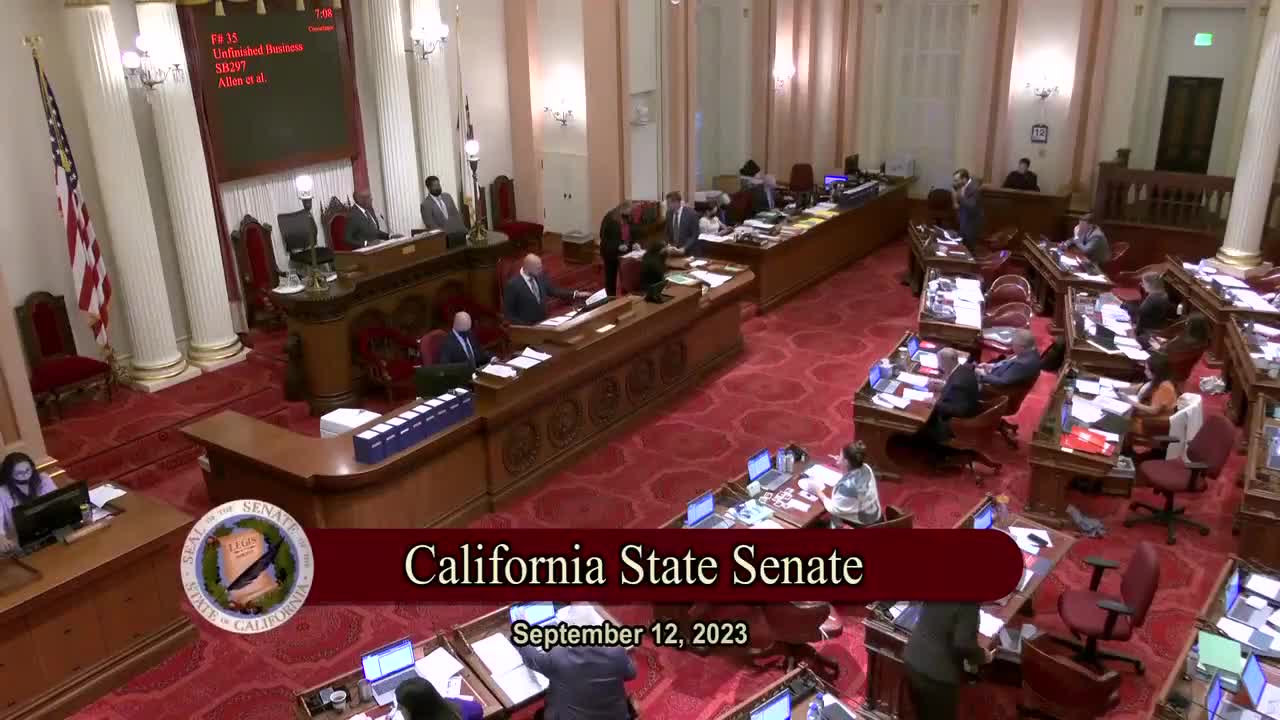 57SEC
Senate Floor
 1MIN
Assembly Floor
 3MIN
Senate Floor
 15MIN
Senate Standing Committee on Energy, Utilities and Communications
Bill Author