SB 500: Fish and wildlife.
- Session Year: 2023-2024
- House: Senate
- Latest Version Date: 2023-10-13
Current Status:
Passed
(2023-10-13: Chaptered by Secretary of State. Chapter 876, Statutes of 2023.)
Introduced
In Committee
First Chamber
In Committee
Second Chamber
Enacted
(1)Existing law regulating commercial fishing imposes, or authorizes the imposition of, various license, permit, and registration fees. Existing law requires specified persons to pay commercial fishing fees, referred to as landing fees, and sets forth requirements for the documentation of those landing fees in the form of a landing receipt, as prescribed.
Existing law requires certain persons to complete or make a landing receipt and requires the landing receipt to include certain information, including the accurate weight of the species of fish received and the price paid. Existing law requires the original signed copy of the paper landing receipt made under that provision to be delivered to the Department of Fish and Wildlife on or before the 16th or last day of the month in which the fish were landed, whichever date occurs first after the landing. Existing law requires landing receipt records completed and submitted electronically to be submitted to the department within 3 business days of the landing.
Under existing law, a violation of the Fish and Game Code, or of any rule, regulation, or order made or adopted under the code, is a crime.
This bill would revise various provisions to refer to electronic fish tickets rather than to landing receipts. The bill would, for purposes of the required contents of an electronic fish ticket, define accurate weight and delete the requirement to include the price paid for live marine fish for use exclusively as live bait that are not brought ashore. The bill would require electronic fish tickets to be submitted to the department within 3 business days of the landing, as specified. By creating new requirements with respect to electronic fish tickets, the violation of which would be a crime, the bill would constitute a state-mandated local program.
(2)Existing law requires any person who engages in any business for profit involving fish to be licensed, except as provided. Existing law includes among these licensure exceptions a person who purchases, sells, takes, or receives live marine fish for use as live bait, that are not brought ashore, and who does not engage in specified activity.
This bill would instead provide a licensure exception for a person who purchases, sells, takes, or receives live marine fish for use exclusively as live bait, that is not brought ashore, and who has registered as a live bait dealer with the department. The bill would require a live bait dealer registered with the department to keep a printed hard copy of the landing receipt or electronic fish ticket for a period of 4 years, as specified.
The bill would also prohibit the receipt, purchase, or transfer of fish from occurring at sea or from vessel to vessel, except for certain live marine fish used as bait or as prescribed by regulation. By creating new requirements with respect to the receipt, purchase, or transfer of certain fish, the violation of which would be a crime, the bill would constitute a state-mandated local program.
(3)Existing law requires the Department of Fish and Wildlife in consultation with the California Dungeness Crab Fishing Gear Working Group and other stakeholders, to adopt regulations establishing criteria and protocols to evaluate and respond to potential risk of marine life entanglement, as prescribed. Existing law authorizes the director to restrict the take of Dungeness crab pursuant to the criteria and protocols. Existing law makes it unlawful to take or possess Dungeness crab from any waters closed, or otherwise violate any restriction on take imposed, pursuant to these provisions. Existing law repeals these provisions on January 1, 2024.
This bill would require the regulations to address the use of alternative gear, as specified, that may be prohibited by the department and would remove outdated language. The bill would extend the operation of these Dungeness crab provisions until January 1, 2030. By extending the operation of existing provisions, a violation of which is a crime, the bill would impose a state-mandated local program.
(4)Existing law establishes the California Sea Urchin Commission in state government and vests the commission with various powers and duties, including establishing an assessment for each pound of sea urchin landed or delivered by divers to handlers in the state. Existing law authorizes the commission to consult and enter into agreements with the Director of Fish and Wildlife, if necessary and appropriate, to assist in the administration and enforcement of specified provisions of the Food and Agricultural Code related to sea urchins, including, but not limited to, collecting assessments and providing routine information regarding the persons that may be subject to these provisions.
Existing law provides that sea urchins shall not be taken for commercial purposes except under a valid sea urchin diving permit, subject to regulations adopted by the Fish and Game Commission. Existing law establishes a $330 fee for the permit.
This bill would require the Fish and Game Commission to adopt regulations related to commercial sea urchin diving permits, and to the vessels used to commercially fish for sea urchin, to better manage the number of permits issued. Because a violation of these regulations would be a crime, this bill would impose a state-mandated local program. The bill would update the fee for a sea urchin diving permit to $598.50 and would require the department, upon notice of the California Sea Urchin Commission, to charge for a sea urchin permit an additional $200, to be distributed to the California Sea Urchin Commission by the department, as specified. The bill would apply these provisions to the 2024 license year. This bill would additionally authorize the commission to enter into an agreement with the director regarding the expenses associated with the distribution of $200 of the total fee for a sea urchin permit.
(5)Existing law establishes various requirements with respect to the taking of fish commercially using traps, fishing lines, and other appliances.
This bill would require the Department of Fish and Wildlife to adopt regulations regarding the marking and color coding of lines used in state managed fisheries. By expanding the scope of a crime, this bill would create a state-mandated local program.
(6)Existing law requires the owner of an aquaculture facility to register certain information with the Department of Fish and Wildlife by March 1 of each year, and requires the department to impose prescribed fees for registration and renewal. Existing law also requires, in addition to the registration and renewal fees, a surcharge fee to be paid at the time of registration by the owner of an aquaculture facility if the gross annual sales of aquaculture products of the facility during the prior calendar year exceed $25,000. Existing law imposes a penalty for delinquent payment of fees. Existing law, until January 1, 2024, increases those registration, renewal, surcharge, and penalty fees, as prescribed.
This bill would extend the operation of the increased registration, renewal, surcharge, and penalty fees until January 1, 2025.
(7)The California Constitution requires the state to reimburse local agencies and school districts for certain costs mandated by the state. Statutory provisions establish procedures for making that reimbursement.
This bill would provide that no reimbursement is required by this act for a specified reason.
(1)Existing law regulating commercial fishing imposes, or authorizes the imposition of, various license, permit, and registration fees. Existing law requires specified persons to pay commercial fishing fees, referred to as landing fees, and sets forth requirements for the documentation of those landing fees in the form of a landing receipt, as prescribed.
Existing law requires certain persons to complete or make a landing receipt and requires the landing receipt to include certain information, including the accurate weight of the species of fish received and the price paid. Existing law requires the original signed copy of the paper landing receipt made under that provision to be delivered to the Department of Fish and Wildlife on or before the 16th or last day of the month in which the fish were landed, whichever date occurs first after the landing. Existing law requires landing receipt records completed and submitted electronically to be submitted to the department within 3 business days of the landing.
Under existing law, a violation of the Fish and Game Code , Code, or of any rule, regulation, or order made or adopted under the code, is a crime.
This bill would revise various provisions to refer to electronic fish tickets rather than to landing receipts. The bill would, for purposes of the required contents of an electronic fish ticket, define accurate weight and delete the requirement to include the price paid for live marine fish for use exclusively as live bait that are not brought ashore. The bill would require electronic fish tickets to be submitted to the department within 3 business days of the landing, as specified. By creating new requirements with respect to electronic fish tickets, the violation of which would be a crime, the bill would constitute a state-mandated local program.
(2)Existing law requires any person who engages in any business for profit involving fish to be licensed, except as provided. Existing law includes among these licensure exceptions a person who purchases, sells, takes, or receives live marine fish for use as live bait, that are not brought ashore, and who does not engage in specified activity.
This bill would instead provide a licensure exception for a person who purchases, sells, takes, or receives live marine fish for use exclusively as live bait, that is not brought ashore, and who has registered as a live bait dealer with the department. The bill would require a live bait dealer registered with the department to keep a printed hard copy of the landing receipt or electronic fish ticket for a period of 4 years, as specified.
The bill would also prohibit the receipt, purchase, or transfer of fish from occurring at sea or from vessel to vessel, except for certain live marine fish used as bait or as prescribed by regulation. By creating new requirements with respect to the receipt, purchase, or transfer of certain fish, the violation of which would be a crime, the bill would constitute a state-mandated local program.
(3)Existing law requires the Department of Fish and Wildlife in consultation with the California Dungeness Crab Fishing Gear Working Group and other stakeholders, to adopt regulations establishing criteria and protocols to evaluate and respond to potential risk of marine life entanglement, as prescribed. Existing law authorizes the director to restrict the take of Dungeness crab pursuant to the criteria and protocols. Existing law makes it unlawful to take or possess Dungeness crab from any waters closed, or otherwise violate any restriction on take imposed, pursuant to these provisions. Existing law repeals these provisions on January 1, 2024.
This bill would require the regulations to address the use of alternative gear, as specified, that may be prohibited by the department and would remove outdated language. The bill would extend the operation of these Dungeness crab provisions until January 1, 2030. By extending the operation of existing provisions, a violation of which is a crime, the bill would impose a state-mandated local program.
(3)(4)Existing law establishes the California Sea Urchin Commission in state government and vests the commission with various power powers and duties, including establishing an assessment for each pound of sea urchin landed or delivered by divers to handlers in the state. Existing law authorizes the commission to consult and enter into agreements with the Director of Fish and Wildlife, if necessary and appropriate, to assist in the administration and enforcement of specified provisions of the Food and Agricultural Code related to sea urchins, including, but not limited to, collecting assessments and providing routine information regarding the persons that may be subject to these provisions.
Existing law provides that sea urchins shall not be taken for commercial purposes except under a valid sea urchin diving permit, subject to regulations adopted by the Fish and Game Commission. Existing law establishes a $330 fee for the permit.
This bill would require the Fish and Game Commission to adopt regulations related to commercial sea urchin diving permits, and to the vessels used to commercially fish for sea urchin, to better manage the number of permits issued. Because a violation of these regulations would be a crime, this bill would impose a state-mandated local program. The bill would update the fee for a sea urchin diving permit to $598.50 and would require the department, upon notice of the California Sea Urchin Commission, to charge for a sea urchin permit an additional $200 for a sea urchin permit $200, to be distributed to the California Sea Urchin Commission by the department, as specified. The bill would apply these provisions to the 2024 license year. This bill would additionally authorize the commission to enter into an agreement with the director regarding the expenses associated with the distribution of $200 of the total fee for a sea urchin permit.
(4)(5)Existing law establishes various requirements with respect to the taking of fish commercially using traps, fishing lines, and other appliances.
This bill would require the Department of Fish and Wildlife to adopt regulations regarding the marking and color coding of lines used in state managed fisheries. By expanding the scope of a crime, this bill would create a state-mandated local program.
(5)(6)Existing law requires the owner of an aquaculture facility to register certain information with the Department of Fish and Wildlife by March 1 of each year, and requires the department to impose prescribed fees for registration and renewal. Existing law also requires, in addition to the registration and renewal fees, a surcharge fee to be paid at the time of registration by the owner of an aquaculture facility if the gross annual sales of aquaculture products of the facility during the prior calendar year exceed $25,000. Existing law imposes a penalty for delinquent payment of fees. Existing law, until January 1, 2024, increases those registration, renewal, surcharge, and penalty fees, as prescribed.
This bill would extend the operation of the increased registration, renewal, surcharge, and penalty fees until January 1, 2025.
(6)(7)The California Constitution requires the state to reimburse local agencies and school districts for certain costs mandated by the state. Statutory provisions establish procedures for making that reimbursement.
This bill would provide that no reimbursement is required by this act for a specified reason.
(1)Existing law regulating commercial fishing imposes, or authorizes the imposition of, various license, permit, and registration fees. Existing law requires specified persons to pay commercial fishing fees, referred to as landing fees, and sets forth requirements for the documentation of those landing fees in the form of a landing receipt, as prescribed.
Existing law requires certain persons to complete or make a landing receipt and requires the landing receipt to include certain information, including the accurate weight of the species of fish received and the price paid. Existing law requires the original signed copy of the paper landing receipt made under that provision to be delivered to the Department of Fish and Wildlife on or before the 16th or last day of the month in which the fish were landed, whichever date occurs first after the landing. Existing law requires landing receipt records completed and submitted electronically to be submitted to the department within 3 business days of the landing.
Under existing law, a violation of the Fish and Game Code , or of any rule, regulation, or order made or adopted under the code, is a crime.
This bill would revise various provisions to refer to electronic fish tickets rather than to landing receipts. The bill would, for purposes of the required contents of an electronic fish ticket, define accurate weight and delete the requirement to include the price paid for live marine fish for use exclusively as live bait that are not brought ashore. The bill would require electronic fish tickets to be submitted to the department within 3 business days of the landing, as specified. By creating new requirements with respect to electronic fish tickets, the violation of which would be a crime, the bill would constitute a state-mandated local program.
(2)Existing law requires any person who engages in any business for profit involving fish to be licensed, except as provided. Existing law includes among these licensure exceptions a person who purchases, sells, takes, or receives live marine fish for use as live bait, that are not brought ashore, and who does not engage in specified activity.
This bill would instead provide a licensure exception for a person who purchases, sells, takes, or receives live marine fish for use exclusively as live bait, that is not brought ashore, and who has registered as a live bait dealer with the department. The bill would require a live bait dealer registered with the department to keep a printed hard copy of the landing receipt or electronic fish ticket for a period of 4 years, as specified.
The bill would also prohibit the receipt, purchase, or transfer of fish from occurring at sea or from vessel to vessel, except for certain live marine fish used as bait or as prescribed by regulation. By creating new requirements with respect to the receipt, purchase, or transfer of certain fish, the violation of which would be a crime, the bill would constitute a state-mandated local program.
(1)(3)Existing law establishes the California Sea Urchin Commission in state government and vests the commission with various power and duties, including establishing an assessment for each pound of sea urchin landed or delivered by divers to handlers in the state. Existing law authorizes the commission to consult and enter into agreements with the Director of Fish and Wildlife, if necessary and appropriate, to assist in the administration and enforcement of specified provisions of the Food and Agricultural Code related to sea urchins, including, but not limited to, collecting assessments and providing routine information regarding the persons that may be subject to these provisions.
This bill would additionally authorize the commission to enter into an agreement with the director regarding the expenses associated with the distribution of $200 of the total fee for a sea urchin permit.(2)ExistingExisting law provides that sea urchins shall not be taken for commercial purposes except under a valid sea urchin diving permit, subject to regulations adopted by the Fish and Game Commission. Existing law establishes a $330 fee for the permit. Unless another penalty is expressly provided, existing law makes a violation of the Fish and Game Code, or of any rule, regulation, or order made or adopted under the code, a misdemeanor.
This bill would require the Fish and Game Commission to adopt regulations related to commercial sea urchin diving permits, and to the vessels used to commercially fish for sea urchin, to better manage the number of permits issued. Because a violation of these regulations would be a crime, this bill would impose a state-mandated local program. The bill would increase update the fee for a sea urchin diving permit by $200, and would require the department to distribute that amount, less the departments distribution expenses, to the California Sea Urchin Commission for expenditure pursuant to that commissions authority. The bill would authorize the California Sea Urchin Commission to revoke the $200 portion of the fee before February 1 of each calendar year. to $598.50 and would require the department, upon notice of the California Sea Urchin Commission, to charge an additional $200 for a sea urchin permit to be distributed to the California Sea Urchin Commission by the department, as specified. The bill would apply these provisions to the 2024 license year. This bill would additionally authorize the commission to enter into an agreement with the director regarding the expenses associated with the distribution of $200 of the total fee for a sea urchin permit.
(3)(4)Existing law establishes various requirements with respect to the taking of fish commercially using traps, fishing lines, and other appliances.
This bill would require the Department of Fish and Wildlife to adopt regulations regarding the marking and color coding of lines used in state managed fisheries. By expanding the scope of a crime, this bill would create a state-mandated local program.
(4)(5)Existing law requires the owner of an aquaculture facility to register certain information with the Department of Fish and Wildlife by March 1 of each year, and requires the department to impose prescribed fees for registration and renewal. Existing law also requires, in addition to the registration and renewal fees, a surcharge fee to be paid at the time of registration by the owner of an aquaculture facility if the gross annual sales of aquaculture products of the facility during the prior calendar year exceed $25,000. Existing law imposes a penalty for delinquent payment of fees. Existing law, until January 1, 2024, increases those registration, renewal, surcharge, and penalty fees, as prescribed.
This bill would extend the operation of the increased registration, renewal, surcharge, and penalty fees until January 1, 2025.
The(6)The California Constitution requires the state to reimburse local agencies and school districts for certain costs mandated by the state. Statutory provisions establish procedures for making that reimbursement.
This bill would provide that no reimbursement is required by this act for a specified reason.
(1)Existing law establishes the California Sea Urchin Commission in state government and vests the commission with various power and duties, including establishing an assessment for each pound of sea urchin landed or delivered by divers to handlers in the state. Existing law authorizes the commission to consult and enter into agreements with the Director of Fish and Wildlife, if necessary and appropriate, to assist in the administration and enforcement of specified provisions of the Food and Agricultural Code related to sea urchins, including, but not limited to, collecting assessments and providing routine information regarding the persons that may be subject to these provisions.
This bill would additionally authorize the commission to enter into an agreement with the director regarding the expenses associated with the distribution of $200 of the total fee for a sea urchin permit.
(2)Existing law provides that sea urchins shall not be taken for commercial purposes except under a valid sea urchin diving permit, subject to regulations adopted by the Fish and Game Commission. Existing law establishes a $330 fee for the permit. Unless another penalty is expressly provided, existing law makes a violation of the Fish and Game Code, or of any rule, regulation, or order made or adopted under the code, a misdemeanor.
This bill would require the Fish and Game Commission to adopt regulations related to commercial sea urchin diving permits, and to the vessels used to commercially fish for sea urchin, to better manage the number of permits issued. Because a violation of these regulations would be a crime, this bill would impose a state-mandated local program. The bill would increase the fee for a sea urchin diving permit by $200, and would require the department to distribute that amount, less the departments distribution expenses, to the California Sea Urchin Commission for expenditure pursuant to that commissions authority. The bill would authorize the California Sea Urchin Commission to revoke the $200 portion of the fee before February 1 of each calendar year.
(3)Existing law establishes various requirements with respect to the taking of fish commercially using traps, fishing lines, and other appliances.
This bill would require the Department of Fish and Wildlife to adopt regulations regarding the marking and color coding of lines used in state managed fisheries. By expanding the scope of a crime, this bill would create a state-mandated local program.
(4)Existing law requires the owner of an aquaculture facility to register certain information with the Department of Fish and Wildlife by March 1 of each year, and requires the department to impose prescribed fees for registration and renewal. Existing law also requires, in addition to the registration and renewal fees, a surcharge fee to be paid at the time of registration by the owner of an aquaculture facility if the gross annual sales of aquaculture products of the facility during the prior calendar year exceed $25,000. Existing law imposes a penalty for delinquent payment of fees. Existing law, until January 1, 2023, 2024, increases those registration, renewal, surcharge, and penalty fees, as prescribed.
This bill would extend the operation of the increased registration, renewal, surcharge, and penalty fees until January 1, 2027. 2025.
The California Constitution requires the state to reimburse local agencies and school districts for certain costs mandated by the state. Statutory provisions establish procedures for making that reimbursement.
This bill would provide that no reimbursement is required by this act for a specified reason.
(1)Existing law establishes the California Sea Urchin Commission in state government and vests the commission with various power and duties, including establishing an assessment for each pound of sea urchin landed or delivered by divers to handlers in the state. Existing law provides that the maximum assessment that can be levied by majority vote of the commission shall not exceed $0.03 for each pound of sea urchin landed. authorizes the commission to consult and enter into agreements with the Director of Fish and Wildlife, if necessary and appropriate, to assist in the administration and enforcement of specified provisions of the Food and Agricultural Code related to sea urchins, including, but not limited to, collecting assessments and providing routine information regarding the persons that may be subject to these provisions.
This bill would increase the maximum assessment that can be levied by majority vote of the commission to $0.06 for each pound of sea urchin landed. additionally authorize the commission to enter into an agreement with the director regarding the expenses associated with the distribution of $200 of the total fee for a sea urchin permit.
(2)Existing law provides that sea urchins shall not be taken for commercial purposes except under a valid sea urchin diving permit, subject to regulations adopted by the Fish and Game Commission. Existing law establishes a $330 fee for the permit. Unless another penalty is expressly provided, existing law makes a violation of the Fish and Game Code, or of any rule, regulation, or order made or adopted under the code, a misdemeanor.
This bill would require the Fish and Game Commission to adopt regulations related to commercial sea urchin diving permits, and to the vessels used to commercially fish for sea urchin, to better manage the number of permits issued. Because a violation of these regulations would be a crime, this bill would impose a state-mandated local program. The bill would increase the fee for a sea urchin diving permit by $200, and would require the department to distribute that amount, less the departments distribution expenses, to the California Sea Urchin Commission for expenditure pursuant to that commissions authority. The bill would authorize the California Sea Urchin Commission to revoke the $200 portion of the fee before February 1 of each calendar year.
(3)Existing law establishes various requirements with respect to the taking of fish commercially using traps, fishing lines, and other appliances.
This bill would require the Department of Fish and Wildlife to adopt regulations regarding the marking and color coding of lines used in state managed fisheries. By expanding the scope of a crime, this bill would create a state-mandated local program.
(4)Existing law requires the owner of an aquaculture facility to register certain information with the Department of Fish and Wildlife by March 1 of each year, and requires the department to impose prescribed fees for registration and renewal. Existing law also requires, in addition to the registration and renewal fees, a surcharge fee to be paid at the time of registration by the owner of an aquaculture facility if the gross annual sales of aquaculture products of the facility during the prior calendar year exceed $25,000. Existing law imposes a penalty for delinquent payment of fees. Existing law, until January 1, 2023, increases those registration, renewal, surcharge, and penalty fees, as prescribed.
This bill would extend the operation of the increased registration, renewal, surcharge, and penalty fees until January 1, 2027.
The California Constitution requires the state to reimburse local agencies and school districts for certain costs mandated by the state. Statutory provisions establish procedures for making that reimbursement.
This bill would provide that no reimbursement is required by this act for a specified reason.
(1)Existing law establishes the California Sea Urchin Commission in state government and vests the commission with various power and duties, including establishing an assessment for each pound of sea urchin landed or delivered by divers to handlers in the state. Existing law provides that the maximum assessment that can be levied by majority vote of the commission shall not exceed $0.03 for each pound of sea urchin landed.
This bill would increase the maximum assessment that can be levied by majority vote of the commission to $0.06 for each pound of sea urchin landed.
(2)Existing law provides that sea urchins shall not be taken for commercial purposes except under a valid sea urchin diving permit, subject to regulations adopted by the Fish and Game Commission. Existing law establishes a $330 fee for the permit. Unless another penalty is expressly provided, existing law makes a violation of the Fish and Game Code, or of any rule, regulation, or order made or adopted under the code, a misdemeanor.
This bill would require the Department of Fish and Wildlife Fish and Game Commission to adopt regulations related to commercial sea urchin diving permits, and to the vessels used to commercially fish for sea urchin, to better manage the number of permits issued. Because a violation of these regulations would be a crime, this bill would impose a state-mandated local program. The bill would increase the fee for a sea urchin diving permit by $200, and would require the department to distribute that amount, less the departments distribution expenses, to the California Sea Urchin Commission for expenditure pursuant to that commissions authority.
(3)Existing law establishes various requirements with respect to the taking of fish commercially using traps, fishing lines, and other appliances.
This bill would require the Department of Fish and Wildlife to adopt regulations regarding the marking and color coding of lines used in state managed fisheries. By expanding the scope of a crime, this bill would create a state-mandated local program.
(4)Existing law requires the owner of an aquaculture facility to register certain information with the Department of Fish and Wildlife by March 1 of each year, and requires the department to impose prescribed fees for registration and renewal. Existing law also requires, in addition to the registration and renewal fees, a surcharge fee to be paid at the time of registration by the owner of an aquaculture facility if the gross annual sales of aquaculture products of the facility during the prior calendar year exceed $25,000. Existing law imposes a penalty for delinquent payment of fees. Existing law, until January 1, 2023, increases those registration, renewal, surcharge, and penalty fees, as prescribed.
This bill would extend the operation of the increased registration, renewal, surcharge, and penalty fees until January 1, 2027.
The California Constitution requires the state to reimburse local agencies and school districts for certain costs mandated by the state. Statutory provisions establish procedures for making that reimbursement.
This bill would provide that no reimbursement is required by this act for a specified reason.
(1)Existing law establishes the California Sea Urchin Commission in state government and vests the commission with various power and duties, including establishing an assessment for each pound of sea urchin landed or delivered by divers to handlers in the state. Existing law provides that the maximum assessment that can be levied by majority vote of the commission shall not exceed $0.03 for each pound of sea urchin landed.
This bill would increase the maximum assessment that can be levied by majority vote of the commission to $0.06 for each pound of sea urchin landed.
(2)Existing law provides that sea urchins shall not be taken for commercial purposes except under a valid sea urchin diving permit, subject to regulations adopted by the Fish and Game Commission. Existing law establishes a $330 fee for the permit. Unless another penalty is expressly provided, existing law makes a violation of the Fish and Game Code, or of any rule, regulation, or order made or adopted under the code, a misdemeanor.
This bill would require the Department of Fish and Wildlife to adopt regulations related to commercial sea urchin diving permits, and to the vessels used to commercially fish for sea urchin, to better manage the number of permits issued. Because a violation of these regulations would be a crime, this bill would impose a state-mandated local program. The bill would increase the fee for a sea urchin diving permit by $200, and would require the department to distribute that amount, less the departments distribution expenses, to the California Sea Urchin Commission for expenditure pursuant to that commissions authority.
(3)Existing law establishes various requirements with respect to the taking of fish commercially using traps, fishing lines, and other appliances.
This bill would require the Department of Fish and Wildlife to adopt regulations regarding the marking and color coding of lines used in state managed fisheries. By expanding the scope of a crime, this bill would create a state-mandated local program.
(4)Existing law requires the owner of an aquaculture facility to register certain information with the Department of Fish and Wildlife by March 1 of each year, and requires the department to impose prescribed fees for registration and renewal. Existing law also requires, in addition to the registration and renewal fees, a surcharge fee to be paid at the time of registration by the owner of an aquaculture facility if the gross annual sales of aquaculture products of the facility during the prior calendar year exceed $25,000. Existing law imposes a penalty for delinquent payment of fees. Existing law, until January 1, 2023, increases those registration, renewal, surcharge, and penalty fees, as prescribed.
This bill would extend the operation of the increased registration, renewal, surcharge, and penalty fees until January 1, 2027.
The California Constitution requires the state to reimburse local agencies and school districts for certain costs mandated by the state. Statutory provisions establish procedures for making that reimbursement.
This bill would provide that no reimbursement is required by this act for a specified reason.
Unless otherwise specified, the following conditions apply to each commercial fishing license, permit, or other entitlement issued to take, possess aboard a boat, or land fish for commercial purposes and to each commercial boat registration issued by the department, except licenses issued pursuant to Article 7 (commencing with Section 8030):
(a)The person to whom a commercial fishing permit or other entitlement is issued shall have a valid commercial fishing license issued pursuant to Section 7852 that is not revoked or suspended.
(b)The commission, after notice and opportunity for hearing, may suspend, revoke, or cancel commercial fishing privileges for a period of time to be determined by the commission for the following reasons:
(1)The person was not lawfully entitled to be issued the license, permit, or other entitlement.
(2)A violation of this code, the terms of the permit or other entitlement, or the regulations adopted pursuant thereto, by the licensee, permittee, person holding the entitlement, or their agent, servant, employee, or person acting under the licensees, permittees, or entitled persons direction or control.
(3)A violation of any federal law relating to the fishery for which the license, permit, or other entitlement was issued by the licensee, permittee, person holding the entitlement, or their agent, servant, employee, or person acting under the licensees, permittees, or entitled persons direction or control.
(c)The person to whom the commercial fishing license, permit, or other entitlement is issued shall be present when fish are being taken, possessed aboard a boat, or landed for commercial purposes. This subdivision does not apply to commercial fishing vessel permits or licenses.
(d)The commercial fishing license, permit, or other entitlement shall be in the licensees, permittees, or entitled persons possession, or immediately available to the licensee, permittee, or entitled person at all times when engaged in any activity for which the commercial fishing license, permit, or entitlement is required.
(e)Not more than one individual commercial fishing license, permit, or other entitlement of a single type shall be issued to an individual person and not more than one commercial vessel fishing license, permit, or other entitlement of a single type shall be issued for each vessel.
(f)Any landing of fish used to qualify for, or renew, a commercial fishing license, permit, or other entitlement shall be reported on electronic fish tickets delivered to the department pursuant to Section 8046.
(g)In addition to any other requirements in Article 7.5 (commencing with Section 8040), the name of the person issued the commercial fishing license, permit, or other entitlement authorizing the taking of the fish shall be included on the electronic fish ticket for that landing.
(h)An application for a commercial fishing license, permit, or other entitlement shall be made on a form containing the information the department may require. The commercial fishing license, permit, or other entitlement shall be signed by the holder prior to use.
(i)Any person who has had a commercial fishing license, permit, or other entitlement suspended or revoked shall not engage in that fishery, and shall not obtain any other commercial fishing license, permit, or other entitlement that authorizes engaging in that fishery, while the suspension or revocation is in effect.
(j)A commercial fishing license, permit, or other entitlement is not transferable unless otherwise expressly specified in this code.
(k)Every commercial fishing license, permit, stamp, commercial boat registration, or other entitlement issued pursuant to this part, except commercial fish business licenses issued pursuant to Article 7 (commencing with Section 8030), is valid from April 1 to March 31 of the next following calendar year or, if issued after the beginning of that term, for the remainder of that term.
(l)A person who holds a commercial fishing vessel permit or other entitlement authorizing the use of a vessel for commercial fishing shall also hold a valid commercial boat registration for that vessel, issued pursuant to Section 7881, that has not been suspended or revoked.
(m)A person who holds a commercial fishing license, permit, registration, or other entitlement, who moves or acquires a new address shall notify the department of the old and new addresses within three months of acquiring the new address.
(n)An application to transfer any permit or other entitlement to take fish for commercial purposes shall be deferred if the current holder of the permit or other entitlement is awaiting final resolution of any pending criminal, civil, or administrative action that could affect the status of the permit or other entitlement.
SEC. 2.Section 8030 of the Fish and Game Code is amended to read:8030.Any person who engages in any business for profit involving fish shall be licensed pursuant to this article, except as follows:
(a)A commercial fisherman who sells fish only to persons licensed under this article to purchase or receive fish from commercial fishermen and who does not engage in any activity described in Section 8034, 8035, or 8036 unless licensed to engage in both activities.
(b)A person licensed pursuant to Section 8460 who only takes, transports, or sells live freshwater fish for bait.
(c)A person who sells fish or aquaculture products only at retail to the ultimate consumer if that person does not conduct any activities described in Section 8033, 8035, or 8036.
(d)Pursuant to Division 12 (commencing with Section 15000), a person who deals only in products of aquaculture.
(e)A person who deals only with nonnative live products that are not utilized for human consumption but that are utilized solely for pet industry or hobby purposes and who does not engage in the activities described in Section 8033.1.
(f)A person who is employed by the fish receiver to unload fish or fish products from a commercial fishing boat at a dock.
(g)A person who purchases, sells, takes, or receives live marine fish for use exclusively as live bait, that are not brought ashore, and who has registered as a live bait dealer with the department.
(h)A person who does not purchase or obtain fish, but who acts as an agent for others while negotiating purchases, or sales of fish in return for a fee, commission, or other compensation.
SEC. 3.Section 8032.5 of the Fish and Game Code is amended to read:8032.5.Unless otherwise specified, all of the following conditions apply to each commercial fish business license, permit, or other entitlement pursuant to this article:
(a)An application for a commercial fish business license, permit, or other entitlement shall be made on a form containing information as required by the department. The commercial fish business license shall be signed by the holder before use.
(b)Any person who has had a commercial fish business license suspended or revoked shall not engage in that business activity, and shall not receive any other commercial fish business license, permit, or other entitlement that authorizes engaging in that business activity, while the suspension or revocation is in effect.
(c)The commission, after notice and opportunity for hearing, may suspend, revoke, or cancel commercial fish business privileges for a period of time to be determined by the commission for any of the following reasons:
(1)The person was not lawfully entitled to be issued the license, permit, or other entitlement.
(2)Any violation of this code, the regulations adopted pursuant to this code, or the terms of the permit or other entitlement by the licensee, permittee, person holding the entitlement, or their agent, servant, employee, or person acting under the licensees, permittees, or entitled persons direction or control.
(3)Any violation of any federal law relating to the fishery for which the license, permit, or other entitlement was issued by the licensee, permittee, person holding the entitlement, or their agent, servant, employee, or person acting under the licensees, permittees, or entitled persons direction or control.
(d)A commercial fish business license, permit, or other entitlement is not transferable unless otherwise expressly specified in this code.
(e)Any person who holds a commercial fish business license, permit, or other entitlement, who moves or acquires a new or additional plant, facility, or other place of business for profit involving fish, shall notify the department of the address within three months of commencing business activities at the address.
(f)Each plant, facility, or other place of business in which an activity occurs that is required to be licensed under this article shall have a copy of each required license on display and available for inspection at any time by the department.
(g)Any person licensed pursuant to this article shall provide the department, at the time of application, with the business name, business address, and business telephone number for all locations doing business under the authority of the persons commercial fish business license, permit, or entitlement.
(h)Any person licensed pursuant to this article who is subject to landing fees, as defined in Section 8041, and who has failed to pay all landing fees and penalties pursuant to Section 8053, shall not be allowed to renew their commercial fish business license, permit, or entitlement until payment is made in full to the department.
(i)Any person licensed pursuant to this article who is subject to landing fees, as defined in Section 8041, who fails to submit electronic fish tickets pursuant to Section 8046, may be subject to suspension or revocation of their commercial fish business license, permit, or entitlement.
SEC. 4.Section 8033 of the Fish and Game Code is amended to read:8033.(a)Except as provided in Section 8033.1 or 8033.5, or subdivision (b) of Section 8047, any person who purchases or receives fish for commercial purposes from a fisherman who is required to be licensed under Section 7850, or any person who removes fish from the point of the first landing that the person has caught for his or her own processing or sale, shall obtain a fish receivers license.
(b)The annual fee for a fish receivers license is five hundred forty-nine dollars ($549).
(c)A cooperative association of fishermen may be licensed as fish receivers.
SEC. 5.Section 8041 of the Fish and Game Code is amended to read:8041.(a)The following persons shall pay the landing fee determined pursuant to Section 8042:(1)Any person who is required to be licensed as a fish receiver, and any person who is licensed before January 1, 1987, as a wholesaler or a processor pursuant to former Section 8040 and who receives fish from commercial fishermen.(2)Any commercial fisherman who sells fish to any person who is not a fish receiver licensed under Article 7 (commencing with Section 8030).(b)The following persons are exempt from the landing fee imposed under this article:(1)A person licensed pursuant to Section 8460 who only takes, transports, or sells live freshwater fish for bait.(2)A commercial fisherman who sells live freshwater fish for bait to a person described in paragraph (1).(3)A commercial fisherman who sells live aquaria fish.(4)A person as described in subdivision (g) of Section 8030 who purchases, sells, takes, or receives live marine fish for use exclusively as live bait that are not brought ashore.(5)A person licensed pursuant to Section 8033.1 who takes, transports, or sells live aquaria fish as described in Section 8597. It is the intent of the Legislature that the license fee for live aquaria fish described in Section 8033.1 shall be in lieu of a landing fee imposed under this article.SEC. 6.Section 8043 of the Fish and Game Code is amended to read:8043.(a)The following persons shall report all fish sales, deliveries, transfers, and landings using an electronic fish ticket as prescribed under regulations adopted by the commission:(1)Any person who is required to be licensed under Article 7 (commencing with Section 8030) to conduct the activities of a fish receiver, as described in Section 8033.(2)Any commercial fisherman who sells, delivers, or transfers fish to any person who is not a fish receiver licensed under Article 7 (commencing with Section 8030).(3)Any commercial fisherman who sells, delivers, or transfers live marine fish for use exclusively as live bait that are not brought ashore to any person who is not a fish receiver licensed under Article 7 (commencing with Section 8030).(4)Any person licensed under Article 7 (commencing with Section 8030) who brings ashore their own fish as described in Section 8033, 8033.1, or 8033.5.(5)Any commercial fisherman licensed pursuant to Section 8033.5 who sells fish to persons not licensed to receive fish for commercial purposes pursuant to Article 7 (commencing with Section 8030).(b)The electronic fish ticket shall show all of the following:(1)The name of the species of landed fish as designated by the department, or if not designated, the commonly used name of the species.(2)(A)The accurate weight of the species of fish received. Sablefish may be reported in dressed weight, and if so reported, shall have the round weights computed, for purposes of management quotas, by multiplying 1.6 times the reported dressed weight. (B)For purposes of this paragraph, accurate weight means a weight that is determined by a scale that conforms to the standard within the applicable tolerances and other performance requirements as required by the California Code of Regulations or the Business and Professions Code, but for marine fish used as live bait that are not brought ashore, the department may adopt rules and regulations necessary to establish other methods to determine accurate weight.(3)The commercial fishermans name and the commercial fishing license identification number.(4)The department registration number of the boat.(5)The name of the recipient of the fish, and that persons identification number, if applicable.(6)The date of receipt.(7)The price paid for the fish, except for live marine fish for use exclusively as live bait that are not brought ashore.(8)The department origin block number where the fish were caught.(9)The type of gear used.(10)Any other information the department may require.(c)Persons identified in paragraph (1), (2), or (3) of subdivision (a) shall complete the electronic fish ticket as prescribed by regulation at the time of receipt, purchase, or transfer of fish, whichever occurs first. Persons identified in paragraph (4) of subdivision (a) shall complete the electronic fish ticket as prescribed by regulation at the time the fish are brought ashore. Persons identified in paragraph (5) of subdivision (a) shall complete the electronic fish ticket either at the time of individual sale or at the completion of sales for the calendar day of sales pursuant to Section 8043.2.(d)With the exception of live marine fish for use exclusively as bait that is not subsequently brought ashore or as otherwise prescribed by regulation, the receipt, purchase, or transfer of fish shall not occur at sea or from vessel to vessel.(e)Any person taking, purchasing, or receiving fish, whether or not licensed under Article 7 (commencing with Section 8030), shall sign the original paper hard copy of the electronic fish ticket as prescribed by regulation.SEC. 7.Section 8043.2 of the Fish and Game Code is amended to read:8043.2.(a)A commercial fisherman licensed pursuant to Section 8033.5 who sells fish from a vessel directly to the ultimate consumer and who is required pursuant to Section 8043 to make an electronic fish ticket shall make an electronic fish ticket in either of the following ways:
(1)For each individual sale by that fisherman at the time of the sale.
(2)For each day that the fisherman is engaged in one or more sales to the ultimate consumers, the fisherman shall maintain an accurate tally sheet of sales, which shall include complete header and signature box information filled out prior to any sales, and the number of pounds by species of fish sold. The total of the daily sales shall be recorded at the completion of sales for that day on an electronic fish ticket. A copy of the completed tally sheet shall be attached to the corresponding electronic fish ticket. The original completed tally sheet shall be attached to the fishermans copy of the corresponding electronic fish ticket and maintained for a period of four years.
(b)A commercial fisherman licensed pursuant to Section 8033.5 who sells directly to the ultimate consumer, or a commercial fisherman who sells or delivers fish that the fisherman has taken to any person who is not licensed under Article 7 (commencing with Section 8030) to conduct the activities of a fish receiver, shall not be considered a weighmaster for purposes of Chapter 7 (commencing with Section 12700) of Division 5 of the Business and Professions Code.
(c)A commercial fisherman selling their own catch to the ultimate customer, upon request by an authorized agent or employee of the department, shall immediately make available all fish in possession of the fisherman for inspection and sampling by the agent or employee. Pursuant to Section 8226, the fisherman shall relinquish the head from any sampled salmon with a missing adipose fin.
SEC. 8.Section 8045 of the Fish and Game Code is repealed.SEC. 9.Section 8046 of the Fish and Game Code is amended to read:8046.(a)The electronic fish ticket made under Section 8043 shall be submitted to the department within three business days of the landing unless otherwise specified in regulations. The original signed copy of the paper landing receipt made under Section 8043.1 shall be delivered to the department on or before the 16th or last day of the month in which the fish were landed, whichever date occurs first after the landing. A copy of the electronic fish ticket or landing receipt shall be delivered to the commercial fisherman at the time of the purchase or receipt of the fish. That copy of the electronic fish ticket or landing receipt shall be retained by the commercial fisherman for a period of four years and shall be available for inspection at any time during that period by the department. A copy of the electronic fish ticket or landing receipt shall be kept by the person licensed pursuant to Article 7 (commencing with Section 8030), or live bait dealer registered with the department, who filled out the electronic fish ticket or landing receipt for a period of four years and shall be available for inspection at any time within that period by the department.
(b)On delivery of sardines, anchovies, mackerel, squid, tuna, or bonito intended to be processed or sold as fresh fish, the person licensed pursuant to Article 7 (commencing with Section 8030) who filled out the electronic fish ticket or landing receipt, upon request of the authorized agent described in subdivision (c), shall notify the authorized agent of the unloading and weighing of the fish and shall permit the authorized agent to be present at all times during the weighing of the fish.
(c)A copy of the electronic fish ticket or landing receipt shall be delivered to an agent authorized in writing by the majority of the persons who participated in the taking of the fish, excluding the commercial fisherman receiving the original copy.
(d)For purposes of this section, business day means Monday to Friday, inclusive, excluding days designated as state or federal holidays.
SEC. 10.Section 8046.1 of the Fish and Game Code is amended to read:8046.1.In addition to the requirements of Section 8046, any person landing groundfish subject to federal groundfish regulations adopted pursuant to the Magnuson Fishery Conservation and Management Act (16 U.S.C. Sec. 1801 et seq.) shall keep a copy of the electronic fish ticket on board the fishing vessel throughout, and for 15 days following, each period for which cumulative landings by individual vessels are limited.
SEC. 11.Section 8047 of the Fish and Game Code is amended to read:8047.(a)(1)An original printed signed hard copy of the electronic fish ticket as required by Section 8043 or landing receipt as required by Section 8043.1 shall be retained by the licensee for a period of four years and shall be available for inspection at any time within that period by the department. A copy shall be delivered to an agent authorized in writing by the majority of the persons who participated in the taking of the fish, excluding the commercial fisherman receiving the original copy.(2)A person licensed under Section 8033.5 who sells their fish to a licensed receiver may use a transportation receipt pursuant to subdivision (b) to transport those fish only to that licensed receiver. The receiver shall complete an electronic fish ticket for those fish. Transportation receipts shall be completed at the time the fish are transferred from the fishing vessel.(b)(1)Every commercial fisherman or their designee, who transports, causes to be transported, or delivers to another person for transportation, any fish, except herring, taken from the waters of this state or brought into this state in fresh condition, shall fill out a transportation receipt according to the instructions and on forms provided by the department at the time the fish are brought ashore. Unless otherwise prescribed by regulation, the receipt or transfer of fish shall not occur at sea or from vessel to vessel.(2)The original signed copy of the transportation receipt shall be delivered by the commercial fisherman to the department on or before the 16th day or the last day of the month in which the fish were landed, whichever date occurs first after landing. A copy of the transportation receipt shall be retained by the commercial fisherman who filled it out for a period of four years and shall be available for inspection at any time within that period by the department. A copy of the transportation receipt shall be given to and retained by the person transporting the fish until the fish are sold fresh, processed, or otherwise disposed of.(3)The transportation receipt is required only for transit purposes.(4)A person transporting fish from the point of first landing under a transportation receipt is not required to be licensed to conduct the activities of a fish receiver as described in Section 8033.(5)The transportation book receipt shall be issued to an individual fisherman and is not transferable.(c)The transportation receipt shall contain all of the following information:(1)The name of each species of transported fish, as designated by the department, or if not designated, the commonly used name of the species.(2)The date and time of the receipt.(3)The accurate weight of the species of fish being transported. Sablefish may be reported in dressed weight, and if so reported, shall have the round weights computed, for purposes of management quotas, by multiplying 1.6 times the reported dressed weight.(4)The name and identification number of the fisherman. The signature of the fisherman authorizing transportation.(5)The name of the person transporting the fish.(6)The name of the fish business, the fish business identification number, and the corresponding electronic fish ticket or landing receipt number issued by the fish business to the commercial fisherman.(7)The department registration number of the vessel and the name of the vessel.(8)The department origin block number where the fish were caught.(9)The port of first landing.(10)Any other information the department may prescribe.(d)The numbered transportation receipt forms in each individual transportation receipt book shall be completed sequentially. A voided fish transportation receipt shall have the word VOID plainly and noticeably written on the face of the receipt. A voided fish transportation receipt shall be submitted to the department in the same manner as a completed fish transportation receipt is submitted to the department. A commercial fisherman who is no longer conducting business as a licensed fisherman shall forward all unused transportation receipts and transportation receipt books to the department immediately upon terminating their business activity.SEC. 12.Section 8276.1 of the Fish and Game Code is amended to read:8276.1.(a)For purposes of this section, the following definitions apply:
(1)California Dungeness Crab Fishing Gear Working Group means the California Dungeness Crab Fishing Gear Working Group established by the department, in partnership with the Ocean Protection Council and the National Marine Fisheries Service, on September 21, 2015, and as defined by its most recent charter as it may be amended from time to time.
(2)Risk assessment and mitigation program means the program developed by the California Dungeness Crab Fishing Gear Working Group, as that program may be amended from time to time until the regulations are adopted pursuant to subdivision (b), to identify and assess elevated levels of entanglement risk and determine the need for management options to reduce the risk of entanglement.
(b)The department, in consultation with the California Dungeness Crab Fishing Gear Working Group and other stakeholders, shall adopt regulations establishing criteria and protocols to evaluate and respond to the potential risk of marine life entanglement. The regulations shall include, but are not limited to, the risk assessment and mitigation program, and the use of alternative gear only after the season is open pursuant to the risk assessment and mitigation program that may otherwise be prohibited as prescribed by the department. Upon the effective date of the regulations, the director may restrict the take of Dungeness crab pursuant to the protocols and criteria.
(c)Unless otherwise prescribed by regulation, it is unlawful to take or possess Dungeness crab from any waters closed, or otherwise violate any restriction on take imposed, pursuant to this section.
(d)This section shall remain in effect only until January 1, 2030, and as of that date is repealed.
SEC. 13.Section 8280.3 of the Fish and Game Code is amended to read:8280.3.(a)For purposes of this section, the term length overall means the horizontal distance between the forward-most and after-most points on the hull of a vessel. The length overall of a vessel does not include attachments fixed to the stern and bow.
(b)Notwithstanding Article 9 (commencing with Section 8100) of Chapter 1 and except as provided in this section, a Dungeness crab vessel permit shall not be transferred.
(c)(1)The owner of a vessel to whom a Dungeness crab vessel permit has been issued shall transfer the permit for the use of that vessel upon the sale of the vessel by the permitholder to the person purchasing the vessel, except that the permit shall not be transferred if the vessel is more than five feet longer in length overall, as determined by a licensed marine surveyor, than the baseline length on the permit. Thereafter, upon notice to the department, the person purchasing the vessel may use the vessel for the taking and landing of Dungeness crab for any and all of the unexpired portion of the permit year, and that person is eligible for a permit pursuant to this article for the use of that vessel in subsequent years. The person purchasing the vessel shall not transfer the permit for use of that vessel in the Dungeness crab fishery to another replacement vessel during the same permit year.
(2)A permit described in subdivision (c) of Section 8280.1 shall not be transferred pursuant to this subdivision.
(d)The owner of a vessel to whom the Dungeness crab vessel permit has been issued may transfer the permit to a replacement vessel of equivalent capacity, except as specified in this section. Thereafter, upon notice to the department and payment of the transfer fee specified in Section 8280.6, the replacement vessel may be used for the taking and landing of Dungeness crab for any and all of the unexpired portion of the permit year and that person is eligible for a permit pursuant to this article for the use of that replacement vessel in subsequent years.
(e)(1)The owner of a permitted vessel may transfer the permit to a vessel of greater capacity as follows:
(A)If the person the permit is to be transferred to purchased the vessel of greater capacity on or before November 15, 1995, the vessel of greater capacity may not be more than 10 feet longer in length overall than the baseline length on the permit.
(B)If the person the permit is to be transferred to purchased the vessel of greater capacity after November 15, 1995, the vessel of greater capacity may not be more than five feet longer in length overall than the baseline length on the permit.
(2)A permit described in subdivision (c) of Section 8280.1 shall not be transferred pursuant to this subdivision.
(f)(1)The department may authorize the owner of a permitted vessel to transfer the permit to a replacement vessel that was owned by the person the permit is to be transferred to on or before April 1, 1996, that does not fish with trawl nets that is greater than five feet longer in length overall than the baseline length on the permit, if all of the following conditions are satisfied:
(A)A vessel of a larger size is essential to the proposed permitholder for participation in another fishery other than a trawl net fishery.
(B)The owner of the permitted vessel held a permit on or before January 1, 1995, for the fishery for which a larger vessel is needed and has participated in that fishery.
(C)The permit for the vessel from which the permit is to be transferred qualified pursuant to paragraph (1) of subdivision (b) of Section 8280.1, as that section read on August 1, 2018, or any prior version of that paragraph.
(D)The vessel to which the permit is to be transferred does not exceed 20 feet longer in length overall than the baseline length on the permit and the vessel to which the permit is to be transferred does not exceed 60 feet in length overall.
(E)A permit was not previously transferred to the same replacement vessel.
(2)A permit described in subdivision (c) of Section 8280.1 shall not be transferred pursuant to this subdivision.
(g)A transfer of a permit to a larger vessel shall not be allowed more than one time. If a permit is transferred to a larger vessel, any Dungeness crab vessel permit for that permit year or any subsequent permit years for that larger vessel shall not be transferred to another larger vessel. The department shall not thereafter issue a Dungeness crab vessel permit for the use of the original vessel from which the permit was transferred, except that the original vessel may be used to take or land Dungeness crab after that transfer if its use is authorized pursuant to another Dungeness crab vessel permit subsequently transferred to that vessel pursuant to subdivision (d), (e), or (f).
(h)(1)Upon the written approval of the department, the owner of a vessel to whom the Dungeness crab vessel permit has been issued, which has California Dungeness crab landings made with trap gear documented on department electronic fish tickets and which has had California Dungeness crab landings amounting to not less than 5,000 pounds cumulative for the past two Dungeness crab seasons, may temporarily transfer the permit to a replacement vessel for which use in the Dungeness crab fishery is not permitted pursuant to this article that is of equivalent size and capacity of the originally permitted vessel, no greater than 10 feet longer in length overall than the vessel from which the permit is transferred, for a period of not more than six months during the current permit year if the vessel for which the permit was issued is seriously damaged, suffers major mechanical breakdown, or is lost or destroyed, as determined by the department, upon approval of the director. The owner of the vessel shall submit proof that the department may reasonably require to establish the existence of the conditions of this paragraph. Only the permittee at the time of the loss, theft, damage, breakdown, or destruction of the vessel may apply for the transfer of the vessel permit. Proof of loss or destruction shall be documented by submission of a copy of the report filed with the United States Coast Guard or any other law enforcement or fire agency that investigated the loss. In the case of mechanical breakdown, the request shall include an estimate of the costs to repair the vessel from a marine surveyor or boat repair yard. The department shall not issue a permit for a replacement vessel pursuant to this subdivision if the permitted vessel was reported lost, stolen, mechanically broken down, destroyed, or damaged for fraudulent purposes. Upon approval by the director, the owner of a vessel granted a six-month temporary transfer under this section may be granted an additional six-month extension of the temporary transfer.
(2)Notwithstanding subdivision (e) of Section 8280.2, in the event of loss or destruction of a vessel for which a Dungeness crab vessel permit was issued, or serious damage that renders the vessel inoperable, and upon written approval of the department, the owner of the vessel to whom the permit was issued may retain the permit and may transfer the permit to another vessel of equivalent size and capacity of the vessel that was lost or damaged during the period of two years after the loss or damage of the vessel for which the permit was originally issued. The owner of the lost or damaged vessel shall submit proof that the department may reasonably require to establish the loss or damage of the vessel. Only the permittee at the time of the loss, theft, damage, or destruction of the vessel may apply for the transfer of the vessel permit. Proof of loss or destruction shall be documented by submission of a copy of the report filed with the United States Coast Guard or any other law enforcement or fire agency that investigated the loss. In the case of mechanical breakdown, the request shall include an estimate of the costs to repair the vessel from a marine surveyor or boat repair yard. The department shall not issue a permit for a replacement vessel pursuant to this paragraph if the lost or damaged vessel was reported lost, stolen, destroyed, mechanically broken down, or damaged for fraudulent purposes. The department shall only transfer a permit pursuant to this paragraph if the lost or damaged vessel has a current permit and the owner of the lost or damaged vessel makes assurances in the application that any renewal of the permit that becomes due during the application processing period will be made. If the permit is not permanently transferred to another vessel within two years of the loss or damage, the permit shall become void by operation of law.
(i)Upon written approval of the department, the owner of a vessel to whom the Dungeness crab vessel permit has been issued may retain that permit upon the sale of that permitted vessel for the purpose of transferring the permit to another vessel if the requirements of this section are satisfied, including the payment of transfer fees. If the permit is not transferred to a new vessel within one year of the sale of the permitted vessel, the permit shall become void by operation of law.
(j)Except as provided in subdivision (c) of Section 8280.1, in the event of the death or incapacity of a permitholder, the permit shall be transferred, upon application, to the heirs or assigns, or to the working partner, of the permitholder, together with the transfer of the vessel for which the permit was issued, and the new owner may continue to operate the vessel under the permit, renew the permit, or transfer the permit upon sale of the vessel pursuant to subdivision (b). The estate of the holder of a transferable Dungeness crab vessel permit may renew that permit as provided for in statute if needed to keep it valid. The estate of the decedent may transfer that permit pursuant to these regulations no later than two years from the date of death of the permitholder as listed on the death certificate.
(k)(1)For purposes of this section, the baseline length on a Dungeness crab vessel permit shall be equal to the length overall of the vessel for which the permit was originally issued, as originally documented on the permit, unless updated pursuant to paragraph (2).
(2)(A)If, on or before March 31, 2020, the owner of a vessel to whom a Dungeness crab vessel permit has been issued submits to the department a survey reflecting a current length overall of the vessel that is greater than the length overall described in paragraph (1), the baseline length on the permit shall be equal to that current length overall.
(B)A survey submitted pursuant to subparagraph (A) shall be conducted by a licensed marine surveyor.
(l)This section shall become inoperative on April 1, 2029, and, as of January 1, 2030, is repealed, unless a later enacted statute, that becomes operative on or before January 1, 2030, deletes or extends the dates on which it becomes inoperative and is repealed.
SEC. 14.Section 8285 of the Fish and Game Code is amended to read:8285.(a)The director may open waters that are otherwise restricted for the commercial take of Dungeness crab or rock crab pursuant to Section 5523 during a time period when the State Department of Public Health authorizes the manufacture, sale, delivery, holding, or offering for sale of eviscerated Dungeness crab or rock crab pursuant to Article 15 (commencing with Section 111224) of Chapter 5 of Part 5 of Division 104 of the Health and Safety Code, in accordance with the following requirements:
(1)The holder of a Dungeness crab vessel permit or rock crab permit shall submit to electronic monitoring of the vessel as specified in paragraph (3) of subdivision (a) of Section 5523 while engaging in the take of Dungeness crab or rock crab to verify the locations where the Dungeness crab or rock crab is taken.
(2)A person shall not take, possess onboard, or land Dungeness crab or rock crab under an evisceration order on the same trip in which crab are taken, possessed onboard, or landed from waters outside those covered by the evisceration order.
(3)A person who takes Dungeness crab or rock crab is authorized to sell or provide the Dungeness crab or rock crab only to a processor licensed under Article 7 (commencing with Section 8030) of Chapter 1 and approved by the State Department of Public Health pursuant to Article 15 (commencing with Section 111224) of Chapter 5 of Part 5 of Division 104 of the Health and Safety Code.
(4)When furnishing an electronic fish ticket pursuant to Section 8043, the processor shall identify on the electronic fish ticket that the Dungeness crab or rock crab received were taken from an area under an evisceration order.
(b)When evisceration procedures established pursuant to Article 15 (commencing with Section 111224) of Chapter 5 of Part 5 of Division 104 of the Health and Safety Code are no longer in effect, the director shall lift any restrictions imposed pursuant to subdivision (a) in a manner that promotes a fair and orderly fishery.
(c)Chapter 3.5 (commencing with Section 11340) of Part 1 of Division 3 of Title 2 of the Government Code does not apply to actions taken pursuant to this section.
SEC. 15.Section 8405.2 of the Fish and Game Code is amended to read:8405.2.(a)A valid sea cucumber permit may be transferred by the permittee if the permittee has previously held a valid sea cucumber permit for any four permit years and landed at least 100 pounds of sea cucumbers in each of those permit years, as documented by electronic fish tickets with the name of the permittee shown on the receipts.
(b)A valid sea cucumber permit that has not been suspended or revoked may be transferred only to a person who has a valid commercial fishing license issued pursuant to Section 7852, that has not been suspended or revoked. A sea cucumber permit shall not be transferred to a person who has had a sea cucumber permit suspended or revoked while the suspension or revocation is in effect.
(c)An application for transfer of a permit shall be in the form of a notarized letter and shall be submitted to the department, with reasonable proof as the department may require to establish the qualifications of the permitholder and the person the permit is to be transferred to, accompanied by payment to the department of a nonrefundable transfer fee of two hundred dollars ($200). The transfer shall take effect on the date notice of approval of the application is given to the transferee by the department. The sea cucumber permit shall be valid for the remainder of the permit year and may be renewed in subsequent years.
(d)A sea cucumber trawl permit may be transferred to a qualified person as provided in subdivisions (b) and (c) to take sea cucumbers by diving or by use of trawl nets. A sea cucumber dive permit may be transferred to a qualified person as provided in subdivisions (b) and (c) only to take sea cucumbers by diving. The transferee shall specify the gear type, either trawl or dive, that the transferee intends to use to take sea cucumbers. The gear type of the sea cucumber permit, either trawl or dive, shall not be transferable.
(e)(1)Upon the death of a sea cucumber permitholder, the deceased persons sea cucumber dive or trawl permit may be transferred by their heirs, assignees, or estate to a qualified person as provided in subdivision (b), upon payment of the fee described in subdivision (c), and in accordance with subdivisions (a) and (d). The estate of the decedent may transfer the permit pursuant to this chapter no later than two years from the date of death of the permitholder, as listed on the death certificate.
(2)For purposes of a transfer under this subdivision, the heirs, assignees, or estate shall renew the permit as specified in Section 8405.1 to keep the permit valid until transferred.
SEC. 16.Section 9054.5 is added to the Fish and Game Code, to read:9054.5.The commission shall adopt regulations related to commercial sea urchin diving permits, and the vessels used to commercially fish for sea urchin, in order to better manage the number of permits issued.
SEC. 17.Section 9055 of the Fish and Game Code is amended to read:9055.(a)The base fee for a sea urchin permit authorized pursuant to Section 9054 is five hundred ninety-eight dollars and fifty cents ($598.50).
(b)Upon notification from the California Sea Urchin Commission, the department shall charge an additional two hundred dollars ($200) for a sea urchin permit to be distributed to the California Sea Urchin Commission by the department, less the departments distribution expenses, to be used for the purposes of Section 79056 of the Food and Agricultural Code. The California Sea Urchin Commission shall notify the department of the intent to charge the additional two-hundred-dollar ($200) fee by December 1 of the preceding license year.
(c)The base fee and additional two-hundred-dollar ($200) fee for the California Sea Urchin Commission specified in this section are applicable to the 2024 license year and shall be adjusted annually thereafter pursuant to Section 713.
SEC. 18.Section 9056 is added to the Fish and Game Code, to read:9056.The department shall adopt regulations regarding the marking and color coding of lines used in state managed fisheries.
SEC. 19.Section 15101 of the Fish and Game Code, as amended by Section 2 of Chapter 307 of the Statutes of 2022, is amended to read:15101.(a)The owner of each aquaculture facility shall register all of the following information with the department by March 1 of each year:
(1)The owners name.
(2)The species grown.
(3)The location or locations of each operation or operations.
(b)The department may provide registration forms for this purpose, may establish a procedure for the review of the information provided to ensure that the operation will not be detrimental to native wildlife, and shall impose a registration fee of eight hundred dollars ($800) to recover the cost of reviewing new registrations. For renewing registrations, the department shall impose a registration fee of five hundred dollars ($500). It is unlawful to conduct aquaculture operations or to culture approved species of aquatic plants and animals unless registered under this section. The registration fees specified in this section are applicable to the 2013 registration year and shall be adjusted annually thereafter pursuant to Section 713.
(c)The annual registration of information required by subdivision (a) is not a project for purposes of the California Environmental Quality Act (Division 13 (commencing with Section 21000) of the Public Resources Code).
(d)This section shall remain in effect only until January 1, 2025, and as of that date is repealed.
SEC. 20.Section 15101 of the Fish and Game Code, as amended by Section 3 of Chapter 307 of the Statutes of 2022, is amended to read:15101.(a)The owner of each aquaculture facility shall register all of the following information with the department by March 1 of each year:
(1)The owners name.
(2)The species grown.
(3)The location or locations of each operation or operations.
(b)The department may provide registration forms for this purpose, may establish a procedure for the review of the information provided to ensure that the operation will not be detrimental to native wildlife, and shall impose a registration fee of five hundred forty-nine dollars ($549) to recover the cost of reviewing new registrations. For renewing registrations, the department shall impose a registration fee of two hundred seventy-five dollars ($275). It is unlawful to conduct aquaculture operations or to culture approved species of aquatic plants and animals unless registered under this section. The registration fees specified in this section are applicable to the 2004 registration year and shall be adjusted annually thereafter pursuant to Section 713.
(c)The annual registration of information required by subdivision (a) is not a project for purposes of the California Environmental Quality Act (Division 13 (commencing with Section 21000) of the Public Resources Code).
(d)This section shall become operative on January 1, 2025, at which time the registration fees specified in this section shall be adjusted pursuant to subdivision (b) as if this section had not been inoperative.
SEC. 21.Section 15103 of the Fish and Game Code, as amended by Section 4 of Chapter 307 of the Statutes of 2022, is amended to read:15103.(a)In addition to the fees specified in Section 15101, a surcharge fee of six hundred dollars ($600) shall be paid at the time of registration by the owner of an aquaculture facility if the gross annual sales of aquaculture products of the facility during the prior calendar year exceed twenty-five thousand dollars ($25,000).
(b)Each owner of a registered aquaculture facility shall maintain sales and production records that shall be made available upon request of the department to assist the department in the administration of this chapter.
(c)Any person who fails to pay the surcharge fee required in this section at the time of registration shall be assessed a delinquency penalty pursuant to Section 15104.
(d)The surcharge imposed pursuant to this section shall be applicable to the 2013 registration year and shall be adjusted annually thereafter pursuant to Section 713.
(e)This section shall remain in effect only until January 1, 2025, and as of that date is repealed.
SEC. 22.Section 15103 of the Fish and Game Code, as amended by Section 5 of Chapter 307 of the Statutes of 2022, is amended to read:15103.(a)In addition to the fees specified in Section 15101, a surcharge fee of four hundred twelve dollars ($412) shall be paid at the time of registration by the owner of an aquaculture facility if the gross annual sales of aquaculture products of the facility during the prior calendar year exceed twenty-five thousand dollars ($25,000).
(b)Each owner of a registered aquaculture facility shall maintain sales and production records that shall be made available upon request of the department to assist the department in the administration of this chapter.
(c)Any person who fails to pay the surcharge fee required in this section at the time of registration shall be assessed a delinquency penalty pursuant to Section 15104.
(d)The surcharge imposed pursuant to this section shall be applicable to the 2004 registration year and shall be adjusted annually thereafter pursuant to Section 713.
(e)This section shall become operative on January 1, 2025, at which time the surcharge fee specified in this section shall be adjusted pursuant to subdivision (d) as if this section had not been inoperative.
SEC. 23.Section 15104 of the Fish and Game Code, as amended by Section 6 of Chapter 307 of the Statutes of 2022, is amended to read:15104.(a)If any person engages in the business of aquaculture, as regulated under this division, without having paid the registration fee or surcharge fee within one calendar month of the commencement of business, or, for renewal of registration, on or before April 1 of the registration year, the fees are delinquent.
(b)A penalty shall be paid at the time of registration for any fees that are delinquent in the amount of one hundred fifty dollars ($150).
(c)The penalty imposed pursuant to subdivision (b) shall be applicable to the 2013 registration year, and shall be adjusted thereafter pursuant to Section 713.
(d)This section shall remain in effect only until January 1, 2025, and as of that date is repealed.
SEC. 24.Section 15104 of the Fish and Game Code, as amended by Section 7 of Chapter 307 of the Statutes of 2022, is amended to read:15104.(a)If any person engages in the business of aquaculture, as regulated under this division, without having paid the registration fee or surcharge fee within one calendar month of the commencement of business, or, for renewal of registration, on or before April 1 of the registration year, the fees are delinquent.
(b)A penalty shall be paid at the time of registration for any fees that are delinquent in the amount of fifty dollars ($50).
(c)The penalty imposed pursuant to subdivision (b) shall be applicable to the 2005 registration year, and shall be adjusted thereafter pursuant to Section 713.
(d)This section shall become operative on January 1, 2025, at which time the penalty specified in this section shall be adjusted pursuant to subdivision (c) as if this section had not been inoperative.
SEC. 25.Section 79132 of the Food and Agricultural Code is amended to read:79132.(a)The commission may consult and enter into agreements with the Director of Fish and Wildlife, if necessary and appropriate, to assist in the administration and enforcement of this chapter, including, but not limited to, collecting assessments authorized by this chapter and providing routine information regarding the persons that may be subject to this chapter.
(b)The commission may enter into an agreement with the director regarding the expenses associated with the distribution of two hundred dollars ($200) of the total fee for a sea urchin permit authorized pursuant to, and described in, Sections 9054.5 and 9055 of the Fish and Game Code.
(c)If an agreement is established, the commission shall reimburse the Department of Fish and Wildlife for reasonable administrative costs associated with the agreement.
SEC. 26.No reimbursement is required by this act pursuant to Section 6 of Article XIIIB of the California Constitution because the only costs that may be incurred by a local agency or school district will be incurred because this act creates a new crime or infraction, eliminates a crime or infraction, or changes the penalty for a crime or infraction, within the meaning of Section 17556 of the Government Code, or changes the definition of a crime within the meaning of Section 6 of Article XIIIB of the California Constitution.
Unless otherwise specified, the following conditions apply to each commercial fishing license, permit, or other entitlement issued to take, possess aboard a boat, or land fish for commercial purposes and to each commercial boat registration issued by the department, except licenses issued pursuant to Article 7 (commencing with Section 8030):
(a)The person to whom a commercial fishing permit or other entitlement is issued shall have a valid commercial fishing license issued pursuant to Section 7852 that is not revoked or suspended.
(b)The commission, after notice and opportunity for hearing, may suspend, revoke, or cancel commercial fishing privileges for a period of time to be determined by the commission for the following reasons:
(1)The person was not lawfully entitled to be issued the license, permit, or other entitlement.
(2)A violation of this code, the terms of the permit or other entitlement, or the regulations adopted pursuant thereto, by the licensee, permittee, person holding the entitlement, or their agent, servant, employee, or person acting under the licensees, permittees, or entitled persons direction or control.
(3)A violation of any federal law relating to the fishery for which the license, permit, or other entitlement was issued by the licensee, permittee, person holding the entitlement, or their agent, servant, employee, or person acting under the licensees, permittees, or entitled persons direction or control.
(c)The person to whom the commercial fishing license, permit, or other entitlement is issued shall be present when fish are being taken, possessed aboard a boat, or landed for commercial purposes. This subdivision does not apply to commercial fishing vessel permits or licenses.
(d)The commercial fishing license, permit, or other entitlement shall be in the licensees, permittees, or entitled persons possession, or immediately available to the licensee, permittee, or entitled person at all times when engaged in any activity for which the commercial fishing license, permit, or entitlement is required.
(e)Not more than one individual commercial fishing license, permit, or other entitlement of a single type shall be issued to an individual person and not more than one commercial vessel fishing license, permit, or other entitlement of a single type shall be issued for each vessel.
(f)Any landing of fish used to qualify for, or renew, a commercial fishing license, permit, or other entitlement shall be reported on electronic fish tickets delivered to the department pursuant to Section 8046.
(g)In addition to any other requirements in Article 7.5 (commencing with Section 8040), the name of the person issued the commercial fishing license, permit, or other entitlement authorizing the taking of the fish shall be included on the electronic fish ticket for that landing.
(h)An application for a commercial fishing license, permit, or other entitlement shall be made on a form containing the information the department may require. The commercial fishing license, permit, or other entitlement shall be signed by the holder prior to use.
(i)Any person who has had a commercial fishing license, permit, or other entitlement suspended or revoked shall not engage in that fishery, and shall not obtain any other commercial fishing license, permit, or other entitlement that authorizes engaging in that fishery, while the suspension or revocation is in effect.
(j)A commercial fishing license, permit, or other entitlement is not transferable unless otherwise expressly specified in this code.
(k)Every commercial fishing license, permit, stamp, commercial boat registration, or other entitlement issued pursuant to this part, except commercial fish business licenses issued pursuant to Article 7 (commencing with Section 8030), is valid from April 1 to March 31 of the next following calendar year or, if issued after the beginning of that term, for the remainder of that term.
(l)A person who holds a commercial fishing vessel permit or other entitlement authorizing the use of a vessel for commercial fishing shall also hold a valid commercial boat registration for that vessel, issued pursuant to Section 7881, that has not been suspended or revoked.
(m)A person who holds a commercial fishing license, permit, registration, or other entitlement, who moves or acquires a new address shall notify the department of the old and new addresses within three months of acquiring the new address.
(n)An application to transfer any permit or other entitlement to take fish for commercial purposes shall be deferred if the current holder of the permit or other entitlement is awaiting final resolution of any pending criminal, civil, or administrative action that could affect the status of the permit or other entitlement.
SEC. 2.Section 8030 of the Fish and Game Code is amended to read:8030.Any person who engages in any business for profit involving fish shall be licensed pursuant to this article, except as follows:
(a)A commercial fisherman who sells fish only to persons licensed under this article to purchase or receive fish from commercial fishermen and who does not engage in any activity described in Section 8034, 8035, or 8036 unless licensed to engage in both activities.
(b)A person licensed pursuant to Section 8460 who only takes, transports, or sells live freshwater fish for bait.
(c)A person who sells fish or aquaculture products only at retail to the ultimate consumer if that person does not conduct any activities described in Section 8033, 8035, or 8036.
(d)Pursuant to Division 12 (commencing with Section 15000), a person who deals only in products of aquaculture.
(e)A person who deals only with nonnative live products that are not utilized for human consumption but that are utilized solely for pet industry or hobby purposes and who does not engage in the activities described in Section 8033.1.
(f)A person who is employed by the fish receiver to unload fish or fish products from a commercial fishing boat at a dock.
(g)A person who purchases, sells, takes, or receives live marine fish for use exclusively as live bait, that are not brought ashore, and who has registered as a live bait dealer with the department.
(h)A person who does not purchase or obtain fish, but who acts as an agent for others while negotiating purchases, or sales of fish in return for a fee, commission, or other compensation.
SEC. 3.Section 8032.5 of the Fish and Game Code is amended to read:8032.5.Unless otherwise specified, all of the following conditions apply to each commercial fish business license, permit, or other entitlement pursuant to this article:
(a)An application for a commercial fish business license, permit, or other entitlement shall be made on a form containing information as required by the department. The commercial fish business license shall be signed by the holder before use.
(b)Any person who has had a commercial fish business license suspended or revoked shall not engage in that business activity, and shall not receive any other commercial fish business license, permit, or other entitlement that authorizes engaging in that business activity, while the suspension or revocation is in effect.
(c)The commission, after notice and opportunity for hearing, may suspend, revoke, or cancel commercial fish business privileges for a period of time to be determined by the commission for any of the following reasons:
(1)The person was not lawfully entitled to be issued the license, permit, or other entitlement.
(2)Any violation of this code, the regulations adopted pursuant to this code, or the terms of the permit or other entitlement by the licensee, permittee, person holding the entitlement, or their agent, servant, employee, or person acting under the licensees, permittees, or entitled persons direction or control.
(3)Any violation of any federal law relating to the fishery for which the license, permit, or other entitlement was issued by the licensee, permittee, person holding the entitlement, or their agent, servant, employee, or person acting under the licensees, permittees, or entitled persons direction or control.
(d)A commercial fish business license, permit, or other entitlement is not transferable unless otherwise expressly specified in this code.
(e)Any person who holds a commercial fish business license, permit, or other entitlement, who moves or acquires a new or additional plant, facility, or other place of business for profit involving fish, shall notify the department of the address within three months of commencing business activities at the address.
(f)Each plant, facility, or other place of business in which an activity occurs that is required to be licensed under this article shall have a copy of each required license on display and available for inspection at any time by the department.
(g)Any person licensed pursuant to this article shall provide the department, at the time of application, with the business name, business address, and business telephone number for all locations doing business under the authority of the persons commercial fish business license, permit, or entitlement.
(h)Any person licensed pursuant to this article who is subject to landing fees, as defined in Section 8041, and who has failed to pay all landing fees and penalties pursuant to Section 8053, shall not be allowed to renew their commercial fish business license, permit, or entitlement until payment is made in full to the department.
(i)Any person licensed pursuant to this article who is subject to landing fees, as defined in Section 8041, who fails to submit electronic fish tickets pursuant to Section 8046, may be subject to suspension or revocation of their commercial fish business license, permit, or entitlement.
SEC. 4.Section 8033 of the Fish and Game Code is amended to read:8033.(a)Except as provided in Section 8033.1 or 8033.5, or subdivision (c) (b) of Section 8047, any person who purchases or receives fish for commercial purposes from a fisherman who is required to be licensed under Section 7850, or any person who removes fish from the point of the first landing that the person has caught for his or her own processing or sale, shall obtain a fish receivers license.
(b)The annual fee for a fish receivers license is five hundred forty-nine dollars ($549).
(c)A cooperative association of fishermen may be licensed as fish receivers.
SEC. 4.SEC. 5.Section 8041 of the Fish and Game Code is amended to read:8041.(a)The following persons shall pay the landing fee determined pursuant to Section 8042:(1)Any person who is required to be licensed as a fish receiver, and any person who is licensed before January 1, 1987, as a wholesaler or a processor pursuant to former Section 8040 and who receives fish from commercial fishermen.(2)Any commercial fisherman who sells fish to any person who is not a licensed fish receiver. fish receiver licensed under Article 7 (commencing with Section 8030).(b)Notwithstanding subdivision (a), a person licensed pursuant to Section 8460 who only takes, transports, or sells live freshwater fish for bait or a commercial fisherman who sells live freshwater fish for bait to such a licensed person, and a person licensed pursuant to Section 8033.1 who takes, transports, or sells live aquaria fish as described in Section 8597 or a commercial fisherman who sells live aquaria fish, are exempt from the landing fee imposed under this article. It is the intent of the Legislature that the license fee for live aquaria fish described in Section 8033.1 shall be in lieu of a landing fee imposed under this article.(c)Notwithstanding subdivision (a), a person who purchases, sells, takes, or receives live marine fish for use exclusively as live bait that are not brought ashore as described in subdivision (g) of Section 8030 is exempt from the landing fee imposed under this article.(b)The following persons are exempt from the landing fee imposed under this article:(1)A person licensed pursuant to Section 8460 who only takes, transports, or sells live freshwater fish for bait.(2)A commercial fisherman who sells live freshwater fish for bait to a person described in paragraph (1).(3)A commercial fisherman who sells live aquaria fish.(4)A person as described in subdivision (g) of Section 8030 who purchases, sells, takes, or receives live marine fish for use exclusively as live bait that are not brought ashore.(5)A person licensed pursuant to Section 8033.1 who takes, transports, or sells live aquaria fish as described in Section 8597. It is the intent of the Legislature that the license fee for live aquaria fish described in Section 8033.1 shall be in lieu of a landing fee imposed under this article.SEC. 5.SEC. 6.Section 8043 of the Fish and Game Code is amended to read:8043.(a)Every commercial fisherman who sells or delivers fish that they have taken to any person who is not licensed under Article 7 (commencing with Section 8030), including commercial fishermen who sell, deliver, or transfer live marine fish for use exclusively as live bait that are not brought ashore, and every person who is required to be licensed under Article 7 (commencing with Section 8030) to conduct the activities of a fish receiver, as described in Section 8033, shall report the landing using an electronic fish ticket as prescribed under regulations adopted by the commission. The electronic fish ticket shall be completed at the time of the receipt, purchase, or transfer of fish, whichever occurs first. Unless otherwise prescribed by regulation, the receipt, purchase, or transfer of fish shall not occur at sea or from vessel to vessel.8043.(a)The following persons shall report all fish sales, deliveries, transfers, and landings using an electronic fish ticket as prescribed under regulations adopted by the commission:(1)Any person who is required to be licensed under Article 7 (commencing with Section 8030) to conduct the activities of a fish receiver, as described in Section 8033.(2)Any commercial fisherman who sells, delivers, or transfers fish to any person who is not a fish receiver licensed under Article 7 (commencing with Section 8030).(3)Any commercial fisherman who sells, delivers, or transfers live marine fish for use exclusively as live bait that are not brought ashore to any person who is not a fish receiver licensed under Article 7 (commencing with Section 8030).(4)Any person licensed under Article 7 (commencing with Section 8030) who brings ashore their own fish as described in Section 8033, 8033.1, or 8033.5.(5)Any commercial fisherman licensed pursuant to Section 8033.5 who sells fish to persons not licensed to receive fish for commercial purposes pursuant to Article 7 (commencing with Section 8030).(b)The electronic fish ticket shall show all of the following:(1)The name of the species of landed fish as designated by the department, or if not designated, the commonly used name of the species.(1)(2)(A)The accurate weight of the species of fish received, as designated pursuant to Section 8045. received. Sablefish may be reported in dressed weight, and if so reported, shall have the round weights computed, for purposes of management quotas, by multiplying 1.6 times the reported dressed weight. (B)For purposes of this paragraph, accurate weight means a weight that is determined by a scale that conforms to the standard within the applicable tolerances and other performance requirements as required by the California Code of Regulations or the Business and Professions Code, but for marine fish used as live bait that are not brought ashore, the department may adopt rules and regulations necessary to establish other methods to determine accurate weight.(2)The name of the fisherman and the fishermans identification number.(3)The commercial fishermans name and the commercial fishing license identification number.(3)(4)The department registration number of the boat.(4)(5)The recipients name of the recipient of the fish, and that persons identification number, if applicable.(5)(6)The date of receipt.(6)(7)The price paid, paid for the fish, except for live marine fish for use exclusively as live bait that are not brought ashore.(7)(8)The department origin block number where the fish were caught.(8)(9)The type of gear used.(9)(10)Any other information the department may prescribe. require.(c)Persons identified in paragraph (1), (2), or (3) of subdivision (a) shall complete the electronic fish ticket as prescribed by regulation at the time of receipt, purchase, or transfer of fish, whichever occurs first. Persons identified in paragraph (4) of subdivision (a) shall complete the electronic fish ticket as prescribed by regulation at the time the fish are brought ashore. Persons identified in paragraph (5) of subdivision (a) shall complete the electronic fish ticket either at the time of individual sale or at the completion of sales for the calendar day of sales pursuant to Section 8043.2.(d)With the exception of live marine fish for use exclusively as bait that is not subsequently brought ashore or as otherwise prescribed by regulation, the receipt, purchase, or transfer of fish shall not occur at sea or from vessel to vessel.(e)Any person taking, purchasing, or receiving fish, whether or not licensed under Article 7 (commencing with Section 8030), shall sign the original paper hard copy of the electronic fish ticket as prescribed by regulation.SEC. 6.SEC. 7.Section 8043.2 of the Fish and Game Code is amended to read:8043.2.(a)A commercial fisherman licensed pursuant to Section 8033.5 who sells fish from a vessel directly to the ultimate consumer and who is required pursuant to Section 8043 to make an electronic fish ticket shall make an electronic fish ticket in either of the following ways:
(1)For each individual sale by that fisherman at the time of the sale.
(2)For each day that the fisherman is engaged in one or more sales to the ultimate consumers, the fisherman shall maintain an accurate tally sheet of sales, which shall include complete header and signature box information filled out prior to any sales, and the number of pounds by species of fish sold. The total of the daily sales shall be recorded at the completion of sales for that day on an electronic fish ticket. A copy of the completed tally sheet shall be attached to the corresponding electronic fish ticket. The original completed tally sheet shall be attached to the fishermans copy of the corresponding electronic fish ticket. ticket and maintained for a period of four years.
(b)A commercial fisherman licensed pursuant to Section 8033.5 who sells directly to the ultimate consumer, or a commercial fisherman who sells or delivers fish that the fisherman has taken to any person who is not licensed under Article 7 (commencing with Section 8030) to conduct the activities of a fish receiver, shall not be considered a weighmaster for purposes of Chapter 7 (commencing with Section 12700) of Division 5 of the Business and Professions Code.
(c)A commercial fisherman selling their own catch to the ultimate customer, upon request by an authorized agent or employee of the department, shall immediately make available all fish in possession of the fisherman for inspection and sampling by the agent or employee. Pursuant to Section 8226, the fisherman shall relinquish the head from any sampled salmon with a missing adipose fin.
SEC. 7.Section 8045 of the Fish and Game Code is amended to read:8045.The names used in the electronic fish ticket and transportation receipt made under Sections 8043 and 8047 for designating the species of fish dealt with shall be those in common usage unless otherwise designated by the department.SEC. 8.Section 8045 of the Fish and Game Code is repealed.8045.The names used in the landing receipt and transportation receipt made under Sections 8043 and 8047 for designating the species of fish dealt with shall be those in common usage unless otherwise designated by the department.SEC. 8.SEC. 9.Section 8046 of the Fish and Game Code is amended to read:8046.(a)The electronic fish ticket made under Section 8043 shall be submitted to the department within three business days of the landing unless otherwise specified in regulations. The original signed copy of the paper landing receipt made under Section 8043.1 shall be delivered to the department on or before the 16th or last day of the month in which the fish were landed, whichever date occurs first after the landing. A copy of the electronic fish ticket or landing receipt shall be delivered to the commercial fisherman at the time of the purchase or receipt of the fish. That copy of the electronic fish ticket or landing receipt shall be retained by the commercial fisherman for a period of four years and shall be available for inspection at any time during that period by the department. A copy of the electronic fish ticket or landing receipt shall be kept by the person licensed pursuant to Article 7 (commencing with Section 8030), or live bait dealer registered with the department, who filled out the electronic fish ticket or landing receipt for a period of four years and shall be available for inspection at any time within that period by the department.
(b)On delivery of sardines, anchovies, mackerel, squid, tuna, or bonito intended to be processed or sold as fresh fish, the person licensed pursuant to Article 7 (commencing with Section 8030) who filled out the electronic fish ticket or landing receipt, upon request of the authorized agent described in subdivision (c), shall notify the authorized agent of the unloading and weighing of the fish and shall permit the authorized agent to be present at all times during the weighing of the fish.
(c)A copy of the electronic fish ticket or landing receipt shall be delivered to an agent authorized in writing by the majority of the persons who participated in the taking of the fish, excluding the commercial fisherman receiving the original copy.
(d)For purposes of this section, business day means Monday to Friday, inclusive, excluding days designated as state or federal holidays.
SEC. 9.SEC. 10.Section 8046.1 of the Fish and Game Code is amended to read:8046.1.In addition to the requirements of Section 8046, any person landing groundfish subject to federal groundfish regulations adopted pursuant to the Magnuson Fishery Conservation and Management Act (16 U.S.C. Sec. 1801 et seq.) shall keep a copy of the electronic fish ticket on board the fishing vessel throughout, and for 15 days following, each period for which cumulative landings by individual vessels are limited.
SEC. 10.SEC. 11.Section 8047 of the Fish and Game Code is amended to read:8047.(a)(1)A person licensed under Article 7 (commencing with Section 8030) who takes their own fish shall make a legible record in the form of the electronic fish ticket as required by Section 8043 or landing receipt as required by Section 8043.1 at the time the fish are brought ashore. The original signed copy shall be delivered by the licensee to the department, as provided in Section 8046. A copy An original printed signed hard copy of the electronic fish ticket as required by Section 8043 or landing receipt as required by Section 8043.1 shall be retained by the licensee for a period of four years and shall be available for inspection at any time within that period by the department. A copy shall be delivered to an agent authorized in writing by the majority of the persons who participated in the taking of the fish, excluding the commercial fisherman receiving the original copy.(2)A person licensed under Section 8033.5 who sells their fish to a licensed receiver may use a transportation receipt pursuant to subdivision (c) (b) to transport those fish only to that licensed receiver. The receiver shall complete an electronic fish ticket for those fish. A person who sells their fish to the ultimate consumer shall complete an electronic fish ticket pursuant to Sections 8043 and 8043.2. Transportation receipts shall be completed at the time the fish are transferred from the fishing vessel.(b)Every commercial fisherman who sells fish taken from the waters of this state or brought into this state in fresh condition to persons not licensed to receive fish for commercial purposes pursuant to Article 7 (commencing with Section 8030) shall make a legible record in the form of the electronic fish ticket required by Section 8043 or the landing receipt as required by Section 8043.1. Persons subject to Section 8043 shall remit the landing fee imposed by Section 8041. The person taking, purchasing, or receiving the fish, whether or not licensed under Article 7 (commencing with Section 8030), shall sign the electronic fish ticket or landing receipt. The original signed copy shall be delivered by the commercial fisherman to the department, as provided in Section 8046. A copy shall be retained by the commercial fisherman for a period of four years and shall be available for inspection at any time within that period by the department. A copy shall be retained by the person taking, purchasing, or receiving the fish until they are prepared for consumption or otherwise disposed of. A copy shall be delivered to an agent authorized in writing by the majority of the persons who participated in the taking of the fish, excluding the commercial fisherman receiving the original copy. With the exception of live marine fish for use exclusively as bait that is not subsequently brought ashore or as otherwise prescribed by regulation, the receipt, purchase, or transfer of fish shall not occur at sea or from vessel to vessel.(c)(b)(1)Every commercial fisherman or their designee, who transports, causes to be transported, or delivers to another person for transportation, any fish, except herring, taken from the waters of this state or brought into this state in fresh condition, shall fill out a transportation receipt according to the instructions and on forms provided by the department at the time the fish are brought ashore. Unless otherwise prescribed by regulation, the receipt or transfer of fish shall not occur at sea or from vessel to vessel.(2)The original signed copy of the transportation receipt shall be delivered by the commercial fisherman to the department on or before the 16th day or the last day of the month in which the fish were landed, whichever date occurs first after landing. A copy of the transportation receipt shall be retained by the commercial fisherman who filled it out for a period of four years and shall be available for inspection at any time within that period by the department. A copy of the transportation receipt shall be given to and retained by the person transporting the fish until the fish are sold fresh, processed, or otherwise disposed of.(3)The transportation receipt is required only for transit purposes.(4)A person transporting fish from the point of first landing under a transportation receipt is not required to be licensed to conduct the activities of a fish receiver as described in Section 8033.(5)The transportation book receipt shall be issued to an individual fisherman and is not transferable.(d)(c)The transportation receipt shall contain all of the following information:(1)The name of each species of fish, pursuant to Section 8045. transported fish, as designated by the department, or if not designated, the commonly used name of the species.(2)The date and time of the receipt.(3)The accurate weight of the species of fish being transported. Sablefish may be reported in dressed weight, and if so reported, shall have the round weights computed, for purposes of management quotas, by multiplying 1.6 times the reported dressed weight.(4)The name and identification number of the fisherman. The signature of the fisherman authorizing transportation.(5)The name of the person transporting the fish.(6)The name of the fish business, the fish business identification number, and the corresponding electronic fish ticket or landing receipt number issued by the fish business to the commercial fisherman.(7)The department registration number of the vessel and the name of the vessel.(8)The department origin block number where the fish were caught.(9)The port of first landing.(10)Any other information the department may prescribe.(e)(d)The numbered transportation receipt forms in each individual transportation receipt book shall be completed sequentially. A voided fish transportation receipt shall have the word VOID plainly and noticeably written on the face of the receipt. A voided fish transportation receipt shall be submitted to the department in the same manner as a completed fish transportation receipt is submitted to the department. A commercial fisherman who is no longer conducting business as a licensed fisherman shall forward all unused transportation receipts and transportation receipt books to the department immediately upon terminating their business activity.SEC. 12.Section 8276.1 of the Fish and Game Code is amended to read:8276.1.(a)For purposes of this section, the following definitions apply:
(1)California Dungeness Crab Fishing Gear Working Group means the California Dungeness Crab Fishing Gear Working Group established by the department, in partnership with the Ocean Protection Council and the National Marine Fisheries Service, on September 21, 2015, and as defined by its most recent charter as it may be amended from time to time.
(2)Risk assessment and mitigation program means the program developed by the California Dungeness Crab Fishing Gear Working Group, as that program may be amended from time to time until the regulations are adopted pursuant to subdivision (b), to identify and assess elevated levels of entanglement risk and determine the need for management options to reduce the risk of entanglement.
(b)On or before November 1, 2020, the The department, in consultation with the California Dungeness Crab Fishing Gear Working Group and other stakeholders, shall adopt regulations establishing criteria and protocols to evaluate and respond to the potential risk of marine life entanglement. The regulations shall include, but are not limited to, the risk assessment and mitigation program. program, and the use of alternative gear only after the season is open pursuant to the risk assessment and mitigation program that may otherwise be prohibited as prescribed by the department. Upon the effective date of the regulations, the director may restrict the take of Dungeness crab pursuant to the protocols and criteria.
(c)(1)Until the regulations adopted pursuant to subdivision (b) become effective or until November 1, 2020, whichever occurs first, if the director, in consultation with the California Dungeness Crab Fishing Gear Working Group, determines that the California Dungeness crab fishery is being conducted in a manner that poses a significant risk of marine life entanglement, the director may restrict the take of Dungeness crab in those areas where that risk has been determined to exist, including through time or area closures, or both.(2)The authority of the director provided pursuant to paragraph (1) shall be temporary and shall expire upon the effective date of the regulations described in subdivision (b) or upon the expiration of that authority pursuant to subdivision (e), whichever occurs first.(3)The director shall evaluate the following factors to determine if there is a significant risk of marine life entanglement and the appropriate management response:(A)The conditions inherent to the fishery, such as safety of life at sea, weather, vessel operations, and other related issues.(B)The duration of any delays in the normal start of the fishery.(C)Indications of anomalous ocean or forage conditions, or both, in the current season.(D)The known location of marine life of concern.(E)The known location and intensity of fishing effort.(F)The number of confirmed marine life entanglements documented in advance of or during the current fishing season.(G)The existence and prevalence of factors that may result in significant risk of marine life entanglement.(H)The likelihood of exceeding the potential biological removal level of a marine life species.(I)The socioeconomic impacts of any management response to fishery stakeholders.(4)(A)After making a preliminary determination pursuant to paragraph (1) that a significant risk of marine life entanglement exists, the director shall provide 48 hours notice to the California Dungeness Crab Fishing Gear Working Group and other stakeholders before taking any action to close the fishery or otherwise restrict the take of Dungeness crab.(B)The notice shall provide the information supporting the directors determination of a significant risk of marine life entanglement as well as the anticipated management response.(C)The director shall consider any recommendations or new information provided by the California Dungeness Crab Fishing Gear Working Group or any member of the public within the 48-hour notice period in advance of enacting any management measures pursuant to this subdivision.(5)Any time or area closures, or both, implemented pursuant to this subdivision shall, while providing for adequate reduction of risk to marine life, be minimized in duration and extent.(6)The director shall expeditiously lift any restriction in waters pursuant to this subdivision if the director determines, in consultation with the California Dungeness Crab Fishing Gear Working Group, that the significant risk of marine life entanglement in those waters has abated.(7)Chapter 3.5 (commencing with Section 11340) of Part 1 of Division 3 of Title 2 of the Government Code does not apply to actions taken pursuant to this subdivision.(d)It is(c)Unless otherwise prescribed by regulation, it is unlawful to take or possess Dungeness crab from any waters closed, or otherwise violate any restriction on take imposed, pursuant to this section.
(e)If the department has not developed the regulations pursuant to subdivision (b) by November 1, 2020, the power of the director to exercise the authority described in subdivision (c) shall become inoperative on November 1, 2020.(f)(d)This section shall remain in effect only until January 1, 2024, 2030, and as of that date is repealed.
SEC. 11.SEC. 13.Section 8280.3 of the Fish and Game Code is amended to read:8280.3.(a)For purposes of this section, the term length overall means the horizontal distance between the forward-most and after-most points on the hull of a vessel. The length overall of a vessel does not include attachments fixed to the stern and bow.
(b)Notwithstanding Article 9 (commencing with Section 8100) of Chapter 1 and except as provided in this section, a Dungeness crab vessel permit shall not be transferred.
(c)(1)The owner of a vessel to whom a Dungeness crab vessel permit has been issued shall transfer the permit for the use of that vessel upon the sale of the vessel by the permitholder to the person purchasing the vessel, except that the permit shall not be transferred if the vessel is more than five feet longer in length overall, as determined by a licensed marine surveyor, than the baseline length on the permit. Thereafter, upon notice to the department, the person purchasing the vessel may use the vessel for the taking and landing of Dungeness crab for any and all of the unexpired portion of the permit year, and that person is eligible for a permit pursuant to this article for the use of that vessel in subsequent years. The person purchasing the vessel shall not transfer the permit for use of that vessel in the Dungeness crab fishery to another replacement vessel during the same permit year.
(2)A permit described in subdivision (c) of Section 8280.1 shall not be transferred pursuant to this subdivision.
(d)The owner of a vessel to whom the Dungeness crab vessel permit has been issued may transfer the permit to a replacement vessel of equivalent capacity, except as specified in this section. Thereafter, upon notice to the department and payment of the transfer fee specified in Section 8280.6, the replacement vessel may be used for the taking and landing of Dungeness crab for any and all of the unexpired portion of the permit year and that person is eligible for a permit pursuant to this article for the use of that replacement vessel in subsequent years.
(e)(1)The owner of a permitted vessel may transfer the permit to a vessel of greater capacity as follows:
(A)If the person the permit is to be transferred to purchased the vessel of greater capacity on or before November 15, 1995, the vessel of greater capacity may not be more than 10 feet longer in length overall than the baseline length on the permit.
(B)If the person the permit is to be transferred to purchased the vessel of greater capacity after November 15, 1995, the vessel of greater capacity may not be more than five feet longer in length overall than the baseline length on the permit.
(2)A permit described in subdivision (c) of Section 8280.1 shall not be transferred pursuant to this subdivision.
(f)(1)The department may authorize the owner of a permitted vessel to transfer the permit to a replacement vessel that was owned by the person the permit is to be transferred to on or before April 1, 1996, that does not fish with trawl nets that is greater than five feet longer in length overall than the baseline length on the permit, if all of the following conditions are satisfied:
(A)A vessel of a larger size is essential to the proposed permitholder for participation in another fishery other than a trawl net fishery.
(B)The owner of the permitted vessel held a permit on or before January 1, 1995, for the fishery for which a larger vessel is needed and has participated in that fishery.
(C)The permit for the vessel from which the permit is to be transferred qualified pursuant to paragraph (1) of subdivision (b) of Section 8280.1, as that section read on August 1, 2018, or any prior version of that paragraph.
(D)The vessel to which the permit is to be transferred does not exceed 20 feet longer in length overall than the baseline length on the permit and the vessel to which the permit is to be transferred does not exceed 60 feet in length overall.
(E)A permit was not previously transferred to the same replacement vessel.
(2)A permit described in subdivision (c) of Section 8280.1 shall not be transferred pursuant to this subdivision.
(g)A transfer of a permit to a larger vessel shall not be allowed more than one time. If a permit is transferred to a larger vessel, any Dungeness crab vessel permit for that permit year or any subsequent permit years for that larger vessel shall not be transferred to another larger vessel. The department shall not thereafter issue a Dungeness crab vessel permit for the use of the original vessel from which the permit was transferred, except that the original vessel may be used to take or land Dungeness crab after that transfer if its use is authorized pursuant to another Dungeness crab vessel permit subsequently transferred to that vessel pursuant to subdivision (d), (e), or (f).
(h)(1)Upon the written approval of the department, the owner of a vessel to whom the Dungeness crab vessel permit has been issued, which has California Dungeness crab landings made with trap gear documented on department electronic fish tickets and which has had California Dungeness crab landings amounting to not less than 5,000 pounds cumulative for the past two Dungeness crab seasons, may temporarily transfer the permit to a replacement vessel for which use in the Dungeness crab fishery is not permitted pursuant to this article that is of equivalent size and capacity of the originally permitted vessel, no greater than 10 feet longer in length overall than the vessel from which the permit is transferred, for a period of not more than six months during the current permit year if the vessel for which the permit was issued is seriously damaged, suffers major mechanical breakdown, or is lost or destroyed, as determined by the department, upon approval of the director. The owner of the vessel shall submit proof that the department may reasonably require to establish the existence of the conditions of this paragraph. Only the permittee at the time of the loss, theft, damage, breakdown, or destruction of the vessel may apply for the transfer of the vessel permit. Proof of loss or destruction shall be documented by submission of a copy of the report filed with the United States Coast Guard or any other law enforcement or fire agency that investigated the loss. In the case of mechanical breakdown, the request shall include an estimate of the costs to repair the vessel from a marine surveyor or boat repair yard. The department shall not issue a permit for a replacement vessel pursuant to this subdivision if the permitted vessel was reported lost, stolen, mechanically broken down, destroyed, or damaged for fraudulent purposes. Upon approval by the director, the owner of a vessel granted a six-month temporary transfer under this section may be granted an additional six-month extension of the temporary transfer.
(2)Notwithstanding subdivision (e) of Section 8280.2, in the event of loss or destruction of a vessel for which a Dungeness crab vessel permit was issued, or serious damage that renders the vessel inoperable, and upon written approval of the department, the owner of the vessel to whom the permit was issued may retain the permit and may transfer the permit to another vessel of equivalent size and capacity of the vessel that was lost or damaged during the period of two years after the loss or damage of the vessel for which the permit was originally issued. The owner of the lost or damaged vessel shall submit proof that the department may reasonably require to establish the loss or damage of the vessel. Only the permittee at the time of the loss, theft, damage, or destruction of the vessel may apply for the transfer of the vessel permit. Proof of loss or destruction shall be documented by submission of a copy of the report filed with the United States Coast Guard or any other law enforcement or fire agency that investigated the loss. In the case of mechanical breakdown, the request shall include an estimate of the costs to repair the vessel from a marine surveyor or boat repair yard. The department shall not issue a permit for a replacement vessel pursuant to this paragraph if the lost or damaged vessel was reported lost, stolen, destroyed, mechanically broken down, or damaged for fraudulent purposes. The department shall only transfer a permit pursuant to this paragraph if the lost or damaged vessel has a current permit and the owner of the lost or damaged vessel makes assurances in the application that any renewal of the permit that becomes due during the application processing period will be made. If the permit is not permanently transferred to another vessel within two years of the loss or damage, the permit shall become void by operation of law.
(i)Upon written approval of the department, the owner of a vessel to whom the Dungeness crab vessel permit has been issued may retain that permit upon the sale of that permitted vessel for the purpose of transferring the permit to another vessel if the requirements of this section are satisfied, including the payment of transfer fees. If the permit is not transferred to a new vessel within one year of the sale of the permitted vessel, the permit shall become void by operation of law.
(j)Except as provided in subdivision (c) of Section 8280.1, in the event of the death or incapacity of a permitholder, the permit shall be transferred, upon application, to the heirs or assigns, or to the working partner, of the permitholder, together with the transfer of the vessel for which the permit was issued, and the new owner may continue to operate the vessel under the permit, renew the permit, or transfer the permit upon sale of the vessel pursuant to subdivision (b). The estate of the holder of a transferable Dungeness crab vessel permit may renew that permit as provided for in statute if needed to keep it valid. The estate of the decedent may transfer that permit pursuant to these regulations no later than two years from the date of death of the permitholder as listed on the death certificate.
(k)(1)For purposes of this section, the baseline length on a Dungeness crab vessel permit shall be equal to the length overall of the vessel for which the permit was originally issued, as originally documented on the permit, unless updated pursuant to paragraph (2).
(2)(A)If, on or before March 31, 2020, the owner of a vessel to whom a Dungeness crab vessel permit has been issued submits to the department a survey reflecting a current length overall of the vessel that is greater than the length overall described in paragraph (1), the baseline length on the permit shall be equal to that current length overall.
(B)A survey submitted pursuant to subparagraph (A) shall be conducted by a licensed marine surveyor.
(l)This section shall become inoperative on April 1, 2029, and, as of January 1, 2030, is repealed, unless a later enacted statute, that becomes operative on or before January 1, 2030, deletes or extends the dates on which it becomes inoperative and is repealed.
SEC. 12.SEC. 14.Section 8285 of the Fish and Game Code is amended to read:8285.(a)The director may open waters that are otherwise restricted for the commercial take of Dungeness crab or rock crab pursuant to Section 5523 during a time period when the State Department of Public Health authorizes the manufacture, sale, delivery, holding, or offering for sale of eviscerated Dungeness crab or rock crab pursuant to Article 15 (commencing with Section 111224) of Chapter 5 of Part 5 of Division 104 of the Health and Safety Code, in accordance with the following requirements:
(1)The holder of a Dungeness crab vessel permit or rock crab permit shall submit to electronic monitoring of the vessel as specified in paragraph (3) of subdivision (a) of Section 5523 while engaging in the take of Dungeness crab or rock crab to verify the locations where the Dungeness crab or rock crab is taken.
(2)A person shall not take, possess onboard, or land Dungeness crab or rock crab under an evisceration order on the same trip in which crab are taken, possessed onboard, or landed from waters outside those covered by the evisceration order.
(3)A person who takes Dungeness crab or rock crab is authorized to sell or provide the Dungeness crab or rock crab only to a processor licensed under Article 7 (commencing with Section 8030) of Chapter 1 and approved by the State Department of Public Health pursuant to Article 15 (commencing with Section 111224) of Chapter 5 of Part 5 of Division 104 of the Health and Safety Code.
(4)When furnishing an electronic fish ticket pursuant to Section 8043, the processor shall identify on the electronic fish ticket that the Dungeness crab or rock crab received were taken from an area under an evisceration order.
(b)When evisceration procedures established pursuant to Article 15 (commencing with Section 111224) of Chapter 5 of Part 5 of Division 104 of the Health and Safety Code are no longer in effect, the director shall lift any restrictions imposed pursuant to subdivision (a) in a manner that promotes a fair and orderly fishery.
(c)Chapter 3.5 (commencing with Section 11340) of Part 1 of Division 3 of Title 2 of the Government Code does not apply to actions taken pursuant to this section.
SEC. 13.SEC. 15.Section 8405.2 of the Fish and Game Code is amended to read:8405.2.(a)A valid sea cucumber permit may be transferred by the permittee if the permittee has previously held a valid sea cucumber permit for any four permit years and landed at least 100 pounds of sea cucumbers in each of those permit years, as documented by electronic fish tickets with the name of the permittee shown on the receipts.
(b)A valid sea cucumber permit that has not been suspended or revoked may be transferred only to a person who has a valid commercial fishing license issued pursuant to Section 7852, that has not been suspended or revoked. A sea cucumber permit shall not be transferred to a person who has had a sea cucumber permit suspended or revoked while the suspension or revocation is in effect.
(c)An application for transfer of a permit shall be in the form of a notarized letter and shall be submitted to the department, with reasonable proof as the department may require to establish the qualifications of the permitholder and the person the permit is to be transferred to, accompanied by payment to the department of a nonrefundable transfer fee of two hundred dollars ($200). The transfer shall take effect on the date notice of approval of the application is given to the transferee by the department. The sea cucumber permit shall be valid for the remainder of the permit year and may be renewed in subsequent years.
(d)A sea cucumber trawl permit may be transferred to a qualified person as provided in subdivisions (b) and (c) to take sea cucumbers by diving or by use of trawl nets. A sea cucumber dive permit may be transferred to a qualified person as provided in subdivisions (b) and (c) only to take sea cucumbers by diving. The transferee shall specify the gear type, either trawl or dive, that the transferee intends to use to take sea cucumbers. The gear type of the sea cucumber permit, either trawl or dive, shall not be transferable.
(e)(1)Upon the death of a sea cucumber permitholder, the deceased persons sea cucumber dive or trawl permit may be transferred by their heirs, assignees, or estate to a qualified person as provided in subdivision (b), upon payment of the fee described in subdivision (c), and in accordance with subdivisions (a) and (d). The estate of the decedent may transfer the permit pursuant to this chapter no later than two years from the date of death of the permitholder, as listed on the death certificate.
(2)For purposes of a transfer under this subdivision, the heirs, assignees, or estate shall renew the permit as specified in Section 8405.1 to keep the permit valid until transferred.
SEC. 14.Section 8615 of the Fish and Game Code is amended to read:8615.(a)(1)Within the first six months of operation pursuant to an experimental permit and after a reasonable and concerted effort to utilize a new type of commercial fishing gear, the permittee may request that the experimental permit be terminated if it is economically infeasible to harvest the target species or if the alternative gear is impractical, inefficient, or ineffective within the fishery or regional area selected. The permittee shall submit copies of all electronic fish tickets, a financial statement setting forth the expenses and any revenue generated by the operation of the alternative fishing gear, and a brief summary from any observers, monitors, and employees regarding the operation of the alternative fishing gear to the department. The department shall review the permittees submitted material.(2)If the submitted material supports the claim that the new type of commercial fishing gear utilized by the permittee was either inefficient, impractical, or ineffective, or that it was not economically feasible for the permittee to harvest the target species, the department shall terminate the experimental permit and submit its findings to the State Coastal Conservancy. Upon receiving the departments report, the State Coastal Conservancy may terminate the permittees loan. If the permittee returns the collateral fishing gear to the department, the State Coastal Conservancy shall reimburse the permittee from the loan fund for the principal amount of the loan repaid by the permittee. The department shall take possession of the fishing gear for the State Coastal Conservancy, which may resell the gear as set forth in subdivision (a) of Section 8614.(3)If the information does not support the claim made by the permittee, the department may still terminate the experimental permit. The State Coastal Conservancy may terminate the remaining balance on the loan if the permittee returns the collateral fishing gear to the department, but the State Coastal Conservancy shall not reimburse the permittee for previous loan payments.(b)After six months of operation pursuant to an experimental permit, any request to terminate the permit for the reasons set forth in subdivision (a) shall include, in addition to the information required by paragraph (1) of subdivision (a), an explanation of the changed circumstances or reasons that cause the new type of gear to become inefficient, impractical, or ineffective or economically infeasible to harvest the target species after the initial six-month operating period. The department shall review the request and make its recommendation to the State Coastal Conservancy following the procedures set forth in subdivision (a). If the department terminates the experimental gear permit, the State Coastal Conservancy may terminate the remaining balance on the loan if the permittee returns the collateral fishing gear to the department, but it shall not reimburse the permittee for any loan payments received. The department shall take possession of the alternative fishing gear for the State Coastal Conservancy, which may resell the gear as set forth in subdivision (a) of Section 8614.SEC. 15.SEC. 16.Section 9054.5 is added to the Fish and Game Code, to read:9054.5.The commission shall adopt regulations related to commercial sea urchin diving permits, and the vessels used to commercially fish for sea urchin, in order to better manage the number of permits issued.
SEC. 16.SEC. 17.Section 9055 of the Fish and Game Code is amended to read:9055.(a)The base fee for a sea urchin permit authorized pursuant to Section 9054 is five hundred ninety-eight dollars and fifty cents ($598.50).
(b)Upon notification from the California Sea Urchin Commission, the department shall charge an additional two hundred dollars ($200) for a sea urchin permit to be distributed to the California Sea Urchin Commission by the department, less the departments distribution expenses, to be used for the purposes of Section 79056 of the Food and Agricultural Code. The California Sea Urchin Commission shall notify the department of the intent to charge the additional two-hundred-dollar ($200) fee by December 1 of the preceding license year.
(c)The base fee and additional two-hundred-dollar ($200) fee for the California Sea Urchin Commission specified in this section are applicable to the 2024 license year and shall be adjusted annually thereafter pursuant to Section 713.
SEC. 17.SEC. 18.Section 9056 is added to the Fish and Game Code, to read:9056.The department shall adopt regulations regarding the marking and color coding of lines used in state managed fisheries.
SEC. 18.SEC. 19.Section 15101 of the Fish and Game Code, as amended by Section 2 of Chapter 307 of the Statutes of 2022, is amended to read:15101.(a)The owner of each aquaculture facility shall register all of the following information with the department by March 1 of each year:
(1)The owners name.
(2)The species grown.
(3)The location or locations of each operation or operations.
(b)The department may provide registration forms for this purpose, may establish a procedure for the review of the information provided to ensure that the operation will not be detrimental to native wildlife, and shall impose a registration fee of eight hundred dollars ($800) to recover the cost of reviewing new registrations. For renewing registrations, the department shall impose a registration fee of five hundred dollars ($500). It is unlawful to conduct aquaculture operations or to culture approved species of aquatic plants and animals unless registered under this section. The registration fees specified in this section are applicable to the 2013 registration year and shall be adjusted annually thereafter pursuant to Section 713.
(c)The annual registration of information required by subdivision (a) is not a project for purposes of the California Environmental Quality Act (Division 13 (commencing with Section 21000) of the Public Resources Code).
(d)This section shall remain in effect only until January 1, 2025, and as of that date is repealed.
SEC. 19.SEC. 20.Section 15101 of the Fish and Game Code, as amended by Section 3 of Chapter 307 of the Statutes of 2022, is amended to read:15101.(a)The owner of each aquaculture facility shall register all of the following information with the department by March 1 of each year:
(1)The owners name.
(2)The species grown.
(3)The location or locations of each operation or operations.
(b)The department may provide registration forms for this purpose, may establish a procedure for the review of the information provided to ensure that the operation will not be detrimental to native wildlife, and shall impose a registration fee of five hundred forty-nine dollars ($549) to recover the cost of reviewing new registrations. For renewing registrations, the department shall impose a registration fee of two hundred seventy-five dollars ($275). It is unlawful to conduct aquaculture operations or to culture approved species of aquatic plants and animals unless registered under this section. The registration fees specified in this section are applicable to the 2004 registration year and shall be adjusted annually thereafter pursuant to Section 713.
(c)The annual registration of information required by subdivision (a) is not a project for purposes of the California Environmental Quality Act (Division 13 (commencing with Section 21000) of the Public Resources Code).
(d)This section shall become operative on January 1, 2025, at which time the registration fees specified in this section shall be adjusted pursuant to subdivision (b) as if this section had not been inoperative.
SEC. 20.SEC. 21.Section 15103 of the Fish and Game Code, as amended by Section 4 of Chapter 307 of the Statutes of 2022, is amended to read:15103.(a)In addition to the fees specified in Section 15101, a surcharge fee of six hundred dollars ($600) shall be paid at the time of registration by the owner of an aquaculture facility if the gross annual sales of aquaculture products of the facility during the prior calendar year exceed twenty-five thousand dollars ($25,000).
(b)Each owner of a registered aquaculture facility shall maintain sales and production records that shall be made available upon request of the department to assist the department in the administration of this chapter.
(c)Any person who fails to pay the surcharge fee required in this section at the time of registration shall be assessed a delinquency penalty pursuant to Section 15104.
(d)The surcharge imposed pursuant to this section shall be applicable to the 2013 registration year and shall be adjusted annually thereafter pursuant to Section 713.
(e)This section shall remain in effect only until January 1, 2025, and as of that date is repealed.
SEC. 21.SEC. 22.Section 15103 of the Fish and Game Code, as amended by Section 5 of Chapter 307 of the Statutes of 2022, is amended to read:15103.(a)In addition to the fees specified in Section 15101, a surcharge fee of four hundred twelve dollars ($412) shall be paid at the time of registration by the owner of an aquaculture facility if the gross annual sales of aquaculture products of the facility during the prior calendar year exceed twenty-five thousand dollars ($25,000).
(b)Each owner of a registered aquaculture facility shall maintain sales and production records that shall be made available upon request of the department to assist the department in the administration of this chapter.
(c)Any person who fails to pay the surcharge fee required in this section at the time of registration shall be assessed a delinquency penalty pursuant to Section 15104.
(d)The surcharge imposed pursuant to this section shall be applicable to the 2004 registration year and shall be adjusted annually thereafter pursuant to Section 713.
(e)This section shall become operative on January 1, 2025, at which time the surcharge fee specified in this section shall be adjusted pursuant to subdivision (d) as if this section had not been inoperative.
SEC. 22.SEC. 23.Section 15104 of the Fish and Game Code, as amended by Section 6 of Chapter 307 of the Statutes of 2022, is amended to read:15104.(a)If any person engages in the business of aquaculture, as regulated under this division, without having paid the registration fee or surcharge fee within one calendar month of the commencement of business, or, for renewal of registration, on or before April 1 of the registration year, the fees are delinquent.
(b)A penalty shall be paid at the time of registration for any fees that are delinquent in the amount of one hundred fifty dollars ($150).
(c)The penalty imposed pursuant to subdivision (b) shall be applicable to the 2013 registration year, and shall be adjusted thereafter pursuant to Section 713.
(d)This section shall remain in effect only until January 1, 2025, and as of that date is repealed.
SEC. 23.SEC. 24.Section 15104 of the Fish and Game Code, as amended by Section 7 of Chapter 307 of the Statutes of 2022, is amended to read:15104.(a)If any person engages in the business of aquaculture, as regulated under this division, without having paid the registration fee or surcharge fee within one calendar month of the commencement of business, or, for renewal of registration, on or before April 1 of the registration year, the fees are delinquent.
(b)A penalty shall be paid at the time of registration for any fees that are delinquent in the amount of fifty dollars ($50).
(c)The penalty imposed pursuant to subdivision (b) shall be applicable to the 2005 registration year, and shall be adjusted thereafter pursuant to Section 713.
(d)This section shall become operative on January 1, 2025, at which time the penalty specified in this section shall be adjusted pursuant to subdivision (c) as if this section had not been inoperative.
SEC. 24.SEC. 25.Section 79132 of the Food and Agricultural Code is amended to read:79132.(a)The commission may consult and enter into agreements with the Director of Fish and Wildlife, if necessary and appropriate, to assist in the administration and enforcement of this chapter, including, but not limited to, collecting assessments authorized by this chapter and providing routine information regarding the persons that may be subject to this chapter.
(b)The commission may enter into an agreement with the director regarding the expenses associated with the distribution of two hundred dollars ($200) of the total fee for a sea urchin permit authorized pursuant to, and described in, Sections 9054.5 and 9055 of the Fish and Game Code.
(c)If an agreement is established, the commission shall reimburse the Department of Fish and Wildlife for reasonable administrative costs associated with the agreement.
SEC. 25.SEC. 26.No reimbursement is required by this act pursuant to Section 6 of Article XIIIB of the California Constitution because the only costs that may be incurred by a local agency or school district will be incurred because this act creates a new crime or infraction, eliminates a crime or infraction, or changes the penalty for a crime or infraction, within the meaning of Section 17556 of the Government Code, or changes the definition of a crime within the meaning of Section 6 of Article XIIIB of the California Constitution.
Unless otherwise specified, the following conditions apply to each commercial fishing license, permit, or other entitlement issued to take, possess aboard a boat, or land fish for commercial purposes and to each commercial boat registration issued by the department, except licenses issued pursuant to Article 7 (commencing with Section 8030):
(a)The person to whom a commercial fishing permit or other entitlement is issued shall have a valid commercial fishing license issued pursuant to Section 7852 that is not revoked or suspended.
(b)The commission, after notice and opportunity for hearing, may suspend, revoke, or cancel commercial fishing privileges for a period of time to be determined by the commission for the following reasons:
(1)The person was not lawfully entitled to be issued the license, permit, or other entitlement.
(2)A violation of this code, the terms of the permit or other entitlement, or the regulations adopted pursuant thereto, by the licensee, permittee, person holding the entitlement, or his or her their agent, servant, employee, or person acting under the licensees, permittees, or entitled persons direction or control.
(3)A violation of any federal law relating to the fishery for which the license, permit, or other entitlement was issued by the licensee, permittee, person holding the entitlement, or his or her their agent, servant, employee, or person acting under the licensees, permittees, or entitled persons direction or control.
(c)The person to whom the commercial fishing license, permit, or other entitlement is issued shall be present when fish are being taken, possessed aboard a boat, or landed for commercial purposes. This subdivision does not apply to commercial fishing vessel permits or licenses.
(d)The commercial fishing license, permit, or other entitlement shall be in the licensees, permittees, or entitled persons possession, or immediately available to the licensee, permittee, or entitled person at all times when engaged in any activity for which the commercial fishing license, permit, or entitlement is required.
(e)Not more than one individual commercial fishing license, permit, or other entitlement of a single type shall be issued to an individual person and not more than one commercial vessel fishing license, permit, or other entitlement of a single type shall be issued for each vessel.
(f)Any landing of fish used to qualify for, or renew, a commercial fishing license, permit, or other entitlement shall be reported on landing receipts electronic fish tickets delivered to the department pursuant to Section 8046.
(g)In addition to any other requirements in Article 7.5 (commencing with Section 8040), the name of the person issued the commercial fishing license, permit, or other entitlement authorizing the taking of the fish shall be included on the landing receipt electronic fish ticket for that landing.
(h)An application for a commercial fishing license, permit, or other entitlement shall be made on a form containing the information the department may require. The commercial fishing license, permit, or other entitlement shall be signed by the holder prior to use.
(i)Any person who has had a commercial fishing license, permit, or other entitlement suspended or revoked shall not engage in that fishery, and shall not obtain any other commercial fishing license, permit, or other entitlement that authorizes engaging in that fishery, while the suspension or revocation is in effect.
(j)A commercial fishing license, permit, or other entitlement is not transferable unless otherwise expressly specified in this code.
(k)Every commercial fishing license, permit, stamp, commercial boat registration, or other entitlement issued pursuant to this part, except commercial fish business licenses issued pursuant to Article 7 (commencing with Section 8030), is valid from April 1 to March 31 of the next following calendar year or, if issued after the beginning of that term, for the remainder of that term.
(l)A person who holds a commercial fishing vessel permit or other entitlement authorizing the use of a vessel for commercial fishing shall also hold a valid commercial boat registration for that vessel, issued pursuant to Section 7881, that has not been suspended or revoked.
(m)A person who holds a commercial fishing license, permit, registration, or other entitlement, who moves or acquires a new address shall notify the department of the old and new addresses within three months of acquiring the new address.
(n)An application to transfer any permit or other entitlement to take fish for commercial purposes shall be deferred if the current holder of the permit or other entitlement is awaiting final resolution of any pending criminal, civil, or administrative action that could affect the status of the permit or other entitlement.
SEC. 2.Section 8030 of the Fish and Game Code is amended to read:8030.Any person who engages in any business for profit involving fish shall be licensed pursuant to this article, except as follows:
(a)A commercial fisherman who sells fish only to persons licensed under this article to purchase or receive fish from commercial fishermen and who does not engage in any activity described in Section 8034, 8035, or 8036 unless licensed to engage in both activities.
(b)A person licensed pursuant to Section 8460 who only takes, transports, or sells live freshwater fish for bait.
(c)A person who sells fish or aquaculture products only at retail to the ultimate consumer if that person does not conduct any activities described in Section 8033, 8035, or 8036.
(d)Pursuant to Division 12 (commencing with Section 15000), a person who deals only in products of aquaculture.
(e)A person who deals only with nonnative live products that are not utilized for human consumption but that are utilized solely for pet industry or hobby purposes and who does not engage in the activities described in Section 8033.1.
(f)A person who is employed by the fish receiver to unload fish or fish products from a commercial fishing boat at a dock.
(g)A person who purchases, sells, takes, or receives live marine fish for use exclusively as live bait, that are not brought ashore, and who does not engage in any activity described in Section 8033, 8033.1, 8034, 8035, or 8036. has registered as a live bait dealer with the department.
(h)A person who does not purchase or obtain fish, but who acts as an agent for others while negotiating purchases, or sales of fish in return for a fee, commission, or other compensation.
SEC. 3.Section 8032.5 of the Fish and Game Code is amended to read:8032.5.Unless otherwise specified, all of the following conditions apply to each commercial fish business license, permit, or other entitlement pursuant to this article:
(a)An application for a commercial fish business license, permit, or other entitlement shall be made on a form containing information as required by the department. The commercial fish business license shall be signed by the holder before use.
(b)Any person who has had a commercial fish business license suspended or revoked shall not engage in that business activity, and shall not receive any other commercial fish business license, permit, or other entitlement that authorizes engaging in that business activity, while the suspension or revocation is in effect.
(c)The commission, after notice and opportunity for hearing, may suspend, revoke, or cancel commercial fish business privileges for a period of time to be determined by the commission for any of the following reasons:
(1)The person was not lawfully entitled to be issued the license, permit, or other entitlement.
(2)Any violation of this code, the regulations adopted pursuant to this code, or the terms of the permit or other entitlement by the licensee, permittee, person holding the entitlement, or his or her their agent, servant, employee, or person acting under the licensees, permittees, or entitled persons direction or control.
(3)Any violation of any federal law relating to the fishery for which the license, permit, or other entitlement was issued by the licensee, permittee, person holding the entitlement, or his or her their agent, servant, employee, or person acting under the licensees, permittees, or entitled persons direction or control.
(d)A commercial fish business license, permit, or other entitlement is not transferable unless otherwise expressly specified in this code.
(e)Any person who holds a commercial fish business license, permit, or other entitlement, who moves or acquires a new or additional plant, facility, or other place of business for profit involving fish, shall notify the department of the address within three months of commencing business activities at the address.
(f)Each plant, facility, or other place of business in which an activity occurs that is required to be licensed under this article shall have a copy of each required license on display and available for inspection at any time by the department.
(g)Any person licensed pursuant to this article shall provide the department, at the time of application, with the business name, business address, and business telephone number for all locations doing business under the authority of the persons commercial fish business license, permit, or entitlement.
(h)Any person licensed pursuant to this article who is subject to landing fees, as defined in Section 8041, and who has failed to pay all landing fees and penalties pursuant to Section 8053, shall not be allowed to renew his or her their commercial fish business license, permit, or entitlement until payment is made in full to the department.
(i)Any person licensed pursuant to this article who is subject to landing fees, as defined in Section 8041, who fails to submit landing receipts electronic fish tickets pursuant to Section 8046, may be subject to suspension or revocation of his or her their commercial fish business license, permit, or entitlement.
SEC. 4.Section 8041 of the Fish and Game Code is amended to read:8041.(a)The following persons shall pay the landing fee determined pursuant to Section 8042:
(1)Any person who is required to be licensed as a fish receiver, and any person who is licensed before January 1, 1987, as a wholesaler or a processor pursuant to former Section 8040 and who receives fish from commercial fishermen.
(2)Any commercial fisherman who sells fish to any person who is not a licensed fish receiver.
(b)Notwithstanding subdivision (a), a person licensed pursuant to Section 8460 who only takes, transports, or sells live freshwater fish for bait or a commercial fisherman who sells live freshwater fish for bait to such a licensed person, and a person licensed pursuant to Section 8033.1 who takes, transports, or sells live aquaria fish as described in Section 8597 or a commercial fisherman who sells live aquaria fish, are exempt from the landing fee imposed under this article. It is the intent of the Legislature that the license fee for live aquaria fish described in Section 8033.1 shall be in lieu of a landing fee imposed under this article.
(c)Notwithstanding subdivision (a), a person who purchases, sells, takes, or receives live marine fish for use exclusively as live bait that are not brought ashore as described in subdivision (g) of Section 8030 is exempt from the landing fee imposed under this article.
SEC. 5.Section 8043 of the Fish and Game Code is amended to read:8043.(a)Every commercial fisherman who sells or delivers fish that he or she has they have taken to any person who is not licensed under Article 7 (commencing with Section 8030), including commercial fishermen who sell, deliver, or transfer live marine fish for use exclusively as live bait that are not brought ashore, and every person who is required to be licensed under Article 7 (commencing with Section 8030) to conduct the activities of a fish receiver, as described in Section 8033, shall make a legible landing receipt record on a form to be furnished by the department. report the landing using an electronic fish ticket as prescribed under regulations adopted by the commission. The landing receipt electronic fish ticket shall be completed at the time of the receipt, purchase, or transfer of fish, whichever occurs first. Unless otherwise prescribed by regulation, the receipt, purchase, or transfer of fish shall not occur at sea or from vessel to vessel.
(b)The landing receipt electronic fish ticket shall show all of the following:
(1)(A)The accurate weight of the species of fish received, as designated pursuant to Section 8045. Sablefish may be reported in dressed weight, and if so reported, shall have the round weights computed, for purposes of management quotas, by multiplying 1.6 times the reported dressed weight.
(B)For purposes of this paragraph, accurate weight means a weight that is determined by a scale that conforms to the standard within the applicable tolerances and other performance requirements as required by the California Code of Regulations or the Business and Professions Code, but for marine fish used as live bait that are not brought ashore, the department may adopt rules and regulations necessary to establish other methods to determine accurate weight.
(2)The name of the fisherman and the fishermans identification number.
(3)The department registration number of the boat.
(4)The recipients name and identification number, if applicable.
(5)The date of receipt.
(6)The price paid. paid, except for live marine fish for use exclusively as live bait that are not brought ashore.
(7)The department origin block number where the fish were caught.
(8)The type of gear used.
(9)Any other information the department may prescribe.
(c)The numbered landing receipt forms in each individual landing receipt book shall be completed sequentially. A voided fish landing receipt shall have the word VOID plainly and noticeably written on the face of the receipt. A voided fish landing receipt shall be submitted to the department in the same manner as a completed fish landing receipt is submitted to the department. A fish receiver who is no longer conducting business as a licensed receiver shall forward all unused landing receipts and landing receipt books to the department immediately upon terminating his or her business activity.SEC. 6.Section 8043.2 of the Fish and Game Code is amended to read:8043.2.(a)A commercial fisherman licensed pursuant to Section 8033.5 who sells fish from a vessel directly to the ultimate consumer and who is required pursuant to Section 8043 to make a landing receipt an electronic fish ticket shall make a landing receipt an electronic fish ticket in either of the following ways:
(1)For each individual sale by that fisherman at the time of the sale.
(2)For each day that the fisherman is engaged in one or more sales to the ultimate consumers, the fisherman shall maintain an accurate tally sheet of sales, which shall include complete header and signature box information filled out prior to any sales, and the number of pounds by species of fish sold. The total of the daily sales shall be recorded at the completion of sales for that day on a landing receipt. an electronic fish ticket. A copy of the completed tally sheet shall be attached to the corresponding landing receipt. electronic fish ticket. The original completed tally sheet shall be attached to the fishermans copy of the corresponding landing receipt electronic fish ticket. and maintained for a period of four years.
(b)A commercial fisherman licensed pursuant to Section 8033.5 who sells directly to the ultimate consumer, or a commercial fisherman who sells or delivers fish that the fisherman has taken to any person who is not licensed under Article 7 (commencing with Section 8030) to conduct the activities of a fish receiver, shall not be considered a weighmaster for purposes of Chapter 7 (commencing with Section 12700) of Division 5 of the Business and Professions Code.
(c)A commercial fisherman selling his or her their own catch to the ultimate customer, upon request by an authorized agent or employee of the department, shall immediately make available all fish in possession of the fisherman for inspection and sampling by the agent or employee. Pursuant to Section 8226, the fisherman shall relinquish the head from any sampled salmon with a missing adipose fin.
SEC. 7.Section 8045 of the Fish and Game Code is amended to read:8045.The names used in the landing receipt electronic fish ticket and transportation receipt made under Sections 8043 and 8047 for designating the species of fish dealt with shall be those in common usage unless otherwise designated by the department.
SEC. 8.Section 8046 of the Fish and Game Code is amended to read:8046.(a)The original signed copy of the paper landing receipt electronic fish ticket made under Section 8043 or 8043.1 shall be delivered submitted to the department on or before the 16th or last day of the month in which the fish were landed, whichever date occurs first after the landing. Landing receipt records completed and submitted electronically shall be submitted to the department within three business days of the landing. within three business days of the landing unless otherwise specified in regulations. The original signed copy of the paper landing receipt made under Section 8043.1 shall be delivered to the department on or before the 16th or last day of the month in which the fish were landed, whichever date occurs first after the landing. A copy of the electronic fish ticket or landing receipt shall be delivered to the commercial fisherman at the time of the purchase or receipt of the fish. That copy of the electronic fish ticket or landing receipt shall be retained by the commercial fisherman for a period of four years and shall be available for inspection at any time during that period by the department. A copy of the electronic fish ticket or landing receipt shall be kept by the person licensed pursuant to Article 7 (commencing with Section 8030) 8030), or live bait dealer registered with the department, who filled out the electronic fish ticket or landing receipt for a period of four years and shall be available for inspection at any time within that period by the department.
(b)On delivery of sardines, anchovies, mackerel, squid, tuna, or bonito intended to be processed or sold as fresh fish, the person licensed pursuant to Article 7 (commencing with Section 8030) who filled out the electronic fish ticket or landing receipt, upon request of the authorized agent described in subdivision (c), shall notify the authorized agent of the unloading and weighing of the fish and shall permit the authorized agent to be present at all times during the weighing of the fish.
(c)A copy of the electronic fish ticket or landing receipt shall be delivered to an agent authorized in writing by the majority of the persons who participated in the taking of the fish, excluding the commercial fisherman receiving the original copy.
(d)For purposes of this section, business day means Monday to Friday, inclusive, excluding days designated as state or federal holidays.
SEC. 9.Section 8046.1 of the Fish and Game Code is amended to read:8046.1.In addition to the requirements of Section 8046, any person landing groundfish subject to federal groundfish regulations adopted pursuant to the Magnuson Fishery Conservation and Management Act (16 U.S.C. Sec. 1801 et seq.) shall keep a copy of the landing receipt electronic fish ticket on board the fishing vessel throughout, and for 15 days following, each period for which cumulative landings by individual vessels are limited.
SEC. 10.Section 8047 of the Fish and Game Code is amended to read:8047.(a)(1)A person licensed under Article 7 (commencing with Section 8030) who takes his or her their own fish shall make a legible record in the form of the landing receipt electronic fish ticket as required by Sections Section 8043 and or landing receipt as required by Section 8043.1 at the time the fish are brought ashore. The original signed copy of the landing receipt shall be delivered by the licensee to the department, as provided in Section 8046. A copy of the landing receipt shall be retained by the licensee for a period of four years and shall be available for inspection at any time within that period by the department. A copy of the landing receipt shall be delivered to an agent authorized in writing by the majority of the persons who participated in the taking of the fish, excluding the commercial fisherman receiving the original copy.
(2)A person licensed under Section 8033.5 who sells his or her their fish to a licensed receiver may use a transportation receipt pursuant to subdivision (c) to transport those fish only to that licensed receiver. The receiver shall complete a landing receipt an electronic fish ticket for those fish. A person who sells his or her their fish to the ultimate consumer shall complete a landing receipt an electronic fish ticket pursuant to Sections 8043 and 8043.2. Transportation receipts shall be completed at the time the fish are transferred from the fishing vessel.
(b)Every commercial fisherman who sells fish taken from the waters of this state or brought into this state in fresh condition to persons not licensed to receive fish for commercial purposes pursuant to Article 7 (commencing with Section 8030) shall make a legible record in the form of the landing receipt electronic fish ticket required by Sections Section 8043 and or the landing receipt as required by Section 8043.1. Persons subject to Section 8043 shall remit the landing fee imposed by Section 8041. The person taking, purchasing, or receiving the fish, whether or not licensed under Article 7 (commencing with Section 8030), shall sign the electronic fish ticket or landing receipt. The original signed copy of the landing receipt shall be delivered by the commercial fisherman to the department, as provided in Section 8046. A copy of the landing receipt shall be retained by the commercial fisherman for a period of four years and shall be available for inspection at any time within that period by the department. A copy of the landing receipt shall be retained by the person taking, purchasing, or receiving the fish until they are prepared for consumption or otherwise disposed of. A copy of the landing receipt shall be delivered to an agent authorized in writing by the majority of the persons who participated in the taking of the fish, excluding the commercial fisherman receiving the original copy. With the exception of live marine fish for use exclusively as bait that is not subsequently brought ashore or as otherwise prescribed by regulation, the receipt, purchase, or transfer of fish shall not occur at sea or from vessel to vessel.
(c)(1)Every commercial fisherman or his or her their designee, who transports, causes to be transported, or delivers to another person for transportation, any fish, except herring, taken from the waters of this state or brought into this state in fresh condition, shall fill out a transportation receipt according to the instructions and on forms provided by the department at the time the fish are brought ashore. Unless otherwise prescribed by regulation, the receipt or transfer of fish shall not occur at sea or from vessel to vessel.
(2)The original signed copy of the transportation receipt shall be delivered by the commercial fisherman to the department on or before the 16th day or the last day of the month in which the fish were landed, whichever date occurs first after landing. A copy of the transportation receipt shall be retained by the commercial fisherman who filled it out for a period of four years and shall be available for inspection at any time within that period by the department. A copy of the transportation receipt shall be given to and retained by the person transporting the fish until the fish are sold fresh, processed, or otherwise disposed of.
(3)The transportation receipt is required only for transit purposes.
(4)A person transporting fish from the point of first landing under a transportation receipt is not required to be licensed to conduct the activities of a fish receiver as described in Section 8033.
(5)The transportation book receipt shall be issued to an individual fisherman and is not transferable.
(d)The transportation receipt shall contain all of the following information:
(1)The name of each species of fish, pursuant to Section 8045.
(2)The date and time of the receipt.
(3)The accurate weight of the species of fish being transported. Sablefish may be reported in dressed weight, and if so reported, shall have the round weights computed, for purposes of management quotas, by multiplying 1.6 times the reported dressed weight.
(4)The name and identification number of the fisherman. The signature of the fisherman authorizing transportation.
(5)The name of the person transporting the fish.
(6)The name of the fish business, the fish business identification number, and the corresponding electronic fish ticket or landing receipt number issued by the fish business to the commercial fisherman.
(7)The department registration number of the vessel and the name of the vessel.
(8)The department origin block number where the fish were caught.
(9)The port of first landing.
(10)Any other information the department may prescribe.
(e)The numbered transportation receipt forms in each individual transportation receipt book shall be completed sequentially. A voided fish transportation receipt shall have the word VOID plainly and noticeably written on the face of the receipt. A voided fish transportation receipt shall be submitted to the department in the same manner as a completed fish transportation receipt is submitted to the department. A commercial fisherman who is no longer conducting business as a licensed fisherman shall forward all unused transportation receipts and transportation receipt books to the department immediately upon terminating his or her their business activity.
SEC. 11.Section 8280.3 of the Fish and Game Code is amended to read:8280.3.(a)For purposes of this section, the term length overall means the horizontal distance between the forward-most and after-most points on the hull of a vessel. The length overall of a vessel does not include attachments fixed to the stern and bow.
(b)Notwithstanding Article 9 (commencing with Section 8100) of Chapter 1 and except as provided in this section, a Dungeness crab vessel permit shall not be transferred.
(c)(1)The owner of a vessel to whom a Dungeness crab vessel permit has been issued shall transfer the permit for the use of that vessel upon the sale of the vessel by the permitholder to the person purchasing the vessel, except that the permit shall not be transferred if the vessel is more than five feet longer in length overall, as determined by a licensed marine surveyor, than the baseline length on the permit. Thereafter, upon notice to the department, the person purchasing the vessel may use the vessel for the taking and landing of Dungeness crab for any and all of the unexpired portion of the permit year, and that person is eligible for a permit pursuant to this article for the use of that vessel in subsequent years. The person purchasing the vessel shall not transfer the permit for use of that vessel in the Dungeness crab fishery to another replacement vessel during the same permit year.
(2)A permit described in subdivision (c) of Section 8280.1 shall not be transferred pursuant to this subdivision.
(d)The owner of a vessel to whom the Dungeness crab vessel permit has been issued may transfer the permit to a replacement vessel of equivalent capacity, except as specified in this section. Thereafter, upon notice to the department and payment of the transfer fee specified in Section 8280.6, the replacement vessel may be used for the taking and landing of Dungeness crab for any and all of the unexpired portion of the permit year and that person is eligible for a permit pursuant to this article for the use of that replacement vessel in subsequent years.
(e)(1)The owner of a permitted vessel may transfer the permit to a vessel of greater capacity as follows:
(A)If the person the permit is to be transferred to purchased the vessel of greater capacity on or before November 15, 1995, the vessel of greater capacity may not be more than 10 feet longer in length overall than the baseline length on the permit.
(B)If the person the permit is to be transferred to purchased the vessel of greater capacity after November 15, 1995, the vessel of greater capacity may not be more than five feet longer in length overall than the baseline length on the permit.
(2)A permit described in subdivision (c) of Section 8280.1 shall not be transferred pursuant to this subdivision.
(f)(1)The department may authorize the owner of a permitted vessel to transfer the permit to a replacement vessel that was owned by the person the permit is to be transferred to on or before April 1, 1996, that does not fish with trawl nets that is greater than five feet longer in length overall than the baseline length on the permit, if all of the following conditions are satisfied:
(A)A vessel of a larger size is essential to the proposed permitholder for participation in another fishery other than a trawl net fishery.
(B)The owner of the permitted vessel held a permit on or before January 1, 1995, for the fishery for which a larger vessel is needed and has participated in that fishery.
(C)The permit for the vessel from which the permit is to be transferred qualified pursuant to paragraph (1) of subdivision (b) of Section 8280.1, as that section read on August 1, 2018, or any prior version of that paragraph.
(D)The vessel to which the permit is to be transferred does not exceed 20 feet longer in length overall than the baseline length on the permit and the vessel to which the permit is to be transferred does not exceed 60 feet in length overall.
(E)A permit was not previously transferred to the same replacement vessel.
(2)A permit described in subdivision (c) of Section 8280.1 shall not be transferred pursuant to this subdivision.
(g)A transfer of a permit to a larger vessel shall not be allowed more than one time. If a permit is transferred to a larger vessel, any Dungeness crab vessel permit for that permit year or any subsequent permit years for that larger vessel shall not be transferred to another larger vessel. The department shall not thereafter issue a Dungeness crab vessel permit for the use of the original vessel from which the permit was transferred, except that the original vessel may be used to take or land Dungeness crab after that transfer if its use is authorized pursuant to another Dungeness crab vessel permit subsequently transferred to that vessel pursuant to subdivision (d), (e), or (f).
(h)(1)Upon the written approval of the department, the owner of a vessel to whom the Dungeness crab vessel permit has been issued, which has California Dungeness crab landings made with trap gear documented on department landing receipts electronic fish tickets and which has had California Dungeness crab landings amounting to not less than 5,000 pounds cumulative for the past two Dungeness crab seasons, may temporarily transfer the permit to a replacement vessel for which use in the Dungeness crab fishery is not permitted pursuant to this article that is of equivalent size and capacity of the originally permitted vessel, no greater than 10 feet longer in length overall than the vessel from which the permit is transferred, for a period of not more than six months during the current permit year if the vessel for which the permit was issued is seriously damaged, suffers major mechanical breakdown, or is lost or destroyed, as determined by the department, upon approval of the director. The owner of the vessel shall submit proof that the department may reasonably require to establish the existence of the conditions of this paragraph. Only the permittee at the time of the loss, theft, damage, breakdown, or destruction of the vessel may apply for the transfer of the vessel permit. Proof of loss or destruction shall be documented by submission of a copy of the report filed with the United States Coast Guard or any other law enforcement or fire agency that investigated the loss. In the case of mechanical breakdown, the request shall include an estimate of the costs to repair the vessel from a marine surveyor or boat repair yard. The department shall not issue a permit for a replacement vessel pursuant to this subdivision if the permitted vessel was reported lost, stolen, mechanically broken down, destroyed, or damaged for fraudulent purposes. Upon approval by the director, the owner of a vessel granted a six-month temporary transfer under this section may be granted an additional six-month extension of the temporary transfer.
(2)Notwithstanding subdivision (e) of Section 8280.2, in the event of loss or destruction of a vessel for which a Dungeness crab vessel permit was issued, or serious damage that renders the vessel inoperable, and upon written approval of the department, the owner of the vessel to whom the permit was issued may retain the permit and may transfer the permit to another vessel of equivalent size and capacity of the vessel that was lost or damaged during the period of two years after the loss or damage of the vessel for which the permit was originally issued. The owner of the lost or damaged vessel shall submit proof that the department may reasonably require to establish the loss or damage of the vessel. Only the permittee at the time of the loss, theft, damage, or destruction of the vessel may apply for the transfer of the vessel permit. Proof of loss or destruction shall be documented by submission of a copy of the report filed with the United States Coast Guard or any other law enforcement or fire agency that investigated the loss. In the case of mechanical breakdown, the request shall include an estimate of the costs to repair the vessel from a marine surveyor or boat repair yard. The department shall not issue a permit for a replacement vessel pursuant to this paragraph if the lost or damaged vessel was reported lost, stolen, destroyed, mechanically broken down, or damaged for fraudulent purposes. The department shall only transfer a permit pursuant to this paragraph if the lost or damaged vessel has a current permit and the owner of the lost or damaged vessel makes assurances in the application that any renewal of the permit that becomes due during the application processing period will be made. If the permit is not permanently transferred to another vessel within two years of the loss or damage, the permit shall become void by operation of law.
(i)Upon written approval of the department, the owner of a vessel to whom the Dungeness crab vessel permit has been issued may retain that permit upon the sale of that permitted vessel for the purpose of transferring the permit to another vessel if the requirements of this section are satisfied, including the payment of transfer fees. If the permit is not transferred to a new vessel within one year of the sale of the permitted vessel, the permit shall become void by operation of law.
(j)Except as provided in subdivision (c) of Section 8280.1, in the event of the death or incapacity of a permitholder, the permit shall be transferred, upon application, to the heirs or assigns, or to the working partner, of the permitholder, together with the transfer of the vessel for which the permit was issued, and the new owner may continue to operate the vessel under the permit, renew the permit, or transfer the permit upon sale of the vessel pursuant to subdivision (b). The estate of the holder of a transferable Dungeness crab vessel permit may renew that permit as provided for in statute if needed to keep it valid. The estate of the decedent may transfer that permit pursuant to these regulations no later than two years from the date of death of the permitholder as listed on the death certificate.
(k)(1)For purposes of this section, the baseline length on a Dungeness crab vessel permit shall be equal to the length overall of the vessel for which the permit was originally issued, as originally documented on the permit, unless updated pursuant to paragraph (2).
(2)(A)If, on or before March 31, 2020, the owner of a vessel to whom a Dungeness crab vessel permit has been issued submits to the department a survey reflecting a current length overall of the vessel that is greater than the length overall described in paragraph (1), the baseline length on the permit shall be equal to that current length overall.
(B)A survey submitted pursuant to subparagraph (A) shall be conducted by a licensed marine surveyor.
(l)This section shall become inoperative on April 1, 2029, and, as of January 1, 2030, is repealed, unless a later enacted statute, that becomes operative on or before January 1, 2030, deletes or extends the dates on which it becomes inoperative and is repealed.
SEC. 12.Section 8285 of the Fish and Game Code is amended to read:8285.(a)The director may open waters that are otherwise restricted for the commercial take of Dungeness crab or rock crab pursuant to Section 5523 during a time period when the State Department of Public Health authorizes the manufacture, sale, delivery, holding, or offering for sale of eviscerated Dungeness crab or rock crab pursuant to Article 15 (commencing with Section 111224) of Chapter 5 of Part 5 of Division 104 of the Health and Safety Code, in accordance with the following requirements:
(1)The holder of a Dungeness crab vessel permit or rock crab permit shall submit to electronic monitoring of the vessel as specified in paragraph (3) of subdivision (a) of Section 5523 while engaging in the take of Dungeness crab or rock crab to verify the locations where the Dungeness crab or rock crab is taken.
(2)A person shall not take, possess onboard, or land Dungeness crab or rock crab under an evisceration order on the same trip in which crab are taken, possessed onboard, or landed from waters outside those covered by the evisceration order.
(3)A person who takes Dungeness crab or rock crab is authorized to sell or provide the Dungeness crab or rock crab only to a processor licensed under Article 7 (commencing with Section 8030) of Chapter 1 and approved by the State Department of Public Health pursuant to Article 15 (commencing with Section 111224) of Chapter 5 of Part 5 of Division 104 of the Health and Safety Code.
(4)When furnishing a landing receipt an electronic fish ticket pursuant to Section 8043, the processor shall identify on the landing receipt electronic fish ticket that the Dungeness crab or rock crab received were taken from an area under an evisceration order.
(b)When evisceration procedures established pursuant to Article 15 (commencing with Section 111224) of Chapter 5 of Part 5 of Division 104 of the Health and Safety Code are no longer in effect, the director shall lift any restrictions imposed pursuant to subdivision (a) in a manner that promotes a fair and orderly fishery.
(c)Chapter 3.5 (commencing with Section 11340) of Part 1 of Division 3 of Title 2 of the Government Code does not apply to actions taken pursuant to this section.
SEC. 13.Section 8405.2 of the Fish and Game Code is amended to read:8405.2.(a)A valid sea cucumber permit may be transferred by the permittee if the permittee has previously held a valid sea cucumber permit for any four permit years and landed at least 100 pounds of sea cucumbers in each of those permit years, as documented by landing receipts electronic fish tickets with the name of the permittee shown on the receipts.
(b)A valid sea cucumber permit that has not been suspended or revoked may be transferred only to a person who has a valid commercial fishing license issued pursuant to Section 7852, that has not been suspended or revoked. A sea cucumber permit shall not be transferred to a person who has had a sea cucumber permit suspended or revoked while the suspension or revocation is in effect.
(c)An application for transfer of a permit shall be in the form of a notarized letter and shall be submitted to the department, with reasonable proof as the department may require to establish the qualifications of the permitholder and the person the permit is to be transferred to, accompanied by payment to the department of a nonrefundable transfer fee of two hundred dollars ($200). The transfer shall take effect on the date notice of approval of the application is given to the transferee by the department. The sea cucumber permit shall be valid for the remainder of the permit year and may be renewed in subsequent years.
(d)A sea cucumber trawl permit may be transferred to a qualified person as provided in subdivisions (b) and (c) to take sea cucumbers by diving or by use of trawl nets. A sea cucumber dive permit may be transferred to a qualified person as provided in subdivisions (b) and (c) only to take sea cucumbers by diving. The transferee shall specify the gear type, either trawl or dive, that the transferee intends to use to take sea cucumbers. The gear type of the sea cucumber permit, either trawl or dive, shall not be transferable.
(e)(1)Upon the death of a sea cucumber permitholder, the deceased persons sea cucumber dive or trawl permit may be transferred by his or her their heirs, assignees, or estate to a qualified person as provided in subdivision (b), upon payment of the fee described in subdivision (c), and in accordance with subdivisions (a) and (d). The estate of the decedent may transfer the permit pursuant to this chapter no later than two years from the date of death of the permitholder, as listed on the death certificate.
(2)For purposes of a transfer under this subdivision, the heirs, assignees, or estate shall renew the permit as specified in Section 8405.1 to keep the permit valid until transferred.
SEC. 14.Section 8615 of the Fish and Game Code is amended to read:8615.(a)(1)Within the first six months of operation pursuant to an experimental permit and after a reasonable and concerted effort to utilize a new type of commercial fishing gear, the permittee may request that the experimental permit be terminated if it is economically infeasible to harvest the target species or if the alternative gear is impractical, inefficient, or ineffective within the fishery or regional area selected. The permittee shall submit copies of all landing receipts, electronic fish tickets, a financial statement setting forth the expenses and any revenue generated by the operation of the alternative fishing gear, and a brief summary from any observers, monitors, and employees regarding the operation of the alternative fishing gear to the department. The department shall review the permittees submitted material.
(2)If the submitted material supports the claim that the new type of commercial fishing gear utilized by the permittee was either inefficient, impractical, or ineffective, or that it was not economically feasible for the permittee to harvest the target species, the department shall terminate the experimental permit and submit its findings to the State Coastal Conservancy. Upon receiving the departments report, the State Coastal Conservancy may terminate the permittees loan. If the permittee returns the collateral fishing gear to the department, the State Coastal Conservancy shall reimburse the permittee from the loan fund for the principal amount of the loan repaid by the permittee. The department shall take possession of the fishing gear for the State Coastal Conservancy, which may resell the gear as set forth in subdivision (a) of Section 8614.
(3)If the information does not support the claim made by the permittee, the department may still terminate the experimental permit. The State Coastal Conservancy may terminate the remaining balance on the loan if the permittee returns the collateral fishing gear to the department, but the State Coastal Conservancy shall not reimburse the permittee for previous loan payments.
(b)After six months of operation pursuant to an experimental permit, any request to terminate the permit for the reasons set forth in subdivision (a) shall include, in addition to the information required by paragraph (1) of subdivision (a), an explanation of the changed circumstances or reasons that cause the new type of gear to become inefficient, impractical, or ineffective or economically infeasible to harvest the target species after the initial six-month operating period. The department shall review the request and make its recommendation to the State Coastal Conservancy following the procedures set forth in subdivision (a). If the department terminates the experimental gear permit, the State Coastal Conservancy may terminate the remaining balance on the loan if the permittee returns the collateral fishing gear to the department, but it shall not reimburse the permittee for any loan payments received. The department shall take possession of the alternative fishing gear for the State Coastal Conservancy, which may resell the gear as set forth in subdivision (a) of Section 8614.
SECTION 1.SEC. 15.Section 9054.5 is added to the Fish and Game Code, to read:9054.5.The commission shall adopt regulations related to commercial sea urchin diving permits, and the vessels used to commercially fish for sea urchin, in order to better manage the number of permits issued.
SEC. 2.SEC. 16.Section 9055 of the Fish and Game Code is amended to read:9055.(a)The base fee for a sea urchin permit authorized pursuant to Section 9054 is five hundred thirty dollars ($530). Two hundred dollars ($200) of this fee shall be distributed to the California Sea Urchin Commission by the department, less the departments distribution expenses, to be used for the purposes of Section 79056 of the Food and Agricultural Code. ninety-eight dollars and fifty cents ($598.50).
(b)The two-hundred-dollar ($200) portion of the fee may be revoked by the California Sea Urchin Commission before February 1 of each calendar year.(b)Upon notification from the California Sea Urchin Commission, the department shall charge an additional two hundred dollars ($200) for a sea urchin permit to be distributed to the California Sea Urchin Commission by the department, less the departments distribution expenses, to be used for the purposes of Section 79056 of the Food and Agricultural Code. The California Sea Urchin Commission shall notify the department of the intent to charge the additional two-hundred-dollar ($200) fee by December 1 of the preceding license year.
(c)The base fee and additional two-hundred-dollar ($200) fee for the California Sea Urchin Commission specified in this section are applicable to the 2024 license year and shall be adjusted annually thereafter pursuant to Section 713.
SEC. 3.SEC. 17.Section 9056 is added to the Fish and Game Code, to read:9056.The department shall adopt regulations regarding the marking and color coding of lines used in state managed fisheries.
SEC. 4.SEC. 18.Section 15101 of the Fish and Game Code, as amended by Section 2 of Chapter 307 of the Statutes of 2022, is amended to read:15101.(a)The owner of each aquaculture facility shall register all of the following information with the department by March 1 of each year:
(1)The owners name.
(2)The species grown.
(3)The location or locations of each operation or operations.
(b)The department may provide registration forms for this purpose, may establish a procedure for the review of the information provided to ensure that the operation will not be detrimental to native wildlife, and shall impose a registration fee of eight hundred dollars ($800) to recover the cost of reviewing new registrations. For renewing registrations, the department shall impose a registration fee of five hundred dollars ($500). It is unlawful to conduct aquaculture operations or to culture approved species of aquatic plants and animals unless registered under this section. The registration fees specified in this section are applicable to the 2013 registration year and shall be adjusted annually thereafter pursuant to Section 713.
(c)The annual registration of information required by subdivision (a) is not a project for purposes of the California Environmental Quality Act (Division 13 (commencing with Section 21000) of the Public Resources Code).
(d)This section shall remain in effect only until January 1, 2025, and as of that date is repealed.
SEC. 5.SEC. 19.Section 15101 of the Fish and Game Code, as amended by Section 3 of Chapter 307 of the Statutes of 2022, is amended to read:15101.(a)The owner of each aquaculture facility shall register all of the following information with the department by March 1 of each year:
(1)The owners name.
(2)The species grown.
(3)The location or locations of each operation or operations.
(b)The department may provide registration forms for this purpose, may establish a procedure for the review of the information provided to ensure that the operation will not be detrimental to native wildlife, and shall impose a registration fee of five hundred forty-nine dollars ($549) to recover the cost of reviewing new registrations. For renewing registrations, the department shall impose a registration fee of two hundred seventy-five dollars ($275). It is unlawful to conduct aquaculture operations or to culture approved species of aquatic plants and animals unless registered under this section. The registration fees specified in this section are applicable to the 2004 registration year and shall be adjusted annually thereafter pursuant to Section 713.
(c)The annual registration of information required by subdivision (a) is not a project for purposes of the California Environmental Quality Act (Division 13 (commencing with Section 21000) of the Public Resources Code).
(d)This section shall become operative on January 1, 2025, at which time the registration fees specified in this section shall be adjusted pursuant to subdivision (b) as if this section had not been inoperative.
SEC. 6.SEC. 20.Section 15103 of the Fish and Game Code, as amended by Section 4 of Chapter 307 of the Statutes of 2022, is amended to read:15103.(a)In addition to the fees specified in Section 15101, a surcharge fee of six hundred dollars ($600) shall be paid at the time of registration by the owner of an aquaculture facility if the gross annual sales of aquaculture products of the facility during the prior calendar year exceed twenty-five thousand dollars ($25,000).
(b)Each owner of a registered aquaculture facility shall maintain sales and production records that shall be made available upon request of the department to assist the department in the administration of this chapter.
(c)Any person who fails to pay the surcharge fee required in this section at the time of registration shall be assessed a delinquency penalty pursuant to Section 15104.
(d)The surcharge imposed pursuant to this section shall be applicable to the 2013 registration year and shall be adjusted annually thereafter pursuant to Section 713.
(e)This section shall remain in effect only until January 1, 2025, and as of that date is repealed.
SEC. 7.SEC. 21.Section 15103 of the Fish and Game Code, as amended by Section 5 of Chapter 307 of the Statutes of 2022, is amended to read:15103.(a)In addition to the fees specified in Section 15101, a surcharge fee of four hundred twelve dollars ($412) shall be paid at the time of registration by the owner of an aquaculture facility if the gross annual sales of aquaculture products of the facility during the prior calendar year exceed twenty-five thousand dollars ($25,000).
(b)Each owner of a registered aquaculture facility shall maintain sales and production records that shall be made available upon request of the department to assist the department in the administration of this chapter.
(c)Any person who fails to pay the surcharge fee required in this section at the time of registration shall be assessed a delinquency penalty pursuant to Section 15104.
(d)The surcharge imposed pursuant to this section shall be applicable to the 2004 registration year and shall be adjusted annually thereafter pursuant to Section 713.
(e)This section shall become operative on January 1, 2025, at which time the surcharge fee specified in this section shall be adjusted pursuant to subdivision (d) as if this section had not been inoperative.
SEC. 8.SEC. 22.Section 15104 of the Fish and Game Code, as amended by Section 6 of Chapter 307 of the Statutes of 2022, is amended to read:15104.(a)If any person engages in the business of aquaculture, as regulated under this division, without having paid the registration fee or surcharge fee within one calendar month of the commencement of business, or, for renewal of registration, on or before April 1 of the registration year, the fees are delinquent.
(b)A penalty shall be paid at the time of registration for any fees that are delinquent in the amount of one hundred fifty dollars ($150).
(c)The penalty imposed pursuant to subdivision (b) shall be applicable to the 2013 registration year, and shall be adjusted thereafter pursuant to Section 713.
(d)This section shall remain in effect only until January 1, 2025, and as of that date is repealed.
SEC. 9.SEC. 23.Section 15104 of the Fish and Game Code, as amended by Section 7 of Chapter 307 of the Statutes of 2022, is amended to read:15104.(a)If any person engages in the business of aquaculture, as regulated under this division, without having paid the registration fee or surcharge fee within one calendar month of the commencement of business, or, for renewal of registration, on or before April 1 of the registration year, the fees are delinquent.
(b)A penalty shall be paid at the time of registration for any fees that are delinquent in the amount of fifty dollars ($50).
(c)The penalty imposed pursuant to subdivision (b) shall be applicable to the 2005 registration year, and shall be adjusted thereafter pursuant to Section 713.
(d)This section shall become operative on January 1, 2025, at which time the penalty specified in this section shall be adjusted pursuant to subdivision (c) as if this section had not been inoperative.
SEC. 10.SEC. 24.Section 79132 of the Food and Agricultural Code is amended to read:79132.(a)The commission may consult and enter into agreements with the Director of Fish and Wildlife, if necessary and appropriate, to assist in the administration and enforcement of this chapter, including, but not limited to, collecting assessments authorized by this chapter and providing routine information regarding the persons that may be subject to this chapter.
(b)The commission may enter into an agreement with the director regarding the expenses associated with the distribution of two hundred dollars ($200) of the total fee for a sea urchin permit authorized pursuant to, and described in, Sections 9054.5 and 9055 of the Fish and Game Code.
(c)If an agreement is established, the commission shall reimburse the Department of Fish and Wildlife for reasonable administrative costs associated with the agreement.
SEC. 11.SEC. 25.No reimbursement is required by this act pursuant to Section 6 of Article XIIIB of the California Constitution because the only costs that may be incurred by a local agency or school district will be incurred because this act creates a new crime or infraction, eliminates a crime or infraction, or changes the penalty for a crime or infraction, within the meaning of Section 17556 of the Government Code, or changes the definition of a crime within the meaning of Section 6 of Article XIIIB of the California Constitution.
The commission shall adopt regulations related to commercial sea urchin diving permits, and the vessels used to commercially fish for sea urchin, in order to better manage the number of permits issued.
SEC. 3.SEC. 2.Section 9055 of the Fish and Game Code is amended to read:9055.(a)The fee for a sea urchin permit authorized pursuant to Section 9054 is five hundred thirty dollars ($530). Two hundred dollars ($200) of this fee shall be distributed to the California Sea Urchin Commission by the department, less the departments distribution expenses, to be used for the purposes of Section 79056 of the Food and Agricultural Code.
(b)The two-hundred-dollar ($200) portion of the fee may be revoked by the California Sea Urchin Commission before February 1 of each calendar year.
SEC. 4.SEC. 3.Section 9056 is added to the Fish and Game Code, to read:9056.The department shall adopt regulations regarding the marking and color coding of lines used in state managed fisheries.
SEC. 5.SEC. 4.Section 15101 of the Fish and Game Code, as amended by Section 2 of Chapter 307 of the Statutes of 2022, is amended to read:15101.(a)The owner of each aquaculture facility shall register all of the following information with the department by March 1 of each year:
(1)The owners name.
(2)The species grown.
(3)The location or locations of each operation or operations.
(b)The department may provide registration forms for this purpose, may establish a procedure for the review of the information provided to ensure that the operation will not be detrimental to native wildlife, and shall impose a registration fee of eight hundred dollars ($800) to recover the cost of reviewing new registrations. For renewing registrations, the department shall impose a registration fee of five hundred dollars ($500). It is unlawful to conduct aquaculture operations or to culture approved species of aquatic plants and animals unless registered under this section. The registration fees specified in this section are applicable to the 2013 registration year and shall be adjusted annually thereafter pursuant to Section 713.
(c)The annual registration of information required by subdivision (a) is not a project for purposes of the California Environmental Quality Act (Division 13 (commencing with Section 21000) of the Public Resources Code).
(d)This section shall remain in effect only until January 1, 2027, 2025, and as of that date is repealed.
SEC. 6.SEC. 5.Section 15101 of the Fish and Game Code, as amended by Section 3 of Chapter 307 of the Statutes of 2022, is amended to read:15101.(a)The owner of each aquaculture facility shall register all of the following information with the department by March 1 of each year:
(1)The owners name.
(2)The species grown.
(3)The location or locations of each operation or operations.
(b)The department may provide registration forms for this purpose, may establish a procedure for the review of the information provided to ensure that the operation will not be detrimental to native wildlife, and shall impose a registration fee of five hundred forty-nine dollars ($549) to recover the cost of reviewing new registrations. For renewing registrations, the department shall impose a registration fee of two hundred seventy-five dollars ($275). It is unlawful to conduct aquaculture operations or to culture approved species of aquatic plants and animals unless registered under this section. The registration fees specified in this section are applicable to the 2004 registration year and shall be adjusted annually thereafter pursuant to Section 713.
(c)The annual registration of information required by subdivision (a) is not a project for purposes of the California Environmental Quality Act (Division 13 (commencing with Section 21000) of the Public Resources Code).
(d)This section shall become operative on January 1, 2027, 2025, at which time the registration fees specified in this section shall be adjusted pursuant to subdivision (b) as if this section had not been inoperative.
SEC. 7.SEC. 6.Section 15103 of the Fish and Game Code, as amended by Section 4 of Chapter 307 of the Statutes of 2022, is amended to read:15103.(a)In addition to the fees specified in Section 15101, a surcharge fee of six hundred dollars ($600) shall be paid at the time of registration by the owner of an aquaculture facility if the gross annual sales of aquaculture products of the facility during the prior calendar year exceed twenty-five thousand dollars ($25,000).
(b)Each owner of a registered aquaculture facility shall maintain sales and production records that shall be made available upon request of the department to assist the department in the administration of this chapter.
(c)Any person who fails to pay the surcharge fee required in this section at the time of registration shall be assessed a delinquency penalty pursuant to Section 15104.
(d)The surcharge imposed pursuant to this section shall be applicable to the 2013 registration year and shall be adjusted annually thereafter pursuant to Section 713.
(e)This section shall remain in effect only until January 1, 2027, 2025, and as of that date is repealed.
SEC. 8.SEC. 7.Section 15103 of the Fish and Game Code, as amended by Section 5 of Chapter 307 of the Statutes of 2022, is amended to read:15103.(a)In addition to the fees specified in Section 15101, a surcharge fee of four hundred twelve dollars ($412) shall be paid at the time of registration by the owner of an aquaculture facility if the gross annual sales of aquaculture products of the facility during the prior calendar year exceed twenty-five thousand dollars ($25,000).
(b)Each owner of a registered aquaculture facility shall maintain sales and production records that shall be made available upon request of the department to assist the department in the administration of this chapter.
(c)Any person who fails to pay the surcharge fee required in this section at the time of registration shall be assessed a delinquency penalty pursuant to Section 15104.
(d)The surcharge imposed pursuant to this section shall be applicable to the 2004 registration year and shall be adjusted annually thereafter pursuant to Section 713.
(e)This section shall become operative on January 1, 2027, 2025, at which time the surcharge fee specified in this section shall be adjusted pursuant to subdivision (d) as if this section had not been inoperative.
SEC. 9.SEC. 8.Section 15104 of the Fish and Game Code, as amended by Section 6 of Chapter 307 of the Statutes of 2022, is amended to read:15104.(a)If any person engages in the business of aquaculture, as regulated under this division, without having paid the registration fee or surcharge fee within one calendar month of the commencement of business, or, for renewal of registration, on or before April 1 of the registration year, the fees are delinquent.
(b)A penalty shall be paid at the time of registration for any fees that are delinquent in the amount of one hundred fifty dollars ($150).
(c)The penalty imposed pursuant to subdivision (b) shall be applicable to the 2013 registration year, and shall be adjusted thereafter pursuant to Section 713.
(d)This section shall remain in effect only until January 1, 2027, 2025, and as of that date is repealed.
SEC. 10.SEC. 9.Section 15104 of the Fish and Game Code, as amended by Section 7 of Chapter 307 of the Statutes of 2022, is amended to read:15104.(a)If any person engages in the business of aquaculture, as regulated under this division, without having paid the registration fee or surcharge fee within one calendar month of the commencement of business, or, for renewal of registration, on or before April 1 of the registration year, the fees are delinquent.
(b)A penalty shall be paid at the time of registration for any fees that are delinquent in the amount of fifty dollars ($50).
(c)The penalty imposed pursuant to subdivision (b) shall be applicable to the 2005 registration year, and shall be adjusted thereafter pursuant to Section 713.
(d)This section shall become operative on January 1, 2027, 2025, at which time the penalty specified in this section shall be adjusted pursuant to subdivision (c) as if this section had not been inoperative.
SEC. 10.Section 79132 of the Food and Agricultural Code is amended to read:79132.(a)The commission may consult and enter into agreements with the Director of Fish and Game, Wildlife, if necessary and appropriate, to assist in the administration and enforcement of this chapter, including, but not limited to, collecting assessments authorized by this chapter and providing routine information regarding the persons that may be subject to this chapter. If
(b)The commission may enter into an agreement with the director regarding the expenses associated with the distribution of two hundred dollars ($200) of the total fee for a sea urchin permit authorized pursuant to, and described in, Sections 9054.5 and 9055 of the Fish and Game Code.
(c)If an agreement is established, the commission shall reimburse the Department of Fish and Game Wildlife for reasonable administrative costs associated with the agreement.
SEC. 11.No reimbursement is required by this act pursuant to Section 6 of Article XIIIB of the California Constitution because the only costs that may be incurred by a local agency or school district will be incurred because this act creates a new crime or infraction, eliminates a crime or infraction, or changes the penalty for a crime or infraction, within the meaning of Section 17556 of the Government Code, or changes the definition of a crime within the meaning of Section 6 of Article XIIIB of the California Constitution.
(a)The commission may consult and enter into agreements with the Director of Fish and Game, Wildlife, if necessary and appropriate, to assist in the administration and enforcement of this chapter, including, but not limited to, collecting assessments authorized by this chapter and providing routine information regarding the persons that may be subject to this chapter. If
(b)The commission may enter into an agreement with the director regarding the expenses associated with the distribution of two hundred dollars ($200) of the total fee for a sea urchin permit authorized pursuant to, and described in, Sections 9054.5 and 9055 of the Fish and Game Code.
(c)If an agreement is established, the commission shall reimburse the Department of Fish and Game for reasonable administrative costs associated with the agreement.
SEC. 2.Section 9054.5 is added to the Fish and Game Code, to read:9054.5.The commission shall adopt regulations related to commercial sea urchin diving permits, and the vessels used to commercially fish for sea urchin, in order to better manage the number of permits issued.
SEC. 3.Section 9055 of the Fish and Game Code is amended to read:9055.(a)The fee for a sea urchin permit authorized pursuant to Section 9054 is five hundred thirty dollars ($530). Two hundred dollars ($200) of this fee shall be distributed to the California Sea Urchin Commission by the department, less the departments distribution expenses, to be used for the purposes of Section 79056 of the Food and Agricultural Code.
(b)The two-hundred-dollar ($200) portion of the fee may be revoked by the California Sea Urchin Commission before February 1 of each calendar year.
SEC. 4.Section 9056 is added to the Fish and Game Code, to read:9056.The department shall adopt regulations regarding the marking and color coding of lines used in state managed fisheries.
SEC. 5.Section 15101 of the Fish and Game Code, as amended by Section 2 of Chapter 307 of the Statutes of 2022, is amended to read:15101.(a)The owner of each aquaculture facility shall register all of the following information with the department by March 1 of each year:
(1)The owners name.
(2)The species grown.
(3)The location or locations of each operation or operations.
(b)The department may provide registration forms for this purpose, may establish a procedure for the review of the information provided to ensure that the operation will not be detrimental to native wildlife, and shall impose a registration fee of eight hundred dollars ($800) to recover the cost of reviewing new registrations. For renewing registrations, the department shall impose a registration fee of five hundred dollars ($500). It is unlawful to conduct aquaculture operations or to culture approved species of aquatic plants and animals unless registered under this section. The registration fees specified in this section are applicable to the 2013 registration year and shall be adjusted annually thereafter pursuant to Section 713.
(c)The annual registration of information required by subdivision (a) is not a project for purposes of the California Environmental Quality Act (Division 13 (commencing with Section 21000) of the Public Resources Code).
(d)This section shall remain in effect only until January 1, 2027, and as of that date is repealed.
SEC. 6.Section 15101 of the Fish and Game Code, as amended by Section 3 of Chapter 307 of the Statutes of 2022, is amended to read:15101.(a)The owner of each aquaculture facility shall register all of the following information with the department by March 1 of each year:
(1)The owners name.
(2)The species grown.
(3)The location or locations of each operation or operations.
(b)The department may provide registration forms for this purpose, may establish a procedure for the review of the information provided to ensure that the operation will not be detrimental to native wildlife, and shall impose a registration fee of five hundred forty-nine dollars ($549) to recover the cost of reviewing new registrations. For renewing registrations, the department shall impose a registration fee of two hundred seventy-five dollars ($275). It is unlawful to conduct aquaculture operations or to culture approved species of aquatic plants and animals unless registered under this section. The registration fees specified in this section are applicable to the 2004 registration year and shall be adjusted annually thereafter pursuant to Section 713.
(c)The annual registration of information required by subdivision (a) is not a project for purposes of the California Environmental Quality Act (Division 13 (commencing with Section 21000) of the Public Resources Code).
(d)This section shall become operative on January 1, 2027, at which time the registration fees specified in this section shall be adjusted pursuant to subdivision (b) as if this section had not been inoperative.
SEC. 7.Section 15103 of the Fish and Game Code, as amended by Section 4 of Chapter 307 of the Statutes of 2022, is amended to read:15103.(a)In addition to the fees specified in Section 15101, a surcharge fee of six hundred dollars ($600) shall be paid at the time of registration by the owner of an aquaculture facility if the gross annual sales of aquaculture products of the facility during the prior calendar year exceed twenty-five thousand dollars ($25,000).
(b)Each owner of a registered aquaculture facility shall maintain sales and production records that shall be made available upon request of the department to assist the department in the administration of this chapter.
(c)Any person who fails to pay the surcharge fee required in this section at the time of registration shall be assessed a delinquency penalty pursuant to Section 15104.
(d)The surcharge imposed pursuant to this section shall be applicable to the 2013 registration year and shall be adjusted annually thereafter pursuant to Section 713.
(e)This section shall remain in effect only until January 1, 2027, and as of that date is repealed.
SEC. 8.Section 15103 of the Fish and Game Code, as amended by Section 5 of Chapter 307 of the Statutes of 2022, is amended to read:15103.(a)In addition to the fees specified in Section 15101, a surcharge fee of four hundred twelve dollars ($412) shall be paid at the time of registration by the owner of an aquaculture facility if the gross annual sales of aquaculture products of the facility during the prior calendar year exceed twenty-five thousand dollars ($25,000).
(b)Each owner of a registered aquaculture facility shall maintain sales and production records that shall be made available upon request of the department to assist the department in the administration of this chapter.
(c)Any person who fails to pay the surcharge fee required in this section at the time of registration shall be assessed a delinquency penalty pursuant to Section 15104.
(d)The surcharge imposed pursuant to this section shall be applicable to the 2004 registration year and shall be adjusted annually thereafter pursuant to Section 713.
(e)This section shall become operative on January 1, 2027, at which time the surcharge fee specified in this section shall be adjusted pursuant to subdivision (d) as if this section had not been inoperative.
SEC. 9.Section 15104 of the Fish and Game Code, as amended by Section 6 of Chapter 307 of the Statutes of 2022, is amended to read:15104.(a)If any person engages in the business of aquaculture, as regulated under this division, without having paid the registration fee or surcharge fee within one calendar month of the commencement of business, or, for renewal of registration, on or before April 1 of the registration year, the fees are delinquent.
(b)A penalty shall be paid at the time of registration for any fees that are delinquent in the amount of one hundred fifty dollars ($150).
(c)The penalty imposed pursuant to subdivision (b) shall be applicable to the 2013 registration year, and shall be adjusted thereafter pursuant to Section 713.
(d)This section shall remain in effect only until January 1, 2027, and as of that date is repealed.
SEC. 10.Section 15104 of the Fish and Game Code, as amended by Section 7 of Chapter 307 of the Statutes of 2022, is amended to read:15104.(a)If any person engages in the business of aquaculture, as regulated under this division, without having paid the registration fee or surcharge fee within one calendar month of the commencement of business, or, for renewal of registration, on or before April 1 of the registration year, the fees are delinquent.
(b)A penalty shall be paid at the time of registration for any fees that are delinquent in the amount of fifty dollars ($50).
(c)The penalty imposed pursuant to subdivision (b) shall be applicable to the 2005 registration year, and shall be adjusted thereafter pursuant to Section 713.
(d)This section shall become operative on January 1, 2027, at which time the penalty specified in this section shall be adjusted pursuant to subdivision (c) as if this section had not been inoperative.
SEC. 11.No reimbursement is required by this act pursuant to Section 6 of Article XIIIB of the California Constitution because the only costs that may be incurred by a local agency or school district will be incurred because this act creates a new crime or infraction, eliminates a crime or infraction, or changes the penalty for a crime or infraction, within the meaning of Section 17556 of the Government Code, or changes the definition of a crime within the meaning of Section 6 of Article XIIIB of the California Constitution.
(a)The commission shall establish an assessment for the season not later than February 1 of each year or continue the previous assessment. The assessment in the first year of the commissions operation shall be one cent ($0.01) for each pound of sea urchin landed or delivered by divers to handlers in the state. The maximum assessment that can be levied by majority vote of the commission shall not exceed six cents ($0.06) for each pound of sea urchin landed.
(b)An assessment greater than the amount provided for in this section may not be levied unless and until a greater fee is approved by a majority of the commission and by eligible divers and handlers pursuant to procedures specified in this act.
(c)The diver and the handler shall each pay one-half of the assessment established pursuant to this section. If the divers do not vote, pursuant to this act, to approve the commission, a diver is not required to pay any portion of the assessment. If handlers do not vote, pursuant to this act, to approve the commission, a handler is not required to pay any portion of the assessment. If either divers or handlers, but not both, vote in favor of the commission, the assessment may not exceed one-half of the amounts authorized by this section.
(d)Any assessment that is levied as provided for in this section is a personal debt of every person assessed.
SEC. 2.Section 9054.5 is added to the Fish and Game Code, to read:9054.5.The department commission shall adopt regulations related to commercial sea urchin diving permits, and the vessels used to commercially fish for sea urchin, in order to better manage the number of permits issued.
SEC. 3.Section 9055 of the Fish and Game Code is amended to read:9055.The fee for a sea urchin permit authorized pursuant to Section 9054 is five hundred thirty dollars ($530). Two hundred dollars ($200) of this fee shall be distributed to the California Sea Urchin Commission by the department, less the departments distribution expenses, to be used for the purposes of Section 79056 of the Food and Agricultural Code.
SEC. 4.Section 9056 is added to the Fish and Game Code, to read:9056.The department shall adopt regulations regarding the marking and color coding of lines used in state managed fisheries.
SEC. 5.Section 15101 of the Fish and Game Code, as amended by Section 2 of Chapter 307 of the Statutes of 2022, is amended to read:15101.(a)The owner of each aquaculture facility shall register all of the following information with the department by March 1 of each year:
(1)The owners name.
(2)The species grown.
(3)The location or locations of each operation or operations.
(b)The department may provide registration forms for this purpose, may establish a procedure for the review of the information provided to ensure that the operation will not be detrimental to native wildlife, and shall impose a registration fee of eight hundred dollars ($800) to recover the cost of reviewing new registrations. For renewing registrations, the department shall impose a registration fee of five hundred dollars ($500). It is unlawful to conduct aquaculture operations or to culture approved species of aquatic plants and animals unless registered under this section. The registration fees specified in this section are applicable to the 2013 registration year and shall be adjusted annually thereafter pursuant to Section 713.
(c)The annual registration of information required by subdivision (a) is not a project for purposes of the California Environmental Quality Act (Division 13 (commencing with Section 21000) of the Public Resources Code).
(d)This section shall remain in effect only until January 1, 2027, and as of that date is repealed.
SEC. 6.Section 15101 of the Fish and Game Code, as amended by Section 3 of Chapter 307 of the Statutes of 2022, is amended to read:15101.(a)The owner of each aquaculture facility shall register all of the following information with the department by March 1 of each year:
(1)The owners name.
(2)The species grown.
(3)The location or locations of each operation or operations.
(b)The department may provide registration forms for this purpose, may establish a procedure for the review of the information provided to ensure that the operation will not be detrimental to native wildlife, and shall impose a registration fee of five hundred forty-nine dollars ($549) to recover the cost of reviewing new registrations. For renewing registrations, the department shall impose a registration fee of two hundred seventy-five dollars ($275). It is unlawful to conduct aquaculture operations or to culture approved species of aquatic plants and animals unless registered under this section. The registration fees specified in this section are applicable to the 2004 registration year and shall be adjusted annually thereafter pursuant to Section 713.
(c)The annual registration of information required by subdivision (a) is not a project for purposes of the California Environmental Quality Act (Division 13 (commencing with Section 21000) of the Public Resources Code).
(d)This section shall become operative on January 1, 2027, at which time the registration fees specified in this section shall be adjusted pursuant to subdivision (b) as if this section had not been inoperative.
SEC. 7.Section 15103 of the Fish and Game Code, as amended by Section 4 of Chapter 307 of the Statutes of 2022, is amended to read:15103.(a)In addition to the fees specified in Section 15101, a surcharge fee of six hundred dollars ($600) shall be paid at the time of registration by the owner of an aquaculture facility if the gross annual sales of aquaculture products of the facility during the prior calendar year exceed twenty-five thousand dollars ($25,000).
(b)Each owner of a registered aquaculture facility shall maintain sales and production records that shall be made available upon request of the department to assist the department in the administration of this chapter.
(c)Any person who fails to pay the surcharge fee required in this section at the time of registration shall be assessed a delinquency penalty pursuant to Section 15104.
(d)The surcharge imposed pursuant to this section shall be applicable to the 2013 registration year and shall be adjusted annually thereafter pursuant to Section 713.
(e)This section shall remain in effect only until January 1, 2027, and as of that date is repealed.
SEC. 8.Section 15103 of the Fish and Game Code, as amended by Section 5 of Chapter 307 of the Statutes of 2022, is amended to read:15103.(a)In addition to the fees specified in Section 15101, a surcharge fee of four hundred twelve dollars ($412) shall be paid at the time of registration by the owner of an aquaculture facility if the gross annual sales of aquaculture products of the facility during the prior calendar year exceed twenty-five thousand dollars ($25,000).
(b)Each owner of a registered aquaculture facility shall maintain sales and production records that shall be made available upon request of the department to assist the department in the administration of this chapter.
(c)Any person who fails to pay the surcharge fee required in this section at the time of registration shall be assessed a delinquency penalty pursuant to Section 15104.
(d)The surcharge imposed pursuant to this section shall be applicable to the 2004 registration year and shall be adjusted annually thereafter pursuant to Section 713.
(e)This section shall become operative on January 1, 2027, at which time the surcharge fee specified in this section shall be adjusted pursuant to subdivision (d) as if this section had not been inoperative.
SEC. 9.Section 15104 of the Fish and Game Code, as amended by Section 6 of Chapter 307 of the Statutes of 2022, is amended to read:15104.(a)If any person engages in the business of aquaculture, as regulated under this division, without having paid the registration fee or surcharge fee within one calendar month of the commencement of business, or, for renewal of registration, on or before April 1 of the registration year, the fees are delinquent.
(b)A penalty shall be paid at the time of registration for any fees that are delinquent in the amount of one hundred fifty dollars ($150).
(c)The penalty imposed pursuant to subdivision (b) shall be applicable to the 2013 registration year, and shall be adjusted thereafter pursuant to Section 713.
(d)This section shall remain in effect only until January 1, 2027, and as of that date is repealed.
SEC. 10.Section 15104 of the Fish and Game Code, as amended by Section 7 of Chapter 307 of the Statutes of 2022, is amended to read:15104.(a)If any person engages in the business of aquaculture, as regulated under this division, without having paid the registration fee or surcharge fee within one calendar month of the commencement of business, or, for renewal of registration, on or before April 1 of the registration year, the fees are delinquent.
(b)A penalty shall be paid at the time of registration for any fees that are delinquent in the amount of fifty dollars ($50).
(c)The penalty imposed pursuant to subdivision (b) shall be applicable to the 2005 registration year, and shall be adjusted thereafter pursuant to Section 713.
(d)This section shall become operative on January 1, 2027, at which time the penalty specified in this section shall be adjusted pursuant to subdivision (c) as if this section had not been inoperative.
SEC. 11.No reimbursement is required by this act pursuant to Section 6 of Article XIIIB of the California Constitution because the only costs that may be incurred by a local agency or school district will be incurred because this act creates a new crime or infraction, eliminates a crime or infraction, or changes the penalty for a crime or infraction, within the meaning of Section 17556 of the Government Code, or changes the definition of a crime within the meaning of Section 6 of Article XIIIB of the California Constitution.
(a)The commission shall establish an assessment for the season not later than February 1 of each year or continue the previous assessment. The assessment in the first year of the commissions operation shall be one cent ($0.01) for each pound of sea urchin landed or delivered by divers to handlers in the state. The maximum assessment that can be levied by majority vote of the commission shall not exceed three cents ($0.03) six cents ($0.06) for each pound of sea urchin landed.
(b)An assessment greater than the amount provided for in this section may not be levied unless and until a greater fee is approved by a majority of the commission and by eligible divers and handlers pursuant to procedures specified in this act.
(c)The diver and the handler shall each pay one-half of the assessment established pursuant to this section. If the divers do not vote, pursuant to this act, to approve the commission, a diver is not required to pay any portion of the assessment. If handlers do not vote, pursuant to this act, to approve the commission, a handler is not required to pay any portion of the assessment. If either divers or handlers, but not both, vote in favor of the commission, the assessment may not exceed one-half of the amounts authorized by this section.
(d)Any assessment that is levied as provided for in this section is a personal debt of every person assessed.
SEC. 2.Section 9054.5 is added to the Fish and Game Code, to read:9054.5.The department shall adopt regulations related to commercial sea urchin diving permits, and the vessels used to commercially fish for sea urchin, in order to better manage the number of permits issued.
SEC. 3.Section 9055 of the Fish and Game Code is amended to read:9055.The fee for a sea urchin permit authorized pursuant to Section 9054 is three hundred thirty dollars ($330). five hundred thirty dollars ($530). Two hundred dollars ($200) of this fee shall be distributed to the California Sea Urchin Commission by the department, less the departments distribution expenses, to be used for the purposes of Section 79056 of the Food and Agricultural Code.
SEC. 4.Section 9056 is added to the Fish and Game Code, to read:9056.The department shall adopt regulations regarding the marking and color coding of lines used in state managed fisheries.
SEC. 5.Section 15101 of the Fish and Game Code, as amended by Section 2 of Chapter 307 of the Statutes of 2022, is amended to read:15101.(a)The owner of each aquaculture facility shall register all of the following information with the department by March 1 of each year:
(1)The owners name.
(2)The species grown.
(3)The location or locations of each operation or operations.
(b)The department may provide registration forms for this purpose, may establish a procedure for the review of the information provided to ensure that the operation will not be detrimental to native wildlife, and shall impose a registration fee of eight hundred dollars ($800) to recover the cost of reviewing new registrations. For renewing registrations, the department shall impose a registration fee of five hundred dollars ($500). It is unlawful to conduct aquaculture operations or to culture approved species of aquatic plants and animals unless registered under this section. The registration fees specified in this section are applicable to the 2013 registration year and shall be adjusted annually thereafter pursuant to Section 713.
(c)The annual registration of information required by subdivision (a) is not a project for purposes of the California Environmental Quality Act (Division 13 (commencing with Section 21000) of the Public Resources Code).
(d)This section shall remain in effect only until January 1, 2024, 2027, and as of that date is repealed.
SEC. 6.Section 15101 of the Fish and Game Code, as amended by Section 3 of Chapter 307 of the Statutes of 2022, is amended to read:15101.(a)The owner of each aquaculture facility shall register all of the following information with the department by March 1 of each year:
(1)The owners name.
(2)The species grown.
(3)The location or locations of each operation or operations.
(b)The department may provide registration forms for this purpose, may establish a procedure for the review of the information provided to ensure that the operation will not be detrimental to native wildlife, and shall impose a registration fee of five hundred forty-nine dollars ($549) to recover the cost of reviewing new registrations. For renewing registrations, the department shall impose a registration fee of two hundred seventy-five dollars ($275). It is unlawful to conduct aquaculture operations or to culture approved species of aquatic plants and animals unless registered under this section. The registration fees specified in this section are applicable to the 2004 registration year and shall be adjusted annually thereafter pursuant to Section 713.
(c)The annual registration of information required by subdivision (a) is not a project for purposes of the California Environmental Quality Act (Division 13 (commencing with Section 21000) of the Public Resources Code).
(d)This section shall become operative on January 1, 2024, 2027, at which time the registration fees specified in this section shall be adjusted pursuant to subdivision (b) as if this section had not been inoperative.
SEC. 7.Section 15103 of the Fish and Game Code, as amended by Section 4 of Chapter 307 of the Statutes of 2022, is amended to read:15103.(a)In addition to the fees specified in Section 15101, a surcharge fee of six hundred dollars ($600) shall be paid at the time of registration by the owner of an aquaculture facility if the gross annual sales of aquaculture products of the facility during the prior calendar year exceed twenty-five thousand dollars ($25,000).
(b)Each owner of a registered aquaculture facility shall maintain sales and production records that shall be made available upon request of the department to assist the department in the administration of this chapter.
(c)Any person who fails to pay the surcharge fee required in this section at the time of registration shall be assessed a delinquency penalty pursuant to Section 15104.
(d)The surcharge imposed pursuant to this section shall be applicable to the 2013 registration year and shall be adjusted annually thereafter pursuant to Section 713.
(e)This section shall remain in effect only until January 1, 2024, 2027, and as of that date is repealed.
SEC. 8.Section 15103 of the Fish and Game Code, as amended by Section 5 of Chapter 307 of the Statutes of 2022, is amended to read:15103.(a)In addition to the fees specified in Section 15101, a surcharge fee of four hundred twelve dollars ($412) shall be paid at the time of registration by the owner of an aquaculture facility if the gross annual sales of aquaculture products of the facility during the prior calendar year exceed twenty-five thousand dollars ($25,000).
(b)Each owner of a registered aquaculture facility shall maintain sales and production records that shall be made available upon request of the department to assist the department in the administration of this chapter.
(c)Any person who fails to pay the surcharge fee required in this section at the time of registration shall be assessed a delinquency penalty pursuant to Section 15104.
(d)The surcharge imposed pursuant to this section shall be applicable to the 2004 registration year and shall be adjusted annually thereafter pursuant to Section 713.
(e)This section shall become operative on January 1, 2024, 2027, at which time the surcharge fee specified in this section shall be adjusted pursuant to subdivision (d) as if this section had not been inoperative.
SEC. 9.Section 15104 of the Fish and Game Code, as amended by Section 6 of Chapter 307 of the Statutes of 2022, is amended to read:15104.(a)If any person engages in the business of aquaculture, as regulated under this division, without having paid the registration fee or surcharge fee within one calendar month of the commencement of business, or, for renewal of registration, on or before April 1 of the registration year, the fees are delinquent.
(b)A penalty shall be paid at the time of registration for any fees that are delinquent in the amount of one hundred fifty dollars ($150).
(c)The penalty imposed pursuant to subdivision (b) shall be applicable to the 2013 registration year, and shall be adjusted thereafter pursuant to Section 713.
(d)This section shall remain in effect only until January 1, 2024, 2027, and as of that date is repealed.
SEC. 10.Section 15104 of the Fish and Game Code, as amended by Section 7 of Chapter 307 of the Statutes of 2022, is amended to read:15104.(a)If any person engages in the business of aquaculture, as regulated under this division, without having paid the registration fee or surcharge fee within one calendar month of the commencement of business, or, for renewal of registration, on or before April 1 of the registration year, the fees are delinquent.
(b)A penalty shall be paid at the time of registration for any fees that are delinquent in the amount of fifty dollars ($50).
(c)The penalty imposed pursuant to subdivision (b) shall be applicable to the 2005 registration year, and shall be adjusted thereafter pursuant to Section 713.
(d)This section shall become operative on January 1, 2024, 2027, at which time the penalty specified in this section shall be adjusted pursuant to subdivision (c) as if this section had not been inoperative.
SEC. 11.No reimbursement is required by this act pursuant to Section 6 of Article XIIIB of the California Constitution because the only costs that may be incurred by a local agency or school district will be incurred because this act creates a new crime or infraction, eliminates a crime or infraction, or changes the penalty for a crime or infraction, within the meaning of Section 17556 of the Government Code, or changes the definition of a crime within the meaning of Section 6 of Article XIIIB of the California Constitution.
|
Date
|
Status
|
|---|---|
| Oct 13, 2023 | Chaptered by Secretary of State. Chapter 876, Statutes of 2023. |
| Oct 13, 2023 | Approved by the Governor. |
| Sep 21, 2023 | Enrolled and presented to the Governor at 4 p.m. |
| Sep 14, 2023 | Assembly amendments concurred in. (Ayes 40. Noes 0. Page 2819.) Ordered to engrossing and enrolling. |
| Sep 13, 2023 | In Senate. Concurrence in Assembly amendments pending. |
| Sep 13, 2023 | Read third time. Passed. (Ayes 76. Noes 0. Page 3459.) Ordered to the Senate. |
| Sep 5, 2023 | Read second time. Ordered to third reading. |
| Sep 1, 2023 | Read second time and amended. Ordered to second reading. |
| Sep 1, 2023 | From committee: Do pass as amended. (Ayes 11. Noes 0.) (September 1). |
| Aug 23, 2023 | August 23 set for first hearing. Placed on suspense file. |
| Jul 11, 2023 | From committee: Do pass and re-refer to Com. on APPR. with recommendation: To consent calendar. (Ayes 14. Noes 0.) (July 11). Re-referred to Com. on APPR. |
| Jun 30, 2023 | From committee with author's amendments. Read second time and amended. Re-referred to Com. on W., P., & W. |
| Jun 13, 2023 | June 20 hearing postponed by committee. |
| Jun 1, 2023 | Referred to Com. on W., P., & W. |
| May 25, 2023 | In Assembly. Read first time. Held at Desk. |
| May 24, 2023 | Read third time. Passed. (Ayes 38. Noes 0. Page 1278.) Ordered to the Assembly. |
| May 18, 2023 | Read second time. Ordered to third reading. |
| May 18, 2023 | From committee: Do pass. (Ayes 6. Noes 0. Page 1173.) (May 18). |
| May 12, 2023 | Set for hearing May 18. |
| May 8, 2023 | May 8 hearing: Placed on APPR suspense file. |
| May 2, 2023 | Set for hearing May 8. |
| Apr 27, 2023 | Read second time and amended. Re-referred to Com. on APPR. |
| Apr 26, 2023 | From committee: Do pass as amended and re-refer to Com. on APPR. (Ayes 9. Noes 0. Page 899.) (April 25). |
| Apr 17, 2023 | From committee with author's amendments. Read second time and amended. Re-referred to Com. on N.R. & W. |
| Apr 11, 2023 | Set for hearing April 25. |
| Mar 28, 2023 | From committee with author's amendments. Read second time and amended. Re-referred to Com. on N.R. & W. |
| Feb 22, 2023 | Referred to Com. on N.R. & W. |
| Feb 15, 2023 | From printer. May be acted upon on or after March 17. |
| Feb 14, 2023 | Introduced. Read first time. To Com. on RLS. for assignment. To print. |
|
Date
|
Description
|
Location
|
Votes
|
|
|---|---|---|---|---|
| Sep 14, 2023 | Unfinished Business SB500 McGuire Concurrence | Senate Floor |
Passed |
|
| Sep 13, 2023 | SB 500 McGuire Senate Third Reading By Addis | Assembly Floor |
Passed |
|
| Sep 1, 2023 | Do pass as amended. | Assembly Standing Committee on Appropriations |
Passed |
|
| Jul 11, 2023 | Do pass and be re-referred to the Committee on [Appropriations] with recommendation: To Consent Calendar | Assembly Standing Committee on Water, Parks, and Wildlife |
Passed |
|
| May 24, 2023 | Senate 3rd Reading SB500 McGuire | Senate Floor |
Passed |
|
| May 18, 2023 | Do pass | Senate Standing Committee on Appropriations |
Passed |
|
| May 8, 2023 | Placed on suspense file | Senate Standing Committee on Appropriations |
Passed |
|
| Apr 25, 2023 | Do pass as amended, but first amend, and re-refer to the Committee on [Appropriations] | Senate Standing Committee on Natural Resources and Water |
Passed |
This list shows positions taken on this bill by organizations on the date displayed, which is linked to the original source.
Positions by individuals are not included.
|
Organization
|
Position
|
Date
|
|---|---|---|
| California Aquaculture Association | ** Support | |
| California Fisheries And Seafood Institute | ** Support | |
| California Sea Urchin Commission | ** Support | |
| Department Of Finance | ** Against | |
| Everingham Bros. Bait Company | ** Support | |
| Marina del Rey Bait Company, Inc. | ** Support | |
| The Nature Conservancy | ** Support |
SENATE RULES COMMITTEE Office of Senate Floor Analyses (916) 651-1520 Fax: (916) 327-4478 | SB 500 |
UNFINISHED BUSINESS
Bill No: SB 500
Author: McGuire (D)
Amended: 9/1/23
Vote: 21
SENATE NATURAL RES. & WATER COMMITTEE: 9-0, 4/25/23
AYES: Min, Allen, Dahle, Eggman, Grove, Hurtado, Laird, Limón, Padilla
NO VOTE RECORDED: Seyarto, Stern
SENATE APPROPRIATIONS COMMITTEE: 6-0, 5/18/23
AYES: Portantino, Jones, Ashby, Bradford, Wahab, Wiener
NO VOTE RECORDED: Seyarto
SENATE FLOOR: 38-0, 5/24/23
AYES: Allen, Alvarado-Gil, Archuleta, Ashby, Atkins, Becker, Blakespear, Bradford, Caballero, Cortese, Dahle, Dodd, Durazo, Eggman, Glazer, Gonzalez, Grove, Hurtado, Jones, Laird, Limón, McGuire, Menjivar, Min, Newman, Niello, Ochoa Bogh, Padilla, Portantino, Roth, Rubio, Skinner, Smallwood-Cuevas, Stern, Umberg, Wahab, Wiener, Wilk
NO VOTE RECORDED: Nguyen, Seyarto
ASSEMBLY FLOOR: 76-0, 9/13/23 - See last page for vote
SUBJECT: Fish and wildlife
SOURCE: Author
DIGEST:
This bill enacts or amends multiple provisions of law relating to commercial fishing, including, among others, increasing the base fee for a sea urchin diving permit to raise revenue for the California Sea Urchin Commission, requiring the California Department of Fish and Wildlife to adopt regulations regarding the marking and color coding of lines used in certain state fisheries, and extending the sunset on the risk assessment and mitigation program to limit marine life entanglement from the Dungeness crab fishery, among other fishery-related items.
Assembly Amendments
add conforming changes to avoid chaptering out technical clean-up in an Assembly committee bill; extend the sunset on the risk assessment and mitigation program; clarify certain live bait handling and reporting requirements; and update statute to address the use of electronic fish tickets, as provided.
ANALYSIS:
Existing law:
- Establishes the California Department of Fish and Wildlife (CDFW) and the California Fish and Game Commission (Fish and Game Commission) in the California Natural Resources Agency.
In general, the Fish and Game Commission sets regulations that CDFW implements and enforces. CDFW also provides data and expertise to inform the Fish and Game Commission’s decision-making process.
- Establishes the California Sea Urchin Commission (Sea Urchin Commission) in state government and vests the Sea Urchin Commission with various powers and duties, including an assessment for each pound of sea urchin landed or delivered by divers to handlers in the state. (Food and Agricultural Code (FAC) §§79000 et seq., §79040, §79075, §79120)
- The current maximum landing fee per pound of sea urchin is three cents.
- Authorizes the Sea Urchin Commission to consult and enter into agreements with the Director of the CDFW, if necessary and appropriate, to assist in the administration and enforcement of certain sea urchin provisions, such as collecting assessments. If an agreement is reached, the Sea Urchin Commission is required to reimburse the reasonable costs of CDFW. (FAC §79132)
- Requires every trap or string of traps to be marked with a buoy. Requires CDFW to implement regulations by January 1, 2020, requiring standardized gear marking for those fisheries in which the department determines it is appropriate. (Fish and Game Code (FGC) §9005)
- Establishes requirements for the payment of landing fees for any person who is a licensed fish receiver, wholesaler or a processer or who receives fish from commercial fisherman, and any commercial fisherman who sells fish to any person who is not a licensed fish received with certain exemptions, as provided. (FGC §8041)
- Requires CDFW by November 1, 2020, to adopt regulations establishing criteria and protocols for the risk assessment and mitigation program (RAMP) to evaluate and response to the potential risk of marine life entanglement. (FGC §8276.1) See Title 14, California Code of Regulations, Section 132.8 “Risk Assessment Mitigation Program: Commercial Dungeness Crab Fishery” for the regulations.
- Defines "aquaculture" as a form of agriculture devoted to the propagation, cultivation, maintenance, and harvesting of aquatic plants and animals in marine, brackish, and fresh water. (FGC §17)
- Requires the owner of an aquaculture facility to register certain information with CDFW by March 1st of each year, and requires CDFW to impose prescribed fees for registration and renewal. (FGC §15004, §15101)
- Requires, in addition to the registration and renewal fees, a surcharge fee to be paid at the time of registration by the owner of an aquaculture facility if the gross annual sales of aquaculture products of the facility during the prior calendar year exceed $25,000. (FGC §15103)
- Increases, until January 1, 2024, registration, renewal, surcharge, and penalty fees, as provided. (FGC §15004, §15103, §15104)
- Requires CDFW, at least once every five years, to analyze the fees and taxes authorized for the aquaculture program to ensure that the amount of the appropriate fee or tax is sufficient to fully fund the program. (FGC §15004)
This bill enacts or amends multiple provisions of law relating to commercial fishing, including, among others, increasing the base fee for a sea urchin diving permit to raise revenue for the California Sea Urchin Commission, requiring CDFW to adopt regulations regarding the marking and color coding of lines used in certain state fisheries, and extending the sunset on the risk assessment and mitigation program to limit marine life entanglement from the Dungeness crab fishery, among other fishery-related items.
Specifically, this bill:
- Requires the Fish and Game Commission to adopt regulations related to commercial sea urchin diving permits and the vessels used for commercial sea urchin diving in order to better manage the number of permits issued.
- Increases the base fee for a sea urchin diving permit to $530 from $330. Require $200 of the fee to be distributed by CDFW to the California Sea Urchin Commission for use in meeting its mission, as provided. Authorizes the California Sea Urchin Commission to revoke the $200 portion of the fee before February 1st of each calendar year.
- Authorizes the California Sea Urchin Commission to enter into an agreement with the CDFW Director for CDFW’s expenses associated with the distribution of the $200, and requires reimbursement of CDFW’s expenses if an agreement is established for its reasonable administrative costs, as provided.
- Requires CDFW to adopt regulations regarding the marking and color coding of lines used in state managed fisheries.
- Extends increased registration, renewal, surcharge, and penalty fees relating to aquaculture until January 1, 2025.
- Clarifies requirements for the handling and reporting of fish caught for use as live bait. These include, for example:
- Providing a licensure exception for a person who purchases, sells, takes, or receives live marine fish for use exclusively as live bait, that is not brought ashore, and who has registered as a live bait dealer with CDFW.
- Prohibiting the receipt, purchase, or transfer of fish from occurring at sea or from vessel to vessel, except for certain live marine fish used as bait or as prescribed by regulation.
- Authorizing CDFW to develop rules and regulations to establish methods for the reporting of “accurate weight” of marine fish used as live bait that are not landed; and the prohibition on transferring fish at sea except for live marine fish used as bait.
- Exempting the live bait fishery from providing price information on electronic landing receipts.
- Substitutes outdated “landing receipt” references with “electronic fish tickets,” where applicable, as provided. Establishes requirements for when electronic fish tickets have to be completed, as provided.
- Deletes obsolete provisions of the RAMP program, and extends the sunset to January 1, 2030, as provided.
- Makes conforming changes to law to avoid chaptering out any of the provisions of AB 1760 (Committee on Water, Parks, and Wildlife, Chapter 132, Statutes of 2023).
Background
The Sea Urchin Commission
The Sea Urchin Commission, a state marketing program, was founded in 2004. Sea Urchin Commission activities include undertaking industry initiatives, conducting public outreach and educational programs, developing new or expanding existing markets and advocating for the urchin fishery, among other things.
Sea urchin landings have decreased from 14 million pounds in 2013 to just under three million pounds in 2022 due to the sustained kelp loss along the coast, among other reasons. A three cents per landed pound of urchin assessment supports the Sea Urchin Commission.
Line marking
Certain fisheries, such as for Dungeness crab, use traps or similar fixed equipment to take fish. Traps can become lost due to storms or other reasons. Standardized marking of lines can help to identify the fishery that is the source of marine detritus when the required identifying tags are lost and which fishery is the source of equipment that is entangling marine mammals.
Live bait
According to the Assembly Water, Parks, and Wildlife Committee, the live bait fishery provides bait fish for recreational and commercial fisheries in California and is primarily used by commercial passenger fishing vessels and private fishing vessels, with some live bait also sold to commercial fishing operations. Historically, existing law was assumed to exempt live bait businesses from obtaining a license or reporting live bait catch. However, in 2019, Pacific sardine, a key species in the live bait fishery, was listed as overfished by the National Marine Fisheries Service. Allowing the live bait fishery to continue to target sardine without risking continued overfishing required total catch accounting and all live bait businesses to report catch. In view of this, existing law was determined to not provide the previously assumed blanket exemption for licensure and reporting. Since live bait operations are required to obtain a fish receivers license, they do not qualify for the exemption from landing fees, which they were intended to be exempted from.
Landing receipts
Reporting requirements include the specification of "price" information when fish are offloaded. In many cases, live bait is not purchased from the commercial fishing vessel as normally occurs in other fisheries. As a result, a traditional "price per pound" is not available at the time of transfer from the commercial fishing vessel and may never be correct or applicable.
Additionally, the historic use of paper landing receipts was prohibited via regulation in 2019 and replaced by the use of electronic fish tickets.
Transfer at sea
Current statute unintentionally allows for transfer at sea of marine resources other than live bait without an accurate weight. Existing law requires that certain information be included when reporting landings, such as accurate weight. However, transfer of fish from vessel to vessel at sea precludes accurate weight accounting and current statute does not clearly prohibit such transfers.
California Aquaculture Program
Aquaculture in California, according to information available from CDFW, is very diverse and includes a variety of species raised in different environments. It ranges from the raising of freshwater fish or seaweeds in tanks on land to the cultivation of oysters in bay tidelands. Many of the species raised – oysters, mussels, clams, abalone and seaweed -- are produced for high-value niche markets. For example, oysters available by mail from one aquaculturist are on the order of $2.15 - $3.00 each. From 2020 – 2022 there were about 110 registered aquaculturists in the state, and most commercial marine aquaculture occurs in the state’s estuaries and bays.
A late 2022 aquaculture report showed a 78% shortfall in resources for the California Aquaculture Program to meet its “mission level” of service, including leasing-associated expenses. The program operates at a deficit, and collected fees, including the surcharge and relatively increased fees, do not come close to covering CDFW’s and the Fish and Game Commission’s actual costs.
Risk Assessment and Mitigation Program (RAMP)
Due to high numbers of entangled whales at various times in the last decade, active steps have been taken to reduce the potential incidence of entanglement in fixed gear, including Dungeness crab traps. For example, since September 2015, the California Dungeness Crab Fishing Gear Working Group (Working Group) has been taking steps to actively identify and be responsive to elevated risks of whale entanglements in California Dungeness crab fishing gear. The Working Group – a coalition of commercial and recreational fishermen, environmental organization representatives, members of the whale entanglements response network, and state and federal agencies – developed the RAMP to assess circumstances where entanglement risks are elevated and identify possible management measures for DFW's consideration. RAMP was subsequently incorporated into regulation.
FISCAL EFFECT: Appropriation: No Fiscal Com.: Yes Local: Yes
According to the Assembly Appropriations Committee:
- Sea urchin permits [Fish and Game Preservation Fund (FGPF)]: CDFW notes an increase in permit fees would have a minor fiscal impact to the department, and the workload associated with updating the fees is expected to be minor and absorbable within existing staff resources and processes. CDFW notes providing the Sea Urchin Commission with the revenue generated by the $200 fee increase for each sea urchin diving permit issued would require a contract between the Sea Urchin Commission and CDFW to transfer the newly generated revenue. CDFW notes the initial contract establishment and execution would be absorbable. However, CDFW estimates an annual cost of approximately $5,000 to manage the contract and provide the services outlined in its scope of work (such as receiving, transferring, and tracking revenue, performing required audits, etc.) Finally, CDFW notes the costs and revenues associated with implementing a new sea urchin permit are unknown and would be identified during a rulemaking process through the Commission.
- Line marking (FGPF): Costs of an unknown, but potentially significant, amount for DFW to develop a line marking program, including staff time to develop rulemakings, stakeholder meetings, outreach to affected individuals, coordination with line manufacturers, consultation with law enforcement personnel throughout program development and implementation, and other tasks. CDFW notes, given the scope of fisheries affected by this bill, it will likely use a phased approach spanning several years to implement this program in its entirety.
- Aquaculture fees extension (FGPF): DFW notes failure to enact the various fee sunset extensions in this bill would result in CDFW forgoing approximately $19,400 annually, just under 10% of program revenues.
- Live bait fishery (FGPF): Reduced fish receiver license sales (approximately $6,000 per year) and landing fees (approximately $10,000 per year) resulting in a total annual revenue loss of approximately $16,000.
- Department of Finance has an oppose position on this bill, because it creates unknown, but potentially significant, cost pressure on the FGPF, which is currently operating at a structural deficit.
- In fiscal year (FY) 2023-24, the RAMP program is funded at $829,000 (Environmental License Plate Fund and General Fund), which supports five staff who support RAMP activities. Two of the five positions were funded by a FY 2018-19 sustainable fisheries budget change proposal (BCP) (ongoing funding) and three of the five were funded by a fiscal year 2022-23 Whale and Sea Turtle Safe Fisheries Initiative BCP, through FY 2024-25. This bill extends the RAMP program to 2030, meaning a portion of the funding (three of the five positions) will likely need to be reauthorized and funded starting in FY 2025-26
SUPPORT: (Verified 9/8/23)
California Aquaculture Association
California Fisheries and Seafood Institute
California Sea Urchin Commission
Everingham Bros. Bait Company
Marina del Rey Bait Company, Inc.
The Nature Conservancy
OPPOSITION: (Verified 9/8/23)
Department of Finance
ARGUMENTS IN SUPPORT: According to the author, “California takes great pride in its fishermen and all the hard work they put into boosting local economies and putting healthy, fresh food on our plates. These fishermen risk their lives every day doing their jobs in dangerous and even life-threatening conditions. It is time to promote safety, code consistency, and opportunity. The Joint Committees on Fisheries and Aquaculture works with the tens of thousands of hard-working men and women of the Golden State's seafood industry – worth $9 billion – and advances an omnibus bill every few years to remedy issues and challenges large and small. [This bill], the Fisheries Omnibus Bill, addresses issues related to fisheries across the Golden State.”
ARGUMENTS IN OPPOSITION: The Department of Finance writes, “Finance is opposed to this bill because it creates unknown, but potentially significant cost pressure on the Fish and Game Preservation Fund, which is currently operating at a structural deficit.”
ASSEMBLY FLOOR: 76-0, 9/13/23
AYES: Addis, Aguiar-Curry, Alanis, Alvarez, Arambula, Bains, Bennett, Berman, Boerner, Bonta, Bryan, Calderon, Juan Carrillo, Wendy Carrillo, Cervantes, Connolly, Megan Dahle, Davies, Dixon, Flora, Mike Fong, Vince Fong, Friedman, Gabriel, Gallagher, Garcia, Gipson, Grayson, Haney, Hart, Holden, Hoover, Irwin, Jackson, Jones-Sawyer, Kalra, Lee, Low, Lowenthal, Maienschein, Mathis, McCarty, McKinnor, Muratsuchi, Stephanie Nguyen, Ortega, Pacheco, Papan, Jim Patterson, Joe Patterson, Pellerin, Petrie-Norris, Quirk-Silva, Ramos, Rendon, Reyes, Luz Rivas, Rodriguez, Blanca Rubio, Sanchez, Santiago, Schiavo, Soria, Ta, Ting, Valencia, Villapudua, Waldron, Wallis, Ward, Weber, Wicks, Wilson, Wood, Zbur, Robert Rivas
NO VOTE RECORDED: Bauer-Kahan, Chen, Essayli, Lackey
Prepared by: Katharine Moore / N.R. & W. / (916) 651-4116
9/14/23 9:53:10
**** END ****
SENATE THIRD READING
STR Bill Id:SB 500
Author:(McGuire)
As Amended Ver:September 1, 2023
Majority vote
SUMMARY
Enacts or amends multiple provisions of law relating to commercial fishing.
Major Provisions
- Revises and clarifies various provisions to refer to electronic fish tickets rather than to landing receipts.
- Requires the Fish and Game Commission (Commission) to adopt regulations related to commercial sea urchin diving permits, and to the vessels used to commercially fish for sea urchin, to better manage the number of permits issued.
- Updates the base fee for a sea urchin diving permit to $598.50, and requires the Department of Fish and Wildlife (DFW), upon notification from the California Sea Urchin Commission, to charge an additional $200 for a sea urchin permit to be distributed to the Sea Urchin Commission by DFW, less DFW's distribution expenses, as specified.
- Requires DFW to adopt regulations regarding the marking and color-coding of lines used in state managed fisheries.
- Extends the operation of increased aquaculture registration, renewal, surcharge, and penalty fees until January 1, 2025.
- Provides a licensure exception for a person who purchases, sells, takes, or receives live marine fish for use exclusively as live bait, that is not brought ashore, and who has registered as a live bait dealer with DFW.
- Prohibits the receipt, purchase, or transfer of fish from occurring at sea or from vessel to vessel, except for certain live marine fish used as bait or as prescribed by regulation.
- Extends the sunset of the California Dungeness Crab Fishing Gear Working Group's risk assessment and mitigation program from 2024 to 2030.
COMMENTS
Live bait. The live bait fishery provides bait fish for recreational and commercial fisheries in California and is primarily used by commercial passenger fishing vessels and private fishing vessels, with some live bait also sold to commercial fishing operations. Historically, Fish and Game Code (FGC) Section 8030(g) was assumed to exempt live bait businesses from obtaining a license or reporting live bait catch. However, in 2019, Pacific sardine, a key species in the live bait fishery, was listed as overfished by the National Marine Fisheries Service. Allowing the live bait fishery to continue to target sardine without risking continued overfishing required total catch accounting and all live bait businesses to report catch. In this context, FGC Section 8030 was determined to not provide the previously assumed blanket exemption for licensure and reporting. Since live bait operations are required to obtain a fish receivers license under FGC Section 8030, they do not qualify for the exemption from landing fees in Section 8041(c), which is intended to exempt live bait fisheries. This bill corrects this issue by clarifying a licensure exception for a person who purchases, sells, takes, or receives live marine fish for use exclusively as live bait, that is not brought ashore, and who has registered as a live bait dealer with DFW.
Landing receipts. Reporting requirements include the specification of "price" information when fish are offloaded. In many cases, live bait is not purchased from the commercial fishing vessel as normally occurs in other fisheries. As a result, a traditional "price per pound" is not available at the time of transfer from the commercial fishing vessel and may never be correct or applicable. This bill exempts the live bait fishery from providing price information on electronic landing receipts.
Additionally, the historic use of paper landing receipts was prohibited via regulation in 2019 and replaced by the use of electronic fish tickets. This bill removes references to "landing receipts" in several code sections, updates these sections with the term "electronic fish ticket," and makes technical clarifications regarding the completion of the electronic fish ticket.
Transfer at sea. Current statute unintentionally allows for transfer at sea of marine resources other than live bait without an accurate weight. FGC Section 8043 requires that certain information be included when reporting landings, such as accurate weight. However, transfer of fish from vessel to vessel at sea precludes accurate weight accounting and current statute does not clearly prohibit such transfers. This bill prohibits the receipt, purchase, or transfer of fish from occurring at sea or from vessel to vessel, except for certain live marine fish used as bait or as prescribed by regulation.
Sea Urchin Commission. The California Sea Urchin Commission, a state marketing program, was founded in 2004 and its mission is to "ensure a reliable, sustainable supply of quality sea urchin products to consumers and enhance the performance of California's sea urchin industry." Sea urchin landings have decreased from 14 million pounds in 2013 to just under 3 million pounds in 2022 due to the sustained kelp loss along the coast, among other reasons. An assessment of three-cents per landed pound of urchin supports the Sea Urchin Commission. As fishery landings have declined, assessment revenue to the Sea Urchin Commission has also declined. This bill would require DFW, upon notice of the California Sea Urchin Commission, to charge an additional $200 for a sea urchin diving permit. That revenue would be distributed to the California Sea Urchin Commission.
Line marking. Standardized marking of lines can help to identify the fishery that is the source of marine debris if the line is lost, required identifying trap tags are missing, or the line or associated gear entangles marine mammals. Regulations for the standardized marking of Dungeness crab traps have been promulgated by that date. However, requiring the Dungeness crab fishery to clearly mark their gear with limited requirements for other fisheries to do the same will likely increase the number of known Dungeness crab entanglements while doing little to reduce the incidence of unknown entanglements. This bill requires DFW to adopt regulations regarding the marking and color-coding of lines used in all state managed fisheries.
California Aquaculture Program. Aquaculture in California, according to information available from DFW, is very diverse and includes a variety of species raised in different environments. It ranges from the raising of freshwater fish or seaweeds in tanks on land to the cultivation of oysters in bay tidelands. From 2020 – 2022 there were about 110 registered aquaculturists in the state, and most commercial marine aquaculture occurs in the state's estuaries and bays. A temporary increase in aquaculture fee rates is due to sunset on January 1, 2024. A rough calculation indicates that if these were allowed to sunset, fee revenue would decrease about 30%. This bill extends the sunset by another year, and future legislation is anticipated that will determine the path forward for the aquaculture program.
Risk Assessment and Mitigation Program (RAMP). Since September 2015, the California Dungeness Crab Fishing Gear Working Group (Working Group) has been taking steps to actively identify and be responsive to elevated risks of whale entanglements in California Dungeness crab fishing gear. The Working Group – a coalition of commercial and recreational fishermen, environmental organization representatives, members of the whale entanglements response network, and state and federal agencies – developed the RAMP to assess circumstances where entanglement risks are elevated and identify possible management measures for DFW's consideration. This bill extends the sunset from 2024 to 2030 and removes obsolete language.
According to the Author
"California takes great pride in its fishermen and all the hard work they put into boosting local economies and putting healthy, fresh food on our plates. These fishermen risk their lives every day doing their jobs in dangerous and even life-threatening conditions. It is time to promote safety, code consistency, and opportunity. The Joint Committees on Fisheries and Aquaculture works with the tens of thousands of hard-working men and women of the Golden State's seafood industry – worth $9 billion – and advances an omnibus bill every few years to remedy issues and challenges large and small. [This bill], the Fisheries Omnibus Bill, addresses issues related to fisheries across the Golden State."
Arguments in Support
Several organization write in support, including the California Aquaculture Association in support of the extension of the aquaculture fee enhancements; the California Sea Urchin Commission and the California Fisheries and Seafood Institute in support of the increased sea urchin diving permit fee; and the Marina del Rey Bait Company in support of the live bait provisions.
Arguments in Opposition
No opposition on file
FISCAL COMMENTS
According to the Assembly Appropriations Committee, this bill has the following fiscal impact:
- Sea urchin permits [Fish and Game Preservation Fund (FGPF)]: DFW notes an increase in permit fees would have a minor fiscal impact to the department, and the workload associated with updating the fees is expected to be minor and absorbable within existing staff resources and processes. DFW notes providing the Sea Urchin Commission with the revenue generated by the $200 fee increase for each sea urchin diving permit issued would require a contract between the Sea Urchin Commission and DFW to transfer the newly generated revenue. DFW notes the initial contract establishment and execution would be absorbable. However, DFW estimates an annual cost of approximately $5,000 to manage the contract and provide the services outlined in its scope of work (such as receiving, transferring, and tracking revenue, performing required audits, etc.) Finally, DFW notes the costs and revenues associated with implementing a new sea urchin permit are unknown and would be identified during a rulemaking process through the Commission.
- Line marking (FGPF): Costs of an unknown, but potentially significant, amount for DFW to develop a line marking program, including staff time to develop rulemakings, stakeholder meetings, outreach to affected individuals, coordination with line manufacturers, consultation with law enforcement personnel throughout program development and implementation, and other tasks. DFW notes, given the scope of fisheries affected by this bill, it will likely use a phased approach spanning several years to implement this program in its entirety.
- Aquaculture fees extension (FGPF): DFW notes failure to enact the various fee sunset extensions in the bill would result in DFW forgoing approximately $19,400 annually, just under 10% of program revenues.
- Live bait fishery (FGPF): Reduced fish receiver license sales (approximately $6,000 per year) and landing fees (approximately $10,000 per year) resulting in a total annual revenue loss of approximately $16,000.
- Department of Finance has an oppose position on this bill, because it creates unknown, but potentially significant, cost pressure on the FGPF, which is currently operating at a structural deficit.
- In fiscal year (FY) 2023-24, the RAMP program is funded at $829,000 (Environmental License Plate Fund and General Fund), which supports five staff who support RAMP activities. Two of the five positions were funded by a FY 2018-19 sustainable fisheries budget change proposal (BCP) (ongoing funding) and three of the five were funded by a fiscal year 2022-23 Whale and Sea Turtle Safe Fisheries Initiative BCP, through FY 2024-25. This bill extends the RAMP program to 2030, meaning a portion of the funding (three of the five positions) will likely need to be reauthorized and funded starting in FY 2025-26.
VOTES
SENATE FLOOR: 38-0-2
YES: Allen, Alvarado-Gil, Archuleta, Ashby, Atkins, Becker, Blakespear, Bradford, Caballero, Cortese, Dahle, Dodd, Durazo, Eggman, Glazer, Gonzalez, Grove, Hurtado, Jones, Laird, Limón, McGuire, Menjivar, Min, Newman, Niello, Ochoa Bogh, Padilla, Portantino, Roth, Rubio, Skinner, Smallwood-Cuevas, Stern, Umberg, Wahab, Wiener, Wilk
ABS, ABST OR NV: Nguyen, Seyarto
ASM WATER, PARKS, AND WILDLIFE: 14-0-1
YES: Bauer-Kahan, Mathis, Alanis, Bennett, Megan Dahle, Davies, Friedman, Hart, Kalra, Pellerin, Schiavo, Villapudua, Ward, Weber
ABS, ABST OR NV: Blanca Rubio
ASM APPROPRIATIONS: 11-0-5
YES: Holden, Bryan, Calderon, Wendy Carrillo, Mike Fong, Hart, Lowenthal, Papan, Pellerin, Weber, Wilson
ABS, ABST OR NV: Megan Dahle, Dixon, Mathis, Sanchez, Soria
UPDATED
VERSION: September 1, 2023
CONSULTANT: Keith Cialino / W., P., & W. / (916) 319-2096 FN: 0001617
Date of Hearing: August 23, 2023
ASSEMBLY COMMITTEE ON APPROPRIATIONS
Chris Holden, Chair
SBPCA Bill Id:SB 500
Author:(McGuire) – As Amended Ver:June 30, 2023
Policy Committee: | Water, Parks and Wildlife | Vote: | 14 - 0 |
|
| ||
|
|
Urgency: No State Mandated Local Program: Yes Reimbursable: No
SUMMARY:
This bill enacts or amends multiple provisions relating to commercial fishing.
Specifically, this bill, among other things:
- Requires the Fish and Game Commission (FGC) to adopt regulations related to commercial sea urchin diving permits, and to the vessels used to commercially fish for sea urchin, to better manage the number of permits issued.
- Updates the base fee for a sea urchin diving permit to $598.50, and requires Department of Fish and Wildlife (DFW), upon notification from the California Sea Urchin Commission (CSUC), to charge an additional $200 for a sea urchin permit to be distributed to the CSUC by DFW, less DFW’s distribution expenses, as specified. Requires CSUC to notify DFW of the intent to charge the additional $200 fee by December 1 of the preceding license year. Specifies that these fees apply to the 2024 license year and shall be adjusted annually, as specified. Authorizes the CSUC to enter into an agreement with DFW regarding the expenses associated with the distribution of $200 of the total fee for a sea urchin permit.
- Requires DFW to adopt regulations regarding the marking and color coding of lines used in state managed fisheries.
- Extends the operation of increased aquaculture registration, renewal, surcharge, and penalty fees until January 1, 2025.
- Provides a licensure exception for a person who purchases, sells, takes, or receives live marine fish for use exclusively as live bait, that is not brought ashore, and who has registered as a live bait dealer with DFW.
FISCAL EFFECT:
1) Sea urchin permits (Fish and Game Preservation Fund (FGPF)): DFW notes an increase in permit fees would have a minor fiscal impact to the department, and the workload associated with updating the fees is expected to be minor and absorbable within existing staff resources and processes. Absorbable tasks include updating the sea urchin permit in the Automated License Data system and updating existing publications such as the California Commercial Fishing Regulations Digest, web pages, and applications to reflect the new fee. DFW notes providing the CSUC with the revenue generated by the $200 fee increase for each sea urchin diving permit issued would require a contract between the CSUC and DFW to transfer the newly generated revenue. DFW notes the initial contract establishment and execution would be absorbable. However, DFW estimates an annual cost of approximately $5,000 to manage the contract and provide the services outlined in its scope of work (such as receiving, transferring, and tracking revenue, performing required audits, etc.) Finally, DFW notes the costs and revenues associated with implementing a new sea urchin permit are unknown and would be identified during a rulemaking process through the FGC.
2) Line marking (FGPF): Costs of an unknown, but potentially significant, amount for DFW to develop a line marking program, including staff time to develop rulemakings, stakeholder meetings, outreach to affected individuals, coordination with line manufacturers, consultation with law enforcement personnel throughout program development and implementation, and other tasks. DFW notes, given the scope of fisheries affected by this bill, it will likely use a phased approach spanning several years to implement this program in its entirety.
3) Aquaculture fees (FGPF): DFW notes failure to enact the various fee sunset extensions in the bill would result in DFW forgoing approximately $19,400 annually, just under 10% of program revenues.
4) Live bait fishery (FGPF): Reduced fish receiver license sales (approximately $6,000 per year) and landing fees (approximately $10,000 per year) resulting in a total annual revenue loss of approximately $16,000.
Department of Finance has an oppose position on this bill, because it creates unknown, but potentially significant, cost pressure on the FGPF, which is currently operating at a structural deficit.
COMMENTS:
1) Purpose. According to the author:
California takes great pride in its fishermen and all the hard work they put into boosting local economies and putting healthy, fresh food on our plates. These fishermen risk their lives every day doing their jobs in dangerous and even life-threatening conditions. It is time to promote safety, code consistency, and opportunity. The Joint Committees on Fisheries and Aquaculture works with the tens of thousands of hard-working men and women of the Golden State’s seafood industry – worth $9 billion – and advances an omnibus bill every few years to remedy issues and challenges large and small. [This bill], the Fisheries Omnibus Bill, addresses issues related to fisheries across the Golden State.
2) Background. For a more detailed discussion of the various provisions of this bill, please see the Assembly Water, Parks, and Wildlife Committee analysis of this bill.
Sea Urchin Commission. The CSUC, a state marketing program, was founded in 2004 and its mission is to “ensure a reliable, sustainable supply of quality sea urchin products to consumers and enhance the performance of California’s sea urchin industry.” Sea urchin landings have decreased from 14 million pounds in 2013 to just under 3 million pounds in 2022 due to the sustained kelp loss along the coast, among other reasons. An assessment of $0.03 per landed pound of urchin supports the CSUC. As fishery landings have declined, assessment revenue to CSUC has also declined. From 2020 to 2022, there were approximately 240 commercial sea urchin divers, and approximately 130 crewmembers assisting the divers (the 2023 permit fees for each are $575.75 and $52.25, respectively). The CSUC’s total budgeted expenditures for fiscal year 2022-2023 was $147,953, which is a very small annual budget compared to other agricultural marketing programs. Total budgeted revenue in fiscal year 2022-2023 was $65,000. This bill requires DFW, upon notice from the CSUC, to charge an additional $200 for a sea urchin diving permit and distribute that revenue to the CSUC. The number of permits has declined since 2018 due to regulatory changes to address excess capacity and reduce latent permits. The fishery has a capacity goal of 150 permits. Based on the current average yearly attrition of 10 permits per year, it may take up to eight years or more to reach the capacity goal. The fee increase may also expedite the goal of reducing the number of sea urchin permit holders to 150 due to the added cost.
Line Marking. SB 1309 (McGuire), Chapter 985, Statutes of 2018, required standardized line marking of traps for those fisheries in which DFW determines it is appropriate, with regulations to be established by January 1, 2020. Standardized marking of lines can help to identify the fishery that is the source of marine debris if the line is lost, if required identifying trap tags are missing, or if the line or associated gear entangles marine mammals. However, requiring the Dungeness crab fishery to clearly mark their gear with limited requirements for other fisheries to do the same will likely increase the number of known Dungeness crab entanglements while doing little to reduce the incidence of unknown entanglements. This bill requires DFW to adopt regulations regarding the marking and color coding of lines used in all state-managed fisheries.
California Aquaculture Program. Aquaculture in California, according to information available from DFW, is very diverse and includes a variety of species raised in different environments. It ranges from the raising of freshwater fish or seaweeds in tanks on land to the cultivation of oysters in bay tidelands. Many of the species raised—oysters, mussels, clams, abalone, and seaweed—are produced for high-value niche markets. From 2020 to 2022, there were about 110 registered aquaculturists in the state, and most commercial marine aquaculture occurs in the state’s estuaries and bays. While about 5,700 acres of state water bottoms and tidelands are leased for aquaculture, estimates are that less than 10% of that area is actively cultivated.
Current 2023 fees for a new aquaculture permit, aquaculture renewal permit, late fee, and aquaculture surcharge are $1,025.75, $644, $192.50, and $769, respectively. The surcharge applies to aquaculturists with gross annual sales of aquaculture products during the prior calendar year in excess of $25,000. These fees raised in aggregate about $103,000 annually from 2020 to 2022 to help support the aquaculture program at DFW. The raised surcharge and the relatively increased aquaculture fee rates are due to sunset on January 1, 2024.
SB 1392 (McGuire), Chapter 307, Statutes of 2022, extended the aquaculture surcharge and relatively increased aquaculture fees for one year only as a legislatively-mandated report examining the cost of the aquaculture program was not released until August 2022. The 2022 aquaculture report showed a 78% shortfall in resources for the aquaculture program to meet its “mission level” of service, including leasing-associated expenses. The program operates at a deficit, and collected fees, including the surcharge and statutorily increased fees, do not cover DFW’s and FGC’s actual costs. As noted in the report, the DFW aquaculture program “may continue to face difficulties in providing coordination, resource management, and administrative oversight.”
While the current fees are insufficient, having the surcharge and increased fees lapse and return to prior levels would further decrease funds for the aquaculture program. This bill extends the sunset by another year, and future legislation is anticipated that will determine the path forward for the aquaculture program. To this point, the Senate Natural Resources and Water Committee analysis of this bill notes:
Despite the opportunity – and existing requirement to do so – neither CDFW nor the Fish and Game Commission have appeared to do more than index the fees. While the August 2022 report is expressly concerned about increased fees raising barriers to entry for new potential aquaculturists, the report is not equally concerned by the costs to the state’s taxpayers to subsidize this for-profit industry that in many instances uses public trust resources. Should aquaculture expand in the state, the revenue shortfall would likely get worse…the Aquaculture Program is not alone in revenues being far less than ongoing costs. However, the Aquaculture Program – unlike many CDFW programs to protect fish and wildlife resources – explicitly serves businesses with the potential to generate revenue to fully cover CDFW’s and the Fish and Game Commission’s costs. While CDFW is tasked with promoting aquaculture that is not equivalent to subsidizing the aquaculture industry.
Analysis Prepared by: Nikita Koraddi / APPR. / (916) 319-2081
Date of Hearing: July 11, 2023
ASSEMBLY COMMITTEE ON WATER, PARKS, AND WILDLIFE
Rebecca Bauer-Kahan, Chair
SBPCA Bill Id:SB 500
Author:(McGuire) – As Amended Ver:June 30, 2023
SENATE VOTE: 38-0
SUBJECT: Fish and wildlife
SUMMARY: Enacts or amends multiple provisions relating to commercial fishing. Specifically, this bill:
- Revises various provisions to refer to “electronic fish tickets” rather than to “landing receipts,” and requires electronic fish tickets to be submitted to the Department of Fish and Wildlife (DFW) within three business days of the landing, as specified.
- Defines, for purposes of the required contents of an electronic fish ticket, “accurate weight.”
- Deletes the requirement to include on an electronic fish ticket the price paid for live marine fish for use exclusively as live bait that are not brought ashore.
- Provides a licensure exception for a person who purchases, sells, takes, or receives live marine fish for use exclusively as live bait, that is not brought ashore, and who has registered as a live bait dealer with DFW.
- Requires a live bait dealer registered with DFW to keep a printed hard copy of the landing receipt or electronic fish ticket for a period of four years, as specified.
- Prohibits the receipt, purchase, or transfer of fish from occurring at sea or from vessel to vessel, except for certain live marine fish used as bait or as prescribed by regulation.
- Requires the Fish and Game Commission to adopt regulations related to commercial sea urchin diving permits, and to the vessels used to commercially fish for sea urchin, to better manage the number of permits issued.
- Updates the base fee for a sea urchin diving permit to $598.50, and would require DFW, upon notification from the California Sea Urchin Commission, to charge an additional $200 for a sea urchin permit to be distributed to the California Sea Urchin Commission by DFW, as specified. Specifies that these fees apply to the 2024 license year and shall be adjusted annually pursuant to Fish and Game Code (FGC) § 713. Authorizes the California Sea Urchin Commission to enter into an agreement with DFW regarding the expenses associated with the distribution of $200 of the total fee for a sea urchin permit.
- Requires DFW to adopt regulations regarding the marking and color coding of lines used in state managed fisheries.
- Extends the operation of increased aquaculture registration, renewal, surcharge, and penalty fees until January 1, 2025.
EXISTING LAW:
- Imposes, or authorizes the imposition of, various license, permit, and registration fees for commercial fishing. Requires specified persons to pay commercial fishing fees, referred to as landing fees, and sets forth requirements for the documentation of those landing fees in the form of a landing receipt, as prescribed (FGC § 8030 et seq., § 8040 et seq.).
- Requires certain persons to complete or make a landing receipt and requires the landing receipt to include certain information, including the accurate weight of the species of fish received and the price paid. Requires the original signed copy of the paper landing receipt to be delivered to DFW on or before the 16th or the last day of the month in which the fish were landed, whichever date occurs first after the landing. Requires landing receipt records to be completed and submitted electronically to DFW within three business days of the landing (FGC § 8043 et seq.).
- Requires any person who engages in any business for profit involving fish to be licensed, except as provided, including an exception for a person who purchases, sells, takes, or receives live marine fish for use as live bait, that are not brought ashore, and who does not engage in specified activities (FGC § 8030).
- Establishes the Sea Urchin Commission in state government and vests the Sea Urchin Commission with various powers and duties, including an assessment for each pound of sea urchin landed or delivered by divers to handlers in the state. Sets the maximum landing fee per pound of sea urchin at three cents [Food and Agricultural Code (FAC) §§ 79000 et seq., § 79040, § 79075, § 79120].
- Authorizes the Sea Urchin Commission to consult and enter into agreements with the Director of DFW, if necessary and appropriate, to assist in the administration and enforcement of certain sea urchin provisions, such as collecting assessments. If an agreement is reached, the Sea Urchin Commission is required to reimburse the reasonable costs of DFW (FAC § 79132).
- Provides that sea urchins shall not be taken for commercial purposes except under a valid sea urchin diving permit, subject to regulations adopted by the Fish and Game Commission, and establishes a $330 fee for the permit (FGC § 9054, § 9055).
- Requires every trap or string of traps to be marked with a buoy. Requires DFW to implement regulations by January 1, 2020, requiring standardized gear marking for those fisheries in which DFW determines it is appropriate (FGC § 9005).
- Defines "aquaculture" as a form of agriculture devoted to the propagation, cultivation, maintenance, and harvesting of aquatic plants and animals in marine, brackish, and fresh water. "Aquaculture" does not include species of ornamental marine or freshwater plants and animals not utilized for human consumption or bait purposes that are maintained in closed systems for personal, pet industry, or hobby purposes (FGC § 17).
- Requires the owner of an aquaculture facility to register certain information with DFW by March 1 of each year, and requires DFW to impose prescribed fees for registration and renewal (FGC § 15000 et seq., § 15101).
- Requires, in addition to the registration and renewal fees, a surcharge fee to be paid at the time of registration by the owner of an aquaculture facility if the gross annual sales of aquaculture products of the facility during the prior calendar year exceed $25,000 (FGC § 15103).
- Imposes a penalty for delinquent payment of aquaculture fees (FGC § 15104).
- Increases, until January 1, 2024, registration, renewal, surcharge, and penalty fees, as provided (FGC § 15101, § 15103, § 15104).
- Requires DFW, at least once every five years, to analyze the fees and taxes authorized for the aquaculture program to ensure that the amount of the appropriate fee or tax is sufficient to fully fund the program (FGC § 15105).
- Requires DFW to prepare and submit to the Legislature, on or before February 1, 2022, and every five years thereafter, a report regarding the aquaculture program, as provided (FGC § 15105).
- Makes a violation of the FGC, or of any rule, regulation, or order made or adopted under the code, a misdemeanor, unless another penalty is expressly provided (FGC § 12000).
FISCAL EFFECT: Unknown. This bill is keyed fiscal.
COMMENTS:
- Purpose of this bill. According to the author, “California takes great pride in its fishermen and all the hard work they put into boosting local economies and putting healthy, fresh food on our plates. These fishermen risk their lives every day doing their jobs in dangerous and even life-threatening conditions. It is time to promote safety, code consistency, and opportunity. The Joint Committees on Fisheries and Aquaculture works with the tens of thousands of hard-working men and women of the Golden State’s seafood industry – worth $9 billion – and advances an omnibus bill every few years to remedy issues and challenges large and small. [This bill], the Fisheries Omnibus Bill, addresses issues related to fisheries across the Golden State.”
- Background. Live bait. The live bait fishery provides bait fish for recreational and commercial fisheries in California and is primarily used by commercial passenger fishing vessels and private fishing vessels, with some live bait also sold to commercial fishing operations. Live bait is an important fishery in California and provides substantial economic value. Sardine and northern anchovy are the main species taken in this fishery, though market squid is also used in smaller quantities. In California, the live bait fishery is open year-round, and is primarily located in Southern California with smaller fisheries in San Francisco Bay and Monterey Bay as well as other ports to the north.
Historically, FGC § 8030(g) was assumed to exempt live bait businesses from obtaining a license or reporting live bait catch. However, in 2019, Pacific sardine, a key species in the live bait fishery, was listed as overfished by the National Marine Fisheries Service. Allowing the live bait fishery to continue to target sardine without risking continued overfishing required total catch accounting and all live bait businesses to report catch. In this context, FGC § 8030 was determined to not provide the previously assumed blanket exemption for licensure and reporting. Since live bait operations are required to obtain a fish receivers license under FGC § 8030, they do not qualify for the exemption from landing fees in § 8041(c), which is intended to exempt live bait fisheries. This bill corrects this issue by clarifying a licensure exception for a person who purchases, sells, takes, or receives live marine fish for use exclusively as live bait, that is not brought ashore, and who has registered as a live bait dealer with DFW.
Existing language in FGC § 8043 does not address how live bait that is brought to offshore holding pens should be accounted for when tracking total catch of a species. FGC § 8043 also does not define “accurate weight” as used in the section. Live bait cannot be weighed on a scale and there is no clear explanation of what should be recorded on electronic fish tickets because “accurate weight” is not defined. This bill provides a specific exemption for the live bait fishery and authorizes DFW to establish an alternate weight determination process for live bait. This bill also defines “accurate weight,” which is a measurement required for all other landings.
Landing receipts. Reporting requirements include the specification of “price” information when fish are offloaded. In many cases, live bait is not purchased from the commercial fishing vessel as normally occurs in other fisheries. In some cases, the bait receiver owns or operates their own catch vessels, and the acquisition of the bait is a cost built into their business model. In other cases, independent fishermen transfer the bait to the receiver, but are not paid directly by the pound of fish sold, but rather as a percentage of revenue made by the bait dealer from later sales, or as a part of passenger fees on the commercial passenger fishing vessels served. In either case, a traditional “price per pound” is not available at the time of transfer from the commercial fishing vessel and may never be correct or applicable. This bill exempts the live bait fishery from providing price information on electronic landing receipts.
FGC § 8046 does not make it clear that an electronic fish ticket must still be prepared and retained by the licensed fisherman landing the fish and the live bait operator receiving the fish. This bill clarifies that live bait receivers must prepare an electronic fish ticket.
Additionally, the historic use of paper landing receipts was prohibited via regulation in 2019 and replaced by the use of electronic fish tickets. This bill removes references to “landing receipts” in several code sections and updates these sections with the term “electronic fish ticket.”
Transfer at sea. Current statute unintentionally allows for transfer at sea of marine resources other than live bait without an accurate weight. FGC § 8043 requires that certain information be included when reporting landings, such as accurate weight. However, transfer of fish from vessel to vessel at sea precludes accurate weight accounting and current statute does not clearly prohibit such transfers. This bill prohibits the receipt, purchase, or transfer of fish from occurring at sea or from vessel to vessel, except for certain live marine fish used as bait or as prescribed by regulation.
Sea Urchin Commission. The California Sea Urchin Commission, a state marketing program, was founded in 2004 and its mission is to “ensure a reliable, sustainable supply of quality sea urchin products to consumers and enhance the performance of California’s sea urchin industry.” According to its website, the Sea Urchin Commission seeks to support coastal communities and fair income levels for commercial fishers. Sea Urchin Commission activities include undertaking industry initiatives, conducting public outreach and educational programs, developing new or expanding existing markets, and advocating for the urchin fishery, among other things.
Sea urchin landings have decreased from 14 million pounds in 2013 to just under 3 million pounds in 2022 due to the sustained kelp loss along the coast, among other reasons. An assessment of three-cents per landed pound of urchin supports the Sea Urchin Commission. As fishery landings have declined, assessment revenue to the Sea Urchin Commission has also declined. From 2020 – 2022, there were approximately 240 commercial sea urchin divers, and approximately 130 crewmembers assisting the divers (the 2023 permit fees for each are $575.75 and $52.25, respectively). The Sea Urchin Commission’s total budgeted expenditures for fiscal year 2022-2023 was $147,953, which is a very small annual budget compared to other agricultural marketing programs. Total budgeted revenue in fiscal year 2022 – 2023 was $65,000.
This bill would require DFW, upon notice of the California Sea Urchin Commission, to charge an additional $200 for a sea urchin diving permit. That revenue would be distributed to the California Sea Urchin Commission. The fee increase may also expedite the goal of reducing the number of sea urchin permit holders to 150 due to the added cost.
Line marking. SB 1309 (McGuire), Chapter 985, Statutes of 2018, required standardized line marking of traps for those fisheries in which DFW determines it is appropriate , with regulations to be established by January 1, 2020. Regulations for the standardized marking of Dungeness crab traps were promulgated by that date.
Standardized marking of lines can help to identify the fishery that is the source of marine debris if the line is lost, required identifying trap tags are missing, or the line or associated gear entangles marine mammals. However, requiring the Dungeness crab fishery to clearly mark their gear with limited requirements for other fisheries to do the same will likely increase the number of known Dungeness crab entanglements while doing little to reduce the incidence of unknown entanglements. This bill requires DFW to adopt regulations regarding the marking and color-coding of lines used in all state managed fisheries.
California Aquaculture Program. Aquaculture in California, according to information available from DFW, is very diverse and includes a variety of species raised in different environments. It ranges from the raising of freshwater fish or seaweeds in tanks on land to the cultivation of oysters in bay tidelands. Many of the species raised—oysters, mussels, clams, abalone and seaweed—are produced for high-value niche markets. From 2020 – 2022 there were about 110 registered aquaculturists in the state, and most commercial marine aquaculture occurs in the state’s estuaries and bays. While about 5,700 acres of state water bottoms and tidelands are leased for aquaculture, estimates are that less than 10% of that area is actively cultivated.
Current 2023 fees for a new aquaculture permit, aquaculture renewal permit, late fee, and aquaculture surcharge are $1,025.75, $644, $192.50, and $769, respectively. The surcharge applies to aquaculturists with gross annual sales of aquaculture products during the prior calendar year in excess of $25,000. These fees raised in aggregate about $103,000 annually from 2020 – 2022 to help support the aquaculture program at DFW. The raised surcharge and the relatively increased aquaculture fee rates are due to sunset on January 1, 2024. A rough calculation indicates that if these were allowed to sunset, fee revenue would decrease about 30%.
SB 1392 (McGuire), Chapter 307, Statutes of 2022, extended the aquaculture surcharge and relatively increased aquaculture fees for one year only as a legislatively-mandated report examining the cost of the aquaculture program was not released until August 2022. The 2022 aquaculture report showed a 78% shortfall in resources for the California Aquaculture Program to meet its “mission level” of service, including leasing-associated expenses. The program operates at a deficit, and collected fees, including the surcharge and statutorily increased fees, do not cover DFW’s and the Fish and Game Commission’s actual costs. As noted in the report, the DFW Aquaculture program “may continue to face difficulties in providing coordination, resource management, and administrative oversight.”
While the current fees are insufficient, having the surcharge and increased fees lapse and return to prior levels would further decrease funds for the aquaculture program. This bill extends the sunset by another year, and future legislation is anticipated that will determine the path forward for the aquaculture program. - Arguments in support. The California Aquaculture Association writes in support of the extension of the aquaculture fee enhancements. The California Sea Urchin Commission and the California Fisheries and Seafood Institute write in support of the increased sea urchin diving permit fee.
- Related legislation. SB 1392 (McGuire), Chapter 307, Statutes of 2022, extends sunsets relating to aquaculture fees until January 1, 2024.
SB 80 (McGuire), Chapter 757, Statutes of 2021, institutes numerous changes to the commercial Dungeness and rock crab fisheries, among other provisions.
REGISTERED SUPPORT / OPPOSITION:
Support
California Aquaculture Association
California Fisheries and Seafood Institute
California Sea Urchin Commission
Opposition
None on file
Analysis Prepared by: Keith Cialino / W., P., & W. / (916) 319-2096
SENATE RULES COMMITTEE Office of Senate Floor Analyses (916) 651-1520 Fax: (916) 327-4478 | SB 500 |
THIRD READING
Bill No: SB 500
Author: McGuire (D)
Amended: 4/27/23
Vote: 21
SENATE NATURAL RES. & WATER COMMITTEE: 9-0, 4/25/23
AYES: Min, Allen, Dahle, Eggman, Grove, Hurtado, Laird, Limón, Padilla
NO VOTE RECORDED: Seyarto, Stern
SENATE APPROPRIATIONS COMMITTEE: 6-0, 5/18/23
AYES: Portantino, Jones, Ashby, Bradford, Wahab, Wiener
NO VOTE RECORDED: Seyarto
SUBJECT: Fish and wildlife
SOURCE: Author
DIGEST:
This bill increases the base fee for a sea urchin diving permit to raise revenue for the California Sea Urchin Commission, requires the California Department of Fish and Wildlife to adopt regulations regarding the marking and color coding of lines used in certain state fisheries, and extends the sunset on the aquaculture surcharge and related fees until January 1, 2025, among other fishery-related items.
ANALYSIS:
Existing law:
- Establishes the California Department of Fish and Wildlife (CDFW) and the California Fish and Game Commission (Fish and Game Commission) in the California Natural Resources Agency.
In general, the Fish and Game Commission sets regulations that CDFW implements and enforces. CDFW also provides data and expertise to inform the Fish and Game Commission’s decision-making process.
- Establishes the California Sea Urchin Commission (Sea Urchin Commission) in state government and vests the Sea Urchin Commission with various powers and duties, including an assessment for each pound of sea urchin landed or delivered by divers to handlers in the state. (Food and Agricultural Code (FAC) §§79000 et seq., §79040, §79075, §79120)
- The current maximum landing fee per pound of sea urchin is three cents.
- Authorizes the Sea Urchin Commission to consult and enter into agreements with the Director of the CDFW, if necessary and appropriate, to assist in the administration and enforcement of certain sea urchin provisions, such as collecting assessments. If an agreement is reached, the Sea Urchin Commission is required to reimburse the reasonable costs of CDFW. (FAC §79132)
- Requires every trap or string of traps to be marked with a buoy. Requires CDFW to implement regulations by January 1, 2020, requiring standardized gear marking for those fisheries in which the department determines it is appropriate. (Fish and Game Code (FGC) §9005)
- Defines "aquaculture" as a form of agriculture devoted to the propagation, cultivation, maintenance, and harvesting of aquatic plants and animals in marine, brackish, and fresh water. "Aquaculture" does not include species of ornamental marine or freshwater plants and animals not utilized for human consumption or bait purposes that are maintained in closed systems for personal, pet industry, or hobby purposes. (FGC §17)
- Finds and declares, under the California Aquaculture Development Act, that it is in the interest of the people of the state that the practice of aquaculture be encouraged in order to augment food supplies, expand employment, promote economic activity, increase native fish stocks, enhance commercial and recreational fishing, and protect and better use the land and water resources of the state. (Public Resources Code §826)
- Declares a statewide policy to encourage the conservation, maintenance, and utilization of the ocean and waters under the jurisdiction of the state for the benefit of the state citizenry and development of fisheries, including, among other objectives, the development of commercial aquaculture. (FGC §1700)
- Requires the owner of an aquaculture facility to register certain information with CDFW by March 1 of each year, and requires CDFW to impose prescribed fees for registration and renewal. (FGC §15004, §15101)
- Requires, in addition to the registration and renewal fees, a surcharge fee to be paid at the time of registration by the owner of an aquaculture facility if the gross annual sales of aquaculture products of the facility during the prior calendar year exceed $25,000. (FGC §15103)
- Imposes a penalty for delinquent payment of aquaculture fees. (FGC §15104)
- Increases, until January 1, 2024, registration, renewal, surcharge, and penalty fees, as provided. (FGC §15004, §15103, §15104)
- Requires CDFW to prepare and submit to the Legislature, on or before February 1, 2022, and every five years thereafter, a report regarding the aquaculture program, as provided. (FGC §15105)
- Requires CDFW, at least once every five years, to analyze the fees and taxes authorized for the aquaculture program to ensure that the amount of the appropriate fee or tax is sufficient to fully fund the program. (FGC §15004)
This bill increases the base fee for a sea urchin diving permit to raise revenue for the California Sea Urchin Commission, requires CDFW to adopt regulations regarding the marking and color coding of lines used in certain state fisheries, and extends the sunset on the aquaculture surcharge and related fees until January 1, 2025, among other fishery-related items. Specifically, this bill:
- Requires the Fish and Game Commission to adopt regulations related to commercial sea urchin diving permits and the vessels used for commercial sea urchin diving in order to better manage the number of permits issued.
- Increases the base fee for a sea urchin diving permit to $530 from $330. Require $200 of the fee to be distributed by CDFW to the California Sea Urchin Commission for use in meeting its mission, as provided. Authorizes the California Sea Urchin Commission to revoke the $200 portion of the fee before February 1 of each calendar year.
- Authorizes the California Sea Urchin Commission to enter into an agreement with the CDFW Director for CDFW’s expenses associated with the distribution of the $200, and requires reimbursement of CDFW’s expenses if an agreement is established for its reasonable administrative costs, as provided.
- Requires CDFW to adopt regulations regarding the marking and color coding of lines used in state managed fisheries.
- Extends increased registration, renewal, surcharge, and penalty fees relating to aquaculture until January 1, 2025.
Background
The Sea Urchin Commission
The Sea Urchin Commission, a state marketing program, was founded in 2004. Sea Urchin Commission activities include undertaking industry initiatives, conducting public outreach and educational programs, developing new or expanding existing markets and advocating for the urchin fishery, among other things.
Sea urchin landings have decreased from 14 million pounds in 2013 to just under 3 million pounds in 2022 due to the sustained kelp loss along the coast, among other reasons. A three cents per landed pound of urchin assessment supports the Sea Urchin Commission. As fishery landings have declined, assessment revenue to the Sea Urchin Commission has also declined.
The Sea Urchin Commission’s total budgeted expenditures for the fiscal year 2022-2023 was $147,953, which is a very small annual budget compared to other agricultural marketing programs. Total budgeted revenue in fiscal year 2022- 2023 was $65,000.
Line marking
Certain fisheries, such as for Dungeness crab, use traps or similar fixed equipment to take fish. Traps can become lost due to storms or other reasons. Standardized marking of lines can help to identify the fishery that is the source of marine detritus when the required identifying tags are lost and which fishery is the source of equipment that is entangling marine mammals. SB 1309 (McGuire, Chapter 985, Statutes of 2018) required standardized line marking of traps, with regulations to be established by January 1, 2020. Regulations for the standardized marking of Dungeness crab traps were promulgated by that date.
California Aquaculture Program
Aquaculture in California, according to information available from CDFW, is very diverse and includes a variety of species raised in different environments. It ranges from the raising of freshwater fish or seaweeds in tanks on land to the cultivation of oysters in bay tidelands. Many of the species raised – oysters, mussels, clams, abalone and seaweed -- are produced for high-value niche markets. For example, oysters available by mail from one aquaculturist are on the order of $2.15 - $3.00 each. From 2020 – 2022 there were about 110 registered aquaculturists in the state, and most commercial marine aquaculture occurs in the state’s estuaries and bays. While about 5,700 acres of state water bottoms and tidelands are leased for aquaculture, estimates are that less than 10% of that area is actively cultivated.
Current 2023 fees for a new aquaculture permit, aquaculture renewal permit, late fee, and aquaculture surcharge are $1,025.75, $644, $192.50, and $769, respectively. The surcharge applies to aquaculturists who meet certain landing criteria in order to help support the aquaculture program at CDFW. These fees raised in aggregate about $103,000 annually from 2020 – 2022. The raised surcharge and the relatively increased aquaculture fee rates are due to sunset on January 1, 2024. A rough calculation indicates that if these were allowed to sunset, fee revenue would decrease about 30%. Last year, SB 1392 (McGuire, Chapter 307, Statutes of 2022) extended the aquaculture surcharge and relatively increased aquaculture fees for one year only as a legislatively-mandated report examining the cost of the aquaculture program was not released in a timely manner. The report was due in February 2022, but released in August 2022.
The late aquaculture report showed a 78% shortfall in resources for the California Aquaculture Program to meet its “mission level” of service, including leasing-associated expenses. The program operates at a deficit, and collected fees, including the surcharge and relatively increased fees, do not come close to covering CDFW’s and the Fish and Game Commission’s actual costs. As noted in the report, the CDFW Aquaculture program “may continue to face difficulties in providing coordination, resource management, and administrative oversight.”
Comments
The CDFW Aquaculture Program does not generate sufficient revenues to pay for CDFW and Fish and Game Commission costs to implement the program.
The August 2022 legislative report is very clear that the program operates at a deficit in aggregate. While the relatively increased fee structure and the surcharge provide some additional revenue, it is insufficient. Despite the opportunity – and existing requirement to do so – neither CDFW nor the Fish and Game Commission have appeared to do more than index the fees. While the August 2022 report is expressly concerned about increased fees raising barriers to entry for new potential aquaculturists, the report is not equally concerned by the costs to the state’s taxpayers to subsidize this for-profit industry that in many instances uses public trust resources. Should aquaculture expand in the state, the revenue shortfall would likely get worse.
[NOTE: Additional information about this bill can be found in the Senate Natural Resources and Water Committee’s bill analysis.]
FISCAL EFFECT: Appropriation: No Fiscal Com.: Yes Local: Yes
According to the Senate Appropriations Committee:
- Unknown but potentially significant costs (special fund) for the Department of Fish and Wildlife (DFW) to develop a line marking program—which would include promulgating rulemakings, conducting stakeholder meetings, outreach to affected individuals, coordination with line manufacture, and consultation with law enforcement, among other things—and to implement a new permit.
- DFW estimates that costs associated with increasing permit fees would be minor and absorbable for staff to update existing publications such as the California Commercial Fishing Regulations Digest, web pages, and applications to reflect the new fee, among other things.
- State revenue increase of approximately $20,000 annually (special fund) as a result of the sunset extension in this bill.
SUPPORT: (Verified 5/18/23)
California Aquaculture Association
California Fisheries and Seafood Institute
California Sea Urchin Commission
The Nature Conservancy
OPPOSITION: (Verified 5/18/23)
None received
ARGUMENTS IN SUPPORT: According to the author, “California takes great pride in its fishermen and all the hard work they put into boosting local economies and putting healthy, fresh food on our plates. These fishermen risk their lives every day doing their jobs in dangerous and even life-threatening conditions. It is time to promote safety, code consistency, and opportunity. The Joint Committees on Fisheries and Aquaculture works with the tens of thousands of hard-working men and women of the Golden State’s seafood industry – worth $9 billion – and advances an omnibus bill every few years to remedy issues and challenges large and small. SB 500, the Fisheries Omnibus Bill, addresses issues related to fisheries across the Golden State. This bill promotes fishermen safety by granting authority to the Fish and Game Commission to create a “John Doe” deckhand permit for the sea urchin fishery, allowing divers to have more safety personnel on board while they are vulnerable underwater. This bill also takes a first step in ending penalties against our Dungeness crab fishermen for unknown whale entanglements.”
Prepared by: Katharine Moore / N.R. & W. / (916) 651-4116
5/20/23 12:51:42
**** END ****
SENATE COMMITTEE ON
Senator Anthony Portantino, Chair
2023 - 2024 Regular Session
SB 500 (McGuire) - Fish and wildlife
Version: | Policy Vote: |
Urgency: | Mandate: |
Hearing Date: | Consultant: |
Bill Summary:
This bill would increase the base fee for a sea urchin diving permit to raise revenue for the California Sea Urchin Commission, and extend the sunset on the aquaculture surcharge and related fees until January 1, 2025, among other fishery-related items.
Fiscal Impact:
- Unknown but potentially significant costs (special fund) for the Department of Fish and Wildlife (DFW) to develop a line marking program—which would include promulgating rulemakings, conducting stakeholder meetings, outreach to affected individuals, coordination with line manufacture, and consultation with law enforcement, among other things—and to implement a new permit.
- DFW estimates that costs associated with increasing permit fees would be minor and absorbable for staff to update existing publications such as the California Commercial Fishing Regulations Digest, web pages, and applications to reflect the new fee, among other things.
- State revenue increase of approximately $20,000 annually (special fund) as a result of the sunset extension in this bill.
Background:
The CDFW Aquaculture Program does not generate sufficient revenues to pay for CDFW and Fish and Game Commission costs to implement the program. The August 2022 legislative report is very clear that the program operates at a deficit in aggregate. While the relatively increased fee structure and the surcharge provide some additional revenue, it is insufficient. Despite the opportunity – and existing requirement to do so – neither CDFW nor the Fish and Game Commission have appeared to do more than index the fees. While the August 2022 report is expressly concerned about increased fees raising barriers to entry for new potential aquaculturists, the report is not equally concerned by the costs to the state’s taxpayers to subsidize this for-profit industry that in many instances uses public trust resources. Should aquaculture expand in the state, the revenue shortfall would likely get worse.
To be sure, the recent “service-based budgeting” effort undertaken at CDFW found in 2021 that CDFW funding was inadequate to meet its “mission” service level across virtually all of its programs in aggregate. So, the Aquaculture Program is not alone in revenues being far less than ongoing costs. However, the Aquaculture Program – unlike many CDFW programs to protect fish and wildlife resources – explicitly serves businesses with the potential to generate revenue to fully cover CDFW’s and the Fish and Game Commission’s costs. While CDFW is tasked with promoting aquaculture that is not equivalent to subsidizing the aquaculture industry. In addition, personnel capacity constraints at the Fish and Game Commission and CDFW have been cited recently as an obstacle to, for example, addressing aquaculture needs.
Existing regulatory limits on sea urchin diving permits. Existing regulations already seek to limit the number of permits for sea urchin diving. New diving permits are only available on a one new permit for every eleven permits retired until the permit capacity for the fishery is at 149 or fewer. (Title 14, California Code of Regulations, §120.7) From 2020 – 2022, approximately 230 commercial sea urchin permits were issued annually, so the 149 permit limit has not been achieved. The author may wish to further clarify what “better manage” with respect to the development of regulations by the Fish and Game Commission means in order to realize the goals of this provision.
The existing limit is intended to reduce crowding in prime fishing areas, and reduce the number of latent permits (those that are not fished). Only active fishers currently pay the three-cents per pound fee that helps to fund the marketing efforts of the Sea Urchin Commission. Incorporating support for the Sea Urchin Commission into the annual fee may help to reduce latent permits.
Statewide Aquaculture Action Plan under development. The Ocean Protection Council (OPC) is currently developing a statewide Aquaculture Action Plan that will create a comprehensive, consistent, and science-based framework and policy for marine aquaculture in California. The Action Plan will focus on marine algae and shellfish in state marine waters and land-based/recirculating tank operations for marine algae, shellfish, and finfish, and is expected to be completed in 2023. The core principles that are meant to inform the Action Plan include: develop and utilize best available science; ensure aquaculture sustainability; build governance and management partnerships; ensure effective aquaculture planning; develop and implement efficient and effective aquaculture oversight; and protect public health and food safety.
Recent Fish and Game Commission action on aquaculture. In June 2020, the Fish and Game Commission adopted a six-month hiatus on receiving new aquaculture lease applications, largely due to staffing constraints and the processing of three new recently-received applications. This hiatus was lifted in April 2021, and continuing capacity constraints were cited.
In March 2021, the Fish and Game Commission began a process – through its Marine Resources Committee – to develop public interest criteria for new aquaculture leases. In order for the Fish and Game Commission to issue a new aquaculture lease of state water bottom, it must find that it is in the public interest (FGC §15400). Discussions continue, including at what point in the process of approval the public interest determination should be made.
Recent aquaculture efforts by the California Coastal Commission. The California Coastal Commission (Coastal Commission) in the last few years identified numerous permitting and Coastal Act compliance issues related to marine aquaculture statewide. In some instances, the same operator repeatedly violated lease terms. Significant progress resolving these issues has been made through the Coastal Commission’s issuance of new and amended permits, and almost all of the new and revised permits were approved unanimously by the Coastal Commission via its consent calendar.
In December 2020, the Coastal Commission published its Coastal Development Permit Application Guidance for Aquaculture and Marine Restoration. The guidance is intended to help applicants more effectively navigate the coastal development permit application process. The guidance was required by SB 262 (McGuire, Chapter 472, Statutes of 2019).
Proposed Law:
This bill would increase the base fee for a sea urchin diving permit to raise revenue for the California Sea Urchin Commission, and extend the sunset on the aquaculture surcharge and related fees until January 1, 2025, among other fishery-related items. Specifically, this bill would:
- Require the Fish and Game Commission to adopt regulations related to commercial sea urchin diving permits and the vessels used for commercial sea urchin diving in order to better manage the number of permits issued.
- Increase the base fee for a sea urchin diving permit to $530 from $330. Require $200 of the fee to be distributed by CDFW to the California Sea Urchin Commission for use in meeting its mission, as provided. Authorize the California Sea Urchin Commission to revoke the $200 portion of the fee before February 1 of each calendar year.
- Authorize the California Sea Urchin Commission to enter into an agreement with the CDFW Director for CDFW’s expenses associated with the distribution of the $200, and require reimbursement of CDFW’s expenses if an agreement is established for its reasonable administrative costs, as provided.
- Require CDFW to adopt regulations regarding the marking and color coding of lines used in state managed fisheries.
- Extend increased registration, renewal, surcharge, and penalty fees relating to aquaculture until January 1, 2025.
Related Legislation:
SB 1392 (McGuire, Chapter 307, Statutes of 2022) extended the sunset for the aquaculture surcharge for one year.
AB 303 (R. Rivas, 2021) would have established an alternative regulatory process for mariculture projects cultivating specified species of oyster, mussel, clam, and kelp within five 200-hectare tracts designated by the CDFW for 12 years. (This bill was held without hearing in the Assembly Natural Resources Committee.)
SB 262 (McGuire, Chapter 472, Statutes of 2019) requires the Coastal Commission to develop guidance for applicants for coastal development permits for shellfish, seaweed, and other low-trophic mariculture production and restoration, among other things.
SB 1309 (McGuire, Chapter 985, Statutes of 2018) revised the existing Dungeness crab trap retrieval program, and required the Dungeness Crab Fishing Gear Working Group to evaluate risks of marine life entanglements, among other things.
SB 809 (Senate Natural Resources and Water Committee, Chapter 521, Statutes of 2017) extended the increased aquaculture surcharge, registration, renewal, and penalty base fees until January 1, 2023, and required a report from CDFW by February 1, 2022, among other provisions.
AJR 43 (Chesbro, Resolution Chapter 123, Statutes of 2014) states that the Legislature supports ensuring a clean and healthy marine environment to protect existing shellfish beds and access to additional acreage for shellfish farming and restoration, and further supports a dialogue between industry, environmental, and federal and state agency leaders to develop an improved permitting process that is efficient and economical for both shellfish restoration and commercial farming.
AB 1886 (Chesbro, Chapter 301, Statutes of 2012) increased the registration, renewal, surcharge and penalty base fees for aquaculture facilities and expanded the duties of the aquaculture program coordinator position within CDFW.
Staff Comments:
As noted in the Senate Natural Resources and Water Committee analysis, there may be multiple methods or combinations of methods to cover the costs of the California Aquaculture Program, including seeking business development funds from GO-Biz or restructuring fees, including lowering initial fees for new registrants.
DFW notes that this bill would set the sea urchin permit fee at $530, and the department believes that overlooks that FGC sect 713 adjustments that have occurred. According to DFW, the current Sea Urchin permit fee is $575.75.
-- END --
SENATE COMMITTEE ON NATURAL RESOURCES AND WATER
Senator Dave Min, Chair
2023 - 2024 Regular
Bill No: SB 500 Hearing Date: April 25, 2023
Author: | |||
Version: | Amended | ||
Urgency: | Fiscal: | ||
Consultant: | |||
Subject: Fish and wildlife
BACKGROUND AND EXISTING LAW
Background: California Sea Urchin Commission
The California Sea Urchin Commission (Sea Urchin Commission), a state marketing program, was founded in 2004 and its mission is to “ensure a reliable, sustainable supply of quality sea urchin products to consumers and enhance the performance of California’s sea urchin industry.” According to its web-site the Sea Urchin Commission seeks to support coastal communities and fair income levels for commercial fishers. Sea Urchin Commission activities include undertaking industry initiatives, conducting public outreach and educational programs, developing new or expanding existing markets and advocating for the urchin fishery, among other things.
Sea urchin landings have decreased from 14 million pounds in 2013 to just under 3 million pounds in 2022 due to the sustained kelp loss along the coast, among other reasons. A three-cents per landed pound of urchin assessment supports the Sea Urchin Commission. As fishery landings have declined, assessment revenue to the Sea Urchin Commission has also declined.
From 2020 – 2022, there were approximately 240 commercial sea urchin divers, and approximately 130 crewmembers assisting the divers (the 2023 permit fees for each are $575.75, and $52.25, respectively).
The Sea Urchin Commission’s total budgeted expenditures for the fiscal year 2022-2023 was $147,953, which is a very small annual budget compared to other agricultural marketing programs. Total budgeted revenue in fiscal year 2022- 2023 was $65,000.
Background: line marking
Certain fisheries, such as for Dungeness crab, use traps or similar fixed equipment to take fish. Traps can become lost due to storms or other reasons. Standardized marking of lines can help to identify the fishery that is the source of marine detritus when the required identifying tags are lost and which fishery is the source of equipment that is entangling marine mammals. SB 1309 (McGuire, Chapter 985, Statutes of 2018) required standardized line marking of traps, with regulations to be established by January 1, 2020. Regulations for the standardized marking of Dungeness crab traps were promulgated by that date.
Background: California Aquaculture Program
Aquaculture in California, according to information available from California Department of Fish and Wildlife (CDFW), is very diverse and includes a variety of species raised in different environments. It ranges from the raising of freshwater fish or seaweeds in tanks on land to the cultivation of oysters in bay tidelands. Many of the species raised – oysters, mussels, clams, abalone and seaweed -- are produced for high-value niche markets. For example, oysters available by mail from one aquaculturist are on the order of $2.15 - $3.00 each. From 2020 – 2022 there were about 110 registered aquaculturists in the state, and most commercial marine aquaculture occurs in the state’s estuaries and bays. While about 5,700 acres of state water bottoms and tidelands are leased for aquaculture, estimates are that less than 10% of that area is actively cultivated.[1]
Current 2023 fees for a new aquaculture permit, aquaculture renewal permit, late fee, and aquaculture surcharge are $1,025.75, $644, $192.50, and $769, respectively. The surcharge applies to aquaculturists who meet certain landing criteria in order to help support the aquaculture program at CDFW. These fees raised in aggregate about $103,000 annually from 2020 – 2022. The raised surcharge and the relatively increased aquaculture fee rates are due to sunset on January 1, 2024. A rough calculation indicates that if these were allowed to sunset, fee revenue would decrease about 30%. Last year, SB 1392 (McGuire, Chapter 307, Statutes of 2022) extended the aquaculture surcharge and relatively increased aquaculture fees for one year only as a legislatively-mandated report examining the cost of the aquaculture program was not released in a timely manner. The report was due in February 2022, but released in August 2022.
The late aquaculture report showed a 78% shortfall in resources for the California Aquaculture Program to meet its “mission level” of service, including leasing-associated expenses. The program operates at a deficit, and collected fees, including the surcharge and relatively increased fees, do not come close to covering CDFW’s and the Fish and Game Commission’s actual costs. As noted in the report, the CDFW Aquaculture program “may continue to face difficulties in providing coordination, resource management, and administrative oversight.”
Existing law:
- Establishes CDFW and the California Fish and Game Commission (Fish and Game Commission) in the California Natural Resources Agency.
In general, the Fish and Game Commission sets regulations that CDFW implements and enforces. CDFW also provides data and expertise to inform the Fish and Game Commission’s decision-making process.
- Establishes the Sea Urchin Commission in state government and vests the Sea Urchin Commission with various powers and duties, including an assessment for each pound of sea urchin landed or delivered by divers to handlers in the state. (Food and Agricultural Code (FAC) §§79000 et seq., §79040, §79075, §79120)
- The current maximum landing fee per pound of sea urchin is three-cents.
- Authorizes the Sea Urchin Commission to consult and enter into agreements with the Director of the CDFW, if necessary and appropriate, to assist in the administration and enforcement of certain sea urchin provisions, such as collecting assessments. If an agreement is reached, the Sea Urchin Commission is required to reimburse the reasonable costs of CDFW. (FAC §79132)
- Requires every trap or string of traps to be marked with a buoy. Requires CDFW to implement regulations by January 1, 2020, requiring standardized gear marking for those fisheries in which the department determines it is appropriate. (Fish and Game Code (FGC) §9005)
- Defines "aquaculture" as a form of agriculture devoted to the propagation, cultivation, maintenance, and harvesting of aquatic plants and animals in marine, brackish, and fresh water. "Aquaculture" does not include species of ornamental marine or freshwater plants and animals not utilized for human consumption or bait purposes that are maintained in closed systems for personal, pet industry, or hobby purposes. (FGC §17)
- Finds and declares, under the California Aquaculture Development Act, that it is in the interest of the people of the state that the practice of aquaculture be encouraged in order to augment food supplies, expand employment, promote economic activity, increase native fish stocks, enhance commercial and recreational fishing, and protect and better use the land and water resources of the state. (Public Resources Code §826)
- Declares a statewide policy to encourage the conservation, maintenance, and utilization of the ocean and waters under the jurisdiction of the state for the benefit of the state citizenry and development of fisheries, including, among other objectives, the development of commercial aquaculture. (FGC §1700)
- Requires the owner of an aquaculture facility to register certain information with CDFW by March 1 of each year, and requires CDFW to impose prescribed fees for registration and renewal. (FGC §15004, §15101)
- Requires, in addition to the registration and renewal fees, a surcharge fee to be paid at the time of registration by the owner of an aquaculture facility if the gross annual sales of aquaculture products of the facility during the prior calendar year exceed $25,000. (FGC §15103)
- Imposes a penalty for delinquent payment of aquaculture fees. (FGC §15104)
- Increases, until January 1, 2024, registration, renewal, surcharge, and penalty fees, as provided. (FGC §15004, §15103, §15104)
- Requires CDFW to prepare and submit to the Legislature, on or before February 1, 2022, and every five years thereafter, a report regarding the aquaculture program, as provided. (FGC §15105)
- Requires CDFW, at least once every five years, to analyze the fees and taxes authorized for the aquaculture program to ensure that the amount of the appropriate fee or tax is sufficient to fully fund the program. (FGC §15004)
PROPOSED LAW
This bill would increase the base fee for a sea urchin diving permit to raise revenue for the California Sea Urchin Commission, and extend the sunset on the aquaculture surcharge and related fees until January 1, 2027, among other fishery-related items. Specifically, this bill would:
- Require the Fish and Game Commission to adopt regulations related to commercial sea urchin diving permits and the vessels used for commercial sea urchin diving in order to better manage the number of permits issued.
- Increase the base fee for a sea urchin diving permit to $530 from $330. Require $200 of the fee to be distributed by CDFW to the California Sea Urchin Commission for use in meeting its mission, as provided. Authorize the California Sea Urchin Commission to revoke the $200 portion of the fee before February 1 of each calendar year.
- Authorize the California Sea Urchin Commission to enter into an agreement with the CDFW Director for CDFW’s expenses associated with the distribution of the $200, and require reimbursement of CDFW’s expenses if an agreement is established for its reasonable administrative costs, as provided.
- Require CDFW to adopt regulations regarding the marking and color coding of lines used in state managed fisheries.
- Extend increased registration, renewal, surcharge, and penalty fees relating to aquaculture until January 1, 2027.
ARGUMENTS IN SUPPORT
According to the author, “California takes great pride in its fishermen and all the hard work they put into boosting local economies and putting healthy, fresh food on our plates. These fishermen risk their lives every day doing their jobs in dangerous and even life-threatening conditions. It is time to promote safety, code consistency, and opportunity. The Joint Committees on Fisheries and Aquaculture works with the tens of thousands of hard-working men and women of the Golden State’s seafood industry – worth $9 billion – and advances an omnibus bill every few years to remedy issues and challenges large and small. SB 500, the Fisheries Omnibus Bill, addresses issues related to fisheries across the Golden State. This bill promotes fishermen safety by granting authority to the Fish and Game Commission to create a “John Doe” deckhand permit for the sea urchin fishery, allowing divers to have more safety personnel on board while they are vulnerable underwater. This bill also takes a first step in ending penalties against our Dungeness crab fishermen for unknown whale entanglements.”
ARGUMENTS IN OPPOSITION
None received
COMMENTS
The CDFW Aquaculture Program does not generate sufficient revenues to pay for CDFW and Fish and Game Commission costs to implement the program.
The August 2022 legislative report is very clear that the program operates at a deficit in aggregate. While the relatively increased fee structure and the surcharge provide some additional revenue, it is insufficient. Despite the opportunity – and existing requirement to do so – neither CDFW nor the Fish and Game Commission have appeared to do more than index the fees. While the August 2022 report is expressly concerned about increased fees raising barriers to entry for new potential aquaculturists, the report is not equally concerned by the costs to the state’s taxpayers to subsidize this for-profit industry that in many instances uses public trust resources. Should aquaculture expand in the state, the revenue shortfall would likely get worse.
To be sure, the recent “service-based budgeting” effort undertaken at CDFW found in 2021 that CDFW funding was inadequate to meet its “mission” service level across virtually all of its programs in aggregate. So, the Aquaculture Program is not alone in revenues being far less than ongoing costs. However, the Aquaculture Program – unlike many CDFW programs to protect fish and wildlife resources – explicitly serves businesses with the potential to generate revenue to fully cover CDFW’s and the Fish and Game Commission’s costs. While CDFW is tasked with promoting aquaculture that is not equivalent to subsidizing the aquaculture industry. In addition, personnel capacity constraints at the Fish and Game Commission and CDFW have been cited recently as an obstacle to, for example, addressing aquaculture needs (see comment below).
There may be multiple methods or combinations of methods to cover the costs of the California Aquaculture Program, including seeking business development funds from GO-Biz or restructuring fees, including lowering initial fees for new registrants. The sunset extension in SB 1392 was one year to address the late report. Given the information about the Aquaculture Program deficit in the late report once it was released, the Committee may wish to set the sunset extension at one year again to allow stakeholders to develop a plan to fully and sustainably fund the California Aquaculture Program in an ongoing manner. [Amendment 1]
The Committee may wish to direct staff to work with the author’s office on this effort, and may wish to revisit the sunset date in this bill if an adequate funding plan is developed.
Existing regulatory limits on sea urchin diving permits.
Existing regulations already seek to limit the number of permits for sea urchin diving. New diving permits are only available on a one new permit for every eleven permits retired until the permit capacity for the fishery is at 149 or fewer. (Title 14, California Code of Regulations, §120.7) From 2020 – 2022, approximately 230 commercial sea urchin permits were issued annually, so the 149 permit limit has not been achieved. The author may wish to further clarify what “better manage” with respect to the development of regulations by the Fish and Game Commission means in order to realize the goals of this provision.
The existing limit is intended to reduce crowding in prime fishing areas, and reduce the number of latent permits (those that are not fished). Only active fishers currently pay the three-cents per pound fee that helps to fund the marketing efforts of the Sea Urchin Commission. Incorporating support for the Sea Urchin Commission into the annual fee may help to reduce latent permits.
Line marking.
Given the existing statutory deadline to promulgate regulations was used for crab traps, there is merit is clarifying CDFW’s authority to require line marking across fisheries. The Dungeness Crab Task Force has recommended that all fixed-gear fisheries be required to mark their gear.
Statewide Aquaculture Action Plan under development.
The Ocean Protection Council (OPC) is currently developing a statewide Aquaculture Action Plan that will create a comprehensive, consistent, and science-based framework and policy for marine aquaculture in California. The Action Plan will focus on marine algae and shellfish in state marine waters and land-based/recirculating tank operations for marine algae, shellfish, and finfish, and is expected to be completed in 2023. The core principles that are meant to inform the Action Plan include: develop and utilize best available science; ensure aquaculture sustainability; build governance and management partnerships; ensure effective aquaculture planning; develop and implement efficient and effective aquaculture oversight; and protect public health and food safety.
Recent Fish and Game Commission action on aquaculture.
In June 2020, the Fish and Game Commission adopted a six-month hiatus on receiving new aquaculture lease applications, largely due to staffing constraints and the processing of three new recently-received applications. This hiatus was lifted in April 2021, and continuing capacity constraints were cited.
In March 2021, the Fish and Game Commission began a process – through its Marine Resources Committee – to develop public interest criteria for new aquaculture leases. In order for the Fish and Game Commission to issue a new aquaculture lease of state water bottom, it must find that it is in the public interest (FGC §15400). Discussions continue, including at what point in the process of approval the public interest determination should be made.
Recent aquaculture efforts by the California Coastal Commission.
The California Coastal Commission (Coastal Commission) in the last few years identified numerous permitting and Coastal Act compliance issues related to marine aquaculture statewide. In some instances, the same operator repeatedly violated lease terms. Significant progress resolving these issues has been made through the Coastal Commission’s issuance of new and amended permits, and almost all of the new and revised permits were approved unanimously by the Coastal Commission via its consent calendar.
In December 2020, the Coastal Commission published its Coastal Development Permit Application Guidance for Aquaculture and Marine Restoration. The guidance is intended to help applicants more effectively navigate the coastal development permit application process. The guidance was required by SB 262 (McGuire, Chapter 472, Statutes of 2019).
Recent related legislation
SB 1392 (McGuire, Chapter 307, Statutes of 2022) extended the sunset for the aquaculture surcharge for one year.
AB 303 (R. Rivas, 2021) would have established an alternative regulatory process for mariculture projects cultivating specified species of oyster, mussel, clam, and kelp within five 200-hectare tracts designated by the CDFW for 12 years. (This bill was held without hearing in the Assembly Natural Resources Committee.)
SB 262 (McGuire, Chapter 472, Statutes of 2019) requires the Coastal Commission to develop guidance for applicants for coastal development permits for shellfish, seaweed, and other low-trophic mariculture production and restoration, among other things.
SB 1309 (McGuire, Chapter 985, Statutes of 2018) revised the existing Dungeness crab trap retrieval program, and required the Dungeness Crab Fishing Gear Working Group to evaluate risks of marine life entanglements, among other things.
SB 809 (Senate Natural Resources and Water Committee, Chapter 521, Statutes of 2017) extended the increased aquaculture surcharge, registration, renewal, and penalty base fees until January 1, 2023, and required a report from CDFW by February 1, 2022, among other provisions.
AJR 43 (Chesbro, Resolution Chapter 123, Statutes of 2014) states that the Legislature supports ensuring a clean and healthy marine environment to protect existing shellfish beds and access to additional acreage for shellfish farming and restoration, and further supports a dialogue between industry, environmental, and federal and state agency leaders to develop an improved permitting process that is efficient and economical for both shellfish restoration and commercial farming.
AB 1886 (Chesbro, Chapter 301, Statutes of 2012) increased the registration, renewal, surcharge and penalty base fees for aquaculture facilities and expanded the duties of the aquaculture program coordinator position within CDFW.
SUGGESTED AMENDMENTS
AMENDMENT 1
Change the sunset date extension for the aquaculture surcharge and elevated fees to one year.
SUPPORT
California Aquaculture Association
California Fisheries and Seafood Institute
California Sea Urchin Commission
The Nature Conservancy
OPPOSITION
None received
-- END --
Final Report to the California Fish and Game Commission, “The Status of Commercial Marine Aquaculture in California.” May 2020 (corrected). ↑
Discussed in Hearing
 2MIN
Senate Floor
 1MIN
Assembly Floor
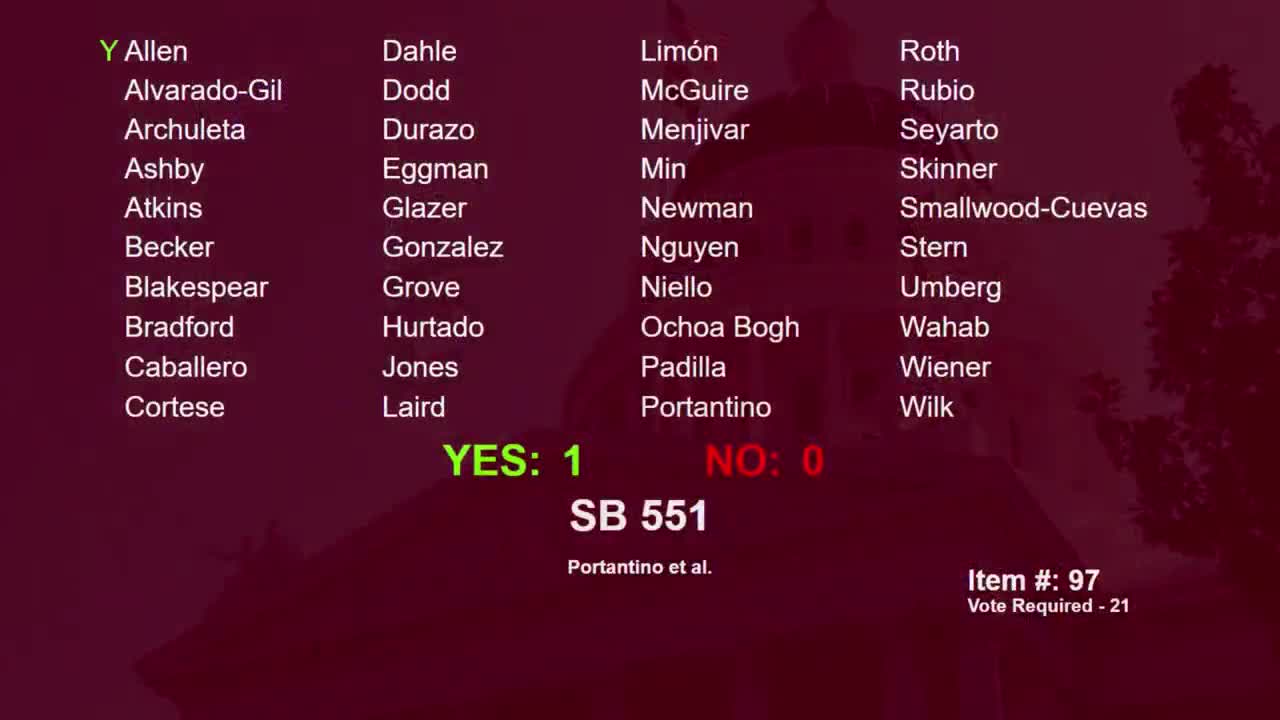 2MIN
Senate Floor
 4MIN
Senate Standing Committee on Natural Resources and Water
Bill Author

Bill Co-Author(s):