SB 575: Marriage: underage marriage.
- Session Year: 2023-2024
- House: Senate
- Latest Version Date: 2024-09-29
Current Status:
Passed
(2024-09-29: Chaptered by Secretary of State. Chapter 984, Statutes of 2024.)
Introduced
In Committee
First Chamber
In Committee
Second Chamber
Enacted
Existing law requires the State Registrar to create a document, no later than March 1, 2020, with annual updates, containing information received by a local registrar concerning marriage certificates in which one or both of the parties were minors at the time of solemnization of the marriage. Existing law requires the local registrar, at least annually, to submit information, as specified, to the State Registrar for those purposes. Under existing law, a local registrar is not required to submit this information to the State Registrar if the local registrar did not receive a copy of the court order, as specified.
This bill would remove that exception and require a local registrar to submit information to the State Registrar, as specified. By increasing the reporting requirements for local registrars, this bill would impose a state-mandated local program.
The bill would require the State Registrar to create a report containing the number of marriage certificates that were submitted by a local registrar, as specified. This bill would require the State Registrar, on or before September 1, 2027, to publish the report on its internet website and submit the report to the Legislature. The bill would repeal this provision on January 1, 2028. This bill would also require the State Registrar, subject to an appropriation, to establish a grant program to study extralegal marriages, as defined. The bill would require a report completed through the grant program to address the prevalence of, conditions of, and circumstances surrounding extralegal marriages in the state, as specified.
The California Constitution requires the state to reimburse local agencies and school districts for certain costs mandated by the state. Statutory provisions establish procedures for making that reimbursement.
This bill would provide that, if the Commission on State Mandates determines that the bill contains costs mandated by the state, reimbursement for those costs shall be made pursuant to the statutory provisions noted above.
Existing law requires the State Registrar to create a document, no later than March 1, 2020, with annual updates, containing information received by a local registrar concerning marriage certificates in which one or both of the parties were minors at the time of solemnization of the marriage. Existing law requires the local registrar, at least annually, to submit information, as specified, to the State Registrar for those purposes. Under existing law, a local registrar is not required to submit this information to the State Registrar if the local registrar did not receive a copy of the court order, as specified.
This bill would remove that exception and require a local registrar to submit information to the State Registrar, as specified. By increasing the reporting requirements for local registrars, this bill would impose a state-mandated local program.
The bill would require the State Registrar to create a report containing the number of marriage certificates that were submitted by a local registrar, as specified. This bill would require the State Registrar, on or before December 31, 2025, September 1, 2027, to publish the report on its internet website and submit the report to the Legislature. The bill would repeal this provision on January 1, 2026. 2028. This bill would also require the State Registrar, subject to an appropriation, to establish a grant program to study extralegal marriages, as defined. The bill would require a report completed through the grant program to address the prevalence of, conditions of, and circumstances surrounding extralegal marriages in the state, as specified.
The California Constitution requires the state to reimburse local agencies and school districts for certain costs mandated by the state. Statutory provisions establish procedures for making that reimbursement.
This bill would provide that, if the Commission on State Mandates determines that the bill contains costs mandated by the state, reimbursement for those costs shall be made pursuant to the statutory provisions noted above.
Existing law requires the State Registrar to create a document, no later than March 1, 2020, with annual updates, containing information received by local registrar concerning marriage certificates in which one or both of the parties were minors at the time of solemnization of the marriage. Existing law requires the local registrar, at least annually, to submit information, as specified, to the State Registrar for those purposes. Under existing law, a local registrar is not required to submit this information to the State Registrar if the local registrar did not receive a copy of the court order, as specified.
This bill would remove that exception and require a local registrar to submit information to the State Registrar, as specified. By increasing the reporting requirements for local registrars, this bill would impose a state-mandated local program.
The bill would require the State Registrar to create a report containing the number of marriage certificates that were submitted by a local registrar, as specified. This bill would require the State Registrar, on or before December 31, 2025, to publish the report on its internet website and submit the report to the Legislature. The bill would repeal this provision on January 1, 2026. This bill would also require the State Registrar, subject to an appropriation, to establish a grant program to study extralegal marriages, as defined. The bill would require a report completed through the grant program to address the prevalence of, conditions of, and circumstances surrounding extralegal marriages in the state, as specified.
The California Constitution requires the state to reimburse local agencies and school districts for certain costs mandated by the state. Statutory provisions establish procedures for making that reimbursement.
This bill would provide that, if the Commission on State Mandates determines that the bill contains costs mandated by the state, reimbursement for those costs shall be made pursuant to the statutory provisions noted above.
(1)Existing law authorizes an unmarried person who is under 18 years of age to marry upon obtaining a court order granting permission and the written consent of at least one of the parents or the guardian of each underage party to the marriage, as specified. Existing law requires the court, if it considers it necessary, as part of the court order granting permission to marry, to require the parties to the prospective marriage of a minor to participate in premarital counseling, as specified.Existing law provides that 2 unmarried, unrelated adults who have chosen to share one anothers lives in an intimate and committed relationship of mutual caring may establish a domestic partnership by filing a declaration with the Secretary of State, if certain requirements are met. Existing law provides that a person under 18 years of age who, together with the person with whom the person proposes to establish a domestic partnership, meets the requirements for a domestic partnership other than the requirement of being at least 18 years of age, is capable of consenting to and establishing a domestic partnership upon obtaining a court order granting permission to the underage person or persons to establish a domestic partnership. Under existing law, registered domestic partners have the same rights, protections, and benefits as spouses.This bill would repeal the authorization for a person under 18 years of age from being issued a marriage license or from establishing a domestic partnership, thereby prohibiting a person under 18 years of age from being issued a marriage license or from establishing a domestic partnership, unless that person is an emancipated minor. The bill would make conforming changes.(2)Existing law required the State Registrar to create a document no later than March 1, 2020, concerning marriage certificates in which one or both of the parties were minors at the time of solemnization of the marriage. Existing law requires the State Registrar to update that document annually, as specified. Existing law requires the local registrar to submit specified information for the purposes of that report.This bill would instead require that report to contain information concerning marriage certificates in which one or both of the parties were emancipated minors at the time of solemnization of the marriage.(1)Existing law authorizes an unmarried person who is under 18 years of age to marry upon obtaining a court order granting permission and the written consent of at least one of the parents or the guardian of each underage party to the marriage, as specified. Existing law requires the court, if it considers it necessary, as part of the court order granting permission to marry, to require the parties to the prospective marriage of a minor to participate in premarital counseling, as specified.
Existing law provides that 2 unmarried, unrelated adults who have chosen to share one anothers lives in an intimate and committed relationship of mutual caring may establish a domestic partnership by filing a declaration with the Secretary of State, if certain requirements are met. Existing law provides that a person under 18 years of age who, together with the person with whom the person proposes to establish a domestic partnership, meets the requirements for a domestic partnership other than the requirement of being at least 18 years of age, is capable of consenting to and establishing a domestic partnership upon obtaining a court order granting permission to the underage person or persons to establish a domestic partnership. Under existing law, registered domestic partners have the same rights, protections, and benefits as spouses.
This bill would repeal the authorization for a person under 18 years of age from being issued a marriage license or from establishing a domestic partnership, thereby prohibiting a person under 18 years of age from being issued a marriage license or from establishing a domestic partnership, unless that person is an emancipated minor. The bill would make conforming changes.
(2)Existing law required the State Registrar to create a document no later than March 1, 2020, concerning marriage certificates in which one or both of the parties were minors at the time of solemnization of the marriage. Existing law requires the State Registrar to update that document annually, as specified. Existing law requires the local registrar to submit specified information for the purposes of that report.
This bill would instead require that report to contain information concerning marriage certificates in which one or both of the parties were emancipated minors at the time of solemnization of the marriage.
Existing law specifies the obligations of the employer and the employee in the employment relationship, and provides that these specifications do not affect statutes governing workers compensation.This bill would make nonsubstantive changes to this provision.Existing law specifies the obligations of the employer and the employee in the employment relationship, and provides that these specifications do not affect statutes governing workers compensation.
This bill would make nonsubstantive changes to this provision.
(a)(1)The State Registrar shall create a report, disaggregated by county, containing the number of marriage certificates that were transmitted to the State Registrar by a local registrar pursuant to Section 102355 each year between 2019 and 2024, inclusive, in which one or both of the parties were minors at the time of solemnization of the marriage.
(2)The report shall itemize, for each marriage, the ages of each party to the marriage and the gender of each party, if available.
(b)Every marriage in which one or both of the parties were minors at the time of solemnization of the marriage shall be counted in the report, whether the marriage was submitted to the State Registrar by a local registrar pursuant to Section 102356.
(c)The report shall not contain the names, addresses, or other personal identifying information of parties to a marriage certificate or information identifying a marriage certificate. The report shall not contain a marriage certificate or, if applicable, a copy of the court order described in Section 304 of the Family Code.
(d)The report shall compare the total number of marriage certificates counted pursuant to subdivision (a) to the number of marriages reported by each county, each year, pursuant to Section 102356.
(e)(1)On or before September 1, 2027, the State Registrar shall publish the report on its internet website and submit a copy of the report to the Legislature and the relevant policy committees.
(2)The State Registrar shall submit the report required in paragraph (1) in accordance with Section 9795 of the Government Code.
(f)This section shall remain in effect only until January 1, 2028, and as of that date is repealed.
SEC. 2.Section 102250 is added to the Health and Safety Code, to read:102250.(a)(1)The State Registrar shall, upon appropriation, establish a grant program for the purpose of studying extralegal marriages involving minors in the state.
(2)An extralegal marriage involving minors means a marriage in which one or both of the parties is under 18 years of age, and the marriage was not solemnized in accordance with the laws of this state, including, but not limited to, circumstances in which no marriage license was applied for, no marriage certificate was returned, or court approval was not sought.
(b)(1)A report completed through the grant program shall address the prevalence of, conditions of, and circumstances surrounding extralegal marriages in the state and include both qualitative and quantitative data.
(2)A report completed through the grant program shall not include personal identifying information about any person discussed in the report.
SEC. 3.Section 102356 of the Health and Safety Code is amended to read:102356.(a)For purposes of Section 102233, the local registrar of marriages shall submit to the State Registrar, at least annually, all of the following information concerning marriage certificates that are accepted for registration by them during the same calendar year and in which one or both of the parties were minors at the time of solemnization of the marriage:
(1)The total number of those marriage certificates.
(2)Itemized for each of those marriage certificates, the age of each party at the time of solemnization of the marriage.
(3)Itemized for each of those marriage certificates, the gender of each party, if available.
(b)The information submitted to the State Registrar pursuant to subdivision (a) shall not contain the names, addresses, or other personal identifying information of parties to a marriage certificate or information identifying a marriage certificate. The information shall not contain a marriage certificate or a copy of the court order described in Section 304 of the Family Code.
(c)The local registrar of marriages shall not submit information described in paragraphs (1) to (3), inclusive, of subdivision (a) if no marriage certificate described in subdivision (a) is accepted for registration by them during the same calendar year.
(d)(1)Notwithstanding any other law, no earlier than two years after the local registrar of marriages submits the information described in subdivision (a) to the State Registrar, the local registrar may dispose of that information.
(2)Notwithstanding any other law, immediately after the local registrar of marriages submits the information described in subdivision (a) to the State Registrar, the local registrar may dispose of the copy of the court order received from the person solemnizing the marriage pursuant to Section 423 of the Family Code.
(e)Notwithstanding the rulemaking provisions of the Administrative Procedure Act (Chapter 3.5 (commencing with Section 11340) of Part 1 of Division 3 of Title 2 of the Government Code), the State Department of Public Health may implement this section through an all-county letter or similar instruction from the State Registrar without taking regulatory action.
SEC. 4.If the Commission on State Mandates determines that this act contains costs mandated by the state, reimbursement to local agencies and school districts for those costs shall be made pursuant to Part 7 (commencing with Section 17500) of Division 4 of Title 2 of the Government Code.
(a)(1)The State Registrar shall create a report, disaggregated by county, containing the number of marriage certificates that were transmitted to the State Registrar by a local registrar pursuant to Section 102355 each year between 2019 and 2024, inclusive, in which one or both of the parties were minors at the time of solemnization of the marriage.
(2)The report shall itemize, for each marriage, the ages of each party to the marriage and the gender of each party, if available.
(b)Every marriage in which one or both of the parties were minors at the time of solemnization of the marriage shall be counted in the report, whether the marriage was submitted to the State Registrar by a local registrar pursuant to Section 102356.
(c)The report shall not contain the names, addresses, or other personal identifying information of parties to a marriage certificate or information identifying a marriage certificate. The report shall not contain a marriage certificate or, if applicable, a copy of the court order described in Section 304 of the Family Code.
(d)The report shall compare the total number of marriage certificates counted pursuant to subdivision (a) to the number of marriages reported by each county, each year, pursuant to Section 102356.
(e)(1)On or before December 31, 2025, September 1, 2027, the State Registrar shall publish the report on its internet website and submit a copy of the report to the Legislature and the relevant policy committees.
(2)The State Registrar shall submit the report required in paragraph (1) in accordance with Section 9795 of the Government Code.
(f)This section shall remain in effect only until January 1, 2026, 2028, and as of that date is repealed.
SEC. 2.Section 102250 is added to the Health and Safety Code, to read:102250.(a)(1)The State Registrar shall, upon appropriation, establish a grant program for the purpose of studying extralegal marriages involving minors in the state.
(2)An extralegal marriage involving minors means a marriage in which one or both of the parties is under 18 years of age, and the marriage was not solemnized in accordance with the laws of this state, including, but not limited to, circumstances in which no marriage license was applied for, no marriage certificate was returned, or court approval was not sought.
(b)(1)A report completed through the grant program shall address the prevalence of, conditions of, and circumstances surrounding extralegal marriages in the state and include both qualitative and quantitative data.
(2)A report completed through the grant program shall not include personal identifying information about any person discussed in the report.
SEC. 3.Section 102356 of the Health and Safety Code is amended to read:102356.(a)For purposes of Section 102233, the local registrar of marriages shall submit to the State Registrar, at least annually, all of the following information concerning marriage certificates that are accepted for registration by them during the same calendar year and in which one or both of the parties were minors at the time of solemnization of the marriage:
(1)The total number of those marriage certificates.
(2)Itemized for each of those marriage certificates, the age of each party at the time of solemnization of the marriage.
(3)Itemized for each of those marriage certificates, the gender of each party, if available.
(b)The information submitted to the State Registrar pursuant to subdivision (a) shall not contain the names, addresses, or other personal identifying information of parties to a marriage certificate or information identifying a marriage certificate. The information shall not contain a marriage certificate or a copy of the court order described in Section 304 of the Family Code.
(c)The local registrar of marriages shall not submit information described in paragraphs (1) to (3), inclusive, of subdivision (a) if no marriage certificate described in subdivision (a) is accepted for registration by them during the same calendar year.
(d)(1)Notwithstanding any other law, no earlier than two years after the local registrar of marriages submits the information described in subdivision (a) to the State Registrar, the local registrar may dispose of that information.
(2)Notwithstanding any other law, immediately after the local registrar of marriages submits the information described in subdivision (a) to the State Registrar, the local registrar may dispose of the copy of the court order received from the person solemnizing the marriage pursuant to Section 423 of the Family Code.
(e)Notwithstanding the rulemaking provisions of the Administrative Procedure Act (Chapter 3.5 (commencing with Section 11340) of Part 1 of Division 3 of Title 2 of the Government Code), the State Department of Public Health may implement this section through an all-county letter or similar instruction from the State Registrar without taking regulatory action.
SEC. 4.If the Commission on State Mandates determines that this act contains costs mandated by the state, reimbursement to local agencies and school districts for those costs shall be made pursuant to Part 7 (commencing with Section 17500) of Division 4 of Title 2 of the Government Code.
(a)(1)The State Registrar shall create a report, disaggregated by county, containing the number of marriage certificates that were transmitted to the State Registrar by a local registrar pursuant to Section 102355 each year between 2019 and 2024, inclusive, in which one or both of the parties were minors at the time of solemnization of the marriage.
(2)The report shall itemize, for each marriage, the ages of each party to the marriage and the gender of each party, if available.
(b)Every marriage in which one or both of the parties were minors at the time of solemnization of the marriage shall be counted in the report, whether the marriage was submitted to the State Registrar by a local registrar pursuant to Section 102356.
(c)The report shall not contain the names, addresses, or other personal identifying information of parties to a marriage certificate or information identifying a marriage certificate. The report shall not contain a marriage certificate or, if applicable, a copy of the court order described in Section 304 of the Family Code.
(d)The report shall compare the total number of marriage certificates counted pursuant to subdivision (a) to the number of marriages reported by each county, each year, pursuant to Section 102356.
(e)(1)On or before December 31, 2025, the State Registrar shall publish the report on its internet website and submit a copy of the report to the Legislature and the relevant policy committees.
(2)The State Registrar shall submit the report required in paragraph (1) in accordance with Section 9795 of the Government Code.
(f)This section shall remain in effect only until January 1, 2026, and as of that date is repealed.
SEC. 2.Section 102250 is added to the Health and Safety Code, to read:102250.(a)(1)The State Registrar shall, upon appropriation, establish a grant program for the purpose of studying extralegal marriages involving minors in the state.
(2)An extralegal marriage involving minors means a marriage in which one or both of the parties is under 18 years of age, and the marriage was not solemnized in accordance with the laws of this state, including, but not limited to, circumstances in which no marriage license was applied for, no marriage certificate was returned, or court approval was not sought.
(b)(1)A report completed through the grant program shall address the prevalence of, conditions of, and circumstances surrounding extralegal marriages in the state and include both qualitative and quantitative data.
(2)A report completed through the grant program shall not include personal identifying information about any person discussed in the report.
SEC. 3.Section 102356 of the Health and Safety Code is amended to read:102356.(a)For purposes of Section 102233, the local registrar of marriages shall submit to the State Registrar, at least annually, all of the following information concerning marriage certificates that are accepted for registration by him or her them during the same calendar year and in which one or both of the parties were minors at the time of solemnization of the marriage:
(1)The total number of those marriage certificates.
(2)Itemized for each of those marriage certificates, the age of each party at the time of solemnization of the marriage.
(3)Itemized for each of those marriage certificates, the gender of each party as documented on the court order pursuant to Section 304 of the Family Code, unless the court order does not include the gender. party, if available.
(b)The information submitted to the State Registrar pursuant to subdivision (a) shall not contain the names, addresses, or other personal identifying information of parties to a marriage certificate, certificate or any information identifying a marriage certificate. The information shall not contain a marriage certificate or a copy of the court order described in Section 304 of the Family Code.
(c)(1)The local registrar of marriages shall not submit any information described in paragraphs (1) to (3), inclusive, of subdivision (a) if no marriage certificate described in subdivision (a) is accepted for registration by him or her them during the same calendar year.
(2)For any marriage certificate described in subdivision (a), the local registrar of marriages is not required to submit any information described in paragraphs (1) to (3), inclusive, of subdivision (a) if the local registrar of marriages did not receive a copy of the court order from the person solemnizing the marriage pursuant to Section 423 of the Family Code. The local registrar of marriages may elect to submit any of that information, if otherwise available, even if he or she did not receive the copy of the court order.(d)(1)Notwithstanding any other law, no earlier than two years after the local registrar of marriages submits the information described in subdivision (a) to the State Registrar, the local registrar may dispose of that information.
(2)Notwithstanding any other law, immediately after the local registrar of marriages submits the information described in subdivision (a) to the State Registrar, the local registrar may dispose of the copy of the court order received from the person solemnizing the marriage pursuant to Section 423 of the Family Code.
(e)Notwithstanding the rulemaking provisions of the Administrative Procedure Act (Chapter 3.5 (commencing with Section 11340) of Part 1 of Division 3 of Title 2 of the Government Code), the State Department of Public Health may implement this section through an all-county letter or similar instruction from the State Registrar without taking regulatory action.
SEC. 4.If the Commission on State Mandates determines that this act contains costs mandated by the state, reimbursement to local agencies and school districts for those costs shall be made pursuant to Part 7 (commencing with Section 17500) of Division 4 of Title 2 of the Government Code.
All matter deleted in this version of the bill appears in the bill as amended in the Senate, January 3, 2024. (JR11) REVISIONS: HeadingLine 2.(a)Domestic partners are two adults who have chosen to share one anothers lives in an intimate and committed relationship of mutual caring.
(b)A domestic partnership shall be established in California when both persons file a Declaration of Domestic Partnership with the Secretary of State pursuant to this division, and, at the time of filing, all of the following requirements are met:
(1)Neither person is married to someone else or is a member of another domestic partnership with someone else that has not been terminated, dissolved, or adjudged a nullity.
(2)The two persons are not related by blood in a way that would prevent them from being married to each other in this state.
(3)(A)Both persons are at least 18 years of age, except as provided in Section 297.1. subparagraph (B).
(B)This paragraph does not prohibit an emancipated minor, as described in Section 7002, from entering into a domestic partnership.
(4)Both persons are capable of consenting to the domestic partnership.
SEC. 2.Section 297.1 of the Family Code is repealed.297.1.(a)A person under 18 years of age who, together with the other proposed domestic partner, otherwise meets the requirements for a domestic partnership other than the requirement of being at least 18 years of age, may establish a domestic partnership upon obtaining a court order granting permission to the underage person or persons to establish a domestic partnership.(b)(1)The court order and written consent of the parents of each person under 18 years of age or of one of the parents or the guardian of each person under 18 years of age, except as provided in paragraph (2), shall be filed with the clerk of the court, and a certified copy of the order shall be filed with the Secretary of State with the Declaration of Domestic Partnership.(2)If it appears to the satisfaction of the court by application of a person under 18 years of age that the person requires a written consent to establish a domestic partnership and that the minor has no parent or guardian, or has no parent or guardian capable of consenting, the court may make an order consenting to establishing the domestic partnership. The order shall be filed with the clerk of the court and a certified copy of the order shall be filed with the Secretary of State with the Declaration of Domestic Partnership.(3)Notwithstanding any other law, immediately after the Secretary of State creates or updates the document described in Section 298.8 using the information required for the document and that is contained in a certified copy of a court order filed with the Secretary of State with the Declaration of Domestic Partnership pursuant to this subdivision, the Secretary of State may dispose of the certified copy of the court order.(c)In determining whether to issue a court order granting permission to establish a domestic partnership, the court shall do all of the following:(1)Require Family Court Services to separately interview the parties intending to establish a domestic partnership and, if applicable, at least one of the parents or the guardian of each party who is a minor. If more than one parent or guardian is interviewed, the parents or guardians shall be interviewed separately.(2)Require Family Court Services to prepare and submit to the court a written report, containing any assessment of potential force, threat, persuasion, fraud, coercion, or duress by either of the parties or their family members relating to the intended domestic partnership. The report shall also contain recommendations of Family Court Services for either granting or denying the parties permission to establish a domestic partnership. If Family Court Services knows or reasonably suspects that either party is a victim of child abuse or neglect, Family Court Services shall submit a report of the known or suspected child abuse or neglect to the county child protective services agency.(3)After receiving the report of the assessments of Family Court Services, as described in paragraph (2), separately interview in camera each of the parties prior to making a final determination regarding the court order.(4)Consider whether there is evidence of coercion or undue influence on the minor.(d)If the court issues an order granting the parties permission to establish a domestic partnership, and if one or both of the parties are 17 years of age or younger, the parties shall be eligible to file a Declaration of Domestic Partnership with the Secretary of State no earlier than 30 days from the time the court order was issued.(e)As part of the court order granting permission to establish a domestic partnership, the court shall, if it considers it necessary, require the parties to the prospective domestic partnership of a minor to participate, before the domestic partnership is established, in counseling concerning social, economic, and personal responsibilities incident to the domestic partnership. The parties shall not be required to confer with counselors provided by religious organizations of any denomination. In determining whether to order the parties to participate in the counseling, the court shall consider, among other factors, the ability of the parties to pay for the counseling. The court may impose a reasonable fee to cover the cost of counseling provided by the county or the court. The fees shall be used exclusively to cover the cost of the counseling services authorized by this section.(f)(1)Only for purposes of completing the document described in Section 298.8, and not for purposes of making a determination regarding the court order, the gender of each party intending to establish a domestic partnership, if provided, shall be documented on the court order granting permission to establish the domestic partnership.(2)The date of birth of each party intending to establish a domestic partnership shall also be documented on the court order granting permission to establish the domestic partnership.(g)Upon issuance of the order granting permission to establish a domestic partnership, the minor shall be provided with the following information:(1)The rights and responsibilities of an emancipated minor, including, but not limited to, the effects of emancipation as described in Chapter 2 (commencing with Section 7050) of Part 6 of Division 11.(2)(A)The circumstances under which a domestic partnership may be determined by a court to be void or voidable and adjudged a nullity and the procedure for obtaining that judicial determination.(B)The procedures for termination of a domestic partnership.(3)Telephone numbers for the National Domestic Violence Hotline and the National Sexual Assault Hotline.(4)The conditions under which an unemancipated minor may leave home and seek to remain in a shelter or otherwise live separately from the minors parent or guardian, and whether the consent or acquiescence of a parent or guardian is required to remain away from the home of the parent or guardian, the rights of an unemancipated minor to apply for a protective or restraining order to prevent abuse, and the rights of a minor to enter into contracts, including contracts for legal services and mental health counseling.(h)(1)Subdivisions (c) and (d) do not apply to a minor who is 17 years of age and who has achieved a high school diploma or a high school equivalency certificate.(2)Subdivision (d) does not apply to a minor who is 16 or 17 years of age and who is pregnant or whose prospective domestic partner is pregnant.SEC. 3.Section 298.8 of the Family Code is amended to read:298.8.(a)The Secretary of State shall create a document no later than March 1, 2020, with annual updates no later than March 1 of each year thereafter, disaggregated by county, containing only the following information concerning domestic partnerships that were registered during the preceding calendar year and in which one or both of the parties were minors emancipated minors, as described in Section 7002, at the time the domestic partnership was established:
(1)The total number of those registered domestic partnerships.
(2)Itemized for each of those registered domestic partnerships, the age of each party at the time the domestic partnership was established.
(3)Itemized for each of those registered domestic partnerships, the gender of each party as documented on the court order pursuant to Section 297.1, unless the court order does not include the gender. party, if available.
(b)The document shall not contain the names, addresses, or other personal identifying information of parties to a registered domestic partnership, partnership or any information identifying a registered domestic partnership. The document shall not contain a registered domestic partnership or a copy of the court order described in Section 297.1.
(c)The Secretary of State shall make the document available to the public upon request.
SEC. 4.Section 301 of the Family Code is amended to read:301.(a)Two unmarried persons 18 years of age or older, who are not otherwise disqualified, are capable of consenting to and consummating marriage.
(b)This section does not prohibit an unmarried emancipated minor, as described in Section 7002, who is not otherwise disqualified, from consenting to and consummating a marriage.
SEC. 5.Section 302 of the Family Code is repealed.302.(a)An unmarried person under 18 years of age may be issued a marriage license upon obtaining a court order granting permission to the underage person or persons to marry, in accordance with the requirements described in Section 304.(b)The court order and written consent of at least one of the parents or the guardian of each underage person shall be filed with the clerk of the court, and a certified copy of the order shall be presented to the county clerk at the time the marriage license is issued.SEC. 6.Section 303 of the Family Code is repealed.303.If it appears to the satisfaction of the court by application of a minor that the minor requires a written consent to marry and that the minor has no parent or has no parent capable of consenting, the court may make an order consenting to the issuance of a marriage license and granting permission to the minor to marry, in accordance with the requirements described in Section 304. The order shall be filed with the clerk of the court and a certified copy of the order shall be presented to the county clerk at the time the marriage license is issued.SEC. 7.Section 304 of the Family Code is repealed.304.(a)In determining whether to issue a court order granting permission to marry pursuant to Section 302 or 303, the court shall do all of the following:(1)Require Family Court Services to separately interview the parties intending to marry and, if applicable, at least one of the parents or the guardian of each party who is a minor. If more than one parent or guardian is interviewed, the parents or guardians shall be interviewed separately.(2)Require Family Court Services to prepare and submit to the court a written report, containing any assessment of potential force, threat, persuasion, fraud, coercion, or duress by either of the parties or their family members relating to the intended marriage. The report shall also contain recommendations of Family Court Services for either granting or denying the parties permission to marry. If Family Court Services knows or reasonably suspects that either party is a victim of child abuse or neglect, Family Court Services shall submit a report of the known or suspected child abuse or neglect to the county child protective services agency.(3)After receiving the report of the assessments of Family Court Services, as described in paragraph (2), separately interview in camera each of the parties prior to making a final determination regarding the court order.(4)Consider whether there is evidence of coercion or undue influence on the minor.(b)If the court issues an order granting the parties permission to marry pursuant to Section 302 or 303, and if one or both of the parties are 17 years of age or younger, the parties shall be eligible to request a marriage license no earlier than 30 days from the time the court order was issued.(c)As part of the court order granting permission to marry under Section 302 or 303, the court shall, if it considers it necessary, require the parties to the prospective marriage of a minor to participate in premarital counseling concerning social, economic, and personal responsibilities incident to marriage. The parties shall not be required to confer with counselors provided by religious organizations of any denomination. In determining whether to order the parties to participate in the premarital counseling, the court shall consider, among other factors, the ability of the parties to pay for the counseling. The court may impose a reasonable fee to cover the cost of premarital counseling provided by the county or the court. The fees shall be used exclusively to cover the cost of the counseling services authorized by this section.(d)(1)Only for purposes of completing the document described in Section 102233 of the Health and Safety Code, and not for purposes of making a determination regarding the court order, the gender of each party intending to marry, if provided, shall be documented on the court order granting permission to marry.(2)The date of birth of each party intending to marry shall also be documented on the court order granting permission to marry.(3)For purposes of the requirements on the person solemnizing the marriage under subdivision (b) of Section 423, and the requirements on the local registrar under subdivision (a) of Section 102356 of the Health and Safety Code, the court shall provide parties who are granted permission to marry with a copy of the court order granting permission to marry.(e)Upon issuance of the order granting permission to marry, the minor shall be provided with the following information:(1)The rights and responsibilities of an emancipated minor, including, but not limited to, the effects of emancipation as described in Chapter 2 (commencing with Section 7050) of Part 6 of Division 11.(2)(A)The circumstances under which a marriage may be determined by a court to be void or voidable and adjudged a nullity and the procedure for obtaining that judicial determination.(B)The procedures for legal separation or dissolution of marriage.(3)Telephone numbers for the National Domestic Violence Hotline and the National Sexual Assault Hotline.(4)The conditions under which an unemancipated minor may leave home and seek to remain in a shelter or otherwise live separately from the minors parent or guardian, and whether the consent or acquiescence of a parent or guardian is required to remain away from the home of the parent or guardian, the rights of an unemancipated minor to apply for a protective or restraining order to prevent abuse, and the rights of a minor to enter into contracts, including contracts for legal services and mental health counseling.(f)(1)Subdivisions (a) and (b) do not apply to a minor who is 17 years of age and who has achieved a high school diploma or a high school equivalency certificate.(2)Subdivision (b) does not apply to a minor who is 16 or 17 years of age and who is pregnant or whose prospective spouse is pregnant.SEC. 8.Section 423 of the Family Code is amended to read:423.(a)The person solemnizing the marriage shall return the marriage license, endorsed as required in Section 422, to the county recorder of the county in which the license was issued within 10 days after the ceremony.
(b)For purposes of Section 102356 of the Health and Safety Code, the person solemnizing the marriage shall include with the marriage license described in subdivision (a) a copy of the court order granting permission to marry described in Section 304, if one or both of the parties to the marriage were minors at the time of solemnization of the marriage.SEC. 9.Section 1501 of the Family Code is amended to read:1501.A minor may make a valid premarital agreement or other marital property agreement if the minor is emancipated, is otherwise capable of contracting marriage pursuant to Section 302 or 303, entered into a marriage pursuant to former Section 302 or former Section 303 in this state before January 1, 2025, or has entered or is entering a marriage that is valid in the jurisdiction where the marriage is solemnized.
SEC. 10.Section 2210 of the Family Code is amended to read:2210.A marriage is voidable and may be adjudged a nullity if any of the following conditions existed at the time of the marriage:
(a)The party who commences the proceeding or on whose behalf the proceeding is commenced was under 18 years of age, unless the party entered into the marriage pursuant to Section 302 or 303. former Section 302 or former Section 303 in this state before January 1, 2025.
(b)The spouse of either party was living living, and the marriage with that spouse was then in force and that spouse (1) was absent and not known to the party commencing the proceeding to be living for a period of five successive years immediately preceding the subsequent marriage for which the judgment of nullity is sought or (2) was generally reputed or believed by the party commencing the proceeding to be dead at the time the subsequent marriage was contracted.
(c)Either party was of unsound mind, unless the party of unsound mind, after coming to reason, freely cohabited with the other as his or her their spouse.
(d)The consent of either party was obtained by fraud, unless the party whose consent was obtained by fraud afterwards, with full knowledge of the facts constituting the fraud, freely cohabited with the other as his or her their spouse.
(e)The consent of either party was obtained by force, unless the party whose consent was obtained by force afterwards freely cohabited with the other as his or her their spouse.
(f)Either party was, at the time of marriage, physically incapable of entering into the marriage state, and that incapacity continues, continues and appears to be incurable.
SEC. 11.Section 7002 of the Family Code is amended to read:7002.A person under the age of 18 years is an emancipated minor if any of the following conditions is satisfied:
(a)The person has entered into a valid marriage, in another state or country, or in this state, pursuant to former Section 302 or former Section 303, prior to January 1, 2025, or has established a valid domestic partnership, regardless of whether the marriage or the domestic partnership has been dissolved.
(b)The person is on active duty with the Armed Forces of the United States.
(c)The person has received a declaration of emancipation pursuant to Section 7122.
SEC. 12.Section 102233 of the Health and Safety Code is amended to read:102233.(a)The State Registrar shall create a document no later than March 1, 2020, with annual updates no later than March 1 of each year thereafter, disaggregated by county, containing only the information received by a local registrar during the preceding calendar year pursuant to subdivision (a) of Section 102356, concerning marriage certificates in which one or both of the parties were emancipated minors at the time of solemnization of the marriage.
(b)The document shall not contain the names, addresses, or other personal identifying information of parties to a marriage certificate, or any information identifying a marriage certificate. The document shall not contain a marriage certificate or a copy of the court order described in Section 304 of the Family Code. certificate.
(c)The State Registrar shall make the document available to the public upon request.
SEC. 13.Section 102356 of the Health and Safety Code is amended to read:102356.(a)For purposes of Section 102233, the local registrar of marriages shall submit to the State Registrar, at least annually, all of the following information concerning marriage certificates that are accepted for registration by him or her them during the same calendar year and in which one or both of the parties were minors at the time of solemnization of the marriage:
(1)The total number of those marriage certificates.
(2)Itemized for each of those marriage certificates, the age of each party at the time of solemnization of the marriage.
(3)Itemized for each of those marriage certificates, the gender of each party as documented on the court order pursuant to Section 304 of the Family Code, unless the court order does not include the gender. party, if available.
(b)The information submitted to the State Registrar pursuant to subdivision (a) shall not contain the names, addresses, or other personal identifying information of parties to a marriage certificate, or any information identifying a marriage certificate. The information shall not contain a marriage certificate or a copy of the court order described in Section 304 of the Family Code. certificate.
(c)(1)The local registrar of marriages shall not submit any information described in paragraphs (1) to (3), inclusive, of subdivision (a) if no marriage certificate described in subdivision (a) is accepted for registration by him or her them during the same calendar year.
(2)For any marriage certificate described in subdivision (a), the local registrar of marriages is not required to submit any information described in paragraphs (1) to (3), inclusive, of subdivision (a) if the local registrar of marriages did not receive a copy of the court order from the person solemnizing the marriage pursuant to Section 423 of the Family Code. The local registrar of marriages may elect to submit any of that information, if otherwise available, even if he or she did not receive the copy of the court order.(d)(1)Notwithstanding any other law, no earlier than two years after the local registrar of marriages submits the information described in subdivision (a) to the State Registrar, the local registrar may dispose of that information.
(2)Notwithstanding any other law, immediately after the local registrar of marriages submits the information described in subdivision (a) to the State Registrar, the local registrar may dispose of the copy of the court order received from the person solemnizing the marriage pursuant to Section 423 of the Family Code.(e)Notwithstanding the rulemaking provisions of the Administrative Procedure Act (Chapter 3.5 (commencing with Section 11340) of Part 1 of Division 3 of Title 2 of the Government Code), the State Department of Public Health may implement this section through an all-county letter or similar instruction from the State Registrar without taking regulatory action.
SECTION 1.Section 2700 of the Labor Code is amended to read:2700.The provisions of this division shall not limit, change, or in any way qualify the provisions of Division 4 (commencing with Section 3200) and Division 4.5 (commencing with Section 6100), but shall be fully operative and effective in all cases where the provisions of Divisions 4 and 4.5 are not applicable.The provisions of this division shall not limit, change, or in any way qualify the provisions of Divisions 4 Division 4 (commencing with Section 3200) and Division 4.5 of this code, (commencing with Section 6100), but shall be fully operative and effective in all cases where the provisions of Divisions 4 and 4.5 are not applicable.
|
Date
|
Status
|
|---|---|
| Sep 29, 2024 | Chaptered by Secretary of State. Chapter 984, Statutes of 2024. |
| Sep 29, 2024 | Approved by the Governor. |
| Sep 9, 2024 | Enrolled and presented to the Governor at 3 p.m. |
| Aug 29, 2024 | Assembly amendments concurred in. (Ayes 40. Noes 0. Page 5656.) Ordered to engrossing and enrolling. |
| Aug 28, 2024 | In Senate. Concurrence in Assembly amendments pending. |
| Aug 28, 2024 | Read third time. Passed. (Ayes 77. Noes 0. Page 6696.) Ordered to the Senate. |
| Aug 23, 2024 | Ordered to third reading. |
| Aug 23, 2024 | Read third time and amended. |
| Aug 19, 2024 | Read second time. Ordered to third reading. |
| Aug 15, 2024 | From committee: Do pass. (Ayes 14. Noes 0.) (August 15). |
| Aug 15, 2024 | Coauthors revised. |
| Jul 2, 2024 | July 2 set for first hearing. Placed on suspense file. |
| Jun 4, 2024 | From committee: Do pass and re-refer to Com. on APPR. with recommendation: To consent calendar. (Ayes 8. Noes 0.) (June 4). Re-referred to Com. on APPR. |
| Jun 4, 2024 | Coauthors revised. |
| Apr 29, 2024 | Referred to Com. on JUD. |
| Jan 29, 2024 | In Assembly. Read first time. Held at Desk. |
| Jan 29, 2024 | Read third time. Passed. (Ayes 38. Noes 0. Page 3050.) Ordered to the Assembly. |
| Jan 22, 2024 | Read second time. Ordered to third reading. |
| Jan 18, 2024 | From committee: Do pass. (Ayes 5. Noes 0. Page 3011.) (January 18). |
| Jan 17, 2024 | Set for hearing January 18. |
| Jan 16, 2024 | January 16 hearing: Placed on APPR suspense file. |
| Jan 12, 2024 | Set for hearing January 16. |
| Jan 11, 2024 | From committee with author's amendments. Read second time and amended. Re-referred to Com. on APPR. |
| Jan 11, 2024 | From committee: Do pass and re-refer to Com. on APPR. (Ayes 9. Noes 0. Page 2980.) (January 11). Re-referred to Com. on APPR. |
| Jan 4, 2024 | Set for hearing January 11. |
| Jan 3, 2024 | Re-referred to Com. on JUD. |
| Jan 3, 2024 | From committee with author's amendments. Read second time and amended. Re-referred to Com. on RLS. |
| Feb 22, 2023 | Referred to Com. on RLS. |
| Feb 16, 2023 | From printer. May be acted upon on or after March 18. |
| Feb 15, 2023 | Introduced. Read first time. To Com. on RLS. for assignment. To print. |
|
Date
|
Description
|
Location
|
Votes
|
|
|---|---|---|---|---|
| Aug 29, 2024 | Unfinished Business SB575 Wahab et al. Concurrence | Senate Floor |
Passed |
|
| Aug 28, 2024 | SB 575 Wahab Senate Third Reading By Kalra | Assembly Floor |
Passed |
|
| Aug 15, 2024 | Do pass. | Assembly Standing Committee on Appropriations |
Passed |
|
| Jun 4, 2024 | Do pass and be re-referred to the Committee on [Appropriations] with recommendation: To Consent Calendar | Assembly Standing Committee on Judiciary |
Passed |
|
| Jan 29, 2024 | Senate 3rd Reading SB575 Wahab | Senate Floor |
Passed |
|
| Jan 18, 2024 | Do pass | Senate Standing Committee on Appropriations |
Passed |
|
| Jan 16, 2024 | Placed on suspense file | Senate Standing Committee on Appropriations |
Passed |
|
| Jan 11, 2024 | Do pass, but first be re-referred to the Committee on [Appropriations] | Senate Standing Committee on Judiciary |
Passed |
This list shows positions taken on this bill by organizations on the date displayed, which is linked to the original source.
Positions by individuals are not included.
|
Organization
|
Position
|
Date
|
|---|---|---|
| Aclu California Action | ** Against | |
| American Atheists | ** Against | |
| County of Santa Clara | ** Support | |
| National Center for Youth Law | ** Against | |
| Planned Parenthood Affiliates Of California | ** Support | |
| Zonta Club Of Silicon Valley | ** Support |
SENATE RULES COMMITTEE Office of Senate Floor Analyses (916) 651-1520 Fax: (916) 327-4478 | SB 575 |
UNFINISHED BUSINESS
Bill No: SB 575
Author: Wahab (D), et al.
Amended: 8/23/24
Vote: 21
SENATE JUDICIARY COMMITTEE: 9-0, 1/11/24
AYES: Umberg, Wilk, Allen, Ashby, Caballero, Gonzalez, Laird, Min, Wiener
NO VOTE RECORDED: Niello, Stern
SENATE APPROPRIATIONS COMMITTEE: 5-0, 1/18/24
AYES: Portantino, Bradford, Seyarto, Wahab, Wiener
NO VOTE RECORDED: Jones, Ashby
SENATE FLOOR: 38-0, 1/29/24
AYES: Allen, Alvarado-Gil, Archuleta, Ashby, Atkins, Becker, Blakespear, Bradford, Caballero, Cortese, Dahle, Dodd, Durazo, Eggman, Glazer, Grove, Hurtado, Laird, Limón, McGuire, Menjivar, Min, Newman, Nguyen, Niello, Ochoa Bogh, Padilla, Portantino, Roth, Rubio, Seyarto, Skinner, Smallwood-Cuevas, Stern, Umberg, Wahab, Wiener, Wilk
NO VOTE RECORDED: Gonzalez, Jones
ASSEMBLY FLOOR: 77-0, 8/28/24 - See last page for vote
SUBJECT: Marriage: underage marriage
SOURCE: Author
DIGEST:
This bill (1) closes a loophole in the requirement that a local registrar report to the State Registrar on marriages in which one or more party is a minor; (2) requires the State Registrar to create a report containing the number of marriage certificates, disaggregated by county, in which one or more party was a minor each year between 2019 and 2024, as specified; and (3) requires the State Registrar, upon appropriation, to establish a grant for the purposes of studying extralegal marriages involving minors in the State.
Assembly Amendments
extended the due date for the State Registrar’s report from December 31, 2025, to September 1, 2027.
ANALYSIS:
Existing law:
- Defines “minor” as an individual under 18 years of age. (Fam. Code, § 6500.)
- Limits a minor’s ability to give legal consent or be legally liable for their actions, including:
- Providing that a minor is civilly liable for a wrong done by the minor, but is not liable for exemplary damages unless the minor was capable of knowing that the act was wrongful. (Fam. Code, § 6600.)
- Providing that a minor may, in some cases, make a contract in the same manner as an adult; however, a minor cannot give a delegation of power, make a contract relating to real property, or make a contract relating to personal property not in the immediate possession or control of the minor, and the minor may, in most cases, disaffirm a contract within a reasonable time afterwards. (Fam. Code, §§ 6700, 6701, 6710.)
- Providing that a minor may consent to certain medical and mental health treatments, including medical care related to the prevention or treatment of pregnancy (at any age), treatment for injuries caused by intimate partner violence (at age 12 years or older), and treatment for opioid use disorder (12 years of age for most treatments; 16 years of age for opioid use disorder treatments involving buprenorphine). (Fam. Code, §§ 6920-6930.)
- Providing that a minor aged 16 years or older may, with the consent of a parent or court approval, enlist in the Armed Forces of the United States. (Fam. Code, § 6950.)
- Provides that two unmarried persons 18 years of age or older, who are not otherwise disqualified, are capable of consenting to and consummating marriage or a domestic partnership. (Fam. Code, §§ 297.1, 301.)
- Permits, notwithstanding 4), an unmarried person under 18 years of age and otherwise qualified to consent to a marriage or domestic partnership with the consent of a parent or guardian and a court order. If the minor has no parent or guardian capable of consenting, the court may grant permission as well as issue the order. (Fam. Code, §§ 297.1, 302, 303.)
- Establishes the procedure by which a minor may obtain a court order to enter into a marriage or domestic partnership, as required under 5), as follows and subject to the exceptions in 7) and 8):
- Family Court Services must separately interview the parties intending to marry and, if applicable, at least one of the parents or guardian of each party who is a minor. If more than one parent or guardian is interviewed, they must be interviewed separately.
- Family Court Services must prepare and submit to the court a written report containing an assessment of potential force, threat, persuasion, fraud, coercion, or duress by either of the parties or their family members relating to the intended marriage, as well as Family Court Services’ recommendation for either granting or denying the parties permission to marry. If Family Court Services knows or reasonably suspects that either party is a victim of child abuse or neglect, Family Court Services shall submit a report of the known or suspected child abuse or neglect to the county child protective services agency.
- After receiving the Family Court Services report, the court must separately interview in camera (privately and off the record) each of the parties prior to making a final determination regarding the court order, and consider whether there is evidence of coercion or undue influence on the minor.
- If the court issues an order granting permission to marry or enter into a domestic partnership, and if one or both of the parties is a minor, the parties shall be eligible to request a marriage license no earlier than 30 days from the time the court issued the order.
- As parts of its order granting permission to marry or enter into a domestic partnership, the court shall, if it considers necessary, require the parties to the prospective marriage or domestic partnership to participate, prior to the marriage or establishment of the domestic partnership, in counseling concerning social, economic, and personal responsibilities incident to the marriage or domestic partnership; the parties shall not be required to confer with religious counselors of any denomination. In determining whether to order counseling, the court shall consider, among other factors, the availability of the parties to pay for counseling; the court may impose a reasonable fee to cover the cost of counseling provided by the court or county, which shall be used exclusively to cover the cost of the counseling services.
- For purposes of the data collection for 12) through 15) below, the court order granting permission to enter into the marriage or domestic partnership must include the gender and date of birth of each party.
- Upon the issuance of an order granting permission to enter into the marriage or domestic partnership, the minor shall be provided with information regarding the rights and responsibilities of an emancipated minor; the circumstances under which a marriage or domestic partnership may be determined to be void or voidable and adjudged a nullity; the procedures for legal separation and dissolution of a marriage or termination of a domestic partnership; telephone numbers for the National Domestic Violence Hotline and the National Sexual Assault Hotline; and the conditions under which an unemancipated minor may leave home and seek to remain in a shelter or otherwise live separately from the minor’s parent guardian and whether their consent is required, the rights of an unemancipated minor to apply for a protective order or restraining order to prevent abuse, and the rights of a minor to enter into contracts, including for legal services and mental health counseling. (Fam. Code, §§ 297.1, 304.)
- Exempts, from the interview, report, and 30-day waiting period requirements (set forth in 6) subsections a)-d)), a minor who is 17 years of age and has achieved a high school diploma or a high school equivalency certificate. (Fam. Code, §§ 297.1(h)(1), 304(f)(1).)
- Exempts, from the 30-day waiting period requirement, a minor who is 16 or 17 years of age and who is pregnant or whose prospective spouse or domestic partner is pregnant. (Fam. Code, §§ 297.1(h)(2), 304(f)(2).)
- Requires a person solemnizing a marriage involving a minor to return to the county recorder, along with the marriage license, a copy of the court order granting permission to marry, if one or both of the parties to the marriage were minors at the time of solemnization. (Fam. Code, § 423.)
- Requires the court order and written consent of the parent(s) or guardian(s) of each minor entering into a domestic partnership to be filed with the clerk of the court and a certified copy of the order to be filed with the Secretary of State with the Declaration of Domestic Partnership. (Fam. Code, § 297.1 (a).)
- Requires the local registrar of marriages to submit to the State Registrar, at least annually, all of the following information concerning marriage certificates accepted for registration by them during the same calendar year and in which both of the parties were minors at the time of solemnization of the marriage:
- The total number of those marriage certificates.
- For each of those marriages, the age of each party at the time of solemnization of the marriage.
- For each of those marriages, the gender of each party as documented in the court order, unless the court order does not include gender. (Health & Saf. Code, § 102356(a).)
- Provides that the local registrar of marriages may, but is not required, to submit the information in 11) if the local registrar of marriages did not receive a copy of the court order from the person solemnizing the marriage, as required in 9). (Health & Saf. Code, § 102356(c).)
- Requires the State Registrar to create a document, and make the document available to the public on request, updated annually by March 1 of each year, disaggregated by county, containing the information received from the local registrars under 11). (Health & Saf. Code, § 102233.)[1]
- Provides that a marriage is voidable and may be adjudged a nullity if, at the time of the marriage, certain conditions existed, including:
- The party who commences the proceeding to have the marriage adjudged a nullity was a minor, unless the party entered into the marriage with the requisite court order and permission from a parent or guardian.
- Consent of either party was obtained by fraud, unless the party whose consent was obtained by fraud afterwards, with full knowledge of the facts constituting the fraud, freely cohabitated with the other as their spouse.
- Consent of either party was obtained by force, unless the party whose consent was obtained by force afterwards freely cohabitated with the other as their spouse. (Fam. Code, § 2210.)
This bill:
- Requires the State Registrar to create a report, disaggregated by county, containing the number of marriage certificates transmitted to the State Registrar by a local registrar each year between 2019 and 2024, inclusive, in which one or both of the parties were minors at the time of the solemnization of the marriage.
- The report shall itemize, for each marriage, the ages of the parties and the genders, if available, and shall not contain any personally identifying information.
- The report shall compare the number of marriages contained in the report with the number of marriages transmitted by local registrars pursuant to the current minor-marriage reporting requirement.
- The report shall be published and provided to the Legislature on or before September 1, 2027.
- Requires the State Registrar, upon appropriation, to establish a grant program for the purpose of studying extralegal marriages involving minors in the State, as defined. A report completed through the grant shall address the prevalence of, conditions of, and circumstances surrounding extralegal marriages in the State.
- Deletes the provision permitting a local registrar, pursuant to its obligation to report to the State Registrar the number of marriages in which one or more party was a minor at the time of solemnization, not to report such a marriage if the party solemnizing the marriage did not return the court order authorizing the marriage along with the marriage certificate.
Comments
California is one of five states that has no minimum age at which a person can enter into a marriage or a domestic partnership, provided that a person under 18 who wishes to marry or enter into a domestic partnership obtains a court order granting them permission to do so. The process by which such a court order can be obtained, as put in place by SB 273 (Hill, Chapter 660, Statutes of 2018) is robust and required, among other things, the minor who wishes to get married to be interviewed privately on two separate occasions to ensure that they are not being coerced or threatened into the marriage. According to data from the State Registrar, fewer than 20 minors have been married in the State each year since SB 273 was enacted; in 2022, the most recent year for which data are available, the State Registrar reports that only nine minors were married.
These numbers do not mean that California does not have a problem with minors marrying. There is other evidence suggesting that minors are being placed in marriages in higher numbers; it is unclear, however, whether these marriages are through the State or are predominantly extralegal “marriages” performed through a religious or other institution without state sanction. Also as a general matter, early marriage correlates with bad outcomes, particularly for women and girls. Studies show that women who marry as minors are likely to be abused by their husbands and experience negative financial, health, and educational outcomes. There is not, however, qualitative evidence regarding the small number of state-sanctioned marriages performed in California each year.
In order to provide the Legislature with adequate information about the scope and nature of minor marriages in California, this bill (1) requires the State Registrar to compile a report with the numbers of all of the marriage certificates recorded in which one or more party is a minor; (2) establishes a grant, to be awarded to an institution to be determined if an appropriation is made therefor, to conduct a study of extralegal minor marriage in the State; and (3) closes the loophole that allows local registrars not to report to the State Registrar a marriage involving a minor if the person who solemnized the marriage did not return the court order authorizing the marriage with the marriage certificate, thereby ensuring that the State Registrar is receiving accurate numbers regarding the prevalence of legally authorized minor marriage in the state going forward.
FISCAL EFFECT: Appropriation: No Fiscal Com.: Yes Local: Yes
According to the Assembly Appropriations Committee, this bill presents:
- Costs (General Fund) to the California Department of Public Health (CDPH) for the State Registrar’s required report. CDPH reports the earliest it could complete the report is September 1, 2027. CDPH anticipates costs of $819,530 in FY 2026-27 and $145,966 in FY 2027-28. CDPH reports completing the report will require it to review more than 1 million marriage records, so it must develop and use an optical character recognition tool to scan and extract data from marriage records. CDPH analysts will require an estimated 100 hours to review the extracted data and prepare the report. Additionally, CDPH anticipates costs of $500,000 to create the grant program, upon appropriation by the Legislature.
- Costs (local funds, General Fund) of an unknown but potentially significant amount to the counties for additional reporting by local registrars. As described in more detail below, this bill increases local registrars’ reporting obligations because it will require local registrars to report information about each marriage involving a minor, even if the registrar does not have a copy of the court order authorizing the marriage. General Fund costs will depend on whether the duties imposed by this bill constitute a reimbursable state mandate, as determined by the Commission on State Mandates.
SUPPORT: (Verified 8/28/24)
County of Santa Clara
Planned Parenthood Affiliates of California
Zonta e-Club of Silicon Valley
OPPOSITION: (Verified 8/28/24)
American Atheists
ARGUMENTS IN SUPPORT: According to Planned Parenthood Affiliates of California:
While California’s existing law protects young people who wish to legally marry, PPAC shares concerns around marriages that happen outside of the legal system, considered “extralegal marriages.” Extralegal marriages are not recognized by the state or the legal system and therefore have no oversight to protect from coercion or abuse. SB 575 seeks to better understand the landscape of minor marriage in California and would require a study of extralegal minor marriage in California to better understand the systems in which these “relationships” exist. We look forward to the information provided by SB 575 to help inform future policy that may be needed to address any gaps in existing law.
ARGUMENTS IN OPPOSITION: The U.S. State Department has called marriage before age 18 a “human right abuse.” So why is California 1 of only 5 U.S. states to have no minimum age to get married to an adult? Children can easily be forced to marry before they turn 18 and become legal adults, because they face overwhelming legal and practical barriers if they try to leave home, enter a domestic-violence shelter, retain an attorney, or bring a legal action. Despite California requiring parental consent and a court order, these paper-thin guardrails are not even relevant when it comes to emancipated minors. If we are truly to protect all youth from coercive marriages to adults, this bill should be amended to not allow adults from predating on emancipated minors. If this bill is amended, California could join ten other U.S. states in taking proactive steps to fully end child marriage.
ASSEMBLY FLOOR: 77-0, 8/28/24
Ayes: Addis, Aguiar-Curry, Alanis, Alvarez, Arambula, Bains, Bauer-Kahan, Bennett, Berman, Boerner, Bonta, Bryan, Calderon, Juan Carrillo, Wendy Carrillo, Chen, Connolly, Megan Dahle, Davies, Dixon, Essayli, Flora, Mike Fong, Friedman, Gabriel, Gallagher, Garcia, Gipson, Grayson, Haney, Hart, Holden, Hoover, Irwin, Jackson, Jones-Sawyer, Kalra, Lackey, Lee, Low, Lowenthal, Maienschein, Mathis, McCarty, McKinnor, Muratsuchi, Stephanie Nguyen, Pacheco, Papan, Jim Patterson, Joe Patterson, Pellerin, Petrie-Norris, Quirk-Silva, Ramos, Rendon, Reyes, Luz Rivas, Rodriguez, Blanca Rubio, Sanchez, Santiago, Schiavo, Soria, Ta, Ting, Valencia, Villapudua, Waldron, Wallis, Ward, Weber, Wicks, Wilson, Wood, Zbur, Robert Rivas
Noes:
No Vote Recorded: Cervantes, Ortega
Prepared by: Allison Whitt Meredith / JUD. / (916) 651-4113
8/29/24 9:08:07
**** END ****
The Secretary of State is required to create a similar document for domestic partnerships registered each year in which at least one party is a minor. (Fam. Code, § 298.8.) ↑
SENATE RULES COMMITTEE Office of Senate Floor Analyses (916) 651-1520 Fax: (916) 327-4478 | SB 575 |
UNFINISHED BUSINESS
Bill No: SB 575
Author: Wahab (D), et al.
Amended: 8/23/24
Vote: 21
SENATE JUDICIARY COMMITTEE: 9-0, 1/11/24
AYES: Umberg, Wilk, Allen, Ashby, Caballero, Gonzalez, Laird, Min, Wiener
NO VOTE RECORDED: Niello, Stern
SENATE APPROPRIATIONS COMMITTEE: 5-0, 1/18/24
AYES: Portantino, Bradford, Seyarto, Wahab, Wiener
NO VOTE RECORDED: Jones, Ashby
SENATE FLOOR: 38-0, 1/29/24
AYES: Allen, Alvarado-Gil, Archuleta, Ashby, Atkins, Becker, Blakespear, Bradford, Caballero, Cortese, Dahle, Dodd, Durazo, Eggman, Glazer, Grove, Hurtado, Laird, Limón, McGuire, Menjivar, Min, Newman, Nguyen, Niello, Ochoa Bogh, Padilla, Portantino, Roth, Rubio, Seyarto, Skinner, Smallwood-Cuevas, Stern, Umberg, Wahab, Wiener, Wilk
NO VOTE RECORDED: Gonzalez, Jones
ASSEMBLY FLOOR: 58-0, 8/28/24 – Roll call not available
SUBJECT: Marriage: underage marriage
SOURCE: Author
DIGEST:
This bill (1) closes a loophole in the requirement that a local registrar report to the State Registrar on marriages in which one or more party is a minor; (2) requires the State Registrar to create a report containing the number of marriage certificates, disaggregated by county, in which one or more party was a minor each year between 2019 and 2024, as specified; and (3) requires the State Registrar, upon appropriation, to establish a grant for the purposes of studying extralegal marriages involving minors in the State.
Assembly Amendments
extended the due date for the State Registrar’s report from December 31, 2025, to September 1, 2027.
ANALYSIS:
Existing law:
- Defines “minor” as an individual under 18 years of age. (Fam. Code, § 6500.)
- Limits a minor’s ability to give legal consent or be legally liable for their actions, including:
- Providing that a minor is civilly liable for a wrong done by the minor, but is not liable for exemplary damages unless the minor was capable of knowing that the act was wrongful. (Fam. Code, § 6600.)
- Providing that a minor may, in some cases, make a contract in the same manner as an adult; however, a minor cannot give a delegation of power, make a contract relating to real property, or make a contract relating to personal property not in the immediate possession or control of the minor, and the minor may, in most cases, disaffirm a contract within a reasonable time afterwards. (Fam. Code, §§ 6700, 6701, 6710.)
- Providing that a minor may consent to certain medical and mental health treatments, including medical care related to the prevention or treatment of pregnancy (at any age), treatment for injuries caused by intimate partner violence (at age 12 years or older), and treatment for opioid use disorder (12 years of age for most treatments; 16 years of age for opioid use disorder treatments involving buprenorphine). (Fam. Code, §§ 6920-6930.)
- Providing that a minor aged 16 years or older may, with the consent of a parent or court approval, enlist in the Armed Forces of the United States. (Fam. Code, § 6950.)
- Provides that two unmarried persons 18 years of age or older, who are not otherwise disqualified, are capable of consenting to and consummating marriage or a domestic partnership. (Fam. Code, §§ 297.1, 301.)
- Permits, notwithstanding 4), an unmarried person under 18 years of age and otherwise qualified to consent to a marriage or domestic partnership with the consent of a parent or guardian and a court order. If the minor has no parent or guardian capable of consenting, the court may grant permission as well as issue the order. (Fam. Code, §§ 297.1, 302, 303.)
- Establishes the procedure by which a minor may obtain a court order to enter into a marriage or domestic partnership, as required under 5), as follows and subject to the exceptions in 7) and 8):
- Family Court Services must separately interview the parties intending to marry and, if applicable, at least one of the parents or guardian of each party who is a minor. If more than one parent or guardian is interviewed, they must be interviewed separately.
- Family Court Services must prepare and submit to the court a written report containing an assessment of potential force, threat, persuasion, fraud, coercion, or duress by either of the parties or their family members relating to the intended marriage, as well as Family Court Services’ recommendation for either granting or denying the parties permission to marry. If Family Court Services knows or reasonably suspects that either party is a victim of child abuse or neglect, Family Court Services shall submit a report of the known or suspected child abuse or neglect to the county child protective services agency.
- After receiving the Family Court Services report, the court must separately interview in camera (privately and off the record) each of the parties prior to making a final determination regarding the court order, and consider whether there is evidence of coercion or undue influence on the minor.
- If the court issues an order granting permission to marry or enter into a domestic partnership, and if one or both of the parties is a minor, the parties shall be eligible to request a marriage license no earlier than 30 days from the time the court issued the order.
- As parts of its order granting permission to marry or enter into a domestic partnership, the court shall, if it considers necessary, require the parties to the prospective marriage or domestic partnership to participate, prior to the marriage or establishment of the domestic partnership, in counseling concerning social, economic, and personal responsibilities incident to the marriage or domestic partnership; the parties shall not be required to confer with religious counselors of any denomination. In determining whether to order counseling, the court shall consider, among other factors, the availability of the parties to pay for counseling; the court may impose a reasonable fee to cover the cost of counseling provided by the court or county, which shall be used exclusively to cover the cost of the counseling services.
- For purposes of the data collection for 12) through 15) below, the court order granting permission to enter into the marriage or domestic partnership must include the gender and date of birth of each party.
- Upon the issuance of an order granting permission to enter into the marriage or domestic partnership, the minor shall be provided with information regarding the rights and responsibilities of an emancipated minor; the circumstances under which a marriage or domestic partnership may be determined to be void or voidable and adjudged a nullity; the procedures for legal separation and dissolution of a marriage or termination of a domestic partnership; telephone numbers for the National Domestic Violence Hotline and the National Sexual Assault Hotline; and the conditions under which an unemancipated minor may leave home and seek to remain in a shelter or otherwise live separately from the minor’s parent guardian and whether their consent is required, the rights of an unemancipated minor to apply for a protective order or restraining order to prevent abuse, and the rights of a minor to enter into contracts, including for legal services and mental health counseling. (Fam. Code, §§ 297.1, 304.)
- Exempts, from the interview, report, and 30-day waiting period requirements (set forth in 6) subsections a)-d)), a minor who is 17 years of age and has achieved a high school diploma or a high school equivalency certificate. (Fam. Code, §§ 297.1(h)(1), 304(f)(1).)
- Exempts, from the 30-day waiting period requirement, a minor who is 16 or 17 years of age and who is pregnant or whose prospective spouse or domestic partner is pregnant. (Fam. Code, §§ 297.1(h)(2), 304(f)(2).)
- Requires a person solemnizing a marriage involving a minor to return to the county recorder, along with the marriage license, a copy of the court order granting permission to marry, if one or both of the parties to the marriage were minors at the time of solemnization. (Fam. Code, § 423.)
- Requires the court order and written consent of the parent(s) or guardian(s) of each minor entering into a domestic partnership to be filed with the clerk of the court and a certified copy of the order to be filed with the Secretary of State with the Declaration of Domestic Partnership. (Fam. Code, § 297.1 (a).)
- Requires the local registrar of marriages to submit to the State Registrar, at least annually, all of the following information concerning marriage certificates accepted for registration by them during the same calendar year and in which both of the parties were minors at the time of solemnization of the marriage:
- The total number of those marriage certificates.
- For each of those marriages, the age of each party at the time of solemnization of the marriage.
- For each of those marriages, the gender of each party as documented in the court order, unless the court order does not include gender. (Health & Saf. Code, § 102356(a).)
- Provides that the local registrar of marriages may, but is not required, to submit the information in 11) if the local registrar of marriages did not receive a copy of the court order from the person solemnizing the marriage, as required in 9). (Health & Saf. Code, § 102356(c).)
- Requires the State Registrar to create a document, and make the document available to the public on request, updated annually by March 1 of each year, disaggregated by county, containing the information received from the local registrars under 11). (Health & Saf. Code, § 102233.)[1]
- Provides that a marriage is voidable and may be adjudged a nullity if, at the time of the marriage, certain conditions existed, including:
- The party who commences the proceeding to have the marriage adjudged a nullity was a minor, unless the party entered into the marriage with the requisite court order and permission from a parent or guardian.
- Consent of either party was obtained by fraud, unless the party whose consent was obtained by fraud afterwards, with full knowledge of the facts constituting the fraud, freely cohabitated with the other as their spouse.
- Consent of either party was obtained by force, unless the party whose consent was obtained by force afterwards freely cohabitated with the other as their spouse. (Fam. Code, § 2210.)
This bill:
- Requires the State Registrar to create a report, disaggregated by county, containing the number of marriage certificates transmitted to the State Registrar by a local registrar each year between 2019 and 2024, inclusive, in which one or both of the parties were minors at the time of the solemnization of the marriage.
- The report shall itemize, for each marriage, the ages of the parties and the genders, if available, and shall not contain any personally identifying information.
- The report shall compare the number of marriages contained in the report with the number of marriages transmitted by local registrars pursuant to the current minor-marriage reporting requirement.
- The report shall be published and provided to the Legislature on or before September 1, 2027.
- Requires the State Registrar, upon appropriation, to establish a grant program for the purpose of studying extralegal marriages involving minors in the State, as defined. A report completed through the grant shall address the prevalence of, conditions of, and circumstances surrounding extralegal marriages in the State.
- Deletes the provision permitting a local registrar, pursuant to its obligation to report to the State Registrar the number of marriages in which one or more party was a minor at the time of solemnization, not to report such a marriage if the party solemnizing the marriage did not return the court order authorizing the marriage along with the marriage certificate.
Comments
California is one of five states that has no minimum age at which a person can enter into a marriage or a domestic partnership, provided that a person under 18 who wishes to marry or enter into a domestic partnership obtains a court order granting them permission to do so. The process by which such a court order can be obtained, as put in place by SB 273 (Hill, Chapter 660, Statutes of 2018) is robust and required, among other things, the minor who wishes to get married to be interviewed privately on two separate occasions to ensure that they are not being coerced or threatened into the marriage. According to data from the State Registrar, fewer than 20 minors have been married in the State each year since SB 273 was enacted; in 2022, the most recent year for which data are available, the State Registrar reports that only nine minors were married.
These numbers do not mean that California does not have a problem with minors marrying. There is other evidence suggesting that minors are being placed in marriages in higher numbers; it is unclear, however, whether these marriages are through the State or are predominantly extralegal “marriages” performed through a religious or other institution without state sanction. Also as a general matter, early marriage correlates with bad outcomes, particularly for women and girls. Studies show that women who marry as minors are likely to be abused by their husbands and experience negative financial, health, and educational outcomes. There is not, however, qualitative evidence regarding the small number of state-sanctioned marriages performed in California each year.
In order to provide the Legislature with adequate information about the scope and nature of minor marriages in California, this bill (1) requires the State Registrar to compile a report with the numbers of all of the marriage certificates recorded in which one or more party is a minor; (2) establishes a grant, to be awarded to an institution to be determined if an appropriation is made therefor, to conduct a study of extralegal minor marriage in the State; and (3) closes the loophole that allows local registrars not to report to the State Registrar a marriage involving a minor if the person who solemnized the marriage did not return the court order authorizing the marriage with the marriage certificate, thereby ensuring that the State Registrar is receiving accurate numbers regarding the prevalence of legally authorized minor marriage in the state going forward.
FISCAL EFFECT: Appropriation: No Fiscal Com.: Yes Local: Yes
According to the Assembly Appropriations Committee, this bill presents:
- Costs (General Fund) to the California Department of Public Health (CDPH) for the State Registrar’s required report. CDPH reports the earliest it could complete the report is September 1, 2027. CDPH anticipates costs of $819,530 in FY 2026-27 and $145,966 in FY 2027-28. CDPH reports completing the report will require it to review more than 1 million marriage records, so it must develop and use an optical character recognition tool to scan and extract data from marriage records. CDPH analysts will require an estimated 100 hours to review the extracted data and prepare the report. Additionally, CDPH anticipates costs of $500,000 to create the grant program, upon appropriation by the Legislature.
- Costs (local funds, General Fund) of an unknown but potentially significant amount to the counties for additional reporting by local registrars. As described in more detail below, this bill increases local registrars’ reporting obligations because it will require local registrars to report information about each marriage involving a minor, even if the registrar does not have a copy of the court order authorizing the marriage. General Fund costs will depend on whether the duties imposed by this bill constitute a reimbursable state mandate, as determined by the Commission on State Mandates.
SUPPORT: (Verified 8/28/24)
County of Santa Clara
Planned Parenthood Affiliates of California
Zonta e-Club of Silicon Valley
OPPOSITION: (Verified 8/28/24)
American Atheists
ARGUMENTS IN SUPPORT: According to Planned Parenthood Affiliates of California:
While California’s existing law protects young people who wish to legally marry, PPAC shares concerns around marriages that happen outside of the legal system, considered “extralegal marriages.” Extralegal marriages are not recognized by the state or the legal system and therefore have no oversight to protect from coercion or abuse. SB 575 seeks to better understand the landscape of minor marriage in California and would require a study of extralegal minor marriage in California to better understand the systems in which these “relationships” exist. We look forward to the information provided by SB 575 to help inform future policy that may be needed to address any gaps in existing law.
ARGUMENTS IN OPPOSITION: The U.S. State Department has called marriage before age 18 a “human right abuse.” So why is California 1 of only 5 U.S. states to have no minimum age to get married to an adult? Children can easily be forced to marry before they turn 18 and become legal adults, because they face overwhelming legal and practical barriers if they try to leave home, enter a domestic-violence shelter, retain an attorney, or bring a legal action. Despite California requiring parental consent and a court order, these paper-thin guardrails are not even relevant when it comes to emancipated minors. If we are truly to protect all youth from coercive marriages to adults, this bill should be amended to not allow adults from predating on emancipated minors. If this bill is amended, California could join ten other U.S. states in taking proactive steps to fully end child marriage. Click here to enter text.
Prepared by: Allison Whitt Meredith / JUD. / (916) 651-4113
8/28/24 22:09:18
**** END ****
The Secretary of State is required to create a similar document for domestic partnerships registered each year in which at least one party is a minor. (Fam. Code, § 298.8.) ↑
SENATE THIRD READING
STR Bill Id:SB 575
Author:(Wahab)
As Amended Ver:August 23, 2024
Majority vote
SUMMARY
Requires a local registrar to submit information on marriage age to the State Registrar and requires the State Registrar to create a report based on this information and, upon appropriation, develop a grant program to study extralegal marriages.
Major Provisions
- Requires a local registrar of marriages to submit information about underage marriage in California and removes an existing law exemption providing that the local registrar does not have to submit the information if the person who solemnized the marriage failed to submit the required court order.
- Requires the State Registrar to do both of the following:
- Create a report containing the number of marriage certificates submitted by a local registrar, broken down by age of the parties and disaggregated by county, as specified. Require the State Registrar, on or before September 1, 2027, to publish the report on its internet website and submit the report to the Legislature. Repeal this provision on January 1, 2028.
- Establish, upon appropriation, a grant program to study extralegal marriages, as defined. Require a report completed through the grant program to address the prevalence of, conditions of, and circumstances surrounding extralegal marriages in the state.
COMMENTS
Under existing California law, a person must be at least 18 years of age to consent to marriage. However, existing law creates a narrow exception to this general rule by permitting a person under the age of 18 to marry if they obtain parental and court consent. Six years ago, SB 273 (Hill) Chapter 660, Statutes of 2018 strengthened court oversight and guarded against coercion by, among other things, requiring the minor to undergo two private interviews, one with Family Court Services and one with a judge. In addition, SB 273 permitted the court to deny the order if there was any evidence of coercion or undue influence on the minor or order the parties into appropriate counseling before authorizing the marriage. Even if the court issued the order, the parties must wait at least 30 days after issuance of the order before requesting a marriage license. Finally, existing law requires the person solemnizing the marriage to return to the county recorder the marriage license and a copy of the court order granting them permission to marry.
Recent legislative efforts to ban underage marriage, without any court-approved exceptions, have failed. While no one supports "child marriage," one could reasonably argue that in some instances, a 16- or 17-year old might have the maturity and rational capacity to consent to marry; and they may face unique circumstances that make marriage a reasonable option. For example, a 17-year old who is pregnant and plans to have the child may wish to marry the 18-year old father if the father has a job with health insurance. Ideally, one would not need to marry for health insurance, but until and unless we establish universal health care, such a choice may be reasonable. In short, not all underage marriages involve coercion by parents or older suitors, but may reflect the minor's informed and rational consent. To be sure, in some cases coercion may indeed exist. That is why SB 273 (noted above) enhanced court oversight in order to guard against any undue influence. Given the very small number of marriages involving a minor, as reported by the courts, the existing law appears to be effective in that only a handful are being approved each year in the state.
However, another reason recent legislative efforts to ban underage marriage have failed may reflect the lack of reliable and consistent data on the nature and extent of underage marriage in California. Groups advocating a total ban on underage marriage claim that there are over 8,000 underage marriages per year in California. This claim apparently comes from a sample of self-reported phone responses collected by the American Community Survey. However, data provided by county courts suggest that, in the past few years, courts have approved fewer than 20 underage marriages per year. Because a marriage in which one party is a minor is only valid if approved by a court, this means that either the courts are not reporting all of the underage marriages that they approve in violation of the law, or, alternatively, the much larger figure cited by those who seek to ban underage marriage reflect extralegal marriages.
The bill would improve the way in which state and local authorities collect and report information on underage marriages, thereby providing the Legislature with more accurate information from which to develop policy. It changes existing law in three ways.
First, existing law requires local registrars of marriage to submit information to the State Registrar about any marriage certificates accepted for registration, and they must include information about the age of both parties to the marriage. However, existing law expressly provides that the local registrar is not required to submit the information if it did not receive a copy of the required court order from the person solemnizing the marriage. The rationale for the exception is not entirely clear, given that there may have been a court order and the person performing the marriage ceremony simply failed to include the order. This bill, very usefully, removes that existing exemption, so that the local registrar will report all certificates accepted for registration, regardless of whether the person solemnizing the marriage submitted a copy of the court order.
Second, this bill requires the State Registrar to create a report containing the number of marriage certificates, disaggregated by county, in which one or more party was a minor for each year between 2019 and 2024.
Third, the bill requires the State Registrar, upon appropriation, to establish a grant for the purpose of studying "extralegal" marriages involving a minor – that is, minors who "married," albeit without court authorization. This third requirement is especially important, as it might help explain discrepancies in divergent claims about the extent of underage marriage. In addition, such data will tell us more about the nature as well as the extent of underage marriage. Clearly, most people see a difference between a mature 17-year old marrying an 18-year old versus a 15-year old marrying a 40-year old. In short, the bill might provide valuable information that allows the Legislature to make a considered judgment about a complex issue.
In sum, before the Legislature decides whether to ban marriage for any person under 18 – or, conversely, whether to continue with the court-monitored process established by SB 273 – the Legislature and interested stakeholders need accurate information about the extent and nature of underage marriage under existing law. This bill sensibly seeks to provide that accurate information.
According to the Author
According to the author, "SB 575 ensures that California has truly accurate information on the number of child marriages taking place in our state. We all have a responsibility to ensure children maintain their rights to bodily and intellectual autonomy for healthy development. The loopholes in existing marriage reporting have allowed an unknown number of child marriages to go unreported in this state, allowing potentially forced or coerced marriages to take place without proper documentation."
Arguments in Support
Planned Parenthood Affiliates of California (PPAC) writes in support of this measure:
While California's existing law protects young people who wish to legally marry, PPAC shares concerns around marriages that happen outside of the legal system, considered "extralegal marriages." Extralegal marriages are not recognized by the state or the legal system and therefore have no oversight to protect from coercion or abuse. SB 575 seeks to better understand the landscape of minor marriage in California and would require a study of extralegal minor marriage in California to better understand the systems in which these "relationships" exist. We look forward to the information provided by SB 575 to help inform future policy that may be needed to address any gaps in existing law.
PPAC supports the self-determination of all adolescents and supports programs serving adolescents that seek to empower youth to reduce risk in sexual and personal behaviors, build healthy relationships, increase contraceptive use, and improve family communication. We believe SB 575 is the right step towards better understanding extralegal minor marriages to improve health and wellbeing outcomes for young people and protect from abuse. In addition to SB 575, we urge the legislature to continue advancing policies that expand access to culturally specific education about healthy relationships and the rights for young people to make decisions about their health and their families; and remove barriers to resources and interventions for young people who do find themselves in abusive or coerced relationships.
Arguments in Opposition
No opposition on file.
FISCAL COMMENTS
According to the Assembly Appropriations analysis:
- Costs (General Fund) to the California Department of Public Health (CDPH) for the State Registrar's required report. CDPH reports the earliest it could complete the report is September 1, 2027. CDPH anticipates costs of $819,530 in FY 2026-27 and $145,966 in FY 2027-28. CDPH reports completing the report will require it to review more than 1 million marriage records, so it must develop and use an optical character recognition tool to scan and extract data from marriage records. CDPH analysts will require an estimated 100 hours to review the extracted data and prepare the report. Additionally, CDPH anticipates costs of $500,000 to create the grant program, upon appropriation by the Legislature.
- Costs (local funds, General Fund) of an unknown but potentially significant amount to the counties for additional reporting by local registrars. As described in more detail below, this bill increases local registrars' reporting obligations because it will require local registrars to report information about each marriage involving a minor, even if the registrar does not have a copy of the court order authorizing the marriage. General Fund costs will depend on whether the duties imposed by this bill constitute a reimbursable state mandate, as determined by the Commission on State Mandates.
According to the Legislative Analyst's Office, the General Fund faces a structural deficit in the tens of billions of dollars over the next several fiscal years.
VOTES
SENATE FLOOR: 38-0-2
YES: Allen, Alvarado-Gil, Archuleta, Ashby, Atkins, Becker, Blakespear, Bradford, Caballero, Cortese, Dahle, Dodd, Durazo, Eggman, Glazer, Grove, Hurtado, Laird, Limón, McGuire, Menjivar, Min, Newman, Nguyen, Niello, Ochoa Bogh, Padilla, Portantino, Roth, Rubio, Seyarto, Skinner, Smallwood-Cuevas, Stern, Umberg, Wahab, Wiener, Wilk
ABS, ABST OR NV: Gonzalez, Jones
ASM JUDICIARY: 8-0-4
YES: Kalra, Lee, Bryan, Connolly, Haney, Maienschein, McKinnor, Pacheco
ABS, ABST OR NV: Dixon, Joe Patterson, Reyes, Sanchez
ASM APPROPRIATIONS: 14-0-1
YES: Wicks, Sanchez, Arambula, Bryan, Calderon, Wendy Carrillo, Dixon, Mike Fong, Grayson, Haney, Hart, Pellerin, Ta, Villapudua
ABS, ABST OR NV: Jim Patterson
UPDATED
VERSION: August 23, 2024
CONSULTANT: Tom Clark / JUD. / (916) 319-2334 FN: 0004286
SENATE THIRD READING
STR Bill Id:SB 575
Author:(Wahab)
As Amended Ver:January 11, 2024
Majority vote
SUMMARY
Requires a local registrar to submit information on marriage age to the State Registrar and requires the State Registrar to create a report based on this information and, upon appropriation, develop a grant program to study extralegal marriages.
Major Provisions
- Requires a local registrar of marriages to submit information about underage marriage in California and removes an existing law exemption providing that the local registrar does not have to submit the information if the person who solemnized the marriage failed to submit the required court order.
- Requires the State Registrar to do both of the following:
- Create a report containing the number of marriage certificates submitted by a local registrar, broken down by age of the parties and disaggregated by county, as specified. Require the State Registrar, on or before December 31, 2025, to publish the report on its internet website and submit the report to the Legislature. Repeal this provision on January 1, 2026.
- Establish, upon appropriation, a grant program to study extralegal marriages, as defined. Require a report completed through the grant program to address the prevalence of, conditions of, and circumstances surrounding extralegal marriages in the state.
COMMENTS
Under existing California law, a person must be at least 18 years of age to consent to marriage. However, existing law creates a narrow exception to this general rule by permitting a person under the age of 18 to marry if they obtain parental and court consent. Six years ago, SB 273 (Hill) Chapter 660, Statutes of 2018 strengthened court oversight and guarded against coercion by, among other things, requiring the minor to undergo two private interviews, one with Family Court Services and one with a judge. In addition, SB 273 permitted the court to deny the order if there was any evidence of coercion or undue influence on the minor or order the parties into appropriate counseling before authorizing the marriage. Even if the court issued the order, the parties must wait at least 30 days after issuance of the order before requesting a marriage license. Finally, existing law requires the person solemnizing the marriage to return to the county recorder the marriage license and a copy of the court order granting them permission to marry.
Recent legislative efforts to ban underage marriage, without any court-approved exceptions, have failed. While no one supports "child marriage," one could reasonably argue that in some instances, a 16- or 17-year old might have the maturity and rational capacity to consent to marry; and they may face unique circumstances that make marriage a reasonable option. For example, a 17-year old who is pregnant and plans to have the child may wish to marry the 18-year old father if the father has a job with health insurance. Ideally, one would not need to marry for health insurance, but until and unless we establish universal health care, such a choice may be reasonable. In short, not all underage marriages involve coercion by parents or older suitors, but may reflect the minor's informed and rational consent. To be sure, in some cases coercion may indeed exist. That is why SB 273 (noted above) enhanced court oversight in order to guard against any undue influence. Given the very small number of marriages involving a minor, as reported by the courts, the existing law appears to be effective in that only a handful are being approved each year in the state.
However, another reason recent legislative efforts to ban underage marriage have failed may reflect the lack of reliable and consistent data on the nature and extent of underage marriage in California. Groups advocating a total ban on underage marriage claim that there are over 8,000 underage marriages per year in California. This claim apparently comes from a sample of self-reported phone responses collected by the American Community Survey. However, data provided by county courts suggest that, in the past few years, courts have approved fewer than 20 underage marriages per year. Because a marriage in which one party is a minor is only valid if approved by a court, this means that either the courts are not reporting all of the underage marriages that they approve in violation of the law, or, alternatively, the much larger figure cited by those who seek to ban underage marriage reflect extralegal marriages.
The bill would improve the way in which state and local authorities collect and report information on underage marriages, thereby providing the Legislature with more accurate information from which to develop policy. It changes existing law in three ways.
First, existing law requires local registrars of marriage to submit information to the State Registrar about any marriage certificates accepted for registration, and they must include information about the age of both parties to the marriage. However, existing law expressly provides that the local registrar is not required to submit the information if it did not receive a copy of the required court order from the person solemnizing the marriage. The rationale for the exception is not entirely clear, given that there may have been a court order and the person performing the marriage ceremony simply failed to include the order. This bill, very usefully, removes that existing exemption, so that the local registrar will report all certificates accepted for registration, regardless of whether the person solemnizing the marriage submitted a copy of the court order.
Second, this bill requires the State Registrar to create a report containing the number of marriage certificates, disaggregated by county, in which one or more party was a minor for each year between 2019 and 2024.
Third, the bill requires the State Registrar, upon appropriation, to establish a grant for the purpose of studying "extralegal" marriages involving a minor – that is, minors who "married," albeit without court authorization. This third requirement is especially important, as it might help explain discrepancies in divergent claims about the extent of underage marriage. In addition, such data will tell us more about the nature as well as the extent of underage marriage. Clearly, most people see a difference between a mature 17-year old marrying an 18-year old versus a 15-year old marrying a 40-year old. In short, the bill might provide valuable information that allows the Legislature to make a considered judgment about a complex issue.
In sum, before the Legislature decides whether to ban marriage for any person under 18 – or, conversely, whether to continue with the court-monitored process established by SB 273 – the Legislature and interested stakeholders need accurate information about the extent and nature of underage marriage under existing law. This bill sensibly seeks to provide that accurate information.
According to the Author
According to the author, "SB 575 ensures that California has truly accurate information on the number of child marriages taking place in our state. We all have a responsibility to ensure children maintain their rights to bodily and intellectual autonomy for healthy development. The loopholes in existing marriage reporting have allowed an unknown number of child marriages to go unreported in this state, allowing potentially forced or coerced marriages to take place without proper documentation."
Arguments in Support
Planned Parenthood Affiliates of California (PPAC) writes in support of this measure:
While California's existing law protects young people who wish to legally marry, PPAC shares concerns around marriages that happen outside of the legal system, considered "extralegal marriages." Extralegal marriages are not recognized by the state or the legal system and therefore have no oversight to protect from coercion or abuse. SB 575 seeks to better understand the landscape of minor marriage in California and would require a study of extralegal minor marriage in California to better understand the systems in which these "relationships" exist. We look forward to the information provided by SB 575 to help inform future policy that may be needed to address any gaps in existing law.
PPAC supports the self-determination of all adolescents and supports programs serving adolescents that seek to empower youth to reduce risk in sexual and personal behaviors, build healthy relationships, increase contraceptive use, and improve family communication. We believe SB 575 is the right step towards better understanding extralegal minor marriages to improve health and wellbeing outcomes for young people and protect from abuse. In addition to SB 575, we urge the legislature to continue advancing policies that expand access to culturally specific education about healthy relationships and the rights for young people to make decisions about their health and their families; and remove barriers to resources and interventions for young people who do find themselves in abusive or coerced relationships.
Arguments in Opposition
No opposition on file.
FISCAL COMMENTS
According to the Assembly Appropriations analysis:
- Costs (General Fund) to the California Department of Public Health (CDPH) for the State Registrar's required report. CDPH reports the earliest it could complete the report is September 1, 2027. CDPH anticipates costs of $819,530 in FY 2026-27 and $145,966 in FY 2027-28. CDPH reports completing the report will require it to review more than 1 million marriage records, so it must develop and use an optical character recognition tool to scan and extract data from marriage records. CDPH analysts will require an estimated 100 hours to review the extracted data and prepare the report. Additionally, CDPH anticipates costs of $500,000 to create the grant program, upon appropriation by the Legislature.
- Costs (local funds, General Fund) of an unknown but potentially significant amount to the counties for additional reporting by local registrars. As described in more detail below, this bill increases local registrars' reporting obligations because it will require local registrars to report information about each marriage involving a minor, even if the registrar does not have a copy of the court order authorizing the marriage. General Fund costs will depend on whether the duties imposed by this bill constitute a reimbursable state mandate, as determined by the Commission on State Mandates.
According to the Legislative Analyst's Office, the General Fund faces a structural deficit in the tens of billions of dollars over the next several fiscal years.
VOTES
SENATE FLOOR: 38-0-2
YES: Allen, Alvarado-Gil, Archuleta, Ashby, Atkins, Becker, Blakespear, Bradford, Caballero, Cortese, Dahle, Dodd, Durazo, Eggman, Glazer, Grove, Hurtado, Laird, Limón, McGuire, Menjivar, Min, Newman, Nguyen, Niello, Ochoa Bogh, Padilla, Portantino, Roth, Rubio, Seyarto, Skinner, Smallwood-Cuevas, Stern, Umberg, Wahab, Wiener, Wilk
ABS, ABST OR NV: Gonzalez, Jones
ASM JUDICIARY: 8-0-4
YES: Kalra, Lee, Bryan, Connolly, Haney, Maienschein, McKinnor, Pacheco
ABS, ABST OR NV: Dixon, Joe Patterson, Reyes, Sanchez
ASM APPROPRIATIONS: 14-0-1
YES: Wicks, Sanchez, Arambula, Bryan, Calderon, Wendy Carrillo, Dixon, Mike Fong, Grayson, Haney, Hart, Pellerin, Ta, Villapudua
ABS, ABST OR NV: Jim Patterson
UPDATED
VERSION: January 11, 2024
CONSULTANT: Tom Clark / JUD. / (916) 319-2334 FN: 0003925
Date of Hearing: July 2, 2024
ASSEMBLY COMMITTEE ON APPROPRIATIONS
Buffy Wicks, Chair
SBPCA Bill Id:SB 575
Author:(Wahab) – As Amended Ver:January 11, 2024
Policy Committee: | Judiciary | Vote: | 8 - 0 |
|
| ||
|
|
Urgency: No State Mandated Local Program: Yes Reimbursable: Yes
SUMMARY:
This bill requires a local registrar to submit information about underage marriage to the State Registrar and requires the State Registrar to, by December 31, 2025, publish a report on underage marriage in California. The bill also requires the State Registrar to, upon appropriation, establish a grant program to study extralegal marriages involving minors in California.
FISCAL EFFECT:
- Costs (General Fund) to the California Department of Public Health (CDPH) for the State Registrar’s required report. CDPH reports the earliest it could complete the report is September 1, 2027. CDPH anticipates costs of $819,530 in FY 2026-27 and $145,966 in FY 2027-28. CDPH reports completing the report will require it to review more than 1 million marriage records, so it must develop and use an optical character recognition tool to scan and extract data from marriage records. CDPH analysts will require an estimated 100 hours to review the extracted data and prepare the report. Additionally, CDPH anticipates costs of $500,000 to create the grant program, upon appropriation by the Legislature.
- Costs (local funds, General Fund) of an unknown but potentially significant amount to the counties for additional reporting by local registrars. As described in more detail below, this bill increases local registrars’ reporting obligations because it will require local registrars to report information about each marriage involving a minor, even if the registrar does not have a copy of the court order authorizing the marriage. General Fund costs will depend on whether the duties imposed by this bill constitute a reimbursable state mandate, as determined by the Commission on State Mandates.
According to the Legislative Analyst’s Office, the General Fund faces a structural deficit in the tens of billions of dollars over the next several fiscal years.
COMMENTS:
- Purpose. According to the author:
SB 575 ensures that California has truly accurate information on the number of child marriages taking place in our state. We all have a responsibility to ensure children maintain their rights to bodily and intellectual autonomy for healthy development. The loopholes in existing marriage reporting have allowed an unknown number of child marriages to go unreported in this state, allowing potentially forced or coerced marriages to take place without proper documentation.
- Background. In California, a person must be 18 years old to get married or establish a domestic partnership unless they obtain a court order authorizing them to do so when they are younger. According to CalMatters, local registrars reported fewer than 20 authorized child marriages from 2019 to 2023. (See “Child brides: A campaign starts to ban underage marriages in California,” by Rye Jetha, CalMatters, June 23, 2023.) However, in the 2021 U.S. Census report, about 8,800 15- to 17-year-old people in California reported being married in the previous year. This discrepancy has been the subject of much consternation as policy-makers try to discern how many government-sanctioned and unauthorized marriages involving minors actually occur in the state.
This bill increases local and state reporting on marriages involving minors. Under existing law, a local registrar must report certain information about each marriage involving a minor to the State Registrar. However, if the local registrar doesn’t receive a copy of the court order authorizing the marriage involving a minor, the local registrar does not have to submit information about the marriage to the State Registrar. This bill eliminates that exception, requiring a local registrar to send information about a marriage involving a minor to the state even if the local registrar does not receive a copy of the court order authorizing such a marriage. The bill also requires the State Registrar to complete a report about sanctioned marriages involving minors in California, and requires, upon appropriation, the State Registrar to create a grant program to support the study of extralegal marriage involving minors – in other words, marriages that involve minors but that occur without approval by or reporting to the government.
Analysis Prepared by: Annika Carlson / APPR. / (916) 319-2081
Date of Hearing: June 4, 2024
ASSEMBLY COMMITTEE ON JUDICIARY
Ash Kalra, Chair
SBPCA Bill Id:SB 575
Author:(Wahab) – As Amended Ver:January 11, 2024
Proposed Consent
SENATE VOTE: 38-0
SUBJECT: Marriage: underage marriage
KEY ISSUE: Should local and state registrars improve the way they collect and report underage marriages in California; and, upon appropriation, should the State Registrar establish a grant program to study extralegal marriages?
SYNOPSIS
This bill seeks to provide the Legislature with accurate information about the extent to which underage marriages are occurring in California. Under existing law, a person must be at least 18 years of age to consent to marriage in California. However, existing law creates a narrow exception to this rule by permitting a person under the age of 18 years to marry if they obtain parental and court consent. Six years ago, SB 273 ((Hill) Chap. 660, Stats. 2018) strengthened court oversight by, among other things, requiring the minor to undergo two private interviews – one with Family Law Services and one with a judge – in order to guard against any coercion of the minor. SB 273 added other guardrails as well, as discussed in the analysis. Recent legislative efforts to ban underage marriage, without any court-approved exceptions, have failed; in part, these failures reflect a lack of reliable information about the nature and extent of underage marriage in California. Groups advocating for a total ban on underage marriage claim that there are over 8,000 underage marriages per year in California. This claim apparently comes from a sample of self-reported phone responses collected by the American Community Survey. However, arguably more reliable data provided by the county courts suggest that, in the past few years, courts have approved fewer than 20 underage marriages per year in the entire state. Because a marriage in which one party is a minor is only valid if it is approved by a court, this means that either the courts are not reporting all of the underage marriages that they approve or, alternatively, the much larger figures cited by those who seek to ban underage marriage reflect extralegal marriages, or are otherwise inflated.
An earlier version of this bill would have prohibited any person under 18 years of age from obtaining a marriage license or establishing a domestic partnership, unless that person is an emancipated minor. The bill now before the Committee, however, would simply improve the way that state and local authorities collect and report information on underage marriages, thereby providing the Legislature with more accurate information from which to develop policy. In addition, subject to an appropriation, this bill would require the State Registrar to develop a grant program to study extralegal marriages. This last requirement is especially important, as it might help explain discrepancies in divergent claims about the numbers of underage marriages in California.
This bill has the support of Planned Parenthood Affiliates of California, the County of Santa Clara, and the Zonta-E Club of Silicon Valley. There is no opposition to the bill.
SUMMARY: Requires a local registrar to submit information on marriage age to the State Registrar and requires the State Registrar to create a report based on this information and, upon appropriation, develop a grant program to study extralegal marriages. Specifically, this bill:
- Requires a local registrar of marriages to submit information about underage marriage in California and removes an existing law exemption providing that the local registrar does not have to submit the information if the person who solemnized the marriage failed to submit the required court order.
- Requires the State Registrar to do both of the following:
- Create a report containing the number of marriage certificates submitted by a local registrar, broken down by age of the parties and disaggregated by county, as specified. Require the State Registrar, on or before December 31, 2025, to publish the report on its internet website and submit the report to the Legislature. The bill would repeal this provision on January 1, 2026.
- Establish, upon appropriation, a grant program to study extralegal marriages, as defined. The bill would require a report completed through the grant program to address the prevalence of, conditions of, and circumstances surrounding extralegal marriages in the state.
EXISTING LAW:
- Provides that two persons 18 years of age or older, who are not otherwise disqualified, may consent to and consummate a marriage or domestic partnership. (Family Code Sections 297.1, 301.)
- Permits, notwithstanding 1) above, a person under 18 years of age to consent to a marriage or domestic partnership with the consent of a parent or guardian and a court order granting permission to marry. Establishes procedures and requirements by which a minor may obtain a court order to marry or enter into a domestic partnership. These requirements include the following:
- Family Court Services (FCS) must separately interview the parties intending to marry and, if applicable, at least one of the parents or guardians of each party who is a minor. If FCS interviews more than one parent or guardian, they must interview each one separately.
- FCS must submit to the court a written report containing an assessment of any potential force, threat, persuasion, fraud, coercion, or duress by either of the parties or any family members relating to the intended marriage, and FCS must make a recommendation for either granting or denying the parties’ request to marry.
- The court, after receiving the FCS report and recommendation, must separately interview each party, privately and off record, and consider evidence of coercion or undue influence on the minor before making a final determination on the court order.
- If the court issues an order permitting a minor to marry or enter into a domestic partnership, the parties must wait at least 30 days before requesting a marriage license. The court order may also require the parties, prior to marriage, to participate in counseling about the social, economic, and personal responsibilities incident to a marriage or domestic partnership. (Family Code Sections 297.1, 304.)
- Requires the local registrar, at least annually, to submit specified information about underage marriages to the State Registrar. Specifies, however, that a local registrar is not required to submit this information if the local registrar did not receive a copy of the court order, as specified. (Health and Safety Code Section 102356.)
- Requires the State Registrar to create a document, no later than March 1, 2020, with annual updates, containing information received by local registrars, disaggregated by county, concerning marriage certificates in which one or both of the parties were minors at the time of solemnization of the marriage. (Health & Safety Code Section 102233.)
FISCAL EFFECT: As currently in print this bill is keyed fiscal.
COMMENTS: According to the author, “SB 575 ensures that California has truly accurate information on the number of child marriages taking place in our state. We all have a responsibility to ensure children maintain their rights to bodily and intellectual autonomy for healthy development. The loopholes in existing marriage reporting have allowed an unknown number of child marriages to go unreported in this state, allowing potentially forced or coerced marriages to take place without proper documentation.”
Under existing California law, a person must be at least 18 years of age to consent to marriage. However, existing law creates a narrow exception to this general rule by permitting a person under the age of 18 to marry if they obtain parental and court consent. Six years ago, SB 273 ((Hill) Chap. 660, Stats. 2018) strengthened court oversight and guarded against coercion by, among other things, requiring the minor to undergo two private interviews – one with Family Court Services and one with a judge, in addition to permitting the court to deny the order if there was any evidence of coercion or undue influence on the minor. The court could also, under existing law, order the parties into appropriate counseling before any marriage. Even if the court issued the order, existing law requires the parties to wait at least 30 days after issuance of the order before requesting a marriage license. Finally, existing law requires the person solemnizing the marriage to return to the county recorder the marriage license and a copy of the court order granting them permission to marry.
Recent legislative efforts to ban underage marriage, without any court-approved exceptions, have failed. While no one supports “child marriage,” one could reasonably argue that in some instances, a 16- or 17-year old might have the maturity and rational capacity to consent to marry; and they may face unique circumstances that make marriage a reasonable option. For example, a 17-year old who is pregnant and plans to have the child may wish to marry the 18-year old father if the father has a job with health insurance. Ideally, one would not need to marry for health insurance, but until and unless we establish universal health care, such a choice may be reasonable. In short, not all underage marriages involve a minor being coerced, by parents or older suitors, into doing something that the minor does not want to do. To be sure, in some cases such coercion may indeed exist. That is why SB 273 (noted above) enhanced court oversight in order to guard against any undue influence. Given the very small number of marriages that are reported by the courts as being authorized, the existing law appears to be effective in that only a handful are being approved each year in the state.
However, another reason recent legislative efforts to ban underage marriage have failed may reflect the lack of reliable and consistent data on the nature and extent of underage marriage in California. Groups advocating a total ban on underage marriage claim that there are over 8,000 underage marriages per year in California. This claim apparently comes from a sample of self-reported phone responses collected by the American Community Survey. However, data provided by county courts suggest that, in the past few years, courts have approved fewer than 20 underage marriages per year. Because a marriage in which one party is a minor is only valid if approved by a court, this means that either the courts are not reporting all of the underage marriages that they approve in violation of the law, or, alternatively, the much larger figure cited by those who seek to ban underage marriage reflect extralegal marriages.
An earlier version of this bill would have prohibited any person under the age of 18 years of age from obtaining a marriage license, or establishing a domestic partnership, unless that person is an emancipated minor. The bill now before the Committee, however, would improve the way in which state and local authorities collect and report information on underage marriages, thereby providing the Legislature with more accurate information from which to develop policy. The bill does this by changing existing law in three ways.
First, existing law requires local registrars of marriage to submit information to the State Registrar about any marriage certificates accepted for registration, and they must include information about the age of both parties to the marriage. However, existing law expressly provides that the local registrar is not required to submit the information if it did not receive a copy of the required court order from the person solemnizing the marriage. The rationale for the exception is not entirely clear, given that there may have been a court order and the person performing the marriage ceremony simply failed to include the order. This bill would very usefully remove that existing exemption, so that the local registrar will report all certificates accepted for registration, regardless of whether the person solemnizing the marriage submitted a copy of the court order.
Second, this bill will require the State Registrar to create a report containing the number of marriage certificates, disaggregated by county, in which one or more party was a minor for each year between 2019 and 2024.
Third, the bill would require the State Registrar, upon appropriation, to establish a grant for the purpose of studying “extralegal” marriages involving a minor – that is, minors who “married,” albeit without court authorization. This third requirement is especially important, as it might help explain discrepancies in divergent claims about the extent of underage marriage. In addition, such data will tell us more about the nature as well as the extent of underage marriage. Clearly, most people see a difference between a mature 17-year old marrying an 18-year old versus a 15-year old marrying a 40-year old. In short, this bill might provide valuable information that allows the Legislature to make a considered judgment about a complex issue.
In sum, before the Legislature decides whether to ban marriage for any person under 18 – or, conversely, whether to continue with the court-monitored process established by SB 273 in 2018 –the Legislature and interested stakeholders need to have accurate information about the extent and nature of underage marriage under existing law. This bill sensibly seeks to provide that accurate information.
ARGUMENTS IN SUPPORT: Planned Parenthood Affiliates of California writes in support of this measure:
While California’s existing law protects young people who wish to legally marry, PPAC shares concerns around marriages that happen outside of the legal system, considered “extralegal marriages.” Extralegal marriages are not recognized by the state or the legal system and therefore have no oversight to protect from coercion or abuse. SB 575 seeks to better understand the landscape of minor marriage in California and would require a study of extralegal minor marriage in California to better understand the systems in which these “relationships” exist. We look forward to the information provided by SB 575 to help inform future policy that may be needed to address any gaps in existing law.
PPAC supports the self-determination of all adolescents and supports programs serving adolescents that seek to empower youth to reduce risk in sexual and personal behaviors, build healthy relationships, increase contraceptive use, and improve family communication. We believe SB 575 is the right step towards better understanding extralegal minor marriages to improve health and wellbeing outcomes for young people and protect from abuse. In addition to SB 575, we urge the legislature to continue advancing policies that expand access to culturally specific education about healthy relationships and the rights for young people to make decisions about their health and their families; and remove barriers to resources and interventions for young people who do find themselves in abusive or coerced relationships.
REGISTERED SUPPORT / OPPOSITION:
Support
County of Santa Clara
Planned Parenthood Affiliates of California
Zonta E-club of Silicon Valley
Opposition
None on file
Analysis Prepared by: Tom Clark / JUD. / (916) 319-2334
SENATE RULES COMMITTEE Office of Senate Floor Analyses (916) 651-1520 Fax: (916) 327-4478 | SB 575 |
THIRD READING
Bill No: SB 575
Author: Wahab (D)
Amended: 1/11/24
Vote: 21
SENATE JUDICIARY COMMITTEE: 9-0, 1/11/24
AYES: Umberg, Wilk, Allen, Ashby, Caballero, Gonzalez, Laird, Min, Wiener
NO VOTE RECORDED: Niello, Stern
SENATE APPROPRIATIONS COMMITTEE: 5-0, 1/18/24
AYES: Portantino, Bradford, Seyarto, Wahab, Wiener
NO VOTE RECORDED: Jones, Ashby
SUBJECT: Marriage: underage marriage
SOURCE: Author
DIGEST:
This bill (1) closes a loophole in the requirement that a local registrar report to the State Registrar on marriages in which one or more party is a minor; (2) requires the State Registrar to create a report containing the number of marriage certificates, disaggregated by county, in which one or more party was a minor each year between 2019 and 2024, as specified; and (3) requires the State Registrar, upon appropriation, to establish a grant for the purposes of studying extralegal marriages involving minors in the State.
ANALYSIS:
Existing law:
- Defines “minor” as an individual under 18 years of age. (Fam. Code, § 6500.)
- Limits a minor’s ability to give legal consent or be legally liable for their actions, including:
- Providing that a minor is civilly liable for a wrong done by the minor, but is not liable for exemplary damages unless the minor was capable of knowing that the act was wrongful. (Fam. Code, § 6600.)
- Providing that a minor may, in some cases, make a contract in the same manner as an adult; however, a minor cannot give a delegation of power, make a contract relating to real property, or make a contract relating to personal property not in the immediate possession or control of the minor, and the minor may, in most cases, disaffirm a contract within a reasonable time afterwards. (Fam. Code, §§ 6700, 6701, 6710.)
- Providing that a minor may consent to certain medical and mental health treatments, including medical care related to the prevention or treatment of pregnancy (at any age), treatment for injuries caused by intimate partner violence (at age 12 years or older), and treatment for opioid use disorder (12 years of age for most treatments; 16 years of age for opioid use disorder treatments involving buprenorphine). (Fam. Code, §§ 6920-6930.)
- Providing that a minor aged 16 years or older may, with the consent of a parent or court approval, enlist in the Armed Forces of the United States. (Fam. Code, § 6950.)
- Provides that a person is an emancipated minor if any of the following conditions is satisfied:
- The person has entered into a valid marriage or has established a valid domestic partnership, regardless of whether the marriage or domestic partnership has been dissolved.
- The person is on active duty with the Armed Forces of the United States.
- The person has received a declaration of emancipation from the court, as specified. (Fam. Code, §§ 7002, 7120, 7122.)
- Provides that two unmarried persons 18 years of age or older, who are not otherwise disqualified, are capable of consenting to and consummating marriage or a domestic partnership. (Fam. Code, §§ 297.1, 301.)
- Permits, notwithstanding 4), an unmarried person under 18 years of age and otherwise qualified to consent to a marriage or domestic partnership with the consent of a parent or guardian and a court order. If the minor has no parent or guardian capable of consenting, the court may grant permission as well as issue the order. (Fam. Code, §§ 297.1, 302, 303.)
- Establishes the procedure by which a minor may obtain a court order to enter into a marriage or domestic partnership, as required under 5), as follows and subject to the exceptions in 7) and 8):
- Family Court Services must separately interview the parties intending to marry and, if applicable, at least one of the parents or guardian of each party who is a minor. If more than one parent or guardian is interviewed, they must be interviewed separately.
- Family Court Services must prepare and submit to the court a written report containing an assessment of potential force, threat, persuasion, fraud, coercion, or duress by either of the parties or their family members relating to the intended marriage, as well as Family Court Services’ recommendation for either granting or denying the parties permission to marry. If Family Court Services knows or reasonably suspects that either party is a victim of child abuse or neglect, Family Court Services shall submit a report of the known or suspected child abuse or neglect to the county child protective services agency.
- After receiving the Family Court Services report, the court must separately interview in camera (privately and off the record) each of the parties prior to making a final determination regarding the court order, and consider whether there is evidence of coercion or undue influence on the minor.
- If the court issues an order granting permission to marry or enter into a domestic partnership, and if one or both of the parties is a minor, the parties shall be eligible to request a marriage license no earlier than 30 days from the time the court issued the order.
- As parts of its order granting permission to marry or enter into a domestic partnership, the court shall, if it considers necessary, require the parties to the prospective marriage or domestic partnership to participate, prior to the marriage or establishment of the domestic partnership, in counseling concerning social, economic, and personal responsibilities incident to the marriage or domestic partnership; the parties shall not be required to confer with religious counselors of any denomination. In determining whether to order counseling, the court shall consider, among other factors, the availability of the parties to pay for counseling; the court may impose a reasonable fee to cover the cost of counseling provided by the court or county, which shall be used exclusively to cover the cost of the counseling services.
- For purposes of the data collection for 12) through 15) below, the court order granting permission to enter into the marriage or domestic partnership must include the gender and date of birth of each party.
- Upon the issuance of an order granting permission to enter into the marriage or domestic partnership, the minor shall be provided with information regarding the rights and responsibilities of an emancipated minor; the circumstances under which a marriage or domestic partnership may be determined to be void or voidable and adjudged a nullity; the procedures for legal separation and dissolution of a marriage or termination of a domestic partnership; telephone numbers for the National Domestic Violence Hotline and the National Sexual Assault Hotline; and the conditions under which an unemancipated minor may leave home and seek to remain in a shelter or otherwise live separately from the minor’s parent guardian and whether their consent is required, the rights of an unemancipated minor to apply for a protective order or restraining order to prevent abuse, and the rights of a minor to enter into contracts, including for legal services and mental health counseling. (Fam. Code, §§ 297.1, 304.)
- Exempts, from the interview, report, and 30-day waiting period requirements (set forth in 6) subsections a)-d)), a minor who is 17 years of age and has achieved a high school diploma or a high school equivalency certificate. (Fam. Code, §§ 297.1(h)(1), 304(f)(1).)
- Exempts, from the 30-day waiting period requirement, a minor who is 16 or 17 years of age and who is pregnant or whose prospective spouse or domestic partner is pregnant. (Fam. Code, §§ 297.1(h)(2), 304(f)(2).)
- Requires a person solemnizing a marriage involving a minor to return to the county recorder, along with the marriage license, a copy of the court order granting permission to marry, if one or both of the parties to the marriage were minors at the time of solemnization. (Fam. Code, § 423.)
- Requires the court order and written consent of the parent(s) or guardian(s) of each minor entering into a domestic partnership to be filed with the clerk of the court and a certified copy of the order to be filed with the Secretary of State with the Declaration of Domestic Partnership. (Fam. Code, § 297.1 (a).)
- Requires the local registrar of marriages to submit to the State Registrar, at least annually, all of the following information concerning marriage certificates accepted for registration by them during the same calendar year and in which both of the parties were minors at the time of solemnization of the marriage:
- The total number of those marriage certificates.
- For each of those marriages, the age of each party at the time of solemnization of the marriage.
- For each of those marriages, the gender of each party as documented in the court order, unless the court order does not include gender. (Health & Saf. Code, § 102356(a).)
- Provides that the local registrar of marriages may, but is not required, to submit the information in 11) if the local registrar of marriages did not receive a copy of the court order from the person solemnizing the marriage, as required in 9). (Health & Saf. Code, § 102356(c).)
- Requires the State Registrar to create a document, and make the document available to the public on request, updated annually by March 1 of each year, disaggregated by county, containing the information received from the local registrars under 11). (Health & Saf. Code, § 102233.)[1]
- Provides that a marriage is voidable and may be adjudged a nullity if, at the time of the marriage, certain conditions existed, including:
- The party who commences the proceeding to have the marriage adjudged a nullity was a minor, unless the party entered into the marriage with the requisite court order and permission from a parent or guardian.
- Consent of either party was obtained by fraud, unless the party whose consent was obtained by fraud afterwards, with full knowledge of the facts constituting the fraud, freely cohabitated with the other as their spouse.
- Consent of either party was obtained by force, unless the party whose consent was obtained by force afterwards freely cohabitated with the other as their spouse. (Fam. Code, § 2210.)
- Establishes the crime of unlawful sexual intercourse with a minor, provided the perpetrator is not the spouse of the minor, as follows:
- An adult (defined as a person aged 18 years or older) who engages in an act of unlawful sexual conduct with a minor less than two years younger than the adult is liable for a civil penalty not to exceed $2,000.
- An adult who engages in an act of unlawful sexual intercourse with a minor at least two years younger than the adult is liable for a civil penalty not to exceed $5,000.
- A person who engages in an unlawful act of sexual intercourse with a minor who is not more than three years older or three years younger than the perpetrator is guilty of a misdemeanor.
- A person who engages in an act of unlawful sexual intercourse with a minor who is more than three years younger than the perpetrator is guilty of either a misdemeanor or a felony and shall be punished by imprisonment of up to three years and liable for a civil penalty not to exceed $10,000.
- A person 21 years of age or older who engages in an act of unlawful sexual intercourse with a minor who is under 16 years of age is guilty of either a misdemeanor or felony, and shall be punished for a term of imprisonment of up to four years and a civil penalty not to exceed $25,000. (Pen. Code, § 261.5.)
This bill:
- Requires the State Registrar to create a report, disaggregated by county, containing the number of marriage certificates transmitted to the State Registrar by a local registrar each year between 2019 and 2024, inclusive, in which one or both of the parties were minors at the time of the solemnization of the marriage.
- The report shall itemize, for each marriage, the ages of the parties and the genders, if available, and shall not contain any personally identifying information.
- The report shall compare the number of marriages contained in the report with the number of marriages transmitted by local registrars pursuant to the current minor-marriage reporting requirement.
- The report shall be published and provided to the Legislature on or before December 31, 2025.
- Requires the State Registrar, upon appropriation, to establish a grant program for the purpose of studying extralegal marriages involving minors in the State, as defined. A report completed through the grant shall address the prevalence of, conditions of, and circumstances surrounding extralegal marriages in the State.
- Deletes the provision permitting a local registrar, pursuant to its obligation to report to the State Registrar the number of marriages in which one or more party was a minor at the time of solemnization, not to report such a marriage if the party solemnizing the marriage did not return the court order authorizing the marriage along with the marriage certificate.
Comments
California is one of five states that has no minimum age at which a person can enter into a marriage or a domestic partnership, provided that a person under 18 who wishes to marry or enter into a domestic partnership obtains a court order granting them permission to do so. The process by which such a court order can be obtained, as put in place by SB 273 (Hill, Chapter 660, Statutes of 2018) is robust and required, among other things, the minor who wishes to get married to be interviewed privately on two separate occasions to ensure that they are not being coerced or threatened into the marriage. According to data from the State Registrar, fewer than 20 minors have been married in the State each year since SB 273 was enacted; in 2022, the most recent year for which data are available, the State Registrar reports that only nine minors were married.
These numbers do not mean that California does not have a problem with minors marrying. There is other evidence suggesting that minors are being placed in marriages in higher numbers; it is unclear, however, whether these marriages are through the State or are predominantly extralegal “marriages” performed through a religious or other institution without state sanction. Also as a general matter, early marriage correlates with bad outcomes, particularly for women and girls. Studies show that women who marry as minors are likely to be abused by their husbands and experience negative financial, health, and educational outcomes. There is not, however, qualitative evidence regarding the small number of state-sanctioned marriages performed in California each year.
In order to provide the Legislature with adequate information about the scope and nature of minor marriages in California, this bill (1) requires the State Registrar to compile a report with the numbers of all of the marriage certificates recorded in which one or more party is a minor; (2) establishes a grant, to be awarded to an institution to be determined, to conduct a study of extralegal minor marriage in the State; and (3) closes the loophole that allows local registrars not to report to the State Registrar a marriage involving a minor if the person who solemnized the marriage did not return the court order authorizing the marriage with the marriage certificate, thereby ensuring that the State Registrar is receiving accurate numbers regarding the prevalence of legally authorized minor marriage in the state going forward.
FISCAL EFFECT: Appropriation: No Fiscal Com.: Yes Local: Yes
According to the Senate Appropriations Committee:
- Unknown, potentially significant cost pressure (General Fund or special fund) for the Legislature to provide funding for the grant program that would be established by this bill to study the prevalence, conditions of, and circumstances surrounding extralegal minor marriage in California.
- Unknown, likely reimbursable local costs (local funds/General Fund) to counties for additional reporting due to the elimination of a county registrar’s discretion, as part of its report to the State Registrar on minor marriage, to not report a marriage involving a minor if the court order was not returned along with the marriage certificate.
- Unknown, potentially significant costs (General Fund or special fund) for the State Registrar to compile a report, disaggregated by county, of all marriage certificates in which one or both parties to the marriage was a minor for the years 2019-2024, inclusive.
SUPPORT: (Verified 1/18/24)
None received
OPPOSITION: (Verified 1/18/24)
American Atheists[2]
Prepared by: Allison Whitt Meredith / JUD. / (916) 651-4113
1/24/24 13:47:26
**** END ****
The Secretary of State is required to create a similar document for domestic partnerships registered each year in which at least one party is a minor. (Fam. Code, § 298.8.) ↑
The American Atheists’ opposition letter addresses the January 3, 2024, version of this bill, which is significantly different than the current version. ↑
SENATE COMMITTEE ON
Senator Anthony Portantino, Chair
2023 - 2024 Regular Session
SB 575 (Wahab) - Marriage: underage marriage
Version: | Policy Vote: |
Urgency: | Mandate: |
Hearing Date: | Consultant: |
Bill Summary:
The bill would require reporting on marriages in California involving a minor, and would, upon an appropriation, establish a grant program to study extralegal marriages.
Fiscal Impact:
- Unknown, potentially significant cost pressure (General Fund or special fund) for the Legislature to provide funding for the grant program that would be established by this bill to study the prevalence, conditions of, and circumstances surrounding extralegal minor marriage in California.
- Unknown, likely reimbursable local costs (local funds/General Fund) to counties for additional reporting due to the elimination of a county registrar’s discretion, as part of its report to the State Registrar on minor marriage, to not report a marriage involving a minor if the court order was not returned along with the marriage certificate.
- Unknown, potentially significant costs (General Fund or special fund) for the State Registrar to compile a report, disaggregated by county, of all marriage certificates in which one or both parties to the marriage was a minor for the years 2019-2024, inclusive.
Background:
California is one of five states that has no minimum age at which a person can enter into a marriage or a domestic partnership, provided that a person under 18 who wishes to marry or enter into a domestic partnership obtains a court order granting them permission to do so. The process by which such a court order can be obtained, as put in place by SB 273 (Hill, Ch. 660, Stats. 2018) is robust and requires, among other things, the minor who wishes to get married to be interviewed privately on two separate occasions to ensure that they are not being coerced or threatened into the marriage. According to data from the State Registrar, fewer than 20 minors have been married in the state each year since SB 273 was enacted; in 2022, the most recent year for which data are available, only 9 minors were married.
These numbers do not mean that California does not have a problem with minors marrying. There is other evidence suggesting that minors are being placed in marriages in higher numbers; it is unclear, however, whether these marriages are through the state or are predominantly extralegal “marriages” performed through a religious or other institution without state sanction. And as a general matter, early marriage correlates with bad outcomes, particularly for women and girls. Studies show that women who marry as minors are likely to be abused by their husbands and experience negative financial, health, and educational outcomes. There is not, however, qualitative evidence regarding the small number of state-sanctioned marriages performed in California each year.
Proposed Law:
The bill would require reporting on marriages in California involving a minor, and would, upon an appropriation, establish a grant program to study extralegal marriages. Specifically, this bill would:
- Eliminate a county registrar’s discretion, as part of its report to the State Registrar on minor marriage, to not report a marriage involving a minor if the court order was not returned along with the marriage certificate.
- Require the State Registrar to compile a report, disaggregated by county, of all marriage certificates in which one or both parties to the marriage was a minor for the years 2019-2024, inclusive.
- Create a grant, in an amount and to an institution to be determined, for a study of the prevalence, conditions of, and circumstances surrounding extralegal minor marriage in California.
Related Legislation:
SB 404 (Wahab, 2023) would make it a misdemeanor for any person, aged 18 years or older to knowingly and willfully sanction or solemnize a marriage or domestic partnership between a minor and another person where the minor did not obtain a court order as required under the Family Code. SB 404 is pending before the Assembly Appropriations Committee.
AB 1286 (Petrie-Norris, 2021) would have required the State Registrar to provide the report on marriages involving minors to the Legislature on an annual basis; required a county registrar to submit its reports identifying the number of marriage certificates submitted involving a minor to the State Registrar on a quarterly basis; and required any county registrar in a county in which no marriage certificate involving a minor was received for that quarter to submit to the State Registrar a report stating that no such certificate was accepted for registration. AB 1286 was held in the Assembly Appropriations Committee.
SB 273 (Hill, Ch. 660, Stats. 2018) created additional requirements and court oversight before a minor can marry or establish a domestic partnership.
-- END --
Senator Thomas Umberg, Chair
2023-2024 Regular Session
Bill No: SB 575 (Author:Wahab)
Version: January 3, 2024
Hearing Date: January 11, 2024
Fiscal: Yes
Urgency: No
Consultant: AWM
SUBJECT
Marriage: prohibition on minors
DIGEST
This bill prohibits minors under the age of 18 years, except emancipated minors, from entering into a marriage or a domestic partnership.
EXECUTIVE SUMMARY
California is one of five states that has no minimum age at which a person can enter into a marriage or a domestic partnership, provided that a person under 18 who wishes to marry or enter into a domestic partnership obtains a court order granting them permission to do so. The process by which such a court order can be obtained, as put in place by SB 273 (Hill, Ch. 660, Stats. 2018) is robust and requires, among other things, the minor who wishes to get married to be interviewed privately on two separate occasions to ensure that they are not being coerced or threatened into the marriage. According to data from the State Registrar, fewer than 20 minors have been married in the state each year since SB 273 was enacted; in 2022, the most recent year for which data are available, only 9 minors were married.
These numbers do not mean that California does not have a problem with minors marrying. There is other evidence suggesting that minors are being placed in marriages in higher numbers; it is unclear, however, whether these marriages are through the state or are predominantly extralegal “marriages” performed through a religious or other institution without state sanction. And as a general matter, early marriage correlates with bad outcomes, particularly for women and girls. Studies show that women who marry as minors are likely to be abused by their husbands and experience negative financial, health, and educational outcomes. There is not, however, qualitative evidence regarding the small number of state-sanctioned marriages performed in California each year.
This bill, as currently in print, prohibits persons under 18 from marrying or entering into a domestic partnership unless the person is an emancipated minor, and makes related changes to the state’s marriage and domestic partnership laws to reflect this prohibition. Under this bill, there is no circumstance in which an unemancipated minor can consent to marriage. To the extent Californian minors are being forced into extralegal “marriages,” this bill would not affect those situations.
In order to ensure that the Legislature has adequate information about the scope and nature of minor marriages in California, the author has agreed to amend the bill to (1) delete the provisions prohibiting minors from entering into a court-authorized marriage or domestic partnership and the related provisions, and (2) add provisions for the collection of accurate and precise data regarding minor marriages in California. The amendments will, among other things, require the State Registrar to compile a report with the numbers of all of the marriage certificates recorded in which one or more party is a minor, and establish a grant, to be awarded to an institution to be determined, to conduct a study of extralegal minor marriage in the state. With this information, the Legislature will be in a better position to determine how to craft policy to protect minors.
This bill is sponsored by the author. This bill is opposed by ACLU California Action and the National Center for Youth Law.
PROPOSED CHANGES TO THE LAW
Existing law:
- Defines “minor” as an individual under 18 years of age. (Fam. Code, § 6500.)
- Limits a minor’s ability to give legal consent or be legally liable for their actions, including:
- Providing that a minor is civilly liable for a wrong done by the minor, but is not liable for exemplary damages unless the minor was capable of knowing that the act was wrongful. (Fam. Code, § 6600.)
- Providing that a minor may, in some cases, make a contract in the same manner as an adult; however, a minor cannot give a delegation of power, make a contract relating to real property, or make a contract relating to personal property not in the immediate possession or control of the minor, and the minor may, in most cases, disaffirm a contract within a reasonable time afterwards. (Fam. Code, §§ 6700, 6701, 6710.)
- Providing that a minor may consent to certain medical and mental health treatments, including medical care related to the prevention or treatment of pregnancy (at any age), treatment for injuries caused by intimate partner violence (at age 12 years or older), and treatment for opioid use disorder (12 years of age for most treatments; 16 years of age for opioid use disorder treatments involving buprenorphine). (Fam. Code, §§ 6920-6930.)
- Providing that a minor aged 16 years or older may, with the consent of a parent or court approval, enlist in the Armed Forces of the United States. (Fam. Code, § 6950.)
- Provides that a person is an emancipated minor if any of the following conditions is satisfied:
- The person has entered into a valid marriage or has established a valid domestic partnership, regardless of whether the marriage or domestic partnership has been dissolved.
- The person is on active duty with the Armed Forces of the United States.
- The person has received a declaration of emancipation from the court, as specified. (Fam. Code, §§ 7002, 7120, 7122.)
- Provides that an emancipated minor shall be considered an adult for most purposes, including:
- The minor’s right to be supported by their parents.
- The right of the minor’s parents to the minor’s earnings and to control the minor.
- The minor’s capacity to consent to medical, dental, or psychiatric care, without parental consent, knowledge, or liability.
- The minor’s capacity to enter into a binding contract, give a delegation of power, or buy, sell, lease, encumber, or transfer an interest in real property.
- The minor’s capacity to sue or be sued, and compromise, settle, arbitrate or adjust a claim or proceeding.
- The minor’s capacity to make or revoke a will.
- The minor’s capacity to establish their own residence, apply for a work permit without parental consent, and enroll in a school or college. (Fam. Code, § 7050.)
- Provides that two unmarried persons 18 years of age or older, who are not otherwise disqualified, are capable of consenting to and consummating marriage or a domestic partnership. (Fam. Code, §§ 297.1, 301.)
- Notwithstanding 5), permits an unmarried person under 18 years of age and otherwise qualified to consent to a marriage or domestic partnership with the consent of a parent or guardian and a court order. If the minor has no parent or guardian capable of consenting, the court may grant permission as well as issue the order. (Fam. Code, §§ 297.1, 302, 303.)
- Establishes the procedure by which a minor may obtain a court order to enter into a marriage or domestic partnership, as required under 6), as follows and subject to the exceptions in 8) and 9):
- Family Court Services must separately interview the parties intending to marry and, if applicable, at least one of the parents or guardian of each party who is a minor. If more than one parent or guardian is interviewed, they must be interviewed separately.
- Family Court Services must prepare and submit to the court a written report containing an assessment of potential force, threat, persuasion, fraud, coercion, or duress by either of the parties or their family members relating to the intended marriage, as well as Family Court Services’ recommendation for either granting or denying the parties permission to marry. If Family Court Services knows or reasonably suspects that either party is a victim of child abuse or neglect, Family Court Services shall submit a report of the known or suspected child abuse or neglect to the county child protective services agency.
- After receiving the Family Court Services report, the court must separately interview in camera (privately and off the record) each of the parties prior to making a final determination regarding the court order, and consider whether there is evidence of coercion or undue influence on the minor.
- If the court issues an order granting permission to marry or enter into a domestic partnership, and if one or both of the parties is a minor, the parties shall be eligible to request a marriage license no earlier than 30 days from the time the court issued the order.
- As parts of its order granting permission to marry or enter into a domestic partnership, the court shall, if it considers necessary, require the parties to the prospective marriage or domestic partnership to participate, prior to the marriage or establishment of the domestic partnership, in counseling concerning social, economic, and personal responsibilities incident to the marriage or domestic partnership; the parties shall not be required to confer with religious counselors of any denomination. In determining whether to order counseling, the court shall consider, among other factors, the availability of the parties to pay for counseling; the court may impose a reasonable fee to cover the cost of counseling provided by the court or county, which shall be used exclusively to cover the cost of the counseling services.
- For purposes of the data collection in 12)-15), the court order granting permission to enter into the marriage or domestic partnership must include the gender and date of birth of each party.
- Upon the issuance of an order granting permission to enter into the marriage or domestic partnership, the minor shall be provided with information regarding the rights and responsibilities of an emancipated minor; the circumstances under which a marriage or domestic partnership may be determined to be void or voidable and adjudged a nullity; the procedures for legal separation and dissolution of a marriage or termination of a domestic partnership; telephone numbers for the National Domestic Violence Hotline and the National Sexual Assault Hotline; and the conditions under which an unemancipated minor may leave home and seek to remain in a shelter or otherwise live separately from the minor’s parent guardian and whether their consent is required, the rights of an unemancipated minor to apply for a protective order or restraining order to prevent abuse, and the rights of a minor to enter into contracts, including for legal services and mental health counseling. (Fam. Code, §§ 297.1, 304.)
- Exempts, from the interview, report, and 30-day waiting period requirements (set forth in 7)(a)-(d)), a minor who is 17 years of age and has achieved a high school diploma or a high school equivalency certificate. (Fam. Code, §§ 297.1(h)(1), 304(f)(1).)
- Exempts, from the 30-day waiting period requirement, a minor who is 16 or 17 years of age and who is pregnant or whose prospective spouse or domestic partner is pregnant. (Fam. Code, §§ 297.1(h)(2), 304(f)(2).)
- Requires a person solemnizing a marriage involving a minor to return to the county recorder, along with the marriage license, a copy of the court order granting permission to marry, if one or both of the parties to the marriage were minors at the time of solemnization. (Fam. Code, § 423.)
- Requires the court order and written consent of the parent(s) or guardian(s) of each minor entering into a domestic partnership to be filed with the clerk of the court and a certified copy of the order to be filed with the Secretary of State with the Declaration of Domestic Partnership. (Fam. Code, § 297.1 (a).)
- Requires the Secretary of State to create a document, and make the document available to the public on request, updated annually by March 1 of each year, disaggregated by county, containing the following information concerning domestic partnerships registered in the preceding calendar year and in which one or both of the parties were minors at the time the domestic partnership was established:
- The total number of those registered domestic partnerships.
- For each domestic partnership, the age of each party at the time the domestic partnership was established.
- For each domestic partnership, the gender of each party as documented on the court order, unless the court order does not include gender. (Fam. Code, § 298.8.)
- Requires the local registrar of marriages to submit to the State Registrar, at least annually, all of the following information concerning marriage certificates accepted for registration by them during the same calendar year and in which both of the parties were minors at the time of solemnization of the marriage:
- The total number of those marriage certificates.
- For each of those marriages, the age of each party at the time of solemnization of the marriage.
- For each of those marriages, the gender of each party as documented in the court order, unless the court order does not include gender. (Health & Saf. Code, § 102356(a).)
- The local registrar of marriages may, but is not required, to submit the information in 13) if the local registrar of marriages did not receive a copy of the court order from the person solemnizing the marriage, as required in 8). (Health & Saf. Code, § 102356(c).)
- Requires the State Registrar to create a document, and make the document available to the public on request, updated annually by March 1 of each year, disaggregated by county, containing the information received from the local registrars under 13). (Health & Saf. Code, § 102233.)
- Permits a minor to make a valid premarital agreement or other marital property agreement if the minor is emancipated, has obtained a court order and permission to marry as required in 5), or has entered or is entering a marriage that is valid in the jurisdiction where the marriage is solemnized. (Fam. Code, § 1501.)
- Permits a party to terminate a domestic partnership in one of two ways:
- Through a Notice of Termination of Domestic Partnership filed with the Secretary of State, provided that the domestic partnership is not more than five years in duration, there are no children of the relationship of the parties, and other conditions are met. This process allows the parties to terminate the domestic partnership without filing a proceeding for dissolution with the courts. (Fam. Code, § 299(a)-(b).)
- Through a proceeding for the dissolution of a domestic partnership, nullity of domestic partnership, and legal separation of partners in a domestic partnership in the superior court. This proceeding is essentially the same as a proceeding for dissolution of marriage. (Fam. Code, § 299(d).)
- Permits a party to terminate a marriage through a proceeding for dissolution of marriage in the superior court, which is commenced through the filing of a petition. (Fam. Code, div. 6, §§ 2000 et seq.)
- Provides that a marriage is voidable and may be adjudged a nullity if, at the time of the marriage, certain conditions existed, including:
- The party who commences the proceeding to have the marriage adjudged a nullity was a minor, unless the party entered into the marriage with the requisite court order and permission from a parent or guardian.
- Consent of either party was obtained by fraud, unless the party whose consent was obtained by fraud afterwards, with full knowledge of the facts constituting the fraud, freely cohabitated with the other as their spouse.
- Consent of either party was obtained by force, unless the party whose consent was obtained by force afterwards freely cohabitated with the other as their spouse. (Fam. Code, § 2210.)
- Establishes the crime of unlawful sexual intercourse with a minor, provided the perpetrator is not the spouse of the minor, as follows:
- An adult (defined as a person aged 18 years or older) who engages in an act of unlawful sexual conduct with a minor less than two years younger than the adult is liable for a civil penalty not to exceed $2,000.
- An adult who engages in an act of unlawful sexual intercourse with a minor at least two years younger than the adult is liable for a civil penalty not to exceed $5,000.
- A person who engages in an unlawful act of sexual intercourse with a minor who is not more than three years older or three years younger than the perpetrator is guilty of a misdemeanor.
- A person who engages in an act of unlawful sexual intercourse with a minor who is more than three years younger than the perpetrator is guilty of either a misdemeanor or a felony and shall be punished by imprisonment of up to three years and liable for a civil penalty not to exceed $10,000.
- A person 21 years of age or older who engages in an act of unlawful sexual intercourse with a minor who is under 16 years of age is guilty of either a misdemeanor or felony, and shall be punished for a term of imprisonment of up to four years and a civil penalty not to exceed $25,000. (Pen. Code, § 261.5.)
This bill:
- Prohibits a person under 18 years of age from marrying or entering into a domestic partnership, unless the person is an emancipated minor.
- Repeals the provisions related to the court order procedure for a minor to enter into a marriage or domestic partnership.
- Modifies the conditions under which a minor may make a valid premarital agreement, so that a minor may make a valid premarital agreement or other marital property agreement if the minor is emancipated, the minor entered into a marriage in this state pursuant to a court order and parental permission prior to January 1, 2025, or the minor has entered or is entering a marriage that is valid in the jurisdiction where the marriage is solemnized.
- Provides that a marriage is voidable and may be adjudged a nullity of the person who commences, or on whose behalf the proceeding is commenced, was a minor at the time the party entered into the marriage, unless the party entered into the marriage pursuant to a court order and parental permission prior to January 1, 2025.
- Modifies the emancipated minor statute, so that a person may become an emancipated minor through marriage if the person entered into a valid marriage either (1) in another state or country, or (2) in this state pursuant to a court order and parental permission prior to January 1, 2025.
- Modifies the reporting requirements for the Secretary of State, local registrars, and State Registrar regarding minor marriages and domestic partnerships, so that the reports will include information about only emancipated minors who entered into a marriage or domestic partnership.
COMMENTS
- Author’s comment
According to the author:
I firmly believe that the state of California should make every effort to protect children from opportunities for abuse and coercion. SB 575 prohibits the marriage of a minor child, unless already legally emancipated. In a state that believes we should put “children on a path to a healthier future by focusing on their minds, bodies, and environments,” we all have a responsibility to ensure children maintain their rights to bodily and intellectual autonomy for healthy development.
2. Minor marriage in California: the law
California is one of five states that has no minimum age for marriage or domestic partnerships, along with Mississippi, New Mexico, Oklahoma, and Washington.[1] While a minor—a person under the age of 18—cannot consent to marriage on their own, a minor can still enter into a marriage with the permission of a parent or guardian and a court order.[2] The other four states with no minimum age for marriage do not have a court-approval requirement for all minors who wish to marry.[3]
Prior to 2019, the procedure by which a minor could obtain a court order to marry was sparse.[4] The Judicial Council created a form, the FL-910, for the minor requesting consent to submit to the court; the form required the minor and their proposed spouse to provide their names, dates of birth, and contact information, and to attach proof of permission from a parent or guardian.[5] The form notified the minor that the court might order the parties premarital counseling prior to issuing the order.[6] And that was it.[7]
In 2018, the Legislature enacted SB 273,[8] which significantly expanded the statewide procedure through which a minor could obtain consent to marry. Under SB 273, when a minor seeks a court order to marry, Family Court Services must first interview each party intending to marry and at least one parent or guardian of each proposed minor spouse; if Family Court Services interviews more than one parent or guardian, the interviews must be conducted separately.[9] Family Court Services then must prepare and submit to the court a report based on the interviews containing any finding of potential force, threat, persuasion, fraud, coercion, or duress by either of the parties or their family members relating to the intended marriage, and a recommendation for either granting or denying the request for marriage.[10] After receiving the report, the court must separately interview each of the parties to the intended marriage in camera (privately and off the record) before making a final determination regarding the request.[11] As part of the determination, the court must consider whether there is evidence of coercion or undue influence on the minor.[12] If the court issues an order permitting the marriage, the parties are not eligible to request a marriage license until 30 days after the court order was issued.[13] The court also retains its ability to order the parties to premarital counseling.[14]
The SB 273 framework has two exceptions. First, a minor who is 17 years of age and has achieved a high school diploma or high school equivalency certificate is exempt from the Family Court Services and in camera interview procedure and the 30-day waiting period to obtain a marriage license.[15] And if a minor is 16 or 17 years of age and pregnant, or their prospective spouse is pregnant, they are exempt from the 30-day waiting period.[16]
SB 273 also put in place enhanced data-gathering requirements for marriages involving minors. Prior to the enactment of SB 273, there was no mandated tracking of how many minors petitioned for, and were granted, permission to marry each year. Nevertheless, certain counties were able to provide information about their petitions to the Committee, which were set forth in the Committee’s analysis of SB 273, including:
- The County of Los Angeles reported the highest number of petitions, with approximately 44 petitions for a minor to marry in the previous five years.
- The County of Alameda reported 5-10 petitions per year.
- The County of San Bernardino reported 21 petitions between 2012 and 2015.
- The County of Orange reported 12 petitions between 2012 and 2015.
- Several other counties, including Solano, Napa, Mendocino, Monterey, San Benito, Shasta, Fresno, and Kern, reported 1-2 per year.
- A number of other counties reported that they could not report data on minor marriage petitions because they did not track the information, or did not respond to the inquiry.[17]
In order to provide the Legislature and other stakeholders with information about the prevalence of minor marriage in the state, SB 273 implemented a reporting requirement: on an annual basis, county registrars must report to the State Registrar the number of marriage certificates involving a minor that was returned with the court order giving the minor permission to marry; the State Registrar then must, by March 1 of each year, compile those reports into a single report setting forth the number of minor marriages, the age of each party to the marriage, and the gender of each party (where available) on a county-by-county basis.[18] The report must be made available to the public on request, but the State Registrar is not required to publish the report.[19] For marriage certificates involving a minor that are not returned with a court order, the county registrar may, but is not required to, include those marriages in the report to the State Registrar.[20]
3. Minor marriage in California: the numbers
The number of marriages involving minors in California is unknown. There are a number of reasons for the uncertainty.
The SB 273 reports for state-sanctioned marriages involving minors show that very few minors are entering into legal marriages each year. The report for 2022, the most recent report, showed the following statewide totals for marriages of minors:
- 2019: 17 minors.
- 2020: 11 minors.
- 2021: 11 minors.
- 2022: 9 minors. All of the minors married were aged 16 or 17 years, and the biggest age gap was between a 17-year-old and a 23-year-old. [21]
As noted above in Part 2, a county recorder may, but is not required to, report on marriage certificates for minors that were returned without the authorizing court order. As such, it is possible that these numbers are understated. On the other hand, the fact that the numbers are lower than those reported prior to the implementation of SB 273 may indicate that SB 273’s more rigorous examination process has been successful in weeding out cases where the minor’s consent is not actually freely given.
Other reports, however, indicate that minor marriage is much more prevalent. Unchained At Last, an organization dedicated to ending minor marriage, estimated that 23,588 minors were married legally in California between 2000 and 2018; because the study did not rely on actual marriage certificate data, it is unclear how this number was reached.[22] The study also showed a sharp decline in minor marriage in the 2000-2018 time period, with 76,396 minor marriages nationwide in 2000, and 2,493 minor marriages nationwide in 2018.[23] Approximately 96 percent of the minors married were 16 or 17 years of age.[24] However, because these numbers predate the implementation of SB 273—and do not rely on California marriage certificate data—it is unclear how useful they are in assessing the current prevalence of minor marriage in California.
The author also provided Committee Staff with another tally from Unchained At Last. These numbers are purportedly based on their analysis of data from the U.S. Census Bureau American Community Survey (ACS) and show how many 15-to-17-year-olds in California reported they had been married in the previous 12 months:
- 2017: 7,716 15-to-17 year olds.
- 2018: 7,856 15-to-17 year olds.
- 2019: 8,096 15-to-17 year olds.
- 2020: 8,100 15-to-17 year olds.
- 2021: 8,789 15-to-17 year olds.[25]
These numbers are staggeringly high. Indeed, these numbers are significantly higher than Unchained At Last’s 2000-2018 numbers, which averaged out to about 1,310 marriages per year without accounting for the general decline in minor marriages over time. The reason for the discrepancy is unclear, and as far as Committee staff are aware, there is no reason to believe county registrars are hiding literally tens of thousands of minor marriages. Instead, several other factors are likely at play.
One significant factor is the prevalence of extralegal “marriages.” As the bill’s opponents, ACLU California Action and the National Center for Youth Law, note, the state’s court process for minor marriage has
…not stopped the practice of coercing minors into relationships that are called “marriage,” but are not sanctioned by the state. These forced, extralegal “marriages” are part of a complex global problem with its roots in misogyny, poverty, social norms, and instability, for which there is no single solution and which demands a context-specific approach to address the systems, norms, and behaviors that drive it.
Because Unchained at Last’s numbers do not purport to count only state-sanctioned marriages, the tally likely includes minors who were coerced into marriage without any state oversight.[26] The author of this bill, cognizant of the problem of extralegal marriage in the state, authored a bill to make it a misdemeanor to solemnize a marriage involving a minor without the requisite court order, but the bill was held in the Assembly Appropriations Committee.[27]
The ACS data reported by Unchained at Last also do not specify whether the marriages took place in California or in another, more permissive jurisdiction (either another state or another country). Finally, if two surveyed minors married each other, the survey would count them both.
Committee staff attempted to locate other data, but it appears that nearly all sources purporting to report on the number of minor marriages cite back to one of the two Unchained At Last reports. In the absence of straightforward, reliable data regarding (1) the number of minors getting married in California each year, and (2) whether those minors are getting married through the legal process or in extralegal ceremonies, it is difficult to determine whether the legal process put in place by SB 273 has been effective at protecting marriage for the minors who are freely consenting and preventing minors from being coerced into marriage.
5. Minor marriage in California: the effects
There is little question that, as a general matter, marrying as a minor leads to negative outcomes, particularly for women and girls. For example, the International Center for Research on Women reports that girls who marry before age 19 are 50 percent more likely than unmarried girls to drop out of high school, and 4 times less likely to complete college; moreover, teen mothers who marry before giving birth are less likely to return to school than those who do not marry.[28] Early marriage has a long-term impact on a woman’s likelihood of living in poverty: women who complete fewer than 12 years of schooling and marry before the age of 16 are significantly more likely to live in poverty than women who complete fewer than 12 years of schooling but do not marry before the age of 16.[29] The same study reports that 18 in 20 women participating in a study of minor marriage reported experiences of physical, sexual, or emotional abuse by their husbands during the marriage, and 11 out of 20 reported financial abuse by their husbands.[30]
On a global scale, child, early, and forced marriage (CFEM) is entwined with conditions of poverty, displacement, and societal pressures.[31] CFEM is most prevalent in the most impoverished and most rural regions of the world; “[o]f the 25 counties with the lowest gross domestic product, 12 have rates of child marriage above 40 percent.”[32] The United States Department of State considers CFEM “a human rights abuse that contributes to economic hardships and leads to under-investment in girls’ educational and health care needs [and] undermines economic productivity, threatens sustainable growth and development, and fosters conditions that enable or exacerbate violence and insecurity, including domestic violence.”[33]
Advocates for abolishing marriage in the United States for persons below 18 years of age argue that it is hypocritical to treat minor marriage as a human rights abuse abroad while permitting it at home. That’s probably accurate, to a point—to the extent that states permit minor marriage without proper safeguards and protections for the minors getting married, the data suggest that American girls and women are more likely to experience the conditions of poverty and abuse that characterizes CFEM globally.
But data on the effect of minor marriage in California since the enactment SB 273—like reliable data on the frequency of minor marriage—is scant. Without knowing more about the handful of minors who, according to the State Registrar, get married in California every year, it is unclear whether it is appropriate to assume that these court-approved marriages necessarily bear the same risks and downsides as minor marriages national or globally. The author’s office confirmed that they did not discuss this bill with any minors who were married through the SB 273 system, and because this bill was gutted and amended on January 3, 2024, Committee staff did not have the opportunity to reach out and independently investigate. As such, it is still an open question whether the minors who get married under the SB 273 regime do, in fact, need saving—or whether the SB 273 regime is working to ensure that only the minors who are capable of giving meaningful consent, and who in fact give that consent, are being married under the laws of the state.
6. This bill prohibits persons under the age of 18, except for emancipated minors, from entering into a marriage or domestic partnership
This bill raises the marriage age, and the age for entering into a domestic partnership, to 18, except for emancipated minors. Under this bill, unemancipated persons under 18 years of age could not consent to marriage or a domestic partnership under any circumstances. Emancipated minors remain able to consent to a marriage or domestic partnership without a court order. The bill also makes changes to the existing laws surrounding premarital agreements, dissolution, and who qualifies as an emancipated minor to reflect the new age minimum for marriage, and deletes the process by which a minor can obtain a court order to marry. Finally, the bill modifies the reporting requirements for tracking marriages and domestic partnerships involving minors, so that only those involving emancipated minors are reported; additionally, the bill requires county registrars to report such marriages to the State Registrar on a quarterly basis, and deletes the provision permitting a county registrar not to report such a marriage if it is not accompanied by a court order.
By eliminating an unemancipated minor’s right to consent to marriage, this bill runs contrary to several bills the Legislature has enacted recently that expand minors’ rights to consent to matters that affect them deeply—such as health care, abortion and reproductive care, and mental health treatment. The author notes that the state still prohibits minors from engaging in many other activities, such as smoking and drinking, and argues that the bill is consistent with those limitations. This argument is complicated, however, by the fact that the Supreme Court has held that marriage is a fundamental right.[34] While this holding has not been extended to minors—and surely would not be extended to minors in an unqualified manner—it compels the Legislature to be more circumspect in curtailing the right to marry than, say, the ability to rent a car.
As it stands, the dearth of information about how, and how many, minors are entering into marriages means that there is no way to assess the impact of this bill. If most “marriages” involving minors are extralegal, as the evidence from the State Registrar suggests, then changing the legal marriage age would not prevent those “marriages” and do little to fix the problem the author seeks to solve. If the SB 273 process is working, then this bill would prevent minors capable of consent from entering into marriages they want to be in. If there were evidence that the SB 273 process is not working and the courts are permitting marriages where the minor is consenting as a result of coercion or fear, then the Legislature would need to decide whether to reform the SB 273 process or raise the marriage age; but there is no evidence either way.
The issues presented by the question of minor marriage—such as whether it ever makes sense to allow a legal agreement to transform statutory rape into consensual sex, or how mature a minor should be before they can meaningfully consent to something as (theoretically) permanent as marriage—are real, and they are serious. It ultimately may be the best choice for the state to establish a minimum marriage age, which may or may not include a court-approval procedure for minors of a certain age. But without state-specific evidence on which to rely, any proposed solution would be based on guesses and generalizations, not facts, and could cause unintended negative consequences.
7. Amendments
In order to address the gaps in the data—both qualitative and quantitative—discussed in this analysis, the author has agreed to amendments that will provide the Legislature with the information it needs to craft informed and effective policy on this issue. The amendments will:
- Delete all provisions requiring a person to be at least 18 years of age, or be an emancipated minor, in order to enter into a marriage or a domestic partnership, and reinstate the existing provisions of the Family Code that account for court-authorized minor marriages and domestic partnerships (including the SB 273 framework).
- Retain the bill’s amendments to Health & Safety Code section 102356, which eliminate a county registrar’s discretion, as part of its report to the State Registrar on minor marriage, to not report a marriage involving a minor if the court order was not returned along with the marriage certificate.
- Add a new section to the Health and Safety Code requiring the State Registrar to compile a report, disaggregated by county, of all marriage certificates in which one or both parties to the marriage was a minor for the years 2019-2024, inclusive. Because this report will set forth all marriage certificates involving minors, including those not reported by county registrars, this report should give the Legislature a complete picture of the scope of state-sanctioned minor marriage through the SB 273 process.
- Add a new section creating a grant, in an amount and to an institution to be determined, for a study of the prevalence, conditions of, and circumstances surrounding extralegal minor marriage in California.
Because of the timing of this hearing, these amendments will be taken in the Senate Appropriations Committee.
8. Arguments in opposition
According to ACLU California Action and the National Center for Youth Law:
We have two primary concerns with a blanket marriage ban for minors. First, we are concerned that such a ban could drive young people who are already in abusive relationships further underground, out of the reach of social services. We are not confident that parents who coerce their children into relationships would be deterred by a ban on legal marriage—instead they could insist on a religious or other form of cultural marriage outside of the legal system. Under existing law, petitioning a court for a marriage license would bring state scrutiny to problematic relationships. But a young person in a coerced, underground relationship is even further from a safety net. For example, in California, marriage emancipates, giving married minors the right to divorce, to hire an attorney, and to access any service an adult can access.
Second, we are concerned about the consequences for those young people who willingly enter a marriage, such as young parents who want to further solidify their family relationship and have already taken on adult responsibilities. We know from our work with parenting students that becoming a parent is often a motivator for youth, helping them set new life and educational goals. Denying these young people the right to marry—without compelling evidence that it will solve an existing problem—further stigmatizes their relationships and tells them they can’t make healthy decisions for themselves and their families. Instead of a ban on marriages for minors, we urge legislators and advocates to continue advancing policies to expand access to culturally specific education about healthy relationships and minor rights for young people and their families; and remove barriers to resources and interventions for young people who do find themselves in abusive or coerced relationships. We would welcome the opportunity to work together to this end.
SUPPORT
None received
OPPOSITION
ACLU California Action
National Center for Youth Law
RELATED LEGISLATION
Pending Legislation: SB 404 (Wahab, 2023) makes it a misdemeanor for any person, aged 18 years or older to knowingly and willfully sanction or solemnize a marriage or domestic partnership between a minor and another person where the minor did not obtain a court order as required under the Family Code. SB 404 is pending before the Assembly Appropriations Committee.
Prior Legislation:
AB 1286 (Petrie-Norris, 2021) would have required the State Registrar to provide the report on marriages involving minors to the Legislature on an annual basis; required a county registrar to submit its reports identifying the number of marriage certificates submitted involving a minor to the State Registrar on a quarterly basis; and required any county registrar in a county in which no marriage certificate involving a minor was received for that quarter to submit to the State Registrar a report stating that no such certificate was accepted for registration. AB 1286 died in the Assembly Appropriations Committee.
SB 273 (Hill, Ch. 660, Stats. 2018) created additional requirements and court oversight before a minor can marry or establish a domestic partnership. See Part 2 of this analysis for further discussion.
**************
E.g., Tahirih Justice Center, Understanding State Statutes on Minimum Marriage Age and Exceptions (Updated Nov. 30, 2023), p. 2. Going forward, this analysis uses “marriage” to refer to both marriage and domestic partnerships; as a general matter, there are far fewer concerns about minors entering into domestic partnerships than marriage. ↑
Fam. Code, §§ 302, 303. If the minor has no parent or guardian to give consent, the court can give consent along with its order. (Id., § 303.) ↑
Understanding State Statutes on Minimum Marriage Age and Exceptions, supra. Mississippi requires a court order for males under the age of 17 and females under the age of 15. (Id. at p. 39.) New Mexico and Oklahoma require a court order for persons under 16 years of age. (Id. at pp. 45, 53-54.) Washington requires a court order for persons under 17. (Id. at p. 65.) In no case do the court processes appear as thorough, or as cognizant of the risk of coercion on the minor, as California’s. ↑
See Sen. Com. on Judiciary, Analysis of Sen. Bill No. 273 (2017-2018 Reg. Sess.) as amended May 3, 2017. ↑
Ibid. ↑
Ibid. ↑
Ibid. Some counties opted to impose a more rigorous screening process. (Ibid.) For example, Sacramento County Superior Court required, in addition to the FL-910, the minor to complete an Underage Marriage Permission Applicant Information form; required the minor and their parent(s) or guardian(s) to be interviewed by Family Court Services; and required Family Court Services to submit a report including a recommendation for the judge to review. (Ibid.) ↑
SB 273 (Hill, Ch. 660, Stats. 2018). ↑
Fam. Code, § 304(a). The procedures laid out in Family Code section 304 are identical to the procedures put in place for domestic partnerships. (See id., § 297.1.) ↑
Id., § 304(a). If Family Court Services believes that either party is a victim of child abuse or neglect, they must report the abuse or neglect to the county child protective services. (Ibid.) ↑
Ibid. ↑
Ibid. ↑
Id. at § 304(b). ↑
Id. at § 304(c). ↑
Id at § 304(f)(1). ↑
Id. at § 304(f)(2). ↑
Sen. Com. on Judiciary, Analysis of Sen. Bill No. 273 (2017-2018 Reg. Sess.) as amended May 3, 2017, p. 8. ↑
Health & Saf. Code, §§ 102233, 102356. The Secretary of State is required to compile a similar report for domestic partnerships recorded in which one or both parties is a minor. (Fam. Code, § 298.8.) ↑
Health & Saf. Code, § 102233(c). ↑
Id., § 102356(c). ↑
California Department of Public Health, California 2022 Information Concerning Marriages of Minors (Feb. 7, 2023). ↑
Unchained At Last, United States’ Child Marriage Problem: Study Findings (Apr. 2021), pp. 8, 12. ↑
Id. at p. 5. ↑
Ibid. ↑
See Jetha, Child brides: a campaign starts to ban underage marriages in California, CalMatters (Jun, 23, 2023), https://calmatters.org/politics/2023/06/child-marriage-california/ (reporting Unchained At Last estimated numbers). All links in this analysis are current as of January 10, 2024. ↑
Of course, outside a legal marriage, consummation of the relationship would be, at a minimum the crime of unlawful sexual intercourse with a minor (Pen. Code, § 261.5) and might be rape (id., § 261); any adults involved in the “marriage” could arguably be guilty of human trafficking of a minor (id., § 236.1). ↑
See SB 404 (Wahab, 2023). ↑
International Center for Research on Women, Child Marriage in the United States: A Synthesis of Evidence on the Prevalence & Impact (Aug. 2020), p. 3, available at https://www.icrw.org/wp-content/uploads/2020/08/child-marriage-in-the-US-prevalence-impact_8-2020_ICRW.pdf. ↑
Id. at p. 4. ↑
Id. at p. 3. ↑
United States Department of State, United States Global Strategy to Empower Adolescent Girls (2016), p. 5, available at https://2009-2017.state.gov/documents/organization/254904.pdf. ↑
Ibid. ↑
Id. at pp. 4-5. ↑
E.g., Obergefell v. Hodges (2015) 576 U.S. 644, 664; Turner v. Safley (1987) 482 U.S. 78, 95. ↑
Discussed in Hearing
 44SEC
Senate Floor
 59SEC
Assembly Floor
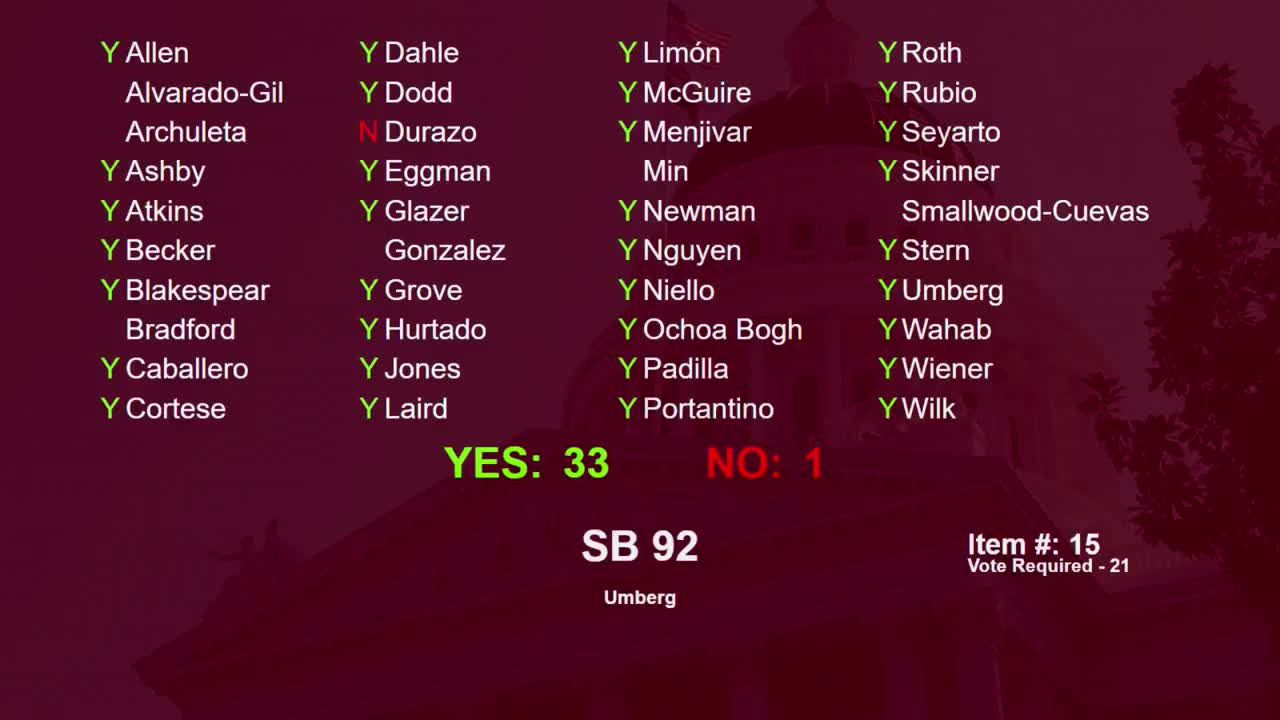 2MIN
Senate Floor
 4MIN
Senate Standing Committee on Judiciary
Bill Author