SB 582: Health information.
- Session Year: 2023-2024
- House: Senate
- Latest Version Date: 2023-09-19
Current Status:
Failed
(2024-01-25: Veto sustained.)
Introduced
In Committee
First Chamber
In Committee
Second Chamber
Enacted
Existing law, the Knox-Keene Health Care Service Plan Act of 1975, provides for the licensure and regulation of health care service plans by the Department of Managed Health Care and makes a willful violation of the act a crime. Existing law provides for the regulation of health insurers by the Department of Insurance. Existing law requires health care service plans and health insurers to establish and maintain specified application programming interfaces (API), including patient access API, to facilitate patient and provider access to health information and for the benefit of enrollees, insureds, and contracted providers. Existing law authorizes the departments to require a plan or insurer to establish and maintain specified API, including provider access API.
This bill would instead require the departments to require the plans and insurers to establish and maintain these specified API. The bill would exclude from the requirements of these provisions dental or vision benefits offered by a plan or insurer, including a specialized plan or insurer. Because a willful violation of these provisions by a health care service plan would be a crime, the bill would impose a state-mandated local program.
Existing law establishes the California Health and Human Services Agency (CHHSA), which includes departments charged with administration of health, social, and human services. Existing law establishes the California Health and Human Services Data Exchange Framework that includes a single data sharing agreement and common set of policies and procedures that govern and require the exchange of health information among health care entities and government agencies in California. Existing law requires specified entities to execute the framework data sharing agreement on or before January 31, 2023.
This bill would, contingent on the stakeholder advisory group developing standards for including EHR vendors, as defined, require EHR vendors to execute the framework data sharing agreement. The bill would require any fees charged by an EHR vendor to enable compliance with the framework to comply with specified federal regulations and to be sufficient to include the cost of enabling the collection and sharing of all data required, as specified. The bill would authorize CHHSA to establish administrative oversight and enforcement authority, including fines, if fees charged by EHR vendors to specified entities are not in compliance with federal standards.
Existing law generally allows a health care professional to disclose test results electronically if requested by the patient. Existing law prohibits disclosing the results of a positive HIV test, test showing the presence of antigens indicating a hepatitis infection, tests showing drug abuse, or results and imaging scans that reveal a new or recurrent malignancy by electronic means unless the health care professional first discusses the results with the patient in person or by other means of oral communication.
This bill would alternatively authorize the disclosure of these specified test results by internet posting or other electronic means if the patient and health care professional have discussed the potential impact of the results and the patient elects to receive them without delay.
This bill would incorporate additional changes to Section 130290 of the Health and Safety Code proposed by AB 352 to be operative only if this bill and AB 352 are enacted and this bill is enacted last.
The California Constitution requires the state to reimburse local agencies and school districts for certain costs mandated by the state. Statutory provisions establish procedures for making that reimbursement.
This bill would provide that no reimbursement is required by this act for a specified reason.
Existing law, the Knox-Keene Health Care Service Plan Act of 1975, provides for the licensure and regulation of health care service plans by the Department of Managed Health Care and makes a willful violation of the act a crime. Existing law provides for the regulation of health insurers by the Department of Insurance. Existing law requires health care service plans and health insurers to establish and maintain specified application programming interfaces (API), including patient access API, to facilitate patient and provider access to health information and for the benefit of enrollees, insureds, and contracted providers. Existing law authorizes the departments to require a plan or insurer to establish and maintain specified API, including provider access API.
This bill would instead require the departments to require the plans and insurers to establish and maintain these specified API. The bill would exclude from the requirements of these provisions dental or vision benefits offered by a plan or insurer, including a specialized plan or insurer. Because a willful violation of these provisions by a health care service plan would be a crime, the bill would impose a state-mandated local program.
Existing law establishes the California Health and Human Services Agency (CHHSA), which includes departments charged with administration of health, social, and human services. Existing law establishes the California Health and Human Services Data Exchange Framework that includes a single data sharing agreement and common set of policies and procedures that govern and require the exchange of health information among health care entities and government agencies in California. Existing law requires specified entities to execute the framework data sharing agreement on or before January 31, 2023.
This bill would, contingent on the stakeholder advisory group developing standards for including EHR vendors, as defined, require EHR vendors to execute the framework data sharing agreement. The bill would require any fees charged by an EHR vendor to enable compliance with the framework to comply with specified federal regulations and to be sufficient to include the cost of enabling the collection and sharing of all data required, as specified. The bill would authorize CHHSA to establish administrative oversight and enforcement authority, including fines, if fees charged by EHR vendors to specified entities are not in compliance with federal standards.
Existing law generally allows a health care professional to disclose test results electronically if requested by the patient. Existing law prohibits disclosing the results of a postive positive HIV test, test showing the presence of antigens indicating a hepatitis infection, tests showing drug abuse, or results and imaging scans that reveal a new or recurrent malignancy by electronic means unless the health care professional first discusses the results with the patient in person or by other means of oral communication.
This bill would alternatively authorize the disclosure of these specified test results by internet posting or other electronic means if the patient and health care professional have discussed the potential impact of the results and the patient elects to receive them without delay.
This bill would incorporate additional changes to Section 130290 of the Health and Safety Code proposed by AB 352 to be operative only if this bill and AB 352 are enacted and this bill is enacted last.
The California Constitution requires the state to reimburse local agencies and school districts for certain costs mandated by the state. Statutory provisions establish procedures for making that reimbursement.
This bill would provide that no reimbursement is required by this act for a specified reason.
Existing law, the Knox-Keene Health Care Service Plan Act of 1975, provides for the licensure and regulation of health care service plans by the Department of Managed Health Care and makes a willful violation of the act a crime. Existing law provides for the regulation of health insurers by the Department of Insurance. Existing law requires health care service plans and health insurers to establish and maintain specified application programming interfaces (API), including patient access API, to facilitate patient and provider access to health information and for the benefit of enrollees, insureds, and contracted providers. Existing law authorizes the departments to require a plan or insurer to establish and maintain specified API, including provider access API.
This bill would instead require the departments to require the plans and insurers to establish and maintain these specified API. The bill would exclude from the requirements of these provisions dental or vision benefits offered by a plan or insurer, including a specialized plan or insurer. Because a willful violation of these provisions by a health care service plan would be a crime, the bill would impose a state-mandated local program.
Existing law establishes the California Health and Human Services Agency (CHHSA), which includes departments charged with administration of health, social, and human services. Existing law establishes the California Health and Human Services Data Exchange Framework that includes a single data sharing agreement and common set of policies and procedures that govern and require the exchange of health information among health care entities and government agencies in California. Existing law requires specified entities to execute the framework data sharing agreement on or before January 31, 2023.
This bill would, contingent on the stakeholder advisory group developing standards for including EHR vendors, as defined, require EHR vendors to execute the framework data sharing agreement. The bill would require any fees charged by an EHR vendor to enable compliance with the framework to comply with specified federal regulations and to be sufficient to include the cost of enabling the collection and sharing of all data required, as specified. The bill would authorize CHHSA to establish administrative oversight and enforcement authority, including fines, if fees charged by EHR vendors to specified entities are not in compliance with federal standards.
Existing law generally allows a health care professional to disclose test results electronically if requested by the patient. Existing law prohibits disclosing the results of a postive HIV test, test showing the presence of antigens indicating a hepatitis infection, tests showing drug abuse, or results and imaging scans that reveal a new or recurrent malignancy by electronic means unless the health care professional first discusses the results with the patient in person or by other means of oral communication.
This bill would alternatively authorize the disclosure of these specified test results by internet posting or other electronic means if the patient and health care professional have discussed the potential impact of the results and the patient elects to receive them without delay.
The California Constitution requires the state to reimburse local agencies and school districts for certain costs mandated by the state. Statutory provisions establish procedures for making that reimbursement.
This bill would provide that no reimbursement is required by this act for a specified reason.
Existing law, the Knox-Keene Health Care Service Plan Act of 1975, provides for the licensure and regulation of health care service plans by the Department of Managed Health Care and makes a willful violation of the act a crime. Existing law provides for the regulation of health insurers by the Department of Insurance. Existing law requires health care service plans and health insurers to establish and maintain specified application programming interfaces (API), including patient access API, to facilitate patient and provider access to health information and for the benefit of enrollees, insureds, and contracted providers. Existing law authorizes the departments to require a plan or insurer to establish and maintain specified API, including provider access API.
This bill would instead require the departments to require the plans and insurers to establish and maintain these specified API. The bill would exclude from the requirements of these provisions dental or vision benefits offered by a plan or insurer, including a specialized plan or insurer. Because a willful violation of these provisions by a health care service plan would be a crime, the bill would impose a state-mandated local program.
Existing law establishes the California Health and Human Services Agency (CHHSA), which includes departments charged with administration of health, social, and human services. Existing law establishes the California Health and Human Services Data Exchange Framework that includes a single data sharing agreement and common set of policies and procedures that govern and require the exchange of health information among health care entities and government agencies in California. Existing law requires specified entities to execute the framework data sharing agreement on or before January 31, 2023.
This bill would, contingent on the stakeholder advisory group developing standards for including EHR vendors, as defined, require EHR vendors to execute the framework data sharing agreement. The bill would require any fees charged by an EHR vendor to enable compliance with the framework to comply with specified federal regulations and to be sufficient to include the cost of enabling the collection and sharing of all data required, as specified. The bill would authorize CHHSA to establish administrative oversight and enforcement authority, including fines, if fees charged by EHR vendors to specified entities are not in compliance with federal standards.
The California Constitution requires the state to reimburse local agencies and school districts for certain costs mandated by the state. Statutory provisions establish procedures for making that reimbursement.
This bill would provide that no reimbursement is required by this act for a specified reason.
Existing law establishes the California Health and Human Services Agency (CHHSA), which includes departments charged with administration of health, social, and human services. Existing law establishes the California Health and Human Services Data Exchange Framework that includes a single data sharing agreement and common set of policies and procedures that govern and require the exchange of health information among health care entities and government agencies in California. Existing law requires specified entities to execute the framework data sharing agreement on or before January 31, 2023.
This bill would, contingent on the stakeholder advisory group developing standards for including EHR vendors, as defined, require EHR vendors to execute the framework data sharing agreement. The bill would require any fees charged by an EHR vendor to enable compliance with the framework to comply with specified federal regulations and to be sufficient to include the cost of enabling the collection and sharing of all data required, as specified. The bill would authorize CHHSA to establish administrative oversight and enforcement authority, including fines, if fees charged by EHR vendors to specified entities are not in compliance with federal standards.
Existing law establishes the California Health and Human Services Agency (CHHSA), which includes departments charged with administration of health, social, and human services. Existing law establishes the California Health and Human Services Data Exchange Framework that includes a single data sharing agreement and common set of policies and procedures that govern and require the exchange of health information among health care entities and government agencies in California. Existing law requires specified entities to execute the framework data sharing agreement on or before January 31, 2023.
This bill would require EHR vendors, as defined, would, contingent on the stakeholder advisory group developing standards for including EHR vendors, as defined, require EHR vendors to execute the framework data sharing agreement on or before July 1, 2024. agreement. The bill would require any fees charged by an EHR vendor to enable compliance with the framework to comply with specified federal regulations and would require the agency to develop a process for signatories to report if the EHR vendor fees are not in compliance. regulations and to be sufficient to include the cost of enabling the collection and sharing of all data required, as specified. The bill would authorize CHHSA to establish administrative oversight and enforcement authority, including fines, if fees are not in compliance with federal standards.
Existing law establishes the California Health and Human Services Agency (CHHSA), which includes departments charged with administration of health, social, and human services. Existing law establishes the California Health and Human Services Data Exchange Framework that includes a single data sharing agreement and common set of policies and procedures that govern and require the exchange of health information among health care entities and government agencies in California. Existing law requires specified entities to execute the framework data sharing agreement on or before January 31, 2023.
This bill would require EHR vendors, as defined, to execute the framework data sharing agreement on or before July 1, 2024. The bill would require any fees charged by an EHR vendor to enable compliance with the framework to comply with specified federal regulations and would require the agency to develop a process for signatories to report if the EHR vendor fees are not in compliance.
(a)The department shall require a health care service plan to establish and maintain the following application programming interfaces (API) if and when final rules are published by the federal government:
(1)Patient access API.
(2)Payer-to-payer exchange API.
(3)Provider access API.
(4)Prior authorization requirements, documentation, and decision API.
(b)API described in subdivision (a) shall be in accordance with standards published in a final rule issued by the federal Centers for Medicare and Medicaid Services and published in the Federal Register, and shall align with federal effective dates, including enforcement delays and suspensions, issued by the federal Centers for Medicare and Medicaid Services.
(c)This section does not limit existing requirements under this chapter, including, but not limited to, Section 1367.27.
(d)Dental or vision benefits offered by a health care service plan or specialized health care service plan are excluded from the requirements of this section.
SEC. 2.Section 123148 of the Health and Safety Code is amended to read:123148.(a)Notwithstanding any other law, a health care professional at whose request a test is performed shall provide or arrange for the provision of the results of a test to the patient who is the subject of the test if so requested by the patient, in oral or written form. The results shall be disclosed in plain language and in oral or written form, except the results may be disclosed in electronic form if requested by the patient unless deemed inappropriate by the health care professional who requested the test. The telephone shall not be considered an electronic form of disclosing test results subject to the limits on electronic disclosure of test results for the purpose of this section.
(b)(1)Consent of the patient to receive their test results by internet posting or other electronic means shall be obtained in a manner consistent with the requirements of Section 56.10 or 56.11 of the Civil Code. In the event that a health care professional arranges for the provision of test results by internet posting or other electronic manner, the results shall be disclosed to a patient in a reasonable time period. Access to test results shall be restricted by the use of a secure personal identification number when the results are disclosed to a patient by internet posting or other electronic manner.
(2)Paragraph (1) shall not prohibit direct communication by internet posting or the use of other electronic means to disclose test results by a treating health care professional who ordered the test for their patient or by a health care professional acting on behalf of, or with the authorization of, the treating health care professional who ordered the test.
(c)When a patient requests access to their test results by internet posting, the health care professional shall advise the patient of any charges that may be assessed directly to the patient or insurer for the service and that the patient may call the health care professional for a more detailed explanation of the laboratory test results when delivered.
(d)The electronic disclosure of test results under this section shall be in accordance with any applicable federal law governing privacy and security of electronic personal health records. However, any state statute that governs privacy and security of electronic personal health records, shall apply to test results under this section and shall prevail over federal law if federal law permits.
(e)The test results to be reported to the patient pursuant to this section shall be recorded in the patients medical record, and shall be reported to the patient within a reasonable time period after the test results are received by the health care professional who requested the test.
(f)Notwithstanding subdivision (a), unless the patient requests the disclosure, the health care professional deems this disclosure as an appropriate means, and a health care professional has first discussed in person, by telephone, or by any other means of oral communication, the test results with the patient, in compliance with any other applicable laws, or the patient and health care professional have discussed the potential impact of the results and the patient elects to receive them without delay, none of the following test results and any other related results shall be disclosed to a patient by internet posting or other electronic means:
(1)(A)A positive HIV test, unless an HIV test subject is anonymously tested and the test result is posted on a secure internet website and can only be viewed with the use of a secure code that can access only a single set of test results and that is provided to the patient at the time of testing. The test result shall be posted only if there is no link to any information that identifies or refers to the subject of the test and the information required pursuant to subdivision (h) of Section 120990 is provided.
(B)Subparagraph (A) does not prevent the disclosure of HIV test results, including viral load and CD4 count test results, to a patient living with HIV by secure internet website or other electronic means if the patient has previously been informed about the results of a positive HIV test pursuant to the requirements of this section.
(2)Presence of antigens indicating a hepatitis infection.
(3)Abusing the use of drugs.
(4)Test results and imaging scans that reveal a new or recurrent malignancy.
(g)Patient identifiable test results and health information that have been provided under this section shall not be used for any commercial purpose without the consent of the patient, obtained in a manner consistent with the requirements of Section 56.11 of the Civil Code. In no event shall patient identifiable HIV-related test results and health information disclosed in this section be used in violation of subdivision (f) of Section 120980.
(h)A third party to whom test results are disclosed pursuant to this section shall be deemed a provider of administrative services, as that term is used in paragraph (3) of subdivision (c) of Section 56.10 of the Civil Code, and shall be subject to all limitations and penalties applicable to that section.
(i)A patient may not be required to pay a cost, or be charged a fee, for electing to receive their test results in a manner other than by internet posting or other electronic form.
(j)A patient or their physician may revoke consent provided under this section at any time and without penalty, except to the extent that action has been taken in reliance on that consent.
(k)As used in this section, test applies to both clinical laboratory tests and imaging scans, such as x-rays, magnetic resonance imaging, ultrasound, or other similar technologies.
(l)As used in this section, internet posting includes posting to an online patient portal.
SEC. 3.Section 130290 of the Health and Safety Code is amended to read:130290.(a)(1)On or before July 1, 2022, and subject to an appropriation in the annual Budget Act, the California Health and Human Services Agency, along with its departments and offices and in consultation with stakeholders and local partners, shall establish the California Health and Human Services Data Exchange Framework that shall include a single data sharing agreement and common set of policies and procedures that will leverage and advance national standards for information exchange and data content, and that will govern and require the exchange of health information among health care entities and government agencies in California.
(2)The California Health and Human Services Data Exchange Framework is not intended to be an information technology system or single repository of data, rather it is technology agnostic and is a collection of organizations that are required to share health information using national standards and a common set of policies in order to improve the health outcomes of the individuals they serve.
(3)The California Health and Human Services Data Exchange Framework will be designed to enable and require real-time access to, or exchange of, health information among health care providers and payers through any health information exchange network, health information organization, or technology that adheres to specified standards and policies.
(4)The California Health and Human Services Data Exchange Framework shall align with state and federal data requirements, including the federal Health Insurance Portability and Accountability Act of 1996 (Public Law 104-191), the Confidentiality of Medical Information Act (Part 2.6 (commencing with Section 56) of Division 1 of the Civil Code), the information blocking provisions of the federal 21st Century Cures Act (Public Law 114-255), and other applicable state and federal privacy laws related to the sharing of data among and between providers, payers, and the government, while also streamlining and reducing reporting burden.
(5)For the purposes of this section, health information means:
(A)For hospitals, clinics, and physician practices, at a minimum, the United States Core Data for Interoperability Version 1, until October 6, 2022. After that date, it shall include all electronic health information as defined under federal regulation in Section 171.102 of Title 45 of the Code of Federal Regulations and held by the entity.
(B)For health insurers and health care service plans, at a minimum, the data required to be shared under the Centers for Medicare and Medicaid Services Interoperability and Patient Access regulations for public programs as contained in United States Department of Health and Human Services final rule CMS-9115-F, 85 FR 25510.
(6)For purposes of this section, EHR vendor means a company, other than a health care provider that self-develops health information technology for its own use, that sells electronic health records, as defined in Section 17921 of Title 42 of the United States Code.
(b)(1) On or before January 31, 2024, the entities listed in subdivision (f), except those identified in paragraph (2), shall exchange health information or provide access to health information to and from every other entity in subdivision (f) in real time as specified by the California Health and Human Services Agency pursuant to the California Health and Human Services Data Exchange Framework data sharing agreement for treatment, payment, or health care operations.
(2)The requirement in paragraph (1) shall not apply to physician practices of fewer than 25 physicians, rehabilitation hospitals, long-term acute care hospitals, acute psychiatric hospitals, critical access hospitals, and rural general acute care hospitals with fewer than 100 acute care beds, state-run acute psychiatric hospitals, and any nonprofit clinic with fewer than 10 health care providers until January 31, 2026.
(c)(1)The California Health and Human Services Agency shall convene a stakeholder advisory group no later than September 1, 2021, to advise on the development and implementation of the California Health and Human Services Data Exchange Framework.
(2)The members of the stakeholder advisory group shall be appointed by the Secretary of California Health and Human Services and shall not have a financial interest, individually or through a family member, related to issues the stakeholder advisory group will advise on.
(3)The stakeholder advisory group shall be composed of health care stakeholders and experts, including representatives of all the following:
(A)The State Department of Health Care Services.
(B)The State Department of Social Services.
(C)The Department of Managed Health Care.
(D)The Department of Health Care Access and Information.
(E)The State Department of Public Health.
(F)The Department of Insurance.
(G)The Public Employees Retirement System.
(H)The California Health Benefit Exchange.
(I)Health care service plans and health insurers.
(J)Physicians, including those with small practices.
(K)Hospitals, including public, private, rural, and critical access hospitals.
(L)Clinics, long-term care facilities, behavioral health facilities, or substance use disorder facilities.
(M)Consumers.
(N)Organized labor.
(O)Privacy and security professionals.
(P)Health information technology professionals.
(Q)Community health information organizations.
(R)County health, social services, and public health.
(S)Community-based organizations providing social services.
(4)The stakeholder advisory group shall provide information and advice to the California Health and Human Services Agency on health information technology issues, including all of the following:
(A)(i)Identify which data beyond health information as defined in paragraph (5) of subdivision (a), at minimum, should be shared for specified purposes between the entities outlined in this subdivision and subdivision (f).
(ii)In discussing data elements that are required to be exchanged, the stakeholder advisory group shall consider data needed for administrative functions of a medical practice, including intake forms and questionnaires, patient scheduling, insurance card upload and verification, invoicing and payment data, and patient-to-provider messaging.
(B)Identify gaps, and propose solutions to gaps, in the life cycle of health information, including gaps in any of the following:
(i)Health information creation, including the use of national standards in clinical documentation, health plan records, and social services data.
(ii)Translation, mapping, controlled vocabularies, coding, and data classification.
(iii)Storage, maintenance, and management of health information.
(iv)Linking, sharing, exchanging, and providing access to health information.
(C)Identify ways to incorporate data related to social determinants of health, such as housing and food insecurity, into shared health information.
(D)Identify ways to incorporate data related to underserved or underrepresented populations, including, but not limited to, data regarding sexual orientation and gender identity and racial and ethnic minorities.
(E)Identify ways to incorporate relevant data on behavioral health and substance use disorder conditions.
(F)Address the privacy, security, and equity risks of expanding care coordination, health information exchange, access, and telehealth in a dynamic technological, and entrepreneurial environment, where data and network security are under constant threat of attack.
(G)Develop policies and procedures consistent with national standards and federally adopted standards in the exchange of health information and ensure that health information sharing broadly implements national frameworks and agreements consistent with federal rules and programs.
(H)Develop definitions of complete clinical, administrative, and claims data consistent with federal policies and national standards.
(I)Identify how all payers will be required to provide enrollees with electronic access to their health information, consistent with rules applicable to federal payer programs.
(J)Assess governance structures to help guide policy decisions and general oversight.
(K)Identify federal, state, private, or philanthropic sources of funding that could support data access and exchange.
(L)Consider whether standards for including EHR vendors in the California Health and Human Services Data Exchange Framework would be appropriate, and, if determined to be appropriate, develop those standards.
(5)The stakeholder advisory group shall hold public meetings with stakeholders, solicit input, and set its own meeting agendas. Meetings of the stakeholder advisory group are subject to the Bagley-Keene Open Meeting Act (Article 9 (commencing with Section 11120) of Chapter 1 of Part 1 of Division 3 of Title 2 of the Government Code).
(6)The members of the stakeholder advisory group shall serve without compensation, but shall be reimbursed for any actual and necessary expenses incurred in connection with their duties as members of the group.
(d)No later than April 1, 2022, the California Health and Human Services Agency shall submit an update, including written recommendations, to the Legislature based on input from the stakeholder advisory group on the issues identified in paragraph (4) of subdivision (c).
(e)On or before January 31, 2023, the California Health and Human Services Agency shall work with the California State Association of Counties to encourage the inclusion of county health, public health, and social services, to the extent possible, as part of the California Health and Human Services Data Exchange Framework in order to assist both public and private entities to connect through uniform standards and policies. It is the intent of the Legislature that all state and local public health agencies will exchange electronic health information in real time with participating health care entities to protect and improve the health and well-being of Californians.
(f)(1)On or before January 31, 2023, and in alignment with existing federal standards and policies, the following health care organizations shall execute the California Health and Human Services Data Exchange Framework data sharing agreement pursuant to subdivision (a):
(A)General acute care hospitals, as defined by Section 1250.
(B)Physician organizations and medical groups.
(C)Skilled nursing facilities, as defined by Section 1250, that currently maintain electronic records.
(D)Health care service plans and disability insurers that provide hospital, medical, or surgical coverage that are regulated by the Department of Managed Health Care or the Department of Insurance. This section shall also apply to a Medi-Cal managed care plan under a comprehensive risk contract with the State Department of Health Care Services pursuant to Chapter 7 (commencing with Section 14000) or Chapter 8 (commencing with Section 14200) of Part 3 of Division 9 of the Welfare and Institutions Code that is not regulated by the Department of Managed Health Care or the Department of Insurance.
(E)Clinical laboratories, as that term is used in Section 1265 of the Business and Professions Code, and that are regulated by the State Department of Public Health.
(F)Acute psychiatric hospitals, as defined by Section 1250.
(2)If the stakeholder advisory group develops standards for including EHR vendors in the California Health and Human Services Data Exchange Framework, EHR vendors shall execute the California Health and Human Services Data Exchange Framework data sharing agreement no later than 12 months after the completion of the standards, and in alignment with existing federal standards and policies pursuant to subdivision (a).
(g)The California Health and Human Services Agency shall work with experienced nonprofit organizations and entities represented in the stakeholder advisory group in subdivision (c) to provide technical assistance to the entities outlined in subdivisions (e) and (f).
(h)On or before July 31, 2022, the California Health and Human Services Agency shall develop in consultation with the stakeholder advisory group in subdivision (c) a strategy for unique, secure digital identities capable of supporting master patient indices to be implemented by both private and public organizations in California.
(i)For purposes of implementing this section, including, but not limited to, hiring staff and consultants, facilitating and conducting meetings, conducting research and analysis, and developing the required reports, the California Health and Human Services Agency may enter into exclusive or nonexclusive contracts on a bid or negotiated basis. Contracts entered into or amended pursuant to this section shall be exempt from Chapter 6 (commencing with Section 14825) of Part 5.5 of Division 3 of Title 2 of the Government Code, Section 19130 of the Government Code, and Part 2 (commencing with Section 10100) of Division 2 of the Public Contract Code, and shall be exempt from the review or approval of any division of the Department of General Services. No person hired or otherwise retained pursuant to this subdivision shall be permitted to have any financial interest in the California Health and Human Services Data Exchange Framework or shall be, or be affiliated with, any health care organization required to participate in the California Health and Human Services Data Exchange Framework pursuant to subdivisions (b) and (f). The term person, as used in this subdivision, means any individual, partnership, joint venture, association, corporation, or any other organization or any combination thereof.
(j)(1)Any fees charged by an EHR vendor to enable compliance with the California Health and Human Services Data Exchange Framework shall be reasonable, consistent with Sections 171.302(a) and 171.303 of Title 45 of the Code of Federal Regulations.
(2)Reasonable fees shall be sufficient to include the cost of enabling the collection and sharing of all data required to be exchanged under this section, as specified in the California Health and Human Services Data Sharing Agreement.
(k)As part of any other oversight activities authorized and developed with respect to this section, the California Health and Human Services Agency, in consultation with the stakeholder advisory group or subsequent governing board, may establish administrative oversight and enforcement authority to monitor fees charged by EHR vendors to entities described in paragraph (2) of subdivision (b) for compliance with the federal standards required under subdivision (j). The oversight and enforcement authority may include the imposition of fines and penalties against an EHR vendor that is found not in compliance with the federal standards required under subdivision (j).
(l)All actions to implement the California Health and Human Services Data Exchange Framework, including the adoption or development of any data sharing agreement, requirements, policies and procedures, guidelines, subgrantee contract provisions, or reporting requirements, shall be exempt from the Administrative Procedure Act (Chapter 3.5 (commencing with Section 11340) of Part 1 of Division 3 of Title 2 of the Government Code). The California Health and Human Services Agency, or a designee department or office under its jurisdiction, shall release program notices that detail the requirements of the California Health and Human Services Data Exchange Framework.
SEC. 3.5.Section 130290 of the Health and Safety Code is amended to read:130290.(a)(1)On or before July 1, 2022, and subject to an appropriation in the annual Budget Act, the California Health and Human Services Agency, along with its departments and offices and in consultation with stakeholders and local partners, shall establish the California Health and Human Services Data Exchange Framework that shall include a single data sharing agreement and common set of policies and procedures that will leverage and advance national standards for information exchange and data content, and that will govern and require the exchange of health information among health care entities and government agencies in California.
(2)The California Health and Human Services Data Exchange Framework is not intended to be an information technology system or single repository of data, rather it is technology agnostic and is a collection of organizations that are required to share health information using national standards and a common set of policies in order to improve the health outcomes of the individuals they serve.
(3)The California Health and Human Services Data Exchange Framework will be designed to enable and require real-time access to, or exchange of, health information among health care providers and payers through any health information exchange network, health information organization, or technology that adheres to specified standards and policies.
(4)The California Health and Human Services Data Exchange Framework shall align with state and federal data requirements, including the federal Health Insurance Portability and Accountability Act of 1996 (Public Law 104-191), the Confidentiality of Medical Information Act (Part 2.6 (commencing with Section 56) of Division 1 of the Civil Code), the information blocking provisions of the federal 21st Century Cures Act (Public Law 114-255), and other applicable state and federal privacy laws related to the sharing of data among and between providers, payers, and the government, while also streamlining and reducing reporting burden.
(5)For the purposes of this section, health information means:
(A)For hospitals, clinics, and physician practices, at a minimum, the United States Core Data for Interoperability Version 1, until October 6, 2022. After that date, it shall include all electronic health information as defined under federal regulation in Section 171.102 of Title 45 of the Code of Federal Regulations and held by the entity.
(B)For health insurers and health care service plans, at a minimum, the data required to be shared under the federal Centers for Medicare and Medicaid Services Interoperability and Patient Access regulations for public programs as contained in United States Department of Health and Human Services final rule CMS-9115-F, 85 FR 25510.
(6)For purposes of this section, EHR vendor means a company, other than a health care provider that self-develops health information technology for its own use, that sells electronic health records, as defined in Section 17921 of Title 42 of the United States Code.
(b)(1)On or before January 31, 2024, and except as provided in paragraphs (2) and (3), the entities listed in subdivision (f) shall exchange health information or provide access to health information to and from every other entity in subdivision (f) in real time as specified by the California Health and Human Services Agency pursuant to the California Health and Human Services Data Exchange Framework data sharing agreement for treatment, payment, or health care operations.
(2)The requirement in paragraph (1) shall not apply to physician practices of fewer than 25 physicians, rehabilitation hospitals, long-term acute care hospitals, acute psychiatric hospitals, critical access hospitals, and rural general acute care hospitals with fewer than 100 acute care beds, state-run acute psychiatric hospitals, and any nonprofit clinic with fewer than 10 health care providers until January 31, 2026.
(3)The requirement in paragraph (1) shall not apply to the exchange of health information related to abortion and abortion-related services.
(c)(1)The California Health and Human Services Agency shall convene a stakeholder advisory group no later than September 1, 2021, to advise on the development and implementation of the California Health and Human Services Data Exchange Framework.
(2)The members of the stakeholder advisory group shall be appointed by the Secretary of California Health and Human Services and shall not have a financial interest, individually or through a family member, related to issues the stakeholder advisory group will advise on.
(3)The stakeholder advisory group shall be composed of health care stakeholders and experts, including representatives of all the following:
(A)The State Department of Health Care Services.
(B)The State Department of Social Services.
(C)The Department of Managed Health Care.
(D)The Department of Health Care Access and Information.
(E)The State Department of Public Health.
(F)The Department of Insurance.
(G)The Public Employees Retirement System.
(H)The California Health Benefit Exchange.
(I)Health care service plans and health insurers.
(J)Physicians, including those with small practices.
(K)Hospitals, including public, private, rural, and critical access hospitals.
(L)Clinics, long-term care facilities, behavioral health facilities, or substance use disorder facilities.
(M)Consumers.
(N)Organized labor.
(O)Privacy and security professionals.
(P)Health information technology professionals.
(Q)Community health information organizations.
(R)County health, social services, and public health.
(S)Community-based organizations providing social services.
(4)The stakeholder advisory group shall provide information and advice to the California Health and Human Services Agency on health information technology issues, including all of the following:
(A)(i)Identify which data beyond health information as defined in paragraph (4) of subdivision (a), at minimum, should be shared for specified purposes between the entities outlined in this subdivision and subdivision (f).
(ii)In discussing data elements that are required to be exchanged, the stakeholder advisory group shall consider data needed for administrative functions of a medical practice, including intake forms and questionnaires, patient scheduling, insurance card upload and verification, invoicing and payment data, and patient-to-provider messaging.
(B)Identify gaps, and propose solutions to gaps, in the life cycle of health information, including gaps in any of the following:
(i)Health information creation, including the use of national standards in clinical documentation, health plan records, and social services data.
(ii)Translation, mapping, controlled vocabularies, coding, and data classification.
(iii)Storage, maintenance, and management of health information.
(iv)Linking, sharing, exchanging, and providing access to health information.
(C)Identify ways to incorporate data related to social determinants of health, such as housing and food insecurity, into shared health information.
(D)Identify ways to incorporate data related to underserved or underrepresented populations, including, but not limited to, data regarding sexual orientation and gender identity and racial and ethnic minorities.
(E)Identify ways to incorporate relevant data on behavioral health and substance use disorder conditions.
(F)Address the privacy, security, and equity risks of expanding care coordination, health information exchange, access, and telehealth in a dynamic technological, and entrepreneurial environment, where data and network security are under constant threat of attack.
(G)Develop policies and procedures consistent with national standards and federally adopted standards in the exchange of health information and ensure that health information sharing broadly implements national frameworks and agreements consistent with federal rules and programs.
(H)Develop definitions of complete clinical, administrative, and claims data consistent with federal policies and national standards.
(I)Identify how all payers will be required to provide enrollees with electronic access to their health information, consistent with rules applicable to federal payer programs.
(J)Assess governance structures to help guide policy decisions and general oversight.
(K)Identify federal, state, private, or philanthropic sources of funding that could support data access and exchange.
(L)Consider whether standards for including EHR vendors in the California Health and Human Services Data Exchange Framework would be appropriate, and, if determined to be appropriate, develop those standards.
(5)The stakeholder advisory group shall hold public meetings with stakeholders, solicit input, and set its own meeting agendas. Meetings of the stakeholder advisory group are subject to the Bagley-Keene Open Meeting Act (Article 9 (commencing with Section 11120) of Chapter 1 of Part 1 of Division 3 of Title 2 of the Government Code).
(6)The members of the stakeholder advisory group shall serve without compensation, but shall be reimbursed for any actual and necessary expenses incurred in connection with their duties as members of the group.
(d)No later than April 1, 2022, the California Health and Human Services Agency shall submit an update, including written recommendations, to the Legislature based on input from the stakeholder advisory group on the issues identified in paragraph (4) of subdivision (c).
(e)On or before January 31, 2023, the California Health and Human Services Agency shall work with the California State Association of Counties to encourage the inclusion of county health, public health, and social services, to the extent possible, as part of the California Health and Human Services Data Exchange Framework in order to assist both public and private entities to connect through uniform standards and policies. It is the intent of the Legislature that all state and local public health agencies will exchange electronic health information in real time with participating health care entities to protect and improve the health and well-being of Californians.
(f)(1)On or before January 31, 2023, and in alignment with existing federal standards and policies, the following health care organizations shall execute the California Health and Human Services Data Exchange Framework data sharing agreement pursuant to subdivision (a):
(A)General acute care hospitals, as defined by Section 1250.
(B)Physician organizations and medical groups.
(C)Skilled nursing facilities, as defined by Section 1250, that currently maintain electronic records.
(D)Health care service plans and disability insurers that provide hospital, medical, or surgical coverage that are regulated by the Department of Managed Health Care or the Department of Insurance. This section shall also apply to a Medi-Cal managed care plan under a comprehensive risk contract with the State Department of Health Care Services pursuant to Chapter 7 (commencing with Section 14000) or Chapter 8 (commencing with Section 14200) of Part 3 of Division 9 of the Welfare and Institutions Code that is not regulated by the Department of Managed Health Care or the Department of Insurance.
(E)Clinical laboratories, as that term is used in Section 1265 of the Business and Professions Code, and that are regulated by the State Department of Public Health.
(F)Acute psychiatric hospitals, as defined by Section 1250.
(2)If the stakeholder advisory group develops standards for including EHR vendors in the California Health and Human Services Data Exchange Framework, EHR vendors shall execute the California Health and Human Services Data Exchange Framework data sharing agreement no later than 12 months after the completion of the standards, and in alignment with existing federal standards and policies pursuant to subdivision (a).
(g)The California Health and Human Services Agency shall work with experienced nonprofit organizations and entities represented in the stakeholder advisory group in subdivision (c) to provide technical assistance to the entities outlined in subdivisions (e) and (f).
(h)On or before July 31, 2022, the California Health and Human Services Agency shall develop in consultation with the stakeholder advisory group in subdivision (c) a strategy for unique, secure digital identities capable of supporting master patient indices to be implemented by both private and public organizations in California.
(i)For purposes of implementing this section, including, but not limited to, hiring staff and consultants, facilitating and conducting meetings, conducting research and analysis, and developing the required reports, the California Health and Human Services Agency may enter into exclusive or nonexclusive contracts on a bid or negotiated basis. Contracts entered into or amended pursuant to this section shall be exempt from Chapter 6 (commencing with Section 14825) of Part 5.5 of Division 3 of Title 2 of the Government Code, Section 19130 of the Government Code, and Part 2 (commencing with Section 10100) of Division 2 of the Public Contract Code, and shall be exempt from the review or approval of any division of the Department of General Services. No person hired or otherwise retained pursuant to this subdivision shall be permitted to have any financial interest in the California Health and Human Services Data Exchange Framework or shall be, or be affiliated with, any health care organization required to participate in the California Health and Human Services Data Exchange Framework pursuant to subdivisions (b) and (f). The term person, as used in this subdivision, means any individual, partnership, joint venture, association, corporation, or any other organization or any combination thereof.
(j)(1)Any fees charged by an EHR vendor to enable compliance with the California Health and Human Services Data Exchange Framework shall be reasonable, consistent with Sections 171.302(a) and 171.303 of Title 45 of the Code of Federal Regulations.
(2)Reasonable fees shall be sufficient to include the cost of enabling the collection and sharing of all data required to be exchanged under this section, as specified in the California Health and Human Services Data Sharing Agreement.
(k)As part of any other oversight activities authorized and developed with respect to this section, the California Health and Human Services Agency, in consultation with the stakeholder advisory group or subsequent governing board, may establish administrative oversight and enforcement authority to monitor fees charged by EHR vendors to entities described in paragraph (2) of subdivision (b) for compliance with the federal standards required under subdivision (j). The oversight and enforcement authority may include the imposition of fines and penalties against an EHR vendor that is found not in compliance with the federal standards required under subdivision (j).
(l)All actions to implement the California Health and Human Services Data Exchange Framework, including the adoption or development of any data sharing agreement, requirements, policies and procedures, guidelines, subgrantee contract provisions, or reporting requirements, shall be exempt from the Administrative Procedure Act (Chapter 3.5 (commencing with Section 11340) of Part 1 of Division 3 of Title 2 of the Government Code). The California Health and Human Services Agency, or a designee department or office under its jurisdiction, shall release program notices that detail the requirements of the California Health and Human Services Data Exchange Framework.
SEC. 4.Section 10133.12 of the Insurance Code is amended to read:10133.12.(a)The department shall require a health insurer to establish and maintain the following application programming interfaces (API) if and when final rules are published by the federal government:
(1)Patient access API.
(2)Payer-to-payer exchange API.
(3)Provider access API.
(4)Prior authorization support API.
(b)API described in subdivision (a) shall be in accordance with standards published in a final rule issued by the federal Centers for Medicare and Medicaid Services and published in the Federal Register, and shall align with federal effective dates, including enforcement delays and suspensions, issued by the federal Centers for Medicare and Medicaid Services.
(c)This section does not limit existing requirements under this chapter, including, but not limited to, Section 10133.15.
(d)Dental or vision benefits offered by a health insurer or specialized health insurer are excluded from the requirements of this section.
SEC. 5.Section 3.5 of this bill incorporates amendments to Section 130290 of the Health and Safety Code proposed by both this bill and Assembly Bill 352. That section shall only become operative if (1) both bills are enacted and become effective on or before January 1, 2024, (2) each bill amends Section 130290 of the Health and Safety Code, and (3) this bill is enacted after Assembly Bill 352, in which case Section 3 of this bill shall not become operative.
SEC. 6.No reimbursement is required by this act pursuant to Section 6 of Article XIIIB of the California Constitution because the only costs that may be incurred by a local agency or school district will be incurred because this act creates a new crime or infraction, eliminates a crime or infraction, or changes the penalty for a crime or infraction, within the meaning of Section 17556 of the Government Code, or changes the definition of a crime within the meaning of Section 6 of Article XIIIB of the California Constitution.
(a)The department shall require a health care service plan to establish and maintain the following application programming interfaces (API) if and when final rules are published by the federal government:
(1)Patient access API.
(2)Payer-to-payer exchange API.
(3)Provider access API.
(4)Prior authorization requirements, documentation, and decision API.
(b)API described in subdivision (a) shall be in accordance with standards published in a final rule issued by the federal Centers for Medicare and Medicaid Services and published in the Federal Register, and shall align with federal effective dates, including enforcement delays and suspensions, issued by the federal Centers for Medicare and Medicaid Services.
(c)This section does not limit existing requirements under this chapter, including, but not limited to, Section 1367.27.
(d)Dental or vision benefits offered by a health care service plan or specialized health care service plan are excluded from the requirements of this section.
SEC. 2.Section 123148 of the Health and Safety Code is amended to read:123148.(a)Notwithstanding any other law, a health care professional at whose request a test is performed shall provide or arrange for the provision of the results of a test to the patient who is the subject of the test if so requested by the patient, in oral or written form. The results shall be disclosed in plain language and in oral or written form, except the results may be disclosed in electronic form if requested by the patient unless deemed inappropriate by the health care professional who requested the test. The telephone shall not be considered an electronic form of disclosing test results subject to the limits on electronic disclosure of test results for the purpose of this section.
(b)(1)Consent of the patient to receive their test results by internet posting or other electronic means shall be obtained in a manner consistent with the requirements of Section 56.10 or 56.11 of the Civil Code. In the event that a health care professional arranges for the provision of test results by internet posting or other electronic manner, the results shall be disclosed to a patient in a reasonable time period. Access to test results shall be restricted by the use of a secure personal identification number when the results are disclosed to a patient by internet posting or other electronic manner.
(2)Paragraph (1) shall not prohibit direct communication by internet posting or the use of other electronic means to disclose test results by a treating health care professional who ordered the test for their patient or by a health care professional acting on behalf of, or with the authorization of, the treating health care professional who ordered the test.
(c)When a patient requests access to their test results by internet posting, the health care professional shall advise the patient of any charges that may be assessed directly to the patient or insurer for the service and that the patient may call the health care professional for a more detailed explanation of the laboratory test results when delivered.
(d)The electronic disclosure of test results under this section shall be in accordance with any applicable federal law governing privacy and security of electronic personal health records. However, any state statute that governs privacy and security of electronic personal health records, shall apply to test results under this section and shall prevail over federal law if federal law permits.
(e)The test results to be reported to the patient pursuant to this section shall be recorded in the patients medical record, and shall be reported to the patient within a reasonable time period after the test results are received by the health care professional who requested the test.
(f)Notwithstanding subdivision (a), unless the patient requests the disclosure, the health care professional deems this disclosure as an appropriate means, and a health care professional has first discussed in person, by telephone, or by any other means of oral communication, the test results with the patient, in compliance with any other applicable laws, or the patient and health care professional have discussed the potential impact of the results and the patient elects to receive them without delay, none of the following test results and any other related results shall be disclosed to a patient by internet posting or other electronic means:
(1)(A)A positive HIV test, unless an HIV test subject is anonymously tested and the test result is posted on a secure internet website and can only be viewed with the use of a secure code that can access only a single set of test results and that is provided to the patient at the time of testing. The test result shall be posted only if there is no link to any information that identifies or refers to the subject of the test and the information required pursuant to subdivision (h) of Section 120990 is provided.
(B)Subparagraph (A) does not prevent the disclosure of HIV test results, including viral load and CD4 count test results, to a patient living with HIV by secure internet website or other electronic means if the patient has previously been informed about the results of a positive HIV test pursuant to the requirements of this section.
(2)Presence of antigens indicating a hepatitis infection.
(3)Abusing the use of drugs.
(4)Test results and imaging scans that reveal a new or recurrent malignancy.
(g)Patient identifiable test results and health information that have been provided under this section shall not be used for any commercial purpose without the consent of the patient, obtained in a manner consistent with the requirements of Section 56.11 of the Civil Code. In no event shall patient identifiable HIV-related test results and health information disclosed in this section be used in violation of subdivision (f) of Section 120980.
(h)A third party to whom test results are disclosed pursuant to this section shall be deemed a provider of administrative services, as that term is used in paragraph (3) of subdivision (c) of Section 56.10 of the Civil Code, and shall be subject to all limitations and penalties applicable to that section.
(i)A patient may not be required to pay a cost, or be charged a fee, for electing to receive their test results in a manner other than by internet posting or other electronic form.
(j)A patient or their physician may revoke consent provided under this section at any time and without penalty, except to the extent that action has been taken in reliance on that consent.
(k)As used in this section, test applies to both clinical laboratory tests and imaging scans, such as x-rays, magnetic resonance imaging, ultrasound, or other similar technologies.
(l)As used in this section, internet posting includes posting to an online patient portal.
SEC. 3.Section 130290 of the Health and Safety Code is amended to read:130290.(a)(1)On or before July 1, 2022, and subject to an appropriation in the annual Budget Act, the California Health and Human Services Agency, along with its departments and offices and in consultation with stakeholders and local partners, shall establish the California Health and Human Services Data Exchange Framework that shall include a single data sharing agreement and common set of policies and procedures that will leverage and advance national standards for information exchange and data content, and that will govern and require the exchange of health information among health care entities and government agencies in California.
(2)The California Health and Human Services Data Exchange Framework is not intended to be an information technology system or single repository of data, rather it is technology agnostic and is a collection of organizations that are required to share health information using national standards and a common set of policies in order to improve the health outcomes of the individuals they serve.
(3)The California Health and Human Services Data Exchange Framework will be designed to enable and require real-time access to, or exchange of, health information among health care providers and payers through any health information exchange network, health information organization, or technology that adheres to specified standards and policies.
(4)The California Health and Human Services Data Exchange Framework shall align with state and federal data requirements, including the federal Health Insurance Portability and Accountability Act of 1996 (Public Law 104-191), the Confidentiality of Medical Information Act (Part 2.6 (commencing with Section 56) of Division 1 of the Civil Code), the information blocking provisions of the federal 21st Century Cures Act (Public Law 114-255), and other applicable state and federal privacy laws related to the sharing of data among and between providers, payers, and the government, while also streamlining and reducing reporting burden.
(5)For the purposes of this section, health information means:
(A)For hospitals, clinics, and physician practices, at a minimum, the United States Core Data for Interoperability Version 1, until October 6, 2022. After that date, it shall include all electronic health information as defined under federal regulation in Section 171.102 of Title 45 of the Code of Federal Regulations and held by the entity.
(B)For health insurers and health care service plans, at a minimum, the data required to be shared under the Centers for Medicare and Medicaid Services Interoperability and Patient Access regulations for public programs as contained in United States Department of Health and Human Services final rule CMS-9115-F, 85 FR 25510.
(6)For purposes of this section, EHR vendor means a company, other than a health care provider that self-develops health information technology for its own use, that sells electronic health records, as defined in Section 17921 of Title 42 of the United States Code.
(b)(1) On or before January 31, 2024, the entities listed in subdivision (f), except those identified in paragraph (2), shall exchange health information or provide access to health information to and from every other entity in subdivision (f) in real time as specified by the California Health and Human Services Agency pursuant to the California Health and Human Services Data Exchange Framework data sharing agreement for treatment, payment, or health care operations.
(2)The requirement in paragraph (1) shall not apply to physician practices of fewer than 25 physicians, rehabilitation hospitals, long-term acute care hospitals, acute psychiatric hospitals, critical access hospitals, and rural general acute care hospitals with fewer than 100 acute care beds, state-run acute psychiatric hospitals, and any nonprofit clinic with fewer than 10 health care providers until January 31, 2026.
(c)(1)The California Health and Human Services Agency shall convene a stakeholder advisory group no later than September 1, 2021, to advise on the development and implementation of the California Health and Human Services Data Exchange Framework.
(2)The members of the stakeholder advisory group shall be appointed by the Secretary of California Health and Human Services and shall not have a financial interest, individually or through a family member, related to issues the stakeholder advisory group will advise on.
(3)The stakeholder advisory group shall be composed of health care stakeholders and experts, including representatives of all the following:
(A)The State Department of Health Care Services.
(B)The State Department of Social Services.
(C)The Department of Managed Health Care.
(D)The Department of Health Care Access and Information.
(E)The State Department of Public Health.
(F)The Department of Insurance.
(G)The Public Employees Retirement System.
(H)The California Health Benefit Exchange.
(I)Health care service plans and health insurers.
(J)Physicians, including those with small practices.
(K)Hospitals, including public, private, rural, and critical access hospitals.
(L)Clinics, long-term care facilities, behavioral health facilities, or substance use disorder facilities.
(M)Consumers.
(N)Organized labor.
(O)Privacy and security professionals.
(P)Health information technology professionals.
(Q)Community health information organizations.
(R)County health, social services, and public health.
(S)Community-based organizations providing social services.
(4)The stakeholder advisory group shall provide information and advice to the California Health and Human Services Agency on health information technology issues, including all of the following:
(A)(i)Identify which data beyond health information as defined in paragraph (5) of subdivision (a), at minimum, should be shared for specified purposes between the entities outlined in this subdivision and subdivision (f).
(ii)In discussing data elements that are required to be exchanged, the stakeholder advisory group shall consider data needed for administrative functions of a medical practice, including intake forms and questionnaires, patient scheduling, insurance card upload and verification, invoicing and payment data, and patient-to-provider messaging.
(B)Identify gaps, and propose solutions to gaps, in the life cycle of health information, including gaps in any of the following:
(i)Health information creation, including the use of national standards in clinical documentation, health plan records, and social services data.
(ii)Translation, mapping, controlled vocabularies, coding, and data classification.
(iii)Storage, maintenance, and management of health information.
(iv)Linking, sharing, exchanging, and providing access to health information.
(C)Identify ways to incorporate data related to social determinants of health, such as housing and food insecurity, into shared health information.
(D)Identify ways to incorporate data related to underserved or underrepresented populations, including, but not limited to, data regarding sexual orientation and gender identity and racial and ethnic minorities.
(E)Identify ways to incorporate relevant data on behavioral health and substance use disorder conditions.
(F)Address the privacy, security, and equity risks of expanding care coordination, health information exchange, access, and telehealth in a dynamic technological, and entrepreneurial environment, where data and network security are under constant threat of attack.
(G)Develop policies and procedures consistent with national standards and federally adopted standards in the exchange of health information and ensure that health information sharing broadly implements national frameworks and agreements consistent with federal rules and programs.
(H)Develop definitions of complete clinical, administrative, and claims data consistent with federal policies and national standards.
(I)Identify how all payers will be required to provide enrollees with electronic access to their health information, consistent with rules applicable to federal payer programs.
(J)Assess governance structures to help guide policy decisions and general oversight.
(K)Identify federal, state, private, or philanthropic sources of funding that could support data access and exchange.
(L)Consider whether standards for including EHR vendors in the California Health and Human Services Data Exchange Framework would be appropriate, and, if determined to be appropriate, develop those standards.
(5)The stakeholder advisory group shall hold public meetings with stakeholders, solicit input, and set its own meeting agendas. Meetings of the stakeholder advisory group are subject to the Bagley-Keene Open Meeting Act (Article 9 (commencing with Section 11120) of Chapter 1 of Part 1 of Division 3 of Title 2 of the Government Code).
(6)The members of the stakeholder advisory group shall serve without compensation, but shall be reimbursed for any actual and necessary expenses incurred in connection with their duties as members of the group.
(d)No later than April 1, 2022, the California Health and Human Services Agency shall submit an update, including written recommendations, to the Legislature based on input from the stakeholder advisory group on the issues identified in paragraph (4) of subdivision (c).
(e)On or before January 31, 2023, the California Health and Human Services Agency shall work with the California State Association of Counties to encourage the inclusion of county health, public health, and social services, to the extent possible, as part of the California Health and Human Services Data Exchange Framework in order to assist both public and private entities to connect through uniform standards and policies. It is the intent of the Legislature that all state and local public health agencies will exchange electronic health information in real time with participating health care entities to protect and improve the health and well-being of Californians.
(f)(1)On or before January 31, 2023, and in alignment with existing federal standards and policies, the following health care organizations shall execute the California Health and Human Services Data Exchange Framework data sharing agreement pursuant to subdivision (a):
(A)General acute care hospitals, as defined by Section 1250.
(B)Physician organizations and medical groups.
(C)Skilled nursing facilities, as defined by Section 1250, that currently maintain electronic records.
(D)Health care service plans and disability insurers that provide hospital, medical, or surgical coverage that are regulated by the Department of Managed Health Care or the Department of Insurance. This section shall also apply to a Medi-Cal managed care plan under a comprehensive risk contract with the State Department of Health Care Services pursuant to Chapter 7 (commencing with Section 14000) or Chapter 8 (commencing with Section 14200) of Part 3 of Division 9 of the Welfare and Institutions Code that is not regulated by the Department of Managed Health Care or the Department of Insurance.
(E)Clinical laboratories, as that term is used in Section 1265 of the Business and Professions Code, and that are regulated by the State Department of Public Health.
(F)Acute psychiatric hospitals, as defined by Section 1250.
(2)If the stakeholder advisory group develops standards for including EHR vendors in the California Health and Human Services Data Exchange Framework, EHR vendors shall execute the California Health and Human Services Data Exchange Framework data sharing agreement no later than 12 months after the completion of the standards, and in alignment with existing federal standards and policies pursuant to subdivision (a).
(g)The California Health and Human Services Agency shall work with experienced nonprofit organizations and entities represented in the stakeholder advisory group in subdivision (c) to provide technical assistance to the entities outlined in subdivisions (e) and (f).
(h)On or before July 31, 2022, the California Health and Human Services Agency shall develop in consultation with the stakeholder advisory group in subdivision (c) a strategy for unique, secure digital identities capable of supporting master patient indices to be implemented by both private and public organizations in California.
(i)For purposes of implementing this section, including, but not limited to, hiring staff and consultants, facilitating and conducting meetings, conducting research and analysis, and developing the required reports, the California Health and Human Services Agency may enter into exclusive or nonexclusive contracts on a bid or negotiated basis. Contracts entered into or amended pursuant to this section shall be exempt from Chapter 6 (commencing with Section 14825) of Part 5.5 of Division 3 of Title 2 of the Government Code, Section 19130 of the Government Code, and Part 2 (commencing with Section 10100) of Division 2 of the Public Contract Code, and shall be exempt from the review or approval of any division of the Department of General Services. No person hired or otherwise retained pursuant to this subdivision shall be permitted to have any financial interest in the California Health and Human Services Data Exchange Framework or shall be, or be affiliated with, any health care organization required to participate in the California Health and Human Services Data Exchange Framework pursuant to subdivisions (b) and (f). The term person, as used in this subdivision, means any individual, partnership, joint venture, association, corporation, or any other organization or any combination thereof.
(j)(1)Any fees charged by an EHR vendor to enable compliance with the California Health and Human Services Data Exchange Framework shall be reasonable, consistent with Sections 171.302(a) and 171.303 of Title 45 of the Code of Federal Regulations.
(2)Reasonable fees shall be sufficient to include the cost of enabling the collection and sharing of all data required to be exchanged under this section, as specified in the California Health and Human Services Data Sharing Agreement.
(k)As part of any other oversight activities authorized and developed with respect to this section, the California Health and Human Services Agency, in consultation with the stakeholder advisory group or subsequent governing board, may establish administrative oversight and enforcement authority to monitor fees charged by EHR vendors to entities described in paragraph (2) of subdivision (b) for compliance with the federal standards required under subdivision (j). The oversight and enforcement authority may include the imposition of fines and penalties against an EHR vendor that is found not in compliance with the federal standards required under subdivision (j).
(l)All actions to implement the California Health and Human Services Data Exchange Framework, including the adoption or development of any data sharing agreement, requirements, policies and procedures, guidelines, subgrantee contract provisions, or reporting requirements, shall be exempt from the Administrative Procedure Act (Chapter 3.5 (commencing with Section 11340) of Part 1 of Division 3 of Title 2 of the Government Code). The California Health and Human Services Agency, or a designee department or office under its jurisdiction, shall release program notices that detail the requirements of the California Health and Human Services Data Exchange Framework.
SEC. 3.5.Section 130290 of the Health and Safety Code is amended to read:130290.(a)(1)On or before July 1, 2022, and subject to an appropriation in the annual Budget Act, the California Health and Human Services Agency, along with its departments and offices and in consultation with stakeholders and local partners, shall establish the California Health and Human Services Data Exchange Framework that shall include a single data sharing agreement and common set of policies and procedures that will leverage and advance national standards for information exchange and data content, and that will govern and require the exchange of health information among health care entities and government agencies in California.
(1)(2)The California Health and Human Services Data Exchange Framework is not intended to be an information technology system or single repository of data, rather it is technology agnostic and is a collection of organizations that are required to share health information using national standards and a common set of policies in order to improve the health outcomes of the individuals they serve.
(2)(3)The California Health and Human Services Data Exchange Framework will be designed to enable and require real-time access to, or exchange of, health information among health care providers and payers through any health information exchange network, health information organization, or technology that adheres to specified standards and policies.
(3)(4)The California Health and Human Services Data Exchange Framework shall align with state and federal data requirements, including the federal Health Insurance Portability and Accountability Act of 1996 (Public Law 104-191), the Confidentiality of Medical Information Act of 1996 (Part 2.6 (commencing with Section 56) of Division 1 of the Civil Code), the information blocking provisions of the federal 21st Century Cures Act (Public Law 114-255), and other applicable state and federal privacy laws related to the sharing of data among and between providers, payers, and the government, while also streamlining and reducing reporting burden.
(4)(5)For the purposes of this section, health information means:
(A)For hospitals, clinics, and physician practices, at a minimum, the United States Core Data for Interoperability Version 1, until October 6, 2022. After that date, it shall include all electronic health information as defined under federal regulation in Section 171.102 of Title 45 of the Code of Federal Regulations and held by the entity.
(B)For health insurers and health care service plans, at a minimum, the data required to be shared under the federal Centers for Medicare and Medicaid Services Interoperability and Patient Access regulations for public programs as contained in United States Department of Health and Human Services final rule CMS-9115-F, 85 FR 25510.
(6)For purposes of this section, EHR vendor means a company, other than a health care provider that self-develops health information technology for its own use, that sells electronic health records, as defined in Section 17921 of Title 42 of the United States Code.
(b)(1)On or before January 31, 2024, and except as provided in paragraphs (2) and (3), the entities listed in subdivision (f), except those identified in paragraph (2), (f) shall exchange health information or provide access to health information to and from every other entity in subdivision (f) in real time as specified by the California Health and Human Services Agency pursuant to the California Health and Human Services Data Exchange Framework data sharing agreement for treatment, payment, or health care operations.
(2)The requirement in paragraph (1) shall not apply to physician practices of fewer than 25 physicians, rehabilitation hospitals, long-term acute care hospitals, acute psychiatric hospitals, critical access hospitals, and rural general acute care hospitals with fewer than 100 acute care beds, state-run acute psychiatric hospitals, and any nonprofit clinic with fewer than 10 health care providers until January 31, 2026.
(3)The requirement in paragraph (1) shall not apply to the exchange of health information related to abortion and abortion-related services.
(c)(1)The California Health and Human Services Agency shall convene a stakeholder advisory group no later than September 1, 2021, to advise on the development and implementation of the California Health and Human Services Data Exchange Framework.
(1)(2)The members of the stakeholder advisory group shall be appointed by the Secretary of California Health and Human Services and shall not have a financial interest, individually or through a family member, related to issues the stakeholder advisory group will advise on.
(2)(3)The stakeholder advisory group shall be composed of health care stakeholders and experts, including representatives of all the following:
(A)The State Department of Health Care Services.
(B)The State Department of Social Services.
(C)The Department of Managed Health Care.
(D)The Department of Health Care Access and Information.
(E)The State Department of Public Health.
(F)The Department of Insurance.
(G)The Public Employees Retirement System.
(H)The California Health Benefit Exchange.
(I)Health care service plans and health insurers.
(J)Physicians, including those with small practices.
(K)Hospitals, including public, private, rural, and critical access hospitals.
(L)Clinics, long-term care facilities, behavioral health facilities, or substance use disorder facilities.
(M)Consumers.
(N)Organized labor.
(O)Privacy and security professionals.
(P)Health information technology professionals.
(Q)Community health information organizations.
(R)County health, social services, and public health.
(S)Community-based organizations providing social services.
(3)(4)The stakeholder advisory group shall provide information and advice to the California Health and Human Services Agency on health information technology issues, including all of the following:
(A)(i)Identify which data beyond health information as defined in paragraph (4) of subdivision (a), at minimum, should be shared for specified purposes between the entities outlined in this subdivision and subdivision (f).
(ii)In discussing data elements that are required to be exchanged, the stakeholder advisory group shall consider data needed for administrative functions of a medical practice, including intake forms and questionnaires, patient scheduling, insurance card upload and verification, invoicing and payment data, and patient-to-provider messaging.
(B)Identify gaps, and propose solutions to gaps, in the life cycle of health information, including gaps in any of the following:
(i)Health information creation, including the use of national standards in clinical documentation, health plan records, and social services data.
(ii)Translation, mapping, controlled vocabularies, coding, and data classification.
(iii)Storage, maintenance, and management of health information.
(iv)Linking, sharing, exchanging, and providing access to health information.
(C)Identify ways to incorporate data related to social determinants of health, such as housing and food insecurity, into shared health information.
(D)Identify ways to incorporate data related to underserved or underrepresented populations, including, but not limited to, data regarding sexual orientation and gender identity and racial and ethnic minorities.
(E)Identify ways to incorporate relevant data on behavioral health and substance use disorder conditions.
(F)Address the privacy, security, and equity risks of expanding care coordination, health information exchange, access, and telehealth in a dynamic technological, and entrepreneurial environment, where data and network security are under constant threat of attack.
(G)Develop policies and procedures consistent with national standards and federally adopted standards in the exchange of health information and ensure that health information sharing broadly implements national frameworks and agreements consistent with federal rules and programs.
(H)Develop definitions of complete clinical, administrative, and claims data consistent with federal policies and national standards.
(I)Identify how all payers will be required to provide enrollees with electronic access to their health information, consistent with rules applicable to federal payer programs.
(J)Assess governance structures to help guide policy decisions and general oversight.
(K)Identify federal, state, private, or philanthropic sources of funding that could support data access and exchange.
(L)Consider whether standards for including EHR vendors in the California Health and Human Services Data Exchange Framework would be appropriate, and, if determined to be appropriate, develop those standards.
(4)(5)The stakeholder advisory group shall hold public meetings with stakeholders, solicit input, and set its own meeting agendas. Meetings of the stakeholder advisory group are subject to the Bagley-Keene Open Meeting Act (Article 9 (commencing with Section 11120) of Chapter 1 of Part 1 of Division 3 of Title 2 of the Government Code).
(5)(6)The members of the stakeholder advisory group shall serve without compensation, but shall be reimbursed for any actual and necessary expenses incurred in connection with their duties as members of the group.
(d)No later than April 1, 2022, the California Health and Human Services Agency shall submit an update, including written recommendations, to the Legislature based on input from the stakeholder advisory group on the issues identified in paragraph (3) (4) of subdivision (c).
(e)On or before January 31, 2023, the California Health and Human Services Agency shall work with the California State Association of Counties to encourage the inclusion of county health, public health, and social services, to the extent possible, as part of the California Health and Human Services Data Exchange Framework in order to assist both public and private entities to connect through uniform standards and policies. It is the intent of the Legislature that all state and local public health agencies will exchange electronic health information in real time with participating health care entities to protect and improve the health and well-being of Californians.
(f)(1)On or before January 31, 2023, and in alignment with existing federal standards and policies, the following health care organizations shall execute the California Health and Human Services Data Exchange Framework data sharing agreement pursuant to subdivision (a):
(1)(A)General acute care hospitals, as defined by Section 1250.
(2)(B)Physician organizations and medical groups.
(3)(C)Skilled nursing facilities, as defined by Section 1250, that currently maintain electronic records.
(4)(D)Health care service plans and disability insurers that provide hospital, medical, or surgical coverage that are regulated by the Department of Managed Health Care or the Department of Insurance. This section shall also apply to a Medi-Cal managed care plan under a comprehensive risk contract with the State Department of Health Care Services pursuant to Chapter 7 (commencing with Section 14000) or Chapter 8 (commencing with Section 14200) of Part 3 of Division 9 of the Welfare and Institutions Code that is not regulated by the Department of Managed Health Care or the Department of Insurance.
(5)(E)Clinical laboratories, as that term is used in Section 1265 of the Business and Professions Code, and that are regulated by the State Department of Public Health.
(6)(F)Acute psychiatric hospitals, as defined by Section 1250.
(2)If the stakeholder advisory group develops standards for including EHR vendors in the California Health and Human Services Data Exchange Framework, EHR vendors shall execute the California Health and Human Services Data Exchange Framework data sharing agreement no later than 12 months after the completion of the standards, and in alignment with existing federal standards and policies pursuant to subdivision (a).
(g)The California Health and Human Services Agency shall work with experienced nonprofit organizations and entities represented in the stakeholder advisory group in subdivision (c) to provide technical assistance to the entities outlined in subdivisions (e) and (f).
(h)On or before July 31, 2022, the California Health and Human Services Agency shall develop in consultation with the stakeholder advisory group in subdivision (c) a strategy for unique, secure digital identities capable of supporting master patient indices to be implemented by both private and public organizations in California.
(i)For purposes of implementing this section, including, but not limited to, hiring staff and consultants, facilitating and conducting meetings, conducting research and analysis, and developing the required reports, the California Health and Human Services Agency may enter into exclusive or nonexclusive contracts on a bid or negotiated basis. Contracts entered into or amended pursuant to this section shall be exempt from Chapter 6 (commencing with Section 14825) of Part 5.5 of Division 3 of Title 2 of the Government Code, Section 19130 of the Government Code, and Part 2 (commencing with Section 10100) of Division 2 of the Public Contract Code, and shall be exempt from the review or approval of any division of the Department of General Services. No person hired or otherwise retained pursuant to this subdivision shall be permitted to have any financial interest in the California Health and Human Services Data Exchange Framework or shall be, or be affiliated with, any health care organization required to participate in the California Health and Human Services Data Exchange Framework pursuant to subdivisions (b) and (f). The term person, as used in this subdivision, means any individual, partnership, joint venture, association, corporation, or any other organization or any combination thereof.
(j)(1)Any fees charged by an EHR vendor to enable compliance with the California Health and Human Services Data Exchange Framework shall be reasonable, consistent with Sections 171.302(a) and 171.303 of Title 45 of the Code of Federal Regulations.
(2)Reasonable fees shall be sufficient to include the cost of enabling the collection and sharing of all data required to be exchanged under this section, as specified in the California Health and Human Services Data Sharing Agreement.
(k)As part of any other oversight activities authorized and developed with respect to this section, the California Health and Human Services Agency, in consultation with the stakeholder advisory group or subsequent governing board, may establish administrative oversight and enforcement authority to monitor fees charged by EHR vendors to entities described in paragraph (2) of subdivision (b) for compliance with the federal standards required under subdivision (j). The oversight and enforcement authority may include the imposition of fines and penalties against an EHR vendor that is found not in compliance with the federal standards required under subdivision (j).
(j)(l)All actions to implement the California Health and Human Services Data Exchange Framework, including the adoption or development of any data sharing agreement, requirements, policies and procedures, guidelines, subgrantee contract provisions, or reporting requirements, shall be exempt from the Administrative Procedure Act (Chapter 3.5 (commencing with Section 11340) of Part 1 of Division 3 of Title 2 of the Government Code). The California Health and Human Services Agency, or a designee department or office under its jurisdiction, shall release program notices that detail the requirements of the California Health and Human Services Data Exchange Framework.
SEC. 4.Section 10133.12 of the Insurance Code is amended to read:10133.12.(a)The department shall require a health insurer to establish and maintain the following application programming interfaces (API) if and when final rules are published by the federal government:
(1)Patient access API.
(2)Payer-to-payer exchange API.
(3)Provider access API.
(4)Prior authorization support API.
(b)API described in subdivision (a) shall be in accordance with standards published in a final rule issued by the federal Centers for Medicare and Medicaid Services and published in the Federal Register, and shall align with federal effective dates, including enforcement delays and suspensions, issued by the federal Centers for Medicare and Medicaid Services.
(c)This section does not limit existing requirements under this chapter, including, but not limited to, Section 10133.15.
(d)Dental or vision benefits offered by a health insurer or specialized health insurer are excluded from the requirements of this section.
SEC. 5.Section 3.5 of this bill incorporates amendments to Section 130290 of the Health and Safety Code proposed by both this bill and Assembly Bill 352. That section shall only become operative if (1) both bills are enacted and become effective on or before January 1, 2024, (2) each bill amends Section 130290 of the Health and Safety Code, and (3) this bill is enacted after Assembly Bill 352, in which case Section 3 of this bill shall not become operative.
SEC. 5.SEC. 6.No reimbursement is required by this act pursuant to Section 6 of Article XIIIB of the California Constitution because the only costs that may be incurred by a local agency or school district will be incurred because this act creates a new crime or infraction, eliminates a crime or infraction, or changes the penalty for a crime or infraction, within the meaning of Section 17556 of the Government Code, or changes the definition of a crime within the meaning of Section 6 of Article XIIIB of the California Constitution.
(a)The department shall require a health care service plan to establish and maintain the following application programming interfaces (API) if and when final rules are published by the federal government:
(1)Patient access API.
(2)Payer-to-payer exchange API.
(3)Provider access API.
(4)Prior authorization requirements, documentation, and decision API.
(b)API described in subdivision (a) shall be in accordance with standards published in a final rule issued by the federal Centers for Medicare and Medicaid Services and published in the Federal Register, and shall align with federal effective dates, including enforcement delays and suspensions, issued by the federal Centers for Medicare and Medicaid Services.
(c)This section does not limit existing requirements under this chapter, including, but not limited to, Section 1367.27.
(d)Dental or vision benefits offered by a health care service plan or specialized health care service plan are excluded from the requirements of this section.
SEC. 2.Section 123148 of the Health and Safety Code is amended to read:123148.(a)Notwithstanding any other law, a health care professional at whose request a test is performed shall provide or arrange for the provision of the results of a test to the patient who is the subject of the test if so requested by the patient, in oral or written form. The results shall be disclosed in plain language and in oral or written form, except the results may be disclosed in electronic form if requested by the patient unless deemed inappropriate by the health care professional who requested the test. The telephone shall not be considered an electronic form of disclosing test results subject to the limits on electronic disclosure of test results for the purpose of this section.
(b)(1)Consent of the patient to receive their test results by internet posting or other electronic means shall be obtained in a manner consistent with the requirements of Section 56.10 or 56.11 of the Civil Code. In the event that a health care professional arranges for the provision of test results by internet posting or other electronic manner, the results shall be disclosed to a patient in a reasonable time period. Access to test results shall be restricted by the use of a secure personal identification number when the results are disclosed to a patient by internet posting or other electronic manner.
(2)Paragraph (1) shall not prohibit direct communication by internet posting or the use of other electronic means to disclose test results by a treating health care professional who ordered the test for their patient or by a health care professional acting on behalf of, or with the authorization of, the treating health care professional who ordered the test.
(c)When a patient requests access to their test results by internet posting, the health care professional shall advise the patient of any charges that may be assessed directly to the patient or insurer for the service and that the patient may call the health care professional for a more detailed explanation of the laboratory test results when delivered.
(d)The electronic disclosure of test results under this section shall be in accordance with any applicable federal law governing privacy and security of electronic personal health records. However, any state statute that governs privacy and security of electronic personal health records, shall apply to test results under this section and shall prevail over federal law if federal law permits.
(e)The test results to be reported to the patient pursuant to this section shall be recorded in the patients medical record, and shall be reported to the patient within a reasonable time period after the test results are received by the health care professional who requested the test.
(f)Notwithstanding subdivision (a), unless the patient requests the disclosure, the health care professional deems this disclosure as an appropriate means, and a health care professional has first discussed in person, by telephone, or by any other means of oral communication, the test results with the patient, in compliance with any other applicable laws, or the patient and health care professional have discussed the potential impact of the results and the patient elects to receive them without delay, none of the following test results and any other related results shall be disclosed to a patient by internet posting or other electronic means:
(1)(A)A positive HIV test, unless an HIV test subject is anonymously tested and the test result is posted on a secure internet website and can only be viewed with the use of a secure code that can access only a single set of test results and that is provided to the patient at the time of testing. The test result shall be posted only if there is no link to any information that identifies or refers to the subject of the test and the information required pursuant to subdivision (h) of Section 120990 is provided.
(B)Subparagraph (A) does not prevent the disclosure of HIV test results, including viral load and CD4 count test results, to a patient living with HIV by secure internet website or other electronic means if the patient has previously been informed about the results of a positive HIV test pursuant to the requirements of this section.
(2)Presence of antigens indicating a hepatitis infection.
(3)Abusing the use of drugs.
(4)Test results and imaging scans that reveal a new or recurrent malignancy.
(g)Patient identifiable test results and health information that have been provided under this section shall not be used for any commercial purpose without the consent of the patient, obtained in a manner consistent with the requirements of Section 56.11 of the Civil Code. In no event shall patient identifiable HIV-related test results and health information disclosed in this section be used in violation of subdivision (f) of Section 120980.
(h)A third party to whom test results are disclosed pursuant to this section shall be deemed a provider of administrative services, as that term is used in paragraph (3) of subdivision (c) of Section 56.10 of the Civil Code, and shall be subject to all limitations and penalties applicable to that section.
(i)A patient may not be required to pay a cost, or be charged a fee, for electing to receive their test results in a manner other than by internet posting or other electronic form.
(j)A patient or their physician may revoke consent provided under this section at any time and without penalty, except to the extent that action has been taken in reliance on that consent.
(k)As used in this section, test applies to both clinical laboratory tests and imaging scans, such as x-rays, magnetic resonance imaging, ultrasound, or other similar technologies.
(l)As used in this section, internet posting includes posting to an online patient portal.
SEC. 3.Section 130290 of the Health and Safety Code is amended to read:130290.(a)(1)On or before July 1, 2022, and subject to an appropriation in the annual Budget Act, the California Health and Human Services Agency, along with its departments and offices and in consultation with stakeholders and local partners, shall establish the California Health and Human Services Data Exchange Framework that shall include a single data sharing agreement and common set of policies and procedures that will leverage and advance national standards for information exchange and data content, and that will govern and require the exchange of health information among health care entities and government agencies in California.
(2)The California Health and Human Services Data Exchange Framework is not intended to be an information technology system or single repository of data, rather it is technology agnostic and is a collection of organizations that are required to share health information using national standards and a common set of policies in order to improve the health outcomes of the individuals they serve.
(3)The California Health and Human Services Data Exchange Framework will be designed to enable and require real-time access to, or exchange of, health information among health care providers and payers through any health information exchange network, health information organization, or technology that adheres to specified standards and policies.
(4)The California Health and Human Services Data Exchange Framework shall align with state and federal data requirements, including the federal Health Insurance Portability and Accountability Act of 1996 (Public Law 104-191), the Confidentiality of Medical Information Act (Part 2.6 (commencing with Section 56) of Division 1 of the Civil Code), the information blocking provisions of the federal 21st Century Cures Act (Public Law 114-255), and other applicable state and federal privacy laws related to the sharing of data among and between providers, payers, and the government, while also streamlining and reducing reporting burden.
(5)For the purposes of this section, health information means:
(A)For hospitals, clinics, and physician practices, at a minimum, the United States Core Data for Interoperability Version 1, until October 6, 2022. After that date, it shall include all electronic health information as defined under federal regulation in Section 171.102 of Title 45 of the Code of Federal Regulations and held by the entity.
(B)For health insurers and health care service plans, at a minimum, the data required to be shared under the Centers for Medicare and Medicaid Services Interoperability and Patient Access regulations for public programs as contained in United States Department of Health and Human Services final rule CMS-9115-F, 85 FR 25510.
(6)For purposes of this section, EHR vendor means a company that provides or sells a software system supporting company, other than a health care provider that self-develops health information technology for its own use, that sells electronic health records, as defined in Section 17921 of Title 42 of the United States Code.
(b)(1) On or before January 31, 2024, the entities listed in subdivision (f), except those identified in paragraph (2), shall exchange health information or provide access to health information to and from every other entity in subdivision (f) in real time as specified by the California Health and Human Services Agency pursuant to the California Health and Human Services Data Exchange Framework data sharing agreement for treatment, payment, or health care operations.
(2)The requirement in paragraph (1) shall not apply to physician practices of fewer than 25 physicians, rehabilitation hospitals, long-term acute care hospitals, acute psychiatric hospitals, critical access hospitals, and rural general acute care hospitals with fewer than 100 acute care beds, state-run acute psychiatric hospitals, and any nonprofit clinic with fewer than 10 health care providers until January 31, 2026.
(c)(1)The California Health and Human Services Agency shall convene a stakeholder advisory group no later than September 1, 2021, to advise on the development and implementation of the California Health and Human Services Data Exchange Framework.
(2)The members of the stakeholder advisory group shall be appointed by the Secretary of California Health and Human Services and shall not have a financial interest, individually or through a family member, related to issues the stakeholder advisory group will advise on.
(3)The stakeholder advisory group shall be composed of health care stakeholders and experts, including representatives of all the following:
(A)The State Department of Health Care Services.
(B)The State Department of Social Services.
(C)The Department of Managed Health Care.
(D)The Department of Health Care Access and Information.
(E)The State Department of Public Health.
(F)The Department of Insurance.
(G)The Public Employees Retirement System.
(H)The California Health Benefit Exchange.
(I)Health care service plans and health insurers.
(J)Physicians, including those with small practices.
(K)Hospitals, including public, private, rural, and critical access hospitals.
(L)Clinics, long-term care facilities, behavioral health facilities, or substance use disorder facilities.
(M)Consumers.
(N)Organized labor.
(O)Privacy and security professionals.
(P)Health information technology professionals.
(Q)Community health information organizations.
(R)County health, social services, and public health.
(S)Community-based organizations providing social services.
(4)The stakeholder advisory group shall provide information and advice to the California Health and Human Services Agency on health information technology issues, including all of the following:
(A)(i)Identify which data beyond health information as defined in paragraph (5) of subdivision (a), at minimum, should be shared for specified purposes between the entities outlined in this subdivision and subdivision (f).
(ii)In discussing data elements that are required to be exchanged, the stakeholder advisory group shall consider data needed for administrative functions of a medical practice, including intake forms and questionnaires, patient scheduling, insurance card upload and verification, invoicing and payment data, and patient-to-provider messaging.
(B)Identify gaps, and propose solutions to gaps, in the life cycle of health information, including gaps in any of the following:
(i)Health information creation, including the use of national standards in clinical documentation, health plan records, and social services data.
(ii)Translation, mapping, controlled vocabularies, coding, and data classification.
(iii)Storage, maintenance, and management of health information.
(iv)Linking, sharing, exchanging, and providing access to health information.
(C)Identify ways to incorporate data related to social determinants of health, such as housing and food insecurity, into shared health information.
(D)Identify ways to incorporate data related to underserved or underrepresented populations, including, but not limited to, data regarding sexual orientation and gender identity and racial and ethnic minorities.
(E)Identify ways to incorporate relevant data on behavioral health and substance use disorder conditions.
(F)Address the privacy, security, and equity risks of expanding care coordination, health information exchange, access, and telehealth in a dynamic technological, and entrepreneurial environment, where data and network security are under constant threat of attack.
(G)Develop policies and procedures consistent with national standards and federally adopted standards in the exchange of health information and ensure that health information sharing broadly implements national frameworks and agreements consistent with federal rules and programs.
(H)Develop definitions of complete clinical, administrative, and claims data consistent with federal policies and national standards.
(I)Identify how all payers will be required to provide enrollees with electronic access to their health information, consistent with rules applicable to federal payer programs.
(J)Assess governance structures to help guide policy decisions and general oversight.
(K)Identify federal, state, private, or philanthropic sources of funding that could support data access and exchange.
(L)Consider whether standards for including EHR vendors in the California Health and Human Services Data Exchange Framework would be appropriate, and, if determined to be appropriate, develop those standards.
(5)The stakeholder advisory group shall hold public meetings with stakeholders, solicit input, and set its own meeting agendas. Meetings of the stakeholder advisory group are subject to the Bagley-Keene Open Meeting Act (Article 9 (commencing with Section 11120) of Chapter 1 of Part 1 of Division 3 of Title 2 of the Government Code).
(6)The members of the stakeholder advisory group shall serve without compensation, but shall be reimbursed for any actual and necessary expenses incurred in connection with their duties as members of the group.
(d)No later than April 1, 2022, the California Health and Human Services Agency shall submit an update, including written recommendations, to the Legislature based on input from the stakeholder advisory group on the issues identified in paragraph (4) of subdivision (c).
(e)On or before January 31, 2023, the California Health and Human Services Agency shall work with the California State Association of Counties to encourage the inclusion of county health, public health, and social services, to the extent possible, as part of the California Health and Human Services Data Exchange Framework in order to assist both public and private entities to connect through uniform standards and policies. It is the intent of the Legislature that all state and local public health agencies will exchange electronic health information in real time with participating health care entities to protect and improve the health and well-being of Californians.
(f)(1)On or before January 31, 2023, and in alignment with existing federal standards and policies, the following health care organizations shall execute the California Health and Human Services Data Exchange Framework data sharing agreement pursuant to subdivision (a):
(A)General acute care hospitals, as defined by Section 1250.
(B)Physician organizations and medical groups.
(C)Skilled nursing facilities, as defined by Section 1250, that currently maintain electronic records.
(D)Health care service plans and disability insurers that provide hospital, medical, or surgical coverage that are regulated by the Department of Managed Health Care or the Department of Insurance. This section shall also apply to a Medi-Cal managed care plan under a comprehensive risk contract with the State Department of Health Care Services pursuant to Chapter 7 (commencing with Section 14000) or Chapter 8 (commencing with Section 14200) of Part 3 of Division 9 of the Welfare and Institutions Code that is not regulated by the Department of Managed Health Care or the Department of Insurance.
(E)Clinical laboratories, as that term is used in Section 1265 of the Business and Professions Code, and that are regulated by the State Department of Public Health.
(F)Acute psychiatric hospitals, as defined by Section 1250.
(2)If the stakeholder advisory group develops standards for including EHR vendors in the California Health and Human Services Data Exchange Framework, EHR vendors shall execute the California Health and Human Services Data Exchange Framework data sharing agreement no later than 12 months after the completion of the standards, and in alignment with existing federal standards and policies pursuant to subdivision (a).
(g)The California Health and Human Services Agency shall work with experienced nonprofit organizations and entities represented in the stakeholder advisory group in subdivision (c) to provide technical assistance to the entities outlined in subdivisions (e) and (f).
(h)On or before July 31, 2022, the California Health and Human Services Agency shall develop in consultation with the stakeholder advisory group in subdivision (c) a strategy for unique, secure digital identities capable of supporting master patient indices to be implemented by both private and public organizations in California.
(i)For purposes of implementing this section, including, but not limited to, hiring staff and consultants, facilitating and conducting meetings, conducting research and analysis, and developing the required reports, the California Health and Human Services Agency may enter into exclusive or nonexclusive contracts on a bid or negotiated basis. Contracts entered into or amended pursuant to this section shall be exempt from Chapter 6 (commencing with Section 14825) of Part 5.5 of Division 3 of Title 2 of the Government Code, Section 19130 of the Government Code, and Part 2 (commencing with Section 10100) of Division 2 of the Public Contract Code, and shall be exempt from the review or approval of any division of the Department of General Services. No person hired or otherwise retained pursuant to this subdivision shall be permitted to have any financial interest in the California Health and Human Services Data Exchange Framework or shall be, or be affiliated with, any health care organization required to participate in the California Health and Human Services Data Exchange Framework pursuant to subdivisions (b) and (f). The term person, as used in this subdivision, means any individual, partnership, joint venture, association, corporation, or any other organization or any combination thereof.
(j)(1)Any fees charged by an EHR vendor to enable compliance with the California Health and Human Services Data Exchange Framework shall be reasonable, consistent with Sections 171.302(a) and 171.303 of Title 45 of the Code of Federal Regulations.
(2)Reasonable fees shall be sufficient to include the cost of enabling the collection and sharing of all data required to be exchanged under this section, as specified in the California Health and Human Services Data Sharing Agreement.
(k)As part of any other oversight activities authorized and developed with respect to this section, the California Health and Human Services Agency, in consultation with the stakeholder advisory group or subsequent governing board, may establish administrative oversight and enforcement authority to monitor fees charged by EHR vendors to entities described in paragraph (2) of subdivision (b) for compliance with the federal standards required under subdivision (j). The oversight and enforcement authority may include the imposition of fines and penalties against an EHR vendor that is found not in compliance with the federal standards required under subdivision (j).
(l)All actions to implement the California Health and Human Services Data Exchange Framework, including the adoption or development of any data sharing agreement, requirements, policies and procedures, guidelines, subgrantee contract provisions, or reporting requirements, shall be exempt from the Administrative Procedure Act (Chapter 3.5 (commencing with Section 11340) of Part 1 of Division 3 of Title 2 of the Government Code). The California Health and Human Services Agency, or a designee department or office under its jurisdiction, shall release program notices that detail the requirements of the California Health and Human Services Data Exchange Framework.
SEC. 4.Section 10133.12 of the Insurance Code is amended to read:10133.12.(a)The department shall require a health insurer to establish and maintain the following application programming interfaces (API) if and when final rules are published by the federal government:
(1)Patient access API.
(2)Payer-to-payer exchange API.
(3)Provider access API.
(4)Prior authorization support API.
(b)API described in subdivision (a) shall be in accordance with standards published in a final rule issued by the federal Centers for Medicare and Medicaid Services and published in the Federal Register, and shall align with federal effective dates, including enforcement delays and suspensions, issued by the federal Centers for Medicare and Medicaid Services.
(c)This section does not limit existing requirements under this chapter, including, but not limited to, Section 10133.15.
(d)Dental or vision benefits offered by a health insurer or specialized health insurer are excluded from the requirements of this section.
SEC. 5.No reimbursement is required by this act pursuant to Section 6 of Article XIIIB of the California Constitution because the only costs that may be incurred by a local agency or school district will be incurred because this act creates a new crime or infraction, eliminates a crime or infraction, or changes the penalty for a crime or infraction, within the meaning of Section 17556 of the Government Code, or changes the definition of a crime within the meaning of Section 6 of Article XIIIB of the California Constitution.
(a)The department shall require a health care service plan to establish and maintain the following API application programming interfaces (API) if and when final rules are published by the federal government:
(1)Patient access API.
(2)Payer-to-payer exchange API.
(1)(3)Provider access API.
(2)(4)Prior authorization support API. requirements, documentation, and decision API.
(c)(b)API described in subdivision (b) (a) shall be in accordance with standards published in a final rule issued by the federal Centers for Medicare and Medicaid Services and published in the Federal Register, and shall align with federal effective dates, including enforcement delays and suspensions, issued by the federal Centers for Medicare and Medicaid Services.
(d)(c)This section does not limit existing requirements under this chapter, including, but not limited to, Section 1367.27.
(d)Dental or vision benefits offered by a health care service plan or specialized health care service plan are excluded from the requirements of this section.
SEC. 2.Section 123148 of the Health and Safety Code is amended to read:123148.(a)Notwithstanding any other law, a health care professional at whose request a test is performed shall provide or arrange for the provision of the results of a test to the patient who is the subject of the test if so requested by the patient, in oral or written form. The results shall be disclosed in plain language and in oral or written form, except the results may be disclosed in electronic form if requested by the patient unless deemed inappropriate by the health care professional who requested the test. The telephone shall not be considered an electronic form of disclosing test results subject to the limits on electronic disclosure of test results for the purpose of this section.
(b)(1)Consent of the patient to receive their test results by internet posting or other electronic means shall be obtained in a manner consistent with the requirements of Section 56.10 or 56.11 of the Civil Code. In the event that a health care professional arranges for the provision of test results by internet posting or other electronic manner, the results shall be disclosed to a patient in a reasonable time period. Access to test results shall be restricted by the use of a secure personal identification number when the results are disclosed to a patient by internet posting or other electronic manner.
(2)Paragraph (1) shall not prohibit direct communication by internet posting or the use of other electronic means to disclose test results by a treating health care professional who ordered the test for their patient or by a health care professional acting on behalf of, or with the authorization of, the treating health care professional who ordered the test.
(c)When a patient requests access to their test results by internet posting, the health care professional shall advise the patient of any charges that may be assessed directly to the patient or insurer for the service and that the patient may call the health care professional for a more detailed explanation of the laboratory test results when delivered.
(d)The electronic disclosure of test results under this section shall be in accordance with any applicable federal law governing privacy and security of electronic personal health records. However, any state statute that governs privacy and security of electronic personal health records, shall apply to test results under this section and shall prevail over federal law if federal law permits.
(e)The test results to be reported to the patient pursuant to this section shall be recorded in the patients medical record, and shall be reported to the patient within a reasonable time period after the test results are received by the health care professional who requested the test.
(f)Notwithstanding subdivision (a), unless the patient requests the disclosure, the health care professional deems this disclosure as an appropriate means, and a health care professional has first discussed in person, by telephone, or by any other means of oral communication, the test results with the patient, in compliance with any other applicable laws, none of the following test results and any other related results shall be disclosed to a patient by internet posting or other electronic means:
(1)(A)A positive HIV test, unless an HIV test subject is anonymously tested and the test result is posted on a secure internet website and can only be viewed with the use of a secure code that can access only a single set of test results and that is provided to the patient at the time of testing. The test result shall be posted only if there is no link to any information that identifies or refers to the subject of the test and the information required pursuant to subdivision (h) of Section 120990 is provided.
(B)Subparagraph (A) does not prevent the disclosure of HIV test results, including viral load and CD4 count test results, to a patient living with HIV by secure internet website or other electronic means if the patient has previously been informed about the results of a positive HIV test pursuant to the requirements of this section.
(2)Presence of antigens indicating a hepatitis infection.
(3)Abusing the use of drugs.
(4)Test results related to routinely processed tissues and imaging scans that reveal a new or recurrent malignancy.
(g)Patient identifiable test results and health information that have been provided under this section shall not be used for any commercial purpose without the consent of the patient, obtained in a manner consistent with the requirements of Section 56.11 of the Civil Code. In no event shall patient identifiable HIV-related test results and health information disclosed in this section be used in violation of subdivision (f) of Section 120980.
(h)A third party to whom test results are disclosed pursuant to this section shall be deemed a provider of administrative services, as that term is used in paragraph (3) of subdivision (c) of Section 56.10 of the Civil Code, and shall be subject to all limitations and penalties applicable to that section.
(i)A patient may not be required to pay a cost, or be charged a fee, for electing to receive their test results in a manner other than by internet posting or other electronic form.
(j)A patient or their physician may revoke consent provided under this section at any time and without penalty, except to the extent that action has been taken in reliance on that consent.
(k)As used in this section, test applies to both clinical laboratory tests and imaging scans, such as x-rays, magnetic resonance imaging, ultrasound, or other similar technologies.
(l)As used in this section, internet posting includes posting to an online patient portal.
SECTION 1.SEC. 3.Section 130290 of the Health and Safety Code is amended to read:130290.(a)(1)On or before July 1, 2022, and subject to an appropriation in the annual Budget Act, the California Health and Human Services Agency, along with its departments and offices and in consultation with stakeholders and local partners, shall establish the California Health and Human Services Data Exchange Framework that shall include a single data sharing agreement and common set of policies and procedures that will leverage and advance national standards for information exchange and data content, and that will govern and require the exchange of health information among health care entities and government agencies in California.
(2)The California Health and Human Services Data Exchange Framework is not intended to be an information technology system or single repository of data, rather it is technology agnostic and is a collection of organizations that are required to share health information using national standards and a common set of policies in order to improve the health outcomes of the individuals they serve.
(3)The California Health and Human Services Data Exchange Framework will be designed to enable and require real-time access to, or exchange of, health information among health care providers and payers through any health information exchange network, health information organization, or technology that adheres to specified standards and policies.
(4)The California Health and Human Services Data Exchange Framework shall align with state and federal data requirements, including the federal Health Insurance Portability and Accountability Act of 1996 (Public Law 104-191), the Confidentiality of Medical Information Act (Part 2.6 (commencing with Section 56) of Division 1 of the Civil Code), the information blocking provisions of the federal 21st Century Cures Act (Public Law 114-255), and other applicable state and federal privacy laws related to the sharing of data among and between providers, payers, and the government, while also streamlining and reducing reporting burden.
(5)For the purposes of this section, health information means:
(A)For hospitals, clinics, and physician practices, at a minimum, the United States Core Data for Interoperability Version 1, until October 6, 2022. After that date, it shall include all electronic health information as defined under federal regulation in Section 171.102 of Title 45 of the Code of Federal Regulations and held by the entity.
(B)For health insurers and health care service plans, at a minimum, the data required to be shared under the Centers for Medicare and Medicaid Services Interoperability and Patient Access regulations for public programs as contained in United States Department of Health and Human Services final rule CMS-9115-F, 85 FR 25510.
(6)For purposes of this section, EHR vendor means a company that provides or sells a software system supporting electronic health records, as defined in Section 17921 of Title 42 of the United States Code.
(b)(1) On or before January 31, 2024, the entities listed in subdivision (f), except those identified in paragraph (2), shall exchange health information or provide access to health information to and from every other entity in subdivision (f) in real time as specified by the California Health and Human Services Agency pursuant to the California Health and Human Services Data Exchange Framework data sharing agreement for treatment, payment, or health care operations.
(2)The requirement in paragraph (1) shall not apply to physician practices of fewer than 25 physicians, rehabilitation hospitals, long-term acute care hospitals, acute psychiatric hospitals, critical access hospitals, and rural general acute care hospitals with fewer than 100 acute care beds, state-run acute psychiatric hospitals, and any nonprofit clinic with fewer than 10 health care providers until January 31, 2026.
(c)(1)The California Health and Human Services Agency shall convene a stakeholder advisory group no later than September 1, 2021, to advise on the development and implementation of the California Health and Human Services Data Exchange Framework.
(2)The members of the stakeholder advisory group shall be appointed by the Secretary of California Health and Human Services and shall not have a financial interest, individually or through a family member, related to issues the stakeholder advisory group will advise on.
(3)The stakeholder advisory group shall be composed of health care stakeholders and experts, including representatives of all the following:
(A)The State Department of Health Care Services.
(B)The State Department of Social Services.
(C)The Department of Managed Health Care.
(D)The Department of Health Care Access and Information.
(E)The State Department of Public Health.
(F)The Department of Insurance.
(G)The Public Employees Retirement System.
(H)The California Health Benefit Exchange.
(I)Health care service plans and health insurers.
(J)Physicians, including those with small practices.
(K)Hospitals, including public, private, rural, and critical access hospitals.
(L)Clinics, long-term care facilities, behavioral health facilities, or substance use disorder facilities.
(M)Consumers.
(N)Organized labor.
(O)Privacy and security professionals.
(P)Health information technology professionals.
(Q)Community health information organizations.
(R)County health, social services, and public health.
(S)Community-based organizations providing social services.
(4)The stakeholder advisory group shall provide information and advice to the California Health and Human Services Agency on health information technology issues, including all of the following:
(A)Identify which data beyond health information as defined in paragraph (5) of subdivision (a), at minimum, should be shared for specified purposes between the entities outlined in this subdivision and subdivision (f).
(B)Identify gaps, and propose solutions to gaps, in the life cycle of health information, including gaps in any of the following:
(i)Health information creation, including the use of national standards in clinical documentation, health plan records, and social services data.
(ii)Translation, mapping, controlled vocabularies, coding, and data classification.
(iii)Storage, maintenance, and management of health information.
(iv)Linking, sharing, exchanging, and providing access to health information.
(C)Identify ways to incorporate data related to social determinants of health, such as housing and food insecurity, into shared health information.
(D)Identify ways to incorporate data related to underserved or underrepresented populations, including, but not limited to, data regarding sexual orientation and gender identity and racial and ethnic minorities.
(E)Identify ways to incorporate relevant data on behavioral health and substance use disorder conditions.
(F)Address the privacy, security, and equity risks of expanding care coordination, health information exchange, access, and telehealth in a dynamic technological, and entrepreneurial environment, where data and network security are under constant threat of attack.
(G)Develop policies and procedures consistent with national standards and federally adopted standards in the exchange of health information and ensure that health information sharing broadly implements national frameworks and agreements consistent with federal rules and programs.
(H)Develop definitions of complete clinical, administrative, and claims data consistent with federal policies and national standards.
(I)Identify how all payers will be required to provide enrollees with electronic access to their health information, consistent with rules applicable to federal payer programs.
(J)Assess governance structures to help guide policy decisions and general oversight.
(K)Identify federal, state, private, or philanthropic sources of funding that could support data access and exchange.
(L)Consider whether standards for including EHR vendors in the California Health and Human Services Data Exchange Framework would be appropriate, and, if determined to be appropriate, develop those standards.
(5)The stakeholder advisory group shall hold public meetings with stakeholders, solicit input, and set its own meeting agendas. Meetings of the stakeholder advisory group are subject to the Bagley-Keene Open Meeting Act (Article 9 (commencing with Section 11120) of Chapter 1 of Part 1 of Division 3 of Title 2 of the Government Code).
(6)The members of the stakeholder advisory group shall serve without compensation, but shall be reimbursed for any actual and necessary expenses incurred in connection with their duties as members of the group.
(d)No later than April 1, 2022, the California Health and Human Services Agency shall submit an update, including written recommendations, to the Legislature based on input from the stakeholder advisory group on the issues identified in paragraph (4) of subdivision (c).
(e)On or before January 31, 2023, the California Health and Human Services Agency shall work with the California State Association of Counties to encourage the inclusion of county health, public health, and social services, to the extent possible, as part of the California Health and Human Services Data Exchange Framework in order to assist both public and private entities to connect through uniform standards and policies. It is the intent of the Legislature that all state and local public health agencies will exchange electronic health information in real time with participating health care entities to protect and improve the health and well-being of Californians.
(f)(1)On or before January 31, 2023, and in alignment with existing federal standards and policies, the following health care organizations shall execute the California Health and Human Services Data Exchange Framework data sharing agreement pursuant to subdivision (a):
(A)General acute care hospitals, as defined by Section 1250.
(B)Physician organizations and medical groups.
(C)Skilled nursing facilities, as defined by Section 1250, that currently maintain electronic records.
(D)Health care service plans and disability insurers that provide hospital, medical, or surgical coverage that are regulated by the Department of Managed Health Care or the Department of Insurance. This section shall also apply to a Medi-Cal managed care plan under a comprehensive risk contract with the State Department of Health Care Services pursuant to Chapter 7 (commencing with Section 14000) or Chapter 8 (commencing with Section 14200) of Part 3 of Division 9 of the Welfare and Institutions Code that is not regulated by the Department of Managed Health Care or the Department of Insurance.
(E)Clinical laboratories, as that term is used in Section 1265 of the Business and Professions Code, and that are regulated by the State Department of Public Health.
(F)Acute psychiatric hospitals, as defined by Section 1250.
(2)If the stakeholder advisory group develops standards for including EHR vendors in the California Health and Human Services Data Exchange Framework, EHR vendors shall execute the California Health and Human Services Data Exchange Framework data sharing agreement no later than 12 months after the completion of the standards, and in alignment with existing federal standards and policies pursuant to subdivision (a).
(g)The California Health and Human Services Agency shall work with experienced nonprofit organizations and entities represented in the stakeholder advisory group in subdivision (c) to provide technical assistance to the entities outlined in subdivisions (e) and (f).
(h)On or before July 31, 2022, the California Health and Human Services Agency shall develop in consultation with the stakeholder advisory group in subdivision (c) a strategy for unique, secure digital identities capable of supporting master patient indices to be implemented by both private and public organizations in California.
(i)For purposes of implementing this section, including, but not limited to, hiring staff and consultants, facilitating and conducting meetings, conducting research and analysis, and developing the required reports, the California Health and Human Services Agency may enter into exclusive or nonexclusive contracts on a bid or negotiated basis. Contracts entered into or amended pursuant to this section shall be exempt from Chapter 6 (commencing with Section 14825) of Part 5.5 of Division 3 of Title 2 of the Government Code, Section 19130 of the Government Code, and Part 2 (commencing with Section 10100) of Division 2 of the Public Contract Code, and shall be exempt from the review or approval of any division of the Department of General Services. No person hired or otherwise retained pursuant to this subdivision shall be permitted to have any financial interest in the California Health and Human Services Data Exchange Framework or shall be, or be affiliated with, any health care organization required to participate in the California Health and Human Services Data Exchange Framework pursuant to subdivisions (b) and (f). The term person, as used in this subdivision, means any individual, partnership, joint venture, association, corporation, or any other organization or any combination thereof.
(j)(1)Any fees charged by an EHR vendor to enable compliance with the California Health and Human Services Data Exchange Framework shall be reasonable, consistent with Sections 171.302(a) and 171.303 of Title 45 of the Code of Federal Regulations.
(2)Reasonable fees shall be sufficient to include the cost of enabling the collection and sharing of all data required to be exchanged under this section, as specified in the California Health and Human Services Data Sharing Agreement.
(k)As part of any other oversight activities authorized and developed with respect to this section, the California Health and Human Services Agency, in consultation with the stakeholder advisory group or subsequent governing board, may establish administrative oversight and enforcement authority to monitor fees charged by EHR vendors to entities described in paragraph (2) of subdivision (b) for compliance with the federal standards required under subdivision (j). The oversight and enforcement authority may include the imposition of fines and penalties against an EHR vendor that is found not in compliance with the federal standards required under subdivision (j).
(l)All actions to implement the California Health and Human Services Data Exchange Framework, including the adoption or development of any data sharing agreement, requirements, policies and procedures, guidelines, subgrantee contract provisions, or reporting requirements, shall be exempt from the Administrative Procedure Act (Chapter 3.5 (commencing with Section 11340) of Part 1 of Division 3 of Title 2 of the Government Code). The California Health and Human Services Agency, or a designee department or office under its jurisdiction, shall release program notices that detail the requirements of the California Health and Human Services Data Exchange Framework.
SEC. 4.Section 10133.12 of the Insurance Code is amended to read:10133.12.(a)Commencing January 1, 2024, to facilitate patient and provider access to health information, a health insurer shall establish and maintain the following application programming interfaces (API) for the benefit of all insureds and contracted providers, as applicable:(1)Patient access API, as described in Section 422.119 (a) to (e), inclusive, of Title 42 of the Code of Federal Regulations.(2)Provider directory API, as described in Section 422.120 of the Code of Federal Regulations.(3)Payer-to-payer exchange API, as described in Section 422.119(f) of the Code of Federal Regulations.(b)In addition to the API described in subdivision (a), the department may10133.12.(a)The department shall require a health insurer to establish and maintain the following API application programming interfaces (API) if and when final rules are published by the federal government:
(1)Patient access API.
(2)Payer-to-payer exchange API.
(1)(3)Provider access API.
(2)(4)Prior authorization support API.
(c)(b)API described in subdivision (b) (a) shall be in accordance with standards published in a final rule issued by the federal Centers for Medicare and Medicaid Services and published in the Federal Register, and shall align with federal effective dates, including enforcement delays and suspensions, issued by the federal Centers for Medicare and Medicaid Services.
(d)(c)This section does not limit existing requirements under this chapter, including, but not limited to, Section 10133.15.
(d)Dental or vision benefits offered by a health insurer or specialized health insurer are excluded from the requirements of this section.
SEC. 5.No reimbursement is required by this act pursuant to Section 6 of Article XIIIB of the California Constitution because the only costs that may be incurred by a local agency or school district will be incurred because this act creates a new crime or infraction, eliminates a crime or infraction, or changes the penalty for a crime or infraction, within the meaning of Section 17556 of the Government Code, or changes the definition of a crime within the meaning of Section 6 of Article XIIIB of the California Constitution.
(a)(1)On or before July 1, 2022, and subject to an appropriation in the annual Budget Act, the California Health and Human Services Agency, along with its departments and offices and in consultation with stakeholders and local partners, shall establish the California Health and Human Services Data Exchange Framework that shall include a single data sharing agreement and common set of policies and procedures that will leverage and advance national standards for information exchange and data content, and that will govern and require the exchange of health information among health care entities and government agencies in California.
(2)The California Health and Human Services Data Exchange Framework is not intended to be an information technology system or single repository of data, rather it is technology agnostic and is a collection of organizations that are required to share health information using national standards and a common set of policies in order to improve the health outcomes of the individuals they serve.
(3)The California Health and Human Services Data Exchange Framework will be designed to enable and require real-time access to, or exchange of, health information among health care providers and payers through any health information exchange network, health information organization, or technology that adheres to specified standards and policies.
(4)The California Health and Human Services Data Exchange Framework shall align with state and federal data requirements, including the federal Health Insurance Portability and Accountability Act of 1996 (Public Law 104-191), the Confidentiality of Medical Information Act of 1996 (Part 2.6 (commencing with Section 56) of Division 1 of the Civil Code), the information blocking provisions of the federal 21st Century Cures Act (Public Law 114-255), and other applicable state and federal privacy laws related to the sharing of data among and between providers, payers, and the government, while also streamlining and reducing reporting burden.
(5)For the purposes of this section, health information means:
(A)For hospitals, clinics, and physician practices, at a minimum, the United States Core Data for Interoperability Version 1, until October 6, 2022. After that date, it shall include all electronic health information as defined under federal regulation in Section 171.102 of Title 45 of the Code of Federal Regulations and held by the entity.
(B)For health insurers and health care service plans, at a minimum, the data required to be shared under the Centers for Medicare and Medicaid Services Interoperability and Patient Access regulations for public programs as contained in United States Department of Health and Human Services final rule CMS-9115-F, 85 FR 25510.
(6)For purposes of this section, EHR vendor means a company that develops and provides real-time, patient-centered records that make information available securely to authorized users in a digital format capable of being shared with other providers across more than one health care organization. provides or sells a software system supporting electronic health records, as defined in Section 17921 of Title 42 of the United States Code.
(b)(1) On or before January 31, 2024, the entities listed in subdivision (f), except those identified in paragraph (2), shall exchange health information or provide access to health information to and from every other entity in subdivision (f) in real time as specified by the California Health and Human Services Agency pursuant to the California Health and Human Services Data Exchange Framework data sharing agreement for treatment, payment, or health care operations.
(2)The requirement in paragraph (1) shall not apply to physician practices of fewer than 25 physicians, rehabilitation hospitals, long-term acute care hospitals, acute psychiatric hospitals, critical access hospitals, and rural general acute care hospitals with fewer than 100 acute care beds, state-run acute psychiatric hospitals, and any nonprofit clinic with fewer than 10 health care providers until January 31, 2026.
(c)(1)The California Health and Human Services Agency shall convene a stakeholder advisory group no later than September 1, 2021, to advise on the development and implementation of the California Health and Human Services Data Exchange Framework.
(2)The members of the stakeholder advisory group shall be appointed by the Secretary of California Health and Human Services and shall not have a financial interest, individually or through a family member, related to issues the stakeholder advisory group will advise on.
(3)The stakeholder advisory group shall be composed of health care stakeholders and experts, including representatives of all the following:
(A)The State Department of Health Care Services.
(B)The State Department of Social Services.
(C)The Department of Managed Health Care.
(D)The Department of Health Care Access and Information.
(E)The State Department of Public Health.
(F)The Department of Insurance.
(G)The Public Employees Retirement System.
(H)The California Health Benefit Exchange.
(I)Health care service plans and health insurers.
(J)Physicians, including those with small practices.
(K)Hospitals, including public, private, rural, and critical access hospitals.
(L)Clinics, long-term care facilities, behavioral health facilities, or substance use disorder facilities.
(M)Consumers.
(N)Organized labor.
(O)Privacy and security professionals.
(P)Health information technology professionals.
(Q)Community health information organizations.
(R)County health, social services, and public health.
(S)Community-based organizations providing social services.
(4)The stakeholder advisory group shall provide information and advice to the California Health and Human Services Agency on health information technology issues, including all of the following:
(A)Identify which data beyond health information as defined in paragraph (5) of subdivision (a), at minimum, should be shared for specified purposes between the entities outlined in this subdivision and subdivision (f).
(B)Identify gaps, and propose solutions to gaps, in the life cycle of health information, including gaps in any of the following:
(i)Health information creation, including the use of national standards in clinical documentation, health plan records, and social services data.
(ii)Translation, mapping, controlled vocabularies, coding, and data classification.
(iii)Storage, maintenance, and management of health information.
(iv)Linking, sharing, exchanging, and providing access to health information.
(C)Identify ways to incorporate data related to social determinants of health, such as housing and food insecurity, into shared health information.
(D)Identify ways to incorporate data related to underserved or underrepresented populations, including, but not limited to, data regarding sexual orientation and gender identity and racial and ethnic minorities.
(E)Identify ways to incorporate relevant data on behavioral health and substance use disorder conditions.
(F)Address the privacy, security, and equity risks of expanding care coordination, health information exchange, access, and telehealth in a dynamic technological, and entrepreneurial environment, where data and network security are under constant threat of attack.
(G)Develop policies and procedures consistent with national standards and federally adopted standards in the exchange of health information and ensure that health information sharing broadly implements national frameworks and agreements consistent with federal rules and programs.
(H)Develop definitions of complete clinical, administrative, and claims data consistent with federal policies and national standards.
(I)Identify how all payers will be required to provide enrollees with electronic access to their health information, consistent with rules applicable to federal payer programs.
(J)Assess governance structures to help guide policy decisions and general oversight.
(K)Identify federal, state, private, or philanthropic sources of funding that could support data access and exchange.
(L)Consider whether standards for including EHR vendors in the California Health and Human Services Data Exchange Framework would be appropriate, and, if determined to be appropriate, develop those standards.
(5)The stakeholder advisory group shall hold public meetings with stakeholders, solicit input, and set its own meeting agendas. Meetings of the stakeholder advisory group are subject to the Bagley-Keene Open Meeting Act (Article 9 (commencing with Section 11120) of Chapter 1 of Part 1 of Division 3 of Title 2 of the Government Code).
(6)The members of the stakeholder advisory group shall serve without compensation, but shall be reimbursed for any actual and necessary expenses incurred in connection with their duties as members of the group.
(d)No later than April 1, 2022, the California Health and Human Services Agency shall submit an update, including written recommendations, to the Legislature based on input from the stakeholder advisory group on the issues identified in paragraph (4) of subdivision (c).
(e)On or before January 31, 2023, the California Health and Human Services Agency shall work with the California State Association of Counties to encourage the inclusion of county health, public health, and social services, to the extent possible, as part of the California Health and Human Services Data Exchange Framework in order to assist both public and private entities to connect through uniform standards and policies. It is the intent of the Legislature that all state and local public health agencies will exchange electronic health information in real time with participating health care entities to protect and improve the health and well-being of Californians.
(f)(1)On or before January 31, 2023, and in alignment with existing federal standards and policies, the following health care organizations shall execute the California Health and Human Services Data Exchange Framework data sharing agreement pursuant to subdivision (a):
(A)General acute care hospitals, as defined by Section 1250.
(B)Physician organizations and medical groups.
(C)Skilled nursing facilities, as defined by Section 1250, that currently maintain electronic records.
(D)Health care service plans and disability insurers that provide hospital, medical, or surgical coverage that are regulated by the Department of Managed Health Care or the Department of Insurance. This section shall also apply to a Medi-Cal managed care plan under a comprehensive risk contract with the State Department of Health Care Services pursuant to Chapter 7 (commencing with Section 14000) or Chapter 8 (commencing with Section 14200) of Part 3 of Division 9 of the Welfare and Institutions Code that is not regulated by the Department of Managed Health Care or the Department of Insurance.
(E)Clinical laboratories, as that term is used in Section 1265 of the Business and Professions Code, and that are regulated by the State Department of Public Health.
(F)Acute psychiatric hospitals, as defined by Section 1250.
(2)If the stakeholder advisory group develops standards for including EHR vendors in the California Health and Human Services Data Exchange Framework, EHR vendors shall execute the California Health and Human Services Data Exchange Framework data sharing agreement no later than 12 months after the completion of the standards, and in alignment with existing federal standards and policies pursuant to subdivision (a).
(g)The California Health and Human Services Agency shall work with experienced nonprofit organizations and entities represented in the stakeholder advisory group in subdivision (c) to provide technical assistance to the entities outlined in subdivisions (e) and (f).
(h)On or before July 31, 2022, the California Health and Human Services Agency shall develop in consultation with the stakeholder advisory group in subdivision (c) a strategy for unique, secure digital identities capable of supporting master patient indices to be implemented by both private and public organizations in California.
(i)For purposes of implementing this section, including, but not limited to, hiring staff and consultants, facilitating and conducting meetings, conducting research and analysis, and developing the required reports, the California Health and Human Services Agency may enter into exclusive or nonexclusive contracts on a bid or negotiated basis. Contracts entered into or amended pursuant to this section shall be exempt from Chapter 6 (commencing with Section 14825) of Part 5.5 of Division 3 of Title 2 of the Government Code, Section 19130 of the Government Code, and Part 2 (commencing with Section 10100) of Division 2 of the Public Contract Code, and shall be exempt from the review or approval of any division of the Department of General Services. No person hired or otherwise retained pursuant to this subdivision shall be permitted to have any financial interest in the California Health and Human Services Data Exchange Framework or shall be, or be affiliated with, any health care organization required to participate in the California Health and Human Services Data Exchange Framework pursuant to subdivisions (b) and (f). The term person, as used in this subdivision, means any individual, partnership, joint venture, association, corporation, or any other organization or any combination thereof.
(j)(1)Any fees charged by an EHR vendor to enable compliance with the California Health and Human Services Data Exchange Framework shall be reasonable, consistent with Section Sections 171.302(a) and 171.303 of Title 45 of the Code of Federal Regulations.
(2)Reasonable fees shall be sufficient to include the cost of enabling the collection and sharing of all data required to be exchanged under this section, as specified in the California Health and Human Services Data Sharing Agreement.
(3)As part of any other oversight activities authorized and developed with respect to this section, the California Health and Human Service Agency, in consultation with the stakeholder advisory group or a subsequent governing board, may establish administrative oversight and enforcement authority, including the imposition of fines and penalties against an EHR vendor that is found not in compliance with the federal standards required by paragraph (1).(k)As part of any other oversight activities authorized and developed with respect to this section, the California Health and Human Services Agency, in consultation with the stakeholder advisory group or subsequent governing board, may establish administrative oversight and enforcement authority to monitor fees charged by EHR vendors to entities described in paragraph (2) of subdivision (b) for compliance with the federal standards required under subdivision (j). The oversight and enforcement authority may include the imposition of fines and penalties against an EHR vendor that is found not in compliance with the federal standards required under subdivision (j).
(k)(l)All actions to implement the California Health and Human Services Data Exchange Framework, including the adoption or development of any data sharing agreement, requirements, policies and procedures, guidelines, subgrantee contract provisions, or reporting requirements, shall be exempt from the Administrative Procedure Act (Chapter 3.5 (commencing with Section 11340) of Part 1 of Division 3 of Title 2 of the Government Code). The California Health and Human Services Agency, or a designee department or office under its jurisdiction, shall release program notices that detail the requirements of the California Health and Human Services Data Exchange Framework.
(a)(1)On or before July 1, 2022, and subject to an appropriation in the annual Budget Act, the California Health and Human Services Agency, along with its departments and offices and in consultation with stakeholders and local partners, shall establish the California Health and Human Services Data Exchange Framework that shall include a single data sharing agreement and common set of policies and procedures that will leverage and advance national standards for information exchange and data content, and that will govern and require the exchange of health information among health care entities and government agencies in California.
(2)The California Health and Human Services Data Exchange Framework is not intended to be an information technology system or single repository of data, rather it is technology agnostic and is a collection of organizations that are required to share health information using national standards and a common set of policies in order to improve the health outcomes of the individuals they serve.
(3)The California Health and Human Services Data Exchange Framework will be designed to enable and require real-time access to, or exchange of, health information among health care providers and payers through any health information exchange network, health information organization, or technology that adheres to specified standards and policies.
(4)The California Health and Human Services Data Exchange Framework shall align with state and federal data requirements, including the federal Health Insurance Portability and Accountability Act of 1996 (Public Law 104-191), the Confidentiality of Medical Information Act of 1996 (Part 2.6 (commencing with Section 56) of Division 1 of the Civil Code), and other applicable state and federal privacy laws related to the sharing of data among and between providers, payers, and the government, while also streamlining and reducing reporting burden.
(5)For the purposes of this section, health information means:
(A)For hospitals, clinics, and physician practices, at a minimum, the United States Core Data for Interoperability Version 1, until October 6, 2022. After that date, it shall include all electronic health information as defined under federal regulation in Section 171.102 of Title 45 of the Code of Federal Regulations and held by the entity.
(B)For health insurers and health care service plans, at a minimum, the data required to be shared under the Centers for Medicare and Medicaid Services Interoperability and Patient Access regulations for public programs as contained in United States Department of Health and Human Services final rule CMS-9115-F, 85 FR 25510.
(6)For purposes of this section, EHR vendor means a company that develops and provides real-time, patient-centered records that make information available securely to authorized users in a digital format capable of being shared with other providers across more than one health care organization.
(b)(1) On or before January 31, 2024, the entities listed in subdivision (f), except those identified in paragraph (2), shall exchange health information or provide access to health information to and from every other entity in subdivision (f) in real time as specified by the California Health and Human Services Agency pursuant to the California Health and Human Services Data Exchange Framework data sharing agreement for treatment, payment, or health care operations.
(2)The requirement in paragraph (1) shall not apply to physician practices of fewer than 25 physicians, rehabilitation hospitals, long-term acute care hospitals, acute psychiatric hospitals, critical access hospitals, and rural general acute care hospitals with fewer than 100 acute care beds, state-run acute psychiatric hospitals, and any nonprofit clinic with fewer than 10 health care providers until January 31, 2026.
(c)(1)The California Health and Human Services Agency shall convene a stakeholder advisory group no later than September 1, 2021, to advise on the development and implementation of the California Health and Human Services Data Exchange Framework.
(2)The members of the stakeholder advisory group shall be appointed by the Secretary of California Health and Human Services and shall not have a financial interest, individually or through a family member, related to issues the stakeholder advisory group will advise on.
(3)The stakeholder advisory group shall be composed of health care stakeholders and experts, including representatives of all the following:
(A)The State Department of Health Care Services.
(B)The State Department of Social Services.
(C)The Department of Managed Health Care.
(D)The Department of Health Care Access and Information.
(E)The State Department of Public Health.
(F)The Department of Insurance.
(G)The Public Employees Retirement System.
(H)The California Health Benefit Exchange.
(I)Health care service plans and health insurers.
(J)Physicians, including those with small practices.
(K)Hospitals, including public, private, rural, and critical access hospitals.
(L)Clinics, long-term care facilities, behavioral health facilities, or substance use disorder facilities.
(M)Consumers.
(N)Organized labor.
(O)Privacy and security professionals.
(P)Health information technology professionals.
(Q)Community health information organizations.
(R)County health, social services, and public health.
(S)Community-based organizations providing social services.
(4)The stakeholder advisory group shall provide information and advice to the California Health and Human Services Agency on health information technology issues, including all of the following:
(A)Identify which data beyond health information as defined in paragraph (5) of subdivision (a), at minimum, should be shared for specified purposes between the entities outlined in this subdivision and subdivision (f).
(B)Identify gaps, and propose solutions to gaps, in the life cycle of health information, including gaps in any of the following:
(i)Health information creation, including the use of national standards in clinical documentation, health plan records, and social services data.
(ii)Translation, mapping, controlled vocabularies, coding, and data classification.
(iii)Storage, maintenance, and management of health information.
(iv)Linking, sharing, exchanging, and providing access to health information.
(C)Identify ways to incorporate data related to social determinants of health, such as housing and food insecurity, into shared health information.
(D)Identify ways to incorporate data related to underserved or underrepresented populations, including, but not limited to, data regarding sexual orientation and gender identity and racial and ethnic minorities.
(E)Identify ways to incorporate relevant data on behavioral health and substance use disorder conditions.
(F)Address the privacy, security, and equity risks of expanding care coordination, health information exchange, access, and telehealth in a dynamic technological, and entrepreneurial environment, where data and network security are under constant threat of attack.
(G)Develop policies and procedures consistent with national standards and federally adopted standards in the exchange of health information and ensure that health information sharing broadly implements national frameworks and agreements consistent with federal rules and programs.
(H)Develop definitions of complete clinical, administrative, and claims data consistent with federal policies and national standards.
(I)Identify how all payers will be required to provide enrollees with electronic access to their health information, consistent with rules applicable to federal payer programs.
(J)Assess governance structures to help guide policy decisions and general oversight.
(K)Identify federal, state, private, or philanthropic sources of funding that could support data access and exchange.
(L)Develop standards Consider whether standards for including EHR vendors in the California Health and Human Services Data Exchange Framework, in order to enable signatories to comply with the requirements of the data sharing agreement. Framework would be appropriate, and, if determined to be appropriate, develop those standards.
(5)The stakeholder advisory group shall hold public meetings with stakeholders, solicit input, and set its own meeting agendas. Meetings of the stakeholder advisory group are subject to the Bagley-Keene Open Meeting Act (Article 9 (commencing with Section 11120) of Chapter 1 of Part 1 of Division 3 of Title 2 of the Government Code).
(6)The members of the stakeholder advisory group shall serve without compensation, but shall be reimbursed for any actual and necessary expenses incurred in connection with their duties as members of the group.
(d)No later than April 1, 2022, the California Health and Human Services Agency shall submit an update, including written recommendations, to the Legislature based on input from the stakeholder advisory group on the issues identified in paragraph (4) of subdivision (c).
(e)On or before January 31, 2023, the California Health and Human Services Agency shall work with the California State Association of Counties to encourage the inclusion of county health, public health, and social services, to the extent possible, as part of the California Health and Human Services Data Exchange Framework in order to assist both public and private entities to connect through uniform standards and policies. It is the intent of the Legislature that all state and local public health agencies will exchange electronic health information in real time with participating health care entities to protect and improve the health and well-being of Californians.
(f)(1)On or before January 31, 2023, and in alignment with existing federal standards and policies, the following health care organizations shall execute the California Health and Human Services Data Exchange Framework data sharing agreement pursuant to subdivision (a):
(A)General acute care hospitals, as defined by Section 1250.
(B)Physician organizations and medical groups.
(C)Skilled nursing facilities, as defined by Section 1250, that currently maintain electronic records.
(D)Health care service plans and disability insurers that provide hospital, medical, or surgical coverage that are regulated by the Department of Managed Health Care or the Department of Insurance. This section shall also apply to a Medi-Cal managed care plan under a comprehensive risk contract with the State Department of Health Care Services pursuant to Chapter 7 (commencing with Section 14000) or Chapter 8 (commencing with Section 14200) of Part 3 of Division 9 of the Welfare and Institutions Code that is not regulated by the Department of Managed Health Care or the Department of Insurance.
(E)Clinical laboratories, as that term is used in Section 1265 of the Business and Professions Code, and that are regulated by the State Department of Public Health.
(F)Acute psychiatric hospitals, as defined by Section 1250.
(2)On or before July 1, 2024, and in alignment with existing federal standards and policies, If the stakeholder advisory group develops standards for including EHR vendors in the California Health and Human Services Data Exchange Framework, EHR vendors shall execute the California Health and Human Services Data Exchange Framework data sharing agreement no later than 12 months after the completion of the standards, and in alignment with existing federal standards and policies pursuant to subdivision (a).
(g)The California Health and Human Services Agency shall work with experienced nonprofit organizations and entities represented in the stakeholder advisory group in subdivision (c) to provide technical assistance to the entities outlined in subdivisions (e) and (f).
(h)On or before July 31, 2022, the California Health and Human Services Agency shall develop in consultation with the stakeholder advisory group in subdivision (c) a strategy for unique, secure digital identities capable of supporting master patient indices to be implemented by both private and public organizations in California.
(i)For purposes of implementing this section, including, but not limited to, hiring staff and consultants, facilitating and conducting meetings, conducting research and analysis, and developing the required reports, the California Health and Human Services Agency may enter into exclusive or nonexclusive contracts on a bid or negotiated basis. Contracts entered into or amended pursuant to this section shall be exempt from Chapter 6 (commencing with Section 14825) of Part 5.5 of Division 3 of Title 2 of the Government Code, Section 19130 of the Government Code, and Part 2 (commencing with Section 10100) of Division 2 of the Public Contract Code, and shall be exempt from the review or approval of any division of the Department of General Services. No person hired or otherwise retained pursuant to this subdivision shall be permitted to have any financial interest in the California Health and Human Services Data Exchange Framework or shall be, or be affiliated with, any health care organization required to participate in the California Health and Human Services Data Exchange Framework pursuant to subdivisions (b) and (f). The term person, as used in this subdivision, means any individual, partnership, joint venture, association, corporation, or any other organization or any combination thereof.
(j)(1)Any fees charged by an EHR vendor to enable compliance with the California Health and Human Services Data Exchange Framework shall be reasonable, consistent with Section 171.302(a) of Title 45 of the Code of Federal Regulations.
(2)The California Health and Human Services Agency shall develop, in consultation with the stakeholder advisory group described in subdivision (c), a process for signatories to the data sharing agreement to report if fees charged by EHR vendors are not in compliance with the federal standards as required by paragraph (1).(3)The California Health and Human Services Agency shall review any complaints that fees charged by EHR vendors are not in compliance with federal standards as required by paragraph (1), and shall take administrative action against those vendors, including the imposition of fines and penalties authorized under existing law.(2)Reasonable fees shall be sufficient to include the cost of enabling the collection and sharing of all data required to be exchanged under this section, as specified in the California Health and Human Services Data Sharing Agreement.
(3)As part of any other oversight activities authorized and developed with respect to this section, the California Health and Human Service Agency, in consultation with the stakeholder advisory group or a subsequent governing board, may establish administrative oversight and enforcement authority, including the imposition of fines and penalties against an EHR vendor that is found not in compliance with the federal standards required by paragraph (1).
(k)All actions to implement the California Health and Human Services Data Exchange Framework, including the adoption or development of any data sharing agreement, requirements, policies and procedures, guidelines, subgrantee contract provisions, or reporting requirements, shall be exempt from the Administrative Procedure Act (Chapter 3.5 (commencing with Section 11340) of Part 1 of Division 3 of Title 2 of the Government Code). The California Health and Human Services Agency, or a designee department or office under its jurisdiction, shall release program notices that detail the requirements of the California Health and Human Services Data Exchange Framework.
(a)On (1)On or before July 1, 2022, and subject to an appropriation in the annual Budget Act, the California Health and Human Services Agency, along with its departments and offices and in consultation with stakeholders and local partners, shall establish the California Health and Human Services Data Exchange Framework that shall include a single data sharing agreement and common set of policies and procedures that will leverage and advance national standards for information exchange and data content, and that will govern and require the exchange of health information among health care entities and government agencies in California.
(1)(2)The California Health and Human Services Data Exchange Framework is not intended to be an information technology system or single repository of data, rather it is technology agnostic and is a collection of organizations that are required to share health information using national standards and a common set of policies in order to improve the health outcomes of the individuals they serve.
(2)(3)The California Health and Human Services Data Exchange Framework will be designed to enable and require real-time access to, or exchange of, health information among health care providers and payers through any health information exchange network, health information organization, or technology that adheres to specified standards and policies.
(3)(4)The California Health and Human Services Data Exchange Framework shall align with state and federal data requirements, including the federal Health Insurance Portability and Accountability Act of 1996 (Public Law 104-191), the Confidentiality of Medical Information Act of 1996 (Part 2.6 (commencing with Section 56) of Division 1 of the Civil Code), and other applicable state and federal privacy laws related to the sharing of data among and between providers, payers, and the government, while also streamlining and reducing reporting burden.
(4)(5)For the purposes of this section, health information means:
(A)For hospitals, clinics, and physician practices, at a minimum, the United States Core Data for Interoperability Version 1, until October 6, 2022. After that date, it shall include all electronic health information as defined under federal regulation in Section 171.102 of Title 45 of the Code of Federal Regulations and held by the entity.
(B)For health insurers and health care service plans, at a minimum, the data required to be shared under the Centers for Medicare and Medicaid Services Interoperability and Patient Access regulations for public programs as contained in United States Department of Health and Human Services final rule CMS-9115-F, 85 FR 25510.
(6)For purposes of this section, EHR vendor means a company that develops and provides real-time, patient-centered records that make information available securely to authorized users in a digital format capable of being shared with other providers across more than one health care organization.
(b)(1) On or before January 31, 2024, the entities listed in subdivision (f), except those identified in paragraph (2), shall exchange health information or provide access to health information to and from every other entity in subdivision (f) in real time as specified by the California Health and Human Services Agency pursuant to the California Health and Human Services Data Exchange Framework data sharing agreement for treatment, payment, or health care operations.
(2)The requirement in paragraph (1) shall not apply to physician practices of fewer than 25 physicians, rehabilitation hospitals, long-term acute care hospitals, acute psychiatric hospitals, critical access hospitals, and rural general acute care hospitals with fewer than 100 acute care beds, state-run acute psychiatric hospitals, and any nonprofit clinic with fewer than 10 health care providers until January 31, 2026.
(c)The (1)The California Health and Human Services Agency shall convene a stakeholder advisory group no later than September 1, 2021, to advise on the development and implementation of the California Health and Human Services Data Exchange Framework.
(1)(2)The members of the stakeholder advisory group shall be appointed by the Secretary of California Health and Human Services and shall not have a financial interest, individually or through a family member, related to issues the stakeholder advisory group will advise on.
(2)(3)The stakeholder advisory group shall be composed of health care stakeholders and experts, including representatives of all the following:
(A)The State Department of Health Care Services.
(B)The State Department of Social Services.
(C)The Department of Managed Health Care.
(D)The Department of Health Care Access and Information.
(E)The State Department of Public Health.
(F)The Department of Insurance.
(G)The Public Employees Retirement System.
(H)The California Health Benefit Exchange.
(I)Health care service plans and health insurers.
(J)Physicians, including those with small practices.
(K)Hospitals, including public, private, rural, and critical access hospitals.
(L)Clinics, long-term care facilities, behavioral health facilities, or substance use disorder facilities.
(M)Consumers.
(N)Organized labor.
(O)Privacy and security professionals.
(P)Health information technology professionals.
(Q)Community health information organizations.
(R)County health, social services, and public health.
(S)Community-based organizations providing social services.
(3)(4)The stakeholder advisory group shall provide information and advice to the California Health and Human Services Agency on health information technology issues, including all of the following:
(A)Identify which data beyond health information as defined in paragraph (4) (5) of subdivision (a), at minimum, should be shared for specified purposes between the entities outlined in this subdivision and subdivision (f).
(B)Identify gaps, and propose solutions to gaps, in the life cycle of health information, including gaps in any of the following:
(i)Health information creation, including the use of national standards in clinical documentation, health plan records, and social services data.
(ii)Translation, mapping, controlled vocabularies, coding, and data classification.
(iii)Storage, maintenance, and management of health information.
(iv)Linking, sharing, exchanging, and providing access to health information.
(C)Identify ways to incorporate data related to social determinants of health, such as housing and food insecurity, into shared health information.
(D)Identify ways to incorporate data related to underserved or underrepresented populations, including, but not limited to, data regarding sexual orientation and gender identity and racial and ethnic minorities.
(E)Identify ways to incorporate relevant data on behavioral health and substance use disorder conditions.
(F)Address the privacy, security, and equity risks of expanding care coordination, health information exchange, access, and telehealth in a dynamic technological, and entrepreneurial environment, where data and network security are under constant threat of attack.
(G)Develop policies and procedures consistent with national standards and federally adopted standards in the exchange of health information and ensure that health information sharing broadly implements national frameworks and agreements consistent with federal rules and programs.
(H)Develop definitions of complete clinical, administrative, and claims data consistent with federal policies and national standards.
(I)Identify how all payers will be required to provide enrollees with electronic access to their health information, consistent with rules applicable to federal payer programs.
(J)Assess governance structures to help guide policy decisions and general oversight.
(K)Identify federal, state, private, or philanthropic sources of funding that could support data access and exchange.
(L)Develop standards for including EHR vendors in the California Health and Human Services Data Exchange Framework, in order to enable signatories to comply with the requirements of the data sharing agreement.
(4)(5)The stakeholder advisory group shall hold public meetings with stakeholders, solicit input, and set its own meeting agendas. Meetings of the stakeholder advisory group are subject to the Bagley-Keene Open Meeting Act (Article 9 (commencing with Section 11120) of Chapter 1 of Part 1 of Division 3 of Title 2 of the Government Code).
(5)(6)The members of the stakeholder advisory group shall serve without compensation, but shall be reimbursed for any actual and necessary expenses incurred in connection with their duties as members of the group.
(d)No later than April 1, 2022, the California Health and Human Services Agency shall submit an update, including written recommendations, to the Legislature based on input from the stakeholder advisory group on the issues identified in paragraph (3) (4) of subdivision (c).
(e)On or before January 31, 2023, the California Health and Human Services Agency shall work with the California State Association of Counties to encourage the inclusion of county health, public health, and social services, to the extent possible, as part of the California Health and Human Services Data Exchange Framework in order to assist both public and private entities to connect through uniform standards and policies. It is the intent of the Legislature that all state and local public health agencies will exchange electronic health information in real time with participating health care entities to protect and improve the health and well-being of Californians.
(f)(1)On or before January 31, 2023, and in alignment with existing federal standards and policies, the following health care organizations shall execute the California Health and Human Services Data Exchange Framework data sharing agreement pursuant to subdivision (a):
(1)(A)General acute care hospitals, as defined by Section 1250.
(2)(B)Physician organizations and medical groups.
(3)(C)Skilled nursing facilities, as defined by Section 1250, that currently maintain electronic records.
(4)(D)Health care service plans and disability insurers that provide hospital, medical, or surgical coverage that are regulated by the Department of Managed Health Care or the Department of Insurance. This section shall also apply to a Medi-Cal managed care plan under a comprehensive risk contract with the State Department of Health Care Services pursuant to Chapter 7 (commencing with Section 14000) or Chapter 8 (commencing with Section 14200) of Part 3 of Division 9 of the Welfare and Institutions Code that is not regulated by the Department of Managed Health Care or the Department of Insurance.
(5)(E)Clinical laboratories, as that term is used in Section 1265 of the Business and Professions Code, and that are regulated by the State Department of Public Health.
(6)(F)Acute psychiatric hospitals, as defined by Section 1250.
(2)On or before July 1, 2024, and in alignment with existing federal standards and policies, EHR vendors shall execute the California Health and Human Services Data Exchange Framework data sharing agreement pursuant to subdivision (a).
(g)The California Health and Human Services Agency shall work with experienced nonprofit organizations and entities represented in the stakeholder advisory group in subdivision (c) to provide technical assistance to the entities outlined in subdivisions (e) and (f).
(h)On or before July 31, 2022, the California Health and Human Services Agency shall develop in consultation with the stakeholder advisory group in subdivision (c) a strategy for unique, secure digital identities capable of supporting master patient indices to be implemented by both private and public organizations in California.
(i)For purposes of implementing this section, including, but not limited to, hiring staff and consultants, facilitating and conducting meetings, conducting research and analysis, and developing the required reports, the California Health and Human Services Agency may enter into exclusive or nonexclusive contracts on a bid or negotiated basis. Contracts entered into or amended pursuant to this section shall be exempt from Chapter 6 (commencing with Section 14825) of Part 5.5 of Division 3 of Title 2 of the Government Code, Section 19130 of the Government Code, and Part 2 (commencing with Section 10100) of Division 2 of the Public Contract Code, and shall be exempt from the review or approval of any division of the Department of General Services. No person hired or otherwise retained pursuant to this subdivision shall be permitted to have any financial interest in the California Health and Human Services Data Exchange Framework or shall be, or be affiliated with, any health care organization required to participate in the California Health and Human Services Data Exchange Framework pursuant to subdivisions (b) and (f). The term person, as used in this subdivision, means any individual, partnership, joint venture, association, corporation, or any other organization or any combination thereof.
(j)(1)Any fees charged by an EHR vendor to enable compliance with the California Health and Human Services Data Exchange Framework shall be consistent with Section 171.302(a) of Title 45 of the Code of Federal Regulations.
(2)The California Health and Human Services Agency shall develop, in consultation with the stakeholder advisory group described in subdivision (c), a process for signatories to the data sharing agreement to report if fees charged by EHR vendors are not in compliance with the federal standards as required by paragraph (1).
(3)The California Health and Human Services Agency shall review any complaints that fees charged by EHR vendors are not in compliance with federal standards as required by paragraph (1), and shall take administrative action against those vendors, including the imposition of fines and penalties authorized under existing law.
(j)(k)All actions to implement the California Health and Human Services Data Exchange Framework, including the adoption or development of any data sharing agreement, requirements, policies and procedures, guidelines, subgrantee contract provisions, or reporting requirements, shall be exempt from the Administrative Procedure Act (Chapter 3.5 (commencing with Section 11340) of Part 1 of Division 3 of Title 2 of the Government Code). The California Health and Human Services Agency, or a designee department or office under its jurisdiction, shall release program notices that detail the requirements of the California Health and Human Services Data Exchange Framework.
|
Date
|
Status
|
|---|---|
| Jan 25, 2024 | Veto sustained. |
| Jan 25, 2024 | Stricken from file. |
| Oct 8, 2023 | In Senate. Consideration of Governor's veto pending. |
| Oct 8, 2023 | Vetoed by the Governor. |
| Sep 21, 2023 | Enrolled and presented to the Governor at 4 p.m. |
| Sep 14, 2023 | Assembly amendments concurred in. (Ayes 40. Noes 0. Page 2836.) Ordered to engrossing and enrolling. |
| Sep 13, 2023 | From committee: That the Assembly amendments be concurred in. (Ayes 10. Noes 0. Page 2770.) |
| Sep 12, 2023 | From committee: Be re-referred to Com. on HEALTH pursuant to Senate Rule 29.10(d). (Ayes 4. Noes 0. Page 2683.) Re-referred to Com. on HEALTH. |
| Sep 12, 2023 | Re-referred to Com. on RLS pursuant to Senate Rule 29.10(d). |
| Sep 12, 2023 | In Senate. Concurrence in Assembly amendments pending. |
| Sep 12, 2023 | Read third time. Passed. (Ayes 78. Noes 0. Page 3266.) Ordered to the Senate. |
| Sep 7, 2023 | Ordered to third reading. |
| Sep 7, 2023 | Read third time and amended. (Ayes 61. Noes 16. Page 3064.) |
| Sep 7, 2023 | Assembly Rule 69 suspended. (Ayes 62. Noes 15. Page 3010.) |
| Sep 5, 2023 | Read second time. Ordered to third reading. |
| Sep 1, 2023 | From committee: Do pass as amended. (Ayes 11. Noes 0.) (September 1). |
| Sep 1, 2023 | Read second time and amended. Ordered to second reading. |
| Aug 23, 2023 | August 23 set for first hearing. Placed on suspense file. |
| Jun 29, 2023 | Read second time and amended. Re-referred to Com. on APPR. |
| Jun 28, 2023 | From committee: Do pass as amended and re-refer to Com. on APPR. (Ayes 15. Noes 0.) (June 27). |
| Jun 6, 2023 | From committee with author's amendments. Read second time and amended. Re-referred to Com. on HEALTH. |
| Jun 1, 2023 | Referred to Com. on HEALTH. |
| May 25, 2023 | In Assembly. Read first time. Held at Desk. |
| May 24, 2023 | Read third time. Passed. (Ayes 39. Noes 0. Page 1255.) Ordered to the Assembly. |
| May 18, 2023 | Read second time. Ordered to third reading. |
| May 18, 2023 | From committee: Do pass. (Ayes 7. Noes 0. Page 1176.) (May 18). |
| May 12, 2023 | Set for hearing May 18. |
| May 8, 2023 | May 8 hearing: Placed on APPR suspense file. |
| May 1, 2023 | Set for hearing May 8. |
| Apr 26, 2023 | From committee: Do pass and re-refer to Com. on APPR. (Ayes 11. Noes 0. Page 894.) (April 25). Re-referred to Com. on APPR. |
| Apr 17, 2023 | Read second time and amended. Re-referred to Com. on JUD. |
| Apr 14, 2023 | Set for hearing April 25. |
| Apr 13, 2023 | From committee: Do pass as amended and re-refer to Com. on JUD. (Ayes 11. Noes 0. Page 711.) (April 12). |
| Mar 28, 2023 | Set for hearing April 12. |
| Feb 22, 2023 | Referred to Coms. on HEALTH and JUD. |
| Feb 16, 2023 | From printer. May be acted upon on or after March 18. |
| Feb 15, 2023 | Introduced. Read first time. To Com. on RLS. for assignment. To print. |
|
Date
|
Description
|
Location
|
Votes
|
|
|---|---|---|---|---|
| Sep 14, 2023 | Unfinished Business SB582 Becker Concurrence | Senate Floor |
Passed |
|
| Sep 13, 2023 | That the Assembly amendments be concurred in | Senate Standing Committee on Health |
Passed |
|
| Sep 12, 2023 | SB 582 Becker Senate Third Reading By Boerner | Assembly Floor |
Passed |
|
| Sep 7, 2023 | SB 582 Becker Senate Third Reading Amendment Set #1 | Assembly Floor |
Passed |
|
| Sep 1, 2023 | Do pass as amended. | Assembly Standing Committee on Appropriations |
Passed |
|
| Jun 27, 2023 | Do pass as amended and be re-referred to the Committee on [Appropriations] | Assembly Standing Committee on Health |
Passed |
|
| May 24, 2023 | Senate 3rd Reading SB582 Becker | Senate Floor |
Passed |
|
| May 18, 2023 | Do pass | Senate Standing Committee on Appropriations |
Passed |
|
| May 8, 2023 | Placed on suspense file | Senate Standing Committee on Appropriations |
Passed |
|
| Apr 25, 2023 | Do pass, but first be re-referred to the Committee on [Appropriations] | Senate Standing Committee on Judiciary |
Passed |
|
| Apr 12, 2023 | Do pass as amended, but first amend, and re-refer to the Committee on [Judiciary] | Senate Standing Committee on Health |
Passed |
This list shows positions taken on this bill by organizations on the date displayed, which is linked to the original source.
Positions by individuals are not included.
|
Organization
|
Position
|
Date
|
|---|---|---|
| California Academy Of Family Physicians | ** Support | |
| California Medical Association | ** Support | |
| California Orthopedic Association | ** Support | |
| California State Association of Psychiatrists | ** Support | |
| California Telehealth Network | ** Against | |
| Department Of Finance | ** Against | |
| HIMSS Electronic Health Record Association | ** Against | |
| OCHIN | ** Against | |
| OCHIN/California Telehealth Network | ** Against | |
| san francisco marin medical society | ** Support |
SENATE RULES COMMITTEE Office of Senate Floor Analyses (916) 651-1520 Fax: (916) 327-4478 | SB 582 |
VETO
Bill No: SB 582
Author: Becker (D)
Amended: 9/7/23
Vote: 27
SENATE HEALTH COMMITTEE: 11-0, 4/12/23
AYES: Eggman, Nguyen, Glazer, Gonzalez, Hurtado, Limón, Menjivar, Roth, Rubio, Wahab, Wiener
NO VOTE RECORDED: Grove
SENATE JUDICIARY COMMITTEE: 11-0, 4/25/23
AYES: Umberg, Wilk, Allen, Ashby, Caballero, Durazo, Laird, Min, Niello, Stern, Wiener
SENATE APPROPRIATIONS COMMITTEE: 7-0, 5/18/23
AYES: Portantino, Jones, Ashby, Bradford, Seyarto, Wahab, Wiener
SENATE FLOOR: 39-0, 5/24/23
AYES: Allen, Alvarado-Gil, Archuleta, Ashby, Atkins, Becker, Blakespear, Bradford, Caballero, Cortese, Dahle, Dodd, Durazo, Eggman, Glazer, Gonzalez, Grove, Hurtado, Jones, Laird, McGuire, Menjivar, Min, Newman, Nguyen, Niello, Ochoa Bogh, Padilla, Portantino, Roth, Rubio, Seyarto, Skinner, Smallwood-Cuevas, Stern, Umberg, Wahab, Wiener, Wilk
NO VOTE RECORDED: Limón
SENATE HEALTH COMMITTEE: 10-0, 9/13/23
AYES: Eggman, Nguyen, Glazer, Grove, Hurtado, Limón, Menjivar, Roth, Wahab, Wiener
NO VOTE RECORDED: Gonzalez, Rubio
SENATE FLOOR: 40-0, 9/14/23
AYES: Allen, Alvarado-Gil, Archuleta, Ashby, Atkins, Becker, Blakespear, Bradford, Caballero, Cortese, Dahle, Dodd, Durazo, Eggman, Glazer, Gonzalez, Grove, Hurtado, Jones, Laird, Limón, McGuire, Menjivar, Min, Newman, Nguyen, Niello, Ochoa Bogh, Padilla, Portantino, Roth, Rubio, Seyarto, Skinner, Smallwood-Cuevas, Stern, Umberg, Wahab, Wiener, Wilk
ASSEMBLY FLOOR: 78-0, 9/12/23 - See last page for vote
SUBJECT: Health information
SOURCE: California Medical Association
DIGEST:
This bill requires the California Health and Human Services (CHHS) Data Exchange Framework stakeholder advisory group to consider whether standards for including electronic health record (EHR) vendors in the data exchange framework would be appropriate, and, if determined appropriate develop those standards. This bill requires, if standards are developed, EHR vendors to execute the data exchange framework data sharing agreement no later than 12 months after the completion of the standards and in alignment with existing federal standards and policies. This bill amends provisions of SB 1419 (Becker, Chapter 888, Statutes of 2022) dealing with application programming interfaces (APIs) and electronic disclosure of test results.
ANALYSIS:
Existing law:
- Requires on or before July 1, 2022, and subject to an appropriation in the annual Budget Act, the CHHS agency, along with its departments and offices and in consultation with stakeholders and local partners, to establish the CHHS Data Exchange Framework (data exchange framework) to include a single data sharing agreement and common set of policies and procedures that will leverage and advance national standards for information exchange and data content, and that will govern and require the exchange of health information among health care entities and government agencies in California. [HSC §130290]
- Requires, on or before January 31, 2023, and in alignment with existing federal standards and policies, the following health care organizations to execute the data exchange framework data sharing agreement:
- General acute care hospitals;
- Physician organizations and medical groups;
- Skilled nursing facilities that currently maintain electronic records;
- Health plans and disability insurers that provide hospital, medical, or surgical coverage that are regulated by the Department of Managed Health Care (DMHC) or the Department of Insurance (CDI); including a Medi-Cal managed care plan under a comprehensive risk contract with the State Department of Health Care Services that is not regulated by DMHC or CDI;
- Clinical laboratories, as specified, and that are regulated by the State Department of Public Health; and,
- Acute psychiatric hospitals. [HSC §130290]
- Requires, on or before January 31, 2024, the entities listed above, to exchange health information or provide access to health information to and from every other entities listed above in real time as specified by CHHS pursuant to the data exchange framework data sharing agreement for treatment, payment, or health care operations. Exempts physician practices of fewer than 25 physicians, rehabilitation hospitals, long-term acute care hospitals, acute psychiatric hospitals, critical access hospitals, and rural general acute care hospitals with fewer than 100 acute care beds, state-run acute psychiatric hospitals, and any nonprofit clinic with fewer than ten health care providers until January 31, 2026. [HSC §130290]
- Requires the CHHS agency to convene a stakeholder advisory group, no later than September 1, 2021, to advise on the development and implementation of the data exchange framework, and requires the stakeholder advisory group to inform and advise the CHHS agency on health information technology (IT) issues, as specified. [HSC §130290]
- Requires, in the event that a health care professional arranges for the provision of test results by internet posting or other electronic manner, the results to be disclosed in a reasonable time period, but only after the results have been reviewed by the health care professional. [HSC §123148]
- Requires a health plan and health insurer, commencing January 1, 2024, in order to facilitate patient and provider access to health information, to establish and maintain the following APIs for the benefit of enrollees and contracted providers, as applicable:
- Patient access API, as described in specified federal law;
- Provider directory API, as described in specified federal law; and,
- Payer-to-payer exchange API, as described in specified federal law. [HSC §1374.196]
- Permits DMHC and CDI to require a health plan or health insurer, respectively, to establish and maintain the following APIs if and when final rules are published by the federal government, and in alignment with federal effective dates:
- Provider access API; and,
- Prior authorization support API. [HSC §1374.196]
This bill:
- Requires the stakeholder advisory group to consider whether standards for including EHR vendors in the data exchange framework would be appropriate, and, if determined appropriate develop those standards.
- Requires, if standards are developed, EHR vendors to execute the data exchange framework data sharing agreement no later than 12 months after the completion of the standards and in alignment with existing federal standards and policies.
- Requires any fees charged by an EHR vendor to enable compliance with the data exchange framework to be reasonable, consistent with federal regulations, as specified.
- Requires reasonable fees to be sufficient to include the cost of enabling the collection and sharing of all data required to be exchanged under the law, as specified in the data exchange framework data sharing agreement; and, as part of any other oversight activities, in consultation with the stakeholder advisory group or a subsequent governing board, permits CHHS to establish administrative oversight and enforcement authority, including the imposition of fines and penalties against an EHR vendor that is found not in compliance with federal standards, as specified.
- Exempts the exchange of health information related to abortion and abortion-related services from requirements to exchange health information on or before January 31, 2024.
- Removes the January 1, 2024 requirement for health plans and insurers to establish and maintain patient access, provider directory, and payer to payer API and instead require DMHC and CDI to require plans and insurers to do this if and when final rules are published by the federal government.
- Adds prior authorization requirements, documentation, and decision API to 6) above.
- Exempts dental or vision benefits offered by a health plan or specialized plan from 6) and 7) above.
- Allows test results to be disclosed electronically if the patient and health care professional have discussed the potential impact of the results and the patient elects to receive them without delay.
Comments
According to the author, the data exchange framework is intended to enable real-time exchange of patients’ medical data between physicians and other health care entities to improve patient care and reduce costs within the health care system. Unfortunately, EHR vendors appear to be creating barriers to this plan by charging unreasonable fees. Health care providers are heavily reliant on their EHR vendors to support these requirements because it is very difficult and expensive to switch vendors. EHR vendors can take advantage of this by charging unreasonable fees, including fees as high as tens of thousands of dollars per physician for the required support. This bill will prevent unfair practices by their EHR vendors, first, by requiring EHR vendors to be governed by the data sharing agreement that will apply to all participants under the data exchange framework and, second, by incorporating federal standards for reasonableness of health IT vendor fees into state statute and authorizing the state to enforce these standards. By adding this state oversight, this bill will ensure that unfair vendor fees do not become a barrier to successful implementation of the data exchange framework and the gains in patient care that medical data sharing will unlock.
FISCAL EFFECT: Appropriation: No Fiscal Com.: Yes Local: Yes
According to the Assembly Appropriations Committee, CHHS Center for Data Insights and Innovation estimates one-time costs of approximately $2 million to $2.5 million, including resources for three additional staff and consulting costs for planning and support (General Fund). No costs to CDI.
SUPPORT: (Verified 9/7/23)
California Medical Association (source)
California Academy of Family Physicians
California Orthopedic Association
California State Association of Psychiatrists
San Francisco Marin Medical Society
OPPOSITION: (Verified 9/7/23)
Department of Finance
HIMSS Electronic Health Record Association
OCHIN/California Telehealth Network
ARGUMENTS IN SUPPORT: This bill is sponsored by the California Medical Association, which writes, to comply with both the data exchange framework and the federal regulations, physicians are heavily reliant on their EHR vendors. For example, if a practice decides to implement the data exchange framework by contracting with a health information organization (HIO), they will need their vendor to work with the HIO to develop an interface that facilitates the flow of data. That interface may be unique to the practice. The problem arises when the vendors take advantage of situations like the one mentioned above and then charge unreasonable fees to the practice to develop the interface. These fees can range into the tens of thousands of dollars per physician. Compliance with the data exchange framework is required in state law. Physicians then face a daunting choice: pay the fees, break state law or change EHR vendors. All of the above can cause massive disruption for the practice and the patients they serve. This bill addresses the issues mentioned above by empowering the data exchange framework advisory group to develop standards for including EHR vendors in the data exchange framework, requiring EHR vendors to sign the data sharing agreement being developed by the CHHS agency and incorporating federal standards for reasonableness of vendor fees into state statute and authorizing the state to enforce these standards. The California State Association of Psychiatrists writes this bill will ensure that unfair vendor fees do not become a barrier to the successful implementation of the data exchange framework and the gains in patient care that medical data sharing will unlock.
ARGUMENTS IN OPPOSITION: OCHIN/California Telehealth Network writes that this bill seeks to limit one much smaller component of costs that would be borne by providers that will be created when the data exchange framework creates digital data and technical standards that differ from mature national, multi-stakeholder standards, particularly those being advanced under the Trusted Exchange Framework and Common Agreement (TEFCA) and the U.S. Core Data for Interoperability (USCDI). It does not account for the increased administrative burden, additional staff time, and cognitive fatigue that providers and their staff will shoulder every day, cumulatively, when data exchange framework requirements differ from TEFCA and USCDI. While this bill is intended to alleviate provider cost, it will in fact, not address the greater burden and cost of conflicting or duplicative documentation and reporting requirements. OCHIN writes that this bill creates a new California regulatory arm while borrowing only some portions of federal regulations related to the reasonableness of fees that are already enforceable under federal law. As such, this creates a duplicative state enforcement agency responsible for enforcing federal regulations.
GOVERNOR'S VETO MESSAGE:
This bill would require the CHHS Data Exchange Framework (DxF) stakeholder advisory group to consider new standards for including EHR vendors in the DxF, establish standards for EHR vendors' fees, and authorize CHHS to oversee and enforce EHR vendors for noncompliance with federal standards.
My Administration spearheaded the creation of the DxF to accelerate and expand the exchange of health information to provide safe, effective, whole person care to Californians in real time. Given the ongoing efforts by CHHS and the Center for Data Insights and Innovation to stand up the DxF, this bill is premature. The state should prioritize implementation of this important work before we consider modifications.
ASSEMBLY FLOOR: 78-0, 9/12/23
AYES: Addis, Aguiar-Curry, Alanis, Alvarez, Arambula, Bains, Bauer-Kahan, Bennett, Berman, Boerner, Bonta, Bryan, Calderon, Juan Carrillo, Wendy Carrillo, Cervantes, Chen, Connolly, Megan Dahle, Dixon, Essayli, Flora, Mike Fong, Vince Fong, Friedman, Gabriel, Gallagher, Garcia, Gipson, Grayson, Haney, Hart, Holden, Hoover, Irwin, Jackson, Jones-Sawyer, Kalra, Lackey, Lee, Low, Lowenthal, Maienschein, Mathis, McCarty, McKinnor, Muratsuchi, Stephanie Nguyen, Ortega, Pacheco, Papan, Jim Patterson, Joe Patterson, Pellerin, Petrie-Norris, Quirk-Silva, Ramos, Rendon, Reyes, Luz Rivas, Rodriguez, Blanca Rubio, Santiago, Schiavo, Soria, Ta, Ting, Valencia, Villapudua, Waldron, Wallis, Ward, Weber, Wicks, Wilson, Wood, Zbur, Robert Rivas
NO VOTE RECORDED: Davies, Sanchez
Prepared by: Teri Boughton / HEALTH / (916) 651-4111
10/12/23 10:55:58
**** END ****
SENATE RULES COMMITTEE Office of Senate Floor Analyses (916) 651-1520 Fax: (916) 327-4478 | SB 582 |
UNFINISHED BUSINESS
Bill No: SB 582
Author: Becker (D)
Amended: 9/7/23
Vote: 21
SENATE HEALTH COMMITTEE: 11-0, 4/12/23
AYES: Eggman, Nguyen, Glazer, Gonzalez, Hurtado, Limón, Menjivar, Roth, Rubio, Wahab, Wiener
NO VOTE RECORDED: Grove
SENATE JUDICIARY COMMITTEE: 11-0, 4/25/23
AYES: Umberg, Wilk, Allen, Ashby, Caballero, Durazo, Laird, Min, Niello, Stern, Wiener
SENATE APPROPRIATIONS COMMITTEE: 7-0, 5/18/23
AYES: Portantino, Jones, Ashby, Bradford, Seyarto, Wahab, Wiener
SENATE FLOOR: 39-0, 5/24/23
AYES: Allen, Alvarado-Gil, Archuleta, Ashby, Atkins, Becker, Blakespear, Bradford, Caballero, Cortese, Dahle, Dodd, Durazo, Eggman, Glazer, Gonzalez, Grove, Hurtado, Jones, Laird, McGuire, Menjivar, Min, Newman, Nguyen, Niello, Ochoa Bogh, Padilla, Portantino, Roth, Rubio, Seyarto, Skinner, Smallwood-Cuevas, Stern, Umberg, Wahab, Wiener, Wilk
NO VOTE RECORDED: Limón
SENATE HEALTH COMMITTEE: 10-0, 9/13/23 (Pursuant to Senate Rule 29.10)
AYES: Eggman, Nguyen, Glazer, Grove, Hurtado, Limón, Menjivar, Roth, Wahab, Wiener
NO VOTE RECORDED: Gonzalez, Rubio
ASSEMBLY FLOOR: 78-0, 9/12/23 - See last page for vote
SUBJECT: Health information
SOURCE: California Medical Association
DIGEST:
This bill requires the California Health and Human Services (CHHS) Data Exchange Framework stakeholder advisory group to consider whether standards for including electronic health record (EHR) vendors in the data exchange framework would be appropriate, and, if determined appropriate develop those standards. This bill requires, if standards are developed, EHR vendors to execute the data exchange framework data sharing agreement no later than 12 months after the completion of the standards and in alignment with existing federal standards and policies. This bill amends provisions of SB 1419 (Becker, Chapter 888, Statutes of 2022) dealing with application programming interfaces and electronic disclosure of test results.
Assembly Amendments:
- Require the Exchange Framework to align with the information blocking provisions of the federal 21st Century Cures Act.
- Revise the definition of EHR vendor to mean a company, other than a health care provider that self-develops health information technology for its own use, that sells electronic health records, as defined in federal law, as specified.
- Limit administrative oversight and enforcement authority that is the subject of this bill only to monitor fees charged by EHR vendors not in compliance with federal standards, as specified.
- Require the stakeholder advisory group, in discussing data element that are required to be exchanged, to consider data needed for administrative functions of a medical practice, including intake forms and questionnaires, patient scheduling, insurance card upload and verification, invoicing and payment data, and patient-to-provider messaging.
- Remove the January 1, 2024 requirement for health plans and insurers to establish and maintain patient access, provider directory, and payer to payer exchange application programming interfaces (API) as required by SB 1419 (Becker, Chapter 888, Statutes of 2022) and instead require the Department of Managed Health Care (DMHC) and California Department of Insurance (CDI) to require plans and insurers to do this if and when final rules are published by the federal government.
- Add prior authorization requirements, documentation, and decision API to 4) above.
- Exempt dental or vision benefits offered by a health plan or specialized plan from 4)-6) above.
- Allow test results to be disclosed electronically if the patient and health care professional have discussed the potential impact of the results and the patient elects to receive them without delay.
- Address chaptering out conflicts with AB 352 (Bauer-Kahan) related to health information.
ANALYSIS:
Existing law:
- Requires on or before July 1, 2022, and subject to an appropriation in the annual Budget Act, the CHHS agency, along with its departments and offices and in consultation with stakeholders and local partners, to establish the CHHS Data Exchange Framework (data exchange framework) to include a single data sharing agreement and common set of policies and procedures that will leverage and advance national standards for information exchange and data content, and that will govern and require the exchange of health information among health care entities and government agencies in California. [HSC §130290]
- Requires, on or before January 31, 2023, and in alignment with existing federal standards and policies, the following health care organizations to execute the data exchange framework data sharing agreement:
- General acute care hospitals;
- Physician organizations and medical groups;
- Skilled nursing facilities that currently maintain electronic records;
- Health plans and disability insurers that provide hospital, medical, or surgical coverage that are regulated by DMHC or the CDI; including a Medi-Cal managed care plan under a comprehensive risk contract with the State Department of Health Care Services that is not regulated by DMHC or CDI;
- Clinical laboratories, as specified, and that are regulated by the State Department of Public Health; and,
- Acute psychiatric hospitals. [HSC §130290]
- Requires, on or before January 31, 2024, the entities listed above, to exchange health information or provide access to health information to and from every other entities listed above in real time as specified by CHHS pursuant to the data exchange framework data sharing agreement for treatment, payment, or health care operations. Exempts physician practices of fewer than 25 physicians, rehabilitation hospitals, long-term acute care hospitals, acute psychiatric hospitals, critical access hospitals, and rural general acute care hospitals with fewer than 100 acute care beds, state-run acute psychiatric hospitals, and any nonprofit clinic with fewer than ten health care providers until January 31, 2026. [HSC §130290]
- Requires the CHHS agency to convene a stakeholder advisory group, no later than September 1, 2021, to advise on the development and implementation of the data exchange framework, and requires the stakeholder advisory group to inform and advise the CHHS agency on health information technology (IT) issues, as specified. [HSC §130290]
- Requires, in the event that a health care professional arranges for the provision of test results by internet posting or other electronic manner, the results to be disclosed in a reasonable time period, but only after the results have been reviewed by the health care professional. [HSC §123148]
- Requires a health plan and health insurer, commencing January 1, 2024, in order to facilitate patient and provider access to health information, to establish and maintain the following APIs for the benefit of enrollees and contracted providers, as applicable:
- Patient access API, as described in specified federal law;
- Provider directory API, as described in specified federal law; and,
- Payer-to-payer exchange API, as described in specified federal law. [HSC §1374.196]
- Permits DMHC and CDI to require a health plan or health insurer, respectively, to establish and maintain the following APIs if and when final rules are published by the federal government, and in alignment with federal effective dates:
- Provider access API; and,
- Prior authorization support API. [HSC §1374.196]
This bill:
- Requires the stakeholder advisory group to consider whether standards for including EHR vendors in the data exchange framework would be appropriate, and, if determined appropriate develop those standards.
- Requires, if standards are developed, EHR vendors to execute the data exchange framework data sharing agreement no later than 12 months after the completion of the standards and in alignment with existing federal standards and policies.
- Requires any fees charged by an EHR vendor to enable compliance with the data exchange framework to be reasonable, consistent with federal regulations, as specified.
- Requires reasonable fees to be sufficient to include the cost of enabling the collection and sharing of all data required to be exchanged under the law, as specified in the data exchange framework data sharing agreement; and, as part of any other oversight activities, in consultation with the stakeholder advisory group or a subsequent governing board, permits CHHS to establish administrative oversight and enforcement authority, including the imposition of fines and penalties against an EHR vendor that is found not in compliance with federal standards, as specified.
- Exempts the exchange of health information related to abortion and abortion-related services from requirements to exchange health information on or before January 31, 2024.
- Removes the January 1, 2024 requirement for health plans and insurers to establish and maintain patient access, provider directory, and payer to payer API and instead require DMHC and CDI to require plans and insurers to do this if and when final rules are published by the federal government.
- Adds prior authorization requirements, documentation, and decision API to 6) above.
- Exempts dental or vision benefits offered by a health plan or specialized plan from 6) and 7) above.
- Allows test results to be disclosed electronically if the patient and health care professional have discussed the potential impact of the results and the patient elects to receive them without delay.
Comments
According to the author, the data exchange framework is intended to enable real-time exchange of patients’ medical data between physicians and other health care entities to improve patient care and reduce costs within the health care system. Unfortunately, EHR vendors appear to be creating barriers to this plan by charging unreasonable fees. Health care providers are heavily reliant on their EHR vendors to support these requirements because it is very difficult and expensive to switch vendors. EHR vendors can take advantage of this by charging unreasonable fees, including fees as high as tens of thousands of dollars per physician for the required support. This bill will prevent unfair practices by their EHR vendors, first, by requiring EHR vendors to be governed by the data sharing agreement that will apply to all participants under the data exchange framework and, second, by incorporating federal standards for reasonableness of health IT vendor fees into state statute and authorizing the state to enforce these standards. By adding this state oversight, this bill will ensure that unfair vendor fees do not become a barrier to successful implementation of the data exchange framework and the gains in patient care that medical data sharing will unlock.
FISCAL EFFECT: Appropriation: No Fiscal Com.: Yes Local: Yes
According to the Assembly Appropriations Committee, CHHS Center for Data Insights and Innovation estimates one-time costs of approximately $2 million to $2.5 million, including resources for three additional staff and consulting costs for planning and support (General Fund). No costs to CDI.
SUPPORT: (Verified 9/7/23)
California Medical Association (source)
California Academy of Family Physicians
California Orthopedic Association
California State Association of Psychiatrists
San Francisco Marin Medical Society
OPPOSITION: (Verified 9/7/23)
Department of Finance
HIMSS Electronic Health Record Association
OCHIN/California Telehealth Network
ARGUMENTS IN SUPPORT: This bill is sponsored by the California Medical Association, which writes, to comply with both the data exchange framework and the federal regulations, physicians are heavily reliant on their EHR vendors. For example, if a practice decides to implement the data exchange framework by contracting with a health information organization (HIO), they will need their vendor to work with the HIO to develop an interface that facilitates the flow of data. That interface may be unique to the practice. The problem arises when the vendors take advantage of situations like the one mentioned above and then charge unreasonable fees to the practice to develop the interface. These fees can range into the tens of thousands of dollars per physician. Compliance with the data exchange framework is required in state law. Physicians then face a daunting choice: pay the fees, break state law or change EHR vendors. All of the above can cause massive disruption for the practice and the patients they serve. This bill addresses the issues mentioned above by empowering the data exchange framework advisory group to develop standards for including EHR vendors in the data exchange framework, requiring EHR vendors to sign the data sharing agreement being developed by the CHHS agency and incorporating federal standards for reasonableness of vendor fees into state statute and authorizing the state to enforce these standards. The California State Association of Psychiatrists writes this bill will ensure that unfair vendor fees do not become a barrier to the successful implementation of the data exchange framework and the gains in patient care that medical data sharing will unlock.
ARGUMENTS IN OPPOSITION: OCHIN/California Telehealth Network writes that this bill seeks to limit one much smaller component of costs that would be borne by providers that will be created when the data exchange framework creates digital data and technical standards that differ from mature national, multi-stakeholder standards, particularly those being advanced under the Trusted Exchange Framework and Common Agreement (TEFCA) and the U.S. Core Data for Interoperability (USCDI). It does not account for the increased administrative burden, additional staff time, and cognitive fatigue that providers and their staff will shoulder every day, cumulatively, when data exchange framework requirements differ from TEFCA and USCDI. While this bill is intended to alleviate provider cost, it will in fact, not address the greater burden and cost of conflicting or duplicative documentation and reporting requirements. OCHIN writes that this bill creates a new California regulatory arm while borrowing only some portions of federal regulations related to the reasonableness of fees that are already enforceable under federal law. As such, this creates a duplicative state enforcement agency responsible for enforcing federal regulations.
ASSEMBLY FLOOR: 78-0, 9/12/23
AYES: Addis, Aguiar-Curry, Alanis, Alvarez, Arambula, Bains, Bauer-Kahan, Bennett, Berman, Boerner, Bonta, Bryan, Calderon, Juan Carrillo, Wendy Carrillo, Cervantes, Chen, Connolly, Megan Dahle, Dixon, Essayli, Flora, Mike Fong, Vince Fong, Friedman, Gabriel, Gallagher, Garcia, Gipson, Grayson, Haney, Hart, Holden, Hoover, Irwin, Jackson, Jones-Sawyer, Kalra, Lackey, Lee, Low, Lowenthal, Maienschein, Mathis, McCarty, McKinnor, Muratsuchi, Stephanie Nguyen, Ortega, Pacheco, Papan, Jim Patterson, Joe Patterson, Pellerin, Petrie-Norris, Quirk-Silva, Ramos, Rendon, Reyes, Luz Rivas, Rodriguez, Blanca Rubio, Santiago, Schiavo, Soria, Ta, Ting, Valencia, Villapudua, Waldron, Wallis, Ward, Weber, Wicks, Wilson, Wood, Zbur, Robert Rivas
NO VOTE RECORDED: Davies, Sanchez
Prepared by:
9/13/23 11:31:26
**** END ****
SSENATE COMMITTEE ON HEALTH
Senator Dr. Susan Talamantes Eggman, Chair
BILL NO: SB 582
AUTHOR: | Becker | ||
VERSION: | September 7, 2023 Amended | ||
HEARING DATE: | September 13, 2023 | ||
CONSULTANT: | Teri Boughton | ||
PURSUANT TO SENATE RULE 29.10
SUBJECT: Health information
SUMMARY:
- Requires the California Health and Human Services (CHHS) Data Exchange Framework stakeholder advisory group to consider whether standards for including electronic health record (EHR) vendors in the data exchange framework would be appropriate, and, if determined appropriate develop those standards. Requires, if standards are developed, EHR vendors to execute the data exchange framework data sharing agreement no later than 12 months after the completion of the standards and in alignment with existing federal standards and policies. Amends provisions of SB 1419 (Becker, Chapter 888, Statutes of 2022) dealing with application programming interfaces and electronic disclosure of test results.
Existing law:
- Requires, in the event that a health care professional arranges for the provision of test results by internet posting or other electronic manner, the results to be disclosed in a reasonable time period, but only after the results have been reviewed by the health care professional. [HSC §123148]
- Requires a health plan and health insurer, commencing January 1, 2024, in order to facilitate patient and provider access to health information, to establish and maintain the following APIs for the benefit of enrollees and contracted providers, as applicable:
- Patient access application programming interfaces (API), as described in specified federal
law;
b) Provider directory API, as described in specified federal law; and,
c) Payer-to-payer exchange API, as described in specified federal law. [HSC §1374.196]
- Permits the Department of Managed Health Care (DMHC) and the California Department Insurance (CDI) to require a health plan or health insurer, respectively, to establish and maintain the following APIs if and when final rules are published by the federal government, and in alignment with federal effective dates:
a) Provider access API; and,
b) Prior authorization support API. [HSC §1374.196]
- Requires, on or before July 1, 2022, and subject to an appropriation in the annual Budget Act, the CHHS agency, along with its departments and offices and in consultation with stakeholders and local partners, to establish the CHHS Data Exchange Framework (data exchange framework) to include a single data sharing agreement and common set of policies and procedures that will leverage and advance national standards for information exchange and data content, and that will govern and require the exchange of health information among health care entities and government agencies in California. [HSC §130290]
- Requires, on or before January 31, 2023 and in alignment with existing federal standards and policies, the following health care organizations to execute the data exchange framework data sharing agreement:
- General acute care hospitals;
- Physician organizations and medical groups;
- Skilled nursing facilities that currently maintain electronic records;
- Health plans and disability insurers that provide hospital, medical, or surgical coverage that are regulated by the Department of Managed Health Care (DMHC) or the Department of Insurance (CDI); including a Medi-Cal managed care plan under a comprehensive risk contract with the State Department of Health Care Services that is not regulated by DMHC or CDI;
- Clinical laboratories, as specified, and that are regulated by the State Department of Public Health; and,
- Acute psychiatric hospitals. [HSC §130290]
- Requires, on or before January 31, 2024, the entities listed above, to exchange health information or provide access to health information to and from every other entities listed above in real time as specified by CHHS pursuant to the data exchange framework data sharing agreement for treatment, payment, or health care operations. Exempts physician practices of fewer than 25 physicians, rehabilitation hospitals, long-term acute care hospitals, acute psychiatric hospitals, critical access hospitals, and rural general acute care hospitals with fewer than 100 acute care beds, state-run acute psychiatric hospitals, and any nonprofit clinic with fewer than ten health care providers until January 31, 2026. [HSC §130290]
- Requires the CHHS agency to convene a stakeholder advisory group, no later than September 1, 2021, to advise on the development and implementation of the data exchange framework, and requires the stakeholder advisory group to inform and advise the CHHS agency on health information technology (IT) issues, including:
- Identify additional data that should be shared;
- Identify gaps, and propose solutions to gaps, in the life cycle of health information, including gaps in any of the following:
- Health information creation, including the use of national standards in clinical documentation, health plan records, and social services data;
- Translation, mapping, controlled vocabularies, coding, and data classification;
- Storage, maintenance, and management of health information; and,
- Linking, sharing, exchanging, and providing access to health information;
- Identify ways to incorporate data related to social determinants of health, such as housing and food insecurity, into shared health information;
- Identify ways to incorporate data related to underserved or underrepresented populations, including, but not limited to, data regarding sexual orientation and gender identity and racial and ethnic minorities;
- Identify ways to incorporate relevant data on behavioral health and substance use disorder conditions;
- Address the privacy, security, and equity risks of expanding care coordination, health information exchange, access, and telehealth in a dynamic technological, and entrepreneurial environment, where data and network security are under constant threat of attack;
- Develop policies and procedures consistent with national standards and federally adopted standards in the exchange of health information and ensure that health information sharing broadly implements national frameworks and agreements consistent with federal rules and programs;
- Develop definitions of complete clinical, administrative, and claims data consistent with federal policies and national standards;
- Identify how all payers will be required to provide enrollees with electronic access to their health information, consistent with rules applicable to federal payer programs;
- Assess governance structures to help guide policy decisions and general oversight; and,
- Identify federal, state, private, or philanthropic sources of funding that could support data access and exchange. [HSC §130290]
This bill:
- Removes the January 1, 2024 requirement for health plans and insurers to establish and maintain patient access, provider directory, and payer to payer API and instead require DMHC and CDI to require plans and insurers to do this if and when final rules are published by the federal government.
- Adds prior authorization requirements, documentation, and decision API to 1) above.
- Allows test results to be disclosed electronically if the patient and health care professional have discussed the potential impact of the results and the patient elects to receive them without delay.
- Requires the stakeholder advisory group to consider whether standards for including EHR vendors in the data exchange framework would be appropriate, and, if determined appropriate develop those standards.
- Requires, if standards are developed, EHR vendors to execute the data exchange framework data sharing agreement no later than 12 months after the completion of the standards and in alignment with existing federal standards and policies.
- Requires any fees charged by an EHR vendor to enable compliance with the data exchange framework to be reasonable, consistent with federal regulations, as specified.
- Requires reasonable fees to be sufficient to include the cost of enabling the collection and sharing of all data required to be exchanged, as specified in the data exchange framework data sharing agreement; and, as part of any other oversight activities, in consultation with the stakeholder advisory group or a subsequent governing board, permits CHHS to establish administrative oversight and enforcement authority, including the imposition of fines and penalties against an EHR vendor that is found not in compliance with federal standards, as specified.
- Defines EHR vendor to mean a company, other than a health care provider that self-develops health information technology for its own use that sells electronic health records, as defined in federal law, as specified.
- Incorporate changes made by AB 352 (Bauer-Kahan) to avoid chaptering out conflicts in the event both bills are signed into law.
FISCAL EFFECT:
According to the Assembly Appropriations Committee, CHHS Center for Data Insights and Innovation estimates one-time costs of approximately $2 million to $2.5 million, including resources for three additional staff and consulting costs for planning and support (General Fund). No costs to CDI.
COMMENTS:
- Author’s statement. According to the author, the data exchange framework is intended to enable real-time exchange of patients’ medical data between physicians and other health care entities to improve patient care and reduce costs within the health care system. Unfortunately, EHR vendors appear to be creating barriers to this plan by charging unreasonable fees. Health care providers are heavily reliant on their EHR vendors to support these requirements because it is very difficult and expensive to switch vendors. EHR vendors can take advantage of this by charging unreasonable fees, including fees as high as tens of thousands of dollars per physician for the required support. This bill will prevent unfair practices by their EHR vendors, first, by requiring EHR vendors to be governed by the data sharing agreement that will apply to all participants under the data exchange framework and, second, by incorporating federal standards for reasonableness of health IT vendor fees into state statute and authorizing the state to enforce these standards. By adding this state oversight, this bill will ensure that unfair vendor fees do not become a barrier to successful implementation of the data exchange framework and the gains in patient care that medical data sharing will unlock.
- Patient access to health information. SB 1419 (Becker, Chapter 888, Statutes of 2022) expands the requirement that health care professionals provide the results of clinical laboratory tests to also include imaging scans. The bill requires health plans and health insurers to establish and maintain certain API interfaces to facilitate patient and provider access to health information; and, expands the prohibition on the ability of a representative of a minor to inspect or obtain copies of the minor’s patient records to include clinical notes, and to prohibit access when records relate to medical services for which the minor is authorized to consent under existing law. SB 1419 also clarifies a provision of law restricting the disclosure of HIV test results by electronic means and clarifies that a provision of law restricting the disclosure by electronic means of test results relating to routinely processed tissues that reveal a malignancy only applies to test results that reveal a new or recurrent malignancy. According to the bill sponsors, with regard to API, the federal government’s timelines for the open API requirements have shifted several times, so the Assembly amendments to this bill align the state requirements to the new federal timelines.
- Data exchange framework. According to the Center for Data Insights and Innovation (CDII) website, the data exchange framework is not a new technology or centralized data repository; instead, it is an agreement across health and human services systems and providers to share information safely. That means every health care provider can access the information they need to treat a patient quickly and safely; health care, behavioral health, and social services agencies can connect to each other to deliver what Californians need to be healthy; and, the public health system can better assess how to address the needs of all communities. Hundreds of experts and members of the public have spent the last year shaping a framework that delivers on these principles.
- Provider experience. A July 2022 Office of the National Coordinator for Health Information Technology (ONC) Data Brief found that physicians in large practices were more likely than other physicians to engage all four interoperability domains (electronically sending, receiving, finding, and integrating into EHR any health information) in 2019, and the percent of these physicians engaged in all four domains doubled between 2015 and 2019. In contrast, among physicians in practices with fewer than 50 physicians, engagement in interoperability between 2015 and 2019 was flat. Among the 65% of physicians that engaged in any form of health information exchange, the majority reported several barriers to effective exchange with all relevant partners. A Stanford Medicine Harris Poll of 500 primary care physicians indicated the three biggest obstacles to achieving long-term EHR developments were costs, that health care IT is too fragmented and disconnected, and that EHR vendors are not concerned about improving user experience for physicians. Physicians reported using multiple systems to enable exchange, difficulties with cross-vendor exchange, and gaps in the use of interoperable technology by other providers in their referral network. These barriers highlight the potentially high cost, complexity and burden involved in widespread information exchange in the current environment.
- 21st Century Cures Act and related rules. The 21st Century Cures Act (Cures Act) was signed into law on December 13, 2016, and according to the federal Food and Drug Administration, was designed to help accelerate medical product development and bring new innovations and advances to patients who need them faster and more efficiently. While there were a number of provisions in this law, the section on information blocking is relevant to this bill. In 2020, final rules were published with respect to implementing the Cures Act.
- Information blocking. The ONC Cures Act final rule implemented key provisions of the Cures Act, including addressing occurrences of “information blocking.” Information blocking is a practice by a health care provider, developer of health IT, a health information network, or a health information exchange that, except as required by law or specified as a reasonable and necessary activity, is likely to interfere with access, exchange, or use of electronic health information. According to ONC, examples of practices that could constitute information blocking include implementing health IT in nonstandard ways that are likely to substantially increase the complexity or burden of accessing, exchanging, or using electronic health information. The rule identifies eight categories of reasonable and necessary activities that do not constitute information blocking, provided certain conditions are met. Exceptions include engaging in practices to prevent harm, to protect an individual’s privacy, to protect the security of electronic health information, or if the request for access or use of health information is infeasible. ONC has authority to review claims of possible information blocking against health IT developers of certified health IT that may constitute a non-conformity under the ONC Health IT Certification Program. Separately, the federal Department of Health and Human Services Office of Inspector General has authority to investigate claims of possible information blocking across all types of “actors” such as: health care providers, health information networks and health information exchanges, and health IT developers of certified health IT.
- Related legislation. AB 352 (Bauer-Kahan) enacts protections for certain sensitive medical information by requiring businesses that store or maintain that information to develop specified capabilities, policies, and procedures to enable safeguards regarding accessing the information by July 1, 2024. AB 352 also prohibits a provider of health care, a health plan, contractor, or employer from cooperating with any inquiry or investigation by, or from providing medical information to, an individual, agency, or department from another state or, to the extent permitted by federal law, to a federal law enforcement agency that would identify an individual or that is related to an individual seeking or obtaining an abortion or abortion-related services that are lawful under the laws of this state, unless the request for medical information is authorized in accordance with specified existing provisions of law. Included in this bill is a prohibition from the exchange of health information related to abortion and abortion-related services and is included in the data exchange framework. AB 352 is pending on the Senate Floor.
- Support. This bill is sponsored by the California Medical Association, which writes, to comply with both the data exchange framework and the federal regulations, physicians are heavily reliant on their EHR vendors. For example, if a practice decides to implement the data exchange framework by contracting with a health information organization (HIO), they will need their vendor to work with the HIO to develop an interface that facilitates the flow of data. That interface may be unique to the practice. The problem arises when the vendors take advantage of situations like the one mentioned above and then charge unreasonable fees to the practice to develop the interface. These fees can range into the tens of thousands of dollars per physician. Compliance with the data exchange framework is required in state law. Physicians then face a daunting choice: pay the fees, break state law or change EHR vendors. All of the above can cause massive disruption for the practice and the patients they serve. This bill addresses the issues mentioned above by empowering the data exchange framework advisory group to develop standards for including EHR vendors in the data exchange framework, requiring EHR vendors to sign the data sharing agreement being developed by the CHHS agency and incorporating federal standards for reasonableness of vendor fees into state statute and authorizing the state to enforce these standards. The California State Association of Psychiatrists writes this bill will ensure that unfair vendor fees do not become a barrier to the successful implementation of the data exchange framework and the gains in patient care that medical data sharing will unlock.
- Opposition. OCHIN and the California Telehealth Network (CTN) writes this legislation seeks to limit one much smaller component of costs that would be borne by providers that will be created when the data exchange framework creates digital data and technical standards that differ from mature national, multi-stakeholder standards, particularly those being advanced under the Trusted Exchange Framework and Common Agreement (TEFCA) and the U.S. Core Data for Interoperability (USCDI). It does not account for the increased administrative burden, additional staff time, and cognitive fatigue that providers and their staff will shoulder every day, cumulatively, when data exchange framework requirements differ from TEFCA and USCDI. While the bill is intended to alleviate provider cost, it will in fact, not address the greater burden and cost of conflicting or duplicative documentation and reporting requirements. OCHIN writes that this bill creates a new California regulatory arm while borrowing only some portions of federal regulations related to the reasonableness of fees that are already enforceable under federal law. As such, this creates a duplicative state enforcement agency responsible for enforcing federal regulations. According to the Department of Finance, although the intent to deter price gouging from EHR vendors on health care providers has merit, the Department of Finance opposes this bill because it would result in General Fund costs preliminarily estimated to be in the low millions of dollars for administration.
- Policy comment. This bill has been referred to the Senate Health Committee pursuant to SR 29.10 because it was amended in the Assembly to add provisions that have not been previously heard by this Committee this year. The new provisions deal with patient access to electronic test results and API requirements.
SUPPORT AND OPPOSITION:
Support: California Medical Association (sponsor)
California Academy of Family Physicians
California Orthopedic Association
California State Association of Psychiatrists
San Francisco Marin Medical Society
Oppose: California Telehealth Network
OCHIN
Department of Finance
-- END --
SENATE THIRD READING
STR Bill Id:SB 582
Author:(Becker)
As Amended Ver:September 7, 2023
Majority vote
SUMMARY
Requires Electronic Health Record (EHR) vendors, contingent on the stakeholder advisory group developing standards for including EHR vendors, as defined, to execute the framework data sharing agreement (Framework). Requires any fees charged by an EHR vendor to enable compliance with the Framework to comply with specified federal regulations and to be sufficient to include the cost of enabling the collection and sharing of all data required, as specified. Authorizes the California Health and Human Services Agency (CHHSA) to establish administrative oversight and enforcement authority, including fines, if fees charged by EHR vendors to specified entities are not in compliance with federal standards. Requires the Department of Managed Health Care and California Department of Insurance to require health plans and insurers to establish and maintain specified application programming interfaces, but excludes from these requirements dental or vision benefits offered by a plan or insurer. Authorizes the disclosure of specified test results by internet posting or other electronic means if the patient and health care professional have discussed the potential impact of the results and the patient elects to receive them without delay. This bill and AB 352 (Bauer-Kahan) of the current legislative session, both amend the same code sections. This bill is being amended to avoid chaptering out the other, should both bills be enacted.
Major Provisions
COMMENTS
According to a 2021 California Health Care Foundation report, entitled "Why California Needs Better Data Exchange: Challenges, Impacts, and Policy Options for a 21st Century Health System," the efficient, effective, and equitable delivery of care is vital to the well-being of all Californians and is necessary for a strong and vibrant economy. Information must easily be exchanged among medical, behavioral, social services, and public health professionals to allow them to make informed decisions that impact the lives of every resident. Access to this kind of critical information is limited, with the exchange of health data confined to a subset of clinical patient information shared mostly among larger clinics and hospitals that have federally certified EHR technologies.
- Federal Action. In 2009, President Obama signed the American Recovery and Reinvestment Act of 2009, which included the Health Information Technology for Economic and Clinical Health (HITECH) Act. Among other provisions, the HITECH Act provides eligible hospitals and health care professionals with financial incentives through Medicare and Medicaid financing to adopt, implement and upgrade certified EHRs, and for "meaningful use" of certified EHRs. In 2015, Congress declared a national objective to achieve widespread HIE through interoperable certified EHR technology nationwide by December 31, 2018 through the Medicare Access and the Children's Health Insurance Program Reauthorization Act of 2015. Patient health information is regulated under state law and federal law and regulation not only to protect the privacy of personal health information, but also to allow information to be shared between health care providers for treatment purposes, and to incentivize the adoption of certified EHR technology that fosters health information sharing. In 2016, President Obama signed into law the Cures Act to further promote the adoption use of EHR technology. The Cures Act contained multiple provisions, including provisions regarding the interoperability of health records. In addition, the Cures Act prohibits "information blocking" and contains provisions to facilitate patient access to their electronic health information by encouraging partnerships between health information networks, health care providers, and other stakeholders to offer access through secure, user-friendly software. Federal regulations implementing these provisions were released in 2020 and also include a requirement that hospitals using an EHR system, as a condition of participation in the federal Medicare program, to demonstrate the ability to send notifications of a patient's admission to a hospital. The goal of the federal rules implementing the Cures Act are to drive the electronic access, exchange, and use of health information, to inject competition into the health care delivery system by addressing both technical barriers and business practices that impede the secure and appropriate sharing of data, with a central purpose of the rule being to facilitate patient access to their electronic health information on their smartphone.
- CHHSA Budget Language. AB 133 (Committee on Budget), Chapter 143, Statutes of 2021, established a Framework and required by July 1, 2022, in consultation with members of the Stakeholder Advisory Group, CHHSA to finalize a Data Sharing Agreement defining the parties that will be subject to these new data exchange rules and setting forth a common set of terms, conditions, and obligations to support secure, real-time access to and exchange of health and social services information, in compliance with applicable federal, state, and local laws, regulations, and policies. Beginning January 2024, health care entities are required to participate.
The author provided information that the goal of this bill is to deter unfair pricing practices that act as a barrier to getting all healthcare providers, particularly small clinics or medical practices, enabled to provide real-time access to patient data. The Cures Act included provisions to ensure the reasonableness of fees associated with federal health data sharing requirements and these standards require that any fees charged for compliance with the federal rules must be reasonable and generally based on the vendor's costs to provide the data exchange support rather than the value to the customer of having that support. The author notes that these federal rules do not currently apply to the Framework and create an opportunity for EHR vendors to profit from charging excessive fees for compliance. To prevent that, the author states that this bill incorporates federal standards for reasonableness of vendor fees into state statute and authorizes the state to oversee and enforce those standards.
According to the Author
This bill is designed to protect healthcare providers, including small doctors' practices and community clinics, from price gouging by their technology vendors. AB 133 established the Framework so that healthcare providers can share patient data quickly and efficiently. Unfortunately, there are examples where EHR vendors are charging excessive fees, which prevent small doctors' offices and health clinics from being able to comply and participate in sharing data. There is nothing wrong with technology vendors getting paid for their work and making a reasonable profit. This bill just says that vendors cannot charge unreasonable fees. And fortunately, the federal government has already defined rules governing what fees are reasonable versus unreasonable for health data sharing. This bill just applies those same rules to our state-level data sharing requirements. The author concludes that by doing so, this bill will ensure that price gouging does not block streamlined medical data sharing and the gains in patient care that data sharing will unlock.
Arguments in Support
The California Medical Association, sponsor, writes that to comply with both the Framework and the federal regulations, physicians are heavily reliant on their EHR vendors. For example, if a practice decides to implement the Framework by contracting with a health information organization (HIO), they will need their vendor to work with the HIO to develop an interface that facilitates the flow of data. That interface may be unique to the practice. The problem arises when the vendors take advantage of situations and then charge unreasonable fees to the practice to develop the interface. These fees can range into the tens of thousands of dollars per physician. Compliance with the Framework is required in state law, physicians then face a daunting choice: pay the fees, break state law or change EHR vendors. All of the above can cause massive disruption for the practice and the patients they serve. This bill addresses the issues mentioned above by empowering the Data Exchange Framework Advisory Group to develop standards for including EHR vendors in the Framework, while considering requirement for EHR vendors to sign the Framework and incorporating federal standards for reasonableness of vendor fees into state statute and authorizing the state to enforce these standards.
Arguments in Opposition
The Department of Finance, in a previous version of this bill, writes that although the intent to deter price gouging from EHR vendors on health care providers has merit, the Department of Finance opposes this bill because it would result in General Fund costs preliminarily estimated to be in the low millions of dollars for administration.
FISCAL COMMENTS
According to the Assembly Appropriations Committee, CHHSA Center for Data Insights and Innovation estimates one-time costs of approximately $2 million to $2.5 million, including resources for three additional staff and consulting costs for planning and support (General Fund). No costs to the California Department of Insurance.
VOTES
SENATE FLOOR: 39-0-1
YES: Allen, Alvarado-Gil, Archuleta, Ashby, Atkins, Becker, Blakespear, Bradford, Caballero, Cortese, Dahle, Dodd, Durazo, Eggman, Glazer, Gonzalez, Grove, Hurtado, Jones, Laird, McGuire, Menjivar, Min, Newman, Nguyen, Niello, Ochoa Bogh, Padilla, Portantino, Roth, Rubio, Seyarto, Skinner, Smallwood-Cuevas, Stern, Umberg, Wahab, Wiener, Wilk
ABS, ABST OR NV: Limón
ASM HEALTH: 15-0-0
YES: Wood, Waldron, Aguiar-Curry, Arambula, Boerner, Wendy Carrillo, Flora, Vince Fong, Maienschein, McCarty, Joe Patterson, Rodriguez, Santiago, Villapudua, Weber
ASM APPROPRIATIONS: 11-0-5
YES: Holden, Bryan, Calderon, Wendy Carrillo, Mike Fong, Hart, Lowenthal, Papan, Pellerin, Weber, Wilson
ABS, ABST OR NV: Megan Dahle, Dixon, Mathis, Sanchez, Soria
ASSEMBLY FLOOR: 61-16-3
YES: Addis, Aguiar-Curry, Alanis, Alvarez, Arambula, Bauer-Kahan, Bennett, Berman, Boerner, Bonta, Bryan, Calderon, Juan Carrillo, Wendy Carrillo, Cervantes, Connolly, Mike Fong, Friedman, Gabriel, Garcia, Gipson, Haney, Hart, Holden, Irwin, Jackson, Jones‑Sawyer, Kalra, Lee, Low, Lowenthal, Maienschein, McCarty, McKinnor, Muratsuchi, Stephanie Nguyen, Ortega, Pacheco, Papan, Pellerin, Petrie-Norris, Quirk-Silva, Ramos, Rendon, Reyes, Luz Rivas, Rodriguez, Blanca Rubio, Santiago, Schiavo, Soria, Ting, Valencia, Villapudua, Ward, Weber, Wicks, Wilson, Wood, Zbur, Robert Rivas
NO: Chen, Megan Dahle, Davies, Dixon, Flora, Vince Fong, Gallagher, Hoover, Lackey, Mathis, Jim Patterson, Joe Patterson, Sanchez, Ta, Waldron, Wallis
ABS, ABST OR NV: Bains, Essayli, Grayson
UPDATED
VERSION: September 7, 2023
CONSULTANT: Kristene Mapile / HEALTH / (916) 319-2097 FN: 0001999
SENATE THIRD READING
STR Bill Id:SB 582
Author:(Becker)
As Amended Ver:September 1, 2023
Majority vote
SUMMARY
Requires Electronic Health Record (EHR) vendors, contingent on the stakeholder advisory group developing standards for including EHR vendors, as defined, to execute the framework data sharing agreement (Framework). Requires any fees charged by an EHR vendor to enable compliance with the Framework to comply with specified federal regulations and to be sufficient to include the cost of enabling the collection and sharing of all data required, as specified. Authorizes the California Health and Human Services Agency (CHHSA) to establish administrative oversight and enforcement authority, including fines, if fees charged by EHR vendors to specified entities are not in compliance with federal standards. Requires the Department of Managed Health Care and California Department of Insurance to require health plans and insurers to establish and maintain specified application programming interfaces, but excludes from these requirements dental or vision benefits offered by a plan or insurer. Authorizes the disclosure of specified test results by internet posting or other electronic means if the patient and health care professional have discussed the potential impact of the results and the patient elects to receive them without delay.
Major Provisions
COMMENTS
According to a 2021 California Health Care Foundation report, entitled "Why California Needs Better Data Exchange: Challenges, Impacts, and Policy Options for a 21st Century Health System," the efficient, effective, and equitable delivery of care is vital to the well-being of all Californians and is necessary for a strong and vibrant economy. Information must easily be exchanged among medical, behavioral, social services, and public health professionals to allow them to make informed decisions that impact the lives of every resident. Access to this kind of critical information is limited, with the exchange of health data confined to a subset of clinical patient information shared mostly among larger clinics and hospitals that have federally certified EHR technologies.
- Federal Action. In 2009, President Obama signed the American Recovery and Reinvestment Act of 2009, which included the Health Information Technology for Economic and Clinical Health (HITECH) Act. Among other provisions, the HITECH Act provides eligible hospitals and health care professionals with financial incentives through Medicare and Medicaid financing to adopt, implement and upgrade certified EHRs, and for "meaningful use" of certified EHRs. In 2015, Congress declared a national objective to achieve widespread HIE through interoperable certified EHR technology nationwide by December 31, 2018 through the Medicare Access and the Children's Health Insurance Program Reauthorization Act of 2015. Patient health information is regulated under state law and federal law and regulation not only to protect the privacy of personal health information, but also to allow information to be shared between health care providers for treatment purposes, and to incentivize the adoption of certified EHR technology that fosters health information sharing. In 2016, President Obama signed into law the Cures Act to further promote the adoption use of EHR technology. The Cures Act contained multiple provisions, including provisions regarding the interoperability of health records. In addition, the Cures Act prohibits "information blocking" and contains provisions to facilitate patient access to their electronic health information by encouraging partnerships between health information networks, health care providers, and other stakeholders to offer access through secure, user-friendly software. Federal regulations implementing these provisions were released in 2020 and also include a requirement that hospitals using an EHR system, as a condition of participation in the federal Medicare program, to demonstrate the ability to send notifications of a patient's admission to a hospital. The goal of the federal rules implementing the Cures Act are to drive the electronic access, exchange, and use of health information, to inject competition into the health care delivery system by addressing both technical barriers and business practices that impede the secure and appropriate sharing of data, with a central purpose of the rule being to facilitate patient access to their electronic health information on their smartphone.
- CHHSA Budget Language. AB 133 (Committee on Budget), Chapter 143, Statutes of 2021, established a Framework and required by July 1, 2022, in consultation with members of the Stakeholder Advisory Group, CHHSA to finalize a Data Sharing Agreement defining the parties that will be subject to these new data exchange rules and setting forth a common set of terms, conditions, and obligations to support secure, real-time access to and exchange of health and social services information, in compliance with applicable federal, state, and local laws, regulations, and policies. Beginning January 2024, health care entities are required to participate.
The author provided information that the goal of this bill is to deter unfair pricing practices that act as a barrier to getting all healthcare providers, particularly small clinics or medical practices, enabled to provide real-time access to patient data. The Cures Act included provisions to ensure the reasonableness of fees associated with federal health data sharing requirements and these standards require that any fees charged for compliance with the federal rules must be reasonable and generally based on the vendor's costs to provide the data exchange support rather than the value to the customer of having that support. The author notes that these federal rules do not currently apply to the Framework and create an opportunity for EHR vendors to profit from charging excessive fees for compliance. To prevent that, the author states that this bill incorporates federal standards for reasonableness of vendor fees into state statute and authorizes the state to oversee and enforce those standards.
According to the Author
This bill is designed to protect healthcare providers, including small doctors' practices and community clinics, from price gouging by their technology vendors. AB 133 established the Framework so that healthcare providers can share patient data quickly and efficiently. Unfortunately, there are examples where EHR vendors are charging excessive fees, which prevent small doctors' offices and health clinics from being able to comply and participate in sharing data. There is nothing wrong with technology vendors getting paid for their work and making a reasonable profit. This bill just says that vendors cannot charge unreasonable fees. And fortunately, the federal government has already defined rules governing what fees are reasonable versus unreasonable for health data sharing. This bill just applies those same rules to our state-level data sharing requirements. The author concludes that by doing so, this bill will ensure that price gouging does not block streamlined medical data sharing and the gains in patient care that data sharing will unlock.
Arguments in Support
The California Medical Association, sponsor, writes that to comply with both the Framework and the federal regulations, physicians are heavily reliant on their EHR vendors. For example, if a practice decides to implement the Framework by contracting with a health information organization (HIO), they will need their vendor to work with the HIO to develop an interface that facilitates the flow of data. That interface may be unique to the practice. The problem arises when the vendors take advantage of situations and then charge unreasonable fees to the practice to develop the interface. These fees can range into the tens of thousands of dollars per physician. Compliance with the Framework is required in state law, physicians then face a daunting choice: pay the fees, break state law or change EHR vendors. All of the above can cause massive disruption for the practice and the patients they serve. This bill addresses the issues mentioned above by empowering the Data Exchange Framework Advisory Group to develop standards for including EHR vendors in the Framework, while considering requirement for EHR vendors to sign the Framework and incorporating federal standards for reasonableness of vendor fees into state statute and authorizing the state to enforce these standards.
Arguments in Opposition
The Department of Finance, in a previous version of this bill, writes that although the intent to deter price gouging from EHR vendors on health care providers has merit, the Department of Finance opposes this bill because it would result in General Fund costs preliminarily estimated to be in the low millions of dollars for administration.
FISCAL COMMENTS
According to the Assembly Appropriations Committee, CHHSA Center for Data Insights and Innovation estimates one-time costs of approximately $2 million to $2.5 million, including resources for three additional staff and consulting costs for planning and support (General Fund). No costs to the California Department of Insurance.
VOTES
SENATE FLOOR: 39-0-1
YES: Allen, Alvarado-Gil, Archuleta, Ashby, Atkins, Becker, Blakespear, Bradford, Caballero, Cortese, Dahle, Dodd, Durazo, Eggman, Glazer, Gonzalez, Grove, Hurtado, Jones, Laird, McGuire, Menjivar, Min, Newman, Nguyen, Niello, Ochoa Bogh, Padilla, Portantino, Roth, Rubio, Seyarto, Skinner, Smallwood-Cuevas, Stern, Umberg, Wahab, Wiener, Wilk
ABS, ABST OR NV: Limón
ASM HEALTH: 15-0-0
YES: Wood, Waldron, Aguiar-Curry, Arambula, Boerner, Wendy Carrillo, Flora, Vince Fong, Maienschein, McCarty, Joe Patterson, Rodriguez, Santiago, Villapudua, Weber
ASM APPROPRIATIONS: 11-0-5
YES: Holden, Bryan, Calderon, Wendy Carrillo, Mike Fong, Hart, Lowenthal, Papan, Pellerin, Weber, Wilson
ABS, ABST OR NV: Megan Dahle, Dixon, Mathis, Sanchez, Soria
UPDATED
VERSION: September 1, 2023
CONSULTANT: Kristene Mapile / HEALTH / (916) 319-2097 FN: 0001676
Date of Hearing: August 23, 2023
ASSEMBLY COMMITTEE ON APPROPRIATIONS
Chris Holden, Chair
SBPCA Bill Id:SB 582
Author:(Becker) – As Amended Ver:June 29, 2023
Policy Committee: | Health | Vote: | 15 - 0 |
|
| ||
|
|
Urgency: No State Mandated Local Program: Yes Reimbursable: No
SUMMARY:
This bill requires the California Health and Human Services Agency (CalHHS) stakeholder advisory group to consider whether standards for including electronic health record (EHR) vendors in the CalHHS Data Exchange Framework (DxF) would be appropriate, and if appropriate, to develop those standards. The bill requires EHR vendors to execute the DxF data sharing agreement no later than 12 months after the stakeholder advisory group develops standards for including EHR vendors.
This bill also:
- Requires fees charged by an EHR vendor to enable compliance with the DxF to be reasonable, consistent with specified federal regulations, and sufficient to enable the collection and sharing of all required data.
- Authorizes CalHHS to establish administrative oversight and enforcement authority, including fines, if fees charged by EHR vendors to specified entities are not in compliance with federal standards.
- Requires the Department of Managed Health Care (DMHC) and California Department of Insurance (CDI), when final rules are published by the federal government, to require a health plan or insurer to establish and maintain application programming interfaces for patient access and payer-to-payer exchange.
.
FISCAL EFFECT:
CalHHS Center for Data Insights and Innovation estimates one-time costs of approximately $2 million to $2.5 million, including resources for three additional staff and consulting costs for planning and support (General Fund).
No costs to CDI and DMHC.
COMMENTS:
- Purpose. According to the author:
SB 582 is designed to protect healthcare providers, including small doctors’ practices and community clinics, from price gouging by their technology vendors. 2 years ago, SB 133 established the California Health and Human Services Data Exchange Framework so that healthcare providers can share patient data quickly and efficiently. Unfortunately, we are seeing examples where electronic health record vendors are charging excessive fees, which prevent small doctors’ offices and health clinics from being able to comply and participate in sharing data.
There is nothing wrong with technology vendors getting paid for their work and making a reasonable profit. This bill just says that vendors cannot charge unreasonable fees. And fortunately, the federal government has already defined rules governing what fees are reasonable vs. unreasonable for health data sharing. This bill just applies those same rules to our state-level data sharing requirements.
By doing so, SB 582 will ensure that price gouging does not block streamlined medical data sharing and the gains in patient care that data sharing will unlock.
- Background. A 2021 California Health Care Foundation report, “Why California Needs Better Data Exchange: Challenges, Impacts, and Policy Options for a 21st Century Health System,” argues information must easily be exchanged among medical, behavioral, social services, and public health professionals to allow them to make informed decisions that impact the lives of every resident. Access to this kind of critical information is limited, with the exchange of health data confined to a subset of clinical patient information shared mostly among larger clinics and hospitals that have federally certified EHR technologies.
- Support. The California Medical Association (CMA), sponsor of this bill, writes that to comply with both the Framework and federal regulations, physicians are heavily reliant on their EHR vendors. For example, if a practice decides to implement the Framework by contracting with a health information organization (HIO), they will need their vendor to work with the HIO to develop an interface that facilitates the flow of data. That interface may be unique to the practice. CMA explains the problem arises when the vendors take advantage of situations and then charge unreasonable fees to the practice to develop the interface. These fees can range into the tens of thousands of dollars per physician. Because the state requires compliance with the Framework, physicians face a choice to pay the fees, break state law, or change EHR vendors. CMA states any of the above can cause massive disruption for the practice and its patients. This bill addresses the issues mentioned above by empowering the DxF advisory group to develop standards for including EHR vendors, requiring EHR vendors to sign the DxF, incorporating federal standards for reasonableness of vendor fees into state statute, and authorizing the state to enforce these standards.
Analysis Prepared by: Allegra Kim / APPR. / (916) 319-2081
Date of Hearing: June 27, 2023
ASSEMBLY COMMITTEE ON HEALTH
Jim Wood, Chair
SBPCA Bill Id:SB 582
Author:(Becker) – As Amended Ver:June 6, 2023
SENATE VOTE: 39-0
SUBJECT: Health records: EHR vendors.
SUMMARY: Requires Electronic Health Record (EHR) vendors, contingent on the stakeholder advisory group developing standards for including EHR vendors, as defined, to execute the framework data sharing agreement (Framework). Requires any fees charged by an EHR vendor to enable compliance with the Framework to comply with specified federal regulations and to be sufficient to include the cost of enabling the collection and sharing of all data required, as specified. Authorizes the California Health and Human Services Agency (CHHSA) to establish administrative oversight and enforcement authority, including fines, if fees charged by EHR vendors to specified entities are not in compliance with federal standards. Specifically, this bill:
- Aligns the Framework with the information blocking provisions of the federal 21st Century Cures Act (Cures Act).
- Defines EHR vendor as a company that provides or sells a software system supporting EHR, as defined in federal law.
- Requires the existing stakeholder advisory group to provide information and advice to CHHSA on health information technology issues, including (in addition to all the issues specified in existing law) to consider whether standards for including EHR vendors in the Framework would be appropriate, and, if determined to be appropriate, develop those standards.
- Requires the EHR vendors to execute the Framework no later than 12 months after the completion of the standards, and in alignment with existing federal standards and policies, if the stakeholder advisory group develops standards for including EHR vendors in the Framework.
- Requires any fees charged by an EHR vendor to be in compliance with the Framework to be reasonable, consistent with federal regulations.
- Requires reasonable fees to be sufficient to include the cost of enabling the collection and sharing of all data required to be exchanged, as specified in the Framework.
- Allows CHHSA, in consultation with the stakeholder advisory group or subsequent governing board, to establish administrative oversight and enforcement authority to monitor fees charged by EHR vendors to entities for compliance with the required federal standards. Permits the oversight and enforcement authority to include the imposition of fines and penalties against an EHR vendor that is found not in compliance with the required federal standards.
EXISTING FEDERAL LAW:
- Establishes under federal law, the Health Information Portability and Accountability Act of 1996 (HIPAA), which sets standards for privacy of individually identifiable health information and security standards for the protection of electronic protected health information, including, through regulations, that a HIPAA covered entity cannot condition the provision of treatment, payment, enrollment in the health plan, or eligibility for benefits on the provision of an authorization, except under specified circumstances. Provides that if HIPAA’s provisions conflict with state law, the provision that is most protective of patient privacy prevails. [45 Code of Federal Regulations §164.500, et. seq.]
- Defines EHR as an electronic record of health-related information on an individual that is created, gathered, managed, and consulted by authorized health care clinicians and staff. [42 United States Code §17921]
- Sets forth reasonable fees and reasonable royalty for the use of the interoperability elements required in federal law for accessing, exchanging or using electronic helath information. [45 Code of Federal Regulations §§ 171.302(a) and 171.303]
EXISTING STATE LAW:
- Prohibits, under the state Confidentiality of Medical Information Act (CMIA), a health care provider, a health care service plan, a contractor, a corporation and its subsidiaries and affiliates, or any business that offers software or hardware to consumers, including a mobile application or other related device, as defined, from intentionally sharing, selling, using for marketing, or otherwise using any medical information, as defined, for any purpose not necessary to provide health care services to a patient, except as expressly authorized by the patient, enrollee, or subscriber, as specified, or as otherwise required or authorized by law. States that a violation of these provisions that results in economic loss or personal injury to a patient is a crime. [Civil Code (CIV) § 56, et. seq.]
- Defines, for purposes of the CMIA, medical information to mean any individually identifiable information, in electronic or physical form, in possession of or derived from a provider of health care, health care service plan, pharmaceutical company, or contractor regarding a patient’s medical history, mental health app information, mental or physical condition, or treatment. [CIV § 56.05(i)]
- Prohibits health care providers, health care service plans, or contractors, as defined, from sharing medical information without the patient’s written authorization, subject to certain exceptions. [CIV § 56.10(a)]
- Requires the CHHSA, on or before July 1, 2022, to establish the Framework and include a single data-sharing agreement and common set of policies and procedures that will leverage and advance national standards for information exchange and data content, and that will govern and require health information exchange (HIE) among health care entities and government agencies in California. [HSC § 130290]
- Requires the Framework to align with state and federal data requirements, including HIPAA, CMIA, and other applicable state and federal privacy laws related to the sharing of data among and between providers, payers, and the government, while also streamlining and reducing reporting burden. [HSC § 130290(a)(3)]
FISCAL EFFECT: According to the Senate Appropriations Committee, the CHHSA estimates costs of approximately $2 million-$2.5 million (General Fund), which includes costs for staffing (hundreds of thousands) and consulting costs (approximately $2 million) for planning and support.
COMMENTS:
- PURPOSE OF THIS BILL. According to the author, this bill is designed to protect healthcare providers, including small doctors’ practices and community clinics, from price gouging by their technology vendors. AB 133 (Committee on Budget), Chapter 143, Statutes of 2021, established the Framework so that healthcare providers can share patient data quickly and efficiently. Unfortunately, there are examples where EHR vendors are charging excessive fees, which prevent small doctors’ offices and health clinics from being able to comply and participate in sharing data. There is nothing wrong with technology vendors getting paid for their work and making a reasonable profit. This bill just says that vendors cannot charge unreasonable fees. And fortunately, the federal government has already defined rules governing what fees are reasonable versus unreasonable for health data sharing. This bill just applies those same rules to our state-level data sharing requirements. The author concludes that by doing so, this bill will ensure that price gouging does not block streamlined medical data sharing and the gains in patient care that data sharing will unlock.
- BACKGROUND. According to a 2021 California Health Care Foundation report, entitled “Why California Needs Better Data Exchange: Challenges, Impacts, and Policy Options for a 21st Century Health System,” the efficient, effective, and equitable delivery of care is vital to the well-being of all Californians and is necessary for a strong and vibrant economy. Information must easily be exchanged among medical, behavioral, social services, and public health professionals to allow them to make informed decisions that impact the lives of every resident. Access to this kind of critical information is limited, with the exchange of health data confined to a subset of clinical patient information shared mostly among larger clinics and hospitals that have federally certified EHR technologies.
- Federal Action. In 2009, President Obama signed the American Recovery and Reinvestment Act of 2009, which included the Health Information Technology for Economic and Clinical Health (HITECH) Act. Among other provisions, the HITECH Act provides eligible hospitals and health care professionals with financial incentives through Medicare and Medicaid financing to adopt, implement and upgrade certified EHRs, and for “meaningful use” of certified EHRs. In 2015, Congress declared a national objective to achieve widespread HIE through interoperable certified EHR technology nationwide by December 31, 2018 through the Medicare Access and the Children's Health Insurance Program Reauthorization Act of 2015. Patient health information is regulated under state law and federal law and regulation not only to protect the privacy of personal health information, but also to allow information to be shared between health care providers for treatment purposes, and to incentivize the adoption of certified EHR technology that fosters health information sharing. In 2016, President Obama signed into law the Cures Act to further promote the adoption use of EHR technology. The Cures Act contained multiple provisions, including provisions regarding the interoperability of health records. In addition, the Cures Act prohibits “information blocking” and contains provisions to facilitate patient access to their electronic health information by encouraging partnerships between health information networks, health care providers, and other stakeholders to offer access through secure, user-friendly software. Federal regulations implementing these provisions were released in 2020 and also include a requirement that hospitals using an EHR system, as a condition of participation in the federal Medicare program, to demonstrate the ability to send notifications of a patient’s admission to a hospital. The goal of the federal rules implementing the Cures Act are to drive the electronic access, exchange, and use of health information, to inject competition into the health care delivery system by addressing both technical barriers and business practices that impede the secure and appropriate sharing of data, with a central purpose of the rule being to facilitate patient access to their electronic health information on their smartphone.
- CHHSA Budget Language. AB 133 established a Framework and required by July 1, 2022, in consultation with members of the Stakeholder Advisory Group, CHHSA to finalize a Data Sharing Agreement defining the parties that will be subject to these new data exchange rules and setting forth a common set of terms, conditions, and obligations to support secure, real-time access to and exchange of health and social services information, in compliance with applicable federal, state, and local laws, regulations, and policies. Beginning January 2024, health care entities are required to participate.
The author provided information that the goal of this bill is to deter unfair pricing practices that act as a barrier to getting all healthcare providers, particularly small clinics or medical practices, enabled to provide real-time access to patient data. The Cures Act included provisions to ensure the reasonableness of fees associated with federal health data sharing requirements and these standards require that any fees charged for compliance with the federal rules must be reasonable and generally based on the vendor’s costs to provide the data exchange support rather than the value to the customer of having that support. The author notes that these federal rules do not currently apply to the Framework and create an opportunity for EHR vendors to profit from charging excessive fees for compliance. To prevent that, the author states that this bill incorporates federal standards for reasonableness of vendor fees into state statute and authorizes the state to oversee and enforce those standards.
- SUPPORT. The California Medical Association, sponsor, writes that to comply with both the Framework and the federal regulations, physicians are heavily reliant on their EHR vendors. For example, if a practice decides to implement the Framework by contracting with a health information organization (HIO), they will need their vendor to work with the HIO to develop an interface that facilitates the flow of data. That interface may be unique to the practice. The problem arises when the vendors take advantage of situations and then charge unreasonable fees to the practice to develop the interface. These fees can range into the tens of thousands of dollars per physician. Compliance with the Framework is required in state law, physicians then face a daunting choice: pay the fees, break state law or change EHR vendors. All of the above can cause massive disruption for the practice and the patients they serve. This bill addresses the issues mentioned above by empowering the Data Exchange Framework Advisory Group to develop standards for including EHR vendors in the Framework, while considering requirement for EHR vendors to sign the Framework and incorporating federal standards for reasonableness of vendor fees into state statute and authorizing the state to enforce these standards.
- RELATED LEGISLATION. AB 1331 (Wood) requires the Center for Data Insights and Innovation (Center) to take over establishment, implementation, and all the functions related to the Framework on or before July 1, 2023, subject to an appropriation in the annual Budget Act. Requires the Center to establish the CHHSA Data Exchange Board, with specified membership, to develop recommendations and to approve any modifications to the Framework, as specified.
- PREVIOUS LEGISLATION.
- AB 133 requires CHHSA to establish a Framework by July 1, 2022.
- AB 1131 (Wood) of 2021 would have established the statewide health information network governing board, an independent public entity not affiliated with an agency or department with specified membership, to provide the data infrastructure needed to meet California’s health care access, equity, affordability, public health, and quality goals, as specified. AB 1131 was held in the Assembly Suspense Committee.
- SB 371 (Caballero) of 2021 would have required any federal funds CHHSA receives for health information technology (HIT) and exchange to be deposited in the California Health Information Technology and Exchange Fund. Would have authorized CHHSA to use the fund to provide grants to health care providers to implement or expand health information technology and to contract for direct data exchange technical assistance for safety net providers. Would have required a health information organization to be connected to the California Trusted Exchange Network and to a qualified national network. Would have required a health care provider, health system, health care service plan, or health insurer that engages in HIE to comply with specified federal standards. SB 371 was never heard in Assembly Health Committee.
- SB 441 (Galgiani) of 2019 would have enacted the California Interoperability Enforcement Act to regulate EHR vendors operating in California and require the office to review federal law and policy for opportunities to regulate EHR vendors and to establish an interoperability enforcement structure. SB 441 was scheduled but not heard in the Senate Health Committee.
- SB 853 (Committee on Budget), Chapter 717, Statutes of 2010, authorizes the state to contract with a qualified nonprofit entity to operate a federally-funded HIE. Establishes a process for a nonprofit entity to implement a statewide collaborative process for expanding capacity for electronic HIE, as well as, establishes the parameters and requirements of entering into a contract with a nonprofit entity.
- SB 337 (Alquist), Chapter 180, Statutes of 2009, authorizes CHHSA to apply for federal HIT and exchange funding and, if no application is made by a certain date, requires selection of a state-designated qualified nonprofit agency for the purposes of submitting an application for federal HIT and exchange funding.
- AUTHOR AMENDMENTS. The author is proposing amendments to address concerns regarding implementation of SB 1419 (Becker), Chapter 888, Statutes of 2022, which requires, beginning January 1, 2024, health plans and health insurers to establish and maintain application programming interfaces, as described by the federal regulations, for the benefit of enrollees, insureds, and contracted providers. The proposed amendments to this bill is as follows:
- Clarify and reference federal delayed implementation dates;
- Exempt dental and visions plans from these federal requirements; and,
- Delete a limitation to allow patients to review medical records.
REGISTERED SUPPORT / OPPOSITION:
Support
California Medical Association
San Francisco Marin Medical Society
Opposition
None of file.
Analysis Prepared by: Kristene Mapile / HEALTH / (916) 319-2097
SENATE RULES COMMITTEE Office of Senate Floor Analyses (916) 651-1520 Fax: (916) 327-4478 | SB 582 |
THIRD READING
Bill No: SB 582
Author: Becker (D)
Amended: 4/17/23
Vote: 21
SENATE HEALTH COMMITTEE: 11-0, 4/12/23
AYES: Eggman, Nguyen, Glazer, Gonzalez, Hurtado, Limón, Menjivar, Roth, Rubio, Wahab, Wiener
NO VOTE RECORDED: Grove
SENATE JUDICIARY COMMITTEE: 11-0, 4/25/23
AYES: Umberg, Wilk, Allen, Ashby, Caballero, Durazo, Laird, Min, Niello, Stern, Wiener
SENATE APPROPRIATIONS COMMITTEE: 7-0, 5/18/23
AYES: Portantino, Jones, Ashby, Bradford, Seyarto, Wahab, Wiener
SUBJECT: Health records: EHR vendors
SOURCE: California Medical Association
DIGEST:
- This bill requires the California Health and Human Services (CHHS) Data Exchange Framework stakeholder advisory group to consider whether standards for including electronic health record (EHR) vendors in the data exchange framework would be appropriate, and, if determined appropriate develop those standards. This bill requires, if standards are developed, EHR vendors to execute the data exchange framework data sharing agreement no later than 12 months after the completion of the standards and in alignment with existing federal standards and policies. This bill requires any fees charged by an EHR vendor to enable compliance with the data exchange framework to be reasonable, consistent with federal regulations, as specified, and, permits CHHS to establish administrative oversight and enforcement authority, including the imposition of fines and penalties against an EHR vendor that is found not in compliance with federal standards, as specified.
ANALYSIS:
Existing law:
- Requires on or before July 1, 2022, and subject to an appropriation in the annual Budget Act, the CHHS agency, along with its departments and offices and in consultation with stakeholders and local partners, to establish the CHHS Data Exchange Framework (data exchange framework) to include a single data sharing agreement and common set of policies and procedures that will leverage and advance national standards for information exchange and data content, and that will govern and require the exchange of health information among health care entities and government agencies in California. [HSC §130290]
- Requires, on or before January 31, 2023 and in alignment with existing federal standards and policies, the following health care organizations to execute the data exchange framework data sharing agreement:
- General acute care hospitals;
- Physician organizations and medical groups;
- Skilled nursing facilities that currently maintain electronic records;
- Health plans and disability insurers that provide hospital, medical, or surgical coverage that are regulated by the Department of Managed Health Care (DMHC) or the Department of Insurance (CDI); including a Medi-Cal managed care plan under a comprehensive risk contract with the State Department of Health Care Services that is not regulated by DMHC or CDI;
- Clinical laboratories, as specified, and that are regulated by the State Department of Public Health; and,
- Acute psychiatric hospitals. [HSC §130290]
- Requires, on or before January 31, 2024, the entities listed above, to exchange health information or provide access to health information to and from every other entities listed above in real time as specified by CHHS pursuant to the data exchange framework data sharing agreement for treatment, payment, or health care operations. Exempts physician practices of fewer than 25 physicians, rehabilitation hospitals, long-term acute care hospitals, acute psychiatric hospitals, critical access hospitals, and rural general acute care hospitals with fewer than 100 acute care beds, state-run acute psychiatric hospitals, and any nonprofit clinic with fewer than ten health care providers until January 31, 2026. [HSC §130290]
- Requires the CHHS agency to convene a stakeholder advisory group, no later than September 1, 2021, to advise on the development and implementation of the data exchange framework, and requires the stakeholder advisory group to inform and advise the CHHS agency on health information technology (IT) issues, as specified. [HSC §130290]
This bill:
- Defines “EHR vendor” as a company that develops and provides real-time, patient-centered records that make information available securely to authorized users in a digital format capable of being shared with other providers across more than one health care organization.
- Requires the stakeholder advisory group to consider whether standards for including EHR vendors in the data exchange framework would be appropriate, and, if determined appropriate develop those standards.
- Requires, if standards are developed, EHR vendors to execute the data exchange framework data sharing agreement no later than 12 months after the completion of the standards and in alignment with existing federal standards and policies.
- Requires any fees charged by an EHR vendor to enable compliance with the data exchange framework to be reasonable, consistent with federal regulations, as specified.
- Requires reasonable fees to be sufficient to include the cost of enabling the collection and sharing of all data required to be exchanged under the law, as specified in the data exchange framework data sharing agreement; and, as part of any other oversight activities, in consultation with the stakeholder advisory group or a subsequent governing board, permits CHHS to establish administrative oversight and enforcement authority, including the imposition of fines and penalties against an EHR vendor that is found not in compliance with federal standards, as specified.
Comments
According to the author, the data exchange framework is intended to enable real-time exchange of patients’ medical data between physicians and other health care entities to improve patient care and reduce costs within the health care system. Unfortunately, EHR vendors appear to be creating barriers to this plan by charging unreasonable fees. Health care providers are heavily reliant on their EHR vendors to support these requirements because it is very difficult and expensive to switch vendors. EHR vendors can take advantage of this by charging unreasonable fees, including fees as high as tens of thousands of dollars per physician for the required support. This bill will prevent unfair practices by their EHR vendors, first, by requiring EHR vendors to be governed by the data sharing agreement that will apply to all participants under the data exchange framework and, second, by incorporating federal standards for reasonableness of health IT vendor fees into state statute and authorizing the state to enforce these standards. By adding this state oversight, this bill will ensure that unfair vendor fees do not become a barrier to successful implementation of the data exchange framework and the gains in patient care that medical data sharing will unlock.
Data exchange framework. According to the Center for Data Insights and Innovation (CDII) website, the data exchange framework is not a new technology or centralized data repository; instead, it is an agreement across health and human services systems and providers to share information safely. That means every health care provider can access the information they need to treat a patient quickly and safely; health care, behavioral health and social services agencies can connect to each other to deliver what Californians need to be healthy; and, the public health system can better assess how to address the needs of all communities. Hundreds of experts and members of the public have spent the last year shaping a framework that delivers on these principles.
Provider experience. A July 2022 Office of the National Coordinator for Health Information Technology (ONC) Data Brief found that physicians in large practices were more likely than other physicians to engage all four interoperability domains (electronically sending, receiving, finding, and integrating into EHR any health information) in 2019, and the percent of these physicians engaged in all four domains doubled between 2015 and 2019. In contrast, among physicians in practices with fewer than 50 physicians, engagement in interoperability between 2015 and 2019 was flat. Among the 65% of physicians that engaged in any form of health information exchange, the majority reported several barriers to effective exchange with all relevant partners. A Stanford Medicine Harris Poll of 500 Primary Care Physicians indicated the three biggest obstacles to achieving long-term EHR developments were that health care IT is too fragmented and disconnected, cost, and EHR vendors are not concerned about improving user experience for physicians. Physicians reported using multiple systems to enable exchange, difficulties with cross-vendor exchange, and gaps in the use of interoperable technology by other providers in their referral network. These barriers highlight the potentially high cost, complexity and burden involved in widespread information exchange in the current environment.
21st Century Cures Act and related rules. The 21st Century Cures Act (Cures Act) was signed into law on December 13, 2016, and according to the federal Food and Drug Administration, was designed to help accelerate medical product development and bring new innovations and advances to patients who need them faster and more efficiently. While there were a number of provisions in this law, the section on information blocking, is relevant to this bill. In 2020, final rules were published with respect to implementing the Cures Act. The ONC Cures Act final rule implemented key provisions of the Cures Act, including addressing occurrences of “information blocking.” Information blocking is a practice by a health care provider, developer of health IT, a health information network, or a health information exchange that, except as required by law or specified as a reasonable and necessary activity, is likely to interfere with access, exchange, or use of electronic health information. According to ONC, examples of practices that could constitute information blocking include implementing health IT in nonstandard ways that are likely to substantially increase the complexity or burden of accessing, exchanging, or using electronic health information. The rule identifies eight categories of reasonable and necessary activities that do not constitute information blocking, provided certain conditions are met. Exceptions include engaging in practices to prevent harm, to protect an individuals’ privacy, to protect the security of electronic health information, or if the request for access or use of health information is infeasible. ONC has authority to review claims of possible information blocking against health IT developers of certified health IT that may constitute a non-conformity under the ONC Health IT Certification Program. Separately, the federal Department of Health and Human Services Office of Inspector General has authority to investigate claims of possible information blocking across all types of “actors:” health care providers, health information networks and health information exchanges, and health IT developers of certified health IT. Under federal regulations, an actor’s practice of charging fees, including fees that result in a reasonable profit margin, for accessing, exchanging, or using electronic health information will not be considered information blocking when the practice meets specified conditions.
Budget trailer bill. Budget trailer bill provisions have been proposed by the Newsom Administration that would, by July 1, 2023 and subject to appropriation in the annual Budget Act, require CDII to take over establishment, implementation, and all the functions related to the data exchange framework, including the data sharing agreement and policies and procedures, from the CHHS agency. The trailer bill also adds additional state departments to the stakeholder advisory group, and adds social services and developmental disabilities data and information sharing to the work of the stakeholder advisory group. The CDII would establish a board of 12 voting members made mostly of Governor’s appointees (8/12) and only two legislative appointees that will approve modifications to the data exchange framework data sharing agreement and its policy and procedures. The board could establish new data sharing requirements for signatories with approval from the Secretary of the CHHS agency, could advance recommendations on technical assistance, onboarding, and grant programs, but is required to develop recommendations to the Legislature and Governor on statutory amendments to align state law with federal law, and advise the CDII on the advancement and refinement of the data exchange framework priorities and principles.
FISCAL EFFECT: Appropriation: No Fiscal Com.: Yes Local: No
According to the Senate Appropriations Committee, the CHHS agency estimates costs of approximately $2 million-$2.5 million (General Fund), which includes costs for staffing (hundreds of thousands) and consulting costs (approximately $2 million) for planning and support.
SUPPORT: (Verified 5/19/23)
California Medical Association (source)
California Academy of Family Physicians
California Orthopedic Association
California State Association of Psychiatrists
OPPOSITION: (Verified 5/19/23)
California Telehealth Network
HIMSS Electronic Health Record Association
OCHIN
ARGUMENTS IN SUPPORT: This bill is sponsored by the California Medical Association, which writes, to comply with both the data exchange framework and the federal regulations, physicians are heavily reliant on their EHR vendors. For example, if a practice decides to implement the data exchange framework by contracting with a health information organization (HIO), they will need their vendor to work with the HIO to develop an interface that facilitates the flow of data. That interface may be unique to the practice. The problem arises when the vendors take advantage of situations like the one mentioned above and then charge unreasonable fees to the practice to develop the interface. These fees can range into the tens of thousands of dollars per physician. Compliance with the data exchange framework is required in state law. Physicians then face a daunting choice: pay the fees, break state law or change EHR vendors. All of the above can cause massive disruption for the practice and the patients they serve. This bill addresses the issues mentioned above by empowering the data exchange framework advisory group to develop standards for including EHR vendors in the data exchange framework, requiring EHR vendors to sign the data sharing agreement being developed by the CHHS agency and incorporating federal standards for reasonableness of vendor fees into state statute and authorizing the state to enforce these standards. The California State Association of Psychiatrists writes this bill will ensure that unfair vendor fees do not become a barrier to the successful implementation of the data exchange framework and the gains in patient care that medical data sharing will unlock.
ARGUMENTS IN OPPOSITION: The HIMSS Electronic Health Record Association does not believe this bill is necessary since developers are business associates of the participants already required to participate in the data exchange framework, they are concerned that EHR vendor definition is vague and unique to California and should be consistent with federal terminology, and they have several concerns with how the bill is drafted, specifically that the language of this bill only incorporates the Fees Exception at 45 CFR 171.302(a) into the data exchange framework and does not incorporate the Content and Manner Exception (45 CFR 171.301) or the Licensing Exception (45 CFR 171.303). These three exceptions work together to form a set of reasonable and necessary business practices under the information blocking regulations based upon procedures that can be used to meet requests for access, exchange, or use of Electronic Health Information (EHI) without violating the definition of information blocking. Additionally, the HIMSS Electronic Health Record Association is concerned that additional enforcement authority is inconsistent with the federal application, duplicative and could result in excessive penalties. OCHIN and the California Telehealth Network (CTN) write this bill seeks to limit one much smaller component of costs that would be borne by providers that will be created when the data exchange framework creates digital data and technical standards that differ from mature national, multi-stakeholder standards, particularly those being advanced under the Trusted Exchange Framework and Common Agreement (TEFCA) and the U.S. Core Data for Interoperability (USCDI). It does not account for the increased administrative burden, additional staff time, and cognitive fatigue that providers and their staff will shoulder every day, cumulatively, when data exchange framework requirements differ from TEFCA and USCDI. While this bill is intended to alleviate provider cost, it will in fact, not address the greater burden and cost of conflicting or duplicative documentation and reporting requirements. OCHIN writes that this bill creates a new California regulatory arm while borrowing only some portions of federal regulations related to the reasonableness of fees that are already enforceable under federal law. As such, this creates a duplicative state enforcement agency responsible for enforcing federal regulations.
Prepared by: Teri Boughton / HEALTH / (916) 651-4111
5/20/23 13:00:28
**** END ****
SENATE COMMITTEE ON APPROPRIATIONS
Senator Anthony Portantino, Chair
2023 - 2024 Regular Session
SB 582 (Becker) - Health records: EHR vendors
Version: April 17, 2023 | Policy Vote: HEALTH 11 - 0, JUD. 11 - 0 |
Urgency: No | Mandate: No |
Hearing Date: May 8, 2023 | Consultant: Agnes Lee |
Bill Summary:
SB 582 would require the California Health and Human Services (CHHS) Data Exchange Framework stakeholder advisory group to consider whether standards for including Electronic Health Record (EHR) vendors in the framework would be appropriate, and, if determined to be appropriate, develop those standards.
Fiscal Impact:
The CHHS agency estimates costs of approximately $2 million-$2.5 million (General Fund), which includes costs for staffing (hundreds of thousands) and consulting costs (approximately $2 million) for planning and support.
Background:
Current law requires the CHHS agency, along with its departments and offices and in consultation with stakeholders and local partners, to establish the CHHS Data Exchange Framework (data exchange framework) to include a single data sharing agreement and common set of policies and procedures that will leverage and advance national standards for information exchange and data content, and that will govern and require the exchange of health information among health care entities and government agencies in California.
The following health care organizations are required to execute the data exchange framework data sharing agreement:
a) General acute care hospitals;
b) Physician organizations and medical groups;
c) Skilled nursing facilities that currently maintain electronic records;
d) Health plans and disability insurers that provide hospital, medical, or surgical coverage that are regulated by the Department of Managed Health Care (DMHC) or the Department of Insurance (CDI); including a Medi-Cal managed care plan under a comprehensive risk contract with the State Department of Health Care Services that is not regulated by DMHC or CDI;
e) Clinical laboratories, as specified, and that are regulated by the State Department of Public Health; and,
f) Acute psychiatric hospitals.
Current law requires, on or before January 31, 2024, the entities listed above, to exchange health information or provide access to health information to and from every other entity listed above in real time as specified by CHHS pursuant to the data exchange framework data sharing agreement for treatment, payment, or health care operations. The following entities are exempt until January 31, 2026: physician practices of fewer than 25 physicians, rehabilitation hospitals, long-term acute care hospitals, acute psychiatric hospitals, critical access hospitals, and rural general acute care hospitals with fewer than 100 acute care beds, state-run acute psychiatric hospitals, and any nonprofit clinic with fewer than 10 health care providers.
Current law requires the CHHS agency to convene a stakeholder advisory group to advise on the development and implementation of the data exchange framework, and requires the stakeholder advisory group to inform and advise the CHHS agency on health information technology (IT) issues.
The Governor’s proposed budget includes trailer bill language to make several changes regarding the governance and implementation of the data exchange framework.
Proposed Law:
Specific provisions of the bill would:
- Define “EHR vendor” as a company that develops and provides real-time, patient-centered records that make information available securely to authorized users in a digital format capable of being shared with other providers across more than one health care organization.
- Require the stakeholder advisory group to consider whether standards for including EHR vendors in the California Health and Human Services Data Exchange Framework would be appropriate, and, if determined to be appropriate, develop those standards.
- Require that if the stakeholder advisory group develops standards for including EHR vendors in the California Health and Human Services Data Exchange Framework, EHR vendors must execute the California Health and Human Services Data Exchange Framework data sharing agreement no later than 12 months after the completion of the standards, and in alignment with existing federal standards, as specified.
- Establish standards for fees charged by an EHR vendor, as specified.
- Authorize the CHHS agency, in consultation with the stakeholder advisory group or a subsequent governing board, to establish administrative oversight and enforcement authority, including the imposition of fines and penalties against an EHR vendor that is found not in compliance with the federal standards, as specified.
-- END --
Senator Thomas Umberg, Chair
2023-2024 Regular Session
Bill No: SB 582 (Author:Becker)
Version: April 17, 2023
Hearing Date: April 25, 2023
Fiscal: Yes
Urgency: No
Consultant: CK
SUBJECT
Health records: EHR vendors
DIGEST
This bill requires EHR vendors to execute the California Health and Human Services Agency Data Exchange Framework if the stakeholder advisory group decides to develop standards for their inclusion. This bill places certain guidelines on the fees that can be charged by these vendors to enable compliance with the framework.
EXECUTIVE SUMMARY
Recent legislation carried out through the budget process required the California Health and Human Services Agency (CHHS), along with its departments and offices and in consultation with stakeholders and local partners, to establish the CHHS Data Exchange Framework (“DxF”) to include a single data sharing agreement and common set of policies and procedures that will leverage and advance national standards for information exchange and data content, and that will govern and require the exchange of health information among health care entities and government agencies in California. A stakeholder advisory has been convened to advise CHHS on development of the DxF.
Responding to concerns that electronic health record (EHR) vendors have been charging exorbitant fees to help facilitate the transition to information sharing through the DxF, this bill requires the stakeholder group to determine whether standards should be developed to incorporate EHR vendors into the DxF. The bill would then specifically require any fees charged by EHR vendors to be reasonable in compliance with federal law.
This bill is sponsored by the California Medical Association. It is supported by the California Orthopedic Association and the California State Association of Psychiatrists. It is opposed by OCHIN and the California Telehealth Network. This bill passed out of the Senate Health Committee on a vote of 11 to 0.
PROPOSED CHANGES TO THE LAW
Existing federal law:
- Establishes the Health Insurance Portability and Accountability Act (HIPAA), which provides privacy protections for patients’ protected health information and generally prohibits a covered entity, as defined (health plan, health care provider, and health care clearing house), from using or disclosing protected health information except as specified or as authorized by the patient in writing. (45 C.F.R. § 164.500 et seq.)
- Provides that if HIPAA’s provisions conflict with a provision of state law, the provision that is the most protective of patient privacy prevails. (45 C.F.R. § 164.500 et seq.)
- Requires the fees an action charges, in connection with the 21st Century Cures Act, to be:
- based on objective and verifiable criteria that are uniformly applied for all similarly situated classes of persons or entities and requests;
- reasonably related to the actor’s costs of providing the type of access, exchange, or use of electronic health information to, or at the request of, the person or entity to whom the fee is charged;
- reasonably allocated among all similarly situated persons or entities to whom the technology or service is supplied, or for whom the technology is supported; and
- based on costs not otherwise recovered for the same instance of service to a provider and third party. (45 C.F.R. § 171.302(a)(1).)
- Prohibits the above fees from being based on:
- whether the requestor or other person is a competitor, potential competitor, or will be using the electronic health information in a way that facilitates competition with the actor;
- sales, profit, revenue, or other value that the requestor or other persons derive or may derive from the access, exchange, or use of the electronic health information;
- costs the actor incurred due to the health IT being designed or implemented in a non-standard way, unless the requestor agreed to the fee associated with the non-standard design or implementation to access, exchange, or use the electronic health information;
- costs associated with intangible assets other than the actual development or acquisition costs of such assets;
- opportunity costs unrelated to the access, exchange, or use of electronic health information; or
- any costs that led to the creation of intellectual property, if the actor charged a royalty for that intellectual property pursuant to 45 C.F.R. § 171.303 and that royalty included the development costs for the creation of the intellectual property. (45 C.F.R. § 171.302(a)(2).)
Existing state law:
- Requires the California Health and Human Services Agency (CHHS), along with its departments and offices and in consultation with stakeholders and local partners, to establish the CHHS Data Exchange Framework (“DxF”) to include a single data sharing agreement and common set of policies and procedures that will leverage and advance national standards for information exchange and data content, and that will govern and require the exchange of health information among health care entities and government agencies in California. (Health & Saf. Code § 130290(a).)
- Requires the DxF to align with state and federal data requirements, including the federal Health Insurance Portability and Accountability Act of 1996 (Public Law 104-191) (HIPAA), the Confidentiality of Medical Information Act of 1996 (Part 2.6 (commencing with Section 56) of Division 1 of the Civil Code) (CMIA), and other applicable state and federal privacy laws related to the sharing of data among and between providers, payers, and the government, while also streamlining and reducing reporting burdens. The DxF should function to enable and require real-time access to, or exchange of, health information among health care providers and payers through any health information exchange network, health information organization, or technology that adheres to specified standards and policies. (Health & Saf. Code § 130290(a)(2)-(3).)
- Defines “health information” to mean:
- for hospitals, clinics, and physician practices, at a minimum, the United States Core Data for Interoperability Version 1, until October 6, 2022. After that date, it shall include all electronic health information as defined under federal regulation in Section 171.102 of Title 45 of the Code of Federal Regulations and held by the entity; or
- for health insurers and health care service plans, at a minimum, the data required to be shared under the Centers for Medicare and Medicaid Services Interoperability and Patient Access regulations for public programs as contained in United States Department of Health and Human Services final rule CMS-9115-F, 85 FR 25510. (Health & Saf. Code § 130290(a)(4).)
- Requires, on or before January 31, 2023 and in alignment with existing federal standards and policies, the following health care organizations to execute the DxF data sharing agreement:
- general acute care hospitals;
- physician organizations and medical groups;
- skilled nursing facilities that currently maintain electronic records;
- health plans and disability insurers that provide hospital, medical, or surgical coverage, as specified;
- clinical laboratories, as specified, and that are regulated by the State Department of Public Health; and,
- acute psychiatric hospitals. (Health & Saf. Code § 130290(f).)
- Requires, on or before January 31, 2024, the entities listed above to exchange health information or provide access to health information to and from every other entity so listed in real time as specified by CHHS pursuant to the DxF data sharing agreement for treatment, payment, or health care operations, except as provided. (Health & Saf. Code § 130290(b).)
- Requires CHHS to convene a stakeholder advisory group, no later than September 1, 2021, to advise on the development and implementation of the DxF, and requires the stakeholder advisory group to inform and advise CHHS on health information technology (IT) issues, including addressing the privacy, security, and equity risks of expanding care coordination, health information exchange, access, and telehealth in a dynamic technological, and entrepreneurial environment, where data and network security are under constant threat of attack. (Health & Saf. Code § 130290(c).)
- Requires CHHS, on or before July 31, 2022, to develop in consultation with the stakeholder advisory group a strategy for unique, secure digital identities capable of supporting master patient indices to be implemented by both private and public organizations in California. (Health & Saf. Code § 130290(h).)
- Provides, pursuant to the California Constitution, that all people are by nature free and independent and have inalienable rights. Among these are enjoying and defending life and liberty, acquiring, possessing, and protecting property, and pursuing and obtaining safety, happiness, and privacy. (Cal. Const., art. I, § 1.)
- Establishes the CMIA, which establishes protections for the use of medical information. (Civ. Code § 56 et seq.)
- Prohibits providers of health care, health care service plans, or contractors, as defined, from sharing medical information without the patient’s written authorization, subject to certain exceptions. (Civ. Code § 56.10.)
- Provides that every provider of health care, health care service plan, pharmaceutical company, or contractor who creates, maintains, preserves, stores, abandons, destroys, or disposes of medical information shall do so in a manner that preserves the confidentiality of the information contained therein. Any provider of health care, health care service plan, pharmaceutical company, or contractor who negligently creates, maintains, preserves, stores, abandons, destroys, or disposes of medical information shall be subject to remedies and penalties, as specified. (Civ. Code § 56.101.)
- Provides that any provider of health care, a health care service plan, pharmaceutical company, or contractor who negligently creates, maintains, preserves, stores, abandons, destroys, or disposes of written or electronic medical records shall be subject to damages in a civil action or an administrative fine, as specified. (Civ. Code § 56.36.)
This bill:
- Requires the stakeholder advisory group to consider whether standards for including EHR vendors in the DxF would be appropriate and, if determined to be appropriate, to develop those standards.
- Defines “EHR vendor” to mean a company that develops and provides real-time, patient-centered records that make information available securely to authorized users in a digital format capable of being shared with other providers across more than one health care organization.
- Provides that if the stakeholder group develops standards for including EHR vendors in the DxF, they shall execute the DxF data sharing agreement no later than 12 months after the completion of the standards, and in alignment with existing federal standards and policies.
- Requires any fees charged by an EHR vendor to enable compliance with the DxF to be reasonable, consistent with Section 171.302(a) of Title 45 of the Code of Federal Regulations.
- Provides that reasonable fees shall be sufficient to include the cost of enabling the collection and sharing of all data required to be exchanged, as specified in the DxF data sharing agreement.
- Authorizes CHHS, in consultation with the stakeholder advisory group or a subsequent governing board, as part of any other oversight activities authorized and developed, to establish administrative oversight and enforcement authority, including the imposition of fines and penalties against an EHR vendor that is found not in compliance with the federal standards required.
COMMENTS
- Federal law promoting health information interoperability
The 21st Century Cures Act was passed by the federal government to promote health information interoperability. The act includes provisions that prohibit “information blocking” by certain actors, including health information networks, health information exchanges, health IT developers, and health care providers.
The term “information blocking” means, with respect to the access, use, and exchange of qualified electronic health records and other health IT, business, technical, and organizational practices that prevent or materially discourage the access, exchange, or use of electronic health information that the actor knows or should know are likely to interfere with the access, exchange, or use of electronic health information. Such practices include charging unreasonable prices or fees (such as for health information exchange, portability, interfaces, and full export of health information) that make accessing, exchanging, or using electronic health information cost prohibitive.
Attendant regulations provide guidelines for charging fees, including fees that result in a reasonable profit margin, for accessing, exchanging, or using electronic health information that will not be considered information blocking. Generally, such fees must be based on objective and verifiable criteria that are uniformly applied; reasonably related to the actor’s costs of providing the type of access, exchange, or use of electronic health information to, or at the request of, the person or entity to whom the fee is charged; reasonably allocated among all similarly situated persons or entities to whom the technology or service is supplied, or for whom the technology is supported; and based on costs not otherwise recovered for the same instance of service to a provider and third party.
- California’s Data Exchange Framework
AB 133 (Committee on Budget, Ch. 143, Stats. 2021) among other provisions, required the CHHS, along with its departments and offices and in consultation with stakeholders and local partners, to establish the DxF to include a single data sharing agreement and common set of policies and procedures that will govern and require the exchange of health information among health care entities and government agencies in California.
The DxF is not intended to be an IT system or single repository of data, but rather a technology agnostic collection of organizations that are required to share health information using national standards and a common set of policies in order to improve the health outcomes of the individuals they serve.
As part of this process, CHHS convened a stakeholder advisory group to advise on development of the DxF. This process is ongoing.
- Including EHR vendors in the DxF
According to the author:
The Health and Human Services Data Exchange Framework is intended to enable real-time exchange of patients’ medical data between physicians and other healthcare entities to improve patient care and reduce costs within the healthcare system.
Unfortunately, electronic health record (EHR) vendors appear to be creating barriers to this plan by charging unreasonable fees. Healthcare providers are heavily reliant on their EHR vendors to support these requirements because it is very difficult and expensive to switch vendors. EHR vendors can take advantage of this by charging unreasonable fees, including fees as high as tens of thousands of dollars per physician for the required support.
SB 582 will prevent unfair practices by their EHR vendors, first, by requiring EHR vendors to be governed by the Data Sharing Agreement that will apply to all participants under the Data Exchange Framework and, second, by incorporating federal standards for reasonableness of health IT vendor fees into state statute and authorizing the state to enforce these standards. By adding this state oversight, SB 582 will ensure that unfair vendor fees do not become a barrier to successful implementation of the Framework and the gains in patient care that medical data sharing will unlock.
In response to the concerns that EHR vendors are preventing entities from smoothly and properly operating under the DxF data sharing agreement, this bill requires the stakeholder advisory group to consider whether standards for including these vendors in the DxF are appropriate and to develop such standards if determined appropriate.
If such standards are thereby developed, EHR vendors will be required to execute the DxF data sharing agreement within 12 months.
To directly address the issue of exorbitant fees being charged by EHR vendors, the bill requires fees charged by the vendors to enable compliance with the DxF to be reasonable and consistent with the Cures Act regulation discussed above, which provides guidelines for fee charging that does not constitute “information blocking.” The bill authorizes CHHS, in consultation with the stakeholder advisory group or a subsequent governing board, to establish administrative oversight and enforcement authority over EHR vendors found not in compliance with these requirements. This can include the imposition of fines and penalties.
The California Medical Association, the sponsor of this bill, writes:
To comply with both the DxF and the federal regulations, physicians are heavily reliant on their EHR vendors. For example, if a practice decides to implement the DxF by contracting with a health information organization (HIO), they will need their vendor to work with the HIO to develop an interface that facilitates the flow of data. That interface may be unique to the practice.
The problem arises when the vendors take advantage of situations like the one mentioned above and then charge unreasonable fees to the practice to develop the interface. These fees can range into the tens of thousands of dollars per physician. Compliance with the DxF is required in state law, physicians then face a daunting choice: pay the fees, break state law or change EHR vendors. All of the above can cause massive disruption for the practice and the patients they serve.
This bill addresses the issues mentioned above by empowering the Data Exchange Framework Advisory Group to develop standards for including EHR vendors in the Framework, requiring EHR vendors to sign the Data Sharing Agreement being developed by CHHS and incorporating federal standards for reasonableness of vendor fees into state statute and authorizing the state to enforce these standards.
Writing in opposition, OCHIN and the California Telehealth network argue:
This bill creates a new California regulatory arm while borrowing only some portions of federal regulations related to the reasonableness of fees that are already enforceable under federal law. As such, this creates a duplicative state enforcement agency responsible for enforcing federal regulations. This will drive additional compliance obligations and is very likely to drive different interpretations and create greater costs. The increase in costs, as outlined above, will largely be a function of DxF provisions that are different from federal interoperability and digital data and technical standards.
The federal work on TEFCA is moving apace, and we are concerned this bill could undermine efforts to move interoperability forward. Interoperability is critical to support public health readiness and mitigation and sentinel capabilities in addition to research and movement to new payment models.
It should be noted that while not directly impacted by the provisions of this bill, serious privacy concerns have arisen in connection with the creation of the DxF data sharing agreement. In their public comment, Planned Parenthood Affiliates of California illustrate some of these concerns:
The DxF must provide greater clarity and protection for patient data than is currently available in the Federal Information Blocking Regulations. The Federal Information Blocking Regulations, including the applicable exceptions, do not provide sufficient clarity or protections for DxF participants who may face pressure to share personally identifying information pertaining to a person seeking, obtaining, or providing sensitive services. Across the country, state governments and private individuals continue to escalate unprecedented efforts to restrict or penalize access to essential health care services, with increasing scrutiny of contraception, abortion, mental health care, and transgender-affirming services. Planned Parenthood, as a trusted provider of sensitive health care services for millions of Californians, sees many patients who come to our health centers, including from out of state, not only because they trust Planned Parenthood to provide high-quality health care, but because they trust Planned Parenthood to protect their privacy and confidentiality. In the endeavor to facilitate information sharing, the DxF must adopt clear protections for data pertaining to sensitive services so as to avoid [weakening] or undermining California’s existing protections for patients who are seeking sensitive services and who may not want their Primary Care Physician, a provider in another state, or other third-party entities to access information regarding sensitive services they received.
Without stronger protections in the Privacy Standards and Security Safeguards, the DxF will undermine California’s larger efforts to protect access to and confidentiality of sensitive services. Policies and Procedures that do not include adequate safeguards against potential voluntary or compulsory disclosures of protected health information and personally identifying information, including from entities outside of California, will subsequently diminish California’s protections for patient data. This is especially concerning for health care services that are increasingly stigmatized and penalized in other states, as is the case for many sensitive services, causing patients to travel from across the country to California to access private and confidential health care services. For example, the California legislature recently passed SB 107 and AB 2091 in response to other states’ hostility to sensitive services. Amongst other provisions, SB 107 and AB 2091 enact data protections for services protected by the Reproductive Privacy Act as well as gender-affirming health care and gender-affirming mental health care respectively. Despite the protection of SB 107, AB 2091, and other bills passed to protect providers and patients from the hostility of other states’ laws, law enforcement and private individuals in other states may seek to enact penalties on those who receive or provide sensitive services lawfully in California.
Adequate privacy and security protections are the first line of defense against legal actions founded on another state’s laws that violate California public policy. Requiring providers of sensitive services to share information through the DxF – without substantial assurance that entities who can access that information, including participants not covered by the Health Insurance Portability and Accountability Act (HIPAA), will respect patients’ privacy needs – risks degrading trust between patients and providers. Regardless of existing federal law, if the DxF is to achieve its intended purpose of maintaining the privacy, security, and integrity of data and promoting trust among participants, then the DxF Policies and Procedures must provide more stringent privacy protections and assure providers that they will not risk their own patients’ privacy, liberty, and safety in complying with the data sharing requirements of the DxF.
For these reasons, PPAC respectfully requests that CalHHS consider additional protections from the increasingly hostile legal landscape that providers and patients face, especially for sensitive services, when delineating the Policies and Procedures for the DxF pertaining to information blocking, privacy standards, and security safeguards.[1]
SUPPORT
California Medical Association (sponsor)
California Academy of Family Physicians
California Orthopedic Association
California State Association of Psychiatrists
OPPOSITION
California Telehealth Network
OCHIN
RELATED LEGISLATION
Pending Legislation: AB 1331 (Wood, 2023) requires the Center for Data Insights and Innovation to take over establishment, implementation, and all the functions related to the DxF on or before July 1, 2023, subject to an appropriation in the annual Budget Act. It requires the center to establish the CHHS Data Exchange Board, with specified membership, to develop recommendations and to approve any modifications to the DxF data sharing agreement, among other things. AB 1331 is currently in the Assembly Health Committee.
Prior Legislation: AB 133 (Committee on Budget, Ch. 143, Stats. 2021) See Comment 2.
PRIOR VOTES:
Senate Health Committee (Ayes 11, Noes 0)
**************
Public Comment, Re: PPAC Comments on the Draft Data Exchange Framework (DxF) Policies and Procedures (February 14, 2022) CDII website, https://www.cdii.ca.gov/wp-content/uploads/2023/02/PPAC_Matsubara_Feb-14-2023_Comments.pdf. (Emphasis in original) ↑
SSENATE COMMITTEE ON HEALTH
Senator Dr. Susan Talamantes Eggman, Chair
BILL NO: SB 582
AUTHOR: | Becker | ||
VERSION: | February 15, 2023 | ||
HEARING DATE: | April 12, 2023 | ||
CONSULTANT: | Teri Boughton | ||
SUBJECT: Health records: EHR vendors
SUMMARY:
- Requires, on or before July 1, 2024 and in alignment with existing federal standards and policies, Electronic Health Record (HER) vendors to execute the California Health and Human Services (CHHS) Data Exchange Framework data sharing agreement pursuant to existing law. Requires the CHHS agency to review any complaints that fees charged by EHR vendors are not in compliance with federal standards, and to take administrative action against those vendors, including the imposition of fines and penalties authorized under existing law.
Existing law:
- Requires on or before July 1, 2022, and subject to an appropriation in the annual Budget Act, the CHHS agency, along with its departments and offices and in consultation with stakeholders and local partners, to establish the CHHS Data Exchange Framework (data exchange framework) to include a single data sharing agreement and common set of policies and procedures that will leverage and advance national standards for information exchange and data content, and that will govern and require the exchange of health information among health care entities and government agencies in California. [HSC §130290]
- Requires, on or before January 31, 2023 and in alignment with existing federal standards and policies, the following health care organizations to execute the data exchange framework data sharing agreement:
- General acute care hospitals;
- Physician organizations and medical groups;
- Skilled nursing facilities that currently maintain electronic records;
- Health plans and disability insurers that provide hospital, medical, or surgical coverage that are regulated by the Department of Managed Health Care (DMHC) or the Department of Insurance (CDI); including a Medi-Cal managed care plan under a comprehensive risk contract with the State Department of Health Care Services that is not regulated by DMHC or CDI;
- Clinical laboratories, as specified, and that are regulated by the State Department of Public Health; and,
- Acute psychiatric hospitals. [HSC §130290]
- Requires, on or before January 31, 2024, the entities listed above, to exchange health information or provide access to health information to and from every other entities listed above in real time as specified by CHHS pursuant to the data exchange framework data sharing agreement for treatment, payment, or health care operations. Exempts physician practices of fewer than 25 physicians, rehabilitation hospitals, long-term acute care hospitals, acute psychiatric hospitals, critical access hospitals, and rural general acute care hospitals with fewer than 100 acute care beds, state-run acute psychiatric hospitals, and any nonprofit clinic with fewer than ten health care providers until January 31, 2026. [HSC §130290]
- Requires the CHHS agency to convene a stakeholder advisory group, no later than September 1, 2021, to advise on the development and implementation of the data exchange framework, and requires the stakeholder advisory group to inform and advise the CHHS agency on health information technology (IT) issues, including:
- Identify additional data that should be shared;
- Identify gaps, and propose solutions to gaps, in the life cycle of health information, including gaps in any of the following:
- Health information creation, including the use of national standards in clinical documentation, health plan records, and social services data;
- Translation, mapping, controlled vocabularies, coding, and data classification;
- Storage, maintenance, and management of health information; and,
- Linking, sharing, exchanging, and providing access to health information;
- Identify ways to incorporate data related to social determinants of health, such as housing and food insecurity, into shared health information;
- Identify ways to incorporate data related to underserved or underrepresented populations, including, but not limited to, data regarding sexual orientation and gender identity and racial and ethnic minorities;
- Identify ways to incorporate relevant data on behavioral health and substance use disorder conditions;
- Address the privacy, security, and equity risks of expanding care coordination, health information exchange, access, and telehealth in a dynamic technological, and entrepreneurial environment, where data and network security are under constant threat of attack;
- Develop policies and procedures consistent with national standards and federally adopted standards in the exchange of health information and ensure that health information sharing broadly implements national frameworks and agreements consistent with federal rules and programs;
- Develop definitions of complete clinical, administrative, and claims data consistent with federal policies and national standards;
- Identify how all payers will be required to provide enrollees with electronic access to their health information, consistent with rules applicable to federal payer programs;
- Assess governance structures to help guide policy decisions and general oversight; and,
- Identify federal, state, private, or philanthropic sources of funding that could support data access and exchange. [HSC §130290]
This bill:
- Defines “EHR vendor” as a company that develops and provides real-time, patient-centered records that make information available securely to authorized users in a digital format capable of being shared with other providers across more than one health care organization.
- Requires the stakeholder advisory group to inform and advise the CHHS agency to develop standards for including EHR vendors in the data exchange framework, in order to enable signatories to comply with the requirements of the data sharing agreement.
- Requires, on or before July 1, 2024, and in alignment with existing federal standards and policies, EHR vendors to execute the data exchange framework data sharing agreement pursuant to existing law.
- Requires any fees charged by an EHR vendor to enable compliance with the data exchange framework to be consistent with federal regulations, as specified.
- Requires the CHHS agency to develop, in consultation with the stakeholder advisory group a process for signatories to the data sharing agreement to report if fees charged by EHR vendors are not in compliance with specified federal standards.
- Requires the CHHS agency to review any complaints that fees charged by EHR vendors are not in compliance with specified federal standards, and to take administrative action against those vendors, including the imposition of fines and penalties authorized under existing law.
FISCAL EFFECT:
This bill has not been analyzed by a fiscal committee.
COMMENTS:
- Author’s statement. According to the author, the data exchange framework is intended to enable real-time exchange of patients’ medical data between physicians and other health care entities to improve patient care and reduce costs within the health care system. Unfortunately, EHR vendors appear to be creating barriers to this plan by charging unreasonable fees. Health care providers are heavily reliant on their EHR vendors to support these requirements because it is very difficult and expensive to switch vendors. EHR vendors can take advantage of this by charging unreasonable fees, including fees as high as tens of thousands of dollars per physician for the required support. This bill will prevent unfair practices by their EHR vendors, first, by requiring EHR vendors to be governed by the data sharing agreement that will apply to all participants under the data exchange framework and, second, by incorporating federal standards for reasonableness of health IT vendor fees into state statute and authorizing the state to enforce these standards. By adding this state oversight, this bill will ensure that unfair vendor fees do not become a barrier to successful implementation of the data exchange framework and the gains in patient care that medical data sharing will unlock.
- Data exchange framework. According to the Center for Data Insights and Innovation (CDII) website, the data exchange framework is not a new technology or centralized data repository; instead, it is an agreement across health and human services systems and providers to share information safely. That means every health care provider can access the information they need to treat a patient quickly and safely; health care, behavioral health and social services agencies can connect to each other to deliver what Californians need to be healthy; and, the public health system can better assess how to address the needs of all communities. Hundreds of experts and members of the public have spent the last year shaping a framework that delivers on these principles.
- Provider experience. A July 2022 Office of the National Coordinator for Health Information Technology (ONC) Data Brief found that physicians in large practices were more likely than other physicians to engage all four interoperability domains (electronically sending, receiving, finding, and integrating into EHR any health information) in 2019, and the percent of these physicians engaged in all four domains doubled between 2015 and 2019. In contrast, among physicians in practices with fewer than 50 physicians, engagement in interoperability between 2015 and 2019 was flat. Among the 65% of physicians that engaged in any form of health information exchange, the majority reported several barriers to effective exchange with all relevant partners. A Stanford Medicine Harris Poll of 500 Primary Care Physicians indicated the three biggest obstacles to achieving long-term EHR developments were that health care IT is too fragmented and disconnected, cost, and EHR vendors are not concerned about improving user experience for physicians. Physicians reported using multiple systems to enable exchange, difficulties with cross-vendor exchange, and gaps in the use of interoperable technology by other providers in their referral network. These barriers highlight the potentially high cost, complexity and burden involved in widespread information exchange in the current environment.
- 21st Century Cures Act and related rules. The 21st Century Cures Act (Cures Act) was signed into law on December 13, 2016, and according to the federal Food and Drug Administration, was designed to help accelerate medical product development and bring new innovations and advances to patients who need them faster and more efficiently. While there were a number of provisions in this law, the section on information blocking, is relevant to this bill. In 2020, final rules were published with respect to implementing the Cures Act.
- Information Blocking. The ONC Cures Act final rule implemented key provisions of the Cures Act, including addressing occurrences of “information blocking.” Information blocking is a practice by a health care provider, developer of health IT, a health information network, or a health information exchange that, except as required by law or specified as a reasonable and necessary activity, is likely to interfere with access, exchange, or use of electronic health information. According to ONC, examples of practices that could constitute information blocking include implementing health IT in nonstandard ways that are likely to substantially increase the complexity or burden of accessing, exchanging, or using electronic health information. The rule identifies eight categories of reasonable and necessary activities that do not constitute information blocking, provided certain conditions are met. Exceptions include engaging in practices to prevent harm, to protect an individual’s privacy, to protect the security of electronic health information, or if the request for access or use of health information is infeasible. ONC has authority to review claims of possible information blocking against health IT developers of certified health IT that may constitute a non-conformity under the ONC Health IT Certification Program. Separately, the federal Department of Health and Human Services Office of Inspector General has authority to investigate claims of possible information blocking across all types of “actors:” health care providers, health information networks and health information exchanges, and health IT developers of certified health IT.
- Reasonable fees. Under federal regulations, an actor’s practice of charging fees, including fees that result in a reasonable profit margin, for accessing, exchanging, or using electronic health information will not be considered information blocking when the practice meets specified conditions, such as:
- The fees an actor charges must be based on objective and verifiable criteria that are uniformly applied for all similarly situated classes of persons or entities, and:
- Reasonably related to the actor’s costs of providing the type of access, exchange, or use of electronic health information to, or at the request of, the person or entity to whom the fee is charged;
- Reasonably allocated among all similarly situated persons or entities to whom the technology or service is supplied, or for whom the technology is supported; and,
- Based on costs not otherwise recovered for the same instance of service to a provider and third party.
- The fees an actor charges must not be based on:
- Whether the requestor or other person is a competitor, potential competitor, or will be using the electronic health information in a way that facilitates competition with the actor;
- Sales, profit, revenue, or other value that the requestor or other persons derive or may derive from the access, exchange, or use of the electronic health information;
- Costs the actor incurred due to the health IT being designed or implemented in a non-standard way, unless the requestor agreed to the fee associated with the non-standard design or implementation to access, exchange, or use the electronic health information;
- Costs associated with intangible assets other than the actual development or acquisition costs of such assets;
- Opportunity costs unrelated to the access, exchange, or use of electronic health information; or,
- Any costs that led to the creation of intellectual property, if the actor charged a royalty for that intellectual property, as specified, and that royalty included the development costs for the creation of the intellectual property.
- The fees an actor charges must be based on objective and verifiable criteria that are uniformly applied for all similarly situated classes of persons or entities, and:
- Budget trailer bill. Budget trailer bill provisions have been proposed by the Newsom Administration that would, by July 1, 2023 and subject to appropriation in the annual Budget Act, require CDII to take over establishment, implementation, and all the functions related to the data exchange framework, including the data sharing agreement and policies and procedures, from the CHHS agency. The trailer bill also adds additional state departments to the stakeholder advisory group, and adds social services and developmental disabilities data and information sharing to the work of the stakeholder advisory group. The CDII would establish a board of 12 voting members made mostly of Governor’s appointees (8/12) and only two legislative appointees that will approve modifications to the data exchange framework data sharing agreement and its policy and procedures. The board could establish new data sharing requirements for signatories with approval from the Secretary of the CHHS agency, could advance recommendations on technical assistance, onboarding, and grant programs, but is required to develop recommendations to the Legislature and Governor on statutory amendments to align state law with federal law, and advise the CDII on the advancement and refinement of the data exchange framework priorities and principles.
- Double referral. This bill is double referred. Should this bill pass out of this committee, it will be referred to the Senate Judiciary Committee.
- Related legislation. AB 1331 (Wood) establishes, in the CHHS agency, the data exchange framework governing board. AB 1331 is scheduled to be heard in the Assembly Health Committee on April 18, 2023.
- Prior legislation. AB 133 (Committee on Budget, Chapter 143, Statutes of 2021) among many other provisions, establishes a process for developing the CHHS agency data exchange framework, including the components and milestones related to the stakeholder advisory group, establishing the data exchange framework; health care organization adoption of the data exchange framework; and real-time health information exchange.
- Support. This bill is sponsored by the California Medical Association, which writes, to comply with both the data exchange framework and the federal regulations, physicians are heavily reliant on their EHR vendors. For example, if a practice decides to implement the data exchange framework by contracting with a health information organization (HIO), they will need their vendor to work with the HIO to develop an interface that facilitates the flow of data. That interface may be unique to the practice. The problem arises when the vendors take advantage of situations like the one mentioned above and then charge unreasonable fees to the practice to develop the interface. These fees can range into the tens of thousands of dollars per physician. Compliance with the data exchange framework is required in state law. Physicians then face a daunting choice: pay the fees, break state law or change EHR vendors. All of the above can cause massive disruption for the practice and the patients they serve. This bill addresses the issues mentioned above by empowering the data exchange framework advisory group to develop standards for including EHR vendors in the data exchange framework, requiring EHR vendors to sign the data sharing agreement being developed by the CHHS agency and incorporating federal standards for reasonableness of vendor fees into state statute and authorizing the state to enforce these standards. The California State Association of Psychiatrists writes this bill will ensure that unfair vendor fees do not become a barrier to the successful implementation of the data exchange framework and the gains in patient care that medical data sharing will unlock.
- Opposition. The HIMSS EHR Association does not believe this bill is necessary since developers are business associates of the participants already required to participate in the data exchange framework, they are concerned that EHR vendor definition is vague and unique to California and should be consistent with federal terminology, and they have several concerns with how the bill is drafted, specifically that the language of this bill only incorporates the Fees Exception at 45 CFR 171.302(a) into the data exchange framework and does not incorporate the Content and Manner Exception (45 CFR 171.301) or the Licensing Exception (45 CFR 171.303). These three exceptions work together to form a set of reasonable and necessary business practices under the information blocking regulations based upon procedures that can be used to meet requests for access, exchange, or use of Electronic Health Information (EHI) without violating the definition of information blocking. Additionally, the HIMSS EHR Association is concerned that additional enforcement authority is inconsistent with the federal application, duplicative and could result in excessive penalties. OCHIN and the California Telehealth Network (CTN) writes this legislation seeks to limit one much smaller component of costs that would be borne by providers that will be created when the data exchange framework creates digital data and technical standards that differ from mature national, multi-stakeholder standards, particularly those being advanced under the Trusted Exchange Framework and Common Agreement (TEFCA) and the U.S. Core Data for Interoperability (USCDI). It does not account for the increased administrative burden, additional staff time, and cognitive fatigue that providers and their staff will shoulder every day, cumulatively, when data exchange framework requirements differ from TEFCA and USCDI. While the bill is intended to alleviate provider cost, it will in fact, not address the greater burden and cost of conflicting or duplicative documentation and reporting requirements. OCHIN writes that this bill creates a new California regulatory arm while borrowing only some portions of federal regulations related to the reasonableness of fees that are already enforceable under federal law. As such, this creates a duplicative state enforcement agency responsible for enforcing federal regulations.
- Policy comment. While the objective of this bill is important in terms of addressing potential barriers for physicians to successful participation in the data exchange framework, the policy solution identified in this bill may be premature and could use more discussion as part of the existing stakeholder policy and procedure process and oversight and enforcement should be developed as part of broader oversight and enforcement over compliance with data sharing standards.
- Amendments.
- Health Access California is requesting amendments to ensure that fees include the following:
- The fees shall be sufficient to allow collection of:
- Demographic and health related social needs data about Californians served, using the demographic and social needs data categories in the latest version of the United States Core Data for Interoperability adopted through the federal Office of National Coordinator for Health IT Standards Version Advancement Process, to the extent collection of such demographic and other data is consistent with the other requirements of this division.
- Relevant data on social determinants of health such as food insecurity and housing instability to the extent collection of such demographic and other data is consistent with the other requirements of this division
- The author has agreed to take the following amendments to address the policy comment above and the request from Health Access California:
- The author has agreed to take the following amendments to address the policy comment above and the request from Health Access California:
(L) Develop Discuss if standards should be developed for including EHR vendors in the California Health and Human Services Data Exchange Framework, in order to enable signatories to comply with the requirements of the data sharing agreement.
(2) If the stakeholder advisory group develops standards for including EHR vendors in the California Health and Human Services Data Exchange Framework, on or before July 1, 2024, and in alignment with existing federal standards and policies, EHR vendors shall execute the California Health and Human Services Data Exchange Framework data sharing agreement pursuant to subdivision (a).
(1) Any fees charged by an EHR vendor to enable compliance with the California Health and Human Services Data Exchange Framework shall be reasonable, consistent with Section 171.302(a) of Title 45 of the Code of Federal Regulations.
(2) Reasonable fees shall be sufficient to include the cost of collection and sharing of all data required to be exchanged under this section, as specified in the California Health and Human Services Data Sharing Agreement.
(3) As part of any other oversight activities authorized and developed with respect to this section, the California Health and Human Service Agency, in consultation with the stakeholder advisory group or a subsequent governing board, may establish administrative oversight and enforcement authority, including the imposition of fines and penalties against an EHR vendor that is found not in compliance with the federal standards as required by paragraph (1).(2) The California Health and Human Services Agency shall develop, in consultation with the stakeholder advisory group described in subdivision (c), a process for signatories to the data sharing agreement to report if fees charged by EHR vendors are not in compliance with the federal standards as required by paragraph (1).
(3) The California Health and Human Services Agency shall review any complaints that fees charged by EHR vendors are not in compliance with federal standards as required by paragraph (1), and shall take administrative action against those vendors, including the imposition of fines and penalties authorized under existing law.
SUPPORT AND OPPOSITION:
Support: California Medical Association (sponsor)
California Orthopedic Association
California State Association of Psychiatrists
Oppose: HIMSS Electronic Health Record Association (unless amended)
California Telehealth Network
OCHIN
-- END --
Discussed in Hearing
 2MIN
Senate Floor
 2MIN
Senate Standing Committee on Health
 2MIN
Assembly Floor
 11SEC
Assembly Floor
 26SEC
Senate Floor
 3MIN
Assembly Standing Committee on Health
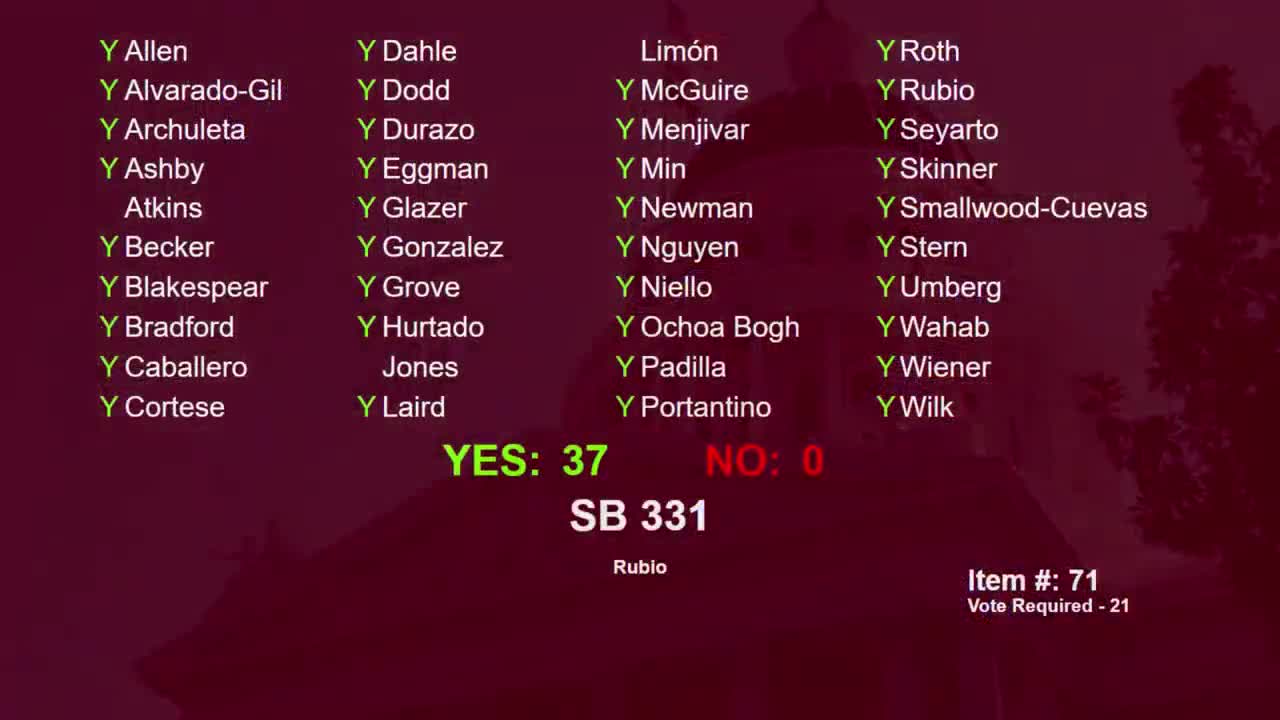 1MIN
Senate Floor
 4MIN
Senate Standing Committee on Judiciary
Bill Author

Bill Co-Author(s):