SB 621: Health care coverage: biosimilar drugs.
- Session Year: 2023-2024
- House: Senate
- Latest Version Date: 2023-10-08
Current Status:
Passed
(2023-10-08: Chaptered by Secretary of State. Chapter 495, Statutes of 2023.)
Introduced
In Committee
First Chamber
In Committee
Second Chamber
Enacted
Existing law, the Knox-Keene Health Care Service Plan Act of 1975, provides for the licensure and regulation of health care service plans by the Department of Managed Health Care. Existing law provides for the regulation of health insurers by the Department of Insurance. Existing law authorizes a health care service plan or health insurer that provides coverage for prescription drugs to require step therapy if there is more than one drug that is clinically appropriate for the treatment of a medical condition, but requires a plan or insurer to expeditiously grant a step therapy exception request if specified criteria are met. Existing law does not prohibit a plan, insurer, or utilization review organization from requiring an enrollee or insured to try an AB-rated generic equivalent or interchangeable biological product before providing coverage for the equivalent branded prescription drug.
This bill would specify that a plan, insurer, or utilization review organization is also not prohibited from requiring an enrollee or insured to try a biosimilar before providing coverage for the equivalent branded prescription drug, but that the requirement to try biosimilar, generic, and interchangeable drugs does not prohibit or supersede a step therapy exception request.
Existing law, the Knox-Keene Health Care Service Plan Act of 1975, provides for the licensure and regulation of health care service plans by the Department of Managed Health Care. Existing law provides for the regulation of health insurers by the Department of Insurance. Existing law authorizes a health care service plan or health insurer that provides coverage for prescription drugs to require step therapy if there is more than one drug that is clinically appropriate for the treatment of a medical condition, but requires a plan or insurer to expeditiously grant a step therapy exception request if specified criteria are met. Existing law does not prohibit a plan, insurer, or utilization review organization from requiring an enrollee or insured to try an AB-rated generic equivalent or interchangeable biological product before providing coverage for the equivalent branded prescription drug.
This bill would specify that a plan, insurer, or utilization review organization is also not prohibited from requiring an enrollee or insured to try a biosimilar before providing coverage for the equivalent branded prescription drug, but that the requirement to try biosimilar, generic, and interchangeable drugs does not prohibit or supersede a step therapy exception request.
Existing law, the Knox-Keene Health Care Service Plan Act of 1975, provides for the licensure and regulation of health care service plans by the Department of Managed Health Care. Existing law provides for the regulation of health insurers by the Department of Insurance. Existing law authorizes a health care service plan or health insurer that provides coverage for prescription drugs to require step therapy if there is more than one drug that is clinically appropriate for the treatment of a medical condition. condition, but requires a plan or insurer to expeditiously grant a step therapy exception request if specified criteria are met. Existing law does not prohibit a plan, insurer, or utilization review organization from requiring an enrollee or insured to try an AB-rated generic equivalent or interchangeable biological product before providing coverage for the equivalent branded prescription drug.
This bill would specify that a plan, insurer, or utilization review organization is also not prohibited from requiring an enrollee or insured to try a biosimilar before providing coverage for the equivalent branded prescription drug. drug, but that the requirement to try biosimilar, generic, and interchangeable drugs does not prohibit or supersede a step therapy exception request.
Existing law, the Knox-Keene Health Care Service Plan Act of 1975, provides for the licensure and regulation of health care service plans by the Department of Managed Health Care. Existing law provides for the regulation of health insurers by the Department of Insurance. Existing law authorizes a health care service plan or health insurer that provides coverage for prescription drugs to require step therapy if there is more than one drug that is clinically appropriate for the treatment of a medical condition. Existing law does not prohibit a plan, insurer, or utilization review organization from requiring an enrollee or insured to try an AB-rated generic equivalent or interchangeable biological product before providing coverage for the equivalent branded prescription drug.
This bill would specify that a plan, insurer, or utilization review organization is also not prohibited from requiring an enrollee or insured to try a biosimilar before providing coverage for the equivalent branded prescription drug.
(a)If there is more than one drug that is clinically appropriate for the treatment of a medical condition, a health care service plan that provides coverage for prescription drugs may require step therapy.
(b)A health care service plan shall expeditiously grant a request for a step therapy exception within the applicable time limit required by Section 1367.241 if a prescribing provider submits necessary justification and supporting clinical documentation supporting the providers determination that the required prescription drug is inconsistent with good professional practice for provision of medically necessary covered services to the enrollee, taking into consideration the enrollees needs and medical history, along with the professional judgment of the enrollees provider. The basis of the providers determination may include, but is not limited to, any of the following criteria:
(1)The required prescription drug is contraindicated or is likely, or expected, to cause an adverse reaction or physical or mental harm to the enrollee in comparison to the requested prescription drug, based on the known clinical characteristics of the enrollee and the known characteristics and history of the enrollees prescription drug regimen.
(2)The required prescription drug is expected to be ineffective based on the known clinical characteristics of the enrollee and the known characteristics and history of the enrollees prescription drug regimen.
(3)The enrollee has tried the required prescription drug while covered by their current or previous health coverage or Medicaid, and that prescription drug was discontinued due to lack of efficacy or effectiveness, diminished effect, or an adverse reaction. The health care service plan may require the submission of documentation demonstrating that the enrollee tried the required prescription drug before it was discontinued.
(4)The required prescription drug is not clinically appropriate for the enrollee because the required drug is expected to do any of the following, as determined by the enrollees prescribing provider:
(A)Worsen a comorbid condition.
(B)Decrease the capacity to maintain a reasonable functional ability in performing daily activities.
(C)Pose a significant barrier to adherence to, or compliance with, the enrollees drug regimen or plan of care.
(5)The enrollee is stable on a prescription drug selected by the enrollees prescribing provider for the medical condition under consideration while covered by their current or previous health coverage or Medicaid.
(c)A health care provider or prescribing provider may appeal a denial of an exception request for coverage of a nonformulary drug, prior authorization request, or step therapy exception request consistent with the health care service plans current utilization management processes.
(d)An enrollee or the enrollees designee or guardian may appeal a denial of an exception request for coverage of a nonformulary drug, prior authorization request, or step therapy exception request by filing a grievance under Section 1368.
(e)(1)This section does not prohibit a health care provider from prescribing a prescription drug that is clinically appropriate.
(2)This section does not prohibit a health care service plan or utilization review organization from requiring an enrollee to try an AB-rated generic equivalent, biosimilar, as defined in Section 262(i)(2) of Title 42 of the United States Code, or interchangeable biological product, as defined in Section 262(i)(3) of Title 42 of the United States Code, before providing coverage for the equivalent branded prescription drug.
(3)Paragraph (2) does not prohibit or supersede a step therapy exception request as described in subdivision (b).
(f)This section does not require or authorize a health care service plan that contracts with the State Department of Health Care Services to provide services to Medi-Cal beneficiaries to provide coverage for prescription drugs that are not required pursuant to those programs or contracts, or to limit or exclude any prescription drugs that are required by those programs or contracts.
(g)For purposes of this section, step therapy exception means a decision to override a generally applicable step therapy protocol in favor of coverage of the prescription drug prescribed by a health care provider for an individual enrollee.
(h)Commencing January 1, 2022, a health care service plan contract with a utilization review organization, medical group, or other contracted entity that performs utilization review or utilization management functions on a health care service plans behalf shall include terms that require the contracted entity to comply with this section and Section 1367.241.
SEC. 2.Section 10123.201 of the Insurance Code is amended to read:10123.201.(a)A policy of health insurance that covers outpatient prescription drugs shall cover medically necessary drugs. The policy may provide for step therapy and prior authorization consistent with Section 1342.7 of the Health and Safety Code and any regulations adopted pursuant to that section.
(b)(1)Commencing January 1, 2017, an insurer shall maintain a pharmacy and therapeutics committee that shall be responsible for developing, maintaining, and overseeing any drug formulary list. If the insurer delegates responsibility for the formulary to any entity, the obligation of the insurer to comply with this part shall not be waived.
(2)The pharmacy and therapeutics committee board membership shall conform with both of the following:
(A)Represent a sufficient number of clinical specialties to adequately meet the needs of insureds.
(B)Consist of a majority of individuals who are practicing physicians, practicing pharmacists, and other practicing health professionals who are licensed to prescribe drugs.
(3)Members of the board shall abstain from voting on any issue in which the member has a conflict of interest with respect to the issuer or a pharmaceutical manufacturer.
(4)At least 20 percent of the board membership shall not have a conflict of interest with respect to the issuer or any pharmaceutical manufacturer.
(5)The pharmacy and therapeutics committee shall meet at least quarterly and shall maintain written documentation of the rationale for its decisions regarding the development of, or revisions to, the formulary drug list.
(6)The pharmacy and therapeutics committee shall do all of the following:
(A)Develop and document procedures to ensure appropriate drug review and inclusion.
(B)Base clinical decisions on the strength of the scientific evidence and standards of practice, including assessing peer-reviewed medical literature, pharmacoeconomic studies, outcomes research data, and other related information.
(C)Consider the therapeutic advantages of drugs in terms of safety and efficacy when selecting formulary drugs.
(D)Review policies that guide exceptions and other utilization management processes, including drug utilization review, quantity limits, and therapeutic interchange.
(E)Evaluate and analyze treatment protocols and procedures related to the insurers formulary at least annually.
(F)Review and approve all clinical prior authorization criteria, step therapy protocols, and quantity limit restrictions applied to each covered drug.
(G)Review new United States Food and Drug Administration-approved drugs and new uses for existing drugs.
(H)Ensure the insurers formulary drug list or lists cover a range of drugs across a broad distribution of therapeutic categories and classes and recommended drug treatment regimens that treat all disease states and does not discourage enrollment by any group of insureds.
(I)Ensure the insurers formulary drug list or lists provide appropriate access to drugs that are included in broadly accepted treatment guidelines and that are indicative of general best practices at the time.
(7)This subdivision shall be interpreted consistent with federal guidance issued under paragraph (3) of subdivision (a) of Section 156.122 of Title 45 of the Code of Federal Regulations. This subdivision shall apply to the individual, small group, and large group markets.
(c)(1)A health insurer may impose prior authorization requirements on prescription drug benefits, consistent with the requirements of this part.
(2)(A)If there is more than one drug that is clinically appropriate for the treatment of a medical condition, a health insurer may require step therapy.
(B)A health insurer shall expeditiously grant a request for a step therapy exception within the applicable time limit required by Section 10123.191 if a prescribing provider submits necessary justification and supporting clinical documentation supporting the providers determination that the required prescription drug is inconsistent with good professional practice for provision of medically necessary covered services to the insured, taking into consideration the insureds needs and medical history, along with the professional judgment of the insureds provider. The basis of the providers determination may include, but is not limited to, any of the following criteria:
(i)The required prescription drug is contraindicated or is likely, or expected, to cause an adverse reaction or physical or mental harm to the insured in comparison to the requested prescription drug, based on the known clinical characteristics of the insured and the known characteristics and history of the insureds prescription drug regimen.
(ii)The required prescription drug is expected to be ineffective based on the known clinical characteristics of the insured and the known characteristics and history of the insureds prescription drug regimen.
(iii)The insured has tried the required prescription drug while covered by their current or previous health coverage or Medicaid, and that prescription drug was discontinued due to lack of efficacy or effectiveness, diminished effect, or an adverse reaction. The health insurer may require the submission of documentation demonstrating that the insured tried the required prescription drug before it was discontinued.
(iv)The required prescription drug is not clinically appropriate for the insured because the required drug is expected to do any of the following, as determined by the insureds prescribing provider:
(I)Worsen a comorbid condition.
(II)Decrease the capacity to maintain a reasonable functional ability in performing daily activities.
(III)Pose a significant barrier to adherence to, or compliance with, the insureds drug regimen or plan of care.
(v)The insured is stable on a prescription drug selected by the insureds prescribing provider for the medical condition under consideration while covered by their current or previous health coverage or Medicaid.
(C)(i)This section does not prohibit a health care provider from prescribing a prescription drug that is clinically appropriate.
(ii)This section does not prohibit an insurer or utilization review organization from requiring an insured to try an AB-rated generic equivalent, biosimilar, as defined in Section 262(i)(2) of Title 42 of the United States Code, or interchangeable biological product, as defined in Section 262(i)(3) of Title 42 of the United States Code, before providing coverage for the equivalent branded prescription drug.
(iii)Clause (ii) does not prohibit or supersede a step therapy exception request as described in subparagraph (B) of paragraph (2) of subdivision (c).
(3)An insurer shall provide coverage for the medically necessary dosage and quantity of the drug prescribed for the treatment of a medical condition consistent with professionally recognized standards of practice.
(4)For plan years commencing on or after January 1, 2017, an insurer that provides essential health benefits shall allow an insured to access prescription drug benefits at an in-network retail pharmacy unless the prescription drug is subject to restricted distribution by the United States Food and Drug Administration or requires special handling, provider coordination, or patient education that cannot be provided by a retail pharmacy. A nongrandfathered individual or small group health insurer may charge an insured a different cost sharing for obtaining a covered drug at a retail pharmacy, but all cost sharing shall count toward the policys annual limitation on cost sharing consistent with Section 10112.28.
(d)A health care provider or prescribing provider may file an internal appeal of a denial of an exception request for coverage of a nonformulary drug, prior authorization request, or step therapy exception request consistent with the health insurers current utilization management processes.
(e)An insured or the insureds designee or guardian may appeal a denial of an exception request for coverage of a nonformulary drug, prior authorization request, or step therapy exception request by filing an internal appeal with the health insurer pursuant to Section 2719 of the federal Public Health Service Act (42 U.S.C. Sec. 300gg-19) and any subsequent rules or regulations issued thereunder.
(f)Every health insurer that provides prescription drug benefits shall maintain all of the following information, which shall be made available to the commissioner upon request:
(1)The complete drug formulary or formularies of the insurer, if the insurer maintains a formulary, including a list of the prescription drugs on the formulary of the insurer by major therapeutic category with an indication of whether any drugs are preferred over other drugs.
(2)Records developed by the pharmacy and therapeutics committee of the insurer, or by others responsible for developing, modifying, and overseeing formularies, including medical groups, individual practice associations, and contracting pharmaceutical benefit management companies, used to guide the drugs prescribed for the insureds of the insurer, that fully describe the reasoning behind formulary decisions.
(3)Any insurer arrangements with prescribing providers, medical groups, individual practice associations, pharmacists, contracting pharmaceutical benefit management companies, or other entities that are associated with activities of the insurer to encourage formulary compliance or otherwise manage prescription drug benefits.
(g)If an insurer provides prescription drug benefits, the commissioner shall, as part of its market conduct examination, review the performance of the insurer in providing those benefits, including, but not limited to, a review of the procedures and information maintained pursuant to this section, and describe the performance of the insurer as part of its report issued as part of its market conduct examination.
(h)The commissioner shall not publicly disclose any information reviewed pursuant to this section that is determined by the commissioner to be confidential pursuant to state law.
(i)For purposes of this section, the following definitions shall apply:
(1)Authorization means approval by the health insurer to provide payment for the prescription drug.
(2)Step therapy means a type of protocol that specifies the sequence in which different prescription drugs for a given medical condition and medically appropriate for a particular patient are to be prescribed.
(3)Step therapy exception means a decision to override a generally applicable step therapy protocol in favor of coverage of the prescription drug prescribed by a health care provider for an individual insured.
(4)Utilization review organization means an entity that conducts utilization review, other than a health insurer performing its own utilization review.
(j)Nonformulary prescription drugs shall include any drug for which an insureds copayment or out-of-pocket costs are different than the copayment for a formulary prescription drug, except as otherwise provided by law or regulation.
(k)This section does not affect an insureds or policyholders eligibility to submit a complaint to the department for review or to apply to the department for an independent medical review under Article 3.5 (commencing with Section 10169).
(l)This section does not restrict or impair the application of any other provision of this part.
(m)This section and Section 10123.191 apply to both the health insurer and a utilization review organization that performs utilization review or utilization management functions on the insurers behalf. Commencing January 1, 2022, a contract between a health insurer and a utilization review organization that performs utilization review or utilization management functions on the insurers behalf shall include terms that require the utilization review organization to comply with this section and Section 10123.191.
(a)If there is more than one drug that is clinically appropriate for the treatment of a medical condition, a health care service plan that provides coverage for prescription drugs may require step therapy.
(b)A health care service plan shall expeditiously grant a request for a step therapy exception within the applicable time limit required by Section 1367.241 if a prescribing provider submits necessary justification and supporting clinical documentation supporting the providers determination that the required prescription drug is inconsistent with good professional practice for provision of medically necessary covered services to the enrollee, taking into consideration the enrollees needs and medical history, along with the professional judgment of the enrollees provider. The basis of the providers determination may include, but is not limited to, any of the following criteria:
(1)The required prescription drug is contraindicated or is likely, or expected, to cause an adverse reaction or physical or mental harm to the enrollee in comparison to the requested prescription drug, based on the known clinical characteristics of the enrollee and the known characteristics and history of the enrollees prescription drug regimen.
(2)The required prescription drug is expected to be ineffective based on the known clinical characteristics of the enrollee and the known characteristics and history of the enrollees prescription drug regimen.
(3)The enrollee has tried the required prescription drug while covered by their current or previous health coverage or Medicaid, and that prescription drug was discontinued due to lack of efficacy or effectiveness, diminished effect, or an adverse reaction. The health care service plan may require the submission of documentation demonstrating that the enrollee tried the required prescription drug before it was discontinued.
(4)The required prescription drug is not clinically appropriate for the enrollee because the required drug is expected to do any of the following, as determined by the enrollees prescribing provider:
(A)Worsen a comorbid condition.
(B)Decrease the capacity to maintain a reasonable functional ability in performing daily activities.
(C)Pose a significant barrier to adherence to, or compliance with, the enrollees drug regimen or plan of care.
(5)The enrollee is stable on a prescription drug selected by the enrollees prescribing provider for the medical condition under consideration while covered by their current or previous health coverage or Medicaid.
(c)A health care provider or prescribing provider may appeal a denial of an exception request for coverage of a nonformulary drug, prior authorization request, or step therapy exception request consistent with the health care service plans current utilization management processes.
(d)An enrollee or the enrollees designee or guardian may appeal a denial of an exception request for coverage of a nonformulary drug, prior authorization request, or step therapy exception request by filing a grievance under Section 1368.
(e)(1)This section does not prohibit a health care provider from prescribing a prescription drug that is clinically appropriate.
(2)This section does not prohibit a health care service plan or utilization review organization from requiring an enrollee to try an AB-rated generic equivalent, biosimilar, as defined in Section 262(i)(2) of Title 42 of the United States Code, or interchangeable biological product, as defined in Section 262(i)(3) of Title 42 of the United States Code, before providing coverage for the equivalent branded prescription drug.
(3)Paragraph (2) does not prohibit or supersede a step therapy exception request as described in subdivision (b).
(f)This section does not require or authorize a health care service plan that contracts with the State Department of Health Care Services to provide services to Medi-Cal beneficiaries to provide coverage for prescription drugs that are not required pursuant to those programs or contracts, or to limit or exclude any prescription drugs that are required by those programs or contracts.
(g)For purposes of this section, step therapy exception means a decision to override a generally applicable step therapy protocol in favor of coverage of the prescription drug prescribed by a health care provider for an individual enrollee.
(h)Commencing January 1, 2022, a health care service plan contract with a utilization review organization, medical group, or other contracted entity that performs utilization review or utilization management functions on a health care service plans behalf shall include terms that require the contracted entity to comply with this section and Section 1367.241.
SEC. 2.Section 10123.201 of the Insurance Code is amended to read:10123.201.(a)A policy of health insurance that covers outpatient prescription drugs shall cover medically necessary drugs. The policy may provide for step therapy and prior authorization consistent with Section 1342.7 of the Health and Safety Code and any regulations adopted pursuant to that section.
(b)(1)Commencing January 1, 2017, an insurer shall maintain a pharmacy and therapeutics committee that shall be responsible for developing, maintaining, and overseeing any drug formulary list. If the insurer delegates responsibility for the formulary to any entity, the obligation of the insurer to comply with this part shall not be waived.
(2)The pharmacy and therapeutics committee board membership shall conform with both of the following:
(A)Represent a sufficient number of clinical specialties to adequately meet the needs of insureds.
(B)Consist of a majority of individuals who are practicing physicians, practicing pharmacists, and other practicing health professionals who are licensed to prescribe drugs.
(3)Members of the board shall abstain from voting on any issue in which the member has a conflict of interest with respect to the issuer or a pharmaceutical manufacturer.
(4)At least 20 percent of the board membership shall not have a conflict of interest with respect to the issuer or any pharmaceutical manufacturer.
(5)The pharmacy and therapeutics committee shall meet at least quarterly and shall maintain written documentation of the rationale for its decisions regarding the development of, or revisions to, the formulary drug list.
(6)The pharmacy and therapeutics committee shall do all of the following:
(A)Develop and document procedures to ensure appropriate drug review and inclusion.
(B)Base clinical decisions on the strength of the scientific evidence and standards of practice, including assessing peer-reviewed medical literature, pharmacoeconomic studies, outcomes research data, and other related information.
(C)Consider the therapeutic advantages of drugs in terms of safety and efficacy when selecting formulary drugs.
(D)Review policies that guide exceptions and other utilization management processes, including drug utilization review, quantity limits, and therapeutic interchange.
(E)Evaluate and analyze treatment protocols and procedures related to the insurers formulary at least annually.
(F)Review and approve all clinical prior authorization criteria, step therapy protocols, and quantity limit restrictions applied to each covered drug.
(G)Review new United States Food and Drug Administration-approved drugs and new uses for existing drugs.
(H)Ensure the insurers formulary drug list or lists cover a range of drugs across a broad distribution of therapeutic categories and classes and recommended drug treatment regimens that treat all disease states and does not discourage enrollment by any group of insureds.
(I)Ensure the insurers formulary drug list or lists provide appropriate access to drugs that are included in broadly accepted treatment guidelines and that are indicative of general best practices at the time.
(7)This subdivision shall be interpreted consistent with federal guidance issued under paragraph (3) of subdivision (a) of Section 156.122 of Title 45 of the Code of Federal Regulations. This subdivision shall apply to the individual, small group, and large group markets.
(c)(1)A health insurer may impose prior authorization requirements on prescription drug benefits, consistent with the requirements of this part.
(2)(A)If there is more than one drug that is clinically appropriate for the treatment of a medical condition, a health insurer may require step therapy.
(B)A health insurer shall expeditiously grant a request for a step therapy exception within the applicable time limit required by Section 10123.191 if a prescribing provider submits necessary justification and supporting clinical documentation supporting the providers determination that the required prescription drug is inconsistent with good professional practice for provision of medically necessary covered services to the insured, taking into consideration the insureds needs and medical history, along with the professional judgment of the insureds provider. The basis of the providers determination may include, but is not limited to, any of the following criteria:
(i)The required prescription drug is contraindicated or is likely, or expected, to cause an adverse reaction or physical or mental harm to the insured in comparison to the requested prescription drug, based on the known clinical characteristics of the insured and the known characteristics and history of the insureds prescription drug regimen.
(ii)The required prescription drug is expected to be ineffective based on the known clinical characteristics of the insured and the known characteristics and history of the insureds prescription drug regimen.
(iii)The insured has tried the required prescription drug while covered by their current or previous health coverage or Medicaid, and that prescription drug was discontinued due to lack of efficacy or effectiveness, diminished effect, or an adverse reaction. The health insurer may require the submission of documentation demonstrating that the insured tried the required prescription drug before it was discontinued.
(iv)The required prescription drug is not clinically appropriate for the insured because the required drug is expected to do any of the following, as determined by the insureds prescribing provider:
(I)Worsen a comorbid condition.
(II)Decrease the capacity to maintain a reasonable functional ability in performing daily activities.
(III)Pose a significant barrier to adherence to, or compliance with, the insureds drug regimen or plan of care.
(v)The insured is stable on a prescription drug selected by the insureds prescribing provider for the medical condition under consideration while covered by their current or previous health coverage or Medicaid.
(C)(i)This section does not prohibit a health care provider from prescribing a prescription drug that is clinically appropriate.
(ii)This section does not prohibit an insurer or utilization review organization from requiring an insured to try an AB-rated generic equivalent, biosimilar, as defined in Section 262(i)(2) of Title 42 of the United States Code, or interchangeable biological product, as defined in Section 262(i)(3) of Title 42 of the United States Code, before providing coverage for the equivalent branded prescription drug.
(iii)Clause (ii) does not prohibit or supersede a step therapy exception request as described in subparagraph (B) of paragraph (2) of subdivision (c).
(3)An insurer shall provide coverage for the medically necessary dosage and quantity of the drug prescribed for the treatment of a medical condition consistent with professionally recognized standards of practice.
(4)For plan years commencing on or after January 1, 2017, an insurer that provides essential health benefits shall allow an insured to access prescription drug benefits at an in-network retail pharmacy unless the prescription drug is subject to restricted distribution by the United States Food and Drug Administration or requires special handling, provider coordination, or patient education that cannot be provided by a retail pharmacy. A nongrandfathered individual or small group health insurer may charge an insured a different cost sharing for obtaining a covered drug at a retail pharmacy, but all cost sharing shall count toward the policys annual limitation on cost sharing consistent with Section 10112.28.
(d)A health care provider or prescribing provider may file an internal appeal of a denial of an exception request for coverage of a nonformulary drug, prior authorization request, or step therapy exception request consistent with the health insurers current utilization management processes.
(e)An insured or the insureds designee or guardian may appeal a denial of an exception request for coverage of a nonformulary drug, prior authorization request, or step therapy exception request by filing an internal appeal with the health insurer pursuant to Section 2719 of the federal Public Health Service Act (42 U.S.C. Sec. 300gg-19) and any subsequent rules or regulations issued thereunder.
(f)Every health insurer that provides prescription drug benefits shall maintain all of the following information, which shall be made available to the commissioner upon request:
(1)The complete drug formulary or formularies of the insurer, if the insurer maintains a formulary, including a list of the prescription drugs on the formulary of the insurer by major therapeutic category with an indication of whether any drugs are preferred over other drugs.
(2)Records developed by the pharmacy and therapeutics committee of the insurer, or by others responsible for developing, modifying, and overseeing formularies, including medical groups, individual practice associations, and contracting pharmaceutical benefit management companies, used to guide the drugs prescribed for the insureds of the insurer, that fully describe the reasoning behind formulary decisions.
(3)Any insurer arrangements with prescribing providers, medical groups, individual practice associations, pharmacists, contracting pharmaceutical benefit management companies, or other entities that are associated with activities of the insurer to encourage formulary compliance or otherwise manage prescription drug benefits.
(g)If an insurer provides prescription drug benefits, the commissioner shall, as part of its market conduct examination, review the performance of the insurer in providing those benefits, including, but not limited to, a review of the procedures and information maintained pursuant to this section, and describe the performance of the insurer as part of its report issued as part of its market conduct examination.
(h)The commissioner shall not publicly disclose any information reviewed pursuant to this section that is determined by the commissioner to be confidential pursuant to state law.
(i)For purposes of this section, the following definitions shall apply:
(1)Authorization means approval by the health insurer to provide payment for the prescription drug.
(2)Step therapy means a type of protocol that specifies the sequence in which different prescription drugs for a given medical condition and medically appropriate for a particular patient are to be prescribed.
(3)Step therapy exception means a decision to override a generally applicable step therapy protocol in favor of coverage of the prescription drug prescribed by a health care provider for an individual insured.
(4)Utilization review organization means an entity that conducts utilization review, other than a health insurer performing its own utilization review.
(j)Nonformulary prescription drugs shall include any drug for which an insureds copayment or out-of-pocket costs are different than the copayment for a formulary prescription drug, except as otherwise provided by law or regulation.
(k)This section does not affect an insureds or policyholders eligibility to submit a complaint to the department for review or to apply to the department for an independent medical review under Article 3.5 (commencing with Section 10169).
(l)This section does not restrict or impair the application of any other provision of this part.
(m)This section and Section 10123.191 apply to both the health insurer and a utilization review organization that performs utilization review or utilization management functions on the insurers behalf. Commencing January 1, 2022, a contract between a health insurer and a utilization review organization that performs utilization review or utilization management functions on the insurers behalf shall include terms that require the utilization review organization to comply with this section and Section 10123.191.
(a)If there is more than one drug that is clinically appropriate for the treatment of a medical condition, a health care service plan that provides coverage for prescription drugs may require step therapy.
(b)A health care service plan shall expeditiously grant a request for a step therapy exception within the applicable time limit required by Section 1367.241 if a prescribing provider submits necessary justification and supporting clinical documentation supporting the providers determination that the required prescription drug is inconsistent with good professional practice for provision of medically necessary covered services to the enrollee, taking into consideration the enrollees needs and medical history, along with the professional judgment of the enrollees provider. The basis of the providers determination may include, but is not limited to, any of the following criteria:
(1)The required prescription drug is contraindicated or is likely, or expected, to cause an adverse reaction or physical or mental harm to the enrollee in comparison to the requested prescription drug, based on the known clinical characteristics of the enrollee and the known characteristics and history of the enrollees prescription drug regimen.
(2)The required prescription drug is expected to be ineffective based on the known clinical characteristics of the enrollee and the known characteristics and history of the enrollees prescription drug regimen.
(3)The enrollee has tried the required prescription drug while covered by their current or previous health coverage or Medicaid, and that prescription drug was discontinued due to lack of efficacy or effectiveness, diminished effect, or an adverse reaction. The health care service plan may require the submission of documentation demonstrating that the enrollee tried the required prescription drug before it was discontinued.
(4)The required prescription drug is not clinically appropriate for the enrollee because the required drug is expected to do any of the following, as determined by the enrollees prescribing provider:
(A)Worsen a comorbid condition.
(B)Decrease the capacity to maintain a reasonable functional ability in performing daily activities.
(C)Pose a significant barrier to adherence to, or compliance with, the enrollees drug regimen or plan of care.
(5)The enrollee is stable on a prescription drug selected by the enrollees prescribing provider for the medical condition under consideration while covered by their current or previous health coverage or Medicaid.
(c)A health care provider or prescribing provider may appeal a denial of an exception request for coverage of a nonformulary drug, prior authorization request, or step therapy exception request consistent with the health care service plans current utilization management processes.
(d)An enrollee or the enrollees designee or guardian may appeal a denial of an exception request for coverage of a nonformulary drug, prior authorization request, or step therapy exception request by filing a grievance under Section 1368.
(e)(1)This section does not prohibit either of the following: a health care provider from prescribing a prescription drug that is clinically appropriate.
(1)A(2)This section does not prohibit a health care service plan or utilization review organization from requiring an enrollee to try an AB-rated generic equivalent, biosimilar, as defined in Section 262(i)(2) of Title 42 of the United States Code, or interchangeable biological product, as defined in Section 262(i)(3) of Title 42 of the United States Code, before providing coverage for the equivalent branded prescription drug.
(2)A health care provider from prescribing a prescription drug that is clinically appropriate.(3)Paragraph (2) does not prohibit or supersede a step therapy exception request as described in subdivision (b).
(f)This section does not require or authorize a health care service plan that contracts with the State Department of Health Care Services to provide services to Medi-Cal beneficiaries to provide coverage for prescription drugs that are not required pursuant to those programs or contracts, or to limit or exclude any prescription drugs that are required by those programs or contracts.
(g)For purposes of this section, step therapy exception means a decision to override a generally applicable step therapy protocol in favor of coverage of the prescription drug prescribed by a health care provider for an individual enrollee.
(h)Commencing January 1, 2022, a health care service plan contract with a utilization review organization, medical group, or other contracted entity that performs utilization review or utilization management functions on a health care service plans behalf shall include terms that require the contracted entity to comply with this section and Section 1367.241.
SEC. 2.Section 10123.201 of the Insurance Code is amended to read:10123.201.(a)A policy of health insurance that covers outpatient prescription drugs shall cover medically necessary drugs. The policy may provide for step therapy and prior authorization consistent with Section 1342.7 of the Health and Safety Code and any regulations adopted pursuant to that section.
(b)(1)Commencing January 1, 2017, an insurer shall maintain a pharmacy and therapeutics committee that shall be responsible for developing, maintaining, and overseeing any drug formulary list. If the insurer delegates responsibility for the formulary to any entity, the obligation of the insurer to comply with this part shall not be waived.
(2)The pharmacy and therapeutics committee board membership shall conform with both of the following:
(A)Represent a sufficient number of clinical specialties to adequately meet the needs of insureds.
(B)Consist of a majority of individuals who are practicing physicians, practicing pharmacists, and other practicing health professionals who are licensed to prescribe drugs.
(3)Members of the board shall abstain from voting on any issue in which the member has a conflict of interest with respect to the issuer or a pharmaceutical manufacturer.
(4)At least 20 percent of the board membership shall not have a conflict of interest with respect to the issuer or any pharmaceutical manufacturer.
(5)The pharmacy and therapeutics committee shall meet at least quarterly and shall maintain written documentation of the rationale for its decisions regarding the development of, or revisions to, the formulary drug list.
(6)The pharmacy and therapeutics committee shall do all of the following:
(A)Develop and document procedures to ensure appropriate drug review and inclusion.
(B)Base clinical decisions on the strength of the scientific evidence and standards of practice, including assessing peer-reviewed medical literature, pharmacoeconomic studies, outcomes research data, and other related information.
(C)Consider the therapeutic advantages of drugs in terms of safety and efficacy when selecting formulary drugs.
(D)Review policies that guide exceptions and other utilization management processes, including drug utilization review, quantity limits, and therapeutic interchange.
(E)Evaluate and analyze treatment protocols and procedures related to the insurers formulary at least annually.
(F)Review and approve all clinical prior authorization criteria, step therapy protocols, and quantity limit restrictions applied to each covered drug.
(G)Review new United States Food and Drug Administration-approved drugs and new uses for existing drugs.
(H)Ensure the insurers formulary drug list or lists cover a range of drugs across a broad distribution of therapeutic categories and classes and recommended drug treatment regimens that treat all disease states and does not discourage enrollment by any group of insureds.
(I)Ensure the insurers formulary drug list or lists provide appropriate access to drugs that are included in broadly accepted treatment guidelines and that are indicative of general best practices at the time.
(7)This subdivision shall be interpreted consistent with federal guidance issued under paragraph (3) of subdivision (a) of Section 156.122 of Title 45 of the Code of Federal Regulations. This subdivision shall apply to the individual, small group, and large group markets.
(c)(1)A health insurer may impose prior authorization requirements on prescription drug benefits, consistent with the requirements of this part.
(2)(A)If there is more than one drug that is clinically appropriate for the treatment of a medical condition, a health insurer may require step therapy.
(B)A health insurer shall expeditiously grant a request for a step therapy exception within the applicable time limit required by Section 10123.191 if a prescribing provider submits necessary justification and supporting clinical documentation supporting the providers determination that the required prescription drug is inconsistent with good professional practice for provision of medically necessary covered services to the insured, taking into consideration the insureds needs and medical history, along with the professional judgment of the insureds provider. The basis of the providers determination may include, but is not limited to, any of the following criteria:
(i)The required prescription drug is contraindicated or is likely, or expected, to cause an adverse reaction or physical or mental harm to the insured in comparison to the requested prescription drug, based on the known clinical characteristics of the insured and the known characteristics and history of the insureds prescription drug regimen.
(ii)The required prescription drug is expected to be ineffective based on the known clinical characteristics of the insured and the known characteristics and history of the insureds prescription drug regimen.
(iii)The insured has tried the required prescription drug while covered by their current or previous health coverage or Medicaid, and that prescription drug was discontinued due to lack of efficacy or effectiveness, diminished effect, or an adverse reaction. The health insurer may require the submission of documentation demonstrating that the insured tried the required prescription drug before it was discontinued.
(iv)The required prescription drug is not clinically appropriate for the insured because the required drug is expected to do any of the following, as determined by the insureds prescribing provider:
(I)Worsen a comorbid condition.
(II)Decrease the capacity to maintain a reasonable functional ability in performing daily activities.
(III)Pose a significant barrier to adherence to, or compliance with, the insureds drug regimen or plan of care.
(v)The insured is stable on a prescription drug selected by the insureds prescribing provider for the medical condition under consideration while covered by their current or previous health coverage or Medicaid.
(C)(i)This section does not prohibit either of the following: a health care provider from prescribing a prescription drug that is clinically appropriate.
(i)An(ii)This section does not prohibit an insurer or utilization review organization from requiring an insured to try an AB-rated generic equivalent, biosimilar, as defined in Section 262(i)(2) of Title 42 of the United States Code, or interchangeable biological product, as defined in Section 262(i)(3) of Title 42 of the United States Code, before providing coverage for the equivalent branded prescription drug.
(ii)A health care provider from prescribing a prescription drug that is clinically appropriate.(iii)Clause (ii) does not prohibit or supersede a step therapy exception request as described in subparagraph (B) of paragraph (2) of subdivision (c).
(3)An insurer shall provide coverage for the medically necessary dosage and quantity of the drug prescribed for the treatment of a medical condition consistent with professionally recognized standards of practice.
(4)For plan years commencing on or after January 1, 2017, an insurer that provides essential health benefits shall allow an insured to access prescription drug benefits at an in-network retail pharmacy unless the prescription drug is subject to restricted distribution by the United States Food and Drug Administration or requires special handling, provider coordination, or patient education that cannot be provided by a retail pharmacy. A nongrandfathered individual or small group health insurer may charge an insured a different cost sharing for obtaining a covered drug at a retail pharmacy, but all cost sharing shall count toward the policys annual limitation on cost sharing consistent with Section 10112.28.
(d)A health care provider or prescribing provider may file an internal appeal of a denial of an exception request for coverage of a nonformulary drug, prior authorization request, or step therapy exception request consistent with the health insurers current utilization management processes.
(e)An insured or the insureds designee or guardian may appeal a denial of an exception request for coverage of a nonformulary drug, prior authorization request, or step therapy exception request by filing an internal appeal with the health insurer pursuant to Section 2719 of the federal Public Health Service Act (42 U.S.C. Sec. 300gg-19) and any subsequent rules or regulations issued thereunder.
(f)Every health insurer that provides prescription drug benefits shall maintain all of the following information, which shall be made available to the commissioner upon request:
(1)The complete drug formulary or formularies of the insurer, if the insurer maintains a formulary, including a list of the prescription drugs on the formulary of the insurer by major therapeutic category with an indication of whether any drugs are preferred over other drugs.
(2)Records developed by the pharmacy and therapeutics committee of the insurer, or by others responsible for developing, modifying, and overseeing formularies, including medical groups, individual practice associations, and contracting pharmaceutical benefit management companies, used to guide the drugs prescribed for the insureds of the insurer, that fully describe the reasoning behind formulary decisions.
(3)Any insurer arrangements with prescribing providers, medical groups, individual practice associations, pharmacists, contracting pharmaceutical benefit management companies, or other entities that are associated with activities of the insurer to encourage formulary compliance or otherwise manage prescription drug benefits.
(g)If an insurer provides prescription drug benefits, the commissioner shall, as part of its market conduct examination, review the performance of the insurer in providing those benefits, including, but not limited to, a review of the procedures and information maintained pursuant to this section, and describe the performance of the insurer as part of its report issued as part of its market conduct examination.
(h)The commissioner shall not publicly disclose any information reviewed pursuant to this section that is determined by the commissioner to be confidential pursuant to state law.
(i)For purposes of this section, the following definitions shall apply:
(1)Authorization means approval by the health insurer to provide payment for the prescription drug.
(2)Step therapy means a type of protocol that specifies the sequence in which different prescription drugs for a given medical condition and medically appropriate for a particular patient are to be prescribed.
(3)Step therapy exception means a decision to override a generally applicable step therapy protocol in favor of coverage of the prescription drug prescribed by a health care provider for an individual insured.
(4)Utilization review organization means an entity that conducts utilization review, other than a health insurer performing its own utilization review.
(j)Nonformulary prescription drugs shall include any drug for which an insureds copayment or out-of-pocket costs are different than the copayment for a formulary prescription drug, except as otherwise provided by law or regulation.
(k)This section does not affect an insureds or policyholders eligibility to submit a complaint to the department for review or to apply to the department for an independent medical review under Article 3.5 (commencing with Section 10169).
(l)This section does not restrict or impair the application of any other provision of this part.
(m)This section and Section 10123.191 apply to both the health insurer and a utilization review organization that performs utilization review or utilization management functions on the insurers behalf. Commencing January 1, 2022, a contract between a health insurer and a utilization review organization that performs utilization review or utilization management functions on the insurers behalf shall include terms that require the utilization review organization to comply with this section and Section 10123.191.
(a)If there is more than one drug that is clinically appropriate for the treatment of a medical condition, a health care service plan that provides coverage for prescription drugs may require step therapy.
(b)A health care service plan shall expeditiously grant a request for a step therapy exception within the applicable time limit required by Section 1367.241 if a prescribing provider submits necessary justification and supporting clinical documentation supporting the providers determination that the required prescription drug is inconsistent with good professional practice for provision of medically necessary covered services to the enrollee, taking into consideration the enrollees needs and medical history, along with the professional judgment of the enrollees provider. The basis of the providers determination may include, but is not limited to, any of the following criteria:
(1)The required prescription drug is contraindicated or is likely, or expected, to cause an adverse reaction or physical or mental harm to the enrollee in comparison to the requested prescription drug, based on the known clinical characteristics of the enrollee and the known characteristics and history of the enrollees prescription drug regimen.
(2)The required prescription drug is expected to be ineffective based on the known clinical characteristics of the enrollee and the known characteristics and history of the enrollees prescription drug regimen.
(3)The enrollee has tried the required prescription drug while covered by their current or previous health coverage or Medicaid, and that prescription drug was discontinued due to lack of efficacy or effectiveness, diminished effect, or an adverse reaction. The health care service plan may require the submission of documentation demonstrating that the enrollee tried the required prescription drug before it was discontinued.
(4)The required prescription drug is not clinically appropriate for the enrollee because the required drug is expected to do any of the following, as determined by the enrollees prescribing provider:
(A)Worsen a comorbid condition.
(B)Decrease the capacity to maintain a reasonable functional ability in performing daily activities.
(C)Pose a significant barrier to adherence to, or compliance with, the enrollees drug regimen or plan of care.
(5)The enrollee is stable on a prescription drug selected by the enrollees prescribing provider for the medical condition under consideration while covered by their current or previous health coverage or Medicaid.
(c)A health care provider or prescribing provider may appeal a denial of an exception request for coverage of a nonformulary drug, prior authorization request, or step therapy exception request consistent with the health care service plans current utilization management processes.
(d)An enrollee or the enrollees designee or guardian may appeal a denial of an exception request for coverage of a nonformulary drug, prior authorization request, or step therapy exception request by filing a grievance under Section 1368.
(e)This section does not prohibit either of the following:
(1)A health care service plan or utilization review organization from requiring an enrollee to try an AB-rated generic equivalent equivalent, biosimilar, as defined in Section 262(i)(2) of Title 42 of the United States Code, or interchangeable biological product product, as defined in Section 262(i)(3) of Title 42 of the United States Code, before providing coverage for the equivalent branded prescription drug.
(2)A health care provider from prescribing a prescription drug that is clinically appropriate.
(f)This section does not require or authorize a health care service plan that contracts with the State Department of Health Care Services to provide services to Medi-Cal beneficiaries to provide coverage for prescription drugs that are not required pursuant to those programs or contracts, or to limit or exclude any prescription drugs that are required by those programs or contracts.
(g)For purposes of this section, step therapy exception means a decision to override a generally applicable step therapy protocol in favor of coverage of the prescription drug prescribed by a health care provider for an individual enrollee.
(h)Commencing January 1, 2022, a health care service plan contract with a utilization review organization, medical group, or other contracted entity that performs utilization review or utilization management functions on a health care service plans behalf shall include terms that require the contracted entity to comply with this section and Section 1367.241.
SEC. 2.Section 10123.201 of the Insurance Code is amended to read:10123.201.(a)A policy of health insurance that covers outpatient prescription drugs shall cover medically necessary drugs. The policy may provide for step therapy and prior authorization consistent with Section 1342.7 of the Health and Safety Code and any regulations adopted pursuant to that section.
(b)(1)Commencing January 1, 2017, an insurer shall maintain a pharmacy and therapeutics committee that shall be responsible for developing, maintaining, and overseeing any drug formulary list. If the insurer delegates responsibility for the formulary to any entity, the obligation of the insurer to comply with this part shall not be waived.
(2)The pharmacy and therapeutics committee board membership shall conform with both of the following:
(A)Represent a sufficient number of clinical specialties to adequately meet the needs of insureds.
(B)Consist of a majority of individuals who are practicing physicians, practicing pharmacists, and other practicing health professionals who are licensed to prescribe drugs.
(3)Members of the board shall abstain from voting on any issue in which the member has a conflict of interest with respect to the issuer or a pharmaceutical manufacturer.
(4)At least 20 percent of the board membership shall not have a conflict of interest with respect to the issuer or any pharmaceutical manufacturer.
(5)The pharmacy and therapeutics committee shall meet at least quarterly and shall maintain written documentation of the rationale for its decisions regarding the development of, or revisions to, the formulary drug list.
(6)The pharmacy and therapeutics committee shall do all of the following:
(A)Develop and document procedures to ensure appropriate drug review and inclusion.
(B)Base clinical decisions on the strength of the scientific evidence and standards of practice, including assessing peer-reviewed medical literature, pharmacoeconomic studies, outcomes research data, and other related information.
(C)Consider the therapeutic advantages of drugs in terms of safety and efficacy when selecting formulary drugs.
(D)Review policies that guide exceptions and other utilization management processes, including drug utilization review, quantity limits, and therapeutic interchange.
(E)Evaluate and analyze treatment protocols and procedures related to the insurers formulary at least annually.
(F)Review and approve all clinical prior authorization criteria, step therapy protocols, and quantity limit restrictions applied to each covered drug.
(G)Review new United States Food and Drug Administration-approved drugs and new uses for existing drugs.
(H)Ensure the insurers formulary drug list or lists cover a range of drugs across a broad distribution of therapeutic categories and classes and recommended drug treatment regimens that treat all disease states and does not discourage enrollment by any group of insureds.
(I)Ensure the insurers formulary drug list or lists provide appropriate access to drugs that are included in broadly accepted treatment guidelines and that are indicative of general best practices at the time.
(7)This subdivision shall be interpreted consistent with federal guidance issued under paragraph (3) of subdivision (a) of Section 156.122 of Title 45 of the Code of Federal Regulations. This subdivision shall apply to the individual, small group, and large group markets.
(c)(1)A health insurer may impose prior authorization requirements on prescription drug benefits, consistent with the requirements of this part.
(2)(A)If there is more than one drug that is clinically appropriate for the treatment of a medical condition, a health insurer may require step therapy.
(B)A health insurer shall expeditiously grant a request for a step therapy exception within the applicable time limit required by Section 10123.191 if a prescribing provider submits necessary justification and supporting clinical documentation supporting the providers determination that the required prescription drug is inconsistent with good professional practice for provision of medically necessary covered services to the insured, taking into consideration the insureds needs and medical history, along with the professional judgment of the insureds provider. The basis of the providers determination may include, but is not limited to, any of the following criteria:
(i)The required prescription drug is contraindicated or is likely, or expected, to cause an adverse reaction or physical or mental harm to the insured in comparison to the requested prescription drug, based on the known clinical characteristics of the insured and the known characteristics and history of the insureds prescription drug regimen.
(ii)The required prescription drug is expected to be ineffective based on the known clinical characteristics of the insured and the known characteristics and history of the insureds prescription drug regimen.
(iii)The insured has tried the required prescription drug while covered by their current or previous health coverage or Medicaid, and that prescription drug was discontinued due to lack of efficacy or effectiveness, diminished effect, or an adverse reaction. The health insurer may require the submission of documentation demonstrating that the insured tried the required prescription drug before it was discontinued.
(iv)The required prescription drug is not clinically appropriate for the insured because the required drug is expected to do any of the following, as determined by the insureds prescribing provider:
(I)Worsen a comorbid condition.
(II)Decrease the capacity to maintain a reasonable functional ability in performing daily activities.
(III)Pose a significant barrier to adherence to, or compliance with, the insureds drug regimen or plan of care.
(v)The insured is stable on a prescription drug selected by the insureds prescribing provider for the medical condition under consideration while covered by their current or previous health coverage or Medicaid.
(C)This section does not prohibit either of the following:
(i)An insurer or utilization review organization from requiring an insured to try an AB-rated generic equivalent equivalent, biosimilar, as defined in Section 262(i)(2) of Title 42 of the United States Code, or interchangeable biological product product, as defined in Section 262(i)(3) of Title 42 of the United States Code, before providing coverage for the equivalent branded prescription drug.
(ii)A health care provider from prescribing a prescription drug that is clinically appropriate.
(3)An insurer shall provide coverage for the medically necessary dosage and quantity of the drug prescribed for the treatment of a medical condition consistent with professionally recognized standards of practice.
(4)For plan years commencing on or after January 1, 2017, an insurer that provides essential health benefits shall allow an insured to access prescription drug benefits at an in-network retail pharmacy unless the prescription drug is subject to restricted distribution by the United States Food and Drug Administration or requires special handling, provider coordination, or patient education that cannot be provided by a retail pharmacy. A nongrandfathered individual or small group health insurer may charge an insured a different cost sharing for obtaining a covered drug at a retail pharmacy, but all cost sharing shall count toward the policys annual limitation on cost sharing consistent with Section 10112.28.
(d)A health care provider or prescribing provider may file an internal appeal of a denial of an exception request for coverage of a nonformulary drug, prior authorization request, or step therapy exception request consistent with the health insurers current utilization management processes.
(e)An insured or the insureds designee or guardian may appeal a denial of an exception request for coverage of a nonformulary drug, prior authorization request, or step therapy exception request by filing an internal appeal with the health insurer pursuant to Section 2719 of the federal Public Health Service Act (42 U.S.C. Sec. 300gg-19) and any subsequent rules or regulations issued thereunder.
(f)Every health insurer that provides prescription drug benefits shall maintain all of the following information, which shall be made available to the commissioner upon request:
(1)The complete drug formulary or formularies of the insurer, if the insurer maintains a formulary, including a list of the prescription drugs on the formulary of the insurer by major therapeutic category with an indication of whether any drugs are preferred over other drugs.
(2)Records developed by the pharmacy and therapeutics committee of the insurer, or by others responsible for developing, modifying, and overseeing formularies, including medical groups, individual practice associations, and contracting pharmaceutical benefit management companies, used to guide the drugs prescribed for the insureds of the insurer, that fully describe the reasoning behind formulary decisions.
(3)Any insurer arrangements with prescribing providers, medical groups, individual practice associations, pharmacists, contracting pharmaceutical benefit management companies, or other entities that are associated with activities of the insurer to encourage formulary compliance or otherwise manage prescription drug benefits.
(g)If an insurer provides prescription drug benefits, the commissioner shall, as part of its market conduct examination, review the performance of the insurer in providing those benefits, including, but not limited to, a review of the procedures and information maintained pursuant to this section, and describe the performance of the insurer as part of its report issued as part of its market conduct examination.
(h)The commissioner shall not publicly disclose any information reviewed pursuant to this section that is determined by the commissioner to be confidential pursuant to state law.
(i)For purposes of this section, the following definitions shall apply:
(1)Authorization means approval by the health insurer to provide payment for the prescription drug.
(2)Step therapy means a type of protocol that specifies the sequence in which different prescription drugs for a given medical condition and medically appropriate for a particular patient are to be prescribed.
(3)Step therapy exception means a decision to override a generally applicable step therapy protocol in favor of coverage of the prescription drug prescribed by a health care provider for an individual insured.
(4)Utilization review organization means an entity that conducts utilization review, other than a health insurer performing its own utilization review.
(j)Nonformulary prescription drugs shall include any drug for which an insureds copayment or out-of-pocket costs are different than the copayment for a formulary prescription drug, except as otherwise provided by law or regulation.
(k)This section does not affect an insureds or policyholders eligibility to submit a complaint to the department for review or to apply to the department for an independent medical review under Article 3.5 (commencing with Section 10169).
(l)This section does not restrict or impair the application of any other provision of this part.
(m)This section and Section 10123.191 apply to both the health insurer and a utilization review organization that performs utilization review or utilization management functions on the insurers behalf. Commencing January 1, 2022, a contract between a health insurer and a utilization review organization that performs utilization review or utilization management functions on the insurers behalf shall include terms that require the utilization review organization to comply with this section and Section 10123.191.
|
Date
|
Status
|
|---|---|
| Oct 8, 2023 | Chaptered by Secretary of State. Chapter 495, Statutes of 2023. |
| Oct 8, 2023 | Approved by the Governor. |
| Sep 7, 2023 | Enrolled and presented to the Governor at 4 p.m. |
| Aug 31, 2023 | In Senate. Ordered to engrossing and enrolling. |
| Aug 31, 2023 | Read third time. Passed. (Ayes 79. Noes 0. Page 2865.) Ordered to the Senate. |
| Aug 24, 2023 | Read second time. Ordered to consent calendar. |
| Aug 23, 2023 | From committee: Do pass. Ordered to consent calendar. (Ayes 15. Noes 0.) (August 23). |
| Jun 21, 2023 | From committee: Do pass and re-refer to Com. on APPR. (Ayes 14. Noes 0.) (June 20). Re-referred to Com. on APPR. |
| Jun 1, 2023 | Referred to Com. on HEALTH. |
| May 25, 2023 | In Assembly. Read first time. Held at Desk. |
| May 24, 2023 | Read third time. Passed. (Ayes 40. Noes 0. Page 1269.) Ordered to the Assembly. |
| May 16, 2023 | Read second time. Ordered to third reading. |
| May 15, 2023 | From committee: Do pass. (Ayes 7. Noes 0. Page 1082.) (May 15). |
| May 5, 2023 | Set for hearing May 15. |
| May 2, 2023 | Read second time and amended. Re-referred to Com. on APPR. |
| May 1, 2023 | From committee: Do pass as amended and re-refer to Com. on APPR. (Ayes 11. Noes 0. Page 941.) (April 26). |
| Apr 12, 2023 | Set for hearing April 26. |
| Feb 22, 2023 | Referred to Com. on HEALTH. |
| Feb 16, 2023 | From printer. May be acted upon on or after March 18. |
| Feb 15, 2023 | Introduced. Read first time. To Com. on RLS. for assignment. To print. |
|
Date
|
Description
|
Location
|
Votes
|
|
|---|---|---|---|---|
| Aug 31, 2023 | SB 621 Caballero Consent Calendar Second Day Regular Session | Assembly Floor |
Passed |
|
| Aug 23, 2023 | Do pass. To Consent Calendar. | Assembly Standing Committee on Appropriations |
Passed |
|
| Jun 20, 2023 | Do pass and be re-referred to the Committee on [Appropriations] | Assembly Standing Committee on Health |
Passed |
|
| May 24, 2023 | Senate 3rd Reading SB621 Caballero | Senate Floor |
Passed |
|
| May 15, 2023 | Do pass | Senate Standing Committee on Appropriations |
Passed |
|
| Apr 26, 2023 | Do pass as amended, but first amend, and re-refer to the Committee on [Appropriations] | Senate Standing Committee on Health |
Passed |
This list shows positions taken on this bill by organizations on the date displayed, which is linked to the original source.
Positions by individuals are not included.
|
Organization
|
Position
|
Date
|
|---|---|---|
| African American Farmers of California | ** Support | |
| Aids Healthcare Foundation | ** Support | |
| Association for Accessible Medicines | ** Support | |
| Bizfed Central Valley | ** Support | |
| Board of Supervisors County of Madera | ** Support | |
| California Chamber Of Commerce | ** Support | |
| City Of Greenfield | ** Support | |
| City of Hollister | ** Support | |
| City Of Huron | ** Support | |
| City Of Kerman | ** Support | |
| City of King | ** Support | |
| City of Madera | ** Support | |
| City Of Mendota | ** Support | |
| City Of Merced | ** Support | |
| City of Soledad | ** Support | |
| Democratic Women of Monterey County | ** Support | |
| Hazel Hawkins Memorial Hospital | ** Support | |
| International Foundation for Autoimmune and Inflammatory Arthritis | ** Support | |
| Madera County | ** Support | |
| Nisei Farmers League | ** Support | |
| San Benito County | ** Support | |
| Sandoz | ** Support | |
| San Juan Bautista Rotary | ** Support | |
| Valley Regional Occupational Program | ** Support |
Date of Hearing: August 23, 2023
ASSEMBLY COMMITTEE ON APPROPRIATIONS
Chris Holden, Chair
SBPCA Bill Id:SB 621
Author:(Caballero) – As Amended Ver:May 2, 2023
Policy Committee: | Health | Vote: | 14 - 0 |
|
| ||
|
|
Urgency: No State Mandated Local Program: No Reimbursable: No
SUMMARY:
This bill authorizes a health care service plan (health plan), health insurance policy, or utilization review organization to require an enrollee or insured to try a biosimilar drug, as defined, before providing coverage for the branded prescription drug. The bill also clarifies that a requirement to try a biosimilar, generic, or interchangeable drug does not prohibit or supersede a step therapy exception request.
FISCAL EFFECT:
The Department of Managed Health Care reports minor and absorbable costs.
The California Department of Insurance reports no costs.
COMMENTS:
- Purpose. The author states this bill aims to increase patient access to lower cost biosimilar medications to reduce health care costs and provide safe and effective treatment options. According to the author:
The price of prescription drugs is out of control. Per capita spending on prescription drugs increased by 700% between 1980 and 2018. Many patients are forced to pay tens of thousands annually in out-of-pocket costs for life-saving medications. This particularly impacts rural Californians for whom healthcare is inaccessible. This bill aims to change that by creating a more competitive market for prescription drugs. Biosimilars are drugs that are rigorously tested and approved by the FDA as having “no clinically meaningful difference” in safety, purity, and potency when compared to a brand named drug. The author states as a consequence, biosimilars are just as safe and effective as a brand named drug, and usually less expensive. The introduction of biosimilars leads to increased access for patients. This access is driven by the lower cost of biosimilars and price reductions of other, competing treatments. For products with biosimilar competition, biosimilars have reduced costs between 18% and 50%. By allowing health plans to access a lower-cost biosimilar without the need to try the equivalent brand drug first, and extending associated patient protections to biosimilars, the author concludes that this bill will help advance the usage of biosimilars without delay and bring down prescription drug prices.
- Biosimilars. According to the California Health Benefits Review Program (CHBRP), biologics, or biological products, are preparations made from living organisms to prevent, diagnose, treat, and cure a wide range of diseases and medical conditions. Common examples include Humira to treat rheumatoid arthritis, and Lantus, which is an insulin. A biosimilar, or follow-on biologic, is a biologic with a highly similar structure and function to a reference biologic that does not demonstrate clinically meaningful differences in purity, chemical identity, and bioactivity. The federal Food and Drug Administration licensed the first biosimilar in March 2015. While biosimilars are versions of brand-name products, they are not exact replicas of the reference biologic, and therefore not considered generic medications.
Biosimilars are often listed at a discounted price in comparison to reference biologics. Researchers estimated the potential cost savings from biosimilars would be $44 billion dollars nationally between 2017 and 2026. However, in reality, substantial barriers have prevented widespread adoption of biosimilars, such as gaps in acceptance and knowledge regarding biosimilars among patients and providers, and potential financial incentives for the payer to cover reference biologics instead of biosimilars. Hospital system administrators found the biggest obstacle to making the transition to biosimilars was third-party payer preference for the reference biologic over its biosimilar.
Analysis Prepared by: Allegra Kim / APPR. / (916) 319-2081
Date of Hearing: June 20, 2023
ASSEMBLY COMMITTEE ON HEALTH
Jim Wood, Chair
SBPCA Bill Id:SB 621
Author:(Caballero) – As Amended Ver:May 2, 2023
SENATE VOTE: 40-0
SUBJECT: Health care coverage: biosimilar drugs.
SUMMARY: Authorizes a plan, insurer, or utilization review (UR) organization to require an enrollee or insured to try a biosimilar, as defined in federal law, before providing coverage for the equivalent branded prescription drug. Clarifies that these provisions do not prohibit or supersede a step therapy exception request as described in existing law. Adds a definition of interchangeable product as specified in existing law to be consistent with federal law.
EXISTING STATE LAW:
- Establishes the Department of Managed Health Care (DMHC) to regulate health plans under the Knox-Keene Health Care Service Plan Act of 1975 and the California Department of Insurance (CDI) to regulate health insurers. [Health and Safety Code (HSC) §1340, et seq., and Insurance Code (INS) §106, et seq.]
- Establishes as California's essential health benefits (EHBs) benchmark the Kaiser Small Group Health Maintenance Organization, existing California mandates, and 10 Patent Protection and Affordable Care Act (ACA) mandated benefits, including prescription drugs. [HSC §1367.005 and INS §10112.27]
- Prohibits, with respect to an individual or group health plan contract or health insurance policy that covers EHBs, the copayment, coinsurance, or any other form of cost sharing for a covered outpatient prescription drug for an individual prescription for a supply of up to 30 days from exceeding $250; and for a product with an actuarial value at or equivalent to a bronze level, limits cost sharing to not more than $500 for a supply of up to 30 days. Specifies that for a high deductible health plan, the $250 or $500 limits apply only after an enrollee or insured’s deductible is met. [HSC §1342.71(a) and INS §10123.193(a)]
- Establishes definitions for each tier of a health plan contract or health insurance policy for a nongrandfathered individual or small group product that maintains a drug formulary grouped into tiers:
- Tier one to consist of most generic drugs and low-cost preferred brand name drugs;
- Tier two to consist of nonpreferred generic drugs, preferred brand name drugs, and any other drugs recommended by the health plan or insurer’s pharmacy and therapeutics committee based on safety, efficacy, and cost;
- Tier three to consist of nonpreferred brand name drugs or drugs that are recommended by the health plan or insurer’s pharmacy and therapeutics committee based on safety, efficacy, and cost, or that generally have a preferred and often less costly therapeutic alternative at a lower tier; and,
- Tier four to consist of drugs that are biologics, drugs that the Food and Drug Administration (FDA) or the manufacturer requires to be distributed through a specialty pharmacy, drugs that require the enrollee to have special training or clinical monitoring for self-administration, or drugs that cost the health plan more than six hundred dollars ($600) net of rebates for a one-month supply.
Permits health plans and health insurers to maintain a drug formulary with fewer than four tiers. Prevents the law from being construed to require a health plan or health insurer to impose cost sharing, or to require cost sharing for prescription drugs that state or federal law otherwise requires to be provided without cost sharing. [HSC §1342.71(b) and INS §10123.193(b)]
- Sunsets 3) and 4) above on January 1, 2024. [HSC §1342.71(d) and INS §10123.193(d)]
- Requires, if a health plan or health insurer that provides coverage for prescription drugs or a contracted physicians group fails to respond to a prior authorization, or step therapy exception request, as specified, within 72 hours for nonurgent requests, and within 24 hours if exigent circumstances exist, upon the receipt of a completed request form, the request is deemed granted. [HSC §1367.241 and INS §10123.191]
- Authorizes a health plan or insurer that provides coverage for prescription drugs to require step therapy if there is more than one drug that is clinically appropriate for the treatment of a medical condition. [HSC §1367.206 and INS §10123.201]
- Requires a health plan or insurer to expeditiously grant a request for a step therapy exception within the applicable time limit described in 6) above if a prescribing provider submits necessary justification and supporting clinical documentation that the required prescription drug is inconsistent with good professional practice for provision of medically necessary covered services, taking into consideration the enrollee’s or insured’s needs and medical history. Permits the basis of the provider’s determination to include, but not be limited to, any of the following criteria:
- The prescription drug required by the plan or insurer is contraindicated or is likely, or expected, to cause an adverse reaction or physical or mental harm in comparison to the requested prescription drug;
- The required prescription drug is expected to be ineffective based on the known clinical characteristics of the enrollee or insured and the known characteristics and history of the enrollee’s or insured’s prescription drug regimen;
- The enrollee or insured has tried the required prescription drug while covered by their current or previous health coverage or Medicaid, and that prescription drug was discontinued due to lack of efficacy or effectiveness, diminished effect, or an adverse reaction. Permits the plan or insurer to require the submission of documentation demonstrating that the enrollee or insured tried the required prescription drug before it was discontinued;
- The required prescription drug is not clinically appropriate for the enrollee or insured because the required drug is expected to do any of the following, as determined by the prescribing provider:
- Worsen a comorbid condition;
- Decrease the capacity to maintain a reasonable functional ability in performing daily activities; or,
- Pose a significant barrier to adherence to, or compliance with, the enrollee or insured’s drug regimen or plan of care.
- The enrollee or insured is stable on a prescription drug selected by the prescribing provider for the medical condition under consideration while covered by their current or previous health coverage or Medicaid. [HSC §1367.206 and INS §10123.201]
- Authorizes a health care provider or prescribing provider, enrollee, insured, or their designee or guardian to appeal a denial of an exception request for coverage of a nonformulary drug, prior authorization request, or step therapy exception request consistent with the plan’s or insurer’s current utilization management (UM) process. [HSC §1367.206 and INS §10123.201]
- Authorizes a health plan or insurer or UR organization to require an enrollee or insured to try an AB-rated generic equivalent or interchangeable biological product (this bill adds a definition consistent with federal law) before providing coverage for the equivalent branded prescription. [HSC §1367.206 and INS §10123.201]
- Prohibits a health plan contract from limiting or excluding coverage for a drug for an enrollee if the drug previously had been approved for coverage by the plan for a medical condition of the enrollee and the plan’s prescribing provider continues to prescribe the drug for the medical condition, provided that the drug is appropriately prescribed and is considered safe and effective for treating the enrollee’s condition. Does not preclude the prescriber from prescribing another covered drug that is medically appropriate or a generic substitution, as authorized. [HSC §1367.22]
- Requires the criteria or guidelines used by health plans and insurers, or any entities with which plans or insurers contract for UR or UM functions, to determine whether to authorize, modify, or deny health care services to:
- Be developed with involvement from actively practicing health care providers;
- Be consistent with sound clinical principles and processes;
- Be evaluated, and updated if necessary, at least annually;
- If used as the basis of a decision to modify, delay, or deny services in a specified case under review, be disclosed to the provider and the enrollee or insured in that specified case; and,
- Be available to the public upon request. [HSC §1363.5 and INS §10123.135]
- Requires reviews, for purposes of Independent Medical Review, to determine whether the disputed health care service was medically necessary based on the specific medical needs of the enrollee or insured and any of the following:
- Peer-reviewed scientific and medical evidence regarding the effectiveness of the disputed service;
- Nationally recognized professional standards;
- Expert opinion;
- Generally accepted standards of medical practice; or,
- Treatments that are likely to provide a benefit to a patient for conditions for which other treatments are not clinically efficacious. [HSC §1374.33 and INS §10169.3]
- Authorizes a pharmacist filling a prescription order for a drug product prescribed by its trade or brand name to select another drug product with the same active chemical ingredients of the same strength, quantity, and dosage form, and of the same generic drug name as determined by the United States Adopted Names and accepted by the FDA, of those drug products having the same active chemical ingredients. Prohibits a substitution if the prescriber indicates, “Do not substitute,” as specified. Prohibits the pharmacist from selecting a drug product unless the drug product selected costs the patient less than the prescribed drug product. Includes all prescriptions, including those presented by or on behalf of persons receiving assistance from the federal government or pursuant to the Medicaid program. [Business and Professions Code (BPC) §4073]
- Authorizes a pharmacist filling a prescription order for a prescribed biological product to substitute an alternative biological product only if the alternative biological product is interchangeable, and the prescriber does not personally indicate “Do not substitute,” or words of similar meaning, as specified. Prohibits the pharmacist from substituting a biological product if the cost to the patient of the biological product selected is more than the cost of the prescribed biological product. Specifies that these provisions do not prohibit a disability insurer or health care service plan from requiring prior authorization or imposing other appropriate utilization controls in approving coverage for any biological product. Defines the following:
- Biological product has the same meaning that applies to that term under federal law;
- Interchangeable means a biological product that the FDA has determined meets the standards set forth in federal law, or has been deemed therapeutically equivalent by the FDA as set forth in the latest addition or supplement of the Approved Drug Products with Therapeutic Equivalence Evaluations; and
- Prescription, with respect to a biological product, means a prescription for a product that is subject to the Federal Food, Drug, and Cosmetic Act. [BPC §4073.5]
EXISTING FEDERAL LAW:
- Establishes the Biologic Price Competition and Innovation Act of 2009, as part of the ACA, which governs the system for rapid entry of biosimilars or interchangeables (copies of biologic drugs) into the market. Establishes abbreviated licensure pathway for biological products shown to be biosimilar to or interchangeable with an FDA-licensed reference product. [42 United States Code (U.S.C.) § 262]
- Defines under federal law:
- Biological product as a virus, therapeutic serum, toxin, antitoxin, vaccine, blood, blood component or derivative, allergenic product, protein, or analogous product, or arsphenamine or derivative of arsphenamine (or any other trivalent organic arsenic compound), applicable to the prevention, treatment, or cure of a disease or condition of human beings;
- Biosimilar or biosimilarity, in reference to a biological product that is the subject of licensure of a biological product as biosimilar or interchangeable:
- That the biological product is highly similar to the reference product notwithstanding minor differences in clinically inactive components; and,
- There are no clinically meaningful differences between the biological product and the reference product in terms of the safety, purity, and potency of the product.
- Interchangeable or interchangeability, in reference to a biological product that is shown to meet specified standards, means that the biological product may be substituted for the reference product without the intervention of the health care provider who prescribed the reference product; and,
- Reference product as the single licensed biological product against which a biological product is evaluated in an application for licensure as a biosimilar or interchangeable. [Title 42 U.S.C. § 262(i)]
FISCAL EFFECT: According to the Senate Appropriations Committee, DMHC estimates minor and absorbable costs to administer the provisions. CDI estimates no fiscal impact to state operations.
COMMENTS:
- PURPOSE OF THIS BILL. According to the author, the price of prescription drugs is out of control. Per capita spending on prescription drugs has increased by 700% between 1980 and 2018. Many patients are forced to pay tens of thousands annually in out-of-pocket costs for life-saving medications. This particularly impacts rural Californians for whom healthcare is inaccessible. This bill aims to change that by creating a more competitive market for prescription drugs. Biosimilars are drugs that are rigorously tested and approved by the FDA as having “no clinically meaningful difference” in safety, purity, and potency when compared to a brand named drug. The author states as a consequence, biosimilars are just as safe and effective as a brand named drug, and usually less expensive. The introduction of biosimilars leads to increased access for patients. This access is driven by the lower cost of biosimilars and price reductions of other, competing treatments. For products with biosimilar competition, biosimilars have reduced costs between 18% and 50%. By allowing health plans to access a lower-cost biosimilar without the need to try the equivalent brand drug first, and extending associated patient protections to biosimilars, the author concludes that this bill will help advance the usage of biosimilars without delay and bring down prescription drug prices.
- BACKGROUND. According to the California Health Benefits Review Program (CHBRP), biologics have significantly improved the management of high-burden diseases, such as autoimmune disorders, cancers, chronic renal failure, and diabetes. Many of these medications filled a gap in available treatments, providing improved outcomes over existing medications. Biologics, or biological products, are preparations made from living organisms used to prevent, diagnose, treat, and cure a wide range of diseases and medical conditions. They are typically large, complex molecules and may be composed of biomolecules, including carbohydrates, proteins, and nucleic acids, or whole cells and tissues. Common examples include Humira to treat rheumatoid arthritis, and Lantus, which is an insulin. Most biologics are administered through intravenous infusion or subcutaneous or intramuscular injection. Biologics that require intravenous infusion are administered by a health professional and may be covered under an enrollee’s medical benefit. Subcutaneous biologic injections may be self-administered by the patient with approval from a clinician. Newer biologics are also self-administered through inhalers. Self-administered biologics are typically covered under the pharmacy benefit. Biologics are regulated by the FDA.
- Biologics. CHBRP states that biologics have significantly improved the management of high-burden diseases, such as autoimmune disorders, cancers, chronic renal failure, and diabetes. Many of these medications filled a gap in available treatments, providing improved outcomes over existing medications. Biologics, or biological products, are preparations made from living organisms used to prevent, diagnose, treat, and cure a wide range of diseases and medical conditions. Common examples include Humira to treat rheumatoid arthritis, and Lantus, which is an insulin. Most biologics are administered through intravenous infusion or subcutaneous or intramuscular injection. Biologics that require intravenous infusion are administered by a health professional and may be covered under an enrollee’s medical benefit. Subcutaneous biologic injections may be self-administered by the patient with approval from a clinician. Newer biologics are also self-administered through inhalers. Self-administered biologics are typically covered under the pharmacy benefit. Biologics are regulated by the FDA. Biologics that are licensed by the FDA for safety and effectiveness can become reference biologics, or comparisons, for biosimilars.
- Biosimilars. CHBRP notes that a biosimilar, or follow-on biologic, is a biologic with a highly similar structure and function to a reference biologic that does not demonstrate clinically meaningful differences in purity, chemical identity, and bioactivity. The FDA licensed the first biosimilar in March 2015. While biosimilars are versions of brand-name products, they are not the same as generic medications because they are not exact replicas of the reference biologic. Reference biologics with biosimilars that are usually covered under the pharmacy benefit include Enbrel, Humira, Lantus, Neulasta, and Neupogen and their biosimilars. Other reference biologics with biosimilars, such as Avastin and Herceptin, are usually covered under the medical benefit because they are administered through an intravenous infusion.
- Interchangeable Biosimilars. Interchangeable products are biosimilars that meet additional requirements outlined in the federal Biologics Price Competition and Innovation Act (BPCIA). To be considered interchangeable, the BPCIA requires a biosimilar to produce the same clinical result as the reference biologic in any given patient. Some biologics or biosimilars may also be covered under the medical benefit, depending on how the medication is administered. In addition, the biosimilar must be able to be substituted for the reference biologic without the need for intervention by the provider who prescribed the reference product. The FDA approved the guidelines for biosimilar interchangeability in May 2019 and nterchangeable products have been licensed for Humira (Cyltezo) and Lantus (Rezvoglar and Semglee).
- Utilization of Biosimilars. CHBRP states that there are a variety of factors that influence utilization of biosimilars, including placement on insurers’ formularies, pricing, and financial incentives including rebates. As of 2019, fewer than 2% of people in the United States used biologics, yet it was estimated these drugs account for around 40% of all pharmaceutical spending. From 2014 to 2018, spending on biologic drugs increased 50% to $125 billion. Research suggests that the increase in spending is driven primarily by the increase in prices of these products, not simply due to increased utilization. In 2021, the shift from reference biologics to biosimilars as the preferred medication on insurers’ formularies was significant and rapid, largely due to new biosimilars being licensed and available in the United States. Utilization of and expenditures for biologics and biosimilars continued to increase in 2021; and use of biosimilars is one of the main forces restraining drug expenditures in the United States. Additionally, market share of biosimilars continued to increase in 2022. As more biosimilars are licensed by the FDA, this market shift will likely continue to occur.
- Pricing of Biosimilars. Biosimilars are often listed at a discounted price in comparison to reference biologics. Lower price biosimilars can decrease the cost of treating patients, and there is significant market pressure to reduce list prices for biosimilars. Researchers have estimated the potential cost savings from biosimilars would be $44.2 billion dollars between 2017 to 2026. However, in reality, substantial barriers have prevented widespread adoption of biosimilars. These obstacles include gaps in acceptance and knowledge regarding biosimilars among patients and providers and potential financial incentives for the payer to cover reference biologics instead of biosimilars. Research found that despite the availability of biosimilars for the reference biologic and the offering of these biosimilars at discounts of between 15% and 40% off the list price for the reference biologic, most major payers in the United States continue to name the reference biologic preferred medication as of 2018.
Hospital system administrators found the biggest obstacle to making the transition to biosimilars was third-party payer preference for the reference biologic over its biosimilar. Manufacturers’ rebates can play a significant role in controlling costs for health plans and insurers. However, there is debate about whether these rebates are limiting the uptake of biosimilars. Some biosimilar manufacturers argue that the rebates and exclusive agreements are anticompetitive and prevent new biosimilars from being added to a health plan or insurer’s list of covered drugs, even if the cost of the biosimilar is lower than the reference biologic. With rebates in place, the reference biologic may end up being cheaper than the biosimilar for the plan, thus there can be a financial benefit to having the biologic as the preferred drug. Some biosimilar manufacturers have legally argued that rebates and exclusive agreements are anticompetitive and prevent new biosimilars from being used. For enrollees who have a coinsurance for medications covered under the pharmacy benefit, this means an enrollee could have higher cost sharing if they are being prescribed a reference biologic over a biosimilar. - Prevalence of Diseases Treated by Biologics and Biosimilars in California. Biologics and biosimilars treat a wide range of conditions. The prevalence of their use depends on the ailment that is being treated. Rheumatoid arthritis, Crohn’s disease, and numerous types of cancers are some of the more common conditions treated with biologics. Rheumatoid arthritis is an autoimmune and inflammatory disease that affects 1.3 million people nationally. Crohn’s disease and ulcerative colitis are inflammatory bowel diseases that impact about 3 million people nationwide. In California, breast and colorectal cancers are the second and third leading causes of cancer death in women, occurring in 121.23 and 31.03 per 100,000 persons, respectively. Colorectal cancer is also the third leading cause of cancer death in men in California, with an incidence rate of 39.25 per 100,000 male. Non-Hodgkin lymphoma occurs in 21.4 per 100,000 persons in California. About 12% of the adult population in California has been diagnosed with diabetes mellitus, although only a subset use insulin to help manage their diabetes.
- Step Therapy. Step therapy may be applied to prescription medications by health plans and insurers to control costs, ensure medication compatibility, and manage safety. Step therapy protocols require an enrollee to try and fail on one or more medications prior to receiving coverage for the initially prescribed medication. These protocols usually recommend starting with a medication that is less expensive (e.g., generics) and/or has more post-marketing safety experience. In addition, step therapy sometimes require starting with a less potent medication or dosage, perhaps with fewer side effects, and graduating to more potent medications as necessary (e.g., from prescription Motrin to OxyContin to treat pain). Step therapy protocols are also used to apply clinical guidelines established by professional societies and other recognized organizations to treatment plans. Generally, more expensive or more potent medications are covered when the patient fails to respond to the step therapy–required medication. In the case of biologics, a patient may be required to try a biosimilar medication prior to accessing coverage for an initially prescribed reference biologic medication. If coverage for the initially prescribed medication is declined under the step therapy protocol, the prescriber may either reissue the prescription for the step therapy–required medication or appeal the decision directly to the health plan or insurer (requesting approval for a step therapy override). According to this bill, plans and policies would be able to require use of a biosimilar before providing coverage for the reference biologic. Since biosimilars are highly similar to reference biologics in structure and function, CHBRP states that most patients would be expected to respond in a similar manner to both medications.
- CHBRP analysis. AB 1996 (Thomson), Chapter 795, Statutes of 2002, requests the University of California to assess legislation proposing a mandated benefit or service and prepare a written analysis with relevant data on the medical, economic, and public health impacts of proposed health plan and health insurance benefit mandate legislation. CHBRP was created in response to AB 1996. SB 125 (Hernandez), Chapter 9, Statutes of 2015, added an impact assessment on EHBs, and legislation that impacts health insurance benefit designs, cost sharing, premiums, and other health insurance topics. CHBRP states the following in its analysis:
- Utilization. For this analysis, CHBRP summarized utilization of biosimilar and biologic drugs typically covered under an outpatient pharmacy benefit using 2021 claims data. In 2021, there were six biologics that had licensed biosimilars. The reference biologics Humira and Enbrel had no biosimilars on the market in the United States in 2021 (thus no utilization) despite having FDA licensed biosimilars, and were therefore excluded from the CHBRP estimates. There are several new biosimilars that have come to market since 2021, and utilization of biosimilars is likely to be notably higher now. With the arrival of more biosimilar products to market, health plans and policies have also begun to apply step therapy to require the use of a biosimilar before the reference biologic. Thus, while these data from 2021 are informative, CHBRP expects current utilization estimates of biosimilars to be higher. In 2021, about 0.15% of all commercial/CalPERS enrollees (21,000 enrollees) received a prescription for a reference biologic drug for which there was a biosimilar available. For these biologics, utilization was 9.71 prescriptions per 1,000 enrollees (prescriptions for a 30-day drug supply). The average cost per prescription for a 30-day supply was $2,124. The cost per member per month (PMPM) for these biologics was about $1.72. In 2021, about 0.02% of all commercial/CalPERS enrollees (2,400 enrollees) received a prescription for a biosimilar product. For these biosimilars, utilization was 0.55 prescriptions per 1,000 enrollees (prescriptions for a 30-day drug supply). The average cost per prescription for a 30-day supply was $1,582. The cost PMPM for these biologics was about $0.07.
- Impact on expenditures. Since this bill does not prohibit health plans, insurers, and UR organizations from requiring an enrollee to try a biosimilar before providing coverage for the reference biologic, CHBRP estimates no fiscal impact due to the enactment of this bill.
- Medical effectiveness. CHBRP did not identify any studies that assessed the effect of step therapy requirements that require trying a biosimilar before receiving a reference biologic on utilization of these medications, health outcomes, utilization of other health care services, or timeliness of treatment. Since there was no literature that addressed any of the research questions, there is insufficient evidence that step therapy affects these outcomes.
- Long-term impacts. CHBRP expects no coverage or utilization change due to this bill, thus no impacts on cost or utilization are expected in the short term. In the long term, CHBRP expects utilization of biosimilars may likely continue to grow considering their potential for cost savings when compared to reference biologic products. There have been some federal efforts to reduce barriers to entry for new biosimilars on the market, signaling a possible future increase in the entry of and subsequent utilization of these products. With a greater number of biosimilars on the market, the costs of reference biologics and biosimilars are likely to decrease and stabilize over time. Additionally, insurers may continue to adopt step therapy protocols that require use of biosimilars before the reference biologic.
- SUPPORT. The Association for Accessible Medicines (AAM) and its Biosimilars Council write that since 2015, biosimilars have provided more than $13 billion in savings to U.S. patients and taxpayers. Biosimilars are safe and effective, lower-cost options for America’s patients. According to the FDA, biosimilars have no clinically meaningful differences from their reference product and this means you can expect the same safety and effectiveness from the biosimilar over the course of treatment as you would the reference product. Not only do biosimilars offer safe and effective treatment options, but they are also meaningfully lower priced than the brand. Biosimilar prices today are more than 50% less than the brand price was at the time of biosimilar launch, and biosimilars also force brand prices lower. Savings from biosimilars are expected to exceed $180 billion over the next five years. As a result of their lower cost, biosimilar medicines increase patient access to care. The Biosimilars Council supports this bill because it will increase patient access to lower cost biosimilar medications. Specifically, this bill adds biosimilar medications to the HSC and INS that govern patient protections and the use of step-therapy. Since protocols allow step therapy in limited instances with generics or interchangeable biologics, but do not include biosimilars, health plans and insurers may be limited from encouraging patient access to lower-cost biosimilars. It is appropriate to include biosimilars alongside generics and interchangeable biologics. This bill will not affect pharmacy substitution laws, and a health care provider will still control which therapy is prescribed. This bill is intended to remove an unnecessary operational burden and increase patient access to these cost-saving medicines. AAM concludes that this inclusion will extend patient protections and clarify the ability for health plans and insurers to increase coverage for these medications
- RELATED LEGISLATION.
- SB 70 (Wiener) prohibits limiting or excluding coverage of a drug, dose of a drug, or dosage form of a drug that is prescribed for off-label use if the drug has been previously covered for a chronic condition or cancer, regardless of whether or not the drug, dose, or dosage form is on the plan’s or insurer’s formulary. Prohibits a health plan contract or insurance policy from requiring additional cost sharing not already imposed for a drug that was previously approved for coverage. SB 70 is pending in Assembly Health Committee.
- SB 339 (Wiener) requires a health plan and health insurer to cover Pre-exposure prophylaxis (PrEP) and Post-exposure prophylaxis (PEP) furnished by a pharmacist, including costs for the pharmacist’s services and related testing ordered by the pharmacist, and reimburse pharmacist services at 100% of the fee schedule for physician services. Includes PrEP furnished by a pharmacist as pharmacist services on the Medi-Cal schedule of benefits. SB 339 is pending in Assembly Health Committee.
- PREVIOUS LEGISLATION.
- AB 1880 (Arambula) would have required a health plan or insurer's UM process to ensure that an appeal of a denial, is reviewed by a clinical peer, as specified. Would have defined clinical peer as a physician or other health professional who holds an unrestricted license or certification from any state and whose practice is in the same or a similar specialty as the medical condition, procedures, or treatment under review. Would have required health plans and health insurers that require step therapy or prior authorization to maintain specified information, including, but not limited to, the number of step therapy exception requests and prior authorization requests received by the plan or insurer, and, upon request, to provide the information in a deidentified format to the DMHC or CDI Commissioner, as appropriate. Governor Newsom vetoed AB 1880 with the following message:
This bill would require a health plan or insurer to have a clinical peer review when a provider appeals a denial of requests for step therapy exception, exception requests for coverage of nonformulary drugs, and prior authorization of prescription drugs.
Health plans and health insurers should make every effort to streamline utilization management processes and reduce barriers to all medically necessary care. However, the bill's requirements, which are limited to denied authorizations for prescription drugs, are duplicative of California's existing Independent Medical Review requirements, which provide enrollees, insureds, and their designated representatives with the opportunity to request an external review from an independent provider. I encourage the Legislature to pursue options that leverage existing requirements and resources, rather than creating duplicative new processes.
- AB 347 (Arambula), Chapter 742, Statutes of 2021, requires a health plan or health insurer to expeditiously grant a step therapy exception if specified criteria are met, including that the health care provider submit necessary justification and supporting clinical documentation supporting the provider's determination that the required prescription drug is inconsistent with good professional practice for provision of medically necessary covered services, as specified.
REGISTERED SUPPORT / OPPOSITION:
Support
Association for Accessible Medicines (sponsor)
African American Farmers of California
AIDS Healthcare Foundation
BizFed Central Valley
Board of Supervisors County of Madera
California Chamber of Commerce
City of Greenfield
City of Kerman
City of Soledad
International Foundation for Autoimmune and Inflammatory Arthritis
Madera County
Nisei Farmers League
Opposition
None on file.
Analysis Prepared by: Kristene Mapile / HEALTH / (916) 319-2097
SENATE RULES COMMITTEE Office of Senate Floor Analyses (916) 651-1520 Fax: (916) 327-4478 | SB 621 |
THIRD READING
Bill No: SB 621
Author: Caballero (D)
Amended: 5/2/23
Vote: 21
SENATE HEALTH COMMITTEE: 11-0, 4/26/23
AYES: Eggman, Glazer, Gonzalez, Grove, Hurtado, Limón, Menjivar, Roth, Rubio, Wahab, Wiener
NO VOTE RECORDED: Nguyen
SENATE APPROPRIATIONS COMMITTEE: 7-0, 5/15/23
AYES: Portantino, Jones, Ashby, Bradford, Seyarto, Wahab, Wiener
SUBJECT: Health care coverage: biosimilar drugs
SOURCE: Association for Accessible Medicines
DIGEST:
This bill authorizes a health plan, health insurer, or utilization review organization to require an enrollee or insured to try a biosimilar, as defined in federal law, before providing for the equivalent branded prescription drug.
ANALYSIS:
Existing federal law defines:
- “Biological product” as a virus, therapeutic serum, toxin, antitoxin, vaccine, blood, blood component or derivative, allergenic product, protein, or analogous product, or arsphenamine or derivative of arsphenamine (or any other trivalent organic arsenic compound), applicable to the prevention, treatment, or cure of a disease or condition of human beings.
- “Biosimilar” or “biosimilarity,” in reference to a biological product that is the subject of licensure of a biological product as biosimilar or interchangeable:
- That the biological product is highly similar to the reference product notwithstanding minor differences in clinically inactive components; and,
- There are no clinically meaningful differences between the biological product and the reference product in terms of the safety, purity, and potency of the product.
- “Interchangeable” or “interchangeability,” in reference to a biological product that is shown to meet specified standards, means that the biological product may be substituted for the reference product without the intervention of the health care provider who prescribed the reference product.
- “Reference product” means the single licensed biological product against which a biological product is evaluated in an application for licensure as a biosimilar or interchangeable. [Title 42 U.S.C. § 262(i)]
Existing state law:
- Establishes the Department of Managed Health Care (DMHC) to regulate health plans under the Knox-Keene Health Care Service Plan Act of 1975 (Knox-Keene Act) and the California Department of Insurance (CDI) to regulate health and other insurers. [HSC §1340, et seq., and INS §106, et seq.]
- Authorizes a health plan or insurer that provides coverage for prescription drugs to require step therapy if there is more than one drug that is clinically appropriate for the treatment of a medical condition and deems a prior authorization or step therapy exception request granted if plans, or contracted physician groups, and insurers fail to respond within 72 or 24 hours, as specified. [HSC §1367.206, §1367.241 and INS §10123.191, §10123.201]
- Requires a health plan or insurer to expeditiously grant a request for a step therapy exception within the applicable time limit described in 2) above if a prescribing provider submits necessary justification and supporting clinical documentation according to criteria described below:
- The prescription drug required by the plan or insurer is contraindicated or is likely, or expected, to cause an adverse reaction or physical or mental harm in comparison to the requested prescription drug;
- The required prescription drug is expected to be ineffective based on the known clinical characteristics of the enrollee or insured and the known characteristics and history of the enrollee’s or insured’s prescription drug regimen;
- The enrollee or insured has tried the required prescription drug while covered by their current or previous health coverage or Medicaid, and that prescription drug was discontinued due to lack of efficacy or effectiveness, diminished effect, or an adverse reaction. Permits the plan or insurer to require the submission of documentation demonstrating that the enrollee or insured tried the required prescription drug before it was discontinued;
- The required prescription drug is not clinically appropriate for the enrollee or insured because the required drug is expected to do any of the following, as determined by the prescribing provider:
- Worsen a comorbid condition;
- Decrease the capacity to maintain a reasonable functional ability in performing daily activities; or,
- Pose a significant barrier to adherence to, or compliance with, the enrollee’s drug regimen or plan of care; or,
- The enrollee or insured is stable on a prescription drug selected by the prescribing provider for the medical condition under consideration while covered by their current or previous health coverage or Medicaid. [HSC §1367.206 and INS §10123.201]
- Indicates for 2) and 3) above, a health plan or insurer or utilization review organization is not prohibited from requiring an enrollee or insured to try an AB-rated generic equivalent or interchangeable biological product before providing coverage for the equivalent branded prescription. [HSC §1367.206 and INS §10123.201]
- Prohibits a health plan contract from limiting or excluding coverage for a drug for an enrollee if the drug previously had been approved for coverage by the plan for a medical condition of the enrollee and the plan’s prescribing provider continues to prescribe the drug for the medical condition, provided that the drug is appropriately prescribed and is considered safe and effective for treating the enrollee’s condition. This does not preclude the prescriber from prescribing another covered drug that is medically appropriate or a generic substitution, as authorized. [HSC §1367.22]
This bill:
- Adds a biosimilar, as federally defined, to a disclosure in existing law which allows a health plan or insurer to require step therapy and requires a health plan or insurer to expeditiously grant a request for an exception under certain circumstances, and entertain an appeal of a denial of an exception request; but this does not prohibit a plan, insurer, or utilization review organization from requiring an enrollee or insured to try an AB-rated generic, or interchangeable biological product before providing coverage for the equivalent branded prescription drug.
- Indicates the term “interchangeable biological product” is as defined in a specified federal law.
- Indicates existing law as amended by 1) above does not prohibit or supersede a step therapy exception request as described in existing law.
Comments
According to the author, the price of prescription drugs is out of control. Per capita spending on prescription drugs has increased by 700% between 1980 and 2018. Many patients are forced to pay tens of thousands annually in out-of-pocket costs for life-saving medications. This particularly impacts rural Californians for whom healthcare is inaccessible. This bill aims to change that by creating a more competitive market for prescription drugs. Biosimilars are drugs that are rigorously tested and approved by the federal FDA as having “no clinically meaningful difference” in safety, purity, and potency when compared to a brand named drug. As a consequence, biosimilars are just as safe and effective as a brand named drug, and usually less expensive. The introduction of biosimilars leads to increased access for patients. This access is driven by the lower cost of biosimilars and price reductions of other, competing treatments. For products with biosimilar competition, biosimilars have reduced costs between 18% and 50%. By allowing health plans to access a lower-cost biosimilar without the need to try the equivalent brand drug first, and extending associated patient protections to biosimilars, this bill will help advance the usage of biosimilars without delay and bring down prescription drug prices.
Safety standards for determining interchangeability. The Secretary of the federal Department of Health and Human Services determines that a biological product is interchangeable with the reference product if the information submitted in the application (or a supplement to such application) is sufficient to show that the biological product is biosimilar to the reference product; and can be expected to produce the same clinical result as the reference product in any given patient; and for a biological product that is administered more than once to an individual, the risk in terms of safety or diminished efficacy of alternating or switching between use of the biological product and the reference product is not greater than the risk of using the reference product without such alternation or switch.
California Health Benefits Review Program (CHBRP) analysis. AB 1996 (Thomson, Chapter 795, Statutes of 2002) requested the University of California to assess legislation proposing a mandated benefit or service and prepare a written analysis with relevant data on the medical, economic, and public health impacts of proposed health plan and health insurance benefit mandate legislation. CHBRP was created in response to AB 1996, and reviewed this bill. Key findings include:
- Background. Biologics (typically large complex molecules) are regulated by the federal Food and Drug Administration (FDA). Most small molecule medications are chemically synthesized and therefore have well-defined structures that are easy to characterize, which also lends themselves to the creation of a generic version. In contrast, biologics have natural variations that make them difficult to characterize and lead to differences between manufactured lots, meaning the characteristics of biologics only allow for biosimilars. During its review of a biologic, the FDA examines the manufacturer’s protocols and strategies to minimize product variations to ensure the biologic demonstrates consistent clinical performance (FDA, 2020). Biologics that are licensed by the FDA for safety and effectiveness can become reference biologics, or comparisons, for biosimilars. A biosimilar, or follow-on biologic, is a biologic with a highly similar structure and function to a reference biologic that does not demonstrate clinically meaningful differences in purity, chemical identity, and bioactivity. While biosimilars are versions of brand-name products, they are not the same as generic medications because they are not exact replicas of the reference biologic.
- Utilization. CHBRP summarized utilization of biosimilar and biologic drugs typically covered under an outpatient pharmacy benefit using 2021 claims data. In 2021, there were six biologics that had licensed biosimilars. The reference biologics Humira and Enbrel had no biosimilars on the market in the United States in 2021 (thus no utilization) despite having FDA- licensed biosimilars, and were therefore excluded from the below estimates. There are several new biosimilars that have come to market since 2021, and utilization of biosimilars is likely to be notably higher now. With the arrival of more biosimilar products to market, health plans and policies have also begun to apply step therapy to require the use of a biosimilar before the reference biologic. Thus, while these data from 2021 are informative, CHBRP expects current utilization estimates of biosimilars are higher than what is presented here. In 2021, about 0.15% of all commercial/CalPERS enrollees (21,000 enrollees) received a prescription for a reference biologic drug for which there was a biosimilar available. For these biologics, utilization was 9.71 prescriptions per 1,000 enrollees (prescriptions for a 30-day drug supply). The average cost per prescription for a 30-day supply was $2,124. The cost per all enrollees per month for these biologics was about $1.72. In 2021, about 0.02% of all commercial/CalPERS enrollees (2,400 enrollees) received a prescription for a biosimilar product. For these biosimilars, utilization was 0.55 prescriptions per 1,000 enrollees (prescriptions for a 30-day drug supply). The average cost per prescription for a 30-day supply was $1,582. The cost per all enrollees per month for these biologics was about $0.07. CHBRP estimates no fiscal impact due to the enactment of this bill.
- Public health. In the long term, utilization of biosimilars will likely continue to grow considering their potential for cost savings when compared to reference biologic products. There have been some federal efforts to reduce barriers to entry for new biosimilars on the market, signaling a possible future increase in the entry of and subsequent utilization of these products (Dabrowska, 2019). With a greater number of biosimilars on the market, the costs of reference biologics and biosimilars are likely to decrease and stabilize over time (Mulcahy et al., 2022). Additionally, insurers may continue to adopt step therapy protocols that require use of biosimilars before the reference biologic.
Support. This bill’s sponsor, the Association for Accessible Medicines, writes that not only do biosimilars offer safe and effective treatment options, but they are also meaningfully lower priced than the brand. Biosimilar prices today are more than 50% less than the brand price was at the time of biosimilar launch, and biosimilars also force brand prices lower. Savings from biosimilars are expected to exceed $180 billion over the next five years. As a result of their lower cost, biosimilar medicines increase patient access to care. Since 2015, the use of biosimilars has resulted in more than 150 million days of patient care that otherwise would not have been provided. This bill adds biosimilar medications to the Health and Safety and the Insurance codes that govern patient protections and the use of step-therapy. These codes are intended to prevent health plans and insurers from abusing step-therapy protocols while allowing appropriate use to encourage patient access to lower cost products. Because these codes allow step therapy in limited instances with generics or interchangeable biologics, but do not include biosimilars, health plans and insurers may be limited from encouraging patient access to lower-cost biosimilars. It is appropriate to include biosimilars alongside generics and interchangeable biologics. The bill will not affect pharmacy substitution laws and a health care provider will still control which therapy is prescribed. This bill is intended to remove an unnecessary operational burden and increase patient access to these cost-saving medicines.
FISCAL EFFECT: Appropriation: No Fiscal Com.: Yes Local: No
According to the Senate Appropriations Committee, DMHC estimates minor and absorbable costs to administer the provisions. CDI estimates no fiscal impact to state operations.
SUPPORT: (Verified 5/15/23)
Association for Accessible Medicines (source)
AIDS Healthcare Foundation
BizFed Central Valley
Board of Supervisors County of Madera
California Chamber of Commerce
City of Hollister
City of Huron
City of Kerman
City of King
City of Madera
City of Mendota
City of Merced
Democratic Women of Monterey County
Hazel Hawkins Memorial Hospital
Nisei Farmers League
San Benito County
San Juan Bautista Rotary
Sandoz
Valley Regional Occupational Program
OPPOSITION: (Verified 5/15/23)
None received
Prepared by: Teri Boughton / HEALTH / (916) 651-4111
5/19/23 16:33:41
SENATE COMMITTEE ON APPROPRIATIONS
Senator Anthony Portantino, Chair
2023 - 2024 Regular Session
SB 621 (Caballero) - Health care coverage: biosimilar drugs
Version: May 2, 2023 | Policy Vote: HEALTH 11 - 0 |
Urgency: No | Mandate: No |
Hearing Date: May 15, 2023 | Consultant: Agnes Lee |
Bill Summary:
SB 621 would authorize a health plan, health insurer, or utilization review organization to require an enrollee or insured to try a biosimilar, as defined in federal law, before providing for the equivalent branded prescription drug.
Fiscal Impact:
- The Department of Managed Health Care estimates minor and absorbable costs to administer the provisions.
- The Department of Insurance estimates no fiscal impact to state operations.
Background:
The Department of Managed Health Care (DMHC) regulates health plans under the Knox-Keene Act and the California Department of Insurance (CDI) regulates health insurance.
Current law authorizes a health plan or insurer that provides coverage for prescription drugs to require step therapy if there is more than one drug that is clinically appropriate for the treatment of a medical condition. A health plan or insurer is not prohibited from requiring an enrollee or insured to try an AB-rated generic equivalent or interchangeable biological product before providing coverage for the equivalent branded prescription.
A health plan or insurer must expeditiously grant a request for a step therapy exception, as specified, if a prescribing provider submits necessary justification and supporting clinical documentation supporting the provider’s determination that the required prescription drug is inconsistent with good professional practice for provision of medically necessary covered services to the enrollee, taking into consideration the enrollee’s needs and medical history, along with the professional judgment of the enrollee’s provider.
Federal law includes the following definitions:
a) “Biological product” as a virus, therapeutic serum, toxin, antitoxin, vaccine, blood, blood component or derivative, allergenic product, protein, or analogous product, or arsphenamine or derivative of arsphenamine (or any other trivalent organic arsenic compound), applicable to the prevention, treatment, or cure of a disease or condition of human beings.
b) “Biosimilar” or “biosimilarity,” in reference to a biological product that is the subject of licensure of a biological product as biosimilar or interchangeable:
i) That the biological product is highly similar to the reference product notwithstanding minor differences in clinically inactive components; and,
ii) There are no clinically meaningful differences between the biological product and the reference product in terms of the safety, purity, and potency of the product.
c) “Interchangeable” or “interchangeability,” in reference to a biological product that is shown to meet specified standards, means that the biological product may be substituted for the reference product without the intervention of the health care provider who prescribed the reference product.
d) “Reference product” means the single licensed biological product against which a biological product is evaluated in an application for licensure as a biosimilar or interchangeable.
Proposed Law:
Specific provisions of the bill would:
- Authorize a health plan, health insurer, or utilization review organization to require an enrollee or insured to try a biosimilar, as defined in federal law, before providing for the equivalent branded prescription drug.
- Specify that a requirement by a health plan, health insurer, or utilization review organization for an enrollee or insured to try a generic equivalent, biosimilar, or interchangeable biological product does not prohibit or supersede a step therapy exception request, as provided.
Staff Comments:
According to the California Health Benefits Review Program (CHBRP), SB 621 (as introduced) would result in no coverage or utilization change, thus no impacts are expected as a result of the bill in the short term.
-- END --
SENATE COMMITTEE ON HEALTH
Senator Dr. Susan Talamantes Eggman, Chair
BILL NO: SB 621
AUTHOR: | Caballero | ||
VERSION: | February 15, 2023 | ||
HEARING DATE: | April 26, 2023 | ||
CONSULTANT: | Teri Boughton | ||
SUBJECT: Health care coverage: biosimilar drugs
SUMMARY:
Authorizes a health plan, health insurer, or utilization review organization to require an enrollee or insured to try a biosimilar, as defined in federal law, before providing for the equivalent branded prescription drug.
Existing law:
- Establishes the Department of Managed Health Care (DMHC) to regulate health plans under the Knox-Keene Health Care Service Plan Act of 1975 (Knox-Keene Act) and the California Department of Insurance (CDI) to regulate health and other insurers. [HSC §1340, et seq., and INS §106, et seq.]
- Authorizes a health plan or insurer that provides coverage for prescription drugs to require step therapy if there is more than one drug that is clinically appropriate for the treatment of a medical condition. [HSC §1367.206 and INS §10123.201]
- Requires, if a health plan or health insurer that provides coverage for prescription drugs or a contracted physicians group fails to respond to a prior authorization, or step therapy exception request, as specified, within 72 hours for nonurgent requests, and within 24 hours if exigent circumstances exist, upon the receipt of a completed request form, the request to be deemed granted. [HSC §1367.241 and INS §10123.191]
- Requires a health plan or insurer to expeditiously grant a request for a step therapy exception within the applicable time limit described in 3) above if a prescribing provider submits necessary justification and supporting clinical documentation that the required prescription drug is inconsistent with good professional practice for provision of medically necessary covered services, taking into consideration the enrollee’s or insured’s needs and medical history. Permits the basis of the provider’s determination to include, but not be limited to, any of the following criteria:
- The prescription drug required by the plan or insurer is contraindicated or is likely, or expected, to cause an adverse reaction or physical or mental harm in comparison to the requested prescription drug;
- The required prescription drug is expected to be ineffective based on the known clinical characteristics of the enrollee or insured and the known characteristics and history of the enrollee’s or insured’s prescription drug regimen;
- The enrollee or insured has tried the required prescription drug while covered by their current or previous health coverage or Medicaid, and that prescription drug was discontinued due to lack of efficacy or effectiveness, diminished effect, or an adverse reaction. Permits the plan or insurer to require the submission of documentation demonstrating that the enrollee or insured tried the required prescription drug before it was discontinued;
- The required prescription drug is not clinically appropriate for the enrollee or insured because the required drug is expected to do any of the following, as determined by the prescribing provider:
- Worsen a comorbid condition;
- Decrease the capacity to maintain a reasonable functional ability in performing daily activities; or,
- Pose a significant barrier to adherence to, or compliance with, the enrollee’s drug regimen or plan of care.
- The enrollee or insured is stable on a prescription drug selected by the prescribing provider for the medical condition under consideration while covered by their current or previous health coverage or Medicaid. [HSC §1367.206 and INS §10123.201]
- Authorizes a health care provider or prescribing provider, enrollee, insured, or their designee or guardian to appeal a denial of an exception request for coverage of a nonformulary drug, prior authorization request, or step therapy exception request consistent with the plan’s or insurer’s current utilization management process. [HSC §1367.206 and INS §10123.201]
- Indicates 2), 4), and 5) above do not require or authorize a health plan that contracts with the State Department of Health Care Services to provide services to Medi-Cal beneficiaries to provide coverage for prescription drugs that are not required pursuant to those programs or contracts, or to limit or exclude any prescription drugs that are required by those programs or contracts. [HSC §1367.206 and INS §10123.201]
- Indicates for purposes of 2), 4), and 5) above, a health plan or insurer or utilization review organization is not prohibited from requiring an enrollee or insured to try an AB-rated generic equivalent or interchangeable biological product before providing coverage for the equivalent branded prescription. [HSC §1367.206 and INS §10123.201]
- Prohibits a health plan contract from limiting or excluding coverage for a drug for an enrollee if the drug previously had been approved for coverage by the plan for a medical condition of the enrollee and the plan’s prescribing provider continues to prescribe the drug for the medical condition, provided that the drug is appropriately prescribed and is considered safe and effective for treating the enrollee’s condition. This does not preclude the prescriber from prescribing another covered drug that is medically appropriate or a generic substitution, as authorized in 9) below. [HSC §1367.22]
- Authorizes a pharmacist filling a prescription order for a drug product prescribed by its trade or brand name to select another drug product with the same active chemical ingredients of the same strength, quantity, and dosage form, and of the same generic drug name as determined by the United States Adopted Names (USAN) and accepted by the federal Food and Drug Administration (FDA), of those drug products having the same active chemical ingredients. However, prohibits a substitution if the prescriber indicates, “Do not substitute,” as specified. Prohibits the pharmacist from selecting a drug product unless the drug product selected costs the patient less than the prescribed drug product. Includes all prescriptions, including those presented by or on behalf of persons receiving assistance from the federal government or pursuant to the Medicaid program. [BPC §4073]
- Authorizes a pharmacist filling a prescription order for a prescribed biological product to substitute an alternative biological product only if the alternative biological product is interchangeable, and the prescriber does not personally indicate “Do not substitute,” or words of similar meaning, as specified. [BPC §4073.5]
- Prohibits the pharmacist from substituting a biological product described in 10) above if the cost to the patient of the biological product selected is more than the cost of the prescribed biological product. [BPC §4073.5]
- Defines under federal law:
- “Biological product” as a virus, therapeutic serum, toxin, antitoxin, vaccine, blood, blood component or derivative, allergenic product, protein, or analogous product, or arsphenamine or derivative of arsphenamine (or any other trivalent organic arsenic compound), applicable to the prevention, treatment, or cure of a disease or condition of human beings.
- “Biosimilar” or “biosimilarity,” in reference to a biological product that is the subject of licensure of a biological product as biosimilar or interchangeable:
- That the biological product is highly similar to the reference product notwithstanding minor differences in clinically inactive components; and,
- There are no clinically meaningful differences between the biological product and the reference product in terms of the safety, purity, and potency of the product.
- “Interchangeable” or “interchangeability,” in reference to a biological product that is shown to meet specified standards, means that the biological product may be substituted for the reference product without the intervention of the health care provider who prescribed the reference product.
- “Reference product” means the single licensed biological product against which a biological product is evaluated in an application for licensure as a biosimilar or interchangeable. [Title 42 U.S.C. § 262(i)]
This bill:
- Adds a biosimilar, as federally defined, to a disclosure that existing law which allows a health plan or insurer to require step therapy, expeditiously grant a request for an exception under certain circumstances, and entertain an appeal of a denial of an exception request does not prohibit a plan, insurer, or utilization review organization from requiring an enrollee or insured to try an AB-rated generic, or interchangeable biological product before providing coverage for the equivalent branded prescription drug.
- Indicates the term “interchangeable biological product” is as defined in a specified federal law.
FISCAL EFFECT:
This bill has not been analyzed by a fiscal committee.
COMMENTS:
- Author’s statement. According to the author, the price of prescription drugs is out of control. Per capita spending on prescription drugs has increased by 700% between 1980 and 2018. Many patients are forced to pay tens of thousands annually in out-of-pocket costs for life-saving medications. This particularly impacts rural Californians for whom healthcare is inaccessible. This bill aims to change that by creating a more competitive market for prescription drugs. Biosimilars are drugs that are rigorously tested and approved by the federal FDA as having “no clinically meaningful difference” in safety, purity, and potency when compared to a brand named drug. As a consequence, biosimilars are just as safe and effective as a brand named drug, and usually less expensive. The introduction of biosimilars leads to increased access for patients. This access is driven by the lower cost of biosimilars and price reductions of other, competing treatments. For products with biosimilar competition, biosimilars have reduced costs between 18% and 50%. By allowing health plans to access a lower-cost biosimilar without the need to try the equivalent brand drug first, and extending associated patient protections to biosimilars, this bill will help advance the usage of biosimilars without delay and bring down prescription drug prices.
- Safety standards for determining interchangeability. The Secretary of the federal Department of Health and Human Services determines that the biological product is interchangeable with the reference product if the information submitted in the application (or a supplement to such application) is sufficient to show that the biological product is biosimilar to the reference product; and can be expected to produce the same clinical result as the reference product in any given patient; and for a biological product that is administered more than once to an individual, the risk in terms of safety or diminished efficacy of alternating or switching between use of the biological product and the reference product is not greater than the risk of using the reference product without such alternation or switch.
- California Health Benefits Review Program (CHBRP) analysis. AB 1996 (Thomson, Chapter 795, Statutes of 2002) requests the University of California to assess legislation proposing a mandated benefit or service and prepare a written analysis with relevant data on the medical, economic, and public health impacts of proposed health plan and health insurance benefit mandate legislation. CHBRP was created in response to AB 1996, and reviewed this bill. Key findings include:
- Background. Biologics (typically large complex molecules) are regulated by the FDA. Most small molecule medications are chemically synthesized and therefore have well-defined structures that are easy to characterize, which also lends themselves to the creation of a generic version. In contrast, biologics have natural variations that make them difficult to characterize and lead to differences between manufactured lots, meaning the characteristics of biologics only allow for biosimilars. During its review of a biologic, the FDA examines the manufacturer’s protocols and strategies to minimize product
variations to ensure the biologic demonstrates consistent clinical performance (FDA, 2020). Biologics that are licensed by the FDA for safety and effectiveness can become reference biologics, or comparisons, for biosimilars. A biosimilar, or follow-on biologic, is a biologic with a highly similar structure and function to a reference biologic that does not demonstrate clinically meaningful differences in purity, chemical identity, and
bioactivity. While biosimilars are versions of brand-name products, they are not the same as generic medications because they are not exact replicas of the reference biologic. - Coverage impacts and enrollees covered. If enacted this bill would apply to the health insurance of approximately 14,025,000 enrollees (36% of all Californians). This includes
commercial and CalPERS enrollees and excludes Medi-Cal beneficiaries. - Medical effectiveness. CHBRP did not identify any studies that assessed the effect of step therapy requirements that require trying a biosimilar before receiving a reference biologic on utilization of these medications, health outcomes, utilization of other health care services, or timeliness of treatment. Because there was no literature that addressed any of the research questions, there is insufficient evidence that step therapy affects these
outcomes. - Utilization. For this analysis, CHBRP summarized utilization of biosimilar and biologic drugs typically covered under an outpatient pharmacy benefit using 2021 claims data. In 2021, there were six biologics that had licensed biosimilars. The reference biologics Humira and Enbrel had no biosimilars on the market in the United States in 2021 (thus no utilization) despite having FDA- licensed biosimilars, and were therefore excluded from the below estimates. There are several new biosimilars that have come to market since 2021, and utilization of biosimilars is likely to be notably higher now. With the arrival of more biosimilar products to market, health plans and policies have also begun to apply step therapy to require the use of a biosimilar before the reference biologic. Thus, while these data from 2021 are informative, CHBRP expects current utilization estimates of
biosimilars are higher than what is presented here. In 2021, about 0.15% of all commercial/CalPERS enrollees (21,000 enrollees) received a prescription for a reference biologic drug for which there was a biosimilar available. For these biologics, utilization was 9.71 prescriptions per 1,000 enrollees (prescriptions for a 30-day drug supply). The average cost per prescription for a 30-day supply was $2,124. The cost per all enrollees per month for these biologics was about $1.72. In 2021, about 0.02% of all commercial/CalPERS enrollees (2,400 enrollees) received a prescription for a biosimilar product. For these biosimilars, utilization was 0.55 prescriptions per 1,000 enrollees (prescriptions for a 30-day drug supply). The average cost per prescription for a 30-day supply was $1,582. The cost per all enrollees per month for these biologics was about $0.07. - Impact on expenditures. CHBRP estimates no fiscal impact due to the enactment of this bill.
- Public health. In the long term, utilization of biosimilars will likely continue to grow considering their potential for cost savings when compared to reference biologic products. There have been some federal efforts to reduce barriers to entry for new biosimilars on the market, signaling a possible future increase in the entry of and subsequent utilization of these products (Dabrowska, 2019). With a greater number of biosimilars on the market, the costs of reference biologics and biosimilars are likely to decrease and stabilize over time (Mulcahy et al., 2022). Additionally, insurers may continue to adopt step therapy protocols that require use of biosimilars before the reference biologic.
- Background. Biologics (typically large complex molecules) are regulated by the FDA. Most small molecule medications are chemically synthesized and therefore have well-defined structures that are easy to characterize, which also lends themselves to the creation of a generic version. In contrast, biologics have natural variations that make them difficult to characterize and lead to differences between manufactured lots, meaning the characteristics of biologics only allow for biosimilars. During its review of a biologic, the FDA examines the manufacturer’s protocols and strategies to minimize product
- Prior legislation. AB 347 (Arambula, Chapter 742, Statutes of 2021) requires a health plan or health insurer to expeditiously grant a step therapy exception if specified criteria are met, including that the health care provider submit necessary justification and supporting clinical documentation supporting the provider's determination that the required prescription drug is inconsistent with good professional practice for provision of medically necessary covered services, as specified. AB 347 authorizes an enrollee or insured or their designee, guardian, health care provider or prescribing provider to appeal a denial of an exception request for coverage of a nonformulary drug, prior authorization request or step therapy exception request by filing a grievance, as specified. AB 347 deems a prior authorization request or step therapy exception request approved for the duration of the prescription, including refills, if a health plan, health insurer, contracted physician group, or utilization review organization fails to notify a prescribing provider of its coverage determination within a specified timeframe. AB 347 additionally defines step therapy exception as a decision to override a generally applicable step therapy protocol in favor of coverage of the prescription drug prescribed by a health care provider for an individual enrollee.
AB 374 (Nazarian, Chapter 621, Statutes of 2015) authorizes a request for an exception to a payer’s step therapy process for prescription drugs to be submitted in the same manner as a request for prior authorization for prescription drugs. In addition, AB 374 requires the payer to treat, and respond to, the request in the same manner as a request for prior authorization for prescription drugs. AB 374 also requires DMHC and CDI to include a provision for step therapy exception requests in the uniform prior authorization form. - Support. This bill’s sponsor, the Association for Accessible Medicines, writes that not only do biosimilars offer safe and effective treatment options, but they are also meaningfully lower priced than the brand. Biosimilar prices today are more than 50% less than the brand price was at the time of biosimilar launch, and biosimilars also force brand prices lower. Savings from biosimilars are expected to exceed $180 billion over the next five years. As a result of their lower cost, biosimilar medicines increase patient access to care. Since 2015, the use of biosimilars has resulted in more than 150 million days of patient care that otherwise would not have been provided. This bill adds biosimilar medications to the Health and Safety and the Insurance codes that govern patient protections and the use of step-therapy. These codes are intended to prevent health plans and insurers from abusing step-therapy protocols while allowing appropriate use to encourage patient access to lower cost products. Because these codes allow step therapy in limited instances with generics or interchangeable biologics, but do not include biosimilars, health plans and insurers may be limited from encouraging patient access to lower-cost biosimilars. It is appropriate to include biosimilars alongside generics and interchangeable biologics. The bill will not affect pharmacy substitution laws, and a health care provider will still control which therapy is prescribed. This bill is intended to remove an unnecessary operational burden and increase patient access to these cost-saving medicines.
- Opposition unless amended. The California Rheumatology Alliance (CRA) writes that this bill would add biosimilars to a list of drugs including AB-rated generic equivalents and interchangeable biological products as drugs a plan or insurer could require a patient to “fail first” prior to being approved to either continue on a medication the patient may already be stable on or to begin treatment on a medication the treating physician prescribes. Existing law provides a number of exceptions from when a patient would be required to “fail first.” These exceptions are critical to provide patients and treating physicians the opportunity to bypass the plan’s or insurer’s desire for the patient to “fail first” on a drug when that drug can be shown will not be effective due to known characteristics of the patient and the drug. CRA believes existing law already allows a plan or insurer to require a patient to “fail first” a biosimilar as long as none of the exceptions mentioned above were applicable. This bill would now include biosimilars on a “does not prohibit” list. The effect of this inclusion is a patient or their treating physician would not be able to utilize any of the exceptions. The amendment CRA is proposing would protect the patient in situations where an exception would apply to “fail first” with a biosimilar while maintaining the plan’s or insurer’s ability to have patient “fail first” with a biosimilar they preferred. The Coalition of State Rheumatology Organizations echos the comments of CRA and their suggested changes, but also indicates that the legislation is not necessary.
- Amendments.
- Requested by CRA:
Sec 1 - 1367.206 (e) This section does not prohibit either of the following: (1) A health care service plan or utilization review organization from requiring an enrollee to try an AB-rated generic equivalent, biosimilar, as defined in Section 262(i)(2) of Title 42 of the United States Code, or interchangeable biological product, as defined in Section 262(i)(3) of Title 42 of the United States Code, before providing coverage for the equivalent branded prescription drug., unless such a requirement meets any of the criteria set forth under paragraph (b) of this section pursuant to a step therapy exception request submitted under paragraph (b) of this section.
Sec 2 - 10123.201 (c)(2)(C) This section does not prohibit either of the following: (i) An insurer or utilization review organization from requiring an insured to try an AB-rated generic equivalent, biosimilar, as defined in Section 262(i)(2) of Title 42 of the United States Code, or interchangeable biological product, as defined in Section 262(i)(3) of Title 42 of the United States Code, before providing coverage for the equivalent branded prescription drug., unless such a requirement meets any of the criteria set forth in paragraph (B) of this section pursuant to a step therapy exception request submitted under paragraph (B) of this section. - Policy comment. There seems to be some confusion about how to interpret the existing law that this bill proposes to amend. The law does not prevent a prescriber or enrollee from requesting a step therapy exception request if prescribed an AB-rated generic or interchangeable biological product so it stands to reason that adding biosimilar to this list would also permit a step therapy exception to be requested.
- Requested by CRA:
SUPPORT AND OPPOSITION:
Support: Association for Accessible Medicines (sponsor)
AIDS Healthcare Foundation
Board of Supervisors County of Madera
California Chamber of Commerce
City of Huron
City of Kerman
City of King
City of Madera
City of Mendota
City of Merced
Democratic Women of Monterey County
Hazel Hawkins Memorial Hospital
Nisei Farmers League
San Benito County
Sandoz
San Juan Bautista Rotary
One Individual
Oppose: California Rheumatology Alliance (unless amended)
Coalition of State Rheumatology Organizations (unless amended)
-- END --
Discussed in Hearing
 12MIN
Assembly Standing Committee on Health
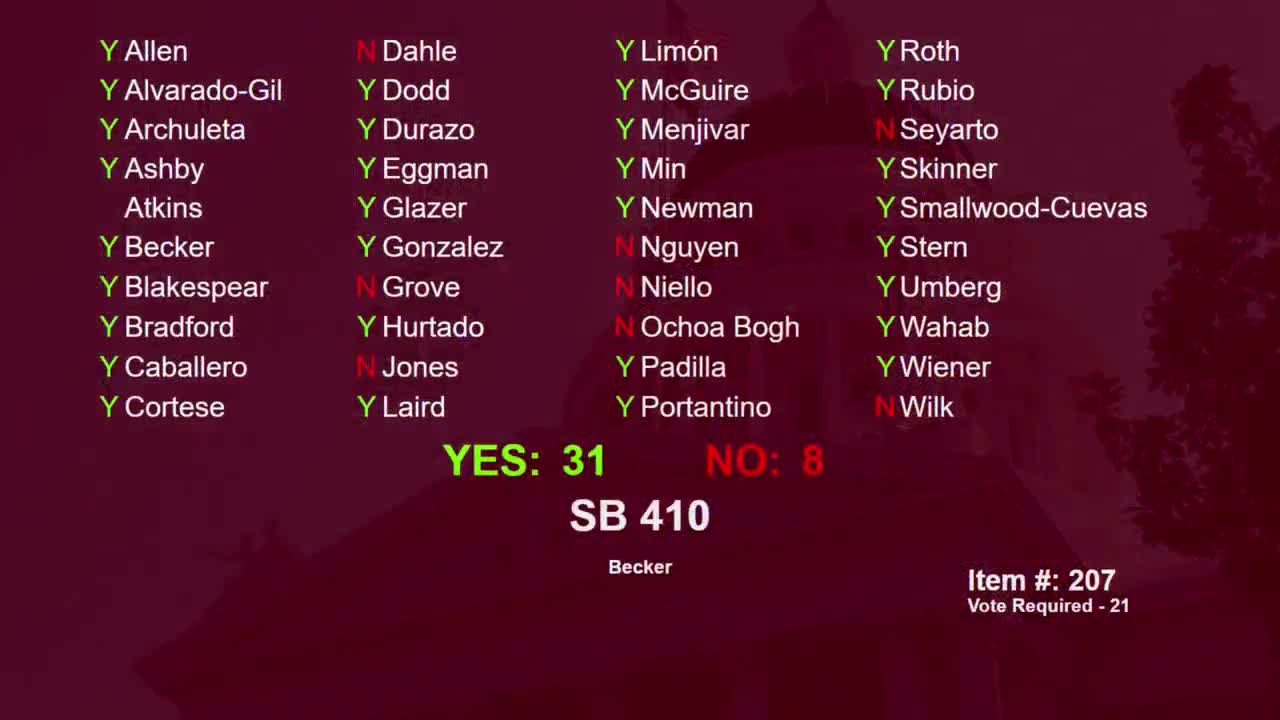 1MIN
Senate Floor
 2MIN
Senate Standing Committee on Appropriations
 10MIN
Senate Standing Committee on Health
Bill Author

Bill Co-Author(s):