SB 627: Displaced workers: notice: opportunity to transfer.
- Session Year: 2023-2024
- House: Senate
- Latest Version Date: 2023-09-19
Current Status:
Failed
(2024-01-25: Veto sustained.)
Introduced
In Committee
First Chamber
In Committee
Second Chamber
Enacted
Existing law, until December 31, 2024, requires an employer, as defined, to offer certain employees laid off due to the COVID-19 pandemic specified information about job positions that become available for which the laid-off employees are qualified, and to offer positions to those laid-off employees based on a preference system, in accordance with specified timelines and procedures. Existing law requires an employer that declines to recall a laid-off employee on the grounds of lack of qualifications and instead hires someone other than a laid-off employee to provide the laid-off employee a written notice within 30 days including specified reasons for the decision, and other information on those hired. Existing law prohibits an employer from taking adverse action against any laid-off employee for seeking to enforce their rights under existing law. Existing law gives the Division of Labor Standards Enforcement jurisdiction over enforcement of these provisions and prescribes enforcement, remedies, and civil penalties for violations. Existing law prohibits the imposition of criminal penalties for a violation of these provisions. Existing law authorizes the division to promulgate and enforce rules and regulations, and issue determinations and interpretations concerning existing law.
This bill would require a chain employer to provide each covered worker and their exclusive representative, if any, a displacement notice at least 60 days before the expected date of closure of a covered establishment. The bill would define terms for its purposes, including defining a covered establishment as a chain establishment that is subject to closure resulting in layoffs of workers, a chain as a business in this state that consists of 100 or more establishments nationally that share a common brand and are owned and operated by the same parent company, and a chain employer as any person, including a corporate officer or executive, who directly or indirectly or through an agent or any other person, owns or operates a chain and employs or exercises control over the wages, hours, or working conditions of workers. A chain employer would also include a franchisee that owns and operates 100 or more establishments nationally under an agreement with one franchisor.
This bill would require a chain employer, for a year after the closure of a covered establishment, to provide to all covered workers the opportunity to transfer to a location of the chain within 25 miles of the covered establishment subject to closure as positions become available. A franchisee subject to the bill would only be required to make an offer of transfer to a covered worker to a location within 25 miles of the covered location that the franchisee owns and operates under an agreement with one franchisor. The bill would require the chain employer to maintain a preferential transfer list of covered workers. The bill would require a chain employer to make offers of transfer to qualified covered workers based on length of service, as specified. The bill would require a covered worker who is offered a position to be given at least 5 business days, from the date of receipt, to accept or decline the offer. The bill would require a chain employer to retain for a minimum of 3 years prescribed records relating to the closure and offers of employment. The bill would prohibit a chain employer from taking adverse action against a covered worker for asserting their rights under the bill. Under the bill, the division would have jurisdiction over enforcement of these provisions. The bill would prescribe enforcement, remedies, and civil penalties for violations. The bill would prohibit the imposition of criminal penalties for a violation of these provisions. The bill would authorize the division to promulgate and enforce rules and regulations, and issue determinations and interpretations concerning existing law.
Existing law, until December 31, 2024, requires an employer, as defined, to offer certain employees laid off due to the COVID-19 pandemic specified information about job positions that become available for which the laid-off employees are qualified, and to offer positions to those laid-off employees based on a preference system, in accordance with specified timelines and procedures. Existing law requires an employer that declines to recall a laid-off employee on the grounds of lack of qualifications and instead hires someone other than a laid-off employee to provide the laid-off employee a written notice within 30 days including specified reasons for the decision, and other information on those hired. Existing law prohibits an employer from taking adverse action against any laid-off employee for seeking to enforce their rights under existing law. Existing law gives the Division of Labor Standards Enforcement jurisdiction over enforcement of these provisions and prescribes enforcement, remedies, and civil penalties for violations. Existing law prohibits the imposition of criminal penalties for a violation of these provisions. Existing law authorizes the division to promulgate and enforce rules and regulations, and issue determinations and interpretations concerning existing law.
This bill would prohibit a chain employer from closing a covered establishment unless the chain employer gives a displacement notice, as prescribed, to the covered workers and their exclusive representative, if any, 60 days before the closure takes effect. require a chain employer to provide each covered worker and their exclusive representative, if any, a displacement notice at least 60 days before the expected date of closure of a covered establishment. The bill would define terms for its purposes, including defining a covered establishment as a chain establishment that is subject to closure resulting in layoffs of workers, a chain as a business in this state that consists of 100 or more establishments nationally that share a common brand and are owned and operated by the same parent company, and a chain employer as any person, including a corporate officer or executive, who directly or indirectly or through an agent or any other person, owns or operates a chain and employs or exercises control over the wages, hours, or working conditions of workers. A chain employer would also include a franchisee that owns and operates 100 or more establishments nationally under an agreement with one franchisor.
This bill would require a chain employer, for a year after the closure of a covered establishment, to provide to all covered workers the opportunity to transfer to a location of the chain within 25 miles of the covered establishment subject to closure as positions become available. A franchisee subject to the bill would only be required to make an offer of transfer to a covered worker to a location within 25 miles of the covered location that the franchisee owns and operates under an agreement with one franchisor. The bill would require the chain employer to maintain a preferential transfer list of covered workers and workers. The bill would require a chain employer to make offers of transfer to qualified covered workers based on length of service, as specified. The bill would require a covered worker who is offered a position to be given at least 5 business days, from the date of receipt, to accept or decline the offer. The bill would require a chain employer to retain for a minimum of 3 years prescribed records relating to the closure and offers of employment. The bill would prohibit a chain employer from taking adverse action against a covered worker for asserting their rights under the bill. Under the bill, the division would have jurisdiction over enforcement of these provisions. The bill would prescribe enforcement, remedies, and civil penalties for violations. The bill would prohibit the imposition of criminal penalties for a violation of these provisions. The bill would authorize the division to promulgate and enforce rules and regulations, and issue determinations and interpretations concerning existing law.
Existing law, until December 31, 2024, requires an employer, as defined, to offer certain employees laid off due to the COVID-19 pandemic specified information about job positions that become available for which the laid-off employees are qualified, and to offer positions to those laid-off employees based on a preference system, in accordance with specified timelines and procedures. Existing law requires an employer that declines to recall a laid-off employee on the grounds of lack of qualifications and instead hires someone other than a laid-off employee to provide the laid-off employee a written notice within 30 days including specified reasons for the decision, and other information on those hired. Existing law prohibits an employer from taking adverse action against any laid-off employee for seeking to enforce their rights under existing law. Existing law gives the Division of Labor Standards Enforcement jurisdiction over enforcement of these provisions and prescribes enforcement, remedies, and civil penalties for violations. Existing law prohibits the imposition of criminal penalties for a violation of these provisions. Existing law authorizes the division to promulgate and enforce rules and regulations, and issue determinations and interpretations concerning existing law.
This bill would prohibit a chain employer from closing a covered establishment unless the chain employer gives a displacement notice, as prescribed, to the covered workers and their exclusive representative, if any, 60 days before the closure takes effect. The bill would define terms for its purposes, including defining a covered establishment as a chain establishment that is subject to closure resulting in layoffs of workers, a chain as a business in this state that consists of 100 or more establishments nationally that share a common brand and are owned and operated by the same parent company, and a chain employer as any person, including a corporate officer or executive, who directly or indirectly or through an agent or any other person, owns or operates a chain and employs or exercises control over the wages, hours, or working conditions of workers. A chain employer would also include a franchisee that owns and operates 100 or more establishments nationally under an agreement with one franchisor.
This bill would require a chain employer, for a year after the closure of a covered establishment, to provide to all covered workers the opportunity to remain employed by the chain employer and to transfer to a location of the chain within 25 miles of the covered establishment subject to closure as positions become available. A franchisee subject to the bill would only be required to make an offer of transfer to a covered worker to a location within 25 miles of the covered location that the franchisee owns and operates under an agreement with one franchisor. The bill would require the chain employer to maintain a preferential transfer list of covered workers and make offers of transfer to qualified covered workers based on length of service, as specified. The bill would require a covered worker who is offered a position to be given at least 5 business days, from the date of receipt, to accept or decline the offer. The bill would require a chain employer to retain for a minimum of 3 years prescribed records relating to the closure and offers of employment. The bill would prohibit a chain employer from taking adverse action against a covered worker for asserting their rights under the bill. Under the bill, the division would have jurisdiction over enforcement of these provisions. The bill would prescribe enforcement, remedies, and civil penalties for violations. The bill would prohibit the imposition of criminal penalties for a violation of these provisions. The bill would authorize the division to promulgate and enforce rules and regulations, and issue determinations and interpretations concerning existing law.
Existing law, until December 31, 2024, requires an employer, as defined, to offer certain employees laid off due to the COVID-19 pandemic specified information about job positions that become available for which the laid-off employees are qualified, and to offer positions to those laid-off employees based on a preference system, in accordance with specified timelines and procedures. Existing law requires an employer that declines to recall a laid-off employee on the grounds of lack of qualifications and instead hires someone other than a laid-off employee to provide the laid-off employee a written notice within 30 days including specified reasons for the decision, and other information on those hired. Existing law prohibits an employer from taking adverse action against any laid-off employee for seeking to enforce their rights under existing law. Existing law gives the Division of Labor Standards Enforcement jurisdiction over enforcement of these provisions and prescribes enforcement, remedies, and civil penalties for violations. Existing law prohibits the imposition of criminal penalties for a violation of these provisions. Existing law authorizes the division to promulgate and enforce rules and regulations, and issue determinations and interpretations concerning existing law.
This bill would prohibit an a chain employer from closing a covered establishment unless the chain employer gives a displacement notice, as prescribed, to the covered workers and their exclusive representative, if any, 60 days before the closure takes effect. The bill would define terms for its purposes, including defining a covered establishment as a chain establishment that is subject to closure resulting in layoffs of workers and workers, a chain as a business in this state that consists of 100 or more establishments nationally that share a common brand and are owned and operated by the same parent company. company, and a chain employer as any person, including a corporate officer or executive, who directly or indirectly or through an agent or any other person, owns or operates a chain and employs or exercises control over the wages, hours, or working conditions of workers.
This bill would require an a chain employer, for a year after the closure of a covered establishment, to provide to all covered workers the opportunity to remain employed by the chain employer and to transfer to a location of the chain within 25 miles of the covered establishment subject to closure as positions become available. The bill would require the chain employer to maintain a preferential transfer list of covered workers and make offers of transfer to qualified covered workers based on length of service, as specified. The bill would require a covered worker who is offered a position to be given at least 5 business days, from the date of receipt, to accept or decline the offer. The bill would require an a chain employer to retain for a minimum of 3 years prescribed records relating to the closure and offers of employment. The bill would prohibit an a chain employer from taking adverse action against a covered worker for asserting their rights under the bill. Under the bill, the division would have jurisdiction over enforcement of these provisions. The bill would prescribe enforcement, remedies, and civil penalties for violations. The bill would prohibit the imposition of criminal penalties for a violation of these provisions. The bill would authorize the division to promulgate and enforce rules and regulations, and issue determinations and interpretations concerning existing law.
Existing law, until December 31, 2024, requires an employer, as defined, to offer certain employees laid off due to the COVID-19 pandemic specified information about job positions that become available for which the laid-off employees are qualified, and to offer positions to those laid-off employees based on a preference system, in accordance with specified timelines and procedures. Existing law requires an employer that declines to recall a laid-off employee on the grounds of lack of qualifications and instead hires someone other than a laid-off employee to provide the laid-off employee a written notice within 30 days including specified reasons for the decision, and other information on those hired. Existing law prohibits an employer from taking adverse action against any laid-off employee for seeking to enforce their rights under existing law. Existing law gives the Division of Labor Standards Enforcement jurisdiction over enforcement of these provisions and prescribes enforcement, remedies, and civil penalties for violations. Existing law prohibits the imposition of criminal penalties for a violation of these provisions. Existing law authorizes the division to promulgate and enforce rules and regulations, and issue determinations and interpretations concerning existing law.
This bill would prohibit an employer from closing a covered establishment unless the employer gives a displacement notice, as prescribed, to the covered workers and their exclusive representative, if any, 60 days before the closure takes effect. The bill would define terms for its purposes, including defining a covered establishment as a chain establishment that is subject to closure resulting in layoffs of workers and a chain as a business in this state that consists of 100 or more establishments nationally that share a common brand and are owned and operated by the same parent company.
This bill would require an employer, for a year after the closure of a covered establishment, to provide to all covered workers the opportunity to remain employed by the employer and to transfer to a location of the chain within 25 miles of the covered establishment subject to closure as positions become available. The bill would require the employer to maintain a preferential transfer list of covered workers and make offers of transfer to qualified covered workers based on length of service, as specified. The bill would require a covered worker who is offered a position to be given at least 5 business days, from the date of receipt, to accept or decline the offer. The bill would require an employer to retain for a minimum of 3 years prescribed records relating to the closure and offers of employment. The bill would prohibit an employer from taking adverse action against a covered worker for asserting their rights under the bill. Under the bill, the division would have jurisdiction over enforcement of these provisions. The bill would prescribe enforcement, remedies, and civil penalties for violations. The bill would prohibit the imposition of criminal penalties for a violation of these provisions. The bill would authorize the division to promulgate and enforce rules and regulations, and issue determinations and interpretations concerning existing law.
As used in this part:
(a)Chain means a business in this state that consists of 100 or more establishments nationally that share a common brand and are owned and operated by the same parent company.
(b)Chain employer means any person, including a corporate officer or executive, who directly or indirectly or through an agent or any other person, owns or operates a chain and employs or exercises control over the wages, hours, or working conditions of workers. A chain employer does not include a franchisee that owns and operates fewer than 100 establishments but does include a franchisee that owns and operates 100 or more establishments nationally under an agreement with one franchisor.
(c)Covered establishment means a chain establishment that is subject to closure resulting in layoffs of workers.
(d)(1)Covered worker means any individual that meets all of the following:
(A)Whose primary place of employment is at a covered establishment subject to closure.
(B)Who is employed directly by the employer.
(C)Who has worked for the employer for at least six months before the date of the closure.
(2)Covered worker does not include a managerial, supervisory, or confidential worker or a worker hired explicitly as a temporary or seasonal worker.
(e)Displacement notice means the written notice an employer gives to workers in advance of the closing of a covered establishment.
2551.(a)A chain employer shall provide each covered worker and their exclusive representative, if any, a displacement notice at least 60 days before the expected date of closure of a covered establishment.
(b)The displacement notice shall be given in one of the following forms to all covered workers in both English and the language understood by the majority of the workers:
(1)First class mail.
(2)Personal delivery with optional signed receipt.
(3)A notice in workers pay envelopes.
(4)Email and text message.
(c)The notice shall contain the following information:
(1)Name and address of the covered establishment that is subject to closure.
(2)Name, email, and telephone number of a company official to contact for more information.
(3)Expected date of closure of the covered establishment.
(4)Reason or justification for the closure of the covered establishment.
(5)Other locations of the chain within 25 miles of the covered establishment.
(6)Notice of the requirements and their rights under Section 2552.
(d)A chain employer is not required to comply with the displacement notice requirement in subdivision (a) if one of the following applies:
(1)The closure is necessitated by a physical calamity or act of war.
(2)The chain employer was actively seeking capital or business to avert the closure and the following conditions apply:
(A)The capital or business sought, if obtained, would have enabled the chain employer to avoid or postpone the closure.
(B)The chain employer reasonably and in good faith believed that giving the notice required by subdivision (a) would have precluded the chain employer from obtaining the needed capital or business.
2552.(a)(1)A chain employer, for one year after the closure of a covered establishment, shall provide to all covered workers the opportunity to transfer to a location of the chain within 25 miles of the covered establishment subject to closure as positions become available. Nothing in this section requires a chain employer to alter or terminate the employment of any worker, fail to promote any worker, or displace any worker where the opportunity to transfer is offered.
(2)The chain employer shall maintain a preferential transfer list of covered workers that reflects their date of hire and position at the time of the closure. The chain employer shall make offers of transfer to covered workers in order of greatest length of service based on the workers date of hire at the chain.
(3)Within five business days of a position becoming available at an establishment of the chain that is within 25 miles of the covered establishment, a chain employer shall offer covered workers all available positions for which the covered workers are qualified. A covered worker is qualified for a position if the worker held the same or similar position at the covered establishment at the time of the closure. A chain employer may make simultaneous, conditional offers of employment to covered workers with a final offer of employment conditioned on application of the preferential transfer list.
(4)The chain employer shall make the offer or offers to covered employees in writing, either by hand or to their last known physical address, and by email and text message to the extent the employer possesses such information.
(5)A covered worker who is offered a position pursuant to this section shall be given at least five business days, from the date of receipt, in which to accept or decline the offer. A business day is any day except Saturday, Sunday, or any official state holiday.
(6)A chain employer shall retain the following records for at least three years, commencing on the date of the written notice regarding the closure, for each covered worker: the workers full legal name; the workers job classification at the time of separation from employment; the workers date of hire; the workers last known address of residence; the workers last known email address; the workers last known telephone number; and a copy of the written notices regarding the closure provided to the worker and all records of communications between the employer and the worker concerning offers of employment made to the worker pursuant to this section.
(7)A transfer shall be considered complete when the covered worker accepts the offer of employment.
(8)A chain employer that is a franchisee that owns or operates 100 or more establishments nationally shall only be required to make an offer of transfer to a covered worker to a location within 25 miles of the covered location that the franchisee owns and operates under an agreement with one franchisor.
(b)A chain employer shall not refuse to employ, terminate, reduce in compensation, or otherwise take any adverse action against any covered worker for seeking to enforce their rights under this section, for participating in proceedings related to this section, opposing any practice proscribed by this section, or otherwise asserting rights under this section. This subdivision shall also apply to any covered worker who mistakenly, but in good faith, alleges noncompliance with this section.
(c)The Division of Labor Standards Enforcement shall have exclusive jurisdiction to enforce this section. This section may be enforced only as follows:
(1)A covered worker may file a complaint with the Division of Labor Standards Enforcement for violations of this section and may be awarded any or all of the following, as appropriate:
(A)Transfer and reinstatement rights pursuant to this section.
(B)Front pay or back pay for each day during which the violation continues, which shall be calculated at a rate of compensation not less than the highest of any of the following rates:
(i)The average regular rate of pay received by the covered worker during the last three years of that workers employment in the same occupation classification.
(ii)The most recent regular rate received by the covered worker while employed by the chain employer.
(iii)The regular rate received by a worker occupying the position in place of the covered worker that should have been employed.
(C)Value of the benefits the covered worker would have received under the chain employers benefit plan.
(2)No criminal penalties shall be imposed for violation of this section.
(3)Any chain employer, agent of the employer, or other person who violates or causes a violation of this section shall be subject to a civil penalty of one hundred dollars ($100) for each worker whose rights under these provisions are violated and an additional sum payable as liquidated damages in the amount of five hundred dollars ($500), per worker, for each day the rights of a worker under this section are violated and continuing until such time as the violation is cured, which shall be recovered by the Labor Commissioner, deposited into the Labor and Workforce Development Fund, and paid, upon appropriation by the Legislature, to the worker as compensatory damages.
(4)The Labor Commissioner shall enforce this section, including investigating an alleged violation and ordering appropriate temporary relief to mitigate the violation pending the completion of a full investigation or hearing, through the procedures set forth in Section 98.3, 98.7, 98.74, or 1197.1, including by issuance of a citation against an employer who violates this section and by filing a civil action. If a citation is issued, the procedures for issuing, contesting, and enforcing judgments for citations and civil penalties issued by the Labor Commissioner shall be the same as those set out in Section 98.74 or 1197.1, as appropriate.
(5)In an action brought by the Labor Commissioner for enforcement of this section, the court may issue preliminary and permanent injunctive relief to vindicate the rights of workers.
(6)In an administrative or civil action brought under this section, the Labor Commissioner or court, as the case may be, shall award interest on all amounts due and unpaid at the rate of interest specified in subdivision (b) of Section 3289 of the Civil Code.
(7)The remedies, penalties, and procedures provided under this section are cumulative.
(d)The Division of Labor Standards Enforcement may promulgate and enforce rules and regulations, and issue determinations and interpretations, consistent with and necessary for the implementation of this section. Those rules and regulations, determinations, and interpretations shall have the force of law and may be relied upon by employers, workers, and other persons to determine their rights and responsibilities under this section.
2553.Parties subject to this part may provide, by collective bargaining agreement, that the agreement supersedes the requirements of this part, in whole or in part, if the waiver is explicitly set forth in the agreement in clear and unambiguous terms.
2554.This part shall not be construed to limit a workers right to bring legal action for wrongful termination.
2555.This part does not preempt any city, county, or city and county ordinances that provide equal or greater protection to workers.
2556.The provisions of this part are severable. If any provision of this part or its application is held invalid, that invalidity shall not affect other provisions or applications that can be given effect without the invalid provision or application.
As used in this part:
(a)Chain means a business in this state that consists of 100 or more establishments nationally that share a common brand and are owned and operated by the same parent company.
(b)Chain employer means any person, including a corporate officer or executive, who directly or indirectly or through an agent or any other person, owns or operates a chain and employs or exercises control over the wages, hours, or working conditions of workers. A chain employer does not include a franchisee that owns and operates fewer than 100 establishments but does include a franchisee that owns and operates 100 or more establishments nationally under an agreement with one franchisor.
(c)Covered establishment means a chain establishment that is subject to closure resulting in layoffs of workers.
(d)(1)Covered worker means any individual that meets all of the following:
(A)Whose primary place of employment is at a covered establishment subject to closure.
(B)Who is employed directly by the employer.
(C)Who has worked for the employer for at least six months before the date of the closure.
(2)Covered worker does not include a managerial, supervisory, or confidential worker or a worker hired explicitly as a temporary or seasonal worker.
(e)Displacement notice means the written notice an employer gives to workers in advance of the closing of a covered establishment.
2551.(a)A chain employer shall provide each covered worker and their exclusive representative, if any, a displacement notice at least 60 days before the expected date of closure of a covered establishment.
(b)The displacement notice shall be given in one of the following forms to all covered workers in both English and the language understood by the majority of the workers:
(1)First class mail.
(2)Personal delivery with optional signed receipt.
(3)A notice in workers pay envelopes.
(4)Email and text message.
(c)The notice shall contain the following information:
(1)Name and address of the covered establishment that is subject to closure.
(2)Name, email, and telephone number of a company official to contact for more information.
(3)Expected date of closure of the covered establishment.
(4)Reason or justification for the closure of the covered establishment.
(5)Other locations of the chain within 25 miles of the covered establishment.
(6)Notice of the requirements and their rights under Section 2552.
(d)A chain employer is not required to comply with the displacement notice requirement in subdivision (a) if one of the following applies:
(1)The closure is necessitated by a physical calamity or act of war.
(2)The chain employer was actively seeking capital or business to avert the closure and the following conditions apply:
(A)The capital or business sought, if obtained, would have enabled the chain employer to avoid or postpone the closure.
(B)The chain employer reasonably and in good faith believed that giving the notice required by subdivision (a) would have precluded the chain employer from obtaining the needed capital or business.
2552.(a)(1)A chain employer, for one year after the closure of a covered establishment, shall provide to all covered workers the opportunity to transfer to a location of the chain within 25 miles of the covered establishment subject to closure as positions become available. Nothing in this section requires a chain employer to alter or terminate the employment of any worker, fail to promote any worker, or displace any worker where the opportunity to transfer is offered.
(2)The chain employer shall maintain a preferential transfer list of covered workers that reflects their date of hire and position at the time of the closure. The chain employer shall make offers of transfer to covered workers in order of greatest length of service based on the workers date of hire at the chain.
(3)Within five business days of a position becoming available at an establishment of the chain that is within 25 miles of the covered establishment, a chain employer shall offer covered workers all available positions for which the covered workers are qualified. A covered worker is qualified for a position if the worker held the same or similar position at the covered establishment at the time of the closure. A chain employer may make simultaneous, conditional offers of employment to covered workers with a final offer of employment conditioned on application of the preferential transfer list.
(4)The chain employer shall make the offer or offers to covered employees in writing, either by hand or to their last known physical address, and by email and text message to the extent the employer possesses such information.
(5)A covered worker who is offered a position pursuant to this section shall be given at least five business days, from the date of receipt, in which to accept or decline the offer. A business day is any day except Saturday, Sunday, or any official state holiday.
(6)A chain employer shall retain the following records for at least three years, commencing on the date of the written notice regarding the closure, for each covered worker: the workers full legal name; the workers job classification at the time of separation from employment; the workers date of hire; the workers last known address of residence; the workers last known email address; the workers last known telephone number; and a copy of the written notices regarding the closure provided to the worker and all records of communications between the employer and the worker concerning offers of employment made to the worker pursuant to this section.
(7)A transfer shall be considered complete when the covered worker accepts the offer of employment.
(8)A chain employer that is a franchisee that owns or operates 100 or more establishments nationally shall only be required to make an offer of transfer to a covered worker to a location within 25 miles of the covered location that the franchisee owns and operates under an agreement with one franchisor.
(b)A chain employer shall not refuse to employ, terminate, reduce in compensation, or otherwise take any adverse action against any covered worker for seeking to enforce their rights under this section, for participating in proceedings related to this section, opposing any practice proscribed by this section, or otherwise asserting rights under this section. This subdivision shall also apply to any covered worker who mistakenly, but in good faith, alleges noncompliance with this section.
(c)The Division of Labor Standards Enforcement shall have exclusive jurisdiction to enforce this section. This section may be enforced only as follows:
(1)A covered worker may file a complaint with the Division of Labor Standards Enforcement for violations of this section and may be awarded any or all of the following, as appropriate:
(A)Transfer and reinstatement rights pursuant to this section.
(B)Front pay or back pay for each day during which the violation continues, which shall be calculated at a rate of compensation not less than the highest of any of the following rates:
(i)The average regular rate of pay received by the covered worker during the last three years of that workers employment in the same occupation classification.
(ii)The most recent regular rate received by the covered worker while employed by the chain employer.
(iii)The regular rate received by a worker occupying the position in place of the covered worker that should have been employed.
(C)Value of the benefits the covered worker would have received under the chain employers benefit plan.
(2)No criminal penalties shall be imposed for violation of this section.
(3)Any chain employer, agent of the employer, or other person who violates or causes a violation of this section shall be subject to a civil penalty of one hundred dollars ($100) for each worker whose rights under these provisions are violated and an additional sum payable as liquidated damages in the amount of five hundred dollars ($500), per worker, for each day the rights of a worker under this section are violated and continuing until such time as the violation is cured, which shall be recovered by the Labor Commissioner, deposited into the Labor and Workforce Development Fund, and paid, upon appropriation by the Legislature, to the worker as compensatory damages.
(4)The Labor Commissioner shall enforce this section, including investigating an alleged violation and ordering appropriate temporary relief to mitigate the violation pending the completion of a full investigation or hearing, through the procedures set forth in Section 98.3, 98.7, 98.74, or 1197.1, including by issuance of a citation against an employer who violates this section and by filing a civil action. If a citation is issued, the procedures for issuing, contesting, and enforcing judgments for citations and civil penalties issued by the Labor Commissioner shall be the same as those set out in Section 98.74 or 1197.1, as appropriate.
(5)In an action brought by the Labor Commissioner for enforcement of this section, the court may issue preliminary and permanent injunctive relief to vindicate the rights of workers.
(6)In an administrative or civil action brought under this section, the Labor Commissioner or court, as the case may be, shall award interest on all amounts due and unpaid at the rate of interest specified in subdivision (b) of Section 3289 of the Civil Code.
(7)The remedies, penalties, and procedures provided under this section are cumulative.
(d)The Division of Labor Standards Enforcement may promulgate and enforce rules and regulations, and issue determinations and interpretations, consistent with and necessary for the implementation of this section. Those rules and regulations, determinations, and interpretations shall have the force of law and may be relied upon by employers, workers, and other persons to determine their rights and responsibilities under this section.
2553.Sections 2551 and 2552 do not apply to an employee covered by a collective bargaining agreement if the agreement expressly provides for the wages, hours of work, and working conditions of the employees, premium wage rates for all overtime hours worked, a regular hourly pay of not less than 30 percent more than the state minimum wage rate, and expressly waives the requirements of Sections 2551 and 2552 in clear and unambiguous terms.2553.Parties subject to this part may provide, by collective bargaining agreement, that the agreement supersedes the requirements of this part, in whole or in part, if the waiver is explicitly set forth in the agreement in clear and unambiguous terms.
2554.This part shall not be construed to limit a workers right to bring legal action for wrongful termination.
2555.This part does not preempt any city, county, or city and county ordinances that provide equal or greater protection to workers.
2556.The provisions of this part are severable. If any provision of this part or its application is held invalid, that invalidity shall not affect other provisions or applications that can be given effect without the invalid provision or application.
As used in this part:
(a)Chain means a business in this state that consists of 100 or more establishments nationally that share a common brand and are owned and operated by the same parent company.
(b)Chain employer means any person, including a corporate officer or executive, who directly or indirectly or through an agent or any other person, owns or operates a chain and employs or exercises control over the wages, hours, or working conditions of workers. A chain employer does not include a franchisee that owns and operates fewer than 100 establishments but does include a franchisee that owns and operates 100 or more establishments nationally under an agreement with one franchisor.
(c)Covered establishment means a chain establishment that is subject to closure resulting in layoffs of workers.
(d)(1)Covered worker means any individual that meets all of the following:
(A)Whose primary place of employment is at a covered establishment subject to closure.
(B)Who is employed directly by the employer.
(C)Who has worked for the employer for at least six months before the date of the closure.
(2)Covered worker does not include a managerial, supervisory, or confidential worker or a worker hired explicitly as a temporary or seasonal worker.
(e)Displacement notice means the written notice an employer gives to workers in advance of the closing of a covered establishment.
2551.(a)A chain employer shall provide each covered worker and their exclusive representative, if any, a displacement notice at least 60 days before the expected date of closure of a covered establishment.
(b)The displacement notice shall be given in one of the following forms to all covered workers in both English and the language understood by the majority of the workers:
(1)First class mail.
(2)Personal delivery with optional signed receipt.
(3)A notice in workers pay envelopes.
(4)Email and text message.
(c)The notice shall contain the following information:
(1)Name and address of the covered establishment that is subject to closure.
(2)Name, email, and telephone number of a company official to contact for more information.
(3)Expected date of closure of the covered establishment.
(4)Reason or justification for the closure of the covered establishment.
(5)Other locations of the chain within 25 miles of the covered establishment.
(6)Notice of the requirements and their rights under Section 2552.
(d)A chain employer is not required to comply with the displacement notice requirement in subdivision (a) if one of the following applies:
(1)The closure is necessitated by a physical calamity or act of war.
(2)The chain employer was actively seeking capital or business to avert the closure and the following conditions apply:
(A)The capital or business sought, if obtained, would have enabled the chain employer to avoid or postpone the closure.
(B)The chain employer reasonably and in good faith believed that giving the notice required by subdivision (a) would have precluded the chain employer from obtaining the needed capital or business.
2552.(a)(1)A chain employer, for one year after the closure of a covered establishment, shall provide to all covered workers the opportunity to transfer to a location of the chain within 25 miles of the covered establishment subject to closure as positions become available. Nothing in this section requires a chain employer to alter or terminate the employment of any worker worker, fail to promote any worker, or displace any worker where the opportunity to transfer is offered.
(2)The chain employer shall maintain a preferential transfer list of covered workers that reflects their date of hire and position at the time of the closure. The chain employer shall make offers of transfer to covered workers in order of greatest length of service based on the workers date of hire at the chain.
(3)Within five business days of a position becoming available at an establishment of the chain that is within 25 miles of the covered establishment, a chain employer shall offer covered workers all available positions for which the covered workers are qualified. A covered worker is qualified for a position if the worker held the same or similar position at the covered establishment at the time of the closure. A chain employer may make simultaneous, conditional offers of employment to covered workers with a final offer of employment conditioned on application of the preferential transfer list.
(4)The chain employer shall make the offer or offers to covered employees in writing, either by hand or to their last known physical address, and by email and text message to the extent the employer possesses such information.
(5)A covered worker who is offered a position pursuant to this section shall be given at least five business days, from the date of receipt, in which to accept or decline the offer. A business day is any day except Saturday, Sunday, or any official state holiday.
(6)A chain employer shall retain the following records for at least three years, commencing on the date of the written notice regarding the closure, for each covered worker: the workers full legal name; the workers job classification at the time of separation from employment; the workers date of hire; the workers last known address of residence; the workers last known email address; the workers last known telephone number; and a copy of the written notices regarding the closure provided to the worker and all records of communications between the employer and the worker concerning offers of employment made to the worker pursuant to this section.
(7)A transfer shall be considered complete when the covered worker accepts the offer of employment.
(8)A chain employer that is a franchisee that owns or operates 100 or more establishments nationally shall only be required to make an offer of transfer to a covered worker to a location within 25 miles of the covered location that the franchisee owns and operates under an agreement with one franchisor.
(b)A chain employer shall not refuse to employ, terminate, reduce in compensation, or otherwise take any adverse action against any covered worker for seeking to enforce their rights under this section, for participating in proceedings related to this section, opposing any practice proscribed by this section, or otherwise asserting rights under this section. This subdivision shall also apply to any covered worker who mistakenly, but in good faith, alleges noncompliance with this section.
(c)The Division of Labor Standards Enforcement shall have exclusive jurisdiction to enforce this section. This section may be enforced only as follows:
(1)A covered worker may file a complaint with the Division of Labor Standards Enforcement for violations of this section and may be awarded any or all of the following, as appropriate:
(A)Transfer and reinstatement rights pursuant to this section.
(B)Front pay or back pay for each day during which the violation continues, which shall be calculated at a rate of compensation not less than the highest of any of the following rates:
(i)The average regular rate of pay received by the covered worker during the last three years of that workers employment in the same occupation classification.
(ii)The most recent regular rate received by the covered worker while employed by the chain employer.
(iii)The regular rate received by a worker occupying the position in place of the covered worker that should have been employed.
(C)Value of the benefits the covered worker would have received under the chain employers benefit plan.
(2)No criminal penalties shall be imposed for violation of this section.
(3)Any chain employer, agent of the employer, or other person who violates or causes a violation of this section shall be subject to a civil penalty of one hundred dollars ($100) for each worker whose rights under these provisions are violated and an additional sum payable as liquidated damages in the amount of five hundred dollars ($500), per worker, for each day the rights of a worker under this section are violated and continuing until such time as the violation is cured, which shall be recovered by the Labor Commissioner, deposited into the Labor and Workforce Development Fund, and paid, upon appropriation by the Legislature, to the worker as compensatory damages.
(4)The Labor Commissioner shall enforce this section, including investigating an alleged violation and ordering appropriate temporary relief to mitigate the violation pending the completion of a full investigation or hearing, through the procedures set forth in Section 98.3, 98.7, 98.74, or 1197.1, including by issuance of a citation against an employer who violates this section and by filing a civil action. If a citation is issued, the procedures for issuing, contesting, and enforcing judgments for citations and civil penalties issued by the Labor Commissioner shall be the same as those set out in Section 98.74 or 1197.1, as appropriate.
(5)In an action brought by the Labor Commissioner for enforcement of this section, the court may issue preliminary and permanent injunctive relief to vindicate the rights of workers.
(6)In an administrative or civil action brought under this section, the Labor Commissioner or court, as the case may be, shall award interest on all amounts due and unpaid at the rate of interest specified in subdivision (b) of Section 3289 of the Civil Code.
(7)The remedies, penalties, and procedures provided under this section are cumulative.
(d)The Division of Labor Standards Enforcement may promulgate and enforce rules and regulations, and issue determinations and interpretations, consistent with and necessary for the implementation of this section. Those rules and regulations, determinations, and interpretations shall have the force of law and may be relied upon by employers, workers, and other persons to determine their rights and responsibilities under this section.
2553.Sections 2551 and 2552 do not apply to an employee covered by a collective bargaining agreement if the agreement expressly provides for the wages, hours of work, and working conditions of the employees, premium wage rates for all overtime hours worked, a regular hourly pay of not less than 30 percent more than the state minimum wage rate, and expressly waives the requirements of Sections 2551 and 2552 in clear and unambiguous terms.
2554.This part shall not be construed to limit a workers right to bring legal action for wrongful termination.
2555.This part does not preempt any city, county, or city and county ordinances that provide equal or greater protection to workers.
2556.The provisions of this part are severable. If any provision of this part or its application is held invalid, that invalidity shall not affect other provisions or applications that can be given effect without the invalid provision or application.
As used in this part:
(a)Chain means a business in this state that consists of 100 or more establishments nationally that share a common brand and are owned and operated by the same parent company.
(b)Chain employer means any person, including a corporate officer or executive, who directly or indirectly or through an agent or any other person, owns or operates a chain and employs or exercises control over the wages, hours, or working conditions of workers. A chain employer does not include a franchisee that owns and operates fewer than 100 establishments but does include a franchisee that owns and operates 100 or more establishments nationally under an agreement with one franchisor.
(c)Covered establishment means a chain establishment that is subject to closure resulting in layoffs of workers.
(d)(1)Covered worker means any individual that meets all of the following:
(A)Whose primary place of employment is at a covered establishment subject to closure.
(B)Who is employed directly by the employer.
(C)Who has worked for the employer for at least six months before the date of the closure.
(2)Covered worker does not include a managerial, supervisory, or confidential worker or a worker hired explicitly as a temporary or seasonal worker.
(e)Displacement notice means the written notice an employer gives to workers in advance of the closing of a covered establishment.
2551.(a)A chain employer shall not close a covered establishment unless the chain employer gives a displacement notice to the covered workers and their exclusive representative, if any, 60 days before the closure takes effect. provide each covered worker and their exclusive representative, if any, a displacement notice at least 60 days before the expected date of closure of a covered establishment.
(b)The displacement notice shall be given in one of the following forms to all covered workers in both English and the language understood by the majority of the workers:
(1)First class mail.
(2)Personal delivery with optional signed receipt.
(3)A notice in workers pay envelopes.
(4)Email and text message.
(c)The notice shall contain the following information:
(1)Name and address of the covered establishment that is subject to closure.
(2)Name, email, and telephone number of a company official to contact for more information.
(3)Expected date of closure of the covered establishment.
(4)Reason or justification for the closure of the covered establishment.
(5)Other locations of the chain within 25 miles of the covered establishment.
(6)Notice of the requirements and their rights under Section 2552.
(d)A chain employer is not required to comply with the displacement notice requirement in subdivision (a) if the closure is necessitated by a physical calamity or act of war or the chain employer was actively seeking capital or business to avert the closure and the following conditions apply: one of the following applies:
(1)The closure is necessitated by a physical calamity or act of war.
(2)The chain employer was actively seeking capital or business to avert the closure and the following conditions apply:
(1)(A)The capital or business sought, if obtained, would have enabled the chain employer to avoid or postpone the closure.
(2)(B)The chain employer reasonably and in good faith believed that giving the notice required by subdivision (a) would have precluded the chain employer from obtaining the needed capital or business.
2552.(a)(1)A chain employer, for one year after the closure of a covered establishment, shall provide to all covered workers the opportunity to transfer to a location of the chain within 25 miles of the covered establishment subject to closure as positions become available. Nothing in this section requires a chain employer to alter or terminate the employment of any worker or displace any worker at a location of the chain within 25 miles of the covered establishment to comply. where the opportunity to transfer is offered.
(2)The chain employer shall maintain a preferential transfer list of covered workers, workers that reflects their date of hire, hire and their position at the time of the closure and closure. The chain employer shall make offers of transfer to covered workers in order of greatest length of service based on the workers date of hire at the chain.
(3)Within five business days of a position becoming available at an establishment of the chain that is within 25 miles of the covered establishment, a chain employer shall offer covered workers all available positions for which the covered workers are qualified. A covered worker is qualified for a position if the worker held the same or similar position at the covered establishment at the time of the closure. A chain employer may make simultaneous, conditional offers of employment to covered workers with a final offer of employment conditioned on application of the preferential transfer list.
(4)The chain employer shall make the offer or offers to covered employees in writing, either by hand or to their last known physical address, and by email and text message to the extent the employer possesses such information.
(5)A covered worker who is offered a position pursuant to this section shall be given at least five business days, from the date of receipt, in which to accept or decline the offer. A business day is any day except Saturday, Sunday, or any official state holiday. A chain employer may make simultaneous, conditional offers of employment to covered workers with a final offer of employment conditioned on application of the preferential transfer list.
(6)A chain employer shall retain the following records for at least three years, commencing on the date of the written notice regarding the closure, for each covered worker: the workers full legal name; the workers job classification at the time of separation from employment; the workers date of hire; the workers last known address of residence; the workers last known email address; the workers last known telephone number; and a copy of the written notices regarding the layoff closure provided to the worker and all records of communications between the employer and the worker concerning offers of employment made to the worker pursuant to this section.
(7)A transfer shall be considered complete when the covered worker accepts the offer of employment.
(8)A chain employer that is a franchisee that owns or operates 100 or more establishments nationally shall only be required to make an offer of transfer to a covered worker to a location within 25 miles of the covered location that the franchisee owns and operates under an agreement with one franchisor.
(b)A chain employer shall not refuse to employ, terminate, reduce in compensation, or otherwise take any adverse action against any covered worker for seeking to enforce their rights under this section, for participating in proceedings related to this section, opposing any practice proscribed by this section, or otherwise asserting rights under this section. This subdivision shall also apply to any covered worker who mistakenly, but in good faith, alleges noncompliance with this section.
(c)The Division of Labor Standards Enforcement shall have exclusive jurisdiction to enforce this section. This section may be enforced only as follows:
(1)A covered worker may file a complaint with the Division of Labor Standards Enforcement for violations of this section and may be awarded any or all of the following, as appropriate:
(A)Transfer and reinstatement rights pursuant to this section.
(B)Front pay or back pay for each day during which the violation continues, which shall be calculated at a rate of compensation not less than the highest of any of the following rates:
(i)The average regular rate of pay received by the covered worker during the last three years of that workers employment in the same occupation classification.
(ii)The most recent regular rate received by the covered worker while employed by the chain employer.
(iii)The regular rate received by a worker occupying the position in place of the covered worker that should have been employed.
(C)Value of the benefits the covered worker would have received under the chain employers benefit plan.
(2)No criminal penalties shall be imposed for violation of this section.
(3)Any chain employer, agent of the employer, or other person who violates or causes to be violated a violation of this section shall be subject to a civil penalty of one hundred dollars ($100) for each worker whose rights under these provisions are violated and an additional sum payable as liquidated damages in the amount of five hundred dollars ($500), per worker, for each day the rights of a worker under this section are violated and continuing until such time as the violation is cured, which shall be recovered by the Labor Commissioner, deposited into the Labor and Workforce Development Fund, and paid, upon appropriation by the Legislature, to the worker as compensatory damages.
(4)The Labor Commissioner shall enforce this section, including investigating an alleged violation and ordering appropriate temporary relief to mitigate the violation pending the completion of a full investigation or hearing, through the procedures set forth in Section 98.3, 98.7, 98.74, or 1197.1, including by issuance of a citation against an employer who violates this section and by filing a civil action. If a citation is issued, the procedures for issuing, contesting, and enforcing judgments for citations and civil penalties issued by the Labor Commissioner shall be the same as those set out in Section 98.74 or 1197.1, as appropriate.
(5)In an action brought by the Labor Commissioner for enforcement of this section, the court may issue preliminary and permanent injunctive relief to vindicate the rights of workers.
(6)In an administrative or civil action brought under this section, the Labor Commissioner or court, as the case may be, shall award interest on all amounts due and unpaid at the rate of interest specified in subdivision (b) of Section 3289 of the Civil Code.
(7)The remedies, penalties, and procedures provided under this section are cumulative.
(d)The Division of Labor Standards Enforcement may promulgate and enforce rules and regulations, and issue determinations and interpretations, consistent with and necessary for the implementation of this section. Those rules and regulations, determinations, and interpretations shall have the force of law and may be relied upon by employers, workers, and other persons to determine their rights and responsibilities under this section.
2553.Sections 2551 and 2552 do not apply to an employee covered by a collective bargaining agreement if the agreement expressly provides for the wages, hours of work, and working conditions of the employees, premium wage rates for all overtime hours worked, a regular hourly pay of not less than 30 percent more than the state minimum wage rate, and expressly waives the requirements of Sections 2551 and 2552 in clear and unambiguous terms.
2554.This part shall not be construed to limit a workers right to bring legal action for wrongful termination.
2555.This part does not preempt any city, county, or city and county ordinances that provide equal or greater protection to workers.
2556.The provisions of this part are severable. If any provision of this part or its application is held invalid, that invalidity shall not affect other provisions or applications that can be given effect without the invalid provision or application.
As used in this part:
(a)Chain means a business in this state that consists of 100 or more establishments nationally that share a common brand and are owned and operated by the same parent company.
(b)Chain employer means any person, including a corporate officer or executive, who directly or indirectly or through an agent or any other person, owns or operates a chain and employs or exercises control over the wages, hours, or working conditions of workers. A chain employer does not include a franchisee that owns and operates fewer than 100 establishments but does include a franchisee that owns and operates 100 or more establishments nationally under an agreement with one franchisor.
(c)Covered establishment means a chain establishment that is subject to closure resulting in layoffs of workers.
(d)(1)Covered worker means any individual that meets all of the following:
(A)Whose primary place of employment is at a covered establishment subject to closure.
(B)Who is employed directly by the employer.
(C)Who has worked for the employer for at least six months before the date of the closure.
(2)Covered worker does not include a managerial, supervisory, or confidential worker or a worker hired explicitly as a temporary or seasonal worker.
(e)Displacement notice means the written notice an employer gives to workers in advance of the closing of a covered establishment.
2551.(a)A chain employer shall not close a covered establishment unless the chain employer gives a displacement notice to the covered workers and their exclusive representative, if any, 60 days before the closure takes effect.
(b)The displacement notice shall be given in one of the following forms to all covered workers in both English and the language understood by the majority of the workers:
(1)First class mail.
(2)Personal delivery with optional signed receipt.
(3)A notice in workers pay envelopes.
(4)Email and text message.
(c)The notice shall contain the following information:
(1)Name and address of the covered establishment that is subject to closure.
(2)Name, email, and telephone number of a company official to contact for more information.
(3)Expected date of closure of the covered establishment.
(4)Reason or justification for the closure of the covered establishment.
(5)Other locations of the chain within 25 miles of the covered establishment.
(6)Notice of the requirements and their rights under Section 2552.
(d)A chain employer is not required to comply with the displacement notice requirement in subdivision (a) if the closure is necessitated by a physical calamity or act of war or the chain employer was actively seeking capital or business to avert the closure and the following conditions apply:
(1)The capital or business sought, if obtained, would have enabled the chain employer to avoid or postpone the closure.
(2)The chain employer reasonably and in good faith believed that giving the notice required by subdivision (a) would have precluded the chain employer from obtaining the needed capital or business.
2552.(a)(1)A chain employer, for one year after the closure of a covered establishment, shall provide to all covered workers the opportunity to remain employed by the chain employer and to transfer to a location of the chain within 25 miles of the covered establishment subject to closure as positions become available. Nothing in this section requires a chain employer to alter or terminate the employment of any worker or displace any worker at a location of the chain within 25 miles of the covered establishment to comply.
(2)The chain employer shall maintain a preferential transfer list of covered workers, date of hire, and their position at the time of the closure and shall make offers of transfer to covered workers in order of greatest length of service based on the workers date of hire at the chain.
(3)Within five business days of a position becoming available at an establishment of the chain that is within 25 miles of the covered establishment, a chain employer shall offer covered workers all available positions for which the covered workers are qualified. A covered worker is qualified for a position if the worker held the same or similar position at the covered establishment at the time of the closure.
(4)The chain employer shall make the offer to covered employees in writing, either by hand or to their last known physical address, and by email and text message to the extent the employer possesses such information.
(5)A covered worker who is offered a position pursuant to this section shall be given at least five business days, from the date of receipt, in which to accept or decline the offer. A business day is any day except Saturday, Sunday, or any official state holiday. A chain employer may make simultaneous, conditional offers of employment to covered workers with a final offer of employment conditioned on application of the preferential transfer list.
(6)A chain employer shall retain the following records for at least three years, commencing on the date of the written notice regarding the closure, for each covered worker: the workers full legal name; the workers job classification at the time of separation from employment; the workers date of hire; the workers last known address of residence; the workers last known email address; the workers last known telephone number; and a copy of the written notices regarding the layoff provided to the worker and all records of communications between the employer and the worker concerning offers of employment made to the worker pursuant to this section.
(7)A transfer shall be considered complete when the covered worker accepts the offer of employment.
(8)A chain employer that is a franchisee that owns or operates 100 or more establishments nationally shall only be required to make an offer of transfer to a covered worker to a location within 25 miles of the covered location that the franchisee owns and operates under an agreement with one franchisor.
(b)A chain employer shall not refuse to employ, terminate, reduce in compensation, or otherwise take any adverse action against any covered worker for seeking to enforce their rights under this section, for participating in proceedings related to this section, opposing any practice proscribed by this section, or otherwise asserting rights under this section. This subdivision shall also apply to any covered worker who mistakenly, but in good faith, alleges noncompliance with this section.
(c)The Division of Labor Standards Enforcement shall have exclusive jurisdiction to enforce this section. This section may be enforced only as follows:
(1)A covered worker may file a complaint with the Division of Labor Standards Enforcement for violations of this section and may be awarded any or all of the following, as appropriate:
(A)Transfer and reinstatement rights pursuant to this section.
(B)Front pay or back pay for each day during which the violation continues, which shall be calculated at a rate of compensation not less than the highest of any of the following rates:
(i)The average regular rate of pay received by the covered worker during the last three years of that workers employment in the same occupation classification.
(ii)The most recent regular rate received by the covered worker while employed by the chain employer.
(iii)The regular rate received by a worker occupying the position in place of the covered worker that should have been employed.
(C)Value of the benefits the covered worker would have received under the chain employers benefit plan.
(2)No criminal penalties shall be imposed for violation of this section.
(3)Any chain employer, agent of the employer, or other person who violates or causes to be violated this section shall be subject to a civil penalty of one hundred dollars ($100) for each worker whose rights under these provisions are violated and an additional sum payable as liquidated damages in the amount of five hundred dollars ($500), per worker, for each day the rights of a worker under this section are violated and continuing until such time as the violation is cured, which shall be recovered by the Labor Commissioner, deposited into the Labor and Workforce Development Fund, and paid, upon appropriation by the Legislature, to the worker as compensatory damages.
(4)The Labor Commissioner shall enforce this section, including investigating an alleged violation and ordering appropriate temporary relief to mitigate the violation pending the completion of a full investigation or hearing, through the procedures set forth in Section 98.3, 98.7, 98.74, or 1197.1, including by issuance of a citation against an employer who violates this section and by filing a civil action. If a citation is issued, the procedures for issuing, contesting, and enforcing judgments for citations and civil penalties issued by the Labor Commissioner shall be the same as those set out in Section 98.74 or 1197.1, as appropriate.
(5)In an action brought by the Labor Commissioner for enforcement of this section, the court may issue preliminary and permanent injunctive relief to vindicate the rights of workers.
(6)In an administrative or civil action brought under this section, the Labor Commissioner or court, as the case may be, shall award interest on all amounts due and unpaid at the rate of interest specified in subdivision (b) of Section 3289 of the Civil Code.
(7)The remedies, penalties, and procedures provided under this section are cumulative.
(d)The Division of Labor Standards Enforcement may promulgate and enforce rules and regulations, and issue determinations and interpretations, consistent with and necessary for the implementation of this section. Those rules and regulations, determinations, and interpretations shall have the force of law and may be relied upon by employers, workers, and other persons to determine their rights and responsibilities under this section.
2553.Sections 2551 and 2552 do not apply to an employee covered by a collective bargaining agreement if the agreement expressly provides for the wages, hours of work, and working conditions of the employees, premium wage rates for all overtime hours worked, a regular hourly pay of not less than 30 percent more than the state minimum wage rate, and expressly waives the requirements of Sections 2551 and 2552 in clear and unambiguous terms.
2554.This part shall not be construed to limit a workers right to bring legal action for wrongful termination.
2555.This part does not preempt any city, county, or city and county ordinances that provide equal or greater protection to workers.
2556.The provisions of this part are severable. If any provision of this part or its application is held invalid, that invalidity shall not affect other provisions or applications that can be given effect without the invalid provision or application.
As used in this part:
(a)Chain means a business in this state that consists of 100 or more establishments nationally that share a common brand and are owned and operated by the same parent company.
(b)Chain employer means any person, including a corporate officer or executive, who directly or indirectly or through an agent or any other person, owns or operates a chain and employs or exercises control over the wages, hours, or working conditions of workers.
(b)(c)Covered establishment means a chain establishment that is subject to closure resulting in layoffs of workers.
(c)(d)(1)Covered worker means any individual that meets all of the following:
(A)Whose primary place of employment is at a covered establishment subject to closure.
(B)Who is employed directly by the employer.
(C)Who has worked for the employer for at least six months before the date of the closure.
(2)Covered worker does not include a managerial, supervisory, or confidential worker or a worker hired explicitly as a temporary or seasonal worker.
(d)(e)Displacement notice means the written notice an employer gives to workers in advance of the closing of a covered establishment.
(e)Employer means any person, including a corporate officer or executive, who directly or indirectly or through an agent or any other person, owns or operates a chain and employs or exercises control over the wages, hours, or working conditions of workers.2551.(a)An A chain employer shall not close a covered establishment unless the chain employer gives a displacement notice to the covered workers and their exclusive representative, if any, 60 days before the closure takes effect.
(b)The displacement notice shall be given in one of the following forms to all covered workers in both English and the language understood by the majority of the workers:
(1)First class mail.
(2)Personal delivery with optional signed receipt.
(3)A notice in workers pay envelopes.
(4)Email and text message.
(c)The notice shall contain the following information:
(1)Name and address of the covered establishment that is subject to closure.
(2)Name, email, and telephone number of a company official to contact for more information.
(3)Expected date of closure of the covered establishment.
(4)Reason or justification for the closure of the covered establishment.
(5)Other locations of the chain within 25 miles of the covered establishment.
(6)Notice of the requirements and their rights under Section 2552.
2552.(a)(1)An A chain employer, for one year after the closure of a covered establishment, shall provide to all covered workers the opportunity to remain employed by the chain employer and to transfer to a location of the chain within 25 miles of the covered establishment subject to closure as positions become available.
(2)The chain employer shall maintain a preferential transfer list of covered workers, date of hire, and their position at the time of the closure and shall make offers of transfer to covered workers in order of greatest length of service based on the workers date of hire at the chain.
(3)Within five business days of a position becoming available at an establishment of the chain that is within 25 miles of the covered establishment, an a chain employer shall offer covered workers all available positions for which the covered workers are qualified. A covered worker is qualified for a position if the worker held the same or similar position at the covered establishment at the time of the closure.
(4)The chain employer shall make the offer to covered employees in writing, either by hand or to their last known physical address, and by email and text message to the extent the employer possesses such information.
(5)A covered worker who is offered a position pursuant to this section shall be given at least five business days, from the date of receipt, in which to accept or decline the offer. A business day is any day except Saturday, Sunday, or any official state holiday. An A chain employer may make simultaneous, conditional offers of employment to covered workers with a final offer of employment conditioned on application of the preferential transfer list.
(6)An A chain employer shall retain the following records for at least three years, commencing on the date of the written notice regarding the closure, for each covered worker: the workers full legal name; the workers job classification at the time of separation from employment; the workers date of hire; the workers last known address of residence; the workers last known email address; the workers last known telephone number; and a copy of the written notices regarding the layoff provided to the worker and all records of communications between the employer and the worker concerning offers of employment made to the worker pursuant to this section.
(7)A transfer shall be considered complete when the covered worker accepts the offer of employment within 10 days of the offer of transfer. employment.
(b)An A chain employer shall not refuse to employ, terminate, reduce in compensation, or otherwise take any adverse action against any covered worker for seeking to enforce their rights under this section, for participating in proceedings related to this section, opposing any practice proscribed by this section, or otherwise asserting rights under this section. This subdivision shall also apply to any covered worker who mistakenly, but in good faith, alleges noncompliance with this section.
(c)The Division of Labor Standards Enforcement shall have exclusive jurisdiction to enforce this section. This section may be enforced only as follows:
(1)A laid-off covered worker may file a complaint with the Division of Labor Standards Enforcement for violations of this section and may be awarded any or all of the following, as appropriate:
(A)Transfer and reinstatement rights pursuant to this section.
(B)Front pay or back pay for each day during which the violation continues, which shall be calculated at a rate of compensation not less than the highest of any of the following rates:
(i)The average regular rate of pay received by the covered worker during the last three years of that workers employment in the same occupation classification.
(ii)The most recent regular rate received by the covered worker while employed by the chain employer.
(iii)The regular rate received by a worker occupying the position in place of the covered worker that should have been employed.
(C)Value of the benefits the covered worker would have received under the chain employers benefit plan.
(2)No criminal penalties shall be imposed for violation of this section.
(3)Any chain employer, agent of the employer, or other person who violates or causes to be violated this section shall be subject to a civil penalty of one hundred dollars ($100) for each worker whose rights under these provisions are violated and an additional sum payable as liquidated damages in the amount of five hundred dollars ($500), per worker, for each day the rights of a worker under this section are violated and continuing until such time as the violation is cured, which shall be recovered by the Labor Commissioner, deposited into the Labor and Workforce Development Fund, and paid, upon appropriation by the Legislature, to the worker as compensatory damages.
(4)The Labor Commissioner shall enforce this section, including investigating an alleged violation and ordering appropriate temporary relief to mitigate the violation pending the completion of a full investigation or hearing, through the procedures set forth in Section 98.3, 98.7, 98.74, or 1197.1, including by issuance of a citation against an employer who violates this section and by filing a civil action. If a citation is issued, the procedures for issuing, contesting, and enforcing judgments for citations and civil penalties issued by the Labor Commissioner shall be the same as those set out in Section 98.74 or 1197.1, as appropriate.
(5)In an action brought by the Labor Commissioner for enforcement of this section, the court may issue preliminary and permanent injunctive relief to vindicate the rights of workers.
(6)In an administrative or civil action brought under this section, the Labor Commissioner or court, as the case may be, shall award interest on all amounts due and unpaid at the rate of interest specified in subdivision (b) of Section 3289 of the Civil Code.
(7)The remedies, penalties, and procedures provided under this section are cumulative.
(d)The Division of Labor Standards Enforcement may promulgate and enforce rules and regulations, and issue determinations and interpretations, consistent with and necessary for the implementation of this section. Those rules and regulations, determinations, and interpretations shall have the force of law and may be relied upon by employers, workers, and other persons to determine their rights and responsibilities under this section.
2553.Sections 2551 and 2552 do not apply to an employee covered by a collective bargaining agreement if the agreement expressly provides for the wages, hours of work, and working conditions of the employees, premium wage rates for all overtime hours worked, a regular hourly pay of not less than 30 percent more than the state minimum wage rate, and expressly waives the requirements of Sections 2551 and 2552 in clear and unambiguous terms.
2554.This part shall not be construed to limit a workers right to bring legal action for wrongful termination.
2555.This part does not preempt any city, county, or city and county ordinances that provide equal or greater protection to workers.
2556.The provisions of this part are severable. If any provision of this part or its application is held invalid, that invalidity shall not affect other provisions or applications that can be given effect without the invalid provision or application.
As used in this part:
(a)Chain means a business in this state that consists of 100 or more establishments nationally that share a common brand and are owned and operated by the same parent company.
(b)Covered establishment means a chain establishment that is subject to closure resulting in layoffs of workers.
(c)(1)Covered worker means any individual that meets all of the following:
(A)Whose primary place of employment is at a covered establishment subject to closure.
(B)Who is employed directly by the employer.
(C)Who has worked for the employer for at least six months before the date of the closure.
(2)Covered worker does not include a managerial, supervisory, or confidential worker or a worker hired explicitly as a temporary or seasonal worker.
(d)Displacement notice means the written notice an employer gives to workers in advance of the closing of a covered establishment.
(e)Employer means any person, including a corporate officer or executive, who directly or indirectly or through an agent or any other person, owns or operates a chain and employs or exercises control over the wages, hours, or working conditions of workers.
2551.(a)An employer shall not close a covered establishment unless the employer gives a displacement notice to the covered workers and their exclusive representative, if any, 60 days before the closure takes effect.
(b)The displacement notice shall be given in one of the following forms to all covered workers in both English and the language understood by the majority of the workers:
(1)First class mail.
(2)Personal delivery with optional signed receipt.
(3)A notice in workers pay envelopes.
(4)Email and text message.
(c)The notice shall contain the following information:
(1)Name and address of the covered establishment that is subject to closure.
(2)Name, email, and telephone number of a company official to contact for more information.
(3)Expected date of closure of the covered establishment.
(4)Reason or justification for the closure of the covered establishment.
(5)Other locations of the chain within 25 miles of the covered establishment.
(6)Notice of the requirements and their rights under Section 2552.
2552.(a)(1) An employer, for one year after the closure of a covered establishment, shall provide to all covered workers the opportunity to remain employed by the employer and to transfer to a location of the chain within 25 miles of the covered establishment subject to closure as positions become available.
(2)The employer shall maintain a preferential transfer list of covered workers, date of hire, and their position at the time of the closure and shall make offers of transfer to covered workers in order of greatest length of service based on the workers date of hire at the chain.
(3)Within five business days of a position becoming available at an establishment of the chain that is within 25 miles of the covered establishment, an employer shall offer covered workers all available positions for which the covered workers are qualified. A covered worker is qualified for a position if the worker held the same or similar position at the covered establishment at the time of the closure.
(4)The employer shall make the offer to covered employees in writing, either by hand or to their last known physical address, and by email and text message to the extent the employer possesses such information.
(5)A covered worker who is offered a position pursuant to this section shall be given at least five business days, from the date of receipt, in which to accept or decline the offer. A business day is any day except Saturday, Sunday, or any official state holiday. An employer may make simultaneous, conditional offers of employment to covered workers with a final offer of employment conditioned on application of the preferential transfer list.
(6)An employer shall retain the following records for at least three years, commencing on the date of the written notice regarding the closure, for each covered worker: the workers full legal name; the workers job classification at the time of separation from employment; the workers date of hire; the workers last known address of residence; the workers last known email address; the workers last known telephone number; and a copy of the written notices regarding the layoff provided to the worker and all records of communications between the employer and the worker concerning offers of employment made to the worker pursuant to this section.
(7)A transfer shall be considered complete when the covered worker accepts the offer of employment within 10 days of the offer of transfer.
(b)An employer shall not refuse to employ, terminate, reduce in compensation, or otherwise take any adverse action against any covered worker for seeking to enforce their rights under this section, for participating in proceedings related to this section, opposing any practice proscribed by this section, or otherwise asserting rights under this section. This subdivision shall also apply to any covered worker who mistakenly, but in good faith, alleges noncompliance with this section.
(c)The Division of Labor Standards Enforcement shall have exclusive jurisdiction to enforce this section. This section may be enforced only as follows:
(1)A laid-off worker may file a complaint with the Division of Labor Standards Enforcement for violations of this section and may be awarded any or all of the following, as appropriate:
(A)Transfer and reinstatement rights pursuant to this section.
(B)Front pay or back pay for each day during which the violation continues, which shall be calculated at a rate of compensation not less than the highest of any of the following rates:
(i)The average regular rate of pay received by the covered worker during the last three years of that workers employment in the same occupation classification.
(ii)The most recent regular rate received by the covered worker while employed by the employer.
(iii)The regular rate received by a worker occupying the position in place of the covered worker that should have been employed.
(C)Value of the benefits the covered worker would have received under the employers benefit plan.
(2)No criminal penalties shall be imposed for violation of this section.
(3)Any employer, agent of the employer, or other person who violates or causes to be violated this section shall be subject to a civil penalty of one hundred dollars ($100) for each worker whose rights under these provisions are violated and an additional sum payable as liquidated damages in the amount of five hundred dollars ($500), per worker, for each day the rights of a worker under this section are violated and continuing until such time as the violation is cured, which shall be recovered by the Labor Commissioner, deposited into the Labor and Workforce Development Fund, and paid, upon appropriation by the Legislature, to the worker as compensatory damages.
(4)The Labor Commissioner shall enforce this section, including investigating an alleged violation and ordering appropriate temporary relief to mitigate the violation pending the completion of a full investigation or hearing, through the procedures set forth in Section 98.3, 98.7, 98.74, or 1197.1, including by issuance of a citation against an employer who violates this section and by filing a civil action. If a citation is issued, the procedures for issuing, contesting, and enforcing judgments for citations and civil penalties issued by the Labor Commissioner shall be the same as those set out in Section 98.74 or 1197.1, as appropriate.
(5)In an action brought by the Labor Commissioner for enforcement of this section, the court may issue preliminary and permanent injunctive relief to vindicate the rights of workers.
(6)In an administrative or civil action brought under this section, the Labor Commissioner or court, as the case may be, shall award interest on all amounts due and unpaid at the rate of interest specified in subdivision (b) of Section 3289 of the Civil Code.
(7)The remedies, penalties, and procedures provided under this section are cumulative.
(d)The Division of Labor Standards Enforcement may promulgate and enforce rules and regulations, and issue determinations and interpretations, consistent with and necessary for the implementation of this section. Those rules and regulations, determinations, and interpretations shall have the force of law and may be relied upon by employers, workers, and other persons to determine their rights and responsibilities under this section.
2553.Sections 2551 and 2552 do not apply to an employee covered by a collective bargaining agreement if the agreement expressly provides for the wages, hours of work, and working conditions of the employees, premium wage rates for all overtime hours worked, a regular hourly pay of not less than 30 percent more than the state minimum wage rate, and expressly waives the requirements of Sections 2551 and 2552 in clear and unambiguous terms.
2554.This part shall not be construed to limit a workers right to bring legal action for wrongful termination.
2555.This part does not preempt any city, county, or city and county ordinances that provide equal or greater protection to workers.
2556.The provisions of this part are severable. If any provision of this part or its application is held invalid, that invalidity shall not affect other provisions or applications that can be given effect without the invalid provision or application.
|
Date
|
Status
|
|---|---|
| Jan 25, 2024 | Veto sustained. |
| Jan 25, 2024 | Stricken from file. |
| Oct 8, 2023 | In Senate. Consideration of Governor's veto pending. |
| Oct 8, 2023 | Vetoed by the Governor. |
| Sep 21, 2023 | Enrolled and presented to the Governor at 4 p.m. |
| Sep 14, 2023 | Assembly amendments concurred in. (Ayes 29. Noes 10. Page 2847.) Ordered to engrossing and enrolling. |
| Sep 13, 2023 | In Senate. Concurrence in Assembly amendments pending. |
| Sep 13, 2023 | Read third time. Passed. (Ayes 47. Noes 16. Page 3464.) Ordered to the Senate. |
| Sep 7, 2023 | Ordered to third reading. |
| Sep 7, 2023 | Read third time and amended. |
| Sep 7, 2023 | Assembly Rule 69 suspended. |
| Sep 5, 2023 | Read second time. Ordered to third reading. |
| Sep 1, 2023 | Read second time and amended. Ordered to second reading. |
| Sep 1, 2023 | From committee: Do pass as amended. (Ayes 11. Noes 4.) (September 1). |
| Aug 23, 2023 | August 23 set for first hearing. Placed on suspense file. |
| Jul 12, 2023 | Read second time and amended. Re-referred to Com. on APPR. |
| Jul 11, 2023 | From committee: Do pass as amended and re-refer to Com. on APPR. (Ayes 7. Noes 3.) (July 11). |
| Jun 29, 2023 | From committee: Do pass and re-refer to Com. on JUD. (Ayes 5. Noes 1.) (June 28). Re-referred to Com. on JUD. |
| Jun 8, 2023 | Referred to Coms. on L. & E. and JUD. |
| May 31, 2023 | In Assembly. Read first time. Held at Desk. |
| May 30, 2023 | Read third time. Passed. (Ayes 28. Noes 10. Page 1347.) Ordered to the Assembly. |
| May 18, 2023 | Read second time. Ordered to third reading. |
| May 18, 2023 | From committee: Do pass. (Ayes 5. Noes 2. Page 1177.) (May 18). |
| May 12, 2023 | Set for hearing May 18. |
| May 8, 2023 | May 8 hearing: Placed on APPR suspense file. |
| May 2, 2023 | Set for hearing May 8. |
| Apr 27, 2023 | Read second time and amended. Re-referred to Com. on APPR. |
| Apr 26, 2023 | From committee: Do pass as amended and re-refer to Com. on APPR. (Ayes 7. Noes 2. Page 894.) (April 25). |
| Apr 18, 2023 | Set for hearing April 25. |
| Apr 17, 2023 | Read second time and amended. Re-referred to Com. on JUD. |
| Apr 13, 2023 | From committee: Do pass as amended and re-refer to Com. on JUD. (Ayes 4. Noes 1. Page 712.) (April 12). |
| Mar 21, 2023 | Set for hearing April 12. |
| Mar 1, 2023 | Referred to Coms. on L., P.E. & R. and JUD. |
| Feb 17, 2023 | From printer. May be acted upon on or after March 19. |
| Feb 16, 2023 | Introduced. Read first time. To Com. on RLS. for assignment. To print. |
|
Date
|
Description
|
Location
|
Votes
|
|
|---|---|---|---|---|
| Sep 14, 2023 | Unfinished Business SB627 Smallwood-Cuevas et Concurrence | Senate Floor |
Passed |
|
| Sep 13, 2023 | SB 627 Smallwood-Cuevas Senate Third Reading By Ortega | Assembly Floor |
Passed |
|
| Sep 1, 2023 | Do pass as amended. | Assembly Standing Committee on Appropriations |
Passed |
|
| Jul 11, 2023 | Do pass as amended and be re-referred to the Committee on [Appropriations] | Assembly Standing Committee on Judiciary |
Passed |
|
| Jun 28, 2023 | Do pass and be re-referred to the Committee on [Judiciary] | Assembly Standing Committee on Labor and Employment |
Passed |
|
| May 30, 2023 | Senate 3rd Reading SB627 Smallwood-Cuevas et | Senate Floor |
Passed |
|
| May 18, 2023 | Do pass | Senate Standing Committee on Appropriations |
Passed |
|
| May 8, 2023 | Placed on suspense file | Senate Standing Committee on Appropriations |
Passed |
|
| Apr 25, 2023 | Do pass as amended, but first amend, and re-refer to the Committee on [Appropriations] | Senate Standing Committee on Judiciary |
Passed |
|
| Apr 12, 2023 | Do pass as amended, but first amend, and re-refer to the Committee on [Judiciary] | Senate Standing Committee on Labor, Public Employment and Retirement |
Passed |
This list shows positions taken on this bill by organizations on the date displayed, which is linked to the original source.
Positions by individuals are not included.
|
Organization
|
Position
|
Date
|
|---|---|---|
| Acclamation Insurance Management Services | ** Against | |
| Alameda Labor Council | ** Support | |
| Alhambra Chamber of Commerce | ** Against | |
| Allied Managed Care | ** Against | |
| American Federation Of State, County And Municipal Employees, Afl-Cio | ** Support | |
| Association of California Healthcare Districts | ** Against | |
| Attorney General Rob Bonta | ** Support | |
| Brea Chamber of Commerce | ** Against | |
| California Association of Sheet Metal & Air Conditioning Contractors National California Association of Winegrape Growers | ** Against | |
| California Association Of Winegrape Growers | ** Against | |
| California Attractions And Parks Association | ** Against | |
| California Bankers Association | ** Against | |
| California Business Properties Association | ** Against | |
| California Business Roundtable | ** Against | |
| California Chamber Of Commerce | ** Against | |
| California Conference Board Of The Amalgamated Transit Union | ** Support | |
| California Conference Of Machinists | ** Support | |
| California Employment Law Council | ** Against | |
| California Faculty Association | ** Support | |
| California Federation of Teachers, AFL-CIO | ** Support | |
| California Grocers Association | ** Against | |
| California Hotel & Lodging Association | ** Against | |
| California Iatse Council | ** Support | |
| California Labor Federation | ** Support | |
| California Lodging Industry Association | ** Against | |
| California Manufactures & Technology Association | ** Against | |
| California Nurses Association | ** Support | |
| California Restaurant Association | ** Against | |
| California Retailers Association | ** Against | |
| California Rural Legal Assistance Foundation, Inc. | ** Support | |
| California State Council of Service Employees International Union | ** Support | |
| California State Council of The Society for Human Resource Management | ** Against | |
| California State Legislative Board, Sheet Metal, Air, Rail and Transportation Workers - Transportation Division | ** Support | |
| California Teamsters Public Affairs Council | ** Support | |
| Carlsbad Chamber of Commerce | ** Against | |
| Center on Policy Initiatives | ** Support | |
| Central Coast Labor Council | ** Support | |
| Chino Valley Chamber of Commerce | ** Against | |
| Coalition for Small and Disabled Veteran Businesses | ** Against | |
| Coalition of California Chambers – Orange County | ** Against | |
| Construction Employers' Association | ** Against | |
| Contra Costa Central Labor Council | ** Support | |
| Corona Chamber of Commerce | ** Against | |
| Danville Area Chamber of Commerce | ** Against | |
| Elevator Constructors Local 8 | ** Support | |
| Engineers and Scientists of California, IFPTE Local 20, AFL-CIO | ** Support | |
| Family Business Association of California | ** Against | |
| Flasher Barricade Association | ** Against | |
| Folsom Chamber Of Commerce | ** Against | |
| Fontana Chamber of Commerce | ** Against | |
| Fresno Chamber of Commerce | ** Against | |
| Gilroy Chamber of Commerce | ** Against | |
| Glendora Chamber of Commerce | ** Against | |
| Greater Coachella Valley Chamber of Commerce | ** Against | |
| Greater Conejo Chamber of Commerce | ** Against | |
| Greater Conejo Valley Chamber of Commerce | ** Against | |
| Greater High Desert Chamber of Commerce | ** Against | |
| Greater San Fernando Valley Chamber of Commerce | ** Against | |
| hollywood chamber of commerce | ** Against | |
| Independent Lodging Industry Association | ** Against | |
| LA Canada Flintridge Chamber of Commerce | ** Against | |
| Lodi Chamber of Commerce | ** Against | |
| Los Angeles Alliance for a New Economy | ** Support | |
| Los Angeles County Federation of Labor, AFL-CIO | ** Support | |
| National Federation Of Independent Business | ** Against | |
| North Bay Labor Council | ** Support | |
| Oceanside Chamber of Commerce | ** Against | |
| Official Police Garage Association Of Los Angeles | ** Against | |
| Orange County Business Council | ** Against | |
| Palos Verdes Peninsula Chamber Of Commerce | ** Against | |
| Paso Robles Chamber of Commerce | ** Against | |
| Pillars of the Community | ** Support | |
| Roseville Area Chamber Of Commerce | ** Against | |
| Sacramento Central Labor Council, AFL-CIO | ** Support | |
| San Diego Black Workers Center | ** Support | |
| San Juan Capistrano Chamber of Commerce | ** Against | |
| Santa Clarita Valley Chamber of Commerce | ** Against | |
| Santee Chamber of Commerce | ** Against | |
| Simi Valley Chamber of Commerce | ** Against | |
| South County Chambers of Commerce | ** Against | |
| TechEquity Collaborative | ** Support | |
| Templeton Chamber of Commerce | ** Against | |
| Torrance Area Chamber of Commerce | ** Against | |
| Tulare Chamber of Commerce | ** Against | |
| Unemployed Workers United | ** Support | |
| United Food And Commercial Workers, Western States Council | ** Support | |
| UNITE HERE, AFL-CIO | ** Support | |
| Utility Workers Union of America | ** Support | |
| Vacaville Chamber of Commerce | ** Against | |
| Vista Chamber Of Commerce | ** Against | |
| Warehouse Worker Resource Center | ** Support | |
| Western States Regional Joint Board, Workers Union | ** Support | |
| Westside Council Chambers of Commerce | ** Against | |
| Workers – Transportation Division | ** Support | |
| Workers United, Western States Regional Joint Board | ** Support | |
| Yorba Linda Chamber of Commerce | ** Against |
SENATE RULES COMMITTEE Office of Senate Floor Analyses (916) 651-1520 Fax: (916) 327-4478 | SB 627 |
VETO
Bill No: SB 627
Author: Smallwood-Cuevas (D), et al.
Amended: 9/7/23
Vote: 27
SENATE LABOR, PUB. EMP. & RET. COMMITTEE: 4-1, 4/12/23
AYES: Cortese, Durazo, Laird, Smallwood-Cuevas
NOES: Wilk
SENATE JUDICIARY COMMITTEE: 7-2, 4/25/23
AYES: Umberg, Allen, Ashby, Durazo, Laird, Min, Wiener
NOES: Wilk, Niello
NO VOTE RECORDED: Caballero, Stern
SENATE APPROPRIATIONS COMMITTEE: 5-2, 5/18/23
AYES: Portantino, Ashby, Bradford, Wahab, Wiener
NOES: Jones, Seyarto
SENATE FLOOR: 28-10, 5/30/23
AYES: Allen, Ashby, Atkins, Becker, Blakespear, Bradford, Cortese, Dodd, Durazo, Eggman, Gonzalez, Hurtado, Laird, Limón, McGuire, Menjivar, Min, Newman, Padilla, Portantino, Roth, Rubio, Skinner, Smallwood-Cuevas, Stern, Umberg, Wahab, Wiener
NOES: Alvarado-Gil, Dahle, Glazer, Grove, Jones, Nguyen, Niello, Ochoa Bogh, Seyarto, Wilk
NO VOTE RECORDED: Archuleta, Caballero
SENATE FLOOR: 29-10, 9/14/23
AYES: Allen, Archuleta, Ashby, Atkins, Becker, Blakespear, Bradford, Cortese, Dodd, Durazo, Eggman, Gonzalez, Hurtado, Laird, Limón, McGuire, Menjivar, Min, Newman, Padilla, Portantino, Roth, Rubio, Skinner, Smallwood-Cuevas, Stern, Umberg, Wahab, Wiener
NOES: Alvarado-Gil, Dahle, Glazer, Grove, Jones, Nguyen, Niello, Ochoa Bogh, Seyarto, Wilk
NO VOTE RECORDED: Caballero
ASSEMBLY FLOOR: 47-16, 9/13/23 - See last page for vote
SUBJECT: Displaced workers: notice: opportunity to transfer
SOURCE: California Labor Federation
DIGEST:
This bill establishes the Displaced Worker Retention and Transfer Rights Act to, among other things: require a chain employer (100 or more establishments, as defined) to provide workers and their exclusive representative, if any, a displacement notice at least 60 days before the expected date of closure of a covered establishment; require a chain employer to provide workers the opportunity to transfer to a location of the chain within 25 miles of the closing establishment; and require chain employers to maintain a preferential transfer list and make job offers based on length of service.
ANALYSIS:
Existing law:
- Requires certain hospitality and service industry employers, until December 31, 2024, to offer to rehire qualified former employees who were laid off due to the COVID-19 pandemic. Among other things, the provisions:
- Require employers to notify covered employees of specified enterprises of job openings, as specified, and allow them to accept or deny an offer.
- Prohibit employers from taking an adverse action against any laid-off employee for seeking to enforce these rights.
- Direct the Division of Labor Standards Enforcement (DLSE) to enforce these provisions and authorizes a laid off employee to file a complaint for violations with specified civil penalties prescribed for violations.
(Labor Code §2810.8)
- Requires, under the Displaced Janitor Opportunity Act, for janitorial or building maintenance contracts, a successor contractor(s) or subcontractor(s) to retain, for a 60-day transition employment period, employees of the terminated contractor and subcontractor, as specified. (Labor Code §1060-1065)
- Requires, regarding grocery establishments, when a change in control (such as a sale or transfer) occurs, an incumbent grocery employer to maintain a preferential hiring list of eligible workers identified and hire from that list for a period of 90 days, as specified. (Labor Code §2500-2522)
- Requires, regarding public transit service contracts and contracts for the collection and transportation of solid waste, a bidder to declare as part of the bid (and in exchange for a 10-percent bid preference) whether or not they will retain employees of the prior contractor/subcontractor for a 90-day transition period if awarded the contract. (Labor Code §1070-1076)
- Establishes within the Department of Industrial Relations (DIR) and under the direction of the Labor Commissioner (LC), the DLSE tasked with administering and enforcing labor code provisions concerning wages, hours and working conditions. (Labor Code §56)
- Prohibits, under the Worker Adjustment and Retraining Notification (WARN) Act, an employer from ordering a mass layoff, relocation, or termination at a covered establishment, as defined, unless 60 days before the order takes effect, the employer gives written notice to employees and specified departments and officials. (29 U.S.C. Sec. 2101 et seq.) (Labor Code §1400-1413)
This bill:
- Defines “chain” as a business in California consisting of 100 or more establishments nationally that share a common brand and are owned and operated by the same parent company.
- Defines “chain employer” as any person, including a corporate officer or executive, who directly or indirectly or through an agent or any other person, owns or operates a chain and employs or exercises control over the wages, hours, or working conditions of workers. Provides that a “chain employer” does not include a franchisee that owns and operates fewer than 100 establishments but does include those that own and operates 100 or more establishments nationally under an agreement with one franchisor.
- Requires a chain employer to provide each covered worker and their exclusive representative, if any, a displacement notice at least 60 days before the expected date of closure of a covered establishment containing specified information regarding the closure and their transfer rights per this bill. Requires the notice to be given in one of several specified ways in both English and the language understood by the majority of the workers.
- Specifies that a chain employer is not required to comply with the displacement notice requirements if the closure is necessitated by a physical calamity or act of war or the chain employer was actively seeking capital or business to avert the closure, as specified.
- Requires chain employers, for one year after the closure of a covered establishment, to provide to all covered workers the opportunity to transfer to a location of the chain within 25 miles of the covered establishment subject to closure as positions become available.
- Specifies that the above requirement does not require a chain employer to alter or terminate the employment of any worker, fail to promote any worker, or displace any worker where the opportunity to transfer is offered.
- Requires the chain employer to maintain a preferential transfer list of covered workers that reflects their date of hire and position at the time of the closure and requires the chain employer to make offers of transfer to covered workers in order of greatest length of service based on the worker’s date of hire.
- Requires chain employers, within five business days of a position becoming available at another location of the chain that is within 25 miles of the closing establishment, to offer covered workers all available positions for which they are qualified, as specified.
- Requires the employer to make the transfer offer in writing, either by hand or to their last physical address, and by email and text message if available.
- Grants a covered worker with at least five business days, as defined, from the date of receipt, in which to accept or decline the offer.
- Authorizes chain employers to make simultaneous, conditional offers of employment to covered workers with a final offer of employment conditioned on application of the preferential transfer list.
- Requires chain employers to retain specified employee records for at least three years, commencing on the date of the written notice regarding the closure, for each covered worker, including all communication records on offers made, as specified.
- Provides that a transfer shall be considered complete when the covered worker accepts the offer of employment within 10 days of the offer of transfer.
- Specifies that a chain employer that is a franchisee that owns or operates 100 or more establishments nationally shall only be required to make an offer of transfer to a location within 25 miles of the covered location that the franchisee owns and operates under an agreement with one franchisor.
- Prohibits a chain employer from refusing to employ, terminate, reduce in compensation, or otherwise take any adverse action against any covered worker for seeking to enforce these rights, as specified.
- Grants the DLSE exclusive jurisdiction to enforce these provisions and specifies that they may be enforced only as follows:
- A laid-off worker may file a complaint with the DLSE for violations of these provisions and may be awarded any or all of the following, as appropriate:
- Transfer and reinstatement rights.
- Front pay or back pay for each day during which the violation continues, calculated at a rate of pay as specified.
- Value of the benefits the worker would have received.
- Specifies that no criminal penalties shall be imposed for violations.
- Specifies that any chain employer, agent or other person who causes or violates these provisions, shall be subject to a civil penalty, as specified.
- Requires the LC to enforce these provisions, including investigating an alleged violation and ordering appropriate relief, as specified.
- Requires these penalties and damages to be recovered by the LC, deposited into the Labor and Workforce Development Fund, and paid, upon appropriation by the Legislature, to the worker.
- In an action brought by the LC, the court may issue preliminary and permanent injunctive relief to vindicate the rights of workers.
- Provides that in any administrative or civil actions brought, the LC or court, shall award interest on all amounts due and unpaid, as specified.
- Provides that these remedies, penalties, and procedures are cumulative.
- A laid-off worker may file a complaint with the DLSE for violations of these provisions and may be awarded any or all of the following, as appropriate:
- Authorizes the DLSE to promulgate and enforce rules and regulations, and issue determinations and interpretations, consistent with and necessary for the implementation of these provisions.
- Specifies that parties subject to these provisions may provide, by collective bargaining agreement, that the agreement supersedes these requirements, in whole or in part, if the waiver is explicitly set forth in the agreement in clear and unambiguous terms.
- Specifies that these provisions shall not be construed to limit a worker’s right to bring legal action for wrongful termination.
- Provides that these provisions do not preempt any city, county, or city and county ordinances that provide equal or greater protection to workers.
- Specifies that these provisions are severable and if any provision or its application is held invalid, that invalidity shall not affect other provisions or applications that can be given effect.
[NOTE: Please see the Senate Labor, Public Employment and Retirement Committee analysis on this bill for background information and information on prior and related legislation.]
FISCAL EFFECT: Appropriation: No Fiscal Com.: Yes Local: No
According to the Assembly Appropriations Committee:
- Ongoing annual costs of approximately $1.4 million to DLSE to enforce this bill’s provisions on behalf of covered workers (Labor Enforcement and Compliance Fund).
- Annual cost pressures (General Fund (GF) or Trial Court Trust Fund) of an unknown amount, potentially up to $150,000, to the courts in additional workload, as this bill allows DLSE to pursue enforcement administratively or through the courts by filing a civil action. It is unclear how many actions may be filed statewide, but the estimated workload cost of one hour of court time is $1,000. Although courts are not funded on the basis of workload, increased pressure on staff and the TCTF may create a need for increased court funding from the GF to perform existing duties. The 2023-24 state budget agreement includes $105.1 million in ongoing GF revenue to continue backfilling the TCTF for expected revenue declines.
SUPPORT: (Verified 10/11/23)
California Labor Federation (source)
Attorney General Rob Bonta
Alameda Labor Council
American Federation of State, County and Municipal Employees, AFL-CIO
California Conference Board of the Amalgamated Transit Union
California Conference of Machinists
California Faculty Association
California Federation of Teachers, AFL-CIO
California IATSE Council
California Nurses Association
California Rural Legal Assistance Foundation, Inc.
California State Council of Service Employees International Union
California State Legislative Board, Sheet Metal, Air, Rail and Transportation Workers – Transportation Division
California Teamsters Public Affairs Council
Central Coast Labor Council
Contra Costa Central Labor Council
Elevator Constructors Local 8
Engineers and Scientists of California, IFPTE Local 20, AFL-CIO
Los Angeles Alliance for a New Economy
Los Angeles County Federation of Labor, AFL-CIO
North Bay Labor Council
Pillars of the Community
Sacramento Central Labor Council, AFL-CIO
San Diego Black Workers Center
TechEquity Collaborative
Unemployed Workers United
UNITE HERE, AFL-CIO
United Food and Commercial Workers, Western States Council
Utility Workers Union of America
Warehouse Worker Resource Center
Workers United, Western States Regional Joint Board
One individual
OPPOSITION: (Verified 10/11/23)
Acclamation Insurance Management Services
Alhambra Chamber of Commerce
Allied Managed Care
Association of California Healthcare Districts
Brea Chamber of Commerce
California Association of Sheet Metal & Air Conditioning Contractors National California Association of Winegrape Growers
California Attractions and Parks Association
California Bankers Association
California Business Properties Association
California Business Roundtable
California Chamber of Commerce
California Employment Law Council
California Grocers Association
California Hotel & Lodging Association
California Lodging Industry Association
California Manufactures & Technology Association
California Restaurant Association
California Retailers Association
California State Council of the Society for Human Resource Management
Carlsbad Chamber of Commerce
Chino Valley Chamber of Commerce
Coalition for Small and Disabled Veteran Businesses
Coalition of California Chambers – Orange County
Construction Employers' Association
Corona Chamber of Commerce
Danville Area Chamber of Commerce
Family Business Association of California
Flasher Barricade Association
Folsom Chamber of Commerce
Fontana Chamber of Commerce
Fresno Chamber of Commerce
Gilroy Chamber of Commerce
Glendora Chamber of Commerce
Greater Coachella Valley Chamber of Commerce
Greater Conejo Valley Chamber of Commerce
Greater High Desert Chamber of Commerce
Greater San Fernando Valley Chamber of Commerce
Hollywood Chamber of Commerce
Independent Lodging Industry Association
La Canada Flintridge Chamber of Commerce
Lodi Chamber of Commerce
National Federation of Independent Business
Oceanside Chamber of Commerce
Official Police Garage Association of Los Angeles
Orange County Business Council
Palos Verdes Peninsula Chamber of Commerce
Paso Robles Chamber of Commerce
Roseville Area Chamber of Commerce
San Juan Capistrano Chamber of Commerce
Santa Clarita Valley Chamber of Commerce
Santee Chamber of Commerce
Simi Valley Chamber of Commerce
South County Chambers of Commerce
Templeton Chamber of Commerce
Torrance Area Chamber of Commerce
Tulare Chamber of Commerce
Vacaville Chamber of Commerce
Vista Chamber of Commerce
Westside Council Chamber of Commerce
Yorba Linda Chamber of Commerce
ARGUMENTS IN SUPPORT: According to the sponsors of this bill, “Not only do companies use store closures to deter workers from advocacy, but they often close stores in low-income and communities of color rather than more affluent areas. … This bill will discourage employers from using store closures in a discriminatory or retaliatory manner by giving those workers opportunities to work in other stores.”
ARGUMENTS IN OPPOSITION: A coalition of employers are opposed arguing that it seeks to micromanage the rehire process with several provisions delaying the hiring and increasing costs on employers including by, among others:
- Forcing an employer to repeatedly offer available positions to qualified employees, no matter how many times they have turned offers down, failed to respond, or explicitly declined previous offers to return to work.
- Essentially eliminating the use of severance agreements because no employer subject to such a retention right would have any reason to offer one.
- Forcing an employer to send notices to all eligible employees for positions and then wait five business days before moving on to other employees.
- Forcing employers to hire based on seniority, not skill.
- 25 mile radius requirement is arbitrary. A 25 mile distance across Los Angeles is significantly different than 25 miles across the Central Valley.
GOVERNOR'S VETO MESSAGE:
This bill would require certain chain employers to provide workers and their exclusive representative, if any, with a displacement notice at least 60 days before an expected date of closure. Additionally, it would require a chain employer to maintain a preferential transfer list of eligible laid-off employees and make job offers based on length of service for one year after the closure date and provide an opportunity to transfer to another chain location within 25 miles, as positions become available.
The new notice requirements, transfer rights, processes and criteria, and associated penalties established by this bill would impose significant burdens on employers. The arbitrary 25-mile radius for transfers does not take into account substantial regional differences among commute times. In addition, this bill applies to an overly broad list of establishments and creates vague processes and criteria, which will lead to implementation and enforcement challenges.
ASSEMBLY FLOOR: 47-16, 9/13/23
AYES: Addis, Aguiar-Curry, Alvarez, Arambula, Bennett, Berman, Boerner, Bonta, Bryan, Calderon, Juan Carrillo, Wendy Carrillo, Cervantes, Connolly, Mike Fong, Friedman, Gabriel, Garcia, Gipson, Haney, Hart, Holden, Jackson, Kalra, Lee, Low, Lowenthal, Maienschein, McCarty, McKinnor, Muratsuchi, Ortega, Papan, Pellerin, Rendon, Reyes, Luz Rivas, Rodriguez, Santiago, Ting, Valencia, Ward, Weber, Wicks, Wood, Zbur, Robert Rivas
NOES: Alanis, Megan Dahle, Davies, Dixon, Essayli, Flora, Vince Fong, Gallagher, Hoover, Mathis, Jim Patterson, Joe Patterson, Sanchez, Ta, Waldron, Wallis
NO VOTE RECORDED: Bains, Bauer-Kahan, Chen, Grayson, Irwin, Jones-Sawyer, Lackey, Stephanie Nguyen, Pacheco, Petrie-Norris, Quirk-Silva, Ramos, Blanca Rubio, Schiavo, Soria, Villapudua, Wilson
Prepared by: Alma Perez-Schwab / L., P.E. & R. / (916) 651-1556
10/19/23 10:50:47
**** END ****
SENATE RULES COMMITTEE Office of Senate Floor Analyses (916) 651-1520 Fax: (916) 327-4478 | SB 627 |
UNFINISHED BUSINESS
Bill No: SB 627
Author: Smallwood-Cuevas (D), et al.
Amended: 9/7/23
Vote: 21
SENATE LABOR, PUB. EMP. & RET. COMMITTEE: 4-1, 4/12/23
AYES: Cortese, Durazo, Laird, Smallwood-Cuevas
NOES: Wilk
SENATE JUDICIARY COMMITTEE: 7-2, 4/25/23
AYES: Umberg, Allen, Ashby, Durazo, Laird, Min, Wiener
NOES: Wilk, Niello
NO VOTE RECORDED: Caballero, Stern
SENATE APPROPRIATIONS COMMITTEE: 5-2, 5/18/23
AYES: Portantino, Ashby, Bradford, Wahab, Wiener
NOES: Jones, Seyarto
SENATE FLOOR: 28-10, 5/30/23
AYES: Allen, Ashby, Atkins, Becker, Blakespear, Bradford, Cortese, Dodd, Durazo, Eggman, Gonzalez, Hurtado, Laird, Limón, McGuire, Menjivar, Min, Newman, Padilla, Portantino, Roth, Rubio, Skinner, Smallwood-Cuevas, Stern, Umberg, Wahab, Wiener
NOES: Alvarado-Gil, Dahle, Glazer, Grove, Jones, Nguyen, Niello, Ochoa Bogh, Seyarto, Wilk
NO VOTE RECORDED: Archuleta, Caballero
ASSEMBLY FLOOR: 47-16, 9/13/23 - See last page for vote
SUBJECT: Displaced workers: notice: opportunity to transfer
SOURCE: California Labor Federation
DIGEST:
This bill establishes the Displaced Worker Retention and Transfer Rights Act to, among other things: require a chain employer (100 or more establishments, as defined) to provide workers and their exclusive representative, if any, a displacement notice at least 60 days before the expected date of closure of a covered establishment; require a chain employer to provide workers the opportunity to transfer to a location of the chain within 25 miles of the closing establishment; and require chain employers to maintain a preferential transfer list and make job offers based on length of service.
Assembly Amendments
remove the prohibition on a chain employer being able to close a covered establishment without first providing the 60-day displacement notice to instead specify that a chain employer shall provide the notice before the expected date of closure of the covered establishment; modify the collective bargaining exemption; and make other non-substantive grammatical and format changes.
ANALYSIS:
Existing law:
- Requires certain hospitality and service industry employers, until December 31, 2024, to offer to rehire qualified former employees who were laid off due to the COVID-19 pandemic. Among other things, the provisions:
- Require employers to notify covered employees of specified enterprises of job openings, as specified, and allow them to accept or deny an offer.
- Prohibit employers from taking an adverse action against any laid-off employee for seeking to enforce these rights.
- Direct the Division of Labor Standards Enforcement (DLSE) to enforce these provisions and authorizes a laid off employee to file a complaint for violations with specified civil penalties prescribed for violations.
(Labor Code §2810.8)
- Requires, under the Displaced Janitor Opportunity Act, for janitorial or building maintenance contracts, a successor contractor(s) or subcontractor(s) to retain, for a 60-day transition employment period, employees of the terminated contractor and subcontractor, as specified. (Labor Code §1060-1065)
- Requires, regarding grocery establishments, when a change in control (such as a sale or transfer) occurs, an incumbent grocery employer to maintain a preferential hiring list of eligible workers identified and hire from that list for a period of 90 days, as specified. (Labor Code §2500-2522)
- Requires, regarding public transit service contracts and contracts for the collection and transportation of solid waste, a bidder to declare as part of the bid (and in exchange for a 10-percent bid preference) whether or not they will retain employees of the prior contractor/subcontractor for a 90-day transition period if awarded the contract. (Labor Code §1070-1076)
- Establishes within the Department of Industrial Relations (DIR) and under the direction of the Labor Commissioner (LC), the Division of Labor Standards Enforcement (DLSE) tasked with administering and enforcing labor code provisions concerning wages, hours and working conditions. (Labor Code §56)
- Prohibits, under the Worker Adjustment and Retraining Notification (WARN) Act, an employer from ordering a mass layoff, relocation, or termination at a covered establishment, as defined, unless 60 days before the order takes effect, the employer gives written notice to employees and specified departments and officials. (29 U.S.C. Sec. 2101 et seq.) (Labor Code §1400-1413)
This bill:
- Defines “chain” as a business in CA consisting of 100 or more establishments nationally that share a common brand and are owned and operated by the same parent company.
- Defines “chain employer” as any person, including a corporate officer or executive, who directly or indirectly or through an agent or any other person, owns or operates a chain and employs or exercises control over the wages, hours, or working conditions of workers. Provides that a “chain employer” does not include a franchisee that owns and operates fewer than 100 establishments but does include those that own and operates 100 or more establishments nationally under an agreement with one franchisor.
- Requires a chain employer to provide each covered worker and their exclusive representative, if any, a displacement notice at least 60 days before the expected date of closure of a covered establishment containing specified information regarding the closure and their transfer rights per this bill. Requires the notice to be given in one of several specified ways in both English and the language understood by the majority of the workers.
- Specifies that a chain employer is not required to comply with the displacement notice requirements if the closure is necessitated by a physical calamity or act of war or the chain employer was actively seeking capital or business to avert the closure, as specified.
- Requires chain employers, for one year after the closure of a covered establishment, to provide to all covered workers the opportunity to transfer to a location of the chain within 25 miles of the covered establishment subject to closure as positions become available.
- Specifies that the above requirement does not require a chain employer to alter or terminate the employment of any worker, fail to promote any worker, or displace any worker where the opportunity to transfer is offered.
- Requires the chain employer to maintain a preferential transfer list of covered workers that reflects their date of hire and position at the time of the closure and requires the chain employer to make offers of transfer to covered workers in order of greatest length of service based on the worker’s date of hire.
- Requires chain employers, within five business days of a position becoming available at another location of the chain that is within 25 miles of the closing establishment, to offer covered workers all available positions for which they are qualified, as specified.
- Requires the employer to make the transfer offer in writing, either by hand or to their last physical address, and by email and text message if available.
- Grants a covered worker with at least five business days, as defined, from the date of receipt, in which to accept or decline the offer.
- Authorizes chain employers to make simultaneous, conditional offers of employment to covered workers with a final offer of employment conditioned on application of the preferential transfer list.
- Requires chain employers to retain specified employee records for at least three years, commencing on the date of the written notice regarding the closure, for each covered worker, including all communication records on offers made, as specified.
- Provides that a transfer shall be considered complete when the covered worker accepts the offer of employment within 10 days of the offer of transfer.
- Specifies that a chain employer that is a franchisee that owns or operates 100 or more establishments nationally shall only be required to make an offer of transfer to a location within 25 miles of the covered location that the franchisee owns and operates under an agreement with one franchisor.
- Prohibits a chain employer from refusing to employ, terminate, reduce in compensation, or otherwise take any adverse action against any covered worker for seeking to enforce these rights, as specified.
- Grants the DLSE exclusive jurisdiction to enforce these provisions and specifies that they may be enforced only as follows:
- A laid-off worker may file a complaint with the DLSE for violations of these provisions and may be awarded any or all of the following, as appropriate:
- Transfer and reinstatement rights.
- Front pay or back pay for each day during which the violation continues, calculated at a rate of pay as specified.
- Value of the benefits the worker would have received.
- Specifies that no criminal penalties shall be imposed for violations.
- Specifies that any chain employer, agent or other person who causes or violates these provisions, shall be subject to a civil penalty, as specified.
- Requires the LC to enforce these provisions, including investigating an alleged violation and ordering appropriate relief, as specified.
- Requires these penalties and damages to be recovered by the LC, deposited into the Labor and Workforce Development Fund, and paid, upon appropriation by the Legislature, to the worker.
- In an action brought by the LC, the court may issue preliminary and permanent injunctive relief to vindicate the rights of workers.
- Provides that in any administrative or civil actions brought, the LC or court, shall award interest on all amounts due and unpaid, as specified.
- Provides that these remedies, penalties, and procedures are cumulative.
- A laid-off worker may file a complaint with the DLSE for violations of these provisions and may be awarded any or all of the following, as appropriate:
- Authorizes the DLSE to promulgate and enforce rules and regulations, and issue determinations and interpretations, consistent with and necessary for the implementation of these provisions.
- Specifies that parties subject to these provisions may provide, by collective bargaining agreement, that the agreement supersedes these requirements, in whole or in part, if the waiver is explicitly set forth in the agreement in clear and unambiguous terms.
- Specifies that these provisions shall not be construed to limit a worker’s right to bring legal action for wrongful termination.
- Provides that these provisions do not preempt any city, county, or city and county ordinances that provide equal or greater protection to workers.
- Specifies that these provisions are severable and if any provision or its application is held invalid, that invalidity shall not affect other provisions or applications that can be given effect.
Background
[NOTE: Please see the Senate Labor, Public Employment and Retirement Committee analysis on this bill for background information and information on prior and related legislations.]
FISCAL EFFECT: Appropriation: No Fiscal Com.: Yes Local: No
According to the Assembly Appropriations Committee:
- Ongoing annual costs of approximately $1.4 million to DLSE to enforce this bill’s provisions on behalf of covered workers (Labor Enforcement and Compliance Fund).
- Annual cost pressures (General Fund (GF) or Trial Court Trust Fund) of an unknown amount, potentially up to $150,000, to the courts in additional workload, as this bill allows DLSE to pursue enforcement administratively or through the courts by filing a civil action. It is unclear how many actions may be filed statewide, but the estimated workload cost of one hour of court time is $1,000. Although courts are not funded on the basis of workload, increased pressure on staff and the TCTF may create a need for increased court funding from the GF to perform existing duties. The 2023-24 state budget agreement includes $105.1 million in ongoing GF revenue to continue backfilling the TCTF for expected revenue declines.
SUPPORT: (Verified 9/13/23)
Attorney General Rob Bonta
California Labor Federation (source)
Alameda Labor Council
American Federation of State, County and Municipal Employees, AFL-CIO
California Conference Board of the Amalgamated Transit Union
California Conference of Machinists
California Faculty Association
California Federation of Teachers, AFL-CIO
California IATSE Council
California Nurses Association
California Rural Legal Assistance Foundation, INC.
California State Council of Service Employees International Union
California State Legislative Board, Sheet Metal, Air, Rail and Transportation
Workers – Transportation Division
California Teamsters Public Affairs Council
Central Coast Labor Council
Contra Costa Central Labor Council
Elevator Constructors Local 8
Engineers and Scientists of California, IFPTE Local 20, AFL-CIO
Los Angeles Alliance for A New Economy
Los Angeles County Federation of Labor, AFL-CIO
North Bay Labor Council
Pillars of the Community
Sacramento Central Labor Council, AFL-CIO
San Diego Black Workers Center
TechEquity Collaborative
Unemployed Workers United
UNITE HERE, AFL-CIO
United Food and Commercial Workers, Western States Council
Utility Workers Union of America
Warehouse Worker Resource Center
Workers United, Western States Regional Joint Board
One individual
OPPOSITION: (Verified 9/13/23)
Acclamation Insurance Management Services
Alhambra Chamber of Commerce
Allied Managed Care
Association of California Healthcare Districts
Brea Chamber of Commerce
California Association of Sheet Metal & Air Conditioning Contractors National California Association of Winegrape Growers
California Attractions and Parks Association
California Bankers Association
California Business Properties Association
California Business Roundtable
California Chamber of Commerce
California Employment Law Council
California Grocers Association
California Hotel & Lodging Association
California Lodging Industry Association
California Manufactures & Technology Association
California Restaurant Association
California Retailers Association
California State Council of the Society for Human Resource Management
Carlsbad Chamber of Commerce
Chino Valley Chamber of Commerce
Coalition for Small and Disabled Veteran Businesses
Coalition of California Chambers – Orange County
Construction Employers' Association
Corona Chamber of Commerce
Danville Area Chamber of Commerce
Family Business Association of California
Flasher Barricade Association
Folsom Chamber of Commerce
Fontana Chamber of Commerce
Fresno Chamber of Commerce
Gilroy Chamber of Commerce
Glendora Chamber of Commerce
Greater Coachella Valley Chamber of Commerce
Greater Conejo Valley Chamber of Commerce
Greater High Desert Chamber of Commerce
Greater San Fernando Valley Chamber of Commerce
Hollywood Chamber of Commerce
Independent Lodging Industry Association
La Canada Flintridge Chamber of Commerce
Lodi Chamber of Commerce
National Federation of Independent Business
Oceanside Chamber of Commerce
Official Police Garage Association of Los Angeles
Orange County Business Council
Palos Verdes Peninsula Chamber of Commerce
Paso Robles Chamber of Commerce
Roseville Area Chamber of Commerce
San Juan Capistrano Chamber of Commerce
Santa Clarita Valley Chamber of Commerce
Santee Chamber of Commerce
Simi Valley Chamber of Commerce
South County Chambers of Commerce
Templeton Chamber of Commerce
Torrance Area Chamber of Commerce
Tulare Chamber of Commerce
Vacaville Chamber of Commerce
Vista Chamber of Commerce
Westside Council Chamber of Commerce
Yorba Linda Chamber of Commerce
ARGUMENTS IN SUPPORT: According to the sponsors of this bill, “Not only do companies use store closures to deter workers from advocacy, but they often close stores in low-income and communities of color rather than more affluent areas. … This bill will discourage employers from using store closures in a discriminatory or retaliatory manner by giving those workers opportunities to work in other stores.”
ARGUMENTS IN OPPOSITION: A coalition of employers are opposed arguing that it seeks to micromanage the rehire process with several provisions delaying the hiring and increasing costs on employers including by, among others:
- Forcing an employer to repeatedly offer available positions to qualified employees, no matter how many times they have turned offers down, failed to respond, or explicitly declined previous offers to return to work.
- Essentially eliminating the use of severance agreements because no employer subject to such a retention right would have any reason to offer one.
- Forcing an employer to send notices to all eligible employees for positions and then wait five business days before moving on to other employees.
- Forcing employers to hire based on seniority, not skill.
- 25 mile radius requirement is arbitrary. A 25 mile distance across Los Angeles is significantly different than 25 miles across the Central Valley.
ASSEMBLY FLOOR: 47-16, 9/13/23
AYES: Addis, Aguiar-Curry, Alvarez, Arambula, Bennett, Berman, Boerner, Bonta, Bryan, Calderon, Juan Carrillo, Wendy Carrillo, Cervantes, Connolly, Mike Fong, Friedman, Gabriel, Garcia, Gipson, Haney, Hart, Holden, Jackson, Kalra, Lee, Low, Lowenthal, Maienschein, McCarty, McKinnor, Muratsuchi, Ortega, Papan, Pellerin, Rendon, Reyes, Luz Rivas, Rodriguez, Santiago, Ting, Valencia, Ward, Weber, Wicks, Wood, Zbur, Robert Rivas
NOES: Alanis, Megan Dahle, Davies, Dixon, Essayli, Flora, Vince Fong, Gallagher, Hoover, Mathis, Jim Patterson, Joe Patterson, Sanchez, Ta, Waldron, Wallis
NO VOTE RECORDED: Bains, Bauer-Kahan, Chen, Grayson, Irwin, Jones-Sawyer, Lackey, Stephanie Nguyen, Pacheco, Petrie-Norris, Quirk-Silva, Ramos, Blanca Rubio, Schiavo, Soria, Villapudua, Wilson
Prepared by: Alma Perez-Schwab / L., P.E. & R. / (916) 651-1556
9/14/23 11:35:13
**** END ****
SENATE THIRD READING
STR Bill Id:SB 627
Author:(Smallwood-Cuevas)
As Amended Ver:September 7, 2023
Majority vote
SUMMARY
Establishes the Displaced Worker Retention and Transfer Rights Act (Act), to: 1) require a chain employer to provide each covered worker and their exclusive representative, if any, a displacement notice at least 60 days before the expected date of closure of a covered establishment; and 2) require a chain employer, for one year after the closure of a covered establishment, to provide to all covered workers the opportunity to transfer to a location of the chain within 25 miles of the covered establishment subject to closure, as positions become available.
Major Provisions
- Requires the displacement notice to be given in a specified form and manner to all covered workers in both English and the language understood by the majority of the workers:
- Requires the displacement notice to contain, among other things, specified information related to the closure, notice of rights to transfer under this Act, and the expected date of closure of the covered establishment.
- Provides that a chain employer is not required to comply with the displacement notice requirement if the closure is necessitated by a physical calamity or act of war or the chain employer was actively seeking capital or business to avert the closure, as specified.
- Requires a chain employer, for one year after the closure of a covered established, to provide to all covered workers the opportunity to transfer to a location within 25 miles of the covered establishment subject to closure as positions become available.
- Clarifies that nothing in this section requires a chain employer to alter or terminate the employment of any worker, fail to promote any worker, or displace any worker where the opportunity to transfer is offered.
- Requires a chain employer to maintain a preferential transfer list of covered workers that reflects their date of hire and position at the time of closure.
- Requires the chain employer to make offers of transfer to covered workers in order of greatest length of service based on their date of hire at the chain.
- Requires, within five business days of a position becoming available at an establishment of the chain that is within 25 miles of the covered establishment, a chain employer to offer covered workers all available positions for which the covered workers are qualified.
- Provides that a covered worker is qualified for a position if the worker held the same or similar position at the covered establishment at the time of the closure.
- Permits a chain employer to make simultaneous, conditional offers of employment to covered workers with a final offer letter of employment conditioned on application of the preferential transfer list.
- Requires a chain employer to make the offer or offers to covered workers in writing, either by hand or to their last known physical address, and by email and text message to the extent the chain employer possesses such information.
- Provides that a covered worker who is offered a position pursuant to this Act shall be given at least five business days, from the date of receipt, in which to accept or decline the offer.
- Requires a chain employer to retain specified records for a minimum of three years from the date of the closure notice for each covered worker.
- Provides that a transfer shall be considered complete when the covered worker accepts the offer of employment.
- Provides that a chain employer that is a franchisee that owns or operates 100 or more establishments nationally is only required to make an offer of transfer to a covered worker to a location within 25 miles of the covered location that the franchisee owns and operates under an agreement with one franchisor.
- Prohibits a chain employer from refusing to employ, terminate, reduce in compensation, or otherwise take any adverse action against any covered worker for seeking to enforce these rights, for participating in proceedings related to this section, opposing any practice proscribed by this section, or otherwise asserting rights under these provisions.
- Specifies that this section also applies to any covered worker who mistakenly, but in good faith, alleges noncompliance with this section.
- Provides that the Division of Labor Standards Enforcement (DLSE) has exclusive jurisdiction to enforce this Act, as specified.
- Authorizes DLSE to promulgate and enforce rules and regulations, and issue determinations and interpretations, consistent with and necessary for the implementation this Act.
- Authorizes DLSE to promulgate and enforce rules and regulations, and issue determinations and interpretations, consistent with and necessary for the implementation this Act.
- Authorizes parties subject to the requirements of this Act to provide, by collective bargaining agreement (CBA), that the CBA supersedes the requirements of this Act, in whole or in part, if the waiver is explicitly set forth in the CBA in clear and unambiguous terms.
- Provides that this Act does not limit a worker's right to bring legal action for wrongful termination.
- Provides that this Act does not preempt any city, county, or city and county ordinances that provide equal or greater protection to workers.
- States that the provisions of this Act are severable.
COMMENTS
According to a recent article by Business Insider, an unofficial "tally of announcements by major retailers in 2023 finds as many as 2,119 stores set to close across the United States. The rationales are varied: some companies are navigating bankruptcy proceedings, while others say they are aiming to cut costs. Several are adjusting store formats to meet changing shopping trends."[1] The list of retail closures includes several prominent companies like Walmart, Amazon, CVS, Bed Bath and Beyond and Macy's. California appears to be one of the hardest states hit by closures.[2]
Additionally a recent article by NBC News noted that there has been a surge in anti-union closure complaints in the wake of numerous store closures nationwide.[3] "So far this year, workers have filed 34 unfair labor charges under the legal category for complaints about retaliatory shutdowns, relocations and work subcontracting (The NLRB doesn't isolate shutdown data specifically). That number more than doubled from 2021, NBC found, and jumped about 80 percent from 2017-2019, the three years before the pandemic, when complaints ranged from 16 to 23 annually." [4]
In Buffalo, New York, for example, workers began to plan a union organizing drive in 2021 at several area Starbucks locations. Then the company fired workers and closed some locations prompting workers to file complaints with the National Labor Relations Board (NLRB) citing unfair labor practices. A recent NLRB decision on the case ordered, among other remedies, that Starbucks "reinstate unlawfully fired workers and, if they are unable to return, instate qualified applicants of the union's choice; reimburse workers for consequential harm they suffered as a result of Starbucks's unlawful conduct; union access and equal time to respond; post a notice electronically, including on all forms of social media, and at all U.S. stores and with an explanation of workers' rights; bargain with the union; reopen an unlawfully closed facility; conduct ongoing training.[5] Chipotle, Trader Joes, and other companies appear to be facing similar allegations of unfair labor practices coinciding with store closures throughout the country.[6]
According to the Author
"[This bill] would require large chain employers with 100 stores or more to give 60-day advance notice to workers of the store that is closing. This bill would also grant workers displaced by these closures a right to transfer to an available chain store within 25 miles of the closed location. Store closures can have a devastating effect on workers' financial security and destabilizing effect on the communities they call home. Additionally, for the workers who are faced with job loss, and need to collect unemployment or utilize other services to help with financial insecurity, the cost of their store's closure is effectively passed on to Californian taxpayers. [This bill] provides a much-needed safety net to some of California's most essential workers."
In addition, the author points out that this bill will promote equity solutions and maximize benefits for underserved and marginalized communities because, "Low-income and communities of color bear the brunt of store closures. Studies have found that pharmacies are more likely to close stores in low-income, communities of color and grocery chains are already scarce in the same communities. Other reports show stores closing in low-income communities of color and opening stores in wealthier, whiter communities in the same city. [This bill] ensures that when chains close locations that workers are given the opportunity to transfer to a nearby location that has an opening. It keeps workers employed by that chain, including in industries that are disproportionately low-wage workers of color, connected to employment."
Arguments in Support
The California Labor Federation, sponsor of this bill, states, "The loss of a job is devastating to workers, their families, and communities. Not only do workers lose their income, but they and their co-workers are left to scramble to find a job. Corporate chains have the resources to lessen the harm caused by store closures, but often fall in the gap of the patchwork of state and federal laws to protect workers when a business closes. The pandemic dramatically changed the economy for workers and employers. Businesses closed or adapted to a tighter labor market and changing customer demand. There has also been a historic surge in worker advocacy for their rights at businesses across the country. Workers are taking matters into their own hands and reporting violations of state and local laws. Starbucks, Trader Joes, Chipotle, and REI actions have captured headlines, but workers everywhere are demanding safer workplaces, higher wages, and respect.
Rather than address the concerns of workers, corporate chains have closed stores across the country. In July, Starbucks announced that they were closing 16 stores nationally, including six in Los Angeles. The chain closed more stores in the fall with Starbucks CEO, Howard Schultz, warning in a Twitter video that there would be many more closures to come. Trader Joes and Chipotle, where workers are also advocating for their rights, have also closed stores, often in popular, high-traffic areas where there was no apparent business reason for the closure. Store closures, or even the threat of closures, create an atmosphere of fear and cause workers to think twice before speaking up. Workers see that if they advocate for their rights, they risk losing their jobs—and the jobs of their co-workers. No matter what reason the company gives, closing a store sends a message that the company is willing to go to extremes to prevent workers from exercising their rights. This bill will discourage employers from using store closures in a discriminatory or retaliatory manner by giving those workers opportunities to work in other stores."
Arguments in Opposition
A coalition of employer organizations, including the California Chamber of Commerce, in opposition, state, "[This bill] completely removes business's flexibility and autonomy over hiring without justification. It also likely violates the Contracts Clauses of both the federal and California constitutions. As defined in the bill, "chain" would include a multitude of businesses and industries, such as retail, restaurants, grocery stores, hotels, hospitals/health care facilities, movie theaters, and more. For all of these industries, [this bill] creates a problematic, permanent statutory scheme that eliminates at-will employment and mandates hiring based on seniority alone. Unlike prior right-to-recall laws, there is no common tie between these industries or their circumstances. Further, there is no justification for the bill. For example, in 2021, the Legislature passed SB 93 as a result of the unique obstacles presented by the COVID-19 pandemic and limited to hospitality. In fact, its first iteration, AB 3216 (2020), was vetoed for creating too large a burden on employers and not being sufficiently tied to a narrow justification. SB 93 was a subsequent, narrower version. SB 93 was limited in both time and scope and specifically tied to the impacts of COVID-19 on jobs with a sunset. No such justification exists for the permanent mandate proposed by [this bill], and it is completely unlimited as to time."
FISCAL COMMENTS
According to the Assembly Appropriations Committee:
- Ongoing annual costs of approximately $1.4 million to DLSE to enforce this bill's provisions on behalf of covered workers (Labor Enforcement and Compliance Fund).
Annual cost pressures (General Fund (GF) or Trial Court Trust Fund) of an unknown amount, potentially up to $150,000, to the courts in additional workload, as this bill allows DLSE to pursue enforcement administratively or through the courts by filing a civil action. It is unclear how many actions may be filed statewide, but the estimated workload cost of one hour of court time is $1,000. Although courts are not funded on the basis of workload, increased pressure on staff and the TCTF may create a need for increased court funding from the GF to perform existing duties. The 2023-24 state budget agreement includes $105.1 million in ongoing GF revenue to continue backfilling the TCTF for expected revenue declines
VOTES
SENATE FLOOR: 28-10-2
YES: Allen, Ashby, Atkins, Becker, Blakespear, Bradford, Cortese, Dodd, Durazo, Eggman, Gonzalez, Hurtado, Laird, Limón, McGuire, Menjivar, Min, Newman, Padilla, Portantino, Roth, Rubio, Skinner, Smallwood-Cuevas, Stern, Umberg, Wahab, Wiener
NO: Alvarado-Gil, Dahle, Glazer, Grove, Jones, Nguyen, Niello, Ochoa Bogh, Seyarto, Wilk
ABS, ABST OR NV: Archuleta, Caballero
ASM LABOR AND EMPLOYMENT: 5-1-1
YES: Kalra, Haney, Ortega, Reyes, Ward
NO: Flora
ABS, ABST OR NV: Chen
ASM JUDICIARY: 7-3-1
YES: Maienschein, Connolly, Haney, Kalra, Papan, Reyes, McKinnor
NO: Essayli, Dixon, Sanchez
ABS, ABST OR NV: Pacheco
ASM APPROPRIATIONS: 11-4-1
YES: Holden, Bryan, Calderon, Wendy Carrillo, Mike Fong, Hart, Lowenthal, Papan, Pellerin, Weber, Wilson
NO: Megan Dahle, Dixon, Mathis, Sanchez
ABS, ABST OR NV: Soria
UPDATED
VERSION: September 7, 2023
CONSULTANT: Martin Vindiola / L. & E. / (916) 319-2091 FN: 0002019
Reuter, Dminick. More than 2,100 stores are closing across the US in 2023. Here's the full list. Business Insider, May 2023. ↑
Ibid. ↑
Rosenberg, Eli. As major companies shut down stores with active union drives, workers file more complaints of retaliation. NBC News, November 2022. ↑
Ibid. ↑
National Labor Relations Board. (March 2, 2023) NLRB Region-3 Buffalo Wins Administrative Law Judge Decision. News & Publications. https://www.nlrb.gov/news-outreach/news-story/nlrb-region-3-buffalo-wins-administrative-law-judge-decision-requiring ↑
Rosenberg, Eli. As major companies shut down stores with active union drives, workers file more complaints of retaliation. NBC News, November 2022. ↑
SENATE THIRD READING
STR Bill Id:SB 627
Author:(Smallwood-Cuevas)
As Amended Ver:September 1, 2023
Majority vote
SUMMARY
Establishes the Displaced Worker Retention and Transfer Rights Act (Act), to: 1) require a chain employer to provide each covered worker and their exclusive representative, if any, a displacement notice at least 60 days before the expected date of closure of a covered establishment; and 2) require a chain employer, for one year after the closure of a covered establishment, to provide to all covered workers the opportunity to transfer to a location of the chain within 25 miles of the covered establishment subject to closure, as positions become available.
Major Provisions
- Requires the displacement notice to be given in a specified form and manner to all covered workers in both English and the language understood by the majority of the workers:
- Requires the displacement notice to contain, among other things, specified information related to the closure, notice of rights to transfer under this Act, and the expected date of closure of the covered establishment.
- Provides that a chain employer is not required to comply with the displacement notice requirement if the closure is necessitated by a physical calamity or act of war or the chain employer was actively seeking capital or business to avert the closure, as specified.
- Requires a chain employer, for one year after the closure of a covered established, to provide to all covered workers the opportunity to transfer to a location within 25 miles of the covered establishment subject to closure as positions become available.
- Clarifies that nothing in this section requires a chain employer to alter or terminate the employment of any worker, fail to promote any worker, or displace any worker where the opportunity to transfer is offered.
- Requires a chain employer to maintain a preferential transfer list of covered workers that reflects their date of hire and position at the time of closure.
- Requires the chain employer to make offers of transfer to covered workers in order of greatest length of service based on their date of hire at the chain.
- Requires, within five business days of a position becoming available at an establishment of the chain that is within 25 miles of the covered establishment, a chain employer to offer covered workers all available positions for which the covered workers are qualified.
- Provides that a covered worker is qualified for a position if the worker held the same or similar position at the covered establishment at the time of the closure.
- Permits a chain employer to make simultaneous, conditional offers of employment to covered workers with a final offer letter of employment conditioned on application of the preferential transfer list.
- Requires a chain employer to make the offer or offers to covered workers in writing, either by hand or to their last known physical address, and by email and text message to the extent the chain employer possesses such information.
- Provides that a covered worker who is offered a position pursuant to this Act shall be given at least five business days, from the date of receipt, in which to accept or decline the offer.
- Requires a chain employer to retain specified records for a minimum of three years from the date of the closure notice for each covered worker.
- Provides that a transfer shall be considered complete when the covered worker accepts the offer of employment.
- Provides that a chain employer that is a franchisee that owns or operates 100 or more establishments nationally is only required to make an offer of transfer to a covered worker to a location within 25 miles of the covered location that the franchisee owns and operates under an agreement with one franchisor.
- Prohibits a chain employer from refusing to employ, terminate, reduce in compensation, or otherwise take any adverse action against any covered worker for seeking to enforce these rights, for participating in proceedings related to this section, opposing any practice proscribed by this section, or otherwise asserting rights under these provisions.
- Specifies that this section also applies to any covered worker who mistakenly, but in good faith, alleges noncompliance with this section.
- Provides that the Division of Labor Standards Enforcement (DLSE) has exclusive jurisdiction to enforce this Act, as specified.
- Authorizes DLSE to promulgate and enforce rules and regulations, and issue determinations and interpretations, consistent with and necessary for the implementation this Act.
- Authorizes DLSE to promulgate and enforce rules and regulations, and issue determinations and interpretations, consistent with and necessary for the implementation this Act.
- Exempts employees covered by a CBA from the transfer rights and displacement notice rights mandated by this Act, provided that the CBA explicitly establishes the employees' wages, hours of work, and working conditions, includes premium wage rates for all overtime hours worked, guarantees a regular hourly pay of at least 30% above the state minimum wage rate, and expressly waives the transfer and displacement notice rights as required by this Act.
- Provides that this Act does not limit a worker's right to bring legal action for wrongful termination.
- Provides that this Act does not preempt any city, county, or city and county ordinances that provide equal or greater protection to workers.
- States that the provisions of this Act are severable.
COMMENTS
According to a recent article by Business Insider, an unofficial "tally of announcements by major retailers in 2023 finds as many as 2,119 stores set to close across the United States. The rationales are varied: some companies are navigating bankruptcy proceedings, while others say they are aiming to cut costs. Several are adjusting store formats to meet changing shopping trends."[1] The list of retail closures includes several prominent companies like Walmart, Amazon, CVS, Bed Bath and Beyond and Macy's. California appears to be one of the hardest states hit by closures.[2]
Additionally a recent article by NBC News noted that there has been a surge in anti-union closure complaints in the wake of numerous store closures nationwide.[3] "So far this year, workers have filed 34 unfair labor charges under the legal category for complaints about retaliatory shutdowns, relocations and work subcontracting (The NLRB doesn't isolate shutdown data specifically). That number more than doubled from 2021, NBC found, and jumped about 80 percent from 2017-2019, the three years before the pandemic, when complaints ranged from 16 to 23 annually." [4]
In Buffalo, New York, for example, workers began to plan a union organizing drive in 2021 at several area Starbucks locations. Then the company fired workers and closed some locations prompting workers to file complaints with the National Labor Relations Board (NLRB) citing unfair labor practices. A recent NLRB decision on the case ordered, among other remedies, that Starbucks "reinstate unlawfully fired workers and, if they are unable to return, instate qualified applicants of the union's choice; reimburse workers for consequential harm they suffered as a result of Starbucks's unlawful conduct; union access and equal time to respond; post a notice electronically, including on all forms of social media, and at all U.S. stores and with an explanation of workers' rights; bargain with the union; reopen an unlawfully closed facility; conduct ongoing training.[5] Chipotle, Trader Joes, and other companies appear to be facing similar allegations of unfair labor practices coinciding with store closures throughout the country.[6]
According to the Author
"[This bill] would require large chain employers with 100 stores or more to give 60-day advance notice to workers of the store that is closing. This bill would also grant workers displaced by these closures a right to transfer to an available chain store within 25 miles of the closed location. Store closures can have a devastating effect on workers' financial security and destabilizing effect on the communities they call home. Additionally, for the workers who are faced with job loss, and need to collect unemployment or utilize other services to help with financial insecurity, the cost of their store's closure is effectively passed on to Californian taxpayers. [This bill] provides a much-needed safety net to some of California's most essential workers."
In addition, the author points out that this bill will promote equity solutions and maximize benefits for underserved and marginalized communities because, "Low-income and communities of color bear the brunt of store closures. Studies have found that pharmacies are more likely to close stores in low-income, communities of color and grocery chains are already scarce in the same communities. Other reports show stores closing in low-income communities of color and opening stores in wealthier, whiter communities in the same city. [This bill] ensures that when chains close locations that workers are given the opportunity to transfer to a nearby location that has an opening. It keeps workers employed by that chain, including in industries that are disproportionately low-wage workers of color, connected to employment."
Arguments in Support
The California Labor Federation, sponsor of this bill, states, "The loss of a job is devastating to workers, their families, and communities. Not only do workers lose their income, but they and their co-workers are left to scramble to find a job. Corporate chains have the resources to lessen the harm caused by store closures, but often fall in the gap of the patchwork of state and federal laws to protect workers when a business closes.
The pandemic dramatically changed the economy for workers and employers. Businesses closed or adapted to a tighter labor market and changing customer demand. There has also been a historic surge in worker advocacy for their rights at businesses across the country. Workers are taking matters into their own hands and reporting violations of state and local laws. Starbucks, Trader Joes, Chipotle, and REI actions have captured headlines, but workers everywhere are demanding safer workplaces, higher wages, and respect.
Rather than address the concerns of workers, corporate chains have closed stores across the country. In July, Starbucks announced that they were closing 16 stores nationally, including six in Los Angeles. The chain closed more stores in the fall with Starbucks CEO, Howard Schultz, warning in a Twitter video that there would be many more closures to come. Trader Joes and Chipotle, where workers are also advocating for their rights, have also closed stores, often in popular, high-traffic areas where there was no apparent business reason for the closure.
Store closures, or even the threat of closures, create an atmosphere of fear and cause workers to think twice before speaking up. Workers see that if they advocate for their rights, they risk losing their jobs—and the jobs of their co-workers. No matter what reason the company gives, closing a store sends a message that the company is willing to go to extremes to prevent workers from exercising their rights.
This bill will discourage employers from using store closures in a discriminatory or retaliatory manner by giving those workers opportunities to work in other stores."
Arguments in Opposition
A coalition of employer organizations, including the California Chamber of Commerce, in opposition, state, "[This bill] completely removes business's flexibility and autonomy over hiring without justification. It also likely violates the Contracts Clauses of both the federal and California constitutions.
As defined in the bill, "chain" would include a multitude of businesses and industries, such as retail, restaurants, grocery stores, hotels, hospitals/health care facilities, movie theaters, and more. For all of these industries, [this bill] creates a problematic, permanent statutory scheme that eliminates at-will employment and mandates hiring based on seniority alone.
Unlike prior right-to-recall laws, there is no common tie between these industries or their circumstances. Further, there is no justification for the bill. For example, in 2021, the Legislature passed SB 93 as a result of the unique obstacles presented by the COVID-19 pandemic and limited to hospitality. In fact, its first iteration, AB 3216 (2020), was vetoed for creating too large a burden on employers and not being sufficiently tied to a narrow justification. SB 93 was a subsequent, narrower version. SB 93 was limited in both time and scope and specifically tied to the impacts of COVID-19 on jobs with a sunset. No such justification exists for the permanent mandate proposed by [this bill], and it is completely unlimited as to time."
FISCAL COMMENTS
According to the Assembly Appropriations Committee:
- Ongoing annual costs of approximately $1.4 million to DLSE to enforce this bill's provisions on behalf of covered workers (Labor Enforcement and Compliance Fund).
- Annual cost pressures (General Fund (GF) or Trial Court Trust Fund) of an unknown amount, potentially up to $150,000, to the courts in additional workload, as this bill allows DLSE to pursue enforcement administratively or through the courts by filing a civil action. It is unclear how many actions may be filed statewide, but the estimated workload cost of one hour of court time is $1,000. Although courts are not funded on the basis of workload, increased pressure on staff and the TCTF may create a need for increased court funding from the GF to perform existing duties. The 2023-24 state budget agreement includes $105.1 million in ongoing GF revenue to continue backfilling the TCTF for expected revenue declines.
VOTES
SENATE FLOOR: 28-10-2
YES: Allen, Ashby, Atkins, Becker, Blakespear, Bradford, Cortese, Dodd, Durazo, Eggman, Gonzalez, Hurtado, Laird, Limón, McGuire, Menjivar, Min, Newman, Padilla, Portantino, Roth, Rubio, Skinner, Smallwood-Cuevas, Stern, Umberg, Wahab, Wiener
NO: Alvarado-Gil, Dahle, Glazer, Grove, Jones, Nguyen, Niello, Ochoa Bogh, Seyarto, Wilk
ABS, ABST OR NV: Archuleta, Caballero
ASM LABOR AND EMPLOYMENT: 5-1-1
YES: Kalra, Haney, Ortega, Reyes, Ward
NO: Flora
ABS, ABST OR NV: Chen
ASM JUDICIARY: 7-3-1
YES: Maienschein, Connolly, Haney, Kalra, Papan, Reyes, McKinnor
NO: Essayli, Dixon, Sanchez
ABS, ABST OR NV: Pacheco
ASM APPROPRIATIONS: 11-4-1
YES: Holden, Bryan, Calderon, Wendy Carrillo, Mike Fong, Hart, Lowenthal, Papan, Pellerin, Weber, Wilson
NO: Megan Dahle, Dixon, Mathis, Sanchez
ABS, ABST OR NV: Soria
UPDATED
VERSION: September 1, 2023
CONSULTANT: Martin Vindiola / L. & E. / (916) 319-2091 FN: 0001539
Reuter, Dominick. More than 2,100 stores are closing across the US in 2023. Here's the full list. Business Insider, May 2023. ↑
Ibid. ↑
Rosenberg, Eli. As major companies shut down stores with active union drives, workers file more complaints of retaliation. NBC News, November 2022. ↑
Ibid. ↑
National Labor Relations Board. (March 2, 2023) NLRB Region-3 Buffalo Wins Administrative Law Judge Decision. News & Publications. https://www.nlrb.gov/news-outreach/news-story/nlrb-region-3-buffalo-wins-administrative-law-judge-decision-requiring ↑
Rosenberg, Eli. As major companies shut down stores with active union drives, workers file more complaints of retaliation. NBC News, November 2022. ↑
Date of Hearing: August 23, 2023
ASSEMBLY COMMITTEE ON APPROPRIATIONS
Chris Holden, Chair
SBPCA Bill Id:SB 627
Author:(Smallwood-Cuevas) – As Amended Ver:July 12, 2023
Policy Committee: | Labor and Employment | Vote: | 5 - 1 |
Judiciary | 7 - 3 | ||
|
|
Urgency: No State Mandated Local Program: No Reimbursable: No
SUMMARY:
This bill requires a chain employer to provide all covered workers the opportunity to transfer to a nearby location of the chain upon the closure of a covered establishment.
Specifically, this bill:
- Defines a “chain” to mean a business in this state with 100 or more establishments nationally, sharing a common brand and owned and operated by the same parent company; defines a “covered establishment” to mean a chain establishment subject to closure resulting in worker layoffs; and provides that a “chain employer” includes a franchisee that owns and operates 100 or more establishments nationally under an agreement with one franchisor.
- Requires a chain employer to provide each covered worker and their exclusive representative an in-language displacement notice with specified information at least 60 days before the expected date of closure of a covered establishment. A “covered worker” must have worked for the employer for at least six months before the closure date and does not include managerial, supervisorial, confidential, or temporary or seasonal workers.
- Requires a chain employer, for one year after the closure of a covered establishment, to follow specified procedures to provide all covered workers the opportunity to transfer to a location of the chain within 25 miles of the covered establishment as positions become available. A franchisee is only required to comply if the nearby location is owned and operated by the same franchisee.
- Prohibits a chain employer form taking an adverse employment action against a covered worker for asserting these rights.
- Gives the Division of Labor Standards Enforcement (DLSE) enforcement jurisdiction by issuing a citation or filing a civil action against an employer in violation of the above-described provisions. A covered worker may file a complaint with DLSE and be awarded specified remedies, including back pay, compensatory damages, and injunctive relief.
- Provides these rights do not apply to an employee covered by a collective bargaining agreement that expressly meets certain conditions, including waiver of these rights.
FISCAL EFFECT:
- Ongoing annual costs of approximately $1.4 million to DLSE to enforce this bill’s provisions on behalf of covered workers (Labor Enforcement and Compliance Fund).
- Annual cost pressures (General Fund (GF) or Trial Court Trust Fund) of an unknown amount, potentially up to $150,000, to the courts in additional workload, as this bill allows DLSE to pursue enforcement administratively or through the courts by filing a civil action. It is unclear how many actions may be filed statewide, but the estimated workload cost of one hour of court time is $1,000. Although courts are not funded on the basis of workload, increased pressure on staff and the TCTF may create a need for increased court funding from the GF to perform existing duties. The 2023-24 state budget agreement includes $105.1 million in ongoing GF revenue to continue backfilling the TCTF for expected revenue declines.
COMMENTS:
- Purpose. According to the author, this bill “will ensure workers’ lives aren’t upended when they lose their jobs” and “discourage employers from using store closures in a discriminatory or retaliatory manner” by requiring large chain employers to provide at least 60-days’ notice and transfer rights to another nearby chain location upon closure.
- Support and Opposition. This bill is sponsored by the California Labor Federation, which argues “Store closures, or even the threat of closures, create an atmosphere of fear and cause workers to think twice before speaking up. Workers see that if they advocate for their rights, they risk losing their jobs – and the jobs of their co-workers.” This bill is also supported by a coalition of other labor organizations and economic justice groups.
This bill is opposed by a large coalition of business groups, led by the California Chamber of Commerce, which argues this bill “creates a problematic, permanent statutory scheme that eliminates at-will employment and mandates hiring based on seniority alone” and notes “Unlike prior right-to-recall laws, there is no common tie between [specified] industries or their circumstances.”
- Recent Chain Store Closures. Economic insecurities across the country have resulted in the closure of countless retailers, with brands such as Bed Bath & Beyond declaring bankruptcy in April 2023 and other chain retailers shuttering specific storefronts. While financial concerns have been one cause of widespread store closures, employees at work sites in industries experiencing recent labor organizing and worker advocacy efforts have also been subject to store closures. This bill requires a chain employer to provide a covered employee at least 60-days’ notice of the store’s closure date, maintain a preferential hiring list based on seniority and the employee’s position at the time of the store closure, and, for one year after the closure, offer each affected employee a similar position at another store location within 25 miles as such positions become available. A covered employee offered such a position has at least five business days to accept or decline the offer.
- Related Legislation. SB 723 (Durazo) makes permanent and expands recall rights enacted in response to the COVID-19 pandemic for certain laid-off employees in the hospitality, service, and travel industries to apply to layoffs for any economic, non-disciplinary reason in such industries. SB 723 is pending on this committee’s suspense file.
AB 647 (Holden) revises existing recall rights for grocery workers when there is a change in control of a grocery establishment, including preserving seniority for a separated employee who is offered a position more than 15 miles from their place of residence and creating a private right of action for enforcement of these rights. AB 647 is pending on the Senate Appropriations Committee’s suspense file.
AB 1356 (Haney) revises the California Worker Adjustment and Retraining Act to increase from 60 days to 75 days the length of notice an employer must provide to employees prior to ordering terminations, relocations, or mass layoffs, amongst other provisions. AB 1356 is pending on the Senate Appropriations Committee’s suspense file.
Analysis Prepared by: Irene Ho / APPR. / (916) 319-2081
Date of Hearing: July 11, 2023
ASSEMBLY COMMITTEE ON JUDICIARY
Brian Maienschein, Chair
SBPCA Bill Id:SB 627
Author:(Smallwood-Cuevas) – As Amended Ver:April 27, 2023
As Proposed to be Amended
SENATE VOTE: 28-10
SUBJECT: DISPSLACED WORKERS: NOTICE: RETENTION AND TRANSFER
KEY ISSUES:
- SHOULD EMPLOYERS BE REQUIRED TO PROVIDE AT LEAST 60 DAYS NOTICE TO EMPLOYEES AT A LOCATION WHICH IS SUBJECT TO CLOSURE AND OFFER EMPLOYEES WHO WORKED AT AN ESTABLISHMENT WHICH HAS BEEN CLOSED THE OPPORTUNITY TO WORK AT ANOTHER LOCATION WITHIN 25 MILES OF THE ORIGINAL LOCATION FOR ONE YEAR AFTER THE CLOSURE?
- SHOULD AN EMPLOYER WHO FAILS TO COMPLY WITH EITHER OF THE ABOVE REQUIREMENTS BE SUBJECT TO ENFORCEMENT ACTIONS BY THE DIVISION OF LABOR STANDARDS ENFORCEMENT?
SYNOPSIS
Chain establishments are ubiquitous in our society, providing benefits from retail services to comfort food. At the onset of the pandemic, many chain establishments, such as grocery stores, were included under the classification of “essential services.” This classification required these chain grocery retailers to remain open during the lockdowns of the early stages of the pandemic, and necessarily required workers to report to work each day in the face of rising COVID rates. However, recent months have witnessed significant financial hardships for many chain establishments, including the very same that remained open during the lockdowns. Economic insecurities across the country have resulted in the closure of countless retailers, each one causing significant challenges for their workers.
As currently in print, this bill would prohibit an employer from closing a covered establishment, as defined, unless the employer gives a notice to the covered workers and their exclusive representative 60 days before the closure takes effect. The bill also requires the employer to maintain a preferential transfer list of the impacted workers, and provide each worker the opportunity to transfer to a location of the chain within 25 miles of the closed establishment as the positions become available, for one year after the closure. The bill authorizes enforcement of the bill’s provisions by the Division of Labor Standards Enforcement. The author proposes several amendments to remove ambiguity regarding the employer’s notice obligation and the resulting impact of compliance on employees at a location where the employee is offered a transfer. These amendments are incorporated into the SUMMARY, below, and explained in the COMMENTS section of the analysis.
This bill is sponsored by the California Labor Federation and supported by a broad coalition of labor unions and workers’ rights advocates. It is opposed by the California Chamber of Commerce and a broad coalition of affiliate chambers of commerce from across the state. The bill was previously heard by the Assembly Committee on Labor and Employment and passed on a vote of 5-1.
SUMMARY: Requires a chain employer to provide at least 60-days notice of an impending closure to employees at the location subject to closure. Also requires a chain employer, for one year after the closure of a covered establishment, to provide to all covered workers the opportunity to transfer to a location of the chain within 25 miles of the covered establishment subject to closure, as positions become available. Specifically, this bill:
- Establishes the Displaced Worker Retention and Transfer Rights Act.
- Defines the following for the purposes of this bill:
- “Chain” means a business in this state that consists of 100 or more establishments nationally that share a common brand and are owned and operated by the same parent company.
- “Chain employer” means any person, including a corporate officer or executive, who directly or indirectly or through an agent or any other person, owns or operates a chain and employs or exercises control over the wages, hours, or working conditions of the workers. A “chain employer” does not include a franchisee that owns and operates fewer than 100 establishments but does include a franchisee that owns and operates 100 or more establishments nationally under an agreement with one franchisor.
- “Covered establishment” means a chain establishment that is subject to closure resulting in layoffs of workers.
- “Covered worker” means any individual that meets all of the following:
- Whose primary place of employment is at a covered establishment subject to closure;
- Who is employed directly by the employer;
- Who has worked for the employer for at least six months before the date of the closure.
- “Covered worker” does not include a managerial, supervisory, or confidential worker or a worker hired explicitly as a temporary or seasonal worker.
- “Displacement notice” means the written notice an employer gives to workers in advance of the closing of a covered establishment.
- Requires a chain employer to provide each covered worker and their exclusive representative, if any, a displacement notice of at least 60 days before the expected date of closure of a covered establishment.
- Requires the displacement notice to be given in one of the specified forms to all covered workers in both English and the language understood by the majority of the workers, and to contain specified information.
- Clarifies that a chain employer is not required to comply with the displacement notice requirement in 3) if the closure is necessitated by a physical calamity or act of war or the chain employer was actively seeking capital or business to avert the closure and specified conditions apply.
- Requires a chain employer, for one year after the closure of a covered establishment, to provide all covered workers the opportunity to transfer to a location of the chain within 25 miles of the covered establishment subject to closure as positions become available. Clarifies that nothing in the section requires a chain employer to alter or terminate the employment of any worker or displace any worker at a location where the opportunity to transfer is offered.
- Requires the chain employer to maintain a preferential transfer list of covered workers that reflects their date of hire, and position at the time of their closure. Requires the chain employer to make offers of transfer to covered workers in order of greatest length of service based on the worker’s date of hire at the chain.
- Requires a chain employer, within five business days of a position becoming available at an establishment of the chain that is within 25 miles of the covered establishment to offer covered workers all available positions for which the covered workers are qualified. A covered worker is qualified for a position if the worker held the same or similar position at the covered establishment at the time of the closure. Authorizes a chain employer to make simultaneous, conditional offers of employment to covered workers with a final offer of employment conditioned on application of the preferential transfer list.
- Requires the chain employer to make the offer or offers to covered employees in writing, either by hand or to their last known physical address, and by email and text message to the extent the employer possesses such information.
- Requires a covered worker who is offered a position pursuant to this section to be given at least five business days, from the date of receipt, in which to accept or decline the offer. Defines “business day” as any day except Saturday, Sunday, or any official state holiday.
- Requires a chain employer to retain specified records for at least three years, commencing on the date of the written notice regarding the closure, for each covered worker.
- Establishes that a transfer is considered complete when the covered worker accepts the offer of employment.
- Establishes that a chain employer that is a franchisee that owns or operates 100 or more establishments nationally is only required to make an offer of transfer to a covered worker to a location within 25 miles of the covered location that the franchisee owns and operates under an agreement with one franchisor.
- Prohibits a chain employer from refusing to employ, terminating, reducing in compensation, or otherwise taking any adverse action against any covered working for seeking to enforce their rights under this section, for participating in proceedings related to this section, opposing any practice proscribed by this section, or otherwise asserting rights under this section. Clarifies that the subdivision also applies to any covered worker who mistakenly, but in good faith, alleges noncompliance with the section.
- Grants the Division of Labor Standards Enforcement the exclusive jurisdiction to enforce the section. Specifies that the section may be enforced as follows:
- A covered worker may file a complaint with the Division of Labor Standards Enforcement for violations of this section and may be awarded any or all of the following as appropriate:
- Transfer and reinstatement rights pursuant to this section;
- Front or back pay for each day during which the violation continues, which shall be calculated at a rate of compensation not less than the highest of any of the specified rates.
- Value of the benefits the covered worker would have received under the chain employer’s benefit plan.
- Prohibits criminal penalties from being imposed for violation of this section.
- Subjects any chain employer, agent of the employer, or other person who violates or causes a violation of this section to a civil penalty of $100 for each worker whose rights under these provisions are violated and an additional sum payable as liquidated damages in the amount of $500 per worker for each day the rights of a worker under this section are violated and continuing until such time as the violation is cured. Directs the Labor Commissioner to recover the penalties and deposit them into the Labor and Workforce Development Fund, and paid, upon appropriation by the Legislature, to the worker as compensatory damages.
- Directs the Labor Commissioner to enforce this section, including investigating an alleged violation and ordering appropriate temporary relief to mitigate the violation pending the completion of a full investigation or hearing, through procedures set forth in existing provisions of the Labor Code, including by issuance of a citation against an employer who violates this section and by filing a civil action. If a citation is issued, requires the procedures for issuing, contesting, and enforcing judgements for citations and civil penalties to be the same as those set out under specified sections of the Labor Code, as appropriate.
- In an action brought by the Labor Commissioner for enforcement of this section, authorizes the court to issue preliminary and permanent injunctive relief to vindicate the rights of workers.
- In an administrative or civil action brought under this section, authorizes the Labor Commissioner or court, as the case may be, to award interest on all amounts due and unpaid at the rate of interest specified in the Civil Code.
- Specifies that the remedies, penalties, and procedures provided under this section are cumulative.
- A covered worker may file a complaint with the Division of Labor Standards Enforcement for violations of this section and may be awarded any or all of the following as appropriate:
- Authorizes the Division of Labor Standards Enforcement to promulgate and enforce rules and regulations, and issue determinations and interpretations, consistent with and necessary for the implementation of this section. Provides that those rules and regulations, determinations, and interpretations shall have the force of law and may be relied upon by employers, workers, and other persons to determine their rights and responsibilities under this section.
- Exempts an employee covered by a collective bargaining agreement from the requirements of 3) and 6) if the agreement expressly provides for the wages, hours of work, and working conditions of the employees, premium wage rates for all overtime hours worked, a regular hourly pay of not less than 30 percent more than the state minimum wage rate, and expressly waives the requirements of 3) and 6) in clear and unambiguous terms.
- Specifies that the part shall not be construed to limit a worker’s right to bring legal action for wrongful termination and that it does not preempt any city, county, or city and county ordinances that provide equal or greater protection to workers.
- Includes a severability clause.
EXISTING LAW:
- Establishes the Division of Labor Standards Enforcement (DLSE) under the direction of the Labor Commissioner (LC) and authorizes the LC to investigate employee complaints and enforce labor laws, as specified. (Labor Code Section 79 et seq. Unless otherwise specified all further references are to the Labor Code.)
- Requires, until December 31, 2024, specified employers in the hospitality, service, and travel industries to offer jobs back to their laid-off employees, as specified. (Section 2810.8 et seq.)
- Defines a "laid-off employee” as any employee who was employed by the employer for six months or more in the 12 months preceding January 1, 2020, and whose most recent separation from active service was due to a reason related to the COVID-19 pandemic, as specified. (Section 2810.8 (a)(10).)
- Requires an employer, within five business days of establishing a position, to offer its laid-off employees in writing, either by hand or to the employee's last known physical address, and by email and text message, all job positions that become available after April 16, 2021, for which the laid-off employees are qualified, as specified. (Section 2810.8 (b)(1).)
- Requires a laid-off employee who is offered a position, pursuant to this section, to be given at least five business days, as specified, from the date of receipt, in which to accept or decline the offer. (Section 2810.8 (b)(3).)
- Requires an employer to retain specified records on employees for at least three years, measured from the date of the written notice regarding the layoff, for each laid-off employee. (Section 2810.8 (b)(4).)
- Requires an employer that declines to recall a laid-off employee on the grounds of lack of qualifications and instead hires someone other than a laid-off employee to provide the laid-off employee a written notice within 30 days including the length of service with the employer of those hired in lieu of that recall, along with all reasons for the decision. (Section 2810.8 (b)(5).)
- Requires an employer to keep specified employee records, for at least three years from the layoff notice. (Section 2810.8 (b)(4).)
- Prohibits employers from refusing to employ, terminate, reduce compensation, or otherwise take any adverse action against any laid-off employee for seeking to enforce these rights. (Section 2810.8 (c).)
- Directs the DLSE to enforce the provisions of this section and permits a laid off employee to file a complaint with DLSE for violations of this section and entitles them to hiring and reinstatement rights, front and back pay, as specified, and the value of benefits the employee would have received under the employer’s benefit plan. (Section 2810.8 (d)(1).)
- Provides that any employer, agent of the employer, or any other person who knowingly violates or causes to be violated the provisions outlined in this section shall be held accountable and subject to civil penalties, as specified. (Section 2810.8 (d)(3).)
- Establishes Cal/WARN, which requires, among other things, employers with 75 or more full-time and part-time employees at a covered establishment, as defined, to provide 60 days' notice before implementing terminations, relocations, or mass layoffs, as specified. (Section 1400 et seq.)
- Requires, under the Displaced Janitor Opportunity Act, a successor contractor or subcontractor to hire and retain, for a 60-day transition period, employees of the terminated contractor or subcontractor who have been employed for at least four months at the site or sites covered by the contract. (Section 1060 et seq.)
- Requires, covered grocery establishments, when a change in control (such as a sale or transfer) occurs, to maintain a preferential hiring list of eligible workers identified and to hire from that list for a period of 90 days, as specified. If the successor employer determines that it requires fewer workers, the successor grocery employer shall retain eligible grocery workers by seniority, as specified. (Section 2500-2522.)
FISCAL EFFECT: As currently in print this bill is keyed fiscal.
COMMENTS: Chain establishments are ubiquitous in our society, providing benefits from retail services to comfort food. At the onset of the pandemic, many chain establishments such as grocery stores were included under the classification of “essential services.” This classification required these chain grocery retailers to remain open during the lockdowns of the early stages of the pandemic, and necessarily required workers to report to work each day in the face of rising COVID rates. However, recent months have witnessed significant financial hardships for many chain establishments, including the very same that remained open during the lockdowns.
Economic insecurities across the country have resulted in the closure of countless retailers. Brands such as Bed Bath & Beyond, which declared bankruptcy in April of this year, have already closed nearly 900 locations in 2023 alone. Foot Locker and Walgreens have closed 545 stores and 150 stores, respectively. Other companies such as Best Buy, Walmart, Bath & Body Works, and Target have also felt economic pressures and shuttered tore fronts. (Dominick Reuter, More than 2,200 stores are closing across the US in 2023. Here’s the full list, Businesses Insider (July 5, 2023) available at: https://www.businessinsider.com/stores-closing-in-2023-list.) Each of these closures means workers are left struggling to meet their daily needs.
While financial concerns have been one cause of widespread store closures, employees at work sites in industries that have seen recent labor organizing and worker advocacy efforts have also been hit with a wave of store closures. A Starbucks location in Ithaca, New York was closed in June, 2022, just two months after all three locations in the city voted to unionize. (Ramishah Maruf, Starbucks workers claim their store is closing due to union activism, CNN Business (June 6, 2022) available at: https://www.cnn.com/2022/06/05/business/starbucks-ithaca-store-closure/index.html.) A little over one month later, Starbucks announced the closure of locations in Kansas City, Missouri, and Seattle. The location in Kansas City was in the midst of a union election, while workers at the Seattle location had voted to organize in April. (Kate Rogers, Starbucks informs workers at two stores of closures, union claims retaliation, CNBC (August 23, 2022), available at: https://www.cnbc.com/2022/08/23/starbucks-informs-workers-at-two-stores-of-closures-union-claims-retaliation.html.) In each instance, Starbucks spokespersons denied allegations that the closures were retaliation for union organizing. According to the author:
SB 627 would discourage employers from using store closures in a discriminatory or retaliatory manner. It would do this by requiring corporate chain employers with 100 stores or more nationally to give advance notice to workers in advance of a store closure and give transfer rights to workers at the closed store for any job that becomes open at a location of the chain within 25 miles of the closed location. The transfer rights would last for one year after the closure and would be in order of length of service, so workers who have been with the company the longest would have the first right of refusal for a transfer. SB 627 will help ensure workers’ lives aren’t upended when they lose their jobs when a chain closes their workplace.
This bill requires a chain employer, as defined, to provide each employee at least 60-days’ notice before the date of a store closure. Additionally, the bill requires employers to maintain a preferential hiring list based on each employees’ date of hire and their position at the time of closure, and offer each affected employee a position at another location within 25 miles as the positions become available. The bill makes violations of either requirement exclusively enforceable through the Division of Labor Standards Enforcement (DLSE), and authorizes the DLSE to pursue a claim in court to seek preliminary and permanent injunctive relief, as well as through their own administrative proceedings.
Enforcement provisions. As stated above, this bill grants DLSE sole enforcement authority. In order to hold an employer liable, an employee would first need to file a complaint with DLSE. The bill authorizes DLSE to grant the employee transfer and reinstatement rights, front pay or back pay for each day during which the violation continues at one of the specified rates, and the value of the benefits the covered worker would have received under the employer’s benefit plan. DLSE also has the option to pursue a claim in court, which is authorized to issue preliminary and permanent injunctive relief, as well as interest on all amounts due and unpaid.
By authorizing DLSE to seek both monetary recovery as well as injunctive relief, the bill arguably ensures that employees will not only be made financially whole, but employers will be prevented from continuing with behavior that violates the protections contemplated by the bill. The bill’s enforcement mechanisms seem appropriately tailored to ensure employers who fail to comply with the bills requirements are held accountable, while also providing the affected employees access to appropriate forms of relief.
Author’s amendments. The bill in print currently prohibits a chain employer from closing a covered establishment unless they provide the displacement notice to the covered workers and any exclusive representative 60 days before the closure takes effect. This language provides little latitude to the employer to provide as much notice to the employee as possible by arguably requiring the employer to give the notice on the 60th day and only the 60th day before the closure. Additionally, the language is somewhat convoluted and initially prohibits an employer from an action that is subsequently authorized if they complete the behavior that is actually the focus on the section. In order to clarify the intent of the provision as well as provide the employer with more flexibility to provide more notice to their workers, the author proposes to amend Section 2551 (a) as follows:
2551. (a) A chain employer shall not close a covered establishment unless the chain employer gives a displacement notice to the covered workers and their exclusive representative, if any, 60 days before the closure takes effect. A chain employer shall provide each covered worker and their exclusive representative, if any, a displacement notice at least 60 days before the expected date of closure of a covered establishment.
Additionally, Section 2552 (a)(1) currently clarifies that nothing in the section requires a chain employer to alter or terminate the employment of any worker or displace any worker at a location of the chain within 25 miles of the covered establishment to comply. While the section as a whole only contemplates transfers to locations within 25 miles of the closed establishment, as currently written the language in this subdivision arguably raises the implication that a chain employer could, or would be required to, alter or terminate the employment of a worker at a location that is more than 25 miles from the closed establishment. In order to clarify that an employer is not obligated to modify the terms of employment of an employee at any establishment, regardless of where the new establishment may be, the author proposes the following amendment:
2552. (a) (1) A chain employer, for one year after the closure of a covered establishment, shall provide to all covered workers the opportunity to transfer to a location of the chain within 25 miles of the covered establishment subject to closure as positions become available. Nothing in this section requires a chain employer to alter or terminate the employment of any worker or displace any worker where the opportunity to transfer is offered. at a location of the chain within 25 miles of the covered establishment to comply.
The author also proposes various clarifying amendments.
This bill does not appear to violate the Contracts Clauses. Article I, Section 10 of the U.S. Constitution, and Article I, Section 9 of the California Constitution prohibit any law “impairing the obligation of contracts.” Typically, this clause is considered when a state passes legislation that somehow modifies an expectation of a party to a contract.
As a threshold issue, in order to constitute a violation of the Contracts Clauses, a law must impair an existing contract. Arguably, this bill does not impact existing contracts. It does not limit an employer’s ability to terminate a worker’s employment contract for disciplinary reasons, for example. The opposition argues that the bill modifies existing at-will contracts, and references Labor Code Section 2922 which states that, absent agreement to the contrary, “employment may be terminated at the will of either party on notice to the other.” It is unclear how this bill would change that standard. The employer maintains their ability to terminate the employment of a worker at an establishment that will be closed. The only proposed modification to the law in addition to providing the worker with notice is that the employer must subsequently offer the employee an opportunity to accept a position at a location within 25 miles of the closed establishment for which the employee is qualified. The bill does not operate to require an ongoing contractual relationship between the employer and the laid-off worker. As such, the bill arguably does not function to impair existing contracts, and does not seem to raise a Contracts Clause concern.
Moreover, this bill is not the first example of rehiring requirements in California statute. Previous examples include SB 93 (Durazo, Chap. 16, Stats. 2021), which imposed a similar structure in the hospitality and service industry that experienced layoffs during the COVID-19 pandemic. The opposition contends that the current measure differs from SB 93, since SB 93 applied to the hospitality and service industries. Both measures, however, set comparable requirements for employers regarding notice and recall requirements for impacted employees.
ARGUMENTS IN SUPPORT: This bill is sponsored by the California Labor Federation and supported by numerous labor unions and workers advocacy organizations. In support of the measure the California Labor Federation writes the following:
The loss of a job is devastating to workers, their families, and communities. Not only do workers lose their income, but they and their co-workers are left to scramble to find a job. Corporate chains have the resources to lessen the harm caused by store closures, but often fall in the gap of the patchwork of state and federal laws to protect workers when a business closes.
The pandemic dramatically changed the economy for workers and employers. Businesses closed or adapted to a tighter labor market and changing customer demand. There has also been a historic surge in worker advocacy for their rights at businesses across the country. Workers are taking matters into their own hands and reporting violations of state and local laws. Starbucks, Trader Joes, Chipotle, and REI actions have captured headlines, but workers everywhere are demanding safer workplaces, higher wages, and respect.
Rather than address the concerns of workers, corporate chains have closed stores across the country. In July, Starbucks announced that they were closing 16 stores nationally, including six in Los Angeles. The chain closed more stores in the fall with Starbucks CEO, Howard Schultz, warning in a Twitter video that there would be many more closures to come. Trader Joes and Chipotle, where workers are also advocating for their rights, have also closed stores, often in popular, high-traffic areas where there was no apparent business reason for the closure.
Store closures, or even the threat of closures, create an atmosphere of fear and cause workers to think twice before speaking up. Workers see that if they advocate for their rights, they risk losing their jobs—and the jobs of their co-workers. No matter what reason the company gives, closing a store sends a message that the company is willing to go to extremes to prevent workers from exercising their rights.
Not only do companies use store closures to deter workers from advocacy, but they often close stores in low-income and communities of color rather than more affluent areas. In 2022, Walgreens announced closures of three stores in predominately Black and Latino neighborhoods in Boston. The City Council responded by adopting a resolution calling on the chain to postpone the closures and not open new stores until the city could assist the impacted communities. City leaders said the abrupt announcement of closures did not allow workers or the community sufficient time to prepare for the loss of jobs and access to prescriptions. Elected officials acted quickly to support workers during the closures, but most workers are left on their own to make ends meet after their workplace is shuttered.
No matter what the reason for a store closure, workers and their families are the ones who suffer. When the closure and layoffs are in low-income communities, the impact is even worse. As rising prices make it harder to make ends meet, workers need protections from sudden layoffs because of a store closure.
The Worker Adjustment and Retraining Notice (WARN) Act protects and supports workers during company closures and layoffs. The Act, however, has not been updated for 20 years and chain stores are often not covered. State and local governments have adopted worker retention and recall laws to avert layoffs during closures. Grocery, hospitality, janitorial, public transit, and sanitation workers are covered by laws and local ordinances that require they are retained during a change of ownership or are recalled in order of length of service after temporary layoffs. However, none of these laws cover workers when a chain business closes the location where they work
ARGUMENTS IN OPPOSITION: This bill is opposed by the California Chamber of Commerce along with a coalition of local chambers of commerce and various other business advocates. They write the following:
SB 627 seeks to micromanage the rehire process for the affected businesses. Several of the provisions, or lack thereof, will only delay rehiring and increase costs on employers. Specifically:
· SB 627 forces an employer to repeatedly offer newly available positions to qualified employees, no matter how many times the employees have turned offers down, failed to respond to previous job offers, or explicitly declined previous offers to return to work. Further, there is no opt-out option. Under SB 93 (2021) and similar local ordinances, this slowed down the hiring process significantly and upset former employees who obtained other employment, moved out of state, or changed career paths entirely.
· SB 627 would essentially eliminate the use of severance agreements, which benefit employees. No employer subject to such a retention right would have any reason to offer a severance agreement.
· SB 627 forces an employer to send notices to all eligible, qualified employees for an available position and then wait five business days before analyzing acceptance offers based upon seniority. Under SB 93 (2021) and similar local ordinances, this waiting period has slowed down hiring and will have the same impact here.
· SB 627 forces employers to hire based on seniority, not skill. The bill ties the employer’s hands as far as hiring because they are only allowed to consider seniority, not who is most qualified for the job. It further prohibits them from considering other applicants that may be best suited for the position.
· SB 627’s 25-mile radius requirement is arbitrary. A 25-mile distance across Los Angeles is significantly different than a 25-mile distance across the Central Valley.
[…]
As defined in the bill, “chain” would include a multitude of businesses and industries, such as retail, restaurants, grocery stores, hotels, hospitals/health care facilities, movie theaters, and more. For all of these industries, SB 627 creates a problematic, permanent statutory scheme that eliminates at-will employment and mandates hiring based on seniority alone.
Unlike prior right-to-recall laws, there is no common tie between these industries or their circumstances. Further, there is no justification for the bill. For example, in 2021, the Legislature passed SB 93 as a result of the unique obstacles presented by the COVID-19 pandemic and limited to hospitality. In fact, its first iteration, AB 3216 (2020), was vetoed for creating too large a burden on employers and not being sufficiently tied to a narrow justification. SB 93 was a subsequent, more narrow version. SB 93 was limited in both time and scope and specifically tied to the impacts of COVID-19 on jobs with a sunset. No such justification exists for the permanent mandate proposed by SB 627, and it is completely unlimited as to time.
For this reason, SB 627 likely also violates the Contracts Clauses of the United States and California constitution because it modifies existing at-will contracts. Any law that substantially impairs pre-existing contractual obligations violates the contract clauses of both the federal and California constitutions. SB 627 creates a novel, long-lasting retroactive right. As stated above, only in extreme circumstances has existing law recognized such a retention right. Under California law, and absent an agreement otherwise, all “employment may be terminated at the will of either party on notice to the other” Labor Code Section 2922. Nearly every employment agreement in California either impliedly or expressly recognizes the at-will nature of the relationship. Employers hired workers assuming that, if the viability of their business was threatened, they could layoff these workers without granting them a possible cause of action. Given the fact that there 1 See FAQ No. 14 interpreting similar language in SB 93 (2021): Frequently Asked Questions on Recall Rights: is no justification for SB 627 and its broad applicability to nearly every industry without any limitation in time or scope, it is unlikely that the state would be able to show that SB 627 is “appropriate and reasonable” in serving a specific interest. Sveen v. Melin, 138 S. Ct. 1815, 1821–1822 (2018).
Related prior and pending legislation. AB 647 (Holden, 2023) would revise recall rights for grocery workers when there is a change of control in a grocery establishment to: 1) cover workers of a grocery distribution center; 2) provide that a separated employee who is offered a position more than 15 miles from their residence has a right to refuse such recall; and 3) create a private right of action and administrative complaint process for violations of these provisions. This bill is currently pending before the Senate Judiciary Committee.
AB 1356 (Haney, 2023) would revise Cal/WARN to: 1) include a "client employer" of a "labor contractor" in the definition of "employer"; and 2) increase from 60 to 90 days, the length of notice an employer must provide to employees prior to ordering terminations, relocations, or mass layoffs, as specified. This bill is currently pending before the Senate Judiciary Committee.
SB 723 (Durazo, 2023) would modify recall and reinstatement rights for laid-off employees in the hospitality, service, and travel industries by 1) deleting references to the COVID-19 state of emergency, instead applying layoff protections to employees for a number of circumstances and 2) deleting the December 31, 2024, repeal date, thereby making these provisions operative indefinitely. This bill is currently pending before the Assembly Appropriations Committee.
SB 725 (Smallwood-Cuevas, 2023) would, among other things, require a successor grocery employer to provide an eligible grocery employee severance pay equal to one week of pay for each full year of employment with the incumbent grocery employer if the successor grocery employer does not hire an eligible grocery worker following a change in control or does not retain an eligible grocery worker for at least 90 days following the change in control or the eligible grocery worker’s employment commencement date. This bill is currently pending before the Assembly Committee on Labor and Employment.
AB 1601 (Weber, Chap. 752, Stats. 2022) prohibits a call center employer from ordering the relocation of its call center, as defined, unless 60 days before the order takes effect, the employer gives written notice of the order to affected employees.
SB 93 (Committee on Budget and Fiscal Review, Chap. 16, Stats. of 2021) requires hospitality and service industry employers, as specified, to offer to rehire qualified former employees who were laid off due to the COVID-19 pandemic. These employees must be notified for the same or similar positions as they last held.
AB 3216 (Kalra, 2020) would have required employers that operate a hotel, private club, event center, airport hospitality operation, airport service provider, janitorial service, building maintenance or security service to recall employees previously laid-off, as specified. The bill also would have required these successor employers to maintain a preferential hiring list of eligible employees identified by the incumbent employer and hire from that list for a period of six months after the change of control and to retain those employees for a 90-day transition employment period, and offer continued employment, as specified. This bill was vetoed by Governor Newsom.
AB 359 (Gonzalez, Chap. 212, Stats. of 2015) requires, among other things, that a successor grocery employer retain their current workforce for a minimum of 90 days after a change in ownership.
SB 20 (Alarcon, Chap. 795, Stats. of 2001) established the Displaced Janitor Opportunity Act and requires a contractor who enters into a contract for janitorial and building maintenance services at a job site to retain the employees of a former contractor providing such services at the job site during a 60-day transition employment period.
REGISTERED SUPPORT / OPPOSITION:
Support
California Labor Federation, AFL-CIO (sponsor)
AFSCME
Alameda Labor Council
American Federation of State, County and Municipal Employees, AFL-CIO
California Conference Board of The Amalgamated Transit Union
California Conference of Machinists
California Faculty Association
California Federation of Teachers AFL-CIO
California IATSE Council
California Nurses Association
California Rural Legal Assistance Foundation, INC.
California State Council of Service Employees International Union (SEIU California)
California State Legislative Board, Sheet Metal, Air, Rail and Transportation Workers - Transportation Division (SMART-TD)
California Teamsters Public Affairs Council
Central Coast Labor Council
Contra Costa Central Labor Council
Elevator Constructors Local 8
Engineers and Scientists of California, IFPTE Local 20, AFL-CIO
LAANE (Los Angeles Alliance for A New Economy)
Los Angeles County Federation of Labor, AFL-CIO
North Bay Labor Council
Pillars of The Community
Sacramento Central Labor Council, AFL-CIO
San Diego Black Workers Center
TechEquity Collaborative
Unemployed Workers United
Unite-here, AFL-CIO
United Food and Commercial Workers, Western States Council
Utility Workers Union of America
Warehouse Worker Resource Center
Western States Regional Joint Board, Workers Union - SEIU
Workers United, Western States Regional Joint Board
Opposition
Acclamation Insurance Management Services
Alhambra Chamber of Commerce
Allied Managed Care
Association of California Healthcare Districts
Brea Chamber of Commerce
California Association of Sheet Metal & Air Conditioning Contractors National Association
California Association of Winegrape Growers
California Attractions and Parks Association
California Bankers Association
California Business Properties Association
California Business Roundtable
California Chamber of Commerce
California Employment Law Council
California Grocers Association
California Hotel & Lodging Association
California Lodging Industry Association
California Manufactures & Technology Association
California Restaurant Association
California Retailers Association
California State Council of The Society for Human Resource Management (CALSHRM)
Carlsbad Chamber of Commerce
Chino Valley Chamber of Commerce
Coalition of California Chambers – Orange County
Coalition of Small and Disabled Veteran Businesses
Corona Chamber of Commerce
Danville Area Chamber of Commerce
Family Business Association of California
Flasher Barricade Association
Folsom Chamber of Commerce
Fontana Chamber of Commerce
Fresno Chamber of Commerce
Gilroy Chamber of Commerce
Glendora Chamber of Commerce
Greater Conejo Chamber of Commerce
Greater High Desert Chamber of Commerce
Greater San Fernando Valley Chamber of Commerce
Hollywood Chamber of Commerce
Independent Lodging Industry Association.
LA Canada Flintridge Chamber of Commerce
National Federation of Independent Business
Oceanside Chamber of Commerce
Official Police Garage Association of Los Angeles
Orange County Business Council
Palos Verdes Peninsula Chamber of Commerce
Paso Robles Chamber of Commerce
Roseville Area Chamber of Commerce
San Juan Capistrano Chamber of Commerce
Santa Clarita Valley Chamber of Commerce
Santee Chamber of Commerce
Simi Valley Chamber of Commerce
South County Chambers of Commerce
Templeton Chamber of Commerce
Torrance Area Chamber of Commerce
Tulare Chamber of Commerce
Vacaville Chamber of Commerce
Vista Chamber of Commerce
Yorba Linda Chamber of Commerce
Analysis Prepared by: Manuela Boucher-de la Cadena / JUD. / (916) 319-2334
Date of Hearing: June 28, 2023
ASSEMBLY COMMITTEE ON LABOR AND EMPLOYMENT
Ash Kalra, Chair
SBPCA Bill Id:SB 627
Author:(Smallwood-Cuevas) – As Amended Ver:April 27, 2023
SENATE VOTE: 28-10
SUBJECT: Displaced workers: notice: retention and transfer
SUMMARY: Establishes the Displaced Worker Retention and Transfer Rights Act (Act), to: 1) prohibit a chain employer from closing a covered establishment unless the chain employer gives a displacement notice, to covered workers and their exclusive representative, if any, 60 days before the closure takes effect; and 2) require a chain employer, for one year after the closure of a covered establishment, to provide to all covered workers the opportunity to transfer to a location of the chain within 25 miles of the covered establishment subject to closure, as positions become available. Specifically, this bill:
Definitions
- Defines “chain” as a business in this state that consists of 100 or more establishments nationally that share a common brand and are owned and operated by the same parent company.
- Defines “chain employer” as any person, including a corporate officer or executive, who directly or indirectly or through an agent or any other person, owns or operates a chain and employs or exercises control over the wages, hours, or working conditions of workers.
- Specifies that a “chain employer” does not include a franchisee that owns and operates fewer than 100 establishments but does include a franchisee that owns and operates 100 or more establishments nationally under an agreement with one franchisor.
- Defines “covered establishment” as a chain establishment that is subject to closure resulting in layoffs of workers.
- Defines “covered worker” as any individual that meets all of the following:
- Whose primary place of employment is at a covered establishment subject to closure.
- Who is employed directly by the employer.
- Who has worked for the employer for at least six months before the date of the closure.
- Specifies that the definition of “covered worker” does not include a managerial, supervisory, or confidential worker or a worker hired explicitly as a temporary or seasonal worker.
- Defines “displacement notice” as the written notice an employer gives to workers in advance of the closing of a covered establishment.
Displacement Notice Provisions
- Requires the displacement notice to be given in one of the following forms to all covered workers in both English and the language understood by the majority of the workers:
- First class mail.
- Personal delivery with optional signed receipt.
- A notice in workers’ pay envelopes.
- Email and text message.
- Requires the displacement notice to contain the following information:
- Name and address of the covered establishment that is subject to closure.
- Name, email, and telephone number of a company official to contact for more information.
- Expected date of closure of the covered establishment.
- Reason or justification for the closure of the covered establishment.
- Other locations of the chain within 25 miles of the covered establishment.
- Notice of the requirements and their rights of transfer under this Act.
- Provides that a chain employer is not required to comply with the displacement notice requirement if the closure is necessitated by a physical calamity or act of war or the chain employer was actively seeking capital or business to avert the closure and the following conditions apply:
- The capital or business sought, if obtained, would have enabled the chain employer to avoid or postpone the closure.
- The chain employer reasonably and in good faith believed that giving the displacement notice would have precluded the chain employer from obtaining the needed capital or business.
- The capital or business sought, if obtained, would have enabled the chain employer to avoid or postpone the closure.
Recall and Retention Provisions
- Requires a chain employer, for one year after the closure of a covered established, to provide to all covered workers the opportunity to remain employed by the chain employer and to transfer to a location of the chain within 25 miles of the covered establishment subject to closure as positions become available.
- Clarifies that nothing in this section requires a chain employer to alter or terminate the employment of any worker or displace any worker at a location of the chain within 25 miles of the covered establishment to comply.
- Clarifies that nothing in this section requires a chain employer to alter or terminate the employment of any worker or displace any worker at a location of the chain within 25 miles of the covered establishment to comply.
- Requires a chain employer to maintain a preferential transfer list of covered workers, their date of hire, and position at the time of closure, and make offers of transfer to covered workers in order of greatest length of service based on their date of hire at the chain.
- Requires, within five business days of a position becoming available at an establishment of the chain that is within 25 miles of the covered establishment, a chain employer to offer covered workers all available positions for which the covered workers are qualified.
- Provides that a covered worker is qualified for a position if the worker held the same or similar position at the covered establishment at the time of the closure.
- Provides that a covered worker is qualified for a position if the worker held the same or similar position at the covered establishment at the time of the closure.
- Requires a chain employer to make an offer to covered workers in writing, either by hand or to their last known physical address, and by email and text message to the extent the chain employer possesses such information.
- Provides that a covered worker who is offered a position pursuant to this Act shall be given at least five business days, from the date of receipt, in which to accept or decline the offer.
- Defines “business” day, for the purposes of this section, as any day except Saturday, Sunday, or any official state holiday.
- Permits a chain employer to make simultaneous, conditional offers of employment to covered workers with a final offer of employment conditioned on application of the preferential transfer list.
- Defines “business” day, for the purposes of this section, as any day except Saturday, Sunday, or any official state holiday.
- Requires a chain employer to retain specified records for a minimum of three years from the date of the closure notice for each covered worker.
- Provides that a transfer shall be considered complete when the covered worker accepts the offer of employment.
- Provides that a chain employer that is a franchisee that owns or operates 100 or more establishments nationally is only required to make an offer of transfer to a covered worker to a location within 25 miles of the covered location that the franchisee owns and operates under an agreement with one franchisor.
Anti-Retaliation Provisions
- Prohibits a chain employer from refusing to employ, terminate, reduce in compensation, or otherwise take any adverse action against any covered worker for seeking to enforce these rights, for participating in proceedings related to this section, opposing any practice proscribed by this section, or otherwise asserting rights under these provisions.
- Specifies that this section also applies to any covered worker who mistakenly, but in good faith, alleges noncompliance with this section.
Enforcement Provisions
- Provides that the Division of Labor Standards Enforcement (DLSE) has exclusive jurisdiction to enforce this Act, and may be enforced only as follows:
- A covered worker may file a complaint with DLSE for violations of this section and may be awarded any or all of the following, as appropriate:
- Transfer and reinstatement rights pursuant to this Act.
- Front pay or back pay for each day during which the violation continues, which shall be calculated at a rate of compensation not less than the highest of any of the following rates:
- The average regular rate of pay received by the covered worker during the last three years of that worker’s employment in the same occupation classification.
- The most recent regular rate received by the covered worker while employed by the chain employer.
- The regular rate received by a worker occupying the position in place of the covered worker that should have been employed.
- The average regular rate of pay received by the covered worker during the last three years of that worker’s employment in the same occupation classification.
- Value of the benefits the covered worker would have received under the chain employer’s benefit plan.
- Transfer and reinstatement rights pursuant to this Act.
- Prohibits criminal penalties from being imposed for violation of this Act.
- Provides that any employer, agent or other person who violates or causes to be violated any of these provisions, shall be subject to a civil penalty of one hundred dollars ($100) for each worker whose rights are violated and an additional sum of five hundred dollars ($500) per worker payable as liquidated damages, for each day the rights of a worker are violated and continuing until such time as the violation is cured.
- Requires these penalties and damages to be recovered by the Labor Commissioner (LC), deposited into the Labor and Workforce Development Fund, and paid, upon appropriation by the Legislature, to the worker as compensatory damages.
- Requires these penalties and damages to be recovered by the Labor Commissioner (LC), deposited into the Labor and Workforce Development Fund, and paid, upon appropriation by the Legislature, to the worker as compensatory damages.
- Requires the LC to enforce these provisions, including investigating an alleged violation and ordering appropriate temporary relief to mitigate the violation pending the completion of a full investigation or hearing, through the procedures set forth in existing law, including by issuance of a citation against a violating employer and by filing a civil action.
- Authorizes a court, in an action brought by the LC for enforcement of this section, to issue preliminary and permanent injunctive relief to vindicate the rights of workers.
- Provides that in any administrative or civil actions brought, the LC or court, shall award interest on all amounts due and unpaid, as specified.
- Provides that these remedies, penalties, and procedures are cumulative.
- A covered worker may file a complaint with DLSE for violations of this section and may be awarded any or all of the following, as appropriate:
- Authorizes DLSE to promulgate and enforce rules and regulations, and issue determinations and interpretations, consistent with and necessary for the implementation this Act.
Collective Bargaining Agreement (CBA) Exemption
- Exempts employees covered by a CBA from the transfer rights and displacement notice rights mandated by this Act, provided that the CBA explicitly establishes the employees' wages, hours of work, and working conditions, includes premium wage rates for all overtime hours worked, guarantees a regular hourly pay of at least 30 percent above the state minimum wage rate, and expressly waives the transfer and displacement notice rights as required by this Act.
Additional Provisions
- Provides that this Act does not limit a worker’s right to bring legal action for wrongful termination.
- Provides that this Act does not preempt any city, county, or city and county ordinances that provide equal or greater protection to workers.
- States that the provisions of this Act are severable.
EXISTING LAW:
- Establishes DLSE under the direction of the LC and authorizes the LC to investigate employee complaints and enforce labor laws, as specified. (Lab. Code, § 79 et seq.)
- Requires, until December 31, 2024, specified employers in the hospitality, service, and travel industries to offer jobs back to their laid-off employees, as specified. (Labor Code, § 2810.8 et seq.)
- Defines a "laid-off employee” as any employee who was employed by the employer for six months or more in the 12 months preceding January 1, 2020, and whose most recent separation from active service was due to a reason related to the COVID-19 pandemic, as specified. (Labor Code, § 2810.8 (a)(10).)
- Requires an employer, within five business days of establishing a position, to offer its laid-off employees in writing, either by hand or to the employee's last known physical address, and by email and text message, all job positions that become available after April 16, 2021, for which the laid-off employees are qualified, as specified. (Labor Code, § 2810.8 (b)(1).)
- Requires a laid-off employee who is offered a position, pursuant to this section, to be given at least five business days, as specified, from the date of receipt, in which to accept or decline the offer. (Labor Code, § 2810.8 (b)(3).)
- Requires an employer to retain specified records on employees for at least three years, measured from the date of the written notice regarding the layoff, for each laid-off employee. (Labor Code, § 2810.8 (b)(4).)
- Requires an employer that declines to recall a laid-off employee on the grounds of lack of qualifications and instead hires someone other than a laid-off employee to provide the laid-off employee a written notice within 30 days including the length of service with the employer of those hired in lieu of that recall, along with all reasons for the decision. (Labor Code, § 2810.8 (b)(5).)
- Requires an employer to keep specified employee records, for at least three years from the layoff notice. (Labor Code, § 2810.8 (b)(4).)
- Prohibits employers from refusing to employ, terminate, reduce compensation, or otherwise take any adverse action against any laid-off employee for seeking to enforce these rights. (Labor Code, § 2810.8 (c).)
- Directs the DLSE to enforce the provisions of this section and permits a laid off employee to file a complaint with DLSE for violations of this section and entitles them to hiring and reinstatement rights, front and back pay, as specified, and the value of benefits the employee would have received under the employer’s benefit plan. (Labor Code, § 2810.8 (d)(1).)
- Provides that any employer, agent of the employer, or any other person who knowingly violates or causes to be violated the provisions outlined in this section shall be held accountable and subject to civil penalties, as specified. (Labor Code, § 2810.8 (d)(3).)
- Establishes Cal/WARN, which requires, among other things, employers with 75 or more full-time and part-time employees at a covered establishment, as defined, to provide 60 days' notice before implementing terminations, relocations, or mass layoffs, as specified. (Lab. Code, § 1400 et seq.)
- Requires, under the Displaced Janitor Opportunity Act, a successor contractor or subcontractor to hire and retain, for a 60-day transition period, employees of the terminated contractor or subcontractor who have been employed for at least four months at the site or sites covered by the contract. (Labor Code, § 1060 et seq.)
- Requires, covered grocery establishments, when a change in control (such as a sale or transfer) occurs, to maintain a preferential hiring list of eligible workers identified and to hire from that list for a period of 90 days, as specified. If the successor employer determines that it requires fewer workers, the successor grocery employer shall retain eligible grocery workers by seniority, as specified. (Labor Code, § 2500-2522.)
FISCAL EFFECT: According to the Senate Appropriations Committee, administrative costs to the Department of Industrial Relations (DIR) have yet to be identified, but would total, at a minimum, in the hundreds of thousands of dollars per year (special fund).
COMMENTS: Note: This bill is double-referred to the Assembly Judiciary Committee upon passage out of this Committee.
Recent Chain Store Closures
According to a recent article by Business Insider, an unofficial “tally of announcements by major retailers in 2023 finds as many as 2,119 stores set to close across the US. The rationales are varied: some companies are navigating bankruptcy proceedings, while others say they are aiming to cut costs. Several are adjusting store formats to meet changing shopping trends.”[1] The list of retail closures includes several prominent companies like Walmart, Amazon, CVS, Bed Bath and Beyond and Macy’s. California appears to be one of the hardest states hit by closures.[2]
Additionally a recent article by NBC News noted that there has been a surge in anti-union closure complaints in the wake of numerous store closures nationwide.[3] “So far this year, workers have filed 34 unfair labor charges under the legal category for complaints about retaliatory shutdowns, relocations and work subcontracting (The NLRB doesn’t isolate shutdown data specifically). That number more than doubled from 2021, NBC found, and jumped about 80 percent from 2017-2019, the three years before the pandemic, when complaints ranged from 16 to 23 annually.” [4]
In Buffalo, New York, for example, workers began to plan a union organizing drive in 2021 at several area Starbucks locations. Then the company fired workers and closed some locations prompting workers to file complaints with the National Labor Relations Board (NLRB) citing unfair labor practices. A recent NLRB decision on the case ordered, among other remedies, that Starbucks “reinstate unlawfully fired workers and, if they are unable to return, instate qualified applicants of the union’s choice; reimburse workers for consequential harm they suffered as a result of Starbucks’s unlawful conduct; union access and equal time to respond; post a notice electronically, including on all forms of social media, and at all U.S. stores and with an explanation of workers’ rights; bargain with the union; reopen an unlawfully closed facility; conduct ongoing training.[5] Chipotle, Trader Joes, and other companies appear to be facing similar allegations of unfair labor practices coinciding with store closures throughout the country.[6]
According to the author, “[This bill] would require large chain employers with 100 stores or more to give 60-day advance notice to workers of the store that is closing. This bill would also grant workers displaced by these closures a right to transfer to an available chain store within 25 miles of the closed location. Store closures can have a devastating effect on workers’ financial security and destabilizing effect on the communities they call home. Additionally, for the workers who are faced with job loss, and need to collect unemployment or utilize other services to help with financial insecurity, the cost of their store’s closure is effectively passed on to Californian taxpayers. [This bill] provides a much-needed safety net to some of California’s most essential workers.”
In addition, the author points out that this bill will promote equity solutions and maximize benefits for underserved and marginalized communities because, “Low-income and communities of color bear the brunt of store closures. Studies have found that pharmacies are more likely to close stores in low-income, communities of color and grocery chains are already scarce in the same communities. Other reports show stores closing in low-income communities of color and opening stores in wealthier, whiter communities in the same city. [This bill] ensures that when chains close locations that workers are given the opportunity to transfer to a nearby location that has an opening. It keeps workers employed by that chain, including in industries that are disproportionately low-wage workers of color, connected to employment.”
Arguments in Support
The California Labor Federation, sponsor of the bill, states, “The loss of a job is devastating to workers, their families, and communities. Not only do workers lose their income, but they and their co-workers are left to scramble to find a job. Corporate chains have the resources to lessen the harm caused by store closures, but often fall in the gap of the patchwork of state and federal laws to protect workers when a business closes.
The pandemic dramatically changed the economy for workers and employers. Businesses closed or adapted to a tighter labor market and changing customer demand. There has also been a historic surge in worker advocacy for their rights at businesses across the country. Workers are taking matters into their own hands and reporting violations of state and local laws. Starbucks, Trader Joes, Chipotle, and REI actions have captured headlines, but workers everywhere are demanding safer workplaces, higher wages, and respect.
Rather than address the concerns of workers, corporate chains have closed stores across the country. In July, Starbucks announced that they were closing 16 stores nationally, including six in Los Angeles. The chain closed more stores in the fall with Starbucks CEO, Howard Schultz, warning in a Twitter video that there would be many more closures to come. Trader Joes and Chipotle, where workers are also advocating for their rights, have also closed stores, often in popular, high-traffic areas where there was no apparent business reason for the closure.
Store closures, or even the threat of closures, create an atmosphere of fear and cause workers to think twice before speaking up. Workers see that if they advocate for their rights, they risk losing their jobs—and the jobs of their co-workers. No matter what reason the company gives, closing a store sends a message that the company is willing to go to extremes to prevent workers from exercising their rights.
This bill will discourage employers from using store closures in a discriminatory or retaliatory manner by giving those workers opportunities to work in other stores.”
Arguments in Opposition
A coalition of employer organizations, including the California Chamber of Commerce, in opposition, state, “[This bill] completely removes business’s flexibility and autonomy over hiring without justification. It also likely violates the Contracts Clauses of both the federal and California constitutions.
As defined in the bill, “chain” would include a multitude of businesses and industries, such as retail, restaurants, grocery stores, hotels, hospitals/health care facilities, movie theaters, and more. For all of these industries, [this bill] creates a problematic, permanent statutory scheme that eliminates at-will employment and mandates hiring based on seniority alone.
Unlike prior right-to-recall laws, there is no common tie between these industries or their circumstances. Further, there is no justification for the bill. For example, in 2021, the Legislature passed SB 93 as a result of the unique obstacles presented by the COVID-19 pandemic and limited to hospitality. In fact, its first iteration, AB 3216 (2020), was vetoed for creating too large a burden on employers and not being sufficiently tied to a narrow justification. SB 93 was a subsequent, narrower version. SB 93 was limited in both time and scope and specifically tied to the impacts of COVID-19 on jobs with a sunset. No such justification exists for the permanent mandate proposed by [this bill], and it is completely unlimited as to time.”
Related & Prior Legislation
AB 647 (Holden) of 2023 would revise recall rights for grocery workers when there is a change of control in a grocery establishment to: 1) cover workers of a grocery distribution center; 2) provide that a separated employee who is offered a position more than 15 miles from their residence has a right to refuse such recall; and 3) create a private right of action and administrative complaint process for violations of these provisions. This bill is currently pending a hearing in the Senate Judiciary Committee.
AB 1356 (Haney) of 2023 would revise Cal/WARN to: 1) include a "client employer" of a "labor contractor" in the definition of "employer"; and 2) increase from 60 to 90 days, the length of notice an employer must provide to employees prior to ordering terminations, relocations, or mass layoffs, as specified. This bill is currently pending a hearing in the Senate Judiciary Committee.
SB 723 (Durazo) of 2023 would modify recall and reinstatement rights for laid-off employees in the hospitality, service, and travel industries by 1) deleting references to the COVID-19 state of emergency, instead applying layoff protections to employees for a number of circumstances and 2) deleting the December 31, 2024, repeal date, thereby making these provisions operative indefinitely. This bill is currently pending a hearing in the Assembly Appropriations Committee.
SB 725 (Smallwood-Cuevas) of 2023 would, among other things, require a successor grocery employer to provide an eligible grocery employee severance pay equal to one week of pay for each full year of employment with the incumbent grocery employer if the successor grocery employer does not hire an eligible grocery worker following a change in control or does not retain an eligible grocery worker for at least 90 days following the change in control or the eligible grocery worker’s employment commencement date. This bill is currently pending a hearing in the Committee.
AB 1601 (Weber) Chapter 752, Statutes of 2022 prohibits a call center employer from ordering the relocation of its call center, as defined, unless 60 days before the order takes effect, the employer gives written notice of the order to affected employees.
SB 93 (Committee on Budget and Fiscal Review) Chapter 16, Statutes of 2021 requires hospitality and service industry employers, as specified, to offer to rehire qualified former employees who were laid off due to the COVID-19 pandemic. These employees must be notified for the same or similar positions as they last held.
AB 3216 (Kalra) of 2020 would have required employers that operate a hotel, private club, event center, airport hospitality operation, airport service provider, janitorial service, building maintenance or security service to recall employees previously laid-off, as specified. The bill also would have required these successor employers to maintain a preferential hiring list of eligible employees identified by the incumbent employer and hire from that list for a period of six months after the change of control and to retain those employees for a 90-day transition employment period, and offer continued employment, as specified. This bill was vetoed by Governor Newsom.
AB 359 (Gonzalez) Chapter 212, Statutes of 2015 requires, among other things, that a successor grocery employer retain their current workforce for a minimum of 90 days after a change in ownership.
SB 20 (Alarcon) Chapter 795, Statutes of 2001 established the Displaced Janitor Opportunity Act and requires a contractor who enters into a contract for janitorial and building maintenance services at a job site to retain the employees of a former contractor providing such services at the job site during a 60-day transition employment period.
REGISTERED SUPPORT / OPPOSITION:
Support
California Labor Federation (Sponsor)
AFSCME
Alameda Labor Council
California Conference Board of The Amalgamated Transit Union
California Conference of Machinists
California Faculty Association
California Federation of Teachers
California IATSE Council
California Nurses Association
California Rural Legal Assistance Foundation
California State Council of Service Employees International Union
California State Legislative Board, Sheet Metal, Air, Rail and Transportation Workers - TD
California Teamsters Public Affairs Council
Central Coast Labor Council
Contra Costa Central Labor Council
Elevator Constructors Local 8
Engineers and Scientists of California, IFPTE Local 20
LAANE (Los Angeles Alliance for A New Economy)
Los Angeles County Federation of Labor
North Bay Labor Council
Pillars of The Community
Sacramento Central Labor Council
San Diego Black Workers Center
Techequity Collaborative
Unemployed Workers United
Unite-HERE
United Food and Commercial Workers, Western States Council
Utility Workers Union of America
Warehouse Worker Resource Center
Western States Regional Joint Board, Workers Union
Workers United, Western States Regional Joint Board
Oppose
Acclamation Insurance Management Services
Alhambra Chamber of Commerce
Allied Managed Care
Association of California Healthcare Districts
Brea Chamber of Commerce
California Association of Sheet Metal & Air Conditioning Contractors National Association
California Association of Winegrape Growers
California Attractions and Parks Association
California Bankers Association
California Business Properties Association
California Business Roundtable
California Chamber of Commerce
California Employment Law Council
California Grocers Association
California Hotel & Lodging Association
California Lodging Industry Association
California Manufactures & Technology Association
California Restaurant Association
California Retailers Association
California State Council of The Society for Human Resource Management (CALSHRM)
Carlsbad Chamber of Commerce
Chino Valley Chamber of Commerce
Coalition for Small and Disabled Veteran Businesses
Coalition of California Chambers – Orange County
Coalition of Small & Disabled Veteran Business
Construction Employers' Association
Corona Chamber of Commerce
Danville Area Chamber of Commerce
Family Business Association of California
Flasher Barricade Association
Folsom Chamber of Commerce
Fontana Chamber of Commerce
Fresno Chamber of Commerce
Gilroy Chamber of Commerce
Glendora Chamber of Commerce
Greater Coachella Valley Chamber of Commerce
Greater Conejo Valley Chamber of Commerce
Greater High Desert Chamber of Commerce
Greater San Fernando Valley Chamber of Commerce
Hollywood Chamber of Commerce
Independent Lodging Industry Association.
LA Canada Flintridge Chamber of Commerce
National Federation of Independent Business
Oceanside Chamber of Commerce
Official Police Garage Association of Los Angeles
Orange County Business Council
Palos Verdes Peninsula Chamber of Commerce
Paso Robles Chamber of Commerce
Roseville Area Chamber of Commerce
San Juan Capistrano Chamber of Commerce
Santa Clarita Valley Chamber of Commerce
Santee Chamber of Commerce
Simi Valley Chamber of Commerce
South County Chambers of Commerce
Templeton Chamber of Commerce
Torrance Area Chamber of Commerce
Tulare Chamber of Commerce
Vacaville Chamber of Commerce
Vista Chamber of Commerce
Westside Council of Chambers of Commerce
Yorba Linda Chamber of Commerce
Analysis Prepared by: Martin Vindiola / L. & E. /
Reuter, Dominick. More than 2,100 stores are closing across the US in 2023. Here's the full list. Business Insider, May 2023. ↑
Ibid. ↑
Rosenberg, Eli. As major companies shut down stores with active union drives, workers file more complaints of retaliation. NBC News, November 2022. ↑
Ibid. ↑
National Labor Relations Board. (March 2, 2023) NLRB Region-3 Buffalo Wins Administrative Law Judge Decision. News & Publications. https://www.nlrb.gov/news-outreach/news-story/nlrb-region-3-buffalo-wins-administrative-law-judge-decision-requiring ↑
Rosenberg, Eli. As major companies shut down stores with active union drives, workers file more complaints of retaliation. NBC News, November 2022. ↑
SENATE RULES COMMITTEE Office of Senate Floor Analyses (916) 651-1520 Fax: (916) 327-4478 | SB 627 |
THIRD READING
Bill No: SB 627
Author: Smallwood-Cuevas (D), et al.
Amended: 4/27/23
Vote: 21
SENATE LABOR, PUB. EMP. & RET. COMMITTEE: 4-1, 4/12/23
AYES: Cortese, Durazo, Laird, Smallwood-Cuevas
NOES: Wilk
SENATE JUDICIARY COMMITTEE: 7-2, 4/25/23
AYES: Umberg, Allen, Ashby, Durazo, Laird, Min, Wiener
NOES: Wilk, Niello
NO VOTE RECORDED: Caballero, Stern
SENATE APPROPRIATIONS COMMITTEE: 5-2, 5/18/23
AYES: Portantino, Ashby, Bradford, Wahab, Wiener
NOES: Jones, Seyarto
SUBJECT: Displaced workers: notice: retention and transfer
SOURCE: California Labor Federation
DIGEST:
This bill establishes the Displaced Worker Retention and Transfer Rights Act to (1) prohibit a chain employer (100 or more establishments, as defined) from closing a covered establishment without first giving a displacement notice to workers; (2) require a chain employer to provide workers the opportunity to transfer to a location of the chain within 25 miles of the closing establishment; (3) require chain employers to maintain a preferential transfer list and make job offers based on length of service; (4) prohibit a chain employer from taking adverse action against a covered worker for asserting these rights; and (5) requires the Division of Labor Standards Enforcement to enforce these provisions, as specified.
ANALYSIS:
Existing law:
- Requires certain hospitality and service industry employers to offer to rehire qualified former employees who were laid off due to the COVID-19 pandemic. Among other things, the “Right to Recall” provisions:
- Require employers to notify covered employees of specified enterprises of job openings, as specified, and allow them to accept or deny an offer.
- Covered workers include employees at hotel or private clubs with 50 or more guest rooms, airports, airport service providers and event centers.
- Prohibit employers from taking an adverse action against any laid-off employee for seeking to enforce these rights.
- Direct the Division of Labor Standards Enforcement (DLSE) to enforce these provisions and authorizes a laid off employee to file a complaint for violations with specified civil penalties prescribed for violations.
- These recall rights are effective April 16, 2021, through December 31, 2024.
(Labor Code §2810.8)
- Requires, under the Displaced Janitor Opportunity Act, for janitorial or building maintenance contracts, a successor contractor(s) or subcontractor(s) to retain, for a 60-day transition employment period, employees of the terminated contractor and subcontractor, as specified. (Labor Code §1060-1065)
- Requires, regarding grocery establishments, when a change in control (such as a sale or transfer) occurs, an incumbent grocery employer to maintain a preferential hiring list of eligible workers identified and hire from that list for a period of 90 days, as specified. (Labor Code §2500-2522)
- Requires, regarding public transit service contracts and contracts for the collection and transportation of solid waste, a bidder to declare as part of the bid (and in exchange for a 10-percent bid preference) whether or not they will retain employees of the prior contractor/subcontractor for a 90-day transition period if awarded the contract. (Labor Code §1070-1076)
- Establishes within the Department of Industrial Relations (DIR) and under the direction of the Labor Commissioner, the Division of Labor Standards Enforcement (DLSE) tasked with administering and enforcing labor code provisions concerning wages, hours and working conditions. (Labor Code §56)
- Prohibits, under the Worker Adjustment and Retraining Notification (WARN) Act, an employer from ordering a mass layoff, relocation, or termination at a covered establishment, as defined, unless, 60 days before the order takes effect, the employer gives written notice of the order to the employees, the Employment Development Department, the local workforce investment board, and the chief elected official of each city and county government within which the termination, relocation, or mass layoff occurs. (29 U.S.C. Sec. 2101 et seq.) (Labor Code §1400-1413)
This bill:
- Defines “chain” as a business in CA consisting of 100 or more establishments nationally that share a common brand and are owned and operated by the same parent company.
- Defines “chain employer” as any person, including a corporate officer or executive, who directly or indirectly or through an agent or any other person, owns or operates a chain and employs or exercises control over the wages, hours, or working conditions of workers. A “chain employer” does not include a franchisee that owns and operates fewer than 100 establishments but does include those that own and operates 100 or more establishments nationally.
- Prohibits a chain employer from closing a covered establishment without first giving a displacement notice, containing specified information regarding the closure and their transfer rights per this bill, to the covered workers and their exclusive representative, if any, 60 days before the closure. Requires the notice to be given in one of several specified ways in both English and the language understood by the majority of the workers.
- Specifies that a chain employer is not required to comply with the displacement notice requirements if the closure is necessitated by a physical calamity or act of war or the chain employer was actively seeking capital or business to avert the closure, as specified.
- Requires chain employers, for one year after the closure of a covered establishment, to provide to all covered workers the opportunity to transfer to a location of the chain within 25 miles of the covered establishment subject to closure as positions become available.
- Specifies that the above requirement does not require a chain employer to alter or terminate the employment of any worker or displace any worker at a location of the chain within 25 miles of the covered establishment to comply.
- Requires the chain employer to maintain a preferential transfer list of covered workers, date of hire, and their position at the time of the closure and to make offers of transfer to covered workers in order of greatest length of service based on the worker’s date of hire.
- Requires chain employers, within five business days of a position becoming available at an establishment of the chain that is within 25 miles of the closing establishment, to offer covered workers all available positions for which they are qualified (if the worker held the same or similar position at the covered establishment at the time of the closure).
- Requires the chain employer to make the transfer offer in writing, either by hand or to their last known physical address, and by email and text message if available.
- Grants a covered worker with at least five business days, as defined, from the date of receipt, in which to accept or decline the offer.
- Authorizes chain employers to make simultaneous, conditional offers of employment to covered workers with a final offer of employment conditioned on application of the preferential transfer list.
- Requires chain employers to retain specified employee records for at least three years, commencing on the date of the written notice regarding the closure, for each covered worker including, among others, the worker’s name, job classification, contact information and all records of communications between the employer and the worker concerning offers of employment made to the worker.
- Provides that a transfer shall be considered complete when the covered worker accepts the offer of employment within 10 days of the offer of transfer.
- Specifies that a chain employer that is a franchisee that owns or operates 100 or more establishments nationally shall only be required to make an offer of transfer to a covered worker to a location within 25 miles of the covered location that the franchisee owns and operates under an agreement with one franchisor.
- Prohibits a chain employer from refusing to employ, terminate, reduce in compensation, or otherwise take any adverse action against any covered worker for seeking to enforce these rights, for participating in proceedings related to them, opposing any practice proscribed by them, or otherwise asserting rights under these provisions.
- Grants the DLSE exclusive jurisdiction to enforce these provisions and specifies that they may be enforced only as follows:
- A laid-off worker may file a complaint with the DLSE for violations of these provisions and may be awarded any or all of the following, as appropriate:
- Transfer and reinstatement rights.
- Front pay or back pay for each day during which the violation continues, calculated at a rate of pay as specified.
- Value of the benefits the worker would have received.
- Specifies that no criminal penalties shall be imposed for violations.
- Specifies that any chain employer, agent or other person who violates or causes to be violated any of these provisions, shall be subject to a civil penalty, as specified.
- Requires these penalties and damages to be recovered by the Labor Commissioner, deposited into the Labor and Workforce Development Fund, and paid, upon appropriation by the Legislature, to the worker.
- Requires the Labor Commissioner to enforce these provisions, including investigating an alleged violation and ordering appropriate temporary relief to mitigate the violation, as specified.
- In an action brought by the LC, the court may issue preliminary and permanent injunctive relief to vindicate the rights of workers.
- Provides that in any administrative or civil actions brought, the LC or court, shall award interest on all amounts due and unpaid, as specified.
- Provides that these remedies, penalties, and procedures are cumulative.
- A laid-off worker may file a complaint with the DLSE for violations of these provisions and may be awarded any or all of the following, as appropriate:
- Authorizes the DLSE to promulgate and enforce rules and regulations, and issue determinations and interpretations, consistent with and necessary for the implementation of these provisions.
- Exempts from these requirements, an employee covered by a collective bargaining agreement meeting specified criteria and that expressly waives these transfer rights requirements in clear and unambiguous terms.
- Specifies that these provisions shall not be construed to limit a worker’s right to bring legal action for wrongful termination.
- Provides that these provisions do not preempt any city, county, or city and county ordinances that provide equal or greater protection to workers.
- Specifies that these provisions are severable and if any provision or its application is held invalid, that invalidity shall not affect other provisions or applications that can be given effect.
Background
What some news outlets are calling a “retail apocalypse” appears to be hitting California and the nation as businesses close establishments for a variety of reasons. Reasons for the closures vary, from companies navigating bankruptcy proceedings to others adjusting to change due to consumers moving to more online shopping options. California appears to be one of the hardest states hit by closures. In the restaurant industry, recent closures have sparked questions regarding the timing coinciding with worker organizing attempts.
[NOTE: Please see the Senate Labor, Public Employment and Retirement Committee analysis on this bill for more background information and information on prior and related legislations.]
FISCAL EFFECT: Appropriation: No Fiscal Com.: Yes Local: No
According to the Senate Appropriations Committee, administrative costs to the Department of Industrial Relations (DIR) have yet to be identified, but would total, at a minimum, in the hundreds of thousands of dollars per year (special fund).
SUPPORT: (Verified 5/18/23)
California Labor Federation (source)
Alameda Labor Council
American Federation of State, County and Municipal Employees, AFL-CIO
California Conference Board of the Amalgamated Transit Union
California Conference of Machinists
California Federation of Teachers, AFL-CIO
California IATSE Council
California Nurses Association
California Rural Legal Assistance Foundation, INC.
California State Council of Service Employees International Union
California State Legislative Board, Sheet Metal, Air, Rail and Transportation Workers – Transportation Division
California Teamsters Public Affairs Council
Central Coast Labor Council
Contra Costa Central Labor Council
Elevator Constructors Local 8
Engineers and Scientists of California, IFPTE Local 20, AFL-CIO
Los Angeles Alliance for A New Economy
Los Angeles County Federation of Labor, AFL-CIO
North Bay Labor Council
Pillars of the Community
Sacramento Central Labor Council, AFL-CIO
San Diego Black Workers Center
TechEquity Collaborative
Unemployed Workers United
UNITE HERE, AFL-CIO
United Food and Commercial Workers, Western States Council
Utility Workers Union of America
Warehouse Worker Resource Center
Workers United, Western States Regional Joint Board
One individual
OPPOSITION: (Verified 5/18/23)
Acclamation Insurance Management Services
Alhambra Chamber of Commerce
Allied Managed Care
Association of California Healthcare Districts
Brea Chamber of Commerce
California Association of Sheet Metal & Air Conditioning Contractors National California Association of Winegrape Growers
California Attractions and Parks Association
California Business Properties Association
California Business Roundtable
California Chamber of Commerce
California Employment Law Council
California Grocers Association
California Hotel & Lodging Association
California Lodging Industry Association
California Manufactures & Technology Association
California Restaurant Association
California Retailers Association
California State Council of the Society for Human Resource Management
Carlsbad Chamber of Commerce
Chino Valley Chamber of Commerce
Coalition for Small and Disabled Veteran Businesses
Coalition of California Chambers – Orange County
Construction Employers' Association
Corona Chamber of Commerce
Danville Area Chamber of Commerce
Family Business Association of California
Flasher Barricade Association
Folsom Chamber of Commerce
Fontana Chamber of Commerce
Fresno Chamber of Commerce
Gilroy Chamber of Commerce
Glendora Chamber of Commerce
Greater Conejo Valley Chamber of Commerce
Greater High Desert Chamber of Commerce
Greater San Fernando Valley Chamber of Commerce
Hollywood Chamber of Commerce
Independent Lodging Industry Association
LA Canada Flintridge Chamber of Commerce
National Federation of Independent Business
Oceanside Chamber of Commerce
Official Police Garage Association of Los Angeles
Orange County Business Council
Palos Verdes Peninsula Chamber of Commerce
Paso Robles Chamber of Commerce
Roseville Area Chamber of Commerce
San Juan Capistrano Chamber of Commerce
Santa Clarita Valley Chamber of Commerce
Santee Chamber of Commerce
Simi Valley Chamber of Commerce
South County Chambers of Commerce
Templeton Chamber of Commerce
Torrance Area Chamber of Commerce
Tulare Chamber of Commerce
Vacaville Chamber of Commerce
Vista Chamber of Commerce
Westside Council Chamber of Commerce
Yorba Linda Chamber of Commerce
ARGUMENTS IN SUPPORT: According to the sponsors of this bill, “Not only do companies use store closures to deter workers from advocacy, but they often close stores in low-income and communities of color rather than more affluent areas. In 2022, Walgreens announced closures of three stores in predominately Black and Latino neighborhoods in Boston. The City Council responded by adopting a resolution calling on the chain to postpone the closures and not open new stores until the city could assist the impacted communities. Elected officials acted quickly to support workers during the closures, but most workers are left on their own to make ends meet after their workplace is shuttered. This bill will discourage employers from using store closures in a discriminatory or retaliatory manner by giving those workers opportunities to work in other stores.”
ARGUMENTS IN OPPOSITION: A coalition of employers are opposed arguing that this bill “completely removes business’s flexibility and autonomy over hiring without justification. It also likely violates the Contracts Clauses of both the federal and California constitutions.” According to the coalition, this bill seeks to micromanage the rehire process with several provisions delaying the hiring and increasing costs on employers including by:
- Forcing an employer to repeatedly offer newly available positions to qualified employees, no matter how many times they have turned offers down, failed to respond, or explicitly declined previous offers to return to work.
- Essentially eliminating the use of severance agreements because no employer subject to such a retention right would have any reason to offer one
- Forcing an employer to send notices to all eligible, qualified employees for available positions and then wait five business days before moving on to other employees, this waiting period has slowed down hiring.
- Forcing employers to hire based on seniority, not skill.
- 25 mile radius requirement is arbitrary. A 25 mile distance across Los Angeles is significantly different than 25 miles across the Central Valley.
Prepared by: Alma Perez-Schwab / L., P.E. & R. / (916) 651-1556
5/24/23 16:51:21
SENATE COMMITTEE ON APPROPRIATIONS
Senator Anthony Portantino, Chair
2023 - 2024 Regular Session
SB 627 (Smallwood-Cuevas) - Displaced workers: notice: retention and transfer
Version: April 27, 2023 | Policy Vote: L., P.E. & R. 4 - 1, JUD. 7 - 2 |
Urgency: No | Mandate: No |
Hearing Date: May 8, 2023 | Consultant: Robert Ingenito |
Bill Summary:
SB 627 would establish the Displaced Worker Retention and Transfer Rights Act, as specified.
Fiscal Impact:
Administrative costs to the Department of Industrial Relations (DIR) have yet to be identified, but would total, at a minimum, in the hundreds of thousands of dollars per year (special fund).
Background:
The Worker Adjustment and Retraining Notification (WARN) Act requires employers to give a 60-day notice to the affected employees and both state and local representatives before a plant closing or mass layoff. Advance notice provides employees and their families time to transition and adjust to the potential loss of employment, time to seek alternative jobs and, if necessary, time to obtain skills training or retraining to successfully compete in the job market.
The federal WARN applies to employers with 100 or more full-time employees while the California WARN applies to a “covered establishment” that employs 75 or more full and part-time employees. This notice requirement also applies to “mass layoffs” where the employer has 50 or more employees within a 30-day period. For purposes of the WARN Act, “employee” is defined as a person employed by an employer for at least 6 months of the 12 months preceding the date on which notice is required.
Proposed Law:
This bill would, among other things, do the following:
- Prohibit a chain employer from closing a covered establishment unless the chain employer gives a displacement notice, as prescribed, to the covered workers and their exclusive representative, if any, 60 days before the closure takes effect.
- Define terms, including defining a “covered establishment” as a chain establishment that is subject to closure resulting in layoffs of workers, a “chain” as a business in this state that consists of 100 or more establishments nationally that share a common brand and are owned and operated by the same parent company, and a “chain employer” as any person, including a corporate officer or executive, who directly or indirectly or through an agent or any other person, owns or operates a chain and employs or exercises control over the wages, hours, or working conditions of workers. A “chain employer” would also include a franchisee that owns and operates 100 or more establishments nationally under an agreement with one franchisor.
- Require a chain employer, for a year after the closure of a covered establishment, to provide to all covered workers the opportunity to transfer to a location of the chain within 25 miles of the covered establishment subject to closure as positions become available. A franchisee subject to the bill would only be required to make an offer of transfer to a covered worker to a location within 25 miles of the covered location that the franchisee owns and operates under an agreement with one franchisor.
- Require the chain employer to maintain a preferential transfer list of covered workers and make offers of transfer to qualified covered workers based on length of service, as specified.
- Require a covered worker who is offered a position to be given at least 5 business days, from the date of receipt, to accept or decline the offer.
- Require a chain employer to retain for a minimum of 3 years prescribed records relating to the closure and offers of employment.
- Prohibit a chain employer from taking adverse action against a covered worker for asserting their rights under the bill.
- Provide that DIR would have jurisdiction over enforcement of these provisions. The bill would prescribe enforcement, remedies, and civil penalties for violations. The bill would prohibit the imposition of criminal penalties for a violation of these provisions. The bill would authorize the division to promulgate and enforce rules and regulations, and issue determinations and interpretations concerning existing law.
Related Legislation:
- SB 725 (Smallwood-Cuevas) would require, among other things, a successor grocery employer to provide an eligible grocery employee severance pay equal to one week of pay for each full year of employment with the incumbent employer if the successor grocery employer does not hire an eligible grocery worker following a change in control or does not retain an eligible grocery worker for at least 90 days, as specified. The bill is currently pending on the Senate Floor.
- SB 723 (Durazo) would remove the sunset date, thereby making them permanent, and reference to COVID-related reasons for layoffs from the existing hospitality, airports, airport service providers and event center rehiring rights adopted per SB 93 in 2021. The bill is currently pending in this Committee.
- AB 1356 (Haney) would, among other things, make changes to the California WARN Act provisions to increase the notice requirement from 60 to 90 days prior to a mass layoff and would revise the definition of “covered establishment.” The bill is currently pending in the Assembly Appropriations Committee.
- SB 93 (Committee on Budget and Fiscal Review. Chapter 16, Statutes of 2021) was a trailer bill that made various statutory changes to implement rehiring rights for hospitality, airports, airport service providers and event center rehiring rights for workers who were laid off for reasons related to the COVID-19 pandemic with a December 31, 2024 sunset date.
- SB 3216 (Kalra, 2020) would have required employers that operate a hotel, private club, event center, airport hospitality operation, airport service provider, janitorial service, building maintenance or security service to recall employees previously laid-off, as specified. The bill also would have required these successor employers to maintain a preferential hiring list of eligible employees identified by the incumbent employer and hire from that list for a period of six months after the change of control and to retain those employees for a 90-day transition employment period, and offer continued employment, as specified. The bill was vetoed by the Governor.
-- END --
Senator Thomas Umberg, Chair
2023-2024 Regular Session
Bill No: SB 627 (Author:Smallwood-Cuevas)
Version: April 17, 2023
Hearing Date: April 25, 2023
Fiscal: Yes
Urgency: No
Consultant: ME
SUBJECT
Displaced workers: notice: retention and transfer
DIGEST
This bill establishes the Displaced Worker Retention and Transfer Rights Act.
EXECUTIVE SUMMARY
Nearly every morning staff orders a Venti Iced Brown Sugar Oat Milk Shaken Espresso drink from Starbucks. Sometimes staff orders the drink at the Starbucks on Sutterville Road, and sometimes staff orders the drink at the Starbucks on Freeport Boulevard. The workers at both locations make the same delicious shaken espresso drink. The workers are trained to make the same drinks, heat up the same breakfast sandwiches, and complete a host of other work tasks. If one of the Starbucks stores closes, is the worker at the closed store entitled to a job at the still open Starbucks store when a position becomes available? Under current law, the answer is no, unless the store has voluntarily enacted such a policy or is required to do so pursuant to a collective bargaining agreement. If the provisions of this bill take effect, and the other criteria in the bill are met, then the answer would be yes because the two locations are within 25 miles of each other and share a common brand.
This bill requires a chain employer, as defined, for a year after the closure of a covered establishment, to provide to all covered workers the opportunity to remain employed by the chain employer and to transfer to another location of the chain within 25 miles of the covered establishment, as positions become available. The bill also prohibits a chain employer from closing a covered establishment unless the chain employer gives a displacement notice to the covered workers and their exclusive representative, if any, 60 days before the closure takes effect, unless a specified exception applies.
This bill is sponsored by the California Labor Federation and is supported by numerous worker organizations. The bill is opposed by employer organizations, including the California Chamber of Commerce. The bill passed out of the Senate Labor, Public Employment and Retirement Committee with a 4 to 1 vote.
PROPOSED CHANGES TO THE LAW
Existing law:
- Establishes the Displaced Worker Retention and Transfer Rights Act (Act).
- Establishes within the Department of Industrial Relations (DIR) and under the direction of the Labor Commissioner, the Division of Labor Standards Enforcement (DLSE) tasked with administering and enforcing labor code provisions concerning wages, hours and working conditions. (Labor Code § 56.)
- Under the Worker Adjustment and Retraining Notification (WARN) Act, prohibits an employer from ordering a mass layoff, relocation, or termination at a covered establishment, as defined, unless, 60 days before the order takes effect, the employer gives written notice of the order to the employees, the Employment Development Department, the local workforce investment board, and the chief elected official of each city and county government within which the termination, relocation, or mass layoff occurs. (Labor Code §§ 1400-1413.)
- Requires certain hospitality and service industry employers to offer to rehire qualified former employees who were laid off due to the COVID-19 pandemic. Among other things, the “Right to Recall” provisions:
- require employers to notify covered employees of specified enterprises of job openings for the same or similar positions as the ones they last held;
- specify that covered workers include employees at hotel or private clubs with 50 or more guest rooms, airports, airport service providers and event centers;
- provide that within five business days of establishing a position, an employer shall offer its laid-off employees in writing, either by hand or their last known physical address, and by email and text message (to the extent the employer possesses this information) all job positions that become available, with priority based on length of service, before new employees can be hired;
- provide that qualified laid-off employees must respond to notices within five days;
- prohibit employers from refusing to employ, terminate, reduce in compensation, or otherwise take any adverse action against any laid-off employee for seeking to enforce these rights;
- direct the DLSE to enforce the provisions and authorize a laid off employee to file a complaint with DLSE for violations and entitles them to hiring and reinstatement rights, front and back pay, as specified, and the value of benefits the employee would have received under the employer’s benefit plan;
- subject employers guilty of a violation to specified civil penalties and provides that employees are entitled to damages of $500 per day of violation and that damages will be awarded for each day of the violation until it is cured; and
- provide that these recall rights are effective April 16, 2021 through December 31, 2024. (Labor Code § 2810.8.)
- Under the Displaced Janitor Opportunity Act, regarding contracts to provide janitorial or building maintenance services, requires:
- a terminated contractor to provide to the successor contractor, the name, date of hire, and job classification of each employee employed at the terminated site(s) covered;
- a successor contractor or subcontractor to retain, for a 60-day transition employment period, employees of the terminated contractor and subcontractor, as specified;
- the successor to make a written offer of employment to each employee, as specified; and
- if at any time the successor determines that fewer employees are needed, the successor contractor or subcontractor shall retain employees by seniority. (Labor Code §§ 1060-1065.)
- For grocery establishments, when a change in control (such as a sale or transfer) occurs, requires:
- an incumbent grocery employer to provide the successor grocery employer the name, address, date of hire, and occupation classification of each eligible grocery worker;
- the successor grocery employer to maintain a preferential hiring list of eligible workers and hire from that list for a period of 90 days, as specified;
- during this 90-day transition period, eligible workers to be employed under the terms and conditions established by the successor and pursuant to any relevant CBA, if any;
- if the successor employer determines that it requires fewer workers, the successor grocery employer shall retain eligible grocery workers by seniority, as specified; and
- if the eligible worker’s performance during the 90-day transition employment period is satisfactory, the successor employer to consider offering continued employment. (Labor Code §§ 2500-2522.)
- Regarding public transit service contracts and contracts for the collection and transportation of solid waste, requires:
- a bidder to declare as part of the bid whether or not they will retain employees of the prior contractor/subcontractor for a 90-day transition period if awarded the contract;
- an awarding authority to give a 10-percent bid preference to any bidder who agrees to retain the employees of the prior contractor, per (a) above; and
- if, at any time, the successor contractor/subcontractor determines that fewer employees are required, the successor contractor/subcontractor must retain employees by seniority within the job classification, as specified. (Labor Code §§ 1070-1076.)
This bill:
- Defines “Chain” as a business in this state that consists of 100 or more establishments nationally that share a common brand and are owned and operated by the same parent company.
- Defines “Chain employer” as any person, including a corporate officer or executive, who directly or indirectly or through an agent or any other person, owns or operates a chain and employs or exercises control over the wages, hours, or working conditions of workers.
- Defines “Covered establishment” as a chain establishment that is subject to closure resulting in layoffs of workers.
- Defines “Covered worker” as any individual that meets all of the following: their primary place of employment is at a covered establishment subject to closure; they are employed directly by the employer; and they have worked for the employer for at least six months before the date of the closure.
- Defines “Displacement notice” as the written notice a chain employer gives to workers in advance of the closing of a covered establishment.
- Specifies that “Covered worker” does not include a managerial, supervisory, or confidential worker or a worker hired explicitly as a temporary or seasonal worker.
- Provides that a chain employer shall not close a covered establishment unless the chain employer gives a displacement notice to the covered workers and their exclusive representative, if any, 60 days before the closure takes effect.
- Requires the displacement notice to be given in one of the following forms to all covered workers in both English and the language understood by the majority of the workers: by first class mail; personal delivery with optional signed receipt; notice in workers’ pay envelopes; or by e-mail and text message.
- Requires the notice to contain the following information: the name and address of the covered establishment that is subject to closure; the name, email, and telephone number of a company official to contact for more information; the expected date of closure of the covered establishment; the reason or justification for the closure of the covered establishment; other locations of the chain within 25 miles of the covered establishment; and notice of the requirements and their rights of transfer under this Act.
- Provides that a chain employer, for one year after the closure of a covered establishment, shall provide to all covered workers the opportunity to remain employed by the chain employer and to transfer to a location of the chain within 25 miles of the covered establishment subject to closure as positions become available.
- Requires the chain employer to maintain a preferential transfer list of covered workers, date of hire, and their position at the time of the closure and requires the chain employer to make offers of transfer to covered workers in order of greatest length of service based on the worker’s date of hire at the chain.
- Requires, within five business days of a position becoming available at an establishment of the chain that is within 25 miles of the covered establishment, a chain employer to offer covered workers all available positions for which the covered workers are qualified.
- Provides that a covered worker is qualified for a position if the worker held the same or similar position at the covered establishment at the time of the closure.
- Requires the chain employer to make the offer to covered workers in writing, either by hand or to their last known physical address, and by email and text message to the extent the chain employer possesses such information.
- Provides that a covered worker who is offered a position pursuant to this Act shall be given at least five business days, from the date of receipt, in which to accept or decline the offer.
- Defines “business day” as any day except Saturday, Sunday, or any official state holiday.
- Allows a chain employer to make simultaneous, conditional offers of employment to covered workers with a final offer of employment conditioned on application of the preferential transfer list.
- Requires a chain employer to retain the following records for at least three years, commencing on the date of the written notice regarding the closure, for each covered worker: the worker’s full legal name; the worker’s job classification at the time of separation from employment; the worker’s date of hire; the worker’s last known address of residence; the worker’s last known e-mail address; the worker’s last known telephone number; and a copy of the written notices regarding the layoff provided to the worker and all records of communications between the chain employer and the worker concerning offers of employment made to the worker pursuant to this Act.
- Provides that a transfer is considered complete when the covered worker accepts the offer of employment.
- Prohibits a chain employer from: refusing to employ; terminating; reducing in compensation; or otherwise taking any adverse action against any covered worker for seeking to enforce their rights to transfer.
- Prohibits a chain employer from: refusing to employ; terminating; reducing in compensation; or otherwise taking any adverse action against any covered worker for participating in proceedings related to their rights under the Act.
- Prohibits a chain employer from: refusing to employ; terminating; reducing in compensation; or otherwise taking any adverse action against any covered worker for opposing any practice proscribed by the Act.
- Prohibits a chain employer from: refusing to employ; terminating; reducing in compensation; or otherwise taking any adverse action against any covered worker for otherwise asserting rights under the Act.
- Provides that the DLSE has exclusive jurisdiction to enforce the Act, which may be enforced only as follows: (1) A covered worker may file a complaint with the DLSE for violations of this Act and may be awarded any or all of the following, as appropriate:
(a) Transfer and reinstatement rights pursuant to this Act.
(b) Front pay or back pay for each day during which the violation continues, which shall be calculated at a rate of compensation not less than the highest of any of the following rates:
(i) The average regular rate of pay received by the covered worker during the last three years of that worker’s employment in the same occupation classification;
(ii) The most recent regular rate received by the covered worker while employed by the chain employer;
(iii) The regular rate received by a worker occupying the position in place of the covered worker that should have been employed.
(c) Value of the benefits the covered worker would have received under the chain employer’s benefit plan.
- Prohibits criminal penalties from being imposed for violation of this Act.
- Provides that any chain employer, agent of the employer, or other person who violates or causes to be violated this Act shall be subject to a civil penalty of one hundred dollars ($100) for each worker whose rights under these provisions are violated and an additional sum payable as liquidated damages in the amount of five hundred dollars ($500), per worker, for each day the rights of a worker under this Act are violated and continuing until such time as the violation is cured, which shall be recovered by the Labor Commissioner, deposited into the Labor and Workforce Development Fund, and paid, upon appropriation by the Legislature, to the worker as compensatory damages.
- Provides that the Labor Commissioner shall enforce this Act, including investigating an alleged violation and ordering appropriate temporary relief to mitigate the violation pending the completion of a full investigation or hearing, through the procedures set forth in Section 98.3, 98.7, 98.74, or 1197.1, including by issuance of a citation against an employer who violates this Act and by filing a civil action. If a citation is issued, the procedures for issuing, contesting, and enforcing judgments for citations and civil penalties issued by the Labor Commissioner shall be the same as those set out in Section 98.74 or 1197.1, as appropriate.
- Provides that in an action brought by the Labor Commissioner for enforcement of this Act, the court may issue preliminary and permanent injunctive relief to vindicate the rights of workers.
- Provides that in an administrative or civil action brought under this Act, the Labor Commissioner or court, as the case may be, shall award interest on all amounts due and unpaid at the rate of interest specified in subdivision (b) of Section 3289 of the Civil Code.
- Provides that the remedies, penalties, and procedures provided under this Act are cumulative.
- Provides that the Division of Labor Standards Enforcement may promulgate and enforce rules and regulations, and issue determinations and interpretations, consistent with and necessary for the implementation of the transfer rights portion of this Act.
- Provides that the DLSE rules and regulations, determinations, and interpretations shall have the force of law and may be relied upon by employers, workers, and other persons to determine their rights and responsibilities under the transfer rights portion of the Act.
- Provides that the transfer rights and notice rights above do not apply to an employee covered by a collective bargaining agreement, as specified.
- Provides that this Act does not limit a worker’s right to bring legal action for wrongful termination.
- Provides that this Act does not preempt any city, county, or city and county ordinances that provide equal or greater protection to workers.
- Contains a severability clause.
COMMENTS
- Impetus for the bill
The Senate Labor, Public Employment and Retirement Committee analysis lays out the impetus for the bill[1]:
What some news outlets are calling a “retail apocalypse” appears to be hitting California and the nation as businesses close establishments for a variety of reasons. An unofficial tally using announcements by major retailers in 2023 finds that at least 1,412 stores are set to close across the United States this year.[2] Reasons for the closures vary, from companies navigating bankruptcy proceedings to others adjusting to change due to consumers moving to more online shopping options. The list of retail closures includes several prominent companies like Walmart, Amazon, CVS, Bed Bath and Beyond and Macy’s. California appears to be one of the hardest states hit by closures.
In the restaurant industry, recent closures have sparked questions regarding the timing coinciding with worker organizing attempts. In Buffalo New York, for example, workers began to plan a union organizing drive in 2021 at several area Starbucks locations. Then the company fired workers and closed some locations prompting workers to file complaints with the National Labor Relations Board (NLRB, the federal body charged with safeguarding employees’ rights to organize) citing unfair labor practices. A recent NLRB decision on the case requires, among other remedies, that Starbucks “reinstate unlawfully fired workers and, if they are unable to return, instate qualified applicants of the union’s choice; reimburse workers for consequential harm they suffered as a result of Starbucks’s unlawful conduct; union access and equal time to respond; post a notice electronically, including on all forms of social media, and at all U.S. stores and with an explanation of workers’ rights; bargain with the union; reopen an unlawfully closed facility; conduct ongoing training.[3] Chipotle and other companies appear to be facing similar stories of unfair labor practices coinciding with store closures throughout the country.
According to an April 7, 2023 news release by the National Labor Relations Board, during the first six months of Fiscal Year 2023 (October 1–March 31), unfair labor practice (ULP) charges filed across the NLRB’s 48 field offices have increased 16%—from 8,275 to 9,592.[4]
An NBC News analysis found that, as of November 2022, “workers have filed 34 unfair labor charges under the legal category for complaints about retaliatory shutdowns, relocations and work subcontracting, according to an NBC News analysis of NLRB data. (The NLRB doesn’t isolate shutdown data specifically.) That number more than doubled from 2021, NBC found, and jumped about 80 percent from 2017-2019, the three years before the pandemic, when complaints ranged from 16 to 23 annually.”[5]
From the employer perspective, businesses argue that the closings are not directly related to union organizing efforts but reflect new financial constraints affecting the economy. As noted by NBC News, “Like many other aspects of labor law, closure violations can be hard to prove and enforce. Employers are forbidden from explicit retaliation for unionizing but are allowed to close stores if the legitimate economic consequences of unionization force it. And there aren’t significant financial penalties for companies even when they are found to have committed wrongdoing: Companies have to pay back wages for dismissed employees, minus any income those workers earned in the meantime. In rare cases, companies can be required to reopen a closed location.”[6]
The author writes:
Stable jobs are essential to working families and our communities. Unfortunately, these jobs can be taken away with little or no notice because a store chain is suddenly shut down without any apparent reason. For many large chains, it is easier to close their doors and displace their workers than address concerns such as creating a safer workplace or raising wages for their workers. Store closures have a devastating effect on workers, leaving them without a means to earn a living, and our communities pay the heaviest price, as these stores disproportionately close in low-income, communities of color. SB 627, The Displaced Worker Transfer Rights Act would require employers [with 100 stores or more] to give 60-days advance notice to workers of the store that is closing, and giving these workers transfer rights to any job that becomes available at a chain store within 25 miles of the closed location. SB 627 will help ensure workers’ lives aren’t completely upended when they lose their job due to store closures.
2. Obligation to give workers 60 day notice of the closure of a covered establishment is similar to obligations already in statute
The California Worker Adjustment and Retraining Notification (“CalWARN”) Act[7], prohibits specified employers from ordering a mass layoff, relocation, or termination at a covered establishment[8] unless, 60 days before the order takes effect, the employer gives written notice of the order to the employees of the covered establishment affected by the order and to others. An employer is not required to provide notice if a mass layoff, relocation, or termination is necessitated by a physical calamity or act of war. Additionally an employer is not required to comply with the notice requirement if the employer was actively seeking capital or business, at the time the notice would have been required.
The Cal-WARN Act protects and supports workers during company closures and layoffs. Advance notice provides workers time to prepare for unemployment, look for a job, seek training, and prepare financially. The notice also prepares communities and local and state government for the loss of jobs and economic activity in the area. This bill would prohibit chain employers from closing covered establishments unless the chain employer gives a displacement notice, as specified, to the covered workers and their exclusive representative, if any, 60 days before the closure takes effect.
The author has agreed to amend the bill to ensure that the notice provisions in the bill contain exceptions that exist under the California WARN Act.
Amendment 1[9]
Add the following to section 2551:
(c) A chain employer is not required to comply with the displacement notice requirement in Section 2551 (a) if the closure is necessitated by a physical calamity or act of war or the chain employer was actively seeking capital or business to avert the closure if the following conditions apply:
(1) The capital or business sought, if obtained, would have enabled the chain employer to avoid or postpone the closure.
(2) The chain employer reasonably and in good faith believed that giving the notice required by Section 2551(a) would have precluded the chain employer from obtaining the needed capital or business.
3. Gives covered workers the right to transfer to other locations of the chain within 25 miles when positions become available; offers are made using a seniority system
Grocery, hospitality, janitorial, public transit, and sanitation workers are covered by a patchwork of state and local laws and local ordinances that require employers to retain workers during a change of ownership or merger or to recall workers pursuant to their length of service after temporary layoffs. (See Existing Law, (4) through (7), above.)
Additionally there are local governments in California that have enacted worker recall and rehire ordinances. These include the cities of Los Angeles, Long Beach, Oakland, Pasadena, Santa Clara, Santa Monica, and others. The counties of Los Angeles, Monterey, and the City and County of San Francisco have also enacted worker recall and rehire ordinances.
This bill requires a chain employer, as defined, for a year after the closure of a covered establishment, to provide to all covered workers the opportunity to remain employed by the chain employer and to transfer to another location of the chain within 25 miles of the covered establishment, as positions become available. The opposition coalition, comprised of the California Chamber of Commerce and numerous business and employer organizations, expressed concerns regarding franchisees being required to comply with the bill. Their concerns focus on independent franchisees who “would have no way of knowing if another independent franchisee under the same brand is planning to close their store.” Opposition notes that it “would not make sense that they were then required to hire the former employees of a wholly separate business.” They further point out that “because they are separate businesses, it would be difficult to determine whether someone is ‘qualified’ for a position.” The author has agreed to amend the bill to clarify that franchisees are not included in the definition of chain employer unless the franchisee owns and operates 100 or more establishments nationally under an agreement with one franchisor. The author has also agreed to amend the bill to clarify that nothing in the bill requires a chain employer to alter or terminate the employment of any worker or displace any worker at a location of the chain within 25 miles of the covered establishment.
Amendment 2
Revise section 2550 (b) as follows:
(b) “Chain employer” means any person, including a corporate officer or executive, who directly or indirectly or through an agent or any other person, owns or operates a chain and employs or exercises control over the wages, hours, or working conditions of workers. A chain employer does not include a franchisee that owns and operates fewer than 100 establishments but does include a franchisee that owns and operates 100 or more establishments nationally under an agreement with one franchisor.
Amendment 3:
Amend section 2552 as follows:
(a)(1) A chain employer, for one year after the closure of a covered establishment, shall provide to all covered workers the opportunity to remain employed by the employer and to transfer to a location of the chain within 25 miles of the covered establishment subject to closure as positions become available. Nothing in this section requires chain employer to alter or terminate the employment of any worker or displace any worker at a location of the chain within 25 miles of the covered establishment to comply.
(2) [ . . . ]
(7) A transfer shall be considered complete when the covered worker accepts the offer of employment.
(8) A chain employer that is a franchisee that owns or operates 100 or more establishments nationally shall only be required to make an offer of transfer to a covered worker to a location within 25 miles of the covered location that the franchisee owns and operates under an agreement with one franchisor.
The opposition coalition highlights several other reasons for their opposition, including: the bill removes business’s flexibility and autonomy over hiring without justification and is impossible for franchisees to comply with; the bill forces employers to hire based on seniority, not skill; the 25 mile radius is arbitrary; the bill violates the contracts clause; the definition of “chain” includes a multitude of business and industries and creates a permanent statutory scheme that eliminates at-will employment; and the bill would essentially eliminate the use of severance agreements as no employer subject to retention rights would have a reason to offer a severance agreement.
SUPPORT
California Labor Federation (sponsor)
Teamsters
Alameda Labor Council
American Federation of State, County and Municipal Employees, AFL-CIO
California Conference Board of The Amalgamated Transit Union
California Conference of Machinists
California Federation of Teachers, AFL-CIO
California IATSE Council
California Nurses Association
California Rural Legal Assistance Foundation, INC.
California State Council of Service Employees International Union (SEIU California)
California State Legislative Board, Sheet Metal, Air, Rail and Transportation Workers –
Transportation Division (SMART-TD)
California Teamsters Public Affairs Council
Center on Policy Initiatives
Central Coast Labor Council
Contra Costa Central Labor Council
Engineers and Scientists of California, IFPTE Local 20, AFL-CIO
International Union of Elevator Constructors, Local 8
Los Angeles Alliance for A New Economy (LAANE)
Los Angeles County Federation of Labor
North Bay Labor Council
Pillars of The Community
Sacramento Central Labor Council, AFL-CIO
Sheet Metal, Air, Rail and Transportation Workers – Transportation Division
San Diego Black Workers Center
Techequity Collaborative
Unemployed Workers United
UNITE HERE, AFL-CIO
United Food and Commercial Workers, Western States Council
Utility Workers Union of America
Warehouse Worker Resource Center
Workers United. Western States Regional Joint Board
Individual Support Letters: 1
OPPOSITION
California Chamber of Commerce
Acclamation Insurance Management Services
Alhambra Chamber of Commerce
Allied Managed Care
Association of California Healthcare Districts (ACHD)
Brea Chamber of Commerce
California Association of Sheet Metal & Air Conditioning Contractors National Association
California Association of Winegrape Growers
California Attractions and Parks Association
California Business Properties Association
California Business Roundtable
California Chamber of Commerce
California Employment Law Council
California Grocers Association
California Hotel & Lodging Association
California Lodging Industry Association
California Manufactures & Technology Association
California Restaurant Association
California Retailers Association
California State Council of The Society for Human Resource Management (CALSHRM)
Carlsbad Chamber of Commerce
Coalition for Small and Disabled Veteran Businesses
Coalition of California Chambers – Orange County
Construction Employers' Association
Corona Chamber of Commerce
Family Business Association of California
Flasher Barricade Association
Fontana Chamber of Commerce
Fresno Chamber of Commerce
Gilroy Chamber of Commerce
Glendora Chamber of Commerce
Greater High Desert Chamber of Commerce
Greater San Fernando Valley Chamber of Commerce
Hollywood Chamber of Commerce
Independent Lodging Industry Association.
LA Cañada Flintridge Chamber of Commerce
National Federation of Independent Business
Oceanside Chamber of Commerce
Official Police Garage Association of Los Angeles
Orange County Business Council
Palos Verdes Peninsula Chamber of Commerce
Paso Robles Chamber of Commerce
Roseville Area Chamber of Commerce
San Juan Capistrano Chamber of Commerce
Santa Clarita Valley Chamber of Commerce
Santee Chamber of Commerce
Simi Valley Chamber of Commerce
South County Chambers of Commerce
Templeton Chamber of Commerce
Torrance Area Chamber of Commerce
Tulare Chamber of Commerce
Vacaville Chamber of Commerce
Vista Chamber of Commerce
Yorba Linda Chamber of Commerce
RELATED LEGISLATION
Pending Legislation:
SB 723 (Durazo, 2023) removes the sunset date, thereby making them permanent, and reference to COVID-related reasons for layoffs from the existing hospitality, airports, airport service providers and event center rehiring rights adopted per SB 93 in 2021. SB 723 is pending in the Senate Labor, Employment, and Public Retirement Committee.
SB 725 (Smallwood-Cuevas, 2023) requires, among other things, a successor grocery employer to provide an eligible grocery employee severance pay equal to one week of pay for each full year of employment with the incumbent employer if the successor grocery employer does not hire an eligible grocery worker following a change in control or does not retain an eligible grocery worker for at least 90 days, as specified. SB 725 is pending on the Senate Floor.
AB 1356 (Haney, 2023) makes changes to the California WARN Act provisions to increase the notice requirement from 60 to 90 days prior to a mass layoff and would revise the definition of “covered establishment.” AB 1356 is scheduled to be heard in the Assembly Judiciary Committee on the same day as SB 627.
Prior Legislation:
SB 93 (Committee on Budget and Fiscal Review, Ch. 16, Stats. 2021) made various statutory changes to implement rehiring rights for hospitality, airports, airport service providers and event center rehiring rights for workers who were laid off for reasons related to the COVID-19 pandemic with a December 31, 2024 sunset date.
SB 3216 (Kalra, 2020) would have required employers that operate a hotel, private club, event center, airport hospitality operation, airport service provider, janitorial service, building maintenance or security service to recall employees previously laid-off, as specified. The bill also would have required these successor employers to maintain a preferential hiring list of eligible employees identified by the incumbent employer and hire from that list for a period of six months after the change of control and to retain those employees for a 90-day transition employment period, and offer continued employment, as specified.
AB 1669 (Hernández, Ch. 874, Stats. 2016), extended an existing bid preference for public transit contractors who agree to retain employees to also include contracts for the collection and transportation of solid waste, as specified.
AB 359 (Gonzalez, Ch. 212, Stats. 2015) established the 90-day worker retention requirements upon a change in control of a grocery establishment.
AB 2957 (Koretz, Ch. 780, Stats. 2002) created the WARN Act which requires specified employers to give workers 60 day notice of a mass layoff, relocation, or termination to employees, the Employment Development Department, the local workforce investment board, and the chief elected official of each affected local government.
PRIOR VOTES:
Senate Labor, Public Employment and Retirement Committee (Ayes 4, Noes 1)
**************
California State Senate Labor, Public Employment and Retirement Committee Analysis of SB 627 (Smallwood-Cuevas, 2023) prepared for the April 12, 2023 hearing. ↑
Reuter, Dominick. “More than 1,400 stores are closing across the US in 2023.” Business Insider. March 24, 2023. ↑
National Labor Relations Board. (March 2, 2023) NLRB Region-3 Buffalo Wins Administrative Law Judge Decision. News & Publications. ↑
National Labor Relations Board. (April 7, 2023) Unfair Labor Practices Charge Filings Up 16%, Union Petitions Remain Up in Fiscal Year 2023. News & Publications. ↑
Rosenberg, Eli M. “As major companies shut down stores with active union drives, workers file more complaints of retaliation.” NBC News. November 4, 2022. ↑
Rosenberg, Eli M. “As major companies shut down stores with active union drives, workers file more complaints of retaliation.” NBC News. November 4, 2022. ↑
Labor Code §§ 1400-1408 ↑
Under CalWARN, a “covered establishment” is defined as any industrial or commercial facility or part thereof that employs, or has employed within the preceding 12 months, 75 or more persons. ↑
The amendments in this analysis are subject to any nonsubstantive changes the Office of Legislative Counsel may make. ↑
SENATE COMMITTEE ON LABOR, PUBLIC EMPLOYMENT AND RETIREMENT
Senator Dave Cortese, Chair
2023 - 2024 Regular
Bill No: SB 627 Hearing Date: April 12, 2023
Author: | Smallwood-Cuevas | ||
Version: | February 16, 2023 | ||
Urgency: | No | Fiscal: | Yes |
Consultant: | Alma Perez-Schwab | ||
SUBJECT: Displaced workers: notice: retention and transfer
KEY ISSUES
Should the Legislature prohibit an employer from closing a large chain establishment of 100 or more chains unless the employer gives a displacement notice to workers 60 days before the closure takes effect?
Should the Legislature require a chain establishment employer, for a year after the closure of a covered establishment, to provide to all covered workers the opportunity to remain employed by the chain by transferring to a location of the chain within 25 miles of the establishment subject to closure as positions become available and based on seniority?
Should employers be prohibited from taking adverse employment actions against a covered worker for asserting these rights?
ANALYSIS
Existing law:
- Requires certain hospitality and service industry employers to offer to rehire qualified former employees who were laid off due to the COVID-19 pandemic. Among other things, the “Right to Recall” provisions:
- Requires employers to notify covered employees of specified enterprises of job openings for the same or similar positions as the ones they last held.
- Covered workers include employees at hotel or private clubs with 50 or more guest rooms, airports, airport service providers and event centers.
- Within five business days of establishing a position, an employer shall offer its laid-off employees in writing, either by hand or their last known physical address, any by email and text message (to the extent the employer possesses this information) all job positions that become available, with priority based on length of service, before new employees can be hired.
- Qualified laid-off employees must respond to notices within five days.
- Prohibits employers from refusing to employ, terminate, reduce in compensation, or otherwise take any adverse action against any laid-off employee for seeking to enforce these rights.
- Directs the Division of Labor Standards Enforcement to enforce these provisions and authorizes a laid off employee to file a complaint with DLSE for violations and entitles them to hiring and reinstatement rights, front and back pay, as specified, and the value of benefits the employee would have received under the employer’s benefit plan.
- Subject employers guilty of a violation to specified civil penalties and employees will be entitled to damages of $500 per day of violation and will be awarded damages for each day of violation until cured.
- These recall rights are effective April 16, 2021 through December 31, 2024.
(Labor Code §2810.8)
- Under the Displaced Janitor Opportunity Act, regarding contracts to provide janitorial or building maintenance services, requires:
- A terminated contractor to provide to the successor contractor, the name, date of hire, and job classification of each employee employed at the terminated site(s) covered.
- A successor contractor or subcontractor to retain, for a 60-day transition employment period, employees of the terminated contractor and subcontractor, as specified.
- The successor to make a written offer of employment to each employee, as specified.
- If at any time the successor determines that fewer employees are needed, the successor contractor or subcontractor shall retain employees by seniority.
(Labor Code §1060-1065)
- Regarding grocery establishments, when a change in control (such as a sale or transfer) occurs, requires:
- An incumbent grocery employer to provide the successor grocery employer the name, address, date of hire, and occupation classification of each eligible grocery worker.
- The successor grocery employer to maintain a preferential hiring list of eligible workers identified and hire from that list for a period of 90 days, as specified.
- During this 90-day transition period, eligible workers to be employed under the terms and conditions established by the successor and pursuant to any relevant CBA, if any.
- If the successor employer determines that it requires fewer workers, the successor grocery employer shall retain eligible grocery workers by seniority, as specified.
- If the eligible worker’s performance during the 90-day transition employment period is satisfactory, the successor employer to consider offering continued employment.
(Labor Code §2500-2522)
- Regarding public transit service contracts and contracts for the collection and transportation of solid waste, requires:
- A bidder to declare as part of the bid whether or not they will retain employees of the prior contractor/subcontractor for a 90-day transition period if awarded the contract.
- An awarding authority to give a 10-percent bid preference to any bidder who agrees to retain the employees of the prior contractor, per the above.
- If, at any time, the successor contractor/subcontractor determines that fewer employees are required, the successor contractor/subcontractor must retain employees by seniority within the job classification, as specified.
(Labor Code §1070-1076)
- Establishes within the Department of Industrial Relations (DIR) and under the direction of the Labor Commissioner, the Division of Labor Standards Enforcement (DLSE) tasked with administering and enforcing labor code provisions concerning wages, hours and working conditions. (Labor Code §56)
- Under the Worker Adjustment and Retraining Notification (WARN) Act, prohibits an employer from ordering a mass layoff, relocation, or termination at a covered establishment, as defined, unless, 60 days before the order takes effect, the employer gives written notice of the order to the employees, the Employment Development Department, the local workforce investment board, and the chief elected official of each city and county government within which the termination, relocation, or mass layoff occurs. (29 U.S.C. Sec. 2101 et seq.) (Labor Code §1400-1413)
This bill:
- Defines “chain” as a business in CA consisting of 100 or more establishments nationally that share a common brand and are owned and operated by the same parent company.
- Defines “covered establishment” as a chain establishment that is subject to closure resulting in layoffs of workers.
- Defines “covered worker” as any individual that meets all of the following:
- Whose primary place of employment is at a covered establishment subject to closure.
- Who is employed directly by the employer.
- Who has worked for the employer for at least six months before the closure date.
- Specifies that “covered worker” does not include a managerial, supervisory, or confidential worker or a worker hired explicitly as a temporary or seasonal worker.
- Defines “employer” as any person, including a corporate officer or executive, who directly or indirectly or through an agent or other person, owns or operates a chain and employs or exercises control over the wages, hours, or working conditions of workers.
Displacement notice
- Prohibits an employer from closing a covered establishment without first giving a displacement notice to the covered workers and their exclusive representative, if any, 60 days before the closure. Requires the notice to be given in one of the following forms in both English and the language understood by the majority of the workers:
- First class mail.
- Personal delivery with optional signed receipt.
- A notice in workers’ pay envelopes.
- Email and text message.
- Requires this displacement notice to contain the following information:
- Name and address of the covered establishment that is subject to closure.
- Name, email, and telephone number of a company official to contact for information.
- Expected date of closure of the covered establishment.
- Reason or justification for the closure of the covered establishment.
- Other locations of the chain within 25 miles of the covered establishment.
- Notice of the requirements and their transfer rights (per this bill).
Transfer Rights
- Requires an employer, for one year after the closure of a covered establishment, to provide to all covered workers the opportunity to remain employed by the employer and to transfer to a location of the chain within 25 miles of the covered establishment subject to closure as positions become available.
- Requires the employer to maintain a preferential transfer list of covered workers, date of hire, and their position at the time of the closure and to make offers of transfer to covered workers in order of greatest length of service based on the worker’s date of hire.
- Requires an employer, within five business days of a position becoming available at an establishment of the chain that is within 25 miles of the closing establishment, to offer covered workers all available positions for which they are qualified (if the worker held the same or similar position at the covered establishment at the time of the closure).
- Requires the employer to make the transfer offer in writing, either by hand or to their last known physical address, and by email and text message if available.
- Grants a covered worker with at least five business days, as defined, from the date of receipt, in which to accept or decline the offer.
- Authorizes an employer to make simultaneous, conditional offers of employment to covered workers with a final offer of employment conditioned on application of the preferential transfer list.
- Requires employers to retain specified employee records for at least three years, commencing on the date of the written notice regarding the closure, for each covered worker including, among others, the worker’s name, job classification, contact information and all records of communications between the employer and the worker concerning offers of employment made to the worker.
- Provides that a transfer shall be considered complete when the covered worker accepts the offer of employment within 10 days of the offer of transfer.
Anti-Retaliation Protections
- Prohibits an employer from refusing to employ, terminate, reduce in compensation, or otherwise take any adverse action against any covered worker for seeking to enforce these rights, for participating in proceedings related to them, opposing any practice proscribed by them, or otherwise asserting rights under these provisions.
- This protection applies to any covered worker who mistakenly, but in good faith, alleges noncompliance with these provisions.
Enforcement
- Grants the Division of Labor Standards Enforcement exclusive jurisdiction to enforce these provisions and specifies that they may be enforced only as follows:
- A laid-off worker may file a complaint with the DLSE for violations of these provisions and may be awarded any or all of the following, as appropriate:
- Transfer and reinstatement rights.
- Front pay or back pay for each day during which the violation continues, calculated at a rate of pay not less than the highest of any of the following:
- The average regular rate of pay received by the covered worker during the last three years of that worker’s employment in the same occupation classification.
- The most recent regular rate received while employed by the employer.
- The regular rate received by a worker occupying the position in place of the covered worker that should have been employed.
- Value of the benefits the worker would have received.
- Specifies that no criminal penalties shall be imposed for violations.
- Specifies that any employer, agent or other person who violates or causes to be violated any of these provisions, shall be subject to a civil penalty of one hundred dollars ($100) for each worker whose rights are violated and an additional sum of five hundred dollars ($500) per worker payable as liquidated damages, for each day the rights of a worker are violated and continuing until such time as the violation is cured.
- Requires these penalties and damages to be recovered by the Labor Commissioner, deposited into the Labor and Workforce Development Fund, and paid, upon appropriation by the Legislature, to the worker as compensatory damages.
- Requires the Labor Commissioner to enforce these provisions, including investigating an alleged violation and ordering appropriate temporary relief to mitigate the violation pending the completion of a full investigation or hearing, through the procedures set forth in existing law, including by issuance of a citation against a violating employer and by filing a civil action.
- In an action brought by the Labor Commissioner for enforcement, the court may issue preliminary and permanent injunctive relief to vindicate the rights of workers.
- Provides that in any administrative or civil actions brought, the Labor Commissioner or court, shall award interest on all amounts due and unpaid, as specified.
- Provides that these remedies, penalties, and procedures are cumulative.
- A laid-off worker may file a complaint with the DLSE for violations of these provisions and may be awarded any or all of the following, as appropriate:
- Authorizes the DLSE to promulgate and enforce rules and regulations, and issue determinations and interpretations, consistent with and necessary for the implementation of these provisions.
CBA Exemption
- Exempts from these requirements, an employee covered by a collective bargaining agreement if the agreement expressly provides for the wages, hours of work, and working conditions of the employees, premium wage rates for all overtime hours worked, a regular hourly pay of not less than 30 percent more than the state minimum wage rate, and expressly waives these transfer rights requirements in clear and unambiguous terms.
Other Worker Protections
- Specifies that these provisions shall not be construed to limit a worker’s right to bring legal action for wrongful termination.
- Provides that these provisions do not preempt any city, county, or city and county ordinances that provide equal or greater protection to workers.
- Specifies that these provisions are severable and if any provision or its application is held invalid, that invalidity shall not affect other provisions or applications that can be given effect without the invalid provision or application.
COMMENTS
1. Background: Store Closures in Recent Years
What some news outlets are calling a “retail apocalypse” appears to be hitting California and the nation as businesses close establishments for a variety of reasons. An unofficial tally using announcements by major retailers in 2023 finds that at least 1,412 stores are set to close across the United States this year.[1] Reasons for the closures vary, from companies navigating bankruptcy proceedings to others adjusting to change due to consumers moving to more online shopping options. The list of retail closures includes several prominent companies like Walmart, Amazon, CVS, Bed Bath and Beyond and Macy’s. California appears to be one of the hardest states hit by closures.
In the restaurant industry, recent closures have sparked questions regarding the timing coinciding with worker organizing attempts. In Buffalo New York, for example, workers began to plan a union organizing drive in 2021 at several area Starbucks locations. Then the company fired workers and closed some locations prompting workers to file complaints with the National Labor Relations Board (NLRB, the federal body charged with safeguarding employees’ rights to organize) citing unfair labor practices. A recent NLRB decision on the case requires, among other remedies, that Starbucks “reinstate unlawfully fired workers and, if they are unable to return, instate qualified applicants of the union’s choice; reimburse workers for consequential harm they suffered as a result of Starbucks’s unlawful conduct; union access and equal time to respond; post a notice electronically, including on all forms of social media, and at all U.S. stores and with an explanation of workers’ rights; bargain with the union; reopen an unlawfully closed facility; conduct ongoing training.[2] Chipotle and other companies appear to be facing similar stories of unfair labor practices coinciding with store closures throughout the country.
According to an April 7, 2023 news release by the National Labor Relations Board, during the first six months of Fiscal Year 2023 (October 1–March 31), unfair labor practice (ULP) charges filed across the NLRB’s 48 field offices have increased 16%—from 8,275 to 9,592.[3]
An NBC News analysis found that, as of November 2022, “workers have filed 34 unfair labor charges under the legal category for complaints about retaliatory shutdowns, relocations and work subcontracting, according to an NBC News analysis of NLRB data. (The NLRB doesn’t isolate shutdown data specifically.) That number more than doubled from 2021, NBC found, and jumped about 80 percent from 2017-2019, the three years before the pandemic, when complaints ranged from 16 to 23 annually.”[4]
From the employer perspective, businesses argue that the closings are not directly related to union organizing efforts but reflect new financial constraints affecting the economy. As noted by NBC News, “Like many other aspects of labor law, closure violations can be hard to prove and enforce. Employers are forbidden from explicit retaliation for unionizing but are allowed to close stores if the legitimate economic consequences of unionization force it. And there aren’t significant financial penalties for companies even when they are found to have committed wrongdoing: Companies have to pay back wages for dismissed employees, minus any income those workers earned in the meantime. In rare cases, companies can be required to reopen a closed location.”[5]
2. Worker Adjustment and Retraining Notification (WARN) Act:
The WARN Act protects employees, their families, and communities by requiring employers to give a 60-day notice to the affected employees and both state and local representatives before a plant closing or mass layoff. Advance notice provides employees and their families time to transition and adjust to the potential loss of employment, time to seek alternative jobs and, if necessary, time to obtain skills training or retraining to successfully compete in the job market.
The federal WARN applies to employers with 100 or more full-time employees while the California WARN applies to a “covered establishment” that employs 75 or more full and part-time employees. This notice requirement also applies to “mass layoffs” where the employer has 50 or more employees within a 30-day period. For purposes of the WARN Act, “employee” is defined as a person employed by an employer for at least 6 months of the 12 months preceding the date on which notice is required.
3. Need for this bill?
According to the author, “There has been a historic surge in worker advocacy for safer workplaces, higher wages, and more reasonable hours at businesses across the country. Workers at Starbucks, Trader Joes, Chipotle, and REI have captured headlines, but workers in lesser-known businesses are also taking action to enforce their rights. Rather than address the concerns of workers, corporate chains have closed stores across the country.
In July, Starbucks announced that they were closing 16 stores nationally, including six in Los Angeles. The chain closed more stores in the fall with Starbucks CEO, Howard Schultz, warning in a Twitter video that there would be many more closures to come. Trader Joe’s and Chipotle, where workers are also advocating for their rights, have also closed stores, often in popular, high-traffic areas where business was seemingly robust. Store closures, or even the threat of closures, have a chilling effect on worker advocacy and disproportionally occur in low-income and communities of color. Workers see that if they advocate for their rights, they risk losing their jobs—and the jobs of their co-workers. No matter what reason the company gives, closing a store sends a message that the company is willing to go to extremes to prevent workers from exercising their rights.”
This bill would protect workers in large corporate chains by requiring advance notice of a closure and transfer rights. The author believes this will discourage employers from using store closures in a discriminatory or retaliatory manner.
4. Proponent Arguments:
According to the sponsors of the measure, the California Labor Federation, “The pandemic dramatically changed the economy for workers and employers. Businesses closed or adapted to a tighter labor market and changing customer demand. There has also been a historic surge in worker advocacy for their rights at businesses across the country. Workers are taking matters into their own hands and reporting violations of state and local laws. Starbucks, Trader Joes, Chipotle, and REI actions have captured headlines, but workers everywhere are demanding safer workplaces, higher wages, and respect.
The sponsors additionally argue that, “Not only do companies use store closures to deter workers from advocacy, but they often close stores in low-income and communities of color rather than more affluent areas. In 2022, Walgreens announced closures of three stores in predominately Black and Latino neighborhoods in Boston. The City Council responded by adopting a resolution calling on the chain to postpone the closures and not open new stores until the city could assist the impacted communities….Elected officials acted quickly to support workers during the closures, but most workers are left on their own to make ends meet after their workplace is shuttered.”
Furthermore, they argue, “The Worker Adjustment and Retraining Notice (WARN) protects and supports workers during company closures and layoffs. The Act, however, has not been updated for 20 years and chain stores are often not covered. State and local governments have adopted worker retention and recall laws to avert layoffs during closures. Grocery, hospitality, janitorial, public transit, and sanitation workers are covered by laws and local ordinances that require they are retained during a change of ownership or are recalled in order of length of service after temporary layoffs. However, none of these laws cover workers when a chain business closes the location where they work.”
They conclude by stating that, “This bill will discourage employers from using store closures in a discriminatory or retaliatory manner by giving those workers opportunities to work in other stores.”
5. Opponent Arguments:
A coalition of employers including the California Chamber of Commerce are opposed arguing that the bill “completely removes business’s flexibility and autonomy over hiring without justification and is impossible for franchisees to comply with. It also likely violates the Contracts Clauses of both the federal and California constitutions.” According to the coalition, the bill seeks to micromanage the rehire process with several provisions delaying the hiring and increasing costs on employers. They specifically argue that the bill:
- forces an employer to repeatedly offer newly available positions to qualified employees, no matter how many times they have turned offers down, failed to respond to previous job offers, or explicitly declined previous offers to return to work.
- essentially eliminates the use of severance agreements because no employer subject to such a retention right would have any reason to offer a severance agreement.
- forces an employer to send notices to all eligible, qualified employees for available positions and then wait five business days before moving on to other employees. Under SB 93 (2021) and similar local ordinances, this waiting period has slowed down hiring and will have the same impact here.
- forces employers to hire based on seniority, not skill. It further prohibits them from considering other applicants that may be best suited for the position.
- 25 mile radius requirement is arbitrary. A 25 mile distance across Los Angeles is significantly different than 25 miles across the Central Valley.
Additionally, the coalition argues that, “as defined in the bill, “chain” would include a multitude of businesses and industries, such as retail, restaurants, grocery stores, hotels, hospitals/health care facilities, movie theaters, and more. For all of these industries, SB 627 creates a problematic, permanent statutory scheme that eliminates at-will employment and mandates hiring based on seniority alone.” For this reason, they argue, SB 627 likely also violates the Contracts Clauses of the United States and California constitution because it modifies existing at-will contracts. They further state that, “Employers hired workers assuming that, if the viability of their business was threatened, they could layoff these workers without granting them a possible cause of action.”
Lastly, the coalition argues that the definition of “chains” would include locations independently owned by franchisees. They write, “It is the local franchisee who owns and operates the establishment, not the franchisor. In fact, the national brands have no role whatsoever in determining any day-to-day operations of a franchisees’ employees, employment or hiring practices of a franchisee. Because these are independent franchisees with their own separate business, it would be impossible for them to comply with SB 627’s requirements. Independent franchisees would have no way of knowing if another independent franchisee under the same brand is planning to close their store. It would not make sense that they were then required to hire the former employees of a wholly separate business.”
6. Staff Comments:
Staff notes a couple of clarification amendments below for author consideration.
Amendments 1:
Section 2550 of the bill defines the following:
- “Chain” means a business in this state that consists of 100 or more establishments nationally that share a common brand and are owned and operated by the same parent company.
- “Covered establishment” means a chain establishment that is subject to closure resulting in layoffs of workers.
(e) “Employer” means any person, including a corporate officer or executive, who directly or
indirectly or through an agent or any other person, owns or operates a chain and employs
or exercises control over the wages, hours, or working conditions of workers.
Most provisions of the bill reference the term “employer” when prescribing the specifics of the notice and transfer rights; however, as currently defined, this term does not directly state that it is the chain as an employer that the bill is targeting. This could create confusion in Section 2551 regarding the displacement notice and existing employee thresholds for mass layoff notices. Committee staff recommends amendments to clarify the definition and make clear that the bill is targeting chain employers with 100 or more establishments nationally.
“Chain” means a business in this state that consists of 100 or more establishments nationally that share a common brand and are owned and operated by the same parent company.“Chain employer” means any person, including a corporate officer or executive, who directly or indirectly or through an agent or any other person, owns or operates a chain and employs or exercises control over the wages, hours, or working conditions of workers. Chain means a business in this state that consists of 100 or more establishments nationally that share a common brand and are owned and operated by the same parent company.“Employer” means any person, including a corporate officer or executive, who directly or
indirectly or through an agent or any other person, owns or operates a chain and employs or exercises control over the wages, hours, or working conditions of workers.
Additionally, the amendments will add “chain” to any use of the term “employer” to read as “chain employer” when prescribing requirements.
Amendment 2:
Section 2552 (a)(7) specifies that “a transfer shall be considered complete when the covered worker accepts the offer of employment within 10 days of the offer of transfer.” Earlier provisions in the bill require the employer to give the employee “at least five business days, from the date of receipt, in which to accept or decline the offer.” This 10-day reference appears to be in conflict with the prior provision and needs clarification.
(7) A transfer shall be considered complete when the covered worker accepts the offer of employment within 10 days of the offer of transfer.
In addition to this change, the author may wish to consider addressing scenarios where the employee might have found other employment or no longer wishes to be offered the transfer option by the prior employer but the chain employer continues to be mandated to make the offer.
Additional consideration:
Franchise establishments are locally owned small businesses operating under a national brand or identity, but each owner is in charge of all employment decisions, including hiring, firing, wages and benefits. Opponents argue that the bill would be forcing one franchisee to take another franchisee’s employees (when they operate as separate businesses with no ties to each other, other than the brand name). With the amendments accepted by the author today, it will be clear that the bill is targeting chain employers of 100 or more establishments. The author may wish to consider any additional clarification needed to address these franchisee owner concerns.
Additionally, section 2552 (c) (3) reads:
“Requires these penalties and damages to be recovered by the Labor Commissioner, deposited into the Labor and Workforce Development Fund, and paid, upon appropriation by the Legislature, to the worker as compensatory damages.”
The way this provision is written, it appears to indicate that the Legislature will need to make an appropriation each time a worker is owed compensatory damages. Generally, the Legislature makes appropriations, through the budgetary process, for programs or initiatives but not to grant individual employee’s an award, even if the funds are legitimately owed. That type of determination is left up to the department or court’s judgment. If this is not the intent, the author may wish to clarity this provision to specify that it be paid to the worker as determined by the Labor Commissioner, upon appropriation by the Legislature for those purposes.
7. Double referral:
This bill has been double referred and if approved by this Committee today, will be sent to Senate Judiciary Committee for a hearing.
8. Prior and Related Legislation:
SB 725 (Smallwood-Cuevas, 2023) would require, among other things, a successor grocery employer to provide an eligible grocery employee severance pay equal to one week of pay for each full year of employment with the incumbent employer if the successor grocery employer does not hire an eligible grocery worker following a change in control or does not retain an eligible grocery worker for at least 90 days, as specified. Pending before this Committee and is scheduled for hearing on April 19.
SB 723 (Durazo, 2023) would remove the sunset date, thereby making them permanent, and reference to COVID-related reasons for layoffs from the existing hospitality, airports, airport service providers and event center rehiring rights adopted per SB 93 in 2021. Pending before this Committee and is scheduled for hearing on April 26.
AB 1356 (Haney, 2023) would, among other things, make changes to the California WARN Act provisions to increase the notice requirement from 60 to 90 days prior to a mass layoff and would revise the definition of “covered establishment.” Pending in Assembly Labor and Employment Committee.
SB 93 (Committee on Budget and Fiscal Review. Chapter 16, Statutes of 2021) was a trailer bill that made various statutory changes to implement rehiring rights for hospitality, airports, airport service providers and event center rehiring rights for workers who were laid off for reasons related to the COVID-19 pandemic with a December 31, 2024 sunset date.
SB 3216 (Kalra, 2020, Vetoed) would have required employers that operate a hotel, private club, event center, airport hospitality operation, airport service provider, janitorial service, building maintenance or security service to recall employees previously laid-off, as specified. The bill also would have required these successor employers to maintain a preferential hiring list of eligible employees identified by the incumbent employer and hire from that list for a period of six months after the change of control and to retain those employees for a 90-day transition employment period, and offer continued employment, as specified.
AB 1669 (Hernandez), Chapter 874, Statutes of 2016, extended an existing bid preference for public transit contractors who agree to retain employees to also include contracts for the collection and transportation of solid waste, as specified.
AB 359 (Gonzalez), Chapter 212, Statutes of 2015, established the 90-day worker retention requirements upon a change in control of a grocery establishments.
SUPPORT
California Labor Federation (Sponsor)
Alameda Labor Council
American Federation of State, County and Municipal Employees, AFL-CIO
California Conference Board of The Amalgamated Transit Union
California Conference of Machinists
California Federation of Teachers, AFL-CIO
California IATSE Council
California Nurses Association
California Rural Legal Assistance Foundation, INC.
California State Council of Service Employees International Union (SEIU California)
California State Legislative Board, Sheet Metal, Air, Rail and Transportation Workers –
Transportation Division (SMART-TD)
California Teamsters Public Affairs Council
Central Coast Labor Council
Contra Costa Central Labor Council
Engineers and Scientists of California, IFPTE Local 20, AFL-CIO
Los Angeles Alliance for A New Economy (LAANE)
Pillars of The Community
Sacramento Central Labor Council, AFL-CIO
San Diego Black Workers Center
Techequity Collaborative
Unemployed Workers United
UNITE HERE, AFL-CIO
United Food and Commercial Workers, Western States Council
Utility Workers Union of America
Warehouse Worker Resource Center
Workers United, Western States Regional Joint Board
Individual Support Letters: 1
OPPOSITION
Acclamation Insurance Management Services
Alhambra Chamber of Commerce
Allied Managed Care
Association of California Healthcare Districts (ACHD)
Brea Chamber of Commerce
California Association of Sheet Metal & Air Conditioning Contractors National Association
California Association of Winegrape Growers
California Business Properties Association
California Business Roundtable
California Chamber of Commerce
California Employment Law Council
California Grocers Association
California Hotel & Lodging Association
California Lodging Industry Association
California Manufactures & Technology Association
California Restaurant Association
California Retailers Association
California State Council of The Society for Human Resource Management (CALSHRM)
Carlsbad Chamber of Commerce
Coalition for Small and Disabled Veteran Businesses
Coalition of California Chambers – Orange County
Construction Employers' Association
Corona Chamber of Commerce
Family Business Association of California
Flasher Barricade Association
Fontana Chamber of Commerce
Gilroy Chamber of Commerce
Greater High Desert Chamber of Commerce
Greater San Fernando Valley Chamber of Commerce
Hollywood Chamber of Commerce
Independent Lodging Industry Association.
LA Canada Flintridge Chamber of Commerce
National Federation of Independent Business
Oceanside Chamber of Commerce
Official Police Garage Association of Los Angeles
Orange County Business Council
Palos Verdes Peninsula Chamber of Commerce
Paso Robles Chamber of Commerce
Roseville Area Chamber of Commerce
San Juan Capistrano Chamber of Commerce
Santa Clarita Valley Chamber of Commerce
Santee Chamber of Commerce
Simi Valley Chamber of Commerce
South County Chambers of Commerce
Templeton Chamber of Commerce
Torrance Area Chamber of Commerce
Tulare Chamber of Commerce
Vacaville Chamber of Commerce
Vista Chamber of Commerce
Yorba Linda Chamber of Commerce
-- END --
Reuter, Dominick. “More than 1,400 stores are closing across the US in 2023.” Business Insider. March 24, 2023. https://www.businessinsider.com/stores-closing-in-2023-list ↑
National Labor Relations Board. (March 2, 2023) NLRB Region-3 Buffalo Wins Administrative Law Judge Decision. News & Publications. https://www.nlrb.gov/news-outreach/news-story/nlrb-region-3-buffalo-wins-administrative-law-judge-decision-requiring ↑
National Labor Relations Board. (April 7, 2023) Unfair Labor Practices Charge Filings Up 16%, Union Petitions Remain Up in Fiscal Year 2023. News & Publications. https://www.nlrb.gov/news-outreach/news-story/unfair-labor-practices-charge-filings-up-16-union-petitions-remain-up-in ↑
Rosenberg, Eli M. “As major companies shut down stores with active union drives, workers file more complaints of retaliation.” NBC News. November 4, 2022. https://www.nbcnews.com/business/corporations/worker-complaints-alleging-anti-union-shutdowns-surge-organizing-rcna55057 ↑
Rosenberg, Eli M. “As major companies shut down stores with active union drives, workers file more complaints of retaliation.” NBC News. November 4, 2022. https://www.nbcnews.com/business/corporations/worker-complaints-alleging-anti-union-shutdowns-surge-organizing-rcna55057 ↑
Discussed in Hearing
 2MIN
Senate Floor
 3MIN
Assembly Floor
 15MIN
Assembly Standing Committee on Judiciary
 13MIN
Assembly Standing Committee on Labor and Employment
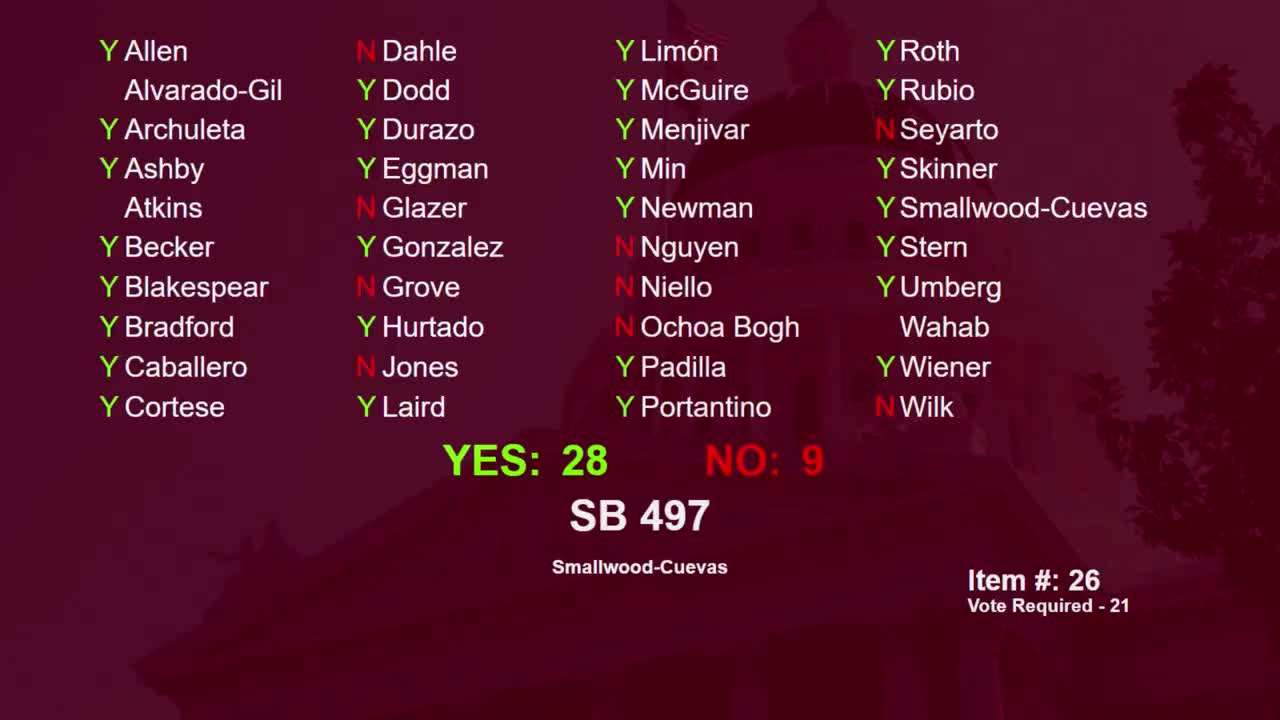 4MIN
Senate Floor
 12MIN
Senate Standing Committee on Judiciary
 26MIN
Senate Standing Committee on Labor, Public Employment and Retirement
Bill Author