SB 63: Homeless and Mental Health Court and Transitioning Home Grant Programs.
- Session Year: 2023-2024
- House: Senate
- Latest Version Date: 2023-01-04
Current Status:
Failed
(2024-02-01: Returned to Secretary of Senate pursuant to Joint Rule 56.)
Introduced
In Committee
First Chamber
In Committee
Second Chamber
Enacted
Existing law establishes the Board of State and Community Corrections. Existing law charges the board with providing the statewide leadership, coordination, and technical assistance to promote effective state and local efforts and partnerships in Californias adult and juvenile criminal justice system.
Under existing law, the board administers several grant programs, including a mentally ill offender crime reduction grant program, a medication-assisted treatment grant program, and a violence intervention and prevention grant program.
This bill would establish two new grant programs until January 1, 2028: the Homeless and Mental Health Court Grant Program that would, subject to an appropriation by the Legislature, be administered by the Judicial Council and provide grants to counties for the purpose of establishing or expanding homeless courts and mental health courts, as specified; and the Transitioning Home Grant Program that would, subject to an appropriation by the Legislature, be administered by the board and provide grants to county sheriffs and jail administrators to fund programs aimed at reducing homelessness among inmates released from custody, as specified.
The bill would require the board and council to prepare and submit reports to the Legislature, as specified, regarding the impacts of the grant program under their jurisdiction.
(a)The Homeless and Mental Health Court Grant Program is hereby created and shall be administered by the Judicial Council.
(b)The council shall award grants, on a competitive basis, to counties, as authorized by this article. The council shall establish minimum standards, funding schedules, and procedures for awarding grants to counties that have established a mental health court, homeless court, or hybrid collaborative that incorporates the features of both a mental health court and a homeless court or to counties that commit to doing so upon receipt of funding pursuant to the grant.
(c)Homeless and Mental Health Grant Program funds may be used by recipient counties for any one or more of the following purposes:
(1)Salaries and related costs for county personnel to provide mental health evaluation, housing navigation services, drug treatment referral, or other risk and needs evaluation for criminal defendants charged with a misdemeanor or infraction offense, or who are convicted of a misdemeanor or infraction offense, and are homeless, at risk of homelessness upon release from jail, or who suffer from a mental disorder that was a significant factor in the commission of the charged misdemeanor or infraction offense.
(2)Establishment or expansion of, a mental health court, homeless court, or hybrid collaborative court. Expenditures may include any necessary training, salaries for support personnel, including probation department personnel, court facility expansion or renovation, or the expansion or renovation of treatment or evaluation space, but shall not include judicial salaries.
(3)Funding for services provided pursuant to contracts between the recipient countys probation department and drug treatment providers, mental health service providers, housing providers, or for other rehabilitative programs ordered by the court for misdemeanor or infraction defendants whose cases are processed through the countys homeless court, mental health court, or hybrid collaborative court.
(4)Housing vouchers.
(5)Salary and related costs for providing medication-assisted treatment for misdemeanor defendants whose cases are processed through the countys homeless court, mental health court, or hybrid collaborative court.
(6)Funding to increase capacity for community-based, medication-assisted treatment and substance use disorder treatment services for misdemeanor or infraction defendants whose cases are processed through the countys homeless court, mental health court, or hybrid collaborative court, or to improve the care coordination and connections to medication-assisted treatment services upon placement in the program. Activities may include, but are not limited to, capital expenditures or operating costs to establish new reentry centers or treatment programs, expansion of existing community-based, medication-assisted treatment services to better meet the needs of participating defendants, and other strategies to ensure timely and appropriate access to medication-assisted treatment upon release from jail or placement in the program.
(d)Counties receiving funds pursuant to this article shall operate the homeless court, mental health court, or hybrid collaborative court for defendants receiving services pursuant to this program on a deferred entry of judgment or diversion basis, or both. Nothing in this section shall preclude a county from operating a homeless court, mental health court, or a hybrid collaborative court on a nondiversion, or a nondeferred entry of judgment basis for defendants who are ineligible or are found by the court to be unsuitable for diversion or deferred entry of judgment. Except for incidental expenditures pursuant to paragraph (2) of subdivision (c), or expenditures for evaluation of defendants pursuant to paragraph (1) of subdivision (c) who are later determined to be unsuitable or ineligible for diversion or deferred entry of judgment, funds received by the county pursuant to this article shall only be expended to provide services enumerated in subdivision (c) to eligible misdemeanor or infraction defendants who qualify for services pursuant to this article and who are placed on diversion or on deferred entry of judgment by the court.
(e)Counties receiving funding pursuant to this article shall require collaboration between the court and county social service agencies to provide services for defendants participating in the program.
(f)Grant funds shall not be used to supplant existing resources provided by the county probation department or by county social services.
(g)(1)Counties that receive grants pursuant to this article shall collect and maintain data pertaining to the effectiveness of the program, as indicated by the council in the request for proposals, including data on the rate of recidivism for criminal defendants who participate in the deferred entry of judgment or diversion program ordered by the court.
(2)(A)Information relating to the rate of recidivism that shall be collected and maintained pursuant to this subdivision includes all of the following, as it relates to defendants charged or convicted of a misdemeanor or infraction and placed on diversion or deferred entry of judgment and receive services funded pursuant to this article:
(i)The number and percentage who were sentenced to jail or prison within three years after being sentenced or placed on diversion, and were provided services funded pursuant to this article.
(ii)The number and percentage who were convicted of a misdemeanor or a felony within three years after being sentenced or placed on diversion, after having been provided with services that funded pursuant to this article.
(iii)The number and percentage who were arrested for a crime or had their parole, probation, mandatory supervision, or postrelease community supervision revoked within three years after being sentenced or placed on diversion, and were provided services funded pursuant to this article.
(B)A county that receives a grant pursuant to this article shall include recidivism data for persons placed in the program less than three years prior to any reporting period established by the council pursuant to paragraph (4).
(3)A county that receives a grant pursuant to this article may use state summary criminal history information, as defined in Section 11105, or local summary criminal history information, as defined in Section 13300, to collect data as required by the council.
(4)The council may establish a deadline by which counties that receive grants pursuant to this article are required to submit data collected and maintained pursuant to this subdivision to the council to enable the council to comply with the reporting requirement in Section 6048.2.
(h)The council may use up to 5 percent of the funds appropriated for the program each year for the costs of administering the program, including, without limitation, the employment of personnel and evaluation of activities supported by the grant funding.
6048.1.As used in this article, mental disorder means that the defendant suffers from a mental disorder as identified in the most recent edition of the Diagnostic and Statistical Manual of Mental Disorders, including, but not limited to, bipolar disorder, schizophrenia, schizoaffective disorder, or post-traumatic stress disorder, but excluding antisocial personality disorder, borderline personality disorder, and pedophilia. Evidence of the defendants mental disorder shall be provided by the defense and shall include a recent diagnosis by a qualified mental health expert. In opining that a defendant suffers from a qualifying disorder, the qualified mental health expert may rely on an examination of the defendant, the defendants medical records, arrest reports, or any other relevant evidence.
6048.2.On or before July 1, 2027, the council shall compile a report describing the activities funded pursuant to this article, and the success of those activities in reducing recidivism by defendants participating in a program of diversion or deferred entry of judgment who receive services provided pursuant to this program. The report shall be submitted to the Legislature pursuant to Section 9795 of the Government Code.
6048.3.This article shall be operative only to the extent that funding is provided, by express reference, in the annual Budget Act or another statute for the purposes of this article.
6048.4.This article shall remain in effect only until January 1, 2028, and as of that date is repealed.
SEC. 2.Article 8 (commencing with Section 6049) is added to Chapter 5 of Title 7 of Part 3 of the Penal Code, to read:8.Transitioning Home Grant Program6049.(a)The Transitioning Home Grant Program is hereby created and shall be administered by the Board of State and Community Corrections.
(b)The board shall award grants, on a competitive basis, to county sheriffs or jail administrators, as authorized by this article. The board shall establish minimum standards, funding schedules, and procedures for awarding grants pursuant to this article.
(c)Transitioning Home Grant Program funds may be used by recipient sheriffs or jail administrators for any one or more of the following purposes:
(1)Salaries and related costs for jail personnel to evaluate whether inmates released from the jail are, or upon release from custody, will be, homeless.
(2)Housing navigation services to assist inmates released from jail in locating housing.
(3)Housing vouchers.
(4)Transportation for inmates who would otherwise be homeless upon release without transportation to that housing.
(5)Salaries and related costs to provide reentry planning for inmates upon release from jail.
(d)Funds provided pursuant to this article shall not be used to supplant existing resources provided by the sheriff, jail administrator, county probation department, or county social services department.
(e)The board shall determine a cap on funds that can be used for salaries of recipient sheriffs based on reasonable and actual costs.
(f)Sheriffs or jail administrators who receive grants pursuant to this article shall collect and maintain data pertaining to the use of funds received pursuant to the program, and report it to the board. The report shall include all of the following:
(1)The amount spent on salaries and administration.
(2)The number of inmates placed in housing.
(3)The number of inmates who were eligible for housing, but could not be placed.
(4)The length of stay in the housing placement.
(5)The number of inmates transported to housing.
(6)The recidivism rates of inmates.
(g)Sheriffs who receive grants pursuant to this article shall collaborate with appropriate government entities and community organizations that specialize in providing the services described in this article.
(h)The board may use up to 5 percent of the funds appropriated for the program each year for the costs of administering the program, including, without limitation, the employment of personnel and evaluation of activities supported by the grant funding.
6049.1.On or before July 1, 2027, the board shall compile a report describing the activities funded pursuant to this article. The report shall be submitted to the Legislature pursuant to Section 9795 of the Government Code.
6049.2.This article shall be operative only to the extent that funding is provided, by express reference, in the annual Budget Act or another statute for the purposes of this article.
6049.3.This article shall remain in effect only until January 1, 2028, and as of that date is repealed.
|
Date
|
Status
|
|---|---|
| Feb 1, 2024 | Returned to Secretary of Senate pursuant to Joint Rule 56. |
| May 18, 2023 | May 18 hearing: Held in committee and under submission. |
| May 12, 2023 | Set for hearing May 18. |
| Apr 17, 2023 | April 17 hearing: Placed on APPR suspense file. |
| Apr 10, 2023 | Set for hearing April 17. |
| Mar 29, 2023 | From committee: Do pass and re-refer to Com. on APPR. (Ayes 5. Noes 0. Page 578.) (March 28). Re-referred to Com. on APPR. |
| Mar 9, 2023 | Set for hearing March 28. |
| Mar 8, 2023 | March 14 set for first hearing canceled at the request of author. |
| Feb 17, 2023 | Set for hearing March 14. |
| Jan 18, 2023 | Referred to Com. on PUB S. |
| Jan 5, 2023 | From printer. May be acted upon on or after February 4. |
| Jan 4, 2023 | Introduced. Read first time. To Com. on RLS. for assignment. To print. |
|
Date
|
Description
|
Location
|
Votes
|
|
|---|---|---|---|---|
| Apr 17, 2023 | Placed on suspense file | Senate Standing Committee on Appropriations |
Passed |
|
| Mar 28, 2023 | Do pass, but first be re-referred to the Committee on [Appropriations] | Senate Standing Committee on Public Safety |
Passed |
This list shows positions taken on this bill by organizations on the date displayed, which is linked to the original source.
Positions by individuals are not included.
SENATE COMMITTEE ON
Senator Anthony Portantino, Chair
2023 - 2024 Regular Session
SB 63 (Ochoa Bogh) - Homeless and Mental Health Court and Transitioning Home Grant Programs
Version: | Policy Vote: |
Urgency: | Mandate: |
Hearing Date: | Consultant: |
Bill Summary:
SB 63 would establish, subject to an appropriation, the Homeless and Mental health Court Grant Program to be administered by the Judicial Council (JCC) and the Transitioning Home Grant Program to be administered by the Board of State and Community Corrections (BSCC).
Fiscal Impact:
Unknown cost pressures, likely in the millions of dollars in order to fund grants to county courts, county sheriffs, and jail administrators (General Fund). See Staff Comments for additional details.
Background: Mental health courts are a type of collaborative court that serve as an alternative to the traditional court system and provide specific services and treatment to defendants dealing with mental illness. Although each mental health court has different participation requirements and services available to participants, they share the same goals of supporting participants in their successful return to society, reducing recidivism, increasing public safety, and improving the quality of life of participants. Homeless courts are special court sessions held in a local shelter or other community site designed for homeless individuals to resolve outstanding misdemeanor criminal warrants, including many “quality-of-life” infractions such as disorderly conduct, public drunkenness, and sleeping on a sidewalk.
This bill would establish the Homeless and Mental Health Court Grant Program to be administered by Judicial Council to provide grants on a competitive basis to counties for the purpose of establishing or expanding homeless courts and mental health courts, or hybrid collaborative courts throughout California.
In addition to creating grants to fund homeless and mental health courts, this bill would also create a Transitioning Home Grant Program for sheriffs and jail administrators to connect persons in jail facing potential homelessness upon release with needed services. Unsheltered homeless individuals are more likely to come in contact with law enforcement than persons who are sheltered.
Proposed Law:
- Creates the Homeless and Mental Health Court Grant Program to be administered by Judicial Council to provide grants on a competitive basis to counties for the purpose of establishing or expanding homeless courts and mental health courts.
- Requires the JCC to establish minimum standards, funding schedules, and procedures for awarding grants to counties that have established a mental health court, homeless court, or hybrid collaborative that incorporates the features of both a mental health court and a homeless court or to counties that commit to doing so upon receipt of funding pursuant to the grant.
- Specifies that Homeless and Mental Health Grant Program funds may be used by recipient counties for numerous purposes including funding for specified services, salaries and related costs for county personnel to provide those services, the establishment or expansion of, a mental health court, homeless court, or hybrid collaborative court, housing vouchers, and more.
- Provides that counties receiving funds pursuant to this article shall operate the homeless court, mental health court, or hybrid collaborative court for defendants receiving services pursuant to this program on a deferred entry of judgment (DEJ) or diversion basis, or both.
- Requires counties receiving funding to require collaboration between the court and county social service agencies to provide services for defendants participating in the program.
- Prohibits grant funds from being used to supplant existing resources provided by the county probation department or by county social services.
- Requires recipient counties to collect and maintain data pertaining to the effectiveness of the program, as indicated by JCC in the request for proposals, including data on the rate of recidivism for criminal defendants who participate in the DEJ or diversion ordered by the court.
- Provides that information relating to the rate of recidivism that shall be collected as specified.
- Provides that a recipient county shall include recidivism data for persons placed in the program less than three years prior to any reporting period established by the JCC.
- Provides that a recipient county may use state summary criminal history information or local summary criminal history information to collect data as required.
- Provides that JCC may establish a deadline by which recipient counties are required to submit data collected and maintained to Judicial Council to enable the council to comply with the reporting requirement.
- Authorizes the JCC to use up to 5 percent of the funds appropriated for the program each year for the costs of administering the program, including, without limitation, the employment of personnel and evaluation of activities supported by the grant funding.
- Provides that evidence of the defendant’s mental disorder shall be provided by the defense and hall include a recent diagnosis by a qualified mental health expert. In opining that a defendant suffers from a qualifying disorder, the qualified mental health expert may rely on an examination of the defendant, the defendant’s medical records, arrest reports, or any other relevant evidence.
- Requires on or before July 1, 2027, that the JCC compile a report describing the activities funded pursuant to this program, and the success of those activities in reducing recidivism by defendants participating in a program of diversion or DEJ who receive services provided pursuant to this program and submit the report to the Legislature.
- Creates the Transitioning Home Grant Program to be administered by BSCC.
- Requires the BSCC to award grants, on a competitive basis, to county sheriffs or jail administrators, as specified, and to establish minimum standards, funding schedules, and procedures for awarding grants under this program.
- Specifies that Transitioning Home Grant Program funds may be used by recipient sheriffs or jail administrators for a variety of purposes, as specified.
- Prohibits funds pursuant to this program from being used to supplant existing resources provided by the sheriff, jail administrator, county probation department, or county social services department.
- Requires BSCC to determine a cap on funds that can be used for salaries of recipient sheriffs based on reasonable and actual costs.
- Requires recipient sheriffs or jail administrators to collect and maintain data pertaining to the use of funds received pursuant to the program, and report it to BSCC. Requires the BSCC to compile a report describing the activities funded under this program and shall submit the report to the Legislature on or before July 1, 2027.
- Sunsets both grant programs on January 1, 2028.
Related Legislation:
SB 1427 (Ochoa Bogh, 2022) was nearly identical to this bill. SB 1427 was held on the Assembly Appropriations Suspense File.
Staff Comments:
This bill does not appropriate funding for the grants it creates, nor does it specify a level of funding or number of grant participants. Many variables affect the costs of a grant program such as the ones proposed by this bill. The amount for individual grants, the number of eligible applicants, and whether the grants are administered on a one-time or an annual basis are just a few of the considerations that will be determinative of costs. The Judicial Council estimates that the grant program will cost approximately $400,000 to $500,000 per court for a three-year program. This assumes an average annual caseload of 60 individuals per court, with each individual receiving $3,000 in assistance, reflecting 2-3 months of housing; housing costs can vary greatly depending on the county. The administrators of the grants, the BSCC and the JCC, would likely require up to 5% of any appropriation for administration and reporting costs.
-- END --
SENATE COMMITTEE ON PUBLIC SAFETY
Senator Aisha Wahab, Chair
2023 - 2024 Regular
Bill No: SB 63 Hearing Date: March 28, 2023
Author: | Ochoa Bogh | ||
Version: | January 4, 2023 | ||
Urgency: | No | Fiscal: | Yes |
Consultant: | SC | ||
Subject: Homeless and Mental Health Court and Transitioning Home Grant Programs
HISTORY
Source: Author
Prior Legislation: SB 1427 (Ochoa-Bogh), 2021-22 Leg. Sess. held in Assem. Approps.
AB 2200 (Muratsuchi), 2021-22 Leg. Sess., held in Sen. Approps.
SB 1006 (Jones), 2021-22 Leg. Sess., held in Assem. Approps.
Support: California Apartment Association; City of Needles; Deputy Sheriffs’ Association of Monterey County; Placer County Deputy Sheriffs’ Association; Riverside Sheriffs’ Association; San Bernardino County Sheriff’s Office
Opposition: None known
PURPOSE
The purpose of this bill is to establish, until January 1, 2028 and subject to appropriation by the Legislature, the Homeless and Mental health Court Grant Program to be administered by the Judicial Council and the Transitioning Home Grant Program to be administered by the Board of State and Community Corrections.
Existing law establishes the Board of State and Community Corrections (BSCC). (Pen. Code, § 6024, subd. (a).)
Existing law requires the BSCC to do the following, among other things:
- Develop recommendations for the improvement of criminal justice and delinquency and gang prevention activity throughout the state;
- Identify, promote, and provide technical assistance relating to evidence-based programs, practices, and promising and innovative projects consistent with the mission of the board;
- Receive and disburse federal funds, and perform all necessary and appropriate services in the performance of its duties as established by federal acts;
- Develop procedures to ensure that applications for grants are processed fairly, efficiently, and in a manner consistent with the mission of the board;
- Identify delinquency and gang intervention and prevention grants that have the same or similar program purpose, are allocated to the same entities, serve the same target populations, and have the same desired outcomes for the purpose of consolidating grant funds and programs and moving toward a unified single delinquency intervention and prevention grant application process in adherence with all applicable federal guidelines and mandates;
- Cooperate with and render technical assistance to the Legislature, state agencies, local governments, or other public or private agencies, organizations, or institutions in matters relating to criminal justice and delinquency prevention;
- Develop incentives for units of local government to develop comprehensive regional partnerships whereby adjacent jurisdictions pool grant funds in order to deliver services, to a broader target population and maximize the impact of state funds at the local level;
- Conduct evaluation studies of the programs and activities assisted by the federal acts.
- Identify and evaluate state, local, and federal gang and youth violence suppression, intervention, and prevention programs and strategies, along with funding for those efforts. (Pen. Code, § 6027, subd. (b).)
Existing law establishes several grant programs to be administered by BSCC. (See Pen. Code, §§ 6045 et seq. and 6047 et seq.)
Existing law provides that the Judicial Council consists of the Chief Justice and one other judge of the Supreme Court, three judges of courts of appeal, 10 judges of superior courts, two nonvoting court administrators, and any other nonvoting members as determined by the voting membership of the council, each appointed by the Chief Justice for a three-year term pursuant to procedures established by the council; four members of the State Bar appointed by its governing body for three-year terms; and one member of each house of the Legislature appointed as provided by the house. (Cal. Const, Art. VI § 6.)
Existing law states that to improve the administration of justice the council shall survey judicial business and make recommendations to the courts, make recommendations annually to the Governor and Legislature, adopt rules for court administration, practice and procedure, and perform other functions prescribed by statute. The rules adopted shall not be inconsistent with statute. (Cal. Const., Art. VI § 6.)
This bill creates the Homeless and Mental Health Court Grant Program to be administered by Judicial Council to provide grants on a competitive basis to counties for the purpose of establishing or expanding homeless courts and mental health courts.
This bill requires Judicial Council to establish minimum standards, funding schedules, and procedures for awarding grants to counties that have established a mental health court, homeless court, or hybrid collaborative that incorporates the features of both a mental health court and a homeless court or to counties that commit to doing so upon receipt of funding pursuant to the grant.
This bill specifies that Homeless and Mental Health Grant Program funds may be used by recipient counties for any one or more of the following purposes:
- Salaries and related costs for county personnel to provide mental health evaluation, housing navigation services, drug treatment referral, or other risk and needs evaluation for criminal defendants charged with a misdemeanor or infraction offense, or who are convicted of a misdemeanor or infraction offense, and are homeless, at risk of homelessness upon release from jail, or who suffer from a mental disorder that was a significant factor in the commission of the charged misdemeanor or infraction offense;
- Establishment or expansion of, a mental health court, homeless court, or hybrid collaborative court. Expenditures may include any necessary training, salaries for support personnel, including probation department personnel, court facility expansion or renovation, or the expansion or renovation of treatment or evaluation space, but shall not include judicial salaries;
- Funding for services provided pursuant to contracts between the recipient county’s probation department and drug treatment providers, mental health service providers, housing providers, or for other rehabilitative programs ordered by the court for misdemeanor or infraction defendants whose cases are processed through the county’s homeless court, mental health court, or hybrid collaborative court;
- Housing vouchers;
- Salary and related costs for providing medication-assisted treatment for misdemeanor defendants whose cases are processed through the county’s homeless court, mental health court, or hybrid collaborative court; and,
- Funding to increase capacity for community-based, medication-assisted treatment and substance use disorder treatment services for misdemeanor or infraction defendants whose cases are processed through the county’s homeless court, mental health court, or hybrid collaborative court, or to improve the care coordination and connections to medication-assisted treatment services upon placement in the program. Activities may include, but are not limited to, capital expenditures or operating costs to establish new reentry centers or treatment programs, expansion of existing community-based, medication-assisted treatment services to better meet the needs of participating defendants, and other strategies to ensure timely and appropriate access to medication-assisted treatment upon release from jail or placement in the program.
This bill states that counties receiving funds pursuant to this article shall operate the homeless court, mental health court, or hybrid collaborative court for defendants receiving services pursuant to this program on a deferred entry of judgment (DEJ) or diversion basis, or both. Nothing in this section shall preclude a county from operating a homeless court, mental health court, or a hybrid collaborative court on a non-diversion, or a non-deferred entry of judgment basis for defendants who are ineligible or are found by the court to be unsuitable for diversion or deferred entry of judgment.
This bill requires counties receiving funding to require collaboration between the court and county social service agencies to provide services for defendants participating in the program.
This bill prohibits grant funds from being used to supplant existing resources provided by the county probation department or by county social services.
This bill requires recipient counties to collect and maintain data pertaining to the effectiveness of the program, as indicated by Judicial Council in the request for proposals, including data on the rate of recidivism for criminal defendants who participate in the DEJ or diversion ordered by the court.
This bill provides that information relating to the rate of recidivism that shall be collected and maintained includes all of the following:
- The number and percentage who were sentenced to jail or prison within three years after being sentenced or placed on diversion, and were provided services funded by this program;
- The number and percentage who were convicted of a misdemeanor or a felony within three years after being sentenced or placed on diversion, after having been provided with services that funded; and,
- The number and percentage who were arrested for a crime or had their parole, probation, mandatory supervision, or postrelease community supervision revoked within three years after being sentenced or placed on diversion, and were provided services funded by this program.
This bill states that a recipient county shall include recidivism data for persons placed in the program less than three years prior to any reporting period established by the Judicial Council.
This bill provides that a recipient county may use state summary criminal history information or local summary criminal history information to collect data as required.
This bill states that Judicial Council may establish a deadline by which recipient counties are required to submit data collected and maintained to Judicial Council to enable the council to comply with the reporting requirement.
This bill authorizes the Judicial Council to use up to 5 percent of the funds appropriated for the program each year for the costs of administering the program, including, without limitation, the employment of personnel and evaluation of activities supported by the grant funding.
This bill defines “mental disorder” for purposes of the grant program to mean that the defendant suffers from a mental disorder as identified in the most recent edition of the Diagnostic and Statistical Manual of Mental Disorders, including, but not limited to, bipolar disorder, schizophrenia, schizoaffective disorder, or post-traumatic stress disorder, but excluding antisocial personality disorder, borderline personality disorder, and pedophilia.
This bill states that evidence of the defendant’s mental disorder shall be provided by the defense and hall include a recent diagnosis by a qualified mental health expert. In opining that a defendant suffers from a qualifying disorder, the qualified mental health expert may rely on an examination of the defendant, the defendant’s medical records, arrest reports, or any other relevant evidence.
This bill requires on or before July 1, 2027, the Judicial Council to compile a report describing the activities funded pursuant to this program, and the success of those activities in reducing recidivism by defendants participating in a program of diversion or DEJ who receive services provided pursuant to this program. This report shall be submitted to the Legislature.
This bill sunsets the provisions of the Homeless and Mental Health Grant Program on January 1, 2028.
This bill creates the Transitioning Home Grant Program to be administered by BSCC.
This bill requires BSCC to award grants, on a competitive basis, to county sheriffs or jail administrators, as specified, and to establish minimum standards, funding schedules, and procedures for awarding grants under this program.
This bill specifies that Transitioning Home Grant Program funds may be used by recipient sheriffs or jail administrators for any one or more of the following purposes:
- Salaries and related costs for jail personnel to evaluate whether inmates released from the jail are, or upon release from custody, will be, homeless;
- Housing navigation services to assist inmates released from jail in locating housing;
- Housing vouchers;
- Transportation for inmates who would otherwise be homeless upon release without transportation to that housing; and,
- Salaries and related costs to provide reentry planning for inmates upon release from jail.
This bill prohibits funds pursuant to this program from being used to supplant existing resources provided by the sheriff, jail administrator, county probation department, or county social services department.
This bill requires BSCC to determine a cap on funds that can be used for salaries of recipient sheriffs based on reasonable and actual costs.
This bill requires recipient sheriffs or jail administrators to collect and maintain data pertaining to the use of funds received pursuant to the program, and report it to BSCC. The report shall include all of the following:
- The amount spent on salaries and administration;
- The number of inmates placed in housing;
- The number of inmates who were eligible for housing, but could not be placed;
- The length of stay in the housing placement;
- The number of inmates transported to housing; and,
- The recidivism rates of inmates.
This bill provides that recipient sheriffs shall collaborate with appropriate government entities and community organizations that specialize in providing the services described by the provisions of this bill.
This bill states that BSCC may use up to 5 percent of the funds appropriated for the program each year for the costs of administering the program, including, without limitation, the employment of personnel and evaluation of activities supported by the grant funding.
This bill states that on or before July 1, 2027, BSCC shall compile a report describing the activities funded under this program and shall submit the report to the Legislature.
This bill sunsets the provisions of the Transitioning Home Grant Program on January 1, 2028.
COMMENTS
- Need for This Bill
According to the author of this bill:
To help address the mental health and homelessness crises while promoting rehabilitation and housing stability, SB 63 will create two grant programs: one that helps counties establish or expand collaborative mental health and homeless courts as an alternative to incarceration and another that allows counties to institute re-entry services for jail inmates at risk of becoming homeless upon release.
We must think outside the box and take a different approach in addressing our state’s homelessness and mental health crises. The American Psychological Association reports that 64 percent of jail inmates, 54 percent of state prisoners, and 45 percent of federal prisoners have reported mental health concerns. According to the Western Center on Law and Policy, formerly incarcerated people are roughly 10 times more likely to be homeless than the general public and – in California specifically – 70 percent of people experiencing homelessness have a history of incarceration.
It’s time we make significant ongoing investments to help those experiencing homelessness, formerly incarcerated, suffering from severe mental illness get the care they need. The collaborative court model has been successfully operating in the U.S. for over 15 years and has a proven record of improving the lives of its participants. By providing funding for collaborative courts and re-entry services, we uphold the promise to our constituents that we are committed to responding to their needs through empathetic, evidence-based practices.
- California’s Homeless Population
According to the Public Policy Institute of California (PPIC), as of 2022, 30% of all people in the United States experiencing homelessness resided in California, including half of all unsheltered people (115,491 in California; 233,832 in the US). The federal government’s Point In Time (PIT) count conducted every January showed that since 2020, California’s homeless population increased 6%, compared to the rest of the county which increased 0.4%. However, due to federal and state protections put in during the COVID-19 pandemic, people experiencing homelessness had expanded housing supports including hotels as temporary housing and moratoriums on evictions. Thus, the increase in the homeless but sheltered population accounted for almost all of California’s change, while the more visible unsheltered population increased 2%. The rest of the country’s unsheltered population grew faster than California’s (4%), while its sheltered population actually shrank (-2%). (PPIC, Homeless Populations Are Rising around California, February 21, 2023 < https://www.ppic.org/blog/homeless-populations-are-rising-around-california/> [as of Mar. 2, 2023].)
- Collaborative Courts
California has over 450 collaborative courts that “provide rehabilitation services and housing to individuals in need.” (Judicial Council, Report to the Chief Justice: Work Group on Homelessness (2021) p. 19 <https://www.courts.ca.gov/documents/hwg_work-group-report.pdf> [as of Mar. 2, 2023].) Collaborative justice courts-also known as problem-solving courts- combine judicial supervision with rehabilitation services that are rigorously monitored and focused on recovery to reduce recidivism and improve offender outcomes. These courts include, among other models, drug courts, reentry courts, mental health courts, homeless courts and veterans treatment courts. (California Courts, Collaborative Justice Courts < https://www.courts.ca.gov/programs-collabjustice.htm > [as of Mar. 2, 2023].)
Homeless Courts
There are currently homeless court programs in 19 counties in the state. The first homeless court was established in San Diego County in 1989 as an outgrowth of a veterans program because the majority of the county’s homeless population were veterans. Generally, homeless courts are held at a homeless community service center and involve a one-time court appearance during which participants can address infractions or very low-level misdemeanors:
Resolution of outstanding warrants not only meets a fundamental need of homeless people but also eases court case-processing backlogs and reduces vagrancy. Homeless people tend to be fearful of attending court, yet their outstanding warrants limit their reintegration into society, deterring them from using social services and impeding their access to employment. They are effectively blocked from obtaining driver’s licenses, job applications, and rental agreements.
(California Courts, Community/Homeless Courts <https://www.courts.ca.gov/5976.htm> [as of Mar. 2, 2023].) The key principles of homeless courts include:
- Prosecutors, defense counsel and the court should agree on which offenses may be resolved in the Homeless Court Program, and approve the criteria for individual participation, recognizing that defendant participation in Homeless Court Programs shall be voluntary.
- Community-based service providers should establish criteria for individual participation in the Homeless Court Program and screen individuals pursuant to these criteria.
- The Homeless Court Program shall not require defendants to waive any protections afforded by due process of law.
- All Homeless Court Program participants shall have time for meaningful review of the cases and issues prior to disposition.
- The Homeless Court Program process and any disposition therein should recognize homeless participants’ voluntary efforts to improve their lives and move from the streets toward self-sufficiency, including participation in community-based treatment or services.
- Participation in community-based treatment or services shall replace traditional sanctions such as fines, public work service and custody.
- Defendants who have completed appropriate treatment or services prior to appearing before the Homeless Court shall have minor charges dismissed, and, where appropriate, may have more serious misdemeanor charges before the court reduced or dismissed. Where charges are dismissed, public access to the record should be limited.
(Judicial Council of California, Homeless and Community Court Blueprint, January 2020, pp. 4-5 < https://www.courts.ca.gov/documents/homeless-community-court-blueprint.pdf> [as of Mar. 3, 2023].)
Mental Health Courts
Mental health courts provide specific services and treatment to defendants dealing with mental illness. Mental health courts provide an alternative to the traditional court system by emphasizing a problem-solving model and connecting defendants to a variety of rehabilitative services and support networks. Although each mental health court has different participation requirements and services available to participants, they share the same goals of supporting participants in their successful return to society, reducing recidivism, increasing public safety, and improving the quality of life of participants. The California Courts’ website describes how mental health courts in the state generally work:
- Mental health courts only accept people with demonstrable mental illnesses that can be connected to the individual’s illegal behavior.
- Participation in a mental health court is voluntary and the defendant must consent to involvement in the program.
- Screening and referral to a mental health court should occur as soon as possible after arrest to insure early intervention.
- Screening is also used to determine whether a mental health court can provide appropriate resources and support to the individual.
- Mental health courts use a structure of case management based in intensive supervision/monitoring and individual accountability.
- Case management is supervised by a team of professionals; teams are typically comprised of members of the justice system, mental health providers, and other support systems.
- The judge oversees the treatment and supervision process, and facilitates collaboration among team members.
(California Courts, Mental Health Courts, <https://www.courts.ca.gov/5982.htm> [as of Mar. 2, 2023].)
This bill would establish the Homeless and Mental Health Court Grant Program to be administered by Judicial Council to provide grants on a competitive basis to counties for the purpose of establishing or expanding homeless courts and mental health courts, or hybrid collaborative courts throughout California. The bill specifies how the grant funds may be used including salaries and related costs for county personnel to provide mental health evaluation, housing navigation services, or other risk and needs evaluation; training, salaries for support personnel; services provided through contracts between the county and various service providers; housing vouchers; and increasing capacity for community based medication-assisted treatment and substance use disorder treatment services.
This bill also requires counties receiving grants to collect specified data, including data on the rate of recidivism of program participants, and to submit that data to the Judicial Council. This bill requires Judicial Council to compile a report regarding the recipient counties’ programs and to submit the report to the Legislature on or before July 1, 2027. The grant program would sunset on January 1, 2028.
- Transitioning Population from County Jail
In addition to creating grants to fund homeless and mental health courts, this bill would also create a Transitioning Home Grant Program for sheriffs and jail administrators to connect persons in jail facing potential homelessness upon release with needed services. Unsheltered homeless individuals are more likely to come in contact with law enforcement than persons who are sheltered. According to California Policy Lab:
Unsheltered individuals report ten times as many police contacts on average (21 compared to 2) in the previous six months, and were approximately nine times as likely to report they had spent at least one night in jail in the last six months (81% vs. 9%).
(California Policy Lab, Health Conditions Among Unsheltered Adults in the U.S (Oct. 2019), p. 7 < https://www.capolicylab.org/wp-content/uploads/2023/02/Health-Conditions-Among-Unsheltered-Adults-in-the-U.S..pdf> [as of Mar. 2, 2023].)
The grant funds could be used to help support housing navigation services, housing vouchers, and reentry planning, among other things. This bill prohibits funds pursuant to this program from being used to supplant existing resources provided by the sheriff, jail administrator, county probation department, or county social services department. BSCC would be required to determine a cap on funds that can be used for salaries of recipient sheriffs based on reasonable and actual costs. Recipient sheriffs or jail administrators would be required to collect and maintain data pertaining to the use of funds received pursuant to the program, and report it to BSCC.
Similar to the Homeless and Mental Health Court Grant Program created by this bill, the Transitioning Home Grant Program provisions require BSCC to, on or before July 1, 2027, compile a report describing the activities funded under this program and shall submit the report to the Legislature. The grant program would sunset on January 1, 2028.
- Argument in Support
According to the San Bernardino County Sheriff’s Department:
Since 2011, the number of California inmates deemed incompetent to stand trial and ordered to state hospitals increased by 60 percent, as almost 1 in 3 inmates have a documented severe mental illness. Today, more than 90 percent of state hospital patients come from the criminal justice system. When people in a psychiatric crisis land in emergency rooms and jails, most of the time, it’s because they can’t get treatment in the community. SB 63 will provide grants for a mental health court and fund programs that provide resources for the homeless and individuals with mental illness. These programs and courts will also work to ease prison and jail crowing by getting people into treatment instead of placing these individuals in jail, thus reducing the chances of recidivism due to untreated mental illness.
-- END –
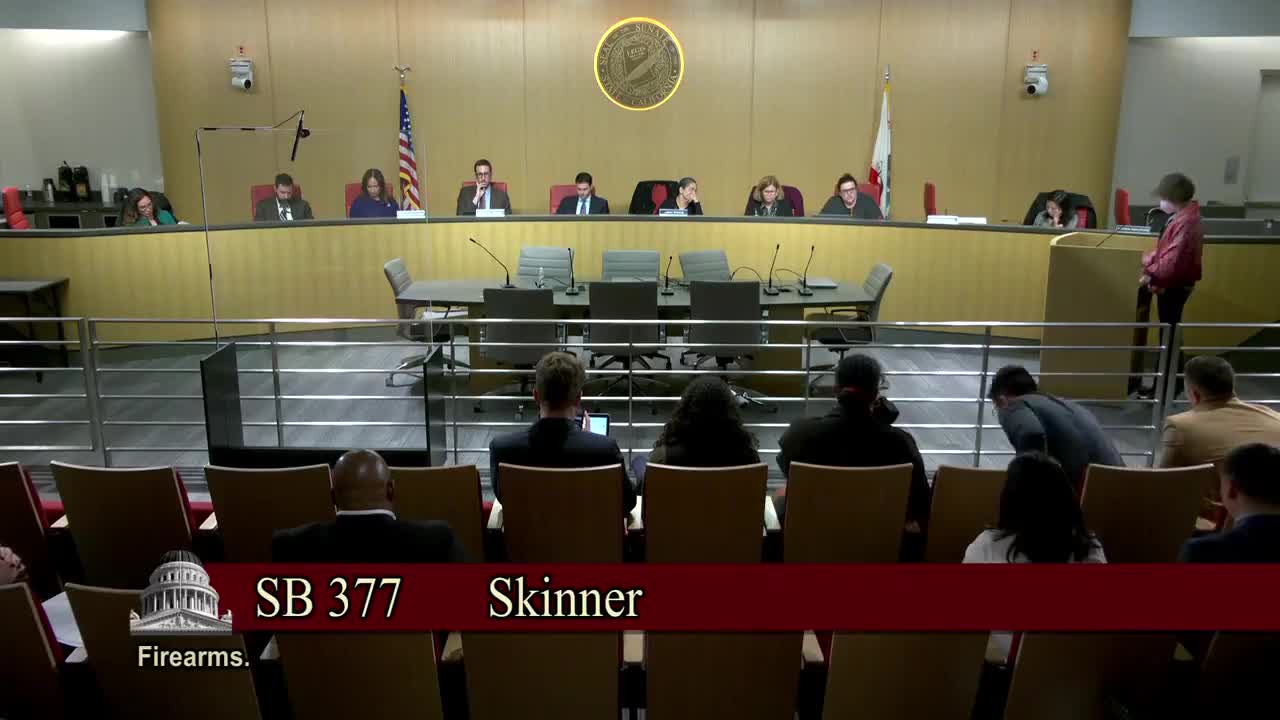
Discussed in Hearing
 15MIN
Senate Standing Committee on Public Safety
Bill Author