SB 684: Land use: streamlined approval processes: development projects of 10 or fewer residential units on urban lots under 5 acres.
- Session Year: 2023-2024
- House: Senate
- Latest Version Date: 2023-10-11
Current Status:
Passed
(2023-10-11: Chaptered by Secretary of State. Chapter 783, Statutes of 2023.)
Introduced
In Committee
First Chamber
In Committee
Second Chamber
Enacted
Existing law, the Subdivision Map Act, vests the authority to regulate and control the design and improvement of subdivisions in the legislative body of a local agency and sets forth procedures governing the local agencys processing, approval, conditional approval or disapproval, and filing of tentative, final, and parcel maps, and the modification thereof. The act generally requires a subdivider to file a tentative map or vesting tentative map with the local agency, as specified, and the local agency, in turn, to approve, conditionally approve, or disapprove the map within a specified time period.
The Planning and Zoning Law contains various provisions requiring a local government that receives an application for certain types of qualified housing developments to review the application under a streamlined, ministerial approval process depending on the type of housing development, as specified. Existing law, known as the Starter Home Revitalization Act of 2021, requires a city or county to approve an application for a small home lot housing development project, as defined, on a proposed site to be subdivided unless the city or county makes a finding related to the developments compliance with certain requirements or the developments specific, adverse public health or safety impact.
This bill would require a local agency to ministerially consider, without discretionary review or a hearing, a parcel map or a tentative and final map for a housing development project that meets specified requirements. In this regard, the bill would require the proposed subdivision to result in 10 or fewer parcels and the housing development project to, among other things, consist of 10 or fewer residential units, meet certain minimum parcel size and density requirements, and be located on a lot zoned for multifamily residential development that is no larger than 5 acres and is substantially surrounded by qualified urban uses. The bill would exempt the housing development project from certain requirements relating to minimum parcel size and dimensions and the formation of a homeowners association, except as specified.
This bill also would require a local agency to ministerially consider, without discretionary review or a hearing, an application for a housing development project on a lot that is subdivided pursuant to the provisions of the bill described above. The bill would authorize a local agency to impose on the housing development objective zoning standards, objective subdivision standards, or objective design standards that are related to a housing development or to the design or improvement of a parcel, as specified. However, the bill would prohibit a local agency from imposing on the housing development certain standards, including those that physically preclude the development of a project built to specified densities, impose a requirement that applies to a project solely or partially on the basis that the subdivision or housing development receives approval pursuant to the bills provision, or impose certain requirements related to parking, setbacks, or floor area ratios, as specified.
This bill would impose streamlining requirements with regard to consideration of an application for a parcel map or a tentative and final map pursuant to the first set of provisions described above or an application for a housing development project pursuant to the 2nd set of provisions described above. Specifically, the bill would require a local agency to approve or deny a completed application submitted to a local agency pursuant to these provisions within 60 days from the date the local agency receives it. Under the bill, if the local agency does not approve or deny the application within 60 days, the application would be deemed approved. If the local agency denies the application, the bill would require the local agency, within 60 days of receipt of the application, to return in writing a full set of comments to the applicant with a list of items that are defective or deficient and a description of how the applicant can remedy the application.
This bill would also require, except as specified, a local agency to issue a building permit for one or more residential units that are part of a housing development project consisting of 10 or fewer units on a lot proposed to be subdivided as part of a subdivision if the applicant meets certain requirements. In this regard, the bill would require the applicant to have received a tentative map approval or parcel map approval for the subdivision, to have submitted a building permit application that the local agency deemed complete pursuant to a provision governing local agency review of postentitlement phase permit applications. The bill would authorize a local agency to condition the issuance of the building permit on the applicant submitting a recorded covenant and agreement that conditions the issuance of the building permit on the recording of the final map, as specified.
The Planning and Zoning Law provides for the creation of accessory dwelling units and junior accessory dwelling units by local ordinance, or, if a local agency has not adopted an ordinance, by ministerial approval, in accordance with specified standards and conditions.
Under this bill, a local agency would not be required to permit an accessory dwelling unit or a junior accessory dwelling unit on a parcel created through the exercise of the authority provided by the bill, as described above.
The Subdivision Map Act requires a local agency to ministerially approve a parcel map for an urban lot split that meets certain requirements, as specified. The Planning and Zoning Law requires a proposed housing development containing no more than 2 residential units within a single-family residential zone to be considered ministerially, without discretionary review or hearing, if the proposed housing development meets certain requirements, as specified.
Under this bill, the above-described existing law provisions would not apply to a site that is located within a single-family residential horsekeeping zone designated in a specified master plan if the applicable local government has an adopted housing element that is compliant with applicable law. Under the bill, a local agency would not be required to permit an urban lot split on a parcel created through the exercise of the authority provided by the bill, as described above.
This bill would make the exemption for a site located within a single-family residential horsekeeping zone designated in a specified master plan operative on January 1, 2024, and would make all of the other above-described provisions operative on July 1, 2024.
This bill would make related findings and declarations.
The bill would include findings that changes proposed by this bill address a matter of statewide concern rather than a municipal affair and, therefore, apply to all cities, including charter cities.
Because this bill would impose new duties on local governments related to the review and approval of parcel maps, tentative and final maps, and housing development projects, the bill would impose a state-mandated local program.
The California Environmental Quality Act (CEQA) requires a lead agency, as defined, to prepare, or cause to be prepared, and certify the completion of an environmental impact report on a project that it proposes to carry out or approve that may have a significant effect on the environment or to adopt a negative declaration if it finds that the project will not have that effect. CEQA also requires a lead agency to prepare a mitigated negative declaration for a project that may have a significant effect on the environment if revisions in the project would avoid or mitigate that effect and there is no substantial evidence that the project, as revised, would have a significant effect on the environment. CEQA does not apply to the approval of ministerial projects.
By establishing a streamlined, ministerial approval process for certain housing developments, this bill would expand the exemption for the ministerial approval of projects under CEQA. Under the bill, an ordinance adopted by a local agency to implement certain provisions of the bill would not be considered a project under CEQA.
The California Constitution requires the state to reimburse local agencies and school districts for certain costs mandated by the state. Statutory provisions establish procedures for making that reimbursement.
This bill would provide that no reimbursement is required by this act for a specified reason.
Existing law, the Subdivision Map Act, vests the authority to regulate and control the design and improvement of subdivisions in the legislative body of a local agency and sets forth procedures governing the local agencys processing, approval, conditional approval or disapproval, and filing of tentative, final, and parcel maps, and the modification thereof. The act generally requires a subdivider to file a tentative map or vesting tentative map with the local agency, as specified, and the local agency, in turn, to approve, conditionally approve, or disapprove the map within a specified time period.
The Planning and Zoning Law contains various provisions requiring a local government that receives an application for certain types of qualified housing developments to review the application under a streamlined, ministerial approval process depending on the type of housing development, as specified. Existing law, known as the Starter Home Revitalization Act of 2021, requires a city or county to approve an application for a small home lot housing development project, as defined, on a proposed site to be subdivided unless the city or county makes a finding related to the developments compliance with certain requirements or the developments specific, adverse public health or safety impact.
This bill would require a local agency to ministerially approve, consider, without discretionary review or a hearing, a parcel map or a tentative and final map for a housing development project that meets specified requirements. In this regard, the bill would require the proposed subdivision to result in 10 or fewer parcels and the housing development project to, among other things, consist of 10 or fewer residential units, meet certain minimum parcel size and density requirements, and be located on a lot zoned for multifamily residential development that is no larger than 5 acres and is substantially surrounded by qualified urban uses. The bill would exempt the housing development project from certain requirements relating to minimum parcel size and dimensions and the formation of a homeowners association, except as specified. The bill would require a local agency to approve or deny a completed application for a parcel map or a tentative map for a housing development project submitted to a local agency pursuant to these provisions within 60 days from the date the local agency receives it. Under the bill, if the local agency does not approve or deny the application within 60 days, the application would be deemed approved. If the local agency denies the application, the bill would require the local agency, within 60 days of receipt of the application, to return in writing a full set of comments to the applicant with a list of items that are defective or deficient and a description of how the applicant can remedy the application.
This bill also would require a local agency to ministerially consider, without discretionary review or a hearing, an application for a housing development project on a lot that is subdivided pursuant to the provisions of the bill described above. The bill would authorize a local agency to impose on the housing development objective zoning standards, objective subdivision standards, or objective design standards that are related to a housing development or to the design or improvement of a parcel, as specified. However, the bill would prohibit a local agency from imposing on the housing development certain standards, including those that physically preclude the development of a project built to specified densities, impose a requirement that applies to a project solely or partially on the basis that the subdivision or housing development receives approval pursuant to the bills provision, or impose certain requirements related to parking, setbacks, or floor area ratios, as specified.
This bill would impose streamlining requirements with regard to consideration of an application for a parcel map or a tentative and final map pursuant to the first set of provisions described above or an application for a housing development project pursuant to the 2nd set of provisions described above. Specifically, the bill would require a local agency to approve or deny a completed application submitted to a local agency pursuant to these provisions within 60 days from the date the local agency receives it. Under the bill, if the local agency does not approve or deny the application within 60 days, the application would be deemed approved. If the local agency denies the application, the bill would require the local agency, within 60 days of receipt of the application, to return in writing a full set of comments to the applicant with a list of items that are defective or deficient and a description of how the applicant can remedy the application.
This bill would also require, except as specified, a local agency to issue a building permit for one or more residential units that are part of a housing development project consisting of 10 or fewer units on a lot proposed site to be subdivided as part of a subdivision if the applicant meets certain requirements. In this regard, the bill would require the applicant to have received a tentative map approval or parcel map approval for the subdivision, to have submitted a building permit application that the local agency deemed complete pursuant to a provision governing local agency review of postentitlement phase permit applications, and to have submitted proof of applications. The bill would authorize a local agency to condition the issuance of the building permit on the applicant submitting a recorded covenant and agreement that conditions the issuance of the building permit on the recording of the final map and limits the total number of units created by the subdivision to 10. The bill would authorize a local agency to impose on a housing development on a lot that is subdivided pursuant to the bills provisions objective zoning standards, objective subdivision standards, or objective design standards that are related to the design or to the improvement of a parcel, as specified. However, the bill would prohibit a local agency from imposing on the housing development an objective zoning standard, objective subdivision standard, or objective design standard that precludes the development of a project built to specified densities, is more restrictive than those standards that would otherwise apply to residential developments in the underlying zone, requires a setback between the units other than as required in the California Building Code, or requires that parking be enclosed or covered. map, as specified.
The Planning and Zoning Law provides for the creation of accessory dwelling units and junior accessory dwelling units by local ordinance, or, if a local agency has not adopted an ordinance, by ministerial approval, in accordance with specified standards and conditions.
Under this bill, a local agency would not be required to permit an accessory dwelling unit or a junior accessory dwelling unit on a parcel created through the exercise of the authority provided by the bill, as described above.
The Subdivision Map Act requires a local agency to ministerially approve a parcel map for an urban lot split that meets certain requirements, as specified. The Planning and Zoning Law requires a proposed housing development containing no more than 2 residential units within a single-family residential zone to be considered ministerially, without discretionary review or hearing, if the proposed housing development meets certain requirements, as specified.
Under this bill, the above-described existing law provisions would not apply to a site that is located within a single-family residential horsekeeping zone designated in a specified master plan if the applicable local government has an adopted housing element that is compliant with applicable law. Under the bill, a local agency would not be required to permit an urban lot split on a parcel created through the exercise of the authority provided by the bill, as described above.
This bill would make the exemption for a site located within a single-family residential horsekeeping zone designated in a specified master plan operative on January 1, 2024, and would make all of the other above-described provisions operative on July 1, 2024.
Under the Planning and Zoning Law, the Department of Housing and Community Development is required to notify the city or county and authorized to notify the Attorney General that the city or county is in violation of state law if the department finds that a local government has taken an action in violation of specified land use statutes related to housing.This bill would add the proposed streamlined approval and objective standards provisions described above to the list of statutes subject to notification by the department, as specified above.This bill would make related findings and declarations.
The bill would include findings that changes proposed by this bill address a matter of statewide concern rather than a municipal affair and, therefore, apply to all cities, including charter cities.
Because this bill would impose new duties on local governments related to the review and approval of parcel maps, tentative and final maps, and housing development projects, the bill would impose a state-mandated local program.
The California Environmental Quality Act (CEQA) requires a lead agency, as defined, to prepare, or cause to be prepared, and certify the completion of an environmental impact report on a project that it proposes to carry out or approve that may have a significant effect on the environment or to adopt a negative declaration if it finds that the project will not have that effect. CEQA also requires a lead agency to prepare a mitigated negative declaration for a project that may have a significant effect on the environment if revisions in the project would avoid or mitigate that effect and there is no substantial evidence that the project, as revised, would have a significant effect on the environment. CEQA does not apply to the approval of ministerial projects.
By establishing a streamlined, ministerial approval process for certain housing developments, this bill would expand the exemption for the ministerial approval of projects under CEQA. Under the bill, an ordinance adopted by a local agency to implement certain provisions of the bill would not be considered a project under CEQA.
The California Constitution requires the state to reimburse local agencies and school districts for certain costs mandated by the state. Statutory provisions establish procedures for making that reimbursement.
This bill would provide that no reimbursement is required by this act for a specified reason.
Existing law, the Subdivision Map Act, vests the authority to regulate and control the design and improvement of subdivisions in the legislative body of a local agency and sets forth procedures governing the local agencys processing, approval, conditional approval or disapproval, and filing of tentative, final, and parcel maps, and the modification thereof. The act generally requires a subdivider to file a tentative map or vesting tentative map with the local agency, as specified, and the local agency, in turn, to approve, conditionally approve, or disapprove the map within a specified time period.
The Planning and Zoning Law contains various provisions requiring a local government that receives an application for certain types of qualified housing developments to review the application under a streamlined, ministerial approval process depending on the type of housing development, as specified. Existing law, known as the Starter Home Revitalization Act of 2021, requires a city or county to approve an application for a small home lot housing development project, as defined, on a proposed site to be subdivided unless the city or county makes a finding related to the developments compliance with certain requirements or the developments specific, adverse public health or safety impact.
This bill would require a local agency to ministerially approve, without discretionary review or a hearing, a parcel map or a tentative and final map for a housing development project that meets specified requirements. In this regard, the bill would require the housing development project to, among other things, consist of 10 or fewer residential units, meet certain minimum parcel size and density requirements, and be located on a lot zoned for multifamily or single-family residential development that is no larger than 5 acres and is substantially surrounded by qualified urban uses. The bill would exempt the housing development project from certain requirements relating to minimum parcel size and dimensions and the formation of a homeowners association, except as specified. The bill would require a local agency to approve or deny a completed application for a parcel map or a tentative map for a housing development project submitted to a local agency pursuant to these provisions within 60 days from the date the local agency receives it. Under the bill, if the local agency does not approve or deny the application within 60 days, the application would be deemed approved. If the local agency denies the application, the bill would require the local agency, within 60 days of receipt of the application, to return in writing a full set of comments to the applicant with a list of items that are defective or deficient and a description of how the applicant can remedy the application.
This bill would also require, except as specified, a local agency to issue a building permit for a housing development project on a proposed site to be subdivided as part of a subdivision if the applicant meets certain requirements. In this regard, the bill would require the applicant to have received a tentative map approval or parcel map approval for the subdivision, to have submitted a building permit application that the local agency deemed complete pursuant to a provision governing local agency review of postentitlement phase permit applications, and to have submitted proof of a recorded covenant and agreement that conditions the issuance of the building permit on the recording of the final map and limits the total number of units created by the subdivision to 10. The bill would authorize a local agency to impose on a housing development on a lot that is subdivided pursuant to the bills provisions objective zoning standards, objective subdivision standards, or objective design standards that are related to the design or to the improvement of a parcel, as specified. However, the bill would prohibit a local agency from imposing on the housing development an objective zoning standard, objective subdivision standard, or objective design standard that precludes the development of a project built to specified densities, is more restrictive than those standards that would otherwise apply to residential developments in the underlying zone, requires a setback between the units other than as required in the California Building Code, or requires that parking be enclosed or covered.
This bill would make the above-described provisions operative on July 1, 2024.
Under the Planning and Zoning Law, the Department of Housing and Community Development is required to notify the city or county and authorized to notify the Attorney General that the city or county is in violation of state law if the department finds that a local government has taken an action in violation of specified land use statutes related to housing.
This bill would add the proposed streamlined approval and objective standards provisions described above to the list of statutes subject to notification by the department, as specified above.
This bill would make related findings and declarations.
The bill would include findings that changes proposed by this bill address a matter of statewide concern rather than a municipal affair and, therefore, apply to all cities, including charter cities.
Because this bill would impose new duties on local governments related to the review and approval of parcel maps, tentative and final maps, and housing development projects, the bill would impose a state-mandated local program.
The California Environmental Quality Act (CEQA) requires a lead agency, as defined, to prepare, or cause to be prepared, and certify the completion of an environmental impact report on a project that it proposes to carry out or approve that may have a significant effect on the environment or to adopt a negative declaration if it finds that the project will not have that effect. CEQA also requires a lead agency to prepare a mitigated negative declaration for a project that may have a significant effect on the environment if revisions in the project would avoid or mitigate that effect and there is no substantial evidence that the project, as revised, would have a significant effect on the environment. CEQA does not apply to the approval of ministerial projects.
By establishing a streamlined, ministerial approval process for certain housing developments, this bill would expand the exemption for the ministerial approval of projects under CEQA.
The California Constitution requires the state to reimburse local agencies and school districts for certain costs mandated by the state. Statutory provisions establish procedures for making that reimbursement.
This bill would provide that no reimbursement is required by this act for a specified reason.
Existing law, the Subdivision Map Act, vests the authority to regulate and control the design and improvement of subdivisions in the legislative body of a local agency and sets forth procedures governing the local agencys processing, approval, conditional approval or disapproval, and filing of tentative, final, and parcel maps, and the modification thereof. The act generally requires a subdivider to file a tentative map or vesting tentative map with the local agency, as specified, and the local agency, in turn, to approve, conditionally approve, or disapprove the map within a specified time period.
The Planning and Zoning Law contains various provisions requiring a local government that receives an application for certain types of qualified housing developments to review the application under a streamlined, ministerial approval process depending on the type of housing development, as specified. Existing law, known as the Starter Home Revitalization Act of 2021, requires a city or county to approve an application for a small home lot housing development project, as defined, on a proposed site to be subdivided unless the city or county makes a finding related to the developments compliance with certain requirements or the developments specific, adverse public health or safety impact.
This bill would require a local agency to ministerially approve, without discretionary review or a hearing, a parcel map or a tentative and final map for a housing development project that meets specified requirements. In this regard, the bill would require the housing development project to, among other things, consist of 10 or fewer residential units, meet certain minimum parcel size and density requirements, and be located on a lot zoned for multifamily or single-family residential development that is no larger than 5 acres and is substantially surrounded by qualified urban uses. The bill would exempt the housing development project from certain requirements relating to setbacks, lot minimum parcel size and dimensions, enclosed or covered parking, dimensions and the formation of a homeownerss association. homeowners association, except as specified. The bill would require a local agency to approve or deny a completed application for a parcel map or a tentative map for a housing development project submitted to a local agency pursuant to these provisions within 60 days from the date the local agency receives it. Under the bill, if the local agency does not approve or deny the application within 60 days, the application would be deemed approved. If the local agency denies the application, the bill would require the local agency, within 60 days of receipt of the application, to return in writing a full set of comments to the applicant with a list of items that are defective or deficient and a description of how the applicant can remedy the application.
This bill would also require require, except as specified, a local agency to issue a building permit for a housing development project on a proposed site to be subdivided as part of a subdivision if the applicant meets certain requirements. In this regard, the bill would require the applicant to have received a tentative map approval or parcel map approval for the subdivision subdivision, to have submitted a building permit application that the local agency deemed complete pursuant to a provision governing local agency review of postentitlement phase permit applications, and to have submitted proof of a recorded covenant and agreement that conditions the issuance of the building permit on the recording of the final map and limits the total number of units created by the subdivision to 10. The bill would, with certain exceptions, would authorize a local agency to impose on a housing development on a lot that is subdivided pursuant to the bills provisions objective zoning standards, objective subdivision standards, or objective design standards that are related to the design or to the improvement of a parcel, as specified. However, the bill would prohibit a local agency from imposing on a the housing development subdivided pursuant to the bills provisions an objective zoning standard, objective subdivision standard, or objective design standard that either precludes the development of a project built to specified densities or densities, is more restrictive than those standards that would otherwise apply to residential developments in the underlying zone. zone, requires a setback between the units other than as required in the California Building Code, or requires that parking be enclosed or covered.
This bill would make the above-described provisions operative on July 1, 2024.
Under the Planning and Zoning Law, the Department of Housing and Community Development is required to notify the city or county and authorized to notify the Attorney General that the city or county is in violation of state law if the department finds that a local government has taken an action in violation of specified land use statutes related to housing.
This bill would add the proposed streamlined approval and objective standards provisions described above to the list of statutes subject to notification by the department, as specified above.
This bill would make related findings and declarations.
The bill would include findings that changes proposed by this bill address a matter of statewide concern rather than a municipal affair and, therefore, apply to all cities, including charter cities.
Because this bill would impose new duties on local governments related to the review and approval of parcel maps, tentative and final maps, and housing development projects, the bill would impose a state-mandated local program.
The California Environmental Quality Act (CEQA) requires a lead agency, as defined, to prepare, or cause to be prepared, and certify the completion of an environmental impact report on a project that it proposes to carry out or approve that may have a significant effect on the environment or to adopt a negative declaration if it finds that the project will not have that effect. CEQA also requires a lead agency to prepare a mitigated negative declaration for a project that may have a significant effect on the environment if revisions in the project would avoid or mitigate that effect and there is no substantial evidence that the project, as revised, would have a significant effect on the environment. CEQA does not apply to the approval of ministerial projects.
By establishing a streamlined, ministerial approval process for certain housing developments, this bill would expand the exemption for the ministerial approval of projects under CEQA.
The California Constitution requires the state to reimburse local agencies and school districts for certain costs mandated by the state. Statutory provisions establish procedures for making that reimbursement.
This bill would provide that no reimbursement is required by this act for a specified reason.
Existing law, the Subdivision Map Act, vests the authority to regulate and control the design and improvement of subdivisions in the legislative body of a local agency and sets forth procedures governing the local agencys processing, approval, conditional approval or disapproval, and filing of tentative, final, and parcel maps, and the modification thereof. The act generally requires a subdivider to file a tentative map or vesting tentative map with the local agency, as specified, and the local agency, in turn, to approve, conditionally approve, or disapprove the map within a specified time period.
The Planning and Zoning Law contains various provisions requiring a local government that receives an application for certain types of qualified housing developments to review the application under a streamlined, ministerial approval process depending on the type of housing development, as specified. Existing law, known as the Starter Home Revitalization Act of 2021, requires a city or county to approve an application for a small home lot housing development project, as defined, on a proposed site to be subdivided unless the city or county makes a finding related to the developments compliance with certain requirements or the developments specific, adverse public health or safety impact.
This bill would require a local agency to ministerially approve, without discretionary review or a hearing, a parcel map or a tentative and final map for a housing development project that meets specified requirements. In this regard, the bill would require the housing development to project to, among other things, consist of 10 or fewer single-family residential units, meet certain minimum density requirements, and be located on a lot zoned for multifamily or single-family residential development that is no larger than 5 acres and is substantially surrounded by qualified urban uses. The bill would exempt the housing development project from certain requirements relating to setbacks, lot size and dimensions, enclosed or covered parking, and formation of a homeownerss association. The bill would require a local agency to approve or deny a completed application for a parcel map or a tentative map for a housing development project submitted to a local agency pursuant to these provisions within 60 days from the date the local agency receives it. Under the bill, if the local agency does not approve or deny the application within 60 days, the application would be deemed approved. If the local agency denies the application, the bill would require the local agency, within 60 days of receipt of the application, to return in writing a full set of comments to the applicant with a list of items that are defective or deficient and a description of how the applicant can remedy the application.
TheThis bill would also require a local agency to issue a building permit for a housing development project on a proposed site to be subdivided as part of a subdivision if, among other requirements, if the applicant meets certain requirements. In this regard, the bill would require the applicant to have received a tentative map approval or parcel map approval for the subdivision pursuant to the bills provisions described above. subdivision and to have submitted proof of a recorded covenant and agreement that conditions the issuance of the building permit on the recording of the final map and limits the total number of units created by the subdivision to 10. The bill would, with certain exceptions, prohibit a local agency from imposing on a housing development subdivided pursuant to the bills provisions an objective zoning standard, objective subdivision standard, or objective design standard that either precludes the development of a project built to specified densities or is more restrictive than those standards that would otherwise apply to residential developments in the underlying zone.
Under the Planning and Zoning Law, the Department of Housing and Community Development is required to notify the city or county and authorized to notify the Attorney General that the city or county is in violation of state law if the department finds that a local government has taken an action in violation of specified land use statutes related to housing.
This bill would add the proposed streamlined approval and objective standards provisions described above to the list of statutes subject to notification by the department, as specified above.
TheThis bill would make related findings and declarations.
The bill would include findings that changes proposed by this bill address a matter of statewide concern rather than a municipal affair and, therefore, apply to all cities, including charter cities.
Because this bill would impose new duties on local governments related to the review and approval of parcel maps, tentative and final maps, and housing development projects, the bill would impose a state-mandated local program.
The California Environmental Quality Act (CEQA) requires a lead agency, as defined, to prepare, or cause to be prepared, and certify the completion of an environmental impact report on a project that it proposes to carry out or approve that may have a significant effect on the environment or to adopt a negative declaration if it finds that the project will not have that effect. CEQA also requires a lead agency to prepare a mitigated negative declaration for a project that may have a significant effect on the environment if revisions in the project would avoid or mitigate that effect and there is no substantial evidence that the project, as revised, would have a significant effect on the environment. CEQA does not apply to the approval of ministerial projects.
By establishing a streamlined, ministerial approval process for certain housing developments, this bill would expand the exemption for the ministerial approval of projects under CEQA.
The California Constitution requires the state to reimburse local agencies and school districts for certain costs mandated by the state. Statutory provisions establish procedures for making that reimbursement.
This bill would provide that no reimbursement is required by this act for a specified reason.
Existing law, the Subdivision Map Act Act, vests the authority to regulate and control the design and improvement of subdivisions in the legislative body of a local agency and sets forth procedures governing the local agencys processing, approval, conditional approval or disapproval, and filing of tentative, final, and parcel maps, and the modification thereof. The act generally requires a subdivider to file a tentative map or vesting tentative map with the local agency, as specified, and the local agency, in turn, to approve, conditionally approve, or disapprove the map within a specified time period. The act requires an approved or conditionally approved tentative map or vesting tentative map to expire 24 months after its approval or conditional approval, or after an additional period of time prescribed by local ordinance, not to exceed an additional 24 months. However, the act extends the expiration date of certain approved tentative maps and vesting tentative maps, as specified.
This bill would authorize a legislative body to extend the expiration date, by up to 24 months, of a tentative map, vesting tentative map, or parcel map that meets certain criteria, including that a tentative map or vesting tentative map was approved on or after January 1, 2017, and not later than January 1, 2022, and that it relates to the construction of single-family or multifamily housing, as specified. The bill would also require any legislative, administrative, or other approval by any state agency that pertains to a development project included in a map that is extended pursuant to these provisions to be extended by 24 months, as specified. By adding to the procedures that local agency officials must follow, this bill would impose a state-mandated local program.The Planning and Zoning Law contains various provisions requiring a local government that receives an application for certain types of qualified housing developments to review the application under a streamlined, ministerial approval process depending on the type of housing development, as specified. Existing law, known as the Starter Home Revitalization Act of 2021, requires a city or county to approve an application for a small home lot housing development project, as defined, on a proposed site to be subdivided unless the city or county makes a finding related to the developments compliance with certain requirements or the developments specific, adverse public health or safety impact.
This bill would require a local agency to ministerially approve, without discretionary review or a hearing, a parcel map or a tentative and final map for a housing development project that meets specified requirements. In this regard, the bill would require the housing development to consist of 10 or fewer single-family residential units, meet certain minimum density requirements, and be located on a lot zoned for multifamily or single-family residential development that is no larger than 5 acres and is substantially surrounded by qualified urban uses.
The bill would also require a local agency to issue a building permit for a subdivision if, among other requirements, the applicant received a tentative map approval or parcel map approval for the subdivision pursuant to the bills provisions described above.
The bill would make related findings and declarations.
Because this bill would impose new duties on local governments related to the review and approval of parcel maps, tentative and final maps, and housing development projects, the bill would impose a state-mandated local program.
The California Environmental Quality Act (CEQA) requires a lead agency, as defined, to prepare, or cause to be prepared, and certify the completion of an environmental impact report on a project that it proposes to carry out or approve that may have a significant effect on the environment or to adopt a negative declaration if it finds that the project will not have that effect. CEQA also requires a lead agency to prepare a mitigated negative declaration for a project that may have a significant effect on the environment if revisions in the project would avoid or mitigate that effect and there is no substantial evidence that the project, as revised, would have a significant effect on the environment. CEQA does not apply to the approval of ministerial projects.
By establishing a streamlined, ministerial approval process for certain housing developments, this bill would expand the exemption for the ministerial approval of projects under CEQA.
(2)TheThe California Constitution requires the state to reimburse local agencies and school districts for certain costs mandated by the state. Statutory provisions establish procedures for making that reimbursement.
This bill would provide that no reimbursement is required by this act for a specified reason.
(1)The Subdivision Map Act vests the authority to regulate and control the design and improvement of subdivisions in the legislative body of a local agency and sets forth procedures governing the local agencys processing, approval, conditional approval or disapproval, and filing of tentative, final, and parcel maps, and the modification thereof. The act generally requires a subdivider to file a tentative map or vesting tentative map with the local agency, as specified, and the local agency, in turn, to approve, conditionally approve, or disapprove the map within a specified time period. The act requires an approved or conditionally approved tentative map or vesting tentative map to expire 24 months after its approval or conditional approval, or after an additional period of time prescribed by local ordinance, not to exceed an additional 24 months. However, the act extends the expiration date of certain approved tentative maps and vesting tentative maps, as specified.
This bill would authorize a legislative body to extend the expiration date, by up to 24 months, of a tentative map, vesting tentative map, or parcel map that meets certain criteria, including that a tentative map or vesting tentative map was approved on or after January 1, 2017, and not later than January 1, 2022, and that it relates to the construction of single-family or multifamily housing, as specified. The bill would also require any legislative, administrative, or other approval by any state agency that pertains to a development project included in a map that is extended pursuant to these provisions to be extended by 24 months, as specified. By adding to the procedures that local agency officials must follow, this bill would impose a state-mandated local program.
(2)The California Constitution requires the state to reimburse local agencies and school districts for certain costs mandated by the state. Statutory provisions establish procedures for making that reimbursement.
This bill would provide that no reimbursement is required by this act for a specified reason.
The Legislature finds and declares all of the following:
(a)California has a statewide housing crisis, represented by a shortage of nearly 3,500,000 homes.
(b)Californias housing crisis stifles economic growth, contributes to the homelessness epidemic, consumes an ever-growing share of the paychecks of working families, and holds millions of households back from realizing the California dream of home ownership.
(c)Restrictive zoning, land use, and burdensome permitting policies at the local and state level are a major cause of the shortfall between Californias housing needs and the available supply of housing.
(d)Home ownership is still the primary way in which most Americans build wealth and assets. California has the third-highest median home price in the country and the high cost of housing has pushed what was once a modest goal further and further out of reach for most people of color.
(e)Home ownership rates in California are among the lowest nationwide, and in recent years those numbers have continued downward. Between 2020 and 2022, California home ownership declined by 3.19 percent.
(f)While the home ownership gap is an issue throughout the country, the rate of African American and Latinx home ownership is significantly worse in California. At a national level, African Americans and Latinx have a home ownership rate of 42 percent and 47 percent, respectively, while here in California, that rate drops down to 35 percent and 42 percent, respectively.
(g)The Legislative Analysts Office has identified a lack of housing supply as one of the culprits for the severe home ownership gap. The offices 2016 housing affordability report found that the states housing shortage also makes many Californians, not only low-income residents, more likely to commute longer distances, live in overcrowded housing, and delay or forgo home ownership.
(h)According to the Urban Institute, multifamily construction built for sale accounted for only 5.4 percent of all multifamily starts and only 2.7 percent of all single-family and multifamily home construction for the first three quarters of 2021.
(i)Houses cost more in California due to increased costs, heavy regulatory hurdles, and mandatory features and fees that add tens of thousands of dollars to the cost of each unit.
(j)Access to sustainable home ownership can be expanded with fiscal assistance, housing counseling, sound lending, flexible underwriting that ensures the ability to pay, and backing by Federal Housing Administration (FHA) mortgage insurance.
(k)As production has slowed and changed, for-sale inventory has tightened, particularly for entry-level homes.
(l)Higher home prices have translated to less diversity in who is able to purchase a home.
(m)Home ownership is a powerful tool to close the racial and ethnic wealth gap across the State of California and nationwide.
(n)The production of new market-rate housing frees up existing, more affordable elsewhere in the region for sale or rent to middle and lower-income households.
SEC. 2.Section 65852.28 is added to the Government Code, to read:65852.28.(a)A development proponent may submit an application for a housing development project on a lot that is subdivided pursuant to Section 66499.41 and that meets the requirements of this section.
(b)(1)For any housing development on a lot that is subdivided pursuant to Section 66499.41, a local agency may impose objective zoning standards, objective subdivision standards, or objective design standards that are related to the housing development or to the design or improvement of a parcel, and do not conflict with this section or Section 66499.41.
(2)Notwithstanding paragraph (1), a local agency shall not impose on a housing development on a lot that is subdivided pursuant to Section 66499.41 an objective zoning standard, objective subdivision standard, or objective design standard that does or is any of the following:
(A)Physically precludes the development of a project built to densities as specified in subparagraph (B) of paragraph (3) of subdivision (c) of Section 65583.2. This paragraph does not preclude a local agency from adopting an ordinance that allows developments at a density greater than the maximum density specified in subparagraph (B) of paragraph (3) of subdivision (c) of Section 65583.2.
(B)Imposes any requirement that applies to a project solely or partially on the basis that the subdivision or housing development receives approval pursuant to this section.
(C)Requires a setback between the units, except as required in the California Building Code (Title 24 of the California Code of Regulations).
(D)Requires that parking be enclosed or covered.
(E)Imposes side and rear setbacks from the original lot line inconsistent with subparagraph (B) of paragraph (2) of subdivision (b) of Section 65852.21.
(F)Imposes parking requirements inconsistent with paragraph (1) of subdivision (c) of Section 65852.21.
(G)(i)For a housing development project consisting of three to seven units, inclusive, impose a floor area ratio standard that is less than 1.0.
(ii)For a housing development project consisting of 8 to 10 units, inclusive, impose a floor area ratio standard that is less than 1.25.
(c)(1)A local agency shall ministerially consider, without discretionary review or a hearing, an application submitted to a local agency pursuant to this section.
(2)A local agency shall approve or deny an application for a housing development project submitted to a local agency pursuant to this section within 60 days from the date the local agency receives a completed application. If the local agency does not approve or deny a completed application within 60 days, the application shall be deemed approved. If the local agency denies the application, the local agency shall, within 60 days from the date the local agency receives the completed application, return in writing a full set of comments to the applicant with a list of items that are defective or deficient and a description of how the applicant can remedy the application.
(d)A local agency may disapprove a housing development project that meets the requirements of this section if it makes a written finding, based upon a preponderance of the evidence, that the proposed housing development project would have a specific, adverse impact, as defined and determined in paragraph (2) of subdivision (d) of Section 65589.5, upon public health and safety and for which there is no feasible method to satisfactorily mitigate or avoid the specific, adverse impact.
(e)A local agency may adopt an ordinance to implement the provisions of this section. An ordinance adopted to implement this section shall not be considered a project under Division 13 (commencing with Section 21000) of the Public Resources Code.
(f)This section shall become operative on July 1, 2024.
SEC. 3.Section 65913.4.5 is added to the Government Code, to read:65913.4.5.(a)(1)A local agency shall issue a building permit for one or more residential units that are part of a housing development project consisting of 10 or fewer units on a lot proposed to be subdivided as part of a subdivision pursuant to paragraph (3) if the applicant for the permit has met both of the following requirements:
(A)The applicant has received a tentative map approval or parcel map approval for the subdivision.
(B)The applicant has submitted a building permit application that the local agency deemed complete pursuant to subdivision (b) of Section 65913.3.
(2)The local agency may condition the issuance of a building permit on the applicant submitting proof to the satisfaction of the local agency of a recorded covenant and agreement enforceable by the local agency that states that the applicant and the applicants successors and assignees agree that the building permit is issued on the condition that a certificate of occupancy or equivalent final approval for the building will not be issued unless the final map has been recorded.
(3)(A)The local agency shall issue the building permit based upon the tentative or parcel map and its conditions of approval. Any dedication, improvement, and sewer requirements identified in the approved tentative or parcel map or its conditions of approval shall be guaranteed to the satisfaction of the local agency at the time the building permit is issued.
(B)The local agency may require security to ensure faithful performance of the requirements identified in the approved tentative or parcel map or its conditions of approval. The amount of security shall be determined by the local agency and shall not be more than 300 percent of the total estimated cost of the improvements or of the acts to be performed. The security shall be provided in either of the following forms, as determined by the local agency:
(i)Bond or bonds by one or more duly authorized corporate sureties.
(ii)An instrument of credit from an agency of the state, federal, or local government when any agency of the state, federal, or local government provides at least 20 percent of the financing for the portion of the act or agreement requiring security, or from one or more financial institutions subject to regulation by the state or federal government and pledging that the funds necessary to carry out the act or agreement are on deposit and guaranteed for payment, or a letter of credit issued by such a financial institution.
(4)Notwithstanding paragraph (1), a local agency may deny issuance of a building permit if the building official makes a written finding, based upon a preponderance of the evidence, that construction of the proposed structure or structures before recordation of the final map would have a specific, adverse impact, as defined and determined in paragraph (2) of subdivision (d) of Section 65589.5, upon public health and safety and for which there is no feasible method to satisfactorily mitigate or avoid the specific, adverse impact.
(b)A local agency may adopt an ordinance to implement the provisions of this section. An ordinance adopted to implement this section shall not be considered a project under Division 13 (commencing with Section 21000) of the Public Resources Code.
(c)This section shall become operative on July 1, 2024.
SEC. 4.Section 66499.41 is added to the Government Code, to read:66499.41.(a)A local agency shall ministerially consider, without discretionary review or a hearing, a parcel map or a tentative and final map for a housing development project that meets all of the following requirements:
(1)The proposed subdivision will result in 10 or fewer parcels and the housing development project on the lot proposed to be subdivided will contain 10 or fewer residential units.
(2)The lot proposed to be subdivided meets all of the following sets of requirements:
(A)The lot is zoned for multifamily residential development.
(B)The lot is no larger than five acres and is substantially surrounded by qualified urban uses. For purposes of this subparagraph, the following definitions apply:
(i)Qualified urban use has the same meaning as defined in Section 21072 of the Public Resources Code.
(ii)Substantially surrounded has the same meaning as defined in paragraph (2) of subdivision (a) of Section 21159.25 of the Public Resources Code.
(C)The lot is a legal parcel located within either of the following:
(i)An incorporated city, the boundaries of which include some portion of an urbanized area.
(ii)An urbanized area or urban cluster in a county with a population greater than 600,000 based on the most recent United States Census Bureau data.
(iii)For purposes of this subparagraph, the following definitions apply:
(I)Urbanized area means an urbanized area designated by the United States Census Bureau, as published in the Federal Register, Volume 77, Number 59, on March 27, 2012.
(II)Urban cluster means an urbanized area designated by the United States Census Bureau, as published in the Federal Register, Volume 77, Number 59, on March 27, 2012.
(D)The lot was not established pursuant to this section or Section 66411.7.
(3)(A)Except as specified in subparagraph (B), the newly created parcels are no smaller than 600 square feet.
(B)A local agency may, by ordinance, adopt a smaller minimum parcel size subject to ministerial approval under this subdivision.
(4)The housing units on the lot proposed to be subdivided are one of the following:
(A)Constructed on fee simple ownership lots.
(B)Part of a common interest development.
(C)Part of a housing cooperative, as defined in Section 817 of the Civil Code.
(D)Owned by a community land trust. For the purpose of this subparagraph, community land trust means a nonprofit corporation organized pursuant to Section 501(c)(3) of the Internal Revenue Code that satisfies all of the following:
(i)Has as its primary purposes the creation and maintenance of permanently affordable single-family or multifamily residences.
(ii)All dwellings and units located on the land owned by the nonprofit corporation are sold to qualified owners to be occupied as the qualified owners primary residence or rented to persons and families of low or moderate income. For the purpose of this subparagraph, qualified owner means a person or family of low or moderate income, including a person or family of low or moderate income who owns a dwelling or unit collectively as a member occupant or resident shareholder of a limited-equity housing cooperative.
(iii)The land owned by the nonprofit corporation, on which a dwelling or unit sold to a qualified owner is situated, is leased by the nonprofit corporation to the qualified owner for the convenient occupation and use of that dwelling or unit for a renewable term of 99 years.
(5)The proposed development will, pursuant to the requirements of this division, meet one of the following, as applicable:
(A)If the parcel is identified in the jurisdictions housing element for the current planning period that is in substantial compliance with Article 10.6 (commencing with Section 65580) of Chapter 3 of Division 1, the development will result in at least as many units as projected for that parcel in the housing element. If the parcel is identified to accommodate any portion of the jurisdictions share of the regional housing need for low- or very low income households, the development will result in at least as many low- or very low income units as projected in the housing element. These units shall be subject to a recorded affordability restriction of at least 45 years.
(B)If the parcel is not identified in the jurisdictions housing element for the current planning period that is in substantial compliance with Article 10.6 (commencing with Section 65580) of Chapter 3 of Division 1, the development will result in at least as many units as the maximum allowable residential density.
(6)The average total area of floorspace for the proposed housing units on the lot proposed to be subdivided does not exceed 1,750 net habitable square feet.
(7)The housing development project on the lot proposed to be subdivided complies with any local inclusionary housing ordinances adopted by the local agency.
(8)The development of a housing development project on the lot proposed to be subdivided does not require the demolition or alteration of any of the following types of housing:
(A)Housing that is subject to a recorded covenant, ordinance, or law that restricts rent to levels affordable to persons and families of low, very low, or extremely low income.
(B)Housing that is subject to any form of rent or price control through a local public entitys valid exercise of its police power.
(C)Housing occupied by tenants within the five years preceding the date of the application, including housing that has been demolished or that tenants have vacated prior to the submission of the application for a development permit.
(D)A parcel on which an owner of residential real property has exercised the owners rights under Chapter 12.75 (commencing with Section 7060) of Division 7 of Title 1 to withdraw accommodations from rent or lease within 15 years before the date that the development proponent submits an application.
(9)The lot proposed to be subdivided is not located on a site that is any of the following:
(A)Either prime farmland or farmland of statewide importance, as defined pursuant to United States Department of Agriculture land inventory and monitoring criteria, as modified for California, and designated on the maps prepared by the Farmland Mapping and Monitoring Program of the Department of Conservation, or land zoned or designated for agricultural protection or preservation by a local ballot measure that was approved by the voters of that jurisdiction.
(B)Wetlands, as defined in the United States Fish and Wildlife Service Manual, Part 660 FW 2 (June 21, 1993).
(C)Within a very high fire hazard severity zone, as determined by the Department of Forestry and Fire Protection pursuant to Section 51178, or within a high or very high fire hazard severity zone as indicated on maps adopted by the Department of Forestry and Fire Protection pursuant to Section 4202 of the Public Resources Code.
(D)A hazardous waste site that is listed pursuant to Section 65962.5 or a hazardous waste site designated by the Department of Toxic Substances Control pursuant to Section 25356 of the Health and Safety Code, unless either of the following apply:
(i)The site is an underground storage tank site that received a uniform closure letter issued pursuant to subdivision (g) of Section 25296.10 of the Health and Safety Code based on closure criteria established by the State Water Resources Control Board for residential use or residential mixed uses. This section does not alter or change the conditions to remove a site from the list of hazardous waste sites listed pursuant to Section 65962.5.
(ii)The State Department of Public Health, State Water Resources Control Board, Department of Toxic Substances Control, or a local agency making a determination pursuant to subdivision (c) of Section 25296.10 of the Health and Safety Code, has otherwise determined that the site is suitable for residential use or residential mixed uses.
(E)Within a delineated earthquake fault zone as determined by the State Geologist in any official maps published by the State Geologist, unless the development complies with applicable seismic protection building code standards adopted by the California Building Standards Commission under the California Building Standards Law (Part 2.5 (commencing with Section 18901) of Division 13 of the Health and Safety Code), and by any local building department under Chapter 12.2 (commencing with Section 8875) of Division 1 of Title 2.
(F)Within a special flood hazard area subject to inundation by the 1-percent annual chance flood (100-year flood) as determined by the Federal Emergency Management Agency in any official maps published by the Federal Emergency Management Agency. If a development proponent is able to satisfy all applicable federal qualifying criteria in order to provide that the site satisfies this paragraph and is otherwise eligible for streamlined approval under this section, a local government shall not deny the application on the basis that the development proponent did not comply with any additional permit requirement, standard, or action adopted by that local government that is applicable to that site. A development may be located on a site described in this subparagraph if either of the following are met:
(i)The site has been subject to a Letter of Map Revision prepared by the Federal Emergency Management Agency and issued to the local jurisdiction.
(ii)The site meets Federal Emergency Management Agency requirements necessary to meet minimum flood plain management criteria of the National Flood Insurance Program pursuant to Part 59 (commencing with Section 59.1) and Part 60 (commencing with Section 60.1) of Subchapter B of Chapter I of Title 44 of the Code of Federal Regulations.
(G)Within a regulatory floodway as determined by the Federal Emergency Management Agency in any official maps published by the Federal Emergency Management Agency, unless the development has received a no-rise certification in accordance with Section 60.3(d)(3) of Title 44 of the Code of Federal Regulations. If a development proponent is able to satisfy all applicable federal qualifying criteria in order to provide that the site satisfies this subparagraph and is otherwise eligible for streamlined approval under this section, a local government shall not deny the application on the basis that the development proponent did not comply with any additional permit requirement, standard, or action adopted by that local government that is applicable to that site.
(H)Land identified for conservation in an adopted natural community conservation plan pursuant to the Natural Community Conservation Planning Act (Chapter 10 (commencing with Section 2800) of Division 3 of the Fish and Game Code), habitat conservation plan pursuant to the federal Endangered Species Act of 1973 (16 U.S.C. Sec. 1531 et seq.), or another adopted natural resource protection plan.
(I)Habitat for protected species identified as candidate, sensitive, or species of special status by state or federal agencies, fully protected species, or species protected by the federal Endangered Species Act of 1973 (16 U.S.C. Sec. 1531 et seq.), the California Endangered Species Act (Chapter 1.5 (commencing with Section 2050) of Division 3 of the Fish and Game Code), or the Native Plant Protection Act (Chapter 10 (commencing with Section 1900) of Division 2 of the Fish and Game Code).
(J)Land under conservation easement.
(10)The proposed subdivision conforms to all applicable objective requirements of the Subdivision Map Act (Division 2 (commencing with Section 66410)), except as otherwise expressly provided in this section.
(11)The proposed subdivision complies with all applicable standards established pursuant to Section 65852.28.
(12)Any parcels proposed to be created pursuant to this section will be served by a public water system and a municipal sewer system.
(b)A housing development project on a proposed site to be subdivided pursuant to this section is not required to comply with any of the following requirements:
(1)A minimum requirement on the size, width, depth, or dimensions of an individual parcel created by the development beyond the minimum parcel size specified in, or established pursuant to, paragraph (3) of subdivision (a).
(2)(A)The formation of a homeowners association, except as required by the Davis-Stirling Common Interest Development Act (Part 5 (commencing with Section 4000) of Division 4 of the Civil Code).
(B)Subparagraph (A) shall not be construed to prohibit a local agency from requiring a mechanism for the maintenance of common space within the subdivision, including, but not limited to, a road maintenance agreement.
(c)A local agency shall approve or deny an application for a parcel map or a tentative map for a housing development project submitted to a local agency pursuant to this section within 60 days from the date the local agency receives a completed application. If the local agency does not approve or deny a completed application within 60 days, the application shall be deemed approved. If the local agency denies the application, the local agency shall, within 60 days from the date the local agency receives the completed application, return in writing a full set of comments to the applicant with a list of items that are defective or deficient and a description of how the applicant can remedy the application.
(d)Any housing development project constructed on the lot proposed to be subdivided pursuant to this section shall comply with all applicable objective zoning standards, objective subdivision standards, and objective design standards as established by the local agency that are not inconsistent with this section and paragraph (2) of subdivision (a) of Section 65852.28.
(e)A local agency may condition the approval and recordation of a subdivision map upon the completion of a residential structure in compliance with all applicable provisions of the California Building Standards Code that contains at least one dwelling unit on each resulting parcel that does not already contain an existing legally permitted residential structure or is reserved for internal circulation, open space, or common area.
(f)A local agency may deny the issuance of a parcel map, a tentative map, or a final map if it makes a written finding, based upon a preponderance of the evidence, that the proposed housing development project would have a specific, adverse impact, as defined and determined in paragraph (2) of subdivision (d) of Section 65589.5, upon public health and safety and for which there is no feasible method to satisfactorily mitigate or avoid the specific, adverse impact.
(g)Notwithstanding Section 65852.2 or 65852.22, a local agency is not required to permit an accessory dwelling unit or a junior accessory dwelling unit on parcels created through the exercise of the authority contained within this section.
(h)(1)Notwithstanding Section 66411.7, a local agency is not required to permit an urban lot split on a parcel created through the exercise of the authority contained within this section.
(2)Notwithstanding Sections 65852.21 and 66411.7, those sections shall not apply to a site that meet both of the following requirements:
(A)The site is located within a single-family residential horsekeeping zone designated in a master plan, adopted before January 1, 1994, that regulates land zoned single-family horsekeeping, commercial, commercial-recreational, and existing industrial within the plan area.
(B)The applicable local government has an adopted housing element that is compliant with applicable law.
(i)A local agency may adopt an ordinance to implement the provisions of this section. An ordinance adopted to implement this section shall not be considered a project under Division 13 (commencing with Section 21000) of the Public Resources Code.
(j)Paragraph (2) of subdivision (h) shall become operative on January 1, 2024. Subdivisions (a) to (g), inclusive, paragraph (1) of subdivision (h), and subdivision (i) shall become operative on July 1, 2024.
SEC. 5.The Legislature finds and declares that the state faces a severe housing shortage, largely due to the lack of available housing affordable to lower and moderate-income families. By expanding opportunities for ownership of more affordable housing types on smaller, less expensive parcels, this act ensures access to affordable housing and addresses a matter of statewide concern, rather than a municipal affair as that term is used in Section 5 of Article XI of the California Constitution. Therefore, Section 2 of this act amending Section 65585 of the Government Code and Sections 3, 4, and 5 of this act adding Sections 65852.28, 65913.4.5, and 66499.41 to the Government Code apply to all cities, including charter cities.
SEC. 6.No reimbursement is required by this act pursuant to Section 6 of Article XIIIB of the California Constitution because a local agency or school district has the authority to levy service charges, fees, or assessments sufficient to pay for the program or level of service mandated by this act, within the meaning of Section 17556 of the Government Code.
The Legislature finds and declares all of the following:
(a)California has a statewide housing crisis, represented by a shortage of nearly 3,500,000 homes.
(b)Californias housing crisis stifles economic growth, contributes to the homelessness epidemic, consumes an ever-growing share of the paychecks of working families, and holds millions of households back from realizing the California dream of home ownership.
(c)Restrictive zoning, land use, and burdensome permitting policies at the local and state level are a major cause of the shortfall between Californias housing needs and the available supply of housing.
(d)Home ownership is still the primary way in which most Americans build wealth and assets. California has the third-highest median home price in the country and the high cost of housing has pushed what was once a modest goal further and further out of reach for most people of color.
(e)Home ownership rates in California are among the lowest nationwide, and in recent years those numbers have continued downward. Between 2020 and 2022, California home ownership declined by 3.19 percent.
(f)While the home ownership gap is an issue throughout the country, the rate of African American and Latinx home ownership is significantly worse in California. At a national level, African Americans and Latinx have a home ownership rate of 42 percent and 47 percent, respectively, while here in California, that rate drops down to 35 percent and 42 percent, respectively.
(g)The Legislative Analysts Office has identified a lack of housing supply as one of the culprits for the severe home ownership gap. The offices 2016 housing affordability report found that the states housing shortage also makes many Californians, not only low-income residents, more likely to commute longer distances, live in overcrowded housing, and delay or forgo home ownership.
(h)According to the Urban Institute, multifamily construction built for sale accounted for only 5.4 percent of all multifamily starts and only 2.7 percent of all single-family and multifamily home construction for the first three quarters of 2021.
(i)Houses cost more in California due to increased costs, heavy regulatory hurdles, and mandatory features and fees that add tens of thousands of dollars to the cost of each unit.
(j)Access to sustainable home ownership can be expanded with fiscal assistance, housing counseling, sound lending, flexible underwriting that ensures the ability to pay, and backing by Federal Housing Administration (FHA) mortgage insurance.
(k)As production has slowed and changed, for-sale inventory has tightened, particularly for entry-level homes.
(l)Higher home prices have translated to less diversity in who is able to purchase a home.
(m)Home ownership is a powerful tool to close the racial and ethnic wealth gap across the State of California and nationwide.
(n)The production of new market-rate housing frees up existing, more affordable elsewhere in the region for sale or rent to middle and lower-income households.
SEC. 2.Section 65585 of the Government Code is amended to read:65585.(a)In the preparation of its housing element, each city and county shall consider the guidelines adopted by the department pursuant to Section 50459 of the Health and Safety Code. Those guidelines shall be advisory to each city or county in the preparation of its housing element.(b)(1)At least 90 days prior to adoption of a revision of its housing element pursuant to subdivision (e) of Section 65588, or at least 60 days prior to the adoption of a subsequent amendment to this element, the planning agency shall submit a draft element revision or draft amendment to the department. The local government of the planning agency shall make the first draft revision of a housing element available for public comment for at least 30 days and, if any comments are received, the local government shall take at least 10 business days after the 30-day public comment period to consider and incorporate public comments into the draft revision prior to submitting it to the department. For any subsequent draft revision, the local government shall post the draft revision on its internet website and shall email a link to the draft revision to all individuals and organizations that have previously requested notices relating to the local governments housing element at least seven days before submitting the draft revision to the department.(2)The planning agency staff shall collect and compile the public comments regarding the housing element received by the city, county, or city and county, and provide these comments to each member of the legislative body before it adopts the housing element.(3)The department shall review the draft and report its written findings to the planning agency within 90 days of its receipt of the first draft submittal for each housing element revision pursuant to subdivision (e) of Section 65588 or within 60 days of its receipt of a subsequent draft amendment or an adopted revision or adopted amendment to an element. The department shall not review the first draft submitted for each housing element revision pursuant to subdivision (e) of Section 65588 until the local government has made the draft available for public comment for at least 30 days and, if comments were received, has taken at least 10 business days to consider and incorporate public comments pursuant to paragraph (1).(c)In the preparation of its findings, the department may consult with any public agency, group, or person. The department shall receive and consider any written comments from any public agency, group, or person regarding the draft or adopted element or amendment under review.(d)In its written findings, the department shall determine whether the draft element or draft amendment substantially complies with this article.(e)Prior to the adoption of its draft element or draft amendment, the legislative body shall consider the findings made by the department. If the departments findings are not available within the time limits set by this section, the legislative body may act without them.(f)If the department finds that the draft element or draft amendment does not substantially comply with this article, the legislative body shall take one of the following actions:(1)Change the draft element or draft amendment to substantially comply with this article.(2)Adopt the draft element or draft amendment without changes. The legislative body shall include in its resolution of adoption written findings that explain the reasons the legislative body believes that the draft element or draft amendment substantially complies with this article despite the findings of the department.(g)Promptly following the adoption of its element or amendment, the planning agency shall submit a copy to the department.(h)The department shall, within 90 days, review adopted housing elements or amendments and report its findings to the planning agency.(i)(1)(A)The department shall review any action or failure to act by the city, county, or city and county that it determines is inconsistent with an adopted housing element or Section 65583, including any failure to implement any program actions included in the housing element pursuant to Section 65583. The department shall issue written findings to the city, county, or city and county as to whether the action or failure to act substantially complies with this article, and provide a reasonable time no longer than 30 days for the city, county, or city and county to respond to the findings before taking any other action authorized by this section, including the action authorized by subparagraph (B).(B)If the department finds that the action or failure to act by the city, county, or city and county does not substantially comply with this article, and if it has issued findings pursuant to this section that an amendment to the housing element substantially complies with this article, the department may revoke its findings until it determines that the city, county, or city and county has come into compliance with this article.(2)The department may consult with any local government, public agency, group, or person, and shall receive and consider any written comments from any public agency, group, or person, regarding the action or failure to act by the city, county, or city and county described in paragraph (1), in determining whether the housing element substantially complies with this article.(j)The department shall notify the city, county, or city and county and may notify the office of the Attorney General that the city, county, or city and county is in violation of state law if the department finds that the housing element or an amendment to this element, or any action or failure to act described in subdivision (i), does not substantially comply with this article or that any local government has taken an action in violation of the following:(1)Housing Accountability Act (Section 65589.5).(2)Section 65863.(3)Chapter 4.3 (commencing with Section 65915).(4)Section 65008.(5)Housing Crisis Act of 2019 (Chapter 654, Statutes of 2019, Sections 65941.1, 65943, and 66300).(6)Section 8899.50.(7)Section 65913.4.(8)Article 11 (commencing with Section 65650).(9)Article 12 (commencing with Section 65660).(10)Section 65913.11.(11)Section 65400.(12)Section 65863.2.(13)Chapter 4.1 (commencing with Section 65912.100).(14)Section 65852.28.(15)Section 65913.4.5.(16)Section 66499.41.(k)Commencing July 1, 2019, prior to the Attorney General bringing any suit for a violation of the provisions identified in subdivision (j) related to housing element compliance and seeking remedies available pursuant to this subdivision, the department shall offer the jurisdiction the opportunity for two meetings in person or via telephone to discuss the violation, and shall provide the jurisdiction written findings regarding the violation. This paragraph does not affect any action filed prior to the effective date of this section. The requirements set forth in this subdivision do not apply to any suits brought for a violation or violations of paragraphs (1) and (3) to (9), inclusive, of subdivision (j).(l)In any action or special proceeding brought by the Attorney General relating to housing element compliance pursuant to a notice or referral under subdivision (j), the Attorney General may request, upon a finding of the court that the housing element does not substantially comply with the requirements of this article pursuant to this section, that the court issue an order or judgment directing the jurisdiction to bring its housing element into substantial compliance with the requirements of this article. The court shall retain jurisdiction to ensure that its order or judgment is carried out. If a court determines that the housing element of the jurisdiction substantially complies with this article, it shall have the same force and effect, for purposes of eligibility for any financial assistance that requires a housing element in substantial compliance and for purposes of any incentives provided under Section 65589.9, as a determination by the department that the housing element substantially complies with this article.(1)If the jurisdiction has not complied with the order or judgment after 12 months, the court shall conduct a status conference. Following the status conference, upon a determination that the jurisdiction failed to comply with the order or judgment compelling substantial compliance with the requirements of this article, the court shall impose fines on the jurisdiction, which shall be deposited into the Building Homes and Jobs Trust Fund. Any fine levied pursuant to this paragraph shall be in a minimum amount of ten thousand dollars ($10,000) per month, but shall not exceed one hundred thousand dollars ($100,000) per month, except as provided in paragraphs (2) and (3). In the event that the jurisdiction fails to pay fines imposed by the court in full and on time, the court may require the Controller to intercept any available state and local funds and direct such funds to the Building Homes and Jobs Trust Fund to correct the jurisdictions failure to pay. The intercept of the funds by the Controller for this purpose shall not violate any provision of the California Constitution.(2)If the jurisdiction has not complied with the order or judgment after three months following the imposition of fees described in paragraph (1), the court shall conduct a status conference. Following the status conference, if the court finds that the fees imposed pursuant to paragraph (1) are insufficient to bring the jurisdiction into compliance with the order or judgment, the court may multiply the fine determined pursuant to paragraph (1) by a factor of three. In the event that the jurisdiction fails to pay fines imposed by the court in full and on time, the court may require the Controller to intercept any available state and local funds and direct such funds to the Building Homes and Jobs Trust Fund to correct the jurisdictions failure to pay. The intercept of the funds by the Controller for this purpose shall not violate any provision of the California Constitution.(3)If the jurisdiction has not complied with the order or judgment six months following the imposition of fees described in paragraph (1), the court shall conduct a status conference. Upon a determination that the jurisdiction failed to comply with the order or judgment, the court may impose the following:(A)If the court finds that the fees imposed pursuant to paragraphs (1) and (2) are insufficient to bring the jurisdiction into compliance with the order or judgment, the court may multiply the fine determined pursuant to paragraph (1) by a factor of six. In the event that the jurisdiction fails to pay fines imposed by the court in full and on time, the court may require the Controller to intercept any available state and local funds and direct such funds to the Building Homes and Jobs Trust Fund to correct the jurisdictions failure to pay. The intercept of the funds by the Controller for this purpose shall not violate any provision of the California Constitution.(B)The court may order remedies available pursuant to Section 564 of the Code of Civil Procedure, under which the agent of the court may take all governmental actions necessary to bring the jurisdictions housing element into substantial compliance pursuant to this article in order to remedy identified deficiencies. The court shall determine whether the housing element of the jurisdiction substantially complies with this article and, once the court makes that determination, it shall have the same force and effect, for all purposes, as the departments determination that the housing element substantially complies with this article. An agent appointed pursuant to this paragraph shall have expertise in planning in California.(4)This subdivision does not limit a courts discretion to apply any and all remedies in an action or special proceeding for a violation of any law identified in subdivision (j).(m)In determining the application of the remedies available under subdivision (l), the court shall consider whether there are any mitigating circumstances delaying the jurisdiction from coming into compliance with state housing law. The court may consider whether a city, county, or city and county is making a good faith effort to come into substantial compliance or is facing substantial undue hardships.(n)Nothing in this section shall limit the authority of the office of the Attorney General to bring a suit to enforce state law in an independent capacity. The office of the Attorney General may seek all remedies available under law including those set forth in this section.(o)Notwithstanding Sections 11040 and 11042, if the Attorney General declines to represent the department in any action or special proceeding brought pursuant to a notice or referral under subdivision (j) the department may appoint or contract with other counsel for purposes of representing the department in the action or special proceeding.(p)Notwithstanding any other provision of law, the statute of limitations set forth in subdivision (a) of Section 338 of the Code of Civil Procedure shall apply to any action or special proceeding brought by the Office of the Attorney General or pursuant to a notice or referral under subdivision (j), or by the department pursuant to subdivision (o).SEC. 3.SEC. 2.Section 65852.28 is added to the Government Code, to read:65852.28.(a)For A development proponent may submit an application for a housing development project on a lot that is subdivided pursuant to Section 66499.41 and that meets the requirements of this section.
(b)(1)For any housing development on a lot that is subdivided pursuant to Section 66499.41, a local agency may impose objective zoning standards, objective subdivision standards, or objective design standards that are related to the design housing development or to the design or improvement of a parcel, and do not conflict with this section or Section 66499.41, including, but not limited to, any of the following: 66499.41.
(1)Side and rear setbacks from the original lot line, consistent with subparagraph (B) of paragraph (2) of subdivision (b) of Section 65852.21.(2)Parking requirements as permitted in paragraph (1) of subdivision (c) of Section 65852.21.(3)A limit on floor area ratio consistent with subdivision (a) of Section 65913.11.(4)A requirement that the average total area of floorspace for the proposed housing units on the subdivided site does not exceed 1,750 net habitable square feet.(b)Except as authorized pursuant to subdivision (a), a(2)Notwithstanding paragraph (1), a local agency shall not impose on a housing development on a lot that is subdivided pursuant to Section 66499.41 an objective zoning standard, objective subdivision standard, or objective design standard that does or is any of the following:
(1)Precludes(A)Physically precludes the development of a project built to densities as specified in subparagraph (B) of paragraph (3) of subdivision (c) of Section 65583.2. This paragraph does not preclude a local agency from adopting an ordinance that allows developments at a density greater than the maximum density specified in subparagraph (B) of paragraph (3) of subdivision (c) of Section 65583.2.
(2)Is more restrictive than the objective zoning standards, objective subdivision standards, or objective design standards that would otherwise apply to residential developments in the underlying zone.(B)Imposes any requirement that applies to a project solely or partially on the basis that the subdivision or housing development receives approval pursuant to this section.
(3)(C)Requires a setback between the units, except as required in the California Building Code (Title 24 of the California Code of Regulations).
(4)(D)Requires that parking be enclosed or covered.
(E)Imposes side and rear setbacks from the original lot line inconsistent with subparagraph (B) of paragraph (2) of subdivision (b) of Section 65852.21.
(F)Imposes parking requirements inconsistent with paragraph (1) of subdivision (c) of Section 65852.21.
(G)(i)For a housing development project consisting of three to seven units, inclusive, impose a floor area ratio standard that is less than 1.0.
(ii)For a housing development project consisting of 8 to 10 units, inclusive, impose a floor area ratio standard that is less than 1.25.
(c)(1)A local agency shall ministerially consider, without discretionary review or a hearing, an application submitted to a local agency pursuant to this section.
(2)A local agency shall approve or deny an application for a housing development project submitted to a local agency pursuant to this section within 60 days from the date the local agency receives a completed application. If the local agency does not approve or deny a completed application within 60 days, the application shall be deemed approved. If the local agency denies the application, the local agency shall, within 60 days from the date the local agency receives the completed application, return in writing a full set of comments to the applicant with a list of items that are defective or deficient and a description of how the applicant can remedy the application.
(d)A local agency may disapprove a housing development project that meets the requirements of this section if it makes a written finding, based upon a preponderance of the evidence, that the proposed housing development project would have a specific, adverse impact, as defined and determined in paragraph (2) of subdivision (d) of Section 65589.5, upon public health and safety and for which there is no feasible method to satisfactorily mitigate or avoid the specific, adverse impact.
(e)A local agency may adopt an ordinance to implement the provisions of this section. An ordinance adopted to implement this section shall not be considered a project under Division 13 (commencing with Section 21000) of the Public Resources Code.
(c)(f)This section shall become operative on July 1, 2024.
SEC. 4.SEC. 3.Section 65913.4.5 is added to the Government Code, to read:65913.4.5.(a)(1)A local agency shall issue a building permit for one or more residential units that are part of a housing development project consisting of 10 or fewer units on a lot proposed site to be subdivided as part of a subdivision pursuant to paragraph (2) (3) if the applicant for the permit has met both of the following requirements:
(A)The applicant has received a tentative map approval or parcel map approval for the subdivision.
(B)The applicant has submitted a building permit application that the local agency deemed complete pursuant to subdivision (b) of Section 65913.3.
(C)(2)The local agency may condition the issuance of a building permit on the applicant has submitted submitting proof to the satisfaction of the local agency of a recorded covenant and agreement enforceable by the local agency that states both of the following:
(i)The that the applicant and the applicants successors and assignees agree that the building permit is issued on the condition that a certificate of occupancy or equivalent final approval for the building will not be issued unless the final map has been recorded.
(ii)The total number of units created by the subdivision will not exceed 10.(2)The(3)(A)The local agency shall issue the building permit based upon the tentative or parcel map and its conditions of approval. Any dedication, improvement, and sewer requirements identified in the approved tentative or parcel map or its conditions of approval shall be guaranteed to the satisfaction of the local agency at the time the building permit is issued.
(B)The local agency may require security to ensure faithful performance of the requirements identified in the approved tentative or parcel map or its conditions of approval. The amount of security shall be determined by the local agency and shall not be more than 300 percent of the total estimated cost of the improvements or of the acts to be performed. The security shall be provided in either of the following forms, as determined by the local agency:
(i)Bond or bonds by one or more duly authorized corporate sureties.
(ii)An instrument of credit from an agency of the state, federal, or local government when any agency of the state, federal, or local government provides at least 20 percent of the financing for the portion of the act or agreement requiring security, or from one or more financial institutions subject to regulation by the state or federal government and pledging that the funds necessary to carry out the act or agreement are on deposit and guaranteed for payment, or a letter of credit issued by such a financial institution.
(3)(4)Notwithstanding paragraph (1), a local agency may deny issuance of a building permit if the building official makes a written finding, based upon a preponderance of the evidence, that the proposed housing development project construction of the proposed structure or structures before recordation of the final map would have a specific, adverse impact, as defined and determined in paragraph (2) of subdivision (d) of Section 65589.5, upon public health and safety and for which there is no feasible method to satisfactorily mitigate or avoid the specific, adverse impact.
(b)A local agency may adopt an ordinance to implement the provisions of this section. An ordinance adopted to implement this section shall not be considered a project under Division 13 (commencing with Section 21000) of the Public Resources Code.
(b)(c)This section shall become operative on July 1, 2024.
SEC. 5.SEC. 4.Section 66499.41 is added to the Government Code, to read:66499.41.(a)A local agency shall ministerially approve, consider, without discretionary review or a hearing, a parcel map or a tentative and final map for a housing development project that meets all of the following requirements:
(1)The proposed subdivision will result in 10 or fewer parcels and the housing development project on the lot proposed site to be subdivided contains will contain 10 or fewer residential units.
(2)The housing development project on the lot proposed site to be subdivided is located on a lot that meets all of the following sets of requirements:
(A)The lot is zoned for multifamily residential development.
(B)The lot is no larger than five acres and is substantially surrounded by qualified urban uses. For purposes of this subparagraph, the following definitions apply:
(i)Qualified urban use has the same meaning as defined in Section 21072 of the Public Resources Code.
(ii)Substantially surrounded has the same meaning as defined in paragraph (2) of subdivision (a) of Section 21159.25 of the Public Resources Code.
(C)The lot is located within a city, the boundaries of which include some portion of either an urbanized area or urban cluster, as designated by the United States Census Bureau, or, for unincorporated areas, a legal parcel wholly within the boundaries of an urbanized area or urban cluster, as designated by the United States Census Bureau.(C)The lot is a legal parcel located within either of the following:
(i)An incorporated city, the boundaries of which include some portion of an urbanized area.
(ii)An urbanized area or urban cluster in a county with a population greater than 600,000 based on the most recent United States Census Bureau data.
(iii)For purposes of this subparagraph, the following definitions apply:
(I)Urbanized area means an urbanized area designated by the United States Census Bureau, as published in the Federal Register, Volume 77, Number 59, on March 27, 2012.
(II)Urban cluster means an urbanized area designated by the United States Census Bureau, as published in the Federal Register, Volume 77, Number 59, on March 27, 2012.
(D)The lot has not been previously subdivided was not established pursuant to this section or Section 66411.7 by either the owner of the lot or any person acting in concert with the owner. 66411.7.
(3)(A)Except as specified in subparagraph (B), the newly created parcels are no smaller than 600 square feet.
(B)A local agency may, by ordinance, adopt a smaller minimum parcel size subject to ministerial approval under this subdivision.
(4)The housing units on the lot proposed site to be subdivided are one of the following:
(A)Constructed on fee simple ownership lots.
(B)Part of a common interest development.
(C)Part of a housing cooperative, as defined in Section 817 of the Civil Code.
(C)(D)Owned by a community land trust. For the purpose of this subparagraph, community land trust means a nonprofit corporation organized pursuant to Section 501(c)(3) of the Internal Revenue Code that satisfies all of the following:
(i)Has as its primary purposes the creation and maintenance of permanently affordable single-family or multifamily residences.
(ii)All dwellings and units located on the land owned by the nonprofit corporation are sold to qualified owners to be occupied as the qualified owners primary residence or rented to persons and families of low or moderate income. For the purpose of this subparagraph, qualified owner means a person or family of low or moderate income, including a person or family of low or moderate income who owns a dwelling or unit collectively as a member occupant or resident shareholder of a limited-equity housing cooperative.
(iii)The land owned by the nonprofit corporation, on which a dwelling or unit sold to a qualified owner is situated, is leased by the nonprofit corporation to the qualified owner for the convenient occupation and use of that dwelling or unit for a renewable term of 99 years.
(5)The proposed development will, pursuant to the requirements of this division, meet one of the following, as applicable:
(A)If the parcel is identified in the jurisdictions housing element for the current planning period that is in substantial compliance with Article 10.6 (commencing with Section 65580) of Chapter 3 of Division 1, the development will result in at least as many units as projected for that parcel in the housing element. If the parcel is identified to accommodate any portion of the jurisdictions share of the regional housing need for low- or very low income households, the development will result in at least as many low- or very low income units as projected in the housing element. These units shall be subject to a recorded affordability restriction of at least 45 years.
(B)If the parcel is not identified in the jurisdictions housing element for the current planning period that is in substantial compliance with Article 10.6 (commencing with Section 65580) of Chapter 3 of Division 1, the development will result in at least as many units as the maximum allowable residential density.
(6)The residential properties within a radius of 500 feet of the site are zoned to have an allowable residential density of less than 30 dwelling units per acre.(7)The proposed site is not identified in the housing element, pursuant to Sections 65583 and 65583.2 as a site to accommodate any portion of the jurisdictions regional housing need for low-income or very low income households.(6)The average total area of floorspace for the proposed housing units on the lot proposed to be subdivided does not exceed 1,750 net habitable square feet.
(8)(7)The housing development project on the lot proposed site to be subdivided complies with any local inclusionary housing ordinances adopted by the local agency.
(9)The housing development project on the proposed site to be subdivided complies with subdivision (d) of Section 66300.(8)The development of a housing development project on the lot proposed to be subdivided does not require the demolition or alteration of any of the following types of housing:
(A)Housing that is subject to a recorded covenant, ordinance, or law that restricts rent to levels affordable to persons and families of low, very low, or extremely low income.
(B)Housing that is subject to any form of rent or price control through a local public entitys valid exercise of its police power.
(C)Housing occupied by tenants within the five years preceding the date of the application, including housing that has been demolished or that tenants have vacated prior to the submission of the application for a development permit.
(D)A parcel on which an owner of residential real property has exercised the owners rights under Chapter 12.75 (commencing with Section 7060) of Division 7 of Title 1 to withdraw accommodations from rent or lease within 15 years before the date that the development proponent submits an application.
(10)(9)The parcel proposed for subdivision lot proposed to be subdivided is not located on a site that is any of the following:
(A)Either prime farmland or farmland of statewide importance, as defined pursuant to United States Department of Agriculture land inventory and monitoring criteria, as modified for California, and designated on the maps prepared by the Farmland Mapping and Monitoring Program of the Department of Conservation, or land zoned or designated for agricultural protection or preservation by a local ballot measure that was approved by the voters of that jurisdiction.
(B)Wetlands, as defined in the United States Fish and Wildlife Service Manual, Part 660 FW 2 (June 21, 1993).
(C)Within a very high fire hazard severity zone, as determined by the Department of Forestry and Fire Protection pursuant to Section 51178, or within a high or very high fire hazard severity zone as indicated on maps adopted by the Department of Forestry and Fire Protection pursuant to Section 4202 of the Public Resources Code.
(D)A hazardous waste site that is listed pursuant to Section 65962.5 or a hazardous waste site designated by the Department of Toxic Substances Control pursuant to Section 25356 of the Health and Safety Code, unless either of the following apply:
(i)The site is an underground storage tank site that received a uniform closure letter issued pursuant to subdivision (g) of Section 25296.10 of the Health and Safety Code based on closure criteria established by the State Water Resources Control Board for residential use or residential mixed uses. This section does not alter or change the conditions to remove a site from the list of hazardous waste sites listed pursuant to Section 65962.5.
(ii)The State Department of Public Health, State Water Resources Control Board, Department of Toxic Substances Control, or a local agency making a determination pursuant to subdivision (c) of Section 25296.10 of the Health and Safety Code, has otherwise determined that the site is suitable for residential use or residential mixed uses.
(E)Within a delineated earthquake fault zone as determined by the State Geologist in any official maps published by the State Geologist, unless the development complies with applicable seismic protection building code standards adopted by the California Building Standards Commission under the California Building Standards Law (Part 2.5 (commencing with Section 18901) of Division 13 of the Health and Safety Code), and by any local building department under Chapter 12.2 (commencing with Section 8875) of Division 1 of Title 2.
(F)Within a special flood hazard area subject to inundation by the 1-percent annual chance flood (100-year flood) as determined by the Federal Emergency Management Agency in any official maps published by the Federal Emergency Management Agency. If a development proponent is able to satisfy all applicable federal qualifying criteria in order to provide that the site satisfies this paragraph and is otherwise eligible for streamlined approval under this section, a local government shall not deny the application on the basis that the development proponent did not comply with any additional permit requirement, standard, or action adopted by that local government that is applicable to that site. A development may be located on a site described in this subparagraph if either of the following are met:
(i)The site has been subject to a Letter of Map Revision prepared by the Federal Emergency Management Agency and issued to the local jurisdiction.
(ii)The site meets Federal Emergency Management Agency requirements necessary to meet minimum flood plain management criteria of the National Flood Insurance Program pursuant to Part 59 (commencing with Section 59.1) and Part 60 (commencing with Section 60.1) of Subchapter B of Chapter I of Title 44 of the Code of Federal Regulations.
(G)Within a regulatory floodway as determined by the Federal Emergency Management Agency in any official maps published by the Federal Emergency Management Agency, unless the development has received a no-rise certification in accordance with Section 60.3(d)(3) of Title 44 of the Code of Federal Regulations. If a development proponent is able to satisfy all applicable federal qualifying criteria in order to provide that the site satisfies this subparagraph and is otherwise eligible for streamlined approval under this section, a local government shall not deny the application on the basis that the development proponent did not comply with any additional permit requirement, standard, or action adopted by that local government that is applicable to that site.
(H)Land identified for conservation in an adopted natural community conservation plan pursuant to the Natural Community Conservation Planning Act (Chapter 10 (commencing with Section 2800) of Division 3 of the Fish and Game Code), habitat conservation plan pursuant to the federal Endangered Species Act of 1973 (16 U.S.C. Sec. 1531 et seq.), or another adopted natural resource protection plan.
(I)Habitat for protected species identified as candidate, sensitive, or species of special status by state or federal agencies, fully protected species, or species protected by the federal Endangered Species Act of 1973 (16 U.S.C. Sec. 1531 et seq.), the California Endangered Species Act (Chapter 1.5 (commencing with Section 2050) of Division 3 of the Fish and Game Code), or the Native Plant Protection Act (Chapter 10 (commencing with Section 1900) of Division 2 of the Fish and Game Code).
(J)Land under conservation easement.
(10)The proposed subdivision conforms to all applicable objective requirements of the Subdivision Map Act (Division 2 (commencing with Section 66410)), except as otherwise expressly provided in this section.
(11)The proposed subdivision complies with all applicable standards established pursuant to Section 65852.28.
(12)Any parcels proposed to be created pursuant to this section will be served by a public water system and a municipal sewer system.
(b)A housing development project on a proposed site to be subdivided pursuant to this section is not required to comply with any of the following requirements:
(1)A minimum requirement on the size, width, depth, or dimensions of an individual parcel created by the development beyond the minimum parcel size specified in, or established pursuant to, paragraph (3) of subdivision (a).
(2)(A)The formation of a homeowners association, except as required by the Davis-Stirling Common Interest Development Act (Part 5 (commencing with Section 4000) of Division 4 of the Civil Code).
(B)Subparagraph (A) shall not be construed to prohibit a local agency from requiring a mechanism for the maintenance of common space within the subdivision, including, but not limited to, a road maintenance agreement.
(c)A local agency shall approve or deny an application for a parcel map or a tentative map for a housing development project submitted to a local agency pursuant to this section within 60 days from the date the local agency receives a completed application. If the local agency does not approve or deny a completed application within 60 days, the application shall be deemed approved. If the local agency denies the application, the local agency shall, within 60 days from the date the local agency receives the completed application, return in writing a full set of comments to the applicant with a list of items that are defective or deficient and a description of how the applicant can remedy the application.
(d)The development of a housing development project on the proposed site Any housing development project constructed on the lot proposed to be subdivided pursuant to this section is subject to shall comply with all applicable objective zoning standards, objective subdivision standards, and objective design standards as described in established by the local agency that are not inconsistent with this section and paragraph (2) of subdivision (a) of Section 65852.28.
(e)A local agency may condition the approval and recordation of a subdivision map upon the issuance of a certificate of occupancy for a residential structure containing completion of a residential structure in compliance with all applicable provisions of the California Building Standards Code that contains at least one dwelling unit on a lot subdivided pursuant to this section. each resulting parcel that does not already contain an existing legally permitted residential structure or is reserved for internal circulation, open space, or common area.
(f)A local agency may deny the issuance of a parcel map, a tentative map, or a final map if it makes a written finding, based upon a preponderance of the evidence, that the proposed housing development project would have a specific, adverse impact, as defined and determined in paragraph (2) of subdivision (d) of Section 65589.5, upon public health and safety and for which there is no feasible method to satisfactorily mitigate or avoid the specific, adverse impact.
(g)Notwithstanding Section 65852.2 or 65852.22, a local agency is not required to permit an accessory dwelling unit or a junior accessory dwelling unit on parcels created through the exercise of the authority contained within this section.
(h)(1)Notwithstanding Section 66411.7, a local agency is not required to permit an urban lot split on a parcel created through the exercise of the authority contained within this section.
(2)Notwithstanding Sections 65852.21 and 66411.7, those sections shall not apply to a site that meet both of the following requirements:
(A)The site is located within a single-family residential horsekeeping zone designated in a master plan, adopted before January 1, 1994, that regulates land zoned single-family horsekeeping, commercial, commercial-recreational, and existing industrial within the plan area.
(B)The applicable local government has an adopted housing element that is compliant with applicable law.
(i)A local agency may adopt an ordinance to implement the provisions of this section. An ordinance adopted to implement this section shall not be considered a project under Division 13 (commencing with Section 21000) of the Public Resources Code.
(f)This section(j)Paragraph (2) of subdivision (h) shall become operative on January 1, 2024. Subdivisions (a) to (g), inclusive, paragraph (1) of subdivision (h), and subdivision (i) shall become operative on July 1, 2024.
SEC. 6.SEC. 5.The Legislature finds and declares that ensuring the state faces a severe housing shortage, largely due to the lack of available housing affordable to lower and moderate-income families. By expanding opportunities for ownership of more affordable housing types on smaller, less expensive parcels, this act ensures access to affordable housing is and addresses a matter of statewide concern and is not concern, rather than a municipal affair as that term is used in Section 5 of Article XI of the California Constitution. Therefore, Section 2 of this act amending Section 65585 of the Government Code and Sections 3, 4, and 5 of this act adding Sections 65852.28, 65913.4.5, and 66499.41 to the Government Code apply to all cities, including charter cities.
SEC. 7.SEC. 6.No reimbursement is required by this act pursuant to Section 6 of Article XIIIB of the California Constitution because a local agency or school district has the authority to levy service charges, fees, or assessments sufficient to pay for the program or level of service mandated by this act, within the meaning of Section 17556 of the Government Code.
The Legislature finds and declares all of the following:
(a)California has a statewide housing crisis, represented by a shortage of nearly 3,500,000 homes.
(b)Californias housing crisis stifles economic growth, contributes to the homelessness epidemic, consumes an ever-growing share of the paychecks of working families, and holds millions of households back from realizing the California dream of home ownership.
(c)Restrictive zoning, land use, and burdensome permitting policies at the local and state level are a major cause of the shortfall between Californias housing needs and the available supply of housing.
(d)Home ownership is still the primary way in which most Americans build wealth and assets. California has the third-highest median home price in the country and the high cost of housing has pushed what was once a modest goal further and further out of reach for most people of color.
(e)Home ownership rates in California are among the lowest nationwide, and in recent years those numbers have continued downward. Between 2020 and 2022, California home ownership declined by 3.19 percent.
(f)While the home ownership gap is an issue throughout the country, the rate of African American and Latinx home ownership is significantly worse in California. At a national level, African Americans and Latinx have a home ownership rate of 42 percent and 47 percent, respectively, while here in California, that rate drops down to 35 percent and 42 percent, respectively.
(g)The Legislative Analysts Office has identified a lack of housing supply as one of the culprits for the severe home ownership gap. The offices 2016 housing affordability report found that the states housing shortage also makes many Californians, not only low-income residents, more likely to commute longer distances, live in overcrowded housing, and delay or forgo home ownership.
(h)According to the Urban Institute, multifamily construction built for sale accounted for only 5.4 percent of all multifamily starts and only 2.7 percent of all single-family and multifamily home construction for the first three quarters of 2021.
(i)Houses cost more in California due to increased costs, heavy regulatory hurdles, and mandatory features and fees that add tens of thousands of dollars to the cost of each unit.
(j)Access to sustainable home ownership can be expanded with fiscal assistance, housing counseling, sound lending, flexible underwriting that ensures the ability to pay, and backing by Federal Housing Administration (FHA) mortgage insurance.
(k)As production has slowed and changed, for-sale inventory has tightened, particularly for entry-level homes.
(l)Higher home prices have translated to less diversity in who is able to purchase a home.
(m)Home ownership is a powerful tool to close the racial and ethnic wealth gap across the State of California and nationwide.
SEC. 2.Section 65585 of the Government Code is amended to read:65585.(a)In the preparation of its housing element, each city and county shall consider the guidelines adopted by the department pursuant to Section 50459 of the Health and Safety Code. Those guidelines shall be advisory to each city or county in the preparation of its housing element.
(b)(1)At least 90 days prior to adoption of a revision of its housing element pursuant to subdivision (e) of Section 65588, or at least 60 days prior to the adoption of a subsequent amendment to this element, the planning agency shall submit a draft element revision or draft amendment to the department. The local government of the planning agency shall make the first draft revision of a housing element available for public comment for at least 30 days and, if any comments are received, the local government shall take at least 10 business days after the 30-day public comment period to consider and incorporate public comments into the draft revision prior to submitting it to the department. For any subsequent draft revision, the local government shall post the draft revision on its internet website and shall email a link to the draft revision to all individuals and organizations that have previously requested notices relating to the local governments housing element at least seven days before submitting the draft revision to the department.
(2)The planning agency staff shall collect and compile the public comments regarding the housing element received by the city, county, or city and county, and provide these comments to each member of the legislative body before it adopts the housing element.
(3)The department shall review the draft and report its written findings to the planning agency within 90 days of its receipt of the first draft submittal for each housing element revision pursuant to subdivision (e) of Section 65588 or within 60 days of its receipt of a subsequent draft amendment or an adopted revision or adopted amendment to an element. The department shall not review the first draft submitted for each housing element revision pursuant to subdivision (e) of Section 65588 until the local government has made the draft available for public comment for at least 30 days and, if comments were received, has taken at least 10 business days to consider and incorporate public comments pursuant to paragraph (1).
(c)In the preparation of its findings, the department may consult with any public agency, group, or person. The department shall receive and consider any written comments from any public agency, group, or person regarding the draft or adopted element or amendment under review.
(d)In its written findings, the department shall determine whether the draft element or draft amendment substantially complies with this article.
(e)Prior to the adoption of its draft element or draft amendment, the legislative body shall consider the findings made by the department. If the departments findings are not available within the time limits set by this section, the legislative body may act without them.
(f)If the department finds that the draft element or draft amendment does not substantially comply with this article, the legislative body shall take one of the following actions:
(1)Change the draft element or draft amendment to substantially comply with this article.
(2)Adopt the draft element or draft amendment without changes. The legislative body shall include in its resolution of adoption written findings that explain the reasons the legislative body believes that the draft element or draft amendment substantially complies with this article despite the findings of the department.
(g)Promptly following the adoption of its element or amendment, the planning agency shall submit a copy to the department.
(h)The department shall, within 90 days, review adopted housing elements or amendments and report its findings to the planning agency.
(i)(1)(A)The department shall review any action or failure to act by the city, county, or city and county that it determines is inconsistent with an adopted housing element or Section 65583, including any failure to implement any program actions included in the housing element pursuant to Section 65583. The department shall issue written findings to the city, county, or city and county as to whether the action or failure to act substantially complies with this article, and provide a reasonable time no longer than 30 days for the city, county, or city and county to respond to the findings before taking any other action authorized by this section, including the action authorized by subparagraph (B).
(B)If the department finds that the action or failure to act by the city, county, or city and county does not substantially comply with this article, and if it has issued findings pursuant to this section that an amendment to the housing element substantially complies with this article, the department may revoke its findings until it determines that the city, county, or city and county has come into compliance with this article.
(2)The department may consult with any local government, public agency, group, or person, and shall receive and consider any written comments from any public agency, group, or person, regarding the action or failure to act by the city, county, or city and county described in paragraph (1), in determining whether the housing element substantially complies with this article.
(j)The department shall notify the city, county, or city and county and may notify the office of the Attorney General that the city, county, or city and county is in violation of state law if the department finds that the housing element or an amendment to this element, or any action or failure to act described in subdivision (i), does not substantially comply with this article or that any local government has taken an action in violation of the following:
(1)Housing Accountability Act (Section 65589.5).
(2)Section 65863.
(3)Chapter 4.3 (commencing with Section 65915).
(4)Section 65008.
(5)Housing Crisis Act of 2019 (Chapter 654, Statutes of 2019, Sections 65941.1, 65943, and 66300).
(6)Section 8899.50.
(7)Section 65913.4.
(8)Article 11 (commencing with Section 65650).
(9)Article 12 (commencing with Section 65660).
(10)Section 65913.11.
(11)Section 65400.
(12)Section 65863.2.
(13)Chapter 4.1 (commencing with Section 65912.100).
(14)Section 65852.28.
(15)Section 65913.4.5.
(16)Section 66499.41.
(k)Commencing July 1, 2019, prior to the Attorney General bringing any suit for a violation of the provisions identified in subdivision (j) related to housing element compliance and seeking remedies available pursuant to this subdivision, the department shall offer the jurisdiction the opportunity for two meetings in person or via telephone to discuss the violation, and shall provide the jurisdiction written findings regarding the violation. This paragraph does not affect any action filed prior to the effective date of this section. The requirements set forth in this subdivision do not apply to any suits brought for a violation or violations of paragraphs (1) and (3) to (9), inclusive, of subdivision (j).
(l)In any action or special proceeding brought by the Attorney General relating to housing element compliance pursuant to a notice or referral under subdivision (j), the Attorney General may request, upon a finding of the court that the housing element does not substantially comply with the requirements of this article pursuant to this section, that the court issue an order or judgment directing the jurisdiction to bring its housing element into substantial compliance with the requirements of this article. The court shall retain jurisdiction to ensure that its order or judgment is carried out. If a court determines that the housing element of the jurisdiction substantially complies with this article, it shall have the same force and effect, for purposes of eligibility for any financial assistance that requires a housing element in substantial compliance and for purposes of any incentives provided under Section 65589.9, as a determination by the department that the housing element substantially complies with this article.
(1)If the jurisdiction has not complied with the order or judgment after 12 months, the court shall conduct a status conference. Following the status conference, upon a determination that the jurisdiction failed to comply with the order or judgment compelling substantial compliance with the requirements of this article, the court shall impose fines on the jurisdiction, which shall be deposited into the Building Homes and Jobs Trust Fund. Any fine levied pursuant to this paragraph shall be in a minimum amount of ten thousand dollars ($10,000) per month, but shall not exceed one hundred thousand dollars ($100,000) per month, except as provided in paragraphs (2) and (3). In the event that the jurisdiction fails to pay fines imposed by the court in full and on time, the court may require the Controller to intercept any available state and local funds and direct such funds to the Building Homes and Jobs Trust Fund to correct the jurisdictions failure to pay. The intercept of the funds by the Controller for this purpose shall not violate any provision of the California Constitution.
(2)If the jurisdiction has not complied with the order or judgment after three months following the imposition of fees described in paragraph (1), the court shall conduct a status conference. Following the status conference, if the court finds that the fees imposed pursuant to paragraph (1) are insufficient to bring the jurisdiction into compliance with the order or judgment, the court may multiply the fine determined pursuant to paragraph (1) by a factor of three. In the event that the jurisdiction fails to pay fines imposed by the court in full and on time, the court may require the Controller to intercept any available state and local funds and direct such funds to the Building Homes and Jobs Trust Fund to correct the jurisdictions failure to pay. The intercept of the funds by the Controller for this purpose shall not violate any provision of the California Constitution.
(3)If the jurisdiction has not complied with the order or judgment six months following the imposition of fees described in paragraph (1), the court shall conduct a status conference. Upon a determination that the jurisdiction failed to comply with the order or judgment, the court may impose the following:
(A)If the court finds that the fees imposed pursuant to paragraphs (1) and (2) are insufficient to bring the jurisdiction into compliance with the order or judgment, the court may multiply the fine determined pursuant to paragraph (1) by a factor of six. In the event that the jurisdiction fails to pay fines imposed by the court in full and on time, the court may require the Controller to intercept any available state and local funds and direct such funds to the Building Homes and Jobs Trust Fund to correct the jurisdictions failure to pay. The intercept of the funds by the Controller for this purpose shall not violate any provision of the California Constitution.
(B)The court may order remedies available pursuant to Section 564 of the Code of Civil Procedure, under which the agent of the court may take all governmental actions necessary to bring the jurisdictions housing element into substantial compliance pursuant to this article in order to remedy identified deficiencies. The court shall determine whether the housing element of the jurisdiction substantially complies with this article and, once the court makes that determination, it shall have the same force and effect, for all purposes, as the departments determination that the housing element substantially complies with this article. An agent appointed pursuant to this paragraph shall have expertise in planning in California.
(4)This subdivision does not limit a courts discretion to apply any and all remedies in an action or special proceeding for a violation of any law identified in subdivision (j).
(m)In determining the application of the remedies available under subdivision (l), the court shall consider whether there are any mitigating circumstances delaying the jurisdiction from coming into compliance with state housing law. The court may consider whether a city, county, or city and county is making a good faith effort to come into substantial compliance or is facing substantial undue hardships.
(n)Nothing in this section shall limit the authority of the office of the Attorney General to bring a suit to enforce state law in an independent capacity. The office of the Attorney General may seek all remedies available under law including those set forth in this section.
(o)Notwithstanding Sections 11040 and 11042, if the Attorney General declines to represent the department in any action or special proceeding brought pursuant to a notice or referral under subdivision (j) the department may appoint or contract with other counsel for purposes of representing the department in the action or special proceeding.
(p)Notwithstanding any other provision of law, the statute of limitations set forth in subdivision (a) of Section 338 of the Code of Civil Procedure shall apply to any action or special proceeding brought by the Office of the Attorney General or pursuant to a notice or referral under subdivision (j), or by the department pursuant to subdivision (o).
SEC. 3.Section 65852.28 is added to the Government Code, to read:65852.28.(a)For any housing development on a lot that is subdivided pursuant to Section 66499.41, a local agency may impose objective zoning standards, objective subdivision standards, or objective design standards that are related to the design or to the improvement of a parcel, and do not conflict with this section or Section 66499.41, including, but not limited to, any of the following:
(1)Side and rear setbacks from the original lot line, consistent with subparagraph (B) of paragraph (2) of subdivision (b) of Section 65852.21.
(2)Parking requirements as permitted in paragraph (1) of subdivision (c) of Section 65852.21.
(3)A limit on floor area ratio consistent with subdivision (a) of Section 65913.11.
(4)A requirement that the average total area of floorspace for the proposed housing units on the subdivided site does not exceed 1,750 net habitable square feet.
(b)Except as authorized pursuant to subdivision (a), a local agency shall not impose on a housing development on a lot that is subdivided pursuant to Section 66499.41 an objective zoning standard, objective subdivision standard, or objective design standard that does or is any of the following:
(1)Precludes the development of a project built to densities as specified in subparagraph (B) of paragraph (3) of subdivision (c) of Section 65583.2. This paragraph does not preclude a local agency from adopting an ordinance that allows developments at a density greater than the maximum density specified in subparagraph (B) of paragraph (3) of subdivision (c) of Section 65583.2.
(2)Is more restrictive than the objective zoning standards, objective subdivision standards, or objective design standards that would otherwise apply to residential developments in the underlying zone.
(3)Requires a setback between the units, except as required in the California Building Code (Title 24 of the California Code of Regulations).
(4)Requires that parking be enclosed or covered.
(c)This section shall become operative on July 1, 2024.
SEC. 4.Section 65913.4.5 is added to the Government Code, to read:65913.4.5.(a)(1)A local agency shall issue a building permit for a housing development project on a proposed site to be subdivided as part of a subdivision pursuant to paragraph (2) if the applicant for the permit has met both of the following requirements:
(A)The applicant has received a tentative map approval or parcel map approval for the subdivision.
(B)The applicant has submitted a building permit application that the local agency deemed complete pursuant to subdivision (b) of Section 65913.3.
(C)The applicant has submitted proof to the satisfaction of the local agency of a recorded covenant and agreement that states both of the following:
(i)The applicant and the applicants successors and assignees agree that the building permit is issued on the condition that a certificate of occupancy for the building will not be issued unless the final map has been recorded.
(ii)The total number of units created by the subdivision will not exceed 10.
(2)The local agency shall issue the building permit based upon the tentative or parcel map and its conditions of approval. Any dedication, improvement, and sewer requirements identified in the approved tentative or parcel map or its conditions of approval shall be guaranteed to the satisfaction of the local agency at the time the building permit is issued.
(3)Notwithstanding paragraph (1), a local agency may deny issuance of a building permit if the building official makes a written finding, based upon a preponderance of the evidence, that the proposed housing development project would have a specific, adverse impact, as defined and determined in paragraph (2) of subdivision (d) of Section 65589.5, upon public health and safety and for which there is no feasible method to satisfactorily mitigate or avoid the specific, adverse impact.
(b)This section shall become operative on July 1, 2024.
SEC. 5.Section 66499.41 is added to the Government Code, to read:66499.41.(a)A local agency shall ministerially approve, without discretionary review or a hearing, a parcel map or a tentative and final map for a housing development project that meets all of the following requirements:
(1)The housing development project on the proposed site to be subdivided contains 10 or fewer residential units.
(2)The housing development project on the proposed site to be subdivided is located on a lot that meets all of the following sets of requirements:
(A)The lot is either zoned for multifamily residential development or vacant and zoned for single-family residential development.
(B)The lot is no larger than five acres and is substantially surrounded by qualified urban uses. For purposes of this subparagraph, the following definitions apply:
(i)Qualified urban use has the same meaning as defined in Section 21072 of the Public Resources Code.
(ii)Substantially surrounded has the same meaning as defined in paragraph (2) of subdivision (a) of Section 21159.25 of the Public Resources Code.
(C)The lot is located within a city, the boundaries of which include some portion of either an urbanized area or urban cluster, as designated by the United States Census Bureau, or, for unincorporated areas, a legal parcel wholly within the boundaries of an urbanized area or urban cluster, as designated by the United States Census Bureau.
(D)The lot has not been previously subdivided pursuant to this section or Section 66411.7 by either the owner of the lot or any person acting in concert with the owner.
(3)(A)Except as specified in subparagraph (B), the newly created parcels are no smaller than 600 square feet.
(B)A local agency may, by ordinance, adopt a smaller minimum parcel size subject to ministerial approval under this subdivision.
(4)The housing units on the proposed site to be subdivided are one of the following:
(A)Constructed on fee simple ownership lots.
(B)Part of a common interest development.
(C)Owned by a community land trust. For the purpose of this subparagraph, community land trust means a nonprofit corporation organized pursuant to Section 501(c)(3) of the Internal Revenue Code that satisfies all of the following:
(i)Has as its primary purposes the creation and maintenance of permanently affordable single-family or multifamily residences.
(ii)All dwellings and units located on the land owned by the nonprofit corporation are sold to qualified owners to be occupied as the qualified owners primary residence or rented to persons and families of low or moderate income. For the purpose of this subparagraph, qualified owner means a person or family of low or moderate income, including a person or family of low or moderate income who owns a dwelling or unit collectively as a member occupant or resident shareholder of a limited-equity housing cooperative.
(iii)The land owned by the nonprofit corporation, on which a dwelling or unit sold to a qualified owner is situated, is leased by the nonprofit corporation to the qualified owner for the convenient occupation and use of that dwelling or unit for a renewable term of 99 years.
(5)The proposed development will, pursuant to the requirements of this division, meet one of the following, as applicable:
(A)If the parcel is identified in the jurisdictions housing element for the current planning period that is in substantial compliance with Article 10.6 (commencing with Section 65580) of Chapter 3 of Division 1, the development will result in at least as many units as projected for that parcel in the housing element.
(B)If the parcel is not identified in the jurisdictions housing element for the current planning period that is in substantial compliance with Article 10.6 (commencing with Section 65580) of Chapter 3 of Division 1, the development will result in at least as many units as the maximum allowable residential density.
(6)The residential properties within a radius of 500 feet of the site are zoned to have an allowable residential density of less than 30 dwelling units per acre.
(7)The proposed site is not identified in the housing element, pursuant to Sections 65583 and 65583.2 as a site to accommodate any portion of the jurisdictions regional housing need for low-income or very low income households.
(8)The housing development project on the proposed site to be subdivided complies with any local inclusionary housing ordinances adopted by the local agency.
(9)The housing development project on the proposed site to be subdivided complies with subdivision (d) of Section 66300.
(10)The parcel proposed for subdivision is not located on a site that is any of the following:
(A)Either prime farmland or farmland of statewide importance, as defined pursuant to United States Department of Agriculture land inventory and monitoring criteria, as modified for California, and designated on the maps prepared by the Farmland Mapping and Monitoring Program of the Department of Conservation, or land zoned or designated for agricultural protection or preservation by a local ballot measure that was approved by the voters of that jurisdiction.
(B)Wetlands, as defined in the United States Fish and Wildlife Service Manual, Part 660 FW 2 (June 21, 1993).
(C)Within a very high fire hazard severity zone, as determined by the Department of Forestry and Fire Protection pursuant to Section 51178, or within a high or very high fire hazard severity zone as indicated on maps adopted by the Department of Forestry and Fire Protection pursuant to Section 4202 of the Public Resources Code.
(D)A hazardous waste site that is listed pursuant to Section 65962.5 or a hazardous waste site designated by the Department of Toxic Substances Control pursuant to Section 25356 of the Health and Safety Code, unless either of the following apply:
(i)The site is an underground storage tank site that received a uniform closure letter issued pursuant to subdivision (g) of Section 25296.10 of the Health and Safety Code based on closure criteria established by the State Water Resources Control Board for residential use or residential mixed uses. This section does not alter or change the conditions to remove a site from the list of hazardous waste sites listed pursuant to Section 65962.5.
(ii)The State Department of Public Health, State Water Resources Control Board, Department of Toxic Substances Control, or a local agency making a determination pursuant to subdivision (c) of Section 25296.10 of the Health and Safety Code, has otherwise determined that the site is suitable for residential use or residential mixed uses.
(E)Within a delineated earthquake fault zone as determined by the State Geologist in any official maps published by the State Geologist, unless the development complies with applicable seismic protection building code standards adopted by the California Building Standards Commission under the California Building Standards Law (Part 2.5 (commencing with Section 18901) of Division 13 of the Health and Safety Code), and by any local building department under Chapter 12.2 (commencing with Section 8875) of Division 1 of Title 2.
(F)Within a special flood hazard area subject to inundation by the 1-percent annual chance flood (100-year flood) as determined by the Federal Emergency Management Agency in any official maps published by the Federal Emergency Management Agency. If a development proponent is able to satisfy all applicable federal qualifying criteria in order to provide that the site satisfies this paragraph and is otherwise eligible for streamlined approval under this section, a local government shall not deny the application on the basis that the development proponent did not comply with any additional permit requirement, standard, or action adopted by that local government that is applicable to that site. A development may be located on a site described in this subparagraph if either of the following are met:
(i)The site has been subject to a Letter of Map Revision prepared by the Federal Emergency Management Agency and issued to the local jurisdiction.
(ii)The site meets Federal Emergency Management Agency requirements necessary to meet minimum flood plain management criteria of the National Flood Insurance Program pursuant to Part 59 (commencing with Section 59.1) and Part 60 (commencing with Section 60.1) of Subchapter B of Chapter I of Title 44 of the Code of Federal Regulations.
(G)Within a regulatory floodway as determined by the Federal Emergency Management Agency in any official maps published by the Federal Emergency Management Agency, unless the development has received a no-rise certification in accordance with Section 60.3(d)(3) of Title 44 of the Code of Federal Regulations. If a development proponent is able to satisfy all applicable federal qualifying criteria in order to provide that the site satisfies this subparagraph and is otherwise eligible for streamlined approval under this section, a local government shall not deny the application on the basis that the development proponent did not comply with any additional permit requirement, standard, or action adopted by that local government that is applicable to that site.
(H)Land identified for conservation in an adopted natural community conservation plan pursuant to the Natural Community Conservation Planning Act (Chapter 10 (commencing with Section 2800) of Division 3 of the Fish and Game Code), habitat conservation plan pursuant to the federal Endangered Species Act of 1973 (16 U.S.C. Sec. 1531 et seq.), or another adopted natural resource protection plan.
(I)Habitat for protected species identified as candidate, sensitive, or species of special status by state or federal agencies, fully protected species, or species protected by the federal Endangered Species Act of 1973 (16 U.S.C. Sec. 1531 et seq.), the California Endangered Species Act (Chapter 1.5 (commencing with Section 2050) of Division 3 of the Fish and Game Code), or the Native Plant Protection Act (Chapter 10 (commencing with Section 1900) of Division 2 of the Fish and Game Code).
(J)Land under conservation easement.
(b)A housing development project on a proposed site to be subdivided pursuant to this section is not required to comply with any of the following requirements:
(1)A minimum requirement on the size, width, depth, or dimensions of an individual parcel created by the development beyond the minimum parcel size specified in, or established pursuant to, paragraph (3) of subdivision (a).
(2)The formation of a homeowners association, except as required by the Davis-Stirling Common Interest Development Act (Part 5 (commencing with Section 4000) of Division 4 of the Civil Code).
(c)A local agency shall approve or deny an application for a parcel map or a tentative map for a housing development project submitted to a local agency pursuant to this section within 60 days from the date the local agency receives a completed application. If the local agency does not approve or deny a completed application within 60 days, the application shall be deemed approved. If the local agency denies the application, the local agency shall, within 60 days from the date the local agency receives the completed application, return in writing a full set of comments to the applicant with a list of items that are defective or deficient and a description of how the applicant can remedy the application.
(d)The development of a housing development project on the proposed site to be subdivided pursuant to this section is subject to objective zoning standards, objective subdivision standards, and objective design standards as described in Section 65852.28.
(e)A local agency may condition the approval and recordation of a subdivision map upon the issuance of a certificate of occupancy for a residential structure containing at least one dwelling unit on a lot subdivided pursuant to this section.
(f)This section shall become operative on July 1, 2024.
SEC. 6.The Legislature finds and declares that ensuring access to affordable housing is a matter of statewide concern and is not a municipal affair as that term is used in Section 5 of Article XI of the California Constitution. Therefore, Section 2 of this act amending Section 65585 of the Government Code and Sections 3, 4, and 5 of this act adding Sections 65852.28, 65913.4.5, and 66499.41 to the Government Code apply to all cities, including charter cities.
SEC. 7.No reimbursement is required by this act pursuant to Section 6 of Article XIIIB of the California Constitution because a local agency or school district has the authority to levy service charges, fees, or assessments sufficient to pay for the program or level of service mandated by this act, within the meaning of Section 17556 of the Government Code.
The Legislature finds and declares all of the following:
(a)California has a statewide housing crisis, represented by a shortage of nearly 3,500,000 homes.
(b)Californias housing crisis stifles economic growth, contributes to the homelessness epidemic, consumes an ever-growing share of the paychecks of working families, and holds millions of households back from realizing the California dream of home ownership.
(c)Restrictive zoning, land use, and burdensome permitting policies at the local and state level are a major cause of the shortfall between Californias housing needs and the available supply of housing.
(d)Home ownership is still the primary way in which most Americans build wealth and assets. California has the third-highest median home price in the country and the high cost of housing has pushed what was once a modest goal further and further out of reach for most people of color.
(e)Home ownership rates in California are among the lowest nationwide, and in recent years those numbers have continued downward. Between 2020 and 2022, California home ownership declined by 3.19 percent.
(f)While the home ownership gap is an issue throughout the country, the rate of African American and Latinx home ownership is significantly worse in California. At a national level, African Americans and Latinx have a home ownership rate of 42 percent and 47 percent, respectively, while here in California, that rate drops down to 35 percent and 42 percent, respectively.
(g)The Legislative Analysts Office has identified a lack of housing supply as one of the culprits for the severe home ownership gap. The offices 2016 housing affordability report found that the states housing shortage also makes many Californians, not only low-income residents, more likely to commute longer distances, live in overcrowded housing, and delay or forgo home ownership.
(h)According to the Urban Institute, multifamily construction built for sale accounted for only 5.4 percent of all multifamily starts and only 2.7 percent of all single-family and multifamily home construction for the first three quarters of 2021.
(i)Houses cost more in California due to increased costs, heavy regulatory hurdles, and mandatory features and fees that add tens of thousands of dollars to the cost of each unit.
(j)Access to sustainable home ownership can be expanded with fiscal assistance, housing counseling, sound lending, flexible underwriting that ensures the ability to pay, and backing by Federal Housing Administration (FHA) mortgage insurance.
(k)As production has slowed and changed, for-sale inventory has tightened, particularly for entry-level homes.
(l)Higher home prices have translated to less diversity in who is able to purchase a home.
(m)Home ownership is a powerful tool to close the racial and ethnic wealth gap across the State of California and nationwide.
SEC. 2.Section 65585 of the Government Code is amended to read:65585.(a)In the preparation of its housing element, each city and county shall consider the guidelines adopted by the department pursuant to Section 50459 of the Health and Safety Code. Those guidelines shall be advisory to each city or county in the preparation of its housing element.
(b)(1)At least 90 days prior to adoption of a revision of its housing element pursuant to subdivision (e) of Section 65588, or at least 60 days prior to the adoption of a subsequent amendment to this element, the planning agency shall submit a draft element revision or draft amendment to the department. The local government of the planning agency shall make the first draft revision of a housing element available for public comment for at least 30 days and, if any comments are received, the local government shall take at least 10 business days after the 30-day public comment period to consider and incorporate public comments into the draft revision prior to submitting it to the department. For any subsequent draft revision, the local government shall post the draft revision on its internet website and shall email a link to the draft revision to all individuals and organizations that have previously requested notices relating to the local governments housing element at least seven days before submitting the draft revision to the department.
(2)The planning agency staff shall collect and compile the public comments regarding the housing element received by the city, county, or city and county, and provide these comments to each member of the legislative body before it adopts the housing element.
(3)The department shall review the draft and report its written findings to the planning agency within 90 days of its receipt of the first draft submittal for each housing element revision pursuant to subdivision (e) of Section 65588 or within 60 days of its receipt of a subsequent draft amendment or an adopted revision or adopted amendment to an element. The department shall not review the first draft submitted for each housing element revision pursuant to subdivision (e) of Section 65588 until the local government has made the draft available for public comment for at least 30 days and, if comments were received, has taken at least 10 business days to consider and incorporate public comments pursuant to paragraph (1).
(c)In the preparation of its findings, the department may consult with any public agency, group, or person. The department shall receive and consider any written comments from any public agency, group, or person regarding the draft or adopted element or amendment under review.
(d)In its written findings, the department shall determine whether the draft element or draft amendment substantially complies with this article.
(e)Prior to the adoption of its draft element or draft amendment, the legislative body shall consider the findings made by the department. If the departments findings are not available within the time limits set by this section, the legislative body may act without them.
(f)If the department finds that the draft element or draft amendment does not substantially comply with this article, the legislative body shall take one of the following actions:
(1)Change the draft element or draft amendment to substantially comply with this article.
(2)Adopt the draft element or draft amendment without changes. The legislative body shall include in its resolution of adoption written findings that explain the reasons the legislative body believes that the draft element or draft amendment substantially complies with this article despite the findings of the department.
(g)Promptly following the adoption of its element or amendment, the planning agency shall submit a copy to the department.
(h)The department shall, within 90 days, review adopted housing elements or amendments and report its findings to the planning agency.
(i)(1)(A)The department shall review any action or failure to act by the city, county, or city and county that it determines is inconsistent with an adopted housing element or Section 65583, including any failure to implement any program actions included in the housing element pursuant to Section 65583. The department shall issue written findings to the city, county, or city and county as to whether the action or failure to act substantially complies with this article, and provide a reasonable time no longer than 30 days for the city, county, or city and county to respond to the findings before taking any other action authorized by this section, including the action authorized by subparagraph (B).
(B)If the department finds that the action or failure to act by the city, county, or city and county does not substantially comply with this article, and if it has issued findings pursuant to this section that an amendment to the housing element substantially complies with this article, the department may revoke its findings until it determines that the city, county, or city and county has come into compliance with this article.
(2)The department may consult with any local government, public agency, group, or person, and shall receive and consider any written comments from any public agency, group, or person, regarding the action or failure to act by the city, county, or city and county described in paragraph (1), in determining whether the housing element substantially complies with this article.
(j)The department shall notify the city, county, or city and county and may notify the office of the Attorney General that the city, county, or city and county is in violation of state law if the department finds that the housing element or an amendment to this element, or any action or failure to act described in subdivision (i), does not substantially comply with this article or that any local government has taken an action in violation of the following:
(1)Housing Accountability Act (Section 65589.5).
(2)Section 65863.
(3)Chapter 4.3 (commencing with Section 65915).
(4)Section 65008.
(5)Housing Crisis Act of 2019 (Chapter 654, Statutes of 2019, Sections 65941.1, 65943, and 66300).
(6)Section 8899.50.
(7)Section 65913.4.
(8)Article 11 (commencing with Section 65650).
(9)Article 12 (commencing with Section 65660).
(10)Section 65913.11.
(11)Section 65400.
(12)Section 65863.2.
(13)Chapter 4.1 (commencing with Section 65912.100).
(14)Section 65852.26. 65852.28.
(15)Section 66411.1. 65913.4.5.
(16)Section 66499.41.
(k)Commencing July 1, 2019, prior to the Attorney General bringing any suit for a violation of the provisions identified in subdivision (j) related to housing element compliance and seeking remedies available pursuant to this subdivision, the department shall offer the jurisdiction the opportunity for two meetings in person or via telephone to discuss the violation, and shall provide the jurisdiction written findings regarding the violation. This paragraph does not affect any action filed prior to the effective date of this section. The requirements set forth in this subdivision do not apply to any suits brought for a violation or violations of paragraphs (1) and (3) to (9), inclusive, of subdivision (j).
(l)In any action or special proceeding brought by the Attorney General relating to housing element compliance pursuant to a notice or referral under subdivision (j), the Attorney General may request, upon a finding of the court that the housing element does not substantially comply with the requirements of this article pursuant to this section, that the court issue an order or judgment directing the jurisdiction to bring its housing element into substantial compliance with the requirements of this article. The court shall retain jurisdiction to ensure that its order or judgment is carried out. If a court determines that the housing element of the jurisdiction substantially complies with this article, it shall have the same force and effect, for purposes of eligibility for any financial assistance that requires a housing element in substantial compliance and for purposes of any incentives provided under Section 65589.9, as a determination by the department that the housing element substantially complies with this article.
(1)If the jurisdiction has not complied with the order or judgment after 12 months, the court shall conduct a status conference. Following the status conference, upon a determination that the jurisdiction failed to comply with the order or judgment compelling substantial compliance with the requirements of this article, the court shall impose fines on the jurisdiction, which shall be deposited into the Building Homes and Jobs Trust Fund. Any fine levied pursuant to this paragraph shall be in a minimum amount of ten thousand dollars ($10,000) per month, but shall not exceed one hundred thousand dollars ($100,000) per month, except as provided in paragraphs (2) and (3). In the event that the jurisdiction fails to pay fines imposed by the court in full and on time, the court may require the Controller to intercept any available state and local funds and direct such funds to the Building Homes and Jobs Trust Fund to correct the jurisdictions failure to pay. The intercept of the funds by the Controller for this purpose shall not violate any provision of the California Constitution.
(2)If the jurisdiction has not complied with the order or judgment after three months following the imposition of fees described in paragraph (1), the court shall conduct a status conference. Following the status conference, if the court finds that the fees imposed pursuant to paragraph (1) are insufficient to bring the jurisdiction into compliance with the order or judgment, the court may multiply the fine determined pursuant to paragraph (1) by a factor of three. In the event that the jurisdiction fails to pay fines imposed by the court in full and on time, the court may require the Controller to intercept any available state and local funds and direct such funds to the Building Homes and Jobs Trust Fund to correct the jurisdictions failure to pay. The intercept of the funds by the Controller for this purpose shall not violate any provision of the California Constitution.
(3)If the jurisdiction has not complied with the order or judgment six months following the imposition of fees described in paragraph (1), the court shall conduct a status conference. Upon a determination that the jurisdiction failed to comply with the order or judgment, the court may impose the following:
(A)If the court finds that the fees imposed pursuant to paragraphs (1) and (2) are insufficient to bring the jurisdiction into compliance with the order or judgment, the court may multiply the fine determined pursuant to paragraph (1) by a factor of six. In the event that the jurisdiction fails to pay fines imposed by the court in full and on time, the court may require the Controller to intercept any available state and local funds and direct such funds to the Building Homes and Jobs Trust Fund to correct the jurisdictions failure to pay. The intercept of the funds by the Controller for this purpose shall not violate any provision of the California Constitution.
(B)The court may order remedies available pursuant to Section 564 of the Code of Civil Procedure, under which the agent of the court may take all governmental actions necessary to bring the jurisdictions housing element into substantial compliance pursuant to this article in order to remedy identified deficiencies. The court shall determine whether the housing element of the jurisdiction substantially complies with this article and, once the court makes that determination, it shall have the same force and effect, for all purposes, as the departments determination that the housing element substantially complies with this article. An agent appointed pursuant to this paragraph shall have expertise in planning in California.
(4)This subdivision does not limit a courts discretion to apply any and all remedies in an action or special proceeding for a violation of any law identified in subdivision (j).
(m)In determining the application of the remedies available under subdivision (l), the court shall consider whether there are any mitigating circumstances delaying the jurisdiction from coming into compliance with state housing law. The court may consider whether a city, county, or city and county is making a good faith effort to come into substantial compliance or is facing substantial undue hardships.
(n)Nothing in this section shall limit the authority of the office of the Attorney General to bring a suit to enforce state law in an independent capacity. The office of the Attorney General may seek all remedies available under law including those set forth in this section.
(o)Notwithstanding Sections 11040 and 11042, if the Attorney General declines to represent the department in any action or special proceeding brought pursuant to a notice or referral under subdivision (j) the department may appoint or contract with other counsel for purposes of representing the department in the action or special proceeding.
(p)Notwithstanding any other provision of law, the statute of limitations set forth in subdivision (a) of Section 338 of the Code of Civil Procedure shall apply to any action or special proceeding brought by the Office of the Attorney General or pursuant to a notice or referral under subdivision (j), or by the department pursuant to subdivision (o).
SEC. 3.Section 65852.27 is added to the Government Code, to read:65852.27.SEC. 3.Section 65852.28 is added to the Government Code, to read:65852.28.(a)For any housing development on a lot that is subdivided pursuant to Section 66499.41, a local agency may impose any of the following objective zoning standards, objective subdivision standards, or objective design standards: standards that are related to the design or to the improvement of a parcel, and do not conflict with this section or Section 66499.41, including, but not limited to, any of the following:
(1)Side and rear setbacks from the original lot line, consistent with subparagraph (B) of paragraph (2) of subdivision (b) of Section 65852.21.
(2)Parking requirements as permitted in paragraph (1) of subdivision (c) of Section 65852.21.
(3)A limit on floor area ratio consistent with subdivision (a) of Section 65913.11.
(4)A requirement that the average total area of floorspace for the proposed housing units on the subdivided site does not exceed 1,750 net habitable square feet.
(b)For objective zoning standards, objective subdivision standards, or objective design standards not specified in Except as authorized pursuant to subdivision (a), a local agency shall not impose on a housing development on a lot that is subdivided pursuant to Section 66499.41 an objective zoning standard, objective subdivision standard, or objective design standard that does or is either any of the following:
(1)Precludes the development of a project built to densities as specified in subparagraph (B) of paragraph (3) of subdivision (c) of Section 65583.2. This paragraph does not preclude a local agency from adopting an ordinance that allows developments at a density greater than the maximum density specified in subparagraph (B) of paragraph (3) of subdivision (c) of Section 65583.2.
(2)Is more restrictive than the objective zoning standards, objective subdivision standards, or objective design standards that would otherwise apply to residential developments in the underlying zone.
(3)Requires a setback between the units, except as required in the California Building Code (Title 24 of the California Code of Regulations).
(4)Requires that parking be enclosed or covered.
(c)This section shall become operative on July 1, 2024.
SEC. 4.Section 66411.1 of the Government Code is amended to read:66411.1.(a)Notwithstanding Section 66428, whenever a local ordinance requires improvements for a division of land which is not a subdivision of five or more lots, the regulations shall be limited to the dedication of rights-of-way, easements, and the construction of reasonable offsite and onsite improvements for the parcels being created. Requirements for the construction of offsite and onsite improvements shall be noticed by a statement on the parcel map, on the instrument evidencing the waiver of the parcel map, or by a separate instrument and shall be recorded on, concurrently with, or prior to the parcel map or instrument of waiver of a parcel map being filed for record.(b)Notwithstanding Section 66428, fulfillment of the construction requirements shall not be required until a permit or other grant of approval for development of the parcel is issued by the local agency or, where provided by local ordinances, until the construction of the improvements is required pursuant to an agreement between the subdivider and the local agency, except that in the absence of an agreement, a local agency may require fulfillment of the construction requirements within a reasonable time following approval of the parcel map and prior to the issuance of a permit or other grant of approval for the development of a parcel upon a finding by the local agency that fulfillment of the construction requirements is necessary for either of the following reasons:(1)The public health and safety.(2)The required construction is a necessary prerequisite to the orderly development of the surrounding area.(c)(1)A local agency shall issue a building permit for a housing development project on a proposed site to be subdivided as part of a subdivision pursuant to paragraph (2) if the applicant for the permit has met both of the following requirements:(A)The applicant has received a tentative map approval or parcel map approval for the subdivision.(B)The applicant has submitted proof to the satisfaction of the local agency of a recorded covenant and agreement that states both of the following:(i)The applicant and the applicants successors and assignees agree that the building permit is issued on the condition that a certificate of occupancy for the building will not be issued unless the final map has been recorded.(ii)The total number of units created by the subdivision will not exceed 10.(2)The local agency shall issue the building permit based upon the tentative or parcel map and its conditions of approval. Any dedication, improvement, and sewer requirements identified in the approved tentative or parcel map or its conditions of approval shall be guaranteed to the satisfaction of the local agency at the time the building permit is issued.SEC. 4.Section 65913.4.5 is added to the Government Code, to read:65913.4.5.(a)(1)A local agency shall issue a building permit for a housing development project on a proposed site to be subdivided as part of a subdivision pursuant to paragraph (2) if the applicant for the permit has met both of the following requirements:
(A)The applicant has received a tentative map approval or parcel map approval for the subdivision.
(B)The applicant has submitted a building permit application that the local agency deemed complete pursuant to subdivision (b) of Section 65913.3.
(C)The applicant has submitted proof to the satisfaction of the local agency of a recorded covenant and agreement that states both of the following:
(i)The applicant and the applicants successors and assignees agree that the building permit is issued on the condition that a certificate of occupancy for the building will not be issued unless the final map has been recorded.
(ii)The total number of units created by the subdivision will not exceed 10.
(2)The local agency shall issue the building permit based upon the tentative or parcel map and its conditions of approval. Any dedication, improvement, and sewer requirements identified in the approved tentative or parcel map or its conditions of approval shall be guaranteed to the satisfaction of the local agency at the time the building permit is issued.
(3)Notwithstanding paragraph (1), a local agency may deny issuance of a building permit if the building official makes a written finding, based upon a preponderance of the evidence, that the proposed housing development project would have a specific, adverse impact, as defined and determined in paragraph (2) of subdivision (d) of Section 65589.5, upon public health and safety and for which there is no feasible method to satisfactorily mitigate or avoid the specific, adverse impact.
(b)This section shall become operative on July 1, 2024.
SEC. 5.Section 66499.41 is added to the Government Code, to read:66499.41.(a)A local agency shall ministerially approve, without discretionary review or a hearing, a parcel map or a tentative and final map for a housing development project that meets all of the following requirements:
(1)The housing development project on the proposed site to be subdivided contains 10 or fewer residential units.
(2)The housing development project on the proposed site to be subdivided is located on a lot that meets both all of the following sets of requirements:
(A)The lot is either zoned for multifamily residential development or vacant and zoned for single-family residential development.
(B)The lot is no larger than five acres and is substantially surrounded by qualified urban uses. For purposes of this subparagraph, the following definitions apply:
(i)Qualified urban use has the same meaning as defined in Section 21072 of the Public Resources Code.
(ii)Substantially surrounded has the same meaning as defined in paragraph (2) of subdivision (a) of Section 21159.25 of the Public Resources Code.
(C)The lot is located within a city, the boundaries of which include some portion of either an urbanized area or urban cluster, as designated by the United States Census Bureau, or, for unincorporated areas, a legal parcel wholly within the boundaries of an urbanized area or urban cluster, as designated by the United States Census Bureau.
(D)The lot has not been previously subdivided pursuant to this section or Section 66411.7 by either the owner of the lot or any person acting in concert with the owner.
(3)(A)Except as specified in subparagraph (B), the newly created parcels are no smaller than 600 square feet.
(B)A local agency may, by ordinance, adopt a smaller minimum parcel size subject to ministerial approval under this subdivision.
(3)(4)The housing units on the proposed site to be subdivided are one of the following:
(A)Constructed on fee simple ownership lots.
(B)A Part of a common interest development.
(C)Owned by a community land trust. For the purpose of this subparagraph, community land trust means a nonprofit corporation organized pursuant to Section 501(c)(3) of the Internal Revenue Code that satisfies all of the following:
(i)Has as its primary purposes the creation and maintenance of permanently affordable single-family or multifamily residences.
(ii)All dwellings and units located on the land owned by the nonprofit corporation are sold to qualified owners to be occupied as the qualified owners primary residence or rented to persons and families of low or moderate income. For the purpose of this subparagraph, qualified owner means a person or family of low or moderate income, including a person or family of low or moderate income who owns a dwelling or unit collectively as a member occupant or resident shareholder of a limited-equity housing cooperative.
(iii)The land owned by the nonprofit corporation, on which a dwelling or unit sold to a qualified owner is situated, is leased by the nonprofit corporation to the qualified owner for the convenient occupation and use of that dwelling or unit for a renewable term of 99 years.
(4)(5)The proposed development will, pursuant to the requirements of this division, meet one of the following, as applicable:
(A)If the parcel is identified in the jurisdictions housing element for the current planning period that is in substantial compliance with Article 10.6 (commencing with Section 65580) of Chapter 3 of Division 1, the development will result in at least as many units as projected for that parcel in the housing element.
(B)If the parcel is not identified in the jurisdictions housing element for the current planning period that is in substantial compliance with Article 10.6 (commencing with Section 65580) of Chapter 3 of Division 1, the development will result in at least as many units as the maximum allowable residential density.
(5)(6)The residential properties within a radius of 500 feet of the site are zoned to have an allowable residential density of less than 30 dwelling units per acre.
(6)(7)The proposed site is not identified in the housing element for the current planning period that is in substantial compliance with Article 10.6 (commencing with Section 65580) of Chapter 3 of Division 1, element, pursuant to Sections 65583 and 65583.2 as a site to accommodate any portion of the jurisdictions regional housing need for low-income or very low income households.
(7)The average total area of floorspace for the proposed housing units on the proposed site to be subdivided does not exceed 1,750 net habitable square feet.(8)The housing development project on the proposed site to be subdivided complies with any local inclusionary housing ordinances adopted by the local agency.
(9)The housing development project on the proposed site to be subdivided complies with subdivision (d) of Section 66300.
(10)The parcel proposed for subdivision is not located on a site that is any of the following:
(A)Either prime farmland or farmland of statewide importance, as defined pursuant to United States Department of Agriculture land inventory and monitoring criteria, as modified for California, and designated on the maps prepared by the Farmland Mapping and Monitoring Program of the Department of Conservation, or land zoned or designated for agricultural protection or preservation by a local ballot measure that was approved by the voters of that jurisdiction.
(B)Wetlands, as defined in the United States Fish and Wildlife Service Manual, Part 660 FW 2 (June 21, 1993).
(C)Within a very high fire hazard severity zone, as determined by the Department of Forestry and Fire Protection pursuant to Section 51178, or within a high or very high fire hazard severity zone as indicated on maps adopted by the Department of Forestry and Fire Protection pursuant to Section 4202 of the Public Resources Code.
(D)A hazardous waste site that is listed pursuant to Section 65962.5 or a hazardous waste site designated by the Department of Toxic Substances Control pursuant to Section 25356 of the Health and Safety Code, unless either of the following apply:
(i)The site is an underground storage tank site that received a uniform closure letter issued pursuant to subdivision (g) of Section 25296.10 of the Health and Safety Code based on closure criteria established by the State Water Resources Control Board for residential use or residential mixed uses. This section does not alter or change the conditions to remove a site from the list of hazardous waste sites listed pursuant to Section 65962.5.
(ii)The State Department of Public Health, State Water Resources Control Board, Department of Toxic Substances Control, or a local agency making a determination pursuant to subdivision (c) of Section 25296.10 of the Health and Safety Code, has otherwise determined that the site is suitable for residential use or residential mixed uses.
(E)Within a delineated earthquake fault zone as determined by the State Geologist in any official maps published by the State Geologist, unless the development complies with applicable seismic protection building code standards adopted by the California Building Standards Commission under the California Building Standards Law (Part 2.5 (commencing with Section 18901) of Division 13 of the Health and Safety Code), and by any local building department under Chapter 12.2 (commencing with Section 8875) of Division 1 of Title 2.
(F)Within a special flood hazard area subject to inundation by the 1-percent annual chance flood (100-year flood) as determined by the Federal Emergency Management Agency in any official maps published by the Federal Emergency Management Agency. If a development proponent is able to satisfy all applicable federal qualifying criteria in order to provide that the site satisfies this paragraph and is otherwise eligible for streamlined approval under this section, a local government shall not deny the application on the basis that the development proponent did not comply with any additional permit requirement, standard, or action adopted by that local government that is applicable to that site. A development may be located on a site described in this subparagraph if either of the following are met:
(i)The site has been subject to a Letter of Map Revision prepared by the Federal Emergency Management Agency and issued to the local jurisdiction.
(ii)The site meets Federal Emergency Management Agency requirements necessary to meet minimum flood plain management criteria of the National Flood Insurance Program pursuant to Part 59 (commencing with Section 59.1) and Part 60 (commencing with Section 60.1) of Subchapter B of Chapter I of Title 44 of the Code of Federal Regulations.
(G)Within a regulatory floodway as determined by the Federal Emergency Management Agency in any official maps published by the Federal Emergency Management Agency, unless the development has received a no-rise certification in accordance with Section 60.3(d)(3) of Title 44 of the Code of Federal Regulations. If a development proponent is able to satisfy all applicable federal qualifying criteria in order to provide that the site satisfies this subparagraph and is otherwise eligible for streamlined approval under this section, a local government shall not deny the application on the basis that the development proponent did not comply with any additional permit requirement, standard, or action adopted by that local government that is applicable to that site.
(H)Land identified for conservation in an adopted natural community conservation plan pursuant to the Natural Community Conservation Planning Act (Chapter 10 (commencing with Section 2800) of Division 3 of the Fish and Game Code), habitat conservation plan pursuant to the federal Endangered Species Act of 1973 (16 U.S.C. Sec. 1531 et seq.), or another adopted natural resource protection plan.
(I)Habitat for protected species identified as candidate, sensitive, or species of special status by state or federal agencies, fully protected species, or species protected by the federal Endangered Species Act of 1973 (16 U.S.C. Sec. 1531 et seq.), the California Endangered Species Act (Chapter 1.5 (commencing with Section 2050) of Division 3 of the Fish and Game Code), or the Native Plant Protection Act (Chapter 10 (commencing with Section 1900) of Division 2 of the Fish and Game Code).
(J)Land under conservation easement.
(b)A housing development project on a proposed site to be subdivided pursuant to this section is not required to comply with any of the following requirements:
(1)A setback requirement between the units, except as required in the California Building Code (Title 24 of the California Code of Regulations).(2)(1)A minimum requirement on the size, width, depth, or dimensions of an individual lot parcel created by the development. development beyond the minimum parcel size specified in, or established pursuant to, paragraph (3) of subdivision (a).
(3)A requirement that parking be enclosed or covered.(4)(2)The formation of a homeowners association, except as required by Section 4200 of the Civil Code. the Davis-Stirling Common Interest Development Act (Part 5 (commencing with Section 4000) of Division 4 of the Civil Code).
(c)A local agency shall approve or deny an application for a parcel map or a tentative map for a housing development project submitted to a local agency pursuant to this section within 60 days from the date the local agency receives a completed application. If the local agency does not approve or deny a completed application within 60 days, the application shall be deemed approved. If the local agency denies the application, the local agency shall, within 60 days from the date the local agency receives the completed application, return in writing a full set of comments to the applicant with a list of items that are defective or deficient and a description of how the applicant can remedy the application.
(d)The development of a housing development project on the proposed site to be subdivided pursuant to this section is subject to objective zoning standards, objective subdivision standards, and objective design standards as described in Section 65852.26. 65852.28.
(e)A local agency may condition the approval and recordation of a subdivision map upon the issuance of a certificate of occupancy for a residential structure containing at least one dwelling unit on a lot subdivided pursuant to this section.
(f)This section shall become operative on July 1, 2024.
SEC. 6.The Legislature finds and declares that ensuring access to affordable housing is a matter of statewide concern and is not a municipal affair as that term is used in Section 5 of Article XI of the California Constitution. Therefore, Sections 2 and 4 Section 2 of this act amending Sections Section 65585 and 66411.1 of the Government Code and Sections 3 3, 4, and 5 of this act adding Sections 65852.26 65852.28, 65913.4.5, and 66499.41 to the Government Code apply to all cities, including charter cities.
SEC. 7.No reimbursement is required by this act pursuant to Section 6 of Article XIIIB of the California Constitution because a local agency or school district has the authority to levy service charges, fees, or assessments sufficient to pay for the program or level of service mandated by this act, within the meaning of Section 17556 of the Government Code.
The Legislature finds and declares all of the following:
(a)California has a statewide housing crisis, represented by a shortage of nearly 3,500,000 homes.
(b)Californias housing crisis stifles economic growth, contributes to the homelessness epidemic, consumes an ever-growing share of the paychecks of working families, and holds millions of households back from realizing the California dream of homeownership. home ownership.
(c)Restrictive zoning, land use, and burdensome permitting policies at the local and state level are a major cause of the shortfall between Californias housing needs and the available supply of housing.
(d)Homeownership Home ownership is still the primary way in which most Americans build wealth and assets. California has the third-highest median home price in the country and the high cost of housing has pushed what was once a modest goal further and further out of reach for most people of color.
(e)Homeownership Home ownership rates in California are among the lowest nationwide, and in recent years those numbers have continued downward. Between 2020 and 2022, California homeownership home ownership declined by 3.19 percent.
(f)While the homeownership home ownership gap is an issue throughout the country, the rate of African American and Latinx homeownership home ownership is significantly worse in California. At a national level, African Americans and Latinx have a homeownership home ownership rate of 42 percent and 47 percent, respectively, while here in California, that rate drops down to 35 percent and 42 percent, respectively.
(g)The Legislative Analysts Office has identified a lack of housing supply as one of the culprits for the severe homeownership home ownership gap. The offices 2016 housing affordability report found that the states housing shortage also makes many Californians, not only low-income residents, more likely to commute longer distances, live in overcrowded housing, and delay or forgo homeownership. home ownership.
(h)According to the Urban Institute, multifamily construction built for sale accounted for only 5.4 percent of all multifamily starts and only 2.7 percent of all single-family and multifamily home construction for the first three quarters of 2021.
(i)Houses cost more in California due to increased costs, heavy regulatory hurdles, and mandatory features and fees that add tens of thousands of dollars to the cost of each unit.
(j)Access to sustainable homeownership home ownership can be expanded with fiscal assistance, housing counseling, sound lending, flexible underwriting that ensures the ability to pay, and backing by Federal Housing Administration (FHA) mortgage insurance.
(k)As production has slowed and changed, for-sale inventory has tightened, particularly for entry-level homes.
(l)Higher home prices have translated to less diversity in who is able to purchase a home.
(m)Homeownership Home ownership is a powerful tool to close the racial and ethnic wealth gap across the State of California and nationwide.
SEC. 2.Section 65585 of the Government Code is amended to read:65585.(a)In the preparation of its housing element, each city and county shall consider the guidelines adopted by the department pursuant to Section 50459 of the Health and Safety Code. Those guidelines shall be advisory to each city or county in the preparation of its housing element.
(b)(1)At least 90 days prior to adoption of a revision of its housing element pursuant to subdivision (e) of Section 65588, or at least 60 days prior to the adoption of a subsequent amendment to this element, the planning agency shall submit a draft element revision or draft amendment to the department. The local government of the planning agency shall make the first draft revision of a housing element available for public comment for at least 30 days and, if any comments are received, the local government shall take at least 10 business days after the 30-day public comment period to consider and incorporate public comments into the draft revision prior to submitting it to the department. For any subsequent draft revision, the local government shall post the draft revision on its internet website and shall email a link to the draft revision to all individuals and organizations that have previously requested notices relating to the local governments housing element at least seven days before submitting the draft revision to the department.
(2)The planning agency staff shall collect and compile the public comments regarding the housing element received by the city, county, or city and county, and provide these comments to each member of the legislative body before it adopts the housing element.
(3)The department shall review the draft and report its written findings to the planning agency within 90 days of its receipt of the first draft submittal for each housing element revision pursuant to subdivision (e) of Section 65588 or within 60 days of its receipt of a subsequent draft amendment or an adopted revision or adopted amendment to an element. The department shall not review the first draft submitted for each housing element revision pursuant to subdivision (e) of Section 65588 until the local government has made the draft available for public comment for at least 30 days and, if comments were received, has taken at least 10 business days to consider and incorporate public comments pursuant to paragraph (1).
(c)In the preparation of its findings, the department may consult with any public agency, group, or person. The department shall receive and consider any written comments from any public agency, group, or person regarding the draft or adopted element or amendment under review.
(d)In its written findings, the department shall determine whether the draft element or draft amendment substantially complies with this article.
(e)Prior to the adoption of its draft element or draft amendment, the legislative body shall consider the findings made by the department. If the departments findings are not available within the time limits set by this section, the legislative body may act without them.
(f)If the department finds that the draft element or draft amendment does not substantially comply with this article, the legislative body shall take one of the following actions:
(1)Change the draft element or draft amendment to substantially comply with this article.
(2)Adopt the draft element or draft amendment without changes. The legislative body shall include in its resolution of adoption written findings which that explain the reasons the legislative body believes that the draft element or draft amendment substantially complies with this article despite the findings of the department.
(g)Promptly following the adoption of its element or amendment, the planning agency shall submit a copy to the department.
(h)The department shall, within 90 days, review adopted housing elements or amendments and report its findings to the planning agency.
(i)(1)(A)The department shall review any action or failure to act by the city, county, or city and county that it determines is inconsistent with an adopted housing element or Section 65583, including any failure to implement any program actions included in the housing element pursuant to Section 65583. The department shall issue written findings to the city, county, or city and county as to whether the action or failure to act substantially complies with this article, and provide a reasonable time no longer than 30 days for the city, county, or city and county to respond to the findings before taking any other action authorized by this section, including the action authorized by subparagraph (B).
(B)If the department finds that the action or failure to act by the city, county, or city and county does not substantially comply with this article, and if it has issued findings pursuant to this section that an amendment to the housing element substantially complies with this article, the department may revoke its findings until it determines that the city, county, or city and county has come into compliance with this article.
(2)The department may consult with any local government, public agency, group, or person, and shall receive and consider any written comments from any public agency, group, or person, regarding the action or failure to act by the city, county, or city and county described in paragraph (1), in determining whether the housing element substantially complies with this article.
(j)The department shall notify the city, county, or city and county and may notify the office of the Attorney General that the city, county, or city and county is in violation of state law if the department finds that the housing element or an amendment to this element, or any action or failure to act described in subdivision (i), does not substantially comply with this article or that any local government has taken an action in violation of the following:
(1)Housing Accountability Act (Section 65589.5).
(2)Section 65863.
(3)Chapter 4.3 (commencing with Section 65915).
(4)Section 65008.
(5)Housing Crisis Act of 2019 (Chapter 654, Statutes of 2019, Sections 65941.1, 65943, and 66300).
(6)Section 8899.50.
(7)Section 65913.4.
(8)Article 11 (commencing with Section 65650).
(9)Article 12 (commencing with Section 65660).
(10)Section 65913.11.
(11)Section 65400.
(12)Section 65863.2.
(13)Chapter 4.1 (commencing with Section 65912.100).
(14)Section 65852.26.
(15)Section 66411.1.
(16)Section 66499.41.
(k)Commencing July 1, 2019, prior to the Attorney General bringing any suit for a violation of the provisions identified in subdivision (j) related to housing element compliance and seeking remedies available pursuant to this subdivision, the department shall offer the jurisdiction the opportunity for two meetings in person or via telephone to discuss the violation, and shall provide the jurisdiction written findings regarding the violation. This paragraph does not affect any action filed prior to the effective date of this section. The requirements set forth in this subdivision do not apply to any suits brought for a violation or violations of paragraphs (1) and (3) to (9), inclusive, of subdivision (j).
(l)In any action or special proceeding brought by the Attorney General relating to housing element compliance pursuant to a notice or referral under subdivision (j), the Attorney General may request, upon a finding of the court that the housing element does not substantially comply with the requirements of this article pursuant to this section, that the court issue an order or judgment directing the jurisdiction to bring its housing element into substantial compliance with the requirements of this article. The court shall retain jurisdiction to ensure that its order or judgment is carried out. If a court determines that the housing element of the jurisdiction substantially complies with this article, it shall have the same force and effect, for purposes of eligibility for any financial assistance that requires a housing element in substantial compliance and for purposes of any incentives provided under Section 65589.9, as a determination by the department that the housing element substantially complies with this article.
(1)If the jurisdiction has not complied with the order or judgment after 12 months, the court shall conduct a status conference. Following the status conference, upon a determination that the jurisdiction failed to comply with the order or judgment compelling substantial compliance with the requirements of this article, the court shall impose fines on the jurisdiction, which shall be deposited into the Building Homes and Jobs Trust Fund. Any fine levied pursuant to this paragraph shall be in a minimum amount of ten thousand dollars ($10,000) per month, but shall not exceed one hundred thousand dollars ($100,000) per month, except as provided in paragraphs (2) and (3). In the event that the jurisdiction fails to pay fines imposed by the court in full and on time, the court may require the Controller to intercept any available state and local funds and direct such funds to the Building Homes and Jobs Trust Fund to correct the jurisdictions failure to pay. The intercept of the funds by the Controller for this purpose shall not violate any provision of the California Constitution.
(2)If the jurisdiction has not complied with the order or judgment after three months following the imposition of fees described in paragraph (1), the court shall conduct a status conference. Following the status conference, if the court finds that the fees imposed pursuant to paragraph (1) are insufficient to bring the jurisdiction into compliance with the order or judgment, the court may multiply the fine determined pursuant to paragraph (1) by a factor of three. In the event that the jurisdiction fails to pay fines imposed by the court in full and on time, the court may require the Controller to intercept any available state and local funds and direct such funds to the Building Homes and Jobs Trust Fund to correct the jurisdictions failure to pay. The intercept of the funds by the Controller for this purpose shall not violate any provision of the California Constitution.
(3)If the jurisdiction has not complied with the order or judgment six months following the imposition of fees described in paragraph (1), the court shall conduct a status conference. Upon a determination that the jurisdiction failed to comply with the order or judgment, the court may impose the following:
(A)If the court finds that the fees imposed pursuant to paragraphs (1) and (2) are insufficient to bring the jurisdiction into compliance with the order or judgment, the court may multiply the fine determined pursuant to paragraph (1) by a factor of six. In the event that the jurisdiction fails to pay fines imposed by the court in full and on time, the court may require the Controller to intercept any available state and local funds and direct such funds to the Building Homes and Jobs Trust Fund to correct the jurisdictions failure to pay. The intercept of the funds by the Controller for this purpose shall not violate any provision of the California Constitution.
(B)The court may order remedies available pursuant to Section 564 of the Code of Civil Procedure, under which the agent of the court may take all governmental actions necessary to bring the jurisdictions housing element into substantial compliance pursuant to this article in order to remedy identified deficiencies. The court shall determine whether the housing element of the jurisdiction substantially complies with this article and, once the court makes that determination, it shall have the same force and effect, for all purposes, as the departments determination that the housing element substantially complies with this article. An agent appointed pursuant to this paragraph shall have expertise in planning in California.
(4)This subdivision does not limit a courts discretion to apply any and all remedies in an action or special proceeding for a violation of any law identified in subdivision (j).
(m)In determining the application of the remedies available under subdivision (l), the court shall consider whether there are any mitigating circumstances delaying the jurisdiction from coming into compliance with state housing law. The court may consider whether a city, county, or city and county is making a good faith effort to come into substantial compliance or is facing substantial undue hardships.
(n)Nothing in this section shall limit the authority of the office of the Attorney General to bring a suit to enforce state law in an independent capacity. The office of the Attorney General may seek all remedies available under law including those set forth in this section.
(o)Notwithstanding Sections 11040 and 11042, if the Attorney General declines to represent the department in any action or special proceeding brought pursuant to a notice or referral under subdivision (j) the department may appoint or contract with other counsel for purposes of representing the department in the action or special proceeding.
(p)Notwithstanding any other provision of law, the statute of limitations set forth in subdivision (a) of Section 338 of the Code of Civil Procedure shall apply to any action or special proceeding brought by the Office of the Attorney General or pursuant to a notice or referral under subdivision (j), or by the department pursuant to subdivision (o).
SEC. 3.Section 65852.27 is added to the Government Code, to read:65852.27.(a)For any housing development subdivided pursuant to Section 66499.41, a local agency may impose any of the following objective zoning standards, objective subdivision standards, or objective design standards:
(1)Side and rear setbacks from the original lot line, consistent with subparagraph (B) of paragraph (2) of subdivision (b) of Section 65852.21.
(2)Parking requirements as permitted in paragraph (1) of subdivision (c) of Section 65852.21.
(3)A limit on floor area ratio consistent with subdivision (a) of Section 65913.11.
(b)For objective zoning standards, objective subdivision standards, or objective design standards not specified in subdivision (a), a local agency shall not impose on a housing development subdivided pursuant to Section 66499.41 an objective zoning standard, objective subdivision standard, or objective design standard that does or is either of the following:
(1)Precludes the development of a project built to densities as specified in subparagraph (B) of paragraph (3) of subdivision (c) of Section 65583.2.
(2)Is more restrictive than the objective zoning standards, objective subdivision standards, or objective design standards that would otherwise apply to residential developments in the underlying zone.
SEC. 2.SEC. 4.Section 66411.1 of the Government Code is amended to read:66411.1.(a)Notwithstanding Section 66428, whenever a local ordinance requires improvements for a division of land which is not a subdivision of five or more lots, the regulations shall be limited to the dedication of rights-of-way, easements, and the construction of reasonable offsite and onsite improvements for the parcels being created. Requirements for the construction of offsite and onsite improvements shall be noticed by a statement on the parcel map, on the instrument evidencing the waiver of the parcel map, or by a separate instrument and shall be recorded on, concurrently with, or prior to the parcel map or instrument of waiver of a parcel map being filed for record.
(b)Notwithstanding Section 66428, fulfillment of the construction requirements shall not be required until a permit or other grant of approval for development of the parcel is issued by the local agency or, where provided by local ordinances, until the construction of the improvements is required pursuant to an agreement between the subdivider and the local agency, except that in the absence of an agreement, a local agency may require fulfillment of the construction requirements within a reasonable time following approval of the parcel map and prior to the issuance of a permit or other grant of approval for the development of a parcel upon a finding by the local agency that fulfillment of the construction requirements is necessary for either of the following reasons:
(1)The public health and safety.
(2)The required construction is a necessary prerequisite to the orderly development of the surrounding area.
(c)(1)A local agency shall issue a building permit for a housing development project on a proposed site to be subdivided as part of a subdivision pursuant to paragraph (2) if the applicant for the permit has met both of the following requirements:
(A)The applicant has received a tentative map approval or parcel map approval for the subdivision pursuant to Section 66499.41. subdivision.
(B)The applicant has submitted proof to the satisfaction of the local agency of a recorded covenant and agreement that states both of the following:
(i)The applicant and the applicants successors and assignees agree that the building permit is issued on the condition that a certificate of occupancy for the building will not be issued unless the final map has been recorded.
(ii)The total number of units created by the subdivision will not exceed 10.
(2)The local agency shall issue the building permit based upon the tentative or parcel map approved pursuant to Section 66499.41 and its conditions of approval. Any dedication, improvement, and sewer requirements identified in the approved tentative or parcel map or its conditions of approval shall be guaranteed to the satisfaction of the local agency at the time the building permit is issued.
SEC. 3.SEC. 5.Section 66499.41 is added to the Government Code, to read:66499.41.(a)A local agency shall ministerially approve, without discretionary review or a hearing, a parcel map or a tentative and final map for a housing development project that meets all of the following requirements:
(a)(1)The housing development project on the proposed site to be subdivided contains 10 or fewer single-family residential units.
(b)(2)The proposed housing development project on the proposed site to be subdivided is located on a lot that meets both of the following sets of requirements:
(1)(A)The lot is either zoned for multifamily residential development or vacant and zoned for single-family residential development.
(2)(B)The lot is no larger than five acres and is substantially surrounded by qualified urban uses. For purposes of this subparagraph, the following definitions apply:
(i)Qualified urban use has the same meaning as defined in Section 21072 of the Public Resources Code.
(ii)Substantially surrounded has the same meaning as defined in paragraph (2) of subdivision (a) of Section 21159.25 of the Public Resources Code.
(c)(3)The single-family housing units of the project on the proposed site to be subdivided are constructed one of the following:
(A)Constructed on fee simple ownership lots.
(B)A common interest development.
(C)Owned by a community land trust. For the purpose of this subparagraph, community land trust means a nonprofit corporation organized pursuant to Section 501(c)(3) of the Internal Revenue Code that satisfies all of the following:
(i)Has as its primary purposes the creation and maintenance of permanently affordable single-family or multifamily residences.
(ii)All dwellings and units located on the land owned by the nonprofit corporation are sold to qualified owners to be occupied as the qualified owners primary residence or rented to persons and families of low or moderate income. For the purpose of this subparagraph, qualified owner means a person or family of low or moderate income, including a person or family of low or moderate income who owns a dwelling or unit collectively as a member occupant or resident shareholder of a limited-equity housing cooperative.
(iii)The land owned by the nonprofit corporation, on which a dwelling or unit sold to a qualified owner is situated, is leased by the nonprofit corporation to the qualified owner for the convenient occupation and use of that dwelling or unit for a renewable term of 99 years.
(d)(4)The proposed development will, pursuant to the requirements of this division, meet one of the following, as applicable:
(1)(A)If the parcel is identified in the jurisdictions housing element pursuant to Section 65583.2, for the current planning period that is in substantial compliance with Article 10.6 (commencing with Section 65580) of Chapter 3 of Division 1, the development will result in at least as many units as projected for that parcel in the housing element.
(2)(B)If the parcel is not identified in the jurisdictions housing element, element for the current planning period that is in substantial compliance with Article 10.6 (commencing with Section 65580) of Chapter 3 of Division 1, the development will result in at least as many units as the maximum allowable residential density, unless the zoning for the site allows for midrange density.
(3)If midrange density is specified for the site, the development will result in at least as many units as are allowed under the midrange density standard.(e)(5)The residential properties within a radius of 500 feet of the site are zoned to have an allowable residential density of less than 30 dwelling units per acre.
(f)The site complies with the external existing site front, side, and rear setback requirements.(g)The proposed units comply with existing height limits, if applicable.(h)The jurisdiction has adopted a housing element for the current planning period that is in substantial compliance with Article 10.6 (commencing with Section 65580) of Chapter 3 of Division 1.(i)(6)The proposed site is not identified in the housing element for the current planning period that is in substantial compliance with Article 10.6 (commencing with Section 65580) of Chapter 3 of Division 1, pursuant to Sections 65583 and 65583.2 as a site to accommodate any portion of the jurisdictions regional housing need for low-income or very low income households.
(j)(7)The average total area of floorspace for the proposed housing units on the proposed site to be subdivided does not exceed 1,750 net habitable square feet.
(k)(8)The housing development project on the proposed site to be subdivided complies with any local inclusionary housing ordinances adopted by the local agency, if applicable. agency.
(l)(9)The development of a housing development project on the proposed site to be subdivided does not require the demolition or alteration of any of the following types of housing: complies with subdivision (d) of Section 66300.
(1)Housing that is subject to a recorded covenant, ordinance, or law that restricts rent to levels affordable to persons and families of moderate, low, or very low income.(2)Housing that is subject to any form of rent or price control through a public entitys valid exercise of its police power.(3)Housing occupied by tenants within the seven years preceding the date of the application, including housing that has been demolished or that tenants have vacated prior to the submission of the application for a development permit.(4)A parcel on which an owner of residential real property has exercised the owners rights under Chapter 12.75 (commencing with Section 7060) of Division 7 of Title 1 to withdraw accommodations from rent or lease within 15 years before the date that the development proponent submits an application. (m)(10)The parcel proposed for subdivision is not located on a site that is any of the following:
(1)(A)Either prime farmland or farmland of statewide importance, as defined pursuant to United States Department of Agriculture land inventory and monitoring criteria, as modified for California, and designated on the maps prepared by the Farmland Mapping and Monitoring Program of the Department of Conservation, or land zoned or designated for agricultural protection or preservation by a local ballot measure that was approved by the voters of that jurisdiction.
(2)(B)Wetlands, as defined in the United States Fish and Wildlife Service Manual, Part 660 FW 2 (June 21, 1993).
(3)(C)Within a very high fire hazard severity zone, as determined by the Department of Forestry and Fire Protection pursuant to Section 51178, or within a high or very high fire hazard severity zone as indicated on maps adopted by the Department of Forestry and Fire Protection pursuant to Section 4202 of the Public Resources Code. This paragraph does not apply to sites excluded from the specified hazard zones by a local agency, pursuant to subdivision (b) of Section 51179, or sites that have adopted fire hazard mitigation measures pursuant to existing building standards or state fire mitigation measures applicable to the development.
(4)(D)A hazardous waste site that is listed pursuant to Section 65962.5 or a hazardous waste site designated by the Department of Toxic Substances Control pursuant to Section 25356 of the Health and Safety Code, unless either of the following apply:
(A)(i)The site is an underground storage tank site that received a uniform closure letter issued pursuant to subdivision (g) of Section 25296.10 of the Health and Safety Code based on closure criteria established by the State Water Resources Control Board for residential use or residential mixed uses. This section does not alter or change the conditions to remove a site from the list of hazardous waste sites listed pursuant to Section 65962.5.
(B)(ii)The State Department of Public Health, State Water Resources Control Board, Department of Toxic Substances Control, or a local agency making a determination pursuant to subdivision (c) of Section 25296.10 of the Health and Safety Code, has otherwise determined that the site is suitable for residential use or residential mixed uses.
(5)(E)Within a delineated earthquake fault zone as determined by the State Geologist in any official maps published by the State Geologist, unless the development complies with applicable seismic protection building code standards adopted by the California Building Standards Commission under the California Building Standards Law (Part 2.5 (commencing with Section 18901) of Division 13 of the Health and Safety Code), and by any local building department under Chapter 12.2 (commencing with Section 8875) of Division 1 of Title 2.
(6)(F)Within a special flood hazard area subject to inundation by the 1-percent annual chance flood (100-year flood) as determined by the Federal Emergency Management Agency in any official maps published by the Federal Emergency Management Agency. If a development proponent is able to satisfy all applicable federal qualifying criteria in order to provide that the site satisfies this paragraph and is otherwise eligible for streamlined approval under this section, a local government shall not deny the application on the basis that the development proponent did not comply with any additional permit requirement, standard, or action adopted by that local government that is applicable to that site. A development may be located on a site described in this paragraph subparagraph if either of the following are met:
(A)(i)The site has been subject to a Letter of Map Revision prepared by the Federal Emergency Management Agency and issued to the local jurisdiction.
(B)(ii)The site meets Federal Emergency Management Agency requirements necessary to meet minimum flood plain management criteria of the National Flood Insurance Program pursuant to Part 59 (commencing with Section 59.1) and Part 60 (commencing with Section 60.1) of Subchapter B of Chapter I of Title 44 of the Code of Federal Regulations.
(7)(G)Within a regulatory floodway as determined by the Federal Emergency Management Agency in any official maps published by the Federal Emergency Management Agency, unless the development has received a no-rise certification in accordance with Section 60.3(d)(3) of Title 44 of the Code of Federal Regulations. If a development proponent is able to satisfy all applicable federal qualifying criteria in order to provide that the site satisfies this paragraph subparagraph and is otherwise eligible for streamlined approval under this section, a local government shall not deny the application on the basis that the development proponent did not comply with any additional permit requirement, standard, or action adopted by that local government that is applicable to that site.
(8)(H)Land identified for conservation in an adopted natural community conservation plan pursuant to the Natural Community Conservation Planning Act (Chapter 10 (commencing with Section 2800) of Division 3 of the Fish and Game Code), habitat conservation plan pursuant to the federal Endangered Species Act of 1973 (16 U.S.C. Sec. 1531 et seq.), or another adopted natural resource protection plan.
(9)(I)Habitat for protected species identified as candidate, sensitive, or species of special status by state or federal agencies, fully protected species, or species protected by the federal Endangered Species Act of 1973 (16 U.S.C. Sec. 1531 et seq.), the California Endangered Species Act (Chapter 1.5 (commencing with Section 2050) of Division 3 of the Fish and Game Code), or the Native Plant Protection Act (Chapter 10 (commencing with Section 1900) of Division 2 of the Fish and Game Code).
(10)(J)Land under conservation easement.
(b)A housing development project on a proposed site to be subdivided pursuant to this section is not required to comply with any of the following requirements:
(1)A setback requirement between the units, except as required in the California Building Code (Title 24 of the California Code of Regulations).
(2)A minimum requirement on the size, width, depth, or dimensions of an individual lot created by the development.
(3)A requirement that parking be enclosed or covered.
(4)The formation of a homeowners association, except as required by Section 4200 of the Civil Code.
(c)A local agency shall approve or deny an application for a parcel map or a tentative map for a housing development project submitted to a local agency pursuant to this section within 60 days from the date the local agency receives a completed application. If the local agency does not approve or deny a completed application within 60 days, the application shall be deemed approved. If the local agency denies the application, the local agency shall, within 60 days from the date the local agency receives the completed application, return in writing a full set of comments to the applicant with a list of items that are defective or deficient and a description of how the applicant can remedy the application.
(d)The development of a housing development project on the proposed site to be subdivided pursuant to this section is subject to objective zoning standards, objective subdivision standards, and objective design standards as described in Section 65852.26.
SEC. 6.The Legislature finds and declares that ensuring access to affordable housing is a matter of statewide concern and is not a municipal affair as that term is used in Section 5 of Article XI of the California Constitution. Therefore, Sections 2 and 4 of this act amending Sections 65585 and 66411.1 of the Government Code and Sections 3 and 5 of this act adding Sections 65852.26 and 66499.41 to the Government Code apply to all cities, including charter cities.
SEC. 4.SEC. 7.No reimbursement is required by this act pursuant to Section 6 of Article XIIIB of the California Constitution because a local agency or school district has the authority to levy service charges, fees, or assessments sufficient to pay for the program or level of service mandated by this act, within the meaning of Section 17556 of the Government Code.
The Legislature finds and declares all of the following:
(a)California has a statewide housing crisis, represented by a shortage of nearly 3,500,000 homes.
(b)Californias housing crisis stifles economic growth, contributes to the homelessness epidemic, consumes an ever-growing share of the paychecks of working families, and holds millions of households back from realizing the California dream of homeownership.
(c)Restrictive zoning, land use, and burdensome permitting policies at the local and state level are a major cause of the shortfall between Californias housing needs and the available supply of housing.
(d)Homeownership is still the primary way in which most Americans build wealth and assets. California has the third-highest median home price in the country and the high cost of housing has pushed what was once a modest goal further and further out of reach for most people of color.
(e)Homeownership rates in California are among the lowest nationwide, and in recent years those numbers have continued downward. Between 2020 and 2022, California homeownership declined by 3.19 percent.
(f)While the homeownership gap is an issue throughout the country, the rate of African American and Latinx homeownership is significantly worse in California. At a national level, African Americans and Latinx have a homeownership rate of 42 percent and 47 percent, respectively, while here in California, that rate drops down to 35 percent and 42 percent, respectively.
(g)The Legislative Analysts Office has identified a lack of housing supply as one of the culprits for the severe homeownership gap. The offices 2016 housing affordability report found that the states housing shortage also makes many Californians, not only low-income residents, more likely to commute longer distances, live in overcrowded housing, and delay or forgo homeownership.
(h)According to the Urban Institute, multifamily construction built for sale accounted for only 5.4 percent of all multifamily starts and only 2.7 percent of all single-family and multifamily home construction for the first three quarters of 2021.
(i)Houses cost more in California due to increased costs, heavy regulatory hurdles, and mandatory features and fees that add tens of thousands of dollars to the cost of each unit.
(j)Access to sustainable homeownership can be expanded with fiscal assistance, housing counseling, sound lending, flexible underwriting that ensures the ability to pay, and backing by Federal Housing Administration (FHA) mortgage insurance.
(k)As production has slowed and changed, for-sale inventory has tightened, particularly for entry-level homes.
(l)Higher home prices have translated to less diversity in who is able to purchase a home.
(m)Homeownership is a powerful tool to close the racial and ethnic wealth gap across the State of California and nationwide.
SEC. 2.Section 66411.1 of the Government Code is amended to read:66411.1.(a)Notwithstanding Section 66428, whenever a local ordinance requires improvements for a division of land which is not a subdivision of five or more lots, the regulations shall be limited to the dedication of rights-of-way, easements, and the construction of reasonable offsite and onsite improvements for the parcels being created. Requirements for the construction of offsite and onsite improvements shall be noticed by a statement on the parcel map, on the instrument evidencing the waiver of the parcel map, or by a separate instrument and shall be recorded on, concurrently with, or prior to the parcel map or instrument of waiver of a parcel map being filed for record.
(b)Notwithstanding Section 66428, fulfillment of the construction requirements shall not be required until the time a permit or other grant of approval for development of the parcel is issued by the local agency or, where provided by local ordinances, until the time the construction of the improvements is required pursuant to an agreement between the subdivider and the local agency, except that in the absence of an agreement, a local agency may require fulfillment of the construction requirements within a reasonable time following approval of the parcel map and prior to the issuance of a permit or other grant of approval for the development of a parcel upon a finding by the local agency that fulfillment of the construction requirements is necessary for either of the following reasons:
(1)The public health and safety.
(2)The required construction is a necessary prerequisite to the orderly development of the surrounding area.
(c)(1)A local agency shall issue a building permit for a subdivision pursuant to paragraph (2) if the applicant for the permit has met both of the following requirements:
(A)The applicant has received a tentative map approval or parcel map approval for the subdivision pursuant to Section 66499.41.
(B)The applicant has submitted proof to the satisfaction of the local agency of a recorded covenant and agreement that states both of the following:
(i)The applicant and the applicants successors and assignees agree that the building permit is issued on the condition that a certificate of occupancy for the building will not be issued unless the final map has been recorded.
(ii)The total number of units created by the subdivision will not exceed 10.
(2)The local agency shall issue the building permit based upon the tentative or parcel map approved pursuant to Section 66499.41 and its conditions of approval. Any dedication, improvement, and sewer requirements identified in the approved tentative or parcel map or its conditions of approval shall be guaranteed to the satisfaction of the local agency at the time the building permit is issued.
SEC. 3.Section 66499.41 is added to the Government Code, to read:66499.41.A local agency shall ministerially approve, without discretionary review or a hearing, a parcel map or a tentative and final map for a housing development project that meets all of the following requirements:
(a)The project contains 10 or fewer single-family residential units.
(b)The proposed development is located on a lot that meets both of the following sets of requirements:
(1)The lot is either zoned for multifamily residential development or vacant and zoned for single-family residential development.
(2)The lot is no larger than five acres and is substantially surrounded by qualified urban uses.
(c)The single-family housing units of the project are constructed on fee simple ownership lots.
(d)The proposed development will, pursuant to the requirements of this division, meet one of the following, as applicable:
(1)If the parcel is identified in the jurisdictions housing element pursuant to Section 65583.2, the development will result in at least as many units as projected for that parcel in the housing element.
(2)If the parcel is not identified in the jurisdictions housing element, the development will result in at least as many units as the maximum allowable residential density, unless the zoning for the site allows for midrange density.
(3)If midrange density is specified for the site, the development will result in at least as many units as are allowed under the midrange density standard.
(e)The residential properties within a radius of 500 feet of the site are zoned to have an allowable residential density of less than 30 dwelling units per acre.
(f)The site complies with the external existing site front, side, and rear setback requirements.
(g)The proposed units comply with existing height limits, if applicable.
(h)The jurisdiction has adopted a housing element for the current planning period that is in substantial compliance with Article 10.6 (commencing with Section 65580) of Chapter 3 of Division 1.
(i)The proposed site is not identified in the housing element pursuant to Sections 65583 and 65583.2 as a site to accommodate any portion of the jurisdictions regional housing need for low-income or very low income households.
(j)The average total area of floorspace for the proposed units does not exceed 1,750 net habitable square feet.
(k)The development complies with any local inclusionary housing ordinances adopted by the local agency, if applicable.
(l)The development of a housing development project on the proposed site to be subdivided does not require the demolition or alteration of any of the following types of housing:
(1)Housing that is subject to a recorded covenant, ordinance, or law that restricts rent to levels affordable to persons and families of moderate, low, or very low income.
(2)Housing that is subject to any form of rent or price control through a public entitys valid exercise of its police power.
(3)Housing occupied by tenants within the seven years preceding the date of the application, including housing that has been demolished or that tenants have vacated prior to the submission of the application for a development permit.
(4)A parcel on which an owner of residential real property has exercised the owners rights under Chapter 12.75 (commencing with Section 7060) of Division 7 of Title 1 to withdraw accommodations from rent or lease within 15 years before the date that the development proponent submits an application.
(m)The parcel proposed for subdivision is not located on a site that is any of the following:
(1)Either prime farmland or farmland of statewide importance, as defined pursuant to United States Department of Agriculture land inventory and monitoring criteria, as modified for California, and designated on the maps prepared by the Farmland Mapping and Monitoring Program of the Department of Conservation, or land zoned or designated for agricultural protection or preservation by a local ballot measure that was approved by the voters of that jurisdiction.
(2)Wetlands, as defined in the United States Fish and Wildlife Service Manual, Part 660 FW 2 (June 21, 1993).
(3)Within a very high fire hazard severity zone, as determined by the Department of Forestry and Fire Protection pursuant to Section 51178, or within a high or very high fire hazard severity zone as indicated on maps adopted by the Department of Forestry and Fire Protection pursuant to Section 4202 of the Public Resources Code. This paragraph does not apply to sites excluded from the specified hazard zones by a local agency, pursuant to subdivision (b) of Section 51179, or sites that have adopted fire hazard mitigation measures pursuant to existing building standards or state fire mitigation measures applicable to the development.
(4)A hazardous waste site that is listed pursuant to Section 65962.5 or a hazardous waste site designated by the Department of Toxic Substances Control pursuant to Section 25356 of the Health and Safety Code, unless either of the following apply:
(A)The site is an underground storage tank site that received a uniform closure letter issued pursuant to subdivision (g) of Section 25296.10 of the Health and Safety Code based on closure criteria established by the State Water Resources Control Board for residential use or residential mixed uses. This section does not alter or change the conditions to remove a site from the list of hazardous waste sites listed pursuant to Section 65962.5.
(B)The State Department of Public Health, State Water Resources Control Board, Department of Toxic Substances Control, or a local agency making a determination pursuant to subdivision (c) of Section 25296.10 of the Health and Safety Code, has otherwise determined that the site is suitable for residential use or residential mixed uses.
(5)Within a delineated earthquake fault zone as determined by the State Geologist in any official maps published by the State Geologist, unless the development complies with applicable seismic protection building code standards adopted by the California Building Standards Commission under the California Building Standards Law (Part 2.5 (commencing with Section 18901) of Division 13 of the Health and Safety Code), and by any local building department under Chapter 12.2 (commencing with Section 8875) of Division 1 of Title 2.
(6)Within a special flood hazard area subject to inundation by the 1-percent annual chance flood (100-year flood) as determined by the Federal Emergency Management Agency in any official maps published by the Federal Emergency Management Agency. If a development proponent is able to satisfy all applicable federal qualifying criteria in order to provide that the site satisfies this paragraph and is otherwise eligible for streamlined approval under this section, a local government shall not deny the application on the basis that the development proponent did not comply with any additional permit requirement, standard, or action adopted by that local government that is applicable to that site. A development may be located on a site described in this paragraph if either of the following are met:
(A)The site has been subject to a Letter of Map Revision prepared by the Federal Emergency Management Agency and issued to the local jurisdiction.
(B)The site meets Federal Emergency Management Agency requirements necessary to meet minimum flood plain management criteria of the National Flood Insurance Program pursuant to Part 59 (commencing with Section 59.1) and Part 60 (commencing with Section 60.1) of Subchapter B of Chapter I of Title 44 of the Code of Federal Regulations.
(7)Within a regulatory floodway as determined by the Federal Emergency Management Agency in any official maps published by the Federal Emergency Management Agency, unless the development has received a no-rise certification in accordance with Section 60.3(d)(3) of Title 44 of the Code of Federal Regulations. If a development proponent is able to satisfy all applicable federal qualifying criteria in order to provide that the site satisfies this paragraph and is otherwise eligible for streamlined approval under this section, a local government shall not deny the application on the basis that the development proponent did not comply with any additional permit requirement, standard, or action adopted by that local government that is applicable to that site.
(8)Land identified for conservation in an adopted natural community conservation plan pursuant to the Natural Community Conservation Planning Act (Chapter 10 (commencing with Section 2800) of Division 3 of the Fish and Game Code), habitat conservation plan pursuant to the federal Endangered Species Act of 1973 (16 U.S.C. Sec. 1531 et seq.), or another adopted natural resource protection plan.
(9)Habitat for protected species identified as candidate, sensitive, or species of special status by state or federal agencies, fully protected species, or species protected by the federal Endangered Species Act of 1973 (16 U.S.C. Sec. 1531 et seq.), the California Endangered Species Act (Chapter 1.5 (commencing with Section 2050) of Division 3 of the Fish and Game Code), or the Native Plant Protection Act (Chapter 10 (commencing with Section 1900) of Division 2 of the Fish and Game Code).
(10)Land under conservation easement.
SEC. 2.SEC. 4.No reimbursement is required by this act pursuant to Section 6 of Article XIIIB of the California Constitution because a local agency or school district has the authority to levy service charges, fees, or assessments sufficient to pay for the program or level of service mandated by this act, within the meaning of Section 17556 of the Government Code.
REVISIONS: HeadingLine 2.(a)A legislative body may extend the expiration date for up to 24 months of a tentative map, vesting tentative map, or parcel map for which a tentative map or vesting tentative map, as the case may be, that was approved on or after January 1, 2017, and not later than January 1, 2022, that relates to the construction of single-family or multifamily housing, and that has not expired on or before the effective date of the act that added this section.
(b)Any legislative, administrative, or other approval by any state agency that pertains to a development project included in a map that is extended pursuant to subdivision (a) shall be extended by 24 months if the approval has not expired on or before the effective date of the act that added this section.
(c)The extension provided by subdivisions (a) and (b) shall be in addition to any extension of the expiration date provided for in Sections 66452.6, 66452.21, 66452.22, 66452.23, 66452.24, 66452.27, or 66463.5.
SEC. 2.No reimbursement is required by this act pursuant to Section 6 of Article XIIIB of the California Constitution because a local agency or school district has the authority to levy service charges, fees, or assessments sufficient to pay for the program or level of service mandated by this act, within the meaning of Section 17556 of the Government Code.
|
Date
|
Status
|
|---|---|
| Oct 11, 2023 | Chaptered by Secretary of State. Chapter 783, Statutes of 2023. |
| Oct 11, 2023 | Approved by the Governor. |
| Sep 21, 2023 | Enrolled and presented to the Governor at 4 p.m. |
| Sep 14, 2023 | Assembly amendments concurred in. (Ayes 37. Noes 0. Page 2825.) Ordered to engrossing and enrolling. |
| Sep 14, 2023 | In Senate. Concurrence in Assembly amendments pending. |
| Sep 14, 2023 | Read third time. Passed. (Ayes 79. Noes 0. Page 3526.) Ordered to the Senate. |
| Sep 11, 2023 | Ordered to third reading. |
| Sep 11, 2023 | Action rescinded whereby bill was re-referred to H. & C.D. pursuant to Assembly rule 77.2. |
| Sep 7, 2023 | Re-referred to Com. on H. & C.D. pursuant to Assembly Rule 77.2. |
| Sep 7, 2023 | Ordered to third reading. |
| Sep 7, 2023 | Read third time and amended. |
| Sep 7, 2023 | Assembly Rule 69 suspended. |
| Sep 5, 2023 | Read second time. Ordered to third reading. |
| Sep 1, 2023 | Read second time and amended. Ordered to second reading. |
| Sep 1, 2023 | From committee: Do pass as amended. (Ayes 11. Noes 0.) (September 1). |
| Aug 16, 2023 | August 16 set for first hearing. Placed on suspense file. |
| Jul 13, 2023 | Read second time and amended. Re-referred to Com. on APPR. |
| Jul 12, 2023 | From committee: Do pass as amended and re-refer to Com. on APPR. (Ayes 8. Noes 0.) (July 12). |
| Jul 3, 2023 | From committee with author's amendments. Read second time and amended. Re-referred to Com. on L. GOV. |
| Jun 21, 2023 | From committee: Do pass and re-refer to Com. on L. GOV. (Ayes 8. Noes 0.) (June 21). Re-referred to Com. on L. GOV. |
| Jun 21, 2023 | Coauthors revised. |
| Jun 1, 2023 | Referred to Coms. on H. & C.D. and L. GOV. |
| May 25, 2023 | In Assembly. Read first time. Held at Desk. |
| May 24, 2023 | Read third time. Passed. (Ayes 34. Noes 0. Page 1268.) Ordered to the Assembly. |
| May 16, 2023 | Read second time. Ordered to third reading. |
| May 15, 2023 | From committee: Be ordered to second reading pursuant to Senate Rule 28.8. |
| May 5, 2023 | Set for hearing May 15. |
| May 4, 2023 | May 8 hearing postponed by committee. |
| May 1, 2023 | Set for hearing May 8. |
| Apr 25, 2023 | From committee: Do pass and re-refer to Com. on APPR. (Ayes 9. Noes 0. Page 875.) (April 24). Re-referred to Com. on APPR. |
| Apr 20, 2023 | Set for hearing April 24. |
| Apr 19, 2023 | Re-referred to Com. on HOUSING. |
| Apr 12, 2023 | From committee: Do pass and re-refer to Com. on RLS. (Ayes 5. Noes 0. Page 684.) (April 12). Re-referred to Com. on RLS. |
| Mar 28, 2023 | Set for hearing April 12. |
| Mar 22, 2023 | From committee with author's amendments. Read second time and amended. Re-referred to Com. on GOV. & F. |
| Mar 1, 2023 | Referred to Com. on GOV. & F. |
| Feb 17, 2023 | From printer. May be acted upon on or after March 19. |
| Feb 16, 2023 | Introduced. Read first time. To Com. on RLS. for assignment. To print. |
|
Date
|
Description
|
Location
|
Votes
|
|
|---|---|---|---|---|
| Sep 14, 2023 | Unfinished Business SB684 Caballero et al. Concurrence | Senate Floor |
Passed |
|
| Sep 14, 2023 | SB 684 Caballero Senate Third Reading By Boerner | Assembly Floor |
Passed |
|
| Sep 1, 2023 | Do pass as amended. | Assembly Standing Committee on Appropriations |
Passed |
|
| Jul 12, 2023 | Do pass as amended and be re-referred to the Committee on [Appropriations] | Assembly Standing Committee on Local Government |
Passed |
|
| Jun 21, 2023 | Do pass and be re-referred to the Committee on [Local Government] | Assembly Standing Committee on Housing and Community Development |
Passed |
|
| May 24, 2023 | Senate 3rd Reading SB684 Caballero | Senate Floor |
Passed |
|
| Apr 24, 2023 | Do pass, but first be re-referred to the Committee on [Appropriations] | Senate Standing Committee on Housing |
Passed |
|
| Apr 12, 2023 | Do pass, but first be re-referred to the Committee on [Rules] | Senate Standing Committee on Governance and Finance |
Passed |
This list shows positions taken on this bill by organizations on the date displayed, which is linked to the original source.
Positions by individuals are not included.
|
Organization
|
Position
|
Date
|
|---|---|---|
| 21St Century Alliance | ** Support | |
| Abundant Housing LA | ** Support | |
| All Home | ** Support | |
| Asian Business Association of Silicon Valley | ** Support | |
| Bay Area Council | ** Support | |
| Buildcasa | ** Support | |
| California Association Of Realtors | ** Support | |
| California Black Chamber of Commerce | ** Support | |
| California Building Industry Association | ** Support | |
| California community builders | ** Support | |
| California Journal for Filipino Americans | ** Support | |
| California Reinvestment Coalition | ** Support | |
| California YIMBY | ** Support | |
| Casita Coalition | ** Support | |
| Central City Association | ** Support | |
| Central Valley Urban Institute | ** Support | |
| Circulate San Diego | ** Support | |
| City Of Beverly Hills | ** Against | |
| Community Build, Inc. | ** Support | |
| Community Consumer Defense League | ** Support | |
| Community Housing Opportunities Corporation | ** Support | |
| Cornerstone Construction | ** Support | |
| Council of Infill Builders | ** Support | |
| East Bay for Everyone | ** Support | |
| East Bay YIMBY | ** Support | |
| Eastside Housing for All | ** Support | |
| Faith And Community Empowerment | ** Support | |
| Farmworker Institute Of Education & Leadership Development | ** Support | |
| Fieldstead And Company, Inc. | ** Support | |
| Fremont for Everyone | ** Support | |
| Groundswell for Water Justice | ** Support | |
| Grow the Richmond | ** Support | |
| Habitat For Humanity California | ** Support | |
| Hope Through Housing Foundation | ** Support | |
| How to ADU | ** Support | |
| Inclusive Lafayette | ** Support | |
| Inland Empire Latino Coalition | ** Support | |
| Jesse Miranda Center for Hispanic | ** Support | |
| Jesse Miranda Center for Hispanic Leadership | ** Support | |
| Latino Community Foundation | ** Support | |
| Lisc San Diego | ** Support | |
| Livable Communities Initiative | ** Support | |
| Mountain View YIMBY | ** Support | |
| Napa-Solano for Everyone | ** Support | |
| National Diversity Coalition | ** Support | |
| National Federation of Filipino American Associations | ** Support | |
| Neighborhood Housing Services of Los Angeles County | ** Support | |
| Neighborhood Partnership Housing Services, INC. | ** Support | |
| New California Coalition | ** Support | |
| New Way Homes | ** Support | |
| North Bay Leadership Council | ** Support | |
| Northern Neighbors | ** Support | |
| Office of Lieutenant Governor Eleni Kounalakis | ** Support | |
| Orange County Business Council | ** Support | |
| Peninsula for Everyone | ** Support | |
| People For Housing Orange County | ** Support | |
| Progress Noe Valley | ** Support | |
| Redstone Labor Temple Association | ** Against | |
| Richmond Neighborhood Housing Services Inc. | ** Support | |
| Rise Economy | ** Support | |
| Salef | ** Support | |
| San Diego Housing Commission | ** Support | |
| San Francisco Bay Area Planning and Urban Research Association | ** Support | |
| San Francisco Yimby | ** Support | |
| San Luis Obispo Yimby | ** Support | |
| Santa Cruz Yimby | ** Support | |
| Santa Rosa Yimby | ** Support | |
| Several individuals | ** Support | |
| South Bay Yimby | ** Support | |
| Southern California Black Chamber of Commerce | ** Support | |
| Southern California Leadership Council | ** Support | |
| Southside Forward | ** Support | |
| Sustainable Growth Yolo | ** Support | |
| Tentmakers INC | ** Support | |
| Terrahome | ** Support | |
| The Two Hundred | ** Support | |
| The Unity Council | ** Support | |
| Unidosus | ** Support | |
| Urban Environmentalists | ** Support | |
| urban league of san diego county | ** Support | |
| Ventura County Community Development Corp | ** Support | |
| Ventura County YIMBY | ** Support | |
| Westside for Everyone | ** Support | |
| Yimby Action | ** Support | |
| YIMBY Democrats of San Diego County | ** Support | |
| young community developers | ** Against |
SENATE RULES COMMITTEE Office of Senate Floor Analyses (916) 651-1520 Fax: (916) 327-4478 | SB 684 |
UNFINISHED BUSINESS
Bill No: SB 684
Author: Caballero (D), et al.
Amended: 9/7/23
Vote: 21
SENATE GOVERNANCE & FIN. COMMITTEE: 5-0, 4/12/23
AYES: Caballero, Blakespear, Durazo, Skinner, Wiener
NO VOTE RECORDED: Seyarto, Dahle, Glazer
SENATE HOUSING COMMITTEE: 9-0, 4/24/23
AYES: Wiener, Blakespear, Caballero, Cortese, McGuire, Padilla, Skinner, Umberg, Wahab
NO VOTE RECORDED: Ochoa Bogh, Seyarto
SENATE APPROPRIATIONS COMMITTEE: Senate Rule 28.8
SENATE FLOOR: 34-0, 5/24/23
AYES: Allen, Alvarado-Gil, Archuleta, Ashby, Atkins, Becker, Blakespear, Bradford, Caballero, Cortese, Dahle, Dodd, Durazo, Eggman, Gonzalez, Grove, Hurtado, Laird, Limón, McGuire, Menjivar, Min, Newman, Niello, Ochoa Bogh, Padilla, Portantino, Roth, Skinner, Smallwood-Cuevas, Stern, Umberg, Wahab, Wiener
NO VOTE RECORDED: Glazer, Jones, Nguyen, Rubio, Seyarto, Wilk
ASSEMBLY FLOOR: 59-0, 9/14/23
(ROLL CALL NOT AVAILABLE)
SUBJECT: Land use: streamlined approval processes: development projects of 10 or fewer residential units on urban lots under 5 acres
SOURCE: California Community Builders
California YIMBY
Central Valley Urban Institute
LISC San Diego
DIGEST:
This bill requires local agencies to ministerially approve subdivision maps for specified projects in urban areas that include 10 or fewer housing units.
Assembly Amendments
remove single family parcels as eligible sites, grant local agencies the ability to impose additional conditions on these developments, exclude horsekeeping zones from the duplex and lot split provisions of SB 9 (Atkins, Chapter 162, Statutes of 2021), and make other changes.
ANALYSIS:
Existing law:
- Requires each city or county to adopt a general plan for the physical development of the city or county and authorizes the adoption and administration of zoning laws, ordinances, rules, and regulations by cities and counties.
- Provides, pursuant to the Subdivision Map Act (SMA), the following related to the subdivision of land:
- Requires a city or county to require a tentative and a final map for all subdivisions of land creating five or more parcels, except for subdivisions which meet specified conditions.
- Requires a city or county to require a parcel map for subdivisions meeting specified conditions.
- Allows a city or county to require a tentative map where only a parcel map is required.
- Limits the improvements a city or county may require for a subdivision of land that is less than five parcels.
- Requires a legislative body of a city or county to deny approval of a tentative map or a parcel map if it makes any of the following findings:
- That the proposed map is not consistent with applicable general and specific plans.
- That the design or improvement of the proposed subdivision is not consistent with applicable general and specific plans.
- That the site is not physically suitable for the type of development.
- That the site is not physically suitable for the proposed density of development.
- That the design of the subdivision or the proposed improvements are likely to cause environmental damage, injure wildlife, or are likely to cause serious public health problems.
- That the design of the subdivision or the type of improvements will conflict with certain easements providing access through or use of property within the proposed subdivision.
- Requires, pursuant to SB 9 (Atkins, Chapter 162, Statutes of 2021), a city or county to ministerially approve either or both of the following, as specified:
- A housing development of no more than two units (duplex) in a single-family zone, as specified.
- The subdivision of a parcel zoned for residential use into two approximately equal parcels (lot split), as specified.
This bill:
- Requires a local government to ministerially approve, without discretionary review or a hearing, a parcel map or a tentative and final map for a housing development project that meets the following requirements:
- The proposed subdivision will result in 10 or fewer parcels and the housing development project on the lot proposed to be subdivided will contain 10 or fewer units.
- The proposed development is located on a lot that meets all of the following sets of requirements:
- The lot is zoned for multifamily residential development.
- The lot is no larger than five acres and substantially surrounded by qualified urban uses, as defined.
- The lot is a legal parcel located within either of the following:
- An incorporated city, the boundaries of which include some portion of an urbanized area.
- An urbanized area or urban cluster in a county with a population greater than 600,000 based on the most recent United States Census Bureau data.
- The lot was not created through the ministerial subdivision authority contained in SB 9 (Atkins, 2021).
- The parcels created will be no smaller than 600 square feet, unless allowed by the local government.
- The housing units on the lot proposed to be subdivided are one of the following:
- Constructed on fee simple ownership lots.
- Part of a common interest development.
- Part of a housing cooperative, as defined in Section 817 of the Civil Code.
- Owned by a community land trust.
- The proposed development will meet one of the following:
- If identified in the housing element, the development will result in at least as many units as projected for that parcel. If the site is identified in the housing element as a site to accommodate the jurisdiction’s regional housing need for low-income or very low-income households, the development must result in at least as many low- or very low income units as projected and be subject to a 45 year affordability restriction.
- If not identified in the housing element, the development will result in at least as many units as the maximum allowable residential density.
- The jurisdiction has adopted a housing element deemed by HCD to be in substantial compliance with housing element law.
- The average total area of floorspace of the proposed units does not exceed 1,750 net habitable square feet.
- The development complies with any local inclusionary ordinance.
- The development does not require the demolition or alteration of any of the following types of housing:
- Housing subject to a recorded covenant, ordinance, or law that restricts rent to levels affordable to persons and families of moderate, low or very low incomes.
- Housing that is subject to any form of local rent or price control.
- Housing occupied by tenants within the last five years preceding the date of application, as specified.
- A parcel on which an owner has not exercised their rights under the Ellis Act in the last 15 years.
- The development is not located on a parcel that is located in specified environmentally sensitive areas identified in existing law.
- The proposed subdivision complies with all other requirements of the Subdivision Map Act and the other provisions of this bill (described below).
- Any parcels proposed to be created will be served by a public water system and a municipal sewer system.
- Provides that a housing development project on a proposed site to be subdivided does not have to comply with any of the following:
- A minimum requirement on the size, width, depth, or dimensions of an individual parcel created by the development beyond the minimum parcel size established by this bill.
- The formation of a homeowners’ association, except as required by the Davis-Sterling Common Interest Development Act. However, a local government may require a mechanism for the maintenance of common space within the subdivision, including, but not limited to, a road maintenance agreement.
- Requires any housing development on the lot to comply with all applicable objective standards not inconsistent with this bill, as specified.
- Allows a development proponent to submit an application for a housing development project on a lot that is subdivided pursuant to this bill and meets objective standards set by the local government, as specified.
- Prohibits local governments from imposing the objective standards that do any of the following:
- Physically precludes the development of a project built to specified densities in existing law that are deemed suitable for low-income housing.
- Imposes any requirement that applies to a project solely or partially on the basis that the subdivision or housing development receives approval pursuant to this bill.
- Requires a setback between the units, except as required in the California Building Code.
- Requires that parking be enclosed or covered.
- Imposes side and rear setbacks from the original lot line greater than specified distances in existing law for SB 9 units.
- Imposes parking requirements inconsistent with those that are applied under SB 9.
- Imposes specified floor-area ratio limits:
- For a housing development project consisting of three to seven units, inclusive, impose a floor area ratio standard that is less than 1.0.
- For a housing development project consisting of 8 to 10 units, inclusive, impose a floor area ratio standard that is less than 1.25.
- Prohibits local governments from imposing the objective standards that do any of the following:
- Requires a local agency to ministerially consider an application for a project that meets the requirements of this bill.
- Requires a local agency to approve or deny an application for a parcel map or a tentative map, or a development application, for a housing development project submitted to a local agency pursuant to this section within 60 days from the date the local agency receives a completed application, as specified.
- Allows a local agency to:
- Condition the approval and recordation of a subdivision map upon the completion of a residential structure in compliance with all applicable provisions of the California Building Standards Code on each parcel, as specified.
- Deny the issuance of a parcel map, a tentative map, or a final map, or an application for a housing development project under the bill, if it makes a written finding that the proposed housing development project would have a specific, adverse impact upon public health and safety, as specified.
- Deny an accessory dwelling unit (ADU) or junior ADU on parcels created pursuant to this bill.
- Adopt ordinances to implement this bill, and provides that the adoption of the ordinance is not subject to the California Environmental Quality Act.
- Requires a local agency to issue a building permit for a subdivision if the applicant for the building permit has received a tentative map approval or parcel map approval for a project of 10 or fewer units. A local agency:
- Shall issue the building permit based upon the tentative or parcel map and its conditions of approval. Any dedication, improvement, and sewer requirements identified in the approved tentative or parcel map or its conditions of approval shall be guaranteed to the satisfaction of the local agency at the time the building permit is issued.
- May require security to ensure faithful performance of the requirements identified in the approved tentative or parcel map or its conditions of approval, as specified.
- Provides that the provisions of SB 9 do not apply to a site that meets both of the following:
- The site is located within a single-family residential horsekeeping zone, as specified.
- The applicable local government has an adopted housing element that is compliant with applicable law.
- Delays the operative date of the bill, with the exception of the provisions related to horsekeeping zones, to July 1, 2024.
- Includes findings and declarations that the bill applies to charter cities, and makes other findings and declarations to support its purposes.
Background
Planning and Zoning Law. Cities and counties enact zoning ordinances to implement their general plans. Zoning determines the type of housing that can be built. In addition, before building new housing, housing developers must obtain one or more permits from local planning departments and must also obtain approval from local planning commissions, city councils, or county board of supervisors. Some housing projects can be permitted by city or county planning staff ministerially, or without further approval from elected officials. Projects reviewed ministerially require only an administrative review designed to ensure they are consistent with existing general plan and zoning rules, as well as meeting standards for building quality, health, and safety. Most large housing projects are not allowed ministerial review; instead, these projects are vetted through both public hearings and administrative review. Most housing projects that require discretionary review and approval are subject to review under the California Environmental Quality Act (CEQA), while projects permitted ministerially generally are not.
Small lot subdivisions. One strategy to reduce the cost of housing is to facilitate the construction of “missing-middle” housing types that accommodate more units per acre, but are not inherently expensive to build. This includes medium-density housing, such as duplexes, fourplexes, garden apartments, town homes, and so forth. Several cities have sought to encourage the development of smaller “starter homes,” such as town homes and bungalows in single family neighborhoods, as well as in areas zoned for commercial and multifamily development that remain undeveloped or underdeveloped by adopting small lot ordinances that streamline the development process for smaller homes. For example, using its existing authority under the Map Act, the City of Los Angeles allows for the development of small lot subdivisions that relax minimum lot sizes, setbacks, and other requirements to allow for the creation of small homes on separately saleable lots.
Comments
- Purpose of the bill. According to the author, “California has a statewide housing shortage of nearly 3.5 million homes, and for the past decade, has produced only 45% of the housing units to meet the need for our growing population. Over the last ten years, housing production has disproportionally favored rental housing, a critical component of the state’s housing need; however, the lack of construction of new homes for sale has created a major disadvantage for first-time homebuyers. Homeownership is the primary way in which most Americans build wealth, but People of Color, who make up more than 60% of the state’s population, pay the heaviest price for California’s broken housing market. African American and Latino homeownership rates are 26% and 19% lower, respectively, than White Californians. SB 684 streamlines the permitting process and removes barriers under the Subdivision Map Act that extend the development timeline which limits the ability to create new ownership opportunities. This bill enables the construction of more homes for sale on a single parcel of land as long as the appropriate legal assurances and protections are provided. By increasing the supply of small, low-cost, homes for sale, SB 684 opens the door to generational wealth for so many who have historically been excluded from achieving the California Dream.”
- Home rule. California is a geographically and demographically diverse state, and that is reflected in its 482 cities and 58 counties. Local elected officials for each of those municipalities are charged by the California Constitution with protecting their citizens’ welfare. One chief way local governments do this is by exercising control over what gets built in their community. Local officials weigh the need for additional housing against the concerns and desires of their constituents. Where appropriate, those officials enact ordinances to shape their communities based on local conditions and desires. Ministerial review processes are typically reserved for simple, small scale development projects such as installing a fence or an appurtenant structure to an existing building that does not have widespread public impacts or high levels of community engagement. This bill requires a local agency to ministerially approve subdivision maps for housing projects up to ten units. On the one hand, this cuts out key public review aspects of planning for development projects. On the other hand, this could speed up smaller projects that provide important homeownership opportunities for California residents, while ensuring these projects are less than ten units, and meet many other requirements. Does this bill sufficiently balance concerns over local control with the need to spur additional housing development?
FISCAL EFFECT: Appropriation: No Fiscal Com.: Yes Local: Yes
According to the Assembly Appropriations Committee:
- HCD estimates General Fund costs of $195,000 annually for one personnel year of staff time to provide technical assistance and outreach education to local agencies and affordable housing developers.
- State-mandated local costs of an unknown amount to establish a streamlined review process for a parcel or tentative map for housing development project of up to 10 units, conduct expedited reviews, and issue building permits under the new requirements of the bill. These costs are not state-reimbursable because local agencies have general authority to charge and adjust planning and permitting fees to cover their administrative expenses associated with new planning mandates.
SUPPORT: (Verified 9/14/23)
California Community Builders (co-source)
California YIMBY (co-source)
Central Valley Urban Institute (co-source)
LISC San Diego (co-source)
21st Century Alliance
Abundant Housing LA
All Home
Asian Business Association of Silicon Valley
Bay Area Council
Buildcasa
California Association of Realtors
California Black Chamber of Commerce
California Building Industry Association
California Journal for Filipino Americans
California Reinvestment Coalition
Casita Coalition
Central City Association
Circulate San Diego
Community Build, Inc.
Community Consumer Defense League
Community Housing Opportunities Corporation
Cornerstone Construction
Council of Infill Builders
East Bay for Everyone
East Bay Yimby
Eastside Housing for All
Faith and Community Empowerment
Farmworkers Institute of Education & Leadership Development
Fremont for Everyone
Groundswell for Water Justice
Grow the Richmond
Habitat for Humanity California
Hope Through Housing Foundation
How to ADU
Inclusive Lafayette
Inland Empire Latino Coalition
Jesse Miranda Canter for Hispanic Leadership
Mountain View Yimby
Napa-Solano for Everyone
National Diversity Coalition
National Federation of Filipino American Associations
Neighborhood Housing Services of Los Angeles County
Neighborhood Partnership Housing Services, Inc.
New California Coalition
New Way Homes
North Bay Leadership Council
Northern Neighbors
Orange County Business Council
Peninsula for Everyone
People for Housing - Orange County
Progress Noe Valley
Richmond Neighborhood Housing Services INC
Rise Economy
Salef
San Francisco Bay Area Planning and Urban Research Association (SPUR)
San Francisco Yimby
San Luis Obispo Yimby
Santa Cruz Yimby
Santa Rosa Yimby
South Bay Yimby
Southern California Black Chamber of Commerce
Southern California Leadership Council
Southside Forward
Sustainable Growth Yolo
Tentmakers Inc.
Terrahome
The Two Hundred
The Unity Council
Unidosus
Urban Environmentalists
Urban League of San Diego County
Ventura County Community Development Corp
Ventura County Yimby
Westside for Everyone
Yimby Action
Yimby Democrats of San Diego County
Several Individuals
OPPOSITION: (Verified 9/14/23)
City of Beverly Hills
Redstone Labor Temple Association
Young Community Developers
Prepared by: Anton Favorini-Csorba / GOV. & F. / (916) 651-4119
9/14/23 15:34:06
**** END ****
SENATE THIRD READING
STR Bill Id:SB 684
Author:(Caballero)
As Amended Ver:September 7, 2023
Majority vote
SUMMARY
Requires that local governments ministerially approve housing development projects that meet specified conditions and that are located on sites zoned for multifamily housing. Allows for developments that meet these specified conditions to exceed local density limits and zoning standards, including allowing up to 10 units. Additionally, allows the concurrent construction of housing and on-site improvements required for a project of 10 units or less that subdivides an existing parcel.
Major Provisions
- Requires a city or county to ministerially consider, pursuant to the process specified in 2), below, a subdivision map for a housing development project that meets all of the following requirements:
- The lot proposed to be divided meets all of the following locational requirements:
- It is zoned for multifamily residential development;
- It is no larger than five acres;
- It is substantially surrounded by qualified urban uses, as specified;
- It is located either:
- In an incorporated city; or
- In the unincorporated parts of counties with a population greater than 600,000, and within an urbanized area or urban cluster, as specified;
- It is not located on prime farmland, wetlands, a hazardous waste site, certain environmentally protected land, or a site on a historic register or in a very high fire hazard severity zone, earthquake zone or floodplain; and
- The lot was not created pursuant to this Act or SB 9 (Atkins), Chapter 162, Statutes of 2021.
- The project conforms to the following objective standards:
- The proposed subdivision will result in 10 or fewer parcels;
- The proposed housing development project results in 10 or fewer residential units;
- The development contains at least as many units as the maximum number of units allowed by the existing or proposed zoning, whichever is higher. If the site has been identified in a local housing element as a site to accommodate any portion of the jurisdiction's regional share of housing affordable to lower income households, the development must result in at least as many units for lower income households as identified in the housing element;
- The newly created parcels are no smaller than 600 square feet;
- The average square footage of the units developed by the project to exceed 1,750 habitable square feet;
- The development project complies with any local inclusionary housing ordinances adopted by the local government;
- The project does not result in the demolition of any of the following:
- Housing that is restricted to lower income households, as specified;
- Housing that is subject to rent or price control, as specified;
- Housing that was occupied by tenants within the previous five years; and
- Housing that has been subject to an Ellis Act eviction.
- Any parcels proposed to be created pursuant to this section will be served by a public water system and a municipal sewer system;
- The subdivision conform with all aspects of the Subdivision Map Act, except as otherwise expressly provided by this bill; and
- The proposed subdivision complies with all applicable standards established pursuant to Section 2 of this bill, as discussed below in 3).
- Provides the following for a local agency that receives an application for a subdivision that meets the requirements in 1), above:
- The local agency must approve or deny the application within 60 days from the date the local agency receives a completed application.
- If the local agency does not approve or deny a completed application within 60 days, the application is deemed approved;
- If the local agency denies the application, the local agency must, within 60 days from the date the local agency receives the completed application, return in writing a full set of comments to the applicant with a list of items that are defective or deficient and a description of how the applicant can remedy the application;
- A local agency may condition the approval and recordation of a subdivision map upon the completion of a residential structure in compliance with all applicable provisions of the California Building Standards Code that contains at least one dwelling unit on each resulting parcel that does not already contain an existing legally permitted residential structure or is reserved for internal circulation, open space, or common area;
- The local agency may deny the provision of a map if it makes a written finding, based upon a preponderance of the evidence, that the proposed housing development project would have a specific, adverse impact, upon public health and safety and for which there is no feasible method to satisfactorily mitigate or avoid the specific, adverse impact;
- A local agency is not required to permit an accessory dwelling unit or a junior accessory dwelling unit on parcels created through the exercise of the authority contained within this bill;
- A local agency is not required to permit an urban lot split, as otherwise permitted by SB 9 (Atkins), Chapter 162, Statutes of 2021, on a parcel created via the provisions of this bill; and
- If a local agency adopts an ordinance to implement the provisions of this part of this bill, that ordinance is not subject to the California Environmental Quality Act (CEQA).
- Provides the following for a housing development projects of 10 units or less that meets the requirements described in 1), above, and has been subdivided pursuant to the process described in 2), above:
- Allows the development proponent to submit an application to the local agency;
- Allows the local agency to impose objective zoning standards, objective subdivision standards, or objective design standards that are related to the housing development or to the design or improvement of a parcel, except the following:
- Any density requirement that physically precludes a density that is less than the state's "default density standards" for zoning to accommodate affordable housing. This density is generally a minimum of 30 units per acre in metropolitan jurisdictions, 20 units per acre in suburban jurisdictions, and 10-15 units per acre in rural jurisdictions;[1]
- A setback requirement that:
- Requires a setback of more than four feet from the side and rear lot lines; and
- Requires any distance between the units, except as required by the California Building Code.
- A parking requirement that:
- Requires any parking if the site is within one-half mile walking distance of public transit, as specified, or there is a car share vehicle located within one block of the parcel;
- For sites that do not meet the proximities specified in i), above, requires more than one off-street space per unit; and
- Requires that parking be covered or enclosed.
- A requirement that size of the development be less than:
- A floor area ratio of 1.0 for projects of three to seven units; and
- A floor area ratio of 1.25 for projects of eight to ten units.
- A requirement that establishes a minimum on the size, width, depth, or dimensions of an individual parcel created by the development;
- Any other local requirement that would preclude development at the densities permitted pursuant to i), above; and
- Any requirement that applies to a project solely or partially on the basis that the subdivision or housing development receives approval pursuant to this bill.
- Requires the local agency to ministerially consider the project, without discretionary review or a public hearing. Because the decision is ministerial, it is not subject to CEQA;
- Requires the local agency to approve or deny the application within 60 days from the date the local agency receives a completed application. Specifies that:
- If the local agency does not approve or deny a completed application within 60 days, the application is deemed approved;
- If the local agency denies the application, the local agency must, within 60 days from the date the local agency receives the completed application, return in writing a full set of comments to the applicant with a list of items that are defective or deficient and a description of how the applicant can remedy the application; and
- The local agency may the provision of a map if it makes a written finding, based upon a preponderance of the evidence, that the proposed housing development project would have a specific, adverse impact, upon public health and safety and for which there is no feasible method to satisfactorily mitigate or avoid the specific, adverse impact.
- Specifies that, if a local agency adopts an ordinance to implement the provisions of this part of this bill, that ordinance is not subject to CEQA.
- Requires a local agency to issue a building permit for one or more residential units that are part of a housing development project consisting of 10 or fewer units, pursuant to the following:
- The applicant must have met all of the following requirements:
- Received a tentative map approval or parcel map approval for the subdivision;
- Submitted a building permit application that the local agency deemed complete;
- Guaranteed, to the satisfaction of the local agency, any dedication, improvement, and sewer requirements identified in the approved tentative or parcel map or its conditions of approval. The local agency may require security to ensure faithful performance of the requirements identified in the approved tentative or parcel map or its conditions of approval, as specified.
- The local agency may condition the issuance of a building permit on the applicant submitting proof to the satisfaction of the local agency of a recorded covenant and agreement, enforceable by the local agency, that states that the applicant and the applicant's successors and assignees agree that the building permit is issued on the condition that a certificate of occupancy or equivalent final approval for the building will not be issued unless the final map has been recorded;
- The local may deny issuance of the building permit because the building official has made a written finding, based upon a preponderance of the evidence, that the construction of the proposed structure or structures before recordation of the final map would have a specific, adverse impact upon public health and safety and for which there is no feasible method to satisfactorily mitigate or avoid the specific, adverse impact; and
- If a local agency adopts an ordinance to implement the provisions of this part of this bill, that ordinance is not subject to CEQA.
- Specifies that the provisions of SB 9 (Atkins), Chapter 162, Statutes of 2021, which allows ministerial approval of duplexes and lot splits on sites zoned for single-family housing, do not apply to a site that meet both of the following requirements:
- The site is located within a single-family residential horsekeeping zone designated in a master plan, adopted before January 1, 1994, that regulates land zoned single-family horsekeeping, commercial, commercial-recreational, and existing industrial within the plan area; and
- The applicable local government has an adopted housing element that is compliant with applicable law.
- Provides that the provisions of 1) – 4), above, do not take effective until July 1, 2024.
COMMENTS
The Subdivision Map Act (SMA): The SMA establishes a statewide regulatory framework for controlling the subdivision of parcels of land into two or more smaller parcels. The SMA is designed to complement a local government's planning and zoning law. Planning and zoning law controls the land use: the type, location, and intensity of development that is allowed on a parcel of land. The SMA enables the creation of those parcels, and ensures that new parcels are properly prepared for development, including grading and building infrastructure (such as roads and utilities).
The SMA provides discretion for local agencies for approving a "parcel map" (for subdivisions of 2-4 units) or a "tentative map" (for subdivision of five or more units). This discretion is designed to ensure that development projects properly improve the land with grading and infrastructure. Upon completion of these improvements, the local agency will issue a "final map," which establishes the subdivision of the land. Upon issuance of the final map, the developers is allowed to begin construction of buildings on the site.
The SMA's requirements for discretionary approvals and serial permitting make sense for development on unimproved land. But in infill locations, where land has already been improved, these requirements can cause significant delays and increase risk – all of which increases the cost of housing.
This bill seeks to address these issues for smaller housing developments. It does so by making the issuance of the parcel or tentative map a ministerial action if certain conditions are met. These conditions include that the project must be 10 units or fewer, the lot must be zoned for multifamily residential development, the site cannot be environmentally sensitive or hazardous, and the project cannot result in the demolition of certain types of housing, such as rental units or units restricted to lower income households. Because the issuance of the map would be ministerial, a local government could not deny the issuance of the map for a project that meets the specified conditions, and the process would not be subject to CEQA.
This bill also would amend the SLA to enable the construction of a housing development of 10 units or fewer at the same time that on-site improvements are occurring. To receive this parallel-tracking, the developer must have received a tentative or parcel map, and submitted their building permit. The local agency may condition approval of the building permit on proof that the building will not occupied before the on-site improvements are complete. This approach to expediting development for infill sites emulates the SMA process adopted by the City of Los Angeles, which has proven successful in expediting the development of homeownership housing projects.
Zoning Provisions: California is in the midst of a housing crisis. Only 17% of households can afford to purchase the median priced single-family home – less than half of the national average, and also less than half of the rate at the start of the pandemic.[2] Over half of renters – and 80% of low-income renters – are "rent burdened," in households paying more than 30% of their income toward housing, which means they have less to pay for other essentials such as food, transportation, and health care.[3] In 2022, over 170,000 Californians experienced homelessness on a given night.[4] Californians rank housing affordability and homelessness as the two most important issues for the state to address.[5]
A major cause of our housing crisis is the mismatch between the supply of housing and the need for housing. This mismatch has been created by a number of factors. Two of those include lack of land zoned for housing, and the local entitlement process that can be lengthy, expensive, and arbitrary.
This bill seeks to address these two issues. First, it would increase land zoned for housing by increasing the allowed residential density and development capacity on sites zoned for multi-family housing to allow up to 10 units of housing. To qualify for upzoning, a development would need to be on land that was subdivided into smaller parcels through the ministerial process provided by this bill. In addition to receiving an upzoning, the project would also be exempt from certain setback, parking, and square footage requirements, as specified, as well as any other local standard that would physically preclude development at the allowed density. The resulting units would be required to average no more than 1,750 square feet per unit. Units developed on the subdivided land could be sold or rented.
Second, the bill would simplify the entitlement process. Local agencies would be required to consider these projects ministerially, without discretionary review or a public hearing. Because the decision is ministerial, it is not subject to CEQA. The local agency would have 60 days to consider the project, and approve or deny the project. Failure to act in that timeframe would be considered approval of the project.
The increase in development capacity provided by this bill would depend on the size and location of the parcel. For example, a parcel in a metropolitan jurisdiction of 1/8 of an acre would allow three units, whereas a 1/3 acre site in the same jurisdiction would allow 10 units, and a 1/3 acre site in a rural jurisdiction would allow three units.
According to the Author
"Homeownership is the primary way in which most Americans build wealth, but People of Color, who make up more than 60% of the state's population, pay the heaviest price for California's broken housing market. African American and Latino homeownership rates are 26% and 19% lower, respectively, than White Californians.
SB 684 streamlines the permitting process and removes burdensome barriers under the Subdivision Map Act that extend the development timeline, limiting the ability to create new homeownership opportunities. This bill enables the construction of more homes for sale on a single parcel of land as long as the appropriate legal assurances and protections are provided. By increasing the supply of small, low-cost, homes for sale, SB 684 opens the door to generational wealth for so many who have historically been excluded from achieving the California Dream."
Arguments in Support
Supporters of this bill argue that it is important to increase housing production and homeownership opportunities, particularly for moderate-income households. According to CA YIMBY, one of this bill's co-sponsors, "SB 684 is essential to ensuring that moderate-income families, and families of color, have an opportunity to build generational wealth through homeownership."
Arguments in Opposition
One opponent of this bill, the City of Beverly Hills, argues that "the state should pause enacting laws that make further changes to increase density until the state and local governments have a chance to see the full impacts of the many density laws passed by the state."
Other opponents of this bill, representing equity groups in San Francisco, argue that it may undermine efforts to affirmatively further fair housing, because it will result in upzonings without consideration of the underlying demographic of the community.
FISCAL COMMENTS
According to the Assembly Appropriations Committee:
- HCD estimates General Fund costs of $195,000 annually for one personnel year of staff time to provide technical assistance and outreach education to local agencies and affordable housing developers.
- State-mandated local costs of an unknown amount to establish a streamlined review process for a parcel or tentative map for housing development project of up to 10 units, conduct expedited reviews, and issue building permits under the new requirements of this bill. These costs are not state-reimbursable because local agencies have general authority to charge and adjust planning and permitting fees to cover their administrative expenses associated with new planning mandates.
VOTES
SENATE FLOOR: 34-0-6
YES: Allen, Alvarado-Gil, Archuleta, Ashby, Atkins, Becker, Blakespear, Bradford, Caballero, Cortese, Dahle, Dodd, Durazo, Eggman, Gonzalez, Grove, Hurtado, Laird, Limón, McGuire, Menjivar, Min, Newman, Niello, Ochoa Bogh, Padilla, Portantino, Roth, Skinner, Smallwood-Cuevas, Stern, Umberg, Wahab, Wiener
ABS, ABST OR NV: Glazer, Jones, Nguyen, Rubio, Seyarto, Wilk
ASM HOUSING AND COMMUNITY DEVELOPMENT: 8-0-0
YES: Wicks, Joe Patterson, Wendy Carrillo, Gabriel, Kalra, Quirk-Silva, Sanchez, Ward
ASM LOCAL GOVERNMENT: 8-0-0
YES: Juan Carrillo, Dixon, Boerner, Haney, Pacheco, Ramos, Waldron, Wilson
ASM APPROPRIATIONS: 11-0-5
YES: Holden, Bryan, Calderon, Wendy Carrillo, Mike Fong, Hart, Lowenthal, Papan, Pellerin, Weber, Wilson
ABS, ABST OR NV: Megan Dahle, Dixon, Mathis, Sanchez, Soria
UPDATED
VERSION: September 7, 2023
CONSULTANT: Steve Wertheim / H. & C.D. / (916) 319-2085 FN: 0002175
See Table A for the methodology of how the state determines the default density standards: https://www.hcd.ca.gov/community-development/housing-element/housing-element-memos/docs/defaultdensity2020censusupdate.pdf ↑
California Association of Realtors Housing Affordability Index. Data for the 4th quarter of 2022. https://www.car.org/marketdata/data/haitraditional ↑
HCD, California Statewide Housing Plan, February 2018, Table 1.2 ↑
US Department of Housing and Urban Development, "The 2022 Annual Homelessness Assessment Report (AHAR) to Congress": https://www.huduser.gov/portal/sites/default/files/pdf/2022-AHAR-Part-1.pdf ↑
UC Berkeley's Institute of Governmental Studies, April 2022: https://escholarship.org/uc/item/7sn293xs ↑
SENATE THIRD READING
STR Bill Id:SB 684
Author:(Caballero)
As Amended Ver:September 1, 2023
Majority vote
SUMMARY
Increases the allowed residential density and development capacity on sites zoned for multi-family housing to allow up to 10 units of housing, as long as the development project meets specified requirements. Additionally, allows the concurrent construction of housing and on-site improvements required for a project of 10 units or less that subdivides an existing parcel.
Major Provisions
- Requires a city or county to ministerially approve, pursuant to the process specified in 2), below, a subdivision map for a housing development project that meets all of the following requirements:
- The site meets all of the following locational requirements:
- The project is located on a lot zoned for multifamily residential development;
- The lot is no larger than five acres;
- The lot is within a developed area, and is substantially surrounded by qualified urban uses, as specified;
- The parcel proposed for subdivision is not located on prime farmland, wetlands, a hazardous waste site, certain environmentally protected land, or a site on a historic register or in a very high fire hazard severity zone, earthquake zone or floodplain.
- The residential properties within a radius of 500 feet of the site are zoned to have an allowable residential density of less than 30 dwelling units per acre;
- The proposed site is not identified in the local government's housing element as a site to accommodate any portion of the jurisdiction's regional housing need for low-income or very low income households; and
- The lot has not previously subdivided pursuant to this Act or SB 9 (Atkins), Chapter 162, Statutes of 2021.
- The project conforms to the following objective standards:
- The project results in 10 or fewer residential units;
- The development contains at least as many units as the maximum number of units allowed by the existing or proposed zoning, whichever is higher;
- The newly created parcels are no smaller than 600 square feet;
- The development project complies with any local inclusionary housing ordinances adopted by the local government; and
- The project does not result in a net loss of total units, or in a net loss of units dedicated or intended for use by lower-income households, as specified.
- Provides the following for a local agency that receives an application for a subdivision that meets the requirements in 1), above:
- The local agency must approve or deny the application within 60 days from the date the local agency receives a completed application. If the local agency does not approve or deny a completed application within 60 days, the application is deemed approved;
- If the local agency denies the application, the local agency must, within 60 days from the date the local agency receives the completed application, return in writing a full set of comments to the applicant with a list of items that are defective or deficient and a description of how the applicant can remedy the application; and
- A local agency may condition the approval and recordation of a subdivision map upon the issuance of a certificate of occupancy for a residential structure containing at least one dwelling unit on a lot subdivided pursuant to the provisions of this bill.
- Exempts a housing project on land that has been subdivided pursuant to 2), above, from the following local requirements:
- Any local density requirement that precludes a density that is less than the state's "default density standards" for zoning to accommodate affordable housing. This density is generally a minimum of 30 units per acre in metropolitan jurisdictions, 20 units per acre in suburban jurisdictions, and 10-15 units per acre in rural jurisdictions;[1]
- Any local setback requirement that:
- Requires a setback of more than four feet from the side and rear lot lines; and
- Requires any distance between the units, except as required by the California Building Code.
- Any local parking requirement that:
- Requires any parking if the site is within one-half mile walking distance of public transit, as specified, or there is a car share vehicle located within one block of the parcel;
- For sites that do not meet the proximities specified in i), requires more than one off-street space per unit; and
- Requires that parking be covered or enclosed.
- Any local requirement that size of the development be less than:
- A floor area ratio of 1.0 for projects of three to seven units; and
- A floor area ratio of 1.25 for projects of eight to ten units.
- Any local requirement that would require the average square footage of the units developed by the project to exceed 1,750 square feet;
- Any local requirement that established a minimum on the size, width, depth, or dimensions of an individual parcel created by the development;
- Any other local requirement that would preclude development at the densities permitted pursuant to a); and
- Any requirement that is more restrictive than the objective standards that would otherwise apply to residential developments in the underlying zone.
- Requires a local agency to issue a building permit for a housing development project, if both of the following occur;
- The applicant has met all of the following requirements:
- Received a tentative map approval or parcel map approval for the subdivision;
- Submitted a building permit application that the local agency deemed complete;
- Guaranteed, to the satisfaction of the local agency, any dedication, improvement, and sewer requirements identified in the approved tentative or parcel map or its conditions of approval; and
- Submitted proof to the satisfaction of the local agency of a recorded covenant and agreement that states both of the following:
- The applicant and the applicant's successors and assignees agree that the building permit is issued on the condition that a certificate of occupancy for the building will not be issued unless the final map has been recorded; and
- The total number of units created by the subdivision will not exceed 10.
- The local agency has not denied issuance of the building permit because the building official has made a written finding, based upon a preponderance of the evidence, that the proposed housing development project would have a specific, adverse impact upon public health and safety and for which there is no feasible method to satisfactorily mitigate or avoid the specific, adverse impact.
- Provides that the provisions of 1) to 4), above, do not take effective until July 1, 2024.
- Requires the Department of Housing and Community Development (HCD) to notify a city or county if the city or county has taken an action in violation of the provisions created by this bill, and authorizes HCD to notify the Attorney General that the city or county is in violation.
COMMENTS
The Subdivision Map Act (SMA): The SMA establishes a statewide regulatory framework for controlling the subdivision of parcels of land into two or more smaller parcels. The SMA is designed to complement a local government's planning and zoning law. Planning and zoning law controls the land use: the type, location, and intensity of development that is allowed on a parcel of land. The SMA enables the creation of those parcels, and ensures that new parcels are properly prepared for development, including grading and building infrastructure (such as roads and utilities).
A property owner must submit a request to subdivide land to a local government. If the proposed subdivision is in keeping with the local general plan, the local government will provide the property owner with a "parcel map" (for subdivisions of 2-4 units) or a "tentative map" (for subdivision of five or more units). These initial parcel maps come with a list of conditions that the property owner must complete before they can receive their "final map." These conditions typically involve the grading and infrastructure improvements required to prepare the land for development. Upon meeting those conditions, the property owner receives their final map, which legally establishes the subdivision of the land. The act of granting a tentative map is typically a discretionary act of the local government, and the act of granting the final map is typically ministerial.
The SMA and its predecessors were designed to facilitate the development of unimproved land, reflecting that, at the time of enactment, most development in California was on unimproved land. As such, the procedures and requirements in the SMA may be overly burdensome for infill projects, which are already served by infrastructure. The purpose of the tentative map approval being discretionary is to ensure that adequate infrastructure is in place – but with infill developments with existing infrastructure, this requirement delays the process unnecessarily. In addition, a project cannot commence construction until the issuance of the final map. The inability to construct the project while conducting other improvements causes significant delays and adds cost.
This bill seeks to address these issues for smaller infill developments. It does so by making the issuance of the parcel or tentative map a ministerial action if certain conditions are met. These conditions include that the project must be 10 units or fewer, the lot must be zoned for multifamily residential development, the site cannot be environmentally sensitive or hazardous, and the project cannot result in a loss of housing units. Because the issuance of the map would be ministerial, a local government could not deny the issuance of the map for a project that meets the specified conditions, and the process would not be subject to the California Environmental Quality Act.
This bill also provides a process for the development of a housing project to occur at the same time as the developer is making the on-site improvements required by the SMA. To receive this parallel-tracking, the developer must have received a tentative or parcel map, and sign an affidavit acknowledging that the building cannot be occupied until the final map has been recorded. This approach emulates the SMA process adopted by the City of Los Angeles, which has proven successful in expediting the development of homeownership housing projects.
Zoning Provisions: In addition to the ministerial process created in the SMA, this bill would increase the allowed residential density and development capacity on sites zoned for multi-family housing to allow up to 10 units of housing. To qualify for upzoning, a development would need to be on land that was subdivided into smaller parcels through the ministerial process provided by this bill. In addition to receiving an upzoning, the project would also be exempt from certain setback, parking, and square footage requirements, as specified, as well as any other local standard that would preclude development at the allowed density. Units developed on the subdivided land could be sold or rented.
The increase in development capacity provided by this bill would depend on the size and location of the parcel. For example, a parcel in a metropolitan jurisdiction of 1/8 of an acre would allow three units, whereas a 1/3 acre site in the same jurisdiction would allow 10 units, and a 1/3 acre site in a rural jurisdiction would allow three units.
According to the Author
"Homeownership is the primary way in which most Americans build wealth, but People of Color, who make up more than 60% of the state's population, pay the heaviest price for California's broken housing market. African American and Latino homeownership rates are 26% and 19% lower, respectively, than White Californians.
SB 684 streamlines the permitting process and removes burdensome barriers under the Subdivision Map Act that extend the development timeline, limiting the ability to create new homeownership opportunities. This bill enables the construction of more homes for sale on a single parcel of land as long as the appropriate legal assurances and protections are provided. By increasing the supply of small, low-cost, homes for sale, SB 684 opens the door to generational wealth for so many who have historically been excluded from achieving the California Dream."
Arguments in Support
Supporters of this bill argue that it is important to increase housing production and homeownership opportunities, particularly for moderate-income households. According to CA YIMBY, one of the bill's co-sponsors, "SB 684 is essential to ensuring that moderate-income families, and families of color, have an opportunity to build generational wealth through homeownership."
Arguments in Opposition
One opponent of this bill, the City of Beverly Hills, argues that "the state should pause enacting laws that make further changes to increase density until the state and local governments have a chance to see the full impacts of the many density laws passed by the state."
Other opponents of this bill, representing equity groups in San Francisco, argue that it may undermine efforts to affirmatively further fair housing, because it will result in upzonings without consideration of the underlying demographic of the community.
FISCAL COMMENTS
According to the Assembly Committee on Appropriations:
- HCD estimates General Fund costs of $195,000 annually for one personnel year of staff time to provide technical assistance and outreach education to local agencies and affordable housing developers.
- State-mandated local costs of an unknown amount to establish a streamlined review process for a parcel or tentative map for housing development project of up to 10 units, conduct expedited reviews, and issue building permits under the new requirements of the bill. These costs are not state-reimbursable because local agencies have general authority to charge and adjust planning and permitting fees to cover their administrative expenses associated with new planning mandates.
VOTES
SENATE FLOOR: 34-0-6
YES: Allen, Alvarado-Gil, Archuleta, Ashby, Atkins, Becker, Blakespear, Bradford, Caballero, Cortese, Dahle, Dodd, Durazo, Eggman, Gonzalez, Grove, Hurtado, Laird, Limón, McGuire, Menjivar, Min, Newman, Niello, Ochoa Bogh, Padilla, Portantino, Roth, Skinner, Smallwood‑Cuevas, Stern, Umberg, Wahab, Wiener
ABS, ABST OR NV: Glazer, Jones, Nguyen, Rubio, Seyarto, Wilk
ASM HOUSING AND COMMUNITY DEVELOPMENT: 8-0-0
YES: Wicks, Joe Patterson, Wendy Carrillo, Gabriel, Kalra, Quirk-Silva, Sanchez, Ward
ASM LOCAL GOVERNMENT: 8-0-0
YES: Juan Carrillo, Dixon, Boerner, Haney, Pacheco, Ramos, Waldron, Wilson
ASM APPROPRIATIONS: 11-0-5
YES: Holden, Bryan, Calderon, Wendy Carrillo, Mike Fong, Hart, Lowenthal, Papan, Pellerin, Weber, Wilson
ABS, ABST OR NV: Megan Dahle, Dixon, Mathis, Sanchez, Soria
UPDATED
VERSION: September 1, 2023
CONSULTANT: Steve Wertheim / H. & C.D. / (916) 319-2085 FN: 0001485
See Table A for the methodology of how the state determines the default density standards: https://www.hcd.ca.gov/community-development/housing-element/housing-element-memos/docs/defaultdensity2020censusupdate.pdf ↑
Date of Hearing: August 16, 2023
ASSEMBLY COMMITTEE ON APPROPRIATIONS
Chris Holden, Chair
SBPCA Bill Id:SB 684
Author:(Caballero) – As Amended Ver:July 13, 2023
Policy Committee: | Housing and Community Development | Vote: | 8 - 0 |
Local Government | 8 - 0 | ||
|
|
Urgency: No State Mandated Local Program: Yes Reimbursable: No
SUMMARY:
This bill, beginning July 1 2024, requires a local agency to ministerially approve a subdivision map associated with a housing development project of 10 or fewer units, and to issue a building permit at the tentative map phase of the subdivision process.
Among its provisions, this bill:
- Requires a city or county, including a charter city, to ministerially approve, without discretionary review or a hearing, a parcel map or a tentative and final map for a housing development project of 10 or fewer residential units that meets all of the following requirements:
- The project is located on a lot either zoned for multifamily residential development or vacant and zoned for single-family residential development, is no larger than five acres, and is substantially surrounded by qualified urban uses, as specified.
- The project is located within an urbanized area or urban cluster, as defined, is on a lot not previously subdivided, as specified, and the newly created parcels are no smaller than 600 square feet.
- The parcel proposed for subdivision is not located on prime farmland, wetlands, a hazardous waste site, certain environmentally protected land, a site on an historic register or in a very high fire hazard severity zone, earthquake zone or floodplain.
- The project meets other specified conditions and objective standards, as specified.
- Requires a city or county to approve or deny a completed application for a parcel map or a tentative map for a project authorized pursuant to this bill within 60 days from the date the local agency receives it. If the local agency does not approve or deny the application within 60 days, the application is deemed approved. If the local agency denies the application, the local agency must return written comments to the applicant, including a description of how the applicant can remedy the application.
- Authorizes a local agency to impose on a project approved pursuant to this bill objective zoning, subdivision, and design standards related to the design or improvement of a parcel, including setback, parking, and floorspace requirements, as specified, and prohibits a local agency from imposing standards that preclude specified densities, are more restrictive than standards otherwise applicable in the underlying zoning, require a setback between units or that parking be enclosed or covered.
- Requires a city or county, including a charter city, to issue a building permit for a housing development project of 10 or fewer residential units on a proposed site to be subdivided if the developer has received a tentative map approval for the subdivision, has submitted a building permit application the local agency deemed complete, and meets other specified conditions.
- Requires a local agency to issue a building permit based on a tentative or parcel map and its conditions of approval. Specifies any dedication, improvement and sewer requirements identified in the approved map or its conditions of approval must be guaranteed to the satisfaction of the local agency at the time the building permit is issued. Allows a local agency to deny a building permit upon a finding of a specific, adverse impact on public health and safety which cannot be satisfactorily mitigated.
- Makes the above provisions operative on July 1, 2024.
- Requires the Department of Housing and Community Development (HCD) to notify a city or county if the city or county has taken an action in violation of the provisions created by this bill, and authorizes HCD to notify the Attorney General that the city or county is in violation.
FISCAL EFFECT:
- HCD estimates General Fund costs of $195,000 annually for one personnel year of staff time to provide technical assistance and outreach education to local agencies and affordable housing developers.
- State-mandated local costs of an unknown amount to establish a streamlined review process for a parcel or tentative map for housing development project of up to 10 units, conduct expedited reviews, and issue building permits under the new requirements of the bill. These costs are not state-reimbursable because local agencies have general authority to charge and adjust planning and permitting fees to cover their administrative expenses associated with new planning mandates.
COMMENTS:
- Purpose. According to the author:
Homeownership is the primary way in which most Americans build wealth, but People of Color, who make up more than 60% of the state’s population, pay the heaviest price for California’s broken housing market. African American and Latino homeownership rates are 26% and 19% lower, respectively, than White Californians. This bill enables the construction of more homes for sale on a single parcel of land as long as the appropriate legal assurances and protections are provided. By increasing the supply of small, low-cost, homes for sale, [This bill] opens the door to generational wealth for so many who have historically been excluded from achieving the California Dream.
- Background. The Planning and Zoning Law requires every county and city to adopt a general plan that sets out planned uses for all of the area covered by the plan. A general plan must include specified mandatory elements, including a housing element that establishes the locations and densities of housing, among other requirements. Cities’ and counties’ major land use decisions – including most zoning ordinances and other aspects of development permitting including subdivisions of land –must be consistent with their general plans.
Ministerial Approval. A project subject to ministerial review requires only an administrative review designed to ensure the project is consistent with existing general plan and zoning rules, as well as meets standards for building quality, health and safety. The local government must approve a ministerial permit if the application is complete. Most large housing projects are not allowed ministerial review. Instead, these projects are discretionary and vetted through both public hearings and administrative review, including design review and appeals processes. Most housing projects that require discretionary review and approval are subject to CEQA review, while projects permitted ministerially are not.
CEQA requires the state and local governments to study and, to the extent feasible, mitigate the environmental impacts of discretionary projects, providing a key protection for the environment and residents of California. Ministerial approvals remove a project from all discretionary decisions of a local government. Thus, establishing processes to approve certain types of projects ministerially also creates exemptions from CEQA.
Subdivision Map Act (SMA).The SMA establishes a statewide regulatory framework for controlling the subdividing of land into parcels, which generally requires a subdivider to submit a tentative map that must be approved by the city or county in which the land is situated. Cities and counties approve tentative maps consistent with their general plans, often attaching conditions. Once subdividers comply with those conditions, local officials must issue final maps. Approving tentative maps is a discretionary action. However, once the conditions of a tentative map are met, a final map is typically approved ministerially.
For smaller subdivisions (lot splits), local officials usually issue parcel maps, which can be approved through a one-step discretionary process, rather than tentative and final maps. However, a local government may, at its discretion, require a tentative parcel map followed by a final parcel map.
This bill requires a local agency to ministerially approve a subdivision map associated with a housing development project of 10 or fewer units, and to issue a building permit at the tentative map phase of the subdivision process.
Prior Legislation. AB 803 (Boerner Horvath), Chapter 154, Statutes of 2021, required a local government to allow denser single-family housing development on certain parcels zoned for multifamily housing that meet specified criteria.
SB 9 (Atkins), Chapter 162, Statutes of 2021, required ministerial approval by a local agency of a duplex in a single-family zone and the lot split of a parcel zoned for residential use into two parcels.
Analysis Prepared by: Jennifer Swenson / APPR. / (916) 319-2081
Date of Hearing: July 12, 2023
ASSEMBLY COMMITTEE ON LOCAL GOVERNMENT
Juan Carrillo, Chair
SBPCA Bill Id:SB 684
Author:(Caballero) – As Amended Ver:July 3, 2023
SENATE VOTE: 34-0
SUBJECT: Land use: streamlined approval processes: development projects of 10 or fewer residential units on urban lots under 5 acres.
SUMMARY: Requires local agencies to ministerially approve subdivision maps associated with a housing development project of 10 or fewer units, and requires local agencies to issue building permits at the tentative map phase of the subdivision process. Specifically, this bill:
- Requires a local agency to issue a building permit for a housing development project on a proposed site to be subdivided if the applicant has met the following conditions:
- The applicant has received a tentative map approval or parcel map approval for the subdivisions.
- The applicant has submitted proof to the satisfaction of the local agency of a recorded covenant and agreement that states the following:
- The applicant and the applicant’s successors and assignees agree that the building permit is issued on the condition that a certificate of occupancy for the building will not be issued unless the final map has been recorded.
- The total number of units created by the subdivision will not exceed 10.
- Requires a local agency to issue a building permit based upon a tentative or parcel map and its conditions of approval. Specifies that any dedication, improvement and sewer requirements identified in the approved tentative or parcel map or its conditions of approval shall be guaranteed to the satisfaction of the local agency at the time the building permit is issued.
- Requires a local agency to ministerially approve, without discretionary review or a hearing, a parcel map or a tentative and final map for a housing development project that meets all of the following requirements:
- The housing development project on the proposed site to be subdivided contains 10 or fewer residential units.
- The housing development project on the proposed site to be subdivided is located on a lot that meets both of the following sets of requirements:
- The lot is either zoned for multifamily residential development or the lot is vacant and zoned for single-family residential development.
- The lot is no larger than five acres and is substantially surrounded by qualified urban uses, as specified.
- The housing units on the proposed site to be subdivided are one of or will be a part of one of the following:
- Constructed on fee simple ownership lots.
- A common interest development.
- Owned by a community land trust, as specified.
- The proposed development will meet one of the following:
- If the parcel is identified in the local agency’s housing element for the current planning period, and the housing element is in substantial compliance with Housing Element Law, the development will result in at least as many units as projected for that parcel in the housing element.
- If the parcel is not identified in the local agency’s housing element for the current planning period, and the housing element is in substantial compliance with Housing Element Law, the development will result in at least as many units as the maximum allowable residential density.
- The residential properties within a radius of 500 feet of the site are zoned to have an allowable residential density of less than 30 units per acre.
- The proposed site is not identified in the jurisdiction’s housing element for the current planning period, and the housing element is in substantial compliance with Housing Element Law, as a site to accommodate any portion of the jurisdiction’s regional housing need for low-income or very low-income households.
- The average total area of floor space for the proposed housing units on the proposed site to be subdivided does not exceed 1,750 net habitable square feet.
- The housing development project on the proposed site to be subdivided complies with any local inclusionary housing ordinances adopted by the local agency.
- The housing development project complies with existing anti-demolition provisions contained in the Housing Crisis Act.
- The parcel proposed for subdivision is not located on a site that is any of the following:
- Prime farmland or farmland of statewide importance.
- Wetlands, as defined by the US Fish and Wildlife Service.
- A very high fire hazard severity zone (VHFHSZ), as defined by the Department of Forestry and Fire Protection (CALFire).
- A hazardous waste site, as defined, unless specified agencies clear the land for residential use.
- An earthquake fault zone as determined by the State Geologist, unless the development complies with existing applicable building standards.
- A special flood hazard area as defined, unless certain conditions are met.
- A regulatory floodway as defined by the Federal Emergency Management Agency (FEMA), unless certain conditions are met.
- Land identified for conservation pursuant to the Federal Endangered Species Act.
- Habitat for protected species, as defined.
- Land under a conservation easement.
- Specifies that a housing development project on a proposed site to be ministerially subdivided pursuant to the authority provided by this bill shall not be subject to any of the following:
- A setback requirement between the units, except as required in the California Building Code.
- A minimum requirement on the size, width, depth, or dimensions of an individual lot created by the development.
- A requirement that parking be enclosed or covered.
- The formation of a homeowners’ association, except as required by Section 4200 of the Civil Code.
- Specifies the following regarding a local agency’s review and approval of an application for a parcel map or a tentative map for a housing development project authorized by this bill.
- A local agency shall approve or deny an application for a parcel map or a tentative map for a housing development project submitted to a local agency within 60 days from the date the local agency receives a completed application.
- If a local agency does not approve or deny a completed application within 60 days, the application shall be deemed approved.
- If a local agency denies an application, the local agency shall, within 60 days from the date, the local agency receives the completed application, return in writing a full set of comments to the applicant with a list of items that are defective or deficient and a description of how the applicant can remedy the application.
- Authorizes local agencies to impose objective zoning, objective subdivision, and objective design standards on housing development projects subject to the ministerial map approval provisions created by this bill, as specified.
- Requires the Department of Housing and Community Development (HCD) to notify a local government if it has taken an action in violation of provisions created by this bill, and authorizes HCD to notify the Attorney General (AG) if the local government is in violation.
- States that the provisions of the bill address a matter of statewide concern rather than a municipal affair and therefore its provisions are applicable to all cities, including charter cities.
- Provides that no reimbursement is required by this bill, pursuant to Section 6 of Article XIII B of the California Constitution, because a local agency or school district has the authority to levy service charges, fees, or assessments sufficient to pay for the program or level of service mandated by this bill.
EXISTING LAW:
- Requires each city or county to adopt a general plan for the physical development of the city or county and authorizes the adoption and administration of zoning laws, ordinances, rules, and regulations by cities and counties (Government Code (GC) § 65300 – 65404).
- Provides, pursuant to the Subdivision Map Act (SMA), the following related to the subdivision of land:
- Requires a city or county to require a tentative and a final map for all subdivisions of land creating five or more parcels, except for subdivisions which meet specified conditions.
- Requires a city or county to require a parcel map for subdivisions meeting specified conditions.
- Allows a city or county to require a tentative map where only a parcel map is required.
- Limits the improvements a city or county may require for a subdivision of land that is less than five parcels.
- Requires a legislative body of a city or county to deny approval of a tentative map or a parcel map if it makes any of the following findings:
- That the proposed map is not consistent with applicable general and specific plans.
- That the design or improvement of the proposed subdivision is not consistent with applicable general and specific plans.
- That the site is not physically suitable for the type of development.
- That the site is not physically suitable for the proposed density of development.
- That the design of the subdivision or the proposed improvements are likely to cause environmental damage, injure wildlife, or are likely to cause serious public health problems.
- That the design of the subdivision or the type of improvements will conflict with certain easements providing access through or use of property within the proposed subdivision (GC § 66410-66499.40).
- Requires, pursuant to SB 9 (Atkins), Chapter 162, Statutes of 2021, a city or county to ministerially approve either or both of the following, as specified:
- A housing development of no more than two units (duplex) in a single-family zone, as specified.
- The subdivision of a parcel zoned for residential use into two approximately equal parcels (lot split), as specified (GC § 65852.21 & 66411.7).
- Requires, under the California Environmental Quality Act (CEQA), lead agencies with the principal responsibility for carrying out or approving a proposed project to prepare a negative declaration, mitigated negative declaration, or an environmental impact report (EIR) for this action, unless the project is exempt from CEQA (Public Resources Code § 21000 – 21189.70.10).
FISCAL EFFECT: This bill is keyed fiscal and contains a state-mandated local program.
COMMENTS:
- Bill Summary and Author’s Statement. This bill contains three major provisions:
- SMA Streamlining. This bill requires local agencies to ministerially approve the tentative and final map associated with a housing development project that will contain 10 or fewer residential units provided that the parcel and the housing development meet specified conditions and objective standards.
- Building Permit Streamlining. This bill requires local agencies to issue a building permit for a housing development on a proposed site to be subdivided if the developer has received a tentative map approval for the subdivision and meets other specified conditions.
- HCD Enforcement. This bill requires HCD to notify a local government if it has taken an action in violation of any of the provisions created by this bill, and authorizes HCD to notify the AG if the local government is in violation.
According to the author, “Homeownership is the primary way in which most Americans build wealth, but People of Color, who make up more than 60% of the state’s population, pay the heaviest price for California’s broken housing market. African American and Latino homeownership rates are 26% and 19% lower, respectively, than White Californians. SB 684 streamlines the permitting process and removes burdensome barriers under the [SMA] that extend the development timeline, limiting the ability to create new homeownership opportunities. This bill enables the construction of more homes for sale on a single parcel of land as long as the appropriate legal assurances and protections are provided. By increasing the supply of small, low-cost, homes for sale, SB 684 opens the door to generational wealth for so many who have historically been excluded from achieving the California Dream.”
This bill is sponsored by the following organizations: California Community Builders, California YIMBY, Central Valle Urban Institute, and LISC San Diego.
- Statutory Background. State Planning and Zoning Law, CEQA, and the SMA all establish parameters that govern local development.
- Planning and Zoning Law. Planning and approving new housing is mainly a local responsibility. The California Constitution allows every city and county to “make and enforce within its limits, all local, police, sanitary and other ordinances and regulations not in conflict with general laws.” It is from this fundamental power (commonly called the police power) that cities and counties derive their authority to regulate behavior to preserve the health, safety, and welfare of the public – including land use authority.
State law provides additional powers and duties for cities and counties regarding land use. Planning and Zoning Law requires every county and city to adopt a general plan that sets out planned uses for all of the area covered by the plan. A general plan must include specified mandatory “elements,” including a housing element that establishes the locations and densities of housing, among other requirements. Cities’ and counties’ major land use decisions – including most zoning ordinances and other aspects of development permitting including subdivisions of land –must be consistent with their general plans.
- CEQA. CEQA requires a lead agency to prepare and certify an EIR on a project that it proposes to carry out or approve that may have a significant effect on the environment. Alternatively, the lead agency may adopt a negative declaration if it finds that the project will not have a significant effect on the environment. Amendments to zoning ordinances and approval of large subdivision maps are typically considered projects and are therefore subject to CEQA review.
Generally, an EIR must accurately describe the proposed project, identify and analyze each significant environmental impact expected to result from the proposed project, identify mitigation measures to reduce those impacts to the extent feasible, and evaluate a range of reasonable alternatives to the proposed project. If mitigation measures are required or incorporated into a project, the agency must adopt a reporting or monitoring program to ensure compliance with those measures.
- The SMA. The SMA establishes a statewide regulatory framework for controlling the subdividing of land, which generally requires a subdivider to submit, and have approved by the city or county in which the land is situated, a tentative map. Cities and counties approve tentative maps that are consistent with their general plans, attaching scores of conditions. Once subdividers comply with those conditions, local officials must issue final maps. Approving tentative maps is a discretionary action. However, once the conditions of a tentative map are met, a final map is typically approved ministerially.
For smaller subdivisions (lot splits), the level of improvements local governments can require for the subdivisions are statutorily limited and local officials issue parcel maps rather than tentative and final maps. Parcel maps may be approved through a one-step discretionary process at the local level. However, local governments may, at their discretion, require a tentative parcel map followed by final parcel map for these subdivisions.
- Small Lot Ordinances. In response to the growing housing affordability crises, several cities have considered adopting small lot ordinances to allow streamlined development
of smaller single-family homes that can be built at a greater density than traditional single-family neighborhoods.
Notably, the City of Los Angeles developed a small lot ordinance in the early 2000s to encourage the development of smaller townhomes and bungalows on undeveloped lots within the City. The ordinance reduced the minimum lot size substantially for single family homes and allowed small lot homes to be built in undeveloped commercial and multifamily lots. From 2010 - 2020, 1,413 small lot units were issued a certificate of occupancy in the City. Small lot subdivisions in the City are permitted at the existing residential density allowed in the zone. The City has found that approved small lot subdivisions in multifamily residential zones have an average density of 39 dwelling units per acre and approved small lot subdivisions in medium or medium-high density multifamily zones have an average density of 61 dwelling units per acre. While this density is lower than the maximum density allowed for in these zones, it is substantially higher than the eight-unit-per-acre density in single-family zones in the City.
Local ordinances and efforts notwithstanding, under the SMA, creating higher density small lot homes on undeveloped parcels typically requires a developer to go through a two-step tentative and final map process before construction can proceed. This is the case even if the small lot homes would achieve the same density as a multifamily dwelling complex built on the same existing parcel. For example, a one acre parcel in an area zoned for a density of
20 units per acre could be used to create a 20 unit apartment complex. However, to develop small lot homes at the same density on that parcel, the SMA requires a developer to first apply for a tentative and final map to create separate lots before small lot homes can be built.
- Objective Standards and CEQA. CEQA requires the state and local governments to study and mitigate, to the extent feasible, the environmental impacts of discretionary projects, providing a key protection for the environment and residents of California. This bill requires local agencies to ministerially approve specific types of subdivisions. Ministerial approvals remove a project from all discretionary decisions of a local government. Thus, establishing processes to approve certain types of projects ministerially also creates exemptions from CEQA.
A CEQA exemption provides a tremendous benefit to property owners, developers, local governments and other parties involved in the approval of a project as it allows for the project to be completed in an expedited fashion and can insulate the project from CEQA lawsuits. In light of the state’s ongoing housing crisis, the Legislature has created several exemptions to CEQA that are designed to increase the production of housing. The protection of resources afforded by CEQA is not exempted lightly. The Legislature balances the risk of allowing projects to proceed without a full environmental review by limiting exemptions to projects that comply with scores of objective standards and criteria. These standards and criteria are an expression of the state’s values and ensure that CEQA exempt projects do not result in harm to public health and safety and the environment.
- Ministerial Approval under This Bill. This bill continues the practice of limiting CEQA exemptions to projects that meet specific objective environmental criteria. The bill excludes projects on parcels that are located on or within any of the following:
- Prime farmland or farmland of statewide importance.
- Wetlands.
- Land within the VHFHSZ.
- A hazardous waste site.
- An earthquake fault zone, unless the development complies with existing state mitigation requirements.
- Land within the 100-year floodplain or a floodway.
- Land identified for conservation under a natural community conservation plan, or lands under conservation easement.
- Habitat for protected species.
The bill additionally limits ministerial streamlining benefits to parcels that meet or comply with non-environmental criteria related to the type of units developed on the parcel, the ownership structure of the developed units, the habitable square footage of the developments, the underlying zoning, as well as other criteria including objective zoning, objective subdivision, and objective designs standards adopted by the local agency.
- Policy Considerations. The Committee may wish to consider the following:
- Geographic Constraints. In order to limit the bill to infill settings the bill specifies that parcels eligible for the streamlining provisions must be substantially surrounded by qualified urban uses, as defined. While this provision creates some geographic parameters, most streamlining legislation is also limited to urbanized areas as defined by the US Census Bureau. The Committee may wish to consider limiting this bill to urbanized areas defined by the US Census Bureau.
- Specific Adverse Impacts. The Legislature codified several bills enacting new streamlined housing approval processes in the last few years. These bills either ministerialize the approval process, thus exempting the approval from CEQA, (e.g. SB 9 (Atkins)), or establish permit review shot clocks, (e.g. AB 2234 (Robert Rivas) Chapter 651, Statutes of 2022), or other parameters intended to accelerate the production of housing. These bills all include language that allows local agencies to deny a project, or delay approval, if doing so is necessary to avoid specific adverse impacts to public health and safety. This is an important safeguard to ensure streamlining does not create unintended consequences. This bill similarly streamlines the subdivision process for projects that meet specified criteria, but it does not include the same language allowing for local agencies to deny a project that could create specific adverse impacts. The Committee may wish to consider amending the bill to incorporate language from SB 9 that allows local agencies to deny projects that may have a specific adverse impact on public health and safety.
- Building Permit Sequencing. This bill requires local agencies to issue building permits prior to the recordation of the final subdivision map. This creates an opportunity for expediting the housing development process, as it will allow residential construction to begin under a tentative map while site improvements necessary to secure a final map are completed. However, this may also create potential issues if physical construction on a housing development commences but the developer is unable to complete the infrastructure improvements necessary to secure a final map. If the developer fails to complete the improvements required for the issuance of a final map, the structures on the parcel will not receive a certificate of occupancy and will likely include substandard and dangerous living conditions. Local governments have argued that such structures could be illegally occupied without the necessary infrastructure, creating a public health and safety issue.
To prevent this scenario, the bill allows local agencies to require improvement guarantees. However local governments have cautioned that the guarantees included in the bill may be insufficient to ensure the construction of infrastructure due to the difficulties (from surety companies), rapid cost escalation, and the significant expenses attendant to requiring the local government take over a half-complete project. The Committee may wish to consider requesting that the author continue to work with representatives of local agencies to refine and bolster the financial assurances and improvement guarantees the bill authorizes local agencies to require and to incorporate those revised provisions into the bill prior to taking the bill up on the Assembly Floor.
- Serial Lot Splits. The bill seeks to allow a parcel to be split in a manner that allows the development of up to 10 units. This could take several forms, whether the parcel is subdivided into fee simple single-family lots, or condominiums subject to Common Interest Development (CID) law. SB 9 (Atkins), which also allowed for streamlined subdivisions, included parameters that prevented serial lot splits. Serial lot splits occur when a newly created parcel is further subdivided into additional parcels. This bill is intended to allow a single parcel to be subdivided into 10 individual parcels. Absent language preventing serial lot splits, this bill could allow a single parcel to be subdivided into 10 parcels and then allow each of the newly created parcels to be subdivided into 10 more parcels, ultimately converting a single parcel into 100 parcels. The Committee may wish to consider amending the bill to establish a minimum lot size requirement and other provisions that prevent serial lot splits.
- Timing. Local subdivision standards required for tentative and final maps are typically subjective in nature, as they are not reviewed ministerially. To successfully implement the streamlining provisions of this bill, local agencies will need time to incorporate objective subdivision standards into their local subdivision ordinances. The Committee may wish to consider delaying implementation of the bill to July 1, 2024.
- Creating Maps or Building Housing? This bill seeks to expedite housing development by streamlining the subdivision map process for housing developments with fewer than 10 units. The provisions streamlining the subdivision process require the housing development project proposed on the site to meet certain conditions. However, the legislation does not require that a housing development is constructed in order for a developer to access the streamlined map process. This could allow developers to create new subdivision maps solely as financial instruments to create paper assets for the purpose of generating revenue rather than building housing. In order to ensure that map streamlining created by the bill is used for the production of housing, the Committee may wish to condition a developers ability to access the bill’s map streamlining provisions on the production of actual housing units.
- Low Income Zoning. The bill prohibits subdivision streamlining on parcels that are zoned for low-income housing. This prohibition is designed to ensure that parcels zoned for low-income housing are not converted into middle or upper income developments. However, this bill only applies this prohibition to local agencies that have a compliant housing element. It is unclear why this restriction should be ignored in jurisdictions that lack a compliant housing element. The Committee may wish to consider amending the bill to remove this language.
- Organizational and Technical Issues. Several of the objective zoning standards the bill authorizes local agencies to impose are incorporated in the proposed subdivision map sections of the bill. Similarly, objective subdivision criteria are incorporated in the proposed zoning section of the bill. The Committee may wish to amend the bill to reorganize the placement of zoning and subdivision standards in the appropriate sections. Additionally, the bill seeks to amend GC 66411.1 to add significant new provisions. The Committee may wish to incorporate these new provisions into a new GC section.
- Outstanding Issues. The SMA is an extremely technical body of law. This bill is making significant amendments to the SMA by ministerialzing aspects of the subdivision process that are normally subject to discretionary review. Additionally this bill is allowing construction on residential structures to begin prior to the recordation of a final map. These changes require careful consideration and review. Many of the significant changes to the SMA were added to this bill on July 3, 2023. While these changes present an opportunity to modernize the SMA, they require careful review to ensure the legislation does not create unintended consequence. The Committee may wish to request that the author and sponsors continue to work with Committee staff, technical experts on the SMA, and representatives of local agencies to identify and address any additional issues prior to taking the bill up on the Assembly Floor.
- Committee Amendments. To address some of the policy considerations noted above, the Committee may wish to amend the bill as follows:
- Apply the urbanized area limitations that exist in GC 66411.7 to proposed GC 66499.41.
- Apply the specific adverse impact safety valve language that exists in GC 66411.7 [as currently proposed to be amended by SB 450 (Atkins)] to the subdivision streamlining and building permit streamlining provisions of the bill.
- Apply serial lot split prevention language that exists in GC 66411.7 to proposed GC 66499.41 and specify that newly created lots shall be no smaller than 600 square feet.
- Move objective zoning standards currently proposed in GC 66499.41 to proposed GC 65852.27.
- Clarify that a developer must submit a complete building permit application before requiring a local agency to issue a permit at the tentative map phase.
- Remove language that allows lots zoned for low-income development to be subdivided if the local agency has a noncompliant housing element.
- Update the cross reference to CID law to reference Civil Code 4000-6150.
- Authorize a local agency to condition the approval and recordation of a subdivision map upon the issuance of a certificate of occupancy for a residential structure.
- Move the language that is proposed to be amended into GC 66411.1 into a new adjacent GC Section.
- Fix erroneous references to GC 65852.26 to reference GC 65852.27.
- Delay implementation of the provisions of the bill to July 1, 2024.
- Double-Referral. This bill was double-referred to the Assembly Housing and Community Development Committee, where it passed on an 8-0 vote on June 21, 2023.
- Previous Legislation. SB 9 (Atkins), Chapter 162, Statutes of 2021, required ministerial approval by a local agency of a duplex in a single-family zone and the lot split of a parcel zoned for residential use into two parcels.
AB 803 (Boerner Horvath), Chapter 154, Statutes of 2021, required that a local government must approve an application for the development of a project that involves the subdivision of a lot zoned for multifamily housing into smaller lots for single-family homes, and that meets specified criteria.
AB 3155 (Robert Rivas) of 2020 would have, among other things, amended the SMA to facilitate expedited development of homeownership units and facilitated the development of medium-density housing projects of 10 or fewer units.
- Arguments in Support. California YIMBY writes in support, “SB 684 will enable more for-sale homes to be built on a single parcel of land as long as the appropriate legal assurances and protections are provided. Critical tenant protection laws in place under SB 35, SB 330, and SB 8 will apply under SB 684. This includes ensuring that new development does not remove low-income and rent-controlled housing, or housing occupied by tenants within the last 3 years in multifamily zones and only applies to vacant lots in [single-family neighborhoods]. In order to qualify for streamlining, these small infill developments of 10 units or fewer also must comply with local inclusionary requirements, setbacks, and height limits. They must also comply with environmental sustainability standards. Prioritizing development near job centers can also reduce greenhouse gas pollution from long commutes.”
- Arguments in Opposition. None on file.
REGISTERED SUPPORT / OPPOSITION:
Support
California Community Builders [SPONSOR]
California Yimby [SPONSOR]
Central Valley Urban Institute [SPONSOR]
LISC San Diego [SPONSOR]
Abundant Housing LA
All Home
Asian Business Association of Silicon Valley
Bay Area Council
Buildcasa
California Association of Realtors
California Black Chamber of Commerce
California Building Industry Association (CBIA)
California Journal for Filipino Americans
California Reinvestment Coalition
Casita Coalition
Central City Association
Community Build, INC.
Community Consumer Defense League
Community Housing Opportunities Corporation
Cornerstone Construction
Council of Infill Builders
East Bay for Everyone
East Bay Yimby
Eastside Housing for All
Faith and Community Empowerment
Farmworkers Institute of Education & Leadership Development
Fieldstead and Company, INC.
Fremont for Everyone
Groundswell for Water Justice
Grow the Richmond
Habitat for Humanity California
Hope Through Housing Foundation
How to Adu
Inclusive Lafayette
Inland Empire Latino Coalition
Jesse Miranda Canter for Hispanic Leadership
Latino Community Foundation
Livable Communities Initiative
Mountain View Yimby
Napa-solano for Everyone
National Diversity Coalition
National Federation of Filipino American Associations
Neighborhood Housing Services of Los Angeles County
Neighborhood Partnership Housing Services, INC.
New California Coalition
New Way Homes
Northern Neighbors
Office of Lieutenant Governor Eleni Kounalakis
Orange County Business Council
Peninsula for Everyone
People for Housing Orange County
Progress Noe Valley
Rise Economy
Salef
San Diego Housing Commission
San Francisco Yimby
San Luis Obispo Yimby
Santa Cruz Yimby
Santa Rosa Yimby
Slo County Yimby
South Bay Yimby
Southern California Black Chamber of Commerce
Southern California Leadership Council
Southside Forward
Spur
Sustainable Growth Yolo
Tentmakers INC
Terrahome
The Two Hundred
The Unity Council
Unidosus
Urban Environmentalists
Urban League of San Diego County
Ventura County Community Development Corp
Ventura County Yimby
Westside for Everyone
Yimby Action
Yimby Democrats of San Diego County
Opposition
None on file.
Analysis Prepared by: Hank Brady / L. GOV. / (916) 319-3958
Date of Hearing: June 21, 2023
ASSEMBLY COMMITTEE ON HOUSING AND COMMUNITY DEVELOPMENT
Buffy Wicks, Chair
SBPCA Bill Id:SB 684
Author:(Caballero) – As Amended Ver:March 22, 2023
SENATE VOTE: 34-0
SUBJECT: Land use: streamlined approval processes: development projects of 10 or fewer single-family residential units on urban lots under 5 acres
SUMMARY: Requires local governments to ministerially approve the subdivision of parcels for a housing development project of 10 or fewer units, as specified. Specifically, this bill:
- Requires a local government to ministerially approve, without discretionary review or a hearing, a parcel map or a tentative and final map for a housing development project that meets the following requirements:
- The project contains 10 or fewer single-family residential units;
- The proposed development is located on a lot that meets both of the following requirements:
- The lot is either zoned multifamily residential or vacant and zoned for single-family residential development; and
- The lot is no larger than five acres and substantially surrounded by qualified urban uses.
- The single-family units are constructed on fee simple ownership lots;
- The proposed development will meet one of the following:
- If identified in the local government’s housing element, the development will result in at least as many units as projected for that parcel;
- If not identified in the housing element, the development will result in at least as many units as the maximum allowable residential density, unless the zoning for the site allows for midrange density; or
- If midrange density is specified for the site, the development will result in at least as many units as are allowed under the midrange development standard.
- The residential properties within 500 feet of the site are zoned to have allowable density of less than 30 dwelling units per acre;
- The site complies with the external existing site front, side, and rear setback requirements;
- The proposed units comply with existing height limits, if applicable;
- The jurisdiction has adopted a housing element deemed to be in substantial compliance with housing element law by the Department of Housing and Community Development;
- The site is not identified in the housing element as a site to accommodate the jurisdiction’s regional housing need for low-income or very low-income households;
- The average total area of floor space of the proposed units does not exceed 1,750 net habitable square feet;
- The development complies with any local inclusionary ordinance;
- The development does not require the demolition or alteration of units that currently have, or recently have had, lower-income residents, as specified; and
- The parcel is not located on a site that is environmentally sensitive or hazardous, as specified.
- Provides, for projects that received a tentative map approval or parcel map approval subject to the process described in (1) above, the following regarding building permits:
- Requires a local agency to issue a building permit for the project if the applicant has submitted proof to the satisfaction of the local agency of a recorded covenant and agreement that states both of the following:
- The total number of units does not exceed 10; and
- The applicant and its successors agree that certificate of occupancy for the building will not be issued unless the final map has been recorded.
- Requires a local agency to issue the building permit based upon the tentative or parcel map and its conditions of approval; and
- Specifies that any dedication, improvement, and sewer requirements identified in the approved tentative or parcel map or its conditions of approval must be guaranteed to the satisfaction of the local agency at the time the building permit is issued.
- Requires a local agency to issue a building permit for the project if the applicant has submitted proof to the satisfaction of the local agency of a recorded covenant and agreement that states both of the following:
EXISTING LAW:
- Creates the Subdivision Map Act (SMA), which establishes provisions, procedures, and requirements regarding the division of land, whether improved or unimproved, for the purpose of sale, lease, or financing. (Government Code (GC) Section 66410 – 66499.40)
- Establishes the Starter Home Revitalization Act of 2021 (AB 803 (Boerner Horvath), Chapter 154, Statutes of 2021), which provides that a local government must approve an application for the development of a project that involves the subdivision of a lot zoned for multifamily housing into smaller lots for single-family homes, and that meets specified criteria. These criteria are substantially similar to that contained in this bill, as discussed in 1) of the Summary, except that AB 803 only applies to multifamily sites, does not have a unit cap of 10 units, and does not include the environmental parameters contained in this bill. (GC 66499.40)
- Establishes SB 9 ((Atkins), Chapter 162, Statutes of 2021), which requires a local government to approve a lot split of a parcel with a single-family use that is zoned for single-family residential use into two relatively equal parcels, as specified. (GC 66411.7)
FISCAL EFFECT: Unknown.
COMMENTS:
Author’s Statement: According to the author, “Homeownership is the primary way in which most Americans build wealth, but People of Color, who make up more than 60% of the state’s population, pay the heaviest price for California’s broken housing market. African American and Latino homeownership rates are 26% and 19% lower, respectively, than White Californians.
SB 684 streamlines the permitting process and removes burdensome barriers under the Subdivision Map Act that extend the development timeline, limiting the ability to create new homeownership opportunities. This bill enables the construction of more homes for sale on a single parcel of land as long as the appropriate legal assurances and protections are provided. By increasing the supply of small, low-cost, homes for sale, SB 684 opens the door to generational wealth for so many who have historically been excluded from achieving the California Dream.”
Homeownership Opportunity: Homeownership is the primary mechanism for American households to create and maintain wealth. The financial outcomes between homeowner and renter households are stark: the median net worth of homeowners ($337,000) is almost 60 times larger than that of renters ($5,700).[1]
The statewide median home price is nearly $800,000.[2] At that price, only 17 percent of households can afford to purchase the median priced single-family home.[3] This figure is less than half of the national average, and less than half of the rate at the start of the pandemic.[4] Additionally, homeownership outcomes are worse for Latinx and Black households. While 68 percent of white households are currently homeowners, only 49 percent of Latinx and 41 percent of Black households are homeowners.[5] Approximately 12 percent of Black and Latinx households can afford the current median price of a single-family home in California.[6]
Subdivision Map Act (SMA): The SMA establishes a statewide regulatory framework for controlling the subdivision of a parcel of land into two or more smaller parcels. Because these new parcels can be sold off individually, the SMA is what facilitates the creation of new units for homeownership. These homeownership units can take many forms, including fee-simple single-family homes carved out of large tracts of unimproved land, and condominiums created in a multifamily housing development.
The SMA is designed to complement a local government’s planning and zoning law. Planning and zoning law controls the land use; i.e; the type, location, and intensity of development that is allowed on a parcel of land. The SMA enables the creation of those parcels. The SMA is also used to ensure that these new parcels are prepared for development, such as being properly graded and served by infrastructure, including roads and utilities.
Procedurally, the SMA requires a property owner to apply to a local government to subdivide their land. If the proposed subdivision is in keeping with the local general plan, the local government will provide the property owner with a “tentative map,” and a list of conditions that the property owner must complete before they can receive their “final map.” These conditions typically involve the improvements required to prepare the land for development (e.g., grading and infrastructure). Upon meeting those conditions, the property owner receives their final map, which legally establishes the subdivision of the land. The act of granting a tentative map is typically a discretionary act of the local government, and the act of granting the final map is typically ministerial, if all of the conditions have been met.
The SMA (established in 1974) and its predecessors were designed to facilitate the development of unimproved land, reflecting that, at the time, most development in California was occurring on such unimproved land. However, the procedures and requirements in the SMA may be overly burdensome for infill projects, which are projects developed in areas that are already served by infrastructure. Such burdens include the discretionary nature of the issuance of the tentative map, and the prohibition on allowing the project to commence construction until the issuance of the final map. The discretionary approval process adds uncertainty to the process, and the inability to construct the project while conducting off-site improvements can delay construction. Both of these can increase the cost of providing units for homeownership, and in some instances may preclude the projects from being built.
This bill seeks to address both of these issues with the SMA for a limited set of housing developments. Specifically, it would amend the SMA by requiring local governments to ministerially approve both the tentative and final map for housing projects that meet a range of specifications, including that the project:
- Contains 10 or fewer single-family residential units;
- Has a density that matches the maximum allowed on the site;
- Is located on an infill site of less than five acres;
- Is located on a site that is either zoned to allow multifamily residential or vacant and zoned for single-family residential development;
- Is not on a site identified in the housing element to accommodate the jurisdiction’s regional housing need for low-income or very low-income households; and
- Has an average unit size that does not exceed 1,750 net habitable square feet.
For projects that meet the specifications above, the local government would also be required to allow the construction of the project to begin before the issuance of the final map. However, the developer must sign an affidavit acknowledging that the building cannot be occupied until the final map has been recorded. This approach emulates the SMA process adopted by the City of Los Angeles, which has proven successful in expediting the development of homeownership housing projects.
Staff Comments: While this bill may facilitate some subdivisions, its impact will likely be limited. The bill facilitates the subdivision of a parcels zoned for multifamily into single-family lots. This option already exists under AB 803 (Boerner Horvath). In addition, in single-family zones, the bill is limited to vacant sites, which greatly limits its applicability. Finally, the bill states that, to qualify for ministerial approval of the tentative map and the expedited building permit process, the proposed project must match the maximum density allowed by the local zoning on the current parcel. That means the development potential of the site before the lot split is the same as the potential thereafter – resulting in no additional units.
Arguments in Support: Supporters of the bill argue that it is important to increase housing production and homeownership opportunities, particularly for moderate-income households. According to CA YIMBY, one of the bill’s co-sponsors, “SB 684 is essential to ensuring that moderate-income families, and families of color, have an opportunity to build generational wealth through homeownership.”
Arguments in Opposition: None on file.
Related Legislation:
SB 9 (Atkins), Chapter 162, Statutes of 2021: This bill required the ministerial approval by a local agency of a duplex in a single-family zone and the lot split of a parcel zoned for residential use into two parcels.
AB 803 (Boerner Horvath), Chapter 154, Statutes of 2021: This bill required that a local government must approve an application for the development of a project that involves the subdivision of a lot zoned for multifamily housing into smaller lots for single-family homes, and that meets specified criteria.
AB 3155 (Robert Rivas) of the 2019-2020 legislative session would have, among other things, amended the SMA to facilitate expedited development of homeownership units and facilitated the development of medium-density housing projects of ten or fewer units. This bill died in the Assembly Committee on Appropriations.
Double Referred: This bill was also referred to the Assembly Committee on Local Government, where it will be heard should it pass out of this committee.
REGISTERED SUPPORT / OPPOSITION:
Support
California Community Builders (Co-Sponsor)
California Yimby (Co-Sponsor)
Central Valley Urban Institute (Co-Sponsor)
LISC San Diego (Co-Sponsor)
Abundant Housing LA
Asian Business Association of Silicon Valley
Bay Area Council
Build Casa
California Association of Realtors
California Black Chamber of Commerce
California Building Industry Association
California Journal for Filipino Americans
California Reinvestment Coalition
Casita Coalition
Community Build, INC.
Community Consumer Defense League
Community Housing Opportunities Corporation
Cornerstone Construction
Council of Infill Builders
East Bay Yimby
Faith and Community Empowerment
Farmworkers Institute of Education & Leadership Development
Fremont for Everyone
Groundswell for Water Justice
Grow the Richmond
Habitat for Humanity California
Hope Through Housing Foundation
How to ADU
Inclusive Lafayette
Inland Empire Latino Coalition
Jesse Miranda Center for Hispanic
Mountain View Yimby
Napa-Solano for Everyone
National Federation of Filipino American Associations
Neighborhood Partnership Housing Services
New California Coalition
New Way Homes
Northern Neighbors
Office of Lieutenant Governor Eleni Kounalakis
Orange County Business Council
Peninsula for Everyone
People for Housing - Orange County
People for Housing Orange County
Progress Noe Valley
SALEF
San Francisco Yimby
San Luis Obispo Yimby
Santa Cruz Yimby
Santa Rosa Yimby
SLO County Yimby
South Bay Yimby
Southern California Black Chamber of Commerce
Southern California Leadership Council
Southside Forward
Sustainable Growth Yolo
Tentmakers INC
Terrahome
The Two Hundred
The Unity Council
UnidosUS
Urban Environmentalists
Urban League of San Diego County
Ventura County Community Development Corp
Ventura County Yimby
Westside for Everyone
Yimby Action
Yimby Democrats of San Diego County
Opposition
None on file.
Analysis Prepared by: Steve Wertheim / H. & C.D. / (916) 319-2085
US Census Bureau, “The Wealth of Households: 2020,” August 2022: https://www.census.gov/content/dam/Census/library/publications/2022/demo/p70br-181.pdf ↑
California Association of Realtors Housing Affordability Index. Data for the 4th quarter of 2022. https://www.car.org/marketdata/data/haitraditional ↑
Ibid. This methodology presumes a down payment of 20 percent and an interest rate that reflects the current national average. ↑
Ibid ↑
California Association of Realtors Housing Affordability Index: https://www.car.org/marketdata/data/haitraditional/haiethnicity. Data from 2021. ↑
SENATE RULES COMMITTEE Office of Senate Floor Analyses (916) 651-1520 Fax: (916) 327-4478 | SB 684 |
THIRD READING
Bill No: SB 684
Author: Caballero (D)
Amended: 3/22/23
Vote: 21
SENATE GOVERNANCE & FIN. COMMITTEE: 5-0, 4/12/23
AYES: Caballero, Blakespear, Durazo, Skinner, Wiener
NO VOTE RECORDED: Seyarto, Dahle, Glazer
SENATE HOUSING COMMITTEE: 9-0, 4/24/23
AYES: Wiener, Blakespear, Caballero, Cortese, McGuire, Padilla, Skinner, Umberg, Wahab
NO VOTE RECORDED: Ochoa Bogh, Seyarto
SENATE APPROPRIATIONS COMMITTEE: Senate Rule 28.8
SUBJECT: Land use: streamlined approval processes: development projects of 10 or fewer single-family residential units on urban lots under 5 acres
SOURCE: California Community Builders
California YIMBY
Central Valley Urban Institute
LISC San Diego
DIGEST:
This bill requires local agencies to ministerially approve subdivision maps and building permits for smaller projects in urban areas that include 10 housing units or less.
ANALYSIS:
Existing law:
- Governs, pursuant to the Subdivision Map Act, how local officials regulate the division of real property into smaller parcels for sale, lease, or financing.
- Authorizes local governments to impose a wide variety of conditions on subdivision maps.
- Provides that each community’s fair share of housing be determined through the regional housing needs allocation (RHNA) process, which is composed of three main stages: (a) the Department of Finance and the Department of Housing and Community Development (HCD) develop regional housing needs estimates; (b) councils of government (COGs) allocate housing within each region based on these estimates (where a COG does not exist, HCD makes the determinations); and (c) cities and counties incorporate their allocations into their housing elements.
- Requires cities and counties to prepare and adopt a general plan, including a housing element, to guide the future growth of a community. The housing element must consist of an identification and analysis of existing and projected housing needs and a statement of goals, policy objectives, financial resources, and scheduled programs for the preservation, improvement, and development of housing. Requires the housing element to contain an assessment of housing needs and an inventory of resources and constraints relevant to meeting those needs.
- Requires a locality’s inventory of land suitable for residential development to be used to identify sites that can be developed for housing within the planning period and that are sufficient to provide for the locality’s share of the regional housing need for all income levels as specified.
- Requires a local government to determine whether each site in the site inventory can accommodate some portion of the jurisdiction’s share of the RHNA by income category during the housing element planning period. A community either must use the “default zoning densities” or “Mullin densities” to determine whether a site is adequately zoned for lower income housing or must provide an alternative analysis.
- Establishes, pursuant to SB 35 (Wiener, Chapter 366, Statutes of 2017), a streamlined, ministerial approval process, for certain infill multifamily affordable housing projects proposed in local jurisdictions that have not met their Regional Housing Needs Assessment (RHNA) allocation.
This bill:
- Requires a local government to ministerially approve, without discretionary review or a hearing, a parcel map or a tentative and final map for a housing development project that meets the following requirements:
- The project contains 10 or fewer single-family residential units.
- The proposed development is located on a lot that meets both of the following sets of requirements:
- The lot is either zoned multifamily residential or vacant and zoned for single-family residential development.
- The lot is no larger than five acres and substantially surrounded by qualified urban uses.
- The single-family units are constructed on fee simple ownership lots.
- The proposed development will meet one of the following:
- If identified in the housing element, the development will result in at least as many units as projected for that parcel.
- If not identified in the housing element, the development will result in at least as many units as the maximum allowable residential density, unless the zoning for the site allows for midrange density.
- If midrange density is specified for the site, the development will result in at least as many units as are allowed under the midrange development standard.
- The residential properties within 500 feet of the site are zoned to have allowable density of less than 30 dwelling units per acre.
- The site complies with the external existing site front, side, and rear setback requirements.
- The proposed units comply with existing height limits, if applicable.
- The jurisdiction has adopted a housing element deemed by HCD to be in substantial compliance with housing element law.
- The site is not identified in the housing element as a site to accommodate the jurisdiction’s regional housing need for low-income or very low-income households.
- The average total area of floorspace of the proposed units does not exceed 1,750 net habitable square feet.
- The development complies with any local inclusionary ordinance.
- The development does not require the demolition or alteration of any of the following types of housing:
- Housing subject to a recorded covenant, ordinance, or law that restricts rent to levels affordable to persons and families of moderate, low or very low incomes.
- Housing that is subject to any form of rent or price control.
- Housing occupied by tenants within the last seven years preceding the date of application.
- A parcel on which an owner has not exercised their rights under the Ellis Act in the last 15 years.
- The development is not located on a parcel that meets any of the following:
- Farmland;
- Wetlands;
- Within a very high fire hazard severity zone;
- Within specified hazardous waste sites;
- Within specified earthquake fault zones;
- Within specified flood zones;
- Land identified for conservation in an adopted natural community conservation plan;
- Habitat for protected species; or
- Land under conservation easement.
- Requires a local agency to issue a building permit for a subdivision if the applicant has received a tentative map approval or parcel map approval subject to 1) above, and has met the following requirements to the satisfaction of the local agency:
- The applicant agrees that the local agency issued the building permit on the condition that the local agency will not issue a certificate of occupancy unless the final map has been recorded; and
- The total number of units created does not exceed ten units.
- Provides that the local agency must issue the building permit based upon the tentative or parcel map approved pursuant to 1) and its conditions of approval. Any dedication, improvement, and sewer requirements identified in the approved tentative or parcel map or its conditions of approval must be guaranteed to the satisfaction of the local agency at the time the building permit is issued.
Background
Planning and Zoning Law. Cities and counties enact zoning ordinances to implement their general plans. Zoning determines the type of housing that can be built. In addition, before building new housing, housing developers must obtain one or more permits from local planning departments and must also obtain approval from local planning commissions, city councils, or county board of supervisors. Some housing projects can be permitted by city or county planning staff ministerially, or without further approval from elected officials. Projects reviewed ministerially require only an administrative review designed to ensure they are consistent with existing general plan and zoning rules, as well as meeting standards for building quality, health, and safety. Most large housing projects are not allowed ministerial review; instead, these projects are vetted through both public hearings and administrative review. Most housing projects that require discretionary review and approval are subject to review under the California Environmental Quality Act (CEQA), while projects permitted ministerially generally are not.
Small lot subdivisions. One strategy to reduce the cost of housing is to facilitate the construction of “missing-middle” housing types that accommodate more units per acre, but are not inherently expensive to build. This includes medium-density housing, such as duplexes, fourplexes, garden apartments, town homes, and so forth. Several cities have sought to encourage the development of smaller “starter homes,” such as town homes and bungalows in single family neighborhoods, as well as in areas zoned for commercial and multifamily development that remain undeveloped or underdeveloped by adopting small lot ordinances that streamline the development process for smaller homes. For example, using its existing authority under the Map Act, the City of Los Angeles allows for the development of small lot subdivisions that relax minimum lot sizes, setbacks, and other requirements to allow for the creation of small homes on separately saleable lots.
Comments
- Purpose of the bill. According to the author, “California has a statewide housing shortage of nearly 3.5 million homes, and for the past decade, has produced only 45% of the housing units to meet the need for our growing population. Over the last ten years, housing production has disproportionally favored rental housing, a critical component of the state’s housing need; however, the lack of construction of new homes for sale has created a major disadvantage for first-time homebuyers. Homeownership is the primary way in which most Americans build wealth, but People of Color, who make up more than 60% of the state’s population, pay the heaviest price for California’s broken housing market. African American and Latino homeownership rates are 26% and 19% lower, respectively, than White Californians. SB 684 streamlines the permitting process and removes barriers under the Subdivision Map Act that extend the development timeline which limits the ability to create new ownership opportunities. This bill enables the construction of more homes for sale on a single parcel of land as long as the appropriate legal assurances and protections are provided. By increasing the supply of small, low-cost, homes for sale, SB 684 opens the door to generational wealth for so many who have historically been excluded from achieving the California Dream.”
- Home rule. California is a geographically and demographically diverse state, and that is reflected in its 482 cities and 58 counties. Local elected officials for each of those municipalities are charged by the California Constitution with protecting their citizens’ welfare. One chief way local governments do this is by exercising control over what gets built in their community. Local officials weigh the need for additional housing against the concerns and desires of their constituents. Where appropriate, those officials enact ordinances to shape their communities based on local conditions and desires. Ministerial review processes are typically reserved for simple, small scale development projects such as installing a fence or an appurtenant structure to an existing building that does not have widespread public impacts or high levels of community engagement. SB 684 requires a local agency to ministerially approve subdivision maps for housing projects up to ten units. On the one hand, this cuts out key public review aspects of planning for development projects. On the other hand, this could speed up smaller projects that provide important homeownership opportunities for California residents, while ensuring these projects are less than ten units, and meet many other requirements. Does SB 684 sufficiently balance concerns over local control with the need to spur additional housing development?
- Getting the timing right. SB 684 does not just require ministerial approval of developments that meet its requirements. It also requires that local agencies issue building permits if qualified subdivisions meet the bill’s requirements. On the one hand, issuing building permits with tentative map approval could help developers start construction sooner. On the other hand, allowing developers to start construction with tentative maps could result in inconsistencies between final maps and construction that has already started. While the bill ensures that the local agency does not issue a certificate of occupancy before the final map is recorded, should the Legislature require that local agencies issue building permits based on tentative maps for these projects?
Related/Prior Legislation
AB 803 (Boerner Horvath, Chapter 154, Statutes of 2021) enacted the Starter Home Revitalization Act of 2021, which allows a development proponent to submit an application for a small home lot development. The bill defined a small home lot development to be a development zoned for multifamily residential development for no more than five acres and surrounded by qualified urban uses, which proposes to construct single-family housing units on fee simple ownership lots, and meets various requirements.
FISCAL EFFECT: Appropriation: No Fiscal Com.: Yes Local: Yes
SUPPORT: (Verified 5/16/23)
California Community Builders (co-source)
California YIMBY (co-source)
Central Valley Urban Institute (co-source)
LISC San Diego (co-source)
21st Century Alliance
Abundant Housing LA
All Home
Asian Business Association of Silicon Valley
Bay Area Council
California Association of Realtors
California Black Chamber of Commerce
California Building Industry Association
California Journal for Filipino Americans
California Reinvestment Coalition
Casita Coalition
Central City Association
Community Build, INC.
Community Consumer Defense League
Community Housing Opportunities Corp
Cornerstone Construction
Council of Infill Builders
East Bay YIMBY
Faith and Community Empowerment
Farmworkers Institute of Education & Leadership Development
Fremont for Everyone
Groundswell for Water Justice
Grow the Richmond
Habitat for Humanity California
Hope through Housing Foundation
How to ADU
Inclusive Lafayette
Inland Empire Latino Coalition
Jesse Miranda Center for Hispanic
Mountain View YIMBY
Napa-Solano for Everyone
National Diversity Coalition
National Federation of Filipino American Associations
New California Coalition
New Way Homes
North Bay Leadership Council
Northern Neighbors
Peninsula for Everyone
People for Housing - Orange County
Progress Noe Valley
Salef
San Francisco Bay Area Planning and Urban Research Association
San Francisco YIMBY
San Luis Obispo YIMBY
Santa Cruz YIMBY
Santa Rosa YIMBY
South Bay YIMBY
Southern California Black Chamber of Commerce
Southern California Leadership Council
Southside Forward
Sustainable Growth Yolo
Tentmakers INC
Terrahome
The Two Hundred
The Unity Council
Unidosus
Urban Environmentalists
Urban League of San Diego County
Ventura County Community Development Corp
Ventura County YIMBY
Westside for Everyone
YIMBY Action
OPPOSITION: (Verified 5/16/23)
None received
Prepared by: Jonathan Peterson / GOV. & F. / (916) 651-4119
5/17/23 15:09:40
**** END ****
SENATE COMMITTEE ON HOUSING
Senator Scott Wiener, Chair
2023 - 2024 Regular
Bill No: SB 684 Hearing Date: 4/24/2023
Author: | Caballero | ||
Version: | 3/22/2023 | ||
Urgency: | No | Fiscal: | Yes |
Consultant: | Alison Hughes | ||
SUBJECT: Land use: streamlined approval processes: development projects of 10 or fewer single-family residential units on urban lots under 5 acres
DIGEST: This bill requires a local agency to ministerially approve, without discretionary review or a hearing, a parcel map or tentative and final map for a housing project, as specified.
ANALYSIS:
Existing law:
- Requires a local jurisdiction to give public notice of a hearing whenever a person applies for a zoning variance, special use permit, conditional use permit, zoning ordinance amendment, or general or specific plan amendment.
Requires the board of zoning adjustment or zoning administrator to hear and accept applications for conditional uses or other permits when the zoning ordinance requires.
- Establishes, pursuant to SB 35 (Wiener, Chapter 366, Statutes of 2017), a streamlined, ministerial approval process, for certain infill multifamily affordable housing projects proposed in local jurisdictions that have not met their Regional Housing Needs Assessment (RHNA) allocation.
- Establishes, pursuant to AB 2162 (Chiu, Chapter 753, Statutes 2018), that supportive housing shall be a use by right in all zones where multifamily and mixed uses are allowed.
- Provides that each community’s fair share of housing be determined through the regional housing needs allocation (RHNA) process, which is composed of three main stages: (a) the Department of Finance and the Department of Housing and Community Development (HCD) develop regional housing needs estimates; (b) councils of government (COGs) allocate housing within each region based on these estimates (where a COG does not exist, HCD makes the determinations); and (c) cities and counties incorporate their allocations into their housing elements.
- Requires cities and counties to prepare and adopt a general plan, including a housing element, to guide the future growth of a community. The housing element shall consist of an identification and analysis of existing and projected housing needs and a statement of goals, policy objectives, financial resources, and scheduled programs for the preservation, improvement, and development of housing. Requires the housing element to contain an assessment of housing needs and an inventory of resources and constraints relevant to meeting those needs.
- Requires a locality’s inventory of land suitable for residential development to be used to identify sites that can be developed for housing within the planning period and that are sufficient to provide for the locality’s share of the regional housing need for all income levels.
- Requires the inventory to provide certain information on each site, such as the general plan designation and zoning of each site and available infrastructure;
- Requires the inventory of land to specify the additional development potential for each non-vacant site within the planning period and an explanation of the methodology used to determine the development potential; and
- Requires sites identified for very low- and low-income households to have a minimum allowable density of 30 units per acre for metropolitan jurisdictions and 20 units per acre for surburban jurisdictions.
- Requires a local government to determine whether each site in the site inventory can accommodate some portion of the jurisdiction’s share of the RHNA by income category during the housing element planning period. A community either must use the “default zoning densities” or “Mullin densities” to determine whether a site is adequately zoned for lower income housing or must provide an alternative analysis. Current Mullin densities:
- 15 units/acre—cities within non-metropolitan counties; nonmetropolitan counties with metropolitan areas
- 10 units/acre—unincorporated areas in all non-metropolitan counties not included in the 15 units/acre category
- 20 units/acre—suburban jurisdictions
- 30 units/acre—jurisdictions in metropolitan counties
This bill:
- Requires a local government to ministerially approve, without discretionary review or a hearing, a parcel map or a tentative and final map for a housing development project that meets the following requirements:
- The project contains 10 or fewer single-family residential units.
- The proposed development is located on a lot that meets both of the following sets of requirements:
- The lot is either zoned multifamily residential or vacant and zoned for single-family residential development.
- The lot is no larger than 5 acres and substantially surrounded by qualified urban uses.
- The single-family units are constructed on fee simple ownership lots.
- The proposed development will meet one of the following:
- If identified in the housing element, the development will result in at least as many units as projected for that parcel.
- If not identified in the housing element, the development will result in at least as many units as the maximum allowable residential density, unless the zoning for the site allows for midrange density.
- If midrange density is specified for the site, the development will result in at least as many units as are allowed under the midrange development standard.
- The residential properties within 500 feet of the site are zoned to have allowable density of less than 30 dwelling units per acre.
- The site complies with the external existing site front, side, and rear setback requirements.
- The proposed units comply with existing height limits, if applicable.
- The jurisdiction has adopted a housing element deemed by HCD to be in substantial compliance with housing element law.
- The site is not identified in the housing element as a site to accommodate the jurisdiction’s regional housing need for low-income or very low-income households.
- The average total area of floorspace of the proposed units does not exceed 1,750 net habitable square feet.
- The development complies with any local inclusionary ordinance.
- The development does not require the demolition or alteration of any of the following types of housing:
- Housing subject to a recorded covenant, ordinance, or law that restricts rent to levels affordable to persons and families of moderate, low or very low incomes.
- Housing that is subject to any form of rent or price control.
- Housing occupied by tenants within the last seven years preceding the date of application.
- A parcel on which an owner has not exercised their rights under the Ellis Act in the last 15 years.
- The parcel is not located on a site that is environmentally sensitive, as specified.
- Requires a local agency to issue a building permit for a subdivision if the applicant has met both of the following requirements:
- The applicant has received a tentative map approval or parcel map approval subject to (1) above.
- The applicant has submitted proof to the satisfaction of the local agency of a recorded covenant and agreement that states both of the following:
- The total number of units does not exceed 10.
- The local agency shall issue the building permit based upon the tentative or parcel map approved by (1) above.
COMMENTS:
- Author’s statement. “California has a housing shortage of nearly 3.5 million homes, and for the past decade, has produced only 45% of the housing units to meet the need for our growing population. Recently, housing production has disproportionally favored rental housing, a critical component of the state’s housing need; however, the lack of construction of new homes for sale has created a major disadvantage for first-time homebuyers. Homeownership is the primary way in which most Americans build wealth, but People of Color, who make up more than 60% of the state’s population, pay the heaviest price for California’s broken housing market. African American and Latino homeownership rates are 26% and 19% lower, respectively, than White Californians. SB 684 streamlines the permitting process and removes burdensome barriers under the Subdivision Map Act that extend the development timeline, limiting the ability to create new homeownership opportunities. This bill enables the construction of more homes for sale on a single parcel of land as long as the appropriate legal assurances and protections are provided. By increasing the supply of small, low-cost, homes for sale, SB 684 opens the door to generational wealth for so many who have historically been excluded from achieving the California Dream.“
- Subdivision Map Act (SMA). The SMA grants local governments the power to regulate and control the design and improvement of subdivisions within its boundaries. Each city must adopt an ordinance regulating and controlling subdivisions for which the SMA requires a tentative and final or parcel map. The SMA also provides mandates that must be followed for subdivision processing and allows a city to impose conditions on the subdivision process when the SMA is silent. The SMA’s primary goals are to: (1) encourage orderly community development with a consideration of its relation to adjoining areas, (2) ensure that the areas within the subdivision that are dedicated for public purposes will be properly improved by the subdivider; and (3) to protect the public and individual transferees from fraud and exploitation. Generally, the SMA distinguishes between a subdivision consisting of five or more parcels (e.g., condominiums, a community apartment project containing five or more parcels, or the conversion of a dwelling to a stock cooperative of five or more parcels) and one consisting of four or fewer parcels; the former requires a tentative and final map while the later requires just a parcel map.
When a final map is required, a tentative map is always required whereas parcel maps do not. A local ordinance may, and often do, require a tentative map where a parcel map is required. The local government will specify in its ordinance what type of governmental review is required and identifies the “advisory agency.” Under the SMA, a city has 30 days to determine whether an application is complete. Approval of a map does not in itself confer a right to develop; no right to develop exists until actual building or other permits for identifiable building have been issued, and substantial work has been done thereafter in reliance on those permits.
- Modest density increases. California’s high — and rising — land costs necessitate dense housing construction for a project to be financially viable and for the housing to ultimately be affordable to lower-income households. Yet, recent trends in California show that new housing has not commensurately increased in density. In a 2016 analysis, the Legislative Analyst’s Office (LAO) found that the housing density of a typical neighborhood in California’s coastal metropolitan areas increased only by four percent during the 2000s. In addition, the pattern of development in California has changed in ways that limit new housing opportunities. A 2016 analysis by BuildZoom found that new development has shifted from moderate-, but widespread, density to pockets of high-density housing near downtown cores surrounded by vast swaths of low-density single-family housing. Specifically, construction of moderately-dense housing (i.e. 2 to 49 units) in California peaked in the 1960s and 1970s and has slowed in recent decades.
A 2019 Zillow report found that even modest densification, such as duplexes and fourplexes could result in millions more homes. Across 17 metro areas analyzed nationwide, allowing 10% of single-family lots to house two units instead of one could yield almost 3.3 million additional housing units to the existing housing stock. In the L.A. region, if one in five single-family lots were re-zoned to hold two homes, the local housing stock could be boosted by 775,000 homes.
- Creating more missing middle housing types. Another method of lowering the cost of housing is to facilitate the construction of “missing middle” housing types that generate more units per acre, such as town homes, duplexes, and fourplexes. Several cities have sought to encourage the development of smaller “starter homes,” such as town homes and bungalows in single-family neighborhoods, as well as in areas zoned for commercial and multifamily development that remain undeveloped or underdeveloped by adopting small lot ordinances that streamline the development process for smaller homes. For example, using its existing authority under the SMA, the City of Los Angeles allows for the development of small lot subdivisions that relax minimum lot sizes, setbacks, and other requirements to allow for the creation of small homes on separately saleable lots.
AB 803 (Boerner-Horvath, 2020) incentivized the construction of modestly dense homes designed for ownership at more affordable prices than neighboring single-family homes. It did this by removing the ability for local agencies to impose setback requirements between units and minimum lot sizes, and reducing parking requirements. It also precludes a local agency from requiring a small home lot development to be within a homeowners association. This is likely due to the fact that homeownership dues can significantly add to the cost of ownership.
This bill would streamline small lot subdivisions to help promote their development. It would require local governments to ministerially approve a parcel map or tentative and final map on projects with 10 or fewer units on sites zoned multifamily or vacant sites that are zoned single-family. Projects should meet minimum density requirements, as established in the housing element for that parcel, and comply with existing setback and height requirements. The project must also comply with any local inclusionary requirements. If the project receives a tentative or parcel map pursuant to this bill, the local agency must issue the building permit based on the approved map under specified circumstances.
- Double referral. This bill was heard in Governance and Finance Committee on April 12, 2023 and passed on a 5-0 vote.
FISCAL EFFECT: Appropriation: No Fiscal Com.: Yes Local: Yes
POSITIONS: (Communicated to the committee before noon on Wednesday,
April 19, 2023.)
SUPPORT:
California Community Builders (Co-Sponsor)
California YIMBY (Co-Sponsor)
Central Valley Urban Institute (Co-Sponsor)
LISC San Diego (Co-Sponsor)
21st Century Alliance
Abundant Housing LA
All Home
Asian Business Association of Silicon Valley
Bay Area Council
California Black Chamber of Commerce
California Building Industry Association (CBIA)
California Journal for Filipino Americans
California Reinvestment Coalition
Casita Coalition
Central City Association
Community Build, INC.
Community Consumer Defense League
Community Housing Opportunities Corp
Cornerstone Construction
Council of Infill Builders
East Bay YIMBY
Faith and Community Empowerment
Farmworkers Institute of Education & Leadership Development
Fremont for Everyone
Groundswell for Water Justice
Grow the Richmond
Habitat for Humanity California
Hope Through Housing Foundation
How to ADU
Inclusive Lafayette
Inland Empire Latino Coalition
Jesse Miranda Center for Hispanic
Mountain View YIMBY
Napa-Solano for Everyone
National Diversity Coalition
National Federation of Filipino American Associations
New California Coalition
New Way Homes
North Bay Leadership Council
Northern Neighbors
Peninsula for Everyone
People for Housing - Orange County
People for Housing Orange County
Progress Noe Valley
Salef
San Francisco Bay Area Planning and Urban Research Association (SPUR)
San Francisco YIMBY
San Luis Obispo YIMBY
Santa Cruz YIMBY
Santa Rosa YIMBY
South Bay YIMBY
Southern California Black Chamber of Commerce
Southern California Leadership Council
Southside Forward
Sustainable Growth Yolo
Tentmakers INC
Terrahome
The Two Hundred
The Unity Council
Unidosus
Urban Environmentalists
Urban League of San Diego County
Ventura County Community Development Corp
Ventura County YIMBY
Westside for Everyone
YIMBY Action
OPPOSITION:
None received.
-- END --
SENATE COMMITTEE ON GOVERNANCE AND FINANCE
Senator Anna M. Caballero, Chair
2023 - 2024 Regular
Bill No: | SB 684 | Hearing Date: | 4/12/23 |
Author: | Caballero | Tax Levy: | No |
Version: | 3/22/23 | Fiscal: | Yes |
Consultant: | Peterson | ||
Land use: streamlined approval FOR projects of 10 or fewer single-family residential units on urban lots under 5 acres
Requires local agencies to ministerially approve subdivision maps and building permits for smaller projects in urban areas that include ten housing units or less.
Background
Planning and approving new housing is mainly a local responsibility. The California Constitution allows cities and counties to “make and enforce within its limits, all local, police, sanitary and other ordinances and regulations not in conflict with general laws.” It is from this fundamental power (commonly called the police power) that cities and counties derive their authority to regulate behavior to preserve the health, safety, and welfare of the public—including land use authority.
Planning and Zoning Law. State law provides additional powers and duties for cities and counties regarding land use. The Planning and Zoning Law requires every county and city to adopt a general plan that sets out planned uses for all of the area covered by the plan. A general plan must include specified mandatory “elements,” including a housing element that establishes the locations and densities of housing, among other requirements. Cities’ and counties’ major land use decisions—including most zoning ordinances and other aspects of development permitting—must be consistent with their general plans.
Local governments use their police power to enact zoning ordinances that shape development, such as setting maximum heights and densities for housing units, minimum numbers of required parking spaces, setbacks to preserve privacy, lot coverage ratios to increase open space, and others. These ordinances can also include conditions on development to address aesthetics, community impacts, or other particular site-specific considerations.
Local governments have broad authority to define the specific approval processes needed to satisfy these considerations. Some housing projects can be permitted by city or county planning staff “ministerially,” or without further approval from elected officials, but most large housing projects require “discretionary” approvals from local governments, such as a conditional use permit or a change in zoning laws. This process requires hearings by the local planning commission and public notice and may require additional approvals. For example, SB 35 (Wiener, 2017) provided for a streamlined, ministerial process for approving housing developments that are in compliance with the applicable objective local planning standards—including the general plan, zoning ordinances, and objective design review standards.
Subdivision Map Act. The Subdivision Map Act (Map Act) governs how local officials regulate the division of real property into smaller parcels for sale, lease, or financing. Cities and counties adopt local subdivision ordinances to carry out the Map Act and local requirements. City councils and county boards of supervisors use the Map Act to control a subdivision's design and improvements. Local subdivision approvals must be consistent with city and county general plans.
Under the Map Act, cities and counties can attach scores of conditions. The Map Act allows local officials to require, as a condition of approving a proposed subdivision, the dedication of property within a subdivision for streets, alleys, drainage, utility easements, and other public easements and improvements. Once subdividers comply with those conditions, local officials must issue final maps. For smaller subdivisions that create four or fewer parcels, local officials usually use parcel maps, but they can require tentative parcel maps followed by final parcel maps. The Map Act also constrains the dedications and improvements that local cities and counties can require as a condition of a subdivision of four or fewer lots to only the dedication of rights-of-way, easements, and the construction of reasonable offsite and onsite improvements for the parcels being created.
Small lot subdivisions. One strategy to reduce the cost of housing is to facilitate the construction of “missing-middle” housing types that accommodate more units per acre, but are not inherently expensive to build. This includes medium-density housing, such as duplexes, fourplexes, garden apartments, town homes, and so forth. In addition to being land-efficient while being less expensive to build, these housing types have several other benefits, including:
- Being more contextually similar to existing single-family neighborhoods;
- Providing sufficient density to support the shops, restaurants, and transit that are associated with walkable neighborhoods;
- Helping expand the pool of homebuilders, since the construction and building materials are comparatively less complicated than larger mid- and high-rise structures; and,
- Being naturally less expensive in the market because each living unit is typically smaller than a single-family home, thereby helping increase access to opportunity and facilitating neighborhood equity and inclusion.
Several cities have sought to encourage the development of smaller “starter homes,” such as town homes and bungalows in single family neighborhoods, as well as in areas zoned for commercial and multifamily development that remain undeveloped or underdeveloped by adopting small lot ordinances that streamline the development process for smaller homes. For example, using its existing authority under the Map Act, the City of Los Angeles allows for the development of small lot subdivisions that relax minimum lot sizes, setbacks, and other requirements to allow for the creation of small homes on separately saleable lots.
AB 803 (Boerner Horvath, 2021) enacted the Starter Home Revitalization Act of 2021, which allows a development proponent to submit an application for a small home lot development. The measure defines a small home lot development to be a development zoned for multifamily residential development for no more than five acres and surrounded by qualified urban uses, which proposes to construct single-family housing units on fee simple ownership lots, and meets various requirements. AB 803 allows a local agency to impose conditions upon a small lot development, but prohibits local agencies from imposing:
- A setback requirement between units, unless required by the California Building Code;
- A minimum lot size;
- A requirement that parking be enclosed or covered; or
- The formation of a homeowners’ association.
Local agencies must approve an application for a small home development unless it makes a finding that the small lot development:
- Does not meet AB 803’s requirements;
- Does not comply with all requirements of the Subdivision Map Act; or
- Does not comply with all local general plan, zoning, subdivision, and design standards that do not conflict with AB 803’s requirements.
To further promote the development of small lot subdivisions, the author wants to streamline their development.
Proposed Law
Senate Bill 684 requires a local agency to ministerially approve a parcel map or a tentative and final map that meets the following:
- The project contains 10 or fewer single-family residential units.
- The proposed development is located on a lot that meets both of the following:
- The lot is either zoned for multifamily residential development or vacant and zoned for single-family residential development.
- The lot is no larger than five acres and is substantially surrounded by qualified urban uses.
- The development proponent proposes to construct single-family housing units on fee simple ownership lots.
- The proposed development will, pursuant to the requirements of the Subdivision Map Act, result in at least as many units per acre as the maximum site density identified in the jurisdiction’s housing element for that parcel, unless the zoning for the site allows for midrange density.
- The residential properties within a radius of 500 feet of the site are zoned to have an allowable residential density, as defined, of less than 30 dwelling units per acre.
- The site complies with the external existing site front, side, and rear setback requirements.
- The proposed units comply with existing height limits, if applicable.
- The jurisdiction has adopted a housing element for the current planning period that is in substantial compliance with housing element law.
- The proposed site is not identified in the housing element as a site to accommodate any portion of the jurisdiction’s regional housing need for low-income or very low-income households.
- The average total area of floor space for the proposed units does not exceed 1,750 square feet.
- The development complies with any local inclusionary housing ordinances the local agency has adopted, if applicable.
Additionally, the project cannot require the demolition or alteration of any of the following types of housing:
- Housing that is subject to a recorded covenant, ordinance, or law that restricts rent to levels affordable to persons and families of moderate, low, or very low income.
- Housing that is subject to any form of rent or price control through a public entity’s valid exercise of its police power.
- Housing occupied by tenants within the seven years preceding the date of the application, including housing that has been demolished or that tenants have vacated prior to the submission of the application for a development permit.
- A parcel on which an owner of residential real property has exercised the owner’s rights under existing law to withdraw accommodations from rent or lease within 15 years before the date that the development proponent submits an application.
Parcels seeking ministerial approval under this measure must not be located on the following:
- Farmland;
- Wetlands;
- Within a very high fire hazard severity zone;
- Within specified hazardous waste sites;
- Within specified earthquake fault zones;
- Within specified flood zones;
- Land identified for conservation in an adopted natural community conservation plan;
- Habitat for protected species; or
- Land under conservation easement.
If the qualified subdivision has received a tentative or parcel map approval pursuant to the process described above, the local agency must issue a building permit based upon that approved map if the applicant has submitted proof, to the satisfaction of the local agency, that:
- The applicant agrees that the local agency issued the building permit on the condition that the local agency will not issue a certificate of occupancy unless the final map has been recorded;
- The total number of units created does not exceed ten units; and
- The developer guarantees that they will complete any dedication, improvement, sewer requirements, or other conditions of approval the approved map identifies.
The measure also makes findings to support its purposes.
State Revenue Impact
No estimate.
Comments
1. Purpose of the bill. According to the author, “California has a statewide housing shortage of nearly 3.5 million homes, and for the past decade, has produced only 45% of the housing units to meet the need for our growing population. Over the last ten years, housing production has disproportionally favored rental housing, a critical component of the state’s housing need; however, the lack of construction of new homes for sale has created a major disadvantage for first-time homebuyers. Homeownership is the primary way in which most Americans build wealth, but People of Color, who make up more than 60% of the state’s population, pay the heaviest price for California’s broken housing market. African American and Latino homeownership rates are 26% and 19% lower, respectively, than White Californians.
SB 684 streamlines the permitting process and removes barriers under the Subdivision Map Act that extend the development timeline which limits the ability to create new ownership opportunities. This bill enables the construction of more homes for sale on a single parcel of land as long as the appropriate legal assurances and protections are provided. By increasing the supply of small, low-cost, homes for sale, SB 684 opens the door to generational wealth for so many who have historically been excluded from achieving the California Dream.”
2. Home rule. California is a geographically and demographically diverse state, and that is reflected in its 482 cities and 58 counties. Local elected officials for each of those municipalities are charged by the California Constitution with protecting their citizens’ welfare. One chief way local governments do this is by exercising control over what gets built in their community. Local officials weigh the need for additional housing against the concerns and desires of their constituents. Where appropriate, those officials enact ordinances to shape their communities based on local conditions and desires. Ministerial review processes are typically reserved for simple, small scale development projects such as installing a fence or an appurtenant structure to an existing building that does not have widespread public impacts or high levels of community engagement. SB 684 requires a local agency to ministerially approve subdivision maps for housing projects up to ten units. On the one hand, this cuts out key public review aspects of planning for development projects. On the other hand, this could speed up smaller projects that provide important homeownership opportunities for California residents, while ensuring these projects are less than ten units, and meet many other requirements. Does SB 684 sufficiently balance concerns over local control with the need to spur additional housing development?
3. Getting the timing right. SB 684 does not just require ministerial approval of developments that meet its requirements. It also requires that local agencies issue building permits if qualified subdivisions meet the bill’s requirements. On the one hand, issuing building permits with tentative map approval could help developers start construction sooner. On the other hand, allowing developers to start construction with tentative maps could result in inconsistencies between final maps and construction that has already started. While the bill ensures that the local agency does not issue a certificate of occupancy before the final map is recorded, should the Legislature require that local agencies issue building permits based on tentative maps for these projects?
4. Sure, but will it work? While SB 684 has the potential to spur the development of homeownership opportunities for Californians, its application is limited in many ways. First, it only applies to smaller projects ten units or less. Second, its projects have to meet many requirements, and cannot be built in various parts of the state. Does SB 684 provide enough benefit to spur development in the way it intends? Could other recently enacted streamlining measures allow for more units or greater density on these parcels?
5. Prior legislation. SB 9 (Atkins, 2011) requires ministerial approval of a housing development of no more than two units in a single-family zone (duplex), the subdivision of a parcel zoned for residential use into two parcels (lot split), or both.
6. Mandate. The California Constitution requires the state to reimburse local governments for the costs of new or expanded state mandated local programs. Because SB 684 imposes new duties on local officials, Legislative Counsel says that it imposes a new state mandate. SB 684 disclaims the state's responsibility for providing reimbursement by citing local governments’ authority to charge for the costs of implementing the bill's provisions.
7. Coming and going. Based on the March 22, 2023 amendments, SB 684 may fall within the jurisdiction of the Senate Committee on Housing. As a result, the motion before the Committee is “Do Pass and Re-Refer to the Committee on Rules.”
Support and Opposition
(4/7/23)
Support:
21st Century Alliance
Abundant Housing LA
All Home
Asian Business Association of Silicon Valley
California Association of Realtors
California Black Chamber of Commerce
California Building Industry Association (CBIA)
California Community Builders
California Journal for Filipino Americans
California Yimby
Central City Association
Central Valley Urban Institute
Community Build, INC.
Community Consumer Defense League
Community Housing Opportunities Corp
Cornerstone Construction
Council of Infill Builders
East Bay Yimby
Faith and Community Empowerment
Farmworkers Institute of Education & Leadership Development
Groundswell for Water Justice
Grow the Richmond
Habitat for Humanity California
Hope Through Housing Foundation
How to Adu
Inclusive Lafayette
Inland Empire Latino Coalition
Jesse Miranda Center for Hispanic
Lisc San Diego
Mountain View Yimby
Napa-solano for Everyone
National Diversity Coalition
National Federation of Filipino American Associations
New California Coalition
New Way Homes
North Bay Leadership Council
Northern Neighbors
Peninsula for Everyone
People for Housing - Orange County
People for Housing Orange County
Progress Noe Valley
Salef
San Francisco Bay Area Planning and Urban Research Association (SPUR)
San Francisco Yimby
San Luis Obispo Yimby
Santa Cruz Yimby
Santa Rosa Yimby
South Bay Yimby
Southern California Black Chamber of Commerce
Southern California Leadership Council
Southside Forward
Sustainable Growth Yolo
Tentmakers INC
Terrahome
The Two Hundred
The Unity Council
Unidosus
Urban Environmentalists
Ventura County Community Development Corp
Ventura County Yimby
Westside for Everyone
Yimby Action
Several Individuals
Opposition: None submitted.
-- END --
Discussed in Hearing
 2MIN
Senate Floor
 5MIN
Assembly Floor
 17MIN
Assembly Standing Committee on Local Government
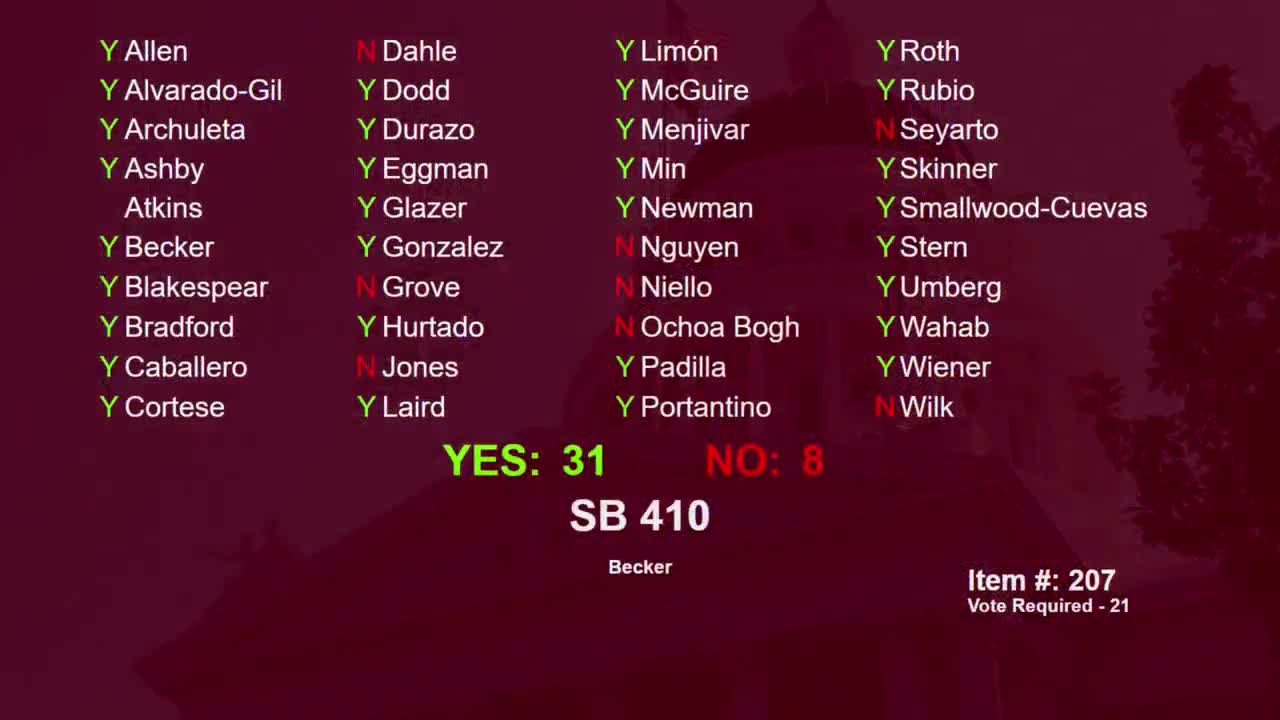 3MIN
Senate Floor
 12MIN
Senate Standing Committee on Housing
 11MIN
Senate Standing Committee on Governance and Finance
Bill Author



