SB 70: Prescription drug coverage.
- Session Year: 2023-2024
- House: Senate
- Latest Version Date: 2023-06-29
Current Status:
Failed
(2023-09-01: September 1 hearing: Held in committee and under submission.)
Introduced
In Committee
First Chamber
In Committee
Second Chamber
Enacted
Existing law, the Knox-Keene Health Care Service Plan Act of 1975, provides for the licensure and regulation of health care service plans by the Department of Managed Health Care, and makes a willful violation of the act a crime. Existing law provides for the regulation of health insurers by the Department of Insurance. Existing law generally authorizes a health care service plan or health insurer to use utilization review, under which a licensed physician or a licensed health care professional who is competent to evaluate specific clinical issues may approve, modify, delay, or deny requests for health care services based on medical necessity. Existing law prohibits a health care service plan contract that covers prescription drug benefits or a specified health insurance policy from limiting or excluding coverage for a drug on the basis that the drug is prescribed for a use that is different from the use for which it was approved by the federal Food and Drug Administration if specified conditions are met. Existing law also prohibits a health care service plan that covers prescription drug benefits from limiting or excluding coverage for a drug that was previously approved for coverage if an enrollee continues to be prescribed that drug, as specified.
This bill would additionally prohibit limiting or excluding coverage of a drug, dose of a drug, or dosage form of a drug that is prescribed for off-label use if the drug has been previously covered for a chronic condition or cancer, as specified, regardless of whether or not the drug, dose, or dosage form is on the plans or insurers formulary. The bill would prohibit a health care service plan contract or health insurance policy from requiring additional cost sharing not already imposed for a drug that was previously approved for coverage. Because a willful violation of these provisions by a health care service plan would be a crime, the bill would impose a state-mandated local program.
The California Constitution requires the state to reimburse local agencies and school districts for certain costs mandated by the state. Statutory provisions establish procedures for making that reimbursement.
This bill would provide that no reimbursement is required by this act for a specified reason.
Existing law, the Knox-Keene Health Care Service Plan Act of 1975, provides for the licensure and regulation of health care service plans by the Department of Managed Health Care, and makes a willful violation of the act a crime. Existing law provides for the regulation of health insurers by the Department of Insurance. Existing law generally authorizes a health care service plan or health insurer to use utilization review, under which a licensed physician or a licensed health care professional who is competent to evaluate specific clinical issues may approve, modify, delay, or deny requests for health care services based on medical necessity. Existing law prohibits a health care service plan contract that covers prescription drug benefits or a specified health insurance policy from limiting or excluding coverage for a drug on the basis that the drug is prescribed for a use that is different from the use for which it was approved by the federal Food and Drug Administration if specified conditions are met. Existing law also prohibits a health care service plan that covers prescription drug benefits from limiting or excluding coverage for a drug that was previously approved for coverage if an enrollee continues to be prescribed that drug, as specified.
This bill would additionally prohibit limiting or excluding coverage of a drug, dose of a drug, or dosage form of a drug that is prescribed for off-label use if the drug has been previously covered for a chronic condition or cancer, regardless of whether or not the drug, dose, or dosage form is on the plans or insurers formulary. The bill would prohibit a health care service plan contract or health insurance policy from requiring additional cost sharing not already imposed for a drug that was previously approved for coverage. Because a willful violation of these provisions by a health care service plan would be a crime, the bill would impose a state-mandated local program.
The California Constitution requires the state to reimburse local agencies and school districts for certain costs mandated by the state. Statutory provisions establish procedures for making that reimbursement.
This bill would provide that no reimbursement is required by this act for a specified reason.
Existing law, the Knox-Keene Health Care Service Plan Act of 1975, provides for the licensure and regulation of health care service plans by the Department of Managed Health Care, and makes a willful violation of the act a crime. Existing law provides for the regulation of health insurers by the Department of Insurance. Existing law generally authorizes a health care service plan or health insurer to use utilization review, under which a licensed physician or a licensed health care professional who is competent to evaluate specific clinical issues may approve, modify, delay, or deny requests for health care services based on medical necessity. Existing law prohibits a health care service plan contract that covers prescription drug benefits or a specified health insurance policy from limiting or excluding coverage for a drug on the basis that the drug is prescribed for a use that is different from the use for which it was approved by the federal Food and Drug Administration if specified conditions are met. Existing law also prohibits a health care service plan that covers prescription drug benefits from limiting or excluding coverage for a drug that was previously approved for coverage if an enrollee continues to be prescribed that drug, as specified.
This bill would expand the above-described prohibitions to additionally prohibit limiting or excluding coverage of a drug, dose of a drug drug, or dosage form, and would apply these prohibitions to a prescription form of a drug that is prescribed for off-label use. use if the drug has been previously covered for a chronic condition or cancer, regardless of whether or not the drug, dose, or dosage form is on the plans or insurers formulary. The bill would prohibit a health care service plan contract or health insurance policy from requiring additional cost sharing not already imposed for a drug that was previously approved for coverage. Because a willful violation of these provisions by a health care service plan would be a crime, the bill would impose a state-mandated local program. The bill would also prohibit a disability insurer that covers prescription drug benefits from limiting or declining coverage for a drug or dose of a drug as prescribed if specified criteria are met.
The California Constitution requires the state to reimburse local agencies and school districts for certain costs mandated by the state. Statutory provisions establish procedures for making that reimbursement.
This bill would provide that no reimbursement is required by this act for a specified reason.
Existing law, the Knox-Keene Health Care Service Plan Act of 1975, provides for the licensure and regulation of health care service plans by the Department of Managed Health Care, and makes a willful violation of the act a crime. Existing law provides for the regulation of health insurers by the Department of Insurance. Existing law generally authorizes a health care service plan or health insurer to use utilization review, under which a licensed physician or a licensed health care professional who is competent to evaluate specific clinical issues may approve, modify, delay, or deny requests for health care services based on medical necessity. Existing law prohibits a health care service plan contract that covers prescription drug benefits or a specified health insurance policy from limiting or excluding coverage for a drug on the basis that the drug is prescribed for a use that is different from the use for which it was approved by the federal Food and Drug Administration if specified conditions are met. Existing law also prohibits a health care service plan that covers prescription drug benefits from limiting or excluding coverage for a drug that was previously approved for coverage if an enrollee continues to be prescribed that drug, as specified.
This bill would expand the above-described prohibitions to prohibit limiting or excluding coverage of a dose of a drug or dosage form, and would apply these prohibitions to a prescription drug that is prescribed for off-label use. The bill would prohibit a health care service plan contract from requiring additional cost sharing not already imposed for a drug that was previously approved for coverage. Because a willful violation of these provisions by a health care service plan would be a crime, the bill would impose a state-mandated local program. The bill would also prohibit a disability insurer that covers prescription drug benefits from limiting or declining coverage for a drug or dose of a drug as prescribed if specified criteria are met.
The California Constitution requires the state to reimburse local agencies and school districts for certain costs mandated by the state. Statutory provisions establish procedures for making that reimbursement.
This bill would provide that no reimbursement is required by this act for a specified reason.
(a)A health care service plan contract that covers prescription drug benefits shall not be issued, amended, delivered, or renewed in this state if the plan limits or excludes coverage for a drug on the basis that the drug is prescribed for a use that is different from the use for which that drug has been approved for marketing by the federal Food and Drug Administration (FDA), if all of the following conditions have been met:
(1)The drug is approved by the FDA.
(2)One of the following is true:
(A)The drug is prescribed by a participating licensed health care professional for the treatment of a life-threatening condition.
(B)The drug is prescribed by a participating licensed health care professional for the treatment of a chronic and seriously debilitating condition, the drug is medically necessary to treat that condition, and the drug is on the plan formulary. If the drug is not on the plan formulary, the participating subscribers request shall be considered pursuant to the process required by Section 1367.24.
(3)The drug has been recognized for treatment of that condition by any of the following:
(A)The American Hospital Formulary Services Drug Information.
(B)One of the following compendia, if recognized by the federal Centers for Medicare and Medicaid Services as part of an anticancer chemotherapeutic regimen:
(i)The Elsevier Gold Standards Clinical Pharmacology.
(ii)The National Comprehensive Cancer Network Drug and Biologics Compendium.
(iii)The Thomson Micromedex DrugDex.
(C)Two articles from major peer-reviewed medical journals that present data supporting the proposed off-label use or uses as generally safe and effective unless there is clear and convincing contradictory evidence presented in a major peer-reviewed medical journal.
(b)A health care service plan contract that covers prescription drug benefits shall not be issued, amended, delivered, or renewed in this state if the plan limits or excludes coverage for a drug, dose of a drug, or dosage form of a drug on the basis that the drug, dose of a drug, or dosage form is prescribed for a use, dose, or dosage form that is different from the use, dose, or dosage form for which the drug has been approved for marketing by the FDA if all of the following conditions have been met:
(1)The drug is approved by the FDA.
(2)One of the following is true:
(A)The drug, dose, or dosage form is prescribed by a participating licensed health care professional for the treatment of a life-threatening condition.
(B)The drug, dose, or dosage form is prescribed by a participating licensed health care professional for the treatment of a chronic and seriously debilitating condition and the drug, dose, or dosage form is medically necessary to treat that condition.
(3)The drug has been recognized for treatment of that condition by any of the following:
(A)The American Hospital Formulary Services Drug Information.
(B)One of the following compendia, if recognized by the federal Centers for Medicare and Medicaid Services as part of an anticancer chemotherapeutic regimen:
(i)The Elsevier Gold Standards Clinical Pharmacology.
(ii)The National Comprehensive Cancer Network Drug and Biologics Compendium.
(iii)The Thomson Micromedex DrugDex.
(C)Two articles from major peer-reviewed medical journals that present data supporting the proposed off-label use or uses as generally safe and effective unless there is clear and convincing contradictory evidence presented in a major peer-reviewed medical journal.
(4)The drug has been previously covered pursuant to Section 1367.22 for a chronic condition or cancer.
(c)It shall be the responsibility of the participating prescriber to submit to the plan documentation supporting compliance with the requirements of subdivisions (a) and (b), if requested by the plan.
(d)Any coverage required by this section shall also include medically necessary services associated with the administration of a drug, subject to the conditions of the contract.
(e)For purposes of this section, life-threatening means either or both of the following:
(1)Diseases or conditions where the likelihood of death is high unless the course of the disease is interrupted.
(2)Diseases or conditions with potentially fatal outcomes, where the end point of clinical intervention is survival.
(f)For purposes of this section, chronic and seriously debilitating means diseases or conditions that require ongoing treatment to maintain remission or prevent deterioration and cause significant long-term morbidity.
(g)The provision of drugs and services when required by this section shall not, in itself, give rise to liability on the part of the plan.
(h)This section does not prohibit the use of a formulary, copayment, technology assessment panel, or similar mechanism as a means for appropriately controlling the utilization of a drug that is prescribed for a use that is different from the use for which that drug has been approved for marketing by the FDA.
(i)If a plan denies coverage pursuant to this section on the basis that its use is experimental or investigational, that decision is subject to review under Section 1370.4.
(j)Health care service plan contracts for the delivery of Medi-Cal services under the Waxman-Duffy Prepaid Health Plan Act (Chapter 8 (commencing with Section 14200) of Part 3 of Division 9 of the Welfare and Institutions Code) are exempt from the requirements of this section.
SEC. 2.Section 1367.22 of the Health and Safety Code is amended to read:1367.22.(a) A health care service plan contract, issued, amended, or renewed on or after July 1, 1999, that covers prescription drug benefits shall not limit or exclude coverage, or require additional cost sharing not already imposed, for a drug, dose of a drug, or dosage form for an enrollee if the drug previously had been approved for coverage by the plan for a medical condition of the enrollee and the plans prescribing provider continues to prescribe the drug for the medical condition, provided that the drug, dose of the drug, or dosage form is appropriately prescribed and is considered safe and effective for treating the enrollees medical condition. This section does not preclude the prescribing provider from prescribing another drug covered by the plan that is medically appropriate for the enrollee, and does not prohibit generic drug substitutions as authorized by Section 4073 of the Business and Professions Code. For purposes of this section, a prescribing provider shall include a provider authorized to write a prescription, pursuant to subdivision (a) of Section 4059 of the Business and Professions Code, to treat a medical condition of an enrollee.
(b)This section shall not be construed to restrict or impair the application of any other provision of this chapter, including, but not limited to, Section 1367, which includes among its requirements that plans furnish services in a manner providing continuity of care and demonstrate that medical decisions are rendered by qualified medical providers unhindered by fiscal and administrative management. With respect to cost sharing, this shall not be construed to affect application of a deductible or coinsurance, or cost-sharing changes associated with contract changes at renewal. If the change of dosage or dosage form results in coverage of a drug in a higher tier, the plan may charge additional cost sharing associated with that tier.
(c)This section does not prohibit a health care service plan from charging a subscriber or enrollee a copayment or a deductible for prescription drug benefits or from setting forth, by contract, limitations on maximum coverage of prescription drug benefits, provided that the copayments, deductibles, or limitations are reported to, and held unobjectionable by, the director and set forth to the subscriber or enrollee pursuant to the disclosure provisions of Section 1363.
(d)This section applies to a prescription drug that is prescribed off-label in accordance with Section 1367.21.
SEC. 3.Section 10123.190 is added to the Insurance Code, to read:10123.190.(a)A health insurance policy that covers prescription drugs that is issued, amended, or renewed on or after January 1, 2024, shall not limit or exclude coverage, or require authorization or additional cost sharing for a drug, dosage of a drug, or dosage form of a drug if the insurer had previously approved coverage of the drug for a health condition, and a participating provider continues to prescribe the drug for the condition, if the drug, dosage, or dosage form of the drug was prescribed appropriately and is considered safe and effective for an insureds health condition under current generally accepted standards of care. With respect to cost sharing, this shall not be construed to affect application of a deductible or coinsurance, or cost-sharing changes associated with policy changes at renewal. If the change of dosage or dosage form results in coverage of a drug in a higher tier, the insurer may charge additional cost sharing associated with that tier.
(b)A prescription drug is prescribed appropriately if a provider is authorized to prescribe or furnish the drug within the providers scope of practice. This section does not preclude a participating provider from prescribing or furnishing another drug that is clinically appropriate for an insured or prohibit generic drug substitution as authorized by Section 4073 of the Business and Professions Code.
(c)This section applies to a prescription drug that was prescribed off-label, including in accordance with Section 10123.195. This section does not apply to a Medicare supplement policy or a specialized health insurance policy that covers only dental or vision benefits.
(d)The commissioner may promulgate regulations subject to the Administrative Procedure Act (Chapter 3.5 (commencing with Section 11340) of Part 1 of Division 3 of Title 2 of the Government Code) to implement and enforce this section. In addition to any other remedies that are available to the commissioner for a violation of this code, the commissioner may enforce this section pursuant to Chapter 4.5 (commencing with Section 11400) or Chapter 5 (commencing with Section 11500) of Part 1 of Division 3 of Title 2 of the Government Code. This subdivision does not impair or restrict the commissioners authority pursuant to another provision of this code or the Administrative Procedure Act.
SEC. 4.Section 10123.195 of the Insurance Code is amended to read:10123.195.(a)An individual or group health insurance policy issued, delivered, or renewed in this state, or a certificate of group insurance issued, delivered, or renewed in this state pursuant to a master group policy issued, delivered, or renewed in another state, that directly or indirectly covers prescription drugs shall not limit or exclude coverage for a drug on the basis that the drug is prescribed for a use that is different from the use for which that drug has been approved for marketing by the federal Food and Drug Administration (FDA), if all of the following conditions have been met:
(1)The drug is approved by the FDA or is legally marketed without FDA approval.
(2)One of the following is true:
(A)The drug is prescribed by a contracting licensed health care professional for the treatment of a life-threatening condition.
(B)The drug is prescribed by a contracting licensed health care professional for the treatment of a chronic and seriously debilitating condition, the drug is medically necessary to treat that condition, and the drug is on the insurers formulary, if any. If the drug is not on the insurers formulary, the participating prescribers request shall be considered pursuant to the process required by Section 10123.191.
(3)The drug has been recognized for treatment of that condition by any of the following:
(A)The American Hospital Formulary Services Drug Information.
(B)One of the following compendia, if recognized by the federal Centers for Medicare and Medicaid Services as part of an anticancer chemotherapeutic regimen:
(i)The Elsevier Gold Standards Clinical Pharmacology.
(ii)The National Comprehensive Cancer Network Drug and Biologics Compendium.
(iii)The Thomson Micromedex DrugDex.
(C)Two articles from major peer-reviewed medical journals that present data supporting the proposed off-label use or uses as generally safe and effective unless there is clear and convincing contradictory evidence presented in a major peer-reviewed medical journal.
(b)An individual or group health insurance policy issued, delivered, or renewed in this state, or a certificate of group insurance issued, delivered, or renewed in this state pursuant to a master group policy issued, delivered, or renewed in another state, that directly or indirectly covers prescription drugs shall not limit or exclude coverage for a drug, dose of a drug, or dosage form of a drug on the basis that the drug, dose of a drug, or dosage form is prescribed for a use, dose, or dosage form that is different from the use, dose, or dosage form for which the drug has been approved for marketing by the FDA if all of the following conditions have been met:
(1)The drug is approved by the FDA or is legally marketed without FDA approval.
(2)One of the following is true:
(A)The drug, dose, or dosage form is prescribed by a contracting licensed health care professional for the treatment of a life-threatening condition or health condition as provided by Section 10123.1961.
(B)The drug, dose, or dosage form is prescribed by a contracting licensed health care professional for the treatment of a chronic and seriously debilitating health condition and the drug, dose, or dosage form is clinically appropriate to treat that condition. If the prescription drug is not covered or not covered off-label, then clinical appropriateness shall be determined solely in accordance with paragraph (3).
(3)The drug has been recognized for treatment of that condition by any of the following:
(A)The American Hospital Formulary Services Drug Information.
(B)One of the following compendia, if recognized by the federal Centers for Medicare and Medicaid Services as part of an anticancer chemotherapeutic regimen:
(i)The Elsevier Gold Standards Clinical Pharmacology.
(ii)The National Comprehensive Cancer Network Drug and Biologics Compendium.
(iii)The Thomson Micromedex DrugDex.
(C)Two articles from major peer-reviewed medical journals that present data supporting the proposed off-label use or uses as generally safe and effective unless there is clear and convincing contradictory evidence presented in a major peer-reviewed medical journal.
(4)The In the case of the dose or dosage form of the drug, the drug has been previously covered pursuant to Section 10123.190 for a chronic condition or cancer.
(c)It shall be the responsibility of the contracting prescriber to submit to the insurer documentation supporting compliance with the requirements of subdivisions (a) and (b), if requested by the insurer. With respect to a request for coverage of a prescription drug pursuant to Section 10123.191, it shall be the responsibility of the health insurer to determine whether or not this section applies to the request, and to request any additional or omitted information that is needed to make a coverage determination pursuant to the request under the requirements of this section and Section 10123.191.
(d)Any coverage required by this section shall also include medically necessary services associated with the administration of a drug.
(e)For purposes of this section, life-threatening means either or both of the following:
(1)Diseases or conditions where the likelihood of death is high unless the course of the disease is interrupted.
(2)Diseases or conditions with potentially fatal outcomes, where the end point of clinical intervention is survival.
(f)For purposes of this section, chronic and seriously debilitating means diseases or conditions that require ongoing treatment to maintain remission or prevent deterioration and cause significant long-term morbidity.
(g)The provision of drugs and services when required by this section shall not, in itself, give rise to liability on the part of the insurer.
(h)This section shall not apply to a policy of insurance that covers health care expenses and that is issued outside of California to an employer whose principal place of business and majority of employees are located outside of California.
(i)If an insurer denies coverage pursuant to this section on the basis that off-label use of a prescription drug is experimental, investigational, or not clinically appropriate, or for any other reason, that decision is subject to review under the Independent Medical Review System of Article 3.5 (commencing with Section 10169).
(j)This section is not applicable to vision-only, dental-only, or Medicare supplement insurance policies.
(k)The commissioner may promulgate regulations subject to the Administrative Procedure Act (Chapter 3.5 (commencing with Section 11340) of Part 1 of Division 3 of Title 2 of the Government Code) to implement and enforce this section. In addition to any other remedies that are available to the commissioner for a violation of this code, the commissioner may enforce this section pursuant to Chapter 4.5 (commencing with Section 11400) or Chapter 5 (commencing with Section 11500) of Part 1 of Division 3 of Title 2 of the Government Code. This subdivision does not impair or restrict the commissioners authority pursuant to another provision of this code or the Administrative Procedure Act.
SEC. 5.No reimbursement is required by this act pursuant to Section 6 of Article XIIIB of the California Constitution because the only costs that may be incurred by a local agency or school district will be incurred because this act creates a new crime or infraction, eliminates a crime or infraction, or changes the penalty for a crime or infraction, within the meaning of Section 17556 of the Government Code, or changes the definition of a crime within the meaning of Section 6 of Article XIIIB of the California Constitution.
(a)A health care service plan contract that covers prescription drug benefits shall not be issued, amended, delivered, or renewed in this state if the plan limits or excludes coverage for a drug on the basis that the drug is prescribed for a use that is different from the use for which that drug has been approved for marketing by the federal Food and Drug Administration (FDA), if all of the following conditions have been met:
(1)The drug is approved by the FDA.
(2)One of the following is true:
(A)The drug is prescribed by a participating licensed health care professional for the treatment of a life-threatening condition.
(B)The drug is prescribed by a participating licensed health care professional for the treatment of a chronic and seriously debilitating condition, the drug is medically necessary to treat that condition, and the drug is on the plan formulary. If the drug is not on the plan formulary, the participating subscribers request shall be considered pursuant to the process required by Section 1367.24.
(3)The drug has been recognized for treatment of that condition by any of the following:
(A)The American Hospital Formulary Services Drug Information.
(B)One of the following compendia, if recognized by the federal Centers for Medicare and Medicaid Services as part of an anticancer chemotherapeutic regimen:
(i)The Elsevier Gold Standards Clinical Pharmacology.
(ii)The National Comprehensive Cancer Network Drug and Biologics Compendium.
(iii)The Thomson Micromedex DrugDex.
(C)Two articles from major peer reviewed peer-reviewed medical journals that present data supporting the proposed off-label use or uses as generally safe and effective unless there is clear and convincing contradictory evidence presented in a major peer reviewed peer-reviewed medical journal.
(b)A health care service plan contract that covers prescription drug benefits shall not be issued, amended, delivered, or renewed in this state if the plan limits or excludes coverage for a drug, dose of a drug, or dosage form of a drug on the basis that the drug, dose of a drug, or dosage form is prescribed for a use, dose, or dosage form that is different from the use, dose, or dosage form for which the drug has been approved for marketing by the FDA if all of the following conditions have been met:
(1)The drug is approved by the FDA.
(2)One of the following is true:
(A)The drug, dose, or dosage form is prescribed by a participating licensed health care professional for the treatment of a life-threatening condition.
(B)The drug, dose, or dosage form is prescribed by a participating licensed health care professional for the treatment of a chronic and seriously debilitating condition and the drug, dose, or dosage form is medically necessary to treat that condition.
(3)The drug has been recognized for treatment of that condition by any of the following:
(A)The American Hospital Formulary Services Drug Information.
(B)One of the following compendia, if recognized by the federal Centers for Medicare and Medicaid Services as part of an anticancer chemotherapeutic regimen:
(i)The Elsevier Gold Standards Clinical Pharmacology.
(ii)The National Comprehensive Cancer Network Drug and Biologics Compendium.
(iii)The Thomson Micromedex DrugDex.
(C)Two articles from major peer reviewed peer-reviewed medical journals that present data supporting the proposed off-label use or uses as generally safe and effective unless there is clear and convincing contradictory evidence presented in a major peer reviewed peer-reviewed medical journal.
(4)The drug has been previously covered pursuant to Section 1367.22 for a chronic condition or cancer.
(c)It shall be the responsibility of the participating prescriber to submit to the plan documentation supporting compliance with the requirements of subdivisions (a) and (b), if requested by the plan.
(d)Any coverage required by this section shall also include medically necessary services associated with the administration of a drug, subject to the conditions of the contract.
(e)For purposes of this section, life-threatening means either or both of the following:
(1)Diseases or conditions where the likelihood of death is high unless the course of the disease is interrupted.
(2)Diseases or conditions with potentially fatal outcomes, where the end point of clinical intervention is survival.
(f)For purposes of this section, chronic and seriously debilitating means diseases or conditions that require ongoing treatment to maintain remission or prevent deterioration and cause significant long-term morbidity.
(g)The provision of drugs and services when required by this section shall not, in itself, give rise to liability on the part of the plan.
(h)This section does not prohibit the use of a formulary, copayment, technology assessment panel, or similar mechanism as a means for appropriately controlling the utilization of a drug that is prescribed for a use that is different from the use for which that drug has been approved for marketing by the FDA.
(i)If a plan denies coverage pursuant to this section on the basis that its use is experimental or investigational, that decision is subject to review under Section 1370.4.
(j)Health care service plan contracts for the delivery of Medi-Cal services under the Waxman-Duffy Prepaid Health Plan Act (Chapter 8 (commencing with Section 14200) of Part 3 of Division 9 of the Welfare and Institutions Code) are exempt from the requirements of this section.
SEC. 2.Section 1367.22 of the Health and Safety Code is amended to read:1367.22.(a) A health care service plan contract, issued, amended, or renewed on or after July 1, 1999, that covers prescription drug benefits shall not limit or exclude coverage, or require additional cost sharing not already imposed, for a drug, dose of a drug, or dosage form for an enrollee if the drug previously had been approved for coverage by the plan for a medical condition of the enrollee and the plans prescribing provider continues to prescribe the drug for the medical condition, provided that the drug, dose of the drug, or dosage form is appropriately prescribed and is considered safe and effective for treating the enrollees medical condition. This section does not preclude the prescribing provider from prescribing another drug covered by the plan that is medically appropriate for the enrollee, and does not prohibit generic drug substitutions as authorized by Section 4073 of the Business and Professions Code. For purposes of this section, a prescribing provider shall include a provider authorized to write a prescription, pursuant to subdivision (a) of Section 4059 of the Business and Professions Code, to treat a medical condition of an enrollee.
(b)This section shall not be construed to restrict or impair the application of any other provision of this chapter, including, but not limited to, Section 1367, which includes among its requirements that plans furnish services in a manner providing continuity of care and demonstrate that medical decisions are rendered by qualified medical providers unhindered by fiscal and administrative management. With respect to cost sharing, this shall not be construed to affect application of a deductible or coinsurance, or cost-sharing changes associated with contract changes at renewal. If the change of dosage or dosage form results in coverage of a drug in a higher tier, the plan may charge additional cost sharing associated with that tier.
(c)This section does not prohibit a health care service plan from charging a subscriber or enrollee a copayment or a deductible for prescription drug benefits or from setting forth, by contract, limitations on maximum coverage of prescription drug benefits, provided that the copayments, deductibles, or limitations are reported to, and held unobjectionable by, the director and set forth to the subscriber or enrollee pursuant to the disclosure provisions of Section 1363.
(d)This section applies to a prescription drug that is prescribed off-label in accordance with Section 1367.21.
SEC. 3.Section 10123.190 is added to the Insurance Code, to read:10123.190.(a)A health insurance policy that covers prescription drugs that is issued, amended, or renewed on or after January 1, 2024, shall not limit or exclude coverage, or require authorization or additional cost sharing that is not generally applicable to drugs covered by the policy, for a drug, dosage of a drug, or dosage form of a drug if a plan or the insurer had previously approved coverage of the drug for a health condition, and a participating provider continues to prescribe the drug for the condition, if the drug, dosage, or dosage form of the drug was prescribed appropriately and is considered safe and effective for an insureds health condition under current generally accepted standards of care. With respect to cost sharing, this shall not be construed to affect application of a deductible or coinsurance, or cost-sharing changes associated with policy changes at renewal. If the change of dosage or dosage form results in coverage of a drug in a higher tier, the insurer may charge additional cost sharing associated with that tier.
(b)A prescription drug is prescribed appropriately if a provider is authorized to prescribe or furnish the drug within the providers scope of practice. This section does not preclude a participating provider from prescribing or furnishing another drug that is clinically appropriate for an insured or prohibit generic drug substitution as authorized by Section 4073 of the Business and Professions Code.
(c)This section applies to a prescription drug that was prescribed off-label, including in accordance with Section 10123.195. This section does not apply to a Medicare supplement policy or a specialized health insurance policy that covers only dental or vision benefits.
(d)The commissioner may promulgate regulations subject to the Administrative Procedure Act (Chapter 3.5 (commencing with Section 11340) of Part 1 of Division 3 of Title 2 of the Government Code) to implement and enforce this section. In addition to any other remedies that are available to the commissioner for a violation of this code, the commissioner may enforce this article section pursuant to Chapter 4.5 (commencing with Section 11400) or Chapter 5 (commencing with Section 11500) of Part 1 of Division 3 of Title 2 of the Government Code. This subdivision does not impair or restrict the commissioners authority pursuant to another provision of this code or the Administrative Procedure Act.
SEC. 4.Section 10123.195 of the Insurance Code is amended to read:10123.195.(a)An individual or group health insurance policy issued, delivered, or renewed in this state, or a certificate of group insurance issued, delivered, or renewed in this state pursuant to a master group policy issued, delivered, or renewed in another state, that directly or indirectly covers prescription drugs shall not limit or exclude coverage for a drug on the basis that the drug is prescribed for a use that is different from the use for which that drug has been approved for marketing by the federal Food and Drug Administration (FDA), if all of the following conditions have been met:
(1)The drug is approved by the FDA or is legally marketed without FDA approval.
(2)One of the following is true:
(A)The drug is prescribed by a contracting licensed health care professional for the treatment of a life-threatening condition.
(B)The drug is prescribed by a contracting licensed health care professional for the treatment of a chronic and seriously debilitating condition, the drug is medically necessary to treat that condition, and the drug is on the insurers formulary, if any.
(3)The drug has been recognized for treatment of that condition by any of the following:
(A)The American Hospital Formulary Services Drug Information.
(B)One of the following compendia, if recognized by the federal Centers for Medicare and Medicaid Services as part of an anticancer chemotherapeutic regimen:
(i)The Elsevier Gold Standards Clinical Pharmacology.
(ii)The National Comprehensive Cancer Network Drug and Biologics Compendium.
(iii)The Thomson Micromedex DrugDex.
(C)Two articles from major peer reviewed peer-reviewed medical journals that present data supporting the proposed off-label use or uses as generally safe and effective unless there is clear and convincing contradictory evidence presented in a major peer reviewed peer-reviewed medical journal.
(b)An individual or group health insurance policy issued, delivered, or renewed in this state, or a certificate of group insurance issued, delivered, or renewed in this state pursuant to a master group policy issued, delivered, or renewed in another state, that directly or indirectly covers prescription drugs shall not limit or exclude coverage for a drug, dose of a drug, or dosage form of a drug on the basis that the drug, dose of a drug, or dosage form is prescribed for a use, dose, or dosage form that is different from the use, dose, or dosage form for which the drug has been approved for marketing by the FDA if all of the following conditions have been met:
(1)The drug is approved by the FDA or is legally marketed without FDA approval.
(2)One of the following is true:
(A)The drug, dose, or dosage form is prescribed by a contracting licensed health care professional for the treatment of a life-threatening condition or health condition as provided by Section 10123.1961.
(B)The drug, dose, or dosage form is prescribed by a contracting licensed health care professional for the treatment of a chronic and seriously debilitating health condition and the drug, dose, or dosage form is clinically appropriate to treat that condition. If the prescription drug is not covered or not covered off-label, then clinical appropriateness shall be determined solely in accordance with paragraph (3).
(3)The drug has been recognized for treatment of that condition by any of the following:
(A)The American Hospital Formulary Services Drug Information.
(B)One of the following compendia, if recognized by the federal Centers for Medicare and Medicaid Services as part of an anticancer chemotherapeutic regimen:
(i)The Elsevier Gold Standards Clinical Pharmacology.
(ii)The National Comprehensive Cancer Network Drug and Biologics Compendium.
(iii)The Thomson Micromedex DrugDex.
(C)Two articles from major peer reviewed peer-reviewed medical journals that present data supporting the proposed off-label use or uses as generally safe and effective unless there is clear and convincing contradictory evidence presented in a major peer reviewed peer-reviewed medical journal.
(4)The drug has been previously covered pursuant to Section 10123.190 for a chronic condition or cancer.
(c)It shall be the responsibility of the contracting prescriber to submit to the insurer documentation supporting compliance with the requirements of subdivisions (a) and (b), if requested by the insurer. With respect to a request for coverage of a prescription drug pursuant to Section 10123.191, it shall be the responsibility of the health insurer to determine whether or not this section applies to the request, and to request any additional or omitted information that is needed to make a coverage determination pursuant to the request under the requirements of this section and Section 10123.191.
(d)Any coverage required by this section shall also include medically necessary services associated with the administration of a drug.
(e)For purposes of this section, life-threatening means either or both of the following:
(1)Diseases or conditions where the likelihood of death is high unless the course of the disease is interrupted.
(2)Diseases or conditions with potentially fatal outcomes, where the end point of clinical intervention is survival.
(f)For purposes of this section, chronic and seriously debilitating means diseases or conditions that require ongoing treatment to maintain remission or prevent deterioration and cause significant long-term morbidity.
(g)The provision of drugs and services when required by this section shall not, in itself, give rise to liability on the part of the insurer.
(h)This section shall not apply to a policy of insurance that covers health care expenses and that is issued outside of California to an employer whose principal place of business and majority of employees are located outside of California.
(i)If an insurer denies coverage pursuant to this section on the basis that off-label use of a prescription drug is experimental, investigational, or not clinically appropriate, or for any other reason, that decision is subject to review under the Independent Medical Review System of Article 3.5 (commencing with Section 10169).
(j)This section is not applicable to vision-only, dental-only, or Medicare supplement insurance policies.
(k)The commissioner may promulgate regulations subject to the Administrative Procedure Act (Chapter 3.5 (commencing with Section 11340) of Part 1 of Division 3 of Title 2 of the Government Code) to implement and enforce this section. In addition to any other remedies that are available to the commissioner for a violation of this code, the commissioner may enforce this article section pursuant to Chapter 4.5 (commencing with Section 11400) or Chapter 5 (commencing with Section 11500) of Part 1 of Division 3 of Title 2 of the Government Code. This subdivision does not impair or restrict the commissioners authority pursuant to another provision of this code or the Administrative Procedure Act.
SEC. 5.No reimbursement is required by this act pursuant to Section 6 of Article XIIIB of the California Constitution because the only costs that may be incurred by a local agency or school district will be incurred because this act creates a new crime or infraction, eliminates a crime or infraction, or changes the penalty for a crime or infraction, within the meaning of Section 17556 of the Government Code, or changes the definition of a crime within the meaning of Section 6 of Article XIIIB of the California Constitution.
(a)A health care service plan contract that covers prescription drug benefits shall not be issued, amended, delivered, or renewed in this state if the plan limits or excludes coverage for a drug, dose of a drug, or dosage form drug on the basis that the drug, dose of the drug, or dosage form drug is prescribed for a use, dose, or dosage form use that is different from the use, dose, or dosage form use for which that drug has been approved for marketing by the federal Food and Drug Administration (FDA), provided that if all of the following conditions have been met:
(1)The drug is approved by the FDA.
(2)One of the following is true:
(A)The drug is prescribed by a participating licensed health care professional for the treatment of a life-threatening condition.
(B)The drug is prescribed by a participating licensed health care professional for the treatment of a chronic and seriously debilitating condition and condition, the drug is medically necessary to treat that condition. condition, and the drug is on the plan formulary. If the drug is not on the plan formulary, the participating subscribers request shall be considered pursuant to the process required by Section 1367.24.
(3)The drug has been recognized for treatment of that condition by any of the following:
(A)The American Hospital Formulary Services Drug Information.
(B)One of the following compendia, if recognized by the federal Centers for Medicare and Medicaid Services as part of an anticancer chemotherapeutic regimen:
(i)The Elsevier Gold Standards Clinical Pharmacology.
(ii)The National Comprehensive Cancer Network Drug and Biologics Compendium.
(iii)The Thomson Micromedex DrugDex.
(C)Two articles from major peer reviewed medical journals that present data supporting the proposed off-label use or uses as generally safe and effective unless there is clear and convincing contradictory evidence presented in a major peer reviewed medical journal.
(b)A health care service plan contract that covers prescription drug benefits shall not be issued, amended, delivered, or renewed in this state if the plan limits or excludes coverage for a drug, dose of a drug, or dosage form of a drug on the basis that the drug, dose of a drug, or dosage form is prescribed for a use, dose, or dosage form that is different from the use, dose, or dosage form for which the drug has been approved for marketing by the FDA if all of the following conditions have been met:
(1)The drug is approved by the FDA.
(2)One of the following is true:
(A)The drug, dose, or dosage form is prescribed by a participating licensed health care professional for the treatment of a life-threatening condition.
(B)The drug, dose, or dosage form is prescribed by a participating licensed health care professional for the treatment of a chronic and seriously debilitating condition and the drug, dose, or dosage form is medically necessary to treat that condition.
(3)The drug has been recognized for treatment of that condition by any of the following:
(A)The American Hospital Formulary Services Drug Information.
(B)One of the following compendia, if recognized by the federal Centers for Medicare and Medicaid Services as part of an anticancer chemotherapeutic regimen:
(i)The Elsevier Gold Standards Clinical Pharmacology.
(ii)The National Comprehensive Cancer Network Drug and Biologics Compendium.
(iii)The Thomson Micromedex DrugDex.
(C)Two articles from major peer reviewed medical journals that present data supporting the proposed off-label use or uses as generally safe and effective unless there is clear and convincing contradictory evidence presented in a major peer reviewed medical journal.
(4)The drug has been previously covered pursuant to Section 1367.22 for a chronic condition or cancer.
(b)(c)It shall be the responsibility of the participating prescriber to submit to the plan documentation supporting compliance with the requirements of subdivision (a), subdivisions (a) and (b), if requested by the plan.
(c)(d)Any coverage required by this section shall also include medically necessary services associated with the administration of a drug, subject to the conditions of the contract.
(d)(e)For purposes of this section, life-threatening means either or both of the following:
(1)Diseases or conditions where the likelihood of death is high unless the course of the disease is interrupted.
(2)Diseases or conditions with potentially fatal outcomes, where the end point of clinical intervention is survival.
(e)(f)For purposes of this section, chronic and seriously debilitating means diseases or conditions that require ongoing treatment to maintain remission or prevent deterioration and cause significant long-term morbidity.
(f)(g)The provision of drugs and services when required by this section shall not, in itself, give rise to liability on the part of the plan.
(g)(h)This section does not prohibit the use of a formulary, copayment, technology assessment panel, or similar mechanism as a means for appropriately controlling the utilization of a drug that is prescribed for a use that is different from the use for which that drug has been approved for marketing by the FDA.
(h)(i)If a plan denies coverage pursuant to this section on the basis that its use is experimental or investigational, that decision is subject to review under Section 1370.4.
(i)(j)Health care service plan contracts for the delivery of Medi-Cal services under the Waxman-Duffy Prepaid Health Plan Act (Chapter 8 (commencing with Section 14200) of Part 3 of Division 9 of the Welfare and Institutions Code) are exempt from the requirements of this section.
SEC. 2.Section 1367.22 of the Health and Safety Code is amended to read:1367.22.(a) A health care service plan contract, issued, amended, or renewed on or after July 1, 1999, that covers prescription drug benefits shall not limit or exclude coverage, or require additional cost sharing not already imposed, for a drug, dose of a drug, or dosage form for an enrollee if the drug previously had been approved for coverage by the plan for a medical condition of the enrollee and the plans prescribing provider continues to prescribe the drug for the medical condition, provided that the drug, dose of the drug, or dosage form is appropriately prescribed and is considered safe and effective for treating the enrollees medical condition. This section does not preclude the prescribing provider from prescribing another drug covered by the plan that is medically appropriate for the enrollee, and does not prohibit generic drug substitutions as authorized by Section 4073 of the Business and Professions Code. For purposes of this section, a prescribing provider shall include a provider authorized to write a prescription, pursuant to subdivision (a) of Section 4059 of the Business and Professions Code, to treat a medical condition of an enrollee.
(b)This section shall not be construed to restrict or impair the application of any other provision of this chapter, including, but not limited to, Section 1367, which includes among its requirements that plans furnish services in a manner providing continuity of care and demonstrate that medical decisions are rendered by qualified medical providers unhindered by fiscal and administrative management.
(c)This section does not prohibit a health care service plan from charging a subscriber or enrollee a copayment or a deductible for prescription drug benefits or from setting forth, by contract, limitations on maximum coverage of prescription drug benefits, provided that the copayments, deductibles, or limitations are reported to, and held unobjectionable by, the director and set forth to the subscriber or enrollee pursuant to the disclosure provisions of Section 1363.
(d)This section applies to a prescription drug that is prescribed off-label in accordance with Section 1367.21.
SEC. 3.Section 10123.190 is added to the Insurance Code, to read:10123.190.(a)(1)Notwithstanding Sections 10123.13, 10123.191, and 10123.201, or another section of this code to the contrary, a disability insurer that provides coverage for prescription drugs shall not limit or decline to cover a drug or dose of a drug as prescribed, or impose additional cost sharing for covering a drug as prescribed, if all the following apply:(A)An insured is undergoing a current course of treatment with the prescription drug for a covered medical condition or is seeking an authorization for continued coverage within a month of the date of expiration of the last prescription or refill.(B)The drug was previously covered by the insurer or the insureds prior private or public health care coverage for the insureds medical condition.(C)A prescribing provider prescribed the drug for the insureds medical condition, and the drug is appropriately prescribed and considered safe and effective under generally accepted standards of medical care for treating the insureds medical condition.(2)An insurer that verifies that a condition in paragraph (1) is satisfied shall not delay or deny coverage during the verification process, except if a drug is unsafe as prescribed. If a drug is unsafe as prescribed, an insurer shall notify the provider of its coverage determination, as provided by Section 10123.191. If an insurer determines that another condition in paragraph (1) is unsatisfied, it shall comply with Section 10123.13.(3)This subdivision does not do any of the following:(A)Preclude a provider from prescribing another drug that is clinically appropriate for an insured.(B)Prohibit generic drug substitutions under Section 4073 of the Business and Professions Code.(b)This section applies to a prescription drug that is prescribed off-label in accordance with Section 10123.195.(c)This section applies to a disability insurer and disability insurance policy that provides coverage for hospital, medical, surgical, or prescription drug benefits. This section does not apply to the insurance listed in paragraphs (1) through (8) of subdivision (b) of Section 106, a specialized health insurance policy that provides coverage only for dental or vision benefits, or a Medicare supplement policy.SEC. 3.Section 10123.190 is added to the Insurance Code, to read:10123.190.(a)A health insurance policy that covers prescription drugs that is issued, amended, or renewed on or after January 1, 2024, shall not limit or exclude coverage, or require authorization or additional cost sharing that is not generally applicable to drugs covered by the policy, for a drug, dosage of a drug, or dosage form of a drug if a plan or insurer had previously approved coverage of the drug for a health condition, and a participating provider continues to prescribe the drug for the condition, if the drug, dosage, or dosage form of the drug was prescribed appropriately and is considered safe and effective for an insureds health condition under current generally accepted standards of care.
(b)A prescription drug is prescribed appropriately if a provider is authorized to prescribe or furnish the drug within the providers scope of practice. This section does not preclude a participating provider from prescribing or furnishing another drug that is clinically appropriate for an insured or prohibit generic drug substitution as authorized by Section 4073 of the Business and Professions Code.
(c)This section applies to a prescription drug that was prescribed off-label, including in accordance with Section 10123.195. This section does not apply to a Medicare supplement policy or a specialized health insurance policy that covers only dental or vision benefits.
(d)The commissioner may promulgate regulations subject to the Administrative Procedure Act (Chapter 3.5 (commencing with Section 11340) of Part 1 of Division 3 of Title 2 of the Government Code) to implement and enforce this section. In addition to any other remedies that are available to the commissioner for a violation of this code, the commissioner may enforce this article pursuant to Chapter 4.5 (commencing with Section 11400) or Chapter 5 (commencing with Section 11500) of Part 1 of Division 3 of Title 2 of the Government Code. This subdivision does not impair or restrict the commissioners authority pursuant to another provision of this code or the Administrative Procedure Act.
SEC. 4.Section 10123.195 of the Insurance Code is amended to read:10123.195.(a)A group, blanket, or individual disability An individual or group health insurance policy issued, delivered, or renewed in this state or state, or a certificate of group or blanket disability insurance issued, delivered, or renewed in this state pursuant to a master group policy issued, delivered, or renewed in another state that, as a provision of hospital, medical, or surgical services, state, that directly or indirectly covers prescription drugs shall not limit or exclude coverage for a drug, dose of a drug, or dosage form drug on the basis that the drug, dose of the drug, or dosage form drug is prescribed for a use, dose, or dosage form use that is different from the use, dose, or dosage form use for which that drug has been approved for marketing by the federal Food and Drug Administration (FDA), provided that if all of the following conditions have been met:
(1)The drug is approved by the FDA. FDA or is legally marketed without FDA approval.
(2)One of the following is true:
(A)The drug is prescribed by a contracting licensed health care professional for the treatment of a life-threatening condition.
(B)The drug is prescribed by a contracting licensed health care professional for the treatment of a chronic and seriously debilitating condition, the drug is medically necessary to treat that condition, and the drug is on the insurers formulary, if any.
(3)The drug has been recognized for treatment of that condition by any of the following:
(A)The American Hospital Formulary Services Drug Information.
(B)One of the following compendia, if recognized by the federal Centers for Medicare and Medicaid Services as part of an anticancer chemotherapeutic regimen:
(i)The Elsevier Gold Standards Clinical Pharmacology.
(ii)The National Comprehensive Cancer Network Drug and Biologics Compendium.
(iii)The Thomson Micromedex DrugDex.
(C)Two articles from major peer reviewed medical journals that present data supporting the proposed off-label use or uses as generally safe and effective unless there is clear and convincing contradictory evidence presented in a major peer reviewed medical journal.
(b)An individual or group health insurance policy issued, delivered, or renewed in this state, or a certificate of group insurance issued, delivered, or renewed in this state pursuant to a master group policy issued, delivered, or renewed in another state, that directly or indirectly covers prescription drugs shall not limit or exclude coverage for a drug, dose of a drug, or dosage form of a drug on the basis that the drug, dose of a drug, or dosage form is prescribed for a use, dose, or dosage form that is different from the use, dose, or dosage form for which the drug has been approved for marketing by the FDA if all of the following conditions have been met:
(1)The drug is approved by the FDA or is legally marketed without FDA approval.
(2)One of the following is true:
(A)The drug, dose, or dosage form is prescribed by a contracting licensed health care professional for the treatment of a life-threatening condition or health condition as provided by Section 10123.1961.
(B)The drug, dose, or dosage form is prescribed by a contracting licensed health care professional for the treatment of a chronic and seriously debilitating health condition and the drug, dose, or dosage form is clinically appropriate to treat that condition. If the prescription drug is not covered or not covered off-label, then clinical appropriateness shall be determined solely in accordance with paragraph (3).
(3)The drug has been recognized for treatment of that condition by any of the following:
(A)The American Hospital Formulary Services Drug Information.
(B)One of the following compendia, if recognized by the federal Centers for Medicare and Medicaid Services as part of an anticancer chemotherapeutic regimen:
(i)The Elsevier Gold Standards Clinical Pharmacology.
(ii)The National Comprehensive Cancer Network Drug and Biologics Compendium.
(iii)The Thomson Micromedex DrugDex.
(C)Two articles from major peer reviewed medical journals that present data supporting the proposed off-label use or uses as generally safe and effective unless there is clear and convincing contradictory evidence presented in a major peer reviewed medical journal.
(4)The drug has been previously covered pursuant to Section 10123.190 for a chronic condition or cancer.
(b)(c)It shall be the responsibility of the contracting prescriber to submit to the insurer documentation supporting compliance with the requirements of subdivision (a), subdivisions (a) and (b), if requested by the insurer. With respect to a request for coverage of a prescription drug pursuant to Section 10123.191, it shall be the responsibility of the health insurer to determine whether or not this section applies to the request, and to request any additional or omitted information that is needed to make a coverage determination pursuant to the request under the requirements of this section and Section 10123.191.
(c)(d)Any coverage required by this section shall also include medically necessary services associated with the administration of a drug subject to the conditions of the contract. drug.
(d)(e)For purposes of this section, life-threatening means either or both of the following:
(1)Diseases or conditions where the likelihood of death is high unless the course of the disease is interrupted.
(2)Diseases or conditions with potentially fatal outcomes, where the end point of clinical intervention is survival.
(e)(f)For purposes of this section, chronic and seriously debilitating means diseases or conditions that require ongoing treatment to maintain remission or prevent deterioration and cause significant long-term morbidity.
(f)(g)The provision of drugs and services when required by this section shall not, in itself, give rise to liability on the part of the insurer.
(g)(h)This section shall not apply to a policy of disability insurance that covers hospital, medical, or surgical expenses which health care expenses and that is issued outside of California to an employer whose principal place of business is and majority of employees are located outside of California.
(h)This section does not prohibit the use of a formulary, copayment, technology assessment panel, or similar mechanism as a means for appropriately controlling the utilization of a drug that is prescribed for a use that is different from the use for which that drug has been approved for marketing by the FDA.(i)If an insurer denies coverage pursuant to this section on the basis that its use is experimental or off-label use of a prescription drug is experimental, investigational, or not clinically appropriate, or for any other reason, that decision is subject to review under the Independent Medical Review System of Article 3.5 (commencing with Section 10169).
(j)This section is not applicable to vision-only, dental-only, Medicare or Champus supplement, disability income, long-term care, accident-only, specified disease or hospital confinement indemnity insurance. or Medicare supplement insurance policies.
(k)The commissioner may promulgate regulations subject to the Administrative Procedure Act (Chapter 3.5 (commencing with Section 11340) of Part 1 of Division 3 of Title 2 of the Government Code) to implement and enforce this section. In addition to any other remedies that are available to the commissioner for a violation of this code, the commissioner may enforce this article pursuant to Chapter 4.5 (commencing with Section 11400) or Chapter 5 (commencing with Section 11500) of Part 1 of Division 3 of Title 2 of the Government Code. This subdivision does not impair or restrict the commissioners authority pursuant to another provision of this code or the Administrative Procedure Act.
SEC. 5.No reimbursement is required by this act pursuant to Section 6 of Article XIIIB of the California Constitution because the only costs that may be incurred by a local agency or school district will be incurred because this act creates a new crime or infraction, eliminates a crime or infraction, or changes the penalty for a crime or infraction, within the meaning of Section 17556 of the Government Code, or changes the definition of a crime within the meaning of Section 6 of Article XIIIB of the California Constitution.
(a)No A health care service plan contract which that covers prescription drug benefits shall not be issued, amended, delivered, or renewed in this state if the plan limits or excludes coverage for a drug drug, dose of a drug, or dosage form on the basis that the drug drug, dose of the drug, or dosage form is prescribed for a use use, dose, or dosage form that is different from the use use, dose, or dosage form for which that drug has been approved for marketing by the federal Food and Drug Administration (FDA), provided that all of the following conditions have been met:
(1)The drug is approved by the FDA.
(2)(A)One of the following is true:
(A)The drug is prescribed by a participating licensed health care professional for the treatment of a life-threatening condition; or condition.
(B)The drug is prescribed by a participating licensed health care professional for the treatment of a chronic and seriously debilitating condition, condition and the drug is medically necessary to treat that condition, and the drug is on the plan formulary. If the drug is not on the plan formulary, the participating subscribers request shall be considered pursuant to the process required by Section 1367.24. condition.
(3)The drug has been recognized for treatment of that condition by any of the following:
(A)The American Hospital Formulary Services Drug Information.
(B)One of the following compendia, if recognized by the federal Centers for Medicare and Medicaid Services as part of an anticancer chemotherapeutic regimen:
(i)The Elsevier Gold Standards Clinical Pharmacology.
(ii)The National Comprehensive Cancer Network Drug and Biologics Compendium.
(iii)The Thomson Micromedex DrugDex.
(C)Two articles from major peer reviewed medical journals that present data supporting the proposed off-label use or uses as generally safe and effective unless there is clear and convincing contradictory evidence presented in a major peer reviewed medical journal.
(b)It shall be the responsibility of the participating prescriber to submit to the plan documentation supporting compliance with the requirements of subdivision (a), if requested by the plan.
(c)Any coverage required by this section shall also include medically necessary services associated with the administration of a drug, subject to the conditions of the contract.
(d)For purposes of this section, life-threatening means either or both of the following:
(1)Diseases or conditions where the likelihood of death is high unless the course of the disease is interrupted.
(2)Diseases or conditions with potentially fatal outcomes, where the end point of clinical intervention is survival.
(e)For purposes of this section, chronic and seriously debilitating means diseases or conditions that require ongoing treatment to maintain remission or prevent deterioration and cause significant long-term morbidity.
(f)The provision of drugs and services when required by this section shall not, in itself, give rise to liability on the part of the plan.
(g)Nothing in this section shall be construed to This section does not prohibit the use of a formulary, copayment, technology assessment panel, or similar mechanism as a means for appropriately controlling the utilization of a drug that is prescribed for a use that is different from the use for which that drug has been approved for marketing by the FDA.
(h)If a plan denies coverage pursuant to this section on the basis that its use is experimental or investigational, that decision is subject to review under Section 1370.4.
(i)Health care service plan contracts for the delivery of Medi-Cal services under the Waxman-Duffy Prepaid Health Plan Act (Chapter 8 (commencing with Section 14200) of Part 3 of Division 9 of the Welfare and Institutions Code) are exempt from the requirements of this section.
SEC. 2.Section 1367.22 of the Health and Safety Code is amended to read:1367.22.(a) A health care service plan contract, issued, amended, or renewed on or after July 1, 1999, that covers prescription drug benefits shall not limit or exclude coverage coverage, or require additional cost sharing not already imposed, for a drug drug, dose of a drug, or dosage form for an enrollee if the drug previously had been approved for coverage by the plan for a medical condition of the enrollee and the plans prescribing provider continues to prescribe the drug for the medical condition, provided that the drug drug, dose of the drug, or dosage form is appropriately prescribed and is considered safe and effective for treating the enrollees medical condition. Nothing in this section shall This section does not preclude the prescribing provider from prescribing another drug covered by the plan that is medically appropriate for the enrollee, nor shall anything in this section be construed to and does not prohibit generic drug substitutions as authorized by Section 4073 of the Business and Professions Code. For purposes of this section, a prescribing provider shall include a provider authorized to write a prescription, pursuant to subdivision (a) of Section 4059 of the Business and Professions Code, to treat a medical condition of an enrollee.
(b) This section does not apply to coverage for any drug that is prescribed for a use that is different from the use for which that drug has been approved for marketing by the federal Food and Drug Administration. Coverage for different-use drugs is subject to Section 1367.21.(c)(b)This section shall not be construed to restrict or impair the application of any other provision of this chapter, including, but not limited to, Section 1367, which includes among its requirements that plans furnish services in a manner providing continuity of care and demonstrate that medical decisions are rendered by qualified medical providers unhindered by fiscal and administrative management.
(d)(c)This section does not prohibit a health care service plan from charging a subscriber or enrollee a copayment or a deductible for prescription drug benefits or from setting forth, by contract, limitations on maximum coverage of prescription drug benefits, provided that the copayments, deductibles, or limitations are reported to, and held unobjectionable by, the director and set forth to the subscriber or enrollee pursuant to the disclosure provisions of Section 1363.
(d)This section applies to a prescription drug that is prescribed off-label in accordance with Section 1367.21.
SEC. 3.Section 10123.190 is added to the Insurance Code, to read:10123.190.(a)(1)Notwithstanding Sections 10123.13, 10123.191, and 10123.201, or another section of this code to the contrary, a disability insurer that provides coverage for prescription drugs shall not limit or decline to cover a drug or dose of a drug as prescribed, or impose additional cost sharing for covering a drug as prescribed, if all the following apply:
(A)An insured is undergoing a current course of treatment with the prescription drug for a covered medical condition or is seeking an authorization for continued coverage within a month of the date of expiration of the last prescription or refill.
(B)The drug was previously covered by the insurer or the insureds prior private or public health care coverage for the insureds medical condition.
(C)A prescribing provider prescribed the drug for the insureds medical condition, and the drug is appropriately prescribed and considered safe and effective under generally accepted standards of medical care for treating the insureds medical condition.
(2)An insurer that verifies that a condition in paragraph (1) is satisfied shall not delay or deny coverage during the verification process, except if a drug is unsafe as prescribed. If a drug is unsafe as prescribed, an insurer shall notify the provider of its coverage determination, as provided by Section 10123.191. If an insurer determines that another condition in paragraph (1) is unsatisfied, it shall comply with Section 10123.13.
(3)This subdivision does not do any of the following:
(A)Preclude a provider from prescribing another drug that is clinically appropriate for an insured.
(B)Prohibit generic drug substitutions under Section 4073 of the Business and Professions Code.
(b)This section applies to a prescription drug that is prescribed off-label in accordance with Section 10123.195.
(c)This section applies to a disability insurer and disability insurance policy that provides coverage for hospital, medical, surgical, or prescription drug benefits. This section does not apply to the insurance listed in paragraphs (1) through (8) of subdivision (b) of Section 106, a specialized health insurance policy that provides coverage only for dental or vision benefits, or a Medicare supplement policy.
SEC. 4.Section 10123.195 of the Insurance Code is amended to read:10123.195.(a)No group A group, blanket, or individual disability insurance policy issued, delivered, or renewed in this state or certificate of group or blanket disability insurance issued, delivered, or renewed in this state pursuant to a master group policy issued, delivered, or renewed in another state that, as a provision of hospital, medical, or surgical services, directly or indirectly covers prescription drugs shall not limit or exclude coverage for a drug drug, dose of a drug, or dosage form on the basis that the drug drug, dose of the drug, or dosage form is prescribed for a use use, dose, or dosage form that is different from the use use, dose, or dosage form for which that drug has been approved for marketing by the federal Food and Drug Administration (FDA), provided that all of the following conditions have been met:
(1)The drug is approved by the FDA.
(2)(A)One of the following is true:
(A)The drug is prescribed by a contracting licensed health care professional for the treatment of a life-threatening condition; or condition.
(B)The drug is prescribed by a contracting licensed health care professional for the treatment of a chronic and seriously debilitating condition, the drug is medically necessary to treat that condition, and the drug is on the insurers formulary, if any.
(3)The drug has been recognized for treatment of that condition by any of the following:
(A)The American Hospital Formulary Services Drug Information.
(B)One of the following compendia, if recognized by the federal Centers for Medicare and Medicaid Services as part of an anticancer chemotherapeutic regimen:
(i)The Elsevier Gold Standards Clinical Pharmacology.
(ii)The National Comprehensive Cancer Network Drug and Biologics Compendium.
(iii)The Thomson Micromedex DrugDex.
(C)Two articles from major peer reviewed medical journals that present data supporting the proposed off-label use or uses as generally safe and effective unless there is clear and convincing contradictory evidence presented in a major peer reviewed medical journal.
(b)It shall be the responsibility of the contracting prescriber to submit to the insurer documentation supporting compliance with the requirements of subdivision (a), if requested by the insurer.
(c)Any coverage required by this section shall also include medically necessary services associated with the administration of a drug subject to the conditions of the contract.
(d)For purposes of this section, life-threatening means either or both of the following:
(1)Diseases or conditions where the likelihood of death is high unless the course of the disease is interrupted.
(2)Diseases or conditions with potentially fatal outcomes, where the end point of clinical intervention is survival.
(e)For purposes of this section, chronic and seriously debilitating means diseases or conditions that require ongoing treatment to maintain remission or prevent deterioration and cause significant long-term morbidity.
(f)The provision of drugs and services when required by this section shall not, in itself, give rise to liability on the part of the insurer.
(g)This section shall not apply to a policy of disability insurance that covers hospital, medical, or surgical expenses which is issued outside of California to an employer whose principal place of business is located outside of California.
(h)Nothing in this section shall be construed to This section does not prohibit the use of a formulary, copayment, technology assessment panel, or similar mechanism as a means for appropriately controlling the utilization of a drug that is prescribed for a use that is different from the use for which that drug has been approved for marketing by the FDA.
(i)If an insurer denies coverage pursuant to this section on the basis that its use is experimental or investigational, that decision is subject to review under the Independent Medical Review System of Article 3.5 (commencing with Section 10169).
(j)This section is not applicable to vision-only, dental-only, Medicare or Champus supplement, disability income, long-term care, accident-only, specified disease or hospital confinement indemnity insurance.
SEC. 5.No reimbursement is required by this act pursuant to Section 6 of Article XIIIB of the California Constitution because the only costs that may be incurred by a local agency or school district will be incurred because this act creates a new crime or infraction, eliminates a crime or infraction, or changes the penalty for a crime or infraction, within the meaning of Section 17556 of the Government Code, or changes the definition of a crime within the meaning of Section 6 of Article XIIIB of the California Constitution.
|
Date
|
Status
|
|---|---|
| Sep 1, 2023 | September 1 hearing: Held in committee and under submission. |
| Aug 16, 2023 | August 16 set for first hearing. Placed on suspense file. |
| Jun 29, 2023 | Read second time and amended. Re-referred to Com. on APPR. |
| Jun 28, 2023 | From committee: Do pass as amended and re-refer to Com. on APPR. (Ayes 12. Noes 3.) (June 27). |
| Jun 1, 2023 | Referred to Com. on HEALTH. |
| May 25, 2023 | In Assembly. Read first time. Held at Desk. |
| May 24, 2023 | Read third time. Passed. (Ayes 31. Noes 9. Page 1274.) Ordered to the Assembly. |
| May 18, 2023 | Read second time. Ordered to third reading. |
| May 18, 2023 | From committee: Do pass. (Ayes 5. Noes 2. Page 1159.) (May 18). |
| May 12, 2023 | Set for hearing May 18. |
| May 1, 2023 | May 1 hearing: Placed on APPR suspense file. |
| Apr 21, 2023 | Set for hearing May 1. |
| Apr 18, 2023 | Read second time and amended. Re-referred to Com. on APPR. |
| Apr 17, 2023 | From committee: Do pass as amended and re-refer to Com. on APPR. (Ayes 10. Noes 1. Page 710.) (April 12). |
| Mar 28, 2023 | Set for hearing April 12. |
| Mar 8, 2023 | From committee with author's amendments. Read second time and amended. Re-referred to Com. on HEALTH. |
| Jan 18, 2023 | Referred to Com. on HEALTH. |
| Jan 10, 2023 | From printer. May be acted upon on or after February 9. |
| Jan 9, 2023 | Introduced. Read first time. To Com. on RLS. for assignment. To print. |
|
Date
|
Description
|
Location
|
Votes
|
|
|---|---|---|---|---|
| Jun 27, 2023 | Do pass as amended and be re-referred to the Committee on [Appropriations] | Assembly Standing Committee on Health |
Passed |
|
| May 24, 2023 | Senate 3rd Reading SB70 Wiener | Senate Floor |
Passed |
|
| May 18, 2023 | Do pass | Senate Standing Committee on Appropriations |
Passed |
|
| May 1, 2023 | Placed on suspense file | Senate Standing Committee on Appropriations |
Passed |
|
| Apr 12, 2023 | Do pass as amended, but first amend, and re-refer to the Committee on [Appropriations] | Senate Standing Committee on Health |
Passed |
This list shows positions taken on this bill by organizations on the date displayed, which is linked to the original source.
Positions by individuals are not included.
|
Organization
|
Position
|
Date
|
|---|---|---|
| AFSCME | ** Support | |
| AmericaS Health Insurance Plans | ** Against | |
| Association Of California Life & Health Insurance Companies | ** Against | |
| Biocom California | ** Support | |
| California Access Coalition | ** Support | |
| California Association Of Health Plans | ** Against | |
| California Association Of Orthodontists | ** Support | |
| California Chamber Of Commerce | ** Against | |
| California Chronic Care Coalition | ** Support | |
| California Life Sciences | ** Support | |
| California Medical Association | ** Support | |
| California Orthopedic Association | ** Support | |
| California Pharmacists Association | ** Support | |
| California Retired Teachers Association | ** Support | |
| California Rheumatology Alliance | ** Support | |
| California School Employees Association | ** Support | |
| California State Association of Psychiatrists | ** Support | |
| Children'S Specialty Care Coalition | ** Support | |
| Crohns And Colitis Foundation | ** Support | |
| Hemophilia Council Of California | ** Support | |
| Infusion Access Foundation | ** Support | |
| Lupus and Allied Diseases Association | ** Support | |
| National Multiple Sclerosis Society | ** Support | |
| National Psoriasis Foundation | ** Support | |
| san francisco marin medical society | ** Support | |
| Spondylitis Association of America | ** Support | |
| Steinberg Institute | ** Support | |
| The Kennedy Forum | ** Support | |
| The Leukemia & Lymphoma Society | ** Support |
Date of Hearing: August 16, 2023
ASSEMBLY COMMITTEE ON APPROPRIATIONS
Chris Holden, Chair
SBPCA Bill Id:SB 70
Author:(Wiener) – As Amended Ver:June 29, 2023
Policy Committee: | Health | Vote: | 12 - 3 |
|
| ||
|
|
Urgency: No State Mandated Local Program: Yes Reimbursable: No
SUMMARY:
This bill prohibits a health plan or insurer from limiting or excluding coverage of a drug, dose of a drug, or dosage form of a drug that is prescribed for off-label use for a life-threatening or chronic and seriously debilitating condition or cancer, if the health plan or insurer previously covered the drug for the patient, regardless of whether the drug, dose, or dosage form is on the plan’s or insurer’s formulary. This bill also prohibits a health plan contract or health insurance policy from requiring additional cost sharing for a drug that was previously approved for coverage.
FISCAL EFFECT:
- The Department of Insurance (CDI) estimates costs of $33,000 in fiscal year (FY) 2023-24 and $134,000 in FY 2024-25 (Insurance Fund).
- The Department of Managed Health Care (DMHC) estimates costs of approximately $2.16 million in FY 2023-24, $3.14 million in FY 2024-25, $3.45 million in FY 2025-26, and $3.78 million in FY 2026-27 and annually thereafter (Managed Care Fund). These costs are to address increases in consumer complaints and independent medical reviews (IMRs), revise survey methodology and tools to monitor compliance, review health plan filings of utilization management process and provide guidance, to engage statistical and clinical consultants to assist with medical surveys and develop methodology for compliance, address 36 additional referrals from the Help Center and Office of Plan Monitoring, and for enforcement and administrative support services. DMHC notes:
Generally, and depending on final enrollment data, a one million dollar increase to the MCF could result in a 2-cent increase per enrollee per month on assessments to full-service health plans and a 1-cent increase per enrollee to specialized health plans. To the extent this bill and others result in additional assessments on health plans, there could be an impact to consumers in the form of increased premiums.
- The California Health Benefits Review Program (CHBRP) estimates annual expenditures for CalPERS premiums would increase by $310,000 (General Fund, special funds). The state pays for approximately 60% of CalPERS enrollees (Public Employees Health Care Fund, special funds).
- Although not a state cost, CHBRP estimates this bill would increase total net annual expenditures by $27 million (0.02%) for enrollees with DMHC-regulated plans and CDI-regulated policies, due to a $23 million increase in total health insurance premiums and a $4 million increase in enrollee cost sharing (including the $310,000 increase in CalPERS premiums in 3), above).
COMMENTS:
- Purpose. This bill is sponsored by the Crohn’s & Colitis Foundation. The author states:
Senate Bill 70 strengthens California’s prohibition on non-medical switching — when a health plan forces a patient to switch from a prescribed drug to a different drug for non-medical reasons — by clarifying that the prohibition also applies to the dose level and dosage form of a previously prescribed drug. Health plans and insurance companies should not be able to disrupt a patient’s care, risking severe pain and even death, to save money. SB 70 allows patients to continue on their medication, at their optimized dosage, to ensure continuity of care and prioritize the safety of those living with chronic illnesses.
- Continuity of Coverage. State law requires a plan regulated by DMHC or CDI that includes a pharmacy benefit not limit or exclude coverage for a drug for an enrollee if: i) the plan had previously approved the drug for a medical condition of the enrollee; ii) the plan’s prescribing provider continues to prescribe the drug for the medical condition; and, iii) the drug is appropriately prescribed and is considered safe and effective for treating the enrollee’s medical condition. This bill amends existing law from “drug” to “drug, dose of the drug, or dosage form” and specifies the requirement applies to off-label use of a drug if the criteria in the off-label mandate are met. This bill also prohibits cost sharing changes if the plan previously covered the drug for the treatment of a medical condition of the enrollee.
- CHBRP Report.
Utilization. At baseline, this bill applies to 551,000 prescriptions, predominantly non-preferred brand and specialty drugs prescribed for off-label use. Postmandate, CHBRP estimates this bill will result in 18,000 fewer generic and preferred brand scripts filled and 22,000 more non-preferred brand and specialty scripts filled. At baseline, the average unit cost of a 30-day supply for a drug with coverage impacted by this bill is estimated to be approximately $2,908, with a range of less than $750 to more than $6,000. Postmandate, CHBRP projects the average unit costs of applicable prescriptions would be 0.76% higher because the postmandate mix of covered scripts filled would include a smaller proportion of generic and preferred brand drugs and a greater proportion of specialty and non-preferred brand drugs, which are generally more expensive.
Expenditures. CHBRP estimates this bill will increase total net annual expenditures by $27 million (0.02%) for enrollees with health insurance subject to state-level benefit mandates. Although the proposed continuity provisions would limit cost sharing, the off-label provisions, which would be connected to the majority of additional filled scripts, would not alter applicable cost sharing. Under the off-label provisions, CHBRP projects increased utilization of specialty and non-preferred brand drugs, as well as off-formulary drugs (all of which are often associated with greater per-fill cost sharing), and therefore an increase in total enrollee cost sharing due to greater use of scripts for which greater cost sharing is required.
CHBRP assumed the prohibition on cost sharing change is applicable only within a plan/policy year and not if the enrollee changes to another plan or policy. However, the author intends the prohibition on cost sharing to apply on a year-over-year basis, and even if an enrollee changes plans, effectively making the prohibitions on cost sharing changes for these individuals permanent. CHBRP notes that, if the prohibition on cost sharing change does apply on a year-over-over basis and when an enrollee changes to a different policy or plan impacts on premiums, the costs could, in the long term, become “orders of magnitude greater than what is projected in [its] analysis.” - Opposition. The California Association of Health Plans, the Association of California Life and Health Insurance Companies, and America’s Health Insurance Plans write this bill negates the health plan’s or insurer’s ability to ensure clinically appropriate use of prescription drugs, and encourages the use of expensive specialty and brand name drugs when a generic or lower cost brand equivalent is available and clinically appropriate. The opponents state that when health plans and insurers limit or deny a drug or specific dose of a drug, it is generally for safety reasons, such as potential abuse or overuse, inconsistency with FDA-approved labeling, or to prevent use at doses that have not been shown to be efficacious. Lastly, opponents argue this bill will lead to potentially dramatic increases in health care costs in California, largely because this bill prohibits plans from adjusting the enrollee or insured’s portion of the cost share if the drug had previously been covered, regardless of an increase in dosage or change in dosage form.
- Related Legislation.
- SB 339 (Wiener) requires a health plan and health insurer to cover preexposure prophylaxis (PrEP) and postexposure prophylaxis furnished by a pharmacist, including costs for the pharmacist’s services and related testing ordered by the pharmacist, and reimburse pharmacist services at 100% of the fee schedule for physician services and authorizes a pharmacist to furnish up to a 90-day course of PrEP, or beyond a 90-day course, under specified conditions. SB 339 is pending in this committee.
- SB 427 (Portantino) prohibits a health plan or insurer from subjecting certain antiretroviral drugs, devices, or products for the prevention of HIV/AIDS, to prior authorization (PA) or step therapy, but authorizes PA or step therapy if at least one therapeutically equivalent version is covered without PA or step therapy and the insurer provides coverage for a noncovered therapeutic equivalent antiretroviral drug, device, or product without cost sharing pursuant to an exception request. SB 427 is pending in this committee.
- Prior Legislation. SB 853 (Wiener), of the 2021-22 Legislative Session, would have prohibited a health plan or insurer that provides coverage for prescription drugs from limiting or declining to cover a drug or dose of a drug as prescribed, or imposing additional cost sharing for a drug as prescribed, if specified criteria apply. SB 853 would have provided that a reduction or termination of an ongoing and approved course of treatment before the end of the treatment or the end or amendment of the policy is an adverse benefit determination, and required a health plan or insurer to notify an enrollee or insured, and their provider, as specified. SB 853 would have required a plan or insurer that has approved an ongoing course of treatment to provide continuing coverage pending appeal or review, and would have prohibited a health plan or insurer from limiting or declining to cover a drug or dose of a drug as prescribed, or impose additional cost sharing for covering a drug as prescribed, if the drug was previously covered by the plan or insurer or the enrollees or insured’s prior coverage for the enrollee’s medical condition. SB 853 died on this committee’s suspense file.
Analysis Prepared by: Allegra Kim / APPR. / (916) 319-2081
Date of Hearing: June 27, 2023
ASSEMBLY COMMITTEE ON HEALTH
Jim Wood, Chair
SBPCA Bill Id:SB 70
Author:(Wiener) – As Amended Ver:April 18, 2023
SENATE VOTE: 31-9
SUBJECT: Prescription drug coverage.
SUMMARY: Prohibits a health plan or insurer from limiting or excluding coverage of a drug, dose of a drug, or dosage form of a drug that is prescribed for off-label use if the drug has been previously covered for a chronic condition or cancer, regardless of whether or not the drug, dose, or dosage form is on the plan’s or insurer’s formulary. Prohibits a health plan contract or health insurance policy from requiring additional cost sharing not already imposed for a drug that was previously approved for coverage. Specifically, this bill:
Off-label Provisions
- Prohibits a health plan contract or insurance policy from limiting or excluding coverage for a drug, dose of a drug, or dosage form of a drug on the basis that the drug, dose of a drug, or dosage form is prescribed for a use, dose, or dosage form that is different from the use, dose, or dosage form for which the drug has been approved for marketing by the United States Food and Drug Administration (FDA) if all of the following conditions have been met:
- The drug is approved by the FDA;
- One of the following is true:
- The drug, dose, or dosage form is prescribed by a participating licensed health care professional for the treatment of a life-threatening condition; or,
- The drug, dose, or dosage form is prescribed by a participating licensed health care professional for the treatment of a chronic and seriously debilitating condition and the drug, dose, or dosage form is medically necessary to treat that condition.
- The drug has been recognized for treatment of that condition by any of the following:
- The American Hospital Formulary Service’s Drug Information.
- One of the following compendia, if recognized by the federal Centers for Medicare and Medicaid Services as part of an anticancer chemotherapeutic regimen:
- The Elsevier Gold Standard’s Clinical Pharmacology;
- The National Comprehensive Cancer Network Drug and Biologics Compendium;
- The Thomson Micromedex DrugDex.
- Two articles from major peer-reviewed medical journals that present data supporting the proposed off-label use or uses as generally safe and effective unless there is clear and convincing contradictory evidence presented in a major peer-reviewed medical journal.
- The drug has been previously covered for a chronic condition or cancer.
Continuity Provisions
- Prohibits a health insurance policy that covers prescription drugs that is issued, amended, or renewed on or after January 1, 2024, from limiting or excluding coverage, or requiring authorization or additional cost sharing for a drug, dosage of a drug, or dosage form of a drug if the insurer had previously approved coverage of the drug for a health condition, and a participating provider continues to prescribe the drug for the condition, if the drug, dosage, or dosage form of the drug was prescribed appropriately and is considered safe and effective for an insured’s health condition under current generally accepted standards of care.
- Prohibits a health plan contract or insurance policy from imposing additional cost sharing not already imposed, for a drug, dose of a drug, or dosage form for an enrollee or insured if the drug previously had been approved for coverage by the plan for a medical condition of the enrollee and the plan’s prescribing provider continues to prescribe the drug for the medical condition, provided that the drug, dose of the drug, or dosage form is appropriately prescribed and is considered safe and effective for treating the enrollee’s medical condition. Prohibits this bill, with respect to cost sharing, from being construed to affect application of a deductible or coinsurance, or cost-sharing changes associated with contract changes at renewal. Allows the plan to charge additional cost sharing associated with that tier if the change of dosage or dosage form results in coverage of a drug in a higher tier. Applies to a prescription drug that is prescribed off-label, as specified in existing law.
- Authorizes the California Department of Insurance (CDI) Commissioner to promulgate regulations subject to the Administrative Procedure Act to implement and enforce this bill, as specified.
- Makes other technical and conforming changes.
EXISTING LAW:
- Establishes the Department of Managed Health Care (DMHC) to regulate health plans under the Knox-Keene Health Care Service Plan Act of 1975 and CDI to regulate health insurance. [Health and Safety Code (HSC) §1340, et seq., Insurance Code (INS) §106, et seq.]
- Establishes as California's essential health benefits (EHBs) benchmark the Kaiser Small Group Health Maintenance Organization, existing California mandates, and 10 federal Patient Protection and Affordable Care Act mandated benefits, including prescription drugs. [HSC §1367.005 and INS §10112.27]
- Requires the criteria or guidelines used by health plans and insurers, or any entities with which plans or insurers contract for utilization review (UR) or utilization management (UM) functions, to determine whether to authorize, modify, or deny health care services to:
- Be developed with involvement from actively practicing health care providers;
- Be consistent with sound clinical principles and processes;
- Be evaluated, and updated if necessary, at least annually;
- If used as the basis of a decision to modify, delay, or deny services in a specified case under review, be disclosed to the provider and the enrollee or insured in that specified case; and,
- Be available to the public upon request. [HSC §1363.5 and INS §10123.135]
- Requires reviews, for purposes of Independent Medical Review (IMR), to determine whether the disputed health care service was medically necessary based on the specific medical needs of the enrollee or insured and any of the following:
- Peer-reviewed scientific and medical evidence regarding the effectiveness of the disputed service;
- Nationally recognized professional standards;
- Expert opinion;
- Generally accepted standards of medical practice; or,
- Treatments that are likely to provide a benefit to a patient for conditions for which other treatments are not clinically efficacious. [HSC §1374.33 and INS §10169.3]
- Requires, if a health plan or health insurer that provides coverage for prescription drugs or a contracted physicians group fails to respond to a prior authorization, or step therapy exception request, as specified, within 72 hours for nonurgent requests, and within 24 hours if exigent circumstances exist, upon the receipt of a completed request form, the request to be deemed granted. [HSC §1367.241 and INS §10123.191]
- Authorizes a health plan or insurer that provides coverage for prescription drugs to require step therapy if there is more than one drug that is clinically appropriate for the treatment of a medical condition. [HSC §1367.206 and INS §10123.201]
- Requires a health plan or insurer to expeditiously grant a request for a step therapy exception within the applicable time limit described in 5) above if a prescribing provider submits necessary justification and supporting clinical documentation that the required prescription drug is inconsistent with good professional practice for provision of medically necessary covered services, taking into consideration the enrollee’s or insured’s needs and medical history. Permits the basis of the provider’s determination to include, but not be limited to, any of the following criteria:
- The prescription drug required by the plan or insurer is contraindicated or is likely, or expected, to cause an adverse reaction or physical or mental harm in comparison to the requested prescription drug;
- The required prescription drug is expected to be ineffective based on the known clinical characteristics of the enrollee or insured and the known characteristics and history of the enrollee’s or insured’s prescription drug regimen;
- The enrollee or insured has tried the required prescription drug while covered by their current or previous health coverage or Medicaid, and that prescription drug was discontinued due to lack of efficacy or effectiveness, diminished effect, or an adverse reaction. Permits the plan or insurer to require the submission of documentation demonstrating that the enrollee or insured tried the required prescription drug before it was discontinued;
- The required prescription drug is not clinically appropriate for the enrollee or insured because the required drug is expected to do any of the following, as determined by the prescribing provider:
- Worsen a comorbid condition;
- Decrease the capacity to maintain a reasonable functional ability in performing daily activities; or,
- Pose a significant barrier to adherence to, or compliance with, the enrollee or insured’s drug regimen or plan of care.
- The enrollee or insured is stable on a prescription drug selected by the prescribing provider for the medical condition under consideration while covered by their current or previous health coverage or Medicaid. [HSC §1367.206 and INS §10123.201]
- Authorizes a health care provider or prescribing provider, enrollee, insured, or their designee or guardian to appeal a denial of an exception request for coverage of a nonformulary drug, prior authorization request, or step therapy exception request consistent with the plan’s or insurer’s current UM process. [HSC §1367.206 and INS §10123.201]
Off-label Provisions
- Prohibits a health plan contract or insurance policy from being issued, amended, delivered, or renewed if the plan or insurer limits or excludes coverage for a drug on the basis that the drug is prescribed for a use that is different from the use for which that drug has been approved for marketing by the FDA, provided that all of the following conditions have been met:
- The drug is approved by the FDA;
- The drug is prescribed by a participating licensed health care professional for the treatment of a life-threatening condition; or,
- The drug is prescribed by a participating licensed health care professional for the treatment of a chronic and seriously debilitating condition, the drug is medically necessary to treat that condition, and the drug is on the plan formulary;
- The drug has been recognized for treatment of that condition by any of the following:
- The American Hospital Formulary Service’s Drug Information;
- One of the following compendia, if recognized by the federal Centers for Medicare and Medicaid Services as part of an anticancer chemotherapeutic regimen:
- The Elsevier Gold Standard’s Clinical Pharmacology;
- The National Comprehensive Cancer Network Drug and Biologics Compendium; and,
- The Thomson Micromedex DrugDex.
- Two articles from major peer-reviewed medical journals that present data supporting the proposed off-label use or uses as generally safe and effective unless there is clear and convincing contradictory evidence presented in a major peer-reviewed medical journal. [HSC §1367.22]
Continuity Provisions
- Prohibits a health plan contract from limiting or excluding coverage for a drug for an enrollee if the drug previously had been approved for coverage by the plan for a medical condition of the enrollee and the plan’s prescribing provider continues to prescribe the drug for the medical condition, provided that the drug is appropriately prescribed and is considered safe and effective for treating the enrollee’s condition. Does not preclude the prescriber from prescribing another covered drug that is medically appropriate or a generic substitution, as authorized. Specifies that provisions do not apply to coverage for any drug that is prescribed for a use that is different from the use for which that drug has been approved for marketing by the FDA in 9) above. [HSC §1367.22]
FISCAL EFFECT: According to the Senate Appropriations Committee:
- DMHC estimates costs for state administration to be approximately $2,159,000 in 2023-24, $3,139,000 in 2024-25, $3,447,000 in 2025-26, $3,776,000 in 2026-27, and $3,767,000 in 2027-28 and annually thereafter (Managed Care Fund);
- CDI estimates costs for state administration to be $6,000 (Insurance Fund) in 2023-24; and,
- The California Health Benefits Review Program (CHBRP) estimates annual expenditures for CalPERS premiums would increase by $310,000.
COMMENTS:
- PURPOSE OF THIS BILL. According to the author, this bill strengthens California’s prohibition on non-medical switching, when a health plan forces a patient to switch from a prescribed drug to a different drug for non-medical reasons, by clarifying that the prohibition also applies to the dose level and dosage form of a previously prescribed drug. Health plans and insurance companies should not be able to disrupt a patient’s care, risking severe pain and even death, to save money. The author concludes that this bill allows patients to continue on their medication, at their optimized dosage, to ensure continuity of care and prioritize the safety of those living with chronic illnesses.
- BACKGROUND.
- Prescription drug coverage. According to CHBRP, almost all enrollees in plans and policies regulated by DMHC and CDI have pharmacy benefit coverage. Pharmacy benefits cover outpatient prescription drugs by covering prescriptions (scripts) that are generally filled at a retail pharmacy, a mail-order pharmacy, or a specialty pharmacy. Plans and policies that include a pharmacy benefit may apply UM techniques, (including prior authorization, step therapy, and formulary requirements) to off-label use of a drug, dosage, or dosage form. UM techniques are generally applied to new prescriptions, but they may also be applied if there is a change in dose or dosage form (inhaled vs. oral, immediate vs. extended release, etc.) for a recurring prescription. Additionally, they may be applied to recurring prescriptions, should the enrollee’s plan or policy alter applicable UM techniques or if an enrollee switches from one plan or policy to another. Prescribers submit medical documentation along with a prior authorization request for an enrollee seeking to fill a script for a drug when UM requirements are present, as may be the case for off-label use of a drug or continued coverage for a drug that is no longer expected to be covered for the enrollee. Plans and insurers regulated by DMHC and CDI must complete UR for a completed prior authorization request within 72 hours (within 24 hours in emergency circumstances) or coverage for the script is required. UR may result in the plan or insurer covering the drug or denying coverage. Should a plan or insurer review a prior authorization request and then deny coverage, an enrollee, with assistance from the prescriber, may appeal the decision to the plan or insurer. Plans and insurers regulated by DMHC and CDI generally must review and respond to completed appeals within 30 days. The plan or insurer may agree to the appeal and cover the drug or may uphold their original denial. Should a plan or insurer review an appeal and uphold their denial, an enrollee, with assistance from the prescriber, may appeal the second denial to the appropriate regulator – DMHC or CDI – for state regulated health insurance. The regulator may uphold the denial or may require the plan or insurer to cover the drug.
- Off-Label and Continuity Provisions of California Law. CHBRP notes that the term off-label refers to use of a drug in a way that differs from the specifications explicitly approved by the FDA. The FDA’s specifications may include particular drug dosages (a measurement, often in milligrams) or particular dosage forms (oral vs. inhaled, extended vs. immediate release, ocular vs. oral, etc.). California law requires that plans and policies that include a pharmacy benefit not exclude a drug from coverage because the drug is being prescribed off-label when: i) the drug is prescribed by a contracting prescriber; and, ii) when specified criteria are met. California law also requires coverage of any medically necessary services associated with the administration of the drug for which the California law would require coverage. This bill expands the off-label requirement from “drug” to “drug, dose of the drug, or dosage form.”
California law with respect to continuity of coverage requires that plans regulated by DMHC or CDI that include a pharmacy benefit not limit or exclude coverage for a drug for an enrollee when: i) the drug previously had been approved for coverage by the plan for a medical condition of the enrollee; ii) the plan’s prescribing provider continues to prescribe the drug for the medical condition; and, iii) provided that the drug is appropriately prescribed and is considered safe and effective for treating the enrollee’s medical condition. This bill amends existing law from “drug” to “drug, dose of the drug, or dosage form”; specifies that the requirement apply to off-label use of a drug, so long as the criteria in the off-label mandate are met; and, prohibits cost sharing changes if the drug had already been covered.
- CHBRP analysis. AB 1996 (Thomson), Chapter 795, Statutes of 2002, requests the University of California to assess legislation proposing a mandated benefit or service and prepare a written analysis with relevant data on the medical, economic, and public health impacts of proposed health plan and health insurance benefit mandate legislation. CHBRP was created in response to AB 1996. SB 125 (Hernandez), Chapter 9, Statutes of 2015, added an impact assessment on EHBs, and legislation that impacts health insurance benefit designs, cost sharing, premiums, and other health insurance topics. CHBRP states the following in its analysis of this bill:
- Utilization. Under the proposed off-label provisions of this bill, for which applicability would be unchanged, CHBRP notes that 5,173,000 enrollees would have enhanced coverage for off-label use of dosages and dosage forms of prescription drugs. Under the proposed continuity provisions which would be applicable to the health insurance of 427,000 more enrollees, CHBRP notes that 5,173,000 enrollees would have enhanced coverage for continuing use of dosages, dosage forms, and off-label use of prescription drugs; and 3,404,000 enrollees would have new limits on cost sharing (so long as they do not change to another plan or policy). At baseline, the total number of scripts filled for drugs impacted by this bill, predominantly non-preferred brand and specialty drugs prescribed for off-label use, would be 551,000. Postmandate, 4,000 additional scripts are projected to be filled, resulting from 18,000 fewer generic and preferred brand scripts filled and 22,000 more non-preferred brand and specialty scripts filled. At baseline, the average unit cost of a 30-day supply for a drug with coverage impacted by this bill is estimated to be approximately $2,908. Within this average, unit costs for particular drugs range from less than $750 to more than $6,000. Postmandate, the average unit costs of impacted scripts would be 0.76% higher, not because the unit costs of the drugs would change, but because the postmandate mix of covered scripts filled would include a smaller proportion of generic and preferred brand drugs and a greater proportion of specialty and non-preferred brand drugs, which are generally more expensive.
- Impact on expenditures. This bill would increase total net annual expenditures by $27,070,000 (0.02%) for enrollees with health insurance subject to state-level benefit mandates. Although the proposed continuity provisions would limit cost sharing, the off-label provisions, which would be connected to the majority of additional filled scripts, would not alter applicable cost sharing. Under the off-label provisions, CHBRP projects increased utilization of specialty and non-preferred brand drugs, as well as off-formulary drugs (all of which are often associated with greater per-fill cost sharing), and therefore an increase in total enrollee cost sharing due to greater use of scripts to which greater cost sharing is applicable. Although CHBRP cannot estimate the frequency at which some enrollees may have self-paid for scripts at baseline, the high unit costs for many of the drugs would have limited self-pay at the population-level level due to affordability.
- CHBRP Assumptions: CHBRP has made a number of analytic assumptions, including:
- Should the prohibition on cost sharing be applicable on a year-over-year basis, and/or should it be applicable after an enrollee changes plan or policy, CHBRP notes that impacts on premiums could, in the long term, become orders of magnitude greater than what is projected in this analysis. For the continuity provision of this bill, the prohibition on cost sharing change is applicable only within a plan/policy year; and, does not apply if the enrollee changed to another plan or policy.
- This bill would have no impact for plans without a regulated pharmacy benefit.
- CHBRP analysis. AB 1996 (Thomson), Chapter 795, Statutes of 2002, requests the University of California to assess legislation proposing a mandated benefit or service and prepare a written analysis with relevant data on the medical, economic, and public health impacts of proposed health plan and health insurance benefit mandate legislation. CHBRP was created in response to AB 1996. SB 125 (Hernandez), Chapter 9, Statutes of 2015, added an impact assessment on EHBs, and legislation that impacts health insurance benefit designs, cost sharing, premiums, and other health insurance topics. CHBRP states the following in its analysis of this bill:
- SUPPORT. The Crohn’s & Colitis Foundation (CCF) write that many Californians who suffer from a chronic disease or illness rely on prescription medications to survive. One example is inflammatory bowel disease (IBD), a lifelong chronic illness that requires access to specific treatment. There is no one size fits all treatment for everyone with IBD. The approach must be tailored to the individual because each person’s disease is different. Healthcare providers typically seek to avoid switching the medication of stable IBD patients, as finding a new treatment can be painful and time intensive. When insurance companies deny coverage of a medication or the optimization of dosage to an existing approved prescription, despite healthcare providers deeming medication vital to the patient’s health, patients risk hospitalization and even death. Many chronic diseases are well-managed with the regular use of the right medication at the right dose. When providers work with patients to find an effective medication, over time they may require adjustment of the amount given, either by increasing the dose or decreasing the dosing interval to achieve an effective therapeutic response. California law already prohibits health plans from forcing patients to switch medications that were previously approved, which allows patients who are stable on a drug to remain on that medication, even if the health plan changes their preferred treatments. However, this law does not currently apply to dose or frequency of administration. Most prescriptions that are initially denied are ultimately approved when appealed. For example, in 2021, 87.5% of IBD patients who appealed their insurance medication denials through DMHC’s IMR process eventually had their request approved. However, many patients do not know this appeal is available to them, and the process can be lengthy, leaving patients without their necessary medication until a final decision is made. IBD is just one of many chronic illnesses for which an inadequate dose can cause serious of life threating complications. If insurance companies are allowed to continue to deny prescribed changes in dosage levels, chronically ill patients will be unable to receive the critical treatment they need. CCF concludes that limiting access to medically necessary drugs and drug dosage is not adequate and does not represent quality care.
- OPPOSITION. The California Association of Health Plans, the Association of California Life and Health Insurance Companies, and America’s Health Insurance Plans, write that this bill will indefinitely limit a health plan or insurer’s ability to review any changes that are made to an existing prescription including off label use with respect to managing the dosage of the medication and/or the dosage form. This bill effectively negates the opponent’s ability to ensure clinically appropriate use of prescription drugs and would encourage the use of expensive specialty and brand name drugs when a generic or lower cost brand equivalent is available and clinically appropriate.
When health plans and insurers choose to limit or deny a drug or specific dose of a drug, it is generally for safety reasons. Specific reasons include potential abuse or overuse, inconsistency with FDA-approved labeling or to prevent use at doses that have not been studied or shown to be efficacious. This bill ignores these potential risk factors by allowing enrollees unfettered access to prescription drugs if they’ve ever been approved for a certain drug. The opponents are concerned that stripping health plans and insurers of the ability to provide clinical oversight and access to certain drugs may cause potentially adverse reactions and real harm to enrollees. Lastly, this bill will lead to potentially dramatic increases in health care costs in California. Specifically, this bill would prohibit plans from adjusting the enrollee or insured’s portion of the cost share if the drug had previously been covered, regardless of an increase in dosage or change in dosage form. Notably, the CHBRP analysis points to a key assumption that this specific provision would not apply if an enrollee or insured changed to another plan or policy and would reset during a plan/policy year. In conversations with the author’s office as well as the sponsors, the opposition understand these assumptions are not reflective of their intent, but rather, that the prohibition on cost sharing is meant to apply on a year-over-year basis, effectively making the cost sharing prohibitions for these individuals permanent. Critically, CHBRP states in their analysis that if the prohibition on cost sharing were to be permanent, that impacts on premiums could, in the long term, become “orders of magnitude greater than what is projected in this analysis.” Factoring in that CHBRP’s analysis points to an increase in expenditures of $27 million just for the prohibition of cost sharing attributed to the off-label mandate, the opposition is concerned that a permanent cap on all cost sharing will have a significant impact on the affordability of health care coverage in the state.
- RELATED LEGISLATION.
- SB 339 (Wiener) requires a health plan and health insurer to cover preexposure prophylaxis (PrEP) and postexposure prophylaxis furnished by a pharmacist, including costs for the pharmacist’s services and related testing ordered by the pharmacist, and reimburse pharmacist services at 100% of the fee schedule for physician services. Includes PrEP furnished by a pharmacist as pharmacist services on the Medi-Cal schedule of benefits. Authorizes a pharmacist to furnish up to a 90-day course of PrEP, or beyond a 90-day course (existing law allows for a 60-day supply), if specified conditions are met. SB 339 is pending in Assembly Health Committee.
- SB 427 (Portantino) prohibits a health plan or health insurer from subjecting antiretroviral drugs, devices, or products that are either approved by the FDA or recommended by the federal Centers for Disease Control and Prevention for the prevention of HIV/AIDS, to prior authorization or step therapy, but authorizes prior authorization or step therapy if at least one therapeutically equivalent version is covered without prior authorization or step therapy and the insurer provides coverage for a noncovered therapeutic equivalent antiretroviral drug, device, or product without cost sharing pursuant to an exception request. SB 427 is pending in Assembly Health Committee.
- SB 873 (Bradford) requires an enrollee’s or insured’s defined cost sharing for each prescription drug to be calculated at the point of sale based on a price that is reduced by an amount equal to 90% of all rebates received, or to be received, in connection with the dispensing or administration of the drug. Requires a health plan or insurer to, among other things, pass through to each enrollee or insured at the point of sale a good faith estimate of the enrollee’s or insured’s decrease in cost sharing. Requires a health plan or health insurer to calculate an enrollee’s or insured’s defined cost sharing and provide that information to the dispensing pharmacy, as specified. SB 873 is pending in Assembly Health Committee.
- PREVIOUS LEGISLATION.
- SB 853 (Wiener) of 2022 would have prohibited a health plan or disability insurer that provides coverage for prescription drugs from limiting or declining to cover a drug or dose of a drug as prescribed, or imposing additional cost sharing for covering a drug as prescribed, if specified criteria apply. Would have provided that a reduction or termination of an ongoing and approved course of treatment before the end of the treatment or the end or amendment of the policy is an adverse benefit determination, and requires a health plan or insurer to notify an enrollee or insured, or their representative, and the enrollee’s or insured’s provider in writing, as specified. Would have required a plan or insurer that has approved an ongoing course of treatment to provide continuing coverage pending appeal or review. Would have prohibited a health plan or insurer that provides coverage for prescription drugs from limiting or declining to cover a drug or dose of a drug as prescribed, or impose additional cost sharing for covering a drug as prescribed, if specified provisions apply, including that the drug was previously covered by the plan or insurer or the enrollees or insured’s prior private or public health care coverage for the enrollees or insurer’s medical condition. SB 853 died in the Assembly Appropriations Committee.
- AB 347 (Arambula), Chapter 742, Statutes of 2021, requires a health plan or health insurer to expeditiously grant a step therapy exception if specified criteria are met, including that the health care provider submit necessary justification and supporting clinical documentation supporting the provider's determination that the required prescription drug is inconsistent with good professional practice for provision of medically necessary covered services, as specified.
- AB 1268 (Rodriguez) of 2019 would have required a health plan or health insurer, on or before July 1, 2020, and annually on July 1 thereafter, to report to the appropriate department the number of times in the preceding calendar year that it approved or denied each of the 30 health care
- AB 1353 (Waldron) of 2017 would have required a health plan and health insurer that provides coverage for outpatient prescription drugs to establish an expeditious process, as described, by which enrollees and insureds, enrollees’ and insureds’ designees, or prescribing providers may request and obtain an exception to any prior authorization process or any other utilization management or medical management practices utilized by the plan or health insurer for medically necessary prescription drugs, and would have required a plan or health insurer to grant an exception request under these provisions under specified circumstances to ensure continuity of care for an enrollee or insured who is medically stable and was either previously prescribed the prescription drug within 100 days prior to enrollment or if, within 100 days prior to the exception request, the prescription drug was previously approved for coverage by the plan or insurer for the same medical condition. AB 1353 was never heard in Assembly Health Committee.
- AB 2752 (Nazarian) of 2016 would have required a health plan or a health insurer to annually notify an enrollee or insured that the enrollee’s or insured’s drug treatment or provider is no longer covered by the plan or policy. AB 2752 was held in Assembly Appropriations Committee.
- AB 2400 (Nazarian) of 2016 would have required health plans and health insurers to comply with a shortened internal grievance review process for formulary drugs. AB 2400 was held in Assembly Appropriations Committee.
- AB 374 (Nazarian), Chapter 621, Statutes of 2015, authorizes a request for an exception to a health care service plan's or health insurer's step therapy process for prescription drugs to be submitted in the same manner as a request for prior authorization for prescription drugs. Requires the health plan or insurer to treat, and respond to, the request in the same manner as a request for prior authorization for prescription drugs.
- AB 339 (Gordon), Chapter 619, Statutes of 2015, requires health plans and health insurers that provide coverage for outpatient prescription drugs to have formularies that do not discourage the enrollment of individuals with health conditions, and requires combination antiretrovirals drug treatment coverage of a single-tablet that is as effective as a multitablet regimen for treatment of Human immunodeficiency virus infection and acquired immune deficiency syndrome, as specified. Codifies in state law, federal requirements related to pharmacy and therapeutics committees, access to in-network retail pharmacies, standardized formulary requirements, formulary tier requirements similar to those required of health plans and insurers participating in Covered California and copayment caps of $250 and $500 for a supply of up to 30 days for an individual prescription, as specified.
- AUTHOR’S AMENDMENTS. The author proposes the following amendments to address CDI technical assistance:
- Require the participating prescriber’s request to be considered pursuant to the prior authorization request specified in existing law if the drug is not on the insurer’s formulary; and,
- Specify that in the case of the dose or dosage form of the drug, the drug was previously covered off-label for a chronic condition or cancer.
- POLICY COMMENT.
- Author’s Intent. This bill prohibits a health plan or insurer from imposing additional cost sharing for a drug, dose of a drug, or dosage form for an enrollee or insured if the drug has previously been approved for coverage. As noted above, CHBRP assumes (and calculated expenditures based on this assumption) that the continuity provisions of this bill only applies during a current plan year and does not carry over into a new plan year. As this bill moves forward, the author may wish to clarify this bill’s intent and whether or not this prohibition is applicable into a new plan year as this could change the costs of this bill.
- Affordability. CHBRP notes that this bill would increase total net annual expenditures by $27,070,000. Under the off-label provisions, CHBRP projects increased utilization of specialty and non-preferred brand drugs, as well as off-formulary drugs (all of which are often associated with greater per-fill cost sharing), and therefore an increase in total enrollee cost sharing due to greater use of scripts to which greater cost sharing is applicable. CHBRP’s analysis additionally notes that given the variation and the large number of potentially impacted drugs, CHBRP cannot estimate likely per-user enrollee impacts. The author may wish to consider the unintended consequences of the increased utilization of pricier specialty and non-preferred brand drugs and potential impact of higher out of pocket costs to enrollees.
REGISTERED SUPPORT / OPPOSITION:
Support
Crohns and Colitis Foundation (sponsor)
AFSCME
California Chronic Care Coalition
California Life Sciences
California Medical Association
California Pharmacists Association
California Retired Teachers Association
California School Employees Association
Children's Specialty Care Coalition
Hemophilia Council of California
Infusion Access Foundation (IAF)
National Multiple Sclerosis Society
San Francisco Marin Medical Society
Steinberg Institute
The Leukemia & Lymphoma Society
Opposition
America’s Health Insurance Plans
Association of California Life & Health Insurance Companies
California Association of Health Plans
California Chamber of Commerce
Analysis Prepared by: Kristene Mapile / HEALTH / (916) 319-2097
SENATE RULES COMMITTEE Office of Senate Floor Analyses (916) 651-1520 Fax: (916) 327-4478 | SB 70 |
THIRD READING
Bill No: SB 70
Author: Wiener (D)
Amended: 4/18/23
Vote: 21
SENATE HEALTH COMMITTEE: 10-1, 4/12/23
AYES: Eggman, Glazer, Gonzalez, Hurtado, Limón, Menjivar, Roth, Rubio, Wahab, Wiener
NOES: Nguyen
NO VOTE RECORDED: Grove
SENATE APPROPRIATIONS COMMITTEE: 5-2, 5/18/23
AYES: Portantino, Ashby, Bradford, Wahab, Wiener
NOES: Jones, Seyarto
SUBJECT: Prescription drug coverage
SOURCE: Crohn’s & Colitis Foundation
DIGEST:
This bill (1) prohibits health plans and insurers from limiting or excluding coverage for a drug, dose of a drug, or dosage form of a drug on the basis that drug, dose of a drug, or dosage form is different from the use approved for marketing by the Federal Food and Drug Administration if specified conditions are met, including that the drug has been previously covered for a chronic condition or cancer; (2) prohibits plans and insurers from limiting or excluding coverage, or requiring additional cost-sharing for a drug, dosage, or dosage form of a drug that was previously approved, as specified; and (3) clarifies cost-sharing changes are permitted at contract renewal, and if a dosage or dosage form change results in coverage at a higher tier.
ANALYSIS:
Existing law:
- Establishes the Department of Managed Health Care (DMHC) to regulate health plans under the Knox-Keene Health Care Service Plan Act of 1975 (Knox-Keene Act) and the California Department of Insurance (CDI) to regulate health and other insurers. [HSC §1340, et seq., and INS §106, et seq.]
- Prohibits a health plan contract or insurance policy that covers prescription drug benefits from limiting or excluding coverage for a drug on the basis that the drug is prescribed for a use that is different from the use for which that drug has been approved for marketing by the federal Food and Drug Administration (FDA), provided that specified conditions have been met. This is referred to as “Off-label use.”[HSC §1367.21 and INS §10123.195] Requires any coverage required pursuant to 2) above to also include medically necessary services associated with the administration of a drug, subject to the conditions of the contract. [HSC §1367.21 and INS §10123.195] Requires pursuant to regulations a plan to provide coverage for the medically necessary dosage and quantity of the drug prescribed for treatment consistent with professionally recognized standards of practice. [Title 28 CCR §1300.67.34]
- Prohibits a health plan contract from limiting or excluding coverage for a drug for an enrollee if the drug previously had been approved for coverage by the plan for a medical condition of the enrollee and the plan’s prescribing provider continues to prescribe the drug for the medical condition, provided that the drug is appropriately prescribed and is considered safe and effective for treating the enrollee’s condition. This is referred to as the “continuity of care” law. This does not preclude the prescriber from prescribing another covered drug that is medically appropriate or a generic substitution. This does not apply to Off-label use of drugs. This does not prohibit a health plan from charging a subscriber or enrollee a copayment or a deductible for prescription drug benefits or from setting forth, by contract, limitations on maximum coverage of prescription drug benefits. [HSC §1367.22]
- Requires health plans to maintain an expeditious process by which the prescribing provider may obtain authorization for a medically necessary nonformulary prescription drug. [HSC §1367.24]
- Establishes an IMR process, under which enrollee and insured grievances involving a disputed health care service are eligible for review. Defines “disputed health care service” as any health care service eligible for coverage and payment under the contract that has been denied, modified, or delayed by a decision of the plan, or contracting provider, in whole or in part due to a finding that the service is not medically necessary. [HSC §1374.30 and INS §10169]
- Establishes a process for expeditiously reviewing IMR requests related to imminent and serious threat to the enrollee. [HSC §1374.31 and INS §10169.1]
This bill:
Health Plan Provisions
- Adds “dose of a drug, and dosage form” and excludes the requirement that the drug be on the plan formulary, as specified, to the “Off-label use” prohibition. Requires that the drug has been previously covered for a chronic condition or cancer.
- Prohibits a health plan contract the covers prescription drug benefits from requiring additional cost-sharing not already imposed, for a drug, dosage of a drug, or dosage form for an enrollee if the drug previously had been approved for coverage by the plan for a medical condition of the enrollee and the plan’s prescribing provider continues to prescribe the drug for the medical condition, provided that the drug, dosage of a drug, or dosage form is appropriately prescribed and is considered safe and effective for treating the enrollee’s medical condition.
- Allows the drug continuity of care law and the provision described in 2) of “this bill” directly above to apply to Off-label use of drugs.
Insurer Provisions
- Applies the provisions described in 1) of “this bill” above to an individual or group health insurance policy issued, delivered, or renewed in this state, or a certificate of group insurance issued, delivered, or renewed in this state pursuant to a master group policy issued, delivered, or renewed in another state, that directly or indirectly covers prescription drugs.
- Requires the health insurer to determine whether or not this bill applies to a prior authorization or exception from step therapy request for coverage of a prescription, and to request any additional or omitted information that is needed to make a coverage determination, as specified.
- Prohibits a health insurance policy that covers prescription drugs that is issued, amended, or renewed on or after January 1, 2024, from limiting or excluding coverage, or requiring authorization or additional cost-sharing that is not generally applicable to drugs covered by the policy, for a drug, dosage of a drug, or dosage form of a drug if a plan or insurer had previously approved coverage of the drug for a health condition, and a participating provider continues to prescribe the drug for the condition, if the drug, dosage, or dosage form of the drug was prescribed appropriately and is considered safe and effective for an insured’s health condition under current generally accepted standards of care.
- Indicates a prescription drug is prescribed appropriately if a provider is authorized to prescribe or furnish the drug within the provider’s scope of practice, and this does not preclude a participating provider from prescribing or furnishing another drug that is clinically appropriate for an insured or prohibit generic drug substitution, as specified.
- Applies 4) and 5) of “this bill” above to a prescription drug that was prescribed Off-label, as specified. Exempts a Medicare supplement policy or a specialized health insurance policy that covers only dental or vision benefits.
- Repeals existing law that allows the use of a formulary, copayment, technology assessment panel, or similar mechanism as a means for appropriately controlling the utilization of a drug that is prescribed for a use that is different from the use for which that drug has been approved for marketing by the FDA.
- Makes denials of coverage on the basis of Off-label use of a prescription drug that is experimental, not clinically appropriate, or for any other reason, subject to IMR.
- Permits the Insurance Commissioner to promulgate regulations subject to the Administrative Procedure Act to implement and enforce this bill.
- Permits, in addition to any other remedies that are available to the Insurance Commissioner for a violation of this bill to enforce this article, as specified and indicates that this does not impair or restrict the commissioner’s authority pursuant to another provision of this code or the Administrative Procedure Act.
Comments
According to the author, this bill strengthens California’s prohibition on non-medical switching — when a health plan forces a patient to switch from a prescribed drug to a different drug for non-medical reasons — by clarifying that the prohibition also applies to the dose level and dosage form of a previously prescribed drug. Health plans and insurance companies should not be able to disrupt a patient’s care, risking severe pain and even death, to save money. This bill allows patients to continue on their medication, at their optimized dosage, to ensure continuity of care and prioritize the safety of those living with chronic illnesses.
California Health Benefits Review Program (CHBRP) analysis. AB 1996 (Thomson, Chapter 795, Statutes of 2002) requests the University of California to assess legislation proposing a mandated benefit or service and prepare a written analysis with relevant data on the medical, economic, and public health impacts of proposed health plan and health insurance benefit mandate legislation. CHBRP was created in response to AB 1996, and reviewed this bill.
Key findings include:
Assumptions. CHBRP assumes this bill would have no impact for plans
without a regulated pharmacy benefit. A generic-only pharmacy benefit regulated by CDI or DMHC is not and would not be required to cover brand-name drugs. CHBRP assumes that Coverage of any medically necessary services associated with the administration of the drug for which the Off-Label mandate would require coverage is and would be required (as is specified in the Off-Label mandate). CHBRP assumes the prohibition on changing cost-sharing would apply during a plan/policy year but not if the enrollee changed to another plan or policy. Should this not be the case, impacts on premiums could become orders of magnitude greater than what is projected in this analysis.
Coverage. Under the altered Off-Label mandate, for which applicability would be unchanged: 5,173,000 enrollees would have enhanced coverage for Off-label use of dosages and dosage forms of prescription drugs. Under the altered Continuity mandate which would be applicable to the health insurance of 427,000 more enrollees: 5,173,000 enrollees would have enhanced coverage for continuing use of dosages, dosage forms, and Off-label use of prescription drugs; and 13,404,000 enrollees would have new
limits on cost-sharing (so long as they do not change to another plan or policy).
Utilization. At baseline, the total number of prescriptions filled for drugs impacted by this bill predominantly non-preferred brand and specialty drugs prescribed for Off-label use – would be 551,000. Should this bill be enacted, 4,000 additional prescriptions are projected to be filled, resulting from 18,000 fewer generic and preferred brand prescriptions filled and 22,000 more non-preferred brand and specialty prescriptions filled.
Expenditures. Without this bill, the average unit cost of a 30-day supply for a drug with coverage impacted by this bill is estimated to be approximately $2,908. Within this average, unit costs for particular drugs range from less than $750 to more than $6,000. If this bill is enacted, the average unit costs of impacted prescriptions would be 0.76% higher, not because the unit costs of the drugs would change, but with this bill because the mix of covered prescriptions filled would include a smaller proportion of generic and preferred brand drugs and a greater proportion of specialty and non-preferred brand drugs, which are generally more expensive.
Total net annual expenditures would increase by $27,070,000 (0.02%) for enrollees with health coverage subject to state-level benefit mandates. This includes an increase of $15,251,000 in premiums paid by employers and employees, and an increase of $7,734,000 in premiums paid by individuals and families, and another $4,085,000 in increased cost-sharing for covered benefits.
Although the altered Continuity mandate would limit cost-sharing, the Off-Label mandate, which would be connected to the majority of additional filled prescriptions, would not alter applicable cost-sharing. Under the altered Off-Label mandate, CHBRP projects increased utilization of specialty and non-preferred brand drugs, as well as Off-formulary drugs (all of which are often associated with greater per-fill cost-sharing) and therefore an increase in total enrollee cost-sharing due to greater use of prescriptions to which greater cost-sharing is applicable. Although CHBRP cannot estimate the frequency at which some enrollees may have self-paid for prescriptions at baseline, the high unit costs for many of the drugs would have limited self-pay at the population-level due to affordability.
FISCAL EFFECT: Appropriation: No Fiscal Com.: Yes Local: Yes
According to the Senate Appropriations Committee:
- The Department of Managed Health Care estimates costs for state administration to be approximately $2,159,000 in 2023-24, $3,139,000 in 2024-25, $3,447,000 in 2025-26, $3,776,000 in 2026-27, and $3,767,000 in 2027-28 and annually thereafter (Managed Care Fund).
- The Department of Insurance estimates costs for state administration to be $6,000 (Insurance Fund) in 2023-24.
- The California Health Benefits Review Program (CHBRP) estimates annual expenditures for CalPERS premiums would increase by $310,000.
SUPPORT: (Verified 5/19/23)
Crohn’s & Colitis Foundation (source)
AFSCME
Biocom California
California Access Coalition
California Association of Orthodontists
California Chronic Care Coalition
California Life Sciences
California Medical Association
California Orthopedic Association
California Pharmacists Association
California Retired Teachers Association
California Rheumatology Alliance
California School Employees Association
California State Association of Psychiatrists
Children's Specialty Care Coalition
Infusion Access Foundation
Lupus and Allied Diseases Association
National Multiple Sclerosis Society, MS-CAN
National Psoriasis Foundation
San Francisco Marin Medical Society
Spondylitis Association of America
Steinberg Institute
The Kennedy Forum
The Leukemia & Lymphoma Society
OPPOSITION: (Verified 5/19/23)
America's Health Insurance Plans
Association of California Life & Health Insurance Companies
California Association of Health Plans
California Chamber of Commerce
ARGUMENTS IN SUPPORT: This bill’s sponsor, the Crohn’s and Colitis Foundation, writes that under current law, health care plans cannot force patients to switch medication for non-medical reasons, such as financial incentives. However, this does not apply to the dose or dosage form of the same drug. This bill will protect patients by ensuring that the prescribed dose or dose level of the previously approved drug is protected under non-medical switching law. Many Californians who suffer from a chronic disease or illness rely on prescription medications to survive. One example is inflammatory bowel disease (IBD), a lifelong chronic illness that requires access to specific treatment. There is no one size fits all treatment for everyone with IBD. The approach must be tailored to the individual because each person’s disease is different. Healthcare providers typically seek to avoid switching the medication of stable IBD patients, as finding a new treatment can be painful and time intensive. When insurance companies deny coverage of a medication or the optimization of dosage to an existing approved prescription, despite healthcare providers deeming medication vital to the patient’s health, patients risk hospitalization and even death. Many chronic diseases are well-managed with the regular use of the right medication at the right dose. When providers work with patients to find an effective medication, over time they may require adjustment of the amount given, either by increasing the dose or decreasing the dosing interval to achieve an effective therapeutic response. The California Medical Association writes when the renewal of medication is delayed, denied or not covered at the therapeutic dose or form, treatment can be disrupted, even if the prescription is ultimately approved on appeal. These disruptions can lead to severe, and sometimes irreversible, negative health outcomes in both adult and pediatric patients. Limiting access to medically necessary drugs, or covering a drug at an ineffective dose or form, is not appropriate or quality care. This can also lead to the development of antibodies and loss of response to the drug. Having access to the right medication, at the right time, and in the best dosage is essential for patients.
ARGUMENTS IN OPPOSITION: The California Association of Health Plans (CAHP), Association of California Life and Health Insurance Companies (ACLHIC), and America's Health Insurance Plans (AHIP) write that this bill would broadly dismantle existing utilization management processes for prescription drugs by nullifying these existing processes for any drug, dosage of a drug or dosage form of a drug indefinitely once it has been initially approved by the health plan. This bill effectively negates our ability to ensure clinically appropriate use of prescription drugs and would encourage the use of expensive specialty and brand name drugs when a generic or lower cost brand equivalent is available and clinically appropriate. This bill would also create potential patient safety concerns for enrollees. When health plans and insurers choose to limit or deny a drug or specific dose of a drug, it is generally for safety reasons. Specific reasons include potential abuse or overuse, inconsistency with FDA-approved labeling or to prevent use at doses that have not been studied or shown to be efficacious. This bill ignores these potential risk factors by allowing enrollees’ unfettered access to prescription drugs if they have ever been approved for a certain drug. Simply put, if a health plan initially approves a drug to treat a certain condition, a provider can then change the dose or dosage form of that drug forever without any health plan oversight. CAHP, ACLHIC and AHIP are concerned that stripping health plans and insurers of the ability to provide clinical oversight and access to certain drugs may cause potentially adverse reactions and real harm to enrollees. This bill will lead to potentially dramatic increases in health care costs in California. This bill would prohibit plans from adjusting the enrollee or insured’s portion of the cost share if the drug had previously been covered, regardless of an increase in dosage or change in dosage form. Factoring in that CHBRP’s analysis points to an increase in expenditures of $27 million just for the prohibition of cost-sharing attributed to the Off-label mandate, CAHP, ACLHIC and AHIP are very concerned that a permanent cap on all cost-sharing will have a significant impact on the affordability of health care coverage in the state.
Prepared by: Teri Boughton / HEALTH / (916) 651-4111
5/20/23 12:37:49
**** END ****
SENATE COMMITTEE ON
Senator Anthony Portantino, Chair
2023 - 2024 Regular Session
SB 70 (Wiener) - Prescription drug coverage
Version: | Policy Vote: |
Urgency: | Mandate: |
Hearing Date: | Consultant: |
Bill Summary:
SB 70 would prohibit health plans and insurers from limiting or excluding coverage for a drug, dose of a drug, or dosage form of a drug on the basis that drug, dose of a drug, or dosage form is different from the use approved for marketing by the federal Food and Drug Administration if specified conditions are met, including that the drug has been previously covered for a chronic condition or cancer. The bill would prohibit plans and insurers from requiring additional cost-sharing for a drug, dosage, or dosage form of a drug that was previously approved, as specified, including for off-label use of drugs, as specified.
Fiscal Impact:
- The Department of Managed Health Care estimates costs for state administration to be approximately $2,159,000 in 2023-24, $3,139,000 in 2024-25, $3,447,000 in 2025-26, $3,776,000 in 2026-27, and $3,767,000 in 2027-28 and annually thereafter (Managed Care Fund).
- The Department of Insurance estimates costs for state administration to be $6,000 (Insurance Fund) in 2023-24.
- The California Health Benefits Review Program (CHBRP) estimates annual expenditures for CalPERS premiums would increase by $310,000.
Background:
Existing law establishes the Department of Managed Health Care (DMHC) to regulate health plans under the Knox-Keene Act and the California Department of Insurance (CDI) to regulate health insurance.
Existing law regarding “off-label” use of prescription drugs prohibits a health plan contract or insurance policy that covers prescription drug benefits from limiting or excluding coverage for a drug on the basis that the drug is prescribed for a use that is different from the use for which that drug has been approved for marketing by the federal Food and Drug Administration (FDA), provided that specific conditions are met, including that the drug is on the plan formulary. Current law does not prohibit the use of a formulary, copayment, technology assessment panel, or similar mechanism as a means for appropriately controlling the utilization of a drug that is prescribed for a use that is different from the use for which that drug has been approved for marketing by the FDA.
Existing law prohibits a health plan contract (and some health insurance that covers essential health benefits) from limiting or excluding coverage for a drug for an enrollee if the drug previously had been approved for coverage by the plan for a medical condition of the enrollee and the plan’s prescribing provider continues to prescribe the drug for the medical condition, provided that the drug is appropriately prescribed and is considered safe and effective for treating the enrollee’s condition. This does not preclude the prescriber from prescribing another covered drug that is medically appropriate or a generic substitution and does not prohibit a health plan from charging a subscriber or enrollee a copayment or a deductible for prescription drug benefits or from setting forth, by contract, limitations on maximum coverage of prescription drug benefits. These provisions related to continuity of use of prescription drugs do not apply to off-label use of drugs.
Proposed Law:
Specific provisions of the bill would:
- Prohibit health plans and insurers from limiting or excluding coverage for a drug, dose of a drug, or dosage form of a drug on the basis that drug, dose of a drug, or dosage form is different from the use approved for marketing by the federal Food and Drug Administration if specified conditions are met, including that the drug has been previously covered for a chronic condition or cancer.
- Prohibit plans and insurers from requiring additional cost-sharing, as specified, for a drug, dosage, or dosage form of a drug that was previously approved, as specified; and apply this provision to off-label use of drugs, as specified.
- Permit the Insurance Commissioner to promulgate regulations subject to the Administrative Procedure Act to implement and enforce this bill.
Related Legislation:
SB 853 (Wiener, 2022) included provisions similar to this bill. SB 853 was held on the suspense file in the Assembly Appropriations Committee.
Staff Comments: According to the California Health Benefits Review Program (CHBRP), SB 70 would increase total net annual expenditures by $27,070,000 for enrollees with DMHC-regulated plans and CDI-regulated policies. This is due to a $22,985,000 increase in total health insurance premiums and a $4,085,000 increase in enrollee cost sharing. This includes an increase of $310,000 for CalPERS premiums. The bill would not have an impact on Medi-Cal managed care plan expenditures.
-- END --
SENATE COMMITTEE ON HEALTH
Senator Dr. Susan Talamantes Eggman, Chair
BILL NO: SB 70
AUTHOR: | Wiener | ||
VERSION: | March 8, 2023 | ||
HEARING DATE: | April 12, 2023 | ||
CONSULTANT: | Teri Boughton | ||
SUBJECT: Prescription drug coverage
SUMMARY:
Prohibits health plans and insurers from limiting or excluding coverage for a drug, dose of a drug, or dosage form of a drug on the basis that drug, dose of a drug, or dosage form is different from the use approved for marketing by the Federal Food and Drug Administration if specified conditions are met, including that the drug has been previously covered for a chronic condition or cancer. Prohibits plans and insurers from limiting or excluding coverage, or requiring additional cost-sharing for a drug, dosage, or dosage form of a drug that was previously approved, as specified.
Existing law:
- Establishes the Department of Managed Health Care (DMHC) to regulate health plans under the Knox-Keene Health Care Service Plan Act of 1975 (Knox-Keene Act) and the California Department of Insurance (CDI) to regulate health and other insurers. [HSC §1340, et seq., and INS §106, et seq.]
Off-label use of drug (health plans and insurers)
- Prohibits a health plan contract or insurance policy that covers prescription drug benefits from limiting or excluding coverage for a drug on the basis that the drug is prescribed for a use that is different from the use for which that drug has been approved for marketing by the federal Food and Drug Administration (FDA), provided that all of the following conditions have been met:
- The drug is approved by the FDA;
- The drug is prescribed by a participating licensed health care professional for the treatment of a life-threatening condition; or the drug is prescribed by a participating licensed health care professional for the treatment of a chronic and seriously debilitating condition, the drug is medically necessary to treat that condition, and the drug is on the plan formulary. Requires, if the drug is not on the plan formulary, the participating subscriber’s request to be considered pursuant to the expeditious process required in #11) below;
- The drug has been recognized for treatment of that condition by any of the following:
- The American Hospital Formulary Service’s Drug Information;
- One of the following compendia, if recognized by the federal Centers for Medicare and Medicaid Services as part of an anticancer chemotherapeutic regimen:
- The Elsevier Gold Standard’s Clinical Pharmacology;
- The National Comprehensive Cancer Network Drug and Biologics Compendium; and,
- The Thomson Micromedex DrugDex; and,
- Two articles from major peer reviewed medical journals that present data supporting the proposed Off-label use or uses as generally safe and effective unless there is clear and convincing contradictory evidence presented in a major peer reviewed medical journal. [HSC §1367.21 and INS §10123.195]
- Requires any coverage required pursuant to 2) above to also include medically necessary services associated with the administration of a drug, subject to the conditions of the contract. States that 2) shall not be construed to prohibit the use of a formulary, copayment, technology assessment panel, or similar mechanism as a means for appropriately controlling the utilization of a drug that is prescribed for a use that is different from the use for which that drug has been approved for marketing by the FDA. [HSC §1367.21 and INS §10123.195]
- Defines “life-threatening” as either or both diseases or conditions where the likelihood of death is high unless the course of the disease is interrupted, and, diseases or conditions with potentially fatal outcomes, where the end point of clinical intervention is survival. [HSC §1367.21 and INS §10123.195]
- Defines “chronic and seriously debilitating” as diseases or conditions that require ongoing treatment to maintain remission or prevent deterioration and cause significant long-term morbidity. [HSC §1367.21 and INS §10123.195]
- Requires health plans and insurers that cover hospital, medical, or surgical benefits to provide an external, independent review process to examine the insurer’s or plan’s coverage decisions regarding experimental or investigational therapies for an individual with a life-threatening or seriously debilitating condition, as specified. [HSC §1370.4 and INS §10145.3]
Continuity of use of drug (health plans and some health insurance that covers essential health benefits)
- Prohibits a health plan contract from limiting or excluding coverage for a drug for an enrollee if the drug previously had been approved for coverage by the plan for a medical condition of the enrollee and the plan’s prescribing provider continues to prescribe the drug for the medical condition, provided that the drug is appropriately prescribed and is considered safe and effective for treating the enrollee’s condition. This does not preclude the prescriber from prescribing another covered drug that is medically appropriate or a generic substitution. This does not apply to Off-label use of drugs. This does not prohibit a health plan from charging a subscriber or enrollee a copayment or a deductible for prescription drug benefits or from setting forth, by contract, limitations on maximum coverage of prescription drug benefits. [HSC §1367.22]
- Requires health plans to maintain an expeditious process by which the prescribing provider may obtain authorization for a medically necessary nonformulary prescription drug. [HSC §1367.24]
Grievance Process (health plans only)
- Requires every health plan to establish and maintain a grievance system approved by DMHC under which enrollees may submit grievances to the plan. Requires a plan’s response to also comply with federal requirements. [HSC §1368]
Independent Medical Review (IMR) (health plans and insurers)
- Establishes an IMR process, under which enrollee and insured grievances involving a disputed health care service are eligible for review. Defines “disputed health care service” as any health care service eligible for coverage and payment under the contract that has been denied, modified, or delayed by a decision of the plan, or contracting provider, in whole or in part due to a finding that the service is not medically necessary. [HSC §1374.30 and INS §10169]
- Establishes a process for expeditiously reviewing IMR requests related to imminent and serious threat to the enrollee. [HSC §1374.31 and INS §10169.1]
- Requires, if a health plan or health insurer that provides coverage for prescription drugs or a contracted physicians group fails to respond to a prior authorization, or step therapy exception request, as specified, within 72 hours for nonurgent requests, and within 24 hours if exigent circumstances exist, upon the receipt of a completed request form, the request to be deemed granted. [HSC §1367.241 and INS §10123.191]
- Requires a health plan or insurer to expeditiously grant a request for a step therapy exception within the time limits described in 12) above if the provider submits the necessary justification and clinical detail, as specified, when the enrollee or insured is stable on a prescription drug selected by the prescribing provider for the medical condition under consideration while covered by their current or previous health coverage or Medicaid. [HSC §1367.206(b)(5) and INS §10123.201(c)(2)(B)(v)]
This bill:
Health Plan Provisions
- Duplicates the same provisions described in 2) of existing law above but adds “dose of a drug, and dosage form” and excludes the requirement that the drug be on the plan formulary, as specified. Requires the drug has been previously covered for a chronic condition or cancer.
- Prohibits a health plan contract the covers prescription drug benefits from requiring additional cost-sharing not already imposed, for a drug, dosage of a drug, or dosage form for an enrollee if the drug previously had been approved for coverage by the plan for a medical condition of the enrollee and the plan’s prescribing provider continues to prescribe the drug for the medical condition, provided that the drug, dosage of a drug, or dosage form is appropriately prescribed and is considered safe and effective for treating the enrollee’s medical condition.
- Allows the drug continuity of care law described in 7) of existing law above and the provision described in 2) of “this bill” directly above being added by this bill to apply to Off-label use of drugs.
Insurer Provisions
- Applies the provisions described in 1) of “this bill” above to an individual or group health insurance policy issued, delivered, or renewed in this state, or a certificate of group insurance issued, delivered, or renewed in this state pursuant to a master group policy issued, delivered, or renewed in another state, that directly or indirectly covers prescription drugs.
- Requires the health insurer to determine whether or not this bill applies to a prior authorization or exception from step therapy request for coverage of a prescription, and to request any additional or omitted information that is needed to make a coverage determination, as specified.
- Prohibits a health insurance policy that covers prescription drugs that is issued, amended, or renewed on or after January 1, 2024, from limiting or excluding coverage, or requiring authorization or additional cost-sharing that is not generally applicable to drugs covered by the policy, for a drug, dosage of a drug, or dosage form of a drug if a plan or insurer had previously approved coverage of the drug for a health condition, and a participating provider continues to prescribe the drug for the condition, if the drug, dosage, or dosage form of the drug was prescribed appropriately and is considered safe and effective for an insured’s health condition under current generally accepted standards of care.
- Indicates a prescription drug is prescribed appropriately if a provider is authorized to prescribe or furnish the drug within the provider’s scope of practice, and this does not preclude a participating provider from prescribing or furnishing another drug that is clinically appropriate for an insured or prohibit generic drug substitution, as specified.
- Applies 4) and 5) of “this bill” above to a prescription drug that was prescribed Off-label, as specified. Exempts a Medicare supplement policy or a specialized health insurance policy that covers only dental or vision benefits.
- Repeals existing law that allows the use of a formulary, copayment, technology assessment panel, or similar mechanism as a means for appropriately controlling the utilization of a drug that is prescribed for a use that is different from the use for which that drug has been approved for marketing by the FDA.
- Makes denials of coverage on the basis of Off-label use of a prescription drug that is experimental, not clinically appropriate, or for any other reason, subject to IMR.
- Permits the Insurance Commissioner to promulgate regulations subject to the Administrative Procedure Act to implement and enforce this bill.
- Permits, in addition to any other remedies that are available to the Insurance Commissioner for a violation of this bill to enforce this article, as specified and indicates that this does not impair or restrict the commissioner’s authority pursuant to another provision of this code or the Administrative Procedure Act.
FISCAL EFFECT:
This bill has not been analyzed by a fiscal committee.
COMMENTS:
- Author’s statement. According to the author, this bill strengthens California’s prohibition on non-medical switching — when a health plan forces a patient to switch from a prescribed drug to a different drug for non-medical reasons — by clarifying that the prohibition also applies to the dose level and dosage form of a previously prescribed drug. Health plans and insurance companies should not be able to disrupt a patient’s care, risking severe pain and even death, to save money. This bill allows patients to continue on their medication, at their optimized dosage, to ensure continuity of care and prioritize the safety of those living with chronic illnesses.
- California Health Benefits Review Program (CHBRP) analysis. AB 1996 (Thomson, Chapter 795, Statutes of 2002) requests the University of California to assess legislation proposing a mandated benefit or service and prepare a written analysis with relevant data on the medical, economic, and public health impacts of proposed health plan and health insurance benefit mandate legislation. CHBRP was created in response to AB 1996, and reviewed this bill. Key findings include:
- Mandates apply differently. The two mandates that this bill would alter are not applicable in the same way to health plans and insurers.
- The current Off-Label mandate applies to the health insurance of all enrollees in CDI-regulated policies as well as to the health coverage of commercial/CalPERS enrollees in DMHC-regulated plans. It does not apply to Medi-Cal beneficiaries enrolled in DMHC-regulated plans. So the current Off-Label mandate is applicable to the health coverage of 14 million enrollees (36% of all Californians). This represents 61% of the 22.8 million Californians who will have health insurance regulated by the state.
- The current Continuity mandate applies to the health coverage of all enrollees in DMHC-regulated plans (commercial/CalPERS enrollees and enrolled Medi-Cal beneficiaries) as well as to the health insurance of almost all enrollees in CDI-regulated individual and small-group policies. It does not apply to the health insurance of enrollees in CDI-regulated large-group policies or to the health insurance of enrollees in CDI-regulated grandfathered small-group or individual market policies. So, the current Continuity mandate is applicable to the health insurance of 22.4 million enrollees (57% of all Californians). This represents 98% of the 22.8 million Californians who will have health insurance regulated by the state. This bill would make the Continuity mandate applicable to the health insurance of enrollees in all CDI-regulated policies, an additional 427,000 enrollees.
- Assumptions. CHBRP assumes this bill would have no impact for plans
without a regulated pharmacy benefit. A generic-only pharmacy benefit regulated by CDI or DMHC is not and would not be required to cover brand-name drugs. CHBRP assumes that Coverage of any medically necessary services associated with the administration of the drug for which the Off-Label mandate would require coverage is and would be required (as is specified in the Off-Label mandate). CHBRP assumes the prohibition on changing cost-sharing would apply during a plan/policy year but not if the enrollee changed to another plan or policy. Should this not be the case, impacts on premiums could become orders of magnitude greater than what is projected in this analysis. - Coverage. Under the altered Off-Label mandate, for which applicability would be unchanged: 5,173,000 enrollees would have enhanced coverage for Off-label use of
dosages and dosage forms of prescription drugs. Under the altered Continuity mandate which would be applicable to the health insurance of 427,000 more enrollees: 5,173,000 enrollees would have enhanced coverage for continuing use of dosages, dosage forms, and off-label use of prescription drugs; and 13,404,000 enrollees would have new
limits on cost-sharing (so long as they do not change to another plan or policy). - Utilization. At baseline, the total number of prescriptions filled for drugs impacted by this bill predominantly non-preferred brand and specialty drugs prescribed for Off-label use – would be 551,000. Should this bill be enacted, 4,000 additional prescriptions are projected to be filled, resulting from 18,000 fewer generic and preferred brand prescriptions filled and 22,000 more non-preferred brand and specialty prescriptions filled.
- Expenditures. Without this bill, the average unit cost of a 30-day supply for a drug with coverage impacted by this bill is estimated to be approximately $2,908. Within this average, unit costs for particular drugs range from less than $750 to more than $6,000. If this bill is enacted, the average unit costs of impacted prescriptions would be 0.76% higher, not because the unit costs of the drugs would change, but with this bill because the mix of covered prescriptions filled would include a smaller proportion of generic and preferred brand drugs and a greater proportion of specialty and non-preferred brand drugs, which are generally more expensive.
Total net annual expenditures would increase by $27,070,000 (0.02%) for enrollees with health coverage subject to state-level benefit mandates. This includes an increase of $15,251,000 in premiums paid by employers and employees, and an increase of $7,734,000 in premiums paid by individuals and families, and another $4,085,000 in increased cost-sharing for covered benefits.
- Mandates apply differently. The two mandates that this bill would alter are not applicable in the same way to health plans and insurers.
Although the altered Continuity mandate would limit cost-sharing, the Off-Label mandate, which would be connected to the majority of additional filled prescriptions, would not alter applicable cost-sharing. Under the altered Off-Label mandate, CHBRP projects increased utilization of specialty and non-preferred brand drugs, as well as Off-formulary drugs (all of which are often associated with greater per-fill cost-sharing) and therefore an increase in total enrollee cost-sharing due to greater use of prescriptions to which greater cost-sharing is applicable. Although CHBRP cannot estimate the frequency at which some enrollees may have self-paid for prescriptions at baseline, the high unit costs for many of the drugs would have limited self-pay at the population-level due to affordability.
- Essential Health Benefits (EHB). This bill would not appear to exceed the definition of EHBs in California and would not require the state to defray costs associated with this bill in terms of impact on federal financial assistance available in Covered California.
- Essential Health Benefits (EHB). This bill would not appear to exceed the definition of EHBs in California and would not require the state to defray costs associated with this bill in terms of impact on federal financial assistance available in Covered California.
- Prior legislation. SB 853 (Wiener of 2022) would have prohibited a health plan or disability insurer that provides coverage for prescription drugs from limiting or declining to cover a drug or dose of a drug as prescribed, or imposing additional cost-sharing for covering a drug as prescribed, if specified criteria apply. SB 853 would have provided that a reduction or termination of an ongoing and approved course of treatment before the end of the treatment or the end or amendment of the policy is an adverse benefit determination, and requires a health plan or insurer to notify an enrollee or insured, or their representative, and the enrollee’s or insured’s provider in writing, as specified. SB 853 would also have required a plan or insurer that has approved an ongoing course of treatment to provide continuing coverage pending appeal or review. Finally, SB 853 would have prohibited a health plan or insurer that provides coverage for prescription drugs from limiting or declining to cover a drug or dose of a drug as prescribed, or impose additional cost-sharing for covering a drug as prescribed, if specified provisions apply, including that the drug was previously covered by the plan or insurer or the enrollees or insured’s prior private or public health care coverage for the enrollees or insurer’s medical condition. SB 853 was held in the Assembly Appropriations Committee.
AB 347 (Arambula, Chapter 742, Statutes of 2021) requires a health plan or health insurer to expeditiously grant a step therapy exception if specified criteria are met, including that the health care provider submit necessary justification and supporting clinical documentation supporting the provider's determination that the required prescription drug is inconsistent with good professional practice for provision of medically necessary covered services, as specified. SB 347 authorizes an enrollee or insured or their designee, guardian, health care provider or prescribing provider to appeal a denial of an exception request for coverage of a nonformulary drug, prior authorization request or step therapy exception request by filing a grievance, as specified. AB 347 deems a prior authorization request or step therapy exception request approved for the duration of the prescription, including refills, if a health plan, health insurer, or contracted physician group, or utilization review organization fails to notify a prescribing provider of its coverage determination within a specified timeframe. AB 347 additionally defines step therapy exception as a decision to override a generally applicable step therapy protocol in favor of coverage of the prescription drug prescribed by a health care provider for an individual enrollee.
AB 374 (Nazarian, Chapter 621, Statutes of 2015) authorizes a request for an exception to a payer’s step therapy process for prescription drugs to be submitted in the same manner as a request for prior authorization for prescription drugs. In addition, AB 374 requires the payer to treat, and respond to, the request in the same manner as a request for prior authorization for prescription drugs. AB 374 also requires DMHC and CDI to include a provision for step therapy exception requests in the uniform prior authorization form. - Support. This bill’s sponsor the Crohn’s and Colitis Foundation writes that under current law, health care plans cannot force patients to switch medication for non-medical reasons, such as financial incentives. However, this does not apply to the dose or dosage form of the same drug. This bill will protect patients by ensuring that the prescribed dose or dose level of the previously approved drug is protected under non-medical switching law. Many Californians who suffer from a chronic disease or illness rely on prescription medications to survive. One example is inflammatory bowel disease (IBD), a lifelong chronic illness that requires access to specific treatment. There is no one size fits all treatment for everyone with IBD. The approach must be tailored to the individual because each person’s disease is different. Healthcare providers typically seek to avoid switching the medication of stable IBD patients, as finding a new treatment can be painful and time intensive. When insurance companies deny coverage of a medication or the optimization of dosage to an existing approved prescription, despite healthcare providers deeming medication vital to the patient’s health, patients risk hospitalization and even death. Many chronic diseases are well-managed with the regular use of the right medication at the right dose. When providers work with patients to find an effective medication, over time they may require adjustment of the amount given, either by increasing the dose or decreasing the dosing interval to achieve an effective therapeutic response. The California Medical Association writes when the renewal of medication is delayed, denied or not covered at the therapeutic dose or form, treatment can be disrupted, even if the prescription is ultimately approved on appeal. These disruptions can lead to severe, and sometimes irreversible, negative health outcomes in both adult and pediatric patients. Limiting access to medically necessary drugs, or covering a drug at an ineffective dose or form, is not appropriate or quality care. This can also lead to the development of antibodies and loss of response to the drug. Having access to the right medication, at the right time, and in the best dosage is essential for patients.
- Opposition. The California Association of Health Plans (CAHP), Association of California Life and Health Insurance Companies (ACLHIC), and America's Health Insurance Plans (AHIP) write that this bill would broadly dismantle existing utilization management processes for prescription drugs by nullifying these existing processes for any drug, dosage of a drug or dosage form of a drug indefinitely once it has been initially approved by the health plan. This bill effectively negates our ability to ensure clinically appropriate use of prescription drugs and would encourage the use of expensive specialty and brand name drugs when a generic or lower cost brand equivalent is available and clinically appropriate. This bill would also create potential patient safety concerns for enrollees. When health plans and insurers choose to limit or deny a drug or specific dose of a drug, it is generally for safety reasons. Specific reasons include potential abuse or overuse, inconsistency with FDA-approved labeling or to prevent use at doses that have not been studied or shown to be efficacious. This bill ignores these potential risk factors by allowing enrollees unfettered access to prescription drugs if they have ever been approved for a certain drug. Simply put, if a health plan initially approves a drug to treat a certain condition, a provider can then change the dose or dosage form of that drug forever without any health plan oversight. CAHP, ACLHIC and AHIP are concerned that stripping health plans and insurers of the ability to provide clinical oversight and access to certain drugs may cause potentially adverse reactions and real harm to enrollees. This bill will lead to potentially dramatic increases in health care costs in California. This bill would prohibit plans from adjusting the enrollee or insured’s portion of the cost share if the drug had previously been covered, regardless of an increase in dosage or change in dosage form. Factoring in that CHBRP’s analysis points to an increase in expenditures of $27 million just for the prohibition of cost-sharing attributed to the Off-label mandate, CAHP, ACLHIC and AHIP are very concerned that a permanent cap on all cost-sharing will have a significant impact on the affordability of health care coverage in the state.
- Policy comments.
- Divergent Protections. In the recent past, efforts have been made to make consumer protections that apply to health plans and health insurers as consistent as possible recognizing the differences in products and regulators. While this bill is adding the drug continuity requirement for health insurers it is creating a different standard. The existing requirement on health plans and some insurance products applies when the plan has previously approved the drug (and perhaps there has been a change in the formulary). This implies the enrollee has been on the drug with the same plan. The provision being added by this bill for insurers is when a plan or insurer has previously approved the drug (dosage, or dosage form). It is a broader application and the committee may wish to reconcile the differences. This bill limits insurers are from requiring authorization, where medical management is permitted for health plans. There are also differences in how cost-sharing is handled between the two provisions. In the case of insurers, this bill prohibits the insurer from requiring additional cost-sharing that is not generally applicable to drugs covered by the policy.
- Cost impacts. While not the stated intent, this bill will have the effect of encouraging the use of higher priced brand names over generic or preferred versions of the drug. As CHBRP points out the cost impacts of this bill are associated with that likelihood since health plans and insurers will not have the ability to charge higher copayments for more expensive drugs or dosage forms or administer typical utilization management. Additionally, CHBRPs estimates would like be orders of magnitude greater than what is projected in their analysis since the insurer provisions prohibit changing cost-sharing when an insured changes to another plan or policy.
- Broad enforcement authority. The enforcement authority that this bill provides to the Insurance Commissioner is much broader than the changes this bill makes to health insurance. The committee may wish to narrow the enforcement authority to this bill.
SUPPORT AND OPPOSITION:
Support: Crohn’s & Colitis Foundation (sponsor)
AFSCME
Biocom California
California Chronic Care Coalition
California Life Sciences
California Medical Association
California Orthopedic Association
California Pharmacists Association
California Retired Teachers Association
California Rheumatology Alliance
California School Employees Association
California State Association of Psychiatrists
Children's Specialty Care Coalition
Infusion Access Foundation
Lupus and Allied Diseases Association
National Multiple Sclerosis Society, MS-CAN
National Psoriasis Foundation
Spondylitis Association of America
Steinberg Institute
The Kennedy Forum
The Leukemia & Lymphoma Society
Oppose: America's Health Insurance Plans
Association of California Life & Health Insurance Companies
California Association of Health Plans
California Chamber of Commerce
-- END --
Discussed in Hearing
 18MIN
Assembly Standing Committee on Health
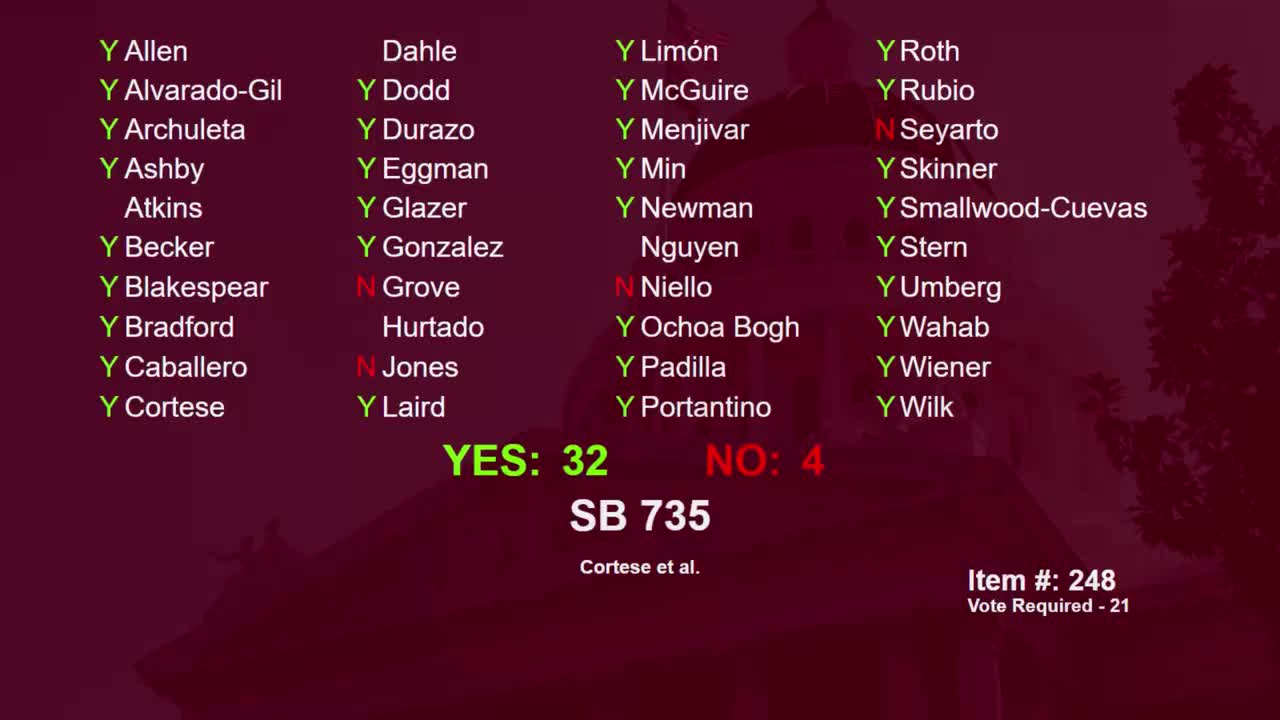 3MIN
Senate Floor
 1MIN
Senate Standing Committee on Appropriations
 16MIN
Senate Standing Committee on Health
Bill Author

Bill Co-Author(s):