SB 702: Gubernatorial appointments: report.
- Session Year: 2023-2024
- House: Senate
- Latest Version Date: 2023-09-14
Current Status:
Failed
(2024-01-25: Veto sustained.)
Introduced
In Committee
First Chamber
In Committee
Second Chamber
Enacted
Existing law requires the Governor to appoint every office whose mode of appointment is not prescribed by law. Existing law also prescribes the manner of the Governors appointment of those officers.
This bill would require the office of the Governor, commencing January 1, 2025, to maintain on its internet website a list of every state board and commission that includes, for each state board or commission, the membership list, stated purpose, duties, meeting frequency, internet website, and vacancies in the membership.
The bill would require the office of the Governor, on or before January 1, 2026, and annually thereafter, to create and publish on its internet website a report containing aggregate demographic information of appointments made by the office during the prior calendar year, as specified.
Existing law requires the Governor to appoint every office whose mode of appointment is not prescribed by law. Existing law also prescribes the manner of the Governors appointment of those officers.
This bill would require the office of the Governor, commencing January 1, 2025, to maintain on its internet website a list of every state board and commission that includes, for each state board or commission, the membership list, stated purpose, duties, meeting frequency, internet website, and vacancies in the membership.
The bill would require the office of the Governor, on or before January 1, 2025, 2026, and annually thereafter, to create and publish on its internet website a report containing aggregate demographic information of appointments made by the office during the prior calendar year, as specified.
Existing law requires the Governor to appoint every office whose mode of appointment is not prescribed by law. Existing law also prescribes the manner of the Governors appointment of those officers.
This bill would require the office of the Governor, commencing January 1, 2025, to maintain on its internet website a list of every state board and commission that includes, for each state board or commission, the membership list, stated purpose, duties, meeting frequency, internet website, and vacancies in the membership.
The bill would require the office of the Governor, on or before January 1, 2025, and annually thereafter, to create and publish on its internet website a report containing aggregate demographic information of appointments made by the office during the prior calendar year, as specified.
Existing law requires the Governor to appoint every office whose mode of appointment is not prescribed by law. Existing law also prescribes the manner of the Governors appointment of those officers.This bill would state the intent of the Legislature to enact legislation relating to gubernatorial appointments.Existing law requires the Governor to appoint every office whose mode of appointment is not prescribed by law. Existing law also prescribes the manner of the Governors appointment of those officers.
This bill would state the intent of the Legislature to enact legislation relating to gubernatorial appointments.
(a)Commencing January 1, 2025, the office of the Governor shall maintain on its internet website a list of each state board or commission, as well as the board or commissions membership list, stated purpose, duties, meeting frequency, internet website, and any vacancies in its membership.
(b)On or before January 1, 2026, and each January 1 thereafter, the office of the Governor shall create and publish on its internet website a report that contains aggregate demographic information, to the extent available, of appointments by the office of the Governor from January 1 to December 31, inclusive, of the previous year.
(c)For purposes of this section, demographic information includes, but is not limited to, the voluntarily self-reported ethnicity, gender, disability status, region, party affiliation, and veteran status of the appointed individual.
(a)Commencing January 1, 2025, the office of the Governor shall maintain on its internet website a list of each state board or commission, as well as the board or commissions membership list, stated purpose, duties, meeting frequency, internet website, and any vacancies in its membership.
(b)On or before January 1, 2025, 2026, and each January 1 thereafter, the office of the Governor shall create and publish on its internet website a report that contains aggregate demographic information, to the extent available, of appointments by the office of the Governor from January 1 to December 31, inclusive, of the previous year.
(c)(1)For purposes of this section, with respect to the first annual report, demographic information means the voluntarily self-reported age, ethnicity, gender, region, and party affiliation of the appointed individual. For purposes of this section, demographic information includes, but is not limited to, the voluntarily self-reported ethnicity, gender, disability status, region, party affiliation, and veteran status of the appointed individual.
(2)With respect to any subsequent annual report, demographic information means the voluntarily self-reported age, ethnicity, gender, gender identity, disability status, race, region, party affiliation, veteran status, and sexual orientation of the appointed individual.(a)Commencing January 1, 2025, the office of the Governor shall maintain on its internet website a list of each state board or commission, as well as the board or commissions membership list, stated purpose, duties, meeting frequency, internet website, and any vacancies in its membership.
(b)On or before January 1, 2025, and each January 1 thereafter, the office of the Governor shall create and publish on its internet website a report that contains aggregate demographic information, to the extent available, of appointments by the office of the Governor from January 1 to December 31, inclusive, of the previous year.
(c)(1)For purposes of this section, with respect to the first annual report, demographic information means the voluntarily self-reported age, ethnicity, gender, region, and party affiliation of the appointed individual.
(2)With respect to any subsequent annual report, demographic information means the voluntarily self-reported age, ethnicity, gender, gender identity, disability status, race, region, party affiliation, veteran status, and sexual orientation of the appointed individual.
SECTION 1.It is the intent of the Legislature to enact legislation relating to gubernatorial appointments. REVISIONS: HeadingLines 2 and 3.It is the intent of the Legislature to enact legislation relating to gubernatorial appointments.
|
Date
|
Status
|
|---|---|
| Jan 25, 2024 | Veto sustained. |
| Jan 25, 2024 | Stricken from file. |
| Oct 8, 2023 | In Senate. Consideration of Governor's veto pending. |
| Oct 8, 2023 | Vetoed by the Governor. |
| Sep 20, 2023 | Enrolled and presented to the Governor at 4:30 p.m. |
| Sep 12, 2023 | Assembly amendments concurred in. (Ayes 39. Noes 0. Page 2681.) Ordered to engrossing and enrolling. |
| Sep 11, 2023 | In Senate. Concurrence in Assembly amendments pending. |
| Sep 11, 2023 | Read third time. Passed. (Ayes 78. Noes 0. Page 3205.) Ordered to the Senate. |
| Sep 7, 2023 | Ordered to third reading. |
| Sep 7, 2023 | Read third time and amended. |
| Sep 7, 2023 | Assembly Rule 69 suspended. (Ayes 62. Noes 15. Page 3010.) |
| Sep 5, 2023 | Read second time. Ordered to third reading. |
| Sep 1, 2023 | From committee: Do pass. (Ayes 15. Noes 0.) (September 1). |
| Jun 21, 2023 | June 21 set for first hearing. Placed on suspense file. |
| Jun 8, 2023 | From committee: Do pass and re-refer to Com. on APPR. (Ayes 7. Noes 0.) (June 7). Re-referred to Com. on APPR. |
| Jun 8, 2023 | Coauthors revised. |
| May 26, 2023 | Referred to Com. on A. & A.R. |
| May 15, 2023 | In Assembly. Read first time. Held at Desk. |
| May 15, 2023 | Read third time. Passed. (Ayes 38. Noes 0. Page 1076.) Ordered to the Assembly. |
| May 2, 2023 | Read second time. Ordered to third reading. |
| May 1, 2023 | From committee: Be ordered to second reading pursuant to Senate Rule 28.8. |
| Apr 21, 2023 | Set for hearing May 1. |
| Apr 19, 2023 | From committee: Do pass and re-refer to Com. on APPR. (Ayes 11. Noes 0. Page 800.) (April 18). Re-referred to Com. on APPR. |
| Apr 11, 2023 | From committee: Do pass and re-refer to Com. on JUD. (Ayes 15. Noes 0. Page 656.) (April 11). Re-referred to Com. on JUD. |
| Apr 11, 2023 | Set for hearing April 18. |
| Apr 6, 2023 | Set for hearing April 11. |
| Mar 29, 2023 | Re-referred to Coms. on G.O. and JUD. |
| Mar 20, 2023 | From committee with author's amendments. Read second time and amended. Re-referred to Com. on RLS. |
| Mar 1, 2023 | Referred to Com. on RLS. |
| Feb 17, 2023 | From printer. May be acted upon on or after March 19. |
| Feb 16, 2023 | Introduced. Read first time. To Com. on RLS. for assignment. To print. |
|
Date
|
Description
|
Location
|
Votes
|
|
|---|---|---|---|---|
| Sep 12, 2023 | Unfinished Business SB702 Limón et al. Concurrence | Senate Floor |
Passed |
|
| Sep 11, 2023 | SB 702 Limón Senate Third Reading By Wendy Carrillo | Assembly Floor |
Passed |
|
| Sep 1, 2023 | Do pass. | Assembly Standing Committee on Appropriations |
Passed |
|
| Jun 7, 2023 | Do pass and be re-referred to the Committee on [Appropriations] | Assembly Standing Committee on Accountability and Administrative Review |
Passed |
|
| May 15, 2023 | Senate 3rd Reading SB702 Limón | Senate Floor |
Passed |
|
| Apr 18, 2023 | Do pass, but first be re-referred to the Committee on [Appropriations] | Senate Standing Committee on Judiciary |
Passed |
|
| Apr 11, 2023 | Do pass, but first be re-referred to the Committee on [Judiciary] | Senate Standing Committee on Governmental Organization |
Passed |
This list shows positions taken on this bill by organizations on the date displayed, which is linked to the original source.
Positions by individuals are not included.
|
Organization
|
Position
|
Date
|
|---|---|---|
| Alliance for A Better Community | ** Support | |
| California Commission on the Status of Women and Girls | ** Support | |
| California Community Colleges Organización De Latinx Empowerment, | ** Support | |
| Campaign For College Opportunity | ** Support | |
| Courage California | ** Support | |
| Guidance, and Advocacy for Success | ** Support | |
| Hispanas Organized for Political Equality | ** Support | |
| Inland Coalition for Immigrant Justice | ** Support | |
| Long Beach Community College District | ** Support | |
| National Association of Latino Elected and Appointed Officials | ** Support | |
| National Women's Political Caucus of California | ** Support | |
| Rio Hondo College | ** Support | |
| Santa Cruz Community Ventures | ** Support | |
| Santa Monica Community College District | ** Support | |
| the league of women voters of california | ** Support | |
| The Unity Council | ** Support |
SENATE RULES COMMITTEE Office of Senate Floor Analyses (916) 651-1520 Fax: (916) 327-4478 | SB 702 |
VETO
Bill No: SB 702
Author: Limón (D), et al.
Amended: 9/7/23
Vote: 27
SENATE GOVERNMENTAL ORG. COMMITTEE: 15-0, 4/11/23
AYES: Dodd, Wilk, Alvarado-Gil, Archuleta, Ashby, Bradford, Glazer, Jones, Nguyen, Ochoa Bogh, Padilla, Portantino, Roth, Rubio, Seyarto
SENATE JUDICIARY COMMITTEE: 11-0, 4/18/23
AYES: Umberg, Wilk, Allen, Ashby, Caballero, Durazo, Laird, McGuire, Min, Niello, Wiener
SENATE APPROPRIATIONS COMMITTEE: Senate Rule 28.8
SENATE FLOOR: 38-0, 5/15/23
AYES: Allen, Alvarado-Gil, Archuleta, Ashby, Atkins, Becker, Blakespear, Bradford, Caballero, Cortese, Dahle, Dodd, Durazo, Eggman, Glazer, Gonzalez, Grove, Hurtado, Jones, Laird, Limón, McGuire, Menjivar, Min, Newman, Nguyen, Niello, Ochoa Bogh, Padilla, Portantino, Roth, Seyarto, Skinner, Stern, Umberg, Wahab, Wiener, Wilk
NO VOTE RECORDED: Rubio, Smallwood-Cuevas
SENATE FLOOR: 39-0, 9/12/23
AYES: Allen, Alvarado-Gil, Archuleta, Ashby, Atkins, Becker, Blakespear, Bradford, Cortese, Dahle, Dodd, Durazo, Eggman, Glazer, Gonzalez, Grove, Hurtado, Jones, Laird, Limón, McGuire, Menjivar, Min, Newman, Nguyen, Niello, Ochoa Bogh, Padilla, Portantino, Roth, Rubio, Seyarto, Skinner, Smallwood-Cuevas, Stern, Umberg, Wahab, Wiener, Wilk
NO VOTE RECORDED: Caballero
ASSEMBLY FLOOR: 78-0, 9/11/23 - See last page for vote
SUBJECT: Gubernatorial appointments: report
SOURCE: Hispanas Organized for Political Equality
DIGEST:
This bill requires the office of the Governor to maintain on its internet website a list of every state board and commission, including specified data of every state board and commission. In addition, this bill requires the office of the Governor to publish on its internet website a report that contains aggregate demographic information of appointments by the office of the Governor, as specified.
ANALYSIS:
Existing law:
- Requires the Governor to appoint every office whose mode of appointment is not prescribed by law.
- Requires that nominations made by the Governor to the Senate be made in writing, designating the residence of the nominee and the office for which the nominee is nominated.
- Establishes various boards and commissions within state government.
- States that it is the policy of the State of California that the composition of these state boards and commissions broadly reflect the general public, including ethnic minorities and women.
- Specifies that the Governor and other appointing authorities are responsible for nominating individuals to boards and commissions of different backgrounds, abilities, interests, and opinions. Existing law states, that it is not the intent of the Legislature that formulas or specific ratios be utilized in complying with this article.
This bill:
- Requires the office of the Governor, beginning on January 1, 2025, to maintain on its internet website a list of each board or commission, as well as the board or commission’s membership list, stated purpose, duties, meeting frequency, internet website, and any vacancies in its membership.
- Requires the office of the Governor, on or before January 1, 2026, and each January 1 thereafter, to create and publish on its internet website a report that contains aggregate demographic information, to the extent available, of appointments by the office of the Governor from January 1 to December 31 of the previous year.
- Provides that “demographic information” includes, but is not limited to, the voluntary self-reported ethnicity, gender, disability, status, region, party affiliation, and veteran status of the appointed individual.
Background
Purpose of this bill. According to the author’s office, “to ensure California’s leadership reflects its greater population, the collection of gubernatorial appointee demographic data is a critical step to achieving gender, racial, and ethnic equity on boards and commissions. The annual report will serve as a tool to show where gaps in representation exists, encourage outreach to communities of interest, and address any barriers. Increasing the diversity of California’s board and commission members will ensure we reflect the rich diversity of California’s population, creating a stronger state, and more equitable communities.”
California’s Demographic Data. With a population of roughly 40 million people, California is the most populous state in the United States with no race or ethnic group constituting a majority of California’s population. According to the Public Institute Policy of California 39% of state residents are Latino, 36% are white, 15% are Asian or Pacific Islander, six percent are African American, fewer than one percent are Native American or Alaska Natives, and three percent are multiracial or other. In terms of gender, California has a higher number of women, 50.2% compared to men, 49.2%.
According to the Williams Institute at UCLA, roughly 5.3%, or a little over two million people in California are a member of the LGBTQ+ community. In addition, the Centers for Disease Control and Prevention predicts that roughly 23% of California’s adult population has some kind of disability. California is also home to 1.8 million veterans.
Governor Newsom’s Vetoes. This bill is similar to last year’s SB 1387 (Limón, 2022) and SB 702 ((Limón, 2021) which were both vetoed by Governor Newsom. Governor’s veto message for SB 1387 read:
This bill would require the Governor's Office to annually publish a report containing demographic information of individuals appointed by the Governor, including additional information that is not currently available.
I am deeply committed to making appointments at every level of government that reflect California's diversity. My office makes an intentional, transparent effort to build a diverse and qualified pool of candidates for these positions.
However, implementing this bill is estimated to cost millions of dollars not accounted for in the budget to update the appointments application system to track and report additional data points. With our state facing lower-than-expected revenues over the first few months of this fiscal year, it is important to remain disciplined when it comes to spending.
The Legislature sent measures with potential costs of well over $20 billion in one-time spending commitments and more than $10 billion in ongoing commitments not accounted for in the state budget. Bills with significant fiscal impact, such as this measure, should be considered and accounted for as part of the annual budget process.
Related/Prior Legislation
SB 1387 (Limón, 2022) would have required the office of the Governor to publish a report containing the demographic information of individuals who have applied to or been appointed to a state board or commission. Additionally, the bill creates a working group to discuss and provide recommendations on ways to diversify state boards and commissions. (Vetoed by Governor Newsom)
SB 17 (Pan, 2021) would have established in state government an Office of Racial Equity (ORE), as an independent public entity not affiliated with an agency or department, as specified; and, tasks the ORE with, among other things, coordinating, analyzing, developing, evaluating, and recommending strategies for advancing racial equity across state agencies, departments, and the Office of the Governor, as specified. (Held in the Assembly Appropriations Suspense File)
SB 702 (Limón, 2021) would have required the office of the Governor to publish a report containing the demographic information of individuals who have applied to or been appointed to a state board or commission. Additionally, the bill would have created a working group to discuss and provide recommendations on ways to diversity state boards and commissions. (Vetoed by Governor Newsom)
AB 979 (Holden, Chapter 316, Statutes of 2020) required publicly held corporations to fill their board seats with a minimum number of directors from underrepresented communities, as specified.
AB 931 (Boerner Horvath, Chapter 813, Statutes of 2019) prohibited the membership of appointed boards and commissions in cities with a population of 50,000 or more from having more than 60% of the same gender identity on or after January 2, 2030 and specifies that smaller boards and commissions must not be compromised of members having the same gender identity.
SB 826 (Jackson, Chapter 954, Statutes of 2018) required publicly held corporations with its principal executive offices in California to have specified numbers of female board members, depending on the size of the board, and required the Secretary of State to levy fines on businesses that do not comply.
SB 984 (Skinner, 2018) would have required state boards and commissions to have at least one female member if the board is four or fewer members, or at least 40 percent female membership on boards or commissions with five or more members. (Held in the Assembly Appropriations Committee Suspense File)
FISCAL EFFECT: Appropriation: No Fiscal Com.: Yes Local: No
According to the Assembly Appropriations Committee, costs of an unknown, but potentially significant, amount to create and publish the specified report. Since the primary purpose of this bill is to create a report, this bill is eligible for this committee’s suspense file.
SUPPORT: (Verified 10/11/23)
Hispanas Organized for Political Equality (source)
Alliance for A Better Community |
California Commission on The Status of Women and Girls |
California Community Colleges Organización De Latinx Empowerment, Guidance, and Advocacy for Success |
Campaign for College Opportunity |
Courage California |
Inland Coalition for Immigrant Justice |
Long Beach Community College District |
National Association of Latino Elected and Appointed Officials |
National Women's Political Caucus of California |
Rio Hondo College |
Santa Cruz Community Ventures |
Santa Monica Community College District The Coalition The League of Women Voters of California The Unity Council |
OPPOSITION: (Verified 10/11/23)
None received
ARGUMENTS IN SUPPORT: Hispanas Organized for Political Equality argue that, “regardless of the state’s leadership, this bill established long-overdue guidance, transparency, and accountability in the gubernatorial appointment review process. Collecting gubernatorial appointee demographic data is a critical step to achieving gender, racial, and ethnic equity on boards and commissions. Ultimately, the report would serve as a tool to highlight progress and where more outreach and resources are needed to ensure that boards and commissions reflect California’s diversity.”
GOVERNOR'S VETO MESSAGE:
This bill would require the Governor's Office to annually publish a report on its website containing aggregate demographic information of individuals
appointed by the Governor.
I continue to be deeply committed to making appointments at every level of
government that reflect California's diversity. My office makes an intentional, transparent effort to continuously engage with the Legislature, community partners, nonprofits, and other stakeholders to build a diverse and qualified pool of candidates for these positions. I am deeply proud of the diverse group of Californians who now serve our state in senior, appointed leadership positions.
While I understand the author's goal, the demographic information specified for reporting under this bill is optional and self-reported by candidates.
Consequently, the report required by this bill would not necessarily accurately reflect the diversity of appointees. I have vetoed a similar measure for this reason, and my concern remains.
ASSEMBLY FLOOR: 78-0, 9/11/23
AYES: Addis, Aguiar-Curry, Alanis, Alvarez, Arambula, Bains, Bauer-Kahan, Bennett, Berman, Boerner, Bonta, Bryan, Calderon, Juan Carrillo, Wendy Carrillo, Cervantes, Chen, Connolly, Megan Dahle, Davies, Dixon, Essayli, Flora, Mike Fong, Vince Fong, Friedman, Gabriel, Gallagher, Garcia, Gipson, Grayson, Haney, Hart, Holden, Hoover, Irwin, Jackson, Jones-Sawyer, Kalra, Lackey, Lee, Low, Lowenthal, Maienschein, McCarty, McKinnor, Muratsuchi, Stephanie Nguyen, Ortega, Pacheco, Papan, Jim Patterson, Joe Patterson, Pellerin, Petrie-Norris, Quirk-Silva, Ramos, Rendon, Reyes, Luz Rivas, Rodriguez, Blanca Rubio, Santiago, Schiavo, Soria, Ta, Ting, Valencia, Villapudua, Waldron, Wallis, Ward, Weber, Wicks, Wilson, Wood, Zbur, Robert Rivas
NO VOTE RECORDED: Mathis, Sanchez
Prepared by: Felipe Lopez / G.O. / (916) 651-1530
10/19/23 11:13:00
**** END ****
SENATE RULES COMMITTEE Office of Senate Floor Analyses (916) 651-1520 Fax: (916) 327-4478 | SB 702 |
UNFINISHED BUSINESS
Bill No: SB 702
Author: Limón (D), et al.
Amended: 9/7/23
Vote: 21
SENATE GOVERNMENTAL ORG. COMMITTEE: 15-0, 4/11/23
AYES: Dodd, Wilk, Alvarado-Gil, Archuleta, Ashby, Bradford, Glazer, Jones, Nguyen, Ochoa Bogh, Padilla, Portantino, Roth, Rubio, Seyarto
SENATE JUDICIARY COMMITTEE: 11-0, 4/18/23
AYES: Umberg, Wilk, Allen, Ashby, Caballero, Durazo, Laird, McGuire, Min, Niello, Wiener
SENATE APPROPRIATIONS COMMITTEE: Senate Rule 28.8
SENATE FLOOR: 38-0, 5/15/23
AYES: Allen, Alvarado-Gil, Archuleta, Ashby, Atkins, Becker, Blakespear, Bradford, Caballero, Cortese, Dahle, Dodd, Durazo, Eggman, Glazer, Gonzalez, Grove, Hurtado, Jones, Laird, Limón, McGuire, Menjivar, Min, Newman, Nguyen, Niello, Ochoa Bogh, Padilla, Portantino, Roth, Seyarto, Skinner, Stern, Umberg, Wahab, Wiener, Wilk
NO VOTE RECORDED: Rubio, Smallwood-Cuevas
ASSEMBLY FLOOR: 78-0, 9/11/23 - See last page for vote
SUBJECT: Gubernatorial appointments: report
SOURCE: Hispanas Organized for Political Equality
DIGEST:
This bill requires the office of the Governor to maintain on its internet website a list of every state board and commission, including specified data of every state board and commission. In addition, the bill requires the office of the Governor to publish on its internet website a report that contains aggregate demographic information of appointments by the office of the Governor, as specified.
Assembly Amendments
1) delay the date by which the office of the Governor is required to create a report that contains aggregate demographic information from January 1, 2025 to January 1, 2026, 2) add co-authors.
ANALYSIS:
Existing law:
- Requires the Governor to appoint every office whose mode of appointment is not prescribed by law.
- Requires that nominations made by the Governor to the Senate be made in writing, designating the residence of the nominee and the office for which the nominee is nominated.
- Establishes various boards and commissions within state government.
- States that it is the policy of the State of California that the composition of these state boards and commissions broadly reflect the general public, including ethnic minorities and women.
- Specifies that the Governor and other appointing authorities are responsible for nominating individuals to boards and commissions of different backgrounds, abilities, interests, and opinions. Existing law states, that it is not the intent of the Legislature that formulas or specific ratios be utilized in complying with this article.
This bill:
- Requires the office of the Governor, beginning on January 1, 2025, to maintain on its internet website a list of each board or commission, as well as the board or commission’s membership list, stated purpose, duties, meeting frequency, internet website, and any vacancies in its membership.
- Requires the office of the Governor, on or before January 1, 2026, and each January 1 thereafter, to create and publish on its internet website a report that contains aggregate demographic information, to the extent available, of appointments by the office of the Governor from January 1 to December 31 of the previous year.
- Provides that “demographic information” includes, but is not limited to, the voluntary self-reported ethnicity, gender, disability, status, region, party affiliation, and veteran status of the appointed individual.
Background
Purpose of the bill. According to the author’s office, “to ensure California’s leadership reflects its greater population, the collection of gubernatorial appointee demographic data is a critical step to achieving gender, racial, and ethnic equity on boards and commissions. The annual report will serve as a tool to show where gaps in representation exists, encourage outreach to communities of interest, and address any barriers. Increasing the diversity of California’s board and commission members will ensure we reflect the rich diversity of California’s population, creating a stronger state, and more equitable communities.”
California’s Demographic Data. With a population of roughly 40 million people, California is the most populous state in the United States with no race or ethnic group constituting a majority of California’s population. According to the Public Institute Policy of California 39% of state residents are Latino, 36% are white, 15% are Asian or Pacific Islander, six percent are African American, fewer than one percent are Native American or Alaska Natives, and three percent are multiracial or other. In terms of gender, California has a higher number of women, 50.2% compared to men, 49.2%.
According to the Williams Institute at UCLA, roughly 5.3%, or a little over two million people in California are a member of the LGBTQ+ community. In addition, the Centers for Disease Control and Prevention predicts that roughly 23% of California’s adult population has some kind of disability. California is also home to 1.8 million veterans.
Governor Newsom’s Vetoes. This bill is similar to last year’s SB 1387 (Limón, 2022) and SB 702 ((Limón, 2021) which were both vetoed by Governor Newsom. Governor’s veto message for SB 1387 read:
This bill would require the Governor's Office to annually publish a report containing demographic information of individuals appointed by the Governor, including additional information that is not currently available.
I am deeply committed to making appointments at every level of government that reflect California's diversity. My office makes an intentional, transparent effort to build a diverse and qualified pool of candidates for these positions.
However, implementing this bill is estimated to cost millions of dollars not accounted for in the budget to update the appointments application system to track and report additional data points. With our state facing lower-than-expected revenues over the first few months of this fiscal year, it is important to remain disciplined when it comes to spending.
The Legislature sent measures with potential costs of well over $20 billion in one-time spending commitments and more than $10 billion in ongoing commitments not accounted for in the state budget. Bills with significant fiscal impact, such as this measure, should be considered and accounted for as part of the annual budget process.
Prior/Related Legislation
SB 1387 (Limón, 2022) would have required the office of the Governor to publish a report containing the demographic information of individuals who have applied to or been appointed to a state board or commission. Additionally, the bill creates a working group to discuss and provide recommendations on ways to diversify state boards and commissions. (Vetoed by Governor Newsom)
SB 17 (Pan, 2021) would have established in state government an Office of Racial Equity (ORE), as an independent public entity not affiliated with an agency or department, as specified; and, tasks the ORE with, among other things, coordinating, analyzing, developing, evaluating, and recommending strategies for advancing racial equity across state agencies, departments, and the Office of the Governor, as specified. (Held in the Assembly Appropriations Suspense File)
SB 702 (Limón, 2021) would have required the office of the Governor to publish a report containing the demographic information of individuals who have applied to or been appointed to a state board or commission. Additionally, the bill would have created a working group to discuss and provide recommendations on ways to diversity state boards and commissions. (Vetoed by Governor Newsom)
AB 979 (Holden, Chapter 316, Statutes of 2020) required publicly held corporations to fill their board seats with a minimum number of directors from underrepresented communities, as specified.
AB 931 (Boerner Horvath, Chapter 813, Statutes of 2019) prohibited the membership of appointed boards and commissions in cities with a population of 50,000 or more from having more than 60% of the same gender identity on or after January 2, 2030 and specifies that smaller boards and commissions must not be compromised of members having the same gender identity.
SB 826 (Jackson, Chapter 954, Statutes of 2018) required publicly held corporations with its principal executive offices in California to have specified numbers of female board members, depending on the size of the board, and required the Secretary of State to levy fines on businesses that do not comply.
SB 984 (Skinner, 2018) would have required state boards and commissions to have at least one female member if the board is four or fewer members, or at least 40 percent female membership on boards or commissions with five or more members. (Held in the Assembly Appropriations Committee Suspense File)
FISCAL EFFECT: Appropriation: No Fiscal Com.: Yes Local: No
According to the Assembly Appropriations Committee, costs of an unknown, but potentially significant, amount to create and publish the specified report. Since the primary purpose of this bill is to create a report, this bill is eligible for this committee’s suspense file.
SUPPORT: (Verified 9/8/23)
Hispanas Organized for Political Equality (source)
Alliance for A Better Community |
California Commission on The Status of Women and Girls |
California Community Colleges Organización De Latinx Empowerment, Guidance, and Advocacy for Success |
Campaign for College Opportunity |
Courage California |
Inland Coalition for Immigrant Justice |
Long Beach Community College District |
National Association of Latino Elected and Appointed Officials |
National Women's Political Caucus of California |
Rio Hondo College |
Santa Cruz Community Ventures |
Santa Monica Community College District The Coalition The Unity Council |
OPPOSITION: (Verified 9/8/23)
None received
ARGUMENTS IN SUPPORT: Hispanas Organized for Political Equality argue that, “regardless of the state’s leadership, this bill established long-overdue guidance, transparency, and accountability in the gubernatorial appointment review process. Collecting gubernatorial appointee demographic data is a critical step to achieving gender, racial, and ethnic equity on boards and commissions. Ultimately, the report would serve as a tool to highlight progress and where more outreach and resources are needed to ensure that boards and commissions reflect California’s diversity.”
ASSEMBLY FLOOR: 78-0, 9/11/23
AYES: Addis, Aguiar-Curry, Alanis, Alvarez, Arambula, Bains, Bauer-Kahan, Bennett, Berman, Boerner, Bonta, Bryan, Calderon, Juan Carrillo, Wendy Carrillo, Cervantes, Chen, Connolly, Megan Dahle, Davies, Dixon, Essayli, Flora, Mike Fong, Vince Fong, Friedman, Gabriel, Gallagher, Garcia, Gipson, Grayson, Haney, Hart, Holden, Hoover, Irwin, Jackson, Jones-Sawyer, Kalra, Lackey, Lee, Low, Lowenthal, Maienschein, McCarty, McKinnor, Muratsuchi, Stephanie Nguyen, Ortega, Pacheco, Papan, Jim Patterson, Joe Patterson, Pellerin, Petrie-Norris, Quirk-Silva, Ramos, Rendon, Reyes, Luz Rivas, Rodriguez, Blanca Rubio, Santiago, Schiavo, Soria, Ta, Ting, Valencia, Villapudua, Waldron, Wallis, Ward, Weber, Wicks, Wilson, Wood, Zbur, Robert Rivas
NO VOTE RECORDED: Mathis, Sanchez
Prepared by: Felipe Lopez / G.O. / (916) 651-1530
9/11/23 19:47:02
**** END ****
SENATE THIRD READING
STR Bill Id:SB 702
Author:(Limón)
As Amended Ver:September 7, 2023
Majority vote
SUMMARY
Requires the Governor's office to make an annual public report of aggregate demographic information about the members of each board and commission appointed by the Governor.
Major Provisions
- Requires the Governor's office, starting on January 1, 2025, to post on its website a list of each state board or commission, and the entity's membership list, stated purpose, duties, meeting frequency, internet website, and any vacancies in its membership.
- Requires the Governor's office, on or before December 1, 2026, and each January 1 thereafter, to post on its website a report of aggregate demographic information, to the extent available, of the Governor's appointments made the prior calendar year.
- Defines "demographic information" to include, but not be limited to, the voluntarily self-reported ethnicity, gender, disability status, region, party affiliation, and veteran status of the appointed individual.
COMMENTS
1) Thousands of Appointments. The Governor has authority to make appointments to thousands of positions in state government, from full-time salaried executives of regulatory agencies to members of advisory panels who are paid $100 per diem to attend quarterly meetings, and many other variations. For the Governor, appointments are a way to shape the makeup of state government leadership. For appointees, the positions can mean paid employment and career advancement or an opportunity to offer technical expertise, stay engaged in public service on a part-time basis, and influence state policy. Current law provides that, in making appointments, the Governor and every other appointing authority shall be responsible for nominating a variety of persons of different backgrounds, abilities, interests, and opinions. Current law also states the policy of the state that the composition of state boards and commissions shall be broadly reflective of the general public including ethnic minorities and women. Thus, there is great public interest in who gets appointed and what demographic groups are represented in the appointees.
2) Detailed Information About Boards and Commissions. The Governor's "Appointments" web page identifies the list of all appointed positions, current openings, and instructions to apply, among other information. This bill requires the Governor's internet website to include a list of each state board or commission, as well as the board or commission's membership list, stated purpose, duties, meeting frequency, internet website, and any vacancies in its membership. It is likely that greater detail about each appointment opportunity could help a greater universe of potential applicants identify and seek an appointment.
3) Data on Judicial Appointments. Current law requires the Governor, California State Bar, and Administrative Office of the Courts to collect and annually report aggregate demographic data provided by all applicants for judicial appointments by the Governor, including data on ethnicity, race, disability, veteran status, gender, gender identity, and sexual orientation. Annual reports starting in 2007 with aggregate demographic data about California state judges and justices are available on the Judicial Council's web site. These reports have enabled the Legislature and the public to track California's progress toward a bench that is more reflective of the state's overall diversity. This bill requires the same type of data (not including race, gender identity, and sexual orientation) and public reports for state boards and commissions.
4) Some Existing Data on Governor's Appointments. The author cites to a 2022 report by the UCLA Latino Policy and Politics Institute as an example of the data that this bill would require and how it can help track progress towards more diverse appointments. For example, the report found that Latinos make up 39.1% of the state population but only 18.4% of executive appointees. The report notes that Latinas remain the most underrepresented in executive branch appointees among all women. The report also found a lack of Central and Southern California voices on executive boards and commissions noting that "the absence of their voice in developing strategy, regulations, and policy priorities for the future of California's environment, education, economy, and criminal justice systems perpetuates historical regional inequities across our state." The report noted that Latinos who do serve on these bodies tend to be more recent appointments: 70.7% of Latino appointees were appointed in the last four years, while non-Hispanic white appointees are more likely to be legacy appointments carried over from a previous administration. Additionally, Latinas make up 19% of female appointees but only 8.5% of total executive appointees.
5) Accuracy of Voluntarily Self-Reported Demographic Data. The annual report of aggregate demographic data that this bill requires would be based on "voluntarily self-reported" ethnicity, gender, disability status, region, party affiliation, and veteran status. This data would be captured on the appointment application form, which currently asks for applicants to identify gender and ethnicity. As stated in the Governor's veto message on SB 702 (Limón, 2021), voluntarily self-reported data may not accurately reflect the diversity of appointees.
6) Veto of Similar Legislation. The Governor has twice vetoed legislation substantially similar to this bill. In his veto message for SB 1387 (Limón, 2022) the Governor cited the cost of implementing the bill and the importance of remaining "disciplined when it comes to spending." In the veto message for SB 702 (Limón, 2021), which also had a self-reporting provision, the Governor wrote:
"I applaud the author and stakeholders' desire to ensure diversity in California's board and commission members. I too am deeply committed to making appointments that reflect California's diversity at every level of government. My office already makes an intentional, transparent effort to engage with the Legislature, community partners, nonprofits, and a variety of stakeholders to build a diverse and qualified pool of candidates for appointed positions, and will continue to strengthen and build these partnerships. Further, the demographic information specified for reporting under this bill is optional and self-reported by candidates. For these reasons, such a report required by SB 702 would not accurately reflect the diversity of appointees."
According to the Author
"To ensure California's leadership reflects its greater population, the collection of gubernatorial appointee demographic data is a critical step to achieving gender, racial, and ethnic equity on boards and commissions. The annual report will serve as a tool to show where gaps in representation exist, encourage outreach to communities of interest, and address any barriers. Increasing the diversity of California's board and commission members will ensure we reflect the rich diversity of California's population, creating a stronger state, and more equitable communities."
Arguments in Support
Hispanas Organized for Political Equality (HOPE), this bill's sponsor, states:
"HOPE strongly believes that democracy and governance are more robust when everyone has a seat at the table, and SB 702 is an essential step toward that goal. Supporting the diversity of all Californians in government will ensure more communities have a role in the policy-making process at the state and local levels. California is committed to providing diverse state boards and commissions that reflect the state. Yet, no formal mechanisms exist to evaluate this commitment or progress toward it. [ ] Regardless of the state's leadership, this bill establishes long-overdue guidance, transparency, and accountability in the gubernatorial appointment review process. Collecting gubernatorial appointee demographic data is a critical step to achieving gender, racial, and ethnic equity on boards and commissions. Ultimately, the report would serve as a tool to highlight progress and where more outreach and resources are needed to ensure that boards and commissions reflect California's diversity."
Arguments in Opposition
No opposition on file.
FISCAL COMMENTS
According to the Assembly Appropriations Committee, costs of an unknown, but potentially significant, amount to create and publish the specified report. Since the primary purpose of this bill is to create a report, this bill is eligible for this committee's suspense file.
VOTES
SENATE FLOOR: 38-0-2
YES: Allen, Alvarado-Gil, Archuleta, Ashby, Atkins, Becker, Blakespear, Bradford, Caballero, Cortese, Dahle, Dodd, Durazo, Eggman, Glazer, Gonzalez, Grove, Hurtado, Jones, Laird, Limón, McGuire, Menjivar, Min, Newman, Nguyen, Niello, Ochoa Bogh, Padilla, Portantino, Roth, Seyarto, Skinner, Stern, Umberg, Wahab, Wiener, Wilk
ABS, ABST OR NV: Rubio, Smallwood-Cuevas
ASM ACCOUNTABILITY AND ADMINISTRATIVE REVIEW: 7-0-0
YES: Petrie-Norris, Dixon, Bains, Davies, Stephanie Nguyen, Rodriguez, Wilson
ASM APPROPRIATIONS: 15-0-1
YES: Holden, Megan Dahle, Bryan, Calderon, Wendy Carrillo, Dixon, Mike Fong, Hart, Lowenthal, Mathis, Papan, Pellerin, Soria, Weber, Wilson
ABS, ABST OR NV: Sanchez
UPDATED
VERSION: September 7, 2023
CONSULTANT: Jacqueline Kinney / A. & A.R. / (916) 319-3600 FN: 0001986
SENATE THIRD READING
STR Bill Id:SB 702
Author:(Limón)
As Amended Ver:March 20, 2023
Majority vote
SUMMARY
Requires the Governor's office to make an annual public report of aggregate demographic information about the members of each board and commission appointed by the Governor.
Major Provisions
- Requires the Governor's office, starting on January 1, 2025, to post on its website a list of each state board or commission, and the entity's membership list, stated purpose, duties, meeting frequency, internet website, and any vacancies in its membership.
- Requires the Governor's office, on or before December 1, 2025, and each January 1 thereafter, to post on its website a report of aggregate demographic information, to the extent available, of the Governor's appointments made the prior calendar year.
- Defines "demographic information" for the first annual report as the voluntarily self-reported age, ethnicity, gender, region, and party affiliation of the appointed individual.
- Defines "demographic information" for any subsequent annual report as the voluntarily self-reported age, ethnicity, gender, gender identity, disability status, race, region, party affiliation, veteran status, and sexual orientation of the appointed individual.
COMMENTS
1) Thousands of Appointments. The Governor has authority to make appointments to thousands of positions in state government, from full-time salaried executives of regulatory agencies to members of advisory panels who are paid $100 per diem to attend quarterly meetings, and many other variations. For the Governor, appointments are a way to shape the makeup of state government leadership. For appointees, the positions can mean paid employment and career advancement or an opportunity to offer technical expertise, stay engaged in public service on a part-time basis, and influence state policy. Current law provides that, in making appointments, the Governor and every other appointing authority shall be responsible for nominating a variety of persons of different backgrounds, abilities, interests, and opinions. Current law also states the policy of the state that the composition of state boards and commissions shall be broadly reflective of the general public including ethnic minorities and women. Thus, there is great public interest in who gets appointed and what demographic groups are represented in the appointees.
2) Detailed Information About Boards and Commissions. The Governor's "Appointments" web page identifies the list of all appointed positions, current openings, and instructions to apply, among other information. This bill requires the Governor's internet website to include a list of each state board or commission, as well as the board or commission's membership list, stated purpose, duties, meeting frequency, internet website, and any vacancies in its membership. It is likely that greater detail about each appointment opportunity could help a greater universe of potential applicants identify and seek an appointment.
3) Data on Judicial Appointments. Current law requires the Governor, California State Bar, and Administrative Office of the Courts to collect and annually report aggregate demographic data provided by all applicants for judicial appointments by the Governor, including data on ethnicity, race, disability, veteran status, gender, gender identity, and sexual orientation. Annual reports starting in 2007 with aggregate demographic data about California state judges and justices are available on the Judicial Council's web site. These reports have enabled the Legislature and the public to track California's progress toward a bench that is more reflective of the state's overall diversity. This bill requires the same type of data and public reports for state boards and commissions.
4) Some Existing Data on Governor's Appointments. The author cites to a 2022 report by the UCLA Latino Policy and Politics Institute as an example of the data that this bill would require and how it can help track progress towards more diverse appointments. For example, the report found that Latinos make up 39.1% of the state population but only 18.4% of executive appointees. The report notes that Latinas remain the most underrepresented in executive branch appointees among all women. The report also found a lack of Central and Southern California voices on executive boards and commissions noting that "the absence of their voice in developing strategy, regulations, and policy priorities for the future of California's environment, education, economy, and criminal justice systems perpetuates historical regional inequities across our state." The report noted that Latinos who do serve on these bodies tend to be more recent appointments: 70.7% of Latino appointees were appointed in the last four years, while non-Hispanic white appointees are more likely to be legacy appointments carried over from a previous administration. Additionally, Latinas make up 19% of female appointees but only 8.5% of total executive appointees.
5) Accuracy of Voluntarily Self-Reported Demographic Data. The annual report of aggregate demographic data that this bill requires would be based on "voluntarily self-reported" age, ethnicity, gender, gender identity, disability status, race, region, party affiliation, veteran status, and sexual orientation. This data would be captured on the appointment application form, which currently asks for applicants to identify gender and ethnicity. As stated in the Governor's veto message on SB 702 (Limón, 2021), voluntarily self-reported data may not accurately reflect the diversity of appointees.
6) Veto of Similar Legislation. The Governor has twice vetoed legislation substantially similar to this bill. In his veto message for SB 1387 (Limón, 2022) the Governor cited the cost of implementing the bill and the importance of remaining "disciplined when it comes to spending." In the veto message for SB 702 (Limón, 2021), which also had a self-reporting provision, the Governor wrote:
I applaud the author and stakeholders' desire to ensure diversity in California's board and commission members. I too am deeply committed to making appointments that reflect California's diversity at every level of government. My office already makes an intentional, transparent effort to engage with the Legislature, community partners, nonprofits, and a variety of stakeholders to build a diverse and qualified pool of candidates for appointed positions, and will continue to strengthen and build these partnerships. Further, the demographic information specified for reporting under this bill is optional and self-reported by candidates. For these reasons, such a report required by SB 702 would not accurately reflect the diversity of appointees.
According to the Author
To ensure California's leadership reflects its greater population, the collection of gubernatorial appointee demographic data is a critical step to achieving gender, racial, and ethnic equity on boards and commissions. The annual report will serve as a tool to show where gaps in representation exist, encourage outreach to communities of interest, and address any barriers. Increasing the diversity of California's board and commission members will ensure we reflect the rich diversity of California's population, creating a stronger state, and more equitable communities.
Arguments in Support
Hispanas Organized for Political Equality (HOPE), this bill's sponsor, states:
HOPE strongly believes that democracy and governance are more robust when everyone has a seat at the table, and SB 702 is an essential step toward that goal. Supporting the diversity of all Californians in government will ensure more communities have a role in the policy-making process at the state and local levels. California is committed to providing diverse state boards and commissions that reflect the state. Yet, no formal mechanisms exist to evaluate this commitment or progress toward it. [ ] Regardless of the state's leadership, this bill establishes long-overdue guidance, transparency, and accountability in the gubernatorial appointment review process. Collecting gubernatorial appointee demographic data is a critical step to achieving gender, racial, and ethnic equity on boards and commissions. Ultimately, the report would serve as a tool to highlight progress and where more outreach and resources are needed to ensure that boards and commissions reflect California's diversity.
Arguments in Opposition
No opposition on file.
FISCAL COMMENTS
According to the Assembly Appropriations Committee, costs of an unknown, but potentially significant, amount to create and publish the specified report. Since the primary purpose of this bill is to create a report, this bill is eligible for this committee's suspense file.
VOTES
SENATE FLOOR: 38-0-2
YES: Allen, Alvarado-Gil, Archuleta, Ashby, Atkins, Becker, Blakespear, Bradford, Caballero, Cortese, Dahle, Dodd, Durazo, Eggman, Glazer, Gonzalez, Grove, Hurtado, Jones, Laird, Limón, McGuire, Menjivar, Min, Newman, Nguyen, Niello, Ochoa Bogh, Padilla, Portantino, Roth, Seyarto, Skinner, Stern, Umberg, Wahab, Wiener, Wilk
ABS, ABST OR NV: Rubio, Smallwood-Cuevas
ASM ACCOUNTABILITY AND ADMINISTRATIVE REVIEW: 7-0-0
YES: Petrie-Norris, Dixon, Bains, Davies, Stephanie Nguyen, Rodriguez, Wilson
ASM APPROPRIATIONS: 12-0-4
YES: Holden, Bryan, Calderon, Wendy Carrillo, Mike Fong, Hart, Lowenthal, Papan, Pellerin, Soria, Weber, Wilson
ABS, ABST OR NV: Megan Dahle, Dixon, Mathis, Sanchez
UPDATED
VERSION: March 20, 2023
CONSULTANT: Jacqueline Kinney / A. & A.R. / (916) 319-3600 FN: 0001568
Date of Hearing: June 21, 2023
ASSEMBLY COMMITTEE ON APPROPRIATIONS
Chris Holden, Chair
SBPCA Bill Id:SB 702
Author:(Limón) – As Amended Ver:March 20, 2023
Policy Committee: | Accountability and Administrative Review | Vote: | 7 - 0 |
|
| ||
|
|
Urgency: No State Mandated Local Program: No Reimbursable: No
SUMMARY:
This bill requires, by January 1, 2025, and annually thereafter, the office of the Governor to create and publish online a report containing specified aggregate demographic information of gubernatorial appointments from the previous year.
This bill also requires the office of the Governor to maintain online a list containing specified information for each state board or commission.
FISCAL EFFECT:
Costs of an unknown, but potentially significant, amount to create and publish the specified report. Since the primary purpose of this bill is to create a report, this bill is eligible for this committee’s suspense file.
COMMENTS:
- Purpose. According to the author:
To ensure California’s leadership reflects its greater population, the collection of gubernatorial appointee demographic data is a critical step to achieving gender, racial, and ethnic equity on boards and commissions. The annual report will serve as a tool to show where gaps in representation exist, encourage outreach to communities of interest, and address any barriers.
This bill is sponsored by Hispanas Organized for Political Equality (HOPE) and supported by the California Commission on the Status of Women and Girls, Courage California, and other social justice groups.
- Governor’s Appointment Authority. A 2022 report by the UCLA Latino Policy and Politics Institute found that Latinos make up 39.1% of the state’s population, but only 18.4% of executive appointees. Existing law grants the Governor the authority to make appointments and establishes a policy for boards and commissions to reflect the general public, inclusive of ethnic minorities and women, with appointees from different backgrounds, abilities, interests, and opinions. This bill requires the Governor’s website to include a list of each state board or commission, including the entity’s membership list and vacancies, stated purpose, duties, meeting frequency, and internet website. The Governor’s website (gov.ca.gov/appointments) currently includes this information separated into two different documents.
Existing law also requires the Governor to give particular consideration to judicial candidates from diverse backgrounds and cultures reflecting the state’s demographics and requires the Governor to collect and release aggregate demographic data provided by all judicial applicants, appointments, and nominations relative to ethnicity, race, disability, veteran status, gender, gender identity, and sexual orientation. This bill requires the Governor’s office to publish a similar report containing specified aggregate demographic information of all gubernatorial appointments, not just appointments to boards and commissions, from the previous year. For purposes of the first annual report, this bill defines “demographic information” as voluntarily self-reported age, ethnicity, gender, region, and party affiliation. For subsequent annual reports, this bill expands the definition to include gender identity, disability status, race, veteran status, and sexual orientation.
- Prior Legislation. SB 1387 (Limon), of the 2021-22 Legislative Session, was substantially similar to this bill. SB 1387 was vetoed by the Governor, who asserted costs in the millions of dollars, as follows:
I am deeply committed to making appointments at every level of government that reflect California’s diversity. My office makes an intentional, transparent effort to build a diverse and qualified pool of candidates for these positions.
However, implementing this bill is estimated to cost millions of dollars not accounted for in the budget to update the appointments application system to track and report additional data points. With our state facing lower-than-expected revenues over the first few months of this fiscal year, it is important to remain disciplined when it comes to spending.
SB 702 (Limon), of the 2021-22 Legislative Session, would have required a more expansive demographic data report than this bill and would have required the Governor’s office to convene a working group to ensure more diverse appointments to boards and commissions. SB 702 was vetoed by the Governor, who stated:
My office already makes an intentional, transparent effort to engage with the Legislature, community partners, nonprofits, and a variety of stakeholders to build a diverse qualified pool of candidates for appointed positions, and will continue to strengthen and build these partnerships. Further, the demographic information specified for reporting under this bill is optional and self-reported by candidates. For these reasons, such a report required by SB 702 would not accurately reflect the diversity of employees.
Analysis Prepared by: Irene Ho / APPR. / (916) 319-2081
Date of Hearing: June 7, 2023
ASSEMBLY COMMITTEE ON ACCOUNTABILITY AND ADMINISTRATIVE REVIEW
Cottie Petrie-Norris, Chair
SBPCA Bill Id:SB 702
Author:(Limón) – As Amended Ver:March 20, 2023
SENATE VOTE: 38-0
SUBJECT: Gubernatorial appointments: report
SUMMARY: Requires the Governor’s office to make an annual public report of aggregate demographic information about the members of each board and commission appointed by the Governor. Specifically, this bill:
- Requires the office of the Governor, commencing on January 1, 2025, to maintain on its website a list of each state board or commission, as well as the board or commission’s membership list, stated purpose, duties, meeting frequency, internet website, and any vacancies in its membership.
- Requires the office of the Governor, on or before December 1, 2025, and each January 1 thereafter, to create and publish on its internet website a report that contains aggregate demographic information, to the extent available, of appointments by the office of the Governor from January 1 to December 31, inclusive, of the previous year.
- Defines “demographic information” for the first annual report as the voluntarily self-reported age, ethnicity, gender, region, and party affiliation of the appointed individual. Defines “demographic information” for any subsequent annual report as the voluntarily self-reported age, ethnicity, gender, gender identity, disability status, race, region, party affiliation, veteran status, and sexual orientation of the appointed individual.
EXISTING LAW:
1) Authorizes the Governor to appoint members to a wide range of state boards and commissions, as specified in numerous individual statutes.
2) Requires the Governor to appoint every office whose mode of appointment is not prescribed by law. (Gov. Code Sec. 1300.)
3) Provides that in making appointments to state boards and commissions, the Governor and every other appointing authority shall be responsible for nominating a variety of persons of different backgrounds, abilities, interests, and opinions. (Gov. Code Sec. 11141.)
4) Provides that it is the policy of the state that the composition of state boards and commissions shall be broadly reflective of the general public including ethnic minorities and women. (Gov. Code Sec. 11140.)
5) Specifies that it is not the intent of the Legislature that formulas or specific ratios be utilized in complying with (3) and (4), above. (Gov. Code Sec. 11141.)
6) Requires the Governor, California State Bar, and Administrative Office of the Courts to collect and annually report aggregate demographic data provided by all applicants for judicial appointments by the Governor, including data relative to ethnicity, race, disability, veteran status, gender, gender identity, and sexual orientation.
FISCAL EFFECT: The Legislative Counsel has keyed this bill as Fiscal.
COMMENTS:
- Author’s Purpose. This bill is sponsored by Hispanas Organized for Political Equality. According to the author:
“To ensure California’s leadership reflects its greater population, the collection of gubernatorial appointee demographic data is a critical step to achieving gender, racial, and ethnic equity on boards and commissions. The annual report will serve as a tool to show where gaps in representation exist, encourage outreach to communities of interest, and address any barriers. Increasing the diversity of California's board and commission members will ensure we reflect the rich diversity of California's population, creating a stronger state, and more equitable communities.”
- Thousands of Appointments. The Governor has authority to make appointments to thousands of positions in state government, from full-time salaried executives of regulatory agencies to members of advisory panels who are paid $100 per diem to attend quarterly meetings, and many other variations. For the Governor, appointments are a way to shape the makeup of state government leadership. For appointees, the positions can mean paid employment and career advancement or an opportunity to offer technical expertise, stay engaged in public service on a part-time basis, and influence state policy. Thus, there is great public interest in who gets appointed and what demographic groups are represented in the Governor’s appointees.
3) Detailed Information About Boards and Commissions. The Governor’s “Appointments” web page identifies the list of all appointed positions, current openings, and instructions to apply, among other information.[1] This bill requires the Governor’s internet website to include a list of each state board or commission, as well as the board or commission’s membership list, stated purpose, duties, meeting frequency, internet website, and any vacancies in its membership. It is likely that greater detail about each appointment opportunity could help a greater universe of potential applicants identify and seek an appointment.
4) Data on Judicial Appointments. Pursuant to current law related to the Governor’s authority to make judicial appointments, annual reports starting in 2007 with aggregate demographic data about California state judges and justices are available on the Judicial Council’s web site. These reports have enabled the Legislature and the public to track California’s progress toward a bench that is more reflective of the state’s overall diversity. This bill seeks to require the same type of data and public reports for California’s states boards and commissions.
5) Some Data on Governor’s Appointments. The author cites to a 2022 report by the UCLA Latino Policy and Politics Institute as an example of the data that this bill would require and how it can help track progress towards more diverse appointments.[2] For example, the report found that Latinos make up 39.1% of the state population but only 18.4% of executive appointees. The report notes that Latinas remain the most underrepresented in executive branch appointees among all women. The report also found a lack of Central and Southern California voices on executive boards and commissions noting that “the absence of their voice in developing strategy, regulations, and policy priorities for the future of California’s environment, education, economy, and criminal justice systems perpetuates historical regional inequities across our state.” The report noted that Latinos who do serve on these bodies tend to be more recent appointments: 70.7% of Latino appointees were appointed in the last four years, while non-Hispanic white appointees are more likely to be legacy appointments carried over from a previous administration. Additionally, Latinas make up 19% of female appointees but only 8.5% of total executive appointees.
6) Veto of Similar Legislation. The Governor has twice vetoed legislation substantially similar to this bill. In his veto message for SB 1387 (, 2022) the Governor wrote:
“I am deeply committed to making appointments at every level of government that reflect California's diversity. My office makes an intentional, transparent effort to build a diverse and qualified pool of candidates for these positions.
However, implementing this bill is estimated to cost millions of dollars not accounted for in the budget to update the appointments application system to track and report additional data points. With our state facing lower-than-expected revenues over the first few months of this fiscal year, it is important to remain disciplined when it comes to spending.”
The Governor wrote in his veto message for SB 702 (Limón, 2021):
“I applaud the author and stakeholders' desire to ensure diversity in California's board and commission members. I too am deeply committed to making appointments that reflect California's diversity at every level of government. My office already makes an intentional, transparent effort to engage with the Legislature, community partners, nonprofits, and a variety of stakeholders to build a diverse and qualified pool of candidates for appointed positions, and will continue to strengthen and build these partnerships. Further, the demographic information specified for reporting under this bill is optional and self-reported by candidates. For these reasons, such a report required by SB 702 would not accurately reflect the diversity of appointees.”
- Self-Reported Demographic Data. The annual report of aggregate demographic data that this bill requires would be based on “voluntarily self-reported” age, ethnicity, gender, gender identity, disability status, race, region, party affiliation, veteran status, and sexual orientation. This data would be captured on the appointment application form, which currently asks for applicants to identify gender and ethnicity.[3] As stated in the Governor’s veto message on SB 702 (, 2021), self-reported data may not accurately reflect the diversity of appointees.
- Arguments in Support. Hispanas Organized for Political Equality (HOPE), the bill’s sponsor, states:
“HOPE strongly believes that democracy and governance are more robust when everyone has a seat at the table, and SB 702 is an essential step toward that goal. Supporting the diversity of all Californians in government will ensure more communities have a role in the policy-making process at the state and local levels. California is committed to providing diverse state boards and commissions that reflect the state. Yet, no formal mechanisms exist to evaluate this commitment or progress toward it. [ ]
Regardless of the state’s leadership, this bill establishes long-overdue guidance, transparency, and accountability in the gubernatorial appointment review process. Collecting gubernatorial appointee demographic data is a critical step to achieving gender, racial, and ethnic equity on boards and commissions. Ultimately, the report would serve as a tool to highlight progress and where more outreach and resources are needed to ensure that boards and commissions reflect California’s diversity.”
REGISTERED SUPPORT / OPPOSITION:
Support
California Commission on The Status of Women and Girls
Campaign for College Opportunity
Courage California
Hispanas Organized for Political Equality (HOPE)
Inland Coalition for Immigrant Justice
National Association of Latino Elected and Appointed Officials (NALEO) Educational Fund
The Coalition
The Unity Council
Opposition
No opposition on file.
Analysis Prepared by: Jacqueline Kinney / A. & A.R. / (916) 319-3600
SENATE RULES COMMITTEE Office of Senate Floor Analyses (916) 651-1520 Fax: (916) 327-4478 | SB 702 |
THIRD READING
Bill No: SB 702
Author: Limón (D)
Amended: 3/20/23
Vote: 21
SENATE GOVERNMENTAL ORG. COMMITTEE: 15-0, 4/11/23
AYES: Dodd, Wilk, Alvarado-Gil, Archuleta, Ashby, Bradford, Glazer, Jones, Nguyen, Ochoa Bogh, Padilla, Portantino, Roth, Rubio, Seyarto
SENATE JUDICIARY COMMITTEE: 11-0, 4/18/23
AYES: Umberg, Wilk, Allen, Ashby, Caballero, Durazo, Laird, McGuire, Min, Niello, Wiener
SENATE APPROPRIATIONS COMMITTEE: Senate Rule 28.8
SUBJECT: Gubernatorial appointments: report
SOURCE: Hispanas Organized for Political Equality
DIGEST: This bill requires the office of the Governor to maintain on its internet website a list of every state board and commission, including specified data of every state board and commission. In addition, the bill requires the office of the Governor to publish on its internet website a report that contains aggregate demographic information of appointments by the office of the Governor, as specified.
ANALYSIS:
Existing law:
- Requires the Governor to appoint every office whose mode of appointment is not prescribed by law.
- Requires that nominations made by the Governor to the Senate be made in writing, designating the residence of the nominee and the office for which the nominee is nominated.
- Establishes various boards and commissions within state government.
- States that it is the policy of the State of California that the composition of these state boards and commissions broadly reflect the general public, including ethnic minorities and women.
- Specifies that the Governor and other appointing authorities are responsible for nominating individuals to boards and commissions of different backgrounds, abilities, interests, and opinions. Existing law states, that it is not the intent of the Legislature that formulas or specific ratios be utilized in complying with this article.
This bill:
- Requires the office of the Governor, beginning on January 1, 2025, to maintain on its internet website a list of each board or commission, as well as the board or commission’s membership list, stated purpose, duties, meeting frequency, internet website, and any vacancies in its membership.
- Requires the office of the Governor, on or before January 1, 2025, and each January 1 thereafter, to create and publish on its internet website a report that contains aggregate demographic information, to the extent available, of appointments by the office of the Governor from January 1 to December 31 of the previous year.
- Provides that with respect to the first annual report, “demographic information” means the voluntarily self-reported age, ethnicity, gender, region, and party affiliation of the appointed individual.
- Provides that with respect to any subsequent annual report, “demographic information” means the voluntarily self-reported age, ethnicity, gender, gender identity, disability status, race, region, party affiliation, veteran status, and sexual orientation of the appointed individual.
Background
Purpose of the bill. According to the author’s office, “to ensure California’s leadership reflects its greater population, the collection of gubernatorial appointee demographic data is a critical step to achieving gender, racial, and ethnic equity on boards and commissions. The annual report will serve as a tool to show where gaps in representation exists, encourage outreach to communities of interest, and address any barriers. Increasing the diversity of California’s board and commission members will ensure we reflect the rich diversity of California’s population, creating a stronger state, and more equitable communities.”
California’s Demographic Data. With a population of roughly 40 million people, California is the most populous state in the United States with no race or ethnic group constituting a majority of California’s population. According to the Public Institute Policy of California 39% of state residents are Latino, 36% are white, 15% are Asian or Pacific Islander, six percent are African American, fewer than one percent are Native American or Alaska Natives, and three percent are multiracial or other. In terms of gender, California has a higher number of women, 50.2% compared to men, 49.2%.
According to the Williams Institute at UCLA, roughly 5.3%, or a little over two million people in California are a member of the LGBTQ+ community. In addition, the Centers for Disease Control and Prevention predicts that roughly 23% of California’s adult population has some kind of disability. California is also home to 1.8 million veterans.
Governor Newsom’s Vetoes. This bill is nearly identical to last year’s SB 1387 (Limón, 2022) and SB 702 ((Limón, 2021) which were both vetoed by Governor Newsom. Governor’s veto message for SB 1387 read:
This bill would require the Governor's Office to annually publish a report containing demographic information of individuals appointed by the Governor, including additional information that is not currently available.
I am deeply committed to making appointments at every level of government that reflect California's diversity. My office makes an intentional, transparent effort to build a diverse and qualified pool of candidates for these positions.
However, implementing this bill is estimated to cost millions of dollars not accounted for in the budget to update the appointments application system to track and report additional data points. With our state facing lower-than-expected revenues over the first few months of this fiscal year, it is important to remain disciplined when it comes to spending.
The Legislature sent measures with potential costs of well over $20 billion in one-time spending commitments and more than $10 billion in ongoing commitments not accounted for in the state budget. Bills with significant fiscal impact, such as this measure, should be considered and accounted for as part of the annual budget process.
Comments
As mentioned above, this bill is nearly identical to last year’s SB 1387 and SB 702 from two years ago which were both vetoed by Governor Newsom. In addition, the Governor, in his veto message, pointed to the major flaw in the bill; how do you ensure that the demographic information required to be reported by this bill is accurate when such information is optional and self-reported by candidates?
Prior/Related Legislation
SB 1387 (Limón, 2022) would have required the office of the Governor to publish a report containing the demographic information of individuals who have applied to or been appointed to a state board or commission. Additionally, the bill creates a working group to discuss and provide recommendations on ways to diversify state boards and commissions. (Vetoed by Governor Newsom)
SB 17 (Pan, 2021) would have established in state government an Office of Racial Equity (ORE), as an independent public entity not affiliated with an agency or department, as specified; and, tasks the ORE with, among other things, coordinating, analyzing, developing, evaluating, and recommending strategies for advancing racial equity across state agencies, departments, and the Office of the Governor, as specified. (Held in the Assembly Appropriations Suspense File)
SB 702 (Limón, 2021) would have required the office of the Governor to publish a report containing the demographic information of individuals who have applied to or been appointed to a state board or commission. Additionally, the bill would have created a working group to discuss and provide recommendations on ways to diversity state boards and commissions. (Vetoed by Governor Newsom)
AB 979 (Holden, Chapter 316, Statutes of 2020) required publicly held corporations to fill their board seats with a minimum number of directors from underrepresented communities, as specified.
AB 931 (Boerner Horvath, Chapter 813, Statutes of 2019) prohibited the membership of appointed boards and commissions in cities with a population of 50,000 or more from having more than 60% of the same gender identity on or after January 2, 2030 and specifies that smaller boards and commissions must not be compromised of members having the same gender identity.
SB 826 (Jackson, Chapter 954, Statutes of 2018) required publicly held corporations with its principal executive offices in California to have specified numbers of female board members, depending on the size of the board, and required the Secretary of State to levy fines on businesses that do not comply.
SB 984 (Skinner, 2018) would have required state boards and commissions to have at least one female member if the board is four or fewer members, or at least 40 percent female membership on boards or commissions with five or more members. (Held in the Assembly Appropriations Committee Suspense File)
FISCAL EFFECT: Appropriation: No Fiscal Com.: Yes Local: No
SUPPORT: (Verified 5/1/23)
Hispanas Organized for Political Equality (source)
OPPOSITION: (Verified 5/1/23)
None received
ARGUMENTS IN SUPPORT: Hispanas Organized for Political Equality argue that, “regardless of the state’s leadership, this bill established long-overdue guidance, transparency, and accountability in the gubernatorial appointment review process. Collecting gubernatorial appointee demographic data is a critical step to achieving gender, racial, and ethnic equity on boards and commissions. Ultimately, the report would serve as a tool to highlight progress and where more outreach and resources are needed to ensure that boards and commissions reflect California’s diversity.”
Prepared by: Felipe Lopez / G.O. / (916) 651-1530
5/3/23 15:01:40
Senator Thomas Umberg, Chair
2023-2024 Regular Session
Bill No: SB 702 (Author:Limón)
Version: March 20, 2023
Hearing Date: April 18, 2023
Fiscal: Yes
Urgency: No
Consultant: AM
SUBJECT
Gubernatorial appointments: report
DIGEST
The bill requires the office of the Governor to maintain on its internet website a list of each state board or commission, as well as the board or commission’s membership list, stated purpose, duties, meeting frequency, internet website, and any vacancies in its membership. The bill also requires the office of the Governor to publish on its internet website a report containing aggregate demographic information, to the extent available, of appointments by the office of the Governor from January 1 to December 31, inclusive, of the previous year.
EXECUTIVE SUMMARY
California is rich in demographic diversity. Existing law makes it state policy that the composition of state boards and commissions should broadly reflect the general public, including ethnic minorities and women. Presently, however, the state does not collect data to determine whether this policy is being achieved. Since the Governor appoints many of these positions, this bill would require the office of the Governor to post certain information about each state board or commission and data regarding the demographic makeup of gubernatorial appointees and to report it in aggregate form. This bill is substantially similar to last year’s SB 1387 (Limón, 2022) and SB 702 (Limón, 2021), both of which passed this Committee but were ultimately vetoed by the Governor.
The bill is sponsored by Hispanas Organized for Political Equity. There is no opposition on file. The bill passed out of the Senate Governmental Organization Committee by a vote of 15 to 0.
PROPOSED CHANGES TO THE LAW
Existing law:
- Provides that no State shall deny any person within its jurisdiction the equal protection of the laws. (U.S. Const., Amend. XIV, § 1.).
2) Provides that a person may not be denied equal protection of the laws. (Cal. Const., Art. 1, § 7(a).)
3) Requires the Governor to appoint every office whose mode of appointment is not prescribed by law. (Gov. Code § 1300.)
4) Provides that in making appointments to state boards and commissions, the Governor and every other appointing authority shall be responsible for nominating a variety of persons of different backgrounds, abilities, interests, and opinions. (Gov. Code § 11141.)
5) Existing law provides that it is the policy of the State of California that the composition of state boards and commissions shall be broadly reflective of the general public including ethnic minorities and women. (Gov. Code § 11140.)
6) Specifies that it is not the intent of the Legislature that formulas or specific ratios be utilized in complying with (4) and (5), above. (Gov. Code § 11141.)
This bill:
- Requires the office of the Governor, commencing on January 1, 2025, to maintain on its website a list of each state board or commission, as well as the board or commission’s membership list, stated purpose, duties, meeting frequency, internet website, and any vacancies in its membership.
- Requires the office of the Governor, on or before December 1, 2025 and each January 1 thereafter, to create and publish on its internet website a report that contains aggregate demographic information, to the extent available, of appointments by the office of the Governor from January 1 to December 31, inclusive, of the previous year.
- Defines “demographic information” for the first annual report as the voluntarily self-reported age, ethnicity, gender, region, and party affiliation of the appointed individual. Defines “demographic information” for any subsequent annual report as the voluntarily self-reported age, ethnicity, gender, gender identity, disability status, race, region, party affiliation, veteran status, and sexual orientation of the appointed individual.
COMMENTS
- Stated need for the bill
The author writes:
To ensure California’s leadership reflects its greater population, the collection of gubernatorial appointee demographic data is a critical step to achieving gender, racial, and ethnic equity on boards and commissions. The annual report will serve as a tool to show where gaps in representation exist, encourage outreach to communities of interest, and address any barriers. Increasing the diversity of California's board and commission members will ensure we reflect the rich diversity of California's population, creating a stronger state, and more equitable communities.
- The issue the bill is intended to address
Existing law makes it the policy of the State of California for the composition of state boards and commissions to broadly reflect the general public, including ethnic minorities and women. (Gov. Code § 11140.) However, the demographic composition of state boards and commissions is not compiled and is therefore largely unknown. This bill seeks to address this lack of data by requiring the Governor to gather information regarding the demographic composition of boards and commissions in the State of California and report the results to the Legislature and to the public through publication on the internet.
A report by the UCLA Latino Policy and Politics Institute from 2022 found that Latinos make up 39.1% of the state population but only 18.4% of executive appointees. The report notes that Latinas remain the most underrepresented in executive branch appointees among all women. The report also found a lack of Central and Southern California voices on executive boards and commissions noting that “the absence of their voice in developing strategy, regulations, and policy priorities for the future of California’s environment, education, economy, and criminal justice systems perpetuates historical regional inequities across our state.” The report noted that Latinos who do serve on these bodies tend to be more recent appointments: 70.7% of Latino appointees were appointed in the last four years, while non-Hispanic white appointees are more likely to be legacy appointments carried over from a previous administration. Additionally, Latinas make up 19% of female appointees but only 8.5% of total executive appointees. This report can be found here.[1]
- Existing models for this bill
Since 2006, California has required its Judicial Council to collect and release aggregate demographic data about to the ethnicity and gender of California state court justices and judges, by jurisdiction, each calendar year. In more recent years, the report has been expanded to include aggregate information about how many of Californians judges are people with disabilities or veterans, as well as how they identify in terms of gender identity and sexual orientation. The reports can be found here.[2]
These reports have enabled the Legislature and the public to track California’s progress toward a bench that is more reflective of the state’s overall diversity. This bill intends to do for California’s state boards and commissions the same thing that these Judicial Council reports have done for the California judiciary.
The author also points to the State of Illinois as another source of inspiration for this bill. In 2014, Illinois enacted the Gubernatorial Boards and Commissions Act with the goal of increasing transparency about the demographic makeup of that state’s gubernatorial appointments. (15 Ill. Comp. Stat. Ann. 50/25.) The Illinois statute requires Illinois’ governor to publish aggregate, self-reported data regarding the ethnicity, gender, sexual orientation, and disability status of gubernatorial appointees statewide. These reports can be found here.[3]
The reports offer the people of Illinois an opportunity to examine and comment on the current demographic composition of their state boards and commissions as well as to get a sense of whether openings on those boards and commissions are drawing applications from across the full spectrum of the state’s demographic makeup. For example, in response to publication of the 2022 report, Equality Illinois noted that “Illinois now has the highest number of out LGBTQ+ people serving on State Boards and Commissions in the state’s history.[4]” They further states that “Governor Pritzker and his team [have] placed a broad diversity of talent” on boards and commissions by more than doubling the number of Black and Latino board members and commissioners, with women now making up 46% of people serving on state boards and commissions.[5]
This bill shares the basic intent and framework of the Illinois statute.
- Equal Protection and Proposition 209 considerations
Both the U.S. and California Constitutions contain an Equal Protection Clause. The federal Constitution says: “[n]o State shall… deny to any person within its jurisdiction the equal protection of the laws.” (U.S. Const., Amend. XIV, § 1.) Very similarly, the state Constitution states that: “[a] person may not be… denied equal protection of the laws.” (Cal. Const., art. 1, § 7(a).) Courts applying the constitutional concept of equal protection have ruled that laws drawing suspect classifications between people and treating them differently on that basis are subject to heightened judicial scrutiny.
Section 31 of Article I of the California Constitution is frequently known by the ballot initiative from which it came: Proposition 209, passed by the California voters in 1996. The relevant part of Proposition 209 reads as follows:
The state shall not discriminate against, or grant preferential treatment to, any individual or group on the basis of race, sex, color, ethnicity, or national origin in the operation of public employment, public education, or public contracting.
In contrast to an equal protection analysis, which permits classifications based on race or gender provided they can meet heightened scrutiny, Proposition 209 is a nearly absolute bar on the use of such classifications. Unless the federal Constitution requires the implementation of a remedial program that takes race or gender into account, Proposition 209 forbids it. (Hi-Voltage Wire Works, Inc. v. City of San Jose (2000) 24 Cal.4th 537, 567.)
At least some of the demographic data that would be reported under this bill, such as gender, race, and ethnicity, are constitutionally suspect classifications. However, the courts have been clear that the mere collection and reporting of data regarding otherwise suspect classifications such as race and gender is perfectly constitutional:
Respondents contend that monitoring programs which collect and report data concerning the participation of women and minorities in governmental programs do not violate equal protection principles. We agree. […] Accurate and up-to-date information is the sine qua non of intelligent, appropriate legislative and administrative action. Assuming that strict scrutiny is required, a monitoring program designed to collect and report accurate and up-to-date information is justified by the compelling governmental need for such information. So long as such a program does not discriminate against or grant a preference to an individual or group, Proposition 209 is not implicated. (Connerly v. State Personnel Bd. (2001) 92 Cal.App.4th 16, 46-47.)
Here, the data collection and reporting program does not discriminate and merely provides the Governor, the Legislature, and the public with accurate up-to-date information about the demographic composition of gubernatorial appointees.
- Privacy considerations
Anytime demographic data is collected and reported, there is a risk of publicizing private, personal information about individuals without their consent. This bill specifies that demographic data about gubernatorial appointments shall only be included in the annual report to the extent the information is self-reported. Accordingly, the bill does not raise significant privacy concerns.
- Prior related bills vetoed by the Governor
This bill is substantially similar to last year’s SB 1387 (Limón, 2022) and SB 702 (Limón, 2021), both of which passed this Committee but ultimately were vetoed by the Govenor.
In his veto message for SB 1387 the Governor wrote:
[…]I am deeply committed to making appointments at every level of government that reflect California's diversity. My office makes an intentional, transparent effort to build a diverse and qualified pool of candidates for these positions.
However, implementing this bill is estimated to cost millions of dollars not accounted for in the budget to update the appointments application system to track and report additional data points. With our state facing lower-than-expected revenues over the first few months of this fiscal year, it is important to remain disciplined when it comes to spending…
The Governor wrote in his veto message for SB 702 that:
… I applaud the author and stakeholders' desire to ensure diversity in California's board and commission members. I too am deeply committed to making appointments that reflect California's diversity at every level of government. My office already makes an intentional, transparent effort to engage with the Legislature, community partners, nonprofits, and a variety of stakeholders to build a diverse and qualified pool of candidates for appointed positions, and will continue to strengthen and build these partnerships. Further, the demographic information specified for reporting under this bill is optional and self-reported by candidates. For these reasons, such a report required by SB 702 would not accurately reflect the diversity of appointees.
- Statements in support
Hispanas Organized for Political Equity (HOPE), the sponsor of the bill, writes in support stating:
HOPE strongly believes that democracy and governance are more robust when everyone has a seat at the table, and SB 702 is an essential step toward that goal. Supporting the diversity of all Californians in government will ensure more communities have a role in the policy-making process at the state and local levels. California is committed to providing diverse state boards and commissions that reflect the state. Yet, no formal mechanisms exist to evaluate this commitment or progress toward it. […]
Regardless of the state’s leadership, this bill establishes long-overdue guidance, transparency, and accountability in the gubernatorial appointment review process. Collecting gubernatorial appointee demographic data is a critical step to achieving gender, racial, and ethnic equity on boards and commissions. Ultimately, the report would serve as a tool to highlight progress and where more outreach and resources are needed to ensure that boards and commissions reflect California’s diversity.
SUPPORT
Hispanas Organized for Political Equity (sponsor)
OPPOSITION
None known
RELATED LEGISLATION
Pending Legislation: None known.
Prior Legislation:
SB 1387 (Limón, 2022) was substantially similar to this bill. This bill was vetoed by the Governor. See Comment 6 above for Governor’s veto message.
SB 17 (Pan, 2021) would have established an Office of Racial Equity (ORE) within state government as an independent public entity and tasks the ORE with, among other things, coordinating, analyzing, developing, evaluating, and recommending strategies for advancing racial equity across state agencies, departments, and the Office of the Governor. SB 17 died in the Assembly Appropriations Committee.
SB 655 (Bradford, Ch. 390, Stats. 2021) decreased the reporting threshold for required participation in the California Department of Insurance’s governing board diversity surveys, specifically lowering the threshold from $100 million in California written premiums to $75 million, and required submission of a board diversity policy statement, as defined.
SB 702 (Limón, 2021) was substantially similar to this bill. This bill was vetoed by the Governor. See Comment 6 above for Governor’s veto message.
AB 979 (Holden, Ch. 316, Stats. 2020) required publicly held corporations to fill their board seats with a minimum number of directors from underrepresented communities, as specified. On April 1, 2022, a Los Angeles County Superior Court ruled that AB 979 is unconstitutional. (Crest v. Padilla II, Docket No. 20 STCV 37513; app. pending B321726.)
AB 931 (Boerner Horvath, Ch. 813, Stats. 2019) prohibited the membership of appointed boards and commissions in cities with a population of 50,000 or more from having more than 60 percent of the same gender identity on or after January 2, 2030 and specifies that smaller boards and commissions must not be compromised of members having the same gender identity.
SB 826 (Jackson, Ch. 954, Stats. 2018) required publicly held corporations with principal executive offices in California to have specified numbers of female board members, depending on the size of the board, and required the Secretary of State to levy fines on businesses that do not comply. On May 13, 2022, a Los Angeles County Superior Court ruled that SB 826 is unconstitutional. (Crest v. Padilla, Docket No. 19STCV27561; app. pending B322276).
SB 984 (Skinner, 2018), would have required state boards and commissions to have at least one female member if the board is four or fewer members, or at least 40 percent female membership on boards or commissions with five or more members. SB 984 died in the Assembly Appropriations Committee.
AB 1005 (Alejo, Ch. 113, Stats. 2013) expanded the collection and release of demographic information about California state court justices and judges to include disability and veteran status.
SB 128 (Corbett, Ch. 720. Stats. 2011) expanded the collection and release of demographic information about California state court justices and judges to include gender identity and sexual orientation.
SB 56 (Dunn, Ch. 390, Stats. 2006) required the Judicial Council to collect and release aggregate demographic data relative to the ethnicity and gender of California state court justices and judges, by specific jurisdiction each calendar year.
PRIOR VOTES:
Senate Governance and Finance Committee (Ayes 15, Noes 0)
**************
https://latino.ucla.edu/research/ca-appointments-report/#:~:text=As%20of%20March%202022%2C%20presiding,other%20state%20and%20local%20officials. ↑
Equality Illinois celebrates Governor JB Pritzker for the diversity of leaders appointed to state Boards and Commissions in FY2022, (Oct. 5, 2022), Equality Illinois, available at https://www.equalityillinois.us/17387-2/. ↑
Ibid. ↑
SENATE COMMITTEE ON GOVERNMENTAL ORGANIZATION
Senator Bill Dodd
Chair
2023 - 2024 Regular
Bill No: 702 Hearing Date: 4/11/2023
Author: | |||
Version: | 3/20/2023 Amended | ||
Urgency: | No | Fiscal: | Yes |
Consultant: | Felipe Lopez | ||
SUBJECT: Gubernatorial appointments: report
DIGEST: This bill requires the office of the Governor to maintain on its internet website a list of every state board and commission, including specified data of every state board and commission. In addition, the bill requires the office of the Governor to publish on its internet website a report that contains aggregate demographic information of appointments by the office of the Governor, as specified.
ANALYSIS:
Existing law:
- Requires the Governor to appoint every office whose mode of appointment is not prescribed by law.
- Requires that nominations made by the Governor to the Senate be made in writing, designating the residence of the nominee and the office for which the nominee is nominated.
- Establishes various boards and commissions within state government.
- States that it is the policy of the State of California that the composition of these state boards and commissions broadly reflect the general public, including ethnic minorities and women.
- Specifies that the Governor and other appointing authorities are responsible for nominating individuals to boards and commissions of different backgrounds, abilities, interests, and opinions. Existing law states, that it is not the intent of the Legislature that formulas or specific ratios be utilized in complying with this article.
This bill:
- Requires the office of the Governor, beginning on January 1, 2025, to maintain on its internet website a list of each board or commission, as well as the board or commission’s membership list, stated purpose, duties, meeting frequency, internet website, and any vacancies in its membership.
- Requires the office of the Governor, on or before January 1, 2025, and each January 1 thereafter, to create and publish on its internet website a report that contains aggregate demographic information, to the extent available, of appointments by the office of the Governor from January 1 to December 31 of the previous year.
- Provides that with respect to the first annual report, “demographic information” means the voluntarily self-reported age, ethnicity, gender, region, and party affiliation of the appointed individual.
- Provides that with respect to any subsequent annual report, “demographic information” means the voluntarily self-reported age, ethnicity, gender, gender identity, disability status, race, region, party affiliation, veteran status, and sexual orientation of the appointed individual.
Background
Purpose of the Bill. According to the author’s office, “to ensure California’s leadership reflects its greater population, the collection of gubernatorial appointee demographic data is a critical step to achieving gender, racial, and ethnic equity on boards and commissions. The annual report will serve as a tool to show where gaps in representation exists, encourage outreach to communities of interest, and address any barriers. Increasing the diversity of California’s board and commission members will ensure we reflect the rich diversity of California’s population, creating a stronger state, and more equitable communities.”
California’s Demographic Data. With a population of roughly 40 million people, California is the most populous state in the United States with no race or ethnic group constituting a majority of California’s population. According to the Public Institute Policy of California 39% of state residents are Latino, 36% are white, 15% are Asian or Pacific Islander, six percent are African American, fewer than one percent are Native American or Alaska Natives, and three percent are multiracial or other. In terms of gender, California has a higher number of women, 50.2% compared to men, 49.2%.
According to the Williams Institute at UCLA, roughly 5.3%, or a little over two million people in California are a member of the LGBTQ+ community. In addition, the Centers for Disease Control and Prevention predicts that roughly 23% of California’s adult population has some kind of disability. California is also home to 1.8 million veterans.
Governor Newsom’s Vetoes. This bill is nearly identical to last year’s SB 1387 (Limón, 2022) and SB 702 ((Limón, 2021) which were both vetoed by Governor Newsom. Governor’s veto message for SB 1387 read:
This bill would require the Governor's Office to annually publish a report containing demographic information of individuals appointed by the Governor, including additional information that is not currently available.
I am deeply committed to making appointments at every level of government that reflect California's diversity. My office makes an intentional, transparent effort to build a diverse and qualified pool of candidates for these positions.
However, implementing this bill is estimated to cost millions of dollars not accounted for in the budget to update the appointments application system to track and report additional data points. With our state facing lower-than-expected revenues over the first few months of this fiscal year, it is important to remain disciplined when it comes to spending.
The Legislature sent measures with potential costs of well over $20 billion in one-time spending commitments and more than $10 billion in ongoing commitments not accounted for in the state budget. Bills with significant fiscal impact, such as this measure, should be considered and accounted for as part of the annual budget process.
Staff Comments. As mentioned above, this bill is nearly identical to last year’s SB 1387 and SB 702 from two years ago which were both vetoed by Governor Newsom. In addition, the Governor, in his veto message, pointed to the major flaw in the bill; how do you ensure that the demographic information required to be reported by this bill is accurate when such information is optional and self-reported by candidates?
Prior/Related Legislation
SB 1387 (Limón, 2022) would have required the office of the Governor to publish a report containing the demographic information of individuals who have applied to or been appointed to a state board or commission. Additionally, the bill creates a working group to discuss and provide recommendations on ways to diversify state boards and commissions. (Vetoed by Governor Newsom)
SB 17 (Pan, 2021) would have established in state government an Office of Racial Equity (ORE), as an independent public entity not affiliated with an agency or department, as specified; and, tasks the ORE with, among other things, coordinating, analyzing, developing, evaluating, and recommending strategies for advancing racial equity across state agencies, departments, and the Office of the Governor, as specified. (Held in the Assembly Appropriations Suspense File)
SB 702 (Limón, 2021) would have required the office of the Governor to publish a report containing the demographic information of individuals who have applied to or been appointed to a state board or commission. Additionally, the bill would have created a working group to discuss and provide recommendations on ways to diversity state boards and commissions. (Vetoed by Governor Newsom)
AB 979 (Holden, Chapter 316, Statutes of 2020) required publicly held corporations to fill their board seats with a minimum number of directors from underrepresented communities, as specified.
AB 931 (Boerner Horvath, Chapter 813, Statutes of 2019) prohibited the membership of appointed boards and commissions in cities with a population of 50,000 or more from having more than 60% of the same gender identity on or after January 2, 2030 and specifies that smaller boards and commissions must not be compromised of members having the same gender identity.
SB 826 (Jackson, Chapter 954, Statutes of 2018) required publicly held corporations with its principal executive offices in California to have specified numbers of female board members, depending on the size of the board, and required the Secretary of State to levy fines on businesses that do not comply.
SB 984 (Skinner, 2018) would have required state boards and commissions to have at least one female member if the board is four or fewer members, or at least 40 percent female membership on boards or commissions with five or more members. (Held in the Assembly Appropriations Committee Suspense File)
FISCAL EFFECT: Appropriation: Fiscal Com.: Local:
SUPPORT:
Hispanas Organized for Political Equality (Source)
OPPOSITION:
None received
ARGUMENTS IN SUPPORT: Hispanas Organized for Political Equality argue that, “regardless of the state’s leadership, this bill established long-overdue guidance, transparency, and accountability in the gubernatorial appointment review process. Collecting gubernatorial appointee demographic data is a critical step to achieving gender, racial, and ethnic equity on boards and commissions. Ultimately, the report would serve as a tool to highlight progress and where more outreach and resources are needed to ensure that boards and commissions reflect California’s diversity.”
DUAL REFERRAL: Senate Governmental Organization Committee & Senate Judiciary Committee
Discussed in Hearing
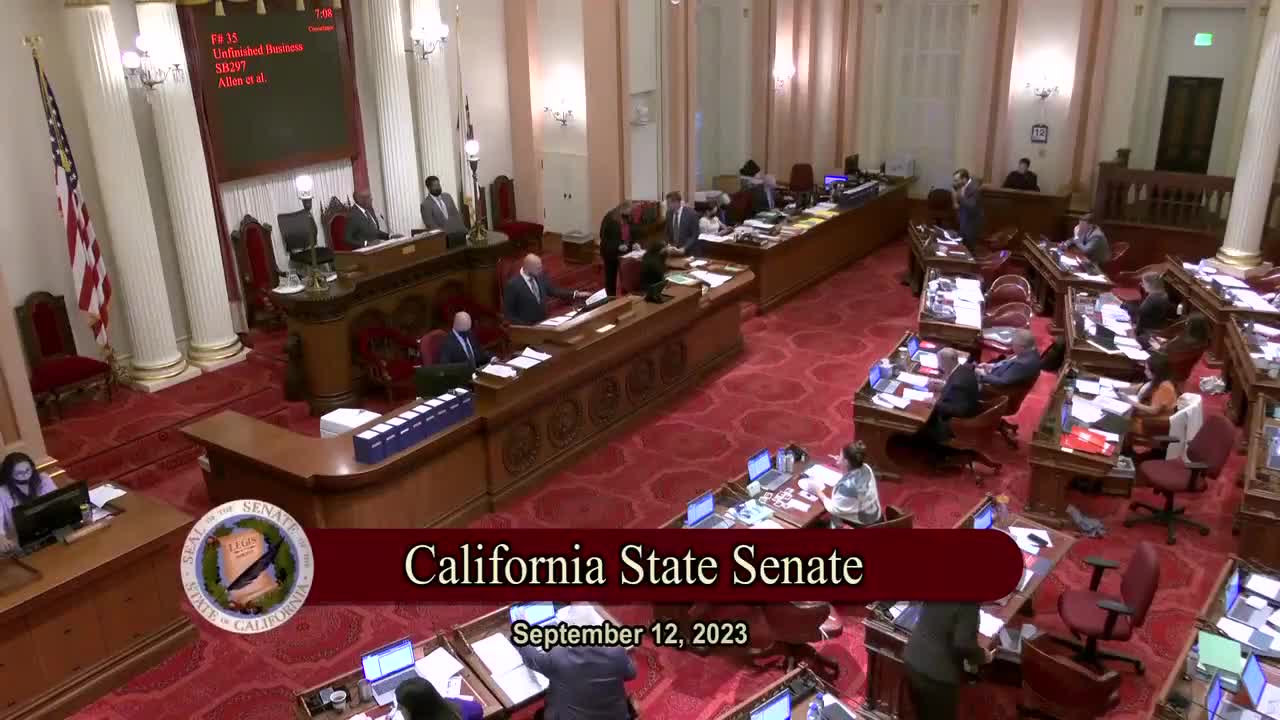 42SEC
Senate Floor
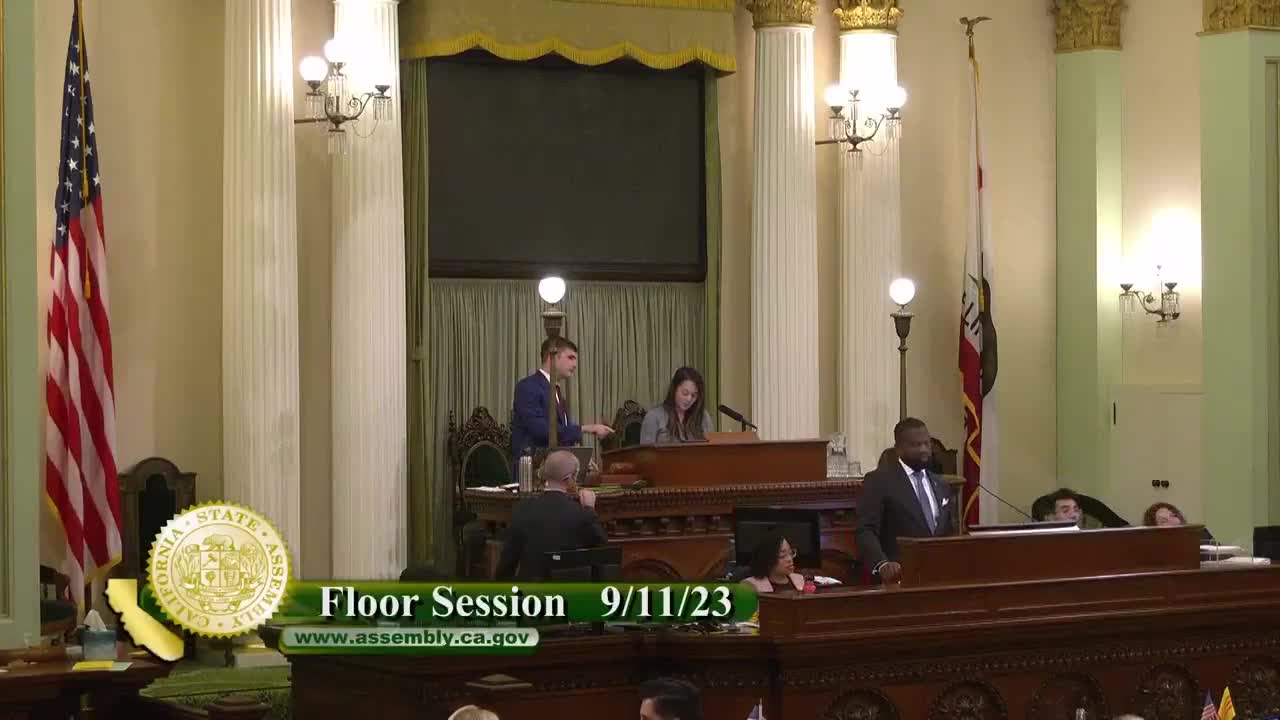 1MIN
Assembly Floor
 16SEC
Assembly Floor
 51SEC
Assembly Floor
 8MIN
Assembly Standing Committee on Accountability and Administrative Review
 1MIN
Senate Floor
 6MIN
Senate Standing Committee on Judiciary
 12MIN