SB 704: Coastal resources: California Coastal Act of 1976: industrial developments: oil and gas developments: refineries: petrochemical facilities: offshore wind.
- Session Year: 2023-2024
- House: Senate
- Latest Version Date: 2023-09-30
Current Status:
Passed
(2023-09-30: Chaptered by Secretary of State. Chapter 292, Statutes of 2023.)
Introduced
In Committee
First Chamber
In Committee
Second Chamber
Enacted
(1)The California Coastal Act of 1976 regulates development along the states coast. The act requires that coastal-dependent industrial facilities be encouraged to locate or expand within existing sites and be permitted reasonable long-term growth where consistent with the act, and, where new or expanded coastal-dependent industrial facilities cannot feasibly be accommodated consistent with other policies of the act, they may nevertheless be permitted if (A) alternative locations are infeasible or more environmentally damaging, (B) to do otherwise would adversely affect the public welfare, and (C) adverse environmental effects are mitigated to the maximum extent feasible.
The act requires that oil and gas development be permitted in accordance with the requirements for coastal-dependent industrial facilities, if specified conditions relating to safety and environmental mitigation are met.
This bill would prohibit new or expanded oil and gas development from being considered a coastal-dependent industrial facility, as provided, and would permit those developments only if they are found to be consistent with all applicable provisions of the Act and certain conditions are met. The bill would authorize the repair and maintenance of existing oil and gas facilities to be permitted in accordance with the requirements for coastal-dependent industrial facilities, but would authorize that permitting only if the repair or maintenance does not result in expansion of capacity of the facility and the same conditions are met.
(2)The act requires the permitting of new or expanded refineries or petrochemical facilities not otherwise consistent with the act if, among other conditions, it is found that not permitting the development would adversely affect the public welfare.
This bill would prohibit new or expanded refineries or petrochemical facilities from being permitted as coastal-dependent industrial facilities, as provided, and would authorize the permitting of those facilities only if they are found to be consistent with all applicable provisions of the act. The bill would authorize the repair and maintenance of existing refineries or petrochemical facilities as coastal-dependent industrial facilities only if specified conditions are met, including that there would be no expansion of capacity. The bill would authorize the development of facilities for the purpose of producing low-carbon fuels at an existing refinery or petrochemical facility in accordance with the requirements for permitting coastal-dependent industrial facilities, subject to these same conditions.
(3)By creating additional duties for local governments, the bill would impose a state-mandated local program.
(4)The act makes legislative findings and declarations relating to the California Coastal Commission and legislative findings and declarations relating to the ports of California, as provided.
This bill would revise these legislative findings and declarations to include provisions relating to offshore wind development and offshore wind energy generation facilities.
(5)The California Constitution requires the state to reimburse local agencies and school districts for certain costs mandated by the state. Statutory provisions establish procedures for making that reimbursement.
This bill would provide that, if the Commission on State Mandates determines that the bill contains costs mandated by the state, reimbursement for those costs shall be made pursuant to the statutory provisions noted above.
(1)The California Coastal Act of 1976 regulates development along the states coast. The act requires that coastal-dependent industrial facilities be encouraged to locate or expand within existing sites, and, where new or expanded coastal-dependent industrial facilities cannot feasibly be accommodated consistent with other policies of the act, they may nevertheless be permitted if (1) (A) alternative locations are infeasible or more environmentally damaging, (2) (B) to do otherwise would adversely affect the public welfare, and (3) (C) adverse environmental effects are mitigated to the maximum extent feasible.
The act requires that oil and gas development be permitted in accordance with the requirements for coastal-dependent industrial facilities, if specified conditions relating to safety and environmental mitigation are met.
This bill would prohibit new or expanded oil and gas development from being considered a coastal-dependent industrial facility, as provided, and would only permit those developments only if they are found to be consistent with all applicable provisions of the act. The bill would require authorize the repair and maintenance of existing oil and gas facilities to be permitted in accordance with the requirements for coastal-dependent industrial facilities, but would authorize that permitting only if the repair or maintenance does not result in expansion of capacity of the facility.
The(2)The act requires the permitting of new or expanded refineries or petrochemical facilities not otherwise consistent with the act if, among other conditions, it is found that not permitting the development would adversely affect the public welfare.
This bill would prohibit new or expanded refineries or petrochemical facilities from being permitted as coastal-dependent industrial facilities, as provided, and would authorize the permitting of those facilities only if they are found to be consistent with all applicable provisions of the act. The bill would authorize the repair and maintenance of existing refineries or petrochemical facilities as coastal-dependent industrial facilities only if specified conditions are met, including that there would be no expansion of capacity. The bill would authorize the development of facilities for the purpose of producing low-carbon fuels at an existing refinery or petrochemical facility in accordance with the requirements for permitting coastal-dependent industrial facilities, subject to these same conditions.
To the extent the bill would create(3)By creating additional duties for local governments, the bill would impose a state-mandated local program.
(2)(4)The act makes legislative findings and declarations relating to the California Coastal Commission and legislative findings and declarations relating to the ports of California, as provided.
This bill would make revisions to revise these legislative findings and declarations to include provisions relating to offshore wind development and offshore wind energy generation facilities.
(3)(5)The California Constitution requires the state to reimburse local agencies and school districts for certain costs mandated by the state. Statutory provisions establish procedures for making that reimbursement.
This bill would provide that, if the Commission on State Mandates determines that the bill contains costs mandated by the state, reimbursement for those costs shall be made pursuant to the statutory provisions noted above.
(1)The California Coastal Act of 1976 regulates development along the states coast and requires that oil and gas development be permitted in certain circumstances. coast. The act requires that coastal-dependent industrial facilities be encouraged to locate or expand within existing sites, and, where new or expanded coastal-dependent industrial facilities cannot feasibly be accommodated consistent with other policies of the act, they may nevertheless be permitted if (1) alternative locations are infeasible or more environmentally damaging, (2) to do otherwise would adversely affect the public welfare, and (3) adverse environmental effects are mitigated to the maximum extent feasible.
This bill would, in addition to the requirements listed above, allow permitting of new or expanded coastal-dependent industrial facilities only if the facility is not an oil and gas facility.The act requires that oil and gas development be permitted in accordance with the above-described requirements for coastal-dependent industrial facilities, if specified conditions relating to safety and environmental mitigation are met, as prescribed. met.
This bill would prohibit new or expanded oil and gas development from being considered a coastal-dependent industrial facility, as provided, and would only permit those developments if they are found to be consistent with all applicable provisions of the act. The bill would instead require the repair and maintenance of existing oil and gas facilities to be permitted in accordance with the above-described requirements, if specified conditions are met. requirements for coastal-dependent industrial facilities, but would authorize that permitting only if the repair or maintenance does not result in expansion of capacity of the facility.
The act requires the permitting of new or expanded refineries or petrochemical facilities not otherwise consistent with the act if, among other conditions, it is found that not permitting the development would adversely affect the public welfare.
This bill would remove authorization to permit new or expanded refineries or petrochemical facilities that are not consistent with the act. The bill would instead prohibit new or expanded refineries or petrochemical facilities from being considered a permitted as coastal-dependent industrial facility, facilities, as provided, and would only authorize the permitting of those facilities only if they are found to be consistent with all applicable provisions of the act. The bill would authorize the repair and maintenance of existing refineries or petrochemical facilities as coastal-dependent industrial facilities only if specified conditions are met, including that there would be no expansion of capacity. The bill would authorize the development of facilities for the purpose of producing low-carbon fuels at an existing refinery or petrochemical facility in accordance with the requirements for permitting coastal-dependent industrial facilities, subject to these same conditions.
To the extent the bill would create additional duties for local governments, the bill would impose a state-mandated local program.
(2)The act makes legislative findings and declarations relating to the California Coastal Commission and legislative findings and declarations relating to the ports of California, as provided.
This bill would make revisions to these legislative findings and declarations to include provisions relating to offshore wind development and offshore wind energy generation facilities.
(3)The California Constitution requires the state to reimburse local agencies and school districts for certain costs mandated by the state. Statutory provisions establish procedures for making that reimbursement.
This bill would provide that, if the Commission on State Mandates determines that the bill contains costs mandated by the state, reimbursement for those costs shall be made pursuant to the statutory provisions noted above.
(1)The California Coastal Act of 1976 regulates development along the states coast and requires that oil and gas development be permitted in certain circumstances. The act requires that coastal-dependent industrial facilities be encouraged to locate or expand within existing sites, and, where new or expanded coastal-dependent industrial facilities cannot feasibly be accommodated consistent with other policies of the act, they may nevertheless be permitted if (1) alternative locations are infeasible or more environmentally damaging, (2) to do otherwise would adversely affect the public welfare, and (3) adverse environmental effects are mitigated to the maximum extent feasible.
This bill would, in addition to the requirements listed above, allow permitting of new or expanded coastal-dependent industrial facilities only if the facility is not an oil and gas facility.
The act requires that oil and gas development be permitted in accordance with the above-described requirements for coastal-dependent industrial facilities, if specified conditions relating to safety and environmental mitigation are met, as prescribed.
This bill would prohibit new or expanded oil and gas development from being considered a coastal-dependent industrial facility, as provided, and would only permit those developments if they are found to be consistent with all applicable provisions of the act. The bill would instead require the repair and maintenance of existing oil and gas facilities to be permitted in accordance with the above-described requirements, if specified conditions are met.
The act requires the permitting of new or expanded refineries or petrochemical facilities not otherwise consistent with the act if, among other conditions, it is found that not permitting the development would adversely affect the public welfare.
This bill would remove authorization to permit new or expanded refineries or petrochemical facilities that are not consistent with the act. The bill would instead prohibit new or expanded refineries or petrochemical facilities from being considered a coastal-dependent industrial facility, as provided, and would only authorize the permitting of those facilities if they are found to be consistent with all applicable provisions of the act.
To the extent the bill would create additional duties for local governments, the bill would impose a state-mandated local program.
(2)The act makes legislative findings and declarations relating to the California Coastal Commission and legislative findings and declarations relating to the ports of California, as provided.
This bill would make revisions to these legislative findings and declarations to include provisions relating to offshore wind development and offshore wind energy generation facilities.
(3)The California Constitution requires the state to reimburse local agencies and school districts for certain costs mandated by the state. Statutory provisions establish procedures for making that reimbursement.
This bill would provide that, if the Commission on State Mandates determines that the bill contains costs mandated by the state, reimbursement for those costs shall be made pursuant to the statutory provisions noted above.
The California Coastal Act of 1976 establishes in the Natural Resources Agency the California Coastal Commission and provides for the planning and regulation of development in the coastal zone, as defined. The act requires the commission, if it determines that it has sufficient resources, to establish one or more scientific panels to review technical documents and reports, among other things. The act encourages the commission to use innovative techniques to increase effective communication between the commission and the scientific community, as provided.This bill would require the commission, in implementing the above provisions relating to the establishment of scientific panels and the use of innovative techniques, where feasible and as applicable and appropriate, to use the scientific expertise and resources existing within state government.The California Coastal Act of 1976 establishes in the Natural Resources Agency the California Coastal Commission and provides for the planning and regulation of development in the coastal zone, as defined. The act requires the commission, if it determines that it has sufficient resources, to establish one or more scientific panels to review technical documents and reports, among other things. The act encourages the commission to use innovative techniques to increase effective communication between the commission and the scientific community, as provided.
This bill would require the commission, in implementing the above provisions relating to the establishment of scientific panels and the use of innovative techniques, where feasible and as applicable and appropriate, to use the scientific expertise and resources existing within state government.
The Legislature further finds and declares that sound and timely scientific recommendations are necessary for many coastal planning, conservation, and development decisions and that the commission should, in addition to developing its own expertise in significant applicable fields of science, interact with members of the scientific and academic communities in the social, physical, and natural sciences so that the commission may receive technical advice and recommendations with regard to its decisionmaking, especially with regard to issues such as coastal erosion and geology, agriculture, marine biodiversity, wetland restoration, sea level rise, offshore wind development, desalination plants, and the cumulative impact of coastal zone developments.
SEC. 2.Section 30260 of the Public Resources Code is amended to read:30260.(a)Coastal-dependent industrial facilities shall be encouraged to locate or expand within existing sites and shall be permitted reasonable long-term growth where consistent with this division.
(b)Notwithstanding subdivision (a), where new or expanded coastal-dependent industrial facilities cannot feasibly be accommodated consistent with other policies of this division, they may nonetheless be permitted in accordance with this section and Sections 30261 and 30262 if all of the following conditions are met:
(1)Alternative locations are infeasible or more environmentally damaging.
(2)Permitting the development would not adversely affect the public welfare.
(3)Adverse environmental effects are mitigated to the maximum extent feasible.
(4)The new or expanded coastal-dependent industrial facility is not an oil and gas development, refinery, or petrochemical facility.
SEC. 3.Section 30262 of the Public Resources Code is amended to read:30262.(a)New or expanded oil and gas development shall not be considered a coastal-dependent industrial facility for the purposes of Section 30260, and may be permitted only if found to be consistent with all applicable provisions of this division and if all of the following conditions are met:
(1)The development is performed safely and consistent with the geologic conditions of the well site.
(2)Activities related to that development are consolidated, to the maximum extent feasible and legally permissible, unless consolidation will have adverse environmental consequences and will not significantly reduce the number of producing wells, support facilities, or sites required to produce the reservoir economically and with minimal environmental impacts.
(3)The development will not cause or contribute to subsidence hazards unless it is determined that adequate measures will be undertaken to prevent damage from that subsidence.
(4)All oilfield brines are reinjected into oil-producing zones unless the Geologic Energy Management Division of the Department of Conservation determines to do so would adversely affect production of the reservoirs and unless injection into other subsurface zones will reduce environmental risks. Exceptions to reinjections will be granted consistent with the California Ocean Plan of the State Water Resources Control Board and where adequate provision is made for the elimination of petroleum odors and water quality problems.
(5)(A)All oil produced offshore California shall be transported onshore by pipeline only. The pipelines used to transport this oil shall utilize the best achievable technology to ensure maximum protection of public health and safety and of the integrity and productivity of terrestrial and marine ecosystems.
(B)Once oil produced offshore California is onshore, it shall be transported to processing and refining facilities by pipeline.
(C)The following guidelines shall be used when applying subparagraphs (A) and (B):
(i)Best achievable technology, means the technology that provides the greatest degree of protection taking into consideration both of the following:
(I)Processes that are being developed, or could feasibly be developed, anywhere in the world, given overall reasonable expenditures on research and development.
(II)Processes that are currently in use anywhere in the world. This clause is not intended to create any conflicting or duplicative regulation of pipelines, including those governing the transportation of oil produced from onshore reserves.
(ii)Oil refers to crude oil before it is refined into products, including gasoline, bunker fuel, lubricants, and asphalt. Crude oil that is upgraded in quality through residue reduction or other means shall be transported as provided in subparagraphs (A) and (B).
(iii)Subparagraphs (A) and (B) shall apply only to new or expanded oil extraction operations. New extraction operations means production of offshore oil from leases that did not exist or had never produced oil, as of January 1, 2003, or from platforms, drilling islands, subsea completions, or onshore drilling sites, that did not exist as of January 1, 2003. Expanded oil extraction means an increase in the geographic extent of existing leases or units, including lease boundary adjustments, or an increase in the number of well heads, on or after January 1, 2003.
(iv)For new or expanded oil extraction operations subject to clause (iii), if the crude oil is so highly viscous that pipelining is determined to be an infeasible mode of transportation, or where there is no feasible access to a pipeline, shipment of crude oil may be permitted over land by other modes of transportation, including trains or trucks, which meet all applicable rules and regulations, excluding any waterborne mode of transport.
(6)If a state of emergency is declared by the Governor for an emergency that disrupts the transportation of oil by pipeline, oil may be transported by a waterborne vessel, if authorized by permit, in the same manner as required by emergency permits that are issued pursuant to Section 30624.
(7)In addition to all other measures that will maximize the protection of marine habitat and environmental quality, when an offshore well is abandoned, the best achievable technology shall be used.
(b)Repair and maintenance of an existing oil and gas facility may be permitted in accordance with Section 30260 only if it does not result in expansion of capacity of the oil and gas facility, and if all applicable conditions of subdivision (a) are met.
(c)Where appropriate, monitoring programs to record land surface and near-shore ocean floor movements shall be initiated in locations of new large-scale fluid extraction on land or near shore before operations begin and shall continue until surface conditions have stabilized. Costs of monitoring and mitigation programs shall be borne by liquid and gas extraction operators.
(d)Nothing in this section shall affect the activities of any state agency that is responsible for regulating the extraction, production, or transport of oil and gas.
SEC. 4.Section 30263 of the Public Resources Code is amended to read:30263.(a)New or expanded refineries or petrochemical facilities shall not be considered a coastal-dependent industrial facility for the purposes of Section 30260, and may be permitted only if found to be consistent with all applicable provisions of this division.
(b)New or expanded refineries or petrochemical facilities shall minimize the need for once-through cooling by using air cooling to the maximum extent feasible and by using treated waste waters from inplant processes where feasible.
(c)Repair and maintenance of existing refineries or petrochemical facilities may be permitted in accordance with Section 30260 only if the following conditions are met:
(1)The development does not result in expansion of capacity of existing refineries or petrochemical facilities.
(2)Alternative locations are not feasible or are more environmentally damaging.
(3)Adverse environmental effects are mitigated to the maximum extent feasible.
(4)Permitting the development would not adversely affect the public welfare.
(5)The development is not located in a highly scenic or seismically hazardous area, on any of the Channel Islands, or within or contiguous to environmentally sensitive areas.
(6)The development is sited so as to provide a sufficient buffer area to minimize adverse impacts on surrounding property.
(d)Notwithstanding subdivision (a) of this section and paragraph (4) of subdivision (b) of Section 30260, development of facilities for the purposes of producing low-carbon fuels at an existing refinery or petrochemical facility may be permitted in accordance with Section 30260 if all requirements of that section and subdivision (c) of this section are met.
SEC. 5.Section 30701 of the Public Resources Code is amended to read:30701.The Legislature finds and declares that:
(a)The ports of the State of California, including the Humboldt Bay Harbor, Recreation, and Conservation District, constitute one of the states primary economic and coastal resources and are an essential element of the national maritime industry.
(b)The location of the commercial port districts within the State of California, including the Humboldt Bay Harbor, Recreation, and Conservation District, are well established, and for many years such areas have been devoted to transportation and commercial, industrial, and manufacturing uses consistent with federal, state, and local regulations. Coastal planning requires no change in the number or location of the established commercial port districts. Existing ports, including the Humboldt Bay Harbor, Recreation, and Conservation District, should be encouraged to modernize and construct necessary facilities within their boundaries in order to minimize or eliminate the necessity for future dredging and filling to create new ports in new areas of the state.
(c)Existing ports, including the Humboldt Bay Harbor, Recreation, and Conservation District, should be encouraged to pursue development that contributes to the construction and deployment of offshore wind energy generation facilities, consistent with the policies of this division.
SEC. 6.If the Commission on State Mandates determines that this act contains costs mandated by the state, reimbursement to local agencies and school districts for those costs shall be made pursuant to Part 7 (commencing with Section 17500) of Division 4 of Title 2 of the Government Code.
The Legislature further finds and declares that sound and timely scientific recommendations are necessary for many coastal planning, conservation, and development decisions and that the commission should, in addition to developing its own expertise in significant applicable fields of science, interact with members of the scientific and academic communities in the social, physical, and natural sciences so that the commission may receive technical advice and recommendations with regard to its decisionmaking, especially with regard to issues such as coastal erosion and geology, agriculture, marine biodiversity, wetland restoration, sea level rise, offshore wind development, desalination plants, and the cumulative impact of coastal zone developments.
SEC. 2.Section 30260 of the Public Resources Code is amended to read:30260.(a)Coastal-dependent industrial facilities shall be encouraged to locate or expand within existing sites and shall be permitted reasonable long-term growth where consistent with this division.
(b)Notwithstanding subdivision (a), where new or expanded coastal-dependent industrial facilities cannot feasibly be accommodated consistent with other policies of this division, they may nonetheless be permitted in accordance with this section and Sections 30261 and 30262 if all of the following conditions are met:
(1)Alternative locations are infeasible or more environmentally damaging.
(2)To do otherwise Permitting the development would not adversely affect the public welfare.
(3)Adverse environmental effects are mitigated to the maximum extent feasible.
(4)The new or expanded coastal-dependent industrial facility is not an oil and gas development, refinery, or petrochemical facility.
SEC. 3.Section 30262 of the Public Resources Code is amended to read:30262.(a)New or expanded oil and gas development shall not be considered a coastal-dependent industrial facility for the purposes of Section 30260, and may only be permitted only if found to be consistent with all applicable provisions of this division and if all of the following conditions are met:
(1)The development is performed safely and consistent with the geologic conditions of the well site.
(2)Activities related to that development are consolidated, to the maximum extent feasible and legally permissible, unless consolidation will have adverse environmental consequences and will not significantly reduce the number of producing wells, support facilities, or sites required to produce the reservoir economically and with minimal environmental impacts.
(3)The development will not cause or contribute to subsidence hazards unless it is determined that adequate measures will be undertaken to prevent damage from that subsidence.
(4)All oilfield brines are reinjected into oil-producing zones unless the Geologic Energy Management Division of the Department of Conservation determines to do so would adversely affect production of the reservoirs and unless injection into other subsurface zones will reduce environmental risks. Exceptions to reinjections will be granted consistent with the Ocean Waters Discharge California Ocean Plan of the State Water Resources Control Board and where adequate provision is made for the elimination of petroleum odors and water quality problems.
(5)(A)All oil produced offshore California shall be transported onshore by pipeline only. The pipelines used to transport this oil shall utilize the best achievable technology to ensure maximum protection of public health and safety and of the integrity and productivity of terrestrial and marine ecosystems.
(B)Once oil produced offshore California is onshore, it shall be transported to processing and refining facilities by pipeline.
(C)The following guidelines shall be used when applying subparagraphs (A) and (B):
(i)Best achievable technology, means the technology that provides the greatest degree of protection taking into consideration both of the following:
(I)Processes that are being developed, or could feasibly be developed, anywhere in the world, given overall reasonable expenditures on research and development.
(II)Processes that are currently in use anywhere in the world. This clause is not intended to create any conflicting or duplicative regulation of pipelines, including those governing the transportation of oil produced from onshore reserves.
(ii)Oil refers to crude oil before it is refined into products, including gasoline, bunker fuel, lubricants, and asphalt. Crude oil that is upgraded in quality through residue reduction or other means shall be transported as provided in subparagraphs (A) and (B).
(iii)Subparagraphs (A) and (B) shall apply only to new or expanded oil extraction operations. New extraction operations means production of offshore oil from leases that did not exist or had never produced oil, as of January 1, 2003, or from platforms, drilling island, islands, subsea completions, or onshore drilling sites, that did not exist as of January 1, 2003. Expanded oil extraction means an increase in the geographic extent of existing leases or units, including lease boundary adjustments, or an increase in the number of well heads, on or after January 1, 2003.
(iv)For new or expanded oil extraction operations subject to clause (iii), if the crude oil is so highly viscous that pipelining is determined to be an infeasible mode of transportation, or where there is no feasible access to a pipeline, shipment of crude oil may be permitted over land by other modes of transportation, including trains or trucks, which meet all applicable rules and regulations, excluding any waterborne mode of transport.
(6)If a state of emergency is declared by the Governor for an emergency that disrupts the transportation of oil by pipeline, oil may be transported by a waterborne vessel, if authorized by permit, in the same manner as required by emergency permits that are issued pursuant to Section 30624.
(7)In addition to all other measures that will maximize the protection of marine habitat and environmental quality, when an offshore well is abandoned, the best achievable technology shall be used.
(b)Repair and maintenance of an existing oil and gas facility may only be permitted in accordance with Section 30260 only if it does not result in expansion of capacity of the oil and gas facility, and if all applicable conditions of subdivision (a) are met.
(c)Where appropriate, monitoring programs to record land surface and near-shore ocean floor movements shall be initiated in locations of new large-scale fluid extraction on land or near shore before operations begin and shall continue until surface conditions have stabilized. Costs of monitoring and mitigation programs shall be borne by liquid and gas extraction operators.
(d)Nothing in this section shall affect the activities of any state agency that is responsible for regulating the extraction, production, or transport of oil and gas.
SEC. 4.Section 30263 of the Public Resources Code is amended to read:30263.(a)New or expanded refineries or petrochemical facilities shall not be considered a coastal-dependent industrial facility for the purposes of Section 30260, and may only be permitted only if found to be consistent with all applicable provisions of this division.
(b)New or expanded refineries or petrochemical facilities shall minimize the need for once-through cooling by using air cooling to the maximum extent feasible and by using treated waste waters from inplant processes where feasible.
(c)Repair and maintenance of existing refineries or petrochemical facilities may only be permitted in accordance with Section 30260 only if the following conditions are met:
(1)The development does not result in expansion of capacity of existing refineries or petrochemical facilities.
(2)Alternative locations are not feasible or are more environmentally damaging.
(3)Adverse environmental effects are mitigated to the maximum extent feasible.
(4)Permitting such the development would not adversely affect the public welfare.
(5)The development is not located in a highly scenic or seismically hazardous area, on any of the Channel Islands, or within or contiguous to environmentally sensitive areas.
(6)The development is sited so as to provide a sufficient buffer area to minimize adverse impacts on surrounding property.
(d)Notwithstanding subdivision (a) of this section and paragraph (4) of subdivision (b) of Section 30260, development of facilities for the purposes of producing low-carbon fuels at an existing refinery or petrochemical facility may be permitted in accordance with Section 30260 if all requirements of that section and subdivision (c) of this section are met.
SEC. 5.Section 30701 of the Public Resources Code is amended to read:30701.The Legislature finds and declares that:
(a)The ports of the State of California, including the Humboldt Bay Harbor, Recreation, and Conservation District, constitute one of the states primary economic and coastal resources and are an essential element of the national maritime industry.
(b)The location of the commercial port districts within the State of California, including the Humboldt Bay Harbor, Recreation, and Conservation District, are well established, and for many years such areas have been devoted to transportation and commercial, industrial, and manufacturing uses consistent with federal, state, and local regulations. Coastal planning requires no change in the number or location of the established commercial port districts. Existing ports, including the Humboldt Bay Harbor, Recreation, and Conservation District, should be encouraged to modernize and construct necessary facilities within their boundaries in order to minimize or eliminate the necessity for future dredging and filling to create new ports in new areas of the state.
(c)Existing ports, including the Humboldt Bay Harbor, Recreation, and Conservation District, should be encouraged to pursue development that contributes to the construction and deployment of offshore wind energy generation facilities, consistent with the policies of this division.
SEC. 6.If the Commission on State Mandates determines that this act contains costs mandated by the state, reimbursement to local agencies and school districts for those costs shall be made pursuant to Part 7 (commencing with Section 17500) of Division 4 of Title 2 of the Government Code.
The Legislature further finds and declares that sound and timely scientific recommendations are necessary for many coastal planning, conservation, and development decisions and that the commission should, in addition to developing its own expertise in significant applicable fields of science, interact with members of the scientific and academic communities in the social, physical, and natural sciences so that the commission may receive technical advice and recommendations with regard to its decisionmaking, especially with regard to issues such as coastal erosion and geology, agriculture, marine biodiversity, wetland restoration, sea level rise, offshore wind development, desalination plants, and the cumulative impact of coastal zone developments.
SEC. 2.Section 30260 of the Public Resources Code is amended to read:30260.(a)Coastal-dependent industrial facilities shall be encouraged to locate or expand within existing sites and shall be permitted reasonable long-term growth where consistent with this division.
(b)Notwithstanding subdivision (a), where new or expanded coastal-dependent industrial facilities cannot feasibly be accommodated consistent with other policies of this division, they may nonetheless be permitted in accordance with this section and Sections 30261 and 30262 if all of the following conditions are met:
(1)Alternative locations are infeasible or more environmentally damaging.
(2)To do otherwise would adversely affect the public welfare.
(3)Adverse environmental effects are mitigated to the maximum extent feasible.
(4)The new or expanded coastal-dependent industrial facility is not an oil and gas facility. development, refinery, or petrochemical facility.
SEC. 3.Section 30262 of the Public Resources Code is amended to read:30262.(a)New or expanded oil and gas development shall not be considered a coastal-dependent industrial facility for the purposes of Section 30260, and may only be permitted if found to be consistent will with all applicable provisions of this division. Repair and maintenance of existing oil and gas facilities may only be permitted in accordance with Section 30260 division and if all of the following conditions are met:
(1)The development is performed safely and consistent with the geologic conditions of the well site.
(2)Activities related to that development are consolidated, to the maximum extent feasible and legally permissible, unless consolidation will have adverse environmental consequences and will not significantly reduce the number of producing wells, support facilities, or sites required to produce the reservoir economically and with minimal environmental impacts.
(3)The development will not cause or contribute to subsidence hazards unless it is determined that adequate measures will be undertaken to prevent damage from that subsidence.
(4)All oilfield brines are reinjected into oil-producing zones unless the Geologic Energy Management Division of the Department of Conservation determines to do so would adversely affect production of the reservoirs and unless injection into other subsurface zones will reduce environmental risks. Exceptions to reinjections will be granted consistent with the Ocean Waters Discharge Plan of the State Water Resources Control Board and where adequate provision is made for the elimination of petroleum odors and water quality problems.
(5)(A)All oil produced offshore California shall be transported onshore by pipeline only. The pipelines used to transport this oil shall utilize the best achievable technology to ensure maximum protection of public health and safety and of the integrity and productivity of terrestrial and marine ecosystems.
(B)Once oil produced offshore California is onshore, it shall be transported to processing and refining facilities by pipeline.
(C)The following guidelines shall be used when applying subparagraphs (A) and (B):
(i)Best achievable technology, means the technology that provides the greatest degree of protection taking into consideration both of the following:
(I)Processes that are being developed, or could feasibly be developed, anywhere in the world, given overall reasonable expenditures on research and development.
(II)Processes that are currently in use anywhere in the world. This clause is not intended to create any conflicting or duplicative regulation of pipelines, including those governing the transportation of oil produced from onshore reserves.
(ii)Oil refers to crude oil before it is refined into products, including gasoline, bunker fuel, lubricants, and asphalt. Crude oil that is upgraded in quality through residue reduction or other means shall be transported as provided in subparagraphs (A) and (B).
(iii)Subparagraphs (A) and (B) shall apply only to new or expanded oil extraction operations. New extraction operations means production of offshore oil from leases that did not exist or had never produced oil, as of January 1, 2003, or from platforms, drilling island, subsea completions, or onshore drilling sites, that did not exist as of January 1, 2003. Expanded oil extraction means an increase in the geographic extent of existing leases or units, including lease boundary adjustments, or an increase in the number of well heads, on or after January 1, 2003.
(iv)For new or expanded oil extraction operations subject to clause (iii), if the crude oil is so highly viscous that pipelining is determined to be an infeasible mode of transportation, or where there is no feasible access to a pipeline, shipment of crude oil may be permitted over land by other modes of transportation, including trains or trucks, which meet all applicable rules and regulations, excluding any waterborne mode of transport.
(6)If a state of emergency is declared by the Governor for an emergency that disrupts the transportation of oil by pipeline, oil may be transported by a waterborne vessel, if authorized by permit, in the same manner as required by emergency permits that are issued pursuant to Section 30624.
(7)In addition to all other measures that will maximize the protection of marine habitat and environmental quality, when an offshore well is abandoned, the best achievable technology shall be used.
(b)Repair and maintenance of an existing oil and gas facility may only be permitted in accordance with Section 30260 if it does not result in expansion of capacity of the oil and gas facility, and if all applicable conditions of subdivision (a) are met.
(b)(c)Where appropriate, monitoring programs to record land surface and near-shore ocean floor movements shall be initiated in locations of new large-scale fluid extraction on land or near shore before operations begin and shall continue until surface conditions have stabilized. Costs of monitoring and mitigation programs shall be borne by liquid and gas extraction operators.
(c)(d)Nothing in this section shall affect the activities of any state agency that is responsible for regulating the extraction, production, or transport of oil and gas.
SEC. 4.Section 30263 of the Public Resources Code is amended to read:30263.(a)New or expanded refineries or petrochemical facilities shall not be considered a coastal-dependent industrial facility for the purposes of Section 30260, and may only be permitted if found to be consistent with all applicable provisions of this division.
(b)New or expanded refineries or petrochemical facilities shall minimize the need for once-through cooling by using air cooling to the maximum extent feasible and by using treated waste waters from inplant processes where feasible.
(c)Repair and maintenance of existing refineries or petrochemical facilities may only be permitted in accordance with Section 30260 if the following conditions are met:
(1)The development does not result in expansion of capacity of existing refineries or petrochemical facilities.
(2)Alternative locations are not feasible or are more environmentally damaging.
(3)Adverse environmental effects are mitigated to the maximum extent feasible.
(4)Permitting such development would not adversely affect the public welfare.
(5)The development is not located in a highly scenic or seismically hazardous area, on any of the Channel Islands, or within or contiguous to environmentally sensitive areas.
(6)The development is sited so as to provide a sufficient buffer area to minimize adverse impacts on surrounding property.
(d)Notwithstanding subdivision (a) of this section and paragraph (4) of subdivision (b) of Section 30260, development of facilities for the purposes of producing low-carbon fuels at an existing refinery or petrochemical facility may be permitted in accordance with Section 30260 if all requirements of that section and subdivision (c) of this section are met.
SEC. 5.Section 30701 of the Public Resources Code is amended to read:30701.The Legislature finds and declares that:
(a)The ports of the State of California, including the Humboldt Bay Harbor, Recreation, and Conservation District, constitute one of the states primary economic and coastal resources and are an essential element of the national maritime industry.
(b)The location of the commercial port districts within the State of California, including the Humboldt Bay Harbor, Recreation, and Conservation District, are well established, and for many years such areas have been devoted to transportation and commercial, industrial, and manufacturing uses consistent with federal, state, and local regulations. Coastal planning requires no change in the number or location of the established commercial port districts. Existing ports, including the Humboldt Bay Harbor, Recreation, and Conservation District, should be encouraged to modernize and construct necessary facilities within their boundaries in order to minimize or eliminate the necessity for future dredging and filling to create new ports in new areas of the state.
(c)Existing ports, including the Humboldt Bay Harbor, Recreation, and Conservation District, should be encouraged to pursue development that contributes to the construction and deployment of offshore wind energy generation facilities, consistent with the policies of this division.
SEC. 6.If the Commission on State Mandates determines that this act contains costs mandated by the state, reimbursement to local agencies and school districts for those costs shall be made pursuant to Part 7 (commencing with Section 17500) of Division 4 of Title 2 of the Government Code.
The Legislature further finds and declares that sound and timely scientific recommendations are necessary for many coastal planning, conservation, and development decisions and that the commission should, in addition to developing its own expertise in significant applicable fields of science, interact with members of the scientific and academic communities in the social, physical, and natural sciences so that the commission may receive technical advice and recommendations with regard to its decisionmaking, especially with regard to issues such as coastal erosion and geology, agriculture, marine biodiversity, wetland restoration, sea level rise, offshore wind development, desalination plants, and the cumulative impact of coastal zone developments.
SEC. 2.Section 30260 of the Public Resources Code is amended to read:30260.(a)Coastal-dependent industrial facilities shall be encouraged to locate or expand within existing sites and shall be permitted reasonable long-term growth where consistent with this division. However,
(b)Notwithstanding subdivision (a), where new or expanded coastal-dependent industrial facilities cannot feasibly be accommodated consistent with other policies of this division, they may nonetheless be permitted in accordance with this section and Sections 30261 and 30262 if (1) alternative all of the following conditions are met:
(1)Alternative locations are infeasible or more environmentally damaging; (2) to damaging.
(2)To do otherwise would adversely affect the public welfare; and (3) adverse welfare.
(3)Adverse environmental effects are mitigated to the maximum extent feasible.
(4)The new or expanded coastal-dependent industrial facility is not an oil and gas facility.
SEC. 3.Section 30262 of the Public Resources Code is amended to read:30262.(a)Oil New or expanded oil and gas development shall not be considered a coastal-dependent industrial facility for the purposes of Section 30260, and may only be permitted if found to be consistent will all applicable provisions of this division. Repair and maintenance of existing oil and gas facilities may only be permitted in accordance with Section 30260, 30260 if the following conditions are met:
(1)The development is performed safely and consistent with the geologic conditions of the well site.
(2)New or expanded facilities Activities related to that development are consolidated, to the maximum extent feasible and legally permissible, unless consolidation will have adverse environmental consequences and will not significantly reduce the number of producing wells, support facilities, or sites required to produce the reservoir economically and with minimal environmental impacts.
(3)Environmentally safe and feasible subsea completions are used if drilling platforms or islands would substantially degrade coastal visual qualities, unless the use of those structures will result in substantially less environmental risks.(4)Platforms or islands will not be sited where a substantial hazard to vessel traffic might result from the facility or related operations, as determined in consultation with the United States Coast Guard and the Army Corps of Engineers.(5)(3)The development will not cause or contribute to subsidence hazards unless it is determined that adequate measures will be undertaken to prevent damage from that subsidence.
(6)With respect to new facilities, all(4)All oilfield brines are reinjected into oil-producing zones unless the Geologic Energy Management Division of the Department of Conservation determines to do so would adversely affect production of the reservoirs and unless injection into other subsurface zones will reduce environmental risks. Exceptions to reinjections will be granted consistent with the Ocean Waters Discharge Plan of the State Water Resources Control Board and where adequate provision is made for the elimination of petroleum odors and water quality problems.
(7)(5)(A)All oil produced offshore California shall be transported onshore by pipeline only. The pipelines used to transport this oil shall utilize the best achievable technology to ensure maximum protection of public health and safety and of the integrity and productivity of terrestrial and marine ecosystems.
(B)Once oil produced offshore California is onshore, it shall be transported to processing and refining facilities by pipeline.
(C)The following guidelines shall be used when applying subparagraphs (A) and (B):
(i)Best achievable technology, means the technology that provides the greatest degree of protection taking into consideration both of the following:
(I)Processes that are being developed, or could feasibly be developed, anywhere in the world, given overall reasonable expenditures on research and development.
(II)Processes that are currently in use anywhere in the world. This clause is not intended to create any conflicting or duplicative regulation of pipelines, including those governing the transportation of oil produced from onshore reserves.
(ii)Oil refers to crude oil before it is refined into products, including gasoline, bunker fuel, lubricants, and asphalt. Crude oil that is upgraded in quality through residue reduction or other means shall be transported as provided in subparagraphs (A) and (B).
(iii)Subparagraphs (A) and (B) shall apply only to new or expanded oil extraction operations. New extraction operations means production of offshore oil from leases that did not exist or had never produced oil, as of January 1, 2003, or from platforms, drilling island, subsea completions, or onshore drilling sites, that did not exist as of January 1, 2003. Expanded oil extraction means an increase in the geographic extent of existing leases or units, including lease boundary adjustments, or an increase in the number of well heads, on or after January 1, 2003.
(iv)For new or expanded oil extraction operations subject to clause (iii), if the crude oil is so highly viscous that pipelining is determined to be an infeasible mode of transportation, or where there is no feasible access to a pipeline, shipment of crude oil may be permitted over land by other modes of transportation, including trains or trucks, which meet all applicable rules and regulations, excluding any waterborne mode of transport.
(8)(6)If a state of emergency is declared by the Governor for an emergency that disrupts the transportation of oil by pipeline, oil may be transported by a waterborne vessel, if authorized by permit, in the same manner as required by emergency permits that are issued pursuant to Section 30624.
(9)(7)In addition to all other measures that will maximize the protection of marine habitat and environmental quality, when an offshore well is abandoned, the best achievable technology shall be used.
(b)Where appropriate, monitoring programs to record land surface and near-shore ocean floor movements shall be initiated in locations of new large-scale fluid extraction on land or near shore before operations begin and shall continue until surface conditions have stabilized. Costs of monitoring and mitigation programs shall be borne by liquid and gas extraction operators.
(c)Nothing in this section shall affect the activities of any state agency that is responsible for regulating the extraction, production, or transport of oil and gas.
SEC. 4.Section 30263 of the Public Resources Code is amended to read:30263.(a)New or expanded refineries or petrochemical facilities not otherwise consistent with the provisions of this division shall be permitted if (1) alternative locations are not feasible or are more environmentally damaging; (2) adverse environmental effects are mitigated to the maximum extent feasible; (3) it is found that not permitting such development would adversely affect the public welfare; (4) the facility is not located in a highly scenic or seismically hazardous area, on any of the Channel Islands, or within or contiguous to environmentally sensitive areas; and (5) the facility is sited so as to provide a sufficient buffer area to minimize adverse impacts on surrounding property. shall not be considered a coastal-dependent industrial facility for the purposes of Section 30260, and may only be permitted if found to be consistent with all applicable provisions of this division.
(b)New or expanded refineries or petrochemical facilities shall minimize the need for once-through cooling by using air cooling to the maximum extent feasible and by using treated waste waters from inplant processes where feasible.
SEC. 5.Section 30701 of the Public Resources Code is amended to read:30701.The Legislature finds and declares that:
(a)The ports of the State of California, including the Humboldt Bay Harbor, Recreation, and Conservation District, constitute one of the states primary economic and coastal resources and are an essential element of the national maritime industry.
(b)The location of the commercial port districts within the State of California, including the Humboldt Bay Harbor, Recreation, and Conservation District, are well established, and for many years such areas have been devoted to transportation and commercial, industrial, and manufacturing uses consistent with federal, state, and local regulations. Coastal planning requires no change in the number or location of the established commercial port districts. Existing ports, including the Humboldt Bay Harbor, Recreation, and Conservation District, shall should be encouraged to modernize and construct necessary facilities within their boundaries in order to minimize or eliminate the necessity for future dredging and filling to create new ports in new areas of the state.
(c)Existing ports, including the Humboldt Bay Harbor, Recreation, and Conservation District, should be encouraged to pursue development that contributes to the construction and deployment of offshore wind energy generation facilities, consistent with the policies of this division.
SEC. 6.If the Commission on State Mandates determines that this act contains costs mandated by the state, reimbursement to local agencies and school districts for those costs shall be made pursuant to Part 7 (commencing with Section 17500) of Division 4 of Title 2 of the Government Code.
SECTION 1.Section 30335.5 of the Public Resources Code is amended to read:30335.5.(a)The commission shall, if it determines that it has sufficient resources, establish one or more scientific panels to review technical documents and reports and to give advice and make recommendations to the commission before making decisions requiring scientific expertise and analysis not available to the commission through its staff resources. It is the intent of the Legislature that the commission base any such technical decisions on scientific expertise and advice. The panel or panels may be composed of, but not limited to, persons with expertise and training in marine biology, fisheries, geology, coastal geomorphology, geographic information systems, water quality, hydrology, ocean and coastal engineering, economics, and social sciences.(b)Members of a panel, while performing duties required by this division or by the commission, shall be entitled to the same rights and immunities granted public employees by Article 3 (commencing with Section 820) of Chapter 1 of Part 2 of Division 3.6 of Title 1 of the Government Code. Those rights and immunities shall attach to the member as of the date of appointment of the person to the panel.(c)The commission is encouraged to seek funding from any appropriate public or private source, and may apply for and expend any grant or endowment funds, for the purposes of this section. Any funding made available to the commission for these purposes shall be reported to the fiscal committee of each house of the Legislature at the time the commissions budget is being formally reviewed.(d)The commission is encouraged to use innovative techniques to increase effective communication between the commission and the scientific community, including the use of existing grant programs and volunteers, in order to improve and strengthen the technical basis of its planning and regulatory decisions.(e)Where feasible in implementing this section and as applicable and appropriate, the commission shall use the scientific expertise and resources existing within state government.(a)The commission shall, if it determines that it has sufficient resources, establish one or more scientific panels to review technical documents and reports and to give advice and make recommendations to the commission prior to before making decisions requiring scientific expertise and analysis not available to the commission through its staff resources. It is the intent of the Legislature that the commission base any such technical decisions on scientific expertise and advice. The panel or panels may be composed of, but not limited to, persons with expertise and training in marine biology, fisheries, geology, coastal geomorphology, geographic information systems, water quality, hydrology, ocean and coastal engineering, economics, and social sciences.
(b)Members of a panel, while performing duties required by this division or by the commission, shall be entitled to the same rights and immunities granted public employees by Article 3 (commencing with Section 820) of Chapter 1 of Part 2 of Division 3.6 of Title 1 of the Government Code. Those rights and immunities shall attach to the member as of the date of appointment of the person to the panel.
(c)The commission is encouraged to seek funding from any appropriate public or private source, and may apply for and expend any grant or endowment funds, for the purposes of this section. Any funding made available to the commission for these purposes shall be reported to the fiscal committee of each house of the Legislature at the time the commissions budget is being formally reviewed.
(d)The commission is encouraged to utilize use innovative techniques to increase effective communication between the commission and the scientific community, including the use of existing grant programs and volunteers, in order to improve and strengthen the technical basis of its planning and regulatory decisions.
(e)Where feasible in implementing this section and as applicable and appropriate, the commission shall use the scientific expertise and resources existing within state government.
|
Date
|
Status
|
|---|---|
| Sep 30, 2023 | Chaptered by Secretary of State. Chapter 292, Statutes of 2023. |
| Sep 30, 2023 | Approved by the Governor. |
| Sep 20, 2023 | Enrolled and presented to the Governor at 4:30 p.m. |
| Sep 12, 2023 | Assembly amendments concurred in. (Ayes 30. Noes 8. Page 2692.) Ordered to engrossing and enrolling. |
| Sep 12, 2023 | Reconsideration granted. (Ayes 39. Noes 0. Page 2691.) |
| Sep 12, 2023 | Motion to reconsider made by Senator Min. |
| Sep 12, 2023 | Assembly amendments concurred in. (Ayes 32. Noes 6. Page 2616.) Ordered to engrossing and enrolling. |
| Sep 11, 2023 | In Senate. Concurrence in Assembly amendments pending. |
| Sep 11, 2023 | Read third time. Passed. (Ayes 68. Noes 5. Page 3140.) Ordered to the Senate. |
| Sep 6, 2023 | Ordered to third reading. |
| Sep 6, 2023 | Read third time and amended. |
| Aug 24, 2023 | Read second time. Ordered to third reading. |
| Aug 23, 2023 | From committee: Do pass. (Ayes 13. Noes 2.) (August 23). |
| Jul 11, 2023 | From committee: Do pass and re-refer to Com. on APPR. (Ayes 9. Noes 0.) (July 10). Re-referred to Com. on APPR. |
| Jun 20, 2023 | From committee with author's amendments. Read second time and amended. Re-referred to Com. on NAT. RES. |
| Jun 15, 2023 | Referred to Com. on NAT. RES. |
| May 31, 2023 | In Assembly. Read first time. Held at Desk. |
| May 30, 2023 | Read third time. Passed. (Ayes 31. Noes 8. Page 1348.) Ordered to the Assembly. |
| May 18, 2023 | Read second time. Ordered to third reading. |
| May 18, 2023 | From committee: Do pass. (Ayes 5. Noes 2. Page 1180.) (May 18). |
| May 12, 2023 | Set for hearing May 18. |
| May 8, 2023 | May 8 hearing: Placed on APPR suspense file. |
| May 1, 2023 | Set for hearing May 8. |
| Apr 26, 2023 | From committee: Do pass and re-refer to Com. on APPR. (Ayes 7. Noes 2. Page 899.) (April 25). Re-referred to Com. on APPR. |
| Apr 11, 2023 | Set for hearing April 25. |
| Mar 27, 2023 | From committee with author's amendments. Read second time and amended. Re-referred to Com. on N.R. & W. |
| Mar 1, 2023 | Referred to Com. on N.R. & W. |
| Feb 17, 2023 | From printer. May be acted upon on or after March 19. |
| Feb 16, 2023 | Introduced. Read first time. To Com. on RLS. for assignment. To print. |
|
Date
|
Description
|
Location
|
Votes
|
|
|---|---|---|---|---|
| Sep 12, 2023 | Unfinished Business SB704 Min Concurrence | Senate Floor |
Passed |
|
| Sep 12, 2023 | Unfinished Business SB704 Min Concurrence Motion To Reconsider | Senate Floor |
Passed |
|
| Sep 12, 2023 | Unfinished Business SB704 Min Concurrence | Senate Floor |
Passed |
|
| Sep 11, 2023 | SB 704 Min Senate Third Reading By Pellerin | Assembly Floor |
Passed |
|
| Aug 23, 2023 | Do pass. | Assembly Standing Committee on Appropriations |
Passed |
|
| Jul 10, 2023 | Do pass and be re-referred to the Committee on [Appropriations] | Assembly Standing Committee on Natural Resources |
Passed |
|
| May 30, 2023 | Senate 3rd Reading SB704 Min | Senate Floor |
Passed |
|
| May 18, 2023 | Do pass | Senate Standing Committee on Appropriations |
Passed |
|
| May 8, 2023 | Placed on suspense file | Senate Standing Committee on Appropriations |
Passed |
|
| Apr 25, 2023 | Do pass, but first be re-referred to the Committee on [Appropriations] | Senate Standing Committee on Natural Resources and Water |
Passed |
This list shows positions taken on this bill by organizations on the date displayed, which is linked to the original source.
Positions by individuals are not included.
|
Organization
|
Position
|
Date
|
|---|---|---|
| 350 Humboldt | ** Support | |
| Audubon California | ** Support | |
| Azul | ** Support | |
| California Coastal Protection Network | ** Support | |
| California Environmental Justice Alliance Action, a Project of Tides Advocacy | ** Support | |
| California Environmental Voters | ** Support | |
| Center For Biological Diversity | ** Support | |
| Central Coast Alliance United for a Sustainable Economy | ** Support | |
| cleanearth4kids.org | ** Support | |
| Environmental Center of San Diego | ** Support | |
| Environmental Defense Center | ** Support | |
| Humboldt County Board of Supervisors | ** Support | |
| Natural Resources Defense Council | ** Support | |
| Orange County Coastkeeper | ** Support | |
| Sierra Club California | ** Support | |
| Social Compassion In Legislation | ** Support | |
| Surfrider Foundation | ** Support | |
| Surfrider Foundation, Long Beach | ** Support | |
| Surfrider Foundation, North Orange County | ** Support | |
| Surfrider Foundation, South Bay | ** Support | |
| The Climate Center | ** Support | |
| Western State Petroleum Association | ** Against |
SENATE RULES COMMITTEE Office of Senate Floor Analyses (916) 651-1520 Fax: (916) 327-4478 | SB 704 |
UNFINISHED BUSINESS
Bill No: SB 704
Author: Min (D)
Amended: 9/6/23
Vote: 21
SENATE NATURAL RES. & WATER COMMITTEE: 7-2, 4/25/23
AYES: Min, Allen, Eggman, Hurtado, Laird, Limón, Padilla
NOES: Seyarto, Dahle
NO VOTE RECORDED: Grove, Stern
SENATE APPROPRIATIONS COMMITTEE: 5-2, 5/18/23
AYES: Portantino, Ashby, Bradford, Wahab, Wiener
NOES: Jones, Seyarto
SENATE FLOOR: 31-8, 5/30/23
AYES: Allen, Archuleta, Ashby, Atkins, Becker, Blakespear, Bradford, Caballero, Cortese, Dodd, Durazo, Eggman, Glazer, Gonzalez, Hurtado, Laird, Limón, McGuire, Menjivar, Min, Newman, Padilla, Portantino, Roth, Rubio, Skinner, Smallwood-Cuevas, Stern, Umberg, Wahab, Wiener
NOES: Alvarado-Gil, Dahle, Grove, Jones, Niello, Ochoa Bogh, Seyarto, Wilk
NO VOTE RECORDED: Nguyen
ASSEMBLY FLOOR: 68-5, 9/11/23 - See last page for vote
SUBJECT: Coastal resources: California Coastal Act of 1976: industrial developments: oil and gas developments: refineries: petrochemical facilities: offshore wind
SOURCE: Author
DIGEST:
This bill authorizes the California Coastal Commission to seek scientific advice on offshore wind, and revise the coastal-dependent industrial use policies in the Coastal Act of 1976 to bar new or expanded oil and gas development and new or expanded refineries or petrochemical facilities from being considered a coastal-dependent industrial use and authorizes their permitting if all applicable Coastal Act provisions are complied with, among other things.
Assembly Amendments
clarify that repair and maintenance of existing oil and gas facilities, refineries and petrochemical facilities remain subject to existing coastal-dependent industrial use requirements; require that low carbon fuel upgrades to refineries remain subject to existing coastal-dependent industrial use requirements; and make various minor technical and clarifying changes.
ANALYSIS:
Existing law:
- Establishes the California Coastal Commission (Coastal Commission) in the California Natural Resources Agency, pursuant to the Coastal Act of 1976 (Coastal Act). (Public Resources Code (PRC) §§30000 et seq.)
- Declares that the Legislature finds that:
- The basic goals of the state for the coastal zone include to assure orderly, balanced utilization and conservation of coastal zone resources taking into account the social and economic needs of the people of the state.
- Electrical generating facilities, refineries, and coastal-dependent developments, including ports and commercial fishing facilities, offshore petroleum and gas development, and liquefied natural gas facilities may have significant adverse effects on coastal resources or coastal access, but it may be necessary to locate these developments in the coastal zone in order to ensure that inland as well as coastal resources are preserved and that orderly economic development proceeds within the state. (PRC §30001.2)
- Sound and timely scientific recommendations are necessary for many coastal planning, conservation, and development decisions and that the Coastal Commission should develop its own expertise and seek advice and recommendations from the scientific and academic communities, as provided. (PRC §30006.5)
- The state’s ports are an essential element of the national maritime industry and constitute one of the state’s primary economic and coastal resources, among other things. (PRC §30701)
- Establishes numerous Coastal Act policies including that:
- Environmentally sensitive habitat areas (ESHAs) shall be protected against any significant disruption of habitat values, and only uses dependent on those resources shall be allowed within those areas. Development in areas adjacent to ESHAs shall be designed and sited to prevent impacts that would significantly degrade those areas, as provided.
- Coastal-dependent industrial facilities are encouraged to locate or expand within existing sites and be permitted reasonable long-term growth, as provided.
- New or expanded coastal-dependent industrial facilities may be permitted, even if they cannot be feasibly accommodated consistent with other Coastal Act policies, if alternative locations are infeasible or more environmentally damaging; if adverse public welfare impacts would result; and adverse environmental effects are mitigated to the maximum extent feasible. This is sometimes referred to as the coastal-dependent industrial use override (override). (PRC §30260)
- Oil and gas development shall be permitted pursuant to c) if, among other things, the development is performed safely; new or expanded related facilities are consolidated, as possible, offshore platforms and islands will not be sited where there is a substantial hazard to vessel traffic; any subsidence hazards are addressed; oilfield brines are reinjected in certain circumstances; and newly developed offshore oil is transported onshore by pipeline only, among other things, as specified. (PRC §30262)
- New or expanded refineries or petrochemical facilities not otherwise consistent with Coastal Act policies shall be permitted pursuant to the conditions in c), and the facility is not in a highly scenic or seismic hazard area or on any of the Channel islands or next to an environmentally sensitive area or the facility has a sufficient buffer area to minimize adverse impacts on surrounding property. New or expanded refineries or petrochemical facilities are also required to minimize the need for once-through cooling. (PRC §30263)
- The construction of new or expanded thermal electric generating plants may be authorized if the proposed site is determined by the California Energy Commission (CEC) to have greater relative merit than others, as provided. (PRC §30264)
- Provides for the planning and regulation of development within the coastal zone.
- A person planning to perform or undertake any development in the coastal zone is required to obtain a coastal development permit from the Coastal Commission or local government enforcing a local coastal program (LCP) certified by the Coastal Commission.
- The coastal zone means the coastal land and waters of California, and includes the lands that extend inland generally 1,000 yards from the mean high tide line, as specified, with various exceptions including the San Francisco Bay.
This bill authorizes the Coastal Commission to seek scientific advice on offshore wind, and revise the coastal-dependent industrial use (override) policies in the Coastal Act to bar new or expanded oil and gas development and new or expanded refineries or petrochemical facilities from being considered a coastal-dependent industrial use and authorizes their permitting if all applicable Coastal Act provisions are complied with, among other things. Specifically, this bill:
- Specifies that an oil and gas development, refinery, or petrochemical facility is not a new or expanded coastal-dependent industrial facility in the Coastal Act, and that new or expanded oil and gas development is not a coastal-dependent industrial use.
- Authorizes the permitting of new or expanded oil and gas development if it is found to be consistent with all applicable provisions of the Coastal Act, and it complies with certain additional conditions, as provided.
- Authorizes the permitting of the repair and maintenance of existing oil and gas facilities under the override if the repair and maintenance conform to certain requirements, as provided.
- Requirements include the existing requirement that all oil field brines are reinjected, for example.
- Requirements applicable to offshore platform and island siting are deleted as are those for subsea well completions.
- Specifies that new or expanded refineries or petrochemical facilities are not a coastal-dependent industrial use and may only be permitted if found to be consistent with all applicable provisions of the Coastal Act with the exception of the development of facilities for the purposes of producing low-carbon fuels at an existing refinery or petrochemical facility which remain subject to the override, as provided.
- Authorizes the permitting of the repair and maintenance of existing refineries or petrochemical facilities under the override if the repair and maintenance conform to certain requirements, as provided.
- Authorizes the Coastal Commission to seek scientific advice on offshore wind, as provided.
- Adds legislative findings and declarations that encourage existing ports to pursue development that contributes to the construction and deployment of offshore wind energy generation facilities, as specified.
- Makes additional conforming technical and clarifying changes to the Coastal Act.
- Provides for reimbursement to local agencies and school districts for state-mandated costs, as applicable.
Background
The Coastal Commission was established by voter initiative in 1972. The Legislature later made the Coastal Commission permanent through the adoption of the Coastal Act. The Coastal Commission plans for and regulates the use of land and water in the coastal zone (which excludes the San Francisco Bay).
Development activities in the coastal zone generally require a coastal development permit from the Coastal Commission or from a local government with a LCP certified by the Coastal Commission. Development is broadly defined to include, among other things, the construction of buildings, divisions of land, and activities that change the intensity of use of land or public access to coastal waters. Coastal Act policies are the standards the Coastal Commission uses to determine the permissibility of proposed developments subject to its jurisdiction.
Existing Coastal Act policies specifically address industrial development in the coastal zone, and encourage their development within existing sites, as provided. Coastal Act policies authorize permitting new industrial development if certain conditions are met, such as an alternative location is not feasible or more environmentally damaging, even if other Coastal Act policies are not complied with. This is sometimes referred to as the coastal-dependent industrial use override (override). Existing override policies guide permitting of marine terminals for tankers, oil and gas development in the coastal zone, including offshore oil development, new or expanded refineries or petrochemical plants, and the construction of new thermal electric generating plants, among other things. (see PRC §§30260 – 30265.5)
Examples of the use of the override by the Coastal Commission include:
- The 1996 approval of a proposed oil pipeline relocation in Pismo Beach,
- The 1996 approval of reformulated fuel-related refinery modifications in Los Angeles, and
- A late 2018 approval of a new oil development and wetlands restoration project in Long Beach.
The staff reports for these proposed projects found that permit conditions could ensure that each project conformed to applicable override provisions, while also finding that the proposals violated other Coastal Act policies.
As the state seeks to decarbonize its energy supply, there is growing interest and efforts to develop offshore wind, particularly in federal waters (3 – 200 miles off the coast). In December 2022, the federal agency with leasing authority – the Bureau of Ocean Energy Management (BOEM) – held a wind energy auction for five leases off the coast of California. This was the first federal offshore wind energy area lease in the Pacific. The lease areas off Humboldt and San Luis Obispo Counties have the potential to generate up to 4.6 GW of offshore wind energy. The Coastal Commission, using its authority under the federal Coastal Zone Management Act, determined that the lease sales complied with California’s Coastal Zone Management Program (CCMP). The CCMP consists of enforceable policies of the Coastal Act.
Comments
Existing permits remain in effect, and repair and maintenance of existing applicable development and facilities in the coastal zone remains part of the override. Necessary repairs and maintenance, for example for pipelines, would continue to be subject to the override provisions and would not have to meet all other Coastal Act policies to be approved. Existing permits for refineries, for example, remain in effect.
FISCAL EFFECT: Appropriation: No Fiscal Com.: Yes Local: Yes
According to the Assembly Appropriations Committee, this bill will result in negligible costs to the Coastal Commission, and the Assembly Appropriations Committee does not believe this bill creates a reimbursable state mandate.
SUPPORT: (Verified 9/8/23)
350 Humboldt
Audubon California
Center for Biological Diversity
California Coastal Protection Network
California Environmental Voters
CleanEarth4Kids.org
Environmental Center of San Diego
Environmental Defense Center
Humboldt County Board of Supervisors
Natural Resources Defense Council
Orange County Coastkeeper
Sierra Club California
Social Compassion in Legislation
Surfrider Foundation
Surfrider Foundation, North Orange County
Surfrider Foundation, South Bay
Surfrider Foundation, Long Beach
The Climate Center
OPPOSITION: (Verified 9/8/23)
None received
ARGUMENTS IN SUPPORT: According to the author, “The California Coast Act regulates development in California’s coastal zone and formally recognizes the state’s coast as a "distinct and valuable natural resource of vital and enduring interest." The Coastal Act contains provisions to protect environmentally sensitive areas to address equity concerns raised by coastal development, and to reduce the subsequent environmental impacts. When the Coastal Act was enacted, however, a loophole was created that allowed oil and gas development, refineries, and petrochemical facilities to circumvent environmental protection standards otherwise applied to all other projects.
“This loophole, known as the “industrial override” provision, is severely outdated and continues to perpetuate 1970s statewide energy goals that existed when the Coastal Act was originally written. Fifty years later, new oil and gas development is inconsistent with the state’s efforts to decarbonize its economy and achieve net zero carbon emissions. SB 704 closes the industrial override loophole for new oil and gas development, including new refineries and petrochemical facilities in the coastal zone. While existing facilities can be repaired and maintained, the bill levels the playing field to ensure that all new energy development meets the same standards as other approved projects. This is a long overdue and common sense reform that not only modernizes the Coastal Act, but also readies the state for policies related to the deployment of offshore wind technology.”
ASSEMBLY FLOOR: 68-5, 9/11/23
AYES: Addis, Aguiar-Curry, Alanis, Alvarez, Arambula, Bains, Bauer-Kahan, Bennett, Berman, Boerner, Bonta, Bryan, Calderon, Juan Carrillo, Wendy Carrillo, Cervantes, Connolly, Davies, Dixon, Mike Fong, Friedman, Gabriel, Garcia, Gipson, Grayson, Haney, Hart, Holden, Hoover, Irwin, Jackson, Jones-Sawyer, Kalra, Lee, Low, Lowenthal, Maienschein, Mathis, McCarty, McKinnor, Muratsuchi, Stephanie Nguyen, Ortega, Pacheco, Papan, Pellerin, Petrie-Norris, Quirk-Silva, Ramos, Rendon, Reyes, Luz Rivas, Rodriguez, Blanca Rubio, Santiago, Schiavo, Soria, Ting, Valencia, Villapudua, Wallis, Ward, Weber, Wicks, Wilson, Wood, Zbur, Robert Rivas
NOES: Megan Dahle, Flora, Vince Fong, Gallagher, Joe Patterson
NO VOTE RECORDED: Chen, Essayli, Lackey, Jim Patterson, Sanchez, Ta, Waldron
Prepared by: Katharine Moore / N.R. & W. / (916) 651-4116
9/11/23 20:12:41
**** END ****
SENATE THIRD READING
STR Bill Id:SB 704
Author:(Min)
As Amended Ver:September 6, 2023
Majority vote
SUMMARY
Authorizes the California Coastal Commission to seek scientific advice on offshore wind, and revise the coastal-dependent industrial use policies in the Coastal Act of 1976 to bar new or expanded oil and gas development and new or expanded refineries or petrochemical facilities from being considered a coastal-dependent industrial use and authorizes their permitting if all applicable Coastal Act provisions are complied with, among other things.
Major Provisions
- Adds offshore wind development to existing findings and declarations stating that sound and timely scientific recommendations are necessary for many coastal planning, conservation, and development decisions.
- Prohibits new or expanded oil and gas development from being considered a coastal-dependent industrial facility, and authorizes that development to be permitted only if found to be consistent with all applicable provisions of the Coastal Act and if specified conditions are met.
- Authorizes repair and maintenance of an existing oil and gas facility to be permitted only if it does not result in expansion of capacity of the oil and gas facility, and if existing statutory conditions are met.
- Modifies the existing requirements for applicability for repair and maintenance, including that all oilfield brines be reinjected into oil-producing zones.
- Strikes requirements applicable to offshore platform and island siting, as are those for subsea well completions.
- Prohibits new or expanded refineries or petrochemical facilities from being considered a coastal-dependent industrial facility, and authorizes those facilities to be permitted only if found to be consistent with all applicable provisions of the Coastal Act.
- Requires new or expanded refineries or petrochemical facilities to minimize the need for once-through cooling by using air cooling to the maximum extent feasible and by using treated waste waters from inplant processes where feasible.
- Authorizes repair and maintenance of existing refineries or petrochemical facilities to only be permitted if specified conditions are met.
- Authorizes development of facilities for the purposes of producing low-carbon fuels at an existing refinery or petrochemical facility to be permitted if all of the specified requirements are met.
- Finds and declares that existing ports, including the Humboldt Bay Harbor, Recreation, and Conservation District, should be encouraged to pursue development that contributes to the construction and deployment of offshore wind energy generation facilities, consistent with the policies of the division.
- Requires reimbursement to local agencies and school districts for their costs if the Commission on State Mandates determines that this bill contains costs mandated by the state.
COMMENTS
Development activities in the coastal zone generally require a coastal development permit from the Coastal Commission or from a local government with a local coastal program (LCP) certified by the Coastal Commission. The Coastal Act includes an industrial "override" provision authorizing industrial development that is inconsistent with Coastal Act protective provisions so long as a few basic requirements are met – such as finding that any alternative location would be infeasible or more environmentally damaging. The industrial override provision, therefore, effectively greenlights the permitting of oil and gas development in the coastal zone, exposing coastal resources to great risk. Some of California's most valuable oil and gas resources are primarily located in and adjacent to some of the state's beaches and coastline; these refineries largely predate the Coastal Act.
Coastal Act policies are the standards the Coastal Commission uses to determine the permissibility of proposed developments subject to its jurisdiction. The Coastal Act dictates that development be clustered in areas to preserve open space, and that coastal agricultural lands be preserved. As such, it requires that coastal-dependent industrial facilities "be encouraged to locate or expand within existing sites." This law has not been amended since it was enacted in 1976.
SB 704 will update the law to require the Coastal Commission to review new oil and gas wells, refineries, and petrochemical facilities using the same Coastal Act development policies as other projects proposed in the coastal zone, effectively closing the override loophole for oil and gas facilities. Existing permits remain in effect, and repair and maintenance of existing applicable development and facilities in the coastal zone remains part of the override. Necessary repairs and maintenance, for example for pipelines, would continue to be subject to the override provisions and would not have to meet all other Coastal Act policies to be approved. Existing permits for refineries, for example, remain in effect.
According to the Author
The California Coast Act regulates development in California's coastal zone and formally recognizes the state's coast as a "distinct and valuable natural resource of vital and enduring interest."The Coastal Act contains provisions to protect environmentally sensitive areas to address equity concerns raised by coastal development, and to reduce the subsequent environmental impacts. When the Coastal Act was enacted, however, a loophole was created that allowed oil and gas development, refineries, and petrochemical facilities to circumvent environmental protections standards otherwise applied to all other projects."
This loophole, known as the "industrial override" provision, is severely outdated and continues to perpetuate 1970s statewide energy goals that existed when the Coastal Act was originally written. Fifty years later, new oil and gas development is inconsistent with the state's efforts to decarbonize its economy and achieve net zero carbon emissions. SB 704 closes the industrial override loophole for new oil and gas development, including new refineries and petrochemical facilities in the coastal zone. While existing facilities can be repaired and maintained, the bill levels the playing field to ensure that all new energy development meets the same standards as other approved projects. This is a long overdue and common sense reform that not only modernizes the Coastal Act, but also readies the state for policies related to the deployment of offshore wind technology.
Arguments in Support
The Natural Resources Defense Council writes, "SB 704 will remove new or expanded oil and gas facilities, including new or expanded oil and gas development and new or expanded refineries or petrochemical facilities, from the industrial override provisions of the Coastal Act, as well as encourage the Coastal Commission to seek the advice of scientific experts in examining offshore wind development. This bill can help California ensure the protection of coastal resources and promote the development of offshore wind."
Arguments in Opposition
None on file
FISCAL COMMENTS
According to the Assembly Appropriations Committee, this bill will result in negligible costs to the Coastal Commission, and the Assembly Appropriations Committee does not believe this bill creates a reimbursable state mandate.
VOTES
SENATE FLOOR: 31-8-1
YES: Allen, Archuleta, Ashby, Atkins, Becker, Blakespear, Bradford, Caballero, Cortese, Dodd, Durazo, Eggman, Glazer, Gonzalez, Hurtado, Laird, Limón, McGuire, Menjivar, Min, Newman, Padilla, Portantino, Roth, Rubio, Skinner, Smallwood-Cuevas, Stern, Umberg, Wahab, Wiener
NO: Alvarado-Gil, Dahle, Grove, Jones, Niello, Ochoa Bogh, Seyarto, Wilk
ABS, ABST OR NV: Nguyen
ASM NATURAL RESOURCES: 9-0-2
YES: Luz Rivas, Addis, Friedman, Mathis, Muratsuchi, Pellerin, Ward, Wood, Zbur
ABS, ABST OR NV: Flora, Hoover
ASM APPROPRIATIONS: 13-2-1
YES: Holden, Bryan, Calderon, Wendy Carrillo, Dixon, Mike Fong, Hart, Mathis, Papan, Pellerin, Soria, Weber, Wilson
NO: Megan Dahle, Sanchez
ABS, ABST OR NV: McCarty
UPDATED
VERSION: September 6, 2023
CONSULTANT: Paige Brokaw / NAT. RES. / (916) 319-2092 FN: 0001794
SENATE THIRD READING
STR Bill Id:SB 704
Author:(Min)
As Amended Ver:June 20, 2023
Majority vote
SUMMARY
Authorizes the California Coastal Commission to seek scientific advice on offshore wind, and revise the coastal-dependent industrial use policies in the Coastal Act of 1976 to bar new or expanded oil and gas development and new or expanded refineries or petrochemical facilities from being considered a coastal-dependent industrial use and authorizes their permitting if all applicable Coastal Act provisions are complied with, among other things.
Major Provisions
- Adds offshore wind development to existing findings and declarations stating that sound and timely scientific recommendations are necessary for many coastal planning, conservation, and development decisions.
- Prohibits new or expanded oil and gas development from being considered a coastal-dependent industrial facility, and authorizes that development to only be permitted if found to be consistent with all applicable provisions of the Coastal Act and if specified conditions are met.
- Authorizes repair and maintenance of an existing oil and gas facility to only be permitted if it does not result in expansion of capacity of the oil and gas facility, and if existing statutory conditions are met.
- Modifies the existing requirements for applicability for repair and maintenance, including that all oilfield brines be reinjected into oil-producing zones.
- Strikes requirements applicable to offshore platform and island siting, as are those for subsea well completions.
- Prohibits new or expanded refineries or petrochemical facilities from being considered a coastal-dependent industrial facility, and authorizes those facilities to only be permitted if found to be consistent with all applicable provisions of the Coastal Act.
- Requires new or expanded refineries or petrochemical facilities to minimize the need for once-through cooling by using air cooling to the maximum extent feasible and by using treated waste waters from inplant processes where feasible.
- Authorizes repair and maintenance of existing refineries or petrochemical facilities to only be permitted if specified conditions are met.
- Authorizes development of facilities for the purposes of producing low-carbon fuels at an existing refinery or petrochemical facility to be permitted if all of the specified requirements are met.
- Finds and declares that existing ports, including the Humboldt Bay Harbor, Recreation, and Conservation District, should be encouraged to pursue development that contributes to the construction and deployment of offshore wind energy generation facilities, consistent with the policies of the division.
- Requires reimbursement to local agencies and school districts for their costs if the Commission on State Mandates determines that this bill contains costs mandated by the state.
COMMENTS
Development activities in the coastal zone generally require a coastal development permit from the Coastal Commission or from a local government with a local coastal program (LCP) certified by the Coastal Commission. The Coastal Act includes an industrial "override" provision authorizing industrial development that is inconsistent with Coastal Act protective provisions so long as a few basic requirements are met – such as finding that any alternative location would be infeasible or more environmentally damaging. The industrial override provision, therefore, effectively greenlights the permitting of oil and gas development in the coastal zone, exposing coastal resources to great risk. Some of California's most valuable oil and gas resources are primarily located in and adjacent to some of the state's beaches and coastline; these refineries largely predate the Coastal Act.
Coastal Act policies are the standards the Coastal Commission uses to determine the permissibility of proposed developments subject to its jurisdiction. The Coastal Act dictates that development be clustered in areas to preserve open space, and that coastal agricultural lands be preserved. As such, it requires that coastal-dependent industrial facilities "be encouraged to locate or expand within existing sites." This law has not been amended since it was enacted in 1976.
This bill will update the law to require the Coastal Commission to review new oil and gas wells, refineries, and petrochemical facilities using the same Coastal Act development policies as other projects proposed in the coastal zone, effectively closing the override loophole for oil and gas facilities. Existing permits remain in effect, and repair and maintenance of existing applicable development and facilities in the coastal zone remains part of the override. Necessary repairs and maintenance, for example for pipelines, would continue to be subject to the override provisions and would not have to meet all other Coastal Act policies to be approved. Existing permits for refineries, for example, remain in effect.
According to the Author
The California Coast Act regulates development in California's coastal zone and formally recognizes the state's coast as a "distinct and valuable natural resource of vital and enduring interest." The Coastal Act contains provisions to protect environmentally sensitive areas to address equity concerns raised by coastal development, and to reduce the subsequent environmental impacts. When the Coastal Act was enacted, however, a loophole was created that allowed oil and gas development, refineries, and petrochemical facilities to circumvent environmental protections standards otherwise applied to all other projects."
This loophole, known as the "industrial override" provision, is severely outdated and continues to perpetuate 1970s statewide energy goals that existed when the Coastal Act was originally written. Fifty years later, new oil and gas development is inconsistent with the state's efforts to decarbonize its economy and achieve net zero carbon emissions. SB 704 closes the industrial override loophole for new oil and gas development, including new refineries and petrochemical facilities in the coastal zone. While existing facilities can be repaired and maintained, the bill levels the playing field to ensure that all new energy development meets the same standards as other approved projects. This is a long overdue and common sense reform that not only modernizes the Coastal Act, but also readies the state for policies related to the deployment of offshore wind technology.
Arguments in Support
The Natural Resources Defense Council writes, "SB 704 will remove new or expanded oil and gas facilities, including new or expanded oil and gas development and new or expanded refineries or petrochemical facilities, from the industrial override provisions of the Coastal Act, as well as encourage the Coastal Commission to seek the advice of scientific experts in examining offshore wind development. This bill can help California ensure the protection of coastal resources and promote the development of offshore wind."
Arguments in Opposition
None on file
FISCAL COMMENTS
According to the Assembly Appropriations Committee, this bill will result in negligible costs to the Coastal Commission, and the Assembly Appropriations Committee does not believe this bill creates a reimbursable state mandate.
VOTES
SENATE FLOOR: 31-8-1
YES: Allen, Archuleta, Ashby, Atkins, Becker, Blakespear, Bradford, Caballero, Cortese, Dodd, Durazo, Eggman, Glazer, Gonzalez, Hurtado, Laird, Limón, McGuire, Menjivar, Min, Newman, Padilla, Portantino, Roth, Rubio, Skinner, Smallwood-Cuevas, Stern, Umberg, Wahab, Wiener
NO: Alvarado-Gil, Dahle, Grove, Jones, Niello, Ochoa Bogh, Seyarto, Wilk
ABS, ABST OR NV: Nguyen
ASM NATURAL RESOURCES: 9-0-2
YES: Luz Rivas, Addis, Friedman, Mathis, Muratsuchi, Pellerin, Ward, Wood, Zbur
ABS, ABST OR NV: Flora, Hoover
ASM APPROPRIATIONS: 13-2-1
YES: Holden, Bryan, Calderon, Wendy Carrillo, Dixon, Mike Fong, Hart, Mathis, Papan, Pellerin, Soria, Weber, Wilson
NO: Megan Dahle, Sanchez
ABS, ABST OR NV: McCarty
UPDATED
VERSION: June 20, 2023
CONSULTANT: Paige Brokaw / NAT. RES. / (916) 319-2092 FN: 0001321
Date of Hearing: August 23, 2023
ASSEMBLY COMMITTEE ON APPROPRIATIONS
Chris Holden, Chair
SBPCA Bill Id:SB 704
Author:(Min) – As Amended Ver:June 20, 2023
Policy Committee: | Natural Resources | Vote: | 9 - 0 |
|
| ||
|
|
Urgency: No State Mandated Local Program: Yes Reimbursable: No
SUMMARY:
This bill prohibits new or expanded oil and gas development and new or expanded refineries or petrochemical facilities from being considered “coastal-dependent industrial facilities” and authorizes their permitting only if they are found to be consistent with all applicable provisions of the Coastal Act and if specified conditions are met. This bill also authorizes repair and maintenance of existing oil and gas facilities and existing refineries or petrochemical facilities to be permitted only if specified conditions are met.
In addition, this bill, among other things:
- Requires new or expanded refineries or petrochemical facilities to minimize the need for once-through cooling by using air cooling to the maximum extent feasible and by using treated waste waters from inplant processes where feasible.
- Authorizes development of facilities for purposes of producing low-carbon fuels at an existing refinery or petrochemical facility to be permitted if specified conditions are met.
- Codifies a finding that existing ports, including the Humboldt Bay Harbor, Recreation, and Conservation District, should be encouraged to pursue development that contributes to the construction and deployment of offshore wind energy generation facilities, consistent with the policies of the Coastal Act.
FISCAL EFFECT:
Negligible costs to the California Coastal Commission (Commission).
To the extent this bill creates additional duties for local governments, this bill could impose a state-mandated local program. However, local governments are not required to update their certified local coastal plans (LCP), so the changes proposed in this bill are unlikely to create any obligation on a local jurisdiction to update its LCP to conform to the Coastal Act. Further, the state mandate on local governments to have an LCP has been suspended in the state budget every year since 1992. Therefore, this committee does not believe this bill creates a reimbursable state mandate.
COMMENTS:
1) Purpose. According to the author:
When the Coastal Act was enacted, however, a loophole was created that allowed oil and gas development, refineries, and petrochemical facilities to circumvent environmental protections standards otherwise applied to all other projects.” This loophole, known as the “industrial override” provision, is severely outdated and continues to perpetuate 1970s statewide energy goals that existed when the Coastal Act was originally written. Fifty years later, new oil and gas development is inconsistent with the state’s efforts to decarbonize its economy and achieve net zero carbon emissions. SB 704 closes the industrial override loophole for new oil and gas development, including new refineries and petrochemical facilities in the coastal zone…This is a long overdue and common sense reform that not only modernizes the Coastal Act, but also readies the state for policies related to the deployment of offshore wind technology.
2) Background. Development activities in the coastal zone generally require a coastal development permit (CDP) from the Commission or from a local government with an LCP certified by the Commission. While inland Kern County consistently produces the most oil among the state’s counties, there is considerable oil and gas development in coastal counties, including Monterey, Santa Barbara, Ventura, Los Angeles, and Orange counties. Some of that oil and gas development is in state waters offshore of the southern counties, such as from the oil islands offshore of Long Beach and the oil platforms offshore of Orange County. Oil production in the state’s coastal areas started in the late 19th century. There are approximately 14 operating oil refineries in the state, of which about half are located in coastal central and southern California, according to information maintained by the California Energy Commission. Oil and gas development along the coast and the state’s coastal refineries largely predate the Coastal Act.
The Coastal Act includes an industrial “override” provision authorizing industrial development that is inconsistent with Coastal Act protective provisions so long as basic requirements are met – such as finding that any alternative location would be infeasible or more environmentally damaging. The industrial override provision, therefore, effectively greenlights the permitting of oil and gas development in the coastal zone, exposing coastal resources to great risk. Examples of the use of the override by the Commission include:
- A 1996 approval of a proposed oil pipeline relocation in Pismo Beach.
- A 1996 approval of reformulated fuel-related refinery modifications in the City of Los Angeles.
- A 2018 approval of a new oil development and wetlands restoration project in Long Beach.
Coastal Act policies are the standards the Commission uses to determine the permissibility of proposed developments subject to its jurisdiction. The Coastal Act dictates that development be clustered in areas to preserve open space, and that coastal agricultural lands be preserved. As such, it requires that coastal-dependent industrial facilities “be encouraged to locate or expand within existing sites.” This law has not been amended since it was enacted in 1976.
This bill updates the law to require the Commission to review new oil and gas wells, refineries, and petrochemical facilities using the same Coastal Act development policies as other projects proposed in the coastal zone, effectively closing the override loophole for oil and gas facilities. Existing permits remain in effect, and repair and maintenance of existing applicable development and facilities in the coastal zone remain part of the override.
3) Previous Legislation. SB 1423 (Stern), of the 2021-2022 Legislative Session, was substantially similar to this bill. SB 1423 was held on the Senate Appropriations Committee’s suspense file.
Analysis Prepared by: Nikita Koraddi / APPR. / (916) 319-2081
Date of Hearing: July 10, 2023
ASSEMBLY COMMITTEE ON NATURAL RESOURCES
Luz Rivas, Chair
SBPCA Bill Id:SB 704
Author:(Min) – As Amended Ver:June 20, 2023
SENATE VOTE: 31-8
SUBJECT: Coastal resources: California Coastal Act of 1976: industrial developments: oil and gas developments: refineries: petrochemical facilities: offshore wind.
SUMMARY: Authorizes the California Coastal Commission to seek scientific advice on offshore wind, and revise the coastal-dependent industrial use policies in the Coastal Act of 1976 to bar new or expanded oil and gas development and new or expanded refineries or petrochemical facilities from being considered a coastal-dependent industrial use and authorizes their permitting if all applicable Coastal Act provisions are complied with, among other things.
EXISTING LAW, pursuant to the California Coastal Act of 1976 (Public Resources Code 30000 et seq):
- Regulates development along the state’s coast and requires that coastal-dependent industrial facilities be encouraged to locate or expand within existing sites. Where new or expanded coastal-dependent industrial facilities cannot feasibly be accommodated consistent with other policies of the act, they may be permitted if alternative locations are infeasible or more environmentally damaging, to do otherwise would adversely affect the public welfare, and adverse environmental effects are mitigated to the maximum extent feasible.
- Requires that oil and gas development be permitted in accordance with the requirements for coastal-dependent industrial facilities, if specified conditions relating to safety and environmental mitigation are met.
- Provides that use of private lands suitable for visitor-serving commercial recreational facilities designed to enhance public opportunities for coastal recreation shall have priority over private residential, general industrial, or general commercial development, but not over agriculture or coastal-dependent industry.
- Authorizes permitting of marine terminals for tankers, oil and gas development in the coastal zone, including offshore oil development, new or expanded refineries or petrochemical plants, and the construction of new thermal electric generating plants, among other things.
- Defines “coastal-dependent development or use” as any development or use that requires a site on, or adjacent to, the sea to be able to function at all.
THIS BILL:
- Adds offshore wind development to existing findings and declarations stating that sound and timely scientific recommendations are necessary for many coastal planning, conservation, and development decisions.
- Prohibits new or expanded oil and gas development from being considered a coastal-dependent industrial facility, and authorizes that development to only be permitted if found to be consistent with all applicable provisions of the Coastal Act and if specified conditions are met.
- Authorizes repair and maintenance of an existing oil and gas facility to only be permitted if it does not result in expansion of capacity of the oil and gas facility, and if existing statutory conditions are met.
- Modifies the existing requirements for applicability for repair and maintenance, including that all oilfield brines be reinjected into oil-producing zones.
- Strikes requirements applicable to offshore platform and island siting, as are those for subsea well completions.
- Prohibits new or expanded refineries or petrochemical facilities from being considered a coastal-dependent industrial facility, and authorizes those facilities to only be permitted if found to be consistent with all applicable provisions of the Coastal Act.
- Requires new or expanded refineries or petrochemical facilities to minimize the need for once-through cooling by using air cooling to the maximum extent feasible and by using treated waste waters from inplant processes where feasible.
- Authorizes repair and maintenance of existing refineries or petrochemical facilities to only be permitted if the following conditions are met:
- The development does not result in expansion of capacity of existing refineries or petrochemical facilities;
- Alternative locations are not feasible or are more environmentally damaging;
- Adverse environmental effects are mitigated to the maximum extent feasible;
- Permitting such development would not adversely affect the public welfare;
- The development is not located in a highly scenic or seismically hazardous area, on any of the Channel Islands, or within or contiguous to environmentally sensitive areas; and,
- The development is sited so as to provide a sufficient buffer area to minimize adverse impacts on surrounding property.
- Authorizes development of facilities for the purposes of producing low-carbon fuels at an existing refinery or petrochemical facility to be permitted if all of the specified requirements are met.
- Finds and declares that existing ports, including the Humboldt Bay Harbor, Recreation, and Conservation District, should be encouraged to pursue development that contributes to the construction and deployment of offshore wind energy generation facilities, consistent with the policies of the division.
- Requires reimbursement to local agencies and school districts for their costs if the Commission on State Mandates determines that this bill contains costs mandated by the state.
FISCAL EFFECT: According to the Senate Appropriations Committee, this bill would result in an unknown, potentially significant loss of state revenue to the extent that this bill restricts new or expanded oil and gas development in the coastal zone that would generate revenue for the state (General Fund, special funds). Also, should the Commission on State Mandates determine that this bill contains costs mandated by the state, the bill could result in unknown state costs to reimburse local agencies.
COMMENTS:
- Author’s statement:
The California Coast Act regulates development in California’s coastal zone and formally recognizes the state’s coast as a "distinct and valuable natural resource of vital and enduring interest." The Coastal Act contains provisions to protect environmentally sensitive areas to address equity concerns raised by coastal development, and to reduce the subsequent environmental impacts. When the Coastal Act was enacted, however, a loophole was created that allowed oil and gas development, refineries, and petrochemical facilities to circumvent environmental protections standards otherwise applied to all other projects.”
This loophole, known as the “industrial override” provision, is severely outdated and continues to perpetuate 1970s statewide energy goals that existed when the Coastal Act was originally written. Fifty years later, new oil and gas development is inconsistent with the state’s efforts to decarbonize its economy and achieve net zero carbon emissions. SB 704 closes the industrial override loophole for new oil and gas development, including new refineries and petrochemical facilities in the coastal zone. While existing facilities can be repaired and maintained, the bill levels the playing field to ensure that all new energy development meets the same standards as other approved projects. This is a long overdue and common sense reform that not only modernizes the Coastal Act, but also readies the state for policies related to the deployment of offshore wind technology.
- Coastal Act. In response to the 1969 Santa Barbara oil spill, Californians in 1972 rallied to “Save Our Coast” and passed a voter initiative called the Coastal Conservation Initiative (Prop 20), which created the California Coastal Commission to make land use decisions in the Coastal Zone. In 1976 the State Legislature passed the Coastal Act, which made the Coastal Commission a permanent agency with broad authority to regulate coastal development.
The Coastal Act emphasizes the importance of the public being able to access the coast, and the preservation of sensitive coastal and marine habitat and biodiversity. Development activities in the coastal zone generally require a coastal development permit from the Coastal Commission or from a local government with a local coastal program certified by the Coastal Commission. Development is broadly defined to include, among other things, the construction of buildings, divisions of land, and activities that change the intensity of use of land or public access to coastal waters.
The Coastal Act prioritizes certain types of activities and development over other types in the coastal zone. For instance, visitor-serving commercial recreational facilities designed to enhance public opportunities for coastal recreation are prioritized over private residential, general industrial, or general commercial development, but not over agriculture or coastal-dependent industry.
The Coastal Act includes an industrial “override” provision authorizing industrial development that is inconsistent with Coastal Act protective provisions so long as a few basic requirements are met – such as finding that any alternative location would be infeasible or more environmentally damaging. The industrial override provision, therefore, effectively greenlights the permitting of oil and gas development in the coastal zone, exposing coastal resources to great risk.
- Coastal-dependent industrial facilities. Some of California’s most valuable oil and gas resources are primarily located in and adjacent to some of the state’s beaches and coastline; these refineries largely predate the Coastal Act. The controversy over the development of oil and gas resources has been going on since 1921 when the first development was permitted. There are 11 actively producing offshore oil and gas leases in state waters, which are what remain of the more than 60 originally issued, and there are 23 oil and gas production facilities in federal waters off the coast of California.
Coastal Act policies are the standards the Coastal Commission uses to determine the permissibility of proposed developments subject to its jurisdiction. The Coastal Act dictates that development be clustered in areas to preserve open space, and that coastal agricultural lands be preserved. As such, it requires that coastal-dependent industrial facilities “be encouraged to locate or expand within existing sites.” This law has not been amended since it was enacted in 1976.
SB 704 will update the law to require the Coastal Commission to review new oil and gas wells, refineries, and petrochemical facilities using the same Coastal Act development policies as other projects proposed in the coastal zone, effectively closing the override loophole for oil and gas facilities.
Existing permits remain in effect, and repair and maintenance of existing applicable development and facilities in the coastal zone remains part of the override. Necessary repairs and maintenance, for example for pipelines, would continue to be subject to the override provisions and would not have to meet all other Coastal Act policies to be approved. Existing permits for refineries, for example, remain in effect.
- Related legislation.
- SB 1423 (Stern) would have revised the coastal-dependent industrial use policies in the Coastal Act to bar new or expanded oil and gas development and new or expanded refineries or petrochemical facilities from being considered a coastal-dependent industrial use, and would authorize their permitting if all applicable Coastal Act provisions are complied with, among other things. It was held in the Senate Appropriations Committee.
- SB 953 (Min, 2022) would terminate the existing oil and gas leases managed by the State Lands Commission in state tidelands and submerged lands. It was held in the Senate Appropriations Committee.
REGISTERED SUPPORT / OPPOSITION:
Support
California Environmental Justice Alliance Action, a Project of Tides Advocacy
California Environmental Voters
Center for Biological Diversity
Natural Resources Defense Council
Sierra Club California
Social Compassion in Legislation
Opposition
None on file
Analysis Prepared by: Paige Brokaw / NAT. RES. /
SENATE RULES COMMITTEE Office of Senate Floor Analyses (916) 651-1520 Fax: (916) 327-4478 | SB 704 |
THIRD READING
Bill No: SB 704
Author: Min (D)
Amended: 3/27/23
Vote: 21
SENATE NATURAL RES. & WATER COMMITTEE: 7-2, 4/25/23
AYES: Min, Allen, Eggman, Hurtado, Laird, Limón, Padilla
NOES: Seyarto, Dahle
NO VOTE RECORDED: Grove, Stern
SENATE APPROPRIATIONS COMMITTEE: 5-2, 5/18/23
AYES: Portantino, Ashby, Bradford, Wahab, Wiener
NOES: Jones, Seyarto
SUBJECT: Coastal resources: California Coastal Act of 1976: industrial developments: oil and gas facilities: offshore wind
SOURCE: Author
DIGEST:
This bill authorizes the California Coastal Commission to seek scientific advice on offshore wind, and revise the coastal-dependent industrial use policies in the Coastal Act of 1976 to bar new or expanded oil and gas development and new or expanded refineries or petrochemical facilities from being considered a coastal-dependent industrial use and authorizes their permitting if all applicable Coastal Act provisions are complied with, among other things.
ANALYSIS:
Existing law:
Pursuant to the Coastal Act of 1976 (Coastal Act) (Public Resources Code (PRC) §§30000 et seq.)
- Establishes the California Coastal Commission (Coastal Commission) in the California Natural Resources Agency.
- Declares that the Legislature finds that:
- The basic goals of the state for the coastal zone include to assure orderly, balanced utilization and conservation of coastal zone resources taking into account the social and economic needs of the people of the state.
- Electrical generating facilities, refineries, and coastal-dependent developments, including ports and commercial fishing facilities, offshore petroleum and gas development, and liquefied natural gas facilities may have significant adverse effects on coastal resources or coastal access, but it may be necessary to locate these developments in the coastal zone in order to ensure that inland as well as coastal resources are preserved and that orderly economic development proceeds within the state. (PRC §30001.2)
- Sound and timely scientific recommendations are necessary for many coastal planning, conservation, and development decisions and that the Coastal Commission should develop its own expertise and seek advice and recommendations from the scientific and academic communities, as provided. (PRC §30006.5)
- The state’s ports are an essential element of the national maritime industry and constitute one of the state’s primary economic and coastal resources, among other things. (PRC §30701)
- Establishes numerous Coastal Act policies including that:
- Environmentally sensitive habitat areas (ESHAs) shall be protected against any significant disruption of habitat values, and only uses dependent on those resources shall be allowed within those areas. Development in areas adjacent to ESHAs shall be designed and sited to prevent impacts that would significantly degrade those areas, as provided.
- Coastal-dependent industrial facilities are encouraged to locate or expand within existing sites and be permitted reasonable long-term growth, as provided.
- New or expanded coastal-dependent industrial facilities may be permitted, even if they cannot be feasibly accommodated consistent with other Coastal Act policies, if alternative locations are infeasible or more environmentally damaging; if adverse public welfare impacts would result; and adverse environmental effects are mitigated to the maximum extent feasible. This is sometimes referred to as the coastal-dependent industrial use override (override). (PRC §30260)
- Oil and gas development shall be permitted pursuant to (c) if, among other things, the development is performed safely; new or expanded related facilities are consolidated, as possible, offshore platforms and islands will not be sited where there is a substantial hazard to vessel traffic; any subsidence hazards are addressed; oilfield brines are reinjected in certain circumstances; and newly developed offshore oil is transported onshore by pipeline only, among other things, as specified. (PRC §30262)
- New or expanded refineries or petrochemical facilities not otherwise consistent with Coastal Act policies shall be permitted pursuant to the conditions in (c), and the facility is not in a highly scenic or seismic hazard area or on any of the Channel islands or next to an environmentally sensitive area or the facility has a sufficient buffer area to minimize adverse impacts on surrounding property. New or expanded refineries or petrochemical facilities are also required to minimize the need for once-through cooling. (PRC §30263)
- The construction of new or expanded thermal electric generating plants may be authorized if the proposed site is determined by the CEC to have greater relative merit than others, as provided. (PRC §30264)
- Provides for the planning and regulation of development within the coastal zone.
- A person planning to perform or undertake any development in the coastal zone is required to obtain a coastal development permit from the Coastal Commission or local government enforcing a local coastal program (LCP) certified by the Coastal Commission.
- The coastal zone means the coastal land and waters of California, and includes the lands that extend inland generally 1,000 yards from the mean high tide line, as specified, with various exceptions including the San Francisco Bay.
This bill authorizes the Coastal Commission to seek scientific advice on offshore wind, and revise the coastal-dependent industrial use (override) policies in the Coastal Act to bar new or expanded oil and gas development and new or expanded refineries or petrochemical facilities from being considered a coastal-dependent industrial use and authorizes their permitting if all applicable Coastal Act provisions are complied with, among other things. Specifically, this bill:
- Specifies that an oil and gas facility is not a new or expanded coastal-dependent industrial facility in the Coastal Act, and that new or expanded oil and gas development is not a coastal-dependent industrial use.
- Authorizes the permitting of new or expanded oil and gas development if it is found to be consistent with all applicable provisions of the Coastal Act.
- Authorizes the permitting of the repair and maintenance of existing oil and gas facilities as coastal-dependent industrial facilities if the repair and maintenance conform to certain requirements, as provided.
- The existing requirements are modified for applicability to repair and maintenance, including that all oilfield brines be reinjected into oil-producing zones.
- Requirements applicable to offshore platform and island siting are deleted as are those for subsea well completions.
- Specifies that new or expanded refineries or petrochemical facilities are not a coastal-dependent industrial use and may only be permitted if found to be consistent with all applicable provisions of the Coastal Act.
- Authorizes the Coastal Commission to seek scientific advice on offshore wind, as provided.
- Adds legislative findings and declarations that encourage existing ports to pursue development that contributes to the construction and deployment of offshore wind energy generation facilities, as specified.
- Makes additional conforming technical and clarifying changes to the Coastal Act.
- Provides for reimbursement to local agencies and school districts for state-mandated costs, as applicable.
Background
The Coastal Commission was established by voter initiative in 1972. The Legislature later made the Coastal Commission permanent through the adoption of the Coastal Act. The Coastal Commission plans for and regulates the use of land and water in the coastal zone (which excludes the San Francisco Bay).
The Coastal Commission is an independent, quasi-judicial state agency, and its mission statement states that it “is committed to protecting and enhancing California’s coast and ocean for present and future generations.” The Coastal Commission does so “through careful planning and regulation of environmentally sustainable development, rigorous use of science, strong public participation, education, and effective intergovernmental coordination.”
Development activities in the coastal zone generally require a coastal development permit from the Coastal Commission or from a local government with a LCP certified by the Coastal Commission. Development is broadly defined to include, among other things, the construction of buildings, divisions of land, and activities that change the intensity of use of land or public access to coastal waters. Coastal Act policies are the standards the Coastal Commission uses to determine the permissibility of proposed developments subject to its jurisdiction.
Existing Coastal Act policies specifically address industrial development in the coastal zone, and encourage their development within existing sites, as provided. Coastal Act policies authorize permitting new industrial development if certain conditions are met, such as an alternative location is not feasible or more environmentally damaging, even if other Coastal Act policies are not complied with. This is sometimes referred to as the coastal-dependent industrial use override (override). Existing override policies guide permitting of marine terminals for tankers, oil and gas development in the coastal zone, including offshore oil development, new or expanded refineries or petrochemical plants, and the construction of new thermal electric generating plants, among other things. (see PRC §§30260 – 30265.5)
Examples of the use of the override by the Coastal Commission include:
- The 1996 approval of a proposed oil pipeline relocation in Pismo Beach,
- The 1996 approval of reformulated fuel-related refinery modifications in Los Angeles, and
- A late 2018 approval of a new oil development and wetlands restoration project in Long Beach.
The staff reports for these proposed projects found that permit conditions could ensure that each project conformed to applicable override provisions, while also finding that the proposals violated other Coastal Act policies.
As the state seeks to decarbonize its energy supply, there is growing interest and efforts to develop offshore wind, particularly in federal waters (3 – 200 miles off the coast). In December 2022, the federal agency with leasing authority – the Bureau of Ocean Energy Management (BOEM) – held a wind energy auction for five leases off the coast of California. This was the first federal offshore wind energy area lease in the Pacific. The lease areas off Humboldt and San Luis Obispo Counties have the potential to generate up to 4.6 GW of offshore wind energy. The Coastal Commission, using its authority under the federal Coastal Zone Management Act, determined that the lease sales complied with California’s Coastal Zone Management Program (CCMP). The CCMP consists of enforceable policies of the Coastal Act.
Comments
Consistency with the state’s decarbonization goals. Global climate change resulting from emissions of greenhouse gases (GHGs) to the atmosphere since the industrial revolution presents an existential threat to the state and the world. The state has enacted numerous laws and policies in an effort to reduce GHG emissions, including transitioning to renewable and zero-carbon energy sources for electric retail sales to customers by 2045, facilitating the transition to zero-emission vehicles, and establishing state policy to achieve carbon neutrality by 2045, with net negative emissions thereafter. (see, for example, AB 32 (Pavley/Nunez, Chapter 488, Statutes of 2006), SB 32 (Pavley, Chapter 249, Statutes of 2016), SB 100 (De León, Chapter 312, Statutes of 2018), AB 1279 (Muratsuchi, Chapter 336, Statutes of 2022) Executive Orders B-48-18, B-55-18, and N-79-20).
Oil and gas development along the coast and the state’s coastal refineries largely predate the Coastal Act. Removing Coastal Act policies that promote new or expanded oil and gas development, refineries and petrochemical facilities is consistent with the state’s decarbonization goals. It is important to note that existing permits for these facilities will remain in effect. The Coastal Commission also continues to have the authority to approve permits for new oil and gas development, refineries and petrochemical facilities, but violations of Coastal Act policies by these proposals will no longer be subject to the coastal-dependent industrial use override.
Given the importance of offshore wind energy to the state achieving its decarbonization goals, there is merit in a measured update to Coastal Act policies to encourage ports to build out their infrastructure to support it and to ensure that the Coastal Commission is able to obtain the best scientific advice.
Existing permits remain in effect, and repair and maintenance of existing applicable development and facilities in the coastal zone remains part of the override. Necessary repairs and maintenance, for example for pipelines, would continue to be subject to the override provisions and would not have to meet all other Coastal Act policies to be approved. Existing permits for refineries, for example, remain in effect.
FISCAL EFFECT: Appropriation: No Fiscal Com.: Yes Local: Yes
According to the Senate Appropriations Committee, the fiscal impact is:
- To the extent that this bill restricts new or expanded oil and gas development in the coastal zone that would generate revenue for the state, this bill could result in an unknown, potentially significant loss of state revenue (General Fund, special funds).
- Should the Commission on State Mandates determine that this bill contains costs mandated by the state, this bill could result in unknown state costs to reimburse local agencies.
SUPPORT: (Verified 5/23/23)
Azul
Audubon California
Center for Biological Diversity
California Coastal Protection Network
California Environmental Voters
Central Coast Alliance United for a Sustainable Economy
Environmental Center of San Diego
Environmental Defense Center
Humboldt County Board of Supervisors
Natural Resources Defense Council
Orange County Coastkeeper
Sierra Club California
Social Compassion in Legislation
Surfrider Foundation
The Climate Center
OPPOSITION: (Verified 5/23/23)
Western State Petroleum Association
ARGUMENTS IN SUPPORT: According to the author, “The California Coast Act regulates development in California’s coastal zone and formally recognizes the state’s coast as a "distinct and valuable natural resource of vital and enduring interest." The Coastal Act contains provisions to protect environmentally sensitive areas to address equity concerns raised by coastal development, and to reduce the subsequent environmental impacts. When the Coastal Act was enacted, however, a loophole was created that allowed oil and gas development, refineries, and petrochemical facilities to circumvent environmental protection standards otherwise applied to all other projects.”
“This loophole, known as the “industrial override” provision, is severely outdated and continues to perpetuate 1970s statewide energy goals that existed when the Coastal Act was originally written. Fifty years later, new oil and gas development is inconsistent with the state’s efforts to decarbonize its economy and achieve net zero carbon emissions. SB 704 closes the industrial override loophole for new oil and gas development, including new refineries and petrochemical facilities in the coastal zone. While existing facilities can be repaired and maintained, the bill levels the playing field to ensure that all new energy development meets the same standards as other approved projects. This is a long overdue and common sense reform that not only modernizes the Coastal Act, but also readies the state for policies related to the deployment of offshore wind technology.”
ARGUMENTS IN OPPOSITION: Taking an “oppose unless amended” position, the Western States Petroleum Association (WSPA) writes, “WSPA opposes SB [704] because refinery operations and equipment and terminals located in coastal dependent industrial facilities and equipment should be allowed to install new and improved facilities to improve operations. In addition to meeting new environmental control standards, refineries, terminals, and petrochemical plants need to have the ability to implement new equipment and facility requirements to meet required safety standards (e.g., seismic retrofits, equipment improvements) necessary to improve protection of the workforce and surrounding community.”
“SB [704] also does not align with or benefit the State’s emission reduction and climate goals. By deleting the five mitigation provisions in the Coastal Act for refineries and petrochemicals, the bill could impact the ability to load and unload lower carbon productions by narrowing the permitting eligibility.”
Prepared by: Katharine Moore / N.R. & W. / (916) 651-4116
5/23/23 15:56:35
**** END ****
SENATE COMMITTEE ON
Senator Anthony Portantino, Chair
2023 - 2024 Regular Session
SB 704 (Min) - Coastal resources: California Coastal Act of 1976: industrial developments: oil and gas facilities: offshore wind
Version: | Policy Vote: |
Urgency: | Mandate: |
Hearing Date: | Consultant: |
Bill Summary:
This bill would authorize the Coastal Commission to seek scientific advice on offshore wind, and revise the coastal-dependent industrial use (override) policies in the Coastal Act to bar new or expanded oil and gas development and new or expanded refineries or petrochemical facilities from being considered a coastal-dependent industrial use and would authorize their permitting if all applicable Coastal Act provisions are complied with, among other things.
Fiscal Impact:
- To the extent that this bill restricts new or expanded oil and gas development in the coastal zone that would generate revenue for the state, this bill could result in an unknown, potentially significant loss of state revenue (General Fund, special funds).
- Should the Commission on State Mandates determine that this bill contains costs mandated by the state, this bill could result in unknown state costs to reimburse local agencies.
Background:
According to the US Energy Information Administration, California ranked third for oil refining capacity and seventh for crude oil production among the 50 states in 2021. While inland Kern County consistently produces the most oil among the state’s counties, there is considerable oil and gas development in coastal counties, including Monterey, Santa Barbara, Ventura, Los Angeles, and Orange counties. Some of that oil and gas development is in state waters offshore of the southern counties, such as from the oil islands offshore of Long Beach and the oil platforms offshore of Orange County. Oil production in the state’s coastal areas started in the late 19th century.
There are approximately 14 operating oil refineries in the state of which about half are located in coastal central and southern California, according to information maintained by the California Energy Commission (State Energy Resources and Development Commission, CEC).
The California Coastal Commission (Coastal Commission) was established by voter initiative in 1972. The Legislature later made the Coastal Commission permanent through the adoption of the California Coastal Act of 1976 (Coastal Act) (Public Resources Code (PRC) §§30000 et seq.). The Commission plans for and regulates the use of land and water in the coastal zone (which excludes the San Francisco Bay).
The Coastal Commission is an independent, quasi-judicial state agency, and its mission statement states that it “is committed to protecting and enhancing California’s coast and ocean for present and future generations.” The Coastal Commission does so “through careful planning and regulation of environmentally sustainable development, rigorous use of science, strong public participation, education, and effective intergovernmental coordination.”
Development activities in the coastal zone generally require a coastal development permit from the Coastal Commission or from a local government with a local coastal program certified by the Coastal Commission. Development is broadly defined to include, among other things, the construction of buildings, divisions of land, and activities that change the intensity of use of land or public access to coastal waters. Coastal Act policies are the standards the Coastal Commission uses to determine the permissibility of proposed developments subject to its jurisdiction.
Existing Coastal Act policies specifically address industrial development in the coastal zone, and encourage their development within existing sites, as provided. Coastal Act policies authorize permitting new industrial development if certain conditions are met, such as an alternative location is not feasible or more environmentally damaging, even if other Coastal Act policies are not complied with. This is sometimes referred to as the coastal-dependent industrial use override (override). Existing override policies guide permitting of marine terminals for tankers, oil and gas development in the coastal zone, including offshore oil development, new or expanded refineries or petrochemical plants, and the construction of new thermal electric generating plants, among other things. (see PRC §§30260 – 30265.5)
Examples of the use of the override by the Coastal Commission include:
- The 1996 approval of a proposed oil pipeline relocation in Pismo Beach,
- The 1996 approval of reformulated fuel-related refinery modifications in Los Angeles, and
- A late 2018 approval of a new oil development and wetlands restoration project in Long Beach.
The staff reports for these proposed projects found that permit conditions could ensure that each project conformed to applicable override provisions, while also finding that the proposals violated other Coastal Act policies.
Existing law, pursuant to the Coastal Act:
- Establishes the Coastal Commission in the California Natural Resources Agency.
- Declares that the Legislature finds that:
- The basic goals of the state for the coastal zone include to assure orderly, balanced utilization and conservation of coastal zone resources taking into account the social and economic needs of the people of the state.
- Electrical generating facilities, refineries, and coastal-dependent developments, including ports and commercial fishing facilities, offshore petroleum and gas development, and liquefied natural gas facilities may have significant adverse effects on coastal resources or coastal access, but it may be necessary to locate these developments in the coastal zone in order to ensure that inland as well as coastal resources are preserved and that orderly economic development proceeds within the state. (PRC §30001.2)
- Establishes numerous Coastal Act policies including that:
- Environmentally sensitive habitat areas (ESHAs) shall be protected against any significant disruption of habitat values, and only uses dependent on those resources shall be allowed within those areas. Development in areas adjacent to ESHAs shall be designed and sited to prevent impacts that would significantly degrade those areas, as provided.
- Coastal-dependent industrial facilities are encouraged to locate or expand within existing sites and be permitted reasonable long-term growth, as provided.
- New or expanded coastal-dependent industrial facilities may be permitted, even if they cannot be feasibly accommodated consistent with other Coastal Act policies, if alternative locations are infeasible or more environmentally damaging; if adverse public welfare impacts would result; and adverse environmental effects are mitigated to the maximum extent feasible. (PRC §30260)
- Oil and gas development shall be permitted pursuant to (c) if, among other things, the development is performed safely; new or expanded related facilities are consolidated, as possible, offshore platforms and islands will not be sited where there is a substantial hazard to vessel traffic; any subsidence hazards are addressed; oilfield brines are reinjected in certain circumstances; and newly developed offshore oil is transported onshore by pipeline only, among other things, as specified. (PRC §30262)
- New or expanded refineries or petrochemical facilities not otherwise consistent with Coastal Act policies shall be permitted pursuant to the conditions in (c) and the facility is not in a highly scenic or seismic hazard area or on any of the Channel islands or next to an environmentally sensitive area or the facility has a sufficient buffer area to minimize adverse impacts on surrounding property. New or expanded refineries or petrochemical facilities are also required to minimize the need for once-through cooling. (PRC §30263)
- The construction of new or expanded thermal electric generating plants may be authorized if the proposed site is determined by the CEC to have greater relative merit than others, as provided. (PRC §30264)
- Provides for the planning and regulation of development within the coastal zone.
- A person planning to perform or undertake any development in the coastal zone is required to obtain a coastal development permit from the Coastal Commission or local government enforcing a local coastal program (LCP) certified by the Coastal Commission.
- The coastal zone means the coastal land and waters of California, and includes the lands that extend inland generally 1,000 yards from the mean high tide line, as specified, with various exceptions including the San Francisco Bay.
Proposed Law:
This bill would authorize the Coastal Commission to seek scientific advice on offshore wind, and revise the coastal-dependent industrial use (override) policies in the Coastal Act to bar new or expanded oil and gas development and new or expanded refineries or petrochemical facilities from being considered a coastal-dependent industrial use and would authorize their permitting if all applicable Coastal Act provisions are complied with, among other things. Specifically, this bill would:
- Specify that an oil and gas facility is not a new or expanded coastal-dependent industrial facility in the Coastal Act, and that new or expanded oil and gas development is not a coastal-dependent industrial use.
- Authorize the permitting of new or expanded oil and gas development if it is found to be consistent with all applicable provisions of the Coastal Act.
- Authorize the permitting of the repair and maintenance of existing oil and gas facilities as coastal-dependent industrial facilities if the repair and maintenance conform to certain requirements, as provided.
- The existing requirements are modified for applicability to repair and maintenance, including that all oilfield brines be reinjected into oil-producing zones.
- Requirements applicable to offshore platform and island siting are deleted as are those for subsea well completions.
- Specify that new or expanded refineries or petrochemical facilities are not a coastal-dependent industrial use and may only be permitted if found to be consistent with all applicable provisions of the Coastal Act.
- Authorize the Coastal Commission to seek scientific advice on offshore wind, as provided.
- Add legislative findings and declarations that encourage existing ports to pursue development that contributes to the construction and deployment of offshore wind energy generation facilities, as specified.
- Make additional conforming technical and clarifying changes to the Coastal Act.
- Provide for reimbursement to local agencies and school districts for state-mandated costs, as applicable.
Related Legislation:
SB 605 (Padilla, 2023) would require the CEC and the Ocean Protection Council to start a comprehensive study to evaluate the feasibility and benefits of using wave energy and tidal energy by February 1, 2024, among other things.
SB 559 (Min, 2023) would terminate the existing oil and gas leases managed by the State Lands Commission in state tidelands and submerged lands.
SB 286 (McGuire, 2023) would establish an offshore wind working group to help ensure appropriate compensation for commercial fishers and others impacted by offshore wind energy development, among other things.
AB 344 (Wood, 2023) would authorize electrical corporations, electric service providers, and community choice aggregators to jointly enter into agreements to procure electricity generated from offshore wind facilities.
AB 80 (Addis, 2023) would require the OPC to establish and oversee a West Coast Offshore Wind Science Entity for the purpose of ensuring that comprehensive baseline monitoring of the California ocean ecosystem, as well as targeted research, are available and used to inform state and federal decisions, as provided.
AB 3 (Zbur, 2023) would require the CEC, in coordination or consultation with other entities, to undertake studies to address varies issues related to the deployment of offshore wind energy facilities, such as seaport readiness, as provided.
SB 953 (Min, 2022) would terminate the existing oil and gas leases managed by the State Lands Commission in state tidelands and submerged lands. (This bill was held on the Suspense File in this committee.)
AB 525 (Chiu, Chapter 231, Statutes of 2021) requires the CEC to develop a strategic plan for achieving 3,000 MW of offshore wind development off the California Coast by 2030, and at least 10,000 MW by 2040.
Staff Comments:
To the extent that this bill restricts new or expanded oil and gas development in the coastal zone that would generate revenue for the state, this bill could result in an unknown, potentially significant loss of state revenue.
Tidelands oil revenue is one example of state revenue from oil and gas facilities. The State Lands Commission (SLC) receives royalty revenues from oil extraction activities on state tidelands. SB 271 (Ducheny and Thompson), Chapter 293, Statutes of 1997, established the principle that royalty revenues received by SLC from oil extraction activities should be dedicated, in large part, to various coastal and natural resources protections that benefit the entire state. Through subsequent legislation and budget actions, the Legislation funded various programs through the Resources Trust Fund (RTF) including marine management, natural resources infrastructure, and State Parks deferred maintenance.
In 2002, the budget proposed eliminating the current statutory requirements for distributing tidelands oil revenues to various special funds to fund resource activities. As a separate issue, a lawsuit between the state and the City of Long Beach required the city to direct funds to a Tidelands-related fund, the Oil Trust Fund, per Public Resources Code §6217.8. This fund is intended to be an abandonment reserve fund, for use when the oil production comes to an end. The maximum amount to be deposited into the fund was established at $300 million, with continued funding to be deposited as Tidelands Oil revenue and (per current law), deposited into the General Fund. The Trust Fund has reached its maximum and therefore up to $2 million per month is now being deposited into Tidelands Revenue that had not been available prior to 2013.
In 1997, when the Legislature first established the principle that Tidelands Oil revenues should be allocated to natural resource and coastal activities, the royalties totaled a little over $50 million. Today, due mostly to the price of oil, these funds bring between $250 and $350 million to the General Fund annually. Since 2006, all of the Tidelands royalties have been directed to the General Fund, in part for budget balancing.
This bill could potentially be a reimbursable state mandate. The California Constitution requires the state to reimburse local governments for the costs of new or expanded state mandated local programs. To the extent this bill would create additional duties for local governments, the bill would impose a state-mandated local program. This bill would provide that, if the Commission on State Mandates determines that the bill contains costs mandated by the state, reimbursement for those costs shall be made pursuant to the statutory provisions that establish procedures for making that reimbursement.
-- END --
SENATE COMMITTEE ON NATURAL RESOURCES AND WATER
Senator Dave Min, Chair
2023 - 2024 Regular
Bill No: SB 704 Hearing Date: April 25, 2023
Author: | |||
Version: | Amended | ||
Urgency: | Fiscal: | ||
Consultant: | |||
Subject: Coastal resources: California Coastal Act of 1976: industrial developments: oil and gas facilities: offshore wind
BACKGROUND AND EXISTING LAW
According to the US Energy Information Administration, California ranked third for oil refining capacity and seventh for crude oil production among the 50 states in 2021. While inland Kern County consistently produces the most oil among the state’s counties, there is considerable oil and gas development in coastal counties, including Monterey, Santa Barbara, Ventura, Los Angeles, and Orange counties. Some of that oil and gas development is in state waters offshore of the southern counties, such as from the oil islands offshore of Long Beach and the oil platforms offshore of Orange County. Oil production in the state’s coastal areas started in the late 19th century.
There are approximately 14 operating oil refineries in the state of which about half are located in coastal central and southern California, according to information maintained by the California Energy Commission (State Energy Resources and Development Commission, CEC).
The California Coastal Commission (Coastal Commission) was established by voter initiative in 1972. The Legislature later made the Coastal Commission permanent through the adoption of the California Coastal Act of 1976 (Coastal Act) (Public Resources Code (PRC) §§30000 et seq.). The Commission plans for and regulates the use of land and water in the coastal zone (which excludes the San Francisco Bay).
The Coastal Commission is an independent, quasi-judicial state agency, and its mission statement states that it “is committed to protecting and enhancing California’s coast and ocean for present and future generations.” The Coastal Commission does so “through careful planning and regulation of environmentally sustainable development, rigorous use of science, strong public participation, education, and effective intergovernmental coordination.”
Development activities in the coastal zone generally require a coastal development permit from the Coastal Commission or from a local government with a local coastal program certified by the Coastal Commission. Development is broadly defined to include, among other things, the construction of buildings, divisions of land, and activities that change the intensity of use of land or public access to coastal waters. Coastal Act policies are the standards the Coastal Commission uses to determine the permissibility of proposed developments subject to its jurisdiction.
Existing Coastal Act policies specifically address industrial development in the coastal zone, and encourage their development within existing sites, as provided. Coastal Act policies authorize permitting new industrial development if certain conditions are met, such as an alternative location is not feasible or more environmentally damaging, even if other Coastal Act policies are not complied with. This is sometimes referred to as the coastal-dependent industrial use override (override). Existing override policies guide permitting of marine terminals for tankers, oil and gas development in the coastal zone, including offshore oil development, new or expanded refineries or petrochemical plants, and the construction of new thermal electric generating plants, among other things. (see PRC §§30260 – 30265.5)
Examples of the use of the override by the Coastal Commission include:
- The 1996 approval of a proposed oil pipeline relocation in Pismo Beach,
- The 1996 approval of reformulated fuel-related refinery modifications in Los Angeles, and
- A late 2018 approval of a new oil development and wetlands restoration project in Long Beach.
The staff reports for these proposed projects found that permit conditions could ensure that each project conformed to applicable override provisions, while also finding that the proposals violated other Coastal Act policies.
As the state seeks to decarbonize its energy supply, there is growing interest and efforts to develop offshore wind, particularly in federal waters (3 – 200 miles off the coast). In December 2022, the federal agency with leasing authority – the Bureau of Ocean Energy Management (BOEM) – held a wind energy auction for five leases off the coast of California. This was the first federal offshore wind energy area lease in the Pacific. The lease areas off Humboldt and San Luis Obispo Counties have the potential to generate up to 4.6 GW of offshore wind energy. The Coastal Commission, using its authority under the federal Coastal Zone Management Act, determined that the lease sales complied with California’s Coastal Zone Management Program (CCMP). The CCMP consists of enforceable policies of the Coastal Act.
Existing law, pursuant to the Coastal Act:
- Establishes the Coastal Commission in the California Natural Resources Agency.
- Declares that the Legislature finds that:
- The basic goals of the state for the coastal zone include to assure orderly, balanced utilization and conservation of coastal zone resources taking into account the social and economic needs of the people of the state.
- Electrical generating facilities, refineries, and coastal-dependent developments, including ports and commercial fishing facilities, offshore petroleum and gas development, and liquefied natural gas facilities may have significant adverse effects on coastal resources or coastal access, but it may be necessary to locate these developments in the coastal zone in order to ensure that inland as well as coastal resources are preserved and that orderly economic development proceeds within the state. (PRC §30001.2)
- Sound and timely scientific recommendations are necessary for many coastal planning, conservation, and development decisions and that the Coastal Commission should develop its own expertise and seek advice and recommendations from the scientific and academic communities, as provided. (PRC §30006.5)
- The state’s ports are an essential element of the national maritime industry and constitute one of the state’s primary economic and coastal resources, among other things. (PRC §30701)
- Establishes numerous Coastal Act policies including that:
- Environmentally sensitive habitat areas (ESHAs) shall be protected against any significant disruption of habitat values, and only uses dependent on those resources shall be allowed within those areas. Development in areas adjacent to ESHAs shall be designed and sited to prevent impacts that would significantly degrade those areas, as provided.
- Coastal-dependent industrial facilities are encouraged to locate or expand within existing sites and be permitted reasonable long-term growth, as provided.
- New or expanded coastal-dependent industrial facilities may be permitted, even if they cannot be feasibly accommodated consistent with other Coastal Act policies, if alternative locations are infeasible or more environmentally damaging; if adverse public welfare impacts would result; and adverse environmental effects are mitigated to the maximum extent feasible. (PRC §30260)
- Oil and gas development shall be permitted pursuant to (c) if, among other things, the development is performed safely; new or expanded related facilities are consolidated, as possible, offshore platforms and islands will not be sited where there is a substantial hazard to vessel traffic; any subsidence hazards are addressed; oilfield brines are reinjected in certain circumstances; and newly developed offshore oil is transported onshore by pipeline only, among other things, as specified. (PRC §30262)
- New or expanded refineries or petrochemical facilities not otherwise consistent with Coastal Act policies shall be permitted pursuant to the conditions in (c), and the facility is not in a highly scenic or seismic hazard area or on any of the Channel islands or next to an environmentally sensitive area or the facility has a sufficient buffer area to minimize adverse impacts on surrounding property. New or expanded refineries or petrochemical facilities are also required to minimize the need for once-through cooling. (PRC §30263)
- The construction of new or expanded thermal electric generating plants may be authorized if the proposed site is determined by the CEC to have greater relative merit than others, as provided. (PRC §30264)
- Provides for the planning and regulation of development within the coastal zone.
- A person planning to perform or undertake any development in the coastal zone is required to obtain a coastal development permit from the Coastal Commission or local government enforcing a local coastal program (LCP) certified by the Coastal Commission.
- The coastal zone means the coastal land and waters of California, and includes the lands that extend inland generally 1,000 yards from the mean high tide line, as specified, with various exceptions including the San Francisco Bay.
PROPOSED LAW
This bill would authorize the Coastal Commission to seek scientific advice on offshore wind, and revise the coastal-dependent industrial use (override) policies in the Coastal Act to bar new or expanded oil and gas development and new or expanded refineries or petrochemical facilities from being considered a coastal-dependent industrial use and would authorize their permitting if all applicable Coastal Act provisions are complied with, among other things. Specifically, this bill would:
- Specify that an oil and gas facility is not a new or expanded coastal-dependent industrial facility in the Coastal Act, and that new or expanded oil and gas development is not a coastal-dependent industrial use.
- Authorize the permitting of new or expanded oil and gas development if it is found to be consistent with all applicable provisions of the Coastal Act.
- Authorize the permitting of the repair and maintenance of existing oil and gas facilities as coastal-dependent industrial facilities if the repair and maintenance conform to certain requirements, as provided.
- The existing requirements are modified for applicability to repair and maintenance, including that all oilfield brines be reinjected into oil-producing zones.
- Requirements applicable to offshore platform and island siting are deleted as are those for subsea well completions.
- Specify that new or expanded refineries or petrochemical facilities are not a coastal-dependent industrial use and may only be permitted if found to be consistent with all applicable provisions of the Coastal Act.
- Authorize the Coastal Commission to seek scientific advice on offshore wind, as provided.
- Add legislative findings and declarations that encourage existing ports to pursue development that contributes to the construction and deployment of offshore wind energy generation facilities, as specified.
- Make additional conforming technical and clarifying changes to the Coastal Act.
- Provide for reimbursement to local agencies and school districts for state-mandated costs, as applicable.
ARGUMENTS IN SUPPORT
According to the author, “The California Coast Act regulates development in California’s coastal zone and formally recognizes the state’s coast as a "distinct and valuable natural resource of vital and enduring interest." The Coastal Act contains provisions to protect environmentally sensitive areas to address equity concerns raised by coastal development, and to reduce the subsequent environmental impacts. When the Coastal Act was enacted, however, a loophole was created that allowed oil and gas development, refineries, and petrochemical facilities to circumvent environmental protections standards otherwise applied to all other projects.”
“This loophole, known as the “industrial override” provision, is severely outdated and continues to perpetuate 1970s statewide energy goals that existed when the Coastal Act was originally written. Fifty years later, new oil and gas development is inconsistent with the state’s efforts to decarbonize its economy and achieve net zero carbon emissions. SB 704 closes the industrial override loophole for new oil and gas development, including new refineries and petrochemical facilities in the coastal zone. While existing facilities can be repaired and maintained, the bill levels the playing field to ensure that all new energy development meets the same standards as other approved projects. This is a long overdue and common sense reform that not only modernizes the Coastal Act, but also readies the state for policies related to the deployment of offshore wind technology.”
ARGUMENTS IN OPPOSITION
None received
COMMENTS
Consistency with the state’s decarbonization goals.
Global climate change resulting from emissions of greenhouse gases (GHGs) to the atmosphere since the industrial revolution presents an existential threat to the state and the world. The state has enacted numerous laws and policies in an effort to reduce GHG emissions, including transitioning to renewable and zero-carbon energy sources for electric retail sales to customers by 2045, facilitating the transition to zero-emission vehicles, and establishing state policy to achieve carbon neutrality by 2045, with net negative emissions thereafter. (see, for example, AB 32 (Pavley/Nunez, Chapter 488, Statutes of 2006), SB 32 (Pavley, Chapter 249, Statutes of 2016), SB 100 (De León, Chapter 312, Statutes of 2018), AB 1279 (Muratsuchi, Chapter 336, Statutes of 2022) Executive Orders B-48-18, B-55-18, and N-79-20).
Oil and gas development along the coast and the state’s coastal refineries largely predate the Coastal Act. Removing Coastal Act policies that promote new or expanded oil and gas development, refineries and petrochemical facilities is consistent with the state’s decarbonization goals. It is important to note that existing permits for these facilities will remain in effect. The Coastal Commission also continues to have the authority to approve permits for new oil and gas development, refineries and petrochemical facilities, but violations of Coastal Act policies by these proposals will no longer be subject to the coastal-dependent industrial use override.
Given the importance of offshore wind energy to the state achieving its decarbonization goals, there is merit in a measured update to Coastal Act policies to encourage ports to build out their infrastructure to support it and to ensure that the Coastal Commission is able to obtain the best scientific advice.
Existing permits remain in effect, and repair and maintenance of existing applicable development and facilities in the coastal zone remains part of the override.
Necessary repairs and maintenance, for example for pipelines, would continue to be subject to the override provisions and would not have to meet all other Coastal Act policies to be approved. Existing permits for refineries, for example, remain in effect.
LCP review standards.
In the event of an appeal of a local jurisdiction permit approval, the standard for review conducted by the Coastal Commission is conformity with the certified local coastal program (see PRC §30604(b)). Should this bill become law, the coastal dependent industrial override language in the Coastal Act will change, but LCPs that include that provision may not. As the bill moves forward, the author may wish to consider amendments to address this.
Recent Southern California oil spills.
In October 2021, a pipeline in federal waters serving offshore platforms producing the Beta Unit field offshore Huntington Beach leaked about 25,000 gallons of oil. A significant oil spill clean-up response involving local, state, federal public and private entities ensued. Weathered tar balls from the spill were carried south by currents and came ashore in San Diego County. This spill and a subsequent leak from another pipeline serving a platform in state waters in the same area have resulted in renewed attention to offshore oil and gas development in coastal California. Public opinion polling shows that a majority of Californians consistently oppose offshore oil and gas development. While again, much of this offshore oil and gas development predates the Coastal Act, the Coastal Commission, largely unique among state agencies, exercises some authority over coastal development in federal waters through its delegated authority under the federal Coastal Zone Management Act.
The Beta Unit pipeline has been repaired and is in the process of re-entering service. The platform served by the pipeline responsible for the 2nd leak appears to still be out-of-service.
Recent related legislation
SB 605 (Padilla, 2023) would require the CEC and the Ocean Protection Council to start a comprehensive study to evaluate the feasibility and benefits of using wave energy and tidal energy by February 1, 2024, among other things. (This bill is pending before this committee.)
SB 559 (Min, 2023) would terminate the existing oil and gas leases managed by the State Lands Commission in state tidelands and submerged lands. (This bill is pending before this Committee.)
SB 286 (McGuire, 2023) would establish an offshore wind working group to help ensure appropriate compensation for commercial fishers and others impacted by offshore wind energy development, among other things. (This bill is pending before the Senate Energy, Utilities, and Communications Committee.)
AB 344 (Wood, 2023) would authorize electrical corporations, electric service providers, and community choice aggregators to jointly enter into agreements to procure electricity generated from offshore wind facilities. (This bill is pending before the Assembly Appropriations Committee.)
AB 80 (Addis, 2023) would require the OPC to establish and oversee a West Coast Offshore Wind Science Entity for the purpose of ensuring that comprehensive baseline monitoring of the California ocean ecosystem, as well as targeted research, are available and used to inform state and federal decisions, as provided. (This bill is pending before the Assembly Appropriations Committee.)
AB 3 (Zbur, 2023) would require the CEC, in coordination or consultation with other entities, to undertake studies to address varies issues related to the deployment of offshore wind energy facilities, such as seaport readiness, as provided. (This bill is pending before the Assembly Natural Resources Committee.)
SB 953 (Min, 2022) would terminate the existing oil and gas leases managed by the State Lands Commission in state tidelands and submerged lands. (This bill was held on suspense in the Senate Appropriations Committee.)
AB 525 (Chiu, Chapter 231, Statutes of 2021) requires the CEC to develop a strategic plan for achieving 3,000 MW of offshore wind development off the California Coast by 2030, and at least 10,000 MW by 2040.
SUGGESTED AMENDMENTS: none
SUPPORT
Audubon California
Center for Biological Diversity
California Coastal Protection Network
California Environmental Voters
Central Coast Alliance United for a Sustainable Economy
Environmental Center of San Diego
Environmental Defense Center
Natural Resources Defense Council
Orange County Coastkeeper
Sierra Club California
Social Compassion in Legislation
Surfrider Foundation
The Climate Center
OPPOSITION
None received
-- END --
Discussed in Hearing
 2MIN
Senate Floor
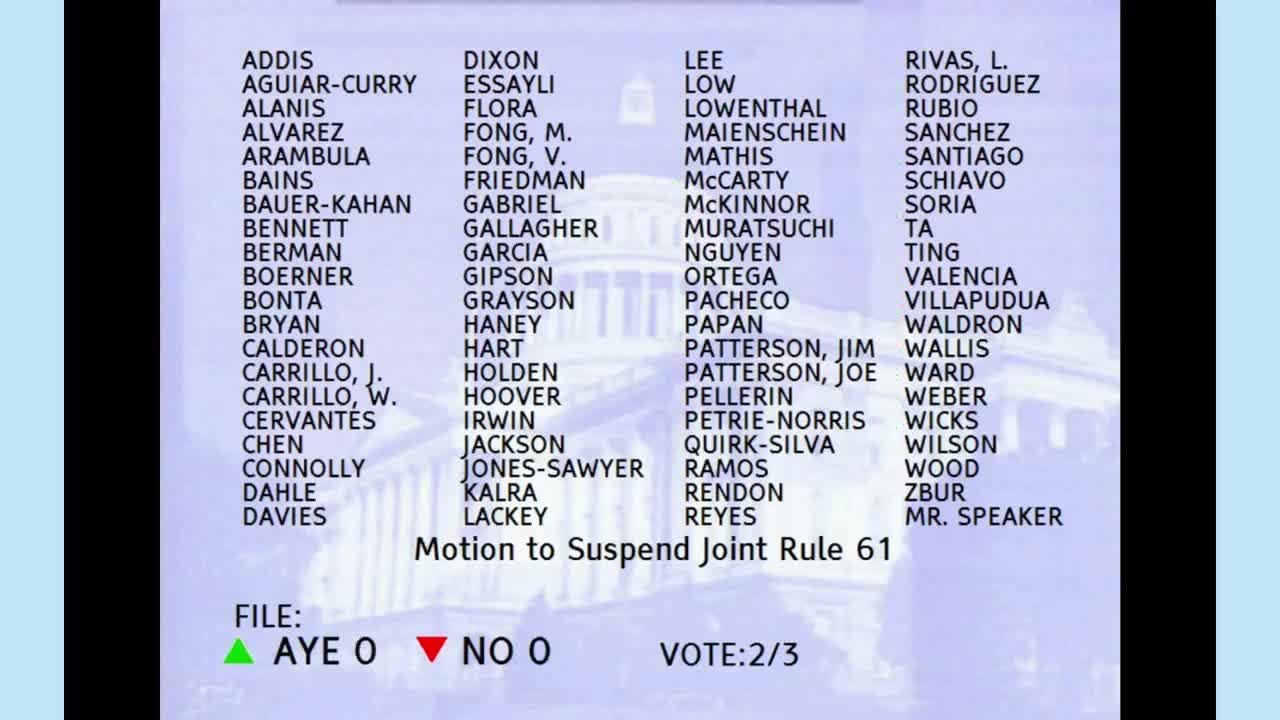 1MIN
Assembly Floor
 34SEC
Assembly Floor
 2MIN
Assembly Standing Committee on Appropriations
 5MIN
Assembly Standing Committee on Natural Resources
 3MIN
Senate Floor
 10MIN
Senate Standing Committee on Natural Resources and Water
Bill Author

Bill Co-Author(s):