SB 719: Law enforcement agencies: radio communications.
- Session Year: 2023-2024
- House: Senate
- Latest Version Date: 2024-01-23
Current Status:
Failed
(2024-01-30: Read third time. Refused passage. (Ayes 17. Noes 12. Page 3062.))
Introduced
In Committee
First Chamber
In Committee
Second Chamber
Enacted
Existing law establishes the California Law Enforcement Telecommunications System (CLETS) to make specified criminal justice databases, including individual criminal histories, wanted and missing persons, and stolen firearms, vehicles, and property, available to participating law enforcement agencies. Existing law prohibits unauthorized access to CLETS and the unlawful use of CLETS information by authorized users.
Existing law authorizes the Attorney General to adopt policies, procedures, and practices related to the use of CLETS. These rules require a participating agency to restrict access to CLETS and define access as the ability to see or hear any information obtained from CLETS.
This bill would require a law enforcement agency, including the Department of the California Highway Patrol, municipal police departments, county sheriffs departments, and specified local law enforcement agencies, and specified university and college police departments, to, by no later than January 1, 2024, 2025, ensure public access, in real time, to the radio communications of that agency, as specified. The bill would exempt university and college police departments from the public access requirement. By imposing new duties on local law enforcement, this bill would create a state-mandated local program.
This bill would also require those law enforcement agencies to ensure that any criminal justice information or personally identifiable information obtained through CLETS is not broadcast in a manner that is accessible to the public, as specified.
The California Constitution requires the state to reimburse local agencies and school districts for certain costs mandated by the state. Statutory provisions establish procedures for making that reimbursement.
This bill would provide that, if the Commission on State Mandates determines that the bill contains costs mandated by the state, reimbursement for those costs shall be made pursuant to the statutory provisions noted above.
Existing law establishes the California Law Enforcement Telecommunications System (CLETS) to make specified criminal justice databases, including individual criminal histories, wanted and missing persons, and stolen firearms, vehicles, and property, available to participating law enforcement agencies. Existing law prohibits unauthorized access to CLETS and the unlawful use of CLETS information by authorized users.
Existing law authorizes the Attorney General to adopt policies, procedures, and practices related to the use of CLETS. These rules require a participating agency to restrict access to CLETS and define access as the ability to see or hear any information obtained from CLETS.
This bill would require a law enforcement agency, including the Department of the California Highway Patrol, municipal police departments, county sheriffs departments, specified local law enforcement agencies, and specified university and college police departments, to, by no later than January 1, 2025, 2024, ensure public access public access, in real time, to the radio communications of that agency, as specified. By imposing new duties on local law enforcement, this bill would create a state-mandated local program.
This bill would also require those law enforcement agencies to ensure that any criminal justice information or personally identifiable information obtained through CLETS is not broadcast in a manner that is accessible to the public, as specified.
The California Constitution requires the state to reimburse local agencies and school districts for certain costs mandated by the state. Statutory provisions establish procedures for making that reimbursement.
This bill would provide that, if the Commission on State Mandates determines that the bill contains costs mandated by the state, reimbursement for those costs shall be made pursuant to the statutory provisions noted above.
Existing law establishes the California Law Enforcement Telecommunications System (CLETS) to make specified criminal justice databases, including individual criminal histories, wanted and missing persons, and stolen firearms, vehicles, and property, available to participating law enforcement agencies. Existing law prohibits unauthorized access to CLETS and the unlawful use of CLETS information by authorized users.
Existing law authorizes the Attorney General to adopt policies, procedures, and practices related to the use of CLETS. These rules require a participating agency to restrict access to CLETS and define access as the ability to see or hear any information obtained from CLETS.
This bill would require a law enforcement agency, including the Department of the California Highway Patrol, municipal police departments, county sheriffs departments, specified local law enforcement agencies, and specified university and college police departments, to to, by no later than January 1, 2025, ensure access, in real time, public access to the radio communications of that agency to duly authorized media representatives or organizations, agency, as specified. By imposing new duties on local law enforcement, this bill would create a state-mandated local program.
This bill would also require those law enforcement agencies to ensure that any criminal justice information or personally identifiable information obtained through CLETS is not broadcast in a manner that is accessible to the public, as specified.
The California Constitution requires the state to reimburse local agencies and school districts for certain costs mandated by the state. Statutory provisions establish procedures for making that reimbursement.
This bill would provide that, if the Commission on State Mandates determines that the bill contains costs mandated by the state, reimbursement for those costs shall be made pursuant to the statutory provisions noted above.
Existing law establishes the California Law Enforcement Telecommunications System (CLETS) to make specified criminal justice databases, including individual criminal histories, wanted and missing persons, and stolen firearms, vehicles, and property, available to participating law enforcement agencies. Existing law prohibits unauthorized access to CLETS and the unlawful use of CLETS information by authorized users.
Existing law authorizes the Attorney General to adopt policies, procedures, and practices related to the use of CLETS. These rules require a participating agency to restrict access to CLETS and define access as the ability to see or hear any information obtained from CLETS.
This bill would require a law enforcement agency, including the Department of the California Highway Patrol, municipal police departments, county sheriffs departments, specified local law enforcement agencies, and specified university and college police departments, to ensure access, in real time, to the radio communications of that agency to duly authorized media representatives or organizations, as specified. By imposing new duties on local law enforcement, this bill would create a state-mandated local program.
The California Constitution requires the state to reimburse local agencies and school districts for certain costs mandated by the state. Statutory provisions establish procedures for making that reimbursement.
This bill would provide that, if the Commission on State Mandates determines that the bill contains costs mandated by the state, reimbursement for those costs shall be made pursuant to the statutory provisions noted above.
The Legislature finds and declares all of the following:
(a)Since the 1920s, news outlets, journalists, and the public have had access to police radio communications. This access is critical for police transparency, accountability, and reporting public safety news and activity to the community expeditiously.
(b)By its very name, public safety involves both the public and the safety professionals who protect them. Encryption of public safety radio communications has largely focused on its impact to public safety officers without consideration of the publics vested interest. This bill seeks to correct that imbalance by continuing to protect sensitive information from public distribution while also ensuring the transparency of nonsensitive communications that Californians have come to expect.
(c)This act shall be known, and may be cited, as the Law Enforcement Communications Transparency Act.
SEC. 2.Section 13675 is added to the Penal Code, to read:13675.(a)(1)Except as otherwise provided in paragraph (3) and subdivision (b), each law enforcement agency shall, by no later than January 1, 2024, 2025, ensure that all radio communications are accessible to the public in real time.
(2)A law enforcement agency may comply with this subdivision in any manner that provides reasonable public access to radio communications, including, without limitation, any of the following means:
(A)Use of unencrypted radio communications on a radio frequency that is able to be monitored by commonly available radio scanning equipment.
(B)Online streaming of radio communications accessible through the agencys internet website.
(C)Upon request and for a reasonable fee, providing access to encrypted communications to any interested person.
(3)This subdivision does not apply to either of the following:
(A)Any encrypted A radio channel used exclusively for the exchange or dissemination of confidential information pursuant to subdivision (b).
(B)Any encrypted A radio channel that is used for tactical operations, operations, threat or security operations, undercover operations, or other communications that would unreasonably jeopardize public safety or the safety of officers if made public.
(b)(1)Notwithstanding subdivision (a), each law enforcement agency shall enact policies that prevent or substantially minimize criminal justice information or personally identifiable information directly obtained through the California Law Enforcement Telecommunications System (CLETS) from being broadcast in a manner that is accessible to the public.
(2)A law enforcement agency may comply with this subdivision in any manner that safeguards confidential CLETS information, including, without limitation, any of the following means:
(A)The limited use of an encrypted channel as described in subparagraph (A) of paragraph (3) of subdivision (a) for the exchange or dissemination of confidential information.
(B)Transmission of confidential information to a mobile data terminal, tablet, or other text display device.
(C)Communication of confidential information via telephone or other private device-to-device communication.
(3)This subdivision does not apply to either of the following:
(A)Confidential information that has previously been made public through a bulletin, alert, or other means.
(B)The broadcast of confidential information that is immediately necessary for the safety of the public or the safety of officers under circumstances where compliance with this subdivision is not reasonable.
(c)Each law enforcement agency shall, by no later than January 1, 2024, 2025, adopt a written policy implementing this section.
(d)This section does not limit the responsibility of any entity not covered by this section to comply with any law or regulation regarding the usage of CLETS.
(e)As used in this section, the following phrases are defined as follows:
(1)Law enforcement agency means a department or agency of the state, or any political subdivision thereof, that employs any peace officer as described in Section 830 and that has the primary function of providing uniformed patrol and general law enforcement services to the public. Law enforcement agency includes, without limitation, any municipal police department, county sheriffs department, police department of the University of California, the California State University, or community college, airport, port, harbor, park, or transit district, and the California Highway Patrol. For the purposes of this section, Law enforcement agency does not include the police department of the University of California, the California State University, or a community college.
(2)Radio communications means verbal communications that are broadcast over a radio frequency either from a dispatch center to field personnel, from field personnel to a dispatch center, or between field personnel, and are accessible to all personnel monitoring that frequency. Radio communications does not include private communications between two devices, such as a cellular telephone, or the transmittal of data to or from a mobile data terminal, tablet, text messaging device, or similar device.
SEC. 3.If the Commission on State Mandates determines that this act contains costs mandated by the state, reimbursement to local agencies and school districts for those costs shall be made pursuant to Part 7 (commencing with Section 17500) of Division 4 of Title 2 of the Government Code.
The Legislature finds and declares all of the following:
(a)Since the 1920s, news outlets, journalists, and the public have had access to police radio communications. This access is critical for police transparency, accountability, and reporting public safety news and activity to the community expeditiously.
(b)By its very name, public safety involves both the public and the safety professionals who protect them. Encryption of public safety radio communications has largely focused on its impact to public safety officers without consideration of the publics vested interest. This bill seeks to correct that imbalance by continuing to protect sensitive information from public distribution while also ensuring the transparency of nonsensitive communications that Californians have come to expect.
(c)This act shall be known, and may be cited, as the Law Enforcement Communications Transparency Act.
SEC. 2.Section 13675 is added to the Penal Code, to read:13675.(a)(1)Except as otherwise provided in paragraph (3) and subdivision (b), each law enforcement agency shall, by no later than January 1, 2025, 2024, ensure that all radio communications are accessible to the public. public in real time.
(2)A law enforcement agency may comply with this subdivision in any manner that provides reasonable public access to radio communications, including, without limitation, any of the following means:
(A)Use of unencrypted radio communications on a radio frequency that is able to be monitored by commonly available radio scanning equipment.
(B)Online streaming of radio communications accessible through the agencys internet website.
(C)Upon request and for a reasonable fee, providing access to encrypted communications to any interested person.
(3)This subdivision does not apply to either of the following:
(A)Any encrypted radio channel used exclusively for the exchange or dissemination of confidential information pursuant to subdivision (b).
(B)Any encrypted radio channel that is used for tactical operations, undercover operations, or other communications that would unreasonably jeopardize public safety or the safety of officers if made public.
(b)(1)Notwithstanding subdivision (a), each law enforcement agency shall enact policies that prevent or substantially minimize criminal justice information or personally identifiable information directly obtained through the California Law Enforcement Telecommunications System (CLETS) from being broadcast in a manner that is accessible to the public.
(2)A law enforcement agency may comply with this subdivision in any manner that safeguards confidential CLETS information, including, without limitation, any of the following means:
(A)The limited use of an encrypted channel as described in subparagraph (A) of paragraph (3) of subdivision (a) for the exchange or dissemination of confidential information.
(B)Transmission of confidential information to a mobile data terminal, tablet, or other text display device.
(C)Communication of confidential information via telephone or other private device-to-device communication.
(3)This subdivision does not apply to either of the following:
(A)Confidential information that has previously been made public through a bulletin, alert, or other means.
(B)The broadcast of confidential information that is immediately necessary for the safety of the public or the safety of officers under circumstances where compliance with this subdivision is not reasonable.
(c)Each law enforcement agency shall, by no later than January 1, 2025, 2024, adopt a written policy implementing this section.
(d)This section does not limit the responsibility of any entity not covered by this section to comply with any law or regulation regarding the usage of CLETS.
(e)As used in this section, the following phrases are defined as follows:
(1)Law enforcement agency means a department or agency of the state, or any political subdivision thereof, that employs any peace officer as described in Section 830 and that has the primary function of providing uniformed patrol and general law enforcement services to the public. Law enforcement agency includes, without limitation, any municipal police department, county sheriffs department, police department of the University of California, the California State University, or community college, airport, port, harbor, park, or transit district, and the California Highway Patrol.
(2)Radio communications means verbal communications that are broadcast over a radio frequency either from a dispatch center to field personnel, from field personnel to a dispatch center, or between field personnel, and are accessible to all personnel monitoring that frequency. Radio communications does not include private communications between two devices, such as a cellular telephone, or the transmittal of data to or from a mobile data terminal, tablet, text messaging device, or similar device.
SEC. 3.If the Commission on State Mandates determines that this act contains costs mandated by the state, reimbursement to local agencies and school districts for those costs shall be made pursuant to Part 7 (commencing with Section 17500) of Division 4 of Title 2 of the Government Code.
The Legislature finds and declares all of the following:
(a)Since the 1920s, news outlets, journalists, and the public have had access to police radio communications. This access is critical for police transparency, accountability, and reporting public safety news and activity to the community expeditiously.
(b)By its very name, public safety involves both the public and the safety professionals who protect them. Encryption of public safety radio communications has largely focused on its impact to public safety officers without consideration of the publics vested interest. This bill seeks to correct that imbalance by continuing to protect sensitive information from public distribution while also ensuring the transparency of nonsensitive communications that Californians have come to expect.
(c)This act shall be known, and may be cited, as the Law Enforcement Communications Transparency Act.
SEC. 2.Section 13675 is added to the Penal Code, to read:13675.(a)(1)Except as otherwise provided in paragraph (3), each law enforcement agency shall ensure that all radio communications are accessible, in real time, to duly authorized media representatives or organizations.(2)(A)A law enforcement agency may comply with this subdivision in any manner that provides access to radio communications.(B)Upon request by a duly authorized media representative or organization, the ability to begin listening to radio communications shall be granted by a law enforcement agency within 30 days.(C)The law enforcement agency shall not charge the duly authorized media representative or organization for the cost of providing access.(3)This subdivision does not apply to any encrypted radio channel that is used for tactical operations, undercover operations, or other communications that would unreasonably jeopardize public safety or the safety of officers or dispatchers if made public.(b)Each law enforcement agency shall adopt a written policy implementing this section.(c)This section does not limit the responsibility of any entity not covered by this section to comply with any law or regulation regarding the usage of the California Law Enforcement Telecommunications System (CLETS).(d)As used in this section, the following phrases are defined as follows:(1)Duly authorized media representative or organization means a duly authorized representative or organization of any news service, newspaper, or radio or television station or network, or an organization that provides public safety information.(2)Law enforcement agency means a department or agency of the state, or any political subdivision thereof, that employs any peace officer as described in Section 830 and that has the primary function of providing uniformed patrol and general law enforcement services to the public. Law enforcement agency includes, without limitation, any municipal police department, county sheriffs department, police department of the University of California, California State University, or community college, airport, port, harbor, park, or transit district, and the Department of the California Highway Patrol.(3)Radio communications means verbal communications that are broadcast over a radio frequency either from a dispatch center to field personnel, from field personnel to a dispatch center, or between field personnel, and are accessible to all personnel monitoring that frequency. Radio communications does not include private communications between two devices, such as a cellular telephone, or the transmittal of data to or from a mobile data terminal, tablet, text messaging device, or similar device.SEC. 2.Section 13675 is added to the Penal Code, to read:13675.(a)(1)Except as otherwise provided in paragraph (3) and subdivision (b), each law enforcement agency shall, by no later than January 1, 2025, ensure that all radio communications are accessible to the public.
(2)A law enforcement agency may comply with this subdivision in any manner that provides reasonable public access to radio communications, including, without limitation, any of the following means:
(A)Use of unencrypted radio communications on a radio frequency that is able to be monitored by commonly available radio scanning equipment.
(B)Online streaming of radio communications accessible through the agencys internet website.
(C)Upon request and for a reasonable fee, providing access to encrypted communications to any interested person.
(3)This subdivision does not apply to either of the following:
(A)Any encrypted radio channel used exclusively for the exchange or dissemination of confidential information pursuant to subdivision (b).
(B)Any encrypted radio channel that is used for tactical operations, undercover operations, or other communications that would unreasonably jeopardize public safety or the safety of officers if made public.
(b)(1)Notwithstanding subdivision (a), each law enforcement agency shall enact policies that prevent or substantially minimize criminal justice information or personally identifiable information directly obtained through the California Law Enforcement Telecommunications System (CLETS) from being broadcast in a manner that is accessible to the public.
(2)A law enforcement agency may comply with this subdivision in any manner that safeguards confidential CLETS information, including, without limitation, any of the following means:
(A)The limited use of an encrypted channel as described in subparagraph (A) of paragraph (3) of subdivision (a) for the exchange or dissemination of confidential information.
(B)Transmission of confidential information to a mobile data terminal, tablet, or other text display device.
(C)Communication of confidential information via telephone or other private device-to-device communication.
(3)This subdivision does not apply to either of the following:
(A)Confidential information that has previously been made public through a bulletin, alert, or other means.
(B)The broadcast of confidential information that is immediately necessary for the safety of the public or the safety of officers under circumstances where compliance with this subdivision is not reasonable.
(c)Each law enforcement agency shall, by no later than January 1, 2025, adopt a written policy implementing this section.
(d)This section does not limit the responsibility of any entity not covered by this section to comply with any law or regulation regarding the usage of CLETS.
(e)As used in this section, the following phrases are defined as follows:
(1)Law enforcement agency means a department or agency of the state, or any political subdivision thereof, that employs any peace officer as described in Section 830 and that has the primary function of providing uniformed patrol and general law enforcement services to the public. Law enforcement agency includes, without limitation, any municipal police department, county sheriffs department, police department of the University of California, the California State University, or community college, airport, port, harbor, park, or transit district, and the California Highway Patrol.
(2)Radio communications means verbal communications that are broadcast over a radio frequency either from a dispatch center to field personnel, from field personnel to a dispatch center, or between field personnel, and are accessible to all personnel monitoring that frequency. Radio communications does not include private communications between two devices, such as a cellular telephone, or the transmittal of data to or from a mobile data terminal, tablet, text messaging device, or similar device.
SEC. 3.If the Commission on State Mandates determines that this act contains costs mandated by the state, reimbursement to local agencies and school districts for those costs shall be made pursuant to Part 7 (commencing with Section 17500) of Division 4 of Title 2 of the Government Code.
The Legislature finds and declares all of the following:
(a)Since the 1920s, news outlets, journalists, and the public have had access to police radio communications. This access is critical for police transparency, accountability, and reporting public safety news and activity to the community expeditiously.
(b)By its very name, public safety involves both the public and the safety professionals who protect them. Encryption of public safety radio communications has largely focused on its impact to public safety officers without consideration of the publics vested interest. This bill seeks to correct that imbalance by continuing to protect sensitive information from public distribution while also ensuring the transparency of nonsensitive communications that Californians have come to expect.
(c)This act shall be known, and may be cited, as the Law Enforcement Communications Transparency Act.
SEC. 2.Section 13675 is added to the Penal Code, to read:13675.(a)(1)Except as otherwise provided in paragraph (3), each law enforcement agency shall ensure that all radio communications are accessible, in real time, to duly authorized media representatives or organizations.
(2)(A)A law enforcement agency may comply with this subdivision in any manner that provides access to radio communications.
(B)Upon request by a duly authorized media representative or organization, the ability to begin listening to radio communications shall be granted by a law enforcement agency within 30 days.
(C)The law enforcement agency shall not charge the duly authorized media representative or organization for the cost of providing access.
(3)This subdivision does not apply to any encrypted radio channel that is used for tactical operations, undercover operations, or other communications that would unreasonably jeopardize public safety or the safety of officers or dispatchers if made public.
(b)Each law enforcement agency shall adopt a written policy implementing this section.
(c)This section does not limit the responsibility of any entity not covered by this section to comply with any law or regulation regarding the usage of the California Law Enforcement Telecommunications System (CLETS).
(d)As used in this section, the following phrases are defined as follows:
(1)Duly authorized media representative or organization means a duly authorized representative or organization of any news service, newspaper, or radio or television station or network, or an organization that provides public safety information.
(2)Law enforcement agency means a department or agency of the state, or any political subdivision thereof, that employs any peace officer as described in Section 830 and that has the primary function of providing uniformed patrol and general law enforcement services to the public. Law enforcement agency includes, without limitation, any municipal police department, county sheriffs department, police department of the University of California, California State University, or community college, airport, port, harbor, park, or transit district, and the Department of the California Highway Patrol.
(3)Radio communications means verbal communications that are broadcast over a radio frequency either from a dispatch center to field personnel, from field personnel to a dispatch center, or between field personnel, and are accessible to all personnel monitoring that frequency. Radio communications does not include private communications between two devices, such as a cellular telephone, or the transmittal of data to or from a mobile data terminal, tablet, text messaging device, or similar device.
SEC. 3.If the Commission on State Mandates determines that this act contains costs mandated by the state, reimbursement to local agencies and school districts for those costs shall be made pursuant to Part 7 (commencing with Section 17500) of Division 4 of Title 2 of the Government Code.
|
Date
|
Status
|
|---|---|
| Jan 30, 2024 | Read third time. Refused passage. (Ayes 17. Noes 12. Page 3062.) |
| Jan 23, 2024 | Read second time and amended. Ordered to third reading. |
| Jan 22, 2024 | From committee: Do pass as amended. (Ayes 4. Noes 2. Page 3011.) (January 18). |
| Jan 12, 2024 | Set for hearing January 18. |
| May 18, 2023 | May 18 hearing: Held in committee and under submission. |
| May 12, 2023 | Set for hearing May 18. |
| Apr 24, 2023 | April 24 hearing: Placed on APPR suspense file. |
| Apr 14, 2023 | Set for hearing April 24. |
| Apr 11, 2023 | From committee: Do pass and re-refer to Com. on APPR. (Ayes 4. Noes 1. Page 660.) (April 11). Re-referred to Com. on APPR. |
| Mar 29, 2023 | From committee with author's amendments. Read second time and amended. Re-referred to Com. on PUB S. |
| Mar 21, 2023 | March 28 set for first hearing canceled at the request of author. |
| Mar 20, 2023 | From committee with author's amendments. Read second time and amended. Re-referred to Com. on PUB S. |
| Mar 13, 2023 | Set for hearing March 28. |
| Mar 8, 2023 | Referred to Com. on PUB S. |
| Feb 17, 2023 | From printer. May be acted upon on or after March 19. |
| Feb 16, 2023 | Introduced. Read first time. To Com. on RLS. for assignment. To print. |
|
Date
|
Description
|
Location
|
Votes
|
|
|---|---|---|---|---|
| Jan 30, 2024 | Senate 3rd Reading SB719 Becker | Senate Floor |
Failed |
|
| Jan 18, 2024 | Do pass as amended | Senate Standing Committee on Appropriations |
Passed |
|
| Apr 24, 2023 | Placed on suspense file | Senate Standing Committee on Appropriations |
Passed |
|
| Apr 11, 2023 | Do pass, but first be re-referred to the Committee on [Appropriations] | Senate Standing Committee on Public Safety |
Passed |
This list shows positions taken on this bill by organizations on the date displayed, which is linked to the original source.
Positions by individuals are not included.
|
Organization
|
Position
|
Date
|
|---|---|---|
| California Black Media | ** Support | |
| California Broadcasters Association | ** Support | |
| California News Publishers Association | ** Support | |
| California Peace Officers Association | ** Against | |
| California Public Defenders Association | ** Support | |
| California State Sheriffs Association | ** Against | |
| California Teachers Association | ** Support | |
| Citizen | ** Support | |
| City Of Palo Alto | ** Support | |
| City of Santa Barbara | ** Against | |
| City Of Visalia | ** Against | |
| City of Whittier | ** Against | |
| Ethnic Media Services | ** Support | |
| First Amendment Coalition | ** Support | |
| League Of California Cities | ** Against | |
| National Press Photographers Association | ** Support | |
| National Writers Union | ** Support | |
| Oakland Privacy | ** Support | |
| Pacific Media Workers Guild | ** Support | |
| Peace Officers Research Association Of California | ** Against | |
| Radio Television Digital News Association | ** Support | |
| Riverside County Sheriff’s Office | ** Against |
SENATE RULES COMMITTEE Office of Senate Floor Analyses (916) 651-1520 Fax: (916) 327-4478 | SB 719 |
THIRD READING
Bill No: SB 719
Author: Becker (D)
Amended: 1/22/24
Vote: 21
SENATE PUBLIC SAFETY COMMITTEE: 4-1, 4/11/23
AYES: Wahab, Bradford, Skinner, Wiener
NOES: Ochoa Bogh
SENATE APPROPRIATIONS COMMITTEE: 4-2, 1/18/24
AYES: Portantino, Bradford, Wahab, Wiener
NOES: Jones, Seyarto
NO VOTE RECORDED: Ashby
SUBJECT: Law enforcement agencies: radio communications
SOURCE: Author
DIGEST:
This bill ensures public access to law enforcement radio communications in real time and requires law enforcement agencies to prevent or substantially minimize criminal justice information or personally identifiable information from being broadcast in a manner that is accessible to the public.
ANALYSIS:
Existing law:
- Declares the people’s right to transparency in government. (“The people have the right of access to information concerning the conduct of the people’s business, and therefore, the meetings of public bodies and the writings of public officials and agencies shall be open to public scrutiny....”) (Cal. Const., art. I, Sec. 3.)
- Provides, through the California Public Records Act, that access to information concerning the conduct of the people’s business is a fundamental and necessary right of every person in this state. (Gov. Code §7920.000 et. seq)
- Provides that public records are open to inspection at all times during the office hours of the state or local agency and every person has a right to inspect any public record, except as provided. (Gov. Code § 7922.525.)
- Exempts from the California Public Records Act the disclosure of investigations conducted by the office of the Attorney General and the California Department of Justice (DOJ), the Office of Emergency Services and any state or local police agency, or any investigatory or security files compiled by any other state or local police agency, or any investigatory or security files compiled by any other state or local agency for correctional, law enforcement, or licensing purposes. (Gov. Code §7923.600)
- Provides that the Commission on Peace Officer Standards and Training (POST) shall conspicuously post on their internet websites all current standards, policies, practices, operating procedures, and education and training materials that would otherwise be available to the public if a request was made pursuant to the California Public Records Act. (Penal Code §13650).
- Establishes the Legislature’s intent to provide an efficient law enforcement communications network available to all public agencies of law enforcement, and that such a network be established and maintained in a condition adequate to the needs of law enforcement. (Gov. Code §15151).
- Requires the DOJ to maintain a statewide telecommunications system of communication for the use of law enforcement agencies, known as the California Law Enforcement Telecommunications System (CLETS), and provides that CLETS shall be under the direction of the Attorney General, and shall be used exclusively for the official business of the state and any city, county, city and county, or other public agency. (Gov. Code §§15152, 15153).
- Requires the Attorney General to appoint an advisory committee on CLETS, and establishes various requirements and responsibilities related thereto. (Gov. Code §§15154 – 15159)
- Requires the Attorney General to adopt and publish the operating policies, practices and procedures, and conditions of qualification and membership, of CLETS. (Gov. Code §15160).
- Requires the DOJ to provide a basic telecommunications network consisting of no more than two relay or switching centers in the state and circuitry and terminal equipment in one location only in each county in the state. (Gov. Code §15161).
- Requires that CLETS provide service to any law enforcement agency qualified by the CLETS advisory committee which, at the agency’s own expense, desires connection through the county terminal. (Gov. Code §15163).
- Prohibits any person not authorized by the sender, who intercepts any public safety radio service communication, by use of a scanner or any other means, from using that communication to assist in the commission of a criminal offense or to avoid or escape arrest, trial, conviction, or punishment or who divulges to any person he or she knows to be a suspect in the commission of any criminal offense, the contents of that communication concerning the offense with the intent that that individual may avoid arrest, trial, conviction or punishment. (Penal Code §636.5)
This bill:
- Establishes a legislative finding that since the 1920s, news outlets, journalists, and the public have had access to police radio communications, and this access is critical for police transparency, accountability, and reporting public safety news and activity to the community expeditiously.
- Establishes a legislative finding that by its very name, public safety involves both the public and the safety professionals who protect them, and that encryption of public safety radio communications has largely focused on its impact to public safety officers without consideration of the public’s vested interest.
- Includes a declaration that it seeks to correct that imbalance by continuing to protect sensitive information from public distribution while also ensuring the transparency of nonsensitive communications that Californians have come to expect.
- Requires each law enforcement agency, as defined, to ensure that all radio communications, as defined, are accessible to the public in real time by January 1, 2025, with limited exceptions.
- Defines “law enforcement agency” as a department or agency of the state, or any political subdivision thereof, that employs any peace officer and that has the primary function of providing uniformed patrol and general law enforcement services to the public, and specifies the types of agencies included in that definition.
- Specifies that “law enforcement agency” for purposes of this bill’s provisions does not include the police department of the University of California, the California State University, or a community college.
- Defines “radio communications” as verbal communications that are broadcast over a radio frequency either from a dispatch center to field personnel, from field personnel to a dispatch center, or between field personnel, and are accessible to all personnel monitoring that frequency. However, “radio communications” does not include private communications between two devices, such as a cellular telephone, or the transmittal of data to or from a mobile data terminal, tablet, text messaging device or similar device.
- Specifies that a law enforcement agency may comply with the public access requirement in any manner that provides reasonable public access to radio communications including, without limitation, any of three specified means.
- Specifies that the public access requirement does not apply to any radio channel that is used exclusively for the exchange or dissemination of confidential information or to any radio channel that is used for tactical operations, threat or security operations, undercover operations, or other communications that would jeopardize public safety or the safety of officers if made public.
- Requires each law enforcement agency to enact policies that prevent or substantially minimize criminal justice information or personally identifiable information directly obtained through CLETS from being broadcast in a manner that is accessible to the public.
- Specifies that a law enforcement agency may comply with this confidentiality requirement in any manner that safeguards confidential CLETS information, including, without limitation, any of three specified means.
- Specifies that the confidentiality requirement does not apply to confidential information that has previously been made public through a bulletin, alert or other means or to the broadcast of confidential information that is immediately necessary for the safety of the public or the safety of officers under circumstances where compliance is not reasonable.
- Requires each law enforcement agency to adopt a written policy implementing its provisions no later than January 1, 2025.
- Specifies that it does not limit the responsibility of any entity not covered by its provisions to comply with any law or regulation regarding the usage of CLETS.
Comments
According to the author, “Public access to LEA communications allows residents the opportunity to prepare for emergencies regarding shootings, crashes, natural disasters, and other public safety events. However, in October 2020, the California Department of Justice allowed more than 100 law enforcement agencies to completely encrypt their communications, which puts public safety at risk. In Monterey Park, for example, where the local police department has fully encrypted their radio communications, the public was not notified of an active shooter for five hours after a mass shooting took the lives of 11 people last January.
“SB 719 is integral to restoring access to Law Enforcement Agencies’ (LEAs) communications that has been precedent for the last 80 years. Transparency is a key component of public service that is codified and protected in California’s Constitution. SB 719 protects the public’s right to know and the press’s freedom to report the events happening in their community while protecting private information. This bill will require that all LEA communications be accessible to the public and the press with reasonable exceptions for undercover operations and confidential information. At its core, LEA communication transparency is a public safety issue and SB 719 looks upon past precedent and current unencrypted LEA operational standards to reestablish this access. In doing so, this bill protects the best interests of the community by both maintaining accessibility and avenues for accountability.”
Implemented in the 1970’s, CLETS is a data interchange network administered by the DOJ. CLETS provides law enforcement and criminal justice agencies access to databases maintained by state and federal agencies, and allows for the exchange of administrative messages to agencies within California, other states, and Canada. Its primary function is to provide law enforcement with individuals’ criminal and driving records, often in real time as officers conduct investigations and respond to calls in the field. In October 2020, the DOJ division charged with administering CLETS issued a memo directing law enforcement agencies to take steps to restrict access to Criminal Justice Information (CJI) and Personally Identifiable Information (PII). According to the memo, agencies were permitted to comply with its directives via the following methods:
- “Encryption of radio traffic pursuant to FBI Criminal Justice Information Service Security Policy. This will provide the ability to securely broadcast all CJI (both restricted and unrestricted information) and all combinations of PII.” [Encryption approach]
- “Establish policy to restrict dissemination of specific information that would provide for the protection of restricted CJI database information and combinations of name and other data elements that meet the definition of PII. This will provide for the protection of CJI and PII while allowing for radio traffic with the information necessary to provide public safety.” [Hybrid approach]
In response to the DOJ’s memo, several law enforcement agencies began to adopt the department’s first suggested approach and fully encrypt their radio communications. Most notably, law enforcement agencies in San Jose, San Francisco, Palo Alto, San Diego, Mountain View and Tracy have opted for full encryption over adopting a policy that restricts the dissemination of CJI and PII while allowing some public access to radio channels. Many of these agencies faced criticism from journalists, the public, and local leaders advocating for greater transparency. As of February 27, 2023, radio communications for roughly 120 law enforcement agencies across California are fully encrypted, allowing no public access.
Existing law does not guarantee public access to police radio communications, nor does it prohibit public access to unencrypted police radio channels. Existing law does, however, make it a crime to use any intercepted public safety radio communication to assist in the commission of a crime or evade capture by law enforcement.[1] This bill requires each law enforcement agency in California, by January 1, 2024, to ensure that all radio communications are accessible to the public, in real time, with the exception of encrypted radio channels used exclusively for the dissemination of confidential information or for communications that would jeopardize public safety or officer safety if made public (such as tactical or undercover operations). This bill allows agencies to comply with this requirement in any manner that provides reasonable public access, including, but not limited to, the use of unencrypted radio channels, online streaming through the agency’s website, or providing access to encrypted communications upon request for a reasonable fee.
Notwithstanding the access requirement outlined above, this bill requires each California law enforcement agency to prevent or substantially minimize CJI or PII obtained via CLETS from being broadcast in a manner that is accessible to the public. Confidential information that has already been made public or that must be broadcast immediately to ensure officer or public safety is exempt from this requirement. This bill allows agencies to comply with this requirement in any manner that safeguards confidential CLETS information, including, but not limited to, the use of an encrypted channel used exclusively for the transmission of confidential information or the communication of confidential information via data terminal, tablet, phone or other similar device.
Recent amendments to this bill incorporated a requirement that radio communications be made accessible to the public “in real time.” Initially, such a requirement, in conjunction with a requirement that the disclosure of CJI and PII be prevented or substantially minimized, seems impractical, since that confidential information would presumably also have to be censored in real-time. However, it is clear that such a system is in fact entirely feasible, as dozens California law enforcement agencies broadcast real-time radio transmissions and are still, in theory, compliant with the DOJ’s memo.
FISCAL EFFECT: Appropriation: No Fiscal Com.: Yes Local: Yes
According to the Senate Appropriations Committee:
- Unknown, one-time and ongoing costs, potentially in the millions of dollars to various state entities, including the California Highway Patrol, the California Department of Forestry and Fire Prevention, California Department of Parks and Recreation, and others in order to comply with the requirements of this bill (General Fund, special funds).
- Unknown, potentially state-reimbursable costs for local law enforcement agencies to ensure that all radio communications are publicly accessible in real time (Local Funds, General Fund). General Fund costs will depend upon whether the Commission on State Mandates determines that this bill imposes a reimbursable state mandate, and which specific local duties and costs would be subject to state-reimbursement.
SUPPORT: (Verified 1/18/24)
California Black Media
California Broadcasters Association
California News Publishers Association
California Public Defenders Association
California Teachers Association
Citizen
City of Palo Alto
Ethnic Media Services
First Amendment Coalition
National Press Photographers Association
National Writers Union
Oakland Privacy
Pacific Media Workers Guild
Radio Television Digital News Association
OPPOSITION: (Verified 1/18/24)
California Peace Officers Association
California State Sheriffs’ Association
City of Santa Barbara
City of Visalia
City of Whittier
League of California Cities
Peace Officers Research Association of California
Riverside County Sheriff’s Office
Prepared by: Alex Barnett / PUB. S. /
1/24/24 13:47:27
**** END ****
Penal Code §636.5 ↑
SENATE COMMITTEE ON APPROPRIATIONS
Senator Anthony Portantino, Chair
2023 - 2024 Regular Session
SB 719 (Becker) - Law enforcement agencies: radio communications
Version: March 29, 2023 | Policy Vote: PUB. S. 4 - 1 |
Urgency: No | Mandate: Yes |
Hearing Date: January 18, 2024 | Consultant: Mark McKenzie |
Bill Summary:
SB 719 would require each law enforcement agency, as defined, to ensure that all radio communications, as defined, are accessible to the public in real time by January 1, 2024, with specified exceptions.
*********** ANALYSIS ADDENDUM – SUSPENSE FILE ***********
The following information is revised to reflect amendments
adopted by the committee on January 18, 2024
Fiscal Impact:
- Unknown, one-time and ongoing costs, potentially in the millions of dollars to various state entities, including the California Highway Patrol, the California Department of Forestry and Fire Prevention, California Department of Parks and Recreation, and others in order to comply with the requirements of this bill (General Fund, special funds).
- Unknown, potentially state-reimbursable costs for local law enforcement agencies to ensure that all radio communications are publicly accessible in real time (Local Funds, General Fund). General Fund costs will depend upon whether the Commission on State Mandates determines that this bill imposes a reimbursable state mandate, and which specific local duties and costs would be subject to state-reimbursement.
Author Amendments:
- Specify that the police departments of the University of California, California State University, and community colleges are not included in the definition of law enforcement agencies that are subject to the bill’s requirements.
- Change the date by which a law enforcement agency must adopt a written policy implementing the bill from January 1, 2024 to January 1, 2025.
Committee Amendments:
- Clarify that the bill’s current exemptions would apply to both encrypted and unencrypted radio channels used by law enforcement for specified communications.
- Include “threat or security operations” as a category of law enforcement communications that are exempted from the bill’s real time public access requirements.
-- END --
SENATE COMMITTEE ON APPROPRIATIONS
Senator Anthony Portantino, Chair
2023 - 2024 Regular Session
SB 719 (Becker) - Law enforcement agencies: radio communications
Version: March 29, 2023 | Policy Vote: PUB. S. 4 - 1 |
Urgency: No | Mandate: Yes |
Hearing Date: April 24, 2023 | Consultant: Matthew Fleming |
Bill Summary:
SB 719 would require each law enforcement agency, as defined, to ensure that all radio communications, as defined, are accessible to the public in real time by January 1, 2024, with specified exceptions.
Fiscal Impact:
- Unknown, one-time and ongoing costs, potentially in the tens of millions to various state entities, including the California State University, the California Community Colleges, California Department of Forestry and Fire Prevention, California State Parks, and others in order to comply with the requirements of this bill (Proposition 98, General Fund).
- Unknown, potentially reimbursable costs for local law enforcement agencies to ensure that all radio communications are publicly accessible in real time (Local Funds, General Fund). General Fund costs will depend on whether this bill imposes a reimbursable state mandate, subject to a decision by the commission on state mandates.
Background:
Implemented in the 1970’s, the California Law Enforcement Telecommunications System (CLETS) is a data interchange network administered by the California Department of Justice (DOJ). CLETS provides law enforcement and criminal justice agencies access to databases maintained by state and federal agencies, and allows for the exchange of administrative messages to agencies within California, other states, and Canada. Its primary function is to provide law enforcement with individuals’ criminal and driving records, often in real time as officers conduct investigations and respond to calls in the field. In October 2020, the DOJ division charged with administering CLETS issued a memo directing law enforcement agencies to take steps to restrict access to Criminal Justice Information (CJI) and Personally Identifiable Information (PII). According to the memo, agencies were permitted to comply with its directives via the following methods:
- “Encryption of radio traffic pursuant to FBI Criminal Justice Information Service Security Policy. This will provide the ability to securely broadcast all CJI (both restricted and unrestricted information) and all combinations of PII.” [Encryption approach]
- “Establish policy to restrict dissemination of specific information that would provide for the protection of restricted CJI database information and combinations of name and other data elements that meet the definition of PII. This will provide for the protection of CJI and PII while allowing for radio traffic with the information necessary to provide public safety.” [Hybrid approach]
In response to the DOJ’s memo, several law enforcement agencies began to adopt the department’s first suggested approach and fully encrypt their radio communications. Most notably, law enforcement agencies in San Jose, San Francisco, Palo Alto, San Diego, Mountain View and Tracy opted for full encryption over adopting a policy that restricts the dissemination of CJI and PII while allowing some public access to radio channels. Many of these agencies faced criticism from journalists, the public, and local leaders advocating for greater transparency. In Palo Alto, the police department issued a memo in March 2021 asserting that because of the dangerous nature of police work, officers’ ability to obtain critical information, including PII and CJI, is most safely done via radio communication. The memo went on to conclude that “other means of receiving this information can put the officer and the public at risk,” and thus, “there are no other feasible options at this time to implement ‘unencrypted’ radio transmissions.” However, on September 1, 2022, Palo Alto PD reversed course and began providing real-time access to police radio transmissions while safeguarding personal identifying information. As of February 27, 2023, radio communications for roughly 120 law enforcement agencies across California are fully encrypted, allowing no public access.
Proposed Law:
- Requires each law enforcement agency, as defined, to ensure that all radio communications, as defined, are accessible to the public in real time by January 1, 2024, with limited exceptions.
- Specifies that a law enforcement agency may comply with the public access requirement in any manner that provides reasonable public access to radio communications including, without limitation, any of the following means:
- Use of unencrypted radio communications on a radio frequency that is able to be monitored by commonly available radio scanning equipment.
- Online streaming of radio communications accessible through the agency’s internet website.
- Upon request and for a reasonable fee, providing access to encrypted communications to any interested person.
- Specifies that the public access requirement does not apply to any encrypted radio channel that is used exclusively for the exchange or dissemination of confidential information or to any encrypted radio channel that is used for tactical operations, undercover operations, or other communications that would unreasonably jeopardize public safety or the safety of officers if made public.
- Requires each law enforcement agency to enact policies that prevent or substantially minimize criminal justice information or personally identifiable information directly obtained through CLETS from being broadcast in a manner that is accessible to the public.
- Specifies that a law enforcement agency may comply with this confidentiality requirement in any manner that safeguards confidential CLETS information, including, without limitation, any of the following means:
- The use of an encrypted channel for the exchange or dissemination of confidential information.
- Transmission of confidential information to a mobile data terminal, tablet, or other text display device.
- Communication of confidential information via telephone or other private device-to-device communication
- Specifies that the confidentiality requirement does not apply to confidential information that has previously been made public through a bulletin, alert or other means or to the broadcast of confidential information that is immediately necessary for the safety of the public or the safety of officers under circumstances where compliance is not reasonable.
- Requires each law enforcement agency to adopt a written policy implementing its provisions no later than January 1, 2024.
- Specifies that it does not limit the responsibility of any entity not covered by its provisions to comply with any law or regulation regarding the usage of CLETS.
Related Legislation:
SB 1000 (Becker, 2022) was similar to this bill in that it would have required each law enforcement agency to ensure that radio communications are accessible to the public by January 1, 2024, with specified exemptions.
Staff Comments:
Staff notes that there are over 500 law enforcement agencies in the State of Califorina and approximately 120 law enforcement agencies in California who have opted to fully encrypt their radio communications in response to the DOJ memo that was distributed in 2020. In order to comply with the requirements of this bill, each of those agencies will have to switch over from using fully encrypted communications to one of several approaches; 1) using unencrypted radio communications on a radio frequency that is able to be monitored by commonly available radio scanning equipment, 2) online streaming of radio communications accessible through the agency’s internet website, or 3) upon request and for a reasonable fee, providing access to encrypted communications to any interested person. To the extent agencies are able, and opt to charge a fee for access to encrypted communications, some costs may be offset. Costs to the General Fund will be subject to a decision by the Commission on State Mandates.
-- END --
SENATE COMMITTEE ON PUBLIC SAFETY
Senator Aisha Wahab, Chair
2023 - 2024 Regular
Bill No: SB 719 Hearing Date: April 11, 2023
Author: | Becker | ||
Version: | March 29, 2023 | ||
Urgency: | No | Fiscal: | Yes |
Consultant: | AB | ||
Subject: Law enforcement agencies: radio communications
HISTORY
Source: California News Publisher’s Association
Prior Legislation: SB 1000 (Becker, 2022), held in Assembly Appropriations
AB 1555 (Gloria, 2019), died in Assembly Governmental Organization
Support: California Black Media; California Broadcasters Association; California Public Defenders Association; Citizen; Ethnic Media Services; First Amendment Coalition; National Press Photographers Association; National Writers Union; Pacific Media Workers Guild; Radio Television Digital News Association
Opposition: California Peace Officers Association; California State Sheriffs’ Association; League of California Cities; Riverside County Sheriff’s Office
PURPOSE
The purpose of this bill is to ensure public access to law enforcement radio communications in real time and require law enforcement agencies to prevent or substantially minimize criminal justice information or personally identifiable information from being broadcast in a manner that is accessible to the public.
Existing law, the California Constitution, declares the people’s right to transparency in government. (“The people have the right of access to information concerning the conduct of the people’s business, and therefore, the meetings of public bodies and the writings of public officials and agencies shall be open to public scrutiny....”) (Cal. Const., art. I, Sec. 3.)
Existing law, the California Public Records Act, generally provides that access to information concerning the conduct of the people’s business is a fundamental and necessary right of every person in this state. (Gov, Code § 6250 et. seq.)
Existing law provides that public records are open to inspection at all times during the office hours of the state or local agency and every person has a right to inspect any public record, except as provided. (Gov. Code § 6253)
Existing law exempts from the California Public Records Act the disclosure of investigations conducted by the office of the Attorney General and the Department of Justice, the Office of Emergency Services and any state or local police agency, or any investigatory or security files compiled by any other state or local police agency, or any investigatory or security files compiled by any other state or local agency for correctional, law enforcement, or licensing purposes. (Gov. Code § 6254(f).)
Existing law provides that the Commission on Peace Officer Standards and Training (POST) shall conspicuously post on their internet websites all current standards, policies, practices, operating procedures, and education and training materials that would otherwise be available to the public if a request was made pursuant to the California Public Records Act. (Penal Code §13650).
Existing law establishes the Legislature’s intent to provide an efficient law enforcement communications network available to all public agencies of law enforcement, and that such a network be established and maintained in a condition adequate to the needs of law enforcement. (Gov. Code §15151).
Existing law requires the Department of Justice (DOJ) to maintain a statewide telecommunications system of communication for the use of law enforcement agencies (CLETS), and provides that CLETS shall be under the direction of the Attorney General, and shall be used exclusively for the official business of the state and any city, county, city and county, or other public agency. (Gov. Code §§15152, 15153).
Existing law requires the Attorney General to appoint an advisory committee on CLETS, and establishes various requirements and responsibilities related thereto. (Gov. Code §§15154 – 15159)
Existing law requires the Attorney General to adopt and publish the operating policies, practices and procedures, and conditions of qualification and membership, of CLETS. (Gov. Code §15160).
Existing law requires the DOJ to provide a basic telecommunications network consisting of no more than two relay or switching centers in the state and circuitry and terminal equipment in one location only in each county in the state. (Gov. Code §15161).
Existing law requires that CLETS provide service to any law enforcement agency qualified by the CLETS advisory committee which, at the agency’s own expense, desires connection through the county terminal. (Gov. Code §15163).
Existing law prohibits any person not authorized by the sender, who intercepts any public safety radio service communication, by use of a scanner or any other means, from using that communication to assist in the commission of a criminal offense or to avoid or escape arrest, trial, conviction, or punishment or who divulges to any person he or she knows to be a suspect in the commission of any criminal offense, the contents of that communication concerning the offense with the intent that that individual may avoid arrest, trial, conviction or punishment. (Penal Code §636.5)
This bill establishes a legislative finding that since the 1920s, news outlets, journalists, and the public have had access to police radio communications, and this access is critical for police transparency, accountability, and reporting public safety news and activity to the community expeditiously.
This bill establishes a legislative finding that by its very name, public safety involves both the public and the safety professionals who protect them, and that encryption of public safety radio communications has largely focused on its impact to public safety officers without consideration of the public’s vested interest.
This bill includes a declaration that it seeks to correct that imbalance by continuing to protect sensitive information from public distribution while also ensuring the transparency of nonsensitive communications that Californians have come to expect.
This bill requires each law enforcement agency, as defined, to ensure that all radio communications, as defined, are accessible to the public in real time by January 1, 2024, with limited exceptions.
This bill defines “law enforcement agency” as ‘a department or agency of the state, or any political subdivision thereof, that employs any peace officer and that has the primary function of providing uniformed patrol and general law enforcement services to the public,’ and specifies the types of agencies included in that definition.
This bill defines “radio communications” as ‘verbal communications that are broadcast over a radio frequency either from a dispatch center to field personnel, from field personnel to a dispatch center, or between field personnel, and are accessible to all personnel monitoring that frequency.’ However, “radio communications” does not include private communications between two devices, such as a cellular telephone, or the transmittal of data to or from a mobile data terminal, tablet, text messaging device or similar device.
This bill specifies that a law enforcement agency may comply with the public access requirement in any manner that provides reasonable public access to radio communications including, without limitation, any of the following means:
- Use of unencrypted radio communications on a radio frequency that is able to be monitored by commonly available radio scanning equipment.
- Online streaming of radio communications accessible through the agency’s internet website.
- Upon request and for a reasonable fee, providing access to encrypted communications to any interested person.
This bill specifies that the public access requirement does not apply to any encrypted radio channel that is used exclusively for the exchange or dissemination of confidential information or to any encrypted radio channel that is used for tactical operations, undercover operations, or other communications that would unreasonably jeopardize public safety or the safety of officers if made public.
This bill requires each law enforcement agency to enact policies that prevent or substantially minimize criminal justice information or personally identifiable information directly obtained through CLETS from being broadcast in a manner that is accessible to the public.
This bill specifies that a law enforcement agency may comply with this confidentiality requirement in any manner that safeguards confidential CLETS information, including, without limitation, any of the following means:
- The use of an encrypted channel for the exchange or dissemination of confidential information.
- Transmission of confidential information to a mobile data terminal, tablet, or other text display device.
- Communication of confidential information via telephone or other private device-to-device communication
This bill specifies that the confidentiality requirement does not apply to confidential information that has previously been made public through a bulletin, alert or other means or to the broadcast of confidential information that is immediately necessary for the safety of the public or the safety of officers under circumstances where compliance is not reasonable.
This bill requires each law enforcement agency to adopt a written policy implementing its provisions no later than January 1, 2024.
This bill specifies that it does not limit the responsibility of any entity not covered by its provisions to comply with any law or regulation regarding the usage of CLETS.
COMMENTS
- Need for This Bill
According to the author:
Public access to LEA communications allows residents the opportunity to prepare for emergencies regarding shootings, crashes, natural disasters, and other public safety events. However, in October 2020, the California Department of Justice allowed more than 100 law enforcement agencies to completely encrypt their communications, which puts public safety at risk. In Monterey Park, for example, where the local police department has fully encrypted their radio communications, the public was not notified of an active shooter for five hours after a mass shooting took the lives of 11 people last January.
SB 719 is integral to restoring access to Law Enforcement Agencies’ (LEAs) communications that has been precedent for the last 80 years. Transparency is a key component of public service that is codified and protected in California’s Constitution. SB 719 protects the public’s right to know and the press’s freedom to report the events happening in their community while protecting private information. This bill will require that all LEA communications be accessible to the public and the press with reasonable exceptions for undercover operations and confidential information. At its core, LEA communication transparency is a public safety issue and SB 719 looks upon past precedent and current unencrypted LEA operational standards to reestablish this access. In doing so, this bill protects the best interests of the community by both maintaining accessibility and avenues for accountability.
- Public Interest in and Access to Police Records
The right to transparency in government is a cornerstone of California’s democracy, enshrined in its constitution and implemented by various statutes and regulations.[1] One of these statutes, the California Public Records Act (CPRA), enacted in 1968, recognizes that “access to information concerning the conduct of the people’s business is a fundamental and necessary right of every person in this state.”[2] The California Supreme Court has reinforced that this right is especially important in the context of law enforcement officers and agencies:
“The public's interest in the qualifications and conduct of peace officers is substantial […] Peace officers hold one of the most powerful positions in our society; our dependence on them is high and the potential for abuse of power is far from insignificant. A police officer possesses both the authority and the ability to exercise force. Misuse of his authority can result in significant deprivation of constitutional rights and personal freedoms, not to mention bodily injury and financial loss. The public has a legitimate interest not only in the conduct of individual officers, but also in how […] local law enforcement agencies conduct the public's business.”[3]
Recent years have seen an increase in legislation requiring law enforcement agencies to collect and report specific data and disclose various records and policies to the public. In 2015, AB 953 (Weber, Ch. 466, Stats. of 2015) and AB 71 (Rodriguez, Ch. 462, Stats. of 2015) generally required law enforcement to report data on police stops and use of force incidents, respectively. In 2018, the Legislature adopted SB 1421 (Skinner, Ch. 988, Stats. of 2018), required that certain records relating to police misconduct and serious uses of force be made publicly available under the CPRA. SB 1421 was co-sponsored by the California News Publisher’s Association (CNPA), who wrote in support of the bill that it would finally allow the press to “fully investigate the activity of powerful public institutions,” and that “recent events, like the death of Stephon Clark […] underscore the immense public concern related to police and community interactions.”[4] The CNPA is also the sponsor of this bill, and argues that access to police radio communications is essential to reporting critical information to the public:
The public relies on news outlets to report on developing stories in their communities, including criminal activity, such as active shooter situations, and natural disasters, such as wildfires. To fulfill this duty to the public to provide accurate and timely information, journalists across California – and throughout the United States – monitor police and first responder agency scanners. The public has turned to their local publications for the latest updates on raging wildfires, mass shootings, and other major news events, a public service that is made possible by monitoring radio transmissions. In a survey of our members, CNPA found that 78 percent of our members find monitoring police radio transmissions is very valuable in reporting on breaking news or developing situations.
- Police Radio Communications
The Federal Communications Commission (FCC) is responsible for assigning licenses to individual law enforcement agencies for the operation of their radio systems on the “public safety spectrum,” which serves the telecommunications needs of most public safety agencies across the country.[5] Until very recently, most police radio communications in California have been unencrypted, which means that the public can access police radio transmissions using a radio scanning device. With the development of online radio streaming, many unencrypted police radio channels have become accessible via internet websites that provide a livestream.[6]
The advent of digital radio “trunking” has spawned broader debates about whether police radio communications should remain largely unencrypted. “Trunked” radio systems centrally manage a pool of channels or frequencies and automatically switch users to whatever channel is open at a given time, allowing those channels to be shared by a large number of users without their conversations interfering with each other.[7] As trunking has facilitated the public’s access to unencrypted police radio channels, some have argued that more encryption is necessary to prevent criminals from exploiting that access and threatening officer and public safety. Conversely, proponents of increased access argue that more encryption would reduce officer accountability and infringe upon the public’s right to government records.
- October 2020 CLETS Memo and Response
Implemented in the 1970’s, the California Law Enforcement Telecommunications System (CLETS) is a data interchange network administered by the California Department of Justice (DOJ). CLETS provides law enforcement and criminal justice agencies access to databases maintained by state and federal agencies, and allows for the exchange of administrative messages to agencies within California, other states, and Canada. Its primary function is to provide law enforcement with individuals’ criminal and driving records, often in real time as officers conduct investigations and respond to calls in the field. In October 2020, the DOJ division charged with administering CLETS issued a memo directing law enforcement agencies to take steps to restrict access to Criminal Justice Information (CJI) and Personally Identifiable Information (PII).[8] According to the memo, agencies were permitted to comply with its directives via the following methods:
- “Encryption of radio traffic pursuant to FBI Criminal Justice Information Service Security Policy. This will provide the ability to securely broadcast all CJI (both restricted and unrestricted information) and all combinations of PII.” [Encryption approach]
- “Establish policy to restrict dissemination of specific information that would provide for the protection of restricted CJI database information and combinations of name and other data elements that meet the definition of PII. This will provide for the protection of CJI and PII while allowing for radio traffic with the information necessary to provide public safety.”[9] [Hybrid approach]
In response to the DOJ’s memo, several law enforcement agencies began to adopt the department’s first suggested approach and fully encrypt their radio communications. Most notably, law enforcement agencies in San Jose, San Francisco, Palo Alto, San Diego, Mountain View and Tracy have opted for full encryption over adopting a policy that restricts the dissemination of CJI and PII while allowing some public access to radio channels.[10] Many of these agencies faced criticism from journalists, the public, and local leaders advocating for greater transparency.[11] In Palo Alto, the police department issued a memo in March 2021 asserting that because of the dangerous nature of police work, officers’ ability to obtain critical information, including PII and CJI, is most safely done via radio communication. The memo went on to conclude that “other means of receiving this information can put the officer and the public at risk,” and thus, “there are no other feasible options at this time to implement ‘unencrypted’ radio transmissions.”[12] However, on September 1, 2022, Palo Alto PD reversed course and began providing real-time access to police radio transmissions while safeguarding personal identifying information.[13] As of February 27, 2023, radio communications for roughly 120 law enforcement agencies across California are fully encrypted, allowing no public access.[14]
- Effect of This Bill
Access Requirement
Existing law does not guarantee public access to police radio communications, nor does it prohibit public access to unencrypted police radio channels. Existing law does, however, make it a crime to use any intercepted public safety radio communication to assist in the commission of a crime or evade capture by law enforcement.[15] This bill requires each law enforcement agency in California, by January 1, 2024, to ensure that all radio communications are accessible to the public, in real time, with the exception of encrypted radio channels used exclusively for the dissemination of confidential information or for communications that would jeopardize public safety or officer safety if made public (such as tactical or undercover operations). This bill allows agencies to comply with this requirement in any manner that provides reasonable public access, including, but not limited to, the use of unencrypted radio channels, online streaming through the agency’s website, or providing access to encrypted communications upon request for a reasonable fee.
Confidentiality Requirement
Notwithstanding the access requirement outlined above, this bill requires each California law enforcement agency to prevent or substantially minimize CJI or PII obtained via CLETS from being broadcast in a manner that is accessible to the public. Confidential information that has already been made public or that must be broadcast immediately to ensure officer or public safety is exempt from this requirement. This bill allows agencies to comply with this requirement in any manner that safeguards confidential CLETS information, including, but not limited to, the use of an encrypted channel used exclusively for the transmission of confidential information or the communication of confidential information via data terminal, tablet, phone or other similar device.
Recent amendments to the bill incorporated a requirement that radio communications be made accessible to the public “in real time.” Initially, such a requirement, in conjunction with a requirement that the disclosure of CJI and PII be prevented or substantially minimized, seems impractical, since that confidential information would presumably also have to be censored in real-time. Indeed, according to the League of California Cities, writing in opposition:
In emergency situations, law enforcement often requests dispatchers to broadcast the involved party’s California Law Enforcement Telecommunications System (CLETS) information over the main channel for safety reasons. Officers need to know in “real time” who they may be encountering prior to arrival. This includes the person’s criminal history and if they have a proclivity of violence toward law enforcement. It would be impractical to switch over to a different channel to receive this information while responding to an emergency call. Officers would miss not only information going over the main channel regarding the current scene but also those on the main channel would not hear the information about the suspect’s history.
However, it is clear that such a system is in fact entirely feasible, as dozens California law enforcement agencies broadcast real-time radio transmissions and are still, in theory, compliant with the DOJ’s memo.[16] Additionally, the bill creates an exception to the access requirement for encrypted channels used to communicate personally identifying information or for communications that would jeopardize officer safety. Therefore, it appears the bill incorporates sufficient workarounds to ensure that the “real-time” broadcast requirement will not impede law enforcement operations or disclose sensitive information.
- Definitions Related to Confidential Information
Existing law, across numerous California codes, contains several definitions of and provisions related to “personally identifiable information.” Additionally, although the term “criminal justice information” is well-defined in the lexicon of public safety and law enforcement agencies, a statutory definition of this term has not been codified in California law. This bill uses several unique terms to describe the type of information intended to be kept confidential, including “confidential information,” “confidential CLETS information,” “personally identifiable information,” and “criminal justice information.” It can be inferred from the plain language of the bill that CJI and PII are both intended to be included in the meaning of “confidential information” and “confidential CLETS information,” though it is unclear whether there is other information that can or should be covered by these terms. The Author may wish to amend the bill to establish definitions of “criminal justice information” and “personally identifiable information,” possibly using definitions established by the FBI’s Criminal Justice Information Security Policy, which dictates many of the federal requirements related to CLETS.[17] The Author may also wish to define the terms “confidential information” and “confidential CLETS information” in reference to CJI and PII.
- Implementation Timeline
Recent amendments require that law enforcement agencies come into compliance with the bill’s provisions January 1, 2024, which is also the effective date of the bill, should it be signed into law. Under this requirement, law enforcement agencies would likely have to begin developing the systems and policies required by the bill before it actually becomes law. This creates a possible scenario where agencies would have to choose between starting to implement the bill while there is still a chance it does not become law, thereby wasting resources, or rushing to meet the bill’s requirements in the time period after it is signed and before it actually goes into effect. The Author and Committee may wish to consider an amendment reverting to the prior implementation date specified by the bill, January 1, 2025, or even providing six months to agencies and specifying an implementation date of July 1, 2024.
- Prior Legislation
The provisions of this bill are nearly identical to those of SB 1000 (Becker, 2022), which failed to advance out of the Assembly Appropriations Committee. The only differences between the two bills are the inclusion in this bill of several findings and declarations, and an effective date of January 1, 2025. SB 1000 passed out of this committee by a vote of 4-1.
- Argument in Support
According to the California Public Defenders Association:
Despite […] efforts to move toward more openness, some police agencies have continued to try to shield information from the public eye. For 80 years, news outlets, journalists and the public have had access to police radio communications. This access is critically important for police transparency, accountability, and reporting activity to the public. However, in October 2020, the California Department of Justice’s California Law Enforcement Telecommunications System (CLETS) issued a memo regarding the requirement for police agencies to protect identifying information via encryption. Compliance with these requirements can be achieved using any of the following:
1. “Encryption of radio traffic pursuant to FBI Security Policy sections.”
2. “Establish a policy to restrict dissemination of specific information that would provide for protection of restricted database information and combinations of name and other data. This will protect sensitive information while allowing for radio traffic with the information to provide public safety.”
As a result, dozens of California police departments, including much of the Bay Area and San Francisco, have made the poor decision to fully encrypt their communications (#1), barring the press and the public from access without legislative or public comment. CHP has adopted a nuanced approach (#2). SB 719 would require by January 1, 2023, that all police communications be accessible to the press, so long as they are not undercover operations or confidential information.
We agree that now is not the time to reduce public access to police activity. Access to critical information regarding police activity is not an “operational change” that should be taken without input from the public, the media, or city, county and state elected officials. Nuanced approaches like the one CHP has chosen to take strike a better balance between openness and protecting private information and should be adopted by other police agencies rather than wholesale encryption.
SB 719 is a modest correction to the actions of certain local law enforcement agencies seeking to completely shield important information from the public view. It is also a preventative measure to keep this problem from becoming a statewide issue.
- Argument in Opposition
According to the Riverside County Sheriff’s Office:
On behalf of the Riverside County Sheriff’s Office, I cannot extend my support for this hypothetically unfunded state mandate to grant media organizations access to our radio communications. Our position has nothing to do with transparency, but due to the enormous cost associated with this mandate, the vagueness of the bill's language, officer safety issues, and logistical concerns.
We opposed a similar bill (SB 1000) last year and it was held in suspense due to its massive price tag. We estimated last year that it would cost our agency $2 million dollars to decrypt our radio systems to comply with the bill's language. This year's version, although slightly reworded, is still too costly for an agency like ours to support without adequate state funding. Although this year's version does not require us to decrypt our radio systems, SB 719 still mandates us to provide our radio communications in real time to members of the media 24/7. Astonishingly, this bill does not give any direction on how to accomplish that enormous task and there is no guaranteed funding for this mandate. Our agency is one of the largest police agencies in the state and we have between 10-16 primary encrypted channels that operate throughout the county at any given time. […]
The sponsors of this bill claim this measure is needed to increase transparency among law enforcement. This is misleading and a red herring to distract you from their true intent. They merely want to be the first on scene to broadcast their stories, which equates to higher ratings and profit. Keep in mind that all radio communications are already available through the California Public Records Act (CPRA), which negates their transparency argument. We have a full-time CPRA Unit, and I invite them to contact us if they ever need a copy of our radio transmissions of a particular incident to satisfy their transparency concerns. This bill is not about transparency because that already exists - it is about profit.
-- END –
California Constitution, Article 1, §3 ↑
Government Code § 7921.000 ↑
Commission on Peace Officer Standards & Training v. Superior Court, 42 Cal. 4th 278 (2007), at 299-300. ↑
“Brown Signs Bill to Shine Light on California Police Conduct.” Courthouse News. 1 October 2018. https://www.courthousenews.com/brown-signs-bill-to-shine-light-on-california-police-conduct/ ↑
“Public Safety Spectrum.” Federal Communications Commission. https://www.fcc.gov/public-safety/public-safety-and-homeland-security/policy-and-licensing-division/public-safety-spectrum ↑
For instance, Sacramento County Sheriff and City Police radio can be streamed at https://www.broadcastify.com/listen/feed/5688. ↑
“Trunked Radio System.” ScienceDirect. https://www.sciencedirect.com/topics/computer-science/trunked-radio-system ↑
Generally, PII is information that can be used to distinguish or trace an individual’s identity, such as an individual’s first name, or first initial, and last name in combination with any one or more specific data elements, including SSN, passport number, driver’s license number, or other unique ID numbers issued on a government document. ↑
“Information Bulletin: Confidentiality of Information from the California Law Enforcement Telecommunications System.” No. 20-09-CJIS. Issued by California Department of Justice California Justice Information Services Division. 12 October 2020. https://oag.ca.gov/sites/all/files/agweb/pdfs/info_bulletins/20-09-cjis.pdf ↑
The only agency in San Diego that opted for a hybrid approach was the San Diego Police Department; all other agencies opted for full encryption. “Sheriff’s Department encrypts radio communications; critics say the move will reduce transparency.” San Diego Union Tribune. 16 January 2022. https://www.sandiegouniontribune.com/news/public-safety/story/2022-01-16/sheriffs-department-encrypts-radio-communications ↑
Last summer, the San Jose Mercury News and the Los Angeles Times published editorials arguing for transparency in police radio communications. https://www.mercurynews.com/2022/08/10/editorial-unblock-california-police-radio-communications/ ; https://www.latimes.com/opinion/story/2022-08-11/editorial-keep-police-radio-communications-public ↑
“Report on Radio Encryption.” Issued by the Palo Alto Police Department on March 24, 2021. https://www.paloaltoonline.com/news/reports/1648222031.pdf ↑
https://www.cityofpaloalto.org/News-Articles/Police-Department/Radio-Encryption-Change-Provides-Real-Time-Access-to-Police-Actions ↑
“Encrypted Agencies.” The Radio Reference Wiki. Updated 27 February 2023. https://wiki.radioreference.com/index.php/Encrypted_Agencies#California ↑
Penal Code §636.5 ↑
California Live Audio Feeds (broadcastify.com) – Over 100 live audio feeds for California public safety agencies and organizations are available here. ↑
“Criminal Justice Information (CJIS) Security Policy.” Version 5.9, 1 June 2020. Prepared by CJIS Information Security Officer and approved by CJIS Advisory Policy Board. https://www.fbi.gov/file-repository/cjis_security_policy_v5-9_20200601.pdf/view ↑
Discussed in Hearing
View Older Hearings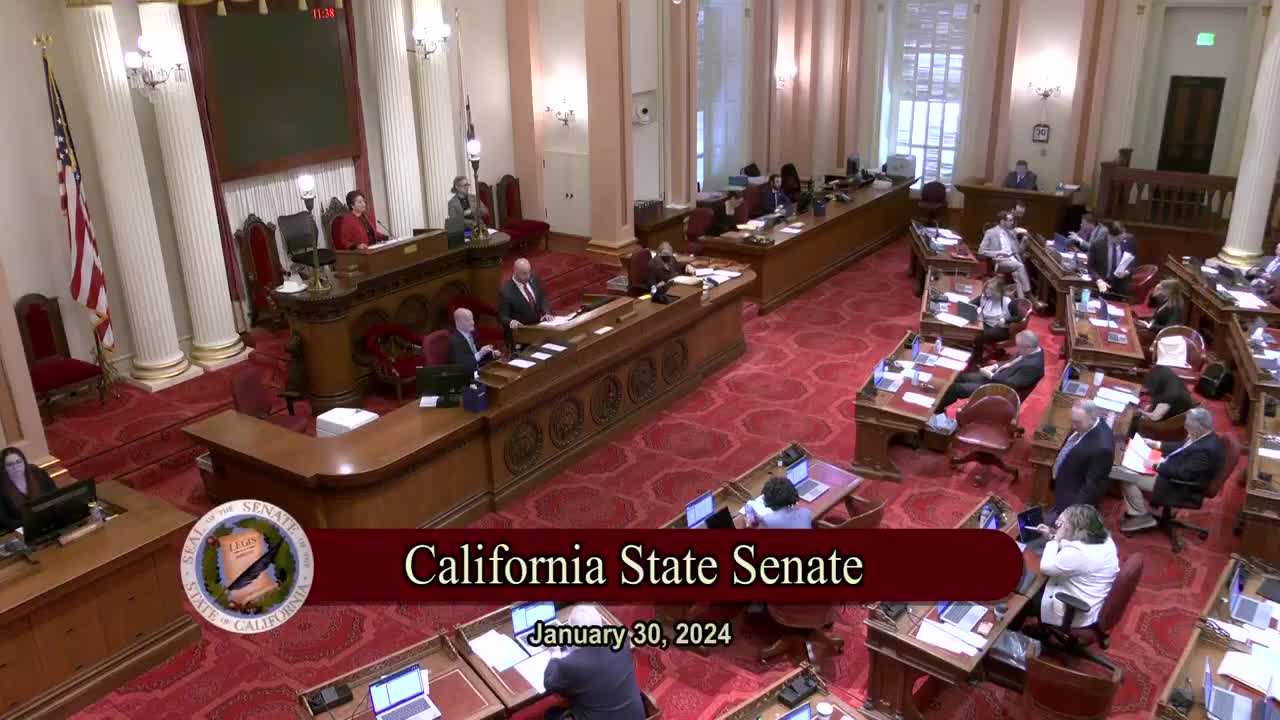
Bill Author

Bill Co-Author(s):