SB 721: General plan: annual report: suite-style student housing quarters.
- Session Year: 2023-2024
- House: Senate
- Latest Version Date: 2024-07-01
Current Status:
Failed
(2024-08-15: August 15 hearing: Held in committee and under submission.)
Introduced
In Committee
First Chamber
In Committee
Second Chamber
Enacted
The Planning and Zoning Law requires a city or county to adopt a general plan for land use development of the city or county that includes, among other elements, a housing element. That law requires the housing element to include, among other things, an identification and analysis of existing and projected housing needs. That law requires the city or county to provide by April 1 of each year an annual report to, among other entities, the Department of Housing and Community Development that includes, among other specified information, the number of units of housing demolished and new units of housing that have been issued a completed entitlement, a building permit, or a certificate of occupancy.
This bill would, for the 7th and subsequent revisions of the housing element, require the city or county to additionally include in the annual report the number of suite-style student housing quarters, as determined by the department, in the information on quarters, subject to specified requirements, within the number of housing units demolished and new units. By requiring a city or county to include additional information in the annual report, the bill would impose a state-mandated local program.
The California Constitution requires the state to reimburse local agencies and school districts for certain costs mandated by the state. Statutory provisions establish procedures for making that reimbursement.
This bill would provide that no reimbursement is required by this act for a specified reason.
The Planning and Zoning Law requires a city or county to adopt a general plan for land use development of the city or county that includes, among other elements, a housing element. That law requires the housing element to include, among other things, an identification and analysis of existing and projected housing needs. That law requires the city or county to provide by April 1 of each year an annual report to, among other entities, the Department of Housing and Community Development that includes, among other specified information, the number of units of housing demolished and new units of housing that have been issued a completed entitlement, a building permit, or a certificate of occupancy.
This bill would additionally would, for the 7th and subsequent revisions of the housing element, require the city or county to additionally include in the annual report the number of suite-style student housing quarters, as determined by the department. department, in the information on the number of units demolished and new units. By requiring a city or county to include additional information in the annual report, the bill would impose a state-mandated local program.
The California Constitution requires the state to reimburse local agencies and school districts for certain costs mandated by the state. Statutory provisions establish procedures for making that reimbursement.
This bill would provide that no reimbursement is required by this act for a specified reason.
The Planning and Zoning Law requires a city or county to adopt a general plan for land use development of the city or county that includes, among other elements, a housing element. That law requires the housing element to include, among other things, an identification and analysis of existing and projected housing needs. That law requires the city or county to provide by April 1 of each year an annual report to, among other entities, the Department of Housing and Community Development that includes, among other specified information, the number of units of housing demolished and new units of housing that have been issued a completed entitlement, a building permit, or a certificate of occupancy.
This bill would additionally require the city or county to include in the annual report the number of suite-style student housing quarters, as determined by the department. By requiring a city or county to include additional information in the annual report, the bill would impose a state-mandated local program.
The California Constitution requires the state to reimburse local agencies and school districts for certain costs mandated by the state. Statutory provisions establish procedures for making that reimbursement.
This bill would provide that no reimbursement is required by this act for a specified reason.
Existing law requires the Secretary of Government Operations to develop a coordinated plan to, among other things, investigate the feasibility of, and obstacles to, developing standards and technologies for state departments for determining digital content provenance, as defined. Existing law requires, for the purpose of informing that coordinated plan, the secretary to evaluate, among other things, the impact of the proliferation of deepfakes, defined to mean audio or visual content that has been generated or manipulated by artificial intelligence that would falsely appear to be authentic or truthful and that features depictions of people appearing to say or do things they did not say or do without their consent, on state government, California-based businesses, and residents of the state.This bill would, until January 1, 2030, create the California Interagency AI Working Group to deliver a report to the Legislature, as prescribed, regarding artificial intelligence. The bill would require the working group members to be Californians with expertise in at least 2 of certain areas, including computer science, artificial intelligence, and data privacy. The bill would require the report to the Legislature to include, among other things, a recommendation of a definition of artificial intelligence as it pertains to its use in technology for use in legislation.Existing law requires the Secretary of Government Operations to develop a coordinated plan to, among other things, investigate the feasibility of, and obstacles to, developing standards and technologies for state departments for determining digital content provenance, as defined. Existing law requires, for the purpose of informing that coordinated plan, the secretary to evaluate, among other things, the impact of the proliferation of deepfakes, defined to mean audio or visual content that has been generated or manipulated by artificial intelligence that would falsely appear to be authentic or truthful and that features depictions of people appearing to say or do things they did not say or do without their consent, on state government, California-based businesses, and residents of the state.
This bill would, until January 1, 2030, create the California Interagency AI Working Group to deliver a report to the Legislature, as prescribed, regarding artificial intelligence. The bill would require the working group members to be Californians with expertise in at least 2 of certain areas, including computer science, artificial intelligence, and data privacy. The bill would require the report to the Legislature to include, among other things, a recommendation of a definition of artificial intelligence as it pertains to its use in technology for use in legislation.
The California Constitution generally conditions the imposition of a special tax by a city, county, or special district upon the approval of 2/3 of the voters of the city, county, or special district voting on that tax. Under existing law, a charter city, pursuant to its constitutional authority over municipal affairs, may levy local taxes to raise revenues for local purposes, subject to restrictions imposed by that citys charter or preemption in matters of statewide concern. Existing law also authorizes the legislative body of any city to levy any tax which may be levied by any charter city, subject to the voters approval pursuant to the California Constitution.Existing law specifies procedural requirements for the legislative body of a city, county, or district to propose to the voters an ordinance or resolution to adopt a special tax.This bill would specify that, as used in those procedural requirements, a special tax includes a tax, levied by any city, including a charter city, county, or district on vacant sites included in the inventory on land suitable and available for residential development pursuant to the housing element of a countys or a citys long-term general plan, that meets the constitutional requirements.The California Constitution generally conditions the imposition of a special tax by a city, county, or special district upon the approval of 2/3 of the voters of the city, county, or special district voting on that tax. Under existing law, a charter city, pursuant to its constitutional authority over municipal affairs, may levy local taxes to raise revenues for local purposes, subject to restrictions imposed by that citys charter or preemption in matters of statewide concern. Existing law also authorizes the legislative body of any city to levy any tax which may be levied by any charter city, subject to the voters approval pursuant to the California Constitution.
Existing law specifies procedural requirements for the legislative body of a city, county, or district to propose to the voters an ordinance or resolution to adopt a special tax.
This bill would specify that, as used in those procedural requirements, a special tax includes a tax, levied by any city, including a charter city, county, or district on vacant sites included in the inventory on land suitable and available for residential development pursuant to the housing element of a countys or a citys long-term general plan, that meets the constitutional requirements.
(a)After the legislative body has adopted all or part of a general plan, the planning agency shall do both of the following:
(1)Investigate and make recommendations to the legislative body regarding reasonable and practical means for implementing the general plan or element of the general plan so that it will serve as an effective guide for orderly growth and development, preservation and conservation of open-space land and natural resources, and the efficient expenditure of public funds relating to the subjects addressed in the general plan.
(2)Provide by April 1 of each year an annual report to the legislative body, the Office of Planning and Research, and the Department of Housing and Community Development that includes all of the following:
(A)The status of the plan and progress in its implementation.
(B)(i)The progress in meeting its share of regional housing needs determined pursuant to Section 65584, including the need for extremely low income households, as determined pursuant to paragraph (1) of subdivision (a) of Section 65583, and local efforts to remove governmental constraints to the maintenance, improvement, and development of housing pursuant to paragraph (3) of subdivision (c) of Section 65583.
(ii)The housing element portion of the annual report, as required by this paragraph, shall be prepared through the use of standards, forms, and definitions adopted by the Department of Housing and Community Development. The department may review, adopt, amend, and repeal the standards, forms, or definitions to implement this article. Any standards, forms, or definitions adopted to implement this article shall not be subject to Chapter 3.5 (commencing with Section 11340) of Part 1 of Division 3 of Title 2. Before and after adoption of the forms, the housing element portion of the annual report shall include a section that describes the actions taken by the local government towards completion of the programs and status of the local governments compliance with the deadlines in its housing element. The report shall be considered at an annual public meeting before the legislative body where members of the public shall be allowed to provide oral testimony and written comments.
(iii)The report may include the number of units that have been completed pursuant to subdivision (c) of Section 65583.1. For purposes of this paragraph, committed assistance may be executed throughout the planning period, and the program under paragraph (1) of subdivision (c) of Section 65583.1 shall not be required. The report shall document how the units meet the standards set forth in that subdivision.
(iv)The planning agency shall include the number of units in a student housing development for lower income students for which the developer of the student housing development was granted a density bonus pursuant to subparagraph (F) of paragraph (1) of subdivision (b) of Section 65915.
(C)The number of housing development applications received in the prior year, including whether each housing development application is subject to a ministerial or discretionary approval process.
(D)The number of units included in all development applications in the prior year.
(E)The number of units approved and disapproved in the prior year.
(F)The degree to which its approved general plan complies with the guidelines developed and adopted pursuant to Section 65040.2 and the date of the last revision to the general plan.
(G)A listing of sites rezoned to accommodate that portion of the citys or countys share of the regional housing need for each income level that could not be accommodated on sites identified in the inventory required by paragraph (1) of subdivision (c) of Section 65583 and Section 65584.09. The listing of sites shall also include any additional sites that may have been required to be identified by Section 65863.
(H)(i)The number of units of housing demolished and new units of housing thus far in the housing element cycle, and the income category, by area median income category, that each unit of housing satisfies, including all of the following:
(I)Rental housing and for-sale housing units that have been issued a completed entitlement, a building permit, or a certificate of occupancy.
(II)Any units that the County of Napa or the City of Napa may report pursuant to an agreement entered into pursuant to Section 65584.08 that have been issued a completed entitlement, a building permit, or a certificate of occupancy.
(III)For the seventh and subsequent revisions of the housing element, suite-style student housing quarters, as determined by the Department of Housing and Community Development. It is the intent of the Legislature, when suite-style student housing quarters are reported by income category, that the department quarters. The Department of Housing and Community Development shall evaluate the jurisdictions progress in meeting its share of the regional housing needs determined pursuant to Section 65584, with particular attention to the housing needs of lower income households. It is the intent of the Legislature that suite-style Suite-style student housing quarters shall not satisfy more than 25 percent of any income category in determining a jurisdictions progress in meeting its share of the regional housing needs. A suite-style student housing quarter that meets all of the following requirements may be counted toward a jurisdictions progress toward meeting the regional housing needs:
(ia)The unit includes a fully functioning kitchen with a refrigerator, stove, sink with hot and cold water, vent, and an area to prepare food.
(ib)The unit has a ratio of beds to toilets, lavatories, and showers not exceeding five to one.
(ic)The unit meets the requirements described in Section 17920.3 of the Health and Safety Code. Any unit or structure that does not meet the requirements of that section shall not be counted toward the local jurisdictions progress.
(ii)For each income category described in this subparagraph, the production report shall distinguish between the number of rental housing units and the number of for-sale units that satisfy each income category.
(iii)For each entitlement, building permit, or certificate of occupancy, the production report shall include a unique site identifier that must include the assessors parcel number, but may also include street address, or other identifiers.
(iv)For the County of Napa and the City of Napa, the production report may report units identified in the agreement entered into pursuant to Section 65584.08.
(I)The number of applications submitted pursuant to subdivision (a) of Section 65913.4, the location and the total number of developments approved pursuant to subdivision (c) of Section 65913.4, the total number of building permits issued pursuant to subdivision (c) of Section 65913.4, the total number of units including both rental housing and for-sale housing by area median income category constructed using the process provided for in subdivision (c) of Section 65913.4.
(J)If the city or county has received funding pursuant to the Local Government Planning Support Grants Program (Chapter 3.1 (commencing with Section 50515) of Part 2 of Division 31 of the Health and Safety Code), the information required pursuant to subdivision (a) of Section 50515.04 of the Health and Safety Code.
(K)The progress of the city or county in adopting or amending its general plan or local open-space element in compliance with its obligations to consult with California Native American tribes, and to identify and protect, preserve, and mitigate impacts to places, features, and objects described in Sections 5097.9 and 5097.993 of the Public Resources Code, pursuant to Chapter 905 of the Statutes of 2004.
(L)The following information with respect to density bonuses granted in accordance with Section 65915:
(i)The number of density bonus applications received by the city or county.
(ii)The number of density bonus applications approved by the city or county.
(iii)Data from all projects approved to receive a density bonus from the city or county, including, but not limited to, the percentage of density bonus received, the percentage of affordable units in the project, the number of other incentives or concessions granted to the project, and any waiver or reduction of parking standards for the project.
(M)The following information with respect to each application submitted pursuant to Chapter 4.1 (commencing with Section 65912.100):
(i)The location of the project.
(ii)The status of the project, including whether it has been entitled, whether a building permit has been issued, and whether or not it has been completed.
(iii)The number of units in the project.
(iv)The number of units in the project that are rental housing.
(v)The number of units in the project that are for-sale housing.
(vi)The household income category of the units, as determined pursuant to subdivision (f) of Section 65584.
(b)(1)(A)The department may request corrections to the housing element portion of an annual report submitted pursuant to paragraph (2) of subdivision (a) within 90 days of receipt. A planning agency shall make the requested corrections within 30 days after which the department may reject the report if the report is not in substantial compliance with the requirements of that paragraph.
(B)If the department rejects the housing element portion of an annual report as authorized by subparagraph (A), the department shall provide the reasons the report is inconsistent with paragraph (2) of subdivision (a) to the planning agency in writing.
(2)If a court finds, upon a motion to that effect, that a city, county, or city and county failed to submit, within 60 days of the deadline established in this section, the housing element portion of the report required pursuant to subparagraph (B) of paragraph (2) of subdivision (a) that substantially complies with the requirements of this section, the court shall issue an order or judgment compelling compliance with this section within 60 days. If the city, county, or city and county fails to comply with the courts order within 60 days, the plaintiff or petitioner may move for sanctions, and the court may, upon that motion, grant appropriate sanctions. The court shall retain jurisdiction to ensure that its order or judgment is carried out. If the court determines that its order or judgment is not carried out within 60 days, the court may issue further orders as provided by law to ensure that the purposes and policies of this section are fulfilled. This subdivision applies to proceedings initiated on or after the first day of October following the adoption of forms and definitions by the Department of Housing and Community Development pursuant to paragraph (2) of subdivision (a), but no sooner than six months following that adoption.
(c)The Department of Housing and Community Development shall post a report submitted pursuant to this section on its internet website within a reasonable time of receiving the report.
SEC. 2.No reimbursement is required by this act pursuant to Section 6 of Article XIIIB of the California Constitution because a local agency or school district has the authority to levy service charges, fees, or assessments sufficient to pay for the program or level of service mandated by this act, within the meaning of Section 17556 of the Government Code.
(a)After the legislative body has adopted all or part of a general plan, the planning agency shall do both of the following:
(1)Investigate and make recommendations to the legislative body regarding reasonable and practical means for implementing the general plan or element of the general plan so that it will serve as an effective guide for orderly growth and development, preservation and conservation of open-space land and natural resources, and the efficient expenditure of public funds relating to the subjects addressed in the general plan.
(2)Provide by April 1 of each year an annual report to the legislative body, the Office of Planning and Research, and the Department of Housing and Community Development that includes all of the following:
(A)The status of the plan and progress in its implementation.
(B)(i)The progress in meeting its share of regional housing needs determined pursuant to Section 65584, including the need for extremely low income households, as determined pursuant to paragraph (1) of subdivision (a) of Section 65583, and local efforts to remove governmental constraints to the maintenance, improvement, and development of housing pursuant to paragraph (3) of subdivision (c) of Section 65583.
(ii)The housing element portion of the annual report, as required by this paragraph, shall be prepared through the use of standards, forms, and definitions adopted by the Department of Housing and Community Development. The department may review, adopt, amend, and repeal the standards, forms, or definitions to implement this article. Any standards, forms, or definitions adopted to implement this article shall not be subject to Chapter 3.5 (commencing with Section 11340) of Part 1 of Division 3 of Title 2. Before and after adoption of the forms, the housing element portion of the annual report shall include a section that describes the actions taken by the local government towards completion of the programs and status of the local governments compliance with the deadlines in its housing element. The report shall be considered at an annual public meeting before the legislative body where members of the public shall be allowed to provide oral testimony and written comments.
(iii)The report may include the number of units that have been completed pursuant to subdivision (c) of Section 65583.1. For purposes of this paragraph, committed assistance may be executed throughout the planning period, and the program under paragraph (1) of subdivision (c) of Section 65583.1 shall not be required. The report shall document how the units meet the standards set forth in that subdivision.
(iv)The planning agency shall include the number of units in a student housing development for lower income students for which the developer of the student housing development was granted a density bonus pursuant to subparagraph (F) of paragraph (1) of subdivision (b) of Section 65915.
(C)The number of housing development applications received in the prior year, including whether each housing development application is subject to a ministerial or discretionary approval process.
(D)The number of units included in all development applications in the prior year.
(E)The number of units approved and disapproved in the prior year.
(F)The degree to which its approved general plan complies with the guidelines developed and adopted pursuant to Section 65040.2 and the date of the last revision to the general plan.
(G)A listing of sites rezoned to accommodate that portion of the citys or countys share of the regional housing need for each income level that could not be accommodated on sites identified in the inventory required by paragraph (1) of subdivision (c) of Section 65583 and Section 65584.09. The listing of sites shall also include any additional sites that may have been required to be identified by Section 65863.
(H)(i)The number of units of housing demolished and new units of housing thus far in the housing element cycle, and the income category, by area median income category, that each unit of housing satisfies, including all of the following:
(I)Rental housing and for-sale housing units that have been issued a completed entitlement, a building permit, or a certificate of occupancy.
(II)Any units that the County of Napa or the City of Napa may report pursuant to an agreement entered into pursuant to Section 65584.08 that have been issued a completed entitlement, a building permit, or a certificate of occupancy.
(III)Suite-style For the seventh and subsequent revisions of the housing element, suite-style student housing quarters, as determined by the department. Department of Housing and Community Development. It is the intent of the Legislature, when suite-style student housing quarters are reported by income category, that the department evaluate the jurisdictions progress in meeting its share of the regional housing needs determined pursuant to Section 65584, with particular attention to the housing needs of lower income households. It is the intent of the Legislature that suite-style student housing quarters shall not satisfy more than 25 percent of any income category in determining a jurisdictions progress in meeting its share of the regional housing needs.
(ii)For each income category described in this subparagraph, the production report shall distinguish between the number of rental housing units and the number of for-sale units that satisfy each income category.
(iii)For each entitlement, building permit, or certificate of occupancy, the production report shall include a unique site identifier that must include the assessors parcel number, but may also include street address, or other identifiers.
(iv)For the County of Napa and the City of Napa, the production report may report units identified in the agreement entered into pursuant to Section 65584.08.
(I)The number of applications submitted pursuant to subdivision (a) of Section 65913.4, the location and the total number of developments approved pursuant to subdivision (c) of Section 65913.4, the total number of building permits issued pursuant to subdivision (c) of Section 65913.4, the total number of units including both rental housing and for-sale housing by area median income category constructed using the process provided for in subdivision (c) of Section 65913.4.
(J)If the city or county has received funding pursuant to the Local Government Planning Support Grants Program (Chapter 3.1 (commencing with Section 50515) of Part 2 of Division 31 of the Health and Safety Code), the information required pursuant to subdivision (a) of Section 50515.04 of the Health and Safety Code.
(K)The progress of the city or county in adopting or amending its general plan or local open-space element in compliance with its obligations to consult with California Native American tribes, and to identify and protect, preserve, and mitigate impacts to places, features, and objects described in Sections 5097.9 and 5097.993 of the Public Resources Code, pursuant to Chapter 905 of the Statutes of 2004.
(L)The following information with respect to density bonuses granted in accordance with Section 65915:
(i)The number of density bonus applications received by the city or county.
(ii)The number of density bonus applications approved by the city or county.
(iii)Data from all projects approved to receive a density bonus from the city or county, including, but not limited to, the percentage of density bonus received, the percentage of affordable units in the project, the number of other incentives or concessions granted to the project, and any waiver or reduction of parking standards for the project.
(M)The following information with respect to each application submitted pursuant to Chapter 4.1 (commencing with Section 65912.100):
(i)The location of the project.
(ii)The status of the project, including whether it has been entitled, whether a building permit has been issued, and whether or not it has been completed.
(iii)The number of units in the project.
(iv)The number of units in the project that are rental housing.
(v)The number of units in the project that are for-sale housing.
(vi)The household income category of the units, as determined pursuant to subdivision (f) of Section 65584.
(b)(1)(A)The department may request corrections to the housing element portion of an annual report submitted pursuant to paragraph (2) of subdivision (a) within 90 days of receipt. A planning agency shall make the requested corrections within 30 days after which the department may reject the report if the report is not in substantial compliance with the requirements of that paragraph.
(B)If the department rejects the housing element portion of an annual report as authorized by subparagraph (A), the department shall provide the reasons the report is inconsistent with paragraph (2) of subdivision (a) to the planning agency in writing.
(2)If a court finds, upon a motion to that effect, that a city, county, or city and county failed to submit, within 60 days of the deadline established in this section, the housing element portion of the report required pursuant to subparagraph (B) of paragraph (2) of subdivision (a) that substantially complies with the requirements of this section, the court shall issue an order or judgment compelling compliance with this section within 60 days. If the city, county, or city and county fails to comply with the courts order within 60 days, the plaintiff or petitioner may move for sanctions, and the court may, upon that motion, grant appropriate sanctions. The court shall retain jurisdiction to ensure that its order or judgment is carried out. If the court determines that its order or judgment is not carried out within 60 days, the court may issue further orders as provided by law to ensure that the purposes and policies of this section are fulfilled. This subdivision applies to proceedings initiated on or after the first day of October following the adoption of forms and definitions by the Department of Housing and Community Development pursuant to paragraph (2) of subdivision (a), but no sooner than six months following that adoption.
(c)The Department of Housing and Community Development shall post a report submitted pursuant to this section on its internet website within a reasonable time of receiving the report.
SEC. 2.No reimbursement is required by this act pursuant to Section 6 of Article XIIIB of the California Constitution because a local agency or school district has the authority to levy service charges, fees, or assessments sufficient to pay for the program or level of service mandated by this act, within the meaning of Section 17556 of the Government Code.
(a)After the legislative body has adopted all or part of a general plan, the planning agency shall do both of the following:
(1)Investigate and make recommendations to the legislative body regarding reasonable and practical means for implementing the general plan or element of the general plan so that it will serve as an effective guide for orderly growth and development, preservation and conservation of open-space land and natural resources, and the efficient expenditure of public funds relating to the subjects addressed in the general plan.
(2)Provide by April 1 of each year an annual report to the legislative body, the Office of Planning and Research, and the Department of Housing and Community Development that includes all of the following:
(A)The status of the plan and progress in its implementation.
(B)(i)The progress in meeting its share of regional housing needs determined pursuant to Section 65584, including the need for extremely low income households, as determined pursuant to paragraph (1) of subdivision (a) of Section 65583, and local efforts to remove governmental constraints to the maintenance, improvement, and development of housing pursuant to paragraph (3) of subdivision (c) of Section 65583.
(ii)The housing element portion of the annual report, as required by this paragraph, shall be prepared through the use of standards, forms, and definitions adopted by the Department of Housing and Community Development. The department may review, adopt, amend, and repeal the standards, forms, or definitions to implement this article. Any standards, forms, or definitions adopted to implement this article shall not be subject to Chapter 3.5 (commencing with Section 11340) of Part 1 of Division 3 of Title 2. Before and after adoption of the forms, the housing element portion of the annual report shall include a section that describes the actions taken by the local government towards completion of the programs and status of the local governments compliance with the deadlines in its housing element. The report shall be considered at an annual public meeting before the legislative body where members of the public shall be allowed to provide oral testimony and written comments.
(iii)The report may include the number of units that have been completed pursuant to subdivision (c) of Section 65583.1. For purposes of this paragraph, committed assistance may be executed throughout the planning period, and the program under paragraph (1) of subdivision (c) of Section 65583.1 shall not be required. The report shall document how the units meet the standards set forth in that subdivision.
(iv)The planning agency shall include the number of units in a student housing development for lower income students for which the developer of the student housing development was granted a density bonus pursuant to subparagraph (F) of paragraph (1) of subdivision (b) of Section 65915.
(C)The number of housing development applications received in the prior year, including whether each housing development application is subject to a ministerial or discretionary approval process.
(D)The number of units included in all development applications in the prior year.
(E)The number of units approved and disapproved in the prior year.
(F)The degree to which its approved general plan complies with the guidelines developed and adopted pursuant to Section 65040.2 and the date of the last revision to the general plan.
(G)A listing of sites rezoned to accommodate that portion of the citys or countys share of the regional housing need for each income level that could not be accommodated on sites identified in the inventory required by paragraph (1) of subdivision (c) of Section 65583 and Section 65584.09. The listing of sites shall also include any additional sites that may have been required to be identified by Section 65863.
(H)(i)The number of units of housing demolished and new units of housing, including both rental housing and for-sale housing and any units that the County of Napa or the City of Napa may report pursuant to an agreement entered into pursuant to Section 65584.08, that have been issued a completed entitlement, a building permit, or a certificate of occupancy, housing thus far in the housing element cycle, and the income category, by area median income category, that each unit of housing satisfies. That production report shall do the following: satisfies, including all of the following:
(I)Rental housing and for-sale housing units that have been issued a completed entitlement, a building permit, or a certificate of occupancy.
(II)Any units that the County of Napa or the City of Napa may report pursuant to an agreement entered into pursuant to Section 65584.08 that have been issued a completed entitlement, a building permit, or a certificate of occupancy.
(III)Suite-style student housing quarters, as determined by the department.
(I)(ii)For each income category described in this subparagraph, distinguish between the number of rental housing units and the number of for-sale units that satisfy each income category.
(II)(iii)For each entitlement, building permit, or certificate of occupancy, the production report shall include a unique site identifier that must include the assessors parcel number, but may also include street address, or other identifiers.
(ii)(iv)For the County of Napa and the City of Napa, the production report may report units identified in the agreement entered into pursuant to Section 65584.08.
(I)The number of applications submitted pursuant to subdivision (a) of Section 65913.4, the location and the total number of developments approved pursuant to subdivision (c) of Section 65913.4, the total number of building permits issued pursuant to subdivision (c) of Section 65913.4, the total number of units including both rental housing and for-sale housing by area median income category constructed using the process provided for in subdivision (c) of Section 65913.4.
(J)If the city or county has received funding pursuant to the Local Government Planning Support Grants Program (Chapter 3.1 (commencing with Section 50515) of Part 2 of Division 31 of the Health and Safety Code), the information required pursuant to subdivision (a) of Section 50515.04 of the Health and Safety Code.
(K)The progress of the city or county in adopting or amending its general plan or local open-space element in compliance with its obligations to consult with California Native American tribes, and to identify and protect, preserve, and mitigate impacts to places, features, and objects described in Sections 5097.9 and 5097.993 of the Public Resources Code, pursuant to Chapter 905 of the Statutes of 2004.
(L)The following information with respect to density bonuses granted in accordance with Section 65915:
(i)The number of density bonus applications received by the city or county.
(ii)The number of density bonus applications approved by the city or county.
(iii)Data from all projects approved to receive a density bonus from the city or county, including, but not limited to, the percentage of density bonus received, the percentage of affordable units in the project, the number of other incentives or concessions granted to the project, and any waiver or reduction of parking standards for the project.
(M)The following information with respect to each application submitted pursuant to Chapter 4.1 (commencing with Section 65912.100):
(i)The location of the project.
(ii)The status of the project, including whether it has been entitled, whether a building permit has been issued, and whether or not it has been completed.
(iii)The number of units in the project.
(iv)The number of units in the project that are rental housing.
(v)The number of units in the project that are for-sale housing.
(vi)The household income category of the units, as determined pursuant to subdivision (f) of Section 65584.
(b)(1)(A)The department may request corrections to the housing element portion of an annual report submitted pursuant to paragraph (2) of subdivision (a) within 90 days of receipt. A planning agency shall make the requested corrections within 30 days after which the department may reject the report if the report is not in substantial compliance with the requirements of that paragraph.
(B)If the department rejects the housing element portion of an annual report as authorized by subparagraph (A), the department shall provide the reasons the report is inconsistent with paragraph (2) of subdivision (a) to the planning agency in writing.
(2)If a court finds, upon a motion to that effect, that a city, county, or city and county failed to submit, within 60 days of the deadline established in this section, the housing element portion of the report required pursuant to subparagraph (B) of paragraph (2) of subdivision (a) that substantially complies with the requirements of this section, the court shall issue an order or judgment compelling compliance with this section within 60 days. If the city, county, or city and county fails to comply with the courts order within 60 days, the plaintiff or petitioner may move for sanctions, and the court may, upon that motion, grant appropriate sanctions. The court shall retain jurisdiction to ensure that its order or judgment is carried out. If the court determines that its order or judgment is not carried out within 60 days, the court may issue further orders as provided by law to ensure that the purposes and policies of this section are fulfilled. This subdivision applies to proceedings initiated on or after the first day of October following the adoption of forms and definitions by the Department of Housing and Community Development pursuant to paragraph (2) of subdivision (a), but no sooner than six months following that adoption.
(c)The Department of Housing and Community Development shall post a report submitted pursuant to this section on its internet website within a reasonable time of receiving the report.
SEC. 2.No reimbursement is required by this act pursuant to Section 6 of Article XIIIB of the California Constitution because a local agency or school district has the authority to levy service charges, fees, or assessments sufficient to pay for the program or level of service mandated by this act, within the meaning of Section 17556 of the Government Code.
SECTION 1.Section 11546.47 is added to the Government Code, to read:11546.47.(a)The California Interagency AI Working Group is hereby created to deliver a report to the Legislature, pursuant to subdivision (e), regarding artificial intelligence.(b)Working group members shall be Californians with expertise in at least two of the following areas:(1)Computer science.(2)Artificial intelligence.(3)The technology industry.(4)Workforce development.(5)Data privacy.(c)(1)The working group shall be chaired by the Director of Technology.(2)The working group shall select a vice chair from among its members and shall consist of the following 10 members:(A)Two appointees by the Governor.(B)Two appointees by the President Pro Tempore of the Senate.(C)Two appointees by the Speaker of the Assembly.(D)Two appointees by the Attorney General.(E)One appointee by the California Privacy Protection Agency.(F)One appointee by the Department of Technology.(d)The working group shall take input from a broad range of stakeholders, including from academia, consumer advocacy groups, and small, medium, and large businesses affected by artificial intelligence policies, and shall do all of the following:(1)Recommend a definition of artificial intelligence as it pertains to its use in technology for use in legislation.(2)Study the implications of the usage of artificial intelligence for data collection to inform testing and evaluation, verification and validation of artificial intelligence to ensure that artificial intelligence will perform as intended, including when interacting with humans and other systems, develop common metrics to assess trustworthiness that artificial intelligence systems will perform as intended, and minimize performance problems and unanticipated outcomes.(3)Determine proactive steps to prevent artificial intelligence-assisted misinformation campaigns and unnecessary exposure for children to the potentially harmful effects of artificial intelligence.(4)Determine the relevant agencies to develop and oversee artificial intelligence policy and implementation of that policy.(5)Determine how the working group and the Department of Justice can leverage the substantial and growing expertise of the California Privacy Protection Agency in the long-term development of data privacy policies that affect the privacy, rights, and the use of artificial intelligence online.(e)On or before January 1, 2025, and every two years thereafter, the working group shall submit, pursuant to Section 9795, a report to the Legislature regarding the items described in subdivision (d).(f)The members of the working group shall serve without compensation but shall be reimbursed for all necessary expenses actually incurred in the performance of their duties.(g)As used in this section, working group means the California Interagency AI Working Group created by this section.(h)This section shall remain in effect until January 1, 2030, and as of that date is repealed.(a)The California Interagency AI Working Group is hereby created to deliver a report to the Legislature, pursuant to subdivision (e), regarding artificial intelligence.
(b)Working group members shall be Californians with expertise in at least two of the following areas:
(1)Computer science.
(2)Artificial intelligence.
(3)The technology industry.
(4)Workforce development.
(5)Data privacy.
(c)(1)The working group shall be chaired by the Director of Technology.
(2)The working group shall select a vice chair from among its members and shall consist of the following 10 members:
(A)Two appointees by the Governor.
(B)Two appointees by the President Pro Tempore of the Senate.
(C)Two appointees by the Speaker of the Assembly.
(D)Two appointees by the Attorney General.
(E)One appointee by the California Privacy Protection Agency.
(F)One appointee by the Department of Technology.
(d)The working group shall take input from a broad range of stakeholders, including from academia, consumer advocacy groups, and small, medium, and large businesses affected by artificial intelligence policies, and shall do all of the following:
(1)Recommend a definition of artificial intelligence as it pertains to its use in technology for use in legislation.
(2)Study the implications of the usage of artificial intelligence for data collection to inform testing and evaluation, verification and validation of artificial intelligence to ensure that artificial intelligence will perform as intended, including when interacting with humans and other systems, develop common metrics to assess trustworthiness that artificial intelligence systems will perform as intended, and minimize performance problems and unanticipated outcomes.
(3)Determine proactive steps to prevent artificial intelligence-assisted misinformation campaigns and unnecessary exposure for children to the potentially harmful effects of artificial intelligence.
(4)Determine the relevant agencies to develop and oversee artificial intelligence policy and implementation of that policy.
(5)Determine how the working group and the Department of Justice can leverage the substantial and growing expertise of the California Privacy Protection Agency in the long-term development of data privacy policies that affect the privacy, rights, and the use of artificial intelligence online.
(e)On or before January 1, 2025, and every two years thereafter, the working group shall submit, pursuant to Section 9795, a report to the Legislature regarding the items described in subdivision (d).
(f)The members of the working group shall serve without compensation but shall be reimbursed for all necessary expenses actually incurred in the performance of their duties.
(g)As used in this section, working group means the California Interagency AI Working Group created by this section.
(h)This section shall remain in effect until January 1, 2030, and as of that date is repealed.
SECTION 1.Section 50076.1 is added to the Government Code, to read:50076.1.For the purposes of this article, special tax includes a tax that meets the requirements of Section 4 of Article XIII A of the California Constitution levied by any city, including a charter city, county, or district on vacant sites included in the inventory on land suitable and available for residential development pursuant to paragraph (3) of subdivision (a) of Section 65583.For the purposes of this article, special tax includes a tax that meets the requirements of Section 4 of Article XIII A of the California Constitution levied by any city, including a charter city, county, or district on vacant sites included in the inventory on land suitable and available for residential development pursuant to paragraph (3) of subdivision (a) of Section 65583.
|
Date
|
Status
|
|---|---|
| Aug 15, 2024 | August 15 hearing: Held in committee and under submission. |
| Aug 7, 2024 | August 7 set for first hearing. Placed on suspense file. |
| Jul 1, 2024 | Read second time and amended. Re-referred to Com. on APPR. |
| Jun 27, 2024 | From committee: Do pass as amended and re-refer to Com. on APPR. (Ayes 6. Noes 0.) (June 26). |
| Jun 20, 2024 | From committee with author's amendments. Read second time and amended. Re-referred to Com. on L. GOV. |
| Jun 19, 2024 | From committee: Do pass and re-refer to Com. on L. GOV. (Ayes 8. Noes 0.) (June 19). Re-referred to Com. on L. GOV. |
| Jun 6, 2024 | Re-referred to Coms. on H. & C.D. and L. GOV. pursuant to Assembly Rule 96. |
| Apr 29, 2024 | From committee with author's amendments. Read second time and amended. Re-referred to Com. on P. & C.P. |
| Jun 1, 2023 | Referred to Com. on P. & C.P. |
| May 25, 2023 | In Assembly. Read first time. Held at Desk. |
| May 24, 2023 | Read third time. Passed. (Ayes 38. Noes 0. Page 1259.) Ordered to the Assembly. |
| May 18, 2023 | Read second time. Ordered to third reading. |
| May 18, 2023 | From committee: Do pass. (Ayes 6. Noes 1. Page 1181.) (May 18). |
| May 12, 2023 | Set for hearing May 18. |
| May 1, 2023 | May 1 hearing: Placed on APPR suspense file. |
| Apr 21, 2023 | Set for hearing May 1. |
| Apr 19, 2023 | From committee: Do pass and re-refer to Com. on APPR. (Ayes 11. Noes 0. Page 800.) (April 18). Re-referred to Com. on APPR. |
| Apr 11, 2023 | Set for hearing April 18. |
| Apr 11, 2023 | From committee: Do pass and re-refer to Com. on JUD. (Ayes 14. Noes 1. Page 657.) (April 11). Re-referred to Com. on JUD. |
| Apr 6, 2023 | Set for hearing April 11. |
| Mar 29, 2023 | Re-referred to Coms. on G.O. and JUD. |
| Mar 23, 2023 | Re-referred to Com. on RLS. |
| Mar 23, 2023 | Withdrawn from committee. |
| Mar 22, 2023 | From committee with author's amendments. Read second time and amended. Re-referred to Com. on GOV. & F. |
| Mar 1, 2023 | Referred to Com. on GOV. & F. |
| Feb 17, 2023 | From printer. May be acted upon on or after March 19. |
| Feb 16, 2023 | Introduced. Read first time. To Com. on RLS. for assignment. To print. |
|
Date
|
Description
|
Location
|
Votes
|
|
|---|---|---|---|---|
| Jun 26, 2024 | Do pass as amended and be re-referred to the Committee on [Appropriations] | Assembly Standing Committee on Local Government |
Passed |
|
| Jun 19, 2024 | Do pass and be re-referred to the Committee on [Local Government] | Assembly Standing Committee on Housing and Community Development |
Passed |
|
| May 24, 2023 | Senate 3rd Reading SB721 Becker | Senate Floor |
Passed |
|
| May 18, 2023 | Do pass | Senate Standing Committee on Appropriations |
Passed |
|
| May 1, 2023 | Placed on suspense file | Senate Standing Committee on Appropriations |
Passed |
|
| Apr 18, 2023 | Do pass, but first be re-referred to the Committee on [Appropriations] | Senate Standing Committee on Judiciary |
Passed |
|
| Apr 11, 2023 | Do pass, but first be re-referred to the Committee on [Judiciary] | Senate Standing Committee on Governmental Organization |
Passed |
This list shows positions taken on this bill by organizations on the date displayed, which is linked to the original source.
Positions by individuals are not included.
Date of Hearing: August 7, 2024
ASSEMBLY COMMITTEE ON APPROPRIATIONS
Buffy Wicks, Chair
SBPCA Bill Id:SB 721
Author:(Becker) – As Amended Ver:July 1, 2024
Policy Committee: | Housing and Community Development | Vote: | 8 - 0 |
Local Government | 6 - 0 | ||
|
|
Urgency: No State Mandated Local Program: Yes Reimbursable: No
SUMMARY:
This bill requires a local jurisdiction to include in its annual progress report (APR) to the Department of Housing and Community Development (HCD) the number of new and demolished “suite-style student housing quarters,” and allows a local jurisdiction to count these units towards meeting its share of the regional housing need.
Specifically, this bill, for the seventh and subsequent housing element cycles:
- Requires a local government to additionally include in its APR to HCD by April 1 of each year the number of suite-style student housing quarters, within the number of new and demolished units, and the income category that each of these housing units satisfies.
- Requires HCD to evaluate the jurisdiction’s progress in meeting its share of the regional housing needs allocation (RHNA) determined pursuant to existing law, with particular attention to the housing needs of lower-income households.
- Prohibits suite-style student housing quarters from satisfying more than 25% of any income category in determining a jurisdiction’s progress in meeting its share of RHNA.
- Allows a suite-style student housing quarter that meets the following requirements to be counted toward a jurisdiction’s progress in meeting its share of RHNA:
- The unit includes a fully functioning kitchen with a refrigerator, stove, sink with hot and cold water, vent, and an area to prepare food.
- The unit has a ratio of beds to toilets, lavatories, and showers not exceeding five to one.
- The unit meets statutory health and safety requirements, as specified. Any unit or structure that is deemed and declared to be a substandard building may not be counted toward the local jurisdiction’s progress.
FISCAL EFFECT:
- Estimated ongoing General Fund costs of an unknown amount, but likely in excess of $150,000 annually, for additional HCD staff to update programs and APR forms, provide technical assistance to local governments, and review APR submissions to ensure suite-style student housing quarters meet specified criteria and are not being used to satisfy more than 25% of any income category for RHNA purposes. The bill also requires HCD to evaluate a jurisdiction’s progress in meeting its RHNA share with particular attention to the housing needs of lower income households.
HCD indicates the cost of this bill is unknown at this time because there are multiple bills moving through the legislative process that impact workload related to the APR. However, it is reasonable to expect costs for the tasks in this bill to exceed $150,000 annually.
- Ongoing local costs of an unknown amount for local governments to include the additional information in their APRs. These costs are not reimbursable by the state because local agencies have general authority to charge and adjust planning and permitting fees to cover their administrative expenses associated with new planning mandates.
COMMENTS:
- Purpose. According to the author:
California is facing an extreme student housing crisis. [One] in five community college students, one in 10 CSU students, and one in 20 UC students are experiencing homelessness. One step toward addressing this crisis is to create development incentives for more suite-style housing for students. Colleges and local jurisdictions are not collaborating enough to create more student housing, perhaps because local jurisdictions cannot report it on their APR. Students use housing the same as other members of the community, and locals should be incentivized to plan for them as such. [This bill] allows jurisdictions to count suite-style student housing toward their APR so that local jurisdictions further collaborate to meet our collective housing needs.
- Background. Existing law requires each city and county to adopt a general plan for land use within its jurisdiction. Each general plan must include a housing element detailing existing housing conditions within the jurisdiction, the need for new housing and the strategy the jurisdiction will use to address that need. Local governments must adopt a new housing element every eight years, although some rural jurisdictions must do so every five years. Most local governments have adopted or are in the process of finalizing their sixth housing element. Regions have staggered start dates for housing element cycles. The seventh cycle begins between 2027 and 2031 for most areas, sooner for some smaller jurisdictions.
The RHNA is used to determine the number and affordability level of new homes each local government must plan for in its housing element over the next eight-year planning cycle. HCD first collaborates with regional Councils of Government (COGs) to establish methodologies for calculating housing needs. HCD then communicates its estimations and final determinations to the COGs who then allocate the housing need to subregions of the COGs or directly to local governments. Each local government then develops an implementation plan to accommodate its share of need through updates to its housing element. The RHNA is assigned via four income categories: very low-income (0% to 50% of area medium income (AMI)), low-income (50% to 80% of AMI), moderate income (80% to 120% of AMI), and above moderate income (120% or more of AMI).
Existing law requires each city and county to submit an APR to HCD and the Governor’s Office of Planning and Research that includes specified information relating to the jurisdiction’s progress in meeting its share of regional housing needs pursuant to its housing element. APRs must include information about all proposed and approved development projects in the prior year, including the number of housing development applications received, the number of units included in all development applications, the number of units approved and disapproved, and the number of new housing units issued a completed entitlement, building permit, or certificate of occupancy.
Because HCD does not consider group quarters, including suite-style student housing quarters, a “housing unit” under existing law and guidance, a jurisdiction cannot include suite-style student housing on its APR and, thus, cannot count this housing towards meeting its RHNA obligations. These units are excluded, in part, because income categorization of this nuanced housing type is difficult to determine because the cost to the occupant is not necessarily set in a traditional monthly rent schedule, but rather as a per-semester room-and-board charge or bed-space charge. As a result, actual out-of-pocket costs may vary from one occupant to another, even within the same suite, or room within a suite.
HCD indicates in its “California’s Housing Future 2040: The Next Regional Housing Needs Allocation (RHNA)” report that it will release guidance on how to count group quarters, including suite-style student housing, in the APR, including how affordability levels should be determined. This guidance is not yet available.
HCD also indicates it can administratively implement the change in this bill under its existing authority to determine the types of housing units that are legally valid for purposes of APR reporting and ultimately housing element compliance.
- Related Legislation. AB 3093 (Ward), of this legislative session, adds extremely low-income (15% to 30% of AMI) and acutely low-income (0% to 15% of AMI) to the distribution of income categories for purposes of RHNA and housing elements. AB 3093 is pending in the Senate Appropriations Committee.
Analysis Prepared by: Jennifer Swenson / APPR. / (916) 319-2081
Date of Hearing: June 26, 2024
ASSEMBLY COMMITTEE ON LOCAL GOVERNMENT
Juan Carrillo, Chair
SBPCA Bill Id:SB 721
Author:(Becker) – As Amended Ver:June 20, 2024
SENATE VOTE: Not relevant
SUBJECT: General plan: annual report: suite-style student housing quarters
SUMMARY: Adds to the list of information local governments must provide in their Annual Progress Report (APR) by April 1 of each year the number of new and demolished suite-style student housing quarters by income category thus far in the housing element cycle, as determined by the Department of Housing and Community Development (HCD). Specifically, this bill:
- Adds, beginning with the seventh and subsequent revisions of the housing element, to the list of information local governments must provide in their APR by April 1 of each year the number of new and demolished suite-style student housing quarters by income category thus far in the housing element cycle, as determined by HCD.
- Provides that it is the intent of the Legislature, when suite-style student housing quarters are reported by income category, that HCD evaluate the jurisdiction’s progress in meeting its share of the regional housing needs determined pursuant to existing law, with particular attention to the housing needs of lower income households. Provides that it is the intent of the Legislature that suite-style student housing quarters shall not satisfy more than 25 percent of any income category in determining a jurisdiction’s progress in meeting its share of the regional housing needs.
- Provides that no reimbursement is required by this bill pursuant to Section 6 of Article XIII B of the California Constitution because a local agency or school district has the authority to levy service charges, fees, or assessments sufficient to pay for the program or level of service mandated by this bill, as specified.
EXISTING LAW:
- Provides that each community’s fair share of housing be determined through the Regional Housing Needs Determination (RHND)/Regional Housing Needs Allocation (RHNA) process. Sets out the process as follows: (a) Department of Finance (DOF) and HCD develop regional housing needs estimates or RHNDs; (b) COGs allocate housing via RHNA within each region based on these determinations, and where a COG does not exist, HCD conducts the allocations; and (c) cities and counties incorporate these allocations into their housing elements. [Government Code (GOV) Section 65584 and 65584.01]
- Requires a planning agency to provide an APR to the legislative body, the Office of Planning and Research, and HCD by April of each year that includes all of the following:
- The status of the general plan and progress in its implementation;
- The progress in meeting its share of the RHNA, including the need for extremely low-income households, and local efforts to remove governmental constraints to the maintenance, improvement, and development of housing included in the housing element;
- The number of housing development applications received in the prior year, including whether each housing development application is subject to a ministerial or discretionary approval process;
- The number of units included in all development applications in the prior year;
- The number of units approved and disapproved in the prior year;
- The degree to which the approved general plan complies with the guidelines developed in existing law for addressing specified matters, including environmental justice matters, collaborative land use planning of adjacent civilian and military lands, consultation with Native American tribes, and road and highway safety;
- A listing of sites rezoned to accommodate that portion of the city or county’s share of the RHNA for each income level that could not be accommodated on sites identified in the housing element’s site inventory and any sites that may have been required to be identified under the No Net Loss Zoning law;
- The number of housing units demolished and new units of housing, including both rental housing and for-sale housing, that have been issued a completed entitlement, a building permit, or a certificate of occupancy, thus far in the housing element cycle, and the income category by area median income (AMI) that each housing unit satisfies;
- Certain information regarding funding that may have been allocated via the Local Government Planning Support Grants Program;
- The progress of the city or county in adopting or amending its general plan or local open-space element in compliance with its obligations to consult with California Native American tribes and to identify and protect, preserve, and mitigate impacts to tribal places, features, and objects;
- Specified information related to Density Bonus Law (DBL) applications, including the number of units in a student housing development for lower income students for which the developer was granted a student housing density bonus; and
- Specified information related to Affordable Housing and High Road Jobs Act of 2022 applications. [GOV § 65400(a)(2)(A)-(M)]
- Requires HCD to post APR reports on its website within a reasonable time of receiving the reports. [GOV § 65400(c)]
- Requires cities and counties to grant a density bonus when an applicant for a housing development of five or more units seeks and agrees to construct a project that will contain at least 20% of the total units for lower income students in a student housing development that meets the following requirements:
- All units in the student housing development will be used exclusively for undergraduate, graduate, or professional students enrolled full time at an institution of higher education accredited by the Western Association of Schools and Colleges or the Accrediting Commission for Community and Junior Colleges;
- The applicable 20% units will be used for lower income students, defined as students that have a household income and asset level that does not exceed Cal Grant A or B award recipients. Eligibility is defined as students with a household income and asset level that does not exceed the level for Cal Grant A or B award recipients. Eligibility shall be verified by an affidavit, award letter, or letter of eligibility provided by the institution of higher education at which the student is enrolled or by the California Student Aid Commission that the student receives or is eligible for financial aid from the university, the California Student Aid Commission, or the federal government; and
- For purposes of calculating density, the term “unit” means one rental bed and it’s pro rata share of associated common area facilities. The lower income units shall be subject to a recorded affordability restriction of 55 years. [GOV § 65915(b)(1)(F)]
FISCAL EFFECT: This bill is keyed fiscal and contains a state-mandated local program.
COMMENTS:
- Bill Summary. This bill adds to the list of information local agencies must include in their APRs the number of new and demolished suite-style student housing quarters by income category thus far in the housing element cycle, as determined by HCD, beginning at the seventh cycle and subsequent revisions of the housing element. When suite-style student housing quarters are reported by income category, the bill provides that it is the intent of the Legislature that that HCD evaluate the jurisdiction’s progress in meeting its share of the regional housing needs determined pursuant to existing law, with particular attention to the housing needs of lower income households. The bill also provides that it is the Legislature’s intent that suite-style student housing quarters shall not satisfy more than 25 percent of any income category in determining a jurisdiction’s progress in meeting its share of the regional housing needs.
This bill is author sponsored. - Author’s Statement. According to the author, “California is facing an extreme student housing crisis. 1 in 5 community college students, 1 in 10 CSU students, and 1 in 20 UC students are experiencing homelessness. One step toward addressing this crisis is to create development incentives for more suite-style housing for students. Colleges and local jurisdictions are not collaborating enough to create more student housing, perhaps because local jurisdictions cannot report it on their Annual Progress Report. Students use housing the same as other members of the community, and locals should be incentivized to plan for them as such. SB 721 allows jurisdictions to count suite-style student housing toward their Annual Progress Report so that local jurisdictions further collaborate to meet our collective housing needs.”
- Planning and Zoning. The California Constitution allows cities and counties to “make and enforce within its limits, all local, police, sanitary and other ordinances and regulations not in conflict with general laws.” It is from this fundamental power (commonly called the police power) that cities and counties derive their authority to regulate behavior to preserve the health, safety, and welfare of the public—including land use authority.
Local governments use their police power to enact zoning ordinances that shape development, such as setting maximum heights and densities for housing units, minimum numbers of required parking spaces, setbacks to preserve privacy, lot coverage ratios to increase open space, and others. These ordinances can also include conditions on development to address aesthetics, community impacts, or other particular site-specific considerations. - RHND/RHNA Methodology. The RHND/RHNA process is used to determine how many new homes, and the affordability level of those homes, each local government must plan for in its housing element to cover the duration of the next eight-year planning cycle. The RHND is assigned at the COG level, while RHNA is suballocated to subregions of the COG or directly to local governments. RHNA is currently assigned via four income categories: very low-income (0-50% of AMI), low-income (50-80% of AMI), moderate income (80-120% of AMI), and above moderate income (120% or more of AMI).
The cycle begins with HCD and DOF projecting new RHND numbers every five or eight years, depending on the region. DOF produces population projections and the COG also develops projections during its Regional Transportation Plan update. Then, 26 months before the housing element due date for the region, HCD must meet and consult with the COG and share the data assumptions and methodology that they will use to produce the RHND. The COG provides HCD with its own regional data on several criteria, including:- Anticipated household growth associated with projected population increases;
- Household size data and trends in household size;
- The percentage of households that are overcrowded, as defined, and the overcrowding rate for a comparable housing market, as defined;
- The rate of household formation, or headship rates, based on age, gender, ethnicity, or other established demographic measures;
- The vacancy rates in existing housing stock, and the vacancy rates for healthy housing market functioning and regional mobility, as well as housing replacement needs, as specified;
- Other characteristics of the composition of the projected population;
- The relationship between jobs and housing, including any imbalance between jobs and housing;
- The percentage of households that are cost burdened and the rate of housing cost burden for a healthy housing market, as defined; and
- The loss of units during a declared state of emergency during the planning period immediately preceding the relevant housing element cycle that have yet to be rebuilt or replaced at the time of the data request.
HCD can take this information and use it to modify its own methodology, if it agrees with the data the COG produced, or can reject it if there are other factors or data that HCD feels is better or more accurate. Then, after a consultation with the COG, HCD makes written determinations on the data it is using for each of the factors bulleted above, and provides that information in writing to the COG. HCD uses that data to produce the final RHND. The COG must then take the RHND and create an allocation methodology that distributes the housing need equitably amongst all the local governments in its region. The RHNA methodology is statutorily obligated to further all of the following objectives:
- Increase the housing supply and mix of housing types, tenure, and affordability in all cities and counties within the regional in an equitable manner, which must result in each jurisdiction receiving an allocation of units for low- and very low-income households;
- Promote infill development, socioeconomic equity, the protection of environmental and agricultural resources, and achievement of regional climate change reduction targets;
- Promote an improved intraregional relationship between jobs and housing, including an improved balance between the number of low-wage jobs and the number of housing units affordable to low-wage workers in each jurisdiction;
- Allocate a lower proportion of housing need to an income category when a jurisdiction already has a disproportionately high share of households in that income category; and
- Affirmatively further fair housing.
In past housing element cycles, RHNA had been criticized as being a political rather than a methodologically sound, data-driven process. In the past, jurisdictions with a higher share of wealthier, whiter residents were more likely to have received lower allocations of moderate and lower income housing, while more diverse cities sometimes received higher allocations of those categories. The Legislature made a number of changes to the RHND, RHNA, and housing element processes over the past several years to strengthen the law and restrict the ability of jurisdictions to evade their housing obligations.
- Annual Progress Reports. Current law requires all local jurisdictions to provide housing information annually to HCD via the APR, including the following information from the prior year and/or for the current eight-year housing element cycle:
- The number of housing development applications received, and whether those applications are subject to ministerial or discretionary approval;
- The number of units included in all development applications;
- The number of units approved and disapproved;
- For each income category, the number of net new units of housing, including both rental housing and for-sale housing, that have been issued a completed entitlement, a building permit, or a certificate of occupancy;
- A unique site identifier (such as assessor’s parcel number) for each entitlement, building permit, or certificate of occupancy; and
- The overall progress in meeting its share of regional housing needs.
This bill adds suite-style student housing to the “net new units of housing” in the APR that must be reported by income category, thereby allowing newly constructed suite-style student housing to be counted for purposes of meeting a jurisdiction’s RHNA. In HCD’s April 2024 report, “California’s Housing Future 2040: The Next Regional Housing Needs Allocation (RHNA),” the Department indicated that it plans to implement this change under its existing authority for determining what types of housing units are legally valid for purposes of APR reporting and ultimately housing element compliance. However, HCD noted this change would not take effect until the 7th housing element cycle, as there are modifications that DOF will need to make in the RHND methodology to account for the inclusion of this type of “group quarters” in the assessment of housing need in the region, as these quarters do not currently conform to the Census definition of a “housing unit” and thus are not reflected in the RHND or RHNA
- Calculating Income for Students. Unlike traditional affordable housing, identifying lower-income students eligible for student housing is trickier to calculate. Because many students do not work full-time jobs, on paper they appear to be lower-income. SB 1227 (Skinner) provided a student’s eligibility to receive a Cal Grant must be used to verify a student’s eligibility for lower-income housing. The Cal Grant program identifies income ceilings in statute based upon a student’s household income, both for new and renewing participants.
According to studies by the Association of Community College Trustees, California State University, and University of California, it is estimated that 762,585 California college students experience housing insecurity or homelessness, including 693,000 (1-in-3) students in California’s community college system; 57,000 (1-in-10) students in the California State University system, and 12,585 (1-in-20) students in the University of California system. About one-third of community college students experiencing housing or food insecurity were both working and receiving financial aid, but needed additional support. Homeless community college students were more likely to work low-wage, low-quality jobs, and get less sleep. - Student Housing. Student housing, especially “bedspace” or “by-the-bed” housing, is specifically constructed for and marketed toward students, might not be made available over the summer or over school breaks, and is not likely to be appealing to members of the local community who are in need of permanent housing opportunities. However, it is certainly the case that a lack of available student housing means that students must venture out into the community and reside in a portion of the local housing stock that might otherwise be available for the community’s full-time residents. These impacts will depend on the type of college in the jurisdiction – with community and vocational colleges the most likely to draw from local residents, and public or private four-year universities likely to attract students from near and far. Some of California’s most prestigious and largest universities are located in the state’s most unaffordable housing markets, in places like Berkeley, Los Angeles, or Santa Cruz. Numerous research studies and surveys have shown that housing affordability is a significant driver of the overall cost of higher education and many college students in California face housing insecurity or homelessness while attending their institution.
Student housing can be owned and operated by a private developer or building owner, or can be owned and operated by a college or university itself. It may be on-campus or off-campus. Some are operated in a public-private partnership model – for example, a college may lease land to a developer or may enter into a master lease for a privately owned off-campus building. When a university owns and operates or master-leases the housing, the cost charged to a student might be folded into “room and board” or tied to their institutional, state, or federal financial aid. Some student housing is restricted to students attending a specific college, while other housing is open and available to anyone in the community but is simply marketed toward students. Student housing is also often charged by bedspace, rather than by unit, as shared or group quarters are common. The Legislature also recently created a student housing density bonus in DBL for developers seeking to build student housing with a percentage reserved for lower income students and students experiencing homelessness.
Some types of student-oriented housing already appear to be eligible to be counted toward fulfilling housing element and RHNA obligations, with the important caveats that occupancy is not restricted only to students, fair housing laws are followed, and the income qualification process follows existing law. See, for example, the following discussion in the City of Davis’s 2021-29 housing element (adopted and approved by HCD) regarding the city’s ability to count an approved student-oriented apartment complex utilizing bedspace rents toward the city’s low-income and very low-income sites inventory obligations:
“The Nishi Housing project is intended to provide housing to help address the City’s longstanding low vacancy rates by providing by-the-bed rentals primarily marketed to UC Davis students, due to its proximity to UC Davis. However, consistent with federal fair housing laws, all units will be available for rent by anyone, with no preference given to students over members of the general public and the development agreement for the Nishi project includes clarifying language to explicitly state that the project may not restrict leases to students only. The rental model would be unlikely to appeal to families, but it could provide for some workforce housing, which, in addition to student-oriented housing, is also a great need in Davis.
“The project intends to use a by-the-bed leasing model that would provide approximately 2,200 beds to house as many people within approximately 700 separate apartment units. The project currently falls into a gray area within the Census definitions for housing units versus noninstitutionalized group quarters for college/university student housing. Each apartment would be a fully-contained housing unit with living and eating facilities and direct access to the outside of the building that is separate from other units, which aligns with the Census definition of a housing unit. However, the newly revised Census definition for noninstitutionalized group quarters also includes “apartment-style student housing” where “residents typically enter into ‘by the bed’ leases.”
“According to the California Department of Finance (DOF), the key factor providing differentiation between the two Census definitions is whether the unit is affiliated with an educational institution and/or reserved for use by students only (or if it provides a preference for students in the applications process), versus simply being student-oriented (i.e., designed to appeal to student as a segment of the market, but equally available for occupancy by the general public). The Nishi project is not affiliated with an educational institution, the units would not be reserved for students, nor would students be afforded any kind of preference in the application process compared to members of the general public. The by-the-bed leasing structure, in this context, is similar to the common practice of roommates sharing an apartment, where occupants would live together in a single unit under a single lease, but under this rental model each individual would have a separate lease. The by-the-bed leasing structure provides greater flexibility and improves housing security in that if one occupant leaves the remaining occupants cannot be held liable for the share of rent previously paid by the departing occupant.
“The approved Development Agreement commits the project developer to providing a minimum of 15 percent of the beds to low income individuals: this equates to a total of 330 beds, 220 at the Very Low Income and 110 at the Extremely Low Income levels, or the equivalent of 105 units (70 Very Low Income and 35 Extremely Low Income). The Development Agreement is a legally binding agreement between the developer and the City, which has been approved by both the City Council and the developer, so the City is confident that this condition of affordability will be met, and that 105 units can be used to contribute toward the City’s lower income RHNA obligations. The income qualification process for the Very Low Income and Extremely Low Income beds/units would be no different than for any other income-restricted housing product.”
- Policy Considerations. The Committee may wish to consider the following:
- Defining “Suite-Style Student Housing Quarters.” The bill adds to the APR the number of new and demolished suite-style student housing quarters, as determined by HCD. The bill does not include a definition of what suite-style student housing quarters are, and leaves it to HCD to make this determination. What constitutes suite-style housing may differ from school to school. The committee may wish to consider minimum habitability requirements for units being counted toward a local jurisdiction’s RHNA progress.
- Enforcement. Recent amendments to the bill establish the Legislature’s intent that HCD pay particular attention to the housing needs of lower income households when evaluating the jurisdiction’s progress in meeting its share of regional housing when suite style housing quarters are reported by income category. The recent amendments also provide the Legislatures intent that suite-style student housing quarters shall not satisfy more than 25 percent of any income category in determining a jurisdiction’s progress in meeting its share of the regional housing needs. While these amendments provide much needed clarification in how student housing may play a role in local jurisdictions meeting their regional needs, intent language may not be sufficient for enforcing the provisions of the bill.
- Committee Amendments. To address the policy considerations above, the committee may wish to consider the following amendments:
- Make the following changes to (a)(2)(H)(i)(III) “For the seventh and subsequent revisions of the housing element, suite-style student housing quarters.
as determined by the Department of Housing and Community Development.It is the intent of the Legislature, when suite-style student housing quarters are reported by income category, that theThe department shall evaluate the jurisdiction’s progress in meeting its share of the regional housing needs determined pursuant to Section 65584, with particular attention to the housing needs of lower income households.It is the intent of the Legislature thatSuit-style student housing quarters shall not satisfy more than 25 percent of any income category in determining a jurisdiction’s progress in meeting its share of the regional housing needs.” - Require that only suite-style student housing quarters that meet all of the following may be counted toward a jurisdiction’s progress on meeting the regional housing need:
- The unit includes a fully functioning kitchen with a refrigerator, stove, oven, a sink with hot and cold water, a vent, and an area to prepare to food.
- The unit has a ratio of beds to toilets, lavatories, and showers not to exceed 4:1.
- The units meets the requirements of Health and Safety Code Section 17920.3. Any unit or structure not meeting the requirements of Health and Safety Code Section 17920.3 is deemed substandard and shall not be counted toward the local jurisdiction’s progress towards meeting its regional housing needs.
- Related Legislation. AB 3116 (E. Garcia) revises and recasts the existing DBL benefits applicable to student housing developments. This bill is pending in the Senate Local Government Committee.
- Previous Legislation. SB 1227 (Skinner), Chapter 937, Statutes of 2018 required cities and counties to grant a density bonus when an applicant for a housing development of five or more units seeks and agrees to construct a project that will contain at least 20% of the total units for lower-income students in a student housing development, as specified.
SB 290 (Skinner), Chapter 340, Statutes of 2021, made various changes to DBL including requiring a city or county to report in the housing element APR, the number of units for lower income students that were included in a student housing development for which a developer received a density bonus. - Arguments in Support. YIMBY Action writes in support, “California has a severe student housing crisis. According to a 2020 UCLA study, 1 in 5 community college students, 1 in 10 CSU students, and 1 in 20 UC students are experiencing homelessness. Roughly 9,400 students in the UC system alone were denied housing in 2022. Additionally, the UC experienced an enrollment boost of 27,583 students between 2015 and 2021 but only added 22,000 beds – over 5,000 short to match the uptick in enrollment.
“Even in the face of this crisis, jurisdictions have little incentive to encourage colleges to create housing for students. Currently, jurisdictions cannot include suite-style housing on their APR because HCD does not consider suite-style housing a “housing unit”. This in turn does not count towards their Regional Housing Needs Allocation. Without such incentives, suite-style housing construction is delayed and students must turn to off-campus housing or occupy homes for potential families and community members.
“Those who are unable to afford off-campus housing are forced to live in RV’s, couch surf, or remain unhoused while they attend classes. Students heavily rely on housing just as much as other members of the community. SB 721 helps address the student housing crisis by clarifying that jurisdictions can report suite-style housing on their APR to incentivize the construction of student housing - Arguments in Opposition. None on file.
- Double-Referral. This bill was double-referred to the Assembly Housing and Community Development Committee, where it passed on a 8-0 vote on June 19, 2024.
REGISTERED SUPPORT / OPPOSITION:
Support
City of Albany
Stanford University
Town of Moraga
Yimby Action
Yimby Law
Opposition
None on file.
Analysis Prepared by: Linda Rios / L. GOV. / (916) 319-3958
Date of Hearing: June 19, 2024
ASSEMBLY COMMITTEE ON HOUSING AND COMMUNITY DEVELOPMENT
Christopher M. Ward, Chair
SBPCA Bill Id:SB 721
Author:(Becker) – As Amended Ver:April 29, 2024
SENATE VOTE: 38-0
SUBJECT: General plan: annual report: suite-style student housing quarters
SUMMARY: Adds to the list of information local governments must provide in their Annual Progress Report (APR) by April 1 of each year the number of new and demolished suite-style student housing quarters by income category thus far in the housing element cycle, as determined by the Department of Housing and Community Development (HCD).
EXISTING LAW:
- Provides that each community’s fair share of housing be determined through the Regional Housing Needs Determination (RHND)/Regional Housing Needs Allocation (RHNA) process. Sets out the process as follows: (a) Department of Finance (DOF) and HCD develop regional housing needs estimates or RHNDs; (b) COGs allocate housing via RHNA within each region based on these determinations, and where a COG does not exist, HCD conducts the allocations; and (c) cities and counties incorporate these allocations into their housing elements. (Government Code (GC) Section 65584 and 65584.01)
- Requires a planning agency to provide an APR to the legislative body, the Office of Planning and Research, and HCD by April of each year that includes all of the following:
- The status of the general plan and progress in its implementation;
- The progress in meeting its share of the RHNA, including the need for extremely low-income households, and local efforts to remove governmental constraints to the maintenance, improvement, and development of housing included in the housing element;
- The number of housing development applications received in the prior year, including whether each housing development application is subject to a ministerial or discretionary approval process;
- The number of units included in all development applications in the prior year;
- The number of units approved and disapproved in the prior year;
- The degree to which the approved general plan complies with the guidelines developed in existing law for addressing specified matters, including environmental justice matters, collaborative land use planning of adjacent civilian and military lands, consultation with Native American tribes, and road and highway safety;
- A listing of sites rezoned to accommodate that portion of the city or county’s share of the RHNA for each income level that could not be accommodated on sites identified in the housing element’s site inventory and any sites that may have been required to be identified under the No Net Loss Zoning law;
- The number of housing units demolished and new units of housing, including both rental housing and for-sale housing, that have been issued a completed entitlement, a building permit, or a certificate of occupancy, thus far in the housing element cycle, and the income category by area median income (AMI) that each housing unit satisfies;
- Certain information regarding funding that may have been allocated via the Local Government Planning Support Grants Program;
- The progress of the city or county in adopting or amending its general plan or local open-space element in compliance with its obligations to consult with California Native American tribes and to identify and protect, preserve, and mitigate impacts to tribal places, features, and objects;
- Specified information related to density bonus law (DBL) applications, including the number of units in a student housing development for lower income students for which the developer was granted a student housing density bonus; and
- Specified information related to Affordable Housing and High Road Jobs Act of 2022 applications. (GC 65400(a)(2)(A)-(M))
- Requires HCD to post APR reports on its website within a reasonable time of receiving the reports. (GC 65400(c))
- Requires cities and counties to grant a density bonus when an applicant for a housing development of five or more units seeks and agrees to construct a project that will contain at least 20% of the total units for lower income students in a student housing development that meets the following requirements:
- All units in the student housing development will be used exclusively for undergraduate, graduate, or professional students enrolled full time at an institution of higher education accredited by the Western Association of Schools and Colleges or the Accrediting Commission for Community and Junior Colleges;
- The applicable 20% units will be used for lower income students, defined as students that have a household income and asset level that does not exceed Cal Grant A or B award recipients. Eligibility is defined as students with a household income and asset level that does not exceed the level for Cal Grant A or B award recipients. Eligibility shall be verified by an affidavit, award letter, or letter of eligibility provided by the institution of higher education at which the student is enrolled or by the California Student Aid Commission that the student receives or is eligible for financial aid from the university, the California Student Aid Commission, or the federal government; and
- For purposes of calculating density, the term “unit” means one rental bed and it’s pro rata share of associated common area facilities. The lower income units shall be subject to a recorded affordability restriction of 55 years. (GC 65915(b)(1)(F))
FISCAL EFFECT: Unknown.
COMMENTS:
Author’s Statement: According to the author, “California is facing an extreme student housing crisis. 1 in 5 community college students, 1 in 10 CSU students, and 1 in 20 UC students are experiencing homelessness. One step toward addressing this crisis is to create development incentives for more suite-style housing for students. Colleges and local jurisdictions are not collaborating enough to create more student housing, perhaps because local jurisdictions cannot report it on their Annual Progress Report. Students use housing the same as other members of the community, and locals should be incentivized to plan for them as such. SB 721 allows jurisdictions to count suite-style student housing toward their Annual Progress Report so that local jurisdictions further collaborate to meet our collective housing needs.”
Statewide Housing Need: According to HCD’s 2022 Statewide Housing Plan Update,[1] California’s housing crisis is a half-century in the making. After decades of underproduction, supply is far behind need and housing and rental costs are soaring. As a result, millions of Californians must make hard decisions about paying for housing at the expense of food, health care, child care, and transportation, directly impacting quality of life in the state. One in three households in the state doesn’t earn enough money to meet their basic needs. In 2023, over 181,000 Californians experienced homelessness on a given night, with a sharp increase in the number of people who experienced homelessness for the first time.[2]
To meet this housing need, HCD determined that California must plan for more than 2.5 million new homes, and no less than one million of those homes must be affordable to lower-income households, in the 6th Regional Housing Needs Allocation (RHNA). This represents more than double the housing needed in the 5th RHNA cycle. As of May 29, 2024, in the 6th RHNA cycle, jurisdictions across the state have permitted the following:
- 2.7% of the very low-income RHNA
- 6.5% of the low-income RHNA
- 5.2% of the moderate-income RHNA
- 16.2% of the above moderate-income RHNA
RHND/RHNA Methodology: The RHND/RHNA process is used to determine how many new homes, and the affordability level of those homes, each local government must plan for in its housing element to cover the duration of the next eight-year planning cycle. The RHND is assigned at the COG level, while RHNA is suballocated to subregions of the COG or directly to local governments. RHNA is currently assigned via four income categories: very low-income (0-50% of AMI), low-income (50-80% of AMI), moderate income (80-120% of AMI), and above moderate income (120% or more of AMI).
The cycle begins with HCD and DOF projecting new RHND numbers every five or eight years, depending on the region. DOF produces population projections and the COG also develops projections during its Regional Transportation Plan update. Then, 26 months before the housing element due date for the region, HCD must meet and consult with the COG and share the data assumptions and methodology that they will use to produce the RHND. The COG provides HCD with its own regional data on several criteria, including:
- Anticipated household growth associated with projected population increases;
- Household size data and trends in household size;
- The percentage of households that are overcrowded, as defined, and the overcrowding rate for a comparable housing market, as defined;
- The rate of household formation, or headship rates, based on age, gender, ethnicity, or other established demographic measures;
- The vacancy rates in existing housing stock, and the vacancy rates for healthy housing market functioning and regional mobility, as well as housing replacement needs, as specified;
- Other characteristics of the composition of the projected population;
- The relationship between jobs and housing, including any imbalance between jobs and housing;
- The percentage of households that are cost burdened and the rate of housing cost burden for a healthy housing market, as defined; and
- The loss of units during a declared state of emergency during the planning period immediately preceding the relevant housing element cycle that have yet to be rebuilt or replaced at the time of the data request.
HCD can take this information and use it to modify its own methodology, if it agrees with the data the COG produced, or can reject it if there are other factors or data that HCD feels is better or more accurate. Then, after a consultation with the COG, HCD makes written determinations on the data it is using for each of the factors bulleted above, and provides that information in writing to the COG. HCD uses that data to produce the final RHND. The COG must then take the RHND and create an allocation methodology that distributes the housing need equitably amongst all the local governments in its region. The RHNA methodology is statutorily obligated to further all of the following objectives:
- Increase the housing supply and mix of housing types, tenure, and affordability in all cities and counties within the regional in an equitable manner, which must result in each jurisdiction receiving an allocation of units for low- and very low-income households;
- Promote infill development, socioeconomic equity, the protection of environmental and agricultural resources, and achievement of regional climate change reduction targets;
- Promote an improved intraregional relationship between jobs and housing, including an improved balance between the number of low-wage jobs and the number of housing units affordable to low-wage workers in each jurisdiction;
- Allocate a lower proportion of housing need to an income category when a jurisdiction already has a disproportionately high share of households in that income category; and
- Affirmatively further fair housing.
In past housing element cycles, RHNA had been criticized as being a political rather than a methodologically sound, data-driven process. In the past, jurisdictions with a higher share of wealthier, whiter residents were more likely to have received lower allocations of moderate and lower income housing, while more diverse cities sometimes received higher allocations of those categories. The Legislature made a number of changes to the RHND, RHNA, and housing element processes over the past several years to strengthen the law and restrict the ability of jurisdictions to evade their housing obligations.
Annual Progress Reports: Current law requires all local jurisdictions to provide housing information annually to HCD via the APR, including the following information from the prior year and/or for the current eight-year housing element cycle:
- The number of housing development applications received, and whether those applications are subject to ministerial or discretionary approval;
- The number of units included in all development applications;
- The number of units approved and disapproved;
- For each income category, the number of net new units of housing, including both rental housing and for-sale housing, that have been issued a completed entitlement, a building permit, or a certificate of occupancy;
- A unique site identifier (such as assessor’s parcel number) for each entitlement, building permit, or certificate of occupancy; and
- The overall progress in meeting its share of regional housing needs.
This bill adds suite-style student housing to the “net new units of housing” in the APR that must be reported by income category, thereby allowing newly constructed suite-style student housing to be counted for purposes of meeting a jurisdiction’s RHNA. In HCD’s April 2024 report, “California’s Housing Future 2040: The Next Regional Housing Needs Allocation (RHNA),” the Department indicated that it plans to implement this change under its existing authority for determining what types of housing units are legally valid for purposes of APR reporting and ultimately housing element compliance.[3] However, HCD noted this change would not take effect until the 7th housing element cycle, as there are modifications that DOF will need to make in the RHND methodology to account for the inclusion of this type of “group quarters” in the assessment of housing need in the region, as these quarters do not currently conform to the Census definition of a “housing unit” and thus are not reflected in the RHND or RHNA.[4]
Student Housing: Student housing, especially “bedspace” or “by-the-bed” housing, is specifically constructed for and marketed toward students, might not be made available over the summer or over school breaks, and is not likely to be appealing to members of the local community who are in need of permanent housing opportunities. However, it is certainly the case that a lack of available student housing means that students must venture out into the community and reside in a portion of the local housing stock that might otherwise be available for the community’s full-time residents. These impacts will depend on the type of college in the jurisdiction – with community and vocational colleges the most likely to draw from local residents, and public or private four-year universities likely to attract students from near and far. Some of California’s most prestigious and largest universities are located in the state’s most unaffordable housing markets, in places like Berkeley, Los Angeles, or Santa Cruz. Numerous research studies and surveys have shown that housing affordability is a significant driver of the overall cost of higher education and many college students in California face housing insecurity or homelessness while attending their institution.
Student housing can be owned and operated by a private developer or building owner, or can be owned and operated by a college or university itself. It may be on-campus or off-campus. Some are operated in a public-private partnership model – for example, a college may lease land to a developer or may enter into a master lease for a privately owned off-campus building. When a university owns and operates or master-leases the housing, the cost charged to a student might be folded into “room and board” or tied to their institutional, state, or federal financial aid. Some student housing is restricted to students attending a specific college, while other housing is open and available to anyone in the community but is simply marketed toward students. Student housing is also often charged by bedspace, rather than by unit, as shared or group quarters are common. The Legislature also recently created a student housing density bonus in DBL for developers seeking to build student housing with a percentage reserved for lower income students and students experiencing homelessness.
Some types of student-oriented housing already appear to be eligible to be counted toward fulfilling housing element and RHNA obligations, with the important caveats that occupancy is not restricted only to students, fair housing laws are followed, and the income qualification process follows existing law. See, for example, the following discussion in the City of Davis’s 2021-29 housing element (adopted and approved by HCD) regarding the city’s ability to count an approved student-oriented apartment complex utilizing bedspace rents toward the city’s low-income and very low-income sites inventory obligations:
The Nishi Housing project is intended to provide housing to help address the City’s longstanding low vacancy rates by providing by-the-bed rentals primarily marketed to UC Davis students, due to its proximity to UC Davis. However, consistent with federal fair housing laws, all units will be available for rent by anyone, with no preference given to students over members of the general public and the development agreement for the Nishi project includes clarifying language to explicitly state that the project may not restrict leases to students only. The rental model would be unlikely to appeal to families, but it could provide for some workforce housing, which, in addition to student-oriented housing, is also a great need in Davis.
The project intends to use a by-the-bed leasing model that would provide approximately 2,200 beds to house as many people within approximately 700 separate apartment units. The project currently falls into a gray area within the Census definitions for housing units versus noninstitutionalized group quarters for college/university student housing. Each apartment would be a fully-contained housing unit with living and eating facilities and direct access to the outside of the building that is separate from other units, which aligns with the Census definition of a housing unit. However, the newly revised Census definition for noninstitutionalized group quarters also includes “apartment-style student housing” where “residents typically enter into ‘by the bed’ leases.” According to the California Department of Finance (DOF), the key factor providing differentiation between the two Census definitions is whether the unit is affiliated with an educational institution and/or reserved for use by students only (or if it provides a preference for students in the applications process), versus simply being student-oriented (i.e., designed to appeal to student as a segment of the market, but equally available for occupancy by the general public). The Nishi project is not affiliated with an educational institution, the units would not be reserved for students, nor would students be afforded any kind of preference in the application process compared to members of the general public. The by-the-bed leasing structure, in this context, is similar to the common practice of roommates sharing an apartment, where occupants would live together in a single unit under a single lease, but under this rental model each individual would have a separate lease. The by-the-bed leasing structure provides greater flexibility and improves housing security in that if one occupant leaves the remaining occupants cannot be held liable for the share of rent previously paid by the departing occupant.
The approved Development Agreement commits the project developer to providing a minimum of 15 percent of the beds to low income individuals: this equates to a total of 330 beds, 220 at the Very Low Income and 110 at the Extremely Low Income levels, or the equivalent of 105 units (70 Very Low Income and 35 Extremely Low Income). The Development Agreement is a legally binding agreement between the developer and the City, which has been approved by both the City Council and the developer, so the City is confident that this condition of affordability will be met, and that 105 units can be used to contribute toward the City’s lower income RHNA obligations. The income qualification process for the Very Low Income and Extremely Low Income beds/units would be no different than for any other income-restricted housing product.[5]
Policy Considerations: This bill proposes to allow suite-style student housing, as determined by HCD, to be reported on a jurisdiction’s APR for a specific income category. It is unclear how HCD will evaluate the jurisdiction’s income categorization of such a housing type, when the cost of the housing is not necessarily set in a traditional monthly rent schedule but rather as a per-semester “room and board” charge or bedspace charge, and with actual out-of-pocket costs that may vary from one student (even within the same suite, or room within a suite) to another. From one class of students with one distribution of income levels to the next, these levels may not match what was reported as being charged at the time the suite housing came online and was reported in the APR. While projects seeking to utilize the student housing density bonus are obligated to record a 55-year deed restriction for the lower income units – like traditional affordable housing developments – other newly constructed student housing is not likely to have deed restrictions or enforceable covenants that provide certainty the units will remain at an affordable rent.
In addition, per the discussion in the City of Davis’s housing element regarding the Nishi Housing project, the inclusion of student-oriented housing (charging bedspace rent) was permitted on the condition that the housing not be restricted solely to students or provide an application preference to students. But it is not clear from HCD’s report – or this bill – whether that stipulation will be applied to suite-style student housing being reported on future APRs. HCD indicated in its “California’s Housing Future 2040” report that it will release guidance on how to count group quarters in the APR, “including how their affordability levels should be determined,” but this guidance is not yet available.[6]
An example of the varieties of possible income category reporting for a newly constructed two-bedroom “double” (two students per bedroom) suite at UC Davis may be instructive. 2023-24 room fees at UC Davis for a double bedroom are $12,498 per student.[7] When calculating based off the per-student fees, this amounts to a monthly “bedspace” rent of roughly $1,249/mo for 10 months (September-June, the academic term). But when calculating based on the per-bedroom fees, this would amount to a monthly rent of double that, $2,498/mo for 10 months. And when calculating for the entire two-bedroom double suite, the “unit rent” is actually four times the monthly bedspace rent, or $4,996. Which formula is appropriate for a jurisdiction to use when calculating the income category of the unit for APR purposes, which is based on the monthly rent and number of bedrooms? And should this calculation take into account whether a student is receiving financial aid or qualifies for a certain income category?
Using HCD’s APR affordability calculator tool,[8] a two-bedroom unit in Yolo County with a monthly rent of $1,249 in 2023 would have been reportable as a low-income unit (serving households between 50-80% of AMI); however, a monthly rent of $2,498 bumps that unit to a moderate-income unit (80-120% of AMI), and rent of $4,996 yields an above moderate-income unit serving households in excess of 120% of AMI.
Most jurisdictions do not struggle to meet their above moderate-income RHNA, as reflected in past and current APR completion numbers. However, many jurisdictions struggle to permit sufficient housing to meet their lower income housing obligations, and even moderate-income housing needs. In addition, the trigger for when state law mandating ministerial review for affordable multifamily infill developments applies to a jurisdiction is based on its progress in meeting its lower income RHNA. Thus, it is not implausible to assume there will be a greater incentive for jurisdictions to seek to report these units as very low- or low-income units. The committee may wish to consider whether it is appropriate to place a cap on the percentage of any RHNA income category that may be “credited” to suite-style student housing units, to ensure that desperately needed multifamily and affordable housing units available to the general public are not deprioritized.
Arguments in Support: According to the Town of Moraga, “Even in the face of this [student housing] crisis, jurisdictions have little incentive to encourage colleges to create housing for students. Currently, jurisdictions cannot include suite-style housing on their APR because HCD does not consider suite-style housing a ‘housing unit’. This in turn does not count towards their Regional Housing Needs Allocation. Without such incentives, suite-style housing construction is delayed and students must turn to off-campus housing or occupy homes for potential families and community members. Those who are unable to afford off-campus housing are forced to live in RV’s, couch surf, or remain unhoused while they attend classes. Students heavily rely on housing just as much as other members of the community. SB 721 helps address the student housing crisis by clarifying that jurisdictions can report suite-style housing on their APR to incentivize the construction of student housing.”
Arguments in Opposition: None on file.
Committee Amendments: Staff recommends the following amendments:
- Clarify that suite-style student housing may be reported on APRs for the seventh and subsequent housing element cycles (not the current 6th cycle), to ensure DOF and HCD are able to incorporate the corresponding units into the RHND at the beginning of the next cycle; and
- Limit the percentage of any RHNA income category that may be “credited” to suite-style student housing units at 25%, to ensure that desperately needed multifamily and affordable housing units available to the general public are not deprioritized.
Related Legislation:
AB 3093 (Ward) of the current legislative session would add ELI (15-30% of AMI) and Acutely Low Income (0-15% of AMI) to the distribution of income categories for purposes of RHNA and housing elements. This bill is currently pending before the Senate Housing Committee.
AB 3116 (Garcia) of the current legislative session would revise the student housing density bonus program. This bill is currently pending before the Senate Housing Committee.
SB 1227 (Skinner), Chapter 937, Statutes of 2018: Created a density bonus for developers that include housing for lower income students in a development.
Double Referred: This bill was also referred to the Assembly Committee on Local Government where it will be heard should it pass out of this committee.
REGISTERED SUPPORT / OPPOSITION:
Support
Town of Moraga
Opposition
None on file.
Analysis Prepared by: Nicole Restmeyer / H. & C.D. / (916) 319-2085
California Department of Housing and Community Development, A Home for Every Californian: 2022 Statewide Housing Plan. March 2022, https://storymaps.arcgis.com/stories/94729ab1648d43b1811c1698a748c136 ↑
U.S. Department of Housing and Urban Development, Point in Time Counts. https://www.huduser.gov/portal/datasets/ahar/2023-ahar-part-1-pit-estimates-of-homelessness-in-the-us.html ↑
https://www.hcd.ca.gov/planning-and-community-development/regional-housing-needs-allocation#cahf2024 ↑
Ibid, page 34-37. ↑
https://documents.cityofdavis.org/Media/Default/Documents/PDF/CDD/Advance-Planning/2021-2029%20HE%20Update-Version%203/Final%20Documents/City-of-Davis-2021-2029-Housing-Element-V-3-December-2023.pdf ↑
https://www.hcd.ca.gov/planning-and-community-development/regional-housing-needs-allocation#cahf2024 ↑
https://housing.ucdavis.edu/_pdf/s/2023-residence-hall-fee-schedule.pdf ↑
https://www.hcd.ca.gov/sites/default/files/docs/planning-and-community/affordability-calculator.xlsm ↑
SENATE RULES COMMITTEE Office of Senate Floor Analyses (916) 651-1520 Fax: (916) 327-4478 | SB 721 |
THIRD READING
Bill No: SB 721
Author: Becker (D)
Amended: 3/22/23
Vote: 21
SENATE GOVERNMENTAL ORG. COMMITTEE: 14-1, 4/11/23
AYES: Dodd, Wilk, Alvarado-Gil, Archuleta, Ashby, Bradford, Glazer, Nguyen, Ochoa Bogh, Padilla, Portantino, Roth, Rubio, Seyarto
NOES: Jones
SENATE JUDICIARY COMMITTEE: 11-0, 4/18/23
AYES: Umberg, Wilk, Allen, Ashby, Caballero, Durazo, Laird, McGuire, Min, Niello, Wiener
SENATE APPROPRIATIONS COMMITTEE: 6-1, 5/18/23
AYES: Portantino, Ashby, Bradford, Seyarto, Wahab, Wiener
NOES: Jones
SUBJECT: California Interagency AI Working Group
SOURCE: Author
DIGEST:
This bill establishes the California Interagency Artificial Intelligence (AI) Working Group consisting of 11 members with expertise in computer science, AI, technology, workforce development, and data privacy to report to the Legislature regarding the implications of AI by January 1, 2025, and every two years thereafter.
ANALYSIS:
Existing law:
- Requires the Secretary of Government Operations (GovOps) to develop a coordinated plan to, among other things, investigate the feasibility of, and obstacles to, developing standards and technologies for state departments for determining digital content provenance, as defined.
- Requires, for the purpose of informing that coordinated plan, among other things, the Secretary of GovOps to evaluate the impact of the proliferation of deepfakes on state government, California-based businesses, and residents of the state, as specified.
- Defines “deepfake” to mean audio or visual content that has been generated or manipulated by AI which would falsely appear to be authentic or truthful and which features depictions of people appearing to say or do things they did not say or do without their consent.
- Provides that any report required or requested by law to be submitted by a state or local agency to the Members of either house of the Legislature shall, generally, instead be submitted as a printed copy to the Secretary of the Senate, as an electronic copy to the Chief Clerk of the Assembly, and as an electronic or printed copy to the Legislative Counsel.
This bill:
- Establishes the California Interagency AI Working Group to deliver a report to the Legislature, regarding AI.
- Requires that the working group members be Californians with expertise in various specified related fields.
- Provides that the working group shall be chaired by the Director of the California Department of Technology (CDT), and that the vice chair shall be selected from among its members consisting of the following ten members: two appointees by the Governor; two appointees by the President Pro Tempore of the Senate; two appointees by the Speaker of the Assembly; two appointees by the Attorney General; one appointee by the California Privacy Protection Agency; and one appointee by the CDT.
- Requires the working group to take input from a broad range of stakeholders, including from academia, consumer advocacy groups, and small, medium, and large businesses affected by AI policies.
- Requires the working group to, among other things, recommend a definition of AI as it pertains to its use in technology for use in legislation, study the implications of usage of AI, determine proactive steps to prevent AI-assisted misinformation campaigns, determine the relevant agencies to develop and oversee AI policy and implementation of that policy, and determine how the working group and the Department of Justice (DOF) can leverage the California Privacy Protection Agency.
- Requires the working group, on or before January 1, 2025, and every two years thereafter, to submit a report to the Legislature regarding the items described above.
- Provides that members of the working group shall serve without compensation but shall be reimbursed for all necessary expenses actually incurred in the performance of their duties.
- Includes a sunset date of January 1, 2030.
Background
Purpose of the Bill. According to the author’s office, “AI is a rapidly developing area of technology that is already integrated into most parts of our everyday life, including voice assistants (e.g., Apple’s Siri feature), personalized student learning, spam filters, facial recognition, and much more. In particular, the use of neural networks – a mathematical system that uses vast amounts of data to find statistical patterns – has changed the field in the last decade. Neural networks have increased the personalization and accuracy of AI leading directly to some of its most notable uses, including self-driving cars and ChatGPT.”
Further, the author’s office states that, “existing law has created a framework to analyze the impact of AI technology within state agencies. However, this bill gives us an opportunity to look at the impact of AI holistically and suggest guardrails to protect against misuse and manipulation for both state agencies and the general public. It is important that we continue to invest in innovation and new technology, but we need to ensure the path forward does not create undue harm. The California Interagency AI Working Group will bring together some of the best minds in a broad swath of fields to anticipate issues and brainstorm paths forward as we head into the future of AI.”
Artificial Intelligence. AI refers to the development of computer systems that can perform tasks typically requiring human intelligence. These tasks include learning, reasoning, problem-solving, perception, and natural language understanding. AI enables computers to learn from data and experiences, allowing them to handle complex tasks without explicit programming. AI has the potential to revolutionize numerous sectors, including healthcare, finance, and transportation, by improving efficiency, reducing costs, and enhancing decision-making capabilities.
One of the most advanced and well-known AI systems, Chat GPT-4, has demonstrated remarkable capabilities compared to its predecessor, GPT-3.5, released to the world just six months prior. For example, GPT-4 scored around the top 10% on a simulated Bar exam, while GPT-3.5 scored around the bottom 10%. GPT-4 also scored a five out of five on several Advanced Placement (AP) exams, including Art History, Biology, Environmental Science, Macro- and Microeconomics, and Psychology – showcasing a knowledge across a diverse range of subjects. GPT-4 is particularly impressive at reasoning, scoring in the 93rd percentile on the SAT Evidence-Based Reading & Writing exam and in the 99th percentile on the Graduate Record Examination (GRE) Verbal exam.
There are different types of AI, such as rule-based systems to make decisions or carry out tasks, and machine learning systems, which learn from data and experience to improve their performance over time. Deep learning, a subset of machine learning, utilizes neural networks – systems inspired by the human brain – to process and learn from vast amounts of data. Neural networks are used to recognize patterns, make predictions, and perform other tasks with a high degree of accuracy.
AI is already being used in a wide range of applications, from virtual assistants to personalized advertising, smart home devices, content recommendation on streaming platforms, and more. AI excels at fraud detection and predictive analytics due to its ability to rapidly and accurately analyze large datasets, detect patterns and anomalies challenging for humans to discern, and learn from historical data to predict future events. By detecting potential fraudulent activity and predicting future outcomes, AI can help businesses and governments make more informed decisions, save time and resources, and prevent financial losses.
While AI has the potential to revolutionize government services and decision-making, it also presents several challenges and concerns. One major issue is the potential for bias in AI systems. AI algorithms are only as unbiased as the data they are trained on, and if that data is biased or incomplete, it can result in discriminatory outcomes. For example, if an AI system is used to assess job applicants, it may inadvertently discriminate against certain groups if the data used to train the system is biased towards certain demographics. This could perpetuate existing inequalities in the workplace. To minimize bias in AI systems, it is crucial to ensure that the data used to train these systems is representative of the target population.
Another concern is the potential for privacy violations. AI systems can collect and process vast amounts of personal data, and if not properly secured, that data could be vulnerable to misuse or hacking. This is particularly concerning in government contexts, where sensitive information such as criminal records, medical histories, and financial information is often collected and stored. Additionally, there is concern that AI could displace jobs in certain sectors, particularly those that rely heavily on repetitive or routine tasks. While AI has the potential to automate many tasks and increase efficiency, it could also lead to significant job losses and create new inequalities in the workforce.
Further, there is the risk of unintended consequences. AI systems are complex and difficult to fully understand, and it is possible that they could produce unexpected or unintended outcomes. This is particularly concerning in government contexts where decisions made by AI systems could have far-reaching consequences for individuals and communities. For example, if an AI system is used to determine eligibility for social services, errors or biases in the system could result in individuals being denied important benefits. As such, it is important that AI is developed and implemented in a responsible and ethical manner, with proper safeguards and oversight in place to mitigate these risks.
Global AI Competition. In September of 2017 Russian President Vladimir Putin warned about AI that, “the one who becomes the leader in this sphere will be the ruler of the world.” A recent report from the Australian Strategic Policy Institute (ASPI) found that the United States comes in second in the world in the majority of critical technology research areas examined, like AI, robotics, biotechnology, and quantum technology – and specifically in defense and space-related technologies. The report uses ASPI’s new “Critical Technology Tracker,” a tool that lets users track 44 technologies considered “foundational” for national security, economies, and more.
It is widely agreed that AI will play a significant role in shaping the future of technology, economics, and global politics. Countries that successfully develop and implement advanced AI technologies may gain a competitive edge over others in various fields, such as military, healthcare, and commerce. However, it's important to recognize that AI development is a global effort, and cooperation between nations will be essential to address the ethical, legal, and societal challenges that AI presents.
AI in Government Services. AI is already being used in various ways within California government, including in the areas of transportation, healthcare, public safety, natural resource management, and emergency preparation and response. For instance, in 2020, the University of California, San Diego (UCSD) developed an AI-powered tool that can analyze chest X-rays to detect potential cases of COVID-19. This tool helped healthcare professionals quickly identify patients who needed immediate care, leading to more efficient allocation of medical resources during the pandemic.
In 2019, the number of traffic fatalities in the United States was 36,096 which is more than 11.17 deaths per 100,000 population. These numbers underscore the critical need to improve traffic, pedestrian, and bicyclist safety. The AI Pedestrian Traffic Safety System – tested on 12 hours of traffic videos captured from existing traffic cameras in the city of Los Angeles – demonstrated more than 98% accuracy in counting pedestrians in real time. This project occurred as part of LA’s public commitment to the global initiative Vision Zero, which endeavors to reduce severe injuries and deaths in roadway collisions. Los Angeles’s specific Vision Zero goal is to eliminate all traffic deaths and serious injuries by 2025. At full scale, the system can cover all 56,000 miles of LA streets and in real time.
After the 2018 Camp Fire in California, AI technology was used to analyze satellite imagery and assess the extent of the damage caused by the fire. This information helped emergency responders prioritize their efforts, allocate resources more efficiently, and speed up the recovery process for affected communities.
However, it is important to acknowledge that there are potential risks and negative consequences associated with AI. Bias, privacy violations, job displacement, and unintended consequences are some of the concerns associated with AI. These issues must be addressed and mitigated to ensure that the benefits of AI are maximized while minimizing any potential risks.
California Interagency AI Working Group. This bill creates the California Interagency AI Working Group to deliver a report to the Legislature on the implications of the usage of AI and make recommendations for its regulation. The working group will consist of the Director of CDT serving as the Chair, and ten additional members with expertise in computer science, artificial intelligence, technology industry, workforce development, and data privacy.
The first objective of the working group is to recommend a definition of AI to be used in legislation. This is an important step in establishing regulatory frameworks that can govern the ethical and responsible development and deployment of AI technologies, ensuring that they are designed to prioritize human well-being and avoid potential harms such as bias and discrimination. Without a clear definition, it will be difficult to determine which applications of AI should be regulated and what requirements those regulations should impose.
Second, the working group will study the implications of AI for data collection and develop common metrics to assess the trustworthiness of AI systems. The objective is to ensure that AI systems perform as intended when interacting with humans and other systems, while minimizing performance problems and unanticipated outcomes. This is a critical aspect of AI regulation, as data collection and processing are central to the functioning of many AI applications.
Third, the working group will determine proactive steps to prevent AI-assisted misinformation campaigns and protect children from the potentially harmful effects of AI. Misinformation campaigns have been a growing concern in recent years, and AI can be used to disseminate false or misleading information more effectively. Children are also a vulnerable population when it comes to AI, as they may not fully understand the implications of interacting with AI systems or the risks of data collection.
Fourth, the working group will determine the relevant agencies to develop and oversee AI policy and implementation. Collaboration between agencies is intended to ensure that regulatory frameworks can address the diverse and complex issues related to AI, and that they are comprehensive, effective, and adaptable to rapidly evolving technology.
Finally, the working group will determine how the DOJ can leverage the expertise of the California Privacy Protection Agency in the development of data privacy policies that affect the use of AI online. This is a critical area of concern in the development and deployment of AI technologies, as data privacy is essential to protecting individuals' rights and ensuring the responsible use of AI.
Related/Prior Legislation
SB 313 (Dodd, 2023) the AI-ware Act establishes the Office of AI, and requires any state agency utilizing generative AI to directly communicate with a person to clearly and in a conspicuous manner identify to that person that their interaction is being communicated through AI. (Held on the Senate Appropriations Suspense File)
SCR 17 (Dodd, 2023) affirms the California Legislature’s commitment to President Biden’s vision for a safe AI and the principles outlined in the “Blueprint for an AI Bill of Rights” and expresses the Legislature’s commitment to examining and implementing those principles in its legislation and policies related to the use and deployment of automated systems. (Pending in the Assembly Privacy and Consumer Protection Committee)
AB 302 (Ward, 2023) requires CDT to conduct an inventory of all high-risk automated decision systems being used in state agencies, as specified. (Pending in the Assembly Appropriations Committee)
AB 768 (Boerner Horvath, 2023) establishes the Office of Broadband and Digital Equity to serve as a centralized state office for broadband and digital activities within the state and to develop and implement policies to promote broadband service and to protect consumers from unfair business practices relating to broadband services, as specified. (Pending in the Assembly Communications and Conveyances Committee)
FISCAL EFFECT: Appropriation: No Fiscal Com.: Yes Local: No
According to the Senate Appropriations Committee, CDT anticipates “ongoing annual costs of approximately $476,000 (General Fund). Costs include workload associated with chairing and supporting the working group, including assisting in identifying relevant working group members, establishing and facilitating meetings, documenting working group progress, and analyzing and reporting public subject matter expert comments.
SUPPORT: (Verified 5/18/23)
None received
OPPOSITION: (Verified 5/18/23)
None received
Prepared by: Brian Duke / G.O. / (916) 651-1530
5/20/23 13:05:36
**** END ****
SENATE COMMITTEE ON
Senator Anthony Portantino, Chair
2023 - 2024 Regular Session
SB 721 (Becker) - California Interagency AI Working Group
Version: | Policy Vote: |
Urgency: | Mandate: |
Hearing Date: | Consultant: |
Bill Summary:
SB 721 creates the California Interagency Artificial Intelligence (AI) Working Group, and tasks the group with delivering a report to the Legislature regarding AI by January 1, 2025 and every two years thereafter, as specified.
Fiscal Impact:
The California Department of Technology (CDT) anticipates ongoing annual costs of approximately $476,000 (General Fund). Costs include workload associated with chairing and supporting the working group, including assisting in identifying relevant working group members, establishing and facilitating meetings, documenting working group progress, and analyzing and reporting public subject matter expert comments.
Background:
AI refers to the development of computer systems that can perform tasks typically requiring human intelligence. These tasks include learning, reasoning, problem-solving, perception, and natural language understanding. AI enables computers to learn from data and experiences, allowing them to handle complex tasks without explicit programming. AI has the potential to revolutionize numerous sectors, including healthcare, finance, and transportation, by improving efficiency, reducing costs, and enhancing decision-making capabilities.
Proposed Law:
- Creates the California Interagency AI Working Group, and tasks the group with delivering a report to the Legislature regarding AI by January 1, 2025 and every two years thereafter, as specified.
- Requires working group members to be Californians with expertise in at least two of the following areas: computer science, AI, technology industry, workforce development, or data privacy.
- Requires the working group to be chaired by the CDT director and consist of the following ten members:
- Two appointees by the Governor.
- Two appointees by the President Pro Tempore of the Senate.
- Two appointees by the Speaker of the Assembly.
- Two appointees by the Attorney General.
- One appointee by the California Privacy Protection Agency (CPPA).
- One appointee by the CDT.
- Requires the working group to take input from stakeholder, as specified, and do all of the following:
- Recommend a definition of AI and its use in technology for use in legislation.
- Study the implications of the usage of AI for data collection to inform testing and evaluation, verification and validation of AI to ensure that AI will perform as intended, including when interacting with humans and other systems, develop common metrics to assess trustworthiness that AI systems will perform as intended, and minimize performance problems and unanticipated outcomes.
- Determine proactive steps to prevent AI-assisted misinformation campaigns and unnecessary exposure for children to its potentially harmful effects.
- Determine the relevant agencies to develop and oversee AI policy and implementation of that policy.
- Determine how the working group and the DOJ can leverage the substantial and growing expertise of the CPPA in the long-term development of data privacy policies that affect the privacy, rights, and the use of AI online.
- Provides working group members serve without compensation but be reimbursed for all necessary expenses actually incurred in the performance of their duties.
- Repeals the working group on January 1, 2030.
Related Legislation:
SB 313 (Dodd, 2023) establishes the Office of Artificial Intelligence within the CDT and requires a state agency to disclose when it utilizes artificial intelligence to communicate with a person and provide instructions on how to communicate with a real person from the state agency, as specified. SB 313 is pending in this committee.
-- END --
Senator Thomas Umberg, Chair
2023-2024 Regular Session
Bill No: SB 721 (Author:Becker)
Version: March 22, 2023
Hearing Date: April 18, 2023
Fiscal: Yes
Urgency: No
Consultant: CK
SUBJECT
California Interagency AI Working Group
DIGEST
This bill creates the California Interagency AI Working Group tasked with delivering a report to the Legislature regarding artificial intelligence (AI). The bill includes a sunset of January 1, 2030.
EXECUTIVE SUMMARY
Owing to recent advances in processing power and the rise of big data, artificial intelligence’s (AI) capacity and the scope of its applications have expanded rapidly, impacting how we communicate, interact, entertain ourselves, travel, transact, and consume media. In ways we may not fully comprehend, AI empowers and encumbers us. It has been used to accelerate productivity, achieve efficiencies, liberate us from drudgery, write our college essay, help us understand and enjoy the world, connect with each other, and live longer, fuller lives. It has also been used to constrain personal autonomy, compromise privacy and security, foment social upheaval, exacerbate inequality, spread misinformation, and subvert democracy. For good or ill, its transformative potential seems boundless.
California does not regulate AI as such, but several laws address some of its most prominent applications, including autonomous vehicles, social media, bots, fake news, drones, privacy, and job displacement. These efforts offer creative approaches to novel problems, but the rapid proliferation and breadth of AI’s manifestations underscores the challenge of regulation in this field and the need for principled governance of AI.
This bill establishes the California Interagency AI Working Group tasked with delivering a report to the Legislature regarding artificial intelligence (AI). Group members are to be of varied expertise and shall take input from a broad range of stakeholders to, among other things, recommend a definition of AI and determine the relevant agencies to develop and oversee artificial intelligence policy and implementation of that policy. The bill includes a sunset of January 1, 2030. The bill is author-sponsored. There is no known support or opposition. It passed through the Senate Governmental Organization Committee on a vote of 14 to 1.
PROPOSED CHANGES TO THE LAW
Existing law:
- Establishes the California Department of Technology (CDT) within the Government Operations Agency, under the supervision of the Director of Technology (Director), also known as the State Chief Information Officer. (Gov. Code Sec. 11545(a).)
- Provides that the duties of the Director include:
- advising the Governor on the strategic management and direction of the state’s information technology (IT) resources;
- establishing and enforcing state IT strategic plans, policies, standards, and enterprise architecture, as specified;
- minimizing overlap, redundancy, and cost in state IT operations by promoting the efficient and effective use of information technology;
- providing technology direction to agency and department chief information officers to ensure the integration of statewide technology initiatives, compliance with IT policies and standards, and the promotion of the alignment and effective management of IT services;
- working to improve organizational maturity and capacity in the effective management of IT; and establishing performance management and improvement processes to ensure state IT systems and services are efficient and effective. (Gov. Code § 11545(b).)
This bill:
- Creates the California Interagency AI Working Group. The group is required to deliver a report to the Legislature regarding AI. Working group members must be Californians with expertise in at least two of the following areas:
- computer science;
- AI;
- the technology industry;
- workforce development; or
- data privacy.
- Provides that the Director shall be the chair of the working group and the working group shall select a vice chair from among its members. The groups shall consist of the following 10 members:
- two appointees by the Governor;
- two appointees by the President Pro Tempore of the Senate;
- two appointees by the Speaker of the Assembly;
- two appointees by the Attorney General;
- one appointee by the California Privacy Protection Agency; and
- one appointee by CDT.
- Requires the working group to take input from a broad range of stakeholders, including from academia, consumer advocacy groups, and businesses of all sizes affected by AI policies.
- Requires the working group to do all of the following:
- recommend a definition of AI as it pertains to its use in technology for use in legislation;
- study the implications of the usage of AI for data collection to inform testing and evaluation, verification and validation of AI to ensure that AI will perform as intended, including when interacting with humans and other systems, develop common metrics to assess trustworthiness that AI systems will perform as intended, and minimize performance problems and unanticipated outcomes;
- determine proactive steps to prevent artificial intelligence-assisted misinformation campaigns and unnecessary exposure for children to the potentially harmful effects of artificial intelligence;
- determine the relevant agencies to develop and oversee artificial intelligence policy and implementation of that policy; and
- determine how the working group and the Department of Justice (DOJ) can leverage the substantial and growing expertise of the California Privacy Protection Agency (PPA) in the long-term development of data privacy policies that affect the privacy, rights, and the use of AI online.
- Requires the working group, on or before January 1, 2025, and every two years thereafter, to submit a report to the Legislature regarding the items described above.
- Provides that it shall remain in effect until January 1, 2030, and as of that date is repealed.
COMMENTS
1. The need for principled governance of AI
- What is AI?
Intelligence is an amorphous concept. Broadly, a thing can be considered intelligent if it processes information and solves problems in uncertain conditions. Artificial intelligence, then, is intelligence exhibited by the things we build. The term also refers to a field of study pioneered by Dartmouth professor John McCarthy in the 1950s, who described the endeavor of developing AI as “that of making a machine behave in ways that would be called intelligent if a human were so behaving.”[1]
In certain narrow fields, computers have far surpassed human capabilities. Some of the most dramatic milestones in AI’s advancement have come when computer programs have bested humans at games, prompting varied reactions in their human counterparts. When IBM’s Deep Blue defeated World Chess Champion Gary Kasparov in 1997 in their decisive match, Kasparov insisted that a human grand master must have been controlling the machine. Better sportsmanship was displayed by Jeopardy legend Ken Jennings upon realizing he was certain to lose to IBM’s Watson in 2011. On his Final Jeopardy question video screen, Jennings wrote: “I, for one, welcome our new computer overlords.” By contrast, when the world’s best Go player, a Chinese national, succumbed to Google DeepMind’s AlphaGo, the Chinese government blocked the live-stream.
This most recent illustration of AI’s ascendance is especially notable because until recently, the prospect of a computer program beating a human professional player in Go was viewed as at least a decade away. This is because Go, an ancient Chinese strategy game, is more complex than chess by orders of magnitude. But whereas AlphaGo was programmed with input about the best moves in given situations and learned to improve upon existing strategies, a successor program, AlphaGo Zero, was programed to train itself based on the rules of the game alone. As a result, it developed startlingly creative strategies, defeating AlphaGo in 100 consecutive games. A generic spin-off of this program, AlphaZero, which was not specifically designed to play any particular game, mastered chess, Go, and shogi in just a few hours of self-play.[2]
Such developments reflect the recent advances in a subset of AI known as “machine learning,” a technique that “aims to help computers discover such fuzzy rules by themselves, without having to be explicitly instructed every step of the way by human programmers.”[3] The most prominent type of machine learning is “deep learning,” which “uses artificial neural networks – simplified computer simulations of how biological neurons behave—to extract rules and patterns from sets of data.”[4] The application of systems that simulate billions of neurons to massive datasets has driven recent advancements in areas previously thought difficult for AI to penetrate, including image recognition, voice recognition, translation, and autonomous vehicles.
Developments in just the last year have shown how quickly the technology can advance. Most are likely familiar with the recent explosion of AI tools known as “generative AI,” such as ChatGPT, Midjourney, Stable Diffusion, and Bing Chat. The advantages these new tools have over previous iterations include scale and ease of use. They have integrated unfathomably large amounts of data from which to learn and function and have sophisticated natural language interfaces that are able to process user requests in plain language.[5]
- Hidden bias in algorithms
Machine learning “enables computer systems to learn and make predictions based on historical data. The machine learning process is powered by a machine learning algorithm, a function that is able to improve its performance over time by training itself using methods of data analysis and analytical modelling.”[6] Algorithms process enormous datasets and make decisions with speed and reliability that vastly exceed human capabilities. “They determine everything from what ads we see on the Internet, to whether we are flagged for increased security screening at the airport, to our medical diagnoses and credit scores. They lie behind two of the most powerful products of the digital information age: Google Search and Facebook’s Newsfeed.”[7] The most sophisticated algorithms need no supervision and use deep neural networks to “discover hidden patterns in data, typically those unrecognizable to, or difficult to discern by, humans.”[8] In addition to organizing vast troves of data, algorithms offer the possibility of eliminating human biases in areas such as hiring decisions, credit scores, and criminal sentencing.
However, an algorithm is only as good as the information it is analyzing. Flawed inputs will produce flawed outputs. And an algorithm may key on factors other than those intended by its designer. In one example, a software student was dismayed to learn his program that could reliably distinguish dogs from wolves had, in actuality, learned to recognize snow in the background of the pictures rather than the canine’s features.[9]
When we do not fully understand how an algorithm works, we are unable to determine which aspects of data it is focusing on.
And in many cases algorithms may inadvertently pick up human biases. In Weapons of Math Destruction: How Big Data Increases Inequality and Threaten Democracy, Cathy O’Neill shows that ultimately, a person shapes an algorithm, mediating the datasets gathered and deciding how to weigh them. These decisions are colored by our inherent biases and cultural predilections. Jacob Weisberg writes that “[c]orrelations reflected in historical data become invisibly entrenched in policy without programmers having ill intentions. Quantified information naturally points backward.”[10] Rather than eliminating bias, some algorithms reinforce it, cloaking discrimination with mathematical neutrality.
ProPublica explored this phenomenon in the field of criminal justice.[11] Some jurisdictions factor algorithm-driven risk assessments into criminal bail, sentencing, and parole decisions. In 2014, U.S. Attorney General Eric Holder warned that the risk scores might be injecting bias into the courts. “Although these measures were crafted with the best of intentions, I am concerned that they inadvertently undermine our efforts to ensure individualized and equal justice,” he stated, adding, “they may exacerbate unwarranted and unjust disparities that are already far too common in our criminal justice system and in our society.” After obtaining the risk scores assigned to more than 7,000 people arrested in Broward County, Florida, ProPublica found that the scores “proved remarkably unreliable in forecasting violent crime.”[12] ProPublica’s study validated Holder’s fears: “Black defendants were still 77 percent more likely to be pegged as at higher risk of committing a future violent crime and 45 percent more likely to be predicted to commit a future crime of any kind.”[13]
Wiesberg likens biased algorithms to a dog that barks at black people because it has absorbed its racist owner’s prejudices. He writes:
This kind of feedback loop helps to explain the “racist dog” phenomenon of ostensibly race-neutral criminal justice algorithms. If a correlation of dark skin and criminality is reflected in data based on patterns of racial profiling, then processing historical data will predict that blacks will commit more crimes, even if neither race nor a proxy for race is encoded as an input variable. The prediction brings more supervision, which supports the prediction.[14]
A lack of transparency reduces accountability, again underscoring the importance of oversight. “[A]lgorithms simply grind out their results, and it is up to humans to review and address how that data is presented to users, to ensure the proper context and application of that data.”[15]
As directed by the National Artificial Intelligence Initiative Act of 2020, the National Institute of Standards and Technology (NIST) developed the AI Risk Management Framework. Speaking to these issues, the framework asserts:
AI systems and the contexts in which they are deployed are frequently complex, making it difficult to detect and respond to failures when they occur. AI systems are inherently socio-technical in nature, meaning they are influenced by societal dynamics and human behavior. AI risks – and benefits – can emerge from the interplay of technical aspects combined with societal factors related to how a system is used, its interactions with other AI systems, who operates it, and the social context in which it is deployed.
These risks make AI a uniquely challenging technology to deploy and utilize both for organizations and within society. Without proper controls, AI systems can amplify, perpetuate, or exacerbate inequitable or undesirable outcomes for individuals and communities. With proper controls, AI systems can mitigate and manage inequitable outcomes.[16]
New York University School of Law Professor Sarah Valentine puts a finer point on it: “Helpful as algorithms may be, they inevitably target marginalized populations and exacerbate the social stratification and vast inequality that already exists in our society.”[17]
- Automation of jobs
The rapid progress in AI has transformed how we experience everyday life, including how we communicate, interact, entertain ourselves, travel, transact, and consume media. These developments constitute significant gains for society and promise more benefits in the near future.
But even the most beneficial forms of AI entail trade-offs, the most immediate and obvious of which is job reductions. For instance, a transition to autonomous vehicles in transportation industries, particularly trucking, promises to displace millions of jobs.[18] And automation’s decimation of the workforce is no longer limited to blue collar jobs. Algorithms that use machine learning, including generative AI, and image technology are disrupting white collar jobs, including medicine, finance, and law.[19] AI expert Kai Fu Lee has stated that 40 percent of the world’s jobs could be automated within the next 15 years.[20] How long before robots begin analyzing legislation?
The social, economic, and political consequences of job reductions present a major challenge for policymakers.[21] The 2016 election was partly determined by a swelling population of disgruntled, economically dislocated individuals. And, as more and more humans do less and less, power and resources will continue to accumulate in the hands of fewer people, potentially exacerbating inequality and political instability. The future may be ruled not by AI, but by the governments or trillionaire oligarchs who control AI.[22] Russian President Vladimir Putin has even warned that “the one who becomes the leader in this sphere will be the ruler of the world.”[23]
- Security threats
AI poses profound security challenges. Some forms of AI are designed to be deployed maliciously, jeopardizing safety and privacy. A report by several AI research organizations describes these threats in chilling detail.[24] One form of malevolent AI are cyberattacks, which include computer viruses capable of disguising themselves, automated hacking programs, the malicious publication or distortion of private information, massive surveillance programs both private and governmental, and the use of speech synthesis and image manipulation for impersonation. A prominent example of this last category is the recently viral images created using Midjourney’s AI image generator, which included AI-generated deep fakes of former President Donald Trump being arrested and Pope Francis sporting stylish coats. Clearly these tools can be used to create widespread misinformation.
AI can also pose a threat to physical security. The Future of Life Institute, which argues that autonomous weapons—weapons capable of engaging targets without human intervention—may be “the third revolution in warfare, after gunpowder and nuclear arms.”[25] AI technology has reached the point where autonomous weapons, such as drones or even swarms of micro-drones, that hunt and kill people who meet predefined criteria, could feasibly be deployed in a matter of years. The development of such technology would almost inevitably precipitate a global arms race. Additionally, threats to physical safety include cyberattacks on physical systems, such as autonomous vehicles, airplanes, pacemakers, or the electrical grid. As AI grows more sophisticated, the magnitude of these threats grows.
Given these risks the Future of Life Institute recently published another open letter, this time calling for a pause on giant AI experiments:
Contemporary AI systems are now becoming human-competitive at general tasks, and we must ask ourselves: Should we let machines flood our information channels with propaganda and untruth? Should we automate away all the jobs, including the fulfilling ones? Should we develop nonhuman minds that might eventually outnumber, outsmart, obsolete and replace us? Should we risk loss of control of our civilization? Such decisions must not be delegated to unelected tech leaders. Powerful AI systems should be developed only once we are confident that their effects will be positive and their risks will be manageable. This confidence must be well justified and increase with the magnitude of a system's potential effects. OpenAI's recent statement regarding artificial general intelligence, states that "At some point, it may be important to get independent review before starting to train future systems, and for the most advanced efforts to agree to limit the rate of growth of compute used for creating new models." We agree. That point is now.
Therefore, we call on all AI labs to immediately pause for at least 6 months the training of AI systems more powerful than GPT-4. This pause should be public and verifiable, and include all key actors. If such a pause cannot be enacted quickly, governments should step in and institute a moratorium.[26]
2. Developing a strategy for dealing with AI: roadmaps and legislative efforts
- Blueprints for effective regulation and oversight
In January of 2017, AI researchers, economists, legal scholars, ethicists, and philosophers met in Asilomar, California to discuss principles for managing the responsible development of AI. The collaboration resulted in the Asilomar Principles. Aspirational rather than prescriptive, these 23 principles were intended to initiate and frame a dialogue by providing direction and guidance for policymakers, researchers, and developers. Its endorsers include 1,200 leading experts in the field of AI, including DeepMind founder Demis Hassabis and the late Stephen Hawking.
The Legislature subsequently adopted ACR 215 (Kiley, Ch. 206, Stats. 2018), which added the State of California to that list by endorsing the Asilomar Principles as guiding values for the development of artificial intelligence and related public policy. In broad strokes, those principles aim to do the following:
- Research issues: create beneficial AI; direct funding toward beneficial innovation; maintain constructive and healthy exchanges between AI researchers and policymakers; promote a culture of trust, cooperation, and transparency among researchers and developers of AI; and avoid corner-cutting on safety standards.
- Ethics and values: promote safety, failure transparency, judicial transparency, and responsible innovation; align human values with innovation; protect privacy and liberty; ensure that the benefits and prosperity created by AI are broadly shared; maintain human control over AI; develop AI that supports rather than subverts social and civil processes; and avoid an AI arms race.
- Longer-term issues: avoid assumptions regarding the capabilities of AI; give AI its due attention; and recognize that its risks are potentially catastrophic or existential.
More recently the Biden Administration has published its Blueprint for an AI Bill of Rights, which is a set of five principles and associated practices to help guide the
design, use, and deployment of AI to protect the rights of the American public:
- Safe and Effective Systems: You should be protected from unsafe or ineffective systems. Automated systems should be developed with consultation from diverse communities, stakeholders, and domain experts to identify concerns, risks, and potential impacts of the system.
- Algorithmic Discrimination Protections: Designers, developers, and deployers of automated systems should take proactive and continuous measures to protect individuals and communities from algorithmic discrimination and to use and design systems in an equitable way. This protection should include proactive equity assessments as part of the system design, use of representative data and protection against proxies for demographic features, ensuring accessibility for people with disabilities in design and development, pre-deployment and ongoing disparity testing and mitigation, and clear organizational oversight.
- Data Privacy: You should be protected from abusive data practices via built-in protections and you should have agency over how data about you is used. You should be protected from violations of privacy through design choices that ensure such protections are included by default, including ensuring that data collection conforms to reasonable expectations and that only data strictly necessary for the specific context is collected. Designers, developers, and deployers of automated systems should seek your permission and respect your decisions regarding collection, use, access, transfer, and deletion of your data in appropriate ways and to the greatest extent possible; where not possible, alternative privacy by design safeguards should be used. Systems should not employ user experience and design decisions that obfuscate user choice or burden users with defaults that are privacy invasive. Consent should only be used to justify collection of data in cases where it can be appropriately and meaningfully given. Any consent requests should be brief, be understandable in plain language, and give you agency over data collection and the specific context of use; current hard-to-understand notice-and-choice practices for broad uses of data should be changed. Enhanced protections and restrictions for data and inferences related to sensitive domains, including health, work, education, criminal justice, and finance, and for data pertaining to youth should put you first. In sensitive domains, your data and related inferences should only be used for necessary functions, and you should be protected by ethical review and use prohibitions. You and your communities should be free from unchecked surveillance; surveillance technologies should be subject to heightened oversight that includes at least pre-deployment assessment of their potential harms and scope limits to protect privacy and civil liberties. Continuous surveillance and monitoring should not be used in education, work, housing, or in other contexts where the use of such surveillance technologies is likely to limit rights, opportunities, or access. Whenever possible, you should have access to reporting that confirms your data decisions have been respected and provides an assessment of the potential impact of surveillance technologies on your rights, opportunities, or access.
- Notice and Explanation: You should know that an automated system is being used and understand how and why it contributes to outcomes that impact you. Designers, developers, and deployers of automated systems should provide generally accessible plain language documentation including clear descriptions of the overall system functioning and the role automation plays, notice that such systems are in use, the individual or organization responsible for the system, and explanations of outcomes that are clear, timely, and accessible. Such notice should be kept up-to-date and people impacted by the system should be notified of significant use case or key functionality changes. You should know how and why an outcome impacting you was determined by an automated system, including when the automated system is not the sole input determining the outcome.
- Human Alternatives, Consideration, and Fallback: You should be able to opt out from automated systems in favor of a human alternative, where appropriate. Appropriateness should be determined based on reasonable expectations in a given context and with a focus on ensuring broad accessibility and protecting the public from especially harmful impacts.[27]
- Legislative attempts
A host of bills in recent years have sought to take initial steps toward meaningful regulation of AI by creating advisory bodies to report to the Legislature.
AB 976 (Chau, 2019) would have established the Artificial Intelligence in State Government Services Commission and required the advisory commission to annually convene a public process to gather input on how artificial intelligence and data science could be used to improve state services. AB 459 (Kiley, 2019) would have required the Commission proposed by AB 976 to report to the Legislature on its recommended minimum standards for the use of AI in state government. AB 1576 (Calderon, 2019) would have provided for the creation of an advisory working group to report on specified issues relating to the use of AI by California-based businesses. SB 348 (Chang, 2019) would have required the Director to devise a strategic plan, as specified, to utilize AI technology to improve state services. Each of these bills died in the Senate or Assembly Appropriations Committees.
AB 594 (Salas, 2019) would have authorized the Director of CDT to designate a position with the department to evaluate the uses of AI in state government and to advise the Director on incorporating AI into state IT strategic plans, policies, standards and enterprise architecture, and required CDT to adopt guidelines by January 1, 2021 to govern the use and implementation of AI technologies in state government functions, as specified. However, the bill was vetoed by Governor Gavin Newsom, who asserted that the legislation was not necessary to accomplish the goal of examining the impact of AI on work and our economy.
This bill similarly seeks to take a modest approach. It establishes the California Interagency AI Working Group in order to study the relevant implications of AI, determine proper protocols and oversight infrastructure, and report it to the Legislature on or before January 1, 2025, and every two years thereafter. The Director chairs the group, which is made up of appointees by both houses of the Legislature, the Governor, the Attorney General, the PPA, and CDT. Members must have expertise in at least two specified areas, including computer science, AI, workforce development, and data privacy. The working group is disbanded by a sunset of January 1, 2030.
This represents another Legislative attempt to create an informed body that can help guide California forward in this era of AI. According to the author:
Artificial Intelligence (AI) is a rapidly developing area of technology that is already integrated into most parts of our everyday life, including voice assistants (e.g., Apple’s Siri feature), personalized student learning, spam filters, facial recognition, and much more. In particular the use of neural networks – a mathematical system that uses vast amounts of data to find statistical patterns – has changed the field in the last decade. Neural networks have increased the personalization and accuracy of AI leading directly to some of its most notable uses, including self-driving cars and ChatGPT.
Existing law has created a framework to analyze the impact of AI technology within state agencies. However, this bill gives us an opportunity to look at the impact of AI holistically and suggest guardrails to protect against misuse and manipulation for both state agencies and the general public.
It is important that we continue to invest in innovation and new technology, but we need to ensure the path forward does not create undue harm. The California Interagency AI Working Group will bring together some of the best minds in a broad swath of fields to anticipate issues and brainstorm paths forward as we head into the future of AI.
SUPPORT
None known
OPPOSITION
None known
RELATED LEGISLATION
Pending Legislation:
SCR 17 (Dodd, 2023) affirms the California Legislature’s commitment to President Biden’s vision for a safe AI and the principles outlined in the “Blueprint for an AI Bill of Rights” and expresses the Legislature’s commitment to examining and implementing those principles in its legislation and policies related to the use and deployment of automated systems. SCR 17 is currently in the Assembly Privacy and Consumer Protection Committee.
SB 313 (Dodd, 2023) establishes the Office of Artificial Intelligence. It requires state agencies to disclose when they are using generative artificial intelligence to communicate with a person and to provide them an option to speak with a natural person at the agency. SB 313 is currently in this Committee and is set to be heard the same day as this bill.
SB 398 (Wahab, 2023) establishes the Government Services Advanced Technology Act, which requires the Department of Justice to develop and implement a comprehensive research plan to study the feasibility of using advanced technology to improve state and local government services. The bill must include an analysis of the potential benefits and risks of using AI to assist disaster victims in finding and applying for disaster relief funds and to assist individuals in determining their eligibility for various public benefits programs. The bill require the department, on or before January 1, 2026, to provide a report to the Legislature on the findings of its research. SB 398 is currently in the Senate Public Safety Committee.
AB 331 (Bauer-Kahan, 2023) requires a deployer of an automated decision tool to perform an impact assessment for any automated decision tool the deployer uses and a developer of an automated decision tool to complete and document an assessment of any automated decision tool that it designs, codes, or produces. It requires deployers and developers to institute certain policies and provide certain disclosures. AB 331 is currently in the Assembly Appropriations Committee.
Prior Legislation:
SB 444 (Umberg, 2019) would have requested the Regents of the University of California to enact, no later than July 1, 2021, a resolution to authorize the university’s Berkeley and Irvine law schools, in consultation with the superior courts of the Counties of Alameda and Orange, respectively, to participate in a research program to develop AI or machine-learning solutions to address issues of access to justice faced by pro se indigent litigants who are residents of those counties. This bill died in the Assembly Higher Education Committee.
SB 348 (Chang, 2019) See Comment 2.
AB 459 (Kiley, 2019) See Comment 2.
AB 594 (Salas, 2019) See Comment 2.
AB 976 (Chau, 2019) See Comment 2.
AB 1576 (Calderon, 2019) See Comment 2.
ACR 215 (Kiley, Ch. 206, Stats. 2018) See Comment 2.
PRIOR VOTES:
Senate Governmental Organization Committee (14 Ayes , 1 No)
**************
Kaplan, Artificial Intelligence: What Everyone Needs to Know (2016) p. 1 (internal citations omitted). ↑
DeepMind’s AI became a superhuman chess player in a few hours, just for fun (Dec. 6, 2017) The Verge, https://www.theverge.com/2017/12/6/16741106/deepmind-ai-chess-alphazero-shogi-go. All internet citations are current as of April 7, 2023. ↑
How machine learning works (May 14, 2015) The Economist, https://www.economist.com/the-economist-explains/2015/05/13/how-machine-learning-works. ↑
Id. ↑
Written Statement of Aleksander Mądry for the hearing: Advances in AI: Are We Ready For a Tech Revolution (Mar. 8, 2023) Cybersecurity, Information Technology, and Government Innovation Subcommittee, https://oversight.house.gov/wp-content/uploads/2023/03/madry_written_statement100.pdf. ↑
Intro to AI for Policymakers: Understanding the Shift (Mar. 2018) Brookfield Institute, p. 4, http://brookfieldinstitute.ca/research-analysis/intro-to-ai-for-policymakers/. ↑
Jacob Weisberg, The Digital Poorhouse (June 7, 2018) The New York Review of Books, https://www.nybooks.com/articles/2018/06/07/algorithms-digital-poorhouse/. ↑
AI for Policymakers, supra, at p. 5. ↑
Wolfson, Husky or Wolf? Using a Black Box Learning Model to Avoid Adoption Errors (Aug. 24, 2017) UCI Applied Innovation, Currents, http://innovation.uci.edu/2017/08/husky-or-wolf-using-a-black-box-learning-model-to-avoid-adoption-errors/. ↑
The Digital Poorhouse, supra. ↑
Julia Angwin, et al., Machine Bias (May 23, 2016) ProPublica, https://www.propublica.org/article/machine-bias-risk-assessments-in-criminal-sentencing. ↑
Id. ↑
Id. ↑
The Digital Poorhouse, supra. ↑
Keith Kirkpatrick, Battling Algorithmic Bias (Oct. 2016) Communications of the ACM Vol. 59, No. 10, pp. 16-17, https://cacm.acm.org/magazines/2016/10/207759-battlingalgorithmic-bias/abstract. ↑
Artificial Intelligence Risk Management Framework (Jan. 2023) NIST, https://nvlpubs.nist.gov/nistpubs/ai/NIST.AI.100-1.pdf. ↑
Artificial Intelligence and Predictive Algorithms: Why Big Data Can Lead to Big Problems (2019) 46 Fordham Urb. L.J. 364, 365. ↑
Scott Santens, Self-Driving Trucks Are Going to Hit Us Like a Human-Driven Truck (May, 14, 2015) Medium, https://medium.com/basic-income/self-driving-trucks-are-going-to-hit-us-like-a-human-driven-truck-b8507d9c5961. ↑
Robert Gloy, How AI threatens white-collar jobs (Oct. 8, 2018) Technologist, https://www.technologist.eu/the-threat-to-white-collar-jobs/. ↑
Don Reisinger, AI Expert Says Automation Could Replace 40% of Jobs in 15 Years (Jan. 10, 2019) Fortune, http://fortune.com/2019/01/10/automation-replace-jobs/. ↑
AI also raises novel ethical questions. For instance, autonomous vehicles may calculate life-or-death risks differently than humans. In a variant of the classic thought experiment known as the “trolley problem,” we can expect scenarios in which an automated vehicle, in the split second before an unavoidable collision occurs, must decide among human lives. “Of course, it isn’t the car making the decision. The software engineers are making it, cosseted in their dim engineering warrens. They will play God.” Ethicists Will Solve the Robocar ‘Trolley Problem’ (May 28, 2017) Wired, https://www.wired.com/2017/05/autonomous-vehicles-trolley-problem/. ↑
Yuval Noah Harari, Why Technology Favors Tyranny (Oct. 2018) The Atlantic, https://www.theatlantic.com/magazine/archive/2018/10/yuval-noah-harari-technology-tyranny/568330/. ↑
Putin: Leader in artificial intelligence will rule world (Sep. 4, 2017) CNBC, https://www.cnbc.com/2017/09/04/putin-leader-in-artificial-intelligence-will-rule-world.html. ↑
See Miles Brundage, et al., The Malicious Use of Artificial Intelligence: Forecasting, Prevention, and Mitigation (Feb. 2018) pp. 23-30, https://img1.wsimg.com/blobby/go/3d82daa4-97fe-4096-9c6b-376b92c619de/downloads/1c6q2kc4v_50335.pdf. ↑
Future of Life Institute, Autonomous weapons: an open letter from AI & robotics researchers (Feb. 9, 2016) https://futureoflife.org/open-letter-autonomous-weapons/?cn-reloaded=1. ↑
Future of Life Institute, Pause Giant AI Experiments: An Open Letter (2023) https://futureoflife.org/open-letter/pause-giant-ai-experiments/. Signatories to the letter include Yoshua Bengio, Founder and Scientific Director at Mila, Turing Prize winner and professor at University of Montreal; Stuart Russell, Berkeley, Professor of Computer Science, director of the Center for Intelligent Systems, and co-author of the standard textbook “Artificial Intelligence: a Modern Approach"; Elon Musk, CEO of SpaceX, Tesla & Twitter; and Steve Wozniak, Co-founder, Apple. ↑
Blueprint For An AI Bill Of Rights (Oct. 2022) Office of Science and Technology Policy, https://www.whitehouse.gov/wp-content/uploads/2022/10/Blueprint-for-an-AI-Bill-of-Rights.pdf. ↑
SENATE COMMITTEE ON GOVERNMENTAL ORGANIZATION
Senator Bill Dodd
Chair
2023 - 2024 Regular
Bill No: 721 Hearing Date: 4/11/2023
Author: | |||
Version: | 3/22/2023 Amended | ||
Urgency: | No | Fiscal: | Yes |
Consultant: | Brian Duke | ||
SUBJECT: California Interagency AI Working Group
DIGEST: This bill establishes the California Interagency Artificial Intelligence (AI) Working Group consisting of 11 members with expertise in computer science, AI, technology, workforce development, and data privacy to report to the Legislature regarding the implications of AI by January 1, 2025, and every two years thereafter.
ANALYSIS:
Existing law:
- Requires the Secretary of Government Operations (GovOps) to develop a coordinated plan to, among other things, investigate the feasibility of, and obstacles to, developing standards and technologies for state departments for determining digital content provenance, as defined.
- Requires, for the purpose of informing that coordinated plan, among other things, the Secretary of GovOps to evaluate the impact of the proliferation of deepfakes on state government, California-based businesses, and residents of the state, as specified.
- Defines “deepfake” to mean audio or visual content that has been generated or manipulated by AI which would falsely appear to be authentic or truthful and which features depictions of people appearing to say or do things they did not say or do without their consent.
- Defines “digital content forgery” to mean the use of technologies, including AI and machine learning techniques, to fabricate or manipulate audio, visual, or text content with the intent to mislead.
- Defines “digital content provenance” to mean the verifiable chronology of the original piece of digital content, such as an image, video, audio recording, or electronic document.
- Provides that any report required or requested by law to be submitted by a state or local agency to the Members of either house of the Legislature shall, generally, instead be submitted as a printed copy to the Secretary of the Senate, as an electronic copy to the Chief Clerk of the Assembly, and as an electronic or printed copy to the Legislative Counsel.
This bill:
- Establishes the California Interagency AI Working Group to deliver a report to the Legislature, regarding AI.
- Requires that the working group members be Californians with expertise in at least two of the following areas:
- Computer science.
- AI.
- The technology industry.
- Workforce development.
- Data privacy.
- Provides that the working group shall be chaired by the Director of the California Department of Technology (CDT), and that the vice chair shall be selected from among its members consisting of the following ten members:
- Two appointees by the Governor.
- Two appointees by the President Pro Tempore of the Senate.
- Two appointees by the Speaker of the Assembly.
- Two appointees by the Attorney General.
- One appointee by the California Privacy Protection Agency.
- One appointee by the CDT.
- Requires the working group to take input from a broad range of stakeholders, including from academia, consumer advocacy groups, and small, medium, and large businesses affected by AI policies.
- Requires the working group to do all of the following:
- Recommend a definition of AI as it pertains to its use in technology for use in legislation.
- Study the implications of the usage of AI for data collection to inform testing and evaluation, verification and validation of AI to ensure that AI will perform as intended, including when interacting with humans and other systems, develop common metrics to assess trustworthiness that AI systems will perform as intended, and minimize performance problems and unanticipated outcomes.
- Determine proactive steps to prevent AI-assisted misinformation campaigns and unnecessary exposure for children to the potentially harmful effects of AI.
- Determine the relevant agencies to develop and oversee AI policy and implementation of that policy.
- Determine how the working group and the Department of Justice (DOJ) can leverage the substantial and growing expertise of the California Privacy Protection Agency in the long-term development of data privacy policies that affect the privacy, rights, and the use of AI online.
- Requires the working group, on or before January 1, 2025, and every two years thereafter, to submit a report to the Legislature regarding the items described above.
- Provides that members of the working group shall serve without compensation but shall be reimbursed for all necessary expenses actually incurred in the performance of their duties.
- Includes a sunset date of January 1, 2030.
Background
Purpose of the Bill. According to the author’s office, “AI is a rapidly developing area of technology that is already integrated into most parts of our everyday life, including voice assistants (e.g., Apple’s Siri feature), personalized student learning, spam filters, facial recognition, and much more. In particular, the use of neural networks – a mathematical system that uses vast amounts of data to find statistical patterns – has changed the field in the last decade. Neural networks have increased the personalization and accuracy of AI leading directly to some of its most notable uses, including self-driving cars and ChatGPT.”
Further, the author’s office states that, “existing law has created a framework to analyze the impact of AI technology within state agencies. However, this bill gives us an opportunity to look at the impact of AI holistically and suggest guardrails to protect against misuse and manipulation for both state agencies and the general public. It is important that we continue to invest in innovation and new technology, but we need to ensure the path forward does not create undue harm. The California Interagency AI Working Group will bring together some of the best minds in a broad swath of fields to anticipate issues and brainstorm paths forward as we head into the future of AI.”
Artificial Intelligence. AI refers to the development of computer systems that can perform tasks typically requiring human intelligence. These tasks include learning, reasoning, problem-solving, perception, and natural language understanding. AI enables computers to learn from data and experiences, allowing them to handle complex tasks without explicit programming. AI has the potential to revolutionize numerous sectors, including healthcare, finance, and transportation, by improving efficiency, reducing costs, and enhancing decision-making capabilities.
One of the most advanced and well-known AI systems, GPT-4, was developed by OpenAI and released on Pi Day (3/14), 2023. GPT-4 has demonstrated remarkable capabilities compared to its predecessor, GPT-3.5, released to the world just six months ago. For example, GPT-4 scored around the top 10% on a simulated Bar exam, while GPT-3.5 scored around the bottom 10%. GPT-4 also scored a five out of five on several Advanced Placement (AP) exams, including Art History, Biology, Environmental Science, Macro- and Microeconomics, and Psychology – showcasing a knowledge across a diverse range of subjects. GPT-4 is particularly impressive at reasoning, scoring in the 93rd percentile on the SAT Evidence-Based Reading & Writing exam and in the 99th percentile on the Graduate Record Examination (GRE) Verbal exam.
The remarkable advancements in AI, exemplified by GPT-4's impressive performance on various professional and academic benchmarks, showcases its potential for practical applications in diverse fields. From law and education to science and technology, AI's ability to understand complex tasks and generate nuanced responses could lead to transformative solutions and new insights across multiple disciplines.
There are different types of AI, such as rule-based systems to make decisions or carry out tasks, and machine learning systems, which learn from data and experience to improve their performance over time. Deep learning, a type of machine learning, utilizes neural networks that mimic the structure and function of the human brain. Neural networks are used in deep learning to process large amounts of data and learn to recognize patterns, make predictions, and perform other tasks with a high degree of accuracy.
AI is already being used in a wide range of applications, including virtual assistants, image and speech recognition, fraud detection, predictive analytics, and autonomous vehicles. AI excels at fraud detection and predictive analytics due to its ability to rapidly and accurately analyze large datasets, detect patterns and anomalies challenging for humans to discern, and learn from historical data to predict future events. By detecting potential fraudulent activity and predicting future outcomes, AI can help businesses and governments make more informed decisions, save time and resources, and prevent financial losses.
While AI has the potential to revolutionize government services and decision-making, it also presents several challenges and concerns. One major issue is the potential for bias in AI systems. AI algorithms are only as unbiased as the data they are trained on, and if that data is biased or incomplete, it can result in discriminatory outcomes. For example, if an AI system is used to assess job applicants, it may inadvertently discriminate against certain groups if the data used to train the system is biased towards certain demographics. This could perpetuate existing inequalities in the workplace. To minimize bias in AI systems, it is crucial to ensure that the data used to train these systems is representative of the target population.
Another concern is the potential for privacy violations. AI systems can collect and process vast amounts of personal data, and if not properly secured, that data could be vulnerable to misuse or hacking. This is particularly concerning in government contexts, where sensitive information such as criminal records, medical histories, and financial information is often collected and stored. Additionally, there is concern that AI could displace jobs in certain sectors, particularly those that rely heavily on repetitive or routine tasks. While AI has the potential to automate many tasks and increase efficiency, it could also lead to significant job losses and create new inequalities in the workforce.
Further, there is the risk of unintended consequences. AI systems are complex and difficult to fully understand, and it is possible that they could produce unexpected or unintended outcomes. This is particularly concerning in government contexts where decisions made by AI systems could have far-reaching consequences for individuals and communities. For example, if an AI system is used to determine eligibility for social services, errors or biases in the system could result in individuals being denied important benefits. As such, it is important that AI is developed and implemented in a responsible and ethical manner, with proper safeguards and oversight in place to mitigate these risks.
Global AI Competition. In September of 2017 Russian President Vladimir Putin warned about AI that, “the one who becomes the leader in this sphere will be the ruler of the world.” A recent report from the Australian Strategic Policy Institute (ASPI) found that the United States comes in second in the world in the majority of critical technology research areas examined, like AI, robotics, biotechnology, and quantum technology – and specifically in defense and space-related technologies. The report uses ASPI’s new “Critical Technology Tracker,” a tool that lets users track 44 technologies considered “foundational” for national security, economies, and more.
It is widely agreed that AI will play a significant role in shaping the future of technology, economics, and global politics. Countries that successfully develop and implement advanced AI technologies may gain a competitive edge over others in various fields, such as military, healthcare, and commerce. However, it's important to recognize that AI development is a global effort, and cooperation between nations will be essential to address the ethical, legal, and societal challenges that AI presents. While AI will likely be a key factor in determining global leadership, it's too simplistic to say that whoever controls AI will control the world.
The Future of Life Institute Open Letter. The Future of Life Institute (FLI) – a nonprofit organization founded to reduce global catastrophic and existential risks facing humanity, particularly existential risk from advanced AI – recently published an open letter titled “Pause Giant AI Experiments: An Open Letter.” The letter, released in March of 2023, highlights the rapid advancements in AI and the potential consequences of deploying powerful AI systems without adequate understanding and control.
The FLI writes that, “[c]ontemporary AI systems are now becoming human-competitive at general tasks, and we must ask ourselves: Should we let machines flood our information channels with propaganda and untruth? Should we automate away all the jobs, including the fulfilling ones? Should we develop nonhuman minds that might eventually outnumber, outsmart, obsolete and replace us? Should we risk loss of control of our civilization? Such decisions must not be delegated to unelected tech leaders.”
Signatories include Apple Co-Founder Steve Wozniak; SpaceX, Tesla, and Twitter CEO Elon Musk; Stability AI CEO Emad Mostaque; Executive Director of the Center for Humane Technology Tristan Harris; and Yoshua Bengio, Mila AI research institute founder. The letter calls for a six-month pause on AI experiments, stating that powerful AI systems should only be developed when we are confident in their positive effects and manageable risks.
AI in Government Services. AI is already being used in various ways within California government, including in the areas of transportation, healthcare, public safety, natural resource management, and emergency preparation and response. For instance, in 2020, the University of California, San Diego (UCSD) developed an AI-powered tool that can analyze chest X-rays to detect potential cases of COVID-19. This tool helped healthcare professionals quickly identify patients who needed immediate care, leading to more efficient allocation of medical resources during the pandemic.
In 2019, the number of traffic fatalities in the United States was 36,096 which is more than 11.17 deaths per 100,000 population. These numbers underscore the critical need to improve traffic, pedestrian, and bicyclist safety. The AI Pedestrian Traffic Safety System – tested on 12 hours of traffic videos captured from existing traffic cameras in the city of Los Angeles – demonstrated more than 98% accuracy in counting pedestrians in real time. This project occurred as part of LA’s public commitment to the global initiative Vision Zero, which endeavors to reduce severe injuries and deaths in roadway collisions. Los Angeles’s specific Vision Zero goal is to eliminate all traffic deaths and serious injuries by 2025. At full scale, the system can cover all 56,000 miles of LA streets and in real time.
After the 2018 Camp Fire in California, AI technology was used to analyze satellite imagery and assess the extent of the damage caused by the fire. This information helped emergency responders prioritize their efforts, allocate resources more efficiently, and speed up the recovery process for affected communities.
However, it is important to acknowledge that there are potential risks and negative consequences associated with AI. Bias, privacy violations, job displacement, and unintended consequences are some of the concerns associated with AI. These issues must be addressed and mitigated to ensure that the benefits of AI are maximized while minimizing any potential risks.
In 2016, a study by ProPublica revealed that a widely used AI-based risk assessment tool, COMPAS, was biased against African-American defendants in predicting their likelihood of reoffending. The algorithm was found to be more likely to falsely flag black defendants as high-risk and white defendants as low-risk, perpetuating existing racial biases in the criminal justice system.
California Interagency AI Working Group. This bill creates the California Interagency AI Working Group to deliver a report to the Legislature on the implications of the usage of AI and make recommendations for its regulation. The working group will consist of the Director of CDT serving as the Chair, and ten additional members with expertise in computer science, artificial intelligence, technology industry, workforce development, and data privacy.
The first objective of the working group is to recommend a definition of AI to be used in legislation. This is an important step in establishing regulatory frameworks that can govern the ethical and responsible development and deployment of AI technologies, ensuring that they are designed to prioritize human well-being and avoid potential harms such as bias and discrimination. Without a clear definition, it will be difficult to determine which applications of AI should be regulated and what requirements those regulations should impose.
Second, the working group will study the implications of AI for data collection and develop common metrics to assess the trustworthiness of AI systems. The objective is to ensure that AI systems perform as intended when interacting with humans and other systems, while minimizing performance problems and unanticipated outcomes. This is a critical aspect of AI regulation, as data collection and processing are central to the functioning of many AI applications.
Third, the working group will determine proactive steps to prevent AI-assisted misinformation campaigns and protect children from the potentially harmful effects of AI. Misinformation campaigns have been a growing concern in recent years, and AI can be used to disseminate false or misleading information more effectively. Children are also a vulnerable population when it comes to AI, as they may not fully understand the implications of interacting with AI systems or the risks of data collection.
Fourth, the working group will determine the relevant agencies to develop and oversee AI policy and implementation. Collaboration between agencies is intended to ensure that regulatory frameworks can address the diverse and complex issues related to AI, and that they are comprehensive, effective, and adaptable to rapidly evolving technology.
Finally, the working group will determine how the DOJ can leverage the expertise of the California Privacy Protection Agency in the development of data privacy policies that affect the use of AI online. This is a critical area of concern in the development and deployment of AI technologies, as data privacy is essential to protecting individuals' rights and ensuring the responsible use of AI.
Policy Commentary. This bill seeks to establish a robust framework for the responsible development and deployment of AI technologies in California. By creating the California Interagency AI Working Group, the supporters aim to proactively address the various concerns associated with AI, such as privacy, bias, and job displacement, while ensuring that regulatory frameworks are comprehensive, adaptable, and effective. The working group's proposed objectives focus on making certain that AI technologies are utilized in a manner that prioritizes safety, trustworthiness, and respect for individual rights and freedoms.
Supporters of the bill argue that the California Interagency AI Working Group represents an important step forward in the state's approach to harnessing the benefits of AI while mitigating its potential risks. With a diverse group of experts working collaboratively, the group will be better equipped to navigate the complex and rapidly evolving landscape of AI technologies, promoting their responsible and equitable use across various sectors.
The bill mandates that the working group submit its initial report of findings to the Legislature by January 1, 2025, and continue to provide updates every two years thereafter. This ongoing reporting process ensures that the state remains informed and up-to-date with the latest advancements in AI, allowing for the continuous refinement of its regulatory frameworks. It is worth noting that the bill includes a sunset date of January 1, 2030, at which point it will be repealed, requiring a reevaluation of the working group's role and objectives to ensure their continued relevance in a rapidly changing technological landscape.
Prior/Related Legislation
SB 313 (Dodd, 2023) the AI-ware Act establishes the Office of AI, and requires any state agency utilizing generative AI to directly communicate with a person to clearly and in a conspicuous manner identify to that person that their interaction is being communicated through AI. (Pending in the Senate Governmental Organization Committee)
SB 398 (Wahab, 2023) would require DOJ to develop and implement a comprehensive research plan to study the feasibility of using advanced technology to improve state and local government services, as specified. (Pending in the Senate Public Safety Committee)
SCR 17 (Dodd, 2023) affirms the California Legislature’s commitment to President Biden’s vision for a safe AI and the principles outlined in the “Blueprint for an AI Bill of Rights” and expresses the Legislature’s commitment to examining and implementing those principles in its legislation and policies related to the use and deployment of automated systems. (Pending in the Assembly Privacy and Consumer Protection Committee)
AB 302 (Ward, 2023) requires CDT to conduct an inventory of all high-risk automated decision systems being used in state agencies, as specified. (Pending in the Assembly Appropriations Committee)
AB 331 (Bauer-Kahan, 2023) requires a deployer and a developer of an automated decision tool to perform an impact assessment for any such tool the deployer uses that includes, among other things, a statement of the purpose of the automated decision tool and its intended benefits, as specified. (Pending in the Assembly Privacy and Consumer Protection Committee)
AB 642 (Ting, 2023) sets minimum standards for use of facial recognition technology by law enforcement, including requiring law enforcement agencies to have a written policy, as specified. (Pending in the Assembly Public Safety Committee)
AB 768 (Boerner Horvath, 2023) establishes the Office of Broadband and Digital Equity to serve as a centralized state office for broadband and digital activities within the state and to develop and implement policies to promote broadband service and to protect consumers from unfair business practices relating to broadband services, as specified. (Pending in the Assembly Communications and Conveyances Committee)
SB 1216 (Gonzalez, Chapter 885, Statutes of 2022) requires, upon appropriation by the Legislature, the Secretary of GovOps to evaluate, among other things, the impact the proliferation of deepfakes has on government, businesses, and residents of the state, as specified.
AB 587 (Gabriel, Chapter 269, Statutes of 2022) requires social media companies to post their terms of service in a manner reasonably designed to inform all users of specified policies and would require a social media company to submit semiannual reports, as specified.
FISCAL EFFECT: Appropriation: Fiscal Com.: Local:
SUPPORT:
None received
OPPOSITION:
None received
DUAL REFERRAL: Senate Governmental Organization Committee & Senate Judiciary Committee
Discussed in Hearing
 2MIN
Assembly Standing Committee on Local Government
 6MIN
Assembly Standing Committee on Housing and Community Development
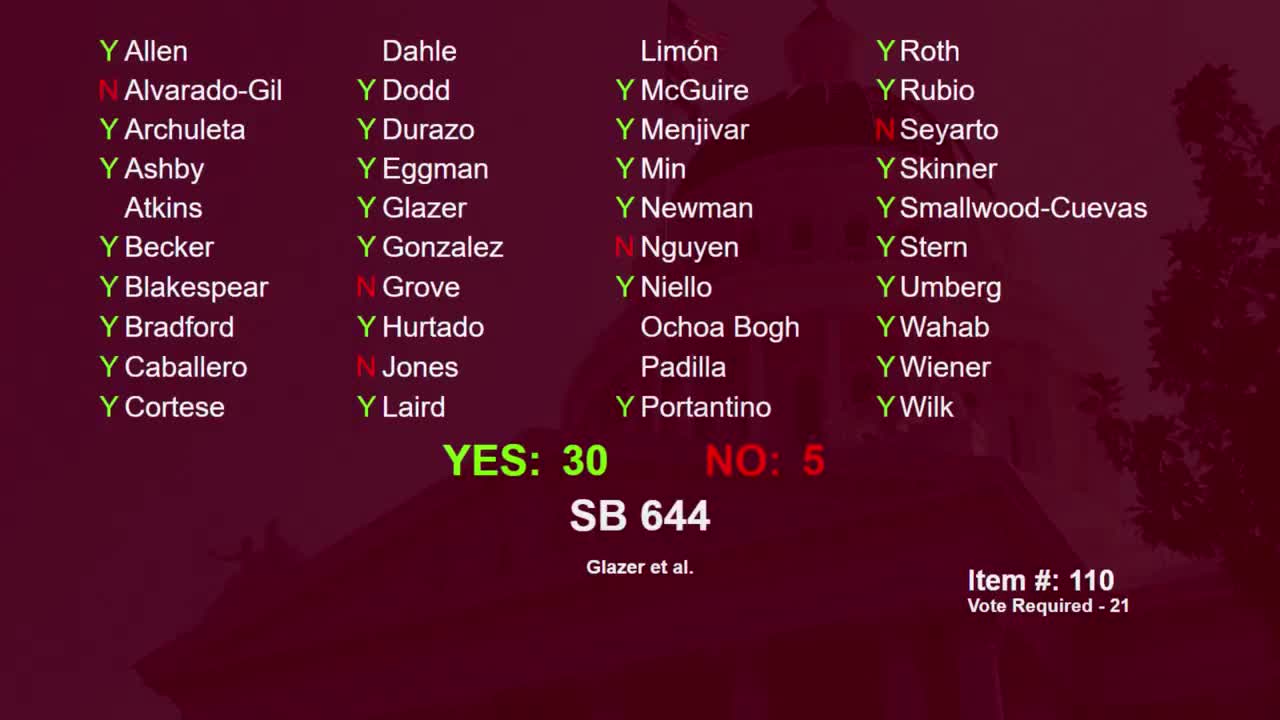 2MIN
Senate Floor
 5MIN
Senate Standing Committee on Judiciary
 5MIN
Senate Standing Committee on Governmental Organization
Bill Author
Bill Co-Author(s):