SB 76: Alcoholic beverages: music venue license: entertainment zones: consumption.
- Session Year: 2023-2024
- House: Senate
- Latest Version Date: 2023-10-10
Current Status:
Passed
(2023-10-10: Chaptered by Secretary of State. Chapter 700, Statutes of 2023.)
Introduced
In Committee
First Chamber
In Committee
Second Chamber
Enacted
(1)The Alcoholic Beverage Control Act contains various provisions regulating the application for, the issuance of, the suspension of, and the conditions imposed upon alcoholic beverage licenses by the Department of Alcoholic Beverage Control. Existing law provides for various annual fees for the issuance of alcoholic beverage licenses, depending upon the type of license issued. Existing law authorizes the department to issue a music venue license, as defined, that allows the licensee to sell beer, wine, and distilled spirits at retail for consumption on the premises in a music entertainment facility, as defined. Existing law makes selling, giving, delivering, or purchasing an alcoholic beverage between the hours of 2 a.m. and 6 a.m. of the same day a misdemeanor. Existing law further limits a music venue licensees authorization to sell, serve, and permit consumption of alcoholic beverages to the time period from 2 hours before a live performance until one hour after the live performance. Existing law authorizes the department to make any examination of the books and records of any licensee and makes any person who fails to preserve the books for inspection guilty of a misdemeanor.
This bill would authorize a licensee under a music venue license to apply to the department for a duplicate license or licenses, as prescribed. The bill would also authorize a music venue licensee to sell, serve, and permit consumption of alcoholic beverages during private events or private functions not open to the general public within any hours of operation permitted by its license, regardless of whether any live performance occurs. The bill would exempt the licensee from having to meet certain requirements generally imposed on a music entertainment facility in connection with and during a private event or private function if specified conditions are met. The bill would require the licensee to keep records demonstrating compliance with these provisions for the preceding 3 calendar years and to provide these records to the department upon request. The bill would make a licensees failure to keep the required records or provide them to the department grounds for disciplinary action punishable as a misdemeanor and would, therefore, expand the scope of a crime, thereby imposing a state-mandated local program.
(2)Under existing law, any person possessing an open container of an alcoholic beverage in any city, county, or city and county-owned public place, as specified, or any regional park or recreation and park district, is guilty of an infraction if the city or county has enacted an ordinance that prohibits the possession of those containers or the consumption of alcoholic beverages in those areas, except as specified.
Existing law, the Planning and Zoning Law, authorizes the legislative body of any city or county to adopt ordinances regulating zoning within its jurisdiction, as specified.
Existing law authorizes a licensed beer manufacturer, a licensed winegrower, and any on-sale licensee to sell certain alcoholic beverages for consumption on or off the premises, as specified.
This bill, additionally, would authorize a licensed beer manufacturer, a licensed winegrower, and any on-sale licensee to permit consumers to leave the premises with open containers of alcoholic beverages for consumption off the premises within an entertainment zone, subject to certain conditions. The bill would define entertainment zone for purposes of the Alcoholic Beverage Control Act as a zone created by ordinance on or after January 1, 2024, in the City and County of San Francisco, that authorizes consumption of one or more types of alcoholic beverages on public streets, sidewalks, or public rights-of-way adjacent to and during a special event permitted or licensed by the department. The bill would require the City and County of San Francisco, if it establishes an entertainment zone, to provide specified information relating to the entertainment zone to the department and establish a process or procedure by which persons in possession of alcoholic beverages in the entertainment zone may be readily identifiable as being 21 years of age or older.
This bill would make legislative findings and declarations as to the necessity of a special statute for City and County of San Francisco.
(3)This bill would incorporate additional changes to Section 23357 of the Business and Professions Code proposed by SB 788 to be operative only if this bill and SB 788 are enacted and this bill is enacted last.
This bill would incorporate additional changes to Section 23358 of the Business and Professions Code proposed by AB 1704 to be operative only if this bill and AB 1704 are enacted and this bill is enacted last.
(4)The California Constitution requires the state to reimburse local agencies and school districts for certain costs mandated by the state. Statutory provisions establish procedures for making that reimbursement.
This bill would provide that no reimbursement is required by this act for a specified reason.
(1)The Alcoholic Beverage Control Act contains various provisions regulating the application for, the issuance of, the suspension of, and the conditions imposed upon alcoholic beverage licenses by the Department of Alcoholic Beverage Control. Existing law provides for various annual fees for the issuance of alcoholic beverage licenses, depending upon the type of license issued. Existing law authorizes the department to issue a music venue license, as defined, that allows the licensee to sell beer, wine, and distilled spirits at retail for consumption on the premises in a music entertainment facility, as defined. Existing law makes selling, giving, delivering, or purchasing an alcoholic beverage between the hours of 2 a.m. and 6 a.m. of the same day a misdemeanor. Existing law further limits a music venue licensees authorization to sell, serve, and permit consumption of alcoholic beverages to the time period from 2 hours before a live performance until one hour after the live performance. Existing law authorizes the department to make any examination of the books and records of any licensee and makes any person who fails to preserve the books for inspection guilty of a misdemeanor.
This bill would authorize a licensee under a music venue license to apply to the department for a duplicate license or licenses, as prescribed. The bill would also authorize a music venue licensee to sell, serve, and permit consumption of alcoholic beverages during private events or private functions not open to the general public within any hours of operation permitted by its license, regardless of whether any live performance occurs. The bill would exempt the licensee from having to meet certain requirements generally imposed on a music entertainment facility in connection with and during a private event or private function if specified conditions are met. The bill would require the licensee to keep records demonstrating compliance with these provisions for the preceding 3 calendar years and to provide these records to the department upon request. The bill would make a licensees failure to keep the required records or provide them to the department grounds for disciplinary action punishable as a misdemeanor and would, therefore, expand the scope of a crime, thereby imposing a state-mandated local program.
(2)Under existing law, any person possessing an open container of an alcoholic beverage in any city, county, or city and county-owned public place, as specified, or any regional park or recreation and park district, is guilty of an infraction if the city or county has enacted an ordinance that prohibits the possession of those containers or the consumption of alcoholic beverages in those areas, except as specified.
Existing law, the Planning and Zoning Law, authorizes the legislative body of any city or county to adopt ordinances regulating zoning within its jurisdiction, as specified.
Existing law authorizes a licensed beer manufacturer, a licensed winegrower, and any on-sale licensee to sell certain alcoholic beverages for consumption on or off the premises, as specified.
This bill, additionally, would authorize a licensed beer manufacturer, a licensed winegrower, and any on-sale licensee to permit consumers to leave the premises with open containers of alcoholic beverages for consumption off the premises within an entertainment zone, subject to certain conditions. The bill would define entertainment zone for purposes of the Alcoholic Beverage Control Act as a zone created by ordinance on or after January 1, 2024, in the City and County of San Francisco, that authorizes consumption of one or more types of alcoholic beverages on public streets, sidewalks, or public rights-of-way adjacent to and during a special event permitted or licensed by the department. The bill would require the City and County of San Francisco, if it establishes an entertainment zone, to provide specified information relating to the entertainment zone to the department and establish a process or procedure by which persons in possession of alcoholic beverages in the entertainment zone may be readily identifiable as being 21 years of age or older.
This bill would make legislative findings and declarations as to the necessity of a special statute for City and County of San Francisco.
(3)This bill would incorporate additional changes to Section 23357 of the Business and Professions Code proposed by SB 788 to be operative only if this bill and SB 788 are enacted and this bill is enacted last.
This bill would incorporate additional changes to Section 23358 of the Business and Professions Code proposed by AB 1704 to be operative only if this bill and AB 1704 are enacted and this bill is enacted last.
(3)(4)The California Constitution requires the state to reimburse local agencies and school districts for certain costs mandated by the state. Statutory provisions establish procedures for making that reimbursement.
This bill would provide that no reimbursement is required by this act for a specified reason.
(1)The Alcoholic Beverage Control Act contains various provisions regulating the application for, the issuance of, the suspension of, and the conditions imposed upon alcoholic beverage licenses by the Department of Alcoholic Beverage Control. Existing law provides for various annual fees for the issuance of alcoholic beverage licenses, depending upon the type of license issued. Existing law authorizes the department to issue a music venue license, as defined, that allows the licensee to sell beer, wine, and distilled spirits at retail for consumption on the premises in a music entertainment facility, as defined. Existing law makes selling, giving, delivering, or purchasing an alcoholic beverage between the hours of 2 a.m. and 6 a.m. of the same day a misdemeanor. Existing law further limits a music venue licensees authorization to sell, serve, and permit consumption of alcoholic beverages to the time period from 2 hours before a live performance until one hour after the live performance. Existing law authorizes the department to make any examination of the books and records of any licensee and makes any person who fails to preserve the books for inspection guilty of a misdemeanor.
This bill would authorize a licensee under a music venue license to apply to the department for a duplicate license or licenses, as prescribed. The bill would also authorize a music venue licensee to sell, serve, and permit consumption of alcoholic beverages during private events or private functions not open to the general public within any hours of operation permitted by its license, regardless of whether any live performance occurs. The bill would exempt the licensee from having to meet certain requirements generally imposed on a music entertainment facility in connection with and during a private event or private function if specified conditions are met. The bill would require the licensee to keep records demonstrating compliance with these provisions for the preceding 3 calendar years and to provide these records to the department upon request. The bill would make a licensees failure to keep the required records or provide them to the department grounds for disciplinary action punishable as a misdemeanor and would, therefore, expand the scope of a crime, thereby imposing a state-mandated local program.
(2)Under existing law, any person possessing an open container of an alcoholic beverage in any city, county, or city and county-owned public place, as specified, or any regional park or recreation and park district, is guilty of an infraction if the city or county has enacted an ordinance that prohibits the possession of those containers or the consumption of alcoholic beverages in those areas, except as specified.
Existing law, the Planning and Zoning Law, authorizes the legislative body of any city or county to adopt ordinances regulating zoning within its jurisdiction, as specified.
Existing law authorizes a licensed beer manufacturer, a licensed winegrower, and any on-sale licensee to sell certain alcoholic beverages for consumption on or off the premises, as specified.
This bill, additionally, would authorize a licensed beer manufacturer, a licensed winegrower, and any on-sale licensee to permit consumers to leave the premises with open containers of alcoholic beverages for consumption off the premises within an entertainment zone, subject to certain conditions. The bill would define entertainment zone for purposes of the Alcoholic Beverage Control Act as a zone created by a city, county, or city and county ordinance on or after January 1, 2024, in the City and County of San Francisco, that authorizes consumption of one or more types of alcoholic beverages on public streets, sidewalks, or public rights-of-way in that zone. adjacent to and during a special event permitted or licensed by the department. The bill would require a city, county, or city and county that the City and County of San Francisco, if it establishes an entertainment zone zone, to provide specified information relating to the entertainment zone to the department and establish a process or procedure by which persons in possession of alcoholic beverages in the entertainment zone may be readily identifiable as being 21 years of age or older.
This bill would make legislative findings and declarations as to the necessity of a special statute for City and County of San Francisco.
(3)The California Constitution requires the state to reimburse local agencies and school districts for certain costs mandated by the state. Statutory provisions establish procedures for making that reimbursement.
This bill would provide that no reimbursement is required by this act for a specified reason.
(1)The Alcoholic Beverage Control Act contains various provisions regulating the application for, the issuance of, the suspension of, and the conditions imposed upon alcoholic beverage licenses by the Department of Alcoholic Beverage Control. Existing law provides for various annual fees for the issuance of alcoholic beverage licenses, depending upon the type of license issued. Existing law authorizes the department to issue a music venue license, as defined, that allows the licensee to sell beer, wine, and distilled spirits at retail for consumption on the premises in a music entertainment facility, as defined. Existing law makes selling, giving, delivering, or purchasing an alcoholic beverage between the hours of 2 a.m. and 6 a.m. of the same day a misdemeanor. Existing law further limits a music venue licensees authorization to sell, serve, and permit consumption of alcoholic beverages to the time period from 2 hours before a live performance until one hour after the live performance. Existing law authorizes the department to make any examination of the books and records of any licensee and makes any person who fails to preserve the books for inspection guilty of a misdemeanor.
This bill would authorize a licensee under a music venue license to apply to the department for a duplicate license or licenses, as prescribed. The bill would also authorize a music venue licensee to sell, serve, and permit consumption of alcoholic beverages during private events or private functions not open to the general public within any hours of operation permitted by its license, regardless of whether any live performance occurs. The bill would exempt the licensee from having to meet certain requirements generally imposed on a music entertainment facility in connection with and during a private event or private function if specified conditions are met. The bill would require the licensee to keep records demonstrating compliance with these provisions for the preceding 3 calendar years and to provide these records to the department upon request. The bill would make a licensees failure to keep the required records or provide them to the department grounds for disciplinary action punishable as a misdemeanor and would, therefore, expand the scope of a crime, thereby imposing a state-mandated local program.
(2)Under existing law, any person possessing an open container of an alcoholic beverage in any city, county, or city and county-owned public place, as specified, or any regional park or recreation and park district, is guilty of an infraction if the city or county has enacted an ordinance that prohibits the possession of those containers or the consumption of alcoholic beverages in those areas, except as specified.
Existing law, the Planning and Zoning Law, authorizes the legislative body of any city or county to adopt ordinances regulating zoning within its jurisdiction, as specified.
Existing law authorizes a licensed beer manufacturer, a licensed winegrower, and any on-sale licensee to sell certain alcoholic beverages for consumption on or off the premises, as specified.
This bill, additionally, would authorize a licensed beer manufacturer, a licensed winegrower, and any on-sale licensee to permit consumers to leave the premises with open containers of alcoholic beverages for consumption off the premises within an entertainment zone, subject to certain conditions. The bill would define entertainment zone for purposes of the Alcoholic Beverage Control Act as a zone created by a city, county, or city and county ordinance on or after January 1, 2024, that authorizes consumption of one or more types of alcoholic beverages on public streets, sidewalks, or public rights-of-way in that zone. The bill would require a city, county, or city and county that establishes an entertainment zone to provide specified information relating to the entertainment zone to the department and establish a process or procedure by which persons in possession of alcoholic beverages in the entertainment zone may be readily identifiable as being 21 years of age or older.
(3)The California Constitution requires the state to reimburse local agencies and school districts for certain costs mandated by the state. Statutory provisions establish procedures for making that reimbursement.
This bill would provide that no reimbursement is required by this act for a specified reason.
(1)The Alcoholic Beverage Control Act contains various provisions regulating the application for, the issuance of, the suspension of, and the conditions imposed upon alcoholic beverage licenses by the Department of Alcoholic Beverage Control. Existing law provides for various annual fees for the issuance of alcoholic beverage licenses, depending upon the type of license issued. Existing law authorizes the department to issue a music venue license, as defined, that would allow allows the licensee to sell beer, wine, and distilled spirits at retail for consumption on the premises in a music entertainment facility, as defined. Existing law makes selling, giving, delivering, or purchasing an alcoholic beverage between the hours of 2 a.m. and 6 a.m. of the same day a misdemeanor. Existing law further limits a music venue licensees authorization to sell, serve, and permit consumption of alcoholic beverages to the time period from 2 hours before a live performance until one hour after the live performance. Existing law authorizes the department to make any examination of the books and records of any licensee and makes any person who fails to preserve the books for inspection guilty of a misdemeanor.
This bill would authorize a licensee under a music venue license to apply to the department for a caterers permit that would authorize the sale of beer, wine, and distilled spirits for consumption at events only upon the licensed music entertainment facility premises. duplicate license or licenses, as prescribed. The bill would also authorize a music venue license to apply to the department for an event permit, as specified. The bill would impose a fee for a caterers permit for a licensee under a music venue license and for an event permit for a licensee under a music venue license, which would be deposited in the Alcohol Beverage Control Fund, and would make other conforming changes. music venue licensee to sell, serve, and permit consumption of alcoholic beverages during private events not open to the general public within any hours of operation permitted by its license, regardless of whether any live performance occurs. The bill would exempt the licensee from having to meet certain requirements generally imposed on a music entertainment facility in connection with and during a private event if specified conditions are met. The bill would require the licensee to keep records demonstrating compliance with these provisions for the preceding 3 calendar years and to provide these records to the department upon request. The bill would make a licensees failure to keep the required records or provide them to the department grounds for disciplinary action punishable as a misdemeanor and would, therefore, expand the scope of a crime, thereby imposing a state-mandated local program.
(2)Under existing law, any person possessing an open container of an alcoholic beverage in any city, county, or city and county-owned public place, as specified, or any regional park or recreation and park district, is guilty of an infraction if the city or county has enacted an ordinance that prohibits the possession of those containers or the consumption of alcoholic beverages in those areas, except as specified.
Existing law, the Planning and Zoning Law, authorizes the legislative body of any city or county to adopt ordinances regulating zoning within its jurisdiction, as specified.
Existing law authorizes a licensed beer manufacturer, a licensed winegrower, and any on-sale licensee to sell certain alcoholic beverages for consumption on or off the premises, as specified.
This bill, additionally, would authorize a licensed beer manufacturer, a licensed winegrower, and any on-sale licensee to permit consumers to leave the premises with open containers of alcoholic beverages for consumption off the premises within an entertainment zone, subject to certain conditions. The bill would define entertainment zone for purposes of the Alcoholic Beverage Control Act as a zone created by a city, county, or city and county ordinance on or after January 1, 2024, that authorizes consumption of one or more types of alcoholic beverages on public streets, sidewalks, or public rights-of-way in that zone. The bill would require a city, county, or city and county that establishes an entertainment zone to provide specified information relating to the entertainment zone to the department and establish a process or procedure by which persons in possession of alcoholic beverages in the entertainment zone may be readily identifiable as being 21 years of age or older.
(3)The California Constitution requires the state to reimburse local agencies and school districts for certain costs mandated by the state. Statutory provisions establish procedures for making that reimbursement.
This bill would provide that no reimbursement is required by this act for a specified reason.
(1)The Alcoholic Beverage Control Act contains various provisions regulating the application for, the issuance of, the suspension of, and the conditions imposed upon alcoholic beverage licenses by the Department of Alcoholic Beverage Control. Existing law provides for various annual fees for the issuance of alcoholic beverage licenses, depending upon the type of license issued. Existing law authorizes the department to issue a music venue license, as defined, that would allow the licensee to sell beer, wine, and distilled spirits at retail for consumption on the premises in a music entertainment facility, as defined.
This bill would authorize a licensee under a music venue license to apply to the department for a caterers permit that would authorize the sale of beer, wine, and distilled spirits for consumption at events only upon the licensed music entertainment facility premises. The bill would also authorize a music venue license to apply to the department for an event permit, as specified. The bill would impose a fee for a caterers permit for a licensee under a music venue license and for an event permit for a licensee under a music venue license, which would be deposited in the Alcohol Beverage Control Fund, and would make other conforming changes.
(2)Under existing law, any person possessing an open container of an alcoholic beverage in any city, county, or city and county-owned public place, as specified, or any regional park or recreation and park district, is guilty of an infraction if the city or county has enacted an ordinance that prohibits the possession of those containers or the consumption of alcoholic beverages in those areas, except as specified.
Existing law, the Planning and Zoning Law, authorizes the legislative body of any city or county to adopt ordinances regulating zoning within its jurisdiction, as specified.
Existing law authorizes a licensed beer manufacturer, a licensed winegrower, and any on-sale licensee to sell certain alcoholic beverages for consumption on or off the premises, as specified.
This bill, additionally, would authorize a licensed beer manufacturer, a licensed winegrower, and any on-sale licensee to permit consumers to leave the premises with open containers of alcoholic beverages for consumption off the premises within an entertainment zone, subject to certain conditions. The bill would define entertainment zone for purposes of the Alcoholic Beverage Control Act as a zone created by a city, county, or city and county ordinance on or after January 1, 2024, that authorizes consumption of one or more types of alcoholic beverages on public streets, sidewalks, or public rights-of-way in that zone. The bill would require a city, county, or city and county that establishes an entertainment zone to provide specified information relating to the entertainment zone to the department and establish a process or procedure by which persons in possession of alcoholic beverages in the entertainment zone may be readily identifiable as being 21 years of age or older.
Entertainment zone means a zone created by ordinance on or after January 1, 2024, in the City and County of San Francisco that authorizes consumption of one or more types of alcoholic beverages on public streets, sidewalks, or public rights-of-way adjacent to and during a special event permitted or licensed by the department.
SEC. 2.Section 23357 of the Business and Professions Code is amended to read:23357.(a)A licensed beer manufacturer may, at the licensed premises of production, sell to consumers for consumption off the premises beer that is produced and bottled by, or produced and packaged for, that manufacturer. Licensed beer manufacturers may also exercise any of the following privileges:
(1)Sell that beer to any person holding a license authorizing the sale of beer.
(2)Sell that beer to consumers for consumption on the manufacturers licensed premises or on premises owned by the manufacturer that are contiguous to the licensed premises and which are operated by and for the manufacturer.
(3)Sell beer and wine, regardless of source, to consumers for consumption at a bona fide public eating place on the manufacturers licensed premises or at a bona fide public eating place on premises owned by the manufacturer which are contiguous to the licensed premises and which are operated by and for the manufacturer.
(4)(A)Permit consumers to leave the premises with open containers of alcoholic beverages for consumption off the premises within an entertainment zone if all of the following conditions are satisfied:
(i)The premises is located within the entertainment zone.
(ii)Consumption of that type of alcoholic beverage is authorized by the ordinance creating the entertainment zone.
(iii)Open alcohol containers only leave the premises during the hours allowed by the ordinance establishing the entertainment zone.
(iv)Patrons with open containers exit the premises directly into an entertainment zone.
(v)All alcoholic beverages in the entertainment zone are purchased only at a licensed premises located within the entertainment zone.
(vi)The premises expressly prohibits open containers or closed containers of alcoholic beverages acquired outside their premises.
(vii)Delivery of alcoholic beverages to consumers within the entertainment zone by the licensee or by any third-party delivery service is expressly prohibited unless the delivery is to a residential building or private business that is not a licensee.
(viii)No alcoholic beverages purchased at the licensed premises may leave the premises in an open glass or metal container for consumption in an entertainment zone.
(ix)The licensee annually submits their notice of intent to participate in an open container entertainment zone to the department.
(B)This paragraph does not require a licensee to sell any alcoholic beverage for consumption off the premises within an entertainment zone.
(C)Licensees whose privileges are restricted due to operating conditions or other statutory restrictions may be prohibited from exercising entertainment zone privileges that are contrary to their operating conditions. For purposes of this paragraph, any restrictions on the exercise of off-sale privileges shall apply to the removal of alcoholic beverages from the licensed premises for consumption in the entertainment zone.
(b)Notwithstanding any other provision of this division, licensed beer manufacturers and holders of out-of-state beer manufacturers certificates may be issued and may hold retail package off-sale beer and wine licenses. Alcoholic beverage products sold at or from the off-sale premises that are not produced and bottled by, or produced and packaged for, the beer manufacturer shall be purchased by the beer manufacturer only from a licensed wholesaler.
(c)Notwithstanding any other provision of this division, a licensed beer manufacturer that produces more than 60,000 barrels of beer a year may manufacture cider or perry at the licensed premises of production and may sell cider or perry to any licensee authorized to sell wine. For purposes of this subdivision, cider and perry have the meanings provided in Section 4.21(e)(5) of Title 27 of the Code of Federal Regulations. This subdivision does not alter or amend the classification of cider or perry as wine for any purpose other than that provided by this section.
(d)A beer manufacturer may also have upon the licensed premises, or on premises owned by the manufacturer that are contiguous to the licensed premises and are operated by and for the manufacturer all beers and wines, regardless of source, for sale or service only to guests during private events or private functions not open to the general public. Alcoholic beverage products sold at the premises that are not produced and bottled by, or produced and packaged for, the beer manufacturer shall be purchased by the beer manufacturer only from a licensed wholesaler. All alcoholic beverages sold or served shall be produced by a licensee authorized to manufacture the product.
SEC. 2.5.Section 23357 of the Business and Professions Code is amended to read:23357.(a)A licensed beer manufacturer may, at the licensed premises of production, sell to consumers for consumption off the premises beer that is produced and bottled by, or produced and packaged for, that manufacturer. Licensed beer manufacturers may also exercise any of the following privileges:
(1)Sell that beer to any person holding a license authorizing the sale of beer.
(2)Sell that beer to consumers for consumption on the manufacturers licensed premises or on premises owned by the manufacturer that are contiguous to the licensed premises and which are operated by and for the manufacturer.
(3)Sell beer and wine, regardless of source, to consumers for consumption at a bona fide public eating place on the manufacturers licensed premises or at a bona fide public eating place on premises owned by the manufacturer which are contiguous to the licensed premises and which are operated by and for the manufacturer.
(4)(A)Permit consumers to leave the premises with open containers of alcoholic beverages for consumption off the premises within an entertainment zone if all of the following conditions are satisfied:
(i)The premises is located within the entertainment zone.
(ii)Consumption of that type of alcoholic beverage is authorized by the ordinance creating the entertainment zone.
(iii)Open alcohol containers only leave the premises during the hours allowed by the ordinance establishing the entertainment zone.
(iv)Patrons with open containers exit the premises directly into an entertainment zone.
(v)All alcoholic beverages in the entertainment zone are purchased only at a licensed premises located within the entertainment zone.
(vi)The premises expressly prohibits open containers or closed containers of alcoholic beverages acquired outside their premises.
(vii)Delivery of alcoholic beverages to consumers within the entertainment zone by the licensee or by any third-party delivery service is expressly prohibited unless the delivery is to a residential building or private business that is not a licensee.
(viii)No alcoholic beverages purchased at the licensed premises may leave the premises in an open glass or metal container for consumption in an entertainment zone.
(ix)The licensee annually submits their notice of intent to participate in an open container entertainment zone to the department.
(B)This paragraph does not require a licensee to sell any alcoholic beverage for consumption off the premises within an entertainment zone.
(C)Licensees whose privileges are restricted due to operating conditions or other statutory restrictions may be prohibited from exercising entertainment zone privileges that are contrary to their operating conditions. For purposes of this paragraph, any restrictions on the exercise of off-sale privileges shall apply to the removal of alcoholic beverages from the licensed premises for consumption in the entertainment zone.
(b)Notwithstanding any other provision of this division, licensed beer manufacturers and holders of out-of-state beer manufacturers certificates may be issued and may hold retail package off-sale beer and wine licenses. Alcoholic beverage products sold at or from the off-sale premises that are not produced and bottled by, or produced and packaged for, the beer manufacturer shall be purchased by the beer manufacturer only from a licensed wholesaler.
(c)Notwithstanding any other provision of this division, a licensed beer manufacturer may manufacture cider or perry at the licensed premises of production and may sell cider or perry to any licensee authorized to sell wine. For purposes of this subdivision, cider and perry have the meanings provided in Section 4.21(e)(8) of Title 27 of the Code of Federal Regulations. This subdivision does not alter or amend the classification of cider or perry as wine for any purpose other than that provided by this section.
(d)A beer manufacturer may also have upon the licensed premises, or on premises owned by the manufacturer that are contiguous to the licensed premises and are operated by and for the manufacturer all beers and wines, regardless of source, for sale or service only to guests during private events or private functions not open to the general public. Alcoholic beverage products sold at the premises that are not produced and bottled by, or produced and packaged for, the beer manufacturer shall be purchased by the beer manufacturer only from a licensed wholesaler. All alcoholic beverages sold or served shall be produced by a licensee authorized to manufacture the product.
SEC. 3.Section 23358 of the Business and Professions Code is amended to read:23358.(a)Licensed winegrowers, notwithstanding any other provisions of this division, may also exercise the following privileges:
(1)Sell wine and brandy to any person holding a license authorizing the sale of wine or brandy.
(2)Sell wine and brandy to consumers for consumption off the premises where sold.
(3)Sell wine to consumers for consumption on the premises.
(4)Sell all beers, wines, and brandies, regardless of source, to consumers for consumption on the premises in a bona fide eating place as defined in Section 23038, which is located on the licensed premises or on premises owned by the licensee that are contiguous to the licensed premises and which is operated by and for the licensee. At such bona fide public eating place beer, wine, and brandy may be used in the preparation of food and beverages to be consumed on the premises.
(5)(A)Permit consumers to leave the premises with open containers of alcoholic beverages for consumption off the premises within an entertainment zone if all of the following conditions are satisfied:
(i)The premises is located within the entertainment zone.
(ii)Consumption of that type of alcoholic beverage is authorized by the ordinance creating the entertainment zone.
(iii)Open alcohol containers only leave the premises during the hours allowed by the ordinance establishing the entertainment zone.
(iv)Patrons with open containers exit the premises directly into an entertainment zone.
(v)All alcoholic beverages in the entertainment zone are purchased only at a licensed premises located within the entertainment zone.
(vi)The premises expressly prohibits open containers or closed containers of alcoholic beverages acquired outside their premises.
(vii)Delivery of alcoholic beverages to consumers within the entertainment zone by the licensee or by any third-party delivery service is expressly prohibited unless the delivery is to a residential building or private business that is not a licensee.
(viii)No alcoholic beverages purchased at the licensed premises may leave the premises in an open glass or metal container for consumption in an entertainment zone.
(ix)The licensee annually submits their notice of intent to participate in an open container entertainment zone to the department.
(B)This paragraph does not require a licensee to sell any alcoholic beverage for consumption off the premises within an entertainment zone.
(C)Licensees whose privileges are restricted due to operating conditions or other statutory restrictions may be prohibited from exercising entertainment zone privileges that are contrary to their operating conditions. For purposes of this paragraph, any restrictions on the exercise of off-sale privileges shall apply to the removal of alcoholic beverages from the licensed premises for consumption in the entertainment zone.
(6)Produce spirits of wine and blend those spirits of wine into wine produced by the winegrower or sell those spirits of wine to an industrial alcohol dealer.
(b)A winegrower may also have upon the premises all beers, wines, and brandies, regardless of source, for sale or service only to guests during private events or private functions not open to the general public. Alcoholic beverage products sold at the premises that are not produced and bottled by, or produced and packaged for, the winegrower shall be purchased by the winegrower only from a licensed wholesaler.
(c)A winegrower shall actually produce on the winegrowers licensed premises by conversion of grapes, berries, or other fruit, into wine, not less than 50 percent of all wines sold to consumers on the winegrowers licensed premise or premises and any licensed branch premise or premises.
(d)The department may, if it shall determine for good cause that the granting of any such privilege would be contrary to public welfare or morals, deny the right to exercise any on-sale privilege authorized by this section in either a bona fide eating place the main entrance to which is within 200 feet of a school or church, or on the licensed winery premises, or both.
(e)Nothing in this section or in Section 23390 is intended to alter, diminish, replace, or eliminate the authority of a county, city, or city and county from exercising land use regulatory authority by law to the extent the authority may restrict, but not eliminate, privileges afforded by these sections.
SEC. 3.5.Section 23358 of the Business and Professions Code is amended to read:23358.(a)Licensed winegrowers, notwithstanding any other provisions of this division, may also exercise the following privileges:
(1)Sell wine and brandy to any person holding a license authorizing the sale of wine or brandy.
(2)Sell wine and brandy to consumers for consumption off the premises where sold.
(3)Sell wine to consumers for consumption on the premises.
(4)Sell all beers, wines, and brandies, regardless of source, to consumers for consumption on the premises in a bona fide eating place as defined in Section 23038, which is located on the licensed premises or on premises owned by the licensee that are contiguous to the licensed premises and which is operated by and for the licensee. At such a bona fide public eating place beer, wine, and brandy may be used in the preparation of food and beverages to be consumed on the premises.
(5)(A)Permit consumers to leave the premises with open containers of alcoholic beverages for consumption off the premises within an entertainment zone if all of the following conditions are satisfied:
(i)The premises is located within the entertainment zone.
(ii)Consumption of that type of alcoholic beverage is authorized by the ordinance creating the entertainment zone.
(iii)Open alcohol containers only leave the premises during the hours allowed by the ordinance establishing the entertainment zone.
(iv)Patrons with open containers exit the premises directly into an entertainment zone.
(v)All alcoholic beverages in the entertainment zone are purchased only at a licensed premises located within the entertainment zone.
(vi)The premises expressly prohibits open containers or closed containers of alcoholic beverages acquired outside their premises.
(vii)Delivery of alcoholic beverages to consumers within the entertainment zone by the licensee or by any third-party delivery service is expressly prohibited unless the delivery is to a residential building or private business that is not a licensee.
(viii)No alcoholic beverages purchased at the licensed premises may leave the premises in an open glass or metal container for consumption in an entertainment zone.
(ix)The licensee annually submits their notice of intent to participate in an open container entertainment zone to the department.
(B)This paragraph does not require a licensee to sell any alcoholic beverage for consumption off the premises within an entertainment zone.
(C)Licensees whose privileges are restricted due to operating conditions or other statutory restrictions may be prohibited from exercising entertainment zone privileges that are contrary to their operating conditions. For purposes of this paragraph, any restrictions on the exercise of off-sale privileges shall apply to the removal of alcoholic beverages from the licensed premises for consumption in the entertainment zone.
(6)Produce spirits of wine and blend those spirits of wine into wine produced by the winegrower or sell those spirits of wine to an industrial alcohol dealer or a distilled spirits manufacturer.
(b)A winegrower may also have upon the premises all beers, wines, and brandies, regardless of source, for sale or service only to guests during private events or private functions not open to the general public. Alcoholic beverage products sold at the premises that are not produced and bottled by, or produced and packaged for, the winegrower shall be purchased by the winegrower only from a licensed wholesaler.
(c)A winegrower shall actually produce on the winegrowers licensed premises by conversion of grapes, berries, or other fruit, into wine, not less than 50 percent of all wines sold to consumers on the winegrowers licensed premises and any licensed branch premises.
(d)The department may, if it shall determine for good cause that the granting of any such privilege would be contrary to public welfare or morals, deny the right to exercise any on-sale privilege authorized by this section in either a bona fide eating place the main entrance to which is within 200 feet of a school or church, or on the licensed winery premises, or both.
(e)Nothing in this section or in Section 23390 is intended to alter, diminish, replace, or eliminate the authority of a county, city, or city and county from exercising land use regulatory authority by law to the extent the authority may restrict, but not eliminate, privileges afforded by these sections.
SEC. 4.Section 23396 of the Business and Professions Code is amended to read:23396.(a)Any on-sale license authorizes the sale of the alcoholic beverage specified in the license for consumption on the premises where sold. No alcoholic beverages, other than beers, may be sold or served in any bona fide public eating place for which an on-sale license has been issued unless the premises comply with the requirements prescribed in Section 23038, 23038.1, 23038.2, or 23038.3.
(b)(1)In addition to the privilege in subdivision (a), any on-sale license for a premises located in an entertainment zone authorizes the licensee to permit consumers to leave the licensed premises with open containers of alcoholic beverages for consumption off the premises within the entertainment zone if all of the following conditions are satisfied:
(A)The alcoholic beverage is specified in both the license and the ordinance creating the entertainment zone.
(B)Open alcohol containers only leave the premises during the hours allowed by the ordinance establishing the entertainment zone.
(C)Patrons with open containers exit the licensed premises directly into an entertainment zone.
(D)All alcoholic beverages in the entertainment zone are purchased only at a licensed premises located within the entertainment zone.
(E)The premises expressly prohibits open containers or closed containers of alcoholic beverages acquired outside their premises.
(F)Delivery of alcoholic beverages to consumers within the entertainment zone by the licensee or by any third-party delivery service is expressly prohibited unless the delivery is to a residential building or private business that is not a licensee.
(G)No alcoholic beverages purchased at the licensed premises may leave the premises in an open glass or metal container for consumption in an entertainment zone.
(H)The licensee annually submits their notice of intent to participate in an open container entertainment zone to the department.
(2)This subdivision does not require a licensee to sell any alcoholic beverage for consumption off the premises within an entertainment zone.
(3)Licensees whose privileges are restricted due to operating conditions or other statutory restrictions may be prohibited from exercising entertainment zone privileges that are contrary to their operating conditions. For purposes of this paragraph, any restrictions on the exercise of off-sale privileges shall apply to the removal of alcoholic beverages from the licensed premises for consumption in the entertainment zone.
SEC. 5.Section 23552 of the Business and Professions Code is amended to read:23552.(a)In addition to the licenses specified in Section 23320, the department may issue a music venue license to sell beer, wine, and distilled spirits at retail for consumption upon the premises only. A music venue licensee is eligible to obtain a duplicate license or licenses as described in Section 24042 and shall be subject to the same fees charged for a duplicate Type 47 license.
(b)The music venue license may be issued for a music entertainment facility providing alcoholic beverage service. Except as provided in this section, only licensees with a music venue license are authorized to sell beer, wine, and distilled spirits at retail for consumption upon the premises of the music entertainment facility. The license shall only be transferable from person to person at the same premises. A music venue license shall not be transferred or sold for a purchase price or consideration in excess of the original fee paid for that license.
(c)(1)Subject to Section 25631, the music venue licensee may sell, serve, and permit consumption of alcoholic beverages only during the time period from two hours before a live performance until one hour after the live performance.
(2)(A)A music venue licensee may also sell, serve, and permit consumption of alcoholic beverages to guests during private events or private functions not open to the general public within any hours of operation permitted by its license, regardless of whether any live performance occurs.
(B)(i)A music entertainment facility shall not be required to meet the requirements of subdivision (c) of Section 23550 in connection with and during a private event or private function provided the facilitys principal purpose shall be to operate as a music entertainment facility.
(ii)A music venue licenseholder must keep records at the licensed premises to show compliance with this paragraph for the preceding three calendar years. Records kept in compliance with this section must be provided to the department upon request pursuant to Section 25753. Failure to keep required records or to provide them to the department upon request shall be grounds for disciplinary action pursuant to Section 25616.
(iii)For purposes of this subparagraph, principal purpose shall mean that the number of private events or private functions occurring at the music entertainment facility does not exceed the number of live entertainment events occurring at the facility in any calendar year.
(d)(1)Issuance of the license shall be subject to the provisions of Section 23958.4.
(2)Issuance of the license shall not be subject to the provisions of Section 23816.
(e)An on-sale licensee may permit a person under 21 years of age into the music entertainment facility. This subdivision does not authorize the on-sale licensee to sell, furnish, or give any alcoholic beverages to a person under 21 years of age, or to engage in any other activity not otherwise authorized by this division.
(f)(1)An on-sale general bona fide public eating place licensee or an on-sale general public premises licensee as of the effective date of this section may exchange that license for a music venue license, subject to the qualifications of the premises as specified in this division. The exchange may be made at any time upon the approval of the department, the payment of an exchange fee of one hundred dollars ($100), and compliance with the provisions of this division relating to the issuance of an original license.
(2)The department may modify its rules regarding the surrender of licenses to implement this subdivision.
(g)The department may promulgate regulations to implement this article.
SEC. 6.Article 5 (commencing with Section 25690) is added to Chapter 16 of Division 9 of the Business and Professions Code, to read:5.Entertainment Zones25690.(a)If the City and County of San Francisco establishes an entertainment zone, it shall do both of the following:
(1)Establish a process or procedure by which persons in possession of alcoholic beverages in the entertainment zone may be readily identifiable as being 21 years of age or older.
(2)Provide all of the following to the department:
(A)A copy of the ordinance establishing the entertainment zone.
(B)Information as may be necessary to identify the boundaries of the entertainment zone.
(C)The days and hours of operation of the entertainment zone.
(D)The types of alcoholic beverages permitted within the entertainment zone.
(E)The approved nonglass and nonmetal containers in which alcoholic beverages may be authorized.
(b)The Legislature finds and declares that a special statute is necessary and that a general statute cannot be made applicable within the meaning of Section 16 of Article IV of the California Constitution because of the unique economic circumstances in the City and County of San Francisco.
SEC. 7.Section 2.5 of this bill incorporates amendments to Section 23357 of the Business and Professions Code proposed by both this bill and Senate Bill 788. That section of this bill shall only become operative if (1) both bills are enacted and become effective on or before January 1, 2024, (2) each bill amends Section 23357 of the Business and Professions Code, and (3) this bill is enacted after Senate Bill 788, in which case Section 2 of this bill shall not become operative.
SEC. 8.Section 3.5 of this bill incorporates amendments to Section 23358 of the Business and Professions Code proposed by this bill and Assembly Bill 1704. That section of this bill shall only become operative if (1) both bills are enacted and become effective on or before January 1, 2024, (2) each bill amends Section 23358 of the Business and Professions Code, and (3) this bill is enacted after Assembly Bill 1704, in which case Section 23358 of the Business and Professions Code, as amended by Assembly Bill 1704, shall remain operative only until the operative date of this bill, at which time Section 3.5 of this bill shall become operative, and Section 3 of this bill shall not become operative.
SEC. 9.No reimbursement is required by this act pursuant to Section 6 of Article XIIIB of the California Constitution because the only costs that may be incurred by a local agency or school district will be incurred because this act creates a new crime or infraction, eliminates a crime or infraction, or changes the penalty for a crime or infraction, within the meaning of Section 17556 of the Government Code, or changes the definition of a crime within the meaning of Section 6 of Article XIIIB of the California Constitution.
Entertainment zone means a zone created by ordinance on or after January 1, 2024, in the City and County of San Francisco that authorizes consumption of one or more types of alcoholic beverages on public streets, sidewalks, or public rights-of-way adjacent to and during a special event permitted or licensed by the department.
SEC. 2.Section 23357 of the Business and Professions Code is amended to read:23357.(a)A licensed beer manufacturer may, at the licensed premises of production, sell to consumers for consumption off the premises beer that is produced and bottled by, or produced and packaged for, that manufacturer. Licensed beer manufacturers may also exercise any of the following privileges:
(1)Sell that beer to any person holding a license authorizing the sale of beer.
(2)Sell that beer to consumers for consumption on the manufacturers licensed premises or on premises owned by the manufacturer that are contiguous to the licensed premises and which are operated by and for the manufacturer.
(3)Sell beer and wine, regardless of source, to consumers for consumption at a bona fide public eating place on the manufacturers licensed premises or at a bona fide public eating place on premises owned by the manufacturer which are contiguous to the licensed premises and which are operated by and for the manufacturer.
(4)(A)Permit consumers to leave the premises with open containers of alcoholic beverages for consumption off the premises within an entertainment zone if all of the following conditions are satisfied:
(i)The premises is located within the entertainment zone.
(ii)Consumption of that type of alcoholic beverage is authorized by the ordinance creating the entertainment zone.
(iii)Open alcohol containers only leave the premises during the hours allowed by the ordinance establishing the entertainment zone.
(iv)Patrons with open containers exit the premises directly into an entertainment zone.
(v)All alcoholic beverages in the entertainment zone are purchased only at a licensed premises located within the entertainment zone.
(vi)The premises expressly prohibits open containers or closed containers of alcoholic beverages acquired outside their premises.
(vii)Delivery of alcoholic beverages to consumers within the entertainment zone by the licensee or by any third-party delivery service is expressly prohibited unless the delivery is to a residential building or private business that is not a licensee.
(viii)No alcoholic beverages purchased at the licensed premises may leave the premises in an open glass or metal container for consumption in an entertainment zone.
(ix)The licensee annually submits their notice of intent to participate in an open container entertainment zone to the department.
(B)This paragraph does not require a licensee to sell any alcoholic beverage for consumption off the premises within an entertainment zone.
(C)Licensees whose privileges are restricted due to operating conditions or other statutory restrictions may be prohibited from exercising entertainment zone privileges that are contrary to their operating conditions. For purposes of this paragraph, any restrictions on the exercise of off-sale privileges shall apply to the removal of alcoholic beverages from the licensed premises for consumption in the entertainment zone.
(b)Notwithstanding any other provision of this division, licensed beer manufacturers and holders of out-of-state beer manufacturers certificates may be issued and may hold retail package off-sale beer and wine licenses. Alcoholic beverage products sold at or from the off-sale premises that are not produced and bottled by, or produced and packaged for, the beer manufacturer shall be purchased by the beer manufacturer only from a licensed wholesaler.
(c)Notwithstanding any other provision of this division, a licensed beer manufacturer that produces more than 60,000 barrels of beer a year may manufacture cider or perry at the licensed premises of production and may sell cider or perry to any licensee authorized to sell wine. For purposes of this subdivision, cider and perry have the meanings provided in Section 4.21(e)(5) of Title 27 of the Code of Federal Regulations. This subdivision does not alter or amend the classification of cider or perry as wine for any purpose other than that provided by this section.
(d)A beer manufacturer may also have upon the licensed premises, or on premises owned by the manufacturer that are contiguous to the licensed premises and are operated by and for the manufacturer all beers and wines, regardless of source, for sale or service only to guests during private events or private functions not open to the general public. Alcoholic beverage products sold at the premises that are not produced and bottled by, or produced and packaged for, the beer manufacturer shall be purchased by the beer manufacturer only from a licensed wholesaler. All alcoholic beverages sold or served shall be produced by a licensee authorized to manufacture the product.
SEC. 2.5.Section 23357 of the Business and Professions Code is amended to read:23357.(a)A licensed beer manufacturer may, at the licensed premises of production, sell to consumers for consumption off the premises beer that is produced and bottled by, or produced and packaged for, that manufacturer. Licensed beer manufacturers may also exercise any of the following privileges:
(1)Sell that beer to any person holding a license authorizing the sale of beer.
(2)Sell that beer to consumers for consumption on the manufacturers licensed premises or on premises owned by the manufacturer that are contiguous to the licensed premises and which are operated by and for the manufacturer.
(3)Sell beer and wine, regardless of source, to consumers for consumption at a bona fide public eating place on the manufacturers licensed premises or at a bona fide public eating place on premises owned by the manufacturer which are contiguous to the licensed premises and which are operated by and for the manufacturer.
(4)(A)Permit consumers to leave the premises with open containers of alcoholic beverages for consumption off the premises within an entertainment zone if all of the following conditions are satisfied:
(i)The premises is located within the entertainment zone.
(ii)Consumption of that type of alcoholic beverage is authorized by the ordinance creating the entertainment zone.
(iii)Open alcohol containers only leave the premises during the hours allowed by the ordinance establishing the entertainment zone.
(iv)Patrons with open containers exit the premises directly into an entertainment zone.
(v)All alcoholic beverages in the entertainment zone are purchased only at a licensed premises located within the entertainment zone.
(vi)The premises expressly prohibits open containers or closed containers of alcoholic beverages acquired outside their premises.
(vii)Delivery of alcoholic beverages to consumers within the entertainment zone by the licensee or by any third-party delivery service is expressly prohibited unless the delivery is to a residential building or private business that is not a licensee.
(viii)No alcoholic beverages purchased at the licensed premises may leave the premises in an open glass or metal container for consumption in an entertainment zone.
(ix)The licensee annually submits their notice of intent to participate in an open container entertainment zone to the department.
(B)This paragraph does not require a licensee to sell any alcoholic beverage for consumption off the premises within an entertainment zone.
(C)Licensees whose privileges are restricted due to operating conditions or other statutory restrictions may be prohibited from exercising entertainment zone privileges that are contrary to their operating conditions. For purposes of this paragraph, any restrictions on the exercise of off-sale privileges shall apply to the removal of alcoholic beverages from the licensed premises for consumption in the entertainment zone.
(b)Notwithstanding any other provision of this division, licensed beer manufacturers and holders of out-of-state beer manufacturers certificates may be issued and may hold retail package off-sale beer and wine licenses. Alcoholic beverage products sold at or from the off-sale premises that are not produced and bottled by, or produced and packaged for, the beer manufacturer shall be purchased by the beer manufacturer only from a licensed wholesaler.
(c)Notwithstanding any other provision of this division, a licensed beer manufacturer that produces more than 60,000 barrels of beer a year may manufacture cider or perry at the licensed premises of production and may sell cider or perry to any licensee authorized to sell wine. For purposes of this subdivision, cider and perry have the meanings provided in Section 4.21(e)(5) 4.21(e)(8) of Title 27 of the Code of Federal Regulations. This subdivision does not alter or amend the classification of cider or perry as wine for any purpose other than that provided by this section.
(d)A beer manufacturer may also have upon the licensed premises, or on premises owned by the manufacturer that are contiguous to the licensed premises and are operated by and for the manufacturer all beers and wines, regardless of source, for sale or service only to guests during private events or private functions not open to the general public. Alcoholic beverage products sold at the premises that are not produced and bottled by, or produced and packaged for, the beer manufacturer shall be purchased by the beer manufacturer only from a licensed wholesaler. All alcoholic beverages sold or served shall be produced by a licensee authorized to manufacture the product.
SEC. 3.Section 23358 of the Business and Professions Code is amended to read:23358.(a)Licensed winegrowers, notwithstanding any other provisions of this division, may also exercise the following privileges:
(1)Sell wine and brandy to any person holding a license authorizing the sale of wine or brandy.
(2)Sell wine and brandy to consumers for consumption off the premises where sold.
(3)Sell wine to consumers for consumption on the premises.
(4)Sell all beers, wines, and brandies, regardless of source, to consumers for consumption on the premises in a bona fide eating place as defined in Section 23038, which is located on the licensed premises or on premises owned by the licensee that are contiguous to the licensed premises and which is operated by and for the licensee. At such bona fide public eating place beer, wine, and brandy may be used in the preparation of food and beverages to be consumed on the premises.
(5)(A)Permit consumers to leave the premises with open containers of alcoholic beverages for consumption off the premises within an entertainment zone if all of the following conditions are satisfied:
(i)The premises is located within the entertainment zone.
(ii)Consumption of that type of alcoholic beverage is authorized by the ordinance creating the entertainment zone.
(iii)Open alcohol containers only leave the premises during the hours allowed by the ordinance establishing the entertainment zone.
(iv)Patrons with open containers exit the premises directly into an entertainment zone.
(v)All alcoholic beverages in the entertainment zone are purchased only at a licensed premises located within the entertainment zone.
(vi)The premises expressly prohibits open containers or closed containers of alcoholic beverages acquired outside their premises.
(vii)Delivery of alcoholic beverages to consumers within the entertainment zone by the licensee or by any third-party delivery service is expressly prohibited unless the delivery is to a residential building or private business that is not a licensee.
(viii)No alcoholic beverages purchased at the licensed premises may leave the premises in an open glass or metal container for consumption in an entertainment zone.
(ix)The licensee annually submits their notice of intent to participate in an open container entertainment zone to the department.
(B)This paragraph does not require a licensee to sell any alcoholic beverage for consumption off the premises within an entertainment zone.
(C)Licensees whose privileges are restricted due to operating conditions or other statutory restrictions may be prohibited from exercising entertainment zone privileges that are contrary to their operating conditions. For purposes of this paragraph, any restrictions on the exercise of off-sale privileges shall apply to the removal of alcoholic beverages from the licensed premises for consumption in the entertainment zone.
(6)Produce spirits of wine and blend those spirits of wine into wine produced by the winegrower or sell those spirits of wine to an industrial alcohol dealer.
(b)A winegrower may also have upon the premises all beers, wines, and brandies, regardless of source, for sale or service only to guests during private events or private functions not open to the general public. Alcoholic beverage products sold at the premises that are not produced and bottled by, or produced and packaged for, the winegrower shall be purchased by the winegrower only from a licensed wholesaler.
(c)A winegrower shall actually produce on their the winegrowers licensed premises by conversion of grapes, berries, or other fruit, into wine, not less than 50 percent of all wines sold to consumers on their the winegrowers licensed premise or premises and any licensed branch premise or premises.
(d)The department may, if it shall determine for good cause that the granting of any such privilege would be contrary to public welfare or morals, deny the right to exercise any on-sale privilege authorized by this section in either a bona fide eating place the main entrance to which is within 200 feet of a school or church, or on the licensed winery premises, or both.
(e)Nothing in this section or in Section 23390 is intended to alter, diminish, replace, or eliminate the authority of a county, city, or city and county from exercising land use regulatory authority by law to the extent the authority may restrict, but not eliminate, privileges afforded by these sections.
SEC. 3.5.Section 23358 of the Business and Professions Code is amended to read:23358.(a)Licensed winegrowers, notwithstanding any other provisions of this division, may also exercise the following privileges:
(1)Sell wine and brandy to any person holding a license authorizing the sale of wine or brandy.
(2)Sell wine and brandy to consumers for consumption off the premises where sold.
(3)Sell wine to consumers for consumption on the premises.
(4)Sell all beers, wines, and brandies, regardless of source, to consumers for consumption on the premises in a bona fide eating place as defined in Section 23038 of this code, 23038, which is located on the licensed premises or on premises owned by the licensee that are contiguous to the licensed premises and which is operated by and for the licensee. At such a bona fide public eating place beer, wine, and brandy may be used in the preparation of food and beverages to be consumed on the premises.
(5)(A)Permit consumers to leave the premises with open containers of alcoholic beverages for consumption off the premises within an entertainment zone if all of the following conditions are satisfied:
(i)The premises is located within the entertainment zone.
(ii)Consumption of that type of alcoholic beverage is authorized by the ordinance creating the entertainment zone.
(iii)Open alcohol containers only leave the premises during the hours allowed by the ordinance establishing the entertainment zone.
(iv)Patrons with open containers exit the premises directly into an entertainment zone.
(v)All alcoholic beverages in the entertainment zone are purchased only at a licensed premises located within the entertainment zone.
(vi)The premises expressly prohibits open containers or closed containers of alcoholic beverages acquired outside their premises.
(vii)Delivery of alcoholic beverages to consumers within the entertainment zone by the licensee or by any third-party delivery service is expressly prohibited unless the delivery is to a residential building or private business that is not a licensee.
(viii)No alcoholic beverages purchased at the licensed premises may leave the premises in an open glass or metal container for consumption in an entertainment zone.
(ix)The licensee annually submits their notice of intent to participate in an open container entertainment zone to the department.
(B)This paragraph does not require a licensee to sell any alcoholic beverage for consumption off the premises within an entertainment zone.
(C)Licensees whose privileges are restricted due to operating conditions or other statutory restrictions may be prohibited from exercising entertainment zone privileges that are contrary to their operating conditions. For purposes of this paragraph, any restrictions on the exercise of off-sale privileges shall apply to the removal of alcoholic beverages from the licensed premises for consumption in the entertainment zone.
(5)(6)Produce spirits of wine and blend those spirits of wine into wine produced by the winegrower or sell those spirits of wine to an industrial alcohol dealer. dealer or a distilled spirits manufacturer.
(b)A winegrower may also have upon the premises all beers, wines, and brandies, regardless of source, for sale or service only to guests during private events or private functions not open to the general public. Alcoholic beverage products sold at the premises that are not produced and bottled by, or produced and packaged for, the winegrower shall be purchased by the winegrower only from a licensed wholesaler.
(c)A winegrower shall actually produce on his or her the winegrowers licensed premises by conversion of grapes, berries, or other fruit, into wine, not less than 50 percent of all wines sold to consumers on his or her the winegrowers licensed premise or premises and any licensed branch premise or premises.
(d)The department may, if it shall determine for good cause that the granting of any such privilege would be contrary to public welfare or morals, deny the right to exercise any on-sale privilege authorized by this section in either a bona fide eating place the main entrance to which is within 200 feet of a school or church, or on the licensed winery premises, or both.
(e)Nothing in this section or in Section 23390 is intended to alter, diminish, replace, or eliminate the authority of a county, city, or city and county from exercising land use regulatory authority by law to the extent the authority may restrict, but not eliminate, privileges afforded by these sections.
SEC. 4.Section 23396 of the Business and Professions Code is amended to read:23396.(a)Any on-sale license authorizes the sale of the alcoholic beverage specified in the license for consumption on the premises where sold. No alcoholic beverages, other than beers, may be sold or served in any bona fide public eating place for which an on-sale license has been issued unless the premises comply with the requirements prescribed in Section 23038, 23038.1, 23038.2, or 23038.3.
(b)(1)In addition to the privilege in subdivision (a), any on-sale license for a premises located in an entertainment zone authorizes the licensee to permit consumers to leave the licensed premises with open containers of alcoholic beverages for consumption off the premises within the entertainment zone if all of the following conditions are satisfied:
(A)The alcoholic beverage is specified in both the license and the ordinance creating the entertainment zone.
(B)Open alcohol containers only leave the premises during the hours allowed by the ordinance establishing the entertainment zone.
(C)Patrons with open containers exit the licensed premises directly into an entertainment zone.
(D)All alcoholic beverages in the entertainment zone are purchased only at a licensed premises located within the entertainment zone.
(E)The premises expressly prohibits open containers or closed containers of alcoholic beverages acquired outside their premises.
(F)Delivery of alcoholic beverages to consumers within the entertainment zone by the licensee or by any third-party delivery service is expressly prohibited unless the delivery is to a residential building or private business that is not a licensee.
(G)No alcoholic beverages purchased at the licensed premises may leave the premises in an open glass or metal container for consumption in an entertainment zone.
(H)The licensee annually submits their notice of intent to participate in an open container entertainment zone to the department.
(2)This subdivision does not require a licensee to sell any alcoholic beverage for consumption off the premises within an entertainment zone.
(3)Licensees whose privileges are restricted due to operating conditions or other statutory restrictions may be prohibited from exercising entertainment zone privileges that are contrary to their operating conditions. For purposes of this paragraph, any restrictions on the exercise of off-sale privileges shall apply to the removal of alcoholic beverages from the licensed premises for consumption in the entertainment zone.
SEC. 5.Section 23552 of the Business and Professions Code is amended to read:23552.(a)In addition to the licenses specified in Section 23320, the department may issue a music venue license to sell beer, wine, and distilled spirits at retail for consumption upon the premises only. A music venue licensee is eligible to obtain a duplicate license or licenses as described in Section 24042 and shall be subject to the same fees charged for a duplicate Type 47 license.
(b)The music venue license may be issued for a music entertainment facility providing alcoholic beverage service. Except as provided in this section, only licensees with a music venue license are authorized to sell beer, wine, and distilled spirits at retail for consumption upon the premises of the music entertainment facility. The license shall only be transferable from person to person at the same premises. A music venue license shall not be transferred or sold for a purchase price or consideration in excess of the original fee paid for that license.
(c)(1)Subject to Section 25631, the music venue licensee may sell, serve, and permit consumption of alcoholic beverages only during the time period from two hours before a live performance until one hour after the live performance.
(2)(A)A music venue licensee may also sell, serve, and permit consumption of alcoholic beverages to guests during private events or private functions not open to the general public within any hours of operation permitted by its license, regardless of whether any live performance occurs.
(B)(i)A music entertainment facility shall not be required to meet the requirements of subdivision (c) of Section 23550 in connection with and during a private event or private function provided the facilitys principal purpose shall be to operate as a music entertainment facility.
(ii)A music venue licenseholder must keep records at the licensed premises to show compliance with this paragraph for the preceding three calendar years. Records kept in compliance with this section must be provided to the department upon request pursuant to Section 25753. Failure to keep required records or to provide them to the department upon request shall be grounds for disciplinary action pursuant to Section 25616.
(iii)For purposes of this subparagraph, principal purpose shall mean that the number of private events or private functions occurring at the music entertainment facility does not exceed the number of live entertainment events occurring at the facility in any calendar year.
(d)(1)Issuance of the license shall be subject to the provisions of Section 23958.4.
(2)Issuance of the license shall not be subject to the provisions of Section 23816.
(e)An on-sale licensee may permit a person under 21 years of age into the music entertainment facility. This subdivision does not authorize the on-sale licensee to sell, furnish, or give any alcoholic beverages to a person under 21 years of age, or to engage in any other activity not otherwise authorized by this division.
(f)(1)An on-sale general bona fide public eating place licensee or an on-sale general public premises licensee as of the effective date of this section may exchange that license for a music venue license, subject to the qualifications of the premises as specified in this division. The exchange may be made at any time upon the approval of the department, the payment of an exchange fee of one hundred dollars ($100), and compliance with the provisions of this division relating to the issuance of an original license.
(2)The department may modify its rules regarding the surrender of licenses to implement this subdivision.
(g)The department may promulgate regulations to implement this article.
SEC. 6.Article 5 (commencing with Section 25690) is added to Chapter 16 of Division 9 of the Business and Professions Code, to read:5.Entertainment Zones25690.(a)If the City and County of San Francisco establishes an entertainment zone, it shall do both of the following:
(1)Establish a process or procedure by which persons in possession of alcoholic beverages in the entertainment zone may be readily identifiable as being 21 years of age or older.
(2)Provide all of the following to the department:
(A)A copy of the ordinance establishing the entertainment zone.
(B)Information as may be necessary to identify the boundaries of the entertainment zone.
(C)The days and hours of operation of the entertainment zone.
(D)The types of alcoholic beverages permitted within the entertainment zone.
(E)The approved nonglass and nonmetal containers in which alcoholic beverages may be authorized.
(b)The Legislature finds and declares that a special statute is necessary and that a general statute cannot be made applicable within the meaning of Section 16 of Article IV of the California Constitution because of the unique economic circumstances in the City and County of San Francisco.
SEC. 7.Section 2.5 of this bill incorporates amendments to Section 23357 of the Business and Professions Code proposed by both this bill and Senate Bill 788. That section of this bill shall only become operative if (1) both bills are enacted and become effective on or before January 1, 2024, (2) each bill amends Section 23357 of the Business and Professions Code, and (3) this bill is enacted after Senate Bill 788, in which case Section 2 of this bill shall not become operative.
SEC. 8.Section 3.5 of this bill incorporates amendments to Section 23358 of the Business and Professions Code proposed by this bill and Assembly Bill 1704. That section of this bill shall only become operative if (1) both bills are enacted and become effective on or before January 1, 2024, (2) each bill amends Section 23358 of the Business and Professions Code, and (3) this bill is enacted after Assembly Bill 1704, in which case Section 23358 of the Business and Professions Code, as amended by Assembly Bill 1704, shall remain operative only until the operative date of this bill, at which time Section 3.5 of this bill shall become operative, and Section 3 of this bill shall not become operative.
SEC. 7.SEC. 9.No reimbursement is required by this act pursuant to Section 6 of Article XIIIB of the California Constitution because the only costs that may be incurred by a local agency or school district will be incurred because this act creates a new crime or infraction, eliminates a crime or infraction, or changes the penalty for a crime or infraction, within the meaning of Section 17556 of the Government Code, or changes the definition of a crime within the meaning of Section 6 of Article XIIIB of the California Constitution.
Entertainment zone means a zone created by a city, county, or city and county ordinance on or after January 1, 2024, in the City and County of San Francisco that authorizes consumption of one or more types of alcoholic beverages on public streets, sidewalks, or public rights-of-way. rights-of-way adjacent to and during a special event permitted or licensed by the department.
SEC. 2.Section 23357 of the Business and Professions Code is amended to read:23357.(a)A licensed beer manufacturer may, at the licensed premises of production, sell to consumers for consumption off the premises beer that is produced and bottled by, or produced and packaged for, that manufacturer. Licensed beer manufacturers may also exercise any of the following privileges:
(1)Sell that beer to any person holding a license authorizing the sale of beer.
(2)Sell that beer to consumers for consumption on the manufacturers licensed premises or on premises owned by the manufacturer that are contiguous to the licensed premises and which are operated by and for the manufacturer.
(3)Sell beer and wine, regardless of source, to consumers for consumption at a bona fide public eating place on the manufacturers licensed premises or at a bona fide public eating place on premises owned by the manufacturer which are contiguous to the licensed premises and which are operated by and for the manufacturer.
(4)(A)Permit consumers to leave the premises with open containers of alcoholic beverages for consumption off the premises within an entertainment zone if all of the following conditions are satisfied:
(i)The premises is located within the entertainment zone.
(ii)Consumption of that type of alcoholic beverage is authorized by the ordinance creating the entertainment zone.
(iii)Open alcohol containers only leave the premises during the hours allowed by the ordinance establishing the entertainment zone.
(iv)Patrons with open containers exit the premises directly into an entertainment zone.
(v)All alcoholic beverages in the entertainment zone are purchased only at a licensed premises located within the entertainment zone.
(vi)The premises expressly prohibits open containers or closed containers of alcoholic beverages acquired outside their premises.
(vii)Delivery of alcoholic beverages to consumers within the entertainment zone by the licensee or by any third-party delivery service is expressly prohibited unless the delivery is to a residential building or private business that is not a licensee.
(viii)No alcoholic beverages purchased at the licensed premises may leave the premises in an open glass or metal container for consumption in an entertainment zone.
(ix)The licensee annually submits their notice of intent to participate in an open container entertainment zone to the department.
(B)This paragraph does not require a licensee to sell any alcoholic beverage for consumption off the premises within an entertainment zone.
(C)Licensees whose privileges are restricted due to operating conditions or other statutory restrictions may be prohibited from exercising entertainment zone privileges that are contrary to their operating conditions. For purposes of this paragraph, any restrictions on the exercise of off-sale privileges shall apply to the removal of alcoholic beverages from the licensed premises for consumption in the entertainment zone.
(b)Notwithstanding any other provision of this division, licensed beer manufacturers and holders of out-of-state beer manufacturers certificates may be issued and may hold retail package off-sale beer and wine licenses. Alcoholic beverage products sold at or from the off-sale premises that are not produced and bottled by, or produced and packaged for, the beer manufacturer shall be purchased by the beer manufacturer only from a licensed wholesaler.
(c)Notwithstanding any other provision of this division, a licensed beer manufacturer that produces more than 60,000 barrels of beer a year may manufacture cider or perry at the licensed premises of production and may sell cider or perry to any licensee authorized to sell wine. For purposes of this subdivision, cider and perry have the meanings provided in Section 4.21(e)(5) of Title 27 of the Code of Federal Regulations. This subdivision does not alter or amend the classification of cider or perry as wine for any purpose other than that provided by this section.
(d)A beer manufacturer may also have upon the licensed premises, or on premises owned by the manufacturer that are contiguous to the licensed premises and are operated by and for the manufacturer all beers and wines, regardless of source, for sale or service only to guests during private events or private functions not open to the general public. Alcoholic beverage products sold at the premises that are not produced and bottled by, or produced and packaged for, the beer manufacturer shall be purchased by the beer manufacturer only from a licensed wholesaler. All alcoholic beverages sold or served shall be produced by a licensee authorized to manufacture the product.
SEC. 3.Section 23358 of the Business and Professions Code is amended to read:23358.(a)Licensed winegrowers, notwithstanding any other provisions of this division, may also exercise the following privileges:
(1)Sell wine and brandy to any person holding a license authorizing the sale of wine or brandy.
(2)Sell wine and brandy to consumers for consumption off the premises where sold.
(3)Sell wine to consumers for consumption on the premises.
(4)Sell all beers, wines, and brandies, regardless of source, to consumers for consumption on the premises in a bona fide eating place as defined in Section 23038, which is located on the licensed premises or on premises owned by the licensee that are contiguous to the licensed premises and which is operated by and for the licensee. At such bona fide public eating place beer, wine, and brandy may be used in the preparation of food and beverages to be consumed on the premises.
(5)(A)Permit consumers to leave the premises with open containers of alcoholic beverages for consumption off the premises within an entertainment zone if all of the following conditions are satisfied:
(i)The premises is located within the entertainment zone.
(ii)Consumption of that type of alcoholic beverage is authorized by the ordinance creating the entertainment zone.
(iii)Open alcohol containers only leave the premises during the hours allowed by the ordinance establishing the entertainment zone.
(iv)Patrons with open containers exit the premises directly into an entertainment zone.
(v)All alcoholic beverages in the entertainment zone are purchased only at a licensed premises located within the entertainment zone.
(vi)The premises expressly prohibits open containers or closed containers of alcoholic beverages acquired outside their premises.
(vii)Delivery of alcoholic beverages to consumers within the entertainment zone by the licensee or by any third-party delivery service is expressly prohibited unless the delivery is to a residential building or private business that is not a licensee.
(viii)No alcoholic beverages purchased at the licensed premises may leave the premises in an open glass or metal container for consumption in an entertainment zone.
(ix)The licensee annually submits their notice of intent to participate in an open container entertainment zone to the department.
(B)This paragraph does not require a licensee to sell any alcoholic beverage for consumption off the premises within an entertainment zone.
(C)Licensees whose privileges are restricted due to operating conditions or other statutory restrictions may be prohibited from exercising entertainment zone privileges that are contrary to their operating conditions. For purposes of this paragraph, any restrictions on the exercise of off-sale privileges shall apply to the removal of alcoholic beverages from the licensed premises for consumption in the entertainment zone.
(6)Produce spirits of wine and blend those spirits of wine into wine produced by the winegrower or sell those spirits of wine to an industrial alcohol dealer.
(b)A winegrower may also have upon the premises all beers, wines, and brandies, regardless of source, for sale or service only to guests during private events or private functions not open to the general public. Alcoholic beverage products sold at the premises that are not produced and bottled by, or produced and packaged for, the winegrower shall be purchased by the winegrower only from a licensed wholesaler.
(c)A winegrower shall actually produce on their licensed premises by conversion of grapes, berries, or other fruit, into wine, not less than 50 percent of all wines sold to consumers on their licensed premise or premises and any licensed branch premise or premises.
(d)The department may, if it shall determine for good cause that the granting of any such privilege would be contrary to public welfare or morals, deny the right to exercise any on-sale privilege authorized by this section in either a bona fide eating place the main entrance to which is within 200 feet of a school or church, or on the licensed winery premises, or both.
(e)Nothing in this section or in Section 23390 is intended to alter, diminish, replace, or eliminate the authority of a county, city, or city and county from exercising land use regulatory authority by law to the extent the authority may restrict, but not eliminate, privileges afforded by these sections.
SEC. 4.Section 23396 of the Business and Professions Code is amended to read:23396.(a)Any on-sale license authorizes the sale of the alcoholic beverage specified in the license for consumption on the premises where sold. No alcoholic beverages, other than beers, may be sold or served in any bona fide public eating place for which an on-sale license has been issued unless the premises comply with the requirements prescribed in Section 23038, 23038.1, 23038.2, or 23038.3.
(b)(1)In addition to the privilege in subdivision (a), any on-sale license for a premises located in an entertainment zone authorizes the licensee to permit consumers to leave the licensed premises with open containers of alcoholic beverages for consumption off the premises within the entertainment zone if all of the following conditions are satisfied:
(A)The alcoholic beverage is specified in both the license and the ordinance creating the entertainment zone.
(B)Open alcohol containers only leave the premises during the hours allowed by the ordinance establishing the entertainment zone.
(C)Patrons with open containers exit the licensed premises directly into an entertainment zone.
(D)All alcoholic beverages in the entertainment zone are purchased only at a licensed premises located within the entertainment zone.
(E)The premises expressly prohibits open containers or closed containers of alcoholic beverages acquired outside their premises.
(F)Delivery of alcoholic beverages to consumers within the entertainment zone by the licensee or by any third-party delivery service is expressly prohibited unless the delivery is to a residential building or private business that is not a licensee.
(G)No alcoholic beverages purchased at the licensed premises may leave the premises in an open glass or metal container for consumption in an entertainment zone.
(H)The licensee annually submits their notice of intent to participate in an open container entertainment zone to the department.
(2)This subdivision does not require a licensee to sell any alcoholic beverage for consumption off the premises within an entertainment zone.
(3)Licensees whose privileges are restricted due to operating conditions or other statutory restrictions may be prohibited from exercising entertainment zone privileges that are contrary to their operating conditions. For purposes of this paragraph, any restrictions on the exercise of off-sale privileges shall apply to the removal of alcoholic beverages from the licensed premises for consumption in the entertainment zone.
SEC. 5.Section 23552 of the Business and Professions Code is amended to read:23552.(a)In addition to the licenses specified in Section 23320, the department may issue a music venue license to sell beer, wine, and distilled spirits at retail for consumption upon the premises only. A music venue licensee is eligible to obtain a duplicate license or licenses as described in Section 24042 and shall be subject to the same fees charged for a duplicate Type 47 license.
(b)The music venue license may be issued for a music entertainment facility providing alcoholic beverage service. Except as provided in this section, only licensees with a music venue license are authorized to sell beer, wine, and distilled spirits at retail for consumption upon the premises of the music entertainment facility. The license shall only be transferable from person to person at the same premises. A music venue license shall not be transferred or sold for a purchase price or consideration in excess of the original fee paid for that license.
(c)(1)Subject to Section 25631, the music venue licensee may sell, serve, and permit consumption of alcoholic beverages only during the time period from two hours before a live performance until one hour after the live performance.
(2)(A)A music venue licensee may also sell, serve, and permit consumption of alcoholic beverages to guests during private events or private functions not open to the general public within any hours of operation permitted by its license, regardless of whether any live performance occurs.
(B)(i)A music entertainment facility shall not be required to meet the requirements of subdivision (c) of Section 23550 in connection with and during a private event or private function provided the facilitys principal purpose shall be to operate as a music entertainment facility.
(ii)A music venue licenseholder must keep records at the licensed premises to show compliance with this paragraph for the preceding three calendar years. Records kept in compliance with this section must be provided to the department upon request pursuant to Section 25753. Failure to keep required records or to provide them to the department upon request shall be grounds for disciplinary action pursuant to Section 25616.
(iii)For purposes of this subparagraph, principal purpose shall mean that the number of private events or private functions occurring at the music entertainment facility does not exceed the number of live entertainment events occurring at the facility in any calendar year.
(d)(1)Issuance of the license shall be subject to the provisions of Section 23958.4.
(2)Issuance of the license shall not be subject to the provisions of Section 23816.
(e)An on-sale licensee may permit a person under 21 years of age into the music entertainment facility. This subdivision does not authorize the on-sale licensee to sell, furnish, or give any alcoholic beverages to a person under 21 years of age, or to engage in any other activity not otherwise authorized by this division.
(f)(1)An on-sale general bona fide public eating place licensee or an on-sale general public premises licensee as of the effective date of this section may exchange that license for a music venue license, subject to the qualifications of the premises as specified in this division. The exchange may be made at any time upon the approval of the department, the payment of an exchange fee of one hundred dollars ($100), and compliance with the provisions of this division relating to the issuance of an original license.
(2)The department may modify its rules regarding the surrender of licenses to implement this subdivision.
(g)The department may promulgate regulations to implement this article.
SEC. 6.Article 5 (commencing with Section 25690) is added to Chapter 16 of Division 9 of the Business and Professions Code, to read:5.Entertainment Zones25690.A city, county, or city and county that (a)If the City and County of San Francisco establishes an entertainment zone zone, it shall do both of the following:
(a)(1)Establish a process or procedure by which persons in possession of alcoholic beverages in the entertainment zone may be readily identifiable as being 21 years of age or older.
(b)(2)Provide all of the following to the department:
(1)(A)A copy of the ordinance establishing the entertainment zone.
(2)(B)Information as may be necessary to identify the boundaries of the entertainment zone.
(3)(C)The days and hours of operation of the entertainment zone.
(4)(D)The types of alcoholic beverages permitted within the entertainment zone.
(5)(E)The approved nonglass and nonmetal containers in which alcoholic beverages may be authorized.
(b)The Legislature finds and declares that a special statute is necessary and that a general statute cannot be made applicable within the meaning of Section 16 of Article IV of the California Constitution because of the unique economic circumstances in the City and County of San Francisco.
SEC. 7.No reimbursement is required by this act pursuant to Section 6 of Article XIIIB of the California Constitution because the only costs that may be incurred by a local agency or school district will be incurred because this act creates a new crime or infraction, eliminates a crime or infraction, or changes the penalty for a crime or infraction, within the meaning of Section 17556 of the Government Code, or changes the definition of a crime within the meaning of Section 6 of Article XIIIB of the California Constitution.
Entertainment zone means a zone created by a city, county, or city and county ordinance on or after January 1, 2024, that authorizes consumption of one or more types of alcoholic beverages on public streets, sidewalks, or public rights-of-way.
SEC. 2.Section 23357 of the Business and Professions Code is amended to read:23357.(a)A licensed beer manufacturer may, at the licensed premises of production, sell to consumers for consumption off the premises beer that is produced and bottled by, or produced and packaged for, that manufacturer. Licensed beer manufacturers may also exercise any of the following privileges:
(1)Sell that beer to any person holding a license authorizing the sale of beer.
(2)Sell that beer to consumers for consumption on the manufacturers licensed premises or on premises owned by the manufacturer that are contiguous to the licensed premises and which are operated by and for the manufacturer.
(3)Sell beer and wine, regardless of source, to consumers for consumption at a bona fide public eating place on the manufacturers licensed premises or at a bona fide public eating place on premises owned by the manufacturer which are contiguous to the licensed premises and which are operated by and for the manufacturer.
(4)(A)Permit consumers to leave the premises with open containers of alcoholic beverages for consumption off the premises within an entertainment zone if all of the following conditions are satisfied:
(i)The premises is located within the entertainment zone.
(ii)Consumption of that type of alcoholic beverage is authorized by the ordinance creating the entertainment zone.
(iii)Open alcohol containers only leave the premises during the hours allowed by the ordinance establishing the entertainment zone.
(iv)Patrons with open containers exit the premises directly into an entertainment zone.
(v)All alcoholic beverages in the entertainment zone are purchased only at a licensed premises located within the entertainment zone.
(vi)The premises expressly prohibits open containers or closed containers of alcoholic beverages acquired outside their premises.
(vii)Delivery of alcoholic beverages to consumers within the entertainment zone by the licensee or by any third-party delivery service is expressly prohibited unless the delivery is to a residential building or private business that is not a licensee.
(viii)No alcoholic beverages purchased at the licensed premises may leave the premises in an open glass or metal container for consumption in an entertainment zone.
(ix)The licensee annually submits their notice of intent to participate in an open container entertainment zone to the department.
(B)This paragraph does not require a licensee to sell any alcoholic beverage for consumption off the premises within an entertainment zone.
(C)Licensees whose privileges are restricted due to operating conditions or other statutory restrictions may be prohibited from exercising entertainment zone privileges that are contrary to their operating conditions. For purposes of this paragraph, any restrictions on the exercise of off-sale privileges shall apply to the removal of alcoholic beverages from the licensed premises for consumption in the entertainment zone.
(b)Notwithstanding any other provision of this division, licensed beer manufacturers and holders of out-of-state beer manufacturers certificates may be issued and may hold retail package off-sale beer and wine licenses. Alcoholic beverage products sold at or from the off-sale premises that are not produced and bottled by, or produced and packaged for, the beer manufacturer shall be purchased by the beer manufacturer only from a licensed wholesaler.
(c)Notwithstanding any other provision of this division, a licensed beer manufacturer that produces more than 60,000 barrels of beer a year may manufacture cider or perry at the licensed premises of production and may sell cider or perry to any licensee authorized to sell wine. For purposes of this subdivision, cider and perry have the meanings provided in Section 4.21(e)(5) of Title 27 of the Code of Federal Regulations. This subdivision does not alter or amend the classification of cider or perry as wine for any purpose other than that provided by this section.
(d)A beer manufacturer may also have upon the licensed premises, or on premises owned by the manufacturer that are contiguous to the licensed premises and are operated by and for the manufacturer all beers and wines, regardless of source, for sale or service only to guests during private events or private functions not open to the general public. Alcoholic beverage products sold at the premises that are not produced and bottled by, or produced and packaged for, the beer manufacturer shall be purchased by the beer manufacturer only from a licensed wholesaler. All alcoholic beverages sold or served shall be produced by a licensee authorized to manufacture the product.
SEC. 3.Section 23358 of the Business and Professions Code is amended to read:23358.(a)Licensed winegrowers, notwithstanding any other provisions of this division, may also exercise the following privileges:
(1)Sell wine and brandy to any person holding a license authorizing the sale of wine or brandy.
(2)Sell wine and brandy to consumers for consumption off the premises where sold.
(3)Sell wine to consumers for consumption on the premises.
(4)Sell all beers, wines, and brandies, regardless of source, to consumers for consumption on the premises in a bona fide eating place as defined in Section 23038, which is located on the licensed premises or on premises owned by the licensee that are contiguous to the licensed premises and which is operated by and for the licensee. At such bona fide public eating place beer, wine, and brandy may be used in the preparation of food and beverages to be consumed on the premises.
(5)(A)Permit consumers to leave the premises with open containers of alcoholic beverages for consumption off the premises within an entertainment zone if all of the following conditions are satisfied:
(i)The premises is located within the entertainment zone.
(ii)Consumption of that type of alcoholic beverage is authorized by the ordinance creating the entertainment zone.
(iii)Open alcohol containers only leave the premises during the hours allowed by the ordinance establishing the entertainment zone.
(iv)Patrons with open containers exit the premises directly into an entertainment zone.
(v)All alcoholic beverages in the entertainment zone are purchased only at a licensed premises located within the entertainment zone.
(vi)The premises expressly prohibits open containers or closed containers of alcoholic beverages acquired outside their premises.
(vii)Delivery of alcoholic beverages to consumers within the entertainment zone by the licensee or by any third-party delivery service is expressly prohibited unless the delivery is to a residential building or private business that is not a licensee.
(viii)No alcoholic beverages purchased at the licensed premises may leave the premises in an open glass or metal container for consumption in an entertainment zone.
(ix)The licensee annually submits their notice of intent to participate in an open container entertainment zone to the department.
(B)This paragraph does not require a licensee to sell any alcoholic beverage for consumption off the premises within an entertainment zone.
(C)Licensees whose privileges are restricted due to operating conditions or other statutory restrictions may be prohibited from exercising entertainment zone privileges that are contrary to their operating conditions. For purposes of this paragraph, any restrictions on the exercise of off-sale privileges shall apply to the removal of alcoholic beverages from the licensed premises for consumption in the entertainment zone.
(6)Produce spirits of wine and blend those spirits of wine into wine produced by the winegrower or sell those spirits of wine to an industrial alcohol dealer.
(b)A winegrower may also have upon the premises all beers, wines, and brandies, regardless of source, for sale or service only to guests during private events or private functions not open to the general public. Alcoholic beverage products sold at the premises that are not produced and bottled by, or produced and packaged for, the winegrower shall be purchased by the winegrower only from a licensed wholesaler.
(c)A winegrower shall actually produce on their licensed premises by conversion of grapes, berries, or other fruit, into wine, not less than 50 percent of all wines sold to consumers on their licensed premise or premises and any licensed branch premise or premises.
(d)The department may, if it shall determine for good cause that the granting of any such privilege would be contrary to public welfare or morals, deny the right to exercise any on-sale privilege authorized by this section in either a bona fide eating place the main entrance to which is within 200 feet of a school or church, or on the licensed winery premises, or both.
(e)Nothing in this section or in Section 23390 is intended to alter, diminish, replace, or eliminate the authority of a county, city, or city and county from exercising land use regulatory authority by law to the extent the authority may restrict, but not eliminate, privileges afforded by these sections.
SEC. 4.Section 23396 of the Business and Professions Code is amended to read:23396.(a)Any on-sale license authorizes the sale of the alcoholic beverage specified in the license for consumption on the premises where sold. No alcoholic beverages, other than beers, may be sold or served in any bona fide public eating place for which an on-sale license has been issued unless the premises comply with the requirements prescribed in Section 23038, 23038.1, 23038.2, or 23038.3.
(b)(1)In addition to the privilege in subdivision (a), any on-sale license for a premises located in an entertainment zone authorizes the licensee to permit consumers to leave the licensed premises with open containers of alcoholic beverages for consumption off the premises within the entertainment zone if all of the following conditions are satisfied:
(A)The alcoholic beverage is specified in both the license and the ordinance creating the entertainment zone.
(B)Open alcohol containers only leave the premises during the hours allowed by the ordinance establishing the entertainment zone.
(C)Patrons with open containers exit the licensed premises directly into an entertainment zone.
(D)All alcoholic beverages in the entertainment zone are purchased only at a licensed premises located within the entertainment zone.
(E)The premises expressly prohibits open containers or closed containers of alcoholic beverages acquired outside their premises.
(F)Delivery of alcoholic beverages to consumers within the entertainment zone by the licensee or by any third-party delivery service is expressly prohibited unless the delivery is to a residential building or private business that is not a licensee.
(G)No alcoholic beverages purchased at the licensed premises may leave the premises in an open glass or metal container for consumption in an entertainment zone.
(H)The licensee annually submits their notice of intent to participate in an open container entertainment zone to the department.
(2)This subdivision does not require a licensee to sell any alcoholic beverage for consumption off the premises within an entertainment zone.
(3)Licensees whose privileges are restricted due to operating conditions or other statutory restrictions may be prohibited from exercising entertainment zone privileges that are contrary to their operating conditions. For purposes of this paragraph, any restrictions on the exercise of off-sale privileges shall apply to the removal of alcoholic beverages from the licensed premises for consumption in the entertainment zone.
SEC. 5.Section 23552 of the Business and Professions Code is amended to read:23552.(a)In addition to the licenses specified in Section 23320, the department may issue a music venue license to sell beer, wine, and distilled spirits at retail for consumption upon the premises only. A music venue licensee is eligible to obtain a duplicate license or licenses as described in Section 24042 and shall be subject to the same fees charged for a duplicate Type 47 license.
(b)The music venue license may be issued for a music entertainment facility providing alcoholic beverage service. Except as provided in this section, only licensees with a music venue license are authorized to sell beer, wine, and distilled spirits at retail for consumption upon the premises of the music entertainment facility. The license shall only be transferable from person to person at the same premises. A music venue license shall not be transferred or sold for a purchase price or consideration in excess of the original fee paid for that license.
(c)(1)Subject to Section 25631, the music venue licensee may sell, serve, and permit consumption of alcoholic beverages only during the time period from two hours before a live performance until one hour after the live performance.
(2)(A)A music venue licensee may also sell, serve, and permit consumption of alcoholic beverages to guests during private events or private functions not open to the general public within any hours of operation permitted by its license, regardless of whether any live performance occurs.
(B)(i)A music entertainment facility shall not be required to meet the requirements of subdivision (c) of Section 23550 in connection with and during a private event or private function provided the facilitys principal purpose shall be to operate as a music entertainment facility.
(ii)A music venue licenseholder must keep records at the licensed premises to show compliance with this paragraph for the preceding three calendar years. Records kept in compliance with this section must be provided to the department upon request pursuant to Section 25753. Failure to keep required records or to provide them to the department upon request shall be grounds for disciplinary action pursuant to Section 25616.
(iii)For purposes of this subparagraph, principal purpose shall mean that the number of private events or private functions occurring at the music entertainment facility does not exceed the number of live entertainment events occurring at the facility in any calendar year.
(d)(1)Issuance of the license shall be subject to the provisions of Section 23958.4.
(2)Issuance of the license shall not be subject to the provisions of Section 23816.
(e)An on-sale licensee may permit a person under 21 years of age into the music entertainment facility. This subdivision does not authorize the on-sale licensee to sell, furnish, or give any alcoholic beverages to a person under 21 years of age, or to engage in any other activity not otherwise authorized by this division.
(f)(1)An on-sale general bona fide public eating place licensee or an on-sale general public premises licensee as of the effective date of this section may exchange that license for a music venue license, subject to the qualifications of the premises as specified in this division. The exchange may be made at any time upon the approval of the department, the payment of an exchange fee of one hundred dollars ($100), and compliance with the provisions of this division relating to the issuance of an original license.
(2)The department may modify its rules regarding the surrender of licenses to implement this subdivision.
(g)The department may promulgate regulations to implement this article.
SEC. 6.Article 5 (commencing with Section 25690) is added to Chapter 16 of Division 9 of the Business and Professions Code, to read:5.Entertainment Zones25690.A city, county, or city and county that establishes an entertainment zone shall do both of the following:
(a)Establish a process or procedure by which persons in possession of alcoholic beverages in the entertainment zone may be readily identifiable as being 21 years of age or older.
(b)Provide all of the following to the department:
(1)A copy of the ordinance establishing the entertainment zone.
(2)Information as may be necessary to identify the boundaries of the entertainment zone.
(3)The days and hours of operation of the entertainment zone.
(4)The types of alcoholic beverages permitted within the entertainment zone.
(5)The approved nonglass and nonmetal containers in which alcoholic beverages may be authorized.
SEC. 7.No reimbursement is required by this act pursuant to Section 6 of Article XIIIB of the California Constitution because the only costs that may be incurred by a local agency or school district will be incurred because this act creates a new crime or infraction, eliminates a crime or infraction, or changes the penalty for a crime or infraction, within the meaning of Section 17556 of the Government Code, or changes the definition of a crime within the meaning of Section 6 of Article XIIIB of the California Constitution.
Entertainment zone means a zone created by a city, county, or city and county ordinance on or after January 1, 2024, that authorizes consumption of one or more types of alcoholic beverages on public streets, sidewalks, or public rights-of-way.
SEC. 2.Section 23320 of the Business and Professions Code is amended to read:23320.(a)An applicant for a new permanent license, which shall not include duplicate licenses, except as provided in paragraph (4), shall accompany the application with the application fee as specified in this division:(1)The license application fee for a new permanent license shall be nine hundred five dollars ($905), except as otherwise specified.(2)Applicants for a new permanent license of the following types shall accompany the application with a fee of fifteen thousand eight hundred thirty-five dollars ($15,835):(A)Off-sale general (Type 21).(B)On-sale general - eating place (Type 47), on-sale general public premises (Type 48), special on-sale general (Type 57), special on-sale general for-profit theater (Type 71 and Type 72), brewpub-restaurant (Type 75), caterers (Type 83), neighborhood restricted special on-sale (Type 87), special on-sale general license for historic cemetery (Type 88), music venue license (Type 90), and special use (Type 99).(3)Applicants for a new permanent license of the following types shall accompany the application with a fee as indicated:(A)Twelve thousand dollars ($12,000) for a wine, food and art cultural museum (Type 78).(B)Six thousand dollars ($6,000) for an on-sale general - eating place on public property (Type 47), for an on-sale general restrictive service (Type 70), and for a music venue on public property (Type 90).(C)Two thousand dollars ($2,000) for an on-sale general dockside (Type 62).(D)One thousand dollars ($1,000) for a special on-sale general theater (Type 64).(E)One hundred dollars ($100) for an out-of-state beer manufacturer certificate (Type 26), for a distilled spirits shipper certificate (Type 28), and for a direct shipper permit (Type 82).(F)One hundred dollars ($100) for a still (Type 6).(4)Applicants for a Duplicate Type 02 license shall accompany the application with a fee of four hundred forty dollars ($440).(b)The following are the types of licenses and the annual fees to be charged therefor:(1)(A)For a Type 01 - Beer manufacturer that produces more than 60,000 barrels per year: the fee through September 30, 2019, is one thousand five hundred thirty-one dollars ($1,531) and the fee on and after October 1, 2019, is one thousand eight hundred ninety dollars ($1,890).(B)For a Duplicate Type 01: the fee through September 30, 2019, is ninety-eight dollars ($98) and the fee on and after October 1, 2019, is four hundred thirty dollars ($430).(2)(A)For a Type 02 - Winegrower (to be computed only on the gallons produced); 5,000 gallons or less: the fee through September 30, 2019, is seventy-one dollars ($71) and the fee on and after October 1, 2019, is one hundred ten dollars ($110).(B)For a Type 02 - Winegrower (to be computed only on the gallons produced); 5,000 - 20,000 gallons: the fee through September 30, 2019, is one hundred thirty-two dollars ($132) and the fee on and after October 1, 2019, is one hundred sixty dollars ($160).(C)For a Type 02 - Winegrower (to be computed only on the gallons produced); 20,000 - 100,000 gallons: the fee through September 30, 2019, is two hundred thirty-nine dollars ($239) and the fee on and after October 1, 2019, is three hundred twenty-five dollars ($325).(D)For a Type 02 - Winegrower (to be computed only on the gallons produced); 100,000 - 200,000 gallons: the fee through September 30, 2019, is three hundred fourteen dollars ($314) and the fee on and after October 1, 2019, is three hundred eighty dollars ($380).(E)For a Type 02 - Winegrower (to be computed only on the gallons produced); 200,000 - 1,000,000 gallons: the fee through September 30, 2019, is four hundred sixty-six dollars ($466) and the fee on and after October 1, 2019, is five hundred forty dollars ($540).(F)For a Type 02 - Winegrower (to be computed only on the gallons produced); for each additional 1,000,000 gallons over 1,000,000 gallons: the fee through September 30, 2019, is three hundred thirteen dollars ($313) and the fee on and after October 1, 2019, is three hundred eighty dollars ($380).(G)For a Duplicate Type 02: the fee through September 30, 2019, is ninety-eight dollars ($98) and the fee on and after October 1, 2019, is one hundred sixty dollars ($160).(3)(A)For a Type 03 - Brandy manufacturer: the fee through September 30, 2019, is three hundred eleven dollars ($311) and the fee on and after October 1, 2019, is five hundred forty dollars ($540).(B)For a Duplicate Type 03: the fee through September 30, 2019, is two hundred eighty-four dollars ($284) and the fee on and after October 1, 2019, is three hundred eighty dollars ($380).(4)For a Type 04 - Distilled spirits manufacturer: the fee through September 30, 2019, is five hundred ten dollars ($510) and the fee on and after October 1, 2019, is five hundred ninety-five dollars ($595).(5)For a Type 05 - Distilled spirits manufacturers agent: the fee through September 30, 2019, is five hundred ten dollars ($510) and the fee on and after October 1, 2019, is five hundred ninety-five dollars ($595).(6)For a Type 06 - Still: the fee through September 30, 2019, is seventy-seven dollars ($77) and the fee on and after October 1, 2019, is one hundred ten dollars ($110).(7)For a Type 07 - Rectifier: the fee through September 30, 2019, is five hundred ten dollars ($510) and the fee on and after October 1, 2019, is five hundred ninety-five dollars ($595).(8)For a Type 08 - Wine rectifier: the fee through September 30, 2019, is five hundred ten dollars ($510) and the fee on and after October 1, 2019, is five hundred ninety-five dollars ($595).(9)For a Type 09 - Beer and wine importer: the fee through September 30, 2019, is seventy-seven dollars ($77) and the fee on and after October 1, 2019, is one hundred ten dollars ($110).(10)For a Type 10 - Beer and wine importers general license: the fee through September 30, 2019, is three hundred forty dollars ($340) and the fee on and after October 1, 2019, is five hundred forty dollars ($540).(11)For a Type 11 - Brandy importer: the fee through September 30, 2019, is seventy-seven dollars ($77) and the fee on and after October 1, 2019, is one hundred ten dollars ($110).(12)For a Type 12 - Distilled spirits importer: the fee through September 30, 2019, is seventy-seven dollars ($77) and the fee on and after October 1, 2019, is one hundred ten dollars ($110).(13)For a Type 13 - Distilled spirits importers general license: the fee through September 30, 2019, is five hundred ten dollars ($510) and the fee on and after October 1, 2019, is five hundred ninety-five dollars ($595).(14)(A)For a Type 14 - Public warehouse: the fee through September 30, 2019, is seventy-seven dollars ($77) and the fee on and after October 1, 2019, is one hundred ten dollars ($110).(B)For a Duplicate Type 14: the fee through September 30, 2019, is one dollar ($1) and the fee on and after October 1, 2019, is twenty-five dollars ($25).(15)For a Type 15 - Customs broker: the fee through September 30, 2019, is seventy-seven dollars ($77) and the fee on and after October 1, 2019, is one hundred ten dollars ($110).(16)For a Type 16 - Wine broker: the fee through September 30, 2019, is one hundred three dollars ($103) and the fee on and after October 1, 2019, is one hundred ten dollars ($110).(17)For a Type 17 - Beer and wine wholesaler: the fee through September 30, 2019, is three hundred forty dollars ($340) and the fee on and after October 1, 2019, is three hundred eighty dollars ($380).(18)For a Type 18 - Distilled spirits wholesaler: the fee through September 30, 2019, is five hundred ten dollars ($510) and the fee on and after October 1, 2019, is five hundred ninety-five dollars ($595).(19)For a Type 19 - Industrial alcohol dealer: the fee through September 30, 2019, is one hundred three dollars ($103) and the fee on and after October 1, 2019, is one hundred ten dollars ($110).(20)For a Type 20 - Off-sale beer and wine: the fee through September 30, 2019, is two hundred seventy-eight dollars ($278) and the fee on and after October 1, 2019, is three hundred eighty dollars ($380).(21)For a Type 21 - Off-sale general: the fee through September 30, 2019, is six hundred seventeen dollars ($617) and the fee on and after October 1, 2019, is seven hundred fifty-five dollars ($755).(22)(A)For a Type 22 - Wine blender (to be computed only on the gallons produced); 5,000 gallons or less: the fee through September 30, 2019, is seventy-one dollars ($71) and the fee on and after October 1, 2019, is one hundred ten dollars ($110).(B)For a Type 22 - Wine blender (to be computed only on the gallons produced); 5,000 - 20,000 gallons: the fee through September 30, 2019, is one hundred thirty-two dollars ($132) and the fee on and after October 1, 2019, is one hundred sixty dollars ($160).(C)For a Type 22 - Wine blender (to be computed only on the gallons produced); 20,000 gallons - 100,000 gallons: the fee through September 30, 2019, is two hundred thirty-nine dollars ($239) and the fee on and after October 1, 2019, is three hundred twenty-five dollars ($325).(D)For a Type 22 - Wine blender (to be computed only on the gallons produced); 100,000 - 200,000 gallons: the fee through September 30, 2019, is three hundred fourteen dollars ($314) and the fee on and after October 1, 2019, is three hundred eighty dollars ($380).(E)For a Type 22 - Wine blender (to be computed only on the gallons produced); 200,000 - 1,000,000 gallons: the fee through September 30, 2019, is four hundred sixty-six dollars ($466) and the fee on and after October 1, 2019, is five hundred forty dollars ($540).(F)For a Type 22 - Wine blender (to be computed only on the gallons produced); for each additional 1,000,000 gallons over 1,000,000 gallons: the fee through September 30, 2019, is three hundred thirteen dollars ($313) and the fee on and after October 1, 2019, is three hundred eighty dollars ($380).(23)(A)For a Type 23 - Small beer manufacturer that produces 60,000 barrels or less a year: the fee through September 30, 2019, is one hundred eighty-four dollars ($184) and the fee on and after October 1, 2019, is three hundred eighty dollars ($380).(B)For a Duplicate Type 23: the fee through September 30, 2019, is ninety-eight dollars ($98) and the fee on and after October 1, 2019, is two hundred fifteen dollars ($215).(24)For a Type 24 - Distilled spirits rectifiers general license: the fee through September 30, 2019, is five hundred ten dollars ($510) and the fee on and after October 1, 2019, is five hundred ninety-five dollars ($595).(25)For a Type 25 - California brandy wholesaler: the fee through September 30, 2019, is five hundred ten dollars ($510) and the fee on and after October 1, 2019, is five hundred ninety-five dollars ($595).(26)For a Type 26 - Out-of-state beer manufacturer certificate: the fee through September 30, 2019, is seventy-nine dollars ($79) and the fee on and after October 1, 2019, is one hundred ten dollars ($110).(27)For a Type 27 - California winegrowers agent: the fee through September 30, 2019, is five hundred ten dollars ($510) and the fee on and after October 1, 2019, is five hundred ninety-five dollars ($595).(28)For a Type 28 - Out-of-state distilled spirits shipper certificate: the fee through September 30, 2019, is seventy-nine dollars ($79) and the fee on and after October 1, 2019, is one hundred ten dollars ($110).(29)For a Type 29 - Winegrape grower storage: the fee through September 30, 2019, is ninety dollars ($90) and the fee on and after October 1, 2019, is one hundred ten dollars ($110).(30)For a Type 40 - On-sale beer: the fee through September 30, 2019, is two hundred eighty-four dollars ($284) and the fee on and after October 1, 2019, is three hundred eighty dollars ($380).(31)For a Type 41 - On-sale beer and wine eating place: the fee through September 30, 2019, is three hundred eighty-four dollars ($384) and the fee on and after October 1, 2019, is four hundred thirty dollars ($430).(32)For a Type 42 - On-sale beer and wine pub premises: the fee through September 30, 2019, is two hundred eighty-four dollars ($284) and the fee on and after October 1, 2019, is five hundred forty dollars ($540).(33)For a Type 43 - On-sale beer and wine train: the fee through September 30, 2019, is one hundred fourteen dollars ($114) and the fee on and after October 1, 2019, is one hundred sixty dollars ($160).(34)For a Type 44 - On-sale beer and wine fishing party boat: the fee through September 30, 2019, is one hundred fourteen dollars ($114) and the fee on and after October 1, 2019, is one hundred sixty dollars ($160).(35)For a Type 45 - On-sale beer and wine boat: the fee through September 30, 2019, is one hundred fourteen dollars ($114) and the fee on and after October 1, 2019, is one hundred sixty dollars ($160).(36)For a Type 46 - On-sale beer and wine airplane: the fee through September 30, 2019, is one hundred fourteen dollars ($114) and the fee on and after October 1, 2019, is one hundred sixty dollars ($160).(37)(A)For a Type 47 - On-sale general eating place in cities of 40,000 population or over: the fee through September 30, 2019, is nine hundred seventy-one dollars ($971) and the fee on and after October 1, 2019, is one thousand one hundred ninety dollars ($1,190).(B)For a Type 47 - On-sale general eating place in cities of less than 40,000, but more than 20,000 population: the fee through September 30, 2019, is seven hundred eleven dollars ($711) and the fee on and after October 1, 2019, is nine hundred seventy dollars ($970).(C)For a Type 47 - On-sale general eating place in all other localities: the fee through September 30, 2019, is six hundred thirty-two dollars ($632) and the fee on and after October 1, 2019, is seven hundred fifty-five dollars ($755).(D)For a Duplicate Type 47 in cities of 40,000 population or over: the fee through September 30, 2019, is six hundred ninety-nine dollars ($699) and the fee on and after October 1, 2019, is seven hundred fifty-five dollars ($755).(E)For a Duplicate Type 47 in cities of less than 40,000, but more than 20,000 population: the fee through September 30, 2019, is four hundred thirteen dollars ($413) and the fee on and after October 1, 2019, is five hundred forty dollars ($540).(F)For a Duplicate Type 47 in all other localities: the fee through September 30, 2019, is three hundred twenty-six dollars ($326) and the fee on and after October 1, 2019, is four hundred thirty dollars ($430).(38)(A)For a Type 48 - On-sale general public premises in cities of 40,000 population or over: the fee through September 30, 2019, is nine hundred seventy-one dollars ($971) and the fee on and after October 1, 2019, is one thousand one hundred ninety dollars ($1,190).(B)For a Type 48 - On-sale general public premises in cities of less than 40,000, but more than 20,000 population: the fee through September 30, 2019, is seven hundred eleven dollars ($711) and the fee on and after October 1, 2019, is nine hundred seventy dollars ($970).(C)For a Type 48 - On-sale general public premises in all other localities: the fee through September 30, 2019, is six hundred thirty-two dollars ($632) and the fee on and after October 1, 2019, is seven hundred fifty-five dollars ($755).(D)For a Duplicate Type 48 in cities of 40,000 population or over: the fee through September 30, 2019, is six hundred ninety-nine dollars ($699) and the fee on and after October 1, 2019, is seven hundred fifty-five dollars ($755).(E)For a Duplicate Type 48 in cities of less than 40,000, but more than 20,000 population: the fee through September 30, 2019, is four hundred thirteen dollars ($413) and the fee on and after October 1, 2019, is five hundred forty dollars ($540).(F)For a Duplicate Type 48 in all other localities: the fee through September 30, 2019, is three hundred twenty-six dollars ($326) and the fee on and after October 1, 2019, is four hundred thirty dollars ($430).(39)(A)For a Type 49 - On-sale general - seasonal business in cities of 40,000 population or over per 3 months: the fee through September 30, 2019, is two hundred forty-seven dollars ($247) and the fee on and after October 1, 2019, is three hundred twenty-five dollars ($325).(B)For a Type 49 - On-sale general - seasonal business in cities of 40,000 population or over per 6 months: the fee through September 30, 2019, is four hundred ninety-four dollars ($494) and the fee on and after October 1, 2019, is six hundred fifty dollars ($650).(C)For a Type 49 - On-sale general - seasonal business in cities of 40,000 population or over per 9 months: the fee through September 30, 2019, is seven hundred forty-one dollars ($741) and the fee on and after October 1, 2019, is nine hundred seventy dollars ($970).(D)For a Type 49 - On-sale general - seasonal business in cities of less than 40,000, but more than 20,000 population per 3 months: the fee through September 30, 2019, is one hundred seventy-six dollars ($176) and the fee on and after October 1, 2019, is two hundred fifteen dollars ($215).(E)For a Type 49 - On-sale general - seasonal business in cities of less than 40,000, but more than 20,000 population per 6 months: the fee through September 30, 2019, is three hundred fifty dollars ($350) and the fee on and after October 1, 2019, is four hundred thirty dollars ($430).(F)For a Type 49 - On-sale general - seasonal business in cities of less than 40,000, but more than 20,000 population per 9 months: the fee through September 30, 2019, is five hundred twenty-six dollars ($526) and the fee on and after October 1, 2019, is six hundred fifty dollars ($650).(G)For a Type 49 - On-sale general - seasonal business in all other localities per 3 months: the fee through September 30, 2019, is one hundred fifty-three dollars ($153) and the fee on and after October 1, 2019, is one hundred sixty dollars ($160).(H)For a Type 49 - On-sale general - seasonal business in all other localities per 6 months: the fee through September 30, 2019, is three hundred six dollars ($306) and the fee on and after October 1, 2019, is three hundred eighty dollars ($380).(I)For a Type 49 - On-sale general - seasonal business in all other localities per 9 months: the fee through September 30, 2019, is four hundred fifty-eight dollars ($458) and the fee on and after October 1, 2019, is five hundred forty dollars ($540).(J)For a Duplicate Type 49 in cities of 40,000 population or over per 3 months: the fee through September 30, 2019, is one hundred seventy-six dollars ($176) and the fee on and after October 1, 2019, is two hundred fifteen dollars ($215).(K)For a Duplicate Type 49 in cities of 40,000 population or over per 6 months: the fee through September 30, 2019, is three hundred fifty dollars ($350) and the fee on and after October 1, 2019, is four hundred thirty dollars ($430).(L)For a Duplicate Type 49 in cities of 40,000 population or over per 9 months: the fee through September 30, 2019, is five hundred twenty-six dollars ($526) and the fee on and after October 1, 2019, is six hundred fifty dollars ($650).(M)For a Duplicate Type 49 in cities of less than 40,000, but more than 20,000 population or over per 3 months: the fee through September 30, 2019, is one hundred three dollars ($103) and the fee on and after October 1, 2019, is one hundred twenty-five dollars ($125).(N)For a Duplicate Type 49 in cities of less than 40,000, but more than 20,000 per 6 months: the fee through September 30, 2019, is two hundred seven dollars ($207) and the fee on and after October 1, 2019, is two hundred fifty dollars ($250).(O)For a Duplicate Type 49 in cities of less than 40,000, but more than 20,000 population or over per 9 months: the fee through September 30, 2019, is three hundred eleven dollars ($311) and the fee on and after October 1, 2019, is three hundred seventy-five dollars ($375).(P)For a Duplicate Type 49 in all other localities per 3 months: the fee through September 30, 2019, is eighty-one dollars ($81) and the fee on and after October 1, 2019, is one hundred ten dollars ($110).(Q)For a Duplicate Type 49 in all other localities per 6 months: the fee through September 30, 2019, is one hundred sixty-six dollars ($166) and the fee on and after October 1, 2019, is two hundred fifteen dollars ($215).(R)For a Duplicate Type 49 in all other localities per 9 months: the fee through September 30, 2019, is two hundred forty-seven dollars ($247) and the fee on and after October 1, 2019, is three hundred twenty-five dollars ($325).(40)(A)For a Type 50 - On-sale general license for bona fide clubs in cities of 40,000 population or over: the fee through September 30, 2019, is five hundred sixty dollars ($560) and the fee on and after October 1, 2019, is six hundred fifty dollars ($650).(B)For a Type 50 - On-sale general license for bona fide clubs in cities of less than 40,000, but more than 20,000 population: the fee through September 30, 2019, is four hundred twenty dollars ($420) and the fee on and after October 1, 2019, is five hundred forty dollars ($540).(C)For a Type 50 - On-sale general license for bona fide clubs in all other localities: the fee through September 30, 2019, is three hundred seventy-three dollars ($373) and the fee on and after October 1, 2019, is four hundred thirty dollars ($430).(41)(A)For a Type 51 - Club license (issued under Article 4 of this chapter) in cities of 40,000 population or over: the fee through September 30, 2019, is five hundred sixty dollars ($560) and the fee on and after October 1, 2019, is six hundred fifty dollars ($650).(B)For a Type 51 - Club license (issued under Article 4 of this chapter) in cities of less than 40,000, but more than 20,000 population: the fee through September 30, 2019, is four hundred twenty dollars ($420) and the fee on and after October 1, 2019, is five hundred forty dollars ($540).(C)For a Type 51 - Club license (issued under Article 4 of this chapter) in all other localities: the fee through September 30, 2019, is three hundred seventy-three dollars ($373) and the fee on and after October 1, 2019, is four hundred thirty dollars ($430).(42)(A)For a Type 52 - Veterans club license (issued under Article 5 of this chapter) in cities of 40,000 population or over: the fee through September 30, 2019, is five hundred sixty dollars ($560) and the fee on and after October 1, 2019, is six hundred fifty dollars ($650).(B)For a Type 52 - Veterans club license (issued under Article 5 of this chapter) in cities of less than 40,000, but more than 20,000 population: the fee through September 30, 2019, is four hundred twenty dollars ($420) and the fee on and after October 1, 2019, is five hundred forty dollars ($540).(C)For a Type 52 - Veterans club license (issued under Article 5 of this chapter) in all other localities: the fee through September 30, 2019, is three hundred seventy-three dollars ($373) and the fee on and after October 1, 2019, is four hundred thirty dollars ($430).(43)(A)For a Type 53 - On-sale general train: the fee through September 30, 2019, is two hundred seventeen dollars ($217) and the fee on and after October 1, 2019, is three hundred twenty-five dollars ($325).(B)For a Duplicate Type 53: the fee through September 30, 2019, is seventy-seven dollars ($77) and the fee on and after October 1, 2019, is one hundred ten dollars ($110).(44)For a Type 54 - On-sale general boat: the fee through September 30, 2019, is five hundred sixty-three dollars ($563) and the fee on and after October 1, 2019, is six hundred fifty dollars ($650).(45)(A)For a Type 55 - On-sale general license for airplanes: the fee through September 30, 2019, is five hundred sixty-three dollars ($563) and the fee on and after October 1, 2019, is six hundred fifty dollars ($650).(B)For a Duplicate Type 55 for air common carriers: the fee through September 30, 2019, is seventy-seven dollars ($77) and the fee on and after October 1, 2019, is one hundred ten dollars ($110).(46)(A)For a Type 56 - On-sale general license for vessels of more than 1,000 tons burden: the fee through September 30, 2019, is two hundred seventeen dollars ($217) and the fee on and after October 1, 2019, is three hundred twenty-five dollars ($325).(B)For a Duplicate Type 56: the fee through September 30, 2019, is seventy-seven dollars ($77) and the fee on and after October 1, 2019, is one hundred ten dollars ($110).(47)(A)For a Type 57 - Special on-sale general in cities of 40,000 population or over: the fee through September 30, 2019, is nine hundred seventy-one dollars ($971) and the fee on and after October 1, 2019, is one thousand one hundred ninety dollars ($1,190).(B)For a Type 57 - Special on-sale general in cities of less than 40,000, but more than 20,000 population: the fee through September 30, 2019, is seven hundred eleven dollars ($711) and the fee on and after October 1, 2019, is nine hundred seventy dollars ($970).(C)For a Type 57 - Special on-sale general in all other localities: the fee through September 30, 2019, is six hundred thirty-two dollars ($632) and the fee on and after October 1, 2019, is seven hundred fifty-five dollars ($755).(D)For a Duplicate Type 57 in cities of 40,000 population or over: the fee through September 30, 2019, is six hundred ninety-nine dollars ($699) and the fee on and after October 1, 2019, is seven hundred fifty-five dollars ($755).(E)For a Duplicate Type 57 in cities of less than 40,000, but more than 20,000 population: the fee through September 30, 2019, is four hundred thirteen dollars ($413) and the fee on and after October 1, 2019, is five hundred forty dollars ($540).(F)For a Duplicate Type 57 in all other localities: the fee through September 30, 2019, is three hundred twenty-six dollars ($326) and the fee on and after October 1, 2019, is four hundred thirty dollars ($430).(48)(A)For a Type 58 - Caterers permit; on-sale general, on-sale beer and wine, or music venue: the fee through September 30, 2019, is one hundred forty-six dollars ($146) and the fee on and after October 1, 2019, is two hundred fifteen dollars ($215).(B)For a Type 58 - Caterers permit; club in cities of 40,000 population or over: the fee through September 30, 2019, is nine hundred seventy-one dollars ($971) and the fee on and after October 1, 2019, is one thousand one hundred ninety dollars ($1,190).(C)For a Type 58 - Caterers permit; club in cities of less than 40,000, but more than 20,000 population: the fee through September 30, 2019, is seven hundred eleven dollars ($711) and the fee on and after October 1, 2019, is nine hundred seventy dollars ($970).(D)For a Type 58 - Caterers permit; club in all other localities: the fee through September 30, 2019, is six hundred thirty-two dollars ($632) and the fee on and after October 1, 2019, is seven hundred fifty-five dollars ($755).(49)(A)For a Type 59 - On-sale beer and wine seasonal; operating period 3-9 months: the fee through September 30, 2019, is two hundred thirty-nine dollars ($239) and the fee on and after October 1, 2019, is two hundred fifty dollars ($250).(B)For a Type 59 - On-sale beer and wine seasonal; operating period 3-6 months: the fee through September 30, 2019, is one hundred sixty-two dollars ($162) and the fee on and after October 1, 2019, is one hundred seventy-five dollars ($175).(50)(A)For a Type 60 - On-sale beer seasonal; operating period 3-9 months: the fee through September 30, 2019, is two hundred thirty-nine dollars ($239) and the fee on and after October 1, 2019, is two hundred fifty dollars ($250).(B)For a Type 60 - On-sale beer seasonal; operating period 3-6 months: the fee through September 30, 2019, is one hundred sixty-two dollars ($162) and the fee on and after October 1, 2019, is one hundred seventy-five dollars ($175).(51)For a Type 61 - On-sale beer public premises: the fee through September 30, 2019, is two hundred eighty-four dollars ($284) and the fee on and after October 1, 2019, is three hundred eighty dollars ($380).(52)For a Type 62 - On-sale general license dockside: the fee through September 30, 2019, is six hundred nine dollars ($609) and the fee on and after October 1, 2019, is seven hundred fifty-five dollars ($755).(53)For a Type 63 - On-sale special beer and wine hospital: the fee through September 30, 2019, is ninety-six dollars ($96) and the fee on and after October 1, 2019, is one hundred ten dollars ($110).(54)(A)For a Type 64 - Special on-sale general theater in cities of 40,000 population or over: the fee through September 30, 2019, is five hundred sixty dollars ($560) and the fee on and after October 1, 2019, is seven hundred fifty-five dollars ($755).(B)For a Type 64 - Special on-sale general theater in cities of less than 40,000, but more than 20,000 population: the fee through September 30, 2019, is four hundred twenty dollars ($420) and the fee on and after October 1, 2019, is five hundred forty dollars ($540).(C)For a Type 64 - Special on-sale general theater in all other localities: the fee through September 30, 2019, is three hundred seventy-three dollars ($373) and the fee on and after October 1, 2019, is four hundred thirty dollars ($430).(55)For a Type 65 - Special on-sale beer and wine symphony: the fee through September 30, 2019, is two hundred eighty-four dollars ($284) and the fee on and after October 1, 2019, is four hundred thirty dollars ($430).(56)For a Type 66 - Controlled access cabinet: the fee through September 30, 2019, is six hundred seventeen dollars ($617) and the fee on and after October 1, 2019, is seven hundred fifty-five dollars ($755).(57)For a Type 67 - Bed and breakfast inn; per room: the fee through September 30, 2019, is eight dollars ($8) and the fee on and after October 1, 2019, is ten dollars ($10).(58)(A)For a Type 68 - Portable bar in cities of 40,000 population or over: the fee through September 30, 2019, is six hundred ninety-nine dollars ($699) and the fee on and after October 1, 2019, is seven hundred fifty-five dollars ($755).(B)For a Type 68 - Portable bar in cities of less than 40,000, but more than 20,000 population: the fee through September 30, 2019, is four hundred thirteen dollars ($413) and the fee on and after October 1, 2019, is five hundred forty dollars ($540).(C)For a Type 68 - Portable bar in all other localities: the fee through September 30, 2019, is three hundred twenty-six dollars ($326) and the fee on and after October 1, 2019, is four hundred thirty dollars ($430).(59)For a Type 69 - Special on-sale beer and wine theater: the fee through September 30, 2019, is two hundred eighty-four dollars ($284) and the fee on and after October 1, 2019, is four hundred thirty dollars ($430).(60)(A)For a Type 70 - On-sale general restrictive service in cities of 40,000 population or over: the fee through September 30, 2019, is nine hundred seventy-one dollars ($971) and the fee on and after October 1, 2019, is one thousand one hundred ninety dollars ($1,190).(B)For a Type 70 - On-sale general restrictive service in cities of less than 40,000, but more than 20,000 population: the fee through September 30, 2019, is seven hundred eleven dollars ($711) and the fee on and after October 1, 2019, is nine hundred seventy dollars ($970).(C)For a Type 70 - On-sale general restrictive service in all other localities: the fee through September 30, 2019, is six hundred thirty-two dollars ($632) and the fee on and after October 1, 2019, is seven hundred fifty-five dollars ($755).(61)(A)For a Type 71 - Special on-sale general for-profit theater in cities of 40,000 population or over: the fee through September 30, 2019, is nine hundred seventy-one dollars ($971) and the fee on and after October 1, 2019, is one thousand one hundred ninety dollars ($1,190).(B)For a Type 71 - Special on-sale general for-profit theater in cities of less than 40,000, but more than 20,000 population: the fee through September 30, 2019, is seven hundred eleven dollars ($711) and the fee on and after October 1, 2019, is nine hundred seventy dollars ($970).(C)For a Type 71 - Special on-sale general for-profit theater in all other localities: the fee through September 30, 2019, is six hundred thirty-two dollars ($632) and the fee on and after October 1, 2019, is seven hundred fifty-five dollars ($755).(D)For a Duplicate Type 71 in cities of 40,000 population or over: the fee through September 30, 2019, is six hundred ninety-nine dollars ($699) and the fee on and after October 1, 2019, is seven hundred fifty-five dollars ($755).(E)For a Duplicate Type 71 in cities of less than 40,000, but more than 20,000 population: the fee through September 30, 2019, is four hundred thirteen dollars ($413) and the fee on and after October 1, 2019, is five hundred forty dollars ($540).(F)For a Duplicate Type 71 in all other localities: the fee through September 30, 2019, is three hundred twenty-six dollars ($326) and the fee on and after October 1, 2019, is four hundred thirty dollars ($430).(62)(A)For a Type 72 - Special on-sale general for-profit theater, Napa County in cities of 40,000 population or over: the fee through September 30, 2019, is nine hundred seventy-one dollars ($971) and the fee on and after October 1, 2019, is one thousand one hundred ninety dollars ($1,190).(B)For a Type 72 - Special on-sale general for-profit theater, Napa County in cities of less than 40,000, but more than 20,000 population: the fee through September 30, 2019, is seven hundred eleven dollars ($711) and the fee on and after October 1, 2019, is nine hundred seventy dollars ($970).(C)For a Type 72 - Special on-sale general for-profit theater, Napa County in all other localities: the fee through September 30, 2019, is six hundred thirty-two dollars ($632) and the fee on and after October 1, 2019, is seven hundred fifty-five dollars ($755).(D)For a Duplicate Type 72 in cities of 40,000 population or over: the fee through September 30, 2019, is six hundred ninety-nine dollars ($699) and the fee on and after October 1, 2019, is seven hundred fifty-five dollars ($755).(E)For a Duplicate Type 72 in cities of less than 40,000, but more than 20,000 population: the fee through September 30, 2019, is four hundred thirteen dollars ($413) and the fee on and after October 1, 2019, is five hundred forty dollars ($540).(F)For a Duplicate Type 72 in all other localities: the fee through September 30, 2019, is three hundred twenty-six dollars ($326) and the fee on and after October 1, 2019, is four hundred thirty dollars ($430).(63)For a Type 73 - Special nonprofit sales: the fee through September 30, 2019, is one hundred fourteen dollars ($114) and the fee on and after October 1, 2019, is one hundred sixty dollars ($160).(64)For a Type 74 - Craft distilled spirits manufacturer: the fee through September 30, 2019, is five hundred ten dollars ($510) and the fee on and after October 1, 2019, is seven hundred fifty-five dollars ($755).(65)(A)For a Type 75 - Brewpub-restaurant in cities of 40,000 population or over: the fee through September 30, 2019, is nine hundred seventy-one dollars ($971) and the fee on and after October 1, 2019, is one thousand one hundred ninety dollars ($1,190).(B)For a Type 75 - Brewpub-restaurant in cities of less than 40,000, but more than 20,000 population: the fee through September 30, 2019, is seven hundred eleven dollars ($711) and the fee on and after October 1, 2019, is nine hundred seventy dollars ($970).(C)For a Type 75 - Brewpub-restaurant in all other localities: the fee through September 30, 2019, is six hundred thirty-two dollars ($632) and the fee on and after October 1, 2019, is seven hundred fifty-five dollars ($755).(D)For a Duplicate Type 75 in cities of 40,000 population or over: the fee through September 30, 2019, is six hundred ninety-nine dollars ($699) and the fee on and after October 1, 2019, is seven hundred fifty-five dollars ($755).(E)For a Duplicate Type 75 in cities of less than 40,000, but more than 20,000 population: the fee through September 30, 2019, is four hundred thirteen dollars ($413) and the fee on and after October 1, 2019, is five hundred forty dollars ($540).(F)For a Duplicate Type 75 in all other localities: the fee through September 30, 2019, is three hundred twenty-six dollars ($326) and the fee on and after October 1, 2019, is four hundred thirty dollars ($430).(66)(A)For a Type 76 - On-sale general maritime museum: the fee through September 30, 2019, is two hundred seventeen dollars ($217) and the fee on and after October 1, 2019, is three hundred twenty-five dollars ($325).(B)For a Duplicate Type 76: the fee through September 30, 2019, is seventy-seven dollars ($77) and the fee on and after October 1, 2019, is one hundred ten dollars ($110).(67)For a Type 77 - Event permit: the fee through September 30, 2019, is one hundred forty-six dollars ($146) and the fee on and after October 1, 2019, is two hundred fifteen dollars ($215).(68)(A)For a Type 78 - On-sale general wine, food and art cultural museum in cities of 40,000 population or over: the fee through September 30, 2019, is nine hundred seventy-one dollars ($971) and the fee on and after October 1, 2019, is one thousand one hundred ninety dollars ($1,190).(B)For a Type 78 - On-sale general wine, food and art cultural museum in cities of less than 40,000, but more than 20,000 population: the fee through September 30, 2019, is seven hundred eleven dollars ($711) and the fee on and after October 1, 2019, is nine hundred seventy dollars ($970).(C)For a Type 78 - On-sale general wine, food and art cultural museum in all other localities: the fee through September 30, 2019, is six hundred thirty-two dollars ($632) and the fee on and after October 1, 2019, is seven hundred fifty-five dollars ($755).(D)For a Duplicate Type 78 in cities of 40,000 population or over: the fee through September 30, 2019, is six hundred ninety-nine dollars ($699) and the fee on and after October 1, 2019, is seven hundred fifty-five dollars ($755).(E)For a Duplicate Type 78 in cities of less than 40,000, but more than 20,000 population: the fee through September 30, 2019, is four hundred thirteen dollars ($413) and the fee on and after October 1, 2019, is five hundred forty dollars ($540).(F)For a Duplicate Type 78 in all other localities: the fee through September 30, 2019, is three hundred twenty-six dollars ($326) and the fee on and after October 1, 2019, is four hundred thirty dollars ($430).(69)For a Type 79 - Certified farmers market: the fee through September 30, 2019, is fifty-eight dollars ($58) and the fee on and after October 1, 2019, is one hundred ten dollars ($110).(70)For a Type 80 - Special on-sale general; per room: the fee through September 30, 2019, is seventeen dollars ($17) and the fee on and after October 1, 2019, is twenty dollars ($20).(71)For a Type 81 - Wine sales event permit: the fee through September 30, 2019, is fifty dollars ($50) and the fee on and after October 1, 2019, is one hundred ten dollars ($110).(72)For a Type 82 - Direct shipper permit: the fee through September 30, 2019, is ten dollars ($10) and the fee on and after October 1, 2019, is twenty-five dollars ($25).(73)(A)For a Type 83 - On-sale general caterers permit in cities of 40,000 population or over: the fee through September 30, 2019, is nine hundred seventy-one dollars ($971) and the fee on and after October 1, 2019, is one thousand one hundred ninety dollars ($1,190).(B)For a Type 83 - On-sale general caterers permit in cities of less than 40,000, but more than 20,000 population: the fee through September 30, 2019, is seven hundred eleven dollars ($711) and the fee on and after October 1, 2019, is nine hundred seventy dollars ($970).(C)For a Type 83 - On-sale general caterers permit in all other localities: the fee through September 30, 2019, is six hundred thirty-two dollars ($632) and the fee on and after October 1, 2019, is seven hundred fifty-five dollars ($755).(74)For a Type 84 - Certified farmers market beer: the fee through September 30, 2019, is fifty-eight dollars ($58) and the fee on and after October 1, 2019, is one hundred ten dollars ($110).(75)For a Type 85 - Limited off-sale wine license: the fee through September 30, 2019, is two hundred seventy-eight dollars ($278) and the fee on and after October 1, 2019, is three hundred eighty dollars ($380).(76)For a Type 86 - Instructional tasting license: the fee through September 30, 2019, is three hundred dollars ($300) and the fee on and after October 1, 2019, is three hundred eighty dollars ($380).(77)(A)For a Type 87 - Neighborhood restricted special on-sale in cities of 40,000 population or over: the fee through September 30, 2019, is nine hundred seventy-one dollars ($971) and the fee on and after October 1, 2019, is one thousand one hundred ninety dollars ($1,190).(B)For a Type 87 - Neighborhood restricted special on-sale in cities of less than 40,000, but more than 20,000 population: the fee through September 30, 2019, is seven hundred eleven dollars ($711) and the fee on and after October 1, 2019, is nine hundred seventy dollars ($970).(C)For a Type 87 - Neighborhood restricted special on-sale in all other localities: the fee through September 30, 2019, is six hundred thirty-two dollars ($632) and the fee on and after October 1, 2019, is seven hundred fifty-five dollars ($755).(D)For a Duplicate Type 87 in cities of 40,000 population or over: the fee through September 30, 2019, is six hundred ninety-nine dollars ($699) and the fee on and after October 1, 2019, is seven hundred fifty-five dollars ($755).(E)For a Duplicate Type 87 in cities of less than 40,000, but more than 20,000 population: the fee through September 30, 2019, is four hundred thirteen dollars ($413) and the fee on and after October 1, 2019, is five hundred forty dollars ($540).(F)For a Duplicate Type 87 in all other localities: the fee through September 30, 2019, is three hundred twenty-six dollars ($326) and the fee on and after October 1, 2019, is four hundred thirty dollars ($430).(78)(A)For a Type 88 - Special on-sale general license for historic cemetery in cities of 40,000 population or over: the fee through September 30, 2019, is nine hundred seventy-one dollars ($971) and the fee on and after October 1, 2019, is one thousand one hundred ninety dollars ($1,190).(B)For a Type 88 - Special on-sale general license for historic cemetery in cities of less than 40,000, but more than 20,000 population: the fee through September 30, 2019, is seven hundred eleven dollars ($711) and the fee on and after October 1, 2019, is nine hundred seventy dollars ($970).(C)For a Type 88 - Special on-sale general license for historic cemetery in all other localities: the fee through September 30, 2019, is six hundred thirty-two dollars ($632) and the fee on and after October 1, 2019, is seven hundred fifty-five dollars ($755).(D)For a Duplicate Type 88 in cities of 40,000 population or over: the fee through September 30, 2019, is six hundred ninety-nine dollars ($699) and the fee on and after October 1, 2019, is seven hundred fifty-five dollars ($755).(E)For a Duplicate Type 88 in cities of less than 40,000, but more than 20,000 population: the fee through September 30, 2019, is four hundred thirteen dollars ($413) and the fee on and after October 1, 2019, is five hundred forty dollars ($540).(F)For a Duplicate Type 88 in all other localities: the fee through September 30, 2019, is three hundred twenty-six dollars ($326) and the fee on and after October 1, 2019, is four hundred thirty dollars ($430).(79)For a Type 90 - Music venue license in cities of 40,000 population or over: the fee is one thousand one hundred ninety dollars ($1,190).(80)For a Type 90 - Music venue license in cities of less than 40,000, but more than 20,000 population: the fee is nine hundred seventy dollars ($970).(81)For a Type 90 - Music venue license in all other localities: the fee is seven hundred fifty-five dollars ($755).(c)(1)In addition to the application fee for a new permanent license as specified in subdivision (a), an annual renewal fee, as set forth in subdivision (b), shall accompany the application. The application fee shall be nonrefundable up to the amount of the application fee in paragraph (1) of subdivision (a), as adjusted by subdivisions (d) and (e). The annual fee provided at the time of application shall allow the license to be active for one year from the date of issuance and shall be refundable only in the event that the license application is withdrawn or denied.(2)If an application includes multiple new permanent licenses to be issued at the same premises, the application fee shall be required for only one of the applied-for licenses and an application fee shall not be charged for the remainder of the licenses. In situations involving different license types, the application fee to be paid shall be the highest such fee as specified in subdivision (a). If an application for a new permanent license is combined with an application for license transfer pursuant to Section 24072 at the same premises, only the transfer application fee or the new permanent license application fee shall be required, whichever is highest. Notwithstanding this provision, the annual renewal fee required pursuant to this subdivision shall be payable for each license.(d)Beginning January 1, 2021, and each January 1 thereafter, the department may adjust each of the fees specified in this section by increasing each fee by an amount not to exceed the percentage that the California Consumer Price Index (California Department of Industrial Relations, Division of Labor Statistics and Research, All Items, Base Period 1982-84=100) for the preceding August 2019, and each August annually thereafter, has increased under the same index over the month of August 2018, which shall be the base period. The department shall not adjust fees pursuant to this section if the balance of the Alcohol Beverage Control Fund at the end of the prior fiscal year is greater than one-fourth of the departments appropriation from the Alcohol Beverage Control Fund for the current fiscal year. No fee shall be decreased pursuant to this adjustment below the fee currently in effect on each December 31. If the accumulation of percentage increases is greater than 8 percent, the department shall not adjust fees without the Legislatures approval through the budget process. In the event that this index is discontinued, the department shall consult with the Department of Finance to convert the increase calculations to an index then available. When approved by the Department of Finance, the new index shall replace the discontinued index.(e)When fees are adjusted pursuant to subdivision (d), the department shall calculate the percentage increase as specified in that subdivision and shall apply this increase to each fee. The increase to each fee shall be rounded to the nearest whole five dollars ($5). The adjusted fee list, to be effective on January 1 of the upcoming year, shall be published by the department on its internet website and transmitted in writing to the Chairperson of the Joint Legislative Budget Committee no later than January 10 of the year before it becomes effective. This adjustment of fees and publication of the adjusted fee list is not subject to the requirements of Chapter 3.5 (commencing with Section 11340) of Part 1 of Division 3 of Title 2 of the Government Code.SEC. 3.SEC. 2.Section 23357 of the Business and Professions Code is amended to read:23357.(a)A licensed beer manufacturer may, at the licensed premises of production, sell to consumers for consumption off the premises beer that is produced and bottled by, or produced and packaged for, that manufacturer. Licensed beer manufacturers may also exercise any of the following privileges:
(1)Sell that beer to any person holding a license authorizing the sale of beer.
(2)Sell that beer to consumers for consumption on the manufacturers licensed premises or on premises owned by the manufacturer that are contiguous to the licensed premises and which are operated by and for the manufacturer.
(3)Sell beer and wine, regardless of source, to consumers for consumption at a bona fide public eating place on the manufacturers licensed premises or at a bona fide public eating place on premises owned by the manufacturer which are contiguous to the licensed premises and which are operated by and for the manufacturer.
(4)(A)Permit consumers to leave the premises with open containers of alcoholic beverages for consumption off the premises within an entertainment zone if all of the following conditions are satisfied:
(i)The premises is located within the entertainment zone.
(ii)Consumption of that type of alcoholic beverage is authorized by the ordinance creating the entertainment zone.
(iii)Open alcohol containers only leave the premises during the hours allowed by the ordinance establishing the entertainment zone.
(iv)Patrons with open containers exit the premises directly into an entertainment zone.
(v)All alcoholic beverages in the entertainment zone are purchased only at a licensed premises located within the entertainment zone.
(vi)The premises expressly prohibits open containers or closed containers of alcoholic beverages acquired outside their premises.
(vii)Delivery of alcoholic beverages within the entertainment zone by the licensee or by any third-party delivery service is expressly prohibited. prohibited unless the delivery is to a residential building or private business that is not a licensee.
(viii)No alcoholic beverages purchased at the licensed premises may leave the premises in an open glass or metal container for consumption in an entertainment zone.
(ix)The licensee annually submits their notice of intent to participate in an open container entertainment zone to the department.
(B)This paragraph does not require a licensee to sell any alcoholic beverage for consumption off the premises within an entertainment zone.
(C)Licensees whose privileges are restricted due to operating conditions or other statutory restrictions may be prohibited from exercising entertainment zone privileges that are contrary to their operating conditions. For purposes of this paragraph, any restrictions on the exercise of off-sale privileges shall apply to the removal of alcoholic beverages from the licensed premises for consumption in the entertainment zone.
(b)Notwithstanding any other provision of this division, licensed beer manufacturers and holders of out-of-state beer manufacturers certificates may be issued and may hold retail package off-sale beer and wine licenses. Alcoholic beverage products sold at or from the off-sale premises that are not produced and bottled by, or produced and packaged for, the beer manufacturer shall be purchased by the beer manufacturer only from a licensed wholesaler.
(c)Notwithstanding any other provision of this division, a licensed beer manufacturer that produces more than 60,000 barrels of beer a year may manufacture cider or perry at the licensed premises of production and may sell cider or perry to any licensee authorized to sell wine. For purposes of this subdivision, cider and perry have the meanings provided in Section 4.21(e)(5) of Title 27 of the Code of Federal Regulations. This subdivision does not alter or amend the classification of cider or perry as wine for any purpose other than that provided by this section.
(d)A beer manufacturer may also have upon the licensed premises, or on premises owned by the manufacturer that are contiguous to the licensed premises and are operated by and for the manufacturer all beers and wines, regardless of source, for sale or service only to guests during private events or private functions not open to the general public. Alcoholic beverage products sold at the premises that are not produced and bottled by, or produced and packaged for, the beer manufacturer shall be purchased by the beer manufacturer only from a licensed wholesaler. All alcoholic beverages sold or served shall be produced by a licensee authorized to manufacture the product.
SEC. 4.SEC. 3.Section 23358 of the Business and Professions Code is amended to read:23358.(a)Licensed winegrowers, notwithstanding any other provisions of this division, may also exercise the following privileges:
(1)Sell wine and brandy to any person holding a license authorizing the sale of wine or brandy.
(2)Sell wine and brandy to consumers for consumption off the premises where sold.
(3)Sell wine to consumers for consumption on the premises.
(4)Sell all beers, wines, and brandies, regardless of source, to consumers for consumption on the premises in a bona fide eating place as defined in Section 23038, which is located on the licensed premises or on premises owned by the licensee that are contiguous to the licensed premises and which is operated by and for the licensee. At such bona fide public eating place beer, wine, and brandy may be used in the preparation of food and beverages to be consumed on the premises.
(5)(A)Permit consumers to leave the premises with open containers of alcoholic beverages for consumption off the premises within an entertainment zone if all of the following conditions are satisfied:
(i)The premises is located within the entertainment zone.
(ii)Consumption of that type of alcoholic beverage is authorized by the ordinance creating the entertainment zone.
(iii)Open alcohol containers only leave the premises during the hours allowed by the ordinance establishing the entertainment zone.
(iv)Patrons with open containers exit the premises directly into an entertainment zone.
(v)All alcoholic beverages in the entertainment zone are purchased only at a licensed premises located within the entertainment zone.
(vi)The premises expressly prohibits open containers or closed containers of alcoholic beverages acquired outside their premises.
(vii)Delivery of alcoholic beverages within the entertainment zone by the licensee or by any third-party delivery service is expressly prohibited. prohibited unless the delivery is to a residential building or private business that is not a licensee.
(viii)No alcoholic beverages purchased at the licensed premises may leave the premises in an open glass or metal container for consumption in an entertainment zone.
(ix)The licensee annually submits their notice of intent to participate in an open container entertainment zone to the department.
(B)This paragraph does not require a licensee to sell any alcoholic beverage for consumption off the premises within an entertainment zone.
(C)Licensees whose privileges are restricted due to operating conditions or other statutory restrictions may be prohibited from exercising entertainment zone privileges that are contrary to their operating conditions. For purposes of this paragraph, any restrictions on the exercise of off-sale privileges shall apply to the removal of alcoholic beverages from the licensed premises for consumption in the entertainment zone.
(6)Produce spirits of wine and blend those spirits of wine into wine produced by the winegrower or sell those spirits of wine to an industrial alcohol dealer.
(b)A winegrower may also have upon the premises all beers, wines, and brandies, regardless of source, for sale or service only to guests during private events or private functions not open to the general public. Alcoholic beverage products sold at the premises that are not produced and bottled by, or produced and packaged for, the winegrower shall be purchased by the winegrower only from a licensed wholesaler.
(c)A winegrower shall actually produce on their licensed premises by conversion of grapes, berries, or other fruit, into wine, not less than 50 percent of all wines sold to consumers on their licensed premise or premises and any licensed branch premise or premises.
(d)The department may, if it shall determine for good cause that the granting of any such privilege would be contrary to public welfare or morals, deny the right to exercise any on-sale privilege authorized by this section in either a bona fide eating place the main entrance to which is within 200 feet of a school or church, or on the licensed winery premises, or both.
(e)Nothing in this section or in Section 23390 is intended to alter, diminish, replace, or eliminate the authority of a county, city, or city and county from exercising land use regulatory authority by law to the extent the authority may restrict, but not eliminate, privileges afforded by these sections.
SEC. 5.SEC. 4.Section 23396 of the Business and Professions Code is amended to read:23396.(a)Any on-sale license authorizes the sale of the alcoholic beverage specified in the license for consumption on the premises where sold. No alcoholic beverages, other than beers, may be sold or served in any bona fide public eating place for which an on-sale license has been issued unless the premises comply with the requirements prescribed in Section 23038, 23038.1, 23038.2, or 23038.3.
(b)(1)In addition to the privilege in subdivision (a), any on-sale license for a premises located in an entertainment zone authorizes the licensee to permit consumers to leave the licensed premises with open containers of alcoholic beverages for consumption off the premises within the entertainment zone if all of the following conditions are satisfied:
(A)The alcoholic beverage is specified in both the license and the ordinance creating the entertainment zone.
(B)Open alcohol containers only leave the premises during the hours allowed by the ordinance establishing the entertainment zone.
(C)Patrons with open containers exit the licensed premises directly into an entertainment zone.
(D)All alcoholic beverages in the entertainment zone are purchased only at a licensed premises located within the entertainment zone.
(E)The premises expressly prohibits open containers or closed containers of alcoholic beverages acquired outside their premises.
(F)Delivery of alcoholic beverages within the entertainment zone by the licensee or by any third-party delivery service is expressly prohibited unless the delivery is to a residential building or private business that is not a licensee.
(G)No alcoholic beverages purchased at the licensed premises may leave the premises in an open glass or metal container for consumption in an entertainment zone.
(H)The licensee annually submits their notice of intent to participate in an open container entertainment zone to the department.
(2)This subdivision does not require a licensee to sell any alcoholic beverage for consumption off the premises within an entertainment zone.
(3)Licensees whose privileges are restricted due to operating conditions or other statutory restrictions may be prohibited from exercising entertainment zone privileges that are contrary to their operating conditions. For purposes of this paragraph, any restrictions on the exercise of off-sale privileges shall apply to the removal of alcoholic beverages from the licensed premises for consumption in the entertainment zone.
SEC. 6.Section 23399 of the Business and Professions Code is amended to read:23399.(a)An on-sale general license authorizes the sale of beer, wine, and distilled spirits for consumption on the premises where sold. Any licensee under an on-sale general license, an on-sale beer and wine license, a club license, a veterans club license, or a music venue license may apply to the department for a caterers permit. A caterers permit under an on-sale general license shall authorize the sale of beer, wine, and distilled spirits for consumption at conventions, sporting events, trade exhibits, picnics, social gatherings, or similar events held any place in the state approved by the department. A caterers permit under an on-sale beer and wine license shall authorize the sale of beer and wine for consumption at conventions, sporting events, trade exhibits, picnics, social gatherings, or similar events held any place in the state approved by the department. A caterers permit under a club license or a veterans club license shall authorize sales at these events only upon the licensed club premises. A caterers permit under a music venue license shall authorize sales at these events only upon the licensed music entertainment facility premises.(b)Any licensee under an on-sale general license, an on-sale beer and wine license, or a music venue license may apply to the department for an event permit. An event permit under an on-sale general license, an on-sale beer and wine license, or a music venue license shall authorize, at events held no more frequently than four days in any single calendar year, the sale of beer, wine, and distilled spirits only under an on-sale general license or a music venue license or beer and wine only under an on-sale beer and wine license for consumption on property adjacent to the licensed premises and owned or under the control of the licensee. This property shall be secured and controlled by the licensee and not visible to the general public.(c)(1)This section shall in no way limit the power of the department to issue special licenses under the provisions of Section 24045 or to issue daily on-sale general licenses under the provisions of Section 24045.1. Consent for sales at each event shall be first obtained from the department in the form of a catering or event authorization issued pursuant to rules prescribed by it. Any event authorization shall be subject to approval by the appropriate local law enforcement agency. The daily fee for each catering or event authorization shall be based on the estimated attendance at each day of the event, as follows:(A)One hundred dollars ($100) when anticipated attendance is less than 1,000 people.(B)Three hundred twenty-five dollars ($325) when anticipated attendance is at least 1,000 people and less than 5,000 people.(C)One thousand dollars ($1,000) when anticipated attendance is 5,000 people or more.(2)All fees collected pursuant to this section shall be deposited in the Alcohol Beverage Control Fund as provided in Section 25761.(d)(1)At all approved events, the licensee may exercise only those privileges authorized by the licensees license and shall comply with all provisions of the act pertaining to the conduct of on-sale premises and violation of those provisions may be grounds for suspension or revocation of the licensees license or permit, or both, as though the violation occurred on the licensed premises.(2)Notwithstanding paragraph (1), a licensee under a music venue license may sell, serve, and permit consumption of alcoholic beverages during any hours of operation permitted by its license regardless of whether any live performance occurs at an approved event.(e)The fee for a caterers permit for a licensee under an on-sale general license, a caterers permit for a licensee under an on-sale beer and wine license, a caterers permit for a licensee under a music venue license, or an event permit for a licensee under an on-sale general license, an on-sale beer and wine license, or a music venue license shall be the annual fee as specified in subdivision (b) of Section 23320, and the fee for a caterers permit for a licensee under a club license or a veterans club license shall be as specified in Section 23320, and the permit may be renewable annually at the same time as the licensees license. A caterers or event permit shall be transferable as a part of the license.(f)A catering authorization shall not be issued for use at any one premises for more than 36 events in one calendar year, except when the department determines additional events may be catered to satisfy substantial public demand.SEC. 5.Section 23552 of the Business and Professions Code is amended to read:23552.(a)In addition to the licenses specified in Section 23320, the department may issue a music venue license to sell beer, wine, and distilled spirits at retail for consumption upon the premises only. A music venue licensee is eligible to obtain a duplicate license or licenses as described in Section 24042 and shall be subject to the same fees charged for a duplicate Type 47 license.
(b)The music venue license may be issued for a music entertainment facility providing alcoholic beverage service. Except as provided in this section, only licensees with a music venue license are authorized to sell beer, wine, and distilled spirits at retail for consumption upon the premises of the music entertainment facility. The license shall only be transferable from person to person at the same premises. A music venue license shall not be transferred or sold for a purchase price or consideration in excess of the original fee paid for that license.
(c)(1)Subject to Section 25631, the music venue licensee may sell, serve, and permit consumption of alcoholic beverages only during the time period from two hours before a live performance until one hour after the live performance.
(2)(A)A music venue licensee may also sell, serve, and permit consumption of alcoholic beverages to guests during private events not open to the general public within any hours of operation permitted by its license, regardless of whether any live performance occurs.
(B)(i)A music entertainment facility shall not be required to meet the requirements of subdivision (c) of Section 23550 in connection with and during a private event provided the facilitys principal purpose shall be to operate as a music entertainment facility.
(ii)A music venue licenseholder must keep records at the licensed premises to show compliance with this paragraph for the preceding three calendar years. Records kept in compliance with this section must be provided to the department upon request pursuant to Section 25753. Failure to keep required records or to provide them to the department upon request shall be grounds for disciplinary action pursuant to Section 25616.
(iii)For purposes of this subparagraph, principal purpose shall mean that the number of private events occurring at the music entertainment facility does not exceed the number of live entertainment events occurring at the facility in any calendar year.
(d)(1)Issuance of the license shall be subject to the provisions of Section 23958.4.
(2)Issuance of the license shall not be subject to the provisions of Section 23816.
(e)An on-sale licensee may permit a person under 21 years of age into the music entertainment facility. This subdivision does not authorize the on-sale licensee to sell, furnish, or give any alcoholic beverages to a person under 21 years of age, or to engage in any other activity not otherwise authorized by this division.
(f)(1)An on-sale general bona fide public eating place licensee or an on-sale general public premises licensee as of the effective date of this section may exchange that license for a music venue license, subject to the qualifications of the premises as specified in this division. The exchange may be made at any time upon the approval of the department, the payment of an exchange fee of one hundred dollars ($100), and compliance with the provisions of this division relating to the issuance of an original license.
(2)The department may modify its rules regarding the surrender of licenses to implement this subdivision.
(g)The department may promulgate regulations to implement this article.
SEC. 7.SEC. 6.Article 5 (commencing with Section 25690) is added to Chapter 16 of Division 9 of the Business and Professions Code, to read:5.Entertainment Zones25690.A city, county, or city and county that establishes an entertainment zone shall do both of the following:
(a)Establish a process or procedure by which persons in possession of alcoholic beverages in the entertainment zone may be readily identifiable as being 21 years of age or older.
(b)Provide all of the following to the department:
(1)A copy of the ordinance establishing the entertainment zone.
(2)Information as may be necessary to identify the boundaries of the entertainment zone.
(3)The days and hours of operation of the entertainment zone.
(4)The types of alcoholic beverages permitted within the entertainment zone.
(5)The approved nonglass and nonmetal containers in which alcoholic beverages may be authorized.
SEC. 7.No reimbursement is required by this act pursuant to Section 6 of Article XIIIB of the California Constitution because the only costs that may be incurred by a local agency or school district will be incurred because this act creates a new crime or infraction, eliminates a crime or infraction, or changes the penalty for a crime or infraction, within the meaning of Section 17556 of the Government Code, or changes the definition of a crime within the meaning of Section 6 of Article XIIIB of the California Constitution.
Entertainment zone means a zone created by a city, county, or city and county ordinance on or after January 1, 2024, that authorizes consumption of one or more types of alcoholic beverages on public streets, sidewalks, or public rights-of-way.
SEC. 2.Section 23320 of the Business and Professions Code is amended to read:23320.(a)An applicant for a new permanent license, which shall not include duplicate licenses, except as provided in paragraph (4), shall accompany the application with the application fee as specified in this division:
(1)The license application fee for a new permanent license shall be nine hundred five dollars ($905), except as otherwise specified.
(2)Applicants for a new permanent license of the following types shall accompany the application with a fee of fifteen thousand eight hundred thirty-five dollars ($15,835):
(A)Off-sale general (Type 21).
(B)On-sale general - eating place (Type 47), on-sale general public premises (Type 48), special on-sale general (Type 57), special on-sale general for-profit theater (Type 71 and Type 72), brewpub-restaurant (Type 75), caterers (Type 83), neighborhood restricted special on-sale (Type 87), special on-sale general license for historic cemetery (Type 88), music venue license (Type 90), and special use (Type 99).
(3)Applicants for a new permanent license of the following types shall accompany the application with a fee as indicated:
(A)Twelve thousand dollars ($12,000) for a wine, food and art cultural museum (Type 78).
(B)Six thousand dollars ($6,000) for an on-sale general - eating place on public property (Type 47), for an on-sale general restrictive service (Type 70), and for a music venue on public property (Type 90).
(C)Two thousand dollars ($2,000) for an on-sale general dockside (Type 62).
(D)One thousand dollars ($1,000) for a special on-sale general theater (Type 64).
(E)One hundred dollars ($100) for an out-of-state beer manufacturer certificate (Type 26), for a distilled spirits shipper certificate (Type 28), and for a direct shipper permit (Type 82).
(F)One hundred dollars ($100) for a still (Type 6).
(4)Applicants for a Duplicate Type 02 license shall accompany the application with a fee of four hundred forty dollars ($440).
(b)The following are the types of licenses and the annual fees to be charged therefor:
(1)(A)For a Type 01 - Beer manufacturer that produces more than 60,000 barrels per year: the fee through September 30, 2019, is one thousand five hundred thirty-one dollars ($1,531) and the fee on and after October 1, 2019, is one thousand eight hundred ninety dollars ($1,890).
(B)For a Duplicate Type 01: the fee through September 30, 2019, is ninety-eight dollars ($98) and the fee on and after October 1, 2019, is four hundred thirty dollars ($430).
(2)(A)For a Type 02 - Winegrower (to be computed only on the gallons produced); 5,000 gallons or less: the fee through September 30, 2019, is seventy-one dollars ($71) and the fee on and after October 1, 2019, is one hundred ten dollars ($110).
(B)For a Type 02 - Winegrower (to be computed only on the gallons produced); 5,000 - 20,000 gallons: the fee through September 30, 2019, is one hundred thirty-two dollars ($132) and the fee on and after October 1, 2019, is one hundred sixty dollars ($160).
(C)For a Type 02 - Winegrower (to be computed only on the gallons produced); 20,000 - 100,000 gallons: the fee through September 30, 2019, is two hundred thirty-nine dollars ($239) and the fee on and after October 1, 2019, is three hundred twenty-five dollars ($325).
(D)For a Type 02 - Winegrower (to be computed only on the gallons produced); 100,000 - 200,000 gallons: the fee through September 30, 2019, is three hundred fourteen dollars ($314) and the fee on and after October 1, 2019, is three hundred eighty dollars ($380).
(E)For a Type 02 - Winegrower (to be computed only on the gallons produced); 200,000 - 1,000,000 gallons: the fee through September 30, 2019, is four hundred sixty-six dollars ($466) and the fee on and after October 1, 2019, is five hundred forty dollars ($540).
(F)For a Type 02 - Winegrower (to be computed only on the gallons produced); for each additional 1,000,000 gallons over 1,000,000 gallons: the fee through September 30, 2019, is three hundred thirteen dollars ($313) and the fee on and after October 1, 2019, is three hundred eighty dollars ($380).
(G)For a Duplicate Type 02: the fee through September 30, 2019, is ninety-eight dollars ($98) and the fee on and after October 1, 2019, is one hundred sixty dollars ($160).
(3)(A)For a Type 03 - Brandy manufacturer: the fee through September 30, 2019, is three hundred eleven dollars ($311) and the fee on and after October 1, 2019, is five hundred forty dollars ($540).
(B)For a Duplicate Type 03: the fee through September 30, 2019, is two hundred eighty-four dollars ($284) and the fee on and after October 1, 2019, is three hundred eighty dollars ($380).
(4)For a Type 04 - Distilled spirits manufacturer: the fee through September 30, 2019, is five hundred ten dollars ($510) and the fee on and after October 1, 2019, is five hundred ninety-five dollars ($595).
(5)For a Type 05 - Distilled spirits manufacturers agent: the fee through September 30, 2019, is five hundred ten dollars ($510) and the fee on and after October 1, 2019, is five hundred ninety-five dollars ($595).
(6)For a Type 06 - Still: the fee through September 30, 2019, is seventy-seven dollars ($77) and the fee on and after October 1, 2019, is one hundred ten dollars ($110).
(7)For a Type 07 - Rectifier: the fee through September 30, 2019, is five hundred ten dollars ($510) and the fee on and after October 1, 2019, is five hundred ninety-five dollars ($595).
(8)For a Type 08 - Wine rectifier: the fee through September 30, 2019, is five hundred ten dollars ($510) and the fee on and after October 1, 2019, is five hundred ninety-five dollars ($595).
(9)For a Type 09 - Beer and wine importer: the fee through September 30, 2019, is seventy-seven dollars ($77) and the fee on and after October 1, 2019, is one hundred ten dollars ($110).
(10)For a Type 10 - Beer and wine importers general license: the fee through September 30, 2019, is three hundred forty dollars ($340) and the fee on and after October 1, 2019, is five hundred forty dollars ($540).
(11)For a Type 11 - Brandy importer: the fee through September 30, 2019, is seventy-seven dollars ($77) and the fee on and after October 1, 2019, is one hundred ten dollars ($110).
(12)For a Type 12 - Distilled spirits importer: the fee through September 30, 2019, is seventy-seven dollars ($77) and the fee on and after October 1, 2019, is one hundred ten dollars ($110).
(13)For a Type 13 - Distilled spirits importers general license: the fee through September 30, 2019, is five hundred ten dollars ($510) and the fee on and after October 1, 2019, is five hundred ninety-five dollars ($595).
(14)(A)For a Type 14 - Public warehouse: the fee through September 30, 2019, is seventy-seven dollars ($77) and the fee on and after October 1, 2019, is one hundred ten dollars ($110).
(B)For a Duplicate Type 14: the fee through September 30, 2019, is one dollar ($1) and the fee on and after October 1, 2019, is twenty-five dollars ($25).
(15)For a Type 15 - Customs broker: the fee through September 30, 2019, is seventy-seven dollars ($77) and the fee on and after October 1, 2019, is one hundred ten dollars ($110).
(16)For a Type 16 - Wine broker: the fee through September 30, 2019, is one hundred three dollars ($103) and the fee on and after October 1, 2019, is one hundred ten dollars ($110).
(17)For a Type 17 - Beer and wine wholesaler: the fee through September 30, 2019, is three hundred forty dollars ($340) and the fee on and after October 1, 2019, is three hundred eighty dollars ($380).
(18)For a Type 18 - Distilled spirits wholesaler: the fee through September 30, 2019, is five hundred ten dollars ($510) and the fee on and after October 1, 2019, is five hundred ninety-five dollars ($595).
(19)For a Type 19 - Industrial alcohol dealer: the fee through September 30, 2019, is one hundred three dollars ($103) and the fee on and after October 1, 2019, is one hundred ten dollars ($110).
(20)For a Type 20 - Off-sale beer and wine: the fee through September 30, 2019, is two hundred seventy-eight dollars ($278) and the fee on and after October 1, 2019, is three hundred eighty dollars ($380).
(21)For a Type 21 - Off-sale general: the fee through September 30, 2019, is six hundred seventeen dollars ($617) and the fee on and after October 1, 2019, is seven hundred fifty-five dollars ($755).
(22)(A)For a Type 22 - Wine blender (to be computed only on the gallons produced); 5,000 gallons or less: the fee through September 30, 2019, is seventy-one dollars ($71) and the fee on and after October 1, 2019, is one hundred ten dollars ($110).
(B)For a Type 22 - Wine blender (to be computed only on the gallons produced); 5,000 - 20,000 gallons: the fee through September 30, 2019, is one hundred thirty-two dollars ($132) and the fee on and after October 1, 2019, is one hundred sixty dollars ($160).
(C)For a Type 22 - Wine blender (to be computed only on the gallons produced); 20,000 gallons - 100,000 gallons: the fee through September 30, 2019, is two hundred thirty-nine dollars ($239) and the fee on and after October 1, 2019, is three hundred twenty-five dollars ($325).
(D)For a Type 22 - Wine blender (to be computed only on the gallons produced); 100,000 - 200,000 gallons: the fee through September 30, 2019, is three hundred fourteen dollars ($314) and the fee on and after October 1, 2019, is three hundred eighty dollars ($380).
(E)For a Type 22 - Wine blender (to be computed only on the gallons produced); 200,000 - 1,000,000 gallons: the fee through September 30, 2019, is four hundred sixty-six dollars ($466) and the fee on and after October 1, 2019, is five hundred forty dollars ($540).
(F)For a Type 22 - Wine blender (to be computed only on the gallons produced); for each additional 1,000,000 gallons over 1,000,000 gallons: the fee through September 30, 2019, is three hundred thirteen dollars ($313) and the fee on and after October 1, 2019, is three hundred eighty dollars ($380).
(23)(A)For a Type 23 - Small beer manufacturer that produces 60,000 barrels or less a year: the fee through September 30, 2019, is one hundred eighty-four dollars ($184) and the fee on and after October 1, 2019, is three hundred eighty dollars ($380).
(B)For a Duplicate Type 23: the fee through September 30, 2019, is ninety-eight dollars ($98) and the fee on and after October 1, 2019, is two hundred fifteen dollars ($215).
(24)For a Type 24 - Distilled spirits rectifiers general license: the fee through September 30, 2019, is five hundred ten dollars ($510) and the fee on and after October 1, 2019, is five hundred ninety-five dollars ($595).
(25)For a Type 25 - California brandy wholesaler: the fee through September 30, 2019, is five hundred ten dollars ($510) and the fee on and after October 1, 2019, is five hundred ninety-five dollars ($595).
(26)For a Type 26 - Out-of-state beer manufacturer certificate: the fee through September 30, 2019, is seventy-nine dollars ($79) and the fee on and after October 1, 2019, is one hundred ten dollars ($110).
(27)For a Type 27 - California winegrowers agent: the fee through September 30, 2019, is five hundred ten dollars ($510) and the fee on and after October 1, 2019, is five hundred ninety-five dollars ($595).
(28)For a Type 28 - Out-of-state distilled spirits shipper certificate: the fee through September 30, 2019, is seventy-nine dollars ($79) and the fee on and after October 1, 2019, is one hundred ten dollars ($110).
(29)For a Type 29 - Winegrape grower storage: the fee through September 30, 2019, is ninety dollars ($90) and the fee on and after October 1, 2019, is one hundred ten dollars ($110).
(30)For a Type 40 - On-sale beer: the fee through September 30, 2019, is two hundred eighty-four dollars ($284) and the fee on and after October 1, 2019, is three hundred eighty dollars ($380).
(31)For a Type 41 - On-sale beer and wine eating place: the fee through September 30, 2019, is three hundred eighty-four dollars ($384) and the fee on and after October 1, 2019, is four hundred thirty dollars ($430).
(32)For a Type 42 - On-sale beer and wine pub premises: the fee through September 30, 2019, is two hundred eighty-four dollars ($284) and the fee on and after October 1, 2019, is five hundred forty dollars ($540).
(33)For a Type 43 - On-sale beer and wine train: the fee through September 30, 2019, is one hundred fourteen dollars ($114) and the fee on and after October 1, 2019, is one hundred sixty dollars ($160).
(34)For a Type 44 - On-sale beer and wine fishing party boat: the fee through September 30, 2019, is one hundred fourteen dollars ($114) and the fee on and after October 1, 2019, is one hundred sixty dollars ($160).
(35)For a Type 45 - On-sale beer and wine boat: the fee through September 30, 2019, is one hundred fourteen dollars ($114) and the fee on and after October 1, 2019, is one hundred sixty dollars ($160).
(36)For a Type 46 - On-sale beer and wine airplane: the fee through September 30, 2019, is one hundred fourteen dollars ($114) and the fee on and after October 1, 2019, is one hundred sixty dollars ($160).
(37)(A)For a Type 47 - On-sale general eating place in cities of 40,000 population or over: the fee through September 30, 2019, is nine hundred seventy-one dollars ($971) and the fee on and after October 1, 2019, is one thousand one hundred ninety dollars ($1,190).
(B)For a Type 47 - On-sale general eating place in cities of less than 40,000, but more than 20,000 population: the fee through September 30, 2019, is seven hundred eleven dollars ($711) and the fee on and after October 1, 2019, is nine hundred seventy dollars ($970).
(C)For a Type 47 - On-sale general eating place in all other localities: the fee through September 30, 2019, is six hundred thirty-two dollars ($632) and the fee on and after October 1, 2019, is seven hundred fifty-five dollars ($755).
(D)For a Duplicate Type 47 in cities of 40,000 population or over: the fee through September 30, 2019, is six hundred ninety-nine dollars ($699) and the fee on and after October 1, 2019, is seven hundred fifty-five dollars ($755).
(E)For a Duplicate Type 47 in cities of less than 40,000, but more than 20,000 population: the fee through September 30, 2019, is four hundred thirteen dollars ($413) and the fee on and after October 1, 2019, is five hundred forty dollars ($540).
(F)For a Duplicate Type 47 in all other localities: the fee through September 30, 2019, is three hundred twenty-six dollars ($326) and the fee on and after October 1, 2019, is four hundred thirty dollars ($430).
(38)(A)For a Type 48 - On-sale general public premises in cities of 40,000 population or over: the fee through September 30, 2019, is nine hundred seventy-one dollars ($971) and the fee on and after October 1, 2019, is one thousand one hundred ninety dollars ($1,190).
(B)For a Type 48 - On-sale general public premises in cities of less than 40,000, but more than 20,000 population: the fee through September 30, 2019, is seven hundred eleven dollars ($711) and the fee on and after October 1, 2019, is nine hundred seventy dollars ($970).
(C)For a Type 48 - On-sale general public premises in all other localities: the fee through September 30, 2019, is six hundred thirty-two dollars ($632) and the fee on and after October 1, 2019, is seven hundred fifty-five dollars ($755).
(D)For a Duplicate Type 48 in cities of 40,000 population or over: the fee through September 30, 2019, is six hundred ninety-nine dollars ($699) and the fee on and after October 1, 2019, is seven hundred fifty-five dollars ($755).
(E)For a Duplicate Type 48 in cities of less than 40,000, but more than 20,000 population: the fee through September 30, 2019, is four hundred thirteen dollars ($413) and the fee on and after October 1, 2019, is five hundred forty dollars ($540).
(F)For a Duplicate Type 48 in all other localities: the fee through September 30, 2019, is three hundred twenty-six dollars ($326) and the fee on and after October 1, 2019, is four hundred thirty dollars ($430).
(39)(A)For a Type 49 - On-sale general - seasonal business in cities of 40,000 population or over per 3 months: the fee through September 30, 2019, is two hundred forty-seven dollars ($247) and the fee on and after October 1, 2019, is three hundred twenty-five dollars ($325).
(B)For a Type 49 - On-sale general - seasonal business in cities of 40,000 population or over per 6 months: the fee through September 30, 2019, is four hundred ninety-four dollars ($494) and the fee on and after October 1, 2019, is six hundred fifty dollars ($650).
(C)For a Type 49 - On-sale general - seasonal business in cities of 40,000 population or over per 9 months: the fee through September 30, 2019, is seven hundred forty-one dollars ($741) and the fee on and after October 1, 2019, is nine hundred seventy dollars ($970).
(D)For a Type 49 - On-sale general - seasonal business in cities of less than 40,000, but more than 20,000 population per 3 months: the fee through September 30, 2019, is one hundred seventy-six dollars ($176) and the fee on and after October 1, 2019, is two hundred fifteen dollars ($215).
(E)For a Type 49 - On-sale general - seasonal business in cities of less than 40,000, but more than 20,000 population per 6 months: the fee through September 30, 2019, is three hundred fifty dollars ($350) and the fee on and after October 1, 2019, is four hundred thirty dollars ($430).
(F)For a Type 49 - On-sale general - seasonal business in cities of less than 40,000, but more than 20,000 population per 9 months: the fee through September 30, 2019, is five hundred twenty-six dollars ($526) and the fee on and after October 1, 2019, is six hundred fifty dollars ($650).
(G)For a Type 49 - On-sale general - seasonal business in all other localities per 3 months: the fee through September 30, 2019, is one hundred fifty-three dollars ($153) and the fee on and after October 1, 2019, is one hundred sixty dollars ($160).
(H)For a Type 49 - On-sale general - seasonal business in all other localities per 6 months: the fee through September 30, 2019, is three hundred six dollars ($306) and the fee on and after October 1, 2019, is three hundred eighty dollars ($380).
(I)For a Type 49 - On-sale general - seasonal business in all other localities per 9 months: the fee through September 30, 2019, is four hundred fifty-eight dollars ($458) and the fee on and after October 1, 2019, is five hundred forty dollars ($540).
(J)For a Duplicate Type 49 in cities of 40,000 population or over per 3 months: the fee through September 30, 2019, is one hundred seventy-six dollars ($176) and the fee on and after October 1, 2019, is two hundred fifteen dollars ($215).
(K)For a Duplicate Type 49 in cities of 40,000 population or over per 6 months: the fee through September 30, 2019, is three hundred fifty dollars ($350) and the fee on and after October 1, 2019, is four hundred thirty dollars ($430).
(L)For a Duplicate Type 49 in cities of 40,000 population or over per 9 months: the fee through September 30, 2019, is five hundred twenty-six dollars ($526) and the fee on and after October 1, 2019, is six hundred fifty dollars ($650).
(M)For a Duplicate Type 49 in cities of less than 40,000, but more than 20,000 population or over per 3 months: the fee through September 30, 2019, is one hundred three dollars ($103) and the fee on and after October 1, 2019, is one hundred twenty-five dollars ($125).
(N)For a Duplicate Type 49 in cities of less than 40,000, but more than 20,000 per 6 months: the fee through September 30, 2019, is two hundred seven dollars ($207) and the fee on and after October 1, 2019, is two hundred fifty dollars ($250).
(O)For a Duplicate Type 49 in cities of less than 40,000, but more than 20,000 population or over per 9 months: the fee through September 30, 2019, is three hundred eleven dollars ($311) and the fee on and after October 1, 2019, is three hundred seventy-five dollars ($375).
(P)For a Duplicate Type 49 in all other localities per 3 months: the fee through September 30, 2019, is eighty-one dollars ($81) and the fee on and after October 1, 2019, is one hundred ten dollars ($110).
(Q)For a Duplicate Type 49 in all other localities per 6 months: the fee through September 30, 2019, is one hundred sixty-six dollars ($166) and the fee on and after October 1, 2019, is two hundred fifteen dollars ($215).
(R)For a Duplicate Type 49 in all other localities per 9 months: the fee through September 30, 2019, is two hundred forty-seven dollars ($247) and the fee on and after October 1, 2019, is three hundred twenty-five dollars ($325).
(40)(A)For a Type 50 - On-sale general license for bona fide clubs in cities of 40,000 population or over: the fee through September 30, 2019, is five hundred sixty dollars ($560) and the fee on and after October 1, 2019, is six hundred fifty dollars ($650).
(B)For a Type 50 - On-sale general license for bona fide clubs in cities of less than 40,000, but more than 20,000 population: the fee through September 30, 2019, is four hundred twenty dollars ($420) and the fee on and after October 1, 2019, is five hundred forty dollars ($540).
(C)For a Type 50 - On-sale general license for bona fide clubs in all other localities: the fee through September 30, 2019, is three hundred seventy-three dollars ($373) and the fee on and after October 1, 2019, is four hundred thirty dollars ($430).
(41)(A)For a Type 51 - Club license (issued under Article 4 of this chapter) in cities of 40,000 population or over: the fee through September 30, 2019, is five hundred sixty dollars ($560) and the fee on and after October 1, 2019, is six hundred fifty dollars ($650).
(B)For a Type 51 - Club license (issued under Article 4 of this chapter) in cities of less than 40,000, but more than 20,000 population: the fee through September 30, 2019, is four hundred twenty dollars ($420) and the fee on and after October 1, 2019, is five hundred forty dollars ($540).
(C)For a Type 51 - Club license (issued under Article 4 of this chapter) in all other localities: the fee through September 30, 2019, is three hundred seventy-three dollars ($373) and the fee on and after October 1, 2019, is four hundred thirty dollars ($430).
(42)(A)For a Type 52 - Veterans club license (issued under Article 5 of this chapter) in cities of 40,000 population or over: the fee through September 30, 2019, is five hundred sixty dollars ($560) and the fee on and after October 1, 2019, is six hundred fifty dollars ($650).
(B)For a Type 52 - Veterans club license (issued under Article 5 of this chapter) in cities of less than 40,000, but more than 20,000 population: the fee through September 30, 2019, is four hundred twenty dollars ($420) and the fee on and after October 1, 2019, is five hundred forty dollars ($540).
(C)For a Type 52 - Veterans club license (issued under Article 5 of this chapter) in all other localities: the fee through September 30, 2019, is three hundred seventy-three dollars ($373) and the fee on and after October 1, 2019, is four hundred thirty dollars ($430).
(43)(A)For a Type 53 - On-sale general train: the fee through September 30, 2019, is two hundred seventeen dollars ($217) and the fee on and after October 1, 2019, is three hundred twenty-five dollars ($325).
(B)For a Duplicate Type 53: the fee through September 30, 2019, is seventy-seven dollars ($77) and the fee on and after October 1, 2019, is one hundred ten dollars ($110).
(44)For a Type 54 - On-sale general boat: the fee through September 30, 2019, is five hundred sixty-three dollars ($563) and the fee on and after October 1, 2019, is six hundred fifty dollars ($650).
(45)(A)For a Type 55 - On-sale general license for airplanes: the fee through September 30, 2019, is five hundred sixty-three dollars ($563) and the fee on and after October 1, 2019, is six hundred fifty dollars ($650).
(B)For a Duplicate Type 55 for air common carriers: the fee through September 30, 2019, is seventy-seven dollars ($77) and the fee on and after October 1, 2019, is one hundred ten dollars ($110).
(46)(A)For a Type 56 - On-sale general license for vessels of more than 1,000 tons burden: the fee through September 30, 2019, is two hundred seventeen dollars ($217) and the fee on and after October 1, 2019, is three hundred twenty-five dollars ($325).
(B)For a Duplicate Type 56: the fee through September 30, 2019, is seventy-seven dollars ($77) and the fee on and after October 1, 2019, is one hundred ten dollars ($110).
(47)(A)For a Type 57 - Special on-sale general in cities of 40,000 population or over: the fee through September 30, 2019, is nine hundred seventy-one dollars ($971) and the fee on and after October 1, 2019, is one thousand one hundred ninety dollars ($1,190).
(B)For a Type 57 - Special on-sale general in cities of less than 40,000, but more than 20,000 population: the fee through September 30, 2019, is seven hundred eleven dollars ($711) and the fee on and after October 1, 2019, is nine hundred seventy dollars ($970).
(C)For a Type 57 - Special on-sale general in all other localities: the fee through September 30, 2019, is six hundred thirty-two dollars ($632) and the fee on and after October 1, 2019, is seven hundred fifty-five dollars ($755).
(D)For a Duplicate Type 57 in cities of 40,000 population or over: the fee through September 30, 2019, is six hundred ninety-nine dollars ($699) and the fee on and after October 1, 2019, is seven hundred fifty-five dollars ($755).
(E)For a Duplicate Type 57 in cities of less than 40,000, but more than 20,000 population: the fee through September 30, 2019, is four hundred thirteen dollars ($413) and the fee on and after October 1, 2019, is five hundred forty dollars ($540).
(F)For a Duplicate Type 57 in all other localities: the fee through September 30, 2019, is three hundred twenty-six dollars ($326) and the fee on and after October 1, 2019, is four hundred thirty dollars ($430).
(48)(A)For a Type 58 - Caterers permit; on-sale general, on-sale beer and wine, or music venue: the fee through September 30, 2019, is one hundred forty-six dollars ($146) and the fee on and after October 1, 2019, is two hundred fifteen dollars ($215).
(B)For a Type 58 - Caterers permit; club in cities of 40,000 population or over: the fee through September 30, 2019, is nine hundred seventy-one dollars ($971) and the fee on and after October 1, 2019, is one thousand one hundred ninety dollars ($1,190).
(C)For a Type 58 - Caterers permit; club in cities of less than 40,000, but more than 20,000 population: the fee through September 30, 2019, is seven hundred eleven dollars ($711) and the fee on and after October 1, 2019, is nine hundred seventy dollars ($970).
(D)For a Type 58 - Caterers permit; club in all other localities: the fee through September 30, 2019, is six hundred thirty-two dollars ($632) and the fee on and after October 1, 2019, is seven hundred fifty-five dollars ($755).
(49)(A)For a Type 59 - On-sale beer and wine seasonal; operating period 3-9 months: the fee through September 30, 2019, is two hundred thirty-nine dollars ($239) and the fee on and after October 1, 2019, is two hundred fifty dollars ($250).
(B)For a Type 59 - On-sale beer and wine seasonal; operating period 3-6 months: the fee through September 30, 2019, is one hundred sixty-two dollars ($162) and the fee on and after October 1, 2019, is one hundred seventy-five dollars ($175).
(50)(A)For a Type 60 - On-sale beer seasonal; operating period 3-9 months: the fee through September 30, 2019, is two hundred thirty-nine dollars ($239) and the fee on and after October 1, 2019, is two hundred fifty dollars ($250).
(B)For a Type 60 - On-sale beer seasonal; operating period 3-6 months: the fee through September 30, 2019, is one hundred sixty-two dollars ($162) and the fee on and after October 1, 2019, is one hundred seventy-five dollars ($175).
(51)For a Type 61 - On-sale beer public premises: the fee through September 30, 2019, is two hundred eighty-four dollars ($284) and the fee on and after October 1, 2019, is three hundred eighty dollars ($380).
(52)For a Type 62 - On-sale general license dockside: the fee through September 30, 2019, is six hundred nine dollars ($609) and the fee on and after October 1, 2019, is seven hundred fifty-five dollars ($755).
(53)For a Type 63 - On-sale special beer and wine hospital: the fee through September 30, 2019, is ninety-six dollars ($96) and the fee on and after October 1, 2019, is one hundred ten dollars ($110).
(54)(A)For a Type 64 - Special on-sale general theater in cities of 40,000 population or over: the fee through September 30, 2019, is five hundred sixty dollars ($560) and the fee on and after October 1, 2019, is seven hundred fifty-five dollars ($755).
(B)For a Type 64 - Special on-sale general theater in cities of less than 40,000, but more than 20,000 population: the fee through September 30, 2019, is four hundred twenty dollars ($420) and the fee on and after October 1, 2019, is five hundred forty dollars ($540).
(C)For a Type 64 - Special on-sale general theater in all other localities: the fee through September 30, 2019, is three hundred seventy-three dollars ($373) and the fee on and after October 1, 2019, is four hundred thirty dollars ($430).
(55)For a Type 65 - Special on-sale beer and wine symphony: the fee through September 30, 2019, is two hundred eighty-four dollars ($284) and the fee on and after October 1, 2019, is four hundred thirty dollars ($430).
(56)For a Type 66 - Controlled access cabinet: the fee through September 30, 2019, is six hundred seventeen dollars ($617) and the fee on and after October 1, 2019, is seven hundred fifty-five dollars ($755).
(57)For a Type 67 - Bed and breakfast inn; per room: the fee through September 30, 2019, is eight dollars ($8) and the fee on and after October 1, 2019, is ten dollars ($10).
(58)(A)For a Type 68 - Portable bar in cities of 40,000 population or over: the fee through September 30, 2019, is six hundred ninety-nine dollars ($699) and the fee on and after October 1, 2019, is seven hundred fifty-five dollars ($755).
(B)For a Type 68 - Portable bar in cities of less than 40,000, but more than 20,000 population: the fee through September 30, 2019, is four hundred thirteen dollars ($413) and the fee on and after October 1, 2019, is five hundred forty dollars ($540).
(C)For a Type 68 - Portable bar in all other localities: the fee through September 30, 2019, is three hundred twenty-six dollars ($326) and the fee on and after October 1, 2019, is four hundred thirty dollars ($430).
(59)For a Type 69 - Special on-sale beer and wine theater: the fee through September 30, 2019, is two hundred eighty-four dollars ($284) and the fee on and after October 1, 2019, is four hundred thirty dollars ($430).
(60)(A)For a Type 70 - On-sale general restrictive service in cities of 40,000 population or over: the fee through September 30, 2019, is nine hundred seventy-one dollars ($971) and the fee on and after October 1, 2019, is one thousand one hundred ninety dollars ($1,190).
(B)For a Type 70 - On-sale general restrictive service in cities of less than 40,000, but more than 20,000 population: the fee through September 30, 2019, is seven hundred eleven dollars ($711) and the fee on and after October 1, 2019, is nine hundred seventy dollars ($970).
(C)For a Type 70 - On-sale general restrictive service in all other localities: the fee through September 30, 2019, is six hundred thirty-two dollars ($632) and the fee on and after October 1, 2019, is seven hundred fifty-five dollars ($755).
(61)(A)For a Type 71 - Special on-sale general for-profit theater in cities of 40,000 population or over: the fee through September 30, 2019, is nine hundred seventy-one dollars ($971) and the fee on and after October 1, 2019, is one thousand one hundred ninety dollars ($1,190).
(B)For a Type 71 - Special on-sale general for-profit theater in cities of less than 40,000, but more than 20,000 population: the fee through September 30, 2019, is seven hundred eleven dollars ($711) and the fee on and after October 1, 2019, is nine hundred seventy dollars ($970).
(C)For a Type 71 - Special on-sale general for-profit theater in all other localities: the fee through September 30, 2019, is six hundred thirty-two dollars ($632) and the fee on and after October 1, 2019, is seven hundred fifty-five dollars ($755).
(D)For a Duplicate Type 71 in cities of 40,000 population or over: the fee through September 30, 2019, is six hundred ninety-nine dollars ($699) and the fee on and after October 1, 2019, is seven hundred fifty-five dollars ($755).
(E)For a Duplicate Type 71 in cities of less than 40,000, but more than 20,000 population: the fee through September 30, 2019, is four hundred thirteen dollars ($413) and the fee on and after October 1, 2019, is five hundred forty dollars ($540).
(F)For a Duplicate Type 71 in all other localities: the fee through September 30, 2019, is three hundred twenty-six dollars ($326) and the fee on and after October 1, 2019, is four hundred thirty dollars ($430).
(62)(A)For a Type 72 - Special on-sale general for-profit theater, Napa County in cities of 40,000 population or over: the fee through September 30, 2019, is nine hundred seventy-one dollars ($971) and the fee on and after October 1, 2019, is one thousand one hundred ninety dollars ($1,190).
(B)For a Type 72 - Special on-sale general for-profit theater, Napa County in cities of less than 40,000, but more than 20,000 population: the fee through September 30, 2019, is seven hundred eleven dollars ($711) and the fee on and after October 1, 2019, is nine hundred seventy dollars ($970).
(C)For a Type 72 - Special on-sale general for-profit theater, Napa County in all other localities: the fee through September 30, 2019, is six hundred thirty-two dollars ($632) and the fee on and after October 1, 2019, is seven hundred fifty-five dollars ($755).
(D)For a Duplicate Type 72 in cities of 40,000 population or over: the fee through September 30, 2019, is six hundred ninety-nine dollars ($699) and the fee on and after October 1, 2019, is seven hundred fifty-five dollars ($755).
(E)For a Duplicate Type 72 in cities of less than 40,000, but more than 20,000 population: the fee through September 30, 2019, is four hundred thirteen dollars ($413) and the fee on and after October 1, 2019, is five hundred forty dollars ($540).
(F)For a Duplicate Type 72 in all other localities: the fee through September 30, 2019, is three hundred twenty-six dollars ($326) and the fee on and after October 1, 2019, is four hundred thirty dollars ($430).
(63)For a Type 73 - Special nonprofit sales: the fee through September 30, 2019, is one hundred fourteen dollars ($114) and the fee on and after October 1, 2019, is one hundred sixty dollars ($160).
(64)For a Type 74 - Craft distilled spirits manufacturer: the fee through September 30, 2019, is five hundred ten dollars ($510) and the fee on and after October 1, 2019, is seven hundred fifty-five dollars ($755).
(65)(A)For a Type 75 - Brewpub-restaurant in cities of 40,000 population or over: the fee through September 30, 2019, is nine hundred seventy-one dollars ($971) and the fee on and after October 1, 2019, is one thousand one hundred ninety dollars ($1,190).
(B)For a Type 75 - Brewpub-restaurant in cities of less than 40,000, but more than 20,000 population: the fee through September 30, 2019, is seven hundred eleven dollars ($711) and the fee on and after October 1, 2019, is nine hundred seventy dollars ($970).
(C)For a Type 75 - Brewpub-restaurant in all other localities: the fee through September 30, 2019, is six hundred thirty-two dollars ($632) and the fee on and after October 1, 2019, is seven hundred fifty-five dollars ($755).
(D)For a Duplicate Type 75 in cities of 40,000 population or over: the fee through September 30, 2019, is six hundred ninety-nine dollars ($699) and the fee on and after October 1, 2019, is seven hundred fifty-five dollars ($755).
(E)For a Duplicate Type 75 in cities of less than 40,000, but more than 20,000 population: the fee through September 30, 2019, is four hundred thirteen dollars ($413) and the fee on and after October 1, 2019, is five hundred forty dollars ($540).
(F)For a Duplicate Type 75 in all other localities: the fee through September 30, 2019, is three hundred twenty-six dollars ($326) and the fee on and after October 1, 2019, is four hundred thirty dollars ($430).
(66)(A)For a Type 76 - On-sale general maritime museum: the fee through September 30, 2019, is two hundred seventeen dollars ($217) and the fee on and after October 1, 2019, is three hundred twenty-five dollars ($325).
(B)For a Duplicate Type 76: the fee through September 30, 2019, is seventy-seven dollars ($77) and the fee on and after October 1, 2019, is one hundred ten dollars ($110).
(67)For a Type 77 - Event permit: the fee through September 30, 2019, is one hundred forty-six dollars ($146) and the fee on and after October 1, 2019, is two hundred fifteen dollars ($215).
(68)(A)For a Type 78 - On-sale general wine, food and art cultural museum in cities of 40,000 population or over: the fee through September 30, 2019, is nine hundred seventy-one dollars ($971) and the fee on and after October 1, 2019, is one thousand one hundred ninety dollars ($1,190).
(B)For a Type 78 - On-sale general wine, food and art cultural museum in cities of less than 40,000, but more than 20,000 population: the fee through September 30, 2019, is seven hundred eleven dollars ($711) and the fee on and after October 1, 2019, is nine hundred seventy dollars ($970).
(C)For a Type 78 - On-sale general wine, food and art cultural museum in all other localities: the fee through September 30, 2019, is six hundred thirty-two dollars ($632) and the fee on and after October 1, 2019, is seven hundred fifty-five dollars ($755).
(D)For a Duplicate Type 78 in cities of 40,000 population or over: the fee through September 30, 2019, is six hundred ninety-nine dollars ($699) and the fee on and after October 1, 2019, is seven hundred fifty-five dollars ($755).
(E)For a Duplicate Type 78 in cities of less than 40,000, but more than 20,000 population: the fee through September 30, 2019, is four hundred thirteen dollars ($413) and the fee on and after October 1, 2019, is five hundred forty dollars ($540).
(F)For a Duplicate Type 78 in all other localities: the fee through September 30, 2019, is three hundred twenty-six dollars ($326) and the fee on and after October 1, 2019, is four hundred thirty dollars ($430).
(69)For a Type 79 - Certified farmers market: the fee through September 30, 2019, is fifty-eight dollars ($58) and the fee on and after October 1, 2019, is one hundred ten dollars ($110).
(70)For a Type 80 - Special on-sale general; per room: the fee through September 30, 2019, is seventeen dollars ($17) and the fee on and after October 1, 2019, is twenty dollars ($20).
(71)For a Type 81 - Wine sales event permit: the fee through September 30, 2019, is fifty dollars ($50) and the fee on and after October 1, 2019, is one hundred ten dollars ($110).
(72)For a Type 82 - Direct shipper permit: the fee through September 30, 2019, is ten dollars ($10) and the fee on and after October 1, 2019, is twenty-five dollars ($25).
(73)(A)For a Type 83 - On-sale general caterers permit in cities of 40,000 population or over: the fee through September 30, 2019, is nine hundred seventy-one dollars ($971) and the fee on and after October 1, 2019, is one thousand one hundred ninety dollars ($1,190).
(B)For a Type 83 - On-sale general caterers permit in cities of less than 40,000, but more than 20,000 population: the fee through September 30, 2019, is seven hundred eleven dollars ($711) and the fee on and after October 1, 2019, is nine hundred seventy dollars ($970).
(C)For a Type 83 - On-sale general caterers permit in all other localities: the fee through September 30, 2019, is six hundred thirty-two dollars ($632) and the fee on and after October 1, 2019, is seven hundred fifty-five dollars ($755).
(74)For a Type 84 - Certified farmers market beer: the fee through September 30, 2019, is fifty-eight dollars ($58) and the fee on and after October 1, 2019, is one hundred ten dollars ($110).
(75)For a Type 85 - Limited off-sale wine license: the fee through September 30, 2019, is two hundred seventy-eight dollars ($278) and the fee on and after October 1, 2019, is three hundred eighty dollars ($380).
(76)For a Type 86 - Instructional tasting license: the fee through September 30, 2019, is three hundred dollars ($300) and the fee on and after October 1, 2019, is three hundred eighty dollars ($380).
(77)(A)For a Type 87 - Neighborhood restricted special on-sale in cities of 40,000 population or over: the fee through September 30, 2019, is nine hundred seventy-one dollars ($971) and the fee on and after October 1, 2019, is one thousand one hundred ninety dollars ($1,190).
(B)For a Type 87 - Neighborhood restricted special on-sale in cities of less than 40,000, but more than 20,000 population: the fee through September 30, 2019, is seven hundred eleven dollars ($711) and the fee on and after October 1, 2019, is nine hundred seventy dollars ($970).
(C)For a Type 87 - Neighborhood restricted special on-sale in all other localities: the fee through September 30, 2019, is six hundred thirty-two dollars ($632) and the fee on and after October 1, 2019, is seven hundred fifty-five dollars ($755).
(D)For a Duplicate Type 87 in cities of 40,000 population or over: the fee through September 30, 2019, is six hundred ninety-nine dollars ($699) and the fee on and after October 1, 2019, is seven hundred fifty-five dollars ($755).
(E)For a Duplicate Type 87 in cities of less than 40,000, but more than 20,000 population: the fee through September 30, 2019, is four hundred thirteen dollars ($413) and the fee on and after October 1, 2019, is five hundred forty dollars ($540).
(F)For a Duplicate Type 87 in all other localities: the fee through September 30, 2019, is three hundred twenty-six dollars ($326) and the fee on and after October 1, 2019, is four hundred thirty dollars ($430).
(78)(A)For a Type 88 - Special on-sale general license for historic cemetery in cities of 40,000 population or over: the fee through September 30, 2019, is nine hundred seventy-one dollars ($971) and the fee on and after October 1, 2019, is one thousand one hundred ninety dollars ($1,190).
(B)For a Type 88 - Special on-sale general license for historic cemetery in cities of less than 40,000, but more than 20,000 population: the fee through September 30, 2019, is seven hundred eleven dollars ($711) and the fee on and after October 1, 2019, is nine hundred seventy dollars ($970).
(C)For a Type 88 - Special on-sale general license for historic cemetery in all other localities: the fee through September 30, 2019, is six hundred thirty-two dollars ($632) and the fee on and after October 1, 2019, is seven hundred fifty-five dollars ($755).
(D)For a Duplicate Type 88 in cities of 40,000 population or over: the fee through September 30, 2019, is six hundred ninety-nine dollars ($699) and the fee on and after October 1, 2019, is seven hundred fifty-five dollars ($755).
(E)For a Duplicate Type 88 in cities of less than 40,000, but more than 20,000 population: the fee through September 30, 2019, is four hundred thirteen dollars ($413) and the fee on and after October 1, 2019, is five hundred forty dollars ($540).
(F)For a Duplicate Type 88 in all other localities: the fee through September 30, 2019, is three hundred twenty-six dollars ($326) and the fee on and after October 1, 2019, is four hundred thirty dollars ($430).
(79)For a Type 90 - Music venue license in cities of 40,000 population or over: the fee is one thousand one hundred ninety dollars ($1,190).
(80)For a Type 90 - Music venue license in cities of less than 40,000, but more than 20,000 population: the fee is nine hundred seventy dollars ($970).
(81)For a Type 90 - Music venue license in all other localities: the fee is seven hundred fifty-five dollars ($755).
(c)(1)In addition to the application fee for a new permanent license as specified in subdivision (a), an annual renewal fee, as set forth in subdivision (b), shall accompany the application. The application fee shall be nonrefundable up to the amount of the application fee in paragraph (1) of subdivision (a), as adjusted by subdivisions (d) and (e). The annual fee provided at the time of application shall allow the license to be active for one year from the date of issuance and shall be refundable only in the event that the license application is withdrawn or denied.
(2)If an application includes multiple new permanent licenses to be issued at the same premises, the application fee shall be required for only one of the applied-for licenses and an application fee shall not be charged for the remainder of the licenses. In situations involving different license types, the application fee to be paid shall be the highest such fee as specified in subdivision (a). If an application for a new permanent license is combined with an application for license transfer pursuant to Section 24072 at the same premises, only the transfer application fee or the new permanent license application fee shall be required, whichever is highest. Notwithstanding this provision, the annual renewal fee required pursuant to this subdivision shall be payable for each license.
(d)Beginning January 1, 2021, and each January 1 thereafter, the department may adjust each of the fees specified in this section by increasing each fee by an amount not to exceed the percentage that the California Consumer Price Index (California Department of Industrial Relations, Division of Labor Statistics and Research, All Items, Base Period 1982-84=100) for the preceding August 2019, and each August annually thereafter, has increased under the same index over the month of August 2018, which shall be the base period. The department shall not adjust fees pursuant to this section if the balance of the Alcohol Beverage Control Fund at the end of the prior fiscal year is greater than one-fourth of the departments appropriation from the Alcohol Beverage Control Fund for the current fiscal year. No fee shall be decreased pursuant to this adjustment below the fee currently in effect on each December 31. If the accumulation of percentage increases is greater than 8 percent, the department shall not adjust fees without the Legislatures approval through the budget process. In the event that this index is discontinued, the department shall consult with the Department of Finance to convert the increase calculations to an index then available. When approved by the Department of Finance, the new index shall replace the discontinued index.
(e)When fees are adjusted pursuant to subdivision (d), the department shall calculate the percentage increase as specified in that subdivision and shall apply this increase to each fee. The increase to each fee shall be rounded to the nearest whole five dollars ($5). The adjusted fee list, to be effective on January 1 of the upcoming year, shall be published by the department on its internet website and transmitted in writing to the Chairperson of the Joint Legislative Budget Committee no later than January 10 of the year before it becomes effective. This adjustment of fees and publication of the adjusted fee list is not subject to the requirements of Chapter 3.5 (commencing with Section 11340) of Part 1 of Division 3 of Title 2 of the Government Code.
SEC. 3.Section 23357 of the Business and Professions Code is amended to read:23357.(a)A licensed beer manufacturer may, at the licensed premises of production, sell to consumers for consumption off the premises beer that is produced and bottled by, or produced and packaged for, that manufacturer. Licensed beer manufacturers may also exercise any of the following privileges:
(1)Sell that beer to any person holding a license authorizing the sale of beer.
(2)Sell that beer to consumers for consumption on the manufacturers licensed premises or on premises owned by the manufacturer that are contiguous to the licensed premises and which are operated by and for the manufacturer.
(3)Sell beer and wine, regardless of source, to consumers for consumption at a bona fide public eating place on the manufacturers licensed premises or at a bona fide public eating place on premises owned by the manufacturer which are contiguous to the licensed premises and which are operated by and for the manufacturer.
(4)(A)Permit consumers to leave the premises with open containers of alcoholic beverages for consumption off the premises within an entertainment zone if all of the following conditions are satisfied:
(i)The premises is located within the entertainment zone.
(ii)Consumption of that type of alcoholic beverage is authorized by the ordinance creating the entertainment zone.
(iii)Open alcohol containers only leave the premises during the hours allowed by the ordinance establishing the entertainment zone.
(iv)Patrons with open containers exit the premises directly into an entertainment zone.
(v)All alcoholic beverages in the entertainment zone are purchased only at a licensed premises located within the entertainment zone.
(vi)The premises expressly prohibits open containers or closed containers of alcoholic beverages acquired outside their premises.
(vii)Delivery of alcoholic beverages within the entertainment zone by the licensee or by any third-party delivery service is expressly prohibited.
(viii)No alcoholic beverages purchased at the licensed premises may leave the premises in an open glass or metal container for consumption in an entertainment zone.
(ix)The licensee annually submits their notice of intent to participate in an open container entertainment zone to the department.
(B)This paragraph does not require a licensee to sell any alcoholic beverage for consumption off the premises within an entertainment zone.
(C)Licensees whose privileges are restricted due to operating conditions or other statutory restrictions may be prohibited from exercising entertainment zone privileges that are contrary to their operating conditions. For purposes of this paragraph, any restrictions on the exercise of off-sale privileges shall apply to the removal of alcoholic beverages from the licensed premises for consumption in the entertainment zone.
(b)Notwithstanding any other provision of this division, licensed beer manufacturers and holders of out-of-state beer manufacturers certificates may be issued and may hold retail package off-sale beer and wine licenses. Alcoholic beverage products sold at or from the off-sale premises that are not produced and bottled by, or produced and packaged for, the beer manufacturer shall be purchased by the beer manufacturer only from a licensed wholesaler.
(c)Notwithstanding any other provision of this division, a licensed beer manufacturer that produces more than 60,000 barrels of beer a year may manufacture cider or perry at the licensed premises of production and may sell cider or perry to any licensee authorized to sell wine. For purposes of this subdivision, cider and perry have the meanings provided in Section 4.21(e)(5) of Title 27 of the Code of Federal Regulations. This subdivision does not alter or amend the classification of cider or perry as wine for any purpose other than that provided by this section.
(d)A beer manufacturer may also have upon the licensed premises, or on premises owned by the manufacturer that are contiguous to the licensed premises and are operated by and for the manufacturer all beers and wines, regardless of source, for sale or service only to guests during private events or private functions not open to the general public. Alcoholic beverage products sold at the premises that are not produced and bottled by, or produced and packaged for, the beer manufacturer shall be purchased by the beer manufacturer only from a licensed wholesaler. All alcoholic beverages sold or served shall be produced by a licensee authorized to manufacture the product.
SEC. 4.Section 23358 of the Business and Professions Code is amended to read:23358.(a)Licensed winegrowers, notwithstanding any other provisions of this division, may also exercise the following privileges:
(1)Sell wine and brandy to any person holding a license authorizing the sale of wine or brandy.
(2)Sell wine and brandy to consumers for consumption off the premises where sold.
(3)Sell wine to consumers for consumption on the premises.
(4)Sell all beers, wines, and brandies, regardless of source, to consumers for consumption on the premises in a bona fide eating place as defined in Section 23038, which is located on the licensed premises or on premises owned by the licensee that are contiguous to the licensed premises and which is operated by and for the licensee. At such bona fide public eating place beer, wine, and brandy may be used in the preparation of food and beverages to be consumed on the premises.
(5)(A)Permit consumers to leave the premises with open containers of alcoholic beverages for consumption off the premises within an entertainment zone if all of the following conditions are satisfied:
(i)The premises is located within the entertainment zone.
(ii)Consumption of that type of alcoholic beverage is authorized by the ordinance creating the entertainment zone.
(iii)Open alcohol containers only leave the premises during the hours allowed by the ordinance establishing the entertainment zone.
(iv)Patrons with open containers exit the premises directly into an entertainment zone.
(v)All alcoholic beverages in the entertainment zone are purchased only at a licensed premises located within the entertainment zone.
(vi)The premises expressly prohibits open containers or closed containers of alcoholic beverages acquired outside their premises.
(vii)Delivery of alcoholic beverages within the entertainment zone by the licensee or by any third-party delivery service is expressly prohibited.
(viii)No alcoholic beverages purchased at the licensed premises may leave the premises in an open glass or metal container for consumption in an entertainment zone.
(ix)The licensee annually submits their notice of intent to participate in an open container entertainment zone to the department.
(B)This paragraph does not require a licensee to sell any alcoholic beverage for consumption off the premises within an entertainment zone.
(C)Licensees whose privileges are restricted due to operating conditions or other statutory restrictions may be prohibited from exercising entertainment zone privileges that are contrary to their operating conditions. For purposes of this paragraph, any restrictions on the exercise of off-sale privileges shall apply to the removal of alcoholic beverages from the licensed premises for consumption in the entertainment zone.
(6)Produce spirits of wine and blend those spirits of wine into wine produced by the winegrower or sell those spirits of wine to an industrial alcohol dealer.
(b)A winegrower may also have upon the premises all beers, wines, and brandies, regardless of source, for sale or service only to guests during private events or private functions not open to the general public. Alcoholic beverage products sold at the premises that are not produced and bottled by, or produced and packaged for, the winegrower shall be purchased by the winegrower only from a licensed wholesaler.
(c)A winegrower shall actually produce on their licensed premises by conversion of grapes, berries, or other fruit, into wine, not less than 50 percent of all wines sold to consumers on their licensed premise or premises and any licensed branch premise or premises.
(d)The department may, if it shall determine for good cause that the granting of any such privilege would be contrary to public welfare or morals, deny the right to exercise any on-sale privilege authorized by this section in either a bona fide eating place the main entrance to which is within 200 feet of a school or church, or on the licensed winery premises, or both.
(e)Nothing in this section or in Section 23390 is intended to alter, diminish, replace, or eliminate the authority of a county, city, or city and county from exercising land use regulatory authority by law to the extent the authority may restrict, but not eliminate, privileges afforded by these sections.
SEC. 5.Section 23396 of the Business and Professions Code is amended to read:23396.(a)Any on-sale license authorizes the sale of the alcoholic beverage specified in the license for consumption on the premises where sold. No alcoholic beverages, other than beers, may be sold or served in any bona fide public eating place for which an on-sale license has been issued unless the premises comply with the requirements prescribed in Section 23038, 23038.1, 23038.2, or 23038.3.
(b)(1)In addition to the privilege in subdivision (a), any on-sale license for a premises located in an entertainment zone authorizes the licensee to permit consumers to leave the licensed premises with open containers of alcoholic beverages for consumption off the premises within the entertainment zone if all of the following conditions are satisfied:
(A)The alcoholic beverage is specified in both the license and the ordinance creating the entertainment zone.
(B)Open alcohol containers only leave the premises during the hours allowed by the ordinance establishing the entertainment zone.
(C)Patrons with open containers exit the licensed premises directly into an entertainment zone.
(D)All alcoholic beverages in the entertainment zone are purchased only at a licensed premises located within the entertainment zone.
(E)The premises expressly prohibits open containers or closed containers of alcoholic beverages acquired outside their premises.
(F)Delivery of alcoholic beverages within the entertainment zone by the licensee or by any third-party delivery service is expressly prohibited. prohibited unless the delivery is to a residential building or private business that is not a licensee.
(G)No alcoholic beverages purchased at the licensed premises may leave the premises in an open glass or metal container for consumption in an entertainment zone.
(H)The licensee annually submits their notice of intent to participate in an open container entertainment zone to the department.
(2)This subdivision does not require a licensee to sell any alcoholic beverage for consumption off the premises within an entertainment zone.
(3)Licensees whose privileges are restricted due to operating conditions or other statutory restrictions may be prohibited from exercising entertainment zone privileges that are contrary to their operating conditions. For purposes of this paragraph, any restrictions on the exercise of off-sale privileges shall apply to the removal of alcoholic beverages from the licensed premises for consumption in the entertainment zone.
SEC. 6.Section 23399 of the Business and Professions Code is amended to read:23399.(a)An on-sale general license authorizes the sale of beer, wine, and distilled spirits for consumption on the premises where sold. Any licensee under an on-sale general license, an on-sale beer and wine license, a club license, a veterans club license, or a music venue license may apply to the department for a caterers permit. A caterers permit under an on-sale general license shall authorize the sale of beer, wine, and distilled spirits for consumption at conventions, sporting events, trade exhibits, picnics, social gatherings, or similar events held any place in the state approved by the department. A caterers permit under an on-sale beer and wine license shall authorize the sale of beer and wine for consumption at conventions, sporting events, trade exhibits, picnics, social gatherings, or similar events held any place in the state approved by the department. A caterers permit under a club license or a veterans club license shall authorize sales at these events only upon the licensed club premises. A caterers permit under a music venue license shall authorize sales at these events only upon the licensed music entertainment facility premises.
(b)Any licensee under an on-sale general license, an on-sale beer and wine license, or a music venue license may apply to the department for an event permit. An event permit under an on-sale general license, an on-sale beer and wine license, or a music venue license shall authorize, at events held no more frequently than four days in any single calendar year, the sale of beer, wine, and distilled spirits only under an on-sale general license or a music venue license or beer and wine only under an on-sale beer and wine license for consumption on property adjacent to the licensed premises and owned or under the control of the licensee. This property shall be secured and controlled by the licensee and not visible to the general public.
(c)(1)This section shall in no way limit the power of the department to issue special licenses under the provisions of Section 24045 or to issue daily on-sale general licenses under the provisions of Section 24045.1. Consent for sales at each event shall be first obtained from the department in the form of a catering or event authorization issued pursuant to rules prescribed by it. Any event authorization shall be subject to approval by the appropriate local law enforcement agency. The daily fee for each catering or event authorization shall be based on the estimated attendance at each day of the event, as follows:
(A)One hundred dollars ($100) when anticipated attendance is less than 1,000 people.
(B)Three hundred twenty-five dollars ($325) when anticipated attendance is at least 1,000 people and less than 5,000 people.
(C)One thousand dollars ($1,000) when anticipated attendance is 5,000 people or more.
(2)All fees collected pursuant to this section shall be deposited in the Alcohol Beverage Control Fund as provided in Section 25761.
(d)(1)At all approved events, the licensee may exercise only those privileges authorized by the licensees license and shall comply with all provisions of the act pertaining to the conduct of on-sale premises and violation of those provisions may be grounds for suspension or revocation of the licensees license or permit, or both, as though the violation occurred on the licensed premises.
(2)Notwithstanding paragraph (1), a licensee under a music venue license may sell, serve, and permit consumption of alcoholic beverages during any hours of operation permitted by its license regardless of whether any live performance occurs at an approved event.
(e)The fee for a caterers permit for a licensee under an on-sale general license, a caterers permit for a licensee under an on-sale beer and wine license, a caterers permit for a licensee under a music venue license, or an event permit for a licensee under an on-sale general license, an on-sale beer and wine license, or a music venue license shall be the annual fee as specified in subdivision (b) of Section 23320, and the fee for a caterers permit for a licensee under a club license or a veterans club license shall be as specified in Section 23320, and the permit may be renewable annually at the same time as the licensees license. A caterers or event permit shall be transferable as a part of the license.
(f)A catering authorization shall not be issued for use at any one premises for more than 36 events in one calendar year, except when the department determines additional events may be catered to satisfy substantial public demand.
SEC. 7.Article 5 (commencing with Section 25690) is added to Chapter 16 of Division 9 of the Business and Professions Code, to read:5.Entertainment Zones25690.A city, county, or city and county that establishes an entertainment zone shall do both of the following:
(a)Establish a process or procedure by which persons in possession of alcoholic beverages in the entertainment zone may be readily identifiable as being 21 years of age or older.
(b)Provide all of the following to the department:
(1)A copy of the ordinance establishing the entertainment zone.
(2)Information as may be necessary to identify the boundaries of the entertainment zone.
(3)The days and hours of operation of the entertainment zone.
(4)The types of alcoholic beverages permitted within the entertainment zone.
(5)The approved nonglass and nonmetal containers in which alcoholic beverages may be authorized.
Entertainment zone means a zone created by a city, county, or city and county ordinance on or after January 1, 2024, that authorizes consumption of one or more types of alcoholic beverages on public streets, sidewalks, or public rights-of-way.
SEC. 2.Section 23320 of the Business and Professions Code is amended to read:23320.(a)An applicant for a new permanent license, which shall not include duplicate licenses, except as provided in paragraph (4), shall accompany the application with the application fee as specified in this division:
(1)The license application fee for a new permanent license shall be nine hundred five dollars ($905), except as otherwise specified.
(2)Applicants for a new permanent license of the following types shall accompany the application with a fee of fifteen thousand eight hundred thirty-five dollars ($15,835):
(A)Off-sale general (Type 21).
(B)On-sale general - eating place (Type 47), on-sale general public premises (Type 48), special on-sale general (Type 57), special on-sale general for-profit theater (Type 71 and Type 72), brewpub-restaurant (Type 75), caterers (Type 83), neighborhood restricted special on-sale (Type 87), special on-sale general license for historic cemetery (Type 88), music venue license (Type 90), and special use (Type 99).
(3)Applicants for a new permanent license of the following types shall accompany the application with a fee as indicated:
(A)Twelve thousand dollars ($12,000) for a wine, food and art cultural museum (Type 78).
(B)Six thousand dollars ($6,000) for an on-sale general - eating place on public property (Type 47), for an on-sale general restrictive service (Type 70), and for a music venue on public property (Type 90).
(C)Two thousand dollars ($2,000) for an on-sale general dockside (Type 62).
(D)One thousand dollars ($1,000) for a special on-sale general theater (Type 64).
(E)One hundred dollars ($100) for an out-of-state beer manufacturer certificate (Type 26), for a distilled spirits shipper certificate (Type 28), and for a direct shipper permit (Type 82).
(F)One hundred dollars ($100) for a still (Type 6).
(4)Applicants for a Duplicate Type 02 license shall accompany the application with a fee of four hundred forty dollars ($440).
(b)The following are the types of licenses and the annual fees to be charged therefor:
(1)(A)For a Type 01 - Beer manufacturer that produces more than 60,000 barrels per year: the fee through September 30, 2019, is one thousand five hundred thirty-one dollars ($1,531) and the fee on and after October 1, 2019, is one thousand eight hundred ninety dollars ($1,890).
(B)For a Duplicate Type 01: the fee through September 30, 2019, is ninety-eight dollars ($98) and the fee on and after October 1, 2019, is four hundred thirty dollars ($430).
(2)(A)For a Type 02 - Winegrower (to be computed only on the gallons produced); 5,000 gallons or less: the fee through September 30, 2019, is seventy-one dollars ($71) and the fee on and after October 1, 2019, is one hundred ten dollars ($110).
(B)For a Type 02 - Winegrower (to be computed only on the gallons produced); 5,000 - 20,000 gallons: the fee through September 30, 2019, is one hundred thirty-two dollars ($132) and the fee on and after October 1, 2019, is one hundred sixty dollars ($160).
(C)For a Type 02 - Winegrower (to be computed only on the gallons produced); 20,000 - 100,000 gallons: the fee through September 30, 2019, is two hundred thirty-nine dollars ($239) and the fee on and after October 1, 2019, is three hundred twenty-five dollars ($325).
(D)For a Type 02 - Winegrower (to be computed only on the gallons produced); 100,000 - 200,000 gallons: the fee through September 30, 2019, is three hundred fourteen dollars ($314) and the fee on and after October 1, 2019, is three hundred eighty dollars ($380).
(E)For a Type 02 - Winegrower (to be computed only on the gallons produced); 200,000 - 1,000,000 gallons: the fee through September 30, 2019, is four hundred sixty-six dollars ($466) and the fee on and after October 1, 2019, is five hundred forty dollars ($540).
(F)For a Type 02 - Winegrower (to be computed only on the gallons produced); for each additional 1,000,000 gallons over 1,000,000 gallons: the fee through September 30, 2019, is three hundred thirteen dollars ($313) and the fee on and after October 1, 2019, is three hundred eighty dollars ($380).
(G)For a Duplicate Type 02: the fee through September 30, 2019, is ninety-eight dollars ($98) and the fee on and after October 1, 2019, is one hundred sixty dollars ($160).
(3)(A)For a Type 03 - Brandy manufacturer: the fee through September 30, 2019, is three hundred eleven dollars ($311) and the fee on and after October 1, 2019, is five hundred forty dollars ($540).
(B)For a Duplicate Type 03: the fee through September 30, 2019, is two hundred eighty-four dollars ($284) and the fee on and after October 1, 2019, is three hundred eighty dollars ($380).
(4)For a Type 04 - Distilled spirits manufacturer: the fee through September 30, 2019, is five hundred ten dollars ($510) and the fee on and after October 1, 2019, is five hundred ninety-five dollars ($595).
(5)For a Type 05 - Distilled spirits manufacturers agent: the fee through September 30, 2019, is five hundred ten dollars ($510) and the fee on and after October 1, 2019, is five hundred ninety-five dollars ($595).
(6)For a Type 06 - Still: the fee through September 30, 2019, is seventy-seven dollars ($77) and the fee on and after October 1, 2019, is one hundred ten dollars ($110).
(7)For a Type 07 - Rectifier: the fee through September 30, 2019, is five hundred ten dollars ($510) and the fee on and after October 1, 2019, is five hundred ninety-five dollars ($595).
(8)For a Type 08 - Wine rectifier: the fee through September 30, 2019, is five hundred ten dollars ($510) and the fee on and after October 1, 2019, is five hundred ninety-five dollars ($595).
(9)For a Type 09 - Beer and wine importer: the fee through September 30, 2019, is seventy-seven dollars ($77) and the fee on and after October 1, 2019, is one hundred ten dollars ($110).
(10)For a Type 10 - Beer and wine importers general license: the fee through September 30, 2019, is three hundred forty dollars ($340) and the fee on and after October 1, 2019, is five hundred forty dollars ($540).
(11)For a Type 11 - Brandy importer: the fee through September 30, 2019, is seventy-seven dollars ($77) and the fee on and after October 1, 2019, is one hundred ten dollars ($110).
(12)For a Type 12 - Distilled spirits importer: the fee through September 30, 2019, is seventy-seven dollars ($77) and the fee on and after October 1, 2019, is one hundred ten dollars ($110).
(13)For a Type 13 - Distilled spirits importers general license: the fee through September 30, 2019, is five hundred ten dollars ($510) and the fee on and after October 1, 2019, is five hundred ninety-five dollars ($595).
(14)(A)For a Type 14 - Public warehouse: the fee through September 30, 2019, is seventy-seven dollars ($77) and the fee on and after October 1, 2019, is one hundred ten dollars ($110).
(B)For a Duplicate Type 14: the fee through September 30, 2019, is one dollar ($1) and the fee on and after October 1, 2019, is twenty-five dollars ($25).
(15)For a Type 15 - Customs broker: the fee through September 30, 2019, is seventy-seven dollars ($77) and the fee on and after October 1, 2019, is one hundred ten dollars ($110).
(16)For a Type 16 - Wine broker: the fee through September 30, 2019, is one hundred three dollars ($103) and the fee on and after October 1, 2019, is one hundred ten dollars ($110).
(17)For a Type 17 - Beer and wine wholesaler: the fee through September 30, 2019, is three hundred forty dollars ($340) and the fee on and after October 1, 2019, is three hundred eighty dollars ($380).
(18)For a Type 18 - Distilled spirits wholesaler: the fee through September 30, 2019, is five hundred ten dollars ($510) and the fee on and after October 1, 2019, is five hundred ninety-five dollars ($595).
(19)For a Type 19 - Industrial alcohol dealer: the fee through September 30, 2019, is one hundred three dollars ($103) and the fee on and after October 1, 2019, is one hundred ten dollars ($110).
(20)For a Type 20 - Off-sale beer and wine: the fee through September 30, 2019, is two hundred seventy-eight dollars ($278) and the fee on and after October 1, 2019, is three hundred eighty dollars ($380).
(21)For a Type 21 - Off-sale general: the fee through September 30, 2019, is six hundred seventeen dollars ($617) and the fee on and after October 1, 2019, is seven hundred fifty-five dollars ($755).
(22)(A)For a Type 22 - Wine blender (to be computed only on the gallons produced); 5,000 gallons or less: the fee through September 30, 2019, is seventy-one dollars ($71) and the fee on and after October 1, 2019, is one hundred ten dollars ($110).
(B)For a Type 22 - Wine blender (to be computed only on the gallons produced); 5,000 - 20,000 gallons: the fee through September 30, 2019, is one hundred thirty-two dollars ($132) and the fee on and after October 1, 2019, is one hundred sixty dollars ($160).
(C)For a Type 22 - Wine blender (to be computed only on the gallons produced); 20,000 gallons - 100,000 gallons: the fee through September 30, 2019, is two hundred thirty-nine dollars ($239) and the fee on and after October 1, 2019, is three hundred twenty-five dollars ($325).
(D)For a Type 22 - Wine blender (to be computed only on the gallons produced); 100,000 - 200,000 gallons: the fee through September 30, 2019, is three hundred fourteen dollars ($314) and the fee on and after October 1, 2019, is three hundred eighty dollars ($380).
(E)For a Type 22 - Wine blender (to be computed only on the gallons produced); 200,000 - 1,000,000 gallons: the fee through September 30, 2019, is four hundred sixty-six dollars ($466) and the fee on and after October 1, 2019, is five hundred forty dollars ($540).
(F)For a Type 22 - Wine blender (to be computed only on the gallons produced); for each additional 1,000,000 gallons over 1,000,000 gallons: the fee through September 30, 2019, is three hundred thirteen dollars ($313) and the fee on and after October 1, 2019, is three hundred eighty dollars ($380).
(23)(A)For a Type 23 - Small beer manufacturer that produces 60,000 barrels or less a year: the fee through September 30, 2019, is one hundred eighty-four dollars ($184) and the fee on and after October 1, 2019, is three hundred eighty dollars ($380).
(B)For a Duplicate Type 23: the fee through September 30, 2019, is ninety-eight dollars ($98) and the fee on and after October 1, 2019, is two hundred fifteen dollars ($215).
(24)For a Type 24 - Distilled spirits rectifiers general license: the fee through September 30, 2019, is five hundred ten dollars ($510) and the fee on and after October 1, 2019, is five hundred ninety-five dollars ($595).
(25)For a Type 25 - California brandy wholesaler: the fee through September 30, 2019, is five hundred ten dollars ($510) and the fee on and after October 1, 2019, is five hundred ninety-five dollars ($595).
(26)For a Type 26 - Out-of-state beer manufacturer certificate: the fee through September 30, 2019, is seventy-nine dollars ($79) and the fee on and after October 1, 2019, is one hundred ten dollars ($110).
(27)For a Type 27 - California winegrowers agent: the fee through September 30, 2019, is five hundred ten dollars ($510) and the fee on and after October 1, 2019, is five hundred ninety-five dollars ($595).
(28)For a Type 28 - Out-of-state distilled spirits shipper certificate: the fee through September 30, 2019, is seventy-nine dollars ($79) and the fee on and after October 1, 2019, is one hundred ten dollars ($110).
(29)For a Type 29 - Winegrape grower storage: the fee through September 30, 2019, is ninety dollars ($90) and the fee on and after October 1, 2019, is one hundred ten dollars ($110).
(30)For a Type 40 - On-sale beer: the fee through September 30, 2019, is two hundred eighty-four dollars ($284) and the fee on and after October 1, 2019, is three hundred eighty dollars ($380).
(31)For a Type 41 - On-sale beer and wine eating place: the fee through September 30, 2019, is three hundred eighty-four dollars ($384) and the fee on and after October 1, 2019, is four hundred thirty dollars ($430).
(32)For a Type 42 - On-sale beer and wine pub premises: the fee through September 30, 2019, is two hundred eighty-four dollars ($284) and the fee on and after October 1, 2019, is five hundred forty dollars ($540).
(33)For a Type 43 - On-sale beer and wine train: the fee through September 30, 2019, is one hundred fourteen dollars ($114) and the fee on and after October 1, 2019, is one hundred sixty dollars ($160).
(34)For a Type 44 - On-sale beer and wine fishing party boat: the fee through September 30, 2019, is one hundred fourteen dollars ($114) and the fee on and after October 1, 2019, is one hundred sixty dollars ($160).
(35)For a Type 45 - On-sale beer and wine boat: the fee through September 30, 2019, is one hundred fourteen dollars ($114) and the fee on and after October 1, 2019, is one hundred sixty dollars ($160).
(36)For a Type 46 - On-sale beer and wine airplane: the fee through September 30, 2019, is one hundred fourteen dollars ($114) and the fee on and after October 1, 2019, is one hundred sixty dollars ($160).
(37)(A)For a Type 47 - On-sale general eating place in cities of 40,000 population or over: the fee through September 30, 2019, is nine hundred seventy-one dollars ($971) and the fee on and after October 1, 2019, is one thousand one hundred ninety dollars ($1,190).
(B)For a Type 47 - On-sale general eating place in cities of less than 40,000, but more than 20,000 population: the fee through September 30, 2019, is seven hundred eleven dollars ($711) and the fee on and after October 1, 2019, is nine hundred seventy dollars ($970).
(C)For a Type 47 - On-sale general eating place in all other localities: the fee through September 30, 2019, is six hundred thirty-two dollars ($632) and the fee on and after October 1, 2019, is seven hundred fifty-five dollars ($755).
(D)For a Duplicate Type 47 in cities of 40,000 population or over: the fee through September 30, 2019, is six hundred ninety-nine dollars ($699) and the fee on and after October 1, 2019, is seven hundred fifty-five dollars ($755).
(E)For a Duplicate Type 47 in cities of less than 40,000, but more than 20,000 population: the fee through September 30, 2019, is four hundred thirteen dollars ($413) and the fee on and after October 1, 2019, is five hundred forty dollars ($540).
(F)For a Duplicate Type 47 in all other localities: the fee through September 30, 2019, is three hundred twenty-six dollars ($326) and the fee on and after October 1, 2019, is four hundred thirty dollars ($430).
(38)(A)For a Type 48 - On-sale general public premises in cities of 40,000 population or over: the fee through September 30, 2019, is nine hundred seventy-one dollars ($971) and the fee on and after October 1, 2019, is one thousand one hundred ninety dollars ($1,190).
(B)For a Type 48 - On-sale general public premises in cities of less than 40,000, but more than 20,000 population: the fee through September 30, 2019, is seven hundred eleven dollars ($711) and the fee on and after October 1, 2019, is nine hundred seventy dollars ($970).
(C)For a Type 48 - On-sale general public premises in all other localities: the fee through September 30, 2019, is six hundred thirty-two dollars ($632) and the fee on and after October 1, 2019, is seven hundred fifty-five dollars ($755).
(D)For a Duplicate Type 48 in cities of 40,000 population or over: the fee through September 30, 2019, is six hundred ninety-nine dollars ($699) and the fee on and after October 1, 2019, is seven hundred fifty-five dollars ($755).
(E)For a Duplicate Type 48 in cities of less than 40,000, but more than 20,000 population: the fee through September 30, 2019, is four hundred thirteen dollars ($413) and the fee on and after October 1, 2019, is five hundred forty dollars ($540).
(F)For a Duplicate Type 48 in all other localities: the fee through September 30, 2019, is three hundred twenty-six dollars ($326) and the fee on and after October 1, 2019, is four hundred thirty dollars ($430).
(39)(A)For a Type 49 - On-sale general - seasonal business in cities of 40,000 population or over per 3 months: the fee through September 30, 2019, is two hundred forty-seven dollars ($247) and the fee on and after October 1, 2019, is three hundred twenty-five dollars ($325).
(B)For a Type 49 - On-sale general - seasonal business in cities of 40,000 population or over per 6 months: the fee through September 30, 2019, is four hundred ninety-four dollars ($494) and the fee on and after October 1, 2019, is six hundred fifty dollars ($650).
(C)For a Type 49 - On-sale general - seasonal business in cities of 40,000 population or over per 9 months: the fee through September 30, 2019, is seven hundred forty-one dollars ($741) and the fee on and after October 1, 2019, is nine hundred seventy dollars ($970).
(D)For a Type 49 - On-sale general - seasonal business in cities of less than 40,000, but more than 20,000 population per 3 months: the fee through September 30, 2019, is one hundred seventy-six dollars ($176) and the fee on and after October 1, 2019, is two hundred fifteen dollars ($215).
(E)For a Type 49 - On-sale general - seasonal business in cities of less than 40,000, but more than 20,000 population per 6 months: the fee through September 30, 2019, is three hundred fifty dollars ($350) and the fee on and after October 1, 2019, is four hundred thirty dollars ($430).
(F)For a Type 49 - On-sale general - seasonal business in cities of less than 40,000, but more than 20,000 population per 9 months: the fee through September 30, 2019, is five hundred twenty-six dollars ($526) and the fee on and after October 1, 2019, is six hundred fifty dollars ($650).
(G)For a Type 49 - On-sale general - seasonal business in all other localities per 3 months: the fee through September 30, 2019, is one hundred fifty-three dollars ($153) and the fee on and after October 1, 2019, is one hundred sixty dollars ($160).
(H)For a Type 49 - On-sale general - seasonal business in all other localities per 6 months: the fee through September 30, 2019, is three hundred six dollars ($306) and the fee on and after October 1, 2019, is three hundred eighty dollars ($380).
(I)For a Type 49 - On-sale general - seasonal business in all other localities per 9 months: the fee through September 30, 2019, is four hundred fifty-eight dollars ($458) and the fee on and after October 1, 2019, is five hundred forty dollars ($540).
(J)For a Duplicate Type 49 in cities of 40,000 population or over per 3 months: the fee through September 30, 2019, is one hundred seventy-six dollars ($176) and the fee on and after October 1, 2019, is two hundred fifteen dollars ($215).
(K)For a Duplicate Type 49 in cities of 40,000 population or over per 6 months: the fee through September 30, 2019, is three hundred fifty dollars ($350) and the fee on and after October 1, 2019, is four hundred thirty dollars ($430).
(L)For a Duplicate Type 49 in cities of 40,000 population or over per 9 months: the fee through September 30, 2019, is five hundred twenty-six dollars ($526) and the fee on and after October 1, 2019, is six hundred fifty dollars ($650).
(M)For a Duplicate Type 49 in cities of less than 40,000, but more than 20,000 population or over per 3 months: the fee through September 30, 2019, is one hundred three dollars ($103) and the fee on and after October 1, 2019, is one hundred twenty-five dollars ($125).
(N)For a Duplicate Type 49 in cities of less than 40,000, but more than 20,000 per 6 months: the fee through September 30, 2019, is two hundred seven dollars ($207) and the fee on and after October 1, 2019, is two hundred fifty dollars ($250).
(O)For a Duplicate Type 49 in cities of less than 40,000, but more than 20,000 population or over per 9 months: the fee through September 30, 2019, is three hundred eleven dollars ($311) and the fee on and after October 1, 2019, is three hundred seventy-five dollars ($375).
(P)For a Duplicate Type 49 in all other localities per 3 months: the fee through September 30, 2019, is eighty-one dollars ($81) and the fee on and after October 1, 2019, is one hundred ten dollars ($110).
(Q)For a Duplicate Type 49 in all other localities per 6 months: the fee through September 30, 2019, is one hundred sixty-six dollars ($166) and the fee on and after October 1, 2019, is two hundred fifteen dollars ($215).
(R)For a Duplicate Type 49 in all other localities per 9 months: the fee through September 30, 2019, is two hundred forty-seven dollars ($247) and the fee on and after October 1, 2019, is three hundred twenty-five dollars ($325).
(40)(A)For a Type 50 - On-sale general license for bona fide clubs in cities of 40,000 population or over: the fee through September 30, 2019, is five hundred sixty dollars ($560) and the fee on and after October 1, 2019, is six hundred fifty dollars ($650).
(B)For a Type 50 - On-sale general license for bona fide clubs in cities of less than 40,000, but more than 20,000 population: the fee through September 30, 2019, is four hundred twenty dollars ($420) and the fee on and after October 1, 2019, is five hundred forty dollars ($540).
(C)For a Type 50 - On-sale general license for bona fide clubs in all other localities: the fee through September 30, 2019, is three hundred seventy-three dollars ($373) and the fee on and after October 1, 2019, is four hundred thirty dollars ($430).
(41)(A)For a Type 51 - Club license (issued under Article 4 of this chapter) in cities of 40,000 population or over: the fee through September 30, 2019, is five hundred sixty dollars ($560) and the fee on and after October 1, 2019, is six hundred fifty dollars ($650).
(B)For a Type 51 - Club license (issued under Article 4 of this chapter) in cities of less than 40,000, but more than 20,000 population: the fee through September 30, 2019, is four hundred twenty dollars ($420) and the fee on and after October 1, 2019, is five hundred forty dollars ($540).
(C)For a Type 51 - Club license (issued under Article 4 of this chapter) in all other localities: the fee through September 30, 2019, is three hundred seventy-three dollars ($373) and the fee on and after October 1, 2019, is four hundred thirty dollars ($430).
(42)(A)For a Type 52 - Veterans club license (issued under Article 5 of this chapter) in cities of 40,000 population or over: the fee through September 30, 2019, is five hundred sixty dollars ($560) and the fee on and after October 1, 2019, is six hundred fifty dollars ($650).
(B)For a Type 52 - Veterans club license (issued under Article 5 of this chapter) in cities of less than 40,000, but more than 20,000 population: the fee through September 30, 2019, is four hundred twenty dollars ($420) and the fee on and after October 1, 2019, is five hundred forty dollars ($540).
(C)For a Type 52 - Veterans club license (issued under Article 5 of this chapter) in all other localities: the fee through September 30, 2019, is three hundred seventy-three dollars ($373) and the fee on and after October 1, 2019, is four hundred thirty dollars ($430).
(43)(A)For a Type 53 - On-sale general train: the fee through September 30, 2019, is two hundred seventeen dollars ($217) and the fee on and after October 1, 2019, is three hundred twenty-five dollars ($325).
(B)For a Duplicate Type 53: the fee through September 30, 2019, is seventy-seven dollars ($77) and the fee on and after October 1, 2019, is one hundred ten dollars ($110).
(44)For a Type 54 - On-sale general boat: the fee through September 30, 2019, is five hundred sixty-three dollars ($563) and the fee on and after October 1, 2019, is six hundred fifty dollars ($650).
(45)(A)For a Type 55 - On-sale general license for airplanes: the fee through September 30, 2019, is five hundred sixty-three dollars ($563) and the fee on and after October 1, 2019, is six hundred fifty dollars ($650).
(B)For a Duplicate Type 55 for air common carriers: the fee through September 30, 2019, is seventy-seven dollars ($77) and the fee on and after October 1, 2019, is one hundred ten dollars ($110).
(46)(A)For a Type 56 - On-sale general license for vessels of more than 1,000 tons burden: the fee through September 30, 2019, is two hundred seventeen dollars ($217) and the fee on and after October 1, 2019, is three hundred twenty-five dollars ($325).
(B)For a Duplicate Type 56: the fee through September 30, 2019, is seventy-seven dollars ($77) and the fee on and after October 1, 2019, is one hundred ten dollars ($110).
(47)(A)For a Type 57 - Special on-sale general in cities of 40,000 population or over: the fee through September 30, 2019, is nine hundred seventy-one dollars ($971) and the fee on and after October 1, 2019, is one thousand one hundred ninety dollars ($1,190).
(B)For a Type 57 - Special on-sale general in cities of less than 40,000, but more than 20,000 population: the fee through September 30, 2019, is seven hundred eleven dollars ($711) and the fee on and after October 1, 2019, is nine hundred seventy dollars ($970).
(C)For a Type 57 - Special on-sale general in all other localities: the fee through September 30, 2019, is six hundred thirty-two dollars ($632) and the fee on and after October 1, 2019, is seven hundred fifty-five dollars ($755).
(D)For a Duplicate Type 57 in cities of 40,000 population or over: the fee through September 30, 2019, is six hundred ninety-nine dollars ($699) and the fee on and after October 1, 2019, is seven hundred fifty-five dollars ($755).
(E)For a Duplicate Type 57 in cities of less than 40,000, but more than 20,000 population: the fee through September 30, 2019, is four hundred thirteen dollars ($413) and the fee on and after October 1, 2019, is five hundred forty dollars ($540).
(F)For a Duplicate Type 57 in all other localities: the fee through September 30, 2019, is three hundred twenty-six dollars ($326) and the fee on and after October 1, 2019, is four hundred thirty dollars ($430).
(48)(A)For a Type 58 - Caterers permit; on-sale general or general, on-sale beer and wine: wine, or music venue: the fee through September 30, 2019, is one hundred forty-six dollars ($146) and the fee on and after October 1, 2019, is two hundred fifteen dollars ($215).
(B)For a Type 58 - Caterers permit; club in cities of 40,000 population or over: the fee through September 30, 2019, is nine hundred seventy-one dollars ($971) and the fee on and after October 1, 2019, is one thousand one hundred ninety dollars ($1,190).
(C)For a Type 58 - Caterers permit; club in cities of less than 40,000, but more than 20,000 population: the fee through September 30, 2019, is seven hundred eleven dollars ($711) and the fee on and after October 1, 2019, is nine hundred seventy dollars ($970).
(D)For a Type 58 - Caterers permit; club in all other localities: the fee through September 30, 2019, is six hundred thirty-two dollars ($632) and the fee on and after October 1, 2019, is seven hundred fifty-five dollars ($755).
(49)(A)For a Type 59 - On-sale beer and wine seasonal; operating period 3-9 months: the fee through September 30, 2019, is two hundred thirty-nine dollars ($239) and the fee on and after October 1, 2019, is two hundred fifty dollars ($250).
(B)For a Type 59 - On-sale beer and wine seasonal; operating period 3-6 months: the fee through September 30, 2019, is one hundred sixty-two dollars ($162) and the fee on and after October 1, 2019, is one hundred seventy-five dollars ($175).
(50)(A)For a Type 60 - On-sale beer seasonal; operating period 3-9 months: the fee through September 30, 2019, is two hundred thirty-nine dollars ($239) and the fee on and after October 1, 2019, is two hundred fifty dollars ($250).
(B)For a Type 60 - On-sale beer seasonal; operating period 3-6 months: the fee through September 30, 2019, is one hundred sixty-two dollars ($162) and the fee on and after October 1, 2019, is one hundred seventy-five dollars ($175).
(51)For a Type 61 - On-sale beer public premises: the fee through September 30, 2019, is two hundred eighty-four dollars ($284) and the fee on and after October 1, 2019, is three hundred eighty dollars ($380).
(52)For a Type 62 - On-sale general license dockside: the fee through September 30, 2019, is six hundred nine dollars ($609) and the fee on and after October 1, 2019, is seven hundred fifty-five dollars ($755).
(53)For a Type 63 - On-sale special beer and wine hospital: the fee through September 30, 2019, is ninety-six dollars ($96) and the fee on and after October 1, 2019, is one hundred ten dollars ($110).
(54)(A)For a Type 64 - Special on-sale general theater in cities of 40,000 population or over: the fee through September 30, 2019, is five hundred sixty dollars ($560) and the fee on and after October 1, 2019, is seven hundred fifty-five dollars ($755).
(B)For a Type 64 - Special on-sale general theater in cities of less than 40,000, but more than 20,000 population: the fee through September 30, 2019, is four hundred twenty dollars ($420) and the fee on and after October 1, 2019, is five hundred forty dollars ($540).
(C)For a Type 64 - Special on-sale general theater in all other localities: the fee through September 30, 2019, is three hundred seventy-three dollars ($373) and the fee on and after October 1, 2019, is four hundred thirty dollars ($430).
(55)For a Type 65 - Special on-sale beer and wine symphony: the fee through September 30, 2019, is two hundred eighty-four dollars ($284) and the fee on and after October 1, 2019, is four hundred thirty dollars ($430).
(56)For a Type 66 - Controlled access cabinet: the fee through September 30, 2019, is six hundred seventeen dollars ($617) and the fee on and after October 1, 2019, is seven hundred fifty-five dollars ($755).
(57)For a Type 67 - Bed and breakfast inn; per room: the fee through September 30, 2019, is eight dollars ($8) and the fee on and after October 1, 2019, is ten dollars ($10).
(58)(A)For a Type 68 - Portable bar in cities of 40,000 population or over: the fee through September 30, 2019, is six hundred ninety-nine dollars ($699) and the fee on and after October 1, 2019, is seven hundred fifty-five dollars ($755).
(B)For a Type 68 - Portable bar in cities of less than 40,000, but more than 20,000 population: the fee through September 30, 2019, is four hundred thirteen dollars ($413) and the fee on and after October 1, 2019, is five hundred forty dollars ($540).
(C)For a Type 68 - Portable bar in all other localities: the fee through September 30, 2019, is three hundred twenty-six dollars ($326) and the fee on and after October 1, 2019, is four hundred thirty dollars ($430).
(59)For a Type 69 - Special on-sale beer and wine theater: the fee through September 30, 2019, is two hundred eighty-four dollars ($284) and the fee on and after October 1, 2019, is four hundred thirty dollars ($430).
(60)(A)For a Type 70 - On-sale general restrictive service in cities of 40,000 population or over: the fee through September 30, 2019, is nine hundred seventy-one dollars ($971) and the fee on and after October 1, 2019, is one thousand one hundred ninety dollars ($1,190).
(B)For a Type 70 - On-sale general restrictive service in cities of less than 40,000, but more than 20,000 population: the fee through September 30, 2019, is seven hundred eleven dollars ($711) and the fee on and after October 1, 2019, is nine hundred seventy dollars ($970).
(C)For a Type 70 - On-sale general restrictive service in all other localities: the fee through September 30, 2019, is six hundred thirty-two dollars ($632) and the fee on and after October 1, 2019, is seven hundred fifty-five dollars ($755).
(61)(A)For a Type 71 - Special on-sale general for-profit theater in cities of 40,000 population or over: the fee through September 30, 2019, is nine hundred seventy-one dollars ($971) and the fee on and after October 1, 2019, is one thousand one hundred ninety dollars ($1,190).
(B)For a Type 71 - Special on-sale general for-profit theater in cities of less than 40,000, but more than 20,000 population: the fee through September 30, 2019, is seven hundred eleven dollars ($711) and the fee on and after October 1, 2019, is nine hundred seventy dollars ($970).
(C)For a Type 71 - Special on-sale general for-profit theater in all other localities: the fee through September 30, 2019, is six hundred thirty-two dollars ($632) and the fee on and after October 1, 2019, is seven hundred fifty-five dollars ($755).
(D)For a Duplicate Type 71 in cities of 40,000 population or over: the fee through September 30, 2019, is six hundred ninety-nine dollars ($699) and the fee on and after October 1, 2019, is seven hundred fifty-five dollars ($755).
(E)For a Duplicate Type 71 in cities of less than 40,000, but more than 20,000 population: the fee through September 30, 2019, is four hundred thirteen dollars ($413) and the fee on and after October 1, 2019, is five hundred forty dollars ($540).
(F)For a Duplicate Type 71 in all other localities: the fee through September 30, 2019, is three hundred twenty-six dollars ($326) and the fee on and after October 1, 2019, is four hundred thirty dollars ($430).
(62)(A)For a Type 72 - Special on-sale general for-profit theater, Napa County in cities of 40,000 population or over: the fee through September 30, 2019, is nine hundred seventy-one dollars ($971) and the fee on and after October 1, 2019, is one thousand one hundred ninety dollars ($1,190).
(B)For a Type 72 - Special on-sale general for-profit theater, Napa County in cities of less than 40,000, but more than 20,000 population: the fee through September 30, 2019, is seven hundred eleven dollars ($711) and the fee on and after October 1, 2019, is nine hundred seventy dollars ($970).
(C)For a Type 72 - Special on-sale general for-profit theater, Napa County in all other localities: the fee through September 30, 2019, is six hundred thirty-two dollars ($632) and the fee on and after October 1, 2019, is seven hundred fifty-five dollars ($755).
(D)For a Duplicate Type 72 in cities of 40,000 population or over: the fee through September 30, 2019, is six hundred ninety-nine dollars ($699) and the fee on and after October 1, 2019, is seven hundred fifty-five dollars ($755).
(E)For a Duplicate Type 72 in cities of less than 40,000, but more than 20,000 population: the fee through September 30, 2019, is four hundred thirteen dollars ($413) and the fee on and after October 1, 2019, is five hundred forty dollars ($540).
(F)For a Duplicate Type 72 in all other localities: the fee through September 30, 2019, is three hundred twenty-six dollars ($326) and the fee on and after October 1, 2019, is four hundred thirty dollars ($430).
(63)For a Type 73 - Special nonprofit sales: the fee through September 30, 2019, is one hundred fourteen dollars ($114) and the fee on and after October 1, 2019, is one hundred sixty dollars ($160).
(64)For a Type 74 - Craft distilled spirits manufacturer: the fee through September 30, 2019, is five hundred ten dollars ($510) and the fee on and after October 1, 2019, is seven hundred fifty-five dollars ($755).
(65)(A)For a Type 75 - Brewpub-restaurant in cities of 40,000 population or over: the fee through September 30, 2019, is nine hundred seventy-one dollars ($971) and the fee on and after October 1, 2019, is one thousand one hundred ninety dollars ($1,190).
(B)For a Type 75 - Brewpub-restaurant in cities of less than 40,000, but more than 20,000 population: the fee through September 30, 2019, is seven hundred eleven dollars ($711) and the fee on and after October 1, 2019, is nine hundred seventy dollars ($970).
(C)For a Type 75 - Brewpub-restaurant in all other localities: the fee through September 30, 2019, is six hundred thirty-two dollars ($632) and the fee on and after October 1, 2019, is seven hundred fifty-five dollars ($755).
(D)For a Duplicate Type 75 in cities of 40,000 population or over: the fee through September 30, 2019, is six hundred ninety-nine dollars ($699) and the fee on and after October 1, 2019, is seven hundred fifty-five dollars ($755).
(E)For a Duplicate Type 75 in cities of less than 40,000, but more than 20,000 population: the fee through September 30, 2019, is four hundred thirteen dollars ($413) and the fee on and after October 1, 2019, is five hundred forty dollars ($540).
(F)For a Duplicate Type 75 in all other localities: the fee through September 30, 2019, is three hundred twenty-six dollars ($326) and the fee on and after October 1, 2019, is four hundred thirty dollars ($430).
(66)(A)For a Type 76 - On-sale general maritime museum: the fee through September 30, 2019, is two hundred seventeen dollars ($217) and the fee on and after October 1, 2019, is three hundred twenty-five dollars ($325).
(B)For a Duplicate Type 76: the fee through September 30, 2019, is seventy-seven dollars ($77) and the fee on and after October 1, 2019, is one hundred ten dollars ($110).
(67)For a Type 77 - Event permit: the fee through September 30, 2019, is one hundred forty-six dollars ($146) and the fee on and after October 1, 2019, is two hundred fifteen dollars ($215).
(68)(A)For a Type 78 - On-sale general wine, food and art cultural museum in cities of 40,000 population or over: the fee through September 30, 2019, is nine hundred seventy-one dollars ($971) and the fee on and after October 1, 2019, is one thousand one hundred ninety dollars ($1,190).
(B)For a Type 78 - On-sale general wine, food and art cultural museum in cities of less than 40,000, but more than 20,000 population: the fee through September 30, 2019, is seven hundred eleven dollars ($711) and the fee on and after October 1, 2019, is nine hundred seventy dollars ($970).
(C)For a Type 78 - On-sale general wine, food and art cultural museum in all other localities: the fee through September 30, 2019, is six hundred thirty-two dollars ($632) and the fee on and after October 1, 2019, is seven hundred fifty-five dollars ($755).
(D)For a Duplicate Type 78 in cities of 40,000 population or over: the fee through September 30, 2019, is six hundred ninety-nine dollars ($699) and the fee on and after October 1, 2019, is seven hundred fifty-five dollars ($755).
(E)For a Duplicate Type 78 in cities of less than 40,000, but more than 20,000 population: the fee through September 30, 2019, is four hundred thirteen dollars ($413) and the fee on and after October 1, 2019, is five hundred forty dollars ($540).
(F)For a Duplicate Type 78 in all other localities: the fee through September 30, 2019, is three hundred twenty-six dollars ($326) and the fee on and after October 1, 2019, is four hundred thirty dollars ($430).
(69)For a Type 79 - Certified farmers market: the fee through September 30, 2019, is fifty-eight dollars ($58) and the fee on and after October 1, 2019, is one hundred ten dollars ($110).
(70)For a Type 80 - Special on-sale general; per room: the fee through September 30, 2019, is seventeen dollars ($17) and the fee on and after October 1, 2019, is twenty dollars ($20).
(71)For a Type 81 - Wine sales event permit: the fee through September 30, 2019, is fifty dollars ($50) and the fee on and after October 1, 2019, is one hundred ten dollars ($110).
(72)For a Type 82 - Direct shipper permit: the fee through September 30, 2019, is ten dollars ($10) and the fee on and after October 1, 2019, is twenty-five dollars ($25).
(73)(A)For a Type 83 - On-sale general caterers permit in cities of 40,000 population or over: the fee through September 30, 2019, is nine hundred seventy-one dollars ($971) and the fee on and after October 1, 2019, is one thousand one hundred ninety dollars ($1,190).
(B)For a Type 83 - On-sale general caterers permit in cities of less than 40,000, but more than 20,000 population: the fee through September 30, 2019, is seven hundred eleven dollars ($711) and the fee on and after October 1, 2019, is nine hundred seventy dollars ($970).
(C)For a Type 83 - On-sale general caterers permit in all other localities: the fee through September 30, 2019, is six hundred thirty-two dollars ($632) and the fee on and after October 1, 2019, is seven hundred fifty-five dollars ($755).
(74)For a Type 84 - Certified farmers market beer: the fee through September 30, 2019, is fifty-eight dollars ($58) and the fee on and after October 1, 2019, is one hundred ten dollars ($110).
(75)For a Type 85 - Limited off-sale wine license: the fee through September 30, 2019, is two hundred seventy-eight dollars ($278) and the fee on and after October 1, 2019, is three hundred eighty dollars ($380).
(76)For a Type 86 - Instructional tasting license: the fee through September 30, 2019, is three hundred dollars ($300) and the fee on and after October 1, 2019, is three hundred eighty dollars ($380).
(77)(A)For a Type 87 - Neighborhood restricted special on-sale in cities of 40,000 population or over: the fee through September 30, 2019, is nine hundred seventy-one dollars ($971) and the fee on and after October 1, 2019, is one thousand one hundred ninety dollars ($1,190).
(B)For a Type 87 - Neighborhood restricted special on-sale in cities of less than 40,000, but more than 20,000 population: the fee through September 30, 2019, is seven hundred eleven dollars ($711) and the fee on and after October 1, 2019, is nine hundred seventy dollars ($970).
(C)For a Type 87 - Neighborhood restricted special on-sale in all other localities: the fee through September 30, 2019, is six hundred thirty-two dollars ($632) and the fee on and after October 1, 2019, is seven hundred fifty-five dollars ($755).
(D)For a Duplicate Type 87 in cities of 40,000 population or over: the fee through September 30, 2019, is six hundred ninety-nine dollars ($699) and the fee on and after October 1, 2019, is seven hundred fifty-five dollars ($755).
(E)For a Duplicate Type 87 in cities of less than 40,000, but more than 20,000 population: the fee through September 30, 2019, is four hundred thirteen dollars ($413) and the fee on and after October 1, 2019, is five hundred forty dollars ($540).
(F)For a Duplicate Type 87 in all other localities: the fee through September 30, 2019, is three hundred twenty-six dollars ($326) and the fee on and after October 1, 2019, is four hundred thirty dollars ($430).
(78)(A)For a Type 88 - Special on-sale general license for historic cemetery in cities of 40,000 population or over: the fee through September 30, 2019, is nine hundred seventy-one dollars ($971) and the fee on and after October 1, 2019, is one thousand one hundred ninety dollars ($1,190).
(B)For a Type 88 - Special on-sale general license for historic cemetery in cities of less than 40,000, but more than 20,000 population: the fee through September 30, 2019, is seven hundred eleven dollars ($711) and the fee on and after October 1, 2019, is nine hundred seventy dollars ($970).
(C)For a Type 88 - Special on-sale general license for historic cemetery in all other localities: the fee through September 30, 2019, is six hundred thirty-two dollars ($632) and the fee on and after October 1, 2019, is seven hundred fifty-five dollars ($755).
(D)For a Duplicate Type 88 in cities of 40,000 population or over: the fee through September 30, 2019, is six hundred ninety-nine dollars ($699) and the fee on and after October 1, 2019, is seven hundred fifty-five dollars ($755).
(E)For a Duplicate Type 88 in cities of less than 40,000, but more than 20,000 population: the fee through September 30, 2019, is four hundred thirteen dollars ($413) and the fee on and after October 1, 2019, is five hundred forty dollars ($540).
(F)For a Duplicate Type 88 in all other localities: the fee through September 30, 2019, is three hundred twenty-six dollars ($326) and the fee on and after October 1, 2019, is four hundred thirty dollars ($430).
(79)For a Type 90 - Music venue license in cities of 40,000 population or over: the fee is one thousand one hundred ninety dollars ($1,190).
(80)For a Type 90 - Music venue license in cities of less than 40,000, but more than 20,000 population: the fee is nine hundred seventy dollars ($970).
(81)For a Type 90 - Music venue license in all other localities: the fee is seven hundred fifty-five dollars ($755).
(c)(1)In addition to the application fee for a new permanent license as specified in subdivision (a), an annual renewal fee, as set forth in subdivision (b), shall accompany the application. The application fee shall be nonrefundable up to the amount of the application fee in paragraph (1) of subdivision (a), as adjusted by subdivisions (d) and (e). The annual fee provided at the time of application shall allow the license to be active for one year from the date of issuance and shall be refundable only in the event that the license application is withdrawn or denied.
(2)If an application includes multiple new permanent licenses to be issued at the same premises, the application fee shall be required for only one of the applied-for licenses and an application fee shall not be charged for the remainder of the licenses. In situations involving different license types, the application fee to be paid shall be the highest such fee as specified in subdivision (a). If an application for a new permanent license is combined with an application for license transfer pursuant to Section 24072 at the same premises, only the transfer application fee or the new permanent license application fee shall be required, whichever is highest. Notwithstanding this provision, the annual renewal fee required pursuant to this subdivision shall be payable for each license.
(d)Beginning January 1, 2021, and each January 1 thereafter, the department may adjust each of the fees specified in this section by increasing each fee by an amount not to exceed the percentage that the California Consumer Price Index (California Department of Industrial Relations, Division of Labor Statistics and Research, All Items, Base Period 1982-84=100) for the preceding August 2019, and each August annually thereafter, has increased under the same index over the month of August 2018, which shall be the base period. The department shall not adjust fees pursuant to this section if the balance of the Alcohol Beverage Control Fund at the end of the prior fiscal year is greater than one-fourth of the departments appropriation from the Alcohol Beverage Control Fund for the current fiscal year. No fee shall be decreased pursuant to this adjustment below the fee currently in effect on each December 31. If the accumulation of percentage increases is greater than 8 percent, the department shall not adjust fees without the Legislatures approval through the budget process. In the event that this index is discontinued, the department shall consult with the Department of Finance to convert the increase calculations to an index then available. When approved by the Department of Finance, the new index shall replace the discontinued index.
(e)When fees are adjusted pursuant to subdivision (d), the department shall calculate the percentage increase as specified in that subdivision and shall apply this increase to each fee. The increase to each fee shall be rounded to the nearest whole five dollars ($5). The adjusted fee list, to be effective on January 1 of the upcoming year, shall be published by the department on its internet website and transmitted in writing to the Chairperson of the Joint Legislative Budget Committee no later than January 10 of the year before it becomes effective. This adjustment of fees and publication of the adjusted fee list is not subject to the requirements of Chapter 3.5 (commencing with Section 11340) of Part 1 of Division 3 of Title 2 of the Government Code.
SEC. 3.Section 23357 of the Business and Professions Code is amended to read:23357.(a)A licensed beer manufacturer may, at the licensed premises of production, sell to consumers for consumption off the premises beer that is produced and bottled by, or produced and packaged for, that manufacturer. Licensed beer manufacturers may also exercise any of the following privileges:
(1)Sell that beer to any person holding a license authorizing the sale of beer.
(2)Sell that beer to consumers for consumption on the manufacturers licensed premises or on premises owned by the manufacturer that are contiguous to the licensed premises and which are operated by and for the manufacturer.
(3)Sell beer and wine, regardless of source, to consumers for consumption at a bona fide public eating place on the manufacturers licensed premises or at a bona fide public eating place on premises owned by the manufacturer which are contiguous to the licensed premises and which are operated by and for the manufacturer.
(4)(A)Permit consumers to leave the premises with open containers of alcoholic beverages for consumption off the premises within an entertainment zone if all of the following conditions are satisfied:
(i)The premises is located within the entertainment zone.
(ii)Consumption of that type of alcoholic beverage is authorized by the ordinance creating the entertainment zone.
(iii)Open alcohol containers only leave the premises during the hours allowed by the ordinance establishing the entertainment zone.
(iv)Patrons with open containers exit the premises directly into an entertainment zone.
(v)All alcoholic beverages in the entertainment zone are purchased only at a licensed premises located within the entertainment zone.
(vi)The premises expressly prohibits open containers or closed containers of alcoholic beverages acquired outside their premises.
(vii)Delivery of alcoholic beverages within the entertainment zone by the licensee or by any third-party delivery service is expressly prohibited.
(viii)No alcoholic beverages purchased at the licensed premises may leave the premises in an open glass or metal container for consumption in an entertainment zone.
(ix)The licensee annually submits their notice of intent to participate in an open container entertainment zone to the department.
(B)This paragraph does not require a licensee to sell any alcoholic beverage for consumption off the premises within an entertainment zone.
(C)Licensees whose privileges are restricted due to operating conditions or other statutory restrictions may be prohibited from exercising entertainment zone privileges that are contrary to their operating conditions. For purposes of this paragraph, any restrictions on the exercise of off-sale privileges shall apply to the removal of alcoholic beverages from the licensed premises for consumption in the entertainment zone.
(b)Notwithstanding any other provision of this division, licensed beer manufacturers and holders of out-of-state beer manufacturers certificates may be issued and may hold retail package off-sale beer and wine licenses. Alcoholic beverage products sold at or from the off-sale premises that are not produced and bottled by, or produced and packaged for, the beer manufacturer shall be purchased by the beer manufacturer only from a licensed wholesaler.
(c)Notwithstanding any other provision of this division, a licensed beer manufacturer that produces more than 60,000 barrels of beer a year may manufacture cider or perry at the licensed premises of production and may sell cider or perry to any licensee authorized to sell wine. For purposes of this subdivision, cider and perry have the meanings provided in Section 4.21(e)(5) of Title 27 of the Code of Federal Regulations. This subdivision does not alter or amend the classification of cider or perry as wine for any purpose other than that provided by this section.
(d)A beer manufacturer may also have upon the licensed premises, or on premises owned by the manufacturer that are contiguous to the licensed premises and are operated by and for the manufacturer all beers and wines, regardless of source, for sale or service only to guests during private events or private functions not open to the general public. Alcoholic beverage products sold at the premises that are not produced and bottled by, or produced and packaged for, the beer manufacturer shall be purchased by the beer manufacturer only from a licensed wholesaler. All alcoholic beverages sold or served shall be produced by a licensee authorized to manufacture the product.
SEC. 4.Section 23358 of the Business and Professions Code is amended to read:23358.(a)Licensed winegrowers, notwithstanding any other provisions of this division, may also exercise the following privileges:
(1)Sell wine and brandy to any person holding a license authorizing the sale of wine or brandy.
(2)Sell wine and brandy to consumers for consumption off the premises where sold.
(3)Sell wine to consumers for consumption on the premises.
(4)Sell all beers, wines, and brandies, regardless of source, to consumers for consumption on the premises in a bona fide eating place as defined in Section 23038 of this code, 23038, which is located on the licensed premises or on premises owned by the licensee that are contiguous to the licensed premises and which is operated by and for the licensee. At such bona fide public eating place beer, wine, and brandy may be used in the preparation of food and beverages to be consumed on the premises.
(5)(A)Permit consumers to leave the premises with open containers of alcoholic beverages for consumption off the premises within an entertainment zone if all of the following conditions are satisfied:
(i)The premises is located within the entertainment zone.
(ii)Consumption of that type of alcoholic beverage is authorized by the ordinance creating the entertainment zone.
(iii)Open alcohol containers only leave the premises during the hours allowed by the ordinance establishing the entertainment zone.
(iv)Patrons with open containers exit the premises directly into an entertainment zone.
(v)All alcoholic beverages in the entertainment zone are purchased only at a licensed premises located within the entertainment zone.
(vi)The premises expressly prohibits open containers or closed containers of alcoholic beverages acquired outside their premises.
(vii)Delivery of alcoholic beverages within the entertainment zone by the licensee or by any third-party delivery service is expressly prohibited.
(viii)No alcoholic beverages purchased at the licensed premises may leave the premises in an open glass or metal container for consumption in an entertainment zone.
(ix)The licensee annually submits their notice of intent to participate in an open container entertainment zone to the department.
(B)This paragraph does not require a licensee to sell any alcoholic beverage for consumption off the premises within an entertainment zone.
(C)Licensees whose privileges are restricted due to operating conditions or other statutory restrictions may be prohibited from exercising entertainment zone privileges that are contrary to their operating conditions. For purposes of this paragraph, any restrictions on the exercise of off-sale privileges shall apply to the removal of alcoholic beverages from the licensed premises for consumption in the entertainment zone.
(5)(6)Produce spirits of wine and blend those spirits of wine into wine produced by the winegrower or sell those spirits of wine to an industrial alcohol dealer.
(b)A winegrower may also have upon the premises all beers, wines, and brandies, regardless of source, for sale or service only to guests during private events or private functions not open to the general public. Alcoholic beverage products sold at the premises that are not produced and bottled by, or produced and packaged for, the winegrower shall be purchased by the winegrower only from a licensed wholesaler.
(c)A winegrower shall actually produce on his or her their licensed premises by conversion of grapes, berries, or other fruit, into wine, not less than 50 percent of all wines sold to consumers on his or her their licensed premise or premises and any licensed branch premise or premises.
(d)The department may, if it shall determine for good cause that the granting of any such privilege would be contrary to public welfare or morals, deny the right to exercise any on-sale privilege authorized by this section in either a bona fide eating place the main entrance to which is within 200 feet of a school or church, or on the licensed winery premises, or both.
(e)Nothing in this section or in Section 23390 is intended to alter, diminish, replace, or eliminate the authority of a county, city, or city and county from exercising land use regulatory authority by law to the extent the authority may restrict, but not eliminate, privileges afforded by these sections.
SEC. 5.Section 23396 of the Business and Professions Code is amended to read:23396.(a)Any on-sale license authorizes the sale of the alcoholic beverage specified in the license for consumption on the premises where sold. No alcoholic beverages, other than beers, may be sold or served in any bona fide public eating place for which an on-sale license has been issued unless the premises comply with the requirements prescribed in Section 23038, 23038.1, 23038.2, or 23038.3.
(b)(1)In addition to the privilege in subdivision (a), any on-sale license for a premises located in an entertainment zone authorizes the licensee to permit consumers to leave the licensed premises with open containers of alcoholic beverages for consumption off the premises within the entertainment zone if all of the following conditions are satisfied:
(A)The alcoholic beverage is specified in both the license and the ordinance creating the entertainment zone.
(B)Open alcohol containers only leave the premises during the hours allowed by the ordinance establishing the entertainment zone.
(C)Patrons with open containers exit the licensed premises directly into an entertainment zone.
(D)All alcoholic beverages in the entertainment zone are purchased only at a licensed premises located within the entertainment zone.
(E)The premises expressly prohibits open containers or closed containers of alcoholic beverages acquired outside their premises.
(F)Delivery of alcoholic beverages within the entertainment zone by the licensee or by any third-party delivery service is expressly prohibited.
(G)No alcoholic beverages purchased at the licensed premises may leave the premises in an open glass or metal container for consumption in an entertainment zone.
(H)The licensee annually submits their notice of intent to participate in an open container entertainment zone to the department.
(2)This subdivision does not require a licensee to sell any alcoholic beverage for consumption off the premises within an entertainment zone.
(3)Licensees whose privileges are restricted due to operating conditions or other statutory restrictions may be prohibited from exercising entertainment zone privileges that are contrary to their operating conditions. For purposes of this paragraph, any restrictions on the exercise of off-sale privileges shall apply to the removal of alcoholic beverages from the licensed premises for consumption in the entertainment zone.
SEC. 6.Section 23399 of the Business and Professions Code is amended to read:23399.(a)An on-sale general license authorizes the sale of beer, wine, and distilled spirits for consumption on the premises where sold. Any licensee under an on-sale general license, an on-sale beer and wine license, a club license, or a veterans club license license, or a music venue license may apply to the department for a caterers permit. A caterers permit under an on-sale general license shall authorize the sale of beer, wine, and distilled spirits for consumption at conventions, sporting events, trade exhibits, picnics, social gatherings, or similar events held any place in the state approved by the department. A caterers permit under an on-sale beer and wine license shall authorize the sale of beer and wine for consumption at conventions, sporting events, trade exhibits, picnics, social gatherings, or similar events held any place in the state approved by the department. A caterers permit under a club license or a veterans club license shall authorize sales at these events only upon the licensed club premises. A caterers permit under a music venue license shall authorize sales at these events only upon the licensed music entertainment facility premises.
(b)Any licensee under an on-sale general license or license, an on-sale beer and wine license license, or a music venue license may apply to the department for an event permit. An event permit under an on-sale general license or license, an on-sale beer and wine license license, or a music venue license shall authorize, at events held no more frequently than four days in any single calendar year, the sale of beer, wine, and distilled spirits only under an on-sale general license or a music venue license or beer and wine only under an on-sale beer and wine license for consumption on property adjacent to the licensed premises and owned or under the control of the licensee. This property shall be secured and controlled by the licensee and not visible to the general public.
(c)(1)This section shall in no way limit the power of the department to issue special licenses under the provisions of Section 24045 or to issue daily on-sale general licenses under the provisions of Section 24045.1. Consent for sales at each event shall be first obtained from the department in the form of a catering or event authorization issued pursuant to rules prescribed by it. Any event authorization shall be subject to approval by the appropriate local law enforcement agency. The daily fee for each catering or event authorization shall be based on the estimated attendance at each day of the event, as follows:
(A)One hundred dollars ($100) when anticipated attendance is less than 1,000 people.
(B)Three hundred twenty-five dollars ($325) when anticipated attendance is at least 1,000 people and less than 5,000 people.
(C)One thousand dollars ($1,000) when anticipated attendance is 5,000 people or more.
(2)All fees collected pursuant to this section shall be deposited in the Alcohol Beverage Control Fund as provided in Section 25761.
(d)(1)At all approved events, the licensee may exercise only those privileges authorized by the licensees license and shall comply with all provisions of the act pertaining to the conduct of on-sale premises and violation of those provisions may be grounds for suspension or revocation of the licensees license or permit, or both, as though the violation occurred on the licensed premises.
(2)Notwithstanding paragraph (1), a licensee under a music venue license may sell, serve, and permit consumption of alcoholic beverages during any hours of operation permitted by its license regardless of whether any live performance occurs at an approved event.
(e)The fee for a caterers permit for a licensee under an on-sale general license, a caterers permit for a licensee under an on-sale beer and wine license, a caterers permit for a licensee under a music venue license, or an event permit for a licensee under an on-sale general license or license, an on-sale beer and wine license license, or a music venue license shall be the annual fee as specified in subdivision (b) of Section 23320, and the fee for a caterers permit for a licensee under a club license or a veterans club license shall be as specified in Section 23320, and the permit may be renewable annually at the same time as the licensees license. A caterers or event permit shall be transferable as a part of the license.
(f)A catering authorization shall not be issued for use at any one premises for more than 36 events in one calendar year, except when the department determines additional events may be catered to satisfy substantial public demand.
SEC. 7.Article 5 (commencing with Section 25690) is added to Chapter 16 of Division 9 of the Business and Professions Code, to read:5.Entertainment Zones25690.A city, county, or city and county that establishes an entertainment zone shall do both of the following:
(a)Establish a process or procedure by which persons in possession of alcoholic beverages in the entertainment zone may be readily identifiable as being 21 years of age or older.
(b)Provide all of the following to the department:
(1)A copy of the ordinance establishing the entertainment zone.
(2)Information as may be necessary to identify the boundaries of the entertainment zone.
(3)The days and hours of operation of the entertainment zone.
(4)The types of alcoholic beverages permitted within the entertainment zone.
(5)The approved nonglass and nonmetal containers in which alcoholic beverages may be authorized.
|
Date
|
Status
|
|---|---|
| Oct 10, 2023 | Chaptered by Secretary of State. Chapter 700, Statutes of 2023. |
| Oct 10, 2023 | Approved by the Governor. |
| Sep 21, 2023 | Enrolled and presented to the Governor at 4 p.m. |
| Sep 14, 2023 | Assembly amendments concurred in. (Ayes 38. Noes 0. Page 2801.) Ordered to engrossing and enrolling. |
| Sep 13, 2023 | In Senate. Concurrence in Assembly amendments pending. |
| Sep 13, 2023 | Read third time. Passed. (Ayes 79. Noes 0. Page 3395.) Ordered to the Senate. |
| Sep 7, 2023 | Ordered to third reading. |
| Sep 7, 2023 | Read third time and amended. |
| Sep 5, 2023 | Read second time. Ordered to third reading. |
| Sep 1, 2023 | Read second time and amended. Ordered to second reading. |
| Sep 1, 2023 | From committee: Do pass as amended. (Ayes 11. Noes 0.) (September 1). |
| Aug 23, 2023 | August 23 set for first hearing. Placed on suspense file. |
| Aug 14, 2023 | Read second time and amended. Re-referred to Com. on APPR. |
| Jul 18, 2023 | From committee: Do pass as amended and re-refer to Com. on APPR. (Ayes 19. Noes 0.) (July 12). |
| Jun 8, 2023 | From committee with author's amendments. Read second time and amended. Re-referred to Com. on G.O. |
| Jun 8, 2023 | Referred to Com. on G.O. |
| May 25, 2023 | In Assembly. Read first time. Held at Desk. |
| May 25, 2023 | Read third time. Passed. (Ayes 40. Noes 0. Page 1296.) Ordered to the Assembly. |
| May 23, 2023 | Ordered to special consent calendar. |
| May 18, 2023 | Read second time. Ordered to third reading. |
| May 18, 2023 | From committee: Do pass. (Ayes 7. Noes 0. Page 1160.) (May 18). |
| May 12, 2023 | Set for hearing May 18. |
| May 8, 2023 | May 8 hearing: Placed on APPR suspense file. |
| May 1, 2023 | Set for hearing May 8. |
| Apr 26, 2023 | Read second time and amended. Re-referred to Com. on APPR. |
| Apr 25, 2023 | From committee: Do pass as amended and re-refer to Com. on APPR. (Ayes 14. Noes 0. Page 872.) (April 25). |
| Apr 11, 2023 | Set for hearing April 25. |
| Apr 5, 2023 | April 11 set for first hearing canceled at the request of author. |
| Mar 28, 2023 | Set for hearing April 11. |
| Jan 18, 2023 | Referred to Com. on G.O. |
| Jan 12, 2023 | From printer. May be acted upon on or after February 11. |
| Jan 11, 2023 | Introduced. Read first time. To Com. on RLS. for assignment. To print. |
|
Date
|
Description
|
Location
|
Votes
|
|
|---|---|---|---|---|
| Sep 14, 2023 | Unfinished Business SB76 Wiener et al. Concurrence | Senate Floor |
Passed |
|
| Sep 13, 2023 | SB 76 Wiener Senate Third Reading By Haney | Assembly Floor |
Passed |
|
| Sep 1, 2023 | Do pass as amended. | Assembly Standing Committee on Appropriations |
Passed |
|
| Jul 12, 2023 | Do pass as amended and be re-referred to the Committee on [Appropriations] | Assembly Standing Committee on Governmental Organization |
Passed |
|
| May 25, 2023 | Special Consent SB76 Wiener et al. | Senate Floor |
Passed |
|
| May 18, 2023 | Do pass | Senate Standing Committee on Appropriations |
Passed |
|
| May 8, 2023 | Placed on suspense file | Senate Standing Committee on Appropriations |
Passed |
|
| Apr 25, 2023 | Do pass as amended, but first amend, and re-refer to the Committee on [Appropriations] | Senate Standing Committee on Governmental Organization |
Passed |
This list shows positions taken on this bill by organizations on the date displayed, which is linked to the original source.
Positions by individuals are not included.
|
Organization
|
Position
|
Date
|
|---|---|---|
| Alcohol Justice | ** Against | |
| Bay Area Council | ** Support | |
| California Alcohol Policy Alliance | ** Against | |
| California Council on Alcohol Problems | ** Against | |
| California Nightlife Association | ** Support | |
| California Restaurant Association | ** Support | |
| City and County of San Francisco | ** Support | |
| Golden Gate Restaurant Association | ** Support | |
| National Independent Venue Association Of California | ** Support | |
| Sacramento Metro Chamber | ** Support | |
| San Francisco Chamber of Commerce | ** Support | |
| Santa Monica Chamber of Commerce | ** Support |
SENATE RULES COMMITTEE Office of Senate Floor Analyses (916) 651-1520 Fax: (916) 327-4478 | SB 76 |
UNFINISHED BUSINESS
Bill No: SB 76
Author: Wiener (D), et al.
Amended: 9/7/23
Vote: 21
SENATE GOVERNMENTAL ORG. COMMITTEE: 14-0, 4/25/23
AYES: Dodd, Alvarado-Gil, Archuleta, Ashby, Bradford, Glazer, Jones, Nguyen, Ochoa Bogh, Padilla, Portantino, Roth, Rubio, Seyarto
NO VOTE RECORDED: Wilk
SENATE APPROPRIATIONS COMMITTEE: 7-0, 5/18/23
AYES: Portantino, Jones, Ashby, Bradford, Seyarto, Wahab, Wiener
SENATE FLOOR: 40-0, 5/25/23
AYES: Allen, Alvarado-Gil, Archuleta, Ashby, Atkins, Becker, Blakespear, Bradford, Caballero, Cortese, Dahle, Dodd, Durazo, Eggman, Glazer, Gonzalez, Grove, Hurtado, Jones, Laird, Limón, McGuire, Menjivar, Min, Newman, Nguyen, Niello, Ochoa Bogh, Padilla, Portantino, Roth, Rubio, Seyarto, Skinner, Smallwood-Cuevas, Stern, Umberg, Wahab, Wiener, Wilk
ASSEMBLY FLOOR: 79-0, 9/13/23 - See last page for vote
SUBJECT: Alcoholic beverages: music venue license: entertainment zones: consumption
SOURCE: Bay Area Council
National Independent Venue Association of California
DIGEST:
This bill authorizes specified licensees in the City and County of San Francisco to allow consumers to leave the licensed premises with open containers of alcoholic beverages for consumption off the premises within an entertainment zone, as specified. In addition, this bill makes various changes to the music venue license, as specified.
Assembly Amendments
1) narrow the “entertainment zone” provisions of the bill to the City and County of San Francisco, 2) authorize a music venue licensee to obtain duplicate licenses, 3) authorize a music venue licensee to sell and serve alcoholic beverages during private events or private functions, and 4) add chaptering out language with AB 788 (Ashby, 2023) and AB 1704 (Santiago, 2023).
ANALYSIS:
Existing law:
- Establishes the Department of Alcoholic Beverage Control (ABC) and grants it exclusive authority to administer the provisions of the ABC Act in accordance with laws enacted by the Legislature. This involves licensing individuals and businesses associated with the manufacture, importation, and sale of alcoholic beverages and the collection of license fees for this purpose.
- Provides, under the ABC Act, for the issuance of various alcoholic beverage licenses, including the imposition of fees, conditions, and restrictions in connection with the issuance of those licenses.
- Creates the music venue license, which allows the licensee to sell beer, wine, and distilled spirits for consumption on the premises in a music entertainment facility, as defined.
- Provides that any person possessing an open container of an alcoholic beverage in any city, county, or city and county owned public place or any regional park or recreation and park district, is guilty of an infraction if the city or county has enacted an ordinance that prohibits the possession of those containers or the consumption of alcoholic beverages in those areas, except as specified.
- Authorizes, under the Planning and Zoning Law, the legislative body of any city or county to adopt ordinances regulating zoning within its jurisdiction, as specified.
- Defines an “on-sale” license as authorizing the sale of all types of alcoholic beverages: namely, beer, wine, and distilled spirits, for consumption on the premises (such as at a restaurant or bar). An “off-sale” license authorizes the sale of all types of alcoholic beverages for consumption off the premises in original, sealed containers.
This bill:
- Authorizes a licensed beer manufacturer, a licensed winegrower, and any on-sale licensee to permit consumers to leave the premises with open containers of alcoholic beverages for consumption off the premises within an entertainment zone if all of the following conditions are satisfied:
- The premises is located within the entertainment zone.
- Consumption of that type of alcoholic beverage is authorized by the ordinance creating the entertainment zone.
- Open alcohol containers only leave the premises during the hours allowed by the ordinance establishing the entertainment zone.
- Patrons with open containers exit the premises directly into an entertainment zone.
- All alcoholic beverages in the entertainment zone are purchased only at a licensed premises located within the entertainment zone.
- The premises expressly prohibits open containers or closed containers of alcoholic beverages acquired outside their premises.
- Delivery of alcoholic beverages to consumers within the entertainment zone by the licensee or by any third-party delivery service is expressly prohibited unless the delivery is to a residential building or private business that is not a licensee.
- No alcoholic beverages purchased at the licensed premises may leave the premises in an open glass or metal container for consumption in an entertainment zone.
- The licensee annually submits their notice of intent to participate in an open container entertainment zone to the department.
- Defines “Entertainment zone” to mean a zone created by a city, county, or city and county ordinance on or after January 1, 2024, in the City and County of San Francisco that authorizes consumption of one or more types of alcoholic beverages on public streets, sidewalks, or public rights-of-way adjacent to and during a special event permitted or licensed by the Department of ABC.
- Requires the City and County of San Francisco, if it establishes an entertainment zone, to do all of the following:
- Establish a process or procedure by which persons in possession of alcoholic beverages in the entertainment zone may be readily identifiable as being 21 years of age or older.
- Provides the Department of ABC with all of the following:
- A copy of the ordinance establishing the entertainment zone.
- Information as may be necessary to identify the boundaries of the entertainment zone.
- The days and hours of operation of the entertainment zone.
- The times of alcoholic beverages permitted within the entertainment zone.
- The approves nonglass and nonmetal containers in which alcoholic beverages may be authorized.
- Provides that nothing in this bill requires a licensee to sell any alcoholic beverage for consumption off the premises within an entertainment zone.
- Authorizes a licensee under a music venue license to apply to obtain a duplicate license or licenses, as specified.
- Authorizes a music venue licensee to sell, serve, and permit consumption of alcoholic beverages to guests during private events or private functions not open to the general public within any hours of operation, regardless of whether any live performance occurs, as specified. A music venue licenseholder must keep records to show compliance of this provisions and make those records available to the Department of ABC upon request.
Background
Purpose of the Bill. According to the author’s office, “Senate Bill 76 will allow [the City and County of San Francisco] to designate temporary ‘Entertainment Zones,’ where restaurants and bars will be able to sell alcoholic beverages for consumption in a specified zone. Under current law, cities can designate open container zones for festivals, parades, etc. but only outside vendors are allowed to sell alcohol in the zone – local brick and mortar restaurants and bars inside the entertainment zone are prohibiting from selling alcohol. SB 76 allow [the City and County of San Francisco) to create [a] temporary Entertainment Zone that allow neighborhood businesses to participate on equal footing with outside vendors in an attempt to aid their economic recovery.”
State v. Local Control of Alcohol Policy. The Department of ABC is vested with the exclusive authority to license and regulate the manufacture, distribution, and sale of alcoholic beverages within California. Existing law requires the Department of ABC to notify specified local officials of an application for the issuance or transfer of a liquor license and prohibits the Department of ABC from issuing or transferring a license until at least 30 days after these notices are provided. Local officials are also allowed to file a protest against the issuing of the license.
Over the years, local governments have petitioned the Legislature for greater authority to directly regulate establishments that sell alcohol in their respective communities. Much of this activity has been centered on local government’s use of zoning laws and conditional use permits that place operating conditions on new businesses that sell alcohol.
This bill authorizes any on-sale licensee, a licensed beer manufacturer, a licensed winegrower, and a music venue licensee in the City and County of San Francisco to sell alcoholic beverages for consumption off the premises as long as the licensed premises are within an entertainment zone. Unlike open container zones, which are ultimately the responsibility of local governments, this bill contains minimal standards for entertainment zones and restrictions for licensees seeking to participate in entertainment zones.
This bill does not require any local governments to create such zones, establish a process for the creation of such zones, or require any licensee to participate in any event at an entertainment zone. Rather, this bill simply authorizes specified alcohol licensees in the City and County of San Francisco to sell alcoholic beverages for consumption off their licensed premises under specified conditions. Currently, even if the City and County of San Francisco were to create such zones, licensees could be in violation of the ABC Act since their license might only allow for the sale of alcoholic beverages for consumption on the licensed premises.
Music Venue License. Last year, SB 793 (Wiener, Chapter 468, Statutes of 2022) created the music venue license which authorizes a music entertainment facility to sell beer, wine, and distilled spirits for consumption on the licensed premises only during the time period from two hours before a live performance until one hour after the live performance. The license allows a person under the age of 21 years of age to enter the premises however the bill does make it clear that nothing in the music venue license authorizes the licensee to sell, furnish or give any alcoholic beverages to a person under 21 years of age. It should be noted that allowing persons under the age of 21 to enter a licensed premises is not unique to a music venue license. There are a handful of alcohol licenses issued by the Department of ABC that authorize persons under the age of 21 to enter the licensed premises.
This bill allows a Music Venue licensee to obtain a duplicate license and to sell alcoholic beverages at private events, regardless of whether a live performance takes place.
FISCAL EFFECT: Appropriation: No Fiscal Com.: Yes Local: Yes
According to the Senate Appropriations Committee, unknown fiscal impact to the Department of ABC for potential increased enforcement activities related to licensees’ activities in established entertainment zones. Actual enforcement workload to the Department of ABC will depend on the number of local jurisdictions that will authorize and establish entertainment zones, the number of zones established, and the number of licensed premises located within each zone.
Furthermore, one-time cost of approximately $40,000 for the Department of ABC to build a page on its webpage to allow licensees to notify the department prior to participating in an entertainment zone and provide all of the required information specified in the bill (Alcohol Beverage Control Fund). The department notes these costs are not absorbable within existing IT maintenance resources.
Finally, unknown but likely absorbable workload for the department to conduct licensing investigations related to issuing catering permits and event licenses to music venue licensees. Unknown increased revenue for new caterer’s permits under music venue licenses may offset the department’s administrative costs to administer the permit.
FISCAL EFFECT: Appropriation: No Fiscal Com.: Yes Local: Yes
According to the Assembly Appropriations Committee, costs of an unknown, but potentially significant amount, to the Department of ABC to provide enforcement of licensees selling alcohol within an entertainment zone, especially if many expansive zones are established, thus encompassing a large number of licensees exercising a new privilege. The Department ABC notes any entertainment zone would be established and regulated by the local jurisdiction, not the Department of ABC, so the Department of ABC cannot predict the volume of local jurisdictions that may authorize a zone, how many zones may be created, and the size and rules of those zones.
The Department of ABC also anticipates a one-time information technology costs of approximately $40,000 to build a portal on its website for licensees to annually provide notice to the Department of ABC about the licensee’s intent to participate in an entertainment zone.
Finally, minor and absorbable costs to the Department of ABC to expand Type 90 license privileges and provide related enforcement.
SUPPORT: (Verified 9/7/23)
Bay Area Council (co-source)
National Independent Venue Association of California (co-source)
California Nightlife Association
California Restaurant Association
City and County of San Francisco
Golden Gate Restaurant Association
Sacramento Metro Chamber
San Francisco Chamber of Commerce
Santa Monica Chamber of Commerce
OPPOSITION: (Verified 9/7/23)
Alcohol Justice
California Alcohol Policy Alliance
California Council on Alcohol Problems
ARGUMENTS IN SUPPORT: According to the City and County of San Francisco, “SB 76 would enable [the City of San Francisco] to designate [an] ‘entertainment zone,’ within which restaurants and bars would be able to sell to-go alcoholic beverages for consumption inside the zones. This would provide an important new source of revenue to help restaurants and bars pay off debts accrued during the pandemic. Similar programs to create ‘outdoor refreshment areas’ have proven successful in supporting small business and downtown districts in several other states, including Michigan, Ohio, and North Carolina.”
ARGUMENTS IN OPPOSITION: According to Alcohol Justice, “between the overall lack of oversight of customers, the lack of any established guiderails on attendees, the likely recklessness with which high-volume ‘pump and chug’ service will proceed, the lack of an expectation of any licensee-provided or local government-provided security, and the general ability to be lost in the chaos that
accompanies this kind of service environment, it will be extraordinary easy for youth to obtain alcohol within these entertainment zones.”
ASSEMBLY FLOOR: 79-0, 9/13/23
AYES: Addis, Aguiar-Curry, Alanis, Alvarez, Arambula, Bauer-Kahan, Bennett, Berman, Boerner, Bonta, Bryan, Calderon, Juan Carrillo, Wendy Carrillo, Cervantes, Chen, Connolly, Megan Dahle, Davies, Dixon, Essayli, Flora, Mike Fong, Vince Fong, Friedman, Gabriel, Gallagher, Garcia, Gipson, Grayson, Haney, Hart, Holden, Hoover, Irwin, Jackson, Jones-Sawyer, Kalra, Lackey, Lee, Low, Lowenthal, Maienschein, Mathis, McCarty, McKinnor, Muratsuchi, Stephanie Nguyen, Ortega, Pacheco, Papan, Jim Patterson, Joe Patterson, Pellerin, Petrie-Norris, Quirk-Silva, Ramos, Rendon, Reyes, Luz Rivas, Rodriguez, Blanca Rubio, Sanchez, Santiago, Schiavo, Soria, Ta, Ting, Valencia, Villapudua, Waldron, Wallis, Ward, Weber, Wicks, Wilson, Wood, Zbur, Robert Rivas
NO VOTE RECORDED: Bains
Prepared by: Felipe Lopez / G.O. / (916) 651-1530
9/14/23 10:00:47
SENATE THIRD READING
STR Bill Id:SB 76
Author:(Wiener)
As Amended Ver:September 7, 2023
Majority vote
SUMMARY
This bill authorizes a licensed beer manufacturer, licensed winegrower, and any on-sale licensee to permit consumers to leave the licensed premises with open containers of alcoholic beverages for off-premises consumption within an "entertainment zone" in the City and County of San Francisco, as specified. Additionally, allows a music venue licensee (Type 90 license) to apply for a duplicate license from the Department of Alcoholic Beverage Control (ABC), defined.
Major Provisions
- Defines "Entertainment zone" to mean a zone created by ordinance on or after January 1, 2024, in the City and County of San Francisco that authorizes consumption of one or more types of alcoholic beverages on public streets, sidewalks, or public rights-of-way adjacent to and during a special event permitted or licensed by the department.
- Provides that if the City and County of San Francisco establishes an entertainment zone, it shall do both of the following
- Establish a process or procedure by which persons in possession of alcoholic beverages in the entertainment zone may be readily identifiable as being 21 years of age or older.
- Provide all of the following to the ABC:
- A copy of the ordinance establishing the entertainment zone.
- Information as may be necessary to identify the boundaries of the entertainment zone.
- The days and hours of operation of the entertainment zone.
- The types of alcoholic beverages permitted within the entertainment zone.
- The approved non-glass and nonmetal containers in which alcoholic beverages may be authorized.
- Provides any on-sale license, a licensed beer manufacturer, and licensed winegrower for a premises located in an entertainment zone authorizes the licensee to permit consumers to leave the licensed premises with open containers of alcoholic beverages for consumption off the premises within the entertainment zone if all of the following conditions are satisfied:
- The alcoholic beverage is specified in both the license and the ordinance creating the entertainment zone.
- Open alcohol containers only leave the premises during the hours allowed by the ordinance establishing the entertainment zone.
- Patrons with open containers exit the licensed premises directly into an entertainment zone.
- All alcoholic beverages in the entertainment zone are purchased only at a licensed premises located within the entertainment zone.
- The premises expressly prohibits open containers or closed containers of alcoholic beverages acquired outside their premises.
- Delivery of alcoholic beverages within the entertainment zone by the licensee or by any third-party delivery service is expressly prohibited unless the delivery is to a residential building or private business that is not a licensee.
- No alcoholic beverages purchased at the licensed premises may leave the premises in an open glass or metal container for consumption in an entertainment zone.
- The licensee annually submits their notice of intent to participate in an open container entertainment zone to the ABC.
- States that the designated licensee is not required to sell any alcoholic beverage for consumption off the premises within an entertainment zone.
- Authorizes a licensee under a music venue license to apply to the ABC for a duplicate license or licenses, as prescribed. The licensee shall be subject to the same fees charged for a duplicate Type 47 license (On-Sale General – Eating Place). Provides a music venue licensee may also sell, serve, and permit consumption of alcoholic beverages to guests during private events not open to the general public within any hours of operation permitted by its license, regardless of whether any live performance occurs.
- Exempts the music venue licensee from having to meet certain requirements generally imposed on a music entertainment facility in connection with and during a private event provided the facility's principal purpose shall be to operate as a music entertainment facility.
- Defines "principal purpose" to mean that the number of private events occurring at the music entertainment facility does not exceed the number of live entertainment events occurring at the facility in any calendar year.
- Provides the licensee must keep three years of related records and provide such records to ABC upon request. Failure to keep or provide required records to ABC constitutes grounds for disciplinary action.
- Contains language to avoid a chaptering problem with SB 788 (Ashby), Chapter 114, Statutes of 2023, and AB 1704 (Santiago) of the current legislative session.
COMMENTS
Background.
State vs. Local Control. ABC has the exclusive authority to license and regulate the manufacturing, distribution, and sale of alcoholic beverages within the state. Over the years, however, local governments have requested increased authority to directly regulate establishments that sell alcohol in their respective communities, especially regarding zoning laws and conditional use permits.
Existing law prohibits a licensee from having any type of alcohol on the licensee's premise not included in the license type and generally prohibits a consumer from leaving the licensed premises with an open container of alcohol. Recently, as shared space dining concepts have grown in popularity, adjustments to the Alcoholic Beverage Control Act have been made to increasingly allow a customer to order food and types of alcoholic beverages from different vendors for consumption in a common area. Under existing law, any person possessing an open container of an alcoholic beverage in any city, county, or city and county-owned public place, as specified, or any regional park or recreation and park district, is guilty of an infraction if the city or county has enacted an ordinance that prohibits the possession of those containers or the consumption of alcoholic beverages in those areas, except as specified. Existing law, the Planning and Zoning Law, authorizes the legislative body of any city or county to adopt ordinances regulating zoning within its jurisdiction, as specified.
This bill would allow local governments in the City and County of San Francisco to create an entertainment zone by ordinance on or after January 1, 2024, that authorizes consumption of one or more types of alcoholic beverages on public streets, sidewalks, or public rights-of-way adjacent to and during a special event permitted or licensed by the department.
Entertainment Districts in other States. Entertainment districts have become very popular across the country. In general, an entertainment district is a designated area for businesses with alcohol licenses to allow drinks to be taken off premises within the district's boundaries and during certain hours. States such as Alabama, Arkansas, Colorado, Kentucky, Louisiana, Michigan, Mississippi, Missouri, Nebraska, New Jersey, Texas, and Tennessee—have statutes that allow for common consumption areas or locations in specified entertainment districts or areas. Entertainment districts or zones have been established in parts of suburban neighborhoods, small towns, and downtown areas. For instance, a New Orleans municipal ordinance permits the possession and consumption of alcohol beverages, particularly in the French Quarter, as long as it is not consumed from an open glass container. In Birmingham, Alabama, the local municipality allows participating businesses with alcohol licenses to sell alcohol to be consumed off-premises within the boundaries of the entertainment district and within its hours of operation.
Music Venue License. SB 793 (Wiener), Chapter 468, Statutes of 2022, created a music venue license (Type 90) which authorizes a music entertainment facility to sell beer, wine, and distilled spirits for consumption on the licensed premises only during the time period from two hours before a live performance until one hour after the live performance. The license allows a person under the age of 21 years of age to enter the premises however the bill does make it clear that nothing in the music venue license authorizes the licensee to sell, furnish or give any alcoholic beverages to a person under 21 years of age. Prior to establishment of the Type 90 license, such a business wishing to sell alcohol had to either obtain a Type 47 license geared toward restaurants, which requires the business to maintain a kitchen and compete for a license in counties where licenses are scarce, or a Type 48 license geared toward bars and nightclubs, which prohibits persons under age 21 from entering the venue. This bill allows Type 90 licensees to also obtain a duplicate license, which allows for the sale and service of alcohol at private events, regardless of whether a live performance takes place.
Tied-house laws. Most states have some version of Tied-house laws to keep each tier independent of the others, mainly for the purpose of prohibiting tied houses and the anti-competitive results and temperance issues they raise. There are many variations on this theme among the states, since the Twenty-First Amendment gave the states the power to create their own regulatory schemes. State and federal laws generally prohibit certain relationships among those who produce, distribute, and sell alcoholic beverages. As a result, after the repeal of prohibition in 1933, California's current "three-tier" system was introduced. This body of law was initially created to: 1) promote the state's interest in an orderly market; 2) prohibit vertical integration and dominance by a single producer in the market place; 3)stop commercial bribery and safeguard the public from predatory marketing techniques; 4) discourage and/or prevent intemperate drinking. In general, state law prohibits suppliers from providing retailers with "things of value." These "tied-house" restrictions are generally aimed at preventing undue influence by suppliers over retailers. The Act, however, also contains numerous exceptions to tied-house laws in those specific instances where the Legislature determined that the public's interests are protected.
According to the Author
According to the author's office, "Under current law, cities can designate open container zones for festivals, parades, etc., but only outside vendors are allowed to sell alcohol in the zone —local brick and mortar restaurants and bars are prohibited from doing so. This bill ends this inequity by allowing local restaurants and bars inside the entertainment zone to sell alcohol. SB 76 allows municipalities in the City and County of San Francisco to create entertainment zones that authorizes consumption of one or more types of alcoholic beverages on public streets, sidewalks, or public rights-of-way adjacent to and during a special event permitted or licensed by the department. Similar programs to create "outdoor refreshment areas" have proven successful in supporting small businesses and downtown districts in other states, including in Michigan, Ohio and Virginia. The bill also provides critical support to our state's music venues by enabling music venue licensees to serve alcohol at a limited number of private events at their venue that do not involve entertainment."
Arguments in Support
This bill is co-sponsored by the Bay Area Council (BAC) and National Independent Venue
Association of California, with BAC arguing that entertainment zones will "allow neighborhood businesses – which are currently barred from selling alcoholic beverages to-go during festivals –to participate on equal footing with outside vendors." This bill is also supported by restaurant and nightlife industry associations, local chambers of commerce, and the City and County of San Francisco
Arguments in Opposition
This bill is opposed by groups against expanding access to alcohol, such as Alcohol Justice, which argues the "proposed entertainment zones throw open the door to a litany of potential harms, liability entanglements, and unwanted and uncontrollable neighborhood disruptions."
FISCAL COMMENTS
According to the Assembly Appropriations Committee, "Costs of an unknown, but likely minor and absorbable, to ABC to provide enforcement of licensees selling alcohol within an entertainment zone. However, costs would increase if many expansive zones are established in the City and County of San Francisco, thus encompassing a large number of licensees exercising a new privilege. ABC notes any entertainment zone would be established and regulated by the local jurisdiction, not ABC, so ABC cannot predict how many zones may be created, and the size and rules of those zones. ABC also anticipates one-time information technology costs of approximately $40,000 to build a portal on its website for licensees to annually provide notice to ABC about the licensee's intent to participate in an entertainment zone."
Minor and absorbable costs to ABC to expand Type 90 license privileges and provide related enforcement.
VOTES
SENATE FLOOR: 40-0-0
YES: Allen, Alvarado-Gil, Archuleta, Ashby, Atkins, Becker, Blakespear, Bradford, Caballero, Cortese, Dahle, Dodd, Durazo, Eggman, Glazer, Gonzalez, Grove, Hurtado, Jones, Laird, Limón, McGuire, Menjivar, Min, Newman, Nguyen, Niello, Ochoa Bogh, Padilla, Portantino, Roth, Rubio, Seyarto, Skinner, Smallwood-Cuevas, Stern, Umberg, Wahab, Wiener, Wilk
ASM GOVERNMENTAL ORGANIZATION: 19-0-3
YES: Santiago, Lackey, Aguiar-Curry, Berman, Bryan, Cervantes, Megan Dahle, Davies, Garcia, Jones-Sawyer, Low, Mathis, McCarty, McKinnor, Jim Patterson, Quirk-Silva, Ramos, Ta, Valencia
ABS, ABST OR NV: Gipson, Blanca Rubio, Villapudua
ASM APPROPRIATIONS: 11-0-5
YES: Holden, Bryan, Calderon, Wendy Carrillo, Mike Fong, Hart, Lowenthal, Papan, Pellerin, Weber, Wilson
ABS, ABST OR NV: Megan Dahle, Dixon, Mathis, Sanchez, Soria
UPDATED
VERSION: September 7, 2023
CONSULTANT: Eric Johnson / G.O. / (916) 319-2531 FN: 0001933
SENATE THIRD READING
STR Bill Id:SB 76
Author:(Wiener)
As Amended Ver:September 1, 2023
Majority vote
SUMMARY
This bill authorizes a licensed beer manufacturer, licensed winegrower, and any on-sale licensee to permit consumers to leave the licensed premises with open containers of alcoholic beverages for off-premises consumption within an "entertainment zone" in the City and County of San Francisco, as specified. Additionally, allows a music venue licensee (Type 90 license) to apply for a duplicate license from the Department of Alcoholic Beverage Control (ABC), defined.
Major Provisions
- Defines "Entertainment zone" to mean a zone created by ordinance on or after January 1, 2024, in the City and County of San Francisco that authorizes consumption of one or more types of alcoholic beverages on public streets, sidewalks, or public rights-of-way adjacent to and during a special event permitted or licensed by the department.
- Provides that if the City and County of San Francisco establishes an entertainment zone, it shall do both of the following
- Establish a process or procedure by which persons in possession of alcoholic beverages in the entertainment zone may be readily identifiable as being 21 years of age or older.
- Provide all of the following to the ABC:
- A copy of the ordinance establishing the entertainment zone.
- Information as may be necessary to identify the boundaries of the entertainment zone.
- The days and hours of operation of the entertainment zone.
- The types of alcoholic beverages permitted within the entertainment zone.
- The approved non-glass and nonmetal containers in which alcoholic beverages may be authorized.
- Provides any on-sale license, a licensed beer manufacturer, and licensed winegrower for a premises located in an entertainment zone authorizes the licensee to permit consumers to leave the licensed premises with open containers of alcoholic beverages for consumption off the premises within the entertainment zone if all of the following conditions are satisfied:
- The alcoholic beverage is specified in both the license and the ordinance creating the entertainment zone.
- Open alcohol containers only leave the premises during the hours allowed by the ordinance establishing the entertainment zone.
- Patrons with open containers exit the licensed premises directly into an entertainment zone.
- All alcoholic beverages in the entertainment zone are purchased only at a licensed premises located within the entertainment zone.
- The premises expressly prohibits open containers or closed containers of alcoholic beverages acquired outside their premises.
- Delivery of alcoholic beverages within the entertainment zone by the licensee or by any third-party delivery service is expressly prohibited unless the delivery is to a residential building or private business that is not a licensee.
- No alcoholic beverages purchased at the licensed premises may leave the premises in an open glass or metal container for consumption in an entertainment zone.
- The licensee annually submits their notice of intent to participate in an open container entertainment zone to the ABC.
- States that the designated licensee is not required to sell any alcoholic beverage for consumption off the premises within an entertainment zone.
- Authorizes a licensee under a music venue license to apply to the ABC for a duplicate license or licenses, as prescribed. The licensee shall be subject to the same fees charged for a duplicate Type 47 license (On-Sale General – Eating Place). Provides a music venue licensee may also sell, serve, and permit consumption of alcoholic beverages to guests during private events not open to the general public within any hours of operation permitted by its license, regardless of whether any live performance occurs.
- Exempts the music venue licensee from having to meet certain requirements generally imposed on a music entertainment facility in connection with and during a private event provided the facility's principal purpose shall be to operate as a music entertainment facility.
- Defines "principal purpose" to mean that the number of private events occurring at the music entertainment facility does not exceed the number of live entertainment events occurring at the facility in any calendar year.
- Provides the licensee must keep three years of related records and provide such records to ABC upon request. Failure to keep or provide required records to ABC constitutes grounds for disciplinary action.
COMMENTS
Background.
State vs. Local Control. ABC has the exclusive authority to license and regulate the manufacturing, distribution, and sale of alcoholic beverages within the state. Over the years, however, local governments have requested increased authority to directly regulate establishments that sell alcohol in their respective communities, especially regarding zoning laws and conditional use permits.
Existing law prohibits a licensee from having any type of alcohol on the licensee's premise not included in the license type and generally prohibits a consumer from leaving the licensed premises with an open container of alcohol. Recently, as shared space dining concepts have grown in popularity, adjustments to the Alcoholic Beverage Control Act have been made to increasingly allow a customer to order food and types of alcoholic beverages from different vendors for consumption in a common area. Under existing law, any person possessing an open container of an alcoholic beverage in any city, county, or city and county-owned public place, as specified, or any regional park or recreation and park district, is guilty of an infraction if the city or county has enacted an ordinance that prohibits the possession of those containers or the consumption of alcoholic beverages in those areas, except as specified. Existing law, the Planning and Zoning Law, authorizes the legislative body of any city or county to adopt ordinances regulating zoning within its jurisdiction, as specified.
This bill would allow local governments in the City and County of San Francisco to create an entertainment zone by ordinance on or after January 1, 2024, that authorizes consumption of one or more types of alcoholic beverages on public streets, sidewalks, or public rights-of-way adjacent to and during a special event permitted or licensed by the department.
Entertainment Districts in other States. Entertainment districts have become very popular across the country. In general, an entertainment district is a designated area for businesses with alcohol licenses to allow drinks to be taken off premises within the district's boundaries and during certain hours. States such as Alabama, Arkansas, Colorado, Kentucky, Louisiana, Michigan, Mississippi, Missouri, Nebraska, New Jersey, Texas, and Tennessee—have statutes that allow for common consumption areas or locations in specified entertainment districts or areas. Entertainment districts or zones have been established in parts of suburban neighborhoods, small towns, and downtown areas. For instance, a New Orleans municipal ordinance permits the possession and consumption of alcohol beverages, particularly in the French Quarter, as long as it is not consumed from an open glass container. In Birmingham, Alabama, the local municipality allows participating businesses with alcohol licenses to sell alcohol to be consumed off-premises within the boundaries of the entertainment district and within its hours of operation.
Music Venue License. SB 793 (Wiener), Chapter 468, Statutes of 2022, created a music venue license (Type 90) which authorizes a music entertainment facility to sell beer, wine, and distilled spirits for consumption on the licensed premises only during the time period from two hours before a live performance until one hour after the live performance. The license allows a person under the age of 21 years of age to enter the premises however the bill does make it clear that nothing in the music venue license authorizes the licensee to sell, furnish or give any alcoholic beverages to a person under 21 years of age. Prior to establishment of the Type 90 license, such a business wishing to sell alcohol had to either obtain a Type 47 license geared toward restaurants, which requires the business to maintain a kitchen and compete for a license in counties where licenses are scarce, or a Type 48 license geared toward bars and nightclubs, which prohibits persons under age 21 from entering the venue.
This bill allows Type 90 licensees to also obtain a duplicate license, which allows for the sale and service of alcohol at private events, regardless of whether a live performance takes place.
Tied-house laws. Most states have some version of Tied-house laws to keep each tier independent of the others, mainly for the purpose of prohibiting tied houses and the anti-competitive results and temperance issues they raise. There are many variations on this theme among the states, since the Twenty-First Amendment gave the states the power to create their own regulatory schemes. State and federal laws generally prohibit certain relationships among those who produce, distribute, and sell alcoholic beverages. As a result, after the repeal of prohibition in 1933, California's current "three-tier" system was introduced. This body of law was initially created to: a) promote the state's interest in an orderly market; b) prohibit vertical integration and dominance by a single producer in the market place; stop commercial bribery and safeguard the public from predatory marketing techniques; d) discourage and/or prevent intemperate drinking. In general, state law prohibits suppliers from providing retailers with "things of value." These "tied-house" restrictions are generally aimed at preventing undue influence by suppliers over retailers. The Act, however, also contains numerous exceptions to tied-house laws in those specific instances where the Legislature determined that the public's interests are protected.
According to the Author
According to the author's office, "Under current law, cities can designate open container zones for festivals, parades, etc., but only outside vendors are allowed to sell alcohol in the zone — local brick and mortar restaurants and bars are prohibited from doing so. This bill ends this inequity by allowing local restaurants and bars inside the entertainment zone to sell alcohol. SB 76 allows municipalities in the City and County of San Francisco to create entertainment zones that authorizes consumption of one or more types of alcoholic beverages on public streets, sidewalks, or public rights-of-way adjacent to and during a special event permitted or licensed by the department. Similar programs to create "outdoor refreshment areas" have proven successful in supporting small businesses and downtown districts in other states, including in Michigan, Ohio and Virginia. The bill also provides critical support to our state's music venues by enabling music venue licensees to serve alcohol at a limited number of private events at their venue that do not involve entertainment."
Arguments in Support
This bill is co-sponsored by the Bay Area Council (BAC) and National Independent Venue Association of California, with BAC arguing that entertainment zones will "allow neighborhood businesses – which are currently barred from selling alcoholic beverages to-go during festivals – to participate on equal footing with outside vendors." This bill is also supported by restaurant and nightlife industry associations, local chambers of commerce, and the City and County of San Francisco.
Arguments in Opposition
This bill is opposed by groups against expanding access to alcohol, such as Alcohol Justice, which argues the "proposed entertainment zones throw open the door to a litany of potential harms, liability entanglements, and unwanted and uncontrollable neighborhood disruptions."
FISCAL COMMENTS
According to the Assembly Appropriations Committee, "Costs of an unknown, but likely minor and absorbable, to ABC to provide enforcement of licensees selling alcohol within an entertainment zone. However, costs would increase if many expansive zones are established in the City and County of San Francisco, thus encompassing a large number of licensees exercising a new privilege. ABC notes any entertainment zone would be established and regulated by the local jurisdiction, not ABC, so ABC cannot predict how many zones may be created, and the size and rules of those zones. ABC also anticipates one-time information technology costs of approximately $40,000 to build a portal on its website for licensees to annually provide notice to ABC about the licensee's intent to participate in an entertainment zone."
Minor and absorbable costs to ABC to expand Type 90 license privileges and provide related enforcement.
VOTES
SENATE FLOOR: 40-0-0
YES: Allen, Alvarado-Gil, Archuleta, Ashby, Atkins, Becker, Blakespear, Bradford, Caballero, Cortese, Dahle, Dodd, Durazo, Eggman, Glazer, Gonzalez, Grove, Hurtado, Jones, Laird, Limón, McGuire, Menjivar, Min, Newman, Nguyen, Niello, Ochoa Bogh, Padilla, Portantino, Roth, Rubio, Seyarto, Skinner, Smallwood-Cuevas, Stern, Umberg, Wahab, Wiener, Wilk
ASM GOVERNMENTAL ORGANIZATION: 19-0-3
YES: Santiago, Lackey, Aguiar-Curry, Berman, Bryan, Cervantes, Megan Dahle, Davies, Garcia, Jones-Sawyer, Low, Mathis, McCarty, McKinnor, Jim Patterson, Quirk-Silva, Ramos, Ta, Valencia
ABS, ABST OR NV: Gipson, Blanca Rubio, Villapudua
ASM APPROPRIATIONS: 11-0-5
YES: Holden, Bryan, Calderon, Wendy Carrillo, Mike Fong, Hart, Lowenthal, Papan, Pellerin, Weber, Wilson
ABS, ABST OR NV: Megan Dahle, Dixon, Mathis, Sanchez, Soria
UPDATED
VERSION: September 1, 2023
CONSULTANT: Eric Johnson / G.O. / (916) 319-2531 FN: 0001655
Date of Hearing: August 23, 2023
ASSEMBLY COMMITTEE ON APPROPRIATIONS
Chris Holden, Chair
SBPCA Bill Id:SB 76
Author:(Wiener) – As Amended Ver:August 14, 2023
Policy Committee: | Governmental Organization | Vote: | 19 - 0 |
|
| ||
|
|
Urgency: No State Mandated Local Program: Yes Reimbursable: No
SUMMARY:
This bill authorizes a licensed beer manufacturer, licensed winegrower, and any on-sale licensee to permit consumers to leave the licensed premises with open containers of alcoholic beverages for off-premises consumption within an “entertainment zone” and authorizes a music venue licensee (Type 90 license) to apply for a duplicate license from the Department of Alcoholic Beverage Control (ABC).
Specifically, this bill:
- Defines an “entertainment zone” as a zone created by a city, county or city and county ordinance authorizing consumption of alcoholic beverages on public streets, sidewalks or public rights-of-way within the zone. The local jurisdiction must establish a procedure to readily identify any person in possession of alcoholic beverages within the zone as being over age 21 and provide ABC with specified information regarding operation of the zone, such as the boundaries, hours of operation, and types of alcoholic beverages permitted within the zone.
- Specifies any alcoholic beverage in the zone must be purchased from a licensed premises sited within the zone and prohibits the delivery of alcoholic beverages to consumers within the zone, amongst other consumption restrictions.
- Authorizes a music venue licensee to apply for a duplicate license and pay the requisite fee.
- Authorizes a music venue licensee to sell, serve, and permit consumption of alcoholic beverages during private events or functions not open to the general public, regardless of whether any live performance occurs. The licensee must keep three years of related records and provide such records to ABC upon request. Failure to keep or provide required records to ABC constitutes grounds for disciplinary action.
FISCAL EFFECT:
- Costs of an unknown, but potentially significant amount, to ABC to provide enforcement of licensees selling alcohol within an entertainment zone, especially if many expansive zones are established, thus encompassing a large number of licensees exercising a new privilege. ABC notes any entertainment zone would be established and regulated by the local jurisdiction, not ABC, so ABC cannot predict the volume of local jurisdictions that may authorize a zone, how many zones may be created, and the size and rules of those zones.
ABC also anticipates one-time information technology costs of approximately $40,000 to build a portal on its website for licensees to annually provide notice to ABC about the licensee’s intent to participate in an entertainment zone.
- Minor and absorbable costs to ABC to expand Type 90 license privileges and provide related enforcement.
COMMENTS:
- Purpose. According to the author:
Under current law, cities can designate open container zones for festivals, parades, etc., but only outside vendors are allowed to sell alcohol in the zone – local brick and mortar restaurants and bars are prohibited from doing so. This bill ends this inequity by allowing local restaurants and bars inside the entertainment zone to sell alcohol…Similar programs to create “outdoor refreshment areas” have proven successful in supporting small businesses and downtown districts in other states, including in Michigan, Ohio and Virginia. This bill also provides critical support to our state’s music venues by enabling music venue licensees to serve alcohol at a limited number of private events at their venue that do not involve entertainment.
- Support and Opposition. This bill is co-sponsored by the Bay Area Council (BAC) and National Independent Venue Association of California, with BAC arguing that entertainment zones will “allow neighborhood businesses – which are currently barred from selling alcoholic beverages to-go during festivals – to participate on equal footing with outside vendors.” This bill is also supported by restaurant and nightlife industry associations, local chambers of commerce, and the City and County of San Francisco.
This bill is opposed by groups against expanding access to alcohol, such as Alcohol Justice, which argues the “proposed entertainment zones throw open the door to a litany of potential harms, liability entanglements, and unwanted and uncontrollable neighborhood disruptions.”
- Background.
State vs. Local Control. ABC has the exclusive authority to license and regulate the manufacturing, distribution, and sale of alcoholic beverages within the state. Over the years, however, local governments have requested increased authority to directly regulate establishments that sell alcohol in their respective communities, especially regarding zoning laws and conditional use permits.
Existing law prohibits a licensee from having any type of alcohol on the licensee’s premise not included in the license type and generally prohibits a consumer from leaving the licensed premises with an open container of alcohol. Recently, as shared space dining concepts have grown in popularity, adjustments to the Alcoholic Beverage Control Act have been made to increasingly allow a customer to order food and types of alcoholic beverages from different vendors for consumption in a common area. This bill allows local governments to designate an entertainment zone where specified licensees can permit a consumer to leave the premises with an open container of alcohol for off-premises consumption on public streets, sidewalks or public rights-of-way within the zone. Although the author intends an entertainment zone to be operative only during specified timeframes, such as during a neighborhood festival, this bill contains no such limitation.
Music Venue License. SB 793 (Wiener), Chapter 468, Statutes of 2022, created a special on-sale license to fit the unique needs of music entertainment facilities. Prior to establishment of the Type 90 license, such a business wishing to sell alcohol had to either obtain a Type 47 license geared toward restaurants, which requires the business to maintain a kitchen and compete for a license in counties where licenses are scarce, or a Type 48 license geared toward bars and nightclubs, which prohibits persons under age 21 from entering the venue. This bill allows Type 90 licensees to also obtain a duplicate license, which allows for the sale and service of alcohol at private events, regardless of whether a live performance takes place.
- Prior Legislation. SB 793, prior to being signed into law, also included entertainment zone provisions nearly identical to this bill. However, those provisions were stricken from SB 793 following the bill’s passage from this committee’s suspense file.
SB 930 (Wiener), of the 2021-22 Legislative Session, would have required ABC to conduct a pilot program authorizing ABC to issue an additional hours license to existing on-sale licensees in specified cities, allowing those licensees to sell alcohol until 4 a.m. on weekends and holidays and 3 a.m. on all other days. SB 930 failed passage on the Assembly Floor.
SB 1315 (Cortese), of the 2021-22 Legislative Session, would have authorized ABC to issue a consumption area permit to the Santana Row complex in the City of San Jose, allowing off-premises consumption of alcohol within the permitted area. SB 1315 was held on this committee’s suspense file.
Analysis Prepared by: Irene Ho / APPR. / (916) 319-2081
Date of Hearing: July 12, 2023
ASSEMBLY COMMITTEE ON GOVERNMENTAL ORGANIZATION
Miguel Santiago, Chair
SBPCA Bill Id:SB 76
Author:(Wiener) – As Amended Ver:June 8, 2023
SENATE VOTE: 40-0
SUBJECT: Alcoholic beverages: music venue license: entertainment zones: consumption
SUMMARY: This bill would authorize a licensed beer manufacturer, a licensed winegrower, and any on-sale licensee to permit consumers to leave the premises with open containers of alcoholic beverages for consumption off the premises within an entertainment zone under specified conditions. Furthermore, the bill would allow a licensee under a music venue license to apply to the Department of Alcoholic Beverage Control (ABC) for a duplicate license. In addition, the music venue licensee would be able to sell, serve, and permit consumption of alcoholic beverages during private events not open to the general public within any hours of operation permitted by its license, regardless of whether any live performance occurs, as specified. Specifically, this bill:
1) Defines an “entertainment zone” to mean a zone created by a city, county, or city and county ordinance on or after January 1, 2024, that authorizes consumption of one or more types of alcoholic beverages on public streets, sidewalks, or public rights-of-way.
2) Provides that a city, county, or city and county that establishes an entertainment zone shall do both of the following:
a) Establish a process or procedure by which persons in possession of alcoholic beverages in the entertainment zone may be readily identifiable as being 21 years of age or older.
b) Provide all of the following to the ABC:
1) A copy of the ordinance establishing the entertainment zone.
2) Information as may be necessary to identify the boundaries of the entertainment zone.
3) The days and hours of operation of the entertainment zone.
4) The types of alcoholic beverages permitted within the entertainment zone.
5) The approved non-glass and nonmetal containers in which alcoholic beverages may be authorized.
3) Provides any on-sale license for a premises located in an entertainment zone authorizes the licensee to permit consumers to leave the licensed premises with open containers of alcoholic beverages for consumption off the premises within the entertainment zone if all of the following conditions are satisfied:
a) The alcoholic beverage is specified in both the license and the ordinance creating the entertainment zone.
b) Open alcohol containers only leave the premises during the hours allowed by the ordinance establishing the entertainment zone.
c) Patrons with open containers exit the licensed premises directly into an entertainment zone.
d) All alcoholic beverages in the entertainment zone are purchased only at a licensed premises located within the entertainment zone.
e) The premises expressly prohibits open containers or closed containers of alcoholic beverages acquired outside their premises.
f) Delivery of alcoholic beverages within the entertainment zone by the licensee or by any third-party delivery service is expressly prohibited unless the delivery is to a residential building or private business that is not a licensee.
g) No alcoholic beverages purchased at the licensed premises may leave the premises in an open glass or metal container for consumption in an entertainment zone.
h) The licensee annually submits their notice of intent to participate in an open container entertainment zone to the ABC.
4) Authorizes a licensed beer manufacturer and a licensed winegrower to permit consumers to leave the premises with open containers of alcoholic beverages for consumption off the premises within an entertainment zone if all of the following conditions are satisfied:
i) The premises is located within the entertainment zone.
ii) Consumption of that type of alcoholic beverage is authorized by the ordinance creating the entertainment zone.
iii) Open alcohol containers only leave the premises during the hours allowed by the ordinance establishing the entertainment zone.
iv) Patrons with open containers exit the premises directly into an entertainment zone.
v) All alcoholic beverages in the entertainment zone are purchased only at a licensed premises located within the entertainment zone.
vi) The premises expressly prohibits open containers or closed containers of alcoholic beverages acquired outside their premises.
vii) Delivery of alcoholic beverages within the entertainment zone by the licensee or by any third-party delivery service is expressly prohibited unless the delivery is to a residential building or private business that is not a licensee.
viii) No alcoholic beverages purchased at the licensed premises may leave the premises in an open glass or metal container for consumption in an entertainment zone.
ix) The licensee annually submits their notice of intent to participate in an open container entertainment zone to the ABC.
5) States that the designated licensee is not required to sell any alcoholic beverage for consumption off the premises within an entertainment zone.
6) Provides that licensees whose privileges are restricted due to operating conditions or other statutory restrictions may be prohibited from exercising entertainment zone privileges that are contrary to their operating conditions, as defined.
7) Authorizes a licensee under a music venue license to apply to the ABC for a duplicate license or licenses, as prescribed. The licensee shall be subject to the same fees charged for a duplicate Type 47 license (On-Sale General – Eating Place).
8) Provides a music venue licensee may also sell, serve, and permit consumption of alcoholic beverages to guests during private events not open to the general public within any hours of operation permitted by its license, regardless of whether any live performance occurs.
9) Exempts the music venue licensee from having to meet certain requirements generally imposed on a music entertainment facility in connection with and during a private event provided the facility’s principal purpose shall be to operate as a music entertainment facility.
10) Defines “principal purpose” to mean that the number of private events occurring at the music entertainment facility does not exceed the number of live entertainment events occurring at the facility in any calendar year.
11) Requires the music venue licensee to keep records demonstrating compliance with these provisions for the preceding 3 calendar years and to provide these records to the department upon request. The bill would make a licensee’s failure to keep the required records or provide them to the department grounds for disciplinary action, as specified.
12) Makes technical and clarifying changes.
EXISTING LAW:
1) Establishes ABC and grants it exclusive authority to administer the provisions of the Alcoholic Beverage Control Act (Act) in accordance with laws enacted by the Legislature. This involves licensing individuals and businesses associated with the manufacture, importation, and sale of alcoholic beverages and the collection of license fees for this purpose.
2) Requires ABC to make and prescribe rules to carry out the purposes and intent of existing state constitutional provisions on the regulation of alcoholic beverages, and to enable the department to exercise the powers and perform the duties conferred upon it by the state constitution and the act, not inconsistent with any statute of this state.
3) Provides, under the Act, for the issuance of various alcoholic beverage licenses, including the imposition of fees, conditions, and restrictions in connection with the issuance of those licenses.
4) Provides that any person possessing an open container of an alcoholic beverage in any city, county, or city and county owned public place or any regional park or recreation and park district, is guilty of an infraction if the city or county has enacted an ordinance that prohibits the possession of those containers or the consumption of alcoholic beverages in those areas, except as specified.
5) Authorizes, under the Planning and Zoning Law, the legislative body of any city or county to adopt ordinances regulating zoning within its jurisdiction, as specified.
6) Makes selling, giving, delivering, or purchasing an alcoholic beverage between the hours of 2 a.m. and 6 a.m. of the same day a misdemeanor.
7) Defines an “on-sale” license as authorizing the sale of all types of alcoholic beverages: namely, beer, wine, and distilled spirits, for consumption on the premises (such as at a restaurant or bar). An “off-sale” license authorizes the sale of all types of alcoholic beverages for consumption off the premises in original, sealed containers.
8) Defines a “bona fide public eating place” to mean a place which is regularly and in a bona fide manner used and kept open for the serving of meals and which has suitable kitchen facilities connected therewith. The facility must contain conveniences for cooking and assortment of foods, which may be required for ordinary meals, the kitchen of which must be kept in sanitary condition with the proper amount of refrigeration for the keeping of food on said premise and must comply with all the regulations of the local department of health.
9) Provides that an on-sale general licensee who maintains on their licensed premises more than one room in which a fixed counter or service bar is regularly maintained and at which distilled spirits are served to the public must apply for a duplicate license and pay a full annual fee for each such license. A duplicate license is not transferable by itself. (BPC §§ 24042.5 and 24042.5)
10) Prohibits, generally, a licensee from having upon its licensed premises any alcoholic beverages other than the alcoholic beverages for which the licensee is authorized to sell at the premises under his or her license, and provides that a violation of this prohibition is punishable as a misdemeanor and authorizes the ABC to seize any alcoholic beverages found in violation of this prohibition.
11) Allows a licensed winegrower and a licensed small beer manufacturer, whose premises of production are immediately adjacent to each other, to share a common area in which the consumption of alcoholic beverages is permitted, under specified circumstances. Allows on-sale licensees to share a common area under specified conditions, including that both on-sale licensees have joint responsibility.
12) Authorizes ABC to issue a “music venue license” (Type 90), as defined, that allows the licensee to sell beer, wine, and distilled spirits at retail for consumption on the premises in a music entertainment facility, as defined. The law limits a music venue licensee’s authorization to sell, serve, and permit consumption of alcoholic beverages to the time period from 2 hours before a live performance until one hour after the live performance. The ABC may examine the books and records of any licensee and makes any person who fails to preserve the books for inspection guilty of a misdemeanor.
13) Defines a "music entertainment facility" to mean a publicly or privately owned live performance venue, concert hall, auditorium, or an enclosed arena where music or entertainment events are presented for a price of admission. The facility does not have to be used exclusively for music or entertainment events. Allows a licensee to permit a person under 21 years of age into the music entertainment facility.
14) Provides that a venue is not a "music entertainment facility" unless it satisfies all of the following criteria:
a) The facility has defined performances and audience spaces.
b) The facility includes mixing equipment, a public address system, and a lighting rig.
c) The facility employs one or more individuals to serve a number of specified roles, including a sound engineer. a booker, a promoter, a stage manager, security personnel, and a box office manager.
d) There is a paid ticket or cover charge to attend performances and artists are paid or do not play for free or solely for tips, except for fundraisers or similar charitable events.
e) Performances at the facility are marketed through listings in printed or electronic publications, on websites, by mass email, or on social media.
FISCAL EFFECT: This bill has been keyed fiscal by Legislative Counsel.
COMMENTS:
Purpose of the bill. According to the author’s office, “SB 76 will allow local governments to designate temporary “Entertainment Zones,” where restaurants and bars will be able to sell alcoholic beverages for consumption in a specified zone. Under current law, cities can designate open container zones for festivals, parades, etc., but only outside vendors are allowed to sell alcohol in the zone — local brick and mortar restaurants and bars are prohibited from doing so. This bill ends this inequity by allowing local restaurants and bars inside the entertainment zone to sell alcohol. SB 76 allows municipalities to create temporary Entertainment Zones that allow neighborhood businesses to participate on equal footing with outside vendors to aid their economic recovery. Similar programs to create “outdoor refreshment areas” have proven successful in supporting small businesses and downtown districts in other states, including in Michigan, Ohio and Virginia. The bill also provides critical support to our state’s music venues by enabling music venue licensees to serve alcohol at a limited number of private events at their venue that do not involve entertainment.”
Background.
Tied-house laws. Most states have some version of Tied-house laws to keep each tier independent of the others, mainly for the purpose of prohibiting tied houses and the anti-competitive results and temperance issues they raise. There are many variations on this theme among the states, since the Twenty-First Amendment gave the states the power to create their own regulatory schemes. State and federal laws generally prohibit certain relationships among those who produce, distribute, and sell alcoholic beverages.
As a result, after the repeal of prohibition in 1933, California’s current “three-tier” system was introduced. This body of law was initially created to: a) promote the state’s interest in an orderly market; b) prohibit vertical integration and dominance by a single producer in the market place; stop commercial bribery and safeguard the public from predatory marketing techniques; d) discourage and/or prevent intemperate drinking. In general, state law prohibits suppliers from providing retailers with “things of value.” These “tied-house” restrictions are generally aimed at preventing undue influence by suppliers over retailers. The Act, however, also contains numerous exceptions to tied-house laws in those specific instances where the Legislature determined that the public's interests are protected.
On-sale and off-sale licenses. The ABC issues a number of alcohol licenses that are available to individuals seeking to operate businesses that sell alcoholic beverages. Each license establishes specific responsibilities and privileges especially when it comes to “on-sale” and “off-sale” privileges. Alcohol licenses are deemed “on-sale” if the license authorizes the sale of alcoholic beverages but requires that they are consumed on the premises. Some examples of “on-sale” businesses include bars and restaurants although restaurants do have some “off-sale” privileges. For example, under existing law restaurants are authorized to sell both wine and beer to customers for “off-sale” consumption and have those drinks delivered. On the other hand, alcohol licenses are deemed “off-sale” if the business sells alcoholic beverages sold at the establishment but are required to be consumed offsite. Some examples of “off-sale” businesses include liquor stores or grocery stores that sell alcoholic beverages. In addition, some licenses include both “on-sale” and “off-sale” privileges. Some examples are wineries and craft distilleries.
Since 1939 the number of certain retail licenses has been limited. At present, the ratio is one on-sale general license for each 2,000 persons in the county in which the premises are situated and one off-sale general license for each 2,500 persons.
State v. local control of alcohol policy. ABC is vested with the exclusive authority to license and regulate the manufacture, distribution, and sale of alcoholic beverages in California. ABC issues licenses in California for the legal manufacture and sale of alcoholic beverages. There are more than 80 different types of ABC licenses authorized in California. Each license has its own set of privileges and obligations specific to the category of license involved. The privileges of a license are expressly limited to those conferred by the specific type of license involved for the premises and time period covered by the license. For instance, the privilege of selling distilled spirits to-go comes only with an off-sale general license, as defined.
Existing law requires ABC to notify specified local officials of an application for the issuance or transfer of a liquor license and prohibits the department from issuing or transferring a license until at least 30 days after they provide these notices. Local officials are also allowed to file a protest against the issuing of the license.
Over the years, local governments have often petitioned the Legislature for greater authority to regulate establishments that sell alcohol in respective communities. Much of this activity has been centered on local government’s use of zoning laws and conditional use permits that place operating conditions on new businesses that sell alcohol.
Under existing law, it is generally illegal for any licensed business to sell alcohol or have any type of alcohol on their premise that is not included in that license type. For example, if a restaurant obtains a license for beer and wine sales, the presence of distilled spirits on-site would be illegal. The law presumes that all alcoholic beverages found at licensed premises belong to the licensee, and therefore the person who obtained the license would be guilty of a misdemeanor. While this is normally not a problem, given the fact that most alcohol licensees don’t share their licensed premises with any other licensees, over the years new types of businesses have begun to include a number of alcohol licensees under the same roof. Many times, these businesses include a large common area where customers have the ability to enjoy food and beverages from a number of different vendors.
This bill allows any on-sale licensee, a licensed beer manufacturer, and a licensed winegrower to permit consumers to leave the premises with open containers of alcoholic beverages for consumption off the premises within an entertainment zone, subject to defined conditions. Similar to open container zones, which are generally the responsibility of local governments, this bill would define “entertainment zone” for purposes of the Act as a zone created by a city, county, or city and county ordinance on or after January 1, 2024, that authorizes consumption of one or more types of alcoholic beverages on public streets, sidewalks, or public rights-of-way in that zone.
SB 76 does not require local governments to create such zones, establish a process for the creation of such zones, or even establish minimal standards that such zones must meet. Rather, this bill authorizes specified alcohol licensees to sell alcoholic beverages for consumption off their licensed premises. It should be noted that even if local governments were to create such zones, licensees could be in violation of the Act since their license might only allow for the sale of alcoholic beverages for consumption on the licensed premises.
What about other States? Entertainment districts have become very popular across the country. In general, an entertainment district is a designated area for businesses with alcohol licenses to allow drinks to be taken off premises within the district’s boundaries and during certain hours. States such as Alabama, Arkansas, Colorado, Kentucky, Louisiana, Michigan, Mississippi, Missouri, Nebraska, New Jersey, Texas, and Tennessee—have statutes that allow for common consumption areas or locations in specified entertainment districts or areas. Entertainment districts or zones have been established in parts of suburban neighborhoods, small towns, and downtown areas. Entertainment districts have been designed to generally make an area more appealing and walkable to residents and tourists. If not well planned, managed and policed, allowing an open container policy in an entertainment district may intensify existing challenges to public safety and quality of life, as well as create additional risks.
For instance, a New Orleans municipal ordinance permits the possession and consumption of alcohol beverages, particularly in the French Quarter, as long as it is not consumed from an open glass container. In Birmingham, Alabama, the local municipality allows participating businesses with alcohol licenses to sell alcohol to be consumed off-premises within the boundaries of the entertainment district and within its hours of operation. In Nevada, the city of Las Vegas, as well as unincorporated Clark County and Paradise, which includes the Strip, allows adults over the age of 21 to carry an open container of alcohol in certain areas. It is illegal to carry a glass container of alcohol on the Strip. On Fremont Street, drinking alcohol from glass containers or aluminum cans is prohibited.
ABC penalties. It is the stated policy of the ABC to impose administrative, non-punitive penalties in a consistent and uniform manner, with the goal of encouraging and reinforcing voluntary compliance with the law. Any person licensed by the ABC, and their employees, must abide by all California laws. If the ABC has evidence of a violation involving a licensee or a licensed premise, it will file an administrative complaint, called an accusation. An accusation, if proven, will lead to the suspension or revocation of the license. An accusation is in addition to, and not a substitute for, possible criminal and civil penalties that local city and district attorneys may bring against the licensee or employee who committed the violation. Criminal penalties can result from violations that are criminal offenses. For example, the sale or service of alcoholic beverages to a minor is not only grounds for an accusation but constitutes a criminal offense. Thus, the seller could be arrested, charged with a crime, face a fine, community service work or imprisonment in the county jail.
Music Venue License (Type 90). Last year, SB 793 (Wiener, Chapter 468, Statutes of 2022) created the music venue license which authorizes a music entertainment facility to sell beer, wine, and distilled spirits for consumption on the licensed premises only during the time period from two hours before a live performance until one hour after the live performance. The license allows a person under the age of 21 years of age to enter the premises however the bill does make it clear that nothing in the music venue license authorizes the licensee to sell, furnish or give any alcoholic beverages to a person under 21 years of age. It should be noted that allowing persons under the age of 21 to enter a licensed premises is not unique to a music venue license. The ABC issues different types of alcohol licenses that allow people who are not 21 years old to access the licensed premises. There are other designated alcohol licenses issued by the ABC that authorize persons under the age of 21 to enter the licensed premises.
SB 76 extends the benefits of the previous legislation. The bill would allow a music venue licensee to request a duplicate license from the ABC, as described. The duplicate license would allow the licensee to sell, serve, and allow alcohol consumption at private events that are not open to the general public during any hours of operation allowed by its license, regardless of whether a live performance takes place. Additionally, the bill would exempt the licensee from having to meet certain requirements generally imposed on a music entertainment facility in connection with and during a private event if specified conditions are met and the facility’s “principal purpose” is to operate as a music entertainment facility. The bill defines “principal purpose” to mean that the number of private events occurring at the music entertainment facility does not exceed the number of live entertainment events occurring at the facility in any calendar year. Lastly, SB 76 would require the licensee to keep records demonstrating compliance under the provisions for the preceding three calendar years and to provide these records to the department upon request, as specified.
In support. According to the City and County of San Francisco, “SB 76 would enable local governments to designate ‘entertainment zones,’ within which restaurants and bars would be able to sell to-go alcoholic beverages for consumption inside the zones. This would provide an important new source of revenue to help restaurants and bars pay off debts accrued during the pandemic. Similar programs to create ‘outdoor refreshment areas’ have proven successful in supporting small business and downtown districts in several other states, including Michigan, Ohio, and North Carolina.”
In opposition. According to Alcohol Justice, “As with many bills in the last three years, they were intended to raise the amount of alcohol consumed, raise the amount of alcohol sold, lessen the public spaces in which alcohol service is not present, and reduce the liability licensees have for their customers. Since 2020, the embrace of these kinds of deregulatory policies has had predictable effects: 26% increase in alcohol mortality between 2019 and 2020, an 11% increase from 2020 to 2021, and a 2.9% increase in alcohol drinks consumed per capita. This bill will continue this wild increase in harm. Alcohol Justice has the following six central concerns: 1) There are no safety guardrails in this bill; 2) This bill creates conditions of total unaccountability for licensees, and makes it so even those who want to be accountable cannot; 3) This incentivizes a “pump and chug” form of service that is unsafe by nature; 4) There is no inherent accountability to residents of the areas declared “entertainment zones”; 5) The circumstances within these entertainment zone all but guarantee youth access to alcohol; and 6) The experience of this in California—and outside of California—is checkered with concerning levels of violence.
Policy consideration. To bring further clarity to the intent of the bill, the author should consider the following amendments:
1) Current law provides under BPC Sections 23508, 23357, and 23358 for the same type of guest events not open to the general public for craft distillers, beer manufacturers, and wineries upon its licensed premises, the Act states specifically that “for sale or service only to guests during private events or private functions not open to the general public ...” For the sake of maintaining consistency in the Act for similar privileges, SB 76 should include or private functions.
2) To further achieve the intent of this bill while maintaining the privileges in current law for beer and wine manufacturers relating to deliveries, the bill should be amended to clarify that deliveries in the entertainment zone can be completed as follow:
Amend (vii) in Section 2 and 3 to read: Delivery of alcoholic beverages to consumers within the entertainment zone by the licensee or by any third-party delivery service is expressly prohibited unless the delivery is to a residential building or private business that is not a licensee.
The amendment would clarify that restrictions on deliveries are limited to consumer transactions and would not otherwise limit business-to-business transactions for ABC licenses.
Related legislation. SB 495 (Dodd) of 2023. Would authorize the ABC to issue a consumer delivery service permit, which would allow the permittee to deliver alcoholic beverages on behalf of an alcohol licensee, as specified/ In addition, the bill removes certain requirements related to cocktails to-go, including the requirement that the order be picked up by the consumer. (Pending in the Assembly Committee on Governmental Organization)
AB 1217 (Gabriel) of 2023. Would extend until July 1, 2026 the following COVID-19 pandemic authorizations: 1) allowing a permitted food facility to operate without obtaining a separate satellite service permit or submitting written operating procedures to prepare and serve food as a temporary satellite food service; and, 2) allowing ABC licensees to continue to exercise license privileges in an expanded license area, as authorized. (Pending in the Senate Committee on Governmental Organization)
Prior legislation. SB 793 (Wiener), Chapter 468, Statutes of 2022. Authorized ABC to issue a music venue license that would allow the licensee to sell beer, wine, and distilled spirits for consumption on the premises in a music entertainment facility, as defined.
SB 930 (Wiener) of 2022. This bill, beginning January 1, 2025, and before January 2, 2028, would require the ABC) to conduct a pilot program that issues an additional hours license to an on-sale licensee located in a qualified city (cities of Palm Springs, West Hollywood and the City and County of San Francisco), authorizing the licensee to serve alcoholic beverages at the licensed premises between the hours of 2 a.m. and 4 a.m. on Saturdays and Sundays and specified holidays, and between the hours of 2 a.m. and 3 a.m. on all other days, upon completion of specified requirements. (Failed passage on the Assembly floor)
SB 846 (Dodd) of 2022. This bill would have established a new license type issued by ABC for a consumer delivery service permit (Type 95), allowing a licensee with off-sale retail privileges or a permit holder, on the licensee’s behalf, to deliver alcoholic beverages to a consumer. This bill also adds the holder of an on-sale general license (generally, a bar) to the list of licensees authorized to sell alcoholic beverages for offsite consumption and repeals the requirement that such sales be picked up (not delivered to) a consumer and done in conjunction with a bona fide meal. (Assembly Committee on Appropriations - Held in committee and under submission)
SB 1315 (Cortese) of 2022. Would have authorized the ABC to issue a consumption area permit to a person in the City of San Jose who owns, operates or manages a privately owned commercial area of a specified size (Santana Row), which allows a consumer to leave a licensed premises with alcoholic beverages for consumption in a specified area. (Held in Assembly Appropriations Committee)
AB 61 (Gabriel) of 2020, Chapter 651, Statutes of 2021. This bill authorized ABC, for 365 days from the date the Covid-19 pandemic state of emergency proclaimed by the Governor is lifted, to allow licensees to continue to exercise license privileges in an expanded licensed area authorized pursuant to a COVID-19 Temporary Catering Authorization, as provided. In addition, the bill authorizes a permitted food facility to prepare and serve food as a temporary satellite food service without obtaining a separate permit for up to one year after the end of the state of emergency declared in response to the COVID-19 pandemic or until January 1, 2024, whichever comes first.
SB 314 (Wiener), Chapter 656, Statutes of 2021. Authorized ABC to, for 365 days from the date the Covid-19 state of emergency is lifted, allow licensees to continue to exercise license privileges in an expanded licensed area authorized pursuant to a Covid-19 temporary catering permit, as provided. In addition, the bill allowed a licensed manufacturer to share a common licensed area with multiple licensed retailers, as specified. Further, the bill extended from 30 to 90 days by which a licensee must apply to the ABC for specified event, which permits specified licensees to provide their own alcohol free of charge at an invitation only event. Finally, the bill increased the number of times, from 24 to 52 in a calendar year, that the ABC can issue a caterer’s permit for use at any one location.
SB 389 (Dodd), Chapter 657, Statutes of 2021. Authorized, until December 31, 2026, specified on-sale licensees that operate a bona fide public eating place to sell distilled spirits for off-sale consumption for which their license permits on-sale consumption if the beverages are in manufacturer-prepackaged containers, and ordered and picked up by the consumer. This bill authorizes a licensee to sell the alcoholic beverages, except beer, for off-sale consumption for which their license permits on-sale consumption when the beverages are not in manufacturer-prepackaged containers if specified conditions are met.
SB 58 (Wiener of 2019). Would have authorized ABC to create a pilot program, beginning January 1, 2022, and before January 2, 2027, to issue an additional hours license to an on-sale licensee in a qualified city (Cathedral City, Coachella, Fresno, Long Beach, Los Angeles, Oakland, Palm Springs, Sacramento, San Francisco, and West Hollywood) that would allow the selling, giving, or purchasing of alcoholic beverages at the licensed premises between the hours of 2 a.m. and 3 a.m., upon completion of specified requirements. (Failed passage on the Assembly floor)
SB 905 (Weiner of 2018). The bill, beginning January 1, 2021, and before January 2, 2026,
would have required ABC to conduct a pilot program to allow the department to issue an
additional hours license to an on-sale licensee located in a qualified city (Cathedral City,
Coachella, Long Beach, Los Angeles, Oakland, Palm Springs, Sacramento, San Francisco, and West Hollywood) to sell, give, or purchase alcoholic beverages at the licensed premises between the hours of 2 a.m. and 4 a.m., as defined. (Vetoed by Governor Brown)
SB 384 (Weiner) of 2017. Would have established a process whereby an on-sale licensee would have been able to apply to the ABC for the privilege of extending hours of alcohol sales from 2 a.m. to 4 a.m., in any city where the local government approved and certified a local plan, and submitted the plan to ABC. (In the Assembly Appropriations Committee, the bill was gut and amended to require ABC, on or before April 1, 2018, to convene and appoint members to an Extended Hours for Alcohol Sales Task Force that would be required to provide a report to the Legislature regarding the potential community, fiscal, health or safety impact of extending the hours of alcohol sales to 4 a.m.)
REGISTERED SUPPORT / OPPOSITION:
Support
Bay Area Council
California Nightlife Association (CALNIGHT)
California Restaurant Association
City and County of San Francisco
National Independent Venue Association of California (NIVA-CA)
Sacramento Metropolitan Chamber of Commerce
San Francisco Chamber of Commerce
Oppose
Alcohol Justice
California Alcohol Policy Alliance
California Council on Alcohol Problems (CCAP)
Analysis Prepared by: Eric Johnson / G.O. / (916) 319-2531
SENATE RULES COMMITTEE Office of Senate Floor Analyses (916) 651-1520 Fax: (916) 327-4478 | SB 76 |
THIRD READING
Bill No: SB 76
Author: Wiener (D), et al.
Amended: 4/26/23
Vote: 21
SENATE GOVERNMENTAL ORG. COMMITTEE: 14-0, 4/25/23
AYES: Dodd, Alvarado-Gil, Archuleta, Ashby, Bradford, Glazer, Jones, Nguyen, Ochoa Bogh, Padilla, Portantino, Roth, Rubio, Seyarto
NO VOTE RECORDED: Wilk
SENATE APPROPRIATIONS COMMITTEE: 7-0, 5/18/23
AYES: Portantino, Jones, Ashby, Bradford, Seyarto, Wahab, Wiener
SUBJECT: Alcoholic beverages: music venue license: entertainment zones: consumption
SOURCE: Bay Area Council
National Independent Venue Association of California
DIGEST: This bill authorizes specified licensees to allow consumers to leave the licensed premises with open containers of alcoholic beverages for consumption off the premises within an entertainment zone, as specified. In addition, this bill makes various changes to the music venue license, as specified.
ANALYSIS:
Existing law:
- Establishes the Department of Alcoholic Beverage Control (ABC) and grants it exclusive authority to administer the provisions of the ABC Act in accordance with laws enacted by the Legislature. This involves licensing individuals and businesses associated with the manufacture, importation, and sale of alcoholic beverages and the collection of license fees for this purpose.
- Provides, under the ABC Act, for the issuance of various alcoholic beverage licenses, including the imposition of fees, conditions, and restrictions in connection with the issuance of those licenses.
- Creates the music venue license, which allows the licensee to sell beer, wine, and distilled spirits for consumption on the premises in a music entertainment facility, as defined.
- Provides that any person possessing an open container of an alcoholic beverage in any city, county, or city and county owned public place or any regional park or recreation and park district, is guilty of an infraction if the city or county has enacted an ordinance that prohibits the possession of those containers or the consumption of alcoholic beverages in those areas, except as specified.
- Authorizes, under the Planning and Zoning Law, the legislative body of any city or county to adopt ordinances regulating zoning within its jurisdiction, as specified.
- Defines an “on-sale” license as authorizing the sale of all types of alcoholic beverages: namely, beer, wine, and distilled spirits, for consumption on the premises (such as at a restaurant or bar). An “off-sale” license authorizes the sale of all types of alcoholic beverages for consumption off the premises in original, sealed containers.
This bill:
- Authorizes a licensed beer manufacturer, a licensed winegrower, and any on-sale licensee to permit consumers to leave the premises with open containers of alcoholic beverages for consumption off the premises within an entertainment zone if all of the following conditions are satisfied:
- The premises is located within the entertainment zone.
- Consumption of that type of alcoholic beverage is authorized by the ordinance creating the entertainment zone.
- Open alcohol containers only leave the premises during the hours allowed by the ordinance establishing the entertainment zone.
- Patrons with open containers exit the premises directly into an entertainment zone.
- All alcoholic beverages in the entertainment zone are purchased only at a licensed premises located within the entertainment zone.
- The premises expressly prohibits open containers or closed containers of alcoholic beverages acquired outside their premises.
- Delivery of alcoholic beverages within the entertainment zone by the licensee or by any third-party delivery service is expressly prohibited unless the delivery is to a residential building or private business that is not a licensee.
- No alcoholic beverages purchased at the licensed premises may leave the premises in an open glass or metal container for consumption in an entertainment zone.
- The licensee annually submits their notice of intent to participate in an open container entertainment zone to the department.
- Defines “Entertainment zone” to mean a zone created by a city, county, or city and county ordinance on or after January 1, 2024, that authorizes consumption of one or more types of alcoholic beverages on public streets, sidewalks, or public rights-of-way.
- Provides that nothing in this bill requires a licensee to sell any alcoholic beverage for consumption off the premises within an entertainment zone.
- Provides that licensees whose privileges are restricted due to operating conditions may be prohibited from exercising entertainment zone privileges that are contrary to their operating conditions.
- Authorizes a licensee under a music venue license to apply to the Department of ABC for a caterer’s permit that would authorize the sale of beer, wine, and distilled spirits for consumption at events only upon the licensed music entertainment facility premises.
- Authorizes a music venue licensee to apply to the Department of ABC for an event permit which would allow the licensee, at events held no more frequently than four days in a single calendar year, to sell beer, wine, and distilled spirits for consumption on property adjacent to the licensed premises, as specified. The bill provides that during one of these events a licensee may serve, and permit consumption of alcoholic beverages during any hours of operation regardless of whether any live performance occurs at an approved event.
- Imposes a fee for a caterer’s permit for a licensee under a music venue license and for an event permit for a licensee under a music venue license and makes other conforming changes.
Background
Purpose of the Bill. According to the author’s office, “Senate Bill 76 will allow local governments to designate temporary ‘Entertainment Zones,’ where restaurants and bars will be able to sell alcoholic beverages for consumption in a specified zone. It will also enable music venue licensees to acquire catering licenses and event permits to serve alcohol at a limited number of events at their venue that do not involve entertainment. Under current law, cities can designate open container zones for festivals, parades, etc, but only outside vendors are allowed to sell alcohol in the zone – local brick and mortar restaurants and bars inside the entertainment zone are prohibiting from selling alcohol. SB 76 allows municipalities to create temporary Entertainment Zones that allow neighborhood businesses to participate on equal footing with outside vendors in an attempt to aid their economic recovery.”
State v. Local Control of Alcohol Policy. The Department of ABC is vested with the exclusive authority to license and regulate the manufacture, distribution, and sale of alcoholic beverages within California. Existing law requires the Department of ABC to notify specified local officials of an application for the issuance or transfer of a liquor license and prohibits the Department of ABC from issuing or transferring a license until at least 30 days after these notices are provided. Local officials are also allowed to file a protest against the issuing of the license.
Over the years, local governments have petitioned the Legislature for greater authority to directly regulate establishments that sell alcohol in their respective communities. Much of this activity has been centered on local government’s use of zoning laws and conditional use permits that place operating conditions on new businesses that sell alcohol.
This bill authorizes any on-sale licensee, a licensed beer manufacturer, a licensed winegrower, and a music venue licensee to sell alcoholic beverages for consumption off the premises as long as the licensed premises are within an entertainment zone. Unlike open container zones, which are ultimately the responsibility of local governments, this bill contains minimal standards for entertainment zones and restrictions for licensees seeking to participate in entertainment zones.
This bill does not require local governments to create such zones, establish a process for the creation of such zones, or require any licensee to participate in any event at an entertainment zone. Rather, this bill simply authorizes specified alcohol licensees to sell alcoholic beverages for consumption off their licensed premises under specified conditions. Currently, even if local governments were to create such zones, licensees could be in violation of the ABC Act since their license might only allow for the sale of alcoholic beverages for consumption on the licensed premises.
Music Venue License. Last year, SB 793 (Wiener, Chapter 468, Statutes of 2022) created the music venue license which authorizes a music entertainment facility to sell beer, wine, and distilled spirits for consumption on the licensed premises only during the time period from two hours before a live performance until one hour after the live performance. The license allows a person under the age of 21 years of age to enter the premises however the bill does make it clear that nothing in the music venue license authorizes the licensee to sell, furnish or give any alcoholic beverages to a person under 21 years of age. It should be noted that allowing persons under the age of 21 to enter a licensed premises is not unique to a music venue license. There are a handful of alcohol licenses issued by the Department of ABC that authorize persons under the age of 21 to enter the licensed premises.
This bill adds a couple of new privileges to the music venue license. First, this bill allows the licensee to apply to the department for a caterer’s permit that would authorize the sale of beer, wine, and distilled spirits for consumption at events only upon the licensed music entertainment facility premises. In addition, this bill authorizes a music venue licensee to apply to the department for an event permit. This would allow the licensee, at events held no more frequently than four days in a single calendar year, to sell beer, wine, and distilled spirits for consumption on property adjacent to the licensed premises. This bill provides that during one of these events a licensee may serve, and permit consumption of alcoholic beverages during any hours of operation, regardless of whether any live performance occurs.
FISCAL EFFECT: Appropriation: No Fiscal Com.: Yes Local: No
According to the Senate Appropriations Committee, unknown fiscal impact to the Department of ABC for potential increased enforcement activities related to licensees’ activities in established entertainment zones. Actual enforcement workload to the Department of ABC will depend on the number of local jurisdictions that will authorize and establish entertainment zones, the number of zones established, and the number of licensed premises located within each zone.
Furthermore, one-time cost of approximately $40,000 for the Department of ABC to build a page on its webpage to allow licensees to notify the department prior to participating in an entertainment zone and provide all of the required information specified in the bill (Alcohol Beverage Control Fund). The department notes these costs are not absorbable within existing IT maintenance resources.
Finally, unknown but likely absorbable workload for the department to conduct licensing investigations related to issuing catering permits and event licenses to music venue licensees. Unknown increased revenue for new caterer’s permits under music venue licenses may offset the department’s administrative costs to administer the permit.
SUPPORT: (Verified 5/15/23)
Bay Area Council (co-source)
National Independent Venue Association of California (co-source)
California Nightlife Association
California Restaurant Association
City and County of San Francisco
Golden Gate Restaurant Association
Sacramento Metro Chamber
San Francisco Chamber of Commerce
OPPOSITION: (Verified 5/15/23)
Alcohol Justice
California Alcohol Policy Alliance
California Council on Alcohol Problems
ARGUMENTS IN SUPPORT: According to the City and County of San Francisco, “SB 76 would enable local governments to designate ‘entertainment zones,’ within which restaurants and bars would be able to sell to-go alcoholic beverages for consumption inside the zones. This would provide an important new source of revenue to help restaurants and bars pay off debts accrued during the pandemic. Similar programs to create ‘outdoor refreshment areas’ have proven successful in supporting small business and downtown districts in several other states, including Michigan, Ohio, and North Carolina.”
ARGUMENTS IN OPPOSITION: According to Alcohol Justice, “between the overall lack of oversight of customers, the lack of any established guiderails on attendees, the likely recklessness with which high-volume ‘pump and chug’ service will proceed, the lack of an expectation of any licensee-provided or local government-provided security, and the general ability to be lost in the chaos that accompanies this kind of service environment, it will be extraordinary easy for youth to obtain alcohol within these entertainment zones.”
Prepared by: Felipe Lopez / G.O. / (916) 651-1530
5/20/23 12:37:51
**** END ****
SENATE COMMITTEE ON APPROPRIATIONS
Senator Anthony Portantino, Chair
2023 - 2024 Regular Session
SB 76 (Wiener) - Alcoholic beverages: music venue license: entertainment zones: consumption
Version: April 26, 2023 | Policy Vote: G.O. 14 - 0 |
Urgency: No | Mandate: No |
Hearing Date: May 8, 2023 | Consultant: Janelle Miyashiro |
Bill Summary:
SB 76 authorizes licensed beer manufacturers, licensed winegrowers, and any on-sale licensees to permit off-premises consumption of their alcoholic beverages within an entertainment zone if specified conditions are met and adds new privileges to the music venue license.
Fiscal Impact:
- Unknown fiscal impact to the Department of Alcoholic Beverage Control (ABC) for potential increased enforcement activities related to licensees’ activities in established entertainment zones. Actual enforcement workload to the Department of ABC will depend on the number of local jurisdictions that will authorize and establish entertainment zones, the number of zones established, and the number of licensed premises located within each zone.
- One-time cost of approximately $40,000 for the Department of ABC to build a page on its webpage to allow licensees to notify the department prior to participating in an entertainment zone and provide all of the required information specified in the bill (Alcohol Beverage Control Fund). The department notes these costs are not absorbable within existing IT maintenance resources.
- Unknown, but likely absorbable workload for the department to conduct licensing investigations related to issuing catering permits and event licenses to music venue licensees. Unknown increased revenue for new caterer’s permits under music venue licenses may offset the department’s administrative costs to administer the permit.
Background:
The Department of ABC is vested with the exclusive authority to license and regulate the manufacture, distribution, and sale of alcoholic beverages within California. Existing law requires the Department of ABC to notify specified local officials of an application for the issuance or transfer of a liquor license and prohibits the Department of ABC from issuing or transferring a license until at least 30 days after these notices are provided. Local officials are also allowed to file a protest against the issuing of the license.
Over the years, local governments have petitioned the Legislature for greater authority to directly regulate establishments that sell alcohol in their respective communities. Much of this activity has been centered on local government’s use of zoning laws and conditional use permits that place operating conditions on new businesses that sell alcohol.
Proposed Law:
- Authorizes licensed beer manufacturers, licensed winegrowers, and on-sale licensees to permit consumers to leave the premises with open containers of alcoholic beverages for consumption off premises within an entertainment zone if:
- For licensed beer manufacturers and licensed winegrowers, the premises is located within the entertainment zone.
- Consumption of that type of alcoholic beverage is authorized by the ordinance creating the entertainment zone.
- Open alcohol containers only leave the premises during the hours allowed by the ordinance establishing the entertainment zone.
- Patrons with open containers exit the premises directly into an entertainment zone.
- All alcoholic beverages in the entertainment zone are purchased only at a licensed premises located within the entertainment zone.
- The premises expressly prohibits open containers or closed containers of alcoholic beverages acquired outside their premises.
- Delivery of alcoholic beverages within the entertainment zone by the licensee or by any third-party delivery service is expressly prohibited. For on-sale licensees, provides an exception if the delivery is to a residential building or private business that is not a licensee.
- No alcoholic beverages purchased at the licensed premises may leave the premises in an open glass or metal container for consumption in an entertainment zone.
- The licensee annually submits their notice of intent to participate in an open container entertainment zone to the department.
- Provides that a licensee is not required to sell any alcoholic beverage for consumption off the premises within an entertainment zone.
- Provides that licensees whose privileges are restricted due to operating conditions or other statutory restrictions may be prohibited from exercising entertainment zone privileges that are contrary to their operating conditions.
- Requires a city, county, or city and county that establishes an entertainment zone to establish a process or procedure to readily verify if persons in possession of alcoholic beverages are 21 years of age or older and provide the Department of ABC with:
- A copy of the ordinance establishing the entertainment zone.
- Information as may be necessary to identify the boundaries of the entertainment zone.
- The days and hours of operation of the entertainment zone.
- The types of alcoholic beverages permitted within the entertainment zone.
- The approved nonglass and nonmetal containers in which alcoholic beverages may be authorized.
- Defines an “entertainment zone” as a zone created by a city, county, or city and county ordinance after January 1, 2024 that authorizes consumption of one or more types of alcoholic beverages on public streets, sidewalks, or public rights-of-way.
- Authorizes a licensee under a music venue license to apply to the Department of ABC for a caterer’s permit that would authorize the sale of beer, wine, and distilled spirits for consumption at events only upon the licensed music entertainment facility premises.
- Authorizes a music venue licensee to apply to the Department of ABC for an event permit which would allow the licensee, at events held no more frequently than four days in a single calendar year, to sell beer, wine, and distilled spirits for consumption on property adjacent to the licensed premises, as specified.
- Provides that during one of these events a licensee may serve, and permit consumption of alcoholic beverages during any hours of operation regardless of whether any live performance occurs at an approved event.
- Imposes a fee of $215 for a caterer’s permit for a licensee under a music venue license.
- Makes technical and conforming changes.
Related Legislation:
SB 793 (Wiener, Chapter 468, Statutes of 2022) authorizes the Department of ABC to issue a music venue license that would allow the licensee to sell beer, wine, and distilled spirits for consumption on the premises in a music entertainment facility, as defined.
Staff Comments:
The Department of ABC’s activities are funded by regulatory and license fees and generally the department does not receive support from the General Fund. New legislative mandates may in totality create new cost pressures and impact the department’s operating costs and future budget requests.
-- END --
SENATE COMMITTEE ON GOVERNMENTAL ORGANIZATION
Senator Bill Dodd
Chair
2023 - 2024 Regular
Bill No: 76 Hearing Date: 4/25/2023
Author: | , et al. | ||
Version: | 1/11/2023 Introduced | ||
Urgency: | No | Fiscal: | Yes |
Consultant: | Felipe Lopez | ||
SUBJECT: Alcoholic beverages: music venue license: entertainment zones: consumption
DIGEST: This bill authorizes specified licensees to allow consumers to leave the licensed premises with open containers of alcoholic beverages for consumption off the premises within an entertainment zone, as specified. In addition, the bill makes various changes to the music venue license, as specified.
ANALYSIS:
Existing law:
- Establishes the Department of Alcoholic Beverage Control (ABC) and grants it exclusive authority to administer the provisions of the ABC Act in accordance with laws enacted by the Legislature. This involves licensing individuals and businesses associated with the manufacture, importation, and sale of alcoholic beverages and the collection of license fees for this purpose.
- Provides, under the ABC Act, for the issuance of various alcoholic beverage licenses, including the imposition of fees, conditions, and restrictions in connection with the issuance of those licenses.
- Creates the music venue license, which allows the licensee to sell beer, wine, and distilled spirits for consumption on the premises in a music entertainment facility, as defined.
- Provides that any person possessing an open container of an alcoholic beverage in any city, county, or city and county owned public place or any regional park or recreation and park district, is guilty of an infraction if the city or county has enacted an ordinance that prohibits the possession of those containers or the consumption of alcoholic beverages in those areas, except as specified.
- Authorizes, under the Planning and Zoning Law, the legislative body of any city or county to adopt ordinances regulating zoning within its jurisdiction, as specified.
- Defines an “on-sale” license as authorizing the sale of all types of alcoholic beverages: namely, beer, wine, and distilled spirits, for consumption on the premises (such as at a restaurant or bar). An “off-sale” license authorizes the sale of all types of alcoholic beverages for consumption off the premises in original, sealed containers.
This bill:
- Authorizes a licensed beer manufacturer, a licensed winegrower, and any on-sale licensee to permit consumers to leave the premises with open containers of alcoholic beverages for consumption off the premises within an entertainment zone if all of the following conditions are satisfied:
- The premises is located within the entertainment zone.
- Consumption of that type of alcoholic beverage is authorized by the ordinance creating the entertainment zone.
- Open alcohol containers only leave the premises during the hours allowed by the ordinance establishing the entertainment zone.
- Patrons with open containers exit the premises directly into an entertainment zone.
- All alcoholic beverages in the entertainment zone are purchased only at a licensed premises located within the entertainment zone.
- The premises expressly prohibits open containers or closed containers of alcoholic beverages acquired outside their premises.
- Delivery of alcoholic beverages within the entertainment zone by the licensee or by any third-party delivery service is expressly prohibited.
- No alcoholic beverages purchased at the licensed premises may leave the premises in an open glass or metal container for consumption in an entertainment zone.
- The licensee annually submits their notice of intent to participate in an open container entertainment zone to the department.
- Defines “Entertainment zone” to mean a zone created by a city, county, or city and county ordinance on or after January 1, 2024, that authorizes consumption of one or more types of alcoholic beverages on public streets, sidewalks, or public rights-of-way.
- Provides that nothing in this bill requires a licensee to sell any alcoholic beverage for consumption off the premises within an entertainment zone.
- Provides that licensees whose privileges are restricted due to operating conditions may be prohibited from exercising entertainment zone privileges that are contrary to their operating conditions.
- Authorizes a licensee under a music venue license to apply to the Department of ABC for a caterer’s permit that would authorize the sale of beer, wine, and distilled spirits for consumption at events only upon the licensed music entertainment facility premises.
- Authorizes a music venue licensee to apply to the Department of ABC for an event permit which would allow the licensee, at events held no more frequently than four days in a single calendar year, to sell beer, wine, and distilled spirits for consumption on property adjacent to the licensed premises, as specified. The bill provides that during one of these events a licensee may serve, and permit consumption of alcoholic beverages during any hours of operation regardless of whether any live performance occurs at an approved event.
- Imposes a fee for a caterer’s permit for a licensee under a music venue license and for an event permit for a licensee under a music venue license and makes other conforming changes.
Background
Purpose of the Bill. According to the author’s office, “Senate Bill 76 will allow local governments to designate temporary ‘Entertainment Zones,’ where restaurants and bars will be able to sell alcoholic beverages for consumption in a specified zone. It will also enable music venue licensees to acquire catering licenses and event permits to serve alcohol at a limited number of events at their venue that do not involve entertainment. Under current law, cities can designate open container zones for festivals, parades, etc, but only outside vendors are allowed to sell alcohol in the zone – local brick and mortar restaurants and bars inside the entertainment zone are prohibiting from selling alcohol. SB 76 allows municipalities to create temporary Entertainment Zones that allow neighborhood businesses to participate on equal footing with outside vendors in an attempt to aid their economic recovery.”
State v. Local Control of Alcohol Policy. The Department of ABC is vested with the exclusive authority to license and regulate the manufacture, distribution, and sale of alcoholic beverages within California. Existing law requires the Department of ABC to notify specified local officials of an application for the issuance or transfer of a liquor license and prohibits the Department of ABC from issuing or transferring a license until at least 30 days after these notices are provided. Local officials are also allowed to file a protest against the issuing of the license.
Over the years, local governments have petitioned the Legislature for greater authority to directly regulate establishments that sell alcohol in their respective communities. Much of this activity has been centered on local government’s use of zoning laws and conditional use permits that place operating conditions on new businesses that sell alcohol.
The bill authorizes any on-sale licensee, a licensed beer manufacturer, a licensed winegrower, and a music venue licensee to sell alcoholic beverages for consumption off the premises as long as the licensed premises are within an entertainment zone. Unlike open container zones, which are ultimately the responsibility of local governments, this bill contains minimal standards for entertainment zones and restrictions for licensees seeking to participate in entertainment zones.
The bill does not require local governments to create such zones, establish a process for the creation of such zones, or require any licensee to participate in any event at an entertainment zone. Rather, this bill simply authorizes specified alcohol licensees to sell alcoholic beverages for consumption off their licensed premises under specified conditions. Currently, even if local governments were to create such zones, licensees could be in violation of the ABC Act since their license might only allow for the sale of alcoholic beverages for consumption on the licensed premises.
Music Venue License. Last year, SB 793 (Wiener, Chapter 468, Statutes of 2022) created the music venue license which authorizes a music entertainment facility to sell beer, wine, and distilled spirits for consumption on the licensed premises only during the time period from two hours before a live performance until one hour after the live performance. The license allows a person under the age of 21 years of age to enter the premises however the bill does make it clear that nothing in the music venue license authorizes the licensee to sell, furnish or give any alcoholic beverages to a person under 21 years of age. It should be noted that allowing persons under the age of 21 to enter a licensed premises is not unique to a music venue license. There are a handful of alcohol licenses issued by the Department of ABC that authorize persons under the age of 21 to enter the licensed premises.
This bill adds a couple of new privileges to the music venue license. First, the bill would allow the licensee to apply to the department for a caterer’s permit that would authorize the sale of beer, wine, and distilled spirits for consumption at events only upon the licensed music entertainment facility premises. In addition, the bill authorizes a music venue licensee to apply to the department for an event permit. This would allow the licensee, at events held no more frequently than four days in a single calendar year, to sell beer, wine, and distilled spirits for consumption on property adjacent to the licensed premises. The bill provides that during one of these events a licensee may serve, and permit consumption of alcoholic beverages during any hours of operation, regardless of whether any live performance occurs.
Suggested Amendment. The bill currently prohibits the delivery of alcoholic beverages within the entertainment zone by the licensee or by any third-party delivery service. Given the rise of mixed-used housing, this provision would could result in licensees losing their current privilege of being able to deliver to patrons that live or work within an entertainment zone. In addition, it could open up licensees that deliver alcohol beverages to such residents to possible violations and fines. Therefore, the committee may wish to amend the bill as follows:
Delivery of alcoholic beverages within the entertainment zone by the licensee or by any third-party delivery service is expressly prohibited unless the delivery is to a residential building or private business that is not a licensee.
Prior/Related Legislation
SB 495 (Dodd, 2023) authorizes the Department of ABC to issue a consumer delivery service permit, which would allow the permittee to deliver alcoholic beverages on behalf of an alcohol licensee, as specified. In addition, the bill removes certain requirements related to cocktails to-go, including the requirement that the order be picked up by the consumer. (Pending in the Senate Appropriations Committee)
SB 793 (Wiener, Chapter 468, Statutes of 2022) authorizes the Department of ABC to issue a music venue license that would allow the licensee to sell beer, wine, and distilled spirits for consumption on the premises in a music entertainment facility, as defined.
SB 314 (Wiener, Chapter 656, Statutes of 2021) authorized the Department of ABC to, for 365 days from the date the Covid-19 state of emergency is lifted, allow licensees to continue to exercise license privileges in an expanded licensed area authorized pursuant to a Covid-19 temporary catering permit, as provided. In addition, the bill allowed a licensed manufacturer to share a common licensed area with multiple licensed retailers, as specified. Further, the bill extended from 30 to 90 days by which a licensee must apply to the Department of ABC for specified event, which permits specified licensees to provide their own alcohol free of charge at an invitation only event. Finally, the bill increased the number of times, from 24 to 52 in a calendar year, that the Department of ABC can issue a caterer’s permit for use at any one location.
SB 389 (Dodd, Chapter 657, Statutes of 2021) authorizes, until December 31, 2026, specified on-sale licensees that operate a bona fide public eating place to sell distilled spirits for off-sale consumption for which their license permits on-sale consumption if the beverages are in manufacturer-prepackaged containers, and ordered and picked up by the consumer. This bill authorizes a licensee to sell the alcoholic beverages, except beer, for off-sale consumption for which their license permits on-sale consumption when the beverages are not in manufacturer-prepackaged containers if specified conditions are met.
SB 58 (Wiener, 2019) would have authorized the Department of ABC to create a pilot program to issue an additional hours license to an on-sale licensee in a qualified city that would allow the selling, giving, or purchasing of alcoholic beverages at the licensed premises between the hours of 2 a.m. and 3 a.m., upon completion of specified requirements. (Died on the Assembly Floor)
FISCAL EFFECT: Appropriation: Fiscal Com.: Local:
SUPPORT:
Bay Area Council (Co-source)
National Independent Venue Association of California (Co-source)
California Nightlife Association
California Restaurant Association
City and County of San Francisco
Golden Gate Restaurant Association
Sacramento Metro Chamber
San Francisco Chamber of Commerce
OPPOSITION:
Alcohol Justice
California Alcohol Policy Alliance
California Council on Alcohol Problems
ARGUMENTS IN SUPPORT: According to the City and County of San Francisco, “SB 76 would enable local governments to designate ‘entertainment zones,’ within which restaurants and bars would be able to sell to-go alcoholic beverages for consumption inside the zones. This would provide an important new source of revenue to help restaurants and bars pay off debts accrued during the pandemic. Similar programs to create ‘outdoor refreshment areas’ have proven successful in supporting small business and downtown districts in several other states, including Michigan, Ohio, and North Carolina.”
ARGUMENTS IN OPPOSITION: According to Alcohol Justice, “between the overall lack of oversight of customers, the lack of any established guiderails on attendees, the likely recklessness with which high-volume ‘pump and chug’ service will proceed, the lack of an expectation of any licensee-provided or local government-provided security, and the general ability to be lost in the chaos that accompanies this kind of service environment, it will be extraordinary easy for youth to obtain alcohol within these entertainment zones.”
Discussed in Hearing
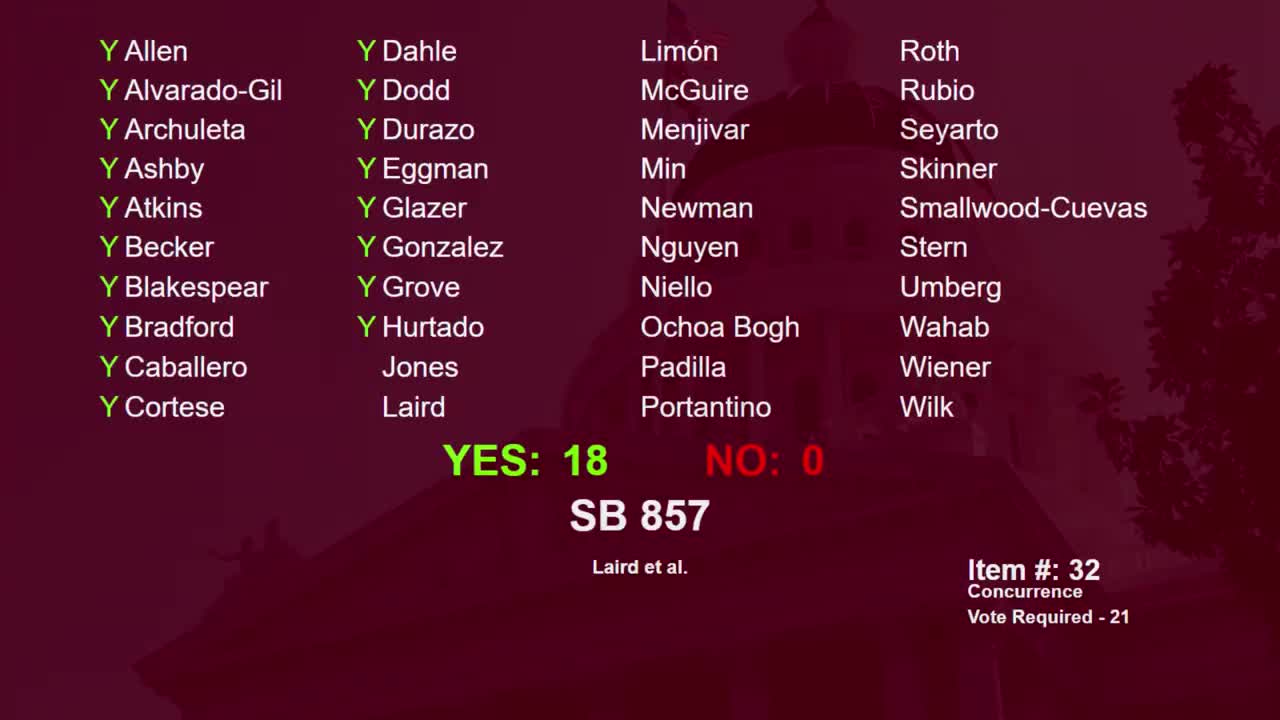 2MIN
Senate Floor
 1MIN
Assembly Floor
 41SEC
Assembly Floor
 11MIN
Assembly Standing Committee on Governmental Organization
Bill Author