SB 760: School facilities: all-gender restrooms.
- Session Year: 2023-2024
- House: Senate
- Latest Version Date: 2023-09-23
Current Status:
Passed
(2023-09-23: Chaptered by Secretary of State. Chapter 227, Statutes of 2023.)
Introduced
In Committee
First Chamber
In Committee
Second Chamber
Enacted
Existing law requires every restroom of every public and private school maintaining any combination of classes from kindergarten to grade 12, inclusive, to be maintained and cleaned regularly, fully operational, and stocked at all times with toilet paper, soap, and paper towels or functional hand dryers, and kept open during school hours when pupils are not in classes. Existing law requires that a sufficient number of restrooms be kept open during school hours when pupils are in classes. Existing law authorizes a school to temporarily close a restroom as necessary for pupil safety or as necessary to repair the facility.
This bill would revise the conditions under which a restroom is authorized to be temporarily closed to instead be as necessary (1) for a documented pupil safety concern, (2) for an immediate threat to pupil safety, or (3) to repair the facility. The bill would require, on or before July 1, 2026, each school district, county office of education, and charter school, including charter schools operating in a school district facility, maintaining any combination of classes from grades 1 to 12, inclusive, to provide and maintain at least one all-gender restroom for voluntary pupil use at each of its schoolsites that meet specified criteria. The bill would require the all-gender restroom to meet certain requirements, including, among other things, that it has signage identifying the bathroom facility as being open to all genders and is unlocked, unobstructed, and easily accessible by any pupil. The bill would require the local educational agency to designate a staff member to serve as a point of contact for these purposes and to post a notice regarding these requirements in a prominent and conspicuous location outside at least one all-gender restroom. The bill would require these requirements to be subject to compliance review, as specified. By imposing additional requirements on local educational agencies, the bill would impose a state-mandated local program. The bill would authorize a local educational agency to use an existing restroom to satisfy these requirements, as provided. The bill would require the State Department of Education to post on its internet website guidance for implementation of these provisions.
Existing law, the Leroy F. Greene School Facilities Act of 1998 (the Greene Act), requires the State Allocation Board to allocate to applicant school districts prescribed per-unhoused-pupil state funding for the construction and modernization of school facilities, including hardship funding, and supplemental funding for site development and acquisition.
This bill would require the governing board of a school district, a county board of education, or the governing body of a charter school that applies for state funding pursuant to the Greene Act for a school modernization project to include, as part of the modernization project, an all-gender restroom designed exclusively for pupil use for specified schoolsites, as provided. The bill would provide that these provisions apply only to those projects that are submitted for approval on or after July 1, 2026.
The California Constitution requires the state to reimburse local agencies and school districts for certain costs mandated by the state. Statutory provisions establish procedures for making that reimbursement.
This bill would provide that, if the Commission on State Mandates determines that the bill contains costs mandated by the state, reimbursement for those costs shall be made pursuant to the statutory provisions noted above.
Existing law requires every restroom of every public and private school maintaining any combination of classes from kindergarten to grade 12, inclusive, to be maintained and cleaned regularly, fully operational, and stocked at all times with toilet paper, soap, and paper towels or functional hand dryers, and kept open during school hours when pupils are not in classes. Existing law requires that a sufficient number of restrooms be kept open during school hours when pupils are in classes. Existing law authorizes a school to temporarily close a restroom as necessary for pupil safety or as necessary to repair the facility.
This bill would revise the conditions under which a restroom is authorized to be temporarily closed to instead be as necessary (1) for a documented pupil safety concern, (2) for an immediate threat to pupil safety, or (3) to repair the facility. The bill would require, on or before July 1, 2025, 2026, each school district, county office of education, and charter school, including charter schools operating in a school district facility, maintaining any combination of classes from kindergarten to grade grades 1 to 12, inclusive, to provide and maintain at least one all-gender restroom for voluntary pupil use at each of its schoolsites. schoolsites that meet specified criteria. The bill would require the all-gender restroom to meet certain requirements, including, among other things, that it has signage identifying the bathroom facility as being open to all genders and is unlocked, unobstructed, and easily accessible by any pupil. The bill would require the local educational agency to designate a staff member to serve as a point of contact for these purposes and to post a notice regarding these requirements in a prominent and conspicuous location outside at least one all-gender restroom. The bill would require these requirements to be subject to compliance review, as specified. By imposing additional requirements on local educational agencies, the bill would impose a state-mandated local program. The bill would authorize a local educational agency to use an existing restroom to satisfy these requirements, as provided. The bill would require the State Department of Education to post on its internet website guidance for implementation of these provisions.
Existing law, the Leroy F. Greene School Facilities Act of 1998 (the Greene Act), requires the State Allocation Board to allocate to applicant school districts prescribed per-unhoused-pupil state funding for the construction and modernization of school facilities, including hardship funding, and supplemental funding for site development and acquisition.
This bill would require the governing board of a school district, a county board of education, or the governing body of a charter school that applies for state funding pursuant to the Greene Act for a school modernization project to include, as part of the modernization project, an all-gender restroom designed exclusively for pupil use for specified schoolsites, as provided. The bill would provide that these provisions apply only to those projects that are submitted for approval on or after July 1, 2026.
The California Constitution requires the state to reimburse local agencies and school districts for certain costs mandated by the state. Statutory provisions establish procedures for making that reimbursement.
This bill would provide that, if the Commission on State Mandates determines that the bill contains costs mandated by the state, reimbursement for those costs shall be made pursuant to the statutory provisions noted above.
Existing law requires every restroom of every public and private school maintaining any combination of classes from kindergarten to grade 12, inclusive, to be maintained and cleaned regularly, fully operational, and stocked at all times with toilet paper, soap, and paper towels or functional hand dryers, and kept open during school hours when pupils are not in classes. Existing law requires that a sufficient number of restrooms be kept open during school hours when pupils are in classes.
This bill would require, on or before July 1, 2025, each school district, county office of education, and charter school, including charter schools operating in a school district facility, maintaining any combination of classes from kindergarten to grade 12, inclusive, to provide at least one all-gender restroom for voluntary pupil use at each of its schoolsites. The bill would require the all-gender restroom to meet certain requirements, including, among other things, that it has signage identifying the bathroom facility as being open to all genders and is unlocked, unobstructed, and easily accessible by any pupil. The bill would require the local educational agency to designate a staff member to serve as a point of contact for these purposes and to post a notice regarding these requirements in a prominent and conspicuous location outside at least one all-gender restroom. The bill would require these requirements to be subject to compliance review, as specified. By imposing additional requirements on local educational agencies, the bill would impose a state-mandated local program. The bill would authorize a local educational agency to use an existing restroom to satisfy these requirements, as provided. The bill would require the State Department of Education to post on its internet website guidance for implementation of these provisions.
The California Constitution requires the state to reimburse local agencies and school districts for certain costs mandated by the state. Statutory provisions establish procedures for making that reimbursement.
This bill would provide that, if the Commission on State Mandates determines that the bill contains costs mandated by the state, reimbursement for those costs shall be made pursuant to the statutory provisions noted above.
Existing law requires every restroom of every public and private school maintaining any combination of classes from kindergarten to grade 12, inclusive, to be maintained and cleaned regularly, fully operational, and stocked at all times with toilet paper, soap, and paper towels or functional hand dryers, and kept open during school hours when pupils are not in classes. Existing law requires that a sufficient number of restrooms be kept open during school hours when pupils are in classes.
This bill would require, on or before January July 1, 2025, each school district, county office of education, and charter school, including charter schools operating in a school district facility, maintaining any combination of classes from kindergarten to grade 12, inclusive, to provide at least one all-gender restroom for voluntary pupil use at each of its schoolsites. The bill would require the all-gender restroom to meet certain requirements, including including, among other things, that it (1) has appropriate signage identifying the bathroom facility as being open to all genders, (2) genders and is unlocked, unobstructed, and easily accessible by any pupil without requesting access from teachers, faculty, or school staff, and (3) is stocked with menstrual products, as specified. pupil. The bill would require the local educational agency to designate a staff member to serve as a point of contact for these purposes and to post a notice regarding these requirements in a prominent and conspicuous location outside at least one all-gender restroom. The bill would require these requirements to be subject to compliance review, as specified. By imposing additional requirements on local educational agencies, the bill would impose a state-mandated local program. The bill would authorize a local educational agency to use an existing restroom to satisfy these requirements, as provided. The bill would require the State Department of Education to post on its internet website guidance for implementation of these provisions.
The California Constitution requires the state to reimburse local agencies and school districts for certain costs mandated by the state. Statutory provisions establish procedures for making that reimbursement.
This bill would provide that, if the Commission on State Mandates determines that the bill contains costs mandated by the state, reimbursement for those costs shall be made pursuant to the statutory provisions noted above.
Existing law requires every restroom of every public and private school maintaining any combination of classes from kindergarten to grade 12, inclusive, to be maintained and cleaned regularly, fully operational, and stocked at all times with toilet paper, soap, and paper towels or functional hand dryers, and kept open during school hours when pupils are not in classes. Existing law requires that a sufficient number of restrooms be kept open during school hours when pupils are in classes.
This bill would require, on or before January 1, 2025, each school district, county office of education, and charter school, including charter schools operating in a school district facility, maintaining any combination of classes from kindergarten to grade 12, inclusive, to provide at least one all-gender restroom for pupil use at each of its schoolsites. The bill would require the all-gender restroom to meet certain requirements, including that it (1) has appropriate signage identifying the bathroom facility as being open to all genders, (2) is unlocked, unobstructed, and easily accessible by any pupil without requesting access from teachers, faculty, or school staff, and (3) is stocked with menstrual products, as specified. The bill would require the local educational agency to designate a staff member to serve as a point of contact for these purposes and to post a notice regarding these requirements in a prominent and conspicuous location outside at least one all-gender restroom. The bill would require these requirements to be subject to compliance review, as specified. By imposing additional requirements on local educational agencies, the bill would impose a state-mandated local program. The bill would authorize a local educational agency to use an existing restroom to satisfy these requirements, as provided.
The California Constitution requires the state to reimburse local agencies and school districts for certain costs mandated by the state. Statutory provisions establish procedures for making that reimbursement.
This bill would provide that, if the Commission on State Mandates determines that the bill contains costs mandated by the state, reimbursement for those costs shall be made pursuant to the statutory provisions noted above.
(a)The Legislature finds and declares both of the following:
(1)Pupils are most likely to achieve their potential in welcoming educational environments.
(2)Educational opportunities should be accessible to pupils regardless of their gender identities.
(b)It is the intent of the Legislature to ensure all pupils, regardless of gender identity, can access suitable restroom facilities during school hours.
SEC. 2.Section 17585 is added to the Education Code, to read:17585.(a)If the governing board of a school district, a county board of education, or the governing body of a charter school applies for state funding pursuant to Chapter 12.5 (commencing with Section 17070.10) of Part 10 for a school modernization project, the application shall include, as part of the modernization project, an all-gender restroom designed exclusively for pupil use, excluding restrooms designated for pupils in transitional kindergarten or kindergarten, at each schoolsite that has not already established an all-gender restroom pursuant to subdivision (b) of Section 35292.5 and for each schoolsite that does not have more than one female restroom and more than one male restroom designated exclusively for pupil use.
(b)The requirements of this section apply only to those projects submitted for approval on or after July 1, 2026.
SEC. 3.Section 35292.5 of the Education Code is amended to read:35292.5.(a)Every public and private school maintaining any combination of classes from kindergarten to grade 12, inclusive, shall comply with all of the following:
(1)Every restroom shall at all times be maintained and cleaned regularly, fully operational, and stocked at all times with toilet paper, soap, and paper towels or functional hand dryers.
(2)The school shall keep all restrooms open during school hours when pupils are not in classes, and shall keep a sufficient number of restrooms open during school hours when pupils are in classes.
(b)(1)On or before July 1, 2026, each school district, county office of education, and charter school, including charter schools operating in a school district facility pursuant to Section 47614, maintaining any combination of classes from grades 1 to 12, inclusive, shall comply with the following for each of its schoolsites that, before July 1, 2026, has more than one female restroom and more than one male restroom designated exclusively for pupil use, excluding restrooms designated for pupils in transitional kindergarten or kindergarten:
(A)Provide and maintain at least one all-gender restroom for pupil use that meets the following requirements:
(i)Has signage identifying the bathroom facility as being open to all genders and in conformity with Title 24 of the California Code of Regulations.
(ii)Is available for pupil use, consistent with the requirements of subdivision (a), as unlocked, unobstructed, easily accessible by any pupil, and consistent with existing pupil access to sex-segregated restrooms.
(iii)Is consistent with the requirements pursuant to Section 35292.6.
(iv)Is available during school hours and school functions when pupils are present.
(B)Designate a staff member to serve as a point of contact for implementation of this section.
(C)Post a notice regarding the requirements of this paragraph in a prominent and conspicuous location outside at least one all-gender restroom, including contact information for the person designated as a point of contact pursuant to subparagraph (B).
(2)A school district, county office of education, or charter school may use an existing restroom to satisfy the requirements of this subdivision if it ensures that all pupils have restrooms that are in easily accessible locations and the existing restroom otherwise complies with the requirements in paragraph (1).
(3)This subdivision shall be subject to compliance review pursuant to Section 253.
(4)The department shall post on its internet website guidance for implementation of this subdivision, including, but not limited to, examples of signage and best practices.
(5)This subdivision shall not supplant subdivision (f) of Section 221.5. Use of an all-gender restroom by a pupil shall be voluntary and pupils shall not be required to use an all-gender restroom.
(6)This subdivision shall not preclude a schoolsite that does not have more than one female restroom and more than one male restroom designated exclusively for pupil use, excluding restrooms designated for pupils in transitional kindergarten or kindergarten, from identifying and making easily accessible, a restroom for pupil use that satisfies the requirements of this subdivision.
(c)Notwithstanding subdivisions (a) and (b), a school may temporarily close a restroom as necessary (1) for a documented pupil safety concern, (2) for an immediate threat to pupil safety, or (3) to repair the facility.
SEC. 4.If the Commission on State Mandates determines that this act contains costs mandated by the state, reimbursement to local agencies and school districts for those costs shall be made pursuant to Part 7 (commencing with Section 17500) of Division 4 of Title 2 of the Government Code.
(a)The Legislature finds and declares both of the following:
(1)Pupils are most likely to achieve their potential in welcoming educational environments.
(2)Educational opportunities should be accessible to pupils regardless of their gender identities.
(b)It is the intent of the Legislature to ensure all pupils, regardless of gender identity, can access suitable restroom facilities during school hours.
SEC. 2.Section 17585 is added to the Education Code, to read:17585.(a)If the governing board of a school district, a county board of education, or the governing body of a charter school applies for state funding pursuant to Chapter 12.5 (commencing with Section 17070.10) of Part 10 for a school modernization project, the application shall include, as part of the modernization project, an all-gender restroom designed exclusively for pupil use, excluding restrooms designated for pupils in transitional kindergarten or kindergarten, at each schoolsite that has not already established an all-gender restroom pursuant to subdivision (b) of Section 35292.5 and for each schoolsite that does not have more than one female restroom and more than one male restroom designated exclusively for pupil use.
(b)The requirements of this section apply only to those projects submitted for approval on or after July 1, 2026.
SECTION 1.SEC. 3.Section 35292.5 of the Education Code is amended to read:35292.5.(a)Every public and private school maintaining any combination of classes from kindergarten to grade 12, inclusive, shall comply with all of the following:
(1)Every restroom shall at all times be maintained and cleaned regularly, fully operational, and stocked at all times with toilet paper, soap, and paper towels or functional hand dryers.
(2)The school shall keep all restrooms open during school hours when pupils are not in classes, and shall keep a sufficient number of restrooms open during school hours when pupils are in classes.
(b)(1)On or before July 1, 2025, 2026, each school district, county office of education, and charter school, including charter schools operating in a school district facility pursuant to Section 47614, maintaining any combination of classes from kindergarten to grade grades 1 to 12, inclusive, shall comply with the following for each of its schoolsites: schoolsites that, before July 1, 2026, has more than one female restroom and more than one male restroom designated exclusively for pupil use, excluding restrooms designated for pupils in transitional kindergarten or kindergarten:
(A)Provide and maintain at least one all-gender restroom for pupil use that meets the following requirements:
(i)Has signage identifying the bathroom facility as being open to all genders and in conformity with Title 24 of the California Code of Regulations.
(ii)Is available for pupil use, consistent with the requirements of subdivision (a), as unlocked, unobstructed, easily accessible by any pupil, and consistent with existing pupil access to sex-segregated restrooms.
(iii)Is consistent with the requirements pursuant to Section 35292.6.
(iv)Is available during school hours and school functions when pupils are present.
(B)Designate a staff member to serve as a point of contact for implementation of this section.
(C)Post a notice regarding the requirements of this paragraph in a prominent and conspicuous location outside at least one all-gender restroom, including contact information for the person designated as a point of contact pursuant to subparagraph (B).
(2)A school district, county office of education, or charter school may use an existing restroom to satisfy the requirements of this subdivision if it ensures that all pupils have restrooms that are in easily accessible locations and the existing restroom otherwise complies with the requirements in paragraph (1).
(3)This subdivision shall be subject to compliance review pursuant to Section 253.
(4)The department shall post on its internet website guidance for implementation of this subdivision, including, but not limited to, examples of signage and best practices.
(5)This subdivision shall not supplant subdivision (f) of Section 221.5. Use of an all-gender restroom by a pupil shall be voluntary and pupils shall not be required to use an all-gender restroom.
(6)This subdivision shall not preclude a schoolsite that does not have more than one female restroom and more than one male restroom designated exclusively for pupil use, excluding restrooms designated for pupils in transitional kindergarten or kindergarten, from identifying and making easily accessible, a restroom for pupil use that satisfies the requirements of this subdivision.
(c)Notwithstanding subdivisions (a) and (b), a school may temporarily close a restroom as necessary (1) for a documented pupil safety concern, (2) for an immediate threat to pupil safety, or as necessary (3) to repair the facility.
SEC. 2.SEC. 4.If the Commission on State Mandates determines that this act contains costs mandated by the state, reimbursement to local agencies and school districts for those costs shall be made pursuant to Part 7 (commencing with Section 17500) of Division 4 of Title 2 of the Government Code.
(a)Every public and private school maintaining any combination of classes from kindergarten to grade 12, inclusive, shall comply with all of the following:
(1)Every restroom shall at all times be maintained and cleaned regularly, fully operational operational, and stocked at all times with toilet paper, soap, and paper towels or functional hand dryers.
(2)The school shall keep all restrooms open during school hours when pupils are not in classes, and shall keep a sufficient number of restrooms open during school hours when pupils are in classes.
(b)(1)On or before July 1, 2025, each school district, county office of education, and charter school, including charter schools operating in a school district facility pursuant to Section 47614, maintaining any combination of classes from kindergarten to grade 12, inclusive, shall comply with the following for each of its schoolsites:
(A)Provide at least one all-gender restroom for pupil use that meets the following requirements:
(i)Has signage identifying the bathroom facility as being open to all genders and in conformity with Title 24 of the California Code of Regulations.
(ii)Is available for pupil use, consistent with the requirements of subdivision (a), as unlocked, unobstructed, easily accessible by any pupil, and consistent with existing pupil access to sex-segregated restrooms.
(iii)Is consistent with the requirements pursuant to Section 35292.6.
(iv)Is available during school hours and school functions when pupils are present.
(B)Designate a staff member to serve as a point of contact for implementation of this section.
(C)Post a notice regarding the requirements of this paragraph in a prominent and conspicuous location outside at least one all-gender restroom, including contact information for the person designated as a point of contact pursuant to subparagraph (B).
(2)A school district, county office of education, or charter school may use an existing restroom to satisfy the requirements of this subdivision if it otherwise complies with the requirements in paragraph (1).
(3)This subdivision shall be subject to compliance review pursuant to Section 253.
(4)The department shall post on its internet website guidance for implementation of this subdivision, including, but not limited to, examples of signage and best practices.
(5)This subdivision shall not supplant subdivision (f) of Section 221.5. Use of an all-gender restroom by a pupil shall be voluntary and pupils shall not be required to use an all-gender restroom.
(c)Notwithstanding subdivisions (a) and (b), a school may temporarily close a restroom as necessary for pupil safety or as necessary to repair the facility.
SEC. 2.If the Commission on State Mandates determines that this act contains costs mandated by the state, reimbursement to local agencies and school districts for those costs shall be made pursuant to Part 7 (commencing with Section 17500) of Division 4 of Title 2 of the Government Code.
(a)Every public and private school maintaining any combination of classes from kindergarten to grade 12, inclusive, shall comply with all of the following:
(1)Every restroom shall at all times be maintained and cleaned regularly, fully operational and stocked at all times with toilet paper, soap, and paper towels or functional hand dryers.
(2)The school shall keep all restrooms open during school hours when pupils are not in classes, and shall keep a sufficient number of restrooms open during school hours when pupils are in classes.
(b)(1)On or before January July 1, 2025, each school district, county office of education, and charter school, including charter schools operating in a school district facility pursuant to Section 47614, maintaining any combination of classes from kindergarten to grade 12, inclusive, shall comply with the following for each of its schoolsites:
(A)Provide at least one all-gender restroom for pupil use that meets the following requirements:
(i)Has appropriate signage identifying the bathroom facility as being open to all genders and in conformity with Section 118600 of the Health and Safety Code. The signage may be provided by the Division of the State Architect. Title 24 of the California Code of Regulations.
(ii)Is available for pupil use, consistent with the requirements of subdivision (a), as unlocked, unobstructed, and easily accessible by any pupil without requesting access from teachers, faculty, or school staff. pupil, and consistent with existing pupil access to sex-segregated restrooms.
(iii)Is stocked with menstrual products consistent with the requirements pursuant to Section 35292.6.
(iv)Is available during school hours and school functions when pupils are present.
(B)Designate a staff member to serve as a point of contact for implementation of this section.
(C)Post a notice regarding the requirements of this paragraph in a prominent and conspicuous location outside at least one all-gender restroom, including contact information for the person designated as a point of contact pursuant to subparagraph (B).
(2)A school district, county office of education, or charter school may use an existing restroom to satisfy the requirements of this subdivision if it otherwise complies with the requirements in paragraph (1).
(3)This subdivision shall be subject to compliance review pursuant to Section 253.
(4)The department shall post on its internet website guidance for implementation of this subdivision, including, but not limited to, examples of signage and best practices.
(5)This subdivision shall not supplant subdivision (f) of Section 221.5. Use of an all-gender restroom by a pupil shall be voluntary and pupils shall not be required to use an all-gender restroom.
(c)Notwithstanding subdivisions (a) and (b), a school may temporarily close a restroom as necessary for pupil safety or as necessary to repair the facility.
SEC. 2.If the Commission on State Mandates determines that this act contains costs mandated by the state, reimbursement to local agencies and school districts for those costs shall be made pursuant to Part 7 (commencing with Section 17500) of Division 4 of Title 2 of the Government Code.
(a)Every public and private school maintaining any combination of classes from kindergarten to grade 12, inclusive, shall comply with all of the following:
(1)Every restroom shall at all times be maintained and cleaned regularly, fully operational and stocked at all times with toilet paper, soap, and paper towels or functional hand dryers.
(2)The school shall keep all restrooms open during school hours when pupils are not in classes, and shall keep a sufficient number of restrooms open during school hours when pupils are in classes.
(b)(1)On or before January 1, 2025, each school district, county office of education, and charter school, including charter schools operating in a school district facility pursuant to Section 47614, maintaining any combination of classes from kindergarten to grade 12, inclusive, shall comply with the following for each of its schoolsites:
(A)Provide at least one all-gender restroom for pupil use that meets the following requirements:
(i)Has appropriate signage identifying the bathroom facility as being open to all genders in conformity with Section 118600 of the Health and Safety Code. The signage may be provided by the Division of the State Architect.
(ii)Is available for pupil use, consistent with the requirements of subdivision (a), as unlocked, unobstructed, and easily accessible by any pupil without requesting access from teachers, faculty, or school staff.
(iii)Is stocked with menstrual products pursuant to Section 35292.6.
(B)Designate a staff member to serve as a point of contact for implementation of this section.
(C)Post a notice regarding the requirements of this paragraph in a prominent and conspicuous location outside at least one all-gender restroom, including contact information for the person designated as a point of contact pursuant to subparagraph (B).
(2)A school district, county office of education, or charter school may use an existing restroom to satisfy the requirements of this subdivision if it otherwise complies with the requirements in paragraph (1).
(3)This subdivision shall be subject to compliance review pursuant to Section 253.
(b)(c)Notwithstanding subdivision (a), subdivisions (a) and (b), a school may temporarily close a restroom as necessary for pupil safety or as necessary to repair the facility.
SEC. 2.If the Commission on State Mandates determines that this act contains costs mandated by the state, reimbursement to local agencies and school districts for those costs shall be made pursuant to Part 7 (commencing with Section 17500) of Division 4 of Title 2 of the Government Code.
|
Date
|
Status
|
|---|---|
| Sep 23, 2023 | Chaptered by Secretary of State. Chapter 227, Statutes of 2023. |
| Sep 23, 2023 | Approved by the Governor. |
| Sep 15, 2023 | Enrolled and presented to the Governor at 3 p.m. |
| Sep 11, 2023 | Assembly amendments concurred in. (Ayes 32. Noes 7. Page 2604.) Ordered to engrossing and enrolling. |
| Sep 7, 2023 | In Senate. Concurrence in Assembly amendments pending. |
| Sep 7, 2023 | Read third time. Passed. (Ayes 65. Noes 6. Page 3008.) Ordered to the Senate. |
| Sep 5, 2023 | Read second time. Ordered to third reading. |
| Sep 1, 2023 | From committee: Do pass. (Ayes 12. Noes 2.) (September 1). |
| Aug 23, 2023 | August 23 set for first hearing. Placed on suspense file. |
| Aug 14, 2023 | Read second time and amended. Re-referred to Com. on APPR. |
| Jul 13, 2023 | From committee: Do pass as amended and re-refer to Com. on APPR. (Ayes 4. Noes 0.) (July 12). |
| Jun 15, 2023 | Referred to Com. on ED. |
| Jun 1, 2023 | In Assembly. Read first time. Held at Desk. |
| May 31, 2023 | Read third time. Passed. (Ayes 33. Noes 6. Page 1396.) Ordered to the Assembly. |
| May 22, 2023 | Read second time. Ordered to third reading. |
| May 18, 2023 | Read second time and amended. Ordered to second reading. |
| May 18, 2023 | From committee: Do pass as amended. (Ayes 5. Noes 1. Page 1183.) (May 18). |
| May 12, 2023 | Set for hearing May 18. |
| May 1, 2023 | May 1 hearing: Placed on APPR suspense file. |
| Apr 21, 2023 | Set for hearing May 1. |
| Apr 18, 2023 | Read second time and amended. Re-referred to Com. on APPR. |
| Apr 17, 2023 | From committee: Do pass as amended and re-refer to Com. on APPR. (Ayes 6. Noes 0. Page 682.) (April 12). |
| Mar 21, 2023 | Set for hearing April 12. |
| Mar 1, 2023 | Referred to Com. on ED. |
| Feb 21, 2023 | From printer. May be acted upon on or after March 20. |
| Feb 17, 2023 | Introduced. Read first time. To Com. on RLS. for assignment. To print. |
|
Date
|
Description
|
Location
|
Votes
|
|
|---|---|---|---|---|
| Sep 11, 2023 | Unfinished Business SB760 Newman et al. Concurrence | Senate Floor |
Passed |
|
| Sep 7, 2023 | SB 760 Newman Senate Third Reading By Zbur | Assembly Floor |
Passed |
|
| Sep 1, 2023 | Do pass. | Assembly Standing Committee on Appropriations |
Passed |
|
| Jul 12, 2023 | Do pass as amended and be re-referred to the Committee on [Appropriations] | Assembly Standing Committee on Education |
Passed |
|
| May 31, 2023 | Senate 3rd Reading SB760 Newman et al. | Senate Floor |
Passed |
|
| May 18, 2023 | Do pass as amended | Senate Standing Committee on Appropriations |
Passed |
|
| May 1, 2023 | Placed on suspense file | Senate Standing Committee on Appropriations |
Passed |
|
| Apr 12, 2023 | Do pass as amended, but first amend, and re-refer to the Committee on [Appropriations] | Senate Standing Committee on Education |
Passed |
This list shows positions taken on this bill by organizations on the date displayed, which is linked to the original source.
Positions by individuals are not included.
|
Organization
|
Position
|
Date
|
|---|---|---|
| ACCE Action | ** Support | |
| Aclu California Action | ** Support | |
| Alliance for Children's Rights | ** Support | |
| APLA Health | ** Support | |
| California Academy Of Family Physicians | ** Support | |
| California Association of Student Councils | ** Support | |
| California Calls | ** Support | |
| California Charter Schools Association | ** Support | |
| California Faculty Association | ** Support | |
| California Federation Of Teachers | ** Support | |
| California School-Based Health Alliance | ** Support | |
| California Teachers Association | ** Support | |
| California Transcends | ** Support | |
| Citizens for Choice | ** Support | |
| City Of Sacramento | ** Support | |
| City of West Hollywood | ** Support | |
| Conference of California Bar Associations | ** Support | |
| Courage California | ** Support | |
| DAP Health | ** Support | |
| Disability Rights California | ** Support | |
| Dolores Huerta Foundation | ** Support | |
| Ella Baker Center For Human Rights | ** Support | |
| Equality California | ** Support | |
| Equal Rights Advocates | ** Support | |
| Essential Access Health | ** Support | |
| Gender Spectrum | ** Support | |
| Generation Up | ** Support | |
| Lawyers' Committee for Civil Rights of the San Francisco Bay Area | ** Support | |
| LGBTQ Center OC | ** Support | |
| Los Angeles LGBT Center | ** Support | |
| NARAL Pro-Choice California | ** Support | |
| National Association Of Social Workers, California Chapter | ** Support | |
| National Center for Lesbian Rights | ** Support | |
| Oxnard Union High School District | ** Support | |
| Peace and Freedom Party of California | ** Support | |
| PFLAG National | ** Support | |
| Positive Images LGBTQIAL+ Center | ** Support | |
| Public Counsel | ** Support | |
| Radiant Health Centers | ** Support | |
| San Diego Pride | ** Support | |
| San Francisco Unified School District | ** Support | |
| Santa Clara County School Boards Association | ** Support | |
| SEIU California | ** Support | |
| Small School Districts Association | ** Against | |
| State Superintendent of Public Instruction Tony Thurmond | ** Support | |
| The Source Lgbt+ Center | ** Support | |
| The Women's Building | ** Support | |
| Transfamily Support Services | ** Support | |
| Trans Youth Liberation | ** Support | |
| Viet Rainbow of Orange County | ** Support |
SENATE RULES COMMITTEE Office of Senate Floor Analyses (916) 651-1520 Fax: (916) 327-4478 | SB 760 |
UNFINISHED BUSINESS
Bill No: SB 760
Author: Newman (D), et al.
Amended: 8/14/23
Vote: 21
SENATE EDUCATION COMMITTEE: 6-0, 4/12/23
AYES: Newman, Ochoa Bogh, Cortese, Glazer, McGuire, Smallwood-Cuevas
NO VOTE RECORDED: Wilk
SENATE APPROPRIATIONS COMMITTEE: 5-1, 5/18/23
AYES: Portantino, Ashby, Bradford, Wahab, Wiener
NOES: Jones
NO VOTE RECORDED: Seyarto
SENATE FLOOR: 33-6, 5/31/23
AYES: Allen, Alvarado-Gil, Archuleta, Ashby, Atkins, Becker, Blakespear, Bradford, Caballero, Cortese, Dodd, Durazo, Eggman, Glazer, Gonzalez, Hurtado, Laird, Limón, McGuire, Menjivar, Min, Newman, Ochoa Bogh, Padilla, Portantino, Roth, Rubio, Skinner, Smallwood-Cuevas, Stern, Umberg, Wahab, Wiener
NOES: Dahle, Grove, Jones, Nguyen, Niello, Seyarto
NO VOTE RECORDED: Wilk
ASSEMBLY FLOOR: 65-6, 9/7/23 - See last page for vote
SUBJECT: School facilities: all-gender restrooms
SOURCE: State Superintendent of Public Instruction Tony Thurmond
Equality California
DIGEST:
This bill requires local educational agencies (LEA), County Office of Education (COE), and charter schools, maintaining any combination of classes from kindergarten to grade 12, inclusive, to provide at least one all-gender restroom for pupil use at each of its schoolsites, as specified.
Assembly Amendments
:
- Apply the requirement to have an all-gender restroom to those schoolsites that have more than one female and one male restroom designated exclusively for pupil use, excluding restrooms designated for transitional kindergarten and kindergarten pupils, prior to July 1, 2026. State that this shall not preclude a schoolsite with one or less female restroom and one or less male restroom, designated exclusively for pupil use, excluding restrooms designated for transitional kindergarten and kindergarten pupils, from identifying and making easily accessible a restroom for pupil use that satisfies the requirements of this subdivision.
- Require that a decision to use an existing restroom to satisfy the requirements of the bill must ensure that all pupils have restrooms that are in easily accessible locations.
- Authorize a school to temporarily close a restroom as necessary for a documented pupil safety concerns, unless there is an immediate threat to health and safety, or as necessary to repair the facility.
- Require, if a governing board of a school district, county board of education, or governing body of a charter school applies for state funding for a school modernization project submitted after July 1, 2026, the application to include an all-gender restroom designed exclusively for pupil use, excluding restrooms designated for transitional kindergarten and kindergarten pupils, at each schoolsite that has not already established an all-gender restroom.
- Add uncodified findings and declarations.
ANALYSIS:
Existing law:
- States that it is the policy of the state that elementary and secondary school classes and courses, including nonacademic and elective classes and courses, be conducted, without regard to the sex of the pupil enrolled in these classes and courses. (Education Code (EC) § 221.5 (a))
- Requires every public and private school maintaining any combination of classes from kindergarten to grade 12, inclusive, to comply with all of the following:
- Every restroom shall at all times be maintained and cleaned regularly, fully operational and stocked at all times with toilet paper, soap, and paper towels or functional hand dryers.
- The school shall keep all restrooms open during school hours when pupils are not in classes, and shall keep a sufficient number of restrooms open during school hours when pupils are in classes. (EC § 35292.5(a))
- Authorizes a school to temporarily close a restroom as necessary for pupil safety or as necessary to repair the facility. (EC § 35292.5(b))
- Requires, on or before the start of the 2022–23 school year, a public school, including a school operated by a LEA, COE, or charter school, maintaining any combination of classes from grades 6 to 12, inclusive, to stock the school’s restrooms at all times with an adequate supply of menstrual products, available and accessible, free of cost, in all women’s restrooms and all-gender restrooms, and in at least one men’s restroom. (EC § 35292.6 (a))
- Allows the California Department of Education (CDE) to conduct an annual compliance review. (EC § 253)
- Requires all single-user toilet facilities in any business establishment, place of public accommodation, or state or local government agency to be identified as all-gender toilet facilities by signage that complies with Title 24 of the California Code of Regulations, and designated for use by no more than one occupant at a time or for family or assisted use. (Health and Safety Code § 118600(a))
- Requires a combined circle and triangle symbol to be located at entrances to unisex toilet and bathing facilities. The combined circle and triangle symbol shall consist of a circle symbol 1/4 inch (6.4 mm) thick and 12 inches (305 mm) in diameter with a 1/4 inch (6.4 mm) thick equilateral triangle symbol superimposed on and geometrically inscribed within the 12-inch (305 mm) diameter of the circle symbol. (California Building Code § 11B-703.7.2.6.3)
This bill:
- Requires, by July 1, 2026, for each school site serving students in grades one through 12 that has more than one female restroom and more than one male restroom to provide and maintain at least one all-gender restroom for voluntary student use, as specified.
- Requires, for school sites that do not have more than one female restroom and more than one male restroom for students, if an LEA applies for state funding for a school modernization project after July 1, 2026, the application to include an all-gender restroom designed for student use at each school site serving grades one through 12, as specified
- Requires each LEA to designate a staff member to serve as a point of contact for these requirements and post related notices outside all-gender bathrooms.
- Requires CDE to post guidance on its website related to these new requirements and conduct compliance reviews.
Comment
- Need for the bill. According to the author, “SB 760 is a measure that aims to create a safe and inclusive environment not only for non-binary students but to all students by requiring each public school to establish at least one all-gender restroom. This issue originated in 2021 when a member of the Chino Valley Unified School District introduced a measure that would have banned non-binary and transgender students from using restrooms corresponding with their gender identity. During the midst of this proposal, California State Superintendent of Public Instruction Tony Thurmond warned that the Chino Valley Unified School District's proposed resolution to exclude non-binary students from sex-segregated restrooms would violate state law. Although the proposed measure failed, the Superintendent and I believed there was an opportunity to create an inclusive environment for all students. In response to Chino Valley Unified School District's proposed resolution, the Superintendent launched the Safe School Bathrooms Ad Hoc Committee. Over the past year, it has been an honor to work alongside the Ad Hoc Committee, primarily composed of students who want to create a safe and inclusive environment for everyone. The measure in front of us today represents the hard work of everyone involved to create a safe, inclusive environment for all students.”
- Chino Valley Unified School Board. In November of 2021, the Chino Valley Unified School Board proposed a measure to restrict the use of restrooms, locker rooms, physical education classes, intramural sports and interscholastic athletic programs to students based on their “biological” gender. Under the school board’s proposal, schools in their district would provide gender-neutral or single-use restrooms or changing areas as well as other alternatives in order to address any student’s privacy concerns in using sex-segregated facilities. State Superintendent of Public Instruction Tony Thurmond issued a stern warning to Chino Valley Unified over its proposed resolution that would have violated existing law that requires schools to allow students to use facilities and participate in school activities with the gender a student identifies with. The proposed measure was struck down by the school board in a 3-2 vote.
- 2021 National School Climate Survey by the Gay, Lesbian & Straight Education Network (GLSEN). A growing body of research has linked disparities to non-binary students' experiences of violence, harassment, and exclusion in educational settings. LGBTQ+ youth often navigate more hostile school climates than their peers. According to a 2021 National School Climate Survey by the GLSEN, "76.1% of LGBT students were verbally harassed, 31.2% were physically harassed, and 12.5% were physically assaulted due to their sexual orientation." Furthermore, 81.8% of LGBTQ+ students who participated in GLSEN's survey reported feeling unsafe in school because of at least one of their actual or perceived personal characteristics. The relationship between marginalization and mental health in gender minority populations is well documented. In the same survey, over half of LGBTQ+ students (61.6%) reported feeling unsafe in school because of their mental health or emotional disability. Non-binary students' experiences of violence, harassment, and exclusion in educational settings can lead to negative educational experiences, including chronic absenteeism, academic achievement, and school discipline
- Safe School Bathrooms Ad Hoc Committee. The CDE established the Safe School Bathrooms Ad Hoc Committee in November 2021 in response to the growing concern that students are not safely able to access restrooms at schools. These concerns intensified when a Chino Valley Unified School District school board member introduced a proposal to restrict bathrooms that transgender and gender-nonconforming youth could use. The Committee formed with the goal of a formal recommendation to expand the availability of gender-inclusive bathrooms on California school campuses.
The Ad Hoc committee transitioned to include only youth members in September consisting of over 30 high school and college students across California. The Safe School Bathrooms Ad Hoc Committee convened their first meeting on March 30, 2022, to begin the recommendation process of expanding the availability of gender-inclusive bathrooms on California school campuses.
- CDE: School Facilities and Transportation Services Division (SFTSD). The SFTSD, through CDE’s website, provides school facilities best practices and research guidance documents in order to assist with modernization, new construction, and school facility improvements that help optimize learning for K–12 students. SFTSD has explored the growing trend of all-access restroom facilities in K–12 school facility design. The SFTSD makes this work available to all LEAs as guidance on the design and implementation of all-access restrooms.
According to SFTSD, “In 2016, Assembly Bill 1732 (Ting) Chapter 818, Statutes of 2016, added Health and Safety Code Section 118600, requiring that all single-user [including schools] toilet facilities be identified as all-gender toilets. Despite the statutory requirement, schools struggle with providing a safe and inclusive experience, especially for transgender and non-binary students. Many schools have begun to move away from single-user toilets in favor of dedicating a segment or segments of their restrooms as multi-user all-gender toilet facilities. The designs of all-access restrooms have been trending in schools throughout the state, the country, and the world, yet there are no current California design standards for these facilities. For LEAs that make the local decision to implement all-access restrooms, this page provides guidance and identifies best practices that will be beneficial to project planning and design in modernization, new construction, and/or facility upgrades.”
- Background on the School Facility Program (SFP). The construction and rehabilitation of public K-12 facilities are funded by a combination of state and local general obligation (GO) bonds, developer's fees and, local assessments such as Mello-Roos community facilities districts. State bond funds are allocated pursuant to the SFP and administered by the Office of Public School Construction under the direction of the SAB, a 10-member body comprised of the Department of Finance, the Director of the Department of General Services, the State Superintendent of Public Instruction, three Senators, three Assemblymembers, and a Governor’s appointee. Under the SFP, the New Construction program requires a 50% local match, unless the school district qualifies for financial hardship, which pays up to 100% of project costs. Modernization funds are awarded at 60% with a 40% match. Since the inception of the SFP in 1998, voters have approved $54 billion in state GO bonds for K-12 schools.
The last bond passed by voters, Proposition 51 on the November 2016 statewide ballot, provided $9 billion for K-12 and California Community Colleges facilities. While the full amount of the bond has not been sold, there is a total of $3.3 billion in applications submitted without funding authority. Of that amount, $1.94 billion are from applications for modernization funding.
FISCAL EFFECT: Appropriation: No Fiscal Com.: Yes Local: Yes
According to Assembly Appropriations Committee analysis, minor and absorbable General Fund costs to CDE to post guidance to its website. One-time Proposition 98 General Fund or General Fund costs, of an unknown but significant amount, to LEAs to provide all-gender bathrooms to students. According to CDE, the state does not collect data on school facilities. However, the Proposition 98 General Fund costs of implementing this bill at any school site that has more than one female restroom and more than one male restroom will differ greatly depending on whether the school already has an all-gender restroom, can turn an existing male or female restroom into an all-gender restroom, or needs to construct an all-gender restroom. In the case of a school site that does not have more than one female restroom and more than one male restroom for students, this bill could result in General Fund costs to the extent that this bill requires the school include in their application for school modernization bond funds an all-gender restroom design. The state has more than 10,000 schools serving students in grades one through 12. School construction generally ranges between $500 and $1,000 per square foot. If the Commission on State Mandates determines this bill’s requirements to be a reimbursable state mandate, the state would need to reimburse these costs to LEAs or provide funding through the K-12 Mandate Block Grant.
SUPPORT: (Verified 9/7/23)
State Superintendent of Public Instruction Tony Thurmond (co-source)
Equality California (co-source)
ACCE Action
ACLU California Action
Alliance for Children's Rights
APLA Health
California Academy of Family Physicians
California Association of Student Councils
California Calls
California Charter Schools Association
California Faculty Association
California Federation of Teachers
California School-Based Health Alliance
California Teachers Association
California Transcends
Citizens for Choice
City of Sacramento
City of West Hollywood
Conference of California Bar Associations
Courage California
DAP Health
Disability Rights California
Dolores Huerta Foundation
Ella Baker Center for Human Rights
Equal Rights Advocates
Essential Access Health
Gender Spectrum
Generation Up
Lawyers' Committee for Civil Rights of the San Francisco Bay Area
LGBTQ Center OC
Los Angeles LGBT Center
NARAL Pro-Choice California
National Association of Social Workers, California Chapter
National Center for Lesbian Rights
Oxnard Union High School District
Peace and Freedom Party of California
PFLAG National
Positive Images LGBTQIA+ Center
Public Counsel
Radiant Health Centers
San Diego Pride
San Francisco Unified School District
Santa Clara County School Boards Association
SEIU California
The Source LGBT+ Center
The Women's Building
TransFamily Support Services
TransYouth Liberation
Viet Rainbow of Orange County
OPPOSITION: (Verified 9/7/23)
None received
ARGUMENTS IN SUPPORT: According the Superintendent of Public Instruction Tony Thurmond, "As the SPI, I am pleased to sponsor Senate Bill 760 to ensure every K-12 public school in California has an all-gender restroom, providing equitable access for students to feel safe using the restroom while on campus. Currently, students do not feel safe at school for meeting their basic needs. According to a 2019 National School Climate Survey, 45% of LGTBQ+ and non-binary students avoid gender-segregated school bathrooms due to feeling unsafe and uncomfortable while using them. Students can suffer health and academic harm by not using the restroom during the school day. Schools should be a welcoming, safe place for all students – this includes access to bathrooms. This legislation is a critical step toward preparing California students to succeed by ensuring the necessary steps of having a safe foundation to rely on: having a safe and inclusive place to use the restroom.”
ASSEMBLY FLOOR: 65-6, 9/7/23
AYES: Addis, Aguiar-Curry, Alanis, Alvarez, Arambula, Bains, Bauer-Kahan, Bennett, Berman, Boerner, Bonta, Bryan, Calderon, Juan Carrillo, Wendy Carrillo, Cervantes, Connolly, Mike Fong, Friedman, Gabriel, Garcia, Gipson, Grayson, Haney, Hart, Holden, Irwin, Jackson, Jones-Sawyer, Kalra, Lee, Low, Lowenthal, Maienschein, McCarty, McKinnor, Muratsuchi, Stephanie Nguyen, Ortega, Pacheco, Papan, Pellerin, Petrie-Norris, Quirk-Silva, Ramos, Rendon, Reyes, Luz Rivas, Rodriguez, Blanca Rubio, Santiago, Schiavo, Soria, Ting, Valencia, Villapudua, Waldron, Wallis, Ward, Weber, Wicks, Wilson, Wood, Zbur, Robert Rivas
NOES: Megan Dahle, Vince Fong, Gallagher, Mathis, Joe Patterson, Ta
NO VOTE RECORDED: Chen, Davies, Dixon, Essayli, Flora, Hoover, Lackey, Jim Patterson, Sanchez
Prepared by: Kordell Hampton / ED. / (916) 651-4105
9/8/23 13:58:38
**** END ****
SENATE THIRD READING
STR Bill Id:SB 760
Author:(Newman)
As Amended Ver:August 14, 2023
Majority vote
SUMMARY
Requires public schools to provide at least one all-gender restroom for students, as specified.
Major Provisions
- Requires, by July 1, 2026, for each school site serving students in grades one through 12 that has more than one female restroom and more than one male restroom to provide and maintain at least one all-gender restroom for voluntary student use.
- Requires, for school sites that do not have more than one female restroom and more than one male restroom for students, if an LEA applies for state funding for a school modernization project after July 1, 2026, the application to include an all-gender restroom designed for student use at each school site serving grades one through 12.
- Requires each local education agency (LEA) to designate a staff member to serve as a point of contact for these requirements and post related notices outside all-gender bathrooms.
- Requires the California Department of Education (CDE) to post guidance on its website related to these new requirements.
COMMENTS
Federal directives. In May 2016, after the introduction of lawsuits related to the use of restrooms by various genders, several states attempted to create laws restricting transgender students' bathroom use, the United States (U.S.) Department of Education (ED) and the U.S. Department of Justice (DOJ) under the Obama Administration issued a directive instructing public schools across the country to allow transgender students to use the bathroom that matches their gender identity. Jointly, ED and DOJ clarified that the civil rights of transgender school students were protected under Title IX, which prohibits sex discrimination. In January 2017, the Trump Administration's DOJ and ED rescinded the previous guidance on federal support for transgender students, indicating they would not pursue federal enforcement of Title IX violations. Under the Biden Administration, the DOE is proposing regulations to reinstate similar provisions that were previously removed.
Chino Valley Unified School District (USD) Board of Education. In November of 2021, the Chino Valley USD Board of Education proposed a measure to restrict the use of restrooms, locker rooms, physical education classes, intramural sports and interscholastic athletic programs to students based on their biological gender. Under the school board's proposal, schools in their district would provide gender-neutral or single-use restrooms or changing areas as well as other alternatives in order to address any student's privacy concerns in using sex-segregated facilities. SPI Tony Thurmond issued a stern warning to Chino Valley USD over its proposed resolution that would have violated existing law requiring schools to allow students to use facilities and participate in school activities with the gender a student identifies with. The proposed measure was subsequently struck down by the governing board in a 3-2 vote.
Experiences of LGBTQ youth in schools. A growing body of research has linked disparities to non-binary students' experiences of violence, harassment, and exclusion in educational settings. LGBTQ youth often navigate more hostile school climates than their peers. According to the 2023 U.S. National Survey on the Mental Health of LGBTQ Young People conducted by the non-profit organization The Trevor Project, among those enrolled, LGBTQ young people reported that these negative experiences happened to them while in school, including being verbally harassed because people thought I was LGBTQ (53%), experienced unwanted sexual contact because people thought they were LGBTQ (20%), believed they were more harshly disciplined because teachers/staff thought they were LGBTQ (15%), left school because the mistreatment was so bad (12%), and were physically attacked because people thought they were LGBTQ (9%).
Schoolsite supports can improve outcomes for LGBTQ+ students. Several supportive factors at school appear to improve academic outcomes and improve safety for LGBTQ+ students.
Research shows that LGBTQ+ students with many supportive educators feel safer at school, skip fewer classes, earn higher grades, and have fewer school-related problems than those without supportive educators (Russell, 2010). Students in schools with Gay Straight Alliance (GSA) clubs report less harassment and assault, are more likely to report these incidents when they occur, and are less likely to miss school because of safety concerns.
Safe School Bathrooms Ad Hoc Committee. In 2021, the CDE established the Safe School Bathrooms Ad Hoc Committee in response to the growing concern that students are not safely able to access restrooms at schools, and formed with the goal of a formal recommendation to expand the availability of gender-inclusive bathrooms on California school campuses. The initial Ad Hoc committee was co-chaired by then-Senator Connie Leyva, and comprised of the California students, parents, school staff, CDE staff, and other stakeholders including the American Civil Liberties Union, Equality California, Senator Newman and Assemblymember Ting. In 2022, the Ad Hoc Committee evolved to include only youth members and developed recommendations related to the process of expanding the availability of gender-inclusive bathrooms on California school campuses.
School Facility Program (SFP). The construction and rehabilitation of public K-12 facilities are funded by a combination of state and local general obligation (GO) bonds, developer's fees and, local assessments such as Mello-Roos community facilities districts. State bond funds are allocated pursuant to the SFP and administered by the Office of Public School Construction (OPSC) under the direction of the State Allocation Board, a ten member body comprised of the Department of Finance, the Director of the Department of General Services, the SPI, three Senators, three Assemblymembers, and a Governor's appointee. Under the SFP, the New Construction program requires a 50% local match, unless the school district qualifies for financial hardship, which pays up to 100% of project costs. Modernization funds are awarded at 60% with a 40% match. Since the inception of the SFP in 1998, voters have approved $54 billion in state GO bonds for K-12 schools. The last bond passed by voters, Proposition 51 on the November 2016 statewide ballot, provided $9 billion for K-12 and California Community Colleges facilities. While the full amount of the bond has not been sold, there is a total of $3.3 billion in applications submitted without funding authority. Of that amount, $1.94 billion are from applications for modernization funding.
Proposed regulations. The Division of State Architect (DSA) is currently working on updates to the California Code of Regulations, Title 24, which would allow for local jurisdictions (including schools) to require all-gender "multi-user" restrooms, with accompanying access standards to support these types of restrooms. The regulations are currently being proposed and reviewed as part of the 2022 Intervening Code cycle. If approved and included in Title 24, the regulations would become effective July 1, 2024.
According to the Author
"SB 760 is a measure that aims to create a safe and inclusive environment not only for non-binary students but to all students by requiring each public school to establish at least one all-gender restroom. This issue originated in 2021 when a member of the Chino Valley Unified School District introduced a measure that would have banned non-binary and transgender students from using restrooms corresponding with their gender identity. During the midst of this proposal, California State Superintendent of Public Instruction Tony Thurmond warned that the Chino Valley Unified School District's proposed resolution to exclude non-binary students from sex-segregated restrooms would violate state law. Although the proposed measure failed, the Superintendent and I believed there was an opportunity to create an inclusive environment for all students. In response to Chino Valley Unified School District's proposed resolution, the Superintendent launched the Safe School Bathrooms Ad Hoc Committee. Over the past year, it has been an honor to work alongside the Ad Hoc Committee, primarily composed of students who want to create a safe and inclusive environment for everyone. The measure in front of us today represents the hard work of everyone involved to create a safe, inclusive environment for all students."
Arguments in Support
Superintendent of Public Instruction Thurmond writes, "As the SPI, I am pleased to sponsor Senate Bill 760 to ensure every K-12 public school in California has an all-gender restroom, providing equitable access for students to feel safe using the restroom while on campus. Currently, students do not feel safe at school for meeting their basic needs. According to a 2019 National School Climate Survey, 45% of LGTBQ+ and non-binary students avoid gender-segregated school bathrooms due to feeling unsafe and uncomfortable while using them. Students can suffer health and academic harm by not using the restroom during the school day. Schools should be a welcoming, safe place for all students – this includes access to bathrooms. This legislation is a critical step toward preparing California students to succeed by ensuring the necessary steps of having a safe foundation to rely on: having a safe and inclusive place to use the restroom."
Arguments in Opposition
None on file
FISCAL COMMENTS
According to the Assembly Appropriations Committee:
- Minor and absorbable General Fund costs to CDE to post guidance to its website.
- One-time Proposition 98 General Fund or General Fund costs, of an unknown but significant amount, to LEAs to provide all-gender bathrooms to students.
The state has more than 10,000 schools serving students in grades one through 12. School construction generally ranges between $500 and $1,000 per square foot.
If the Commission on State Mandates determines the bill's requirements to be a reimbursable state mandate, the state would need to reimburse these costs to LEAs or provide funding through the K-12 Mandate Block Grant.
VOTES
SENATE FLOOR: 33-6-1
YES: Allen, Alvarado-Gil, Archuleta, Ashby, Atkins, Becker, Blakespear, Bradford, Caballero, Cortese, Dodd, Durazo, Eggman, Glazer, Gonzalez, Hurtado, Laird, Limón, McGuire, Menjivar, Min, Newman, Ochoa Bogh, Padilla, Portantino, Roth, Rubio, Skinner, Smallwood-Cuevas, Stern, Umberg, Wahab, Wiener
NO: Dahle, Grove, Jones, Nguyen, Niello, Seyarto
ABS, ABST OR NV: Wilk
ASM EDUCATION: 4-0-3
YES: Muratsuchi, Juan Carrillo, Lee, Quirk-Silva
ABS, ABST OR NV: Megan Dahle, Hoover, McCarty
ASM APPROPRIATIONS: 12-2-2
YES: Holden, Bryan, Calderon, Wendy Carrillo, Mike Fong, Hart, Lowenthal, Papan, Pellerin, Soria, Weber, Wilson
NO: Megan Dahle, Mathis
ABS, ABST OR NV: Dixon, Sanchez
UPDATED
VERSION: August 14, 2023
CONSULTANT: Marguerite Ries / ED. / (916) 319-2087 FN: 0001499
Date of Hearing: August 23, 2023
ASSEMBLY COMMITTEE ON APPROPRIATIONS
Chris Holden, Chair
SBPCA Bill Id:SB 760
Author:(Newman) – As Amended Ver:August 14, 2023
Policy Committee: | Education | Vote: | 4 - 0 |
|
| ||
|
|
Urgency: No State Mandated Local Program: Yes Reimbursable: Yes
SUMMARY:
This bill requires public schools to provide at least one all-gender restroom for students.
Specifically, this bill requires, by July 1, 2026, for each school site serving students in grades one through 12 that has more than one female restroom and more than one male restroom to provide and maintain at least one all-gender restroom for voluntary student use. The bill also requires each local education agency (LEA) to designate a staff member to serve as a point of contact for these requirements and post related notices outside all-gender bathrooms. The bill also requires the California Department of Education (CDE) to post guidance on its website related to these new requirements.
For school sites that do not have more than one female restroom and more than one male restroom for students, the bill requires, if an LEA applies for state funding for a school modernization project after July 1, 2026, the application to include an all-gender restroom designed for student use at each school site serving grades one through 12.
FISCAL EFFECT:
- Minor and absorbable General Fund costs to CDE to post guidance to its website.
- One-time Proposition 98 General Fund or General Fund costs, of an unknown but significant amount, to LEAs to provide all-gender bathrooms to students.
According to CDE, the state does not collect data on school facilities. However, the Proposition 98 General Fund costs of implementing this bill at any school site that has more than one female restroom and more than one male restroom will differ greatly depending on whether the school already has an all-gender restroom, can turn an existing male or female restroom into an all-gender restroom, or needs to construct an all-gender restroom. In the case of a school site that does not have more than one female restroom and more than one male restroom for students, this bill could result in General Fund costs to the extent that this bill requires the school include in their application for school modernization bond funds an all-gender restroom design. The state has more than 10,000 schools serving students in grades one through 12. School construction generally ranges between $500 and $1,000 per square foot.
If the Commission on State Mandates determines the bill’s requirements to be a reimbursable state mandate, the state would need to reimburse these costs to LEAs or provide funding through the K-12 Mandate Block Grant.
COMMENTS:
- Purpose. According to the author:
SB 760 is a measure that aims to create a safe and inclusive environment not only for non-binary students but to all students by requiring each public school to establish at least one all-gender restroom. This issue originated in 2021 when a member of the Chino Valley Unified School District introduced a measure that would have banned non-binary and transgender students from using restrooms corresponding with their gender identity. During the midst of this proposal, California State Superintendent of Public Instruction Tony Thurmond warned that the Chino Valley Unified School District's proposed resolution to exclude non-binary students from sex-segregated restrooms would violate state law. Although the proposed measure failed, the Superintendent and I believed there was an opportunity to create an inclusive environment for all students. In response to Chino Valley Unified School District's proposed resolution, the Superintendent launched the Safe School Bathrooms Ad Hoc Committee. Over the past year, it has been an honor to work alongside the Ad Hoc Committee, primarily composed of students who want to create a safe and inclusive environment for everyone. The measure in front of us today represents the hard work of everyone involved to create a safe, inclusive environment for all students.
- Background. Current law requires every school serving students in kindergarten through grade 12 to maintain clean and fully operational restrooms during school hours.
- Prior Legislation. AB 1732 (Ting), Chapter 818, Statutes of 2016, required, beginning March 1, 2017, a business, place of public accommodation, or state or local government agency that offers a single-user toilet facility to be designated as an all-gender toilet facility and authorized an inspector to inspect for compliance.
Analysis Prepared by: Natasha Collins / APPR. / (916) 319-2081
Date of Hearing: July 12, 2023
ASSEMBLY COMMITTEE ON EDUCATION
Al Muratsuchi, Chair
SBPCA Bill Id:SB 760
Author:(Newman) – As Amended Ver:May 18, 2023
SENATE VOTE: 33-6
SUBJECT: School facilities: all-gender restrooms
SUMMARY: Requires, on or before July 1, 2025, each school district, county office of education (COE), and charter school maintaining any combination of classes from kindergarten to grade 12, inclusive, to provide at least one all-gender restroom for pupil use. Specifically, this bill:
- Requires, on or before July 1, 2025, each school district, COE, and charter school, including charter schools operating in a school district facility, maintaining any combination of classes from kindergarten to grade 12, inclusive, to comply with the following for each of its schoolsites:
- Provide at least one all-gender restroom for pupil use that meets the following requirements:
- Has signage identifying the bathroom facility as being open to all genders and in conformity with Title 24 of the California Code of Regulations (CCR);
- Is available for pupil use as unlocked, unobstructed, easily accessible by any pupil, and consistent with existing pupil access to sex-segregated restrooms;
- Is consistent with the requirement to stock the school’s restrooms at all times with an adequate supply of menstrual products; and
- Is available during school hours and school functions when pupils are present.
- Designate a staff member to serve as a point of contact for implementation of these requirements; and
- Post a notice regarding the requirements in a prominent and conspicuous location outside at least one all-gender restroom, including contact information for the person designated as a point of contact.
- Provide at least one all-gender restroom for pupil use that meets the following requirements:
- Authorizes a school district, COE, or charter school to use an existing restroom to satisfy the requirements of this subdivision if it otherwise complies with the requirements in (1).
- Requires these requirements to be subject to compliance with the sex discrimination provisions included in the annual Coordinated Compliance Review Manual provided to school districts by the Superintendent of Public Instruction (SPI).
- Requires the California Department of Education (CDE) to post on its website guidance for implementation of these requirements, including, but not limited to, examples of signage and best practices.
- Requires that this requirement not supplant existing law related to pupil participation in sex-segregated school programs and activities, including athletic teams and competitions, and use facilities consistent with his or her gender identity, irrespective of the gender listed on the pupil’s records.
- Authorizes a school to temporarily close a restroom as necessary for pupil safety or as necessary to repair the facility.
EXISTING LAW:
- Prohibits discrimination on the basis of disability, gender, gender identity, gender expression, nationality, race or ethnicity, religion, sexual orientation, or any other characteristic that is contained in the definition of hate crimes set forth in Section 422.55 of the Penal Code, including immigration status, in any program or activity conducted by an educational institution that receives, or benefits from, state financial assistance, or enrolls pupils who receive state student financial aid. (Education Code (EC) 220)
- States that it is the policy of the state that elementary and secondary school classes and courses, including nonacademic and elective classes and courses, be conducted, without regard to the sex of the pupil enrolled in these classes and courses. (EC 221.5 (a))
- Requires every public and private school maintaining any combination of classes from kindergarten to grade 12, inclusive, to comply with all of the following:
- Requires every restroom to at all times be maintained and cleaned regularly, fully operational and stocked at all times with toilet paper, soap, and paper towels or functional hand dryers; and
- Requires the school to keep all restrooms open during school hours when pupils are not in classes, and shall keep a sufficient number of restrooms open during school hours when pupils are in classes. (EC 35292.5(a))
- Authorizes a school to temporarily close a restroom as necessary for pupil safety or as necessary to repair the facility. (EC 35292.5(b))
- Requires, on or before the start of the 2022–23 school year, a public school, including a school operated by a LEA, COE, or charter school, maintaining any combination of classes from grades 6 to 12, inclusive, to stock the school’s restrooms at all times with an adequate supply of menstrual products, available and accessible, free of cost, in all women’s restrooms and all-gender restrooms, and in at least one men’s restroom. (EC 35292.6 (a))
- Allows the CDE to conduct an annual compliance review. (EC 253)
- Requires all single-user toilet facilities in any business establishment, place of public accommodation, or state or local government agency to be identified as all-gender toilet facilities by signage that complies with Title 24 of the CCR, and designated for use by no more than one occupant at a time or for family or assisted use. (Health and Safety Code (HSC) 118600(a))
- Requires a combined circle and triangle symbol to be located at entrances to unisex toilet and bathing facilities. The combined circle and triangle symbol shall consist of a circle symbol 1/4 inch (6.4 mm) thick and 12 inches (305 mm) in diameter with a 1/4 inch (6.4 mm) thick equilateral triangle symbol superimposed on and geometrically inscribed within the 12-inch (305 mm) diameter of the circle symbol. (Title 24 California Code of Regulations (CCR)§ 11B-703.7.2.6.3)
- Requires the number of plumbing fixtures for schools to include:
- Water closets (toilets): 1 for every 50 males, 1 for every 30 females;
- Urinals: 1 for every 100 males; and
- Lavatories (sinks): 1 for every 40 occupants (in male and female restrooms).
- Requires for transitional kindergarten and kindergarten that restrooms are self-contained within the classroom or within the kindergarten complex. (Title 5 CCR § 14030)
- Requires the number of plumbing fixtures for kindergarten (toilets to be within kindergarten complex):
- Water closets (toilets): 1 toilet serves 1-20, 2 toilets serve 21-50, and over 50, add 1 toilet for every 50 people (in male and female restrooms); and
- Lavatories (sinks): 1 serves 1-25, 2 serve 26-50; over 50, add 1 fixture for each additional 50 persons (in male and female restrooms). (Chapter 4, 2013 California Plumbing Code)
FISCAL EFFECT: According to the Senate Appropriations Committee, “The magnitude of the bill’s costs is unknown and would largely depend on how schools comply with the bill’s requirements. To the extent that schools would simply require signage indicating that an existing single-user restroom facility is available to any person, the costs would be minor. However, if there are schools that would need to add, remove, or alter existing restroom facilities or structures, the costs could be significant. School construction costs can range from $500 to $1000 per square feet so a small bathroom that averages 80 square feet can cost between $40,000 and $80,000. To the extent that the Commission on State Mandates determines the bill’s requirements to be a reimbursable state-mandated activity, there could be pressure to increase the K-12 Mandate Block Grant.”
COMMENTS:
Need for the bill. According to the author, “SB 760 is a measure that aims to create a safe and inclusive environment not only for non-binary students but to all students by requiring each public school to establish at least one all-gender restroom. This issue originated in 2021 when a member of the Chino Valley Unified School District introduced a measure that would have banned non-binary and transgender students from using restrooms corresponding with their gender identity. During the midst of this proposal, California State Superintendent of Public Instruction Tony Thurmond warned that the Chino Valley Unified School District's proposed resolution to exclude non-binary students from sex-segregated restrooms would violate state law. Although the proposed measure failed, the Superintendent and I believed there was an opportunity to create an inclusive environment for all students. In response to Chino Valley Unified School District's proposed resolution, the Superintendent launched the Safe School Bathrooms Ad Hoc Committee. Over the past year, it has been an honor to work alongside the Ad Hoc Committee, primarily composed of students who want to create a safe and inclusive environment for everyone. The measure in front of us today represents the hard work of everyone involved to create a safe, inclusive environment for all students.”
Key provisions of the bill. Existing law requires businesses, places of public accommodation, or state or local government agencies (including LEAs), that offer a single-user toilet facility to be designated as an all-gender toilet facility. Existing law further authorizes that a student shall be permitted to use facilities consistent with his or her gender identity, irrespective of the gender listed on the pupil’s records.
This bill would require, on or before July 1, 2025, each school district, COE, and charter school to provide at least one all-gender restroom for pupil use. The all-gender restroom would be required to have appropriate signage, be available for pupil use as unlocked, unobstructed, easily accessible by any pupil, and consistent with exiting pupil access to sex-segregated restrooms, stocked with an adequate supply of menstrual products, and is available during school hours and school functions when pupils are present. Under the bill, an LEA is authorized to use or convert an existing restroom as an all-gender toilet facility.
Supporters of the measure would like to give students more restroom options in order for students to feel safe so they can focus on learning. As it relates to bathroom use for all students, school leaders and facilities staff report a tension between providing student safety and appropriate supervision.
Federal directives. In May 2016, after the introduction of lawsuits related to the use of restrooms by various genders, several states attempted to create laws restricting transgender students' bathroom use, the U.S. Department of Education (ED) and the U.S. Department of Justice (DOJ) under the Obama Administration issued a directive instructing public schools across the country to allow transgender students to use the bathroom that matches their gender identity. Jointly, ED and DOJ clarified that the civil rights of transgender school students were protected under Title IX, which prohibits sex discrimination. In January 2017, the Trump Administration's DOJ and ED rescinded the previous guidance on federal support for transgender students, indicating they would not pursue federal enforcement of Title IX violations. Under the Biden Administration, the DOE is proposing regulations to reinstate similar provisions that were previously removed.
Chino Valley Unified School District (USD) Board of Education. In November of 2021, the Chino Valley USD Board of Education proposed a measure to restrict the use of restrooms, locker rooms, physical education classes, intramural sports and interscholastic athletic programs to students based on their biological gender. Under the school board’s proposal, schools in their district would provide gender-neutral or single-use restrooms or changing areas as well as other alternatives in order to address any student’s privacy concerns in using sex-segregated facilities. SPI Tony Thurmond issued a stern warning to Chino Valley USD over its proposed resolution that would have violated existing law requiring schools to allow students to use facilities and participate in school activities with the gender a student identifies with. The proposed measure was subsequently struck down by the governing board in a 3-2 vote.
Experiences of LGBTQ youth in schools. A growing body of research has linked disparities to non-binary students' experiences of violence, harassment, and exclusion in educational settings. LGBTQ youth often navigate more hostile school climates than their peers. According to the 2023 U.S. National Survey on the Mental Health of LGBTQ Young People conducted by the non-profit organization The Trevor Project, among those enrolled, LGBTQ young people reported that these negative experiences happened to them while in school, including being verbally harassed because people thought I was LGBTQ (53%), experienced unwanted sexual contact because people thought they were LGBTQ (20%), believed they were more harshly disciplined because teachers/staff thought they were LGBTQ (15%), left school because the mistreatment was so bad (12%), and were physically attacked because people thought they were LGBTQ (9%).
According to the 2021 National School Climate Survey conducted by the Gay, Lesbian, and Straight Education Network (GLSEN), 81.8% of LGBTQ students who participated in the survey reported feeling unsafe in school because of at least one of their actual or perceived personal characteristics. Over half of LGBTQ students (61.6%) reported feeling unsafe in school because of their mental health or emotional disability. According to the survey, non-binary students' experiences of violence, harassment, and exclusion in educational settings can lead to negative educational experiences, including higher rates of chronic absenteeism, being disciplined in school, and not planning to pursue education beyond high school.
Schoolsite supports can improve outcomes for LGBTQ+ students. Several supportive factors at school appear to improve academic outcomes and improve safety for LGBTQ+ students.
Research shows that LGBTQ+ students with many supportive educators feel safer at school, skip fewer classes, earn higher grades, and have fewer school-related problems than those without supportive educators (Russell, 2010). Students in schools with Gay Straight Alliance (GSA) clubs report less harassment and assault, are more likely to report these incidents when they occur, and are less likely to miss school because of safety concerns.
Evaluations from New York City, Illinois, and Massachusetts have found that teacher training helped to create safer environments for LGBTQ+ students. The U.S. Department of Health and Human Services, as part of its anti-bullying campaign, recommends that, “When youth reveal same-sex attractions and relationships, this is an opportunity for health, medical, and school professionals to better inform and support sexual minority youth by linking them with community resources and helping to overcome the tensions of parents, families, and peers.” Feelings of safety at school are stronger when students know where to get information and support about sexual orientation and gender identity.
Safe School Bathrooms Ad Hoc Committee. In 2021, the CDE established the Safe School Bathrooms Ad Hoc Committee in response to the growing concern that students are not safely able to access restrooms at schools, and formed with the goal of a formal recommendation to expand the availability of gender-inclusive bathrooms on California school campuses. The initial Ad Hoc committee was co-chaired by then-Senator Connie Leyva, and comprised of the California students, parents, school staff, CDE staff, and other stakeholders including the American Civil Liberties Union, Equality California, Senator Newman and Assemblymember Ting. In 2022, the Ad Hoc Committee evolved to include only youth members and developed recommendations related to the process of expanding the availability of gender-inclusive bathrooms on California school campuses.
Bathroom facility resources provided by the CDE’s School Facilities and Transportation Services Division (SFTSD). The SFTSD provides school facilities best practices and research guidance documents in order to assist with modernization, new construction, and school facility improvements that help optimize learning for K–12 students, including restroom facilities in K–12 school facility design. The SFTSD makes this work available to all LEAs as guidance on the design and implementation of all-access restrooms.
According to the SFTSD, “In 2016, Assembly Bill 1732 (Ting) Chapter 818, Statutes of 2016, added HSC Section 118600, requiring that all single-user [including schools] toilet facilities be identified as all-gender toilets. Despite the statutory requirement, schools struggle with providing a safe and inclusive experience, especially for transgender and non-binary students. Many schools have begun to move away from single-user toilets in favor of dedicating a segment or segments of their restrooms as multi-user all-gender toilet facilities. The designs of all-access restrooms have been trending in schools throughout the state, the country, and the world, yet there are no current California design standards for these facilities.”
Resources provided by the SFTSD include:
- Inclusive Restroom Design Guide. Offers an overview, graphics, summaries, and diagrams that aide in visualizing the implementation of inclusive restrooms in K–12 school facilities, as well as code implications, a case study, and a post-occupancy survey.
- Supporting the Health and Well-Being of Transgender Students. An article which includes research and statistics on the negative health effects, harassment, and discrimination transgender students experience when avoiding or using public restrooms. The article includes a list of resources for further analysis, terminology definitions, and resources for school nurses, staff, and families.
- Stalled: Gender-Neutral Public Bathrooms. An article which includes research, history, legislation, trends, and design recommendations for public gender-neutral bathrooms.
- Expanding the Scope of Universal Design: Implications for Gender Identity and Sexual Orientation. An article that identifies the need for faculty and staff to understand the intersection and interdependence among social identities and consider what steps they can take to apply Universal Design principles in ways that consider multiple aspects of identity in order to provide inclusive educational experiences for all. The article describes reimagining inclusive spaces beyond persons with disabilities, including gender-inclusive, multi-stall restrooms and/or all-gender single-stall restrooms.
School Facility Program (SFP). The construction and rehabilitation of public K-12 facilities are funded by a combination of state and local general obligation (GO) bonds, developer's fees and, local assessments such as Mello-Roos community facilities districts. State bond funds are allocated pursuant to the SFP and administered by the Office of Public School Construction (OPSC) under the direction of the SAB, a ten member body comprised of the Department of Finance, the Director of the Department of General Services, the SPI, three Senators, three Assemblymembers, and a Governor’s appointee. Under the SFP, the New Construction program requires a 50% local match, unless the school district qualifies for financial hardship, which pays up to 100% of project costs. Modernization funds are awarded at 60% with a 40% match. Since the inception of the SFP in 1998, voters have approved $54 billion in state GO bonds for K-12 schools.
The last bond passed by voters, Proposition 51 on the November 2016 statewide ballot, provided $9 billion for K-12 and California Community Colleges facilities. While the full amount of the bond has not been sold, there is a total of $3.3 billion in applications submitted without funding authority. Of that amount, $1.94 billion are from applications for modernization funding.
While this bill specifies that a school may use an existing restroom to meet the requirements of this bill, there may be instances in which a school may need to construct a new restroom. The Committee may wish to consider the potential cost and time associated with the construction of a new restroom.
Proposed regulations. The Division of State Architect (DSA) is currently working on updates to the California Code of Regulations, Title 24, which would allow for local jurisdictions (including schools) to require all-gender “multi-user” restrooms, with accompanying access standards to support these types of restrooms. The regulations are currently being proposed and reviewed as part of the 2022 Intervening Code cycle. If approved and included in Title 24, the regulations would become effective July 1, 2024.
Recommended Committee Amendments. Staff recommends that the bill be amended as follows:
- Apply the requirement to have an all-gender restroom to those schoolsites that have more than one female and one male restroom designated exclusively for pupil use, excluding restrooms designated for transitional kindergarten and kindergarten pupils, prior to July 1, 2026. State that this shall not preclude a schoolsite with one or less female restroom and one or less male restroom, designated exclusively for pupil use, excluding restrooms designated for transitional kindergarten and kindergarten pupils, from identifying and making easily accessible a restroom for pupil use that satisfies the requirements of this subdivision.
- Require that a decision to use an existing restroom to satisfy the requirements of the bill must ensure that all pupils have restrooms that are in easily accessible locations.
- Authorize a school to temporarily close a restroom as necessary for a documented pupil safety concerns, unless there is an immediately threat to health and safety, or as necessary to repair the facility.
- Require, if a governing board of a school district, county board of education, or governing body of a charter school applies for state funding for a school modernization project submitted after July 1, 2026, the application to include an all-gender restroom designed exclusively for pupil use, excluding restrooms designated for transitional kindergarten and kindergarten pupils, at each schoolsite that has not already established an all-gender restroom.
- At the request of the author, add uncodified findings and declarations.
Arguments in support. Superintendent of Public Instruction Thurmond writes, “As the SPI, I am pleased to sponsor Senate Bill 760 to ensure every K-12 public school in California has an all-gender restroom, providing equitable access for students to feel safe using the restroom while on campus. Currently, students do not feel safe at school for meeting their basic needs. According to a 2019 National School Climate Survey, 45% of LGTBQ+ and non-binary students avoid gender-segregated school bathrooms due to feeling unsafe and uncomfortable while using them. Students can suffer health and academic harm by not using the restroom during the school day. Schools should be a welcoming, safe place for all students – this includes access to bathrooms. This legislation is a critical step toward preparing California students to succeed by ensuring the necessary steps of having a safe foundation to rely on: having a safe and inclusive place to use the restroom.”
Arguments in opposition. The Small School Districts’ Association writes, “We appreciate and agree with the intent of your bill, and we assert that every student should feel safe, comfortable, and welcome in our schools. In fact, many of our schools already ensure these restrooms exist on their campuses. However, some small school districts in our state will face unique implementation challenges given the way the bill is currently drafted.
The fiscal impact of implementing this mandate statewide would be considerable. Many of our schools, especially those in less affluent and very rural areas, struggle with the cost of basic upkeep and maintenance. Many small and very small schools may only have two restrooms – one for boys and one for girls – on site. In those scenarios, this bill could be forcing these schools to undertake expensive renovations to construct all-gender restrooms, and could divert essential funds from other more pressing educational needs, such as improving classroom resources, hiring more teachers, or expanding student programs.”
Related legislation. AB 230 (Reyes) of the 2023-24 Session would expand the grade range in which a public school’s women’s and all-gender restrooms, and in at least one men’s restroom, must stock menstrual products to any combination of classes from grades 6 to 12 to grades 3 to 12, beginning the 2024-25 school year.
SB 857 (Laird) of the 2023-24 session would require the SPI by July 1, 2024, to convene an advisory task force of at least 15 members to identify the statewide needs of LGBTQ+ students and make recommendations to assist in implementing supportive policies and initiatives to address LGBTQ+ student education and well-being.
AB 2638 (Bloom), Chapter 793, Statutes of 2022, requires new construction or modernization projects submitted to the DSA by a school district or governing body of a charter school includes one or more water bottle filling stations.
AB 367 (C. Garcia), Chapter 664, Statutes of 2021, requires all public schools serving students in grades 6 to 12 to stock specified restrooms with an adequate supply of free menstrual products, commencing in the 2022-23 school year; and requires the California State University (CSU) and each community college district, and encourages the Regents of the University of California (UC), independent institutions of higher education, and private postsecondary educational institutions, to stock an adequate supply of free menstrual products at no fewer than one designated and accessible central location on each campus.
AB 1732 (Ting), Chapter 818, Statutes of 2016, required, commencing on March 1, 2017, businesses, places of public accommodation, or state or local government agencies that offer a single-user toilet facility to be designated as an all-gender toilet facility, as specified, and authorizes an inspector, as specified to inspect for compliance.
AB 1266 (Ammiano), Chapter 85, Statutes 2013, requires a pupil be permitted to participate in sex-segregated school programs, activities, and facilities including bathrooms, athletic teams and competitions, consistent with his/her gender identity, regardless of the gender listed on the pupil’s records.
SB 777 (Kuehl) Chapter 569, Statutes of 2007, established the California Student Civil Rights Act, and the policy of the State of California to afford all persons in public schools, regardless of disability, gender, nationality, race or ethnicity, religion, sexual orientation, or any other specified characteristics, equal rights and opportunities in the educational institutions of the state. Established a definition for “gender” to mean sex, and includes a person’s gender identity and gender related appearance and behavior whether or not stereotypically associated with the person’s assigned sex at birth.
REGISTERED SUPPORT / OPPOSITION:
Support
ACLU California Action
Alliance for Children's Rights
California Academy of Family Physicians
California Association of Student Councils
California Calls
California Federation of Teachers AFL-CIO
California Teachers Association
City of West Hollywood
Conference of California Bar Associations
Dap Health
Disability Rights California
Dolores Huerta Foundation
Ella Baker Center for Human Rights
Equality California
Genup
Lawyers' Committee for Civil Rights of The San Francisco Bay Area
Naral Pro-choice California
National Association of Social Workers, California Chapter
Oxnard Union High School District
Peace and Freedom Party of California
Pflag National
Public Counsel
Santa Clara County School Boards Association
State Superintendent of Public Instruction Tony Thurmond
The Source Lgbt+ Center
Transfamily Support Services
Transyouth Liberation
Opposition
Small School Districts’ Association
Analysis Prepared by: Marguerite Ries / ED. / (916) 319-2087
SENATE RULES COMMITTEE Office of Senate Floor Analyses (916) 651-1520 Fax: (916) 327-4478 | SB 760 |
THIRD READING
Bill No: SB 760
Author: Newman (D), et al.
Amended: 5/18/23
Vote: 21
SENATE EDUCATION COMMITTEE: 6-0, 4/12/23
AYES: Newman, Ochoa Bogh, Cortese, Glazer, McGuire, Smallwood-Cuevas
NO VOTE RECORDED: Wilk
SENATE APPROPRIATIONS COMMITTEE: 5-1, 5/18/23
AYES: Portantino, Ashby, Bradford, Wahab, Wiener
NOES: Jones
NO VOTE RECORDED: Seyarto
SUBJECT: School facilities: all-gender restrooms
SOURCE: State Superintendent of Public Instruction Tony Thurmond
Equality California
DIGEST:
This bill requires, on or before July 1, 2025, each local educational agency (LEA), County Office of Education (COE), and charter school, including charter schools operating in a school district facility, maintaining any combination of classes from kindergarten to grade 12, inclusive, to provide at least one all-gender restroom for pupil use at each of its schoolsites.
ANALYSIS:
Existing law:
- States that it is the policy of the state that elementary and secondary school classes and courses, including nonacademic and elective classes and courses, be conducted, without regard to the sex of the pupil enrolled in these classes and courses. (Education Code (EC) § 221.5 (a))
- Requires every public and private school maintaining any combination of classes from kindergarten to grade 12, inclusive, to comply with all of the following:
- Every restroom shall at all times be maintained and cleaned regularly, fully operational and stocked at all times with toilet paper, soap, and paper towels or functional hand dryers.
- The school shall keep all restrooms open during school hours when pupils are not in classes, and shall keep a sufficient number of restrooms open during school hours when pupils are in classes. (EC § 35292.5(a))
- Authorizes a school to temporarily close a restroom as necessary for pupil safety or as necessary to repair the facility. (EC § 35292.5(b))
- Requires, on or before the start of the 2022–23 school year, a public school, including a school operated by a LEA, COE, or charter school, maintaining any combination of classes from grades 6 to 12, inclusive, to stock the school’s restrooms at all times with an adequate supply of menstrual products, available and accessible, free of cost, in all women’s restrooms and all-gender restrooms, and in at least one men’s restroom. (EC § 35292.6 (a))
- Allows the California Department of Education (CDE) to conduct an annual compliance review. (EC § 253)
This bill:
- Requires each LEA, COE, and charter school, including charter schools operating in a school district facility, maintaining any combination of classes from kindergarten to grade 12, inclusive, to establish at least one all-gender restroom for pupil use, on or before the 2025-26 school year to meet all of the following:
- Clarify that the signage identifying the restroom facility as being all-gender is in conformity with Title 24 of the Code of Regulations.
- Specify that an all-gender restroom that is available for pupils and is unlocked, unobstructed, and easily accessible is consistent with existing pupil access to sex-segregated restrooms.
- Clarify that the all-gender restrooms established per this bill are consistent with the Menstrual Equity Act.
- Specify that the all-gender restroom is available during school hours and school functions when students are present.
- Designate a staff member to serve as a point of contact for implementation.
- Post a notice regarding the requirements of this bill in a prominent and conspicuous location outside at least one all-gender restroom, including contact information for the person designated as a point of contact.
- Clarifies that a LEA, COE, and charter school, including charter schools operating in a school district facility, as specified, may use an existing restroom to satisfy the requirements of this bill.
- Requires the CDE to post guidance on its internet website, including, but not limited, to examples of signage and implementation best practices.
- Specifies that the requirements, as established by this bill, are subject to the CDE annual compliance review.
- Clarifies that a student is not required to use an all-gender restroom.
Comments
- Chino Valley Unified School Board. In November of 2021, the Chino Valley Unified School Board proposed a measure to restrict the use of restrooms, locker rooms, physical education classes, intramural sports and interscholastic athletic programs to students based on their “biological” gender. Under the school board’s proposal, schools in their district would provide gender-neutral or single-use restrooms or changing areas as well as other alternatives in order to address any student’s privacy concerns in using sex-segregated facilities. State Superintendent of Public Instruction Tony Thurmond issued a stern warning to Chino Valley Unified over its proposed resolution that would have violated existing law that requires schools to allow students to use facilities and participate in school activities with the gender a student identifies with. The proposed measure was struck down by the school board in a 3-2 vote.
- 2021 National School Climate Survey by the Gay, Lesbian & Straight Education Network (GLSEN). A growing body of research has linked disparities to non-binary students' experiences of violence, harassment, and exclusion in educational settings. LGBTQ+ youth often navigate more hostile school climates than their peers. According to a 2021 National School Climate Survey by the GLSEN, "76.1% of LGBT students were verbally harassed, 31.2% were physically harassed, and 12.5% were physically assaulted due to their sexual orientation." Furthermore, 81.8% of LGBTQ+ students who participated in GLSEN's survey reported feeling unsafe in school because of at least one of their actual or perceived personal characteristics. The relationship between marginalization and mental health in gender minority populations is well documented. In the same survey, over half of LGBTQ+ students (61.6%) reported feeling unsafe in school because of their mental health or emotional disability. Non-binary students' experiences of violence, harassment, and exclusion in educational settings can lead to negative educational experiences, including:
- Chronic Absenteeism: School-based victimization can impinge on a student's right to an education. Students who are regularly harassed or assaulted during the school day may attempt to avoid these hurtful experiences by not attending school and may be more likely to miss school than students who do not experience such victimization. We found that experiences of both in-person and online victimization were related to missing days of school. Higher levels of in-person victimization and higher levels of online victimization in school regarding sexual orientation, gender expression, and gender were both associated with more than a two times greater likelihood of missing school in the past month for LGBTQ+ students.
- Difficulty in Reaching Academic Achievement: Among those who attended school in person, either full-time or combined with online instruction, LGBTQ+ students who reported higher levels of in-person victimization regarding their sexual orientation were nearly twice as likely to report that they did not plan on pursuing their education beyond high school (16.6% vs. 9.4%), and LGBTQ+ students reporting higher levels of victimization based on gender expression or gender were twice as likely (18.3% vs. 8.8% and 18.1% vs. 9.0%, respectively).
- School Discipline: More than a third (40.7%) of students in this survey reported having been disciplined at school, with most of these students reporting discipline that occurred in school, such as being sent to the principal's office (24.1%), being isolated alone in a classroom or hallway, and receiving detention (20.3%). A smaller portion of LGBTQ+ students reported experiencing disciplinary consequences that prohibited them from attending school, such as out-of-school suspension and expulsion (4.8%).
- Safe School Bathrooms Ad Hoc Committee. The CDE established the Safe School Bathrooms Ad Hoc Committee in November 2021 in response to the growing concern that students are not safely able to access restrooms at schools. These concerns intensified when a Chino Valley Unified School District school board member introduced a proposal to restrict bathrooms that transgender and gender-nonconforming youth could use. The Committee formed with the goal of a formal recommendation to expand the availability of gender-inclusive bathrooms on California school campuses.
The initial Ad Hoc committee was co-chaired by then-Senator Connie Leyva, and comprised of the California students, parents, school staff, CDE staff, and other stakeholders including the American Civil Liberties Union, Equality California, Senators Newman and Assemblymember Ting.
The Ad Hoc committee transitioned to include only youth members in September consisting of over 30 high school and college students across California. The Safe School Bathrooms Ad Hoc Committee convened their first meeting on March 30, 2022, to begin the recommendation process of expanding the availability of gender-inclusive bathrooms on California school campuses.
- CDE: School Facilities and Transportation Services Division (SFTSD). The SFTSD, through CDE’s website, provides school facilities best practices and research guidance documents in order to assist with modernization, new construction, and school facility improvements that help optimize learning for K–12 students. SFTSD has explored the growing trend of all-access restroom facilities in K–12 school facility design. The SFTSD makes this work available to all LEAs as guidance on the design and implementation of all-access restrooms.
According to SFTSD “In 2016, Assembly Bill 1732 (Ting) Chapter 818, Statutes of 2016, added Health and Safety Code Section 118600, requiring that all single-user [including schools] toilet facilities be identified as all-gender toilets. Despite the statutory requirement, schools struggle with providing a safe and inclusive experience, especially for transgender and non-binary students. Many schools have begun to move away from single-user toilets in favor of dedicating a segment or segments of their restrooms as multi-user all-gender toilet facilities. The designs of all-access restrooms have been trending in schools throughout the state, the country, and the world, yet there are no current California design standards for these facilities. For LEAs that make the local decision to implement all-access restrooms, this page provides guidance and identifies best practices that will be beneficial to project planning and design in modernization, new construction, and/or facility upgrades.”
- Background on the School Facility Program (SFP). The construction and rehabilitation of public K-12 facilities are funded by a combination of state and local general obligation (GO) bonds, developer's fees and, local assessments such as Mello-Roos community facilities districts. State bond funds are allocated pursuant to the SFP and administered by the Office of Public School Construction under the direction of the SAB, a ten member body comprised of the Department of Finance, the Director of the Department of General Services, the State Superintendent of Public Instruction, three Senators, three Assemblymembers, and a Governor’s appointee. Under the SFP, the New Construction program requires a 50% local match, unless the school district qualifies for financial hardship, which pays up to 100% of project costs. Modernization funds are awarded at 60% with a 40% match. Since the inception of the SFP in 1998, voters have approved $54 billion in state GO bonds for K-12 schools.
The last bond passed by voters, Proposition 51 on the November 2016 statewide ballot, provided $9 billion for K-12 and California Community Colleges facilities. While the full amount of the bond has not been sold, there is a total of $3.3 billion in applications submitted without funding authority. Of that amount, $1.94 billion are from applications for modernization funding.
FISCAL EFFECT: Appropriation: No Fiscal Com.: Yes Local: Yes
According to the Senate Appropriations Committee, the magnitude of this bill’s costs is unknown and would largely depend on how schools comply with this bill’s requirements. To the extent that schools would simply require signage indicating that an existing single-user restroom facility is available to any person, the costs would be minor. However, if there are schools that would need to add, remove, or alter existing restroom facilities or structures, the costs could be significant. School construction costs can range from $500 to $1000 per square feet so a small bathroom that averages 80 square feet can cost between $40,000 and $80,000. To the extent that the Commission on State Mandates determines the bill’s requirements to be a reimbursable state-mandated activity, there could be pressure to increase the K-12 Mandate Block Grant.
SUPPORT: (Verified 5/19/23)
State Superintendent of Public Instruction Tony Thurmond (co-source)
Equality California (co-source)
ACLU California Action
Alliance for Children's Rights
California Association of Student Councils
California Calls
California Federation of Teachers AFL-CIO
California Teachers Association
City of West Hollywood
Conference of California Bar Association
DAP Health
Dolores Huerta Foundation
Ella Baker Center for Human Rights
GENup
Lawyers' Committee for Civil Rights of the San Francisco Bay Area
NARAL Pro-Choice California
National Association of Social Workers, California Chapter
Oxnard Union High School District
Peace and Freedom Party of California
PFLAG National
Public Counsel
Santa Clara County School Boards Association
The Source LGBT+ Center
TransFamily Support Services
TransYouth Liberation
Five individuals
OPPOSITION: (Verified 5/19/23)
Four individuals
ARGUMENTS IN SUPPORT: According to the State Superintendent of Public Instruction Tony Thurmond, “Currently, students do not feel safe at school in meeting their basic needs. According to the 2019 National School Climate Survey, 45% of LGBTQ+ and non-binary students avoid gender-segregated school bathrooms due to feeling unsafe and uncomfortable while using them. Students can suffer health and academic harm by not using the restroom during the school day. The California Department of Education (CDE) established the Safe School Bathrooms Ad Hoc Committee in November 2021 in response to the growing concern that students are not safely able to access restrooms at school. These concerns intensified when a Chino Valley Unified School District school board member introduced a proposal to restrict bathrooms that transgender and gender nonconforming students could use. The Committee formed with the goal of a formal recommendation to expand the availability of gender-inclusive bathrooms on California school campuses, and includes members of over 30 high school and college students across California. This bill comes directly from their recommendations. Schools should be a welcoming, safe place for all students – this includes access to bathrooms. SB 760 would require all K–12 public schools in California to provide appropriate and equitable access to all-gender restrooms for students to use during school hours.”
Prepared by: Kordell Hampton / ED. / (916) 651-4105
5/23/23 13:28:35
**** END ****
SENATE COMMITTEE ON
Senator Anthony Portantino, Chair
2023 - 2024 Regular Session
SB 760 (Newman) - School facilities: all-gender restrooms
Version: | Policy Vote: |
Urgency: | Mandate: |
Hearing Date: | Consultant: |
Bill Summary:
This bill would require, on or before January 1, 2025, each local educational agency (LEA) maintaining any combination of classes from kindergarten to grade 12, inclusive, to provide at least one all-gender restroom for pupil use at each of its schoolsites.
*********** ANALYSIS ADDENDUM – SUSPENSE FILE ***********
The following information is revised to reflect amendments
adopted by the committee on May 18, 2023
Fiscal Impact:
The magnitude of the bill’s costs is unknown and would largely depend on how schools comply with the bill’s requirements. To the extent that schools would simply require signage indicating that an existing single-user restroom facility is available to any person, the costs would be minor. However, if there are schools that would need to add, remove, or alter existing restroom facilities or structures, the costs could be significant. School construction costs can range from $500 to $1000 per square feet so a small bathroom that averages 80 square feet can cost between $40,000 and $80,000. To the extent that the Commission on State Mandates determines the bill’s requirements to be a reimbursable state-mandated activity, there could be pressure to increase the K-12 Mandate Block Grant.
Committee Amendments:
Add Senator Atkins as a coauthor.
-- END --
SENATE COMMITTEE ON APPROPRIATIONS
Senator Anthony Portantino, Chair
2023 - 2024 Regular Session
SB 760 (Newman) - School facilities: all-gender restrooms
Version: April 18, 2023 | Policy Vote: ED. 6 - 0 |
Urgency: No | Mandate: Yes |
Hearing Date: May 1, 2023 | Consultant: Lenin Del Castillo |
Bill Summary:
This bill would require, on or before January 1, 2025, each local educational agency (LEA) maintaining any combination of classes from kindergarten to grade 12, inclusive, to provide at least one all-gender restroom for pupil use at each of its schoolsites.
Fiscal Impact:
The magnitude of the bill’s costs is unknown and would largely depend on how schools comply with the bill’s requirements. To the extent that schools would simply require signage indicating that an existing single-user restroom facility is available to any person, the costs would be minor. However, if there are schools that would need to add, remove, or alter existing restroom facilities or structures to comply, the costs could be significant. School construction costs can range from $500 to $1000 per square feet, so a small bathroom that averages 80 square feet can cost between $40,000 and $80,000. To the extent that the Commission on State Mandates determines the bill’s requirements to be a reimbursable state-mandated activity, there could be pressure to increase the K-12 Mandates Block Grant.
Background:
Existing law requires every public and private school maintaining any combination of classes from kindergarten to grade 12, inclusive, to comply with all of the following:
- Every restroom shall at all times be maintained and cleaned regularly, fully operational and stocked at all times with toilet paper, soap, and paper towels or functional hand dryers.
- The school shall keep all restrooms open during school hours when pupils are not in classes, and shall keep a sufficient number of restrooms open during school hours when pupils are in classes.
Existing law requires, on or before the start of the 2022–23 school year, a public school, including a school operated by a LEA, COE, or charter school, maintaining any combination of classes from grades 6 to 12, inclusive, to stock the school’s restrooms at all times with an adequate supply of menstrual products, available and accessible, free of cost, in all women’s restrooms and all-gender restrooms, and in at least one men’s restroom.
Existing law allows the California Department of Education (CDE) to conduct an annual compliance review.
The CDE established the Safe School Bathrooms Ad Hoc Committee in November 2021 in response to the growing concern that students are not safely able to access restrooms at schools. These concerns intensified when a Chino Valley Unified School District school board member introduced a proposal to restrict bathrooms that transgender and gender-nonconforming youth could use. The Committee formed with the goal of a formal recommendation to expand the availability of gender-inclusive bathrooms on California school campuses.
Proposed Law:
This bill requires LEAs, including charter schools, maintaining any combination of classes from kindergarten to grade 12, inclusive, to establish at least one all-gender restroom for pupil use that meets all of the following:
- Has appropriate signage identifying the bathroom facility as being open to all genders in conformity with Title 24 regulations.
- Is available for pupil use, is unlocked, unobstructed, and easily accessible by any pupil, and consistent with existing pupil access to sex-segregated restrooms.
- Is consistent with the requirements pursuant to the Menstrual Equity Act.
- Is available during school hours and school functions when pupils are present.
- Designate a staff member to serve as a point of contact for implementation.
- Post a notice regarding the requirements of this bill in a prominent and conspicuous location outside at least one all-gender restroom, as specified.
This bill provides that an LEA may use an existing restroom to satisfy the requirements of this bill. The bill also specifies that its requirements are subject to the CDE annual compliance review.
This bill requires CDE to post on its internet website guidance for implementation of the bill’s requirements, including but not limited to examples of signage and best practices.
Related Legislation:
AB 1732 (Ting) Chapter 818, Statutes of 2016, required, commencing on March 1, 2017, businesses, places of public accommodation, or state or local government agencies that offer a single-user toilet facility to be designated as an all-gender toilet facility, as specified, and authorizes an inspector, as specified to inspect for compliance.
AB 367 (C. Garcia) Chapter 664, Statutes of 2021, requires all public schools serving students in grades 6 to 12 to stock specified restrooms with an adequate supply of free menstrual products, commencing in the 2022-23 school year; and requires the California State University and each community college district, and encourages the Regents of the University of California, independent institutions of higher education, and private postsecondary educational institutions, to stock an adequate supply of free menstrual products at no fewer than one designated and accessible central location on each campus.
-- END --
SENATE COMMITTEE ON EDUCATION
Senator Josh Newman, Chair
2023 - 2024 Regular
Bill No: Hearing Date: April 12, 2023
Author: | Newman | ||
Version: |
| ||
Urgency: | Fiscal: | ||
Consultant: | |||
Subject: .
SUMMARY
This bill would require, on or before January 1, 2025, each local educational agency (LEA), County Office of Education (COE), and charter school, including charter schools operating in a school district facility, maintaining any combination of classes from kindergarten to grade 12, inclusive, to provide at least one all-gender restroom for pupil use at each of its schoolsites.
BACKGROUND
Existing Law
Education Code (EDC)
- States that it is the policy of the state that elementary and secondary school classes and courses, including nonacademic and elective classes and courses, be conducted, without regard to the sex of the pupil enrolled in these classes and courses. (EDC § 221.5 (a))
- Requires every public and private school maintaining any combination of classes from kindergarten to grade 12, inclusive, to comply with all of the following:
- Every restroom shall at all times be maintained and cleaned regularly, fully operational and stocked at all times with toilet paper, soap, and paper towels or functional hand dryers.
- The school shall keep all restrooms open during school hours when pupils are not in classes, and shall keep a sufficient number of restrooms open during school hours when pupils are in classes. (EDC § 35292.5(a))
- Authorizes a school to temporarily close a restroom as necessary for pupil safety or as necessary to repair the facility. (EDC § 35292.5(b))
- Requires, on or before the start of the 2022–23 school year, a public school, including a school operated by a LEA, COE, or charter school, maintaining any combination of classes from grades 6 to 12, inclusive, to stock the school’s restrooms at all times with an adequate supply of menstrual products, available and accessible, free of cost, in all women’s restrooms and all-gender restrooms, and in at least one men’s restroom. (EDC § 35292.6 (a))
- Allows the California Department of Education (CDE) to conduct an annual compliance review. (EDC § 253)
Health and Safety Code (HSC)
- Requires all single-user toilet facilities in any business establishment, place of public accommodation, or state or local government agency to be identified as all-gender toilet facilities by signage that complies with Title 24 of the California Code of Regulations, and designated for use by no more than one occupant at a time or for family or assisted use. (HSC § 118600(a))
California Building Code (CBC)
- Requires a combined circle and triangle symbol to be located at entrances to unisex toilet and bathing facilities. The combined circle and triangle symbol shall consist of a circle symbol 1/4 inch (6.4 mm) thick and 12 inches (305 mm) in diameter with a 1/4 inch (6.4 mm) thick equilateral triangle symbol superimposed on and geometrically inscribed within the 12-inch (305 mm) diameter of the circle symbol. (CBC § 11B-703.7.2.6.3)
ANALYSIS
This bill would require, on or before January 1, 2025, each LEA, COE, and charter school, including charter schools operating in a school district facility, maintaining any combination of classes from kindergarten to grade 12, inclusive, to provide at least one all-gender restroom for pupil use at each of its schoolsites. Specifically, this bill:
- Requires each LEA, COE, and charter school, including charter schools operating in a school district facility, as specified, maintaining any combination of classes from kindergarten to grade 12, inclusive, to establish at least one all-gender restroom for pupil use that meets all of the following:
- Has appropriate signage identifying the bathroom facility as being open to all genders in conformity with regulations published by the Department of the State Architect (DSA).
- Is available for pupil use, is unlocked, unobstructed, and easily accessible by any pupil without requesting access from teachers, faculty, or school staff.
- Is stocked with menstrual products in conformity with the Menstrual Equity Act.
- Designate a staff member to serve as a point of contact for implementation.
- Post a notice regarding the requirements of this bill in a prominent and conspicuous location outside at least one all-gender restroom, including contact information for the person designated as a point of contact.
- Clarifies that a LEA, COE, and charter school, including charter schools operating in a school district facility, as specified, may use an existing restroom to satisfy the requirements of this bill.
- Specifies that the requirements, as established by this bill, are subject to the CDE annual compliance review.
STAFF COMMENTS
- Need for the bill. According to the author “
- Chino Valley Unified School Board. In November of 2021, the Chino Valley Unified School Board proposed a measure to restrict the use of restrooms, locker rooms, physical education classes, intramural sports and interscholastic athletic programs to students based on their “biological” gender. Under the school board’s proposal, schools in their district would provide gender-neutral or single-use restrooms or changing areas as well as other alternatives in order to address any student’s privacy concerns in using sex-segregated facilities. State Superintendent of Public Instruction Tony Thurmond issued a stern warning to Chino Valley Unified over its proposed resolution that would have violated existing law that requires schools to allow students to use facilities and participate in school activities with the gender a student identifies with. The proposed measure was struck down by the school board in a 3-2 vote.
- 2021 National School Climate Survey by the Gay, Lesbian & Straight Education Network (GLSEN). A growing body of research has linked disparities to non-binary students' experiences of violence, harassment, and exclusion in educational settings. LGBTQ+ youth often navigate more hostile school climates than their peers. According to a 2021 National School Climate Survey by the GLSEN, "76.1% of LGBT students were verbally harassed, 31.2% were physically harassed, and 12.5% were physically assaulted due to their sexual orientation." Furthermore, 81.8% of LGBTQ+ students who participated in GLSEN's survey reported feeling unsafe in school because of at least one of their actual or perceived personal characteristics. The relationship between marginalization and mental health in gender minority populations is well documented. In the same survey, over half of LGBTQ+ students (61.6%) reported feeling unsafe in school because of their mental health or emotional disability. Non-binary students' experiences of violence, harassment, and exclusion in educational settings can lead to negative educational experiences, including:
Chronic Absenteeism: School-based victimization can impinge on a student's right to an education. Students who are regularly harassed or assaulted during the school day may attempt to avoid these hurtful experiences by not attending school and may be more likely to miss school than students who do not experience such victimization. We found that experiences of both in-person and online victimization were related to missing days of school. Higher levels of in-person victimization and higher levels of online victimization in school regarding sexual orientation, gender expression, and gender were both associated with more than a two times greater likelihood of missing school in the past month for LGBTQ+ students.
Difficulty in Reaching Academic Achievement: Among those who attended school in person, either full-time or combined with online instruction, LGBTQ+ students who reported higher levels of in-person victimization regarding their sexual orientation were nearly twice as likely to report that they did not plan on pursuing their education beyond high school (16.6% vs. 9.4%), and LGBTQ+ students reporting higher levels of victimization based on gender expression or gender were twice as likely (18.3% vs. 8.8% and 18.1% vs. 9.0%, respectively).
School Discipline: More than a third (40.7%) of students in this survey reported having been disciplined at school, with most of these students reporting discipline that occurred in school, such as being sent to the principal's office (24.1%), being isolated alone in a classroom or hallway, and receiving detention (20.3%). A smaller portion of LGBTQ+ students reported experiencing disciplinary consequences that prohibited them from attending school, such as out-of-school suspension and expulsion (4.8%).
A link to the report can be found here.
- Safe School Bathrooms Ad Hoc Committee. The CDE established the Safe School Bathrooms Ad Hoc Committee in November 2021 in response to the growing concern that students are not safely able to access restrooms at schools. These concerns intensified when a Chino Valley Unified School District school board member introduced a proposal to restrict bathrooms that transgender and gender-nonconforming youth could use. The Committee formed with the goal of a formal recommendation to expand the availability of gender-inclusive bathrooms on California school campuses.
The initial Ad Hoc committee was co-chaired by then-Senator Connie Leyva, and comprised of the California students, parents, school staff, CDE staff, and other stakeholders including the American Civil Liberties Union, Equality California, Senators Newman and Assemblymember Ting.
The Ad Hoc committee transitioned to include only youth members in September consisting of over 30 high school and college students across California. The Safe School Bathrooms Ad Hoc Committee convened their first meeting on March 30, 2022, to begin the recommendation process of expanding the availability of gender-inclusive bathrooms on California school campuses.
The bill language comes directly from the recommendations of the Safe School Bathrooms Ad Hoc Committee.
- CDE: School Facilities and Transportation Services Division (SFTSD). The SFTSD, through CDE’s website, provides school facilities best practices and research guidance documents in order to assist with modernization, new construction, and school facility improvements that help optimize learning for K–12 students. SFTSD has explored the growing trend of all-access restroom facilities in K–12 school facility design. The SFTSD makes this work available to all LEAs as guidance on the design and implementation of all-access restrooms.
According to SFTSD “In 2016, Assembly Bill 1732 (Ting) Chapter 818, Statutes of 2016, added Health and Safety Code Section 118600, requiring that all single-user [including schools] toilet facilities be identified as all-gender toilets. Despite the statutory requirement, schools struggle with providing a safe and inclusive experience, especially for transgender and non-binary students. Many schools have begun to move away from single-user toilets in favor of dedicating a segment or segments of their restrooms as multi-user all-gender toilet facilities. The designs of all-access restrooms have been trending in schools throughout the state, the country, and the world, yet there are no current California design standards for these facilities. For LEAs that make the local decision to implement all-access restrooms, this page provides guidance and identifies best practices that will be beneficial to project planning and design in modernization, new construction, and/or facility upgrades.”
The resources and summaries below demonstrate a portion of the SFTSD’s, review of the literature, including current legislative and design trends; as well as student perspectives that articulate the rationale for gender-inclusive restrooms that support student safety, school climate, health, and inclusivity for LGBTQ+ and all youth in K–12 schools:
Inclusive Restroom Design Guide: Offers a comprehensive overview, useful graphics, summaries, and diagrams that help with visualizing the implementation of inclusive restrooms in K–12 school facilities, as well as code implications, a case study, and a post-occupancy survey.
Supporting the Health and Well-Being of Transgender Students: This article includes research and statistics on the negative health effects, harassment, and discrimination transgender students experience when avoiding or using public restrooms. This article also offers an extensive list of resources for further analysis as well as tables of terminology and resources for school nurses, staff, and families.
Stalled: Gender-Neutral Public Bathrooms: This article includes research, history, legislation, trends, and design recommendations for public gender-neutral bathrooms. The authors include background knowledge and perspectives of why many public spaces, including schools, are adopting new policies and designs for more inclusive bathrooms.
Expanding the Scope of Universal Design: Implications for Gender Identity and Sexual Orientation: This article focuses on the need for faculty and staff to understand the intersection and interdependence among social identities and consider what steps they can take to apply Universal Design principles in ways that consider multiple aspects of identity in order to provide inclusive educational experiences for all. This article describes reimagining inclusive spaces beyond persons with disabilities, including gender-inclusive, multi-stall restrooms and/or all-gender single-stall restrooms.
Currently there are some schools such as the Los Angeles Unified School District, Oxnard Unified School District, Elk Grove Unified School District, Redlands Unified School District, that have already established an all-gender restrooms.
- Upcoming Protections: In May 2016, after several court cases had developed and several states had attempted to create laws restricting transgender students' bathroom use, the U.S. Department of Education (DOE) and the U.S. Department of Justice (DOJ) under the Obama Administration issued a directive instructing public schools across the country to allow transgender students to use the bathroom that matches their gender identity. Jointly, DOE and DOJ clarified that the civil rights of transgender school students were protected under Title IX, which prohibits sex discrimination. In January 2017, the Trump Administration's DOJ and DOE rescinded the previous guidance on federal support for transgender students, indicating they would not pursue federal enforcement of Title IX violations. As part of the Biden Administration, the DOE is proposing regulations to reinstate similar provision that were previously removed.
- Committee Amendments. The committee staff recommends, and the author has agreed to, the following amendments.
- Aligns the implementation date with the beginning of the 2025-26 school year.
- Clarify that the signage identifying the restroom facility as being all-gender is in conformity with Title 24 of the Code of Regulations.
- Specify that an all-gender restroom that is available for pupils and is unlocked, unobstructed, and easily accessible is consistent with existing pupil access to sex-segregated restrooms.
- Clarify that the all-gender restrooms established per this bill are consistent with the Menstrual Equity Act.
- Specify that the all-gender restroom is available during school hours and school functions when students are present.
- Requires the CDE to post guidance on its internet website, including, but not limited, to examples of signage and implementation best practices.
- Clarifies that a student is not required to use an all-gender restroom.
- Adds coauthors.
- Background on the School Facility Program (SFP). The construction and rehabilitation of public K-12 facilities are funded by a combination of state and local general obligation (GO) bonds, developer's fees and, local assessments such as Mello-Roos community facilities districts. State bond funds are allocated pursuant to the SFP and administered by the Office of Public School Construction under the direction of the SAB, a ten member body comprised of the Department of Finance, the Director of the Department of General Services, the State Superintendent of Public Instruction, three Senators, three Assemblymembers, and a Governor’s appointee. Under the SFP, the New Construction program requires a 50% local match, unless the school district qualifies for financial hardship, which pays up to 100% of project costs. Modernization funds are awarded at 60% with a 40% match. Since the inception of the SFP in 1998, voters have approved $54 billion in state GO bonds for K-12 schools.
The last bond passed by voters, Proposition 51 on the November 2016 statewide ballot, provided $9 billion for K-12 and California Community Colleges facilities. While the full amount of the bond has not been sold, there is a total of $3.3 billion in applications submitted without funding authority. Of that amount, $1.94 billion are from applications for modernization funding.
While this bill specifies that a school may use an existing restroom to meet the requirements of this bill, there may be instances in which a school may need to construct a new restroom. The author may wish to consider the potential cost and time associated with the construction of a new restroom.
- Related Legislation.
AB 1732 (Ting) Chapter 818, Statutes of 2016, required, commencing on March 1, 2017, businesses, places of public accommodation, or state or local government agencies that offer a single-user toilet facility to be designated as an all-gender toilet facility, as specified, and authorizes an inspector, as specified to inspect for compliance.
AB 1266 (Ammiano) Chapter 85, Statutes 2013, requires a pupil be permitted to participate in sex-segregated school programs, activities, and facilities including athletic teams and competitions, consistent with his/her gender identity, regardless of the gender listed on the pupil’s records.
AB 367 (C. Garcia) Chapter 664, Statutes of 2021, requires all public schools serving students in grades 6 to 12 to stock specified restrooms with an adequate supply of free menstrual products, commencing in the 2022-23 school year; and requires the California State University (CSU) and each community college district, and encourages the Regents of the University of California (UC), independent institutions of higher education, and private postsecondary educational institutions, to stock an adequate supply of free menstrual products at no fewer than one designated and accessible central location on each campus.
SUPPORT
State Superintendent of Public Instruction Tony Thurmond (Sponsor)
Equality California (Co-Sponsor)
ACLU California Action
Alliance for Children's Rights
California Association of Student Councils
California Federation of Teachers AFL-CIO
California Teachers Association
City of West Hollywood
DAP Health
Dolores Huerta Foundation
Ella Baker Center for Human Rights
Genup
Lawyers' Committee for Civil Rights of The San Francisco Bay Area
Naral Pro-choice California
National Association of Social Workers, California Chapter
Oxnard Union High School District
Peace and Freedom Party of California
PFLAG National
Santa Clara County School Boards Association
The Source Lgbt+ Center
Transfamily Support Services
5 Individuals
OPPOSITION
3 Individuals
-- END --
Discussed in Hearing
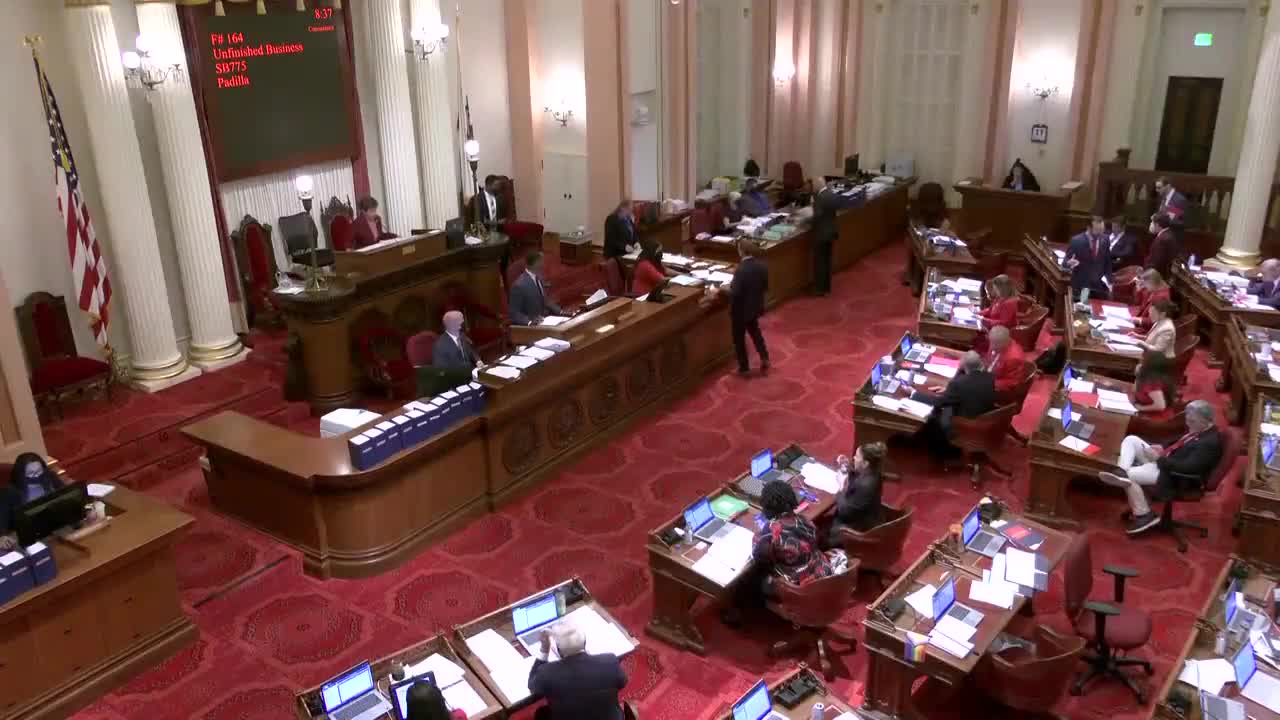 1MIN
Senate Floor
 3MIN
Assembly Floor
 26MIN
Assembly Standing Committee on Education
 3MIN
Senate Floor
 27MIN
Senate Standing Committee on Education
27MIN
Senate Budget and Fiscal Review Subcommittee No. 1 on Education
Bill Author