SB 770: Health care: unified health care financing.
- Session Year: 2023-2024
- House: Senate
- Latest Version Date: 2023-10-07
Current Status:
Passed
(2023-10-07: Chaptered by Secretary of State. Chapter 412, Statutes of 2023.)
Introduced
In Committee
First Chamber
In Committee
Second Chamber
Enacted
Prior state law established the Healthy California for All Commission for the purpose of developing a plan towards the goal of achieving a health care delivery system in California that provides coverage and access through a unified health care financing system for all Californians, including, among other options, a single-payer financing system.
This bill would direct the Secretary of the California Health and Human Services Agency to research, develop, and pursue discussions of a waiver framework in consultation with the federal government with the objective of a health care system that incorporates specified features and objectives, including, among others, a comprehensive package of medical, behavioral health, pharmaceutical, dental, and vision benefits, and the absence of cost sharing for essential services and treatments. The bill would further require the secretary to engage specified stakeholders to provide input on topics related to discussions with the federal government and key design issues, as specified. The bill would require the secretary, no later than January 1, 2025, to provide an interim report to specified committees of the Legislature and propose statutory language to the chairs of those committees authorizing the development and submission of applications to the federal government for waivers necessary to implement a unified health care financing system. The bill would require the secretary, no later than June 1, 2025, to complete drafting the waiver framework, make the draft available to the public on the agencys internet website, and hold a 45-day public comment period thereafter. The bill would require the secretary, no later than November 1, 2025, to provide the Legislature and the Governor with a report that communicates the finalized waiver framework, as specified, and sets forth the specific elements to be included in a formal waiver application to establish a unified health care financing system, as specified. The bill would also include findings and declarations of the Legislature related to the implementation of a unified health care financing system.
Prior state law established the Healthy California for All Commission for the purpose of developing a plan towards the goal of achieving a health care delivery system in California that provides coverage and access through a unified health care financing system for all Californians, including, among other options, a single-payer financing system.
This bill would direct the Secretary of the California Health and Human Services Agency to research, develop, and pursue discussions of a waiver discussions framework in consultation with the federal government with the objective of a unified health care financing system that incorporates specified features and objectives, including, among others, a comprehensive package of medical, behavioral health, pharmaceutical, dental, and vision benefits, and the absence of cost sharing for essential services and treatments. The bill would further require the secretary to establish a Waiver Development Workgroup comprised of members appointed by the Governor, the Speaker of the Assembly, and the President pro Tempore of the Senate, as specified. engage specified stakeholders to provide input on topics related to discussions with the federal government and key design issues, as specified. The bill would require the workgroup to include stakeholders representing various specified interests, including consumers, patients, health care professionals, labor unions, government agencies, and philanthropic organizations. The bill would require the secretary to provide quarterly reports to the Chairpersons of the Assembly and Senate Health Committees on the status and outcomes of waiver discussions with the federal government and the progress of the workgroup. The bill would also require the secretary to submit a complete set of recommendations regarding the elements to be included in a formal waiver application, as specified, by no later than June 1, 2024. secretary, no later than January 1, 2025, to provide an interim report to specified committees of the Legislature and propose statutory language to the chairs of those committees authorizing the development and submission of applications to the federal government for waivers necessary to implement a unified health care financing system. The bill would require the secretary, no later than June 1, 2025, to complete drafting the waiver framework, make the draft available to the public on the agencys internet website, and hold a 45-day public comment period thereafter. The bill would require the secretary, no later than November 1, 2025, to provide the Legislature and the Governor with a report that communicates the finalized waiver framework, as specified, and sets forth the specific elements to be included in a formal waiver application to establish a unified health care financing system, as specified. The bill would also include findings and declarations of the Legislature related to the implementation of a unified health care financing system.
Prior state law established the Healthy California for All Commission for the purpose of developing a plan towards the goal of achieving a health care delivery system in California that provides coverage and access through a unified health care financing system for all Californians, including, among other options, a single-payer financing system system.
This bill would direct the Secretary of the California Health and Human Services Agency to pursue waiver discussions with the federal government with the objective of a unified health care financing system that incorporates specified features and objectives, including, among others, a comprehensive package of medical, behavioral health, pharmaceutical, dental, and vision benefits, and the absence of cost sharing for essential services and treatments. The bill would further require the secretary to establish a Waiver Development Workgroup comprised of members appointed by the Governor, the Speaker of the Assembly, and the President Pro pro Tempore of the Senate, as specified. The bill would require the workgroup to include stakeholders representing various specified interests, including consumers, patients, health care professionals, labor unions, government agencies, and philanthropic organizations. The bill would require the secretary to provide quarterly reports to the chairs Chairpersons of the Assembly and Senate Health Committees on the status and outcomes of waiver discussions with the federal government and the progress of the workgroup. The bill would also require the secretary to submit a complete set of recommendations regarding the elements to be included in a formal waiver application, as specified, by no later than June 1, 2024. The bill would also include findings and declarations of the Legislature related to the implementation of a unified health care financing system.
Prior state law established the Healthy California for All Commission for the purpose of developing a plan towards the goal of achieving a health care delivery system in California that provides coverage and access through a unified health care financing system for all Californians, including, among other options, a single-payer financing system
This bill would direct the Secretary of the California Health and Human Services Agency to pursue waiver discussions with the federal government with the objective of a unified health care financing system that incorporates specified features and objectives, including, among others, a comprehensive package of medical, behavioral health, pharmaceutical, dental, and vision benefits, and the absence of cost sharing for essential services and treatments. The bill would further require the secretary to establish a Waiver Development Workgroup comprised of members appointed by the Governor, Speaker of the Assembly, and President Pro Tempore of the Senate, as specified. The bill would require the workgroup to include stakeholders representing various specified interests, including consumers, patients, health care professionals, labor unions, government agencies, and philanthropic organizations. The bill would require the secretary to provide quarterly reports to the chairs of the Assembly and Senate Health Committees on the status and outcomes of waiver discussions with the federal government and the progress of the workgroup. The bill would also require the secretary to submit a complete set of recommendations regarding the elements to be included in a formal waiver application, as specified, by no later than June 1, 2024. The bill would also include findings and declarations of the Legislature related to the implementation of a unified health care financing system.
Prior state law established the Healthy California for All Commission for purposes the purpose of developing a plan that included options for advancing progress toward towards the goal of achieving a health care delivery system in California that provides coverage and access through a unified health care financing system, system for all Californians, including, but not limited to, among other options, a single-payer financing system, for all Californians. system
This bill would direct the Secretary of the California Health and Human Services Agency to pursue waiver discussions with the federal government with the objective of a unified health care financing system that incorporates specified features and objectives, including, among others, a comprehensive package of medical, behavioral health, pharmaceutical, dental, and vision benefits, and the absence of cost sharing for essential services and treatments. The bill would further require the secretary to establish a Waiver Development Workgroup comprised of members appointed by the Governor, Speaker of the Assembly, and President Pro Tempore of the Senate, as specified. The bill would require the workgroup to include stakeholders representing various specified interests, including consumers, patients, health care professionals, labor unions, government agencies, and philanthropic organizations. The bill would require the secretary to provide quarterly reports to the chairs of the Assembly and Senate Health Committees on the status and outcomes of waiver discussions with the federal governments government and the progress of the workgroup. The bill would also require the secretary to submit a complete set of recommendations regarding the elements to be included in a formal waiver application, as specified, by no later than June 1, 2024. The bill would include legislative findings related to the findings of the commission and declare the intent of the Legislature in implementing a unified health care financing system in California. also include findings and declarations of the Legislature related to the implementation of a unified health care financing system.
Prior state law established the Healthy California for All Commission for purposes of developing a plan that included options for advancing progress toward achieving a health care delivery system in California that provides coverage and access through a unified health care financing system, including, but not limited to, a single-payer financing system, for all Californians.
This bill would direct the Secretary of the California Health and Human Services Agency to pursue waiver discussions with the federal government with the objective of a unified health care financing system that incorporates specified features and objectives, including, among others, a comprehensive package of medical, behavioral health, pharmaceutical, dental, and vision benefits, and the absence of cost sharing for essential services and treatments. The bill would further require the secretary to establish a Waiver Development Workgroup comprised of members appointed by the Governor, Speaker of the Assembly, and President Pro Tempore of the Senate, as specified. The bill would require the workgroup to include stakeholders representing various specified interests, including consumers, patients, health care professionals, labor unions, government agencies, and philanthropic organizations. The bill would require the secretary to provide quarterly reports to the chairs of the Assembly and Senate Health Committees on the status and outcomes of waiver discussions with the federal governments and the progress of the workgroup. The bill would also require the secretary to submit a complete set of recommendations regarding the elements to be included in a formal waiver application, as specified, by no later than June 1, 2024. The bill would include legislative findings related to the findings of the commission and declare the intent of the Legislature in implementing a unified health care financing system in California.
Existing law states that it is the policy of the State of California that the composition of state boards and commissions shall be broadly reflective of the general public including ethnic minorities and women.This bill would make a nonsubstantive change to those provisions.Existing law states that it is the policy of the State of California that the composition of state boards and commissions shall be broadly reflective of the general public including ethnic minorities and women.
This bill would make a nonsubstantive change to those provisions.
The Legislature finds and declares all of the following:
(a)Established by the Governor and the Legislature, the Healthy California for All Commission endorsed a system of unified health care financing that is accessible, affordable, equitable, high quality, and universal.
(b)The commission described the present health care system as one that is fragmented, wasteful, and disproportionately harmful to low-income Californians and communities of color and provided the rationale for a new single, government-administered funding system.
(c)The commission found that a unified financing system would create significant opportunities to deliver health care more effectively, efficiently, and equitably.
(d)California could save more than five hundred billion dollars ($500,000,000,000) over the next decade if a unified health care financing system is implemented, with overall costs lower even after most of those savings go to minimize consumer cost sharing and expand long-term care supports and services to all Californians.
(e)The report by the commission calls for the elimination of corporate profitmaking as the basis of health care decisions.
(f)The magnitude of the change from the status quo in cost savings and positive impact on Californians access to health care services that the commission contemplates represents a profound breakthrough in health policy and would establish California as the nations leader in pursuing health equity.
(g)Federal engagement is critical to the process of developing the framework for a waiver that would provide program approval and full federal financial participation in a unified health care financing system for California.
(h)The commissions recommendations for a health care system with unified financing that guarantees all Californians the benefit of a standard, comprehensive package of health care services points the way toward better care at lower cost for our states residents.
(i)Based on these findings, the Legislature endorses a health care system with unified financing, such as a single-payer health care system, to provide accessible, affordable, equitable, and high-quality health care for all Californians.
1001.The Secretary of the California Health and Human Services Agency shall research, develop, and pursue discussions of a waiver framework in consultation with the federal government with the objective of creating a health care system that incorporates the following features and objectives:
(a)A comprehensive package of medical, behavioral health, pharmaceutical, dental, and vision benefits, which includes primary, preventive, and wellness care services.
(b)A package of long-term care supports and services, including measures to support health and well-being while Californians age.
(c)Services that will not vary by age, employment status, disability status, income, immigration status, or other characteristics.
(d)The identification of disparities among Medicare, Medi-Cal, employer-sponsored insurance, and individual market coverage, with the goal to eliminate those disparities to the greatest extent possible in the new system.
(e)The elimination of the adverse impacts within the health care system of attempts to avoid covering the sick or providing the benefits patients need.
(f)The absence of cost sharing for essential services and treatments covered under the program, including primary, preventive, and wellness care services.
(g)The establishment of sufficient reserves to guarantee solvency during public health emergencies and times of economic disruption.
(h)A program to implement a just transition for members of the health industry workforce whose jobs may be disrupted.
(i)Assurances that no individual will pay more than a specified percentage of their income on a progressive sliding scale for the cost of financing the health system.
(j)Unified financing that delivers health care more effectively, efficiently, and equitably.
(k)Cost-effectiveness by systemwide pooled purchasing to negotiate rates with providers.
(l)Freedom for patients to choose providers and for primary care providers to choose practice models.
(m)Greater investments in public health, primary care, and health equity efforts to address the social determinants of health through an improved mix of health care and human services.
(n)Improvements in cost, quality, and health care system oversight and integration, which may include reducing overall administrative burdens on providers and improving connectivity and affordability of health care, built on the accomplishments of the Office of Healthcare Affordability and other current initiatives, including the Data Exchange Framework and California Advancing and Innovating Medi-Cal.
(o)A ratesetting process that could use Medicare rates as the starting point for the development of final rates that avoid disruptions in the health care system and expand the availability of high quality vital services by sustaining a stable, experienced, and equitably compensated workforce. This process should address historic inequities in primary care physician reimbursements as compared to other specialty practices and include policies and payments to support those providers that serve a disproportionate percentage of low-income Californians and other disadvantaged communities.
(p)Promotion of a workforce that addresses geographies and specialties with the greatest shortages and is diverse and able to provide culturally and linguistically competent care to all Californians regardless of race, nationality, ethnicity, sexual identity, and socioeconomic status.
(q)Prohibition on the kinds of risk-bearing contractual arrangements that could incentivize providers to withhold needed care, while allowing for payment models that guarantee access, promote quality, ensure equity, and enable multidisciplinary teams.
(r)Specific details on how care would be coordinated and organized.
(s)Methods of payment, delivery, and oversight implemented under the unified health care financing system that will continue to allow California the ability to receive the full benefit of federal expenditures and tax credits that currently underwrite the full scope of health services.
1002.(a)In developing the waiver framework, the Secretary of the Health and Human Services Agency shall engage stakeholders to provide input on topics related to discussions with the federal government and key system design issues identified by the Healthy California for All Commission for further analysis.
(1)Stakeholder engagement shall include representatives of consumers, patients, and community-based health care service providers, community organizations, health care professionals, labor unions, employers, and health policy experts, as well as representatives of government agencies and philanthropic organizations focused on health care.
(2)Key system design issues include health care delivery, finance, operations, public administration, the specifics of the transition to a unified health care financing system from the current system, adapting existing consumer protections to the new system, applying reforms to move toward systems that reward and prioritize improvements in health outcomes, health care quality, and health care equity, and how to reduce costs and improve the experience of health care consumers.
(b)The secretary shall, no later than January 1, 2025, provide an interim report to the chairs of the Assembly and Senate Budget and Health Committees that details the agencys policy priorities and preliminary analysis of issues related to the federal discussions, as well as a summary of the input received to date through the stakeholder engagement process. The secretary shall, no later than January 1, 2025, also propose statutory language to the chairs of these committees authorizing the development and submission of applications to the federal government for waivers necessary to implement the unified health care financing system.
(c)The secretary shall, no later than June 1, 2025, complete the drafting of the waiver framework, inclusive of input gathered through the stakeholder engagement process, make the draft available to the public on the agencys internet website, and shall hold a 45-day public comment period thereafter.
(d)The secretary shall, no later than November 1, 2025, provide the Legislature and the Governor with a report that communicates the finalized waiver framework, informed by public comment received, and sets forth the specific elements to be included in a formal waiver application to establish a unified financing system consistent with the outcomes of the agencys discussions with the federal government.
(e)The requirement for submitting the reports specified in this subdivision is inoperative on June 1, 2028, pursuant to Section 10231.5 of the Government Code.
(f)A report submitted pursuant to this subdivision shall be submitted in compliance with Section 9795 of the Government Code.
The Legislature finds and declares all of the following:
(a)Established by the Governor and the Legislature, the Healthy California for All Commission endorsed a system of unified health care financing that is accessible, affordable, equitable, high quality, and universal.
(b)The commission described the present health care system as one that is fragmented, wasteful, and disproportionately harmful to low-income Californians and communities of color and provided the rationale for a new single, government-administered funding system.
(c)The commission found that a unified financing system would create significant opportunities to deliver health care more effectively, efficiently, and equitably.
(d)California could save more than five hundred billion dollars ($500,000,000,000) over the next decade if a unified health care financing system is implemented, with overall costs lower even after most of those savings go to minimize consumer cost sharing and expand long-term care supports and services to all Californians.
(e)The report by the commission calls for the elimination of corporate profitmaking as the basis of health care decisions.
(f)The magnitude of the change from the status quo in cost savings and positive impact on Californians access to health care services that the commission contemplates represents a profound breakthrough in health policy and would establish California as the nations leader in pursuing health equity.
(g)The California Health and Human Services Agency has initiated preliminary discussions with the federal Centers for Medicare and Medicaid Services on the terms of a waiver that would provide program approval and full federal financing for a unified health care financing system in California.(g)Federal engagement is critical to the process of developing the framework for a waiver that would provide program approval and full federal financial participation in a unified health care financing system for California.
(h)Based on these findings, the Legislature endorses the The commissions recommendations for a health care system with unified financing that guarantees all Californians the benefit of a standard, comprehensive package of health care services and supports the agencys discussions with the federal government regarding the terms of a potential waiver to effectuate the creation of a health care system consistent with this part. points the way toward better care at lower cost for our states residents.
(i)Based on these findings, the Legislature endorses a health care system with unified financing, such as a single-payer health care system, to provide accessible, affordable, equitable, and high-quality health care for all Californians.
1001.The Secretary of the California Health and Human Services Agency shall research, develop, and pursue waiver discussions of a waiver framework in consultation with the federal government with the objective of creating a health care system that incorporates the following features and objectives:
(a)A comprehensive package of medical, behavioral health, pharmaceutical, dental, and vision benefits, which includes primary, preventive, and wellness care services.
(b)A package of long-term care support supports and services, including measures to slow deterioration and provide palliative care. support health and well-being while Californians age.
(c)Guaranteed services Services that will not vary by age, employment status, disability status, income, immigration status, or other characteristics.
(d)The elimination of the distinctions that currently exist among the disparate systems of identification of disparities among Medicare, Medi-Cal, employer-sponsored insurance, and individual market coverage coverage, with the goal to eliminate those disparities to the greatest extent possible. possible in the new system.
(e)The elimination of the adverse impacts of insurers attempting to avoid covering the sick or providing the benefits patients need in favor of a system that has a proactive, mission-driven focus on keeping Californians well. within the health care system of attempts to avoid covering the sick or providing the benefits patients need.
(f)The absence of cost sharing for essential services and treatments covered under the program, including primary, preventive, and wellness care services.
(g)The establishment of sufficient reserves to guarantee solvency during public health emergencies and times of economic disruption, supported in part by the elimination of the states unfunded benefit liabilities. disruption.
(h)A detailed program to ensure a just transition for insurance industry personnel or other individuals whose jobs are disrupted by the creation of a single payer system.(h)A program to implement a just transition for members of the health industry workforce whose jobs may be disrupted.
(i)Assurances that no individual will pay more than a specified percentage of their income on a progressive sliding scale for the cost of financing the health system.
(j)Unified financing that delivers health care more effectively, efficiently, and equitably.
(k)Cost-effectiveness by systemwide pooled purchasing to negotiate rates with providers.
(l)Greater freedom Freedom for patients to choose providers and for primary care providers to choose practice models, which will create greater competition, quality improvements, reductions in health disparities, and cost reductions from other system improvements. models.
(m)Greater investments in primary care and public health and public health, primary care, and health equity efforts to address the social determinants of health through an improved mix of health care and human services.
(n)Improvements in cost, quality, and health care system oversight and integration built on the accomplishments of the Office of Healthcare Affordability and other current initiatives, including the Data Exchange Framework and California Advancing and Innovating Medi-Cal, implemented in a manner that reduces overall administrative burdens to providers. integration, which may include reducing overall administrative burdens on providers and improving connectivity and affordability of health care, built on the accomplishments of the Office of Healthcare Affordability and other current initiatives, including the Data Exchange Framework and California Advancing and Innovating Medi-Cal.
(o)A ratesetting process that uses could use Medicare rates as the starting point for the development of final rates that avoid disruptions in the health care system and expand the availability of high quality vital services by sustaining a stable, experienced, and equitably compensated workforce. This process shall include policies and payments to should address historic inequities in primary care physician reimbursements as compared to other specialty practices and include policies and payments to support those providers that serve a disproportionate percentage of low-income Californians and other disadvantaged communities.
(p)Promotion of a workforce that addresses geographies and specialties with the greatest shortages and is diverse and able to provide culturally and linguistically competent care to all Californians regardless of race, nationality, ethnicity, sexual identity, and socioeconomic status.
(q)Adoption of policies and payments to support safety net providers that serve a disproportionate percentage of low-income Californians and other disadvantaged communities. These providers may need more generous funding than those serving affluent communities in order to effectively address the adverse effects of health disparities and other social determinants of health among their patients.(r)(q)Prohibition on the kinds of risk-bearing contractual arrangements that may could incentivize providers to withhold needed care, while allowing for payment models that guarantee access, promote quality, ensure equity, and enable multidisciplinary teams.
(s)(r)Specific details on how care would be coordinated and organized.
(t)Ensure that the methods(s)Methods of payment, delivery, and oversight implemented under the unified health care financing system that will continue to allow California the ability to receive the full benefit of federal expenditures and tax credits that currently underwrite the full scope of health services.
1002.(a)The In developing the waiver framework, the Secretary of the Health and Human Services Agency shall establish a Waiver Development Workgroup. engage stakeholders to provide input on topics related to discussions with the federal government and key system design issues identified by the Healthy California for All Commission for further analysis.
(1)The workgroup shall consist of key stakeholders to advise the Governor on topics related to federal negotiations. The workgroup shall include representatives of consumer, patient, and community-based health care service providers, community organizations, health care professionals, labor unions, employers, and health policy experts, as well as representatives of government agencies.(2)The members of the workgroup shall be appointed by the Governor, the Speaker of the Assembly, and the President pro Tempore of the Senate as follows:(A)Nine members shall be appointed by the Governor with a balance of expertise and perspectives, including five members with technical expertise in health care delivery, finance, operations, and public administration, and four members focused on the availability and quality of community health services.(B)Four members shall be appointed by the Speaker of the Assembly and four members shall be appointed by the President pro Tempore of the Senate. These members shall include representatives of health care professionals, labor unions, employers, and community organizations, and individuals with experience as beneficiaries of Medi-Cal or Medicare, or of being uninsured.(3)The workgroup should represent a variety of health care professionals and community voices and include representatives from philanthropic organizations focused on health care.(4)The workgroup shall meet quarterly and undertake a program of stakeholder engagement at sites across the state to address issues including, but not limited to, the specifics of the transition to a unified health care financing system from the current system of private and public coverage, adapting existing consumer protections to the new system, applying reforms to move toward systems that reward and prioritize improvements in health outcomes, health care quality, and health care equity, and how to reduce costs and provide consumers the comfort and security they deserve.(b)(1)The secretary shall provide quarterly reports to the Chairpersons of the Assembly and Senate Health Committees that detail the status and outcomes of federal discussions, as well as the progress of the Waiver Development Workgroup.(2)The requirement for submitting a report imposed under this subdivision is inoperative on January 1, 2028, pursuant to Section 10231.5 of the Government Code.(c)(1)The secretary shall report to the Legislature, no later than June 1, 2024, a complete set of recommendations regarding the elements to be included in a formal waiver application, along with all legislative action necessary to proceed with the application and to establish a unified financing system consistent with the outcomes of the agencys discussions with the federal government. The recommendations shall identify all of the elements among those proposed that the state may implement without a federal waiver, as well as any proposed elements that may require changes in federal statute in addition to a waiver.(1)Stakeholder engagement shall include representatives of consumers, patients, and community-based health care service providers, community organizations, health care professionals, labor unions, employers, and health policy experts, as well as representatives of government agencies and philanthropic organizations focused on health care.
(2)Key system design issues include health care delivery, finance, operations, public administration, the specifics of the transition to a unified health care financing system from the current system, adapting existing consumer protections to the new system, applying reforms to move toward systems that reward and prioritize improvements in health outcomes, health care quality, and health care equity, and how to reduce costs and improve the experience of health care consumers.
(b)The secretary shall, no later than January 1, 2025, provide an interim report to the chairs of the Assembly and Senate Budget and Health Committees that details the agencys policy priorities and preliminary analysis of issues related to the federal discussions, as well as a summary of the input received to date through the stakeholder engagement process. The secretary shall, no later than January 1, 2025, also propose statutory language to the chairs of these committees authorizing the development and submission of applications to the federal government for waivers necessary to implement the unified health care financing system.
(c)The secretary shall, no later than June 1, 2025, complete the drafting of the waiver framework, inclusive of input gathered through the stakeholder engagement process, make the draft available to the public on the agencys internet website, and shall hold a 45-day public comment period thereafter.
(d)The secretary shall, no later than November 1, 2025, provide the Legislature and the Governor with a report that communicates the finalized waiver framework, informed by public comment received, and sets forth the specific elements to be included in a formal waiver application to establish a unified financing system consistent with the outcomes of the agencys discussions with the federal government.
(2)(e)The requirement for submitting a report imposed under the reports specified in this subdivision is inoperative on June 1, 2028, pursuant to Section 10231.5 of the Government Code.
(3)(f)A report submitted under pursuant to this subdivision shall be submitted in compliance with Section 9795 of the Government Code.
The Legislature finds and declares all of the following:
(a)Established by the Governor and the State Legislature, the Healthy California for All Commission endorsed a system of unified health care financing that is accessible, affordable, equitable, high quality, and universal.
(b)The commission described the present health care system as one that is fragmented, wasteful, and disproportionately harmful to low-income Californians and communities of color and provided the rationale for a new single, government-administered funding system.
(c)The commission found that a unified financing system would create significant opportunities to deliver health care more effectively, efficiently, and equitably.
(d)California could save more than five hundred billion dollars ($500,000,000,000) over the next decade if a unified health care financing system is implemented, with overall costs lower even after most of those savings go to minimize consumer cost sharing and expand long-term care supports and services to all Californians.
(e)The report by the commission calls for the elimination of corporate profitmaking as the basis of health care decisions.
(f)The magnitude of the change from the status quo in cost savings and positive impact on Californians access to health care services that the commission contemplates represents a profound breakthrough in health policy and would establish California as the nations leader in pursuing health equity.
(g)The California Health and Human Services Agency has initiated preliminary discussions with the federal Centers for Medicare and Medicaid Services on the terms of a waiver that would provide program approval and full federal financing for a unified health care financing system in California.
(h)Based on these findings, the Legislature endorses the commissions recommendations for a health care system with unified financing that guarantees all Californians the benefit of a standard, comprehensive package of health care services and supports the agencys discussions with the federal government regarding the terms of a potential waiver to effectuate the creation of a health care system consistent with this part.
1001.The Secretary of the California Health and Human Services Agency shall pursue waiver discussions with the federal government with the objective of a health care system that incorporates the following features and objectives:
(a)A comprehensive package of medical, behavioral health, pharmaceutical, dental, and vision benefits. benefits, which includes primary, preventive, and wellness care services.
(b)A package of long-term care support and services, including measures to slow deterioration and provide palliative care.
(c)Guaranteed services that will not vary by age, employment status, disability status, income, immigration status, or other characteristics.
(d)The elimination of the distinctions that currently exist among the disparate systems of Medicare, Medi-Cal, employer-sponsored insurance, and individual market coverage to the greatest extent possible.
(e)The elimination of the adverse impacts of insurers attempting to avoid covering the sick or providing the benefits patients need in favor of a system that has a proactive, mission-driven focus on keeping Californians well.
(f)The absence of cost sharing for essential services and treatments covered under the program. program, including primary, preventive, and wellness care services.
(g)The establishment of sufficient reserves to guarantee solvency during public health emergencies and times of economic disruption, supported in part by the elimination of the states unfunded benefit liabilities.
(h)A detailed program to ensure a just transition for insurance industry personnel or other individuals whose jobs are disrupted by the creation of a single payer system.
(i)Assurances that no individual will pay more than a specified percentage of their income on a progressive sliding scale for the cost of financing the health system.
(j)Unified financing that delivers health care more effectively, efficiently, and equitably.
(k)Cost-effectiveness by pooling patients together and leveraging their purchasing power to negotiate the best prices from providers. systemwide pooled purchasing to negotiate rates with providers.
(l)Greater freedom for patients to choose providers, providers and for primary care providers to choose practice models, which will create greater competition, quality improvements, reductions in health disparities, and cost reductions from other system improvements.
(m)Greater investments in primary care and public health and efforts to address the social determinants of health through an improved mix of health care and human services.
(n)Improvements in cost, quality, and health care system oversight and integration built on the accomplishments of the Office of Healthcare Affordability and other current initiatives, including the Data Exchange Framework and California Advancing and Innovating Medi-Cal. Medi-Cal, implemented in a manner that reduces overall administrative burdens to providers.
(o)A rate-setting ratesetting process that uses Medicare rates as the starting point for the development of final rates that avoid disruptions in the health care system and expand the availability of high quality vital services by sustaining a stable, experienced, and equitably compensated workforce. This process shall include policies and payments to address historic inequities in primary care physician reimbursements as compared to other specialty practices and support those providers that serve a disproportionate percentage of low-income Californians and other disadvantaged communities.
(p)Promotion of a workforce that addresses geographies and specialties with the greatest shortages and is diverse and able to provide culturally and linguistically competent care to all Californians regardless of race, nationality, ethnicity, sexual identity, and socioeconomic status.
(q)Adoption of policies and payments to support safety net providers that serve a disproportionate percentage of low-income Californians and other disadvantaged communities. These providers may need more generous funding than those serving affluent communities in order to effectively address the adverse effects of health disparities and other social determinants of health among their patients.
(r)Prohibition of risk-bearing contractual arrangements that may incentivize providers to withhold needed care. care, while allowing for payment models that guarantee access, promote quality, ensure equity, and enable multidisciplinary teams.
(s)Specific details on how care would be coordinated and organized.
(t)Ensure that the methods of payment, delivery, and oversight implemented under the unified health care financing system will continue to allow California the ability to receive the full benefit of federal expenditures and tax credits that currently underwrite the full scope of health services.
1002.(a)The Secretary of the Health and Human Services Agency shall establish a Waiver Development Workgroup.
(1)The workgroup shall consist of key stakeholders to advise the Governor on topics related to federal negotiations. The workgroup shall include representatives of consumer, patient, and community-based health care service providers, community organizations, health care professionals, labor unions, employers, and health policy experts, as well as representatives of government agencies.
(2)The members of the workgroup shall be appointed by the Governor, the Speaker of the Assembly, and the President Pro pro Tempore of the Senate as follows:
(A)Nine members shall be appointed by the Governor with a balance of expertise and perspectives, including five members with technical expertise in health care delivery, finance, operations, and public administration, and four members focused on the availability and quality of community health services.
(B)Four members shall be appointed by the Assembly Speaker of the Assembly and four members shall be appointed by the Senate President Pro Tempore. pro Tempore of the Senate. These members shall include representatives of health care professionals, labor unions, employers, and community organizations, and individuals with experience as beneficiaries of Medi-Cal or Medicare, or of being uninsured.
(3)The workgroup should represent a variety of health care professionals and community voices and include representatives from philanthropic organizations focused on health care.
(4)The workgroup shall meet quarterly and undertake a program of stakeholder engagement at sites across the state to address issues including, but not limited to, the specifics of the transition to a unified health care financing system from the current system of private and public coverage, adapting existing consumer protections to the new system, applying reforms to move toward systems that reward and prioritize improvements in health outcomes, health care quality, and health care equity, and how to reduce costs and provide consumers the comfort and security they deserve.
(b)(1)The Secretary secretary shall provide quarterly reports to the chairs Chairpersons of the Assembly and Senate Health Committees that detail the status and outcomes of federal discussions, as well as the progress of the Waiver Development Workgroup.
(2)The requirement for submitting a report imposed under this subdivision is inoperative on January 1, 2028, pursuant to Section 10231.5 of the Government Code.
(c)(1)The Secretary secretary shall report to the Legislature, no later than June 1, 2024, a complete set of recommendations regarding the elements to be included in a formal waiver application, along with all legislative action necessary to proceed with the application and to establish a unified financing system consistent with the outcomes of the agencys discussions with the federal government. The recommendations shall identify all of the elements among those proposed that the state may implement without a federal waiver, as well as any proposed elements that may require changes in federal statute in addition to a waiver.
(2)The requirement for submitting a report imposed under this subdivision is inoperative on June 1, 2028, pursuant to Section 10231.5 of the Government Code.
(3)A report submitted under this subdivision shall be submitted in compliance with Section 9795 of the Government Code.
The Legislature finds and declares all of the following:
(a)Established by the Governor and the State Legislature, the Healthy California for All Commission endorsed a system of unified health care financing that is accessible, affordable, equitable, high quality, and universal.
(b)The commission described the present health care system as one that is fragmented, wasteful, and disproportionately harmful to low-income Californians and communities of color and provided the rationale for a new single, government-administered funding system.
(c)The commission found that a unified financing system would create significant opportunities to deliver health care more effectively, efficiently, and equitably.
(d)California will incur an additional five hundred billion dollars ($500,000,000,000) in inflationary medical costs over the next decade unless a unified health care financing system is implemented.
(d)California could save more than five hundred billion dollars ($500,000,000,000) over the next decade if a unified health care financing system is implemented, with overall costs lower even after most of those savings go to minimize consumer cost sharing and expand long-term care supports and services to all Californians.
(e)The report by the commission calls for the elimination of corporate profitmaking as the basis of health care decisions.
(f)The magnitude of the change from the status quo in cost savings and positive impact on Californians access to health care services that the commission contemplates represents a profound breakthrough in health policy and would establish California as the nations leader in pursuing health equity.
(g)The California Health and Human Services Agency has initiated preliminary discussions with the federal Centers for Medicare and Medicaid Services on the terms of a waiver that would provide program approval and full federal financing for a unified health care financing system in California.
(h)Based on these findings, the Legislature endorses the commissions recommendations for a health care system with unified financing that guarantees all Californians the benefit of a standard, comprehensive package of health care services and supports the agencys discussions with the federal government regarding the terms of a potential waiver to effectuate the creation of a health care system consistent with this part.
1001.The Secretary of the California Health and Human Services Agency shall pursue waiver discussions with the federal government with the objective of a health care system that incorporates the following features and objectives:
(a)A comprehensive package of medical, behavioral health, pharmaceutical, dental, and vision benefits.
(b)A package of long-term care support and services, including measures to slow deterioration and provide palliative care.
(c)Guaranteed services that will not vary by age, employment status, disability status, income, immigration status, or other characteristics.
(d)The elimination of the distinctions that currently exist among the disparate systems of Medicare, Medi-Cal, employer-sponsored insurance, and individual market coverage to the greatest extent possible.
(e)The elimination of the adverse impacts of insurers attempting to avoid covering the sick or providing the benefits patients need in favor of a system that has a proactive, mission-driven focus on keeping Californians well.
(f)The absence of cost sharing for essential services and treatments covered under the program.
(g)The establishment of sufficient reserves to guarantee solvency during public health emergencies and times of economic disruption, supported in part by the elimination of the states unfunded benefit liabilities.
(h)A detailed program to ensure a just transition for insurance industry personnel or other individuals whose jobs are disrupted by the creation of a single payer system.
(i)Assurances that no individual will pay more than a specified percentage of their income on a progressive sliding scale for the cost of financing the health system.
(j)Unified financing that delivers health care more effectively, efficiently, and equitably.
(k)Cost-effectiveness by pooling patients together and leveraging their purchasing power to negotiate the best prices from providers.
(l)Greater freedom for patients to choose providers, which will create greater competition, quality improvements, reductions in health disparities, and cost reductions from other system improvements.
(m)Greater investments in public health and efforts to address the social determinants of health through an improved mix of health care and human services.
(n)Improvements in cost, quality, and health care system oversight and integration built on the accomplishments of the Office of Healthcare Affordability and other current initiatives, including the Data Exchange Framework and California Advancing and Innovating Medi-Cal.
(o)A rate-setting process that uses Medicare rates as the starting point for the development of final rates that avoid disruptions in the health care system and expand the availability of high quality vital services by sustaining a stable, experienced, and equitably compensated workforce. This process shall include policies and payments to support those providers that serve a disproportionate percentage of low-income Californians and other disadvantaged communities.
(p)Promotion of a workforce that is diverse and able to provide culturally and linguistically competent care to all Californians regardless of race, nationality, ethnicity, sexual identity, and socioeconomic status.
(q)Adoption of policies and payments to support safety net providers that serve a disproportionate percentage of low-income Californians and other disadvantaged communities. These providers may need more generous funding than those serving affluent communities in order to effectively address the adverse effects of health disparities and other social determinants of health among their patients.
(r)Prohibition of risk-bearing contractual arrangements that may incentivize providers to withhold needed care.
(s)Specific details on how care would be coordinated and organized.
(t)Ensure that the methods of payment, delivery, and oversight implemented under the unified health care financing system will continue to allow California the ability to receive the full benefit of federal expenditures and tax credits that currently underwrite the full scope of health services.
1002.(a)The Secretary of the Health and Human Services Agency shall establish a Waiver Development Workgroup.
(1)The workgroup shall consist of key stakeholders to advise the Governor on topics related to federal negotiations. The workgroup shall include representatives of consumer, patient, and community-based health care service providers, community organizations, health care professionals, labor unions, employers, and health policy experts, as well as representatives of government agencies.
(2)The members of the workgroup shall be appointed by the Governor, the Speaker of the Assembly, and the President Pro Tempore of the Senate as follows:
(A)Nine members shall be appointed by the Governor with a balance of expertise and perspectives, including five members with technical expertise in health care delivery, finance, operations, and public administration, and four members focused on the availability and quality of community health services.
(B)Four members shall be appointed by the Assembly Speaker and four members shall be appointed by the Senate President Pro Tempore. These members shall include representatives of health care professionals, labor unions, employers, and community organizations, and individuals with experience as beneficiaries of Medi-Cal or Medicare, or of being uninsured.
(3)The workgroup should represent a variety of health care professionals and community voices and include representatives from philanthropic organizations focused on health care.
(4)The workgroup shall meet quarterly and undertake a program of stakeholder engagement at sites across the state to address issues including, but not limited to, the specifics of the transition to a unified health care financing system from the current system of private and public coverage, adapting existing consumer protections to the new system, applying reforms to move toward systems that reward and prioritize improvements in health outcomes, health care quality, and health care equity, and how to reduce costs and provide consumers the comfort and security they deserve.
(b)(1)The Secretary shall provide quarterly reports to the chairs of the Assembly and Senate Health Committees that detail the status and outcomes of federal discussions, as well as the progress of the Waiver Development Workgroup.
(2)The requirement for submitting a report imposed under this subdivision is inoperative on January 1, 2028, pursuant to Section 10231.5 of the Government Code.
(c)(1)The Secretary shall report to the Legislature, no later than June 1, 2024, a complete set of recommendations regarding the elements to be included in a formal waiver application, along with all legislative action necessary to proceed with the application and to establish a unified financing system consistent with the outcomes of the agencys discussions with the federal government. The recommendations shall identify all of the elements among those proposed that the state may implement without a federal waiver, as well as any proposed elements that may require changes in federal statute in addition to a waiver.
(2)The requirement for submitting a report imposed under this subdivision is inoperative on June 1, 2028, pursuant to Section 10231.5 of the Government Code.
(3)A report submitted under this subdivision shall be submitted in compliance with Section 9795 of the Government Code.
The Legislature finds and declares all of the following:
(a)The Healthy California for All Commission, established Established by the Governor and the State Legislature, the Healthy California for All Commission endorsed a system of unified health care financing that is accessible, affordable, equitable, high quality, and universal.
(b)The commission described the present health care system as fragmented and wasteful, which one that is fragmented, wasteful, and disproportionately harms harmful to low-income Californians and communities of color, and provides color and provided the rationale for a new single, government-administered funding system.
(c)The commission found that a unified financing system would create significant opportunities to deliver health care more effectively, efficiently, and equitably.
(d)California will incur an additional five hundred billion dollars ($500,000,000,000) in inflationary medical costs over the next decade unless a unified health care financing system is implemented.
(e)The report by the commission calls for the elimination of corporate profitmaking as the basis of health care decisions.
(f)The magnitude of the change from the status quo in cost savings and positive impact on Californians access to health care services that the commission contemplates represents a profound breakthrough in health policy and would establish California as the nations leader in pursuing health equity.
(g)The California Health and Human Services Agency has initiated preliminary discussions with the federal Centers for Medicare and Medicaid Services on the terms of a waiver that would provide program approval and full federal financing for a unified health care financing system in California.
(h)Based on these findings, the Legislature endorses the commissions recommendations for a health care system with unified financing that guarantees all Californians the benefit of a standard, comprehensive package of health care services and supports the agencys discussions with the federal government regarding the terms of a potential waiver to effectuate the creation of a health care system consistent with this part.
1001.The Secretary of the California Health and Human Services Agency shall pursue waiver discussions with the federal government with the objective of a health care system that would incorporate that incorporates the following features and objectives:
(a)A comprehensive package of medical, behavioral health, pharmaceutical, dental, and vision benefits.
(b)A package of long-term care support and services, including measures to slow deterioration and provide palliative care.
(c)A guarantee to services Guaranteed services that will not vary by age, employment status, disability status, income, immigration status, or other characteristics.
(d)The elimination, to the greatest extent possible, elimination of the distinctions that currently existing exist among the disparate systems of Medicare, Medi-Cal, employer-sponsored insurance, and individual market coverage. coverage to the greatest extent possible.
(e)The elimination of the adverse impacts of insurers attempting to avoid covering the sick or providing the benefits patients need in favor of a system that has a proactive, mission-driven focus on keeping Californians well.
(f)The absence of cost sharing for essential services and treatments covered under the program.
(g)The establishment of sufficient reserves to guarantee solvency during times of public health emergencies and times of economic disruptions, disruption, supported in part by the elimination of the states unfunded benefit liabilities.
(h)A detailed program to ensure a just transition for insurance industry personnel or other individuals whose jobs are disrupted by the creation of a single payer system.
(i)Assurances that no individual will pay more than a specified percentage of their income on a progressive sliding scale for the cost of financing the health system.
(j)Unified financing that delivers health care more effectively, efficiently, and equitably.
(k)Cost-effectiveness by pooling patients together and leveraging their purchasing power to negotiate the best prices from providers.
(l)Greater freedom for patients to choose providers, which will create greater competition, quality improvements, reductions in health disparities, and cost reductions from other system improvements.
(m)Greater investments in public health and efforts to address the social determinants of health through an improved mix of health care and human services.
(n)Improvements in cost, quality, and health care system oversight and integration built on the accomplishments of the Office of Healthcare Affordability and other current initiatives, including the Data Exchange Framework and California Advancing and Innovating Medi-Cal.
(o)A rate-setting process that uses Medicare rates as the starting point for the development of final rates designed to that avoid disruptions in the health care system and expand the availability of high quality vital services by sustaining a stable, experienced, and equitably compensated workforce. This process shall include policies and payments to support those providers that serve a disproportionate percent percentage of low-income Californians and other disadvantaged communities.
(p)Promotion of a workforce that is diverse and able to provide culturally and linguistically competent care to all Californians regardless of race, nationality, ethnicity, sexual identity, and socioeconomic status.
(q)Adoption of policies and payments to support those safety net providers that serve a disproportionate percent percentage of low-income Californians and other disadvantaged communities. These providers may need more generous funding than those serving affluent communities in order to effectively address the adverse impacts effects of health disparities and other social determinants of health among their patients.
(r)Prohibition on the kinds of risk-bearing contractual arrangements that could may incentivize providers to withhold needed care.
(s)Specific details regarding on how care would be coordinated and organized.
(t)Ensure that the methods of payment, delivery, and oversight implemented under the unified health care financing system will continue to allow California the ability to receive the full benefit of federal expenditures and tax credits that currently underwrite the full scope of health services.
1002.(a)The Secretary of the Health and Human Services Agency shall establish a Waiver Development Workgroup.
(1)The workgroup shall consist of key stakeholders to advise the Governor on topics related to federal negotiations. The workgroup shall include representatives of consumer, patient, and community-based health care service providers, community organizations, health care professionals, labor unions, employers, and health policy experts, as well as representatives of government agencies.
(2)The members of the workgroup shall be appointed by the Governor, the Speaker of the Assembly, and the President Pro Tempore of the Senate as follows:
(A)Nine members shall be appointed by the Governor with a balance of expertise and perspectives, including five members with technical expertise in health care delivery, finance, operations, and public administration, and four members focused on the availability and quality of community health services.
(B)Four members shall be appointed by the Assembly Speaker and four members shall be appointed by the Senate President Pro Tempore. These members shall include representatives of health care professionals, labor unions, employers, and community organizations, as well as people and individuals with experience as beneficiaries of Medi-Cal or Medicare, or of being uninsured.
(3)The workgroup should represent a variety of health care professionals and community voices and include representatives from philanthropic organizations focused on health care.
(4)The workgroup shall meet quarterly and shall undertake a program of stakeholder engagement at sites across the state to address issues including, but not limited to, the specifics of the transition to a unified health care financing system from the current system of private and public coverage, adapting existing consumer protections to the new system, applying reforms to move toward systems that reward and prioritize improvements in health outcomes, health care quality, and health care equity, and how to reduce costs and provide consumers the comfort and security they deserve.
(b)(1)The Secretary shall provide quarterly reports to the chairs of the Assembly and Senate Health Committees, detailing Committees that detail the status and outcomes of federal discussions, as well as the progress of the Waiver Development Workgroup.
(2)The requirement for submitting a report imposed under this subdivision is inoperative on January 1, 2028, pursuant to Section 10231.5 of the Government Code.
(c)(1)The Secretary shall report to the Legislature, no later than June 1, 2024, a complete set of recommendations regarding the elements to be included in a formal waiver application, along with all legislative action necessary to proceed with the application and to establish a unified financing system consistent with the outcomes of the agencys discussions with the federal government. The recommendations shall identify all of the elements among those proposed that the state may implement without a federal waiver, as well as any proposed elements that may require changes in federal statute in addition to a waiver.
(2)The requirement for submitting a report imposed under this subdivision is inoperative on June 1, 2028, pursuant to Section 10231.5 of the Government Code.
(3)A report submitted under this subdivision shall be submitted in compliance with Section 9795 of the Government Code.
The Legislature finds and declares all of the following:
(a)The Healthy California for All Commission, established by the Governor and the State Legislature, endorsed a system of unified health care financing that is accessible, affordable, equitable, high quality, and universal.
(b)The commission described the present health care system as fragmented and wasteful, which disproportionately harms low-income Californians and communities of color, and provides the rationale for a new single, government-administered funding system.
(c)The commission found that a unified financing system would create significant opportunities to deliver health care more effectively, efficiently, and equitably.
(d)California will incur an additional five hundred billion dollars ($500,000,000,000) in inflationary medical costs over the next decade unless a unified health care financing system is implemented.
(e)The report by the commission calls for the elimination of corporate profitmaking as the basis of health care decisions.
(f)The magnitude of the change from the status quo in cost savings and positive impact on Californians access to health care services that the commission contemplates represents a profound breakthrough in health policy and would establish California as the nations leader in pursuing health equity.
(g)The California Health and Human Services Agency has initiated preliminary discussions with the federal Centers for Medicare and Medicaid Services on the terms of a waiver that would provide program approval and full federal financing for a unified health care financing system in California.
(h)Based on these findings, the Legislature endorses the commissions recommendations for a health care system with unified financing that guarantees all Californians the benefit of a standard, comprehensive package of health care services and supports the agencys discussions with the federal government regarding the terms of a potential waiver to effectuate the creation of a health care system consistent with this part.
1001.The Secretary of the California Health and Human Services Agency shall pursue waiver discussions with the federal government with the objective of a health care system that would incorporate the following features and objectives:
(a)A comprehensive package of medical, behavioral health, pharmaceutical, dental, and vision benefits.
(b)A package of long-term care support and services, including measures to slow deterioration and provide palliative care.
(c)A guarantee to services that will not vary by age, employment status, disability status, income, immigration status, or other characteristics.
(d)The elimination, to the greatest extent possible, of the distinctions currently existing among the disparate systems of Medicare, Medi-Cal, employer-sponsored insurance, and individual market coverage.
(e)The elimination of the adverse impacts of insurers attempting to avoid covering the sick or the benefits patients need in favor of a system that has a proactive, mission-driven focus on keeping Californians well.
(f)The absence of cost sharing for essential services and treatments covered under the program.
(g)The establishment of sufficient reserves to guarantee solvency during times of public health emergencies and economic disruptions, supported in part by the elimination of the states unfunded benefit liabilities.
(h)A detailed program to ensure a just transition for insurance industry personnel or other individuals whose jobs are disrupted by the creation of a single payer system.
(i)Assurances that no individual will pay more than a specified percentage of their income on a progressive sliding scale for the cost of financing the health system.
(j)Unified financing that delivers health care more effectively, efficiently, and equitably.
(k)Cost-effectiveness by pooling patients together and leveraging their purchasing power to negotiate the best prices from providers.
(l)Greater freedom for patients to choose providers, which will create greater competition, quality improvements, reductions in health disparities, and cost reductions from other system improvements.
(m)Greater investments in public health and efforts to address the social determinants of health through an improved mix of health care and human services.
(n)Improvements in cost, quality, and health care system oversight and integration built on the accomplishments of the Office of Healthcare Affordability and other current initiatives, including the Data Exchange Framework and California Advancing and Innovating Medi-Cal.
(o)A rate-setting process that uses Medicare rates as the starting point for the development of final rates designed to avoid disruptions in the health care system and expand the availability of high quality vital services by sustaining a stable, experienced, and equitably compensated workforce. This process shall include policies and payments to support those providers that serve a disproportionate percent of low-income Californians and other disadvantaged communities.
(p)Promotion of a workforce that is diverse and able to provide culturally and linguistically competent care to all Californians regardless of race, nationality, ethnicity, sexual identity, and socioeconomic status.
(q)Adoption of policies and payments to support those safety net providers that serve a disproportionate percent of low-income Californians and other disadvantaged communities. These providers may need more generous funding than those serving affluent communities in order to effectively address the adverse impacts of health disparities and social determinants of health among their patients.
(r)Prohibition on the kinds of risk-bearing contractual arrangements that could incentivize providers to withhold needed care.
(s)Specific details regarding how care would be coordinated and organized.
(t)Ensure that the methods of payment, delivery, and oversight implemented under the unified health care financing system will continue to allow California the ability to receive the full benefit of federal expenditures and tax credits that currently underwrite the full scope of health services.
1002.(a)The Secretary of the Health and Human Services Agency shall establish a Waiver Development Workgroup.
(1)The workgroup shall consist of key stakeholders to advise the Governor on topics related to federal negotiations. The workgroup shall include representatives of consumer, patient, and community-based health care service providers, community organizations, health care professionals, labor unions, employers, and health policy experts, as well as representatives of government agencies.
(2)The members of the workgroup shall be appointed by the Governor, the Speaker of the Assembly, and the President Pro Tempore of the Senate as follows:
(A)Nine members shall be appointed by the Governor with a balance of expertise and perspectives, including five members with technical expertise in health care delivery, finance, operations, and public administration, and four members focused on the availability and quality of community health services.
(B)Four members shall be appointed by the Assembly Speaker and four members shall be appointed by the Senate President Pro Tempore. These members shall include representatives of health care professionals, labor unions, employers, and community organizations, as well as people with experience as beneficiaries of Medi-Cal or Medicare, or of being uninsured.
(3)The workgroup should represent a variety of health care professionals and community voices and include representatives from philanthropic organizations focused on health care.
(4)The workgroup shall meet quarterly and shall undertake a program of stakeholder engagement at sites across the state to address issues including, but not limited to, the specifics of the transition to a unified health care financing system from current private and public coverage, adapting existing consumer protections to the new system, applying reforms to move toward systems that reward and prioritize improvements in health outcomes, health care quality, and health care equity, and how to reduce costs and provide consumers the comfort and security they deserve.
(b)(1)The Secretary shall provide quarterly reports to the chairs of the Assembly and Senate Health Committees, detailing the status and outcomes of federal discussions, as well as the progress of the Waiver Development Workgroup.
(2)The requirement for submitting a report imposed under this subdivision is inoperative on January 1, 2028, pursuant to Section 10231.5 of the Government Code.
(c)(1)The Secretary shall report to the Legislature, no later than June 1, 2024, a complete set of recommendations regarding the elements to be included in a formal waiver application, along with all legislative action necessary to proceed with the application and to establish a unified financing system consistent with the outcomes of the agencys discussions with the federal government. The recommendations shall identify all of the elements among those proposed that the state may implement without a federal waiver, as well as any proposed elements that may require changes in federal statute in addition to a waiver.
(2)The requirement for submitting a report imposed under this subdivision is inoperative on June 1, 2028, pursuant to Section 10231.5 of the Government Code.
(3)A report submitted under this subdivision shall be submitted in compliance with Section 9795 of the Government Code.
SECTION 1.Section 11140 of the Government Code is amended to read:11140.It is the policy of the state that the composition of state boards and commissions shall be broadly reflective of the general public including ethnic minorities and women.It is the policy of the State of California state that the composition of state boards and commissions shall be broadly reflective of the general public including ethnic minorities and women.
|
Date
|
Status
|
|---|---|
| Oct 7, 2023 | Chaptered by Secretary of State. Chapter 412, Statutes of 2023. |
| Oct 7, 2023 | Approved by the Governor. |
| Sep 21, 2023 | Enrolled and presented to the Governor at 4 p.m. |
| Sep 14, 2023 | Assembly amendments concurred in. (Ayes 29. Noes 9. Page 2797.) Ordered to engrossing and enrolling. |
| Sep 13, 2023 | In Senate. Concurrence in Assembly amendments pending. |
| Sep 13, 2023 | Read third time. Passed. (Ayes 47. Noes 18. Page 3388.) Ordered to the Senate. |
| Sep 8, 2023 | Ordered to third reading. |
| Sep 8, 2023 | Read third time and amended. |
| Sep 5, 2023 | Read second time. Ordered to third reading. |
| Sep 1, 2023 | Read second time and amended. Ordered to second reading. |
| Sep 1, 2023 | From committee: Do pass as amended. (Ayes 9. Noes 4.) (September 1). |
| Jul 12, 2023 | July 12 set for first hearing. Placed on APPR. suspense file. |
| Jun 28, 2023 | From committee: Do pass and re-refer to Com. on APPR. (Ayes 10. Noes 4.) (June 27). Re-referred to Com. on APPR. |
| Jun 8, 2023 | Referred to Com. on HEALTH. |
| May 31, 2023 | In Assembly. Read first time. Held at Desk. |
| May 30, 2023 | Read third time. Passed. (Ayes 30. Noes 9. Page 1350.) Ordered to the Assembly. |
| May 18, 2023 | Read second time. Ordered to third reading. |
| May 18, 2023 | From committee: Do pass. (Ayes 5. Noes 2. Page 1183.) (May 18). |
| May 12, 2023 | Set for hearing May 18. |
| May 1, 2023 | May 1 hearing: Placed on APPR suspense file. |
| Apr 25, 2023 | Set for hearing May 1. |
| Apr 24, 2023 | Read second time and amended. Re-referred to Com. on APPR. |
| Apr 20, 2023 | From committee: Do pass as amended and re-refer to Com. on APPR. (Ayes 7. Noes 2. Page 832.) (April 19). |
| Apr 11, 2023 | From committee with author's amendments. Read second time and amended. Re-referred to Com. on HEALTH. |
| Apr 3, 2023 | Set for hearing April 19. |
| Mar 29, 2023 | Re-referred to Com. on HEALTH. |
| Mar 20, 2023 | From committee with author's amendments. Read second time and amended. Re-referred to Com. on RLS. |
| Mar 1, 2023 | Referred to Com. on RLS. |
| Feb 21, 2023 | From printer. May be acted upon on or after March 20. |
| Feb 17, 2023 | Introduced. Read first time. To Com. on RLS. for assignment. To print. |
|
Date
|
Description
|
Location
|
Votes
|
|
|---|---|---|---|---|
| Sep 14, 2023 | Unfinished Business SB770 Wiener et al. Concurrence | Senate Floor |
Passed |
|
| Sep 13, 2023 | SB 770 Wiener Senate Third Reading By Schiavo | Assembly Floor |
Passed |
|
| Sep 1, 2023 | Do pass as amended. | Assembly Standing Committee on Appropriations |
Passed |
|
| Jun 27, 2023 | Do pass and be re-referred to the Committee on [Appropriations] | Assembly Standing Committee on Health |
Passed |
|
| May 30, 2023 | Senate 3rd Reading SB770 Wiener et al. | Senate Floor |
Passed |
|
| May 18, 2023 | Do pass | Senate Standing Committee on Appropriations |
Passed |
|
| May 1, 2023 | Placed on suspense file | Senate Standing Committee on Appropriations |
Passed |
|
| Apr 19, 2023 | Do pass as amended, but first amend, and re-refer to the Committee on [Appropriations] | Senate Standing Committee on Health |
Passed |
This list shows positions taken on this bill by organizations on the date displayed, which is linked to the original source.
Positions by individuals are not included.
|
Organization
|
Position
|
Date
|
|---|---|---|
| American Civil Liberties Union | ** Support | |
| America'S Health Insurance Plans | ** Against | |
| AmericaS Physician Groups | ** Against | |
| Asian Pacific Islanders for CalCare | ** Against | |
| Association Of California Life & Health Insurance Companies | ** Against | |
| Black Lives Matter Los Angeles | ** Against | |
| Butte County Health Care Coalition | ** Support | |
| California Agents and Health Insurance Professionals | ** Against | |
| California Alliance For Retired Americans | ** Support | |
| California Association Of Health Plans | ** Against | |
| California Business Roundtable | ** Against | |
| California Chamber Of Commerce | ** Against | |
| California Conference Of Machinists | ** Support | |
| California Federation of Teachers, AFL-CIO | ** Support | |
| California Manufacturers And Technology Association | ** Against | |
| California Nurses Association/National Nurses United | ** Against | |
| California Nurses for Environmental Health and Justice | ** Against | |
| California OneCare | ** Support | |
| California Pan-Ethnic Health Network | ** Support | |
| California Physicians Alliance | ** Support | |
| California Rise Up | ** Against | |
| California Teamsters Public Affairs Council | ** Support | |
| Cal Red Berets | ** Against | |
| Central Coast Alliance United for a Sustainable Economy | ** Support | |
| Chispa, a Project of Tides Advocacy | ** Support | |
| Clinica Monsenor Oscar A. Romero | ** Support | |
| Consumer Watchdog | ** Support | |
| Contemporary Art League | ** Against | |
| Courage California | ** Support | |
| Democratic Socialists of America Los Angeles | ** Against | |
| DSA-santa Barbara | ** Against | |
| East Valley Indivisibles | ** Against | |
| Educators for Single-payer | ** Against | |
| El Dorado Progressives | ** Against | |
| Equality California | ** Support | |
| Fannie Lou Hamer Institute | ** Against | |
| Feel the Bern Democratic Club, Los Angeles | ** Against | |
| Gray Panthers of San Francisco | ** Support | |
| Harriet Tubman Center for Social Justice | ** Against | |
| Health Access California | ** Support | |
| Healthcare for All Working Group | ** Support | |
| Health Care for US | ** Against | |
| Healthy California Now | ** Support | |
| Hollywood4CalCare | ** Against | |
| Inland Empire Immigrant Youth Collective | ** Support | |
| Inland Equity Partnership | ** Support | |
| LA Defensa | ** Against | |
| Latino and Latina Roundtable of the San Gabriel and Pomona Valley | ** Support | |
| League of Latin American Citizens of Riverside, Council 3190 | ** Support | |
| League of United Latin American Citizens of Riverside Council 3190 | ** Support | |
| Lindblad Architects | ** Against | |
| Long Beach Area Peace Network | ** Against | |
| Midnight Books | ** Against | |
| National Union Of Healthcare Workers | ** Support | |
| Orange County Action | ** Support | |
| Peace and Freedom Party of California | ** Support | |
| Physicians for A National Health Program -- California Chapter | ** Support | |
| SEIU California | ** Support | |
| Stand Up California | ** Against | |
| The Inland Empire-Immigrant Youth Collective | ** Support | |
| Therapists for Single Payer | ** Support | |
| Topanga Peace Alliance | ** Against | |
| Trade Show Temps | ** Against | |
| UNITE-HERE, AFL-CIO | ** Support | |
| Wellstone Progressive Democrats of Sacramento | ** Against | |
| western center on law and poverty | ** Support | |
| White People 4 Black Lives | ** Against | |
| Yes We Can Democratic Club | ** Against |
SENATE RULES COMMITTEE Office of Senate Floor Analyses (916) 651-1520 Fax: (916) 327-4478 | SB 770 |
UNFINISHED BUSINESS
Bill No: SB 770
Author: Wiener (D) and McGuire (D), et al.
Amended: 9/8/23
Vote: 21
SENATE HEALTH COMMITTEE: 7-2, 4/19/23
AYES: Eggman, Gonzalez, Limón, Menjivar, Roth, Wahab, Wiener
NOES: Nguyen, Dahle
NO VOTE RECORDED: Glazer, Hurtado, Rubio
SENATE APPROPRIATIONS COMMITTEE: 5-2, 5/18/23
AYES: Portantino, Ashby, Bradford, Wahab, Wiener
NOES: Jones, Seyarto
SENATE FLOOR: 30-9, 5/30/23
AYES: Allen, Archuleta, Ashby, Atkins, Becker, Blakespear, Bradford, Caballero, Cortese, Dodd, Durazo, Eggman, Gonzalez, Hurtado, Laird, Limón, McGuire, Menjivar, Min, Newman, Padilla, Portantino, Roth, Rubio, Skinner, Smallwood-Cuevas, Stern, Umberg, Wahab, Wiener
NOES: Alvarado-Gil, Dahle, Grove, Jones, Nguyen, Niello, Ochoa Bogh, Seyarto, Wilk
NO VOTE RECORDED: Glazer
ASSEMBLY FLOOR: 47-18, 9/13/23 - See last page for vote
SUBJECT: Health care: unified health care financing
SOURCE: Healthy California Now
DIGEST:
This bill directs the Secretary of the California Health and Human Services Agency (HHS) to research, develop, and pursue waiver discussions with the federal government with the objective of a unified health care financing system that incorporates specific features, including a comprehensive package of medical, behavioral health, pharmaceutical, dental, and vision benefits, without cost sharing for essential services and treatments. This bill requires the Secretary to engage stakeholders including consumers, patients, health care professionals, labor unions, government agencies, and philanthropic organizations in developing the waiver framework. This bill requires the Secretary to provide an interim report by January 1, 2025, detailing the agency’s preliminary analysis and input from stakeholders, and to propose statutory language authorizing the development and submission of federal waiver applications. This bill requires the Secretary to complete the waiver framework by June 1, 2025, and hold a 45-day public comment period and produce a report on the finalized waiver framework by November 1, 2025.
Assembly Amendments
delete the requirement to create a Waiver Development Workgroup and instead use a stakeholder process to further develop the waiver framework, establish dates for completing the waiver framework and make other minor, clarifying changes.
ANALYSIS:
Existing federal law:
- Establishes the Medicaid program to enable each state to furnish medical assistance on behalf of individuals whose income and resources are insufficient to meet the costs of necessary medical services. Requires states to submit a state plan for medical assistance describing the coverage of mandatory and optional populations and benefits. [42 USC §1396 et seq.]
- Establishes the State Children’s Health Insurance Program (CHIP) to allow states to provide free or low-cost health coverage to low-income children and pregnant women whose income is too high for Medicaid coverage. Requires states to submit a state child health plan in order to receive payment for health coverage under CHIP. [42 USC §1397aa, et seq.]
- Authorizes the Secretary of HHS to waive Medicaid state plan requirements (with the exception of citizenship and requirements of another agency) to the extent necessary to carry out a demonstration or experimental project furthering the goals of the program. [42 USC §1315]
- Establishes state health insurance exchanges through the Affordable Care Act (ACA) to sell qualified health plans (QHPs) with standard benefit designs to eligible individuals with or without premium assistance and cost sharing reductions. Limits eligibility for premium assistance and cost-sharing reductions to individuals who earn between 100-400%FPL or 100-250% FPL respectively and who do not have minimum essential coverage, are lawfully present and are not incarcerated. [42 USC §18031 et seq.; 26 CFR §1.36B-2.]
- Authorizes waivers for state innovation under which states can seek federal approval to waive major provisions of the ACA, including the requirement for Exchanges, QHPs, premium tax credits and cost-sharing reductions, the individual mandate and the employer responsibility requirement, provided federal requirements for comprehensive benefits, affordability, and comparable coverage are met and the state proposal does not increase the federal deficit. [42 USC §18052]
- Establishes, pursuant to federal law, the Medicare program, which provides coverage for seniors and certain persons with disabilities. Authorizes the federal Secretary of HHS, to develop and engage in experiments and demonstration projects for specified purposes, either directly or through grants to public or private agencies, institutions, and organizations or contracts with public or private agencies, institutions, and organizations. [42 USC §1395 et seq.; §1395b-1]
- Creates within the Centers for Medicare and Medicaid Services (CMS) a Center for Medicare and Medicaid Innovation (CMMI), the purpose of which is to test innovative payment and service delivery models to reduce program expenditures under Medicare and Medicaid while preserving or enhancing the quality of care furnished to individuals under those programs. [42 USC §1315a]
- Penalizes employers with 50 or more full time or full-time equivalent employees who do not offer minimum essential coverage to their employees. [26 USC §4980H]
Existing state law:
- Establishes the Medi-Cal program, administered by DHCS, under which low-income individuals are eligible for medical coverage through Medicaid, CHIP and state-only programs. Medi-Cal provides coverage to with incomes up to 138% of the federal poverty level (FPL) and to children with incomes up to 266% FPL. [WIC §14000 et seq., §14005.26, 14005.4, 14005.40, 14005.64]
- Establishes the California Health Benefit Exchange, known as Covered California, which permits individual to purchase QHPs with standard benefit designs, with or without premium assistance and cost-sharing reductions. [GOV §100500 et seq.]
- Establishes the Health Care Affordability Reserve Fund, which gives the state the option to reduce the cost sharing for Covered California enrollees with incomes up to 400% FPL. [GOV §100520.5]
- Established the Healthy California for All Commission as an independent body to develop a plan that includes options for advancing progress toward achieving a health care delivery system in California that provides coverage and access through a unified financing system, including, but not limited to, a single-payer financing system, for all Californians. Required the Commission to submit a report to the Legislature and Governor by February 1, 2021, that that includes options for key design considerations for a unified financing system, including, but not limited to, a single-payer financing system. [HSC §1002, repealed on Jan. 1, 2022 by HSC §1005]
- Requires all meetings to be conducted in the open of multimember state bodies that are created by statute. [GOV §11120, 11121]
This bill:
- Requires the Secretary of HHS to research, develop, and pursue waiver discussions with the federal government with the objective of a health care system that would incorporate the following features and objectives:
- A comprehensive package of medical, behavioral health, pharmaceutical, dental, and vision benefits, which includes primary, preventive and wellness care services;
- A package of long-term care supports and services, including measures to support health and well-being while Californians age;
- Services that will not vary by age, employment status, disability status, income, immigration status, or other characteristics;
- Identification of disparities among Medicare, Medi-Cal, employer-sponsored insurance, and individual market coverage, with the goal of eliminating these disparities;
- The elimination of the adverse impacts within the health care system of attempts to avoid covering the sick or the benefits patients need;
- The absence of cost sharing for essential services and treatments covered under the program;
- The establishment of sufficient reserves to guarantee solvency during times of public health emergencies and economic disruptions;
- A program to implement a just transition for members of the health industry workforce whose jobs may be disrupted;
- Assurances that no individual will pay more than a specified percentage of their income on a progressive sliding scale for the cost of financing the health system;
- Unified financing that delivers health care more effectively, efficiently, and equitably;
- Cost-effectiveness by systemwide pooled purchasing to negotiate rates with providers;
- Freedom for patients to choose providers and for primary care providers to choose practice models;
- Greater investments in public health, primary care, and health equity efforts to address the social determinants of health through an improved mix of health care and human services;
- Improvements in cost, quality, and health care system oversight and integration built on the accomplishments of the Office of Healthcare Affordability and other current initiatives, including the Data Exchange Framework and California Advancing and Innovating Medi-Cal;
- A ratesetting process that could use Medicare rates as the starting point for the development of final rates designed to avoid disruptions in the health care system and expand the availability of high quality vital services by sustaining a stable, experienced, and equitably compensated workforce;
- Promotion of a workforce addresses geographies and specialties with the greatest shortages and is diverse and able to provide culturally and linguistically competent care to all Californians regardless of race, nationality, ethnicity, sexual identity, and socioeconomic status;
- Prohibition on the kinds of risk-bearing contractual arrangements that could incentivize providers to withhold needed care;
- Specific details regarding how care would be coordinated and organized; and,
- Methods of payment, delivery, and oversight implemented under the unified health care financing system that will continue to allow California the ability to receive the full benefit of federal expenditures and tax credits that currently underwrite the full scope of health services.
- Requires the Secretary to engage stakeholders to provide inputs on topics related to discussions with the federal government and key system design issues identified by the Healthy California for All Commission for further analysis. Stakeholder engagement shall include representatives of consumers, patients, and community-based health care service providers, community organizations, health care professionals, labor unions, employers, and health policy experts, as well as representatives of government agencies and philanthropic organizations focused on health care.
- Requires the Secretary to provide an interim report by January 1, 2025, detailing the agency’s preliminary analysis and input from stakeholders, and to propose statutory language authorizing the development and submission of federal waiver applications. Requires the Secretary to complete the waiver framework by June 1, 2025, and hold a 45-day public comment period and produce a report on the finalized waiver framework to establish a unified financing system by November 1, 2025, consistent with the outcomes of the agencies discussions with the federal government.
- Makes a number of legislative findings regarding the final report of the Healthy California for All Commission and endorsing the Commission’s recommendations for a health care system with unified financing that guarantees all Californians the benefit of a standard, comprehensive package of health care services and supports the HHS’s discussions with the federal government regarding the terms of a potential waiver to effectuate the creation of a health care system consistent with this part.
Comments
- Author’s statement. According to the author, this bill takes tangible steps on a concrete timeline toward achieving universal, more affordable healthcare in California by requiring the Secretary of HHS to: pursue waiver discussions with the CMS to facilitate the creation of a unified healthcare financing system; and to submit a complete set of recommendations regarding the elements to be included in a formal waiver application, as specified, by no later than June 1, 2024. Once the Secretary has gathered the information necessary for the Legislature to make informed decisions, they will be responsible to bring them to the Legislature for action. California has the ability to establish a system of guaranteed healthcare for all and provide better care that costs less. This bill makes this potential real by establishing a specific statutory pathway for pursuit of this goal.
- Healthy California for All Commission. SB 104 (Committee on Budget and Fiscal Review, Chapter 67, Statutes of 2019) established the Healthy California for All Commission, which was charged with developing a plan that includes options for advancing progress toward achieving a health care delivery system in California that provides coverage and access through a unified financing system, including, but not limited to, a single-payer financing system, for all Californians. SB 104 required the Commission to submit a report to the Legislature and the Governor with, among other things, an analysis of California’s existing health care delivery system and options to transition to a unified financing system, including a single-payer financing system. SB 104 also required the commission to submit a report to the Legislature and the Governor that includes options for key design considerations for a unified financing system, including a single-payer financing system.
Last April, the Commission issued its final report and endorsed a unified financing system with the following characteristics:
- All Californians will be entitled to receive a standard package of health care services;
- Entitlement will not vary by age, employment status, disability status, income, immigration status, or other characteristics; and,
- Distinctions among Medicare, Medi-Cal, employer-sponsored insurance, and individual market coverage will be eliminated within the system of unified financing.
The report pointed to the variety of methods that other countries use to achieve unified financing, some, such as Canada and the United Kingdom, which land squarely within the definition of single payer, while others, such as Germany or the Netherlands, which rely on health insurance that is highly regulated. The financial analysis done in connection with the report found that without a shift to unified financing, health care spending in California is estimated to increase by $158 billion over nine years, which is a 30% increase over base line spending. The total cost of a unified financing system would depend on a number of key design decisions including eligibility and enrollment, covered benefits and services, patient cost-sharing, provider payment, purchasing arrangements and role for intermediaries, care coordination, and cost containment measures. In some areas, such as the decision to use risk-based capitation (e.g. managed care plan) versus a direct payment model, no consensus was reached by the Commission. A number of scenarios were run using both a direct payment to providers model and a health plan model, and using different options that included (or not) an expansion of long-term services and supports and included (or not) income-related cost-sharing. Almost every option resulted in considerable savings compared to the baseline health expenditure of $517 billion per year with the exception of scenarios that both expanded long-term services and supports and contained zero cost-sharing for consumers.
- Availability of federal waivers. At the crux of the issue on how unified financing, whether single payer or not, could be achieved in California is how to draw down the federal dollars that are currently being spent on health care in California. The Commission’s report found that unified financing cannot be accomplished in California without federal support. Commissioners disagreed about whether federal participation could be accomplished through existing Medicare, Medicaid, and ACA waiver authority, or whether changes in federal law would be required. Waiver authority allows a state to ignore certain federal program rules for experimental or demonstration projects which are generally required to cost no more than what the federal government would have spent on the program without the waiver.
[NOTE: For full analysis, see Senate Health Committee analysis, noting that the amendments taken on April 24, 2023 were in response to the policy comments.]
FISCAL EFFECT: Appropriation: No Fiscal Com.: Yes Local: No
According to the Assembly Appropriations Committee, according to HHS, establishing the workgroup, conducting quarterly meetings, providing quarterly updates, and submitting a report to the Legislature with recommendations by June 2024 will cost HHS an indeterminate amount, potentially in the low millions of dollars for fiscal year 2023-24 and ongoing (General Fund).
SUPPORT: (Verified 9/9/23)
Healthy California Now (source)
American Civil Liberties Union
Butte County Health Care Coalition
California Alliance for Retired Americans
California Conference of Machinists
California Federation of Teachers AFL-CIO
California OneCare
California Pan-Ethnic Health Network
California Physicians Alliance
California Teamsters Public Affairs Council
Central Coast Alliance United for a Sustainable Economy
Clinica Monseñor Oscar A. Romero
Consumer Watchdog
Courage California
Equality California
Gray Panthers of San Francisco
Health Access California
Healthcare for All Working Group
Inland Empire Immigrant Youth Collective
Inland Equity Partnership
Latino and Latina Roundtable of the San Gabriel and Pomona Valley
League of Latin American Citizens of Riverside, Council 3190
National Union of Healthcare Workers
Orange County Action
Physicians for a National Health Program - California Chapter
Placer County Democratic Central Committee Legislation Committee
SEIU California
Therapists for Single Payer
UNITE-HERE, AFL-CIO
Western Center on Law and Poverty
12 individuals
OPPOSITION: (Verified 9/9/23)
America’s Physician Groups
Association of California Life & Health Insurance Companies
California Agents and Health Insurance Professionals
California Association of Health Plans
California Chamber of Commerce
California Nurses Association/National Nurses United
Democratic Socialists of America – Los Angeles
Fannie Lou Hamer Institute
Health Care for US
La Defensa
Topanga Peace Alliance
Trade Show Temps
40 individuals
ARGUMENTS IN SUPPORT: This bill’s sponsor, Healthy California Now, writes that this bill builds upon the findings and recommendations of the Healthy California for All Commission appointed by the Legislature and Governor, which in its final report cited the advantages of unified financing system for healthcare in California. They say that this bill establishes concrete timelines and clear objectives for the work already budgeted by the Legislature enabling the Newsom administration to explore with the federal government the range of terms it might accept in a waiver for use of California's share of federal healthcare dollars to facilitate the creation of a unified healthcare financing system. Additionally, this bill establishes a stakeholder process to ensure constituencies including healthcare consumers and caregivers, unions, and the full range of community stakeholders will have a voice in the report it requires from the administration on policy and financing issues for action by the Legislature in 2024.
Supporter Health Access California, whose director served on the Commission, write that the Commission report usefully detailed the many policy issues that would be needed to transition to a unified health system. This bill is not an attempt to decide each issue or debate, but to facilitate California’s efforts to work through some of questions as well as to get clarity on the “threshold issue” of federal approval of the use of Medicare, Medicaid, and other federal dollars. The ability or willingness of the federal government to grant such approval would then shape what California can and should pursue in its ongoing health reform discussions.
ARGUMENTS IN OPPOSITION: A group of health plans, insurers, physicians groups, and the California Chamber of Commerce wrote in opposition to this bill stating that the ultimate goal is to ultimate goal is to force all Californians out of their existing health coverage – including Medicare, employer-based coverage and ACA plans – and into a new untested government-run system, with no ability to opt out or choose private coverage instead.. They also point out that any waiver obtained through this bill would not be permanent and could be disallowed by Congress at any time, eliminating 40% of the funding for the new health care system. This bill also requires raising taxes by roughly $300 billion a year. Finally, this bill provides little details on how the transition to this system would be achieved, how providers would be reimbursed, and could ultimately cause providers to leave the state.
The California Nurses Association/National Nurses United (CNA), who also had seat on the Commission, writes in opposition stating that a new waiver workgroup would unnecessarily rehash the time, work, and resources expended by HHS and the Healthy California for All Commission and potentially delay the implementation of single-payer health care in California until 2028. The Healthy California for All Commission already has completed an analysis of federal health care waivers, including an analysis by independent legal counsel. CNA also states that because HHS cannot lawfully preapprove federal health care waivers, protracted informal discussions with HHS are futile. Finally, CNA states that the proposed new waiver workgroup lacks transparency. The Legislature must not rely on an unaccountable workgroup to ensure that all Californians have a right to comprehensive health care but should instead develop and pass legislation to approve a single-payer program before the development of a federal waiver application can begin in earnest. A number of other organizations and individuals raise these same points in their opposition.
ASSEMBLY FLOOR: 47-18, 9/13/23
AYES: Addis, Aguiar-Curry, Alvarez, Arambula, Bauer-Kahan, Bennett, Berman, Boerner, Bonta, Bryan, Calderon, Juan Carrillo, Cervantes, Connolly, Mike Fong, Friedman, Gabriel, Garcia, Gipson, Haney, Hart, Holden, Jackson, Jones-Sawyer, Lee, Low, Lowenthal, Maienschein, McCarty, McKinnor, Muratsuchi, Ortega, Pellerin, Petrie-Norris, Quirk-Silva, Rendon, Reyes, Santiago, Schiavo, Ting, Ward, Weber, Wicks, Wilson, Wood, Zbur, Robert Rivas
NOES: Alanis, Chen, Megan Dahle, Davies, Dixon, Essayli, Flora, Vince Fong, Gallagher, Hoover, Lackey, Mathis, Jim Patterson, Joe Patterson, Sanchez, Ta, Waldron, Wallis
NO VOTE RECORDED: Bains, Wendy Carrillo, Grayson, Irwin, Kalra, Stephanie Nguyen, Pacheco, Papan, Ramos, Luz Rivas, Rodriguez, Blanca Rubio, Soria, Valencia, Villapudua
Prepared by: Jen Flory / HEALTH / (916) 651-4111
9/14/23 9:38:25
**** END ****
SENATE THIRD READING
STR Bill Id:SB 770
Author:(Wiener and McGuire)
As Amended Ver:September 8, 2023
Majority vote
SUMMARY
Requires the Secretary of the California Health and Human Services Agency (CHHSA) to research, develop and pursue discussions of a waiver framework in consultation with the federal government with the objective of creating a health care system that incorporates specified features and objectives. Requires the CHHSA Secretary, in developing the waiver framework, to engage stakeholders to provide input on topics related to discussions with the federal government and key system design issues identified by the Healthy California for All Commission (HCFA) for further analysis. Requires the stakeholder engagement to include representatives of consumers, patients and community-based health care services providers and other members. Specifies the key design issues or topics that is part of the stakeholder engagement, including heath care delivery, finance, operations, public administration, and the specifics of the transition to a unified health care financing system (UF) from the current system.
Requires the CHHSA Secretary, no later than January 1, 2025, to provide an interim report to the chairs of the Assembly and Senate Budget and Health Committees that details the agency's policy priorities and preliminary analysis of issues related to the federal discussions, as well as a summary of the input received date through the stakeholder engagement process. Requires the CHHSA Secretary, no later than January 1, 2025, to propose statutory language to the chairs of these committees authorizing the development and submission of application to the federal government for waivers necessary to implement the UF.
Major Provisions
COMMENTS
According to the Kaiser Family Foundation, in 2021, most Californians obtained their health coverage through their employers (47%), while 27% of Californians are enrolled in Medi-Cal and 12% are enrolled in Medicare. About 7% are enrolled in the individual market/Covered California and 7% remain uninsured.
Uninsured. California's implementation of the Patient Protection and Affordable Care Act significantly reduced the number of uninsured in the state. In 2012, there were 6.5 million Californians who were uninsured. Recently, the state has undertaken additional initiatives to extend health care coverage to more Californians. Between 2016 and 2020, the state expanded comprehensive Medi-Cal coverage to include income-eligible undocumented residents who are under the age of 26. Beginning in May 2022, the state further expanded eligibility for comprehensive Medi-Cal coverage to income-eligible undocumented residents over the age of 49. About 500,000 undocumented residents are enrolled in comprehensive Medi-Cal coverage as of July 2022. As part of the 2022-23 Budget Act, the Legislature approved expanding eligibility to income-eligible undocumented residents between the ages of 26 through 49 beginning no later than January 1, 2024. At full implementation, over 700,000 undocumented residents between the ages of 26 through 49 are expected to enroll in comprehensive Medi-Cal.
According to a March 2023 Policy Brief by the University of California, Los Angeles, Center for Health Policy Research and University of California, Berkeley, Labor Center entitled "California's Uninsured in 2024: Medi-Cal Expands to all low-income adults but half a million undocumented Californians lack affordable coverage options," after the January 1, 2024 Medi-Cal expansion, California's uninsured population will decrease to a record low of 2.57 million under the age of 65. Close to one million undocumented Californians will have gained access to Medi-Cal through the expansions to children, young adults, older adults and now adults ages 26 to 49. This policy brief specifies that out of the 2.57 million uninsured: 230,000 are eligible for Covered California (CC) coverage above the 400% of the federal poverty level (FPL); 540,000 are eligible for CC coverage under the 400% FPL; 570,000 are eligible for employer coverage; 710,000 are eligible for Medi-Cal and 520,000 are undocumented and not eligible for Medi-Cal or CC, and without an offer or employer coverage. Californians who are low-income, Latinos, or adults age 19 to 49 are more likely to be uninsured.
UF. As noted above, the goal of this bill is to create a pathway for a health care system that offers comprehensive health benefits established through UF. In April 2022, the HCFA submitted its final report to the Legislature entitled "Key Design Considerations for a Unified Health Care Financing System in California (key design considerations report)." According to this report, the concept of unified financing describes a statewide system to arrange, pay for, and assure health care in which:
- All Californians will be entitled to receive a standard package of health care services;
- Entitlement will not vary by age, employment status, disability status, income, immigration status, or other characteristics; and,
- Distinctions among Medicare, Medi-Cal, employer-sponsored insurance, and individual market coverage will be eliminated within the system of UF.
The report points out that there are many methods to achieve UF. For example, Canada and Taiwan use a single payer approach whereas the United Kingdom has publicly provided care, and Germany and the Netherlands require mandatory purchase of standardized, non-profit insurance. In a single-payer financing system, a single, centralized, publicly organized system collects, pools, and distributes money to pay for the delivery of consistent health care services for all members of a community.
HCFA's environmental analysis report points out the state falls short of a universal and equitable approach that treats all residents according to their needs rather than imposing distinctions based on coverage sources. The current fragmented system and patchwork delivery system compromise access to services and quality of care for many Californians.
Budget. As part of the Governor's proposed 2023-24 budget, CHHSA has requested funding equivalent to two additional staff to perform legal and policy research, data analysis, stakeholder engagement, and project management. CHHSA also requested an additional $1 million in expenditure authority through 2024-25 to contract for research and consulting services in support of this work. The work is to be divided into the following phases: report to the Governor and Legislature on options and feasibility related to obtaining federal permissions; prepare a draft specific design proposal, including recommendations on items a) through h), above; and, community and stakeholder engagement to inform final design before submission.
According to the Author
This bill takes tangible steps on a concrete timeline toward achieving universal, more affordable healthcare in California by requiring the CHHSA Secretary to: pursue waiver discussions with CMS to facilitate the creation of a unified healthcare financing system; establish a workgroup of healthcare system stakeholders appointed by the Governor, Speaker of the Assembly, and President Pro Tempore of the Senate; provide quarterly reports to the chairs of the Assembly and Senate Health Committees on the status and outcomes of waiver discussions with the federal government and the progress of the workgroup; and to submit a complete set of recommendations regarding the elements to be included in a formal waiver application, as specified, by no later than June 1, 2024. Once the CHHSA Secretary has gathered the information necessary for the Legislature to make informed decisions, they will be responsible to bring them to the Legislature for action. California has the ability to establish a system of guaranteed healthcare for all and provide better care that costs less. The author concludes that this bill makes this potential real by establishing a specific statutory pathway for pursuit of this goal.
Arguments in Support
The sponsor of this bill, Healthy California Now Coalition, states in support that this bill would advance the work of the HCFA by engaging the Administration, the Legislature, and community stakeholders to produce a fleshed-out policy framework for the establishment of comprehensive, high-quality healthcare through a UF system. Health Access California (HAC) writes in support that there is general consensus of the HCFA commissioners about the opportunities, urgency, and challenges in transitioning to a system of UF so that all Californians have a comprehensive and affordable set of health benefits funded through unified and progressive financing. HAC states the next step on the path toward a UF system is to obtain federal approval to unify federal funding with state and other funding. Equality California also in support states LGBTQ+ people and all Californians experience real harm from the fragmentation and inequities of the current healthcare system – from varying health plan eligibility requirements to the continued lack of effective oversight.
Arguments in Opposition
The California Nurses Association/National Nurses United (CNA) has taken an oppose position on this bill because it believes this bill would unnecessarily delay the process of achieving single-payer health care in California until 2028, and would duplicate the time, effort and financial resources already expended by HCFA. Specifically, CNA points out:
- A new workgroup is redundant of the work, and resources expended by CHHSA and HCFA;
- HCFA already completed an analysis of health care waivers, including analysis by independent legal counsel and the workgroup under this bill would only repeat HCFA's work on analyzing federal health care waivers;
- A new workgroup would unnecessarily delay the process of achieving single-payer health care in California, potentially until 2028;
- Because DHHS cannot lawfully preapprove federal health care waivers, protracted informal discussions with DHHS is futile; and,
- The proposed workgroup lacks transparency and would not be subject to public meeting laws.
America's Physician Groups, America's Health Insurance Plans. Association of California Life & Insurance Companies, California Association of Health Plans, California Business Roundtable, California Chamber of Commerce, California Agents & Health Insurance Professionals, and the California Manufacturers & Technology Association collectively oppose this bill and state this bill's ultimate goal is to force all Californians out of their existing health coverage and into a new untested government-run system, with no ability to choose private coverage. They claim Californians like their private coverage and strongly support protecting their right to choose it. For example, California seniors like their Medicare and strongly support protecting the existing Medicare program. They also point out that if enacted, this bill would cause massive disruption to patient's health care, the cost to establishing a single payer system is expensive, and would require raising taxes by roughly $300 billion a year or $3 trillion in the first decade alone. In conclusion, they state California has made incredible strides in improving access to affordable coverage and consumers want the Legislature to instead build on the progress made to cover more Californians and not overhaul the entire health care system.
FISCAL COMMENTS
According to the Assembly Appropriations Committee, according to CHHSA, establishing the workgroup, conducting quarterly meetings, providing quarterly updates, and submitting a report to the Legislature with recommendations by June 2024 will cost CHHSA an indeterminate amount, potentially in the low millions of dollars for fiscal year 2023-24 and ongoing (General Fund).
VOTES
SENATE FLOOR: 30-9-1
YES: Allen, Archuleta, Ashby, Atkins, Becker, Blakespear, Bradford, Caballero, Cortese, Dodd, Durazo, Eggman, Gonzalez, Hurtado, Laird, Limón, McGuire, Menjivar, Min, Newman, Padilla, Portantino, Roth, Rubio, Skinner, Smallwood-Cuevas, Stern, Umberg, Wahab, Wiener
NO: Alvarado-Gil, Dahle, Grove, Jones, Nguyen, Niello, Ochoa Bogh, Seyarto, Wilk
ABS, ABST OR NV: Glazer
ASM HEALTH: 10-4-1
YES: Wood, Aguiar-Curry, Arambula, Boerner, Maienschein, McCarty, Rodriguez, Santiago, Villapudua, Weber
NO: Waldron, Flora, Vince Fong, Joe Patterson
ABS, ABST OR NV: Wendy Carrillo
ASM APPROPRIATIONS: 9-4-3
YES: Holden, Calderon, Mike Fong, Hart, Lowenthal, Papan, Pellerin, Weber, Wilson
NO: Megan Dahle, Dixon, Mathis, Sanchez
ABS, ABST OR NV: Bryan, Wendy Carrillo, Soria
UPDATED
VERSION: September 8, 2023
CONSULTANT: Kristene Mapile / HEALTH / (916) 319-2097 FN: 0002121
SENATE THIRD READING
STR Bill Id:SB 770
Author:(Wiener and McGuire)
As Amended Ver:September 1, 2023
Majority vote
SUMMARY
Requires the Secretary of the California Health and Human Services Agency (CHHSA) to pursue waiver discussions with the federal government with the objective of creating a health care system that incorporates a comprehensive package of medical, behavioral health, pharmaceutical, dental and vision benefits, which includes primary, preventive, and wellness care services, and a package of long-term care support and services to establish a unified financing (UF) of health care in California. Requires the CHSSA Secretary to establish a Waiver Development Workgroup (workgroup) to advise the Governor on topics related to federal negotiations. Requires the CHHSA Secretary to report to the Legislature, no later than June 1, 2024, recommendations regarding the elements to be included in a formal waiver application, along with all legislative action necessary to proceed with the application and to establish a unified financing system consistent with the outcomes of CHHSA's discussions with the federal government.
Major Provisions
COMMENTS
According to the Kaiser Family Foundation, in 2021, most Californians obtained their health coverage through their employers (47%), while 27% of Californians are enrolled in Medi-Cal and 12% are enrolled in Medicare. About 7% are enrolled in the individual market/Covered California and 7% remain uninsured.
Uninsured. California's implementation of the Patient Protection and Affordable Care Act significantly reduced the number of uninsured in the state. In 2012, there were 6.5 million Californians who were uninsured. Recently, the state has undertaken additional initiatives to extend health care coverage to more Californians. Between 2016 and 2020, the state expanded comprehensive Medi-Cal coverage to include income-eligible undocumented residents who are under the age of 26. Beginning in May 2022, the state further expanded eligibility for comprehensive Medi-Cal coverage to income-eligible undocumented residents over the age of 49. About 500,000 undocumented residents are enrolled in comprehensive Medi-Cal coverage as of July 2022. As part of the 2022-23 Budget Act, the Legislature approved expanding eligibility to income-eligible undocumented residents between the ages of 26 through 49 beginning no later than January 1, 2024. At full implementation, over 700,000 undocumented residents between the ages of 26 through 49 are expected to enroll in comprehensive Medi-Cal.
According to a March 2023 Policy Brief by the UCLA Center for Health Policy Research and UC Berkeley Labor Center entitled "California's Uninsured in 2024: Medi-Cal Expands to all low-income adults but half a million undocumented Californians lack affordable coverage options," after the January 1, 2024 Medi-Cal expansion, California's uninsured population will decrease to a record low of 2.57 million under the age of 65. Close to one million undocumented Californians will have gained access to Medi-Cal through the expansions to children, young adults, older adults and now adults ages 26 to 49. This policy brief specifies that out of the 2.57 million uninsured: 230,000 are eligible for Covered California (CC) coverage above the 400% of the federal poverty level (FPL); 540,000 are eligible for CC coverage under the 400% FPL; 570,000 are eligible for employer coverage; 710,000 are eligible for Medi-Cal and 520,000 are undocumented and not eligible for Medi-Cal or CC, and without an offer or employer coverage. Californians who are low-income, Latinos, or adults age 19 to 49 are more likely to be uninsured.
UF. As noted above, the goal of this bill is to create a pathway for a health care system that offers comprehensive health benefits established through UF. In April 2022, the Healthy California for All Commission (HCFA) submitted its final report to the Legislature entitled "Key Design Considerations for a Unified Health Care Financing System in California (key design considerations report)." According to this report, the concept of unified financing describes a statewide system to arrange, pay for, and assure health care in which:
- All Californians will be entitled to receive a standard package of health care services;
- Entitlement will not vary by age, employment status, disability status, income, immigration status, or other characteristics; and,
- Distinctions among Medicare, Medi-Cal, employer-sponsored insurance, and individual market coverage will be eliminated within the system of UF.
The report points out that there are many methods to achieve UF. For example, Canada and Taiwan use a single payer approach whereas the United Kingdom has publicly provided care, and Germany and the Netherlands require mandatory purchase of standardized, non-profit insurance. In a single-payer financing system, a single, centralized, publicly organized system collects, pools, and distributes money to pay for the delivery of consistent health care services for all members of a community.
HCFA's environmental analysis report points out the state falls short of a universal and equitable approach that treats all residents according to their needs rather than imposing distinctions based on coverage sources. The current fragmented system and patchwork delivery system compromise access to services and quality of care for many Californians.
Budget. As part of the Governor's proposed 2023-24 budget, CHHSA has requested funding equivalent to two additional staff to perform legal and policy research, data analysis, stakeholder engagement, and project management. CHHSA also requested an additional $1 million in expenditure authority through 2024-25 to contract for research and consulting services in support of this work. The work is to be divided into the following phases: report to the Governor and Legislature on options and feasibility related to obtaining federal permissions; prepare a draft specific design proposal, including recommendations on items a) through h) above; and, community and stakeholder engagement to inform final design before submission.
According to the Author
This bill takes tangible steps on a concrete timeline toward achieving universal, more affordable healthcare in California by requiring the CHHSA Secretary to: pursue waiver discussions with CMS to facilitate the creation of a unified healthcare financing system; establish a workgroup of healthcare system stakeholders appointed by the Governor, Speaker of the Assembly, and President Pro Tempore of the Senate; provide quarterly reports to the chairs of the Assembly and Senate Health Committees on the status and outcomes of waiver discussions with the federal government and the progress of the workgroup; and to submit a complete set of recommendations regarding the elements to be included in a formal waiver application, as specified, by no later than June 1, 2024. Once the CHHSA Secretary has gathered the information necessary for the Legislature to make informed decisions, they will be responsible to bring them to the Legislature for action. California has the ability to establish a system of guaranteed healthcare for all and provide better care that costs less. The author concludes that this bill makes this potential real by establishing a specific statutory pathway for pursuit of this goal.
Arguments in Support
The sponsor of this bill, Healthy California Now Coalition, states in support that this bill would advance the work of the HCFA by engaging the Administration, the Legislature, and community stakeholders to produce a fleshed-out policy framework for the establishment of comprehensive, high-quality healthcare through a UF system. Health Access California (HAC) writes in support that there is general consensus of the HCFA commissioners about the opportunities, urgency, and challenges in transitioning to a system of UF so that all Californians have a comprehensive and affordable set of health benefits funded through unified and progressive financing. HAC states the next step on the path toward a UF system is to obtain federal approval to unify federal funding with state and other funding. Equality California also in support states LGBTQ+ people and all Californians experience real harm from the fragmentation and inequities of the current healthcare system – from varying health plan eligibility requirements to the continued lack of effective oversight.
Arguments in Opposition
The California Nurses Association/National Nurses United (CNA) has taken an oppose position on this bill because it believes this bill would unnecessarily delay the process of achieving single-payer health care in California until 2028, and would duplicate the time, effort and financial resources already expended by HCFA. Specifically, CNA points out:
- A new workgroup is redundant of the work, and resources expended by CHHSA and HCFA;
- HCFA already completed an analysis of health care waivers, including analysis by independent legal counsel and the workgroup under this bill would only repeat HCFA's work on analyzing federal health care waivers;
- A new workgroup would unnecessarily delay the process of achieving single-payer health care in California, potentially until 2028;
- Because DHHS cannot lawfully preapprove federal health care waivers, protracted informal discussions with DHHS is futile; and,
- The proposed workgroup lacks transparency and would not be subject to public meeting laws.
America's Physician Groups, America's Health Insurance Plans. Association of California Life & Insurance Companies, California Association of Health Plans, California Business Roundtable, California Chamber of Commerce, California Agents & Health Insurance Professionals, and the California Manufacturers & Technology Association collectively oppose this bill and state this bill's ultimate goal is to force all Californians out of their existing health coverage and into a new untested government-run system, with no ability to choose private coverage. They claim Californians like their private coverage and strongly support protecting their right to choose it. For example, California seniors like their Medicare and strongly support protecting the existing Medicare program. They also point out that if enacted, this bill would cause massive disruption to patient's health care, the cost to establishing a single payer system is expensive, and would require raising taxes by roughly $300 billion a year or $3 trillion in the first decade alone. In conclusion, they state California has made incredible strides in improving access to affordable coverage and consumers want the Legislature to instead build on the progress made to cover more Californians and not overhaul the entire health care system.
FISCAL COMMENTS
According to the Assembly Appropriations Committee, cccording to CHHSA, establishing the workgroup, conducting quarterly meetings, providing quarterly updates, and submitting a report to the Legislature with recommendations by June 2024 will cost CHHSA an indeterminate amount, potentially in the low millions of dollars for fiscal year 2023-24 and ongoing (General Fund).
VOTES
SENATE FLOOR: 30-9-1
YES: Allen, Archuleta, Ashby, Atkins, Becker, Blakespear, Bradford, Caballero, Cortese, Dodd, Durazo, Eggman, Gonzalez, Hurtado, Laird, Limón, McGuire, Menjivar, Min, Newman, Padilla, Portantino, Roth, Rubio, Skinner, Smallwood-Cuevas, Stern, Umberg, Wahab, Wiener
NO: Alvarado-Gil, Dahle, Grove, Jones, Nguyen, Niello, Ochoa Bogh, Seyarto, Wilk
ABS, ABST OR NV: Glazer
ASM HEALTH: 10-4-1
YES: Wood, Aguiar-Curry, Arambula, Boerner, Maienschein, McCarty, Rodriguez, Santiago, Villapudua, Weber
NO: Waldron, Flora, Vince Fong, Joe Patterson
ABS, ABST OR NV: Wendy Carrillo
ASM APPROPRIATIONS: 9-4-3
YES: Holden, Calderon, Mike Fong, Hart, Lowenthal, Papan, Pellerin, Weber, Wilson
NO: Megan Dahle, Dixon, Mathis, Sanchez
ABS, ABST OR NV: Bryan, Wendy Carrillo, Soria
UPDATED
VERSION: September 1, 2023
CONSULTANT: Kristene Mapile / HEALTH / (916) 319-2097 FN: 0001603
Date of Hearing: July 12, 2023
ASSEMBLY COMMITTEE ON APPROPRIATIONS
Chris Holden, Chair
SBPCA Bill Id:SB 770
Author:(Wiener) – As Amended Ver:April 24, 2023
Policy Committee: | Health | Vote: | 10 - 4 |
|
| ||
|
|
Urgency: No State Mandated Local Program: No Reimbursable: No
SUMMARY:
This bill requires the Secretary of the California Health and Human Services Agency (CalHHS) to pursue discussions with the federal government to obtain a waiver to enable creation of a comprehensive health care system with unified financing (UF).
The bill specifies that the health care system will include comprehensive benefits, including medical, behavioral health, drug, dental, vision, and long-term care services; no cost sharing for essential services; greater freedom for patients to choose providers; UF; cost-effectiveness by leveraging purchasing power; a program to ensure a just transition for individuals whose jobs are disrupted by the creation of a single payer system; sufficient reserves to guarantee solvency during public health emergencies and other economic disruptions; and other features.
The bill also requires the Secretary of CalHSS (Secretary) to establish a Waiver Development Workgroup (workgroup) to advise the Governor on federal negotiations, and requires the Secretary to report to the Legislature, no later than June 1, 2024, recommendations regarding the elements to be included in a formal waiver application, and all legislative actions necessary to proceed with the application and establish a UF system consistent with the outcomes of CalHHS’s discussions with the federal government.
FISCAL EFFECT:
According to CalHHS, establishing the workgroup, conducting quarterly meetings, providing quarterly updates, and submitting a report to the Legislature with recommendations by June 2024 will cost CalHHS an indeterminate amount, potentially in the low millions of dollars for fiscal year 2023-24 and ongoing (General Fund).
COMMENTS:
- Purpose. The sponsor of this bill is Healthy California Now Coalition. According to the author:
Senate Bill 770 takes tangible steps on a concrete timeline toward achieving universal, more affordable healthcare in California… Once the Secretary has gathered the information necessary for the Legislature to make informed decisions, they will be responsible to bring them to the Legislature for action. California has the ability to establish a system of guaranteed healthcare for all and provide better care that costs less. SB 770 makes this potential real by establishing a specific statutory pathway for pursuit of this goal.
- Background.
Recent Health Coverage Expansions. California’s implementation of the federal Affordable Care Act (ACA) significantly reduced the number of uninsured in the state. In 2012, 6.5 million Californians were uninsured. The state has undertaken additional initiatives to extend health care coverage to more Californians.- Between 2016 and 2020, the state expanded comprehensive Medi-Cal coverage to include income-eligible undocumented residents under the age of 26 years.
- In May 2022, the state further expanded eligibility for comprehensive Medi-Cal coverage to income-eligible undocumented residents over the age of 49 years. Approximately 500,000 undocumented residents were enrolled in comprehensive Medi-Cal coverage as of July 2022.
- With the 2022-23 state budget, the Legislature approved expanding eligibility, by January 1, 2024, to income-eligible undocumented residents between the ages of 26 through 49 years. At full implementation, the state expects over 700,000 undocumented residents between the ages of 26 through 49 years to be enrolled in Medi-Cal.
- Between 2016 and 2020, the state expanded comprehensive Medi-Cal coverage to include income-eligible undocumented residents under the age of 26 years.
According to a March 2023 Policy Brief by the UCLA Center for Health Policy Research and UC Berkeley Labor Center, after the January 1, 2024 Medi-Cal expansion, California’s uninsured population under the age of 65 years will decrease to a record low of 2.57 million.
Healthy California for All Commission (HCFA). In 2018, AB 1810 (Committee on Budget), Chapter 34, Statutes of 2018, established the Council on Health Care Delivery Systems (Council) as an independent body to develop a plan that includes options for advancing toward a health care delivery system that provides coverage and access through a unified financing system for all Californians. In 2019, SB 104 (Committee on Budget and Fiscal Review), Chapter 67, Statutes of 2019, renamed the Council as the Healthy California for All Commission (HCFA).
In August 2020, HCFA submitted to the Legislature “An Environmental Analysis of Health Care Delivery, Coverage, and Financing in California (environmental analysis report),” which stated that, in 2018, California’s total health expenditures were approximately $399.2 billion, accounting for 13.2% of the state’s $3 trillion gross domestic product, and California’s 2018 per-capita health care spending was $10,086.
UF. In April 2022, HCFA submitted to the Legislature its final report, “Key Design Considerations for a Unified Health Care Financing System in California.” According to this report, the concept of UF describes a statewide system to arrange, pay for, and assure health care. The report points out that there are many methods to achieve UF. For example, Canada and Taiwan use a single payer approach whereas the United Kingdom has publicly provided care, and Germany and the Netherlands require mandatory purchase of standardized, non-profit insurance. In a single-payer financing system, a single, centralized, publicly organized system collects, pools, and distributes money to pay for the delivery of consistent health care services for all members of a community.
- Federal Waivers. HCFA noted many factors affect California’s ability to take independent action to reorganize health care finance and delivery. California would need to work with federal Medicare and Medicaid law; address limitations under the Employee Retirement Income Security Act of 1974 on the state’s ability to impose requirements on employer benefit programs; and, navigate existing constraints on how California raises and spends revenue. Implementation of UF would require a redirection of Medicare, Medicaid and other federal funds into California. A variety of waiver authorities allow CMS some flexibility in spending Medicare funds; however, federal law does not grant the Secretary of the U.S. Department Health and Human Services (DHHS) authority to redirect Medicare’s funding streams or trust fund dollars to states. Therefore, bringing the approximately 20% of funding for Californians’ health care that Medicare pays into a unified state-based financing pool may require federal statutory changes. Although further analysis is needed, CMS’ waiver authority does not appear to allow the federal government to flexibly fund the Medicare portion of a California system of UF without statutory change.
HCFA’s 2022 key design considerations report points out over $200 billion in annual health care spending within California is governed by federal authority and requirements related to Medicaid, Medicare, and the ACA and other federal programs. The report also notes that HCFA commissioners disagreed about whether federal participation in UF could be accomplished through existing Medicare, Medicaid, and ACA Waiver authority, or whether changes in federal law would be required. Subsequently, HCFA sought the opinion of a law firm specializing in federally funded health and benefits programs, which indicated the following considerations, among others:- There is no single federal waiver authority that would allow DHHS to redirect federal funds for Medicare, Medicaid (Medi-Cal), and ACA advance premium tax credits.
- Pursuing a UF model would require stitching together various authorities, each of which has its own requirements for approval and most of which shift substantial financial risk to the state. There are relatively straightforward paths with respect to Medicaid and those covered through the ACA; however, these paths may be complicated by the size and diversity of California’s population. Although legal authorities may allow for redirection of Medicare funding, the challenges are much greater than in obtaining waivers for Medicaid and the ACA-covered population, and will depend on the federal administration’s interest in supporting a state-based UF system. If the administration does support such an effort, the state would be seeking to assume responsibility over benefits to which Medicare beneficiaries are entitled by statute and might be seen as interfering with Medicare beneficiary freedom of choice of providers. There may be federal resistance to ceding authority to the state or compelling providers to participate in a new payment and service delivery model.
- An alternative that would allow California to better pursue full UF is enactment of new federal waiver authority to allow states to use federal funding from existing health care programs to deliver comprehensive health care coverage. For example, H.R. 3775, the State-Based Universal Health Care Act, would provide the necessary authority for DHHS to direct federal funds to California as a lump sum.
- There is no single federal waiver authority that would allow DHHS to redirect federal funds for Medicare, Medicaid (Medi-Cal), and ACA advance premium tax credits.
The Newsom administration has attempted to engage with the federal government on state flexibility for health coverage programs through a letter sent to President Trump on January 7, 2019, and a letter sent to President Biden on May 25, 2021. CalHHS requested, and the legislature approved, funding for two additional staff to perform legal and policy research, data analysis, stakeholder engagement, and project management in the 2022-23 state budget. CalHHS also requested an additional $1 million in expenditure authority through 2024-25 to contract for research and consulting services in support of this work. The work is to be divided into the following phases: report to the Governor and Legislature on options and feasibility related to obtaining federal permissions, prepare a draft specific design proposal, and community and stakeholder engagement to inform final design before submission.
- Implementation Timeline. CalHHS notes this bill would take effect in January 2024, and even if work were to begin as soon as the bill is signed, it is not feasible to convene the workgroup and develop a recommendations report and submit it to the Legislature by June 2024.
- Opposition. The California Nurses Association/National Nurses United (CNA) opposes this bill, arguing the bill would delays the process of achieving single-payer health care in California until 2028, and duplicates the time, effort and financial resources already expended by HCFA. HCFA already completed an analysis of health care waivers, including analysis by independent legal counsel and the workgroup under this bill would repeat HCFA’s work on analyzing federal health care waivers; protracted informal discussions with DHHS is futile because DHHS cannot lawfully preapprove federal health care waivers; California must present to DHHS a formal plan that has been approved through state legislation and then focus on waiver discussions with DHHS; and the proposed workgroup lacks transparency and would not be subject to public meeting laws.
Other opponents, including physician groups, insurers, health plans, and businesses, state this bill’s goal is to force all Californians out of their existing health coverage and into a new, untested government-run system, with no ability to choose private coverage. The opponents claim Californians like their private coverage. Opponents also argue this bill would cause massive disruption to patients’ health care, and establishing a single payer system would require raising taxes by roughly $300 billion a year or $3 trillion in the first decade alone. - Related Legislation. AB 1690 (Kalra) states the intent of the Legislature to guarantee accessible, affordable, equitable, and high-quality health care for all Californians through a comprehensive universal single-payer health care program that benefits every resident of the state. AB 1690 is pending in Assembly Rules Committee.
- Prior Legislation.
- AB 1400 (Kalra), of the 2020-21 Legislative Session, would have established the California Guaranteed Health Care for All, or CalCare, as California’s single-payer health care coverage program. AB 1400 died on the Assembly Floor.
- ACA 11 (Kalra), of the 2020-21 Legislative Session, would have imposed additional taxes on businesses and personal income. ACA 11 also would have permitted the Legislature to increase any of the tax rates by a majority vote; and would have authorized the Legislature, upon an economic analysis determining insufficient amounts to fund these purposes, to increase any or all of these tax rates. ACA 11 was never referred to a committee and died at the Assembly Desk.
- SB 562 (Lara and Atkins), of the 2016-17 Legislative Session, would have enacted the Healthy California program, which would have required the provision of comprehensive universal single-payer health care coverage for all California residents. SB 562 died in Assembly Rules Committee. Then Speaker Rendon called SB 562 “woefully incomplete” and instead created the Assembly Select Committee on Health Care Delivery Systems and Universal Coverage to hold hearings to develop plans for achieving universal health care in California.
Analysis Prepared by: Allegra Kim / APPR. / (916) 319-2081
Date of Hearing: June 27, 2023
ASSEMBLY COMMITTEE ON HEALTH
Jim Wood, Chair
SBPCA Bill Id:SB 770
Author:(Wiener) – As Amended Ver:April 24, 2023
SENATE VOTE: 30-9
SUBJECT: Health care: unified health care financing.
SUMMARY: Requires the Secretary of the California Health and Human Services Agency (CHHSA) to pursue waiver discussions with the federal government with the objective of creating a health care system that incorporates a comprehensive package of medical, behavioral health, pharmaceutical, dental and vision benefits and a package of long-term care support and services to establish a unified financing (UF) of health care in California. Requires the CHSSA Secretary to establish a Waiver Development Workgroup (workgroup) to advise the Governor on topics related to federal negotiations. Requires the CHHSA Secretary to report to the Legislature, no later than June 1, 2024, recommendations regarding the elements to be included in a formal waiver application, along with all legislative action necessary to proceed with the application and to establish a unified financing system consistent with the outcomes of CHHSA’s discussions with the federal government. Specifically, this bill:
- Requires the CHHSA Secretary to pursue waiver discussions with the federal government with the objective of a health care system that incorporates the following features and objectives:
- A comprehensive package of medical, behavioral health, pharmaceutical, dental, and vision benefits;
- A package of long-term care support and services, including measures to slow deterioration and provide palliative care;
- Guaranteed services that will not vary by age, employment status, disability status, income, immigration status, or other characteristics;
- The elimination of the distinctions that currently exist among the disparate systems of Medicare, Medi-Cal, employer-sponsored insurance, and individual market coverage to the greatest extent possible;
- The elimination of the adverse impacts of insurers attempting to avoid covering the sick or providing the benefits patients need in favor of a system that has a proactive, mission-driven focus on keeping Californians well;
- The absence of cost sharing for essential services and treatments covered under the program;
- The establishment of sufficient reserves to guarantee solvency during public health emergencies and times of economic disruption, supported in part by the elimination of the state’s unfunded benefit liabilities;
- A detailed program to ensure a just transition for insurance industry personnel or other individuals whose jobs are disrupted by the creation of a single payer system;
- Assurances that no individual will pay more than a specified percentage of their income on a progressive sliding scale for the cost of financing the health system;
- Unified financing that delivers health care more effectively, efficiently, and equitably;
- Cost-effectiveness by pooling patients together and leveraging their purchasing power to negotiate the best prices from providers;
- Greater freedom for patients to choose providers, which will create greater competition, quality improvements, reductions in health disparities, and cost reductions from other system improvements;
- Greater investments in public health and efforts to address the social determinants of health through an improved mix of health care and human services;
- Improvements in cost, quality, and health care system oversight and integration built on the accomplishments of the Office of Healthcare Affordability and other current initiatives, including the Data Exchange Framework and California Advancing and Innovating Medi-Cal;
- A rate-setting process that uses Medicare rates as the starting point for the development of final rates that avoid disruptions in the health care system and expand the availability of high quality vital services by sustaining a stable, experienced, and equitably compensated workforce. Requires this process to include policies and payments to support those providers that serve a disproportionate percentage of low-income Californians and other disadvantaged communities;
- Promotion of a workforce that is diverse and able to provide culturally and linguistically competent care to all Californians regardless of race, nationality, ethnicity, sexual identity, and socioeconomic status;
- Adoption of policies and payments to support safety net providers that serve a disproportionate percentage of low-income Californians and other disadvantaged communities. Acknowledges that these providers may need more generous funding than those serving affluent communities in order to effectively address the adverse effects of health disparities and other social determinants of health among their patients;
- Prohibition of risk-bearing contractual arrangements that may incentivize providers to withhold needed care;
- Specific details on how care would be coordinated and organized; and,
- Ensure that the methods of payment, delivery, and oversight implemented under the unified health care financing system will continue to allow California the ability to receive the full benefit of federal expenditures and tax credits that currently underwrite the full scope of health services.
- Requires the CHSSA Secretary to establish a workgroup to advise the Governor on topics related to federal negotiations.
- Requires the workgroup to include representatives of consumer, patient, and community-based health care service providers, community organizations, health care professionals, labor unions, employers, and health policy experts, as well as representatives of government agencies.
- Requires the members of the workgroup to be appointed by the Governor, the Speaker of the Assembly, and the President Pro Tempore of the Senate, as follows:
- Nine members to be appointed by the Governor with a balance of expertise and perspectives, including five members with technical expertise in health care delivery, finance, operations, and public administration, and four members focused on the availability and quality of community health services;
- Four members to be appointed by the Assembly Speaker and four members to be appointed by the Senate President Pro Tempore. Requires these members to include representatives of health care professionals, labor unions, employers, and community organizations, and individuals with experience as beneficiaries of Medi-Cal or Medicare, or of being uninsured.
- Requires the workgroup to represent a variety of health care professionals and community voices and include representatives from philanthropic organizations focused on health care.
- Requires the workgroup to meet quarterly and undertake a program of stakeholder engagement at sites across the state to address issues including, but not limited to, the specifics of the transition to a unified health care financing system from the current system of private and public coverage, adapting existing consumer protections to the new system, applying reforms to move toward systems that reward and prioritize improvements in health outcomes, health care quality, and health care equity, and how to reduce costs and provide consumers the comfort and security they deserve.
- Requires the CHHSA Secretary to provide quarterly reports to the chairs of the Assembly and Senate Health Committees that detail the status and outcomes of federal discussions, as well as the progress of the workgroup. Sunsets this reporting requirement on January 1, 2028.
- Requires the Secretary of CHHSA to report to the Legislature, no later than June 1, 2024, a complete set of recommendations regarding the elements to be included in a formal waiver application, along with all legislative action necessary to proceed with the application and to establish a unified financing system consistent with the outcomes of CHHSA’s discussions with the federal government. Requires the recommendations to identify all of the elements among those proposed that the state may implement without a federal waiver, as well as any proposed elements that may require changes in federal statute in addition to a waiver. Sunsets this reporting requirement on June 1, 2028.
- Specifies findings and declarations about the Healthy California for All Commission (HCFA), and its work on unified health care financing.
EXISTING FEDERAL LAW:
- Establishes the Medicaid program to enable each state to furnish medical assistance on behalf of individuals whose income and resources are insufficient to meet the costs of necessary medical services. Requires states to submit a state plan for medical assistance describing the coverage of mandatory and optional populations and benefits. [42 United States Code (USC) §1396 et seq.]
- Establishes the State Children’s Health Insurance Program (CHIP) to allow states to provide free or low-cost health coverage to low-income children and pregnant women whose income is too high for Medicaid coverage. Requires states to submit a state child health plan in order to receive payment for health coverage under CHIP. [42 USC §1397aa, et seq.]
- Authorizes the federal Department of Health and Human Services (DHHS) Secretary to waive Medicaid state plan requirements (with the exception of citizenship and requirements of another agency) to the extent necessary to carry out a demonstration or experimental project furthering the goals of the program. [42 USC §1315]
- Establishes state health insurance exchanges through the Patient Protection and Affordable Care Act (ACA) to sell qualified health plans (QHPs) with standard benefit designs to eligible individuals with or without premium assistance and cost sharing reductions. Limits eligibility for premium assistance and cost-sharing reductions to individuals who earn between 100-400% of the Federal Poverty Level (FPL) or 100-250% FPL respectively and who do not have minimum essential coverage, are lawfully present and are not incarcerated. [42 USC §18031 et seq.; 26 CFR §1.36B-2.]
- Authorizes waivers for state innovation under which states can seek federal approval to waive major provisions of the ACA, including the requirement for Exchanges, QHPs, premium tax credits and cost-sharing reductions, the individual mandate and the employer responsibility requirement, provided federal requirements for comprehensive benefits, affordability, and comparable coverage are met and the state proposal does not increase the federal deficit. [42 USC §18052]
- Establishes, pursuant to federal law, the Medicare program, which provides coverage for seniors and certain persons with disabilities. Authorizes the federal Secretary of DHHS, to develop and engage in experiments and demonstration projects for specified purposes, either directly or through grants to public or private agencies, institutions, and organizations or contracts with public or private agencies, institutions, and organizations. [42 USC §1395 et seq.; §1395b-1]
- Creates within the Centers for Medicare and Medicaid Services (CMS) a Center for Medicare and Medicaid Innovation (CMMI), the purpose of which is to test innovative payment and service delivery models to reduce program expenditures under Medicare and Medicaid while preserving or enhancing the quality of care furnished to individuals under those programs. [42 USC §1315a]
- Penalizes employers with 50 or more full time or full-time equivalent employees who do not offer minimum essential coverage to their employees. [26 USC §4980H]
EXISTING STATE LAW:
- Establishes the Medi-Cal program, administered by the Department of Health Care Services, under which low-income individuals are eligible for medical coverage through Medicaid, CHIP and state-only programs. Medi-Cal provides coverage to with incomes up to 138% of the federal poverty level (FPL) and to children with incomes up to 266% FPL. [Welfare & Institutions Code (WIC) §14000 et seq., §14005.26, 14005.4, 14005.40, 14005.64]
- Establishes the California Health Benefit Exchange, known as Covered California (CC), which permits individuals to purchase qualified health plans with standard benefit designs, with or without premium assistance and cost-sharing reductions. [Government Code (GOV) §100500 et seq.]
- Establishes the Health Care Affordability Reserve Fund, which gives the state the option to reduce the cost sharing for CC enrollees with incomes up to 400% FPL. [GOV §100520.5]
- Established the HCFA as an independent body to develop a plan that includes options for advancing progress toward achieving a health care delivery system in California that provides coverage and access through a unified financing system, including, but not limited to, a single-payer financing system, for all Californians. Required the HCFA to submit a report to the Legislature and Governor by February 1, 2021, that includes options for key design considerations for a unified financing system, including, but not limited to, a single-payer financing system. [HSC §1002, repealed on Jan. 1, 2022 by HSC §1005]
- Requires all meetings to be conducted in the open of multimember state bodies that are created by statute. [GOV §11120, 11121]
FISCAL EFFECT: According to the Senate Appropriations Committee:
- CHHSA indicates that costs are indeterminate, but potentially in the low millions (General Fund) in 2023-24 and ongoing thereafter, for establishing the new workgroup.
- Unknown costs for activities related to pursuing waiver discussions with the federal government.
COMMENTS:
- PURPOSE OF THIS BILL. According to the author, this bill takes tangible steps on a concrete timeline toward achieving universal, more affordable healthcare in California by requiring the CHHSA Secretary to: pursue waiver discussions with CMS to facilitate the creation of a unified healthcare financing system; establish a workgroup of healthcare system stakeholders appointed by the Governor, Speaker of the Assembly, and President Pro Tempore of the Senate; provide quarterly reports to the chairs of the Assembly and Senate Health Committees on the status and outcomes of waiver discussions with the federal government and the progress of the workgroup; and to submit a complete set of recommendations regarding the elements to be included in a formal waiver application, as specified, by no later than June 1, 2024. Once the CHHSA Secretary has gathered the information necessary for the Legislature to make informed decisions, they will be responsible to bring them to the Legislature for action. California has the ability to establish a system of guaranteed healthcare for all and provide better care that costs less. The author concludes that this bill makes this potential real by establishing a specific statutory pathway for pursuit of this goal.
- BACKGROUND. According to the Kaiser Family Foundation, in 2021, most Californians obtained their health coverage through their employers (47%), while 27% of Californians are enrolled in Medi-Cal and 12% are enrolled in Medicare. About 7% are enrolled in the individual market/CC and 7% remain uninsured.
- Uninsured. California’s implementation of the ACA significantly reduced the number of uninsured in the state. In 2012, there were 6.5 million Californians who were uninsured. Recently, the state has undertaken additional initiatives to extend health care coverage to more Californians. Between 2016 and 2020, the state expanded comprehensive Medi-Cal coverage to include income-eligible undocumented residents who are under the age of 26. Beginning in May 2022, the state further expanded eligibility for comprehensive Medi-Cal coverage to income-eligible undocumented residents over the age of 49. About 500,000 undocumented residents are enrolled in comprehensive Medi-Cal coverage as of July 2022. As part of the 2022-23 Budget Act, the Legislature approved expanding eligibility to income-eligible undocumented residents between the ages of 26 through 49 beginning no later than January 1, 2024. At full implementation, over 700,000 undocumented residents between the ages of 26 through 49 are expected to enroll in comprehensive Medi-Cal.
According to a March 2023 Policy Brief by the UCLA Center for Health Policy Research and UC Berkeley Labor Center entitled “California’s Uninsured in 2024: Medi-Cal Expands to all low-income adults but half a million undocumented Californians lack affordable coverage options,” after the January 1, 2024 Medi-Cal expansion, California’s uninsured population will decrease to a record low of 2.57 million under the age of 65. Close to one million undocumented Californians will have gained access to Medi-Cal through the expansions to children, young adults, older adults and now adults ages 26 to 49. This policy brief specifies that out of the 2.57 million uninsured: 230,000 are eligible for CC coverage above the 400% FPL; 540,000 are eligible for CC coverage under the 400% FPL; 570,000 are eligible for employer coverage; 710,000 are eligible for Medi-Cal and 520,000 are undocumented and not eligible for Medi-Cal or CC, and without an offer or employer coverage. Californians who are low-income, Latinos, or adults age 19 to 49 are more likely to be uninsured. The uninsured rate by demographic group is as follows:
The policy brief points out that among those who are uninsured but eligible for CC or employer coverage, cost is commonly cited as a reason for lacking coverage. For Californians eligible for Medi-Cal and CC, lack of awareness and administrative enrollment hurdles can also be barriers to coverage. - Health Care Affordability Concerns. According to a report entitled “An Environmental Analysis of Health Care Delivery, Coverage, and Financing in California (environmental analysis report)” submitted by HCFA to the Legislature in August 2020, in 2018, California’s total health expenditures were an estimated $399.2 billion which accounted for 13.2% of the state’s Gross Domestic Product which was $3.018 trillion. California’s per capita health care spending in 2018 was $10,086. Similar to the federal data, the major payers for health care in California were private insurance (32.2%), Medicare (19.6%), Medi-Cal (18.5%), and other (29.7%).
According to the UC Labor Center, since 2008, premiums for job-based family health coverage in California have grown by 49% on average; but real median wages have remained stagnant. For example, single coverage premiums averaged $8,712 per year in 2018, equivalent to $4 per hour for someone working 40 hours per week and for family coverage, the average annual premium was $20,843 which is equivalent to $10 per hour work for a full-time worker, which is $2 less per hour than the current $12 minimum wage for employers with more than 25 employees. In addition to premium costs, consumers are also facing higher out-of-pocket spending - Background on the Creation of HCFA. According to the sponsor, Healthy California Now, this bill would advance the work of HCFA by engaging the administration, the Legislature, and community stakeholders in an accountable, transparent, and coordinated effort to produce a fleshed-out policy framework for the establishment of comprehensive, high-quality healthcare through a unified financing system.
On August 23, 2017, Speaker Rendon created the Assembly Select Committee on Health Care Delivery Systems and Universal Coverage (Select Committee) to hold hearings to develop plans for achieving universal health care in California. The Committee held six days of hearings on various topics including cost containment efforts, achieving better access and greater value in California’s health care system, implementation considerations and options for universal coverage. The Select Committee also published a report, authored by a team of academics from the University of California San Francisco and University of California San Diego. The report included recommendations for achieving universal coverage in California.
In 2018, AB 1810 (Committee on Budget), Chapter 34, Statutes of 2018, established the Council on Health Care Delivery Systems (Council) as an independent body to develop a plan that includes options for advancing progress toward achieving a health care delivery system that provides coverage and access through a unified financing system for all Californians. In 2019, AB 1810 was subsequently amended by SB 104 (Committee on Budget and Fiscal Review), Chapter 67, Statutes of 2019, and renamed the Council into HCFA and charged HCFA with developing a plan that includes options for advancing progress toward achieving a health care delivery system in California that provides coverage and access through a unified financing system, including, but not limited to, a single-payer financing system, for all Californians. - UF. As noted above, the goal of this bill is to create a pathway for a health care system that offers comprehensive health benefits established through UF. In April 2022, HCFA submitted its final report to the Legislature entitled “Key Design Considerations for a Unified Health Care Financing System in California (key design considerations report).” According to this report, the concept of unified financing describes a statewide system to arrange, pay for, and assure health care in which:
- All Californians will be entitled to receive a standard package of health care services;
- Entitlement will not vary by age, employment status, disability status, income, immigration status, or other characteristics; and,
- Distinctions among Medicare, Medi-Cal, employer-sponsored insurance, and individual market coverage will be eliminated within the system of UF.
- Uninsured. California’s implementation of the ACA significantly reduced the number of uninsured in the state. In 2012, there were 6.5 million Californians who were uninsured. Recently, the state has undertaken additional initiatives to extend health care coverage to more Californians. Between 2016 and 2020, the state expanded comprehensive Medi-Cal coverage to include income-eligible undocumented residents who are under the age of 26. Beginning in May 2022, the state further expanded eligibility for comprehensive Medi-Cal coverage to income-eligible undocumented residents over the age of 49. About 500,000 undocumented residents are enrolled in comprehensive Medi-Cal coverage as of July 2022. As part of the 2022-23 Budget Act, the Legislature approved expanding eligibility to income-eligible undocumented residents between the ages of 26 through 49 beginning no later than January 1, 2024. At full implementation, over 700,000 undocumented residents between the ages of 26 through 49 are expected to enroll in comprehensive Medi-Cal.
The report points out that there are many methods to achieve UF. For example, Canada and Taiwan use a single payer approach whereas the United Kingdom has publicly provided care, and Germany and the Netherlands require mandatory purchase of standardized, non-profit insurance. In a single-payer financing system, a single, centralized, publicly organized system collects, pools, and distributes money to pay for the delivery of consistent health care services for all members of a community.
HCFA’s environmental analysis report points out the state falls short of a universal and equitable approach that treats all residents according to their needs rather than imposing distinctions based on coverage sources. The current fragmented system and patchwork delivery system compromise access to services and quality of care for many Californians.
- Federal Waivers. HCFA noted in its environmental analysis that many factors affect California’s ability to take independent action to reorganize health care finance and delivery. California would need to grapple with federal law and regulation related to Medicare and Medicaid; address limitations under the Employee Retirement Income Security Act of 1974 on the state’s ability to impose requirements on employer benefit program; and, navigate existing constrains on how California raises and spends revenue. Implementation of UF would require a redirection of Medicare, Medicaid and other federal funds into California. Existing federal law does not grant the federal Secretary of DHHS authority to redirect Medicare’s funding streams or trust fund dollars to states. Therefore, bringing the approximately 20% of funding for Californians’ health care that is currently paid by Medicare into a unified state-based financing pool may require federal statutory changes. A variety of waiver authorities allow CMS some flexibility in spending Medicare funds. It should be noted that the environmental analysis indicated that further analysis is needed, but it does not appear that CMS’ waiver authority is broad enough to allow even a cooperative federal administration to flexibly fund the Medicare portion of a California system of UF without statutory change. A brief discussion of the potential waivers necessary to achieve UF is below:
- Section 1115 waivers. Medicaid (known as Medi-Cal in California) is a joint federal-state program to provide health coverage to low-income individuals. Section 1115 of the federal Social Security Act (Act) gives the Secretary of DHHS authority to waive provisions of major health and welfare programs authorized under the Act. This includes certain federal Medicaid requirements in any experimental pilot or demonstration project which, in the judgment of the Secretary, is likely to assist in promoting the objectives of Medicaid. In addition, Section 1115 also allows states to use federal Medicaid funds to reimburse for costs in ways that are not otherwise allowed under federal Medicaid law. This is referred to as expenditure authority for “costs not otherwise matchable.” Section 1115 waivers are approved at the discretion of the Secretary of DHHS through negotiations between a state and CMS for projects that the Secretary determines promote Medicaid program objectives. Section 1115 waivers are generally approved for a five-year period and then must be renewed. Although not required by statute or regulation, longstanding federal administrative policy has required waivers to be “budget neutral” for the federal government, meaning that federal spending under a waiver must not be more than projected federal spending in the state without the waiver.
- Section 1332/CMMI waivers. The ACA also contained waiver provisions related to Medicare and Medicaid through a newly established CMMI and through a waiver of the tax credits for small employers and the premium and cost-sharing subsidies in the individual market under Section 1332. Specifically, under Section 1332, the ACA permits states to apply to the federal government for a waiver of major provisions of the ACA beginning in 2017. The provisions of the ACA that can be waived under Section 1332 include any or all parts of the provisions relating to QHPs (including the essential health benefits package requirement), the Exchanges, advanced premium tax credits, and cost-sharing reductions, the minimum coverage requirement (commonly referred as the “individual mandate”), and the employer responsibility requirements. If a state is granted a Section 1332 waiver, the state can fund its reforms through the aggregate amount of federal funding that otherwise would have been paid out within the state for premium tax credits, cost-sharing reduction payments, and small business tax credits. However, to qualify for an innovation waiver, the state must establish that its reform plan would provide coverage that:
- Will provide coverage that is at least as comprehensive as ACA coverage;
- Will provide coverage and cost-sharing protections against excessive out-of-pocket spending that are at least as affordable as the as ACA coverage;
- Will provide coverage to at least a comparable number of its residents as the ACA would provide; and,
- Will not increase the federal deficit.
- Are Waivers Necessary? HCFA’s key design consideration report points out over $200 billion in annual health care spending within California is currently governed by federal authority and requirements related to Medicaid, Medicare, and the ACA and other federal programs. This report also noted that HCFA commissioners disagreed about whether federal participation in UF could be accomplished through existing Medicare, Medicaid, and ACA Waiver authority, or whether changes in federal law would be required. Subsequently, HCFA sought the opinion of a law firm specializing in federally-funded health and benefits programs, which indicated the following:
- There is no single federal waiver authority that would allow DHHS to redirect federal funds for Medicare, Medicaid (Medi-Cal), and ACA advance premium tax credits. Instead, each funding stream is subject to different authorities that permit DHHS to waive certain federal requirements and limitations.
- Pursuing a UF model would require stitching together various authorities, each of which has its own requirements for approval and most of which shift substantial financial risk to the State. There are relatively straightforward paths with respect to Medicaid and the ACA-covered population; however, these paths may be complicated by the size and diversity of California’s population. California might be required to continue to track consumers who are Medicaid-eligible as CMS is unlikely to depart from the basic principle that it can only match state expenditures under the statutory formula. Although there are legal authorities that may allow for redirection of Medicare funding, the challenges are much greater than in obtaining waivers for Medicaid and the ACA-covered population and will depend in significant part on the current federal administration’s interest in supporting a state-based UF system. Exercise of that authority would be unprecedented and politically challenging because the state would be seeking to assume responsibility over benefits to which Medicare beneficiaries are entitled by statute and might be seen as interfering with Medicare beneficiary freedom of choice of providers. In addition, there may be federal resistance to ceding authority to the state or compelling providers to participate in a new payment and service delivery model.
- An alternative that would allow California to better pursue full UF is enactment of new federal waiver authority to allow states to use federal funding from existing health care programs, including Medicare, Medicaid and the ACA exchanges, to deliver comprehensive health care coverage. As an example, proposed legislation such as H.R. 3775, the State-Based Universal Health Care Act, would provide the necessary authority for DHHS to direct federal funds to California as a lump sum.
- TRICARE. HCFA’s environmental analysis report points out that redirecting federal funds that currently support special populations such as TRICARE enrollees would involve revisiting long-standing expectations regarding benefits, and would also require federal statutory change.
- Engagement with the Federal Government. The Newsom Administration has begun initial engagement with the federal government on state flexibility for health coverage programs through two letters sent to President Trump (January 7, 2019) and President Biden (May 25, 2021).
- Next Steps. The key consideration report recommended that the state make additional progress on the path toward UF by securing dedicated staff and resources to develop and implement a federal partner engagement strategy to understand federal approvals needed to proceed with a state-based UF system, such as a single-payer financing system. The report says the process may start with informal engagement by CHHSA staff of their counterparts at CMS to determine the broad contours of what approaches the federal government is prepared to consider. According to CHHSA, if conversations with federal partners confirm there is a feasible path forward, it would engage with stakeholders to develop a full proposal that will need to:
- Specify eligibility and enrollment rules;
- Confirm covered benefits (including long term supports and services);
- Determine if and how cost sharing will be used;
- Determine how best to operationalize prospective global budgets for hospitals and other institutional providers;
- Determine payment approaches for non-institutional providers and methods for equality focused payments or adjustments;
- Specify purchasing arrangements and role, if any, for organizer and/or intermediaries;
- Develop systems of accountability to transparently measure performance and take action when necessary: and,
- Develop options for repurposing a portion of the non-federal amount currently spent on health care.
As part of the Governor’s 2022-2023 budget, the CHHSA requested limited-term resources of $394,000 G in 2022-23 and $368,000 General Fund in 2023-24, equivalent to two (2.0) Health Program Manager III positions, to make additional progress on the path toward unified financing, as identified in the final report of the Health California for All Commission. The staff resources would develop and implement a federal partner engagement strategy to understand federal approvals needed to proceed with a state-based unified financing system, such as a single-payer financing system. Additionally, CHHSA requests $1,000,000 General Fund, with provisional language to provide expenditure authority until 2024-25, to contract for research and consulting services.
- Other States. In 2011, under Governor Shumlin, Vermont enacted Green Mountain Care, the first state level single-payer health care system in the country. On December 17, 2014, Vermont abandoned Green Mountain Care, citing the measure’s cost. At that time according to the governor's financial models, financing the system would have required an 11.5% payroll tax on all businesses in Vermont and a sliding-scale, income-based premium assessment of up to 9.5%. Then Governor Shumlin indicated: “These are simply not tax rates that I can responsibly support or urge the Legislature to pass. In my judgment, the potential economic disruption and risks would be too great to small businesses, working families and the state’s economy.”
- Federal Waivers. HCFA noted in its environmental analysis that many factors affect California’s ability to take independent action to reorganize health care finance and delivery. California would need to grapple with federal law and regulation related to Medicare and Medicaid; address limitations under the Employee Retirement Income Security Act of 1974 on the state’s ability to impose requirements on employer benefit program; and, navigate existing constrains on how California raises and spends revenue. Implementation of UF would require a redirection of Medicare, Medicaid and other federal funds into California. Existing federal law does not grant the federal Secretary of DHHS authority to redirect Medicare’s funding streams or trust fund dollars to states. Therefore, bringing the approximately 20% of funding for Californians’ health care that is currently paid by Medicare into a unified state-based financing pool may require federal statutory changes. A variety of waiver authorities allow CMS some flexibility in spending Medicare funds. It should be noted that the environmental analysis indicated that further analysis is needed, but it does not appear that CMS’ waiver authority is broad enough to allow even a cooperative federal administration to flexibly fund the Medicare portion of a California system of UF without statutory change. A brief discussion of the potential waivers necessary to achieve UF is below:
- SUPPORT. The sponsor of this bill, Healthy California Now Coalition (HCN), states in support that this bill would advance the work of the HCFA by engaging the Administration, the Legislature, and community stakeholders to produce a fleshed-out policy framework for the establishment of comprehensive, high-quality healthcare through a UF system. According to HCN the HCFA called for the Administration to engage CMS in exploratory dialogue regarding the parameters of waivers that would enable California to secure its full share of federal financial participation in new system. This bill establishes tangible steps on a concrete timeline for the Administration to work through these complex considerations with ongoing input and feedback from the Legislature and a full range of community stakeholders to formally authorize the development of federal waiver applications before its current term ends.
HCN states in 2022, an HCFA report found that, absent a shift to UF, California’s residents, businesses, and government agencies would spend $158 billion more annually on health care by 2031, whereas making the shift could save us more than $500 billion over the intervening decade. We could start saving money as soon as the first year of shifting to a new system, and our savings would increase over time – enough to leave billions to spare even after paying for the expansion of long-term care services to cover every Californian. More importantly, 4,000 or more lives would be saved annually under universal healthcare.
Health Access California (HAC) writes in support that there is general consensus of the HCFA commissioners about the opportunities, urgency, and challenges in transitioning to a system of UF so that all Californians have a comprehensive and affordable set of health benefits funded through unified and progressive financing. HAC states the next step on the path toward a UF system is to obtain federal approval to unify federal funding with state and other funding. HAC concludes this bill is not an attempt to decide each issue or debate, but to facilitate California’s efforts to work through some of questions as well as to get clarity on the “threshold issue” of federal approval of the use of Medicare, Medicaid, and other federal dollars. The ability or willingness of the federal government to grant such approval would then shape what California can and should pursue in its ongoing health reform discussions.
Equality California, also in support states LGBTQ+ people and all Californians experience real harm from the fragmentation and inequities of the current healthcare system – from varying health plan eligibility requirements to the continued lack of effective oversight. The cost of healthcare is a significant barrier to care. LGBTQ+ patients continue to experience discrimination and a lack of culturally competent healthcare services. These shortcomings result in severe and sometimes lethal gaps in medically necessary health coverage and disproportionately impact historically and systematically marginalized groups. Equality California concludes that we need a comprehensive, systemic fix and this bill makes viable the systemic change we need by establishing a specific statutory pathway for pursuit of guaranteed healthcare for all in California. - OPPOSITION. The California Nurses Association/National Nurses United (CNA) has taken an oppose position on this bill because it believes this bill would unnecessarily delay the process of achieving single-payer health care in California until 2028, and would duplicate the time, effort and financial resources already expended by HCFA. Specifically, CNA points out:
- A new workgroup is redundant of the work, and resources expended by CHHSA and HCFA. CNA opines that the workgroup under this bill has less accountability to the public compared to HCFA which held in-depth discussions on topics such as the programmatic design of a single-payer system, federal health care waivers, and community engagement;
- HCFA already completed an analysis of health care waivers, including analysis by independent legal counsel and the workgroup under this bill would only repeat HCFA’s work on analyzing federal health care waivers;
- A new workgroup would unnecessarily delay the process of achieving single-payer health care in California, potentially until 2028. While an initial report from CHHSA is due to the Legislature in June 2024, there is no deadline for CHHSA and the workgroup to complete its discussions on the federal waiver process or with the federal government. While this bill envisions quarterly status reports on the progress of federal discussions and the waiver workgroup, there are no clear goalposts or deliverables for these discussions;
- Because DHHS cannot lawfully preapprove federal health care waivers, protracted informal discussions with DHHS is futile. This bill unfortunately gets ahead of itself by attempting to have federal waiver discussions with federal DHHS before California has passed legislation formulating what health care program the state would need federal health care waivers for. A state must pass legislation establishing a health care program before it can receive or even apply for a consolidated federal health care waiver from DHHS; and,
- The proposed workgroup lacks transparency and would not be subject to public meeting laws.
America’s Physician Groups, America’s Health Insurance Plans. Association of California Life & Insurance Companies, California Association of Health Plans, California Business Roundtable, California Chamber of Commerce, California Agents & Health Insurance Professionals, and the California Manufacturers & Technology Association collectively oppose this bill and state this bill’s ultimate goal is to force all Californians out of their existing health coverage and into a new untested government-run system, with no ability to choose private coverage. They claim Californians like their private coverage and strongly support protecting their right to choose it. For example, California seniors like their Medicare and strongly support protecting the existing Medicare program. They also point out that if enacted, this bill would cause massive disruption to patient’s health care, the cost to establishing a single payer system is expensive, and would require raising taxes by roughly $300 billion a year or $3 trillion in the first decade alone. In conclusion, they state California has made incredible strides in improving access to affordable coverage and consumers want the Legislature to instead build on the progress made to cover more Californians and not overhaul the entire health care system.
- RELATED LEGISLATION. AB 1690 (Kalra) states the intent of the Legislature to guarantee accessible, affordable, equitable, and high-quality health care for all Californians through a comprehensive universal single-payer health care program that benefits every resident of the state. AB 1690 is pending in the Assembly Rules Committee.
- PREVIOUS LEGISLATION.
- AB 1400 (Kalra) of 2021 would have established the California Guaranteed Health Care for All or CalCare as California’s single-payer health care coverage program. AB 1400 died on the Assembly Floor.
- ACA 11 (Kalra) of 2021 would have imposed an annual tax of 2.3% on businesses that have at least $2 million in annual revenue; a 1.25% tax on payroll for companies with at least 50 employees; a one percent tax for those employers who pay employees at least $49,900. ACA 11 would also have included a series of tax hikes on wealthier people, starting with a 0.5% levy on the income of people who make at least $149,509 per year and ending at a 2.5% income tax for people who make more than $2.48 million per year. ACA 11 also would have permitted the Legislature to pass a statute that increases any or all of the tax rates by a majority vote; and would have authorized the Legislature, upon an economic analysis determining insufficient amounts to fund these purposes, to increase any or all of these tax rates, as specified. ACA 11 was never referred to a committee and died at the Assembly Desk.
- SB 562 (Lara and Atkins) of 2017, would have enacted the Healthy California program, which would have required the provision of comprehensive universal single-payer health care coverage system for all California residents. SB 562 died in Assembly Rules Committee. Speaker Rendon at that time called SB 562 “woefully incomplete” and instead created the Select Committee (described above).
- SB 810 (Leno) of 2011 failed passage on the Senate Floor in 2012.
- SB 810 (Leno) of 2009 was not taken up on the Assembly Floor.
- SB 840 (Kuehl) of 2007 was vetoed by Governor Schwarzenegger. In his veto message, the Governor cited a Legislative Analyst's Office analysis that estimated the bill to cost $210 billion in its first full year of implementation and cause annual shortfalls of $42 billion, and he could not support a bill that placed an annual shortfall of over $40 billion on California’s economy.
- SB 1014 (Kuehl) of 2007 would have imposed a payroll tax to fund the single payer system. SB 1014 was heard in the Senate Revenue and Taxation Committee but no vote was taken.
- SB 921 (Kuehl) of 2003 was never heard in the Assembly Appropriations Committee.
REGISTERED SUPPORT / OPPOSITION:
Support
Healthy California Now (sponsor)
California Alliance for Retired Americans
California Conference of Machinists
California Federation of Teachers AFL-CIO
California Onecare
California Pan - Ethnic Health Network
California State Council of Service Employees International Union (SEIU California)
California Teamsters Public Affairs Council
Central Coast Alliance United for A Sustainable Economy
Chispa, a Project of Tides Advocacy
Clinica Monseñor Oscar A. Romero
Consumer Watchdog
Courage California
Equality California
Gray Panthers of San Francisco
Health Access California
Healthcare for All Working Group
Inland Equity Partnership
League of United Latin American Citizens (LULAC) of Riverside Council 3190
National Union of Healthcare Workers (NUHW)
Peace and Freedom Party of California
Physicians for a National Health Program -- California Chapter
The Inland Empire Immigrant Youth Collective
Therapists for Single Payer
UNITE-HERE, AFL-CIO
Western Center on Law & Poverty, INC.
One individual
Opposition
America's Health Insurance Plans (AHIP)
America's Physician Groups
Asian/pacific Islanders for Calcare
Association of California Life & Health Insurance Companies
Berkeley Federation of Teachers #1078
Black Lives Matter - Los Angeles
Cal Red Berets
CalChamber
California Agents and Health Insurance Professionals
California Association of Health Plans
California Business Roundtable
California Manufacturers and Technology Association
California Nurses Association
California Nurses for Environmental Health and Justice
California Rise Up
Contemporary Art League
Democratic Socialists of America - Los Angeles
DSA-santa Barbara
East Valley Indivisibles
Educators for Single-payer
El Dorado Progressives
Fannie Lou Hamer Institute
Feel the Bern Democratic Club, Los Angeles
Harriet Tubman Center for Social Justice
Health Care for US
Hollywood4CalCare
La Defensa
Lindblad Architects
Long Beach Area Peace Network
Midnight Books
Stand Up California
Topanga Peace Alliance
Trade Show Temps
Wellstone Progressive Democrats of Sacramento
White People 4 Black Lives
Yes We Can Democratic Club
40 individuals
Analysis Prepared by: Rosielyn Pulmano / HEALTH / (916) 319-2097
SENATE RULES COMMITTEE Office of Senate Floor Analyses (916) 651-1520 Fax: (916) 327-4478 | SB 770 |
THIRD READING
Bill No: SB 770
Author: Wiener (D) and McGuire (D), et al.
Amended: 4/24/23
Vote: 21
SENATE HEALTH COMMITTEE: 7-2, 4/19/23
AYES: Eggman, Gonzalez, Limón, Menjivar, Roth, Wahab, Wiener
NOES: Nguyen, Dahle
NO VOTE RECORDED: Glazer, Hurtado, Rubio
SENATE APPROPRIATIONS COMMITTEE: 5-2, 5/18/23
AYES: Portantino, Ashby, Bradford, Wahab, Wiener
NOES: Jones, Seyarto
SUBJECT: Health care: unified health care financing
SOURCE: Healthy California Now
DIGEST:
This bill directs the Secretary of the California Health and Human Services Agency to pursue waiver discussions with the federal government with the objective of a unified health care financing system that incorporates specific features, including a comprehensive package of medical, behavioral health, pharmaceutical, dental, and vision benefits, without cost sharing for essential services and treatments. This bill requires the Secretary to establish a Waiver Development Workgroup comprised of members appointed by the Governor, Speaker of the Assembly, and President Pro Tempore of the Senate, and including stakeholders representing various specified interests, including consumers, patients, health care professionals, labor unions, government agencies, and philanthropic organizations. This bill requires the Secretary to provide quarterly reports on the outcomes of waiver discussions with the federal government and the progress of the workgroup, and to submit a complete set of recommendations regarding the elements to be included in a formal waiver application and the legislative action needed by June 1, 2024.
ANALYSIS:
Existing federal law:
- Establishes the Medicaid program to enable each state to furnish medical assistance on behalf of individuals whose income and resources are insufficient to meet the costs of necessary medical services. Requires states to submit a state plan for medical assistance describing the coverage of mandatory and optional populations and benefits. [42 USC §1396 et seq.]
- Establishes the State Children’s Health Insurance Program (CHIP) to allow states to provide free or low-cost health coverage to low-income children and pregnant women whose income is too high for Medicaid coverage. Requires states to submit a state child health plan in order to receive payment for health coverage under CHIP. [42 USC §1397aa, et seq.]
- Authorizes the HHS Secretary to waive Medicaid state plan requirements (with the exception of citizenship and requirements of another agency) to the extent necessary to carry out a demonstration or experimental project furthering the goals of the program. [42 USC §1315]
- Establishes state health insurance exchanges through the Affordable Care Act to sell qualified health plans with standard benefit designs to eligible individuals with or without premium assistance and cost sharing reductions. Limits eligibility for premium assistance and cost-sharing reductions to individuals who earn between 100-400%FPL or 100-250% FPL respectively and who do not have minimum essential coverage, are lawfully present and are not incarcerated. [42 USC §18031 et seq.; 26 CFR §1.36B-2.]
- Authorizes waivers for state innovation under which states can seek federal approval to waive major provisions of the ACA, including the requirement for Exchanges, QHPs, premium tax credits and cost-sharing reductions, the individual mandate and the employer responsibility requirement, provided federal requirements for comprehensive benefits, affordability, and comparable coverage are met and the state proposal does not increase the federal deficit. [42 USC §18052]
- Establishes, pursuant to federal law, the Medicare program, which provides coverage for seniors and certain persons with disabilities. Authorizes the federal Secretary of HHS, to develop and engage in experiments and demonstration projects for specified purposes, either directly or through grants to public or private agencies, institutions, and organizations or contracts with public or private agencies, institutions, and organizations. [42 USC §1395 et seq.; §1395b-1]
- Creates within the Centers for Medicare and Medicaid Services (CMS) a Center for Medicare and Medicaid Innovation (CMMI), the purpose of which is to test innovative payment and service delivery models to reduce program expenditures under Medicare and Medicaid while preserving or enhancing the quality of care furnished to individuals under those programs. [42 USC §1315a]
- Penalizes employers with 50 or more full time or full-time equivalent employees who do not offer minimum essential coverage to their employees. [26 USC §4980H]
Existing state law:
- Establishes the Medi-Cal program, administered by DHCS, under which low-income individuals are eligible for medical coverage through Medicaid, CHIP and state-only programs. Medi-Cal provides coverage to with incomes up to 138% of the federal poverty level (FPL) and to children with incomes up to 266% FPL. [WIC §14000 et seq., §14005.26, 14005.4, 14005.40, 14005.64]
- Establishes the California Health Benefit Exchange, known as Covered California, which permits individual to purchase qualified health plans with standard benefit designs, with or without premium assistance and cost-sharing reductions. [GOV §100500 et seq.]
- Establishes the Health Care Affordability Reserve Fund, which gives the state the option to reduce the cost sharing for Covered California enrollees with incomes up to 400% FPL. [GOV §100520.5]
- Established the Healthy California for All Commission as an independent body to develop a plan that includes options for advancing progress toward achieving a health care delivery system in California that provides coverage and access through a unified financing system, including, but not limited to, a single-payer financing system, for all Californians. Required the Commission to submit a report to the Legislature and Governor by February 1, 2021, that that includes options for key design considerations for a unified financing system, including, but not limited to, a single-payer financing system. [HSC §1002, repealed on Jan. 1, 2022 by HSC §1005]
- Requires all meetings to be conducted in the open of multimember state bodies that are created by statute. [GOV §11120, 11121]
This bill:
- Requires the Secretary of the California Health and Human Services Agency (CHHS) to pursue waiver discussions with the federal government with the objective of a health care system that would incorporate the following features and objectives:
- A comprehensive package of medical, behavioral health, pharmaceutical, dental, and vision benefits;
- A package of long-term care support and services, including measures to slow deterioration and provide palliative care;
- A guarantee to services that will not vary by age, employment status, disability status, income, immigration status, or other characteristics;
- The elimination, to the greatest extent possible, of the distinctions currently existing among Medicare, Medi-Cal, employer-sponsored insurance, and individual market coverage;
- The elimination of the adverse impacts of insurers attempting to avoid covering the sick or the benefits patients need in favor of a system that has a proactive, mission-driven focus on keeping Californians well;
- The absence of cost sharing for essential services and treatments covered under the program;
- The establishment of sufficient reserves to guarantee solvency during times of public health emergencies and economic disruptions, supported in part by the elimination of the state’s unfunded benefit liabilities;
- A detailed program to ensure a just transition for insurance industry personnel or other individuals whose jobs are disrupted by the creation of a single payer system;
- Assurances that no individual will pay more than a specified percentage of their income on a progressive sliding scale for the cost of financing the health system;
- Unified financing that delivers health care more effectively, efficiently, and equitably;
- Cost-effectiveness by pooling patients together and leveraging their purchasing power to negotiate the best prices from providers;
- Greater freedom for patients to choose providers, which will create greater competition, quality improvements, reductions in health disparities, and cost reductions from other system improvements;
- Greater investments in public health and efforts to address the social determinants of health through an improved mix of health care and human services;
- Improvements in cost, quality, and health care system oversight and integration built on the accomplishments of the Office of Healthcare Affordability and other current initiatives, including the Data Exchange Framework and California Advancing and Innovating Medi-Cal;
- A rate-setting process that uses Medicare rates as the starting point for the development of final rates designed to avoid disruptions in the health care system and expand the availability of high quality vital services by sustaining a stable, experienced, and equitably compensated workforce;
- Promotion of a workforce that is diverse and able to provide culturally and linguistically competent care to all Californians regardless of race, nationality, ethnicity, sexual identity, and socioeconomic status;
- Adoption of policies and payments to support those safety net providers that serve a disproportionate percent of low-income Californians and other disadvantaged communities;
- Prohibition on the kinds of risk-bearing contractual arrangements that could incentivize providers to withhold needed care;
- Specific details regarding how care would be coordinated and organized; and,
- Methods of payment, delivery, and oversight implemented under the unified health care financing system that ensures that California will continue to receive the full benefit of federal expenditures and tax credits that currently underwrite the full scope of health services.
- Requires the Secretary to establish a Waiver Development Workgroup (workgroup). Requires the workgroup to advise the Governor on topics related to federal negotiations and to consist of representatives of consumer, patient, and community-based health care service providers, community organizations, health care professionals, labor unions, employers, and health policy experts, as well as representatives of government agencies. Also requires the workgroup to represent a variety of health care professionals and community voices and include representatives from philanthropic organizations focused on health care. Requires the workgroup members to be appointed by the Governor, the Speaker of the Assembly, and the President Pro Tempore of the Senate as follows:
- Nine members appointed by the Governor with a balance of expertise and perspectives, including five members with technical expertise in health care delivery, finance, operations, and public administration, and four members focused on the availability and quality of community health services; and,
- Four members appointed by the Assembly Speaker and four members appointed by the Senate President Pro Tempore. Requires these members to include representatives of health care professionals, labor unions, employers, and community organizations, as well as people with experience as beneficiaries of Medi-Cal or Medicare, or of being uninsured.
- Requires the workgroup to meet quarterly and to create a statewide stakeholder engagement program to address issues including transitioning to a unified health care financing system, adapting existing consumer protections to the new system, applying reforms to reward and prioritize improvements in health outcomes, health care quality, and health care equity, and reducing costs while providing consumers the comfort and security they deserve.
- Requires the Secretary to provide quarterly reports to the chairs of the Assembly and Senate Health Committees, detailing the status and outcomes of federal discussions, as well as the progress of the workgroup. Requires the Secretary to report to the Legislature, no later than June 1, 2024, a complete set of recommendations regarding the elements to be included in a formal waiver application, along with all legislative action necessary to proceed with the application and to establish a unified financing system consistent with the outcomes of CHHS’ discussions with the federal government. Requires such recommendations to identify all of the elements among those proposed that the state may implement without a federal waiver, as well as any proposed elements that may require changes in federal statute in addition to a waiver.
- Makes a number of legislative findings regarding the final report of the Healthy California for All Commission and endorsing the Commission’s recommendations for a health care system with unified financing that guarantees all Californians the benefit of a standard, comprehensive package of health care services and supports the CHHS’s discussions with the federal government regarding the terms of a potential waiver to effectuate the creation of a health care system consistent with this part.
Comments
- Author’s statement. According to the author, this bill takes tangible steps on a concrete timeline toward achieving universal, more affordable healthcare in California by requiring the Secretary of CHHS to: pursue waiver discussions with the CMS to facilitate the creation of a unified healthcare financing system; establish a workgroup of healthcare system stakeholders appointed by the Governor, Speaker of the Assembly, and President Pro Tempore of the Senate; provide quarterly reports to the chairs of the Assembly and Senate Health Committees on the status and outcomes of waiver discussions with the federal government and the progress of the workgroup; and to submit a complete set of recommendations regarding the elements to be included in a formal waiver application, as specified, by no later than June 1, 2024. Once the Secretary has gathered the information necessary for the Legislature to make informed decisions, they will be responsible to bring them to the Legislature for action. California has the ability to establish a system of guaranteed healthcare for all and provide better care that costs less. This bill makes this potential real by establishing a specific statutory pathway for pursuit of this goal.
- Healthy California for All Commission. SB 104 (Committee on Budget and Fiscal Review, Chapter 67, Statutes of 2019) established the Healthy California for All Commission, which was charged with developing a plan that includes options for advancing progress toward achieving a health care delivery system in California that provides coverage and access through a unified financing system, including, but not limited to, a single-payer financing system, for all Californians. SB 104 required the Commission to submit a report to the Legislature and the Governor with, among other things, an analysis of California’s existing health care delivery system and options to transition to a unified financing system, including a single-payer financing system. SB 104 also required the commission to submit a report to the Legislature and the Governor that includes options for key design considerations for a unified financing system, including a single-payer financing system.
Last April, the Commission issued its final report and endorsed a unified financing system with the following characteristics:
- All Californians will be entitled to receive a standard package of health care services;
- Entitlement will not vary by age, employment status, disability status, income, immigration status, or other characteristics; and,
- Distinctions among Medicare, Medi-Cal, employer-sponsored insurance, and individual market coverage will be eliminated within the system of unified financing.
The report pointed to the variety of methods that other countries use to achieve unified financing, some, such as Canada and the United Kingdom, which land squarely within the definition of single payer, while others, such as Germany or the Netherlands, which rely on health insurance that is highly regulated. The financial analysis done in connection with the report found that without a shift to unified financing, health care spending in California is estimated to increase by $158 billion over nine years, which is a 30% increase over base line spending. The total cost of a unified financing system would depend on a number of key design decisions including eligibility and enrollment, covered benefits and services, patient cost-sharing, provider payment, purchasing arrangements and role for intermediaries, care coordination, and cost containment measures. In some areas, such as the decision to use risk-based capitation (e.g. managed care plan) versus a direct payment model, no consensus was reached by the Commission. A number of scenarios were run using both a direct payment to providers model and a health plan model, and using different options that included (or not) an expansion of long-term services and supports and included (or not) income-related cost-sharing. Almost every option resulted in considerable savings compared to the baseline health expenditure of $517 billion per year with the exception of scenarios that both expanded long-term services and supports and contained zero cost-sharing for consumers.
- Availability of federal waivers. At the crux of the issue on how unified financing, whether single payer or not, could be achieved in California is how to draw down the federal dollars that are currently being spent on health care in California. The Commission’s report found that unified financing cannot be accomplished in California without federal support. Commissioners disagreed about whether federal participation could be accomplished through existing Medicare, Medicaid, and Affordable Care Act (ACA) waiver authority, or whether changes in federal law would be required. Waiver authority allows a state to ignore certain federal program rules for experimental or demonstration projects which are generally required to cost no more than what the federal government would have spent on the program without the waiver.
[NOTE: For full analysis, see Senate Health analysis, noting that the amendments taken on April 24, 2023 were in response to the policy comments.]
FISCAL EFFECT: Appropriation: No Fiscal Com.: Yes Local: No
According to the Senate Appropriations Committee:
- CHHS indicates that costs are indeterminate, but potentially in the low millions (General Fund) in 2023-24 and ongoing thereafter, for establishing the new workgroup.
- Unknown costs for activities related to pursuing waiver discussions with the federal government.
SUPPORT: (Verified 5/16/23)
Healthy California Now (source)
Butte County Health Care Coalition
California Alliance for Retired Americans
California Conference of Machinists
California Federation of Teachers AFL-CIO
California OneCare
California Pan-Ethnic Health Network
California Teamsters Public Affairs Council
Clinica Monseñor Oscar A. Romero
Consumer Watchdog
Courage California
Gray Panthers of San Francisco
Health Access California
Inland Equity Partnership
League of Latin American Citizens of Riverside, Council 3190
National Union of Healthcare Workers
Physicians for a National Health Program -- California Chapter
SEIU California
UNITE-HERE, AFL-CIO
Western Center on Law and Poverty
10 individuals
OPPOSITION: (Verified 5/16/23)
America’s Physician Groups
Association of California Life & Health Insurance Companies
California Agents and Health Insurance Professionals
California Association of Health Plans
California Chamber of Commerce
California Nurses Association/National Nurses United
Democratic Socialists of America – Los Angeles
Fannie Lou Hamer Institute
Health Care for US
La Defensa
Topanga Peace Alliance
Trade Show Temps
37 individuals
ARGUMENTS IN SUPPORT: This bill’s sponsor, Healthy California Now, writes that this bill builds upon the findings and recommendations of the Healthy California for All Commission appointed by the Legislature and Governor, which in its final report cited the advantages of unified financing system for healthcare in California. They say that this bill establishes concrete timelines and clear objectives for the work already budgeted by the Legislature enabling the Newsom administration to explore with the federal government the range of terms it might accept in a waiver for use of California's share of federal healthcare dollars to facilitate the creation of a unified healthcare financing system. Additionally, this bill establishes a stakeholder process to ensure constituencies including healthcare consumers and caregivers, unions, and the full range of community stakeholders will have a voice in the report it requires from the administration on policy and financing issues for action by the Legislature in 2024.
Supporter Health Access California, whose director served on the Commission, write that the Commission report usefully detailed the many policy issues that would be needed to transition to a unified health system. This bill is not an attempt to decide each issue or debate, but to facilitate California’s efforts to work through some of questions as well as to get clarity on the “threshold issue” of federal approval of the use of Medicare, Medicaid, and other federal dollars. The ability or willingness of the federal government to grant such approval would then shape what California can and should pursue in its ongoing health reform discussions.
ARGUMENTS IN OPPOSITION: A group of health plans, insurers, physicians groups, and the California Chamber of Commerce wrote in opposition to this bill stating that the ultimate goal is to ultimate goal is to force all Californians out of their existing health coverage – including Medicare, employer-based coverage and ACA plans – and into a new untested government-run system, with no ability to opt out or choose private coverage instead.. They also point out that any waiver obtained through this bill would not be permanent and could be disallowed by Congress at any time, eliminating 40% of the funding for the new health care system. This bill also requires raising taxes by roughly $300 billion a year. Finally, this bill provides little details on how the transition to this system would be achieved, how providers would be reimbursed, and could ultimately cause providers to leave the state.
The California Nurses Association/National Nurses United (CNA), who also had seat on the Commission, writes in opposition stating that a new waiver workgroup would unnecessarily rehash the time, work, and resources expended by CHHS and the Healthy California for All Commission and potentially delay the implementation of single-payer health care in California until 2028. The Healthy California for All Commission already has completed an analysis of federal health care waivers, including an analysis by independent legal counsel. CNA also states that because HHS cannot lawfully preapprove federal health care waivers, protracted informal discussions with HHS are futile. Finally, CNA states that the proposed new waiver workgroup lacks transparency. The Legislature must not rely on an unaccountable workgroup to ensure that all Californians have a right to comprehensive health care but should instead develop and pass legislation to approve a single-payer program before the development of a federal waiver application can begin in earnest. A number of other organizations and individuals raise these same points in their opposition.
Prepared by: Jen Flory / HEALTH / (916) 651-4111
5/20/23 13:09:29
**** END ****
SENATE COMMITTEE ON APPROPRIATIONS
Senator Anthony Portantino, Chair
2023 - 2024 Regular Session
SB 770 (Wiener) - Health care: unified health care financing
Version: April 24, 2023 | Policy Vote: HEALTH 7 - 2 |
Urgency: No | Mandate: No |
Hearing Date: May 1, 2023 | Consultant: Agnes Lee |
Bill Summary:
SB 770 would direct the Secretary of the California Health and Human Services (CHHS) Agency to pursue waiver discussions with the federal government with the objective of a unified health care financing system, as specified.
Fiscal Impact:
- CHHS indicates that costs are indeterminate, but potentially in the low millions (General Fund) in 2023-24 and ongoing thereafter, for establishing the new workgroup.
- Unknown costs for activities related to pursuing waiver discussions with the federal government.
Background:
The Healthy California for All Commission, established through legislation, was charged with developing a plan that includes options for advancing progress toward achieving a health care delivery system in California that provides coverage and access through a unified financing system, including, but not limited to, a single-payer financing system, for all Californians. Last April, the Commission issued the final report.
The final Commission report recommended that the state make additional progress on the path toward unified financing by securing dedicated staff and resources to develop and implement a federal partner engagement strategy to understand federal approvals needed to proceed with a state-based unified financing system, such as a single-payer financing system. The report says the process may start with informal engagement by CHHS staff of their counterparts at the federal agency level to determine the broad contours of what approaches the federal government is prepared to consider.
One of the key issues on how unified financing could be achieved in California is how to draw down the federal dollars that are currently being spent on health care in California. The Commission’s report found that unified financing cannot be accomplished in California without federal support. Commissioners disagreed about whether federal participation could be accomplished through existing Medicare, Medicaid, and Affordable Care Act (ACA) waiver authority, or whether changes in federal law would be required. Waiver authority allows a state to ignore certain federal program rules for experimental or demonstration projects which are generally required to cost no more than what the federal government would have spent on the program without the waiver.
Proposed Law:
Specific provisions of the bill would:
- Require the Secretary of the California Health and Human Services Agency to pursue waiver discussions with the federal government with the objective of a unified health care financing system that incorporates specific features, including a comprehensive package of medical, behavioral health, pharmaceutical, dental, and vision benefits, without cost sharing for essential services and treatments.
- Require the Secretary to establish a Waiver Development Workgroup comprised of members appointed by the Governor, Speaker of the Assembly, and President Pro Tempore of the Senate. Require the workgroup to include representatives of various groups, as specified.
- Require the Secretary to provide quarterly reports on the outcomes of waiver discussions with the federal government and the progress of the workgroup, and to submit a complete set of recommendations regarding the elements to be included in a formal waiver application and the legislative action needed by June 1, 2024.
-- END --
SENATE COMMITTEE ON HEALTH
Senator Dr. Susan Talamantes Eggman, Chair
BILL NO: SB 770
AUTHOR: | Wiener, McGuire | ||
VERSION: | April 11, 2023 Amended | ||
HEARING DATE: | April 19, 2023 | ||
CONSULTANT: | Jen Flory | ||
SUBJECT: Health care: unified health care financing
SUMMARY:
Directs the Secretary of the California Health and Human Services Agency to pursue waiver discussions with the federal government with the objective of a unified health care financing system that incorporates specific features, including a comprehensive package of medical, behavioral health, pharmaceutical, dental, and vision benefits, without cost sharing for essential services and treatments. Requires the Secretary to establish a Waiver Development Workgroup comprised of members appointed by the Governor, Speaker of the Assembly, and President Pro Tempore of the Senate, and including stakeholders representing various specified interests, including consumers, patients, health care professionals, labor unions, government agencies, and philanthropic organizations. Requires the Secretary to provide quarterly reports on the outcomes of waiver discussions with the federal government and the progress of the workgroup, and to submit a complete set of recommendations regarding the elements to be included in a formal waiver application and the legislative action needed by June 1, 2024.
Existing federal law:
- Establishes the Medicaid program to enable each state to furnish medical assistance on behalf of individuals whose income and resources are insufficient to meet the costs of necessary medical services. Requires states to submit a state plan for medical assistance describing the coverage of mandatory and optional populations and benefits. [42 USC §1396 et seq.]
- Establishes the State Children’s Health Insurance Program (CHIP) to allow states to provide free or low-cost health coverage to low-income children and pregnant women whose income is too high for Medicaid coverage. Requires states to submit a state child health plan in order to receive payment for health coverage under CHIP. [42 USC §1397aa, et seq.]
- Authorizes the HHS Secretary to waive Medicaid state plan requirements (with the exception of citizenship and requirements of another agency) to the extent necessary to carry out a demonstration or experimental project furthering the goals of the program. [42 USC §1315]
- Establishes state health insurance exchanges through the Affordable Care Act to sell qualified health plans with standard benefit designs to eligible individuals with or without premium assistance and cost sharing reductions. Limits eligibility for premium assistance and cost-sharing reductions to individuals who earn between 100-400%FPL or 100-250% FPL respectively and who do not have minimum essential coverage, are lawfully present and are not incarcerated. [42 USC §18031 et seq.; 26 CFR §1.36B-2.]
- Authorizes waivers for state innovation under which states can seek federal approval to waive major provisions of the ACA, including the requirement for Exchanges, QHPs, premium tax credits and cost-sharing reductions, the individual mandate and the employer responsibility requirement, provided federal requirements for comprehensive benefits, affordability, and comparable coverage are met and the state proposal does not increase the federal deficit. [42 USC §18052]
- Establishes, pursuant to federal law, the Medicare program, which provides coverage for seniors and certain persons with disabilities. Authorizes the federal Secretary of HHS, to develop and engage in experiments and demonstration projects for specified purposes, either directly or through grants to public or private agencies, institutions, and organizations or contracts with public or private agencies, institutions, and organizations. [42 USC §1395 et seq.; §1395b-1]
- Creates within the Centers for Medicare and Medicaid Services (CMS) a Center for Medicare and Medicaid Innovation (CMMI), the purpose of which is to test innovative payment and service delivery models to reduce program expenditures under Medicare and Medicaid while preserving or enhancing the quality of care furnished to individuals under those programs. [42 USC §1315a]
- Penalizes employers with 50 or more full time or full-time equivalent employees who do not offer minimum essential coverage to their employees. [26 USC §4980H]
Existing state law:
- Establishes the Medi-Cal program, administered by DHCS, under which low-income individuals are eligible for medical coverage through Medicaid, CHIP and state-only programs. Medi-Cal provides coverage to with incomes up to 138% of the federal poverty level (FPL) and to children with incomes up to 266% FPL. [WIC §14000 et seq., §14005.26, 14005.4, 14005.40, 14005.64]
- Establishes the California Health Benefit Exchange, known as Covered California, which permits individual to purchase qualified health plans with standard benefit designs, with or without premium assistance and cost-sharing reductions. [GOV §100500 et seq.]
- Establishes the Health Care Affordability Reserve Fund, which gives the state the option to reduce the cost sharing for Covered California enrollees with incomes up to 400% FPL. [GOV §100520.5]
- Established the Healthy California for All Commission as an independent body to develop a plan that includes options for advancing progress toward achieving a health care delivery system in California that provides coverage and access through a unified financing system, including, but not limited to, a single-payer financing system, for all Californians. Required the Commission to submit a report to the Legislature and Governor by February 1, 2021, that that includes options for key design considerations for a unified financing system, including, but not limited to, a single-payer financing system. [HSC §1002, repealed on Jan. 1, 2022 by HSC §1005]
- Requires all meetings to be conducted in the open of multimember state bodies that are created by statute. [GOV §11120, 11121]
This bill:
- Requires the Secretary of the California Health and Human Services Agency (CHHS) to pursue waiver discussions with the federal government with the objective of a health care system that would incorporate the following features and objectives:
- A comprehensive package of medical, behavioral health, pharmaceutical, dental, and vision benefits;
- A package of long-term care support and services, including measures to slow deterioration and provide palliative care;
- A guarantee to services that will not vary by age, employment status, disability status, income, immigration status, or other characteristics;
- The elimination, to the greatest extent possible, of the distinctions currently existing among Medicare, Medi-Cal, employer-sponsored insurance, and individual market coverage;
- The elimination of the adverse impacts of insurers attempting to avoid covering the sick or the benefits patients need in favor of a system that has a proactive, mission-driven focus on keeping Californians well;
- The absence of cost sharing for essential services and treatments covered under the program;
- The establishment of sufficient reserves to guarantee solvency during times of public health emergencies and economic disruptions, supported in part by the elimination of the state’s unfunded benefit liabilities;
- A detailed program to ensure a just transition for insurance industry personnel or other individuals whose jobs are disrupted by the creation of a single payer system;
- Assurances that no individual will pay more than a specified percentage of their income on a progressive sliding scale for the cost of financing the health system;
- Unified financing that delivers health care more effectively, efficiently, and equitably;
- Cost-effectiveness by pooling patients together and leveraging their purchasing power to negotiate the best prices from providers;
- Greater freedom for patients to choose providers, which will create greater competition, quality improvements, reductions in health disparities, and cost reductions from other system improvements;
- Greater investments in public health and efforts to address the social determinants of health through an improved mix of health care and human services;
- Improvements in cost, quality, and health care system oversight and integration built on the accomplishments of the Office of Healthcare Affordability and other current initiatives, including the Data Exchange Framework and California Advancing and Innovating Medi-Cal;
- A rate-setting process that uses Medicare rates as the starting point for the development of final rates designed to avoid disruptions in the health care system and expand the availability of high quality vital services by sustaining a stable, experienced, and equitably compensated workforce;
- Promotion of a workforce that is diverse and able to provide culturally and linguistically competent care to all Californians regardless of race, nationality, ethnicity, sexual identity, and socioeconomic status;
- Adoption of policies and payments to support those safety net providers that serve a disproportionate percent of low-income Californians and other disadvantaged communities;
- Prohibition on the kinds of risk-bearing contractual arrangements that could incentivize providers to withhold needed care;
- Specific details regarding how care would be coordinated and organized; and,
- Methods of payment, delivery, and oversight implemented under the unified health care financing system that ensures that California will continue to receive the full benefit of federal expenditures and tax credits that currently underwrite the full scope of health services.
- Requires the Secretary to establish a Waiver Development Workgroup (workgroup). Requires the workgroup to advise the Governor on topics related to federal negotiations and to consist of representatives of consumer, patient, and community-based health care service providers, community organizations, health care professionals, labor unions, employers, and health policy experts, as well as representatives of government agencies. Also requires the workgroup to represent a variety of health care professionals and community voices and include representatives from philanthropic organizations focused on health care. Requires the workgroup members to be appointed by the Governor, the Speaker of the Assembly, and the President Pro Tempore of the Senate as follows:
- Nine members appointed by the Governor with a balance of expertise and perspectives, including five members with technical expertise in health care delivery, finance, operations, and public administration, and four members focused on the availability and quality of community health services; and,
- Four members appointed by the Assembly Speaker and four members appointed by the Senate President Pro Tempore. Requires these members to include representatives of health care professionals, labor unions, employers, and community organizations, as well as people with experience as beneficiaries of Medi-Cal or Medicare, or of being uninsured.
- Requires the workgroup to meet quarterly and to create a statewide stakeholder engagement program to address issues including transitioning to a unified health care financing system, adapting existing consumer protections to the new system, applying reforms to reward and prioritize improvements in health outcomes, health care quality, and health care equity, and reducing costs while providing consumers the comfort and security they deserve.
- Requires the Secretary to provide quarterly reports to the chairs of the Assembly and Senate Health Committees, detailing the status and outcomes of federal discussions, as well as the progress of the workgroup. Requires the Secretary to report to the Legislature, no later than June 1, 2024, a complete set of recommendations regarding the elements to be included in a formal waiver application, along with all legislative action necessary to proceed with the application and to establish a unified financing system consistent with the outcomes of CHHS’ discussions with the federal government. Requires such recommendations to identify all of the elements among those proposed that the state may implement without a federal waiver, as well as any proposed elements that may require changes in federal statute in addition to a waiver.
- Makes a number of legislative findings regarding the final report of the Healthy California for All Commission and endorsing the Commission’s recommendations for a health care system with unified financing that guarantees all Californians the benefit of a standard, comprehensive package of health care services and supports the CHHS’s discussions with the federal government regarding the terms of a potential waiver to effectuate the creation of a health care system consistent with this part.
FISCAL EFFECT:
This bill has not been analyzed by a fiscal committee.
COMMENTS:
- Author’s statement. According to the author, this bill takes tangible steps on a concrete timeline toward achieving universal, more affordable healthcare in California by requiring the Secretary of CHHS to: pursue waiver discussions with the CMS to facilitate the creation of a unified healthcare financing system; establish a workgroup of healthcare system stakeholders appointed by the Governor, Speaker of the Assembly, and President Pro Tempore of the Senate; provide quarterly reports to the chairs of the Assembly and Senate Health Committees on the status and outcomes of waiver discussions with the federal government and the progress of the workgroup; and to submit a complete set of recommendations regarding the elements to be included in a formal waiver application, as specified, by no later than June 1, 2024. Once the Secretary has gathered the information necessary for the Legislature to make informed decisions, they will be responsible to bring them to the Legislature for action. California has the ability to establish a system of guaranteed healthcare for all and provide better care that costs less. This bill makes this potential real by establishing a specific statutory pathway for pursuit of this goal.
- Single-payer health care. According to the California Health Care Foundation, “single payer” refers to a single, centralized, publicly organized means to collect, pool, and
distribute money to pay for the delivery of consistent health care services for all members of a community. In California, that would mean centralizing four main funding sources for health care in California to create a unified health care delivery system: the federal government, state and local government, employers, and individuals. The federal government currently funds Medicare, the federal share of Medi-Cal (Medicaid and CHIP), Covered California subsidies, tax subsidies for employer-sponsored insurance, and other federal programs such as Tricare. State and local governments currently fund the state share of Medi-Cal, premium contributions by CalPERS and state and local tax subsidies for employer-sponsored insurance, as well as other state and local health programs such county-run health programs. Employers currently contribute to premiums for both self-insured (federally-regulated) and fully-insured (state-regulated) plans. Individuals contribute to their own premiums whether covered by employer-sponsored insurance or purchasing on their own and out-of-pocket spending on covered benefits. A single-payer model would seek to unify these streams into one health care coverage system rather than the multiple forms of coverage Californians currently have. As not all of these funding sources are subject to state law, any state single-payer program would at a minimum need federal authority to use federal dollars. Health coverage that is self-funded by large employers is also not subject to state law due to federal preemption; however, the state may still impose payroll or other taxes on those employers.
Efforts to enact a single-payer system go back at least to 1994 with the Proposition 186 ballot initiative to replace private health insurance funds with a state-financed health care coverage program. Since its defeat, there have been a number of attempts in the California Legislature. More recently, SB 562 (Lara and Atkins of 2017) passed in the Senate but was held in the Assembly when Speaker Rendon stated that he would not allow it to be heard, as it was “woefully incomplete.” Instead, he formed the Assembly Select Committee on Health Care Delivery Systems and Universal Coverage to hold hearings to develop plans for achieving universal health care in California. The Committee held six days of hearings on various topics including cost containment efforts, achieving better access and greater value in California’s health care system, implementation considerations and options for universal coverage. The Select Committee also published a report, authored by a team of academics from the University of California San Francisco and University of California San Diego. The report included recommendations for achieving universal coverage in California and identified a number of preconditions that would need to be satisfied in order to create a unified public financing system, including the enactment of enabling legislation, state constitutional amendments approved by the voters, and federal statutory changes and waivers. The report also recommended a planning commission responsible for advancing progress toward universal coverage and unified health care financing.
- Healthy California for All Commission. SB 104 (Committee on Budget and Fiscal Review, Chapter 67, Statutes of 2019) established the Healthy California for All Commission, which was charged with developing a plan that includes options for advancing progress toward achieving a health care delivery system in California that provides coverage and access through a unified financing system, including, but not limited to, a single-payer financing system, for all Californians. After Governor Newsom campaigned in support of single-payer health care, he proposed transforming the Council on Health Care Delivery Systems created the year before by Governor Jerry Brown (which had never been filled or met) to a Commission that would focus on the policy work needed to transition California to a single-payer health care delivery system. SB 104 required the Commission to submit a report to the Legislature and the Governor with, among other things, an analysis of California’s existing health care delivery system and options to transition to a unified financing system, including a single-payer financing system. SB 104 also required the commission to submit a report to the Legislature and the Governor that includes options for key design considerations for a unified financing system, including a single-payer financing system.
Last April, the Commission issued its final report and endorsed a unified financing system with the following characteristics:
- All Californians will be entitled to receive a standard package of health care services;
- Entitlement will not vary by age, employment status, disability status, income, immigration status, or other characteristics; and,
- Distinctions among Medicare, Medi-Cal, employer-sponsored insurance, and individual market coverage will be eliminated within the system of unified financing.
The report pointed to the variety of methods that other countries use to achieve unified financing, some, such as Canada and the United Kingdom, which land squarely within the definition of single payer, while others, such as Germany or the Netherlands, which rely on health insurance that is highly regulated. The financial analysis done in connection with the report found that without a shift to unified financing, health care spending in California is estimated to increase by $158 billion over nine years, which is a 30% increase over base line spending. The total cost of a unified financing system would depend on a number of key design decisions including eligibility and enrollment, covered benefits and services, patient cost-sharing, provider payment, purchasing arrangements and role for intermediaries, care coordination, and cost containment measures. In some areas, such as the decision to use risk-based capitation (e.g. managed care plan) versus a direct payment model, no consensus was reached by the Commission. A number of scenarios were run using both a direct payment to providers model and a health plan model, and using different options that included (or not) an expansion of long-term services and supports and included (or not) income-related cost-sharing. Almost every option resulted in considerable savings compared to the baseline health expenditure of $517 billion per year with the exception of scenarios that both expanded long-term services and supports and contained zero cost-sharing for consumers. Under the unified financing models that did result in savings, the savings ranged from $4 billion to $35 billion a year. The scenarios that did not result in savings for the most expanded program without any cost sharing were $10 to $15 billion a year more.
Also included in the report were findings of the Commission’s community engagement efforts. A public opinion poll suggested that 65% of Californians with low incomes support the concept of a single, statewide, government-run health care program that covers all people who live in California. People of color showed greater support: 76% of African Americans, 71% of Latinos, 73% of Asian/Pacific Islanders, 65% of Native Americans and 54% of whites. Support among LGBTQ+ Californians was extremely widespread at 82%. Support varied slightly with coverage status: those with Medi-Cal (74%) and the uninsured (70%) were more likely to support the concept than those with employer-sponsored insurance (62%), Medicare (57%), or “other” health insurance (51%). Not surprisingly, the report also documented that universal coverage is critical to improving equity in the health care system given that undocumented Californians, Latinos, and Californians with income at or below twice the federal poverty level are among the groups most likely to lack insurance in the current system. The consulting team estimated that universal coverage would save 4,000 or more lives annually.
- Availability of federal waivers. At the crux of the issue on how unified financing, whether single payer or not, could be achieved in California is how to draw down the federal dollars that are currently being spent on health care in California. The Commission’s report found that unified financing cannot be accomplished in California without federal support. Commissioners disagreed about whether federal participation could be accomplished through existing Medicare, Medicaid, and Affordable Care Act (ACA) waiver authority, or whether changes in federal law would be required. Waiver authority allows a state to ignore certain federal program rules for experimental or demonstration projects which are generally required to cost no more than what the federal government would have spent on the program without the waiver. Given this discrepancy, the Commission requested a legal memo on existing federal waiver authority that concluded:
- There is no single federal waiver authority that would allow HHS to redirect federal funds for Medicare, Medicaid (Medi-Cal), and Covered California/ACA funding. Instead, each funding stream is subject to different authorities that permit HHS to waive certain federal requirements and limitations;
- Pursuing a unified financing model would require stitching together various authorities, each of which has its own requirements for approval and most of which shift substantial financial risk to the state. There are relatively straightforward paths with respect to the Medi-Cal and Covered California populations; however, these paths may be complicated by the size and diversity of California’s population. California might be required to continue to track consumers who are Medi-Cal-eligible as the CMS is unlikely to depart from the basic principle that it can only match state expenditures under the statutory formula. Although there are legal authorities that may allow for redirection of Medicare funding, the challenges are much greater than in obtaining waivers for Medi-Cal and Covered California and will depend in significant part on the current federal administration’s interest in supporting a state-based unified financing system. Exercise of that authority would be unprecedented and politically challenging because the state would be seeking to assume responsibility over benefits to which Medicare beneficiaries are entitled by statute and might be seen as interfering with Medicare beneficiary’s freedom of choice of providers. In addition, there may be federal resistance to ceding authority to the state or compelling providers to participate in a new payment and service delivery model; and,
- An alternative that would allow California to better pursue full unified financing is enactment of new federal waiver authority to allow states to use federal funding from existing health care programs, including Medicare, Medicaid, and the ACA exchanges, to deliver comprehensive health care coverage. As an example, proposed legislation such as H.R. 3775, the State-Based Universal Health Care Act considered during the 2021-22 Congress, would provide the necessary authority for HHS to direct federal funds to California as a lump sum.
The Commission report noted that given these federal obstacles regarding Medicare in particular, Californian’s future efforts may need to consider a “partially-unified” approach in which Medicare is not included, at least at the outset.
- CHHS’s plan to continue work recommended by the Commission. The final Commission report recommended that the state make additional progress on the path toward unified financing by securing dedicated staff and resources to develop and implement a federal partner engagement strategy to understand federal approvals needed to proceed with a state-based unified financing system, such as a single-payer financing system. The report says the process may start with informal engagement by CHHS staff of their counterparts at CMS to determine the broad contours of what approaches the federal government is prepared to consider. According to CHHS, if conversations with federal partners confirm there is a feasible path forward, it would engage with stakeholders to develop a full proposal that will need to:
Specify eligibility and enrollment rules;
Confirm covered benefits (including long term supports and services);
Determine if and how cost sharing will be used;
Determine how best to operationalize prospective global budgets for hospitals and other institutional providers;
Determine payment approaches for non-institutional providers and methods for equality focused payments or adjustments;
Specify purchasing arrangements and role, if any, for organizer and/or intermediaries;
Develop systems of accountability to transparently measure performance and take action when necessary: and,
Develop options for repurposing a portion of the non-federal amount currently spent on health care.
As part of the Governor’s proposed 2023-24 budget, CHHS has requested funding equivalent to two additional staff to perform legal and policy research, data analysis, stakeholder engagement, and project management. CHHS also requested an additional $1 million in expenditure authority through 2024-25 to contract for research and consulting services in support of this work. The work is to be divided into the following phases: report to the Governor and Legislature on options and feasibility related to obtaining federal permissions; prepare a draft specific design proposal, including recommendations on items a) through h) above; and, community and stakeholder engagement to inform final design before submission.
- Related legislation. AB 1690 (Kalra) states legislative intent to create a comprehensive universal single-payer health care program that benefits every resident of the state. AB 1690 is pending in the Assembly.
- Prior legislation. The following bills sought to create a single-payer health care system in California:
- AB 1400 (Kalra of 2022) not presented on the Assembly floor;
- SB 562 (Lara of 2017) held in the Assembly;
- SB 810 (Leno of 2011) failed passage on the Senate Floor;
- SB 810 (Leno of 2009) not presented on the Assembly Floor;
- SB 840 (Kuehl of 2007) was vetoed by Governor Schwarzenegger. In his veto message, the Governor cited a Legislative Analyst's Office analysis that estimated the bill to cost $210 billion in its first full year of implementation and cause annual shortfalls of $42 billion, and he could not support a bill that placed an annual shortfall of over $40 billion on California’s economy; and,
- SB 921 (Kuehl of 2003) not heard in the Assembly Appropriations Committee.
The following bills would have imposed taxes to finance a single-payer health care system in California:
- ACA 11 (Kalra of 2022) never assigned to a policy committee; and,
- SB 1014 (Kuehl of 2007) heard in the Senate Revenue and Taxation Committee but no vote was taken.
SB 104 (Committee on Budget and Fiscal Review, Chapter 67, Statutes of 2019) renamed and the Council on Health Care Delivery the Healthy California for All Commission and revised its focus to a unified financing system, including a single-payer financing system.
- Support. Sponsors Healthy California Now write that the bill builds upon the findings and recommendations of the Healthy California for All Commission appointed by the Legislature and Governor, which in its final report cited the advantages of unified financing system for healthcare in California. They say that the bill establishes concrete timelines and clear objectives for the work already budgeted by the Legislature enabling the Newsom administration to explore with the federal government the range of terms it might accept in a waiver for use of California's share of federal healthcare dollars to facilitate the creation of a unified healthcare financing system. Additionally, the bill establishes a stakeholder process to ensure constituencies including healthcare consumers and caregivers, unions, and the full range of community stakeholders will have a voice in the report it requires from the administration on policy and financing issues for action by the Legislature in 2024.
Supporter Health Access California, whose director served on the Commission, write that the Commission report usefully detailed the many policy issues that would be needed to transition to a unified health system. This bill is not an attempt to decide each issue or debate, but to facilitate California’s efforts to work through some of questions as well as to get clarity on the “threshold issue” of federal approval of the use of Medicare, Medicaid, and other federal dollars. The ability or willingness of the federal government to grant such approval would then shape what California can and should pursue in its ongoing health reform discussions.
- Opposition. A group of health plans, insurers, physicians groups, and the California Chamber of Commerce wrote in opposition to this bill stating that the ultimate goal is to ultimate goal is to force all Californians out of their existing health coverage – including Medicare, employer-based coverage and ACA plans – and into a new untested government-run system, with no ability to opt out or choose private coverage instead.. They also point out that any waiver obtained through this bill would not be permanent and could be disallowed by Congress at any time, eliminating 40% of the funding for the new health care system. This bill would also require raising taxes by roughly $300 billion a year. Finally, the bill provides little details on how the transition to this system would be achieved, how providers would be reimbursed, and could ultimately cause providers to leave the state.
The California Nurses Association/National Nurses United (CNA), who also had seat on the Commission, writes in opposition stating that a new waiver workgroup would unnecessarily rehash the time, work, and resources expended by CHHS and the Healthy California for All Commission and potentially delay the implementation of single-payer health care in California until 2028. The Healthy California for All Commission already has completed an analysis of federal health care waivers, including an analysis by independent legal counsel. CNA also states that because HHS cannot lawfully preapprove federal health care waivers, protracted informal discussions with HHS are futile. Finally, CNA states that the proposed new waiver workgroup lacks transparency. The Legislature must not rely on an unaccountable workgroup to ensure that all Californians have a right to comprehensive health care but should instead develop and pass legislation to approve a single-payer program before the development of a federal waiver application can begin in earnest. A number of other organizations and individuals raise these same points in their opposition.
- Policy comment. The legislative findings contain a statement, “California will incur an additional five hundred billion dollars ($500,000,000,000) in inflationary medical costs over the next decade unless a unified health care financing system is implemented.” The final report of the Healthy California for All Commission only found $500 billion in savings over the next decade in moving to a unified health care financing system in the most restrictive models it analyzed. The other requirements of this bill would not achieve savings at that level. The author may wish to rephrase this finding so as not to give a false impression.
SUPPORT AND OPPOSITION:
Support: Healthy California Now (sponsor)
California Alliance for Retired Americans
California Conference of Machinists
California Federation of Teachers AFL-CIO
California OneCare
California Teamsters Public Affairs Council
Clinica Monseñor Oscar A. Romero
Consumer Watchdog
Courage California
Gray Panthers of San Francisco
Health Access California
Inland Equity Partnership
National Union of Healthcare Workers
Physicians for A National Health Program -- California Chapter
UNITE-HERE, AFL-CIO
Western Center on Law and Poverty
9 Individuals
Oppose: America’s Physician Groups
Association of California Life & Health Insurance Companies
California Agents and Health Insurance Professionals
California Association of Health Plans
California Chamber of Commerce
California Nurses Association/National Nurses United
Health Care for US
37 Individuals
-- END --
Discussed in Hearing
 2MIN
Senate Floor
 6MIN
Assembly Floor
 53SEC
Assembly Floor
 53MIN
Assembly Standing Committee on Health
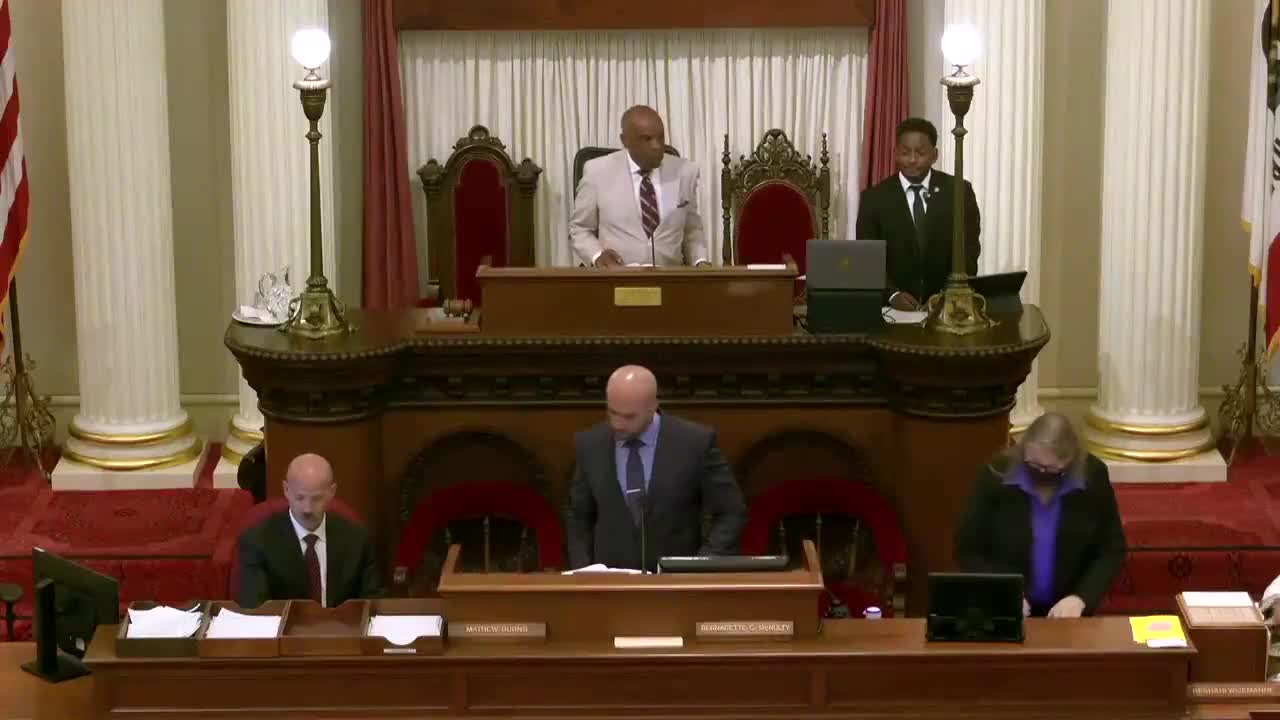 4MIN
Senate Floor
 2MIN
Senate Standing Committee on Appropriations
 43MIN