SB 81: Parole hearings.
- Session Year: 2023-2024
- House: Senate
- Latest Version Date: 2023-09-18
Current Status:
Failed
(2024-01-25: Veto sustained.)
Introduced
In Committee
First Chamber
In Committee
Second Chamber
Enacted
Existing law requires the Board of Parole Hearings, among other responsibilities, to conduct parole suitability hearings and determine whether an inmate is suitable for parole. Existing law allows an unlawfully imprisoned person to prosecute a writ of habeas corpus to inquire into the cause of the imprisonment.
This bill would require the Board of Parole Hearings to notify a parole candidate who has been denied parole of their right to petition the court for habeas relief, as specified. The bill would authorize the court to, upon request, appoint counsel to a parole candidate who has reached their minimum eligible parole date who petitions the court for habeas relief after being denied parole. The bill would establish that a parole candidate who has reached their minimum eligible parole date has made a case for relief that should be accepted as correct unless proved otherwise and that the reviewing court may not deny a petition based on that fact without a hearing. The bill would require a court reviewing a petition for habeas relief based on a parole denial to uphold a decision to deny parole only if the court finds, by a preponderance of the evidence, that the person presents a current, unreasonable risk of danger to others, as specified.
Existing law requires the Board of Parole Hearings, among other responsibilities, to conduct parole suitability hearings and determine whether an inmate is suitable for parole. Existing law allows an unlawfully imprisoned person to prosecute a writ of habeas corpus to inquire into the cause of the imprisonment.
This bill would require the Board of Parole Hearings to notify a parole candidate with an indeterminate sentence who has been denied parole of their right to petition the court for habeas relief. relief, as specified. The bill would authorize the court to, upon request, appoint counsel to a parole candidate who has reached their minimum eligible parole date who petitions the court for habeas relief after being denied parole. The bill would establish that a parole candidate who has reached their minimum eligible parole date has made a case for relief that should be accepted as correct unless proved otherwise and that the reviewing court may not deny a petition based on that fact without a hearing. The bill would require a court reviewing a petition for habeas relief based on a parole denial to uphold a decision to deny parole only if the court finds, by a preponderance of the evidence, that the person presents a current, unreasonable risk of danger to public safety, others, as specified.
Existing law requires the Board of Parole Hearings, among other responsibilities, to conduct parole suitability hearings and determine whether an inmate is suitable for parole. Existing law allows an unlawfully imprisoned person to prosecute a writ of habeas corpus to inquire into the cause of the imprisonment.
This bill would require the Board of Parole Hearings to notify a parole candidate with an indeterminate sentence who has been denied parole of their right to petition the court for habeas relief. The bill would require authorize the court to, upon request, appoint counsel to a parole candidate who has reached their minimum eligible parole date who petitions the court for habeas relief after being denied parole. The bill would establish that a parole candidate who has reached their minimum eligible parole date has made a case for relief that should be accepted as correct unless proved otherwise and that the reviewing court may not deny a petition based on that fact without a hearing. The bill would require a court reviewing a petition for habeas relief based on a parole denial to uphold a decision to deny parole only if the court finds, by a preponderance of the evidence, that the person presents a current, unreasonable risk of danger to public safety, as specified. The bill would require the Judicial Council to annually track and publish data on habeas petitions, including, but not limited to, the number of petitions filed, granted, and denied.
Existing law requires the Board of Parole Hearings, among other responsibilities, to conduct parole suitability hearings and determine whether an inmate is suitable for parole. Existing law establishes the procedures at all hearings for the purpose of reviewing a prisoners parole suitability, or the setting, postponing, or rescinding of parole dates, and provides inmates specified rights at parole suitability hearings.
This bill would prohibit the board from considering any discriminatory factor, as specified, in reaching a finding of unsuitability for parole. The bill would require the board, when stating the reasons for its decision to deny parole, to articulate the relationship between each reason for denial and the parole candidates current risk of violence.
Existing law allows an unlawfully imprisoned person to prosecute a writ of habeas corpus to inquire into the cause of the imprisonment.
This bill would require the Board of Parole Hearings to notify a parole candidate who has been denied parole of their right to petition the court for habeas relief. The bill would require the court to, upon request, appoint counsel to a parole candidate who has reached their minimum eligible parole date who petitions the court for habeas relief after being denied parole. The bill would establish that a parole candidate who has reached their minimum eligible parole date has made a case for relief that should be accepted as correct unless proved otherwise and that the reviewing court may not deny a petition based on that fact without a hearing. The bill would require a court reviewing a petition for habeas relief based on a parole denial to uphold a decision to deny parole only if the court finds, by a preponderance of the evidence, that the person presents a current, unreasonable risk of danger to public safety, as specified. The bill would require the Board of Parole Hearings to track and publish data on the outcomes of these court decisions. Judicial Council to annually track and publish data on habeas petitions, including, but not limited to, the number of petitions filed, granted, and denied.
Existing law requires the Board of Parole Hearings, among other responsibilities, to conduct parole suitability hearings and determine whether an inmate is suitable for parole. Existing law establishes the procedures at all hearings for the purpose of reviewing a prisoners parole suitability, or the setting, postponing, or rescinding of parole dates, and provides inmates specified rights at parole suitability hearings.
This bill would prohibit the board from considering any discriminatory factor, as specified, in reaching a finding of unsuitability for parole. The bill would require the board, when stating the reasons for its decision to deny parole, to articulate the relationship between each reason for denial and the parole candidates current risk of violence.
Existing law allows an unlawfully imprisoned person to prosecute a writ of habeas corpus to inquire into the cause of the imprisonment.
This bill would establish that a parole candidate who has reached their minimum eligible parole date, as specified, has a fundamental vested interest in being released on parole. The bill would require the Board of Parole Hearings to notify a parole candidate who has been denied parole of their right to petition the court for habeas relief. The bill would require the court to, upon request, appoint counsel to a parole candidate who has reached their minimum eligible parole date who petitions the court for habeas relief after being denied parole. The bill would establish that a parole candidate who has reached their minimum eligible parole date has made a case for relief that should be accepted as correct unless proved otherwise and that the reviewing court may not deny a petition based on that fact without a hearing. The bill would require a court reviewing a petition for habeas relief based on a parole denial to uphold the decision only if the court finds by clear and convincing evidence a decision to deny parole only if the court finds, by a preponderance of the evidence, that the person presents a current, unreasonable risk of danger to public safety, as specified. The bill would require the Board of Parole Hearings to track and publish data on the outcomes of these court decisions.
Existing law establishes the Department of Corrections and Rehabilitation and charges it with certain duties and powers, including, among other things, jurisdiction over state prisons.This bill would require the departments Office of Research to collect, publicly report each week, and annually collect and publish specified data relating to parole hearings on the departments internet website. The bill would allow a bona fide research institution concerned with the quality of the criminal justice system to access parole hearing-level data, as specified, and would prohibit the disclosure of personally identifying information from reports or publications of the data.Existing law requires the Board of Parole Hearings, among other responsibilities, to conduct parole suitability hearings and determine whether an inmate is suitable for parole. Existing law establishes the procedures for parole hearings and applicable review periods for the boards decisions. at all hearings for the purpose of reviewing a prisoners parole suitability, or the setting, postponing, or rescinding of parole dates, and provides inmates specified rights at parole suitability hearings.
This bill would prohibit the board from considering any discriminatory factor, as specified, in reaching a finding of unsuitability for parole. The bill would require the board, when stating the reasons for its decision to deny parole, to articulate the relationship between each reason for denial and the parole candidates current risk of violence.
Existing law allows an unlawfully imprisoned person to prosecute a writ of habeas corpus to inquire into the cause of the imprisonment.
This bill would establish that a parole candidate who has reached their minimum eligible parole date, as specified, has a fundamental vested interest in being released on parole. The bill would require the Board of Parole Hearings to notify a parole candidate who has been denied parole of their right to petition the court for habeas relief. The bill would require the court to, upon request, appoint counsel to a parole candidate who has reached their minimum eligible parole date who petitions the court for habeas relief after being denied parole. The bill would establish that a parole candidate who has reached their minimum eligible parole date has made a case for relief that should be accepted as correct unless proved otherwise and that the reviewing court may not deny a petition based on that fact without a hearing. The bill would require a court reviewing a petition for habeas relief based on a parole denial to uphold the decision only if the court finds by clear and convincing evidence that the person presents a current, unreasonable risk of danger to public safety, as specified. The bill would require the Board of Parole Hearings to track and publish data on the outcomes of these court decisions.
Existing law establishes the Department of Corrections and Rehabilitation and charges it with certain duties and powers, including, among other things, jurisdiction over state prisons.
This bill would require the departments Office of Research to collect, publicly report each week, and annually collect and publish specified data relating to parole hearings on the departments internet website. The bill would allow a bona fide research institution concerned with the quality of the criminal justice system to access parole hearing-level data, as specified, and would prohibit the disclosure of personally identifying information from reports or publications of the data.
This bill would state the intent of the Legislature to enact legislation to increase transparency, predictability, and accountability of parole suitability hearings.Existing law requires the Board of Parole Hearings, among other responsibilities, to conduct parole suitability hearings and determine whether an inmate is suitable for parole. Existing law establishes the procedures for parole hearings and applicable review periods for the boards decisions.
This bill would state the intent of the Legislature to enact legislation to increase transparency, predictability, and accountability of parole suitability hearings.
(a)Upon the denial of parole to a parole candidate, following a parole consideration hearing, the Board of Parole Hearings shall notify the parole candidate of their right, after completion of all applicable review periods, to petition a court for a writ of habeas corpus.
(b)The parole candidate may request that the court appoint counsel for the purpose of preparing the petition. The court may appoint counsel upon this request.
(c)A parole candidate who has been denied parole after reaching their minimum eligible parole date as described in Section 3041, their youth parole eligible date as defined in Section 3051, or their elderly parole eligible date as defined in Section 3055 has made a prima facie case for relief and the reviewing court may not summarily deny a petition for writ of habeas corpus filed pursuant to this section.
(d)The court shall uphold a decision to deny parole only if the court finds, by a preponderance of the evidence, that the person presents a current, unreasonable risk of danger to others. If the court finds the parole denial was not supported by a preponderance of the evidence, the court may issue an order for a new parole hearing, with or without limitations as to what evidence the Board of Parole Hearings may consider.
(a)Upon the denial of parole to a parole candidate with an indeterminate sentence, candidate, following a parole consideration hearing, the Board of Parole Hearings shall notify the parole candidate of their right to petition for habeas relief from a court. right, after completion of all applicable review periods, to petition a court for a writ of habeas corpus.
(b)A parole candidate may petition a court for relief after a denial of parole by petition for writ of habeas corpus. The parole candidate may request the assistance of counsel for this purpose.The court may appoint counsel upon request, whether the request is made upon the submission of a petition or upon a request for assistance to prepare the petition.(b)The parole candidate may request that the court appoint counsel for the purpose of preparing the petition. The court may appoint counsel upon this request.
(c)A parole candidate who has been denied parole after reaching their minimum eligible parole date as described in Section 3041, their youth parole eligible date as defined in Section 3051, or their elderly parole eligible date as defined in Section 3055 has made a prima facie case for relief and the reviewing court may not summarily deny a petition for writ of habeas corpus filed pursuant to this section.
(d)A court reviewing a decision to deny parole shall exercise its independent judgment on the decision. The court shall uphold a decision to deny parole only if the court finds, by a preponderance of the evidence, that the person presents a current, unreasonable risk of danger to public safety as defined in subdivision (c) of Section 1170.18. The court may make this determination based on the record that was before the Board of Parole Hearings at the time of the denial. The admission of evidence in the court hearing shall be governed by the Evidence Code. The court may order whatever relief as the case may require, including others. If the court finds the parole denial was not supported by a preponderance of the evidence, the court may issue an order for a new parole hearing, with or without limitations on as to what evidence the Board of Parole Hearings may consider.
(e)The court shall transmit its decision to the Board of Parole Hearings.(a)Upon denial of parole, the denial of parole to a parole candidate with an indeterminate sentence, the Board of Parole Hearings shall notify the parole candidate of their right to petition for habeas relief from a court. A parole candidate may have the petition heard in either the county of conviction or in the county in which the parole candidate is incarcerated.
(b)A parole candidate may petition a court for relief after a denial of parole by petition for writ of habeas corpus. The parole candidate may request the assistance of counsel for this purpose. The court shall may appoint counsel upon request, whether the request is made upon the submission of a petition or upon a request for assistance to prepare the petition.
(c)A parole candidate who has been denied parole after reaching their minimum eligible parole date as described in Section 3041, their youth parole eligible date as defined in Section 3051, or their elderly parole eligible date as defined in Section 3055 has made a prima facie case for relief and the reviewing court may not summarily deny a petition for writ of habeas corpus filed pursuant to this section.
(d)A court reviewing a decision to deny parole or to reverse the grant of parole shall exercise its independent judgment on the decision. The court shall uphold a decision to deny parole only if the court finds, by a preponderance of the evidence, that the person presents a current, unreasonable risk of danger to public safety as defined in subdivision (c) of Section 1170.18. The court may make this determination based on the record that was before the Board of Parole Hearings at the time of the denial. The admission of evidence in the court hearing shall be governed by the Evidence Code. The court may order whatever relief as the case may require, including an order for a new parole hearing, with or without limitations on what evidence the Board of Parole Hearings may consider.
(e)The court shall transmit its decision to the Board of Parole Hearings.
(f)The Judicial Council shall annually track and publish data on habeas petitions pursuant to this section, including, but not limited to:(1)The number of petitions filed.(2)The number of petitions granted.(3)The number of petitions denied.(a)(1)In the case of a parole candidate sentenced pursuant to any law, other than Chapter 4.5 (commencing with Section 1170) of Title 7 of Part 2, the Board of Parole Hearings shall meet with each parole candidate during the sixth year before the parole candidates minimum eligible parole date for the purposes of reviewing and documenting the parole candidates activities and conduct pertinent to parole eligibility. During this consultation, the board shall provide the parole candidate information about the parole hearing process, legal factors relevant to their suitability or unsuitability for parole, and individualized recommendations for the parole candidate regarding their work assignments, rehabilitative programs, and institutional behavior. Within 30 days following the consultation, the board shall issue its positive and negative findings and recommendations to the parole candidate in writing.
(2)One year before the parole candidates minimum eligible parole date a panel of two or more commissioners or deputy commissioners shall again meet with the parole candidate and shall normally grant parole as provided in Section 3041.5. No more than one member of the panel shall be a deputy commissioner.
(3)In the event of a tie vote, the matter shall be referred for an en banc review of the record that was before the panel that rendered the tie vote. Upon en banc review, the board shall vote to either grant or deny parole and render a statement of decision. The en banc review shall be conducted pursuant to subdivision (e).
(4)Upon a grant of parole, the parole candidate shall be released subject to all applicable review periods. However, an inmate shall not be released before reaching their minimum eligible parole date as set pursuant to Section 3046 unless the parole candidate is eligible for earlier release pursuant to their youth offender parole eligibility date or elderly parole eligible date.
(5)At least one commissioner of the panel shall have been present at the last preceding meeting, unless it is not feasible to do so or where the last preceding meeting was the initial meeting. A person on the hearing panel may request review of any decision regarding parole for an en banc hearing by the board. In case of a review, a majority vote in favor of parole by the board members participating in an en banc review is required to grant parole to any inmate.
(b)(1)The panel or the board, sitting en banc, shall grant parole to a parole candidate unless it determines that the gravity of the current convicted offense or offenses, or the timing and gravity of current or past convicted offense or offenses, is such that consideration of the public safety requires a more lengthy period of incarceration for this individual.
(2)The board shall not consider any discriminatory factor in reaching a finding of unsuitability for parole, including, but not limited to, any of the following:
(A)The persons race, ethnicity, national origin, sexual orientation, gender identity or expression, or cultural or religious affiliation.
(B)The persons physical or mental disability, or cognitive, speech, or physical impairment.
(C)The persons current or prior history of mental illness or a substance use disorder unless there is clear and convincing evidence that the illness or disorder cannot be effectively managed in the community.
(D)The persons housing status at the time of conviction, current or prior employment history, socioeconomic status, English language proficiency, immigration history or status, or education level.
(E)The persons relations or prior association with a group of persons who share the persons race, ethnicity, national origin, neighborhood, or religion, unless there is clear and convincing evidence that the association is ongoing and currently relevant to a specific future risk of violence.
(F)Other factors which have been documented to be subject to bias, including, but not limited to, a parole candidates prior experience as a victim of violence or abuse, verbal or nonverbal communication, tone of voice, volume of speech, facial expressions, body language, eye contact, or the candidates ability to articulate complex or abstract concepts.
(3)When stating reasons for its decision to deny parole, the board shall articulate the relationship between each reason for denial and the parole candidates current risk of violence.
(4)After July 30, 2001, a decision of the parole panel finding a parole candidate suitable for parole shall become final within 120 days of the date of the hearing. During that period, the board may review the panels decision. The panels decision shall become final pursuant to this subdivision unless the board finds that the panel made an error of law, or that the panels decision was based on an error of fact, or that new information should be presented to the board, any of which when corrected or considered by the board has a substantial likelihood of resulting in a substantially different decision upon a rehearing. In making this determination, the board shall consult with the commissioners who conducted the parole consideration hearing.
(5)A decision of a panel shall not be disapproved and referred for rehearing except by a majority vote of the board, sitting en banc, following a public meeting.
(c)For the purpose of reviewing the suitability for parole of those parole candidates eligible for parole under prior law at a date earlier than that calculated under Section 1170.2, the board shall appoint panels of at least two persons to meet annually with each parole candidate until the time the person is released pursuant to proceedings or reaches the expiration of their term as calculated under Section 1170.2.
(d)It is the intent of the Legislature that, during times when there is no backlog of parole candidates awaiting parole hearings, life parole consideration hearings, or life rescission hearings, hearings will be conducted by a panel of three or more members, the majority of whom shall be commissioners. The board shall report monthly on the number of cases where a parole candidate has not received a completed initial or subsequent parole consideration hearing within 30 days of the hearing date required by subdivision (a) of Section 3041.5 or paragraph (2) of subdivision (b) of Section 3041.5, unless the parole candidate has waived the right to those timeframes. That report shall be considered the backlog of cases for purposes of this section, and shall include information on the progress toward eliminating the backlog, and on the number of parole candidates who have waived their right to the above timeframes. The report shall be made public at a regularly scheduled meeting of the board and a written report shall be made available to the public and transmitted to the Legislature quarterly.
(e)For purposes of this section, an en banc review by the board means a review conducted by a majority of commissioners holding office on the date the matter is heard by the board. An en banc review shall be conducted in compliance with the following:
(1)The commissioners conducting the review shall consider the entire record of the hearing that resulted in the tie vote.
(2)The review shall be limited to the record of the hearing. The record shall consist of the transcript or audiotape of the hearing, written or electronically recorded statements actually considered by the panel that produced the tie vote, and any other material actually considered by the panel. New evidence or comments shall not be considered in the en banc proceeding.
(3)The board shall separately state reasons for its decision to grant or deny parole.
(4)A commissioner who was involved in the tie vote shall be recused from consideration of the matter in the en banc review.
SEC. 2.Section 3041.8 is added to the Penal Code, to read:3041.8.(a)Upon denial of parole, the Board of Parole Hearings shall notify the parole candidate of their right to petition for habeas relief from a court. A parole candidate may have the petition heard in either the county of conviction or in the county in which the parole candidate is incarcerated.
(b)A parole candidate may petition a court for relief after a denial of parole by petition for writ of habeas corpus. The parole candidate may request the assistance of counsel for this purpose. The court shall appoint counsel upon request, whether the request is made upon the submission of a petition or upon a request for assistance to prepare the petition.
(c)A parole candidate who has been denied parole after reaching their minimum eligible parole date as described in Section 3041, their youth parole eligible date as defined in Section 3051, or their elderly parole eligible date as defined in Section 3055 has made a prima facie case for relief and the reviewing court may not summarily deny a petition for writ of habeas corpus filed pursuant to this section.
(d)A court reviewing a decision to deny parole or to reverse the grant of parole shall exercise its independent judgment on the decision. The court shall uphold a decision to deny parole only if the court finds, by a preponderance of the evidence, that the person presents a current, unreasonable risk of danger to public safety as defined in subdivision (c) of Section 1170.18. The court may order whatever relief as the case may require, including an order for a new parole hearing, with or without limitations on what evidence the Board of Parole Hearings may consider.
(e)The court shall transmit its decision to the Board of Parole Hearings.
(f)The Board of Parole Hearings shall track and publish data on the outcomes of court decisions pursuant to subdivision (d), including, but not limited to:(1)The number of candidates seeking court relief.(2)The number of court affirmations.(3)The number of reversals.(4)The length of commitment for each parole candidate seeking relief.(f)The Judicial Council shall annually track and publish data on habeas petitions pursuant to this section, including, but not limited to:
(1)The number of petitions filed.
(2)The number of petitions granted.
(3)The number of petitions denied.
(a)(1)In the case of a parole candidate sentenced pursuant to any law, other than Chapter 4.5 (commencing with Section 1170) of Title 7 of Part 2, the Board of Parole Hearings shall meet with each parole candidate during the sixth year before the parole candidates minimum eligible parole date for the purposes of reviewing and documenting the parole candidates activities and conduct pertinent to parole eligibility. During this consultation, the board shall provide the parole candidate information about the parole hearing process, legal factors relevant to their suitability or unsuitability for parole, and individualized recommendations for the parole candidate regarding their work assignments, rehabilitative programs, and institutional behavior. Within 30 days following the consultation, the board shall issue its positive and negative findings and recommendations to the parole candidate in writing.
(2)One year before the parole candidates minimum eligible parole date a panel of two or more commissioners or deputy commissioners shall again meet with the parole candidate and shall normally grant parole as provided in Section 3041.5. No more than one member of the panel shall be a deputy commissioner.
(3)In the event of a tie vote, the matter shall be referred for an en banc review of the record that was before the panel that rendered the tie vote. Upon en banc review, the board shall vote to either grant or deny parole and render a statement of decision. The en banc review shall be conducted pursuant to subdivision (e).
(4)Upon a grant of parole, the parole candidate shall be released subject to all applicable review periods. However, an inmate shall not be released before reaching their minimum eligible parole date as set pursuant to Section 3046 unless the parole candidate is eligible for earlier release pursuant to their youth offender parole eligibility date or elderly parole eligible date.
(5)At least one commissioner of the panel shall have been present at the last preceding meeting, unless it is not feasible to do so or where the last preceding meeting was the initial meeting. A person on the hearing panel may request review of any decision regarding parole for an en banc hearing by the board. In case of a review, a majority vote in favor of parole by the board members participating in an en banc review is required to grant parole to any inmate.
(b)(1)The panel or the board, sitting en banc, shall grant parole to a parole candidate unless it determines that the gravity of the current convicted offense or offenses, or the timing and gravity of current or past convicted offense or offenses, is such that consideration of the public safety requires a more lengthy period of incarceration for this individual.
(2)The board shall not consider any discriminatory factor in reaching a finding of unsuitability for parole, including, but not limited to, any of the following:
(A)The persons race, ethnicity, national origin, sexual orientation, gender identity or expression, or cultural or religious affiliation.
(B)The persons physical or mental disability, or cognitive, speech, or physical impairment.
(C)The persons current or prior history of mental illness or a substance use disorder unless there is clear and convincing evidence that the illness or disorder cannot be effectively managed in the community.
(D)The persons housing status at the time of conviction, current or prior employment history, socioeconomic status, English language proficiency, immigration history or status, or education level.
(E)The persons relations or prior association with a group of persons who share the persons race, ethnicity, national origin, neighborhood, or religion, unless there is clear and convincing evidence that the association is ongoing and currently relevant to a specific future risk of violence.
(F)Other factors which have been documented to be subject to bias, including, but not limited to, a parole candidates prior experience as a victim of violence or abuse, verbal or nonverbal communication, tone of voice, volume of speech, facial expressions, body language, eye contact, or the candidates ability to articulate complex or abstract concepts.
(3)When stating reasons for its decision to deny parole, the board shall articulate the relationship between each reason for denial and the parole candidates current risk of violence.
(4)After July 30, 2001, a decision of the parole panel finding a parole candidate suitable for parole shall become final within 120 days of the date of the hearing. During that period, the board may review the panels decision. The panels decision shall become final pursuant to this subdivision unless the board finds that the panel made an error of law, or that the panels decision was based on an error of fact, or that new information should be presented to the board, any of which when corrected or considered by the board has a substantial likelihood of resulting in a substantially different decision upon a rehearing. In making this determination, the board shall consult with the commissioners who conducted the parole consideration hearing.
(5)A decision of a panel shall not be disapproved and referred for rehearing except by a majority vote of the board, sitting en banc, following a public meeting.
(c)For the purpose of reviewing the suitability for parole of those parole candidates eligible for parole under prior law at a date earlier than that calculated under Section 1170.2, the board shall appoint panels of at least two persons to meet annually with each parole candidate until the time the person is released pursuant to proceedings or reaches the expiration of their term as calculated under Section 1170.2.
(d)It is the intent of the Legislature that, during times when there is no backlog of parole candidates awaiting parole hearings, life parole consideration hearings, or life rescission hearings, hearings will be conducted by a panel of three or more members, the majority of whom shall be commissioners. The board shall report monthly on the number of cases where a parole candidate has not received a completed initial or subsequent parole consideration hearing within 30 days of the hearing date required by subdivision (a) of Section 3041.5 or paragraph (2) of subdivision (b) of Section 3041.5, unless the parole candidate has waived the right to those timeframes. That report shall be considered the backlog of cases for purposes of this section, and shall include information on the progress toward eliminating the backlog, and on the number of parole candidates who have waived their right to the above timeframes. The report shall be made public at a regularly scheduled meeting of the board and a written report shall be made available to the public and transmitted to the Legislature quarterly.
(e)For purposes of this section, an en banc review by the board means a review conducted by a majority of commissioners holding office on the date the matter is heard by the board. An en banc review shall be conducted in compliance with the following:
(1)The commissioners conducting the review shall consider the entire record of the hearing that resulted in the tie vote.
(2)The review shall be limited to the record of the hearing. The record shall consist of the transcript or audiotape of the hearing, written or electronically recorded statements actually considered by the panel that produced the tie vote, and any other material actually considered by the panel. New evidence or comments shall not be considered in the en banc proceeding.
(3)The board shall separately state reasons for its decision to grant or deny parole.
(4)A commissioner who was involved in the tie vote shall be recused from consideration of the matter in the en banc review.
SEC. 2.Section 3041.8 is added to the Penal Code, to read:3041.8.(a)Parole candidates have a fundamental vested interest in being released on parole upon reaching their minimum eligible parole date as described in Section 3041, their youth parole eligible date as defined in Section 3051, or their elderly parole eligible date as defined in Section 3055.(b)3041.8.(a)Upon denial of parole, the Board of Parole Hearings shall notify the parole candidate of their right to petition for habeas relief from a court. A parole candidate may have the petition heard in either the county of conviction or in the county in which the parole candidate is incarcerated.
(c)(b)A parole candidate may petition a court for relief after a denial of parole, either by petition for writ of habeas corpus or by submitting the appropriate form. parole by petition for writ of habeas corpus. The parole candidate may request the assistance of counsel for this purpose. The court shall appoint counsel upon request, whether the request is made upon the submission of a petition or upon a request for assistance to prepare the petition.
(d)(c)A parole candidate who has been denied parole after reaching their minimum eligible parole date as described in Section 3041, their youth parole eligible date as defined in Section 3051, or their elderly parole eligible date as defined in Section 3055 has made a prima facie case for relief and the reviewing court may not summarily deny any such petition. a petition for writ of habeas corpus filed pursuant to this section.
(e)(d)A court reviewing a decision to deny parole or to reverse the grant of parole shall exercise its independent judgment on the decision. The court shall uphold the decision only if the court finds, based on clear and convincing evidence, a decision to deny parole only if the court finds, by a preponderance of the evidence, that the person presents a current, unreasonable risk of danger to public safety as defined in subdivision (c) of Section 1170.18. The court may order whatever relief as the case may require, including an order for a new parole hearing, with or without limitations on what evidence the Board of Parole Hearings may consider.
(f)(e)The court shall transmit its decision to the Board of Parole Hearings.
(g)(f)The Board of Parole Hearings shall track and publish data on the outcomes of court decisions pursuant to subdivision (e), (d), including, but not limited to:
(1)The number of candidates seeking court relief.
(2)The number of court affirmations.
(3)The number of reversals.
(4)The length of commitment for each parole candidate seeking relief.
All matter omitted in this version of the bill appears in the bill as amended in the Senate, March 22, 2023. (JR11)(a)(1)In the case of any inmate a parole candidate sentenced pursuant to any law, other than Chapter 4.5 (commencing with Section 1170) of Title 7 of Part 2, the Board of Parole Hearings shall meet with each inmate parole candidate during the sixth year before the inmates parole candidates minimum eligible parole date for the purposes of reviewing and documenting the inmates parole candidates activities and conduct pertinent to parole eligibility. During this consultation, the board shall provide the inmate parole candidate information about the parole hearing process, legal factors relevant to his or her their suitability or unsuitability for parole, and individualized recommendations for the inmate parole candidate regarding his or her their work assignments, rehabilitative programs, and institutional behavior. Within 30 days following the consultation, the board shall issue its positive and negative findings and recommendations to the inmate parole candidate in writing.
(2)One year before the inmates parole candidates minimum eligible parole date a panel of two or more commissioners or deputy commissioners shall again meet with the inmate parole candidate and shall normally grant parole as provided in Section 3041.5. No more than one member of the panel shall be a deputy commissioner.
(3)In the event of a tie vote, the matter shall be referred for an en banc review of the record that was before the panel that rendered the tie vote. Upon en banc review, the board shall vote to either grant or deny parole and render a statement of decision. The en banc review shall be conducted pursuant to subdivision (e).
(4)Upon a grant of parole, the inmate parole candidate shall be released subject to all applicable review periods. However, an inmate shall not be released before reaching his or her their minimum eligible parole date as set pursuant to Section 3046 unless the inmate parole candidate is eligible for earlier release pursuant to his or her their youth offender parole eligibility date or elderly parole eligible date.
(5)At least one commissioner of the panel shall have been present at the last preceding meeting, unless it is not feasible to do so or where the last preceding meeting was the initial meeting. Any A person on the hearing panel may request review of any decision regarding parole for an en banc hearing by the board. In case of a review, a majority vote in favor of parole by the board members participating in an en banc review is required to grant parole to any inmate.
(b)(1)The panel or the board, sitting en banc, shall grant parole to an inmate a parole candidate unless it determines that the gravity of the current convicted offense or offenses, or the timing and gravity of current or past convicted offense or offenses, is such that consideration of the public safety requires a more lengthy period of incarceration for this individual.
(2)The board shall not consider any discriminatory factor in reaching a finding of unsuitability for parole, including, but not limited to, any of the following:
(A)The persons race, ethnicity, national origin, sexual orientation, gender identity or expression, or cultural or religious affiliation.
(B)The persons physical or mental disability, or cognitive, speech, or physical impairment.
(C)The persons current or prior history of mental illness or a substance use disorder unless there is clear and convincing evidence that the illness or disorder cannot be effectively managed in the community.
(D)The persons housing status at the time of conviction, current or prior employment history, socioeconomic status, English language proficiency, immigration history or status, or education level.
(E)The persons relations or prior association with a group of persons who share the persons race, ethnicity, national origin, neighborhood, or religion, unless there is clear and convincing evidence that the association is ongoing and currently relevant to a specific future risk of violence.
(F)Other factors which have been documented to be subject to bias, including, but not limited to, a parole candidates prior experience as a victim of violence or abuse, verbal or nonverbal communication, tone of voice, volume of speech, facial expressions, body language, eye contact, or the candidates ability to articulate complex or abstract concepts.
(3)When stating reasons for its decision to deny parole, the board shall articulate the relationship between each reason for denial and the parole candidates current risk of violence.
(2)(4)After July 30, 2001, any a decision of the parole panel finding an inmate a parole candidate suitable for parole shall become final within 120 days of the date of the hearing. During that period, the board may review the panels decision. The panels decision shall become final pursuant to this subdivision unless the board finds that the panel made an error of law, or that the panels decision was based on an error of fact, or that new information should be presented to the board, any of which when corrected or considered by the board has a substantial likelihood of resulting in a substantially different decision upon a rehearing. In making this determination, the board shall consult with the commissioners who conducted the parole consideration hearing.
(3)(5)A decision of a panel shall not be disapproved and referred for rehearing except by a majority vote of the board, sitting en banc, following a public meeting.
(c)For the purpose of reviewing the suitability for parole of those inmates parole candidates eligible for parole under prior law at a date earlier than that calculated under Section 1170.2, the board shall appoint panels of at least two persons to meet annually with each inmate parole candidate until the time the person is released pursuant to proceedings or reaches the expiration of his or her their term as calculated under Section 1170.2.
(d)It is the intent of the Legislature that, during times when there is no backlog of inmates parole candidates awaiting parole hearings, life parole consideration hearings, or life rescission hearings, hearings will be conducted by a panel of three or more members, the majority of whom shall be commissioners. The board shall report monthly on the number of cases where an inmate a parole candidate has not received a completed initial or subsequent parole consideration hearing within 30 days of the hearing date required by subdivision (a) of Section 3041.5 or paragraph (2) of subdivision (b) of Section 3041.5, unless the inmate parole candidate has waived the right to those timeframes. That report shall be considered the backlog of cases for purposes of this section, and shall include information on the progress toward eliminating the backlog, and on the number of inmates parole candidates who have waived their right to the above timeframes. The report shall be made public at a regularly scheduled meeting of the board and a written report shall be made available to the public and transmitted to the Legislature quarterly.
(e)For purposes of this section, an en banc review by the board means a review conducted by a majority of commissioners holding office on the date the matter is heard by the board. An en banc review shall be conducted in compliance with the following:
(1)The commissioners conducting the review shall consider the entire record of the hearing that resulted in the tie vote.
(2)The review shall be limited to the record of the hearing. The record shall consist of the transcript or audiotape of the hearing, written or electronically recorded statements actually considered by the panel that produced the tie vote, and any other material actually considered by the panel. New evidence or comments shall not be considered in the en banc proceeding.
(3)The board shall separately state reasons for its decision to grant or deny parole.
(4)A commissioner who was involved in the tie vote shall be recused from consideration of the matter in the en banc review.
SEC. 2.Section 3041.8 is added to the Penal Code, to read:3041.8.(a)Parole candidates have a fundamental vested interest in being released on parole upon reaching their minimum eligible parole date as described in Section 3041, their youth parole eligible date as defined in Section 3051, or their elderly parole eligible date as defined in Section 3055.
(b)Upon denial of parole, the Board of Parole Hearings shall notify the parole candidate of their right to petition for habeas relief from a court. A parole candidate may have the petition heard in either the county of conviction or in the county in which the parole candidate is incarcerated.
(c)A parole candidate may petition a court for relief after a denial of parole, either by petition for writ of habeas corpus or by submitting the appropriate form. The parole candidate may request the assistance of counsel for this purpose. The court shall appoint counsel upon request, whether the request is made upon the submission of a petition or upon a request for assistance to prepare the petition.
(d)A parole candidate who has been denied parole after reaching their minimum eligible parole date as described in Section 3041, their youth parole eligible date as defined in Section 3051, or their elderly parole eligible date as defined in Section 3055 has made a prima facie case for relief and the reviewing court may not summarily deny any such petition.
(e)A court reviewing a decision to deny parole or to reverse the grant of parole shall exercise its independent judgment on the decision. The court shall uphold the decision only if the court finds, based on clear and convincing evidence, that the person presents a current, unreasonable risk of danger to public safety as defined in subdivision (c) of Section 1170.18.
(f)The court shall transmit its decision to the Board of Parole Hearings.
(g)The Board of Parole Hearings shall track and publish data on the outcomes of court decisions pursuant to subdivision (e), including, but not limited to:
(1)The number of candidates seeking court relief.
(2)The number of court affirmations.
(3)The number of reversals.
(4)The length of commitment for each parole candidate seeking relief.
SEC. 3.Section 3073.2 is added to the Penal Code, to read:3073.2.(a)For purposes of this section, the following terms have the following meanings:
(1)Aggregate data elements means collecting data elements in such a way that the data elements can support metrics.
(2)Collect data means facilitating cooperation between, and providing assistance to, participating divisions within the office to ensure the transmission and collection of data according to the timeframes and standards described in this section, and developing consistent and clear guidelines for how those divisions are used to define data elements.
(3)Data elements means the information described in subdivisions (b) and (c).
(4)Develop metrics means using industry-appropriate methods and technology and cooperation with participating agencies to create accurate, actionable, and digestible metrics using the collected data elements.
(5)Metrics means the combination of data elements used to track outcomes on any given process or decision point.
(6)Publicly report means using appropriate technology, methods, and interface design to make metrics available to the public, which may include the use of web publishing, the use of interactive portals or other applications to not only display metrics, but to allow metrics to be compared and filtered so that each metric may be analyzed and dissected by multiple factors.
(7)Transmit data elements means using the method designated by the office for participating divisions to provide collected data elements to the office.
(b)(1)The Department of Corrections and Rehabilitation Office of Research shall serve as the data aggregator and repository unit for the data described in this section. The office shall ensure the uniformity and accuracy of the data, use technological resources necessary to collect the hearing-level data described in this section in standard formats and aggregate that data using appropriate means developed by the office, and publish the data in a format that will allow users to easily navigate and access the data they require, for example, on an internet website.
(2)The office shall do all of the following to meet the requirements in paragraph (1):
(A)Collect the data described in subdivisions (c) and (d) within the timeframes described in this section.
(B)Develop consistent definitions and formats for data elements to ensure the successful development of the metrics created using the data elements in this section.
(C)Publicly report data using a modern, open, and electronic format, such as comma-separated values or a similar file format that will allow the user to download the data sets and conduct their own analyses.
(D)Ensure that the public interface for metrics makes raw, case-level data available for download so that independent analyses can be conducted using the data.
(E)Ensure that personal identifying information is not published except as allowed by law. The use of anonymized data may be used for this purpose.
(F)Use standardized practices in developing internet web pages, including the use of open web standards and standard best practices such as those recommendations published by the World Wide Web Consortium (W3C) or those published by the International Organization for Standardization (ISO).
(G)Employ appropriate security measures and best practices for data elements transmitted and stored to account for personal identifying information and other sensitive information as governed by state and federal law. These processes shall include the remote backing-up of all data, including data elements and metrics, as well as the logging and detection of data-related events.
(H)Use technology that is scalable so as to accommodate large increases in the volume of data.
(I)Hire and maintain personnel familiar with web user-interface coding and web service coding.
(J)Except as provided in subparagraphs (L) and (M), make all data available, including raw data elements and metrics, in a machine-readable format with open format, nonproprietary file formats that will permit the download of complete data sets.
(K)Except as provided in subparagraphs (L) and (M), make all data, including data elements and metrics, available in a format that will allow users to easily navigate and access the data they require using modern web application programming interfaces that allow access to data directly through programs in addition to internet website publishing.
(L)Assess and create processes to collect, aggregate, and validate data elements transmitted by an agency, to include methods to identify duplicate, overlapping, or missing data and processes for the rejection and retransmission of invalid data.
(M)Test data quality to facilitate the dissemination of accurate, valid, reliable, and complete criminal justice data.
(N)Develop methods for editing and archiving data and retrieving archived data.
(c)The office shall, on a weekly basis, publicly report all of the following data elements pertaining to each parole hearing on the departments internet website:
(1)The name of the parole candidate.
(2)The parole candidates Department of Corrections and Rehabilitation identification number.
(3)Whether the hearing was conducted in person or virtually.
(4)The hearing date.
(5)Whether the hearing was an initial or subsequent hearing.
(6)The county in which the parole candidate was convicted.
(7)The outcome of the hearing.
(d)The office shall, on an annual basis, collect the information contained in the data elements described in subdivision (c) and the following parole hearing-level data elements:
(1)The name of the institution in which the parole candidate was incarcerated.
(2)The outcome of the hearing.
(3)The number of prior parole hearings, if any.
(4)Whether the hearing was scheduled pursuant to any of the following:
(A)The administrative review process.
(B)The petition to advance process.
(C)A reversal by the Governor.
(D)An en banc review resulting in rescission.
(E)A court order.
(5)The following parole board commissioners who participated in the hearing, identified by an anonymized numerical or alphanumeric code:
(A)The presiding commissioner.
(B)The deputy commissioner or commissioners.
(6)The race of the parole candidate.
(7)The date of birth of the parole candidate.
(8)The length of time the parole candidate spent in the departments custody at the time of the hearing.
(9)The parole candidates age at the time of the relevant offense.
(10)The self-described gender identity of the parole candidate.
(11)Any special considerations including, but not limited to, all of the following:
(A)Whether the parole candidate was being considered for elderly parole.
(B)Whether the parole candidate was being considered for youth offender parole.
(C)Whether the parole candidate was being considered for medical parole.
(D)Whether the board considered the effects of intimate partner battering pursuant to Section 4801.
(12)The parole candidates most recent comprehensive risk assessment rating.
(13)The parole candidates most recent comprehensive static risk assessment score.
(14)The parole candidates security level at the time of hearing.
(15)The highest level of education attained by the parole candidate.
(16)The parole candidates Test of Adult Basic Education score.
(17)All of the following regarding rules violation reports for the parole candidate:
(A)The time that has elapsed since the most recent rules violation report.
(B)The time that has elapsed since the most recent serious rules violation report.
(C)The time that has elapsed since the most recent nonserious rules violation report.
(D)The total number of rules violation reports.
(E)The total number of serious rules violation reports.
(F)The total number of nonserious rules violation reports.
(18)Whether a language interpreter was used in the parole hearing.
(19)Whether the parole candidate had a private or appointed attorney.
(20)All of the following information regarding the controlling offense:
(A)The controlling offense group.
(B)Whether the offense was for murder.
(C)Whether the offense was a sex offense requiring registration pursuant to Section 290.
(D)Whether the conviction was a second strike pursuant to Section 667 or 1170.12.
(E)Whether the conviction was a third strike pursuant to Section 667 or 1170.12.
(F)Whether the victim was a peace officer as defined in Section 830.
(21)Whether the district attorney attended the parole hearing.
(22)The number of registered victims or next of kin that attended the parole hearing.
(23)Whether the parole candidate is a veteran.
(24)If the parole candidate participates in the disability placement program or the developmental disability program, their classification in the program.
(25)The parole candidates mental health classification at the time of the hearing.
(26)The parole candidates highest level of mental health classification during their incarceration.
(27)Whether a confidential recording was created during the parole hearing.
(28)All of the following regarding outcomes after the parole hearing:
(A)Whether the Governor reversed the parole decision.
(B)If the hearing resulted in an en banc review, all of the following:
(i)Whether the hearing was referred to an en banc review by the Governor or by the board.
(ii)The outcome of the en banc review.
(C)If the parole candidate was released, whether the parole candidate was returned to custody after release and the reason for the parole candidate being returned to custody.
(29)If applicable, all of the following regarding the administrative review process for the current and any prior parole hearing:
(A)Whether the case was screened for possible administrative review.
(B)Whether the case received a review on the merits.
(C)Whether the case was approved for an advanced hearing date.
(D)If the case was denied an advanced hearing date, the reason for denial.
(30)If applicable, all of the following regarding the petition to advance process for the current and any prior parole hearing:
(A)Whether a petition to advance was submitted and preliminarily reviewed.
(B)Whether the petition to advance was reviewed on the merits.
(C)Whether the petition to advance was approved for an advanced hearing.
(D)If the petition to advance was denied an advanced hearing date, the reason for denial.
(e)(1)The office shall, on an annual basis, publish on the departments internet website the information contained in the parole hearing-level data elements described in subdivisions (c) and (d).
(2)The following information shall not be published:
(A)The name of the parole candidate.
(B)The parole candidates Department of Corrections and Rehabilitation identification number.
(C)The parole candidates anonymized identifier.
(D)The date of birth of the parole candidate.
(E)The parole candidates hearing date.
(F)Any other personally identifying information or information that could reasonably lead to reidentification of an individual charged with a crime or an individual who is the victim of a crime.
(3)(A)This publication shall be made using a modern, open, and electronic format, such as comma-separated values or similar file format that will allow the user to download the data sets and conduct their own analyses. The public interface for metrics shall also make raw, hearing-level data available for download so that independent analyses can be conducted using the data.
(B)The office shall ensure that personal identifying information is not published except as allowed by law. The use of anonymized data may be used for this purpose.
(f)Notwithstanding paragraph (2) of subdivision (e), subdivision (g) of Section 11105, and subdivision (a) of Section 13305, a bona fide research institution concerned with the quality of the criminal justice system may be provided with raw, individual, hearing-level data including, but not limited to, the information contained in the data elements described in paragraph (2) of subdivision (e), as required for the performance of its duties, including the conduct of research. Information that identifies individuals shall only be provided for research and statistical activities and shall not be transferred, revealed, or used for purposes other than research or statistical activities. Reports or publications derived from this information shall not identify specific individuals.
SECTION 1.It is the intent of the Legislature to enact legislation to increase transparency, predictability, and accountability of parole suitability hearings.It is the intent of the Legislature to enact legislation to increase transparency, predictability, and accountability of parole suitability hearings.
|
Date
|
Status
|
|---|---|
| Jan 25, 2024 | Veto sustained. |
| Jan 25, 2024 | Stricken from file. |
| Oct 8, 2023 | In Senate. Consideration of Governor's veto pending. |
| Oct 8, 2023 | Vetoed by the Governor. |
| Sep 21, 2023 | Enrolled and presented to the Governor at 4 p.m. |
| Sep 14, 2023 | Assembly amendments concurred in. (Ayes 29. Noes 9. Page 2801.) Ordered to engrossing and enrolling. |
| Sep 13, 2023 | In Senate. Concurrence in Assembly amendments pending. |
| Sep 13, 2023 | Read third time. Passed. (Ayes 50. Noes 18. Page 3395.) Ordered to the Senate. |
| Sep 7, 2023 | Ordered to third reading. |
| Sep 7, 2023 | Read third time and amended. (Ayes 55. Noes 18. Page 3061.) |
| Sep 7, 2023 | Assembly Rule 69 suspended. (Ayes 62. Noes 15. Page 3010.) |
| Sep 5, 2023 | Read second time. Ordered to third reading. |
| Sep 1, 2023 | Read second time and amended. Ordered to second reading. |
| Sep 1, 2023 | From committee: Do pass as amended. (Ayes 11. Noes 4.) (September 1). |
| Aug 16, 2023 | August 16 set for first hearing. Placed on suspense file. |
| Jun 28, 2023 | From committee: Do pass and re-refer to Com. on APPR. (Ayes 6. Noes 2.) (June 27). Re-referred to Com. on APPR. |
| Jun 21, 2023 | From committee with author's amendments. Read second time and amended. Re-referred to Com. on PUB. S. |
| Jun 8, 2023 | Referred to Com. on PUB. S. |
| Jun 1, 2023 | In Assembly. Read first time. Held at Desk. |
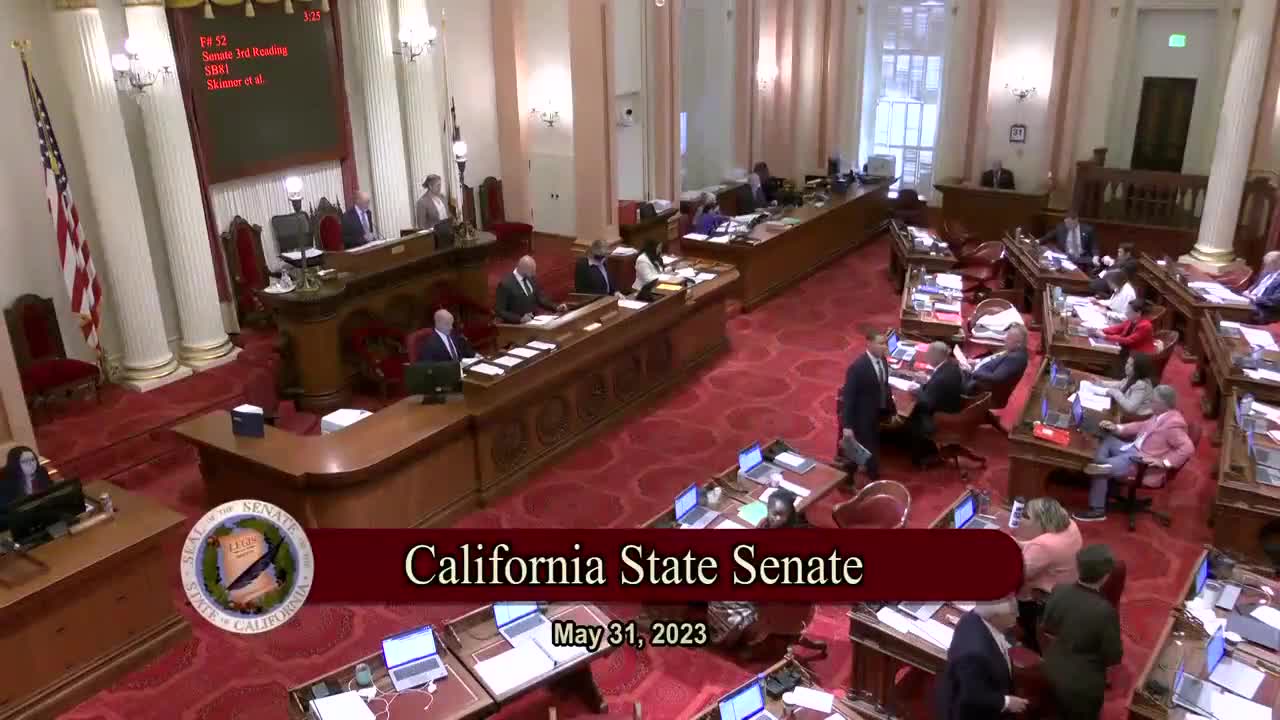
| May 31, 2023 | Read third time. Passed. (Ayes 29. Noes 10. Page 1400.) Ordered to the Assembly. |
| May 23, 2023 | Read second time and amended. Ordered to third reading. |
| May 22, 2023 | From committee: Do pass as amended. (Ayes 5. Noes 2. Page 1160.) (May 18). |
| May 12, 2023 | Set for hearing May 18. |
| May 8, 2023 | May 8 hearing: Placed on APPR suspense file. |
| May 1, 2023 | Set for hearing May 8. |
| Apr 26, 2023 | From committee: Do pass and re-refer to Com. on APPR. (Ayes 4. Noes 1. Page 900.) (April 25). Re-referred to Com. on APPR. |
| Apr 3, 2023 | Set for hearing April 25. |
| Mar 29, 2023 | Re-referred to Com. on PUB S. |
| Mar 22, 2023 | From committee with author's amendments. Read second time and amended. Re-referred to Com. on RLS. |
| Jan 25, 2023 | Referred to Com. on RLS. |
| Jan 13, 2023 | From printer. May be acted upon on or after February 12. |
| Jan 12, 2023 | Introduced. Read first time. To Com. on RLS. for assignment. To print. |
|
Date
|
Description
|
Location
|
Votes
|
|
|---|---|---|---|---|
| Sep 14, 2023 | Unfinished Business SB81 Skinner et al. Concurrence | Senate Floor |
Passed |
|
| Sep 13, 2023 | SB 81 Skinner Senate Third Reading By Wicks | Assembly Floor |
Passed |
|
| Sep 7, 2023 | SB 81 Skinner Senate Third Reading By Wicks Amendment Set #1 | Assembly Floor |
Passed |
|
| Sep 1, 2023 | Do pass as amended. | Assembly Standing Committee on Appropriations |
Passed |
|
| Jun 27, 2023 | Do pass and be re-referred to the Committee on [Appropriations] | Assembly Standing Committee on Public Safety |
Passed |
|
| May 31, 2023 | Senate 3rd Reading SB81 Skinner et al. | Senate Floor |
Passed |
|
| May 18, 2023 | Do pass as amended | Senate Standing Committee on Appropriations |
Passed |
|
| May 8, 2023 | Placed on suspense file | Senate Standing Committee on Appropriations |
Passed |
|
| Apr 25, 2023 | Do pass, but first be re-referred to the Committee on [Appropriations] | Senate Standing Committee on Public Safety |
Passed |
This list shows positions taken on this bill by organizations on the date displayed, which is linked to the original source.
Positions by individuals are not included.
|
Organization
|
Position
|
Date
|
|---|---|---|
| Aclu California Action | ** Support | |
| Alliance for Boys and Men of Color | ** Support | |
| American Friends Service Committee | ** Support | |
| Attorney General Rob Bonta | ** Support | |
| California Alliance for Youth and Community Justice | ** Support | |
| California Attorneys For Criminal Justice | ** Support | |
| California Coalition for Women Prisoners | ** Support | |
| California District Attorneys Association | ** Against | |
| California Families Against Solitary Confinement | ** Support | |
| California for Safety and Justice | ** Support | |
| California Innocence Coalition: Northern California Innocence Project, California Innocence Project, Loyola Project for The Innocent | ** Support | |
| Californians United for a Responsible Budget | ** Support | |
| California Public Defenders Association | ** Support | |
| Center on Juvenile and Criminal Justice | ** Support | |
| Communities United for Restorative Youth Justice | ** Support | |
| Cure California | ** Support | |
| Ella Baker Center For Human Rights | ** Support | |
| Felony Murder Elimination Project | ** Support | |
| Friends Committee On Legislation Of California | ** Support | |
| Initiate Justice | ** Support | |
| Initiate Justice Action | ** Support | |
| Legal Services for Prisoners with Children | ** Support | |
| milpa | ** Support | |
| Monterey County District Attorney's Office | ** Against | |
| Monterey County District Attorney's Office - ODA - Salinas, CA | ** Against | |
| Riverside County District Attorney | ** Against | |
| Root & Rebound | ** Support | |
| Safe Return Project | ** Support | |
| San Diegans Against Crime | ** Against | |
| San Diego Deputy District Attorneys Association | ** Against | |
| San Francisco Public Defender | ** Support | |
| Showing Up For Racial Justice, Bay Area | ** Support | |
| Sister Warriors Freedom Coalition | ** Support | |
| Smart Justice California | ** Support | |
| Survived & Punished | ** Support | |
| Uncommon Law | ** Support | |
| W. Haywood Burns Institute | ** Support | |
| Yolo County District Attorney | ** Against | |
| Young Women’s Freedom Center | ** Support | |
| Youth Leadership Institute | ** Support |
SENATE RULES COMMITTEE Office of Senate Floor Analyses (916) 651-1520 Fax: (916) 327-4478 | SB 81 |
VETO
Bill No: SB 81
Author: Skinner (D) and Becker (D), et al.
Amended: 9/7/23
Vote: 27
SENATE PUBLIC SAFETY COMMITTEE: 4-1, 4/25/23
AYES: Wahab, Bradford, Skinner, Wiener
NOES: Ochoa Bogh
SENATE APPROPRIATIONS COMMITTEE: 5-2, 5/18/23
AYES: Portantino, Ashby, Bradford, Wahab, Wiener
NOES: Jones, Seyarto
SENATE FLOOR: 29-10, 5/31/23
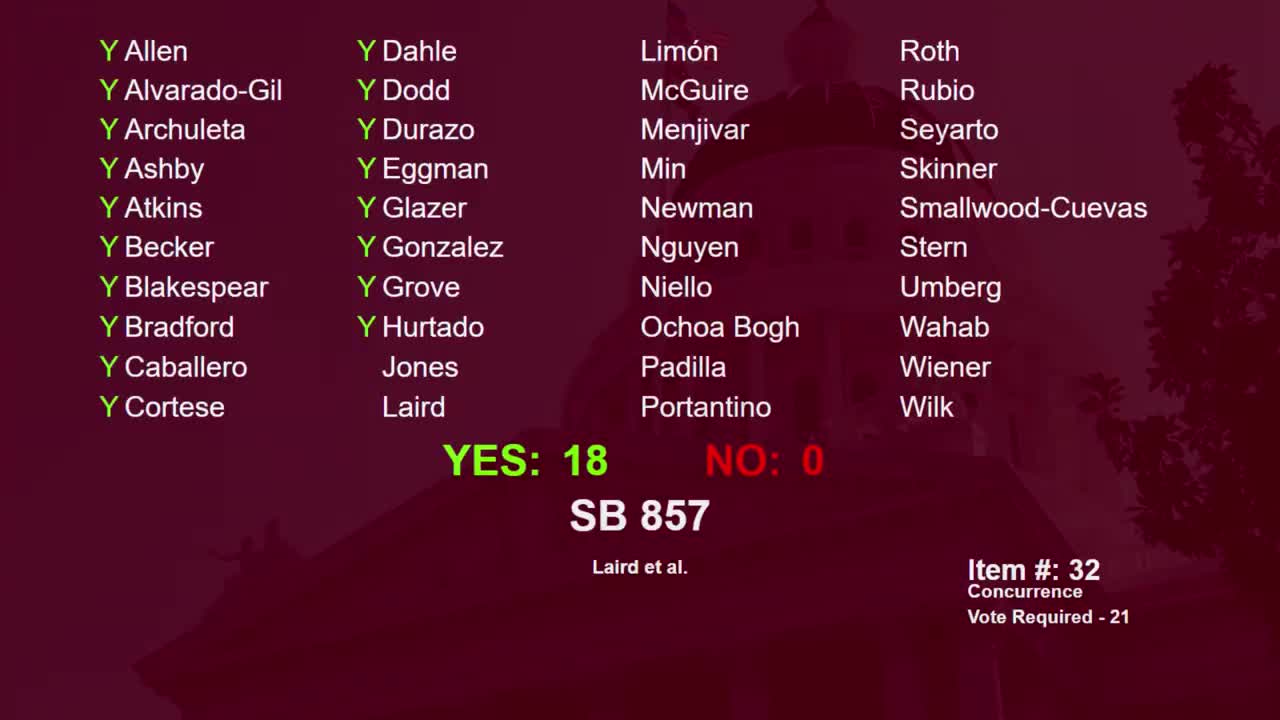
AYES: Allen, Archuleta, Ashby, Atkins, Becker, Blakespear, Bradford, Caballero, Cortese, Dodd, Durazo, Eggman, Glazer, Gonzalez, Laird, Limón, McGuire, Menjivar, Min, Newman, Padilla, Portantino, Rubio, Skinner, Smallwood-Cuevas, Stern, Umberg, Wahab, Wiener
NOES: Alvarado-Gil, Dahle, Grove, Hurtado, Jones, Nguyen, Niello, Ochoa Bogh, Seyarto, Wilk
NO VOTE RECORDED: Roth
SENATE FLOOR: 29-9, 9/14/23
AYES: Allen, Archuleta, Ashby, Atkins, Becker, Blakespear, Bradford, Caballero, Cortese, Dodd, Durazo, Eggman, Glazer, Gonzalez, Laird, Limón, McGuire, Menjivar, Min, Newman, Padilla, Portantino, Rubio, Skinner, Smallwood-Cuevas, Stern, Umberg, Wahab, Wiener
NOES: Alvarado-Gil, Dahle, Grove, Jones, Nguyen, Niello, Ochoa Bogh, Seyarto, Wilk
NO VOTE RECORDED: Hurtado, Roth
ASSEMBLY FLOOR: 50-18, 9/13/23 - See last page for vote
SUBJECT: Parole hearings
SOURCE: Author
DIGEST:
This bill requires the Board of Parole Hearings (BPH) to notify a parole candidate of their right to appeal a parole denial; authorizes BPH to appoint counsel to assist the parole candidate with filing a habeas petition challenging a parole denial upon the parole candidate’s request; establishes that a parole candidate who has been denied parole after reaching their minimum eligible parole date, youth parole eligible date, or elderly parole eligible date has made a prima facie case for habeas relief; and changes the court’s standard of review for parole denials from “some evidence” to “preponderance of the evidence.”
ANALYSIS:
Existing law:
- Provides that the panel or the board, sitting en banc, shall grant parole to an incarcerated individual unless it determines that the gravity of the current convicted offense or offenses, or the timing and gravity of current or past convicted offense or offenses, is such that consideration of the public safety requires a more lengthy period of incarceration for this individual. (Pen. Code, § 3041, subd. (b)(1).)
- Requires BPH, within 20 days following any decision denying parole, to send the incarcerated individual a written statement setting forth the reason or reasons for denying parole, and suggests activities in which he or she might participate that will benefit him or her while he or she is incarcerated. (Pen. Code, § 3041.5, subd. (b)(2).)
- Establishes the youth offender parole hearing process for eligible individuals who were convicted of a controlling offense that was committed when the person was 25 years of age or younger and after serving a minimum amount of time, as specified. Defines “youth parole eligible date” as the earliest date upon which a youth offender is eligible for release on parole at a youth offender parole hearing. (Pen. Code, § 3051, subds. (a) & (b).)
- Requires BPH, when considering the release of an individual via the youth offender parole process, to give great weight to the diminished culpability of youth as compared to adults, the hallmark features of youth, and any subsequent growth and increased maturity of the individual in accordance with relevant case law. (Pen. Code, § 4801, subd. (c).)
- Establishes the Elderly Parole Program to be administered by BPH for purposes of reviewing the parole suitability of any incarcerated person who is 50 years of age or older and has served a minimum of 20 years of continuous incarceration on the individual’s current sentence, serving either a determinate or indeterminate sentence. Defines “elderly parole eligible date” as the date on which an incarcerated individual who qualifies as an elderly offender is eligible for release from prison. (Pen. Code, § 3055, subds. (a) & (b).)
- Requires BPH, when considering the release of an individual via the Elderly Parole Program, to give special consideration to whether age, time served, and diminished physical condition, if any, have reduced the elderly inmate’s risk for future violence. (Pen. Code, § 3055, subd. (c).)
- Defines “unreasonable risk of danger to public safety” to mean an unreasonable risk that the individual will commit a new violent felony, as defined. (Pen. Code, § 1170.18, subd. (c).)
This bill:
- Requires BPH to notify the parole candidate of their right to petition a court for habeas relief upon denial of parole.
- Provides that the parole candidate may request the assistance of counsel for the purpose of petitioning a court for habeas relief. Authorizes the court to appoint counsel upon the request of the parole candidate.
- Provides that a parole candidate who has been denied parole after reaching their minimum eligible parole date, their youth parole eligible date, or their elderly parole eligible date has made a prima facie case for relief and provides that the reviewing court may not summarily deny a petition for writ of habeas corpus filed pursuant to the provisions of this bill.
- Requires a court reviewing a decision to deny parole to uphold the decision to deny parole only if the court finds, by a preponderance of the evidence, that the person presents a current, unreasonable risk of danger to others. Authorizes the court, if it finds the parole denial was not supported by a preponderance of the evidence, to order a new parole hearing, with or without limitations on what evidence BPH may consider.
Background
Parole Suitability
Incarcerated individuals who are indeterminately sentenced must be granted parole by the BPH in order to be released from prison. The Penal Code provides that the parole board “shall grant parole to an inmate unless it determines that the gravity of the current convicted offense or offenses, or the timing and gravity of current or past convicted offense or offenses, is such that consideration of the public safety requires a more lengthy period of incarceration for this individual.” (Pen. Code, § 3041, subd. (b).) The fundamental consideration when making a determination about an individual’s suitability for parole is whether the individual currently poses an unreasonable risk of danger to society if released from prison. (In re Shaputis (2008) 44 Cal.4th 1241.) The decision whether to grant parole is an inherently subjective determination. (In re Rosenkrantz (2002) 29 Cal.4th 616, 655.)
In deciding whether to grant parole, the BPH must consider all relevant and reliable information available. (Cal. Code Regs., tit. 15, § 2281, subd. (b).) Factors the BPH must consider include the nature of the commitment offense, including the circumstances of the person’s social history; past and present mental state; past criminal history, including involvement in other criminal misconduct which is reliably documented; the base and other commitment offenses, including behavior before, during and after the crime; past and present attitude toward the crime; any conditions of treatment or control, including the use of special conditions under which the individual may safely be released to the community; and any other information which bears on the individual’s suitability for release. (Cal. Code Regs., tit. 15, §§ 2281, subd. (b).) The regulations further state that “[c]ircumstances which taken alone may not firmly establish unsuitability for parole may contribute to a pattern which results in a finding of unsuitability.” (Ibid.)
Although the parole board is required to consider the circumstances of the offense, the California Supreme Court has held that the parole board may not rely solely on the commitment offense when deciding to grant parole unless the circumstances of the offense “continue to be predictive of current dangerousness.” (In re Lawrence (2008) 44 Cal.4th 1181, 1221.) The parole board is prohibited from requiring an admission of guilt to any crime for which an incarcerated person was committed to CDCR when considering whether to grant an inmate parole. (Pen. Code, § 5011, subd. (b).) However, “an implausible denial of guilt may support a finding of current dangerousness, without in any sense requiring the inmate to admit guilt as a condition of parole….it is not the failure to admit guilt that reflects a lack of insight, but the fact that the denial is factually unsupported or otherwise lacking in credibility.” (In re Shaputis (2011) 53 Cal.4th 192, 216.) Although the term “insight” is not explicitly included in the regulations, the regulations “direct the Board to consider the inmate’s ‘past and present attitude toward the crime’ and ‘the presence of remorse,’ expressly including indications that the inmate ‘understands the nature and magnitude of the offense’.… fit[ting] comfortably within the descriptive category of ‘insight.’” (Id. at 218 (citations omitted).)
Additional guidance for making parole suitability determinations is provided in the regulations which list circumstances tending to show suitability and those tending to show unsuitability. The circumstances which tend to show suitability and unsuitability for parole are set forth as general guidelines, and the importance attached to any circumstance or combination of circumstances in a particular case is left to the judgment of the panel. (Cal. Code of Regs., tit. 15, § 2281, subds. (c) & (d).)
Parole Denials
A finding of unsuitability for parole results in a denial of parole. When BPH denies an individual parole, Penal Code section 3041.5 requires the board to send the individual a written statement within 20 days following the decision setting forth the reason or reasons for denying parole, and to suggest activities in which the individual might participate that will benefit the individual while the person is incarcerated. (Pen. Code, § 3041.5, subd. (b)(2).)
California Department of Corrections and Rehabilitation (CDCR) regulations provide that upon a decision to deny parole, the panel must schedule the next parole hearing for three, five, seven, ten, or fifteen years into the future. Regulations require the panel to make an assessment regarding the appropriate denial length in decreasing amounts beginning with a fifteen-year denial, and each reduction in parole denial length must be supported by clear and convincing evidence that the criteria relevant to the decision denying parole are such that consideration of the public and victim’s safety does not require that lengthy of a denial. (Cal. Code of Regs., tit. 15, § 2270, subd. (c).)
The regulations pertaining to denial lengths are consistent with those required by Proposition 9, Marsy’s Law, which was approved by the voters on November 4, 2008 and codified in Penal Code section 3041.5. BPH may in its discretion, after considering the views and interests of the victim, advance a subsequent parole hearing to an earlier date, when a change in circumstances or new information establishes a reasonable likelihood that consideration of the public and victim’s safety does not require the additional period of incarceration of the individual. (Pen. Code, § 3041.5, subd. (b)(4).) An incarcerated individual may also petition the board to exercise its discretion to advance a subsequent parole hearing to an earlier date, by submitting a written request, setting forth the change in circumstances or new information that establishes a reasonable likelihood that consideration of the public safety does not require the additional period of incarceration of the individual. (Pen. Code, § 3041.5, subd. (d)(1).)
At a subsequent parole hearing, an individual who was previously denied parole must be reconsidered for parole in the same manner as at the initial parole hearing, and the hearing panel must consider the same information considered at the initial parole hearing and any information developed since the last hearing. (Cal. Code. Regs., tit. 15, § 2270, subd. (a).)
An individual who is denied parole may challenge the decision by filing a habeas petition. (In re Sturm, 11 Cal.3d 258, 269.) In reviewing a parole denial, “the court may inquire only whether some evidence in the record before the Board supports the decision to deny parole, based upon the factors specified by statute and regulation.” (In re Rosenkrantz, supra, 29 Cal.4th at p. 658.) If the parole decision is “not supported by some evidence in the record and thus is devoid of a factual basis, the court should grant the prisoner’s petition for writ of habeas corpus and should order the Board to vacate its decision denying parole and thereafter to proceed in accordance with due process of law.” (Ibid.) While “[t]his standard is unquestionably deferential, … [it] certainly is not toothless, and ‘due consideration’ of the specified factors requires more than rote recitation of the relevant factors with no reasoning establishing a rational nexus between those factors and the necessary basis for the ultimate decision—the determination of current dangerousness.” (In re Lawrence, supra, 44 Cal.4th at p. 1210.)
FISCAL EFFECT: Appropriation: No Fiscal Com.: Yes Local: No
According to the Assembly Appropriations Committee:
Costs to the California Department of Corrections and Rehabilitation (CDCR) (General Fund (GF)) of an unknown amount, likely in the millions of dollars annually, for increased workload to BPH, parole supervision, and litigation. CDCR anticipates that this bill will result in more grants of parole and more people released from prison under parole supervision. For each parole grant, BPH staff conducts an internal decision review process before the incarcerated person may be released from prison. Per CDCR, parole supervision costs an average of $15,579 per person annually. Actual BPH staffing and parole supervision costs will depend on the number of parole grants issued by BPH and the number of habeas petitions granted by the courts. These costs will likely be offset by significant savings to CDCR due to decreased incarceration. According to a 2022 estimate by the Legislative Analyst’s Office, the average annual cost per CDCR inmate is $106,000.
Costs (Legal Services Revolving Fund, GF) in the low millions of dollars annually to DOJ to represent CDCR in habeas litigation. DOJ predicts an additional 300 habeas petitions will be filed annually as a result of this bill, requiring additional attorneys, legal analysts, and legal secretaries to handle the caseload, plus an additional non-legal analyst to handle the corresponding administrative workload. DOJ reports estimated staffing costs of approximately $2.8 million in fiscal year 2023-24 and $4.9 million in fiscal year 2024-25 and ongoing. Litigation costs would be reimbursable through direct billings to CDCR; non-legal staffing would require GF funds.
Costs (Trial Court Trust Fund, GF) in the millions of dollars annually to the courts to adjudicate habeas petitions, provide attorneys to inmates, and complete the bill’s reporting requirements. The courts do not currently collect the habeas data required under this bill. Judicial Council estimates annual workload cost pressures in the hundreds of thousands to low millions of dollars for additional hearings, depending on the number of habeas petitions filed, plus costs of $2.15 million one-time and $3.4 million ongoing to establish and maintain a data collection system for habeas case information. Judicial Council notes that it would need a two-year delayed implementation due to competing IT projects. Although courts are not funded on the basis of workload, increased pressure on the Trial Court Trust Fund may create a need for increased funding for courts from the GF. The 2023-24 budget includes $105 million from the GF to backfill declining revenue to the Trial Court Trust Fund.
SUPPORT: (Verified 10/17/23)
American Friends Service Committee
California Alliance for Youth and Community Justice
California Attorneys for Criminal Justice
California Coalition for Women Prisoners
California Families Against Solitary Confinement
California Innocence Coalition: Northern California Innocence Project, California Innocence Project, Loyola Project for the Innocent
California Public Defenders Association
California for Safety and Justice
Californians United for a Responsible Budget
Center on Juvenile and Criminal Justice
Communities United for Restorative Youth Justice
CURE California
Ella Baker Center for Human Rights
Felony Murder Elimination Project
Friends Committee on Legislation of California
Initiate Justice
Initiate Justice Action
Legal Services for Prisoners With Children
Root & Rebound
Safe Return Project
San Francisco Public Defender
Showing Up for Racial Justice Bay Area
Sister Warriors Freedom Coalition
Smart Justice California
Survived & Punished
UnCommon Law
Young Women’s Freedom Center
8 individuals
OPPOSITION: (Verified 10/17/23)
California District Attorneys Association
Monterey County District Attorney’s Office
Yolo County District Attorney
GOVERNOR'S VETO MESSAGE:
This bill would establish that a parole candidate who has been denied parole by the Board of Parole Hearings (Board) after reaching their minimum parole- eligible date, youth parole-eligible date, or elderly parole-eligible date has made a prima facie case for habeas relief. This bill, additionally, would modify the judicial standard of review for a parole denial by the Board to require the parole denial to be overturned unless the court finds, by a preponderance of the evidence, that the person presents a current, unreasonable risk of danger to others. Finally, this bill would require the Board to notify parole candidates the Board finds unsuitable for parole of their right to petition for a writ of habeas corpus.
I am concerned that the bill introduces legal inconsistencies that will have unintended consequences and be detrimental to California's process for assessing suitability for discretionary release on parole.
The current process strikes a delicate balance and has significantly improved parole hearings in recent years, resulting in a one percent recidivism rate among parolees. The changes the bill prescribes will have unpredictable impacts and will result in decades of litigation and uncertainty for victims, families, and those going through the parole process.
ASSEMBLY FLOOR: 50-18, 9/13/23
AYES: Addis, Aguiar-Curry, Alvarez, Arambula, Bauer-Kahan, Bennett, Berman, Boerner, Bonta, Bryan, Calderon, Juan Carrillo, Wendy Carrillo, Cervantes, Connolly, Mike Fong, Friedman, Gabriel, Garcia, Gipson, Grayson, Haney, Hart, Holden, Jackson, Jones-Sawyer, Kalra, Lee, Low, Lowenthal, Maienschein, McCarty, McKinnor, Ortega, Papan, Pellerin, Quirk-Silva, Rendon, Reyes, Luz Rivas, Santiago, Ting, Valencia, Ward, Weber, Wicks, Wilson, Wood, Zbur, Robert Rivas
NOES: Alanis, Chen, Megan Dahle, Davies, Dixon, Essayli, Flora, Vince Fong, Gallagher, Hoover, Lackey, Mathis, Jim Patterson, Joe Patterson, Sanchez, Ta, Waldron, Wallis
NO VOTE RECORDED: Bains, Irwin, Muratsuchi, Stephanie Nguyen, Pacheco, Petrie-Norris, Ramos, Rodriguez, Blanca Rubio, Schiavo, Soria, Villapudua
Prepared by: Stephanie Jordan / PUB. S. /
10/19/23 11:06:00
**** END ****
SENATE RULES COMMITTEE Office of Senate Floor Analyses (916) 651-1520 Fax: (916) 327-4478 | SB 81 |
UNFINISHED BUSINESS
Bill No: SB 81
Author: Skinner (D) and Becker (D), et al.
Amended: 9/7/23
Vote: 21
SENATE PUBLIC SAFETY COMMITTEE: 4-1, 4/25/23
AYES: Wahab, Bradford, Skinner, Wiener
NOES: Ochoa Bogh
SENATE APPROPRIATIONS COMMITTEE: 5-2, 5/18/23
AYES: Portantino, Ashby, Bradford, Wahab, Wiener
NOES: Jones, Seyarto
SENATE FLOOR: 29-10, 5/31/23
AYES: Allen, Archuleta, Ashby, Atkins, Becker, Blakespear, Bradford, Caballero, Cortese, Dodd, Durazo, Eggman, Glazer, Gonzalez, Laird, Limón, McGuire, Menjivar, Min, Newman, Padilla, Portantino, Rubio, Skinner, Smallwood-Cuevas, Stern, Umberg, Wahab, Wiener
NOES: Alvarado-Gil, Dahle, Grove, Hurtado, Jones, Nguyen, Niello, Ochoa Bogh, Seyarto, Wilk
NO VOTE RECORDED: Roth
ASSEMBLY FLOOR: 50-18, 9/13/23 - See last page for vote
SUBJECT: Parole hearings
SOURCE: Author
DIGEST:
This bill requires the Board of Parole Hearings (BPH) to notify a parole candidate of their right to appeal a parole denial; authorizes BPH to appoint counsel to assist the parole candidate with filing a habeas petition challenging a parole denial upon the parole candidate’s request; establishes that a parole candidate who has been denied parole after reaching their minimum eligible parole date, youth parole eligible date, or elderly parole eligible date has made a prima facie case for habeas relief; and changes the court’s standard of review for parole denials from “some evidence” to “preponderance of the evidence.”
Assembly Amendments remove several provisions of the bill, including those that would have prohibited BPH from considering any discriminatory factor in reaching a finding of unsuitability for parole, required BPH to articulate the relationship between each reason for denial and the parole candidate’s current risk of violence when stating reasons for its decision to deny parole, and required BPH to track and publish data on the outcomes of court decisions in which a parole decision was challenged, among others.
ANALYSIS:
Existing law:
- Provides that the panel or the board, sitting en banc, shall grant parole to an incarcerated individual unless it determines that the gravity of the current convicted offense or offenses, or the timing and gravity of current or past convicted offense or offenses, is such that consideration of the public safety requires a more lengthy period of incarceration for this individual. (Pen. Code, § 3041, subd. (b)(1).)
- Requires BPH, within 20 days following any decision denying parole, to send the incarcerated individual a written statement setting forth the reason or reasons for denying parole, and suggests activities in which he or she might participate that will benefit him or her while he or she is incarcerated. (Pen. Code, § 3041.5, subd. (b)(2).)
- Establishes the youth offender parole hearing process for eligible individuals who were convicted of a controlling offense that was committed when the person was 25 years of age or younger and after serving a minimum amount of time, as specified. Defines “youth parole eligible date” as the earliest date upon which a youth offender is eligible for release on parole at a youth offender parole hearing. (Pen. Code, § 3051, subds. (a) & (b).)
- Requires BPH, when considering the release of an individual via the youth offender parole process, to give great weight to the diminished culpability of youth as compared to adults, the hallmark features of youth, and any subsequent growth and increased maturity of the individual in accordance with relevant case law. (Pen. Code, § 4801, subd. (c).)
- Establishes the Elderly Parole Program to be administered by BPH for purposes of reviewing the parole suitability of any incarcerated person who is 50 years of age or older and has served a minimum of 20 years of continuous incarceration on the individual’s current sentence, serving either a determinate or indeterminate sentence. Defines “elderly parole eligible date” as the date on which an incarcerated individual who qualifies as an elderly offender is eligible for release from prison. (Pen. Code, § 3055, subds. (a) & (b).)
- Requires BPH, when considering the release of an individual via the Elderly Parole Program, to give special consideration to whether age, time served, and diminished physical condition, if any, have reduced the elderly inmate’s risk for future violence. (Pen. Code, § 3055, subd. (c).)
- Defines “unreasonable risk of danger to public safety” to mean an unreasonable risk that the individual will commit a new violent felony, as defined. (Pen. Code, § 1170.18, subd. (c).)
This bill:
- Requires BPH to notify the parole candidate of their right to petition a court for habeas relief upon denial of parole.
- Provides that the parole candidate may request the assistance of counsel for the purpose of petitioning a court for habeas relief. Authorizes the court to appoint counsel upon the request of the parole candidate.
- Provides that a parole candidate who has been denied parole after reaching their minimum eligible parole date, their youth parole eligible date, or their elderly parole eligible date has made a prima facie case for relief and provides that the reviewing court may not summarily deny a petition for writ of habeas corpus filed pursuant to the provisions of this bill.
- Requires a court reviewing a decision to deny parole to uphold the decision to deny parole only if the court finds, by a preponderance of the evidence, that the person presents a current, unreasonable risk of danger to others. Authorizes the court, if it finds the parole denial was not supported by a preponderance of the evidence, to order a new parole hearing, with or without limitations on what evidence BPH may consider.
Background
Parole Suitability
Incarcerated individuals who are indeterminately sentenced must be granted parole by the BPH in order to be released from prison. The Penal Code provides that the parole board “shall grant parole to an inmate unless it determines that the gravity of the current convicted offense or offenses, or the timing and gravity of current or past convicted offense or offenses, is such that consideration of the public safety requires a more lengthy period of incarceration for this individual.” (Pen. Code, § 3041, subd. (b).) The fundamental consideration when making a determination about an individual’s suitability for parole is whether the individual currently poses an unreasonable risk of danger to society if released from prison. (In re Shaputis (2008) 44 Cal.4th 1241.) The decision whether to grant parole is an inherently subjective determination. (In re Rosenkrantz (2002) 29 Cal.4th 616, 655.)
In deciding whether to grant parole, the BPH must consider all relevant and reliable information available. (Cal. Code Regs., tit. 15, § 2281, subd. (b).) Factors the BPH must consider include the nature of the commitment offense, including the circumstances of the person’s social history; past and present mental state; past criminal history, including involvement in other criminal misconduct which is reliably documented; the base and other commitment offenses, including behavior before, during and after the crime; past and present attitude toward the crime; any conditions of treatment or control, including the use of special conditions under which the individual may safely be released to the community; and any other information which bears on the individual’s suitability for release. (Cal. Code Regs., tit. 15, §§ 2281, subd. (b).) The regulations further state that “[c]ircumstances which taken alone may not firmly establish unsuitability for parole may contribute to a pattern which results in a finding of unsuitability.” (Ibid.)
Although the parole board is required to consider the circumstances of the offense, the California Supreme Court has held that the parole board may not rely solely on the commitment offense when deciding to grant parole unless the circumstances of the offense “continue to be predictive of current dangerousness.” (In re Lawrence (2008) 44 Cal.4th 1181, 1221.) The parole board is prohibited from requiring an admission of guilt to any crime for which an incarcerated person was committed to CDCR when considering whether to grant an inmate parole. (Pen. Code, § 5011, subd. (b).) However, “an implausible denial of guilt may support a finding of current dangerousness, without in any sense requiring the inmate to admit guilt as a condition of parole….it is not the failure to admit guilt that reflects a lack of insight, but the fact that the denial is factually unsupported or otherwise lacking in credibility.” (In re Shaputis (2011) 53 Cal.4th 192, 216.) Although the term “insight” is not explicitly included in the regulations, the regulations “direct the Board to consider the inmate’s ‘past and present attitude toward the crime’ and ‘the presence of remorse,’ expressly including indications that the inmate ‘understands the nature and magnitude of the offense’.… fit[ting] comfortably within the descriptive category of ‘insight.’” (Id. at 218 (citations omitted).)
Additional guidance for making parole suitability determinations is provided in the regulations which list circumstances tending to show suitability and those tending to show unsuitability. The circumstances which tend to show suitability and unsuitability for parole are set forth as general guidelines, and the importance attached to any circumstance or combination of circumstances in a particular case is left to the judgment of the panel. (Cal. Code of Regs., tit. 15, § 2281, subds. (c) & (d).)
Parole Denials
A finding of unsuitability for parole results in a denial of parole. When BPH denies an individual parole, Penal Code section 3041.5 requires the board to send the individual a written statement within 20 days following the decision setting forth the reason or reasons for denying parole, and to suggest activities in which the individual might participate that will benefit the individual while the person is incarcerated. (Pen. Code, § 3041.5, subd. (b)(2).)
Californian Department of Corrections and Rehabilitation (CDCR) regulations provide that upon a decision to deny parole, the panel must schedule the next parole hearing for three, five, seven, ten, or fifteen years into the future. Regulations require the panel to make an assessment regarding the appropriate denial length in decreasing amounts beginning with a fifteen-year denial, and each reduction in parole denial length must be supported by clear and convincing evidence that the criteria relevant to the decision denying parole are such that consideration of the public and victim’s safety does not require that lengthy of a denial. (Cal. Code of Regs., tit. 15, § 2270, subd. (c).)
The regulations pertaining to denial lengths are consistent with those required by Proposition 9, Marsy’s Law, which was approved by the voters on November 4, 2008 and codified in Penal Code section 3041.5. BPH may in its discretion, after considering the views and interests of the victim, advance a subsequent parole hearing to an earlier date, when a change in circumstances or new information establishes a reasonable likelihood that consideration of the public and victim’s safety does not require the additional period of incarceration of the individual. (Pen. Code, § 3041.5, subd. (b)(4).) An incarcerated individual may also petition the board to exercise its discretion to advance a subsequent parole hearing to an earlier date, by submitting a written request, setting forth the change in circumstances or new information that establishes a reasonable likelihood that consideration of the public safety does not require the additional period of incarceration of the individual. (Pen. Code, § 3041.5, subd. (d)(1).)
At a subsequent parole hearing, an individual who was previously denied parole must be reconsidered for parole in the same manner as at the initial parole hearing, and the hearing panel must consider the same information considered at the initial parole hearing and any information developed since the last hearing. (Cal. Code. Regs., tit. 15, § 2270, subd. (a).)
An individual who is denied parole may challenge the decision by filing a habeas petition. (In re Sturm, 11 Cal.3d 258, 269.) In reviewing a parole denial, “the court may inquire only whether some evidence in the record before the Board supports the decision to deny parole, based upon the factors specified by statute and regulation.” (In re Rosenkrantz, supra, 29 Cal.4th at p. 658.) If the parole decision is “not supported by some evidence in the record and thus is devoid of a factual basis, the court should grant the prisoner’s petition for writ of habeas corpus and should order the Board to vacate its decision denying parole and thereafter to proceed in accordance with due process of law.” (Ibid.) While “[t]his standard is unquestionably deferential, … [it] certainly is not toothless, and ‘due consideration’ of the specified factors requires more than rote recitation of the relevant factors with no reasoning establishing a rational nexus between those factors and the necessary basis for the ultimate decision—the determination of current dangerousness.” (In re Lawrence, supra, 44 Cal.4th at p. 1210.)
FISCAL EFFECT: Appropriation: No Fiscal Com.: Yes Local: No
According to the Assembly Appropriations Committee:
Costs to the California Department of Corrections and Rehabilitation (CDCR) (General Fund (GF)) of an unknown amount, likely in the millions of dollars annually, for increased workload to BPH, parole supervision, and litigation. CDCR anticipates that this bill will result in more grants of parole and more people released from prison under parole supervision. For each parole grant, BPH staff conducts an internal decision review process before the incarcerated person may be released from prison. Per CDCR, parole supervision costs an average of $15,579 per person annually. Actual BPH staffing and parole supervision costs will depend on the number of parole grants issued by BPH and the number of habeas petitions granted by the courts. These costs will likely be offset by significant savings to CDCR due to decreased incarceration. According to a 2022 estimate by the Legislative Analyst’s Office, the average annual cost per CDCR inmate is $106,000.
Costs (Legal Services Revolving Fund, GF) in the low millions of dollars annually to DOJ to represent CDCR in habeas litigation. DOJ predicts an additional 300 habeas petitions will be filed annually as a result of this bill, requiring additional attorneys, legal analysts, and legal secretaries to handle the caseload, plus an additional non-legal analyst to handle the corresponding administrative workload. DOJ reports estimated staffing costs of approximately $2.8 million in fiscal year 2023-24 and $4.9 million in fiscal year 2024-25 and ongoing. Litigation costs would be reimbursable through direct billings to CDCR; non-legal staffing would require GF funds.
Costs (Trial Court Trust Fund, GF) in the millions of dollars annually to the courts to adjudicate habeas petitions, provide attorneys to inmates, and complete the bill’s reporting requirements. The courts do not currently collect the habeas data required under this bill. Judicial Council estimates annual workload cost pressures in the hundreds of thousands to low millions of dollars for additional hearings, depending on the number of habeas petitions filed, plus costs of $2.15 million one-time and $3.4 million ongoing to establish and maintain a data collection system for habeas case information. Judicial Council notes that it would need a two-year delayed implementation due to competing IT projects. Although courts are not funded on the basis of workload, increased pressure on the Trial Court Trust Fund may create a need for increased funding for courts from the GF. The 2023-24 budget includes $105 million from the GF to backfill declining revenue to the Trial Court Trust Fund.
SUPPORT: (Verified 9/11/23)
ACLU California Action
American Friends Service Committee
California Alliance for Youth and Community Justice
California Attorneys for Criminal Justice
California Coalition for Women Prisoners
California Families Against Solitary Confinement
California Innocence Coalition: Northern California Innocence Project, California Innocence Project, Loyola Project for the Innocent
California Public Defenders Association
California for Safety and Justice
Californians United for a Responsible Budget
Center on Juvenile and Criminal Justice
Communities United for Restorative Youth Justice
CURE California
Ella Baker Center for Human Rights
Felony Murder Elimination Project
Friends Committee on Legislation of California
Initiate Justice
Initiate Justice Action
Legal Services for Prisoners With Children
Root & Rebound
Safe Return Project
San Francisco Public Defender
Showing Up for Racial Justice Bay Area
Sister Warriors Freedom Coalition
Smart Justice California
Survived & Punished
UnCommon Law
Young Women’s Freedom Center
8 individuals
OPPOSITION: (Verified 9/11/23)
California District Attorneys Association
Monterey County District Attorney’s Office
Yolo County District Attorney
ASSEMBLY FLOOR: 50-18, 9/13/23
AYES: Addis, Aguiar-Curry, Alvarez, Arambula, Bauer-Kahan, Bennett, Berman, Boerner, Bonta, Bryan, Calderon, Juan Carrillo, Wendy Carrillo, Cervantes, Connolly, Mike Fong, Friedman, Gabriel, Garcia, Gipson, Grayson, Haney, Hart, Holden, Jackson, Jones-Sawyer, Kalra, Lee, Low, Lowenthal, Maienschein, McCarty, McKinnor, Ortega, Papan, Pellerin, Quirk-Silva, Rendon, Reyes, Luz Rivas, Santiago, Ting, Valencia, Ward, Weber, Wicks, Wilson, Wood, Zbur, Robert Rivas
NOES: Alanis, Chen, Megan Dahle, Davies, Dixon, Essayli, Flora, Vince Fong, Gallagher, Hoover, Lackey, Mathis, Jim Patterson, Joe Patterson, Sanchez, Ta, Waldron, Wallis
NO VOTE RECORDED: Bains, Irwin, Muratsuchi, Stephanie Nguyen, Pacheco, Petrie-Norris, Ramos, Rodriguez, Blanca Rubio, Schiavo, Soria, Villapudua
Prepared by: Stephanie Jordan / PUB. S. /
9/14/23 10:29:58
**** END ****
SENATE THIRD READING
STR Bill Id:SB 81
Author:(Skinner and Becker)
As Amended Ver:September 7, 2023
Majority vote
SUMMARY
Requires the Board of Parole Hearings (BPH) to notify a parole candidate, upon the denial of their parole, of their right to petition the court for habeas relief.
Major Provisions
- Provide that, upon denial of parole to a parole candidate BPH shall notify the parole candidate of their right to petition for habeas relief from a court.
- Provide that the parole candidate may request that the court appoint counsel and the court may appoint counsel upon request.
- Change the processes for habeas review of parole decisions as follows:
- A parole candidate who has been denied parole after reaching their minimum eligible parole date, youth parole eligible date, or their elderly parole eligible date, has made a prima facie case for relief and the reviewing court may not summarily deny a petition for writ of habeas corpus;
- The court shall uphold a decision to deny parole only if the court finds, by a preponderance of the evidence, that the person presents a current, unreasonable risk of danger to public safety; and,
- If the court finds the parole denial was not supported by a preponderance of evidence, the court may order a new parole hearing, with or without limitations on what evidence BPH may consider.
COMMENTS
According to the Author
"California's parole system needs more safeguards to improve fairness and eliminate possible bias and discrimination in parole hearings. SB 81 will ensure that candidates who qualify for parole based on an objective set of standards are granted release from prison — and not unfairly kept locked up because of subjective factors that may be tainted by bias. In addition, SB 81 will raise the bar on standards to allow the release of people who have demonstrated they're suitable for parole and ready to reenter society and live productive lives."
Arguments in Support
According to Attorney General Rob Bonta, "The Correctional Writs and Appeals Section (CWA) of the Criminal Division at the California Department of Justice (DOJ) represents the Governor's Office and California Department of Corrections and Rehabilitation in state and federal courts against constitutional challenges raised in petitions for writ of habeas corpus. CWA also responds to petitions seeking extraordinary writ relief from DOJ's clients, such as writs of mandate or writs of prohibition. Currently, CWA handles, approximately 85 parole-related petitions each year.
"In 2019, 20% of people eligible for parole were granted release, however given the LAO's recent analysis and findings, the process can benefit from additional transparency and objective standards to ensure justice for parole candidates and safety for the community. SB 81 addresses recommendations from the LAO, which found that the broad discretion provided to Board commissioners "allows decisions to be influenced by the idiosyncrasies, values, or conscious or unconscious biases of decision makers," and that data on parole outcomes by race, ethnicity, or other subgroups is also lacking. The court has also held that the decision whether to grant parole is an inherently subjective determination.
"This legislation will […] provide that parole candidates who are denied parole are informed of the right – which they already have - to seek judicial review of a denial and have an attorney for this process."
Arguments in Opposition
According to the California District Attorneys Association (CDAA), "We also remain opposed to the proposed Penal Code [Section] 3041.8 in its entirety for the following reasons:
- Habeas corpus is already a remedy for discriminatory parole denial decisions. (In re Roberts (2005) 36 Cal.4th 575, 584.) Habeas corpus already provides an adequate remedy, and the proposed alterations are unnecessary and likely to cause numerous negative, unintended consequences.
- The prime facie case language in subdivision (d) would deny courts their traditional gatekeeper role in habeas matters and most likely drown worthy petitions in a sea of the meritless, ultimately wasting scarce resources."
FISCAL COMMENTS
According to the Assembly Appropriations Committee:
- Costs to the California Department of Corrections and Rehabilitation (CDCR) (General Fund (GF)) of an unknown amount, possibly in the hundreds of thousands to low millions of dollars annually, in increased habeas litigation costs, as described below. These costs may be offset by savings to CDCR due to decreased incarceration. By changing the applicable standard of review, this bill may lead to courts granting more habeas petitions, resulting in more people being released on parole instead of remaining in CDCR custody.
- Costs (Legal Services Revolving Fund, GF) of an unknown but potentially significant amount to DOJ to represent CDCR in habeas litigation. This bill may lead to an increase in the number of habeas petitions filed; if so, DOJ may need additional attorneys and other staff to handle the resulting litigation. Litigation costs would be reimbursable through direct billings to CDCR; non-legal staffing would require GF funds. Depending on the number of additional petitions filed, DOJ's workload costs may be in the low hundreds of thousands of dollars to the low millions of dollars.
- Costs (Trial Court Trust Fund, GF) to the courts of an unknown but potentially significant amount. This bill may lead to an increase in the number of habeas petitions filed; if so, the courts will incur increased workload costs adjudicating those additional petitions. Although courts are not funded on the basis of workload, increased pressure on the Trial Court Trust Fund may create a need for increased funding for courts from the GF. The 2023-24 budget includes $105 million from the GF to backfill declining revenue to the Trial Court Trust Fund.
VOTES
SENATE FLOOR: 29-10-1
YES: Allen, Archuleta, Ashby, Atkins, Becker, Blakespear, Bradford, Caballero, Cortese, Dodd, Durazo, Eggman, Glazer, Gonzalez, Laird, Limón, McGuire, Menjivar, Min, Newman, Padilla, Portantino, Rubio, Skinner, Smallwood-Cuevas, Stern, Umberg, Wahab, Wiener
NO: Alvarado-Gil, Dahle, Grove, Hurtado, Jones, Nguyen, Niello, Ochoa Bogh, Seyarto, Wilk
ABS, ABST OR NV: Roth
ASM PUBLIC SAFETY: 6-2-0
YES: Jones-Sawyer, Bonta, Bryan, Ortega, Santiago, Jackson
NO: Alanis, Lackey
ASM APPROPRIATIONS: 11-4-1
YES: Holden, Bryan, Calderon, Wendy Carrillo, Mike Fong, Hart, Lowenthal, Papan, Pellerin, Weber, Wilson
NO: Megan Dahle, Dixon, Mathis, Sanchez
ABS, ABST OR NV: Soria
UPDATED
VERSION: September 7, 2023
CONSULTANT: Liah Burnley / PUB. S. / (916) 319-3744 FN: 0002002
SENATE THIRD READING
STR Bill Id:SB 81
Author:(Skinner and Becker)
As Amended Ver:September 1, 2023
Majority vote
SUMMARY
Requires the Board of Parole Hearings (BPH) to notify a parole candidate with an indeterminate sentence who has been denied parole relief of their right to petition the court for habeas relief.
Major Provisions
- Provides that, upon denial of parole to a parole candidate with an indeterminate sentence, BPH shall notify the parole candidate of their right to petition for habeas relief from a court.
- Provides that the parole candidate may request the assistance of counsel and the court may appoint counsel upon request.
- Changes the processes for habeas review of parole decisions as follows:
- A parole candidate who has been denied parole after reaching their minimum eligible parole date, youth parole eligible date, or their elderly parole eligible date, has made a prima facie case for relief and the reviewing court may not summarily deny a petition for writ of habeas corpus;
- A court shall exercise its independent judgment on the decision;
- The court shall uphold a decision to deny parole only if the court finds, by a preponderance of the evidence, that the person presents a current, unreasonable risk of danger to public safety;
- The court may order whatever relief as the case may require, including an order for a new parole hearing, with or without limitations on what evidence BPH may consider;
- The court may make this determination based on the record that was before BPH at the time of the denial; and,
- The admission of evidence in the court hearing shall be governed by the Evidence Code.
COMMENTS
According to the Author
"California's parole system needs more safeguards to improve fairness and eliminate possible bias and discrimination in parole hearings. SB 81 will ensure that candidates who qualify for parole based on an objective set of standards are granted release from prison — and not unfairly kept locked up because of subjective factors that may be tainted by bias. In addition, SB 81 will raise the bar on standards to allow the release of people who have demonstrated they're suitable for parole and ready to reenter society and live productive lives."
Arguments in Support
According to Attorney General Rob Bonta, "The Correctional Writs and Appeals Section (CWA) of the Criminal Division at the California Department of Justice (DOJ) represents the Governor's Office and California Department of Corrections and Rehabilitation in state and federal courts against constitutional challenges raised in petitions for writ of habeas corpus. CWA also responds to petitions seeking extraordinary writ relief from DOJ's clients, such as writs of mandate or writs of prohibition. Currently, CWA handles, approximately 85 parole-related petitions each year.
"In 2019, 20% of people eligible for parole were granted release, however given the LAO's recent analysis and findings, the process can benefit from additional transparency and objective standards to ensure justice for parole candidates and safety for the community. SB 81 addresses recommendations from the LAO, which found that the broad discretion provided to Board commissioners "allows decisions to be influenced by the idiosyncrasies, values, or conscious or unconscious biases of decision makers," and that data on parole outcomes by race, ethnicity, or other subgroups is also lacking. The court has also held that the decision whether to grant parole is an inherently subjective determination.
"This legislation will […] provide that parole candidates who are denied parole are informed of the right – which they already have - to seek judicial review of a denial and have an attorney for this process."
Arguments in Opposition
- According to the California District Attorneys Association (CDAA), "We also remain opposed to the proposed Penal Code [Section] 3041.8 in its entirety for the following reasons:
- Habeas corpus is already a remedy for discriminatory parole denial decisions. (In re Roberts (2005) 36 Cal.4th 575, 584.) Habeas corpus already provides an adequate remedy, and the proposed alterations are unnecessary and likely to cause numerous negative, unintended consequences.
- The prime facie case language in subdivision (d) would deny courts their traditional gatekeeper role in habeas matters and most likely drown worthy petitions in a sea of the meritless, ultimately wasting scarce resources."
FISCAL COMMENTS
According to the Assembly Appropriations Committee:
- Costs to the California Department of Corrections and Rehabilitation (CDCR) (General Fund (GF)) of an unknown amount, possibly in the hundreds of thousands to low millions of dollars annually, in increased habeas litigation costs, as described below. These costs may be offset by savings to CDCR due to decreased incarceration. By changing the applicable standard of review, this bill may lead to courts granting more habeas petitions, resulting in more people being released on parole instead of remaining in CDCR custody.
- Costs (Legal Services Revolving Fund, GF) of an unknown but potentially significant amount to DOJ to represent CDCR in habeas litigation. This bill may lead to an increase in the number of habeas petitions filed; if so, DOJ may need additional attorneys and other staff to handle the resulting litigation. Litigation costs would be reimbursable through direct billings to CDCR; non-legal staffing would require GF funds. Depending on the number of additional petitions filed, DOJ's workload costs may be in the low hundreds of thousands of dollars to the low millions of dollars.
- Costs (Trial Court Trust Fund, GF) to the courts of an unknown but potentially significant amount. This bill may lead to an increase in the number of habeas petitions filed; if so, the courts will incur increased workload costs adjudicating those additional petitions. Although courts are not funded on the basis of workload, increased pressure on the Trial Court Trust Fund may create a need for increased funding for courts from the GF. The 2023-24 budget includes $105 million from the GF to backfill declining revenue to the Trial Court Trust Fund.
VOTES
SENATE FLOOR: 29-10-1
YES: Allen, Archuleta, Ashby, Atkins, Becker, Blakespear, Bradford, Caballero, Cortese, Dodd, Durazo, Eggman, Glazer, Gonzalez, Laird, Limón, McGuire, Menjivar, Min, Newman, Padilla, Portantino, Rubio, Skinner, Smallwood-Cuevas, Stern, Umberg, Wahab, Wiener
NO: Alvarado-Gil, Dahle, Grove, Hurtado, Jones, Nguyen, Niello, Ochoa Bogh, Seyarto, Wilk
ABS, ABST OR NV: Roth
ASM PUBLIC SAFETY: 6-2-0
YES: Jones-Sawyer, Bonta, Bryan, Ortega, Santiago, Jackson
NO: Alanis, Lackey
ASM APPROPRIATIONS: 11-4-1
YES: Holden, Bryan, Calderon, Wendy Carrillo, Mike Fong, Hart, Lowenthal, Papan, Pellerin, Weber, Wilson
NO: Megan Dahle, Dixon, Mathis, Sanchez
ABS, ABST OR NV: Soria
UPDATED
VERSION: September 1, 2023
CONSULTANT: Liah Burnley / PUB. S. / (916) 319-3744 FN: 0001578
Date of Hearing: August 16, 2023
ASSEMBLY COMMITTEE ON APPROPRIATIONS
Chris Holden, Chair
SBPCA Bill Id:SB 81
Author:(Skinner) – As Amended Ver:June 21, 2023
Policy Committee: | Public Safety | Vote: | 6 - 2 |
|
| ||
|
|
Urgency: No State Mandated Local Program: No Reimbursable: No
SUMMARY:
This bill requires the Board of Parole Hearings (BPH) to articulate certain findings when it denies parole to an incarcerated person and changes the judicial review process for a habeas petition based on a denial of parole.
Specifically, this bill, among other provisions:
- Prohibits BPH from considering any discriminatory factor, as specified, when concluding that an incarcerated person is unsuitable for parole.
- Requires BPH, when stating reasons for a decision to deny parole, to articulate the relationship between each reason for denial and the incarcerated person’s current risk of violence.
- Makes changes to judicial review of a habeas petition based on a denial of parole, including:
- Requiring BPH to, when denying parole to an incarcerated person, inform the person of their right to petition for habeas relief from the court.
- Requiring a court to, upon request, appoint counsel to help an incarcerated person prepare or litigate a petition for habeas corpus based on a parole denial.
- Prohibiting a court from summarily denying a habeas petition from an incarcerated person who has been denied parole after reaching their minimum eligible parole date, youth parole eligible date, or elderly parole eligible date.
- Changing the judicial standard of review for parole denial habeas cases so a court may uphold a parole denial decision only if the court finds, by a preponderance of the evidence, that the incarcerated person presents a current, unreasonable risk of danger to public safety.
- Requires Judicial Council to track and publish specified data on parole denial habeas petitions.
FISCAL EFFECT:
- Costs to the California Department of Corrections and Rehabilitation (CDCR) (General Fund (GF)) of an unknown amount, likely in the millions of dollars annually, for increased workload to BPH, parole supervision, and litigation. CDCR anticipates that this bill will result in more grants of parole and more people released from prison under parole supervision. For each parole grant, BPH staff conducts an internal decision review process before the incarcerated person may be released from prison. Per CDCR, parole supervision costs an average of $15,579 per person annually. Actual BPH staffing and parole supervision costs will depend on the number of parole grants issued by BPH and the number of habeas petitions granted by the courts. These costs will likely be offset by significant savings to CDCR due to decreased incarceration. According to a 2022 estimate by the Legislative Analyst’s Office, the average annual cost per CDCR inmate is $106,000.
- Costs (Legal Services Revolving Fund, GF) in the low millions of dollars annually to DOJ to represent CDCR in habeas litigation. DOJ predicts an additional 300 habeas petitions will be filed annually as a result of this bill, requiring additional attorneys, legal analysts, and legal secretaries to handle the caseload, plus an additional non-legal analyst to handle the corresponding administrative workload. DOJ reports estimated staffing costs of approximately $2.8 million in fiscal year 2023-24 and $4.9 million in fiscal year 2024-25 and ongoing. Litigation costs would be reimbursable through direct billings to CDCR; non-legal staffing would require GF funds.
- Costs (Trial Court Trust Fund, GF) in the millions of dollars annually to the courts to adjudicate habeas petitions, provide attorneys to inmates, and complete the bill’s reporting requirements. The courts do not currently collect the habeas data required under this bill. Judicial Council estimates annual workload cost pressures in the hundreds of thousands to low millions of dollars for additional hearings, depending on the number of habeas petitions filed, plus costs of $2.15 million one-time and $3.4 million ongoing to establish and maintain a data collection system for habeas case information. Judicial Council notes that it would need a two-year delayed implementation due to competing IT projects. Although courts are not funded on the basis of workload, increased pressure on the Trial Court Trust Fund may create a need for increased funding for courts from the GF. The 2023-24 budget includes $105 million from the GF to backfill declining revenue to the Trial Court Trust Fund.
COMMENTS:
- Purpose. According to the author:
California’s parole system needs more safeguards to improve fairness and eliminate possible bias and discrimination in parole hearings. SB 81 will ensure that candidates who qualify for parole based on an objective set of standards are granted release from prison — and not unfairly kept locked up because of subjective factors that may be tainted by bias. In addition, SB 81 will raise the bar on standards to allow the release of people who have demonstrated they’re suitable for parole and ready to reenter society and live productive lives.
- Background.
Parole Suitability Process. When a person is incarcerated in state prison with an indeterminate sentence – for example, 25 years to life – they must be granted parole by BPH before they can be released from prison. During a parole hearing, BPH must determine whether an incarcerated person currently poses an unreasonable risk of danger to society if they are released from prison. BPH considers many factors when making a parole determination, including nature of the incarcerated person’s commitment offense; their behavior before, during, and after the crime; their past and present attitude toward the crime; the circumstances of their social history; their past and present mental state; their criminal history and institutional behavior; their parole plans; and any other information that bears on the person’s suitability for release. If BPH determines that an incarcerated person is not currently suitable for parole, BPH denies parole for a period of three, five, ten, seven, or 15 years. There is an administrative review process through which an incarcerated person can petition for earlier reconsideration of their parole denial. If BPH determines that an incarcerated person is suitable for parole, BPH grants parole and the person may be released from prison pending BPH’s internal review. The Governor also has authority to review BPH’s parole decisions about indeterminately-sentenced inmates and may reverse a grant of parole made by BPH, returning the inmate to the parole suitability cycle.
If an incarcerated person is denied parole by BPH or the Governor (the “parole authority”), they may challenge the parole denial in court by filing a habeas petition. The judicial standard for review of a parole decision is quite deferential to the parole authority. If the parole authority’s decision is based on “some evidence,” the court must sustain the denial of parole and the person remains in prison. Under existing case law, the court’s role is merely to ensure that the parole authority’s decision is supported by a modicum of evidence and is therefore not arbitrary or capricious.
LAO Report. In January 2023, the Legislative Analyst’s Office (LAO) released a report concluding that the existing parole and habeas processes may lead to inequitable outcomes. According to the report:
The parole hearing process has significant implications for a substantial share of the state prison population. In many cases, it determines whether or not people will spend the rest of their lives in prison. In addition, it has implications for public safety and state spending on prisons. In our review, we identified two primary aspects of the current process that could lead to inequitable outcomes. Specifically, overly broad discretion afforded to key actors could allow biases to influence the outcomes of hearings. In addition, inequitable access to effective legal and hearing preparation services may be disadvantaging candidates who cannot access private attorneys and reinforcing other potential biases in the process. To mitigate these issues, we recommend that the Legislature consider limiting discretion and improve transparency and oversight of the process.
This bill makes a number of changes to BPH’s parole process and judicial review of parole denial habeas petitions, including some of the recommendations from the LAO report. According to the author, these changes will make the parole process more equitable and facilitate more effective judicial oversight over the parole system.
- Prior Legislation. SB 875 (Skinner), of the 2021-2022 Legislative Session, would have prohibited BPH from considering specified discriminatory factors when reaching a finding of unsuitability for parole. SB 875 was never heard in the Senate Committee on Public Safety.
Analysis Prepared by: Annika Carlson / APPR. / (916) 319-2081
Date of Hearing: June 27, 2023
Counsel: Liah Burnley
ASSEMBLY COMMITTEE ON PUBLIC SAFETY
Reginald Byron Jones-Sawyer, Sr., Chair
SBPCA Bill Id:SB 81
Author:(Skinner) – As Amended Ver:June 21, 2023
As Proposed to be Amended in Committee
SUMMARY: Prohibits the Board of Parole Hearings (BPH) from considering discriminatory factors in reaching a finding of unsuitability for parole, and changes the standard a reviewing court must use for reviewing a denial of parole from “some evidence” to “preponderance of the evidence. Specifically, this bill:
- Prohibits BPH from considering any discriminatory factor in reaching a finding of unsuitability for parole, including, but not limited to, any of the following:
- The person’s race, ethnicity, national origin, sexual orientation, gender identity or expression, or cultural or religious affiliation;
- The person’s physical or mental disability, or cognitive, speech, or physical impairment;
- The person’s current or prior history of mental illness or a substance use disorder unless there is clear and convincing evidence that the illness or disorder cannot be effectively managed in the community;
- The person’s housing status at the time of conviction, current or prior employment history, socioeconomic status, English language proficiency, immigration history or status, or education level;
- The person’s relations or prior association with a group of persons who share the person’s race, ethnicity, national origin, neighborhood, or religion, unless there is clear and convincing evidence that the association is ongoing and currently relevant to a specific future risk of violence; and,
- Other factors which have been documented to be subject to bias, including, but not limited to, a parole candidate’s prior experience as a victim of violence or abuse, verbal or nonverbal communication, tone of voice, volume of speech, facial expressions, body language, eye contact, or the candidate’s ability to articulate complex or abstract concepts.
- The person’s race, ethnicity, national origin, sexual orientation, gender identity or expression, or cultural or religious affiliation;
- Requires BPH, when stating reasons for its decision to deny parole, to articulate the relationship between each reason for denial and the parole candidate’s current risk of violence.
- Provides that, upon denial of parole, BPH shall notify the parole candidate of their right to petition for habeas relief from a court, as follows:
- A parole candidate may have the petition heard in either the county of conviction or in the county in which the parole candidate is incarcerated; and,
- The parole candidate may request the assistance of counsel for this purpose. The court shall appoint counsel upon request.
- A parole candidate may have the petition heard in either the county of conviction or in the county in which the parole candidate is incarcerated; and,
- Changes the processes for habeas review of parole decisions as follows:
- A parole candidate who has been denied parole after reaching their minimum eligible parole date, youth parole eligible date, or their elderly parole eligible date, has made a prima facie case for relief and the reviewing court may not summarily deny a petition for writ of habeas corpus;
- A court shall exercise its independent judgment on the decision;
- The court shall uphold a decision to deny parole only if the court finds, by a preponderance of the evidence, that the person presents a current, unreasonable risk of danger to public safety; and,
- The court may order whatever relief as the case may require, including an order for a new parole hearing, with or without limitations on what evidence BPH may consider.
- A parole candidate who has been denied parole after reaching their minimum eligible parole date, youth parole eligible date, or their elderly parole eligible date, has made a prima facie case for relief and the reviewing court may not summarily deny a petition for writ of habeas corpus;
- Requires Judicial Council to track and publish data on the above-described habeas petitions, including, but not limited to:
- The number of petitions filed;
- The number of petitions granted; and,
- The number of petitions denied.
- The number of petitions filed;
EXISTING LAW:
- Provides that in the case of any incarcerated person sentenced pursuant to any law, except as specified, the BPH must meet with each incarcerated individual during the sixth year before the individual’s minimum eligible parole date (MEPD) for the purposes of reviewing and documenting the individual’s activities and conduct pertinent to parole eligibility. (Pen. Code, § 3041, subd. (a)(1).)
- Requires a panel of two or more commissioners or deputy commissioners to meet with the incarcerated person one year before the person’s MEPD and provides that the panel shall normally grant parole. (Pen. Code, § 3041, subd. (a)(2).)
- Provides that the panel or the board, sitting en banc, shall grant parole to an incarcerated individual unless it determines that the gravity of the current convicted offense or offenses, or the timing and gravity of current or past convicted offense or offenses, is such that consideration of the public safety requires a more lengthy period of incarceration for this individual. (Pen. Code, § 3041, subd. (b)(1).)
- Requires BPH, within 20 days following any decision denying parole, to send the incarcerated individual a written statement setting forth the reason or reasons for denying parole, and suggest activities in which he or she might participate that will benefit him or her while he or she is incarcerated. (Pen. Code, § 3041.5, subd. (b)(2).)
- Establishes the youth offender parole hearing process for eligible individuals who were convicted of a controlling offense that was committed when the person was 25 years of age or younger and after serving a minimum amount of time, as specified. Defines “youth parole eligible date” as the earliest date upon which a youth offender is eligible for release on parole at a youth offender parole hearing. (Pen. Code, § 3051, subds. (a) & (b).)
- Requires BPH, when considering the release of an individual via the youth offender parole process, to give great weight to the diminished culpability of youth as compared to adults, the hallmark features of youth, and any subsequent growth and increased maturity of the individual in accordance with relevant case law. (Pen. Code, § 4801, subd. (c).)
- Establishes the Elderly Parole Program to be administered by BPH for purposes of reviewing the parole suitability of any incarcerated person who is 50 years of age or older and has served a minimum of 20 years of continuous incarceration on the individual’s current sentence, serving either a determinate or indeterminate sentence. Defines “elderly parole eligible date” as the date on which an incarcerated individual who qualifies as an elderly offender is eligible for release from prison. (Pen. Code, § 3055, subds. (a) & (b).)
- Requires BPH, when considering the release of an individual via the Elderly Parole Program, to give special consideration to whether age, time served, and diminished physical condition, if any, have reduced the elderly inmate’s risk for future violence. (Pen. Code, § 3055, subd. (c).)
- Defines “unreasonable risk of danger to public safety” to mean an unreasonable risk that the individual will commit a new violent felony, as defined. (Pen. Code, § 1170.18, subd. (c).)
- Provides that habeas corpus relief is available to incarcerated persons to ensure that parole decisions are supported by at least “some evidence.” (In re Powell (1988) 45 Cal.3d 894; In re Lawrence (2008) 44 Cal.4th 1181.)
FISCAL EFFECT:
COMMENTS:
- Author's Statement: According to Senator Skinner, “California’s parole system needs more safeguards to improve fairness and eliminate possible bias and discrimination in parole hearings. SB 81 will ensure that candidates who qualify for parole based on an objective set of standards are granted release from prison — and not unfairly kept locked up because of subjective factors that may be tainted by bias. In addition, SB 81 will raise the bar on standards to allow the release of people who have demonstrated they’re suitable for parole and ready to reenter society and live productive lives.”
- Parole Suitability Hearings: “Parole applicants in this state have an expectation that they will be granted parole unless [BPH] finds, in the exercise of its discretion, that they are unsuitable for parole in light of the circumstances specified by statute and by regulation.” (In re Rosenkrantz (2002) 29 Cal.4th 616, 654.) In determining suitability for parole, “the Penal Code and corresponding regulations establish that the fundamental consideration in parole decisions is public safety.” (In re Lawrence (2008) 44 Cal.4th 1181,1205.) The Penal Code provides that the parole board “shall grant parole to an inmate unless it determines that the gravity of the current convicted offense or offenses, or the timing and gravity of current or past convicted offense or offenses, is such that consideration of the public safety requires a more lengthy period of incarceration for this individual.” (Pen. Code, § 3041, subd. (b).)
The fundamental consideration when making a determination about an individual’s suitability for parole is whether the individual currently poses an unreasonable risk of danger to society if released from prison. (In re Shaputis (2008) 44 Cal.4th 1241.) The decision whether to grant parole is an inherently subjective determination. (In re Rosenkrantz (2002) 29 Cal.4th 616, 655.)
Title 15 parole regulations direct BPH to consider all available relevant and reliable information to determine parole suitability. (Cal. Code Regs., tit. 15 § 2281, subd. (b).) Factors the BPH must consider include the nature of the commitment offense, including the circumstances of the person’s social history; past and present mental state; past criminal history, including involvement in other criminal misconduct which is reliably documented; the base and other commitment offenses, including behavior before, during, and after the crime; past and present attitude toward the crime; any conditions of treatment or control, including the use of special conditions under which the individual may safely be released to the community; and any other information which bears on the individual’s suitability for release. (Cal. Code Regs., tit. 15, §§ 2281, subd. (b).) The regulations further state that “[c]ircumstances which taken alone may not firmly establish unsuitability for parole may contribute to a pattern which results in a finding of unsuitability.” (Ibid.)
This bill would narrow BPH’s discretion by prohibiting consideration of discriminatory factors in parole suitability hearings, including but not limited to: the person’s race, ethnicity, national origin, sexual orientation, gender identity or expression, or cultural or religious affiliation, mental disability, cognitive speech or physical impairment, mental illness or a substance use disorder, housing status, employment history, socioeconomic status, English language proficiency, immigration history or status, education level, and other factors which have been documented to be subject to bias, including, but not limited to, prior experience as a victim of violence or abuse, verbal or nonverbal communication, tone of voice, volume of speech, facial expressions, body language, eye contact, or the candidate’s ability to articulate complex or abstract concepts.
Opponents of this bill have expressed concern that consideration of “a parole candidate’s prior experience as a victim of violence or abuse, verbal or nonverbal communication, tone of voice, volume of speech, facial expressions, body language, eye contact, or the candidate’s ability to articulate complex or abstract concepts” is information used by BPH and is race agnostic.
However, given the research on implicit biases, there are serious doubts as to whether consideration of such factors are truly agnostic to an individual’s race, gender, culture, disability (diagnosed or undiagnosed) and ethnic background. For example, avoidance of eye contact is a characteristic hallmark of autism spectrum disorder. (Senju A. Johnson MH, Atypical Eye Contact In Autism: Models, Mechanisms and Development, Neurosci Biobehal Rev. 2009; 33(8): 1204–14.) Implicit biases could disadvantage candidates who truly have been impacted by situational factors, such as trauma and people who face a high risk of victimization in prison. (LAO, Promoting Equity in the Parole Hearing Process (Jan. 2023) at p. 10 <https://lao.ca.gov/reports/2023/4658/Promoting-Equity-in-Parole-Hearing-Process-010523.pdf> [June 18, 2023].) And, body language, demeanor, speech, and facial expressions are largely cultural and are not reliable determinations of a person’s credibility. (O'Regan, Daphne, Eying the Body: The Impact of Classical Rules for Demeanor Credibility, Bias, and the Need to Blind Legal Decision Makers (June 5, 2016). Pace L. Rev. 37.2, 2017.) “Even if universal bodily expressions of emotion exist, a strong cultural overlay influences both the physical expressions themselves and the ability to read them, particularly in individuals from other cultures.” (Ibid.) Contentions that BPH relies on these factors in its decision-making, and considers them “race agnostic,” illuminates the very problem that this bill attempts to solve.
- LAO Recommendations: In January 2023, the Legislative Analyst’s Office (LAO) issued a report with recommendations to promote equity in the parole hearing process. (LAO, Promoting Equity in the Parole Hearing Process, supra, at p. 1.) The LAO report found that the current level of discretion afforded to BPH commissioners and other key actors could allow implicit, cognitive, and institutional biases to affect parole decisions. (Ibid.) This happens, in large part, because “commissioners retain full discretion in how to weight the various factors that they choose to consider to produce a decision on whether to grant release. Discretion allows decisions to be influenced by the idiosyncrasies, values, or conscious or unconscious biases of decision makers. (Id., at p. 9.) This creates the potential for decisions to be arbitrary or biased. In other words, even if most information suggests that a candidate is not dangerous, as long as one piece of information provides some evidence of possible of dangerousness, commissioners have the discretion to deny release. (Id., at p. 8.)
To the extent that the parole hearing process could inequitably disadvantage certain candidates, it means that the State is paying to continue to incarcerate people without a public safety need to do so. Conversely, to the extent that some inequities could work in favor of certain candidates, it means that BPH could be release a person despite the potentially high risk they may represent to public safety. (LAO, Promoting Equity in the Parole Hearing Process, supra, at p. 7.)
Ultimately, the report recommends, among other things, that the Legislature consider changing parole statutes to reduce this discretion somewhat, such as by increasing the standard that commissioners must meet to deny parole. (LAO, Promoting Equity in the Parole Hearing Process, supra, at. p. 8.) “We recommend that the Legislature consider changing statute to somewhat reduce commissioners’ discretion to deny parole, particularly based on subjective factors. (Id., at p. 14.)
This bill incorporates some of the LAO’s recommendations by limiting discretion of BPH to consider certain discriminatory factors in reaching a finding of unsuitability for parole.
- Habeas Remedy: The California and federal Constitutions bar the infliction of punishment that is grossly disproportionate to the offender’s individual culpability. (U.S. Const., 8th Amend.; Cal. Const., art. I, § 17.) The courts, “as coequal guardian[s] of the Constitution, are to condemn any violation of that prohibition.” (In re Lynch (1972) 8 Cal.3d 410, 414.) Thus, habeas corpus relief is available to incarcerated persons who have been denied release by BPH. (In re Streeter (1967) 66 Cal. 2d 47, 49.)
This bill codifies the well-established right of incarcerated persons to seek habeas review in court of parole board denials and provides petitioners the assistance of counsel. It also changes the standards used to evaluate these habeas petitions.
Currently, courts require habeas petitioners, in their plea for relief, to allege with particularity the circumstances constituting the State’s claimed wrongful conduct and demonstrate how they are prejudiced thereby. (In re Swain (1949) 34 Cal.2d 300.) A habeas petition will not receive judicial consideration, and will be summarily denied, unless this prima facie requirement is met. (Ibid.) This bill provides that a person who, after reaching their minimum eligible parole date, youth parole eligible date, or their elderly parole eligible date, has been denied parole has made a prima facie case for relief and the reviewing court may not summarily deny their petition for writ of habeas corpus.
This bill further provides that the court shall uphold a decision to deny parole only if the court finds, by a “preponderance of the evidence,” that the person presents a current, unreasonable risk of danger to public safety.
Although BPH exercises broad discretion in determining whether to grant or deny parole, such decisions are subject to a form of limited judicial review to ensure that they are supported by at least “some evidence.” (In re Powell (1988) 45 Cal.3d 894, 904.) In Lawrence, the California Supreme Court observed, “consideration of the specified factors requires more than rote recitation of the relevant factors with no reasoning establishing a rational nexus between those factors and the necessary basis for the ultimate decision—the determination of current dangerousness.” (In re Lawrence (2008) 44 Cal.4th 1181, 1210.) “Accordingly, when a court reviews a decision of [BPH], the relevant inquiry is whether some evidence supports the decision of [BPH] that the inmate constitutes a current threat to public safety.” (Id. at p. 1212.) Such review simply ensures that parole decisions are supported by a modicum of evidence and are not arbitrary and capricious. (Ibid.)
In its report, the LAO suggested that the Legislature increase the standard that must be met—which is currently established through case law as “some evidence”—to “a preponderance of evidence” or “clear and convincing evidence” that a candidate poses a current risk. For example, if the Legislature were to require decisions to be supported by a preponderance of evidence, decisions to deny release would need to be backed by evidence showing that candidates are more likely than not to be an unreasonable risk to public safety. (LAO, Promoting Equity in the Parole Hearing Process, supra, at p. 14.)
This bill would change the standard of review for habeas petitions from “some evidence” to “preponderance of the evidence.” - Argument in Support: According to Attorney General Rob Bonta, “The Correctional Writs and Appeals Section (CWA) of the Criminal Division at the California Department of Justice (DOJ) represents the Governor’s Office and California Department of Corrections and Rehabilitation in state and federal courts against constitutional challenges raised in petitions for writ of habeas corpus. CWA also responds to petitions seeking extraordinary writ relief from DOJ’s clients, such as writs of mandate or writs of prohibition. Currently, CWA handles, approximately 85 parole-related petitions each year.
“In 2019, 20% of people eligible for parole were granted release, however given the LAO’s recent analysis and findings, the process can benefit from additional transparency and objective standards to ensure justice for parole candidates and safety for the community. SB 81 addresses recommendations from the LAO, which found that the broad discretion provided to Board commissioners “allows decisions to be influenced by the idiosyncrasies, values, or conscious or unconscious biases of decision makers,” and that data on parole outcomes by race, ethnicity, or other subgroups is also lacking. The court has also held that the decision whether to grant parole is an inherently subjective determination.
“This legislation will require the Board ensure that a denial is based on objective reasons that a parole candidate is a public safety risk; help reduce parole decisions that may rely on factors that are subject to bias, including race, gender, and disability, among others; clarify that reviewing courts should apply a “preponderance of the evidence” standard when reviewing parole denials; and provide that parole candidates who are denied parole are informed of the right – which they already have - to seek judicial review of a denial and have an attorney for this process.”
- Argument in Opposition: According to the California District Attorneys Association (CDAA), “CDAA continues to oppose inclusion of Penal Code § 3041(b)(2)(F), which would prohibit consideration of “a parole candidate’s prior experience as a victim of violence or abuse, verbal or nonverbal communication, tone of voice, volume of speech, facial expressions, body language, eye contact, or the candidate’s ability to articulate complex or abstract concepts.” This information has previously been utilized as a basis for evaluation for parole hearings and is race agnostic. As such, we see its inclusion NOT as a bias-reducing strategy to prevent discriminatory factors, but rather, as an elimination of a factor that has been appropriately used.
“We also remain opposed to the proposed Penal Code section § 3041.8 in its entirety for the following reasons:
- Habeas corpus is already a remedy for discriminatory parole denial decisions. (In re Roberts (2005) 36 Cal.4th 575, 584.) Habeas corpus already provides an adequate remedy, and the proposed alterations are unnecessary and likely to cause numerous negative, unintended consequences.
- The prime facie case language in subdivision (d) would deny courts their traditional gatekeeper role in habeas matters and most likely drown worthy petitions in a sea of the meritless, ultimately wasting scarce resources.”
- Related Legislation: AB 1177 (McKinnor) would have required BPH to send a transcript and audio recording of the parole hearing to the incarcerated person. AB 1117 was held under submission in the Assembly Appropriations Committee.
- Prior Legislation: SB 875 (Skinner), of the 2021-2022 Legislative Session, would have prohibited BPH from considering specified factors when reaching a finding of unsuitability for parole, including, the person’s race, ethnicity, national origin, gender, sexual orientation, gender identity, disability, cultural or religious affiliation, and cognitive, speech, or physical impairment. SB 875 was never heard by Senate Public Safety Committee.
REGISTERED SUPPORT / OPPOSITION:
Support
ACLU California Action
Alliance for Boys and Men of Color
American Friends Service Committee
Attorney General Rob Bonta
California Alliance for Youth and Community Justice
California Attorneys for Criminal Justice
California Coalition for Women Prisoners
California Families Against Solitary Confinement
California for Safety and Justice
California Innocence Coalition: Northern California Innocence Project, California Innocence Project, Loyola Project for The Innocent
California Public Defenders Association
Californians United for A Responsible Budget
Center on Juvenile and Criminal Justice
Communities United for Restorative Youth Justice (CURYJ)
Cure California
Ella Baker Center for Human Rights
Felony Murder Elimination Project
Friends Committee on Legislation of California
Initiate Justice (UNREG)
Initiate Justice Action
Legal Services for Prisoners With Children
Milpa (motivating Individual Leadership for Public Advancement)
Root & Rebound
Safe Return Project
San Francisco Public Defender
Showing Up for Racial Justice (SURJ) Bay Area
Sister Warriors Freedom Coalition
Smart Justice California
Survived & Punished
Uncommon Law
W. Haywood Burns Institute
Young Women's Freedom Center
Youth Leadership Institute
Oppose
California District Attorneys Association
Monterey County District Attorney's Office - ODA - Salinas, CA
Riverside County District Attorney
San Diegans Against Crime
San Diego Deputy District Attorneys Association
Yolo County District Attorney
Analysis Prepared by: Liah Burnley / PUB. S. / (916) 319-3744
Date of Hearing: June 27, 2023
Counsel: Liah Burnley
ASSEMBLY COMMITTEE ON PUBLIC SAFETY
Reginald Byron Jones-Sawyer, Sr., Chair
SBPCA Bill Id:SB 81
Author:(Skinner) – As Amended Ver:June 21, 2023
CORRECTED
SUMMARY: Prohibits the Board of Parole Hearings (BPH) from considering discriminatory factors in reaching a finding of unsuitability for parole, and changes the standard a reviewing court must use for reviewing a denial of parole from “some evidence” to “preponderance of the evidence. Specifically, this bill:
- Prohibits BPH from considering any discriminatory factor in reaching a finding of unsuitability for parole, including, but not limited to, any of the following:
- The person’s race, ethnicity, national origin, sexual orientation, gender identity or expression, or cultural or religious affiliation;
- The person’s physical or mental disability, or cognitive, speech, or physical impairment;
- The person’s current or prior history of mental illness or a substance use disorder unless there is clear and convincing evidence that the illness or disorder cannot be effectively managed in the community;
- The person’s housing status at the time of conviction, current or prior employment history, socioeconomic status, English language proficiency, immigration history or status, or education level;
- The person’s relations or prior association with a group of persons who share the person’s race, ethnicity, national origin, neighborhood, or religion, unless there is clear and convincing evidence that the association is ongoing and currently relevant to a specific future risk of violence; and,
- Other factors which have been documented to be subject to bias, including, but not limited to, a parole candidate’s prior experience as a victim of violence or abuse, verbal or nonverbal communication, tone of voice, volume of speech, facial expressions, body language, eye contact, or the candidate’s ability to articulate complex or abstract concepts.
- The person’s race, ethnicity, national origin, sexual orientation, gender identity or expression, or cultural or religious affiliation;
- Requires BPH, when stating reasons for its decision to deny parole, to articulate the relationship between each reason for denial and the parole candidate’s current risk of violence.
- Provides that, upon denial of parole, BPH shall notify the parole candidate of their right to petition for habeas relief from a court, as follows:
- A parole candidate may have the petition heard in either the county of conviction or in the county in which the parole candidate is incarcerated; and,
- The parole candidate may request the assistance of counsel for this purpose. The court shall appoint counsel upon request.
- A parole candidate may have the petition heard in either the county of conviction or in the county in which the parole candidate is incarcerated; and,
- Changes the processes for habeas review of parole decisions as follows:
- A parole candidate who has been denied parole after reaching their minimum eligible parole date, youth parole eligible date, or their elderly parole eligible date, has made a prima facie case for relief and the reviewing court may not summarily deny a petition for writ of habeas corpus;
- A court shall exercise its independent judgment on the decision;
- The court shall uphold a decision to deny parole only if the court finds, by a preponderance of the evidence, that the person presents a current, unreasonable risk of danger to public safety; and,
- The court may order whatever relief as the case may require, including an order for a new parole hearing, with or without limitations on what evidence BPH may consider.
- A parole candidate who has been denied parole after reaching their minimum eligible parole date, youth parole eligible date, or their elderly parole eligible date, has made a prima facie case for relief and the reviewing court may not summarily deny a petition for writ of habeas corpus;
- Requires Judicial Council to track and publish data on the above-described habeas petitions, including, but not limited to:
- The number of petitions filed;
- The number of petitions granted; and,
- The number of petitions denied.
- The number of petitions filed;
EXISTING LAW:
- Provides that in the case of any incarcerated person sentenced pursuant to any law, except as specified, the BPH must meet with each incarcerated individual during the sixth year before the individual’s minimum eligible parole date (MEPD) for the purposes of reviewing and documenting the individual’s activities and conduct pertinent to parole eligibility. (Pen. Code, § 3041, subd. (a)(1).)
- Requires a panel of two or more commissioners or deputy commissioners to meet with the incarcerated person one year before the person’s MEPD and provides that the panel shall normally grant parole. (Pen. Code, § 3041, subd. (a)(2).)
- Provides that the panel or the board, sitting en banc, shall grant parole to an incarcerated individual unless it determines that the gravity of the current convicted offense or offenses, or the timing and gravity of current or past convicted offense or offenses, is such that consideration of the public safety requires a more lengthy period of incarceration for this individual. (Pen. Code, § 3041, subd. (b)(1).)
- Requires BPH, within 20 days following any decision denying parole, to send the incarcerated individual a written statement setting forth the reason or reasons for denying parole, and suggest activities in which he or she might participate that will benefit him or her while he or she is incarcerated. (Pen. Code, § 3041.5, subd. (b)(2).)
- Establishes the youth offender parole hearing process for eligible individuals who were convicted of a controlling offense that was committed when the person was 25 years of age or younger and after serving a minimum amount of time, as specified. Defines “youth parole eligible date” as the earliest date upon which a youth offender is eligible for release on parole at a youth offender parole hearing. (Pen. Code, § 3051, subds. (a) & (b).)
- Requires BPH, when considering the release of an individual via the youth offender parole process, to give great weight to the diminished culpability of youth as compared to adults, the hallmark features of youth, and any subsequent growth and increased maturity of the individual in accordance with relevant case law. (Pen. Code, § 4801, subd. (c).)
- Establishes the Elderly Parole Program to be administered by BPH for purposes of reviewing the parole suitability of any incarcerated person who is 50 years of age or older and has served a minimum of 20 years of continuous incarceration on the individual’s current sentence, serving either a determinate or indeterminate sentence. Defines “elderly parole eligible date” as the date on which an incarcerated individual who qualifies as an elderly offender is eligible for release from prison. (Pen. Code, § 3055, subds. (a) & (b).)
- Requires BPH, when considering the release of an individual via the Elderly Parole Program, to give special consideration to whether age, time served, and diminished physical condition, if any, have reduced the elderly inmate’s risk for future violence. (Pen. Code, § 3055, subd. (c).)
- Defines “unreasonable risk of danger to public safety” to mean an unreasonable risk that the individual will commit a new violent felony, as defined. (Pen. Code, § 1170.18, subd. (c).)
- Provides that habeas corpus relief is available to incarcerated persons to ensure that parole decisions are supported by at least “some evidence.” (In re Powell (1988) 45 Cal.3d 894; In re Lawrence (2008) 44 Cal.4th 1181.)
FISCAL EFFECT:
COMMENTS:
- Author's Statement: According to Senator Skinner, “California’s parole system needs more safeguards to improve fairness and eliminate possible bias and discrimination in parole hearings. SB 81 will ensure that candidates who qualify for parole based on an objective set of standards are granted release from prison — and not unfairly kept locked up because of subjective factors that may be tainted by bias. In addition, SB 81 will raise the bar on standards to allow the release of people who have demonstrated they’re suitable for parole and ready to reenter society and live productive lives.”
- Parole Suitability Hearings: “Parole applicants in this state have an expectation that they will be granted parole unless [BPH] finds, in the exercise of its discretion, that they are unsuitable for parole in light of the circumstances specified by statute and by regulation.” (In re Rosenkrantz (2002) 29 Cal.4th 616, 654.) In determining suitability for parole, “the Penal Code and corresponding regulations establish that the fundamental consideration in parole decisions is public safety.” (In re Lawrence (2008) 44 Cal.4th 1181,1205.) The Penal Code provides that the parole board “shall grant parole to an inmate unless it determines that the gravity of the current convicted offense or offenses, or the timing and gravity of current or past convicted offense or offenses, is such that consideration of the public safety requires a more lengthy period of incarceration for this individual.” (Pen. Code, § 3041, subd. (b).)
The fundamental consideration when making a determination about an individual’s suitability for parole is whether the individual currently poses an unreasonable risk of danger to society if released from prison. (In re Shaputis (2008) 44 Cal.4th 1241.) The decision whether to grant parole is an inherently subjective determination. (In re Rosenkrantz (2002) 29 Cal.4th 616, 655.)
Title 15 parole regulations direct BPH to consider all available relevant and reliable information to determine parole suitability. (Cal. Code Regs., tit. 15 § 2281, subd. (b).) Factors the BPH must consider include the nature of the commitment offense, including the circumstances of the person’s social history; past and present mental state; past criminal history, including involvement in other criminal misconduct which is reliably documented; the base and other commitment offenses, including behavior before, during, and after the crime; past and present attitude toward the crime; any conditions of treatment or control, including the use of special conditions under which the individual may safely be released to the community; and any other information which bears on the individual’s suitability for release. (Cal. Code Regs., tit. 15, §§ 2281, subd. (b).) The regulations further state that “[c]ircumstances which taken alone may not firmly establish unsuitability for parole may contribute to a pattern which results in a finding of unsuitability.” (Ibid.)
This bill would narrow BPH’s discretion by prohibiting consideration of discriminatory factors in parole suitability hearings, including but not limited to: the person’s race, ethnicity, national origin, sexual orientation, gender identity or expression, or cultural or religious affiliation, mental disability, cognitive speech or physical impairment, mental illness or a substance use disorder, housing status, employment history, socioeconomic status, English language proficiency, immigration history or status, education level, and other factors which have been documented to be subject to bias, including, but not limited to, prior experience as a victim of violence or abuse, verbal or nonverbal communication, tone of voice, volume of speech, facial expressions, body language, eye contact, or the candidate’s ability to articulate complex or abstract concepts.
Opponents of this bill have expressed concern that consideration of “a parole candidate’s prior experience as a victim of violence or abuse, verbal or nonverbal communication, tone of voice, volume of speech, facial expressions, body language, eye contact, or the candidate’s ability to articulate complex or abstract concepts” is information used by BPH and is race agnostic.
However, given the research on implicit biases, there are serious doubts as to whether consideration of such factors are truly agnostic to an individual’s race, gender, culture, disability (diagnosed or undiagnosed) and ethnic background. For example, avoidance of eye contact is a characteristic hallmark of autism spectrum disorder. (Senju A. Johnson MH, Atypical Eye Contact In Autism: Models, Mechanisms and Development, Neurosci Biobehal Rev. 2009; 33(8): 1204–14.) Implicit biases could disadvantage candidates who truly have been impacted by situational factors, such as trauma and people who face a high risk of victimization in prison. (LAO, Promoting Equity in the Parole Hearing Process (Jan. 2023) at p. 10 <https://lao.ca.gov/reports/2023/4658/Promoting-Equity-in-Parole-Hearing-Process-010523.pdf> [June 18, 2023].) And, body language, demeanor, speech, and facial expressions are largely cultural and are not reliable determinations of a person’s credibility. (O'Regan, Daphne, Eying the Body: The Impact of Classical Rules for Demeanor Credibility, Bias, and the Need to Blind Legal Decision Makers (June 5, 2016). Pace L. Rev. 37.2, 2017.) “Even if universal bodily expressions of emotion exist, a strong cultural overlay influences both the physical expressions themselves and the ability to read them, particularly in individuals from other cultures.” (Ibid.) Contentions that BPH relies on these factors in its decision-making, and considers them “race agnostic,” illuminates the very problem that this bill attempts to solve.
- LAO Recommendations: In January 2023, the Legislative Analyst’s Office (LAO) issued a report with recommendations to promote equity in the parole hearing process. (LAO, Promoting Equity in the Parole Hearing Process, supra, at p. 1.) The LAO report found that the current level of discretion afforded to BPH commissioners and other key actors could allow implicit, cognitive, and institutional biases to affect parole decisions. (Ibid.) This happens, in large part, because “commissioners retain full discretion in how to weight the various factors that they choose to consider to produce a decision on whether to grant release. Discretion allows decisions to be influenced by the idiosyncrasies, values, or conscious or unconscious biases of decision makers. (Id., at p. 9.) This creates the potential for decisions to be arbitrary or biased. In other words, even if most information suggests that a candidate is not dangerous, as long as one piece of information provides some evidence of possible of dangerousness, commissioners have the discretion to deny release. (Id., at p. 8.)
To the extent that the parole hearing process could inequitably disadvantage certain candidates, it means that the State is paying to continue to incarcerate people without a public safety need to do so. Conversely, to the extent that some inequities could work in favor of certain candidates, it means that BPH could be release a person despite the potentially high risk they may represent to public safety. (LAO, Promoting Equity in the Parole Hearing Process, supra, at p. 7.)
Ultimately, the report recommends, among other things, that the Legislature consider changing parole statutes to reduce this discretion somewhat, such as by increasing the standard that commissioners must meet to deny parole. (LAO, Promoting Equity in the Parole Hearing Process, supra, at. p. 8.) “We recommend that the Legislature consider changing statute to somewhat reduce commissioners’ discretion to deny parole, particularly based on subjective factors. (Id., at p. 14.)
This bill incorporates some of the LAO’s recommendations by limiting discretion of BPH to consider certain discriminatory factors in reaching a finding of unsuitability for parole.
- Habeas Remedy: The California and federal Constitutions bar the infliction of punishment that is grossly disproportionate to the offender’s individual culpability. (U.S. Const., 8th Amend.; Cal. Const., art. I, § 17.) The courts, “as coequal guardian[s] of the Constitution, are to condemn any violation of that prohibition.” (In re Lynch (1972) 8 Cal.3d 410, 414.) Thus, habeas corpus relief is available to incarcerated persons who have been denied release by BPH. (In re Streeter (1967) 66 Cal. 2d 47, 49.)
This bill codifies the well-established right of incarcerated persons to seek habeas review in court of parole board denials and provides petitioners the assistance of counsel. It also changes the standards used to evaluate these habeas petitions.
Currently, courts require habeas petitioners, in their plea for relief, to allege with particularity the circumstances constituting the State’s claimed wrongful conduct and demonstrate how they are prejudiced thereby. (In re Swain (1949) 34 Cal.2d 300.) A habeas petition will not receive judicial consideration, and will be summarily denied, unless this prima facie requirement is met. (Ibid.) This bill provides that a person who, after reaching their minimum eligible parole date, youth parole eligible date, or their elderly parole eligible date, has been denied parole has made a prima facie case for relief and the reviewing court may not summarily deny their petition for writ of habeas corpus.
This bill further provides that the court shall uphold a decision to deny parole only if the court finds, by a “preponderance of the evidence,” that the person presents a current, unreasonable risk of danger to public safety.
Although BPH exercises broad discretion in determining whether to grant or deny parole, such decisions are subject to a form of limited judicial review to ensure that they are supported by at least “some evidence.” (In re Powell (1988) 45 Cal.3d 894, 904.) In Lawrence, the California Supreme Court observed, “consideration of the specified factors requires more than rote recitation of the relevant factors with no reasoning establishing a rational nexus between those factors and the necessary basis for the ultimate decision—the determination of current dangerousness.” (In re Lawrence (2008) 44 Cal.4th 1181, 1210.) “Accordingly, when a court reviews a decision of [BPH], the relevant inquiry is whether some evidence supports the decision of [BPH] that the inmate constitutes a current threat to public safety.” (Id. at p. 1212.) Such review simply ensures that parole decisions are supported by a modicum of evidence and are not arbitrary and capricious. (Ibid.)
In its report, the LAO suggested that the Legislature increase the standard that must be met—which is currently established through case law as “some evidence”—to “a preponderance of evidence” or “clear and convincing evidence” that a candidate poses a current risk. For example, if the Legislature were to require decisions to be supported by a preponderance of evidence, decisions to deny release would need to be backed by evidence showing that candidates are more likely than not to be an unreasonable risk to public safety. (LAO, Promoting Equity in the Parole Hearing Process, supra, at p. 14.)
This bill would change the standard of review for habeas petitions from “some evidence” to “preponderance of the evidence.” - Argument in Support: According to Attorney General Rob Bonta, “The Correctional Writs and Appeals Section (CWA) of the Criminal Division at the California Department of Justice (DOJ) represents the Governor’s Office and California Department of Corrections and Rehabilitation in state and federal courts against constitutional challenges raised in petitions for writ of habeas corpus. CWA also responds to petitions seeking extraordinary writ relief from DOJ’s clients, such as writs of mandate or writs of prohibition. Currently, CWA handles, approximately 85 parole-related petitions each year.
“In 2019, 20% of people eligible for parole were granted release, however given the LAO’s recent analysis and findings, the process can benefit from additional transparency and objective standards to ensure justice for parole candidates and safety for the community. SB 81 addresses recommendations from the LAO, which found that the broad discretion provided to Board commissioners “allows decisions to be influenced by the idiosyncrasies, values, or conscious or unconscious biases of decision makers,” and that data on parole outcomes by race, ethnicity, or other subgroups is also lacking. The court has also held that the decision whether to grant parole is an inherently subjective determination.
“This legislation will require the Board ensure that a denial is based on objective reasons that a parole candidate is a public safety risk; help reduce parole decisions that may rely on factors that are subject to bias, including race, gender, and disability, among others; clarify that reviewing courts should apply a “preponderance of the evidence” standard when reviewing parole denials; and provide that parole candidates who are denied parole are informed of the right – which they already have - to seek judicial review of a denial and have an attorney for this process.”
- Argument in Opposition: According to the California District Attorneys Association (CDAA), “CDAA continues to oppose inclusion of Penal Code § 3041(b)(2)(F), which would prohibit consideration of “a parole candidate’s prior experience as a victim of violence or abuse, verbal or nonverbal communication, tone of voice, volume of speech, facial expressions, body language, eye contact, or the candidate’s ability to articulate complex or abstract concepts.” This information has previously been utilized as a basis for evaluation for parole hearings and is race agnostic. As such, we see its inclusion NOT as a bias-reducing strategy to prevent discriminatory factors, but rather, as an elimination of a factor that has been appropriately used.
“We also remain opposed to the proposed Penal Code section § 3041.8 in its entirety for the following reasons:
- Habeas corpus is already a remedy for discriminatory parole denial decisions. (In re Roberts (2005) 36 Cal.4th 575, 584.) Habeas corpus already provides an adequate remedy, and the proposed alterations are unnecessary and likely to cause numerous negative, unintended consequences.
- The prime facie case language in subdivision (d) would deny courts their traditional gatekeeper role in habeas matters and most likely drown worthy petitions in a sea of the meritless, ultimately wasting scarce resources.”
- Related Legislation: AB 1177 (McKinnor) would have required BPH to send a transcript and audio recording of the parole hearing to the incarcerated person. AB 1117 was held under submission in the Assembly Appropriations Committee.
- Prior Legislation: SB 875 (Skinner), of the 2021-2022 Legislative Session, would have prohibited BPH from considering specified factors when reaching a finding of unsuitability for parole, including, the person’s race, ethnicity, national origin, gender, sexual orientation, gender identity, disability, cultural or religious affiliation, and cognitive, speech, or physical impairment. SB 875 was never heard by Senate Public Safety Committee.
REGISTERED SUPPORT / OPPOSITION:
Support
ACLU California Action
Alliance for Boys and Men of Color
American Friends Service Committee
Attorney General Rob Bonta
California Alliance for Youth and Community Justice
California Attorneys for Criminal Justice
California Coalition for Women Prisoners
California Families Against Solitary Confinement
California for Safety and Justice
California Innocence Coalition: Northern California Innocence Project, California Innocence Project, Loyola Project for The Innocent
California Public Defenders Association
Californians United for A Responsible Budget
Center on Juvenile and Criminal Justice
Communities United for Restorative Youth Justice (CURYJ)
Cure California
Ella Baker Center for Human Rights
Felony Murder Elimination Project
Friends Committee on Legislation of California
Initiate Justice (UNREG)
Initiate Justice Action
Legal Services for Prisoners With Children
Milpa (motivating Individual Leadership for Public Advancement)
Root & Rebound
Safe Return Project
San Francisco Public Defender
Showing Up for Racial Justice (SURJ) Bay Area
Sister Warriors Freedom Coalition
Smart Justice California
Survived & Punished
Uncommon Law
W. Haywood Burns Institute
Young Women's Freedom Center
Youth Leadership Institute
Oppose
California District Attorneys Association
Monterey County District Attorney's Office - ODA - Salinas, CA
Riverside County District Attorney
San Diegans Against Crime
San Diego Deputy District Attorneys Association
Yolo County District Attorney
Analysis Prepared by: Liah Burnley / PUB. S. / (916) 319-3744
SENATE RULES COMMITTEE Office of Senate Floor Analyses (916) 651-1520 Fax: (916) 327-4478 | SB 81 |
THIRD READING
Bill No: SB 81
Author: Skinner (D) and Becker (D)
Amended: 5/23/23
Vote: 21
SENATE PUBLIC SAFETY COMMITTEE: 4-1, 4/25/23
AYES: Wahab, Bradford, Skinner, Wiener
NOES: Ochoa Bogh
SENATE APPROPRIATIONS COMMITTEE: 5-2, 5/18/23
AYES: Portantino, Ashby, Bradford, Wahab, Wiener
NOES: Jones, Seyarto
SUBJECT: Parole hearings
SOURCE: Author
DIGEST:
This bill prohibits the Board of Parole Hearings (BPH) from considering any discriminatory factor, as specified, in reaching a finding of unsuitability for parole, and makes changes to the habeas process for individuals challenging parole decisions, including providing that a parole candidate who has been denied parole after reaching their minimum eligible parole date, youth parole eligible date, or elderly parole eligible date has made a prima facie case for relief, and changing the court’s standard of review for parole denials and parole grant reversals from “some evidence” to “preponderance of the evidence.”
ANALYSIS:
Existing law:
- Provides that in the case of any incarcerated person sentenced pursuant to any law, except as specified, the BPH must meet with each incarcerated individual during the sixth year before the individual’s minimum eligible parole date (MEPD) for the purposes of reviewing and documenting the individual’s activities and conduct pertinent to parole eligibility. (Pen. Code, § 3041, subd. (a)(1).)
- Requires a panel of two or more commissioners or deputy commissioners to meet with the incarcerated person one year before the person’s MEPD and provides that the panel shall normally grant parole. (Pen. Code, § 3041, subd. (a)(2).)
- Provides that the panel or the board, sitting en banc, shall grant parole to an incarcerated individual unless it determines that the gravity of the current convicted offense or offenses, or the timing and gravity of current or past convicted offense or offenses, is such that consideration of the public safety requires a more lengthy period of incarceration for this individual. (Pen. Code, § 3041, subd. (b)(1).)
- Requires BPH, within 20 days following any decision denying parole, to send the incarcerated individual a written statement setting forth the reason or reasons for denying parole, and suggest activities in which he or she might participate that will benefit him or her while he or she is incarcerated. (Pen. Code, § 3041.5, subd. (b)(2).)
- Establishes the youth offender parole hearing process for eligible individuals who were convicted of a controlling offense that was committed when the person was 25 years of age or younger and after serving a minimum amount of time, as specified. Defines “youth parole eligible date” as the earliest date upon which a youth offender is eligible for release on parole at a youth offender parole hearing. (Pen. Code, § 3051, subds. (a) & (b).)
- Requires BPH, when considering the release of an individual via the youth offender parole process, to give great weight to the diminished culpability of youth as compared to adults, the hallmark features of youth, and any subsequent growth and increased maturity of the individual in accordance with relevant case law. (Pen. Code, § 4801, subd. (c).)
- Establishes the Elderly Parole Program to be administered by BPH for purposes of reviewing the parole suitability of any incarcerated person who is 50 years of age or older and has served a minimum of 20 years of continuous incarceration on the individual’s current sentence, serving either a determinate or indeterminate sentence. Defines “elderly parole eligible date” as the date on which an incarcerated individual who qualifies as an elderly offender is eligible for release from prison. (Pen. Code, § 3055, subds. (a) & (b).)
- Requires BPH, when considering the release of an individual via the Elderly Parole Program, to give special consideration to whether age, time served, and diminished physical condition, if any, have reduced the elderly inmate’s risk for future violence. (Pen. Code, § 3055, subd. (c).)
- Defines “unreasonable risk of danger to public safety” to mean an unreasonable risk that the individual will commit a new violent felony, as defined. (Pen. Code, § 1170.18, subd. (c).)
This bill:
- Prohibits BPH from considering any of the following in reaching a finding of unsuitability for parole: the person’s race, ethnicity, national origin, sexual orientation, gender identity or expression, or cultural or religious affiliation; the person’s physical or mental disability, or cognitive, speech, or physical impairment; the person’s current or prior history of mental illness or a substance use disorder unless there is clear and convincing evidence that the illness or disorder cannot be effectively managed in the community; the person’s housing status at the time of conviction, current or prior employment history, socioeconomic status, English language proficiency, immigration history or status, or education level; the person’s relations or prior association with a group of persons who share the person’s race, ethnicity, national origin, neighborhood, or religion, unless there is clear and convincing evidence that the association is ongoing and currently relevant to a specific future risk of violence; and other factors which have been documented to be subject to bias, including, but not limited to, a parole candidate’s prior experience as a victim of violence or abuse, verbal or nonverbal communication, tone of voice, volume of speech, facial expressions, body language, eye contact, or the candidate’s ability to articulate complex or abstract concepts.
- Requires BPH to articulate the relationship between each reason for denial and the parole candidate’s current risk of violence when stating reasons for its decision to deny parole.
- Requires BPH to notify the parole candidate of their right to petition for habeas relief from a court upon denial of parole. Provides that a parole candidate may have the petition heard in either the county of conviction or in the county in which the parole candidate is incarcerated.
- Provides that a parole candidate may petition a court for relief after a denial of parole by petition for writ of habeas corpus. Provides that the parole candidate may request the assistance of counsel for this purpose. Requires the court to appoint counsel upon request, whether the request is made upon the submission of a petition or upon a request for assistance to prepare the petition.
- Provides that a parole candidate who has been denied parole after reaching their minimum eligible parole date, their youth parole eligible date, or their elderly parole eligible date has made a prima facie case for relief and the reviewing court may not summarily deny a petition for writ of habeas corpus filed pursuant to the provisions of this bill.
- Requires a court reviewing a decision to deny parole or to reverse the grant of parole to exercise its independent judgment on the decision. Provides that the court shall uphold the decision to deny parole only if the court finds, by a preponderance of the evidence, that the person presents a current, unreasonable risk of danger to public safety, as defined. Authorizes the court to order whatever relief as the case may require, including an order for a new parole hearing, with or without limitations on what evidence BPH may consider. Requires the court to transmit its decision to BPH.
- Requires BPH to track and publish data on the outcomes of court decisions in which a parole decision was challenged, including, but not limited to: the number of candidates seeking court relief; the number of court affirmations; the number of reversals; and the length of commitment for each parole candidate seeking relief.
Background
Parole Suitability
Incarcerated individuals who are indeterminately sentenced must be granted parole by the BPH in order to be released from prison. The Penal Code provides that the parole board “shall grant parole to an inmate unless it determines that the gravity of the current convicted offense or offenses, or the timing and gravity of current or past convicted offense or offenses, is such that consideration of the public safety requires a more lengthy period of incarceration for this individual.” (Pen. Code, § 3041, subd. (b).) The fundamental consideration when making a determination about an individual’s suitability for parole is whether the individual currently poses an unreasonable risk of danger to society if released from prison. (In re Shaputis (2008) 44 Cal.4th 1241.) The decision whether to grant parole is an inherently subjective determination. (In re Rosenkrantz (2002) 29 Cal.4th 616, 655.)
In deciding whether to grant parole, the BPH must consider all relevant and reliable information available. (Cal. Code Regs., tit. 15, § 2281, subd. (b).) Factors the BPH must consider include the nature of the commitment offense, including the circumstances of the person’s social history; past and present mental state; past criminal history, including involvement in other criminal misconduct which is reliably documented; the base and other commitment offenses, including behavior before, during and after the crime; past and present attitude toward the crime; any conditions of treatment or control, including the use of special conditions under which the individual may safely be released to the community; and any other information which bears on the individual’s suitability for release. (Cal. Code Regs., tit. 15, §§ 2281, subd. (b).) The regulations further state that “[c]ircumstances which taken alone may not firmly establish unsuitability for parole may contribute to a pattern which results in a finding of unsuitability.” (Ibid.)
Although the parole board is required to consider the circumstances of the offense, the California Supreme Court has held that the parole board may not rely solely on the commitment offense when deciding to grant parole unless the circumstances of the offense “continue to be predictive of current dangerousness.” (In re Lawrence (2008) 44 Cal.4th 1181, 1221.) The parole board is prohibited from requiring an admission of guilt to any crime for which an incarcerated person was committed to CDCR when considering whether to grant an inmate parole. (Pen. Code, § 5011, subd. (b).) However, “an implausible denial of guilt may support a finding of current dangerousness, without in any sense requiring the inmate to admit guilt as a condition of parole….it is not the failure to admit guilt that reflects a lack of insight, but the fact that the denial is factually unsupported or otherwise lacking in credibility.” (In re Shaputis (2011) 53 Cal.4th 192, 216.) Although the term “insight” is not explicitly included in the regulations, the regulations “direct the Board to consider the inmate’s ‘past and present attitude toward the crime’ and ‘the presence of remorse,’ expressly including indications that the inmate ‘understands the nature and magnitude of the offense’.… fit[ting] comfortably within the descriptive category of ‘insight.’” (Id. at 218 (citations omitted).)
Additional guidance for making parole suitability determinations is provided in the regulations which list circumstances tending to show suitability and those tending to show unsuitability. The circumstances which tend to show suitability and unsuitability for parole are set forth as general guidelines, and the importance attached to any circumstance or combination of circumstances in a particular case is left to the judgment of the panel. (Cal. Code of Regs., tit. 15, § 2281, subds. (c) & (d).)
Parole Denials
A finding of unsuitability for parole results in a denial of parole. When BPH denies an individual parole, Penal Code Section 3041.5 requires the board to send the individual a written statement within 20 days following the decision setting forth the reason or reasons for denying parole, and to suggest activities in which the individual might participate that will benefit the individual while the person is incarcerated. (Pen. Code, § 3041.5, subd. (b)(2).)
CDCR regulations provide that upon a decision to deny parole, the panel must schedule the next parole hearing for three, five, seven, ten, or fifteen years into the future. Regulations require the panel to make an assessment regarding the appropriate denial length in decreasing amounts beginning with a fifteen-year denial, and each reduction in parole denial length must be supported by clear and convincing evidence that the criteria relevant to the decision denying parole are such that consideration of the public and victim’s safety does not require that lengthy of a denial. (Cal. Code of Regs., tit. 15, § 2270, subd. (c).)
The regulations pertaining to denial lengths are consistent with those required by Proposition 9, Marsy’s Law, which was approved by the voters on November 4, 2008 and codified in Penal Code Section 3041.5. BPH may in its discretion, after considering the views and interests of the victim, advance a subsequent parole hearing to an earlier date, when a change in circumstances or new information establishes a reasonable likelihood that consideration of the public and victim’s safety does not require the additional period of incarceration of the individual. (Pen. Code, § 3041.5, subd. (b)(4).) An incarcerated individual may also petition the board to exercise its discretion to advance a subsequent parole hearing to an earlier date, by submitting a written request, setting forth the change in circumstances or new information that establishes a reasonable likelihood that consideration of the public safety does not require the additional period of incarceration of the individual. (Pen. Code, § 3041.5, subd. (d)(1).)
At a subsequent parole hearing, an individual who was previously denied parole must be reconsidered for parole in the same manner as at the initial parole hearing, and the hearing panel must consider the same information considered at the initial parole hearing and any information developed since the last hearing. (Cal. Code. Regs., tit. 15, § 2270, subd. (a).)
An individual who is denied parole may challenge the decision by filing a habeas petition. (In re Sturm, 11 Cal.3d 258, 269.) In reviewing a parole denial, “the court may inquire only whether some evidence in the record before the Board supports the decision to deny parole, based upon the factors specified by statute and regulation.” (In re Rosenkrantz, supra, 29 Cal.4th at p. 658.) If the parole decision is “not supported by some evidence in the record and thus is devoid of a factual basis, the court should grant the prisoner’s petition for writ of habeas corpus and should order the Board to vacate its decision denying parole and thereafter to proceed in accordance with due process of law.” (Ibid.) While “[t]his standard is unquestionably deferential, … [it] certainly is not toothless, and ‘due consideration’ of the specified factors requires more than rote recitation of the relevant factors with no reasoning establishing a rational nexus between those factors and the necessary basis for the ultimate decision—the determination of current dangerousness.” (In re Lawrence, supra, 44 Cal.4th at p. 1210.)
The Governor has the authority to review any BPH decision to grant, deny, revoke, or suspend the parole of a person sentenced to an indeterminate term upon conviction of murder. (Cal. Const., art. V, § 8, subd. (b).) The Governor may only affirm, modify, or reverse a BPH decision on the basis of the same factors which BPH is required to consider. (Ibid.) The Governor’s decision whether to affirm, modify, or reverse parole decisions is subject to judicial review to determine whether it complies with due process of law and is subject to the same standard of review as BPH’s decisions. (In re Rosenkrantz, supra, 29 Cal.4th at p. 667.)
FISCAL EFFECT: Appropriation: No Fiscal Com.: Yes Local: No
According to the Senate Appropriations Committee:
- CDCR: Unknown, potentially significant costs to BPH/CDCR, possibly in the high hundreds of thousands to low millions, to update regulations and training requirements based on new standards and procedures for parole hearings (General Fund).
- DOJ: Unknown, potentially significant costs to the Department of Justice (DOJ), likely in the hundreds of thousands, in order to respond to additional habeas petitions generated by the bill (General Fund).
- Judicial Branch: Unknown, potentially significant court workload cost pressures to adjudicate additional petitions for habeas corpus following parole determinations (Trial Court Trust Fund, General Fund).
- Incarcerations Savings: Unknown, potential savings due to more findings of suitability for parole (General Fund).
SUPPORT: (Verified 5/18/23)
ACLU California Action
American Friends Service Committee
California Alliance for Youth and Community Justice
California Attorneys for Criminal Justice
California Coalition for Women Prisoners
California Families Against Solitary Confinement
California for Safety and Justice
California Innocence Coalition: California Innocence Project, Northern California Innocence Project, Loyola Project for the Innocent
California Public Defenders Association
Californians United for a Responsible Budget
Communities United for Restorative Youth Justice
CURE California
Ella Baker Center for Human Rights
Felony Murder Elimination Project
Initiate Justice
Initiate Justice Action
Legal Services for Prisoners with Children
Root & Rebound
Safe Return Project
San Francisco Public Defender
Showing Up for Racial Justice Bay Area
Sister Warriors Freedom Coalition
Smart Justice California
Survived & Punished
UnCommon Law
Young Women’s Freedom Center
Eight individuals
OPPOSITION: (Verified 5/18/23)
California District Attorneys Association
Yolo County District Attorney
Prepared by: Stephanie Jordan / PUB. S. /
5/23/23 13:27:57
**** END ****
SENATE COMMITTEE ON APPROPRIATIONS
Senator Anthony Portantino, Chair
2023 - 2024 Regular Session
SB 81 (Skinner) - Parole hearings
Version: March 22, 2023 | Policy Vote: PUB. S. 4 - 1 |
Urgency: No | Mandate: No |
Hearing Date: May 18, 2023 | Consultant: Matthew Fleming |
Bill Summary:
SB 81 would prohibit the Board of Parole Hearings (BPH) from considering any discriminatory factor, as specified, in reaching a finding of unsuitability for parole, make changes to the habeas corpus process for individuals challenging parole decisions, and require the Department of Corrections and Rehabilitation (CDCR) to collect and publish specific data regarding parole hearings.
*********** ANALYSIS ADDENDUM – SUSPENSE FILE ***********
The following information is revised to reflect amendments
adopted by the committee on May 18, 2023
Fiscal Impact:
- CDCR: Unknown, potentially significant costs to BPH/CDCR, possibly in the high hundreds of thousands to low millions, to update regulations and training requirements based on new standards and procedures for parole hearings (General Fund).
- DOJ: Unknown, potentially significant costs to the Department of Justice (DOJ), likely in the hundreds of thousands, in order to respond to additional habeas petitions generated by the bill (General Fund).
- Judicial Branch: Unknown, potentially significant court workload cost pressures to adjudicate additional petitions for habeas corpus following parole determinations (Trial Court Trust Fund, General Fund).
- Incarcerations Savings: Unknown, potential savings due to more findings of suitability for parole (General Fund).
Author Amendments:
- Delete the provisions that granted a person a vested right in being released on parole upon attaining eligibility.
- Delete CDCR’s data collection and reporting requirements.
Committee Amendments:
Lower the standard of review of a denial of parole to preponderance of the evidence.
-- END --
SENATE COMMITTEE ON APPROPRIATIONS
Senator Anthony Portantino, Chair
2023 - 2024 Regular Session
SB 81 (Skinner) - Parole hearings
Version: March 22, 2023 | Policy Vote: PUB. S. 4 - 1 |
Urgency: No | Mandate: No |
Hearing Date: May 8, 2023 | Consultant: Matthew Fleming |
Bill Summary:
SB 81 would prohibit the Board of Parole Hearings (BPH) from considering any discriminatory factor, as specified, in reaching a finding of unsuitability for parole, make changes to the habeas corpus process for individuals challenging parole decisions, and require the Department of Corrections and Rehabilitation (CDCR) to collect and publish specific data regarding parole hearings.
Fiscal Impact:
- CDCR: Unknown, potentially significant costs to BPH/CDCR, possibly in the millions, to update regulations and training requirements based on new standards and procedures for parole hearings as well as additional data capture and reporting requirements (General Fund).
- Judicial Branch: Unknown, potentially significant court workload cost pressures to adjudicate additional petitions for habeas corpus following parole determinations (Trial Court Trust Fund, General Fund).
Background:
Incarcerated individuals who are indeterminately sentenced must be granted parole by the BPH in order to be released from prison. The Penal Code provides that the parole board shall grant parole to an inmate unless it determines that the gravity of the current convicted offense or offenses, or the timing and gravity of current or past convicted offense or offenses, is such that consideration of the public safety requires a more lengthy period of incarceration for this individual. In deciding whether to grant parole, the BPH must consider all relevant and reliable information available. Factors the BPH must consider include the nature of the commitment offense, including the circumstances of the person’s social history; past and present mental state; past criminal history, including involvement in other criminal misconduct which is reliably documented; the base and other commitment offenses, including behavior before, during and after the crime; past and present attitude toward the crime; any conditions of treatment or control, including the use of special conditions under which the individual may safely be released to the community; and any other information which bears on the individual’s suitability for release.
A finding of unsuitability for parole results in a denial of parole. When BPH denies an individual parole, Penal Code section 3041.5 requires the board to send the individual a written statement within 20 days following the decision setting forth the reason or reasons for denying parole, and to suggest activities in which the individual might participate that will benefit the individual while the person is incarcerated. A subsequent hearing will be held some number of years later, ranging from three to fifteen. At a subsequent parole hearing, an individual who was previously denied parole must be reconsidered for parole in the same manner as at the initial parole hearing, and the hearing panel must consider the same information considered at the initial parole hearing and any information developed since the last hearing.
In the interim, an individual who is denied parole may challenge the decision by filing a habeas petition. In reviewing a parole denial, the court may inquire only whether some evidence in the record before the Board supports the decision to deny parole, based upon the factors specified by statute and regulation. The Governor also has the authority to review any BPH decision to grant, deny, revoke, or suspend the parole of a person sentenced to an indeterminate term upon conviction of murder. The Governor may only affirm, modify, or reverse a BPH decision on the basis of the same factors which BPH is required to consider.
Earlier this year, the LAO published a report on the state’s parole process. Among the key findings were that two aspects of the current parole process—overly broad discretion afforded to key actors and inequitable access to effective legal and hearing preparation services—could lead to inequitable parole hearing outcomes.
Proposed Law:
- Prohibits BPH from considering any discriminatory factor in reaching a finding of unsuitability for parole, as specified.
- Requires BPH to articulate the relationship between each reason for denial and the parole candidate’s current risk of violence when stating reasons for its decision to deny parole.
- Provides that parole candidates have a fundamental vested interest in being released on parole upon reaching their minimum eligible parole date, as described, their youth parole eligible date, as defined, or their elderly parole eligible date, as defined.
- Requires BPH to notify the parole candidate of their right to petition for habeas relief from a court upon denial of parole. Provides that a parole candidate may have the petition heard in either the county of conviction or in the county in which the parole candidate is incarcerated.
- Provides that a parole candidate may petition a court for relief after a denial of parole, either by petition for writ of habeas corpus or by submitting the appropriate form. Provides that the parole candidate may request the assistance of counsel for this purpose. Requires the court to appoint counsel upon request, whether the request is made upon the submission of a petition or upon a request for assistance to prepare the petition.
- Provides that a parole candidate who has been denied parole after reaching their minimum eligible parole date, their youth parole eligible date, or their elderly parole eligible date has made a prima facie case for relief and the reviewing court may not summarily deny any such petition.
- Requires a court reviewing a decision to deny parole or to reverse the grant of parole to exercise its independent judgment on the decision. Provides that the court shall uphold the decision only if the court finds, based on clear and convincing evidence, that the person presents a current, unreasonable risk of danger to public safety, as defined. Requires the court to transmit its decision to the BPH.
- Requires the BPH to track and publish data on the outcomes of court decisions in which a parole decision was challenged, including, but not limited to:
- The number of candidates seeking court relief.
- The number of court affirmations.
- The number of reversals.
- The length of commitment for each parole candidate seeking relief.
- Requires CDCR’s Office of Research to serve as the data aggregator and repository unit for the data described in the provisions of this bill. Requires the office to ensure the uniformity and accuracy of the data, use technological resources necessary to collect the hearing-level data described in this section in standard formats and aggregate that data using appropriate means developed by the office, and publish the data in a format that will allow users to easily navigate and access the data they require, for example, on an internet website.
- Requires the office to collect a large amount of specified data, in a specified manner, within specified timeframes.
- Requires the office to, on a weekly basis, publicly report numerous data elements pertaining to each parole hearing conducted.
- Requires the office to, on an annual basis, capture additional numerous data elements, aggregate them, and publicly report them as specified.
- Prohibits CDCR from publishing the parole candidates’ identifying information as specified.
- Requires this publication to be made using a modern, open, and electronic format, such as comma-separated values or similar file format that will allow the user to download the data sets and conduct their own analyses. Requires the public interface for metrics to also make raw, hearing-level data available for download so that independent analyses can be conducted using the data.
- Requires the office to ensure that personal identifying information is not published except as allowed by law. Provides that the use of anonymized data may be used for this purpose.
- Authorizes a bona fide research institution concerned with the quality of the criminal justice system to be provided with raw, individual, hearing-level data including, but not limited to, the information contained in the data elements described above as required for the performance of its duties, including the conduct of research. Provides that information that identifies individuals only be provided for research and statistical activities and prohibits that information from being transferred, revealed, or used for purposes other than research or statistical activities. Prohibits the reports or publications derived from the above listed information from identifying specific individuals.
Related Legislation:
SB 875 (Skinner, 2022) would have prohibited the board from considering discriminatory factors when reaching a finding of unsuitability for parole, including, among other factors, the person’s race, ethnicity, national origin, gender, sexual orientation, gender identity, disability, cultural or religious affiliation, and cognitive, speech, or physical impairment. SB 875 was never heard in the Senate Public Safety Committee.
Staff Comments:
It is unknown how many additional petitions for habeas corpus would be filed as a result of the implementation of this bill. However, it generally costs about $1,000 to operate a courtroom for one hour. Although courts are not funded on the basis of workload, increased staff time and resources may create a need for increased funding for courts from the General Fund (GF) to perform existing duties. Numerous trial court operations are funded through the imposition and collection of criminal fines and fees. However, the Legislature has reduced and eliminated criminal fines and fees over the past decade. As a result, the 2023-24 proposed budget anticipates an ongoing annual allocation of $109.3 million from the GF to backfill declining revenue to the Trial Court Trust Fund.
-- END --
SENATE COMMITTEE ON PUBLIC SAFETY
Senator Aisha Wahab, Chair
2023 - 2024 Regular
Bill No: SB 81 Hearing Date: April 25, 2023
Author: | Skinner | ||
Version: | March 22, 2023 | ||
Urgency: | No | Fiscal: | Yes |
Consultant: | SJ | ||
Subject: Parole hearings
HISTORY
Source: Author
Prior Legislation: SB 875 (Skinner), not heard in Senate Public Safety in 2022
Support: ACLU California Action; American Friends Service Committee; California Alliance for Youth and Community Justice; California Attorneys for Criminal Justice; California Coalition for Women Prisoners; California Families Against Solitary Confinement; California Innocence Coalition: Northern California Innocence Project, California Innocence Project, Loyola Project for The Innocent; California Public Defenders Association; Californians United for A Responsible Budget; Communities United for Restorative Youth Justice; CURE California; Ella Baker Center for Human Rights; Felony Murder Elimination Project; Initiate Justice; Initiate Justice Action; Legal Services for Prisoners With Children; Root & Rebound; Safe Return Project; San Francisco Public Defender; Showing Up for Racial Justice Bay Area; Sister Warriors Freedom Coalition; Smart Justice California; Survived & Punished; UnCommon Law
Opposition: California District Attorneys Association
PURPOSE
The purposes of this bill are to: 1) prohibit the Board of Parole Hearings (BPH) from considering any discriminatory factor, as specified, in reaching a finding of unsuitability for parole; 2) provide that parole candidates have a fundamental vested interest in being released upon reaching their minimum eligible parole date, youth parole eligible date, or elderly parole eligible date; 3) make changes to the habeas process for individuals challenging parole decisions, including providing that a parole candidate who has been denied parole after reaching their minimum eligible parole date, youth parole eligible date, or elderly parole eligible date has made a prima facie case for relief, and changing the court’s standard of review for parole denials and parole grant reversals from “some evidence” to “clear and convincing evidence”; and 4) mandate the California Department of Corrections and Rehabilitation (CDCR) collect and publish specific data regarding parole hearings.
Existing law provides that in the case of any incarcerated person sentenced pursuant to any law, except as specified, the BPH must meet with each incarcerated individual during the sixth year before the individual’s minimum eligible parole date (MEPD) for the purposes of reviewing and documenting the individual’s activities and conduct pertinent to parole eligibility. (Pen. Code, § 3041, subd. (a)(1).)
Existing law requires that during the incarcerated individual’s consultation, the board provide the person with information about the parole hearing process, legal factors relevant to his or her suitability or unsuitability for parole, and individualized recommendations for the person regarding his or her work assignments, rehabilitative programs, and institutional behavior. Requires the board, within 30 days following the consultation, to issue its positive and negative findings and recommendations to the person in writing. (Pen. Code, § 3041, subd. (a)(1).)
Existing law requires a panel of two or more commissioners or deputy commissioners to meet with the incarcerated person one year before the person’s MEPD and provides that the panel shall normally grant parole. (Pen. Code, § 3041, subd. (a)(2).)
Existing law provides that the panel or the board, sitting en banc, shall grant parole to an incarcerated individual unless it determines that the gravity of the current convicted offense or offenses, or the timing and gravity of current or past convicted offense or offenses, is such that consideration of the public safety requires a more lengthy period of incarceration for this individual. (Pen. Code, § 3041, subd. (b)(1).)
Existing law requires BPH, within 20 days following any decision denying parole, to send the incarcerated individual a written statement setting forth the reason or reasons for denying parole, and suggest activities in which he or she might participate that will benefit him or her while he or she is incarcerated. (Pen. Code, § 3041.5, subd. (b)(2).)
Existing law establishes the youth offender parole hearing process for eligible individuals who were convicted of a controlling offense that was committed when the person was 25 years of age or younger and after serving a minimum amount of time, as specified. Defines “youth parole eligible date” as the earliest date upon which a youth offender is eligible for release on parole at a youth offender parole hearing. (Pen. Code, § 3051, subds. (a) & (b).)
Existing law requires BPH, when considering the release of an individual via the youth offender parole process, to give great weight to the diminished culpability of youth as compared to adults, the hallmark features of youth, and any subsequent growth and increased maturity of the individual in accordance with relevant case law. (Pen. Code, § 4801, subd. (c).)
Existing law establishes the Elderly Parole Program to be administered by BPH for purposes of reviewing the parole suitability of any incarcerated person who is 50 years of age or older and has served a minimum of 20 years of continuous incarceration on the individual’s current sentence, serving either a determinate or indeterminate sentence. Defines “elderly parole eligible date” as the date on which an incarcerated individual who qualifies as an elderly offender is eligible for release from prison. (Pen. Code, § 3055, subds. (a) & (b).)
Existing law requires BPH, when considering the release of an individual via the Elderly Parole Program, to give special consideration to whether age, time served, and diminished physical condition, if any, have reduced the elderly inmate’s risk for future violence. (Pen. Code, § 3055, subd. (c).)
Existing law defines “unreasonable risk of danger to public safety” to mean an unreasonable risk that the individual will commit a new violent felony, as defined. (Pen. Code, § 1170.18, subd. (c).)
This bill prohibits BPH from considering any discriminatory factor in reaching a finding of unsuitability for parole, including, but not limited to, any of the following:
- The person’s race, ethnicity, national origin, sexual orientation, gender identity or expression, or cultural or religious affiliation.
- The person’s physical or mental disability, or cognitive, speech, or physical impairment.
- The person’s current or prior history of mental illness or a substance use disorder unless there is clear and convincing evidence that the illness or disorder cannot be effectively managed in the community.
- The person’s housing status at the time of conviction, current or prior employment history, socioeconomic status, English language proficiency, immigration history or status, or education level.
- The person’s relations or prior association with a group of persons who share the person’s race, ethnicity, national origin, neighborhood, or religion, unless there is clear and convincing evidence that the association is ongoing and currently relevant to a specific future risk of violence.
- Other factors which have been documented to be subject to bias, including, but not limited to, a parole candidate’s prior experience as a victim of violence or abuse, verbal or nonverbal communication, tone of voice, volume of speech, facial expressions, body language, eye contact, or the candidate’s ability to articulate complex or abstract concepts.
This bill requires BPH to articulate the relationship between each reason for denial and the parole candidate’s current risk of violence when stating reasons for its decision to deny parole.
This bill provides that parole candidates have a fundamental vested interest in being released on parole upon reaching their minimum eligible parole date, as described, their youth parole eligible date, as defined, or their elderly parole eligible date, as defined.
This bill requires BPH to notify the parole candidate of their right to petition for habeas relief from a court upon denial of parole. Provides that a parole candidate may have the petition heard in either the county of conviction or in the county in which the parole candidate is incarcerated.
This bill provides that a parole candidate may petition a court for relief after a denial of parole, either by petition for writ of habeas corpus or by submitting the appropriate form. Provides that the parole candidate may request the assistance of counsel for this purpose. Requires the court to appoint counsel upon request, whether the request is made upon the submission of a petition or upon a request for assistance to prepare the petition.
This bill provides that a parole candidate who has been denied parole after reaching their minimum eligible parole date, their youth parole eligible date, or their elderly parole eligible date has made a prima facie case for relief and the reviewing court may not summarily deny any such petition.
This bill requires a court reviewing a decision to deny parole or to reverse the grant of parole to exercise its independent judgment on the decision. Provides that the court shall uphold the decision only if the court finds, based on clear and convincing evidence, that the person presents a current, unreasonable risk of danger to public safety, as defined.
This bill requires the court to transmit its decision to the BPH.
This bill requires the BPH to track and publish data on the outcomes of court decisions in which a parole decision was challenged, including, but not limited to:
- The number of candidates seeking court relief.
- The number of court affirmations.
- The number of reversals.
- The length of commitment for each parole candidate seeking relief.
This bill requires CDCR’s Office of Research to serve as the data aggregator and repository unit for the data described in the provisions of this bill. Requires the office to ensure the uniformity and accuracy of the data, use technological resources necessary to collect the hearing-level data described in this section in standard formats and aggregate that data using appropriate means developed by the office, and publish the data in a format that will allow users to easily navigate and access the data they require, for example, on an internet website.
This bill requires the office to do all of the following:
- Collect specified data described within specified timeframes.
- Develop consistent definitions and formats for data elements to ensure the successful development of the metrics created using the data elements.
- Publicly report data using a modern, open, and electronic format, such as comma-separated values or a similar file format that will allow the user to download the data sets and conduct their own analyses.
- Ensure that the public interface for metrics makes raw, case-level data available for download so that independent analyses can be conducted using the data.
- Ensure that personal identifying information is not published except as allowed by law. Provides that the use of anonymized data may be used for this purpose.
- Use standardized practices in developing internet web pages, including the use of open web standards and standard best practices such as those recommendations published by the World Wide Web Consortium (W3C) or those published by the International Organization for Standardization (ISO).
- Employ appropriate security measures and best practices for data elements transmitted and stored to account for personal identifying information and other sensitive information as governed by state and federal law. Requires these processes to include the remote backing-up of all data, including data elements and metrics, as well as the logging and detection of data-related events.
- Use technology that is scalable so as to accommodate large increases in the volume of data.
- Hire and maintain personnel familiar with web user-interface coding and web service coding.
- Make all data available, including raw data elements and metrics, in a machine-readable format with open format, nonproprietary file formats that will permit the download of complete data sets, except as provided
- Make all data, including data elements and metrics, available in a format that will allow users to easily navigate and access the data they require using modern web application programming interfaces that allow access to data directly through programs in addition to internet website publishing, except as provided.
- Assess and create processes to collect, aggregate, and validate data elements transmitted by an agency, to include methods to identify duplicate, overlapping, or missing data and processes for the rejection and retransmission of invalid data.
- Test data quality to facilitate the dissemination of accurate, valid, reliable, and complete criminal justice data.
- Develop methods for editing and archiving data and retrieving archived data.
This bill requires the office to, on a weekly basis, publicly report all of the following data elements pertaining to each parole hearing on the department’s website:
- The name of the parole candidate.
- The parole candidate’s CDCR identification number.
- Whether the hearing was conducted in person or virtually.
- The hearing date.
- Whether the hearing was an initial or subsequent hearing.
- The county in which the parole candidate was convicted.
- The outcome of the hearing.
This bill requires the office to, on an annual basis, collect the information contained in the data elements and the following parole hearing-level data elements:
- The name of the institution in which the parole candidate was incarcerated.
- The outcome of the hearing.
- The number of prior parole hearings, if any.
- Whether the hearing was scheduled pursuant to the administrative review process; the petition to advance process; a reversal by the Governor; an en banc review resulting in rescission; or a court order.
- The following parole board commissioners who participated in the hearing, identified by an anonymized numerical or alphanumeric code: the presiding commissioner and the deputy commissioner or commissioners.
- The race of the parole candidate.
- The date of birth of the parole candidate.
- The length of time the parole candidate spent in the department’s custody at the time of the hearing.
- The parole candidate’s age at the time of the relevant offense.
- The self-described gender identity of the parole candidate.
- Any special considerations including, but not limited to, all of the following: whether the parole candidate was being considered for elderly parole, youth offender parole, or medical parole, and whether the board considered the effects of intimate partner battering.
- The parole candidate’s most recent comprehensive risk assessment rating.
- The parole candidate’s most recent comprehensive static risk assessment score.
- The parole candidate’s security level at the time of hearing.
- The highest level of education attained by the parole candidate.
- The parole candidate’s Test of Adult Basic Education score.
- All of the following regarding rules violation reports for the parole candidate: the time that has elapsed since the most recent rules violation report; the time that has elapsed since the most recent serious rules violation report; the time that has elapsed since the most recent nonserious rules violation report; the total number of rules violation reports; the total number of serious rules violation reports; and the total number of nonserious rules violation reports.
- Whether a language interpreter was used in the parole hearing.
- Whether the parole candidate had a private or appointed attorney.
- All of the following information regarding the controlling offense: the controlling offense group; whether the offense was for murder; whether the offense was a sex offense requiring registration; whether the conviction was a second strike, as defined; whether the conviction was a third strike, as defined; and whether the victim was a peace officer, as defined.
- Whether the district attorney attended the parole hearing.
- The number of registered victims or next of kin that attended the parole hearing.
- Whether the parole candidate is a veteran.
- If the parole candidate participates in the disability placement program or the developmental disability program, their classification in the program.
- The parole candidate’s mental health classification at the time of the hearing.
- The parole candidate’s highest level of mental health classification during their incarceration.
- Whether a confidential recording was created during the parole hearing.
- All of the following regarding outcomes after the parole hearing: whether the Governor reversed the parole decision; if the hearing resulted in an en banc review, whether the hearing was referred to an en banc review by the Governor or by the board, and the outcome of the en banc review; and if the parole candidate was released, whether the parole candidate was returned to custody after release and the reason for the parole candidate being returned to custody.
- If applicable, all of the following regarding the administrative review process for the current and any prior parole hearing: whether the case was screened for possible administrative review; whether the case received a review on the merits; whether the case was approved for an advanced hearing date; and if the case was denied an advanced hearing date, the reason for denial.
- If applicable, all of the following regarding the petition to advance process for the current and any prior parole hearing: whether a petition to advance was submitted and preliminarily reviewed; whether the petition to advance was reviewed on the merits; whether the petition to advance was approved for an advanced hearing; and if the petition to advance was denied an advanced hearing date, the reason for denial.
This bill requires the office to, on an annual basis, publish on the department’s website the information contained in the parole hearing-level data elements described above.
This bill prohibits the following information from being published in the annual report:
- The name of the parole candidate.
- The parole candidate’s CDCR identification number.
- The parole candidate’s anonymized identifier.
- The date of birth of the parole candidate.
- The parole candidate’s hearing date.
- Any other personally identifying information or information that could reasonably lead to reidentification of an individual charged with a crime or an individual who is the victim of a crime.
This bill requires this publication to be made using a modern, open, and electronic format, such as comma-separated values or similar file format that will allow the user to download the data sets and conduct their own analyses. Requires the public interface for metrics to also make raw, hearing-level data available for download so that independent analyses can be conducted using the data.
This bill requires the office to ensure that personal identifying information is not published except as allowed by law. Provides that the use of anonymized data may be used for this purpose.
This bill authorizes a bona fide research institution concerned with the quality of the criminal justice system to be provided with raw, individual, hearing-level data including, but not limited to, the information contained in the data elements described above as required for the performance of its duties, including the conduct of research. Provides that information that identifies individuals only be provided for research and statistical activities and prohibits that information from being transferred, revealed, or used for purposes other than research or statistical activities. Prohibits the reports or publications derived from the above listed information from identifying specific individuals.
This bill includes the following definitions:
- “Aggregate data elements” means collecting data elements in such a way that the data elements can support metrics.
- “Collect data” means facilitating cooperation between, and providing assistance to, participating divisions within the office to ensure the transmission and collection of data according to the timeframes and standards described in this section, and developing consistent and clear guidelines for how those divisions are used to define data elements.
- “Data elements” means the information described in specified provisions of the bill.
- “Develop metrics” means using industry-appropriate methods and technology and cooperation with participating agencies to create accurate, actionable, and digestible metrics using the collected data elements.
- “Metrics” means the combination of data elements used to track outcomes on any given process or decision point.
- “Publicly report” means using appropriate technology, methods, and interface design to make metrics available to the public, which may include the use of web publishing, the use of interactive portals or other applications to not only display metrics, but to allow metrics to be compared and filtered so that each metric may be analyzed and dissected by multiple factors.
- “Transmit data elements” means using the method designated by the office for participating divisions to provide collected data elements to the office.
COMMENTS
- Need For This Bill
According to Senator Skinner:
California’s parole system needs more safeguards to improve fairness and eliminate possible bias and discrimination in parole hearings. SB 81 will ensure that candidates who qualify for parole based on an objective set of standards are granted release from prison — and not unfairly kept locked up because of subjective factors that may be tainted by bias. In addition, SB 81 will raise the bar on standards to allow the release of people who have demonstrated they’re suitable for parole and ready to reenter society and live productive lives.
Senator Becker writes:
As it currently stands, California’s parole system is leaving out and leaving behind eligible candidates. There is too much room for elements, such as implicit bias, to make an impact in parole decisions. By outlining objective and consistent standards for review, SB 81 will remove unnecessary barriers to eligible and qualified parole candidates. This bill aims to preserve equity in parole hearings and protect due process for all candidates.
- Parole Suitability
Incarcerated individuals who are indeterminately sentenced must be granted parole by the BPH in order to be released from prison. The Penal Code provides that the parole board “shall grant parole to an inmate unless it determines that the gravity of the current convicted offense or offenses, or the timing and gravity of current or past convicted offense or offenses, is such that consideration of the public safety requires a more lengthy period of incarceration for this individual.” (Pen. Code, § 3041, subd. (b).) The fundamental consideration when making a determination about an individual’s suitability for parole is whether the individual currently poses an unreasonable risk of danger to society if released from prison. (In re Shaputis (2008) 44 Cal.4th 1241.) The decision whether to grant parole is an inherently subjective determination. (In re Rosenkrantz (2002) 29 Cal.4th 616, 655.)
In deciding whether to grant parole, the BPH must consider all relevant and reliable information available. (Cal. Code Regs., tit. 15, § 2281, subd. (b).) Factors the BPH must consider include the nature of the commitment offense, including the circumstances of the person’s social history; past and present mental state; past criminal history, including involvement in other criminal misconduct which is reliably documented; the base and other commitment offenses, including behavior before, during and after the crime; past and present attitude toward the crime; any conditions of treatment or control, including the use of special conditions under which the individual may safely be released to the community; and any other information which bears on the individual’s suitability for release. (Cal. Code Regs., tit. 15, §§ 2281, subd. (b).) The regulations further state that “[c]ircumstances which taken alone may not firmly establish unsuitability for parole may contribute to a pattern which results in a finding of unsuitability.” (Ibid.)
Although the parole board is required to consider the circumstances of the offense, the California Supreme Court has held that the parole board may not rely solely on the commitment offense when deciding to grant parole unless the circumstances of the offense “continue to be predictive of current dangerousness.” (In re Lawrence (2008) 44 Cal.4th 1181, 1221.) The parole board is prohibited from requiring an admission of guilt to any crime for which an incarcerated person was committed to CDCR when considering whether to grant an inmate parole. (Pen. Code, § 5011, subd. (b).) However, “an implausible denial of guilt may support a finding of current dangerousness, without in any sense requiring the inmate to admit guilt as a condition of parole….it is not the failure to admit guilt that reflects a lack of insight, but the fact that the denial is factually unsupported or otherwise lacking in credibility.” (In re Shaputis (2011) 53 Cal.4th 192, 216.) Although the term “insight” is not explicitly included in the regulations, the regulations “direct the Board to consider the inmate’s ‘past and present attitude toward the crime’ and ‘the presence of remorse,’ expressly including indications that the inmate ‘understands the nature and magnitude of the offense’.… fit[ting] comfortably within the descriptive category of ‘insight.’” (Id. at 218 (citations omitted).)
Additional guidance for making parole suitability determinations is provided in the regulations which list circumstances tending to show suitability and those tending to show unsuitability. The following circumstances tend to show unsuitability for release:
- The person committed the offense in an especially heinous, atrocious or cruel manner. The factors to be considered include:
- Multiple victims were attacked, injured or killed in the same or separate incidents.
- The offense was carried out in a dispassionate and calculated manner, such as an execution-style murder.
- The victim was abused, defiled or mutilated during or after the offense.
- The offense was carried out in a manner which demonstrates an exceptionally callous disregard for human suffering.
- The motive for the crime is inexplicable or very trivial in relation to the offense.
- The person on previous occasions inflicted or attempted to inflict serious injury on a victim, particularly if the incinerated person demonstrated serious assaultive behavior at an early age.
- The person has a history of unstable or tumultuous relationships with others.
- The person has previously sexually assaulted another in a manner calculated to inflict unusual pain or fear upon the victim.
- The person has a lengthy history of severe mental problems related to the offense.
- The person has engaged in serious misconduct in prison or jail. (Cal. Code of Regs., tit. 15, § 2281, subd. (c).)
The following are circumstances tending to show suitability:
- The person does not have a record of assaulting others as a juvenile or committing crimes with a potential of personal harm to victims.
- The person has experienced reasonably stable relationships with others.
- The person performed acts which tend to indicate the presence of remorse, such as attempting to repair the damage, seeking help for or relieving suffering of the victim, or indicating that he understands the nature and magnitude of the offense.
- The person committed his or her crime as the result of significant stress in his or her life, especially if the stress has built over a long period of time.
- At the time of the commission of the crime, the person suffered from Battered Woman Syndrome, as defined, and it appears the criminal behavior was the result of that victimization.
- The person lacks any significant history of violent crime.
- The person’s present age reduces the probability of recidivism.
- The person has made realistic plans for release or has developed marketable skills that can be put to use upon release.
- Institutional activities indicate an enhanced ability to function within the law upon release. (Cal. Code of Regs., tit. 15, § 2281, subd. (d).)
The circumstances which tend to show suitability and unsuitability for parole are set forth as general guidelines, and the importance attached to any circumstance or combination of circumstances in a particular case is left to the judgment of the panel. (Cal. Code of Regs., tit. 15, § 2281, subds. (c) & (d).)
- Parole Denials
BPH Procedures
A finding of unsuitability for parole results in a denial of parole. When BPH denies an individual parole, Penal Code section 3041.5 requires the board to send the individual a written statement within 20 days following the decision setting forth the reason or reasons for denying parole, and to suggest activities in which the individual might participate that will benefit the individual while the person is incarcerated. (Pen. Code, § 3041.5, subd. (b)(2).)
CDCR regulations provide that upon a decision to deny parole, the panel must schedule the incarcerated individual’s next parole hearing as follows:
- The panel must first consider a fifteen-year denial. The panel must schedule the individual’s next hearing in fifteen years unless the panel finds by clear and convincing evidence that the criteria relevant to the decision denying parole are such that consideration of the public and victim’s safety does not require a more lengthy period of incarceration than ten additional years;
- If the panel finds by clear and convincing evidence that the individual does not require a more lengthy period of incarceration than ten years, the panel must next consider a ten-year denial. The panel is required to schedule the individual’s next hearing in ten years unless the panel finds by clear and convincing evidence that the criteria relevant to the decision denying parole are such that consideration of the public and victim’s safety does not require a more lengthy period of incarceration for the individual than seven additional years;
- If a panel finds by clear and convincing evidence that the individual does not require a more lengthy period of incarceration than seven years, the panel must consider a denial length of seven, five, or three years. The panel is required to schedule the individual’s next hearing in three years, five years, or seven years after considering the criteria relevant to the decision denying parole.
(Cal. Code of Regs., tit. 15, § 2270, subd. (c).)
The denial lengths listed above are consistent with those required by Proposition 9, Marsy’s Law, which was approved by the voters on November 4, 2008 and codified in Penal Code section 3041.5. BPH may in its discretion, after considering the views and interests of the victim, advance a subsequent parole hearing to an earlier date, when a change in circumstances or new information establishes a reasonable likelihood that consideration of the public and victim’s safety does not require the additional period of incarceration of the individual. (Pen. Code, § 3041.5, subd. (b)(4).) An incarcerated individual may also petition the board to exercise its discretion to advance a subsequent parole hearing to an earlier date, by submitting a written request, setting forth the change in circumstances or new information that establishes a reasonable likelihood that consideration of the public safety does not require the additional period of incarceration of the individual. (Pen. Code, § 3041.5, subd. (d)(1).)
At a subsequent parole hearing, an individual who was previously denied parole must be reconsidered for parole in the same manner as at the initial parole hearing, and the hearing panel must consider the same information considered at the initial parole hearing and any information developed since the last hearing. (Cal. Code. Regs., tit. 15, § 2270, subd. (a).)
Habeas Proceedings
An individual who is denied parole may challenge the decision by filing a habeas petition. (In re Sturm, 11 Cal.3d 258, 269.) In reviewing a parole denial, “the court may inquire only whether some evidence in the record before the Board supports the decision to deny parole, based upon the factors specified by statute and regulation.” (In re Rosenkrantz, supra, 29 Cal.4th at p. 658.) If the parole decision is “not supported by some evidence in the record and thus is devoid of a factual basis, the court should grant the prisoner’s petition for writ of habeas corpus and should order the Board to vacate its decision denying parole and thereafter to proceed in accordance with due process of law.” (Ibid.) While “[t]his standard is unquestionably deferential, … [it] certainly is not toothless, and ‘due consideration’ of the specified factors requires more than rote recitation of the relevant factors with no reasoning establishing a rational nexus between those factors and the necessary basis for the ultimate decision—the determination of current dangerousness.” (In re Lawrence, supra, 44 Cal.4th at p. 1210.)
The Governor has the authority to review any BPH decision to grant, deny, revoke, or suspend the parole of a person sentenced to an indeterminate term upon conviction of murder. (Cal. Const., art. V, § 8, subd. (b).) The Governor may only affirm, modify, or reverse a BPH decision on the basis of the same factors which BPH is required to consider. (Ibid.) The Governor’s decision whether to affirm, modify, or reverse parole decisions is subject to judicial review to determine whether it complies with due process of law and is subject to the same standard of review as BPH’s decisions. (In re Rosenkrantz, supra, 29 Cal.4th at p. 667.)
- Legislative Analyst Office Report
Earlier this year, the LAO published a report on the state’s parole process. (LAO, Promoting Equity in the Parole Hearing Process (Jan. 2023), available at <https://lao.ca.gov/reports/2023/4658/Promoting-Equity-in-Parole-Hearing-Process-010523.pdf>.) Among the key findings were that two aspects of the current parole process—overly broad discretion afforded to key actors and inequitable access to effective legal and hearing preparation services—could lead to inequitable parole hearing outcomes. (Id. at p. 1.) The report identified BPH commissioners, BPH psychologists, and the Governor as having overly broad discretion in the parole process. (Id. at pp. 8-9.) The report explained how despite the adoption of a Structured Decision-Making Framework in 2019, the BPH commissioners continue to retain significant discretion:
[S]ome of the factors included in the SDMF—such as the amount by which candidates have changed since they committed their crimes—are inherently subjective. Second, commissioners can consider factors that are not explicitly included in the SDMF, such as whether and how the candidate expresses remorse about the crime. Third, commissioners retain full discretion in how to weight the various factors that they choose to consider to produce a decision on whether to grant release. In other words, even if most information suggests that a candidate is not dangerous, as long as one piece of information provides some evidence of possible of dangerousness, commissioners have the discretion to deny release.
(Id. at p. 8.)
With respect to the potential consequences of the broad discretion the commissioners enjoy, the report noted:
On the one hand, discretion allows decision makers to interpret information in a more nuanced way than a formulaic approach. For example, a BPH commissioner could assess the details of a disciplinary infraction and conclude that the issue should be disregarded as it was due to unique circumstances in prison unrelated to how the candidate would behave if released. On the other hand, discretion allows decisions to be influenced by the idiosyncrasies, values, or conscious or unconscious biases of decision makers. This creates the potential for decisions to be arbitrary or biased.
(Id. at p. 9.)
The LAO additionally found that the current parole process does not adequately provide safeguards on the use of discretion:
Specifically, BPH does not publish data on the outcomes of scheduled hearings (including grants, denials, waivers, and stipulations) disaggregated by candidate subgroups, such as race or ethnicity. Having such data would help the Legislature and stakeholders monitor the parole process and ensure that the discretion provided does not result in different subgroups being treated differently. In addition, while there have been a few limited studies done at the discretion of external researchers, there is no regular external monitoring of the extent to which there are differences in release rates between groups that are likely the result of bias in the parole hearing process.
(Id. at p. 10.)
The LAO’s report included several recommendations, including that the Legislature consider limiting the discretion of the BPH commissioners and creating greater transparency and oversight of how the commissioners and other key actor use their discretion. (Id. at pp. 13-14.) With respect to limiting the discretion of the BPH commissioners, the LAO recommended “that the Legislature consider changing statute to somewhat reduce commissioners’ discretion to deny parole, particularly based on subjective factors” by increasing the standard that must be met from some evidence to “a preponderance of evidence” or “clear and convincing evidence” that a parole candidate poses a current risk. (Id. at p. 14.) With respect to providing greater transparency and oversight of the commissioners, the LAO recommended the Legislature “adopt legislation requiring BPH to release public data on CRA (Comprehensive Risk Assessment), parole hearing, and Governor review outcomes by subgroups, such as race and ethnicity.” (Ibid.) This bill adopts both recommendations.
- Effect of This Bill
This bill has three components. First, this bill seeks to limit biased and arbitrary decision making with respect to parole decisions. Specifically, this bill prohibits the board from considering what it identifies as discriminatory factors in reaching a finding of unsuitability for parole. Those factors are identified as, including, but not limited to, any of the following:
- The person’s race, ethnicity, national origin, gender, sexual orientation, gender identity, disability, or cultural or religious affiliation.
- The person’s cognitive, speech, or physical impairment.
- The person’s current or prior history of mental illness or a substance use disorder unless there is clear and convincing evidence that the illness or disorder cannot be effectively managed in the community.
- The person’s housing status at the time of conviction, current or prior employment history, socioeconomic status, or education level.
- The person’s relations or prior association with a group of persons who share the person’s race, ethnicity, national origin, neighborhood, or religion, unless there is clear and convincing evidence that the association is ongoing and currently relevant to a specific future risk of violence.
- Other factors which have been documented to be subject to bias, including, but not limited to, a parole candidate’s prior status as a victim or alleged victim of crime, verbal or nonverbal communication, tone of voice, volume of speech, facial expressions, body language, eye contact, or the candidate’s ability to articulate complex or abstract concepts.
If BPH denies an individual parole, this bill explicitly requires BPH to articulate the relationship between each reason for denial and the parole candidate’s current risk of violence.
Second, this bill makes a number of changes to the habeas process for individuals challenging parole decisions. This bill states that parole candidates “have a fundamental vested interest in being released on parole” upon reaching their MEPD, youth parole eligible date, or elderly parole eligible date. This bill further provides that a parole candidate who has been denied parole after reaching their MEPD, youth parole eligible date, or elderly parole eligible date has made a prima facie case for relief and prohibits the reviewing court from summarily deny the person’s habeas petition. This bill requires the court reviewing a parole denial or parole grant reversal to exercise its independent judgment on the decision and changes the standard of review from “some evidence” to a requirement that the court uphold the parole decision “only if the court finds, based on clear and convincing evidence, that the person presents a current, unreasonable risk of danger to public safety.” This bill additionally requires BPH to notify the parole candidate of their right to petition for habeas relief from a court, and specifies that a parole candidate may have the petition heard in either the county of conviction or in the county in which the parole candidate is incarcerated. This bill also provides that a parole candidate may petition a court for relief after a denial of parole, by petition for writ of habeas corpus or by submitting the appropriate form, and requires the court to appoint counsel if the parole candidate requests the assistance of counsel.
Finally, this bill includes several data collection provisions. This bill mandates that CDCR’s Office of Research collect and report on a weekly basis specified data related to each parole hearing that occurs during that week, including the name of the parole candidate, the individual’s CDCR number, the hearing date, whether the hearing was conducted in person or virtually, whether the hearing was an initial or subsequent hearing, the county in which the parole candidate was convicted, and the outcome of the hearing. This bill also mandates that CDCR collect on an annual basis the above listed information as well as several hearing-level data points such as the race of the parole candidate, the amount of time the person had served at the time of the hearing, the parole board commissioners presiding over the hearing, the outcome of the hearing, the number of prior parole hearings, the highest level of education attained by the parole candidate, information regarding rules violation reports, whether the parole candidate had a private or appointed attorney, whether the district attorney attended the hearing, how many registered victims or next of kin attended the hearing, and the parole candidate’s mental health classification at the time of the hearing, among other things. This bill additionally requires CDCR to, on an annual basis, publish all of the information related to parole hearings that it is required to collect but excludes from publication certain specified pieces of information that could identify parole candidates or crime victims. The bill permits a bona fide research institution to be provided with the raw, individual, hearing-level data in order for it to conduct research, and prohibits reports or publications derived from this information from identifying specific individuals.
- Argument in Support
UnCommon Law supports the bill writing:
SB 81 would increase fairness, equity, and transparency in California’s discretionary parole process by:
- Ensuring that parole release decisions are not based on discriminatory factors;
- Increasing access to counsel for parole candidates challenging biased or otherwise unlawful parole denials;
- Strengthening the standard of judicial review when parole is denied or a grant of parole is reversed; and
- Ensuring that the stated reasons for denying parole correlate to a current risk of violence.
UnCommon Law supports people navigating California’s discretionary parole process … Over the past 17 years, we have seen countless examples of how perceived differences in parole candidates’ identities and presentations have been used as proxies for dangerousness, and in turn, have been used as justification for denying them release.
In January 2023, the Legislative Analyst’s Office (LAO) published a report raising concern about the potential for bias in discretionary parole decisions, noting the absence of data transparency and external monitoring as safeguards. … This report follows a goring mountain of evidence showing that parole candidates are disadvantaged based upon factors that include their race, gender identity, mental health classification, disability status, cognitive difference (including cognitive differences that are age-related), and ability to retain a private attorney.
Although there have been studies demonstrating concerning disparities and inequities in parole outcomes, the existing data is incomplete and inaccessible. It is especially critical that raw, pre-aggregated parole outcome data be made publicly available for diverse and robust analysis by multiple researchers who can form independent conclusions. … The outcome data must also be available on an ongoing basis, to allow researchers, the legislature, and the general public to more readily assess trends over time. …
…
The available data, as well as decades of anecdotal evidence from parole candidates, their supporters, and their lawyers, shows that the decision-making process relies heavily on factors that do not predict current risk and which are subject to implicit bias. Without a more meaningful standard of judicial review, the Board’s discretion will remain unfettered and implicit bias will remain unchecked. When a parole candidate challenges a parole denial in court, they should be able to access counsel as soon as they need it, and their case should be reviewed for “clear and convincing evidence” that they present a current, unreasonable risk of violence. The current judicial standard of “some evidence” is the most deferential standard in existence, simply requiring that any evidence … could be sufficient to support the Board’s decision. … The Board’s decades-long refusal to comply with the statutory mandate to normally grant parole has proven this current standard to be a completely inadequate safeguard.
California should pass SB 81 because it provides critically needed steps to improve equity, fairness, and transparency in our parole system, which impacts roughly one-half of our current prison population. By elevating the judicial review standard, requiring data transparency, and prohibiting discrimination, SB 81 will bring long overdue oversight and accountability into the broken parole release process.
- Argument in Opposition
According to the California District Attorneys Association:
While we respect the desire to remove certain discriminatory factors from consideration of a person’s unsuitability for parole, there are certain factors that are clearly not discriminatory and which are currently utilized by parole boards in California that SB 81 would disallow from consideration.
SB 81 … prohibit[s] [the] consider[ation] of factors including, but not limited to, “a parole candidate’s prior experience as a victim of violence or abuse, verbal or nonverbal communication, tone of voice, volume of speech, facial expressions, body language, eye contact, or the candidate’s ability to articulate complex or abstract concepts.” There are reasonable, nondiscriminatory reasons for considering these factors during a parole hearing. … [W]e oppose blanketly excluding these factors from consideration.
In addition, it is neither necessary nor prudent to alter established habeas corpus procedures, as specified in the proposed Penal Code section 3041.8. First, under existing law, habeas corpus is already a remedy for discriminatory parole denial decisions. (In re Roberts (2005) 36 Cal.4th 575, 584.) Second, while we understand the intent of the legislation, declaring that “parole candidates have a fundamental vested interested in being released on parole upon reaching their minimum eligibility date,” would likely have the unintended consequence of creating new, unanticipated avenues for habeas claims and other civil causes of action. Finally, the prima facie case language in subdivision (d) would deny courts their traditional gatekeeper role in habeas matters and most likely drown worthy petitions in a sea of meritless ones, ultimately wasting scare resources. In short, habeas corpus already provides an adequate remedy, and the proposed alterations are unnecessary and likely to cause numerous negative, unintended consequences.
-- END --