SB 832: Sexually violent predators.
- Session Year: 2023-2024
- House: Senate
- Latest Version Date: 2023-02-17
Current Status:
Failed
(2024-02-01: Returned to Secretary of Senate pursuant to Joint Rule 56.)
Introduced
In Committee
First Chamber
In Committee
Second Chamber
Enacted
Existing law provides for the civil commitment of a person who is determined to be a sexually violent predator. Existing law establishes a procedure by which a person committed as a sexually violent predator may petition for conditional release and requires the court, if it makes a specified determination, to place the person on conditional release. Existing law generally requires that a person released on conditional release pursuant to these provisions be placed in the persons county of domicile prior to their incarceration unless extraordinary circumstances exist requiring placement outside the county, as specified. Existing law also prohibits the placement of a person released on conditional release within 1/4 mile of any public or private school, as specified.
This bill would prohibit the placement of a person released on conditional release within 5 miles of federal land, as defined.
Existing law defines a sexually violent predator as a person who has been convicted of a sexually violent offense and has a diagnosed mental disorder that makes the person a danger to others in that they are likely to engage in sexually violent criminal behavior. Existing law requires the State Department of State Hospitals to notify the sheriff or chief of police, or both, the district attorney, or the countys designated counsel under specific circumstances, including when it makes a recommendation to the court for community outpatient treatment for a person committed as a sexually violent predator.
This bill, the Sexually Violent Predator Accountability, Fairness, and Enforcement Act, would require the State Department of State Hospitals to take specified actions regarding the placement of sexually violent predators in communities, including notifying the countys executive officer of the placement location, as specified, and preparing an annual report on, among other things, the number and location of sexually violent predators under department supervision. The bill would require the State Department of State Hospitals, the Department of Corrections and Rehabilitation, and the Department of Forestry and Fire Protection to report to the Governor and the Legislature the status of quarters available for placement of sexually violent predators, as specified.
This bill would declare that it is to take effect immediately as an urgency statute.
(a)After a judicial determination that a person would not be a danger to the health and safety of others in that it is not likely that the person will engage in sexually violent criminal behavior due to the persons diagnosed mental disorder while under supervision and treatment in the community, a person who is conditionally released pursuant to this article shall be placed in the their county of domicile of the person prior to the persons incarceration, prior to their incarceration unless both of the following conditions are satisfied:
(1)The court finds that extraordinary circumstances require placement outside the county of domicile as set forth in Section 6608.6.
(2)The designated county of placement was given prior notice and an opportunity to comment on the proposed placement of the committed person in the county, county according to procedures set forth in Section 6609.1.
(b)(1)For the purposes of this section, county of domicile means the county where the person has their true, fixed, and permanent home and principal residence and to which the person has manifested the intention of returning whenever the person is absent. For the purposes of determining the county of domicile, the court shall consider information found on a California drivers license, California identification card, recent rent or utility receipt, printed personalized checks or other recent banking documents showing that persons name and address, or information contained in an arrest record, probation officers report, trial transcript, or other court document. If no information can be identified or verified, the county of domicile of the individual shall be considered to be the county in which the person was arrested for the crime for which the person was last incarcerated in the state prison or from which the person was last returned from parole.
(2)In a case where When the person committed a crime while being held for treatment in a state hospital, or while being confined in a state prison or local jail facility, the county wherein in which that facility was located shall not be considered the county of domicile unless the person resided in that county prior to being housed in the hospital, prison, or jail.
(c)For the purposes of this section, extraordinary circumstances means circumstances that would inordinately limit the departments ability to effect conditional release of the person in the county of domicile in accordance with Section 6608 or any other provision of this article, article and the procedures described in Sections 1605 to 1610, inclusive, of the Penal Code.
(d)(1)The counsel for the committed individual, the sheriff or the chief of police of the locality for placement, and the county counsel and the district attorney of the county of domicile, or their designees, shall provide assistance and consultation in the departments process of locating and securing housing within the county for persons committed as sexually violent predators who are about to be conditionally released under Section 6608. Upon notification by the department of a persons potential or expected conditional release under Section 6608, the counsel for the committed individual, the sheriff or the chief of police of the locality for placement, and the county counsel and the district attorney of the county of domicile, or their designees, shall provide appropriate contact information for their respective office to the department, department at least 60 days before the date of the potential or expected release.
(2)The department shall convene a committee with the participants listed in paragraph (1) for the purpose of obtaining relevant assistance and consultation information in order to secure suitable housing for the person to be conditionally released.
(3)The court may order a status conference to evaluate the departments progress in locating and securing housing and in obtaining relevant assistance and consultation information from the participants listed in paragraph (1). The court may sanction any of the participants listed in paragraph (1) for failure to appear at the status conference unless the participant shows good cause for their failure to appear.
(4)This subdivision does not require the participants listed in paragraph (1) to perform a housing site assessment.
(e)In recommending a specific placement for community outpatient treatment, the department or its designee shall consider all of the following:
(1)The concerns and proximity of the victim or the victims next of kin.
(2)The age and profile of the victim or victims in the sexually violent offenses committed by the person subject to placement. For purposes of this subdivision, the profile profile of a victim includes, but is not limited to, gender, physical appearance, economic background, profession, and other social or personal characteristics.
(f)Notwithstanding any other law, a person released under this section shall not be placed within one-quarter mile of any a public or private school providing instruction in kindergarten or any of grades 1 to 12, inclusive, if either of the following conditions exist:
(1)The person has previously been convicted of a violation of Section 288.5 of, of the Penal Code or subdivision (a) or (b), or paragraph (1) of subdivision (c) of Section 288 of, of the Penal Code.
(2)The court finds that the person has a history of improper sexual conduct with children.
(g)(1)Except as provided in paragraph (2), if the committed person is ordered to be conditionally released in a county other than the county of commitment due to an extraordinary circumstances pursuant to Section 6608.6, the court shall order that jurisdiction of the person and all records related to the case be transferred to the court of the county of placement. Upon transfer of jurisdiction to the county of placement, the designated attorney of the county of placement shall represent the state in all further proceedings.
(2)The designated attorney of the county of commitment shall serve written notice upon the designated attorney for the county of placement within 15 court days of an order to place a committed person in the county of placement. The designated attorney of the county of placement may file an affidavit with the court in the county of commitment objecting to the transfer of jurisdiction within 15 court days after receiving the notice. If the affidavit objecting to the transfer of jurisdiction is timely filed, the court shall not transfer jurisdiction. If an affidavit objecting to the transfer of jurisdiction is not timely filed, paragraph (1) shall apply.
(3)For the purpose of this section, county of placement means the county where the court orders the committed person to be placed for conditional release.
(4)For the purpose of this section, designated attorney of the county of placement means the attorney designated in subdivision (l) (i) of Section 6601 in the county of placement.
(5)This section shall not be construed to does not negate or in any way affect the decision of the court of the county of commitment to conditionally release the committed person in the county of placement.
(h)(1)Notwithstanding any other law, a person released under this section shall not be placed within five miles of federal land.
(2)As used in this subdivision, federal land has the same meaning as Indian country as defined Section 1151 of Title 18 of the United States Code.
SEC. 2.Section 6609.4 is added to the Welfare and Institutions Code, to read:6609.4.(a)This act shall be known, and may be cited, as the Sexually Violent Predator Accountability, Fairness, and Enforcement Act.
(b)(1)The Legislature finds and declares that the placement of sexually violent predators has historically been done in secret and deceptive ways by the state. Sexually violent predators have been dumped in residential neighborhoods, which has caused numerous problems for these neighborhoods and wasted tax dollars. Additionally, the state has often placed far too many sexually violent predators in the same areas, overburdening specific communities.
(2)It is the intent of the Legislature, in enacting this measure, that the placement of sexually violent predators be more equitable and transparent.
(c)Notwithstanding any other law, the State Department of State Hospitals shall do all of the following:
(1)Prior to any action by the department or a vendor regarding the placement of a sexually violent predator in a specific location in a county, the Director of State Hospitals shall verify with the countys executive officer the supervisorial district in which placement is proposed.
(2)The Director of State Hospitals shall prepare an annual report on the number of sexually violent predators under department supervision and specify in which counties and supervisorial districts the sexually violent predators are located. The department shall post the annual report on its internet website and make the report available to the public by March 15 of each year.
(3)The Director of State Hospitals is responsible for ensuring that department vendors consider public safety as the overriding consideration in the placement of a sexually violent predator.
(4)The Director of State Hospitals shall approve a potential placement before a department employee or vendor signs a lease or rental agreement regarding the placement of a sexually violent predator.
(d)The Director of State Hospitals, the Secretary of the Department of Corrections and Rehabilitation, and the Director of Forestry and Fire Protection shall report to the Governor and the Legislature, by December 31, 2023, the status of trailers or other suitable placement quarters available at their properties for potential placement of sexually violent predators.
SEC. 3.This act is an urgency statute necessary for the immediate preservation of the public peace, health, or safety within the meaning of Article IV of the California Constitution and shall go into immediate effect. The facts constituting the necessity are:
In order to protect the public and ensure greater transparency in the placement of sexually violent predators in communities at the earliest possible time, it is necessary for this act to take effect immediately.
|
Date
|
Status
|
|---|---|
| Feb 1, 2024 | Returned to Secretary of Senate pursuant to Joint Rule 56. |
| Dec 20, 2023 | January 9 set for first hearing canceled at the request of author. |
| Dec 7, 2023 | Set for hearing January 9. |
| Apr 11, 2023 | April 11 set for first hearing. Failed passage in committee. (Ayes 1. Noes 2. Page 660.) Reconsideration granted. |
| Mar 14, 2023 | Set for hearing April 11. |
| Mar 1, 2023 | Referred to Com. on PUB S. |
| Feb 21, 2023 | From printer. May be acted upon on or after March 20. |
| Feb 17, 2023 | Introduced. Read first time. To Com. on RLS. for assignment. To print. |
|
Date
|
Description
|
Location
|
Votes
|
|
|---|---|---|---|---|
| Apr 11, 2023 | [First] hearing set for [04-11-2023]: Failed passage in Committee. Reconsideration granted | Senate Standing Committee on Public Safety |
Passed |
|
| Apr 11, 2023 | Do pass, but first be re-referred to the Committee on [Appropriations] | Senate Standing Committee on Public Safety |
Failed |
This list shows positions taken on this bill by organizations on the date displayed, which is linked to the original source.
Positions by individuals are not included.
SENATE COMMITTEE ON PUBLIC SAFETY
Senator Aisha Wahab, Chair
2023 - 2024 Regular
Bill No: SB 832 Hearing Date: April 11, 2023
Author: | Jones | ||
Version: | February 17, 2023 | ||
Urgency: | Yes | Fiscal: | Yes |
Consultant: | MK | ||
Subject: Sexually violent predators
HISTORY
Source: Author
Prior Legislation: SB 841 (Jones) failed Senate Public Safety 2022
SB 1034 (Atkins) Ch. 880, Stats. 2022
AB 1650 (Cooper) Not heard in Assembly 2022
SB 248 (Bates) Ch. 383, Stats. 2020
SB 1023 (Bates) failed Senate Public Safety 2020
AB 1983 (Gallagher) not heard Assembly Public Safety
AB 303 (Cervantes) Ch. 606, Stats. 2019
AB 2661 (Arambula) Ch. 821, Stats. 2018
AB 1909 (Melendez) Ch. 878, Stats. 2016
SB 507 (Pavley) Ch. 576, Stats. 2015
AB 1607 (Fox) Ch. 877, Stats. 2014
SB 295 (Emmerson) – Ch. 182, Stats. 2013
SB 760 (Alquist) Ch. 790, Stats. 2012
Proposition 83, November 2006 General Election
SB 1128 (Alquist) Ch. 337, Stats. 2006
AB 893 (Horton) Ch. 162, Stats. 2005
AB 2450 (Canciamilla) Ch. 425, Stats. 2004
AB 493 (Salinas) Ch. 222, Stats. 2004
SB 659 (Correa) Ch. 248, Stats. 2001
AB 1142 (Runner) Ch. 323, Stats. 2001
SB 2018 (Schiff) Ch. 420, Stats. 2000
SB 451 (Schiff) Ch. 41, Stats. 2000
AB 2849 (Havice) Ch. 643, Stats. 2000
SB 746 (Schiff) Ch. 995, Stats. 1999
SB 11 (Schiff) Ch. 136, Stats. 1999
SB 1976 (Mountjoy) Ch. 961, Stats. 1998
AB 888 (Rogan) – Ch. 763, Stats. 1995
SB 1143 (Mountjoy) Ch. 764, Stats. 1995
AB 888 (Rogan) Ch. 763, Stats. 1995
SB 1143 (Mountjoy) Ch. 764, Stats. 1995
Support: Cher-Ae Heights Indian Community of the Trinidad Rancheria; Northern California Tribal Chairmen’s Association; San Manuel Band of Mission Indians; The Rincon San Luiseno Band of Indians
Opposition: California Public Defenders Association (oppose unless amended); San Francisco Public Defender’s Office
PURPOSE
The purpose of this bill is to prohibit the placement of SVPs within five miles of federal land and to require the Department of State Hospitals to take specified actions before placing a sexually violent predator in the community and to require the Department of State Hospitals, the Department of Corrections and Rehabilitation, and the Department of Forestry and Fire Protection to report to the Governor and Legislature the status of quarters available for the placement of sexually violent predators.
Existing law permits a person committed as an SVP to be held for an indeterminate term upon commitment. (Welf. & Inst. Code, §§ 6604 & 6604.1.)
Existing law requires that a person found to have been an SVP and committed to the Department of State Hospitals (DSH) have a current examination on their mental condition made at least yearly. The report shall include consideration of whether conditional release to a less restrictive alternative or an unconditional release is in the best interest of the person and also what conditions can be imposed to adequately protect the community. (Welf. & Inst. Code, § 6604.9, subds. (a) & (b).)
Existing law provides that when DSH determines that the person's condition has so changed that he or she is not likely to commit acts of predatory sexual violence while under community treatment and supervision, then the DSH Director shall forward a report and recommendation for conditional release to the court, the prosecuting agency, and the attorney of record for the committed person. (Welf. & Inst. Code, § 6607.)
Existing law establishes a process whereby a person committed as an SVP can petition for conditional release or an unconditional discharge any time after one year of commitment, notwithstanding the lack of recommendation or concurrence by the Director of DSH. (Welf. & Inst. Code, § 6608, (a), (f) & (m).)
Existing law provides that if the petition is made without the consent of the director of the treatment facility, no action may be taken on the petition without first obtaining the written recommendation of the director of the treatment facility. (Welf. & Inst. Code, § 6608, (e).)
Existing law prohibits the court from holding a hearing on a petition for conditional release until the community program director designated by DHS submits a report to the court that makes a recommendation as to the appropriateness of placing the inmate in a state-operated forensic conditional release program. (Welf. & Inst. Code, § 6608, (f); Pen. Code, § 1605, (a).)
Existing law requires the court to place the committed person in a forensic conditional release program operated by the state for one year if it finds that the person is not a danger to others due to their mental disorder diagnosis while under treatment and supervision in the community. Specifies that the program must include outpatient care. (Welf. & Inst. Code, § 6608, (g).)
Existing law provides that before actually placing a person on conditional release, the community program director designated by DSH must recommend the program most appropriate for supervising and treating the person. (Welf. & Inst. Code, § 6608, (h).)
Existing law prohibits a conditionally-released person from being placed within a quarter-mile of any kindergarten through twelfth grade school if the court finds that the person has “a history of improper sex conduct with children” or has previously been convicted of specified sex offenses. (Welf. & Inst. Code, § 6608.5, (f).)
Existing law states that the county of domicile shall designate a county agency or program that will provide assistance and consultation in the process of locating and securing housing within the county for persons committed as SVPs who are about to be conditionally released. (Welf. & Inst. Code, § 6608.5, (d).)
Existing law specifies that in recommending a specific placement for community outpatient treatment, DSH or its designee shall consider all of the following: a) The concerns and proximity of the victim or the victim’s next of kin; and b) The age and profile of the victim or victims in the sexually violent offenses committed by the person subject to placement. The “profile” of a victim includes, but is not limited to, gender, physical appearance, economic background, profession, and other social or personal characteristics. (Welf. & Inst. Code, § 6608.5, (e)(1)-(2).)
Existing law states that if the court determines that placement of a person in the county of his or her domicile is not appropriate, the court shall consider the following circumstances in designating his or her placement in a county for conditional release: a) If and how long the person has previously resided or been employed in the county; and b) If the person has next of kin in the county. (Welf. & Inst. Code, § 6608.5, (g)(1)- (2)
Existing law specifies that when DSH makes a recommendation to the court for community outpatient treatment for any person committed as a SVP, or possibilities of community placement exist, DSH must notify the sheriff or chief of police, or both, the district attorney, or the county’s designated counsel, that have jurisdiction over the following locations: a) The community in which the person may be released for community outpatient treatment; b) The community in which the person maintained his or her last legal residence; and, c) The county that filed for the person’s civil commitment. (Welf. and Inst. Code, § 6609.1 (a)(1)(A)-(C).) 16)
Existing law requires notice be given at least 30 days prior to DSH’s submission of its recommendation to the court in those cases in which DSH recommended community outpatient treatment, or in which DSH is recommending or proposing a placement location, or in the case of a petition or placement proposal by someone other than DSH, within 48 hours after becoming aware of the petition or placement proposal. (Welf. & Inst. Code, 6609.1, subd. (a)(4).) 17) Specifies that agencies receiving the notice may provide written comment to the DSH and the court regarding the impending release, placement, location, and conditions of release. All community agency comments shall be combined and consolidated. (Welf. &Inst. Code, 6609.1, subd. (b).)
Existing law requires that the agencies’ comments and DSH’s statements be considered by the court which shall, based on those comments and statements, approve, modify, or reject the DSH’s recommendation or proposal regarding the community or specific address to which the
person is scheduled to be released or the conditions that shall apply to the release if the court finds that DSH’s recommendation or proposal is not appropriate. (Welf. &Inst. Code, 6609.1, subd. (c).)
Existing federal law states that the term“Indian country”, as used in this chapter, means (a) all land within the limits of any Indian reservation under the jurisdiction of the United States Government, notwithstanding the issuance of any patent, and, including rights-of-way running through the reservation, (b) all dependent Indian communities within the borders of the United States whether within the original or subsequently acquired territory thereof, and whether within or without the limits of a state, and (c) all Indian allotments, the Indian titles to which have not been extinguished, including rights-of-way running through the same. (Section 1151 of Title 18 of the United States Code)
This bill provides that an SVP shall not be placed within 5 miles of federal land.
This bill provides that federal land has the same meaning as “Indian Country” as defined in Section 1151 of Title 18 of the United States Code.
This bill provides that notwithstanding any other provision of law, the State Department of Health (department) shall so the following:
- Prior to any action by the department, or a vendor, regarding the placement of a sexually violent predator in a specific location in a county, the Director of State Hospitals (Director) shall verify with the county’s executive officer the supervisorial district in which the placement is proposed.
- The Director shall prepare an annual report on the number of sexually violent predators under department supervision and specify in which counties, and supervisorial districts, the sexually violent predators are located. The report shall be posted on the website annually.
- The Director is responsible for ensuring that department vendors consider public safety as the overriding consideration in the placement of a sexually violent predator.
- The Director shall approve a potential placement before a department employee or vendor signs a lease or rental agreement regarding the placement of a sexually violent predator.
This bill provides that the Director, the Secretary of Department of Corrections and Rehabilitation, and the Directory of Forestry and Fire Protection shall report to the Governor and the Legislature by December 31, 2023, the status of trailers, or other suitable placement quarters, available at their property for potential placement of sexually violent predators.
This bill states that it shall be cited as the Sexually Violent Predator, Accountability, Fairness and Enforcement Act.
This bill makes the following legislative finding and declarations:
- The placement of sexually violent predators has historically been done in secret and deceptive ways.
- Sexually violent predators have been dumped in residential neighborhoods which have caused numerous problems for these neighborhoods and wasted tax dollars.
- The state has often placed far too many sexually violent predators in the same areas, overburdening specific communities.
- That it is the intent of the Legislature that the placement of sexually violent predators be more equitable and transparent.
COMMENTS
1. Need for This bill
According to the author:
SB 832 introduces the Sexually Violent Predator Accountability, Fairness, and Enforcement Act (SAFE Act) to oversee the placement of Sexually Violent Predators (SVPs) upon their release. SVPs are criminals who have committed a sexual offense and have a diagnosed mental disorder that makes them likely to reoffend. Currently, the Department of State Hospitals (DSH) contracts with Liberty Healthcare to manage SVP placement with little to no oversight. Time and again, this has led to entirely inappropriate placements, putting our communities at risk of victimization at the hands of these predators.
The SAFE Act prioritizes public safety and requires DSH to approve all placements before Liberty Healthcare can sign any leases. The Director of DSH is mandated to provide an annual report on the number of SVPs in each county and their supervisorial districts.
SB 832 sets our priorities straight and puts public safety above the interests of Liberty Healthcare or the SVPs they release into our neighborhoods.
2. SVP Law Generally
The Sexually Violent Predator Act (SVPA) establishes an extended civil commitment scheme for sex offenders who are about to be released from prison, but are referred to the DSH for treatment in a state hospital, because they have suffered from a mental illness which causes them to be a danger to the safety of others.
The DSH uses specified criteria to determine whether an individual qualifies for treatment as a SVP. Under existing law, a person may be deemed a SVP if: (a) the defendant has committed specified sex offenses against two or more victims; (b) the defendant has a diagnosable mental disorder that makes the person a danger to the health and safety of others in that it is likely that he or she will engage in sexually-violent criminal behavior; and, (3) two licensed psychiatrists or psychologists concur in the diagnosis. If both clinical evaluators find that the person meets the criteria, the case is referred to the county district attorney who may file a petition for civil commitment.
Once a petition has been filed, a judge holds a probable cause hearing; and if probable cause if found, the case proceeds to a trial at which the prosecutor must prove to a jury beyond a reasonable doubt that the offender meets the statutory criteria. The state must prove "[1] a person who has been convicted of a sexually violent offense against [at least one] victim[] and [2] who has a diagnosed mental disorder that [3] makes the person a danger to the health and safety of others in that it is likely that he or she will engage in [predatory] sexually violent criminal behavior." (Cooley v. Superior Court (Martinez) (2002) 29 Cal.4th 228, 246.)
If the prosecutor meets this burden, the person then can be civilly committed to a DSH facility for treatment.
The DSH must conduct a yearly examination of a SVP's mental condition and submit an annual report to the court. This annual review includes an examination by a qualified expert. (Welf. & Inst. Code, § 6604.9.) In addition, DSH has an obligation to seek judicial review any time it believes a person committed as a SVP no longer meets the criteria, not just annually. (Welf. & Inst. Code, § 6607.)
The SVPA was substantially amended by Proposition 83 ("Jessica's Law"), which became operative on November 7, 2006. Originally, a SVP commitment was for two years; but now, under Jessica's Law, a person committed as a SVP may be held for an indeterminate term upon commitment or until it is shown that the defendant no longer poses a danger to others. (See People v. McKee (2010) 47 Cal.4th 1172, 1185-87.) Jessica's Law also amended the SVPA to make it more difficult for SVPs to petition for less restrictive alternatives to commitment. These changes have survived due process, ex post facto, and, more recently, equal protection challenges. (See People v. McKee, supra, 47 Cal.4th 1172 and People v. McKee (2012) 207 Cal.App.4th 1325.)
3. Obtaining Release from Commitment
A person committed as a SVP may petition the court for conditional release or unconditional discharge after one year of commitment. (Welf. & Inst. Code, § 6608, subd. (a).) The petition can be filed with, or without, the concurrence of the Director of State Hospitals. The Director's concurrence or lack thereof makes a difference in the process used.
A SVP can, with the concurrence of the Director of State Hospitals, petition for unconditional discharge if the patient "no longer meets the definition of a SVP," or for conditional release. (Welf. & Inst. Code, § 6604.9, subd. (d).) If an evaluator determines that the person no longer qualifies as a SVP or that conditional release is in the person's best interest and conditions can be imposed to adequately protect the community, but the Director of State Hospitals disagrees with the recommendation, the Director must nevertheless authorize the petition. (People v. Landau (2011) 199 Cal.App.4th 31, 37-39.) When the petition is filed with the concurrence of the DSH, the court orders a show-cause hearing. (Welf. & Inst. Code, § 6604.9, subd. (f).) If probable cause is found, the patient thereafter has a right to a jury trial and is entitled to relief unless the district attorney proves "beyond a reasonable doubt that the committed person's diagnosed mental disorder remains such that he or she is a danger to the health and safety of others and is likely to engage in sexually violent behavior if discharged." (Welf. & Inst. Code, § 6605.)
A committed person may also petition for conditional release or unconditional discharge notwithstanding the lack of recommendation or concurrence by the Director of State Hospitals. (Welf. & Inst. Code, § 6608, subd. (a).) Upon receipt of this type of petition, the court "shall endeavor whenever possible to review the petition and determine if it is based upon frivolous grounds and, if so, shall deny the petition without a hearing." (Welf. & Inst. Code, § 6608, subd. (a).)[1] If the petition is not found to be frivolous, the court is required to hold a hearing. (People v. Smith (2013) 216 Cal.App.4th 947.)
The SVPA does not define the term "frivolous." The courts have applied the definition of "frivolous" found in Code of Civil Procedure section 128.5, subdivision (b)(2): "totally and completely without merit" or "for the sole purpose of harassing an opposing party." (People v. Reynolds (2010) 181 Cal.App.4th 1402, 1411; see also People v. McKee, supra, 47 Cal.4th 1172; People v. Collins (2003) 110 Cal.App.4th 340, 349.) Additionally, in Reynolds, supra, 181 Cal.App.4th at p. 1407, the court interpreted Welfare and Institutions Code section 6608 to require the petitioner to allege facts in the petition that will show he or she is not likely to engage in sexually-violent criminal behavior due to a diagnosed mental disorder, without supervision and treatment in the community, since that is the relief requested.
Once the court sets the hearing on the petition, then the petitioner is entitled to both the assistance of counsel, and the appointment of an expert. (People v. McKee, supra, 47 Cal.4th 1172, 1193.) At the hearing, the person petitioning for release has the burden of proof by a preponderance of the evidence. (Welf. & Inst. Code, § 6608, subd. (i); People v. Rasmuson (2006) 145 Cal.App.4th 1487, 1503.) If the petition is denied, the SVP may not file a subsequent petition until one year from the date of the denial. (Welf. & Inst. Code, § 6608, subd. (h).)
4. No placement near federal land
This bill provides that an SVP cannot be placed within 5 miles of federal land, which is defined as “Indian County.”
Within 5 miles of federal might result in some counties not having any place to place an SVP. This would be contrary to a person being placed in their county of domicile. There is also a question of whether such a narrow restriction would be narrowly tailored enough to meet any constitutional questions.
5. Additional requirements before placement
This requires the State Department of State Hospitals (department) to take specific actions relating to the placement of a SVP.
a. Verify the county supervisorial district
This bill requires the Director of State Hospitals (Director) to verify the county supervisorial district prior to the placement of a SVP in a county.
What is the purpose of verifying the supervisorial district? Shouldn’t the person be placed in the most appropriate place in a county which might include housing, treatment, transportation, and employment options? It is also not clear what the Director is supposed to do with this information other than include it in a report.
b. Annual report
This bill requires the Director to prepare a report on the number of sexually violent predators under department supervision and specify which counties, and supervisorial districts, the sexually violent predators are located. The report shall be posted annually by March 25.
What is the intent of this report? The County District Attorney is the person that seeks to have a person designated a sexually violent predator so do some counties seek this designation more regularly than other counties and if so then would a report showing more SVPs in some counties more than others demonstrate anything?
c. Public safety
This bill requires that the Directors is responsible for ensuring that department vendors consider public safety as the overriding consideration in the placement of an SVP. Is how public safety can be ensured subjective? Does it mean a person have adequate housing, even if placed in communities that might not be happy with their presence? Does it mean they live in a facility that can give them treatment or they have access to transportation to treatment? Does it mean they are located near a job?
d. Director approval of housing
This bill requires the Director to approve a potential placement before a department employee or vendor signs a lease or rental agreement regarding the placement of a SVP. Is it appropriate to have the Director personally approve of the housing? The finding of housing for an SVP is a multi-step process that includes feedback from the court along the way. Should the Director be able to override the process?
6. Report on available trailers
This bill requires the Director of State Hospitals, the Secretary of the Department of Corrections and Rehabilitation, and the Director of Forestry and Fire Protection to report to the Governor and the Legislature by December 31, 2023, the status of trailers or other suitable placement quarters available on their properties that could house SVP.
An SVP who is released “no longer meets the definition of an SVP”. Does the bill intend to have more SVPs placed in such housing options? Wouldn’t it be better for public safety, in the long run, to help an SVP learn to live safely in a community instead of relegating them to housing on state property? Is not allowing a person, who has not longer been deemed to be a danger, back in a community Constitutional?
7. Legislative intent
This bill make a number of codified Legislative findings and declarations. The Committee may want to consider whether they agree with them.
- The placement of sexually violent predators has historically been done in secret and deceptive ways.
- Sexually violent predators have been dumped in residential neighborhoods which have caused numerous problems for these neighborhoods and wasted tax dollars.
- The state has often placed far too many sexually violent predators in the same areas, overburdening specific communities.
- That it is the intent of the Legislature that the placement of sexually violent predators be more equitable and transparent.
8. Argument in Support
The Rincon San Luiseno Band of Indians supports this bill stating:
However, the seclusion we have learned to live with and the peace that we fought so long to obtain has now become threatened by the placement of sexually violent predators near our reservations. Areas near our lands are often convenient locations for these SVPs to be placed due to distance from urban societies. Unfortunately, these faraway places are directly in our backyards. Our secluded locations are also less likely to see law enforcement due to the limited number of law enforcement officers being available to rural areas throughout the state. The placement of SVPs near tribal lands places a significant safety risk on our families and people. We urge the Legislature to do the right and equitable thing this time and protect tribes by ensuring these SVPs are not allowed within five miles of our lands.
9. Argument in Opposition
The California Public Defenders Association opposes this bill stating:
Looking at the history of the SVPA demonstrates how misguided SB 832 is. The Sexually Violent Predator Act (SVPA) is designed to ensure that the committed person does not remain confined any longer than they suffer from a mental abnormality rendering them unable to control their dangerousness. The statute recognizes that the need for custody and the need for treatment are not one and the same. People v. Superior Court (Ghilotti) 27 Cal. App. 4th 888, 926.
A person is granted conditional release pursuant to Welfare and Institutions Code Section (WIC) 6608 when the court determines that the person would not be a danger to others while supervised in the community. Liberty Healthcare is the organization contracted with the Department of State Hospital and is responsible for providing treatment and supervision of the SVP patient in the community. The first task that Liberty Healthcare undertakes when an SVP patient is granted conditional release is finding suitable placement in the community. The community that the conditionally released SVP patient shall be placed in is determined by the county of domicile prior to the SVPs incarceration.
When the legislature crafted the statutes related to 6608 proceedings, they documented how public outcry and the media attention negatively impacts patients’ treatment and release, thereby endangering the constitutionality of the SVPA.[2] The legislature recognized the problems when even basic information regarding a patient’s release, such as a proposed placement address becomes public record, noting, “[s]ignificant changes to the law, particularly those that would broaden its application or make it more difficult for SVP patients to obtain release, could endanger the constitutionality of the law. If it appears the treatment purpose of the law is illusory because SVP patients cannot obtain releases even where they comply with the requirements of the law, the law would not likely survive.” (Emphasis added.)[3]
Under section 6608.5, the conditionally released SVP patient is to be placed in the county of domicile unless the court finds extraordinary circumstances requiring placement somewhere else and the designated county is given prior notice and the opportunity to comment on the proposed placement. To determine if extraordinary circumstances exist for out of county placement, the court analyzes whether there are current circumstances in the county of domicile for the conditionally released SVP patient that would inordinately limit Liberty Healthcare’s ability to provide treatment and supervision in that particular county. If the court determines that extraordinary circumstances exist, proposed placement of a conditionally released SVP patient may be presented to the court from other counties.
Finding placement in any community for a conditionally released SVP patient is challenging no matter what county of domicile the person is being returned to. An evidentiary hearing that pertains to extraordinary circumstances focuses on the ability of Liberty Healthcare to find suitable housing for a conditionally released patient. In most cases, the residence must comply with Jessica’s Law residency restrictions, 2000 feet from a school, and there must be a landlord willing to rent to conditionally released patients. Many counties struggle with finding housing that is Jessica’s Law compliant based on the number of schools and parks in many of our California cities. When compliant housing is located, public pressure is placed on landlords willing to rent properties to conditionally released patients which often comes by way of public shaming and harassment. Public hearings bring negative media attention which ignite and foster collective efforts to block a patient’s release back into the community. The negative media attention coupled with the public shaming and harassment leads many landlords to back out of rental contracts. When this happens, Liberty Healthcare is required to begin the housing search again. This can go on in perpetuity, all the while the conditionally released patient must remain confined at Coalinga State Hospital even though he has been deemed safe to return to the community under treatment and supervision.
SB 832’s effect of maximizing the opportunity to protest and prevent each placement is a shortsighted strategy which will actually harm the assumed goal of public safety. The entire SVP law of institutionalizing individuals after they have completed their prison sentences has only been upheld as constitutional by the United States Supreme Court as long as they have a mental defect or disease that makes them dangerous in the community. Once a court has found that they are no longer dangerous under supervision in the community they must be released. If community opposition makes it impossible to place them in the community, then they are released as transients.
For obvious reasons SVP’s who are released as transients are much more difficult to supervise than individuals who have stable housing. If the individual has stable housing, local law enforcement, CONREP and everyone involved in their supervision knows were they are. Additionally, research has repeatedly shown that for all offenders they are less likely to recidivate if they have stable housing.
By requiring DSH, CDCR, and Cal FIRE to report on the availability of trailers or other placements on their property, SB 832 apparently seeks to promote offering these placements as alternatives to placement in the community. Since some of these trailers would be within the prison or hospital walls, they might not pass constitutional muster. Many of the Cal FIRE placements would probably conflict with another provision of SB 832 which seeks to ban placements within five miles of Indian Country.
***
SB 832’s proposed ban within five miles of Indian Country, depending on the location of those reservations, could prohibit a conditionally released SVP patient from being placed anywhere in all of Riverside, San Diego and Mendocino counties. Not only is that unfair, but it contravenes the “county of domicile” in existing law regarding placement. Additionally, such a ban is not narrowly tailored to the existing placement criteria.
-- END –
Recently, in People v. McCloud (2013) 213 Cal.App.4th 1076, the Court of Appeal recognized that the provision in Welfare and Institutions Code section 6608, subdivision (a) allowing for dismissal of a frivolous petition for release without a hearing, may violate the equal protection clause. The petitioner's equal protection claim was based on the fact that "[n]o other commitment scheme allows the judge to deem the petition 'frivolous' and thereby deny the petitioner a hearing." (Id. at p. 1087.) The court found there might well be actual disparate treatment of similarly situated persons—and if there was disparate treatment, the State might or might not be justified in so distinguishing between persons. The court remanded the case for further proceedings on the equal protection claim. (Id. at p. 1088.) ↑
See. eg. AB2450 SENATE COMMITTEE ON Public Safety, Hearing Date June 15, 2004, Page O-S ↑
AB2450 SENATE COMMITTEE ON Public Safety, Hearing Date June 15, 2004, Page O. ↑
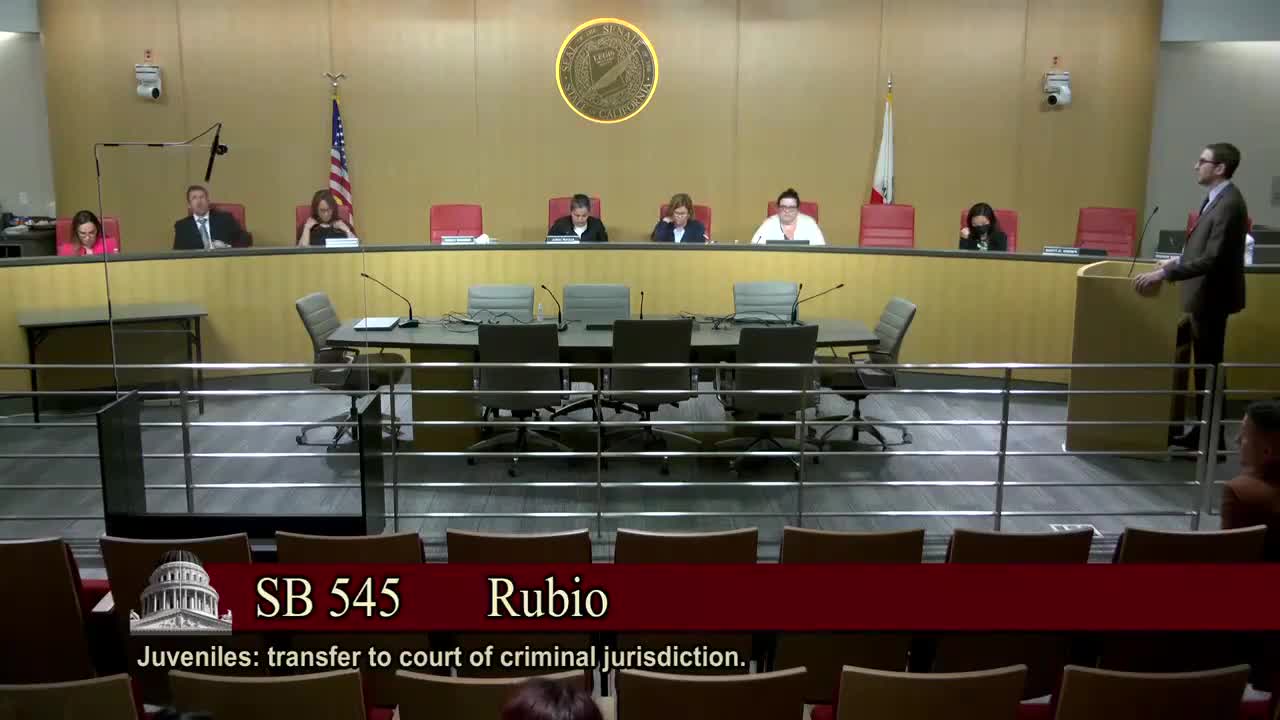
Discussed in Hearing
 18MIN
Senate Standing Committee on Public Safety
Bill Author