SB 848: Employment: leave for reproductive loss.
- Session Year: 2023-2024
- House: Senate
- Latest Version Date: 2023-10-10
Current Status:
Passed
(2023-10-10: Chaptered by Secretary of State. Chapter 724, Statutes of 2023.)
Introduced
In Committee
First Chamber
In Committee
Second Chamber
Enacted
Existing law, the California Fair Employment and Housing Act, makes it an unlawful employment practice for an employer to refuse to grant a request by any employee to take up to 5 days of bereavement leave upon the death of a family member.
This bill would additionally make it an unlawful employment practice for an employer to refuse to grant a request by an eligible employee to take up to 5 days of reproductive loss leave following a reproductive loss event, as defined. The bill would require that leave be taken within 3 months of the event, except as described, and pursuant to any existing leave policy of the employer. The bill would provide that if an employee experiences more than one reproductive loss event within a 12-month period, the employer is not obligated to grant a total amount of reproductive loss leave time in excess of 20 days within a 12-month period. Under the bill, in the absence of an existing policy, the reproductive loss leave may be unpaid. However, the bill would authorize an employee to use certain other leave balances otherwise available to the employee, including accrued and available paid sick leave. The bill would make leave under these provisions a separate and distinct right from any right under the California Fair Employment and Housing Act.
The bill would make it an unlawful employment practice for an employer to retaliate against an individual, as described, because of the individuals exercise of the right to reproductive loss leave or the individuals giving of information or testimony as to reproductive loss leave, as described. The bill would require the employer to maintain employee confidentiality relating to reproductive loss leave, as specified.
Existing constitutional provisions require that a statute that limits the right of access to the meetings of public bodies or the writings of public officials and agencies be adopted with findings demonstrating the interest protected by the limitation and the need for protecting that interest.
This bill would make legislative findings to that effect.
Existing law, the California Fair Employment and Housing Act, makes it an unlawful employment practice for an employer to refuse to grant a request by any employee to take up to 5 days of bereavement leave upon the death of a family member.
This bill would additionally make it an unlawful employment practice for an employer to refuse to grant a request by an eligible employee to take up to 5 days of reproductive loss leave upon a specified event, including a miscarriage, unsuccessful assisted reproduction, or failed adoption. following a reproductive loss event, as defined. The bill would require that leave be taken within 3 months of the event event, except as described, and pursuant to any existing leave policy of the employer. The bill would provide that if an employee experiences more than one reproductive loss leave event within a 12-month period, the employer is not obligated to grant a total amount of reproductive loss leave time taken shall not exceed in excess of 20 days within a 12-month period. Under the bill, in the absence of an existing policy, the reproductive loss leave may be unpaid. However, the bill would authorize an employee to use certain other leave balances otherwise available to the employee, including accrued and available paid sick leave. The bill would make leave under these provisions a separate and distinct right from any right under the California Fair Employment and Housing Act.
The bill would make it an unlawful employment practice for an employer to engage in specified acts of discrimination, interference, or retaliation relating to an individuals exercise of rights under the bill. retaliate against an individual, as described, because of the individuals exercise of the right to reproductive loss leave or the individuals giving of information or testimony as to reproductive loss leave, as described. The bill would require the employer to maintain employee confidentiality relating to reproductive loss leave, as specified.
Existing constitutional provisions require that a statute that limits the right of access to the meetings of public bodies or the writings of public officials and agencies be adopted with findings demonstrating the interest protected by the limitation and the need for protecting that interest.
This bill would make legislative findings to that effect.
Existing law, the California Fair Employment and Housing Act, makes it an unlawful employment practice for an employer to refuse to grant a request by any employee to take up to 5 days of bereavement leave upon the death of a family member.
This bill would additionally make it an unlawful employment practice for an employer to refuse to grant a request by an eligible employee to take up to 5 days of reproductive loss leave upon a specified event, including a miscarriage, unsuccessful assisted reproduction, or failed adoption. The bill would require that leave be taken within 3 months of the event and pursuant to any existing leave policy of the employer. The bill would provide that if an employee experiences more than one reproductive loss leave event within a 12-month period, the total amount of time taken shall not exceed 20 days within a 12-month period. Under the bill, in the absence of an existing policy, the reproductive loss leave may be unpaid. However, the bill would authorize an employee to use certain other leave balances otherwise available to the employee, including accrued and available paid sick leave. The bill would make leave under these provisions a separate and distinct right from any right under the California Fair Employment and Housing Act.
The bill would make it an unlawful employment practice for an employer to engage in specified acts of discrimination, interference, or retaliation relating to an individuals exercise of rights under the bill. The bill would require the employer to maintain employee confidentiality relating to reproductive loss leave, as specified.
Existing constitutional provisions require that a statute that limits the right of access to the meetings of public bodies or the writings of public officials and agencies be adopted with findings demonstrating the interest protected by the limitation and the need for protecting that interest.
This bill would make legislative findings to that effect.
Existing law, the California Fair Employment and Housing Act, makes it an unlawful employment practice for an employer to refuse to grant a request by any employee to take up to 5 days of bereavement leave upon the death of a family member.
This bill would additionally make it an unlawful employment practice for an employer to refuse to grant a request by an eligible employee to take up to 5 days of reproductive loss leave upon a specified event, including a miscarriage, unsuccessful assisted reproduction, or failed adoption. The bill would require that leave be taken within 3 months of the event and pursuant to any existing leave policy of the employer. Under the bill, in the absence of an existing policy, the reproductive loss leave may be unpaid. However, the bill would authorize an employee to use certain other leave balances otherwise available to the employee, including accrued and available paid sick leave. The bill would make leave under these provisions a separate and distinct right from any right under the California Fair Employment and Housing Act.
The bill would make it an unlawful employment practice for an employer to engage in specified acts of discrimination, interference, or retaliation relating to an individuals exercise of rights under the bill. The bill would require the employer to maintain employee confidentiality relating to reproductive loss leave, as specified.
Existing constitutional provisions require that a statute that limits the right of access to the meetings of public bodies or the writings of public officials and agencies be adopted with findings demonstrating the interest protected by the limitation and the need for protecting that interest.
This bill would make legislative findings to that effect.
This bill would state the intent of the Legislature to enact legislation that would provide employees with leave time after suffering a loss that causes grief.Existing law, the California Fair Employment and Housing Act, makes it an unlawful employment practice for an employer to refuse to grant a request by any employee to take up to 5 days of bereavement leave upon the death of a family member.
This bill would state the intent of the Legislature to enact legislation that would provide employees with leave time after suffering a loss that causes grief.
(a)For purposes of this section, the following definitions apply:
(1)(A)Assisted reproduction means a method of achieving a pregnancy through an artificial insemination or an embryo transfer and includes gamete and embryo donation.
(B)Assisted reproduction does not include any pregnancy achieved through sexual intercourse.
(2)Employee means a person employed by the employer for at least 30 days prior to the commencement of the leave.
(3)Employer means either of the following:
(A)A person who employs five or more persons to perform services for a wage or salary.
(B)The state and any political or civil subdivision of the state, including, but not limited to, cities and counties.
(4)Failed adoption means the dissolution or breach of an adoption agreement with the birth mother or legal guardian, or an adoption that is not finalized because it is contested by another party. This event applies to a person who would have been a parent of the adoptee if the adoption had been completed.
(5)Failed surrogacy means the dissolution or breach of a surrogacy agreement, or a failed embryo transfer to the surrogate. This event applies to a person who would have been a parent of a child born as a result of the surrogacy.
(6)Miscarriage means a miscarriage by a person, by the persons current spouse or domestic partner, or by another individual if the person would have been a parent of a child born as a result of the pregnancy.
(7)Reproductive loss event means the day or, for a multiple-day event, the final day of a failed adoption, failed surrogacy, miscarriage, stillbirth, or an unsuccessful assisted reproduction.
(8)Reproductive loss leave means the leave provided by subdivision (b).
(9)Stillbirth means a stillbirth resulting from a persons pregnancy, the pregnancy of a persons current spouse or domestic partner, or another individual, if the person would have been a parent of a child born as a result of the pregnancy that ended in stillbirth.
(10)Unsuccessful assisted reproduction means an unsuccessful round of intrauterine insemination or of an assisted reproductive technology procedure. This event applies to a person, the persons current spouse or domestic partner, or another individual, if the person would have been a parent of a child born as a result of the pregnancy.
(b)(1)It shall be an unlawful employment practice for an employer to refuse to grant a request by any employee to take up to five days of reproductive loss leave following a reproductive loss event. If an employee experiences more than one reproductive loss event within a 12-month period, an employer shall not be obligated to grant a total amount of reproductive loss leave time in excess of 20 days within a 12-month period.
(2)The employer shall allow the days an employee takes for reproductive loss leave to be nonconsecutive.
(3)(A)Except as provided in subparagraph (B), reproductive loss leave shall be completed within three months of the event entitling the employee to that leave under paragraph (1).
(B)Notwithstanding subparagraph (A), if, prior to or immediately following a reproductive loss event, an employee is on or chooses to go on leave from work pursuant to Section 12945, 12945.2, or any other leave entitlement under state or federal law, the employee shall complete their reproductive loss leave within three months of the end date of the other leave.
(4)(A)Reproductive loss leave shall be taken pursuant to any existing applicable leave policy of the employer.
(B)If there is no existing applicable leave policy, reproductive loss leave may be unpaid, except that an employee may use vacation, personal leave, accrued and available sick leave, or compensatory time off that is otherwise available to the employee.
(c)It shall be an unlawful employment practice for an employer to retaliate against an individual, including, but not limited to, refusing to hire, discharging, demoting, fining, suspending, expelling, or discriminating against, an individual because of either of the following:
(1)An individuals exercise of the right to reproductive loss leave.
(2)An individuals giving information or testimony as to their own reproductive loss leave, or another persons reproductive loss leave, in an inquiry or proceeding related to rights guaranteed under this section.
(d)It shall be an unlawful employment practice for an employer to interfere with, restrain, or deny the exercise of, or the attempt to exercise, any right provided under this section.
(e)The employer shall maintain the confidentiality of any employee requesting leave under this section. Any information provided to the employer pursuant to this section shall be maintained as confidential and shall not be disclosed except to internal personnel or counsel, as necessary, or as required by law.
(f)An employees right to reproductive loss leave shall be construed as a separate and distinct right from any right under this part.
SEC. 2.The Legislature finds and declares that Section 1 of this act, which adds Section 12945.6 to the Government Code, imposes a limitation on the publics right of access to the meetings of public bodies or the writings of public officials and agencies within the meaning of Section 3 of Article I of the California Constitution. Pursuant to that constitutional provision, the Legislature makes the following findings to demonstrate the interest protected by this limitation and the need for protecting that interest:
The confidentiality provisions set forth in Section 1 further the need to protect the privacy rights of employees regarding a reproductive loss, and to protect the enforcement process related to violations of these provisions. These limitations are needed in order to strike the proper balance between the privacy interests of the employee and the employees family, and the publics right to access.
(a)For purposes of this section, the following definitions apply:
(1)(A)Assisted reproduction means a method of achieving a pregnancy through an artificial insemination or an embryo transfer and includes gamete and embryo donation.
(B)Assisted reproduction does not include any pregnancy achieved through sexual intercourse.
(2)Employee means a person employed by the employer for at least 30 days prior to the commencement of the leave.
(3)Employer means either of the following:
(A)A person who employs five or more persons to perform services for a wage or salary.
(B)The state and any political or civil subdivision of the state, including, but not limited to, cities and counties.
(4)Failed adoption means a failed adoption match where the dissolution or breach of an adoption agreement occurs with the birth mother or legal guardian, or an adoption that is not finalized because it is contested by another party. This event applies to a person who would have been a parent of the adoptee if the adoption had been completed.
(5)Failed surrogacy means the dissolution or breach of a surrogacy agreement, or a failed embryo transfer to the surrogate. This event applies to a person who would have been a parent of a child born as a result of the surrogacy.
(6)Miscarriage means a miscarriage by a person, by the persons current spouse or domestic partner, or by another individual if the person would have been a parent of a child born as a result of the pregnancy.
(7)Reproductive loss event means the day or, for a multiple-day event, the final day of a failed adoption, failed surrogacy, miscarriage, stillbirth, or an unsuccessful assisted reproduction.
(7)(8)Reproductive loss leave means the leave provided by subdivision (b).
(8)(9)Stillbirth means a stillbirth resulting from a persons pregnancy, the pregnancy of a persons current spouse or domestic partner, or another individual, if the person would have been a parent of a child born as a result of the pregnancy that ended in stillbirth.
(9)(10)Unsuccessful assisted reproduction means an unsuccessful round of intrauterine insemination or of an assisted reproductive technology procedure. This event applies to the individual, the individuals a person, the persons current spouse or domestic partner, or another individual, if that individual the person would have been a parent of a child born as a result of the pregnancy.
(b)(1)It shall be an unlawful employment practice for an employer to refuse to grant a request by any employee to take up to five days of reproductive loss leave following a miscarriage, unsuccessful assisted reproduction, failed adoption, failed surrogacy, or stillbirth. reproductive loss event. If an employee experiences more than one reproductive loss leave event within a 12-month period, the an employer shall not be obligated to grant a total amount of reproductive loss leave time taken shall not exceed in excess of 20 days within a 12-month period.
(2)The employer shall allow the days an employee takes for reproductive loss leave to be nonconsecutive.
(3)Reproductive (A)Except as provided in subparagraph (B), reproductive loss leave shall be completed within three months of the event entitling the employee to that leave under paragraph (1).
(B)Notwithstanding subparagraph (A), if, prior to or immediately following a reproductive loss event, an employee is on or chooses to go on leave from work pursuant to Section 12945, 12945.2, or any other leave entitlement under state or federal law, the employee shall complete their reproductive loss leave within three months of the end date of the other leave.
(4)(A)Reproductive loss leave shall be taken pursuant to any existing applicable leave policy of the employer.
(B)If there is no existing applicable leave policy, reproductive loss leave may be unpaid, except that an employee may use vacation, personal leave, accrued and available sick leave, or compensatory time off that is otherwise available to the employee.
(c)It shall be an unlawful employment practice for an employer to refuse to hire, or to discharge, demote, fine, suspend, expel, or discriminate retaliate against an individual, including, but not limited to, refusing to hire, discharging, demoting, fining, suspending, expelling, or discriminating against, an individual because of either of the following:
(1)An individuals exercise of the right to reproductive loss leave.
(2)An individuals giving information or testimony as to their own reproductive loss leave, or another persons reproductive loss leave, in an inquiry or proceeding related to rights guaranteed under this section.
(d)It shall be an unlawful employment practice for an employer to interfere with, restrain, or deny the exercise of, or the attempt to exercise, any right provided under this section.
(e)The employer shall maintain the confidentiality of any employee requesting leave under this section. Any information provided to the employer pursuant to this section shall be maintained as confidential and shall not be disclosed except to internal personnel or counsel, as necessary, or as required by law.
(f)An employees right to reproductive loss leave shall be construed as a separate and distinct right from any right under this part.
SEC. 2.The Legislature finds and declares that Section 1 of this act, which adds Section 12945.6 to the Government Code, imposes a limitation on the publics right of access to the meetings of public bodies or the writings of public officials and agencies within the meaning of Section 3 of Article I of the California Constitution. Pursuant to that constitutional provision, the Legislature makes the following findings to demonstrate the interest protected by this limitation and the need for protecting that interest:
The confidentiality provisions set forth in Section 1 further the need to protect the privacy rights of employees regarding a reproductive loss, and to protect the enforcement process related to violations of these provisions. These limitations are needed in order to strike the proper balance between the privacy interests of the employee and the employees family, and the publics right to access.
(a)For purposes of this section, the following definitions apply:
(1)(A)Assisted reproduction means a method of achieving a pregnancy through an artificial insemination or an embryo transfer and includes gamete and embryo donation.
(B)Assisted reproduction does not include any pregnancy achieved through sexual intercourse.
(2)Diagnosis negatively impacting fertility means a diagnosis that negatively impacts the likelihood of biological conception of a child for an individual, the individuals current spouse or domestic partner, or any other individual who would have been a parent of a child born of the individual who received the diagnosis.(3)Diagnosis negatively impacting pregnancy means a diagnosis that negatively impacts the pregnancy of an individual, an individuals current spouse or domestic partner, or any person who would have been a parent of a child born as a result of the pregnancy.(4)(2)Employee means a person employed by the employer for at least 30 days prior to the commencement of the leave.
(5)(3)Employer means either of the following:
(A)A person who employs five or more persons to perform services for a wage or salary.
(B)The state and any political or civil subdivision of the state, including, but not limited to, cities and counties.
(6)(4)Failed adoption means a failed adoption match where the dissolution or breach of an adoption agreement occurs with the birth mother or legal guardian, or an adoption that is not finalized because it is contested by another party. This event applies to a person who would have been a parent of the adoptee if the adoption had been completed.
(7)(5)Failed surrogacy means the unsuccessful completion of a surrogacy or establishment dissolution or breach of a surrogacy agreement. agreement, or a failed embryo transfer to the surrogate. This event applies to a person who would have been a parent of a child born as a result of the surrogacy.
(8)(6)Miscarriage means a miscarriage by a person, by the persons current spouse or domestic partner, or by another individual if the person would have been a parent of a child born as a result of the pregnancy.
(9)(7)Reproductive loss leave means the leave provided by subdivision (b).
(10)(8)Stillbirth means a stillbirth resulting from a persons pregnancy, the pregnancy of a persons current spouse or domestic partner, or another individual, if the person would have been a parent of a child born as a result of the pregnancy that ended in stillbirth.
(11)(9)Unsuccessful assisted reproduction means an unsuccessful round of intrauterine insemination or of an assisted reproductive technology procedure. This event applies to the individual, the individuals current spouse or domestic partner, or another individual, if that individual would have been a parent of a child born as a result of the pregnancy.
(b)(1)It shall be an unlawful employment practice for an employer to refuse to grant a request by any employee to take up to five days of reproductive loss leave following a miscarriage, unsuccessful assisted reproduction, failed adoption, failed surrogacy, diagnosis negatively impacting pregnancy, diagnosis negatively impacting fertility, or stillbirth. If an employee experiences more than one reproductive loss leave event within a 12-month period, the total amount of time taken shall not exceed 20 days within a 12-month period.
(2)The employer shall allow the days an employee takes for reproductive loss leave to be nonconsecutive.
(3)Reproductive loss leave shall be completed within three months of the event entitling the employee to that leave under paragraph (1).
(4)(A)Reproductive loss leave shall be taken pursuant to any existing applicable leave policy of the employer.
(B)If there is no existing applicable leave policy, reproductive loss leave may be unpaid, except that an employee may use vacation, personal leave, accrued and available sick leave, or compensatory time off that is otherwise available to the employee.
(c)It shall be an unlawful employment practice for an employer to refuse to hire, or to discharge, demote, fine, suspend, expel, or discriminate against, an individual because of either of the following:
(1)An individuals exercise of the right to reproductive loss leave.
(2)An individuals giving information or testimony as to their own reproductive loss leave, or another persons reproductive loss leave, in an inquiry or proceeding related to rights guaranteed under this section.
(d)It shall be an unlawful employment practice for an employer to interfere with, restrain, or deny the exercise of, or the attempt to exercise, any right provided under this section.
(e)The employer shall maintain the confidentiality of any employee requesting leave under this section. Any information provided to the employer pursuant to this section shall be maintained as confidential and shall not be disclosed except to internal personnel or counsel, as necessary, or as required by law.
(f)An employees right to reproductive loss leave shall be construed as a separate and distinct right from any right under this part.
SEC. 2.The Legislature finds and declares that Section 1 of this act, which adds Section 12945.6 to the Government Code, imposes a limitation on the publics right of access to the meetings of public bodies or the writings of public officials and agencies within the meaning of Section 3 of Article I of the California Constitution. Pursuant to that constitutional provision, the Legislature makes the following findings to demonstrate the interest protected by this limitation and the need for protecting that interest:
The confidentiality provisions set forth in Section 1 further the need to protect the privacy rights of employees regarding a reproductive loss, and to protect the enforcement process related to violations of these provisions. These limitations are needed in order to strike the proper balance between the privacy interests of the employee and the employees family, and the publics right to access.
(a)For purposes of this section, the following definitions apply:
(1)(A)Assisted reproduction means a method of achieving a pregnancy through an artificial insemination or an embryo transfer and includes gamete and embryo donation.
(B)Assisted reproduction does not include any pregnancy achieved through sexual intercourse.
(2)Diagnosis negatively impacting fertility means a diagnosis that negatively impacts the likelihood of biological conception of a child for an individual, the individuals current spouse or domestic partner, or any other individual who would have been a parent of a child born of the individual who received the diagnosis.
(3)Diagnosis negatively impacting pregnancy means a diagnosis that negatively impacts the pregnancy of an individual, an individuals current spouse or domestic partner, or any person who would have been a parent of a child born as a result of the pregnancy.
(4)Employee means a person employed by the employer for at least 30 days prior to the commencement of the leave.
(5)Employer means either of the following:
(A)A person who employs five or more persons to perform services for a wage or salary.
(B)The state and any political or civil subdivision of the state, including, but not limited to, cities and counties.
(6)Failed adoption means a failed adoption match or an adoption that is not finalized because it is contested by another party. This event applies to a person who would have been a parent of the adoptee if the adoption had been completed.
(7)Failed surrogacy means the unsuccessful completion of a surrogacy or establishment of a surrogacy agreement. This event applies to a person who would have been a parent of a child born as a result of the surrogacy.
(8)Miscarriage means a miscarriage by a person, by the persons current spouse or domestic partner, or by another individual if the person would have been a parent of a child born as a result of the pregnancy.
(9)Reproductive loss leave means the leave provided by subdivision (b).
(10)Stillbirth means a stillbirth resulting from a persons pregnancy, the pregnancy of a persons current spouse or domestic partner, or another individual, if the person would have been a parent of a child born as a result of the pregnancy that ended in stillbirth.
(11)Unsuccessful assisted reproduction means an unsuccessful round of intrauterine insemination or of an assisted reproductive technology procedure. This event applies to the individual, the individuals current spouse or domestic partner, or another individual, if that individual would have been a parent of a child born as a result of the pregnancy.
(b)(1)It shall be an unlawful employment practice for an employer to refuse to grant a request by any employee to take up to five days of reproductive loss leave following a miscarriage, unsuccessful assisted reproduction, failed adoption, failed surrogacy, diagnosis negatively impacting pregnancy, diagnosis negatively impacting fertility, or stillbirth.
(2)The employer shall allow the days an employee takes for reproductive loss leave to be nonconsecutive.
(3)Reproductive loss leave shall be completed within three months of the event entitling the employee to that leave under paragraph (1).
(4)(A)Reproductive loss leave shall be taken pursuant to any existing applicable leave policy of the employer.
(B)If there is no existing applicable leave policy, reproductive loss leave may be unpaid, except that an employee may use vacation, personal leave, accrued and available sick leave, or compensatory time off that is otherwise available to the employee.
(c)It shall be an unlawful employment practice for an employer to refuse to hire, or to discharge, demote, fine, suspend, expel, or discriminate against, an individual because of either of the following:
(1)An individuals exercise of the right to reproductive loss leave.
(2)An individuals giving information or testimony as to their own reproductive loss leave, or another persons reproductive loss leave, in an inquiry or proceeding related to rights guaranteed under this section.
(d)It shall be an unlawful employment practice for an employer to interfere with, restrain, or deny the exercise of, or the attempt to exercise, any right provided under this section.
(e)The employer shall maintain the confidentiality of any employee requesting leave under this section. Any information provided to the employer pursuant to this section shall be maintained as confidential and shall not be disclosed except to internal personnel or counsel, as necessary, or as required by law.
(f)An employees right to reproductive loss leave shall be construed as a separate and distinct right from any right under this part.
SEC. 2.The Legislature finds and declares that Section 1 of this act, which adds Section 12945.6 to the Government Code, imposes a limitation on the publics right of access to the meetings of public bodies or the writings of public officials and agencies within the meaning of Section 3 of Article I of the California Constitution. Pursuant to that constitutional provision, the Legislature makes the following findings to demonstrate the interest protected by this limitation and the need for protecting that interest:
The confidentiality provisions set forth in Section 1 further the need to protect the privacy rights of employees regarding a reproductive loss, and to protect the enforcement process related to violations of these provisions. These limitations are needed in order to strike the proper balance between the privacy interests of the employee and the employees family, and the publics right to access.
SECTION 1.It is the intent of the Legislature to enact legislation that would provide employees with leave time after suffering a loss that causes grief.It is the intent of the Legislature to enact legislation that would provide employees with leave time after suffering a loss that causes grief.
|
Date
|
Status
|
|---|---|
| Oct 10, 2023 | Chaptered by Secretary of State. Chapter 724, Statutes of 2023. |
| Oct 10, 2023 | Approved by the Governor. |
| Sep 21, 2023 | Enrolled and presented to the Governor at 4 p.m. |
| Sep 14, 2023 | Assembly amendments concurred in. (Ayes 34. Noes 0. Page 2799.) Ordered to engrossing and enrolling. |
| Sep 13, 2023 | In Senate. Concurrence in Assembly amendments pending. |
| Sep 13, 2023 | Read third time. Passed. (Ayes 78. Noes 0. Page 3391.) Ordered to the Senate. |
| Sep 5, 2023 | Read second time. Ordered to third reading. |
| Sep 1, 2023 | From committee: Do pass. (Ayes 13. Noes 2.) (September 1). |
| Jul 12, 2023 | July 12 set for first hearing. Placed on APPR. suspense file. |
| Jun 28, 2023 | Read second time and amended. Re-referred to Com. on APPR. |
| Jun 27, 2023 | From committee: Do pass as amended and re-refer to Com. on APPR. (Ayes 8. Noes 0.) (June 27). |
| Jun 15, 2023 | From committee: Do pass and re-refer to Com. on JUD. (Ayes 7. Noes 0.) (June 14). Re-referred to Com. on JUD. |
| Jun 1, 2023 | Referred to Coms. on L. & E. and JUD. |
| May 25, 2023 | In Assembly. Read first time. Held at Desk. |
| May 24, 2023 | Read third time. Passed. (Ayes 35. Noes 3. Page 1274.) Ordered to the Assembly. |
| May 22, 2023 | Read second time. Ordered to third reading. |
| May 18, 2023 | Read second time and amended. Ordered to second reading. |
| May 18, 2023 | From committee: Do pass as amended. (Ayes 5. Noes 2. Page 1186.) (May 18). |
| May 12, 2023 | Set for hearing May 18. |
| May 8, 2023 | May 8 hearing: Placed on APPR suspense file. |
| May 1, 2023 | Set for hearing May 8. |
| Apr 26, 2023 | From committee: Do pass and re-refer to Com. on APPR. (Ayes 9. Noes 1. Page 897.) (April 25). Re-referred to Com. on APPR. |
| Apr 20, 2023 | From committee: Do pass and re-refer to Com. on JUD. (Ayes 5. Noes 0. Page 834.) (April 19). Re-referred to Com. on JUD. |
| Apr 18, 2023 | Set for hearing April 25 in JUD. pending receipt. |
| Apr 11, 2023 | Set for hearing April 19. |
| Mar 29, 2023 | Re-referred to Coms. on L., P.E. & R. and JUD. |
| Mar 21, 2023 | From committee with author's amendments. Read second time and amended. Re-referred to Com. on RLS. |
| Mar 1, 2023 | Referred to Com. on RLS. |
| Feb 21, 2023 | From printer. May be acted upon on or after March 20. |
| Feb 17, 2023 | Introduced. Read first time. To Com. on RLS. for assignment. To print. |
|
Date
|
Description
|
Location
|
Votes
|
|
|---|---|---|---|---|
| Sep 14, 2023 | Unfinished Business SB848 Rubio et al. Concurrence | Senate Floor |
Passed |
|
| Sep 13, 2023 | SB 848 Rubio Senate Third Reading By Quirk-Silva | Assembly Floor |
Passed |
|
| Sep 1, 2023 | Do pass. | Assembly Standing Committee on Appropriations |
Passed |
|
| Jun 27, 2023 | Do pass as amended and be re-referred to the Committee on [Appropriations] | Assembly Standing Committee on Judiciary |
Passed |
|
| Jun 14, 2023 | Do pass and be re-referred to the Committee on [Judiciary] | Assembly Standing Committee on Labor and Employment |
Passed |
|
| May 24, 2023 | Senate 3rd Reading SB848 Rubio et al. | Senate Floor |
Passed |
|
| May 18, 2023 | Do pass as amended | Senate Standing Committee on Appropriations |
Passed |
|
| May 8, 2023 | Placed on suspense file | Senate Standing Committee on Appropriations |
Passed |
|
| Apr 25, 2023 | Do pass, but first be re-referred to the Committee on [Appropriations] | Senate Standing Committee on Judiciary |
Passed |
|
| Apr 19, 2023 | Do pass, but first be re-referred to the Committee on [Judiciary] | Senate Standing Committee on Labor, Public Employment and Retirement |
Passed |
This list shows positions taken on this bill by organizations on the date displayed, which is linked to the original source.
Positions by individuals are not included.
|
Organization
|
Position
|
Date
|
|---|---|---|
| American Society For Reproductive Medicine | ** Support | |
| California Catholic Conference | ** Support | |
| California Chamber Of Commerce | ** Against | |
| California Employment Lawyers Association | ** Support | |
| California Faculty Association | ** Support | |
| California Federation Of Teachers | ** Support | |
| California Nurses Association | ** Support | |
| California Teachers Association | ** Support | |
| Consumer Attorneys Of California | ** Support | |
| Ella Baker Center For Human Rights | ** Support | |
| Forever Footprints | ** Support | |
| Initiate Justice | ** Support | |
| Junior League of San Diego | ** Support | |
| Junior Leagues of California State Public Affairs Committee | ** Support | |
| LA Best Babies Network | ** Support | |
| Legal Aid At Work | ** Support | |
| NARAL Pro-Choice California | ** Support | |
| National Association of Social Workers California Chapter | ** Support | |
| National Council Of Jewish Women Los Angeles | ** Support | |
| Return to Zero: HOPE | ** Support | |
| Sharing Parents | ** Support | |
| Star Legacy Foundation | ** Support |
SENATE RULES COMMITTEE Office of Senate Floor Analyses (916) 651-1520 Fax: (916) 327-4478 | SB 848 |
UNFINISHED BUSINESS
Bill No: SB 848
Author: Rubio (D), et al.
Amended: 6/28/23
Vote: 21
SENATE LABOR, PUB. EMP. & RET. COMMITTEE: 5-0, 4/19/23
AYES: Cortese, Wilk, Durazo, Laird, Smallwood-Cuevas
SENATE JUDICIARY COMMITTEE: 9-1, 4/25/23
AYES: Umberg, Wilk, Allen, Ashby, Caballero, Durazo, Laird, Min, Wiener
NOES: Niello
NO VOTE RECORDED: Stern
SENATE APPROPRIATIONS COMMITTEE: 5-2, 5/18/23
AYES: Portantino, Ashby, Bradford, Wahab, Wiener
NOES: Jones, Seyarto
SENATE FLOOR: 35-3, 5/24/23
AYES: Allen, Alvarado-Gil, Archuleta, Ashby, Atkins, Becker, Blakespear, Bradford, Caballero, Cortese, Dahle, Dodd, Durazo, Eggman, Glazer, Gonzalez, Grove, Hurtado, Laird, Limón, McGuire, Menjivar, Min, Newman, Padilla, Portantino, Roth, Rubio, Skinner, Smallwood-Cuevas, Stern, Umberg, Wahab, Wiener, Wilk
NOES: Jones, Niello, Seyarto
NO VOTE RECORDED: Nguyen, Ochoa Bogh
ASSEMBLY FLOOR: 78-0, 9/13/23 - See last page for vote
SUBJECT: Employment: leave for reproductive loss
SOURCE: Forever Footprints
Junior Leagues of California State Public Affairs Committee
DIGEST:
This bill requires employers, of five or more employees, to provide eligible employees with up to five days of reproductive loss leave following a reproductive loss event defined as a failed adoption, failed surrogacy, miscarriage, stillbirth or an unsuccessful assisted reproduction.
Assembly Amendments
define a “reproductive loss event”; specify that if, prior to or immediately following a reproductive loss event, an employee is on or chooses to go on leave from work using other existing leave entitlements, then the employee shall complete their reproductive loss leave within three months of the end date of the other leave; and make other non-substantive format changes.
ANALYSIS:
Existing law:
- Makes it an unlawful employment practice, under the California Family Rights Act (CFRA), for an employer to refuse to grant a request by a qualified employee to take up to 12 workweeks in any 12-month period for family care and medical leave. Defines “family care and medical leave” for this provision to mean taking leave to care for a new child; to care for a child, parent, grandparent, grandchild, sibling, spouse, or domestic partner who has a serious health condition; or to take leave because of the employee’s own serious health condition, as specified. (Gov. Code § 12945.2.)
- Makes it an unlawful employment practice for an employer to refuse to hire, or to discharge, fine, suspend, expel, or discriminate against, any individual because, among other things, an individual’s exercise of the right to family care and medical leave. (Gov. Code § 12945.2)
- Grants, under the Healthy Workplaces, Healthy Families Act of 2014, eligible employees, as specified, the right to paid sick days of up to 24 hours or three days in one year. Provides that employees covered by qualifying collective bargaining agreements, In-Home Supportive Services providers, and certain employees of air carriers are not covered by this law. (Labor Code §245-249)
- Protects employee rights to use accrued sick days by specifying that an employer shall not deny an employee the right to use accrued sick days, discharge, threaten to discharge, demote, suspend, or in any manner discriminate against an employee for using accrued sick days, attempting to exercise the right to use accrued sick days, filing a complaint with the department or alleging a violation of this article, cooperating in an investigation or prosecution of an alleged violation of this article, or opposing any policy or practice or act that is prohibited by law. (Labor Code §246.5)
- Makes it an unlawful employment practice, under bereavement leave provisions, for an employer to refuse to grant a request by any employee to take up to five days of bereavement leave upon the death of specified family members. Allows that the leave need not be consecutive and must be completed within three months of the date of the death of the family member. Provides that the bereavement leave shall be taken pursuant to any existing bereavement leave policy of the employer and, if none exists, the bereavement leave may be unpaid, except that an employee may use vacation, personal leave, accrued and available sick leave, or compensatory time off that is otherwise available to the employee. (Government Code §12945.7)
- Makes it unlawful employment practice for an employer to refuse to hire, or to discharge, demote, fine, suspend, expel, or discriminate against, an individual because of either of the following:
- An individual’s exercise of the right to bereavement leave provided.
- An individual’s giving information or testimony as to their own bereavement leave, or another person’s bereavement leave, in an inquiry or proceeding related to rights guaranteed under this section. (Government Code §12945.7)
- Makes, under Pregnancy Disability Leave (PDL), it an unlawful employment practice for an employer to refuse to allow an employee disabled by pregnancy, childbirth, or a related medical condition to take a leave for a reasonable period of time not to exceed four months and thereafter return to work, as specified. The employee shall be entitled to utilize any accrued vacation leave during this period of time. (Government Code §12945)
This bill:
- Provides, among others, the following definitions:
- “Assisted reproduction” means a method of achieving pregnancy through artificial insemination or embryo transfer, including gamete and embryo donation.
- “Employee” means a person employed by the employer for at least 30 days prior to the commencement of the leave.
- “Employer” means either of the following:
- A person who employs five or more persons, as specified.
- The state and any political or civil subdivision of the state, including, but not limited to, cities and counties.
- “Failed adoption” means the dissolution or breach of an adoption agreement with the birth mother or legal guardian, or an adoption that is not finalized because it is contested by another party. This event applies to a person who would have been a parent of the adoptee if the adoption had been completed.
- “Failed surrogacy” means the dissolution or breach of a surrogacy agreement, or a failed embryo transfer to the surrogate. This event applies to a person who would have been a parent of a child born as a result of the surrogacy.
- “Miscarriage” means a miscarriage by a person, by the person’s current spouse or domestic partner, or by another individual if the person would have been a parent of a child born as a result of the pregnancy.
- “Stillbirth” means a stillbirth resulting from a person’s pregnancy, the pregnancy of a person’s current spouse or domestic partner, or another individual, if the person would have been a parent of a child born as a result of the pregnancy that ended in stillbirth.
- “Unsuccessful assisted reproduction” means an unsuccessful round of intrauterine insemination or of an assisted reproductive technology procedure. This event applies to a person, the person’s current spouse or domestic partner, or another individual, if the person would have been a parent of a child born as a result of the pregnancy.
- “Reproductive loss event” means the day or, for a multiple-day event, the final day of a failed adoption, failed surrogacy, miscarriage, stillbirth, or an unsuccessful assisted reproduction.
- Makes it an unlawful employment practice for an employer to refuse to grant a request by any employee to take up to five days of reproductive loss leave following a reproductive loss event.
- Provides that if an employee experiences more than one reproductive loss event within a 12-month period, an employer shall not be obligated to grant a total amount of reproductive loss leave time in excess of 20 days within that period.
- Requires the employer to allow the days an employee takes for reproductive loss leave to be nonconsecutive and to be completed within three months of the event entitling the employee to that leave.
- Provides that, if, prior to or immediately following a reproductive loss event, an employee is on or chooses to go on leave from work pursuant to California’s existing Pregnancy Disability Leave or California Family Rights Act, or any other leave entitlement under state or federal law, the employee shall complete their reproductive loss leave within three months of the end date of the other leave.
- Provides that reproductive loss leave shall be taken pursuant to any existing applicable leave policy of the employer and, if none exists, reproductive loss leave may be unpaid, except that an employee may use vacation, personal leave, accrued and available sick leave, or compensatory time off that is otherwise available to the employee.
- Makes it an unlawful employment practice for an employer to retaliate against an individual, including, but not limited to, refusing to hire, discharging, demoting, fining, suspending, expelling, or discriminating against, an individual because of either of the following:
- An individual’s exercise of the right to reproductive loss leave.
- An individual’s giving information or testimony as to their own reproductive loss leave, or another person’s reproductive loss leave, in an inquiry or proceeding related to rights guaranteed under this section.
- Makes it an unlawful employment practice for an employer to interfere with, restrain, or deny the exercise of, or attempt to exercise, any right provided under these provisions.
- Requires the employer to maintain the confidentiality of any employee requesting leave under these provisions. Requires that any information provided to the employer shall be maintained as confidential and shall not be disclosed except to internal personnel or counsel, as necessary, or as required by law.
- Provides that an employee’s right to reproductive loss leave shall be construed as a separate and distinct right from any right under this part.
Background
California employees may be entitled to several medical leaves depending on the size of their employer and the reason for the leave. Of particular note, the CFRA allows employees, of employers with five or more employees, to take up to 12 weeks of family leave to care for a newborn child or to care for family members suffering from a serious medical condition. In addition, California’s PDL, requires covered employers to provide employees disabled by pregnancy, childbirth, or a related medical condition with unpaid, job-protected leave and/or accommodations. PDL is available when an employee is actually disabled. This includes time off needed for prenatal or postnatal care, severe morning sickness, doctor-ordered bed rest, childbirth, recovery from childbirth, loss or end of pregnancy, or any other related medical condition.
Existing law also requires covered employers to grant eligible employees’ request for up to five days of bereavement leave upon the death of certain family members. Although these leaves exist, and loss of a child may be somewhat covered by one of them, nothing specifically addresses the complexities and difficulties that a worker undergoing reproductive assistance endures.
Comments
Need for this bill? According to the author, “Reproductive loss is one of the most traumatizing events a person can experience, and unfortunately, it is far too common. Approximately half of all pregnancies end in miscarriage, and up to 15 percent of known pregnancies end in the traumatizing event of miscarriage or stillbirth. Existing family leave programs don’t fully apply to parents experiencing reproductive loss. Bereavement Leave does not include instances of stillbirth, miscarriage, fertility, or adoption loss events suffered by millions of families. Additionally, PDL only applies to the parent physically carrying a child to term and does not provide leave time to the other parent.
“Several states have recently passed legislation to provide leave for reproductive loss events, including Utah and Illinois in 2022. Local governments such as Pittsburgh, Pennsylvania and Boston, Massachusetts also provide their employees with leave for pregnancy loss. Additionally, many private employers currently provide leave for reproductive loss, including Liberty Mutual Insurance and Altria.”
Related/Prior Legislation
AB 1949 (Low, Chapter 767, Statutes of 2022) provided specified California workers with up to five days of job-protected leave from work to grieve and to attend to logistical matters in the event of the death of a close family member, as defined.
FISCAL EFFECT: Appropriation: No Fiscal Com.: Yes Local: No
According to the Assembly Appropriations Committee:
- Costs of approximately $1.5 million in fiscal year 2024-25 and $1.4 million annually thereafter to the Civil Rights Department (CRD) for 10 additional positions to receive, investigate, mediate, and prosecute complaints (General Fund). CRD anticipates a large, but unknown, number of employees would be entitled to reproductive loss leave, although some employers may already have equivalent policies and not all eligible employees would take such leave if it is unpaid. Absent more specific data, CRD estimates approximately 300 additional complaints annually based on historical data related to Pregnancy Disability Leave and California Family Rights Act (CFRA) leave.
- Costs of an unknown, but potentially significant, amount to state departments for increased staffing costs by increasing the minimum days available for excluded employees to take reproductive loss leave.
SUPPORT: (Verified 9/13/23)
Forever Footprints (co-source)
Junior Leagues of California State Public Affairs Committee (co-source)
American Society for Reproductive Medicine
California Catholic Conference
California Employment Lawyers Association
California Faculty Association
California Federation of Teachers
California Nurses Association
California Teachers Association
Consumer Attorneys of California
Ella Baker Center for Human Rights
Initiate Justice
Junior League of San Diego
LA Best Babies Network
Legal Aid at Work
NARAL Pro-Choice California
National Association of Social Workers California Chapter
National Council of Jewish Women Los Angeles
Return to Zero: HOPE
STAR Legacy Foundation
OPPOSITION: (Verified 9/13/23)
California Chamber of Commerce
ARGUMENTS IN SUPPORT: According to the sponsors, “Pregnancy and fertility loss is common and is suffered by millions of women across the state, with approximately half of all pregnancies ending in miscarriage. Existing family leave programs are limited in scope and access and do not fully apply to all persons impacted. SB 848 would ensure employees are allowed to take up to five days of reproductive loss leave following a miscarriage, unsuccessful assisted reproduction, failed adoption, failed surrogacy, diagnosis negatively impacting pregnancy, diagnosis negatively impacting fertility, or stillbirth. This would additionally apply to the individual’s spouse or domestic partner, or another co-parenting individual, if that individual would have been a parent of a child had they been successful.”
ARGUMENTS IN OPPOSITION: The California Chamber of Commerce is opposed unless amended arguing that this bill, “seeks to create a second bereavement leave statute specific to events concerning reproduction and fertility. This new leave right is separate from any other leave provided for in current law. We are understanding of the emotional toll that these events can take on an employee, however, we have concerns about the breadth of the bill. While one more leave may not seem burdensome in isolation, it must be viewed in the context of the more than 20 leaves that currently exist or were mandated during the last few years as a result of the pandemic.
“We are therefore requesting additional amendments to reduce the allowed 20 days of leave in 12 months under the bill. Some of the procedures identified as qualifying events can occur monthly or every few months, which would result in a large quantity of leave being taken at one time. Under the bill, an employee who has three failed procedures within three months would be eligible for 15 days of leave in a matter of three months. The employee could use those fifteen days all at once as the bill allows an employee to take the leave within 90 days of an event
which could be difficult for an employer to accommodate, especially for small businesses.”
ASSEMBLY FLOOR: 78-0, 9/13/23
AYES: Addis, Aguiar-Curry, Alanis, Alvarez, Arambula, Bains, Bauer-Kahan, Bennett, Berman, Boerner, Bonta, Bryan, Calderon, Juan Carrillo, Wendy Carrillo, Cervantes, Chen, Connolly, Megan Dahle, Davies, Dixon, Flora, Mike Fong, Vince Fong, Friedman, Gabriel, Gallagher, Garcia, Gipson, Grayson, Haney, Hart, Holden, Hoover, Irwin, Jackson, Jones-Sawyer, Kalra, Lackey, Lee, Low, Lowenthal, Maienschein, Mathis, McCarty, McKinnor, Muratsuchi, Stephanie Nguyen, Ortega, Pacheco, Papan, Jim Patterson, Joe Patterson, Pellerin, Petrie-Norris, Quirk-Silva, Ramos, Rendon, Reyes, Luz Rivas, Rodriguez, Blanca Rubio, Santiago, Schiavo, Soria, Ta, Ting, Valencia, Villapudua, Waldron, Wallis, Ward, Weber, Wicks, Wilson, Wood, Zbur, Robert Rivas
NO VOTE RECORDED: Essayli, Sanchez
Prepared by: Alma Perez-Schwab / L., P.E. & R. / (916) 651-1556
9/14/23 10:30:01
**** END ****
SENATE THIRD READING
STR Bill Id:SB 848
Author:(Rubio)
As Amended Ver:June 28, 2023
Majority vote
SUMMARY
Makes it an unlawful employment practice for an employer to refuse to grant a request by an eligible employee to take up to five days of reproductive loss leave following a reproductive loss event, as defined.
Major Provisions
- Defines the following for the purposes of this bill:
- "Assisted reproduction" means a method of achieving a pregnancy through an artificial insemination or an embryo transfer and includes gamete and embryo donation.
- "Employee" means a person employed by the employer for at least 30 days prior to the commencement of the leave.
- "Employer" means either a person who employs five or more persons to perform services for a wage or salary or the state and any political or civil subdivision of the state, including, but not limited to, cities and counties.
- "Failed adoption" means the dissolution or breach of an adoption agreement with the birth mother or legal guardian, or an adoption that is not finalized because it is contested by another party and applies to a person who would have been a parent of the adoptee if the adoption had been completed.
- "Failed surrogacy" means the dissolution or breach of a surrogacy agreement, or a failed embryo transfer to the surrogate. This event applies to a person who would have been a parent of a child born as a result of the surrogacy.
- "Miscarriage" means a miscarriage by a person, by the person's current spouse or domestic partner, or by another individual if the person would have been a parent of a child born as a result of the pregnancy.
- "Reproductive loss event" means the day or, for a multiple-day event, the final day of a failed adoption, failed surrogacy, miscarriage, stillbirth, or unsuccessful assisted reproduction.
- "Reproductive loss leave" means the leave provided by 2), above.
- "Stillbirth" means a stillbirth resulting from a person's pregnancy, the pregnancy of a person's current spouse or domestic partner, or another individual, if the person would have been a parent of a child born as a result of the pregnancy that ended in stillbirth.
- "Unsuccessful assisted reproduction" means an unsuccessful round of intrauterine insemination or of an assisted reproductive technology procedure. This event applies to a person, the person's current spouse or domestic partner, or another individual, if the person would have been a parent of a child born as a result of the pregnancy.
- Makes it an unlawful employment practice for an employer to refuse to grant a request by any employee to take up to five days of reproductive loss leave following a reproductive loss event.
- If an employee experiences more than one reproductive loss leave event within a 12-month period, establishes that an employer is not obligated to grant a total amount of time in excess of 20 days within a 12-month period.
- Requires an employer to allow the days an employee takes for leave taken pursuant to 2), above, to be nonconsecutive.
- Requires leave taken pursuant to 2), above, to be completed within three months of the event entitling the employee to that leave.
- Requires that if, prior to or immediately following a reproductive loss event, an employee is on or chooses to go on leave from work under another leave entitlement under state or federal law, the employee complete their reproductive loss leave within three months of the end date of the other leave. "Assisted reproduction" does not include any pregnancy achieved through sexual intercourse.
- Requires leave taken pursuant to 2), above, to be taken pursuant to any existing leave policy of the employer, but if there is no existing applicable leave policy, allows the leave to be unpaid, except that an employee may use vacation, personal leave, accrued and available sick leave, or compensatory time off that is otherwise available to the employee.
- Makes it an unlawful employment practice for an employer to retaliate against an employee including by refusing to hire, discharging, demoting, fining, suspending, expelling, or discriminating against an individual because they exercise the right to leave pursuant to 2), above, or give information or testimony as to their own reproductive loss leave, or another person's reproductive loss leave, in an inquiry or proceeding relating to rights guaranteed under this section.
- Makes it an unlawful employment practice for an employer to interfere with, restrain, or deny the exercise of, or the attempt to exercise, any right provided by this bill.
- Requires an employer to maintain the confidentiality of any employee requesting reproductive loss leave, except as necessary or as required by law.
- Requires an employee's right to reproductive loss leave to be construed as a separate and distinct right from any right under this part.
COMMENTS
According to a recent article by the Society for Human Resource Management, "Miscarriage leave has historically been a rare company offering; it hasn't been an isolated benefit or a part of most employers' bereavement policies. But a shift is occurring, with a handful of employers now offering employees the benefit, pointing to it as an emerging trend. Goldman Sachs, Liberty Mutual and Pinterest are among the growing number of employers that have added policies giving paid time off to employees who go through miscarriages. Pinterest introduced a policy in January 2022 offering four weeks of paid leave to parents who experience a loss through a miscarriage at any point in the pregnancy. Goldman Sachs also added 20 days of paid leave for an employee, or a spouse or surrogate, who has a miscarriage or stillbirth."[1]
Additionally, the article notes that the trend to provide employees with more competitive leave policies "comes as employers try to navigate a still-hot job market, which is contributing to increased employee expectations and a need for employers to enhance offerings to better appeal to workers. Revamping leave policies – and making sure to include benefits that address life moments or times of grief – is indeed a way to make employers attractive to potential and current employees. These factors and more are causing employers to identify gaps in coverage and offerings. Miscarriage, for instance, is a common occurrence; according to the Mayo Clinic, roughly 10 percent to 20 percent of known pregnancies end in miscarriage."[2]
According to the Author
"Reproductive loss is one of the most traumatizing events a person can experience, and unfortunately, it is far too common. Every year in the United States, nearly a million families experience the heartbreak of a pregnancy loss due to miscarriage. And many other families know the trauma that comes from an adoption agreement falling apart or an unsuccessful IVF treatment. [This bill] will ensure that families experiencing reproductive loss have the time they need to process their grief and heal.
California leads the nation on several types of workplace leave programs, including providing up to 5 days of job-protected bereavement leave after the death of a close family member. However, these leave programs fail to cover reproductive loss events. Several other state and local governments have recently passed legislation to provide leave for reproductive loss events, while many private employers have voluntarily adopted policies to provide this leave for their employees. By passing [this bill], we can make a significant difference in the lives of every Californian who has experienced the grief of reproductive loss."
In addition, the author points out that this bill will promote equity solutions and maximize benefits for underserved and marginalized communities because, "[This bill] would protect the jobs of Californians who experience the trauma of a miscarriage, failed adoption, or other reproductive loss event by providing them with up to 5 days of job-protected leave. While all demographics experience the trauma of reproductive loss and may fear losing their employment if they need to take time off to grieve, the likelihood of a workplace terminating an employee for taking time off may be greater in underserved and marginalized communities. Therefore, [this bill's] equity impact will be most apparent in those communities where families experiencing reproductive loss will know they won't lose their jobs if they need to take time off to grieve."
Arguments in Support
Forever Footprints, co-sponsor of this bill, in support, states "Pregnancy loss is common and is suffered by millions of women across the state, with approximately half of all pregnancies ending in miscarriage. Existing family leave programs are limited in scope and access and do not fully apply to all persons impacted. [This bill] would ensure employees are allowed to take up to five days of reproductive loss leave following a miscarriage, unsuccessful assisted reproduction, failed adoption, failed surrogacy, or stillbirth. This would additionally apply to the individual's spouse or domestic partner, or another co-parenting individual, if that individual would have been a parent of a child had they been successful.
In our 18 years of serving this community, we deeply understand the damage that occurs when families are unable to take time from work to grieve their traumatic loss. We strongly believe that California women and couples deserve the security of job protection when taking employment leave to heal from these devastating reproductive loss events."
Arguments in Opposition
The California Chamber of Commerce, is opposed unless amended, and states, "[This bill] seeks to create a second bereavement leave statute specific to events concerning reproduction and fertility. This new leave right is separate from any other leave provided for in current law. We are understanding of the emotional toll that these events can take on an employee; however, we have remaining concerns about the total amount of leave that can be taken under [this bill]. While one more leave may not seem burdensome in isolation, it must be viewed in the context of the more than 20 leaves that currently exist or were mandated during the last few years as a result of the pandemic.
We are therefore requesting additional amendments to reduce the allowed 20 days of leave in 12 months under the bill. Some of the procedures identified as qualifying events can occur monthly or every few months, which would result in a large quantity of leave being taken at one time. Under the bill, an employee who has three failed procedures within three months would be eligible for 15 days of leave in a matter of three months. The employee could use those 15 days all at once, as the bill allows an employee to take the leave within 90 days of an event, which could be difficult for an employer to accommodate, especially for small businesses."
FISCAL COMMENTS
According to the Assembly Appropriations Committee:
- Costs of approximately $1.5 million in fiscal year 2024-25 and $1.4 million annually thereafter to the Civil Rights Department (CRD) for 10 additional positions to receive, investigate, mediate, and prosecute complaints (General Fund). CRD anticipates a large, but unknown, number of employees would be entitled to reproductive loss leave, although some employers may already have equivalent policies and not all eligible employees would take such leave if it is unpaid. Absent more specific data, CRD estimates approximately 300 additional complaints annually based on historical data related to Pregnancy Disability Leave and California Family Rights Act (CFRA) leave.
- Costs of an unknown, but potentially significant, amount to state departments for increased staffing costs by increasing the minimum days available for excluded employees to take reproductive loss leave.
VOTES
SENATE FLOOR: 35-3-2
YES: Allen, Alvarado-Gil, Archuleta, Ashby, Atkins, Becker, Blakespear, Bradford, Caballero, Cortese, Dahle, Dodd, Durazo, Eggman, Glazer, Gonzalez, Grove, Hurtado, Laird, Limón, McGuire, Menjivar, Min, Newman, Padilla, Portantino, Roth, Rubio, Skinner, Smallwood‑Cuevas, Stern, Umberg, Wahab, Wiener, Wilk
NO: Jones, Niello, Seyarto
ABS, ABST OR NV: Nguyen, Ochoa Bogh
ASM LABOR AND EMPLOYMENT: 7-0-0
YES: Kalra, Chen, Vince Fong, Haney, Ortega, Reyes, Ward
ASM JUDICIARY: 8-0-3
YES: Maienschein, Connolly, Haney, Kalra, Pacheco, Papan, Reyes, Lee
ABS, ABST OR NV: Essayli, Dixon, Sanchez
ASM APPROPRIATIONS: 13-2-1
YES: Holden, Bryan, Calderon, Wendy Carrillo, Mike Fong, Hart, Lowenthal, Mathis, Papan, Pellerin, Soria, Weber, Wilson
NO: Megan Dahle, Dixon
ABS, ABST OR NV: Sanchez
UPDATED
VERSION: June 28, 2023
CONSULTANT: Martin Vindiola / L. & E. / (916) 319-2091 FN: 0001522
Date of Hearing: July 12, 2023
ASSEMBLY COMMITTEE ON APPROPRIATIONS
Chris Holden, Chair
SBPCA Bill Id:SB 848
Author:(Rubio) – As Amended Ver:June 28, 2023
Policy Committee: | Labor and Employment | Vote: | 7 - 0 |
Judiciary | 8 - 0 | ||
|
|
Urgency: No State Mandated Local Program: No Reimbursable: No
SUMMARY:
This bill makes it an unlawful employment practice for an employer to refuse to grant an eligible employee up to five days of reproductive loss leave.
Specifically, this bill:
- Defines a reproductive loss event as the day or final day of a failed adoption, failed surrogacy, miscarriage, stillbirth, or an unsuccessful assisted reproduction.
- Makes it an unlawful employment practice for an employer to refuse to grant reproductive loss leave or retaliate against an employee exercising their right to such leave following a reproductive loss event.
- Provides that an employer is not obligated to grant a total amount of reproductive loss leave in excess of 20 days within a 12-month period if an employee experiences more than one loss within that period. The leave may be unpaid in the absence of an applicable existing leave policy, except the employee may also use otherwise available leave balances, such as vacation or sick time.
FISCAL EFFECT:
- Costs of approximately $1.5 million in fiscal year 2024-25 and $1.4 million annually thereafter to the Civil Rights Department (CRD) for 10 additional positions to receive, investigate, mediate, and prosecute complaints (General Fund). CRD anticipates a large, but unknown, number of employees would be entitled to reproductive loss leave, although some employers may already have equivalent policies and not all eligible employees would take such leave if it is unpaid. Absent more specific data, CRD estimates approximately 300 additional complaints annually based on historical data related to Pregnancy Disability Leave and California Family Rights Act (CFRA) leave.
- Costs of an unknown, but potentially significant, amount to state departments for increased staffing costs by increasing the minimum days available for excluded employees to take reproductive loss leave.
COMMENTS:
- Purpose. According to the author:
California leads the nation on several types of workplace leave programs, including providing up to [five] days of job-protected bereavement leave after the death of a close family member. However, these leave programs fail to cover reproductive loss events. Several other state and local governments have recently passed legislation to provide leave for reproductive loss events, while many private employers have voluntarily adopted policies to provide this leave for their employees. By passing [this bill], we can make a significant difference in the lives of every Californian who has experienced the grief of reproductive loss.
- Support and Opposition. This bill is co-sponsored by Forever Footprints and the Junior Leagues of California State Public Affairs Committee, with the latter arguing “approximately half of all pregnancies [end] in miscarriage. Existing family leave programs are limited in scope and access and do not fully apply to all persons impacted.” This bill is also supported by labor unions and reproductive health groups.
This bill is opposed, unless amended, by the California Chamber of Commerce, which argues the leave “must be viewed in the context of the more than 20 leaves that currently exist” and requests amendments to reduce the allowable 20 days of leave, as that maximum amount “could be difficult for an employer to accommodate, especially for small businesses.”
- Employment Leave. Existing law affords some employees options for job-protected unpaid leave, such as the Fair Medical Leave Act and CFRA, to care for an ailing child, parent, spouse or domestic partner. Several other programs, including Disability Insurance and Paid Family Leave, also offer some employees the option to take partial wage replacement leave. Most recently, AB 1949 (Low), Chapter 767, Statutes of 2022, requires employers to provide employees with up to five days of unpaid bereavement leave. However, existing leave protections do not cover all instances of loss when an employee attempts to bring a child into their family. This bill closes such gaps by making it an unlawful employment practice for an employer to refuse to grant an employee’s request for up to five days of unpaid reproductive loss leave.
Analysis Prepared by: Irene Ho / APPR. / (916) 319-2081
Date of Hearing: June 27, 2023
ASSEMBLY COMMITTEE ON JUDICIARY
Brian Maienschein, Chair
SBPCA Bill Id:SB 848
Author:(Rubio) – As Amended Ver:May 18, 2023
As Proposed to be Amended
SENATE VOTE: 35-3
SUBJECT: EMPLOYMENT: LEAVE FOR LOSS RELATED TO REPRODUCTION OR ADOPTION
KEY ISSUE: SHOULD EMPLOYERS BE REQUIRED TO PROVIDE EMPLOYEES WITH UP TO FIVE DAYS OF LEAVE FOLLOWING A REPRODUCTIVE LOSS EVENT?
SYNOPSIS
Existing law provides for numerous forms of leave for workers facing various challenges, including job-protected family care and medical leave and job-protected bereavement leave. However, there appears to be a gap in the existing leave laws for employees who have suffered a loss in their attempts to bring a child into their family. For example, while Government Code Section 12945.7 provides for five days of job-protected bereavement leave in the event an employee suffers the death of a family member, it would not be available to an employee whose efforts to adopt a child suddenly fall through. Moreover, although California provides for pregnancy disability leave (PDL), which may include leave for a miscarriage, in the event a parent has a difficult pregnancy and uses their available PDL, they may be left with no option but to return to work immediately.
This bill would make it an unlawful employment practice for an employer to refuse to grant an employee’s request for up to five days of leave after experiencing a reproductive loss event. The bill encompasses numerous forms of reproductive loss, including failed adoption, failed surrogacy, miscarriage, stillbirth, and unsuccessful assisted reproduction. As currently in print, this bill seems to prohibit an employer from granting more than 20 days of leave in a 12-month period. The author is proposing amendments, along with a number of clarifying amendments. The amendments (which are incorporated into the SUMMARY and explained in the COMMENTS section of this analysis), to allow employers the flexibility to grant their employees more time if necessary. This bill is sponsored by the Junior Leagues of California State Public Affairs Committee (CALSPAC) and supported by a large coalition of labor and workers’ rights advocates, community based organizations, and health advocates. The bill previously passed the Committee on Labor & Employment by a vote of 7-0.
SUMMARY: Makes it an unlawful employment practice for an employer to refuse to grant a request by an eligible employee to take up to five days of leave following a reproductive loss event. Specifically, this bill:
- Defines the following for the purposes of this bill:
- “Assisted reproduction” means a method of achieving a pregnancy through an artificial insemination or an embryo transfer and includes gamete and embryo donation.
- “Employee” means a person employed by the employer for at least 30 days prior to the commencement of the leave.
- “Employer” means either a person who employs five or more persons to perform services for a wage or salary or the state and any political or civil subdivision of the state, including, but not limited to, cities and counties.
- “Failed adoption” means the dissolution or breach of an adoption agreement with the birth mother or legal guardian, or an adoption that is not finalized because it is contested by another party and applies to a person who would have been a parent of the adoptee if the adoption had been completed.
- “Failed surrogacy” means the dissolution or breach of a surrogacy agreement, or a failed embryo transfer to the surrogate. This event applies to a person who would have been a parent of a child born as a result of the surrogacy.
- “Miscarriage” means a miscarriage by a person, by the person’s current spouse or domestic partner, or by another individual if the person would have been a parent of a child born as a result of the pregnancy.
- “Reproductive loss event” means the day or, for a multiple-day event, the final day of a failed adoption, failed surrogacy, miscarriage, stillbirth, or unsuccessful assisted reproduction.
- “Reproductive loss leave” means the leave provided by 2).
- “Stillbirth” means a stillbirth resulting from a person’s pregnancy, the pregnancy of a person’s current spouse or domestic partner, or another individual, if the person would have been a parent of a child born as a result of the pregnancy that ended in stillbirth.
- “Unsuccessful assisted reproduction” means an unsuccessful round of intrauterine insemination or of an assisted reproductive technology procedure. This event applies to a person, the person’s current spouse or domestic partner, or another individual, if the person would have been a parent of a child born as a result of the pregnancy.
- Makes it an unlawful employment practice for an employer to refuse to grant a request by any employee to take up to five days of reproductive loss leave following a reproductive loss event.
- If an employee experiences more than one reproductive loss leave event within a 12-month period, establishes that an employer is not obligated to grant a total amount of time in excess of 20 days within a 12-month period.
- Requires an employer to allow the days an employee takes for leave taken pursuant to 2) to be nonconsecutive.
- Requires leave taken pursuant to 2) to be completed within three months of the event entitling the employee to that leave.
- Requires that if, prior to or immediately following a reproductive loss event, an employee is on or chooses to go on leave from work under another leave entitlement under state or federal law, the employee complete their reproductive loss leave within three months of the end date of the other leave. “Assisted reproduction” does not include any pregnancy achieved through sexual intercourse.
- Requires leave taken pursuant to 2) to be taken pursuant to any existing leave policy of the employer, but if there is no existing applicable leave policy, allows the leave to be unpaid, except that an employee may use vacation, personal leave, accrued and available sick leave, or compensatory time off that is otherwise available to the employee.
- Makes it an unlawful employment practice for an employer to retaliate against an employee including by refusing to hire, discharging, demoting, fining, suspending, expelling, or discriminating against an individual because they exercise the right to leave pursuant to 2) or give information or testimony as to their own reproductive loss leave, or another person’s reproductive loss leave, in an inquiry or proceeding relating to rights guaranteed under this section.
- Makes it an unlawful employment practice for an employer to interfere with, restrain, or deny the exercise of, or the attempt to exercise, any right provided by this bill.
- Requires an employer to maintain the confidentiality of any employee requesting reproductive loss leave, except as necessary or as required by law.
- Requires an employee’s right to reproductive loss leave to be construed as a separate and distinct right from any right under this part.
EXISTING LAW:
- Establishes the Family and Medical Leave Act (FMLA) to provide eligible employees with up to 12 workweeks of unpaid protected leave during any 12-month period to bond with a new child or care for themselves or a family member, as defined. (29 U.S.C. Section 2601 – 2654.)
- Establishes the Civil Rights Department (CRD) to, among other things, enforce California’s civil rights laws and protect Californians from discrimination in employment, housing, businesses, state-funded programs, and from bias-motivated violence, and from human trafficking. (Government Code Section 12900 et seq. Unless specified all further references are to the Government Code.)
- Establishes the Fair Employment and Housing Act (FEHA), which protects the right and opportunity of all persons to seek, obtain, and hold employment without discrimination, abridgment, or harassment on account of race, religious creed, color, national origin, ancestry, physical disability, mental disability, medical condition, genetic information, marital status, sex, gender, gender identity, gender expression, age, sexual orientation, or military and veteran status. (Section 12921 (a).)
- Makes it an unlawful employment practice for an employer to refuse to allow an employee disabled by pregnancy, childbirth, or a related medical condition to take a leave for a reasonable period of time up to four months and thereafter return to work. (Section 12945.)
- Makes it an unlawful employment practice, under the California Family Rights Act (CFRA), for an employer, as defined, to refuse to grant a request by an eligible employee to take up to 12 workweeks of unpaid protected leave during any 12-month period for family care and medical leave, as specified. (Section 12945.2.)
- Makes it an unlawful employment practice for an employer to refuse to grant a request by an eligible employee to take up to five days of bereavement leave upon the death of a family member, as specified. (Section 12945.7.)
FISCAL EFFECT: As currently in print this bill is keyed fiscal.
COMMENTS: The choice to expand one’s family is one of the most personal and challenging decisions individuals make. Once someone has made the decision to become pregnant, adopt, or take any other number of avenues to raising a child, they often face a myriad of health and legal concerns. Ultimately, these attempts can end in devastating ways. Many, such as miscarriage, may require immediate medical attention. Even those that do not require time in a hospital, such as a failed adoption, may nonetheless cause severe emotional trauma. None of these reproductive loss events, however, generally allow the persons who are impacted by them to take the time they need to recover.
Existing law provides for numerous forms of leave for workers facing various challenges, including job-protected family care and medical leave and job-protected bereavement leave. However, there appears to be a gap in the existing leave laws for employees who have suffered a loss in their attempts to bring a child into their family. For example, while Government Code Section 12945.7 provides for five days of job-protected bereavement leave in the event an employee suffers the death of a family member, such leave would not be available to an employee whose efforts to adopt a child suddenly fall through. That same employee would also be unable to access parental leave, as that leave is only available to parents who take time to bond with a child. A parent who suffers a miscarriage would similarly be unable to take family bonding leave.
Unfortunately, reproductive losses such as miscarriages, unsuccessful IVF treatments, and failed adoptions are common occurrences. According to the Mayo Clinic, between 10 – 20 percent of known pregnancies end in miscarriage. (Miscarriage, Mayo Clinic available at: https://www.mayoclinic.org/diseases-conditions/pregnancy-loss-miscarriage/symptoms-causes/syc-20354298.) Additionally, statistics reflect that approximately 10 percent of adoptions also fall through. (Susan Caughman and Isolde Motley, What if My Adoption Fails?, AdoptiveFamilies available at: https://www.adoptivefamilies.com/adoption-process/what-if-my-adoption-fails/#:~:text=Statistics%20indicate%20that%20about%2010,are%20not%20equipped%20to%20support.) While success rates for in vitro fertilization (IVF) depend on a broad spectrum of factors, success rates for parents 35 years old and younger is approximately 55 percent. (Sabrina Malhi and Teddy Amenabar, How often does IVF succeed, and how much does it cost?, The Washington Post (November 11, 2022) available at: https://www.washingtonpost.com/wellness/2022/11/10/ivf-infertility-success-failure-struggles/.) According to the Society for Human Resource Management, in light of the reality that as many as 20 percent of known pregnancies end in miscarriage and the impact of those rates on their employees, employers have begun to adopt their own pregnancy loss leave policies. (Kathryn Mayer, A Growing Benefits Trend: Time Off for Pregnancy Loss, (April 6, 2023) The Society for Human Resources Management available at: https://www.shrm.org/resourcesandtools/hr-topics/benefits/pages/time-off-for-pregnancy-loss-a-growing-benefits-trend.aspx.)
According to the author:
Reproductive loss is one of the most traumatizing events a person can experience, and unfortunately, it is far too common. Every year in the United States, nearly a million families experience the heartbreak of a pregnancy loss due to miscarriage. And many other families know the trauma that comes from an adoption agreement falling apart or an unsuccessful IVF treatment. SB 848 will ensure that families experiencing reproductive loss have the time they need to process their grief and heal.
California leads the nation on several types of workplace leave programs, including providing up to 5 days of job-protected bereavement leave after the death of a close family member. However, these leave programs fail to cover reproductive loss events. Several other state and local governments have recently passed legislation to provide leave for reproductive loss events, while many private employers have voluntarily adopted policies to provide this leave for their employees.
SB 848 would protect the jobs of Californians who experience the trauma of a miscarriage, failed adoption, or other reproductive loss event by creating a Reproductive Loss Leave benefit providing them with up to 5 days of job-protected leave. The bill would require the leave be completed within three months of the reproductive loss and prohibit an employer from discriminating against or firing an employee for exercising their right to Reproductive Loss Leave. By passing SB 848, we can make a significant difference in the lives of every Californian who has experienced the grief of reproductive loss.
This bill would make it an unlawful employment practice for an employer to refuse to grant an employee’s request for up to five days of leave after experiencing a reproductive loss event. The bill encompasses numerous forms of reproductive loss including a failed adoption, failed surrogacy, miscarriage, stillbirth, and unsuccessful assisted reproduction.
Qualifying employees attempting to benefit from the new leave provided by this bill who are either denied by their employer or retaliated against either for attempting to use their leave or discuss their own or another individual’s reproductive loss leave would be authorized to file an administrative complaint with the Civil Rights Department (CRD). If the employee requests it at the time of filing the complaint, the CRD would then be able to issue the employee the right to sue after which point they may initiate a claim against their employer in court.
As currently in print, the bill caps the amount of available reproductive loss leave at 20 days. It specifies that the employer must allow an employee to take leave on nonconsecutive days, and prohibits an employer from refusing to hire, discharge, demote, fine, suspend, expel, or discriminate against an employee either because of their decision to exercise their right to reproductive loss leave, or give information or testimony regarding their own or another person’s reproductive loss leave.
Author’s amendments. The author proposes several amendments to strike a balance between employees’ access to reproductive loss leave and employers’ need to plan for employee absences.
As currently in print, this bill seemingly prohibits an employer from granting more than 20 days of leave for reproductive loss within a 12-month period. However, it seems more appropriate to clarify that employers may choose to limit available leave to 20 days in a 12-month period, but are not prohibited from offering more if they wish. In order to grant this latitude, the author proposes the following amendment:
(b) (1) It shall be an unlawful employment practice for an employer to refuse to grant a request by any employee to take up to five days of reproductive loss leave following a reproductive loss event, as defined in (a)(7) miscarriage, unsuccessful assisted reproduction, failed adoption, failed surrogacy, or stillbirth. If an employee experiences more than one reproductive loss event leave event within a 12-month period, an employer shall not be obligated to grant a the total amount of time taken shall not exceed in excess of 20 days within a 12-month period.
Additionally, it is not currently evident how an employee would be expected to take their leave if they were previously scheduled to take leave pursuant to another leave entitlement. For example, if an employee takes pregnancy disability leave and in the final days of the leave period suffers a miscarriage, under the bill’s current provisions it is unclear how the employee’s reproductive loss leave would interact with the previous leave. In order to ensure that employees are guaranteed some job-protected time to heal emotionally and physically from such traumatic occurrences and also acknowledge an employer’s scheduling concerns, the author proposes the following language:
(3) (A) Unless (b)(3)(B) applies, reproductive Reproductive loss leave shall be completed within three months of the event entitling the employee to that leave under paragraph (1).
(B) If, prior to or immediately following a reproductive loss event, an employee is on or chooses to go on leave from work under section 12945, 12945.2, or any other leave entitlement under state or federal law, the employee must complete their reproductive loss leave within three months of the end date of the other leave.
Finally, in order to streamline the definitions included in this bill, the author proposes to add the following term to encompass each of the forms of reproductive loss:
(7) “Reproductive loss event” means the day or, for a multiple-day event, the final day of a failed adoption, failed surrogacy, miscarriage, stillbirth, or unsuccessful assisted reproduction.
The author also proposes a number of nonsubstantive clarifying amendments.
ARGUMENTS IN SUPPORT: This bill is sponsored by the Junior Leagues of California State Public Affairs Committee (CalSPAC). It is supported by a broad coalition of labor, workers rights advocates, community based organizations, and health advocates. In support of the measure, CalSPAC submits the following:
Reproductive loss is one of the most traumatizing events a person can experience, and unfortunately, it is far too common. Approximately half of all pregnancies end in miscarriage, and up to 15 percent of known pregnancies end in the traumatizing event of miscarriage or stillbirth. Existing statewide family leave programs such as California’s 5-day Bereavement Leave do not apply to parents experiencing reproductive loss. However, several states and local governments have recently enacted laws to provide leave for reproductive loss events, and many private employers voluntarily provide this leave as well.
SB 848 would ensure employees are allowed to take up to five days of reproductive loss leave following a miscarriage, unsuccessful assisted reproduction, failed adoption, failed surrogacy, or stillbirth. This would additionally apply to the individual’s spouse or domestic partner, or another co-parenting individual, if that individual would have been a parent of a child had they been successful. The bill would require the leave be completed within three months of the reproductive loss and prohibit an employer from discriminating against or firing an employee for exercising their right to Reproductive Loss Leave.
ARGUMENTS IN OPPOSITION: While not fully in opposition, the California Chamber of Commerce has submitted a position of oppose unless amended stating the following:
SB 848 seeks to create a second bereavement leave statute specific to events concerning reproduction and fertility. This new leave right is separate from any other leave provided for in current law. We are understanding of the emotional toll that these events can take on an employee; however, we have remaining concerns about the total amount of leave that can be taken under SB 848. While one more leave may not seem burdensome in isolation, it must be viewed in the context of the more than 20 leaves that currently exist or were mandated during the last few years as a result of the pandemic.
We are therefore requesting additional amendments to reduce the allowed 20 days of leave in 12 months under the bill. Some of the procedures identified as qualifying events can occur monthly or every few months, which would result in a large quantity of leave being taken at one time. Under the bill, an employee who has three failed procedures within three months would be eligible for 15 days of leave in a matter of three months. The employee could use those 15 days all at once, as the bill allows an employee to take the leave within 90 days of an event, which could be difficult for an employer to accommodate, especially for small businesses.
REGISTERED SUPPORT / OPPOSITION:
Support
Junior Leagues of California State Public Affairs Committee (CALSPAC) (sponsor)
American Society for Reproductive Medicine
California Catholic Conference
California Employment Lawyers Association
California Faculty Association
California Federation of Teachers
California Nurses Association
California Teachers Association
Consumer Attorneys of California
Ella Baker Center for Human Rights
Forever Footprints
Initiate Justice
LA Best Babies Network
Legal Aid At Work
NARAL Pro-choice California
National Association of Social Workers, California Chapter
National Council of Jewish Women Los Angeles
Return to Zero: H.O.P.E.
Sharing Parents
STAR Legacy Foundation
Opposition Unless Amended
California Chamber of Commerce
Analysis Prepared by: Manuela Boucher-de la Cadena / JUD. / (916) 319-2334
Date of Hearing: June 14, 2023
ASSEMBLY COMMITTEE ON LABOR AND EMPLOYMENT
Ash Kalra, Chair
SBPCA Bill Id:SB 848
Author:(Rubio) – As Amended Ver:May 18, 2023
SENATE VOTE: 35-3
SUBJECT: Employment: leave for loss related to reproduction or adoption
SUMMARY: Makes it an unlawful employment practice for an employer to refuse to grant a request by an eligible employee to take up to five days of reproductive loss leave following a miscarriage, unsuccessful assisted reproduction, failed adoption, failed surrogacy, or stillbirth. Specifically, this bill:
- Defines “employee” as a person employed by the employer for at least 30 days prior to the commencement of the leave.
- Defines employer as either of the following:
- A person who employs five or more persons to perform services for a wage or salary.
- The state and any political or civil subdivision of the state, including, but not limited to, cities and counties.
- Defines “assisted reproduction” as a method of achieving a pregnancy through an artificial insemination or an embryo transfer and includes gamete and embryo donation.
- Specifies that “assisted reproduction” does not include any pregnancy achieved through sexual intercourse.
- Defines “failed adoption” as a failed adoption match where the dissolution or breach of an adoption agreement occurs with the birth mother or legal guardian, or an adoption that is not finalized because it is contested by another party.
- Specifies that this event applies to a person who would have been a parent of the adoptee if the adoption had been completed.
- Defines “failed surrogacy” as dissolution or breach of a surrogacy agreement, or a failed embryo transfer to the surrogate.
- Specifies that this event applies to a person who would have been a parent of a child born as a result of the surrogacy.
- Defines “miscarriage” as a miscarriage by a person, by the person’s current spouse or domestic partner, or by another individual if the person would have been a parent of a child born as a result of the pregnancy.
- Defines “stillbirth” as a stillbirth resulting from a person’s pregnancy, the pregnancy of a person’s current spouse or domestic partner, or another individual, if the person would have been a parent of a child born as a result of the pregnancy that ended in stillbirth.
- Defines “unsuccessful assisted reproduction” as an unsuccessful round of intrauterine insemination or of an assisted reproductive technology procedure. This event applies to the individual, the individual’s current spouse or domestic partner, or another individual, if that individual would have been a parent of a child born as a result of the pregnancy.
- Provides that if an employee experiences more than one reproductive loss leave event within a 12-month period, the total amount of time taken shall not exceed 20 days within a 12-month period.
- Requires an employer to allow the days an employee takes for reproductive loss leave to be nonconsecutive and to be completed within three months of the event entitling the employee to that leave.
- Requires reproductive loss leave to be taken pursuant to any existing applicable leave policy of the employer.
- Provides that if there is no existing applicable leave policy, reproductive loss leave may be unpaid, except that an employee may use vacation, personal leave, accrued and available sick leave, or compensatory time off that is otherwise available to the employee.
- Makes it an unlawful employment practice for an employer to refuse to hire, or to discharge, demote, fine, suspend, expel, or discriminate against, an individual because of either of the following:
- An individual’s exercise of the right to reproductive loss leave.
- An individual’s giving information or testimony as to their own reproductive loss leave, or another person’s reproductive loss leave, in an inquiry or proceeding related to rights guaranteed under this section.
- Makes it an unlawful employment practice for an employer to interfere with, restrain, or deny the exercise of, or the attempt to exercise, any right provided under this measure.
- Requires an employer to maintain the confidentiality of any employee requesting leave under this section and provides that any information provided to the employer pursuant to this section shall be maintained as confidential and shall not be disclosed except to internal personnel or counsel, as necessary, or as required by law.
- Provides that an employee’s right to reproductive loss leave shall be construed as a separate and distinct right from any right under this part.
EXISTING FEDERAL LAW:
Establishes the Family and Medical Leave Act (FMLA) to provide an eligible employee with up to 12 workweeks of unpaid protected leave during any 12-month period to bond with a new child or care for themselves or a family member, as specified. (29 U.S.C. § 2601-2654)
EXISTING STATE LAW:
- Establishes the Civil Rights Department (CRD) to, among other things, enforce California’s civil rights laws and protect Californians from discrimination in employment, housing, businesses, state-funded programs, and from bias-motivated violence, and from human trafficking. (Gov. Code, § 12900 et seq.)
- Establishes the Fair Employment and Housing Act (FEHA), which protects the right and opportunity of all persons to seek, obtain, and hold employment without discrimination, abridgment, or harassment on account of race, religious creed, color, national origin, ancestry, physical disability, mental disability, medical condition, genetic information, marital status, sex, gender, gender identity, gender expression, age, sexual orientation, or military and veteran status. (Gov. Code, § 12921 (a).)
- Makes it an unlawful employment practice for an employer to refuse to allow an employee disabled by pregnancy, childbirth, or a related medical condition to take a leave for a reasonable period of time not to exceed four months and thereafter return to work, as specified. (Gov. Code, § 12945.)
- Makes it an unlawful employment practice for an employer to refuse to grant a request by an eligible employee to take up to five days of bereavement leave upon the death of a family member, as specified. (Gov. Code, § 12945.7.)
- Provides, under the California Family Rights Act (CFRA), that it is an unlawful employment practice for an employer, as defined, to refuse to grant a request by an eligible employee to take up to 12 workweeks of unpaid protected leave during any 12-month period for family care and medical leave, as specified. (Gov. Code, § 12945.2.)
- Provides, under the Healthy Workplaces, Healthy Families Act of 2014, eligible employees, as specified, the right to paid sick days of up to 24 hours or three days in one year. (Labor Code, § 245-247.5.)
FISCAL EFFECT: According to Senate Appropriations Committee:
- The CRD estimates that it would incur first-year General Fund costs of $1.5 million, and $1.4 million annually thereafter, to investigate and enforce new complaints alleging a violation of this bill’s reproductive loss leave rights (General Fund).
- This bill would additionally result in increased staffing costs for state departments by increasing the minimum days available for excluded employees to reproductive loss leave. The magnitude of the increased costs is unknown, but potentially significant.
COMMENTS: Note: This bill is double-referred to the Assembly Judiciary Committee upon passage out of this Committee.
According to a recent article by the Society for Human Resource Management, “Miscarriage leave has historically been a rare company offering; it hasn't been an isolated benefit or a part of most employers' bereavement policies. But a shift is occurring, with a handful of employers now offering employees the benefit, pointing to it as an emerging trend. Goldman Sachs, Liberty Mutual and Pinterest are among the growing number of employers that have added policies giving paid time off to employees who go through miscarriages. Pinterest introduced a policy in January 2022 offering four weeks of paid leave to parents who experience a loss through a miscarriage at any point in the pregnancy. Goldman Sachs also added 20 days of paid leave for an employee, or a spouse or surrogate, who has a miscarriage or stillbirth.”[1]
Additionally, the article notes that the trend to provide employees with more competitive leave policies “comes as employers try to navigate a still-hot job market, which is contributing to increased employee expectations and a need for employers to enhance offerings to better appeal to workers. Revamping leave policies—and making sure to include benefits that address life moments or times of grief—is indeed a way to make employers attractive to potential and current employees. These factors and more are causing employers to identify gaps in coverage and offerings. Miscarriage, for instance, is a common occurrence; according to the Mayo Clinic, roughly 10 percent to 20 percent of known pregnancies end in miscarriage.”[2]
According to the author, “Reproductive loss is one of the most traumatizing events a person can experience, and unfortunately, it is far too common. Every year in the United States, nearly a million families experience the heartbreak of a pregnancy loss due to miscarriage. And many other families know the trauma that comes from an adoption agreement falling apart or an unsuccessful IVF treatment. [This bill] will ensure that families experiencing reproductive loss have the time they need to process their grief and heal.
California leads the nation on several types of workplace leave programs, including providing up to 5 days of job-protected bereavement leave after the death of a close family member. However, these leave programs fail to cover reproductive loss events. Several other state and local governments have recently passed legislation to provide leave for reproductive loss events, while many private employers have voluntarily adopted policies to provide this leave for their employees. By passing [this bill], we can make a significant difference in the lives of every Californian who has experienced the grief of reproductive loss.”
In addition, the author points out that this bill will promote equity solutions and maximize benefits for underserved and marginalized communities because, “[This bill] would protect the jobs of Californians who experience the trauma of a miscarriage, failed adoption, or other reproductive loss event by providing them with up to 5 days of job-protected leave. While all demographics experience the trauma of reproductive loss and may fear losing their employment if they need to take time off to grieve, the likelihood of a workplace terminating an employee for taking time off may be greater in underserved and marginalized communities. Therefore, [this bill’s] equity impact will be most apparent in those communities where families experiencing reproductive loss will know they won’t lose their jobs if they need to take time off to grieve.”
Arguments in Support
Forever Footprints, co-sponsor of the bill, in support, states “Pregnancy loss is common and is suffered by millions of women across the state, with approximately half of all pregnancies ending in miscarriage. Existing family leave programs are limited in scope and access and do not fully apply to all persons impacted. [This bill] would ensure employees are allowed to take up to five days of reproductive loss leave following a miscarriage, unsuccessful assisted reproduction, failed adoption, failed surrogacy, or stillbirth. This would additionally apply to the individual’s spouse or domestic partner, or another co-parenting individual, if that individual would have been a parent of a child had they been successful.
In our 18 years of serving this community, we deeply understand the damage that occurs when families are unable to take time from work to grieve their traumatic loss. We strongly believe that California women and couples deserve the security of job protection when taking employment leave to heal from these devastating reproductive loss events.”
Arguments in Opposition
The California Chamber of Commerce, is opposed unless amended, and states, “[This bill] seeks to create a second bereavement leave statute specific to events concerning reproduction and fertility. This new leave right is separate from any other leave provided for in current law. We are understanding of the emotional toll that these events can take on an employee; however, we have remaining concerns about the total amount of leave that can be taken under [this bill]. While one more leave may not seem burdensome in isolation, it must be viewed in the context of the more than 20 leaves that currently exist or were mandated during the last few years as a result of the pandemic.
We are therefore requesting additional amendments to reduce the allowed 20 days of leave in 12 months under the bill. Some of the procedures identified as qualifying events can occur monthly or every few months, which would result in a large quantity of leave being taken at one time. Under the bill, an employee who has three failed procedures within three months would be eligible for 15 days of leave in a matter of three months. The employee could use those 15 days all at once, as the bill allows an employee to take the leave within 90 days of an event, which could be difficult for an employer to accommodate, especially for small businesses.”
Prior Legislation
AB 1949 (Low) Chapter 767, Statutes of 2022 requires private employers with five or more employees and public sector employers to provide eligible employees up to five unpaid days of bereavement leave upon the death of a family member, as specified.
REGISTERED SUPPORT / OPPOSITION:
Support
Forever Footprints (Co-Sponsor)
Junior Leagues of California State Public Affairs Committee (CALSPAC) (Co-Sponsor)
American Society for Reproductive Medicine
California Employment Lawyers Association
California Faculty Association
California Federation of Teachers
California Nurses Association
California Teachers Association
Consumer Attorneys of California
Ella Baker Center for Human Rights
Initiate Justice
LA Best Babies Network
Legal Aid At Work
Naral Pro-Choice California
National Association of Social Workers, California Chapter
National Council of Jewish Women Los Angeles
Return to Zero: H.O.P.E.
Sharing Parents
STAR Legacy Foundation
Oppose Unless Amended
California Chamber of Commerce
Analysis Prepared by: Martin Vindiola / L. & E. /
SENATE RULES COMMITTEE Office of Senate Floor Analyses (916) 651-1520 Fax: (916) 327-4478 | SB 848 |
THIRD READING
Bill No: SB 848
Author: Rubio (D), et al.
Amended: 5/18/23
Vote: 21
SENATE LABOR, PUB. EMP. & RET. COMMITTEE: 5-0, 4/19/23
AYES: Cortese, Wilk, Durazo, Laird, Smallwood-Cuevas
SENATE JUDICIARY COMMITTEE: 9-1, 4/25/23
AYES: Umberg, Wilk, Allen, Ashby, Caballero, Durazo, Laird, Min, Wiener
NOES: Niello
NO VOTE RECORDED: Stern
SENATE APPROPRIATIONS COMMITTEE: 5-2, 5/18/23
AYES: Portantino, Ashby, Bradford, Wahab, Wiener
NOES: Jones, Seyarto
SUBJECT: Employment: leave for loss related to reproduction or adoption
SOURCE: Forever Footprints
Junior Leagues of California State Public Affairs Committee
DIGEST:
This bill requires employers, of five or more employees, to provide eligible employees with up to five days of reproductive loss leave following a miscarriage, unsuccessful assisted reproduction, failed adoption, failed surrogacy or stillbirth.
ANALYSIS:
Existing law:
- Makes it an unlawful employment practice, under the California Family Rights Act (CFRA), for an employer to refuse to grant a request by a qualified employee to take up to a total of 12 workweeks in any 12-month period for family care and medical leave. Defines “family care and medical leave” for this provision to mean taking leave to care for a new child; to care for a child, parent, grandparent, grandchild, sibling, spouse, or domestic partner who has a serious health condition; or to take leave because of the employee’s own serious health condition, as specified. (Gov. Code § 12945.2.)
- Makes it an unlawful employment practice for an employer to refuse to hire, or to discharge, fine, suspend, expel, or discriminate against, any individual because of any of the following (Gov. Code § 12945.2.):
- An individual’s exercise of the right to family care and medical leave.
- An individual’s giving information or testimony as to the individual’s own family care and medical leave, or another person’s family care and medical leave, in any inquiry or proceeding related to rights guaranteed under this section.
- Grants, under the Healthy Workplaces, Healthy Families Act of 2014, eligible employees, as specified, the right to paid sick days of up to 24 hours or three days in one year. Employees covered by qualifying collective bargaining agreements, In-Home Supportive Services providers, and certain employees of air carriers are not covered by this law. (Labor Code §245-249)
- Protects employee rights to use accrued sick days by specifying that an employer shall not deny an employee the right to use accrued sick days, discharge, threaten to discharge, demote, suspend, or in any manner discriminate against an employee for using accrued sick days, attempting to exercise the right to use accrued sick days, filing a complaint with the department or alleging a violation of this article, cooperating in an investigation or prosecution of an alleged violation of this article, or opposing any policy or practice or act that is prohibited by law. (Labor Code §246.5)
- Makes, under bereavement leave provisions, it an unlawful employment practice for an employer to refuse to grant a request by any employee to take up to five days of bereavement leave upon the death of specified family members. The leave need not be consecutive and must be completed within three months of the date of the death of the family member. The bereavement leave shall be taken pursuant to any existing bereavement leave policy of the employer and, if none exists, the bereavement leave may be unpaid, except that an employee may use vacation, personal leave, accrued and available sick leave, or compensatory time off that is otherwise available to the employee. (Government Code §12945.7)
- Makes it unlawful employment practice for an employer to refuse to hire, or to discharge, demote, fine, suspend, expel, or discriminate against, an individual because of either of the following:
- An individual’s exercise of the right to bereavement leave provided.
- An individual’s giving information or testimony as to their own bereavement leave, or another person’s bereavement leave, in an inquiry or proceeding related to rights guaranteed under this section. (Government Code §12945.7)
- Makes, under Pregnancy Disability Leave, it an unlawful employment practice for an employer to refuse to allow an employee disabled by pregnancy, childbirth, or a related medical condition to take a leave for a reasonable period of time not to exceed four months and thereafter return to work, as specified. The employee shall be entitled to utilize any accrued vacation leave during this period of time. (Government Code §12945)
This bill:
- Provides, among others, the following definitions:
- “Assisted reproduction” means a method of achieving pregnancy through artificial insemination or embryo transfer, including gamete and embryo donation.
- “Diagnosis negatively impacting fertility” means a diagnosis that negatively impacts the likelihood of biological conception of a child for an individual, the individual’s current spouse or domestic partner, or any other individual who would have been a parent of a child born of the individual who received the diagnosis.
- “Diagnosis negatively impacting pregnancy” means a diagnosis that negatively impacts the pregnancy of an individual, an individual’s current spouse or domestic partner, or any person who would have been a parent of a child born as a result of the pregnancy.
- “Employee” means a person employed by the employer for at least 30 days prior to the commencement of the leave.
- “Employer” means either of the following:
- A person who employs five or more persons, as specified.
- The state and any political or civil subdivision of the state, including, but not limited to, cities and counties.
- “Failed adoption” means a failed adoption match where the dissolution or breach of an adoption agreement occurs with the birth mother or legal guardian, or an adoption that is not finalized because it is contested by another party. This event applies to a person who would have been a parent of the adoptee if the adoption had been completed.
- “Failed surrogacy” means the dissolution or breach of a surrogacy agreement, or a failed embryo transfer to the surrogate. This event applies to a person who would have been a parent of a child born as a result of the surrogacy.
- “Miscarriage” means a miscarriage by a person, by the person’s current spouse or domestic partner, or by another individual if the person would have been a parent of a child born as a result of the pregnancy.
- “Stillbirth” means a stillbirth resulting from a person’s pregnancy, the pregnancy of a person’s current spouse or domestic partner, or another individual, if the person would have been a parent of a child born as a result of the pregnancy that ended in stillbirth.
- “Unsuccessful assisted reproduction” means an unsuccessful round of intrauterine insemination or of an assisted reproductive technology procedure. This event applies to the individual, the individual’s current spouse or domestic partner, or another individual, if that individual would have been a parent of a child born as a result of the pregnancy.
- Makes it an unlawful employment practice for an employer to refuse to grant a request by any employee to take up to five days of reproductive loss leave following a miscarriage, unsuccessful assisted reproduction, failed adoption, failed surrogacy, or stillbirth.
- Provides that if an employee experiences more than one reproductive loss leave event within a 12-month period, the total amount of time taken shall not exceed 20 days within a 12-month period.
- Requires the employer to allow the days an employee takes for reproductive loss leave to be nonconsecutive and to be completed within three months of the event entitling the employee to that leave.
- Provides that reproductive loss leave shall be taken pursuant to any existing applicable leave policy of the employer and, if none exists, reproductive loss leave may be unpaid, except that an employee may use vacation, personal leave, accrued and available sick leave, or compensatory time off that is otherwise available to the employee.
- Makes it an unlawful employment practice for an employer to refuse to hire, or to discharge, demote, fine, suspend, expel, or discriminate against, an individual because of either of the following:
- An individual’s exercise of the right to reproductive loss leave.
- An individual’s giving information or testimony as to their own reproductive loss leave, or another person’s reproductive loss leave, in an inquiry or proceeding related to rights guaranteed under this section.
- Makes it an unlawful employment practice for an employer to interfere with, restrain, or deny the exercise of, or attempt to exercise, any right provided under these provisions.
- Requires the employer to maintain the confidentiality of any employee requesting leave under these provisions. Any information provided to the employer shall be maintained as confidential and shall not be disclosed except to internal personnel or counsel, as necessary, or as required by law.
- Provides that an employee’s right to reproductive loss leave shall be construed as a separate and distinct right from any right under this part.
Background
Federal and California law recognize that there are times in life when an employee must miss work in order to attend to the health and welfare of a family member. California employees may be entitled to several medical leaves depending on the size of their employer and the reason for the leave. Of particular note, the California Family Rights Act (CFRA) allows employees, of employers with five or more employees, to take up to 12 weeks of family leave to care for a newborn child or to care for family members suffering from a serious medical condition. In addition, California’s Pregnancy Disability Leave (PDL), requires covered employers to provide employees disabled by pregnancy, childbirth, or a related medical condition with unpaid, job-protected leave and/or accommodations. PDL is available when an employee is actually disabled. This includes time off needed for prenatal or postnatal care, severe morning sickness, doctor-ordered bed rest, childbirth, recovery from childbirth, loss or end of pregnancy, or any other related medical condition.
Existing law also requires covered employers to grant eligible employees’ request for up to five days of bereavement leave upon the death of certain family members. Although all these leaves exist, and loss of a child may be somewhat covered by one leave, nothing specifically addresses the complexities and difficulties that a worker undergoing reproductive assistance endures.
Comments
Need for this bill? According to the author, “Reproductive loss is one of the most traumatizing events a person can experience, and unfortunately, it is far too common. Approximately half of all pregnancies end in miscarriage, and up to 15 percent of known pregnancies end in the traumatizing event of miscarriage or stillbirth. Existing family leave programs don’t fully apply to parents experiencing reproductive loss. Bereavement Leave does not include instances of stillbirth, miscarriage, fertility, or adoption loss events suffered by millions of families. Additionally, PDL only applies to the parent physically carrying a child to term and does not provide leave time to the other parent.
“Several states have recently passed legislation to provide leave for reproductive loss events, including Utah and Illinois in 2022. Local governments such as Pittsburgh, Pennsylvania and Boston, Massachusetts also provide their employees with leave for pregnancy loss. Additionally, many private employers currently provide leave for reproductive loss, including Liberty Mutual Insurance and Altria.”
Related/Prior Legislation
AB 1949 (Low, Chapter 767, Statutes of 2022) provided specified California workers with up to five days of job-protected leave from work to grieve and to attend to logistical matters in the event of the death of a close family member, as defined.
FISCAL EFFECT: Appropriation: No Fiscal Com.: Yes Local: No
According to Senate Appropriations Committee:
- The Civil Rights Department (CRD) estimates that it would incur first-year General Fund costs of $1.5 million, and $1.4 million annually thereafter, to investigate and enforce new complaints alleging a violation of this bill’s reproductive loss leave rights (General Fund).
- This bill would additionally result in increased staffing costs for state departments by increasing the minimum days available for excluded employees to reproductive loss leave. The magnitude of the increased costs is unknown, but potentially significant.
SUPPORT: (Verified 5/19/23)
Forever Footprints (co-source)
Junior Leagues of California State Public Affairs Committee (co-source)
American Society for Reproductive Medicine
California Employment Lawyers Association
California Nurses Association
California Teachers Association
Consumer Attorneys of California
Ella Baker Center for Human Rights
Initiate Justice
LA Best Babies Network
Legal Aid at Work
NARAL Pro-Choice California
National Council of Jewish Women Los Angeles
Return to Zero: HOPE
STAR Legacy Foundation
OPPOSITION: (Verified 5/19/23)
California Chamber of Commerce
ARGUMENTS IN SUPPORT: According to the sponsors, “Pregnancy and fertility loss is common and is suffered by millions of women across the state, with approximately half of all pregnancies ending in miscarriage. Existing family leave programs are limited in scope and access and do not fully apply to all persons impacted. SB 848 would ensure employees are allowed to take up to five days of reproductive loss leave following a miscarriage, unsuccessful assisted reproduction, failed adoption, failed surrogacy, diagnosis negatively impacting pregnancy, diagnosis negatively impacting fertility, or stillbirth. This would additionally apply to the individual’s spouse or domestic partner, or another co-parenting individual, if that individual would have been a parent of a child had they been successful.”
ARGUMENTS IN OPPOSITION: The California Chamber of Commerce is opposed unless amended arguing that this bill, “seeks to create a second bereavement leave statute specific to events concerning reproduction and fertility. This new leave right is separate from any other leave provided for in current law. We are understanding of the emotional toll that these events can take on an employee, however, we have concerns about the breadth of the bill. While one more leave may not seem burdensome in isolation, it must be viewed in the context of the more than 20 leaves that currently exist or were mandated during the last few years as a result of the pandemic.
“We are therefore requesting additional amendments to reduce the allowed 20 days of leave in 12 months under the bill. Some of the procedures identified as qualifying events can occur monthly or every few months, which would result in a large quantity of leave being taken at one time. Under the bill, an employee who has three failed procedures within three months would be eligible for 15 days of leave in a matter of three months. The employee could use those fifteen days all at once as the bill allows an employee to take the leave within 90 days of an event which could be difficult for an employer to accommodate, especially for small businesses.”
Prepared by: Alma Perez-Schwab / L., P.E. & R. / (916) 651-1556
5/23/23 13:28:38
**** END ****
SENATE COMMITTEE ON
Senator Anthony Portantino, Chair
2023 - 2024 Regular Session
SB 848 (Rubio) - Employment: leave for loss related to reproduction or adoption
Version: | Policy Vote: |
Urgency: | Mandate: |
Hearing Date: | Consultant: |
Bill Summary:
SB 848 would require employers, of five or more employees, to provide eligible employees with up to five days of reproductive loss leave following a miscarriage, unsuccessful assisted reproduction, failed adoption, failed surrogacy, diagnosis negatively impacting pregnancy, diagnosis negatively impacting fertility, or stillbirth.
*********** ANALYSIS ADDENDUM – SUSPENSE FILE ***********
The following information is revised to reflect amendments
adopted by the committee on May 18, 2023
Fiscal Impact:
- The Civil Rights Department (CRD) estimates that it would incur first-year General Fund costs of $1.5 million, and $1.4 million annually thereafter, to investigate and enforce new complaints alleging a violation of the bill’s reproductive loss leave rights (General Fund).
- The bill would additionally result in increased staffing costs for state departments by increasing the minimum days available for excluded employees to reproductive loss leave. The magnitude of the increased costs is unknown, but potentially significant.
Author Amendments:
- Remove “diagnosis negatively impacting fertility” and “diagnosis negatively impacting pregnancy” from the bill.
- Clarify the definitions of “failed adoption” and “failed surrogacy.”
- Add a cap on the number of times an employee may use reproductive loss leave to no more than 20 days within a 12-month period.
-- END --
SENATE COMMITTEE ON APPROPRIATIONS
Senator Anthony Portantino, Chair
2023 - 2024 Regular Session
SB 848 (Rubio) - Employment: leave for loss related to reproduction or adoption
Version: March 21, 2023 | Policy Vote: L., P.E. & R. 5 - 0, JUD. 9 - 1 |
Urgency: No | Mandate: No |
Hearing Date: May 8, 2023 | Consultant: Robert Ingenito |
Bill Summary:
SB 848 would require employers, of five or more employees, to provide eligible employees with up to five days of reproductive loss leave following a miscarriage, unsuccessful assisted reproduction, failed adoption, failed surrogacy, diagnosis negatively impacting pregnancy, diagnosis negatively impacting fertility, or stillbirth.
Fiscal Impact:
- The Civil Rights Department (CRD) estimates that it would incur first-year General Fund costs of $1.46 million, and $1.44 million annually thereafter, to investigate and enforce new complaints alleging a violation of the bill’s reproductive loss leave rights (General Fund). The Department assumes that about 300 complaints would be filed per year, a figure derived from Pregnancy Disability Leave (PDL) and California Family Rights Act (CFRA) Leave complaint data.
- The bill would additionally result in increased staffing costs for state departments by increasing the minimum days available for excluded employees to reproductive loss leave. The magnitude of the increased costs is unknown, but potentially significant.
Background:
Under current law, California employees may be entitled to several medical leaves depending on the size of their employer and the reason for the leave. Of particular note, the CFRA allows employees, of employers with five or more employees, to take up to 12 weeks of family leave to care for a newborn child or to care for family members suffering from a serious medical condition. In addition, California’s PDL, requires covered employers to provide employees disabled by pregnancy, childbirth, or a related medical condition with unpaid, job-protected leave and/or accommodations. PDL is available when an employee is actually disabled. This includes time off needed for prenatal or postnatal care, severe morning sickness, doctor-ordered bed rest, childbirth, recovery from childbirth, loss or end of pregnancy, or any other related medical condition.
Existing law also requires covered employers to grant eligible employees’ request for up to five days of bereavement leave upon the death of certain family members. Although all these leaves exist, and loss of a child may be somewhat covered by one leave, nothing specifically addresses the complexities and difficulties that a worker undergoing reproductive assistance endures.
Proposed Law:
This bill would, among other things, do the following:
- Make it an unlawful employment practice for an employer to refuse to grant a request by any employee to take up to five days of reproductive loss leave following a miscarriage, unsuccessful assisted reproduction, failed adoption, failed surrogacy, diagnosis negatively impacting pregnancy, diagnosis negatively impacting fertility, or stillbirth.
- Require the employer to allow the days an employee takes for reproductive loss leave to be nonconsecutive and to be completed within three months of the event entitling the employee to that leave.
- Provide that reproductive loss leave shall be taken pursuant to any existing applicable leave policy of the employer and, if none exists, reproductive loss leave may be unpaid, except that an employee may use vacation, personal leave, accrued and available sick leave, or compensatory time off that is otherwise available to the employee.
- Makes it an unlawful employment practice for an employer to refuse to hire, or to discharge, demote, fine, suspend, expel, or discriminate against, an individual because of either (1) an individual’s exercise of the right to reproductive loss leave, or (2) an individual’s giving information or testimony as to their own reproductive loss leave, or another person’s reproductive loss leave, in an inquiry or proceeding related to rights guaranteed under this section.
- Make it an unlawful employment practice for an employer to interfere with, restrain, or deny the exercise of, or attempt to exercise, any right provided under these provisions.
- Require the employer to maintain the confidentiality of any employee requesting leave under these provisions. Any information provided to the employer shall be maintained as confidential and shall not be disclosed except to internal personnel or counsel, as necessary, or as required by law.
Related Legislation:
AB 1949 (Low, Chapter 767, Statutes of 2022) provides specified California workers with up to five days of job-protected leave from work to grieve and to attend to logistical matters in the event of the death of a close family member, as defined.
Staff Comments:
CRD indicates that it based its estimate of complaints using PDL and CFRA data because comprehensive data covering the bill’s target population is not available. Specifically, CRD is not aware of data that would allow it to precisely estimate the number of additional complaints it would receive under the bill. Although the Department located data regarding the number of miscarriages, stillbirths, failed fertility treatments, and failed adoptions, it did not find information regarding the number of individuals impacted by failed surrogacies or diagnoses negatively impacting fertility.
-- END --
Senator Thomas Umberg, Chair
2023-2024 Regular Session
Bill No: SB 848 (Author:Rubio)
Version: March 21, 2023
Hearing Date: April 25, 2023
Fiscal: Yes
Urgency: No
Consultant: AM
SUBJECT
Employment: leave for loss related to reproduction or adoption
DIGEST
This bill makes it an unlawful employment practice for an employer of five or more employees to refuse to grant a request by an eligible employee for up to five days of reproductive loss leave following a miscarriage, unsuccessful assisted reproduction, failed adoption, failed surrogacy, diagnosis negatively impacting pregnancy, diagnosis negatively impacting fertility, or stillbirth, as provided.
EXECUTIVE SUMMARY
Reproductive loss can be a very traumatizing event for a person to experience and emotionally process. Miscarriages, unfortunately, are very common and happen on average in 1 out of every 5 pregnancies, which is estimated to be between 750,000 and 1 million pregnancies yearly.[1] Additionally, data indicates that 10 percent of adoptions fail between placement and finalization for various reasons.[2] IVF success rates depend on numerous factors, but generally, first-time IVF success rates are between 25 to 30 percent. This bill is intended to protect the jobs of Californians who experience the trauma of a miscarriage, failed adoption, or other reproductive loss event by creating a reproductive loss leave benefit program. The bill is sponsored by the Junior Leagues of California State Public Affairs Committee and Forever Footprints and supported by various organizations. The bill is opposed by the California Chamber of Commerce. This bill passed the Senate Committee on Labor, Public Employment and Retirement by a vote of 5 to 0.
PROPOSED CHANGES TO THE LAW
Existing law:
- Establishes the Department of Fair Employment and Housing (DFEH) to combat discrimination in housing and employment. Specifies that DFEH has the power to receive, investigate, conciliate, mediate, and prosecute complaints alleging practices made unlawful by the Fair Employment and Housing Act (FEHA). (Gov. Code § 12900-12930.)
- Makes it an unlawful employment practice, under the California Family Rights Act (CFRA), for an employer to refuse to grant a request by a qualified employee to take up to a total of 12 workweeks in any 12-month period for family care and medical leave.
- Defines “family care and medical leave” for this provision to mean taking leave to care for a new child; to care for a child, parent, grandparent, grandchild, sibling, spouse, or domestic partner who has a serious health condition; or to take leave because of the employee’s own serious health condition, as specified. (Gov. Code § 12945.2.)
- Makes it an unlawful employment practice for an employer to refuse to grant a request by any employee to take up to five days of bereavement leave upon the death of specified family members.
- The leave does not need to be consecutive and must be completed within three months of the date of the death of the family member.
- The bereavement leave is required to be taken pursuant to any existing bereavement leave policy of the employer and, if none exists, the bereavement leave may be unpaid, except that an employee may use vacation, personal leave, accrued and available sick leave, or compensatory time off that is otherwise available to the employee. (Gov. Code § 12945.7.)
- Makes it an unlawful employment practice for an employer to refuse to allow an employee disabled by pregnancy, childbirth, or a related medical condition to take a leave for a reasonable period of time not to exceed four months and thereafter return to work, as specified. The employee is entitled to utilize any accrued vacation leave during this period of time. (Gov. Code § 12945).
This bill:
- Makes it an unlawful employment practice for an employer to refuse to grant a request by any employee to take up to five days of reproductive loss leave following a miscarriage, unsuccessful assisted reproduction, failed adoption, failed surrogacy, diagnosis negatively impacting pregnancy, diagnosis negatively impacting fertility, or stillbirth.
- Defines the following terms:
- “Assisted reproduction” means a method of achieving pregnancy through artificial insemination or embryo transfer, including gamete and embryo donation.
- “Diagnosis negatively impacting fertility” means a diagnosis that negatively impacts the likelihood of biological conception of a child for an individual, the individual’s current spouse or domestic partner, or any other individual who would have been a parent of a child born of the individual who received the diagnosis.
- “Diagnosis negatively impacting pregnancy” means a diagnosis that negatively impacts the pregnancy of an individual, an individual’s current spouse or domestic partner, or any person who would have been a parent of a child born as a result of the pregnancy.
- “Employee” means a person employed by the employer for at least 30 days prior to the commencement of the leave.
- “Employer” means either of the following:
- A person who employs five or more persons, as specified.
- The state and any political or civil subdivision of the state, including, but not limited to, cities and counties.
- “Failed adoption” means a failed adoption match or an adoption that is not finalized because it is contested by another party. This event applies to a person who would have been a parent of the adoptee if the adoption had been completed.
- “Failed surrogacy” means the unsuccessful completion of a surrogacy or establishment of a surrogacy agreement. This event applies to a person who would have been a parent of a child born as a result of the surrogacy.
- “Miscarriage” means a miscarriage by a person, by the person’s current spouse or domestic partner, or by another individual if the person would have been a parent of a child born as a result of the pregnancy.
- “Stillbirth” means a stillbirth resulting from a person’s pregnancy, the pregnancy of a person’s current spouse or domestic partner, or another individual, if the person would have been a parent of a child born as a result of the pregnancy that ended in stillbirth.
- “Unsuccessful assisted reproduction” means an unsuccessful round of intrauterine insemination or of an assisted reproductive technology procedure. This event applies to the individual, the individual’s current spouse or domestic partner, or another individual, if that individual would have been a parent of a child born as a result of the pregnancy.
- Makes it an unlawful employment practice for an employer to refuse to hire, or to discharge, demote, fine, suspend, expel, or discriminate against, an individual because of either of the following:
- An individual’s exercise of the right to reproductive loss leave.
- An individual’s giving information or testimony as to their own reproductive loss leave, or another person’s reproductive loss leave, in an inquiry or proceeding related to rights guaranteed under this section.
- Makes it an unlawful employment practice for an employer to interfere with, restrain, or deny the exercise of, or attempt to exercise, any right provided under these provisions.
- Requires the employer to maintain the confidentiality of any employee requesting leave under these provisions. Any information provided to the employer must be maintained as confidential and cannot be disclosed except to internal personnel or counsel, as necessary, or as required by law.
- Provides that an employee’s right to reproductive loss leave is to be construed as a separate and distinct right from any right under FEHA.
- Provides, pursuant to the California Constitution, that the people have the right of access to information concerning the conduct of the people’s business, and, therefore, the meetings of public bodies and the writings of public officials and agencies are required to be open to public scrutiny. (Cal. const. art. I, § 3(b)(1).)
- Requires a statute to be broadly construed if it furthers the people’s right of access, and narrowly construed if it limits the right of access. (Cal. const. art. I, § 3(b)(1).)
- Requires a statute that limits the public’s right of access to be adopted with findings demonstrating the interest protected by the limitation and the need for protecting that interest. (Cal. const. art. I, § 3(b)(1).)
- Governs the disclosure of information collected and maintained by public agencies pursuant to the CPRA. (Gov. Code §§ 7920.000 et seq.)
- States that the Legislature, mindful of the individual right to privacy, finds and declares that access to information concerning the conduct of the people’s business is a fundamental and necessary right of every person in this state. (Gov. Code § 7921.000.)
- Defines “public records” as any writing containing information relating to the conduct of the public’s business prepared, owned, used, or retained by any state or local agency regardless of physical form or characteristics. (Gov. Code § 7920.530.)
- Provides that all public records are accessible to the public upon request, unless the record requested is exempt from public disclosure. (Gov. Code § 7922.530.)
COMMENTS
- Stated need for the bill
The author writes:
Reproductive loss is one of the most traumatizing events a person can experience, and unfortunately, it is far too common. Every year in the United States, nearly a million families experience the heartbreak of a pregnancy loss due to miscarriage. And many other families know the trauma that comes from an adoption agreement falling apart or an unsuccessful IVF treatment. SB 848 will ensure that families experiencing reproductive loss have the time they need to process their grief and heal.
California leads the nation on several types of workplace leave programs, including providing up to 5 days of job-protected bereavement leave after the death of a close family member. However, these leave programs fail to cover reproductive loss events. Several other state and local governments have recently passed legislation to provide leave for reproductive loss events, while many private employers have voluntarily adopted policies to provide this leave for their employees.
SB 848 would protect the jobs of Californians who experience the trauma of a miscarriage, failed adoption, or other reproductive loss event by creating a Reproductive Loss Leave benefit providing qualified employees with up to 5 days of job-protected leave. The bill would require the leave be completed within three months of the reproductive loss and prohibist an employer from discriminating against or firing an employee for exercising their right to Reproductive Loss Leave. By passing SB 848, we can make a significant difference in the lives of every Californian who has experienced the grief of reproductive loss.
- Existing leave provisions
Federal and California law recognize that there are times in life when an employee must miss work in order to attend to the health and welfare of a family member. Of particular note, the California Family Rights Act (CFRA) allows employees to take up to 12 weeks of family leave to care for a newborn child or to care for family members suffering from a serious medical condition. (Gov. Code § 12945.2.) Similarly, the federal Family Medical Leave Act (FMLA) grants most employees the right to take up to 12 weeks unpaid time off work to care for a qualifying family member with a serious health condition. (29 U.S.C. § 2612.) However, under both CFRA and FMLA, an employee’s right to take job-protected time off to care for a qualifying family member only applies while the qualifying family member is alive. In response to this gap, the Legislature last year passed AB 1949 (Low, Ch. 767, Stats. 2022) making it an unlawful employment practice for an employer to refuse to grant a request by a qualified employee to take up to five days of bereavement leave upon the death of a family member.
- The leave available under this bill
To give California workers assurance that they will have the time they need to deal with the often traumatizing and emotional experience caused by miscarriage, unsuccessful assisted reproduction, a failed adoption or surrogacy, a diagnosis negatively impacting pregnancy or fertility, or a stillbirth, this bill would establish a right to job-protected reproductive loss leave. To protect small businesses who must have everyone present in order to operate, the bill only covers employers with five or more workers. This is consistent with the scope of CFRA and bereavement leave. Employees would not be eligible immediately upon hire; they would have to accumulate 30 days of service first. Once they qualified for the leave, employees would be able to take up to five days off for reproductive loss. The bill specifies that the five days need not be taken consecutively, but a worker cannot drag things out indefinitely: the bill requires the leave to be taken within three months of the reproductive loss event.
The five days of job-protected reproductive loss leave guaranteed by this bill would be unpaid, but they would essentially layer over whatever paid leave policies the employer already offers. For example, if an employer currently provides two days of paid leave for reproductive loss an employee would be entitled to those two paid days plus an additional three unpaid days if this bill is enacted. Employees who did not want to take unpaid leave could also substitute other forms of paid time off for their reproductive loss leave. An employer under the bill includes both private employers and government employers.
- Enforcement and remedies
The bill proposes to place the right to reproductive loss leave alongside CFRA made bereavement leave in FEHA. (Gov. Code §§ 12900-12930.) An employer’s failure to allow a worker to take reproductive loss leave as required under the bill would constitute an unlawful employment practice, as would any adverse action taken against an employee for exercising their right to that leave. Aggrieved workers could bring administrative complaints about violations to DFEH for investigation and resolution. After filing their administrative complaint, employees would also have the option of requesting a right to sue letter from DFEH and initiating a complaint in court.
- Confidentiality provisions and limitation on access to public records
In recognition of the fact that information regarding reproductive loss is sensitive and private, the bill provides that an employer is required to maintain the confidentiality of any employee requesting leave under this bill’s provisions, and that any information provided to the employer is to be maintained as confidential and is not to be disclosed, except to internal personnel or counsel, as necessary, or as required by law.
California generally recognizes that public access to information concerning the conduct of the people’s business is a fundamental and necessary right. At the same time, the state recognizes that this right must be balanced against the right to privacy. The general right of access to public records may, therefore, be limited where records include personal information. As this bill provides to government employers, it may limit access to public records by requiring the employer to keep certain information confidential and not disclose it. In light of the sensitive nature of information surrounding reproductive loss, the potential limiting of access to public records in this bill seems warranted.
- Statements in support
The Junior Leagues of California State Public Affairs Committee and Forever Footprints, sponsors of the bill, write in support stating:
Pregnancy and fertility loss is common and is suffered by millions of women across the state, with approximately half of all pregnancies ending in miscarriage. Existing family leave programs are limited in scope and access and do not fully apply to all persons impacted. SB 848 would ensure employees are allowed to take up to five days of reproductive loss leave following a miscarriage, unsuccessful assisted reproduction, failed adoption, failed surrogacy, diagnosis negatively impacting pregnancy, diagnosis negatively impacting fertility, or stillbirth. This would additionally apply to the individual’s spouse or domestic partner, or another co-parenting individual, if that individual would have been a parent of a child had they been successful.
- Statements in opposition
The California Chamber of Commerce (CalChamber) is opposed unless amended writing:
SB 848 seeks to create a second bereavement leave statute specific to events concerning reproduction and fertility. This new leave right is separate from any other leave provided for in current law. We are understanding of the emotional toll that these events can take on an employee, however, we have concerns about the breadth of the bill. While one more leave may not seem burdensome in isolation, it must be viewed in the context of the more than 20 leaves that currently exist or were mandated during the last few years as a result of the pandemic.
They are seeking two specific amendments: (1) a narrowing of what events can trigger reproductive loss leave, and (2) implementation of a cap on the total amount of leave that can be taken within a 12-mont period. CalChamber considers some of the proposed events covered under the bill to be overly broad, such as a diagnosis that negatively impacts fertility. They state “there are a multitude of conditions that could be viewed as negatively impacting fertility, even if ultimately there is little to no impact. Some of the terminology is also vague, such as a “failed adoption match”. It is unclear if this includes someone who applied for adoption and did not match or only if there was an established match that falls through.” They also write that some of the “qualifying events can occur monthly or every few months, which would result in a large quantity of leave. Employers always have the ability to voluntarily provide leave in these instances, but an uncapped mandate is difficult to accommodate, especially for small businesses. “
SUPPORT
Junior Leagues of California State Public Affairs Committee (sponsor)
Forever Footprints (sponsor)
American Society for Reproductive Medicine
California Nurses Association
California Teachers Association
Ella Baker Center for Human Rights
LA Best Babies Network
Legal Aid at Work
NARAL Pro-Choice California
National Association of Social Workers, California Chapter
Return to Zero: HOPE
Sharing Parents
STAR Legacy Foundation
OPPOSITION
California Chamber of Commerce
RELATED LEGISLATION
Pending Legislation: None known.
Prior Legislation:
AB 1949 (Low, Ch. 767, Stats. 2022) provides specified California workers with up to five days of job-protected leave from work to grieve and to attend to logistical matters in the event of the death of a close family member, as defined.
PRIOR VOTES:
Senate Committee on Labor, Public Employment and Retirement (5 Ayes, 0 Noes)
**************
Laura Geggel, Most Americans Believe Miscarriage Myths, Live Science (Aug. 4, 2022), https://www.livescience.com/50790-miscarriage-misconceptions.html. ↑
What if My Adoption Fails?, AdoptiveFamilies, https://www.adoptivefamilies.com/adoption-process/what-if-my-adoption-fails/#:~:text=Statistics%20indicate%20that%20about%2010,are%20not%20equipped%20to%20support. ↑
SENATE COMMITTEE ON LABOR, PUBLIC EMPLOYMENT AND RETIREMENT
Senator Dave Cortese, Chair
2023 - 2024 Regular
Bill No: SB 848 Hearing Date: April 19, 2023
Author: | Rubio | ||
Version: | March 21, 2023 | ||
Urgency: | No | Fiscal: | Yes |
Consultant: | Alma Perez-Schwab | ||
SUBJECT: Employment: leave for loss related to reproduction or adoption
KEY ISSUE
Should the Legislature require employers, of five or more employees, to provide eligible employees with up to five days of reproductive loss leave following a miscarriage, unsuccessful assisted reproduction, failed adoption, failed surrogacy, diagnosis negatively impacting pregnancy, diagnosis negatively impacting fertility, or stillbirth?
ANALYSIS
Existing law:
- Makes it an unlawful employment practice, under the California Family Rights Act (CFRA), for an employer to refuse to grant a request by a qualified employee to take up to a total of 12 workweeks in any 12-month period for family care and medical leave. Defines “family care and medical leave” for this provision to mean taking leave to care for a new child; to care for a child, parent, grandparent, grandchild, sibling, spouse, or domestic partner who has a serious health condition; or to take leave because of the employee’s own serious health condition, as specified. (Gov. Code § 12945.2.)
- Makes it an unlawful employment practice for an employer to refuse to hire, or to discharge, fine, suspend, expel, or discriminate against, any individual because of any of the following:
- An individual’s exercise of the right to family care and medical leave.
- An individual’s giving information or testimony as to the individual’s own family care and medical leave, or another person’s family care and medical leave, in any inquiry or proceeding related to rights guaranteed under this section.
(Gov. Code § 12945.2.)
- Under the Healthy Workplaces, Healthy Families Act of 2014, grants eligible employees, as specified, the right to paid sick days of up to 24 hours or three days in one year. Employees covered by qualifying collective bargaining agreements, In-Home Supportive Services providers, and certain employees of air carriers are not covered by this law. (Labor Code §245-249)
- Protects employee rights to use accrued sick days by specifying that an employer shall not deny an employee the right to use accrued sick days, discharge, threaten to discharge, demote, suspend, or in any manner discriminate against an employee for using accrued sick days, attempting to exercise the right to use accrued sick days, filing a complaint with the department or alleging a violation of this article, cooperating in an investigation or prosecution of an alleged violation of this article, or opposing any policy or practice or act that is prohibited by law. (Labor Code §246.5)
- Under bereavement leave provisions, makes it an unlawful employment practice for an employer to refuse to grant a request by any employee to take up to five days of bereavement leave upon the death of specified family members. The leave need not be consecutive and must be completed within three months of the date of the death of the family member. The bereavement leave shall be taken pursuant to any existing bereavement leave policy of the employer and, if none exists, the bereavement leave may be unpaid, except that an employee may use vacation, personal leave, accrued and available sick leave, or compensatory time off that is otherwise available to the employee.
(Government Code §12945.7)
- Makes it unlawful employment practice for an employer to refuse to hire, or to discharge, demote, fine, suspend, expel, or discriminate against, an individual because of either of the following:
- An individual’s exercise of the right to bereavement leave provided.
- An individual’s giving information or testimony as to their own bereavement leave, or another person’s bereavement leave, in an inquiry or proceeding related to rights guaranteed under this section.
(Government Code §12945.7)
- Under Pregnancy Disability Leave, makes it an unlawful employment practice for an employer to refuse to allow an employee disabled by pregnancy, childbirth, or a related medical condition to take a leave for a reasonable period of time not to exceed four months and thereafter return to work, as specified. The employee shall be entitled to utilize any accrued vacation leave during this period of time.
(Government Code §12945)
This bill:
- Provides, among others, the following definitions:
- “Assisted reproduction” means a method of achieving pregnancy through artificial insemination or embryo transfer, including gamete and embryo donation.
- “Diagnosis negatively impacting fertility” means a diagnosis that negatively impacts the likelihood of biological conception of a child for an individual, the individual’s current spouse or domestic partner, or any other individual who would have been a parent of a child born of the individual who received the diagnosis.
- “Diagnosis negatively impacting pregnancy” means a diagnosis that negatively impacts the pregnancy of an individual, an individual’s current spouse or domestic partner, or any person who would have been a parent of a child born as a result of the pregnancy.
- “Employee” means a person employed by the employer for at least 30 days prior to the commencement of the leave.
- “Employer” means either of the following:
- A person who employs five or more persons, as specified.
- The state and any political or civil subdivision of the state, including, but not limited to, cities and counties.
- “Failed adoption” means a failed adoption match or an adoption that is not finalized because it is contested by another party. This event applies to a person who would have been a parent of the adoptee if the adoption had been completed.
- “Failed surrogacy” means the unsuccessful completion of a surrogacy or establishment of a surrogacy agreement. This event applies to a person who would have been a parent of a child born as a result of the surrogacy.
- “Miscarriage” means a miscarriage by a person, by the person’s current spouse or domestic partner, or by another individual if the person would have been a parent of a child born as a result of the pregnancy.
- “Stillbirth” means a stillbirth resulting from a person’s pregnancy, the pregnancy of a person’s current spouse or domestic partner, or another individual, if the person would have been a parent of a child born as a result of the pregnancy that ended in stillbirth.
- “Unsuccessful assisted reproduction” means an unsuccessful round of intrauterine insemination or of an assisted reproductive technology procedure. This event applies to the individual, the individual’s current spouse or domestic partner, or another individual, if that individual would have been a parent of a child born as a result of the pregnancy.
- Makes it an unlawful employment practice for an employer to refuse to grant a request by any employee to take up to five days of reproductive loss leave following a miscarriage, unsuccessful assisted reproduction, failed adoption, failed surrogacy, diagnosis negatively impacting pregnancy, diagnosis negatively impacting fertility, or stillbirth.
- Requires the employer to allow the days an employee takes for reproductive loss leave to be nonconsecutive and to be completed within three months of the event entitling the employee to that leave.
- Provides that reproductive loss leave shall be taken pursuant to any existing applicable leave policy of the employer and, if none exists, reproductive loss leave may be unpaid, except that an employee may use vacation, personal leave, accrued and available sick leave, or compensatory time off that is otherwise available to the employee.
- Makes it an unlawful employment practice for an employer to refuse to hire, or to discharge, demote, fine, suspend, expel, or discriminate against, an individual because of either of the following:
- An individual’s exercise of the right to reproductive loss leave.
- An individual’s giving information or testimony as to their own reproductive loss leave, or another person’s reproductive loss leave, in an inquiry or proceeding related to rights guaranteed under this section.
- Makes it an unlawful employment practice for an employer to interfere with, restrain, or deny the exercise of, or attempt to exercise, any right provided under these provisions.
- Requires the employer to maintain the confidentiality of any employee requesting leave under these provisions. Any information provided to the employer shall be maintained as confidential and shall not be disclosed except to internal personnel or counsel, as necessary, or as required by law.
- Provides that an employee’s right to reproductive loss leave shall be construed as a separate and distinct right from any right under this part.
COMMENTS
1. Background: Existing Medical Leaves
Federal and California law recognize that there are times in life when an employee must miss work in order to attend to the health and welfare of a family member. California employees may be entitled to several medical leaves depending on the size of their employer and the reason for the leave. Of particular note, the California Family Rights Act (CFRA) allows employees, of employers with 5 or more employees, to take up to 12 weeks of family leave to care for a newborn child or to care for family members suffering from a serious medical condition. In addition, California’s Pregnancy Disability Leave (PDL), requires covered employers to provide employees disabled by pregnancy, childbirth, or a related medical condition with unpaid, job-protected leave and/or accommodations. PDL is available when an employee is actually disabled. This includes time off needed for
prenatal or postnatal care, severe morning sickness, doctor-ordered bed rest, childbirth, recovery from childbirth, loss or end of pregnancy, or any other related medical condition.
Existing law also requires covered employers to grant eligible employees’ request for up to 5 days of bereavement leave upon the death of certain family members. Although all these leaves exist, and loss of a child may be somewhat covered by one leave, nothing specifically addresses the complexities and difficulties that a worker undergoing reproductive assistance endures.
2. Need for this bill?
According to the author, “Reproductive loss is one of the most traumatizing events a person can experience, and unfortunately, it is far too common. Approximately half of all pregnancies end in miscarriage, and up to 15 percent of known pregnancies end in the traumatizing event of miscarriage or stillbirth.[1] Existing family leave programs don’t fully apply to parents experiencing reproductive loss. Bereavement Leave does not include instances of stillbirth, miscarriage, fertility, or adoption loss events suffered by millions of families. Additionally, PDL only applies to the parent physically carrying a child to term and does not provide leave time to the other parent.
Several states have recently passed legislation to provide leave for reproductive loss events, including Utah and Illinois in 2022. Local governments such as Pittsburgh, Pennsylvania and Boston, Massachusetts also provide their employees with leave for pregnancy loss. Additionally, many private employers currently provide leave for reproductive loss, including Liberty Mutual Insurance and Altria.”
SB 848 would protect the jobs of Californians who experience the trauma of a miscarriage, failed adoption, or other reproductive loss event by providing them with up to 5 days of job-protected leave. SB 848 would require the leave be completed within three months of the reproductive loss and would prohibit an employer from discriminating against or firing an employee for exercising their right to Reproductive Loss Leave.
3. Proponent Arguments:
According to the sponsors, Forever Footprints and Junior Leagues of California State Public Affairs Committee, “Pregnancy and fertility loss is common and is suffered by millions of women across the state, with approximately half of all pregnancies ending in miscarriage. Existing family leave programs are limited in scope and access and do not fully apply to all persons impacted. SB 848 would ensure employees are allowed to take up to five days of reproductive loss leave following a miscarriage, unsuccessful assisted reproduction, failed adoption, failed surrogacy, diagnosis negatively impacting pregnancy, diagnosis negatively impacting fertility, or stillbirth. This would additionally apply to the individual’s spouse or domestic partner, or another co-parenting individual, if that individual would have been a parent of a child had they been successful.”
4. Opponent Arguments:
The California Chamber of Commerce is opposed unless amended arguing that this bill, “seeks to create a second bereavement leave statute specific to events concerning reproduction and fertility. This new leave right is separate from any other leave provided for in current law. We are understanding of the emotional toll that these events can take on an employee, however, we have concerns about the breadth of the bill. While one more leave may not seem burdensome in isolation, it must be viewed in the context of the more than 20 leaves that currently exist or were mandated during the last few years as a result of the pandemic. We are therefore requesting the following amendments:
- Narrow which events can trigger reproductive loss leave: Some of the proposed events are quite broad, such as a diagnosis that negatively impacts fertility. There are a multitude of conditions that could be viewed as negatively impacting fertility, even if ultimately there is little to no impact. Some of the terminology is also vague, such as a “failed adoption match”. It is unclear if this includes someone who applied for adoption and did not match or only if there was an established match that falls through.
- Implement a cap on the total amount of leave that can be taken within a 12-month period: Presently, there is no cap on the amount of time that can be taken under SB 848. Some of the procedures identified as qualifying events can occur monthly or every few months, which would result in a large quantity of leave. Employers always have the ability to voluntarily provide leave in these instances, but an uncapped mandate is difficult to accommodate, especially for small businesses.”
5. Staff Comment:
As noted above, existing law provides employees access to leave for various reasons. These leaves are available to address an employee’s, or a family member or partner of the employee’s, illness or injuries. However, none of those leaves address the receipt of a diagnosis as a reason for which a worker can access the leave. This bill makes it an unlawful employment practice for an employer to refuse to grant a request by any employee to take up to five days of reproductive loss leave following a miscarriage, unsuccessful assisted reproduction, failed adoption, failed surrogacy, diagnosis negatively impacting pregnancy, diagnosis negatively impacting fertility, or stillbirth. These are undoubtedly difficult diagnoses to receive and an employee deserves the right to take some time to grieve the diagnosis and the implications of it. However, the committee may wish to consider the appropriateness of including a diagnosis as a reason for which a worker can take this leave considering that the receipt diagnoses of other illnesses are not covered by other existing leaves.
6. Double Referral:
This bill has been double referred and should it pass our hearing today, will be sent to Senate Judiciary Committee for a hearing.
7. Prior/Related Legislation:
AB 1949 (Low, Chapter 767, Statutes of 2022) provides specified California workers with up to five days of job-protected leave from work to grieve and to attend to logistical matters in the event of the death of a close family member, as defined.
SUPPORT
Forever Footprints (Co- Sponsor)
Junior Leagues of California State Public Affairs Committee (CALSPAC) (Co-Sponsor)
American Society for Reproductive Medicine
California Nurses Association
California Teachers Association
Consumer Attorneys of California
Ella Baker Center for Human Rights
Initiate Justice
LA Best Babies Network
Legal Aid At Work
National Council of Jewish Women Los Angeles
Return to Zero: HOPE
STAR Legacy Foundation
OPPOSITION
California Chamber of Commerce
-- END --
https://www.marchofdimes.org/find-support/topics/miscarriage-loss-grief/miscarriage ↑
Discussed in Hearing
 4MIN
Assembly Floor
 7MIN
Assembly Standing Committee on Judiciary
 7MIN
Assembly Standing Committee on Labor and Employment
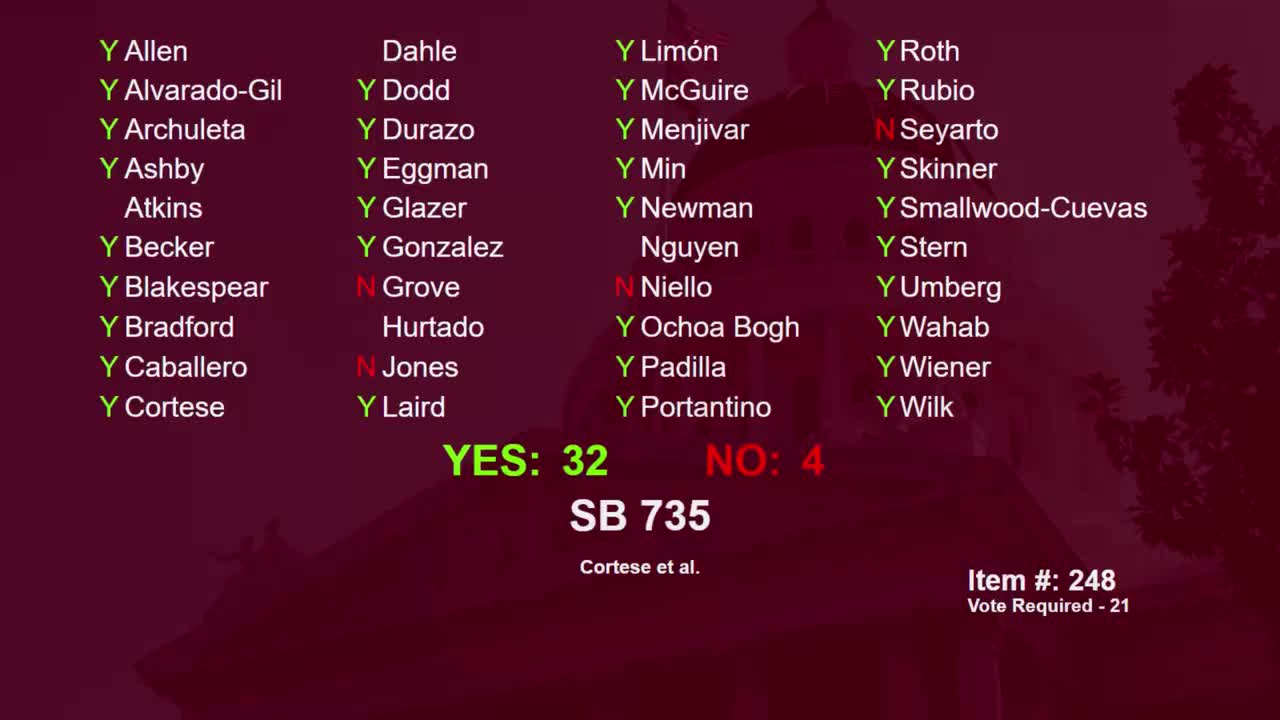 3MIN
Senate Floor
 6MIN
Senate Standing Committee on Judiciary
 10MIN