SB 88: Pupil transportation: driver qualifications.
- Session Year: 2023-2024
- House: Senate
- Latest Version Date: 2023-10-07
Current Status:
Passed
(2023-10-07: Chaptered by Secretary of State. Chapter 380, Statutes of 2023.)
Introduced
In Committee
First Chamber
In Committee
Second Chamber
Enacted
(1)Existing law requires the driver of a school pupil activity bus, as defined, to be subject to the regulations adopted by the Department of the California Highway Patrol governing schoolbus drivers, except as specified.
This bill would place various requirements upon a driver who provides certain transportation services for pupils, including, among others, by requiring these drivers to submit and clear tuberculosis risk assessments, as provided. The bill would require any vehicle used to provide pupil transportation for compensation by a local educational agency, as defined, to be inspected, as specified, and to be equipped with a first aid kit and a fire extinguisher.
The bill would require any local educational agency contracting with a private entity to provide pupil transportation to obtain from the private entity a written attestation that, among other things, it not have any applicable law violations, as defined, at the time of applying for the contract and that it will maintain compliance with applicable laws, as defined, for the duration of the contract. The bill would authorize a third party to report to the relevant local educational agency that the private entity the local educational agency contracted with has failed to provide a truthful attestation or has failed to maintain compliance with the applicable laws required for the duration of the contract, as specified.
The bill would apply the above-mentioned provisions to all drivers employed by a local educational agency, contracted by a local educational agency, or contracted by any entity with funding from a local educational agency, providing school-related pupil transportation, as defined, for compensation. The bill would not apply the above-mentioned provisions to (A) drivers of specified entities, (B) certain persons who are compensated to drive a pupil, (C) a school employee of a local educational agency when the employee provides transportation to pupils due to or because of the employees supervision of pupils for a field trip, extracurricular activity, or athletic program, or when the employee provides transportation to pupils for other activities, not to exceed 40 hours of drive time per school year per employee, (D) a driver who transports a pupil because of certain emergencies or an immediate threat to the physical safety of the pupil, (E) a driver who transports a pupil if the transportation is being provided through a Foster Youth Services Coordinating Program while a pupils transportation plan is being finalized, or (F) a driver during a trip for which they are authorized by the local educational agency to transport one or more pupils for a field trip when the destination is more than 200 miles from the transported pupils California school campus, as specified.
To the extent that the above-mentioned requirements conflict with a contract entered into between a local educational agency and a private entity before January 1, 2024, the bill would not apply those requirements until the expiration or renewal of that contract. The bill would make the provision regarding the expiration or renewal of these contracts operative on January 1, 2024, while making the remainder of the above-mentioned provisions operative on July 1, 2025. By imposing new requirements on local educational agencies, the bill would constitute a state-mandated local program.
(2)Existing law requires a governing board or county superintendent of schools providing for the transportation of pupils under contract, as provided, or any other provision of law to require as a condition of the contract the tuberculosis risk assessment, as provided, except that, at the discretion of the governing board or county superintendent of schools, that provision does not apply to a private contracted driver who transports pupils infrequently without prolonged contact with the pupils.
This bill would delete that exception for private contracted drivers. The bill would additionally extend the requirement involving a tuberculosis risk assessment to the governing body of a charter school, as specified. At the discretion of the governing board, county superintendent of schools, or governing body of a charter school, the bill would not apply the requirement involving a tuberculosis risk assessment to a private contracted driver who transports pupils infrequently and without prolonged contact with the pupils before July 1, 2025. To the extent that the bill would impose a new requirement on charter schools, the bill would constitute a state-mandated local program.
(3)The California Constitution requires the state to reimburse local agencies and school districts for certain costs mandated by the state. Statutory provisions establish procedures for making that reimbursement.
This bill would provide that, if the Commission on State Mandates determines that the bill contains costs mandated by the state, reimbursement for those costs shall be made pursuant to the statutory provisions noted above.
(1)Existing law requires the driver of a school pupil activity bus, as defined, to be subject to the regulations adopted by the Department of the California Highway Patrol governing schoolbus drivers, except as specified.
This bill would place various requirements upon a driver who provides certain transportation services for pupils, including, among others, by requiring these drivers to submit and clear tuberculosis risk assessments, as provided. The bill would require any vehicle used to provide pupil transportation for compensation by a local educational agency, as defined, to be inspected, as specified, and to be equipped with a first aid kit and a fire extinguisher.
The bill would require any local educational agency contracting with a private entity to provide pupil transportation to obtain from the private entity a written attestation that, among other things, it not have any applicable law violations, as defined, at the time of applying for the contract and that it will maintain compliance with applicable laws, as defined, for the duration of the contract. The bill would authorize a third party to report to the relevant local educational agency that the private entity the local educational agency contracted with has failed to provide a truthful attestation or has failed to maintain compliance with the applicable laws required for the duration of the contract, as specified.
The bill would apply the above-mentioned provisions to all drivers, whether drivers employed by or a local educational agency, contracted with by a local educational agency, or contracted by any entity with funding from a local educational agency, providing school-related pupil transportation transportation, as defined, for compensation. The bill would not apply the above-mentioned provisions to (A) drivers of specified entities, (B) certain persons who are compensated to drive themselves, their own child, or a minor or nonminor pupil in their care, a pupil, (C) a school employee of a local educational agency when the employee provides transportation to pupils due to or because of the employees supervision of pupils for a field trip, extracurricular activity, or athletic program, or when the employee provides transportation to pupils for other activities, not to exceed 40 hours of drive time per school year per employee, or (D) a driver who transports a pupil because of certain emergencies or an immediate threat to the physical safety of the pupil, (E) a driver who transports a pupil if the transportation is being provided through a Foster Youth Services Coordinating Program while a pupils transportation plan is being finalized, or (F) a driver during a trip for which they are authorized by the local educational agency to transport one or more pupils for a field trip when the destination is more than 200 miles from the transported pupils California school campus, as specified.
To the extent that the above-mentioned requirements conflict with a contract entered into between a local educational agency and a private entity before January 1, 2024, the bill would not apply those requirements until the expiration or renewal of that contract. The bill would make the provision regarding the expiration or renewal of these contracts operative on January 1, 2024, while making the remainder of the above-mentioned provisions operative on July 1, 2025. By imposing new requirements on local educational agencies, the bill would constitute a state-mandated local program.
(2)Existing law requires a governing board or county superintendent of schools providing for the transportation of pupils under contract, as provided, or any other provision of law to require as a condition of the contract the tuberculosis risk assessment, as provided, except that, at the discretion of the governing board or county superintendent of schools, that provision does not apply to a private contracted driver who transports pupils infrequently without prolonged contact with the pupils.
This bill would delete that exception for private contracted drivers. The bill would additionally extend the requirement involving a tuberculosis risk assessment to the governing body of a charter school, as specified. At the discretion of the governing board, county superintendent of schools, or governing body of a charter school, the bill would not apply the requirement involving a tuberculosis risk assessment to a private contracted driver who transports pupils infrequently and without prolonged contact with the pupils before July 1, 2025. To the extent that the bill would impose a new requirement on charter schools, the bill would constitute a state-mandated local program.
(3)The California Constitution requires the state to reimburse local agencies and school districts for certain costs mandated by the state. Statutory provisions establish procedures for making that reimbursement.
This bill would provide that, if the Commission on State Mandates determines that the bill contains costs mandated by the state, reimbursement for those costs shall be made pursuant to the statutory provisions noted above.
(1)Existing law requires the driver of a school pupil activity bus, as defined, to be subject to the regulations adopted by the Department of the California Highway Patrol governing schoolbus drivers, except as specified.
This bill would place various requirements upon a driver who provides certain transportation services for pupils, including, among others, by requiring these drivers to be mandated reporters and to submit and clear tuberculosis risk assessments, as provided. The bill would require any vehicle used to provide pupil transportation for compensation by a local educational agency, as defined, to be inspected, as specified, and to be equipped with a first aid kit and a fire extinguisher.
The bill would require any local educational agency contracting with a private entity to provide pupil transportation to obtain from the private entity a written attestation that, among other things, it not have any applicable law violations, as defined, at the time of applying for the contract, contract and that it will maintain compliance with applicable laws, as defined, for the duration of the contract, and that it will retain direct control over the manner and means for performance of any individual driver during the duration of the contract. contract. The bill would authorize a third party to report to the relevant local educational agency that the private entity the local educational agency contracted with has failed to provide a truthful attestation or has failed to maintain compliance with the applicable laws required for the duration of the contract, as specified.
The bill would apply the above-mentioned provisions to all drivers, whether employed by or contracted with a local educational agency, providing pupil transportation for compensation. The bill would not apply the above-mentioned provisions to (A) a driver of a municipally owned transit system offering supplementary service, as defined, (B) a parent or guardian who is compensated to drive their own children, or drivers of specified entities, (B) certain persons who are compensated to drive themselves, their own child, or a minor or nonminor pupil in their care, (C) a school employee of a local educational agency when the employee provides transportation to pupils due to or because of the employees supervision of pupils for a field trip, before or after school extracurricular activity, or athletic program, or when the employee provides transportation to pupils for other activities, not to exceed 40 hours per school year per employee, or (D) a driver who transports a pupil because of certain emergencies or an immediate threat to the physical safety of the pupil, as specified. To
To the extent that the above-mentioned requirements conflict with a contract entered into between a local educational agency and a private entity before January 1, 2024, the bill would not apply those requirements until the expiration or renewal of that contract on or after January 1, 2024. contract. The bill would make the provision regarding the expiration or renewal of these contracts operative on January 1, 2024, while making the remainder of the above-mentioned provisions operative on July 1, 2025. By imposing new requirements on local educational agencies, the bill would constitute a state-mandated local program.
(2)Existing law, the Child Abuse and Neglect Reporting Act, requires a mandated reporter, as defined, to report whenever they, in their professional capacity or within the scope of their employment, have knowledge of or observed a child whom the mandated reporter knows or reasonably suspects has been the victim of child abuse or neglect. Failure by a mandated reporter to report an incident of known or reasonably suspected child abuse or neglect is a misdemeanor punishable by up to 6 months of confinement in a county jail, by a fine of $1,000, or by both that imprisonment and fine. Under existing law, employers are strongly encouraged to provide their employees who are mandated reporters with training in these duties, including training in identification and reporting of child abuse and neglect.This bill would add a driver, whether employed by or contracted with a local educational agency, providing pupil transportation for compensation described in paragraph (1) to the list of individuals who are mandated reporters. By imposing the reporting requirements on a new class of persons, for whom failure to report specified conduct is a crime, this bill would impose a state-mandated local program.(3)(2)Existing law requires a governing board or county superintendent of schools providing for the transportation of pupils under contract, as provided, or any other provision of law to require as a condition of the contract the tuberculosis risk assessment, as provided, except that, at the discretion of the governing board or county superintendent of schools, that provision does not apply to a private contracted driver who transports pupils infrequently without prolonged contact with the pupils.
This bill would delete that exception for private contracted drivers. The bill would additionally extend the requirement involving a tuberculosis risk assessment to the governing body of a charter school, as specified. At the discretion of the governing board, county superintendent of schools, or governing body of a charter school, the bill would not apply the requirement involving a tuberculosis risk assessment to a private contracted driver who transports pupils infrequently and without prolonged contact with the pupils before July 1, 2025. To the extent that the bill would impose a new requirement on charter schools, the bill would constitute a state-mandated local program.
(4)The California Constitution requires the state to reimburse local agencies and school districts for certain costs mandated by the state. Statutory provisions establish procedures for making that reimbursement.This bill would provide that with regard to certain mandates no reimbursement is required by this act for a specified reason.With regard to any other mandates, this bill would provide that, if the Commission on State Mandates determines that the bill contains costs so mandated by the state, reimbursement for those costs shall be made pursuant to the statutory provisions noted above.(3)The California Constitution requires the state to reimburse local agencies and school districts for certain costs mandated by the state. Statutory provisions establish procedures for making that reimbursement.
This bill would provide that, if the Commission on State Mandates determines that the bill contains costs mandated by the state, reimbursement for those costs shall be made pursuant to the statutory provisions noted above.
(1)Existing law requires the driver of a school pupil activity bus, as defined, to be subject to the regulations adopted by the Department of the California Highway Patrol governing schoolbus drivers, except as specified.
This bill would place various requirements upon a driver who provides certain transportation services for pupils, including, among others, by requiring these drivers to be mandated reporters and to submit and clear tuberculosis risk assessments, as provided. The bill would require any vehicle used to provide pupil transportation for compensation by a local educational agency, as defined, to be inspected, as specified, and to be equipped with a first aid kit and a fire extinguisher.
The bill would require any local educational agency contracting with a private entity to provide pupil transportation to obtain from the private entity a written attestation that, among other things, it not have any applicable law violations, as defined, at the time of applying for the contract, that it will maintain compliance with applicable laws, as defined, for the duration of the contract, and that it will retain direct control over the manner and means for performance of any individual driver during the duration of the contract. The bill would authorize a third party to report to the relevant local educational agency that the private entity the local educational agency contracted with has failed to provide a truthful attestation or has failed to maintain compliance with the applicable laws required for the duration of the contract, as specified.
The bill would apply the above-mentioned provisions to all drivers, whether employed by or contracted with a local educational agency, providing pupil transportation for compensation. The bill would not apply the above-mentioned provisions to drivers (A) a driver of a municipally owned transit systems system offering supplementary service, as defined. defined, (B) a parent or guardian who is compensated to drive their own children, or (C) a school employee of a local educational agency when the employee provides transportation to pupils due to or because of the employees supervision of pupils for a field trip, before or after school activity, or athletic program, as specified. To the extent that the above-mentioned requirements conflict with a contract entered into between a local educational agency and a private entity before January 1, 2024, the bill would not apply those requirements until the expiration or renewal of that contract on or after January 1, 2024. By imposing new requirements on local educational agencies, the bill would constitute a state-mandated local program.
(2)Existing law, the Child Abuse and Neglect Reporting Act, requires a mandated reporter, as defined, to report whenever they, in their professional capacity or within the scope of their employment, have knowledge of or observed a child whom the mandated reporter knows or reasonably suspects has been the victim of child abuse or neglect. Failure by a mandated reporter to report an incident of known or reasonably suspected child abuse or neglect is a misdemeanor punishable by up to 6 months of confinement in a county jail, by a fine of $1,000, or by both that imprisonment and fine. Under existing law, employers are strongly encouraged to provide their employees who are mandated reporters with training in these duties, including training in identification and reporting of child abuse and neglect.
This bill would add a driver, whether employed by or contracted with a local educational agency, providing pupil transportation for compensation described in paragraph (1) to the list of individuals who are mandated reporters. By imposing the reporting requirements on a new class of persons, for whom failure to report specified conduct is a crime, this bill would impose a state-mandated local program.
(3)Existing law requires a governing board or county superintendent of schools providing for the transportation of pupils under contract, as provided, or any other provision of law to require as a condition of the contract the tuberculosis risk assessment, as provided, except that, at the discretion of the governing board or county superintendent of schools, that provision does not apply to a private contracted driver who transports pupils infrequently without prolonged contact with the pupils.
This bill would delete that exception for private contracted drivers.
(4)The California Constitution requires the state to reimburse local agencies and school districts for certain costs mandated by the state. Statutory provisions establish procedures for making that reimbursement.
This bill would provide that with regard to certain mandates no reimbursement is required by this act for a specified reason.
With regard to any other mandates, this bill would provide that, if the Commission on State Mandates determines that the bill contains costs so mandated by the state, reimbursement for those costs shall be made pursuant to the statutory provisions noted above.
(1)Existing law requires the driver of a school pupil activity bus, as defined, to be subject to the regulations adopted by the Department of the California Highway Patrol governing schoolbus drivers, except as specified.
This bill would place various requirements upon a driver who provides certain transportation services for pupils, including, among others, by requiring these drivers to be mandated reporters and to submit and clear tuberculosis risk assessments, as provided. The bill would require any vehicle used to provide pupil transportation for compensation by a local educational agency, as defined, to be inspected, as specified, and to be equipped with a first aid kit and a fire extinguisher.
The bill would require any local educational agency contracting with a private entity to provide pupil transportation to obtain from the private entity a written attestation that that, among other things, it not have any applicable law violations, as defined, at the time of applying for the contract, that it will maintain compliance with applicable laws, as defined, for the duration of the contract, and that it will retain direct control over the manner and means for performance of any individual driver during the duration of the contract. The bill would authorize a third party to report to the relevant local educational agency that the private entity the local educational agency contracted with has failed to provide a truthful attestation or has failed to maintain compliance with the applicable laws required for the duration of the contract, as specified.
The bill would apply the above-mentioned provisions to all drivers, whether employed by or contracted with a local educational agency, providing pupil transportation for compensation. The bill would not apply the above-mentioned provisions to drivers of municipally owned transit systems offering supplementary service, as defined. By imposing new requirements on local educational agencies, the bill would constitute a state-mandated local program.
(2)Existing law, the Child Abuse and Neglect Reporting Act, requires a mandated reporter, as defined, to report whenever they, in their professional capacity or within the scope of their employment, have knowledge of or observed a child whom the mandated reporter knows or reasonably suspects has been the victim of child abuse or neglect. Failure by a mandated reporter to report an incident of known or reasonably suspected child abuse or neglect is a misdemeanor punishable by up to 6 months of confinement in a county jail, by a fine of $1,000, or by both that imprisonment and fine. Under existing law, employers are strongly encouraged to provide their employees who are mandated reporters with training in these duties, including training in identification and reporting of child abuse and neglect.
This bill would add a driver, whether employed by or contracted with a local educational agency, providing pupil transportation for compensation described in paragraph (1) to the list of individuals who are mandated reporters. By imposing the reporting requirements on a new class of persons, for whom failure to report specified conduct is a crime, this bill would impose a state-mandated local program.
(3)Existing law requires a governing board or county superintendent of schools providing for the transportation of pupils under contract, as provided, or any other provision of law to require as a condition of the contract the tuberculosis risk assessment, as provided, except that, at the discretion of the governing board or county superintendent of schools, that provision does not apply to a private contracted driver who transports pupils infrequently without prolonged contact with the pupils.
This bill would delete that exception for private contracted drivers.
(4)The California Constitution requires the state to reimburse local agencies and school districts for certain costs mandated by the state. Statutory provisions establish procedures for making that reimbursement.
This bill would provide that with regard to certain mandates no reimbursement is required by this act for a specified reason.
With regard to any other mandates, this bill would provide that, if the Commission on State Mandates determines that the bill contains costs so mandated by the state, reimbursement for those costs shall be made pursuant to the statutory provisions noted above.
(1)Existing law requires the driver of a school pupil activity bus, as defined, to be subject to the regulations adopted by the Department of the California Highway Patrol governing schoolbus drivers, except as specified.
This bill would place various requirements upon a driver who provides certain transportation services for pupils, including, among others, by requiring these drivers to be mandated reporters and to submit and clear tuberculosis risk assessments, as provided. The bill would require any vehicle used to provide pupil transportation for compensation by a local educational agency, as defined, to be inspected, as specified, and to be equipped with a first aid kit and a fire extinguisher.
The bill would require any local educational agency contracting with a private entity to provide pupil transportation to obtain from the private entity a written attestation that it not have any applicable law violations, as defined, at the time of applying for the contract, that it will maintain compliance with applicable laws, as defined, for the duration of the contract, and that it will retain direct control over the manner and means for performance of any individual driver during the duration of the contract. The bill would authorize a third party to report to the relevant local educational agency that the private entity the local educational agency contracted with has failed to provide a truthful attestation or has failed to maintain compliance with the applicable laws required for the duration of the contract, as specified.
The bill would apply the above-mentioned provisions to all drivers, whether employed by or contracted with a local educational agency, providing pupil transportation for compensation. The bill would not apply the above-mentioned provisions to drivers of municipally owned transit systems offering supplementary service, as defined. By imposing new requirements on local educational agencies, the bill would constitute a state-mandated local program.
(2)Existing law, the Child Abuse and Neglect Reporting Act, requires a mandated reporter, as defined, to report whenever they, in their professional capacity or within the scope of their employment, have knowledge of or observed a child whom the mandated reporter knows or reasonably suspects has been the victim of child abuse or neglect. Failure by a mandated reporter to report an incident of known or reasonably suspected child abuse or neglect is a misdemeanor punishable by up to 6 months of confinement in a county jail, by a fine of $1,000, or by both that imprisonment and fine. Under existing law, employers are strongly encouraged to provide their employees who are mandated reporters with training in these duties, including training in identification and reporting of child abuse and neglect.
This bill would add a driver, whether employed by or contracted with a local educational agency, providing pupil transportation for compensation described in paragraph (1) to the list of individuals who are mandated reporters. By imposing the reporting requirements on a new class of persons, for whom failure to report specified conduct is a crime, this bill would impose a state-mandated local program.
(3)Existing law requires a governing board or county superintendent of schools providing for the transportation of pupils under contract, as provided, or any other provision of law to require as a condition of the contract the tuberculosis risk assessment, as provided, except that, at the discretion of the governing board or county superintendent of schools, that provision does not apply to a private contracted driver who transports pupils infrequently without prolonged contact with the pupils.
This bill would delete that exception for private contracted drivers.
(4)The California Constitution requires the state to reimburse local agencies and school districts for certain costs mandated by the state. Statutory provisions establish procedures for making that reimbursement.
This bill would provide that with regard to certain mandates no reimbursement is required by this act for a specified reason.
With regard to any other mandates, this bill would provide that, if the Commission on State Mandates determines that the bill contains costs so mandated by the state, reimbursement for those costs shall be made pursuant to the statutory provisions noted above.
(1)Existing law requires the driver of a school pupil activity bus, as defined, to be subject to the regulations adopted by the Department of the California Highway Patrol governing schoolbus drivers, except as specified.
This bill would place various requirements upon a driver who provides transportation services for pupils, including, among others, by requiring these drivers to be mandated reporters and to submit and clear tuberculosis risk assessments, as provided. The bill would require any vehicle used to provide pupil transportation for compensation by a local educational agency, as defined, to be inspected, as specified, and to be equipped with a first aid kit and a fire extinguisher.
The bill would require any local educational agency contracting with a private entity to provide pupil transportation to obtain from the private entity a written attestation that it not have any applicable law violations, as defined, at the time of applying for the contract, that it will maintain compliance with applicable laws, as defined, for the duration of the contract, and that it will retain direct control over the manner and means for performance of any individual driver during the duration of the contract. The bill would authorize a third party to report to the relevant local educational agency that the private entity the local educational agency contracted with has failed to provide a truthful attestation or has failed to maintain compliance with the applicable laws required for the duration of the contract, as specified.
The bill would apply the above-mentioned provisions to all drivers, whether employed by or contracted with a local educational agency, providing pupil transportation for compensation. The bill would not apply the above-mentioned provisions to drivers of municipally owned transit systems offering supplementary service, as defined. By imposing new requirements on local educational agencies, the bill would constitute a state-mandated local program.
(2)Existing law, the Child Abuse and Neglect Reporting Act, requires a mandated reporter, as defined, to report whenever they, in their professional capacity or within the scope of their employment, have knowledge of or observed a child whom the mandated reporter knows or reasonably suspects has been the victim of child abuse or neglect. Failure by a mandated reporter to report an incident of known or reasonably suspected child abuse or neglect is a misdemeanor punishable by up to 6 months of confinement in a county jail, by a fine of $1,000, or by both that imprisonment and fine. Under existing law, employers are strongly encouraged to provide their employees who are mandated reporters with training in these duties, including training in identification and reporting of child abuse and neglect.
This bill would add a driver, whether employed by or contracted with a local educational agency, providing pupil transportation for compensation described in paragraph (1) to the list of individuals who are mandated reporters. By imposing the reporting requirements on a new class of persons, for whom failure to report specified conduct is a crime, this bill would impose a state-mandated local program.
(3)Existing law requires a governing board or county superintendent of schools providing for the transportation of pupils under contract, as provided, or any other provision of law to require as a condition of the contract the tuberculosis risk assessment, as provided, except that, at the discretion of the governing board or county superintendent of schools, that provision does not apply to a private contracted driver who transports pupils infrequently without prolonged contact with the pupils.
This bill would delete that exception for private contracted drivers.
(4)The California Constitution requires the state to reimburse local agencies and school districts for certain costs mandated by the state. Statutory provisions establish procedures for making that reimbursement.
This bill would provide that with regard to certain mandates no reimbursement is required by this act for a specified reason.
With regard to any other mandates, this bill would provide that, if the Commission on State Mandates determines that the bill contains costs so mandated by the state, reimbursement for those costs shall be made pursuant to the statutory provisions noted above.
Existing law requires the driver of a school pupil activity bus, as defined, to be subject to the regulations adopted by the Department of the California Highway Patrol governing schoolbus drivers, except as specified.This bill would express the intent of the Legislature to enact subsequent legislation to codify existing regulations and rules that currently govern who can provide pupil transportation and what type of vehicle can be used for this purpose.Existing law requires the driver of a school pupil activity bus, as defined, to be subject to the regulations adopted by the Department of the California Highway Patrol governing schoolbus drivers, except as specified.
This bill would express the intent of the Legislature to enact subsequent legislation to codify existing regulations and rules that currently govern who can provide pupil transportation and what type of vehicle can be used for this purpose.
(a)The Legislature finds and declares all of the following:
(1)Schoolbus drivers provide an important service to our pupils and their families. They ensure the safe transportation of pupils between home and school.
(2)Schoolbus drivers and school buses are heavily regulated by the State Department of Education, the Department of Motor Vehicles, and the Department of the California Highway Patrol.
(3)In recent years, some local educational agencies have entered into multiyear and multimillion dollar contracts with app-based companies, also known as transportation network companies, to perform home-to-school transportation and other pupil transportation.
(4)The Public Utilities Commission licenses and regulates transportation network companies. Transportation network companies provide prearranged transportation services for compensation using an online platform or smartphone application to connect drivers using their personal vehicles with passengers.
(5)The Public Utilities Commission does not regulate transportation network companies when the transportation of pupils is due to or based on a contract entered into with the governing board of a school district pursuant to the Education Code.
(6)Due to this unregulated space, transportation network companies and their drivers neither fall under the rules and regulations of the Public Utilities Commission, the State Department of Education, the Department of Motor Vehicles, nor the Department of the California Highway Patrol when performing the job and duties that, until recently, have only been performed by schoolbus drivers.
(b)For the health and safety of pupils and the public, it is the intent of the Legislature that there is parity in law that applies equally to all drivers, regardless of employer and employment status, who are compensated to transport pupils.
SEC. 2.Article 5 (commencing with Section 39875) is added to Chapter 1 of Part 23.5 of Division 3 of Title 2 of the Education Code, to read:5.Compensated Driver Requirements39875.(a)Except as provided pursuant to subdivisions (b) to (g), inclusive, this article shall apply to all drivers employed by a local educational agency, contracted by a local educational agency, or contracted by any entity with funding from a local educational agency, providing school-related pupil transportation for compensation.
(b)Nothing in this article shall be construed to apply to a driver employed by any of the following:
(1)A municipally owned transit system offering supplementary service.
(2)A congregate care facility licensed by the State Department of Social Services.
(3)A county human services agency.
(4)An entity, excluding entities with a primary purpose of providing transportation services, serving pupils experiencing homelessness that is coordinated with the homeless continuum of care in counties that have one or otherwise designated to serve children who are homeless by a county without a continuum of care.
(5)A county probation agency.
(6)Another government agency, other than a local educational agency.
(7)A foster family agency, as defined in paragraph (4) of subdivision (a) of Section 1502 of the Health and Safety Code.
(8)A tribal authority.
(c)Nothing in this article shall be construed to apply to any of the following persons who are compensated to drive a pupil:
(1)A parent or relative as defined in paragraph (2) of subdivision (c) of Section 361.3 of the Welfare and Institutions Code, or a nonrelative extended family member as defined in Section 362.7 of the Welfare and Institutions Code.
(2)A guardian.
(3)A caregiver given temporary or permanent custody of the pupil by a court, child welfare agency, tribal authority, or county probation department.
(4)A court-appointed educational rights holder.
(5)A court-appointed special advocate.
(6)A pupil who drives themself.
(d)If both of the following occur, nothing in this article shall be construed to apply to a school employee of a local educational agency when the employee provides transportation to pupils due to or because of the employees supervision of pupils for a field trip, extracurricular activity, or athletic program, or when the employee provides transportation to pupils for other activities, not to exceed 40 hours of drive time per school year per employee:
(1)A local educational agency makes a reasonable effort to secure a driver who meets the requirements of this article.
(2)When a local educational agency is unable to secure a driver who meets the requirements of this article, the local educational agency informs the parent, guardian, or court-appointed educational rights holder of the pupil being transported that the driver transporting their pupil does not meet the requirements of this article, unless that notice will jeopardize a pupils privacy rights.
(e)Nothing in this article shall be construed to apply to a driver who transports a pupil who must be immediately transported to a facility in the case of a medical or psychiatric emergency, or in the case of pupils who need to be transported immediately as the result of an emergency that arises as a result of a fire, flood, earthquake, or epidemic, or because of any order of any military officer of the United States or of the state to meet an emergency created by war, or because of an immediate threat to the physical safety of the pupil or pupils. The exemption pursuant to this subdivision involving an epidemic shall only apply to each epidemic for a period lasting no longer than one month.
(f)Nothing in this article shall be construed to apply to a driver who transports a pupil if the transportation is being provided through a Foster Youth Services Coordinating Program while a pupils transportation plan is being finalized. The exemption pursuant to this subdivision shall apply for a period lasting no longer than one month after the first ride is provided to that pupil under this exemption.
(g)Nothing in this article shall be construed to apply to a driver during a trip for which they are authorized by the local educational agency to transport one or more pupils for a field trip when the destination is more than 200 miles from the transported pupils California school campus.
39877.(a)A driver who provides transportation services for pupils in a vehicle with a maximum capacity of 10 or fewer persons, including the driver, shall:
(1)Hold a valid California drivers license for the appropriate class of vehicle.
(2)Be at least 18 years of age.
(3)Pass a criminal background check, including fingerprint clearance consistent with Section 45125 for employees and Section 45125.1 for all other compensated drivers.
(4)Have a satisfactory driving record that includes none of the following:
(A)Within three years, has committed any violation that results in a conviction assigned a violation point count of two or more, as defined in Sections 12810 and 12810.5 of the Vehicle Code.
(B)Within three years, has had their driving privilege suspended, revoked, or on probation for any reason involving the unsafe operation of a motor vehicle.
(C)Has been determined by the Department of Motor Vehicles to be a negligent or incompetent operator.
(5)Not have demonstrated irrational behavior to the extent that a reasonable and prudent person would have reasonable cause to believe that the drivers ability to perform the duties of a driver may be impaired.
(6)Not have been convicted of an offense listed in paragraph (1) of subdivision (a) of Section 13370 of the Vehicle Code, paragraph (5) of subdivision (a) of Section 13370 of the Vehicle Code, or subdivision (b) of Section 13370 of the Vehicle Code.
(7)Provide their employer or the private entity contracting with the local educational agency a report showing the drivers current public record as recorded by the Department of Motor Vehicles and participate in the Department of Motor Vehicles pull-notice system.
(8)Be subjected to and comply with drug and alcohol testing consistent with Section 34520.3 of the Vehicle Code, subject to the cannabis discrimination limitations described in Section 12954 of the Government Code.
(9)(A)Complete a medical examination not more than two years prior to the driver performing pupil transportation by a physician licensed to practice medicine, a licensed advanced practice registered nurse qualified to perform a medical examination, a licensed physician assistant, or a licensed doctor of chiropractic listed on the most current National Registry of Certified Medical Examiners, as adopted by the United States Department of Transportation. The driver shall provide a copy of the Medical Examiners Certificate, Form MCSA-5876, or the medical examiners certificate of clearance to their employer or the private entity contracting with the local educational agency. Neither the driver nor the medical examiner need to submit this examination result to the Department of Motor Vehicles.
(B)The driver shall complete a medical examination pursuant to this paragraph every two years after the initial examination and provide a copy of the Medical Examiners Certificate, Form MCSA-5876, or the medical examiners certificate of clearance to their employer or the private entity contracting with the local educational agency.
(C)Within the same month of reaching 65 years of age and each 12th month thereafter, the driver shall undergo a medical examination pursuant to this paragraph and provide a copy of the Medical Examiners Certificate, Form MCSA-5876, or the medical examiners certificate of clearance to their employer or the private entity contracting with the local educational agency.
(10)Submit and clear a tuberculosis risk assessment consistent with Section 49406.
(11)Not drive for more than 10 hours within a work period, or after the end of the 16th hour after coming on duty following eight consecutive hours off duty.
(12)Complete initial training and subsequent required training sufficient to gain proficiency in all of the following:
(A)Pretrip vehicle inspections.
(B)Safe loading and unloading of passengers.
(C)Proper use of seatbelts and child safety restraints.
(D)Handling accidents, incidents, and emergency situations.
(E)Providing proper accommodations for pupils with disabilities.
(F)Defensive driving.
(G)Operations in inclement weather.
(H)Operations at night or under impaired visibility conditions.
(13)Maintain a daily log sheet and complete the daily pretrip inspection of the vehicle being driven that day, which shall include all of the following:
(A)A check of the operability of all lights, initialed by the driver before the vehicle is first driven in service that day.
(B)A check for fluid leaks, initialed by the driver before the vehicle is first driven in service that day.
(C)A check for the operability of the brakes, initialed by the driver before the vehicle is driven in service that day.
(14)Complete training at least equivalent to the American Red Cross first aid training program, or hold a valid and current first aid certificate issued by the American Red Cross or by an organization whose first aid training program is at least equivalent to the American Red Cross first aid training program, as determined by the Emergency Medical Services Authority.
(b)For vehicles with a maximum capacity of eight or fewer passengers, excluding the driver, only street-legal coupes, sedans, or light-duty vehicles, including vans, minivans, sport utility vehicles, and pickup trucks, shall be used for pupil transportation.
(c)Nothing in this article shall limit any additional safety or training requirements that may be imposed by the Public Utilities Commission, a local educational agency, or any government agency.
39878.A driver who provides transportation services for pupils in a vehicle with a capacity of more than 10 persons, including the driver, shall:
(a)Hold a valid California commercial drivers license for the appropriate class of vehicle, endorsed for passenger transportation pursuant to Section 15278 of the Vehicle Code.
(b)Comply with paragraphs (2) to (14), inclusive, of subdivision (a) of Section 39877 if they are not already required to by law.
(c)This article shall not reduce other legal requirements placed on any driver who provides transportation services for pupils in a vehicle with a capacity of more than 10 persons, including, but not limited to, a driver of a schoolbus or school pupil activity bus.
39879.(a)Any local educational agency contracting with a private entity to provide pupil transportation shall obtain from the private entity a written attestation to all of the following:
(1)That it not have any applicable law violations at the time of applying for the contract.
(2)That it will maintain compliance with applicable laws for the duration of the contract.
(3)That only drivers who meet the requirements of paragraphs (1) to (14), inclusive, of subdivision (a) of Section 39877 work, or will work, under the contract between the private entity and local educational agency.
(4)That it has on file all the reports and documents required pursuant to paragraphs (1) to (14), inclusive, of subdivision (a) of Section 39877 for the duration of the contract, including, but not limited to, updated, revised, or modified reports and documents. These reports and documents shall be available for inspection by the local educational agency or any other state regulatory agency at any time.
(b)A third party may report to the relevant local educational agency that the private entity the local educational agency contracted with has failed to provide a truthful attestation as required under subdivision (a) or has failed to maintain compliance with the applicable laws required for the duration of the contract. The third party shall provide documentation to substantiate their allegation before the local educational agency considers it.
(c)Any vehicle used to provide pupil transportation for compensation by a local educational agency shall meet both of the following:
(1)Be inspected every 12 months, or every 50,000 miles, whichever comes first, at a facility licensed by the Bureau of Automotive Repair to ensure that the vehicle passes a 19-point vehicle inspection, as adopted by the Public Utilities Commission and set forth in D.13-09-045, before allowing the vehicle to be driven. This requirement does not apply to vehicles owned or contracted with a local educational agency already subject to a statutory inspection program.
(2)Be equipped with a first aid kit and a fire extinguisher.
39880.(a)To the extent that the requirements of this article conflict with a contract entered into between a local educational agency and a private entity before January 1, 2024, this article shall not apply until the expiration or renewal of that contract.
(b)As used in this section, local educational agency means a school district, county office of education, charter school, entity providing services under a school transportation joint powers agreement, or regional occupational center or program.39881.As used in this article, the following definitions apply:
(a)Applicable law means applicable California laws within the Labor and Workforce Development Agencys jurisdiction related to the misclassification of employees as independent contractors, including the failure to pay wages, imposing unlawful expenses on employees, failure to provide workers compensation insurance, and failure to remit payroll taxes as required under the Unemployment Insurance Code as well as laws protecting worker health and safety.
(b)Applicable law violation means a violation that has a final determination, order, judgment, or award issued against a private entity for engaging in illegal conduct related to applicable laws and that remains unabated or unsatisfied following the period during which an appeal may be made.
(c)Congregate care facility means a community care facility, intermediate care facility, skilled nursing facility, or a short-term residential therapeutic program.
(d)Local educational agency means a school district, county office of education, charter school, entity providing services under a school transportation joint powers agreement, or regional occupational center or program.
(e)School-related pupil transportation means home-to-school transportation, field trips, after school program-related transportation, preschool and childcare-related transportation, athletic program-related transportation, extracurricular school activity-related transportation, or any transportation of pupils to or from a school campus.
(f)Municipally owned transit system means a transit system owned by a city, or by a district created pursuant to Part 1 (commencing with Section 24501) of Division 10 of the Public Utilities Code.
(g)Supplementary service means additional service provided by a municipally owned transit system for the purpose of ensuring the regular transit service is not impacted by large loads associated with pupil passengers traveling to or from schoolsites around school bell times.
39882.(a)Except as provided pursuant to subdivision (b), this article shall become operative on July 1, 2025.
(b)Section 39880 shall become operative on January 1, 2024.
SEC. 3.Section 49406 of the Education Code is amended to read:49406.(a)(1)(A)Except as provided in subdivision (j), a person shall not be initially employed by a school district, or employed under contract, in a certificated or classified position unless the person has submitted to a tuberculosis risk assessment within the past 60 days, and, if tuberculosis risk factors are identified, has been examined to determine that the person is free of infectious tuberculosis by a physician and surgeon licensed under Chapter 5 (commencing with Section 2000) of Division 2 of the Business and Professions Code, a physician assistant practicing in compliance with Chapter 7.7 (commencing with Section 3500) of Division 2 of the Business and Professions Code, or a nurse practitioner practicing in compliance with Chapter 6 (commencing with Section 2700) of Division 2 of the Business and Professions Code. If no risk factors are identified, an examination is not required. A person who is subject to the requirements of this subdivision may submit to an examination that complies with subparagraph (B) instead of submitting to a tuberculosis risk assessment.
(B)The examination required by this subdivision shall consist of either an approved intradermal tuberculin test or any other test for tuberculosis infection that is recommended by the federal Centers for Disease Control and Prevention (CDC) and licensed by the federal Food and Drug Administration (FDA). If the test is positive, the test shall be followed by an X-ray of the lungs in accordance with subdivision (f) of Section 120115 of the Health and Safety Code.
(2)The X-ray may be taken by a competent and qualified X-ray technician if the X-ray is subsequently interpreted by a physician and surgeon licensed under Chapter 5 (commencing with Section 2000) of Division 2 of the Business and Professions Code.
(3)The district superintendent of schools or their designee may exempt, for a period not to exceed 60 days following termination of the pregnancy, a pregnant employee from the requirement that a positive test for tuberculosis infection be followed by an X-ray of the lungs.
(b)Thereafter, an employee who has no identified risk factors or who tests negative for the tuberculosis infection shall be required to undergo the tuberculosis risk assessment and, if risk factors are identified, the examination, at least once every four years or more often if directed by the governing board of the school district upon recommendation of the local health officer. Once an employee has a documented positive test for tuberculosis infection conducted pursuant to this subdivision that has been followed by an X-ray, the tuberculosis risk assessment is no longer required. A referral shall be made within 30 days of completion of the examination to the local health officer to determine the need for followup care.
(c)After the tuberculosis risk assessment and, if indicated, the examination, the employee shall file with the district superintendent of schools a certificate from the examining physician and surgeon, physician assistant, or nurse practitioner showing the employee was examined and found free from infectious tuberculosis. The county board of education may require, by rule, that the certificates be filed in the office of the county superintendent of schools or maintained in the office of the county superintendent of schools if a majority of the governing boards of the school districts within the county petition the county board of education. A school district, or school districts with a common governing board, having an average daily attendance of 60,000 or more may elect to maintain the files for its employees in that school district.
(d)As used in this section, certificate means a certificate signed by the examining physician and surgeon licensed under Chapter 5 (commencing with Section 2000) of Division 2 of the Business and Professions Code, a physician assistant practicing in compliance with Chapter 7.7 (commencing with Section 3500) of Division 2 of the Business and Professions Code, or a nurse practitioner practicing in compliance with Chapter 6 (commencing with Section 2700) of Division 2 of the Business and Professions Code, or a notice from a public health agency that indicates freedom from infectious tuberculosis. The latter, regardless of form, shall constitute evidence of compliance with this section.
(e)Nothing in this section shall prevent the governing board of a school district, upon recommendation of the local health officer, from establishing a rule requiring a more extensive or more frequent physical examination than required by this section. The rule shall provide for reimbursement on the same basis as required in this section.
(f)The tuberculosis risk assessment and, if indicated, the examination is a condition of initial employment and the expense shall be borne by the applicant unless otherwise provided by rules of the governing board of the school district. However, the governing board of a school district may, if an applicant is accepted for employment, reimburse that person in a like manner prescribed in this section for employees.
(g)The governing board of a school district shall reimburse the employee for the cost, if any, of the tuberculosis risk assessment and the examination. The governing board of a school district may provide for the tuberculosis risk assessment and examination required by this section or may establish a reasonable fee for the examination that is reimbursable to employees of the school district complying with this section.
(h)At the discretion of the governing board of a school district, this section shall not apply to those employees not requiring certification qualifications who are employed for any period of time less than a school year whose functions do not require frequent or prolonged contact with pupils.
(i)If the governing board of a school district determines by resolution, after hearing, that the health of pupils in the school district would not be jeopardized, this section shall not apply to an employee of the school district who files an affidavit stating that the employee adheres to the faith or teachings of a well-recognized religious sect, denomination, or organization and, in accordance with its creed, tenets, or principles, depends for healing upon prayer in the practice of religion, and that to the best of the employees knowledge and belief, the employee is free from infectious tuberculosis. If at any time there is probable cause to believe that the affiant is afflicted with infectious tuberculosis, the employee may be excluded from service until the governing board of the school district is satisfied that the employee is not afflicted.
(j)A person who transfers employment from one school or school district to another school or school district shall be deemed to meet the requirements of subdivision (a) if that person can produce a certificate that shows the person was found to be free of infectious tuberculosis within 60 days of initial hire, or the school previously employing the person verifies that the person has a certificate on file showing that the person is free from infectious tuberculosis.
(k)A person who transfers their employment from a private or parochial elementary school, secondary school, or nursery school to a school or school district subject to this section shall be deemed to meet the requirements of subdivision (a) if that person can produce a certificate as provided for in Section 121525 of the Health and Safety Code that shows that they were found to be free of infectious tuberculosis within 60 days of initial hire, or if the school previously employing the person verifies that the person has a certificate on file showing that the person is free from infectious tuberculosis.
(l)(1)A governing board, county superintendent of schools, or governing body of a charter school providing for the transportation of pupils under contract authorized by Section 39800, 39801, or any other provision of law shall require as a condition of the contract the tuberculosis risk assessment and, if indicated, the examination for infectious tuberculosis within 60 days of initial hire, as provided by subdivision (a), of all drivers transporting pupils for compensation.
(2)At the discretion of the governing board, county superintendent of schools, or governing body of a charter school, paragraph (1) shall not apply to a private contracted driver who transports pupils infrequently and without prolonged contact with the pupils before July 1, 2025.
(m)A volunteer in a school shall also be required to have on file with the school a certificate showing that, upon initial volunteer assignment, the person submitted to a tuberculosis risk assessment and, if tuberculosis risk factors were identified, was examined and found to be free of infectious tuberculosis. If no risk factors are identified, an examination is not required. At the discretion of the governing board of a school district, this section shall not apply to a volunteer whose functions do not require frequent or prolonged contact with pupils.
(n)The State Department of Public Health, in consultation with the California Tuberculosis Controllers Association, shall develop a risk assessment questionnaire, to be used to conduct tuberculosis risk assessments pursuant to this section. The risk assessment questionnaire shall be administered by a health care provider, which shall be specified on the questionnaire. This risk assessment questionnaire shall be exempt from the rulemaking provisions of the Administrative Procedure Act (Chapter 3.5 (commencing with Section 11340) of Part 1 of Division 3 of Title 2 of the Government Code).
SEC. 4.If the Commission on State Mandates determines that this act contains costs mandated by the state, reimbursement to local agencies and school districts for those costs shall be made pursuant to Part 7 (commencing with Section 17500) of Division 4 of Title 2 of the Government Code.
(a)The Legislature finds and declares all of the following:
(1)Schoolbus drivers provide an important service to our pupils and their families. They ensure the safe transportation of pupils between home and school.
(2)Schoolbus drivers and school buses are heavily regulated by the State Department of Education, the Department of Motor Vehicles, and the Department of the California Highway Patrol.
(3)In recent years, some local educational agencies have entered into multiyear and multimillion dollar contracts with app-based companies, also known as transportation network companies, to perform home-to-school transportation and other pupil transportation.
(4)The Public Utilities Commission licenses and regulates transportation network companies. Transportation network companies provide prearranged transportation services for compensation using an online platform or smartphone application to connect drivers using their personal vehicles with passengers.
(5)The Public Utilities Commission does not regulate transportation network companies when the transportation of pupils is due to or based on a contract entered into with the governing board of a school district pursuant to the Education Code.
(6)Due to this unregulated space, transportation network companies and their drivers neither fall under the rules and regulations of the Public Utilities Commission, the State Department of Education, the Department of Motor Vehicles, nor the Department of the California Highway Patrol when performing the job and duties that, until recently, have only been performed by schoolbus drivers.
(b)For the health and safety of pupils and the public, it is the intent of the Legislature that there is parity in law that applies equally to all drivers, regardless of employer and employment status, who are compensated to transport pupils.
SECTION 1.SEC. 2.Article 5 (commencing with Section 39875) is added to Chapter 1 of Part 23.5 of Division 3 of Title 2 of the Education Code, to read:5.Compensated Driver Requirements39875.(a)The Legislature finds and declares all of the following:(1)Schoolbus drivers provide an important service to our pupils and their families. They ensure the safe transportation of pupils between home and school.(2)Schoolbus drivers and school buses are heavily regulated by the State Department of Education, the Department of Motor Vehicles, and the Department of the California Highway Patrol.(3)In recent years, some local educational agencies have entered into multiyear and multimillion dollar contracts with app-based companies, also known as transportation network companies, to perform home-to-school transportation and other pupil transportation.(4)The Public Utilities Commission licenses and regulates transportation network companies. Transportation network companies provide prearranged transportation services for compensation using an online platform or smartphone application to connect drivers using their personal vehicles with passengers.(5)The Public Utilities Commission does not regulate transportation network companies when the transportation of pupils is due to or based on a contract entered into with the governing board of a school district pursuant to the Education Code.(6)Due to this unregulated space, transportation network companies and their drivers neither fall under the rules and regulations of the Public Utilities Commission, the State Department of Education, the Department of Motor Vehicles, nor the Department of the California Highway Patrol when performing the job and duties that, until recently, have only been performed by schoolbus drivers.(b)For the health and safety of pupils and the public, it is the intent of the Legislature that there is parity in law that applies equally to all drivers, regardless of employer and employment status, who are compensated to transport pupils.39876.39875.(a)Except as provided pursuant to subdivisions (b) to (d), (g), inclusive, this article shall apply to all drivers, whether drivers employed by or a local educational agency, contracted with by a local educational agency, or contracted by any entity with funding from a local educational agency, providing school-related pupil transportation for compensation.
(b)Nothing in this article shall be construed to apply to a driver employed by any of the following:
(1)A municipally owned transit system offering supplementary service.
(2)A congregate care facility licensed by the State Department of Social Services.
(3)A county human services agency.
(4)A county welfare agency.(4)An entity, excluding entities with a primary purpose of providing transportation services, serving pupils experiencing homelessness that is coordinated with the homeless continuum of care in counties that have one or otherwise designated to serve children who are homeless by a county without a continuum of care.
(5)A county probation agency.
(6)Another government agency, other than a local educational agency.
(7)A foster family agency, as defined in paragraph (4) of subdivision (a) of Section 1502 of the Health and Safety Code.
(8)A tribal authority.
(c)Nothing in this article shall be construed to apply to any of the following persons who are compensated to drive themselves, their own child, or a minor or nonminor pupil in their care: a pupil:
(1)A parent or relative named in as defined in paragraph (2) of subdivision (c) of Section 361.3 of the Welfare and Institutions Code, or a nonrelative extended family member named in as defined in Section 362.7 of the Welfare and Institutions Code.
(2)A guardian.
(3)A resource family.(3)A caregiver given temporary or permanent custody of the pupil by a court, child welfare agency, tribal authority, or county probation department.
(4)A court-appointed educational rights holder.
(5)A court-appointed special advocate.
(6)A pupil who drives themself.
(d)If both of the following occur, nothing in this article shall be construed to apply to a school employee of a local educational agency when the employee provides transportation to pupils due to or because of the employees supervision of pupils for a field trip, extracurricular activity, or athletic program, or when the employee provides transportation to pupils for other activities, not to exceed 40 hours of drive time per school year per employee:
(1)A local educational agency makes a reasonable effort to secure a driver who meets the requirements of this article.
(2)When a local educational agency is unable to secure a driver who meets the requirements of this article, the local educational agency informs the parent, guardian, or court-appointed educational rights holder of the pupil being transported that the driver transporting their pupil does not meet the requirements of this article, unless that notice will jeopardize a pupils privacy rights.
(e)Nothing in this article shall be construed to apply to a driver who transports a pupil who must be immediately transported to a facility in the case of a medical or psychiatric emergency, or in the case of pupils who need to be transported immediately as the result of an emergency that arises as a result of a fire, flood, earthquake, or epidemic, or because of any order of any military officer of the United States or of the state to meet an emergency created by war, or because of an immediate threat to the physical safety of the pupil or pupils. The exemption pursuant to this subdivision involving an epidemic shall only apply to each epidemic for a period lasting no longer than one month.
(f)Nothing in this article shall be construed to apply to a driver who transports a pupil if the transportation is being provided through a Foster Youth Services Coordinating Program while a pupils transportation plan is being finalized. The exemption pursuant to this subdivision shall apply for a period lasting no longer than one month after the first ride is provided to that pupil under this exemption.
(g)Nothing in this article shall be construed to apply to a driver during a trip for which they are authorized by the local educational agency to transport one or more pupils for a field trip when the destination is more than 200 miles from the transported pupils California school campus.
39877.(a)A driver who provides transportation services for pupils in a vehicle with a maximum capacity of 10 or fewer persons, including the driver, shall:
(1)Hold a valid California drivers license for the appropriate class of vehicle.
(2)Be at least 18 years of age.
(3)Pass a criminal background check, including fingerprint clearance consistent with Section 45125 for employees and Section 45125.1 for all other compensated drivers.
(4)Have a satisfactory driving record that includes none of the following:
(A)Within three years, has committed any violation that results in a conviction assigned a violation point count of two or more, as defined in Sections 12810 and 12810.5 of the Vehicle Code.
(B)Within three years, has had their driving privilege suspended, revoked, or on probation for any reason involving the unsafe operation of a motor vehicle.
(C)Has been determined by the Department of Motor Vehicles to be a negligent or incompetent operator.
(5)Not have demonstrated irrational behavior to the extent that a reasonable and prudent person would have reasonable cause to believe that the drivers ability to perform the duties of a driver may be impaired.
(6)Not have been convicted of an offense listed in paragraph (1) of subdivision (a) of Section 13370 of the Vehicle Code, paragraph (5) of subdivision (a) of Section 13370 of the Vehicle Code, or subdivision (b) of Section 13370 of the Vehicle Code.
(7)Provide their employer or the private entity contracting with the local educational agency a report showing the drivers current public record as recorded by the Department of Motor Vehicles and participate in the Department of Motor Vehicles pull-notice system.
(8)Be subjected to and comply with drug and alcohol testing consistent with Section 34520.3 of the Vehicle Code, subject to the cannabis discrimination limitations described in Section 12954 of the Government Code.
(9)(A)Complete a medical examination not more than two years prior to the driver performing pupil transportation by a physician licensed to practice medicine, a licensed advanced practice registered nurse qualified to perform a medical examination, a licensed physician assistant, or a licensed doctor of chiropractic listed on the most current National Registry of Certified Medical Examiners, as adopted by the United States Department of Transportation. The driver shall provide a copy of the Medical Examiners Certificate, Form MCSA-5876, or the medical examiners certificate of clearance to their employer or the private entity contracting with the local educational agency. Neither the driver nor the medical examiner need to submit this examination result to the Department of Motor Vehicles.
(B)The driver shall complete a medical examination pursuant to this paragraph every two years after the initial examination and provide a copy of the Medical Examiners Certificate, Form MCSA-5876, or the medical examiners certificate of clearance to their employer or the private entity contracting with the local educational agency.
(C)Within the same month of reaching 65 years of age and each 12th month thereafter, the driver shall undergo a medical examination pursuant to this paragraph and provide a copy of the Medical Examiners Certificate, Form MCSA-5876, or the medical examiners certificate of clearance to their employer or the private entity contracting with the local educational agency.
(10)Submit and clear a tuberculosis risk assessment consistent with Section 49406.
(11)Not drive for more than 10 hours within a work period, or after the end of the 16th hour after coming on duty following eight consecutive hours off duty.
(12)Complete initial training and subsequent required training sufficient to gain proficiency in all of the following:
(A)Pretrip vehicle inspections.
(B)Safe loading and unloading of passengers.
(C)Proper use of seatbelts and child safety restraints.
(D)Handling accidents, incidents, and emergency situations.
(E)Providing proper accommodations for pupils with disabilities.
(F)Defensive driving.
(G)Operations in inclement weather.
(H)Operations at night or under impaired visibility conditions.
(13)Maintain a daily log sheet and complete the daily pretrip inspection of the vehicle being driven that day, which shall include all of the following:
(A)A check of the operability of all lights, initialed by the driver before the vehicle is first driven in service that day.
(B)A check for fluid leaks, initialed by the driver before the vehicle is first driven in service that day.
(C)A check for the operability of the brakes, initialed by the driver before the vehicle is driven in service that day.
(14)Complete training at least equivalent to the American Red Cross first aid training program, or hold a valid and current first aid certificate issued by the American Red Cross or by an organization whose first aid training program is at least equivalent to the American Red Cross first aid training program, as determined by the Emergency Medical Services Authority.
(b)For vehicles with a maximum capacity of eight or fewer passengers, excluding the driver, only street-legal coupes, sedans, or light-duty vehicles, including vans, minivans, sport utility vehicles, and pickup trucks, shall be used for pupil transportation.
(c)Nothing in this article shall limit any additional safety or training requirements that may be imposed by the Public Utilities Commission, a local educational agency, or any government agency.
39878.A driver who provides transportation services for pupils in a vehicle with a capacity of more than 10 persons, including the driver, shall:
(a)Hold a valid California commercial drivers license for the appropriate class of vehicle, endorsed for passenger transportation pursuant to Section 15278 of the Vehicle Code.
(b)Comply with paragraphs (2) to (14), inclusive, of subdivision (a) of Section 39877 if they are not already required to by law.
(c)This article shall not reduce other legal requirements placed on any driver who provides transportation services for pupils in a vehicle with a capacity of more than 10 persons, including, but not limited to, a driver of a schoolbus or school pupil activity bus.
39879.(a)Any local educational agency contracting with a private entity to provide pupil transportation shall obtain from the private entity a written attestation to all of the following:
(1)That it not have any applicable law violations at the time of applying for the contract.
(2)That it will maintain compliance with applicable laws for the duration of the contract.
(3)That only drivers who meet the requirements of paragraphs (1) to (14), inclusive, of subdivision (a) of Section 39877 work, or will work, under the contract between the private entity and local educational agency.
(4)That it has on file all the reports and documents required pursuant to paragraphs (1) to (14), inclusive, of subdivision (a) of Section 39877 for the duration of the contract, including, but not limited to, updated, revised, or modified reports and documents. These reports and documents shall be available for inspection by the local educational agency or any other state regulatory agency at any time.
(b)A third party may report to the relevant local educational agency that the private entity the local educational agency contracted with has failed to provide a truthful attestation as required under subdivision (a) or has failed to maintain compliance with the applicable laws required for the duration of the contract. The third party shall provide documentation to substantiate their allegation before the local educational agency considers it.
(c)Any vehicle used to provide pupil transportation for compensation by a local educational agency shall meet both of the following:
(1)Be inspected every 12 months, or every 50,000 miles, whichever comes first, at a facility licensed by the Bureau of Automotive Repair to ensure that the vehicle passes a 19-point vehicle inspection, as adopted by the Public Utilities Commission and set forth in D.13-09-045, before allowing the vehicle to be driven. This requirement does not apply to vehicles owned or contracted with a local educational agency already subject to a statutory inspection program.
(2)Be equipped with a first aid kit and a fire extinguisher.
39880.(a)To the extent that the requirements of this article conflict with a contract entered into between a local educational agency and a private entity before January 1, 2024, this article shall not apply until the expiration or renewal of that contract.
(b)As used in this section, local educational agency means a school district, county office of education, charter school, entity providing services under a school transportation joint powers agreement, or regional occupational center or program.39881.As used in this article, the following definitions apply:
(a)Applicable law means applicable California laws within the Labor and Workforce Development Agencys jurisdiction related to the misclassification of employees as independent contractors, including the failure to pay wages, imposing unlawful expenses on employees, failure to provide workers compensation insurance, and failure to remit payroll taxes as required under the Unemployment Insurance Code as well as laws protecting worker health and safety.
(b)Applicable law violation means a violation that has a final determination, order, judgment, or award issued against a private entity for engaging in illegal conduct related to applicable laws and that remains unabated or unsatisfied following the period during which an appeal may be made.
(c)Congregate care facility means a community care facility, intermediate care facility, skilled nursing facility, or a short-term residential therapeutic program.
(d)Local educational agency means a school district, county office of education, charter school, entity providing services under a school transportation joint powers agreement, or regional occupational center or program.
(e)Pupil School-related pupil transportation includes, but is not limited to, means home-to-school transportation, field trips, after school program-related transportation, preschool and childcare-related transportation, athletic program-related transportation, extracurricular school activity-related transportation, and any other pupil transportation that is authorized, provided, or directed by the local educational agency. or any transportation of pupils to or from a school campus.
(f)Municipally owned transit system means a transit system owned by a city, or by a district created pursuant to Part 1 (commencing with Section 24501) of Division 10 of the Public Utilities Code.
(g)Resource family means a noncustodial relative or nonrelative foster family.(h)(g)Supplementary service means additional service provided by a municipally owned transit system for the purpose of ensuring the regular transit service is not impacted by large loads associated with pupil passengers traveling to or from schoolsites around school bell times.
39882.(a)Except as provided pursuant to subdivision (b), this article shall become operative on July 1, 2025.
(b)Section 39880 shall become operative on January 1, 2024.
SEC. 2.SEC. 3.Section 49406 of the Education Code is amended to read:49406.(a)(1)(A)Except as provided in subdivision (j), a person shall not be initially employed by a school district, or employed under contract, in a certificated or classified position unless the person has submitted to a tuberculosis risk assessment within the past 60 days, and, if tuberculosis risk factors are identified, has been examined to determine that the person is free of infectious tuberculosis by a physician and surgeon licensed under Chapter 5 (commencing with Section 2000) of Division 2 of the Business and Professions Code, a physician assistant practicing in compliance with Chapter 7.7 (commencing with Section 3500) of Division 2 of the Business and Professions Code, or a nurse practitioner practicing in compliance with Chapter 6 (commencing with Section 2700) of Division 2 of the Business and Professions Code. If no risk factors are identified, an examination is not required. A person who is subject to the requirements of this subdivision may submit to an examination that complies with subparagraph (B) instead of submitting to a tuberculosis risk assessment.
(B)The examination required by this subdivision shall consist of either an approved intradermal tuberculin test or any other test for tuberculosis infection that is recommended by the federal Centers for Disease Control and Prevention (CDC) and licensed by the federal Food and Drug Administration (FDA). If the test is positive, the test shall be followed by an X-ray of the lungs in accordance with subdivision (f) of Section 120115 of the Health and Safety Code.
(2)The X-ray may be taken by a competent and qualified X-ray technician if the X-ray is subsequently interpreted by a physician and surgeon licensed under Chapter 5 (commencing with Section 2000) of Division 2 of the Business and Professions Code.
(3)The district superintendent of schools or their designee may exempt, for a period not to exceed 60 days following termination of the pregnancy, a pregnant employee from the requirement that a positive test for tuberculosis infection be followed by an X-ray of the lungs.
(b)Thereafter, an employee who has no identified risk factors or who tests negative for the tuberculosis infection shall be required to undergo the tuberculosis risk assessment and, if risk factors are identified, the examination, at least once every four years or more often if directed by the governing board of the school district upon recommendation of the local health officer. Once an employee has a documented positive test for tuberculosis infection conducted pursuant to this subdivision that has been followed by an X-ray, the tuberculosis risk assessment is no longer required. A referral shall be made within 30 days of completion of the examination to the local health officer to determine the need for followup care.
(c)After the tuberculosis risk assessment and, if indicated, the examination, the employee shall file with the district superintendent of schools a certificate from the examining physician and surgeon, physician assistant, or nurse practitioner showing the employee was examined and found free from infectious tuberculosis. The county board of education may require, by rule, that the certificates be filed in the office of the county superintendent of schools or maintained in the office of the county superintendent of schools if a majority of the governing boards of the school districts within the county petition the county board of education. A school district, or school districts with a common governing board, having an average daily attendance of 60,000 or more may elect to maintain the files for its employees in that school district.
(d)As used in this section, certificate means a certificate signed by the examining physician and surgeon licensed under Chapter 5 (commencing with Section 2000) of Division 2 of the Business and Professions Code, a physician assistant practicing in compliance with Chapter 7.7 (commencing with Section 3500) of Division 2 of the Business and Professions Code, or a nurse practitioner practicing in compliance with Chapter 6 (commencing with Section 2700) of Division 2 of the Business and Professions Code, or a notice from a public health agency that indicates freedom from infectious tuberculosis. The latter, regardless of form, shall constitute evidence of compliance with this section.
(e)Nothing in this section shall prevent the governing board of a school district, upon recommendation of the local health officer, from establishing a rule requiring a more extensive or more frequent physical examination than required by this section. The rule shall provide for reimbursement on the same basis as required in this section.
(f)The tuberculosis risk assessment and, if indicated, the examination is a condition of initial employment and the expense shall be borne by the applicant unless otherwise provided by rules of the governing board of the school district. However, the governing board of a school district may, if an applicant is accepted for employment, reimburse that person in a like manner prescribed in this section for employees.
(g)The governing board of a school district shall reimburse the employee for the cost, if any, of the tuberculosis risk assessment and the examination. The governing board of a school district may provide for the tuberculosis risk assessment and examination required by this section or may establish a reasonable fee for the examination that is reimbursable to employees of the school district complying with this section.
(h)At the discretion of the governing board of a school district, this section shall not apply to those employees not requiring certification qualifications who are employed for any period of time less than a school year whose functions do not require frequent or prolonged contact with pupils.
(i)If the governing board of a school district determines by resolution, after hearing, that the health of pupils in the school district would not be jeopardized, this section shall not apply to an employee of the school district who files an affidavit stating that the employee adheres to the faith or teachings of a well-recognized religious sect, denomination, or organization and, in accordance with its creed, tenets, or principles, depends for healing upon prayer in the practice of religion, and that to the best of the employees knowledge and belief, the employee is free from infectious tuberculosis. If at any time there is probable cause to believe that the affiant is afflicted with infectious tuberculosis, the employee may be excluded from service until the governing board of the school district is satisfied that the employee is not afflicted.
(j)A person who transfers employment from one school or school district to another school or school district shall be deemed to meet the requirements of subdivision (a) if that person can produce a certificate that shows the person was found to be free of infectious tuberculosis within 60 days of initial hire, or the school previously employing the person verifies that the person has a certificate on file showing that the person is free from infectious tuberculosis.
(k)A person who transfers their employment from a private or parochial elementary school, secondary school, or nursery school to a school or school district subject to this section shall be deemed to meet the requirements of subdivision (a) if that person can produce a certificate as provided for in Section 121525 of the Health and Safety Code that shows that they were found to be free of infectious tuberculosis within 60 days of initial hire, or if the school previously employing the person verifies that the person has a certificate on file showing that the person is free from infectious tuberculosis.
(l)(1)A governing board, county superintendent of schools, or governing body of a charter school providing for the transportation of pupils under contract authorized by Section 39800, 39801, or any other provision of law shall require as a condition of the contract the tuberculosis risk assessment and, if indicated, the examination for infectious tuberculosis within 60 days of initial hire, as provided by subdivision (a), of all drivers transporting pupils for compensation.
(2)At the discretion of the governing board, county superintendent of schools, or governing body of a charter school, paragraph (1) shall not apply to a private contracted driver who transports pupils infrequently and without prolonged contact with the pupils before July 1, 2025.
(m)A volunteer in a school shall also be required to have on file with the school a certificate showing that, upon initial volunteer assignment, the person submitted to a tuberculosis risk assessment and, if tuberculosis risk factors were identified, was examined and found to be free of infectious tuberculosis. If no risk factors are identified, an examination is not required. At the discretion of the governing board of a school district, this section shall not apply to a volunteer whose functions do not require frequent or prolonged contact with pupils.
(n)The State Department of Public Health, in consultation with the California Tuberculosis Controllers Association, shall develop a risk assessment questionnaire, to be used to conduct tuberculosis risk assessments pursuant to this section. The risk assessment questionnaire shall be administered by a health care provider, which shall be specified on the questionnaire. This risk assessment questionnaire shall be exempt from the rulemaking provisions of the Administrative Procedure Act (Chapter 3.5 (commencing with Section 11340) of Part 1 of Division 3 of Title 2 of the Government Code).
SEC. 3.SEC. 4.If the Commission on State Mandates determines that this act contains costs mandated by the state, reimbursement to local agencies and school districts for those costs shall be made pursuant to Part 7 (commencing with Section 17500) of Division 4 of Title 2 of the Government Code.
(a)The Legislature finds and declares all of the following:
(1)Schoolbus drivers provide an important service to our pupils and their families. They ensure the safe transportation of pupils between home and school.
(2)Schoolbus drivers and school buses are heavily regulated by the State Department of Education, the Department of Motor Vehicles, and the Department of the California Highway Patrol.
(3)In recent years, some local educational agencies have entered into multiyear and multimillion dollar contracts with app-based companies, also known as transportation network companies, to perform home-to-school transportation and other pupil transportation.
(4)The Public Utilities Commission licenses and regulates transportation network companies. Transportation network companies provide prearranged transportation services for compensation using an online platform or smartphone application to connect drivers using their personal vehicles with passengers.
(5)The Public Utilities Commission does not regulate transportation network companies when the transportation of pupils is due to or based on a contract entered into with the governing board of a school district pursuant to the Education Code.
(6)Due to this unregulated space, transportation network companies and their drivers neither fall under the rules and regulations of the Public Utilities Commission, the State Department of Education, the Department of Motor Vehicles, nor the Department of the California Highway Patrol when performing the job and duties that, until recently, have only been performed by schoolbus drivers.
(7)(b)For the health and safety of pupils and the public, it is the intent of the Legislature that there is parity in law that applies equally to all drivers, regardless of employer and employment status, who are compensated to transport pupils.
(b)It is the intent of the Legislature that the requirements established by this article are minimum requirements, and local educational agencies or private entities, or both, are encouraged to exceed these requirements for drivers who are compensated to transport pupils.39876.(a)Except as provided pursuant to subdivisions (b) to (d), inclusive, this article shall apply to all drivers, whether employed by or contracted with a local educational agency, providing pupil transportation for compensation.
(b)Nothing in this article shall be construed to apply to a driver of a municipally owned transit system offering supplementary service. employed by any of the following:
(1)A municipally owned transit system offering supplementary service.
(2)A congregate care facility licensed by the State Department of Social Services.
(3)A county human services agency.
(4)A county welfare agency.
(5)A county probation agency.
(6)Another government agency, other than a local educational agency.
(7)A foster family agency, as defined in paragraph (4) of subdivision (a) of Section 1502 of the Health and Safety Code.
(8)A tribal authority.
(c)Nothing in this article shall be construed to apply to a parent or guardian who is compensated to drive their own children. any of the following persons who are compensated to drive themselves, their own child, or a minor or nonminor pupil in their care:
(1)A parent or relative named in Section 361.3 of the Welfare and Institutions Code, or a nonrelative extended family member named in Section 362.7 of the Welfare and Institutions Code.
(2)A guardian.
(3)A resource family.
(4)A court-appointed educational rights holder.
(5)A court-appointed special advocate.
(d)If both of the following occur, nothing in this article shall be construed to apply to a school employee of a local educational agency when the employee provides transportation to pupils due to or because of the employees supervision of pupils for a field trip, before or after school extracurricular activity, or athletic program: program, or when the employee provides transportation to pupils for other activities, not to exceed 40 hours per school year per employee:
(1)A local educational agency makes a reasonable effort to secure a driver who meets the requirements of this article.
(2)When a local educational agency is unable to secure a driver who meets the requirements of this article, the local educational agency informs the parent or guardian parent, guardian, or court-appointed educational rights holder of the pupil being transported that the driver transporting their pupil does not meet the requirements of this article. article, unless that notice will jeopardize a pupils privacy rights.
(e)To the extent that the requirements of this article conflict with a contract entered into between a local educational agency and a private entity before January 1, 2024, this article shall not apply until the expiration or renewal of that contract on or after January 1, 2024.(e)Nothing in this article shall be construed to apply to a driver who transports a pupil who must be immediately transported to a facility in the case of a medical or psychiatric emergency, or in the case of pupils who need to be transported immediately as the result of an emergency that arises as a result of a fire, flood, earthquake, or epidemic, or because of any order of any military officer of the United States or of the state to meet an emergency created by war, or because of an immediate threat to the physical safety of the pupil or pupils. The exemption pursuant to this subdivision involving an epidemic shall only apply to each epidemic for a period lasting no longer than one month.
39877.(a)A driver who provides transportation services for pupils in a vehicle with a maximum capacity of 10 or fewer persons, including the driver, shall:
(1)Hold a valid California drivers license for the appropriate class of vehicle.
(2)Be at least 18 years of age.
(3)Pass a criminal background check, including fingerprint clearance pursuant to consistent with Section 45125 for employees and Section 45125.1 for all other compensated drivers.
(4)Have a satisfactory driving record that includes none of the following:
(A)Within three years, has committed any violation that results in a conviction assigned a violation point count of two or more, as defined in Sections 12810 and 12810.5 of the Vehicle Code.
(B)Within three years, has had their driving privilege suspended, revoked, or on probation for any reason involving the unsafe operation of a motor vehicle.
(C)Has been determined by the Department of Motor Vehicles to be a negligent or incompetent operator.
(5)Not have demonstrated irrational behavior to the extent that a reasonable and prudent person would have reasonable cause to believe that the drivers ability to perform the duties of a driver may be impaired.
(6)Not have been convicted of an offense listed in paragraph (1) of subdivision (a) of Section 13370 of the Vehicle Code, paragraph (5) of subdivision (a) of Section 13370 of the Vehicle Code, or subdivision (b) of Section 13370 of the Vehicle Code.
(7)Provide their employer or the private entity contracting with the local educational agency a report showing the drivers current public record as recorded by the Department of Motor Vehicles and participate in the Department of Motor Vehicles pull-notice system.
(8)Be subjected to and comply with drug and alcohol testing pursuant to consistent with Section 34520.3 of the Vehicle Code. Code, subject to the cannabis discrimination limitations described in Section 12954 of the Government Code.
(9)Be a mandated reporter and comply with the provisions of law as required by the Child Abuse and Neglect Reporting Act (Article 2.5 (commencing with Section 11164) of Chapter 2 of Title 1 of Part 4 of the Penal Code).(10)(9)(A)Complete a medical examination not more than two years prior to the driver performing pupil transportation by a physician licensed to practice medicine, a licensed advanced practice registered nurse qualified to perform a medical examination, a licensed physician assistant, or a licensed doctor of chiropractic listed on the most current National Registry of Certified Medical Examiners, as adopted by the United States Department of Transportation. The driver shall provide a copy of the Medical Examiners Certificate, Form MCSA-5876, or the medical examiners certificate of clearance to their employer or the private entity contracting with the local educational agency. Neither the driver nor the medical examiner need to submit this examination result to the Department of Motor Vehicles.
(B)The driver shall complete a medical examination pursuant to this paragraph every two years after the initial examination and provide a copy of the Medical Examiners Certificate, Form MCSA-5876, or the medical examiners certificate of clearance to their employer or the private entity contracting with the local educational agency.
(C)Within the same month of reaching 65 years of age and each 12th month thereafter, the driver shall undergo a medical examination pursuant to this paragraph and provide a copy of the Medical Examiners Certificate Form, Certificate, Form MCSA-5876, or the medical examiners certificate of clearance to their employer or the private entity contracting with the local educational agency.
(11)(10)Submit and clear a tuberculosis risk assessment pursuant to consistent with Section 49406.
(12)(11)Not drive for more than 10 hours within a work period, or after the end of the 16th hour after coming on duty following eight consecutive hours off duty.
(13)(12)Complete a minimum of 10 hours of initial training and a minimum of two hours of annual refresher courses subsequent required training sufficient to gain proficiency in all of the following:
(A)Pretrip vehicle inspections.
(B)Safe loading and unloading of passengers.
(C)Proper use of seatbelts and child safety restraints.
(D)Handling accidents, incidents, and emergency situations.
(E)Providing proper accommodations for pupils with disabilities.
(F)Defensive driving.
(G)Operations in inclement weather.
(H)Operations at night or under impaired visibility conditions.
(14)(13)Maintain a daily log sheet and complete the daily pretrip inspection of the vehicle being driven that day, which shall include all of the following:
(A)A check of the operability of all lights, initialed by the driver before the vehicle is first driven in service that day.
(B)A check for fluid leaks, initialed by the driver before the vehicle is first driven in service that day.
(C)A check for the operability of the brakes, initialed by the driver before the vehicle is driven in service that day.
(15)(14)Complete training at least equivalent to the American Red Cross first aid training program, or hold a valid and current first aid certificate issued by the American Red Cross or by an organization whose first aid training program is at least equivalent to the American Red Cross first aid training program, as determined by the Emergency Medical Services Authority.
(b)For vehicles with a maximum capacity of eight or fewer passengers, excluding the driver, only street-legal coupes, sedans, or light-duty vehicles, including vans, minivans, sport utility vehicles, and pickup trucks, shall be used for pupil transportation.
(c)Nothing in this article shall limit any additional safety or training requirements that may be imposed by the Public Utilities Commission, a local educational agency, or any government agency.
39878.A driver who provides transportation services for pupils in a vehicle with a capacity of more than 10 persons, including the driver, shall:
(a)Hold a valid California commercial drivers license for the appropriate class of vehicle, endorsed for passenger transportation pursuant to Section 15278 of the Vehicle Code.
(b)Comply with paragraphs (2) to (15), (14), inclusive, of subdivision (a) of Section 39877 if they are not already required to by law.
(c)This article shall not reduce other legal requirements placed on any driver who provides transportation services for pupils in a vehicle with a capacity of more than 10 persons, including, but not limited to, a driver of a schoolbus or school pupil activity bus.
39879.(a)Any local educational agency contracting with a private entity to provide pupil transportation shall obtain from the private entity a written attestation to all of the following:
(1)That it not have any applicable law violations at the time of applying for the contract.
(2)That it will maintain compliance with applicable laws for the duration of the contract.
(3)That it will retain direct control over the manner and means for performance of any individual driver during the duration of the contract.(4)(3)That only drivers who meet the requirements of paragraphs (2) (1) to (15), (14), inclusive, of subdivision (a) of Section 39877 work, or will work, under the contract between the private entity and local educational agency.
(5)(4)That it has on file all the reports and documents required pursuant to paragraphs (2) (1) to (15), (14), inclusive, of subdivision (a) of Section 39877 for the duration of the contract, including, but not limited to, updated, revised, or modified reports and documents. These reports and documents shall be available for inspection by the local educational agency or any other state regulatory agency at any time.
(b)A third party may report to the relevant local educational agency that the private entity the local educational agency contracted with has failed to provide a truthful attestation as required under subdivision (a) or has failed to maintain compliance with the applicable laws required for the duration of the contract. The third party shall provide documentation to substantiate their allegation before the local educational agency considers it.
(c)Any vehicle used to provide pupil transportation for compensation by a local educational agency shall meet both of the following:
(1)Be inspected every 12 months, or every 50,000 miles, whichever comes first, at a facility licensed by the Bureau of Automotive Repair to ensure that the vehicle passes a 19-point vehicle inspection, as adopted by the Public Utilities Commission and set forth in D.13-09-045, before allowing the vehicle to be driven. This requirement does not apply to vehicles owned or contracted with a local educational agency already subject to a statutory inspection program.
(2)Be equipped with a first aid kit and a fire extinguisher.
39880.(a)To the extent that the requirements of this article conflict with a contract entered into between a local educational agency and a private entity before January 1, 2024, this article shall not apply until the expiration or renewal of that contract.
(b)As used in this section, local educational agency means a school district, county office of education, charter school, entity providing services under a school transportation joint powers agreement, or regional occupational center or program.
39880.39881.As used in this article, the following definitions apply:
(a)Applicable law means applicable California laws within the Labor and Workforce Development Agencys jurisdiction related to the misclassification of employees as independent contractors, including the failure to pay wages, imposing unlawful expenses on employees, failure to provide workers compensation insurance, and failure to remit payroll taxes as required under the Unemployment Insurance Code as well as laws protecting worker health and safety.
(b)Applicable law violation means a violation that has a final determination, order, judgment, or award issued against a private entity for engaging in illegal conduct related to applicable laws and that remains unabated or unsatisfied following the period during which an appeal may be made.
(c)Congregate care facility means a community care facility, intermediate care facility, skilled nursing facility, or a short-term residential therapeutic program.
(c)(d)Local educational agency means a school district, county office of education, charter school, entity providing services under a school transportation joint powers agreement, or regional occupational center or program.
(d)(e)Pupil transportation includes, but is not limited to, home-to-school transportation, field trips, after school program-related transportation, preschool and childcare-related transportation, athletic program-related transportation, extracurricular activity-related transportation, and any other pupil transportation that is authorized, provided, or directed by the local educational agency.
(e)(f)Municipally owned transit system means a transit system owned by a city, or by a district created pursuant to Part 1 (commencing with Section 24501) of Division 10 of the Public Utilities Code.
(g)Resource family means a noncustodial relative or nonrelative foster family.
(f)(h)Supplementary service means additional service provided by a municipally owned transit system for the purpose of ensuring the regular transit service is not impacted by large loads associated with pupil passengers traveling to or from schoolsites around school bell times.
39882.(a)Except as provided pursuant to subdivision (b), this article shall become operative on July 1, 2025.
(b)Section 39880 shall become operative on January 1, 2024.
SEC. 2.Section 49406 of the Education Code is amended to read:49406.(a)(1)(A)Except as provided in subdivision (j), a person shall not be initially employed by a school district, or employed under contract, in a certificated or classified position unless the person has submitted to a tuberculosis risk assessment within the past 60 days, and, if tuberculosis risk factors are identified, has been examined to determine that the person is free of infectious tuberculosis by a physician and surgeon licensed under Chapter 5 (commencing with Section 2000) of Division 2 of the Business and Professions Code, a physician assistant practicing in compliance with Chapter 7.7 (commencing with Section 3500) of Division 2 of the Business and Professions Code, or a nurse practitioner practicing in compliance with Chapter 6 (commencing with Section 2700) of Division 2 of the Business and Professions Code. If no risk factors are identified, an examination is not required. A person who is subject to the requirements of this subdivision may submit to an examination that complies with subparagraph (B) instead of submitting to a tuberculosis risk assessment.
(B)The examination required by this subdivision shall consist of either an approved intradermal tuberculin test or any other test for tuberculosis infection that is recommended by the federal Centers for Disease Control and Prevention (CDC) and licensed by the federal Food and Drug Administration (FDA). If the test is positive, the test shall be followed by an X-ray of the lungs in accordance with subdivision (f) of Section 120115 of the Health and Safety Code.
(2)The X-ray may be taken by a competent and qualified X-ray technician if the X-ray is subsequently interpreted by a physician and surgeon licensed under Chapter 5 (commencing with Section 2000) of Division 2 of the Business and Professions Code.
(3)The district superintendent of schools or their designee may exempt, for a period not to exceed 60 days following termination of the pregnancy, a pregnant employee from the requirement that a positive test for tuberculosis infection be followed by an X-ray of the lungs.
(b)Thereafter, an employee who has no identified risk factors or who tests negative for the tuberculosis infection shall be required to undergo the tuberculosis risk assessment and, if risk factors are identified, the examination, at least once every four years or more often if directed by the governing board of the school district upon recommendation of the local health officer. Once an employee has a documented positive test for tuberculosis infection conducted pursuant to this subdivision that has been followed by an X-ray, the tuberculosis risk assessment is no longer required. A referral shall be made within 30 days of completion of the examination to the local health officer to determine the need for followup care.
(c)After the tuberculosis risk assessment and, if indicated, the examination, the employee shall file with the district superintendent of schools a certificate from the examining physician and surgeon, physician assistant, or nurse practitioner showing the employee was examined and found free from infectious tuberculosis. The county board of education may require, by rule, that the certificates be filed in the office of the county superintendent of schools or maintained in the office of the county superintendent of schools if a majority of the governing boards of the school districts within the county petition the county board of education. A school district, or school districts with a common governing board, having an average daily attendance of 60,000 or more may elect to maintain the files for its employees in that school district.
(d)As used in this section, certificate means a certificate signed by the examining physician and surgeon licensed under Chapter 5 (commencing with Section 2000) of Division 2 of the Business and Professions Code, a physician assistant practicing in compliance with Chapter 7.7 (commencing with Section 3500) of Division 2 of the Business and Professions Code, or a nurse practitioner practicing in compliance with Chapter 6 (commencing with Section 2700) of Division 2 of the Business and Professions Code, or a notice from a public health agency that indicates freedom from infectious tuberculosis. The latter, regardless of form, shall constitute evidence of compliance with this section.
(e)Nothing in this section shall prevent the governing board of a school district, upon recommendation of the local health officer, from establishing a rule requiring a more extensive or more frequent physical examination than required by this section. The rule shall provide for reimbursement on the same basis as required in this section.
(f)The tuberculosis risk assessment and, if indicated, the examination is a condition of initial employment and the expense shall be borne by the applicant unless otherwise provided by rules of the governing board of the school district. However, the governing board of a school district may, if an applicant is accepted for employment, reimburse that person in a like manner prescribed in this section for employees.
(g)The governing board of a school district shall reimburse the employee for the cost, if any, of the tuberculosis risk assessment and the examination. The governing board of a school district may provide for the tuberculosis risk assessment and examination required by this section or may establish a reasonable fee for the examination that is reimbursable to employees of the school district complying with this section.
(h)At the discretion of the governing board of a school district, this section shall not apply to those employees not requiring certification qualifications who are employed for any period of time less than a school year whose functions do not require frequent or prolonged contact with pupils.
(i)If the governing board of a school district determines by resolution, after hearing, that the health of pupils in the school district would not be jeopardized, this section shall not apply to an employee of the school district who files an affidavit stating that the employee adheres to the faith or teachings of a well-recognized religious sect, denomination, or organization and, in accordance with its creed, tenets, or principles, depends for healing upon prayer in the practice of religion, and that to the best of the employees knowledge and belief, the employee is free from infectious tuberculosis. If at any time there is probable cause to believe that the affiant is afflicted with infectious tuberculosis, the employee may be excluded from service until the governing board of the school district is satisfied that the employee is not afflicted.
(j)A person who transfers employment from one school or school district to another school or school district shall be deemed to meet the requirements of subdivision (a) if that person can produce a certificate that shows the person was found to be free of infectious tuberculosis within 60 days of initial hire, or the school previously employing the person verifies that the person has a certificate on file showing that the person is free from infectious tuberculosis.
(k)A person who transfers their employment from a private or parochial elementary school, secondary school, or nursery school to a school or school district subject to this section shall be deemed to meet the requirements of subdivision (a) if that person can produce a certificate as provided for in Section 121525 of the Health and Safety Code that shows that they were found to be free of infectious tuberculosis within 60 days of initial hire, or if the school previously employing the person verifies that the person has a certificate on file showing that the person is free from infectious tuberculosis.
(l)(1)A governing board or board, county superintendent of schools schools, or governing body of a charter school providing for the transportation of pupils under contract authorized by Section 39800, 39801, or any other provision of law shall require as a condition of the contract the tuberculosis risk assessment and, if indicated, the examination for infectious tuberculosis within 60 days of initial hire, as provided by subdivision (a), of all drivers transporting pupils. pupils for compensation.
(2)At the discretion of the governing board, county superintendent of schools, or governing body of a charter school, paragraph (1) shall not apply to a private contracted driver who transports pupils infrequently and without prolonged contact with the pupils before July 1, 2025.
(m)A volunteer in a school shall also be required to have on file with the school a certificate showing that, upon initial volunteer assignment, the person submitted to a tuberculosis risk assessment and, if tuberculosis risk factors were identified, was examined and found to be free of infectious tuberculosis. If no risk factors are identified, an examination is not required. At the discretion of the governing board of a school district, this section shall not apply to a volunteer whose functions do not require frequent or prolonged contact with pupils.
(n)The State Department of Public Health, in consultation with the California Tuberculosis Controllers Association, shall develop a risk assessment questionnaire, to be used to conduct tuberculosis risk assessments pursuant to this section. The risk assessment questionnaire shall be administered by a health care provider, which shall be specified on the questionnaire. This risk assessment questionnaire shall be exempt from the rulemaking provisions of the Administrative Procedure Act (Chapter 3.5 (commencing with Section 11340) of Part 1 of Division 3 of Title 2 of the Government Code).
SEC. 3.Section 11165.7 of the Penal Code is amended to read:11165.7.(a)As used in this article, mandated reporter is defined as any of the following:(1)A teacher.(2)An instructional aide.(3)A teachers aide or teachers assistant employed by a public or private school.(4)A classified employee of a public school.(5)An administrative officer or supervisor of child welfare and attendance, or a certificated pupil personnel employee of a public or private school.(6)An administrator of a public or private day camp.(7)An administrator or employee of a public or private youth center, youth recreation program, or youth organization.(8)An administrator, board member, or employee of a public or private organization whose duties require direct contact and supervision of children, including a foster family agency.(9)An employee of a county office of education or the State Department of Education whose duties bring the employee into contact with children on a regular basis.(10)A licensee, an administrator, or an employee of a licensed community care or child daycare facility.(11)A Head Start program teacher.(12)A licensing worker or licensing evaluator employed by a licensing agency, as defined in Section 11165.11.(13)A public assistance worker.(14)An employee of a childcare institution, including, but not limited to, foster parents, group home personnel, and personnel of residential care facilities.(15)A social worker, probation officer, or parole officer.(16)An employee of a school district police or security department.(17)A person who is an administrator or presenter of, or a counselor in, a child abuse prevention program in a public or private school.(18)A district attorney investigator, inspector, or local child support agency caseworker, unless the investigator, inspector, or caseworker is working with an attorney appointed pursuant to Section 317 of the Welfare and Institutions Code to represent a minor.(19)A peace officer, as defined in Chapter 4.5 (commencing with Section 830) of Title 3 of Part 2, who is not otherwise described in this section.(20)A firefighter, except for volunteer firefighters.(21)A physician and surgeon, psychiatrist, psychologist, dentist, resident, intern, podiatrist, chiropractor, licensed nurse, dental hygienist, optometrist, marriage and family therapist, clinical social worker, professional clinical counselor, or any other person who is currently licensed under Division 2 (commencing with Section 500) of the Business and Professions Code.(22)An emergency medical technician I or II, paramedic, or other person certified pursuant to Division 2.5 (commencing with Section 1797) of the Health and Safety Code.(23)A psychological assistant registered pursuant to Section 2913 of the Business and Professions Code.(24)A marriage and family therapist trainee, as defined in subdivision (c) of Section 4980.03 of the Business and Professions Code.(25)An unlicensed associate marriage and family therapist registered under Section 4980.44 of the Business and Professions Code.(26)A state or county public health employee who treats a minor for venereal disease or any other condition.(27)A coroner.(28)A medical examiner or other person who performs autopsies.(29)A commercial film and photographic print or image processor as specified in subdivision (e) of Section 11166. As used in this article, commercial film and photographic print or image processor means a person who develops exposed photographic film into negatives, slides, or prints, or who makes prints from negatives or slides, or who prepares, publishes, produces, develops, duplicates, or prints any representation of information, data, or an image, including, but not limited to, any film, filmstrip, photograph, negative, slide, photocopy, videotape, video laser disc, computer hardware, computer software, computer floppy disk, data storage medium, CD-ROM, computer-generated equipment, or computer-generated image, for compensation. The term includes any employee of that person; it does not include a person who develops film or makes prints or images for a public agency.(30)A child visitation monitor. As used in this article, child visitation monitor means a person who, for financial compensation, acts as a monitor of a visit between a child and another person when the monitoring of that visit has been ordered by a court of law.(31)An animal control officer or humane society officer. For the purposes of this article, the following terms have the following meanings:(A)Animal control officer means a person employed by a city, county, or city and county for the purpose of enforcing animal control laws or regulations.(B)Humane society officer means a person appointed or employed by a public or private entity as a humane officer who is qualified pursuant to Section 14502 or 14503 of the Corporations Code.(32)A clergy member, as specified in subdivision (d) of Section 11166. As used in this article, clergy member means a priest, minister, rabbi, religious practitioner, or similar functionary of a church, temple, or recognized denomination or organization.(33)Any custodian of records of a clergy member, as specified in this section and subdivision (d) of Section 11166.(34)An employee of any police department, county sheriffs department, county probation department, or county welfare department.(35)An employee or volunteer of a Court Appointed Special Advocate program, as defined in Rule 5.655 of the California Rules of Court.(36)A custodial officer, as defined in Section 831.5.(37)A person providing services to a minor child under Section 12300 or 12300.1 of the Welfare and Institutions Code.(38)An alcohol and drug counselor. As used in this article, an alcohol and drug counselor is a person providing counseling, therapy, or other clinical services for a state licensed or certified drug, alcohol, or drug and alcohol treatment program. However, alcohol or drug abuse, or both alcohol and drug abuse, is not, in and of itself, a sufficient basis for reporting child abuse or neglect.(39)A clinical counselor trainee, as defined in subdivision (g) of Section 4999.12 of the Business and Professions Code.(40)An associate professional clinical counselor registered under Section 4999.42 of the Business and Professions Code.(41)An employee or administrator of a public or private postsecondary educational institution, whose duties bring the administrator or employee into contact with children on a regular basis, or who supervises those whose duties bring the administrator or employee into contact with children on a regular basis, as to child abuse or neglect occurring on that institutions premises or at an official activity of, or program conducted by, the institution. Nothing in this paragraph shall be construed as altering the lawyer-client privilege as set forth in Article 3 (commencing with Section 950) of Chapter 4 of Division 8 of the Evidence Code.(42)An athletic coach, athletic administrator, or athletic director employed by any public or private school that provides any combination of instruction for kindergarten, or grades 1 to 12, inclusive.(43)(A)A commercial computer technician as specified in subdivision (e) of Section 11166. As used in this article, commercial computer technician means a person who works for a company that is in the business of repairing, installing, or otherwise servicing a computer or computer component, including, but not limited to, a computer part, device, memory storage or recording mechanism, auxiliary storage recording or memory capacity, or any other material relating to the operation and maintenance of a computer or computer network system, for a fee. An employer who provides an electronic communications service or a remote computing service to the public shall be deemed to comply with this article if that employer complies with Section 2258A of Title 18 of the United States Code.(B)An employer of a commercial computer technician may implement internal procedures for facilitating reporting consistent with this article. These procedures may direct employees who are mandated reporters under this paragraph to report materials described in subdivision (e) of Section 11166 to an employee who is designated by the employer to receive the reports. An employee who is designated to receive reports under this subparagraph shall be a commercial computer technician for purposes of this article. A commercial computer technician who makes a report to the designated employee pursuant to this subparagraph shall be deemed to have complied with the requirements of this article and shall be subject to the protections afforded to mandated reporters, including, but not limited to, those protections afforded by Section 11172.(44)Any athletic coach, including, but not limited to, an assistant coach or a graduate assistant involved in coaching, at public or private postsecondary educational institutions.(45)An individual certified by a licensed foster family agency as a certified family home, as defined in Section 1506 of the Health and Safety Code.(46)An individual approved as a resource family, as defined in Section 1517 of the Health and Safety Code and Section 16519.5 of the Welfare and Institutions Code.(47)A qualified autism service provider, a qualified autism service professional, or a qualified autism service paraprofessional, as defined in Section 1374.73 of the Health and Safety Code and Section 10144.51 of the Insurance Code.(48)A human resource employee of a business subject to Part 2.8 (commencing with Section 12900) of Division 3 of Title 2 of the Government Code that employs minors. For purposes of this section, a human resource employee is the employee or employees designated by the employer to accept any complaints of misconduct as required by Chapter 6 (commencing with Section 12940) of Part 2.8 of Division 3 of Title 2 of the Government Code.(49)An adult person whose duties require direct contact with and supervision of minors in the performance of the minors duties in the workplace of a business subject to Part 2.8 (commencing with Section 12900) of Division 3 of Title 2 of the Government Code is a mandated reporter of sexual abuse, as defined in Section 11165.1. Nothing in this paragraph shall be construed to modify or limit the persons duty to report known or suspected child abuse or neglect when the person is acting in some other capacity that would otherwise make the person a mandated reporter.(50)A driver, whether employed by or contracted with a local educational agency, providing pupil transportation for compensation pursuant to Article 5 (commencing with Section 39875) of Chapter 1 of Part 23.5 of Division 3 of Title 2 of the Education Code.(b)Except as provided in paragraph (35) of subdivision (a), volunteers of public or private organizations whose duties require direct contact with and supervision of children are not mandated reporters but are encouraged to obtain training in the identification and reporting of child abuse and neglect and are further encouraged to report known or suspected instances of child abuse or neglect to an agency specified in Section 11165.9.(c)(1)Except as provided in subdivision (d) and paragraph (2), employers are strongly encouraged to provide their employees who are mandated reporters with training in the duties imposed by this article. This training shall include training in child abuse and neglect identification and training in child abuse and neglect reporting. Whether or not employers provide their employees with training in child abuse and neglect identification and reporting, the employers shall provide their employees who are mandated reporters with the statement required pursuant to subdivision (a) of Section 11166.5.(2)Employers subject to paragraphs (48) and (49) of subdivision (a) shall provide their employees who are mandated reporters with training in the duties imposed by this article. This training shall include training in child abuse and neglect identification and training in child abuse and neglect reporting. The training requirement may be met by completing the general online training for mandated reporters offered by the Office of Child Abuse Prevention in the State Department of Social Services.(d)Pursuant to Section 44691 of the Education Code, school districts, county offices of education, state special schools and diagnostic centers operated by the State Department of Education, and charter schools shall annually train their employees and persons working on their behalf specified in subdivision (a) in the duties of mandated reporters under the child abuse reporting laws. The training shall include, but not necessarily be limited to, training in child abuse and neglect identification and child abuse and neglect reporting.(e)(1)On and after January 1, 2018, pursuant to Section 1596.8662 of the Health and Safety Code, a childcare licensee applicant shall take training in the duties of mandated reporters under the child abuse reporting laws as a condition of licensure, and a childcare administrator or an employee of a licensed child daycare facility shall take training in the duties of mandated reporters during the first 90 days when that administrator or employee is employed by the facility.(2)A person specified in paragraph (1) who becomes a licensee, administrator, or employee of a licensed child daycare facility shall take renewal mandated reporter training every two years following the date on which that person completed the initial mandated reporter training. The training shall include, but not necessarily be limited to, training in child abuse and neglect identification and child abuse and neglect reporting.(f)Unless otherwise specifically provided, the absence of training shall not excuse a mandated reporter from the duties imposed by this article.(g)Public and private organizations are encouraged to provide their volunteers whose duties require direct contact with and supervision of children with training in the identification and reporting of child abuse and neglect.SEC. 4.No reimbursement is required by this act pursuant to Section 6 of Article XIIIB of the California Constitution for certain costs that may be incurred by a local agency or school district because, in that regard, this act creates a new crime or infraction, eliminates a crime or infraction, or changes the penalty for a crime or infraction, within the meaning of Section 17556 of the Government Code, or changes the definition of a crime within the meaning of Section 6 of Article XIIIB of the California Constitution.However, if the Commission on State Mandates determines that this act contains other costs mandated by the state, reimbursement to local agencies and school districts for those costs shall be made pursuant to Part 7 (commencing with Section 17500) of Division 4 of Title 2 of the Government Code.SEC. 3.If the Commission on State Mandates determines that this act contains costs mandated by the state, reimbursement to local agencies and school districts for those costs shall be made pursuant to Part 7 (commencing with Section 17500) of Division 4 of Title 2 of the Government Code.
(a)The Legislature finds and declares all of the following:
(a)(1)Schoolbus drivers provide an important service to our pupils and their families. They ensure the safe transportation of pupils between home and school.
(b)(2)Schoolbus drivers and school buses are heavily regulated by the State Department of Education, the Department of Motor Vehicles, and the Department of the California Highway Patrol.
(c)(3)In recent years, some local educational agencies have entered into multiyear and multimillion dollar contracts with app-based companies, also known as transportation network companies, to perform home-to-school transportation and other pupil transportation.
(d)(4)The Public Utilities Commission licenses and regulates transportation network companies. Transportation network companies provide prearranged transportation services for compensation using an online platform or smartphone application to connect drivers using their personal vehicles with passengers.
(e)(5)The Public Utilities Commission does not regulate transportation network companies when the transportation of pupils is due to or based on a contract entered into with the governing board of a school district pursuant to the Education Code.
(f)(6)Due to this unregulated space, transportation network companies and their drivers neither fall under the rules and regulations of the Public Utilities Commission, the State Department of Education, the Department of Motor Vehicles, nor the Department of the California Highway Patrol when performing the job and duties that, until recently, have only been performed by schoolbus drivers.
(g)(7)For the health and safety of pupils and the public, it is the intent of the Legislature that there is parity in law that applies equally to all drivers, regardless of employer and employment status, who are compensated to transport pupils.
(b)It is the intent of the Legislature that the requirements established by this article are minimum requirements, and local educational agencies or private entities, or both, are encouraged to exceed these requirements for drivers who are compensated to transport pupils.
39876.(a)Notwithstanding any other law, Except as provided pursuant to subdivisions (b) to (d), inclusive, this article shall apply to all drivers, whether employed by or contracted with a local educational agency, providing pupil transportation for compensation.
(b)Nothing in this article shall be construed to apply to drivers a driver of a municipally owned transit systems system offering supplementary service.
(c)Nothing in this article shall be construed to apply to a parent or guardian who is compensated to drive their own children.
(d)If both of the following occur, nothing in this article shall be construed to apply to a school employee of a local educational agency when the employee provides transportation to pupils due to or because of the employees supervision of pupils for a field trip, before or after school activity, or athletic program:
(1)A local educational agency makes a reasonable effort to secure a driver who meets the requirements of this article.
(2)When a local educational agency is unable to secure a driver who meets the requirements of this article, the local educational agency informs the parent or guardian of the pupil being transported that the driver transporting their pupil does not meet the requirements of this article.
(e)To the extent that the requirements of this article conflict with a contract entered into between a local educational agency and a private entity before January 1, 2024, this article shall not apply until the expiration or renewal of that contract on or after January 1, 2024.
39877.(a)A driver who provides transportation services for pupils in a vehicle with a maximum capacity of 10 or fewer persons, including the driver, shall:
(1)Hold a valid California drivers license for the appropriate class of vehicle.
(2)Be at least 18 years of age.
(3)Pass a criminal background check, including fingerprint clearance pursuant to Section 45125 for employees and Section 45125.1 for all other compensated drivers.
(4)Have a satisfactory driving record that includes none of the following:
(A)Within three years, has committed any violation that results in a conviction assigned a violation point count of two or more, as defined in Sections 12810 and 12810.5 of the Vehicle Code.
(B)Within three years, has had their driving privilege suspended, revoked, or on probation for any reason involving the unsafe operation of a motor vehicle.
(C)Has been determined by the Department of Motor Vehicles to be a negligent or incompetent operator.
(5)Not have demonstrated irrational behavior to the extent that a reasonable and prudent person would have reasonable cause to believe that the drivers ability to perform the duties of a driver may be impaired.
(6)Not have been convicted of an offense listed in paragraph (1) of subdivision (a) of Section 13370 of the Vehicle Code, paragraph (5) of subdivision (a) of Section 13370 of the Vehicle Code, or subdivision (b) of Section 13370 of the Vehicle Code.
(7)Provide their employer or the private entity contracting with the local educational agency a report showing the drivers current public record as recorded by the Department of Motor Vehicles and participate in the Department of Motor Vehicles pull-notice system.
(8)Be subjected to and comply with drug and alcohol testing pursuant to Section 34520 34520.3 of the Vehicle Code.
(9)Be a mandated reporter and comply with the provisions of law as required by the Child Abuse and Neglect Reporting Act (Article 2.5 (commencing with Section 11164) of Chapter 2 of Title 1 of Part 4 of the Penal Code).
(10)Complete a medical examination consistent with Section 12517.2 of the Vehicle Code and provide a copy of the medical examiners certificate of clearance to their employer or the private entity contracting with the local educational agency. Neither the driver nor the medical examiner need to submit this examination result to the Department of Motor Vehicles.(10)(A)Complete a medical examination not more than two years prior to the driver performing pupil transportation by a physician licensed to practice medicine, a licensed advanced practice registered nurse qualified to perform a medical examination, a licensed physician assistant, or a licensed doctor of chiropractic listed on the most current National Registry of Certified Medical Examiners, as adopted by the United States Department of Transportation. The driver shall provide a copy of the Medical Examiners Certificate, Form MCSA-5876, or the medical examiners certificate of clearance to their employer or the private entity contracting with the local educational agency. Neither the driver nor the medical examiner need to submit this examination result to the Department of Motor Vehicles.
(B)The driver shall complete a medical examination pursuant to this paragraph every two years after the initial examination and provide a copy of the Medical Examiners Certificate, Form MCSA-5876, or the medical examiners certificate of clearance to their employer or the private entity contracting with the local educational agency.
(C)Within the same month of reaching 65 years of age and each 12th month thereafter, the driver shall undergo a medical examination pursuant to this paragraph and provide a copy of the Medical Examiners Certificate Form, MCSA-5876, or the medical examiners certificate of clearance to their employer or the private entity contracting with the local educational agency.
(11)Submit and clear a tuberculosis risk assessment pursuant to Section 49406.
(12)Not drive for more than 10 hours within a work period, or after the end of the 16th hour after coming on duty following eight consecutive hours off duty.
(13)Complete a minimum of 10 hours of initial training and a minimum of two hours of annual refresher courses in all of the following:
(A)Pretrip vehicle inspections.
(B)Safe loading and unloading of passengers.
(C)Proper use of seatbelts and child safety restraints.
(D)Handling accidents, incidents, and emergency situations.
(E)Providing proper accommodations for pupils with disabilities.
(F)Defensive driving.
(G)Operations in inclement weather.
(H)Operations at night or under impaired visibility conditions.
(14)Maintain a daily log sheet and complete the daily pretrip inspection of the vehicle being driven that day, which shall include all of the following:
(A)A check of the operability of all lights, initialed by the driver before the vehicle is first driven in service that day.
(B)A check for fluid leaks, initialed by the driver before the vehicle is first driven in service that day.
(C)A check for the operability of the brakes, initialed by the driver before the vehicle is driven in service that day.
(15)Hold Complete training at least equivalent to the American Red Cross first aid training program, or hold a valid and current first aid certificate issued by the American Red Cross or by an organization whose first aid training program is at least equivalent to the American Red Cross first aid training program, as determined by the Emergency Medical Services Authority.
(b)For vehicles with a maximum capacity of eight or fewer passengers, excluding the driver, only street-legal coupes, sedans, or light-duty vehicles, including vans, minivans, sport utility vehicles, and pickup trucks, shall be used for pupil transportation.
39878.A driver who provides transportation services for pupils in a vehicle with a capacity of more than 10 persons, including the driver, shall:
(a)Hold a valid California commercial drivers license for the appropriate class of vehicle, endorsed for passenger transportation pursuant to Section 15278 of the Vehicle Code.
(b)Comply with paragraphs (2) to (15), inclusive, of subdivision (a) of Section 39877 if they are not already required to by law.
39879.(a)Any local educational agency contracting with a private entity to provide pupil transportation shall obtain from the private entity a written attestation to all of the following:
(1)That it not have any applicable law violations at the time of applying for the contract.
(2)That it will maintain compliance with applicable laws for the duration of the contract.
(3)That it will retain direct control over the manner and means for performance of any individual driver during the duration of the contract.
(4)That only drivers who meet the requirements of paragraphs (2) to (15), inclusive, of subdivision (a) of Section 39877 work, or will work, under the contract between the private entity and local educational agency.
(5)That it has on file all the reports and documents required pursuant to paragraphs (2) to (15), inclusive, of subdivision (a) of Section 39877 for the duration of the contract, including, but not limited to, updated, revised, or modified reports and documents. These reports and documents shall be available for inspection by the local educational agency or any other state regulatory agency at any time.
(b)A third party may report to the relevant local educational agency that the private entity the local educational agency contracted with has failed to provide a truthful attestation as required under subdivision (a) or has failed to maintain compliance with the applicable laws required for the duration of the contract. The third party shall provide documentation to substantiate their allegation before the local educational agency considers it.
(c)Any vehicle used to provide pupil transportation for compensation by a local educational agency shall meet both of the following:
(1)Be inspected every 12 months, or every 50,000 miles, whichever comes first, at a facility licensed by the Bureau of Automotive Repair to ensure that the vehicle passes a 19-point vehicle inspection, as adopted by the Public Utilities Commission and set forth in D.13-09-045, before allowing the vehicle to be driven. This requirement does not apply to vehicles owned or contracted with a local educational agency already subject to a statutory inspection program.
(2)Be equipped with a first aid kit and a fire extinguisher.
39880.As used in this article, the following definitions apply:
(a)Applicable law means applicable California laws within the Labor and Workforce Development Agencys jurisdiction related to the misclassification of employees as independent contractors, including the failure to pay wages, imposing unlawful expenses on employees, failure to provide workers compensation insurance, and failure to remit payroll taxes as required under the Unemployment Insurance Code as well as laws protecting worker health and safety.
(b)Applicable law violation means a violation that has a final determination, order, judgment, or award issued against a private entity for engaging in illegal conduct related to applicable laws and that remains unabated or unsatisfied following the period during which an appeal may be made.
(c)Local educational agency means a school district, county office of education, charter school, entity providing services under a school transportation joint powers agreement, or regional occupational center or program.
(d)Pupil transportation includes, but is not limited to, home-to-school transportation, field trips, after school program-related transportation, preschool and childcare-related transportation, athletic program-related transportation, and any other pupil transportation that is authorized, provided, or directed by the local educational agency.
(e)Municipally owned transit system means a transit system owned by a city, or by a district created pursuant to Part 1 (commencing with Section 24501) of Division 10 of the Public Utilities Code.
(f)Supplementary service means additional service provided by a municipally owned transit system for the purpose of ensuring the regular transit service is not impacted by large loads associated with pupil passengers traveling to or from schoolsites around school bell times.
SEC. 2.Section 49406 of the Education Code is amended to read:49406.(a)(1)(A)Except as provided in subdivision (j), a person shall not be initially employed by a school district, or employed under contract, in a certificated or classified position unless the person has submitted to a tuberculosis risk assessment within the past 60 days, and, if tuberculosis risk factors are identified, has been examined to determine that the person is free of infectious tuberculosis by a physician and surgeon licensed under Chapter 5 (commencing with Section 2000) of Division 2 of the Business and Professions Code, a physician assistant practicing in compliance with Chapter 7.7 (commencing with Section 3500) of Division 2 of the Business and Professions Code, or a nurse practitioner practicing in compliance with Chapter 6 (commencing with Section 2700) of Division 2 of the Business and Professions Code. If no risk factors are identified, an examination is not required. A person who is subject to the requirements of this subdivision may submit to an examination that complies with subparagraph (B) instead of submitting to a tuberculosis risk assessment.
(B)The examination required by this subdivision shall consist of either an approved intradermal tuberculin test or any other test for tuberculosis infection that is recommended by the federal Centers for Disease Control and Prevention (CDC) and licensed by the federal Food and Drug Administration (FDA). If the test is positive, the test shall be followed by an X-ray of the lungs in accordance with subdivision (f) of Section 120115 of the Health and Safety Code.
(2)The X-ray may be taken by a competent and qualified X-ray technician if the X-ray is subsequently interpreted by a physician and surgeon licensed under Chapter 5 (commencing with Section 2000) of Division 2 of the Business and Professions Code.
(3)The district superintendent of schools or their designee may exempt, for a period not to exceed 60 days following termination of the pregnancy, a pregnant employee from the requirement that a positive test for tuberculosis infection be followed by an X-ray of the lungs.
(b)Thereafter, an employee who has no identified risk factors or who tests negative for the tuberculosis infection shall be required to undergo the tuberculosis risk assessment and, if risk factors are identified, the examination, at least once every four years or more often if directed by the governing board of the school district upon recommendation of the local health officer. Once an employee has a documented positive test for tuberculosis infection conducted pursuant to this subdivision that has been followed by an X-ray, the tuberculosis risk assessment is no longer required. A referral shall be made within 30 days of completion of the examination to the local health officer to determine the need for followup care.
(c)After the tuberculosis risk assessment and, if indicated, the examination, the employee shall file with the district superintendent of schools a certificate from the examining physician and surgeon, physician assistant, or nurse practitioner showing the employee was examined and found free from infectious tuberculosis. The county board of education may require, by rule, that the certificates be filed in the office of the county superintendent of schools or maintained in the office of the county superintendent of schools if a majority of the governing boards of the school districts within the county petition the county board of education. A school district, or school districts with a common governing board, having an average daily attendance of 60,000 or more may elect to maintain the files for its employees in that school district.
(d)As used in this section, certificate means a certificate signed by the examining physician and surgeon licensed under Chapter 5 (commencing with Section 2000) of Division 2 of the Business and Professions Code, a physician assistant practicing in compliance with Chapter 7.7 (commencing with Section 3500) of Division 2 of the Business and Professions Code, or a nurse practitioner practicing in compliance with Chapter 6 (commencing with Section 2700) of Division 2 of the Business and Professions Code, or a notice from a public health agency that indicates freedom from infectious tuberculosis. The latter, regardless of form, shall constitute evidence of compliance with this section.
(e)Nothing in this section shall prevent the governing board of a school district, upon recommendation of the local health officer, from establishing a rule requiring a more extensive or more frequent physical examination than required by this section. The rule shall provide for reimbursement on the same basis as required in this section.
(f)The tuberculosis risk assessment and, if indicated, the examination is a condition of initial employment and the expense shall be borne by the applicant unless otherwise provided by rules of the governing board of the school district. However, the governing board of a school district may, if an applicant is accepted for employment, reimburse that person in a like manner prescribed in this section for employees.
(g)The governing board of a school district shall reimburse the employee for the cost, if any, of the tuberculosis risk assessment and the examination. The governing board of a school district may provide for the tuberculosis risk assessment and examination required by this section or may establish a reasonable fee for the examination that is reimbursable to employees of the school district complying with this section.
(h)At the discretion of the governing board of a school district, this section shall not apply to those employees not requiring certification qualifications who are employed for any period of time less than a school year whose functions do not require frequent or prolonged contact with pupils.
(i)If the governing board of a school district determines by resolution, after hearing, that the health of pupils in the school district would not be jeopardized, this section shall not apply to an employee of the school district who files an affidavit stating that the employee adheres to the faith or teachings of a well-recognized religious sect, denomination, or organization and, in accordance with its creed, tenets, or principles, depends for healing upon prayer in the practice of religion, and that to the best of the employees knowledge and belief, the employee is free from infectious tuberculosis. If at any time there is probable cause to believe that the affiant is afflicted with infectious tuberculosis, the employee may be excluded from service until the governing board of the school district is satisfied that the employee is not afflicted.
(j)A person who transfers employment from one school or school district to another school or school district shall be deemed to meet the requirements of subdivision (a) if that person can produce a certificate that shows the person was found to be free of infectious tuberculosis within 60 days of initial hire, or the school previously employing the person verifies that the person has a certificate on file showing that the person is free from infectious tuberculosis.
(k)A person who transfers their employment from a private or parochial elementary school, secondary school, or nursery school to a school or school district subject to this section shall be deemed to meet the requirements of subdivision (a) if that person can produce a certificate as provided for in Section 121525 of the Health and Safety Code that shows that they were found to be free of infectious tuberculosis within 60 days of initial hire, or if the school previously employing the person verifies that the person has a certificate on file showing that the person is free from infectious tuberculosis.
(l)A governing board or county superintendent of schools providing for the transportation of pupils under contract authorized by Section 39800, 39801, or any other provision of law shall require as a condition of the contract the tuberculosis risk assessment and, if indicated, the examination for infectious tuberculosis within 60 days of initial hire, as provided by subdivision (a), of all drivers transporting pupils.
(m)A volunteer in a school shall also be required to have on file with the school a certificate showing that, upon initial volunteer assignment, the person submitted to a tuberculosis risk assessment and, if tuberculosis risk factors were identified, was examined and found to be free of infectious tuberculosis. If no risk factors are identified, an examination is not required. At the discretion of the governing board of a school district, this section shall not apply to a volunteer whose functions do not require frequent or prolonged contact with pupils.
(n)The State Department of Public Health, in consultation with the California Tuberculosis Controllers Association, shall develop a risk assessment questionnaire, to be used to conduct tuberculosis risk assessments pursuant to this section. The risk assessment questionnaire shall be administered by a health care provider, which shall be specified on the questionnaire. This risk assessment questionnaire shall be exempt from the rulemaking provisions of the Administrative Procedure Act (Chapter 3.5 (commencing with Section 11340) of Part 1 of Division 3 of Title 2 of the Government Code).
SEC. 3.Section 11165.7 of the Penal Code is amended to read:11165.7.(a)As used in this article, mandated reporter is defined as any of the following:
(1)A teacher.
(2)An instructional aide.
(3)A teachers aide or teachers assistant employed by a public or private school.
(4)A classified employee of a public school.
(5)An administrative officer or supervisor of child welfare and attendance, or a certificated pupil personnel employee of a public or private school.
(6)An administrator of a public or private day camp.
(7)An administrator or employee of a public or private youth center, youth recreation program, or youth organization.
(8)An administrator, board member, or employee of a public or private organization whose duties require direct contact and supervision of children, including a foster family agency.
(9)An employee of a county office of education or the State Department of Education whose duties bring the employee into contact with children on a regular basis.
(10)A licensee, an administrator, or an employee of a licensed community care or child daycare facility.
(11)A Head Start program teacher.
(12)A licensing worker or licensing evaluator employed by a licensing agency, as defined in Section 11165.11.
(13)A public assistance worker.
(14)An employee of a childcare institution, including, but not limited to, foster parents, group home personnel, and personnel of residential care facilities.
(15)A social worker, probation officer, or parole officer.
(16)An employee of a school district police or security department.
(17)A person who is an administrator or presenter of, or a counselor in, a child abuse prevention program in a public or private school.
(18)A district attorney investigator, inspector, or local child support agency caseworker, unless the investigator, inspector, or caseworker is working with an attorney appointed pursuant to Section 317 of the Welfare and Institutions Code to represent a minor.
(19)A peace officer, as defined in Chapter 4.5 (commencing with Section 830) of Title 3 of Part 2, who is not otherwise described in this section.
(20)A firefighter, except for volunteer firefighters.
(21)A physician and surgeon, psychiatrist, psychologist, dentist, resident, intern, podiatrist, chiropractor, licensed nurse, dental hygienist, optometrist, marriage and family therapist, clinical social worker, professional clinical counselor, or any other person who is currently licensed under Division 2 (commencing with Section 500) of the Business and Professions Code.
(22)An emergency medical technician I or II, paramedic, or other person certified pursuant to Division 2.5 (commencing with Section 1797) of the Health and Safety Code.
(23)A psychological assistant registered pursuant to Section 2913 of the Business and Professions Code.
(24)A marriage and family therapist trainee, as defined in subdivision (c) of Section 4980.03 of the Business and Professions Code.
(25)An unlicensed associate marriage and family therapist registered under Section 4980.44 of the Business and Professions Code.
(26)A state or county public health employee who treats a minor for venereal disease or any other condition.
(27)A coroner.
(28)A medical examiner or other person who performs autopsies.
(29)A commercial film and photographic print or image processor as specified in subdivision (e) of Section 11166. As used in this article, commercial film and photographic print or image processor means a person who develops exposed photographic film into negatives, slides, or prints, or who makes prints from negatives or slides, or who prepares, publishes, produces, develops, duplicates, or prints any representation of information, data, or an image, including, but not limited to, any film, filmstrip, photograph, negative, slide, photocopy, videotape, video laser disc, computer hardware, computer software, computer floppy disk, data storage medium, CD-ROM, computer-generated equipment, or computer-generated image, for compensation. The term includes any employee of that person; it does not include a person who develops film or makes prints or images for a public agency.
(30)A child visitation monitor. As used in this article, child visitation monitor means a person who, for financial compensation, acts as a monitor of a visit between a child and another person when the monitoring of that visit has been ordered by a court of law.
(31)An animal control officer or humane society officer. For the purposes of this article, the following terms have the following meanings:
(A)Animal control officer means a person employed by a city, county, or city and county for the purpose of enforcing animal control laws or regulations.
(B)Humane society officer means a person appointed or employed by a public or private entity as a humane officer who is qualified pursuant to Section 14502 or 14503 of the Corporations Code.
(32)A clergy member, as specified in subdivision (d) of Section 11166. As used in this article, clergy member means a priest, minister, rabbi, religious practitioner, or similar functionary of a church, temple, or recognized denomination or organization.
(33)Any custodian of records of a clergy member, as specified in this section and subdivision (d) of Section 11166.
(34)An employee of any police department, county sheriffs department, county probation department, or county welfare department.
(35)An employee or volunteer of a Court Appointed Special Advocate program, as defined in Rule 5.655 of the California Rules of Court.
(36)A custodial officer, as defined in Section 831.5.
(37)A person providing services to a minor child under Section 12300 or 12300.1 of the Welfare and Institutions Code.
(38)An alcohol and drug counselor. As used in this article, an alcohol and drug counselor is a person providing counseling, therapy, or other clinical services for a state licensed or certified drug, alcohol, or drug and alcohol treatment program. However, alcohol or drug abuse, or both alcohol and drug abuse, is not, in and of itself, a sufficient basis for reporting child abuse or neglect.
(39)A clinical counselor trainee, as defined in subdivision (g) of Section 4999.12 of the Business and Professions Code.
(40)An associate professional clinical counselor registered under Section 4999.42 of the Business and Professions Code.
(41)An employee or administrator of a public or private postsecondary educational institution, whose duties bring the administrator or employee into contact with children on a regular basis, or who supervises those whose duties bring the administrator or employee into contact with children on a regular basis, as to child abuse or neglect occurring on that institutions premises or at an official activity of, or program conducted by, the institution. Nothing in this paragraph shall be construed as altering the lawyer-client privilege as set forth in Article 3 (commencing with Section 950) of Chapter 4 of Division 8 of the Evidence Code.
(42)An athletic coach, athletic administrator, or athletic director employed by any public or private school that provides any combination of instruction for kindergarten, or grades 1 to 12, inclusive.
(43)(A)A commercial computer technician as specified in subdivision (e) of Section 11166. As used in this article, commercial computer technician means a person who works for a company that is in the business of repairing, installing, or otherwise servicing a computer or computer component, including, but not limited to, a computer part, device, memory storage or recording mechanism, auxiliary storage recording or memory capacity, or any other material relating to the operation and maintenance of a computer or computer network system, for a fee. An employer who provides an electronic communications service or a remote computing service to the public shall be deemed to comply with this article if that employer complies with Section 2258A of Title 18 of the United States Code.
(B)An employer of a commercial computer technician may implement internal procedures for facilitating reporting consistent with this article. These procedures may direct employees who are mandated reporters under this paragraph to report materials described in subdivision (e) of Section 11166 to an employee who is designated by the employer to receive the reports. An employee who is designated to receive reports under this subparagraph shall be a commercial computer technician for purposes of this article. A commercial computer technician who makes a report to the designated employee pursuant to this subparagraph shall be deemed to have complied with the requirements of this article and shall be subject to the protections afforded to mandated reporters, including, but not limited to, those protections afforded by Section 11172.
(44)Any athletic coach, including, but not limited to, an assistant coach or a graduate assistant involved in coaching, at public or private postsecondary educational institutions.
(45)An individual certified by a licensed foster family agency as a certified family home, as defined in Section 1506 of the Health and Safety Code.
(46)An individual approved as a resource family, as defined in Section 1517 of the Health and Safety Code and Section 16519.5 of the Welfare and Institutions Code.
(47)A qualified autism service provider, a qualified autism service professional, or a qualified autism service paraprofessional, as defined in Section 1374.73 of the Health and Safety Code and Section 10144.51 of the Insurance Code.
(48)A human resource employee of a business subject to Part 2.8 (commencing with Section 12900) of Division 3 of Title 2 of the Government Code that employs minors. For purposes of this section, a human resource employee is the employee or employees designated by the employer to accept any complaints of misconduct as required by Chapter 6 (commencing with Section 12940) of Part 2.8 of Division 3 of Title 2 of the Government Code.
(49)An adult person whose duties require direct contact with and supervision of minors in the performance of the minors duties in the workplace of a business subject to Part 2.8 (commencing with Section 12900) of Division 3 of Title 2 of the Government Code is a mandated reporter of sexual abuse, as defined in Section 11165.1. Nothing in this paragraph shall be construed to modify or limit the persons duty to report known or suspected child abuse or neglect when the person is acting in some other capacity that would otherwise make the person a mandated reporter.
(50)A driver, whether employed by or contracted with a local educational agency, providing pupil transportation for compensation pursuant to Article 5 (commencing with Section 39875) of Chapter 1 of Part 23.5 of Division 3 of Title 2 of the Education Code.
(b)Except as provided in paragraph (35) of subdivision (a), volunteers of public or private organizations whose duties require direct contact with and supervision of children are not mandated reporters but are encouraged to obtain training in the identification and reporting of child abuse and neglect and are further encouraged to report known or suspected instances of child abuse or neglect to an agency specified in Section 11165.9.
(c)(1)Except as provided in subdivision (d) and paragraph (2), employers are strongly encouraged to provide their employees who are mandated reporters with training in the duties imposed by this article. This training shall include training in child abuse and neglect identification and training in child abuse and neglect reporting. Whether or not employers provide their employees with training in child abuse and neglect identification and reporting, the employers shall provide their employees who are mandated reporters with the statement required pursuant to subdivision (a) of Section 11166.5.
(2)Employers subject to paragraphs (48) and (49) of subdivision (a) shall provide their employees who are mandated reporters with training in the duties imposed by this article. This training shall include training in child abuse and neglect identification and training in child abuse and neglect reporting. The training requirement may be met by completing the general online training for mandated reporters offered by the Office of Child Abuse Prevention in the State Department of Social Services.
(d)Pursuant to Section 44691 of the Education Code, school districts, county offices of education, state special schools and diagnostic centers operated by the State Department of Education, and charter schools shall annually train their employees and persons working on their behalf specified in subdivision (a) in the duties of mandated reporters under the child abuse reporting laws. The training shall include, but not necessarily be limited to, training in child abuse and neglect identification and child abuse and neglect reporting.
(e)(1)On and after January 1, 2018, pursuant to Section 1596.8662 of the Health and Safety Code, a childcare licensee applicant shall take training in the duties of mandated reporters under the child abuse reporting laws as a condition of licensure, and a childcare administrator or an employee of a licensed child daycare facility shall take training in the duties of mandated reporters during the first 90 days when that administrator or employee is employed by the facility.
(2)A person specified in paragraph (1) who becomes a licensee, administrator, or employee of a licensed child daycare facility shall take renewal mandated reporter training every two years following the date on which that person completed the initial mandated reporter training. The training shall include, but not necessarily be limited to, training in child abuse and neglect identification and child abuse and neglect reporting.
(f)Unless otherwise specifically provided, the absence of training shall not excuse a mandated reporter from the duties imposed by this article.
(g)Public and private organizations are encouraged to provide their volunteers whose duties require direct contact with and supervision of children with training in the identification and reporting of child abuse and neglect.
SEC. 4.No reimbursement is required by this act pursuant to Section 6 of Article XIIIB of the California Constitution for certain costs that may be incurred by a local agency or school district because, in that regard, this act creates a new crime or infraction, eliminates a crime or infraction, or changes the penalty for a crime or infraction, within the meaning of Section 17556 of the Government Code, or changes the definition of a crime within the meaning of Section 6 of Article XIIIB of the California Constitution.
However, if the Commission on State Mandates determines that this act contains other costs mandated by the state, reimbursement to local agencies and school districts for those costs shall be made pursuant to Part 7 (commencing with Section 17500) of Division 4 of Title 2 of the Government Code.
The Legislature finds and declares all of the following:
(a)Schoolbus drivers provide an important service to our pupils and their families. They ensure the safe transportation of pupils between home and school.
(b)Schoolbus drivers and school buses are heavily regulated by the State Department of Education, the Department of Motor Vehicles, and the Department of the California Highway Patrol.
(c)In recent years, some local educational agencies have entered into multiyear and multimillion dollar contracts with app-based companies, also known as transportation network companies, to perform home-to-school transportation and other pupil transportation.
(d)The Public Utilities Commission licenses and regulates transportation network companies. Transportation network companies provide prearranged transportation services for compensation using an online platform or smartphone application to connect drivers using their personal vehicles with passengers.
(e)The Public Utilities Commission does not regulate transportation network companies when the transportation of pupils is due to or based on a contract entered into with the governing board of a school district pursuant to the Education Code.
(f)Due to this unregulated space, transportation network companies and their drivers neither fall under the rules and regulations of the Public Utilities Commission, the State Department of Education, the Department of Motor Vehicles, nor the Department of the California Highway Patrol when performing the job and duties that, until recently, have only been performed by schoolbus drivers.
(g)For the health and safety of pupils and the public, it is the intent of the Legislature that there is parity in law that applies equally to all drivers, regardless of employer and employment status, who are compensated to transport pupils.
39876.(a)Notwithstanding any other law, this article shall apply to all drivers, whether employed by or contracted with a local educational agency, providing pupil transportation for compensation.
(b)Nothing in this article shall be construed to apply to drivers of municipally owned transit systems offering supplementary service.
39877.(a)A driver who provides transportation services for pupils in a vehicle with a maximum capacity of 10 or fewer persons, including the driver, shall:
(1)Hold a valid California drivers license for the appropriate class of vehicle.
(2)Be at least 18 years of age.
(3)Pass a criminal background check, including fingerprint clearance pursuant to Section 45125 for employees and Section 45125.1 for all other compensated drivers.
(4)Have a satisfactory driving record that includes none of the following:
(A)Within three years, has committed any violation that results in a conviction assigned a violation point count of two or more, as defined in Sections 12810 and 12810.5 of the Vehicle Code.
(B)Within three years, has had their driving privilege suspended, revoked, or on probation for any reason involving the unsafe operation of a motor vehicle.
(C)Has been determined by the Department of Motor Vehicles to be a negligent or incompetent operator.
(5)Not have demonstrated irrational behavior to the extent that a reasonable and prudent person would have reasonable cause to believe that the drivers ability to perform the duties of a driver may be impaired.
(6)Not have been convicted of an offense listed in paragraph (1) of subdivision (a) of Section 13370 of the Vehicle Code, paragraph (5) of subdivision (a) of Section 13370 of the Vehicle Code, or subdivision (b) of Section 13370 of the Vehicle Code.
(7)Obtain Provide their employer or the private entity contracting with the local educational agency a report showing the drivers current public record as recorded by the Department of Motor Vehicles and participate in the Department of Motor Vehicles pull-notice system.
(8)Comply Be subjected to and comply with drug and alcohol testing pursuant to Section 34520 of the Vehicle Code.
(9)Be a mandated reporter and comply with the provisions of law as required by the Child Abuse and Neglect Reporting Act (Article 2.5 (commencing with Section 11164) of Chapter 2 of Title 1 of Part 4 of the Penal Code).
(10)Complete a medical examination consistent with Section 12517.2 of the Vehicle Code. Code and provide a copy of the medical examiners certificate of clearance to their employer or the private entity contracting with the local educational agency. Neither the driver nor the medical examiner need to submit this examination result to the Department of Motor Vehicles.
(11)Submit and clear a tuberculosis risk assessment pursuant to Section 49406.
(12)Not drive for more than 10 hours within a work period, or after the end of the 16th hour after coming on duty following eight consecutive hours off duty.
(13)Complete a minimum of 10 hours of initial training and a minimum of two hours of annual refresher courses in all of the following:
(A)Pretrip vehicle inspections.
(B)Safe loading and unloading of passengers.
(C)Proper use of seatbelts and child safety restraints.
(D)Handling accidents, incidents, and emergency situations.
(E)Providing proper accommodations for pupils with disabilities.
(F)Defensive driving.
(G)Operations in inclement weather.
(H)Operations at night or under impaired visibility conditions.
(14)Maintain a daily log sheet and complete the daily pretrip inspection of the vehicle being driven that day, which shall include all of the following:
(A)A check of the operability of all lights, initialed by the driver before the vehicle is first driven in service that day.
(B)A check for fluid leaks, initialed by the driver before the vehicle is first driven in service that day.
(C)A check for the operability of the brakes, initialed by the driver before the vehicle is driven in service that day.
(15)Hold a valid and current first aid certificate issued by the American Red Cross or by an organization whose first aid training program is at least equivalent to the American Red Cross first aid training program, as determined by the Emergency Medical Services Authority.
(b)For vehicles with a maximum capacity of eight or fewer passengers, excluding the driver, only street-legal coupes, sedans, or light-duty vehicles, including vans, minivans, sport utility vehicles, and pickup trucks, shall be used for pupil transportation.
39878.A driver who provides transportation services for pupils in a vehicle with a capacity of more than 10 persons, including the driver, shall:
(a)Hold a valid California commercial drivers license for the appropriate class of vehicle, endorsed for passenger transportation pursuant to Section 15278 of the Vehicle Code.
(b)Comply with paragraphs (2) to (15), inclusive, of subdivision (a) of Section 39877 if they are not already required to by law.
39879.(a)Any local educational agency contracting with a private entity to provide pupil transportation shall obtain from the private entity a written attestation to all of the following:
(1)That it not have any applicable law violations at the time of applying for the contract.
(2)That it will maintain compliance with applicable laws for the duration of the contract.
(3)That it will retain direct control over the manner and means for performance of any individual driver during the duration of the contract.
(4)That only drivers who meet the requirements of paragraphs (2) to (15), inclusive, of subdivision (a) of Section 39877 work, or will work, under the contract between the private entity and local educational agency.
(5)That it has on file all the reports and documents required pursuant to paragraphs (2) to (15), inclusive, of subdivision (a) of Section 39877 for the duration of the contract, including, but not limited to, updated, revised, or modified reports and documents. These reports and documents shall be available for inspection by the local educational agency or any other state regulatory agency at any time.
(b)A third party may report to the relevant local educational agency that the private entity the local educational agency contracted with has failed to provide a truthful attestation as required under subdivision (a) or has failed to maintain compliance with the applicable laws required for the duration of the contract. The third party shall provide documentation to substantiate their allegation before the local educational agency considers it.
(c)Any vehicle used to provide pupil transportation for compensation by a local educational agency shall meet both of the following:
(1)Be inspected every 12 months, or every 50,000 miles, whichever comes first, at a facility licensed by the Bureau of Automotive Repair to ensure that the vehicle passes a 19-point vehicle inspection, as adopted by the Public Utilities Commission and set forth in D.13-09-045, before allowing the vehicle to be driven. This requirement does not apply to vehicles owned or contracted with a local educational agency already subject to a statutory inspection program.
(2)Be equipped with a first aid kit and a fire extinguisher.
39880.As used in this article, the following definitions apply:
(a)Applicable law means applicable California laws within the Labor and Workforce Development Agencys jurisdiction related to the misclassification of employees as independent contractors, including the failure to pay wages, imposing unlawful expenses on employees, failure to provide workers compensation insurance, and failure to remit payroll taxes as required under the Unemployment Insurance Code as well as laws protecting worker health and safety.
(b)Applicable law violation means a violation that has a final determination, order, judgment, or award issued against a private entity for engaging in illegal conduct related to applicable laws and that remains unabated or unsatisfied following the period during which an appeal may be made.
(c)Local educational agency means a school district, county office of education, charter school, entity providing services under a school transportation joint powers agreement, or regional occupational center or program.
(d)Pupil transportation includes, but is not limited to, home-to-school transportation, field trips, after school program-related transportation, preschool and childcare-related transportation, athletic program-related transportation, and any other pupil transportation that is authorized, provided, or directed by the local educational agency.
(e)Municipally owned transit system means a transit system owned by a city, or by a district created pursuant to Part 1 (commencing with Section 24501) of Division 10 of the Public Utilities Code.
(f)Supplementary service means additional service provided by a municipally owned transit system for the purpose of ensuring the regular transit service is not impacted by large loads associated with pupil passengers traveling to or from schoolsites around school bell times.
SEC. 2.Section 49406 of the Education Code is amended to read:49406.(a)(1)(A)Except as provided in subdivision (j), a person shall not be initially employed by a school district, or employed under contract, in a certificated or classified position unless the person has submitted to a tuberculosis risk assessment within the past 60 days, and, if tuberculosis risk factors are identified, has been examined to determine that the person is free of infectious tuberculosis by a physician and surgeon licensed under Chapter 5 (commencing with Section 2000) of Division 2 of the Business and Professions Code, a physician assistant practicing in compliance with Chapter 7.7 (commencing with Section 3500) of Division 2 of the Business and Professions Code, or a nurse practitioner practicing in compliance with Chapter 6 (commencing with Section 2700) of Division 2 of the Business and Professions Code. If no risk factors are identified, an examination is not required. A person who is subject to the requirements of this subdivision may submit to an examination that complies with subparagraph (B) instead of submitting to a tuberculosis risk assessment.
(B)The examination required by this subdivision shall consist of either an approved intradermal tuberculin test or any other test for tuberculosis infection that is recommended by the federal Centers for Disease Control and Prevention (CDC) and licensed by the federal Food and Drug Administration (FDA). If the test is positive, the test shall be followed by an X-ray of the lungs in accordance with subdivision (f) of Section 120115 of the Health and Safety Code.
(2)The X-ray may be taken by a competent and qualified X-ray technician if the X-ray is subsequently interpreted by a physician and surgeon licensed under Chapter 5 (commencing with Section 2000) of Division 2 of the Business and Professions Code.
(3)The district superintendent of schools or their designee may exempt, for a period not to exceed 60 days following termination of the pregnancy, a pregnant employee from the requirement that a positive test for tuberculosis infection be followed by an X-ray of the lungs.
(b)Thereafter, an employee who has no identified risk factors or who tests negative for the tuberculosis infection shall be required to undergo the tuberculosis risk assessment and, if risk factors are identified, the examination, at least once every four years or more often if directed by the governing board of the school district upon recommendation of the local health officer. Once an employee has a documented positive test for tuberculosis infection conducted pursuant to this subdivision that has been followed by an X-ray, the tuberculosis risk assessment is no longer required. A referral shall be made within 30 days of completion of the examination to the local health officer to determine the need for followup care.
(c)After the tuberculosis risk assessment and, if indicated, the examination, the employee shall file with the district superintendent of schools a certificate from the examining physician and surgeon, physician assistant, or nurse practitioner showing the employee was examined and found free from infectious tuberculosis. The county board of education may require, by rule, that the certificates be filed in the office of the county superintendent of schools or maintained in the office of the county superintendent of schools if a majority of the governing boards of the school districts within the county petition the county board of education. A school district, or school districts with a common governing board, having an average daily attendance of 60,000 or more may elect to maintain the files for its employees in that school district.
(d)As used in this section, certificate means a certificate signed by the examining physician and surgeon licensed under Chapter 5 (commencing with Section 2000) of Division 2 of the Business and Professions Code, a physician assistant practicing in compliance with Chapter 7.7 (commencing with Section 3500) of Division 2 of the Business and Professions Code, or a nurse practitioner practicing in compliance with Chapter 6 (commencing with Section 2700) of Division 2 of the Business and Professions Code, or a notice from a public health agency that indicates freedom from infectious tuberculosis. The latter, regardless of form, shall constitute evidence of compliance with this section.
(e)Nothing in this section shall prevent the governing board of a school district, upon recommendation of the local health officer, from establishing a rule requiring a more extensive or more frequent physical examination than required by this section. The rule shall provide for reimbursement on the same basis as required in this section.
(f)The tuberculosis risk assessment and, if indicated, the examination is a condition of initial employment and the expense shall be borne by the applicant unless otherwise provided by rules of the governing board of the school district. However, the governing board of a school district may, if an applicant is accepted for employment, reimburse that person in a like manner prescribed in this section for employees.
(g)The governing board of a school district shall reimburse the employee for the cost, if any, of the tuberculosis risk assessment and the examination. The governing board of a school district may provide for the tuberculosis risk assessment and examination required by this section or may establish a reasonable fee for the examination that is reimbursable to employees of the school district complying with this section.
(h)At the discretion of the governing board of a school district, this section shall not apply to those employees not requiring certification qualifications who are employed for any period of time less than a school year whose functions do not require frequent or prolonged contact with pupils.
(i)If the governing board of a school district determines by resolution, after hearing, that the health of pupils in the school district would not be jeopardized, this section shall not apply to an employee of the school district who files an affidavit stating that the employee adheres to the faith or teachings of a well-recognized religious sect, denomination, or organization and, in accordance with its creed, tenets, or principles, depends for healing upon prayer in the practice of religion, and that to the best of the employees knowledge and belief, the employee is free from infectious tuberculosis. If at any time there is probable cause to believe that the affiant is afflicted with infectious tuberculosis, the employee may be excluded from service until the governing board of the school district is satisfied that the employee is not afflicted.
(j)A person who transfers employment from one school or school district to another school or school district shall be deemed to meet the requirements of subdivision (a) if that person can produce a certificate that shows the person was found to be free of infectious tuberculosis within 60 days of initial hire, or the school previously employing the person verifies that the person has a certificate on file showing that the person is free from infectious tuberculosis.
(k)A person who transfers their employment from a private or parochial elementary school, secondary school, or nursery school to a school or school district subject to this section shall be deemed to meet the requirements of subdivision (a) if that person can produce a certificate as provided for in Section 121525 of the Health and Safety Code that shows that they were found to be free of infectious tuberculosis within 60 days of initial hire, or if the school previously employing the person verifies that the person has a certificate on file showing that the person is free from infectious tuberculosis.
(l)A governing board or county superintendent of schools providing for the transportation of pupils under contract authorized by Section 39800, 39801, or any other provision of law shall require as a condition of the contract the tuberculosis risk assessment and, if indicated, the examination for infectious tuberculosis within 60 days of initial hire, as provided by subdivision (a), of all drivers transporting pupils.
(m)A volunteer in a school shall also be required to have on file with the school a certificate showing that, upon initial volunteer assignment, the person submitted to a tuberculosis risk assessment and, if tuberculosis risk factors were identified, was examined and found to be free of infectious tuberculosis. If no risk factors are identified, an examination is not required. At the discretion of the governing board of a school district, this section shall not apply to a volunteer whose functions do not require frequent or prolonged contact with pupils.
(n)The State Department of Public Health, in consultation with the California Tuberculosis Controllers Association, shall develop a risk assessment questionnaire, to be used to conduct tuberculosis risk assessments pursuant to this section. The risk assessment questionnaire shall be administered by a health care provider, which shall be specified on the questionnaire. This risk assessment questionnaire shall be exempt from the rulemaking provisions of the Administrative Procedure Act (Chapter 3.5 (commencing with Section 11340) of Part 1 of Division 3 of Title 2 of the Government Code).
SEC. 3.Section 11165.7 of the Penal Code is amended to read:11165.7.(a)As used in this article, mandated reporter is defined as any of the following:
(1)A teacher.
(2)An instructional aide.
(3)A teachers aide or teachers assistant employed by a public or private school.
(4)A classified employee of a public school.
(5)An administrative officer or supervisor of child welfare and attendance, or a certificated pupil personnel employee of a public or private school.
(6)An administrator of a public or private day camp.
(7)An administrator or employee of a public or private youth center, youth recreation program, or youth organization.
(8)An administrator, board member, or employee of a public or private organization whose duties require direct contact and supervision of children, including a foster family agency.
(9)An employee of a county office of education or the State Department of Education whose duties bring the employee into contact with children on a regular basis.
(10)A licensee, an administrator, or an employee of a licensed community care or child daycare facility.
(11)A Head Start program teacher.
(12)A licensing worker or licensing evaluator employed by a licensing agency, as defined in Section 11165.11.
(13)A public assistance worker.
(14)An employee of a childcare institution, including, but not limited to, foster parents, group home personnel, and personnel of residential care facilities.
(15)A social worker, probation officer, or parole officer.
(16)An employee of a school district police or security department.
(17)A person who is an administrator or presenter of, or a counselor in, a child abuse prevention program in a public or private school.
(18)A district attorney investigator, inspector, or local child support agency caseworker, unless the investigator, inspector, or caseworker is working with an attorney appointed pursuant to Section 317 of the Welfare and Institutions Code to represent a minor.
(19)A peace officer, as defined in Chapter 4.5 (commencing with Section 830) of Title 3 of Part 2, who is not otherwise described in this section.
(20)A firefighter, except for volunteer firefighters.
(21)A physician and surgeon, psychiatrist, psychologist, dentist, resident, intern, podiatrist, chiropractor, licensed nurse, dental hygienist, optometrist, marriage and family therapist, clinical social worker, professional clinical counselor, or any other person who is currently licensed under Division 2 (commencing with Section 500) of the Business and Professions Code.
(22)An emergency medical technician I or II, paramedic, or other person certified pursuant to Division 2.5 (commencing with Section 1797) of the Health and Safety Code.
(23)A psychological assistant registered pursuant to Section 2913 of the Business and Professions Code.
(24)A marriage and family therapist trainee, as defined in subdivision (c) of Section 4980.03 of the Business and Professions Code.
(25)An unlicensed associate marriage and family therapist registered under Section 4980.44 of the Business and Professions Code.
(26)A state or county public health employee who treats a minor for venereal disease or any other condition.
(27)A coroner.
(28)A medical examiner or other person who performs autopsies.
(29)A commercial film and photographic print or image processor as specified in subdivision (e) of Section 11166. As used in this article, commercial film and photographic print or image processor means a person who develops exposed photographic film into negatives, slides, or prints, or who makes prints from negatives or slides, or who prepares, publishes, produces, develops, duplicates, or prints any representation of information, data, or an image, including, but not limited to, any film, filmstrip, photograph, negative, slide, photocopy, videotape, video laser disc, computer hardware, computer software, computer floppy disk, data storage medium, CD-ROM, computer-generated equipment, or computer-generated image, for compensation. The term includes any employee of that person; it does not include a person who develops film or makes prints or images for a public agency.
(30)A child visitation monitor. As used in this article, child visitation monitor means a person who, for financial compensation, acts as a monitor of a visit between a child and another person when the monitoring of that visit has been ordered by a court of law.
(31)An animal control officer or humane society officer. For the purposes of this article, the following terms have the following meanings:
(A)Animal control officer means a person employed by a city, county, or city and county for the purpose of enforcing animal control laws or regulations.
(B)Humane society officer means a person appointed or employed by a public or private entity as a humane officer who is qualified pursuant to Section 14502 or 14503 of the Corporations Code.
(32)A clergy member, as specified in subdivision (d) of Section 11166. As used in this article, clergy member means a priest, minister, rabbi, religious practitioner, or similar functionary of a church, temple, or recognized denomination or organization.
(33)Any custodian of records of a clergy member, as specified in this section and subdivision (d) of Section 11166.
(34)An employee of any police department, county sheriffs department, county probation department, or county welfare department.
(35)An employee or volunteer of a Court Appointed Special Advocate program, as defined in Rule 5.655 of the California Rules of Court.
(36)A custodial officer, as defined in Section 831.5.
(37)A person providing services to a minor child under Section 12300 or 12300.1 of the Welfare and Institutions Code.
(38)An alcohol and drug counselor. As used in this article, an alcohol and drug counselor is a person providing counseling, therapy, or other clinical services for a state licensed or certified drug, alcohol, or drug and alcohol treatment program. However, alcohol or drug abuse, or both alcohol and drug abuse, is not, in and of itself, a sufficient basis for reporting child abuse or neglect.
(39)A clinical counselor trainee, as defined in subdivision (g) of Section 4999.12 of the Business and Professions Code.
(40)An associate professional clinical counselor registered under Section 4999.42 of the Business and Professions Code.
(41)An employee or administrator of a public or private postsecondary educational institution, whose duties bring the administrator or employee into contact with children on a regular basis, or who supervises those whose duties bring the administrator or employee into contact with children on a regular basis, as to child abuse or neglect occurring on that institutions premises or at an official activity of, or program conducted by, the institution. Nothing in this paragraph shall be construed as altering the lawyer-client privilege as set forth in Article 3 (commencing with Section 950) of Chapter 4 of Division 8 of the Evidence Code.
(42)An athletic coach, athletic administrator, or athletic director employed by any public or private school that provides any combination of instruction for kindergarten, or grades 1 to 12, inclusive.
(43)(A)A commercial computer technician as specified in subdivision (e) of Section 11166. As used in this article, commercial computer technician means a person who works for a company that is in the business of repairing, installing, or otherwise servicing a computer or computer component, including, but not limited to, a computer part, device, memory storage or recording mechanism, auxiliary storage recording or memory capacity, or any other material relating to the operation and maintenance of a computer or computer network system, for a fee. An employer who provides an electronic communications service or a remote computing service to the public shall be deemed to comply with this article if that employer complies with Section 2258A of Title 18 of the United States Code.
(B)An employer of a commercial computer technician may implement internal procedures for facilitating reporting consistent with this article. These procedures may direct employees who are mandated reporters under this paragraph to report materials described in subdivision (e) of Section 11166 to an employee who is designated by the employer to receive the reports. An employee who is designated to receive reports under this subparagraph shall be a commercial computer technician for purposes of this article. A commercial computer technician who makes a report to the designated employee pursuant to this subparagraph shall be deemed to have complied with the requirements of this article and shall be subject to the protections afforded to mandated reporters, including, but not limited to, those protections afforded by Section 11172.
(44)Any athletic coach, including, but not limited to, an assistant coach or a graduate assistant involved in coaching, at public or private postsecondary educational institutions.
(45)An individual certified by a licensed foster family agency as a certified family home, as defined in Section 1506 of the Health and Safety Code.
(46)An individual approved as a resource family, as defined in Section 1517 of the Health and Safety Code and Section 16519.5 of the Welfare and Institutions Code.
(47)A qualified autism service provider, a qualified autism service professional, or a qualified autism service paraprofessional, as defined in Section 1374.73 of the Health and Safety Code and Section 10144.51 of the Insurance Code.
(48)A human resource employee of a business subject to Part 2.8 (commencing with Section 12900) of Division 3 of Title 2 of the Government Code that employs minors. For purposes of this section, a human resource employee is the employee or employees designated by the employer to accept any complaints of misconduct as required by Chapter 6 (commencing with Section 12940) of Part 2.8 of Division 3 of Title 2 of the Government Code.
(49)An adult person whose duties require direct contact with and supervision of minors in the performance of the minors duties in the workplace of a business subject to Part 2.8 (commencing with Section 12900) of Division 3 of Title 2 of the Government Code is a mandated reporter of sexual abuse, as defined in Section 11165.1. Nothing in this paragraph shall be construed to modify or limit the persons duty to report known or suspected child abuse or neglect when the person is acting in some other capacity that would otherwise make the person a mandated reporter.
(50)A driver, whether employed by or contracted with a local educational agency, providing pupil transportation for compensation pursuant to Article 5 (commencing with Section 39875) of Chapter 1 of Part 23.5 of Division 3 of Title 2 of the Education Code.
(b)Except as provided in paragraph (35) of subdivision (a), volunteers of public or private organizations whose duties require direct contact with and supervision of children are not mandated reporters but are encouraged to obtain training in the identification and reporting of child abuse and neglect and are further encouraged to report known or suspected instances of child abuse or neglect to an agency specified in Section 11165.9.
(c)(1)Except as provided in subdivision (d) and paragraph (2), employers are strongly encouraged to provide their employees who are mandated reporters with training in the duties imposed by this article. This training shall include training in child abuse and neglect identification and training in child abuse and neglect reporting. Whether or not employers provide their employees with training in child abuse and neglect identification and reporting, the employers shall provide their employees who are mandated reporters with the statement required pursuant to subdivision (a) of Section 11166.5.
(2)Employers subject to paragraphs (48) and (49) of subdivision (a) shall provide their employees who are mandated reporters with training in the duties imposed by this article. This training shall include training in child abuse and neglect identification and training in child abuse and neglect reporting. The training requirement may be met by completing the general online training for mandated reporters offered by the Office of Child Abuse Prevention in the State Department of Social Services.
(d)Pursuant to Section 44691 of the Education Code, school districts, county offices of education, state special schools and diagnostic centers operated by the State Department of Education, and charter schools shall annually train their employees and persons working on their behalf specified in subdivision (a) in the duties of mandated reporters under the child abuse reporting laws. The training shall include, but not necessarily be limited to, training in child abuse and neglect identification and child abuse and neglect reporting.
(e)(1)On and after January 1, 2018, pursuant to Section 1596.8662 of the Health and Safety Code, a childcare licensee applicant shall take training in the duties of mandated reporters under the child abuse reporting laws as a condition of licensure, and a childcare administrator or an employee of a licensed child daycare facility shall take training in the duties of mandated reporters during the first 90 days when that administrator or employee is employed by the facility.
(2)A person specified in paragraph (1) who becomes a licensee, administrator, or employee of a licensed child daycare facility shall take renewal mandated reporter training every two years following the date on which that person completed the initial mandated reporter training. The training shall include, but not necessarily be limited to, training in child abuse and neglect identification and child abuse and neglect reporting.
(f)Unless otherwise specifically provided, the absence of training shall not excuse a mandated reporter from the duties imposed by this article.
(g)Public and private organizations are encouraged to provide their volunteers whose duties require direct contact with and supervision of children with training in the identification and reporting of child abuse and neglect.
SEC. 4.No reimbursement is required by this act pursuant to Section 6 of Article XIIIB of the California Constitution for certain costs that may be incurred by a local agency or school district because, in that regard, this act creates a new crime or infraction, eliminates a crime or infraction, or changes the penalty for a crime or infraction, within the meaning of Section 17556 of the Government Code, or changes the definition of a crime within the meaning of Section 6 of Article XIIIB of the California Constitution.
However, if the Commission on State Mandates determines that this act contains other costs mandated by the state, reimbursement to local agencies and school districts for those costs shall be made pursuant to Part 7 (commencing with Section 17500) of Division 4 of Title 2 of the Government Code.
The Legislature finds and declares all of the following:
(a)Schoolbus drivers provide an important service to our pupils and their families. They ensure the safe transportation of pupils between home and school.
(b)Schoolbus drivers and school buses are heavily regulated by the State Department of Education, the Department of Motor Vehicles, and the Department of the California Highway Patrol.
(c)In recent years, some local educational agencies have entered into multiyear and multimillion dollar contracts with app-based companies, also known as transportation network companies, to perform home-to-school transportation and other pupil transportation.
(d)The Public Utilities Commission licenses and regulates transportation network companies. Transportation network companies provide prearranged transportation services for compensation using an online platform or smartphone application to connect drivers using their personal vehicles with passengers.
(e)The Public Utilities Commission does not regulate transportation network companies when the transportation of pupils is due to or based on a contract entered into with the governing board of a school district pursuant to the Education Code.
(f)Due to this unregulated space, transportation network companies and their drivers neither fall under the rules and regulations of the Public Utilities Commission, the State Department of Education, the Department of Motor Vehicles, nor the Department of the California Highway Patrol when performing the job and duties that, until recently, have only been performed by schoolbus drivers.
(g)For the health and safety of pupils and the public, it is the intent of the Legislature that there is parity in law that applies equally to all drivers, regardless of employer and employment status, who are compensated to transport pupils.
39876.(a)Notwithstanding any other law, this article shall apply to all drivers, whether employed by or contracted with a local educational agency, providing pupil transportation for compensation.
(b)Nothing in this article shall be construed to apply to drivers of municipally owned transit systems offering supplementary service.
39877.(a)A driver who provides transportation services for pupils in a vehicle with a maximum capacity of eight 10 or fewer passengers, excluding persons, including the driver, shall:
(1)Hold a valid California drivers license for the appropriate class of vehicle.
(2)Be at least 18 years of age with a minimum of two years of driving experience. age.
(3)Pass a criminal background check, including fingerprint clearance pursuant to Section 45125 for employees and Section 45125.1 for all other compensated drivers.
(4)Have a satisfactory driving record that includes none of the following:
(A)Within three years, has committed any violation that results in a conviction assigned a violation point count of two or more, as defined in Sections 12810 and 12810.5 of the Vehicle Code.
(B)Within three years, has had their driving privilege suspended, revoked, or on probation for any reason involving the unsafe operation of a motor vehicle.
(C)Has been determined by the Department of Motor Vehicles to be a negligent or incompetent operator.
(5)Not have demonstrated irrational behavior to the extent that a reasonable and prudent person would have reasonable cause to believe that the drivers ability to perform the duties of a driver may be impaired.
(6)Not have been convicted of an offense listed in paragraph (1) of subdivision (a) of Section 13370 of the Vehicle Code, paragraph (5) of subdivision (a) of Section 13370 of the Vehicle Code, or subdivision (b) of Section 13370 of the Vehicle Code.
(7)Obtain a report showing the drivers current public record as recorded by the Department of Motor Vehicles and participate in the Department of Motor Vehicles Vehicles pull-notice system.
(8)Comply with drug and alcohol testing pursuant to Section 34520 of the Vehicle Code.
(9)Be a mandated reporter and comply with the provisions of law as required by the Child Abuse and Neglect Reporting Act (Article 2.5 (commencing with Section 11164) of Chapter 2 of Title 1 of Part 4 of the Penal Code).
(10)Complete a medical examination consistent with Section 12517.2 of the Vehicle Code.
(11)Submit and clear a tuberculosis risk assessment pursuant to Section 49406.
(12)Not drive or be on duty for more than 12 10 hours in the aggregate within a work period, or after the end of the 16th hour after coming on duty following eight consecutive hours off duty.
(13)Complete a minimum of 10 hours of initial training and a minimum of two hours of annual refresher courses in all of the following:
(A)Pretrip vehicle inspections.
(B)Safe loading and unloading of passengers.
(C)Proper use of seatbelts and child safety restraints.
(D)Handling accidents, incidents, and emergency situations.
(E)Providing proper accommodations for pupils with disabilities.
(F)Defensive driving.
(G)Operations in inclement weather.
(H)Operations at night or under impaired visibility conditions.
(14)Maintain a daily log sheet and complete the daily pretrip inspection of the vehicle being driven that day, which shall include all of the following:
(A)A check of the operability of all lights, initialed by the driver before the vehicle is first driven in service that day.
(B)A check for fluid leaks, initialed by the driver before the vehicle is first driven in service that day.
(C)A check for the operability of the brakes, initialed by the driver before the vehicle is driven in service that day.
(15)Hold a valid and current first aid certificate issued by the American Red Cross or by an organization whose first aid training program is at least equivalent to the American Red Cross first aid training program, as determined by the Emergency Medical Services Authority.
(b)For vehicles with a maximum capacity of eight or fewer passengers, excluding the driver, only street-legal coupes, sedans, or light-duty vehicles, including vans, minivans, sport utility vehicles, and pickup trucks, shall be used for pupil transportation.
39878.A driver who provides transportation services for pupils in a vehicle with a capacity of more than eight passengers, excluding 10 persons, including the driver, shall:
(a)Hold a valid California commercial drivers license for the appropriate class of vehicle, endorsed for passenger transportation pursuant to Section 15278 of the Vehicle Code.
(b)Comply with paragraphs (2) to (14), (15), inclusive, of subdivision (a) of Section 39877 if they are not already required to so by law.
39879.(a)Any local educational agency contracting with a private entity to provide pupil transportation shall obtain from the private entity a written attestation to all of the following:
(1)That it not have any applicable law violations at the time of applying for the contract.
(2)That it will maintain compliance with applicable laws for the duration of the contract.
(3)That it will retain direct control over the manner and means for performance of any individual driver during the duration of the contract.
(b)A third party may report to the relevant local educational agency that the private entity the local educational agency contracted with has failed to provide a truthful attestation as required under subdivision (a) or has failed to maintain compliance with the applicable laws required for the duration of the contract. The third party shall provide documentation to substantiate their allegation before the local educational agency considers it.
(c)Any vehicle used to provide pupil transportation for compensation by a local educational agency shall meet both of the following:
(1)Be inspected every 12 months, or every 50,000 miles, whichever comes first, at a facility licensed by the California Bureau of Automotive Repair to ensure that the vehicle passes a 19-point vehicle inspection, as adopted by the Public Utilities Commission and set forth in D.13-09-045, before allowing the vehicle to be driven. This requirement does not apply to vehicles owned or contracted with a local educational agency already subject to a statutory inspection program.
(2)Be equipped with a first aid kit and a fire extinguisher.
39880.As used in this article, the following definitions apply:
(a)Applicable law means applicable California laws within the Labor and Workforce Development Agencys jurisdiction related to the misclassification of employees as independent contractors, including the failure to pay wages, imposing unlawful expenses on employees, failure to provide workers compensation insurance, and failure to remit payroll taxes as required under the Unemployment Insurance Code as well as laws protecting worker health and safety.
(b)Applicable law violation means a violation that has a final determination, order, judgment, or award issued against a private entity for engaging in illegal conduct related to applicable laws and that remains unabated or unsatisfied following the period during which an appeal may be made.
(c)Local educational agency means a school district, county office of education, charter school, entity providing services under a school transportation joint powers agreement, or regional occupational center or program.
(d)Pupil transportation includes, but is not limited to, home-to-school transportation, field trips, after school program-related transportation, preschool and childcare related childcare-related transportation, athletic program related program-related transportation, and any other pupil transportation that is authorized, provided, or directed by the local educational agency.
(e)Municipally owned transit system means a transit system owned by a city, or by a district created pursuant to Part 1 (commencing with Section 24501) of Division 10 of the Public Utilities Code.
(f)Supplementary service means additional service provided by a municipally owned transit system for the purpose of ensuring the regular transit service is not impacted by large loads associated with pupil passengers traveling to or from schoolsites around school bell times.
SEC. 2.Section 49406 of the Education Code is amended to read:49406.(a)(1)(A)Except as provided in subdivision (j), a person shall not be initially employed by a school district, or employed under contract, in a certificated or classified position unless the person has submitted to a tuberculosis risk assessment within the past 60 days, and, if tuberculosis risk factors are identified, has been examined to determine that the person is free of infectious tuberculosis by a physician and surgeon licensed under Chapter 5 (commencing with Section 2000) of Division 2 of the Business and Professions Code, a physician assistant practicing in compliance with Chapter 7.7 (commencing with Section 3500) of Division 2 of the Business and Professions Code, or a nurse practitioner practicing in compliance with Chapter 6 (commencing with Section 2700) of Division 2 of the Business and Professions Code. If no risk factors are identified, an examination is not required. A person who is subject to the requirements of this subdivision may submit to an examination that complies with subparagraph (B) instead of submitting to a tuberculosis risk assessment.
(B)The examination required by this subdivision shall consist of either an approved intradermal tuberculin test or any other test for tuberculosis infection that is recommended by the federal Centers for Disease Control and Prevention (CDC) and licensed by the federal Food and Drug Administration (FDA). If the test is positive, the test shall be followed by an X-ray of the lungs in accordance with subdivision (f) of Section 120115 of the Health and Safety Code.
(2)The X-ray may be taken by a competent and qualified X-ray technician if the X-ray is subsequently interpreted by a physician and surgeon licensed under Chapter 5 (commencing with Section 2000) of Division 2 of the Business and Professions Code.
(3)The district superintendent of schools or their designee may exempt, for a period not to exceed 60 days following termination of the pregnancy, a pregnant employee from the requirement that a positive test for tuberculosis infection be followed by an X-ray of the lungs.
(b)Thereafter, an employee who has no identified risk factors or who tests negative for the tuberculosis infection shall be required to undergo the tuberculosis risk assessment and, if risk factors are identified, the examination, at least once each every four years or more often if directed by the governing board of the school district upon recommendation of the local health officer. Once an employee has a documented positive test for tuberculosis infection conducted pursuant to this subdivision that has been followed by an X-ray, the tuberculosis risk assessment is no longer required. A referral shall be made within 30 days of completion of the examination to the local health officer to determine the need for followup care.
(c)After the tuberculosis risk assessment and, if indicated, the examination, the employee shall file with the district superintendent of schools a certificate from the examining physician and surgeon, physician assistant, or nurse practitioner showing the employee was examined and found free from infectious tuberculosis. The county board of education may require, by rule, that the certificates be filed in the office of the county superintendent of schools or maintained in the office of the county superintendent of schools if a majority of the governing boards of the school districts within the county petition the county board of education. A school district, or school districts with a common governing board, having an average daily attendance of 60,000 or more may elect to maintain the files for its employees in that school district.
(d)As used in this section, certificate means a certificate signed by the examining physician and surgeon licensed under Chapter 5 (commencing with Section 2000) of Division 2 of the Business and Professions Code, a physician assistant practicing in compliance with Chapter 7.7 (commencing with Section 3500) of Division 2 of the Business and Professions Code, or a nurse practitioner practicing in compliance with Chapter 6 (commencing with Section 2700) of Division 2 of the Business and Professions Code, or a notice from a public health agency that indicates freedom from infectious tuberculosis. The latter, regardless of form, shall constitute evidence of compliance with this section.
(e)Nothing in this section shall prevent the governing board of a school district, upon recommendation of the local health officer, from establishing a rule requiring a more extensive or more frequent physical examination than required by this section. The rule shall provide for reimbursement on the same basis as required in this section.
(f)The tuberculosis risk assessment and, if indicated, the examination is a condition of initial employment and the expense shall be borne by the applicant unless otherwise provided by rules of the governing board of the school district. However, the governing board of a school district may, if an applicant is accepted for employment, reimburse that person in a like manner prescribed in this section for employees.
(g)The governing board of a school district shall reimburse the employee for the cost, if any, of the tuberculosis risk assessment and the examination. The governing board of a school district may provide for the tuberculosis risk assessment and examination required by this section or may establish a reasonable fee for the examination that is reimbursable to employees of the school district complying with this section.
(h)At the discretion of the governing board of a school district, this section shall not apply to those employees not requiring certification qualifications who are employed for any period of time less than a school year whose functions do not require frequent or prolonged contact with pupils.
(i)If the governing board of a school district determines by resolution, after hearing, that the health of pupils in the school district would not be jeopardized, this section shall not apply to an employee of the school district who files an affidavit stating that the employee adheres to the faith or teachings of a well-recognized religious sect, denomination, or organization and, in accordance with its creed, tenets, or principles, depends for healing upon prayer in the practice of religion, and that to the best of the employees knowledge and belief, the employee is free from infectious tuberculosis. If at any time there is probable cause to believe that the affiant is afflicted with infectious tuberculosis, the employee may be excluded from service until the governing board of the school district is satisfied that the employee is not afflicted.
(j)A person who transfers employment from one school or school district to another school or school district shall be deemed to meet the requirements of subdivision (a) if that person can produce a certificate that shows the person was found to be free of infectious tuberculosis within 60 days of initial hire, or the school previously employing the person verifies that the person has a certificate on file showing that the person is free from infectious tuberculosis.
(k)A person who transfers their employment from a private or parochial elementary school, secondary school, or nursery school to a school or school district subject to this section shall be deemed to meet the requirements of subdivision (a) if that person can produce a certificate as provided for in Section 121525 of the Health and Safety Code that shows that they were found to be free of infectious tuberculosis within 60 days of initial hire, or if the school previously employing the person verifies that the person has a certificate on file showing that the person is free from infectious tuberculosis.
(l)A governing board or county superintendent of schools providing for the transportation of pupils under contract authorized by Section 39800, 39801, or any other provision of law shall require as a condition of the contract the tuberculosis risk assessment and, if indicated, the examination for infectious tuberculosis within 60 days of initial hire, as provided by subdivision (a), of all drivers transporting pupils.
(m)A volunteer in a school shall also be required to have on file with the school a certificate showing that, upon initial volunteer assignment, the person submitted to a tuberculosis risk assessment and, if tuberculosis risk factors were identified, was examined and found to be free of infectious tuberculosis. If no risk factors are identified, an examination is not required. At the discretion of the governing board of a school district, this section shall not apply to a volunteer whose functions do not require frequent or prolonged contact with pupils.
(n)The State Department of Public Health, in consultation with the California Tuberculosis Controllers Association, shall develop a risk assessment questionnaire, to be used to conduct tuberculosis risk assessments pursuant to this section. The risk assessment questionnaire shall be administered by a health care provider, which shall be specified on the questionnaire. This risk assessment questionnaire shall be exempt from the rulemaking provisions of the Administrative Procedure Act (Chapter 3.5 (commencing with Section 11340) of Part 1 of Division 3 of Title 2 of the Government Code).
SEC. 3.Section 11165.7 of the Penal Code is amended to read:11165.7.(a)As used in this article, mandated reporter is defined as any of the following:
(1)A teacher.
(2)An instructional aide.
(3)A teachers aide or teachers assistant employed by a public or private school.
(4)A classified employee of a public school.
(5)An administrative officer or supervisor of child welfare and attendance, or a certificated pupil personnel employee of a public or private school.
(6)An administrator of a public or private day camp.
(7)An administrator or employee of a public or private youth center, youth recreation program, or youth organization.
(8)An administrator, board member, or employee of a public or private organization whose duties require direct contact and supervision of children, including a foster family agency.
(9)An employee of a county office of education or the State Department of Education whose duties bring the employee into contact with children on a regular basis.
(10)A licensee, an administrator, or an employee of a licensed community care or child daycare facility.
(11)A Head Start program teacher.
(12)A licensing worker or licensing evaluator employed by a licensing agency, as defined in Section 11165.11.
(13)A public assistance worker.
(14)An employee of a childcare institution, including, but not limited to, foster parents, group home personnel, and personnel of residential care facilities.
(15)A social worker, probation officer, or parole officer.
(16)An employee of a school district police or security department.
(17)A person who is an administrator or presenter of, or a counselor in, a child abuse prevention program in a public or private school.
(18)A district attorney investigator, inspector, or local child support agency caseworker, unless the investigator, inspector, or caseworker is working with an attorney appointed pursuant to Section 317 of the Welfare and Institutions Code to represent a minor.
(19)A peace officer, as defined in Chapter 4.5 (commencing with Section 830) of Title 3 of Part 2, who is not otherwise described in this section.
(20)A firefighter, except for volunteer firefighters.
(21)A physician and surgeon, psychiatrist, psychologist, dentist, resident, intern, podiatrist, chiropractor, licensed nurse, dental hygienist, optometrist, marriage and family therapist, clinical social worker, professional clinical counselor, or any other person who is currently licensed under Division 2 (commencing with Section 500) of the Business and Professions Code.
(22)An emergency medical technician I or II, paramedic, or other person certified pursuant to Division 2.5 (commencing with Section 1797) of the Health and Safety Code.
(23)A psychological assistant registered pursuant to Section 2913 of the Business and Professions Code.
(24)A marriage and family therapist trainee, as defined in subdivision (c) of Section 4980.03 of the Business and Professions Code.
(25)An unlicensed associate marriage and family therapist registered under Section 4980.44 of the Business and Professions Code.
(26)A state or county public health employee who treats a minor for venereal disease or any other condition.
(27)A coroner.
(28)A medical examiner or other person who performs autopsies.
(29)A commercial film and photographic print or image processor as specified in subdivision (e) of Section 11166. As used in this article, commercial film and photographic print or image processor means a person who develops exposed photographic film into negatives, slides, or prints, or who makes prints from negatives or slides, or who prepares, publishes, produces, develops, duplicates, or prints any representation of information, data, or an image, including, but not limited to, any film, filmstrip, photograph, negative, slide, photocopy, videotape, video laser disc, computer hardware, computer software, computer floppy disk, data storage medium, CD-ROM, computer-generated equipment, or computer-generated image, for compensation. The term includes any employee of that person; it does not include a person who develops film or makes prints or images for a public agency.
(30)A child visitation monitor. As used in this article, child visitation monitor means a person who, for financial compensation, acts as a monitor of a visit between a child and another person when the monitoring of that visit has been ordered by a court of law.
(31)An animal control officer or humane society officer. For the purposes of this article, the following terms have the following meanings:
(A)Animal control officer means a person employed by a city, county, or city and county for the purpose of enforcing animal control laws or regulations.
(B)Humane society officer means a person appointed or employed by a public or private entity as a humane officer who is qualified pursuant to Section 14502 or 14503 of the Corporations Code.
(32)A clergy member, as specified in subdivision (d) of Section 11166. As used in this article, clergy member means a priest, minister, rabbi, religious practitioner, or similar functionary of a church, temple, or recognized denomination or organization.
(33)Any custodian of records of a clergy member, as specified in this section and subdivision (d) of Section 11166.
(34)An employee of any police department, county sheriffs department, county probation department, or county welfare department.
(35)An employee or volunteer of a Court Appointed Special Advocate program, as defined in Rule 5.655 of the California Rules of Court.
(36)A custodial officer, as defined in Section 831.5.
(37)A person providing services to a minor child under Section 12300 or 12300.1 of the Welfare and Institutions Code.
(38)An alcohol and drug counselor. As used in this article, an alcohol and drug counselor is a person providing counseling, therapy, or other clinical services for a state licensed or certified drug, alcohol, or drug and alcohol treatment program. However, alcohol or drug abuse, or both alcohol and drug abuse, is not, in and of itself, a sufficient basis for reporting child abuse or neglect.
(39)A clinical counselor trainee, as defined in subdivision (g) of Section 4999.12 of the Business and Professions Code.
(40)An associate professional clinical counselor registered under Section 4999.42 of the Business and Professions Code.
(41)An employee or administrator of a public or private postsecondary educational institution, whose duties bring the administrator or employee into contact with children on a regular basis, or who supervises those whose duties bring the administrator or employee into contact with children on a regular basis, as to child abuse or neglect occurring on that institutions premises or at an official activity of, or program conducted by, the institution. Nothing in this paragraph shall be construed as altering the lawyer-client privilege as set forth in Article 3 (commencing with Section 950) of Chapter 4 of Division 8 of the Evidence Code.
(42)An athletic coach, athletic administrator, or athletic director employed by any public or private school that provides any combination of instruction for kindergarten, or grades 1 to 12, inclusive.
(43)(A)A commercial computer technician as specified in subdivision (e) of Section 11166. As used in this article, commercial computer technician means a person who works for a company that is in the business of repairing, installing, or otherwise servicing a computer or computer component, including, but not limited to, a computer part, device, memory storage or recording mechanism, auxiliary storage recording or memory capacity, or any other material relating to the operation and maintenance of a computer or computer network system, for a fee. An employer who provides an electronic communications service or a remote computing service to the public shall be deemed to comply with this article if that employer complies with Section 2258A of Title 18 of the United States Code.
(B)An employer of a commercial computer technician may implement internal procedures for facilitating reporting consistent with this article. These procedures may direct employees who are mandated reporters under this paragraph to report materials described in subdivision (e) of Section 11166 to an employee who is designated by the employer to receive the reports. An employee who is designated to receive reports under this subparagraph shall be a commercial computer technician for purposes of this article. A commercial computer technician who makes a report to the designated employee pursuant to this subparagraph shall be deemed to have complied with the requirements of this article and shall be subject to the protections afforded to mandated reporters, including, but not limited to, those protections afforded by Section 11172.
(44)Any athletic coach, including, but not limited to, an assistant coach or a graduate assistant involved in coaching, at public or private postsecondary educational institutions.
(45)An individual certified by a licensed foster family agency as a certified family home, as defined in Section 1506 of the Health and Safety Code.
(46)An individual approved as a resource family, as defined in Section 1517 of the Health and Safety Code and Section 16519.5 of the Welfare and Institutions Code.
(47)A qualified autism service provider, a qualified autism service professional, or a qualified autism service paraprofessional, as defined in Section 1374.73 of the Health and Safety Code and Section 10144.51 of the Insurance Code.
(48)A human resource employee of a business subject to Part 2.8 (commencing with Section 12900) of Division 3 of Title 2 of the Government Code that employs minors. For purposes of this section, a human resource employee is the employee or employees designated by the employer to accept any complaints of misconduct as required by Chapter 6 (commencing with Section 12940) of Part 2.8 of Division 3 of Title 2 of the Government Code.
(49)An adult person whose duties require direct contact with and supervision of minors in the performance of the minors duties in the workplace of a business subject to Part 2.8 (commencing with Section 12900) of Division 3 of Title 2 of the Government Code is a mandated reporter of sexual abuse, as defined in Section 11165.1. Nothing in this paragraph shall be construed to modify or limit the persons duty to report known or suspected child abuse or neglect when the person is acting in some other capacity that would otherwise make the person a mandated reporter.
(50)A driver, whether employed by or contracted with a local educational agency, providing pupil transportation for compensation pursuant to Article 5 (commencing with Section 39875) of Chapter 1 of Part 23.5 of Division 3 of Title 2 of the Education Code.
(b)Except as provided in paragraph (35) of subdivision (a), volunteers of public or private organizations whose duties require direct contact with and supervision of children are not mandated reporters but are encouraged to obtain training in the identification and reporting of child abuse and neglect and are further encouraged to report known or suspected instances of child abuse or neglect to an agency specified in Section 11165.9.
(c)(1)Except as provided in subdivision (d) and paragraph (2), employers are strongly encouraged to provide their employees who are mandated reporters with training in the duties imposed by this article. This training shall include training in child abuse and neglect identification and training in child abuse and neglect reporting. Whether or not employers provide their employees with training in child abuse and neglect identification and reporting, the employers shall provide their employees who are mandated reporters with the statement required pursuant to subdivision (a) of Section 11166.5.
(2)Employers subject to paragraphs (48) and (49) of subdivision (a) shall provide their employees who are mandated reporters with training in the duties imposed by this article. This training shall include training in child abuse and neglect identification and training in child abuse and neglect reporting. The training requirement may be met by completing the general online training for mandated reporters offered by the Office of Child Abuse Prevention in the State Department of Social Services.
(d)Pursuant to Section 44691 of the Education Code, school districts, county offices of education, state special schools and diagnostic centers operated by the State Department of Education, and charter schools shall annually train their employees and persons working on their behalf specified in subdivision (a) in the duties of mandated reporters under the child abuse reporting laws. The training shall include, but not necessarily be limited to, training in child abuse and neglect identification and child abuse and neglect reporting.
(e)(1)On and after January 1, 2018, pursuant to Section 1596.8662 of the Health and Safety Code, a childcare licensee applicant shall take training in the duties of mandated reporters under the child abuse reporting laws as a condition of licensure, and a childcare administrator or an employee of a licensed child daycare facility shall take training in the duties of mandated reporters during the first 90 days when that administrator or employee is employed by the facility.
(2)A person specified in paragraph (1) who becomes a licensee, administrator, or employee of a licensed child daycare facility shall take renewal mandated reporter training every two years following the date on which that person completed the initial mandated reporter training. The training shall include, but not necessarily be limited to, training in child abuse and neglect identification and child abuse and neglect reporting.
(f)Unless otherwise specifically provided, the absence of training shall not excuse a mandated reporter from the duties imposed by this article.
(g)Public and private organizations are encouraged to provide their volunteers whose duties require direct contact with and supervision of children with training in the identification and reporting of child abuse and neglect.
SEC. 4.No reimbursement is required by this act pursuant to Section 6 of Article XIIIB of the California Constitution for certain costs that may be incurred by a local agency or school district because, in that regard, this act creates a new crime or infraction, eliminates a crime or infraction, or changes the penalty for a crime or infraction, within the meaning of Section 17556 of the Government Code, or changes the definition of a crime within the meaning of Section 6 of Article XIIIB of the California Constitution.
However, if the Commission on State Mandates determines that this act contains other costs mandated by the state, reimbursement to local agencies and school districts for those costs shall be made pursuant to Part 7 (commencing with Section 17500) of Division 4 of Title 2 of the Government Code.
The Legislature finds and declares all of the following:
(a)Schoolbus drivers provide an important service to our pupils and their families. They ensure the safe transportation of pupils between home and school.
(b)Schoolbus drivers and school buses are heavily regulated by the State Department of Education, the Department of Motor Vehicles, and the Department of the California Highway Patrol.
(c)In recent years, some local educational agencies have entered into multiyear and multimillion dollar contracts with app-based companies, also known as transportation network companies, to perform home-to-school transportation and other pupil transportation.
(d)The Public Utilities Commission licenses and regulates transportation network companies. Transportation network companies provide prearranged transportation services for compensation using an online platform or smartphone application to connect drivers using their personal vehicles with passengers.
(e)The Public Utilities Commission does not regulate transportation network companies when the transportation of pupils is due to or based on a contract entered into with the governing board of a school district pursuant to the Education Code.
(f)Due to this unregulated space, transportation network companies and their drivers neither fall under the rules and regulations of the Public Utilities Commission, the State Department of Education, the Department of Motor Vehicles, nor the Department of the California Highway Patrol when performing the job and duties that, until recently, have only been performed by schoolbus drivers.
(g)For the health and safety of pupils and the public, it is the intent of the Legislature that there is parity in law that applies equally to all drivers, regardless of employer and employment status, who are compensated to transport pupils.
39876.(a)Notwithstanding any other law, this article shall apply to all drivers, whether employed by or contracted with a local educational agency, providing pupil transportation for compensation.
(b)Nothing in this article shall be construed to apply to drivers of municipally owned transit systems offering supplementary service.
39877.(a)A driver who provides transportation services for pupils in a vehicle with a maximum capacity of eight or fewer passengers, excluding the driver, shall:
(1)Hold a valid California drivers license for the appropriate class of vehicle.
(2)Be at least 18 years of age with a minimum of two years of driving experience.
(3)Pass a criminal background check, including fingerprint clearance pursuant to Section 45125 for employees and Section 45125.1 for all other compensated drivers.
(4)Have a satisfactory driving record that includes none of the following:
(A)Within three years, has committed any violation that results in a conviction assigned a violation point count of two or more, as defined in Sections 12810 and 12810.5 of the Vehicle Code.
(B)Within three years, has had their driving privilege suspended, revoked, or on probation for any reason involving the unsafe operation of a motor vehicle.
(C)Has been determined by the Department of Motor Vehicles to be a negligent or incompetent operator.
(5)Not have demonstrated irrational behavior to the extent that a reasonable and prudent person would have reasonable cause to believe that the drivers ability to perform the duties of a driver may be impaired.
(6)Not have been convicted of an offense listed in paragraph (1) of subdivision (a) of Section 13370 of the Vehicle Code, paragraph (5) of subdivision (a) of Section 13370 of the Vehicle Code, or subdivision (b) of Section 13370 of the Vehicle Code.
(7)Obtain a report showing the drivers current public record as recorded by the Department of Motor Vehicles and participate in the Department of Motor Vehicles pull-notice system.
(8)Comply with drug and alcohol testing pursuant to Section 34520 of the Vehicle Code.
(9)Be a mandated reporter and comply with the provisions of law as required by the Child Abuse and Neglect Reporting Act (Article 2.5 (commencing with Section 11164) of Chapter 2 of Title 1 of Part 4 of the Penal Code).
(10)Complete a medical examination consistent with Section 12517.2 of the Vehicle Code.
(11)Submit and clear a tuberculosis risk assessment pursuant to Section 49406.
(12)Not drive or be on duty for more than 12 hours in the aggregate following eight consecutive hours off duty.
(13)Complete a minimum of 10 hours of initial training and a minimum of two hours of annual refresher courses in all of the following:
(A)Pretrip vehicle inspections.
(B)Safe loading and unloading of passengers.
(C)Proper use of seatbelts and child safety restraints.
(D)Handling accidents, incidents, and emergency situations.
(E)Providing proper accommodations for pupils with disabilities.
(F)Defensive driving.
(G)Operations in inclement weather.
(H)Operations at night or under impaired visibility conditions.
(14)Maintain a daily log sheet and complete the daily pretrip inspection of the vehicle being driven that day, which shall include all of the following:
(A)A check of the operability of all lights, initialed by the driver before the vehicle is first driven in service that day.
(B)A check for fluid leaks, initialed by the driver before the vehicle is first driven in service that day.
(C)A check for the operability of the brakes, initialed by the driver before the vehicle is driven in service that day.
(b)For vehicles with a maximum capacity of eight or fewer passengers, excluding the driver, only street-legal coupes, sedans, or light-duty vehicles, including vans, minivans, sport utility vehicles, and pickup trucks, shall be used for pupil transportation.
39878.A driver who provides transportation services for pupils in a vehicle with a capacity of more than eight passengers, excluding the driver, shall:
(a)Hold a valid California commercial drivers license for the appropriate class of vehicle, endorsed for passenger transportation pursuant to Section 15278 of the Vehicle Code.
(b)Comply with paragraphs (2) to (14), inclusive, of subdivision (a) of Section 39877 if they are not already required to so by law.
39879.(a)Any local educational agency contracting with a private entity to provide pupil transportation shall obtain from the private entity a written attestation to all of the following:
(1)That it not have any applicable law violations at the time of applying for the contract.
(2)That it will maintain compliance with applicable laws for the duration of the contract.
(3)That it will retain direct control over the manner and means for performance of any individual driver during the duration of the contract.
(b)A third party may report to the relevant local educational agency that the private entity the local educational agency contracted with has failed to provide a truthful attestation as required under subdivision (a) or has failed to maintain compliance with the applicable laws required for the duration of the contract. The third party shall provide documentation to substantiate their allegation before the local educational agency considers it.
(c)Any vehicle used to provide pupil transportation for compensation by a local educational agency shall meet both of the following:
(1)Be inspected every 12 months, or every 50,000 miles, whichever comes first, at a facility licensed by the California Bureau of Automotive Repair to ensure that the vehicle passes a 19-point vehicle inspection, as adopted by the Public Utilities Commission and set forth in D.13-09-045, before allowing the vehicle to be driven. This requirement does not apply to vehicles owned or contracted with a local educational agency already subject to a statutory inspection program.
(2)Be equipped with a first aid kit and a fire extinguisher.
39880.As used in this article, the following definitions apply:
(a)Applicable law means applicable California laws within the Labor and Workforce Development Agencys jurisdiction related to the misclassification of employees as independent contractors, including the failure to pay wages, imposing unlawful expenses on employees, failure to provide workers compensation insurance, and failure to remit payroll taxes as required under the Unemployment Insurance Code as well as laws protecting worker health and safety.
(b)Applicable law violation means a violation that has a final determination, order, judgment, or award issued against a private entity for engaging in illegal conduct related to applicable laws and that remains unabated or unsatisfied following the period during which an appeal may be made.
(c)Local educational agency means a school district, county office of education, charter school, entity providing services under a school transportation joint powers agreement, or regional occupational center or program.
(d)Pupil transportation includes, but is not limited to, home-to-school transportation, field trips, after school program-related transportation, preschool and childcare related transportation, athletic program related transportation, and any other pupil transportation that is authorized, provided, or directed by the local educational agency.
(e)Municipally owned transit system means a transit system owned by a city, or by a district created pursuant to Part 1 (commencing with Section 24501) of Division 10 of the Public Utilities Code.
(f)Supplementary service means additional service provided by a municipally owned transit system for the purpose of ensuring the regular transit service is not impacted by large loads associated with pupil passengers traveling to or from schoolsites around school bell times.
SEC. 2.Section 49406 of the Education Code is amended to read:49406.(a)(1)(A)Except as provided in subdivision (j), a person shall not be initially employed by a school district, or employed under contract, in a certificated or classified position unless the person has submitted to a tuberculosis risk assessment within the past 60 days, and, if tuberculosis risk factors are identified, has been examined to determine that he or she the person is free of infectious tuberculosis by a physician and surgeon licensed under Chapter 5 (commencing with Section 2000) of Division 2 of the Business and Professions Code, a physician assistant practicing in compliance with Chapter 7.7 (commencing with Section 3500) of Division 2 of the Business and Professions Code, or a nurse practitioner practicing in compliance with Chapter 6 (commencing with Section 2700) of Division 2 of the Business and Professions Code. If no risk factors are identified, an examination is not required. A person who is subject to the requirements of this subdivision may submit to an examination that complies with subparagraph (B) instead of submitting to a tuberculosis risk assessment.
(B)The examination required by this subdivision shall consist of either an approved intradermal tuberculin test or any other test for tuberculosis infection that is recommended by the federal Centers for Disease Control and Prevention (CDC) and licensed by the federal Food and Drug Administration (FDA). If the test is positive, the test shall be followed by an X-ray of the lungs in accordance with subdivision (f) of Section 120115 of the Health and Safety Code.
(2)The X-ray may be taken by a competent and qualified X-ray technician if the X-ray is subsequently interpreted by a physician and surgeon licensed under Chapter 5 (commencing with Section 2000) of Division 2 of the Business and Professions Code.
(3)The district superintendent of schools or his or her their designee may exempt, for a period not to exceed 60 days following termination of the pregnancy, a pregnant employee from the requirement that a positive test for tuberculosis infection be followed by an X-ray of the lungs.
(b)Thereafter, an employee who has no identified risk factors or who tests negative for the tuberculosis infection shall be required to undergo the tuberculosis risk assessment and, if risk factors are identified, the examination, at least once each four years or more often if directed by the governing board of the school district upon recommendation of the local health officer. Once an employee has a documented positive test for tuberculosis infection conducted pursuant to this subdivision that has been followed by an X-ray, the tuberculosis risk assessment is no longer required. A referral shall be made within 30 days of completion of the examination to the local health officer to determine the need for followup care.
(c)After the tuberculosis risk assessment and, if indicated, the examination, the employee shall file with the district superintendent of schools a certificate from the examining physician and surgeon, physician assistant, or nurse practitioner showing the employee was examined and found free from infectious tuberculosis. The county board of education may require, by rule, that the certificates be filed in the office of the county superintendent of schools or maintained in the office of the county superintendent of schools if a majority of the governing boards of the school districts within the county petition the county board of education. A school district, or school districts with a common governing board, having an average daily attendance of 60,000 or more may elect to maintain the files for its employees in that school district.
(d)As used in this section, certificate means a certificate signed by the examining physician and surgeon licensed under Chapter 5 (commencing with Section 2000) of Division 2 of the Business and Professions Code, a physician assistant practicing in compliance with Chapter 7.7 (commencing with Section 3500) of Division 2 of the Business and Professions Code, or a nurse practitioner practicing in compliance with Chapter 6 (commencing with Section 2700) of Division 2 of the Business and Professions Code, or a notice from a public health agency that indicates freedom from infectious tuberculosis. The latter, regardless of form, shall constitute evidence of compliance with this section.
(e)Nothing in this section shall prevent the governing board of a school district, upon recommendation of the local health officer, from establishing a rule requiring a more extensive or more frequent physical examination than required by this section. The rule shall provide for reimbursement on the same basis as required in this section.
(f)The tuberculosis risk assessment and, if indicated, the examination is a condition of initial employment and the expense shall be borne by the applicant unless otherwise provided by rules of the governing board of the school district. However, the governing board of a school district may, if an applicant is accepted for employment, reimburse that person in a like manner prescribed in this section for employees.
(g)The governing board of a school district shall reimburse the employee for the cost, if any, of the tuberculosis risk assessment and the examination. The governing board of a school district may provide for the tuberculosis risk assessment and examination required by this section or may establish a reasonable fee for the examination that is reimbursable to employees of the school district complying with this section.
(h)At the discretion of the governing board of a school district, this section shall not apply to those employees not requiring certification qualifications who are employed for any period of time less than a school year whose functions do not require frequent or prolonged contact with pupils.
(i)If the governing board of a school district determines by resolution, after hearing, that the health of pupils in the school district would not be jeopardized, this section shall not apply to an employee of the school district who files an affidavit stating that he or she the employee adheres to the faith or teachings of a well-recognized religious sect, denomination, or organization and, in accordance with its creed, tenets, or principles, depends for healing upon prayer in the practice of religion, and that to the best of his or her the employees knowledge and belief, he or she the employee is free from infectious tuberculosis. If at any time there is probable cause to believe that the affiant is afflicted with infectious tuberculosis, he or she the employee may be excluded from service until the governing board of the school district is satisfied that he or she the employee is not afflicted.
(j)A person who transfers employment from one school or school district to another school or school district shall be deemed to meet the requirements of subdivision (a) if that person can produce a certificate that shows he or she the person was found to be free of infectious tuberculosis within 60 days of initial hire, or the school previously employing the person verifies that the person has a certificate on file showing that the person is free from infectious tuberculosis.
(k)A person who transfers his or her their employment from a private or parochial elementary school, secondary school, or nursery school to a school or school district subject to this section shall be deemed to meet the requirements of subdivision (a) if that person can produce a certificate as provided for in Section 121525 of the Health and Safety Code that shows that he or she was they were found to be free of infectious tuberculosis within 60 days of initial hire, or if the school previously employing the person verifies that the person has a certificate on file showing that the person is free from infectious tuberculosis.
(l)A governing board or county superintendent of schools providing for the transportation of pupils under contract authorized by Section 39800, 39801, or any other provision of law shall require as a condition of the contract the tuberculosis risk assessment and, if indicated, the examination for infectious tuberculosis within 60 days of initial hire, as provided by subdivision (a), of all drivers transporting pupils. At the discretion of the governing board or county superintendent of schools, this subdivision shall not apply to a private contracted driver who transports pupils infrequently without prolonged contact with the pupils.
(m)A volunteer in a school shall also be required to have on file with the school a certificate showing that, upon initial volunteer assignment, the person submitted to a tuberculosis risk assessment and, if tuberculosis risk factors were identified, was examined and found to be free of infectious tuberculosis. If no risk factors are identified, an examination is not required. At the discretion of the governing board of a school district, this section shall not apply to a volunteer whose functions do not require frequent or prolonged contact with pupils.
(n)The State Department of Public Health, in consultation with the California Tuberculosis Controllers Association, shall develop a risk assessment questionnaire, to be used to conduct tuberculosis risk assessments pursuant to this section. The risk assessment questionnaire shall be administered by a health care provider, which shall be specified on the questionnaire. This risk assessment questionnaire shall be exempt from the rulemaking provisions of the Administrative Procedure Act (Chapter 3.5 (commencing with Section 11340) of Part 1 of Division 3 of Title 2 of the Government Code).
SEC. 3.Section 11165.7 of the Penal Code is amended to read:11165.7.(a)As used in this article, mandated reporter is defined as any of the following:
(1)A teacher.
(2)An instructional aide.
(3)A teachers aide or teachers assistant employed by a public or private school.
(4)A classified employee of a public school.
(5)An administrative officer or supervisor of child welfare and attendance, or a certificated pupil personnel employee of a public or private school.
(6)An administrator of a public or private day camp.
(7)An administrator or employee of a public or private youth center, youth recreation program, or youth organization.
(8)An administrator, board member, or employee of a public or private organization whose duties require direct contact and supervision of children, including a foster family agency.
(9)An employee of a county office of education or the State Department of Education whose duties bring the employee into contact with children on a regular basis.
(10)A licensee, an administrator, or an employee of a licensed community care or child daycare facility.
(11)A Head Start program teacher.
(12)A licensing worker or licensing evaluator employed by a licensing agency, as defined in Section 11165.11.
(13)A public assistance worker.
(14)An employee of a childcare institution, including, but not limited to, foster parents, group home personnel, and personnel of residential care facilities.
(15)A social worker, probation officer, or parole officer.
(16)An employee of a school district police or security department.
(17)A person who is an administrator or presenter of, or a counselor in, a child abuse prevention program in a public or private school.
(18)A district attorney investigator, inspector, or local child support agency caseworker, unless the investigator, inspector, or caseworker is working with an attorney appointed pursuant to Section 317 of the Welfare and Institutions Code to represent a minor.
(19)A peace officer, as defined in Chapter 4.5 (commencing with Section 830) of Title 3 of Part 2, who is not otherwise described in this section.
(20)A firefighter, except for volunteer firefighters.
(21)A physician and surgeon, psychiatrist, psychologist, dentist, resident, intern, podiatrist, chiropractor, licensed nurse, dental hygienist, optometrist, marriage and family therapist, clinical social worker, professional clinical counselor, or any other person who is currently licensed under Division 2 (commencing with Section 500) of the Business and Professions Code.
(22)An emergency medical technician I or II, paramedic, or other person certified pursuant to Division 2.5 (commencing with Section 1797) of the Health and Safety Code.
(23)A psychological assistant registered pursuant to Section 2913 of the Business and Professions Code.
(24)A marriage and family therapist trainee, as defined in subdivision (c) of Section 4980.03 of the Business and Professions Code.
(25)An unlicensed associate marriage and family therapist registered under Section 4980.44 of the Business and Professions Code.
(26)A state or county public health employee who treats a minor for venereal disease or any other condition.
(27)A coroner.
(28)A medical examiner or other person who performs autopsies.
(29)A commercial film and photographic print or image processor as specified in subdivision (e) of Section 11166. As used in this article, commercial film and photographic print or image processor means a person who develops exposed photographic film into negatives, slides, or prints, or who makes prints from negatives or slides, or who prepares, publishes, produces, develops, duplicates, or prints any representation of information, data, or an image, including, but not limited to, any film, filmstrip, photograph, negative, slide, photocopy, videotape, video laser disc, computer hardware, computer software, computer floppy disk, data storage medium, CD-ROM, computer-generated equipment, or computer-generated image, for compensation. The term includes any employee of that person; it does not include a person who develops film or makes prints or images for a public agency.
(30)A child visitation monitor. As used in this article, child visitation monitor means a person who, for financial compensation, acts as a monitor of a visit between a child and another person when the monitoring of that visit has been ordered by a court of law.
(31)An animal control officer or humane society officer. For the purposes of this article, the following terms have the following meanings:
(A)Animal control officer means a person employed by a city, county, or city and county for the purpose of enforcing animal control laws or regulations.
(B)Humane society officer means a person appointed or employed by a public or private entity as a humane officer who is qualified pursuant to Section 14502 or 14503 of the Corporations Code.
(32)A clergy member, as specified in subdivision (d) of Section 11166. As used in this article, clergy member means a priest, minister, rabbi, religious practitioner, or similar functionary of a church, temple, or recognized denomination or organization.
(33)Any custodian of records of a clergy member, as specified in this section and subdivision (d) of Section 11166.
(34)An employee of any police department, county sheriffs department, county probation department, or county welfare department.
(35)An employee or volunteer of a Court Appointed Special Advocate program, as defined in Rule 5.655 of the California Rules of Court.
(36)A custodial officer, as defined in Section 831.5.
(37)A person providing services to a minor child under Section 12300 or 12300.1 of the Welfare and Institutions Code.
(38)An alcohol and drug counselor. As used in this article, an alcohol and drug counselor is a person providing counseling, therapy, or other clinical services for a state licensed or certified drug, alcohol, or drug and alcohol treatment program. However, alcohol or drug abuse, or both alcohol and drug abuse, is not, in and of itself, a sufficient basis for reporting child abuse or neglect.
(39)A clinical counselor trainee, as defined in subdivision (g) of Section 4999.12 of the Business and Professions Code.
(40)An associate professional clinical counselor registered under Section 4999.42 of the Business and Professions Code.
(41)An employee or administrator of a public or private postsecondary educational institution, whose duties bring the administrator or employee into contact with children on a regular basis, or who supervises those whose duties bring the administrator or employee into contact with children on a regular basis, as to child abuse or neglect occurring on that institutions premises or at an official activity of, or program conducted by, the institution. Nothing in this paragraph shall be construed as altering the lawyer-client privilege as set forth in Article 3 (commencing with Section 950) of Chapter 4 of Division 8 of the Evidence Code.
(42)An athletic coach, athletic administrator, or athletic director employed by any public or private school that provides any combination of instruction for kindergarten, or grades 1 to 12, inclusive.
(43)(A)A commercial computer technician as specified in subdivision (e) of Section 11166. As used in this article, commercial computer technician means a person who works for a company that is in the business of repairing, installing, or otherwise servicing a computer or computer component, including, but not limited to, a computer part, device, memory storage or recording mechanism, auxiliary storage recording or memory capacity, or any other material relating to the operation and maintenance of a computer or computer network system, for a fee. An employer who provides an electronic communications service or a remote computing service to the public shall be deemed to comply with this article if that employer complies with Section 2258A of Title 18 of the United States Code.
(B)An employer of a commercial computer technician may implement internal procedures for facilitating reporting consistent with this article. These procedures may direct employees who are mandated reporters under this paragraph to report materials described in subdivision (e) of Section 11166 to an employee who is designated by the employer to receive the reports. An employee who is designated to receive reports under this subparagraph shall be a commercial computer technician for purposes of this article. A commercial computer technician who makes a report to the designated employee pursuant to this subparagraph shall be deemed to have complied with the requirements of this article and shall be subject to the protections afforded to mandated reporters, including, but not limited to, those protections afforded by Section 11172.
(44)Any athletic coach, including, but not limited to, an assistant coach or a graduate assistant involved in coaching, at public or private postsecondary educational institutions.
(45)An individual certified by a licensed foster family agency as a certified family home, as defined in Section 1506 of the Health and Safety Code.
(46)An individual approved as a resource family, as defined in Section 1517 of the Health and Safety Code and Section 16519.5 of the Welfare and Institutions Code.
(47)A qualified autism service provider, a qualified autism service professional, or a qualified autism service paraprofessional, as defined in Section 1374.73 of the Health and Safety Code and Section 10144.51 of the Insurance Code.
(48)A human resource employee of a business subject to Part 2.8 (commencing with Section 12900) of Division 3 of Title 2 of the Government Code that employs minors. For purposes of this section, a human resource employee is the employee or employees designated by the employer to accept any complaints of misconduct as required by Chapter 6 (commencing with Section 12940) of Part 2.8 of Division 3 of Title 2 of the Government Code.
(49)An adult person whose duties require direct contact with and supervision of minors in the performance of the minors duties in the workplace of a business subject to Part 2.8 (commencing with Section 12900) of Division 3 of Title 2 of the Government Code is a mandated reporter of sexual abuse, as defined in Section 11165.1. Nothing in this paragraph shall be construed to modify or limit the persons duty to report known or suspected child abuse or neglect when the person is acting in some other capacity that would otherwise make the person a mandated reporter.
(50)A driver, whether employed by or contracted with a local educational agency, providing pupil transportation for compensation pursuant to Article 5 (commencing with Section 39875) of Chapter 1 of Part 23.5 of Division 3 of Title 2 of the Education Code.
(b)Except as provided in paragraph (35) of subdivision (a), volunteers of public or private organizations whose duties require direct contact with and supervision of children are not mandated reporters but are encouraged to obtain training in the identification and reporting of child abuse and neglect and are further encouraged to report known or suspected instances of child abuse or neglect to an agency specified in Section 11165.9.
(c)(1)Except as provided in subdivision (d) and paragraph (2), employers are strongly encouraged to provide their employees who are mandated reporters with training in the duties imposed by this article. This training shall include training in child abuse and neglect identification and training in child abuse and neglect reporting. Whether or not employers provide their employees with training in child abuse and neglect identification and reporting, the employers shall provide their employees who are mandated reporters with the statement required pursuant to subdivision (a) of Section 11166.5.
(2)Employers subject to paragraphs (48) and (49) of subdivision (a) shall provide their employees who are mandated reporters with training in the duties imposed by this article. This training shall include training in child abuse and neglect identification and training in child abuse and neglect reporting. The training requirement may be met by completing the general online training for mandated reporters offered by the Office of Child Abuse Prevention in the State Department of Social Services.
(d)Pursuant to Section 44691 of the Education Code, school districts, county offices of education, state special schools and diagnostic centers operated by the State Department of Education, and charter schools shall annually train their employees and persons working on their behalf specified in subdivision (a) in the duties of mandated reporters under the child abuse reporting laws. The training shall include, but not necessarily be limited to, training in child abuse and neglect identification and child abuse and neglect reporting.
(e)(1)On and after January 1, 2018, pursuant to Section 1596.8662 of the Health and Safety Code, a childcare licensee applicant shall take training in the duties of mandated reporters under the child abuse reporting laws as a condition of licensure, and a childcare administrator or an employee of a licensed child daycare facility shall take training in the duties of mandated reporters during the first 90 days when that administrator or employee is employed by the facility.
(2)A person specified in paragraph (1) who becomes a licensee, administrator, or employee of a licensed child daycare facility shall take renewal mandated reporter training every two years following the date on which that person completed the initial mandated reporter training. The training shall include, but not necessarily be limited to, training in child abuse and neglect identification and child abuse and neglect reporting.
(f)Unless otherwise specifically provided, the absence of training shall not excuse a mandated reporter from the duties imposed by this article.
(g)Public and private organizations are encouraged to provide their volunteers whose duties require direct contact with and supervision of children with training in the identification and reporting of child abuse and neglect.
SEC. 4.No reimbursement is required by this act pursuant to Section 6 of Article XIIIB of the California Constitution for certain costs that may be incurred by a local agency or school district because, in that regard, this act creates a new crime or infraction, eliminates a crime or infraction, or changes the penalty for a crime or infraction, within the meaning of Section 17556 of the Government Code, or changes the definition of a crime within the meaning of Section 6 of Article XIIIB of the California Constitution.
However, if the Commission on State Mandates determines that this act contains other costs mandated by the state, reimbursement to local agencies and school districts for those costs shall be made pursuant to Part 7 (commencing with Section 17500) of Division 4 of Title 2 of the Government Code.
SECTION 1.It is the intent of the Legislature to enact subsequent legislation that would codify existing regulations and rules that currently govern who can provide pupil transportation and what type of vehicle can be used for this purpose.It is the intent of the Legislature to enact subsequent legislation that would codify existing regulations and rules that currently govern who can provide pupil transportation and what type of vehicle can be used for this purpose.
|
Date
|
Status
|
|---|---|
| Oct 7, 2023 | Chaptered by Secretary of State. Chapter 380, Statutes of 2023. |
| Oct 7, 2023 | Approved by the Governor. |
| Sep 13, 2023 | Enrolled and presented to the Governor at 4 p.m. |
| Sep 7, 2023 | Assembly amendments concurred in. (Ayes 31. Noes 9. Page 2481.) Ordered to engrossing and enrolling. |
| Sep 7, 2023 | Reconsideration granted. (Ayes 40. Noes 0. Page 2480.) |
| Sep 7, 2023 | Motion to reconsider made by Senator Skinner. |
| Sep 7, 2023 | Assembly amendments concurred in. (Ayes 28. Noes 9. Page 2466.) Ordered to engrossing and enrolling. |
| Sep 6, 2023 | In Senate. Concurrence in Assembly amendments pending. |
| Sep 6, 2023 | Read third time. Passed. (Ayes 60. Noes 17. Page 2963.) Ordered to the Senate. |
| Sep 5, 2023 | Read second time. Ordered to third reading. |
| Sep 1, 2023 | Read second time and amended. Ordered to second reading. |
| Sep 1, 2023 | From committee: Do pass as amended. (Ayes 11. Noes 4.) (September 1). |
| Aug 23, 2023 | August 23 set for first hearing. Placed on suspense file. |
| Aug 14, 2023 | Read second time and amended. Re-referred to Com. on APPR. |
| Jul 13, 2023 | From committee: Do pass as amended and re-refer to Com. on APPR. (Ayes 5. Noes 2.) (July 12). |
| Jul 11, 2023 | From committee: Do pass and re-refer to Com. on ED. (Ayes 6. Noes 2.) (July 11). Re-referred to Com. on ED. |
| Jul 3, 2023 | Assembly Rule 56 suspended. |
| Jun 27, 2023 | Re-referred to Coms. on PUB. S. and ED. pursuant to Assembly Rule 96. |
| Jun 23, 2023 | June 28 hearing postponed by committee. |
| Jun 19, 2023 | From committee with author's amendments. Read second time and amended. Re-referred to Com. on ED. |
| Jun 15, 2023 | Referred to Coms. on ED. and PUB. S. |
| May 31, 2023 | In Assembly. Read first time. Held at Desk. |
| May 30, 2023 | Read third time. Passed. (Ayes 29. Noes 9. Page 1343.) Ordered to the Assembly. |
| May 18, 2023 | Read second time. Ordered to third reading. |
| May 18, 2023 | From committee: Do pass. (Ayes 4. Noes 2. Page 1160.) (May 18). |
| May 12, 2023 | Set for hearing May 18. |
| May 8, 2023 | May 8 hearing: Placed on APPR suspense file. |
| May 2, 2023 | Set for hearing May 8. |
| Apr 27, 2023 | Read second time and amended. Re-referred to Com. on APPR. |
| Apr 26, 2023 | From committee: Do pass as amended and re-refer to Com. on APPR. (Ayes 3. Noes 1. Page 900.) (April 25). |
| Apr 18, 2023 | Set for hearing April 25. |
| Apr 17, 2023 | Read second time and amended. Re-referred to Com. on PUB S. |
| Apr 13, 2023 | From committee: Do pass as amended and re-refer to Com. on PUB S. (Ayes 4. Noes 2. Page 682.) (April 12). |
| Mar 21, 2023 | Set for hearing April 12. |
| Mar 15, 2023 | Re-referred to Coms. on ED. and PUB S. |
| Mar 6, 2023 | From committee with author's amendments. Read second time and amended. Re-referred to Com. on RLS. |
| Jan 25, 2023 | Referred to Com. on RLS. |
| Jan 18, 2023 | From printer. May be acted upon on or after February 17. |
| Jan 17, 2023 | Introduced. Read first time. To Com. on RLS. for assignment. To print. |
|
Date
|
Description
|
Location
|
Votes
|
|
|---|---|---|---|---|
| Sep 7, 2023 | Unfinished Business SB88 Skinner et al. Concurrence | Senate Floor |
Passed |
|
| Sep 7, 2023 | Unfinished Business SB88 Skinner et al. Concurrence Motion To Reconsider | Senate Floor |
Passed |
|
| Sep 7, 2023 | Unfinished Business SB88 Skinner et al. Concurrence | Senate Floor |
Passed |
|
| Sep 6, 2023 | SB 88 Skinner Senate Third Reading By McCarty | Assembly Floor |
Passed |
|
| Sep 1, 2023 | Do pass as amended. | Assembly Standing Committee on Appropriations |
Passed |
|
| Jul 12, 2023 | Do pass as amended and be re-referred to the Committee on [Appropriations] | Assembly Standing Committee on Education |
Passed |
|
| Jul 11, 2023 | Do pass and be re-referred to the Committee on [Education] | Assembly Standing Committee on Public Safety |
Passed |
|
| May 30, 2023 | Senate 3rd Reading SB88 Skinner | Senate Floor |
Passed |
|
| May 18, 2023 | Do pass | Senate Standing Committee on Appropriations |
Passed |
|
| May 8, 2023 | Placed on suspense file | Senate Standing Committee on Appropriations |
Passed |
|
| Apr 25, 2023 | Do pass as amended, but first amend, and re-refer to the Committee on [Appropriations] | Senate Standing Committee on Public Safety |
Passed |
|
| Apr 12, 2023 | Do pass as amended, but first amend, and re-refer to the Committee on [Public Safety] | Senate Standing Committee on Education |
Passed |
This list shows positions taken on this bill by organizations on the date displayed, which is linked to the original source.
Positions by individuals are not included.
|
Organization
|
Position
|
Date
|
|---|---|---|
| alameda county board of education | ** Against | |
| Alameda County Office Of Education | ** Against | |
| All Saints Church Foster Care Project | ** Against | |
| American Federation of State, County and Municipal Employees | ** Support | |
| Anderson Valley Unified School District | ** Against | |
| Association Of California School Administrators | ** Against | |
| Association Of California Urban School Districts | ** Against | |
| Big Valley Joint Unified School District | ** Against | |
| Butte County SELPA | ** Against | |
| California Advancing Pathways for Students | ** Against | |
| California Alliance of Caregivers | ** Against | |
| California Alliance Of Child And Family Services | ** Against | |
| California Association Of School Business Officials | ** Against | |
| California Association Of School Transportation Officials | ** Support | |
| California Association Of Suburban School Districts | ** Against | |
| California Charter Schools Association | ** Against | |
| California Conference Board Of The Amalgamated Transit Union | ** Support | |
| California County Superintendents | ** Against | |
| California Federation Of Teachers | ** Support | |
| California High School Coalition | ** Against | |
| California Labor Federation | ** Support | |
| California Nurses Association/National Nurses United | ** Support | |
| California School Boards Association | ** Against | |
| California School Employees Association | ** Support | |
| California State Legislative Board, Sheet Metal, Air, Rail and Transportation Workers - Transportation Division | ** Support | |
| California Teamsters Public Affairs Council | ** Support | |
| California Youth Connection | ** Against | |
| Calistoga Joint Unified School District | ** Against | |
| Campbell Union School District | ** Against | |
| CASA of Los Angeles | ** Against | |
| Casa Of Ventura County | ** Against | |
| Castro Valley Unified School District | ** Against | |
| Central Valley Education Coalition | ** Against | |
| Children'S Law Center Of California | ** Against | |
| Children's Legal Services of San Diego | ** Against | |
| Coalition for Adequate Funding for Special Education | ** Against | |
| COLTON-REDLANDS-YUCAIPA REGIONAL OCCUPATION PROGRAM | ** Against | |
| Contra Costa Central Labor Council | ** Support | |
| Contra Costa County Office of Education | ** Against | |
| Court Appointed Special Advocates of Ventura | ** Against | |
| Dependency Advocacy Center | ** Against | |
| Dependency Legal Services | ** Against | |
| Dinuba Unified School District | ** Against | |
| East Bay Children's Law Offices | ** Against | |
| Eden Area Regional Occupational Program | ** Against | |
| Enterprise Elementary School District | ** Against | |
| Farmworker Institute Of Education & Leadership Development | ** Against | |
| Foothill SELPA | ** Against | |
| HopSkipDrive | ** Against | |
| Hopskipdrive Inc | ** Against | |
| Human Trafficking Legal Network | ** Against | |
| John Burton Advocates for Youth | ** Support | |
| Kern County Superintendent Of Schools | ** Against | |
| Lakeside Union School District | ** Against | |
| Los Angeles County Superintendent Of Schools | ** Against | |
| Manhattan Beach Unified School District | ** Against | |
| Merced County Office Of Education | ** Against | |
| Metropolitan Education District | ** Against | |
| Milpitas Unified School District | ** Against | |
| Modesto City Schools District | ** Against | |
| National Nurses United | ** Support | |
| NOES: Alanis, Chen, Megan Dahle, Davies, Dixon, Essayli, Flora, Vince Fong, Gallagher, Hoover, Lackey, Mathis, Jim Patterson, Joe Patterson, Sanchez, Ta, Wallis | ** Against | |
| North Orange County Regional Occupational Program | ** Against | |
| NO VOTE RECORDED: Grayson, Pacheco, Blanca Rubio | ** Against | |
| Office of the Riverside County Superintendent of Schools | ** Against | |
| Orange County Department Of Education | ** Against | |
| Orcutt Union School District | ** Against | |
| Pierce Joint Unified School District | ** Against | |
| Pioneer Union Elementary School District | ** Against | |
| Pomona Unified School District | ** Against | |
| Princeton Joint Unified School District | ** Against | |
| Redondo Beach Unified School District | ** Against | |
| Riverside County Office Of Education | ** Against | |
| Ross Valley School District | ** Against | |
| Round Valley Unified School District | ** Against | |
| San Diego County Office of Education | ** Against | |
| San Diego Unified School District | ** Against | |
| San Lorwnzo Unified School District | ** Against | |
| Simply Friends | ** Against | |
| small school districts' association | ** Against | |
| Stanford Sierra Youth and Families | ** Against | |
| State Superintendent of Public Instruction Tony Thurmond | ** Support | |
| Sulphur Springs Union School District | ** Against | |
| Taft City School District | ** Against | |
| Torrance Unified School District | ** Against | |
| Tri-Valley SELPA | ** Against | |
| Tulare Joint Union High School District | ** Against | |
| Ventura County Office of Education | ** Against | |
| Wheatland School District | ** Against | |
| Woodlake Unified School District | ** Against | |
| Youth Law Center | ** Against | |
| Yuba County Selpa | ** Against |
SENATE RULES COMMITTEE Office of Senate Floor Analyses (916) 651-1520 Fax: (916) 327-4478 | SB 88 |
UNFINISHED BUSINESS
Bill No: SB 88
Author: Skinner (D), et al.
Amended: 9/1/23
Vote: 21
SENATE EDUCATION COMMITTEE: 4-2, 4/12/23
AYES: Newman, Cortese, McGuire, Smallwood-Cuevas
NOES: Ochoa Bogh, Wilk
NO VOTE RECORDED: Glazer
SENATE PUBLIC SAFETY COMMITTEE: 3-1, 4/25/23
AYES: Wahab, Skinner, Wiener
NOES: Ochoa Bogh
NO VOTE RECORDED: Bradford
SENATE APPROPRIATIONS COMMITTEE: 4-2, 5/18/23
AYES: Portantino, Ashby, Wahab, Wiener
NOES: Jones, Seyarto
NO VOTE RECORDED: Bradford
SENATE FLOOR: 29-9, 5/30/23
AYES: Allen, Archuleta, Ashby, Atkins, Becker, Bradford, Caballero, Cortese, Dodd, Durazo, Eggman, Gonzalez, Hurtado, Laird, Limón, McGuire, Menjivar, Min, Newman, Padilla, Portantino, Roth, Rubio, Skinner, Smallwood-Cuevas, Stern, Umberg, Wahab, Wiener
NOES: Alvarado-Gil, Dahle, Grove, Jones, Nguyen, Niello, Ochoa Bogh, Seyarto, Wilk
NO VOTE RECORDED: Blakespear, Glazer
ASSEMBLY FLOOR: 60-17, 9/6/23 - See last page for vote
SUBJECT: Pupil transportation: driver qualifications
SOURCE: State Superintendent of Public Instruction Tony Thurmond California Federation of Teachers
California Labor Federation
California School Employees Association
DIGEST:
This bill establishes requirements for drivers, whether employed by a local educational agency (LEA), contracted by an LEA, or contracted by an entity with funding from an LEA who provide school-related transportation services to students for compensation.
Assembly Amendments
expand which drivers are exempt from these requirements, specify that driving pupils in an emergency or to a Foster Youth Services Coordinating Program is allowable, strike the requirement for all drivers to be mandated reporters, require a medical examination by drivers every two years, and make this bill effective on July 1, 2025 or upon the expiration of an LEA’s transportation contract, whichever is later.
ANALYSIS:
Existing law:
- Authorizes the governing board of any school district to provide for the transportation of pupils to and from school whenever, in the judgment of the board, the transportation is advisable and good reasons exist therefor. (Education Code (EC) 39800)
- Prohibits transportation allowances from being made by the Superintendent of Public Instruction (SPI) for expenses incurred with respect to field trips or excursions that have an out-of-state destination. Requires a school district that transports pupils, teachers, or other employees of the school district in schoolbuses within the state and to destinations within the state, as specified, to report to the SPI on forms prescribed by him or her the total mileage of schoolbuses used in connection with educational excursions. (EC 35330)
- Prohibits any school district and any owner or operator of a private school that provides transportation for pupils that owns, leases, or otherwise has possession or control of a 15-passenger van, from, on or after January 1, 2005, authorizing the operation of that van for the purpose of transporting passengers unless the person driving or otherwise operating that van has both of the following:
- A valid class B driver’s license issued by the DMV; and
- An endorsement for operating a passenger transportation vehicle issued by the DMV.
- Establishes that a schoolbus is any motor vehicle designed, used, or maintained for the transportation of a school pupil at or below the grade 12 level to or from a public or private school or to or from public or private school activities, except as specified. (EC 39830 and Vehicle Code (VC) 545)
- Defines a “bus” as vehicle designed, used, or maintained for carrying more than 10 persons, including the driver, which is used to transport persons for compensation or profit, or is used by any nonprofit organization or group, is also a bus. (VC 233)
- Specifies that it is unlawful for any person under the age of 18 years to drive a school bus transporting pupils to or from school. (VC 12516)
- Specifies that no driver of a schoolbus, school pupil activity bus (SPAB), youth bus shall drive more than ten hours within a work period, or after the end of the 16th hour after coming on duty following eight consecutive hours off duty. (Title 13, California Code of Regulations, Section 1212.5)
- Requires the California Department of Education (CDE) to develop or approve courses for training SPAB, transit bus, schoolbus, and farm labor vehicle drivers that will provide them with the skills and knowledge necessary to prepare them for certification. Requires the CDE to seek the advice and assistance of the Department of Motor Vehicles (DMV) and the CHP in developing or approving those courses. (EC 40081)
This bill:
1) Establishes new requirements of drivers who transport students in vehicles, as specified, including: passing a criminal background check, including fingerprint clearance; having a satisfactory driving record; complying with specified drug and alcohol testing; completing a specified medical examination; submitting and clearing a tuberculosis risk assessment; completing initial and subsequent student transportation training; maintaining a daily log sheet and completing the daily pretrip inspection of the vehicle; completing a specified first aid training.
2) Requires that any vehicle used to provide student transportation for compensation be inspected every 12 months or every 50,000 miles, pass inspections, and be equipped with a first aid kit and fire extinguisher.
3) Requires an LEA contracting with a private entity to provide student transportation to obtain from the private entity a written attestation that the entity: does not have any applicable law violations at the time of applying for the LEA contract, will maintain compliance with applicable laws for the duration of the contract, will only enlist drivers who meet the requirements listed above to work under the contract, and will have on file all specified reports and documents.
4) Provides specified exemptions to the requirements of drivers, including parents and relatives who drive their own children, school employees who provide transportation to pupils they supervise, other government or foster care agencies providing services to homeless and foster youth, and for field trips when the destination is more than 200 miles from the transported pupil's California's school campus.
5) Requires, if the LEA employee driver does not meet specified driver requirements, the LEA to inform the parent, guardian, or court-appointed educational rights holder of the pupil unless the notice would jeopardize the pupil's privacy rights.
6) Specifies the requirements for drivers become operative on July 1, 2025. Specifies that to the extent the requirements conflict with a contract entered into before January 1, 2023, the specified requirements will not apply until the expiration or renewal of the contract.
7) Defines LEA to mean a school district, county office of education, charter school, entity providing services under a school transportation joint powers agreement, or regional occupational center or program.
Comments
- Need for the bill. According to the author, “Last year, California allocated a record $680 million for home-to-school transportation so that more kids have a guaranteed ride to and from school each day and to ensure that California is no longer dead last in the nation when it comes to per pupil funding for public school transportation. SB 88, Safe Rides to School, will build on last year’s historic funding increase by ensuring that the transportation we provide to public school students is as safe as possible.”
- Home-to-School Transportation Overview. In California, it is not compulsory for districts to provide transportation services to students. Rather, the governing board of each district has discretion to provide transportation services if they deem it advisable and if good reasons exist. However, federal law mandates that districts must provide transportation to students with disabilities if it is required by their Individualized Education Plan (IEP), as well as to homeless students. In the 1970s, several school districts implemented large transportation programs to comply with court-ordered desegregation requirements.
Currently, some LEAs contract with third-party private transportation companies to transport specific student populations, primarily students with disabilities and homeless youth. While LEAs that engage in such arrangements may enjoy economies of scale, some stakeholders claim that few state laws govern this type of student transportation.
- School transportation safety and school buses. Per the National Highway Traffic Safety Administration (NHTSA), school buses are an exceptionally safe mode of transportation for students. According to the NHTSA, students who travel by schoolbus are approximately 70 times more likely to arrive at school safely compared to those who travel by car. This is due to the fact that schoolbuses are the most regulated vehicles on the road, and their design emphasizes safety and injury prevention. Additionally, stop-arm laws, which are in effect in every state, help safeguard children from other drivers.
The NHTSA's 2021 publication, The Unedited Summary of School Bus Report, reveals that schoolbuses are much safer than other forms of transportation. The fatality rate for school buses is only 0.2 fatalities per 100 million vehicle miles traveled (VMT), compared to 1.5 fatalities per 100 million VMT for cars. Between 2010 and the present, school buses have averaged approximately 26,000 crashes each year, resulting in 10 fatalities; of those, 25% were drivers, and 75% were passengers. Frontal crashes account for an average of two passenger deaths each year.
FISCAL EFFECT: Appropriation: No Fiscal Com.: Yes Local: Yes
According to the Assembly Appropriations Committee, “Potential Proposition 98 General Fund costs to LEAs to ensure LEA employees who transport students comply with the requirements of this bill, if they do not already. To the extent LEAs contract with third-party private transportation companies to transport students, potential Proposition 98 General Fund costs to LEAs if the private companies incur additional costs due to this bill and pass those costs onto LEAs through contract cost increases. Some private transportation companies indicate they already comply with this bill's requirements and the bill would pose no additional cost to their contracts with LEAs, while others indicate this bill's requirements could be costly.
If the Commission on State Mandates determines the bill's requirements to be a reimbursable state mandate, the state would need to reimburse these costs to LEAs or provide funding through the K-12 Mandate Block Grant.”
SUPPORT: (Verified 9/6/23)
State Superintendent of Public Instruction Tony Thurmond (co-source)
California Federation of Teachers (co-source)
California Labor Federation (co-source)
California School Employees Association (co-source)
American Federation of State, County and Municipal Employees
California Association of School Transportation Officials
California Conference Board of The Amalgamated Transit Union
California Federation of Teachers
California Nurses Association/ National Nurses United
California State Legislative Board, Sheet Metal, Air, Rail and Transportation Workers - Transportation Division
California Teamsters Public Affairs Council
John Burton Advocates for Youth
OPPOSITION: (Verified 9/6/23)
Anderson Valley Unified School District
Big Valley Joint Unified School District
California Charter Schools Association
California High School Coalition
CASA of Los Angeles
Court Appointed Special Advocates of Ventura
Farmworker Institute of Education & Leadership Development
HopSkipDrive
Kern County Superintendent of Schools
Modesto City Schools District
Round Valley Unified School District
Woodlake Unified School District
ASSMBLY FLOOR: 60-17, 9/6/23
AYES: Addis, Aguiar-Curry, Alvarez, Arambula, Bains, Bauer-Kahan, Bennett, Berman, Boerner, Bonta, Bryan, Calderon, Juan Carrillo, Wendy Carrillo, Cervantes, Connolly, Mike Fong, Friedman, Gabriel, Garcia, Gipson, Haney, Hart, Holden, Irwin, Jackson, Jones-Sawyer, Kalra, Lee, Low, Lowenthal, Maienschein, McCarty, McKinnor, Muratsuchi, Stephanie Nguyen, Ortega, Papan, Pellerin, Petrie-Norris, Quirk-Silva, Ramos, Rendon, Reyes, Luz Rivas, Rodriguez, Santiago, Schiavo, Soria, Ting, Valencia, Villapudua, Waldron, Ward, Weber, Wicks, Wilson, Wood, Zbur, Robert Rivas
NOES: Alanis, Chen, Megan Dahle, Davies, Dixon, Essayli, Flora, Vince Fong, Gallagher, Hoover, Lackey, Mathis, Jim Patterson, Joe Patterson, Sanchez, Ta, Wallis
NO VOTE RECORDED: Grayson, Pacheco, Blanca Rubio
Prepared by: Ian Johnson / ED. / (916) 651-4105
9/14/23 9:14:53
**** END ****
SENATE THIRD READING
STR Bill Id:SB 88
Author:(Skinner)
As Amended Ver:September 1, 2023
Majority vote
SUMMARY
Establishes requirements for drivers, whether employed by a local educational agency (LEA), contracted by an LEA, or contracted by an entity with funding from an LEA who provide school-related transportation services to students for compensation.
Major Provisions
- Establishes new requirements of drivers who transport students in vehicles, as specified, including: passing a criminal background check, including fingerprint clearance; having a satisfactory driving record; complying with specified drug and alcohol testing; completing a specified medical examination; submitting and clearing a tuberculosis risk assessment; completing initial and subsequent student transportation training; maintaining a daily log sheet and completing the daily pretrip inspection of the vehicle; completing a specified first aid training.
- Requires that any vehicle used to provide student transportation for compensation be inspected every 12 months or every 50,000 miles, pass inspections, and be equipped with a first aid kit and fire extinguisher.
- Requires an LEA contracting with a private entity to provide student transportation to obtain from the private entity a written attestation that the entity: does not have any applicable law violations at the time of applying for the LEA contract, will maintain compliance with applicable laws for the duration of the contract, will only enlist drivers who meet the requirements listed above to work under the contract, and will have on file all specified reports and documents.
- Provides specified exemptions to the requirements of drivers, including parents and relatives who drive their own children, school employees who provide transportation to pupils they supervise, other government or foster care agencies providing services to homeless and foster youth, and for field trips when the destination is more than 200 miles from the transported pupil's California's school campus.
- Requires, if the LEA employee driver does not meet specified driver requirements, the LEA to inform the parent, guardian, or court-appointed educational rights holder of the pupil unless the notice would jeopardize the pupil's privacy rights.
- Specifies the requirements for drivers become operative on July 1, 2025. Specifies that to the extent the requirements conflict with a contract entered into before January 1, 2023, the specified requirements will not apply until the expiration or renewal of the contract.
- Defines LEA to mean a school district, county office of education, charter school, entity providing services under a school transportation joint powers agreement, or regional occupational center or program.
COMMENTS
Home-to-school transportation overview. California does not require districts to transport students to and from school. Instead, state law gives discretion to the district governing board to provide pupil transportation, "whenever in the judgment of the board the transportation is advisable and good reasons exist." Federal law requires districts to provide transportation to students with disabilities, if required by their individual education program (IEP), and to homeless students. Starting in the 1970's several school districts ran large transportation programs to comply with court-ordered desegregation requirements. According to a 2014 report by the Legislative Analyst's Office (LAO), Review of School Transportation in California, approximately 12% of California students rode the school bus on a daily basis in 2011-12. Nationally, up to 50% of students ride the bus to school. Approximately 275 districts, or one-quarter of the districts in the state, transport fewer than 10% of their students, while 100 districts transport more than half of their students. The districts transporting larger shares of students tend to have smaller enrollments, be located in more rural areas, and enroll larger proportions of students from low-income families. Many districts running larger transportation programs reported that they offer such services because many of their students lack viable alternatives for getting to school. Other reasons included long distances between homes and schools, and unsafe conditions affecting travel between home and school.
Home-to-School Transportation Reimbursement funding was established by AB 181, Chapter 52, Statutes of 2022, and amended by AB 185, Chapter 571, Statutes of 2022. It provides reimbursement funding for school districts and COEs based on the prior year eligible transportation expenditures and prior year Local Control Funding Formula transportation related add-on funding. Despite the recent augmentation to transportation reimbursement, due to historic limited state funding for this purpose, and lack of universal transportation programs, many LEAs now contract with third-party private transportation companies to transport specific student populations (primarily students with disabilities, foster, and homeless youth). LEAs that contract with third-party providers report economies of scale, but few state laws directly govern this type of student transportation. Some third-party providers operate under permits authorized and regulated by the California Public Utilities Commission (PUC) as Transportation Network Companies (TNCs) authorized to transport minors or as Charter-Party Carriers (TCPs).
Driver requirements and types of vehicles used to transport students. Statute establishes several types of vehicles used to transport students, and the two used most frequently by LEAs are schoolbuses and school pupil activity bus (SPABs). Some LEAs use other vehicles that may be used to transport students, such as vehicle with a maximum capacity of 10 or fewer persons. Applicable existing law applies related to both LEA employees (such as background check requirements and TB testing), and a driver of any vehicle (such as holding the appropriate license for the vehicle used), but there is little state law that governs drivers and vehicles used to transport students when not in a schoolbus or SPAB. Some LEAs contract with TCPs and TNCs authorized to transport minors, which provide prearranged transportation services for compensation using an online-enabled application or platform (such as smart phone apps) to connect drivers using their personal vehicles with passengers. The CPUC regulates TCPs and TNCs. There are several categories of Special Driver Certificates issued by the CHP, including school bus driver, and school pupil activity bus driver. The CHP partners with the DMV and the CDE to assist with the testing of school bus driver applicants. This bill would make several changes to the driver requirements for LEAs that employ drivers, and for LEAs that contract with private transportation companies.
According to the Author
"Last year, California allocated a record $680 million for home-to-school transportation so that more kids have a guaranteed ride to and from school each day and to ensure that California is no longer dead last in the nation when it comes to per pupil funding for public school transportation. SB 88, Safe Rides to School, will build on last year's historic funding increase by ensuring that the transportation we provide to public school students is as safe as possible. Currently, bus drivers employed by school districts are mandated to meet high safety standards, but unfortunately, some school districts in recent years have turned to rideshare companies that contract with drivers who aren't required to meet those same high standards. SB 88 will level the playing field and ensure that all people who drive our kids to school meet the same rigorous safety standards that our school district employees are already mandated to meet."
Arguments in Support
The California School Employee Association writes, "Under SB 88, all pupil drivers would be required to have satisfactory driving records, comply with drug and alcohol testing, be mandated child abuse and neglect reporters, complete medical examinations, and clear tuberculosis assessments, among other provisions that ensure safety and fitness of duty for the job. The bill requires minimum hours of training on various safety components such as pre-trip inspection, proper loading and unloading of passengers, defensive driving, and operations of a vehicle in inclement weather or under impaired visibility conditions. It also requires the vehicles used to transport pupils to be in safe, working condition with annual inspections by state-licensed facilities and to be equipped with first-aid kits and fire extinguishers in case of emergencies.
While there may be some minimal costs associated with complying with these requirements, many drivers will likely have already satisfied many of them. These requirements will not drive TNCs out of business. The safety benefits of these requirements outweigh any minimal costs. It is a small price to pay to ensure our students are being transported by safe drivers."
Arguments in Opposition
The Kern County Superintendent of Schools Office writes, "California schools have long been facing a severe shortage of employees, and school bus drivers have been at the center of that shortage causing schools to alter bus routes and employ the usage of a variety of vehicles to transport students.
This proposed change would cripple school district efforts to use staff to safely transport students to school and activities through the use of vehicles that do not require special licensing or training. As a result, more students will miss school, leading to learning loss for students and funding loss for schools. The most vulnerable students, low-income, English learners, and Foster Youth would be most impacted by the proposed change in the law. Schools need more options for transporting students to school, not fewer."
FISCAL COMMENTS
According to the Assembly Appropriations Committee:
Potential Proposition 98 General Fund costs to LEAs to ensure LEA employees who transport students comply with the requirements of this bill, if they do not already. To the extent LEAs contract with third-party private transportation companies to transport students, potential Proposition 98 General Fund costs to LEAs if the private companies incur additional costs due to this bill and pass those costs onto LEAs through contract cost increases. Some private transportation companies indicate they already comply with this bill's requirements and the bill would pose no additional cost to their contracts with LEAs, while others indicate this bill's requirements could be costly.
If the Commission on State Mandates determines the bill's requirements to be a reimbursable state mandate, the state would need to reimburse these costs to LEAs or provide funding through the K-12 Mandate Block Grant.
VOTES
SENATE FLOOR: 29-9-2
YES: Allen, Archuleta, Ashby, Atkins, Becker, Bradford, Caballero, Cortese, Dodd, Durazo, Eggman, Gonzalez, Hurtado, Laird, Limón, McGuire, Menjivar, Min, Newman, Padilla, Portantino, Roth, Rubio, Skinner, Smallwood-Cuevas, Stern, Umberg, Wahab, Wiener
NO: Alvarado-Gil, Dahle, Grove, Jones, Nguyen, Niello, Ochoa Bogh, Seyarto, Wilk
ABS, ABST OR NV: Blakespear, Glazer
ASM PUBLIC SAFETY: 6-2-0
YES: Jones-Sawyer, Bonta, Bryan, Ortega, Santiago, Zbur
NO: Alanis, Lackey
ASM EDUCATION: 5-2-0
YES: Muratsuchi, Juan Carrillo, Lee, McCarty, Quirk-Silva
NO: Megan Dahle, Hoover
ASM APPROPRIATIONS: 11-4-1
YES: Holden, Bryan, Calderon, Wendy Carrillo, Mike Fong, Hart, Lowenthal, Papan, Pellerin, Weber, Wilson
NO: Megan Dahle, Dixon, Mathis, Sanchez
ABS, ABST OR NV: Soria
UPDATED
VERSION: September 1, 2023
CONSULTANT: Marguerite Ries / ED. / (916) 319-2087 FN: 0001496
Date of Hearing: August 23, 2023
ASSEMBLY COMMITTEE ON APPROPRIATIONS
Chris Holden, Chair
SBPCA Bill Id:SB 88
Author:(Skinner) – As Amended Ver:August 14, 2023
Policy Committee: | Public Safety | Vote: | 6 - 2 |
Education | 5 - 2 | ||
|
|
Urgency: No State Mandated Local Program: Yes Reimbursable: Yes
SUMMARY:
This bill imposes new requirements on drivers, whether employed by or contracted by a local educational agency (LEA), who provide transportation services to students for compensation.
Specifically, except in certain circumstances, this bill applies various requirements to drivers who transport students in a vehicle with a maximum capacity of 10 or fewer persons, including (a) passing a criminal background check, including fingerprint clearance; (b) having a satisfactory driving record; (c) complying with drug and alcohol testing requirements; (d) completing a medical examination not more than two years prior to the driver transporting students; (e) submitting and clearing a tuberculosis risk assessment; (f) completing initial and subsequent student transportation training; (g) maintaining a daily log sheet and completing a daily pre-trip inspection of the vehicle; (h) completing training at least the equivalent to the American Red Cross first aid training program; and other requirements. The bill also requires that any vehicle used to provide student transportation for compensation be inspected every 12 months or every 50,000 miles, pass inspections, and be equipped with a first aid kit and fire extinguisher.
In addition, the bill requires an LEA contracting with a private entity to provide student transportation to obtain from the private entity a written attestation that the entity (a) does not have any applicable law violations at the time of applying for the LEA contract, (b) will maintain compliance with applicable laws for the duration of the contract, (c) will only enlist drivers who meet the requirements listed above to work under the contract, and (d) will have on file all reports and documents required by this bill.
The bill exempts parents and relatives who drive their own children, school employees who provide transportation to pupils they supervise, and other government or foster care agencies providing services to homeless and foster youth.
This bill is to become operative on July 1, 2025. The bill specifies that to the extent this bill’s requirements conflict with a contract entered into before January 1, 2023, this article will not apply until the expiration or renewal of the contract.
FISCAL EFFECT:
Potential Proposition 98 General Fund costs to LEAs to ensure LEA employees who transport students comply with the requirements of this bill, if they do not already. To the extent LEAs contract with third-party private transportation companies to transport students, potential Proposition 98 General Fund costs to LEAs if the private companies incur additional costs due to this bill and pass those costs onto LEAs through contract cost increases. Some private transportation companies indicate they already comply with this bill’s requirements and the bill would pose no additional cost to their contracts with LEAs, while others indicate this bill’s requirements could be costly.
If the Commission on State Mandates determines the bill’s requirements to be a reimbursable state mandate, the state would need to reimburse these costs to LEAs or provide funding through the K-12 Mandate Block Grant.
COMMENTS:
- Purpose. According to the author:
Currently, bus drivers employed by school districts are mandated to meet high safety standards, but unfortunately, some school districts in recent years have turned to rideshare companies that contract with drivers who aren’t required to meet those same high standards. SB 88 will level the playing field and ensure that all people who drive our kids to school meet the same rigorous safety standards that our school district employees are already mandated to meet.
This bill is sponsored by the California School Employees Association, which represents classified school employees.
- Background. California does not require LEAs to transport students to and from school. Instead, state law gives discretion to an LEA governing board to provide student transportation. However, federal law requires LEAs to provide transportation to homeless students and students with disabilities, if required by a student’s individualized education plan. AB 181 (Committee on Budget), Chapter 52, Statutes of 2022, provided $637 million in ongoing Proposition 98 General Fund to school districts and county offices of education to fund up to 60% of their transportation costs, plus an ongoing cost-of-living adjustment.
To transport students to and from school, LEAs employ school bus drivers, school pupil activity bus drivers, provide public transit passes, or may enter into third party contracts with private companies to transport students. State law requires drivers of schoolbuses, school pupil activity bus drivers, and public transit drivers to meet various safety requirements, including background checks, drug and alcohol testing, coursework, and behind-the-wheel training. State law, however, does not require private companies that transport students to comply with most of these requirements.
This bill requires drivers who transport students in a vehicle with a maximum capacity of 10 or fewer persons, including privately-contracted drivers, to meet various requirements.
- Opposition. This bill is opposed by the California Charter Schools Association and HopSkipDrive, a private company that enlists drivers as private contractors to transport students. HopSkipDrive indicates its drivers already comply with some of the requirements, such as background checks and vehicle inspections. However, according to HopSkipDrive, it is opposed to the bill because it believes some of the requirements are overly onerous to their drivers. Specifically, HopSkipDrive takes issue with the bill’s drug and alcohol testing requirement. This bill requires pre-employment, post-accident, random testing, and reasonable suspicion testing.
- Prior Legislation. SB 878 (Skinner), of the 2021-22 Legislative Session, in its final form, would have created a workgroup to determine how to establish minimum qualifications for drivers providing transportation services to students. The bill was held by the author on the Assembly Floor.
AB 2410 (Chen), of the 2021-22 Legislative Session, would have prohibited an LEA from contracting with a provider of home-to-school transportation or making payments to a contractor for these services, unless the contractor, and any subcontractors, were properly insured and licensed and the contractor certified that each driver met certain requirements, including many contained in SB 88. The Assembly Education Committee did not hear AB 2410 at the author’s request.
Analysis Prepared by: Natasha Collins / APPR. / (916) 319-2081
Date of Hearing: July 11, 2023
Counsel: Mureed Rasool
ASSEMBLY COMMITTEE ON PUBLIC SAFETY
Reginald Byron Jones-Sawyer, Sr., Chair
SBPCA Bill Id:SB 88
Author:(Skinner) – As Amended Ver:June 19, 2023
SUMMARY: Outlines new requirements that drivers who are compensated to transport students must adhere to, including, among other things, drug-testing, background checks, and becoming a mandated reporter of known or suspected child abuse or neglect. Specifically, this bill:
- Specifies that the following provisions apply to all drivers who transport pupils for compensation except:
- Drivers of municipally-owned transit systems;
- Parents or guardians transporting their own children; and,
- School employees providing transportation to a field trip, school activity, or athletic program, as specified.
- States that all drivers transporting pupils in a vehicle with a maximum capacity of 10 or fewer persons must, among other things:
- Have a valid California driver’s license;
- Be 18 years of age or older;
- Pass a criminal background check, that includes a fingerprint clearance, as specified;
- Have a satisfactory driving record, as specified;
- Participate in the Department of Motor Vehicles’ (DMV) pull-notice system;
- Comply with drug and alcohol testing, as specified;
- Be a mandated reporter;
- Complete a specified medical examination prior to driving, as well as biennially;
- Submit to a tuberculosis risk assessment, as specified;
- Not drive more than 10 hours within a work period, or as otherwise specified;
- Complete a specified annual training course;
- Maintain a daily log sheet and complete a daily pre-trip inspection of the vehicle, as specified; and,
- Complete specified first aid training.
- States that vehicles with a maximum capacity of 8 or fewer passengers can only be street-legal coupes, sedans, or light-duty vehicles, as specified.
- Requires a driver of a vehicle with a maximum capacity of 10 or more persons to also hold a valid California commercial driver’s license, as specified, in addition to complying with the aforementioned requirements.
- Provides that a local educational agency (LEA) contracting with a private entity for student transportation purposes must obtain a written attestation from the entity of the following:
- It does not have outstanding applicable law violations;
- It will maintain compliance with applicable laws for the duration of the contract;
- It will retain direct control over the manner and means for performance of any driver;
- Only drivers who meet the requirements of these provisions will drive the pupils; and,
- That it has on file all necessary reports and documents, as specified.
- States that any vehicle transporting pupils under these provisions must be inspected every year or 50,000 miles, as specified, and contain a first aid kit and fire extinguisher.
- Makes drivers providing pupils transportation mandated reporters of child abuse and neglect.
EXISTING LAW:
- Authorizes a LEA, upon reasonable grounds existing, to provide for the transportation of pupils to and from school, and states that:
- An LEA may purchase or rent vehicles for transportation purposes, as well as contract with a common carrier, municipally-owned transit system, or a responsible private party, including the parent or guardian of the pupil; and
- An LEA may transport preschool or nursery school pupils in school buses owned or operated by the district. (Ed. Code, § 39800, subd. (a).)
- Provides that a schoolbus is a motor vehicle designed, maintained, or used for transporting pupils to and from school, or school activities, except for the following:
- Any vehicle carrying only members of the owner’s household;
- A motortruck transporting pupils seated only in the passenger compartment or a passenger vehicle not carrying more than 10 persons, except any vehicle transporting two or more pupils who use wheelchairs;
- A vehicle operated by a common carrier, or by a publicly owned or operated transit system, as specified, only if the vehicle is designed to carry no more than 16 people, the vehicle is available to members of the general public, and the school does not otherwise provide the requested transportation service;
- A school pupil activity bus (SPAB) which is any vehicle operated by a common carrier, transit system, or passenger charter-party carrier, as specified;
- A vehicle operated by a carrier licensed to transport pupils on school activities to, and from, another state or country; or,
- A state-owned vehicle operated by a state employee upon grounds owned by a state hospital where the speed limit is no more than 20 mph or specified adjacent areas with a speed limit of no more than 25 mph. (Ed. Code, § 39830, subds. (a)-(f).)
- Provides that the State Board of Education (SBE) must adopt regulations relating to the use of schoolbuses that do not touch upon the schoolbus safety requirements governed by the California Highway Patrols (CHP). (Ed. Code, § 39831, subd. (a).)
- States that CHP must adopt regulations, as specified, relating to the safe operation of schoolbuses. (Ed. Code, § 39831, subd. (b).)
- Requires, on or before July 1, 2035, all schoolbuses in California be equipped with a passenger restraint system and requires the SBE to adopt regulations to that effect. (Ed. Code, § 27316, subd. (e); Ed. Code, § 39831.1.)
- Requires the SBE to adopt regulations requiring certain SPABs to be equipped with passenger restraint systems, as specified. (Ed. Code, § 39831.2.)
- Requires schools to prepare a transportation safety plan to ensure the safe transport of pupils that includes boarding and unloading procedures, adult chaperone procedures on SPABs, and procedures to ensuring no pupil is left unattended on a bus. (Ed. Code, § 39831.3, subd. (a)(1)-(5).)
- States that pupils in prekindergarten through grade 12 who use a bus, must receive safety instructions that include the following:
- Upon registration, parents of prekindergarten through grade 6 pupils must, among other things, receive information regarding red light crossing instructions, schoolbus danger zones, and walking to and from schoolbus stops;
- For prekindergarten through grade 8 pupils receiving home-to-school transportation, annual information relating to proper loading and unloading procedures, safe street crossing, seatbelt use, emergency equipment locations, and live evacuation simulations. Requires the date of instruction, number of pupils participating, busdriver’s name, and other specified information be documented and maintained for CHP inspection for one year; and,
- On school activity trips, safety instructions that include emergency exit locations, use of emergency equipment and passenger responsibilities, as specified. (Ed. Code, § 39831.5, subd. (a)(1)-(4).)
- Requires an LEA employing drivers to drive vehicles, other than buses, that primarily transport pupils to participate in a drug-testing program consistent with the U.S. Secretary of Transportation program for schoolbus drivers, as specified. (Veh. Code, § 34520.3.)
- Provides that any entity contracting with an LEA must ensure that any employee who interacts with pupils, outside of guardian or school employee supervision, must undergo a specified background check through the Department of Justice (DOJ) that includes fingerprinting. (Ed. Code, §§ 45125, 45125.1.)
- Mandates certain individuals to report child abuse or neglect if they know or reasonably should know that a child has been the victim of abuse or neglect. (Pen. Code, § 11166.)
- Specifies that, among other individuals, teachers, instructional aides, classified public school employees, and employees of a public or private organization whose duties require direct contact and supervision of children, are mandated reporters of child abuse and neglect. (Pen. Code, § 11165.7.)
FISCAL EFFECT: Unknown.
COMMENTS:
- Author's Statement: According to the author, “Last year, California allocated a record $680 million for home-to-school transportation so that more kids have a guaranteed ride to and from school each day and to ensure that California is no longer dead last in the nation when it comes to per pupil funding for public school transportation. SB 88, Safe Rides to School, will build on last year’s historic funding increase by ensuring that the transportation we provide to public school students is as safe as possible. Currently, bus drivers employed by school districts are mandated to meet high safety standards, but unfortunately, some school districts in recent years have turned to rideshare companies that contract with drivers who aren’t required to meet those same high standards. SB 88 will level the playing field and ensure that all people who drive our kids to school meet the same rigorous safety standards that our school district employees are already mandated to meet.”
- School Transportation Shift from School Buses: In California, it is not compulsory for districts to provide transportation services to students. Rather, the governing board of each district has discretion to provide transportation services if they deem it advisable and if good reasons exist. (Ed. Code, § 39800.) However, federal law mandates that districts must provide transportation to students with disabilities if it is required by their Individualized Education Plan (IEP), as well as to homeless students. (Legislative Analyst’s Office. The 2022-23 Budget: Green School Bus Grants. (hereafter LAO Bur Report) (Feb. 2022) <https://lao.ca.gov/reports/2022/4525/green-school-bus-021022.pdf> [as of Jul. 7, 2023] at p. 2.) Many districts in California provide home-to-school transportation for students if they have a disability, are homeless, or are otherwise low-income. (Ibid.) Schools can provide school transportation in a variety of ways, some have their own transportation departments, others contract with other LEAs, some use private companies, and other can use a mix of these options. (Ibid.)
According to data from 2017, California students use various modes of transportation to travel to and from school, with 67% relying on automobiles, 20% walking or biking, 9% using a school bus, and 4% using other types of transportation such as public transit. (LAO Bus Report at 2.)
As has been noted by both the bill’s proponents and opposition, home-to-school transportation has traditionally been performed by school bus drivers, who are heavily regulated. However, there has been a growing trend for schools to contract with other drivers that work for Transportation Network Companies (TNCs). Contracting with such drivers allows schools to more readily provide transport for students who live farther away, as can be the case with foster youth, homeless youth, and youths with disabilities.
This bill would require drivers who contract with a LEA to provide pupil transportation for compensation, to fulfill certain requirements already required of those employed by an LEA. For purposes of the jurisdiction of this Committee, these requirements include: drug testing, criminal background checks, and mandated reporting of child abuse and neglect under the Child Abuse and Neglect Reporting Act. (See Pen. Code, § 11164 et seq,)
Should this bill be approved by this Committee it would be referred to the Committee on Education which will evaluate the school transportation and safety provisions, as this analysis will largely focus on the criminal law/public safety aspects of the measure.
In addition, this analysis will include some input provided by the Assembly Communications and Conveyance Committee addressing the regulation of TNCs. - Public Safety Related Requirements for School Bus Drivers: There are several statutory requirements that an individual must meet to be a bus driver, including, as relevant to this committee, undergoing a background check, being subjected to drug testing, and being a mandated reporter. (Ed. Code, §§ 45125, 45125.1; Veh. Code, § 34520.3; Pen. Code, § 11165.7.) However, when it comes to other drivers that LEAs contract with to transport youth, there may be some rules regulating certain drivers, but there is no clear set of rules specifically governing the transportation of students to and from school.
- Drug Testing: Currently, school bus drivers, as drivers of commercial vehicles, are subjected to certain federal drug testing requirements, including a blanket prohibition on the use of cannabis. (Veh. Code, § 15278, subd. (a)(3); 49 C.F.R. §§ 382.103, subd. (a)(1); 382.109; 383.3, subd. (a); 392.4.) With respect to drug testing, it should be noted that in 2016, Californians passed Proposition 64, which allows adults 21 or older to possess and use marijuana for recreational purposes. Since then California has also passed AB 2188 (Quirk) Chapter 392, Statutes of 2022, prohibiting employers from taking adverse actions against applicants or employees based exclusively on the results of a drug test that detects nothing more than the presence of past cannabis use; importantly, it did not prohibit employers from taking adverse action against employees who were found to be under the influence during work hours. These provisions become effective January 1, 2024. (See Gov. Code, § 12954.)
The author has committed to amending the drug testing requirement such that off-duty cannabis use will not result in a driver losing their employment or the ability to otherwise transport students. As committed to be amended by the author, this bill would allow only off-duty cannabis use unless state or federal law otherwise prohibited it, or if it affects federal funding. This amendment would align with the requirements of Government Code, section 12954. - Mandated Reporting: The Child Abuse Reporting Act (CANRA) sections 11164 et seq.) provides “a comprehensive reporting scheme aimed toward increasing the likelihood that child abuse victims [will] be identified.” (Ferraro v. Chadwick (1990) 221 Cal.App.3d 86, 90.) “The Act requires persons in positions where abuse is likely to be detected to report promptly all suspected and known instances of child abuse to authorities for follow-up investigation.” (Ibid.; accord, James W. v. Superior Court (1993) 17 Cal.App.4th 246, 253-254.)
The Act identifies over 40 separate categories of mandated reporters. (Pen. Code, § 11165.7, subd. (a)(1)-(49).) A mandated reporter must report known or reasonably suspected child abuse or neglect to a designated agency under section 11165.9, specifically “any police or sheriff's department, not including a school district police or security department, county probation department, if designated by the county to receive such reports, or county welfare department.” (Pen. Code, § 11166, subd. (a).) Failure to make the required report is a misdemeanor. (Pen. Code, § 11166, subd. (c).)
Schoolbus drivers employed by an LEA are mandated reporters. (See Pen. Code, § 11165.7, subd. (a)(4) [classified employees of a public school].) This bill would require drivers who transport youth to schools for compensation to be subject to the same mandated reporting rules as school bus drivers. As these drivers presumably will have the same regular contact with children putting them in a good position to observe suspected abuse or neglect, it seems sensible to require that they be subjected to similar obligations as bus drivers. - Background Checks:
Under existing law, schoolbus drivers employed by an LEA are required to undergo a fingerprint based background check. (Ed. Code, §§ 45125, 45125.1.) Additionally, existing law provides that people seeking a license, employment or volunteer position with supervisory or disciplinary power over a minor may have a criminal background check through the DOJ. (Pen. Code, § 11105.3.)
As these drivers presumably will, in some cases, be the only adult in the vehicle aside from a child, it seems sensible to require that they be subjected to similar obligations as bus drivers.
- Drug Testing: Currently, school bus drivers, as drivers of commercial vehicles, are subjected to certain federal drug testing requirements, including a blanket prohibition on the use of cannabis. (Veh. Code, § 15278, subd. (a)(3); 49 C.F.R. §§ 382.103, subd. (a)(1); 382.109; 383.3, subd. (a); 392.4.) With respect to drug testing, it should be noted that in 2016, Californians passed Proposition 64, which allows adults 21 or older to possess and use marijuana for recreational purposes. Since then California has also passed AB 2188 (Quirk) Chapter 392, Statutes of 2022, prohibiting employers from taking adverse actions against applicants or employees based exclusively on the results of a drug test that detects nothing more than the presence of past cannabis use; importantly, it did not prohibit employers from taking adverse action against employees who were found to be under the influence during work hours. These provisions become effective January 1, 2024. (See Gov. Code, § 12954.)
- Current Regulations Applicable to Drivers Transporting Students: Some proponents of the bill have argued that there are minimal rules governing drivers who schools contract with to transport students. On the other hand, some opponents say they are otherwise governed by existing regulatory agencies. According to the Assembly Communications and Conveyance Committee:
“The California Public Utilities Commissions (CPUC) indeed regulates all transportation network companies, and other passenger carriers covered by this bill. Existing law establishes the Passenger Charter-Party Carriers Act to, in part, promote carrier and public safety through enforcement of safety regulations[1]. The Charter-Party Carriers Act applies broadly to persons and corporations engaged in the transportation of persons by motor vehicle for compensation[2]. Within the Charter-Party Carries Act, Article 7 establishes a definition of a transportation network company (TNCs) and TNC specific requirements[3]. While TNCs and charter-party carriers have different definitions, the California Public Utilities Commission, through its regulatory decisions, has found that TNCs are charter-party carriers subject to the jurisdiction and control of the commission[4]. In summary, the CPUC has clear and broad regulatory authority over both transportation network companies, including those that carry pupils, and of charter-party carriers broadly. While the author purports that this bill is intended to cover passenger carriers beyond TCPs and TNCs, such as taxis or other categories of private pupil transportation, the findings of this bill do not accurately reflect the reality of the Public Utilities Code or the CPUC’s regulatory decisions. Further, the findings and declarations singularly highlight a supposed gap of regulation for TNCs that transport pupils, while not directly naming or addressing other categories of passenger carriers.
“To be clear, the Charter-Party Carriers Act lists various exemptions to its broad application, including specifically for transportation of school pupils conducted by or under contract with the governing board of any school district entered into pursuant to the Education Code[5]. However, the CPUC has interpreted the Education Code exception narrowly to apply to school buses. The CPUC’s interpretation of the Education Code exception was most recently reaffirmed in a 1997 decision, where the CPUC recognized it has the authority to adopt rules regarding the transport of minors by TCPs, with the understanding that if such transport included school buses, that would also be subject to the applicable sections in the Education Code[6]. In other words, the transportation of children by TCPs may include pupils and school activities, but also includes a variety of other activities that fall within the scope of the Commission’s statutory jurisdiction. For example, the transportation of children on a TNC or TCP between parent’s homes or non-school related activities and locations.
“The CPUC has existing rules for TCPs and TNCs that carry minors, including pupils. Notwithstanding the narrow exceptions to the CPUC’s jurisdiction to regulate TCPs and TNCs, the agency has adopted rules for those carriers transporting minors, including pupils. In CPUC Decision D.97-07-063, the CPUC adopted the first rules for a new market niche form of passenger carriers that specialized in the carriage of infants and children, and their caregivers. The rules reflects the public’s interest in assuring the safety of unaccompanied minor passengers by having the carriers conduct criminal background checks of drivers and other employees transporting children passengers, by utilizing the Department of Justice’s Trustline program. In a more recent decision applicable to TNCs, the CPUC required TNCs that primarily transport minors to also comply with existing Trustline background check requirements adopted in D. 97-07-063[7].
“Additionally, the CPUC has requirements for TNC drivers and vehicles generally, which were established in other decisions and listed in Commission General Order 157-E[8]. Requirements that apply to TNCs generally include vehicle inspections at least every 12 -months or 50,000 miles; minimum insurance levels of $1,000,000 per incident; background checks with prohibitions on drivers convicted within the past seven years, of driving under the influence of drugs or alcohol, fraud, sexual offenses, use of a motor vehicle to commit a felony, a crime involving property damage, and/or theft, acts of violence, or acts of terror; zero-tolerance policies for intoxicating substances; disqualification of drivers with convictions for reckless driving, driving under the influence, hit and run, or driving with a suspended or revoked license; a requirement that TNC drivers must possess a valid California driver’s license, be at least 21 years of age, and must provide at least one year of driving history before providing TNC services; TNCs may only use street-legal coupes, sedans, or light-duty vehicles including vans, minivans, sport utility vehicles (SUVs) and pickup trucks; TNC drivers are prohibited from transporting more than 7 passengers on any given ride; TNC vehicles shall not be significantly modified from factory specifications; and TNCs are required to participate in the DMV’s pull-notice system.
“While the additional requirements this bill seeks to impose on all drivers providing pupil transportation are more expansive than the existing safety requirements for TNCs and TCPs, there is overlap and similarities among the requirements. Examples of similarities between this bill and regulatory requirements are: the requirement to hold a valid driver’s license, the minimum age of the driver, a criminal background check, having a satisfactory driving record, and participation in the DMV’s pull-notice system. A few notable examples of where this bill exceeds existing TNC requirements includes the requirement for drug and alcohol testing, requiring drivers to be mandated reporters pursuant to the Penal Code, a driver medical examination, submission of a clear tuberculosis risk assessment, completing a minimum number of hours of training, limiting drivers to 10 hours of driving per work period, and first aid training.
“It certainly is the proper role of the Legislature to consider additional safety requirements for TNCs, TCPs, and any form of transportation concerning a pupil. Ideally, additional requirements would be imposed in light-of existing requirements, and not without regard to those requirements. Assuming there are indeed gaps in the safety requirements placed on drivers transporting pupils, as this bill asserts, it would behoove the author to first consider which additional requirements are reasonable or necessary; and secondly whether utilizing the existing regulatory framework overseen by the CPUC would be an effective means of realizing the stated intent of establishing “parity in law that applies equally to all drivers, regardless of employer and employment status, who are compensated to transport pupils.” For example, one approach to marrying the requirements of this bill with the existing regulatory structure applicable to TNCs and TCPs would be to require those carriers contracting with an LEA to register with the CPUC while also directing the CPUC to impose new requirements on all carriers transporting minors. On the other hand, if the existing CPUC regulations are sufficient, it might also be reasonable to completely exempt TNCs and TCPs from the scope of this bill.”
- Argument in Support: According to the bill’s sponsor, the California School Employees Association, “Home-to-school transportation has traditionally been performed by schoolbus drivers, who are heavily regulated by the California Department of Education, the California Department of Motor Vehicles, and the California Highway Patrol. There is a growing trend where Transportation Network Companies (TNCs), commonly known as app-based companies, are contracting with school districts to provide home-to-school transportation and related pupil transportation.
“TNCs are normally regulated by the California Public Utilities Commission (CPUC) and Chapter 8 (commencing with Section 5351) of Division 2 of the Public Utilities Code. However, Public Utilities Code Section 5353(b) exempts “Transportation of school pupils conducted by or under contract with the governing board of any school district entered into pursuant to the Education Code” from being regulated under its normal TNCs statutes. Thus while all TNCs are regulated by the CPUC, when TNCs perform home-to-school transportation, the CPUC does not regulate that home-to-school transportation service. SB 88 fills this unregulated space. We should not continue to allow this loophole to exist and wait until something tragic occurs before we apply these existing health and safety standards to all drivers.
“Under SB 88, all pupil drivers would be required to have satisfactory driving records, comply with drug and alcohol testing, be mandated child abuse and neglect reporters, complete medical examinations, and clear tuberculosis assessments, among other provisions that ensure safety and fitness of duty for the job. The bill requires minimum hours of training on various safety components such as pre-trip inspection, proper loading and unloading of passengers, defensive driving, and operations of a vehicle in inclement weather or under impaired visibility conditions. It also requires the vehicles used to transport pupils to be in safe, working condition with annual inspections by state-licensed facilities and to be equipped with first-aid kits and fire extinguishers in case of emergencies.
“While there may be some minimal costs associated with complying with these requirements, many drivers will likely have already satisfied many of them. These requirements will not drive TNCs out of business. The safety benefits of these requirements outweigh any minimal costs. It is a small price to pay to ensure our students are being transported by safe drivers.” - Argument in Opposition: According to HopSkipDrive, “With regard to HopSkipDrive specifically, we have arranged over two million rides since 2014 with no critical safety incidents. As written, SB 88 would impose conflicting regulations on entities like HopSkipDrive. SB 88 would make operations in California unfeasible and require us to cease services, putting thousands of students and families at risk. Consequently, dozens of school districts, counties, and child welfare organizations are also opposing the bill.
“HopSkipDrive currently partners with over 350 local education agencies in California, arranging transportation for thousands of students in the child welfare system, on individualized education plans, or experiencing homelessness. Often, these vulnerable students cannot utilize traditional bus routes or public transportation. They may travel across school district boundaries or even cities to reach their school of origin or school tailored to their special needs.
“This problem is only growing. According to updated data released recently by the California Department of Education, the number of students enrolled in public schools experiencing homelessness increased by 9% this year, or about 16,000, to a total of approximately 187,000 kids. To put a finer point on it: more homeless students than ever need to get to school. With bus driver shortages increasing, these kids are at risk of being left behind.
“HopSkipDrive is providing an essential - and safe - service to thousands of vulnerable students. SB 88 threatens to take away this lifeline for kids who need it the most, leaving districts with fewer options and fewer tools to address these huge inequities.
“This bill would eliminate an option that families, schools, and county child welfare agencies across the state rely on for daily, small-vehicle services to get kids to and from school safely. These rides are essential for our communities’ most vulnerable students – students experiencing homelessness, students in foster care, and students with special education needs…
“HopSkipDrive and the California Legislature are completely aligned in the priority of ensuring safe transportation for California students. I founded HopSkipDrive with two other working mothers in Los Angeles in 2014. Our safety policies and procedures are all designed with this question in mind: “What would it take for me to use HopSkipDrive for my child?” We took time to research safety measures, look at the data, and incorporate the standards that have a proven impact on safety. These include: requiring drivers to have at least five years of caregiving experience; conducting extensive fingerprint-based background checks through the Trustline system as well as continuous criminal and driving record monitoring; leveraging GPS and mobile telematics to detect any problematic driving behavior; a live safety support team that uses advanced technology to monitor each ride in real-time and provide alerts of any ride anomalies; and annual reporting of our safety data.”
REGISTERED SUPPORT / OPPOSITION:
Support
California School Employees Association (Sponsor)
American Federation of State, County and Municipal Employees (AFSCME), Afl-cio California (Co-Sponsor)
California Labor Federation, Afl-cio (Co-Sponsor)
California State Legislative Board, Sheet Metal, Air, Rail and Transportation Workers - Transportation Division (Co-Sponsor)
California Association of School Transportation Officials
California Conference Board of The Amalgamated Transit Union
California Federation of Teachers
California Federation of Teachers Aft, Afl-cio
California Nurses Association
California Nurses Association/ National Nurses United
California State Legislative Board, Sheet Metal, Air, Rail and Transportation Workers - Transportation Division (SMART-TD)
California Teamsters Public Affairs Council
Contra Costa Central Labor Council
John Burton Advocates for Youth
State Superintendent of Public Instruction Tony Thurmond
Opposition
Alameda County Board of Education
Alameda County Office of Education
All Saints Church Foster Care Project
Anderson Valley Unified School District
Association of California School Administrators
Association of California Suburban School Districts
Big Valley Joint Unified School District
Butte County Selpa
California Advancing Pathways for Students
California Alliance of Caregivers
California Alliance of Child and Family Services
California Association of School Business Officials (CASBO)
California Association of Suburban School Districts
California Charter Schools Association (CCSA)
California County Superintendents
California High School Coalition
California School Boards Association
California Youth Connection (CYC)
Calistoga Joint Unified School District
Campbell Union School District
Casa of Los Angeles
Castro Valley Unified School District
Central Valley Education Coalition
Children's Law Center of California
Children's Legal Services of San Diego
Coalition for Adequate Funding for Special Education
Colton-redlands-yucaipa Regional Occupational Program
Contra Costa County Office of Education
Court Appointed Special Advocates Los Angeles
Court Appointed Special Advocates of Ventura
Dependency Advocacy Center
Dependency Legal Services
Dinuba Unified School District
East Bay Children's Law Offices
Eden Area Regional Occupational Program
Enterprise Elementary School District
Farmworker Institute of Education & Leadership Development
Foothill Selpa
Hopskipdrive INC.
Human Trafficking Legal Network
Kern County Superintendent of Schools
Kern County Superintendent of Schools Office
Lakeside Union School District
Los Angeles County Superintendent of Schools
Manhattan Beach Unified School District
Merced County Office of Education
Metropolitan Education District
Milpitas Unified School District
Modesto City Schools District
North Orange County Regional Occupational Program
Office of The Riverside County Superintendent of Schools
Orange County Department of Education
Orcutt Union School District
Pierce Joint Unified School District
Pioneer Union Elementary School District
Pomona Unified School District
Princeton Joint Unified School District
Redondo Beach Unified School District
Riverside County Office of Education
Ross Valley School District
Round Valley Unified School District
San Diego County Office of Education
San Lorenzo Unified School District
San Lorenzo Unified School District (alameda County)
Simply Friends
Small School Districts' Association
Stanford Sierra Youth and Families
Sulphur Springs Union School District
Taft City School District
Tri-valley Selpa
Torrance Unified School District
Tulare Joint Union High School District
Ventura County Office of Education
Wheatland School District
Woodlake Unified School District
Youth Law Center
Yuba County Selpa
Analysis Prepared by: Mureed Rasool / PUB. S. / (916) 319-3744
Public Utilities Code § 5352(a) ↑
Public Utilities Code § 5360 ↑
Public Utilities Code § 5430 et. seq. ↑
CPUC Decision D. 13-09-045 at p.71 ↑
Public Utilities Code § 5353 ↑
CPUC Decision D. 97-07-063. ↑
CPUC Decision D. 16-04-041 at p. 26. ↑
CPUC General Order 157-E: Operations of charter-party carriers of passengers, including Transportation Network Companies (TNCs). http://docs.cpuc.ca.gov/PublishedDocs/Published/G000/M322/K150/322150628.pdf ↑
Date of Hearing: July 12, 2023
ASSEMBLY COMMITTEE ON EDUCATION
Al Muratsuchi, Chair
SBPCA Bill Id:SB 88
Author:(Skinner) – As Amended Ver:June 19, 2023
[Note: This bill is double referred to the Assembly Public Safety Committee and was heard by that Committee as it relates to issues under its jurisdiction.]
SENATE VOTE: 29-9
SUBJECT: Pupil transportation: driver qualifications
SUMMARY: Applies numerous requirements currently applicable to bus drivers to other specified drivers providing transportation for students, including being mandated reporters, clearing tuberculosis risk assessments, and passing a criminal background check. Requires that any local educational agency (LEA) contracting with a private entity to provide pupil transportation to obtain from the private entity that it will retain direct control over the manner and means for performance of any individual driver during the duration of the contract. Requires all vehicles used for pupil transportation for compensation by LEAs be regularly inspected and equipped with a first aid kit and fire extinguisher. Specifically, this bill:
Driver requirements when transporting pupils in a vehicle with a maximum capacity of 10 persons:
- Requires driver who provides transportation services for pupils in a vehicle with a maximum capacity of 10 or fewer persons, including the driver, to:
- Hold a valid California driver’s license for the appropriate class of vehicle;
- Be at least 18 years of age;
- Pass a criminal background check, including fingerprint clearance, as specified, for all other compensated drivers;
- Have a satisfactory driving record that includes none of the following:
- Within three years, has committed any violation that results in a conviction assigned a violation point count of two or more, as specified;
- Within three years, has had their driving privilege suspended, revoked, or on probation for any reason involving the unsafe operation of a motor vehicle; and
- Has been determined by the Department of Motor Vehicles (DMV) to be a negligent or incompetent operator.
- Not have demonstrated irrational behavior to the extent that a reasonable and prudent person would have reasonable cause to believe that the driver’s ability to perform the duties of a driver may be impaired;
- Not have been convicted of a specified offense;
- Provide their employer or the private entity contracting with the LEA a report showing the driver’s current public record as recorded by the DMV and participate in the DMV’s pull-notice system;
- Be subjected to and comply with drug and alcohol testing, as specified;
- Be a mandated reporter and comply with the Child Abuse and Neglect Reporting Act;
- Complete a medical examination not more than two years prior to the driver performing pupil transportation by a physician licensed to practice medicine, a licensed advanced practice registered nurse qualified to perform a medical examination, a licensed physician assistant, or a licensed doctor of chiropractic listed on the most current National Registry of Certified Medical Examiners, as adopted by the United States Department of Transportation, and every two years after the initial examination. Requires the driver to provide a copy of the Medical Examiner’s Certificate, Form MCSA-5876, or the medical examiner’s certificate of clearance to their employer or the private entity contracting with the LEA. States that neither the driver nor the medical examiner need to submit this examination result to the DMV;
- Submit and clear a tuberculosis risk assessment, as specified;
- Not drive for more than 10 hours within a work period, or after the end of the 16th hour after coming on duty following eight consecutive hours off duty;
- Complete a minimum of 10 hours of initial training and a minimum of two hours of annual refresher courses in all of the following:
- Pretrip vehicle inspections;
- Safe loading and unloading of passengers;
- Proper use of seatbelts and child safety restraints;
- Handling accidents, incidents, and emergency situations;
- Providing proper accommodations for pupils with disabilities;
- Defensive driving;
- Operations in inclement weather; and
- Operations at night or under impaired visibility conditions.
- Maintain a daily log sheet and complete the daily pretrip inspection of the vehicle being driven that day, which must include all of the following:
- A check of the operability of all lights, initialed by the driver before the vehicle is first driven in service that day;
- A check for fluid leaks, initialed by the driver before the vehicle is first driven in service that day; and
- A check for the operability of the brakes, initialed by the driver before the vehicle is driven in service that day.
- Complete training at least equivalent to the American Red Cross first aid training program, or hold a valid and current first aid certificate issued by the American Red Cross or by an organization whose first aid training program is at least equivalent to the American Red Cross’ first aid training program, as determined by the Emergency Medical Services Authority.
Driver requirements when transporting pupils in a vehicle with a maximum capacity of more than 10 persons:
- Requires a driver who provides transportation services for pupils in a vehicle with a capacity of more than 10 persons, including the driver, to:
- Hold a valid California commercial driver’s license for the appropriate class of vehicle, endorsed for passenger transportation, as specified; and
- Comply with section (3), paragraphs (b) to (o), inclusive, above, if they are not already required to by law.
LEA requirements when contracting with a private entity to provide pupil transportation:
- Requires any LEA contracting with a private entity to provide pupil transportation to obtain from the private entity a written attestation to all of the following:
- That it not have any applicable law violations at the time of applying for the contract;
- That it will maintain compliance with applicable laws for the duration of the contract;
- That it will retain direct control over the manner and means for performance of any individual driver during the duration of the contract;
- That only drivers who meet specified requirements work, or will work, under the contract between the private entity and LEA;
- That it has on file all the specified required reports and documents for the duration of the contract, including, but not limited to, updated, revised, or modified reports and documents. Requires these reports and documents to be available for inspection by the LEA or any other state regulatory agency at any time.
- Authorizes a third party to report to the relevant LEA that the private entity the LEA contracted with has failed to provide a truthful attestation as required under subdivision (6), above, or has failed to maintain compliance with the applicable laws required for the duration of the contract. Requires the third party to provide documentation to substantiate their allegation before the LEA considers it.
Vehicle requirements:
- Requires, for vehicles with a maximum capacity of eight or fewer passengers, excluding the driver, only street-legal coupes, sedans, or light-duty vehicles, including vans, minivans, sport utility vehicles, and pickup trucks, to be used for pupil transportation.
- Requires any vehicle used to provide pupil transportation for compensation by an LEA to meet both of the following:
- Be inspected every 12 months, or every 50,000 miles, whichever comes first, at a facility licensed by the Bureau of Automotive Repair, to ensure that the vehicle passes a 19-point vehicle inspection, as adopted by the Public Utilities Commission, before allowing the vehicle to be driven. States that this requirement does not apply to vehicles owned or contracted with an LEA already subject to a statutory inspection program; and
- Be equipped with a first aid kit and a fire extinguisher.
Definition of terms:
- Defines the following:
- “Applicable law” to mean applicable California laws within the Labor and Workforce Development Agency’s jurisdiction related to the misclassification of employees as independent contractors, including the failure to pay wages, imposing unlawful expenses on employees, failure to provide workers’ compensation insurance, and failure to remit payroll taxes as required under the Unemployment Insurance Code as well as laws protecting worker health and safety;
- “Applicable law violation” to mean a violation that has a final determination, order, judgment, or award issued against a private entity for engaging in illegal conduct related to applicable laws and that remains unabated or unsatisfied following the period during which an appeal may be made;
- “LEA” to mean a school district, county office of education, charter school, entity providing services under a school transportation joint powers agreement, or regional occupational center or program;
- “Pupil transportation” to include, but not be limited to, home-to-school transportation, field trips, after school program-related transportation, preschool and childcare-related transportation, athletic program-related transportation, and any other pupil transportation that is authorized, provided, or directed by the LEA;
- “Municipally owned transit system” to a transit system owned by a city, or by a district created pursuant to Part 1 (commencing with Section 24501) of Division 10 of the Public Utilities Code; and
- “Supplementary service” to mean additional service provided by a municipally owned transit system for the purpose of ensuring the regular transit service is not impacted by large loads associated with pupil passengers traveling to or from schoolsites around school bell times.
Other requirements:
- Requires a driver, whether employed by or contracted with an LEA, providing pupil transportation for compensation to be a mandated reporter.
- States that, notwithstanding any other law, these provisions apply to all drivers, whether employed by or contracted with an LEA, providing pupil transportation for compensation.
- States that nothing in these provisions may be construed to apply to drivers of municipally-owned transit systems offering supplementary service.
- States that nothing in these provisions may be construed to apply to a parent or guardian who is compensated to drive their own children.
- States that if both of the following occur, nothing in these provisions may be construed to apply to a school employee of an LEA when the employee provides transportation to pupils due to or because of the employee’s supervision of pupils for a field trip, before or after school activity, or athletic program:
- An LEA makes a reasonable effort to secure a driver who meets the specified requirements; and
- When an LEA is unable to secure a driver who meets the requirements, as specified, the LEA informs the parent or guardian of the pupil being transported that the driver transporting their pupil does not meet the specified requirements.
- Requires, to the extent that the requirements conflict with a contract entered into between an LEA and a private entity before January 1, 2024, this article does not apply until the expiration or renewal of that contract on or after January 1, 2024.
- States that no reimbursement is required by this act pursuant to Section 6 of Article XIII B of the California Constitution for certain costs that may be incurred by a local agency or school district because, in that regard, this act creates a new crime or infraction, eliminates a crime or infraction, or changes the penalty for a crime or infraction, within the meaning of Section 17556 of the Government Code (GOV), or changes the definition of a crime within the meaning of Section 6 of Article XIII B of the California Constitution. However, if the Commission on State Mandates determines that this act contains other costs mandated by the state, reimbursement to local agencies and school districts for those costs shall be made pursuant to Part 7 (commencing with Section 17500) of Division 4 of Title 2 of the GOV.
EXISTING LAW:
- Authorizes the governing board of any school district to provide for the transportation of pupils to and from school whenever, in the judgment of the board, the transportation is advisable and good reasons exist therefor. Authorizes the governing board to purchase or rent and provide for the upkeep, care, and operation of vehicles, or to contract and pay for the transportation of pupils to and from school by common carrier or municipally owned transit system, or to contract with and pay responsible private parties for the transportation. Authorizes these contracts to be made with the parent or guardian of the pupil being transported. (Education Code (EC) 39800)
- Prohibits transportation allowances from being made by the SPI for expenses incurred with respect to field trips or excursions that have an out-of-state destination. Requires a school district that transports pupils, teachers, or other employees of the school district in schoolbuses within the state and to destinations within the state, as specified, to report to the SPI on forms prescribed by him or her the total mileage of schoolbuses used in connection with educational excursions. Requires, in computing the allowance to a school district for regular transportation, a deduction from that allowance in an amount equal to the depreciation of schoolbuses used for the transportation in accordance with rules and regulations adopted by the SPI. (EC 35330)
- Prohibits any school district and any owner or operator of a private school that provides transportation for pupils that owns, leases, or otherwise has possession or control of a 15-passenger van, from, on or after January 1, 2005, authorizing the operation of that van for the purpose of transporting passengers unless the person driving or otherwise operating that van has both of the following:
- A valid class B driver’s license issued by the DMV; and
- An endorsement for operating a passenger transportation vehicle issued by the DMV.
- Defines a “15-passenger van” to mean any van manufactured to accommodate 15 passengers, including the driver, regardless of whether that van has been altered to accommodate fewer than 15 passengers. (EC 39800.5)
- Establishes that a schoolbus is any motor vehicle designed, used, or maintained for the transportation of a school pupil at or below the grade 12 level to or from a public or private school or to or from public or private school activities, except the following:
- A motor vehicle of any type carrying only members of the household of its owner;
- A motortruck transporting pupils who are seated only in the passenger compartment, and a passenger vehicle designed for and when actually carrying not more than 10 persons, including the driver, except any vehicle or truck transporting two or more pupils who use wheelchairs;
- A motor vehicle operated by a common carrier, or by and under exclusive jurisdiction of a publicly owned or operated transit system, only during the time it is on a scheduled run and is available to the general public or on a run scheduled in response to a request from a pupil who uses a wheelchair, or from a parent of the pupil, for transportation to or from nonschool activities. However, the motor vehicle is designed for and actually carries not more than 16 persons and the driver, is available to eligible persons of the general public, and the school does not provide the requested transportation service;
- A school pupil activity bus, as defined;
- A motor vehicle operated by a carrier licensed by the Interstate Commerce Commission that is transporting pupils on a school activity entering or returning to the state from another state or country; and
- A state-owned motor vehicle being operated by a state employee upon the driveways, paths, parking facilities, or grounds, as specified, that are under the control of a state hospital under the jurisdiction of the State Department of Developmental Services where the posted speed limit is not more than 20 miles per hour. (EC 39830 and Vehicle Code (VC) 545)
- Defines “school pupil activity bus (SPAB)” to mean any motor vehicle, other than a schoolbus, operated by a common carrier, or by and under the exclusive jurisdiction of a publicly owned or operated transit system, or by a passenger charter-party carrier, used under a contractual agreement between a school and carrier to transport school pupils at or below the 12th grade level to or from a public or private school activity, or used to transport pupils to or from residential schools, when the pupils are received and discharged at off-highway locations where a parent or adult designated by the parent is present to accept the pupil or place the pupil on the bus. Defines, “common carrier,” “publicly owned or operated transit system,” and “passenger charter-party carrier” to mean carriers in business for the principal purpose of transporting members of the public on a commercial basis.
- Requires that the driver of a SPAB to be subject to the regulations adopted by the CHP governing schoolbus drivers, except that the regulations must not require drivers to duplicate training or schooling that they have otherwise received that is equivalent to that required pursuant to the regulations, and the regulations may not require drivers to take training in first aid. Establishes that a valid certificate to drive a SPAB does not entitle the bearer to drive a schoolbus. (EC 39830.1 and VC 546)
- Requires the CDE to develop or approve courses for training SPAB, transit bus, schoolbus, and farm labor vehicle drivers that will provide them with the skills and knowledge necessary to prepare them for certification. Requires the CDE to seek the advice and assistance of the DMV and the Department of the California Highway Patrol (CHP) in developing or approving those courses. (EC 40081)
- Requires an original applicant for a certificate to drive a schoolbus to have successfully completed a minimum 40-hour course of instruction. Requires the course to include at least 20 hours of the applicant behind-the-wheel training in all sections of the Instructor’s Behind-the-Wheel Guide for California’s Bus Driver’s Training Course. (EC 40082)
- Requires an original applicant for a certificate to drive a SPAB or transit bus to have successfully completed a minimum 35-hour course of instruction. Requires the course to include at least 15 hours of the applicant behind-the-wheel training in all sections of the Instructor’s Behind-the-Wheel Guide for California’s Bus driver’s Training Course. (EC 40082)
Charter-Party Carriers (TCPs) and Transportation Network Companies (TNCs):
- Exempts the transportation of school pupils conducted by or under contract with the governing board of any school district entered into pursuant to the EC from the Passenger Charter-Party Carriers’ Act. (PUC 5353)[1]
- Subject to the exclusions of PUC 5353, defines “charter-party carrier of passengers” to mean every person engaged in the transportation of persons by motor vehicle for compensation, whether in common or contract carriage, over any public highway in this state. “Charter-party carrier of passengers” includes any person, corporation, or other entity engaged in the provision of a hired driver service when a rented motor vehicle is being operated by a hired driver. (PUC 5360)
- Defines the following related to TNCs:
- “Participating driver” or “driver” to mean any person who uses a vehicle in connection with a TNC’s online-enabled application or platform to connect with passengers;
- “Personal vehicle” to mean a vehicle that is used by a participating driver to provide prearranged transportation services for compensation that meets all of the following requirements: has a passenger capacity of eight persons or less, including the driver; is owned, leased, rented for a term that does not exceed 30 days, or otherwise authorized for use by the participating driver; meets all inspection and other safety requirements imposed by the CPUC; and is not a taxicab or limousine;
- “Transportation network company” to mean an organization, including, but not limited to, a corporation, limited liability company, partnership, sole proprietor, or any other entity operating in California that provides prearranged transportation services for compensation using an online-enabled application or platform to connect passengers with drivers using a personal vehicle; and
- “Transportation network company insurance” means a liability insurance policy that specifically covers liabilities arising from a driver’s use of a vehicle in connection with a TNC’s online-enabled application or platform.
- Requires a TNC to conduct, or have a third party conduct, a local and national criminal background check for each participating driver that shall include both of the following:
- The use of a multistate and multijurisdiction criminal records locator or other similar commercial nationwide database with validation; and
- A search of the United States Department of Justice National Sex Offender Public website.
- Prohibits a TNC from contracting with, employing, or retaining a driver if the driver meets either of the following criteria: is currently registered on the United States Department of Justice National Sex Offender Public website, or has been convicted of any of the following offenses:
- A violent felony, as defined in Section 667.5 of the Penal Code (PC); or
- A violation of Section 236.1, 11413, 11418, 11418.5, or 11419 of the PC.
- Prohibits a TNC from contracting with, employing, or retaining a driver if the driver has been convicted of any of the following offenses within the previous seven years: misdemeanor assault or battery; a domestic violence offense; driving under the influence of alcohol or drugs; or a felony violation of Section 18540 of the Elections Code, or of Section 67, 68, 85, 86, 92, 93, 137, 138, 165, 518, or 530 of, subdivision (a) of Section 484 of, or subdivision (a) of Section 487 of, the PC.
- States that a TNC that violates, or fails to comply with these requirements is subject to a penalty of not less than $1,000 nor more than $5,000 for each offense.
FISCAL EFFECT:
According to the Senate Appropriations Committee:
- Any cost to comply with the bill’s requirements could possibly be shifted to the drivers, such as the completion of medical exams, drug and alcohol testing, and completion of the drivers training requirement. However, this could lead to an increase in the amounts being charged to local educational agencies (LEAs) for the transportation services. LEAs may also incur additional costs to ensure that drivers meet the new qualifications such as verifying background checks, providing training on mandated reporter responsibilities, and confirming that vehicles are properly equipped. The extent of these costs is unknown, but if the Commission on State Mandates determines these activities to be a reimbursable state mandate, it could result in additional cost pressure on the K-12 Mandates Block Grant.
- To the extent that the bill leads to a reduction or elimination in contracts with third-party private transportation companies to transport students, LEAs could potentially incur unknown local cost increases to find other means to replace these services, including the hiring of additional schoolbus drivers.
COMMENTS:
Need for the bill. According to the author, “Last year, California allocated a record $680 million for home-to-school transportation so that more kids have a guaranteed ride to and from school each day and to ensure that California is no longer dead last in the nation when it comes to per pupil funding for public school transportation. SB 88, Safe Rides to School, will build on last year’s historic funding increase by ensuring that the transportation we provide to public school students is as safe as possible. Currently, bus drivers employed by school districts are mandated to meet high safety standards, but unfortunately, some school districts in recent years have turned to rideshare companies that contract with drivers who aren’t required to meet those same high standards. SB 88 will level the playing field and ensure that all people who drive our kids to school meet the same rigorous safety standards that our school district employees are already mandated to meet.”
Home-to-school transportation overview. California does not require districts to transport students to and from school. Instead, state law gives discretion to the district governing board to provide pupil transportation, “whenever in the judgment of the board the transportation is advisable and good reasons exist.” Federal law requires districts to provide transportation to students with disabilities, if required by their individual education program (IEP), and to homeless students. Starting in the 1970’s several school districts ran large transportation programs to comply with court-ordered desegregation requirements.
According to a 2014 report by the Legislative Analyst’s Office (LAO), Review of School Transportation in California, approximately 12% of California students rode the school bus on a daily basis in 2011-12. Nationally, up to 50% of students ride the bus to school. The report suggests the lower rate of school bus usage in California may be partially due to the greater proportion of students who live within two miles of school in California, an estimated 70%, versus 50% nationally. According to 2009 data, California students travel to and from school using a variety of modes: 54% by automobile, 28% walking/biking, 14% by school bus, and 4% using public transit or other methods.
Approximately 275 districts, or one-quarter of the districts in the state, transport fewer than 10% of their students, while 100 districts transport more than half of their students. The districts transporting larger shares of students tend to have smaller enrollments, be located in more rural areas, and enroll larger proportions of students from low-income families. Many districts running larger transportation programs reported that they offer such services because many of their students lack viable alternatives for getting to school. Other reasons included long distances between homes and schools, and unsafe conditions affecting travel between home and school.
Home-to-School (HTS) Transportation Reimbursement funding was established by AB 181, Chapter 52, Statutes of 2022, and amended by AB 185, Chapter 571, Statutes of 2022. It provides reimbursement funding for school districts and COEs based on the prior year eligible transportation expenditures and prior year Local Control Funding Formula (LCFF) transportation related add-on funding.
Despite the recent augmentation to transportation reimbursement, due to historic limited state funding for this purpose, and lack of universal transportation programs, many LEAs now contract with third-party private transportation companies to transport specific student populations – primarily students with disabilities, foster youth and homeless youth. LEAs that contract with third-party providers report economies of scale, but few state laws directly govern this type of student transportation. Some third-party providers operate under permits authorized and regulated by the CPUC as TNCs authorized to transport minors or as TCPs.
Schoolbus safety. According to the National Highway Traffic Safety Administration (NHTSA), “Students are about 70 times more likely to get to school safely when taking a bus instead of traveling by car. That’s because school buses are the most regulated vehicles on the road; they’re designed to be safer than passenger vehicles in preventing crashes and injuries; and in every state, stop-arm laws protect children from other motorists.” In comparison with other forms of transportation, the NHTSA’s 2021 publication, The Unedited Summary of School Bus Report, shows that the fatality rate for school buses is 0.2 fatalities per 100 million vehicle miles traveled (VMT) compared to 1.5 fatalities per 100 million VMT for cars. Since 2010, school buses annually have averaged about 26,000 crashes resulting in 10 deaths – 25% were drivers; 75% were passengers. Frontal crashes account for about two passenger deaths each year.
Is there a link between taking the bus to school and lower absenteeism? According to a 2017 Educational Evaluation and Policy Analysis article, Linking Getting to School with Going to School, children who took the schoolbus to kindergarten had fewer absent days over the school year and were less likely to be chronically absent compared with children who commuted to school in any other way. The article reported, “Prior research in absenteeism has concluded that students with more absences have fewer opportunities to learn in school and perform more poorly on exams as a consequence of missing school. Hence, if taking the bus lowers absenteeism, then access to this resource may benefit students in ways that have implications for individual learning and, ultimately, academic success. There is also the potential for aggregate effects. Districts may benefit by mitigating the need for remedial activities, as fewer absent students implies fewer missed opportunities to learn at school. In this way, bus taking may indirectly benefit aggregate school performance.”
Types of vehicles used to transport students. Statute establishes several types of vehicles used to transport students, and the two used most frequently by LEAs are schoolbuses and SPABs.
A schoolbus includes any motor vehicle designed, used, or maintained for the transportation of a school pupil at or below the grade 12 level to or from a public or private school or to or from public or private school activities, with several exemptions, including: a SPAB; a vehicle designed for and when actually carrying not more than 10 persons, including the driver, except any vehicle transportation two or more pupils who use wheelchairs; or a motor vehicle used by a common carrier, such as a municipal transit system.
A SPAB includes any motor vehicle, other than a schoolbus, operated by a common carrier, or a publicly owned or operated transit system, or by a passenger charter-party carrier, used under a contractual agreement between a school and carrier to transport school pupils at or below the 12th grade level to or from a public or private school activity, and other specified uses. A driver of a SPAB is subject to the regulations adopted by the CHP governing schoolbus drivers, including a requirement to obtain a special driver’s certificate. A common use of SPABs are buses operated by a passenger charter-party carrier used to transport students on field trips.
Some LEAs use other vehicles that may be used to transport students, such as vehicle with a maximum capacity of 10 or fewer persons. Applicable existing law applies related to both LEA employees (such as background check requirements and TB testing), and a driver of any vehicle (such as holding the appropriate license for the vehicle used), but there is little state law that governs drivers and vehicles used to transport students when not in a schoolbus or SPAB. Some LEAs contract with TCPs and TNCs authorized to transport minors, which provide prearranged transportation services for compensation using an online-enabled application or platform (such as smart phone apps) to connect drivers using their personal vehicles with passengers. The CPUC regulates TCPs and TNCs.
Driver requirements. There are several categories of Special Driver Certificates issued by the CHP, including school bus driver, and school pupil activity bus driver. The CHP partners with the DMV and the CDE to assist with the testing of school bus driver applicants. Drivers of a schoolbus or a SPAB must meet all of the requirements listed in the table below.
Certificate | Schoolbus | SPAB |
Original training | 20 hour class, 20 hour behind-the-wheel | 15 hour class, 20 hour behind-the-wheel |
Renewal training | 10 hour per training period class behind-the-wheel or in-service | 10 hour per training period class behind-the-wheel or in-service |
Written testing | CHP rules and regulations, first aid | CHP rules and regulations |
Driving testing | CHP pre-trip behind-the-wheel | CHP pre-trip behind-the-wheel |
Commercial licensing | A or B license with Pupil Activity Bus, and School Bus endorsements, which includes Live Scan (background check) | A or B license with Pupil Activity Bus endorsement, which includes Live Scan (background check) |
Training verification | CDE | CDE |
Instructor | CDE certified | CDE certified |
This bill would make several changes to the driver requirements for LEAs that employ drivers, and for LEAs that contract with private transportation companies.
The CPUC regulates all transportation network companies, and other passenger carriers covered by this bill. According to the Assembly Communications and Conveyance Committee, “Existing law establishes the Passenger Charter-Party Carriers Act to, in part, promote carrier and public safety through enforcement of safety regulations[2]. The Charter-Party Carriers Act applies broadly to persons and corporations engaged in the transportation of persons by motor vehicle for compensation[3]. Within the Charter-Party Carriers Act, Article 7 establishes a definition of a TNCs and TNC specific requirements[4]. While TNCs and charter-party carriers have different definitions, the CPUC, through its regulatory decisions, has found that TNCs are charter-party carriers subject to the jurisdiction and control of the commission[5]. In summary, the CPUC has clear and broad regulatory authority over both transportation network companies, including those that carry pupils, and of charter-party carriers broadly. While the author purports that this bill is intended to cover passenger carriers beyond TCPs and TNCs, such as taxis or other categories of private pupil transportation, the findings of this bill do not accurately reflect the reality of the Public Utilities Code or the CPUC’s regulatory decisions. Further, the findings and declarations singularly highlight a supposed gap of regulation for TNCs that transport pupils, while not directly naming or addressing other categories of passenger carriers.
To be clear, the Charter-Party Carriers Act lists various exemptions to its broad application, including specifically for transportation of school pupils conducted by or under contract with the governing board of any school district entered into pursuant to the EC[6]. However, the CPUC has interpreted the Education Code exception narrowly to apply to school buses. The CPUC’s interpretation of the EC exception was most recently reaffirmed in a 1997 decision, where the CPUC recognized it has the authority to adopt rules regarding the transport of minors by TCPs, with the understanding that if such transport included schoolbuses, that would also be subject to the applicable sections in the EC[7]. In other words, the transportation of children by TCPs may include pupils and school activities, but also includes a variety of other activities that fall within the scope of the Commission’s statutory jurisdiction. For example, the transportation of children on a TNC or TCP between parent’s homes or non-school related activities and locations.”
The CPUC has existing rules for TCPs and TNCs that carry minors, including pupils. According to the Assembly Communications and Conveyance Committee, “Notwithstanding the narrow exceptions to the CPUC’s jurisdiction to regulate TCPs and TNCs, the agency has adopted rules for those carriers transporting minors, including pupils. In CPUC Decision D.97-07-063, the CPUC adopted the first rules for a new market niche form of passenger carriers that specialized in the carriage of infants and children, and their caregivers. The rules reflects the public’s interest in assuring the safety of unaccompanied minor passengers by having the carriers conduct criminal background checks of drivers and other employees transporting children passengers, by utilizing the Department of Justice’s Trustline program. In a more recent decision applicable to TNCs, the CPUC required TNCs that primarily transport minors to also comply with existing Trustline background check requirements adopted in D. 97-07-063[8].
Additionally, the CPUC has requirements for TNC drivers and vehicles generally, which were established in other decisions and listed in Commission General Order 157-E[9]. Requirements that apply to TNCs generally include vehicle inspections at least every 12 -months or 50,000 miles; minimum insurance levels of $1,000,000 per incident; background checks with prohibitions on drivers convicted within the past seven years, of driving under the influence of drugs or alcohol, fraud, sexual offenses, use of a motor vehicle to commit a felony, a crime involving property damage, and/or theft, acts of violence, or acts of terror; zero-tolerance policies for intoxicating substances; disqualification of drivers with convictions for reckless driving, driving under the influence, hit and run, or driving with a suspended or revoked license; a requirement that TNC drivers must possess a valid California driver’s license, be at least 21 years of age, and must provide at least one year of driving history before providing TNC services; TNCs may only use street-legal coupes, sedans, or light-duty vehicles including vans, minivans, sport utility vehicles (SUVs) and pickup trucks; TNC drivers are prohibited from transporting more than 7 passengers on any given ride; TNC vehicles shall not be significantly modified from factory specifications; and TNCs are required to participate in the DMV’s pull-notice system.
While the additional requirements this bill seeks to impose on all drivers providing pupil transportation are more expansive than the existing safety requirements for TNCs and TCPs, there is overlap and similarities among the requirements. Examples of similarities between this bill and regulatory requirements are: the requirement to hold a valid driver’s license, the minimum age of the driver, a criminal background check, having a satisfactory driving record, and participation in the DMV’s pull-notice system. A few notable examples of where this bill exceeds existing TNC requirements includes the requirement for drug and alcohol testing, requiring drivers to be mandated reporters pursuant to the Penal Code, a driver medical examination, submission of a clear tuberculosis risk assessment, completing a minimum number of hours of training, limiting drivers to 10 hours of driving per work period, and first aid training.
It certainly is the proper role of the Legislature to consider additional safety requirements for TNCs, TCPs, and any form of transportation concerning a pupil. Ideally, additional requirements would be imposed in light of existing requirements, and not without regard to those requirements. Assuming there are indeed gaps in the safety requirements placed on drivers transporting pupils, as this bill asserts, it would behoove the author to first consider which additional requirements are reasonable or necessary; and secondly whether utilizing the existing regulatory framework overseen by the CPUC would be an effective means of realizing the stated intent of establishing “parity in law that applies equally to all drivers, regardless of employer and employment status, who are compensated to transport pupils.” For example, one approach to marrying the requirements of this bill with the existing regulatory structure applicable to TNCs and TCPs would be to require those carriers contracting with an LEA to register with the CPUC while also directing the CPUC to impose new requirements on all carriers transporting minors. On the other hand, if the existing CPUC regulations are sufficient, it might also be reasonable to completely exempt TNCs and TCPs from the scope of this bill.”
Recommended Committee Amendments. Staff recommends that the bill be amended as follows:
- Apply all requirements commencing July 1, 2025, including contracts entered into between an LEA and a private entity before July 1, 2025.
- Remove the requirement for the LEA, when contracting with a private entity to provide pupil transportation, to obtain from the private entity a written attestation that it will retain direct control over the manner and means for performance of any individual driver during the duration of the contract.
- Exempt the increased safety standards requirements from drivers employed by: a congregate care facility licensed by the California Department of Social Services (CDSS), a county human services agency, a county welfare agency, a county probation agency, another government agency (other than a local educational agency), a foster family agency, and a tribal authority.
- Exempt the increased safety standards requirements from drivers who are compensated to drive themselves, their own child or children, or non-minor dependents in their care: a parent or relative named in Section 361.3 of the Welfare and Institutions Code (WIC), or a non-relative extended family member named in Section 362.7 of the WIC, a guardian, a resource family, a court-appointed educational rights holder, and a court-appointed special advocate.
- Expand the LEA employee exemption to include an employee’s supervision of pupils for extra-curricular activities, or when the employee provides transportation for pupils for other activities, not to exceed 40 hours per school year per employee.
- Require, if the LEA employee driver does not meet specified safety requirements, the LEA to inform the parent, guardian, or court-appointed educational rights holder of the pupil unless the notice would jeopardize the pupil’s privacy rights.
- Specify that nothing in this Act be construed to apply to a driver who transports a pupil who must be immediately transported to a facility in the case of a medical or psychiatric emergency, or in the case of pupils who need to be transported immediately as the result of an emergency that arises as a result of fire, flood, earthquake, or epidemic that lasts less than one month, or because of any order of any military officer of the United States or of the state to meet an emergency created by war, or because of an immediate threat to the physical safety of the pupil or pupils.
- As recommended by the Assembly Committee on Public Safety, require drug and alcohol testing to be subject to the cannabis discrimination limitations outlined in Section 12954 of the GOV for specified drivers.
- Remove the mandated reporter requirement from the list of driver requirements.
- Require an initial driver training and subsequent required training sufficient to gain proficiency in the specified training topics.
- Require nothing in this Act to limit any additional safety or training requirements that may be imposed by the CPUC, an LEA, or any government agency.
- Clarify that existing requirements related to operating a schoolbus, SPAB and other specified vehicles retain existing driver standards.
- Define “congregate care facility” to mean a community care facility, intermediate care facility, skilled nursing facility, or a short-term residential therapeutic program.
- Add extra-curricular activity-related transportation to the definition of “pupil transportation”.
- Define “resource family” to mean a noncustodial relative or nonrelative foster family.
- Require a governing board, county superintendent of schools, or governing body of a charter school, as a condition of a specified pupil transportation contract the tuberculosis risk assessment and, if indicated, the examination for infectious tuberculosis within 60 days of initial hire, of all drivers transporting pupils. Authorizes, at the discretion of the governing board, county superintendent of schools, or governing body of a charter school, this requirement not apply to a private contracted driver who transports pupils infrequently without prolonged contact with the pupils prior to July 1, 2025.
Arguments in support. The California School Employee Association writes, “Under SB 88, all pupil drivers would be required to have satisfactory driving records, comply with drug and alcohol testing, be mandated child abuse and neglect reporters, complete medical examinations, and clear tuberculosis assessments, among other provisions that ensure safety and fitness of duty for the job. The bill requires minimum hours of training on various safety components such as pre-trip inspection, proper loading and unloading of passengers, defensive driving, and operations of a vehicle in inclement weather or under impaired visibility conditions. It also requires the vehicles used to transport pupils to be in safe, working condition with annual inspections by state-licensed facilities and to be equipped with first-aid kits and fire extinguishers in case of emergencies.
While there may be some minimal costs associated with complying with these requirements, many drivers will likely have already satisfied many of them. These requirements will not drive TNCs out of business. The safety benefits of these requirements outweigh any minimal costs. It is a small price to pay to ensure our students are being transported by safe drivers.”
Arguments in opposition. The Association of California School Administrators writes, “California is currently in the midst of a significant shortage of school staff that is particularly acute among bus drivers. Nearly every school district in the state is struggling to find enough drivers to transport students to school. This bill requires anyone transporting students, regardless of the type of vehicle being used, to meet commercial bus driver training requirements.
School districts often contract with transportation companies driving passenger vehicles to transport students with disabilities, homeless youth, and foster youth to school. While we welcome a conversation on safety, these companies are already regulated by the Public Utilities Commission. The vehicles impacted by this bill are not commercial buses, but rather small passenger vehicles, such as sedans that only require a regular class C driver’s license. It is inappropriate to apply a school bus safety standard to a passenger vehicle. SB 88 will push many companies out of business, and without enough school employees, many school districts will have no options to transport these vulnerable students to school.
In addition, many schools utilize district-owned passenger vans to transport students from home to school because vans are a more economical mode of transportation given the pick-up routes in many districts. This bill would require school staff driving students from home to school in vans to meet commercial bus driver requirements. Further, this bill would impose commercial driver requirements on coaches, teachers, and other staff members transporting students to sporting and academic events in regular passenger vans, including 12 hours of training and a medical exam. It is already challenging to identify coaches, teachers, and staff willing to fill these roles. Placing commercial bus driver standards on staff who are driving passenger vans, will not increase safety, but it will make it more difficult to fill these positions and have an incredibly chilling impact on student activities that are critical to student engagement and success in school.”
Related legislation. SB 878 (Skinner) of the 2021-22 Session would have required the CDE to convene a workgroup that included school transportation stakeholders and school transportation providers to develop recommendations pertaining to safety standards for drivers of unaccompanied minors to school. This bill was held on the Assembly Floor.
AB 579 (Ting) of the 2023-24 Session would require, commencing January 1, 2035, 100% of all newly purchased or contracted schoolbuses of a school district, COE, or charter school to be zero-emission vehicles, where feasible. Authorizes, in order to comply with that requirement, LEAs to request a one-time extension for a term not to exceed 5 years if an LEA determines that the purchase or contracting of a zero-emission schoolbus is not feasible due to both terrain and route constraints, provided that certain conditions are met. Authorizes, commencing January 1, 2040, frontier school districts, to apply for annual extensions, through January 1, 2045, to that requirement, if the frontier school district determines that the purchase or contracting of a zero-emission schoolbus is not feasible due to both terrain and route constraints, provided that certain conditions are met.
AB 181 (Committee on Budget), Chapter 52, Statutes of 2022 and amended by AB 185 (Committee on Budget), Chapter 571, Statutes of 2022, implemented HTST reimbursement funding for school districts COEs based on the prior year eligible transportation expenditures and prior year Local Control Funding Formula (LCFF) transportation related add-on funding.
AB 2716 (Grayson) of the 2021-22 Session would have required a TNC, on or after July 1, 2023, to require a participating driver, at no cost to the driver, to complete a safety course that includes specified components once every two years as a condition of using the TNC’s online-enabled application or platform to connect with passengers. This bill was vetoed by the Governor, with the following message:
While I appreciate the intent of the author to strengthen the standards for TNC driver training and vehicle inspections, this bill is redundant of existing safety requirements and may have the unintended consequence of restricting the authority of the CPUC to expeditiously adjust and modify these requirements, as needed, to protect public, driver and passenger safety. I encourage the author to work with the CPUC to clearly identify and address any issues or safety improvements through its public decision-making processes. For these reasons, I cannot sign this bill.
AB 2933 (O’Donnell) of the 2021-22 Session would have required the SPI, commencing with the 2022–23 fiscal year and for each fiscal year thereafter, to apportion to each school district, COE, entity providing services under a school transportation joint powers authority, or regional occupational program/academy that provides pupil transportation services, either 100% of its school transportation apportionment for the 2020–21 fiscal year or 100% of its reported HTST costs as determined by a specified report, whichever is greater. This bill was held in the Senate Education Committee.
AB 2410 (Chen) of the 2021-22 Session would have prohibited a school district, COE, or charter school, commencing January 1, 2023, from contracting with a provider of HTST unless the contractor, and any subcontractors, met specified requirements. This bill was held in the Assembly Education Committee.
AB 2731 (Ting) of the 2021-22 Session would have required all newly purchased, contracted, or operated schoolbuses of an LEA to be zero-emissions by January 1, 2035, would have extended continuing schoolbus lease and rental contracts for pupil transportation services, and would have extended continuing schoolbus lease and rental contracts containing purchase or cancel option for pupil transportation services. This bill was held in the Senate Appropriations Committee.
AB 760 (Cooper) of the 2019-20 Session would have established a new calculation methodology for home-to-school transportation for school districts, COEs, based on a COLA, in order to equalize transportation funding, commencing with the 2019-20 fiscal year. This bill was held in the Assembly Education Committee.
AB 3303 (Cooper) of the 2019-20 Session would have required that an LEA that elected to have a transportation network company provide HTST pursuant to a contract entered into on or after January 1, 2021, ensure that the contract was in compliance with established standards for the use of personal services contracts in LEAs for all services currently or customarily performed by classified school employees to achieve cost savings, and that the transportation network company’s drivers met all of the same requirements that apply to school bus drivers. This bill was held in the Assembly Education Committee.
AB 1469 (Grayson) of the 2017-18 Session would have required school districts to provide free transportation to and from school for pupils attending public, noncharter schools that receive Title I federal funding, subject to an appropriation for this purpose. This bill was held in the Assembly Appropriations Committee.
AB 1572 (Campos) of the 2015-16 Session would have required a public, noncharter school to provide free transportation to a pupil attending a school that is eligible for Title I federal funding. This bill was held in the Assembly Appropriations Committee.
AB 891 (Campos) of the 2015-16 Session would have required an LEA to provide free transportation, to and from school, to a pupil entitled to free or reduced-price meals or who attends a school that participates in the Community Eligibility Option, under either of the following conditions: 1) the pupil resides more than one-half mile from the school; or 2) the neighborhood through which the pupil must travel to get to school is unsafe because of stray dogs, no sidewalks, known gang activity, or other reason documented by stakeholders. Would have required an LEA to designate a liaison to be responsible for implementing a plan to ensure that eligible pupils are provided transportation in a timely manner. This bill was held in the Assembly Appropriations Committee.
SB 191 (Block and Vidak) of the 2015-16 Session would have established a formula to provide state funding for pupil transportation services. This bill was held in the Assembly Education Committee.
AB 694 (Wolk) of the 2007-2008 Session would have increased HTST funding to eligible districts through a specified formula that is equivalent to 90% of their approved HTST costs. This bill was held in the Assembly Appropriations Committee.
AB 1052 (Leslie), Chapter 324, Statutes of 2005, requires a school district or COE that employs a driver to operate a school transportation vehicle, and the driver of that vehicle, to participate in a program that is consistent with the federal controlled substance and alcohol use testing requirements that apply to school bus drivers.
REGISTERED SUPPORT / OPPOSITION:
Support
AFSCME
American Federation of State, County and Municipal Employees
California Association of School Transportation Officials
California Conference Board of The Amalgamated Transit Union
California Federation of Teachers
California Labor Federation, AFL-CIO
California Nurses Association/ National Nurses United
California School Employees Association
California State Legislative Board, Sheet Metal, Air, Rail and Transportation Workers - Transportation Division
California Teamsters Public Affairs Council
Contra Costa Central Labor Council
John Burton Advocates for Youth
State Superintendent of Public Instruction Tony Thurmond
Opposition
Alameda County Board of Education
Alameda County Office of Education
All Saints Church Foster Care Project
Anderson Valley Unified School District
Association of California School Administrators
Association of California Suburban School Districts
Big Valley Joint Unified School District
Butte County SELPA
California Advancing Pathways for Students
California Alliance of Caregivers
California Association of School Business Officials (CASBO)
California Association of Suburban School Districts
California Charter Schools Association
California County Superintendents
California High School Coalition
California School Boards Association
California Youth Connection (CYC)
Calistoga Joint Unified School District
Campbell Union School District
Casa of Los Angeles
Castro Valley Unified School District
Central Valley Education Coalition
Children's Law Center of California
Children's Legal Services of San Diego
Coalition for Adequate Funding for Special Education
Colton-Redlands-Yucaipa Regional Occupational Program
Contra Costa County Office of Education
Court Appointed Special Advocates of Ventura
Dependency Advocacy Center
Dependency Legal Services
Dinuba Unified School District
East Bay Children's Law Offices
Eden Area Regional Occupational Program
Enterprise Elementary School District
Farmworker Institute of Education & Leadership Development
Foothill SELPA
HopSkipDrive
Kern County Superintendent of Schools
Lakeside Union School District
Los Angeles County Superintendent of Schools
Manhattan Beach Unified School District
Merced County Office of Education
Metropolitan Education District
Milpitas Unified School District
Modesto City Schools District
North Orange County Regional Occupational Program
Office of The Riverside County Superintendent of Schools
Orange County Department of Education
Orcutt Union School District
Pierce Joint Unified School District
Pioneer Union Elementary School District
Pomona Unified School District
Princeton Joint Unified School District
Redondo Beach Unified School District
Riverside County Office of Education
Ross Valley School District
Round Valley Unified School District
San Diego County Office of Education
San Diego Unified School District
San Lorenzo Unified School District
Small School Districts' Association
Stanford Sierra Youth and Families
Sulphur Springs Union School District
Taft City School District
Tri-valley SELPA
Torrance Unified School District
Tulare Joint Union High School District
Ventura County Office of Education
Wheatland School District
Woodlake Unified School District
Youth Law Center
Yuba County SELPA
1 individual
Analysis Prepared by: Marguerite Ries / ED. / (916) 319-2087
CPUC Decision 97-07-063 interpreted this exemption narrowly, finding that it applied to schoolbuses. In effect, the CPUC still exercises regulatory authority over TCPs that transport pupils in private vehicles. ↑
Public Utilities Code § 5352(a) ↑
Public Utilities Code § 5360 ↑
Public Utilities Code § 5430 et. seq. ↑
CPUC Decision D. 13-09-045 at p.71 ↑
Public Utilities Code § 5353 ↑
CPUC Decision D. 97-07-063. ↑
CPUC Decision D. 16-04-041 at p. 26. ↑
CPUC General Order 157-E: Operations of charter-party carriers of passengers, including Transportation Network Companies (TNCs). http://docs.cpuc.ca.gov/PublishedDocs/Published/G000/M322/K150/322150628.pdf ↑
SENATE RULES COMMITTEE Office of Senate Floor Analyses (916) 651-1520 Fax: (916) 327-4478 | SB 88 |
THIRD READING
Bill No: SB 88
Author: Skinner (D)
Amended: 4/27/23
Vote: 21
SENATE EDUCATION COMMITTEE: 4-2, 4/12/23
AYES: Newman, Cortese, McGuire, Smallwood-Cuevas
NOES: Ochoa Bogh, Wilk
NO VOTE RECORDED: Glazer
SENATE PUBLIC SAFETY COMMITTEE: 3-1, 4/25/23
AYES: Wahab, Skinner, Wiener
NOES: Ochoa Bogh
NO VOTE RECORDED: Bradford
SENATE APPROPRIATIONS COMMITTEE: 4-2, 5/18/23
AYES: Portantino, Ashby, Wahab, Wiener
NOES: Jones, Seyarto
NO VOTE RECORDED: Bradford
SUBJECT: Pupil transportation: driver qualifications
SOURCE: State Superintendent of Public Instruction
California Federation of Teachers
California Labor Federation
California School Employees Association
DIGEST:
This bill applies numerous requirements currently applicable to bus drivers to all drivers providing transportation for pupils. This bill also mandates all vehicles used for pupil transportation for compensation by local educational agencies (LEAs) to be inspected and equipped with a first aid kit and a fire extinguisher.
ANALYSIS:
Existing law:
- Authorizes the governing board of any school district to provide for the transportation of pupils to and from school whenever, in the judgment of the board, the transportation is advisable and good reasons exist therefor. (Education Code (EC) 39800)
- Prohibits transportation allowances from being made by the Superintendent of Public Instruction (SPI) for expenses incurred with respect to field trips or excursions that have an out-of-state destination. Requires a school district that transports pupils, teachers, or other employees of the school district in schoolbuses within the state and to destinations within the state, as specified, to report to the SPI on forms prescribed by him or her the total mileage of schoolbuses used in connection with educational excursions. (EC 35330)
- Prohibits any school district and any owner or operator of a private school that provides transportation for pupils that owns, leases, or otherwise has possession or control of a 15-passenger van, from, on or after January 1, 2005, authorizing the operation of that van for the purpose of transporting passengers unless the person driving or otherwise operating that van has both of the following:
- A valid class B driver’s license issued by the DMV; and
- An endorsement for operating a passenger transportation vehicle issued by the DMV.
- Establishes that a schoolbus is any motor vehicle designed, used, or maintained for the transportation of a school pupil at or below the grade 12 level to or from a public or private school or to or from public or private school activities, except as specified. (EC 39830 and Vehicle Code (VC) 545)
- Defines a “bus” as vehicle designed, used, or maintained for carrying more than 10 persons, including the driver, which is used to transport persons for compensation or profit, or is used by any nonprofit organization or group, is also a bus. (VC 233)
- Specifies that it is unlawful for any person under the age of 18 years to drive a school bus transporting pupils to or from school. (VC 12516)
- Specifies that no driver of a schoolbus, school pupil activity bus (SPAB), youth bus shall drive more than ten hours within a work period, or after the end of the 16th hour after coming on duty following eight consecutive hours off duty. (Title 13, California Code of Regulations, Section 1212.5)
- Requires the California Department of Education (CDE) to develop or approve courses for training SPAB, transit bus, schoolbus, and farm labor vehicle drivers that will provide them with the skills and knowledge necessary to prepare them for certification. Requires the CDE to seek the advice and assistance of the Department of Motor Vehicles (DMV) and the CHP in developing or approving those courses. (EC 40081)
This bill:
- Specifies that its provisions apply to all drivers, whether employed by or contracted with a LEA, providing pupil transportation for compensation and nothing shall be construed to apply to drivers of municipally owned transit systems offering supplementary service.
- Requires a driver who provides transportation services for pupils in a vehicle with a maximum capacity of ten or fewer persons, including the driver, to:
- Hold a valid California driver’s license for the appropriate class of vehicle.
- Be at least 18 years of age.
- Pass a criminal background check, as specified.
- Have a satisfactory driving record, as specified.
- Not have demonstrated irrational behavior to the extent that a reasonable and prudent person would have reasonable cause to believe that the driver’s ability to perform the duties of a driver may be impaired.
- Not have been convicted of any specified offenses listed in the VC.
- Provide their employer or the private entity contracting with the LEA a report showing the driver’s current public record as recorded by the DMV and participate in the DMV pull-notice system.
- Be subject to and comply with drug and alcohol testing pursuant to the VC.
- Be a mandated reporter and comply with the provisions of law as required by the Child Abuse and Neglect Reporting Act.
- Complete a medical examination consistent with the VC and provide a copy of the medical examiner’s certificate of clearance to their employer or the private entity contracting with the LEA. Neither the driver nor the medical examiner need to submit this examination result to the DMV.
- Submit and clear a tuberculosis risk assessment.
- Not drive for more than 10 hours within a work period, or after the end of the 16th hour after coming on duty following eight consecutive hours off duty.
- Complete a minimum of 10 hours of initial training and a minimum of two hours of annual refresher courses, as specified.
- Maintain a daily log sheet and complete the daily pretrip inspection of the vehicle being driven that day.
- Hold a valid and current first aid certificate issued by the American Red Cross or by an organization whose first aid training program is at least equivalent, as specified.
- Specifies that, for vehicles with a maximum capacity of eight or fewer passengers, excluding the driver, only street-legal coupes, sedans, or light-duty vehicles, including vans, minivans, sport utility vehicles, and pickup trucks, shall be used for pupil transportation.
- Requires a driver who provides transportation services for pupils in a vehicle with a capacity of more than 10 persons, including the driver, to:
- Hold a valid California commercial driver’s license for the appropriate class of vehicle, endorsed for passenger transportation pursuant to VC.
- Comply with specified sections above if not already required to.
- Requires an LEA contracting with a private entity to provide pupil transportation to obtain from the private entity a written attestation to specified conditions.
- Requires any vehicle used to provide pupil transportation for compensation by an LEA to meet inspection requirements and be equipped with a first aid kit and a fire extinguisher.
Comments
- Need for the bill. According to the author, “Last year, California allocated a record $680 million for home-to-school transportation so that more kids have a guaranteed ride to and from school each day and to ensure that California is no longer dead last in the nation when it comes to per pupil funding for public school transportation. SB 88, Safe Rides to School, will build on last year’s historic funding increase by ensuring that the transportation we provide to public school students is as safe as possible.”
- Home-to-School Transportation Overview. In California, it is not compulsory for districts to provide transportation services to students. Rather, the governing board of each district has discretion to provide transportation services if they deem it advisable and if good reasons exist. However, federal law mandates that districts must provide transportation to students with disabilities if it is required by their Individualized Education Plan (IEP), as well as to homeless students. In the 1970s, several school districts implemented large transportation programs to comply with court-ordered desegregation requirements.
Currently, some LEAs contract with third-party private transportation companies to transport specific student populations, primarily students with disabilities and homeless youth. While LEAs that engage in such arrangements may enjoy economies of scale, some stakeholders claim that few state laws govern this type of student transportation.
- School transportation safety and school buses. Per the National Highway Traffic Safety Administration (NHTSA), school buses are an exceptionally safe mode of transportation for students. According to the NHTSA, students who travel by school bus are approximately 70 times more likely to arrive at school safely compared to those who travel by car. This is due to the fact that school buses are the most regulated vehicles on the road, and their design emphasizes safety and injury prevention. Additionally, stop-arm laws, which are in effect in every state, help safeguard children from other drivers.
The NHTSA's 2021 publication, The Unedited Summary of School Bus Report, reveals that school buses are much safer than other forms of transportation. The fatality rate for school buses is only 0.2 fatalities per 100 million vehicle miles traveled (VMT), compared to 1.5 fatalities per 100 million VMT for cars. Between 2010 and the present, school buses have averaged approximately 26,000 crashes each year, resulting in 10 fatalities; of those, 25% were drivers, and 75% were passengers. Frontal crashes account for an average of two passenger deaths each year.
FISCAL EFFECT: Appropriation: No Fiscal Com.: Yes Local: Yes
According to the Senate Appropriations Committee:
- Any cost to comply with the bill’s requirements could possibly be shifted to the drivers, such as the completion of medical exams, drug and alcohol testing, and completion of the drivers training requirement. However, this could lead to an increase in the amounts being charged to local educational agencies (LEAs) for the transportation services. LEAs may also incur additional costs to ensure that drivers meet the new qualifications such as verifying background checks, providing training on mandated reporter responsibilities, and confirming that vehicles are properly equipped. The extent of these costs is unknown, but if the Commission on State Mandates determines these activities to be a reimbursable state mandate, it could result in additional cost pressure on the K-12 Mandates Block Grant.
- To the extent that the bill leads to a reduction or elimination in contracts with third-party private transportation companies to transport students, LEAs could potentially incur unknown local cost increases to find other means to replace these services, including the hiring of additional schoolbus drivers.
SUPPORT: (Verified 5/18/23)
State Superintendent of Public Instruction (co-source)
California Federation of Teachers (co-source)
California Labor Federation (co-source)
California School Employees Association (co-source)
American Federation of State, County and Municipal Employees
California Association of School Transportation Officials
California Conference Board of The Amalgamated Transit Union
California Nurses Association
California State Legislative Board, Sheet Metal, Air, Rail and Transportation Workers - Transportation Division
California Teamsters Public Affairs Council
John Burton Advocates for Youth
National Nurses United
OPPOSITION: (Verified 5/18/23)
Alameda County Board of Education
Alameda County Office of Education
Anderson Valley Unified School District
Association of California School Administrators
Big Valley Joint Unified School District
California Advancing Pathways for Students
California Association of Suburban School Districts
California Charter Schools Association
California High School Coalition
California School Boards Association
Calistoga Joint Unified School District
CASA of Los Angeles
CASA of Ventura County
Central Valley Education Coalition
Colton-Redlands-Yucaipa Regional Occupational Program
Court Appointed Special Advocates of Ventura
Dinuba Unified School District
Eden Area Regional Occupational Program
Enterprise Elementary School District
Farmworker Institute of Education & Leadership Development
HopSkipDrive
Kern County Superintendent of Schools
Lakeside Union School District
Metropolitan Education District
Milpitas Unified School District
Modesto City Schools District
North Orange County Regional Occupational Program
Office of The Riverside County Superintendent of Schools
Orange County Department of Education
Orcutt Union School District
Pierce Joint Unified School District
Pioneer Union Elementary School District
Pomona Unified School District
Princeton Joint Unified School District
Riverside County Office of Education
Ross Valley School District
Round Valley Unified School District
San Diego Unified School District
San Lorenzo Unified School District
Small School Districts' Association
Sulphur Springs Union School District
Taft City School District
Tulare Joint Union High School District
Ventura County Office of Education
Wheatland School District
Woodlake Unified School District
ARGUMENTS IN SUPPORT: The California School Employees Association writes, “There is a growing trend where Transportation Network Companies (TNCs), commonly known as app-based companies, are contracting with school districts to provide home-to-school transportation and related pupil transportation.”
“TNCs are normally regulated by the Public Utilities Commission and Chapter 8 (commencing with Section 5351) of Division 2 of the Public Utilities Code. However, Public Utilities Code Section 5353(b) exempts ‘Transportation of school pupils conducted by or under contract with the governing board of any school district entered into pursuant to the Education Code’ from being regulated under its normal TNCs statutes.”
“SB 88 fills this unregulated space by requiring all drivers to meet the same requirements and standards that schoolbus drivers are already required to meet.”
ARGUMENTS IN OPPOSITION: HopSkipDrive writes, “In Section 39875(e), the legislative declaration states that, ‘The Public Utilities Commission does not regulate transportation network companies when the transportation of pupils is due to or based on a contract entered into with the governing board of a school district pursuant to the Education Code.’ This represents a fundamental misunderstanding. HopSkipDrive does operate pursuant to the CPUC regulations in this circumstance, and we would be supportive of an amendment to clarify that those regulations do apply to these types of services.”
Prepared by: Ian Johnson / ED. / (916) 651-4105
5/20/23 12:37:52
**** END ****
SENATE COMMITTEE ON
Senator Anthony Portantino, Chair
2023 - 2024 Regular Session
SB 88 (Skinner) - Pupil transportation: driver qualifications
Version: | Policy Vote: |
Urgency: | Mandate: |
Hearing Date: | Consultant: |
Bill Summary:
This bill would impose new requirements on drivers who provide transportation services to students, including background checks and requiring the drivers to be mandated reporters.
Fiscal Impact:
- Any cost to comply with the bill’s requirements could possibly be shifted to the drivers, such as the completion of medical exams, drug and alcohol testing, and completion of the drivers training requirement. However, this could lead to an increase in the amounts being charged to local educational agencies (LEAs) for the transportation services. LEAs may also incur additional costs to ensure that drivers meet the new qualifications such as verifying background checks, providing training on mandated reporter responsibilities, and confirming that vehicles are properly equipped. The extent of these costs is unknown, but if the Commission on State Mandates determines these activities to be a reimbursable state mandate, it could result in additional cost pressure on the K-12 Mandates Block Grant.
- To the extent that the bill leads to a reduction or elimination in contracts with third-party private transportation companies to transport students, LEAs could potentially incur unknown local cost increases to find other means to replace these services, including the hiring of additional schoolbus drivers.
Background:
Existing law authorizes the governing board of any school district to provide for the transportation of pupils to and from school whenever, in the judgment of the board, the transportation is advisable and good reasons exist therefor. It authorizes the governing board to purchase or rent and provide for the upkeep, care, and operation of vehicles, or to contract and pay for the transportation of pupils to and from school by common carrier or municipally owned transit system, or to contract with and pay responsible private parties for the transportation. Existing law also authorizes these contracts to be made with the parent or guardian of the pupil being transported.
Existing law prohibits transportation allowances from being made by the Superintendent of Public Instruction (SPI) for expenses incurred with respect to field trips or excursions that have an out-of-state destination. The law requires a school district that transports pupils, teachers, or other employees of the school district in schoolbuses within the state and to destinations within the state, as specified, to report to the SPI on forms prescribed by him or her the total mileage of schoolbuses used in connection with educational excursions. Existing law requires, in computing the allowance to a school district for regular transportation, a deduction from that allowance in an amount equal to the depreciation of schoolbuses used for the transportation in accordance with rules and regulations adopted by the SPI.
Existing law prohibits any school district and any owner or operator of a private school that provides transportation for pupils that owns, leases, or otherwise has possession or control of a 15-passenger van, from, on or after January 1, 2005, authorizing the operation of that van for the purpose of transporting passengers unless the person driving or otherwise operating that van has both of the following: a valid class B driver’s license issued by the Department of Motor Vehicles (DMV); and an endorsement for operating a passenger transportation vehicle issued by the DMV.
Existing law specifies that it is unlawful for any person under the age of 18 years to drive a school bus transporting pupils to or from school.
Existing law specifies that no driver of a schoolbus, school pupil activity bus (SPAB), youth bus shall drive more than ten hours within a work period, or after the end of the 16th hour after coming on duty following eight consecutive hours off duty.
Existing law defines “school pupil activity bus (SPAB)” to mean any motor vehicle, other than a schoolbus, operated by a common carrier, or by and under the exclusive jurisdiction of a publicly owned or operated transit system, or by a passenger charter-party carrier, used under a contractual agreement between a school and carrier to transport school pupils at or below the 12th grade level to or from a public or private school activity, or used to transport pupils to or from residential schools, when the pupils are received and discharged at off-highway locations where a parent or adult designated by the parent is present to accept the pupil or place the pupil on the bus. The law defines, “common carrier,” “publicly owned or operated transit system,” and “passenger charter-party carrier” to mean carriers in business for the principal purpose of transporting members of the public on a commercial basis.
Existing law requires that the driver of a SPAB to be subject to the regulations adopted by the Department of the California Highway Patrol (CHP) governing schoolbus drivers, except that the regulations must not require drivers to duplicate training or schooling that they have otherwise received that is equivalent to that required pursuant to the regulations, and the regulations may not require drivers to take training in first aid. Establishes that a valid certificate to drive a SPAB does not entitle the bearer to drive a schoolbus.
Proposed Law:
This bill requires a driver who provides transportation services for pupils in a vehicle with a maximum capacity of ten or fewer passengers, excluding the driver, to:
- Hold a valid California driver’s license for the appropriate class of vehicle.
- Be at least 18 years of age.
- Pass a criminal background check, as specified.
- Have a satisfactory driving record that includes none of the following:
- Within three years, has committed any violation that results in a conviction assigned a violation point count of two or more.
- Within three years, has had their driving privilege suspended, revoked, or on probation for any reason involving the unsafe operation of a motor vehicle.
- Has been determined by the DMV to be a negligent or incompetent operator.
- Not have demonstrated irrational behavior to the extent that a reasonable and prudent person would have reasonable cause to believe that the driver’s ability to perform the duties of a driver may be impaired.
- Not have been convicted of any specified offenses listed in the Vehicle Code (VC).
- Obtain a report showing the driver’s current public record as recorded by the DMV and participate in the DMV pull-notice system.
- Comply with drug and alcohol testing pursuant to the VC.
- Be a mandated reporter and comply with the provisions of law as required by the Child Abuse and Neglect Reporting Act.
- Complete a medical examination consistent with the VC, as specified.
- Submit and clear a tuberculosis risk assessment.
- Not drive or be on duty for more than 10 hours in the aggregate following eight consecutive hours off duty.
- Complete a minimum of 10 hours of initial training and a minimum of two hours of annual refresher courses, as specified.
- Maintain a daily log sheet and complete the daily pretrip inspection of the vehicle being driven that day, as specified.
This bill provides that, for vehicles with a maximum capacity of eight or fewer passengers, excluding the driver, only street-legal coupes, sedans, or light-duty vehicles, including vans, minivans, sport utility vehicles, and pickup trucks, shall be used for pupil transportation.
This bill requires a driver who provides transportation services for pupils in a vehicle with a capacity of more than ten passengers, excluding the driver, to hold a valid California commercial driver’s license for the appropriate class of vehicle, endorsed for passenger transportation pursuant to VC and comply with the specified sections above if not already required to.
This bill requires an LEA contracting with a private entity to provide pupil transportation to obtain from the private entity a written attestation to all of the following: that it not have any applicable law violations at the time of applying for the contract; that it will maintain compliance with applicable laws for the duration of the contract; and that it will retain direct control over the manner and means for performance of any individual driver during the duration of the contract.
This bill requires any vehicle used to provide pupil transportation for compensation by an LEA to meet both of the following: be inspected every 12 months, or every 50,000 miles, whichever comes first, at a facility licensed by the California Bureau of Automotive Repair to ensure that the vehicle passes a 19-point vehicle inspection, as specified, before allowing the vehicle to be driven; and be equipped with a first aid kit and a fire extinguisher.
Related Legislation:
SB 878 (Skinner, 2022), similar to this bill, proposed to establish minimum qualifications for any driver providing transportation services to students. This bill was held on the Assembly Floor.
-- END --
SENATE COMMITTEE ON PUBLIC SAFETY
Senator Aisha Wahab, Chair
2023 - 2024 Regular
Bill No: SB 88 Hearing Date: April 25, 2023
Author: | Skinner | ||
Version: | April 17, 2023 | ||
Urgency: | No | Fiscal: | Yes |
Consultant: | MK | ||
Subject: Pupil transportation: driver qualifications
HISTORY
Source: California School Employees Association
Prior Legislation: AB 878 (Skinner) not heard Assembly Floor 2022
Support: American Federation of State, County and Municipal Employees; California Association of School Transportation Officials; California Federation of Teachers; California Federation of Teachers Aft, AFL-CIO; California Labor Federation, AFL-CIO; California Nurses Association/ National Nurses United; California School Employees Association; California State Legislative Board, Sheet Metal, Air, Rail and Transportation Workers - Transportation Division (SMART-TD); State Superintendent of Public Instruction Tony Thurmond
Opposition: Association of California School Administrators; California Association of Suburban School Districts; California School Boards Association; Casa of Los Angeles; Central Valley Education Coalition; Court Appointed Special Advocates of Ventura; Farmworker Institute of Education & Leadership Development; Hopskipdrive INC.; Office of The Riverside County Superintendent of Schools; Riverside County Office of Education; San Lorenzo Unified School District; Alameda County Office of Education (unless amended)
ANALYSIS REFLECTS AUTHOR’S AMENDMENTS TO BE TAKEN IN COMMITTEE
PURPOSE
The purpose of this bill is to impose a number of requirements on drivers who contract with local educational agencies to drive pupils including background checks and making the drivers mandated reporters.
Existing law authorizes the governing board of any school district to provide for the transportation of pupils to and from school whenever, in the judgment of the board, the transportation is advisable and good reasons exist therefor. Authorizes the governing board to purchase or rent and provide for the upkeep, care, and operation of vehicles, or to contract and pay for the transportation of pupils to and from school by common carrier or municipally owned transit system, or to contract with and pay responsible private parties for the transportation. Authorizes these contracts to be made with the parent or guardian of the pupil being transported. (Education Code (EC) 39800)
Existing law prohibits transportation allowances from being made by the Superintendent of Public Instruction (SPI) for expenses incurred with respect to field trips or excursions that have an out-of-state destination. Requires a school district that transports pupils, teachers, or other employees of the school district in schoolbuses within the state and to destinations within the state, as specified, to report to the SPI on forms prescribed by him or her the total mileage of schoolbuses used in connection with educational excursions. Requires, in computing the allowance to a school district for regular transportation, a deduction from that allowance in an amount equal to the depreciation of schoolbuses used for the transportation in accordance with rules and regulations adopted by the SPI. (EC 35330)
Existing law prohibits any school district and any owner or operator of a private school that provides transportation for pupils that owns, leases, or otherwise has possession or control of a 15-passenger van, from, on or after January 1, 2005, authorizing the operation of that van for the purpose of transporting passengers unless the person driving or otherwise operating that van has both of the following:
- A valid class B driver’s license issued by the DMV; and
- An endorsement for operating a passenger transportation vehicle issued by the DMV.
Existing law defines a “15-passenger van” to mean any van manufactured to accommodate 15 passengers, including the driver, regardless of whether that van has been altered to accommodate fewer than 15 passengers. (EC 39800.5)
Existing law establishes that a schoolbus is any motor vehicle designed, used, or maintained for the transportation of a school pupil at or below the grade 12 level to or from a public or private school or to or from public or private school activities, except the following:
- A motor vehicle of any type carrying only members of the household of its owner;
- A motor truck transporting pupils who are seated only in the passenger compartment, and a passenger vehicle designed for and when actually carrying not more than 10 persons, including the driver, except any vehicle or truck transporting two or more pupils who use wheelchairs;
- A motor vehicle operated by a common carrier, or by and under exclusive jurisdiction of a publicly owned or operated transit system, only during the time it is on a scheduled run and is available to the general public or on a run scheduled in response to a request from a pupil who uses a wheelchair, or from a parent of the pupil, for transportation to or from nonschool activities. However, the motor vehicle is designed for and actually carries not more than 16 persons and the driver, is available to eligible persons of the general public, and the school does not provide the requested transportation service;
- A school pupil activity bus, as defined;
- A motor vehicle operated by a carrier licensed by the Interstate Commerce Commission that is transporting pupils on a school activity entering or returning to the state from another state or country; and
- A state-owned motor vehicle being operated by a state employee upon the driveways, paths, parking facilities, or grounds, as specified, that are under the control of a state hospital under the jurisdiction of the State Department of Developmental Services where the posted speed limit is not more than 20 miles per hour. (EC 39830 and Vehicle Code (VC) 545)
Existing law defines a “bus” as vehicle designed, used, or maintained for carrying more than 10 persons, including the driver, which is used to transport persons for compensation or profit, or is used by any nonprofit organization or group, is also a bus. (VC 233)
Existing law specifies that it is unlawful for any person under the age of 18 years to drive a school bus transporting pupils to or from school. (VC 12516)
Existing law specifies that no driver of a schoolbus, school pupil activity bus (SPAB), youth bus shall drive more than ten hours within a work period, or after the end of the 16th hour after coming on duty following eight consecutive hours off duty. (Title 13, California Code of Regulations, Section 1212.5)
Existing law defines “school pupil activity bus (SPAB)” to mean any motor vehicle, other than a schoolbus, operated by a common carrier, or by and under the exclusive jurisdiction of a publicly owned or operated transit system, or by a passenger charter-party carrier, used under a contractual agreement between a school and carrier to transport school pupils at or below the 12th grade level to or from a public or private school activity, or used to transport pupils to or from residential schools, when the pupils are received and discharged at off-highway locations where a parent or adult designated by the parent is present to accept the pupil or place the pupil on the bus. Defines, “common carrier,” “publicly owned or operated transit system,” and “passenger charter-party carrier” to mean carriers in business for the principal purpose of transporting members of the public on a commercial basis.
Existing law requires that the driver of a SPAB to be subject to the regulations adopted by the Department of the California Highway Patrol (CHP) governing schoolbus drivers, except that the regulations must not require drivers to duplicate training or schooling that they have otherwise received that is equivalent to that required pursuant to the regulations, and the regulations may not require drivers to take training in first aid. Establishes that a valid certificate to drive a SPAB does not entitle the bearer to drive a schoolbus. (EC 39830.1 and VC 546)
Existing law requires the California Department of Education (CDE) to develop or approve courses for training SPAB, transit bus, schoolbus, and farm labor vehicle drivers that will provide them with the skills and knowledge necessary to prepare them for certification. Requires the CDE to seek the advice and assistance of the Department of Motor Vehicles (DMV) and the CHP in developing or approving those courses. (EC 40081)
This bill specifies that its provisions apply to all drivers, whether employed by or contracted with a LEA, providing pupil transportation for compensation and nothing shall be construed to apply to drivers of municipally owned transit systems offering supplementary service.
This bill requires a driver who provides transportation services for pupils in a vehicle with a maximum capacity of eight or fewer passengers, excluding the driver, to:
- Hold a valid California driver’s license for the appropriate class of vehicle.
- Be at least 18 years of age with a minimum of two years of driving experience.
- Pass a criminal background check, as specified.
- Have a satisfactory driving record that includes none of the following:
- Within three years, has committed any violation that results in a conviction assigned a violation point count of two or more.
- Within three years, has had their driving privilege suspended, revoked, or on probation for any reason involving the unsafe operation of a motor vehicle.
- Has been determined by the DMV to be a negligent or incompetent operator.
- Not have demonstrated irrational behavior to the extent that a reasonable and prudent person would have reasonable cause to believe that the driver’s ability to perform the duties of a driver may be impaired.
- Not have been convicted of any specified offenses listed in the VC.
- Obtain a report showing the driver’s current public record as recorded by the DMV and participate in the DMV pull-notice system.
- Comply with drug and alcohol testing pursuant to the VC.
- Be a mandated reporter and comply with the provisions of law as required by the Child Abuse and Neglect Reporting Act.
- Complete a medical examination consistent with the VC, but, as proposed to be amended the exam needs to be turned into the employer or contractor not the DMV.
- Submit and clear a tuberculosis risk assessment.
- Not drive or be on duty for more than 12 hours in the aggregate following eight consecutive hours off duty.
- Complete a minimum of 10 hours of initial training and a minimum of two hours of annual refresher courses in all of the following:
- Pretrip vehicle inspections.
- Safe loading and unloading of passengers.
- Proper use of seatbelts and child safety restraints.
- Handling accidents, incidents, and emergency situations.
- Providing proper accommodations for pupils with disabilities.
- Defensive driving.
- Operations in inclement weather.
- Operations at night or under impaired visibility conditions.
- Maintain a daily log sheet and complete the daily pretrip inspection of the vehicle being driven that day, which shall include all of the following:
- A check of the operability of all lights, initialed by the driver before the vehicle is first driven in service that day.
- A check for fluid leaks, initialed by the driver before the vehicle is first driven in service that day.
- A check for the operability of the brakes, initialed by the driver before the vehicle is driven in service that day.
This bill specifies that, for vehicles with a maximum capacity of eight or fewer passengers, excluding the driver, only street-legal coupes, sedans, or light-duty vehicles, including vans, minivans, sport utility vehicles, and pickup trucks, shall be used for pupil transportation.
This bill requires a driver who provides transportation services for pupils in a vehicle with a capacity of more than eight passengers, excluding the driver, to:
- Hold a valid California commercial driver’s license for the appropriate class of vehicle, endorsed for passenger transportation pursuant to VC.
- Comply with specified sections above if not already required to.
This bill requires an LEA contracting with a private entity to provide pupil transportation to obtain from the private entity a written attestation to all of the following:
- That it not have any applicable law violations at the time of applying for the contract.
- That it will maintain compliance with applicable laws for the duration of the contract.
- That it will retain direct control over the manner and means for performance of any individual driver during the duration of the contract.
- (as proposed to be amended) the only drivers who meet the requirements will work under the contract between the private entity and local educational agency.
- (as proposed to be amended) that it has on file all the reports and documents required for the duration of the contract and they should be available for inspection.
This bill requires any vehicle used to provide pupil transportation for compensation by an LEA to meet both of the following:
- Be inspected every 12 months, or every 50,000 miles, whichever comes first, at a facility licensed by the California Bureau of Automotive Repair to ensure that the vehicle passes a 19-point vehicle inspection, as specified, before allowing the vehicle to be driven. This requirement does not apply to vehicles owned or contracted with a LEA already subject to a statutory inspection program.
- Be equipped with a first aid kit and a fire extinguisher.
COMMENTS
1. Need for This Bill
According to the author:
Last year, California allocated a record $680 million for home-to-school transportation so that more kids have a guaranteed ride to and from school each day and to ensure that California is no longer dead last in the nation when it comes to per pupil funding for public school transportation. SB 88, Safe Rides to School, will build on last year’s historic funding increase by ensuring that the transportation we provide to public school students is as safe as possible. Currently, bus drivers employed by school districts are mandated to meet high safety standards, but unfortunately, some school districts in recent years have turned to rideshare companies that contract with drivers who aren’t required to meet those same high standards. SB 88 will level the playing field and ensure that all people who drive our kids to school meet the same rigorous safety standards that our school district employees are already mandated to meet.”
2. Home to school transportation
In California, it is not compulsory for districts to provide transportation services to students. Rather, the governing board of each district has discretion to provide transportation services if they deem it advisable and if good reasons exist. However, federal law mandates that districts must provide transportation to students with disabilities if it is required by their Individualized Education Plan (IEP), as well as to homeless students. In the 1970s, several school districts implemented large transportation programs to comply with court-ordered desegregation requirements.
Based on a 2014 report by the Legislative Analyst's Office (LAO), approximately 12% of California students utilized school buses on a daily basis during the 2011-12 academic year, while up to 50% of students nationally ride the bus to school. The report suggests that this lower rate in California may be due to the fact that an estimated 70% of students live within two miles of their school, compared to 50% nationally.
According to 2009 data, California students use various modes of transportation to travel to and from school, with 54% relying on automobiles, 28% walking or biking, 14% utilizing school buses, and 4% using public transit or other methods. Furthermore, approximately 275 districts, or a quarter of the districts in the state, transport fewer than 10% of their students, while 100 districts transport more than half of their students. The districts that transport a higher proportion of students are typically smaller, located in rural areas, and enroll a higher percentage of low-income students. Many districts with larger transportation programs report providing such services because their students lack viable alternatives for getting to school, such as living in areas with unsafe conditions or long distances between homes and schools.
Currently, some LEAs contract with third-party private transportation companies to transport specific student populations, primarily students with disabilities and homeless youth. While LEAs that engage in such arrangements may enjoy economies of scale, some stakeholders claim that few state laws govern this type of student transportation.
Per the National Highway Traffic Safety Administration (NHTSA), school buses are an exceptionally safe mode of transportation for students. According to the NHTSA, students who travel by school bus are approximately 70 times more likely to arrive at school safely compared to those who travel by car. This is due to the fact that school buses are the most regulated vehicles on the road, and their design emphasizes safety and injury prevention. Additionally, stop-arm laws, which are in effect in every state, help safeguard children from other drivers.
The NHTSA's 2021 publication, The Unedited Summary of School Bus Report, reveals that school buses are much safer than other forms of transportation. The fatality rate for school buses is only 0.2 fatalities per 100 million vehicle miles traveled (VMT), compared to 1.5 fatalities per 100 million VMT for cars. Between 2010 and the present, school buses have averaged approximately 26,000 crashes each year, resulting in 10 fatalities; of those, 25% were drivers, and 75% were passengers. Frontal crashes account for an average of two passenger deaths each year.
3. Types of vehicles used to transport students
Statute establishes several types of vehicles used to transport students, and the two used most frequently by LEAs include a schoolbus and a SPAB.
A schoolbus includes any motor vehicle designed, used, or maintained for the transportation of a school pupil at or below the grade 12 level to or from a public or private school or to or from public or private school activities, with several exemptions, including: a SPAB; a vehicle designed for and when actually carrying not more than 10 persons, including the driver, except any vehicle transporting two or more pupils who use wheelchairs; or a motor vehicle used by a common carrier, such as a municipal transit system.
A SPAB includes any motor vehicle, other than a schoolbus, operated by a common carrier, or a publicly owned or operated transit system, or by a passenger charter-party carrier, used under a contractual agreement between a school and carrier to transport school pupils at or below the 12th grade level to or from a public or private school activity, and other specified uses. A driver of a SPAB is subject to the regulations adopted by the CHP governing schoolbus drivers, including a requirement to obtain a special driver’s certificate. A common use of SPABs are buses operated by a passenger charter-party carrier used to transport students on field trips.
4. Mandated Reporters
The Child Abuse Reporting Act (CANRA) (Penal Code §§11164 et seq.) provides “a comprehensive reporting scheme aimed toward increasing the likelihood that child abuse victims [will] be identified.” (Ferraro v. Chadwick (1990) 221 Cal.App.3d 86, 90.) “The Act requires persons in positions where abuse is likely to be detected to report promptly all suspected and known instances of child abuse to authorities for follow-up investigation.” (Ibid.; accord, James W. v. Superior Court (1993) 17 Cal.App.4th 246, 253-254.) The Act identifies over 40 separate categories of mandated reporters. A mandated reporter must report known or reasonably suspected child abuse or neglect to a designated agency under section 11165.9, specifically “any police or sheriff's department, not including a school district police or security department, county probation department, if designated by the county to receive such reports, or county welfare department.” Failure to make the required report is a misdemeanor.
Included in the list of mandated reporters are classified school employees of public school, which would include a bus driver for a public school district. This bill adds to the mandated reporter list a driver, whether or not employed by or contracted with a local educational agency, providing pupil transportation for compensation pursuant to the Education Code. This would put all drivers who are employed to drive children in the same position.
5. Background check
Existing law requires all school employees, either certified or non-certified, which includes bus drivers, to have a criminal employees. This bill requires that a driver who provides transportation to services for a pupil in a vehicle with 10 or fewer passengers is also required to have a background check.
6. Other requirements
This bill also puts a number of other drivers licensing, medical exam, vehicle inspection, and drug and alcohol testing requirements on the drivers that are driving students through contracts with private companies. These requirements are within the jurisdiction of the Education Committee which passed this bill on April 13 with a 4-2 vote.
The bill currently requires a medical examination consistent with provisions of the Vehicle Code. As proposed to be amended, the bill clarifies that the medical examination certificate of clearance shall be provided to the employer or the private entity contracting with the local educational agency but that neither the driver nor medical examiner need to submit this examination result to the DMV.
7. Argument in Support
The California Association of School Transportation Officials support this bill stating:
Home-to school transportation has traditionally been performed by schoolbus drivers, who are heavily regulated by the California Department of Education, the California Department of Motor Vehicles, and the California Highway Patrol. There is a growing trend where Transportation Network Companies (TNCs) are commonly known as app-based companies, are contracting with school districts to provide home-to-school transportation and related pupil transportation.
TNCs are normally regulated by the Public Utilities Commission…. However, Public Utilities Code … exempts “Transportation of school pupils conducted by or under contract with the governing board of any school district entered into pursuant to the Education Code” from being regulated under its normal TNCs statutes.
SB 88 fills this unregulated space by requiring all divers to meet the same requirements and standards that schoolbus drivers are already required to meet. Under SB 88, all pupil drivers would be required to have a satisfactory driving record, comply with drug and alcohol testing, be a mandated child abuse and neglect reporter, complete medical examination, and clear a tuberculosis assessment, among other provisions that ensure safety and fitness of duty for the job. The bill requires minimum hours of training on various safety components such as pre-trip inspection, proper loading and unloading of passengers, defensive driving, and operations of a vehicle in inclement weather or under impaired visibility conditions. It also requires the vehicles being used to transport pupils to be in safe working condition with an annual inspection by a state-licensed facility and to be equipped with first-aid kits and fire extinguishers in case of emergencies.
8. Argument in Opposition
HopSkipDrive opposes this bill stating:
We know that the way that kids get to and from school has an impact on our kids, their families, our schools, and our communities. Positive experiences getting to school have a huge impact on the quality of a student's day, and ultimately, their future. This is particularly true of children who are the most vulnerable. HopSkipDrive currently partners with over 350 local education agencies in California, providing transportation services to approximately 1,000 pupils in the child welfare system, 2,000 pupils on IEPs, and nearly 500 pupils experiencing homelessness – Oftentimes, these vulnerable students are not able to utilize traditional bus routes or public transportation. They may be traveling across school district boundaries or even cities to reach their school of origin or school tailored to their special needs. HopSkipDrive and the California Legislature are completely aligned in the priority of ensuring safe transportation for California students. Two other working mothers and I founded HopSkipDrive in Los Angeles in 2014; our safety policies and procedures are all designed with this question in mind: “What would it take for me to use HopSkipDrive for my own child?” We took time to research safety measures, look at the data and incorporate the measures that have a proven impact on safety. These include: requiring drivers to have 5 years of caregiving experience; conducting extensive fingerprint-based background checks through the Trustline system as well as continuous
monitoring; leveraging GPS and mobile telematics to detect any problematic driving behavior; live safety support team that uses advanced technology to monitor each ride in real-time and provide alerts of any ride anomalies; and annual reporting of our safety data.
At inception, we also proactively approached the CPUC to ensure we were adhering to the right regulations. We exceeded existing regulations and took extensive care when developing our technology, which is why we were disappointed that SB 88 falsely claims we are unregulated and unsafe. HopSkipDrive is regulated by the California Public Utilities Commission (CPUC), which has already established requirements for a specific licensing category of transportation network companies that serve unaccompanied youth. Under SB 88, transportation network companies transporting unaccompanied minors woul now need to comply with two separate, inconsistent, or, in some cases, incompatible sets of requirements. In effect, these duplicative regulations would shut down HopSkipDrive operations in California.
-- END –
SENATE COMMITTEE ON EDUCATION
Senator Josh Newman, Chair
2023 - 2024 Regular
Bill No: Hearing Date: April 12, 2023
Author: | Skinner | ||
Version: |
| ||
Urgency: | Fiscal: | ||
Consultant: | |||
Subject: .
NOTE: This bill has been referred to the Committees on Education and Public Safety. A "do pass" motion should include referral to the Committee on Public Safety.
SUMMARY
This bill applies numerous requirements currently applicable to bus drivers to all drivers providing transportation for pupils, including being mandated reporters, clearing tuberculosis risk assessments, and passing a criminal background check. The bill also mandates all vehicles used for pupil transportation for compensation by local educational agencies (LEAs) to be inspected and equipped with a first aid kit and a fire extinguisher.
BACKGROUND
Existing law:
- Authorizes the governing board of any school district to provide for the transportation of pupils to and from school whenever, in the judgment of the board, the transportation is advisable and good reasons exist therefor. Authorizes the governing board to purchase or rent and provide for the upkeep, care, and operation of vehicles, or to contract and pay for the transportation of pupils to and from school by common carrier or municipally owned transit system, or to contract with and pay responsible private parties for the transportation. Authorizes these contracts to be made with the parent or guardian of the pupil being transported. (Education Code (EC) 39800)
- Prohibits transportation allowances from being made by the Superintendent of Public Instruction (SPI) for expenses incurred with respect to field trips or excursions that have an out-of-state destination. Requires a school district that transports pupils, teachers, or other employees of the school district in schoolbuses within the state and to destinations within the state, as specified, to report to the SPI on forms prescribed by him or her the total mileage of schoolbuses used in connection with educational excursions. Requires, in computing the allowance to a school district for regular transportation, a deduction from that allowance in an amount equal to the depreciation of schoolbuses used for the transportation in accordance with rules and regulations adopted by the SPI. (EC 35330)
- Prohibits any school district and any owner or operator of a private school that provides transportation for pupils that owns, leases, or otherwise has possession or control of a 15-passenger van, from, on or after January 1, 2005, authorizing the operation of that van for the purpose of transporting passengers unless the person driving or otherwise operating that van has both of the following:
- A valid class B driver’s license issued by the DMV; and
- An endorsement for operating a passenger transportation vehicle issued by the DMV.
- Defines a “15-passenger van” to mean any van manufactured to accommodate 15 passengers, including the driver, regardless of whether that van has been altered to accommodate fewer than 15 passengers. (EC 39800.5)
- Establishes that a schoolbus is any motor vehicle designed, used, or maintained for the transportation of a school pupil at or below the grade 12 level to or from a public or private school or to or from public or private school activities, except the following:
- A motor vehicle of any type carrying only members of the household of its owner;
- A motor truck transporting pupils who are seated only in the passenger compartment, and a passenger vehicle designed for and when actually carrying not more than 10 persons, including the driver, except any vehicle or truck transporting two or more pupils who use wheelchairs;
- A motor vehicle operated by a common carrier, or by and under exclusive jurisdiction of a publicly owned or operated transit system, only during the time it is on a scheduled run and is available to the general public or on a run scheduled in response to a request from a pupil who uses a wheelchair, or from a parent of the pupil, for transportation to or from nonschool activities. However, the motor vehicle is designed for and actually carries not more than 16 persons and the driver, is available to eligible persons of the general public, and the school does not provide the requested transportation service;
- A school pupil activity bus, as defined;
- A motor vehicle operated by a carrier licensed by the Interstate Commerce Commission that is transporting pupils on a school activity entering or returning to the state from another state or country; and
- A state-owned motor vehicle being operated by a state employee upon the driveways, paths, parking facilities, or grounds, as specified, that are under the control of a state hospital under the jurisdiction of the State Department of Developmental Services where the posted speed limit is not more than 20 miles per hour. (EC 39830 and Vehicle Code (VC) 545)
- Defines a “bus” as vehicle designed, used, or maintained for carrying more than 10 persons, including the driver, which is used to transport persons for compensation or profit, or is used by any nonprofit organization or group, is also a bus. (VC 233)
- Specifies that it is unlawful for any person under the age of 18 years to drive a school bus transporting pupils to or from school. (VC 12516)
- Specifies that no driver of a schoolbus, school pupil activity bus (SPAB), youth bus shall drive more than ten hours within a work period, or after the end of the 16th hour after coming on duty following eight consecutive hours off duty. (Title 13, California Code of Regulations, Section 1212.5)
- Defines “school pupil activity bus (SPAB)” to mean any motor vehicle, other than a schoolbus, operated by a common carrier, or by and under the exclusive jurisdiction of a publicly owned or operated transit system, or by a passenger charter-party carrier, used under a contractual agreement between a school and carrier to transport school pupils at or below the 12th grade level to or from a public or private school activity, or used to transport pupils to or from residential schools, when the pupils are received and discharged at off-highway locations where a parent or adult designated by the parent is present to accept the pupil or place the pupil on the bus. Defines, “common carrier,” “publicly owned or operated transit system,” and “passenger charter-party carrier” to mean carriers in business for the principal purpose of transporting members of the public on a commercial basis.
- Requires that the driver of a SPAB to be subject to the regulations adopted by the Department of the California Highway Patrol (CHP) governing schoolbus drivers, except that the regulations must not require drivers to duplicate training or schooling that they have otherwise received that is equivalent to that required pursuant to the regulations, and the regulations may not require drivers to take training in first aid. Establishes that a valid certificate to drive a SPAB does not entitle the bearer to drive a schoolbus. (EC 39830.1 and VC 546)
- Requires the California Department of Education (CDE) to develop or approve courses for training SPAB, transit bus, schoolbus, and farm labor vehicle drivers that will provide them with the skills and knowledge necessary to prepare them for certification. Requires the CDE to seek the advice and assistance of the Department of Motor Vehicles (DMV) and the CHP in developing or approving those courses. (EC 40081)
ANALYSIS
This bill:
- Specifies that its provisions apply to all drivers, whether employed by or contracted with a LEA, providing pupil transportation for compensation and nothing shall be construed to apply to drivers of municipally owned transit systems offering supplementary service.
- Requires a driver who provides transportation services for pupils in a vehicle with a maximum capacity of eight or fewer passengers, excluding the driver, to:
- Hold a valid California driver’s license for the appropriate class of vehicle.
- Be at least 18 years of age with a minimum of two years of driving experience.
- Pass a criminal background check, as specified.
- Have a satisfactory driving record that includes none of the following:
- Within three years, has committed any violation that results in a conviction assigned a violation point count of two or more.
- Within three years, has had their driving privilege suspended, revoked, or on probation for any reason involving the unsafe operation of a motor vehicle.
- Has been determined by the DMV to be a negligent or incompetent operator.
- Not have demonstrated irrational behavior to the extent that a reasonable and prudent person would have reasonable cause to believe that the driver’s ability to perform the duties of a driver may be impaired.
- Not have been convicted of any specified offenses listed in the VC.
- Obtain a report showing the driver’s current public record as recorded by the DMV and participate in the DMV pull-notice system.
- Comply with drug and alcohol testing pursuant to the VC.
- Be a mandated reporter and comply with the provisions of law as required by the Child Abuse and Neglect Reporting Act.
- Complete a medical examination consistent with the VC.
- Submit and clear a tuberculosis risk assessment.
- Not drive or be on duty for more than 12 hours in the aggregate following eight consecutive hours off duty.
- Complete a minimum of 10 hours of initial training and a minimum of two hours of annual refresher courses in all of the following:
- Pretrip vehicle inspections.
- Safe loading and unloading of passengers.
- Proper use of seatbelts and child safety restraints.
- Handling accidents, incidents, and emergency situations.
- Providing proper accommodations for pupils with disabilities.
- Defensive driving.
- Operations in inclement weather.
- Operations at night or under impaired visibility conditions.
- Maintain a daily log sheet and complete the daily pretrip inspection of the vehicle being driven that day, which shall include all of the following:
- A check of the operability of all lights, initialed by the driver before the vehicle is first driven in service that day.
- A check for fluid leaks, initialed by the driver before the vehicle is first driven in service that day.
- A check for the operability of the brakes, initialed by the driver before the vehicle is driven in service that day.
- Specifies that, for vehicles with a maximum capacity of eight or fewer passengers, excluding the driver, only street-legal coupes, sedans, or light-duty vehicles, including vans, minivans, sport utility vehicles, and pickup trucks, shall be used for pupil transportation.
- Requires a driver who provides transportation services for pupils in a vehicle with a capacity of more than eight passengers, excluding the driver, to:
- Hold a valid California commercial driver’s license for the appropriate class of vehicle, endorsed for passenger transportation pursuant to VC.
- Comply with specified sections above if not already required to.
- Requires an LEA contracting with a private entity to provide pupil transportation to obtain from the private entity a written attestation to all of the following:
- That it not have any applicable law violations at the time of applying for the contract.
- That it will maintain compliance with applicable laws for the duration of the contract.
- That it will retain direct control over the manner and means for performance of any individual driver during the duration of the contract.
- Requires any vehicle used to provide pupil transportation for compensation by an LEA to meet both of the following:
- Be inspected every 12 months, or every 50,000 miles, whichever comes first, at a facility licensed by the California Bureau of Automotive Repair to ensure that the vehicle passes a 19-point vehicle inspection, as specified, before allowing the vehicle to be driven. This requirement does not apply to vehicles owned or contracted with a LEA already subject to a statutory inspection program.
- Be equipped with a first aid kit and a fire extinguisher.
STAFF COMMENTS
- Need for the bill. According to the author, “Last year, California allocated a record $680 million for home-to-school transportation so that more kids have a guaranteed ride to and from school each day and to ensure that California is no longer dead last in the nation when it comes to per pupil funding for public school transportation. SB 88, Safe Rides to School, will build on last year’s historic funding increase by ensuring that the transportation we provide to public school students is as safe as possible. Currently, bus drivers employed by school districts are mandated to meet high safety standards, but unfortunately, some school districts in recent years have turned to rideshare companies that contract with drivers who aren’t required to meet those same high standards. SB 88 will level the playing field and ensure that all people who drive our kids to school meet the same rigorous safety standards that our school district employees are already mandated to meet.”
- Home-to-School Transportation Overview. In California, it is not compulsory for districts to provide transportation services to students. Rather, the governing board of each district has discretion to provide transportation services if they deem it advisable and if good reasons exist. However, federal law mandates that districts must provide transportation to students with disabilities if it is required by their Individualized Education Plan (IEP), as well as to homeless students. In the 1970s, several school districts implemented large transportation programs to comply with court-ordered desegregation requirements.
Based on a 2014 report by the Legislative Analyst's Office (LAO), approximately 12% of California students utilized school buses on a daily basis during the 2011-12 academic year, while up to 50% of students nationally ride the bus to school. The report suggests that this lower rate in California may be due to the fact that an estimated 70% of students live within two miles of their school, compared to 50% nationally.
According to 2009 data, California students use various modes of transportation to travel to and from school, with 54% relying on automobiles, 28% walking or biking, 14% utilizing school buses, and 4% using public transit or other methods. Furthermore, approximately 275 districts, or a quarter of the districts in the state, transport fewer than 10% of their students, while 100 districts transport more than half of their students. The districts that transport a higher proportion of students are typically smaller, located in rural areas, and enroll a higher percentage of low-income students. Many districts with larger transportation programs report providing such services because their students lack viable alternatives for getting to school, such as living in areas with unsafe conditions or long distances between homes and schools.
Currently, some LEAs contract with third-party private transportation companies to transport specific student populations, primarily students with disabilities and homeless youth. While LEAs that engage in such arrangements may enjoy economies of scale, some stakeholders claim that few state laws govern this type of student transportation.
- School transportation safety and school buses. Per the National Highway Traffic Safety Administration (NHTSA), school buses are an exceptionally safe mode of transportation for students. According to the NHTSA, students who travel by school bus are approximately 70 times more likely to arrive at school safely compared to those who travel by car. This is due to the fact that school buses are the most regulated vehicles on the road, and their design emphasizes safety and injury prevention. Additionally, stop-arm laws, which are in effect in every state, help safeguard children from other drivers.
The NHTSA's 2021 publication, The Unedited Summary of School Bus Report, reveals that school buses are much safer than other forms of transportation. The fatality rate for school buses is only 0.2 fatalities per 100 million vehicle miles traveled (VMT), compared to 1.5 fatalities per 100 million VMT for cars. Between 2010 and the present, school buses have averaged approximately 26,000 crashes each year, resulting in 10 fatalities; of those, 25% were drivers, and 75% were passengers. Frontal crashes account for an average of two passenger deaths each year.
- What are the various types of vehicles used to transport students? Statute establishes several types of vehicles used to transport students, and the two used most frequently by LEAs include a schoolbus and a SPAB.
A schoolbus includes any motor vehicle designed, used, or maintained for the transportation of a school pupil at or below the grade 12 level to or from a public or private school or to or from public or private school activities, with several exemptions, including: a SPAB; a vehicle designed for and when actually carrying not more than 10 persons, including the driver, except any vehicle transporting two or more pupils who use wheelchairs; or a motor vehicle used by a common carrier, such as a municipal transit system.
A SPAB includes any motor vehicle, other than a schoolbus, operated by a common carrier, or a publicly owned or operated transit system, or by a passenger charter-party carrier, used under a contractual agreement between a school and carrier to transport school pupils at or below the 12th grade level to or from a public or private school activity, and other specified uses. A driver of a SPAB is subject to the regulations adopted by the CHP governing schoolbus drivers, including a requirement to obtain a special driver’s certificate. A common use of SPABs are buses operated by a passenger charter-party carrier used to transport students on field trips.
- Driver requirements for transporting public school students. There are several categories of Special Driver Certificates issued by the CHP, including school bus driver, and school pupil activity bus driver. The CHP partners with the DMV and the CDE to assist with the testing of school bus driver applicants. Drivers of a schoolbus or a SPAB must meet all of the requirements listed in the table below.
Certificate | Schoolbus | SPAB |
Original training | 20 hour class, 20 hour behind-the-wheel | 15 hour class, 20 hour behind-the-wheel |
Renewal training | 10 hour per training period class behind-the-wheel or in-service | 10 hour per training period class behind-the-wheel or in-service |
Written testing | CHP rules and regulations, first aid | CHP rules and regulations |
Driving testing | CHP pre-trip behind-the-wheel | CHP pre-trip behind-the-wheel |
Commercial licensing | A or B license with Pupil Activity Bus, and School Bus endorsements, which includes Live Scan (background check) | A or B license with Pupil Activity Bus endorsement, which includes Live Scan (background check) |
Training verification | CDE | CDE |
Instructor | CDE certified | CDE certified |
- Arguments in support. The California School Employees Association writes, “Home-to-school transportation has traditionally been performed by schoolbus drivers, who are heavily regulated by the California Department of Education, the California Department of Motor Vehicles, and the California Highway Patrol. There is a growing trend where Transportation Network Companies (TNCs), commonly known as app-based companies, are contracting with school districts to provide home-to-school transportation and related pupil transportation.”
“TNCs are normally regulated by the Public Utilities Commission and Chapter 8 (commencing with Section 5351) of Division 2 of the Public Utilities Code. However, Public Utilities Code Section 5353(b) exempts ‘Transportation of school pupils conducted by or under contract with the governing board of any school district entered into pursuant to the Education Code’ from being regulated under its normal TNCs statutes.”
“SB 88 fills this unregulated space by requiring all drivers to meet the same requirements and standards that schoolbus drivers are already required to meet. Under SB 88, all pupil drivers would be required to have a satisfactory driving record, comply with drug and alcohol testing, be a mandated child abuse and neglect reporter, complete a medical examination, and clear a tuberculosis assessment, among other provisions that ensure safety and fitness of duty for the job. The bill requires minimum hours of training on various safety components such as pre-trip inspection, proper loading and unloading of passengers, defensive driving, and operations of a vehicle in inclement weather or under impaired visibility conditions. It also requires the vehicles being used to transport pupils to be in safe working condition with an annual inspection by a state-licensed facility and to be equipped with first-aid kits and fire extinguishers in case of emergencies.”
- Arguments in opposition. HopSkipDrive writes, “In Section 39875(e), the legislative declaration states that, ‘The Public Utilities Commission does not regulate transportation network companies when the transportation of pupils is due to or based on a contract entered into with the governing board of a school district pursuant to the Education Code.’ This represents a fundamental misunderstanding. HopSkipDrive does operate pursuant to the CPUC regulations in this circumstance, and we would be supportive of an amendment to clarify that those regulations do apply to these types of services.”
“SB 88 seems to be trying to find a solution to a problem that doesn’t exist, and is incompatible with the existing regulations, which would cause operational issues that would force HopSkipDrive to shut down service. The bill is designed to sound like it promotes safety, but in reality, it creates additional operational inconsistencies that would lead to fewer transportation options for students in California, especially for vulnerable youth.”
- Committee amendments to achieve parity with existing school bus driver requirements. As stated in the findings and declarations of this bill, schoolbus drivers and school buses are regulated by the CDE, the DMV, and the CHP. It is the intent of this measure that there be parity in law that applies equally to all drivers. To that end, the sponsors of this bill have stated that their goal is for the laws that apply to schoolbus drivers to mirror the laws that apply to other individuals providing pupil transportation services.
The following Committee amendments are recommended to ensure that the requirements included in this bill mirror those currently applicable to school bus drivers:
- Amend subdivision (a) of Section 39877 to increase the vehicle threshold to a maximum capacity of ten or fewer persons, including the driver (to be consistent with VC 233).
- Amend paragraph 2 of subdivision (a) of Section 39877 to strike the two year driving requirement (to be consistent with VC 12516).
- Amend paragraph 12 of subdivision (a) of Section 39877 to raise the drive time limit to no more than 10 hours within a work period, or after the end of the 16th hour after coming on duty following 8 consecutive hours off duty (to be consistent with Title 13, California Code of Regulations, Section 1212.5).
- Add new paragraph 12 of subdivision (a) of Section 39877 to require drivers to hold a valid and current first aid certificate issued by the American Red Cross or by an organization whose first aid training program is at least equivalent to the American Red Cross’ first aid training program, as determined by the Emergency Medical Services Authority (to accommodate an author amendment with which Committee staff concurs).
- Amend Section 39878 to increase the vehicle threshold to a maximum capacity of more than ten persons, including the driver (to be consistent with VC 233).
- This bill will be discussed further in the Senate Public Safety Committee. Staff notes that this bill is double-referred and would go to the Senate Public Safety Committee next. Much of the likely impact and effectiveness of this bill from a law enforcement and student safety perspective falls within that committee’s jurisdiction and expertise. For example, is random drug and alcohol testing the most effective solution for overseeing TNC drivers or are live telematics systems, used by HopSkipDrive, governed under the California Public Utilities Commission, more effective? Are medical exams, typically required for commercial drivers operating heavy machinery, necessary for all school drivers? Is there currently an avenue for non-commercial drivers to submit medical exam results to the DMV?
SUPPORT
California School Employees Association (sponsor)
State Superintendent of Public Instruction Tony Thurmond (co-sponsor)
California Federation of Teachers (co-sponsor)
California Labor Federation (co-sponsor)
Sheet Metal, Air, Rail and Transportation Workers (co-sponsor)
American Federation of State, County and Municipal Employees
California Association of School Transportation Officials
California Nurses Association
National Nurses United
OPPOSITION
Association of California School Administrators
California Association of Suburban School Districts
California School Boards Association
Central Valley Education Coalition
Farmworker Institute of Education & Leadership Development
HopSkipDrive
Riverside County Office of Education
San Lorenzo Unified School District
-- END --
Discussed in Hearing
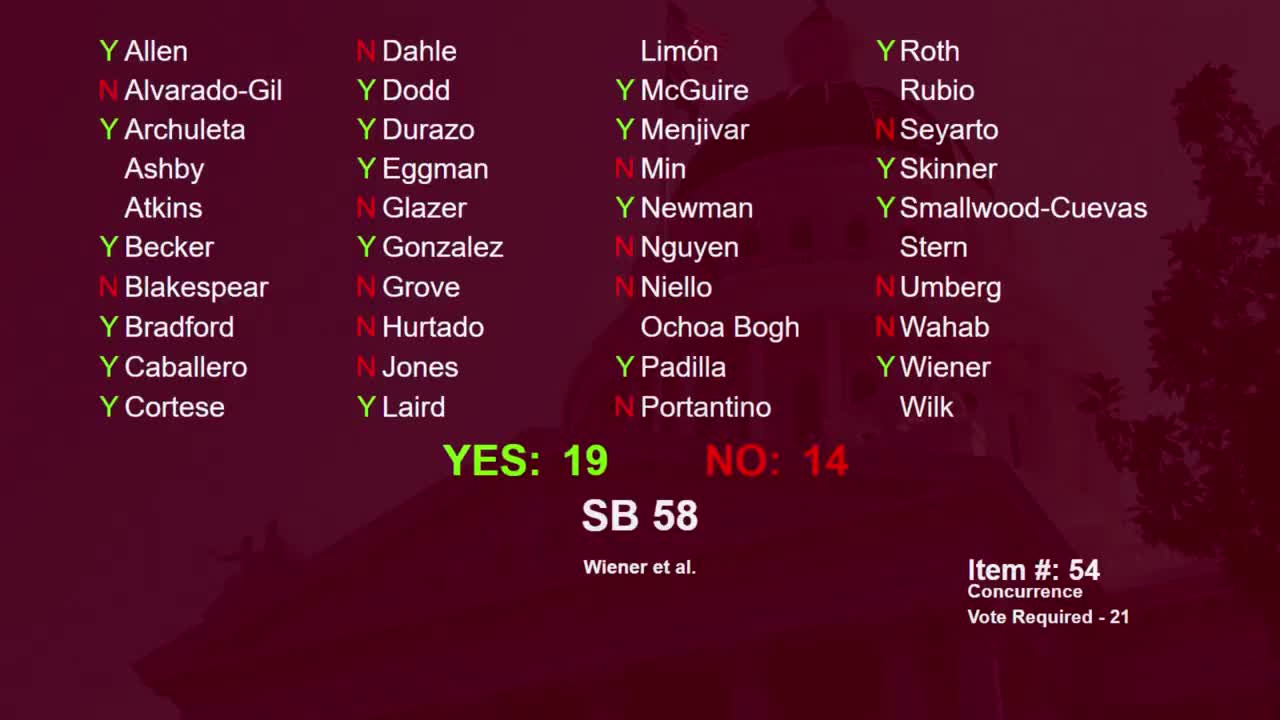 3MIN
Senate Floor
 1MIN
Assembly Floor
 34MIN
Assembly Standing Committee on Education
 27MIN
Assembly Standing Committee on Public Safety
 3MIN
Senate Floor
 46MIN
Senate Standing Committee on Public Safety
 49MIN
Senate Standing Committee on Education
49MIN
Senate Budget and Fiscal Review Subcommittee No. 1 on Education
Bill Author