SB 898: Criminal procedure: sexual assault resentencing.
- Session Year: 2023-2024
- House: Senate
- Latest Version Date: 2024-08-23
Current Status:
Failed
(2024-08-23: Ordered to third reading.)
Introduced
In Committee
First Chamber
In Committee
Second Chamber
Enacted
Existing law requires the Department of Corrections and Rehabilitation to ensure that specified procedures are performed in the investigation and prosecution of sexual abuse incidents, including, among others, that an employee must be terminated if an investigation confirms that the employee sexually abused an inmate. Existing law requires administrators to report criminal sexual abuse by staff to law enforcement authorities.
This bill would require the department to monitor for 90 days an incarcerated person who reports sexual abuse, and the incarcerated person reported to have suffered the abuse, by a staff person at a department facility for possible retaliation.
Existing law authorizes a defendant to submit to a sentencing court a petition for recall and resentencing when a defendant, who was under 18 years of age at the time of the commission of a specified offense for which the defendant was sentenced to imprisonment for life without the possibility of parole, has been incarcerated for at least 15 years. Existing law authorizes a court to consider specified factors when determining whether to resentence the defendant to a term of imprisonment with the possibility of parole including, among others, that the defendant has had no disciplinary actions for violent activities in the last five years in which the defendant was determined to be the aggressor.
This bill would authorize a court to also consider if the defendant has been a victim of sexual abuse or sexual violence at any time during their incarceration when determining whether to resentence the defendant to a term of imprisonment with the possibility of parole.
Existing law authorizes, when a defendant has been committed to the state prison or to a county jail for the commission of a felony, the court to recall the sentence and either reduce a defendants term by modifying the sentence, or vacate the conviction and impose judgment on any necessarily included lesser offense or lesser related offense and, resentence the defendant to a reduced term. Existing law requires the court to consider, in recalling and resentencing pursuant to these provisions, postconviction factors, including, among others, evidence that circumstances have changed since the original sentencing so that continued incarceration is no longer in the interest of justice. Existing law states that a defendant is not entitled to relief from these provisions, and that a court is not required to respond to a defendants requests for relief pursuant to these provisions.
This bill would additionally require the court to consider whether the defendant has been a victim of sexual abuse or sexual violence by staff at a department facility or the staff at a county correctional facility or jail during their incarceration.This bill would authorize, beginning on July 1, 2025, a defendant to file a petition for relief pursuant to these provisions, and would make that defendant entitled to a response from the court, if, among other things, the defendant is currently committed to the custody of the Secretary of the Department of Corrections and Rehabilitation, the defendant currently has a minimum sentence of at least 15 years, and the application of the current sentencing rules of the Judicial Council and any changes in sentencing laws enacted since the defendant was last sentenced would make the defendant eligible for a reduced sentence if applied to the defendant.
Existing law requires various civil actions to be brought within specified periods of time, but these periods of limitation are tolled for 2 years during the time that the person entitled to bring the action is imprisoned on a criminal charge for a term less than life. However, under existing law these provisions do not apply to an action brought against a public entity or public employee, as specified.
This bill would require an action for sexual assault brought against a public entity or public employee by a person who is imprisoned on a criminal charge, or in execution under the sentence of a criminal court, to be tolled during the period of imprisonment and until one year after the release from actual custody.
Existing law requires the Department of Corrections and Rehabilitation to ensure that specified procedures are performed in the investigation and prosecution of sexual abuse incidents, including, among others, that an employee must be terminated if an investigation confirms that the employee sexually abused an inmate. Existing law requires administrators to report criminal sexual abuse by staff to law enforcement authorities.
This bill would require the department to monitor for 90 days an incarcerated person who reports sexual abuse, and the incarcerated person reported to have suffered the abuse, by a staff person at a department facility for possible retaliation. The bill would require a referral by the warden within 72 hours for investigation by the departments Office of Internal Affairs, if specified retaliation occurs. The bill would allow any act of retaliation against an incarcerated person who has made a complaint of sexual abuse by a staff person at a department facility to be considered as evidence that the abuse occurred in any subsequent court proceeding or administrative proceeding regarding the abuse.
Existing law authorizes a defendant to submit to a sentencing court a petition for recall and resentencing when a defendant, who was under 18 years of age at the time of the commission of a specified offense for which the defendant was sentenced to imprisonment for life without the possibility of parole, has been incarcerated for at least 15 years. Existing law authorizes a court to consider specified factors when determining whether to resentence the defendant to a term of imprisonment with the possibility of parole including, among others, that the defendant has had no disciplinary actions for violent activities in the last five years in which the defendant was determined to be the aggressor.
This bill would authorize a court to also consider if the defendant has been a victim of sexual abuse or sexual violence at any time during their incarceration when determining whether to resentence the defendant to a term of imprisonment with the possibility of parole.
Existing law authorizes, when a defendant has been committed to the state prison or to a county jail for the commission of a felony, the court to recall the sentence and either reduce a defendants term by modifying the sentence, or vacate the conviction and impose judgment on any necessarily included lesser offense or lesser related offense and, resentence the defendant to a reduced term. Existing law requires the court to consider, in recalling and resentencing pursuant to these provisions, postconviction factors, including, among others, evidence that circumstances have changed since the original sentencing so that continued incarceration is no longer in the interest of justice.
This bill would additionally require the court to consider whether the defendant has been a victim of sexual abuse or sexual violence by staff at a department facility or the staff at a county correctional facility or jail during their incarceration.
Existing law requires various civil actions to be brought within specified periods of time, but these periods of limitation are tolled for 2 years during the time that the person entitled to bring the action is imprisoned on a criminal charge for a term less than life. However, under existing law these provisions do not apply to an action brought against a public entity or public employee, as specified.
This bill would require an action for sexual assault brought against a public entity or public employee by a person who is imprisoned on a criminal charge, or in execution under the sentence of a criminal court, to be tolled during the period of imprisonment and until one year after the release from actual or constructive custody, whichever is later. custody.
Existing law requires the Department of Corrections and Rehabilitation to ensure that specified procedures are performed in the investigation and prosecution of sexual abuse incidents, including, among others, that an employee must be terminated if an investigation confirms that the employee sexually abused an inmate. Existing law requires administrators to report criminal sexual abuse by staff to law enforcement authorities.
This bill would require the department or a county correctional facility or jail to monitor for 90 days an incarcerated person who reports sexual abuse, and the incarcerated person reported to have suffered the abuse, by a staff person at a department facility or a county correctional facility or jail for possible retaliation. The bill would require a referral by the warden within 72 hours for investigation by the departments Office of Internal Affairs or, in the case of a county correctional facility or jail, their oversight agency, Affairs, if specified retaliation occurs. The bill would make allow any act of retaliation against an incarcerated person who has made a complaint of sexual abuse by a staff person at a department facility or a county correctional facility or jail prima facie to be considered as evidence that the abuse occurred and would create a rebuttable presumption in any subsequent court proceeding or administrative proceeding regarding the abuse. By imposing new duties on county correctional facilities, jails, and local oversight agencies, this bill would impose a state-mandated local program.
Existing law authorizes the Secretary of the Department of Corrections and Rehabilitation, under specified guidelines, to grant up to 12 additional months of reduction of a sentence to a prisoner who has performed a heroic act in a life-threatening situation or who has provided exceptional assistance in maintaining the safety and security of a prison.This bill would require the secretary or, in the case of a county jail inmate, the county probation department of the county in which the person is incarcerated, to award Survivor Safety Emergency Credits, as defined, which reduces a sentence by 12 months, to an incarcerated person who has proven to have been sexual assaulted by a staff person at a department facility or a county correctional facility or jail. The bill would require the department or county probation department to identify those persons who may be eligible for the credit when a claim of assault is asserted by an incarcerated person or a third party. The bill would, by July 1, 2025, require the department or a county probation department to review staff and incarcerated persons records to identify any incarcerated person eligible for the credit who is still in custody. By imposing new duties on county probation departments, this bill would impose a state-mandated local program.Existing law authorizes a defendant to submit to a sentencing court a petition for recall and resentencing when a defendant, who was under 18 years of age at the time of the commission of a specified offense for which the defendant was sentenced to imprisonment for life without the possibility of parole, has been incarcerated for at least 15 years. Existing law authorizes a court to consider specified factors when determining whether to resentence the defendant to a term of imprisonment with the possibility of parole including, among others, that the defendant has had no disciplinary actions for violent activities in the last five years in which the defendant was determined to be the aggressor.
This bill would authorize a court to also consider if the defendant has been a victim of sexual abuse or sexual violence at any time during their incarceration when determining whether to resentence the defendant to a term of imprisonment with the possibility of parole.
Existing law authorizes, when a defendant has been committed to the state prison or to a county jail for the commission of a felony, the court to recall the sentence and either reduce a defendants term by modifying the sentence, or vacate the conviction and impose judgment on any necessarily included lesser offense or lesser related offense and, resentence the defendant to a reduced term. Existing law requires the court to consider, in recalling and resentencing pursuant to these provisions, postconviction factors, including, among others, evidence that circumstances have changed since the original sentencing so that continued incarceration is no longer in the interest of justice.
This bill would additionally require the court to consider whether the defendant has been a victim of sexual abuse or sexual violence by staff at a department facility or the staff at a county correctional facility or jail during their incarceration.
Existing law requires various civil actions to be brought within specified periods of time, but these periods of limitation are tolled for 2 years during the time that the person entitled to bring the action is imprisoned on a criminal charge for a term less than life. However, under existing law these provisions do not apply to an action brought against a public entity or public employee, as specified.
This bill would require an action for sexual assault brought against a public entity or public employee by a person who is imprisoned on a criminal charge, or in execution under the sentence of a criminal court, to be tolled during the period of imprisonment and until one year after the release from custody. actual or constructive custody, whichever is later.
The California Constitution requires the state to reimburse local agencies and school districts for certain costs mandated by the state. Statutory provisions establish procedures for making that reimbursement.This bill would provide that, if the Commission on State Mandates determines that the bill contains costs mandated by the state, reimbursement for those costs shall be made pursuant to the statutory provisions noted above.Existing law requires the Department of Corrections and Rehabilitation to ensure that specified procedures are performed in the investigation and prosecution of sexual abuse incidents, including, among others, that an employee must be terminated if an investigation confirms that the employee sexually abused an inmate. Existing law requires administrators to report criminal sexual abuse by staff to law enforcement authorities.
This bill would require the department or a county correctional facility or jail to monitor for 90 days an incarcerated person who reports sexual abuse, and the incarcerated person reported to have suffered the abuse, by a staff person at a department facility or a county correctional facility or jail for possible retaliation. The bill would require a referral by the warden within 72 hours for investigation by the departments Office of Internal Affairs or, in the case of a county correctional facility or jail, their oversight agency, if specified retaliation occurs. The bill would make any act of retaliation against an incarcerated person who has made a complaint of sexual abuse by a staff person at a department facility or a county correctional facility or jail prima facie evidence that the abuse occurred and would create a rebuttable presumption in any subsequent court proceeding or administrative proceeding regarding the abuse. By imposing new duties on county correctional facilities, jails, and local oversight agencies, this bill would impose a state-mandated local program.
Existing law authorizes the Secretary of the Department of Corrections and Rehabilitation, under specified guidelines, to grant up to 12 additional months of reduction of a sentence to a prisoner who has performed a heroic act in a life-threatening situation or who has provided exceptional assistance in maintaining the safety and security of a prison.
This bill would authorize the secretary to grant up to 12 additional months of reduction of a sentence to a prisoner who has been a victim of sexual assault while incarcerated.This bill would require the secretary or, in the case of a county jail inmate, the county probation department of the county in which the person is incarcerated, to award Survivor Safety Emergency Credits, as defined, which reduces a sentence by 12 months, to an incarcerated person who has proven to have been sexual assaulted by a staff person at a department facility or a county correctional facility or jail. The bill would require the department or county probation department to identify those persons who may be eligible for the credit when a claim of assault is asserted by an incarcerated person or a third party. The bill would, by July 1, 2025, require the department or a county probation department to review staff and incarcerated persons records to identify any incarcerated person eligible for the credit who is still in custody. By imposing new duties on county probation departments, this bill would impose a state-mandated local program.
Existing law authorizes a defendant to submit to a sentencing court a petition for recall and resentencing when a defendant, who was under 18 years of age at the time of the commission of a specified offense for which the defendant was sentenced to imprisonment for life without the possibility of parole, has been incarcerated for at least 15 years. Existing law authorizes a court to consider specified factors when determining whether to resentence the defendant to a term of imprisonment with the possibility of parole including, among others, that the defendant has had no disciplinary actions for violent activities in the last five years in which the defendant was determined to be the aggressor.
This bill would authorize a court to also consider if the defendant has been a victim of sexual abuse or sexual violence at any time during their incarceration when determining whether to resentence the defendant to a term of imprisonment with the possibility of parole.
Existing law authorizes, when a defendant has been committed to the state prison or to a county jail for the commission of a felony, the court to recall the sentence and either reduce a defendants term by modifying the sentence, or vacate the conviction and impose judgment on any necessarily included lesser offense or lesser related offense and, resentence the defendant to a reduced term. Existing law authorizes a defendant to be resentenced pursuant to these provisions upon the courts own motion within 120 days of the date of commitment, at any time if the applicable sentencing laws at the time of original sentencing are subsequently changed by new statutory or case law authority, or upon the recommendation of specified individuals, including, among others, the district attorney of the county in which the defendant was sentenced. Existing law requires the court to consider, in recalling and resentencing pursuant to these provisions, postconviction factors, including, among others, evidence that circumstances have changed since the original sentencing so that continued incarceration is no longer in the interest of justice.
This bill would additionally authorize a defendant to be resentenced upon the recommendation of an attorney representing an incarcerated person who has been sexually assaulted by a staff person at a department facility or a staff person at a county correctional facility or jail, and would require the court to consider whether the defendant has been a victim of sexual abuse or sexual violence by staff at a department facility or the staff at a county correctional facility or jail during their incarceration.
Existing law requires various civil actions to be brought within specified periods of time, but these periods of limitation are tolled for 2 years during the time that the person entitled to bring the action is imprisoned on a criminal charge for a term less than life. However, under existing law these provisions do not apply to an action brought against a public entity or public employee, as specified.
This bill would require an action for sexual assault brought against a public entity or public employee by a person who is imprisoned on a criminal charge, or in execution under the sentence of a criminal court, to be tolled during the period of imprisonment and until one year after the release from custody.
The California Constitution requires the state to reimburse local agencies and school districts for certain costs mandated by the state. Statutory provisions establish procedures for making that reimbursement.
This bill would provide that, if the Commission on State Mandates determines that the bill contains costs mandated by the state, reimbursement for those costs shall be made pursuant to the statutory provisions noted above.
Existing law authorizes the Secretary of the Department of Corrections and Rehabilitation, under specified guidelines, to grant up to 12 additional months of reduction of a sentence to a prisoner who has performed a heroic act in a life-threatening situation or who has provided exceptional assistance in maintaining the safety and security of a prison.
This bill would authorize the secretary to grant up to 12 additional months of reduction of a sentence to a prisoner who has been a victim of sexual assault while incarcerated.
Existing law authorizes a defendant to submit to a sentencing court a petition for recall and resentencing when a defendant, who was under 18 years of age at the time of the commission of a specified offense for which the defendant was sentenced to imprisonment for life without the possibility of parole, has been incarcerated for at least 15 years. Existing law authorizes a court to consider specified factors when determining whether to resentence the defendant to a term of imprisonment with the possibility of parole including, among others, that the defendant has had no disciplinary actions for violent activities in the last five years in which the defendant was determined to be the aggressor.
This bill would authorize a court to also consider if the defendant has been a victim of sexual abuse or sexual violence at any time during their incarceration when determining whether to resentence the defendant to a term of imprisonment with the possibility of parole.
Existing law authorizes, when a defendant has been committed to the state prison or to a county jail for the commission of a felony, the court to recall the sentence and either reduce a defendants term by modifying the sentence, or vacate the conviction and impose judgment on any necessarily included lesser offense or lesser related offense and, resentence the defendant to a reduced term. Existing law authorizes a defendant to be resentenced pursuant to these provisions upon the courts own motion within 120 days of the date of commitment, at any time if the applicable sentencing laws at the time of original sentencing are subsequently changed by new statutory or case law authority, or upon the recommendation of specified individuals, including, among others, the district attorney of the county in which the defendant was sentenced. Existing law requires the court to consider, in recalling and resentencing pursuant to these provisions, postconviction factors, including, among others, evidence that circumstances have changed since the original sentencing so that continued incarceration is no longer in the interest of justice.
This bill would additionally authorize a defendant to be resentenced upon the recommendation of an attorney representing an incarcerated person who has been sexually assaulted by a staff person at a department facility or a staff person at a county correctional facility or jail, and would require the court to consider whether the defendant has been a victim of sexual abuse or sexual violence by staff at a department facility or the staff at a county correctional facility or jail during their incarceration.
Existing law provides for various safety standards requiring motor vehicles to be equipped with certain devices, including brakes, headlamps, and safety belts. A violation of the Vehicle Code is punishable as an infraction.This bill would, by the 2032 model year, require every new truck tractor, motortruck, and bus manufactured or sold in the state to have the front driver window filtered so that no more than 2% of ultraviolet A radiation and no more than 2% of ultraviolet B radiation of the incident solar radiation is allowed into the vehicle, as specified. The bill would prohibit the material used to limit these radiations from interfering with wireless service or GPS, as defined. By creating a new crime, the bill would impose a state-mandated local program.The California Constitution requires the state to reimburse local agencies and school districts for certain costs mandated by the state. Statutory provisions establish procedures for making that reimbursement.This bill would provide that no reimbursement is required by this act for a specified reason.Existing law provides for various safety standards requiring motor vehicles to be equipped with certain devices, including brakes, headlamps, and safety belts. A violation of the Vehicle Code is punishable as an infraction.
This bill would, beginning on January 1, 2025, require all vehicles sold in California to be equipped with a side window, windshield, back window, and sunroof by the 2032 model year, require every new truck tractor, motortruck, and bus manufactured or sold in the state to have the front driver window filtered so that allow no more than 2% of ultraviolet A radiation, radiation and no more than 2% of ultraviolet B radiation, and no more than 10% of infrared radiation radiation of the incident solar radiation is allowed into the vehicle, as specified. The bill would prohibit the material used to limit these radiations from interfering with wireless service or GPS, as defined. By creating a new crime, the bill would impose a state-mandated local program.
The California Constitution requires the state to reimburse local agencies and school districts for certain costs mandated by the state. Statutory provisions establish procedures for making that reimbursement.
This bill would provide that no reimbursement is required by this act for a specified reason.
Existing law provides for various safety standards requiring motor vehicles to be equipped with certain devices, including brakes, headlamps, and safety belts. A violation of the Vehicle Code is punishable as an infraction.
This bill would, beginning on January 1, 2025, require all vehicles sold in California to be equipped with a side window, windshield, back window, and sunroof that allow no more than 2% of ultraviolet A radiation, no more than 2% of ultraviolet B radiation, and no more than 10% of infrared radiation of the incident solar radiation into the vehicle, as specified. By creating a new crime, the bill would impose a state-mandated local program.
The California Constitution requires the state to reimburse local agencies and school districts for certain costs mandated by the state. Statutory provisions establish procedures for making that reimbursement.
This bill would provide that no reimbursement is required by this act for a specified reason.
(a)If a person entitled to bring an action, mentioned in Chapter 3 (commencing with Section 335), is, at the time the cause of action accrued, imprisoned on a criminal charge, or in execution under the sentence of a criminal court for a term less than for life, the time of that disability is not a part of the time limited for the commencement of the action, not to exceed two years.
(b)Subdivision (a) does not apply to an action against a public entity or public employee upon a cause of action for which a claim is required to be presented in accordance with Chapter 1 (commencing with Section 900) or Chapter 2 (commencing with Section 910) of Part 3, or Chapter 3 (commencing with Section 950) of Part 4, of Division 3.6 of Title 1 of the Government Code. This subdivision shall not apply to any claim presented to a public entity prior to January 1, 1971.
(c)This section does not apply to an action, other than an action to recover damages or that portion of an action that is for the recovery of damages, relating to the conditions of confinement, including an action brought by that person pursuant to Section 1983 of Title 42 of the United States Code.
(d)Notwithstanding any other law, an action for sexual assault brought against a public entity or public employee by a person who is imprisoned on a criminal charge, or in execution under the sentence of a criminal court, shall be tolled during the period of imprisonment and until one year after the release from actual custody.
SEC. 2.Section 1170 of the Penal Code is amended to read:1170.(a)(1)The Legislature finds and declares that the purpose of sentencing is public safety achieved through punishment, rehabilitation, and restorative justice. When a sentence includes incarceration, the deprivation of liberty satisfies the punishment purpose of sentencing. The purpose of incarceration is rehabilitation and successful community reintegration achieved through education, treatment, and active participation in rehabilitative and restorative justice programs. This purpose is best served by terms that are proportionate to the seriousness of the offense with provision for uniformity in the sentences of people incarcerated for committing the same offense under similar circumstances.
(2)The Legislature further finds and declares that programs should be available for incarcerated persons, including, but not limited to, educational, rehabilitative, and restorative justice programs that are designed to promote behavioral change and to prepare all incarcerated persons for successful reentry into the community. The Legislature encourages the development of policies and programs designed to educate and rehabilitate all incarcerated persons. In implementing this section, the Department of Corrections and Rehabilitation is encouraged to allow all incarcerated persons the opportunity to enroll in programs that promote successful return to the community. The Legislature finds and declares that community-based organizations are an integral part of achieving the states objective of ensuring that all people incarcerated in a state prison have access to rehabilitative programs. The Department of Corrections and Rehabilitation is directed to maintain a mission statement consistent with these principles and shall facilitate access for community-based programs in order to meaningfully effectuate the principles set forth in this section.
(3)In any case in which the sentence prescribed by statute for a person convicted of a public offense is a term of imprisonment in the state prison, or a term pursuant to subdivision (h), of any specification of three time periods, the court shall sentence the defendant to one of the terms of imprisonment specified unless the convicted person is given any other disposition provided by law, including a fine, jail, probation, or the suspension of imposition or execution of sentence or is sentenced pursuant to subdivision (b) of Section 1168 because they had committed their crime prior to July 1, 1977. In sentencing the convicted person, the court shall apply the sentencing rules of the Judicial Council. The court, unless it determines that there are circumstances in mitigation of the sentence prescribed, shall also impose any other term that it is required by law to impose as an additional term. Nothing in this article shall affect any provision of law that imposes the death penalty, that authorizes or restricts the granting of probation or suspending the execution or imposition of sentence, or expressly provides for imprisonment in the state prison for life, except as provided in subdivision (d). In any case in which the amount of preimprisonment credit under Section 2900.5 or any other provision of law is equal to or exceeds any sentence imposed pursuant to this chapter, except for a remaining portion of mandatory supervision imposed pursuant to subparagraph (B) of paragraph (5) of subdivision (h), the entire sentence shall be deemed to have been served, except for the remaining period of mandatory supervision, and the defendant shall not be actually delivered to the custody of the secretary or the county correctional administrator. The court shall advise the defendant that they shall serve an applicable period of parole, postrelease community supervision, or mandatory supervision and order the defendant to report to the parole or probation office closest to the defendants last legal residence, unless the in-custody credits equal the total sentence, including both confinement time and the period of parole, postrelease community supervision, or mandatory supervision. The sentence shall be deemed a separate prior prison term or a sentence of imprisonment in a county jail under subdivision (h) for purposes of Section 667.5, and a copy of the judgment and other necessary documentation shall be forwarded to the secretary.
(b)(1)When a judgment of imprisonment is to be imposed and the statute specifies three possible terms, the court shall, in its sound discretion, order imposition of a sentence not to exceed the middle term, except as otherwise provided in paragraph (2).
(2)The court may impose a sentence exceeding the middle term only when there are circumstances in aggravation of the crime that justify the imposition of a term of imprisonment exceeding the middle term and the facts underlying those circumstances have been stipulated to by the defendant or have been found true beyond a reasonable doubt at trial by the jury or by the judge in a court trial. Except where evidence supporting an aggravating circumstance is admissible to prove or defend against the charged offense or enhancement at trial, or it is otherwise authorized by law, upon request of a defendant, trial on the circumstances in aggravation alleged in the indictment or information shall be bifurcated from the trial of charges and enhancements. The jury shall not be informed of the bifurcated allegations until there has been a conviction of a felony offense.
(3)Notwithstanding paragraphs (1) and (2), the court may consider the defendants prior convictions in determining sentencing based on a certified record of conviction without submitting the prior convictions to a jury. This paragraph does not apply to enhancements imposed on prior convictions.
(4)At least four days prior to the time set for imposition of judgment, either party or the victim, or the family of the victim if the victim is deceased, may submit a statement in aggravation or mitigation to dispute facts in the record or the probation officers report or to present additional facts. The court may consider the record in the case, the probation officers report, other reports, including reports received pursuant to Section 1203.03, and statements in aggravation or mitigation submitted by the prosecution, the defendant, or the victim, or the family of the victim if the victim is deceased, and any further evidence introduced at the sentencing hearing.
(5)The court shall set forth on the record the facts and reasons for choosing the sentence imposed. The court may not impose an upper term by using the fact of any enhancement upon which sentence is imposed under any provision of law. A term of imprisonment shall not be specified if imposition of sentence is suspended.
(6)Notwithstanding paragraph (1), and unless the court finds that the aggravating circumstances outweigh the mitigating circumstances that imposition of the lower term would be contrary to the interests of justice, the court shall order imposition of the lower term if any of the following was a contributing factor in the commission of the offense:
(A)The person has experienced psychological, physical, or childhood trauma, including, but not limited to, abuse, neglect, exploitation, or sexual violence.
(B)The person is a youth or was a youth as defined under subdivision (b) of Section 1016.7 at the time of the commission of the offense.
(C)Prior to the instant offense, or at the time of the commission of the offense, the person is or was a victim of intimate partner violence or human trafficking.
(7)Paragraph (6) does not preclude the court from imposing the lower term even if there is no evidence of those circumstances listed in paragraph (6) present.
(c)The court shall state the reasons for its sentence choice on the record at the time of sentencing. The court shall also inform the defendant that as part of the sentence after expiration of the term they may be on parole for a period as provided in Section 3000 or 3000.08 or postrelease community supervision for a period as provided in Section 3451.
(d)(1)(A)When a defendant who was under 18 years of age at the time of the commission of the offense for which the defendant was sentenced to imprisonment for life without the possibility of parole has been incarcerated for at least 15 years, the defendant may submit to the sentencing court a petition for recall and resentencing.
(B)Notwithstanding subparagraph (A), this paragraph shall not apply to defendants sentenced to life without parole for an offense where it was pled and proved that the defendant tortured, as described in Section 206, their victim or the victim was a public safety official, including any law enforcement personnel mentioned in Chapter 4.5 (commencing with Section 830) of Title 3, or any firefighter as described in Section 245.1, as well as any other officer in any segment of law enforcement who is employed by the federal government, the state, or any of its political subdivisions.
(2)The defendant shall file the original petition with the sentencing court. A copy of the petition shall be served on the agency that prosecuted the case. The petition shall include the defendants statement that the defendant was under 18 years of age at the time of the crime and was sentenced to life in prison without the possibility of parole, the defendants statement describing their remorse and work towards rehabilitation, and the defendants statement that one of the following is true:
(A)The defendant was convicted pursuant to felony murder or aiding and abetting murder provisions of law.
(B)The defendant does not have juvenile felony adjudications for assault or other felony crimes with a significant potential for personal harm to victims prior to the offense for which the sentence is being considered for recall.
(C)The defendant committed the offense with at least one adult codefendant.
(D)The defendant has performed acts that tend to indicate rehabilitation or the potential for rehabilitation, including, but not limited to, availing themselves of rehabilitative, educational, or vocational programs, if those programs have been available at their classification level and facility, using self-study for self-improvement, or showing evidence of remorse.
(3)If any of the information required in paragraph (2) is missing from the petition, or if proof of service on the prosecuting agency is not provided, the court shall return the petition to the defendant and advise the defendant that the matter cannot be considered without the missing information.
(4)A reply to the petition, if any, shall be filed with the court within 60 days of the date on which the prosecuting agency was served with the petition unless a continuance is granted for good cause.
(5)If the court finds by a preponderance of the evidence that one or more of the statements specified in subparagraphs (A) to (D), inclusive, of paragraph (2) is true, the court shall recall the sentence and commitment previously ordered and hold a hearing to resentence the defendant in the same manner as if the defendant had not previously been sentenced, provided that the new sentence, if any, is not greater than the initial sentence. Victims, or victim family members if the victim is deceased, shall retain the rights to participate in the hearing.
(6)The factors that the court may consider when determining whether to resentence the defendant to a term of imprisonment with the possibility of parole include, but are not limited to, the following:
(A)The defendant was convicted pursuant to felony murder or aiding and abetting murder provisions of law.
(B)The defendant does not have juvenile felony adjudications for assault or other felony crimes with a significant potential for personal harm to victims prior to the offense for which the defendant was sentenced to life without the possibility of parole.
(C)The defendant committed the offense with at least one adult codefendant.
(D)Prior to the offense for which the defendant was sentenced to life without the possibility of parole, the defendant had insufficient adult support or supervision and had suffered from psychological or physical trauma or significant stress.
(E)The defendant suffers from cognitive limitations due to mental illness, developmental disabilities, or other factors that did not constitute a defense but influenced the defendants involvement in the offense.
(F)The defendant has performed acts that tend to indicate rehabilitation or the potential for rehabilitation, including, but not limited to, availing themselves of rehabilitative, educational, or vocational programs, if those programs have been available at their classification level and facility, using self-study for self-improvement, or showing evidence of remorse.
(G)The defendant has maintained family ties or connections with others through letter writing, calls, or visits or has eliminated contact with individuals outside of prison who are currently involved with crime.
(H)The defendant has had no disciplinary actions for violent activities in the last five years in which the defendant was determined to be the aggressor.
(I)The defendant has been a victim of sexual abuse or sexual violence at any time during their incarceration.
(7)The court shall have the discretion to resentence the defendant in the same manner as if the defendant had not previously been sentenced, provided that the new sentence, if any, is not greater than the initial sentence. The discretion of the court shall be exercised in consideration of the criteria in paragraph (6). Victims, or victim family members if the victim is deceased, shall be notified of the resentencing hearing and shall retain their rights to participate in the hearing.
(8)Notwithstanding paragraph (7), the court may also resentence the defendant to a term that is less than the initial sentence if any of the following were a contributing factor in the commission of the alleged offense:
(A)The person has experienced psychological, physical, or childhood trauma, including, but not limited to, abuse, neglect, exploitation, or sexual violence.
(B)The person is a youth or was a youth as defined under subdivision (b) of Section 1016.7 at the time of the commission of the offense.
(C)Prior to the instant offense, or at the time of the commission of the offense, the person is or was a victim of intimate partner violence or human trafficking.
(9)Paragraph (8) does not prohibit the court from resentencing the defendant to a term that is less than the initial sentence, even if none of the circumstances listed in paragraph (8) are present.
(10)If the sentence is not recalled or the defendant is resentenced to imprisonment for life without the possibility of parole, the defendant may submit another petition for recall and resentencing to the sentencing court when the defendant has been committed to the custody of the department for at least 20 years. If the sentence is not recalled or the defendant is resentenced to imprisonment for life without the possibility of parole under that petition, the defendant may file another petition after having served 24 years. The final petition may be submitted, and the response to that petition shall be determined, during the 25th year of the defendants sentence.
(11)In addition to the criteria in paragraph (6), the court may consider any other criteria that the court deems relevant to its decision, so long as the court identifies them on the record, provides a statement of reasons for adopting them, and states why the defendant does or does not satisfy the criteria.
(12)This subdivision shall have retroactive application.
(13)Nothing in this paragraph is intended to diminish or abrogate any rights or remedies otherwise available to the defendant.
(e)Notwithstanding subdivision (a), the court may recall and resentence an incarcerated person pursuant to the compassionate release program set forth in Section 1172.2.
(f)Notwithstanding any other provision of this section, for purposes of paragraph (3) of subdivision (h), an allegation that a defendant is eligible for state prison due to a prior or current conviction, sentence enhancement, or because the defendant is required to register as a sex offender shall not be subject to dismissal pursuant to Section 1385.
(g)A sentence to the state prison for a determinate term for which only one term is specified is a sentence to state prison under this section.
(h)(1)Except as provided in paragraph (3), a felony punishable pursuant to this subdivision where the term is not specified in the underlying offense shall be punishable by a term of imprisonment in a county jail for 16 months, or two or three years.
(2)Except as provided in paragraph (3), a felony punishable pursuant to this subdivision shall be punishable by imprisonment in a county jail for the term described in the underlying offense.
(3)Notwithstanding paragraphs (1) and (2), where the defendant (A) has a prior or current felony conviction for a serious felony described in subdivision (c) of Section 1192.7 or a prior or current conviction for a violent felony described in subdivision (c) of Section 667.5, (B) has a prior felony conviction in another jurisdiction for an offense that has all the elements of a serious felony described in subdivision (c) of Section 1192.7 or a violent felony described in subdivision (c) of Section 667.5, (C) is required to register as a sex offender pursuant to Chapter 5.5 (commencing with Section 290) of Title 9 of Part 1, or (D) is convicted of a crime and as part of the sentence an enhancement pursuant to Section 186.11 is imposed, an executed sentence for a felony punishable pursuant to this subdivision shall be served in the state prison.
(4)Nothing in this subdivision shall be construed to prevent other dispositions authorized by law, including pretrial diversion, deferred entry of judgment, or an order granting probation pursuant to Section 1203.1.
(5)(A)Unless the court finds, in the interest of justice, that it is not appropriate in a particular case, the court, when imposing a sentence pursuant to paragraph (1) or (2), shall suspend execution of a concluding portion of the term for a period selected at the courts discretion.
(B)The portion of a defendants sentenced term that is suspended pursuant to this paragraph shall be known as mandatory supervision, and, unless otherwise ordered by the court, shall commence upon release from physical custody or an alternative custody program, whichever is later. During the period of mandatory supervision, the defendant shall be supervised by the county probation officer in accordance with the terms, conditions, and procedures generally applicable to persons placed on probation for the remaining unserved portion of the sentence imposed by the court. The period of supervision shall be mandatory and may not be earlier terminated, except by court order. Any proceeding to revoke or modify mandatory supervision under this subparagraph shall be conducted pursuant to either subdivisions (a) and (b) of Section 1203.2 or Section 1203.3. During the period when the defendant is under that supervision, unless in actual custody related to the sentence imposed by the court, the defendant shall be entitled to only actual time credit against the term of imprisonment imposed by the court. Any time period that is suspended because a person has absconded shall not be credited toward the period of supervision. A defendant who is subject to search or seizure as part of the terms and conditions of mandatory supervision, is subject to search or seizure only by a probation officer or other peace officer.
(6)When the court is imposing a judgment pursuant to this subdivision concurrent or consecutive to a judgment or judgments previously imposed pursuant to this subdivision in another county or counties, the court rendering the second or other subsequent judgment shall determine the county or counties of incarceration and supervision of the defendant.
(7)The sentencing changes made by the act that added this subdivision shall be applied prospectively to any person sentenced on or after October 1, 2011.
(8)The sentencing changes made to paragraph (5) by the act that added this paragraph shall become effective and operative on January 1, 2015, and shall be applied prospectively to any person sentenced on or after January 1, 2015.
(9)Notwithstanding the separate punishment for any enhancement, any enhancement shall be punishable in a county jail or state prison as required by the underlying offense and not as would be required by the enhancement. The intent of the Legislature in enacting this paragraph is to abrogate the holding in People v. Vega (2014) 222 Cal.App.4th 1374, that if an enhancement specifies service of sentence in state prison, the entire sentence is served in state prison, even if the punishment for the underlying offense is a term of imprisonment in the county jail.
SEC. 3.Section 1172.1 of the Penal Code is amended to read:1172.1.(a)(1)(A)When a defendant, upon conviction for a felony offense, has been committed to the custody of the Secretary of the Department of Corrections and Rehabilitation or to the custody of the county correctional administrator pursuant to subdivision (h) of Section 1170, the court may, on its own motion, within 120 days of the date of commitment or at any time if the applicable sentencing laws at the time of original sentencing are subsequently changed by new statutory authority or case law, at any time upon the recommendation of the secretary or the Board of Parole Hearings in the case of a defendant incarcerated in state prison, the county correctional administrator in the case of a defendant incarcerated in county jail, the district attorney of the county in which the defendant was sentenced, an attorney representing a defendant incarcerated in state prison, or the Attorney General if the Department of Justice originally prosecuted the case, recall the sentence and commitment previously ordered and resentence the defendant in the same manner as if they had not previously been sentenced, whether or not the defendant is still in custody, and provided the new sentence, if any, is no greater than the initial sentence. Recall and resentencing under this section may be initiated by the original sentencing judge, a judge designated by the presiding judge, or any judge with jurisdiction in the case.
(B)Beginning on July 1, 2025, a defendant may file a petition seeking relief from the court under this section, if all of the following are true:
(i)The defendants conviction and sentence is final.
(ii)The application of the current sentencing rules of the Judicial Council and any changes in sentencing laws enacted since the defendant was last sentenced would make the defendant eligible for a reduced sentence if applied to the defendant.
(iii)The defendant is currently committed to the custody of the Secretary of the Department of Corrections and Rehabilitation.
(iv)The sentence that the defendant is currently serving has a minimum term of at least 15 years.
(v)The persons controlling parole eligible date is not in the past.
(vi)The defendant has not petitioned under this subparagraph in the last three years.
(C)The court may summarily deny a petition filed pursuant to subparagraph (B) upon a finding that the petition does not make a prima facia showing that all of the conditions specified in subparagraph (B) are true, including a specific showing of the change or changes in sentencing law specified in clause (ii) of subparagraph (B). Otherwise, the court shall hold a hearing on the petition pursuant to paragraph (9). The court may rely on cases, files, or other records maintained by a state or local agency in determining whether the petition has made a prima facia showing that any condition specified in subparagraph (B) is true.
(D)For purposes of subparagraph (B), sentencing rules and sentencing laws shall be interpreted to mean only those rules or laws that directly affect the sentence imposed based on the crime of conviction or any enhancement and shall not be interpreted to encompass rules or laws that define elements of crime or rules of procedure, even if application of such rules might result in imposition of a shorter sentence.
(2)The court, in recalling and resentencing under this subdivision, shall apply the sentencing rules of the Judicial Council and apply any changes in law that reduce sentences or provide for judicial discretion so as to eliminate disparity of sentences and to promote uniformity of sentencing.
(3)The resentencing court may, in the interest of justice and regardless of whether the original sentence was imposed after a trial or plea agreement, do the following:
(A) Reduce a defendants term of imprisonment by modifying the sentence.
(B)Vacate the defendants conviction and impose judgment on any necessarily included lesser offense or lesser related offense, whether or not that offense was charged in the original pleading, with the concurrence of the defendant, and then resentence the defendant to a reduced term of imprisonment.
(4)If the court has recalled the sentence on its own motion, the court shall not impose a judgment on any necessarily included lesser offense or lesser related offense if the conviction was a result of a plea bargain without the concurrence of both the defendant and the district attorney of the county in which the defendant was sentenced, or the Attorney General if the Department of Justice originally prosecuted the case.
(5)In recalling and resentencing pursuant to this provision, the court shall consider postconviction factors, including, but not limited to, the disciplinary record and record of rehabilitation of the defendant while incarcerated, evidence that reflects whether age, time served, and diminished physical condition, if any, have reduced the defendants risk for future violence, and evidence that reflects that circumstances have changed since the original sentencing so that continued incarceration is no longer in the interest of justice, including whether the defendant has been a victim of sexual abuse or sexual violence by a staff person at a Department of Corrections and Rehabilitation facility or a county correctional facility or jail during the defendants incarceration. justice. Evidence that the defendants incarceration is no longer in the interest of justice includes, but is not limited to, evidence that the defendants constitutional rights were violated in the proceedings related to the conviction or sentence at issue, and any other evidence that undermines the integrity of the underlying conviction or sentence. The court shall consider if the defendant has experienced psychological, physical, or childhood trauma, including, but not limited to, abuse, neglect, exploitation, or sexual violence, if the defendant was a victim of intimate partner violence or human trafficking prior to or at the time of the commission of the offense, or if the defendant is a youth or was a youth as defined under subdivision (b) of Section 1016.7 at the time of the commission of the offense, and whether those circumstances were a contributing factor in the commission of the offense.
(6)Credit shall be given for time served.
(7)The court shall state on the record the reasons for its decision to grant or deny recall and resentencing.
(8)(A)Resentencing may be granted without a hearing upon stipulation by the parties.
(B)Notwithstanding subparagraph (A), if a victim of a crime wishes to be heard pursuant to the provisions of Section 28 of Article I of the California Constitution, or pursuant to any other provision of law applicable to the hearing, the victim shall notify the prosecution of their request to be heard within 15 days of being notified that resentencing is being sought and the court shall provide an opportunity for the victim to be heard.
(9)Resentencing shall not be denied, nor a stipulation rejected, without a hearing where the parties have an opportunity to address the basis for the intended denial or rejection. If a hearing is held, the defendant may appear remotely and the court may conduct the hearing through the use of remote technology, unless counsel requests their physical presence in court.
(b)If a resentencing request pursuant to subdivision (a) is from the Secretary of the Department of Corrections and Rehabilitation, the Board of Parole Hearings, a county correctional administrator, a district attorney, or the Attorney General, all of the following shall apply:
(1)The court shall provide notice to the defendant and set a status conference within 30 days after the date that the court received the request. The courts order setting the conference shall also appoint counsel to represent the defendant.
(2)There shall be a presumption favoring recall and resentencing of the defendant, which may only be overcome if a court finds the defendant currently poses an unreasonable risk of danger to public safety, as defined in subdivision (c) of Section 1170.18.
(c)(1)A defendant is not entitled to file a petition seeking relief from the court under this section. If a defendant requests consideration for relief under this section, the court is not required to respond.
(2)Paragraph (1) does not apply to a petition for relief authorized by subparagraph (B) of paragraph (1) of subdivision (a).
(d)After ruling on a referral authorized by this section, the court shall advise the defendant of their right to appeal and the necessary steps and time for taking an appeal.
SEC. 4.Section 2637.5 is added to the Penal Code, to read:2637.5.For 90 days following an allegation of sexual abuse brought on behalf of an incarcerated person against a staff person at a Department of Corrections and Rehabilitation facility, the department shall monitor the person who made the report, and the person who is reported to have suffered the sexual assault, for possible retaliation.
(a)If a person entitled to bring an action, mentioned in Chapter 3 (commencing with Section 335), is, at the time the cause of action accrued, imprisoned on a criminal charge, or in execution under the sentence of a criminal court for a term less than for life, the time of that disability is not a part of the time limited for the commencement of the action, not to exceed two years.
(b)Subdivision (a) does not apply to an action against a public entity or public employee upon a cause of action for which a claim is required to be presented in accordance with Chapter 1 (commencing with Section 900) or Chapter 2 (commencing with Section 910) of Part 3, or Chapter 3 (commencing with Section 950) of Part 4, of Division 3.6 of Title 1 of the Government Code. This subdivision shall not apply to any claim presented to a public entity prior to January 1, 1971.
(c)This section does not apply to an action, other than an action to recover damages or that portion of an action that is for the recovery of damages, relating to the conditions of confinement, including an action brought by that person pursuant to Section 1983 of Title 42 of the United States Code.
(d)Notwithstanding any other law, an action for sexual assault brought against a public entity or public employee by a person who is imprisoned on a criminal charge, or in execution under the sentence of a criminal court, shall be tolled during the period of imprisonment and until one year after the release from actual or constructive custody, whichever is later. custody.
SEC. 2.Section 1170 of the Penal Code is amended to read:1170.(a)(1)The Legislature finds and declares that the purpose of sentencing is public safety achieved through punishment, rehabilitation, and restorative justice. When a sentence includes incarceration, the deprivation of liberty satisfies the punishment purpose of sentencing. The purpose of incarceration is rehabilitation and successful community reintegration achieved through education, treatment, and active participation in rehabilitative and restorative justice programs. This purpose is best served by terms that are proportionate to the seriousness of the offense with provision for uniformity in the sentences of people incarcerated for committing the same offense under similar circumstances.
(2)The Legislature further finds and declares that programs should be available for incarcerated persons, including, but not limited to, educational, rehabilitative, and restorative justice programs that are designed to promote behavioral change and to prepare all incarcerated persons for successful reentry into the community. The Legislature encourages the development of policies and programs designed to educate and rehabilitate all incarcerated persons. In implementing this section, the Department of Corrections and Rehabilitation is encouraged to allow all incarcerated persons the opportunity to enroll in programs that promote successful return to the community. The Legislature finds and declares that community-based organizations are an integral part of achieving the states objective of ensuring that all people incarcerated in a state prison have access to rehabilitative programs. The Department of Corrections and Rehabilitation is directed to maintain a mission statement consistent with these principles and shall facilitate access for community-based programs in order to meaningfully effectuate the principles set forth in this section.
(3)In any case in which the sentence prescribed by statute for a person convicted of a public offense is a term of imprisonment in the state prison, or a term pursuant to subdivision (h), of any specification of three time periods, the court shall sentence the defendant to one of the terms of imprisonment specified unless the convicted person is given any other disposition provided by law, including a fine, jail, probation, or the suspension of imposition or execution of sentence or is sentenced pursuant to subdivision (b) of Section 1168 because they had committed their crime prior to July 1, 1977. In sentencing the convicted person, the court shall apply the sentencing rules of the Judicial Council. The court, unless it determines that there are circumstances in mitigation of the sentence prescribed, shall also impose any other term that it is required by law to impose as an additional term. Nothing in this article shall affect any provision of law that imposes the death penalty, that authorizes or restricts the granting of probation or suspending the execution or imposition of sentence, or expressly provides for imprisonment in the state prison for life, except as provided in subdivision (d). In any case in which the amount of preimprisonment credit under Section 2900.5 or any other provision of law is equal to or exceeds any sentence imposed pursuant to this chapter, except for a remaining portion of mandatory supervision imposed pursuant to subparagraph (B) of paragraph (5) of subdivision (h), the entire sentence shall be deemed to have been served, except for the remaining period of mandatory supervision, and the defendant shall not be actually delivered to the custody of the secretary or the county correctional administrator. The court shall advise the defendant that they shall serve an applicable period of parole, postrelease community supervision, or mandatory supervision and order the defendant to report to the parole or probation office closest to the defendants last legal residence, unless the in-custody credits equal the total sentence, including both confinement time and the period of parole, postrelease community supervision, or mandatory supervision. The sentence shall be deemed a separate prior prison term or a sentence of imprisonment in a county jail under subdivision (h) for purposes of Section 667.5, and a copy of the judgment and other necessary documentation shall be forwarded to the secretary.
(b)(1)When a judgment of imprisonment is to be imposed and the statute specifies three possible terms, the court shall, in its sound discretion, order imposition of a sentence not to exceed the middle term, except as otherwise provided in paragraph (2).
(2)The court may impose a sentence exceeding the middle term only when there are circumstances in aggravation of the crime that justify the imposition of a term of imprisonment exceeding the middle term and the facts underlying those circumstances have been stipulated to by the defendant or have been found true beyond a reasonable doubt at trial by the jury or by the judge in a court trial. Except where evidence supporting an aggravating circumstance is admissible to prove or defend against the charged offense or enhancement at trial, or it is otherwise authorized by law, upon request of a defendant, trial on the circumstances in aggravation alleged in the indictment or information shall be bifurcated from the trial of charges and enhancements. The jury shall not be informed of the bifurcated allegations until there has been a conviction of a felony offense.
(3)Notwithstanding paragraphs (1) and (2), the court may consider the defendants prior convictions in determining sentencing based on a certified record of conviction without submitting the prior convictions to a jury. This paragraph does not apply to enhancements imposed on prior convictions.
(4)At least four days prior to the time set for imposition of judgment, either party or the victim, or the family of the victim if the victim is deceased, may submit a statement in aggravation or mitigation to dispute facts in the record or the probation officers report or to present additional facts. The court may consider the record in the case, the probation officers report, other reports, including reports received pursuant to Section 1203.03, and statements in aggravation or mitigation submitted by the prosecution, the defendant, or the victim, or the family of the victim if the victim is deceased, and any further evidence introduced at the sentencing hearing.
(5)The court shall set forth on the record the facts and reasons for choosing the sentence imposed. The court may not impose an upper term by using the fact of any enhancement upon which sentence is imposed under any provision of law. A term of imprisonment shall not be specified if imposition of sentence is suspended.
(6)Notwithstanding paragraph (1), and unless the court finds that the aggravating circumstances outweigh the mitigating circumstances that imposition of the lower term would be contrary to the interests of justice, the court shall order imposition of the lower term if any of the following was a contributing factor in the commission of the offense:
(A)The person has experienced psychological, physical, or childhood trauma, including, but not limited to, abuse, neglect, exploitation, or sexual violence.
(B)The person is a youth or was a youth as defined under subdivision (b) of Section 1016.7 at the time of the commission of the offense.
(C)Prior to the instant offense, or at the time of the commission of the offense, the person is or was a victim of intimate partner violence or human trafficking.
(7)Paragraph (6) does not preclude the court from imposing the lower term even if there is no evidence of those circumstances listed in paragraph (6) present.
(c)The court shall state the reasons for its sentence choice on the record at the time of sentencing. The court shall also inform the defendant that as part of the sentence after expiration of the term they may be on parole for a period as provided in Section 3000 or 3000.08 or postrelease community supervision for a period as provided in Section 3451.
(d)(1)(A)When a defendant who was under 18 years of age at the time of the commission of the offense for which the defendant was sentenced to imprisonment for life without the possibility of parole has been incarcerated for at least 15 years, the defendant may submit to the sentencing court a petition for recall and resentencing.
(B)Notwithstanding subparagraph (A), this paragraph shall not apply to defendants sentenced to life without parole for an offense where it was pled and proved that the defendant tortured, as described in Section 206, their victim or the victim was a public safety official, including any law enforcement personnel mentioned in Chapter 4.5 (commencing with Section 830) of Title 3, or any firefighter as described in Section 245.1, as well as any other officer in any segment of law enforcement who is employed by the federal government, the state, or any of its political subdivisions.
(2)The defendant shall file the original petition with the sentencing court. A copy of the petition shall be served on the agency that prosecuted the case. The petition shall include the defendants statement that the defendant was under 18 years of age at the time of the crime and was sentenced to life in prison without the possibility of parole, the defendants statement describing their remorse and work towards rehabilitation, and the defendants statement that one of the following is true:
(A)The defendant was convicted pursuant to felony murder or aiding and abetting murder provisions of law.
(B)The defendant does not have juvenile felony adjudications for assault or other felony crimes with a significant potential for personal harm to victims prior to the offense for which the sentence is being considered for recall.
(C)The defendant committed the offense with at least one adult codefendant.
(D)The defendant has performed acts that tend to indicate rehabilitation or the potential for rehabilitation, including, but not limited to, availing themselves of rehabilitative, educational, or vocational programs, if those programs have been available at their classification level and facility, using self-study for self-improvement, or showing evidence of remorse.
(3)If any of the information required in paragraph (2) is missing from the petition, or if proof of service on the prosecuting agency is not provided, the court shall return the petition to the defendant and advise the defendant that the matter cannot be considered without the missing information.
(4)A reply to the petition, if any, shall be filed with the court within 60 days of the date on which the prosecuting agency was served with the petition unless a continuance is granted for good cause.
(5)If the court finds by a preponderance of the evidence that one or more of the statements specified in subparagraphs (A) to (D), inclusive, of paragraph (2) is true, the court shall recall the sentence and commitment previously ordered and hold a hearing to resentence the defendant in the same manner as if the defendant had not previously been sentenced, provided that the new sentence, if any, is not greater than the initial sentence. Victims, or victim family members if the victim is deceased, shall retain the rights to participate in the hearing.
(6)The factors that the court may consider when determining whether to resentence the defendant to a term of imprisonment with the possibility of parole include, but are not limited to, the following:
(A)The defendant was convicted pursuant to felony murder or aiding and abetting murder provisions of law.
(B)The defendant does not have juvenile felony adjudications for assault or other felony crimes with a significant potential for personal harm to victims prior to the offense for which the defendant was sentenced to life without the possibility of parole.
(C)The defendant committed the offense with at least one adult codefendant.
(D)Prior to the offense for which the defendant was sentenced to life without the possibility of parole, the defendant had insufficient adult support or supervision and had suffered from psychological or physical trauma or significant stress.
(E)The defendant suffers from cognitive limitations due to mental illness, developmental disabilities, or other factors that did not constitute a defense but influenced the defendants involvement in the offense.
(F)The defendant has performed acts that tend to indicate rehabilitation or the potential for rehabilitation, including, but not limited to, availing themselves of rehabilitative, educational, or vocational programs, if those programs have been available at their classification level and facility, using self-study for self-improvement, or showing evidence of remorse.
(G)The defendant has maintained family ties or connections with others through letter writing, calls, or visits or has eliminated contact with individuals outside of prison who are currently involved with crime.
(H)The defendant has had no disciplinary actions for violent activities in the last five years in which the defendant was determined to be the aggressor.
(I)The defendant has been a victim of sexual abuse or sexual violence at any time during their incarceration.
(7)The court shall have the discretion to resentence the defendant in the same manner as if the defendant had not previously been sentenced, provided that the new sentence, if any, is not greater than the initial sentence. The discretion of the court shall be exercised in consideration of the criteria in paragraph (6). Victims, or victim family members if the victim is deceased, shall be notified of the resentencing hearing and shall retain their rights to participate in the hearing.
(8)Notwithstanding paragraph (7), the court may also resentence the defendant to a term that is less than the initial sentence if any of the following were a contributing factor in the commission of the alleged offense:
(A)The person has experienced psychological, physical, or childhood trauma, including, but not limited to, abuse, neglect, exploitation, or sexual violence.
(B)The person is a youth or was a youth as defined under subdivision (b) of Section 1016.7 at the time of the commission of the offense.
(C)Prior to the instant offense, or at the time of the commission of the offense, the person is or was a victim of intimate partner violence or human trafficking.
(9)Paragraph (8) does not prohibit the court from resentencing the defendant to a term that is less than the initial sentence, even if none of the circumstances listed in paragraph (8) are present.
(10)If the sentence is not recalled or the defendant is resentenced to imprisonment for life without the possibility of parole, the defendant may submit another petition for recall and resentencing to the sentencing court when the defendant has been committed to the custody of the department for at least 20 years. If the sentence is not recalled or the defendant is resentenced to imprisonment for life without the possibility of parole under that petition, the defendant may file another petition after having served 24 years. The final petition may be submitted, and the response to that petition shall be determined, during the 25th year of the defendants sentence.
(11)In addition to the criteria in paragraph (6), the court may consider any other criteria that the court deems relevant to its decision, so long as the court identifies them on the record, provides a statement of reasons for adopting them, and states why the defendant does or does not satisfy the criteria.
(12)This subdivision shall have retroactive application.
(13)Nothing in this paragraph is intended to diminish or abrogate any rights or remedies otherwise available to the defendant.
(e)Notwithstanding subdivision (a), the court may recall and resentence an incarcerated person pursuant to the compassionate release program set forth in Section 1172.2.
(f)Notwithstanding any other provision of this section, for purposes of paragraph (3) of subdivision (h), an allegation that a defendant is eligible for state prison due to a prior or current conviction, sentence enhancement, or because the defendant is required to register as a sex offender shall not be subject to dismissal pursuant to Section 1385.
(g)A sentence to the state prison for a determinate term for which only one term is specified is a sentence to state prison under this section.
(h)(1)Except as provided in paragraph (3), a felony punishable pursuant to this subdivision where the term is not specified in the underlying offense shall be punishable by a term of imprisonment in a county jail for 16 months, or two or three years.
(2)Except as provided in paragraph (3), a felony punishable pursuant to this subdivision shall be punishable by imprisonment in a county jail for the term described in the underlying offense.
(3)Notwithstanding paragraphs (1) and (2), where the defendant (A) has a prior or current felony conviction for a serious felony described in subdivision (c) of Section 1192.7 or a prior or current conviction for a violent felony described in subdivision (c) of Section 667.5, (B) has a prior felony conviction in another jurisdiction for an offense that has all the elements of a serious felony described in subdivision (c) of Section 1192.7 or a violent felony described in subdivision (c) of Section 667.5, (C) is required to register as a sex offender pursuant to Chapter 5.5 (commencing with Section 290) of Title 9 of Part 1, or (D) is convicted of a crime and as part of the sentence an enhancement pursuant to Section 186.11 is imposed, an executed sentence for a felony punishable pursuant to this subdivision shall be served in the state prison.
(4)Nothing in this subdivision shall be construed to prevent other dispositions authorized by law, including pretrial diversion, deferred entry of judgment, or an order granting probation pursuant to Section 1203.1.
(5)(A)Unless the court finds, in the interest of justice, that it is not appropriate in a particular case, the court, when imposing a sentence pursuant to paragraph (1) or (2), shall suspend execution of a concluding portion of the term for a period selected at the courts discretion.
(B)The portion of a defendants sentenced term that is suspended pursuant to this paragraph shall be known as mandatory supervision, and, unless otherwise ordered by the court, shall commence upon release from physical custody or an alternative custody program, whichever is later. During the period of mandatory supervision, the defendant shall be supervised by the county probation officer in accordance with the terms, conditions, and procedures generally applicable to persons placed on probation for the remaining unserved portion of the sentence imposed by the court. The period of supervision shall be mandatory and may not be earlier terminated, except by court order. Any proceeding to revoke or modify mandatory supervision under this subparagraph shall be conducted pursuant to either subdivisions (a) and (b) of Section 1203.2 or Section 1203.3. During the period when the defendant is under that supervision, unless in actual custody related to the sentence imposed by the court, the defendant shall be entitled to only actual time credit against the term of imprisonment imposed by the court. Any time period that is suspended because a person has absconded shall not be credited toward the period of supervision. A defendant who is subject to search or seizure as part of the terms and conditions of mandatory supervision, is subject to search or seizure only by a probation officer or other peace officer.
(6)When the court is imposing a judgment pursuant to this subdivision concurrent or consecutive to a judgment or judgments previously imposed pursuant to this subdivision in another county or counties, the court rendering the second or other subsequent judgment shall determine the county or counties of incarceration and supervision of the defendant.
(7)The sentencing changes made by the act that added this subdivision shall be applied prospectively to any person sentenced on or after October 1, 2011.
(8)The sentencing changes made to paragraph (5) by the act that added this paragraph shall become effective and operative on January 1, 2015, and shall be applied prospectively to any person sentenced on or after January 1, 2015.
(9)Notwithstanding the separate punishment for any enhancement, any enhancement shall be punishable in a county jail or state prison as required by the underlying offense and not as would be required by the enhancement. The intent of the Legislature in enacting this paragraph is to abrogate the holding in People v. Vega (2014) 222 Cal.App.4th 1374, that if an enhancement specifies service of sentence in state prison, the entire sentence is served in state prison, even if the punishment for the underlying offense is a term of imprisonment in the county jail.
SEC. 3.Section 1172.1 of the Penal Code is amended to read:1172.1.(a)(1)When a defendant, upon conviction for a felony offense, has been committed to the custody of the Secretary of the Department of Corrections and Rehabilitation or to the custody of the county correctional administrator pursuant to subdivision (h) of Section 1170, the court may, on its own motion, within 120 days of the date of commitment or at any time if the applicable sentencing laws at the time of original sentencing are subsequently changed by new statutory authority or case law, at any time upon the recommendation of the secretary or the Board of Parole Hearings in the case of a defendant incarcerated in state prison, the county correctional administrator in the case of a defendant incarcerated in county jail, the district attorney of the county in which the defendant was sentenced, an attorney representing a defendant incarcerated in state prison, or the Attorney General if the Department of Justice originally prosecuted the case, recall the sentence and commitment previously ordered and resentence the defendant in the same manner as if they had not previously been sentenced, whether or not the defendant is still in custody, and provided the new sentence, if any, is no greater than the initial sentence. Recall and resentencing under this section may be initiated by the original sentencing judge, a judge designated by the presiding judge, or any judge with jurisdiction in the case.
(2)The court, in recalling and resentencing under this subdivision, shall apply the sentencing rules of the Judicial Council and apply any changes in law that reduce sentences or provide for judicial discretion so as to eliminate disparity of sentences and to promote uniformity of sentencing.
(3)The resentencing court may, in the interest of justice and regardless of whether the original sentence was imposed after a trial or plea agreement, do the following:
(A) Reduce a defendants term of imprisonment by modifying the sentence.
(B)Vacate the defendants conviction and impose judgment on any necessarily included lesser offense or lesser related offense, whether or not that offense was charged in the original pleading, with the concurrence of the defendant, and then resentence the defendant to a reduced term of imprisonment.
(4)If the court has recalled the sentence on its own motion, the court shall not impose a judgment on any necessarily included lesser offense or lesser related offense if the conviction was a result of a plea bargain without the concurrence of both the defendant and the district attorney of the county in which the defendant was sentenced, or the Attorney General if the Department of Justice originally prosecuted the case.
(5)In recalling and resentencing pursuant to this provision, the court shall consider postconviction factors, including, but not limited to, the disciplinary record and record of rehabilitation of the defendant while incarcerated, evidence that reflects whether age, time served, and diminished physical condition, if any, have reduced the defendants risk for future violence, and evidence that reflects that circumstances have changed since the original sentencing so that continued incarceration is no longer in the interest of justice, including whether the defendant has been a victim of sexual abuse or sexual violence by a staff person at a Department of Corrections and Rehabilitation facility or a county correctional facility or jail during the defendants incarceration. Evidence that the defendants incarceration is no longer in the interest of justice includes, but is not limited to, evidence that the defendants constitutional rights were violated in the proceedings related to the conviction or sentence at issue, and any other evidence that undermines the integrity of the underlying conviction or sentence. The court shall consider if the defendant has experienced psychological, physical, or childhood trauma, including, but not limited to, abuse, neglect, exploitation, or sexual violence, if the defendant was a victim of intimate partner violence or human trafficking prior to or at the time of the commission of the offense, or if the defendant is a youth or was a youth as defined under subdivision (b) of Section 1016.7 at the time of the commission of the offense, and whether those circumstances were a contributing factor in the commission of the offense.
(6)Credit shall be given for time served.
(7)The court shall state on the record the reasons for its decision to grant or deny recall and resentencing.
(8)(A)Resentencing may be granted without a hearing upon stipulation by the parties.
(B)Notwithstanding subparagraph (A), if a victim of a crime wishes to be heard pursuant to the provisions of Section 28 of Article I of the California Constitution, or pursuant to any other provision of law applicable to the hearing, the victim shall notify the prosecution of their request to be heard within 15 days of being notified that resentencing is being sought and the court shall provide an opportunity for the victim to be heard.
(9)Resentencing shall not be denied, nor a stipulation rejected, without a hearing where the parties have an opportunity to address the basis for the intended denial or rejection. If a hearing is held, the defendant may appear remotely and the court may conduct the hearing through the use of remote technology, unless counsel requests their physical presence in court.
(b)If a resentencing request pursuant to subdivision (a) is from the Secretary of the Department of Corrections and Rehabilitation, the Board of Parole Hearings, a county correctional administrator, a district attorney, or the Attorney General, all of the following shall apply:
(1)The court shall provide notice to the defendant and set a status conference within 30 days after the date that the court received the request. The courts order setting the conference shall also appoint counsel to represent the defendant.
(2)There shall be a presumption favoring recall and resentencing of the defendant, which may only be overcome if a court finds the defendant currently poses an unreasonable risk of danger to public safety, as defined in subdivision (c) of Section 1170.18.
(c)A defendant is not entitled to file a petition seeking relief from the court under this section. If a defendant requests consideration for relief under this section, the court is not required to respond.
(d)After ruling on a referral authorized by this section, the court shall advise the defendant of their right to appeal and the necessary steps and time for taking an appeal.
SEC. 4.Section 2637.5 is added to the Penal Code, to read:2637.5.(a)For 90 days following an allegation of sexual abuse brought on behalf of an incarcerated person against a staff person at a Department of Corrections and Rehabilitation facility, the department shall monitor the person who made the report, and the person who is reported to have suffered the sexual assault, for possible retaliation.
(b)For purposes of subdivision (a), all of the following actions are presumed to be retaliation that requires a referral by the warden within 72 hours for investigation by the departments Office of Internal Affairs:(1)Disciplinary reports.(2)Ordered transfers to other facilities.(3)Solitary confinement.(4)Denial of mental health care.(5)Strip searches.(6)Nonroutine cell searches.(7)Denial of access to visiting with or support from family, community supporters, or legal advocates.(c)If a person protected by subdivision (a) is ordered to be transferred to another facility within 90 days after a report of sexual assault, the transfer shall be referred to, and reviewed by, the departments Departmental Review Board on an expedited basis. If the review board determines that the transfer was improper, the incarcerated person shall be transferred back to the facility from which they were transferred within 48 hours after the determination.(d)Any act of retaliation against an incarcerated person who has made a complaint of sexual abuse by a staff person at a Department of Corrections and Rehabilitation facility may be considered as evidence that the abuse occurred in any subsequent civil or administrative proceeding regarding the abuse.(a)If a person entitled to bring an action, mentioned in Chapter 3 (commencing with Section 335), is, at the time the cause of action accrued, imprisoned on a criminal charge, or in execution under the sentence of a criminal court for a term less than for life, the time of that disability is not a part of the time limited for the commencement of the action, not to exceed two years.
(b)Subdivision (a) does not apply to an action against a public entity or public employee upon a cause of action for which a claim is required to be presented in accordance with Chapter 1 (commencing with Section 900) or Chapter 2 (commencing with Section 910) of Part 3, or Chapter 3 (commencing with Section 950) of Part 4, of Division 3.6 of Title 1 of the Government Code. This subdivision shall not apply to any claim presented to a public entity prior to January 1, 1971.
(c)This section does not apply to an action, other than an action to recover damages or that portion of an action that is for the recovery of damages, relating to the conditions of confinement, including an action brought by that person pursuant to Section 1983 of Title 42 of the United States Code.
(d)Notwithstanding any other law, an action for sexual assault brought against a public entity or public employee by a person who is imprisoned on a criminal charge, or in execution under the sentence of a criminal court, shall be tolled during the period of imprisonment and until one year after the release from custody. actual or constructive custody, whichever is later.
SEC. 2.Section 1170 of the Penal Code is amended to read:1170.(a)(1)The Legislature finds and declares that the purpose of sentencing is public safety achieved through punishment, rehabilitation, and restorative justice. When a sentence includes incarceration, the deprivation of liberty satisfies the punishment purpose of sentencing. The purpose of incarceration is rehabilitation and successful community reintegration achieved through education, treatment, and active participation in rehabilitative and restorative justice programs. This purpose is best served by terms that are proportionate to the seriousness of the offense with provision for uniformity in the sentences of people incarcerated for committing the same offense under similar circumstances.
(2)The Legislature further finds and declares that programs should be available for incarcerated persons, including, but not limited to, educational, rehabilitative, and restorative justice programs that are designed to promote behavioral change and to prepare all incarcerated persons for successful reentry into the community. The Legislature encourages the development of policies and programs designed to educate and rehabilitate all incarcerated persons. In implementing this section, the Department of Corrections and Rehabilitation is encouraged to allow all incarcerated persons the opportunity to enroll in programs that promote successful return to the community. The Legislature finds and declares that community-based organizations are an integral part of achieving the states objective of ensuring that all people incarcerated in a state prison have access to rehabilitative programs. The Department of Corrections and Rehabilitation is directed to maintain a mission statement consistent with these principles and shall facilitate access for community-based programs in order to meaningfully effectuate the principles set forth in this section.
(3)In any case in which the sentence prescribed by statute for a person convicted of a public offense is a term of imprisonment in the state prison, or a term pursuant to subdivision (h), of any specification of three time periods, the court shall sentence the defendant to one of the terms of imprisonment specified unless the convicted person is given any other disposition provided by law, including a fine, jail, probation, or the suspension of imposition or execution of sentence or is sentenced pursuant to subdivision (b) of Section 1168 because they had committed their crime prior to July 1, 1977. In sentencing the convicted person, the court shall apply the sentencing rules of the Judicial Council. The court, unless it determines that there are circumstances in mitigation of the sentence prescribed, shall also impose any other term that it is required by law to impose as an additional term. Nothing in this article shall affect any provision of law that imposes the death penalty, that authorizes or restricts the granting of probation or suspending the execution or imposition of sentence, or expressly provides for imprisonment in the state prison for life, except as provided in subdivision (d). In any case in which the amount of preimprisonment credit under Section 2900.5 or any other provision of law is equal to or exceeds any sentence imposed pursuant to this chapter, except for a remaining portion of mandatory supervision imposed pursuant to subparagraph (B) of paragraph (5) of subdivision (h), the entire sentence shall be deemed to have been served, except for the remaining period of mandatory supervision, and the defendant shall not be actually delivered to the custody of the secretary or the county correctional administrator. The court shall advise the defendant that they shall serve an applicable period of parole, postrelease community supervision, or mandatory supervision and order the defendant to report to the parole or probation office closest to the defendants last legal residence, unless the in-custody credits equal the total sentence, including both confinement time and the period of parole, postrelease community supervision, or mandatory supervision. The sentence shall be deemed a separate prior prison term or a sentence of imprisonment in a county jail under subdivision (h) for purposes of Section 667.5, and a copy of the judgment and other necessary documentation shall be forwarded to the secretary.
(b)(1)When a judgment of imprisonment is to be imposed and the statute specifies three possible terms, the court shall, in its sound discretion, order imposition of a sentence not to exceed the middle term, except as otherwise provided in paragraph (2).
(2)The court may impose a sentence exceeding the middle term only when there are circumstances in aggravation of the crime that justify the imposition of a term of imprisonment exceeding the middle term and the facts underlying those circumstances have been stipulated to by the defendant or have been found true beyond a reasonable doubt at trial by the jury or by the judge in a court trial. Except where evidence supporting an aggravating circumstance is admissible to prove or defend against the charged offense or enhancement at trial, or it is otherwise authorized by law, upon request of a defendant, trial on the circumstances in aggravation alleged in the indictment or information shall be bifurcated from the trial of charges and enhancements. The jury shall not be informed of the bifurcated allegations until there has been a conviction of a felony offense.
(3)Notwithstanding paragraphs (1) and (2), the court may consider the defendants prior convictions in determining sentencing based on a certified record of conviction without submitting the prior convictions to a jury. This paragraph does not apply to enhancements imposed on prior convictions.
(4)At least four days prior to the time set for imposition of judgment, either party or the victim, or the family of the victim if the victim is deceased, may submit a statement in aggravation or mitigation to dispute facts in the record or the probation officers report or to present additional facts. The court may consider the record in the case, the probation officers report, other reports, including reports received pursuant to Section 1203.03, and statements in aggravation or mitigation submitted by the prosecution, the defendant, or the victim, or the family of the victim if the victim is deceased, and any further evidence introduced at the sentencing hearing.
(5)The court shall set forth on the record the facts and reasons for choosing the sentence imposed. The court may not impose an upper term by using the fact of any enhancement upon which sentence is imposed under any provision of law. A term of imprisonment shall not be specified if imposition of sentence is suspended.
(6)Notwithstanding paragraph (1), and unless the court finds that the aggravating circumstances outweigh the mitigating circumstances that imposition of the lower term would be contrary to the interests of justice, the court shall order imposition of the lower term if any of the following was a contributing factor in the commission of the offense:
(A)The person has experienced psychological, physical, or childhood trauma, including, but not limited to, abuse, neglect, exploitation, or sexual violence.
(B)The person is a youth or was a youth as defined under subdivision (b) of Section 1016.7 at the time of the commission of the offense.
(C)Prior to the instant offense, or at the time of the commission of the offense, the person is or was a victim of intimate partner violence or human trafficking.
(7)Paragraph (6) does not preclude the court from imposing the lower term even if there is no evidence of those circumstances listed in paragraph (6) present.
(c)The court shall state the reasons for its sentence choice on the record at the time of sentencing. The court shall also inform the defendant that as part of the sentence after expiration of the term they may be on parole for a period as provided in Section 3000 or 3000.08 or postrelease community supervision for a period as provided in Section 3451.
(d)(1)(A)When a defendant who was under 18 years of age at the time of the commission of the offense for which the defendant was sentenced to imprisonment for life without the possibility of parole has been incarcerated for at least 15 years, the defendant may submit to the sentencing court a petition for recall and resentencing.
(B)Notwithstanding subparagraph (A), this paragraph shall not apply to defendants sentenced to life without parole for an offense where it was pled and proved that the defendant tortured, as described in Section 206, their victim or the victim was a public safety official, including any law enforcement personnel mentioned in Chapter 4.5 (commencing with Section 830) of Title 3, or any firefighter as described in Section 245.1, as well as any other officer in any segment of law enforcement who is employed by the federal government, the state, or any of its political subdivisions.
(2)The defendant shall file the original petition with the sentencing court. A copy of the petition shall be served on the agency that prosecuted the case. The petition shall include the defendants statement that the defendant was under 18 years of age at the time of the crime and was sentenced to life in prison without the possibility of parole, the defendants statement describing their remorse and work towards rehabilitation, and the defendants statement that one of the following is true:
(A)The defendant was convicted pursuant to felony murder or aiding and abetting murder provisions of law.
(B)The defendant does not have juvenile felony adjudications for assault or other felony crimes with a significant potential for personal harm to victims prior to the offense for which the sentence is being considered for recall.
(C)The defendant committed the offense with at least one adult codefendant.
(D)The defendant has performed acts that tend to indicate rehabilitation or the potential for rehabilitation, including, but not limited to, availing themselves of rehabilitative, educational, or vocational programs, if those programs have been available at their classification level and facility, using self-study for self-improvement, or showing evidence of remorse.
(3)If any of the information required in paragraph (2) is missing from the petition, or if proof of service on the prosecuting agency is not provided, the court shall return the petition to the defendant and advise the defendant that the matter cannot be considered without the missing information.
(4)A reply to the petition, if any, shall be filed with the court within 60 days of the date on which the prosecuting agency was served with the petition unless a continuance is granted for good cause.
(5)If the court finds by a preponderance of the evidence that one or more of the statements specified in subparagraphs (A) to (D), inclusive, of paragraph (2) is true, the court shall recall the sentence and commitment previously ordered and hold a hearing to resentence the defendant in the same manner as if the defendant had not previously been sentenced, provided that the new sentence, if any, is not greater than the initial sentence. Victims, or victim family members if the victim is deceased, shall retain the rights to participate in the hearing.
(6)The factors that the court may consider when determining whether to resentence the defendant to a term of imprisonment with the possibility of parole include, but are not limited to, the following:
(A)The defendant was convicted pursuant to felony murder or aiding and abetting murder provisions of law.
(B)The defendant does not have juvenile felony adjudications for assault or other felony crimes with a significant potential for personal harm to victims prior to the offense for which the defendant was sentenced to life without the possibility of parole.
(C)The defendant committed the offense with at least one adult codefendant.
(D)Prior to the offense for which the defendant was sentenced to life without the possibility of parole, the defendant had insufficient adult support or supervision and had suffered from psychological or physical trauma or significant stress.
(E)The defendant suffers from cognitive limitations due to mental illness, developmental disabilities, or other factors that did not constitute a defense but influenced the defendants involvement in the offense.
(F)The defendant has performed acts that tend to indicate rehabilitation or the potential for rehabilitation, including, but not limited to, availing themselves of rehabilitative, educational, or vocational programs, if those programs have been available at their classification level and facility, using self-study for self-improvement, or showing evidence of remorse.
(G)The defendant has maintained family ties or connections with others through letter writing, calls, or visits or has eliminated contact with individuals outside of prison who are currently involved with crime.
(H)The defendant has had no disciplinary actions for violent activities in the last five years in which the defendant was determined to be the aggressor.
(I)The defendant has been a victim of sexual abuse or sexual violence at any time during their incarceration.
(7)The court shall have the discretion to resentence the defendant in the same manner as if the defendant had not previously been sentenced, provided that the new sentence, if any, is not greater than the initial sentence. The discretion of the court shall be exercised in consideration of the criteria in paragraph (6). Victims, or victim family members if the victim is deceased, shall be notified of the resentencing hearing and shall retain their rights to participate in the hearing.
(8)Notwithstanding paragraph (7), the court may also resentence the defendant to a term that is less than the initial sentence if any of the following were a contributing factor in the commission of the alleged offense:
(A)The person has experienced psychological, physical, or childhood trauma, including, but not limited to, abuse, neglect, exploitation, or sexual violence.
(B)The person is a youth or was a youth as defined under subdivision (b) of Section 1016.7 at the time of the commission of the offense.
(C)Prior to the instant offense, or at the time of the commission of the offense, the person is or was a victim of intimate partner violence or human trafficking.
(9)Paragraph (8) does not prohibit the court from resentencing the defendant to a term that is less than the initial sentence, even if none of the circumstances listed in paragraph (8) are present.
(10)If the sentence is not recalled or the defendant is resentenced to imprisonment for life without the possibility of parole, the defendant may submit another petition for recall and resentencing to the sentencing court when the defendant has been committed to the custody of the department for at least 20 years. If the sentence is not recalled or the defendant is resentenced to imprisonment for life without the possibility of parole under that petition, the defendant may file another petition after having served 24 years. The final petition may be submitted, and the response to that petition shall be determined, during the 25th year of the defendants sentence.
(11)In addition to the criteria in paragraph (6), the court may consider any other criteria that the court deems relevant to its decision, so long as the court identifies them on the record, provides a statement of reasons for adopting them, and states why the defendant does or does not satisfy the criteria.
(12)This subdivision shall have retroactive application.
(13)Nothing in this paragraph is intended to diminish or abrogate any rights or remedies otherwise available to the defendant.
(e)Notwithstanding subdivision (a), the court may recall and resentence an incarcerated person pursuant to the compassionate release program set forth in Section 1172.2.
(f)Notwithstanding any other provision of this section, for purposes of paragraph (3) of subdivision (h), an allegation that a defendant is eligible for state prison due to a prior or current conviction, sentence enhancement, or because the defendant is required to register as a sex offender shall not be subject to dismissal pursuant to Section 1385.
(g)A sentence to the state prison for a determinate term for which only one term is specified is a sentence to state prison under this section.
(h)(1)Except as provided in paragraph (3), a felony punishable pursuant to this subdivision where the term is not specified in the underlying offense shall be punishable by a term of imprisonment in a county jail for 16 months, or two or three years.
(2)Except as provided in paragraph (3), a felony punishable pursuant to this subdivision shall be punishable by imprisonment in a county jail for the term described in the underlying offense.
(3)Notwithstanding paragraphs (1) and (2), where the defendant (A) has a prior or current felony conviction for a serious felony described in subdivision (c) of Section 1192.7 or a prior or current conviction for a violent felony described in subdivision (c) of Section 667.5, (B) has a prior felony conviction in another jurisdiction for an offense that has all the elements of a serious felony described in subdivision (c) of Section 1192.7 or a violent felony described in subdivision (c) of Section 667.5, (C) is required to register as a sex offender pursuant to Chapter 5.5 (commencing with Section 290) of Title 9 of Part 1, or (D) is convicted of a crime and as part of the sentence an enhancement pursuant to Section 186.11 is imposed, an executed sentence for a felony punishable pursuant to this subdivision shall be served in the state prison.
(4)Nothing in this subdivision shall be construed to prevent other dispositions authorized by law, including pretrial diversion, deferred entry of judgment, or an order granting probation pursuant to Section 1203.1.
(5)(A)Unless the court finds, in the interest of justice, that it is not appropriate in a particular case, the court, when imposing a sentence pursuant to paragraph (1) or (2), shall suspend execution of a concluding portion of the term for a period selected at the courts discretion.
(B)The portion of a defendants sentenced term that is suspended pursuant to this paragraph shall be known as mandatory supervision, and, unless otherwise ordered by the court, shall commence upon release from physical custody or an alternative custody program, whichever is later. During the period of mandatory supervision, the defendant shall be supervised by the county probation officer in accordance with the terms, conditions, and procedures generally applicable to persons placed on probation for the remaining unserved portion of the sentence imposed by the court. The period of supervision shall be mandatory and may not be earlier terminated, except by court order. Any proceeding to revoke or modify mandatory supervision under this subparagraph shall be conducted pursuant to either subdivisions (a) and (b) of Section 1203.2 or Section 1203.3. During the period when the defendant is under that supervision, unless in actual custody related to the sentence imposed by the court, the defendant shall be entitled to only actual time credit against the term of imprisonment imposed by the court. Any time period that is suspended because a person has absconded shall not be credited toward the period of supervision. A defendant who is subject to search or seizure as part of the terms and conditions of mandatory supervision, is subject to search or seizure only by a probation officer or other peace officer.
(6)When the court is imposing a judgment pursuant to this subdivision concurrent or consecutive to a judgment or judgments previously imposed pursuant to this subdivision in another county or counties, the court rendering the second or other subsequent judgment shall determine the county or counties of incarceration and supervision of the defendant.
(7)The sentencing changes made by the act that added this subdivision shall be applied prospectively to any person sentenced on or after October 1, 2011.
(8)The sentencing changes made to paragraph (5) by the act that added this paragraph shall become effective and operative on January 1, 2015, and shall be applied prospectively to any person sentenced on or after January 1, 2015.
(9)Notwithstanding the separate punishment for any enhancement, any enhancement shall be punishable in a county jail or state prison as required by the underlying offense and not as would be required by the enhancement. The intent of the Legislature in enacting this paragraph is to abrogate the holding in People v. Vega (2014) 222 Cal.App.4th 1374, that if an enhancement specifies service of sentence in state prison, the entire sentence is served in state prison, even if the punishment for the underlying offense is a term of imprisonment in the county jail.
SEC. 3.Section 1172.1 of the Penal Code is amended to read:1172.1.(a)(1)When a defendant, upon conviction for a felony offense, has been committed to the custody of the Secretary of the Department of Corrections and Rehabilitation or to the custody of the county correctional administrator pursuant to subdivision (h) of Section 1170, the court may, on its own motion, within 120 days of the date of commitment or at any time if the applicable sentencing laws at the time of original sentencing are subsequently changed by new statutory authority or case law, at any time upon the recommendation of the secretary or the Board of Parole Hearings in the case of a defendant incarcerated in state prison, the county correctional administrator in the case of a defendant incarcerated in county jail, the district attorney of the county in which the defendant was sentenced, an attorney representing a defendant incarcerated in state prison, or the Attorney General if the Department of Justice originally prosecuted the case, recall the sentence and commitment previously ordered and resentence the defendant in the same manner as if they had not previously been sentenced, whether or not the defendant is still in custody, and provided the new sentence, if any, is no greater than the initial sentence. Recall and resentencing under this section may be initiated by the original sentencing judge, a judge designated by the presiding judge, or any judge with jurisdiction in the case.
(2)The court, in recalling and resentencing under this subdivision, shall apply the sentencing rules of the Judicial Council and apply any changes in law that reduce sentences or provide for judicial discretion so as to eliminate disparity of sentences and to promote uniformity of sentencing.
(3)The resentencing court may, in the interest of justice and regardless of whether the original sentence was imposed after a trial or plea agreement, do the following:
(A) Reduce a defendants term of imprisonment by modifying the sentence.
(B)Vacate the defendants conviction and impose judgment on any necessarily included lesser offense or lesser related offense, whether or not that offense was charged in the original pleading, with the concurrence of the defendant, and then resentence the defendant to a reduced term of imprisonment.
(4)If the court has recalled the sentence on its own motion, the court shall not impose a judgment on any necessarily included lesser offense or lesser related offense if the conviction was a result of a plea bargain without the concurrence of both the defendant and the district attorney of the county in which the defendant was sentenced, or the Attorney General if the Department of Justice originally prosecuted the case.
(5)In recalling and resentencing pursuant to this provision, the court shall consider postconviction factors, including, but not limited to, the disciplinary record and record of rehabilitation of the defendant while incarcerated, evidence that reflects whether age, time served, and diminished physical condition, if any, have reduced the defendants risk for future violence, and evidence that reflects that circumstances have changed since the original sentencing so that continued incarceration is no longer in the interest of justice, including whether the defendant has been a victim of sexual abuse or sexual violence by a staff person at a Department of Corrections and Rehabilitation facility or a county correctional facility or jail during the defendants incarceration. Evidence that the defendants incarceration is no longer in the interest of justice includes, but is not limited to, evidence that the defendants constitutional rights were violated in the proceedings related to the conviction or sentence at issue, and any other evidence that undermines the integrity of the underlying conviction or sentence. The court shall consider if the defendant has experienced psychological, physical, or childhood trauma, including, but not limited to, abuse, neglect, exploitation, or sexual violence, if the defendant was a victim of intimate partner violence or human trafficking prior to or at the time of the commission of the offense, or if the defendant is a youth or was a youth as defined under subdivision (b) of Section 1016.7 at the time of the commission of the offense, and whether those circumstances were a contributing factor in the commission of the offense.
(6)Credit shall be given for time served.
(7)The court shall state on the record the reasons for its decision to grant or deny recall and resentencing.
(8)(A)Resentencing may be granted without a hearing upon stipulation by the parties.
(B)Notwithstanding subparagraph (A), if a victim of a crime wishes to be heard pursuant to the provisions of Section 28 of Article I of the California Constitution, or pursuant to any other provision of law applicable to the hearing, the victim shall notify the prosecution of their request to be heard within 15 days of being notified that resentencing is being sought and the court shall provide an opportunity for the victim to be heard.
(9)Resentencing shall not be denied, nor a stipulation rejected, without a hearing where the parties have an opportunity to address the basis for the intended denial or rejection. If a hearing is held, the defendant may appear remotely and the court may conduct the hearing through the use of remote technology, unless counsel requests their physical presence in court.
(b)If a resentencing request pursuant to subdivision (a) is from the Secretary of the Department of Corrections and Rehabilitation, the Board of Parole Hearings, a county correctional administrator, a district attorney, or the Attorney General, all of the following shall apply:
(1)The court shall provide notice to the defendant and set a status conference within 30 days after the date that the court received the request. The courts order setting the conference shall also appoint counsel to represent the defendant.
(2)There shall be a presumption favoring recall and resentencing of the defendant, which may only be overcome if a court finds the defendant currently poses an unreasonable risk of danger to public safety, as defined in subdivision (c) of Section 1170.18.
(c)A defendant is not entitled to file a petition seeking relief from the court under this section. If a defendant requests consideration for relief under this section, the court is not required to respond.
(d)After ruling on a referral authorized by this section, the court shall advise the defendant of their right to appeal and the necessary steps and time for taking an appeal.
SEC. 4.Section 2637.5 is added to the Penal Code, to read:2637.5.(a)For 90 days following an allegation of sexual abuse brought on behalf of an incarcerated person against a staff person at a Department of Corrections and Rehabilitation facility or a county correctional facility or jail, facility, the department or county facility shall monitor the person who made the report, and the person who is reported to have suffered the sexual assault, for possible retaliation.
(b)For purposes of subdivision (a), all of the following actions are presumed to be retaliation that requires a referral by the warden within 72 hours for investigation by the departments Office of Internal Affairs or, in the case of a county correctional facility or jail, their oversight agency: Affairs:
(1)Disciplinary reports.
(2)Program or job changes.(3)Housing changes including, but not limited to, ordered(2)Ordered transfers to other facilities.
(4)(3)Solitary confinement.
(5)(4)Denial of mental health care.
(6)(5)Strip searches.
(7)(6)Nonroutine cell searches.
(8)(7)Denial of access to visiting with or support from family, community supporters, or legal advocates.
(c)If a person protected by subdivision (a) is ordered to be transferred to another facility within 90 days after a report of sexual assault, the transfer shall be referred to, and reviewed by, the departments Departmental Review Board or the local oversight agency on an expedited basis. If the review board or the local oversight agency determines that the transfer was improper, the incarcerated person shall be transferred back to the facility from which they were transferred within 48 hours after the determination.
(d)Any act of retaliation against an incarcerated person who has made a complaint of sexual abuse by a staff person at a Department of Corrections and Rehabilitation facility or a county correctional facility or jail is prima facie evidence that the abuse occurred and creates a rebuttable presumption that the may be considered as evidence that the abuse occurred in any subsequent civil or administrative proceeding regarding the abuse.
SEC. 5.Section 2935.5 is added to the Penal Code, to read:2935.5.(a)For purposes of this section, Survivor Safety Emergency Credits means credits that allow for any person incarcerated to be eligible to receive a sentence reduction up to 12 months if they have been proven to have been sexually assaulted by a staff person at a Department of Corrections and Rehabilitation facility or a county correctional facility or jail.(b)The Secretary of the Department of Corrections and Rehabilitation or a county probation department of the county in which the person is incarcerated shall award Survivor Safety Emergency Credits to an incarcerated person who has experienced sexual assault by a staff person at a Department of Corrections and Rehabilitation facility or a county correctional facility or jail while incarcerated in accordance with all of the following:(1)Survivor Safety Emergency Credits shall reduce a sentence by 12 months.(2)Survivor Safety Emergency Credits shall be available to an incarcerated person whose sexual assault by a staff person has been established by any of the following:(A)A court order, stipulation, or admission of staff sexual assault.(B)A conviction in a criminal case.(C)A substantiated finding in a Prison Rape Elimination Act investigation involving sexual assault by staff.(D)A sustained finding in a staff misconduct investigation involving sexual assault.(c)The Department of Corrections and Rehabilitation or a county probation department shall identify those persons in custody who may be eligible for Survivor Safety Emergency Credits and verify eligibility pursuant to paragraph (2) of subdivision (b), when a claim had been asserted by the incarcerated person or a third party.(d)By July 1, 2025, the Department of Corrections and Rehabilitation or a county probation department shall review staff and incarcerated persons records to identify any person eligible for Survivor Safety Emergency Credits based on subdivision (b), if the department has reason to know of sexual assault cases by staff, and shall apply the Survivor Safety Emergency Credit accordingly for an incarcerated person still in custody.(e)Survivor Safety Emergency Credits shall not be forfeited for violation of jail or prison rules.SEC. 6.If the Commission on State Mandates determines that this act contains costs mandated by the state, reimbursement to local agencies and school districts for those costs shall be made pursuant to Part 7 (commencing with Section 17500) of Division 4 of Title 2 of the Government Code.(a)If a person entitled to bring an action, mentioned in Chapter 3 (commencing with Section 335), is, at the time the cause of action accrued, imprisoned on a criminal charge, or in execution under the sentence of a criminal court for a term less than for life, the time of that disability is not a part of the time limited for the commencement of the action, not to exceed two years.
(b)This section Subdivision (a) does not apply to an action against a public entity or public employee upon a cause of action for which a claim is required to be presented in accordance with Chapter 1 (commencing with Section 900) or Chapter 2 (commencing with Section 910) of Part 3, or Chapter 3 (commencing with Section 950) of Part 4, of Division 3.6 of Title 1 of the Government Code. This subdivision shall not apply to any claim presented to a public entity prior to January 1, 1971.
(c)This section does not apply to an action, other than an action to recover damages or that portion of an action that is for the recovery of damages, relating to the conditions of confinement, including an action brought by that person pursuant to Section 1983 of Title 42 of the United States Code.
(d)Notwithstanding any other law, an action for sexual assault brought against a public entity or public employee by a person who is imprisoned on a criminal charge, or in execution under the sentence of a criminal court, shall be tolled during the period of imprisonment and until one year after the release from custody.
SECTION 1.SEC. 2.Section 1170 of the Penal Code is amended to read:1170.(a)(1)The Legislature finds and declares that the purpose of sentencing is public safety achieved through punishment, rehabilitation, and restorative justice. When a sentence includes incarceration, the deprivation of liberty satisfies the punishment purpose of sentencing. The purpose of incarceration is rehabilitation and successful community reintegration achieved through education, treatment, and active participation in rehabilitative and restorative justice programs. This purpose is best served by terms that are proportionate to the seriousness of the offense with provision for uniformity in the sentences of people incarcerated for committing the same offense under similar circumstances.
(2)The Legislature further finds and declares that programs should be available for incarcerated persons, including, but not limited to, educational, rehabilitative, and restorative justice programs that are designed to promote behavioral change and to prepare all incarcerated persons for successful reentry into the community. The Legislature encourages the development of policies and programs designed to educate and rehabilitate all incarcerated persons. In implementing this section, the Department of Corrections and Rehabilitation is encouraged to allow all incarcerated persons the opportunity to enroll in programs that promote successful return to the community. The Legislature finds and declares that community-based organizations are an integral part of achieving the states objective of ensuring that all people incarcerated in a state prison have access to rehabilitative programs. The Department of Corrections and Rehabilitation is directed to maintain a mission statement consistent with these principles and shall facilitate access for community-based programs in order to meaningfully effectuate the principles set forth in this section.
(3)In any case in which the sentence prescribed by statute for a person convicted of a public offense is a term of imprisonment in the state prison, or a term pursuant to subdivision (h), of any specification of three time periods, the court shall sentence the defendant to one of the terms of imprisonment specified unless the convicted person is given any other disposition provided by law, including a fine, jail, probation, or the suspension of imposition or execution of sentence or is sentenced pursuant to subdivision (b) of Section 1168 because they had committed their crime prior to July 1, 1977. In sentencing the convicted person, the court shall apply the sentencing rules of the Judicial Council. The court, unless it determines that there are circumstances in mitigation of the sentence prescribed, shall also impose any other term that it is required by law to impose as an additional term. Nothing in this article shall affect any provision of law that imposes the death penalty, that authorizes or restricts the granting of probation or suspending the execution or imposition of sentence, or expressly provides for imprisonment in the state prison for life, except as provided in subdivision (d). In any case in which the amount of preimprisonment credit under Section 2900.5 or any other provision of law is equal to or exceeds any sentence imposed pursuant to this chapter, except for a remaining portion of mandatory supervision imposed pursuant to subparagraph (B) of paragraph (5) of subdivision (h), the entire sentence shall be deemed to have been served, except for the remaining period of mandatory supervision, and the defendant shall not be actually delivered to the custody of the secretary or the county correctional administrator. The court shall advise the defendant that they shall serve an applicable period of parole, postrelease community supervision, or mandatory supervision and order the defendant to report to the parole or probation office closest to the defendants last legal residence, unless the in-custody credits equal the total sentence, including both confinement time and the period of parole, postrelease community supervision, or mandatory supervision. The sentence shall be deemed a separate prior prison term or a sentence of imprisonment in a county jail under subdivision (h) for purposes of Section 667.5, and a copy of the judgment and other necessary documentation shall be forwarded to the secretary.
(b)(1)When a judgment of imprisonment is to be imposed and the statute specifies three possible terms, the court shall, in its sound discretion, order imposition of a sentence not to exceed the middle term, except as otherwise provided in paragraph (2).
(2)The court may impose a sentence exceeding the middle term only when there are circumstances in aggravation of the crime that justify the imposition of a term of imprisonment exceeding the middle term and the facts underlying those circumstances have been stipulated to by the defendant or have been found true beyond a reasonable doubt at trial by the jury or by the judge in a court trial. Except where evidence supporting an aggravating circumstance is admissible to prove or defend against the charged offense or enhancement at trial, or it is otherwise authorized by law, upon request of a defendant, trial on the circumstances in aggravation alleged in the indictment or information shall be bifurcated from the trial of charges and enhancements. The jury shall not be informed of the bifurcated allegations until there has been a conviction of a felony offense.
(3)Notwithstanding paragraphs (1) and (2), the court may consider the defendants prior convictions in determining sentencing based on a certified record of conviction without submitting the prior convictions to a jury. This paragraph does not apply to enhancements imposed on prior convictions.
(4)At least four days prior to the time set for imposition of judgment, either party or the victim, or the family of the victim if the victim is deceased, may submit a statement in aggravation or mitigation to dispute facts in the record or the probation officers report or to present additional facts. The court may consider the record in the case, the probation officers report, other reports, including reports received pursuant to Section 1203.03, and statements in aggravation or mitigation submitted by the prosecution, the defendant, or the victim, or the family of the victim if the victim is deceased, and any further evidence introduced at the sentencing hearing.
(5)The court shall set forth on the record the facts and reasons for choosing the sentence imposed. The court may not impose an upper term by using the fact of any enhancement upon which sentence is imposed under any provision of law. A term of imprisonment shall not be specified if imposition of sentence is suspended.
(6)Notwithstanding paragraph (1), and unless the court finds that the aggravating circumstances outweigh the mitigating circumstances that imposition of the lower term would be contrary to the interests of justice, the court shall order imposition of the lower term if any of the following was a contributing factor in the commission of the offense:
(A)The person has experienced psychological, physical, or childhood trauma, including, but not limited to, abuse, neglect, exploitation, or sexual violence.
(B)The person is a youth or was a youth as defined under subdivision (b) of Section 1016.7 at the time of the commission of the offense.
(C)Prior to the instant offense, or at the time of the commission of the offense, the person is or was a victim of intimate partner violence or human trafficking.
(7)Paragraph (6) does not preclude the court from imposing the lower term even if there is no evidence of those circumstances listed in paragraph (6) present.
(c)The court shall state the reasons for its sentence choice on the record at the time of sentencing. The court shall also inform the defendant that as part of the sentence after expiration of the term they may be on parole for a period as provided in Section 3000 or 3000.08 or postrelease community supervision for a period as provided in Section 3451.
(d)(1)(A)When a defendant who was under 18 years of age at the time of the commission of the offense for which the defendant was sentenced to imprisonment for life without the possibility of parole has been incarcerated for at least 15 years, the defendant may submit to the sentencing court a petition for recall and resentencing.
(B)Notwithstanding subparagraph (A), this paragraph shall not apply to defendants sentenced to life without parole for an offense where it was pled and proved that the defendant tortured, as described in Section 206, their victim or the victim was a public safety official, including any law enforcement personnel mentioned in Chapter 4.5 (commencing with Section 830) of Title 3, or any firefighter as described in Section 245.1, as well as any other officer in any segment of law enforcement who is employed by the federal government, the state, or any of its political subdivisions.
(2)The defendant shall file the original petition with the sentencing court. A copy of the petition shall be served on the agency that prosecuted the case. The petition shall include the defendants statement that the defendant was under 18 years of age at the time of the crime and was sentenced to life in prison without the possibility of parole, the defendants statement describing their remorse and work towards rehabilitation, and the defendants statement that one of the following is true:
(A)The defendant was convicted pursuant to felony murder or aiding and abetting murder provisions of law.
(B)The defendant does not have juvenile felony adjudications for assault or other felony crimes with a significant potential for personal harm to victims prior to the offense for which the sentence is being considered for recall.
(C)The defendant committed the offense with at least one adult codefendant.
(D)The defendant has performed acts that tend to indicate rehabilitation or the potential for rehabilitation, including, but not limited to, availing themselves of rehabilitative, educational, or vocational programs, if those programs have been available at their classification level and facility, using self-study for self-improvement, or showing evidence of remorse.
(3)If any of the information required in paragraph (2) is missing from the petition, or if proof of service on the prosecuting agency is not provided, the court shall return the petition to the defendant and advise the defendant that the matter cannot be considered without the missing information.
(4)A reply to the petition, if any, shall be filed with the court within 60 days of the date on which the prosecuting agency was served with the petition unless a continuance is granted for good cause.
(5)If the court finds by a preponderance of the evidence that one or more of the statements specified in subparagraphs (A) to (D), inclusive, of paragraph (2) is true, the court shall recall the sentence and commitment previously ordered and hold a hearing to resentence the defendant in the same manner as if the defendant had not previously been sentenced, provided that the new sentence, if any, is not greater than the initial sentence. Victims, or victim family members if the victim is deceased, shall retain the rights to participate in the hearing.
(6)The factors that the court may consider when determining whether to resentence the defendant to a term of imprisonment with the possibility of parole include, but are not limited to, the following:
(A)The defendant was convicted pursuant to felony murder or aiding and abetting murder provisions of law.
(B)The defendant does not have juvenile felony adjudications for assault or other felony crimes with a significant potential for personal harm to victims prior to the offense for which the defendant was sentenced to life without the possibility of parole.
(C)The defendant committed the offense with at least one adult codefendant.
(D)Prior to the offense for which the defendant was sentenced to life without the possibility of parole, the defendant had insufficient adult support or supervision and had suffered from psychological or physical trauma or significant stress.
(E)The defendant suffers from cognitive limitations due to mental illness, developmental disabilities, or other factors that did not constitute a defense but influenced the defendants involvement in the offense.
(F)The defendant has performed acts that tend to indicate rehabilitation or the potential for rehabilitation, including, but not limited to, availing themselves of rehabilitative, educational, or vocational programs, if those programs have been available at their classification level and facility, using self-study for self-improvement, or showing evidence of remorse.
(G)The defendant has maintained family ties or connections with others through letter writing, calls, or visits or has eliminated contact with individuals outside of prison who are currently involved with crime.
(H)The defendant has had no disciplinary actions for violent activities in the last five years in which the defendant was determined to be the aggressor.
(I)The defendant has been a victim of sexual abuse or sexual violence at any time during their incarceration.
(7)The court shall have the discretion to resentence the defendant in the same manner as if the defendant had not previously been sentenced, provided that the new sentence, if any, is not greater than the initial sentence. The discretion of the court shall be exercised in consideration of the criteria in paragraph (6). Victims, or victim family members if the victim is deceased, shall be notified of the resentencing hearing and shall retain their rights to participate in the hearing.
(8)Notwithstanding paragraph (7), the court may also resentence the defendant to a term that is less than the initial sentence if any of the following were a contributing factor in the commission of the alleged offense:
(A)The person has experienced psychological, physical, or childhood trauma, including, but not limited to, abuse, neglect, exploitation, or sexual violence.
(B)The person is a youth or was a youth as defined under subdivision (b) of Section 1016.7 at the time of the commission of the offense.
(C)Prior to the instant offense, or at the time of the commission of the offense, the person is or was a victim of intimate partner violence or human trafficking.
(9)Paragraph (8) does not prohibit the court from resentencing the defendant to a term that is less than the initial sentence, even if none of the circumstances listed in paragraph (8) are present.
(10)If the sentence is not recalled or the defendant is resentenced to imprisonment for life without the possibility of parole, the defendant may submit another petition for recall and resentencing to the sentencing court when the defendant has been committed to the custody of the department for at least 20 years. If the sentence is not recalled or the defendant is resentenced to imprisonment for life without the possibility of parole under that petition, the defendant may file another petition after having served 24 years. The final petition may be submitted, and the response to that petition shall be determined, during the 25th year of the defendants sentence.
(11)In addition to the criteria in paragraph (6), the court may consider any other criteria that the court deems relevant to its decision, so long as the court identifies them on the record, provides a statement of reasons for adopting them, and states why the defendant does or does not satisfy the criteria.
(12)This subdivision shall have retroactive application.
(13)Nothing in this paragraph is intended to diminish or abrogate any rights or remedies otherwise available to the defendant.
(e)Notwithstanding subdivision (a), the court may recall and resentence an incarcerated person pursuant to the compassionate release program set forth in Section 1172.2.
(f)Notwithstanding any other provision of this section, for purposes of paragraph (3) of subdivision (h), an allegation that a defendant is eligible for state prison due to a prior or current conviction, sentence enhancement, or because the defendant is required to register as a sex offender shall not be subject to dismissal pursuant to Section 1385.
(g)A sentence to the state prison for a determinate term for which only one term is specified is a sentence to state prison under this section.
(h)(1)Except as provided in paragraph (3), a felony punishable pursuant to this subdivision where the term is not specified in the underlying offense shall be punishable by a term of imprisonment in a county jail for 16 months, or two or three years.
(2)Except as provided in paragraph (3), a felony punishable pursuant to this subdivision shall be punishable by imprisonment in a county jail for the term described in the underlying offense.
(3)Notwithstanding paragraphs (1) and (2), where the defendant (A) has a prior or current felony conviction for a serious felony described in subdivision (c) of Section 1192.7 or a prior or current conviction for a violent felony described in subdivision (c) of Section 667.5, (B) has a prior felony conviction in another jurisdiction for an offense that has all the elements of a serious felony described in subdivision (c) of Section 1192.7 or a violent felony described in subdivision (c) of Section 667.5, (C) is required to register as a sex offender pursuant to Chapter 5.5 (commencing with Section 290) of Title 9 of Part 1, or (D) is convicted of a crime and as part of the sentence an enhancement pursuant to Section 186.11 is imposed, an executed sentence for a felony punishable pursuant to this subdivision shall be served in the state prison.
(4)Nothing in this subdivision shall be construed to prevent other dispositions authorized by law, including pretrial diversion, deferred entry of judgment, or an order granting probation pursuant to Section 1203.1.
(5)(A)Unless the court finds, in the interest of justice, that it is not appropriate in a particular case, the court, when imposing a sentence pursuant to paragraph (1) or (2), shall suspend execution of a concluding portion of the term for a period selected at the courts discretion.
(B)The portion of a defendants sentenced term that is suspended pursuant to this paragraph shall be known as mandatory supervision, and, unless otherwise ordered by the court, shall commence upon release from physical custody or an alternative custody program, whichever is later. During the period of mandatory supervision, the defendant shall be supervised by the county probation officer in accordance with the terms, conditions, and procedures generally applicable to persons placed on probation for the remaining unserved portion of the sentence imposed by the court. The period of supervision shall be mandatory and may not be earlier terminated, except by court order. Any proceeding to revoke or modify mandatory supervision under this subparagraph shall be conducted pursuant to either subdivisions (a) and (b) of Section 1203.2 or Section 1203.3. During the period when the defendant is under that supervision, unless in actual custody related to the sentence imposed by the court, the defendant shall be entitled to only actual time credit against the term of imprisonment imposed by the court. Any time period that is suspended because a person has absconded shall not be credited toward the period of supervision. A defendant who is subject to search or seizure as part of the terms and conditions of mandatory supervision, is subject to search or seizure only by a probation officer or other peace officer.
(6)When the court is imposing a judgment pursuant to this subdivision concurrent or consecutive to a judgment or judgments previously imposed pursuant to this subdivision in another county or counties, the court rendering the second or other subsequent judgment shall determine the county or counties of incarceration and supervision of the defendant.
(7)The sentencing changes made by the act that added this subdivision shall be applied prospectively to any person sentenced on or after October 1, 2011.
(8)The sentencing changes made to paragraph (5) by the act that added this paragraph shall become effective and operative on January 1, 2015, and shall be applied prospectively to any person sentenced on or after January 1, 2015.
(9)Notwithstanding the separate punishment for any enhancement, any enhancement shall be punishable in a county jail or state prison as required by the underlying offense and not as would be required by the enhancement. The intent of the Legislature in enacting this paragraph is to abrogate the holding in People v. Vega (2014) 222 Cal.App.4th 1374, that if an enhancement specifies service of sentence in state prison, the entire sentence is served in state prison, even if the punishment for the underlying offense is a term of imprisonment in the county jail.
SEC. 2.SEC. 3.Section 1172.1 of the Penal Code is amended to read:1172.1.(a)(1)When a defendant, upon conviction for a felony offense, has been committed to the custody of the Secretary of the Department of Corrections and Rehabilitation or to the custody of the county correctional administrator pursuant to subdivision (h) of Section 1170, the court may, on its own motion, within 120 days of the date of commitment or at any time if the applicable sentencing laws at the time of original sentencing are subsequently changed by new statutory authority or case law, at any time upon the recommendation of the secretary or the Board of Parole Hearings in the case of a defendant incarcerated in state prison, the county correctional administrator in the case of a defendant incarcerated in county jail, the district attorney of the county in which the defendant was sentenced, or the Attorney General if the Department of Justice originally prosecuted the case, or an attorney representing an incarcerated person who has been sexually assaulted by a staff person at a Department of Corrections and Rehabilitation facility or a county correctional facility or jail, recall the sentence and commitment previously ordered and resentence the defendant in the same manner as if they had not previously been sentenced, whether or not the defendant is still in custody, and provided the new sentence, if any, is no greater than the initial sentence. Recall and resentencing under this section may be initiated by the original sentencing judge, a judge designated by the presiding judge, or any judge with jurisdiction in the case.
(2)The court, in recalling and resentencing under this subdivision, shall apply the sentencing rules of the Judicial Council and apply any changes in law that reduce sentences or provide for judicial discretion so as to eliminate disparity of sentences and to promote uniformity of sentencing.
(3)The resentencing court may, in the interest of justice and regardless of whether the original sentence was imposed after a trial or plea agreement, do the following:
(A) Reduce a defendants term of imprisonment by modifying the sentence.
(B)Vacate the defendants conviction and impose judgment on any necessarily included lesser offense or lesser related offense, whether or not that offense was charged in the original pleading, with the concurrence of the defendant, and then resentence the defendant to a reduced term of imprisonment.
(4)If the court has recalled the sentence on its own motion, the court shall not impose a judgment on any necessarily included lesser offense or lesser related offense if the conviction was a result of a plea bargain without the concurrence of both the defendant and the district attorney of the county in which the defendant was sentenced, or the Attorney General if the Department of Justice originally prosecuted the case.
(5)In recalling and resentencing pursuant to this provision, the court shall consider postconviction factors, including, but not limited to, the disciplinary record and record of rehabilitation of the defendant while incarcerated, evidence that reflects whether age, time served, and diminished physical condition, if any, have reduced the defendants risk for future violence, and evidence that reflects that circumstances have changed since the original sentencing so that continued incarceration is no longer in the interest of justice, including whether the defendant has been a victim of sexual abuse or sexual violence by a staff person at a Department of Corrections and Rehabilitation facility or a county correctional facility or jail during the defendants incarceration. Evidence that the defendants incarceration is no longer in the interest of justice includes, but is not limited to, evidence that the defendants constitutional rights were violated in the proceedings related to the conviction or sentence at issue, and any other evidence that undermines the integrity of the underlying conviction or sentence. The court shall consider if the defendant has experienced psychological, physical, or childhood trauma, including, but not limited to, abuse, neglect, exploitation, or sexual violence, if the defendant was a victim of intimate partner violence or human trafficking prior to or at the time of the commission of the offense, or if the defendant is a youth or was a youth as defined under subdivision (b) of Section 1016.7 at the time of the commission of the offense, and whether those circumstances were a contributing factor in the commission of the offense.
(6)Credit shall be given for time served.
(7)The court shall state on the record the reasons for its decision to grant or deny recall and resentencing.
(8)(A)Resentencing may be granted without a hearing upon stipulation by the parties.
(B)Notwithstanding subparagraph (A), if a victim of a crime wishes to be heard pursuant to the provisions of Section 28 of Article I of the California Constitution, or pursuant to any other provision of law applicable to the hearing, the victim shall notify the prosecution of their request to be heard within 15 days of being notified that resentencing is being sought and the court shall provide an opportunity for the victim to be heard.
(9)Resentencing shall not be denied, nor a stipulation rejected, without a hearing where the parties have an opportunity to address the basis for the intended denial or rejection. If a hearing is held, the defendant may appear remotely and the court may conduct the hearing through the use of remote technology, unless counsel requests their physical presence in court.
(b)If a resentencing request pursuant to subdivision (a) is from the Secretary of the Department of Corrections and Rehabilitation, the Board of Parole Hearings, a county correctional administrator, a district attorney, or the Attorney General, or an attorney representing an incarcerated person who has been sexually assaulted by a staff person at a Department of Corrections and Rehabilitation facility or a county correctional facility or jail, all of the following shall apply:
(1)The court shall provide notice to the defendant and set a status conference within 30 days after the date that the court received the request. The courts order setting the conference shall also appoint counsel to represent the defendant.
(2)There shall be a presumption favoring recall and resentencing of the defendant, which may only be overcome if a court finds the defendant currently poses an unreasonable risk of danger to public safety, as defined in subdivision (c) of Section 1170.18.
(c)A defendant is not entitled to file a petition seeking relief from the court under this section. If a defendant requests consideration for relief under this section, the court is not required to respond.
(d)After ruling on a referral authorized by this section, the court shall advise the defendant of their right to appeal and the necessary steps and time for taking an appeal.
SEC. 4.Section 2637.5 is added to the Penal Code, to read:2637.5.(a)For 90 days following an allegation of sexual abuse brought on behalf of an incarcerated person against a staff person at a Department of Corrections and Rehabilitation facility or a county correctional facility or jail, the department or county facility shall monitor the person who made the report, and the person who is reported to have suffered the sexual assault, for possible retaliation.
(b)For purposes of subdivision (a), all of the following actions are presumed to be retaliation that requires a referral by the warden within 72 hours for investigation by the departments Office of Internal Affairs or, in the case of a county correctional facility or jail, their oversight agency:
(1)Disciplinary reports.
(2)Program or job changes.
(3)Housing changes including, but not limited to, ordered transfers to other facilities.
(4)Solitary confinement.
(5)Denial of mental health care.
(6)Strip searches.
(7)Nonroutine cell searches.
(8)Denial of access to visiting with or support from family, community supporters, or legal advocates.
(c)If a person protected by subdivision (a) is ordered to be transferred to another facility within 90 days after a report of sexual assault, the transfer shall be referred to, and reviewed by, the Departmental Review Board or the local oversight agency on an expedited basis. If the review board or the local oversight agency determines that the transfer was improper, the incarcerated person shall be transferred back to the facility from which they were transferred within 48 hours after the determination.
(d)Any act of retaliation against an incarcerated person who has made a complaint of sexual abuse by a staff person at a Department of Corrections and Rehabilitation facility or a county correctional facility or jail is prima facie evidence that the abuse occurred and creates a rebuttable presumption that the abuse occurred in any subsequent civil or administrative proceeding regarding the abuse.
SEC. 3.SEC. 5.Section 2935.5 is added to the Penal Code, to read:2935.5.Under the guidelines prescribed by the rules and regulations of the director, the Secretary of the Department of Corrections and Rehabilitation may grant up to 12 additional months of reduction of the sentence to a prisoner who was a victim of sexual assault while incarcerated.2935.5.(a)For purposes of this section, Survivor Safety Emergency Credits means credits that allow for any person incarcerated to be eligible to receive a sentence reduction up to 12 months if they have been proven to have been sexually assaulted by a staff person at a Department of Corrections and Rehabilitation facility or a county correctional facility or jail.
(b)The Secretary of the Department of Corrections and Rehabilitation or a county probation department of the county in which the person is incarcerated shall award Survivor Safety Emergency Credits to an incarcerated person who has experienced sexual assault by a staff person at a Department of Corrections and Rehabilitation facility or a county correctional facility or jail while incarcerated in accordance with all of the following:
(1)Survivor Safety Emergency Credits shall reduce a sentence by 12 months.
(2)Survivor Safety Emergency Credits shall be available to an incarcerated person whose sexual assault by a staff person has been established by any of the following:
(A)A court order, stipulation, or admission of staff sexual assault.
(B)A conviction in a criminal case.
(C)A substantiated finding in a Prison Rape Elimination Act investigation involving sexual assault by staff.
(D)A sustained finding in a staff misconduct investigation involving sexual assault.
(c)The Department of Corrections and Rehabilitation or a county probation department shall identify those persons in custody who may be eligible for Survivor Safety Emergency Credits and verify eligibility pursuant to paragraph (2) of subdivision (b), when a claim had been asserted by the incarcerated person or a third party.
(d)By July 1, 2025, the Department of Corrections and Rehabilitation or a county probation department shall review staff and incarcerated persons records to identify any person eligible for Survivor Safety Emergency Credits based on subdivision (b), if the department has reason to know of sexual assault cases by staff, and shall apply the Survivor Safety Emergency Credit accordingly for an incarcerated person still in custody.
(e)Survivor Safety Emergency Credits shall not be forfeited for violation of jail or prison rules.
SEC. 6.If the Commission on State Mandates determines that this act contains costs mandated by the state, reimbursement to local agencies and school districts for those costs shall be made pursuant to Part 7 (commencing with Section 17500) of Division 4 of Title 2 of the Government Code.
REVISIONS: HeadingLine 2.(a)(1)The Legislature finds and declares that the purpose of sentencing is public safety achieved through punishment, rehabilitation, and restorative justice. When a sentence includes incarceration, the deprivation of liberty satisfies the punishment purpose of sentencing. The purpose of incarceration is rehabilitation and successful community reintegration achieved through education, treatment, and active participation in rehabilitative and restorative justice programs. This purpose is best served by terms that are proportionate to the seriousness of the offense with provision for uniformity in the sentences of people incarcerated for committing the same offense under similar circumstances.
(2)The Legislature further finds and declares that programs should be available for incarcerated persons, including, but not limited to, educational, rehabilitative, and restorative justice programs that are designed to promote behavioral change and to prepare all incarcerated persons for successful reentry into the community. The Legislature encourages the development of policies and programs designed to educate and rehabilitate all incarcerated persons. In implementing this section, the Department of Corrections and Rehabilitation is encouraged to allow all incarcerated persons the opportunity to enroll in programs that promote successful return to the community. The Legislature finds and declares that community-based organizations are an integral part of achieving the states objective of ensuring that all people incarcerated in a state prison have access to rehabilitative programs. The Department of Corrections and Rehabilitation is directed to maintain a mission statement consistent with these principles and shall facilitate access for community-based programs in order to meaningfully effectuate the principles set forth in this section.
(3)In any case in which the sentence prescribed by statute for a person convicted of a public offense is a term of imprisonment in the state prison, or a term pursuant to subdivision (h), of any specification of three time periods, the court shall sentence the defendant to one of the terms of imprisonment specified unless the convicted person is given any other disposition provided by law, including a fine, jail, probation, or the suspension of imposition or execution of sentence or is sentenced pursuant to subdivision (b) of Section 1168 because they had committed their crime prior to July 1, 1977. In sentencing the convicted person, the court shall apply the sentencing rules of the Judicial Council. The court, unless it determines that there are circumstances in mitigation of the sentence prescribed, shall also impose any other term that it is required by law to impose as an additional term. Nothing in this article shall affect any provision of law that imposes the death penalty, that authorizes or restricts the granting of probation or suspending the execution or imposition of sentence, or expressly provides for imprisonment in the state prison for life, except as provided in subdivision (d). In any case in which the amount of preimprisonment credit under Section 2900.5 or any other provision of law is equal to or exceeds any sentence imposed pursuant to this chapter, except for a remaining portion of mandatory supervision imposed pursuant to subparagraph (B) of paragraph (5) of subdivision (h), the entire sentence shall be deemed to have been served, except for the remaining period of mandatory supervision, and the defendant shall not be actually delivered to the custody of the secretary or the county correctional administrator. The court shall advise the defendant that they shall serve an applicable period of parole, postrelease community supervision, or mandatory supervision and order the defendant to report to the parole or probation office closest to the defendants last legal residence, unless the in-custody credits equal the total sentence, including both confinement time and the period of parole, postrelease community supervision, or mandatory supervision. The sentence shall be deemed a separate prior prison term or a sentence of imprisonment in a county jail under subdivision (h) for purposes of Section 667.5, and a copy of the judgment and other necessary documentation shall be forwarded to the secretary.
(b)(1)When a judgment of imprisonment is to be imposed and the statute specifies three possible terms, the court shall, in its sound discretion, order imposition of a sentence not to exceed the middle term, except as otherwise provided in paragraph (2).
(2)The court may impose a sentence exceeding the middle term only when there are circumstances in aggravation of the crime that justify the imposition of a term of imprisonment exceeding the middle term and the facts underlying those circumstances have been stipulated to by the defendant or have been found true beyond a reasonable doubt at trial by the jury or by the judge in a court trial. Except where evidence supporting an aggravating circumstance is admissible to prove or defend against the charged offense or enhancement at trial, or it is otherwise authorized by law, upon request of a defendant, trial on the circumstances in aggravation alleged in the indictment or information shall be bifurcated from the trial of charges and enhancements. The jury shall not be informed of the bifurcated allegations until there has been a conviction of a felony offense.
(3)Notwithstanding paragraphs (1) and (2), the court may consider the defendants prior convictions in determining sentencing based on a certified record of conviction without submitting the prior convictions to a jury. This paragraph does not apply to enhancements imposed on prior convictions.
(4)At least four days prior to the time set for imposition of judgment, either party or the victim, or the family of the victim if the victim is deceased, may submit a statement in aggravation or mitigation to dispute facts in the record or the probation officers report or to present additional facts. The court may consider the record in the case, the probation officers report, other reports, including reports received pursuant to Section 1203.03, and statements in aggravation or mitigation submitted by the prosecution, the defendant, or the victim, or the family of the victim if the victim is deceased, and any further evidence introduced at the sentencing hearing.
(5)The court shall set forth on the record the facts and reasons for choosing the sentence imposed. The court may not impose an upper term by using the fact of any enhancement upon which sentence is imposed under any provision of law. A term of imprisonment shall not be specified if imposition of sentence is suspended.
(6)Notwithstanding paragraph (1), and unless the court finds that the aggravating circumstances outweigh the mitigating circumstances that imposition of the lower term would be contrary to the interests of justice, the court shall order imposition of the lower term if any of the following was a contributing factor in the commission of the offense:
(A)The person has experienced psychological, physical, or childhood trauma, including, but not limited to, abuse, neglect, exploitation, or sexual violence.
(B)The person is a youth or was a youth as defined under subdivision (b) of Section 1016.7 at the time of the commission of the offense.
(C)Prior to the instant offense, or at the time of the commission of the offense, the person is or was a victim of intimate partner violence or human trafficking.
(7)Paragraph (6) does not preclude the court from imposing the lower term even if there is no evidence of those circumstances listed in paragraph (6) present.
(c)The court shall state the reasons for its sentence choice on the record at the time of sentencing. The court shall also inform the defendant that as part of the sentence after expiration of the term they may be on parole for a period as provided in Section 3000 or 3000.08 or postrelease community supervision for a period as provided in Section 3451.
(d)(1)(A)When a defendant who was under 18 years of age at the time of the commission of the offense for which the defendant was sentenced to imprisonment for life without the possibility of parole has been incarcerated for at least 15 years, the defendant may submit to the sentencing court a petition for recall and resentencing.
(B)Notwithstanding subparagraph (A), this paragraph shall not apply to defendants sentenced to life without parole for an offense where it was pled and proved that the defendant tortured, as described in Section 206, their victim or the victim was a public safety official, including any law enforcement personnel mentioned in Chapter 4.5 (commencing with Section 830) of Title 3, or any firefighter as described in Section 245.1, as well as any other officer in any segment of law enforcement who is employed by the federal government, the state, or any of its political subdivisions.
(2)The defendant shall file the original petition with the sentencing court. A copy of the petition shall be served on the agency that prosecuted the case. The petition shall include the defendants statement that the defendant was under 18 years of age at the time of the crime and was sentenced to life in prison without the possibility of parole, the defendants statement describing their remorse and work towards rehabilitation, and the defendants statement that one of the following is true:
(A)The defendant was convicted pursuant to felony murder or aiding and abetting murder provisions of law.
(B)The defendant does not have juvenile felony adjudications for assault or other felony crimes with a significant potential for personal harm to victims prior to the offense for which the sentence is being considered for recall.
(C)The defendant committed the offense with at least one adult codefendant.
(D)The defendant has performed acts that tend to indicate rehabilitation or the potential for rehabilitation, including, but not limited to, availing themselves of rehabilitative, educational, or vocational programs, if those programs have been available at their classification level and facility, using self-study for self-improvement, or showing evidence of remorse.
(3)If any of the information required in paragraph (2) is missing from the petition, or if proof of service on the prosecuting agency is not provided, the court shall return the petition to the defendant and advise the defendant that the matter cannot be considered without the missing information.
(4)A reply to the petition, if any, shall be filed with the court within 60 days of the date on which the prosecuting agency was served with the petition unless a continuance is granted for good cause.
(5)If the court finds by a preponderance of the evidence that one or more of the statements specified in subparagraphs (A) to (D), inclusive, of paragraph (2) is true, the court shall recall the sentence and commitment previously ordered and hold a hearing to resentence the defendant in the same manner as if the defendant had not previously been sentenced, provided that the new sentence, if any, is not greater than the initial sentence. Victims, or victim family members if the victim is deceased, shall retain the rights to participate in the hearing.
(6)The factors that the court may consider when determining whether to resentence the defendant to a term of imprisonment with the possibility of parole include, but are not limited to, the following:
(A)The defendant was convicted pursuant to felony murder or aiding and abetting murder provisions of law.
(B)The defendant does not have juvenile felony adjudications for assault or other felony crimes with a significant potential for personal harm to victims prior to the offense for which the defendant was sentenced to life without the possibility of parole.
(C)The defendant committed the offense with at least one adult codefendant.
(D)Prior to the offense for which the defendant was sentenced to life without the possibility of parole, the defendant had insufficient adult support or supervision and had suffered from psychological or physical trauma or significant stress.
(E)The defendant suffers from cognitive limitations due to mental illness, developmental disabilities, or other factors that did not constitute a defense but influenced the defendants involvement in the offense.
(F)The defendant has performed acts that tend to indicate rehabilitation or the potential for rehabilitation, including, but not limited to, availing themselves of rehabilitative, educational, or vocational programs, if those programs have been available at their classification level and facility, using self-study for self-improvement, or showing evidence of remorse.
(G)The defendant has maintained family ties or connections with others through letter writing, calls, or visits or has eliminated contact with individuals outside of prison who are currently involved with crime.
(H)The defendant has had no disciplinary actions for violent activities in the last five years in which the defendant was determined to be the aggressor.
(I)The defendant has been a victim of sexual abuse or sexual violence at any time during their incarceration.
(7)The court shall have the discretion to resentence the defendant in the same manner as if the defendant had not previously been sentenced, provided that the new sentence, if any, is not greater than the initial sentence. The discretion of the court shall be exercised in consideration of the criteria in paragraph (6). Victims, or victim family members if the victim is deceased, shall be notified of the resentencing hearing and shall retain their rights to participate in the hearing.
(8)Notwithstanding paragraph (7), the court may also resentence the defendant to a term that is less than the initial sentence if any of the following were a contributing factor in the commission of the alleged offense:
(A)The person has experienced psychological, physical, or childhood trauma, including, but not limited to, abuse, neglect, exploitation, or sexual violence.
(B)The person is a youth or was a youth as defined under subdivision (b) of Section 1016.7 at the time of the commission of the offense.
(C)Prior to the instant offense, or at the time of the commission of the offense, the person is or was a victim of intimate partner violence or human trafficking.
(9)Paragraph (8) does not prohibit the court from resentencing the defendant to a term that is less than the initial sentence, even if none of the circumstances listed in paragraph (8) are present.
(10)If the sentence is not recalled or the defendant is resentenced to imprisonment for life without the possibility of parole, the defendant may submit another petition for recall and resentencing to the sentencing court when the defendant has been committed to the custody of the department for at least 20 years. If the sentence is not recalled or the defendant is resentenced to imprisonment for life without the possibility of parole under that petition, the defendant may file another petition after having served 24 years. The final petition may be submitted, and the response to that petition shall be determined, during the 25th year of the defendants sentence.
(11)In addition to the criteria in paragraph (6), the court may consider any other criteria that the court deems relevant to its decision, so long as the court identifies them on the record, provides a statement of reasons for adopting them, and states why the defendant does or does not satisfy the criteria.
(12)This subdivision shall have retroactive application.
(13)Nothing in this paragraph is intended to diminish or abrogate any rights or remedies otherwise available to the defendant.
(e)Notwithstanding subdivision (a), the court may recall and resentence an incarcerated person pursuant to the compassionate release program set forth in Section 1172.2.
(f)Notwithstanding any other provision of this section, for purposes of paragraph (3) of subdivision (h), an allegation that a defendant is eligible for state prison due to a prior or current conviction, sentence enhancement, or because the defendant is required to register as a sex offender shall not be subject to dismissal pursuant to Section 1385.
(g)A sentence to the state prison for a determinate term for which only one term is specified is a sentence to state prison under this section.
(h)(1)Except as provided in paragraph (3), a felony punishable pursuant to this subdivision where the term is not specified in the underlying offense shall be punishable by a term of imprisonment in a county jail for 16 months, or two or three years.
(2)Except as provided in paragraph (3), a felony punishable pursuant to this subdivision shall be punishable by imprisonment in a county jail for the term described in the underlying offense.
(3)Notwithstanding paragraphs (1) and (2), where the defendant (A) has a prior or current felony conviction for a serious felony described in subdivision (c) of Section 1192.7 or a prior or current conviction for a violent felony described in subdivision (c) of Section 667.5, (B) has a prior felony conviction in another jurisdiction for an offense that has all the elements of a serious felony described in subdivision (c) of Section 1192.7 or a violent felony described in subdivision (c) of Section 667.5, (C) is required to register as a sex offender pursuant to Chapter 5.5 (commencing with Section 290) of Title 9 of Part 1, or (D) is convicted of a crime and as part of the sentence an enhancement pursuant to Section 186.11 is imposed, an executed sentence for a felony punishable pursuant to this subdivision shall be served in the state prison.
(4)Nothing in this subdivision shall be construed to prevent other dispositions authorized by law, including pretrial diversion, deferred entry of judgment, or an order granting probation pursuant to Section 1203.1.
(5)(A)Unless the court finds, in the interest of justice, that it is not appropriate in a particular case, the court, when imposing a sentence pursuant to paragraph (1) or (2), shall suspend execution of a concluding portion of the term for a period selected at the courts discretion.
(B)The portion of a defendants sentenced term that is suspended pursuant to this paragraph shall be known as mandatory supervision, and, unless otherwise ordered by the court, shall commence upon release from physical custody or an alternative custody program, whichever is later. During the period of mandatory supervision, the defendant shall be supervised by the county probation officer in accordance with the terms, conditions, and procedures generally applicable to persons placed on probation for the remaining unserved portion of the sentence imposed by the court. The period of supervision shall be mandatory and may not be earlier terminated, except by court order. Any proceeding to revoke or modify mandatory supervision under this subparagraph shall be conducted pursuant to either subdivisions (a) and (b) of Section 1203.2 or Section 1203.3. During the period when the defendant is under that supervision, unless in actual custody related to the sentence imposed by the court, the defendant shall be entitled to only actual time credit against the term of imprisonment imposed by the court. Any time period that is suspended because a person has absconded shall not be credited toward the period of supervision. A defendant who is subject to search or seizure as part of the terms and conditions of mandatory supervision, is subject to search or seizure only by a probation officer or other peace officer.
(6)When the court is imposing a judgment pursuant to this subdivision concurrent or consecutive to a judgment or judgments previously imposed pursuant to this subdivision in another county or counties, the court rendering the second or other subsequent judgment shall determine the county or counties of incarceration and supervision of the defendant.
(7)The sentencing changes made by the act that added this subdivision shall be applied prospectively to any person sentenced on or after October 1, 2011.
(8)The sentencing changes made to paragraph (5) by the act that added this paragraph shall become effective and operative on January 1, 2015, and shall be applied prospectively to any person sentenced on or after January 1, 2015.
(9)Notwithstanding the separate punishment for any enhancement, any enhancement shall be punishable in a county jail or state prison as required by the underlying offense and not as would be required by the enhancement. The intent of the Legislature in enacting this paragraph is to abrogate the holding in People v. Vega (2014) 222 Cal.App.4th 1374, that if an enhancement specifies service of sentence in state prison, the entire sentence is served in state prison, even if the punishment for the underlying offense is a term of imprisonment in the county jail.
SEC. 2.Section 1172.1 of the Penal Code is amended to read:1172.1.(a)(1)When a defendant, upon conviction for a felony offense, has been committed to the custody of the Secretary of the Department of Corrections and Rehabilitation or to the custody of the county correctional administrator pursuant to subdivision (h) of Section 1170, the court may, on its own motion, within 120 days of the date of commitment or at any time if the applicable sentencing laws at the time of original sentencing are subsequently changed by new statutory authority or case law, at any time upon the recommendation of the secretary or the Board of Parole Hearings in the case of a defendant incarcerated in state prison, the county correctional administrator in the case of a defendant incarcerated in county jail, the district attorney of the county in which the defendant was sentenced, or the Attorney General if the Department of Justice originally prosecuted the case, or an attorney representing an incarcerated person who has been sexually assaulted by a staff person at a Department of Corrections and Rehabilitation facility or a county correctional facility or jail, recall the sentence and commitment previously ordered and resentence the defendant in the same manner as if they had not previously been sentenced, whether or not the defendant is still in custody, and provided the new sentence, if any, is no greater than the initial sentence. Recall and resentencing under this section may be initiated by the original sentencing judge, a judge designated by the presiding judge, or any judge with jurisdiction in the case.
(2)The court, in recalling and resentencing under this subdivision, shall apply the sentencing rules of the Judicial Council and apply any changes in law that reduce sentences or provide for judicial discretion so as to eliminate disparity of sentences and to promote uniformity of sentencing.
(3)The resentencing court may, in the interest of justice and regardless of whether the original sentence was imposed after a trial or plea agreement, do the following:
(A) Reduce a defendants term of imprisonment by modifying the sentence.
(B)Vacate the defendants conviction and impose judgment on any necessarily included lesser offense or lesser related offense, whether or not that offense was charged in the original pleading, with the concurrence of the defendant, and then resentence the defendant to a reduced term of imprisonment.
(4)If the court has recalled the sentence on its own motion, the court shall not impose a judgment on any necessarily included lesser offense or lesser related offense if the conviction was a result of a plea bargain without the concurrence of both the defendant and the district attorney of the county in which the defendant was sentenced, or the Attorney General if the Department of Justice originally prosecuted the case.
(5)In recalling and resentencing pursuant to this provision, the court shall consider postconviction factors, including, but not limited to, the disciplinary record and record of rehabilitation of the defendant while incarcerated, evidence that reflects whether age, time served, and diminished physical condition, if any, have reduced the defendants risk for future violence, and evidence that reflects that circumstances have changed since the original sentencing so that continued incarceration is no longer in the interest of justice. justice, including whether the defendant has been a victim of sexual abuse or sexual violence by a staff person at a Department of Corrections and Rehabilitation facility or a county correctional facility or jail during the defendants incarceration. Evidence that the defendants incarceration is no longer in the interest of justice includes, but is not limited to, evidence that the defendants constitutional rights were violated in the proceedings related to the conviction or sentence at issue, and any other evidence that undermines the integrity of the underlying conviction or sentence. The court shall consider if the defendant has experienced psychological, physical, or childhood trauma, including, but not limited to, abuse, neglect, exploitation, or sexual violence, if the defendant was a victim of intimate partner violence or human trafficking prior to or at the time of the commission of the offense, or if the defendant is a youth or was a youth as defined under subdivision (b) of Section 1016.7 at the time of the commission of the offense, and whether those circumstances were a contributing factor in the commission of the offense.
(6)Credit shall be given for time served.
(7)The court shall state on the record the reasons for its decision to grant or deny recall and resentencing.
(8)(A)Resentencing may be granted without a hearing upon stipulation by the parties.
(B)Notwithstanding subparagraph (A), if a victim of a crime wishes to be heard pursuant to the provisions of Section 28 of Article I of the California Constitution, or pursuant to any other provision of law applicable to the hearing, the victim shall notify the prosecution of their request to be heard within 15 days of being notified that resentencing is being sought and the court shall provide an opportunity for the victim to be heard.
(9)Resentencing shall not be denied, nor a stipulation rejected, without a hearing where the parties have an opportunity to address the basis for the intended denial or rejection. If a hearing is held, the defendant may appear remotely and the court may conduct the hearing through the use of remote technology, unless counsel requests their physical presence in court.
(b)If a resentencing request pursuant to subdivision (a) is from the Secretary of the Department of Corrections and Rehabilitation, the Board of Parole Hearings, a county correctional administrator, a district attorney, or the Attorney General, or an attorney representing an incarcerated person who has been sexually assaulted by a staff person at a Department of Corrections and Rehabilitation facility or a county correctional facility or jail, all of the following shall apply:
(1)The court shall provide notice to the defendant and set a status conference within 30 days after the date that the court received the request. The courts order setting the conference shall also appoint counsel to represent the defendant.
(2)There shall be a presumption favoring recall and resentencing of the defendant, which may only be overcome if a court finds the defendant currently poses an unreasonable risk of danger to public safety, as defined in subdivision (c) of Section 1170.18.
(c)A defendant is not entitled to file a petition seeking relief from the court under this section. If a defendant requests consideration for relief under this section, the court is not required to respond.
(d)After ruling on a referral authorized by this section, the court shall advise the defendant of their right to appeal and the necessary steps and time for taking an appeal.
SEC. 3.Section 2935.5 is added to the Penal Code, to read:2935.5.Under the guidelines prescribed by the rules and regulations of the director, the Secretary of the Department of Corrections and Rehabilitation may grant up to 12 additional months of reduction of the sentence to a prisoner who was a victim of sexual assault while incarcerated.
SECTION 1.Section 26713 is added to the Vehicle Code, to read:26713.(a)By the 2032 model year, every new truck tractor, motortruck, and bus manufactured or sold in the state, excepting trailer buses and pickup trucks, shall have the front driver window filtered so that no more than 2 percent of ultraviolet A radiation (315 nanometers to 400 nanometers) and no more than 2 percent of ultraviolet B radiation (280 nanometers to 315 nanometers) of the incident solar radiation is allowed into the vehicle, at any sun angle between 0 and 90 degrees relative to the surface of the glass.(b) Any material used to limit ultraviolet A and ultraviolet B radiation pursuant to subdivision (a) shall not interfere with wireless service or GPS.(c)For purposes of this section, the following terms have the following meanings:(1)Wireless service means any service as defined in Section 332 of the federal Communications Act of 1934.(2)GPS means Global Positioning System and includes other similar space-based systems as set forth in Section 8801 of the Public Resources Code.SEC. 2.No reimbursement is required by this act pursuant to Section 6 of Article XIIIB of the California Constitution because the only costs that may be incurred by a local agency or school district will be incurred because this act creates a new crime or infraction, eliminates a crime or infraction, or changes the penalty for a crime or infraction, within the meaning of Section 17556 of the Government Code, or changes the definition of a crime within the meaning of Section 6 of Article XIIIB of the California Constitution. CORRECTIONS: TextPage 15.(a)All vehicles sold in California shall be equipped with a side window, windshield, back window, and sunroof that allow By the 2032 model year, every new truck tractor, motortruck, and bus manufactured or sold in the state, excepting trailer buses and pickup trucks, shall have the front driver window filtered so that no more than 2 percent of ultraviolet A radiation (315 nanometers to 400 nanometers), nanometers) and no more than 2 percent of ultraviolet B radiation (280 nanometers to 315 nanometers), and no more than 10 percent of infrared radiation (780 nanometers to 1 millimeters) nanometers) of the incident solar radiation is allowed into the vehicle, at any sun angle between 0 and 90 degrees relative to the surface of the glass.
(b)This section shall become operative on January 1, 2025. Any material used to limit ultraviolet A and ultraviolet B radiation pursuant to subdivision (a) shall not interfere with wireless service or GPS.
(c)For purposes of this section, the following terms have the following meanings:
(1)Wireless service means any service as defined in Section 332 of the federal Communications Act of 1934.
(2)GPS means Global Positioning System and includes other similar space-based systems as set forth in Section 8801 of the Public Resources Code.
SEC. 2.No reimbursement is required by this act pursuant to Section 6 of Article XIIIB of the California Constitution because the only costs that may be incurred by a local agency or school district will be incurred because this act creates a new crime or infraction, eliminates a crime or infraction, or changes the penalty for a crime or infraction, within the meaning of Section 17556 of the Government Code, or changes the definition of a crime within the meaning of Section 6 of Article XIIIB of the California Constitution.
(a)All vehicles sold in California shall be equipped with a side window, windshield, back window, and sunroof that allow no more than 2 percent of ultraviolet A radiation (315 nanometers to 400 nanometers), no more than 2 percent of ultraviolet B radiation (280 nanometers to 315 nanometers), and no more than 10 percent of infrared radiation (780 nanometers to 1 millimeters) of the incident solar radiation into the vehicle, at any sun angle between 0 and 90 degrees relative to the surface of the glass.
(b)This section shall become operative on January 1, 2025.
SEC. 2.No reimbursement is required by this act pursuant to Section 6 of Article XIIIB of the California Constitution because the only costs that may be incurred by a local agency or school district will be incurred because this act creates a new crime or infraction, eliminates a crime or infraction, or changes the penalty for a crime or infraction, within the meaning of Section 17556 of the Government Code, or changes the definition of a crime within the meaning of Section 6 of Article XIIIB of the California Constitution.
|
Date
|
Status
|
|---|---|
| Aug 23, 2024 | Ordered to third reading. |
| Aug 23, 2024 | Read third time and amended. |
| Aug 20, 2024 | Ordered to third reading. |
| Aug 20, 2024 | Read third time and amended. |
| Aug 20, 2024 | Read second time. Ordered to third reading. |
| Aug 19, 2024 | Read second time and amended. Ordered to second reading. |
| Aug 15, 2024 | From committee: Do pass as amended. (Ayes 11. Noes 3.) (August 15). |
| Aug 7, 2024 | August 7 set for first hearing. Placed on suspense file. |
| Jul 3, 2024 | From committee: Do pass and re-refer to Com. on APPR. (Ayes 6. Noes 1.) (July 2). Re-referred to Com. on APPR. |
| Jul 3, 2024 | Coauthors revised. |
| Jun 26, 2024 | From committee with author's amendments. Read second time and amended. Re-referred to Com. on PUB. S. |
| Jun 13, 2024 | (Corrected June 13.) |
| Jun 13, 2024 | Re-referred to Com. on PUB. S. pursuant to Assembly Rule 96. |
| Jun 10, 2024 | From committee with author's amendments. Read second time and amended. Re-referred to Com. on TRANS. |
| May 28, 2024 | Referred to Com. on TRANS. |
| May 22, 2024 | In Assembly. Read first time. Held at Desk. |
| May 21, 2024 | Read third time. Passed. (Ayes 26. Noes 9. Page 4081.) Ordered to the Assembly. |
| May 7, 2024 | Read second time. Ordered to third reading. |
| May 6, 2024 | From committee: Be ordered to second reading pursuant to Senate Rule 28.8. |
| Apr 26, 2024 | Set for hearing May 6. |
| Apr 24, 2024 | From committee: Do pass and re-refer to Com. on APPR. (Ayes 9. Noes 4. Page 3731.) (April 23). Re-referred to Com. on APPR. |
| Apr 10, 2024 | From committee with author's amendments. Read second time and amended. Re-referred to Com. on TRANS. |
| Apr 2, 2024 | Set for hearing April 23. |
| Mar 25, 2024 | April 9 set for first hearing canceled at the request of author. |
| Feb 28, 2024 | Set for hearing April 9. |
| Feb 14, 2024 | Referred to Com. on TRANS. |
| Jan 4, 2024 | From printer. May be acted upon on or after February 3. |
| Jan 3, 2024 | Introduced. Read first time. To Com. on RLS. for assignment. To print. |
|
Date
|
Description
|
Location
|
Votes
|
|
|---|---|---|---|---|
| Aug 15, 2024 | Do pass as amended. | Assembly Standing Committee on Appropriations |
Passed |
|
| Jul 2, 2024 | Do pass and be re-referred to the Committee on [Appropriations] | Assembly Standing Committee on Public Safety |
Passed |
|
| May 21, 2024 | Senate 3rd Reading SB898 Skinner | Senate Floor |
Passed |
|
| Apr 23, 2024 | Do pass, but first be re-referred to the Committee on [Appropriations] | Senate Standing Committee on Transportation |
Passed |
This list shows positions taken on this bill by organizations on the date displayed, which is linked to the original source.
Positions by individuals are not included.
|
Organization
|
Position
|
Date
|
|---|---|---|
| 350 Sacramento | ** Support | |
| AGC America, INC. | ** Against | |
| Agc America Inc And Subsidiaries | ** Against | |
| AGC Automotive Americas Co. | ** Against | |
| AGC Biologics, INC. | ** Against | |
| Agc Chemicals Americas, INC. | ** Against | |
| AGC Electronics America | ** Against | |
| AGC Multi Material America, INC. | ** Against | |
| Alliance For Automotive Innovation | ** Against | |
| California Catholic Conference | ** Support | |
| California Conference Board Of The Amalgamated Transit Union | ** Support | |
| California Conference Of Machinists | ** Support | |
| California District Attorneys Association | ** Against | |
| California Labor Federation, Afl-Cio | ** Support | |
| California Public Defenders Association | ** Support | |
| California School Employees Association | ** Support | |
| California Society Of Dermatology & Dermatologic Surgery | ** Support | |
| California State Association Of Electrical Workers | ** Support | |
| California State Sheriffs' Association | ** Against | |
| California Teamsters Public Affairs Council | ** Support | |
| Ella Baker Center For Human Rights | ** Support | |
| Engineers and Scientists of California, IFPTE Local 20, AFL-CIO | ** Support | |
| Freedom 4 Youth | ** Support | |
| Glide | ** Support | |
| Initiate Justice Action | ** Support | |
| San Francisco Public Defender | ** Support | |
| Sister Warriors Freedom Coalition | ** Support | |
| Smart Justice California, a project of Tides Advocacy | ** Support | |
| Smart, Sheet Metal Workers' Local Union No. 104 | ** Support | |
| SMART - Transportation Division | ** Support | |
| UNITE-HERE, AFL-CIO | ** Support | |
| Utility Workers Union of America | ** Support | |
| Western Center on Law & Poverty, INC. | ** Support | |
| Youth Forward | ** Support |
SENATE THIRD READING
STR Bill Id:SB 898
Author:(Skinner)
As Amended Ver:August 23, 2024
Majority vote
SUMMARY
Tolls a sexual assault action by an incarcerated person against a public entity or public employee during that person's imprisonment and until one year after their release from custody; and authorizes a defendant convicted of a felony that has been committed to the custody of CDCR, beginning July 1, 2025, to file a petition seeking recall and resentencing relief from the court.
Major Provisions
- Provides that an action for sexual assault brought against a public entity or public employee by a person who is imprisoned on a criminal charge, or in execution under the sentence of a criminal court, shall be tolled during the period of imprisonment and until one year after the release from actual custody.
- Provides that for a defendant sentenced to imprisonment for life without possibility of parole who was under 18 years of age at the time of the offense, and has been incarcerated for at least 15 years, the factors a court may consider when determining whether to resentence the defendant to a term of imprisonment with the possibility of parole include whether the defendant has been a victim of sexual abuse or sexual violence at any time during their incarceration.
- Requires CDCR, in the 90 days following an allegation of sexual abuse brought on behalf of an incarcerated person against a staff person at a CDCR facility, to monitor the person who made the report and the person who is reported to have suffered the sexual assault for possible retaliation.
- Authorizes a defendant convicted of a felony that has been committed to the custody of CDCR, beginning July 1, 2025, to file a petition seeking recall and resentencing relief from the court, if all the below conditions are met:
- The defendant's conviction and sentence is final;
- The application of the current sentencing rules of the Judicial Council and any changes in sentencing laws enacted since the defendant was last sentenced would make the defendant eligible for a reduced sentence if applied to the defendant;
- The defendant is currently committed to the custody of the CDCR Secretary;
- The sentence the defendant is currently serving has a minimum term of at least 15 years;
- The person's controlling parole eligible date is not in the past; and,
- The defendant has not petitioned for recall and resentencing relief, as authorized by this bill, in the last three years.
- Authorizes a court to summarily deny a defendant's recall and resentencing petition upon a finding that the petition does not make a prima facie showing that all of the conditions required to file the petition are true, including a specific showing of the necessary change(s) in sentencing law.
- Requires a court, if a petition makes the prima facie showing that all conditions required to file the petition are true, to hold a hearing on the petition, as specified.
- Authorizes a court to rely on cases, files, or other records maintained by a state or local agency in determining whether the petition has made the prima facie showing that all conditions required to file the petition are true.
- Defines "sentencing rules" and "sentencing laws," with respect to the petition for recall and resentencing authorized by this bill, to mean only those rules or laws that directly affect the sentence imposed based on the crime of conviction or any enhancement, and provides that this shall not be interpreted to encompass rules or laws that define elements of crime or rules of procedure, even if application of such rules might result in imposition of a shorter sentence.
- Provides that existing law stating a defendant is not entitled to file a petition seeking recall and resentencing relief and permitting courts not to respond to such requests does not apply to the petition for recall and resentencing authorized by the above provisions.
COMMENTS
According to the Author
"California's Department of Corrections and Rehabilitation (CDCR) has a zero tolerance policy on sexual assault and harassment within state prisons. Yet despite the enactment of the Prison Rape Elimination Act over 20 years ago, sexual assault has not been eliminated in CDCR facilities. A person is sentenced to custody for their crime, that sentence does not include enduring rape or sexual assault while serving their time. Earlier this year the Madera County DA charged a former corrections officer with 90 counts of rape and sexual assault against 16 women incarcerated at California's Correctional Women's Facility in Chowchilla. The assaults occurred over many years, demonstrating that staff on inmate sexual assaults remain an ongoing concern. Creating safe conditions for a victim to report such incidents without fear of retaliation is an essential step toward achieving the goal of zero sexual assaults. SB 898 creates such conditions by protecting incarcerated victims who report sexual assault from staff retaliation. SB 898 acknowledges the grave harm of staff on inmate sexual assault by allowing the victims with substantiated sexual assault claims up to 12 months of Survivor Safety Credits, and consideration by a court during any subsequent hearings on the victim's sentence."
Arguments in Support
According to the California Public Defenders Association, "SB 898 seeks to provide potential relief for incarcerated victims of sexual assault, harassment, or violence. At the same time, it maintains many requirements in place to ensure that only truly deserving individuals will receive reductions or resentencing. Currently, the Secretary of CDCR, under specified guidelines, may grant up to 12 additional months of reduction of a sentence to a prisoner who has performed a heroic act in a life-threatening situation or who has provided exceptional assistance in maintaining the safety and security of a prison. This bill would authorize the Secretary to grant up to 12 additional months of reduction of a sentence to an incarcerated victim of sexual assault. This may assist with offsetting the conditions and loss of programming the victim endures if they are brave enough to report an incident that is then substantiated.
"Additionally, amongst other factors listed for Judges to consider when resentencing an incarcerated person who was under 18 years of age at the time of the commission of a specified offense for which the person was sentenced to imprisonment for life without the possibility of parole and has been incarcerated for at least 15 years, SB 898 would authorize the court to also consider if the person has been a victim of sexual abuse or sexual violence at any time during their incarceration.
"When someone has been sexually assaulted by CDCR staff or county correctional facility or jail staff their attorney would be authorized to request resentencing for them. SB 898 would add being a victim of sexual abuse or sexual violence by staff at a department facility or the staff at a county correctional facility or jail during their incarceration as one of the factors that the court considers under existing law in deciding whether continued incarceration is no longer in the interest of justice."
Arguments in Opposition
According to the California Association of Highway Patrolmen, "SB 898 would require the Department of Corrections and Rehabilitation or a county correctional facility or jail to monitor for 90 days an incarcerated person who reports sexual abuse, and the incarcerated person reported to have suffered the abuse, by a staff person at a department facility or a county correctional facility or jail for possible retaliation. The bill would require a referral by the warden within 72 hours for investigation by the department's Office of Internal Affairs or, in the case of a county correctional facility or jail, their oversight agency, if retaliation occurs. The bill would make any act of retaliation against an incarcerated person who has made a complaint of sexual abuse by a staff person at a department facility or a county correctional facility or jail prima facie evidence that the abuse occurred and would create a rebuttable presumption in any subsequent court proceeding or administrative proceeding regarding the abuse.
"Rape and sexual assault are severe and heinous crimes. SB 898 expands opportunities for resentencing, including for those who claim to have been victims of sexual assault by staff while incarcerated. CAHP opposes SB because just an allegation of sexual assault, whether factual or not, allows for resentencing."
FISCAL COMMENTS
According to the Assembly Appropriations Committee:
- Cost pressures (Trial Court Trust Fund, General Fund) of an unknown but potentially significant amount to the courts to adjudicate specified civil actions filed by incarcerated people alleging sexual assault that would otherwise be barred by the current statute of limitations. Although courts are not funded on the basis of workload, increased pressure on the Trial Court Trust Fund may create a need for increased funding for courts from the General Fund. The fiscal year 2024-25 state budget provides $37.3 million ongoing General Fund to backfill declining revenue to the Trial Court Trust Fund.
- Costs (General Fund, local funds) of an unknown but potentially significant amount to CDCR to monitor incarcerated people for retaliation after a sexual assault allegation and refer potentially retaliatory actions for investigation. The bill further requires CDCR's Office of Internal Affairs to conduct additional investigations to determine whether specified actions taken after a sexual assault allegation is reported constitute retaliation. Actual workload costs will depend on the number of sexual assault allegations reported and the number of retaliation investigations that must be conducted. Because some of the facility actions that require referral for investigation (like disciplinary reports and searches) are common inside prisons, the bill may generate a substantial amount of investigative workload. By tolling the statute of limitations for civil actions filed by incarcerated people alleging sexual assault, the bill may also add increased litigation workload and related costs to CDCR, with actual costs depending on the number of actions filed.
VOTES
SENATE FLOOR: 26-9-5
YES: Archuleta, Ashby, Atkins, Becker, Blakespear, Bradford, Caballero, Cortese, Durazo, Eggman, Gonzalez, Hurtado, Laird, Limón, McGuire, Menjivar, Min, Newman, Padilla, Rubio, Skinner, Smallwood-Cuevas, Stern, Umberg, Wahab, Wiener
NO: Alvarado-Gil, Dahle, Grove, Jones, Nguyen, Niello, Ochoa Bogh, Seyarto, Wilk
ABS, ABST OR NV: Allen, Dodd, Glazer, Portantino, Roth
ASM PUBLIC SAFETY: 6-1-1
YES: McCarty, Stephanie Nguyen, Reyes, Ting, Wilson, Zbur
NO: Alanis
ABS, ABST OR NV: Lackey
ASM APPROPRIATIONS: 11-3-1
YES: Wicks, Arambula, Bryan, Calderon, Wendy Carrillo, Mike Fong, Grayson, Haney, Hart, Pellerin, Villapudua
NO: Sanchez, Dixon, Ta
ABS, ABST OR NV: Jim Patterson
UPDATED
VERSION: August 23, 2024
CONSULTANT: Ilan Zur / PUB. S. / (916) 319-3744 FN: 0004554
SENATE THIRD READING
STR Bill Id:SB 898
Author:(Skinner)
As Amended Ver:August 20, 2024
Majority vote
SUMMARY
Expands the post-conviction factors a court must consider when resentencing, as specified, to include whether an incarcerated person has been a victim of sexual abuse by staff at a Department of Corrections and Rehabilitation (CDCR) or jail facility, and requires CDCR to monitor the person who made the report and the person who is reported to have suffered the sexual assault for possible retaliation.
Major Provisions
- Provides that an action for sexual assault brought against a public entity or public employee by a person who is imprisoned on a criminal charge, or in execution under the sentence of a criminal court, shall be tolled during the period of imprisonment and until one year after the release from actual custody.
- Provides that for a defendant sentenced to imprisonment for life without possibility of parole who was under 18 years of age at the time of the offense, and has been incarcerated for at least 15 years, the factors a court may consider when determining whether to resentence the defendant to a term of imprisonment with the possibility of parole include whether the defendant has been a victim of sexual abuse or sexual violence at any time during their incarceration.
- Authorizes a court to recall and resentence a defendant convicted of a felony at any time upon the recommendation of an attorney representing a defendant incarcerated in state prison.
- Provides that, if a court initiates resentencing for a defendant convicted of a felony within 120 days of the defendant's commitment, the post-conviction factors the court shall consider include whether the defendant has been a victim of sexual abuse or sexual violence by a staff person at a CDCR facility or a county correctional facility or jail during the defendant's incarceration.
- Requires CDCR, in the 90 days following an allegation of sexual abuse brought on behalf of an incarcerated person against a staff person at a CDCR facility, to monitor the person who made the report and the person who is reported to have suffered the sexual assault for possible retaliation.
COMMENTS
According to the Author
"California's Department of Corrections and Rehabilitation (CDCR) has a zero tolerance policy on sexual assault and harassment within state prisons. Yet despite the enactment of the Prison Rape Elimination Act over 20 years ago, sexual assault has not been eliminated in CDCR facilities. A person is sentenced to custody for their crime, that sentence does not include enduring rape or sexual assault while serving their time. Earlier this year the Madera County DA charged a former corrections officer with 90 counts of rape and sexual assault against 16 women incarcerated at California's Correctional Women's Facility in Chowchilla. The assaults occurred over many years, demonstrating that staff on inmate sexual assaults remain an ongoing concern. Creating safe conditions for a victim to report such incidents without fear of retaliation is an essential step toward achieving the goal of zero sexual assaults. SB 898 creates such conditions by protecting incarcerated victims who report sexual assault from staff retaliation. SB 898 acknowledges the grave harm of staff on inmate sexual assault by allowing the victims with substantiated sexual assault claims up to 12 months of Survivor Safety Credits, and consideration by a court during any subsequent hearings on the victim's sentence."
Arguments in Support
According to the California Public Defenders Association, "SB 898 seeks to provide potential relief for incarcerated victims of sexual assault, harassment, or violence. At the same time, it maintains many requirements in place to ensure that only truly deserving individuals will receive reductions or resentencing. Currently, the Secretary of CDCR, under specified guidelines, may grant up to 12 additional months of reduction of a sentence to a prisoner who has performed a heroic act in a life-threatening situation or who has provided exceptional assistance in maintaining the safety and security of a prison. This bill would authorize the Secretary to grant up to 12 additional months of reduction of a sentence to an incarcerated victim of sexual assault. This may assist with offsetting the conditions and loss of programming the victim endures if they are brave enough to report an incident that is then substantiated.
"Additionally, amongst other factors listed for Judges to consider when resentencing an incarcerated person who was under 18 years of age at the time of the commission of a specified offense for which the person was sentenced to imprisonment for life without the possibility of parole and has been incarcerated for at least 15 years, SB 898 would authorize the court to also consider if the person has been a victim of sexual abuse or sexual violence at any time during their incarceration.
"When someone has been sexually assaulted by CDCR staff or county correctional facility or jail staff their attorney would be authorized to request resentencing for them. SB 898 would add being a victim of sexual abuse or sexual violence by staff at a department facility or the staff at a county correctional facility or jail during their incarceration as one of the factors that the court considers under existing law in deciding whether continued incarceration is no longer in the interest of justice."
Arguments in Opposition
According to the California Association of Highway Patrolmen, "SB 898 would require the Department of Corrections and Rehabilitation or a county correctional facility or jail to monitor for 90 days an incarcerated person who reports sexual abuse, and the incarcerated person reported to have suffered the abuse, by a staff person at a department facility or a county correctional facility or jail for possible retaliation. The bill would require a referral by the warden within 72 hours for investigation by the department's Office of Internal Affairs or, in the case of a county correctional facility or jail, their oversight agency, if retaliation occurs. The bill would make any act of retaliation against an incarcerated person who has made a complaint of sexual abuse by a staff person at a department facility or a county correctional facility or jail prima facie evidence that the abuse occurred and would create a rebuttable presumption in any subsequent court proceeding or administrative proceeding regarding the abuse.
"Rape and sexual assault are severe and heinous crimes. SB 898 expands opportunities for resentencing, including for those who claim to have been victims of sexual assault by staff while incarcerated. CAHP opposes SB because just an allegation of sexual assault, whether factual or not, allows for resentencing."
FISCAL COMMENTS
According to the Assembly Appropriations Committee:
- Cost pressures (Trial Court Trust Fund, General Fund) of an unknown but potentially significant amount to the courts to adjudicate specified civil actions filed by incarcerated people alleging sexual assault that would otherwise be barred by the current statute of limitations. Although courts are not funded on the basis of workload, increased pressure on the Trial Court Trust Fund may create a need for increased funding for courts from the General Fund. The fiscal year 2024-25 state budget provides $37.3 million ongoing General Fund to backfill declining revenue to the Trial Court Trust Fund.
- Costs (General Fund, local funds) of an unknown but potentially significant amount to CDCR to monitor incarcerated people for retaliation after a sexual assault allegation and refer potentially retaliatory actions for investigation. The bill further requires CDCR's Office of Internal Affairs to conduct additional investigations to determine whether specified actions taken after a sexual assault allegation is reported constitute retaliation. Actual workload costs will depend on the number of sexual assault allegations reported and the number of retaliation investigations that must be conducted. Because some of the facility actions that require referral for investigation (like disciplinary reports and searches) are common inside prisons, the bill may generate a substantial amount of investigative workload. By tolling the statute of limitations for civil actions filed by incarcerated people alleging sexual assault, the bill may also add increased litigation workload and related costs to CDCR, with actual costs depending on the number of actions filed.
VOTES
SENATE FLOOR: 26-9-5
YES: Archuleta, Ashby, Atkins, Becker, Blakespear, Bradford, Caballero, Cortese, Durazo, Eggman, Gonzalez, Hurtado, Laird, Limón, McGuire, Menjivar, Min, Newman, Padilla, Rubio, Skinner, Smallwood-Cuevas, Stern, Umberg, Wahab, Wiener
NO: Alvarado-Gil, Dahle, Grove, Jones, Nguyen, Niello, Ochoa Bogh, Seyarto, Wilk
ABS, ABST OR NV: Allen, Dodd, Glazer, Portantino, Roth
ASM PUBLIC SAFETY: 6-1-1
YES: McCarty, Stephanie Nguyen, Reyes, Ting, Wilson, Zbur
NO: Alanis
ABS, ABST OR NV: Lackey
ASM APPROPRIATIONS: 11-3-1
YES: Wicks, Arambula, Bryan, Calderon, Wendy Carrillo, Mike Fong, Grayson, Haney, Hart, Pellerin, Villapudua
NO: Sanchez, Dixon, Ta
ABS, ABST OR NV: Jim Patterson
UPDATED
VERSION: August 20, 2024
CONSULTANT: Ilan Zur / PUB. S. / (916) 319-3744 FN: 0004222
SENATE THIRD READING
STR Bill Id:SB 898
Author:(Skinner)
As Amended Ver:August 19, 2024
Majority vote
SUMMARY
Expands the post-conviction factors a court must consider when resentencing, as specified, to include whether an incarcerated person has been a victim of sexual abuse by staff at a Department of Corrections and Rehabilitation ("CDCR") or jail facility and identifies what conduct constitutes retaliation against an incarcerated person for reporting sexual abuse against correctional staff.
Major Provisions
- Provides that an action for sexual assault brought against a public entity or public employee by a person who is imprisoned on a criminal charge, or in execution under the sentence of a criminal court, shall be tolled during the period of imprisonment and until one year after the release from actual or constructive custody, whichever is later.
- Provides that for a defendant sentenced to imprisonment for life without possibility of parole who was under 18 years of age at the time of the offense, and has been incarcerated for at least 15 years, the factors a court may consider when determining whether to resentence the defendant to a term of imprisonment with the possibility of parole include, whether the defendant has been a victim of sexual abuse or sexual violence at any time during their incarceration.
- Authorizes a court to recall and resentence a defendant convicted of a felony at any time upon the recommendation of an attorney representing a defendant incarcerated in state prison.
- Provides that, if a court initiates resentencing for a defendant convicted of a felony within 120 days of the defendants commitment, the post-conviction factors the court shall consider include whether the defendant has been a victim of sexual abuse or sexual violence by a staff person at a CDCR facility or a county correctional facility or jail during the defendant's incarceration.
- Provides that in the 90 days following an allegation of sexual abuse brought on behalf of an incarcerated person against a staff person at a CDCR facility, CDCR shall monitor the person who made the report and the person who is reported to have suffered the sexual assault for possible retaliation.
- Provides that the following actions are presumed to be retaliation that requires a referral within 72 hours for investigation by CDCR's Office of Internal Affairs:
- Disciplinary reports.
- Ordered transfers to other facilities.
- Solitary confinement
- Denial of mental health care.
- Strip searches.
- Non-routine cell searches.
- Denial of access to visiting with or support from family, community supporters, or legal advocates.
- Provides that, if an incarcerated person subject to the above is ordered to be transferred to another facility within 90 days after a report of sexual assault, the transfer shall be referred to and reviewed by CDCR's Departmental Review Board on an expedited basis.
- Provides that, if the review board determines that the transfer was improper, the incarcerated person shall be transferred back to the facility from which they were transferred within 48 hours after the determination.
- Provides any act of retaliation against an incarcerated person who has made a complaint of sexual abuse by a staff person at a CDCR facility may be considered as evidence that the abuse occurred in any subsequent civil or administrative proceeding regarding the abuse.
COMMENTS
According to the Author
"California's Department of Corrections and Rehabilitation (CDCR) has a zero tolerance policy on sexual assault and harassment within state prisons. Yet despite the enactment of the Prison Rape Elimination Act over 20 years ago, sexual assault has not been eliminated in CDCR facilities. A person is sentenced to custody for their crime, that sentence does not include enduring rape or sexual assault while serving their time. Earlier this year the Madera County DA charged a former corrections officer with 90 counts of rape and sexual assault against 16 women incarcerated at California's Correctional Women's Facility in Chowchilla. The assaults occurred over many years, demonstrating that staff on inmate sexual assaults remain an ongoing concern. Creating safe conditions for a victim to report such incidents without fear of retaliation is an essential step toward achieving the goal of zero sexual assaults. SB 898 creates such conditions by protecting incarcerated victims who report sexual assault from staff retaliation. SB 898 acknowledges the grave harm of staff on inmate sexual assault by allowing the victims with substantiated sexual assault claims up to 12 months of Survivor Safety Credits, and consideration by a court during any subsequent hearings on the victim's sentence."
Arguments in Support
According to the California Public Defenders Association, "SB 898 seeks to provide potential relief for incarcerated victims of sexual assault, harassment, or violence. At the same time, it maintains many requirements in place to ensure that only truly deserving individuals will receive reductions or resentencing. Currently, the Secretary of CDCR, under specified guidelines, may grant up to 12 additional months of reduction of a sentence to a prisoner who has performed a heroic act in a life-threatening situation or who has provided exceptional assistance in maintaining the safety and security of a prison. This bill would authorize the Secretary to grant up to 12 additional months of reduction of a sentence to an incarcerated victim of sexual assault. This may assist with offsetting the conditions and loss of programming the victim endures if they are brave enough to report an incident that is then substantiated.
"Additionally, amongst other factors listed for Judges to consider when resentencing an incarcerated person who was under 18 years of age at the time of the commission of a specified offense for which the person was sentenced to imprisonment for life without the possibility of parole and has been incarcerated for at least 15 years, SB 898 would authorize the court to also consider if the person has been a victim of sexual abuse or sexual violence at any time during their incarceration.
"When someone has been sexually assaulted by CDCR staff or county correctional facility or jail staff their attorney would be authorized to request resentencing for them. SB 898 would add being a victim of sexual abuse or sexual violence by staff at a department facility or the staff at a county correctional facility or jail during their incarceration as one of the factors that the court considers under existing law in deciding whether continued incarceration is no longer in the interest of justice."
Arguments in Opposition
According to the California Association of Highway Patrolmen, "SB 898 would require the Department of Corrections and Rehabilitation or a county correctional facility or jail to monitor for 90 days an incarcerated person who reports sexual abuse, and the incarcerated person reported to have suffered the abuse, by a staff person at a department facility or a county correctional facility or jail for possible retaliation. The bill would require a referral by the warden within 72 hours for investigation by the department's Office of Internal Affairs or, in the case of a county correctional facility or jail, their oversight agency, if retaliation occurs. The bill would make any act of retaliation against an incarcerated person who has made a complaint of sexual abuse by a staff person at a department facility or a county correctional facility or jail prima facie evidence that the abuse occurred and would create a rebuttable presumption in any subsequent court proceeding or administrative proceeding regarding the abuse.
"Rape and sexual assault are severe and heinous crimes. SB 898 expands opportunities for resentencing, including for those who claim to have been victims of sexual assault by staff while incarcerated. CAHP opposes SB because just an allegation of sexual assault, whether factual or not, allows for resentencing."
FISCAL COMMENTS
According to the Assembly Appropriations Committee:
- Cost pressures (Trial Court Trust Fund, General Fund) of an unknown but potentially significant amount to the courts to adjudicate specified civil actions filed by incarcerated people alleging sexual assault that would otherwise be barred by the current statute of limitations. Although courts are not funded on the basis of workload, increased pressure on the Trial Court Trust Fund may create a need for increased funding for courts from the General Fund. The fiscal year 2024-25 state budget provides $37.3 million ongoing General Fund to backfill declining revenue to the Trial Court Trust Fund.
- Costs (General Fund, local funds) of an unknown but potentially significant amount to CDCR to monitor incarcerated people for retaliation after a sexual assault allegation and refer potentially retaliatory actions for investigation. The bill further requires CDCR's Office of Internal Affairs to conduct additional investigations to determine whether specified actions taken after a sexual assault allegation is reported constitute retaliation. Actual workload costs will depend on the number of sexual assault allegations reported and the number of retaliation investigations that must be conducted. Because some of the facility actions that require referral for investigation (like disciplinary reports and searches) are common inside prisons, the bill may generate a substantial amount of investigative workload. By tolling the statute of limitations for civil actions filed by incarcerated people alleging sexual assault, the bill may also add increased litigation workload and related costs to CDCR, with actual costs depending on the number of actions filed.
VOTES
SENATE FLOOR: 26-9-5
YES: Archuleta, Ashby, Atkins, Becker, Blakespear, Bradford, Caballero, Cortese, Durazo, Eggman, Gonzalez, Hurtado, Laird, Limón, McGuire, Menjivar, Min, Newman, Padilla, Rubio, Skinner, Smallwood-Cuevas, Stern, Umberg, Wahab, Wiener
NO: Alvarado-Gil, Dahle, Grove, Jones, Nguyen, Niello, Ochoa Bogh, Seyarto, Wilk
ABS, ABST OR NV: Allen, Dodd, Glazer, Portantino, Roth
ASM PUBLIC SAFETY: 6-1-1
YES: McCarty, Stephanie Nguyen, Reyes, Ting, Wilson, Zbur
NO: Alanis
ABS, ABST OR NV: Lackey
ASM APPROPRIATIONS: 11-3-1
YES: Wicks, Arambula, Bryan, Calderon, Wendy Carrillo, Mike Fong, Grayson, Haney, Hart, Pellerin, Villapudua
NO: Sanchez, Dixon, Ta
ABS, ABST OR NV: Jim Patterson
UPDATED
VERSION: August 19, 2024
CONSULTANT: Ilan Zur / PUB. S. / (916) 319-3744 FN: 0004040
Date of Hearing: August 7, 2024
ASSEMBLY COMMITTEE ON APPROPRIATIONS
Buffy Wicks, Chair
SBPCA Bill Id:SB 898
Author:(Skinner) – As Amended Ver:June 26, 2024
Policy Committee: | Public Safety | Vote: | 6 - 1 |
|
| ||
|
|
Urgency: No State Mandated Local Program: Yes Reimbursable: Yes
SUMMARY:
This bill extends the period of time in which an incarcerated person may file a lawsuit against a public entity or employee alleging sexual assault, requires the California Department of Corrections and Rehabilitation (CDCR) and county correctional facilities to conduct additional investigations of potentially retaliatory actions, and creates a new sentencing credit to be awarded to survivors of sexual violence during incarceration.
Specifically, among other provisions, this bill:
- Permits a civil action for sexual assault brought against a public entity or public employee by an incarcerated person to be filed up to one year after their release from custody.
- Permits, during specified resentencing proceedings, the court to consider whether a defendant was a victim of sexual abuse or sexual violence during their incarceration.
- Provides that in the 90 days following an allegation of sexual abuse brought by or on behalf of an incarcerated person against a staff member at a CDCR facility or a county correctional facility, CDCR or the county facility must monitor the involved incarcerated people for possible retaliation.
- Provides that if CDCR or a county correctional facility takes any of the following actions against an incarcerated person who made an allegation of sexual abuse in the 90 days following the allegation, the action is presumed to be retaliation and must be referred for investigation by CDCR’s Office of Internal Affairs or a county facility’s oversight agency:
- Disciplinary reports.
- Program or job changes.
- Housing changes including, but not limited to, ordered transfers to other facilities.
- Denial of mental health care.
- Strip searches.
- Non-routine cell searches.
- Denial of access to visiting with or support from family, community supporters, or legal advocates.
- States any act of retaliation against an incarcerated person who has made a complaint of sexual abuse by a staff person at a CDCR facility or a county correctional facility or jail is prima facie evidence that the abuse occurred and creates a rebuttable presumption that the abuse occurred in any subsequent civil or administrative proceeding regarding the abuse.
- Permits the Secretary of CDCR or a county probation department to award up to 12 months of sentencing credits to an incarcerated person who experienced a sexual assault by a staff person at a CDCR facility or a county correctional facility or jail while incarcerated.
- Requires CDCR and county probation departments to review records to identify any person eligible for the credits described in 6), above and apply the credits if the incarcerated person is still in custody
FISCAL EFFECT:
- Cost pressures (Trial Court Trust Fund, General Fund) of an unknown but potentially significant amount to the courts to adjudicate specified civil actions filed by incarcerated people alleging sexual assault that would otherwise be barred by the current statute of limitations. To the extent the bill also requires courts to issue orders pertaining to sexual assault allegations for the purpose of awarding sentencing credits, the courts may experience additional workload pressures. Although courts are not funded on the basis of workload, increased pressure on the Trial Court Trust Fund may create a need for increased funding for courts from the General Fund. The fiscal year 2024-25 state budget provides $37.3 million ongoing General Fund to backfill declining revenue to the Trial Court Trust Fund.
- Costs (General Fund, local funds) of an unknown but significant amount to CDCR, county correctional facilities, and the local agencies that provide oversight over county correctional facilities, possibly in the tens of millions of dollars annually ongoing in the aggregate. General Fund costs will depend on whether the duties imposed by this bill on county entities constitute a reimbursable state mandate, as determined by the Commission on State Mandates.
This bill requires CDCR and county correctional facilities to monitor incarcerated people for retaliation after a sexual assault allegation, refer potentially retaliatory actions for investigation, and conduct reviews to identify victims of sexual assault who are incarcerated and must be awarded sentencing credits. The bill further requires CDCR’s Office of Internal Affairs and county correctional facilities’ oversight agencies to conduct additional investigations to determine whether specified actions taken after a sexual assault allegation is reported constitute retaliation. Each of these requirements will add significant workload to detention facilities, with actual workload costs depending on the number of sexual assault allegations reported, the number of investigations that must be conducted, and the amount of time required to conduct the required sentencing credit eligibility reviews. Because some of the facility actions that require referral for investigation (like housing moves and searches) are routine inside jails and prisons, the bill will generate a substantial amount of investigative workload. Workload costs for the sentencing credit eligibility reviews will likely taper off over time after facilities have identified all eligible people who are currently incarcerated. By tolling the statute of limitations for civil actions filed by incarcerated people alleging sexual assault, the bill also adds increased litigation workload and related costs to CDCR and county correctional facilities.
- Possible future cost savings (General Fund, local funds) of an unknown amount to CDCR and the counties to the extent the bill reduces terms of incarceration through sentencing credits for sexual assault survivors or permitting consideration of a defendant’s history of sexual assault at resentencing.
According to the Legislative Analyst’s Office, the General Fund faces a structural deficit in the tens of billions of dollars over the next several fiscal years.
COMMENTS:
- Purpose. According to the author:
California’s Department of Corrections and Rehabilitation (CDCR) has a zero tolerance policy on sexual assault and harassment within state prisons. Yet despite the enactment of the Prison Rape Elimination Act over 20 years ago, sexual assault has not been eliminated in CDCR facilities. A person is sentenced to custody for their crime, that sentence does not include enduring rape or sexual assault while serving their time. Earlier this year the Madera County DA charged a former corrections officer with 90 counts of rape and sexual assault against 16 women incarcerated at California’s Correctional Women’s Facility in Chowchilla. The assaults occurred over many years, demonstrating that staff on inmate sexual assaults remain an ongoing concern. Creating safe conditions for a victim to report such incidents without fear of retaliation is an essential step toward achieving the goal of zero sexual assaults.
- Background. The federal Prison Rape Elimination Act (PREA) established standards that each correctional facility in the country must meet with the goal of preventing sexual violence in prisons and jails. Under PREA, each correctional facility must adopt a conforming policy that identifies a staff person who must coordinate compliance efforts, create a staffing plan that ensure sufficient levels of staff to monitor and protect incarcerated people against sexual abuse, provide for investigation of allegations of sexual abuse, and provide access to appropriate medical and mental health care for victims of sexual violence in the facility. In addition to federal PREA requirements, CDCR is subject to oversight by the Office of the Inspector General (OIG), and local correctional facilities in California are subject to oversight by the Board of State and Community Corrections. Despite these efforts, sexual violence in correctional facilities persists – including, as noted by the author, instances of sexual violence inflicted by the staff of correctional facilities on incarcerated people.
This bill contains several provisions intended to facilitate reporting and investigation of allegations of sexual assault within in correctional facilities. It extends the statute of limitations for a civil lawsuit by an incarcerated person against a public entity or employee alleging sexual assault, CDCR and county correctional facilities to conduct additional investigations of potentially retaliatory actions against incarcerated people who report allegations of sexual assault, and creates a new sentencing credit to be awarded to survivors of sexual violence during incarceration.
- Related Legislation. SB 1069 (Menjivar) gives OIG investigatory authority over CDCR staff misconduct cases that involve sexual misconduct with an incarcerated person, and authorizes the OIG to monitor and investigate complaints that involve sexual misconduct with an incarcerated person. SB 1069 is pending in this committee.
Analysis Prepared by: Annika Carlson / APPR. / (916) 319-2081
Date of Hearing: July 2, 2024
Counsel: Ilan Zur
ASSEMBLY COMMITTEE ON PUBLIC SAFETY
Kevin McCarty, Chair
SBPCA Bill Id:SB 898
Author:(Skinner) – As Amended Ver:June 26, 2024
SUMMARY: Expands the post-conviction factors a court must consider when resentencing, as specified, to include whether an incarcerated person has been a victim of sexual abuse by staff at a Department of Corrections and Rehabilitation (“CDCR”) or jail facility, identifies what conduct constitutes retaliation against an incarcerated person for reporting sexual abuse against correctional staff, and permits such an incarcerated person, if sexual abuse is proven, as specified, to receive a sentence reduction of up to 12 months. Specifically, this bill:
- Provides that notwithstanding any other law, an action for sexual assault brought against a public entity or public employee by a person who is imprisoned on a criminal charge, or in execution under the sentence of a criminal court, shall be tolled during the period of imprisonment and until one year after the release from custody.
- Provides that for a defendant sentenced to imprisonment for life without possibility of parole who was under 18 years of age at the time of the offense, and has been incarcerated for at least 15 years, the factors a court may consider when determining whether to resentence the defendant to a term of imprisonment with the possibility of parole include, whether the defendant has been a victim of sexual abuse or sexual violence at any time during their incarceration.
- Provides that if a court initiates resentencing for a defendant convicted of a felony within 120 days of the defendants commitment, the post-conviction factors the court shall consider include whether the defendant has been a victim of sexual abuse or sexual violence by a staff person at a CDCR facility or a county correctional facility or jail during the defendant’s incarceration.
- Provides that in the 90 days following an allegation of sexual abuse brought on behalf of an incarcerated person against a staff person at a CDCR facility or a county correctional facility or jail, CDCR or county facility shall monitor the person who made the report and the person who is reported to have suffered the sexual assault for possible retaliation.
- Provides that the following actions are presumed to be retaliation that requires a referral within 72 hours for investigation by CDCR’s Office of Internal Affairs or, in the case of a county correctional facility or jail, their oversight agency:
- Disciplinary reports.
- Program or job changes.
- Housing changes including, but not limited to, ordered transfers to other facilities.
- Denial of mental health care.
- Strip searches.
- Non-routine cell searches.
- Denial of access to visiting with or support from family, community supporters, or legal advocates.
- Provides that if an incarcerated person, subject to the above, is ordered to be transferred to another facility with 90 days after a report of sexual assault, the transfer shall be referred to and reviewed by the Departmental Review Board or local oversight agency on an expedited basis.
- Provides that if the review board or the local oversight agency determines that the transfer was improper, the incarcerated person shall be transferred back to the facility from which they were transferred within 48 hours after the determination.
- Provides any act of retaliation against an incarcerated person who has made a complaint of sexual abuse by a staff person at a CDCR facility or a county correctional facility or jail is prima facie evidence that the abuse occurred and creates a rebuttable presumption that the abuse occurred in any subsequent civil or administrative proceeding regarding the abuse.
- Defines “Survivor Safety Emergency Credits” as credits that allow for any person incarcerated to be eligible to receive a sentence reduction up to 12 months if they have been proven to have been sexually assaulted by a staff person at a CDCR facility or a county correctional facility or jail.
- Provides that the Secretary of CDCR or a county probation department of the county in which the person is incarcerated shall award Survivor Safety Emergency Credits to an incarcerated person who has experienced sexual assault by a staff person at a CDCR facility or a county correctional facility or jail while incarcerated, in accordance with the following:
- Provides that Survivor Safety Emergency Credits shall reduce a sentence by 12 months.
- Provides that Survivor Safety Emergency Credits shall be available to an incarcerated person whose sexual assault by a staff person has been established by any of the following:
- A court order, stipulation, or admission of staff sexual assault.
- A conviction in a criminal case.
- A substantiated finding in a Prison Rape Elimination Act investigation involving sexual assault by staff.
- A sustained finding in a staff misconduct investigation involving sexual assault.
- Provides that CDCR or a county probation department shall identify those persons in custody who may be eligible for Survivor Safety Emergency Credits and verify eligibility, as specified, when a claim had been asserted by the incarcerated person or a third party.
- Provides that By July 1, 2025, CDCR or a county probation department shall review staff and incarcerated persons records to identify any person eligible for Survivor Safety Emergency Credits, if CDCR has reason to know of sexual assault cases by staff, and shall apply the Survivor Safety Emergency Credit accordingly for an incarcerated person still in custody.
- Provides that Survivor Safety Emergency Credits shall not be forfeited for violation of jail or prison rules.
EXISTING LAW:
- Provides specified factors a court may consider when determining whether to resentence the defendant sentenced to life without parole to a term of imprisonment with the possibility of parole who was under 18 years of age at the time of the offense and has been incarcerated for at least 15 years. (Pen. Code, § 1170, subd. (d)(6).)
- Authorizes a court to initiate resentencing for a defendant convicted of a felony within 120 days of the defendant’s commitment, or any time upon the recommendation of the secretary of the Board of Parole Hearings, the county correctional administrator, district attorney or Attorney General, and identifies the specific post-conviction factors a court should consider during such resentencing. (Pen. Code, § 1172.1, subd. (a).)
- Requires CDCR inmate classification and housing assignment procedures to take into account specified risk factors that can lead to inmates and wards becoming the target of sexual victimization or of being sexually aggressive toward others. (Pen. Code, § 2636, subd. (a).)
- Requires CDCR to ensure that staff members intervene when an inmate or ward appears to be the target of sexual harassment or intimidation. (Pen. Code, § 2636, subd. (b).)
- Requires CDCR to ensure that its protocols for responding to sexual abuse include all of the following:
- The safety of an inmate or ward who alleges that they have been the victim of sexual abuse shall be immediately and discreetly ensured. Staff shall provide the safest possible housing options to inmates and wards who have experienced repeated abuse. Housing options may include discreet institution transfers.
- Inmates and wards who file complaints of sexual abuse shall not be punished, either directly or indirectly, for doing so. If a person is segregated for his or her own protection, segregation must be non-disciplinary.
- Any person who knowingly or willfully submits inaccurate or untruthful information in regards to sexual abuse is punishable pursuant to department regulations.
- Under no circumstances is it appropriate to suggest that an inmate should fight to avoid sexual violence or to suggest that the reported sexual abuse is not significant enough to be addressed by staff.
- Staff shall not discriminate in their response to inmates and wards who are gay, bisexual, or transgender who experience sexual aggression, or report that they have experienced sexual abuse.
- Retaliation against an inmate or ward for making an allegation of sexual abuse shall be strictly prohibited. (Pen. Code, § 2637.)
- Requires CDCR to ensure that the following procedures are performed in the investigation and prosecution of sexual abuse incidents:
- The provision of safe housing options, medical care, and the like shall not be contingent upon the victim’s willingness to press charges.
- Investigations into allegations of sexual abuse shall include, when deemed appropriate by the investigating agency, the use of forensic rape kits, questioning of suspects and witnesses, and gathering of other relevant evidence.
- Physical and testimonial evidence shall be carefully preserved for use in any future proceedings.
- Staff attitudes that inmates and wards cannot provide reliable information shall be discouraged.
- If an investigation confirms that any employee has sexually abused an inmate or ward, that employee shall be terminated. Administrators shall report criminal sexual abuse by staff to law enforcement authorities.
- While consensual sodomy and oral copulation among inmates is prohibited the increased scrutiny provided by this article shall apply only to nonconsensual sexual contact among inmates and custodial sexual misconduct. (Pen. Code, § 2639.)
- Requires CDCR to collect specified statistics on sexual abuse of inmates and wards, including whether the abuse was perpetrated by staff, and this data shall be made available to the Office of the Sexual Abuse in Detention Elimination Ombudsperson. (Pen. Code, § 2640.)
- Creates the Office of the Sexual Abuse in Detention Elimination Ombudsperson in state government to ensure the impartial resolution of inmate and ward sexual abuse complaints, and bases the office within the Office of the Inspector General (OIG), subject to the following:
- The ombudsperson shall have the authority to inspect all of the CDCR institutions and to interview all inmates and wards.
- CDCR shall allow all inmates and wards to write confidential letters regarding sexual abuse to the ombudsperson.
- Information about how to confidentially contact the ombudsperson shall be clearly posted in all CDCR institutions.
- The OIG shall investigate reports of the mishandling of incidents of sexual abuse, while maintaining the confidentiality of the victims of sexual abuse, if requested by the victim. (Pen. Code, § 2641.)
- Provides that persons sentenced to county jail or state prison are eligible to earn custody credits, as specified. (Pen. Code, §§ 2933, 4019.)
FISCAL EFFECT: Unknown.
COMMENTS:
- Author's Statement: According to the author, "California’s Department of Corrections and Rehabilitation (CDCR) has a zero tolerance policy on sexual assault and harassment within state prisons. Yet despite the enactment of the Prison Rape Elimination Act over 20 years ago, sexual assault has not been eliminated in CDCR facilities. A person is sentenced to custody for their crime, that sentence does not include enduring rape or sexual assault while serving their time. Earlier this year the Madera County DA charged a former corrections officer with 90 counts of rape and sexual assault against 16 women incarcerated at California’s Correctional Women’s Facility in Chowchilla. The assaults occurred over many years, demonstrating that staff on inmate sexual assaults remain an ongoing concern. Creating safe conditions for a victim to report such incidents without fear of retaliation is an essential step toward achieving the goal of zero sexual assaults. SB 898 creates such conditions by protecting incarcerated victims who report sexual assault from staff retaliation. SB 898 acknowledges the grave harm of staff on inmate sexual assault by allowing the victims with substantiated sexual assault claims up to 12 months of Survivor Safety Credits, and consideration by a court during any subsequent hearings on the victim’s sentence.”
- Sexual Abuse of Incarcerated Individuals: Sexual violence, sexual misconduct, and sexual harassment in the nation’s correctional facilities is prevalent.[1] The Bureau of Justice Statistics conducts an annual Survey of Sexual Victimization which is administered to all federal and state prisons, all facilities operated by the military and U.S. Immigration and Customs Enforcement, and representative samples of public and private jails, private prisons, and jails holding adults on Native American territory.[2] As part of the survey, correctional administrators provide annual totals of allegations of five types of sexual victimization which are determined by the type of incident (e.g., nonconsensual sexual acts, abusive sexual conduct, and sexual harassment) and perpetrator (e.g., incarcerated individual or staff).[3] Between 2016 and 2018, there were 45,581 allegations of sexual victimization reported by the nation’s prisons and jails in which a staff member was the perpetrator.[4]
Between 2016 and 2018, correctional authorities reported 2,229 substantiated incidents of sexual victimization perpetrated by staff on an incarcerated person.[5] Of those 2,229 substantiated incidents, 1,549 were sexual misconduct incidents and 680 were sexual harassment incidents.[6] The overwhelming majority of sexual harassment or sexual misconduct incidents perpetrated by staff were perpetrated by correctional officers or other custodial staff, although maintenance staff, medical staff, administrative staff, program staff, and other staff were also found to have victimized incarcerated individuals.[7]
California’s prisons—and the women’s prisons in particular—have been plagued with allegations of staff sexual assault and sexual misconduct for years.[8] Earlier this year, 130 individuals formerly incarcerated at the California Institution for Women (CIW) and Central California Women’s Facility (CCWF) filed a lawsuit against CDCR and 30 current and former correctional officers alleging that they were sexually abused while in prison.[9] The lawsuit alleges that the sexual abuse occurred throughout the prisons, including in cells, closets, and storage rooms, and alleges a variety of sexual abuse, including groping, forced oral copulation, and rape.[10] In 2023, a former correctional officer at CCWF was arrested for sexually assaulting 13 incarcerated individuals over nine years and was charged with 96 counts of rape, sodomy, sexual battery, and rape under color of authority.[11]
- Effect of the Bill: SB 898 seeks to address the well documented problem of sexual abuse of incarcerated persons perpetrated by prison and jail staff by identifying the type of conduct that constitutes retaliation when an incarcerated persons alleges sexual abuse and violence by staff, and permitting such sexual abuse at the hands of the state to be used to provide resentencing relief. Some of the bill’s most notable changes include the following: 1) providing that an action for sexual assault brought by an incarcerated person shall be tolled during imprisonment and until one year after release; 2) allowing courts to consider whether an incarcerated person has been a victim of sexual abuse while incarcerated, and whether that abuse was perpetrated by prison or jail staff in resentencing decisions; and 3) identifying the specific types of conduct that constitute unlawful retaliation against an incarcerated person who claim they have been sexually abused by prison or jail staff (e.g. disciplinary report, program or job changes, housing changes, denial of mental health, strip searches, denial of visitation). Such retaliation would establish a rebuttable presumption that the abuse occurred in associated proceedings.
Most notably, SB 898 would require CDCR or a county probation department to provide credits to an incarcerated person who has alleged and proven that they experienced sexual assault by state prison or jail facilities while incarcerated. In order to receive such credits, the incarcerated person must prove that such sexual assault by staff occurred, either through a court order, admission from staff, a criminal conviction against said staff, a substantiated finding in a Prison Rape Elimination Act investigation, or a sustained finding of such sexual assault in a staff misconduct investigation. In their letter, the California District Attorneys Association oppose this bill, citing it would apply to any incarcerated person “who claims to have been sexually assaulted by prison staff”…. and that there “is no standard in [the] bill that would require an inmate to prove the claim of assault.” Recent author amendments appear to have addressed much of this concern by specifically requiring incarcerated persons must prove and establish that such sexual assault occurred through specified documentation.
If sexual assault against an incarcerated person by staff is established, CDCR or the county jail facility will be required to provide credits that reduce the incarcerated person’s sentence by 12 months. This provision of credits appears to be modeled after other provisions of existing law that authorize CDCR to similarly reduce a sentence by 12 months if an incarcerated person provides exceptional assistance in maintaining the safety and security of a prison, or if a person has performed a heroic act in a life-threatening situation.
- OIG’s Monitoring of CDCR: The OIG is an independent office that provides oversight of CDCR’s internal affairs investigations and the disciplinary process as well as oversight of grievances that fall within CDCR’s process for reviewing and investigating allegations of staff misconduct. Current law requires the OIG to determine the adequacy of each investigation and whether discipline is warranted. The OIG is statutorily required to issue regular reports, no less than annually, to the Governor and the Legislature summarizing its recommendations concerning its oversight of CDCR allegations of internal misconduct and use of force, and regular reports, no less than semiannually, summarizing its oversight of OIA investigations. All reports are required to be posted on the IG’s website and otherwise made publicly available.
- Prison Rape Elimination Act (PREA): PREA was passed by Congress in 2003. It applies to all correctional facilities, including prisons, jails, and juvenile facilities. Among the many stated purposes for PREA are: to establish a zero-tolerance standard for the incidence of prison rape in prisons in the United States; to develop and implement national standards for the detection, prevention, reduction, and punishment of prison rape; to increase the available data and information on the incidence of prison rape to improve the management and administration of correctional facilities; and to increase the accountability of prison officials who fail to detect, prevent, reduce, and punish prison rape. (34 U.S.C. § 30301 et seq.) The act also created the National Prison Rape Elimination Commission and charged it with developing standards for the elimination of prison rape.
PREA Standards: The PREA standards developed by the National Prison Rape Elimination Commission were issued as a final rule by the U.S. Department of Justice in 2012.[12] Among other things, the standards require each agency and facility to: designate a PREA point person to coordinate compliance efforts; develop and document a staffing plan, taking into account a set of specified factors, that provides for adequate levels of staffing, and, where applicable, video monitoring, to protect inmates against sexual abuse; and train staff on key topics related to preventing, detecting, and responding to sexual abuse. In addition, the standards provide requirements regarding the avenues for reporting sexual abuse, investigation of sexual abuse, and access to medical and mental health care for inmate victims of sexual abuse.
CDCR PREA Policy: AB 550 (Goldberg), Chapter 303, Statutes of 2005, established the Sexual Abuse in Detention Elimination Act. The Act made several legislative findings and declarations regarding sexual abuse at CDCR institutions and required CDCR to adopt specified policies, practices, and protocols related to the placement of incarcerated individuals, physical and mental health care of victims who are incarcerated individuals, and investigation of sexual abuse.
CDCR’s PREA policy provides guidelines for the prevention, detection, response, investigation, and tracking of sexual violence, staff sexual misconduct, and sexual harassment against individuals incarcerated in CDCR facilities.[13] The policy applies to all incarcerated individuals and individuals employed by CDCR, including volunteers and independent contractors assigned to an institution, community correctional facility, conservation camp, or parole.
- CDCR Regulations on Staff Sexual Misconduct and Sexual Harassment: CDCR regulations define staff sexual misconduct as “any sexual behavior by a departmental employee, volunteer, agent or individual working on behalf of the Department of Corrections and Rehabilitation, which involves or is directed toward an inmate or parolee.”[14] Regulations specify that the legal concept of consent does not exist between CDCR staff and incarcerated individuals, and that any sexual behavior between them constitutes sexual misconduct and will subject the employee to disciplinary action and/or to prosecution.[15]
Section 3401.5 provides that sexual misconduct includes, but is not limited to: influencing or offering to influence an incarcerated individual’s safety, custody, housing, privileges, or programming, or offering goods or services, in exchange for sexual favors; threatening an incarcerated individual’s safety, custody, housing, privileges, work detail, or programming because the incarcerated individual has refused to engage in sexual behavior; engaging in a sexual act or contact, as defined; display by staff, in the presence of an incarcerated individual, of the staff person’s uncovered genitalia, buttocks, or breast; voyeurism, defined as an invasion of privacy of an incarcerated individual by staff for reasons unrelated to official duties, by a staff person, including volunteers or independent contractors.[16]
An employee who observes, or who receives information from any source concerning staff sexual misconduct, is required to immediately report the information or incident directly to the hiring authority, unit supervisor, or highest-ranking official on duty.[17] Failure to accurately and promptly report any incident, information, or facts which would lead a reasonable person to believe sexual misconduct has occurred may subject the employee who failed to report it to disciplinary action.[18] Retaliatory measures against an incarcerated individual who reports an incident of staff sexual misconduct, including coercion, threats of punishment, or any other activities intended to discourage or prevent the reporting of sexual misconduct shall result in disciplinary action and/or criminal prosecution.[19]
Regulations define staff sexual harassment as “repeated verbal comments or gestures of a sexual nature to an offender by a staff member, volunteer, or contractor, including demeaning references to gender, sexually suggestive or derogatory comments about body or clothing, or obscene language or gestures.”[20] All allegations of staff sexual harassment are subject to review and investigation, and when appropriate, to disciplinary action and/or criminal prosecution.[21] The employee reporting requirements and prohibition on retaliation for reporting that is applicable to staff sexual misconduct apply to staff sexual harassment.[22]
- Sexual Assault Response and Prevention Working Group: The 2023-2024 Budget Act established a sexual assault response and prevention working group and ambassador program” and allocated funds to CDCR as well as the Sister Warriors Freedom Coalition to support the working group in identifying best practices for whistleblower protections and trauma-informed care and support to survivors. The working group consisted of CDCR leadership and staff, correctional officers, community-based organizations led by formerly incarcerated people, representatives from the Sister Warriors Freedom Coalition, and individuals who have survived sexual assault while in custody. The working group met over a six-month period. Two reports were produced as a result of the working group: one authored by CDCR required by the Budget Act and one authored by the community-based organizations that were members of the working group.
The community report on the working group primarily focused on the women’s prisons, CIW and CCWF.[23] The report made several recommendations fitting into five categories: expedited release of survivors, culture shifting, services for survivors, the investigation and reporting process, and accountability.[24] With respect to the investigation and reporting process, the group recommended the following:
- Ensuring privacy in reporting by using locked submission boxes placed next to other existing submission boxes in public areas in common use, away from stations used by custody staff; allowing reporting using non-surveilled email; allowing reporting via private, non-surveilled phone lines; and providing private, non-surveilled spaces where in-person reporting to support professionals can occur.
- Allowing for increased anonymity and confidentiality in reporting.
- Creating an independent reporting process by authorizing the initial handling of reports by an independent, external body; oversight by an independent regulatory system; the creation of a role for independent survivor advocates; the creation of a tracking system of reports; and independent review of staff misconduct investigations by an entity other than CDCR.[25]
The recommendations were designed to increase confidence in reporting misconduct, ensure protection of those reporting from retaliation, and increase staff and department accountability.
- Argument in Support: According to the California Public Defenders Association “SB 898 seeks to provide potential relief for incarcerated victims of sexual assault, harassment, or violence. At the same time, it maintains many requirements in place to ensure that only truly deserving individuals will receive reductions or resentencing. Currently, the Secretary of CDCR, under specified guidelines, may grant up to 12 additional months of reduction of a sentence to a prisoner who has performed a heroic act in a life-threatening situation or who has provided exceptional assistance in maintaining the safety and security of a prison. This bill would authorize the Secretary to grant up to 12 additional months of reduction of a sentence to an incarcerated victim of sexual assault. This may assist with offsetting the conditions and loss of programming the victim endures if they are brave enough to report an incident that is then substantiated.
“Additionally, amongst other factors listed for Judges to consider when resentencing an incarcerated person who was under 18 years of age at the time of the commission of a specified offense for which the person was sentenced to imprisonment for life without the possibility of parole and has been incarcerated for at least 15 years, SB 898 would authorize the court to also consider if the person has been a victim of sexual abuse or sexual violence at any time during their incarceration.
“When someone has been sexually assaulted by CDCR staff or county correctional facility or jail staff their attorney would be authorized to request resentencing for them. SB 898 would add being a victim of sexual abuse or sexual violence by staff at a department facility or the staff at a county correctional facility or jail during their incarceration as one of the factors that the court considers under existing law in deciding whether continued incarceration is no longer in the interest of justice.”
- Argument in Opposition: According to the California District Attorneys Association “SB 898, however, does nothing to prevent sexual abuse in prison. Instead, it would provide a presumption in favor of resentencing for any inmate – imprisoned for any crime – who claims to have been sexually assaulted by prison staff. There is no standard in your bill that would require an inmate to prove the claim of assault, nor is there any limitation on what conduct would qualify as sexual assault for this purpose.
“Currently Penal Code section 289.6 proscribes consensual sexual conduct between inmates and staff. Thus, your bill would allow an incarcerated person to seduce a staff member in order to secure resentencing.
“Such behavior would not be unheard of. In 2022, inmate Casey White escaped an Alabama facility with the help of a guard, Vicky White, who had fallen in love with him. In 2015 a civilian prison employee, Joyce Mitchell was seduced by convicted murderer David Sweat and then helped Sweat and another convicted murderer escape. In 2007, Jennifer Hyatte, a Tennessee prison nurse killed a corrections officer while helping her husband, George Hyatte, whom she met and married while he was incarcerated, escape from prison. In 2000, former prison psychologist Elizabeth Feil, helped her lover, Byron Smoot and another inmate escape a Maryland prison.
“Each of these women – and others like them – were manipulated by prisoners into doing what would otherwise have been unthinkable. Your bill, however, would allow prisoners to escape lawful sentences with far less effort, needing only to allege some form of sexual activity to ensure a new sentencing hearing.”
- Related Legislation: SB 1069 (Menjivar) of the 2023-2024 Legislative Session, grants the OIG investigatory authority over all staff misconduct cases that involve sexual misconduct with an incarcerated person, and authorizes the OIG to monitor and investigate a complaint that involves sexual misconduct with an incarcerated person. SB 1069 is pending in Assembly Appropriations Committee.
- Prior Legislation:
- AB 102 (Ting), Chapter 38, Statutes of 2023, established “a sexual assault response and prevention working group and ambassador program” and allocated funds to CDCR as well as the Sister Warriors Freedom Coalition to support the working group in identifying best practices for whistleblower protections and trauma-informed care and support to survivors.
- AB 1039 (Rodriguez) of the 2023-2024 Legislative Session, would have expanded the definition of the type sexual touching that, when done by an employee or agent of a public entity detention or health facility with a consenting adult who is confined in the facility, qualifies as criminal sexual activity, and increased the penalty for this type of criminal sexual touching from a misdemeanor to an alternative felony-misdemeanor. AB 1039 was held in suspense in the Assembly Appropriations Committee.
- SB 990 (Wiener), of the 2017-2018 Legislative Session, would have required CDCR to consider sexual orientation and gender identity when classifying inmates in order to prevent sexual violence. SB 990 was held in suspense in the Assembly Appropriations Committee.
- AB 550 (Goldberg), Chapter 303, Statutes of 2005, established the Sexual Abuse in Detention Elimination Act, which requires CDCR to adopt specified policies, practices, and protocols related to the placement of inmates, physical and mental health care of inmate victims, and investigation of sexual abuse
- AB 1455 (Wicks), Chapter 595, Statutes of 2021, revives otherwise time-barred claims arising out of an alleged sexual assault by a law enforcement officer, modifies the statute of limitations claims arising out of an alleged sexual assault by law enforcement officer, and exempts such claims from all state and local government claim presentation requirements.
- AB 102 (Ting), Chapter 38, Statutes of 2023, established “a sexual assault response and prevention working group and ambassador program” and allocated funds to CDCR as well as the Sister Warriors Freedom Coalition to support the working group in identifying best practices for whistleblower protections and trauma-informed care and support to survivors.
REGISTERED SUPPORT / OPPOSITION:
Support
California Catholic Conference
California Public Defenders Association
Ella Baker Center for Human Rights
Freedom 4 Youth
Glide
Initiate Justice Action
San Francisco Public Defender
Sister Warriors Freedom Coalition
Smart Justice California, a Project of Tides Advocacy
Western Center on Law & Poverty, INC.
Youth Forward
Oppose
California District Attorneys Association
California State Sheriffs' Association
Analysis Prepared by: Ilan Zur
See Char Adams, Hundreds of lawsuits allege decades of sexual abuse at Rikers Island (Dec. 5, 2023) available at <https://www.nbcnews.com/news/nbcblk/sexual-abuse-lawsuits-rikers-island-new-york-adult-survivors-act-rcna126898>; Lisa Fernandez, More than 60 sex abuse, retaliation lawsuits filed against officers at FCI Dublin (Mar. 8, 2024) available at <https://www.ktvu.com/news/more-than-60-sex-abuse-retaliation-lawsuits-filed-against-officers-at-fci-dublin>; Stacey Barchenger, NJ to pay $21M for assaults at women’s prison, federal oversight coming (Apr. 8, 2021) available at <https://www.northjersey.com/story/news/new-jersey/2021/04/08/nj-settlement-edna-mahan-million-assaults-womens-prison-federal-consent-decree/7140814002/>; Alysia Santo, Preying on prisoners: When Texas guards demand sex (Jun. 17, 2015) available at <https://www.texastribune.org/2015/06/17/preying-texas-prisoners-when-guards-demand-sex/>.) ↑
U.S. Department of Justice, Office of Justice Programs, Bureau of Justice Statistics, Special Report: Sexual Victimization Reported By Adult Correctional Authorities, 2016-2018 (Jun. 2021), pp. 1-2 available at <https://bjs.ojp.gov/content/pub/pdf/svraca1618.pdf>. ↑
Id. at p. 2. ↑
Id. at p. 6. ↑
U.S. Department of Justice, Office of Justice Programs, Bureau of Justice Statistics, Special Report: Substantiated Incidents of Sexual Victimization Reported By Adult Correctional Authorities, 2016-2018 (Jan. 2023), p. 1 available at <https://bjs.ojp.gov/document/sisvraca1618.pdf>. ↑
Id. at p. 10. ↑
Id. at p. 13. ↑
See Richard Winton, ‘Every woman’s worst nightmare’: Lawsuit alleges widespread sexual abuse at California prisons for women (Jan. 18, 2024) available at <https://www.latimes.com/california/story/2024-01-18/every-womans-worst-nightmare-lawsuit-alleges-widespread-sexual-abuse-at-californias-womens-prisons>. ↑
Id. ↑
Id. ↑
Jeremy Childs, Ex-corrections officer accused of raping 13 inmates in California women’s prison (May 25, 2023) available at <https://www.latimes.com/california/story/2023-05-25/ex-corrections-officer-accused-of-raping-inmates-at-california-womens-prison>. ↑
77 Fed.Reg. 37106 (Jun. 20, 2012). ↑
DOM §§ 54040.1-54040.22. ↑
Cal. Code of Regs., tit. 15, § 3401.5, subd. (a). ↑
Ibid. ↑
Ibid. ↑
Cal. Code of Regs., tit. 15, § 3401.5, subd. (c). ↑
Ibid. ↑
Cal. Code of Regs., tit. 15, § 3401.5, subd. (f). ↑
Cal. Code of Regs., tit. 15, § 3401.6, subd. (a). ↑
Cal. Code of Regs., tit. 15, § 3401.6, subd. (b). ↑
Cal. Code of Regs., tit. 15, § 3401.6, subds. (c), (d). ↑
Sister Warriors Freedom Coalition et al., California Women’s Prisons—Sexual Abuse Response and Prevention Working Group, Community Report to the Legislature (Mar. 2024) available at <https://sisterwarriors.org/prison_sexualassault_report>. ↑
Id. at p. 6. ↑
Id. at pp. 37-42. ↑
SENATE RULES COMMITTEE Office of Senate Floor Analyses (916) 651-1520 Fax: (916) 327-4478 | SB 898 |
THIRD READING
Bill No: SB 898
Author: Skinner (D)
Amended: 4/10/24
Vote: 21
SENATE TRANSPORTATION COMMITTEE: 9-4, 4/23/24
AYES: Cortese, Allen, Archuleta, Blakespear, Gonzalez, Laird, Limón, Newman, Umberg
NOES: Niello, Dahle, Nguyen, Seyarto
NO VOTE RECORDED: Dodd, Portantino
SENATE APPROPRIATIONS COMMITTEE: Senate Rule 28.8
SUBJECT: Vehicle equipment: windows
SOURCE: SMART – Transportation Division
DIGEST:
This bill requires, by model year 2032, every new truck trailer, motor truck, and bus, except trailer buses and pickup trucks, manufactured or sold in the state have their front driver window filtered to block ultraviolet radiation.
ANALYSIS: Existing federal law prohibits, through the National Traffic and Motor Vehicle Safety Act of 1966, states from imposing vehicle safety standards that differ from existing federal standards, unless the vehicle is obtained for its own use and the standard is a higher performance requirement than that required by federal standards. (Title 49 United States Code, Chapter 301 §30103)
Existing state law:
- Defines:
- “Bus” as any vehicle designed, used, or maintained for carrying more than 15 persons including the driver, or 10 persons if it is used to transport persons for compensation, profit, or it is used by a nonprofit organization.
- “Trailer bus” as a trailer or semitrailer designed, used, or maintained for the transportation of more than 15 persons, including the driver, and includes a connected towing motor vehicle that is a motor truck, truck tractor, or bus.
- “Motor truck” as a motor vehicle designed, used, or maintained primarily for the transportation of property.
- “Pickup truck” as a motor truck with a gross vehicle weight rating of less than 11,500 pounds, an unladen weight of less than 8,001 pounds, and which is equipped with an open box-type bed not exceeding 9 feet in length.
- “Truck tractor” as a motor vehicle designed and used primarily for drawing other vehicles and not constructed to carry a load other than a part of the vehicle weight and load drawn.
- Imposes safety requirements for motor vehicle equipment including specifications for headlights, brakes, windshields, mirrors, horns, and tires. (Vehicle Code (VEH) §§24000-28160)
- Prohibits operation of a motor vehicle with any object or material placed, displayed, installed, affixed, or applied upon the windshield or the side or rear windows, except for: (VEH §26708)
- Sun screening devices installed on the side windows on either side of the vehicle’s front seat, if the driver or a passenger in the front seat has in their possession a document or letter signed by a licensed physician and surgeon, or optometrist, certifying that the individual must be shaded from sun due to a medical or visual condition.
- Transparent material installed on the topmost portion of the windshield at least 29 inches above the driver’s seat.
- Clear, colorless, and transparent material installed, affixed, or applied to the front side windows on either side of the front seat if the material has a minimum visible light transmittance of 88%, the window glazing with the material applied meets all requirements of the Federal Motor Vehicle Safety Standards (FMVSS), the material is designed and manufactured to enhance the ability of the existing window glass to block ultraviolet rays, and the driver has in their possession a certificate from the installing company certifying the windows with material installed meet applicable requirements.
- Prohibits installment, affixation, or application of any transparent material upon the windshield or windows of a vehicle if the material alters the color or reduces the light transmittance of the windshield or windows, except as provided above.
- Authorizes installment of tinted safety glass in a vehicle if the glass complies with FMVSS requirements for safety glazing materials and the glass is installed in a location permitted by those standards for the particular type of glass used.
This bill:
- Defines, for the purposes of this legislation:
- “Wireless service” as mobile services covered by the Federal Communications Act; and
- “GPS” as global positioning system and similar space-based systems currently described in statute.
- Requires, beginning with model year 2032, that all new truck trailers, motor trucks, and buses, except for trailer buses or pickup trucks, to have their front driver window filtered so that no more than two percent of the incident ultraviolet A and ultraviolet B radiation is allowed to enter the vehicle at any sun angle between zero and 90 degrees relative to the surface of the glass.
- Requires that any material used to limit ultraviolet radiation pursuant to this bill shall not interfere with wireless service or Global Positioning Systems (GPS).
Comments
- Purpose of bill. According to the author, “Melanoma, the deadliest form of skin cancer, is caused by the sun’s ultraviolet (UV) rays. Currently, the majority of vehicle-side windows do not filter all UV radiation, exposing vehicle occupants to elevated skin cancer risk. By requiring trucks and buses sold in CA to have appropriate UV filtering, SB 898 will help prevent the many, sometimes fatal, cases of melanoma and other skin cancers attributed to vehicle side-window exposure. This lack of UV protection disproportionately impacts those who drive for a living, spending many hours each day next to a window that offers little protection. This filtering can be done affordably and without impacting vehicle safety, allowing consistent protection for drivers whose safety is dependent on a well-protected vehicle.”
- Skin cancer and sun exposure. According to the Centers for Disease Control and Prevention (CDC) most skin cancers are caused by too much exposure to ultraviolet (UV) radiation. UV radiation is a type of electromagnetic radiation that is produced alongside visible light by the sun, but is itself invisible. UV radiation can be further classified into UV-A radiation, which makes up about 95% of all UV rays that make it to the Earth’s surface and is associated with skin aging, and UV-B radiation, which carries more energy than UV-A radiation and is associated with skin burning. When a person is exposed to UV radiation it can impart its energy into their skin, causing damage that can eventually lead to cancer. The CDC strongly recommends that people protect their skin from UV radiation by staying in shaded areas, wearing protective clothing like long-sleeved shirts, and applying sunscreen.
Skin cancer is the most common type of cancer, in part because of the ubiquity of exposure to UV radiation through sunlight. Roughly one in five Americans will develop skin cancer in their lifetime. Fortunately, the most common forms of skin cancer are highly treatable if detected early. However, skin cancers can be deadly, especially if they spread from the skin to lymph nodes or other vital systems. Most deaths caused by skin cancer occur from melanoma – a form of skin cancer that is particularly likely to spread. According to the National Cancer Center, across 2016-2020, on average 9,800 Californians were diagnosed with and 800 Californians died from melanoma each year.
- Sunlight exposure in vehicles. Vehicle occupants are exposed to sunlight and ultraviolet radiation through their car windows. This exposure is lower than direct exposure experienced while engaging in active transportation or simply enjoying the outdoors. Even untreated transparent glass is capable of blocking out most UV-B radiation, though not much UV-A radiation. Some types of vehicle windows, like windshields, are even more effective. In 2016 a researcher measured the amount of radiation passing through the windows of 29 automobiles. This research showed that on average their windshields blocked nearly all UV-B radiation and 96% of UV-A radiation.
However not all car windows are constructed the same. Car windshields are generally made of laminated glass, which consists of two or more layers of glass fused together around a central layer of plastic. This prevents the glass from breaking into large sharp pieces and gives windshields their durability. In addition, the central layer is often chosen from a material capable of blocking UV-A light without blocking visual light, among other features.
Unlike windshields, windows on car doors are usually constructed from tempered glass. Tempered glass uses heat or chemical treatments to compress the outer surfaces of the glass and put the interior into tension. This causes the glass, when broken, to shatter into granular chunks rather than sharp pieces. This would be a disastrous property in a windshield, but in a side window it can be helpful by making it easier to remove an occupant from a vehicle in an emergency situation. Tempered glass is generally cheaper and more lightweight, and so is used in most non-windshield windows in vehicles. Unfortunately, tempered glass is not as effective at blocking UV-A radiation. According to the same 2016 study car side-door windows, on average, blocked only 71% of UV-A radiation.
- Left to burn. Dermatologists have widely observed an unusual disparity in where skin cancer occurs. Studies have found that around 53% of skin cancers in Americans occur on the left side of the body. Furthermore, a study from the 80s of around 800 Australian drivers, where drivers are situated on the opposite side of the road, found that scaly patches on the skin caused by sun exposure were more common on the right side of the body. As such, some scientists and physicians believe that asymmetric exposure to sunlight through automobile side windows is the major cause of the asymmetric rates of skin cancer on different sides of the body. If the entirety of this effect was caused by sunlight exposure through vehicle windows, eliminating that exposure would only prevent about six percent of melanoma cases. However, no studies have conclusively proved this link. In fact, a more recent study of thousands of cases found that melanoma was more commonly found on the left side of the body in the US and in England, Finland, the Netherlands, Scotland, and even Australia, despite driving on the opposite side of the road. This suggests that the major cause of asymmetric skin cancer is not exposure through vehicle windows.
- Vulnerable workers. Exposure to UV radiation increases the risk of developing skin cancer. It is reasonable to assume that workers and others who must spend many hours during a day in vehicles would have a greater risk from this effect than the general public because of their consistent exposure to sunlight through the vehicles’ windows, particularly the side windows. While there have been no studies investigating the relative cancer risks of long-term vehicle drivers compared to the general public, there have been news stories highlighting stark examples of truck drivers who developed photoaging or cancer on the side of their body that was exposed to the sun during years of work. Without further research it is difficult to say how big of a health benefit altering window designs to block UV radiation will have for these vulnerable workers, but it will result in some reduction of melanoma and other skin cancer cases. This bill focuses on those workers by applying to buses, truck trailers, and motor trucks, which are the types of vehicles most of those workers drive in their profession. Without this bill workers are limited to using sunscreen, protective clothing, or seeking authorization from a physician to install clear UV blocking material on their windows at their own expense.
- Ejection and escape. Laminated glass is much more resistant to shattering than tempered glass, which is why it is used in windshields. When used in side windows this property can be a benefit and a detriment. In the event of a collision ejection from the vehicle through a window is a major cause of death and injury, according to National Highway Traffic Safety Administration (NHTSA) rulemaking documents. Most occupants are ejected from side windows and so NHTSA regulations for mitigating ejections have led to some manufacturers using laminated glass in side windows in order to supplement airbags and reduce this risk. According to a 2019 report by the American Automobile Association (AAA) approximately 33% of 2018 vehicle models had laminated side and rear windows.
While laminated windows can save lives in the event of a collision, they can also be deadly. The resistance to shattering that prevents ejection also prevents the escape of someone from the vehicle in the event of an emergency such as fire or submersion in water. AAA found that common vehicle escape tools auto owners might have in their car were ineffective at breaking laminated glass and that it is nearly impossible to break through laminated windows without specialized equipment. By only requiring the driver’s side window to be laminated this bill allows manufacturers the flexibility to include tempered glass in back or rear windows to allow for easier escape.
- California cars. This bill only applies to vehicles sold in California, which could create an unfortunate incentive for individuals near the border of the state to go to another state to purchase a cheaper vehicle and then bring it back into the state for registration and use. However, establishing a California-specific production line for vehicles would be extremely costly and impractical, so auto manufacturers are much more likely to simply overhaul the production of all American vehicles to comply with this bill. In effect, the author is attempting to leverage the purchasing power of the state to create a new standard for nationwide industry; something the state has done several times before on subjects like regulating toxic compounds in products or establishing minimum living conditions for animals used to produce food products.
Setting new minimum motor vehicle design standards as a state is generally unprecedented with one notable exception: vehicle emission standards. In order to do this California had to seek an explicit waiver of federal preemption as described in the Clean Air Act, which it obtained because of the state’s historically severe air pollution problems. Even with that waiver the Legislature hasn’t directly set zero-emission targets for manufacturers. Instead the Legislature set greenhouse gas emission goals and then California Air Resources Board (CARB) set emission standards to meet those targets through an extensive rulemaking process that allowed time for their expert staff to work with stakeholders to determine an ambitious and feasible implementation timeline. CARB is also responsible for overseeing and enforcing those standards. The importance of this oversight mechanism has been demonstrated by the several cases where CARB discovered the use of illegal defeat devices or software used to cheat emissions testing.
Unfortunately, there is no equivalent state agency with the authority and expertise to test and regulate vehicle design safety. Such regulation is performed only at the federal level through NHTSA. Without an enforcement and oversight body the impact of this regulation may be more limited. Additionally without federal action it is possible that other states may pass their own, conflicting, design requirements.
- Preemption concerns. The National Traffic Motor Safety Act of 1996 prohibits states from imposing vehicle safety standards that differ from existing federal standards. This generally prevents states from requiring manufacturers to comply with new safety design criteria for their vehicles. In the case of vehicle windows, NHTSA has established requirements regarding the amount of visible light transmitted through windows and glazes and on the ability of side windows to mitigate the risk of a passenger being ejected through the window in the event to of a crash.
The supporters of this bill contend that this bill will not be preempted. Their argument is two-fold. Firstly, that this UV requirement is an economic and health requirement and not a safety requirement and so does not fall under the general jurisdiction of NHTSA. Secondly, that UV-blocking requirements do not conflict with current regulations on visible light or physical performance on impact and so in absence of conflicting regulations California is free to set its own state standards.
While the UV-blocking requirement is not explicitly a motor safety concern, the simplest way for manufacturers to comply with this bill is to ensure that driver-side windows are made from laminated glass. This has a direct impact on the ability for windows to mitigate ejection and so may indirectly go further than existing NHTSA regulations.
Related/Prior Legislation
SB 961 (Wiener, 2024) requires vehicle manufacturers to equip vehicles with passive speed assistance technology. The bill is currently in the Senate Appropriations Committee.
AB 1303 (McCarty, Chapter 210, Statutes of 2017) authorized a clear, colorless, and transparent material designed to block UV rays to be installed affixed, or applied to the windshield, side, or rear window of a motor vehicle if the material meets minimum safety and visibility standards and the driver of the motor vehicle has in their possession a certificate signed by a licensed dermatologist certifying that the person should not be exposed to UV rays because of a medical condition.
FISCAL EFFECT: Appropriation: No Fiscal Com.: Yes Local: Yes
SUPPORT: (Verified 5/7/24)
SMART - Transportation Division (source)
350 Sacramento
California Conference Board of The Amalgamated Transit Union
California Conference of Machinists
California Labor Federation, AFL-CIO
California School Employees Association
California Society of Dermatology & Dermatologic Surgery
California State Association of Electrical Workers
California Teamsters Public Affairs Council
Engineers and Scientists of California, Ifpte Local 20, AFL-CIO
SMART, Sheet Metal Workers' Local Union No. 104
Unite-here, AFL-CIO
Utility Workers Union of America
OPPOSITION: (Verified 5/7/24)
AGC America, INC.
AGC Automotive Americas Co.
AGC Biologics, INC.
AGC Chemicals Americas, INC.
AGC Electronics America
AGC Multi Material America, INC.
Alliance for Automotive Innovation
ARGUMENTS IN SUPPORT: According to SMART-Transportation Division, “SMART – Transportation Division represents over 4600 bus operators in California, the majority of whom work in sunny Southern California. Protecting the health and welfare of our members is our top priority. Our members, as part of their jobs, operate buses and other vehicles for many hours of the day. By requiring vehicle manufacturers to create a simple filtering on side and rear windows, SB 898 will protect them against the effects of ultraviolet (UV) radiation of the sun and associated skin cancer risks.
“Melanoma, the deadliest form of skin cancer, is caused by the sun’s UV rays. Currently, the majority of vehicle-side windows do not filter all UV radiation, exposing vehicle operators/occupants to elevated skin cancer risk. In the USA, drivers situated on the left side of their vehicles have higher incidents of skin cancer on the left side of the body: from the medical literature, it is strongly supported that 50% of all melanomas occur due to left side driving exposure.
“Studies have documented that this phenomenon disproportionately impacts the working class, including municipal/bus drivers, truck drivers, taxi drivers, utility crews, contractors, as well as all workers who must commute. All these workers can spend many hours each day next to a window that offers little UV protection.”
ARGUMENTS IN OPPOSITION: According to the Alliance for Automotive Innovation, “Legislation requiring a maximum of 2% UV-A/UV-B transmission for all glazing parts would essentially be mandating laminated glass for the whole vehicle as no current technology exists allowing tempered, single ply glass to meet these requirements. Even if there was such a material, it is unknown how it could be formulated and still meet the 70% light transmittance requirement in federal regulations since the additives used to control visible light also control UV…
“There would be substantial weight and cost for compliance. The effect on fuel efficiency and air quality caused by the additional weight of laminated glass alone (up to 100 pounds per vehicle) would wipe out any perceived benefit of vehicle passenger compartment cooling (via less AC usage) that the bill proponents claim. According to the U.S. Department of Energy, an extra 100 pounds could reduce vehicle MPG by up to 2 percent. A 2009 study indicated that the “Cool Cars”
proposal would save 2 quarts of gasoline annually.”
Prepared by: Jacob O'Connor / TRANS. / (916) 651-4121
5/7/24 14:10:14
**** END ****
SENATE COMMITTEE ON TRANSPORTATION
Senator Dave Cortese, Chair
2023 - 2024 Regular
Bill No: SB 898 Hearing Date: 4/23/2024
Author: | Skinner | ||
Version: | 4/10/2024 Amended | ||
Urgency: | No | Fiscal: | Yes |
Consultant: | Jacob O'Connor | ||
SUBJECT: Vehicle equipment: windows
DIGEST: This bill would require, by model year 2032, every new truck trailer, motor truck, and bus, except trailer buses and pickup trucks, manufactured or sold in the state have their front driver window filtered to block ultraviolet radiation.
ANALYSIS:
Existing federal law:
- The National Traffic and Motor Vehicle Safety Act of 1966, prohibits states from imposing vehicle safety standards that differ from existing federal standards, unless the vehicle is obtained for its own use and the standard is a higher performance requirement than that required by federal standards. (49 USC Ch. 301, §30103)
Existing state law:
- Defines:
- “Bus” as any vehicle designed, used, or maintained for carrying more than 15 persons including the driver, or 10 persons if it is used to transport persons for compensation, profit, or it is used by a nonprofit organization;
- “Trailer bus” as a trailer or semitrailer designed, used, or maintained for the transportation of more than 15 persons, including the driver, and includes a connected towing motor vehicle that is a motor truck, truck tractor, or bus.
- “Motor truck” as a motor vehicle designed, used, or maintained primarily for the transportation of property;
- “Pickup truck” as a motor truck with a gross vehicle weight rating of less than 11,500 pounds, an unladen weight of less than 8,001 pounds, and which is equipped with an open box-type bed not exceeding 9 feet in length; and
- “Truck tractor” as a motor vehicle designed and used primarily for drawing other vehicles and not constructed to carry a load other than a part of the vehicle weight and load drawn.
- Imposes safety requirements for motor vehicle equipment including specifications for headlights, brakes, windshields, mirrors, horns, and tires. (VEH §§24000-28160)
- Prohibits operation of a motor vehicle with any object or material placed, displayed, installed, affixed, or applied upon the windshield or the side or rear windows, except for: (VEH §26708)
- Sun screening devices installed on the side windows on either side of the vehicle’s front seat, if the driver or a passenger in the front seat has in their possession a document or letter signed by a licensed physician and surgeon, or optometrist, certifying that the individual must be shaded from sun due to a medical or visual condition;
- Transparent material installed on the topmost portion of the windshield at least 29 inches above the driver’s seat;
- Clear, colorless, and transparent material installed, affixed, or applied to the front side windows on either side of the front seat if the material has a minimum visible light transmittance of 88%, the window glazing with the material applied meets all requirements of the Federal Motor Vehicle Safety Standards (FMVSS), the material is designed and manufactured to enhance the ability of the existing window glass to block ultraviolet rays, and the driver has in their possession a certificate from the installing company certifying the windows with material installed meet applicable requirements.
- Prohibits installment, affixation, or application of any transparent material upon the windshield or windows of a vehicle if the material alters the color or reduces the light transmittance of the windshield or windows, except as provided above.
- Authorizes installment of tinted safety glass in a vehicle if the glass complies with FMVSS requirements for safety glazing materials and the glass is installed in a location permitted by those standards for the particular type of glass used.
This bill:
- Defines, for the purposes of this legislation:
- “Wireless service” as mobile services covered by the Federal Communications Act; and
- “GPS” as global positioning system and similar space-based systems currently described in statute.
- Requires, beginning with model year 2032, that all new truck trailers, motor trucks, and buses, except for trailer buses or pickup trucks, to have their front driver window filtered so that no more than 2% of the incident ultraviolet A and ultraviolet B radiation is allowed to enter the vehicle at any sun angle between 0 and 90 degrees relative to the surface of the glass.
- Requires that any material used to limit ultraviolet radiation pursuant to this bill shall not interfere with wireless service or Global Positioning Systems (GPS).
COMMENTS:
- Purpose of bill. According to the author, “Melanoma, the deadliest form of skin cancer, is caused by the sun’s ultraviolet (UV) rays. Currently, the majority of vehicle-side windows do not filter all UV radiation, exposing vehicle occupants to elevated skin cancer risk. By requiring trucks and buses sold in CA to have appropriate UV filtering, SB 898 will help prevent the many, sometimes fatal, cases of melanoma and other skin cancers attributed to vehicle side-window exposure. This lack of UV protection disproportionately impacts those who drive for a living, spending many hours each day next to a window that offers little protection. This filtering can be done affordably and without impacting vehicle safety, allowing consistent protection for drivers whose safety is dependent on a well-protected vehicle.”
- Skin cancer and sun exposure. According to the Centers for Disease Control and Prevention (CDC) most skin cancers are caused by too much exposure to ultraviolet (UV) radiation. UV radiation is a type of electromagnetic radiation that is produced alongside visible light by the sun, but is itself invisible. UV radiation can be further classified into UV-A radiation, which makes up about 95% of all UV rays that make it to the Earth’s surface and is associated with skin aging, and UV-B radiation, which carries more energy than UV-A radiation and is associated with skin burning. When a person is exposed to UV radiation it can impart its energy into their skin, causing damage that can eventually lead to cancer. The CDC strongly recommends that people protect their skin from UV radiation by staying in shaded areas, wearing protective clothing like long-sleeved shirts, and applying sunscreen.
Skin cancer is the most common type of cancer, in part because of the ubiquity of exposure to UV radiation through sunlight. Current estimates are that one in five Americans will develop skin cancer in their lifetime. Fortunately the most common forms of skin cancer are highly treatable if detected early. However skin cancers can be deadly, especially if they spread from the skin to lymph nodes or other vital systems. Most deaths caused by skin cancer occur from melanoma – a form of skin cancer that is particularly likely to spread. According to the National Cancer Center, across 2016-2020, on average 9,800 Californians were diagnosed with and 800 Californians died from melanoma each year.
- Sunlight exposure in vehicles. Vehicle occupants are exposed to sunlight and ultraviolet radiation through their car windows. This exposure is lower than direct exposure experienced while engaging in active transportation or simply enjoying the outdoors. Even untreated transparent glass is capable of blocking out most UV-B radiation, though not much UV-A radiation. Some types of vehicle windows, like windshields, are even more effective. In 2016 a researcher measured the amount of radiation passing through the windows of 29 automobiles selected from dealerships in Los Angeles. This research showed that on average windshields blocked nearly all UV-B radiation and 96% of UV-A radiation.
However not all car windows are constructed the same. Car windshields are generally made of laminated glass, which consists of two or more layers of glass fused together around a central layer of plastic. This prevents the glass from breaking into large sharp pieces and gives windshields their durability. In addition, the central layer is often chosen from a material capable of blocking UV-A light without blocking visual light, among other features.
Unlike windshields, windows on car doors are usually constructed from tempered glass. Tempered glass uses heat or chemical treatments to compress the outer surfaces of the glass and put the interior into tension. This causes the glass, when broken, to shatter into granular chunks rather than sharp pieces. This would be a disastrous property in a windshield, but in a side window it can be helpful by making it easier to remove an occupant from a vehicle in an emergency situation. Tempered glass is generally cheaper and more lightweight, and so is used in most non-windshield windows in vehicles. Unfortunately, tempered glass is not as effective at blocking UV-A radiation. According to the same 2016 study car side-door windows, on average, blocked only 71% of UV-A radiation.
- Left to burn. Dermatologists have widely observed an unusual disparity in where skin cancer occurs. Studies have found that around 53% of skin cancers in Americans occur on the left side of the body. Furthermore a study from the 80s of around 800 Australian drivers, where drivers are situated on the opposite side of the road, found that scaly patches on the skin caused by sun exposure were more common on the right side of the body. As such some scientists and physicians believe that asymmetric exposure to sunlight through automobile side windows is the major cause of the asymmetric rates of skin cancer on different sides of the body. However no studies have conclusively proved this link. In fact, a more recent study of thousands of cases found that melanoma was more commonly found on the left side of the body in the US and in England, Finland, the Netherlands, Scotland, and even Australia, despite driving on the opposite side of the road. This suggests that the major cause of asymmetric skin cancer is not exposure through vehicle windows.
- Vulnerable workers. Exposure to UV radiation increases the risk of developing skin cancer. It is reasonable to assume that workers and others who must spend many hours during a day in vehicles would have a greater risk from this effect than the general public because of their consistent exposure to UV radiation through the vehicles’ windows, particularly the side windows. While there have been no studies investigating the relative cancer risks of long-term vehicle drivers compared to the general public, there have been news stories highlighting stark examples of truck drivers who developed photoaging or cancer on the side of their body that was exposed to the sun in vehicles during years of work. Without further research it is difficult to say how big of a health benefit altering window designs to block UV radiation will have on these vulnerable workers, but it will result in some reduction of melanoma and other skin cancer cases. This bill focuses on those workers by applying to buses, truck trailers, and motor trucks, which are the types of vehicles most of those workers drive in their profession. Without this bill workers are limited to using sunscreen, protective clothing, or seeking authorization from a physician to install clear UV blocking material on their windows at their own expense.
- Ejection and escape. Laminated glass is much more resistant to shattering than tempered glass, which is why it is used in windshields. When used in side windows this property can be a benefit and a detriment. In the event of a collision ejection from the vehicle through a window is a major cause of death and injury, according to National Highway Traffic Safety Administration (NHTSA) rulemaking documents. Most occupants are ejected from side windows and so NHTSA regulations for mitigating ejections led to manufacturers using laminated glass in side windows in order to supplement airbags and reduce this risk. According to a 2019 report by the American Automobile Association (AAA) approximately 33% of 2018 vehicle models had laminated side and rear windows.
While laminated windows can save lives in the event of a collision, they can also be deadly. The resistance to shattering that prevents ejection also prevents the escape of someone from the vehicle in the event of an emergency such as fire or submersion in water. AAA found that common vehicle escape tools auto owners might have in their car were ineffective at breaking laminated glass and that it is nearly impossible to break through laminated windows without specialized equipment. By only requiring the driver’s side window to be laminated this bill allows manufacturers the flexibility to include tempered glass in back or rear windows to allow for easier escape.
- California cars. This bill only applies to vehicles sold in California, which could create an unfortunate incentive for individuals near the border of the state to go to another state to purchase a cheaper vehicle and then bring it back into the state for registration and use. However, establishing a California-specific production line for vehicles would be extremely costly and impractical, so auto manufacturers are much more likely to simply overhaul the production of all American vehicles to comply with this bill. In effect, the author is attempting to leverage the purchasing power of the state to create a new standard for nationwide industry; something the state has done several times before on subjects like regulating toxic compounds in products or establishing minimum living conditions for animals used to produce food products.
Setting new minimum motor vehicle design standards as a state is generally unprecedented with one notable exception: vehicle emission standards. In order to do this California had to seek an explicit waiver of federal preemption as described in the Clean Air Act, which it obtained because of the state’s historically severe air pollution problems. Even with that waiver the Legislature hasn’t directly set zero-emission targets for manufacturers. Instead the Legislature set greenhouse gas emission goals and then California Air Resources Board (CARB) set emission standards to meet those targets through an extensive rulemaking process that allowed time for their expert staff to work with stakeholders to determine an ambitious and feasible implementation timeline. CARB is also responsible for overseeing and enforcing those standards. The importance of this oversight mechanism has been demonstrated by the several cases where CARB discovered the use of illegal defeat devices or software used to cheat emissions testing.
Unfortunately there is no equivalent state agency with the authority and expertise to test and regulate vehicle design safety. Such regulation is performed only at the federal level through NHSTA. Without an enforcement and oversight body the impact of this regulation may be more limited. Additionally without federal action it is possible that other states may pass their own, conflicting, design requirements.
- Preemption concerns. The National Traffic Motor Safety Act of 1996 prohibits states from imposing vehicle safety standards that differ from existing federal standards. This generally prevents states from requiring manufacturers to comply with new safety design criteria for their vehicles. In the case of vehicle windows, NHTSA has established requirements regarding the amount of visible light transmitted through windows and glazes and on the ability of side windows to mitigate the risk of a passenger being ejected through the window in the event to of a crash.
The supporters of this bill contend that this bill will not conflict with federal preemption. Their argument is two-fold. Firstly, that this UV requirement is an economic and health requirement and not a safety requirement and so does not fall under the general jurisdiction of NHTSA. Secondly, that UV-blocking requirements do not conflict with current regulations on visible light or physical performance on impact and so in absence of conflicting regulations California is free to set its own state standards.
While the UV-blocking requirement is not explicitly a motor safety concern, the simplest way for manufacturers to comply with the bill is to ensure that driver-side windows are made from laminated glass. This has a direct impact on the ability for windows to mitigate ejection and so may indirectly go further than existing NHTSA regulations.
Related Legislation:
SB 961 (Wiener) would require vehicle manufacturers to equip vehicles with intelligent speed assistance technology. The bill is set to be heard by this committee on April 23rd.
AB 1303 (McCarty, Chapter 210, Statutes of 2017) authorized a clear, colorless, and transparent material designed to block UV rays to be installed affixed, or applied to the windshield, side, or rear window of a motor vehicle if the material meets minimum safety and visibility standards and the driver of the motor vehicle has in their possession a certificate signed by a licensed dermatologist certifying that the person should not be exposed to UV rays because of a medical condition.
FISCAL EFFECT: Appropriation: Fiscal Com.: Local:
POSITIONS: (Communicated to the committee before noon on Wednesday,
April 17th.)
SUPPORT:
350 Sacramento
California Conference Board of The Amalgamated Transit Union
California Conference of Machinists
California Labor Federation, Afl-cio
California School Employees Association
California Society of Dermatology & Dermatologic Surgery
California State Association of Electrical Workers
California Teamsters Public Affairs Council
Engineers and Scientists of California, Ifpte Local 20, Afl-cio
Smart - Transportation Division (SMART-TD) (sponsor)
Unite-here, Afl-cio
Utility Workers Union of America
OPPOSITION:
Agc America INC. And Subsidiaries
Alliance for Automotive Innovation
ARGUMENTS IN SUPPORT: According to SMART-TD, “SMART – Transportation Division represents over 4600 bus operators in California, the majority of whom work in sunny Southern California. Protecting the health and welfare of our members is our top priority. Our members, as part of their jobs, operate buses and other vehicles for many hours of the day. By requiring vehicle manufacturers to create a simple filtering on side and rear windows, SB 898 will protect them against the effects of ultraviolet (UV) radiation of the sun and associated skin cancer risks.
Melanoma, the deadliest form of skin cancer, is caused by the sun’s UV rays. Currently, the majority of vehicle-side windows do not filter all UV radiation, exposing vehicle operators/occupants to elevated skin cancer risk. In the USA, drivers situated on the left side of their vehicles have higher incidents of skin cancer on the left side of the body: from the medical literature, it is strongly supported that 50% of all melanomas occur due to left side driving exposure.
Studies have documented that this phenomenon disproportionately impacts the working class, including municipal/bus drivers, truck drivers, taxi drivers, utility crews, contractors, as well as all workers who must commute. All these workers can spend many hours each day next to a window that offers little UV protection.”
ARGUMENTS IN OPPOSITION: According to the Alliance for Automotive Innovation, “Legislation requiring a maximum of 2% UV-A/UV-B transmission for all glazing parts would essentially be mandating laminated glass for the whole vehicle as no current technology exists allowing tempered, single ply glass to meet these requirements. Even if there was such a material, it is unknown how it could be formulated and still meet the 70% light transmittance requirement in federal regulations since the additives used to control visible light also control UV…
There would be substantial weight and cost for compliance. The effect on fuel efficiency and air quality caused by the additional weight of laminated glass alone (up to 100 pounds per vehicle) would wipe out any perceived benefit of vehicle passenger compartment cooling (via less AC usage) that the bill proponents claim. According to the U.S. Department of Energy, an extra 100 pounds could reduce vehicle MPG by up to 2 percent. A 2009 study indicated that the “Cool Cars” proposal would save 2 quarts of gasoline annually.”
-- END --
Discussed in Hearing
 16MIN
Assembly Standing Committee on Public Safety
 6MIN
Senate Floor
 21MIN
Senate Standing Committee on Transportation
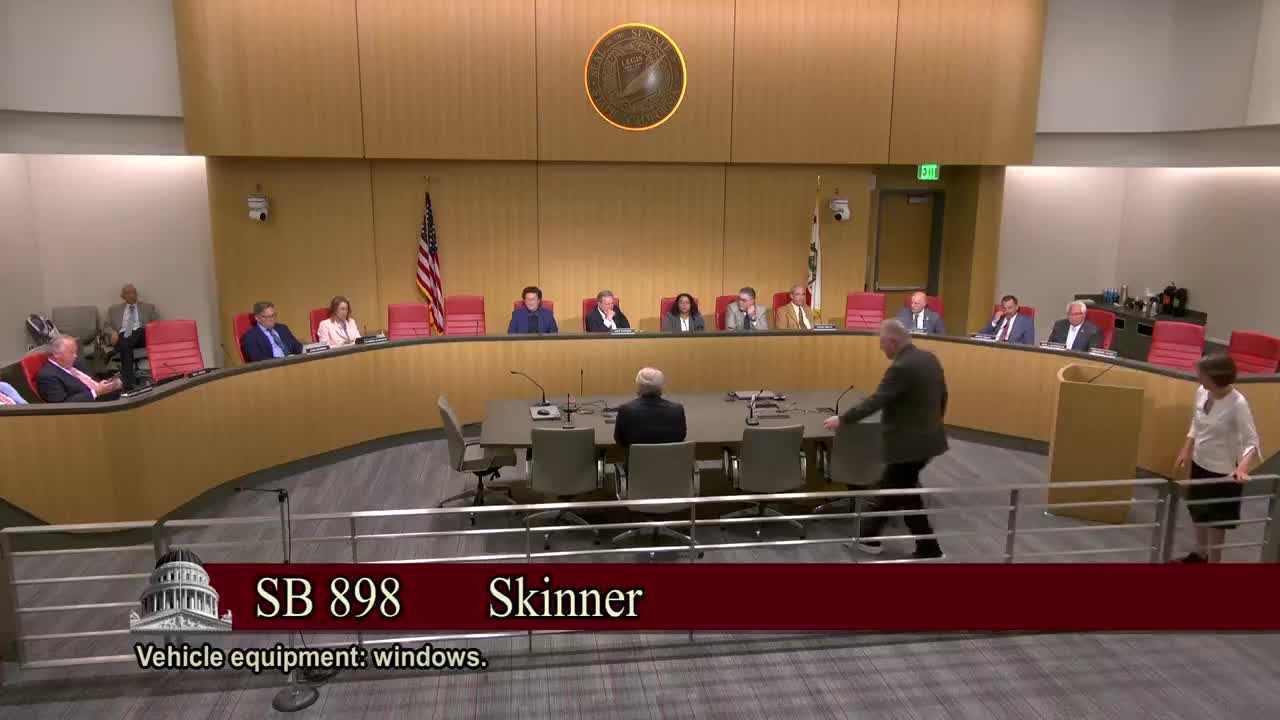 1MIN
Senate Standing Committee on Transportation
 37SEC
Senate Standing Committee on Transportation
Bill Author

Bill Co-Author(s):