SB 904: Sonoma-Marin Area Rail Transit District.
- Session Year: 2023-2024
- House: Senate
- Latest Version Date: 2024-09-28
Current Status:
Passed
(2024-09-28: Chaptered by Secretary of State. Chapter 866, Statutes of 2024.)
Introduced
In Committee
First Chamber
In Committee
Second Chamber
Enacted
Existing law creates, within the Counties of Sonoma and Marin, the Sonoma-Marin Area Rail Transit District with specified duties and powers relative to the provision of a passenger and freight rail system within the territory of the district. Under existing law, the district is governed by a 12-member board of directors appointed by various local governmental entities. Existing law authorizes the board to submit to the voters of the district a measure proposing a retail transactions and use tax ordinance.
This bill would also authorize those special taxes to be imposed by a qualified voter initiative if that initiative complies with certain requirements. The bill would require the board of supervisors of the Counties of Sonoma and Marin to call a special election on a tax measure proposed by the districts board of directors or a qualified voter initiative in their respective counties and would require the district to reimburse the counties upon request for the incremental cost of submitting the measure to the voters, as specified. To the extent that the bill would impose additional duties on a county elections official, the bill would impose a state-mandated local program.
The bill would delete a provision that limits the district, in the County of Sonoma north of the City of Healdsburg, to locating commuter stations only within incorporated areas.
The bill would require the district to obtain coverage for the district and its employees under the appropriate federal and state workers compensation, unemployment compensation, and disability and unemployment insurance laws, instead of only under laws of this state.
Existing law renamed the North Coast Railroad Authority the Great Redwood Trail Agency on March 1, 2022. Existing law requires the agency to convey and transfer all of its rights, interests, privileges, and title relating to its rail right-of-way south of the county line separating the Counties of Mendocino and Sonoma to the Sonoma-Marin Area Rail Transit District.
This bill would delete various obsolete references to the North Coast Railroad Authority located within provisions governing the Sonoma-Marin Area Rail Transit District.
Existing law requires the Sonoma-Marin Area Rail Transit Districts contracts for the purchase of supplies, equipment, and materials to be let to the lowest responsible bidder when the expenditure required exceeds $40,000.
This bill would increase that threshold to $75,000 and would authorize the contract to be let to the lowest responsible bidder, or, in the districts discretion, to the responsible bidder who submitted a proposal that provides the best value to the district on the basis of the factors identified in the solicitation. The bill would require the district, to the extent practicable, to obtain a minimum of 3 quotations, either written or oral, that permit prices and terms to be compared whenever the expected expenditure required for the purchase of supplies, equipment, or materials exceeds $10,000 but does not exceed $75,000.
The California Constitution requires the state to reimburse local agencies and school districts for certain costs mandated by the state. Statutory provisions establish procedures for making that reimbursement.
This bill would provide that, if the Commission on State Mandates determines that the bill contains costs mandated by the state, reimbursement for those costs shall be made pursuant to the statutory provisions noted above.
Existing law creates, within the Counties of Sonoma and Marin, the Sonoma-Marin Area Rail Transit District with specified duties and powers relative to the provision of a passenger and freight rail system within the territory of the district. Under existing law, the district is governed by a 12-member board of directors appointed by various local governmental entities. Existing law authorizes the board to submit to the voters of the district a measure proposing a retail transactions and use tax ordinance.
This bill would also authorize those special taxes to be imposed by a qualified voter initiative if that initiative complies with certain requirements. The bill would require the board of supervisors of the Counties of Sonoma and Marin to call a special election on a tax measure proposed by the districts board of directors or a qualified voter initiative in their respective counties, counties and would require the district to reimburse the counties upon request for the incremental cost of submitting the measure to the voters, as specified. To the extent that the bill would impose additional duties on a county elections official, the bill would impose a state-mandated local program.
The bill would delete a provision that limits the district, in the County of Sonoma north of the City of Healdsburg, to locating commuter stations only within incorporated areas.
The bill would require the district to obtain coverage for the district and its employees under the appropriate federal and state workers compensation, unemployment compensation, and disability and unemployment insurance laws, instead of only under laws of this state.
Existing law renamed the North Coast Railroad Authority the Great Redwood Trail Agency on March 1, 2022. Existing law requires the agency to convey and transfer all of its rights, interests, privileges, and title relating to its rail right-of-way south of the county line separating the Counties of Mendocino and Sonoma to the Sonoma-Marin Area Rail Transit District.
This bill would delete various obsolete references to the North Coast Railroad Authority located within provisions governing the Sonoma-Marin Area Rail Transit District.
Existing law requires the Sonoma-Marin Area Rail Transit Districts contracts for the purchase of supplies, equipment, and materials to be let to the lowest responsible bidder when the expenditure required exceeds $40,000.
This bill would increase that threshold to $75,000 and would authorize the contract to be let to the lowest responsible bidder, or, in the districts discretion, to the responsible bidder who submitted a proposal that provides the best value to the district on the basis of the factors identified in the solicitation. The bill would require the district, to the extent practicable, to obtain a minimum of 3 quotations, either written or oral, that permit prices and terms to be compared whenever the expected expenditure required for the purchase of supplies, equipment, or materials exceeds $10,000 but does not exceed $75,000.
The California Constitution requires the state to reimburse local agencies and school districts for certain costs mandated by the state. Statutory provisions establish procedures for making that reimbursement.
This bill would provide that, if the Commission on State Mandates determines that the bill contains costs mandated by the state, reimbursement for those costs shall be made pursuant to the statutory provisions noted above.
Existing law creates, within the Counties of Sonoma and Marin, the Sonoma-Marin Area Rail Transit District with specified duties and powers relative to the provision of a passenger and freight rail system within the territory of the district. Under existing law, the district is governed by a 12-member board of directors appointed by various local governmental entities. Existing law authorizes the board to submit to the voters of the district a measure proposing a retail transactions and use tax ordinance.
This bill would also authorize those special taxes to be imposed by a qualified voter initiative. initiative if that initiative complies with certain requirements. The bill would require the board of supervisors of the Counties of Sonoma and Marin to call a special election on a tax measure proposed by the districts board of directors or a qualified voter initiative in their respective counties, as specified. To the extent that the bill would impose additional duties on a county elections official, the bill would impose a state-mandated local program.
The bill would delete a provision that limits the district, in the County of Sonoma north of the City of Healdsburg, to locating commuter stations only within incorporated areas.
The bill would require the district to obtain coverage for the district and its employees under the appropriate federal and state workers compensation, unemployment compensation, and disability and unemployment insurance laws, instead of only under laws of this state.
Existing law renamed the North Coast Railroad Authority the Great Redwood Trail Agency on March 1, 2022. Existing law requires the agency to convey and transfer all of its rights, interests, privileges, and title relating to its rail right-of-way south of the county line separating the Counties of Mendocino and Sonoma to the Sonoma-Marin Area Rail Transit District.
This bill would delete various obsolete references to the North Coast Railroad Authority located within provisions of law governing the Sonoma-Marin Area Rail Transit District.
Existing law requires the Sonoma-Marin Area Rail Transit Districts contracts for the purchase of supplies, equipment, and materials to be let to the lowest responsible bidder when the expenditure required exceeds $40,000.
This bill would increase that threshold to $150,000 $75,000 and would authorize the contract to be let to the lowest responsible bidder, or, in the districts discretion, to the responsible bidder who submitted a proposal that provides the best value to the district on the basis of the factors identified in the solicitation. The bill would require the district, to the extent practicable, to obtain a minimum of 3 quotations, either written or oral, that permit prices and terms to be compared whenever the expected expenditure required for the purchase of supplies, equipment, or materials exceeds $10,000 but does not exceed $75,000.
The California Constitution requires the state to reimburse local agencies and school districts for certain costs mandated by the state. Statutory provisions establish procedures for making that reimbursement.
This bill would provide that, if the Commission on State Mandates determines that the bill contains costs mandated by the state, reimbursement for those costs shall be made pursuant to the statutory provisions noted above.
Existing law creates, within the Counties of Sonoma and Marin, the Sonoma-Marin Area Rail Transit District with specified duties and powers relative to the provision of a passenger and freight rail system within the territory of the district. Under existing law, the district is governed by a 12-member board of directors appointed by various local governmental entities. Existing law authorizes the board to submit to the voters of the district a measure proposing a retail transactions and use tax ordinance.
This bill would also authorize those special taxes to be imposed by a qualified voter initiative. The bill would require the board of supervisors of the Counties of Sonoma and Marin to call a special election on a tax measure proposed by the districts board of directors or a qualified voter initiative in their respective counties, as specified. To the extent that the bill would impose additional duties on a county elections official, the bill would impose a state-mandated local program.
The bill would require the district to obtain coverage for the district and its employees under the appropriate federal and state workers compensation, unemployment compensation, and disability and unemployment insurance laws, instead of only under laws of this state.
Existing law renamed the North Coast Railroad Authority the Great Redwood Trail Agency on March 1, 2022. Existing law requires the agency to convey and transfer all of its rights, interests, privileges, and title relating to its rail right-of-way south of the county line separating the Counties of Mendocino and Sonoma to the Sonoma-Marin Area Rail Transit District.
This bill would delete various obsolete references to the North Coast Railroad Authority located within provisions of law governing the Sonoma-Marin Area Rail Transit District.
Existing law requires the Sonoma-Marin Area Rail Transit Districts contracts for the purchase of supplies, equipment, and materials to be let to the lowest responsible bidder when the expenditure required exceeds $40,000.
This bill would increase that threshold to $150,000 and would authorize the contract to be let to the lowest responsible bidder, or, in the districts discretion, to the responsible bidder who submitted a proposal that provides the best value to the district on the basis of the factors identified in the solicitation.
The California Constitution requires the state to reimburse local agencies and school districts for certain costs mandated by the state. Statutory provisions establish procedures for making that reimbursement.
This bill would provide that, if the Commission on State Mandates determines that the bill contains costs mandated by the state, reimbursement for those costs shall be made pursuant to the statutory provisions noted above.
(a)The purchase of all supplies, equipment, and materials, when the expenditure required exceeds seventy-five thousand dollars ($75,000), shall be by contract let to the lowest responsible bidder, or, in the districts discretion, to the responsible bidder who submitted a proposal that provides the best value to the district on the basis of the factors identified in the solicitation. Best value means the overall combination of quality, price, and other elements of a proposal that, when considered together, provide the greatest overall benefit in response to the requirements described in the solicitation documents.
(b)To the extent practicable, the district shall obtain a minimum of three quotations, either written or oral, that permit prices and terms to be compared whenever the expected expenditure required for the purchase of supplies, equipment, or materials exceeds ten thousand dollars ($10,000), but does not exceed seventy-five thousand dollars ($75,000).
(c)The construction of facilities and works when the expenditure required exceeds ten thousand dollars ($10,000) shall be by contract let to the lowest responsible bidder.
(d)Notice requesting bids shall be published at least once in a newspaper of general circulation. This publication shall be made at least 10 days before the bids are received. The district may reject any and all bids and readvertise in its discretion.
SEC. 2.Section 105012 of the Public Utilities Code is amended to read:105012.(a)Upon the dissolution of the Sonoma-Marin Area Rail Transit Commission and the Northwestern Pacific Railroad Authority, the district shall succeed to any or all of the powers, duties, rights, obligations, liabilities, indebtedness, bonded and otherwise, immunities, and exemptions of the commission and its board of commissioners and the authority and its board of directors.
(b)Upon the dissolution of the Sonoma-Marin Area Rail Transit Commission and the Northwestern Pacific Railroad Authority, the district shall assume the rights and obligations of the commission and the authority under any contract to which the commission or the authority is a party and which is to be performed, in whole or in part, on or after the date of dissolution of the Sonoma-Marin Area Rail Transit Commission and the Northwestern Pacific Railroad Authority.
(c)All real and personal property owned by the Sonoma-Marin Area Rail Transit Commission and the Northwestern Pacific Railroad Authority may be transferred to the district. Any real or personal property owned individually or jointly by the Golden Gate Bridge, Highway and Transportation District, the County of Marin, or the Marin County Transit District, or any other public agency, may be transferred to the district.
(d)Upon the dissolution of the Sonoma-Marin Area Rail Transit Commission, the district shall assume, without any condition whatsoever, all responsibilities and obligations previously assumed by the commission with respect to its fund transfer agreement with the Department of Transportation for the funding of the Sonoma-Marin Area Rail Transit Project.
(e)On and after the date of dissolution of the Sonoma-Marin Area Rail Transit Commission and the Northwestern Pacific Railroad Authority, any reference in any provision of law or regulation to the commission or the authority shall be deemed to refer to the district.
SEC. 3.Section 105045 is added to the Public Utilities Code, to read:105045.(a)If the district or a qualified voter initiative proposes a measure pursuant to Section 105115, the board of supervisors of the Counties of Sonoma and Marin shall call a special election on the measure in their respective counties. The special election may be consolidated with a statewide election and the measure shall be submitted to the voters of the Counties of Sonoma and Marin.
(b)The district shall reimburse the Counties of Sonoma and Marin upon request for the incremental cost of submitting a measure to the voters pursuant to subdivision (a). These costs shall be reimbursed from revenues derived from the measure if it is approved by the voters, or, if the measure is not approved, from any existing revenues administered by the district.
SEC. 4.Section 105096 of the Public Utilities Code is amended to read:105096.(a)The district may acquire, construct, own, operate, control, or use rights-of-way, rail lines, stations, platforms, switches, yards, terminals, parking lots, and any and all other facilities necessary or convenient for rail transit within and without the district, together with all physical structures necessary or convenient for the access of persons and vehicles thereto, including ancillary bicycle and pedestrian pathways, and may acquire or contract for any interest in or rights to the use or joint use of any or all of the foregoing.
(b)The district may contract with any public agency or person for the operation of shuttle services necessary or convenient for rail transit.
(c)In the County of Marin, north of the City of San Rafael, the district shall locate commuter stations only within areas that are incorporated as of January 1, 2003.
SEC. 5.Section 105104 of the Public Utilities Code is amended to read:105104.The district shall work with the Federal Railroad Administration and any of its successor agencies to achieve safe, efficient, and compatible operations of both passenger rail and freight service along the rail line in the Counties of Sonoma and Marin.
SEC. 6.Section 105105 of the Public Utilities Code is repealed.SEC. 7.Section 105115 of the Public Utilities Code is amended to read:105115.(a)Upon the affirmative vote of a majority of the directors, which shall include an affirmative vote of at least three directors from each county within the district appointed pursuant to subdivisions (a), (b), (c), (d), (e), and (f) of Section 105020, the board may by resolution submit to the voters of the district a measure proposing a retail transactions and use tax ordinance in accordance with the provisions of Part 1.6 (commencing with Section 7251) of Division 2 of the Revenue and Taxation Code.
(b)Notwithstanding any other law, the special taxes authorized in this article may also be imposed by a qualified voter initiative pursuant to Chapter 4 (commencing with Section 9300) of Division 9 of the Elections Code if the qualified voter initiative complies with both of the following requirements:
(1)The qualified voter initiative proposes a rate for the retail transactions and use tax that is no less than one-quarter of 1 percent.
(2)The qualified voter initiative proposes expenditures for the revenues generated from the retail transactions and use tax that are consistent with the purpose of providing a rail transit system under the jurisdiction of the district.
SEC. 8.Section 105181 of the Public Utilities Code is amended to read:105181.The district shall obtain coverage for the district and its employees under the appropriate federal and state workers compensation, unemployment compensation, and disability and unemployment insurance laws.
SEC. 9.Section 105336 of the Public Utilities Code is amended to read:105336.Upon dissolution, the right, title, and interest to any property owned or controlled by the district that was acquired by the district from the Golden Gate Bridge, Highway and Transportation District shall be returned to the Golden Gate Bridge, Highway and Transportation District or disposed of as designated by the Golden Gate Bridge, Highway and Transportation District. It is the intent of the Legislature that any remaining property continue to be held in public ownership. A joint powers agency, members of which may include the Counties of Marin and Sonoma and the Golden Gate Bridge, Highway and Transportation District, may be formed to hold title to the remaining district property. If a joint powers agency cannot be formed, the district, in consultation with the Counties of Humboldt, Marin, Mendocino, and Sonoma, and the Golden Gate Bridge, Highway and Transportation District, shall make a recommendation to the Legislature regarding an appropriate disposition of the property.
SEC. 10.If the Commission on State Mandates determines that this act contains costs mandated by the state, reimbursement to local agencies and school districts for those costs shall be made pursuant to Part 7 (commencing with Section 17500) of Division 4 of Title 2 of the Government Code.
(a)The purchase of all supplies, equipment, and materials, when the expenditure required exceeds seventy-five thousand dollars ($75,000), shall be by contract let to the lowest responsible bidder, or, in the districts discretion, to the responsible bidder who submitted a proposal that provides the best value to the district on the basis of the factors identified in the solicitation. Best value means the overall combination of quality, price, and other elements of a proposal that, when considered together, provide the greatest overall benefit in response to the requirements described in the solicitation documents.
(b)To the extent practicable, the district shall obtain a minimum of three quotations, either written or oral, that permit prices and terms to be compared whenever the expected expenditure required for the purchase of supplies, equipment, or materials exceeds ten thousand dollars ($10,000), but does not exceed seventy-five thousand dollars ($75,000).
(c)The construction of facilities and works when the expenditure required exceeds ten thousand dollars ($10,000) shall be by contract let to the lowest responsible bidder.
(d)Notice requesting bids shall be published at least once in a newspaper of general circulation. This publication shall be made at least 10 days before the bids are received. The district may reject any and all bids and readvertise in its discretion.
SEC. 2.Section 105012 of the Public Utilities Code is amended to read:105012.(a)Upon the dissolution of the Sonoma-Marin Area Rail Transit Commission and the Northwestern Pacific Railroad Authority, the district shall succeed to any or all of the powers, duties, rights, obligations, liabilities, indebtedness, bonded and otherwise, immunities, and exemptions of the commission and its board of commissioners and the authority and its board of directors.
(b)Upon the dissolution of the Sonoma-Marin Area Rail Transit Commission and the Northwestern Pacific Railroad Authority, the district shall assume the rights and obligations of the commission and the authority under any contract to which the commission or the authority is a party and which is to be performed, in whole or in part, on or after the date of dissolution of the Sonoma-Marin Area Rail Transit Commission and the Northwestern Pacific Railroad Authority.
(c)All real and personal property owned by the Sonoma-Marin Area Rail Transit Commission and the Northwestern Pacific Railroad Authority may be transferred to the district. Any real or personal property owned individually or jointly by the Golden Gate Bridge, Highway and Transportation District, the County of Marin, or the Marin County Transit District, or any other public agency, may be transferred to the district.
(d)Upon the dissolution of the Sonoma-Marin Area Rail Transit Commission, the district shall assume, without any condition whatsoever, all responsibilities and obligations previously assumed by the commission with respect to its fund transfer agreement with the Department of Transportation for the funding of the Sonoma-Marin Area Rail Transit Project.
(e)On and after the date of dissolution of the Sonoma-Marin Area Rail Transit Commission and the Northwestern Pacific Railroad Authority, any reference in any provision of law or regulation to the commission or the authority shall be deemed to refer to the district.
SEC. 3.Section 105045 is added to the Public Utilities Code, to read:105045.(a)If the district or a qualified voter initiative proposes a measure pursuant to Section 105115, the board of supervisors of the Counties of Sonoma and Marin shall call a special election on the measure in their respective counties. The special election may be consolidated with a statewide election and the measure shall be submitted to the voters of the Counties of Sonoma and Marin.
(b)The district shall reimburse the Counties of Sonoma and Marin upon request for the incremental cost of submitting a measure to the voters pursuant to subdivision (a). These costs shall be reimbursed from revenues derived from the measure if it is approved by the voters, or, if the measure is not approved, from any existing revenues administered by the district.
SEC. 4.Section 105096 of the Public Utilities Code is amended to read:105096.(a)The district may acquire, construct, own, operate, control, or use rights-of-way, rail lines, stations, platforms, switches, yards, terminals, parking lots, and any and all other facilities necessary or convenient for rail transit within and without the district, together with all physical structures necessary or convenient for the access of persons and vehicles thereto, including ancillary bicycle and pedestrian pathways, and may acquire or contract for any interest in or rights to the use or joint use of any or all of the foregoing.
(b)The district may contract with any public agency or person for the operation of shuttle services necessary or convenient for rail transit.
(c)In the County of Marin, north of the City of San Rafael, the district shall locate commuter stations only within areas that are incorporated as of January 1, 2003.
SEC. 5.Section 105104 of the Public Utilities Code is amended to read:105104.The district shall work with the Federal Railroad Administration and any of its successor agencies to achieve safe, efficient, and compatible operations of both passenger rail and freight service along the rail line in the Counties of Sonoma and Marin.
SEC. 6.Section 105105 of the Public Utilities Code is repealed.SEC. 7.Section 105115 of the Public Utilities Code is amended to read:105115.(a)Upon the affirmative vote of a majority of the directors, which shall include an affirmative vote of at least three directors from each county within the district appointed pursuant to subdivisions (a), (b), (c), (d), (e), and (f) of Section 105020, the board may by resolution submit to the voters of the district a measure proposing a retail transactions and use tax ordinance in accordance with the provisions of Part 1.6 (commencing with Section 7251) of Division 2 of the Revenue and Taxation Code.
(b)Notwithstanding any other law, the special taxes authorized in this article may also be imposed by a qualified voter initiative pursuant to Chapter 4 (commencing with Section 9300) of Division 9 of the Elections Code if the qualified voter initiative complies with both of the following requirements:
(1)The qualified voter initiative proposes a rate for the retail transactions and use tax that is no less than one-quarter of 1 percent.
(2)The qualified voter initiative proposes expenditures for the revenues generated from the retail transactions and use tax that are consistent with the purpose of providing a rail transit system under the jurisdiction of the district.
SEC. 8.Section 105181 of the Public Utilities Code is amended to read:105181.The district shall obtain coverage for the district and its employees under the appropriate federal and state workers compensation, unemployment compensation, and disability and unemployment insurance laws.
SEC. 9.Section 105336 of the Public Utilities Code is amended to read:105336.Upon dissolution, the right, title, and interest to any property owned or controlled by the district that was acquired by the district from the Golden Gate Bridge, Highway and Transportation District shall be returned to the Golden Gate Bridge, Highway and Transportation District or disposed of as designated by the Golden Gate Bridge, Highway and Transportation District. It is the intent of the Legislature that any remaining property continue to be held in public ownership. A joint powers agency, members of which may include the Counties of Marin and Sonoma and the Golden Gate Bridge, Highway, Highway and Transportation District, may be formed to hold title to the remaining district property. If a joint powers agency cannot be formed, the district, in consultation with the Counties of Humboldt, Marin, Mendocino, and Sonoma, and the Golden Gate Bridge, Highway, Highway and Transportation District, shall make a recommendation to the Legislature regarding an appropriate disposition of the property.
SEC. 10.If the Commission on State Mandates determines that this act contains costs mandated by the state, reimbursement to local agencies and school districts for those costs shall be made pursuant to Part 7 (commencing with Section 17500) of Division 4 of Title 2 of the Government Code.
(a)The purchase of all supplies, equipment, and materials materials, when the expenditure required exceeds one hundred fifty seventy-five thousand dollars ($150,000), ($75,000), shall be by contract let to the lowest responsible bidder, or, in the districts discretion, to the responsible bidder who submitted a proposal that provides the best value to the district on the basis of the factors identified in the solicitation. Best value means the overall combination of quality, price, and other elements of a proposal that, when considered together, provide the greatest overall benefit in response to the requirements described in the solicitation documents.
(b)To the extent practicable, the district shall obtain a minimum of three quotations, either written or oral, that permit prices and terms to be compared whenever the expected expenditure required for the purchase of supplies, equipment, or materials exceeds ten thousand dollars ($10,000), but does not exceed seventy-five thousand dollars ($75,000).
(b)(c)The construction of facilities and works when the expenditure required exceeds ten thousand dollars ($10,000) shall be by contract let to the lowest responsible bidder.
(c)(d)Notice requesting bids shall be published at least once in a newspaper of general circulation. This publication shall be made at least 10 days before the bids are received. The district may reject any and all bids and readvertise in its discretion.
SEC. 2.Section 105012 of the Public Utilities Code is amended to read:105012.(a)Upon the dissolution of the Sonoma-Marin Area Rail Transit Commission and the Northwestern Pacific Railroad Authority, the district shall succeed to any or all of the powers, duties, rights, obligations, liabilities, indebtedness, bonded and otherwise, immunities, and exemptions of the commission and its board of commissioners and the authority and its board of directors.
(b)Upon the dissolution of the Sonoma-Marin Area Rail Transit Commission and the Northwestern Pacific Railroad Authority, the district shall assume the rights and obligations of the commission and the authority under any contract to which the commission or the authority is a party and which is to be performed, in whole or in part, on or after the date of dissolution of the Sonoma-Marin Area Rail Transit Commission and the Northwestern Pacific Railroad Authority.
(c)All real and personal property owned by the Sonoma-Marin Area Rail Transit Commission and the Northwestern Pacific Railroad Authority may be transferred to the district. Any real or personal property owned individually or jointly by the Golden Gate Bridge, Highway and Transportation District, the County of Marin, or the Marin County Transit District, or any other public agency, may be transferred to the district.
(d)Upon the dissolution of the Sonoma-Marin Area Rail Transit Commission, the district shall assume, without any condition whatsoever, all responsibilities and obligations previously assumed by the commission with respect to its fund transfer agreement with the Department of Transportation for the funding of the Sonoma-Marin Area Rail Transit Project.
(e)On and after the date of dissolution of the Sonoma-Marin Area Rail Transit Commission and the Northwestern Pacific Railroad Authority, any reference in any provision of law or regulation to the commission or the authority shall be deemed to refer to the district.
SEC. 3.Section 105045 is added to the Public Utilities Code, to read:105045.If the district or a qualified voter initiative proposes a measure pursuant to Section 105115, the board of supervisors of the Counties of Sonoma and Marin shall call a special election on the measure in their respective counties. The special election may be consolidated with a statewide election and the measure shall be submitted to the voters of the Counties of Sonoma and Marin.
SEC. 4.Section 105096 of the Public Utilities Code is amended to read:105096.(a)The district may acquire, construct, own, operate, control, or use rights-of-way, rail lines, stations, platforms, switches, yards, terminals, parking lots, and any and all other facilities necessary or convenient for rail transit within and without the district, together with all physical structures necessary or convenient for the access of persons and vehicles thereto, including ancillary bicycle and pedestrian pathways, and may acquire or contract for any interest in or rights to the use or joint use of any or all of the foregoing.
(b)The district may contract with any public agency or person for the operation of shuttle services necessary or convenient for rail transit.
(c)In Sonoma County, north of Healdsburg, the district shall locate commuter stations only within incorporated areas.(d)(c)In Marin County the County of Marin, north of the City of San Rafael, the district shall locate commuter stations only within areas that are incorporated as of the operative date of this part. January 1, 2003.
SEC. 4.SEC. 5.Section 105104 of the Public Utilities Code is amended to read:105104.The district shall work with the Federal Railroad Administration and any of its successor agencies to achieve safe, efficient, and compatible operations of both passenger rail and freight service along the rail line in the Counties of Sonoma and Marin.
SEC. 5.SEC. 6.Section 105105 of the Public Utilities Code is repealed.SEC. 6.SEC. 7.Section 105115 of the Public Utilities Code is amended to read:105115.(a)Upon the affirmative vote of a majority of the directors, which shall include an affirmative vote of at least three directors from each county within the district appointed pursuant to subdivisions (a), (b), (c), (d), (e), and (f) of Section 105020, the board may by resolution submit to the voters of the district a measure proposing a retail transactions and use tax ordinance in accordance with the provisions of Part 1.6 (commencing with Section 7251) of Division 2 of the Revenue and Taxation Code.
(b)Notwithstanding any other law, the special taxes authorized in this article may also be imposed by a qualified voter initiative pursuant to Chapter 4 (commencing with Section 9300) of Division 9 of the Elections Code. Code if the qualified voter initiative complies with both of the following requirements:
(1)The qualified voter initiative proposes a rate for the retail transactions and use tax that is no less than one-quarter of 1 percent.
(2)The qualified voter initiative proposes expenditures for the revenues generated from the retail transactions and use tax that are consistent with the purpose of providing a rail transit system under the jurisdiction of the district.
SEC. 7.SEC. 8.Section 105181 of the Public Utilities Code is amended to read:105181.The district shall obtain coverage for the district and its employees under the appropriate federal and state workers compensation, unemployment compensation, and disability and unemployment insurance laws.
SEC. 8.SEC. 9.Section 105336 of the Public Utilities Code is amended to read:105336.Upon dissolution, the right, title, and interest to any property owned or controlled by the district that was acquired by the district from the Golden Gate Bridge, Highway and Transportation District shall be returned to the Golden Gate Bridge, Highway and Transportation District or disposed of as designated by the Golden Gate Bridge, Highway and Transportation District. It is the intent of the Legislature that any remaining property continue to be held in public ownership. A joint powers agency, members of which may include the Counties of Marin and Sonoma and the Golden Gate Bridge, Highway, and Transportation District, may be formed to hold title to the remaining district property. If a joint powers agency cannot be formed, the district, in consultation with the Counties of Humboldt, Marin, Mendocino, and Sonoma, Humboldt, and Mendocino, and the Golden Gate Bridge, Highway, and Transportation District, shall make a recommendation to the Legislature regarding an appropriate disposition of the property.
SEC. 9.SEC. 10.If the Commission on State Mandates determines that this act contains costs mandated by the state, reimbursement to local agencies and school districts for those costs shall be made pursuant to Part 7 (commencing with Section 17500) of Division 4 of Title 2 of the Government Code.
REVISIONS: HeadingLine 2.(a)The purchase of all supplies, equipment, and materials when the expenditure required exceeds forty one hundred fifty thousand dollars ($40,000), and the ($150,000), shall be by contract let to the lowest responsible bidder, or, in the districts discretion, to the responsible bidder who submitted a proposal that provides the best value to the district on the basis of the factors identified in the solicitation. Best value means the overall combination of quality, price, and other elements of a proposal that, when considered together, provide the greatest overall benefit in response to the requirements described in the solicitation documents.
(b)The construction of facilities and works when the expenditure required exceeds ten thousand dollars ($10,000), ($10,000) shall be by contract let to the lowest responsible bidder. Notice
(c)Notice requesting bids shall be published at least once in a newspaper of general circulation. This publication shall be made at least 10 days before the bids are received. The district may reject any and all bids and readvertise in its discretion.
SEC. 2.Section 105012 of the Public Utilities Code is amended to read:105012.(a)Upon the dissolution of the Sonoma-Marin Area Rail Transit Commission and the Northwestern Pacific Railroad Authority, the district shall succeed to any or all of the powers, duties, rights, obligations, liabilities, indebtedness, bonded and otherwise, immunities, and exemptions of the commission and its board of commissioners and the authority and its board of directors.
(b)Upon the dissolution of the Sonoma-Marin Area Rail Transit Commission and the Northwestern Pacific Railroad Authority, the district shall assume the rights and obligations of the commission and the authority under any contract to which the commission or the authority is a party and which is to be performed, in whole or in part, on or after the date of dissolution of the Sonoma-Marin Area Rail Transit Commission and the Northwestern Pacific Railroad Authority, including, without limitation, any existing operating agreements with the North Coast Railroad Authority. The district shall thereafter negotiate in good faith a new operating agreement with the North Coast Railroad Authority. If the parties are unable to reach an agreement on the new operating agreement, the parties shall select a mutually agreed upon third party to mediate a resolution of the dispute. Authority.
(c)All real and personal property owned by the Sonoma-Marin Area Rail Transit Commission and the Northwestern Pacific Railroad Authority may be transferred to the district. Any real or personal property owned individually or jointly by the Golden Gate Bridge, Highway and Transportation District, the County of Marin, or the Marin County Transit District, or any other public agency, may be transferred to the district. The transfer of any right-of-way from the Northwestern Pacific Railroad Authority, the Golden Gate Bridge, Highway and Transportation District, the County of Marin, or the Marin County Transit District to the district shall be made subject to any existing easements for freight and passenger excursion service issued to the North Coast Railroad Authority prior to the time of the transfer.
(d)Upon the dissolution of the Sonoma-Marin Area Rail Transit Commission, the district shall assume, without any condition whatsoever, all responsibilities and obligations previously assumed by the commission with respect to its fund transfer agreement with Caltrans the Department of Transportation for the funding of the Sonoma-Marin Area Rail Transit Project.
(e)On and after the date of dissolution of the Sonoma-Marin Area Rail Transit Commission and the Northwestern Pacific Railroad Authority, any reference in any provision of law or regulation to the commission or the authority shall be deemed to refer to the district.
SEC. 3.Section 105045 is added to the Public Utilities Code, to read:105045.If the district or a qualified voter initiative proposes a measure pursuant to Section 105115, the board of supervisors of the Counties of Sonoma and Marin shall call a special election on the measure in their respective counties. The special election may be consolidated with a statewide election and the measure shall be submitted to the voters of the Counties of Sonoma and Marin.
SEC. 4.Section 105104 of the Public Utilities Code is amended to read:105104.The district shall work with the North Coast Railroad Authority, the Federal Railroad Administration, Administration and any of its successor agencies, agencies to achieve safe, efficient, and compatible operations of both passenger rail and freight service along the rail line in the Counties of Sonoma and Marin Counties. Marin.
SEC. 5.Section 105105 of the Public Utilities Code is repealed.105105.The district shall be responsible for any advance payment of any portion of the North Coast Railroad Authoritys Q-Fund loan repayment obligation caused by the districts action. Any amount advanced by the district shall be reimbursed by the North Coast Railroad Authority at the time the North Coast Railroad Authoritys obligation to repay that portion of the Q-Fund loan would otherwise become due.SEC. 6.Section 105115 of the Public Utilities Code is amended to read:105115.(a)Upon the affirmative vote of a majority of the directors, which shall include an affirmative vote of at least three directors from each county within the district appointed pursuant to subdivisions (a), (b), (c), (d), (e), and (f) of Section 105020, the board may by resolution submit to the voters of the district a measure proposing a retail transactions and use tax ordinance in accordance with the provisions of Part 1.6 (commencing with Section 7251) of Division 2 of the Revenue and Taxation Code.
(b)Notwithstanding any other law, the special taxes authorized in this article may also be imposed by a qualified voter initiative pursuant to Chapter 4 (commencing with Section 9300) of Division 9 of the Elections Code.
SEC. 7.Section 105181 of the Public Utilities Code is amended to read:105181.The district shall obtain coverage for the district and its employees under the appropriate federal and state workers compensation, unemployment compensation, and disability and unemployment insurance laws of this state. laws.
SEC. 8.Section 105336 of the Public Utilities Code is amended to read:105336.Upon dissolution, the right, title, and interest to any property owned or controlled by the district which that was acquired by the district from the Golden Gate Bridge, Highway and Transportation District shall be returned to the Golden Gate Bridge, Highway and Transportation District or disposed of as designated by the Golden Gate Bridge, Highway and Transportation District. It is the intent of the Legislature that any remaining property continue to be held in public ownership. A joint powers agency, members of which may include the Counties of Marin and Sonoma, the North Coast Railroad Authority, Sonoma and the Golden Gate Bridge, Highway, and Transportation District, may be formed to hold title to the remaining district property. If a joint powers agency cannot be formed, the district, in consultation with the Counties of Marin, Sonoma, Humboldt, and Mendocino, and the Golden Gate Bridge, Highway, and Transportation District, shall make a recommendation to the Legislature regarding an appropriate disposition of the property.
SEC. 9.If the Commission on State Mandates determines that this act contains costs mandated by the state, reimbursement to local agencies and school districts for those costs shall be made pursuant to Part 7 (commencing with Section 17500) of Division 4 of Title 2 of the Government Code.
|
Date
|
Status
|
|---|---|
| Sep 28, 2024 | Chaptered by Secretary of State. Chapter 866, Statutes of 2024. |
| Sep 28, 2024 | Approved by the Governor. |
| Sep 3, 2024 | Enrolled and presented to the Governor at 3 p.m. |
| Aug 27, 2024 | Assembly amendments concurred in. (Ayes 31. Noes 9. Page 5510.) Ordered to engrossing and enrolling. |
| Aug 26, 2024 | In Senate. Concurrence in Assembly amendments pending. |
| Aug 26, 2024 | Read third time. Passed. (Ayes 56. Noes 15. Page 6547.) Ordered to the Senate. |
| Aug 20, 2024 | Read second time. Ordered to third reading. |
| Aug 19, 2024 | Read second time and amended. Ordered to second reading. |
| Aug 15, 2024 | From committee: Do pass as amended. (Ayes 11. Noes 3.) (August 15). |
| Aug 7, 2024 | August 7 set for first hearing. Placed on suspense file. |
| Jun 26, 2024 | From committee: Do pass and re-refer to Com. on APPR. (Ayes 6. Noes 2.) (June 26). Re-referred to Com. on APPR. |
| Jun 18, 2024 | From committee: Do pass and re-refer to Com. on ELECTIONS. (Ayes 11. Noes 3.) (June 17). Re-referred to Com. on ELECTIONS. |
| Jun 18, 2024 | Coauthors revised. |
| Jun 3, 2024 | Referred to Coms. on TRANS. and ELECTIONS. |
| May 22, 2024 | In Assembly. Read first time. Held at Desk. |
| May 21, 2024 | Read third time. Passed. (Ayes 29. Noes 8. Page 4076.) Ordered to the Assembly. |
| Apr 30, 2024 | Read second time. Ordered to third reading. |
| Apr 29, 2024 | From committee: Be ordered to second reading pursuant to Senate Rule 28.8. |
| Apr 22, 2024 | Set for hearing April 29. |
| Apr 16, 2024 | From committee: Do pass and re-refer to Com. on APPR. (Ayes 6. Noes 1. Page 3630.) (April 16). Re-referred to Com. on APPR. |
| Apr 10, 2024 | From committee: Do pass and re-refer to Com. on E. & C.A. (Ayes 11. Noes 4. Page 3534.) (April 9). Re-referred to Com. on E. & C.A. |
| Apr 5, 2024 | Set for hearing April 16 in E. & C.A. pending receipt. |
| Mar 21, 2024 | From committee with author's amendments. Read second time and amended. Re-referred to Com. on TRANS. |
| Feb 28, 2024 | Set for hearing April 9. |
| Feb 21, 2024 | Referred to Coms. on TRANS. and E. & C.A. |
| Jan 5, 2024 | From printer. May be acted upon on or after February 4. |
| Jan 4, 2024 | Introduced. Read first time. To Com. on RLS. for assignment. To print. |
|
Date
|
Description
|
Location
|
Votes
|
|
|---|---|---|---|---|
| Aug 27, 2024 | Unfinished Business SB904 Dodd et al. Concurrence | Senate Floor |
Passed |
|
| Aug 26, 2024 | SB 904 Dodd Senate Third Reading By Connolly | Assembly Floor |
Passed |
|
| Aug 15, 2024 | Do pass as amended. | Assembly Standing Committee on Appropriations |
Passed |
|
| Jun 26, 2024 | Do pass and be re-referred to the Committee on [Appropriations] | Assembly Standing Committee on Elections |
Passed |
|
| Jun 17, 2024 | Do pass and be re-referred to the Committee on [Elections] | Assembly Standing Committee on Transportation |
Passed |
|
| May 21, 2024 | Senate 3rd Reading SB904 Dodd et al. | Senate Floor |
Passed |
|
| Apr 16, 2024 | Do pass, but first be re-referred to the Committee on [Appropriations] | Senate Standing Committee on Elections and Constitutional Amendments |
Passed |
|
| Apr 9, 2024 | Do pass, but first be re-referred to the Committee on [Elections and Constitutional Amendments] | Senate Standing Committee on Transportation |
Passed |
This list shows positions taken on this bill by organizations on the date displayed, which is linked to the original source.
Positions by individuals are not included.
|
Organization
|
Position
|
Date
|
|---|---|---|
| California Taxpayers Association | ** Against | |
| California Teamsters Public Affairs Council | ** Support | |
| Fourth District Sonoma County Supervisor James Gore | ** Support | |
| Howard Jarvis Taxpayers Association | ** Against | |
| North Bay Leadership Council | ** Support | |
| Sonoma County Transportation Authority/regional Climate Protection Authority | ** Support | |
| Sonoma-Marin Area Rail Transit District | ** Support | |
| Transform | ** Support | |
| Transportation Authority Of Marin | ** Support |
SENATE RULES COMMITTEE Office of Senate Floor Analyses (916) 651-1520 Fax: (916) 327-4478 | SB 904 |
UNFINISHED BUSINESS
Bill No: SB 904
Author: Dodd (D), et al.
Amended: 8/19/24
Vote: 21
SENATE TRANSPORTATION COMMITTEE: 11-4, 4/9/24
AYES: Cortese, Allen, Archuleta, Becker, Blakespear, Dodd, Gonzalez, Limón, Newman, Portantino, Umberg
NOES: Niello, Dahle, Nguyen, Seyarto
SENATE ELECTIONS & C.A. COMMITTEE: 6-1, 4/16/24
AYES: Blakespear, Allen, Menjivar, Newman, Portantino, Umberg
NOES: Nguyen
SENATE APPROPRIATIONS COMMITTEE: Senate Rule 28.8
SENATE FLOOR: 29-8, 5/21/24
AYES: Archuleta, Ashby, Atkins, Becker, Blakespear, Bradford, Caballero, Cortese, Dodd, Durazo, Eggman, Glazer, Gonzalez, Hurtado, Laird, Limón, McGuire, Menjivar, Newman, Padilla, Portantino, Roth, Rubio, Skinner, Smallwood-Cuevas, Stern, Umberg, Wahab, Wiener
NOES: Dahle, Grove, Jones, Nguyen, Niello, Ochoa Bogh, Seyarto, Wilk
NO VOTE RECORDED: Allen, Alvarado-Gil, Min
ASSEMBLY FLOOR: 56-15, 8/26/24 - See last page for vote
SUBJECT: Sonoma-Marin Area Rail Transit District
SOURCE: Sonoma-Marin Area Rail Transit District
DIGEST:
This bill makes various changes to the enabling statutes for the Sonoma-Marin Area Transit District (SMART), including procurement thresholds, as specified. Authorizes SMART’s special taxes to also be imposed by a qualified voter initiative, if the initiative complies with certain requirements.
Assembly Amendments
- require SMART to reimburse the Counties of Sonoma and Marin, upon request, for the cost of submitting a qualified voter initiative measure to the voters. Specifies that the costs will be reimbursed from revenues derived from the measure, if it is approved by voters; or, if the measure is not approved, from existing SMART revenues.
ANALYSIS:
Existing law:
- Creates SMART and establishes a comprehensive set of powers and duties regarding the formation, governance, organization, maintenance, operation and potential dissolution of the district. Authorizes SMART to provide passenger rail service in the counties of Sonoma and Marin and is governed by a 12- member board of directors.
- Authorizes SMART to submit to the voters of the district a measure proposing a retail transactions and use tax ordinance.
- Requires public agencies to obtain competitively bid contracts for construction projects, and contracts for supplies, equipment, and materials above a specified cost threshold. This amount varies depending on the public agency and whether it is a city, county, special district, transportation agency, school, and other variables.
- Requires SMART to award contracts for the purchase of supplies, equipment, and materials in excess of $40,000 to the lowest responsible bidder.
- Restricts SMART to only locate stations in the incorporated area of Sonoma County, north of Healdsburg.
- Requires SMART to obtain coverage for the district and its employees under the appropriate workers’ compensation, unemployment compensation, and disability and unemployment insurance laws of this state.
This bill:
- Increases the existing bid threshold for SMART to award contracts for the purchases of supplies, equipment, and materials from $40,000 to $75,000, as provided.
- Authorizes SMART to let contracts to the responsible bidder that provides the best value, as provided.
- Requires SMART to obtain a minimum of three quotations, as provided, that permit prices and terms to be compared, whenever the expected expenditure required for the purchase of supplies, equipment, or materials exceeds $10,000 but does not exceed $75,000.
- Authorizes SMART’s special taxes to also be imposed by a qualified voter initiative, if the initiative complies with certain requirements, including:
- The qualified voter initiative proposes a rate for the retail sales and use tax that is no less than 1/4 of 1%.
- The qualified voter initiative proposes expenditures for the revenues generated from the retail transaction and use tax that are consistent with the purpose of providing a rail transit system under the jurisdiction of SMART.
- Requires the Board of Supervisors of the Counties of Sonoma and Marin to call a special election on a tax measure proposed by SMART’s Board of Directors or a qualified voter initiative in their respective counties, as specified.
- Requires SMART to reimburse the counties upon request for the cost of submitting a measure to the voters. Specifies that the costs will be reimbursed from revenues derived from the measure, if it is approved by voters; or, if the measure is not approved, from existing SMART revenues.
- Requires SMART to also obtain coverage for the district and its employees under the appropriate federal workers’ compensation, unemployment compensation, and disability and unemployment insurance laws, in addition to California law.
- Deletes requirement that SMART can only locate commuter stations within incorporated areas in Sonoma County, north of Healdsburg.
- Deletes obsolete references, as specified.
- Declares that the bill could constitute a reimbursable mandate.
Comments
- Purpose of the bill. According to the author, “the SMART train is an incredible multi-modal and multi-jurisdictional project that advances many of our state’s top goals: increased rail and bicycle use, transit oriented development, and collaboration by local governments at a regional scale. SMART is the first railroad to resume passenger service in Sonoma and Marin counties in over 50 years. Since coming into service only 7 years ago, SMART has overcome many hurdles and in 2023 returned to their pre-pandemic ridership numbers. SMART was recently designated by the Federal Railroad Administration as part of the Capitol Corridor network and the State Rail Plan projects that it may one day connect with Amtrak services in Solano County, further strengthening our state’s rail transit system. SB 904 updates the enabling statute that created the SMART special district, raising bidding thresholds and aligning state law with SMART’s new dual status as a freight operator. This bill also empowers the voters of this special district for the first time to pursue their own ballot measures through a voter initiative. A voter-approved qualified initiative process has the potential to provide an opportunity to enhance community engagement and help inform and affirm the development of an expenditure plan, providing greater accountability and direction for how to best dedicate future resources to operate the SMART system.”
- What is SMART? SMART is a commuter rail provider that provides passenger service in a corridor linking Santa Rosa Airport in Sonoma County to San Rafael in Marin County. The current 45-mile system includes stations in the Sonoma County Airport area, Santa Rosa, Rohnert Park, Cotati, Petaluma, Novato, San Rafael, and Larkspur. SMART service generally parallels the existing Highway 101 corridor. In 2019, SMART had a ridership of approximately 2,500 passengers per weekday. As of 2023, SMART is back to pre-pandemic ridership levels.
Future extensions of SMART are planned for Windsor, Healdsburg, and Cloverdale, providing 70 miles of passenger rail service. Additionally, SMART has been studying the development of its 41 mile long East/West corridor from Novato to Suisun, which would connect SMART to the exiting Capitol Corridor intercity rail which provides service from the Bay Area to Sacramento. SB 1175 (McGuire, Chapter 303. Statutes of 2022), designated this route as an intercity rail corridor. As noted by the author, in December 2023, the Federal Railroad Administration (FRA) included the new corridor, along with other California intercity passenger rail corridors, as part of the new Corridor Identification and Development (Corridor ID) program. Corridor ID is an intercity passenger rail planning and development program to create a pipeline of intercity passenger rail projects around the country ready for implementation. The California Department of Transportation (Caltrans) will administer $500,000 in initial Corridor ID funds to begin preparing a future service plan for passenger rail expansion in the corridor.
SMART’s system also includes a bicycle and pedestrian pathway along the rail corridor, which is part of the newly created Great Redwood Trail. Over 28 miles have been completed, with 14 additional miles in construction. The trail averages 55,000 monthly trips. Additionally, in 2022, SMART began operating freight rail service from Schellville to Petaluma.
- Costs are on the rise. This bill would update the procurement thresholds for SMART. Specifically, the bill would increase from $40,000 to $75,000 as the point at which purchases of supplies, equipment, and materials are required to go through a formal bid process. Additionally, the bill requires SMART to obtain a minimum of three informal quotes to allow for a comparison of price and terms when these purchases exceed $10,000 but do not exceed $75,000. Finally, the bill authorizes SMART to utilize the best value procurement method for these purchases. This procurement method allows SMART to let a contract to the responsible bidder who submitted a proposal that provides the overall best value, not only the lowest price. As noted by the author, SMART’s procurement thresholds have not been updated since its creation over 20 years ago. Since that time SMART has launched passenger service, expanded the system, assumed freight operations, and is planning for a future intercity rail connection. The updates included are consistent with an inflationary adjustment.
- SMART’s tax measure coming to an end. As part of its enabling legislation, AB 2224 (Nation, Chapter 341, Statutes of 2002), SMART is authorized to submit a measure proposing a retail transactions and use tax ordinance (sales tax) to the voters of the district in Sonoma and Marin Counties. In November 2008, more than 2/3rds of the voters in Sonoma and Marin counties approved Measure Q. Measure Q is a sales and use tax of a quarter of one percent (1/4%) imposed for a period of 20 years beginning April 1, 2009, on the gross receipts from all tangible personal property sold at retail businesses in the counties and a use tax at the same rate on the storage, use, or other consumption in the counties of such property purchased from any retailer, subject to certain exceptions.
Measure Q generated roughly $51 million in 2023 and represents 52% of SMART’s annual budget, which is used for both operations and capital improvements. SMART also receives funding from federal and state sources, with direct farebox revenues accounting for only roughly 2% of total revenues.
As Measure Q will sunset in 2028, SMART is working to extend it. SMART tried to extend it in 2020 for an additional 30 years; however, it was unsuccessful in garnering 2/3rds voter approval. A June 2023, Marin County Grand Jury Report entitled, SMART at a Crossroads Here Today, Gone Tomorrow?, stated that, “SMART is highly dependent on sales tax revenues for its operations. Without those funds SMART will not be able to continue even if it substantially increases the number of riders or obtains additional federal, state, or regional funds from existing programs.” The Grand Jury’s primary recommendation is for SMART to “immediately begin a frank, straightforward conversation with voters delineating the value SMART brings to the community.”
- SB 904 allows a qualified voter initiative to authorize sales and use tax for SMART. In addition to a sales and use tax measure being submitted to the voters by SMART, this bill authorizes a sales and use tax to also be imposed by a qualified voter initiative, pursuant to specific elections procedures, if it complies with specific requirements. Since the so-called Upland court decision in 2017, some local taxes have been imposed by a qualified voter initiative with a majority vote.
Specifically, on August 28, 2017, the California Supreme Court entered a decision in California Cannabis Coalition v. City of Upland, 3 Cal. 5th 924, which held that Article XIIIC, Section Two, subdivision (b)’s requirement that general taxes be submitted to the electorate at a regularly scheduled general election where members of the local governing board are subject to election did not apply to taxes proposed by voter initiative. Groups seeking to impose special taxes by majority vote by initiative soon argued that if the Court held that the general election requirement in subdivision (b) did not apply to initiatives, then neither did the 2/3 vote requirement for special taxes in subdivision (d). At least seven such taxes imposed by voters in various local agencies across the state have been approved, and no court thus far has invalidated them.
Additionally, the California Constitution provides that initiative powers may be exercised by the electors of each city or county under procedures that the Legislature shall provide, with certain exceptions. SMART is neither a city nor a county. It is a special district. Special districts can only exercise initiative power if the district provides a procedure for elections, among other requirements. SMART is comprised of appointed elected officials from other local jurisdictions. Since SMART does not provide a procedure for elections, it currently does not have the authority to provide for initiatives.
As noted, this bill authorizes a sales and use tax to be imposed by a qualified voter initiative, and provides for elections procedures. As SMART is given initiative power through this bill, it is possible that any qualified initiative would be put before voters. Therefore, the bill also includes requirements with which any qualified voter initiative would have to comply. Specifically, the qualified voter initiative would be required to propose a rate for the retail transaction and use tax that is no less than one quarter of one percent (1/4%), and expenditures for the revenues generated from the tax are consistent with the purpose of providing a rail transit system under the jurisdiction of SMART.
- Update of SMART enabling statutes. This bill updates various part of SMART’s enabling statutes. First, the bill clarifies that SMART must also obtain coverage for its employees under the appropriate federal workers’ compensation, unemployment compensation, and disability and unemployment insurance laws, in addition to requirements under California law. When SMART assumed freight rail operations from the Northwestern Pacific Railroad Company (NWPCo.) in 2022, the freight employees were covered under the Federal Employers Liability Act (FELA), not California state law. This bill acknowledges this new part of the SMART workforce.
Second, this bill deletes the requirement that SMART can only locate stations within the incorporated area of Sonoma County, north of Healdsburg. As mentioned, SMART is planning extensions to Healdsburg and finally north to Cloverdale. The route would run through the unincorporated community of Geyserville. In the 20 years since SMART was created, community support has grown for the development of a possible station.
Finally, this bill deletes references to the former North Coast Rail Authority (NCRA). SB 69 (McGuire, Chapter 423, Statutes of 2021), reorganized NCRA into the Great Redwood Trail Agency (GRTA) and transferred its authority related to rail and freight to SMART.
FISCAL EFFECT: Appropriation: No Fiscal Com.: Yes Local: Yes
According to the Assembly Appropriations Committee:
- By requiring the counties of Sonoma and Marin to hold a special election on a retail TUT measure proposed by SMART or a qualified voter initiative, with resultant workload costs for county elections officials, this bill may create a state-mandated local program. If the Commission on State Mandates determines the provisions of this bill create a new program or impose a higher level of service for which the state must reimburse local costs, the two counties could seek reimbursement from the state (General Fund (GF). However, this bill requires SMART to reimburse the counties upon request for the incremental cost of submitting the measure to the voters. The magnitude of costs is unknown, but potentially in excess of $150,000.
- Additionally, the requirement that SMART obtain a minimum of three quotes to compare prices and terms for the purchase of certain goods may also create a state-mandated local program. The magnitude of potentially reimbursable costs is unknown, but likely minor and absorbable.
SUPPORT: (Verified 8/26/24)
Sonoma-Marin Area Rail Transit District (SMART) (source)
California Teamsters Public Affairs Council
North Bay Leadership Council
Sonoma County Transportation Authority/regional Climate Protection Authority
Transform
Transportation Authority of Marin
OPPOSITION: (Verified 8/26/24)
California Taxpayers Association
Howard Jarvis Taxpayers Association
ARGUMENTS IN SUPPORT: Writing as the sponsor of SB 904, SMART states, “SB 904 allows SMART’s Board of Directors to consider a voter-approved qualified initiative organized by citizen groups. This approach can enhance community engagement and help inform and affirm the development of an expenditure plan to reauthorize Measure Q, a quarter-cent sales tax used for operations.”
Regarding the Grand Jury Report, SMART notes, “The Grand Jury’s conclusion found ‘local taxpayers have funded a monumental capital infrastructure project, and voters have directed SMART’s board as stewards of this investment to manage it wisely.’ The SMART Board of Directors discussions of the report findings included public comment that SMART should be open to voter-approved qualified initiatives to ensure the public investment, including over $500 million in State, Federal, Regional and local grants matching Measure Q voter approved funds, is maintained in the highest and best productive public use. SMART has substantially expanded its service area through successful grant awards, underscoring the need to maintain accountability and funding stability. SB 904 supports SMART’s mission of providing efficient and reliable service for North Bay residents, students, and workers while meeting state mandates to reduce greenhouse gas emissions.”
ARGUMENTS IN OPPOSITION: Writing in opposition, the California Taxpayer Association (CalTax) states, “SB 904 fails to specify that special taxes placed on the ballot via an initiative require a two-thirds vote of the electorate. The two-thirds vote was enacted to require bipartisan consensus on tax increases, counterbalance well-financed special interests influencing the local election process, and require local jurisdictions to provide a clear and critical need for a particular public project. Voters have consistently supported a two-thirds vote threshold for special taxes. The Legislature should uphold the will of the voters and respect the taxpayer protections enshrined in the California Constitution.”
Further, “By allowing some special taxes to be approved without the constitutionally required two-thirds vote, SB 904 would open any tax increases approved pursuant to the bill to significant legal scrutiny. Taxpayers should not be required to fund costly litigation defending unconstitutionally approved tax increases.”
ASSEMBLY FLOOR: 56-15, 8/26/24
AYES: Addis, Aguiar-Curry, Alvarez, Arambula, Bains, Bauer-Kahan, Bennett, Berman, Boerner, Bonta, Bryan, Calderon, Juan Carrillo, Wendy Carrillo, Connolly, Mike Fong, Friedman, Gabriel, Garcia, Gipson, Grayson, Haney, Hart, Holden, Irwin, Jackson, Jones-Sawyer, Kalra, Lee, Low, Lowenthal, Maienschein, McCarty, McKinnor, Stephanie Nguyen, Pacheco, Papan, Pellerin, Petrie-Norris, Quirk-Silva, Ramos, Rendon, Reyes, Luz Rivas, Rodriguez, Blanca Rubio, Santiago, Ting, Villapudua, Ward, Weber, Wicks, Wilson, Wood, Zbur, Robert Rivas
NOES: Alanis, Megan Dahle, Davies, Dixon, Essayli, Gallagher, Hoover, Lackey, Mathis, Jim Patterson, Joe Patterson, Sanchez, Ta, Waldron, Wallis
NO VOTE RECORDED: Cervantes, Chen, Flora, Muratsuchi, Ortega, Schiavo, Soria, Valencia
Prepared by: Melissa White / TRANS. / (916) 651-4121
8/27/24 12:07:24
**** END ****
SENATE THIRD READING
STR Bill Id:SB 904
Author:(Dodd)
As Amended Ver:August 19, 2024
Majority vote
SUMMARY
Authorizes the imposition of special taxes by a qualified voter initiative of the Sonoma-Marin Area Rail Transit District (SMART), revises SMART procurement rules, and makes others changes to state law governing SMART operations.
Major Provisions
- Increases the existing bid threshold for SMART to award contracts for the purchases of supplies, equipment, and materials from $40,000 to $75,000.
- Authorizes SMART to let contracts to the responsible bidder that provides the "best value".
- Authorizes SMART's imposition of special taxes to be imposed by a qualified voter initiative, if the initiative complies with certain requirements, including:
- The qualified voter initiative proposes a rate for the retail sales and use tax that is no less than 1/4 of 1%; and,
- The qualified voter initiative proposes expenditures for the revenues generated from the retail transaction and use tax that are consistent with the purpose of providing a rail transit system under the jurisdiction of SMART.
- Requires the Board of Supervisors of the Counties of Sonoma and Marin to call a special election on a tax measure proposed by SMART's Board of Directors or a qualified voter initiative in their respective counties, as specified.
- Requires SMART to reimburse the Counties of Sonoma and Marin upon request for the incremental cost of submitting a measure to the voters pursuant to this bill. Specifies that the costs are reimbursed from the revenues derived from the measure if it is approved by voters, or from existing revenues administered by the district.
COMMENTS
In 2002 the Legislature passed AB 2224 (Nation), Chapter 341, which established the Sonoma-Marin Area Rail Transit District to build a passenger rail service on the right-of-way of the former Northwestern Pacific Railroad within Marin and Sonoma Counties. In 2012 construction began on the rail line and by 2017 the first phase of the system opened to the public. The first phase was 43 miles and ran from Northern Santa Rosa to downtown San Rafael. By 2019 the service was extended to Larkspur. The eventual goal is to extend the train an additional 27 miles north to Cloverdale. This bill would delete a provision of law that prohibits SMART stations from only being located in incorporated areas of Sonoma so the train can eventually be extended to Cloverdale.
SMART receives its funding primarily from two local measures, Measure M, which provided the initial fund source, and Measure Q, a 20 year ¼ cent sales tax dedicated to the SMART project. SMART's ridership has continued to grow. In April of 2024 SMART reported 80,000 passengers, marking the highest ridership in one month in the agency's history.
Voter Initiative to continue funding SMART: Measure Q is set to expire in 2028. In 2020 Sonoma and Marin voters rejected Measure I, which would have extended the sales tax measure by another 30 years. Measure I received the support of 54% of voters. This bill would authorize a voter initiative to be placed on the ballot to extend funding for SMART, which may allow it to pass with a majority of voter support instead of the current 2/3 voter requirement should the SMART board place the measure on the ballot again.
On August 28, 2017, the California Supreme Court entered a decision in California Cannabis Coalition v. City of Upland, 3 Cal. 5th 924, which held that Article XIIIC, Section Two, subdivision (b)'s requirement that general taxes be submitted to the electorate at a regularly scheduled general election where members of the local governing board are subject to election did not apply to taxes proposed by voter initiative. Groups seeking to impose special taxes by majority vote by initiative soon argued that if the Court held that the general election requirement in subdivision (b) did not apply to initiatives, then neither did the 2/3 vote requirement for special taxes in subdivision (d). At least seven such taxes imposed by voters in various local agencies across the state have been approved, and no court thus far has invalidated them.
Procurement. This bill updates the procurement thresholds for SMART. This bill increases from $40,000 to $75,000 the point at which purchases of supplies, equipment, and materials are required to go through a formal bid process. Additionally, this bill requires SMART to obtain a minimum of three quotes to allow for a comparison of price and terms when these purchases exceed $10,000 but do not exceed $75,000. Finally, the bill authorizes SMART to utilize the best value procurement method for these purchases. This procurement method allows SMART to let a contract to the responsible bidder who submitted a proposal that provides the overall best value, not only the lowest price. As noted by the author, SMART's procurement thresholds have not been updated since its creation over 20 years ago. Since that time SMART has launched passenger service, expanded the system, assumed freight operations, and is planning for a future intercity rail connection. The updates included are consistent with an inflationary adjustment.
Update of SMART enabling statutes. SB 904 updates various part of SMART's enabling statutes. The bill clarifies that SMART must also obtain coverage for its employees under the appropriate federal workers' compensation, unemployment compensation, and disability and unemployment insurance laws, in addition to requirements under California law. When SMART assumed freight rail operations from the Northwestern Pacific Railroad Company (NWPCo.) in 2022, the freight employees were covered under the Federal Employers Liability Act (FELA), not California state law. This bill acknowledges this new part of the SMART workforce.
According to the Author
"The SMART train is an incredible multi-modal and multi-jurisdictional project that advances many of our state's top goals: increased rail and bicycle use, transit oriented development, and collaboration by local governments at a regional scale. SMART is the first railroad to resume passenger service in Sonoma and Marin counties in over 50 years. Since coming into service only seven years ago, SMART has overcome many hurdles and in 2023 returned to their pre-pandemic ridership numbers. SMART was recently designated by the Federal Railroad Administration as part of the Capitol Corridor network and the State Rail Plan projects that it may one day connect with Amtrak services in Solano County, further strengthening our state's rail transit system. SB 904 updates the enabling statute that created the SMART special district, raising bidding thresholds and aligning state law with SMART's new dual status as a freight operator. This bill also empowers the voters of this special district for the first time to pursue their own ballot measures through a voter initiative. A voter-approved qualified initiative process has the potential to provide an opportunity to enhance community engagement and help inform and affirm the development of an expenditure plan, providing greater accountability and direction for how to best dedicate future resources to operate the SMART system."
Arguments in Support
According to Transform, "Efficient passenger rail is critical to advancing the Bay Area's equity, climate, and transportation goals. Since the opening of SMART passenger rail service in 2017, SMART has been incredibly popular and ridership has been high—exceeding 50,000 average monthly trips. Despite the declining ridership that many public transit agencies have suffered since the pandemic, ridership on SMART has returned quickly and in FY 2023 exceeded pre-pandemic levels.
By enabling future operating support for SMART, SB 904 is critical to continuing to provide high-quality, sustainable transportation options to Sonoma and Marin County residents."
Arguments in Opposition
According to the California Taxpayers Association, "Special Taxes Require a Two-Thirds Vote. SB 904 fails to specify that special taxes placed on the ballot via an initiative require a two-thirds vote of the electorate. The two-thirds vote was enacted to require bipartisan consensus on tax increases, counterbalance well-financed special interests influencing the local election process, and require local jurisdictions to provide a clear and critical need for a particular public project. Voters have consistently supported a two-thirds vote threshold for special taxes. The Legislature should uphold the will of the voters and respect the taxpayer protections enshrined in the California Constitution.
By allowing some special taxes to be approved without the constitutionally required two-thirds vote, SB 904 would open any tax increases approved pursuant to the bill to significant legal scrutiny. Taxpayers should not be required to fund costly litigation defending unconstitutionally approved tax increases."
FISCAL COMMENTS
According to Assembly Appropriations Committee, "By requiring the counties of Sonoma and Marin to hold a special election on a retail transaction use tax (TUT) measure proposed by SMART or a qualified voter initiative, with resultant workload costs for county elections officials, this bill may create a state-mandated local program. If the Commission on State Mandates determines the provisions of this bill create a new program or impose a higher level of service for which the state must reimburse local costs, the two counties could seek reimbursement from the state (General Fund (GF)). However, this bill requires SMART to reimburse the counties upon request for the incremental cost of submitting the measure to the voters.
Additionally, the requirement that SMART obtain a minimum of three quotes to compare prices and terms for the purchase of certain goods may also create a state-mandated local program. The magnitude of potentially reimbursable costs is unknown, but likely minor and absorbable.
According to the Legislative Analyst's Office, the GF faces a structural deficit in the tens of billions of dollars over the next several fiscal years."
VOTES
SENATE FLOOR: 29-8-3
YES: Archuleta, Ashby, Atkins, Becker, Blakespear, Bradford, Caballero, Cortese, Dodd, Durazo, Eggman, Glazer, Gonzalez, Hurtado, Laird, Limón, McGuire, Menjivar, Newman, Padilla, Portantino, Roth, Rubio, Skinner, Smallwood-Cuevas, Stern, Umberg, Wahab, Wiener
NO: Dahle, Grove, Jones, Nguyen, Niello, Ochoa Bogh, Seyarto, Wilk
ABS, ABST OR NV: Allen, Alvarado-Gil, Min
ASM TRANSPORTATION: 11-3-1
YES: Wilson, Aguiar-Curry, Berman, Juan Carrillo, Hart, Jackson, Lowenthal, Papan, Ting, Ward, Wicks
NO: Davies, Hoover, Sanchez
ABS, ABST OR NV: Wallis
ASM ELECTIONS: 6-2-0
YES: Pellerin, Bennett, Berman, Cervantes, Low, Weber
NO: Lackey, Essayli
ASM APPROPRIATIONS: 11-3-1
YES: Wicks, Arambula, Bryan, Calderon, Wendy Carrillo, Mike Fong, Grayson, Haney, Hart, Pellerin, Villapudua
NO: Sanchez, Dixon, Ta
ABS, ABST OR NV: Jim Patterson
UPDATED
VERSION: August 19, 2024
CONSULTANT: David Sforza / TRANS. / (916) 319-2093 FN: 0003982
Date of Hearing: August 7, 2024
ASSEMBLY COMMITTEE ON APPROPRIATIONS
Buffy Wicks, Chair
SBPCA Bill Id:SB 904
Author:(Dodd) – As Amended Ver:March 21, 2024
Policy Committee: | Transportation | Vote: | 11 - 3 |
Elections | 6 - 2 | ||
|
|
Urgency: No State Mandated Local Program: Yes Reimbursable: Yes
SUMMARY:
This bill authorizes the imposition of special taxes by a qualified voter initiative of the Sonoma-Marin Area Rail Transit District (SMART), revises SMART procurement rules, and makes others changes to state law governing SMART operations.
Specifically, this bill:
- Authorizes the imposition of SMART special taxes by a qualified voter initiative if: (a) the proposed retail transactions and use tax (TUT) rate is 0.25% or more and (b) the proposed expenditures for TUT revenues are consistent with the purpose of providing a rail transit system under district jurisdiction.
- Requires the boards of supervisors of the counties of Sonoma and Marin to call a special election on a tax measure proposed by the SMART board of directors or a qualified voter initiative. The special election may be consolidated with a statewide election.
- Increases, from $40,000 to $75,000, the expenditure amount at which SMART must contract with the lowest responsible bidder for the purchase of supplies, equipment, and materials, and authorizes SMART to use discretion to instead contract with a responsible bidder that submits a proposal providing the best value to the district. SMART must, to the extent practicable, obtain a minimum of three quotes to compare prices and terms when the expected expenditure is between $10,000 and $75,000.
- Repeals a requirement that SMART locate Sonoma County commuter stations within certain incorporated areas, and makes other changes to SMART’s governing statute.
FISCAL EFFECT:
By requiring the counties of Sonoma and Marin to hold a special election on a retail TUT measure proposed by SMART or a qualified voter initiative, with resultant workload costs for county elections officials, this bill may create a state-mandated local program. If the Commission on State Mandates determines the provisions of this bill create a new program or impose a higher level of service for which the state must reimburse local costs, the two counties could seek reimbursement from the state (General Fund (GF)). The magnitude of costs is unknown, but potentially in excess of $150,000.
Additionally, the requirement that SMART obtain a minimum of three quotes to compare prices and terms for the purchase of certain goods may also create a state-mandated local program. The magnitude of potentially reimbursable costs is unknown, but likely minor and absorbable.
According to the Legislative Analyst’s Office, the GF faces a structural deficit in the tens of billions of dollars over the next several fiscal years.
COMMENTS:
- Purpose. According to the author:
SB 904 updates the enabling statute that created the SMART special district, raising bidding thresholds and aligning state law with SMART’s new dual status as a freight operator. This bill also empowers the voters of this special district for the first time to pursue their own ballot measures through a voter initiative. A voter-approved qualified initiative process has the potential to provide an opportunity to enhance community engagement and help inform and affirm the development of an expenditure plan, providing greater accountability and direction for how to best dedicate future resources to operate the SMART system.
- Support and Opposition. This bill is sponsored by SMART, which argues “SMART should be open to voter-approved qualified initiatives to ensure the public investment, including over $500 million in State, Federal, Regional and local grants matching Measure Q voter-approved funds, is maintained in the highest and best productive public use.” This bill is also supported by other local transportation agencies and labor organizations.
This bill is opposed by the California Taxpayers Association and the Howard Jarvis Taxpayers Association, which argue this bill authorizes SMART special taxes “to be approved with less than the constitutionally required two-thirds majority vote if the measures were placed on the ballot via the initiative process.”
- Background.
SMART. In 2002, the Legislature enacted SMART to build a passenger rail service on the right-of-way of the former Northwestern Pacific Railroad within Sonoma and Marin counties. The first phase of the system opened in 2017, running from north Santa Rosa to downtown San Rafael, and the second phase extended service to Larkspur in 2019. The eventual goal is to extend service an additional 27 miles north to Cloverdale.
District Initiative Measures and Special Taxes. Existing law provides that an ordinance may be enacted in a special district, such as SMART, via the initiative process, unless the district meets one of five specified conditions. According to the Assembly Elections Committee analysis of this bill, it is unclear whether SMART meets one of those disqualifying conditions. This bill expressly allows SMART to impose special taxes through a qualified voter initiative meeting certain conditions. As further noted in the Assembly Elections Committee analysis, “this bill would appear to resolve the ambiguity about whether the initiative process is available in SMART for that purpose…this bill will not resolve any existing ambiguity about whether SMART voters may pursue initiative measures that do not meet the requirements outlined in this bill.”
Existing law allows the SMART board of directors to submit a measure proposing a retail TUT for approval by district voters. SMART is primarily funded from two local measures: (a) Measure M, which provided initial funding and (b) Measure Q, a 20-year quarter-cent retail TUT dedicated to SMART projects. Measure Q is set to expire in 2028. Measure I (2020), which would have extended the tax measure another 30 years, was supported by 54% of Sonoma and Marin county voters, but failed to meet the two-thirds voter approval threshold as a special tax (in contrast, a general tax proposed by a local agency can be approved with majority vote). Recent court rulings have determined that the two-thirds vote requirement for special taxes imposed by a local government does not apply if the special tax is enacted by local initiative. In other words, a special tax proposed by voters who gather enough signatures to qualify a local initiative measure can be approved by majority vote.
Best-value Procurement. The majority of public sector contracts in California are awarded on a low-bid basis. However, there is growing recognition that a system based strictly on the lowest price does not always provide the best overall product value and can result in higher costs over the long-term. The best-value procurement process allows a bidder to be selected on the basis of objective evaluation criteria representing the best combination of price and qualifications. Criteria can include factors such as lifetime costs, use of sustainable materials or practices, experience, timeliness, and economic benefits to the community. The bidder with the highest score (not necessarily the lowest bid) receives the contract. Existing authorization of best-value contracting for materials, supplies, and equipment is more limited than such authorization for construction project contracts, although authorization has been granted for some university and community college systems, municipal utility districts, and transit districts. This bill authorizes SMART to utilize best-value contracting for the purchase of supplies, equipment, and materials that must otherwise be awarded to the lowest responsible bidder. This bill also makes other adjustments to procurement thresholds.
Analysis Prepared by: Irene Ho / APPR. / (916) 319-2081
Date of Hearing: June 26, 2024
ASSEMBLY COMMITTEE ON ELECTIONS
Gail Pellerin, Chair
SBPCA Bill Id:SB 904
Author:(Dodd) – As Amended Ver:March 21, 2024
SENATE VOTE: 29-8
SUBJECT: Sonoma-Marin Area Rail Transit District.
SUMMARY: Specifies that special taxes may be imposed through the initiative process in the Sonoma-Marin Area Rail Transit District (SMART), as specified. Makes various other changes to state law governing the operations of SMART. Specifically, this bill:
- Specifies that special taxes authorized under existing law in SMART may be imposed by qualified voter initiative if the initiative complies with both of the following:
- It proposes a transactions and use tax rate that is not less than 0.25%; and,
- It proposes spending the tax revenues consistent with the purpose of providing a rail transit system under the jurisdiction of SMART.
- Increases, from $40,000 to $75,000, the maximum expenditure for the purchase of supplies, equipment, and materials that SMART may incur without putting a contract out to bid. Authorizes SMART to award contracts above that threshold to a responsible bidder that provides the best value, even if that bidder is not the lowest responsible bidder, as specified.
- Requires SMART, to the extent practicable, to obtain a minimum of three quotations for any expected expenditure for the purchase of supplies, equipment, or materials that exceeds $10,000 but does not exceed $75,000.
- Requires the Board of Supervisors of the Counties of Sonoma and Marin to call a special election in their respective counties for voters to vote on a tax measure proposed by SMART’s Board of Directors or a qualified voter initiative, as specified. Permits the special election to be consolidated with a statewide election.
- Requires SMART, when obtaining coverage for the district and its employees under the workers’ compensation, unemployment compensation, and disability and unemployment insurance laws of the state, to obtain coverage that also complies with appropriate federal laws.
- Repeals a requirement that any commuter stations that SMART locates in Sonoma County, north of Healdsburg, must be within incorporated areas.
- Repeals obsolete references to the North Coast Railroad Authority (NCRA) in provisions of law governing SMART and makes other technical changes.
EXISTING LAW:
- Provides that the initiative is the power of the electors to propose statutes and amendments to the Constitution and to adopt or reject them. Permits initiative powers to be exercised by the electors of each city or county under procedures that the Legislature shall provide. (California Constitution, Article II, §§8, 11)
- Requires a state initiative measure to receive a majority of votes cast thereon in order to take effect. (California Constitution, Article II, §10(a); Article XVIII, §4)
- Provides that if a majority of the voters voting on a proposed local initiative ordinance vote in its favor, the initiative shall take effect, as specified. (Elections Code §§9122, 9217, 9320)
- Provides that in addition to any other method provided by law, ordinances may be enacted by a special district through the initiative process, except in irrigation districts; a district formed under a law that does not provide a procedure for elections; a district formed under a law which does not provide for action by ordinance; a district governed by an election procedure that permits voters, in electing the district’s directors or trustees, to cast more than one vote per voter; or to a district in which the directors are empowered to cast more than one vote per director when acting on any matter. (Elections Code §9300)
- Creates SMART, and authorizes it to provide passenger rail service in the counties of Sonoma and Marin. Provides that SMART is governed by a board of directors consisting of 12 appointed members. (Public Utilities Code §105000 et seq.)
- Permits the SMART Board of Directors, by resolution, to submit a measure proposing a retail transactions and use tax ordinance to the voters of the district, as specified. (Public Utilities Code §105115)
- Requires SMART to award contracts for the purchase of supplies, equipment, and materials in excess of $40,000 to the lowest responsible bidder. (Public Contract Code §20355.1)
- Requires any commuter stations that SMART locates in Sonoma County, north of Healdsburg, to be within incorporated areas. (Public Utilities Code §105096(c))
- Requires SMART to obtain coverage for the district and its employees under the workers’ compensation, unemployment compensation, and disability and unemployment insurance laws of this state. (Public Utilities Code §105181)
- Prohibits a local government from imposing, extending, or increasing a general tax unless it is submitted to the electorate and approved by a majority vote. Requires the general tax proposal to be submitted to the voters at an election that is consolidated with a regularly scheduled general election for members of the governing body of the local government, except as specified. Prohibits a local government from imposing, extending, or increasing any special tax unless and until it is submitted to the electorate and approved by a two-thirds vote. Provides that any tax levied by a special purpose district or agency is a special tax. (California Constitution, Article XIII C, §2)
FISCAL EFFECT: According to the Senate Appropriations Committee, pursuant to Senate Rule 28.8, negligible state costs. State-mandated local program; contains reimbursement direction.
COMMENTS:
- Purpose of the Bill: According to the author:
The SMART train is an incredible multi-modal and multi-jurisdictional project that advances many of our state’s top goals: increased rail and bicycle use, transit oriented development, and collaboration by local governments at a regional scale. SMART is the first railroad to resume passenger service in Sonoma and Marin counties in over 50 years. Since coming into service only 7 years ago, SMART has overcome many hurdles and in 2023 returned to their pre-pandemic ridership numbers. SMART was recently designated by the Federal Railroad Administration as part of the Capitol Corridor network and the State Rail Plan projects that it may one day connect with Amtrak services in Solano County, further strengthening our state’s rail transit system. SB 904 updates the enabling statute that created the SMART special district, raising bidding thresholds and aligning state law with SMART’s new dual status as a freight operator. This bill also empowers the voters of this special district for the first time to pursue their own ballot measures through a voter initiative. A voter-approved qualified initiative process has the potential to provide an opportunity to enhance community engagement and help inform and affirm the development of an expenditure plan, providing greater accountability and direction for how to best dedicate future resources to operate the SMART system.
- SMART Background: The Assembly Transportation Committee analysis of this bill provides the following background on SMART:
AB 2224 (Nation), Chapter 341, Statutes of 2002, established the Sonoma-Marin Area Rail Transit District to build a passenger rail service on the right-of-way of the former Northwestern Pacific Railroad within Marin and Sonoma Counties. In 2012, construction began on the rail line and by 2017 the first phase of the system opened to the public. The first phase was 43 miles and ran from Northern Santa Rosa to downtown San Rafael. By 2019, the service was extended to Larkspur. The eventual goal is to extend the train an additional 27 miles north to Cloverdale. This bill repeals a requirement that any SMART stations located in Sonoma County, north of Healdsburg, must be within incorporated areas, which would allow the train eventually to be extended to Cloverdale.
SMART receives its funding primarily from two local measures, Measure M, which provided the initial fund source, and Measure Q, a 20 year ¼ cent sales tax dedicated to the SMART project. SMART’s ridership has continued to grow. In April of 2024 SMART reported 80,000 passengers, marking the highest ridership in one month in the agency’s history.
Measure Q is set to expire in 2028. In 2020, Sonoma and Marin voters rejected Measure I, which would have extended the sales tax measure by another 30 years. Measure I received the support of 54% of voters. (Because Measure I proposed extending a special tax, and because it was placed on the ballot by the SMART Board of Directors, it required a two-thirds vote of the electorate for approval under Article XIII C, Section 2 of the California Constitution, as detailed above.) - Initiative Process, Defined: As detailed above, the California Constitution guarantees the right of voters to propose statutes and amendments to the Constitution and to adopt or reject them, and requires the Legislature to provide for initiative powers that may be exercised by city and county electors. Additionally, although not required by the California Constitution, the Legislature has adopted procedures in the Elections Code to allow voters to exercise initiative powers in some special districts.
As used in this committee analysis, the term “initiative” applies exclusively to measures that are initiated by the voters of a jurisdiction through the collection of voters’ signatures on initiative petitions. Other types of measures that appear on the ballot for voters’ consideration, including measures that a governing body of a local government initiates and places on the ballot, are not considered initiative measures under state law or for the purpose of this analysis. - Local Taxes, Initiative Measures, and Vote Thresholds: As detailed above, the California Constitution prohibits a local government from imposing, extending, or increasing a special tax unless and until it is submitted to the electorate and approved by a two-thirds vote. The California Constitution imposes other restrictions on taxes imposed by local governments, including a requirement that a local government that is seeking to impose a general tax must submit that tax to the electorate at an election that is consolidated with a regularly scheduled general election for members of that local government’s governing body, except in an emergency (found in Article XIII C, section 2, subdivision (b)).
In August 2017, the California Supreme Court issued its ruling in California Cannabis Coalition v. City of Upland, 3 Cal. 5th 924 (2017). In that case, the Court was asked to address whether the requirement that a local government must submit a proposed general tax to the voters at a regularly scheduled general election applies to general tax measures that are placed on the ballot not by the governing body of the local government, but instead by the voters through the initiative process.
In its decision, the Court concluded that Article XIII C, section 2, subdivision (b) “does not limit voters’ power to propose and adopt initiatives concerning taxation,” and thus that local general taxes proposed through the initiative process could appear on the ballot at elections other than regularly scheduled general elections. In reaching that conclusion, the majority opinion noted that the Court has consistently taken the position that courts should protect and liberally construe the people’s initiative power, and that it would not construe the Constitution as limiting that power “[u]nless a provision explicitly constrains the initiative power or otherwise provides a similarly clear indication that its purpose includes constraining the voters’ initiative power.”
Because the issue was not before the Court in the case, the majority decision in Upland did not directly address the question of whether a local initiative measure that proposes special taxes must comply with the two-thirds vote requirement found in Article XIII C, section 2, subdivision (d) of the California Constitution. Nonetheless, following the Court's decision, many commentators speculated about the ruling's potential implications on the vote threshold required to approve local special tax initiatives. (In fact, a separate opinion in the Upland case that concurred in part and dissented in part from the majority opinion concluded that the logic of the majority’s opinion meant that “from here on out, special taxes can be enacted by a simple majority of the electorate, as long as proponents can muster the necessary quantum of support to require consideration of the measure.”)
Since the Upland decision, numerous lower courts have been asked to rule on whether local special taxes imposed through the initiative process require a two-thirds vote for approval, or if those measures can be approved by a majority vote. California Appellate Courts have considered seven such cases, and have uniformly concluded that the two-thirds vote requirement in Article XIII C, section 2, subdivision (d) does not apply to special tax measures proposed through the initiative process. In six of those seven cases, the California Supreme Court denied the petition for review of the Appellate Court decision (in the seventh case, it appears that no review of the Appellate Court decision was sought in the Supreme Court). - District Initiative Measures: As detailed above, existing state law already provides for an initiative process in some, but not all, special districts. Specifically, Section 9300 of the Elections Code provides that ordinances may be enacted in special districts through the initiative process, except in districts that meet one of five enumerated conditions. Four of those conditions do not appear to apply to SMART, but it is less clear whether the fifth condition applies. Accordingly, it is somewhat unclear whether a voter could propose to enact an ordinance of SMART through the initiative process under existing law.
Specifically, state law provides that the initiative process is not available in a district “formed under a law that does not provide a procedure for elections.” State law does not further elaborate on what it means for a law to provide “a procedure for elections,” nor is there relevant case law that interprets the meaning of that phrase.
The state law that provided for the formation of SMART specifies a number of actions that require the approval of SMART’s voters, including imposing a retail transactions and use tax, incurring bonded indebtedness under certain circumstances, and dissolving the district. It could be argued that the statutory provisions for SMART voters to consider those questions are “a procedure for elections.” On the other hand, the governing board of SMART is appointed, rather than elected, so the district does not hold regularly-scheduled district elections for the purpose of electing governing board members. This fact may support an argument that the law governing SMART does not provide a procedure for elections.
By expressly providing that SMART’s voters may propose an initiative to impose special taxes, this bill would appear to resolve the ambiguity about whether the initiative process is available in SMART for that purpose. As discussed in more detail below, however, the language of this bill that expressly specifies that a qualified voter initiative may be enacted by the voters of SMART is limited to initiatives that meet certain specified requirements. Accordingly, this bill will not resolve any existing ambiguity about whether SMART voters may pursue initiative measures that do not meet the requirements outlined in this bill. - Limited Initiative Power: In specifying that the voters of SMART may propose a retail transactions and use tax through the initiative process, this bill provides that any such initiative must propose a tax rate that is not less than 0.25%, and must propose expenditures for the revenues generated from the tax that are consistent with the purpose of providing a rail transit system in SMART’s jurisdiction. To the extent that a proposed voter initiative for SMART did not meet those conditions, it is unclear whether the initiative would be permissible under existing law, as discussed above.
California courts have held that county and city voters’ initiative power generally is co-extensive with the legislative power of the local governing body, except where there is a clear showing of legislative intent otherwise. In DeVita v. County of Napa, 9 Cal.4th 763 (1995), the California Supreme Court wrote:
As we recently stated in Voters for Responsible Retirement v. Board of Supervisors: "[W]e will presume, absent a clear showing of the Legislature's intent to the contrary, that legislative decisions of a city council or board of supervisors ... are subject to initiative and referendum." This presumption rests on the fact that the 1911 amendment to the California Constitution conferring the right of initiative and referendum was "[d]rafted in light of the theory that all power of government ultimately resides in the people" and that "the amendment speaks of initiative and referendum, not as a right granted the people, but as a power reserved by them." It is "`the duty of the courts to jealously guard this right of the people'.... `[I]t has long been our judicial policy to apply a liberal construction to this power wherever it is challenged in order that the right [to local initiative or referendum] be not improperly annulled.'"
The presumption in favor of the right of initiative is rebuttable upon a definite indication that the Legislature, as part of the exercise of its power to preempt all local legislation in matters of statewide concern, has intended to restrict that right. [Internal citations omitted]
Unlike in counties and cities, the California Constitution does not guarantee the right of initiative or referendum to voters in special districts. Instead, the Legislature has chosen to permit initiative measures in special districts by statute in certain circumstances. Because the initiative is not a constitutional right guaranteed to voters in special districts, the Legislature may have greater latitude in imposing conditions and restrictions on that right. Nonetheless, authorizing the use of the initiative process only for one type of policy proposal, and only with significant restrictions on such a proposal, is a departure from the broad nature of the initiative power as available in California under existing law.
- Arguments in Support: The sponsor of this bill, the Sonoma-Marin Area Rail Transit District, writes in support:
SB 904 allows SMART’s Board of Directors to consider a voter-approved qualified initiative organized by citizen groups. This approach can enhance community engagement and help inform and affirm the development of an expenditure plan to reauthorize Measure Q, a quarter-cent sales tax used for operations. In the Marin County Grand Jury’s June 2023 Report: “SMART at a Crossroads Here Today, Gone Tomorrow?” the Grand Jury noted on “four occasions since 1998, a majority of Marin and Sonoma county voters supported an inter-county passenger train”… The SMART Board of Directors discussions of the report findings included public comment that SMART should be open to voter-approved qualified initiatives to ensure the public investment, including over $500 million in State, Federal, Regional and local grants matching Measure Q voter-approved funds, is maintained in the highest and best productive public use.
- Arguments in Opposition: In a joint letter of opposition, the California Taxpayers Association and Howard Jarvis Taxpayers Association write:
SB 904 fails to specify that special taxes placed on the ballot via an initiative require a two-thirds vote of the electorate. The two-thirds vote was enacted to require bipartisan consensus on tax increases, counterbalance well-financed special interests influencing the local election process, and require local jurisdictions to provide a clear and critical need for a particular public project. Voters have consistently supported a two-thirds vote threshold for special taxes…
SB 904 does not require sunset dates for the special taxes it encourages. A sunset date would ensure that voters have an opportunity to review the district’s use of their tax dollars after an appropriate amount of time, thereby increasing accountability.
- Double-Referral: This bill was heard in the Assembly Transportation Committee on June 17, 2024, where it was approved by a vote of 11-3. This analysis focuses on issues that are primarily in the jurisdiction of the Assembly Elections Committee. For a discussion of the policy issues in this bill that relate to the jurisdiction of the Assembly Transportation Committee, see that committee’s policy analysis of this bill.
- Previous Legislation: SB 69 (McGuire), Chapter 423, Statutes of 2021, reorganized the NCRA into the Great Redwood Trail Agency, and transferred its authority related to rail and freight to SMART. This bill repeals obsolete references to NCRA in provisions of law related to SMART.
REGISTERED SUPPORT / OPPOSITION:
Support
Sonoma-Marin Area Rail Transit District (SMART) (Sponsor)
California Alliance for Jobs
California Teamsters Public Affairs Council
North Bay Leadership Council
Sonoma County Transportation Authority/Regional Climate Protection Authority
Transform
Transportation Authority of Marin
Opposition
California Taxpayers Association
Howard Jarvis Taxpayers Association
Analysis Prepared by: Ethan Jones / ELECTIONS / (916) 319-2094
Date of Hearing: June 17, 2024
ASSEMBLY COMMITTEE ON TRANSPORTATION
Lori D. Wilson, Chair
SBPCA Bill Id:SB 904
Author:(Dodd) – As Amended Ver:March 21, 2024
SENATE VOTE: 29-8
SUBJECT: Sonoma-Marin Area Rail Transit District
SUMMARY: Makes various changes to the enabling statutes for the Sonoma-Marin Area Transit District (SMART), including procurement thresholds, and authorizes SMART’s special taxes to also be imposed by a qualified voter initiative, if the initiative complies with certain requirements. Specifically, this bill:
- Increases the existing bid threshold for SMART to award contracts for the purchases of supplies, equipment, and materials from $40,000 to $75,000.
- Authorizes SMART to let contracts to the responsible bidder that provides the “best value”.
- Requires SMART to obtain a minimum of three quotations, written or verbal, that permit prices and terms to be compared, whenever the expected expenditure required for the purchase of supplies, equipment, or materials exceeds $10,000 but does not exceed $75,000.
- Authorizes SMART’s special taxes to also be imposed by a qualified voter initiative, if the initiative complies with certain requirements, including:
- The qualified voter initiative proposes a rate for the retail sales and use tax that is no less than 1/4 of 1%; and,
- The qualified voter initiative proposes expenditures for the revenues generated from the retail transaction and use tax that are consistent with the purpose of providing a rail transit system under the jurisdiction of SMART.
- Requires the Board of Supervisors of the Counties of Sonoma and Marin to call a special election on a tax measure proposed by SMART’s Board of Directors or a qualified voter initiative in their respective counties, as specified.
- Requires SMART to also obtain coverage for the district and its employees under the appropriate federal workers’ compensation, unemployment compensation, and disability and unemployment insurance laws, in addition to California law.
- Deletes requirement that SMART can only locate commuter stations within incorporated areas in Sonoma County, north of Healdsburg.
- Deletes obsolete references, as specified.
EXISTING LAW:
- Creates SMART and establishes a comprehensive set of powers and duties regarding the formation, governance, organization, maintenance, operation and potential dissolution of the district. Authorizes SMART to provide passenger rail service in the counties of Sonoma and Marin and is governed by a 12- member board of directors. (Public Utilities Code (PUC) 105096).
- Authorizes SMART to submit to the voters of the district a measure proposing a retail transactions and use tax ordinance. (PUC 105115).
- Requires SMART to award contracts for the purchase of supplies, equipment, and materials in excess of $40,000 to the lowest responsible bidder. (Public Contracting Code (PCC) 20355.1)
- Restricts SMART to only locate stations in the incorporated area of Sonoma County, north of Healdsburg. (PUC 105096).
FISCAL EFFECT: According to the Senate Appropriations Committee, pursuant to Senate Rule 28.8, negligible state costs.
COMMENTS: In 2002 the Legislature passed AB 2224 (Nation) Chapter 341, which established the Sonoma-Marin Area Rail Transit District to build a passenger rail service on the right-of-way of the former Northwestern Pacific Railroad within Marin and Sonoma Counties. In 2012 construction began on the rail line and by 2017 the first phase of the system opened to the public. The first phase was 43 miles and ran from Northern Santa Rosa to downtown San Rafael. By 2019 the service was extended to Larkspur. The eventual goal is to extend the train an additional 27 miles north to Cloverdale. This bill would delete a provision of law that prohibits SMART stations from only being located in incorporated areas of Sonoma so the train can eventually be extended to Cloverdale.
SMART receives its funding primarily from two local measures, Measure M, which provided the initial fund source, and Measure Q, a 20 year ¼ cent sales tax dedicated to the SMART project. SMART’s ridership has continued to grow. In April of 2024 SMART reported 80,000 passengers, marking the highest ridership in one month in the agency’s history.
According to the author, “the SMART train is an incredible multi-modal and multi-jurisdictional project that advances many of our state’s top goals: increased rail and bicycle use, transit oriented development, and collaboration by local governments at a regional scale. SMART is the first railroad to resume passenger service in Sonoma and Marin counties in over 50 years. Since coming into service only 7 years ago, SMART has overcome many hurdles and in 2023 returned to their pre-pandemic ridership numbers. SMART was recently designated by the Federal Railroad Administration as part of the Capitol Corridor network and the State Rail Plan projects that it may one day connect with Amtrak services in Solano County, further strengthening our state’s rail transit system. SB 904 updates the enabling statute that created the SMART special district, raising bidding thresholds and aligning state law with SMART’s new dual status as a freight operator. This bill also empowers the voters of this special district for the first time to pursue their own ballot measures through a voter initiative. A voter-approved qualified initiative process has the potential to provide an opportunity to enhance community engagement and help inform and affirm the development of an expenditure plan, providing greater accountability and direction for how to best dedicate future resources to operate the SMART system.”
Voter Initiative to continue funding SMART: Measure Q is set to expire in 2028. In 2020 Sonoma and Marin voters rejected Measure I, which would have extended the sales tax measure by another 30 years. Measure I received the support of 54% of voters. This bill would authorize a voter initiative to be placed on the ballot to extend funding for SMART, which may allow it to pass with a majority of voter support instead of the current 2/3 voter requirement should the SMART board place the measure on the ballot again.
According to Transform, writing in support of the bill, “Efficient passenger rail is critical to advancing the Bay Area’s equity, climate, and transportation goals. Since the opening of SMART passenger rail service in 2017, SMART has been incredibly popular and ridership has been high—exceeding 50,000 average monthly trips. Despite the declining ridership that many public transit agencies have suffered since the pandemic, ridership on SMART has returned quickly and in FY 2023 exceeded pre-pandemic levels.
By enabling future operating support for SMART, SB 904 is critical to continuing to provide high-quality, sustainable transportation options to Sonoma and Marin County residents.”
On August 28, 2017, the California Supreme Court entered a decision in California Cannabis Coalition v. City of Upland, 3 Cal. 5th 924, which held that Article XIIIC, Section Two, subdivision (b)’s requirement that general taxes be submitted to the electorate at a regularly scheduled general election where members of the local governing board are subject to election did not apply to taxes proposed by voter initiative. Groups seeking to impose special taxes by majority vote by initiative soon argued that if the Court held that the general election requirement in subdivision (b) did not apply to initiatives, then neither did the 2/3 vote requirement for special taxes in subdivision (d). At least seven such taxes imposed by voters in various local agencies across the state have been approved, and no court thus far has invalidated them.
According to the California Taxpayers Association, writing in opposition to the bill, “Special Taxes Require a Two-Thirds Vote. SB 904 fails to specify that special taxes placed on the ballot via an initiative require a two-thirds vote of the electorate. The two-thirds vote was enacted to require bipartisan consensus on tax increases, counterbalance well-financed special interests influencing the local election process, and require local jurisdictions to provide a clear and critical need for a particular public project. Voters have consistently supported a two-thirds vote threshold for special taxes. The Legislature should uphold the will of the voters and respect the taxpayer protections enshrined in the California Constitution.
By allowing some special taxes to be approved without the constitutionally required two-thirds vote, SB 904 would open any tax increases approved pursuant to the bill to significant legal scrutiny. Taxpayers should not be required to fund costly litigation defending unconstitutionally approved tax increases.”
Procurement: SB 904 updates the procurement thresholds for SMART. This bill increases from $40,000 to $75,000 the point at which purchases of supplies, equipment, and materials are required to go through a formal bid process. Additionally, this bill requires SMART to obtain a minimum of three quotes to allow for a comparison of price and terms when these purchases exceed $10,000 but do not exceed $75,000. Finally, the bill authorizes SMART to utilize the best value procurement method for these purchases. This procurement method allows SMART to let a contract to the responsible bidder who submitted a proposal that provides the overall best value, not only the lowest price. As noted by the author, SMART’s procurement thresholds have not been updated since its creation over 20 years ago. Since that time SMART has launched passenger service, expanded the system, assumed freight operations, and is planning for a future intercity rail connection. The updates included are consistent with an inflationary adjustment.
Update of SMART enabling statutes. SB 904 updates various part of SMART’s enabling statutes. The bill clarifies that SMART must also obtain coverage for its employees under the appropriate federal workers’ compensation, unemployment compensation, and disability and unemployment insurance laws, in addition to requirements under California law. When SMART assumed freight rail operations from the Northwestern Pacific Railroad Company (NWPCo.) in 2022, the freight employees were covered under the Federal Employers Liability Act (FELA), not California state law. SB 904 acknowledges this new part of the SMART workforce.
Related Legislation: SB 1031 (Weiner of 2024) would have created a 9 county tax measure to fund public transit and other transportation projects in the Bay Area. That bill would have required the exclusion of Sonoma and Marin from the measure until 2028, and would require the measure to fund SMART should a voter initiative to fund SMART fail in 2026. That bill is pending referral in the Assembly.
SB 1175 (McGuire), Chapter 303, Statutes of 2022 added the Sacramento-Larkspur-Novato-Cloverdale corridor to the existing authorization for the California Department of Transportation (Caltrans) to provide intercity passenger rail service on specified corridors in the state.
SB 69 (McGuire), Chapter 423, Statutes of 2021 reorganized the North Coast Rail Authority (NCRA) into the Great Redwood Trail Agency (GRTA), transferred its authority related to rail and freight to SMART, and established GRTA’s new mission of developing the Great Redwood Trail.
AB 2224 (Nation), Chapter 341, Statutes of 2002 created SMART and established powers and duties regarding the formation, governance, organization, maintenance, operation and potential dissolution of the district. Authorized SMART to provide passenger rail service in the counties of Sonoma and Marin. Authorized SMART to submit to the voters of the district a measure proposing a retail transactions and use tax ordinance.
REGISTERED SUPPORT / OPPOSITION:
Support
California Alliance for Jobs
California Teamsters Public Affairs Council
North Bay Leadership Council
Sonoma-Marin Area Rail Transit District (SMART)
Transform
Transportation Authority of Marin
Opposition
California Taxpayers Association
Howard Jarvis Taxpayers Association
Analysis Prepared by: David Sforza / TRANS. / (916) 319-2093
SENATE RULES COMMITTEE Office of Senate Floor Analyses (916) 651-1520 Fax: (916) 327-4478 | SB 904 |
THIRD READING
Bill No: SB 904
Author: Dodd (D), et al.
Amended: 3/21/24
Vote: 21
SENATE TRANSPORTATION COMMITTEE: 11-4, 4/9/24
AYES: Cortese, Allen, Archuleta, Becker, Blakespear, Dodd, Gonzalez, Limón, Newman, Portantino, Umberg
NOES: Niello, Dahle, Nguyen, Seyarto
SENATE ELECTIONS & C.A. COMMITTEE: 6-1, 4/16/24
AYES: Blakespear, Allen, Menjivar, Newman, Portantino, Umberg
NOES: Nguyen
SENATE APPROPRIATIONS COMMITTEE: Senate Rule 28.8
SUBJECT: Sonoma-Marin Area Rail Transit District
SOURCE: Sonoma-Marin Area Rail Transit District
DIGEST:
This bill makes various changes to the enabling statutes for the Sonoma-Marin Area Rail Transit District (SMART), including procurement thresholds, as specified. Authorizes SMART’s special taxes to also be imposed by a qualified voter initiative, if the initiative complies with certain requirements.
ANALYSIS:
Existing law:
- Creates SMART and establishes a comprehensive set of powers and duties regarding the formation, governance, organization, maintenance, operation and potential dissolution of the district. Authorizes SMART to provide passenger rail service in the counties of Sonoma and Marin and is governed by a 12- member board of directors.
- Authorizes SMART to submit to the voters of the district a measure proposing a retail transactions and use tax ordinance.
- Requires public agencies to obtain competitively bid contracts for construction projects, and contracts for supplies, equipment, and materials above a specified cost threshold. This amount varies depending on the public agency and whether it is a city, county, special district, transportation agency, school, and other variables.
- Requires SMART to award contracts for the purchase of supplies, equipment, and materials in excess of $40,000 to the lowest responsible bidder.
- Restricts SMART to only locate stations in the incorporated area of Sonoma County, north of Healdsburg.
- Requires SMART to obtain coverage for the district and its employees under the appropriate workers’ compensation, unemployment compensation, and disability and unemployment insurance laws of this state.
This bill:
- Increases the existing bid threshold for SMART to award contracts for the purchases of supplies, equipment, and materials from $40,000 to $75,000, as provided.
- Authorizes SMART to let contracts to the responsible bidder that provides the best value, as provided.
- Requires SMART to obtain a minimum of three quotations, as provided, that permit prices and terms to be compared, whenever the expected expenditure required for the purchase of supplies, equipment, or materials exceeds $10,000 but does not exceed $75,000.
- Authorizes SMART’s special taxes to also be imposed by a qualified voter initiative, if the initiative complies with certain requirements, including:
- The qualified voter initiative proposes a rate for the retail sales and use tax that is no less than 1/4 of 1%.
- The qualified voter initiative proposes expenditures for the revenues generated from the retail transaction and use tax that are consistent with the purpose of providing a rail transit system under the jurisdiction of SMART.
- Requires the Board of Supervisors of the Counties of Sonoma and Marin to call a special election on a tax measure proposed by SMART’s Board of Directors or a qualified voter initiative in their respective counties, as specified.
- Requires SMART to also obtain coverage for the district and its employees under the appropriate federal workers’ compensation, unemployment compensation, and disability and unemployment insurance laws, in addition to California law.
- Deletes requirement that SMART can only locate commuter stations within incorporated areas in Sonoma County, north of Healdsburg.
- Deletes obsolete references, as specified.
- Declares that this bill could constitute a reimbursable mandate.
Comments
- Purpose of the bill. According to the author, “the SMART train is an incredible multi-modal and multi-jurisdictional project that advances many of our state’s top goals: increased rail and bicycle use, transit oriented development, and collaboration by local governments at a regional scale. SMART is the first railroad to resume passenger service in Sonoma and Marin counties in over 50 years. Since coming into service only 7 years ago, SMART has overcome many hurdles and in 2023 returned to their pre-pandemic ridership numbers. SMART was recently designated by the Federal Railroad Administration as part of the Capitol Corridor network and the State Rail Plan projects that it may one day connect with Amtrak services in Solano County, further strengthening our state’s rail transit system. SB 904 updates the enabling statute that created the SMART special district, raising bidding thresholds and aligning state law with SMART’s new dual status as a freight operator. This bill also empowers the voters of this special district for the first time to pursue their own ballot measures through a voter initiative. A voter-approved qualified initiative process has the potential to provide an opportunity to enhance community engagement and help inform and affirm the development of an expenditure plan, providing greater accountability and direction for how to best dedicate future resources to operate the SMART system.”
- Who is SMART? SMART is a commuter rail provider that provides passenger service in a corridor linking Santa Rosa Airport in Sonoma County to San Rafael in Marin County. The current 45-mile system includes stations in the Sonoma County Airport area, Santa Rosa, Rohnert Park, Cotati, Petaluma, Novato, San Rafael, and Larkspur. SMART service generally parallels the existing Highway 101 corridor. In 2019, SMART had a ridership of approximately 2,500 passengers per weekday. As of 2023, SMART is back to pre-pandemic ridership levels.
Future extensions of SMART are planned for Windsor, Healdsburg, and Cloverdale, providing 70 miles of passenger rail service. Additionally, SMART has been studying the development of its 41 mile long East/West corridor from Novato to Suisun, which would connect SMART to the exiting Capitol Corridor intercity rail which provides service from the Bay Area to Sacramento. SB 1175 (McGuire, Chapter 303. Statutes of 2022), designated this route as an intercity rail corridor. As noted by the author, in December 2023, the Federal Railroad Administration (FRA) included the new corridor, along with other California intercity passenger rail corridors, as part of the new Corridor Identification and Development (Corridor ID) program. Corridor ID is an intercity passenger rail planning and development program to create a pipeline of intercity passenger rail projects around the country ready for implementation. The California Department of Transportation (Caltrans) will administer $500,000 in initial Corridor ID funds to begin preparing a future service plan for passenger rail expansion in the corridor.
SMART’s system also includes a bicycle and pedestrian pathway along the rail corridor, which is part of the newly created Great Redwood Trail. Over 28 miles have been completed, with 14 additional miles in construction. The trail averages 55,000 monthly trips. Additionally, in 2022, SMART began operating freight rail service from Schellville to Petaluma.
- Costs are on the rise. This bill updates the procurement thresholds for SMART. Specifically, this bill increases from $40,000 to $75,000 as the point at which purchases of supplies, equipment, and materials are required to go through a formal bid process. Additionally, this bill requires SMART to obtain a minimum of three informal quotes to allow for a comparison of price and terms when these purchases exceed $10,000 but do not exceed $75,000. Finally, this bill authorizes SMART to utilize the best value procurement method for these purchases. This procurement method allows SMART to let a contract to the responsible bidder who submitted a proposal that provides the overall best value, not only the lowest price. As noted by the author, SMART’s procurement thresholds have not been updated since its creation over 20 years ago. Since that time SMART has launched passenger service, expanded the system, assumed freight operations, and is planning for a future intercity rail connection. The updates included are consistent with an inflationary adjustment.
- SMART’s tax measure coming to an end. As part of its enabling legislation, AB 2224 (Nation, Chapter 341, Statutes of 2002), SMART is authorized to submit a measure proposing a retail transactions and use tax ordinance (sales tax) to the voters of the district in Sonoma and Marin Counties. In November 2008, more than 2/3rds of the voters in Sonoma and Marin counties approved Measure Q. Measure Q is a sales and use tax of a quarter of one percent (1/4%) imposed for a period of 20 years beginning April 1, 2009, on the gross receipts from all tangible personal property sold at retail businesses in the counties and a use tax at the same rate on the storage, use, or other consumption in the counties of such property purchased from any retailer, subject to certain exceptions.
Measure Q generated roughly $51 million in 2023 and represents 52% of SMART’s annual budget, which is used for both operations and capital improvements. SMART also receives funding from federal and state sources, with direct farebox revenues accounting for only roughly 2% of total revenues.
As Measure Q will sunset in 2028, SMART is working to extend it. SMART tried to extend it in 2020 for an additional 30 years; however, it was unsuccessful in garnering 2/3rds voter approval. A June 2023, Marin County Grand Jury Report entitled, SMART at a Crossroads Here Today, Gone Tomorrow?, stated that, “SMART is highly dependent on sales tax revenues for its operations. Without those funds SMART will not be able to continue even if it substantially increases the number of riders or obtains additional federal, state, or regional funds from existing programs.” The Grand Jury’s primary recommendation is for SMART to “immediately begin a frank, straightforward conversation with voters delineating the value SMART brings to the community.”
- SB 904 allows a qualified voter initiative to authorize sales and use tax for SMART. In addition to a sales and use tax measure being submitted to the voters by SMART, this bill authorizes a sales and use tax to also be imposed by a qualified voter initiative, pursuant to specific elections procedures, if it complies with specific requirements. Since the so-called Upland court decision in 2017, some local taxes have been imposed by a qualified voter initiative with a majority vote.
Specifically, on August 28, 2017, the California Supreme Court entered a decision in California Cannabis Coalition v. City of Upland, 3 Cal. 5th 924, which held that Article XIIIC, Section Two, subdivision (b)’s requirement that general taxes be submitted to the electorate at a regularly scheduled general election where members of the local governing board are subject to election did not apply to taxes proposed by voter initiative. Groups seeking to impose special taxes by majority vote by initiative soon argued that if the Court held that the general election requirement in subdivision (b) did not apply to initiatives, then neither did the 2/3 vote requirement for special taxes in subdivision (d). At least seven such taxes imposed by voters in various local agencies across the state have been approved, and no court thus far has invalidated them.
Additionally, the California Constitution provides that initiative powers may be exercised by the electors of each city or county under procedures that the Legislature shall provide, with certain exceptions. SMART is neither a city nor a county. It is a special district. Special districts can only exercise initiative power if the district provides a procedure for elections, among other requirements. SMART is comprised of appointed elected officials from other local jurisdictions. Since SMART does not provide a procedure for elections, it currently does not have the authority to provide for initiatives.
As noted, this bill authorizes a sales and use tax to be imposed by a qualified voter initiative, and provides for elections procedures. As SMART is given initiative power through this bill, it is possible that any qualified initiative would be put before voters. Therefore, this bill also includes requirements with which any qualified voter initiative would have to comply. Specifically, the qualified voter initiative would be required to propose a rate for the retail transaction and use tax that is no less than one quarter of one percent (1/4%), and expenditures for the revenues generated from the tax are consistent with the purpose of providing a rail transit system under the jurisdiction of SMART.
Finally, this bill requires the Boards of Supervisors of Sonoma and Marin to call a special election if either a SMART or qualified voter initiative is proposed. The special election may be consolidated with a statewide election.
Writing as the sponsor of this bill, SMART states, “SB 904 allows SMART’s Board of Directors to consider a voter-approved qualified initiative organized by citizen groups. This approach can enhance community engagement and help inform and affirm the development of an expenditure plan to reauthorize Measure Q, a quarter-cent sales tax used for operations.”
Regarding the Grand Jury Report, SMART notes, “The Grand Jury’s conclusion found ‘local taxpayers have funded a monumental capital infrastructure project, and voters have directed SMART’s board as stewards of this investment to manage it wisely.’ The SMART Board of Directors discussions of the report findings included public comment that SMART should be open to voter-approved qualified initiatives to ensure the public investment, including over $500 million in State, Federal, Regional and local grants matching Measure Q voter approved funds, is maintained in the highest and best productive public use. SMART has substantially expanded its service area through successful grant awards, underscoring the need to maintain accountability and funding stability. SB 904 supports SMART’s mission of providing efficient and reliable service for North Bay residents, students, and workers while meeting state mandates to reduce greenhouse gas emissions.”
Writing in opposition, the California Taxpayer Association states, “SB 904 fails to specify that special taxes placed on the ballot via an initiative require a two-thirds vote of the electorate. The two-thirds vote was enacted to require bipartisan consensus on tax increases, counterbalance well-financed special interests influencing the local election process, and require local jurisdictions to provide a clear and critical need for a particular public project. Voters have consistently supported a two-thirds vote threshold for special taxes. The Legislature should uphold the will of the voters and respect the taxpayer protections enshrined in the California Constitution.”
Further, “By allowing some special taxes to be approved without the constitutionally required two-thirds vote, SB 904 would open any tax increases approved pursuant to the bill to significant legal scrutiny. Taxpayers should not be required to fund costly litigation defending unconstitutionally approved tax increases.”
- Update of SMART enabling statutes. This bill updates various part of SMART’s enabling statutes. First, the bill clarifies that SMART must also obtain coverage for its employees under the appropriate federal workers’ compensation, unemployment compensation, and disability and unemployment insurance laws, in addition to requirements under California law. When SMART assumed freight rail operations from the Northwestern Pacific Railroad Company in 2022, the freight employees were covered under the Federal Employers Liability Act not California state law. This bill acknowledges this new part of the SMART workforce.
Second, this bill deletes the requirement that SMART can only locate stations within the incorporated area of Sonoma County, north of Healdsburg. As mentioned, SMART is planning extensions to Healdsburg and finally north to Cloverdale. The route would run through the unincorporated community of Geyserville. In the 20 years since SMART was created, community support has grown for the development of a possible station. Writing in support of the provision, Sonoma County Supervisor James Gore, who represents the area, explains, “Because the distance between Healdsburg and Cloverdale is nearly 20 miles, there is an opportunity to add an infill station exactly midway between the two stations at the heart of Geyserville’s unincorporated community. This location would not impede or negatively impact railroad operations and would likely make the infrastructure more productive as there are connections and travel patterns between Cloverdale-Geyserville-Healdsburg that would be well served by a Geyserville station.
“The Geyserville community, represented by three groups (Geyserville-Alexander Valley Municipal Advisory Council (GAV-MAC), Geyserville Chamber of Commerce, and Geyserville Planning Committee) has expressed support for the option to consider a station.”
Finally, this bill deletes references to the former North Coast Rail Authority (NCRA). SB 69 (McGuire, Chapter 423, Statutes of 2021), reorganized NCRA into the Great Redwood Trail Agency and transferred its authority related to rail and freight to SMART.
FISCAL EFFECT: Appropriation: No Fiscal Com.: Yes Local: Yes
SUPPORT: (Verified 4/29/24)
Sonoma-Marin Area Rail Transit District (source)
California Teamsters Public Affairs Council
North Bay Leadership Council
Transform
OPPOSITION: (Verified 4/29/24)
California Taxpayers Association
Howard Jarvis Taxpayers Association
Prepared by: Randy Chinn / TRANS. / (916) 651-4121
4/30/24 9:48:45
**** END ****
SENATE COMMITTEE ON
ELECTIONS AND CONSTITUTIONAL AMENDMENTS
Senator Catherine Blakespear, Chair
2023 - 2024 Regular
Bill No: 904 Hearing Date: 4/16/24
Author: | Dodd | ||
Version: |
| ||
Urgency: | Fiscal: | ||
Consultant: | |||
Subject:
DIGEST
This bill makes various changes to the enabling statutes for the Sonoma-Marin Area Transit District (SMART), including procurement thresholds, as specified. Authorizes SMART’s special taxes to also be imposed by a qualified voter initiative, if the initiative complies with certain requirements.
ANALYSIS
Existing law:
- Creates SMART and establishes a comprehensive set of powers and duties regarding the formation, governance, organization, maintenance, operation and potential dissolution of the district. Authorizes SMART to provide passenger rail service in the counties of Sonoma and Marin and is governed by a 12-member board of directors.
- Authorizes SMART to submit to the voters of the district a measure proposing a retail transactions and use tax ordinance.
- Requires public agencies to obtain competitively bid contracts for construction projects, and contracts for supplies, equipment, and materials, when certain conditions are met and as specified.
- Requires SMART to award contracts for the purchase of supplies, equipment, and materials in excess of $40,000 to the lowest responsible bidder.
- Restricts SMART to only locate stations in the incorporated area of Sonoma County, north of Healdsburg.
- Requires SMART to obtain coverage for the district and its employees under the appropriate workers’ compensation, unemployment compensation, and disability and unemployment insurance laws of this state.
- Provides that initiative powers may be exercised by the electors of each city or county under procedures that the Legislature is required to provide.
- Provides that ordinances may be enacted by any district, except for the following districts:
- Irrigation districts.
- To a district formed under a law that does not provide a procedure for elections.
- To a district formed under a law which does not provide for action by ordinance.
- To a district governed by an election procedure that permits voters, in electing the district’s directors or trustees, to cast more than one vote per voter.
- To a district in which the directors are empowered to cast more than one vote per director when acting on any matter.
This bill:
- Increases the existing bid threshold for SMART to award contracts for the purchases of supplies, equipment, and materials from $40,000 to $75,000, as provided.
- Authorizes SMART to let contracts to the responsible bidder that provides the best value, as provided.
- Requires SMART to obtain a minimum of three quotations, as provided, that permit prices and terms to be compared, whenever the expected expenditure required for the purchase of supplies, equipment, or materials exceeds $10,000 but does not exceed $75,000.
- Authorizes SMART’s special taxes to also be imposed by a qualified voter initiative, if the initiative complies with certain requirements, including:
- The qualified voter initiative proposes a rate for the retail sales and use tax that is no less than 1/4 of 1%.
- The qualified voter initiative proposes expenditures for the revenues generated from the retail transaction and use tax that are consistent with the purpose of providing a rail transit system under the jurisdiction of SMART.
- Requires the Board of Supervisors of the Counties of Sonoma and Marin to call a special election on a tax measure proposed by SMART’s Board of Directors or a qualified voter initiative in their respective counties, as specified.
- Requires SMART to obtain coverage for the district and its employees under the appropriate federal workers’ compensation, unemployment compensation, and disability and unemployment insurance laws, in addition to California law.
- Deletes requirement that SMART can only locate commuter stations within incorporated areas in Sonoma County, north of Healdsburg.
- Deletes obsolete references, as specified.
- Declares that the bill could constitute a reimbursable mandate.
BACKGROUND
Who is SMART? SMART is a commuter rail provider that provides passenger service in a corridor linking Santa Rosa Airport in Sonoma County to San Rafael in Marin County. The current 45-mile system includes stations in the Sonoma County Airport area, Santa Rosa, Rohnert Park, Cotati, Petaluma, Novato, San Rafael, and Larkspur. SMART service generally parallels the existing Highway 101 corridor. In 2019, SMART had a ridership of approximately 2,500 passengers per weekday. As of 2023, SMART is back to pre-pandemic ridership levels.
Future extensions of SMART are planned for Windsor, Healdsburg, and Cloverdale, providing 70 miles of passenger rail service. Additionally, SMART has been studying the development of its 41 mile long East/West corridor from Novato to Suisun, which would connect SMART to the exiting Capitol Corridor intercity rail which provides service from the Bay Area to Sacramento. SB 1175 (McGuire, Chapter 303. Statutes of 2022), designated this route as intercity rail corridor. As noted by the author, in December 2023, the Federal Railroad Administration (FRA) included the new corridor, along with other California intercity passenger rail corridors, as part of the new Corridor Identification and Development (Corridor ID) program. Corridor ID is an intercity passenger rail planning and development program to create a pipeline of intercity passenger rail projects around the country ready for implementation. The California Department of Transportation (Caltrans) will administer $500,000 in initial Corridor ID funds to begin preparing a future service plan for passenger rail expansion in the corridor.
SMART’s system also includes a bicycle and pedestrian pathway along the rail corridor, which is part of the newly created Great Redwood Trail. Over 28 miles have been completed, with 14 additional miles in construction. The trail averages 55,000 monthly trips. Additionally, in 2022, SMART began operating freight rail service from Schellville to Petaluma.
SMART’s Tax Measure Ending Soon. As part of its enabling legislation, AB 2224 (Nation), Chapter 341, Statutes of 2002, SMART is authorized to submit a measure proposing a retail transactions and use tax ordinance (sales tax) to the voters of the district in Sonoma and Marin Counties. In November 2008, more than 2/3rds of the voters in Sonoma and Marin counties approved Measure Q. Measure Q is a sales and use tax of a quarter of one percent (1/4%) imposed for a period of 20 years beginning April 1, 2009, on the gross receipts from all tangible personal property sold at retail businesses in the counties and a use tax at the same rate on the storage, use, or other consumption in the counties of such property purchased from any retailer, subject to certain exceptions.
Measure Q generated roughly $51 million in 2023 and represents 52% of SMART’s annual budget, which is used for both operations and capital improvements. SMART also receives funding from federal and state sources, with direct farebox revenues accounting for only roughly 2% of total revenues.
As Measure Q will sunset in 2028, SMART is working to extend it. SMART tried to extend it in 2020 for an additional 30 years. However, it was unsuccessful in garnering 2/3rds. A June 2023, Marin County Grand Jury Report entitled, SMART at a Crossroads Here Today, Gone Tomorrow?, stated that, “SMART is highly dependent on sales tax revenues for its operations. Without those funds SMART will not be able to continue even if it substantially increases the number of riders or obtains additional federal, state, or regional funds from existing programs.” The Grand Jury’s primary recommendation is for SMART to “immediately begin a frank, straightforward conversation with voters delineating the value SMART brings to the community.”
Voter Initiative and SMART. In addition to a sales and use tax measure being submitted to the voters by SMART, SB 904 authorizes a sales and use tax to also be imposed by a qualified voter initiative, pursuant to specific elections procedures, if it complies with specific requirements. Since the so-called Upland court decision in 2017, some local taxes have been imposed by a qualified voter initiative with a majority vote.
Specifically, on August 28, 2017, the California Supreme Court entered a decision in California Cannabis Coalition v. City of Upland, 3 Cal. 5th 924, which held that Article XIIIC, Section Two, subdivision (b)’s requirement that general taxes be submitted to the electorate at a regularly scheduled general election where members of the local governing board are subject to election did not apply to taxes proposed by voter initiative. Groups seeking to impose special taxes by majority vote by initiative soon argued that if the Court held that the general election requirement in subdivision (b) did not apply to initiatives, then neither did the 2/3 vote requirement for special taxes in subdivision (d). At least seven such taxes imposed by voters in various local agencies across the state have been approved, and no court thus far has invalidated them.
Additionally, the California Constitution provides that initiative powers may be exercised by the electors of each city or county under procedures that the Legislature shall provide, with certain exceptions. SMART is neither a city nor a county. It is a special district. Special districts can only exercise initiative power if the district provides a procedure for elections, among other requirements. SMART is comprised of appointed elected officials from other local jurisdictions. Since SMART does not provide a procedure for elections, it currently does not have the authority to provide for initiatives.
As noted, SB 904 authorizes a sales and use tax to be imposed by a qualified voter initiative, and provides for elections procedures. As SMART is given initiative power through SB 904, it is possible that any qualified initiative would be put before voters. Therefore, the bill also includes requirements with which any qualified voter initiative would have to comply. Specifically, the qualified voter initiative would be required to propose a rate for the retail transaction and use tax that is no less than one quarter of one percent (1/4%), and expenditures for the revenues generated from the tax are consistent with the purpose of providing a rail transit system under the jurisdiction of SMART.
Finally, the bill requires the Boards of Supervisors of Sonoma and Marin to call a special election if either a SMART or qualified voter initiative is proposed. The special election may be consolidated with a statewide election.
Los Angeles County Affordable Housing Solutions Agency. There is at least one other special district that explicitly mentions initiative in statute as it relates to what SB 904 attempts to accomplish. The Los Angeles County Affordable Housing Solutions Agency (LACAHSA) is comprised of regional elected officials, such as county supervisors and city councilmembers. Since LACAHSA does not provide a procedure for election, they are unable to accept an initiative without legislative action. The provisions for LACAHSA in the Government Code provide LACAHSA with the authority.
COMMENTS
- According to the author: The SMART train is an incredible multi-modal and multi-jurisdictional project that advances many of our state’s top goals: increased rail and bicycle use, transit oriented development, and collaboration by local governments at a regional scale. SMART is the first railroad to resume passenger service in Sonoma and Marin counties in over 50 years. Since coming into service only 7 years ago, SMART has overcome many hurdles and in 2023 returned to their pre-pandemic ridership numbers. SMART was recently designated by the Federal Railroad Administration as part of the Capitol Corridor network and the State Rail Plan projects that it may one day connect with Amtrak services in Solano County, further strengthening our state’s rail transit system. SB 904 updates the enabling statute that created the SMART special district, raising bidding thresholds and aligning state law with SMART’s new dual status as a freight operator. This bill also empowers the voters of this special district for the first time to pursue their own ballot measures through a voter initiative. A voter-approved qualified initiative process has the potential to provide an opportunity to enhance community engagement and help inform and affirm the development of an expenditure plan, providing greater accountability and direction for how to best dedicate future resources to operate the SMART system.
- Expanding the Initiative. SB 904 permits SMART to accept initiatives if it meets specific requirements. Even though this may be a way for voters to generate revenue by initiative, it has the potential to have the opposite effect. For example, rather the attempting to raise revenue, a voter could propose an initiative that prohibits the very thing SMART aims to achieve (i.e. finding ways to generate new revenue).
- Double Referral. Prior to this committee, SB 904 was heard in the Committee on Transportation on April 9, 2024. SB 904 passed with an 11 – 4 vote.
- Argument in Support. In a letter sponsoring SB 904, SMART stated, in part, the following:
SB 904 allows SMART’s Board of Directors to consider a voter-approved qualified initiative organized by citizen groups. This approach can enhance community engagement and help inform and affirm the development of an expenditure plan to reauthorize Measure Q, a quarter-cent sales tax used for operations. In the Marin County Grand Jury’s June 2023 Report: “SMART at a Crossroads Here Today, Gone Tomorrow?” the Grand Jury noted on “four occasions since 1998, a majority of Marin and Sonoma county voters supported an inter-county passenger train.” The Grand Jury’s conclusion found “local taxpayers have funded a monumental capital infrastructure project, and voters have directed SMART’s board as stewards of this investment to manage it wisely.” The SMART Board of Directors discussions of the report findings included public comment that SMART should be open to voter-approved qualified initiatives to ensure the public investment, including over $500 million in State, Federal, Regional and local grants matching Measure Q voter approved funds, is maintained in the highest and best productive public use. SMART has substantially expanded its service area through successful grant awards, underscoring the need to maintain accountability and funding stability. SB 904 supports SMART’s mission of providing efficient and reliable service for North Bay residents, students, and workers while meeting state mandates to reduce greenhouse gas emissions.
- Argument in Opposition. In a letter opposing SB 904, the California Taxpayers Association (CalTax) stated, in part, the following:
CalTax opposes SB 904 for the following reasons:
Special Taxes Require a Two-Thirds Vote. SB 904 fails to specify that special taxes placed on the ballot via an initiative require a two-thirds vote of the electorate. The two-thirds vote was enacted to require bipartisan consensus on tax increases, counterbalance well-financed special interests influencing the local election process, and require local jurisdictions to provide a clear and critical need for a particular public project. Voters have consistently supported a two-thirds vote threshold for special taxes. The Legislature should uphold the will of the voters and respect the taxpayer protections enshrined in the California Constitution.
Ripe for Legal Challenges. By allowing some special taxes to be approved without the constitutionally required two-thirds vote, SB 904 would open any tax increases approved pursuant to the bill to significant legal scrutiny. Taxpayers should not be required to fund costly litigation defending unconstitutionally approved tax increases.
Sunset Date. SB 904 does not require sunset dates for the special taxes it encourages. A sunset date would ensure that voters have an opportunity to review the district’s use of their tax dollars after an appropriate amount of time, thereby increasing accountability. The Legislature has consistently required sunset dates on tax incentives − including exemptions, deductions, and credits − and the same standard should be applied to tax increases.
RELATED/PRIOR LEGISLATION
SB 1175 (McGuire), Chapter 303. Statutes of 2022, added the Sacramento-Larkspur-Novato-Cloverdale corridor to the existing authorization for the California Department of Transportation (Caltrans) to provide intercity passenger rail service on specified corridors in the state.
SB 69 (McGuire), Chapter 423, Statutes of 2021, reorganized the North Coast Rail Authority (NCRA) into the Great Redwood Trail Agency (GRTA), transferred its authority related to rail and freight to SMART, and established GRTA’s new mission of developing the Great Redwood Trail.
AB 2224 (Nation), Chapter 341, Statutes of 2002, created SMART and established powers and duties regarding the formation, governance, organization, maintenance, operation and potential dissolution of the district. Authorized SMART to provide passenger rail service in the counties of Sonoma and Marin. Authorized SMART to submit to the voters of the district a measure proposing a retail transactions and use tax ordinance.
POSITIONS
Sponsor: Sonoma-Marin Area Rail Transit District
Support: California Teamsters
TransForm
Oppose: California Taxpayers Association
-- END --
SENATE COMMITTEE ON TRANSPORTATION
Senator Dave Cortese, Chair
2023 - 2024 Regular
Bill No: SB 904 Hearing Date: 4/9/2024
Author: | Dodd | ||
Version: | 3/21/2024 Amended | ||
Urgency: | No | Fiscal: | Yes |
Consultant: | Melissa White | ||
SUBJECT: Sonoma-Marin Area Rail Transit District
DIGEST: This bill makes various changes to the enabling statutes for the Sonoma-Marin Area Transit District (SMART), including procurement thresholds, as specified. Authorizes SMART’s special taxes to also be imposed by a qualified voter initiative, if the initiative complies with certain requirements.
ANALYSIS:
Existing law:
- Creates SMART and establishes a comprehensive set of powers and duties regarding the formation, governance, organization, maintenance, operation and potential dissolution of the district. Authorizes SMART to provide passenger rail service in the counties of Sonoma and Marin and is governed by a 12- member board of directors.
- Authorizes SMART to submit to the voters of the district a measure proposing a retail transactions and use tax ordinance.
- Requires public agencies to obtain competitively bid contracts for construction projects, and contracts for supplies, equipment, and materials above a specified cost threshold. This amount varies depending on the public agency and whether it is a city, county, special district, transportation agency, school, and other variables.
- Requires SMART to award contracts for the purchase of supplies, equipment, and materials in excess of $40,000 to the lowest responsible bidder.
- Restricts SMART to only locate stations in the incorporated area of Sonoma County, north of Healdsburg.
- Requires SMART to obtain coverage for the district and its employees under the appropriate workers’ compensation, unemployment compensation, and disability and unemployment insurance laws of this state.
This bill:
- Increases the existing bid threshold for SMART to award contracts for the purchases of supplies, equipment, and materials from $40,000 to $75,000, as provided.
- Authorizes SMART to let contracts to the responsible bidder that provides the best value, as provided.
- Requires SMART to obtain a minimum of three quotations, as provided, that permit prices and terms to be compared, whenever the expected expenditure required for the purchase of supplies, equipment, or materials exceeds $10,000 but does not exceed $75,000.
- Authorizes SMART’s special taxes to also be imposed by a qualified voter initiative, if the initiative complies with certain requirements, including:
- The qualified voter initiative proposes a rate for the retail sales and use tax that is no less than 1/4 of 1%.
- The qualified voter initiative proposes expenditures for the revenues generated from the retail transaction and use tax that are consistent with the purpose of providing a rail transit system under the jurisdiction of SMART.
- Requires the Board of Supervisors of the Counties of Sonoma and Marin to call a special election on a tax measure proposed by SMART’s Board of Directors or a qualified voter initiative in their respective counties, as specified.
- Requires SMART to also obtain coverage for the district and its employees under the appropriate federal workers’ compensation, unemployment compensation, and disability and unemployment insurance laws, in addition to California law.
- Deletes requirement that SMART can only locate commuter stations within incorporated areas in Sonoma County, north of Healdsburg.
- Deletes obsolete references, as specified.
- Declares that the bill could constitute a reimbursable mandate.
COMMENTS:
- Purpose of the bill. According to the author, “the SMART train is an incredible multi-modal and multi-jurisdictional project that advances many of our state’s top goals: increased rail and bicycle use, transit oriented development, and collaboration by local governments at a regional scale. SMART is the first railroad to resume passenger service in Sonoma and Marin counties in over 50 years. Since coming into service only 7 years ago, SMART has overcome many hurdles and in 2023 returned to their pre-pandemic ridership numbers. SMART was recently designated by the Federal Railroad Administration as part of the Capitol Corridor network and the State Rail Plan projects that it may one day connect with Amtrak services in Solano County, further strengthening our state’s rail transit system. SB 904 updates the enabling statute that created the SMART special district, raising bidding thresholds and aligning state law with SMART’s new dual status as a freight operator. This bill also empowers the voters of this special district for the first time to pursue their own ballot measures through a voter initiative. A voter-approved qualified initiative process has the potential to provide an opportunity to enhance community engagement and help inform and affirm the development of an expenditure plan, providing greater accountability and direction for how to best dedicate future resources to operate the SMART system.”
- Who is SMART? SMART is a commuter rail provider that provides passenger service in a corridor linking Santa Rosa Airport in Sonoma County to San Rafael in Marin County. The current 45-mile system includes stations in the Sonoma County Airport area, Santa Rosa, Rohnert Park, Cotati, Petaluma, Novato, San Rafael, and Larkspur. SMART service generally parallels the existing Highway 101 corridor. In 2019, SMART had a ridership of approximately 2,500 passengers per weekday. As of 2023, SMART is back to pre-pandemic ridership levels.
Future extensions of SMART are planned for Windsor, Healdsburg, and Cloverdale, providing 70 miles of passenger rail service. Additionally, SMART has been studying the development of its 41 mile long East/West corridor from Novato to Suisun, which would connect SMART to the exiting Capitol Corridor intercity rail which provides service from the Bay Area to Sacramento. SB 1175 (McGuire, Chapter 303. Statutes of 2022), designated this route as intercity rail corridor. As noted by the author, in December 2023, the Federal Railroad Administration (FRA) included the new corridor, along with other California intercity passenger rail corridors, as part of the new Corridor Identification and Development (Corridor ID) program. Corridor ID is an intercity passenger rail planning and development program to create a pipeline of intercity passenger rail projects around the country ready for implementation. The California Department of Transportation (Caltrans) will administer $500,000 in initial Corridor ID funds to begin preparing a future service plan for passenger rail expansion in the corridor.
SMART’s system also includes a bicycle and pedestrian pathway along the rail corridor, which is part of the newly created Great Redwood Trail. Over 28 miles have been completed, with 14 additional miles in construction. The trail averages 55,000 monthly trips. Additionally, in 2022, SMART began operating freight rail service from Schellville to Petaluma.
- Costs are on the rise. SB 904 would update the procurement thresholds for SMART. Specifically, the bill would increase from $40,000 to $75,000 the point at which purchases of supplies, equipment, and materials are required to go through a formal bid process. Additionally, the bill requires SMART to obtain a minimum of three informal quotes to allow for a comparison of price and terms when these purchases exceed $10,000 but do not exceed $75,000. Finally, the bill authorizes SMART to utilize the best value procurement method for these purchases. This procurement method allows SMART to let a contract to the responsible bidder who submitted a proposal that provides the overall best value, not only the lowest price. As noted by the author, SMART’s procurement thresholds have not been updated since its creation over 20 years ago. Since that time SMART has launched passenger service, expanded the system, assumed freight operations, and is planning for a future intercity rail connection. The updates included are consistent with an inflationary adjustment.
- SMART’s tax measure coming to an end. As part of its enabling legislation, AB 2224 (Nation, Chapter 341, Statutes of 2002), SMART is authorized to submit a measure proposing a retail transactions and use tax ordinance (sales tax) to the voters of the district in Sonoma and Marin Counties. In November 2008, more than 2/3rds of the voters in Sonoma and Marin counties approved Measure Q. Measure Q is a sales and use tax of a quarter of one percent (1/4%) imposed for a period of 20 years beginning April 1, 2009, on the gross receipts from all tangible personal property sold at retail businesses in the counties and a use tax at the same rate on the storage, use, or other consumption in the counties of such property purchased from any retailer, subject to certain exceptions.
Measure Q generated roughly $51 million in 2023 and represents 52% of SMART’s annual budget, which is used for both operations and capital improvements. SMART also receives funding from federal and state sources, with direct farebox revenues accounting for only roughly 2% of total revenues.
As Measure Q will sunset in 2028, SMART is working to extend it. SMART tried to extend it in 2020 for an additional 30 years; however, it was unsuccessful in garnering 2/3rds. A June 2023, Marin County Grand Jury Report entitled, SMART at a Crossroads Here Today, Gone Tomorrow?, stated that, “SMART is highly dependent on sales tax revenues for its operations. Without those funds SMART will not be able to continue even if it substantially increases the number of riders or obtains additional federal, state, or regional funds from existing programs.” The Grand Jury’s primary recommendation is for SMART to “immediately begin a frank, straightforward conversation with voters delineating the value SMART brings to the community.”
- SB 904 allows a qualified voter initiative to authorize sales and use tax for SMART. In addition to a sales and use tax measure being submitted to the voters by SMART, SB 904 authorizes a sales and use tax to also be imposed by a qualified voter initiative, pursuant to specific elections procedures, if it complies with specific requirements. Since the so-called Upland court decision in 2017, some local taxes have been imposed by a qualified voter initiative with a majority vote.
Specifically, on August 28, 2017, the California Supreme Court entered a decision in California Cannabis Coalition v. City of Upland, 3 Cal. 5th 924, which held that Article XIIIC, Section Two, subdivision (b)’s requirement that general taxes be submitted to the electorate at a regularly scheduled general election where members of the local governing board are subject to election did not apply to taxes proposed by voter initiative. Groups seeking to impose special taxes by majority vote by initiative soon argued that if the Court held that the general election requirement in subdivision (b) did not apply to initiatives, then neither did the 2/3 vote requirement for special taxes in subdivision (d). At least seven such taxes imposed by voters in various local agencies across the state have been approved, and no court thus far has invalidated them.
Additionally, the California Constitution provides that initiative powers may be exercised by the electors of each city or county under procedures that the Legislature shall provide, with certain exceptions. SMART is neither a city nor a county. It is a special district. Special districts can only exercise initiative power if the district provides a procedure for elections, among other requirements. SMART is comprised of appointed elected officials from other local jurisdictions. Since SMART does not provide a procedure for elections, it currently does not have the authority to provide for initiatives.
As noted, SB 904 authorizes a sales and use tax to be imposed by a qualified voter initiative, and provides for elections procedures. As SMART is given initiative power through SB 904, it is possible that any qualified initiative would be put before voters. Therefore, the bill also includes requirements with which any qualified voter initiative would have to comply. Specifically, the qualified voter initiative would be required to propose a rate for the retail transaction and use tax that is no less than one quarter of one percent (1/4%), and expenditures for the revenues generated from the tax are consistent with the purpose of providing a rail transit system under the jurisdiction of SMART.
Finally, the bill requires the Boards of Supervisors of Sonoma and Marin to call a special election if either a SMART or qualified voter initiative is proposed. The special election may be consolidated with a statewide election.
Should SB 904 be approved by this committee, it will be referred to the Senate Elections and Constitutional Amendments Committee for a detailed analysis of the initiative powers.
Writing as the sponsors of SB 904, SMART states, “SB 904 allows SMART’s Board of Directors to consider a voter-approved qualified initiative organized by citizen groups. This approach can enhance community engagement and help inform and affirm the development of an expenditure plan to reauthorize Measure Q, a quarter-cent sales tax used for operations.”
Regarding the Grand Jury Report, SMART notes, “The Grand Jury’s conclusion found ‘local taxpayers have funded a monumental capital infrastructure project, and voters have directed SMART’s board as stewards of this investment to manage it wisely.’ The SMART Board of Directors discussions of the report findings included public comment that SMART should be open to voter-approved qualified initiatives to ensure the public investment, including over $500 million in State, Federal, Regional and local grants matching Measure Q voter approved funds, is maintained in the highest and best productive public use. SMART has substantially expanded its service area through successful grant awards, underscoring the need to maintain accountability and funding stability. SB 904 supports SMART’s mission of providing efficient and reliable service for North Bay residents, students, and workers while meeting state mandates to reduce greenhouse gas emissions.”
Writing in opposition, the California Taxpayer Association (CalTax) states, “SB 904 fails to specify that special taxes placed on the ballot via an initiative require a two-thirds vote of the electorate. The two-thirds vote was enacted to require bipartisan consensus on tax increases, counterbalance well-financed special interests influencing the local election process, and require local jurisdictions to provide a clear and critical need for a particular public project. Voters have consistently supported a two-thirds vote threshold for special taxes. The Legislature should uphold the will of the voters and respect the taxpayer protections enshrined in the California Constitution.”
Further, “By allowing some special taxes to be approved without the constitutionally required two-thirds vote, SB 904 would open any tax increases approved pursuant to the bill to significant legal scrutiny. Taxpayers should not be required to fund costly litigation defending unconstitutionally approved tax increases.”
- Update of SMART enabling statutes. SB 904 updates various part of SMART’s enabling statutes. First, the bill clarifies that SMART must also obtain coverage for its employees under the appropriate federal workers’ compensation, unemployment compensation, and disability and unemployment insurance laws, in addition to requirements under California law. When SMART assumed freight rail operations from the Northwestern Pacific Railroad Company (NWPCo.) in 2022, the freight employees were covered under the Federal Employers Liability Act (FELA), not California state law. SB 904 acknowledges this new part of the SMART workforce.
Second, SB 904 deletes the requirement that SMART can only locate stations within the incorporated area of Sonoma County, north of Healdsburg. As mentioned, SMART is planning extensions to Healdsburg and finally north to Cloverdale. The route would run through the unincorporated community of Geyserville. Since the 20 years SMART was created, community support has grown for the development on a possible station. Writing in support of the provision, Sonoma County Supervisor James Gore, who represents the area, explains, “Because the distance between Healdsburg and Cloverdale is nearly 20 miles, there is an opportunity to add in infill station exactly midway between the two stations at the heart of Geyserville’s unincorporated community. This location would not impede or negatively impact railroad operations and would likely make the infrastructure more productive as there are connections and travel patterns between Cloverdale-Geyserville-Healdsburg that would be well served by a Geyserville station.
“The Geyserville community, represented by three groups (Geyserville-Alexander Valley Municipal Advisory Council (GAV-MAC), Geyserville Chamber of Commerce, and Geyserville Planning Committee) has expressed support for the option to consider a station.”
Finally, SB 904 deletes references to the former North Coast Rail Authority (NCRA). SB 69 (McGuire, Chapter 423, Statutes of 2021), reorganized NCRA into the Great Redwood Trail Agency (GRTA) and transferred its authority related to rail and freight to SMART.
- Double referral. SB 904 is double referred to the Senate Elections and Constitutional Amendments Committee.
Related/Previous Legislation:
SB 1175 (McGuire, Chapter 303. Statutes of 2022) -- Added the Sacramento-Larkspur-Novato-Cloverdale corridor to the existing authorization for the California Department of Transportation (Caltrans) to provide intercity passenger rail service on specified corridors in the state.
SB 69 (McGuire, Chapter 423, Statutes of 2021) -- Reorganized the North Coast Rail Authority (NCRA) into the Great Redwood Trail Agency (GRTA), transferred its authority related to rail and freight to SMART, and established GRTA’s new mission of developing the Great Redwood Trail.
AB 2224 (Nation, Chapter 341, Statutes of 2002) -- Created SMART and established powers and duties regarding the formation, governance, organization, maintenance, operation and potential dissolution of the district. Authorized SMART to provide passenger rail service in the counties of Sonoma and Marin. Authorized SMART to submit to the voters of the district a measure proposing a retail transactions and use tax ordinance.
FISCAL EFFECT: Appropriation: Fiscal Com.: Local:
POSITIONS: (Communicated to the committee before noon on Wednesday,
April 3, 2024.)
SUPPORT:
Sonoma-Marin Area Rail Transit District (SMART)
California Teamsters Public Affairs Council
Fourth District Sonoma County Supervisor James Gore
Transform
OPPOSITION:
California Taxpayers Association
-- END --
Discussed in Hearing
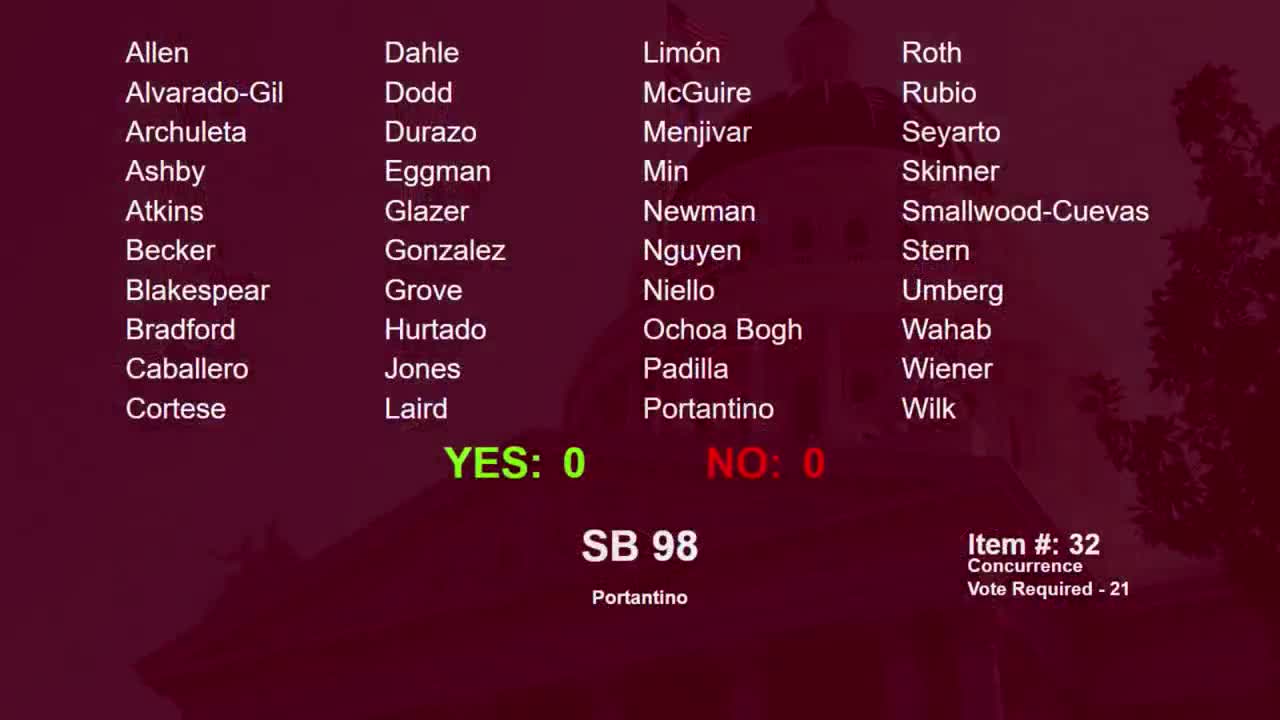 2MIN
Senate Floor
 2MIN
Assembly Floor
 4MIN
Assembly Standing Committee on Elections
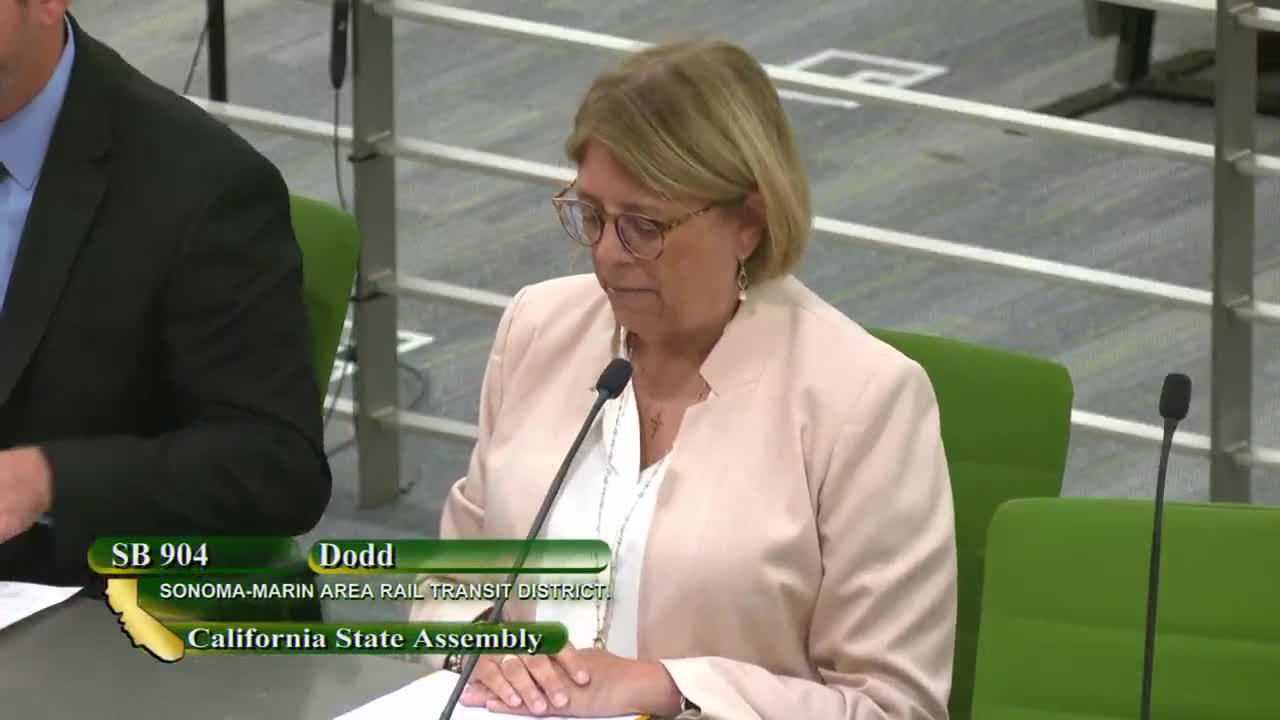 6MIN
Assembly Standing Committee on Transportation
 2MIN
Senate Floor
 5MIN
Senate Standing Committee on Elections and Constitutional Amendments
 7MIN
Senate Standing Committee on Transportation
Bill Author



