AB 876: Compostable organics.
- Session Year: 2015-2016
- House: Assembly
- Latest Version Date: 2015-10-08
The California Integrated Waste Management Act of 1989, which is administered by the Department of Resources Recycling and Recovery, establishes an integrated waste management program. Existing law requires each city, county, and regional agency, if any, to develop a source reduction and recycling element of an integrated waste management plan. On and after January 1, 2000, the element is required to provide for the diversion of 50% of the solid waste subject to the element, except as specified, through source reduction, recycling, and composting activities. Existing law requires each city, county, and regional agency to submit an annual report to the department summarizing its progress in reducing solid waste.
This bill would require, commencing August 1, 2017, a county or regional agency to include in its annual report to the department an estimate of the amount of organic waste in cubic yards that will be generated in the county or region over a 15-year period, an estimate of the additional organic waste recycling facility capacity in cubic yards that will be needed to process that amount of waste, and areas identified by the county or regional agency as locations for new or expanded organic waste recycling facilities capable of safely meeting that additional need, thereby imposing a state-mandated local program. The bill would also make legislative findings and declarations.
The California Constitution requires the state to reimburse local agencies and school districts for certain costs mandated by the state. Statutory provisions establish procedures for making that reimbursement.
This bill would provide that, if the Commission on State Mandates determines that the bill contains costs mandated by the state, reimbursement for those costs shall be made pursuant to these statutory provisions.
The California Integrated Waste Management Act of 1989, which is administered by the Department of Resources Recycling and Recovery, establishes an integrated waste management program. Existing law requires each city, county, and regional agency, if any, to develop a source reduction and recycling element of an integrated waste management plan. Existing law requires each county to prepare a countywide siting element that provides, among other things, for an estimate of the total transformation or disposal capacity that will be needed for a 15-year period to safely handle solid wastes generated with the county that cannot be reduced, recycled, or composted, and to identify areas for the location of new or expanded solid waste transformation or disposal facilities, if needed or desired. On and after January 1, 2000, the element is required to provide for the diversion of 50% of the solid waste subject to the element, except as specified, through source reduction, recycling, and composting activities. Existing law requires each city, county, and regional agency to submit an annual report to the department summarizing its progress in reducing solid waste.
This bill would require each countywide siting element to provide require, commencing August 1, 2017, a county or regional agency to include in its annual report to the department an estimate of the total organics processing capacity that will be needed amount of organic waste in cubic yards that will be generated in the county or region over a 15-year period to safely handle organic wastes generated with the county period, an estimate of the additional organic waste recycling facility capacity in cubic yards that will be needed to process that amount of waste, and to identify areas for the location of organics processing facilities, if needed or desired, identified by the county or regional agency as locations for new or expanded organic waste recycling facilities capable of safely meeting that additional need, thereby imposing a state-mandated local program. The bill would also make legislative findings and declarations.
The California Constitution requires the state to reimburse local agencies and school districts for certain costs mandated by the state. Statutory provisions establish procedures for making that reimbursement.
This bill would provide that, if the Commission on State Mandates determines that the bill contains costs mandated by the state, reimbursement for those costs shall be made pursuant to these statutory provisions.
The California Integrated Waste Management Act of 1989, which is administered by the Department of Resources Recycling and Recovery, establishes an integrated waste management program. Existing law requires each city, county, and regional agency, if any, to develop a source reduction and recycling element of an integrated waste management plan. Existing law requires each county to prepare a countywide siting element that provides, among other things, for an estimate of the total transformation or disposal capacity that will be needed for a 15-year period to safely handle solid wastes generated with the county that cannot be reduced, recycled, or composted, and to identify areas for the location of new or expanded solid waste transformation or disposal facilities, if needed or desired.
The California Global Warming Solutions Act of 2006 designates the State Air Resources Board as the state agency charged with monitoring and regulating sources of emissions of greenhouse gases. The state board is required to adopt a statewide greenhouse gas emissions limit equivalent to the statewide greenhouse gas emissions level in 1990, to be achieved by 2020, and to adopt rules and regulations to achieve the maximum technologically feasible, and cost-effective greenhouse gas emissions reductions.
This bill would require the Department of Resources Recycling and Recovery, in coordination with the State Air Resources Board, to promote the use of compostable organics for critically needed alternatives to agricultural amendments and for low-carbon fuel manufacturing to reduce fugitive methane emissions associated with landfill and other waste operations. each countywide siting element to provide an estimate of the total organics processing capacity that will be needed over a 15-year period to safely handle organic wastes generated with the county and to identify areas for the location of organics processing facilities, if needed or desired, thereby imposing a state-mandated local program. The bill would also make legislative findings and declarations.
The California Constitution requires the state to reimburse local agencies and school districts for certain costs mandated by the state. Statutory provisions establish procedures for making that reimbursement.
This bill would provide that, if the Commission on State Mandates determines that the bill contains costs mandated by the state, reimbursement for those costs shall be made pursuant to these statutory provisions.
The California Integrated Waste Management Act of 1989, which is administered by the Department of Resources Recycling and Recovery, establishes an integrated waste management program. Existing law requires each city, county, and regional agency, if any, to develop a source reduction and recycling element of an integrated waste management plan.
The California Global Warming Solutions Act of 2006 designates the State Air Resources Board as the state agency charged with monitoring and regulating sources of emissions of greenhouse gases. The state board is required to adopt a statewide greenhouse gas emissions limit equivalent to the statewide greenhouse gas emissions level in 1990, to be achieved by 2020, and to adopt rules and regulations to achieve the maximum technologically feasible, and cost-effective greenhouse gas emissions reductions.
This bill would require the Department of Resources Recycling and Recovery, in coordination with the State Air Resources Board, to promote the use of compostable organics for critically needed alternatives to agricultural amendments and for low-carbon fuel manufacturing to reduce fugitive methane emissions associated with landfill and other waste operations.
The Legislature finds and declares all of the following:
(a)With the enactment of the California Integrated Waste Management Act of 1989 (Division 30 (commencing with Section 40000) of the Public Resources Code), the Legislature required the Department of Resources Recycling and Recovery and local agencies to promote recycling, anaerobic digestion, and composting over land disposal and transformation.
(b)Since the enactment of the act, local governments and private industries have worked jointly to create an extensive material collection infrastructure and have implemented effective programs to achieve a statewide diversion rate of greater than 50 percent.
(c)Although California now leads the nation in waste reduction and recycling, the state continues to dispose of more than 15 million tons of compostable organics each year in solid waste landfills.
(d)To reduce the landfilling of organics, increase composting and anaerobic digestion, and meet the states organic diversion goals, cities and counties must plan for organics processing facilities that can process organics diverted from landfills and organics waste generators.
SEC. 2.Section 41821.4 is added to the Public Resources Code, to read:41821.4.(a)Commencing August 1, 2017, a county or regional agency shall include, in the annual report required pursuant to Section 41821, the following information:
(1)An estimate of the amount of organic waste in cubic yards that will be generated in the county or region over a 15-year period.
(2)An estimate of the additional organic waste recycling facility capacity in cubic yards that will be needed to process the amount of organic waste identified pursuant to paragraph (1).
(3)Areas identified by the county or regional agency as locations for new or expanded organic waste recycling facilities capable of safely meeting the additional organic waste recycling facility capacity need identified pursuant to paragraph (2).
(b)To provide the information pursuant to subdivision (a), the county or regional agency may use existing data regarding its diversion programs and is not required to perform additional waste characterization studies.
(c)For purposes of this section, organic waste recycling facility has the same meaning as defined in paragraph (2) of subdivision (d) of Section 42649.82.
SEC. 3.If the Commission on State Mandates determines that this act contains costs mandated by the state, reimbursement to local agencies and school districts for those costs shall be made pursuant to Part 7 (commencing with Section 17500) of Division 4 of Title 2 of the Government Code.
The Legislature finds and declares all of the following:
(a)With the enactment of the California Integrated Waste Management Act of 1989 (Division 30 (commencing with Section 40000) of the Public Resources Code), the Legislature required the Department of Resources Recycling and Recovery and local agencies to promote recycling, anaerobic digestion, and composting over land disposal and transformation.
(b)Since the enactment of the act, local governments and private industries have worked jointly to create an extensive material collection infrastructure and have implemented effective programs to achieve a statewide diversion rate of greater than 50 percent.
(c)Although California now leads the nation in waste reduction and recycling, the state continues to dispose of more than 15 million tons of compostable organics each year in solid waste landfills.
(d)To reduce the landfilling of organics, increase composting and anaerobic digestion, and meet the states organic diversion goals, cities and counties must plan for organics processing facilities that can process organics diverted from landfills and organics waste generators.
SEC. 2.Section 41701 of the Public Resources Code is amended to read:41701.Each countywide siting element and revision thereto shall include, but is not limited to, all of the following:
(a)A statement of goals and policies for the environmentally safe transformation or disposal of solid waste that cannot be reduced, recycled, or composted.
(b)An estimate of the total transformation or disposal capacity in cubic yards that will be needed for a 15-year period to safely handle solid wastes generated with the county that cannot be reduced, recycled, or composted.
(c)An estimate of the total organics processing capacity in cubic yards that will be needed for a 15-year period to safely handle organic wastes generated with the county.
(d)The remaining combined capacity of existing solid waste transformation or disposal facilities existing at the time of the preparation of the siting element, or revision thereto, in cubic yards and years.
(e)The identification of an area or areas for the location of new solid waste transformation or disposal facilities, or new organics processing facilities, or the expansion of existing solid waste or organics facilities, that are consistent with the applicable city or county general plan, if the county determines that existing capacity will be exhausted within 15 years or additional capacity is desired.
(f)For countywide elements submitted or revised on or after January 1, 2003, a description of the actions taken by the city or county to solicit public participation by the affected communities, including, but not limited to, minority and low-income populations.
SEC. 2.Section 41821.4 is added to the Public Resources Code, to read:41821.4.(a)Commencing August 1, 2017, a county or regional agency shall include, in the annual report required pursuant to Section 41821, the following information:
(1)An estimate of the amount of organic waste in cubic yards that will be generated in the county or region over a 15-year period.
(2)An estimate of the additional organic waste recycling facility capacity in cubic yards that will be needed to process the amount of organic waste identified pursuant to paragraph (1).
(3)Areas identified by the county or regional agency as locations for new or expanded organic waste recycling facilities capable of safely meeting the additional organic waste recycling facility capacity need identified pursuant to paragraph (2).
(b)To provide the information pursuant to subdivision (a), the county or regional agency may use existing data regarding its diversion programs and is not required to perform additional waste characterization studies.
(c)For purposes of this section, organic waste recycling facility has the same meaning as defined in paragraph (2) of subdivision (d) of Section 42649.82.
SEC. 3.If the Commission on State Mandates determines that this act contains costs mandated by the state, reimbursement to local agencies and school districts for those costs shall be made pursuant to Part 7 (commencing with Section 17500) of Division 4 of Title 2 of the Government Code.
The Legislature finds and declares all of the following:
(a)With the enactment of the California Integrated Waste Management Act of 1989 (Division 30 (commencing with Section 40000) of the Public Resources Code), the Legislature required the Department of Resources Recycling and Recovery and local agencies to promote recycling, anaerobic digestion, and composting over land disposal and transformation.
(b)Since the enactment of the act, local governments and private industries have worked jointly to create an extensive material collection infrastructure and have implemented effective programs to achieve a statewide diversion rate of greater than 50 percent.
(c)Although California now leads the nation in waste reduction and recycling, the state continues to dispose of more than 15 million tons of compostable organics each year in solid waste landfills.
(d)To reduce the landfilling of organics, increase composting and anaerobic digestion, and meet the states organic diversion goals, cities and counties must plan for organics processing facilities that can process organics diverted from landfills and organics waste generators.
SEC. 2.Section 41701 of the Public Resources Code is amended to read:41701.Each countywide siting element and revision thereto shall include, but is not limited to, all of the following:
(a)A statement of goals and policies for the environmentally safe transformation or disposal of solid waste that cannot be reduced, recycled, or composted.
(b)An estimate of the total transformation or disposal capacity in cubic yards that will be needed for a 15-year period to safely handle solid wastes generated with the county that cannot be reduced, recycled, or composted.
(c)An estimate of the total organics processing capacity in cubic yards that will be needed for a 15-year period to safely handle organic wastes generated with the county.
(c)
(d)The remaining combined capacity of existing solid waste transformation or disposal facilities existing at the time of the preparation of the siting element, or revision thereto, in cubic yards and years.
(d)
(e)The identification of an area or areas for the location of new solid waste transformation or disposal facilities, or new organics processing facilities, or the expansion of existing solid waste or organics facilities, that are consistent with the applicable city or county general plan, if the county determines that existing capacity will be exhausted within 15 years or additional capacity is desired.
(e)
(f)For countywide elements submitted or revised on or after January 1, 2003, a description of the actions taken by the city or county to solicit public participation by the affected communities, including, but not limited to, minority and low-income populations.
SEC. 3.If the Commission on State Mandates determines that this act contains costs mandated by the state, reimbursement to local agencies and school districts for those costs shall be made pursuant to Part 7 (commencing with Section 17500) of Division 4 of Title 2 of the Government Code.
SECTION 1.Section 40512 is added to the Public Resources Code, to read:40512.The department, in coordination with the State Air Resources Board, shall promote the use of compostable organics for critically needed alternatives to agricultural amendments and for low-carbon fuel manufacturing to reduce fugitive methane emissions associated with landfill and other waste operations.
The department, in coordination with the State Air Resources Board, shall promote the use of compostable organics for critically needed alternatives to agricultural amendments and for low-carbon fuel manufacturing to reduce fugitive methane emissions associated with landfill and other waste operations.
|
Date
|
Status
|
|---|---|
| Oct 8, 2015 | Chaptered by Secretary of State - Chapter 593, Statutes of 2015. |
| Oct 8, 2015 | Approved by the Governor. |
| Sep 1, 2015 | Enrolled and presented to the Governor at 4 p.m. |
| Aug 25, 2015 | In Assembly. Ordered to Engrossing and Enrolling. |
| Aug 24, 2015 | Read third time. Passed. Ordered to the Assembly. (Ayes 26. Noes 14. Page 2147.). |
| Aug 24, 2015 | Read third time. Passed. Ordered to the Assembly. |
| Jul 14, 2015 | Read second time. Ordered to third reading. |
| Jul 13, 2015 | From committee: Be placed on second reading file pursuant to Senate Rule 28.8. |
| Jul 1, 2015 | From committee: Do pass and re-refer to Com. on APPR. (Ayes 5. Noes 1.) (July 1). Re-referred to Com. on APPR. |
| Jun 18, 2015 | Referred to Com. on E.Q. |
| Jun 3, 2015 | In Senate. Read first time. To Com. on RLS. for assignment. |
| Jun 3, 2015 | Read third time. Passed. Ordered to the Senate. (Ayes 53. Noes 26. Page 1871.) |
| Jun 3, 2015 | Read third time. Passed. Ordered to the Senate. |
| Jun 2, 2015 | Read second time. Ordered to third reading. |
| Jun 1, 2015 | Read second time and amended. Ordered returned to second reading. |
| May 28, 2015 | From committee: Amend, and do pass as amended. (Ayes 12. Noes 5.) (May 28). |
| Apr 29, 2015 | In committee: Set, first hearing. Referred to APPR. suspense file. |
| Apr 16, 2015 | From committee: Do pass and re-refer to Com. on APPR. (Ayes 7. Noes 2.) (April 13). Re-referred to Com. on APPR. |
| Apr 7, 2015 | Re-referred to Com. on NAT. RES. |
| Apr 6, 2015 | From committee chair, with author's amendments: Amend, and re-refer to Com. on NAT. RES. Read second time and amended. |
| Mar 16, 2015 | Referred to Com. on NAT. RES. |
| Feb 27, 2015 | From printer. May be heard in committee March 29. |
| Feb 26, 2015 | Read first time. To print. |
|
Date
|
Description
|
Location
|
Votes
|
|
|---|---|---|---|---|
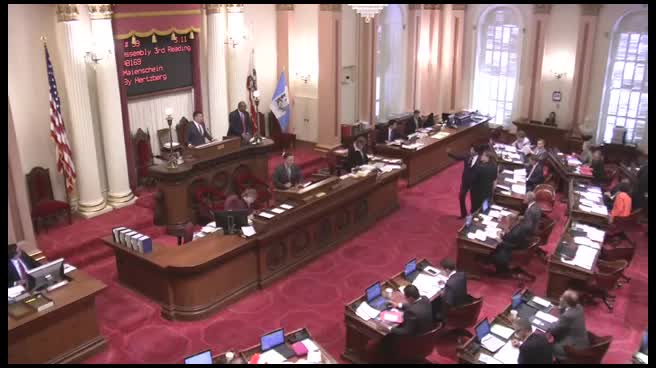
| Aug 24, 2015 | Assembly 3rd Reading AB876 McCarty By Wolk | Senate Floor |
Passed |
|
| Jul 1, 2015 | Do pass, but first be re-referred to the Committee on [Appropriations] | Senate Standing Committee on Environmental Quality |
Passed |
|
| Jun 3, 2015 | AB 876 MCCARTY Assembly Third Reading | Assembly Floor |
Passed |
|
| May 28, 2015 | Do pass as amended. | Assembly Standing Committee on Appropriations |
Passed |
|
| Apr 13, 2015 | Do pass and be re-referred to the Committee on [Appropriations] | Assembly Standing Committee on Natural Resources |
Passed |
This list shows positions taken on this bill by organizations on the date displayed, which is linked to the original source.
Positions by individuals are not included.
AB 876
Page 6
|
Office of Senate Floor Analyses (916) 651-1520 Fax: (916) 327-4478 |
THIRD READING
Bill No: AB 876
Amended: 6/1/15 in Assembly
SENATE ENVIRONMENTAL QUALITY COMMITTEE: 5-1, 7/1/15
AYES: Wieckowski, Hill, Jackson, Leno, Pavley
NOES: Bates
NO VOTE RECORDED: Gaines
SENATE APPROPRIATIONS COMMITTEE: Senate Rule 28.8
ASSEMBLY FLOOR: 53-26, 6/3/15 - See last page for vote
DIGEST: This bill requires local governments to include organic waste recycling facilities in the existing planning requirements for countywide solid waste management.
ANALYSIS: Existing law, pursuant to the Integrated Waste
Management Act of 1989 (Public Resources Code (PRC) §40000 et
seq.):
Establishes a statewide diversion goal of 75% by 2020.
Requires local agencies to divert, through source reduction, recycling, and composting, 50% of solid waste disposed by their jurisdictions.
Requires a commercial waste generator, including multi-family dwellings, to arrange for recycling services and requires local governments to implement commercial solid waste recycling programs designed to divert solid waste from businesses.
Requires generators of specified amounts of organic waste to arrange for recycling services for that material.
Requires each jurisdiction to submit a countywide siting element (CSE) to the Department of Resources Recycling and Recovery (CalRecycle) that includes:
A statement of goals for the environmentally safe transformation and disposal of solid waste;
An estimate of the total transformation or disposal capacity necessary for a 15-year period;
The remaining capacity of existing solid waste facilities;
The identification of areas for the location of new solid waste facilities that are consistent with the general plan, if the county determines that existing capacity will be exhausted within 15 years, or as specified; and,
For CSEs submitted after 2003, a description of the actions taken to solicit public participation by the affected communities, including low-income populations.
This bill:
Requires, commencing August 1, 2017, a county or regional agency to include in its annual report to CalRecycle the following information:
An estimate of the amount of organic waste that will be generated by the county over a 15-year period;
An estimate of the additional organic waste recycling facility capacity that will be needed to process the organic waste generated; and,
Areas identified by the county or regional agency as locations for new or expanded organic waste recycling facilities capable of safely handling the material.
States that if the Commission on State Mandates determines that this bill contains costs mandated by the state, reimbursement to local agencies shall be made by the state.
Background
Statewide waste diversion goals. CalRecycle is tasked with diverting at least 75% of solid waste statewide by 2020. Currently, an estimated 35 million tons of waste are disposed of in California’s landfills annually, of which 32% is compostable organic materials, 29% is construction and demolition debris, and 17% is paper.
In addition, CalRecycle is charged with implementing Strategic Directive 6.1, which calls for reducing organic waste disposal by 50% by 2020. According to CalRecycle, significant gains in organic waste diversion (through recycling technologies or organic waste, including composting and anaerobic digestion) are necessary to meet the 75% goal and to implement Strategic Directive 6.1.
Recycling organic waste. For purposes of recycling, “organic waste” is defined as food waste, green waste, landscape and pruning waste, nonhazardous wood waste, and food-soiled paper waste that is mixed in with food waste. Organic material represents about one-third of the solid waste sent to landfills even though a large percentage can be recycled or composted.
Recycling technologies for organic waste include composting, anaerobic digestion, and other types of processing that generate renewable fuels, energy, soil amendments, and mulch. Anaerobic digestion, which produces biogas that can be processed into biomethane fuel, is particularly suited to handle food waste. Green waste is more efficiently processed through composting. In addition to improving the quality of soil, compost prevents soil erosion, reduces the need for chemical fertilizers, herbicides, and pesticides, and enables better soil water retention.
Waste reduction and GHGs. According to the California Air Resources Board (ARB), a total reduction of 80 million metric tons (MMT), or 16% compared to business as usual, is necessary to reduce statewide GHG emissions to 1990 levels by 2020. ARB intends to achieve approximately 78% of the reductions through direct regulations. ARB proposes to achieve the balance of reductions necessary to meet the 2020 limit (approximately 18 MMT) through its cap-and-trade program.
Landfill gas is generated by the anaerobic decomposition of organic
materials such as food, paper, wood, and green material. 50% of
landfill gas is methane, a GHG with a much shorter life, but much
higher global warming potential than carbon dioxide (methane is
approximately 25 times more efficient at trapping heat than carbon
dioxide over a 100-year time span). Depending on the types of solid
waste, the chemical makeup of landfill biogas can vary greatly from
the biogas produced from dairy farms, municipal solid waste, and
wastewater treatment facilities. While most modern landfills have
systems in place to capture methane, significant amounts continue to
escape into the atmosphere. According to ARB’s GHG inventory,
approximately 7 million tons of carbon dioxide equivalent are
released annually by landfills. That number is expected to increase
to 8.5 million tons of carbon dioxide equivalent by 2020.
Composting and other organics processing technologies, including
anaerobic digestion, reduce GHGs by avoiding the emissions that would
be generated by the material’s decomposition in a landfill. For
example, in the case of anaerobic digestion, the process produces
methane from the organic waste in a controlled environment for use as
a renewable fuel, and results in climate benefits by both reducing
GHGs from landfills, and displacing fossil fuels. Recycling organic
waste provides significant GHG reductions over landfilling.
Comments
Purpose
of Bill. According to the author, “AB 876 builds off of last
year’s landmark AB 1826, which will divert millions of tons of
organic waste out of our landfills. Processes like composting and
anaerobic digestion take garbage and turn it into clean biofuels and
healthy soil. However, without proper planning, California could
miss out on the significant environmental and health benefits.”
Related/Prior Legislation
AB
1045 (Irwin, 2015) requires the California Environmental Protection
Agency to establish policies to encourage recycling of organic waste
and coordinate the oversight and regulation of organic waste
recycling facilities. AB 1045 is currently in the Senate
Appropriations Committee.
AB
1826 (Chesbro, Chapter 727, Statutes of 2014) phased in requirements
for generators of specified amounts of organic waste to arrange
recycling services for that material beginning January 1, 2016,
through January 1, 2019.
AB 341 (Chesbro, Chapter 476, Statutes of 2011) required local businesses and multifamily residential dwellings of five or more units that generate more than four cubic yards of solid waste per week to separate recyclable materials from solid waste and subscribe to a basic level of recycling service that included collection, self-hauling, or other arrangements for the pickup of the recyclable materials or subscribe to a recycling service that may include mixed waste processing that yields diversion results comparable to source separation.
FISCAL EFFECT: Appropriation: No Fiscal Com.: Yes Local: Yes
American Federation of State, County, and Municipal Employees
Association of Compost Producers
California Compost Coalition
California Organics Recycling Council
Californians Against Waste
Carbon Cycle Institute
City and County of San Francisco Department of the Environment
Clean World
Coalition for Clean Air
Coastal Environmental Rights Foundation
Environmental Action Committee of West Marin
Republic Services
Stop Waste
West Marin Compost Coalition
One individual
OPPOSITION: (Verified 7/13/15)
California State Association of Counties
Los Angeles County Board of Supervisors
Rural County Representatives of California
Solid Waste Association of North America, California Chapters
ASSEMBLY FLOOR: 53-26, 6/3/15
AYES: Alejo, Bloom, Bonilla, Bonta, Brown, Burke, Calderon, Campos, Chau, Chiu, Chu, Cooley, Cooper, Dababneh, Daly, Dodd, Eggman, Frazier, Cristina Garcia, Eduardo Garcia, Gatto, Gipson, Gomez, Gonzalez, Gordon, Gray, Harper, Roger Hernández, Holden, Irwin, Jones-Sawyer, Levine, Lopez, Low, Maienschein, McCarty, Medina, Mullin, Nazarian, O'Donnell, Perea, Quirk, Rendon, Ridley-Thomas, Rodriguez, Salas, Santiago, Mark Stone, Ting, Weber, Williams, Wood, Atkins
NOES: Achadjian, Travis Allen, Baker, Bigelow, Brough, Chang, Chávez, Dahle, Beth Gaines, Gallagher, Grove, Hadley, Jones, Kim, Lackey, Linder, Mathis, Mayes, Melendez, Obernolte, Olsen, Patterson, Steinorth, Wagner, Waldron, Wilk
NO VOTE RECORDED: Thurmond
Prepared by: Joanne Roy / E.Q. / (916) 651-4108
8/17/15 10:14:29
**** END ****
AB 876 (McCarty) Page 5 of 5
SENATE COMMITTEE ON ENVIRONMENTAL QUALITY
Senator Wieckowski, Chair
2015 - 2016 Regular
Bill No: AB 876
Author: |
McCarty |
||
Version: |
6/1/2015 |
Hearing Date: |
7/1/2015 |
Urgency: |
No |
Fiscal: |
Yes |
Consultant: |
Joanne Roy |
||
SUBJECT: Compostable organics.
ANALYSIS:
Existing
law, pursuant to the Integrated Waste Management Act of 1989 (Public
Resources Code (PRC) §40000 et seq.):
Establishes a statewide diversion goal of 75% by 2020.
Requires local agencies to divert, through source reduction, recycling, and composting, 50% of solid waste disposed by their jurisdictions.
Requires a commercial waste generator, including multi-family dwellings, to arrange for recycling services and requires local governments to implement commercial solid waste recycling programs designed to divert solid waste from businesses.
Requires generators of specified amounts of organic waste to arrange for recycling services for that material.
Requires each jurisdiction to submit a countywide siting element (CSE) to the Department of Resources Recycling and Recovery (CalRecycle) that includes:
A statement of goals for the environmentally safe transformation and disposal of solid waste;
An estimate of the total transformation or disposal capacity necessary for a 15-year period;
The remaining capacity of existing solid waste facilities;
The identification of areas for the location of new solid waste facilities that are consistent with the general plan, if the county determines that existing capacity will be exhausted within 15 years, or as specified; and,
For CSEs submitted after 2003, a description of the actions taken to solicit public participation by the affected communities, including low-income populations.
This bill:
Commencing August 1, 2017, requires a county or regional agency to include in its annual report to CalRecycle the following information:
An estimate of the amount of organic waste that will be generated by the county over a 15-year period;
An estimate of the additional organic waste recycling facility capacity that will be needed to process the organic waste generated; and,
Areas identified by the county or regional agency as locations for new or expanded organic waste recycling facilities capable of safely handling the material.
States that if the Commission on State Mandates determines that this bill contains costs mandated by the state, reimbursement to local agencies shall be made by the state.
Background
Statewide waste diversion goals. CalRecycle is tasked with diverting at least 75% of solid waste statewide by 2020. Currently, an estimated 35 million tons of waste are disposed of in California’s landfills annually, of which 32% is compostable organic materials, 29% is construction and demolition debris, and 17% is paper.
In addition, CalRecycle is charged with implementing Strategic Directive 6.1, which calls for reducing organic waste disposal by 50% by 2020. According to CalRecycle, significant gains in organic waste diversion (through recycling technologies or organic waste, including composting and anaerobic digestion) are necessary to meet the 75% goal and to implement Strategic Directive 6.1.
Recycling organic waste. For purposes of recycling, “organic waste” is defined as food waste, green waste, landscape and pruning waste, nonhazardous wood waste, and food-soiled paper waste that is mixed in with food waste. Organic material represents about one-third of the solid waste sent to landfills even though a large percentage can be recycled or composted.
Recycling technologies for organic waste include composting, anaerobic digestion, and other types of processing that generate renewable fuels, energy, soil amendments, and mulch. Anaerobic digestion, which produces biogas that can be processed into biomethane fuel, is particularly suited to handle food waste. Green waste is more efficiently processed through composting. In addition to improving the quality of soil, compost prevents soil erosion, reduces the need for chemical fertilizers, herbicides, and pesticides, and enables better soil water retention.
Waste reduction and GHGs. According to the California Air Resources Board (ARB), a total reduction of 80 million metric tons (MMT), or 16% compared to business as usual, is necessary to reduce statewide GHG emissions to 1990 levels by 2020. ARB intends to achieve approximately 78% of the reductions through direct regulations. ARB proposes to achieve the balance of reductions necessary to meet the 2020 limit (approximately 18 MMT) through its cap-and-trade program.
Landfill gas is generated by the anaerobic decomposition of organic materials such as food, paper, wood, and green material. 50% of landfill gas is methane, a GHG with a much shorter life, but much higher global warming potential than carbon dioxide (methane is approximately 25 times more efficient at trapping heat than carbon dioxide over a 100-year time span). Depending on the types of solid waste, the chemical makeup of landfill biogas can vary greatly from the biogas produced from dairy farms, municipal solid waste, and wastewater treatment facilities. While most modern landfills have systems in place to capture methane, significant amounts continue to escape into the atmosphere. According to ARB’s GHG inventory, approximately 7 million tons of carbon dioxide equivalent are released annually by landfills. That number is expected to increase to 8.5 million tons of carbon dioxide equivalent by 2020.
Composting and other organics processing technologies, including anaerobic digestion, reduce GHGs by avoiding the emissions that would be generated by the material’s decomposition in a landfill. For example, in the case of anaerobic digestion, the process produces methane from the organic waste in a controlled environment for use as a renewable fuel, and results in climate benefits by both reducing GHGs from landfills, and displacing fossil fuels. Recycling organic waste provides significant GHG reductions over landfilling.
Comments
Purpose
of Bill.
According to the author, “AB 876 builds off of last year’s
landmark AB 1826, which will divert millions of tons of organic waste
out of our landfills. Processes like composting and anaerobic
digestion take garbage and turn it into clean biofuels and healthy
soil. However, without proper planning, California could miss out on
the significant environmental and health benefits.”
Related/Prior Legislation
AB
1045 (Irwin) would require the California Environmental Protection
Agency to establish policies to encourage recycling of organic waste
and coordinate the oversight and regulation of organic waste
recycling facilities. AB 1045 is scheduled to be heard in Senate
Environmental Quality Committee on July 1, 2015.
AB 1826
(Chesbro, Chapter 727, Statutes of 2014) phased in requirements for
generators of specified amounts of organic waste to arrange recycling
services for that material beginning January 1, 2016, through January
1, 2019.
AB 341 (Chesbro, Chapter 476, Statutes of 2011)
required local businesses and multifamily residential dwellings of
five or more units that generate more than four cubic yards of solid
waste per week to separate recyclable materials from solid waste and
subscribe to a basic level of recycling service that included
collection, self-hauling, or other arrangements for the pickup of the
recyclable materials or subscribe to a recycling service that may
include mixed waste processing that yields diversion results
comparable to source separation.
SOURCE:
Author
SUPPORT:
Association of Compost Producers
American Federation of State, County, and Municipal Employees
Californians Against Waste
California Compost Coalition
California Organics Recycling Council
Carbon Cycle Institute
City and County of San Francisco Department of the Environment
Clean World
Coalition for Clean Air
Coastal Environmental Rights Foundation
Environmental Action Committee of West Marin
West Marin Compost Coalition
Stop Waste
Individual (1)
OPPOSITION:
California State Association of Counties
Los Angeles County Board of Supervisors
Rural County Representatives of California
Solid Waste Association of North America, California Chapters
ARGUMENTS IN SUPPORT:
A
coalition of support states, “Promoting compost in California will
reduce fugitive methane emissions associated with landfill and other
waste operations and help the state meet its ambitious greenhouse gas
reduction goals…The state has made great strides toward reducing
waste in landfills by setting organics diversion goals. In order to
facilitate these goals, California local governments must now take a
more proactive role in developing the infrastructure necessary to
recycle organic waste.”
ARGUMENTS IN OPPOSITION: Opposition states, “Counties still have to report each and every year about their fifteen-year outlook. This seems very repetitive, and we question the need for information associated with a fifteen-year outlook each and every year. We also believe a fifteen-year outlook is far too long and suggest an alternative approach which is a once-every-five-year report done with a five-year assessment. We ultimately believe AB 876 remains unnecessary as local governments are currently required to include information about organics processing capacity and needs within their organic waste recycling programs.”
-- END –
AB 876
Page 2
ASSEMBLY THIRD READING
AB 876
(McCarty)
As Amended June 1, 2015
Majority vote
Committee |
Votes |
Ayes |
Noes |
Natural Resources |
7-2 |
Williams, Cristina Garcia, Harper, McCarty, Rendon, Mark Stone, Wood |
Dahle, Hadley |
Appropriations |
12-5 |
Gomez, Bonta, Calderon, Daly, Eggman, Eduardo Garcia, Gordon, Holden, Quirk, Rendon, Weber, Wood |
Bigelow, Chang, Gallagher, Jones, Wagner |
SUMMARY: This bill would require local governments to include organic waste recycling facilities in the existing planning requirements for countywide solid waste management. Specifically, this bill:
Commencing August 1, 2017, requires a county or regional agency to include in its annual report to the Department of Resources Recycling and Recovery (CalRecycle) the following information:
An estimate of the amount of organic waste that will be generated by the county over a 15-year period;
An estimate of the additional organic waste recycling facility capacity that will be needed to process the organic waste generated; and,
Areas identified by the county or regional agency as location for new or expanded organic waste recycling facilities capable of safely handling the material.
States that if the Commission on State Mandates determines that this bill contains costs mandated by the state, reimbursement to local agencies shall be made by the state.
EXISTING LAW, pursuant to the Integrated Waste Management Act of 1989:
Requires local agencies to divert, through source reduction, recycling, and composting, 50% of solid waste disposed by their jurisdictions.
Establishes a statewide diversion goal of 75% by 2020.
Requires a commercial waste generator, including multi-family dwellings, to arrange for recycling services and requires local governments to implement commercial solid waste recycling programs designed to divert solid waste from businesses.
Requires generators of specified amounts of organic waste (i.e., food waste and yard waste) to arrange for recycling services for that material.
FISCAL EFFECT: According to the Assembly Appropriations Committee, this bill has the following costs:
Increased initial implementation costs of approximately $380,000 annually for two years for CalRecyle to advise counties, verify and approve siting elements, and enforce the new requirements.
Ongoing costs to CalRecyle of approximately $200,000 annually.
Potential state costs for local reimbursement in the hundreds of thousands of dollars range if this bill is determined to be a reimbursable state-mandate.
COMMENTS: CalRecycle is tasked with diverting at least 75% of solid waste statewide by 2020. Organic materials make up one-third of the waste stream and food continues to be the greatest single item disposed, making up over 15% of materials landfilled. CalRecycle is also charged with implementing its Strategic Directive 6.1, which calls for reducing organic waste disposal by 50% by 2020. According to CalRecycle, significant gains in organic waste diversion are necessary to meet the 75% goal and implementing Strategic Directive 6.1. Recycling technologies for organic waste include composting, anaerobic digestion, and other types of processing that generate renewable fuels, energy, soil amendments, and mulch.
Compost and other soil amendments that can be produced from organic materials have been shown to improve soil health by incorporating organic matter, beneficial micro-organisms, and nutrients and reduce the need for chemical pesticides and fertilizers. These products also conserve water by allowing water to penetrate the soil more quickly decreasing runoff.
According to ARB, a total reduction of 80 million metric tons (MMT), or 16% compared to business as usual, is necessary to reduce statewide greenhouse gas (GHG) emissions to 1990 levels by 2020. ARB intends to achieve approximately 78% of the reductions through direct regulations. The Air Resources Board (ARB) proposes to achieve the balance of reductions necessary to meet the 2020 limit (approximately 18 MMT) through its cap-and-trade program.
Recycling organic waste provides significant GHG reductions over landfilling. Composting and other organics processing technologies, including anaerobic digestion, reduce GHGs by avoiding the emissions that would be generated by the material’s decomposition in a landfill. Landfill gas is generated by the decomposition of organic materials such as food, paper, wood, and yard waste. Fifty percent of landfill gas is methane, a GHG that is 21 times more efficient at trapping heat than carbon dioxide. While most modern landfills have systems in place to capture methane, significant amounts continue to escape into the atmosphere. According to ARB’s GHG inventory, approximately 7 million tons of carbon dioxide (CO2) equivalent are released annually by landfills. That number is expected to increase to 8.5 million tons of CO2 equivalent by 2020.
While the Legislature has taken significant steps to ensure that organic waste is recycled, local efforts are essential to implement the state requirements. This bill facilitates local planning by requiring counties and regional agencies to plan for 15-years of organic waste recycling capacity.
Analysis Prepared by: Elizabeth MacMillan / NAT. RES. / (916) 319-2092 FN: 0000728
AB 876
Page 2
Date of Hearing: April 29, 2015
ASSEMBLY COMMITTEE ON APPROPRIATIONS
Jimmy Gomez, Chair
AB 876
(McCarty) – As Amended April 6, 2015
Policy Committee: |
Natural Resources |
Vote: |
7 - 2 |
|
|
|
|
|
|
|
|
Urgency: No State Mandated Local Program: Yes Reimbursable: Yes
SUMMARY:
This bill requires local governments to include organic waste recycling facilities in existing planning requirements for countywide solid waste management. Specifically, this bill:
Requires that each county siting element (CSE) include an estimate of the total organics processing capacity that will be needed for a 15-year period to safely handle organic wastes generated within the county.
Requires that the identification of areas for new solid waste facilities to specifically include the identification of organic waste processing facilities.
FISCAL EFFECT:
Increased initial implementation costs of approximately $380,000 (special fund) annually for two years for CalRecyle to advise counties, verify and approve siting elements, and enforce the new requirements.
Ongoing costs to CalRecyle of approximately $200,000 (special fund) annually.
Potential reimbursable state mandated costs in the hundreds of thousands of dollars (GF) range to counties if this bill is determined to be a reimbursable state-mandate.
COMMENTS:
Purpose. According to the author, without proper planning California will lose an opportunity to divert millions of tons of organic waste from landfills. This bill would ensure that compostable organic waste is properly processed by requiring municipalities to create a 15-year plan to estimate the amount of compostable waste and to plan for facilities to process that waste.
Background. CalRecycle is tasked with diverting at least 75% of solid waste statewide by 2020. Organic materials make up one-third of the waste stream and food continues to be the greatest single item disposed, making up over 15% of materials landfilled.
CalRecycle is also charged with implementing its Strategic Directive 6.1, which calls for reducing organic waste disposal by 50% by 2020. According to CalRecycle, significant gains in organic waste diversion are necessary to meet the 75% goal and implementing Strategic Directive 6.1. Recycling technologies for organic waste include composting, anaerobic digestion, and other types of processing that generate renewable fuels, energy, soil amendments, and mulch.
Compost and other soil amendments that can be produced from organic materials have been shown to improve soil health by incorporating organic matter, beneficial micro-organisms, and nutrients and reduce the need for chemical pesticides and fertilizers. These products also conserve water by allowing water to penetrate the soil more quickly, decreasing runoff.
Analysis Prepared by: Jennifer Galehouse / APPR. / (916) 319-2081
AB 876
Page 3
Date of Hearing: April 13, 2015
ASSEMBLY COMMITTEE ON NATURAL RESOURCES
Das Williams, Chair
AB 876
(McCarty) – As Amended April 6, 2015
SUBJECT: Compostable organics
SUMMARY: This bill would require local governments to include organic waste recycling facilities in the existing planning requirements for countywide solid waste management.
EXISTING
LAW, pursuant to the Integrated Waste Management Act of 1989
(Act):
Requires local agencies to divert, through source reduction, recycling, and composting, 50% of solid waste disposed by their jurisdictions.
Establishes a statewide diversion goal of 75% by 2020.
Requires a commercial waste generator, including multi-family dwellings, to arrange for recycling services and requires local governments to implement commercial solid waste recycling programs designed to divert solid waste from businesses.
Requires generators of specified amounts of organic waste (i.e., food waste and yard waste) to arrange for recycling services for that material.
Requires that each jurisdiction to submit a countywide siting element (CSE) to CalRecycle that includes:
A statement of goals for the environmentally safe transformation and disposal of solid waste;
An estimate of the total transformation or disposal capacity necessary for a 15-year period;
The remaining capacity of existing solid waste facilities;
The identification of areas for the location of new solid waste facilities that are consistent with the general plan, if the county determines that existing capacity will be exhausted within 15 years, or as specified; and,
For CSEs submitted after 2003, a description of the actions taken to solicit public participation by the affected communities, including low-income populations.
THIS BILL:
Requires that each CSE include an estimate of the total organics processing capacity that will be needed for a 15-year period to safely handle organic wastes generated within the county.
Requires that the identification of areas for new solid waste facilities include organic waste processing facilities.
States that if the Commission on State Mandates determines that the bill contains costs mandated by the state, reimbursement to local agencies shall be made by the state.
FISCAL EFFECT: Unknown
COMMENTS:
This bill. According to the author:
This bill would ensure that compostable organic waste is properly processed by requiring municipalities to create a 15-year plan to estimate the amount of compostable waste and to plan for facilities to process that waste. Without proper planning, California will lose an opportunity to divert millions of tons of organic waste from landfills. Rather than allowing organic waste to rot and release hazardous gases like methane, this bill would ensure that it is turned into nutrient rich compost and environmentally friendly biogas.
Meeting the state’s recycling goals. CalRecycle is tasked with diverting at least 75% of solid waste statewide by 2020. Organic materials make up one-third of the waste stream and food continues to be the greatest single item disposed, making up over 15% of materials landfilled. CalRecycle is also charged with implementing its Strategic Directive 6.1, which calls for reducing organic waste disposal by 50% by 2020. According to CalRecycle, significant gains in organic waste diversion are necessary to meet the 75% goal and implementing Strategic Directive 6.1. Recycling technologies for organic waste include composting, anaerobic digestion, and other types of processing that generate renewable fuels, energy, soil amendments, and mulch.
Compost and other soil amendments that can be produced from organic materials have been shown to improve soil health by incorporating organic matter, beneficial micro-organisms, and nutrients and reduce the need for chemical pesticides and fertilizers. These products also conserve water by allowing water to penetrate the soil more quickly decreasing runoff.
Waste reduction and GHGs. According to ARB, a total reduction of 80 million metric tons (MMT), or 16% compared to business as usual, is necessary to reduce statewide GHG emissions to 1990 levels by 2020. ARB intends to achieve approximately 78% of the reductions through direct regulations. ARB proposes to achieve the balance of reductions necessary to meet the 2020 limit (approximately 18 MMT) through its cap-and-trade program.
Recycling organic waste provides significant GHG reductions over landfilling. Composting and other organics processing technologies, including anaerobic digestion, reduce GHGs by avoiding the emissions that would be generated by the material’s decomposition in a landfill. Landfill gas is generated by the decomposition of organic materials such as food, paper, wood, and yard waste. Fifty percent of landfill gas is methane, a GHG that is 21 times more efficient at trapping heat than carbon dioxide. While most modern landfills have systems in place to capture methane, significant amounts continue to escape into the atmosphere. According to ARB’s GHG inventory, approximately 7 million tons of CO2 equivalent are released annually by landfills. That number is expected to increase to 8.5 million tons of CO2 equivalent by 2020.
REGISTERED SUPPORT / OPPOSITION:
Support
AFSCME, AFL-CIO
California Compost Coalition
California Organics Recycling Council
Californians Against Waste
Carbon Cycle Institute
CleanWorld
Environmental Action Committee of West Marin
San Francisco Department of the Environment
StopWaste
1 individual
Opposition
None on file
Analysis Prepared by: Elizabeth MacMillan / NAT. RES. / (916) 319-2092
Discussed in Hearing
 2MIN
Senate Floor
 1MIN
Assembly Floor
 9MIN
Assembly Standing Committee on Natural Resources
Bill Author

Bill Co-Author(s):