SB 934: Zero-emission freight infrastructure: interagency coordination: report.
- Session Year: 2023-2024
- House: Senate
- Latest Version Date: 2024-06-19
Current Status:
Failed
(2024-08-15: August 15 hearing: Held in committee and under submission.)
Introduced
In Committee
First Chamber
In Committee
Second Chamber
Enacted
Existing law requires the California Transportation Commission to develop the Clean Freight Corridor Efficiency Assessment, in coordination with other state agencies, with the goal of identifying freight corridors, or segments of freight corridors, and infrastructure needed to support the deployment of zero-emission medium- and heavy-duty vehicles, as specified. Transportation Agency to prepare a state freight plan every 5 years to govern the immediate and long-range planning activities and capital investments of the state with respect to the movement of freight. Existing law requires the state freight plan to include, among other things, a description of needed infrastructure, projects, and operations for the deployment of zero-emission medium- and heavy-duty vehicles and the development of freight corridors identified in a specified assessment.
Existing law requires the State Energy Resources Conservation and Development Commission (Energy Commission), working with specified state agencies, to prepare a statewide assessment of the electric vehicle charging infrastructure needed to support the levels of electric vehicle adoption required for the state to meet its goals of putting at least 5,000,000 zero-emission vehicles on California roads by 2030, and of reducing the emissions of greenhouse gases to 40% below 1990 levels by 2030.
This bill would require the California Transportation Commission Agency and the Energy Commission to jointly convene the Zero-Emission Freight Central Delivery Team, composed of representatives from various state agencies, to lead the statewide coordination of zero-emission freight infrastructure planning and implementation, including carrying out specified actions. The bill would require the Zero-Emission Freight Central Delivery Team, in consultation with the California Transportation Commission Transportation Agency and the Energy Commission, to submit a report to the Legislature on or before March 1, 2026, and every 5 years thereafter, that includes, among other things, a description of the actions taken by the Zero-Emission Freight Central Delivery Team.
Existing law requires the California Transportation Commission to develop the Clean Freight Corridor Efficiency Assessment, in coordination with other state agencies, with the goal of identifying freight corridors, or segments of freight corridors, and infrastructure needed to support the deployment of zero-emission medium- and heavy-duty vehicles, as specified.
Existing law requires the State Energy Resources Conservation and Development Commission (Energy Commission), working with specified state agencies, to prepare a statewide assessment of the electric vehicle charging infrastructure needed to support the levels of electric vehicle adoption required for the state to meet its goals of putting at least 5,000,000 zero-emission vehicles on California roads by 2030, and of reducing the emissions of greenhouse gases to 40% below 1990 levels by 2030.
This bill would require the California Transportation Commission and the Energy Commission to jointly convene the Zero-Emission Freight Central Delivery Team, composed of representatives from various state agencies, to lead the statewide coordination of zero-emission freight infrastructure planning and implementation, including carrying out specified actions. The bill would require the Zero-Emission Freight Central Delivery Team, in consultation with the California Transportation Commission and the Energy Commission, to submit an annual a report to the Legislature beginning on or before March 1, 2026, and every 5 years thereafter, that includes, among other things, a description of the actions taken by the Zero-Emission Freight Central Delivery Team in the previous calendar year. Team.
Existing law requires the California Transportation Commission to develop the Clean Freight Corridor Efficiency Assessment, in coordination with other state agencies, with the goal of identifying freight corridors, or segments of freight corridors, and infrastructure needed to support the deployment of zero-emission medium- and heavy-duty vehicles, as specified.
Existing law requires the State Energy Resources Conservation and Development Commission (Energy Commission), working with specified state agencies, to prepare a statewide assessment of the electric vehicle charging infrastructure needed to support the levels of electric vehicle adoption required for the state to meet its goals of putting at least 5,000,000 zero-emission vehicles on California roads by 2030, and of reducing the emissions of greenhouse gases to 40% below 1990 levels by 2030.
This bill would require the California Transportation Commission and the Energy Commission to jointly convene the Zero-Emission Freight Central Delivery Team, composed of representatives from various state agencies, to lead the statewide coordination of zero-emission freight infrastructure planning and implementation, including carrying out specified actions. The bill would require the Zero-Emission Freight Central Delivery Team, in consultation with the California Transportation Commission and the Energy Commission, to submit an annual report to the Legislature beginning March 1, 2026, that includes, among other things, a description of the actions taken by the Zero-Emission Freight Central Delivery Team in the previous calendar year.
Existing law prohibits the total outside width of a vehicle or its load from exceeding 102 inches, except as specified.This bill would make technical, nonsubstantive changes to that provision.Existing law prohibits the total outside width of a vehicle or its load from exceeding 102 inches, except as specified.
This bill would make technical, nonsubstantive changes to that provision.
(a)The commission agency and the State Energy Resources Conservation and Development Commission shall jointly convene an interagency Zero-Emission Freight Central Delivery Team to lead the statewide coordination of zero-emission freight infrastructure planning and implementation, including carrying out the actions described in subdivision (c).
(b)The Zero-Emission Freight Central Delivery Team shall include representatives from state agencies, including, but not limited to, the department, the Transportation Agency, agency, the Department of Transportation, the California Transportation Commission, the State Air Resources Board, the Public Utilities Commission, and the Governors Office of Business and Economic Development.
(c)The Zero-Emission Freight Central Delivery Team shall be responsible for all of the following actions:
(1)Working with zero-emission freight infrastructure stakeholders to strategically select specific project locations using a corridor-based approach that prioritizes the top freight corridors identified in the Clean Freight Corridor Efficiency Assessment pursuant to paragraph (2) of subdivision (b) of Section 14517. 14517 and posting those project locations on the agencys internet website.
(2)Coordinating actions between state agencies, utility companies, and other zero-emission freight infrastructure stakeholders.
(3)Developing a process for nongovernmental stakeholders to be included in zero-emission station location planning and implementation, including, but not limited to, impacted communities, community-based organizations, equity advocates, public health advocates, air quality advocates, tribal nations, and environmental justice advocates.
(4)Identifying lead entities from regional transportation planning agencies, metropolitan planning organizations, ports, utilities, state agencies, and other zero-emission freight infrastructure stakeholders that are necessary to build zero-emission stations quickly.
(5)Identifying available funding sources and public-private partnership models and posting that information on the commissions agencys internet website.
(6)Developing standardized zero-emission station development models, including zoning and building permits that can be replicated for each station across a priority freight corridor, based on local municipality guidelines, and posting that information on the commissions agencys internet website.
(7)Working with community colleges and ports that provide training programs to support training of freight industry workers, as necessary.
(8)Promoting the timely and equitable implementation of zero-emission freight infrastructure throughout the state.
(d)(1)Notwithstanding Section 10231.5, on or before March 1, 2026, and every five years thereafter, the Zero-Emission Freight Central Delivery Team, in consultation with the commission agency and the State Energy Resources Conservation and Development Commission, shall submit a report to the Legislature that does all of the following:
(A)(i)Describes the actions taken by the Zero-Emission Freight Central Delivery Team.
(ii)For the report due on or before March 1, 2026, the description required pursuant to clause (i) shall cover actions taken during the 2025 calendar year. For each subsequent report, the description shall cover actions taken during the five calendar years preceding the report.
(B)Identifies best practices regarding zero-emission freight infrastructure planning and implementation.
(C)Makes any policy recommendations needed to facilitate the deployment of zero-emission freight infrastructure.
(D)Includes an assessment of the states progress towards meeting the number of zero-emission stations needed to support zero-emission freight goals.
(2)A report to be submitted pursuant to paragraph (1) shall be submitted in compliance with Section 9795.
(a)The commission and the State Energy Resources Conservation and Development Commission shall jointly convene an interagency Zero-Emission Freight Central Delivery Team to lead the statewide coordination of zero-emission freight infrastructure planning and implementation, including carrying out the actions described in subdivision (c).
(b)The Zero-Emission Freight Central Delivery Team shall include representatives from state agencies, including, but not limited to, the department, the Transportation Agency, the State Air Resources Board, the Public Utilities Commission, and the Governors Office of Business and Economic Development.
(c)The Zero-Emission Freight Central Delivery Team shall be responsible for all of the following actions:
(1)Working with zero-emission freight infrastructure stakeholders to strategically select specific project locations using a corridor-based approach that prioritizes the top freight corridors identified in the Clean Freight Corridor Efficiency Assessment pursuant to paragraph (2) of subdivision (b) of Section 14517.
(2)Coordinating actions between state agencies, utility companies, and other zero-emission freight infrastructure stakeholders.
(3)Developing a process for nongovernmental stakeholders to be included in zero-emission station location planning and implementation, including, but not limited to, impacted communities, community-based organizations, equity advocates, public health advocates, air quality advocates, tribal nations, and environmental justice advocates.
(4)Identifying lead entities from regional transportation planning agencies, metropolitan planning organizations, ports, utilities, state agencies, and other zero-emission freight infrastructure stakeholders that are necessary to build zero-emission stations quickly.
(5)Identifying available funding sources and public-private partnership models and posting that information on the commissions internet website.
(6)Developing standardized zero-emission station development models, including zoning and building permits that can be replicated for each station across a priority freight corridor, based on local municipality guidelines, and posting that information on the commissions internet website.
(7)Working with community colleges and ports that provide training programs to support training of freight industry workers, as necessary.
(8)Promoting the timely and equitable implementation of zero-emission freight infrastructure throughout the state.
(d)(1)Notwithstanding Section 10231.5, on or before March 1, 2026, and annually every five years thereafter, the Zero-Emission Freight Central Delivery Team, in consultation with the commission and the State Energy Resources Conservation and Development Commission, shall submit a report to the Legislature that does all of the following:
(A)(i)Describes the actions taken by the Zero-Emission Freight Central Delivery Team in the previous calendar year. Team.
(ii)For the report due on or before March 1, 2026, the description required pursuant to clause (i) shall cover actions taken during the 2025 calendar year. For each subsequent report, the description shall cover actions taken during the five calendar years preceding the report.
(B)Identifies best practices regarding zero-emission freight infrastructure planning and implementation.
(C)Makes any policy recommendations needed to facilitate the deployment of zero-emission freight infrastructure.
(D)Includes an assessment of the states progress towards meeting the number of zero-emission stations needed to support zero-emission freight goals.
(2)A report to be submitted pursuant to paragraph (1) shall be submitted in compliance with Section 9795.
(a)The commission and the State Energy Resources Conservation and Development Commission shall jointly convene an interagency Zero-Emission Freight Central Delivery Team to lead the statewide coordination of zero-emission freight infrastructure planning and implementation, including carrying out the actions described in subdivision (c).
(b)The Zero-Emission Freight Central Delivery Team shall include representatives from state agencies, including, but not limited to, the department, the Transportation Agency, the State Air Resources Board, the Public Utilities Commission, and the Governors Office of Business and Economic Development.
(c)The Zero-Emission Freight Central Delivery Team shall be responsible for all of the following actions:
(1)Working with zero-emission freight infrastructure stakeholders to strategically select specific project locations using a corridor-based approach that prioritizes the top freight corridors identified in the Clean Freight Corridor Efficiency Assessment pursuant to paragraph (2) of subdivision (b) of Section 14517.
(2)Coordinating actions between state agencies, utility companies, and other zero-emission freight infrastructure stakeholders.
(3)Developing a process for nongovernmental stakeholders to be included in zero-emission station location planning and implementation, including, but not limited to, impacted communities, community-based organizations, equity advocates, public health advocates, air quality advocates, tribal nations, and environmental justice advocates.
(4)Identifying lead entities from regional transportation planning agencies, metropolitan planning organizations, ports, utilities, state agencies, and other zero-emission freight infrastructure stakeholders that are necessary to build zero-emission stations quickly.
(5)Identifying available funding sources and public-private partnership models and posting that information on the commissions internet website.
(6)Developing standardized zero-emission station development models, including zoning and building permits that can be replicated for each station across a priority freight corridor, based on local municipality guidelines, and posting that information on the commissions internet website.
(7)Working with community colleges and ports that provide training programs to support training of freight industry workers, as necessary.
(8)Promoting the timely and equitable implementation of zero-emission freight infrastructure throughout the state.
(d)(1)Notwithstanding Section 10231.5, on or before March 1, 2026, and annually thereafter, the Zero-Emission Freight Central Delivery Team, in consultation with the commission and the State Energy Resources Conservation and Development Commission, shall submit a report to the Legislature that does all of the following:
(A)Describes the actions taken by the Zero-Emission Freight Central Delivery Team in the previous calendar year.
(B)Identifies best practices regarding zero-emission freight infrastructure planning and implementation.
(C)Makes any policy recommendations needed to facilitate the deployment of zero-emission freight infrastructure.
(D)Includes an assessment of the states progress towards meeting the number of zero-emission stations needed to support zero-emission freight goals.
(2)A report to be submitted pursuant to paragraph (1) shall be submitted in compliance with Section 9795.
SECTION 1.Section 35100 of the Vehicle Code is amended to read:35100.(a)The total outside width of a vehicle or its load shall not exceed 102 inches, except as otherwise provided in this chapter.(b)Notwithstanding any other law, safety devices that the Secretary of Transportation determines to be necessary for the safe and efficient operation of motor vehicles shall not be included in the calculation of width specified in subdivision (a).(c)A city or county may, by ordinance, prohibit a combination of vehicles of a total width in excess of 96 inches upon highways under its jurisdiction. The ordinance shall not be effective until appropriate signs are erected indicating the affected streets.(a)The total outside width of any a vehicle or its load shall not exceed 102 inches, except as otherwise provided in this chapter.
(b)Notwithstanding any other provision of law, safety devices which that the Secretary of Transportation determines to be necessary for the safe and efficient operation of motor vehicles shall not be included in the calculation of width as specified in subdivision (a).
(c)Any A city or county may, by ordinance, prohibit a combination of vehicles of a total width in excess of 96 inches upon highways under its jurisdiction. The ordinance shall not be effective until appropriate signs are erected indicating the streets affected. affected streets.
|
Date
|
Status
|
|---|---|
| Aug 15, 2024 | August 15 hearing: Held in committee and under submission. |
| Aug 7, 2024 | August 7 set for first hearing. Placed on suspense file. |
| Jul 2, 2024 | From committee: Do pass and re-refer to Com. on APPR. with recommendation: To consent calendar. (Ayes 15. Noes 0.) (July 1). Re-referred to Com. on APPR. |
| Jun 19, 2024 | From committee with author's amendments. Read second time and amended. Re-referred to Com. on U. & E. |
| Jun 18, 2024 | From committee: Do pass and re-refer to Com. on U. & E. (Ayes 11. Noes 0.) (June 17). Re-referred to Com. on U. & E. |
| Jun 3, 2024 | Referred to Coms. on TRANS. and U. & E. |
| May 22, 2024 | In Assembly. Read first time. Held at Desk. |
| May 21, 2024 | Read third time. Passed. (Ayes 31. Noes 3. Page 4089.) Ordered to the Assembly. |
| May 20, 2024 | Read second time. Ordered to third reading. |
| May 16, 2024 | Read second time and amended. Ordered to second reading. |
| May 16, 2024 | From committee: Do pass as amended. (Ayes 5. Noes 2. Page 3964.) (May 16). |
| May 10, 2024 | Set for hearing May 16. |
| May 6, 2024 | May 6 hearing: Placed on APPR suspense file. |
| Apr 26, 2024 | Set for hearing May 6. |
| Apr 23, 2024 | From committee: Do pass and re-refer to Com. on APPR. (Ayes 14. Noes 1. Page 3700.) (April 22). Re-referred to Com. on APPR. |
| Apr 11, 2024 | Set for hearing April 22. |
| Apr 10, 2024 | From committee: Do pass and re-refer to Com. on E., U. & C. (Ayes 11. Noes 1. Page 3535.) (April 9). Re-referred to Com. on E., U. & C. |
| Apr 3, 2024 | Re-referred to Coms. on TRANS. and E., U. & C. |
| Apr 2, 2024 | Set for hearing April 9 in TRANS. pending receipt. |
| Mar 19, 2024 | From committee with author's amendments. Read second time and amended. Re-referred to Com. on RLS. |
| Feb 14, 2024 | Referred to Com. on RLS. |
| Jan 17, 2024 | From printer. May be acted upon on or after February 16. |
| Jan 16, 2024 | Introduced. Read first time. To Com. on RLS. for assignment. To print. |
|
Date
|
Description
|
Location
|
Votes
|
|
|---|---|---|---|---|
| Jul 1, 2024 | Do pass and be re-referred to the Committee on [Appropriations] with recommendation: To Consent Calendar | Assembly Standing Committee on Utilities and Energy |
Passed |
|
| Jun 17, 2024 | Do pass and be re-referred to the Committee on [Utilities and Energy] | Assembly Standing Committee on Transportation |
Passed |
|
| May 21, 2024 | Senate 3rd Reading SB934 Gonzalez | Senate Floor |
Passed |
|
| May 16, 2024 | Do pass as amended | Senate Standing Committee on Appropriations |
Passed |
|
| May 6, 2024 | Placed on suspense file | Senate Standing Committee on Appropriations |
Passed |
|
| Apr 22, 2024 | Do pass, but first be re-referred to the Committee on [Appropriations] | Senate Standing Committee on Energy, Utilities and Communications |
Passed |
|
| Apr 9, 2024 | Do pass, but first be re-referred to the Committee on [Energy, Utilities and Communications] | Senate Standing Committee on Transportation |
Passed |
This list shows positions taken on this bill by organizations on the date displayed, which is linked to the original source.
Positions by individuals are not included.
|
Organization
|
Position
|
Date
|
|---|---|---|
| California Environmental Voters | ** Support | |
| California Transportation Committee | ** Support | |
| California Trucking Association | ** Support | |
| CALSTART, Inc. | ** Support | |
| ChargePoint, Inc. | ** Support | |
| cleanearth4kids.org | ** Support | |
| Pacific Merchant Shipping Association | ** Support | |
| Union Of Concerned Scientists | ** Support | |
| Zeem Solutions, INC. | ** Support |
Date of Hearing: August 7, 2024
ASSEMBLY COMMITTEE ON APPROPRIATIONS
Buffy Wicks, Chair
SBPCA Bill Id:SB 934
Author:(Gonzalez) – As Amended Ver:June 19, 2024
Policy Committee: | Transportation | Vote: | 11 - 0 |
Utilities and Energy | 15 - 0 | ||
|
|
Urgency: No State Mandated Local Program: No Reimbursable: No
SUMMARY:
This bill requires the California State Transportation Agency (CalSTA) and the California Energy Commission (CEC) to jointly convene an interagency Zero-Emission Freight Central Delivery Team to lead the statewide coordination of zero-emission freight infrastructure planning and implementation.
The bill requires the team include representatives from state agencies and explicitly names the following state agencies that must be included on the team: CalSTA, the Department of Transportation (Caltrans), the California Transportation Commission (CTC), the Air Resources Board (ARB), the California Public Utilities Commission (CPUC) and the Governor’s Office of Business and Economic Development (GO-Biz). (The bill does not explicitly name the CEC among the state agencies to be included on the team, though, as described above, the bill requires CEC, jointly with CalSTA, to convene the team.)
The bill provides specific actions the team is to undertake, generally in support of planning for and implementation of zero-emission freight infrastructure. The bill requires the team, by March 1, 2026, and every five years thereafter, and in consultation with CalSTA and CEC, to submit a report to the Legislature that includes all the following:
- A description of the actions taken by the Zero-Emission Freight Central Delivery Team.
- Best practices regarding zero-emission freight infrastructure planning and implementation.
- Policy recommendations needed to facilitate the deployment of zero-emission freight infrastructure.
- Assessment of the state’s progress towards meeting the number of zero-emission stations needed to support zero-emission freight goals.
FISCAL EFFECT:
- Though the bill assigns primary roles for convening the interagency team to CalSTA and CEC, CalSTA indicates it would call on Caltrans, under CalSTA’s lead, to perform nearly all the required work. Caltrans concludes it will need between $750,000 and $1 million to (a) ensure key tasks are performed to provide CalSTA with the necessary information for reporting obligations, (b) modify modeling for the Clean Freight Corridor Efficiency Assessment (one staff position, at an annual cost of approximately $200,000), and (c) have Caltrans district offices coordinate and collaborate with regional partners on the selection of zero-emission vehicle (ZEV) infrastructure locations (two to three staff positions, at an annual cost of approximately $400,000 to $600,000) (special fund).
- The CEC anticipates needing two permanent positions, at a total annual cost of approximately $360,000, to implement the bill. CEC reports one position—an air pollution specialist (168,496 annually)—will work in CEC’s Fuels and Transportation Division, primarily to collect, manage and analyze data to be used in the assessments. The CEC reports the second position—an energy generation systems specialist ($191,309 annually)—will provide analysis of electricity distribution grid.
The CEC notes that the Energy Resources Programs Account (ERPA) is the primary operating account of the CEC; however, because of the ongoing structural deficit within ERPA, ERPA may not be able to provide resources to implement this bill.
- ARB estimates it would dedicate an air resources engineer, full time, to the work of the Zero-Emission Freight Central Delivery Team, beginning in fiscal year 2024-25, at a cost of approximately $232,000 (Air Pollution Control Fund).
- GO-Biz has staff dedicated to this type of interagency coordination; therefore, cost will be minor and absorbable.
COMMENTS:
- Purpose. The author intends this bill to lead to the planning and installation of medium- and heavy-duty ZEV infrastructure. According to the author:
A major impediment to the successful transition to medium- and heavy-duty ZEVs is the lack of charging and refueling infrastructure. This is why the California Transportation Commission’s Clean Freight Corridor Assessment recommended the creation of a state-level entity to facilitate the infrastructure build out needed to meet the state’s climate goals and regulations. Senate Bill 934 builds off this recommendation by creating a Central Delivery Team for Freight Zero-Emission Vehicles at the California Energy Commission and California Transportation Commission to lead the deployment of ZEV infrastructure for freight vehicles.
- Background. Eliminating emissions from the transportation sector is key to California achieving its clean energy goals. And California is working aggressively to advance the transition to medium- and heavy-duty ZEVs.
On September 23, 2020, Governor Newsom signed Executive Order N-79-20, to establish the goal that by 2035, 100% of all passenger cars and trucks sold in the state be zero-emission. In addition, the Governor’s order set a goal to transition all drayage trucks to zero-emission by 2035, all off-road equipment to zero-emission where feasible by 2035, and the remainder of medium- and heavy-duty vehicles to zero-emission where feasible by 2045. ARB’s Mobile Source Strategy calls for the deployment of approximately 1.4 million medium- and heavy-duty ZEVs by 2045. At the beginning of this year, ARB adopted its Advanced Clean Trucks rule to require manufacturers to sell increasing percentages of medium- and heavy-duty ZEVs.
The state has put money behind this effort by subsidizing the purchase of hybrid and ZEV medium- and heavy-duty vehicles, and the CEC has offered funds for electric charging stations and hydrogen fueling stations under its Clean Transportation Program.
Nonetheless, adoption of medium- and heavy-duty ZEVs has lagged. One likely cause of this slow rate of adoption is a lack of medium- and heavy-duty ZEV infrastructure, such as charging and fueling stations. In 2021, the author of this bill introduced SB 671 (Gonzalez), Chapter 769, Statutes of 2021, which required the CTC to develop the Clean Freight Corridor Efficiency Assessment to identify freight corridors and infrastructure needed to support the deployment of medium- and heavy-duty ZEVs and to provide recommendations.
In December 2023, CTC released its final assessment, which noted, among many other things, that transition to a zero-emission freight system will:
require the coordination of many different stakeholder groups across the state such as local permitting agencies, utility companies, Regional Transportation Planning Agencies and Metropolitan Planning Organizations, ports, the California Public Utilities Commission, the California Energy Commission, private entities like start-up companies, and established corporations like beneficial cargo owners and fleets. In addition, communities impacted by poor air quality should be involved in the planning process for zero-emission freight infrastructure.
The assessment recommended, therefore, creation of a “central delivery team” and identified numerous coordinating actions to be undertaken by the team. This bill places in law the convening of the interagency Zero-Emission Freight Central Delivery Team, consistent with the assessment recommendation.
Analysis Prepared by: Jay Dickenson / APPR. / (916) 319-2081
Date of Hearing: July 1, 2024
ASSEMBLY COMMITTEE ON UTILITIES AND ENERGY
Cottie Petrie-Norris, Chair
SBPCA Bill Id:SB 934
Author:(Gonzalez) – As Amended Ver:June 19, 2024
SENATE VOTE: 31-3
SUBJECT: Zero-emission freight infrastructure: interagency coordination: report
SUMMARY: Requires the California State Transportation Agency (CalSTA) and the California Energy Commission (CEC) to jointly convene an interagency Zero-Emission Freight Central Delivery Team (Central Delivery Team) to lead the statewide coordination of zero-emission (ZE) freight infrastructure planning and implementation, including carrying out specified actions.
Specifically, this bill:
- Requires the CalSTA and CEC to jointly convene an interagency Central Delivery Team comprised of representatives from state agencies, including, but not limited to, the Department of Transportation (Caltrans), the California Transportation Commission (CTC), the California Air Resources Board (CARB), the California Public Utilities Commission (CPUC), and the Governor’s Office of Business and Economic Development (GO-Biz).
- Requires the Central Delivery Team to:
- Work with ZE freight infrastructure stakeholders to strategically select specific project locations using a corridor-based approach that prioritizes the top freight corridors identified in the Clean Freight Corridor Efficiency Assessment (heretofore referred to as the Assessment);
- Coordinate actions between state agencies, utility companies, and other ZE freight infrastructure stakeholders;
- Develop a process for nongovernmental stakeholders, such as impacted communities, community-based organizations, equity advocates, public health advocates, air quality advocates, tribal nations, and environmental justice advocates, to be included in ZE station location planning and implementation;
- Identify lead entities from regional transportation planning agencies, metropolitan planning organizations, ports, utilities, state agencies, and other ZE freight infrastructure stakeholders that are necessary to build ZE stations quickly;
- Identify available funding sources and public-private partnership models and post that information on CalSTA’s internet website;
- Develop standardized ZE station development models, including zoning and building permits that can be replicated for each station across a priority freight corridor, based on local municipality guidelines, and post that information on CalSTA’s internet website;
- Work with community colleges and ports that provide training programs to support training of freight industry workers, as necessary; and
- Promote the timely and equitable implementation of ZE freight infrastructure throughout the state.
- Requires the Central Delivery Team to prepare and submit a report to the Legislature, on or before March 1, 2026, and once every five years thereafter, that:
- Describes the actions taken by the Central Delivery Team since the last submitted report;
- Identifies best practices regarding ZE freight infrastructure planning and implementation;
- Makes policy recommendations needed to facilitate the deployment of ZE freight infrastructure; and
- Includes an assessment of the state’s progress towards meeting the number of ZE needed to support ZE freight goals.
EXISTING LAW:
- Requires Caltrans to, every five years beginning December 31, 2015, prepare a state and regional long-range transportation plan that must, among other requirements, include a minimum 20-year forecast of the impacts of advanced and emerging technologies on infrastructure, access and transportation systems; addresses how the state will achieve maximum feasible emissions reductions; and explains how the plan supports attaining all ambient air quality standards while taking into account alternative fuels and new vehicle technology. This is known as the California Transportation Plan. (Government Code §§ 65070-65073)
- Requires CalSTA to prepare a state freight plan that provides a comprehensive plan to govern the immediate and long-range planning activities and capital investments of the state with respect to the movement of freight. This plan is known as the California Freight Mobility Plan (CFMP). Also requires CalSTA to establish a freight advisory committee (FAC) consisting of a representative cross section of public and private sector freight stakeholders, including representatives of ports, shippers, carriers, freight-related associations, the freight industry workforce, the CTC, Caltrans, the CPUC, the State Lands Commission, the CARB, regional and local governments, and environmental, safety, and community organizations. Tasks the FAC to discuss and advise CalSTA on freight-related priorities, issues, projects, and funding needs; communicate and coordinate regional priorities with other organizations; and participate in the development of the state freight plan. (Government Code § 13978.8)
- Requires the CTC, in coordination with the CARB, CPUC, CEC, and GO-Biz, to develop the Assessment, on or before December, 2023, to identify priority freight corridors, the infrastructure needed to support the deployment of medium- and heavy-duty (MHD) zero-emission vehicles (ZEVs), and barriers and solutions to their deployment. Requires the CTC, CARB, and CEC to incorporate, to the extent feasible and applicable, the Assessment’s findings and recommendations into their respective prpograms and guideline documents related to freight infrastructure and technology. Also requires development of the CTP to incorporate the Assessment’s findings and recommendations. (Government Code § 14517)
- Makes projects that employ advanced and innovative technology to improve the flow of freight, including public infrastructure that enables ZE or near-ZE goods movement, eligible for state revenues deposited into the Trade Corridors Enhancement Account and certain federal funds apportioned to the state from national highway freight programs. (Streets and Highways Code § 2192)
- Authorizes the CEC to implement the Clean Transportation Program (CTP), which provides investments to public agencies, California federally recognized tribes, tribal organizations, vehicle and technology entities, business and projects, public-private partnerships, workforce training partnerships and collaboratives, fleet owners, consumers, recreational boaters, and academic institutions to develop and deploy innovative technologies that transform California’s fuel and vehicle types to help attain the state’s climate change policies. (Health and Safety Code § 44272)
- Requires 100% of in-state sales of new passenger cars and trucks to be ZE by 2035, and 100% of MHD vehicles to be ZE by 2045 for all operations where feasible and by 2035 for drayage trucks. Also requires 100% of off-road vehicles and equipment to be ZE by 2035 where feasible. (Governor’s Order N-79-20)
FISCAL EFFECT: According to the Senate Committee on Appropriations, this bill will incur ongoing costs across the variety of named agencies within the bill, including almost $360,000 ongoing costs at the CEC, $232,000 ongoing costs at CARB, and $100,000 or lower ongoing costs each at Caltrans, the CPUC, and GO-Biz. The majority of these costs would be for new hires to participate on the Central Delivery Team. The bill was recently amended to place CalSTA in a lead agency role and the CTC in an advisory role, so the cost to the state of this new policy has not yet been considered.
BACKGROUND:
California’s zero-emission freight goals – California’s transportation sector is currently the largest source of greenhouse gas (GHG) emissions in the state. According to CARB’s 2022 Scoping Plan, the sector also accounts for 80% of statewide NOx emissions and 30% of fine particulate matter emissions.[1] Within the transportation sector, MHD vehicles account for approximately 20% of the state’s GHG emissions.[2] These vehicles are much more diverse than light-duty vehicles, ranging broadly in size from large pickup trucks to heavy-duty long-haul trucks. The frequent use of MHD vehicles in the state can be largely attributed to the state’s busy ports and freight system. The Ports of Los Angeles and Long Beach together make up the largest container port complex in the nation. Combined, those two ports move approximately 40% of all containerized cargo entering the U.S. each year and about 30% of all containerized exports.[3] The state has parallel goals to achieve net zero GHG emissions and 100% ZE transportation, where feasible, by 2035 for passenger vehicles and drayage trucks and by 2045 for MHD vehicles.[4],[5] Transitioning the transportation sector to ZE technologies is therefore critical to achieving the state’s climate goals and clean air standards.
Moving the needle with MHD ZEVs and infrastructure – To support achievement of the state’s clean transportation targets, the state has committed a variety of funding resources for stakeholders, including vehicle incentives, infrastructure incentives, and state funding programs, and created partnerships to get federal funding opportunities. For example, since 2010, CARB has offered point-of-sale rebates to offset the upfront cost of fuel cell electric and battery electric trucks, including Class 8 heavy-duty tractors, under the Hybrid and Zero-Emission Truck and Bus Voucher Incentive Project (HVIP).[6] Similarly, on the infrastructure side for MHD ZEVs, the CEC has offered grants for electric chargers, hydrogen fueling stations, and ZE port infrastructure under the CTP.[7]
While the state has exceeded interim milestones – the Governor announced that one in six new MHD vehicles bought in California in 2023 were ZEVs, 2 years ahead of schedule[8] – the number of MHD ZEVs on the road (3,800 at the end of 2023[9]) and the amount of associated infrastructure installed (a little more than 10,000 public and private charging and hydrogen ZEV fueling stations[10]) remain an order(s) of magnitude lower than that which is needed by 2030, which raises concerns that California is not doing enough to meet its goals. In the most recent EV Charging Infrastructure Assessment published in 2024, the CEC projects a total of 109,000 depot chargers and 5,500 en route chargers are needed to serve 155,000 MHD ZEVs in 2030, but notes that the state expects rapid electrification of MHD ZEVs in the upcoming years partly because of expanded offerings from manufacturers and new regulations to drive the adoption of MHD ZEVs.[11] These new regulations include CARB’s Advanced Clean Fleets (ACF) regulation, which sets ZE purchase requirements for certain fleets of MHD vehicles, and the Advanced Clean Truck regulation, which requires manufacturers to sell increasing percentages of MHD ZEVs in California over time to match the expected demand induced by ACF.
The Clean Freight Corridor Efficiency Assessment – In response to SB 671 (Gonzalez, Chapter 769, Statutes of 2021), the CTC in December 2023 released the Assessment,[12] which identifies freight corridors, or segments of corridors, the infrastructure needed to support the deployment of MHD ZEVs, and barriers and potential solutions to their deployment. The Assessment identified three major barriers to achieving a near-term ZE freight network along California’s six major freight corridors, and possible solutions to address each of these barriers. One of the barriers identified was the complex ecosystem of potential stakeholders that require coordination, including local permitting agencies, utility companies, ports, state agencies, private entities, community-based advocates, and impacted communities. The Assessment proposed creating a state-level Central Delivery Team to manage and facilitate coordination among the many agencies and stakeholders involved in siting and deploying infrastructure.
COMMENTS:
- Author’s statement. According to the author, “California has ambitious climate and air quality goals that will require the transportation sector to convert to zero-emission vehicle (ZEV) technology. Most recently, the California Air Resources Board issued the Advanced Clean Fleets (ACF) regulation, which will require certain freight fleets to convert to ZEVs starting as early as 2024 for drayage trucks. However, one of the major impediments to the successful transition to heavy-duty ZEVs is the lack of charging and refueling infrastructure, especially for medium- and heavy-duty vehicles. In fact, it takes between 6 and 8 years on average to develop a heavy-duty ZEV station, not accounting for electrical grid upgrades that could take up to 10 or more years according to the California Public Utilities Commission. In addition, varying local permitting requirements, minimal use and awareness of streamlining opportunities by local municipalities, and backlogs of projects in approval and inspection processes contribute to further delays. This is why the California Transportation Commission’s Clean Freight Corridor Assessment recommended the creation of a state-level Central Delivery Team to facilitate the infrastructure build out needed to meet the state’s climate goals and regulations. Senate Bill 934 builds off this recommendation by creating a Central Delivery Team for Freight Zero-Emission Vehicles at the California Energy Commission and California State Transportation Agency to take a leadership role in the deployment of ZEV infrastructure for freight vehicles. The Team will coordinate actions among different stakeholders and agencies, identify available funding sources, and develop standardized station development models, among other items.”
- Enacting a Central Delivery Team. This bill seeks to implement a recommended solution in the CTC’s Assessment and create a team of state-level facilitators led by CalSTA and the CEC to manage the complex ecosystem of stakeholders involved in planning and deploying ZE freight infrastructure. The Central Delivery Team would have a hand in a range of responsibilities, including selecting project locations, developing a process for involvement by nongovernmental stakeholders, identifying available funding sources, creating standardized ZE station development models, and supporting training program development at community colleges and ports. Arguably, the role and responsibilities of the Central Delivery Team may overlap with those of other agency or interagency endeavors. For example, a number of state agency resources already offer publicly accessible information to funding sources (e.g., GO-Biz’s ZEV Funding Resources webpage[13]) and development models for MHD ZE infrastructure and deployment (e.g., GO-Biz’s EV Charging and Hydrogen Station Permitting Guidebooks[14],[15]), support the development and expansion of ZE infrastructure workforce development and training programs at community colleges and ports (e.g., CEC’s CTP[16]), and assess the state’s progress towards meeting the number of ZE stations needed to support ZE freight goals (biennial EV Charging Infrastructure Assessment[17]). There are also existing and planned cross-collaborative freight-related stakeholder working groups, including the FAC and the Governor’s Infrastructure Strike Team.[18],[19] Nonetheless, achieving the goals of the Central Delivery Team will be an important step towards meeting the state’s climate targets. To the extent that this bill provides greater cooperation and coordination between state agencies, local agencies, and external stakeholders, this bill may help to consolidate resource requests and spur a collective momentum to deploying ZE freight infrastructure.
- Remaining concerns. While public-private partnerships will be fundamental to the successful deployment of ZE freight infrastructure, the Central Delivery Team, as established by this bill, would have no authority to direct the actions of any of the many state, local, and private entities involved in the endeavor. The Central Delivery Team can convene and cajole the parties, but only the Chief Executive has the weight to push the many regulators and interest groups to cooperate and coordinate at the pace necessary to achieve the MHD ZEV transition in a timely way.
Additionally, the current version of this bill requires reporting on the Central Delivery Team’s progress and policy recommendations once every five years. The state has set ambitious climate goals which will require the rapid electrification of the state’s freight sector in upcoming years. As such, it may be prudent to compel more frequent updates to the Legislature so that salient policy recommendations may be shared and enacted expeditiously.
- Prior legislation.
SB 671 (Gonzalez) required the CTC, in coordination with the CARB, CPUC, CEC, and GO-BIZ to develop the Assessment. Also made projects that employ advanced and innovative technology to improve the flow of freight eligible for certain state revenues and federal funds, as specified. Status: Chapter 769, Statutes of 2021.
SB 643 (Archuleta) required the CEC, in consultation with CARB and the CPUC, to prepare every three years, until January 1, 2030, a statewide assessment of the fuel cell electric vehicle (EV) fueling infrastructure and fuel production needed to support the adoption of MHD ZEVs at levels necessary for the state to meet its climate goals. Status: Chapter 646, Statutes of 2021.
AB 2127 (Ting) required the CEC to conduct a statewide assessment every two years of EV charging infrastructure needed to support the levels of EV adoption required for the state to meet its goals of putting at least five million ZEVs on the road and reducing GHG emissions. Status: Chapter 364, Statutes of 2018.
AB 14 (Lowenthal) required CalSTA to prepare a state freight plan and establish a FAC consisting of a representative cross section of public and private sector freight stakeholders, including the CTC, Caltrans, the CPUC, the State Lands Commission, and CARB. Status: Chapter 223, Statutes of 2013.
- Double referral. This bill was previously heard in the Assembly Committee on Transportation on June 18th, 2024, where it passed with an 11-0-4 vote.
REGISTERED SUPPORT / OPPOSITION:
Support
California Environmental Voters (formerly CLCV)
California Transportation Committee
California Trucking Association
Calstart, Inc.
Chargepoint, Inc.
Cleanearth4kids.org
Pacific Merchant Shipping Association
Union of Concerned Scientists
Zeem Solutions, Inc.
Opposition
None on file.
Analysis Prepared by: Kathleen Chen / U. & E. / (916) 319-2083
CARB; 2022 Scoping Plan; November 2022. ↑
University of California Institute of Transportation Studies; “Driving California’s Transportation Emissions to Zero”; April 2021; https://escholarship.org/uc/item/3np3p2t0 ↑
gCaptain; “Ports of Los Angeles and Long Beach Expand Gate Hours to Alleviate Congestion”; September 2021; https://gcaptain.com/ports-of-los-angeles-and-long-beach-expand-gate-hours-to-alleviate-congestion/ ↑
AB 1279 (Muratsuchi, Chapter 337, Statutes of 2022) ↑
Executive Order N-79-20 ↑
CARB; “Clean Truck & Bus Vouchers (HVIP)”; https://ww2.arb.ca.gov/new-california-requirements-road-and-road-heavy-duty-vehicles ↑
CEC; “CEC Approves $1.9 Billion Plan to Expand Zero-Emission Transportation Infrastructure”; February 2024; https://www.energy.ca.gov/news/2024-02/cec-approves-19-billion-plan-expand-zero-emission-transportation-infrastructure ↑
San Francisco Chronicle; “Zero-emission truck sales doubled in California from 2022 to 2023”; June 2024; https://www.sfchronicle.com/politics/article/california-zev-sales-double-19499027.php ↑
Of these, the majority are transit and school buses; the dashboard estimates 578 and 379 vehicles are delivery vans and tractor trucks, respectively. CEC; “Medium- and Heavy-Duty Zero-Emission Vehicles in California”; https://www.energy.ca.gov/data-reports/energy-almanac/zero-emission-vehicle-and-infrastructure-statistics-collection/medium ↑
CEC; “Medium- and Heavy-Duty Zero-Emission Vehicle Charging and Hydrogen Infrastructure (Beta)”; https://experience.arcgis.com/experience/f951c1433f804daea7f4c33c271aa935/ ↑
CEC; Assembly Bill 2127 Second Electric Vehicle Charging Infrastructure Assessment – Revised Staff Report; January 2024. ↑
CTC; SB 671 Clean Freight Corridor Efficiency Assessment; December 2023. ↑
GO-Biz; “ZEV Funding Resources”; https://business.ca.gov/industries/zero-emission-vehicles/zev-funding-resources/ ↑
GO-Biz; “Electric Vehicle Charging Station Permitting Guidebook”; December 2019. ↑
GO-Biz; “Hydrogen Station Permitting Guidebook”; December 2019. ↑
CEC; “Workforce Training and Development”; https://www.energy.ca.gov/programs-and-topics/programs/clean-transportation-program/clean-transportation-funding-areas-3 ↑
Ting, Chapter 364, Statutes of 2018 ↑
Government Code § 13978.8 ↑
Executive Order N-8-23 ↑
Date of Hearing: June 17, 2024
ASSEMBLY COMMITTEE ON TRANSPORTATION
Lori D. Wilson, Chair
SBPCA Bill Id:SB 934
Author:(Gonzalez) – As Amended Ver:May 16, 2024
SENATE VOTE: 31-3
SUBJECT: Zero-emission freight infrastructure: interagency coordination: report
SUMMARY: Requires the California Transportation Commission (CTC) and the California Energy Commission (CEC) to jointly convene an interagency Zero-Emission Freight Central Delivery Team (Central Delivery Team) to lead the statewide coordination of zero-emission (ZE) freight infrastructure planning and implementation. Specifically, this bill:
- Requires the California Transportation Commission (CTC) and the California Energy Commission (CEC) to jointly convene the Central Delivery Team comprising representatives from various state agencies, including but not limited to the California State Transportation Agency (CalSTA), the Department of Transportation (Caltrans), the California Air Resources Board (CARB), the California Public Utilities Commission (CPUC), and the Governor’s Office of Business and Economic Development (GO-Biz).
- Requires the Central Delivery Team to:
- Work with ZE freight infrastructure stakeholders to strategically select specific project locations using a corridor-based approach that prioritizes the top freight corridors identified in the Clean Freight Corridor Efficiency Assessment (the Assessment);
- Coordinate actions between state agencies, utility companies, and other ZE freight infrastructure stakeholders;
- Identify lead entities from regional transportation planning agencies, metropolitan planning organizations, ports, utilities, state agencies, and other ZE freight infrastructure stakeholders that are necessary to build ZE stations quickly;
- Identify available funding sources and public-private partnership models and posting that information on the CTC’s internet website; and,
- Developing standardized ZE station development models, including zoning and building permits that can be replicated for each station across a priority freight corridor, based on local municipality guidelines, and posting that information on the CTC’s internet website.
- Requires the Central Delivery Team to prepare and submit a report to Legislature, on or before March 1, 2026, and once every five years thereafter, that:
- Describes the actions taken by the Central Delivery Team in the previous five years;
- Identifies best practices regarding ZE freight infrastructure planning and implementation;
- Makes any policy recommendations needed to facilitate the deployment of ZE freight infrastructure; and,
- Includes an assessment of the state’s progress towards meeting the number of ZE needed to support ZE freight goals.
EXISTING LAW:
- Requires Caltrans to prepare a state and regional long-range transportation plan every five years (known as the California Transportation Plan (CTP). The CTP must provide a minimum 20-year forecast of the impacts of advanced and emerging technologies on infrastructure, access and transportation systems, and must further address how the state will achieve maximum feasible emissions reductions and how the plan supports attaining all ambient air quality standards while taking into account alternative fuels and new vehicle technology, among others. (Government Code (GOV) 65070-65074; 23 Code of Federal Regulations 450.200 and 450.214; 23 United States Code (U.S.C.) §135; 49 U.S.C § 5304)
- Requires CalSTA to prepare a state freight plan (also known as the California Freight Mobility Plan (CFMP), and to establish a freight advisory committee (FAC) that advises CalSTA on freight-related priorities, issues, projects and funding needs and that participates in the development of the CFMP. The FAC includes a public and private sector freight stakeholders, including representatives of ports, shippers, carriers, freight-related associations, the freight industry workforce, the CTC, Caltrans, the CPUC, the State Lands Commission, CARB, regional and local governments, and environmental, safety, and community organizations. (GOV 13978.8)
- Requires the CTC, under SB 671 (Gonzalez), Chapter 769, Statutes of 2021, to prepare a Clean Freight Corridor Efficiency Assessment (the Assessment) by December 1, 2023, to identify priority freight corridors, the infrastructure needed to support the deployment of zero-emission medium and heavy-duty vehicles, and barriers and solutions to their deployment. (GOV 14517(a)(1) and (2))
- Requires the CTC, CARB, and the CEC to incorporate, to the extent feasible and applicable, the Assessment’s findings and recommendations into their respective programs and guideline documents related to freight infrastructure and technology. Also requires development of the CTP to incorporate the Assessment’s findings and recommendations. (GOV 14517(d) and 65072.5)
- Makes projects that employ advanced and innovative technology to improve the flow of freight, including public infrastructure that enables zero-emission or near-zero emission goods movement, eligible for state revenues deposited into the Trade Corridors Enhancement Account and certain federal funds apportioned to the state from national highway freight programs. (Streets and Highways Code 2192)
FISCAL EFFECT: According to Senate Appropriations Committee, in its analysis of the May 16, 2024, version of the bill:
- “The CTC estimates ongoing costs of approximately $365,000 annually for 2.0 PY of staff to support the CTC’s role as a joint convener of the Delivery Team, including coordinating with staff from specified state entities and stakeholders, completing the annual reports, and providing administrative support to the Delivery Team. (State Highway Account [SHA] and Public Transportation Account)
- The CEC estimates ongoing costs of approximately $360,000 annually for 2.0 PY of staff for participation on the Delivery Team ($169,000 and 1.0 PY from the Alternative and Renewable Fuel and Vehicle Technology Fund [ARFVTF] and $191,000 and 1.0 PY from the Energy Resources Program Account (ERPA) to coordinate with other agencies and compile the annual report. CEC staff would perform ongoing tasks to collect, manage, and analyze data needed for assessments, and conduct additional analysis of the electricity distribution grid as markets grow.
- CARB estimates ongoing costs of approximately $232,000 annually for 1.0 PY of staff for participation on the Delivery Team, including generation of standardized zero-emission station development models, measuring and evaluating metrics for community access and air quality benefits, implementing lessons from light-duty infrastructure placements, and developing online resources for identifying zero-emission station funding. (Air Pollution Control Fund)
- Staff estimates the Caltrans would incur additional staffing costs, potentially in the low hundreds of thousands of dollars, to participate in an advisory role on the Delivery Team. (SHA)
- Staff estimates minor ongoing costs of less than $100,000 each would be incurred by the CalSTA, PUC, and GO-Biz to participate on the interagency Delivery Team. (SHA, PUC Transportation Reimbursement Account, and General Fund, respectively).”
COMMENTS: According to GO-Biz, more than 40% of the total containerized cargo entering the U.S. arrives through California ports, and nearly 30% of the nation’s exports exit our ports. As further noted by CalSTA in CFMP, trucking is the most commonly used mode for California’s freight transportation and trucks transport almost all freight and services during some point within the supply chain. For this reason, the trucking industry is one of California’s most valuable freight assets, particularly for the “first and last mile” of a trip. At the same time, early 40% of California's greenhouse (GHG) emissions are generated by the transportation sector, approximately a quarter of which are attributable medium- and heavy-duty (MHD) vehicles. According to CARB’s 2022 Scoping Plan, the transportation sector accounted for over 80% of statewide NOx emissions and 30% of fine particulate matter emissions, as well.
The state offers incentives for purchase of ZE MHD trucks and buses, and for the development of supporting infrastructure. For example, since 2010, CARB has offered purchase offset incentives under the Hybrid and Zero-emission Truck and Bus Voucher Incentive Project (HVIP) to stimulate the MHD zero-emission vehicle (ZEV) market and to reward entities for voluntary reductions in their carbon footprints. Similarly, on the infrastructure side, the CEC has offered funds for electric charging and hydrogen fueling stations under its Clean Transportation Program (since 2008). More specifically for MHD ZEVs, the CEC provides grants through its EnergIIZe (Energy Infrastructure Incentives for Zero-Emission) Commercial Vehicles Program to support commercial vehicle fleet infrastructure, starting in 2023.
Despite these efforts, the number of MHD ZEVs on the road remains relatively low and the development of supporting MHD infrastructure is lagging behind that of light-duty passenger ZEVs. For example, in its online dashboard of the 2023 MHD ZEV Population, the CEC data reports only 853 trucks and 869 delivery vans. The same dashboard reports the number of publicly accessible MHD ZEV charging or fueling stations (still in beta version), showing an estimated 10,286 positions amassed across an apparent 81 discrete stations (54 charging, 21 fueling, and six both charging/fueling).
In recent years, the state has promulgated regulations to drive MHD ZEV adoption. Of particular relevance to freight trucks, CARB adopted the Advanced Clean Fleets (ACF) regulation, effective Jan 1, 2024, which sets zero-emission purchase requirements for certain fleets of MHD vehicles, including drayage trucks and commercial (“high priority”) fleets meeting certain minimum gross annual revenue ($50 million) or fleet size (50 vehicles Class 2b or higher). A parallel regulation, the Advanced Clean Truck (ACT) regulation, requires manufacturers to sell increasing percentages of MHD vehicles in California over time to match the expected demand induced by ACF. Nonetheless, the transition to ZE freight has been stymied by insufficient charging and fueling infrastructure, and the slow development and construction of new infrastructure along major freight routes.
In 2021, SB 671 (Gonzalez), Chapter 769, Statutes of 2021 required the CTC to develop a Clean Freight Corridor Efficiency Assessment to identify freight corridors and infrastructure needed to support the deployment of zero-emission medium- and heavy-duty vehicles, and to provide recommended solutions to address the same barriers. SB 671 required the CTC, the CEC and CARB to incorporate the Assessment’s findings and recommendations into their programs and guidelines, to the extent feasible and applicable.
The CTC submitted the Assessment to the Legislature on December 6, 2023 and, in it, identified three major barriers to achieving zero emission freight:
- Timing and sequencing of corridor station development – Current charging station development processes, including permitting, pre-construction, construction and electric grid upgrades, are time consuming, ranging from between six years to more than eight years on average per station. Significant grid infrastructure upgrades can take up to ten or more years.
- Economic viability of the transition for fleet owners – The transition to MHD ZEVs, which includes the associated infrastructure development, could negatively impact fleet owners due to time and fiscal constraints.
- Complex stakeholder ecosystem – The MHD ZEV transition will require the coordination of many different regulators such as local permitting agencies, regional transportation planning agencies, metropolitan planning organizations, the CPUC, and the CEC, as well as trucking companies, charging companies, utilities, ports, shippers, and other regional and local interest groups.
The report identified solutions for each barrier. Specifically, it recommended creation of standardized development models replicable across large swaths of freight corridors, subject to local permitting requirements. With respect to economic viability, the Assessment recommended allocating public funds to support the build out of an initial network of MHD charging stations, both electric and hydrogen, and creating a new MHD ZEV incentive program.
To address the third major barrier, the Assessment recommended the creation of a Central Delivery Team, concluding that it may not be possible to build the initial viable network in time to support fleets complying with the CARB’s ACF deadlines unless the state and all stakeholders work together to shorten the current station development process. The Assessment views the Central Delivery Team as necessary to coordinate and manage the many regulatory agencies that have a role in charging/refueling station siting and deployment.
According to the author, “a major impediment to the successful transition to medium- and heavy-duty ZEVs is the lack of charging and refueling infrastructure. This is why the California Transportation Commission’s Clean Freight Corridor Assessment recommended the creation of a state-level entity to facilitate the infrastructure build out needed to meet the state’s climate goals and regulations. Senate Bill 934 builds off this recommendation by creating a Central Delivery Team for Freight Zero-Emission Vehicles at the California Energy Commission and California Transportation Commission to lead the deployment of ZEV infrastructure for freight vehicles.”
Writing in support, the California Trucking Association states, “SB 934 builds off the recommendations of the SB 671 Assessment by creating a Central Delivery Team … to facilitate the build-out of freight ZEV infrastructure by strategically selecting project locations; identifying available funding sources and coordinating actions among state agencies, utilities, and stakeholders.
Committee comments: This bill enacts a recommendation by the CTC’s SB 671 Assessment to create a Central Delivery Team to facilitate ZE freight infrastructure development, and also requires the Delivery Team to submit a report to the Legislature, on a recurring five-year basis. The CTC and CEC would jointly lead the Central Delivery Team.
The author may wish to amend the bill to designate CalSTA, in place of the CTC, as a co-lead agency with the CEC for the Central Delivery Team. Under existing law, CalSTA currently convenes the Freight Advisory Committee (FAC), with a similar panel of state agencies, and external stakeholders, to advise CalSTA on freight-related issues and to participate in updates to California’s Freight Mobility Plan once every five years. The Central Delivery Team’s report would be based on input from similar stakeholders. As the CTC and Caltrans are subordinate to CalSTA within the transportation organizational chart, CalSTA may be more suited to convene the Central Delivery Team with the CEC.
Nominally, the Central Delivery Team would be an interagency and stakeholder collaboration that differs from other existing interagency collaborations and other assemblies of freight stakeholders in its specific focus on development of ZEV freight infrastructure. Importantly, the Central Delivery Team would have the responsibility to prioritize and coordinate sites for infrastructure. Arguably, the role and responsibilities of the Central Delivery Team may overlap with those of other interagency collaborations and stakeholder assemblies. For example, a number of agency-specific and cross-agency programs already offer information and funding for ZEV infrastructure and deployment (e.g., GO-Biz’s EV and hydrogen station permitting guidebooks; CARB and the CEC’s joint reports for tracking charging and fueling infrastructure; the CEC and Caltrans for federal fund allocation from the National Electric Vehicle Infrastructure (NEVI) program). There are also existing and planned cross-collaborative freight-related stakeholder assemblies, including the aforementioned FAC and the Governor’s Infrastructure Strike Team mandated under Executive Order N-8-23 (May 19, 2023). However, it is not clear how the Central Delivery Team will otherwise interface with other freight- or infrastructure-focused assemblies and whether it will complement or duplicate their parallel efforts.
Critically, the Central Delivery Team would have no authority beyond the individual authority of each member agency, representatives from utilities, and stakeholders. As noted above, SB 671 requires the CTC, the CEC and CARB to incorporate the Assessment’s recommendations into their respective programs guideline documents to the extent feasible and applicable. Because the Assessment was only recently published in December 2023, the status of incorporation of the Assessment’s recommendations is unknown and likely still in development.
As acknowledged in Senate Transportation Committee’s analysis of the bill, “Establishing a Delivery Team is an important step towards achieving the state’s ZEV freight goals. Recognizing that the Delivery Team has no authority to direct the actions of any of the many state and local entities involved in the permitting and deployment of ZEV infrastructure, the success of the Delivery Team will be dependent on its energy and ideas and the support it receives from the Governor. While the Delivery Team can convene and cajole the parties, only the Chief Executive has the weight to push the many regulators and interest groups to cooperate and coordinate at the pace necessary to achieve the MHD ZEV transition in a timely way.”
With respect to the timeliness, the committee notes that an earlier version of this bill required annual reporting by the Central Delivery Team, but in its current version requires reporting only once every five years. The state has set ambitious goals to reduce GHG emissions by 2045, and more specifically has established regulations requiring transition of drayage trucks to ZE by 2035 and other high priority fleets by 2042. Rather than a report submitted every five years, which may provide limited value and outdated recommendations, the author may wish to require a more frequent report that is published on CalSTA’s or the CEC’s internet website for more timely dissemination of information and guidance. The author may also wish to amend the bill to include requisite intervals for the convening of the Delivery Team to promote a regular cycle of agency-stakeholder interaction and feedback.
Double Referral: This bill is double referred to the Assembly Committee on Utilities and Energy, and will be heard by that Committee as it relates to issues under its jurisdiction.
Related Legislation: SB 671 (Gonzalez), Chapter 769, Statutes of 2021 requires the CTC to conduct a Clean Freight Corridor Efficiency Assessment.
SB 643 (Archuleta), Chapter 646, Statutes of 2021 requires the CEC, in consultation with CARB and the CPUC to prepare a statewide assessment, once every three years until 2030, of refueling infrastructure and clean hydrogen fuel production to support of MHD hydrogen fuel cell electric vehicle adoption.
AB 2127 (Ting), Chapter 365 of 2018 requires the CEC, working with CARB and CPUC, to prepare and biennially update a statewide assessment of the electric vehicle charging infrastructure needed to support the levels of electric vehicle adoption required for the state to meet its goals of putting at least 5 million zero-emission vehicles on California roads by 2030 and of reducing emissions of GHGs to 40% below 1990 levels by 2030.
AB 14 (Lowenthal) Chapter 223, Statutes of 2013 requires CalSTA to establish a freight advisory committee (FAC) and directs CalSTA, with involvement of the FAC, to create a Freight Mobility Plan (CFMP), to be updated every five years. The CFMP summarizes the ongoing state of freight in California, and makes recommendations on further investments in freight mobility.
REGISTERED SUPPORT / OPPOSITION:
Support
California Environmental Voters
California Transportation Commission
Chargepoint
Cleanearth4kids.org
Pacific Merchant Shipping Association
Union of Concerned Scientists
Opposition
None on file
Analysis Prepared by: Stephanie Choing / TRANS. / (916) 319-2093
SENATE RULES COMMITTEE Office of Senate Floor Analyses (916) 651-1520 Fax: (916) 327-4478 | SB 934 |
THIRD READING
Bill No: SB 934
Author: Gonzalez (D)
Amended: 5/16/24
Vote: 21
SENATE TRANSPORTATION COMMITTEE: 11-1, 4/9/24
AYES: Cortese, Allen, Archuleta, Becker, Blakespear, Dodd, Gonzalez, Limón, Newman, Portantino, Umberg
NOES: Seyarto
NO VOTE RECORDED: Niello, Dahle, Nguyen
SENATE ENERGY, U. & C. COMMITTEE: 14-1, 4/22/24
AYES: Bradford, Ashby, Becker, Caballero, Dodd, Durazo, Eggman, Gonzalez, Limón, Min, Newman, Rubio, Skinner, Wahab
NOES: Seyarto
NO VOTE RECORDED: Dahle, Grove, Wilk
SENATE APPROPRIATIONS COMMITTEE: 5-2, 5/16/24
AYES: Caballero, Ashby, Becker, Bradford, Wahab
NOES: Jones, Seyarto
SUBJECT: Zero-emission freight infrastructure: interagency coordination: report
SOURCE: Author
DIGEST:
Requires the California Transportation Commission (CTC) and the California Energy Commission to jointly convene the Zero-Emission Freight Central Delivery Team (Delivery Team) to lead the statewide coordination of zero-emission freight infrastructure planning and implementation.
ANALYSIS:
Existing law:
- Requires the California Transportation Commission (CTC) to prepare a Clean Freight Corridor Efficiency Assessment by December 1, 2023 to identify specified freight corridors, the infrastructure needed to support the deployment of zero-emission medium and heavy-duty vehicles, and barriers and solutions to their deployment.
This bill:
- Requires the California Transportation Commission (CTC) and the California Energy Commission to jointly convene the Zero-Emission Freight Central Delivery Team (Delivery Team) to lead the statewide coordination of zero-emission freight infrastructure planning and implementation.
- Requires the Delivery Team to submit a report to the Legislature beginning March 1, 2026 and every five years thereafter that includes the actions taken and an assessment of the state’s progress towards meeting the number of ZEV stations needed to support the state’s zero-emission freight goals.
COMMENTS:
- Author’s Statement. According to the author:
“California has ambitious climate and air quality goals that will require the transportation sector to convert to zero-emission vehicle (ZEV) technology. Most recently, the California Air Resources Board issued the Advanced Clean Fleets (ACF) regulation, which will require certain freight fleets to convert to ZEVs starting as early as 2024 for drayage trucks. However, one of the major impediments to the successful transition to heavy-duty ZEVs is the lack of charging and refueling infrastructure, especially for medium- and heavy-duty vehicles. In fact, it takes between 6 and 8 years on average to develop a heavy-duty ZEV station, not accounting for electrical grid upgrades that could take up to 10 or more years according to the California Public Utilities Commission. In addition, varying local permitting requirements, minimal use and awareness of streamlining opportunities by local municipalities, and backlogs of projects in approval and inspection processes contribute to further delays. This is why the California Transportation Commission’s Clean Freight Corridor Assessment recommended the creation of a state-level Central Delivery Team to facilitate the infrastructure build out needed to meet the state’s climate goals and regulations. Senate Bill 934 builds off this recommendation by creating a Central Delivery Team for Freight Zero-Emission Vehicles at the California Energy Commission and California Transportation Commission to take a leadership role in the deployment of ZEV infrastructure for freight vehicles. The Team will coordinate actions among different stakeholders and agencies, identify available funding sources, and develop standardized station development models, among other items.”
- The Next Step. California has made extraordinary progress in reducing greenhouse gas emissions in ways which are hoped to be adopted by other states and countries. Leading in the deployment of renewable energy and, subsequently, the adoption of zero-emission light duty vehicles, the next step is the widespread deployment of medium and heavy-duty (MHD) zero-emission vehicles (ZEVs). As with light-duty vehicles, development of a comprehensive vehicle charging network is an essential step which is made harder because the charging and refueling infrastructure for MHD ZEVs is much larger and more costly and the uptime requirements much higher. There is no Tesla equivalent in the MHD ZEV industry who will create a comprehensive nationwide charging network upon which others can piggy-back.
- Sustainable Trucking. To better understand the challenges to establishing a zero-emission trucking industry, the Legislature passed SB 671 (Gonzalez: Chapter 769 of 2021). This bill requires the CTC to perform a Clean Freight Corridor Efficiency Assessment (Assessment) which identifies transportation corridors and infrastructure needed to support the deployment of MHD ZEVs. The Assessment, which was published in December 2023[1], identified the top six freight corridors with the heaviest freight volumes, estimated the charging infrastructure needs along those corridors, and identified barriers and solutions to achieving the transition to zero-emission freight. This bill enacts one of the major recommendations of the Assessment.
- Barriers and Solutions. The Assessment identified three major barriers to achieving zero emission freight:
- Timing and sequencing of corridor station development – Current charging station development processes are time consuming, ranging from between 6 years to more than 8 years on average per station. This includes permitting, pre-construction, construction and electric grid upgrades. Significant grid infrastructure upgrades can take up to 10 or more years.
- Economic viability of the transition for fleet owners – The Assessment found that the transition to MHD ZEVs, which includes the associated infrastructure development, could negatively impact fleet owners due to time and fiscal constraints.
- Complex stakeholder ecosystem – The MHD ZEV transition will require the coordination of many different regulators such as local permitting agencies, regional transportation planning agencies, metropolitan planning organizations, the California Public Utilities Commission, and the California Energy Commission, as well as stakeholders such as trucking companies, charging companies, utilities, ports, shippers, and other regional and local interest groups.
Solutions were identified for each barrier. For example, to address the question of economic viability the Assessment recommended allocating public funds to support the build out of an initial network of MHD charging stations, both electric and hydrogen, and creating a new MHD ZEV incentive program. This bill enacts another major recommendation of the Assessment, the creation of a Zero-Emission Freight Central Delivery Team (Delivery Team). This recommendation results from the Assessment’s conclusion that it may not be possible to build the initial viable network in time to support fleets complying with the California Air Resources Board’s Advanced Clean Fleets (ACF) deadlines unless the state and all stakeholders work together to shorten the current station development process. The Assessment views the Delivery Team as necessary to coordinate and manage the many regulatory agencies that have a role in charging/refueling station siting and deployment. As established by this bill, the Delivery Team is jointly led by the CTC and CEC.
- Big Challenges Ahead. Establishing a Delivery Team is an important step towards achieving the state’s ZEV freight goals. Recognizing that the Delivery Team has no authority to direct the actions of any of the many state and local entities involved in the permitting and deployment of ZEV infrastructure, the success of the Delivery Team will be dependent on its energy and ideas and the support it receives from the Governor. While the Delivery Team can convene and cajole the parties, only the Chief Executive has the weight to push the many regulators and interest groups to cooperate and coordinate at the pace necessary to achieve the MHD ZEV transition in a timely way.
FISCAL EFFECT: Appropriation: No Fiscal Com.: Yes Local: No
According to the Senate Appropriations Committee:
The CTC estimates ongoing costs of approximately $365,000 annually for 2.0 PY of staff to support the CTC’s role as a joint convener of the Delivery Team, including coordinating with staff from specified state entities and stakeholders, completing the annual reports, and providing administrative support to the Delivery Team. (State Highway Account and Public Transportation Account)
The CEC estimates ongoing costs of approximately $360,000 annually for 2.0 PY of staff for participation on the Delivery Team ($169,000 and 1.0 PY from the Alternative and Renewable Fuel and Vehicle Technology Fund [ARFVTF] and $191,000 and 1.0 PY from the Energy Resources Program Account [ERPA]) to coordinate with other agencies and compile the annual report. CEC staff would perform ongoing tasks to collect, manage, and analyze data needed for assessments, and conduct additional analysis of the electricity distribution grid as markets grow.
The California Air Resources Board (CARB) estimates ongoing costs of approximately $232,000 annually for 1.0 PY of staff for participation on the Delivery Team, including generation of standardized zero-emission station development models, measuring and evaluating metrics for community access and air quality benefits, implementing lessons from light-duty infrastructure placements, and developing online resources for identifying zero-emission station funding. (Air Pollution Control Fund)
Staff estimates the Department of Transportation (Caltrans) would incur additional staffing costs, potentially in the low hundreds of thousands of dollars, to participate in an advisory role on the Delivery Team. Specific duties would include providing guidance on best practices for the development of freight infrastructure, conducting feasibility studies to identify optimal project locations, and prioritizing investment areas along key freight corridors. (State Highway Account)
Staff estimates minor ongoing costs of less than $100,000 each would be incurred by the California Transportation Agency (CalSTA), California Public Utilities Commission (CPUC), and Governor’s Office of Business and Economic Development (GO-Biz) to participate on the interagency Delivery Team. (State Highway Account, PUC Transportation Reimbursement Account, and General Fund, respectively)
SUPPORT: (Verified May 16, 2024)
California Environmental Voters (formerly Clcv)
California Trucking Association
Calstart INC.
Chargepoint, INC
Pacific Merchant Shipping Association
Union of Concerned Scientists
Zeem Solutions, INC.
OPPOSITION: (Verified May 16, 2024)
Prepared by: Randy Chinn / TRANS. / (916) 651-4121
5/18/24 16:20:42
**** END ****
“SB 671 Clean Freight Corridor Efficiency Assessment”: California Transportation Commission, December 6, 2023. ↑
SENATE COMMITTEE ON APPROPRIATIONS
Senator Anna Caballero, Chair
2023 - 2024 Regular Session
SB 934 (Gonzalez) - Zero-emission freight infrastructure: interagency coordination: report
Version: March 19, 2024 | Policy Vote: TRANS. 11 - 1, E., U. & C. 14 - 1 |
Urgency: No | Mandate: No |
Hearing Date: May 16, 2024 | Consultant: Mark McKenzie |
Bill Summary:
SB 934 would require the California Transportation Commission (CTC) and the California Energy Resources Conservation and Development Commission (CEC) to convene an interagency Zero-Emission Freight Central Delivery Team (Delivery Team) to lead the statewide coordination of zero-emission freight infrastructure planning and implementation, and submit an annual report to the Legislature on its actions and recommendations.
*********** ANALYSIS ADDENDUM – SUSPENSE FILE ***********
The following information is revised to reflect amendments
adopted by the committee on May 16, 2024
Fiscal Impact:
- The CTC estimates ongoing costs of approximately $365,000 annually for 2.0 PY of staff to support the CTC’s role as a joint convener of the Delivery Team, including coordinating with staff from specified state entities and stakeholders, completing the annual reports, and providing administrative support to the Delivery Team. (State Highway Account and Public Transportation Account)
- The CEC estimates ongoing costs of approximately $360,000 annually for 2.0 PY of staff for participation on the Delivery Team ($169,000 and 1.0 PY from the Alternative and Renewable Fuel and Vehicle Technology Fund [ARFVTF] and $191,000 and 1.0 PY from the Energy Resources Program Account [ERPA]) to coordinate with other agencies and compile the annual report. CEC staff would perform ongoing tasks to collect, manage, and analyze data needed for assessments, and conduct additional analysis of the electricity distribution grid as markets grow.
- The California Air Resources Board (CARB) estimates ongoing costs of approximately $232,000 annually for 1.0 PY of staff for participation on the Delivery Team, including generation of standardized zero-emission station development models, measuring and evaluating metrics for community access and air quality benefits, implementing lessons from light-duty infrastructure placements, and developing online resources for identifying zero-emission station funding. (Air Pollution Control Fund)
- Staff estimates the Department of Transportation (Caltrans) would incur additional staffing costs, potentially in the low hundreds of thousands of dollars, to participate in an advisory role on the Delivery Team. Specific duties would include providing guidance on best practices for the development of freight infrastructure, conducting feasibility studies to identify optimal project locations, and prioritizing investment areas along key freight corridors. (State Highway Account)
- Staff estimates minor ongoing costs of less than $100,000 each would be incurred by the California Transportation Agency (CalSTA), California Public Utilities Commission (CPUC), and Governor’s Office of Business and Economic Development (GO-Biz) to participate on the interagency Delivery Team. (State Highway Account, PUC Transportation Reimbursement Account, and General Fund, respectively)
Author Amendments:
Require the Delivery Team to submit a report to the Legislature every five years, rather than annually, and specify that the report’s description of the actions taken by the Delivery Team would cover those actions for the 2025 calendar year for the initial report, and for the actions taken over the previous five years for subsequent reports.
-- END --
SENATE COMMITTEE ON APPROPRIATIONS
Senator Anna Caballero, Chair
2023 - 2024 Regular Session
SB 934 (Gonzalez) - Zero-emission freight infrastructure: interagency coordination: report
Version: March 19, 2024 | Policy Vote: TRANS. 11 - 1, E., U. & C. 14 - 1 |
Urgency: No | Mandate: No |
Hearing Date: May 6, 2024 | Consultant: Mark McKenzie |
Bill Summary:
SB 934 would require the California Transportation Commission (CTC) and the California Energy Resources Conservation and Development Commission (CEC) to convene an interagency Zero-Emission Freight Central Delivery Team (Delivery Team) to lead the statewide coordination of zero-emission freight infrastructure planning and implementation, and submit an annual report to the Legislature on its actions and recommendations.
Fiscal Impact:
- The CTC estimates ongoing costs of approximately $520,000 annually for 3.0 PY of staff to support the CTC’s role as a joint convener of the Delivery Team, including coordinating with staff from specified state entities and stakeholders, completing the annual reports, and providing administrative support to the Delivery Team. (State Highway Account and Public Transportation Account)
- The CEC estimates ongoing costs of approximately $360,000 annually for 2.0 PY of staff for participation on the Delivery Team ($169,000 and 1.0 PY from the Alternative and Renewable Fuel and Vehicle Technology Fund [ARFVTF] and $191,000 and 1.0 PY from the Energy Resources Program Account [ERPA]) to coordinate with other agencies and compile the annual report. CEC staff would perform ongoing tasks to collect, manage, and analyze data needed for assessments, and conduct additional analysis of the electricity distribution grid as markets grow.
- The California Air Resources Board (CARB) estimates ongoing costs of approximately $232,000 annually for 1.0 PY of staff for participation on the Delivery Team, including generation of standardized zero-emission station development models, measuring and evaluating metrics for community access and air quality benefits, implementing lessons from light-duty infrastructure placements, and developing online resources for identifying zero-emission station funding. (Air Pollution Control Fund)
- Staff estimates the Department of Transportation (Caltrans) would incur additional staffing costs, potentially in the low hundreds of thousands of dollars, to participate in an advisory role on the Delivery Team. Specific duties would include providing guidance on best practices for the development of freight infrastructure, conducting feasibility studies to identify optimal project locations, and prioritizing investment areas along key freight corridors. (State Highway Account)
- Staff estimates minor ongoing costs of less than $100,000 each would be incurred by the California Transportation Agency (CalSTA), California Public Utilities Commission (CPUC), and Governor’s Office of Business and Economic Development (GO-Biz) to participate on the interagency Delivery Team. (State Highway Account, PUC Transportation Reimbursement Account, and General Fund, respectively)
Background:
Existing law requires CARB to update its mobile source strategy every five years to achieve certain emissions reduction goals from the medium- and heavy-duty transportation sector. CARB’s mobile source strategy must identify policies to help accelerate emissions reductions from fleets and coordinate plans to achieve air quality goals. Executive Order N-79-20 established a goal that 100 percent of in-state sales of new passenger cars and trucks will be zero-emission by 2035. This executive order also established a goal that 100 percent of medium- and heavy-duty vehicles in the state will be zero-emission by 2045. In response to this executive order, CARB has adopted regulations aimed at phasing out the sale of petroleum-fueled vehicles, including the Advanced Clean Cars regulations to address light-duty vehicle transition requirements. CARB is currently in the process of developing an Advanced Clean Fleets rule for medium- and heavy-duty fleet transition.
Existing law requires the CEC to conduct a statewide assessment every two years of electric vehicle (EV) charging infrastructure needed to support the levels of EV adoption required to meet the state’s goals. Existing law requires the CEC to gather specified information regarding the deployment of zero-emission vehicle (ZEV) fleets subject to CARB regulations to enable electric utilities to increased electrical loads resulting from fleet transitions to ZEVs.
Existing law, as enacted by SB 671 (Gonzalez), Chap. 769/2021, requires the CTC, in coordination with specified entities and stakeholders, to develop a Clean Freight Corridor Efficiency Assessment (Assessment) that identifies transportation corridors and infrastructure needed to support the deployment of medium- and heavy-duty (MHD) ZEVs, as well as barriers and solutions to achieve the transition to zero-emission freight. The Assessment was published in December of 2023 and identified three major barriers to the ZEV transition in the freight sector:
- Timing and sequencing of corridor station development, noting that the timing of station operability is uncertain due to the length of time it takes for permitting, pre-construction, construction, and necessary electric grid upgrades.
- Economic viability of the transition for fleet owners, noting that the costs and time associated with the transition to MHD ZEVs, including lack of public infrastructure to power ZEV trucks and the higher costs to purchase those vehicles, are deterrents to fleet owners.
- Complexity of stakeholder coordination, noting that the transition to MHD ZEVs will require the coordination of numerous regulatory entities and stakeholders, such as local permitting entities, regional transportation planning agencies, metropolitan planning organizations, the CPUC, the CEC, trucking companies, charging companies, utilities, ports, shippers, and other local and regional interest groups.
In addition to identification of barriers, the Assessment includes recommended solutions for addressing each of those barriers. Regarding the complexity of stakeholder coordination, the Assessment recommends the creation of a Central Delivery Team to coordinate across agencies and convene stakeholders, noting that “the site knowledge of a regional or local agency, combined with funding, state permitting, and the corridor focus of a statewide agency could position the state to achieve the goals identified in the Assessment.”
The Assessment also identified the potential costs to build the initial viable network infrastructure needed for the deployment of zero-emission freight along key corridors to be between $505 million to $950 million by 2025, and an additional $10 billion to $15 billion by 2035.
Proposed Law:
SB 934 would require the CTC and CEC to jointly convene an interagency Zero-Emission Freight Central Delivery Team to lead the statewide coordination of zero-emission freight infrastructure planning and implementation. The Delivery Team must include representatives from Caltrans, CalSTA, CARB, CPUC, and GO-Biz, and would be responsible for the following actions:
- Working with zero-emission freight infrastructure stakeholders to strategically select specific project locations using a corridor-based approach that prioritizes the top five freight corridors identified in the Clean Freight Corridor Efficiency Assessment, as specified.
- Coordinating actions between state agencies, utility companies, and other zero-emission freight infrastructure stakeholders.
- Developing a process for nongovernmental stakeholders to be included in charging and refueling station location planning and implementation, including, impacted communities, community-based organizations, and equity, public health, air quality, and environmental advocates.
- Identifying lead entities from regional transportation planning agencies, metropolitan planning organizations, ports, utilities, state agencies, and other stakeholders that are necessary to build zero-emission stations quickly.
- Identifying available funding sources and public-private partnership models and posting that information on the CTC’s internet website.
- Developing standardized zero-emission station development models, including zoning and building permits that can be replicated for each station across a corridor, based on local municipality guidelines, and posting that information on the CTC’s internet website.
- Working with community colleges and ports that provide training programs to support training of freight industry workers, as necessary.
- Promoting the timely and equitable implementation of zero-emission freight infrastructure throughout the state.
SB 934 would also require the Delivery Team to submit a report to the Legislature, by March 1, 2026 and annually thereafter, that describes actions taken by the Delivery Team in the previous year, identifies best practices for infrastructure planning and implementation, makes policy recommendations to facilitate deployment, and assesses progress toward meeting the number of zero-emission stations needed to support zero-emission freight goals.
Related Legislation:
SB 671 (Gonzalez), Chap. 769/2021, required the CTC to coordinate with specified state entities to conduct a specified Clean Freight Corridor Efficiency Assessment to identify freight corridors and the infrastructure needed to support the deployment of MHD ZEVs.
AB 2127 (Ting), Chap. 365/2018, required the CEC, working with CARB and CPUC, to prepare and biennially update a statewide assessment of the electric vehicle charging infrastructure needed to support the levels of electric vehicle adoption required for the state to meet its goals of putting at least 5 million zero-emission vehicles on California roads by 2030 and of reducing emissions of GHGs to 40% below 1990 levels by 2030.
AB 14 (Lowenthal), Chap. 223/2013, required CalSTA to establish a Freight Advisory Panel, and directs it to create a Freight Mobility Plan which is updated every five years. This Freight Mobility Plan summarizes the ongoing state of freight in California, and makes recommendations on further investments in freight mobility.
Staff Comments:
The CTC’s 2023 report to the Legislature included a discussion of the Clean Freight Corridor Efficiency Assessment, as well as recommendations to the Legislature to address the challenges identified for transitioning to zero-emission freight. This bill would implement one of the CTC’s recommendations related to the Assessment. Specifically, the CTC recommends that:
“a Central Delivery Team be identified to oversee the statewide deployment of the initial viable network needed for the widespread transition to zero-emission freight. The central delivery team could include both a statewide public agency to oversee statewide development, as well as Regional Transportation Planning Agencies and Metropolitan Planning Organizations to coordinate station funding, permitting, and development at the local level. This Central Delivery Team could function as part of or alongside the Infrastructure Strike Team convened by Executive Order N-8-23.”
-- END --
SENATE COMMITTEE ON ENERGY, UTILITIES AND COMMUNICATIONS
Senator Steven Bradford, Chair
2023 - 2024 Regular
Bill No: Hearing Date: 4/22/2024
Author: | |||
Version: | Amended | ||
Urgency: | Fiscal: | ||
Consultant: | |||
SUBJECT:
DIGEST: This bill requires the California Transportation Commission (CTC) and the California Energy Commission (CEC) to jointly convene the Zero-Emission Freight Central Delivery Team (Delivery Team) to lead the statewide coordination of zero-emission freight infrastructure planning and implementation, as specified.
ANALYSIS:
Existing law:
- Requires the California Air Resources Board (CARB) to update its mobile source strategy every five years to achieve certain emissions reduction goals from the medium- and heavy-duty transportation sector. Specifies that CARB’s mobile source strategy must identify policies to help accelerate emissions reductions from fleets and coordinate plans to achieve air quality goals. Specifies certain actions CARB must take to develop its mobile source strategy, including requiring CARB to identify areas where the state should coordinate with other agencies, districts, utilities, and technology providers to implement portions of the mobile source strategy. (Health and Safety Code §43024.2)
- Requires the CEC to conduct a statewide assessment every two years of electric vehicle (EV) charging infrastructure needed to support the levels of EV adoption required for the state to meet its goals of putting at least five million zero-emission vehicles (ZEVs) on California roads by 2030, and of reducing emissions of greenhouse gases (GHG) to 40 percent below 1990 levels by 2030. (Public Resources Code §25229)
- Requires the CEC to gather specified information about the deployment of ZEV fleets subject to CARB regulations to enable electric utilities to estimate increased electrical loads resulting from fleet transitions to ZEVs. (Public Resources Code §25328)
- Requires the California Public Utilities Commission (CPUC) to direct investor-owned utilities (IOUs) to file applications for investments to accelerate transportation electrification, reduce reliance on petroleum, and meet certain climate goals. The CPUC may approve or amend applications for transportation electrification investments. IOUs are authorized to recover reasonable costs for approved investments from ratepayers if they are consistent with certain requirements. (Public Utilities Code §740.12)
- Required the CTC to work with various stakeholders to develop the Clean Freight Corridor Efficiency Assessment. Existing law specifies that the goal of this assessment is to identify freight corridors, or segments of freight corridors, and infrastructure needed to support the deployment of medium- and heavy-duty ZEVs. Existing law specifies various considerations and findings the CTC must include in this assessment, including an identification of the top five freight corridors, or segments of freight corridors, with the heaviest freight volume and near-source exposure to diesel exhaust and other contaminants. (Government Code §14517)
This bill:
- Requires the CTC and CEC to jointly convene the Delivery Team to lead the planning and implementation of zero-emission freight infrastructure deployment.
- Specifies that the Delivery Team’s membership must include, but is not limited to, the following entities: the California Department of Transportation (CalTrans), CARB, the CPUC, and the Governor’s Office of Business and Economic Development (GO-Biz).
- Establishes duties for the Delivery Team, including the following:
- Working with zero-emission freight infrastructure stakeholders to strategically select specific project locations using a corridor-based approach that prioritizes the top five freight corridors, or segments of freight corridors, with the heaviest freight volume and near-source exposure to diesel exhaust and other contaminants.
- Coordinating actions between state agencies, utility companies, and other zero-emission freight infrastructure stakeholders.
- Developing a process for nongovernmental stakeholders to be included in charging and refueling station location planning and implementation, including, but not limited to, impacted communities, community-based organizations, equity advocates, public health advocates, air quality advocates, tribal nations, and environmental justice advocates.
- Identifying lead entities from regional transportation planning agencies, metropolitan planning organizations, ports, utilities, state agencies, and other zero-emission freight infrastructure stakeholders that are necessary to build zero-emission stations quickly.
- Identifying available funding sources and public-private partnership models and posting that information on the CTC’s internet website.
- Developing standardized zero-emission station development models, including zoning and building permits that can be replicated for each station across a priority freight corridor, based on local municipality guidelines, and posting that information on the CTC’s internet website.
- Working with community colleges and ports that provide training programs to support training of freight industry workers, as necessary.
- Promoting the timely and equitable implementation of zero-emission freight infrastructure throughout the state.
- Requires the Delivery Team to annually submit a report to the Legislature, starting on March 1, 2026, and specifies that this report must include a discussion of actions taken by the Delivery Team, policy recommendations, best practices, and an assessment of the state’s progress towards meeting ZEV freight infrastructure goals.
Background
Concerns regarding the state readiness for the ZEV transition persist. While prior legislation codified the goal of putting at least five million ZEVs on California roads by 2030, recent administrative decisions have expanded the scope and timeline of the state’s ZEV transition. Executive Order N-79-20 established a goal that 100 percent of in-state sales of new passenger cars and trucks will be zero-emission by 2035. This executive order also established a goal that 100 percent of medium- and heavy-duty vehicles in the state will be zero-emission by 2045. In response to this executive order, CARB has adopted regulations aimed at phasing out the sale of petroleum-fueled vehicles. CARB has adopted the Advanced Clean Cars regulations to address light-duty vehicle transition requirements and is in the process of developing an Advanced Clean Fleets rule for medium- and heavy-duty fleet transition. Meeting these goals will necessitate substantial utility investment to expand infrastructure and generation resources needed for EV charging and electrolytic hydrogen necessary to meet fleets’ with refueling needs. While existing law tasks the CEC with duties to assess the state’s ZEV infrastructure needs, the CPUC has
Bill builds upon ongoing freight-specific planning. In 2021, the Legislature passed SB 671 (Gonzalez, Chapter 769, Statutes of 2021) to better understand the trucking industry’s needs for the ZEV transition. The bill required the CTC to conduct a Clean Freight Corridor Efficiency Assessment, identifying barriers and solutions to the ZEV transition. In December 2023, the CTC released its assessment pursuant to SB 671. This assessment identified three major barriers to the ZEV transition in the freight sector:
- Timing of freight corridor development: timing of station operability is uncertain due to the length of permitting, construction, and grid upgrades needed to open a station.
- Economics of fleet transitions: the costs and time associated with up-front investments in ZEVs are disincentives for many fleet owners.
- Complexity of stakeholder coordination: siting, constructing, and initiating service for ZEV freight charging and refueling stations requires coordination across multiple parties with differing regulatory authorities.
In addition to identifying barriers, the assessment also made recommendations addressing those barriers. Regarding the barriers associated with coordinating complex stakeholder networks, the assessment recommended establishing a Central Delivery Team to coordinate across agencies and convene stakeholders. The report states:
The central delivery team could include both a statewide public agency to oversee statewide development, as well as Regional Transportation Planning Agencies and Metropolitan Planning Organizations to coordinate station funding, permitting, and development at the local level. The site knowledge of a regional or local agency, combined with the funding, state permitting, and the corridor focus of a statewide agency, could position the state to achieve the goals identified in the Assessment.
This bill would enact the Central Delivery Team recommendation from the CTC’s assessment.
Dual Referral. This bill passed out of the Senate Committee on Transportation on April 9, 2024 with a vote of 11-1.
Prior/Related Legislation
SB 483 (Min, 2023) would have required the CEC to assess the energy resources needed to meet state goals to transition medium- and heavy-duty vehicles to ZEVs, and it would have required CARB to incorporate the CEC’s assessments and a strategic plan for this transition into CARB’s existing mobile source strategy. The bill was vetoed.
AB 2700 (McCarty, Chapter 354, Statutes of 2022) required the CEC to gather and report fleet data needed to support utilities’ plans for grid reliability and enhanced vehicle electrification. The bill also required utilities to report how distribution investments made, pursuant to the bill, support climate goals as part of specified filings with the CEC and CPUC.
SB 671 (Gonzalez, Chapter 769, Statutes of 2021) required the CTC, in coordination with the CARB, CEC, CPUC, and GO-Biz to develop the Clean Freight Corridor Efficiency Assessment, with the goal of identifying freight corridors, or segments of corridors, and the infrastructure needed to support the deployment of zero-emission medium- and heavy-duty vehicles. The bill specified items that must be included in the Assessment, including but not limited to the identification of the top five freight corridors, or segments of freight corridors, with the heaviest freight volume and near-source exposure to diesel exhaust and other contaminants.
SB 676 (Bradford, Chapter 484, Statutes of 2019) required the CPUC to establish EV-grid integration strategies for certain load-serving entities. The bill also required publicly owned utilities to consider EV-grid integration strategies in their integrated resource plans and required community choice aggregators to report specified information to the CPUC regarding EV-grid integration activities.
AB 2127 (Ting, Chapter 365, Statutes of 2018) required the CEC to conduct a statewide assessment every two years of EV charging infrastructure needed to support the levels of EV adoption required for the state to meet its goals of putting at least five million ZEVs on California roads by 2030, and of reducing GHG emissions to 40 percent below 1990 levels by 2030.
FISCAL EFFECT: Appropriation: Fiscal Com.: Local:
SUPPORT:
CALSTART
ChargePoint
Pacific Merchant Shipping Association
Union of Concerned Scientists
OPPOSITION:
None received
ARGUMENTS IN SUPPORT: According to the author:
California has ambitious climate and air quality goals that will require the transportation sector to convert to zero-emission vehicle (ZEV) technology. Most recently, the California Air Resources Board issued the Advanced Clean Fleets (ACF) regulation, which will require certain freight fleets to convert to ZEVs starting as early as 2024 for drayage trucks. However, one of the major impediments to the successful transition to heavy-duty ZEVs is the lack of charging and refueling infrastructure, especially for medium- and heavy-duty vehicles. In fact, it takes between 6 and 8 years on average to develop a heavy-duty ZEV station, not accounting for electrical grid upgrades that could take up to 10 or more years according to the California Public Utilities Commission. In addition, varying local permitting requirements, minimal use and awareness of streamlining opportunities by local municipalities, and backlogs of projects in approval and inspection processes contribute to further delays. This is why the California Transportation Commission’s Clean Freight Corridor Assessment recommended the creation of a state-level Central Delivery Team to facilitate the infrastructure build out needed to meet the state’s climate goals and regulations. Senate Bill 934 builds off this recommendation by creating a Central Delivery Team for Freight Zero-Emission Vehicles at the California Energy Commission and California Transportation Commission to take a leadership role in the deployment of ZEV infrastructure for freight vehicles. The Team will coordinate actions among different stakeholders and agencies, identify available funding sources, and develop standardized station development models, among other items.
-- END --
SENATE COMMITTEE ON TRANSPORTATION
Senator Dave Cortese, Chair
2023 - 2024 Regular
Bill No: SB 934 Hearing Date: 4/9/2024
Author: | Gonzalez | ||
Version: | 3/19/2024 Amended | ||
Urgency: | No | Fiscal: | Yes |
Consultant: | Randy Chinn | ||
SUBJECT: Zero-emission freight infrastructure: interagency coordination: report
DIGEST: This bill requires the California Transportation Commission (CTC) and the California Energy Commission to jointly convene the Zero-Emission Freight Central Delivery Team (Delivery Team) to lead the statewide coordination of zero-emission freight infrastructure planning and implementation.
ANALYSIS:
Existing law:
- Requires the California Transportation Commission (CTC) to prepare a Clean Freight Corridor Efficiency Assessment by December 1, 2023 to identify specified freight corridors, the infrastructure needed to support the deployment of zero-emission medium and heavy-duty vehicles, and barriers and solutions to their deployment.
This bill:
- Requires the California Transportation Commission (CTC) and the California Energy Commission to jointly convene the Zero-Emission Freight Central Delivery Team (Delivery Team) to lead the statewide coordination of zero-emission freight infrastructure planning and implementation.
- Requires the Delivery Team to submit an annual report to the Legislature beginning March 1, 2026 that includes the actions taken and an assessment of the state’s progress towards meeting the number of ZEV stations needed to support the state’s zero-emission freight goals.
COMMENTS:
- Author’s Statement. According to the author, “California has ambitious climate and air quality goals that will require the transportation sector to convert to zero-emission vehicle (ZEV) technology. Most recently, the California Air Resources Board issued the Advanced Clean Fleets (ACF) regulation, which will require certain freight fleets to convert to ZEVs starting as early as 2024 for drayage trucks. However, one of the major impediments to the successful transition to heavy-duty ZEVs is the lack of charging and refueling infrastructure, especially for medium- and heavy-duty vehicles. In fact, it takes between 6 and 8 years on average to develop a heavy-duty ZEV station, not accounting for electrical grid upgrades that could take up to 10 or more years according to the California Public Utilities Commission. In addition, varying local permitting requirements, minimal use and awareness of streamlining opportunities by local municipalities, and backlogs of projects in approval and inspection processes contribute to further delays. This is why the California Transportation Commission’s Clean Freight Corridor Assessment recommended the creation of a state-level Central Delivery Team to facilitate the infrastructure build out needed to meet the state’s climate goals and regulations. Senate Bill 934 builds off this recommendation by creating a Central Delivery Team for Freight Zero-Emission Vehicles at the California Energy Commission and California Transportation Commission to take a leadership role in the deployment of ZEV infrastructure for freight vehicles. The Team will coordinate actions among different stakeholders and agencies, identify available funding sources, and develop standardized station development models, among other items.”
- The Next Step. California has made extraordinary progress in reducing greenhouse gas emissions in ways which are hoped to be adopted by other states and countries. Leading in the deployment of renewable energy and, subsequently, the adoption of zero-emission light duty vehicles, the next step is the widespread deployment of medium and heavy-duty (MHD) zero-emission vehicles (ZEVs). As with light-duty vehicles, development of a comprehensive vehicle charging network is an essential step which is made harder because the charging and refueling infrastructure for MHD ZEVs is much larger and more costly and the uptime requirements much higher. There is no Tesla equivalent in the MHD ZEV industry who will create a comprehensive nationwide charging network upon which others can piggy-back.
- Sustainable Trucking. To better understand the challenges to establishing a zero-emission trucking industry, the Legislature passed SB 671 (Gonzalez: Chapter 769 of 2021). This bill requires the CTC to perform a Clean Freight Corridor Efficiency Assessment (Assessment) which identifies transportation corridors and infrastructure needed to support the deployment of MHD ZEVs. The Assessment, which was published in December 2023[1], identified the top six freight corridors with the heaviest freight volumes, estimated the charging infrastructure needs along those corridors, and identified barriers and solutions to achieving the transition to zero-emission freight. This bill enacts one of the major recommendations of the Assessment.
- Barriers and Solutions. The Assessment identified three major barriers to achieving zero emission freight:
- Timing and sequencing of corridor station development – Current charging station development processes are time consuming, ranging from between 6 years to more than 8 years on average per station. This includes permitting, pre-construction, construction and electric grid upgrades. Significant grid infrastructure upgrades can take up to 10 or more years.
- Economic viability of the transition for fleet owners – The Assessment found that the transition to MHD ZEVs, which includes the associated infrastructure development, could negatively impact fleet owners due to time and fiscal constraints.
- Complex stakeholder ecosystem – The MHD ZEV transition will require the coordination of many different regulators such as local permitting agencies, regional transportation planning agencies, metropolitan planning organizations, the California Public Utilities Commission, and the California Energy Commission, as well as stakeholders such as trucking companies, charging companies, utilities, ports, shippers, and other regional and local interest groups.
Solutions were identified for each barrier. For example, to address the question of economic viability the Assessment recommended allocating public funds to support the build out of an initial network of MHD charging stations, both electric and hydrogen, and creating a new MHD ZEV incentive program. This bill enacts another major recommendation of the Assessment, the creation of a Zero-Emission Freight Central Delivery Team (Delivery Team). This recommendation results from the Assessment’s conclusion that it may not be possible to build the initial viable network in time to support fleets complying with the California Air Resources Board’s Advanced Clean Fleets (ACF) deadlines unless the state and all stakeholders work together to shorten the current station development process. The Assessment views the Delivery Team as necessary to coordinate and manage the many regulatory agencies that have a role in charging/refueling station siting and deployment. As established by this bill, the Delivery Team is jointly led by the CTC and CEC.
- Big Challenges Ahead. Establishing a Delivery Team is an important step towards achieving the state’s ZEV freight goals. Recognizing that the Delivery Team has no authority to direct the actions of any of the many state and local entities involved in the permitting and deployment of ZEV infrastructure, the success of the Delivery Team will be dependent on its energy and ideas and the support it receives from the Governor. While the Delivery Team can convene and cajole the parties, only the Chief Executive has the weight to push the many regulators and interest groups to cooperate and coordinate at the pace necessary to achieve the MHD ZEV transition in a timely way.
Related Legislation:
SB 671 (Gonzalez; Chapter 769 of 2021) – Requires the CTC to conduct a Clean Freight Corridor Efficiency Assessment.
AB 2127 (Ting; Chapter 365 of 2018) -- Requires CEC, working with CARB and CPUC, to prepare and biennially update a statewide assessment of the electric vehicle charging infrastructure needed to support the levels of electric vehicle adoption required for the state to meet its goals of putting at least 5 million zero-emission vehicles on California roads by 2030 and of reducing emissions of GHGs to 40% below 1990 levels by 2030.
AB 14 (Lowenthal; Chapter 223 of 2013) -- Requires CalSTA to establish a Freight Advisory Panel, and directs it to create a Freight Mobility Plan which is updated every five years. This Freight Mobility Plan summarizes the ongoing state of freight in California, and makes recommendations on further investments in freight mobility.
FISCAL EFFECT: Appropriation: Fiscal Com.: Local:
POSITIONS: (Communicated to the committee before noon on Wednesday,
April 3, 2024.)
SUPPORT:
California Trucking Association
OPPOSITION:
None received
-- END --
“SB 671 Clean Freight Corridor Efficiency Assessment”: California Transportation Commission, December 6, 2023. ↑
Discussed in Hearing
 5MIN
Assembly Standing Committee on Transportation
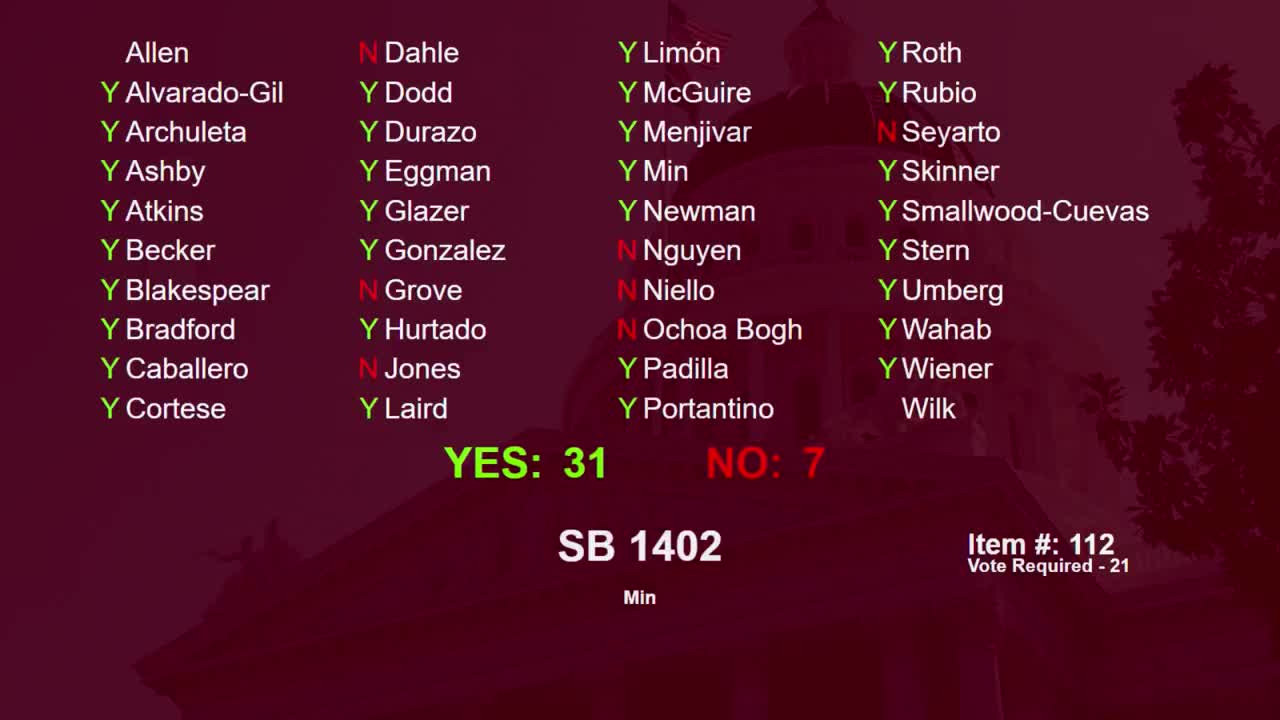 2MIN
Senate Floor
 3MIN
Senate Standing Committee on Energy, Utilities and Communications
28SEC
Senate Standing Committee on Energy, Utilities and Communications
 3MIN
Senate Standing Committee on Transportation
Bill Author