SB 976: Protecting Our Kids from Social Media Addiction Act.
- Session Year: 2023-2024
- House: Senate
- Latest Version Date: 2024-09-20
Current Status:
Passed
(2024-09-20: Chaptered by Secretary of State. Chapter 321, Statutes of 2024.)
Introduced
In Committee
First Chamber
In Committee
Second Chamber
Enacted
Existing law, the California Age-Appropriate Design Code Act, requires, beginning July 1, 2024, a business that provides an online service, product, or feature likely to be accessed by children to comply with certain requirements. The act requires the business to complete a data protection impact assessment addressing, among other things, whether the design could harm children and whether and how the online product, service, or feature uses system design features to increase, sustain, or extend use of the online product, service, or feature by children, including the automatic playing of media, rewards for time spent, and notifications. Existing law prohibits the business from using the personal information of any child in a way that the business knows, or has reason to know, is materially detrimental to the physical health, mental health, or well-being of a child.
Existing law, the Privacy Rights for California Minors in the Digital World, prohibits an operator of an internet website, online service, online application, or mobile application from specified conduct when minors are involved, including the marketing or advertising of alcoholic beverages, firearms, or certain other products or services. Existing law sets forth other related protections for minors, including under the California Consumer Privacy Act of 2018 and the California Privacy Rights Act of 2020.
This bill, the Protecting Our Kids from Social Media Addiction Act, would make it unlawful for the operator of an addictive internet-based service or application, as defined, to provide an addictive feed to a user, unless the operator does not have actual knowledge that the user is a minor; commencing January 1, 2027, has reasonably determined that the user is not a minor; or has obtained verifiable parental consent to provide an addictive feed to the user who is a minor.
The bill would define addictive feed as an internet website, online service, online application, or mobile application, in which multiple pieces of media generated or shared by users are recommended, selected, or prioritized for display to a user based on information provided by the user, or otherwise associated with the user or the users device, as specified, unless any of certain conditions are met.
The bill would make it unlawful for the operator of an addictive internet-based service or application, between the hours of 12 a.m. and 6 a.m., in the users local time zone, and between the hours of 8 a.m. and 3 p.m., Monday through Friday from September through May in the users local time zone, to send notifications to a user if the operator has actual knowledge that the user is a minor or, commencing January 1, 2027, has not reasonably determined that the user is not a minor, unless the operator has obtained verifiable parental consent to send those notifications, as specified. The bill would set forth related provisions for certain access controls determined by the verified parent through a mechanism provided by the operator.
Under the bill, a parents provision of consent or use of a mechanism, as described above, would not waive, release, otherwise limit, or serve as a defense to, any claim that the parent, or that the user who is a minor or was a minor at the time of using the internet-based service or application, might have against the operator regarding any harm to the mental health or well-being of the user.
The bill would require an operator to annually disclose the number of minor users of its addictive internet-based service or application, and of that total the number for whom the operator has received verifiable parental consent to provide an addictive feed, and the number of minor users as to whom the access controls are or are not enabled.
Under the bill, these provisions would only be enforced in a civil action brought in the name of the people of the State of California by the Attorney General. The bill would require the Attorney General to adopt regulations to further the purposes of these provisions, including regulations regarding age assurance and parental consent by January 1, 2027. The bill would authorize the Attorney General to adopt regulations that provide for exceptions to these provisions, but only if those exceptions further the purpose of protecting minors. The bill would require the Attorney General, in promulgating regulations, to solicit public comment regarding the impact that any regulation might have based on certain nondiscrimination characteristics set forth in existing law.
The bill would make these provisions severable.Existing law, the California Age-Appropriate Design Code Act, requires, beginning July 1, 2024, a business that provides an online service, product, or feature likely to be accessed by children to comply with certain requirements. The act requires the business to complete a data protection impact assessment addressing, among other things, whether the design could harm children and whether and how the online product, service, or feature uses system design features to increase, sustain, or extend use of the online product, service, or feature by children, including the automatic playing of media, rewards for time spent, and notifications. Existing law prohibits the business from using the personal information of any child in a way that the business knows, or has reason to know, is materially detrimental to the physical health, mental health, or well-being of a child.
Existing law, the Privacy Rights for California Minors in the Digital World, prohibits an operator of an internet website, online service, online application, or mobile application from specified conduct when minors are involved, including the marketing or advertising of alcoholic beverages, firearms, or certain other products or services. Existing law sets forth other related protections for minors, including under the California Consumer Privacy Act of 2018 and the California Privacy Rights Act of 2020.
This bill, the Protecting Our Kids from Social Media Addiction Act, would make it unlawful for the operator of an addictive internet-based service or application, as defined, to provide an addictive feed to a user, unless the operator does not have actual knowledge that the user is a minor; commencing January 1, 2027, has reasonably determined that the user is not a minor; or has obtained verifiable parental consent to provide an addictive feed to the user who is a minor.
The bill would define addictive feed as an internet website, online service, online application, or mobile application, in which multiple pieces of media generated or shared by users are recommended, selected, or prioritized for display to a user based on information provided by the user, or otherwise associated with the user or the users device, as specified, unless any of certain conditions are met.
The bill would make it unlawful for the operator of an addictive internet-based service or application, between the hours of 12 a.m. and 6 a.m., in the users local time zone, and between the hours of 8 a.m. and 3 p.m., Monday through Friday from September through May in the users local time zone, to send notifications to a user if the operator has actual knowledge that the user is a minor or, commencing January 1, 2027, has not reasonably determined that the user is not a minor, unless the operator has obtained verifiable parental consent to send those notifications, as specified. The bill would set forth related provisions for certain access controls determined by the verified parent through a mechanism provided by the operator.
Under the bill, a parents provision of consent or use of a mechanism, as described above, would not waive, release, otherwise limit, or serve as a defense to, any claim that the parent, or that the user who is a minor or was a minor at the time of using the internet-based service or application, might have against the operator regarding any harm to the mental health or well-being of the user.
The bill would require an operator to annually disclose the number of minor users of its addictive internet-based service or application, and of that total the number for whom the operator has received verifiable parental consent to provide an addictive feed, and the number of minor users as to whom the access controls are or are not enabled.
Under the bill, these provisions would only be enforced in a civil action brought in the name of the people of the State of California by the Attorney General. The bill would require the Attorney General to adopt regulations to further the purposes of these provisions, including regulations regarding age assurance and parental consent by January 1, 2027. The bill would authorize the Attorney General to adopt regulations that provide for exceptions to these provisions, but only if those exceptions further the purpose of protecting minors. The bill would require the Attorney General, in promulgating regulations, to solicit public comment regarding the impact that any regulation might have based on certain nondiscrimination characteristics set forth in existing law.
The bill would require, by January 1, 2027, the Attorney General to adopt regulations to further the purposes of these provisions. The bill would make these provisions severable.Existing law, the California Age-Appropriate Design Code Act, requires, beginning July 1, 2024, a business that provides an online service, product, or feature likely to be accessed by children to comply with certain requirements. The act requires the business to complete a data protection impact assessment addressing, among other things, whether the design could harm children and whether and how the online product, service, or feature uses system design features to increase, sustain, or extend use of the online product, service, or feature by children, including the automatic playing of media, rewards for time spent, and notifications. Existing law prohibits the business from using the personal information of any child in a way that the business knows, or has reason to know, is materially detrimental to the physical health, mental health, or well-being of a child.
Existing law, the Privacy Rights for California Minors in the Digital World, prohibits an operator of an internet website, online service, online application, or mobile application from specified conduct when minors are involved, including the marketing or advertising of alcoholic beverages, firearms, or certain other products or services. Existing law sets forth other related protections for minors, including under the California Consumer Privacy Act of 2018 and the California Privacy Rights Act of 2020.
This bill, the Protecting Our Kids from Social Media Addiction Act, would make it unlawful for the operator of an addictive internet-based service or application, as defined, to provide an addictive feed to a user, unless the operator does not have actual knowledge that the user is a minor; commencing January 1, 2027, has reasonably determined that the user is not a minor; or has obtained verifiable parental consent to provide an addictive feed to the user who is a minor.
The bill would define addictive feed as an internet website, online service, online application, or mobile application, in which multiple pieces of media generated or shared by users are recommended, selected, or prioritized for display to a user based on information provided by the user, or otherwise associated with the user or the users device, as specified, unless any of certain conditions are met.
The bill would make it unlawful for the operator of an addictive internet-based service or application, between the hours of 12 a.m. and 6 a.m., in the users local time zone, and between the hours of 8 a.m. and 3 p.m., Monday through Friday from September through May in the users local time zone, to send notifications to a user if the operator has actual knowledge that the user is a minor or, commencing January 1, 2027, has not reasonably determined that the user is not a minor, unless the operator has obtained verifiable parental consent to send those notifications, as specified. The bill would set forth related provisions for certain access controls determined by the verified parent through a mechanism provided by the operator.
Under the bill, a parents provision of consent or use of a mechanism, as described above, would not waive, release, otherwise limit, or serve as a defense to, any claim that the parent, or that the user who is a minor or was a minor at the time of using the internet-based service or application, might have against the operator regarding any harm to the mental health or well-being of the user.
The bill would require an operator to annually disclose the number of minor users of its addictive internet-based service or application, and of that total the number for whom the operator has received verifiable parental consent to provide an addictive feed, and the number of minor users as to whom the access controls are or are not enabled.
The bill would require, on or before by January 1, 2027, the Attorney General to adopt regulations to further the purposes of these provisions. The bill would make these provisions severable.
Existing law, the California Age-Appropriate Design Code Act, requires, beginning July 1, 2024, a business that provides an online service, product, or feature likely to be accessed by children to comply with certain requirements. The act requires the business to complete a data protection impact assessment addressing, among other things, whether the design could harm children and whether and how the online product, service, or feature uses system design features to increase, sustain, or extend use of the online product, service, or feature by children, including the automatic playing of media, rewards for time spent, and notifications. Existing law prohibits the business from using the personal information of any child in a way that the business knows, or has reason to know, is materially detrimental to the physical health, mental health, or well-being of a child.
Existing law, the Privacy Rights for California Minors in the Digital World, prohibits an operator of an internet website, online service, online application, or mobile application from specified conduct when minors are involved, including the marketing or advertising of alcoholic beverages, firearms, or certain other products or services. Existing law sets forth other related protections for minors, including under the California Consumer Privacy Act of 2018 and the California Privacy Rights Act of 2020.
This bill, the Protecting our Our Kids from Social Media Addiction Act, would make it unlawful for the operator of an addictive internet-based service or application, as defined, to provide an addictive feed to a user, unless the operator does not have actual knowledge that the user is a minor; commencing January 1, 2027, has reasonably determined that the user is not a minor; or has obtained verifiable parental consent to provide an addictive feed to the user who is a minor.
The bill would define addictive feed as an internet website, online service, online application, or mobile application, in which multiple pieces of media generated or shared by users are recommended, selected, or prioritized for display to a user based on information provided by the user, or otherwise associated with the user or the users device, as specified, unless any of certain conditions are met.
The bill would make it unlawful for the operator of an addictive internet-based service or application, between the hours of 12 a.m. and 6 a.m., inclusive, in the users local time zone, and between the hours of 8 a.m. and 3 p.m., Monday through Friday from September through May in the users local time zone, to send notifications to a user if the operator has actual knowledge that the user is a minor or, commencing January 1, 2027, has not reasonably determined that the user is not a minor, unless the operator has obtained verifiable parental consent to send those notifications, as specified. The bill would set forth related provisions for certain access controls determined by the verified parent through a mechanism provided by the operator.
Under the bill, a parents provision of consent or use of a mechanism, as described above, would not waive, release, otherwise limit, or serve as a defense to, any claim that the parent, or that the user who is a minor or was a minor at the time of using the internet-based service or application, might have against the operator regarding any harm to the mental health or well-being of the user.
The bill would require an operator to annually disclose the number of minor users of its addictive internet-based service or application, and of that total the number for whom the operator has received verifiable parental consent to provide an addictive feed, and the number of minor users as to whom the access controls are or are not enabled.
The bill would require, on or before January 1, 2027, the Attorney General to adopt regulations to further the purposes of these provisions. The bill would make these provisions severable.
Existing law, the California Age-Appropriate Design Code Act, requires, beginning July 1, 2024, a business that provides an online service, product, or feature likely to be accessed by children to comply with certain requirements. The act requires the business to complete a data protection impact assessment addressing, among other things, whether the design could harm children and whether and how the online product, service, or feature uses system design features to increase, sustain, or extend use of the online product, service, or feature by children, including the automatic playing of media, rewards for time spent, and notifications. Existing law prohibits the business from using the personal information of any child in a way that the business knows, or has reason to know, is materially detrimental to the physical health, mental health, or well-being of a child.
Existing law, the Privacy Rights for California Minors in the Digital World, prohibits an operator of an internet website, online service, online application, or mobile application from specified conduct when minors are involved, including the marketing or advertising of alcoholic beverages, firearms, or certain other products or services. Existing law sets forth other related protections for minors, including under the California Consumer Privacy Act of 2018 and the California Privacy Rights Act of 2020.
This bill, the Protecting our Kids from Social Media Addiction Act, would make it unlawful for the operator of an addictive internet-based service or application, as defined, to provide an addictive feed to a user, unless the operator does not have actual knowledge that the user is a minor; commencing January 1, 2027, has reasonably determined that the user is not a minor; or has obtained verifiable parental consent to provide an addictive feed to the user who is a minor.
The bill would define addictive feed as an internet website, online service, online application, or mobile application, in which multiple pieces of media generated or shared by users are recommended, selected, or prioritized for display to a user based on information provided by the user, or otherwise associated with the user or the users device, as specified, unless any of certain conditions are met.
The bill would make it unlawful for the operator of an addictive internet-based service or application, between the hours of 12 a.m. and 6 a.m., inclusive, in the users local time zone, and between the hours of 8 a.m. and 3 p.m., Monday through Friday from September through May in the users local time zone, to send notifications to a user if the operator has actual knowledge that the user is a minor or, commencing January 1, 2027, has not reasonably determined the user is not a minor, unless the operator has obtained verifiable parental consent to send those notifications, as specified. The bill would set forth related provisions for certain access controls determined by the verified parent through a mechanism provided by the operator.
Under the bill, a parents provision of consent or use of a mechanism, as described above, would not waive, release, otherwise limit, or serve as a defense to, any claim that the parent, or that the user who is a minor or was a minor at the time of using the internet-based service or application, might have against the operator regarding any harm to the mental health or well-being of the user.
The bill would require an operator to annually disclose the number of minor users of its addictive internet-based service or application, and of that total the number for whom the operator has received verifiable parental consent to provide an addictive feed, and the number of minor users as to whom the access controls are or are not enabled.
The bill would require, on or before January 1, 2027, the Attorney General to adopt regulations to further the purposes of these provisions. The bill would make these provisions severable.
Existing law, the California Age-Appropriate Design Code Act, requires, beginning July 1, 2024, a business that provides an online service, product, or feature likely to be accessed by children to comply with certain requirements. The act requires the business to complete a data protection impact assessment addressing, among other things, whether the design could harm children and whether and how the online product, service, or feature uses system design features to increase, sustain, or extend use of the online product, service, or feature by children, including the automatic playing of media, rewards for time spent, and notifications. Existing law prohibits the business from using the personal information of any child in a way that the business knows, or has reason to know, is materially detrimental to the physical health, mental health, or well-being of a child.
Existing law, the Privacy Rights for California Minors in the Digital World, prohibits an operator of an internet website, online service, online application, or mobile application from specified conduct when minors are involved, including the marketing or advertising of alcoholic beverages, firearms, or certain other products or services. Existing law sets forth other related protections for minors, including under the California Consumer Privacy Act of 2018 and the California Privacy Rights Act of 2020.
This bill, the Social Media Youth Addiction Law, Protecting our Kids from Social Media Addiction Act, would make it unlawful for the operator of an addictive social media platform, internet-based service or application, as defined, to provide an addictive feed to a user, unless the operator does not have actual knowledge that the user is a minor; commencing January 1, 2027, has reasonably determined that the user is not a minor minor; or the operator has obtained verifiable parental consent to provide an addictive feed to the user who is a minor.
The bill would define addictive feed as an internet website, online service, online application, or mobile application, in which multiple pieces of media generated or shared by users are recommended, selected, or prioritized for display to a user based on information provided by the user, or otherwise associated with the user or the users device, as specified, unless any of certain conditions are met.
The bill would make it unlawful for the operator of an addictive social media platform, internet-based service or application, between the hours of 12:00 AM and 6:00 AM, 12 a.m. and 6 a.m., inclusive, in the users local time zone, and between the hours of 8:00 AM and 3:00 PM, inclusive, 8 a.m. and 3 p.m., Monday through Friday from September through May in the users local time zone, to send notifications to a user who is a minor unless the operator has if the operator has actual knowledge that the user is a minor or, commencing January 1, 2027, has not reasonably determined the user is not a minor, unless the operator has obtained verifiable parental consent to send those notifications. notifications, as specified. The bill would set forth related provisions for certain access controls determined by the verified parent through a mechanism provided by the operator.
Under the bill, a parents provision of consent or use of a mechanism, as described above, would not waive, release, otherwise limit, or serve as a defense to, any claim that the parent, or that the user who is a minor or was a minor at the time of using the platform, internet-based service or application, might have against the operator regarding any harm to the mental health or well-being of the user.
The bill would require an operator to annually disclose the number of minor users of its addictive social media platform, internet-based service or application, and of that total the number for whom the operator has received verifiable parental consent to provide an addictive feed, and the number of minor users as to whom the access controls are or are not enabled.
The bill would authorize require, on or before January 1, 2027, the Attorney General to adopt regulations to further the purposes of these provisions. The bill would make these provisions severable.
Existing law, the California Age-Appropriate Design Code Act, requires, beginning July 1, 2024, a business that provides an online service, product, or feature likely to be accessed by children to comply with certain requirements. The act requires the business to complete a data protection impact assessment addressing, among other things, whether the design could harm children and whether and how the online product, service, or feature uses system design features to increase, sustain, or extend use of the online product, service, or feature by children, including the automatic playing of media, rewards for time spent, and notifications. Existing law prohibits the business from using the personal information of any child in a way that the business knows, or has reason to know, is materially detrimental to the physical health, mental health, or well-being of a child.
Existing law, the Privacy Rights for California Minors in the Digital World, prohibits an operator of an internet website, online service, online application, or mobile application from specified conduct when minors are involved, including the marketing or advertising of alcoholic beverages, firearms, or certain other products or services. Existing law sets forth other related protections for minors, including under the California Consumer Privacy Act of 2018 and the California Privacy Rights Act of 2020.
This bill, the Social Media Youth Addiction Law, would make it unlawful for the operator of an addictive social media platform, as defined, to provide an addictive feed to a user, unless the operator has reasonably determined that the user is not a minor or the operator has obtained verifiable parental consent to provide an addictive feed to the user who is a minor.
The bill would define addictive feed as an internet website, online service, online application, or mobile application, in which multiple pieces of media generated or shared by users are recommended, selected, or prioritized for display to a user based on information provided by the user, or otherwise associated with the user or the users device, as specified, unless any of certain conditions are met.
The bill would make it unlawful for the operator of an addictive social media platform, between the hours of 12:00 AM and 6:00 AM, inclusive, in the users local time zone, and between the hours of 8:00 AM and 3:00 PM, inclusive, Monday through Friday from September through May in the users local time zone, to send notifications to a user who is a minor unless the operator has obtained verifiable parental consent to send those notifications. The bill would set forth related provisions for certain access controls determined by the verified parent. parent through a mechanism provided by the operator.
Under the bill, a parents provision of consent or use of a mechanism, as described above, would not waive, release, otherwise limit, or serve as a defense to, any claim that the parent, or that the user who is a minor or was a minor at the time of using the platform, might have against the operator regarding any harm to the mental health or well-being of the user.
The bill would require an operator to annually disclose the number of minor users of its addictive social media platform, and of that total the number for whom the operator has received verifiable parental consent to provide an addictive feed, and the number of minor users as to whom the access controls are or are not enabled.
The bill would authorize the Attorney General to adopt regulations to further the purposes of these provisions. The bill would make these provisions severable.
Existing law, the California Age-Appropriate Design Code Act, requires, beginning July 1, 2024, a business that provides an online service, product, or feature likely to be accessed by children to comply with certain requirements. The act requires the business to complete a data protection impact assessment addressing, among other things, whether the design could harm children and whether and how the online product, service, or feature uses system design features to increase, sustain, or extend use of the online product, service, or feature by children, including the automatic playing of media, rewards for time spent, and notifications. Existing law prohibits the business from using the personal information of any child in a way that the business knows, or has reason to know, is materially detrimental to the physical health, mental health, or well-being of a child.
Existing law, the Privacy Rights for California Minors in the Digital World, prohibits an operator of an internet website, online service, online application, or mobile application from specified conduct when minors are involved, including the marketing or advertising of alcoholic beverages, firearms, or certain other products or services. Existing law sets forth other related protections for minors, including under the California Consumer Privacy Act of 2018 and the California Privacy Rights Act of 2020.
This bill, the Social Media Youth Addiction Law, would make it unlawful for the operator of an addictive social media platform, as defined, to provide an addictive feed to a user, unless the operator has reasonably determined that the user is not a minor or the operator has obtained verifiable parental consent to provide an addictive feed to the user who is a minor.
The bill would define addictive feed as an internet website, online service, online application, or mobile application, in which multiple pieces of media generated or shared by users are recommended, selected, or prioritized for display to a user based on information provided by the user, or otherwise associated with the user or the users device, as specified, unless any of certain conditions are met.
The bill would make it unlawful for the operator of an addictive social media platform, between the hours of 12:00 AM and 6:00 AM, inclusive, in the users local time zone, and between the hours of 8:00 AM and 3:00 PM, inclusive, Monday through Friday from September through May in the users local time zone, to send notifications to a user who is a minor unless the operator has obtained verifiable parental consent to send those notifications. The bill would set forth related provisions for certain access controls determined by the verified parent.
The bill would require an operator to annually disclose the number of minor users of its addictive social media platform, and of that total the number for whom the operator has received verifiable parental consent to provide an addictive feed, and the number of minor users as to whom the access controls are or are not enabled.
The bill would authorize the Attorney General to adopt regulations to further the purposes of these provisions. The bill would make these provisions severable.
The Legislature finds and declares the following:
(a)Social media provides an important tool for communication and information sharing. Approximately 95 percent of 13- to 17-year-olds, inclusive, say that they use at least one social media platform, and more than one-third report using social media almost constantly.
(b)However, some social media platforms have evolved to include addictive features, including the algorithmic delivery of content and other design features, that pose a significant risk of harm to the mental health and well-being of children and adolescents.
(c)As the United States Surgeon General has reported, recent evidence has identified reasons for concern about social media usage by children and adolescents. This evidence includes a study concluding that the risk of poor mental health outcomes doubles for children and adolescents who use social media at least three hours a day and research finding that social media usage is linked to a variety of negative health outcomes, including low self-esteem and disordered eating, for adolescent girls.
(d)Heavier usage of social media also leads to less healthy sleep patterns and sleep quality, which can in turn exacerbate both physical and mental health problems.
(e)Further, social media usage is more strongly associated with negative mental health outcomes, including depressive symptoms and self-harm behaviors, than is consumption of other forms of media such as television or electronic games.
(f)Both California and the country as a whole are facing an ongoing youth mental health crisis, with rates of adolescent suicides, depressive episodes, and feelings of sadness and hopelessness on the rise in recent years.
(g)For these reasons, it is essential that California act to ensure that social media platforms obtain parental consent before exposing children and adolescents to harmful and addictive social media features.
SEC. 2.Chapter 24 (commencing with Section 27000) is added to Division 20 of the Health and Safety Code, to read:24.Protecting Our Kids from Social Media Addiction Act27000.This chapter shall be known, and may be cited, as the Protecting Our Kids from Social Media Addiction Act.
27000.5.For purposes of this chapter, the following terms have the following meanings:
(a)Addictive feed means an internet website, online service, online application, or mobile application, or a portion thereof, in which multiple pieces of media generated or shared by users are, either concurrently or sequentially, recommended, selected, or prioritized for display to a user based, in whole or in part, on information provided by the user, or otherwise associated with the user or the users device, unless any of the following conditions are met, alone or in combination with one another:
(1)The information is not persistently associated with the user or users device, and does not concern the users previous interactions with media generated or shared by others.
(2)The information consists of search terms that are not persistently associated with the user or users device.
(3)The information consists of user-selected privacy or accessibility settings, technical information concerning the users device, or device communications or signals concerning whether the user is a minor.
(4)The user expressly and unambiguously requested the specific media or media by the author, creator, or poster of the media, or the blocking, prioritization, or deprioritization of such media, provided that the media is not recommended, selected, or prioritized for display based, in whole or in part, on other information associated with the user or the users device, except as otherwise permitted by this chapter and, in the case of audio or video content, is not automatically played.
(5)The media consists of direct, private communications between users.
(6)The media recommended, selected, or prioritized for display is exclusively the next media in a preexisting sequence from the same author, creator, poster, or source and, in the case of audio or video content, is not automatically played.
(7)The recommendation, selection, or prioritization of the media is necessary to comply with this chapter or any regulations promulgated pursuant to this chapter.
(b)(1)Addictive internet-based service or application means an internet website, online service, online application, or mobile application, including, but not limited to, a social media platform as defined in Section 22675 of the Business and Professions Code, that offers users or provides users with an addictive feed as a significant part of the service provided by that internet website, online service, online application, or mobile application.
(2)Addictive internet-based service or application does not apply to either of the following:
(A)An internet website, online service, online application, or mobile application for which interactions between users are limited to commercial transactions or to consumer reviews of products, sellers, services, events, or places, or any combination thereof.
(B)An internet website, online service, online application, or mobile application that operates a feed for the primary purpose of cloud storage.
(c)Media means text, audio, an image, or a video.
(d)Minor means an individual under 18 years of age who is located in the State of California.
(e)Operator means a person who operates or provides an internet website, an online service, an online application, or a mobile application.
(f)Parent means a parent or guardian, including as defined in regulations promulgated pursuant to this chapter.
(g)User means a person who uses an internet website, online service, online application, or mobile application. User does not include the operator or a person acting as an agent of the operator.
27001.(a)It shall be unlawful for the operator of an addictive internet-based service or application to provide an addictive feed to a user unless either of the following is met:
(1)(A)Except as provided in subparagraph (B), the operator does not have actual knowledge that the user is a minor.
(B)Commencing January 1, 2027, the operator has reasonably determined that the user is not a minor, including pursuant to regulations promulgated by the Attorney General.
(2)The operator has obtained verifiable parental consent to provide an addictive feed to the user who is a minor.
(b)Information collected for the purpose of determining a users age or verifying parental consent pursuant to this chapter shall not be used for any purpose other than compliance with this chapter or with another applicable law. The information collected shall be deleted immediately after it is used to determine a users age or to verify parental consent, except as necessary to comply with state or federal law.
27002.(a)(1)Except as provided in paragraph (2), it shall be unlawful for the operator of an addictive internet-based service or application, between the hours of 12 a.m. and 6 a.m., in the users local time zone, and between the hours of 8 a.m. and 3 p.m., from Monday through Friday from September through May in the users local time zone, to send notifications to a user if the operator has actual knowledge that the user is a minor unless the operator has obtained verifiable parental consent to send those notifications.
(2)Commencing January 1, 2027, it shall be unlawful for the operator of an addictive internet-based service or application, between the hours of 12 a.m. and 6 a.m., in the users local time zone, and between the hours of 8 a.m. and 3 p.m., from Monday through Friday from September through May in the users local time zone, to send notifications to a user whom the operator has not reasonably determined is not a minor, including pursuant to regulations promulgated by the Attorney General, unless the operator has obtained verifiable parental consent to send those notifications.
(b)The operator of an addictive internet-based service or application shall provide a mechanism through which the verified parent of a user who is a minor may do any of the following:
(1)Prevent their child from accessing or receiving notifications from the addictive internet-based service or application between specific hours chosen by the parent. This setting shall be set by the operator as on by default, in a manner in which the childs access is limited between the hours of 12 a.m. and 6 a.m., in the users local time zone.
(2)Limit their childs access to any addictive feed from the addictive internet-based service or application to a length of time per day specified by the verified parent. This setting shall be set by the operator as on by default, in a manner in which the childs access is limited to one hour per day unless modified by the verified parent.
(3)Limit their childs ability to view the number of likes or other forms of feedback to pieces of media within an addictive feed. This setting shall be set by the operator as on by default.
(4)Require that the default feed provided to the child when entering the internet-based service or application be one in which pieces of media are not recommended, selected, or prioritized for display based on information provided by the user, or otherwise associated with the user or the users device, other than the users age or status as a minor.
(5)Set their childs account to private mode, in a manner in which only users to whom the child is connected on the addictive internet-based service or application may view or respond to content posted by the child. This setting shall be set by the operator as on by default.
27003.(a)This chapter shall not be construed as requiring the operator of an addictive internet-based service or application to give a parent any additional or special access to, or control over, the data or accounts of their child.
(b)This chapter shall not be construed as preventing any action taken in good faith to restrict access to, or availability of, media.
27004.(a)An operator may choose not to provide services to minors. However, the operator of an addictive internet-based service or application shall not withhold, degrade, lower the quality of, or increase the price of, any product, service, or feature, other than as required by this chapter, due to a user or parent availing themselves of the rights provided by this chapter, or due to the protections required by this chapter.
(b)A parents provision of consent as described in Section 27001 or 27002, or the use by a parent of a mechanism as described in Section 27002, does not waive, release, otherwise limit, or serve as a defense to, any claim that the parent, or that the user who is a minor or was a minor at the time of using the internet-based service or application, might have against the operator of an addictive internet-based service or application regarding any harm to the mental health or well-being of the user.
(c)The protections provided by this chapter are in addition to those provided by any other applicable law, including, but not limited to, the California Age-Appropriate Design Code Act (Title 1.81.47 (commencing with Section 1798.99.28) of Part 4 of Division 3 of the Civil Code).
27005.An operator of an addictive internet-based service or application shall publicly disclose, on an annual basis, the number of minor users of its addictive internet-based service or application, and of that total the number for whom the operator has received verifiable parental consent to provide an addictive feed, and the number of minor users as to whom the controls set forth in Section 27002 are or are not enabled.
27006.(a)This chapter may only be enforced in a civil action brought in the name of the people of the State of California by the Attorney General.
(b)The Attorney General shall adopt regulations to further the purposes of this chapter, including regulations regarding age assurance and parental consent by January 1, 2027. The Attorney General may adopt regulations that provide for exceptions to this chapter, but only if those exceptions further the purpose of protecting minors.
(c)In promulgating the regulations described in subdivision (b), the Attorney General shall solicit public comment regarding the impact that any regulation might have based on the nondiscrimination characteristics set forth in Section 51 of the Civil Code or in any other applicable law.
27007.If any provision of this chapter, or application thereof, to any person or circumstance is held invalid, that invalidity shall not affect other provisions or applications of this chapter that can be given effect without the invalid provision or application, and to this end the provisions of this chapter are declared to be severable.
The Legislature finds and declares the following:
(a)Social media provides an important tool for communication and information sharing. Approximately 95 percent of 13- to 17-year-olds, inclusive, say that they use at least one social media platform, and more than one-third report using social media almost constantly.
(b)However, some social media platforms have evolved to include addictive features, including the algorithmic delivery of content, content and other design features, that pose a significant risk of harm to the mental health and well-being of children and adolescents.
(c)As the United States Surgeon General has reported, recent evidence has identified reasons for concern about social media usage by children and adolescents. This evidence includes a study concluding that the risk of poor mental health outcomes doubles for children and adolescents who use social media at least three hours a day and research finding that social media usage is linked to a variety of negative health outcomes, including low self-esteem and disordered eating, for adolescent girls.
(d)Heavier usage of social media also leads to less healthy sleep patterns and sleep quality, which can in turn exacerbate both physical and mental health problems.
(e)Further, social media usage is more strongly associated with negative mental health outcomes, including depressive symptoms and self-harm behaviors, than is consumption of other forms of media such as television or electronic games.
(f)Both California and the country as a whole are facing an ongoing youth mental health crisis, with rates of adolescent suicides, depressive episodes, and feelings of sadness and hopelessness on the rise in recent years.
(g)For these reasons, it is essential that California act to ensure that social media platforms obtain parental consent before exposing children and adolescents to harmful and addictive social media features.
SEC. 2.Chapter 24 (commencing with Section 27000) is added to Division 20 of the Health and Safety Code, to read:24.Protecting Our Kids from Social Media Addiction Act27000.This chapter shall be known, and may be cited, as the Protecting Our Kids from Social Media Addiction Act.
27000.5.For purposes of this chapter, the following terms have the following meanings:
(a)Addictive feed means an internet website, online service, online application, or mobile application, or a portion thereof, in which multiple pieces of media generated or shared by users are, either concurrently or sequentially, recommended, selected, or prioritized for display to a user based, in whole or in part, on information provided by the user, or otherwise associated with the user or the users device, unless any of the following conditions are met, alone or in combination with one another:
(1)The information, including search terms entered by a user, information is not persistently associated with the user or users device, and does not concern the users previous interactions with media generated or shared by others.
(2)The information consists of search terms that are not persistently associated with the user or users device.
(2)(3)The information consists of user-selected privacy or accessibility settings, technical information concerning the users device, or device communications or signals concerning whether the user is a minor.
(3)(4)The user expressly and unambiguously requested the specific media or media by the author, creator, or poster of the media, or the blocking, prioritization, or deprioritization of such media, provided that the media is not recommended, selected, or prioritized for display based, in whole or in part, on other information associated with the user or the users device, except as otherwise permitted by this chapter and, in the case of audio or video content, is not automatically played.
(4)(5)The media consists of direct, private communications between users.
(5)(6)The media recommended, selected, or prioritized for display is exclusively the next media in a preexisting sequence from the same author, creator, poster, or source and, in the case of audio or video content, is not automatically played.
(7)The recommendation, selection, or prioritization of the media is necessary to comply with this chapter or any regulations promulgated pursuant to this chapter.
(b)(1)Addictive internet-based service or application means an internet website, online service, online application, or mobile application, including, but not limited to, a social media platform as defined in Section 22675 of the Business and Professions Code, that offers users or provides users with an addictive feed as a significant part of the service provided by that internet website, online service, online application, or mobile application.
(2)Addictive internet-based service or application does not apply to either of the following:
(A)An internet website, online service, online application, or mobile application for which interactions between users are limited to commercial transactions or to consumer reviews of products, sellers, services, events, or places, or any combination thereof.
(B)An internet website, online service, online application, or mobile application that operates a feed for the primary purpose of cloud storage.
(c)Media means text, audio, an image, or a video.
(d)Minor means an individual under 18 years of age who is located in the State of California.
(e)Operator means a person who operates or provides an internet website, an online service, an online application, or a mobile application.
(f)Parent means a parent or a legal guardian. guardian, including as defined in regulations promulgated pursuant to this chapter.
(g)User means a person who uses an internet website, online service, online application, or mobile application. User does not include the operator or a person acting as an agent of the operator.
27001.(a)It shall be unlawful for the operator of an addictive internet-based service or application to provide an addictive feed to a user unless either of the following is met:
(1)(A)Except as provided in subparagraph (B), the operator does not have actual knowledge that the user is a minor.
(B)Commencing January 1, 2027, the operator has reasonably determined that the user is not a minor, including pursuant to regulations promulgated by the Attorney General.
(2)The operator has obtained verifiable parental consent to provide an addictive feed to the user who is a minor.
(b)Information collected for the purpose of determining a users age or verifying parental consent pursuant to this chapter shall not be used for any purpose other than compliance with this chapter or with another applicable law. The information collected shall be deleted immediately after it is used to determine a users age, age or to verify parental consent, except as necessary to comply with state or federal law.
27002.(a)(1)Except as provided in paragraph (2), it shall be unlawful for the operator of an addictive internet-based service or application, between the hours of 12 a.m. and 6 a.m., in the users local time zone, and between the hours of 8 a.m. and 3 p.m., from Monday through Friday from September through May in the users local time zone, to send notifications to a user if the operator has actual knowledge that the user is a minor unless the operator has obtained verifiable parental consent to send those notifications.
(2)Commencing January 1, 2027, it shall be unlawful for the operator of an addictive internet-based service or application, between the hours of 12 a.m. and 6 a.m., in the users local time zone, and between the hours of 8 a.m. and 3 p.m., from Monday through Friday from September through May in the users local time zone, to send notifications to a user whom the operator has not reasonably determined is not a minor, including pursuant to regulations promulgated by the Attorney General, unless the operator has obtained verifiable parental consent to send those notifications.
(b)The operator of an addictive internet-based service or application shall provide a mechanism through which the verified parent of a user who is a minor may do any of the following:
(1)Prevent their child from accessing or receiving notifications from the addictive internet-based service or application between specific hours chosen by the parent. This setting shall be set by the operator as on by default, in a manner in which the childs access is limited between the hours of 12 a.m. and 6 a.m., in the users local time zone.
(2)Limit their childs access to any addictive feed from the addictive internet-based service or application to a length of time per day specified by the verified parent. This setting shall be set by the operator as on by default, in a manner in which the childs access is limited to one hour per day unless modified by the verified parent.
(3)Limit their childs ability to view the number of likes or other forms of feedback to pieces of media within an addictive feed. This setting shall be set by the operator as on by default.
(4)Require that the default feed provided to the child when entering the internet-based service or application be one in which pieces of media are not recommended, selected, or prioritized for display based on information provided by the user, or otherwise associated with the user or the users device, other than the users age or status as a minor.
(5)Set their childs account to private mode, in a manner in which only users to whom the child is connected on the addictive internet-based service or application may view or respond to content posted by the child. This setting shall be set by the operator as on by default.
27003.(a)This chapter shall not be construed as requiring the operator of an addictive internet-based service or application to give a parent any additional or special access to, or control over, the data or accounts of their child.
(b)This chapter shall not be construed as preventing any action taken in good faith to restrict access to, or availability of, media.
27004.(a)An operator may choose not to provide services to minors. However, the operator of an addictive internet-based service or application shall not withhold, degrade, lower the quality of, or increase the price of, any product, service, or feature, other than as required by this chapter, due to a user or parent availing themselves of the rights provided by this chapter, or due to the protections required by this chapter.
(b)A parents provision of consent as described in Section 27001 or 27002, or the use by a parent of a mechanism as described in Section 27002, does not waive, release, otherwise limit, or serve as a defense to, any claim that the parent, or that the user who is a minor or was a minor at the time of using the internet-based service or application, might have against the operator of an addictive internet-based service or application regarding any harm to the mental health or well-being of the user.
(c)The protections provided by this chapter are in addition to those provided by any other applicable law, including, but not limited to, the California Age-Appropriate Design Code Act (Title 1.81.47 (commencing with Section 1798.99.28) of Part 4 of Division 3 of the Civil Code).
27005.An operator of an addictive internet-based service or application shall publicly disclose, on an annual basis, the number of minor users of its addictive internet-based service or application, and of that total the number for whom the operator has received verifiable parental consent to provide an addictive feed, and the number of minor users as to whom the controls set forth in Section 27002 are or are not enabled.
27006.By January 1, 2027, the Attorney General shall adopt regulations to further the purposes of this chapter, including regulations regarding age assurance and parental consent.27006.(a)This chapter may only be enforced in a civil action brought in the name of the people of the State of California by the Attorney General.
(b)The Attorney General shall adopt regulations to further the purposes of this chapter, including regulations regarding age assurance and parental consent by January 1, 2027. The Attorney General may adopt regulations that provide for exceptions to this chapter, but only if those exceptions further the purpose of protecting minors.
(c)In promulgating the regulations described in subdivision (b), the Attorney General shall solicit public comment regarding the impact that any regulation might have based on the nondiscrimination characteristics set forth in Section 51 of the Civil Code or in any other applicable law.
27007.If any provision of this chapter, or application thereof, to any person or circumstance is held invalid, that invalidity shall not affect other provisions or applications of this chapter that can be given effect without the invalid provision or application, and to this end the provisions of this chapter are declared to be severable.
The Legislature finds and declares the following:
(a)Social media provides an important tool for communication and information sharing. Approximately 95 percent of 13- to 17-year-olds, inclusive, say that they use at least one social media platform, and more than one-third report using social media almost constantly.
(b)However, some social media platforms have evolved to include addictive features, including the algorithmic delivery of content, that pose a significant risk of harm to the mental health and well-being of children and adolescents.
(c)As the United States Surgeon General has reported, recent evidence has identified reasons for concern about social media usage by children and adolescents. This evidence includes a study concluding that the risk of poor mental health outcomes doubles for children and adolescents who use social media at least three hours a day and research finding that social media usage is linked to a variety of negative health outcomes, including low self-esteem and disordered eating, for adolescent girls.
(d)Heavier usage of social media also leads to less healthy sleep patterns and sleep quality, which can in turn exacerbate both physical and mental health problems.
(e)Further, social media usage is more strongly associated with negative mental health outcomes, including depressive symptoms and self-harm behaviors, than is consumption of other forms of media such as television or electronic games.
(f)Both California and the country as a whole are facing an ongoing youth mental health crisis, with rates of adolescent suicides, depressive episodes, and feelings of sadness and hopelessness on the rise in recent years.
(g)For these reasons, it is essential that California act to ensure that social media platforms obtain parental consent before exposing children and adolescents to harmful and addictive social media features.
SEC. 2.Chapter 23 (commencing with Section 27000) is added to Division 20 of the Health and Safety Code, to read:SEC. 2.Chapter 24 (commencing with Section 27000) is added to Division 20 of the Health and Safety Code, to read:23. 24.Protecting Our Kids from Social Media Addiction Act27000.This chapter shall be known, and may be cited, as the Protecting Our Kids from Social Media Addiction Act.
27000.5.For purposes of this chapter, the following terms have the following meanings:
(a)Addictive feed means an internet website, online service, online application, or mobile application, or a portion thereof, in which multiple pieces of media generated or shared by users are, either concurrently or sequentially, recommended, selected, or prioritized for display to a user based, in whole or in part, on information provided by the user, or otherwise associated with the user or the users device, unless any of the following conditions are met, alone or in combination with one another:
(1)The information, including search terms entered by a user, is not persistently associated with the user or users device, and does not concern the users previous interactions with media generated or shared by others.
(2)The information consists of user-selected privacy or accessibility settings, technical information concerning the users device, or device communications or signals concerning whether the user is a minor.
(3)The user expressly and unambiguously requested the specific media or media by the author, creator, or poster of the media, provided that the media is not recommended, selected, or prioritized for display based, in whole or in part, on other information associated with the user or the users device, except as otherwise permitted by this chapter and, in the case of audio or video content, is not automatically played.
(4)The media consists of direct, private communications between users.
(5)The media recommended, selected, or prioritized for display is exclusively the next media in a preexisting sequence from the same author, creator, poster, or source and, in the case of audio or video content, is not automatically played.
(b)(1)Addictive internet-based service or application means an internet website, online service, online application, or mobile application, including, but not limited to, a social media platform as defined in Section 22675 of the Business and Professions Code, that offers users or provides users with an addictive feed as a significant part of the service provided by that internet website, online service, online application, or mobile application.
(2)Addictive internet-based service or application does not apply to either of the following:
(A)An internet website, online service, online application, or mobile application for which interactions between users are limited to commercial transactions or to consumer reviews of products, sellers, services, events, or places, or any combination thereof.
(B)An internet website, online service, online application, or mobile application that operates a feed for the primary purpose of cloud storage.
(c)Media means text, audio, an image, or a video.
(d)Minor means an individual under 18 years of age who is located in the State of California.
(e)Operator means a person who operates or provides an internet website, an online service, an online application, or a mobile application.
(f)Parent means a parent or a legal guardian.
(g)User means a person who uses an internet website, online service, online application, or mobile application. User does not include the operator or a person acting as an agent of the operator.
27001.(a)It shall be unlawful for the operator of an addictive internet-based service or application to provide an addictive feed to a user unless either of the following is met:
(1)(A)Except as provided in subparagraph (B), the operator does not have actual knowledge that the user is a minor.
(B)Commencing January 1, 2027, the operator has reasonably determined that the user is not a minor, including pursuant to regulations promulgated by the Attorney General.
(2)The operator has obtained verifiable parental consent to provide an addictive feed to the user who is a minor.
(b)Information collected for the purpose of determining a users age pursuant to this chapter shall not be used for any purpose other than compliance with this chapter or with another applicable law. The information collected shall be deleted immediately after it is used to determine a users age, except as necessary to comply with state or federal law.
27002.(a)(1)Except as provided in paragraph (2), it shall be unlawful for the operator of an addictive internet-based service or application, between the hours of 12 a.m. and 6 a.m., in the users local time zone, and between the hours of 8 a.m. and 3 p.m., from Monday through Friday from September through May in the users local time zone, to send notifications to a user if the operator has actual knowledge that the user is a minor unless the operator has obtained verifiable parental consent to send those notifications.
(2)Commencing January 1, 2027, it shall be unlawful for the operator of an addictive internet-based service or application, between the hours of 12 a.m. and 6 a.m., in the users local time zone, and between the hours of 8 a.m. and 3 p.m., from Monday through Friday from September through May in the users local time zone, to send notifications to a user whom the operator has not reasonably determined is not a minor, including pursuant to regulations promulgated by the Attorney General, unless the operator has obtained verifiable parental consent to send those notifications.
(b)The operator of an addictive internet-based service or application shall provide a mechanism through which the verified parent of a user who is a minor may do any of the following:
(1)Prevent their child from accessing or receiving notifications from the addictive internet-based service or application between specific hours chosen by the parent. This setting shall be set by the operator as on by default, in a manner in which the childs access is limited between the hours of 12 a.m. and 6 a.m., in the users local time zone.
(2)Limit their childs access to any addictive feed from the addictive internet-based service or application to a length of time per day specified by the verified parent. This setting shall be set by the operator as on by default, in a manner in which the childs access is limited to one hour per day unless modified by the verified parent.
(3)Limit their childs ability to view the number of likes or other forms of feedback to pieces of media within an addictive feed. This setting shall be set by the operator as on by default.
(4)Require that the default feed provided to the child when entering the internet-based service or application be one in which pieces of media are not recommended, selected, or prioritized for display based on information provided by the user, or otherwise associated with the user or the users device, other than the users age or status as a minor.
(5)Set their childs account to private mode, in a manner in which only users to whom the child is connected on the addictive internet-based service or application may view or respond to content posted by the child. This setting shall be set by the operator as on by default.
27003.(a)This chapter shall not be construed as requiring the operator of an addictive internet-based service or application to give a parent any additional or special access to, or control over, the data or accounts of their child.
(b)This chapter shall not be construed as preventing any action taken in good faith to restrict access to, or availability of, media.
27004.(a)An operator may choose not to provide services to minors. However, the operator of an addictive internet-based service or application shall not withhold, degrade, lower the quality of, or increase the price of, any product, service, or feature, other than as required by this chapter, due to a user or parent availing themselves of the rights provided by this chapter, or due to the protections required by this chapter.
(b)A parents provision of consent as described in Section 27001 or 27002, or the use by a parent of a mechanism as described in Section 27002, does not waive, release, otherwise limit, or serve as a defense to, any claim that the parent, or that the user who is a minor or was a minor at the time of using the internet-based service or application, might have against the operator of an addictive internet-based service or application regarding any harm to the mental health or well-being of the user.
(c)The protections provided by this chapter are in addition to those provided by any other applicable law, including, but not limited to, the California Age-Appropriate Design Code Act (Title 1.81.47 (commencing with Section 1798.99.28) of Part 4 of Division 3 of the Civil Code).
27005.An operator of an addictive internet-based service or application shall publicly disclose, on an annual basis, the number of minor users of its addictive internet-based service or application, and of that total the number for whom the operator has received verifiable parental consent to provide an addictive feed, and the number of minor users as to whom the controls set forth in Section 27002 are or are not enabled.
27006.The By January 1, 2027, the Attorney General shall adopt regulations to further the purposes of this chapter, including regulations regarding age assurance and parental consent, on or before January 1, 2027. consent.
27007.If any provision of this chapter, or application thereof, to any person or circumstance is held invalid, that invalidity shall not affect other provisions or applications of this chapter that can be given effect without the invalid provision or application, and to this end the provisions of this chapter are declared to be severable.
The Legislature finds and declares the following:
(a)Social media provides an important tool for communication and information sharing. Approximately 95 percent of 13- to 17-year-olds, inclusive, say that they use at least one social media platform, and more than one-third report using social media almost constantly.
(b)However, some social media platforms have evolved to include addictive features, including the algorithmic delivery of content, that pose a significant risk of harm to the mental health and well-being of children and adolescents.
(c)As the United States Surgeon General has reported, recent evidence has identified reasons for concern about social media usage by children and adolescents. This evidence includes a study concluding that the risk of poor mental health outcomes doubles for children and adolescents who use social media at least three hours a day and research finding that social media usage is linked to a variety of negative health outcomes, including low self-esteem and disordered eating, for adolescent girls.
(d)Heavier usage of social media also leads to less healthy sleep patterns and sleep quality, which can in turn exacerbate both physical and mental health problems.
(e)Further, social media usage is more strongly associated with negative mental health outcomes, including depressive symptoms and self-harm behaviors, than is consumption of other forms of media such as television or electronic games.
(f)Both California and the country as a whole are facing an ongoing youth mental health crisis, with rates of adolescent suicides, depressive episodes, and feelings of sadness and hopelessness on the rise in recent years.
(g)For these reasons, it is essential that California act to ensure that social media platforms obtain parental consent before exposing children and adolescents to harmful and addictive social media features.
SEC. 2.Chapter 23 (commencing with Section 27000) is added to Division 20 of the Health and Safety Code, to read:23.Social Media Youth Addiction Protecting Our Kids from Social Media Addiction Act27000.This chapter shall be known, and may be cited, as the Protecting our Our Kids from Social Media Addiction Act.
27000.5.For purposes of this chapter, the following terms have the following meanings:
(a)Addictive feed means an internet website, online service, online application, or mobile application, or a portion thereof, in which multiple pieces of media generated or shared by users are, either concurrently or sequentially, recommended, selected, or prioritized for display to a user based, in whole or in part, on information provided by the user, or otherwise associated with the user or the users device, unless any of the following conditions are met, alone or in combination with one another:
(1)The information, including search terms entered by a user, is not persistently associated with the user or users device, and does not concern the users previous interactions with media generated or shared by others.
(2)The information consists of user-selected privacy or accessibility settings, technical information concerning the users device, or device communications or signals concerning whether the user is a minor.
(3)The user expressly and unambiguously requested the specific media or media by the author, creator, or poster of the media, provided that the media is not recommended, selected, or prioritized for display based, in whole or in part, on other information associated with the user or the users device, except as otherwise permitted by this chapter and, in the case of audio or video content, is not automatically played.
(4)The media consists of direct, private communications between users.
(5)The media recommended, selected, or prioritized for display is exclusively the next media in a preexisting sequence from the same author, creator, poster, or source and, in the case of audio or video content, is not automatically played.
(b)Addictive internet-based service or application means an internet website, online service, online application, or mobile application, including, but not limited to, a social media platform as defined in Section 22675 of the Business and Professions Code, that offers or provides users an addictive feed as a significant part of the service provided by that internet website, online service, online application, or mobile application.
(c)Media means text, audio, an image, or a video.
(d)Minor means an individual under 18 years of age who is located in the State of California.
(e)Operator means a person who operates or provides an internet website, an online service, an online application, or a mobile application.
(f)Parent means a parent or a legal guardian.
(g)User means a person who uses an internet website, online service, online application, or mobile application. User does not include the operator or a person acting as an agent of the operator.
27001.(a)It shall be unlawful for the operator of an addictive internet-based service or application to provide an addictive feed to a user unless either of the following is met:
(1)(A)Except as provided in subparagraph (B), the operator does not have actual knowledge that the user is a minor.
(B)Commencing January 1, 2027, the operator has reasonably determined that the user is not a minor, including pursuant to regulations promulgated by the Attorney General.
(2)The operator has obtained verifiable parental consent to provide an addictive feed to the user who is a minor.
(b)Information collected for the purpose of determining a users age pursuant to this chapter shall not be used for any purpose other than compliance with this chapter or with another applicable law. The information collected shall be deleted immediately after it is used to determine a users age, except as necessary to comply with state or federal law.
27002.(a)(1)Except as provided in paragraph (2), it shall be unlawful for the operator of an addictive internet-based service or application, between the hours of 12 a.m. and 6 a.m., in the users local time zone, and between the hours of 8 a.m. and 3 p.m., from Monday through Friday from September through May in the users local time zone, to send notifications to a user if the operator has actual knowledge that the user is a minor unless the operator has obtained verifiable parental consent to send those notifications.
(2)Commencing January 1, 2027, it shall be unlawful for the operator of an addictive internet-based service or application, between the hours of 12 a.m. and 6 a.m., in the users local time zone, and between the hours of 8 a.m. and 3 p.m., from Monday through Friday from September through May in the users local time zone, to send notifications to a user whom the operator has not reasonably determined is not a minor, including pursuant to regulations promulgated by the Attorney General, unless the operator has obtained verifiable parental consent to send those notifications.
(b)The operator of an addictive internet-based service or application shall provide a mechanism through which the verified parent of a user who is a minor may do any of the following:
(1)Prevent their child from accessing or receiving notifications from the addictive internet-based service or application between specific hours chosen by the parent. This setting shall be set by the operator as on by default, in a manner in which the childs access is limited between the hours of 12 a.m. and 6 a.m., in the users local time zone.
(2)Limit their childs access to any addictive feed from the addictive internet-based service or application to a length of time per day specified by the verified parent. This setting shall be set by the operator as on by default, in a manner in which the childs access is limited to one hour per day unless modified by the verified parent.
(3)Limit their childs ability to view the number of likes or other forms of feedback to pieces of media within an addictive feed. This setting shall be set by the operator as on by default.
(4)Require that the default feed provided to the child when entering the internet-based service or application be one in which pieces of media are not recommended, selected, or prioritized for display based on information provided by the user, or otherwise associated with the user or the users device, other than the users age or status as a minor.
(5)Set their childs account to private mode, in a manner in which only users to whom the child is connected on the addictive internet-based service or application may view or respond to content posted by the child. This setting shall be set by the operator as on by default.
27003.(a)This chapter shall not be construed as requiring the operator of an addictive internet-based service or application to give a parent any additional or special access to, or control over, the data or accounts of their child.
(b)This chapter shall not be construed as preventing any action taken in good faith to restrict access to, or availability of, media.
27004.(a)An operator may choose not to provide services to minors. However, the operator of an addictive internet-based service or application shall not withhold, degrade, lower the quality of, or increase the price of, any product, service, or feature, other than as required by this chapter, due to a user or parent availing themselves of the rights provided by this chapter, or due to the protections required by this chapter.
(b)A parents provision of consent as described in Section 27001 or 27002, or the use by a parent of a mechanism as described in Section 27002, does not waive, release, otherwise limit, or serve as a defense to, any claim that the parent, or that the user who is a minor or was a minor at the time of using the internet-based service or application, might have against the operator of an addictive internet-based service or application regarding any harm to the mental health or well-being of the user.
(c)The protections provided by this chapter are in addition to those provided by any other applicable law, including, but not limited to, the California Age-Appropriate Design Code Act (Title 1.81.47 (commencing with Section 1798.99.28) of Part 4 of Division 3 of the Civil Code).
27005.An operator of an addictive internet-based service or application shall publicly disclose, on an annual basis, the number of minor users of its addictive internet-based service or application, and of that total the number for whom the operator has received verifiable parental consent to provide an addictive feed, and the number of minor users as to whom the controls set forth in Section 27002 are or are not enabled.
27006.The Attorney General shall adopt regulations to further the purposes of this chapter, including regulations regarding age assurance and parental consent consent, on or before January 1, 2027.
27007.If any provision of this chapter, or application thereof, to any person or circumstance is held invalid, that invalidity shall not affect other provisions or applications of this chapter that can be given effect without the invalid provision or application, and to this end the provisions of this chapter are declared to be severable.
The Legislature finds and declares both of the following:
(a)Social media provides an important tool for communication and information sharing. However, Approximately 95 percent of 13- to 17-year-olds, inclusive, say they use at least one social media platform, and more than one-third report using social media almost constantly.
(b) However, some social media platforms have evolved to include addictive features, including the algorithmic delivery of content, that pose a significant risk of harm to the mental health and well-being of children and adolescents.
(c)As the United States Surgeon General has reported, recent evidence has identified reasons for concern about social media usage by children and adolescents. This evidence includes a study concluding that the risk of poor mental health outcomes doubles for children and adolescents who use social media at least three hours a day and research finding that social media usage is linked to a variety of negative health outcomes, including low self-esteem and disordered eating, for adolescent girls.
(d)Heavier usage of social media also leads to less healthy sleep patterns and sleep quality, which can in turn exacerbate both physical and mental health problems.
(e)Further, social media usage is more strongly associated with negative mental health outcomes, including depressive symptoms and self-harm behaviors, than is consumption of other forms of media such as television or electronic games.
(f)Both California and the country as a whole are facing an ongoing youth mental health crisis, with rates of adolescent suicides, depressive episodes, and feelings of sadness and hopelessness on the rise in recent years.
(b)It is essential, given the ongoing youth mental health crisis,(g)For these reasons, it is essential that California act to ensure that social media platforms obtain parental consent before exposing children and adolescents to these harmful and addictive social media features.
SEC. 2.Chapter 23 (commencing with Section 27000) is added to Division 20 of the Health and Safety Code, to read:23.Social Media Youth Addiction27000.This chapter shall be known, and may be cited, as the Protecting our Kids from Social Media Addiction Act.
27000.5.For purposes of this chapter, the following terms have the following meanings:
(a)Addictive feed means an internet website, online service, online application, or mobile application, or a portion thereof, in which multiple pieces of media generated or shared by users are, either concurrently or sequentially, recommended, selected, or prioritized for display to a user based, in whole or in part, on information provided by the user, or otherwise associated with the user or the users device, unless any of the following conditions are met, alone or in combination with one another:
(1)The information, including search terms entered by a user, is not persistently associated with the user or users device, and does not concern the users previous interactions with media generated or shared by others.
(2)The information consists of user-selected privacy or accessibility settings, technical information concerning the users device, or device communications or signals concerning whether the user is a minor.
(3)The user expressly and unambiguously requested the specific media or media by the author, creator, or poster of the media, provided that the media is not recommended, selected, or prioritized for display based, in whole or in part, on other information associated with the user or the users device, except as otherwise permitted by this chapter and, in the case of audio or video content, is not automatically played.
(4)The media consists of direct, private communications between users.
(5)The media recommended, selected, or prioritized for display is exclusively the next media in a preexisting sequence from the same author, creator, poster, or source and, in the case of audio or video content, is not automatically played.
(b)Addictive internet-based service or application means an internet website, online service, online application, or mobile application, including, but not limited to, a social media platform as defined in Section 22675 of the Business and Professions Code, that offers or provides users an addictive feed that is not incidental to the provision of as a significant part of the service provided by that internet website, online service, online application, or mobile application.
(c)Media means text, audio, an image, or a video.
(d)Minor means an individual under 18 years of age who is located in the State of California.
(e)Operator means a person who operates or provides an internet website, an online service, an online application, or a mobile application.
(f)Parent means a parent or a legal guardian.
(g)User means a person who uses an internet website, online service, online application, or mobile application. User does not include the operator or a person acting as an agent of the operator.
27001.(a)It shall be unlawful for the operator of an addictive internet-based service or application to provide an addictive feed to a user unless either of the following is met:
(1)(A)Except as provided in subparagraph (B), the operator does not have actual knowledge that the user is a minor.
(B)Commencing January 1, 2027, the operator has reasonably determined that the user is not a minor, including pursuant to regulations promulgated by the Attorney General.
(2)The operator has obtained verifiable parental consent to provide an addictive feed to the user who is a minor.
(b)Information collected for the purpose of determining a users age pursuant to this chapter shall not be used for any purpose other than compliance with this chapter or with another applicable law. The information collected shall be deleted immediately after it is used to determine a users age, except as necessary to comply with state or federal law.
27002.(a)(1)Except as provided in paragraph (2), it shall be unlawful for the operator of an addictive internet-based service or application, between the hours of 12 a.m. and 6 a.m., in the users local time zone, and between the hours of 8 a.m. and 3 p.m., from Monday through Friday from September through May in the users local time zone, to send notifications to a user if the operator has actual knowledge that the user is a minor unless the operator has obtained verifiable parental consent to send those notifications.
(2)Commencing January 1, 2027, it shall be unlawful for the operator of an addictive internet-based service or application, between the hours of 12 a.m. and 6 a.m., in the users local time zone, and between the hours of 8 a.m. and 3 p.m., from Monday through Friday from September through May in the users local time zone, to send notifications to a user the operator has not reasonably determined is not a minor, including pursuant to regulations promulgated by the Attorney General, unless the operator has obtained verifiable parental consent to send those notifications.
(b)The operator of an addictive internet-based service or application shall provide a mechanism through which the verified parent of a user who is a minor may do any of the following:
(1)Prevent their child from accessing or receiving notifications from the addictive internet-based service or application between specific hours chosen by the parent. This setting shall be set by the operator as on by default, in a manner in which the childs access is limited between the hours of 12 a.m. and 6 a.m., in the users local time zone.
(2)Limit their childs access to the addictive internet-based service or application to a length of time per day specified by the verified parent. This setting shall be set by the operator as on by default, in a manner in which the childs access is limited to one hour per day unless modified by the verified parent.
(3)Limit their childs ability to view the number of likes or other forms of feedback to pieces of media within an addictive feed. This setting shall be set by the operator as on by default.
(4)Require that the default feed provided to the child when entering the internet-based service or application be one in which pieces of media are not recommended, selected, or prioritized for display based on information provided by the user, or otherwise associated with the user or the users device, other than the users age or status as a minor.
(5)Set their childs account to private mode, in a manner in which only users to whom the child is connected on the addictive internet-based service or application may view or respond to content posted by the child. This setting shall be set by the operator as on by default.
27003.(a)This chapter shall not be construed as requiring the operator of an addictive internet-based service or application to give a parent any additional or special access to, or control over, the data or accounts of their child.
(b)This chapter shall not be construed as preventing any action taken in good faith to restrict access to, or availability of, media.
27004.(a)An operator may choose not to provide services to minors. However, the operator of an addictive internet-based service or application shall not withhold, degrade, lower the quality of, or increase the price of, any product, service, or feature, other than as required by this chapter, due to a user or parent availing themselves of the rights provided by this chapter, or due to the protections required by this chapter.
(b)A parents provision of consent as described in Section 27001 or 27002, or the use by a parent of a mechanism as described in Section 27002, does not waive, release, otherwise limit, or serve as a defense to, any claim that the parent, or that the user who is a minor or was a minor at the time of using the internet-based service or application, might have against the operator of an addictive internet-based service or application regarding any harm to the mental health or well-being of the user.
(c)The protections provided by this chapter are in addition to those provided by any other applicable law, including, but not limited to, the California Age-Appropriate Design Code Act (Title 1.81.47 (commencing with Section 1798.99.28) of Part 4 of Division 3 of the Civil Code).
27005.An operator of an addictive internet-based service or application shall publicly disclose, on an annual basis, the number of minor users of its addictive internet-based service or application, and of that total the number for whom the operator has received verifiable parental consent to provide an addictive feed, and the number of minor users as to whom the controls set forth in Section 27002 are or are not enabled.
27006.The Attorney General shall adopt regulations to further the purposes of this chapter, including regulations regarding age verification assurance and parental consent on or before January 1, 2027.
27007.If any provision of this chapter, or application thereof, to any person or circumstance is held invalid, that invalidity shall not affect other provisions or applications of this chapter that can be given effect without the invalid provision or application, and to this end the provisions of this chapter are declared to be severable.
The Legislature finds and declares both of the following:
(a)Social media provides an important tool for communication and information sharing. However, some social media platforms have evolved to include addictive features, including the algorithmic delivery of content, that pose a significant risk of harm to the mental health and well-being of children and adolescents.
(b)It is essential, given the ongoing youth mental health crisis, that California act to ensure that social media platforms obtain parental consent before exposing children and adolescents to these features.
SEC. 2.Chapter 23 (commencing with Section 27000) is added to Division 20 of the Health and Safety Code, to read:23.Social Media Youth Addiction27000.This chapter shall be known, and may be cited, as the Social Media Youth Addiction Law. Protecting our Kids from Social Media Addiction Act.
27000.5.For purposes of this chapter, the following terms have the following meanings:
(a)Addictive feed means an internet website, online service, online application, or mobile application, or a portion thereof, in which multiple pieces of media generated or shared by users are, either concurrently or sequentially, recommended, selected, or prioritized for display to a user based, in whole or in part, on information provided by the user, or otherwise associated with the user or the users device, unless any of the following conditions are met, alone or in combination with one another:
(1)The information, including search terms entered by a user, is not persistently associated with the user or users device, and does not concern the users previous interactions with media generated or shared by others.
(2)The information consists of user-selected privacy or accessibility settings, technical information concerning the user's users device, or device communications or signals concerning whether the user is a minor.
(3)The user expressly and unambiguously requested the specific media or media by the author, creator, or poster of the media, provided that the media is not recommended, selected, or prioritized for display based, in whole or in part, on other information associated with the user or the users device, except as otherwise permitted by this chapter and, in the case of audio or video content, is not automatically played.
(4)The media consists of direct, private communications between users.
(5)The media recommended, selected, or prioritized for display is exclusively the next media in a preexisting sequence from the same author, creator, poster, or source and, in the case of audio or video content, is not automatically played.
(b)Addictive social media platform internet-based service or application means an internet website, online service, online application, or mobile application, including, but not limited to, a social media platform as defined in Section 22675 of the Business and Professions Code, that offers or provides users an addictive feed that is not incidental to the provision of that internet website, online service, online application, or mobile application.
(c)Media means text, audio, an image, or a video.
(d)Minor Minor means an individual under 18 years of age. age who is located in the State of California.
(e)Operator means a person who operates or provides an internet website, an online service, an online application, or a mobile application.
(f)Parent means a parent or a legal guardian.
(g)User means a person, located in the State of California, person who uses an internet website, online service, online application, or mobile application. User does not include the operator or a person acting as an agent of the operator.
27001.(a)It shall be unlawful for the operator of an addictive social media platform internet-based service or application to provide an addictive feed to a user unless either of the following is met:
(1)The operator has reasonably determined that the user is not a minor.(1)(A)Except as provided in subparagraph (B), the operator does not have actual knowledge that the user is a minor.
(B)Commencing January 1, 2027, the operator has reasonably determined that the user is not a minor, including pursuant to regulations promulgated by the Attorney General.
(2)The operator has obtained verifiable parental consent to provide an addictive feed to the user who is a minor.
(b)Information collected for the purpose of determining a users age under subdivision (a) pursuant to this chapter shall not be used for any purpose other than compliance with this chapter or with another applicable law.
27002.(a)It (1)Except as provided in paragraph (2), it shall be unlawful for the operator of an addictive social media platform, internet-based service or application, between the hours of 12:00 AM and 6:00 AM, inclusive, 12 a.m. and 6 a.m., in the users local time zone, and between the hours of 8:00 AM and 3:00 PM, inclusive, 8 a.m. and 3 p.m., from Monday through Friday from September through May in the users local time zone, to send notifications to a user who if the operator has actual knowledge that the user is a minor unless the operator has obtained verifiable parental consent to send those notifications.
(2)Commencing January 1, 2027, it shall be unlawful for the operator of an addictive internet-based service or application, between the hours of 12 a.m. and 6 a.m., in the users local time zone, and between the hours of 8 a.m. and 3 p.m., from Monday through Friday from September through May in the users local time zone, to send notifications to a user the operator has not reasonably determined is not a minor, including pursuant to regulations promulgated by the Attorney General, unless the operator has obtained verifiable parental consent to send those notifications.
(b)The operator of an addictive social media platform internet-based service or application shall provide a mechanism through which the verified parent of a user who is a minor may do any of the following:
(1)Prevent their child from accessing or receiving notifications from the addictive social media platform internet-based service or application between specific hours chosen by the parent. This setting shall be set by the operator as on by default, in a manner in which the childs access is limited between the hours of 12:00 AM and 6:00 AM, inclusive, 12 a.m. and 6 a.m., in the users local time zone.
(2)Limit their childs access to the addictive social media platform internet-based service or application to a length of time per day specified by the verified parent. This setting shall be set by the operator as on by default, in a manner in which the childs access is limited to one hour per day unless modified by the verified parent.
(3)Limit their childs ability to view the number of likes or other forms of feedback to pieces of media within an addictive feed. This setting shall be set by the operator as on by default.
(4)Require that the default feed provided to the child when entering the platform internet-based service or application be one in which pieces of media are not recommended, selected, or prioritized for display based on information provided by the user, or otherwise associated with the user or the users device, other than the users age or status as a minor.
(5)Set their childs account to private mode, in a manner in which only users to whom the child is connected on the addictive social media platform internet-based service or application may view or respond to content posted by the child. This setting shall be set by the operator as on by default.
27003.(a)This chapter shall not be construed as requiring the operator of an addictive social media platform internet-based service or application to give a parent any additional or special access to, or control over, the data or accounts of their child.
(b)This chapter shall not be construed as preventing any action taken in good faith to restrict access to, or availability of, media.
27004.(a)An operator may choose not to provide services to minors. However, the operator of an addictive social media platform internet-based service or application shall not withhold, degrade, lower the quality of, or increase the price of, any product, service, or feature, other than as required by this chapter, due to a user or parent availing themselves of the rights provided by this chapter, or due to the protections required by this chapter.
(b)A parents provision of consent as described in Section 27001 or 27002, or the use by a parent of a mechanism as described in Section 27002, does not waive, release, otherwise limit, or serve as a defense to, any claim that the parent, or that the user who is a minor or was a minor at the time of using the platform, internet-based service or application, might have against the operator of an addictive social media platform internet-based service or application regarding any harm to the mental health or well-being of the user.
(c)The protections provided by this chapter are in addition to those provided by any other applicable law, including, but not limited to, the California Age-Appropriate Design Code Act (Title 1.81.47 (commencing with Section 1798.99.28) of Part 4 of Division 3 of the Civil Code).
27005.An operator of an addictive social media platform internet-based service or application shall publicly disclose, on an annual basis, the number of minor users of its addictive social media platform, internet-based service or application, and of that total the number for whom the operator has received verifiable parental consent to provide an addictive feed, and the number of minor users as to whom the controls set forth in Section 27002 are or are not enabled.
27006.The Attorney General may shall adopt regulations to further the purposes of this chapter, including regulations regarding age verification and parental consent. consent on or before January 1, 2027.
27007.If any provision of this chapter, or application thereof, to any person or circumstance is held invalid, that invalidity shall not affect other provisions or applications of this chapter that can be given effect without the invalid provision or application, and to this end the provisions of this chapter are declared to be severable.
The Legislature finds and declares both of the following:
(a)Social media provides an important tool for communication and information sharing. However, some social media platforms have evolved to include addictive features, including the algorithmic delivery of content, that pose a significant risk of harm to the mental health and well-being of children and adolescents.
(b)It is essential, given the ongoing youth mental health crisis, that California act to ensure that social media platforms obtain parental consent before exposing children and adolescents to these features.
SEC. 2.Chapter 23 (commencing with Section 27000) is added to Division 20 of the Health and Safety Code, to read:23.Social Media Youth Addiction27000.This chapter shall be known, and may be cited, as the Social Media Youth Addiction Law.
27000.5.For purposes of this chapter, the following terms have the following meanings:
(a)Addictive feed means an internet website, online service, online application, or mobile application, or a portion thereof, in which multiple pieces of media generated or shared by users are, either concurrently or sequentially, recommended, selected, or prioritized for display to a user based, in whole or in part, on information provided by the user, or otherwise associated with the user or the users device, unless any of the following conditions are met, alone or in combination with one another:
(1)The information, including search terms entered by a user, is not persistently associated with the user or users device, and does not concern the users previous interactions with media generated or shared by others.
(2)The information consists of user-selected privacy or accessibility settings, technical information concerning the user's device, or device communications or signals concerning whether the user is a minor.
(3)The user expressly and unambiguously requested the specific media or media by the author, creator, or poster of the media, provided that the media is not recommended, selected, or prioritized for display based, in whole or in part, on other information associated with the user or the users device, except as otherwise permitted by this chapter and, in the case of audio or video content, is not automatically played.
(4)The media consists of direct, private communications between users.
(5)The media recommended, selected, or prioritized for display is exclusively the next media in a preexisting sequence from the same author, creator, poster, or source and, in the case of audio or video content, is not automatically played.
(b)Addictive social media platform means an internet website, online service, online application, or mobile application, that offers or provides users an addictive feed that is not incidental to the provision of that internet website, online service, online application, or mobile application.
(c)Media means text, audio, an image, or a video.
(d)Minor means an individual under 18 years of age.
(e)Operator means a person who operates or provides an internet website, an online service, an online application, or a mobile application.
(f)Parent means a parent or a legal guardian.
(g)User means a person, located in the State of California, who uses an internet website, online service, online application, or mobile application. User does not include the operator or a person acting as an agent of the operator.
27001.(a)It shall be unlawful for the operator of an addictive social media platform to provide an addictive feed to a user unless either of the following is met:
(1)The operator has reasonably determined that the user is not a minor.
(2)The operator has obtained verifiable parental consent to provide an addictive feed to the user who is a minor.
(b)Information collected for the purpose of determining a users age under subdivision (a) shall not be used for any purpose other than compliance with this chapter or with another applicable law.
27002.(a)It shall be unlawful for the operator of an addictive social media platform, between the hours of 12:00 AM and 6:00 AM, inclusive, in the users local time zone, and between the hours of 8:00 AM and 3:00 PM, inclusive, from Monday through Friday from September through May in the users local time zone, to send notifications to a user who is a minor unless the operator has obtained verifiable parental consent to send those notifications.
(b)The operator of an addictive social media platform shall provide a mechanism through which the verified parent of a user who is a minor may do any of the following:
(1)Prevent their child from accessing or receiving notifications from the addictive social media platform between specific hours chosen by the parent. This setting shall be set by the operator as on by default, in a manner in which the childs access is limited between the hours of 12:00 AM and 6:00 AM, inclusive, in the users local time zone.
(2)Limit their childs access to the addictive social media platform to a length of time per day specified by the verified parent. This setting shall be set by the operator as on by default, in a manner in which the childs access is limited to one hour per day unless modified by the verified parent.
(3)Limit their childs ability to view the number of likes or other forms of feedback to pieces of media within an addictive feed. This setting shall be set by the operator as on by default.
(4)Require that the default feed provided to the child when entering the platform be one in which pieces of media are not recommended, selected, or prioritized for display based on information provided by the user, or otherwise associated with the user or the users device, other than the users age or status as a minor.
(5)Set their childs account to private mode, in a manner in which only users to whom the child is connected on the addictive social media platform may view or respond to content posted by the child. This setting shall be set by the operator as on by default.
27003.(a)This chapter shall not be construed as requiring the operator of an addictive social media platform to give a parent any additional or special access to, or control over, the data or accounts of their child.
(b)This chapter shall not be construed as preventing any action taken in good faith to restrict access to, or availability of, media.
27004.(a)An operator may choose not to provide services to minors. However, the operator of an addictive social media platform shall not withhold, degrade, lower the quality of, or increase the price of, any product, service, or feature, other than as required by this chapter, due to a user or parent availing themselves of the rights provided by this chapter, or due to the protections required by this chapter.
(b)A parents provision of consent as described in Section 27001 or 27002, or the use by a parent of a mechanism as described in Section 27002, does not waive, release, otherwise limit, or serve as a defense to, any claim that the parent, or that the user who is a minor or was a minor at the time of using the platform, might have against the operator of an addictive social media platform regarding any harm to the mental health or well-being of the user.
(c)The protections provided by this chapter are in addition to those provided by any other applicable law, including, but not limited to, the California Age-Appropriate Design Code Act (Title 1.81.47 (commencing with Section 1798.99.28) of Part 4 of Division 3 of the Civil Code).
27005.An operator of an addictive social media platform shall disclose, on an annual basis, the number of minor users of its addictive social media platform, and of that total the number for whom the operator has received verifiable parental consent to provide an addictive feed, and the number of minor users as to whom the controls set forth in Section 27002 are or are not enabled.
27006.The Attorney General may adopt regulations to further the purposes of this chapter, including regulations regarding age verification and parental consent.
27007.If any provision of this chapter, or application thereof, to any person or circumstance is held invalid, that invalidity shall not affect other provisions or applications of this chapter that can be given effect without the invalid provision or application, and to this end the provisions of this chapter are declared to be severable.
The Legislature finds and declares both of the following:
(a)Social media provides an important tool for communication and information sharing. However, some social media platforms have evolved to include addictive features, including the algorithmic delivery of content, that pose a significant risk of harm to the mental health and well-being of children and adolescents.
(b)It is essential, given the ongoing youth mental health crisis, that California act to ensure that social media platforms obtain parental consent before exposing children and adolescents to these features.
SEC. 2.Chapter 23 (commencing with Section 27000) is added to Division 20 of the Health and Safety Code, to read:23.Social Media Youth Addiction27000.This chapter shall be known, and may be cited, as the Social Media Youth Addiction Law.
27000.5.For purposes of this chapter, the following terms have the following meanings:
(a)Addictive feed means an internet website, online service, online application, or mobile application, or a portion thereof, in which multiple pieces of media generated or shared by users are, either concurrently or sequentially, recommended, selected, or prioritized for display to a user based, in whole or in part, on information provided by the user, or otherwise associated with the user or the users device, unless any of the following conditions are met, alone or in combination with one another:
(1)The information, including search terms entered by a user, is not persistently associated with the user or users device, and does not concern the users previous interactions with media generated or shared by others.
(2)The information consists of user-selected privacy or accessibility settings, technical information concerning the user's device, or device communications or signals concerning whether the user is a minor.
(3)The user expressly and unambiguously requested the specific media or media by the author, creator, or poster of the media, provided that the media is not recommended, selected, or prioritized for display based, in whole or in part, on other information associated with the user or the users device, except as otherwise permitted by this chapter and, in the case of audio or video content, is not automatically played.
(4)The media consists of direct, private communications between users.
(5)The media recommended, selected, or prioritized for display is exclusively the next media in a preexisting sequence from the same author, creator, poster, or source and, in the case of audio or video content, is not automatically played.
(b)Addictive social media platform means an internet website, online service, online application, or mobile application, that offers or provides users an addictive feed that is not incidental to the provision of that internet website, online service, online application, or mobile application.
(c)Media means text, audio, an image, or a video.
(d)Minor means an individual under 18 years of age.
(e)Operator means a person who operates or provides an internet website, an online service, an online application, or a mobile application.
(f)Parent means a parent or a legal guardian.
(g)User means a person, located in the State of California, who uses an internet website, online service, online application, or mobile application. User does not include the operator or a person acting as an agent of the operator.
27001.(a)It shall be unlawful for the operator of an addictive social media platform to provide an addictive feed to a user unless either of the following is met:
(1)The operator has reasonably determined that the user is not a minor.
(2)The operator has obtained verifiable parental consent to provide an addictive feed to the user who is a minor.
(b)Information collected for the purpose of determining a users age under subdivision (a) shall not be used for any purpose other than compliance with this chapter or with another applicable law.
27002.(a)It shall be unlawful for the operator of an addictive social media platform, between the hours of 12:00 AM and 6:00 AM, inclusive, in the users local time zone, and between the hours of 8:00 AM and 3:00 PM, inclusive, from Monday through Friday from September through May in the users local time zone, to send notifications to a user who is a minor unless the operator has obtained verifiable parental consent to send those notifications.
(b)The operator of an addictive social media platform shall provide a mechanism through which the verified parent of a user who is a minor may do any of the following:
(1)Prevent their child from accessing or receiving notifications from the addictive social media platform between specific hours chosen by the parent. This setting shall be set by the operator as on by default, in a manner in which the childs access is limited between the hours of 12:00 AM and 6:00 AM, inclusive, in the users local time zone.
(2)Limit their childs access to the addictive social media platform to a length of time per day specified by the verified parent. This setting shall be set by the operator as on by default, in a manner in which the childs access is limited to one hour per day unless modified by the verified parent.
(3)Limit their childs ability to view the number of likes or other forms of feedback to pieces of media within an addictive feed. This setting shall be set by the operator as on by default.
(4)Require that the default feed provided to the child when entering the platform be one in which pieces of media are not recommended, selected, or prioritized for display based on information provided by the user, or otherwise associated with the user or the users device, other than the users age or status as a minor.
(5)Set their childs account to private mode, in a manner in which only users to whom the child is connected on the addictive social media platform may view or respond to content posted by the child. This setting shall be set by the operator as on by default.
27003.(a)This chapter shall not be construed as requiring the operator of an addictive social media platform to give a parent any additional or special access to, or control over, the data or accounts of their child.
(b)This chapter shall not be construed as preventing any action taken in good faith to restrict access to, or availability of, media.
27004.An operator may choose not to provide services to minors. However, the operator of an addictive social media platform shall not withhold, degrade, lower the quality of, or increase the price of, any product, service, or feature, other than as required by this chapter, due to a user or parent availing themselves of the rights provided by this chapter, or due to the protections required by this chapter.
27005.An operator of an addictive social media platform shall disclose, on an annual basis, the number of minor users of its addictive social media platform, and of that total the number for whom the operator has received verifiable parental consent to provide an addictive feed, and the number of minor users as to whom the controls set forth in Section 27002 are or are not enabled.
27006.The Attorney General may adopt regulations to further the purposes of this chapter, including regulations regarding age verification and parental consent.
27007.If any provision of this chapter, or application thereof, to any person or circumstance is held invalid, that invalidity shall not affect other provisions or applications of this chapter that can be given effect without the invalid provision or application, and to this end the provisions of this chapter are declared to be severable.
|
Date
|
Status
|
|---|---|
| Sep 20, 2024 | Chaptered by Secretary of State. Chapter 321, Statutes of 2024. |
| Sep 20, 2024 | Approved by the Governor. |
| Sep 11, 2024 | Enrolled and presented to the Governor at 3 p.m. |
| Aug 31, 2024 | Assembly amendments concurred in. (Ayes 28. Noes 2. Page 5799.) Ordered to engrossing and enrolling. |
| Aug 31, 2024 | In Senate. Concurrence in Assembly amendments pending. |
| Aug 31, 2024 | Read third time. Passed. (Ayes 47. Noes 4. Page 7108.) Ordered to the Senate. |
| Aug 22, 2024 | Ordered to third reading. |
| Aug 22, 2024 | Read third time and amended. |
| Aug 20, 2024 | Read second time. Ordered to third reading. |
| Aug 19, 2024 | Read second time and amended. Ordered to second reading. |
| Aug 15, 2024 | From committee: Do pass as amended. (Ayes 11. Noes 0.) (August 15). |
| Aug 7, 2024 | August 7 set for first hearing. Placed on suspense file. |
| Jul 3, 2024 | Read second time and amended. Re-referred to Com. on APPR. |
| Jul 3, 2024 | From committee: Do pass as amended and re-refer to Com. on APPR. (Ayes 7. Noes 0.) (July 2). |
| Jun 18, 2024 | From committee with author's amendments. Read second time and amended. Re-referred to Com. on P. & C.P. |
| Jun 3, 2024 | Referred to Com. on P. & C.P. |
| May 21, 2024 | In Assembly. Read first time. Held at Desk. |
| May 20, 2024 | Read third time. Passed. (Ayes 35. Noes 2. Page 4027.) Ordered to the Assembly. |
| May 16, 2024 | Read second time. Ordered to third reading. |
| May 16, 2024 | From committee: Do pass. (Ayes 5. Noes 2. Page 3966.) (May 16). |
| May 14, 2024 | Set for hearing May 16. |
| May 13, 2024 | May 13 hearing: Placed on APPR suspense file. |
| May 3, 2024 | Set for hearing May 13. |
| Apr 25, 2024 | Read second time and amended. Re-referred to Com. on APPR. |
| Apr 24, 2024 | From committee: Do pass as amended and re-refer to Com. on APPR. (Ayes 9. Noes 0. Page 3724.) (April 23). |
| Apr 11, 2024 | Set for hearing April 23. |
| Mar 19, 2024 | From committee with author's amendments. Read second time and amended. Re-referred to Com. on JUD. |
| Feb 14, 2024 | Referred to Com. on JUD. |
| Jan 30, 2024 | From printer. May be acted upon on or after February 29. |
| Jan 29, 2024 | Introduced. Read first time. To Com. on RLS. for assignment. To print. |
|
Date
|
Description
|
Location
|
Votes
|
|
|---|---|---|---|---|
| Aug 31, 2024 | Unfinished Business SB976 Skinner et al. Concurrence | Senate Floor |
Passed |
|
| Aug 31, 2024 | SB 976 Skinner Senate Third Reading By Bauer-Kahan | Assembly Floor |
Passed |
|
| Aug 15, 2024 | Do pass as amended. | Assembly Standing Committee on Appropriations |
Passed |
|
| Jul 2, 2024 | Do pass as amended and be re-referred to the Committee on [Appropriations] | Assembly Standing Committee on Privacy and Consumer Protection |
Passed |
|
| May 20, 2024 | Senate 3rd Reading SB976 Skinner et al. | Senate Floor |
Passed |
|
| May 16, 2024 | Do pass | Senate Standing Committee on Appropriations |
Passed |
|
| May 13, 2024 | Placed on suspense file | Senate Standing Committee on Appropriations |
Passed |
|
| Apr 23, 2024 | Do pass as amended, but first amend, and re-refer to the Committee on [Appropriations] | Senate Standing Committee on Judiciary |
Passed |
This list shows positions taken on this bill by organizations on the date displayed, which is linked to the original source.
Positions by individuals are not included.
|
Organization
|
Position
|
Date
|
|---|---|---|
| Aclu California Action | ** Against | |
| Alameda County Office Of Education | ** Support | |
| American Academy Of Pediatrics, California | ** Support | |
| American Association Of University Women - California | ** Support | |
| Association Of California School Administrators | ** Support | |
| Attorney General Rob Bonta | ** Support | |
| California Academy of Child and Adolescent Psychiatry | ** Support | |
| California Chamber Of Commerce | ** Against | |
| California County Superintendents | ** Support | |
| California Psychological Association | ** Support | |
| Chamber Of Progress | ** Against | |
| Childrens Advocacy Institute | ** Support | |
| ChildrenS Specialty Care Coalition | ** Support | |
| Church State Council | ** Support | |
| Civil Justice Association Of California | ** Against | |
| cleanearth4kids.org | ** Support | |
| Common Sense Media | ** Support | |
| Computer And Communications Industry Association | ** Against | |
| Computer & Communications Industry Association | ** Against | |
| DEMOCRATS FOR ISRAEL | ** Support | |
| Electronic Frontier Foundation | ** Against | |
| Equality California | ** Against | |
| ETTA | ** Support | |
| Hadassah | ** Support | |
| Holocaust Museum LA | ** Support | |
| Internet.Works | ** Against | |
| Jewish Big Brothers Big Sisters of Los Angeles | ** Support | |
| Jewish Center for Justice | ** Support | |
| Jewish Community Federation & Endowment Fund | ** Support | |
| Jewish Community Relations Council of the Bay Area | ** Support | |
| Jewish Democratic Club of Marin | ** Support | |
| Jewish Democratic Club of Solano County | ** Support | |
| Jewish Democratic Coalition of the Bay Area | ** Support | |
| Jewish Family and Children’s Service of Long Beach and Orange County | ** Support | |
| Jewish Family and Children’s Services of the SF Bay Area | ** Support | |
| Jewish Family Service of Los Angeles | ** Support | |
| Jewish Family Services of Silicon Valley | ** Support | |
| Jewish Federation Los Angeles | ** Support | |
| Jewish Federation of The Greater San Gabriel and Pomona Valleys | ** Support | |
| Jewish Long Beach | ** Support | |
| Jewish Public Affairs Committee Of California | ** Support | |
| Jewish Silicon Valley | ** Support | |
| LGBT Tech | ** Against | |
| Los Angeles Unified School District | ** Support | |
| National Center for Lesbian Rights | ** Against | |
| NetChoice | ** Against | |
| Parents Television and Media Council | ** Support | |
| Progressive Zionists of California | ** Support | |
| Protection of the Educational Rights of Kids - Advocacy | ** Support | |
| Public Health Advocates | ** Support | |
| Sacramento LGBT Community Center | ** Against | |
| Santa Clara County Office Of Education | ** Support | |
| Technet | ** Against | |
| The Trevor Project | ** Against | |
| Transfamily Support Services | ** Against | |
| Translatin@ Coalition | ** Against | |
| TransYouth Liberation | ** Against | |
| Woodhull Freedom Foundation | ** Against | |
| Youth First | ** Support |
SENATE RULES COMMITTEE Office of Senate Floor Analyses (916) 651-1520 Fax: (916) 327-4478 | SB 976 |
UNFINISHED BUSINESS
Bill No: SB 976
Author: Skinner (D), et al.
Amended: 8/22/24
Vote: 21
SENATE JUDICIARY COMMITTEE: 9-0, 4/23/24
AYES: Umberg, Allen, Ashby, Caballero, Durazo, Gonzalez, Laird, Min, Wahab
NO VOTE RECORDED: Wilk, Niello
SENATE APPROPRIATIONS COMMITTEE: 5-2, 5/16/24
AYES: Caballero, Ashby, Becker, Bradford, Wahab
NOES: Jones, Seyarto
SENATE FLOOR: 35-2, 5/20/24
AYES: Allen, Alvarado-Gil, Archuleta, Ashby, Atkins, Becker, Blakespear, Bradford, Caballero, Cortese, Dahle, Dodd, Durazo, Eggman, Glazer, Gonzalez, Grove, Hurtado, Laird, Limón, McGuire, Menjivar, Newman, Nguyen, Ochoa Bogh, Padilla, Portantino, Roth, Rubio, Skinner, Smallwood-Cuevas, Stern, Umberg, Wahab, Wiener
NOES: Jones, Seyarto
NO VOTE RECORDED: Min, Niello, Wilk
ASSEMBLY FLOOR: 42-4, 8/31/24 –Roll call not available
SUBJECT: Protecting Our Kids From Social Media Addiction Act
SOURCE: Attorney General Rob Bonta
Association of California School Administrators
Public Health Advocates
DIGEST:
This bill prohibits operators of “internet-based services or applications” from providing “addictive feeds,” as those terms are defined, to minors without parental consent and from sending notifications to minors at night and during school hours without parental consent, as provided. This bill requires operators to make available to parents a series of protective measures for controlling access to and features of the platform for their children. This bill also requires reporting on data regarding children on their platforms, as specified.
Assembly Amendments
refine definitions, regulatory guidance, and enforcement.
ANALYSIS:
Existing federal law:
- Provides, in federal law, that a provider or user of an interactive computer service shall not be treated as the publisher or speaker of any information provided by another information content provider. (47 U.S.C. § 230(c)(1).)
- Provides that a provider or user of an interactive computer service shall not be held liable on account of:
- Any action voluntarily taken in good faith to restrict access to or availability of material that the provider or user considers to be obscene, lewd, lascivious, filthy, excessively violent, harassing, or otherwise objectionable, whether or not such material is constitutionally protected; or
- Any action taken to enable or make available to information content providers or others the technical means to restrict access to such material. (47 U.S.C. § 230(c)(2).)
Existing state law:
- Requires, pursuant to the Parent’s Accountability and Child Protection Act, a person or business that conducts business in California, and that seeks to sell any product or service in or into California that is illegal under state law to sell to a minor to, notwithstanding any general term or condition, take reasonable steps, as specified, to ensure that the purchaser is of legal age at the time of purchase or delivery, including, but not limited to, verifying the age of the purchaser. (Civ. Code § 1798.99.1(a)(1).)
- Prohibits a business from selling or sharing the personal information of consumers if the business has actual knowledge that the consumer is less than 16 years of age, unless the consumer, in the case of consumers at least 13 years of age and less than 16 years of age, or the consumer’s parent or guardian, in the case of consumers who are less than 13 years of age, has affirmatively authorized the sale or sharing of the consumer’s personal information. A business that willfully disregards the consumer’s age shall be deemed to have had actual knowledge of the consumer’s age. (Civ. Code § 1798.120.)
- Establishes the California Age-Appropriate Design Code Act, which places a series of obligations and restrictions on businesses that provide online services, products, or features likely to be accessed by children. (Civ. Code § 1798.99.28 et seq.)
This bill:
- Makes it unlawful for the operator of an “addictive internet-based service or application” to provide an “addictive feed” to a user unless either of the following is met:
- The operator does not have actual knowledge that the user is a minor, except, commencing January 1, 2027, the operator must have reasonably determined that the user is not a minor, including pursuant to regulations promulgated by the Attorney General.
- The operator has obtained verifiable parental consent to provide an addictive feed to the user who is a minor.
- Defines “addictive feed” as a website, online service, online application, or mobile application, or a portion thereof, in which multiple pieces of media generated or shared by users are, either concurrently or sequentially, recommended, selected, or prioritized for display to a user based, in whole or in part, on information provided by the user, or otherwise associated with the user or the user’s device, unless specified conditions are met, alone or in combination with one another.
- Makes it unlawful for the operator of an addictive internet-based service or application, between the hours of 12:00 AM and 6:00 AM, inclusive, in the user’s local time zone, and between the hours of 8:00 AM and 3:00 PM, inclusive, from Monday through Friday from September through May in the user’s local time zone, to send notifications to a user who the operator has actual knowledge is a minor unless the operator has obtained verifiable parental consent to send those notifications. However, commencing January 1, 2027, the prohibition extends to users who the operator has not reasonably determined is not a minor, including pursuant to regulations promulgated by the Attorney General, unless there is parental consent.
- Provides that information collected for the purpose of determining a user’s age or verifying parental consent shall not be used for any purpose other than compliance with this law or with another applicable law. Except as necessary to comply with applicable law, this information must be deleted immediately after it is used for the above purposes.
- Requires the operator of an addictive internet-based service or application to provide a mechanism through which the verified parent of a user who is a minor may prevent or limit certain, specified features including setting their child’s account to private mode, in a manner in which only users to whom the child is connected on the addictive internet-based service or application may view or respond to content posted by the child.
- Clarifies that the bill does not require any special access or control for parents over their children’s data or accounts.
- Clarifies that an operator may choose not to provide services to minors but is prohibited from withholding, degrading, lowering the quality of, or increasing the price of, any product, service, or feature, other than as required by this law, due to a user or parent availing themselves of the rights provided herein, or due to the protections required herein.
- Provides that a parent’s provision of, or the use by a parent of a mechanism as described, does not waive, release, otherwise limit, or serve as a defense to, any claim that the parent, or that the user who is a minor or was a minor at the time of using the platform, might have against the operator of an addictive internet-based service or application regarding any harm to the mental health or well-being of the user. It further clarifies that the protections provided are in addition to those provided by any other applicable law, including, but not limited to, the California Age-Appropriate Design Code Act.
- Requires annual reporting by operators, as specified.
- Requires the Attorney General to adopt regulations to further the purposes of this law, including regulations regarding age assurance and parental consent by January 1, 2027.
- Provides that it shall only be enforced in an action brought by the Attorney General.
- Includes a savings and severability clause.
Background
Given the reach of social media platforms and the increasing role they play in many children’s lives, concerns have arisen over the connection between social media usage and mental health, drug use, and other self-harming conduct. This bill seeks to address these issues by preventing children from being exposed to addictive feeds without their parents’ consent. These algorithmic feeds display media to children based on information regarding the user. This bill further restricts notifications to children without parental consent and requires platforms to place a number of protective tools into the hands of parents, such as the ability to limit the amount of time exposed to these feeds or block the display of how many likes media has received. Many of these features are required to be the default for children.
This bill is co-sponsored by Attorney General Rob Bonta, the Association of California School Administrators, and Public Health Advocates. It is supported by a number of advocacy organizations and educational entities and associations, including the Association of California School Administrators. It is opposed by a number of industry associations, including Technet and the Computer and Communications Industry Association, and a coalition of LGBTQ+ organizations, including Equality California. For a more thorough assessment of the bill, please see the Senate Judiciary Committee analysis, which is incorporated herein by reference.
Comments
According to the author:
Social media companies have designed their platforms to addict users, especially our kids. Countless studies show that once a young person has a social media addiction, they experience higher rates of depression, anxiety, and low self-esteem. We’ve waited long enough for social media companies to act. SB 976 is needed now to establish sensible guardrails so parents can protect their kids from these preventable harms.
FISCAL EFFECT: Appropriation: No Fiscal Com.: Yes Local: No
According to the Assembly Appropriations Committee:
- Costs (Unfair Competition Law Fund) to the Department of Justice (DOJ), likely in the hundreds of thousands of dollars annually. DOJ anticipates costs of $224,000 in fiscal year 2024-25 and $394,000 annually thereafter to hire an additional deputy attorney general and legal secretary in its Consumer Protection Section to handle the increased workload for rulemaking, outreach, correspondence, investigation, and litigation resulting from the bill.
- Cost pressures (Trial Court Trust Fund, General Fund) of an unknown but potentially significant amount to the courts to adjudicate violations of this bill’s provisions. Actual costs will depend on the number of cases filed and the amount of court time needed to resolve each case. It generally costs approximately $1,000 to operate a courtroom for one hour. Although courts are not funded on the basis of workload, increased pressure on the Trial Court Trust Fund may create a need for increased funding for courts from the General Fund. The 2024-25 state budget provides $37.3 million ongoing General Fund to backfill declining revenue to the Trial Court Trust Fund.
According to the Legislative Analyst’s Office, the General Fund faces a structural deficit in the tens of billions of dollars over the next several fiscal years.
SUPPORT: (Verified 8/29/24)
Attorney General Rob Bonta (co-source)
Association of California School Administrators (co-source)
Public Health Advocates (co-source)
Alameda County Office of Education
American Academy of Pediatrics, California
California County Superintendents
Children’s Advocacy Institute
Children’s Specialty Care Coalition
Church State Council
Common Sense Media
Democrats for Israel
ETTA
Jewish Big Brothers Big Sisters of Los Angeles
Jewish Center for Justice
Jewish Community Federation & Endowment Fund
Jewish Community Relations Council of the Bay Area
Jewish Democratic Club of Marin
Jewish Democratic Club of Solano County
Jewish Democratic Coalition of the Bay Area
Jewish Family and Children’s Service of Long Beach and Orange County
Jewish Family and Children’s Services of the SF Bay Area
Jewish Family Service of Los Angeles
Jewish Family Services of Silicon Valley
Jewish Federation Los Angeles
Jewish Federation of the Greater San Gabriel and Pomona Valleys
Jewish Long Beach
Jewish Silicon Valley
Jewish Public Affairs Committee of California
Hadassah
Holocaust Museum LA
Parents Television and Media Council
Progressive Zionists of California
Protection of the Educational Rights of Kids – Advocacy (PERK)
Santa Clara County Office of Education
OPPOSITION: (Verified 8/29/24)
ACLU California Action
California Chamber of Commerce
Chamber of Progress
Civil Justice Association of California
Computer & Communications Industry Association
Computer and Communications Industry Association
Electronic Frontier Foundation
Equality California
Internet.works
National Center for Lesbian Rights
Netchoice
Sacramento LGBT Community Center
Technet
The Trevor Project
Transfamily Support Services
Translatin@ Coalition
Transyouth Liberation
ARGUMENTS IN SUPPORT: Attorney General Rob Bonta writes:
SB 976 recognizes that parents are trying to do their best to monitor and control their children’s social media use, but that it is a difficult task with the limited set of options made available to them—even for the more tech-savvy parents. . . . Social media companies should have a duty to provide parents with controls — defaulted to “On” so that safety is the default — that will protect kids. Accordingly, SB 976 would require the majority of the above protections to be turned on by default, both because safety should be the default, and because the alternative – requiring parents to manually choose safety – would give platforms an incentive to employ dark patterns and to design confusing, deceptive, and hard-to-use user controls.
ARGUMENTS IN OPPOSITION: A coalition in opposition, including the California Chamber of Commerce argues:
[O]ne of the main benefits of a social media platform is its curation of vast amounts of user-generated content to highlight what a particular user will be most interested in viewing. By restricting access to these features with age verification and parental consent, SB 976 impermissibly and unconstitutionally burdens adults’ access to lawful content and minors’ ability to access and share information. . . . SB 976 effectively requires a platform to age verify or obtain parental consent to offer an algorithmically curated feed of information and content. While protecting children from harm is an important interest and a goal we share, SB 976 does not attempt to reasonably scope the restrictions on social media platforms to that goal, let alone to “narrowly tailor” the law as the Constitution requires.
Prepared by: Christian Kurpiewski / JUD. / (916) 651-4113
8/31/24 23:10:19
**** END ****
SENATE THIRD READING
STR Bill Id:SB 976
Author:(Skinner)
As Amended Ver:August 22, 2024
Majority vote
SUMMARY
Requires certain social media platforms to provide default mechanisms that enable parental control for certain features of the platform. Requires platforms to annually report information related to the use of these features. Limits enforcement to civil actions by the Attorney General (AG) and requires the AG to adopt implementing regulations, including regulations regarding age assurance and parental consent, by January 1, 2027. Allows for exceptions to the regulations in order to protect minors.
Major Provisions
- Prohibits an operator of an addictive internet-based service or application, as defined, from providing an addictive feed to a user unless either of the following is met:
- Until January 1, 2027: operator does not have actual knowledge that the user is a minor. After January 1, 2027: the operator has reasonably determined that the user is not a minor, pursuant to regulations promulgated by the AG.
- The operator has obtained verifiable parental consent to provide the addictive feed to the user who is a minor.
- Prohibits information gathered for the purpose of determining a user's age from being used for any reason other than compliance with the bill.
- Prohibits operators of addictive internet-based services or applications from sending notifications if the operator actually knows the user is a minor, unless parental consent is obtained, between the hours of 12 a.m. and 6 a.m. and between 8 a.m. and 3 p.m. from Monday through Friday from September through May, in the user's local time zone. Commencing January 1, 2027, shifts from the "actual knowledge" standard to whether the operator "reasonably determines" that the user is a minor, pursuant to regulations promulgated by the AG.
- Requires operators of addictive internet-based services or applications to provide a mechanism through which the verified parent of a user who is a minor may do any of the following:
- Prevent their child from accessing or receiving notifications from the addictive internet-based service or application between specific hours chosen by the parent. Requires that the default settings for a child's access is limited 12 a.m. and 6 a.m., in the user's local time zone.
- Limit their child's access to the addictive internet-based service or application to a length of time per day specified by the verified parent. Requires that the default settings for a child's access is limited to one hour per day.
- Limit their child's ability to view the number of likes or other forms of feedback to pieces of media within an addictive feed. This setting must be set by the operator as on by default.
- Require that the default feed provided to the child when entering the internet-based service or application be one in which pieces of media are not recommended, selected, or prioritized for display based on information provided by the user, or otherwise associated with the user or the user's device, other than the user's age or status as a minor.
- Set their child's account to private mode, in a manner in which only users to whom the child is connected on the addictive internet-based service or application may view or respond to content posted by the child. This setting must be set by the operator as on by default.
- Clarifies that it does not require the operator of an addictive internet-based service or application to give a parent any additional or special access to, or control over, the data or accounts of their child. Clarifies that it does not prevent any action taken in good faith to restrict access to, or availability of, media.
- Provides that an operator may choose not to provide services to minors. Prohibits operators of addictive internet-based service or applications from withholding, degrading, lowering the quality of, or increasing the price of, any product, service, or feature, other than as required by the bill, due to a user or parent availing themselves of the rights provided by the bill or due to the protections of the bill.
- Provides that parental consent does not waive, release, otherwise limit, or serve as a defense to, any claim that the parent, or that the user who is a minor or was a minor at the time of using the internet-based service or application, might have against the operator of an addictive internet-based service or application regarding any harm to the mental health or well-being of the user.
- Provides that the bill's protections are in addition to any other applicable law, including but not limited to the California Age-Appropriate Design Code Act. (AB 2273 (Wicks) Chapter 320, Statutes of 2022)
- Requires an operator of an addictive internet-based service or application to publicly disclose, on an annual basis, the number of minor users of its addictive internet-based service or application, and of that total the number for whom the operator has received verifiable parental consent to provide an addictive feed, and the number of minor users as to whom the controls are or are not enabled.
- Limits enforcement to civil actions by the AG and requires the AG to adopt implementing regulations, including regulations regarding age assurance and parental consent, by January 1, 2027. Allows for exceptions to the regulations to further the purpose of protecting minors.
- Contains a severability clause.
COMMENTS
According to U.S. Surgeon General Vivek Murthy, "The mental health crisis among young people is an emergency — and social media has emerged as an important contributor. Adolescents who spend more than three hours a day on social media face double the risk of anxiety and depression symptoms, and the average daily use in this age group, as of the summer of 2023, was 4.8 hours. Additionally, nearly half of adolescents say social media makes them feel worse about their bodies." In order to "shield young people from online harassment, abuse and exploitation and from exposure to extreme violence and sexual content that too often appears in algorithm-driven feeds," the Surgeon General has called on Congress to "prevent platforms from collecting sensitive data from children and should restrict the use of features like push notifications, autoplay and infinite scroll, which prey on developing brains and contribute to excessive use." The Surgeon General concluded: "The moral test of any society is how well it protects its children. . . . We have the expertise, resources and tools to make social media safe for our kids. Now is the time to summon the will to act."
This bill answers that call. Based on a recently enacted law in New York, the bill would prohibit social media companies from providing minors, unless their parent or guardian consents, "addictive feeds," thereby requiring, by default, chronological rather than algorithmically-amplified feeds. The bill prohibits platforms from sending minors notifications during certain timeframes, unless the parent or guardian consents. The bill also requires platforms to provide parents with several default protective measures for controlling access to certain features—but not content or connections—of the platform for their children. The bill requires platforms to annually report information related to the use of these features, and requires the AG to adopt implementing regulations, including regulations regarding age assurance and parental consent, on or before January 1, 2027. Exceptions to these regulations may be made to protect minors.
According to the Author
Arguments in Support
Social media companies have designed their platforms to addict users, especially our kids. Countless studies show that once a young person has a social media addiction, they experience higher rates of depression, anxiety, and low self-esteem. We've waited long enough for social media companies to act. SB 976 is needed now to establish sensible guardrails so parents can protect their kids from these preventable harms.
Arguments in Opposition
ACLU California Action writes:
…[A]ge-verification schemes create new privacy concerns. Because the purpose of age-gating is to identify minors and distinguish them from adults, all adults must be verified along with minors. Doing so sets up a system that necessitates additional data collection from every user — opening up new risks for security breach and misuse of personal information.
Age-verification requirements also can be inaccessible for some users, such as those who do not have a government ID or whose faces are less likely to be accurately recognized by facial recognition, which has known accuracy problems, particularly for users of color. By their inability to verify their age, adult users may be prevented from accessing content they have a First Amendment right to access.
Additionally, we have concerns with unintended harms to youth that may be created by the lack of guardrails around the way in which an adult may be able to opt-in to features for a minor. In the absence of guidance of how this should – or should not – be accomplished, the bill may create conditions in which an LGBTQI, pregnant, or otherwise vulnerable teen may be outed against their will, potentially putting them at risk if they have unsupportive parents.
As written, SB 976 is not an effective method to protect children online. It will instead undermine publishers' ability to organize their content and users' ability to access the content they need. It will also diminish online privacy by incentivizing companies to collect more private information. It may prevent adults from being able to access content they have the right to see, and it may put vulnerable teens at risk.
FISCAL COMMENTS
VOTES
SENATE FLOOR: 35-2-3
YES: Allen, Alvarado-Gil, Archuleta, Ashby, Atkins, Becker, Blakespear, Bradford, Caballero, Cortese, Dahle, Dodd, Durazo, Eggman, Glazer, Gonzalez, Grove, Hurtado, Laird, Limón, McGuire, Menjivar, Newman, Nguyen, Ochoa Bogh, Padilla, Portantino, Roth, Rubio, Skinner, Smallwood-Cuevas, Stern, Umberg, Wahab, Wiener
NO: Jones, Seyarto
ABS, ABST OR NV: Min, Niello, Wilk
ASM PRIVACY AND CONSUMER PROTECTION: 7-0-4
YES: Bauer-Kahan, Bryan, Irwin, Lowenthal, Ortega, Ward, Wicks
ABS, ABST OR NV: Joe Patterson, Dixon, Hoover, Wilson
ASM APPROPRIATIONS: 11-0-4
YES: Wicks, Arambula, Bryan, Calderon, Wendy Carrillo, Mike Fong, Grayson, Haney, Hart, Pellerin, Villapudua
ABS, ABST OR NV: Sanchez, Dixon, Jim Patterson, Ta
UPDATED
VERSION: August 22, 2024
CONSULTANT: Josh Tosney / P. & C.P. / (916) 319-2200 FN: 0004410
SENATE THIRD READING
STR Bill Id:SB 976
Author:(Skinner)
As Amended Ver:August 19, 2024
Majority vote
SUMMARY
Requires certain social media platforms to provide default mechanisms that enable parental control for certain features of the platform. Requires platforms to annually report information related to the use of these features. Requires the AG to adopt implementing regulations, including regulations regarding age assurance and parental consent, by January 1, 2027.
Major Provisions
- Prohibits an operator of an addictive internet-based service or application, as defined, from providing an addictive feed to a user unless either of the following is met:
- Until January 1, 2027: operator does not have actual knowledge that the user is a minor. After January 1, 2027: the operator has reasonably determined that the user is not a minor, pursuant to regulations promulgated by the AG.
- The operator has obtained verifiable parental consent to provide the addictive feed to the user who is a minor.
- Prohibits information gathered for the purpose of determining a user's age from being used for any reason other than compliance with the bill.
- Prohibits operators of addictive internet-based services or applications from sending notifications if the operator actually knows the user is a minor, unless parental consent is obtained, between the hours of 12 a.m. and 6 a.m. and between 8 a.m. and 3 p.m. from Monday through Friday from September through May, in the user's local time zone. Commencing January 1, 2027, shifts from the "actual knowledge" standard to whether the operator "reasonably determines" that the user is a minor, pursuant to regulations promulgated by the AG.
- Requires operators of addictive internet-based services or applications to provide a mechanism through which the verified parent of a user who is a minor may do any of the following:
- Prevent their child from accessing or receiving notifications from the addictive internet-based service or application between specific hours chosen by the parent. Requires that the default settings for a child's access is limited 12 a.m. and 6 a.m., in the user's local time zone.
- Limit their child's access to the addictive internet-based service or application to a length of time per day specified by the verified parent. Requires that the default settings for a child's access is limited to one hour per day.
- Limit their child's ability to view the number of likes or other forms of feedback to pieces of media within an addictive feed. This setting must be set by the operator as on by default.
- Require that the default feed provided to the child when entering the internet-based service or application be one in which pieces of media are not recommended, selected, or prioritized for display based on information provided by the user, or otherwise associated with the user or the user's device, other than the user's age or status as a minor.
- Set their child's account to private mode, in a manner in which only users to whom the child is connected on the addictive internet-based service or application may view or respond to content posted by the child. This setting must be set by the operator as on by default.
- Clarifies that it does not require the operator of an addictive internet-based service or application to give a parent any additional or special access to, or control over, the data or accounts of their child. Clarifies that it does not prevent any action taken in good faith to restrict access to, or availability of, media.
- Provides that an operator may choose not to provide services to minors. Prohibits operators of addictive internet-based service or applications from withholding, degrading, lowering the quality of, or increasing the price of, any product, service, or feature, other than as required by the bill, due to a user or parent availing themselves of the rights provided by the bill or due to the protections of the bill.
- Provides that parental consent does not waive, release, otherwise limit, or serve as a defense to, any claim that the parent, or that the user who is a minor or was a minor at the time of using the internet-based service or application, might have against the operator of an addictive internet-based service or application regarding any harm to the mental health or well-being of the user.
- Provides that the bill's protections are in addition to any other applicable law, including but not limited to the California Age-Appropriate Design Code Act. (AB 2273 (Wicks) Chapter 320, Statutes of 2022)
- Requires an operator of an addictive internet-based service or application to publicly disclose, on an annual basis, the number of minor users of its addictive internet-based service or application, and of that total the number for whom the operator has received verifiable parental consent to provide an addictive feed, and the number of minor users as to whom the controls are or are not enabled.
- Requires the AG to adopt implementing regulations, including regulations regarding age assurance and parental consent on by January 1, 2027.
- Contains a severability clause.
COMMENTS
According to U.S. Surgeon General Vivek Murthy, "The mental health crisis among young people is an emergency — and social media has emerged as an important contributor. Adolescents who spend more than three hours a day on social media face double the risk of anxiety and depression symptoms, and the average daily use in this age group, as of the summer of 2023, was 4.8 hours. Additionally, nearly half of adolescents say social media makes them feel worse about their bodies." In order to "shield young people from online harassment, abuse and exploitation and from exposure to extreme violence and sexual content that too often appears in algorithm-driven feeds," the Surgeon General has called on Congress to "prevent platforms from collecting sensitive data from children and should restrict the use of features like push notifications, autoplay and infinite scroll, which prey on developing brains and contribute to excessive use." The Surgeon General concluded: "The moral test of any society is how well it protects its children. . . . We have the expertise, resources and tools to make social media safe for our kids. Now is the time to summon the will to act."
This bill answers that call. Based on a recently enacted law in New York, the bill would prohibit social media companies from providing minors, unless their parent or guardian consents, "addictive feeds," thereby requiring, by default, chronological rather than algorithmically-amplified feeds. The bill prohibits platforms from sending minors notifications during certain timeframes, unless the parent or guardian consents. The bill also requires platforms to provide parents with several default protective measures for controlling access to certain features—but not content or connections—of the platform for their children. The bill requires platforms to annually report information related to the use of these features, and requires the AG to adopt implementing regulations, including regulations regarding age assurance and parental consent, on or before January 1, 2027.
According to the Author
Social media companies have designed their platforms to addict users, especially our kids. Countless studies show that once a young person has a social media addiction, they experience higher rates of depression, anxiety, and low self-esteem. We've waited long enough for social media companies to act. SB 976 is needed now to establish sensible guardrails so parents can protect their kids from these preventable harms.
Arguments in Support
Public Health Advocates, a co-sponsor of the bill, writes:
Social media is a new platform of engagement that has contributed to a major restructuring of social engagement and information sharing. It allows people to find and join communities with shared interests or identities with members beyond their immediate geographic setting. Most people will have a positive experience on the platforms; however, there are also risks. Young people spend considerable time daily on social media – averaging 4.8 hours per day – and through a combination of the content they encounter and social media replacing or competing with other activities, many young people describe social media as a major and direct contributor to depression and anxiety. Therefore, it is incumbent upon the state to develop strategies to protect young people online; parental support for efforts to improve safety online is high and bipartisan, with parents seeking guidance for how to help their children appropriately and safety navigate their online activity.
Arguments in Opposition
ACLU California Action writes:
…[A]ge-verification schemes create new privacy concerns. Because the purpose of age-gating is to identify minors and distinguish them from adults, all adults must be verified along with minors. Doing so sets up a system that necessitates additional data collection from every user — opening up new risks for security breach and misuse of personal information.
Age-verification requirements also can be inaccessible for some users, such as those who do not have a government ID or whose faces are less likely to be accurately recognized by facial recognition, which has known accuracy problems, particularly for users of color. By their inability to verify their age, adult users may be prevented from accessing content they have a First Amendment right to access.
Additionally, we have concerns with unintended harms to youth that may be created by the lack of guardrails around the way in which an adult may be able to opt-in to features for a minor. In the absence of guidance of how this should – or should not – be accomplished, the bill may create conditions in which an LGBTQI, pregnant, or otherwise vulnerable teen may be outed against their will, potentially putting them at risk if they have unsupportive parents.
As written, SB 976 is not an effective method to protect children online. It will instead undermine publishers' ability to organize their content and users' ability to access the content they need. It will also diminish online privacy by incentivizing companies to collect more private information. It may prevent adults from being able to access content they have the right to see, and it may put vulnerable teens at risk.
FISCAL COMMENTS
According to the Assembly Appropriations Committee, the bill will cost hundreds of thousands of dollars annually for the AG to enforce and an unspecified but potentially significant amount for courts to adjudicate.
VOTES
SENATE FLOOR: 35-2-3
YES: Allen, Alvarado-Gil, Archuleta, Ashby, Atkins, Becker, Blakespear, Bradford, Caballero, Cortese, Dahle, Dodd, Durazo, Eggman, Glazer, Gonzalez, Grove, Hurtado, Laird, Limón, McGuire, Menjivar, Newman, Nguyen, Ochoa Bogh, Padilla, Portantino, Roth, Rubio, Skinner, Smallwood-Cuevas, Stern, Umberg, Wahab, Wiener
NO: Jones, Seyarto
ABS, ABST OR NV: Min, Niello, Wilk
ASM PRIVACY AND CONSUMER PROTECTION: 7-0-4
YES: Bauer-Kahan, Bryan, Irwin, Lowenthal, Ortega, Ward, Wicks
ABS, ABST OR NV: Joe Patterson, Dixon, Hoover, Wilson
ASM APPROPRIATIONS: 11-0-4
YES: Wicks, Arambula, Bryan, Calderon, Wendy Carrillo, Mike Fong, Grayson, Haney, Hart, Pellerin, Villapudua
ABS, ABST OR NV: Sanchez, Dixon, Jim Patterson, Ta
UPDATED
VERSION: August 19, 2024
CONSULTANT: Josh Tosney / P. & C.P. / (916) 319-2200 FN: 0004134
Date of Hearing: August 7, 2024
ASSEMBLY COMMITTEE ON APPROPRIATIONS
Buffy Wicks, Chair
SBPCA Bill Id:SB 976
Author:(Skinner) – As Amended Ver:July 3, 2024
Policy Committee: | Privacy and Consumer Protection | Vote: | 7 - 0 |
|
| ||
|
|
Urgency: No State Mandated Local Program: No Reimbursable: No
SUMMARY:
This bill limits the ability of an operator of an addictive internet-based service or application (“operator”) from providing access to an addictive feed to a user who is a minor without parental consent, and requires an operator to provide default settings and parental control features to limit a minor user’s interaction with addictive feeds and features.
Specifically, among other provisions, this bill:
- Prohibits, until January 1, 2027, an operator from providing an addictive feed to a user or sending notifications to a user during specified hours unless the operator does not have actual knowledge the user is a minor or the operator obtains parental consent to provide the addictive feed or send notifications to a minor user.
- Prohibits, after January 1, 2027, an operator from providing an addictive feed to a user or sending notifications to a user during specified hours unless the operator has reasonably determined that the user is not a minor or the operator obtains parental consent to provide the addictive feed or send notifications to a minor user.
- Requires an operator to provide a mechanism through which the verified parent of a user who is a minor may change specified settings, including notifications, the amount of time per day the minor user may access the service or application, the ability to view forms of feedback within an addictive feed, and privacy settings.
- Provides that parental consent does not waive, release, otherwise limit, or serve as a defense to, any claim that the parent or the minor user might have against the operator regarding any harm to the mental health or well-being of the minor user.
- Requires an operator to publicly disclose, on an annual basis, specified aggregated data regarding minor users of its addictive internet-based service or application.
- Requires the Attorney General to adopt implementing regulations by January 1, 2027, including regulations regarding age assurance and parental consent.
FISCAL EFFECT:
- Costs (Unfair Competition Law Fund) to the Department of Justice (DOJ), likely in the hundreds of thousands of dollars annually. DOJ anticipates costs of $224,000 in fiscal year 2024-25 and $394,000 annually thereafter to hire an additional deputy attorney general and legal secretary in its Consumer Protection Section to handle the increased workload for rulemaking, outreach, correspondence, investigation, and litigation resulting from the bill.
- Cost pressures (Trial Court Trust Fund, General Fund) of an unknown but potentially significant amount to the courts to adjudicate violations of this bill’s provisions. Actual costs will depend on the number of cases filed and the amount of court time needed to resolve each case. It generally costs approximately $1,000 to operate a courtroom for one hour. Although courts are not funded on the basis of workload, increased pressure on the Trial Court Trust Fund may create a need for increased funding for courts from the General Fund. The 2024-25 state budget provides $37.3 million ongoing General Fund to backfill declining revenue to the Trial Court Trust Fund.
According to the Legislative Analyst’s Office, the General Fund faces a structural deficit in the tens of billions of dollars over the next several fiscal years.
COMMENTS:
- Purpose. This bill is sponsored by the Attorney General, the Association of California School Administrators, and Public Health Advocates. According to the author:
Social media companies have designed their platforms to addict users, especially our kids. Countless studies show that once a young person has a social media addiction, they experience higher rates of depression, anxiety, and low self-esteem. We’ve waited long enough for social media companies to act. SB 976 is needed now to establish sensible guardrails so parents can protect their kids from these preventable harms.
- Background. As discussed in detail in the analysis of this bill by the Assembly Committee on Privacy and Consumer Protection, there is growing concern among policymakers about the harmful impact of social media use on the mental health of young people. Incidence of depression, anxiety, and suicide among youth has increased in recent years. Social media companies have known for years that social media use can be harmful to young users, and nevertheless have continued to use algorithms and other design features to capture and hold users’ attention for as long as possible.
This bill, based on a similar bill enacted in New York this year, seeks to limit access to so-called addictive feeds and related features for social media users who are minors. The bill requires an operator of a covered internet-based service or application to restrict access to certain features and notifications if a user is a minor.
Initially, the bill applies an “actual knowledge” standard, which requires an operator to treat a user as a minor for the purposes of the bill only if the operator has actual knowledge the user is a minor – for example, if the user enters their birthdate into the application. The bill requires DOJ to adopt regulations “regarding age assurance” by January 1, 2027. Beginning January 1, 2027, the bill applies a new age-verification standard, under which an operator must reasonably determine a user is not a minor, following the regulations adopted by DOJ, before providing a user with access to addictive feeds and other features.
Analysis Prepared by: Annika Carlson / APPR. / (916) 319-2081
Date of Hearing: July 2, 2024
ASSEMBLY COMMITTEE ON PRIVACY AND CONSUMER PROTECTION
Rebecca Bauer-Kahan, Chair
SBPCA Bill Id:SB 976
Author:(Skinner) – As Amended Ver:April 25, 2024
SENATE VOTE: 35-2
SUBJECT: Protecting our Kids from Social Media Addiction Act
SYNOPSIS
According to U.S. Surgeon General Vivek Murthy, “The mental health crisis among young people is an emergency — and social media has emerged as an important contributor. Adolescents who spend more than three hours a day on social media face double the risk of anxiety and depression symptoms, and the average daily use in this age group, as of the summer of 2023, was 4.8 hours. Additionally, nearly half of adolescents say social media makes them feel worse about their bodies.” In order to “shield young people from online harassment, abuse and exploitation and from exposure to extreme violence and sexual content that too often appears in algorithm-driven feeds,” the Surgeon General has called for legislation to “prevent platforms from collecting sensitive data from children and should restrict the use of features like push notifications, autoplay and infinite scroll, which prey on developing brains and contribute to excessive use.” The Surgeon General concluded: “The moral test of any society is how well it protects its children. . . . We have the expertise, resources and tools to make social media safe for our kids. Now is the time to summon the will to act.” [1]
This bill answers that call. Based on a recently enacted law in New York, the bill would prohibit social media companies from providing minors, unless their parent or guardian consents, “addictive feeds,” thereby requiring, by default, chronological rather than algorithmically-amplified feeds. The bill prohibits platforms from sending minors notifications during certain timeframes, unless the parent or guardian consents. The bill also requires platforms to provide parents with several default protective measures for controlling access to certain features—but not content or connections—of the platform for their children. The bill requires platforms to annually report information related to the use of these features, and requires the AG to adopt implementing regulations, including regulations regarding age assurance and parental consent, on or before January 1, 2027.
The bill is sponsored by Attorney General Rob Bonta, the Association of California School Administrators, and Public Health Advocates. It is supported by a number of advocacy organizations and educational entities and associations, including the Association of California School Administrators. It is opposed by a number of industry associations, including TechNet and the Computer and Communications Industry Association, as well as by ACLU California Action, LGBT Tech, the Trevor Project, and Woodhull Freedom Foundation.
SUMMARY: Prohibits social media companies from providing minors, without parental consent, addictive feeds, and from sending minors notifications during certain timeframes. Requires platforms to provide parents with certain default measures for controlling access to features of the platform for their children. Requires platforms to annually report information related to the use of these features. Requires the AG to adopt implementing regulations, including regulations regarding age assurance and parental consent, on or before January 1, 2027. Specifically, this bill:
- Defines:
- “Addictive feed” as an internet website, online service, online application, or mobile application, or a portion thereof, in which multiple pieces of media generated or shared by users are, either concurrently or sequentially, recommended, selected, or prioritized for display to a user based, in whole or in part, on information provided by the user, or otherwise associated with the user or the user’s device, unless any of the following conditions are met, alone or in combination with one another:
- The information, including search terms entered by a user, is not persistently associated with the user or user’s device, and does not concern the user’s previous interactions with media generated or shared by others.
- The information consists of user-selected privacy or accessibility settings, technical information concerning the user’s device, or device communications or signals concerning whether the user is a minor.
- The user expressly and unambiguously requested the specific media or media by the author, creator, or poster of the media, provided that the media is not recommended, selected, or prioritized for display based, in whole or in part, on other information associated with the user or the user’s device, except as otherwise permitted by this chapter and, in the case of audio or video content, is not automatically played.
- The media consists of direct, private communications between users.
- The media recommended, selected, or prioritized for display is exclusively the next media in a preexisting sequence from the same author, creator, poster, or source and, in the case of audio or video content, is not automatically played.
- “Addictive internet-based service or application” as an internet website, online service, online application, or mobile application, including, but not limited to, a “social media platform” as defined in Section 22675 of the Business and Professions Code, that offers or provides users an addictive feed as a significant part of the service provided by that internet website, online service, online application, or mobile application.
- “Addictive feed” as an internet website, online service, online application, or mobile application, or a portion thereof, in which multiple pieces of media generated or shared by users are, either concurrently or sequentially, recommended, selected, or prioritized for display to a user based, in whole or in part, on information provided by the user, or otherwise associated with the user or the user’s device, unless any of the following conditions are met, alone or in combination with one another:
- Prohibits an operator of an addictive internet-based service or application from providing an addictive feed to a user unless either of the following is met:
- Until January 1, 2027: operator does not have actual knowledge that the user is a minor. After January 1, 2027: the operator has reasonably determined that the user is not a minor, pursuant to regulations promulgated by the AG.
- The operator has obtained verifiable parental consent to provide the addictive feed to the user who is a minor.
- Prohibits information gathered for the purpose of determining a user’s age from being used for any reason other than compliance with the bill.
- Prohibits operators of addictive internet-based services or applications from sending notifications if the operator actually knows the user is a minor, unless parental consent is obtained, between the hours of 12 a.m. and 6 a.m. and between 8 a.m. and 3 p.m. from Monday through Friday from September through May, in the user’s local time zone. Commencing January 1, 2027, shifts from the “actual knowledge” standard to whether the operator “reasonably determines” that the user is a minor, pursuant to regulations promulgated by the AG.
- Requires operators of addictive internet-based services or applications to provide a mechanism through which the verified parent of a user who is a minor may do any of the following:
- Prevent their child from accessing or receiving notifications from the addictive internet-based service or application between specific hours chosen by the parent. Requires that the default settings for a child’s access is limited 12 a.m. and 6 a.m., in the user’s local time zone.
- Limit their child’s access to the addictive internet-based service or application to a length of time per day specified by the verified parent. Requires that the default settings for a child’s access is limited to one hour per day.
- Limit their child’s ability to view the number of likes or other forms of feedback to pieces of media within an addictive feed. This setting must be set by the operator as on by default.
- Require that the default feed provided to the child when entering the internet-based service or application be one in which pieces of media are not recommended, selected, or prioritized for display based on information provided by the user, or otherwise associated with the user or the user’s device, other than the user’s age or status as a minor.
- Set their child’s account to private mode, in a manner in which only users to whom the child is connected on the addictive internet-based service or application may view or respond to content posted by the child. This setting must be set by the operator as on by default.
- Clarifies that it does not require the operator of an addictive internet-based service or application to give a parent any additional or special access to, or control over, the data or accounts of their child. Clarifies that it does not prevent any action taken in good faith to restrict access to, or availability of, media.
- Provides that an operator may choose not to provide services to minors. Prohibits operators of addictive internet-based service or applications from withholding, degrading, lowering the quality of, or increasing the price of, any product, service, or feature, other than as required by the bill, due to a user or parent availing themselves of the rights provided by the bill or due to the protections of the bill.
- Provides that parental consent does not waive, release, otherwise limit, or serve as a defense to, any claim that the parent, or that the user who is a minor or was a minor at the time of using the internet-based service or application, might have against the operator of an addictive internet-based service or application regarding any harm to the mental health or well-being of the user.
- Provides that the bill’s protections are in addition to any other applicable law, including but not limited to the California Age-Appropriate Design Code Act. (AB 2273, Wicks, Stats. 2022, Ch. 320.)
- Requires an operator of an addictive internet-based service or application to publicly disclose, on an annual basis, the number of minor users of its addictive internet-based service or application, and of that total the number for whom the operator has received verifiable parental consent to provide an addictive feed, and the number of minor users as to whom the controls are or are not enabled.
- Requires the AG to adopt implementing regulations, including regulations regarding age assurance and parental consent on or before January 1, 2027.
- Contains a severability clause.
EXISTING LAW:
- Establishes the federal Children’s Online Privacy Protection Act (COPPA) to provide protections and regulations regarding the collection of personal information from children under the age of 13. (15 U.S.C. § 6501 et seq.)
- Prohibits, under Section 230 of the Communications Decency Act, treating a provider or user of an interactive computer service as the publisher or speaker of any information provided by another information content provider. (47 U.S.C. § 230(c)(1).)
- Defines “social media platform” as a public or semipublic internet-based service or application that has users in California and that meets both of the following criteria:
- A substantial function of the service or application is to connect users in order to allow them to interact socially with each other within the service or application. (A service or application that provides email or direct messaging services does not meet this criterion based solely on that function.)
- The service or application allows users to do all of the following:
- Construct a public or semipublic profile for purposes of signing into and using the service or application.
- Populate a list of other users with whom an individual shares a social connection within the system.
- Create or post content viewable by other users, including, but not limited to, on message boards, in chat rooms, or through a landing page or main feed that presents the user with content generated by other users. (Bus. & Prof. Code § 22675(e).)
- Establishes the California Consumer Privacy Act (Civ. Code §§ 1798.100-1798.199.100), which, among other things, limits a business’ collection, use, retention, and sharing of a consumer’s personal information to that which is reasonably necessary and proportionate to achieve the purposes for which the personal information was collected or processed, or for another disclosed purpose that is compatible with the context in which the personal information was collected, and not further processed in a manner that is incompatible with those purposes. (Civ. Code § 1798.100(c).)
- Prohibits a business from selling or sharing the personal information of a child that is 16 years of age or younger, if the business has actual knowledge of the child’s age, unless the child, or the child’s parent or guardian in the case of children less than 13 years old has affirmatively authorized the sharing of selling of the personal information. (Civ. Code § 1798.120(c).)
- Establishes the California Age-Appropriate Design Code Act, which places a series of obligations and restrictions on businesses that provide online services, products, or features likely to be accessed by children. (Civ. Code § 1798.99.28 et seq.)
FISCAL EFFECT: As currently in print, the bill is keyed fiscal.
COMMENTS:
1) Social media harms, infinite feeds, and the quest for likes. From 2010 to 2019, “rates of depression and anxiety—fairly stable during the 2000s—rose by more than 50 percent in many studies” and “[t]he suicide rate rose 48 percent for adolescents ages 10 to 19.” This trend tracks “the years when adolescents in rich countries traded their flip phones for smartphones and moved much more of their social lives online—particularly onto social-media platforms designed for virality and addiction.”[2]
According to the recent advisory from U.S. Surgeon General Vivek Murthy on the impact of social media on children’s mental health, social media use by youth is nearly universal. Up to 95% of youth ages 13-17 report using a social media platform, with more than a third saying they use social media “almost constantly.” Although age 13 is commonly the required minimum age used by social media platforms in the U.S., nearly 40% of children ages 8–12 use social media. As of 2021, the Surgeon General notes that 8th and 10th graders spent an average of 3.5 hours per day on social media.[3]
Whereas the European Union requires platforms to take down certain illegal content, Section 230 of the Communications Decency Act of 1996 (CDA) provides civil immunity for online platforms based on third-party content and for the removal of content in certain circumstances.[4] As the United States Department of Justice has stated, “[t]he combination of significant technological changes since 1996 and the expansive interpretation that courts have given Section 230. . . has left online platforms both immune for a wide array of illicit activity on their services and free to moderate content with little transparency or accountability.”[5] Social media platforms thus have virtually no duty to remove deplorable, tortious, or even criminal content such as hate speech, harassment, misinformation, criminal incitement, sexually predatory content, and drug trafficking.[6] Inadequate content moderation exposes users, particularly children, to enormous risks.
Beyond the directly harmful content created by third parties that is all too common on many social media sites, the conduct of social media sites themselves has also been associated with harm to users. In particular, social media sites often build engagement and, in turn, addict users, through features that exploit human psychology. The encouragement to publicly “like” or favorite another user’s content or message provides a sense of validation while also nudging the receiver of a “like” to “like” content as well, generating a mutually-reinforcing network of engagement. Snapchat’s “snap streaks” feature capitalizes on the desire for social reciprocity by encouraging users to exchange content daily. The feature employs a system of emoji badges that indicate how many days the streak has lasted and when the streak is about to expire.[7] Many social media platforms use algorithms that are carefully calibrated to continually mesmerize users. For example, TikTok uses “a machine-learning system that analyzes each video and tracks user behavior to serve up a continually refined, never-ending stream of TikToks optimized to hold [users’] attention.”[8] Moreover, social media products tend to addict users by omitting natural stopping cues from products. Nearly all social media products contain a near-infinite feed of content with no logical end. Finally, the content in such feeds is often only partly displayed on the screen, which is designed to encourage users to continue to scroll to see the content.[9]
Adolescents, in a critical formative period of brain development, are especially vulnerable to the mental health impacts of social media. Among these impacts are increased neuroticism and anxiety, higher rates of depression, lower self-esteem, decreased attention spans, impulsivity, and brain patterns that resemble attention-deficit hyperactivity disorder.[10] The studies reviewed by the Surgeon General’s Office point to a higher risk of harm in adolescent girls and those already experiencing poor mental health. The Surgeon General concludes:
[T]he current body of evidence indicates that while social media may have benefits for some children and adolescents, there are ample indicators that social media can also have a profound risk of harm to the mental health and well-being of children and adolescents. At this time, we do not yet have enough evidence to determine if social media is sufficiently safe for children and adolescents.[11]
Social media companies have known for some time that social media use can be harmful to young users, and despite that knowledge, have continued to use algorithms and other design features to capture and hold their attention. Whistleblower Frances Haugen, for instance, revealed in 2021 that Facebook was well aware of the apparent causal connection between the teen mental health crisis and social media—including the severe harm to body image visited disproportionately on young teen women as a result of social comparison on these platforms—but nonetheless sought to recruit more children and expose them to addictive features that would lead to harmful content.[12] Such revelations underscore the culpability of some social media companies in propagating features detrimental to the wellbeing of youth through intentional design choices that maximize engagement with profit-motivated online services.
In a recent New York Times opinion essay, the Surgeon General called for safety warning labels—similar to those on tobacco and alcohol products—on social media platforms in order to remind teens and parents that social media has not been proven to be safe. Additionally, in order to “shield young people from online harassment, abuse and exploitation and from exposure to extreme violence and sexual content that too often appears in algorithm-driven feeds,” the Surgeon General has called for legislation to “prevent platforms from collecting sensitive data from children and should restrict the use of features like push notifications, autoplay and infinite scroll, which prey on developing brains and contribute to excessive use.” [13]
2) Author’s statement. According to the author:
Social media companies have designed their platforms to addict users, especially our kids. Countless studies show that once a young person has a social media addiction, they experience higher rates of depression, anxiety, and low self-esteem. We’ve waited long enough for social media companies to act. SB 976 is needed now to establish sensible guardrails so parents can protect their kids from these preventable harms.
3) This bill. This bill, the Protecting our Kids from Social Media Addiction Act, seeks to regulate how social media companies can use certain addictive design features. The bill is similar to a recently enacted law in New York.[14]
“Addictive feeds” and covered platforms. The author and sponsors point out that social media companies use algorithms that specifically tailor and push content to individuals so that they stay on their platforms longer, earning more ad revenue. Because of these algorithms’ incredible success, social media platforms become increasingly addictive as they collect more data on the user.
The bill defines “addictive feed” as an online site on which multiple pieces of media generated or shared by users are, either concurrently or sequentially, recommended, selected, or prioritized for display to a user based, in whole or in part, on information provided by the user, or otherwise associated with the user or the user’s device, except as specified. An “addictive internet-based service or application” is an online site that offers or provides users an addictive feed as a significant part of the service provided by that internet website. In effect, this requires platforms to default to serving content to children through a chronological feed.
Restrictions on notifications. The bill prohibits operators of covered platforms from sending notifications to minors between midnight and 6:00 a.m., unless the parent or guardian consents.
Parental controls and default settings. The bill requires operators of covered platforms to provide parents and guardians the ability to:
- Prevent notifications during other hours.
- Limit the length of time the child can spend on the platform, with a default setting of one hour per day.
- Limit the visibility of likes and other engagement features.
- Select a feed that is not recommended, selected, or prioritized based on information collected from that child.
- Select a private mode in which only the child’s connections can view or respond to content posted by the child.
These settings would be turned on by default to promote child safety.
Privacy protections. The bill prohibits information gathered for the purpose of determining a user’s age from being used for any reason other than compliance with the bill. The bill also clarifies that it does not require the operator of an addictive internet-based service or application to give a parent any additional or special access to, or control over, the data or accounts of their child.
Reporting requirements. The bill requires an operator of a covered platform to publicly disclose, on an annual basis, the number of minor users of its services, and, of that total, the number for whom the operator has received verifiable parental consent to provide an addictive feed, and the number of minor users as to whom the controls are or are not enabled.
AG regulations and age assurance. The bill would require the AG to adopt regulations to further the bill’s purposes. A key component of the regulations would address the change in how covered platforms determine that the user is a minor. Until January 1, 2027, operators would not be required to apply the bill’s provisions if they lack actual knowledge that the user is a minor—the standard applicable under the CCPA. After January 1, 2027, the operators would be required to do so only if they have reasonably determined that the user is not a minor, pursuant to regulations promulgated by the AG.
Enforcement. Unlike other bills in this space, this bill does not contain an express enforcement mechanism. A violation of this bill would be actionable under California’s “unfair competition law,” which prohibits “any unlawful, unfair or fraudulent business act or practice.”[15] The law gives standing to the AG and certain public prosecutors as well as private actors who have “suffered an injury in fact” and “lost money or property as a result of” the challenged business practice.
4) Opposition concerns. The bill is opposed by industry associations, including TechNet and the Computer and Communications Industry Association, as well as by ACLU California Action, LGBT Tech, the Trevor Project, and Woodhull Freedom Foundation. Their principal concerns, and the responses from the author and sponsors, are set forth below.
Chronological feeds. The bill would require that covered platforms—by default—serve children content through a chronological feed. Industry opponents write:
This preference for a chronological feed is based on the faulty assumption that an algorithmically curated feed is harmful and that a chronological feed is safe. Chronological feeds have significant limitations and drawbacks. Namely, users experience posts and content from accounts that post the most, not necessarily accounts they want to see the most. This means that their friends’ posts and content will be drowned out by brands and influencers employing teams of people to post throughout the day. A chronological feed can also be gamed by bad actors to spread more low quality or harmful content. A chronological feed isn’t an improvement in many cases.
An algorithmic feed boosts user engagement precisely because it shows users information and posts that are most relevant to them; posts from their friends, family, and interests are prioritized. Personalized recommendation systems and algorithmic curation is vital and a core feature of many platforms. It’s what organizes online content into something manageable and usable, making it easier and faster for users to find information. Personalized recommendations also help connect young users with high-quality, developmentally appropriate content that is better suited to their individual needs and interests, while helping them avoid inappropriate or content they do not want to see. Chronological feeds tend to bury this useful content under a flood of posts from all other accounts. Mandating a chronological feed yields the opposite user experience and safety improvements this bill assumes.
It is worth keeping in mind, however, that the bill allows a parent or guardian to consent to an algorithmic feed. Attorney General Rob Bonta, a co-sponsor of this bill states that for many social media platforms, “the default is an algorithmic feed that uses data and information collected from and about the child user to curate a targeted feed of content—one that manipulates and addicts users to keep them online, and too often sends them down rabbit holes of harmful content.”
Age assurance. The coalition of industry opponents writes:
If a platform cannot reasonably determine that a user is not a minor it must provide a chronological feed. This is a de facto requirement to verify the age of all users in order to recommend content via an algorithm. The only reliable method to accurately assess a user’s age is by collecting more personal information such as birthdates, addresses, and government IDs meaning every California resident must submit more personal information just to access a social media platform.
The bill also restricts the use of an algorithmic feed for minors unless a platform obtains verifiable parental consent. One of the main benefits of a social media platform is the fact that, through algorithms, they condense the massive volume of user-generated content on the internet and recommend and show users information that is entertaining, educational, and relevant to their interests. In order to access this benefit, teens will have to get their parent’s permission, which puts a significant burden on their ability to access and share information freely online.
With the bill leaving all details about parental verification to the Office of the Attorney General, it’s unclear what types of information and documentation a parent would have to provide a platform to provide their verifiable consent. Verifiable parental consent requirements raise even more issues than age verification. Beyond identity verification, parental consent entails verifying parental relationships and parental rights, which will likely also lead to privacy-invasive processes unless companies can get protection and rely on representations from parents about their parental relationships and rights. For example, even with a birth certificate, there are custody agreements and other issues that could prevent a caregiver listed on that certificate from exercising parental rights to provide consent.
Furthermore, as mentioned above, without any details on the age verification and parental verification regulations this bill requires, it is highly likely that social media platforms would have to collect far more personal information from all users. The standards and requirements in this bill conflict with industry best practices regarding data minimization and California’s reputation as a leader in data privacy.
The author and sponsors respond:
Opponents will argue that they will not be able to adequately implement these defaults and have no way of knowing who on their platform is a minor. This is incredible. Social media companies collect millions of data points on each user and well know who is a minor on their platform and how to market to them.
Opponents will argue that this will lead to having minors, and thus everyone, upload government identification, which some people may or may not have and which will implicate privacy concerns. Again, there are multiple ways that platforms can verify ages, and the AG will issue regulations to ensure that this legislation can be implemented effectively.
Parental control. In a joint letter, Chamber of Progress, LGBT Tech, the Trevor Project, and Woodhull Freedom Foundation write to express concerns with the bill’s potential disparate impact on marginalized youth:
While it is important to encourage parental involvement to ensure minors’ safety online, parents are not always best suited to control how their child uses a platform. Consent laws, for example, can be weaponized by divorced parents who share custody of a child. If the parents are at odds with each other, they can use consent laws to override each other’s decisions, especially when they disagree on what’s in the best interest of their child.
SB 976 would mandate social media companies obtain “verifiable parental consent” for all users under eighteen. This legislation allows parents to monitor and restrict their children’s accounts with access to the minor user’s account, including “text, audio, an image, or a video.” SB 976 also requires platforms to implement an effective curfew for minor users that restricts access between “12 AM and 6 AM, inclusive and between the hours of 8 AM and 3 PM, inclusive, Monday through Friday from September through May,” unless modified by the consenting parent. However well-intentioned, this could have dire consequences for the most vulnerable Californian youth.
LGBTQ+ youth, especially those who may live in communities hostile to their identity, see social media as a crucial tool to connect with LGBTQ+ groups, access content from people's shared experiences, maintain positive connections, and reduce perceived isolation. In fact, only 38% of LBGTQ youth report living in affirming households, while 60% reported finding online spaces to be supportive. As such, LGBTQ+ youth use online platforms to seek emotional support, search for information about their identities, and find communities that accept them when their own parents do not. Young LGBTQ+ Californians who are just coming to understand their identities may be cut off from affirming online communities and resources if SB 976 passes. 63 percent of LGBTQ+ individuals joined social media before the age of 18, and a majority report that they joined specifically to find LGBTQ+ support, resources, and community. (Footnotes omitted.)
The author and sponsors respond:
LBGTQ+ youth are no less deserving of protection from the harms of addictive feeds and algorithms, which algorithms rely on addicting children and which can send extremely harmful material to youth. It is beyond dispute that addictive feeds are harming children and leading to a youth mental health crisis. Just last year, the Surgeon General of the United States issued a health advisory on the grave mental health crisis affecting all youth, a mental health crisis caused by social media use.
The author and sponsors continue:
LBGTQ+ youth are not immune from these mental health harms. It is true that many youth, including LBGTQ+ youth, have found a community on social media.
SB 976 does nothing to stop this. SB 976 is only about algorithmic delivery of user-created content. Kids can still search for and follow user-created content, and platforms can use algorithmic delivery of their own content or content produced in partnership with others, including content to help isolated LGBT+ kids. Contrary to opponents’ assertions, nothing in the bill here gives parents access to info viewed by their child, and the bill specifically has an allowance for algorithmic content moderation.
SB 976 explicitly protects:
- A minor’s ability to search for or follow whatever content or content creators they want
- 27000.5 (a)(1) and (a)(3) – exempts from definition of addictive feed both search terms entered by a user and content delivered when “the user expressly and unambiguously requested the specific media or media by the author, creator, or poster of the media;
- A minor’s ability to directly message and communicate directly with other users
- 27000.5 (a) (4) – exempts from definition of addictive feed “the media consists of direct, private communication between users;
- A minor’s identity
- 270001 (b) – “Information collected for the purpose of determining a user’s age pursuant to this chapter shall not be used for any purpose other than compliance with this chapter or with another applicable law. The information collected shall be deleted immediately after it is used to determine a user’s age, except as necessary to comply with state or federal law.”
- A minor’s right to privacy
- 27003.(a) This chapter shall not be construed as requiring the operator of an addictive internet-based service or application to give a parent any additional or special access to, or control over, the data or accounts of their child.
- Public health education supporting the LGBTQ+ community
- 27000.5’s limits on algorithms only apply to “media generated or shared by users” – still 27005(g) allows platforms to partner with advocates and public health educators
- The ability of a platform to do content moderation to combat online hate
- 27003 (b) This chapter shall not be construed as preventing any action taken in good faith to restrict access to, or availability of, media.
With respect to parental consent, numerous laws, on the books for decades, already require online operators to obtain “verifiable parental consent” when dealing with child users, including, for example, the federal Children’s Online Privacy Protection Act of 1998, (COPPA). Compliance with SB 976 should present no additional “issues” that businesses must not already comply with.
In sum, SB 976 protects all youth against the most harmful aspects of social media – the addictive feed, the infinite scroll, the sleep- and school-disrupting notifications – and it does nothing to limit youth’s access to people, a community, or information.
In view of these concerns, however, the author has offered an amendment to clarify that the parent or guardian’s control over the child’s access to a platform is limited to the access to the addictive feed. The amendment is set forth in more detail below.
Section 230. Section 230 of the federal Communications Decency Act of 1996 states, “No provider or user of an interactive computer service shall be treated as the publisher or speaker of any information provided by another information content provider.”[16] That section also provides a safe harbor for “any action voluntarily taken in good faith to restrict access to or availability of material that the provider or user considers to be obscene, lewd, lascivious, filthy, excessively violent, harassing, or otherwise objectionable, whether or not such material is constitutionally protected.”[17] Finally, it provides that “[n]o cause of action may be brought and no liability may be imposed under any State or local law that is inconsistent with this section.”[18]
Through this statute, “Congress intended to create a blanket immunity from tort liability for online republication of third party content.”[19] “The courts have consistently construed CDA Section 230 to eliminate all tort liability against websites, search engines, and other online intermediaries arising out of third-party postings on their services. The result is that large gatekeepers such as Facebook, Google, Twitter, and YouTube have no duty to respond to takedown notices, even if the deplorable content is a continuing tort or crime.”[20]
However, section 230 applies to content, not conduct. The Ninth Circuit’s test for whether section 230 bars a claim was set forth in Barnes v. Yahoo!, Inc. (9th Cir. 2009) 570 F.3d 1096, 1100-1101 (Barnes). That test provides that section 230(c)(1) only immunizes “(1) a provider or user of an interactive computer service (2) whom a plaintiff seeks to treat, under a state law cause of action, as a publisher or speaker (3) of information provided by another information content provider.”[21] Barnes held that section 230 did not bar a lawsuit against Yahoo for promising and then failing to remove fictitious profiles of the plaintiff containing revenge porn and defamatory content.[22] The asserted liability did not “derive[] from the defendant’s status or conduct as a publisher or speaker.” Rather, “the duty the defendant allegedly violated springs from a contract—an enforceable promise… Barnes does not seek to hold Yahoo liable as a publisher or speaker of third party content, but rather the counter-party to a contractor, as a promisor who has breached.”[23]
Lemmon v. Snap, Inc. (9th Cir. 2021) 995 F.3d 1085 is instructive. The Ninth Circuit held that section 230 did not protect Snap from the claim that its negligently designed app encouraged two teen boys who died in a high-speed car accident to drive at dangerous speeds. The cause of action “rest[ed] on the premise that manufacturers have ‘a duty to exercise due care in supplying products that do not present an unreasonable risk of injury or harm to the public.’”[24] The unreasonable risk, the parents alleged, was posed by Snap’s “Speed Filter” app, which enabled users to capture how fast they are driving and share it with friends. The parents argued the app was “a game for Snap and many of its users with the goal being to reach 100 MPH, take a photo or video with the Speed Filter, and then share the 100-MPH-Snap on Snapchat.”[25]
Applying the test set forth in Barnes, the court held Section 230 did not bar the case because the parents’ claim neither treated Snap as a “publisher or speaker,” nor relied on “information provided by another information content provider.” Instead, the parents’ “negligent design lawsuit treats Snap as a products manufacturer, accusing it of negligently designing a product (Snapchat) with a defect (the interplay between Snapchat’s reward system and the Speed Filter). Thus, the duty that Snap allegedly violated ‘springs from’ its distinct capacity as a product designer.”[26] The court specifically contrasted the duties of manufacturers, who “have a specific duty to refrain from designing a product that poses an unreasonable risk of injury or harm to consumers” with “entities acting solely as publishers,” who “generally have no similar duty.”[27]
In opposition, the ACLU argues:
SB 976 is very likely preempted by Section 230 of the Communications Act of 47 U.S.C. § 230 (“Section 230”). Under Section 230, generally, platforms cannot be held liable for any third-party content that they publish. While SB 976 aims to prohibit online platforms from “recommend[ing], selecting[ing], or prioritiz[ing]” content for minors, such organizing of content is inextricably intertwined with publishing content online. [. . .]
However, the cases discussed above suggest that liability under section 230 may apply where the platform’s conduct is intertwined with content.
First Amendment. While section 230 broadly immunizes social media platforms from liability for publishing third party content, the First Amendment also protects the speech acts of the platforms themselves. “The Free Speech Clause of the First Amendment . . . can serve as a defense in state tort suits.”[28] “[A]s a general matter, the First Amendment means that government has no power to restrict expression because of its message, its ideas, its subject matter, or its content.”[29] “[T]he basic principles of freedom of speech and the press, like the First Amendment’s command, do not vary when a new and different medium for communication appears.”[30] Additionally, “the creation and dissemination of information are speech . . . .”[31] Dissemination of speech is different from “expressive conduct,” which is conduct that has its own expressive purpose and may be entitled to First Amendment protection.[32]
The bill does not, on its face, concern any particular type of content and so arguably would, at most, be subject to “intermediate scrutiny,” which requires that the law “be ‘narrowly tailored to serve a significant government interest.’”[33] In other words, the law “‘need not be the least restrictive or least intrusive means of’ serving the government’s interests,” but “‘may not regulate expression in such a manner that a substantial portion of the burden on speech does not serve to advance its goals.’”[34]
Industry opponents point to a line of cases that protect editorial judgments about what to publish or not publish. While this doctrine originally applied to traditional publishing activities such as newspapers and editorials,[35] district courts have extended it to online platforms in recognizing that search-engine results may constitute speech protected by the First Amendment.[36] Courts have also found that computer code can merit First Amendment protections.[37] While these cases could be extended to algorithms, it is worth bearing in mind that the bill does not prohibit algorithmic feeds—it simply requires parental or guardian consent before the child may access features that a compelling body of research has shown to be addictive and harmful. As the author and sponsors write:
SB 976 is a reasonable, necessary and appropriately tailored step towards addressing a crisis affecting the mental health and well-being of youth in California. The algorithmic limitations in SB 976 apply to underage users only and it is content neutral legislation. SB 976 in no way limits the content that online operators may deliver to children, nor the content that children may access. Accordingly, SB 976 in no way implicates the First Amendment. The bill nowhere restricts what content may be recommended or suggested to minor users. Online operators remain free to recommend or suggest whatever they wish and no user is prohibited from accessing any particular content available.
An addictive feed is not the kind of editorial discretion protected by the First Amendment. It is unclear what if any expressive methods a social media company wishes to send when it uses an addictive feed to arrange user content.
Social media companies do not face constraints on the amount of space or time they have to host content. The feed is infinite in contrast to a parade or op-ed printed in a newspaper. Prohibiting an addictive feed, or shifting the default on the availability of an addictive feed in the way SB 976 does, does not compel any speech by the social media company and does not associate user speech with the company speech in a way they may wish to avoid.
The statute does not prohibit any particular speech or content from being shown to minors. It permits the use of an addictive feed under certain circumstances designed to minimize harm to minors. SB 976 leaves companies free to recommend anything they wish to a minor or to engage in their own affirmative speech how they wish.
To the extent that the First Amendment is implicated, SB 976 is a content neutral law. Further, protecting the health and well-being of minors is clearly an important government interest. SB 976 is designed to further that interest. SB 976 is properly tailored to further the interest of protecting the health and well-being of minors.
5) Author’s amendment. In view of concerns regarding parental or guardian control of at-risk children, as set forth above, the author has offered an amendment to clarify that the parent’s control over the child’s access to a platform is limited to the access to the addictive feed. This change may assuage, but it unlikely to resolve, these concerns. The amendment is as follows.
(b) The operator of an addictive internet-based service or application shall provide a mechanism through which the verified parent of a user who is a minor may do any of the following:
(1) Prevent their child from accessing or receiving notifications from the addictive internet-based service or application between specific hours chosen by the parent. This setting shall be set by the operator as on by default, in a manner in which the child’s access is limited between the hours of 12 a.m. and 6 a.m., in the user’s local time zone.
(2) Limit their child’s access to any addictive feed from the addictive internet-based service or application to a length of time per day specified by the verified parent. This setting shall be set by the operator as on by default, in a manner in which the child’s access is limited to one hour per day unless modified by the verified parent.
6) Related legislation. AB 1949 (Wicks, 2024) prohibits businesses subject to the CCPA from using or disclosing personal information of a consumer less than 18 years of age, unless the consumer who is between 13 and 18 years old, or their guardian or parent, affirmatively authorizes the use or disclosure of the consumer’s personal information. The bill is pending in the Senate Judiciary Committee.
AB 2481 (Lowenthal, 2024), which is modeled after the Cyberbullying Protection Act, would establish the Youth Social Media Protection Act, which would create enhanced reporting mechanisms for “social media-related threats”—content posted on a social media platform that promotes, incites, facilitates, or perpetrates certain things, including cyberbullying, suicide, and drug trafficking. The bill is pending in the Senate Judiciary Committee.
SB 981 (Wahab, 2024) requires social media platforms to provide a mechanism for reporting “digital identity theft,” essentially the posting of nonconsensual, sexual deepfakes. The bill also requires platforms to timely respond and investigate and to block instances of this material, as provided. SB 981 bill is currently in this Committee.
SB 1504 (Stern, 2024) expands the Cyberbullying Protection Act’s scope beyond pupils, augments the reporting mechanism requirements, and grants a private right of action to parents, teachers, and school administrators.
ARGUMENTS IN SUPPORT: Public Health Advocates, a co-sponsor of the bill, writes:
Social media is a new platform of engagement that has contributed to a major restructuring of social engagement and information sharing. It allows people to find and join communities with shared interests or identities with members beyond their immediate geographic setting. Most people will have a positive experience on the platforms; however, there are also risks. Young people spend considerable time daily on social media – averaging 4.8 hours per day – and through a combination of the content they encounter and social media replacing or competing with other activities, many young people describe social media as a major and direct contributor to depression and anxiety. Therefore, it is incumbent upon the state to develop strategies to protect young people online; parental support for efforts to improve safety online is high and bipartisan, with parents seeking guidance for how to help their children appropriately and safety navigate their online activity.
The Association of California School Administrators, another co-sponsor of the bill, adds:
SB 976 will prohibit social media platforms from sending addictive feeds to minors unless they have consent from a parent or guardian. SB 976 also requires platforms to have several default settings for all users under the age of 18 regarding times of day, should parental consent be given, to avoid disrupting school and sleeping hours. While educators are authorized to regulate mobile device use during school hours, they must still manage the heavy load that many students carry with them because of persistent, negative social media exposure outside of the classroom.
As schools seek to provide resources for student behavioral health, such as wellness coaches, we should not overlook the potential of tools that address a source of the problem. SB 976 takes the right approach to limit the constant stream of addictive social media. This assists educators in their efforts regarding both student academic success as well as socio-emotional well-being. Reducing the risk that addictive social media feeds pose to our youth will help improve outcomes across the board.
ARGUMENTS IN OPPOSITION: ACLU California Action writes:
…[A]ge-verification schemes create new privacy concerns. Because the purpose of age-gating is to identify minors and distinguish them from adults, all adults must be verified along with minors. Doing so sets up a system that necessitates additional data collection from every user — opening up new risks for security breach and misuse of personal information.
Age-verification requirements also can be inaccessible for some users, such as those who do not have a government ID or whose faces are less likely to be accurately recognized by facial recognition, which has known accuracy problems, particularly for users of color. By their inability to verify their age, adult users may be prevented from accessing content they have a First Amendment right to access.
Additionally, we have concerns with unintended harms to youth that may be created by the lack of guardrails around the way in which an adult may be able to opt-in to features for a minor. In the absence of guidance of how this should – or should not – be accomplished, the bill may create conditions in which an LGBTQI, pregnant, or otherwise vulnerable teen may be outed against their will, potentially putting them at risk if they have unsupportive parents.
As written, SB 976 is not an effective method to protect children online. It will instead undermine publishers’ ability to organize their content and users’ ability to access the content they need. It will also diminish online privacy by incentivizing companies to collect more private information. It may prevent adults from being able to access content they have the right to see, and it may put vulnerable teens at risk.
REGISTERED SUPPORT / OPPOSITION:
Support
California Attorney General, Rob Bonta (co-sponsor)
Association of California School Administrators (co-sponsor)
Alameda County Office of Education
American Association of University Women - California
California Academy of Child and Adolescent Psychiatry
California County Superintendents
California Psychological Association
Children's Specialty Care Coalition
Children’s Advocacy Institute
Cleanearth4kids.org
Democrats for Israel - CA
Democrats for Israel Los Angeles
ETTA
Hadassah
Holocaust Museum LA
JCRC Bay Area
Jewish Big Brothers Big Sisters of Los Angeles
Jewish Center for Justice
Jewish Community Federation and Endowment Fund
Jewish Democratic Club of Marin
Jewish Democratic Club of Solano County
Jewish Democratic Coalition of The Bay Area
Jewish Family and Children's Service of Long Beach and Orange County
Jewish Family and Children's Services of San Francisco, the Peninsula, Marin and Sonoma Counties
Jewish Family Service of Los Angeles
Jewish Family Services of Silicon Valley
Jewish Federation of Greater Los Angeles, the
Jewish Federation of The Greater San Gabriel and Pomona Valleys
Jewish Long Beach
Jewish Public Affairs Committee
Jewish Silicon Valley
Los Angeles Unified School District
Progressive Zionists of California
Public Health Advocates
Santa Clara County Office of Education
Youth First
Opposition
ACLU California Action
California Chamber of Commerce
Chamber of Progress
Civil Justice Association of California
Computer & Communications Industry Association
Electronic Frontier Foundation
LGBT Tech
NetChoice
TechNet
The Trevor Project
Woodhull Freedom Foundation
Analysis Prepared by: Josh Tosney / P. & C.P. / (916) 319-2200
Dr. Vivek Murthy, “Surgeon General: Why I’m Calling for a Warning Label on Social Media Platforms” (Jun. 17, 2024) New York Times, https://www.nytimes.com/2024/06/17/opinion/social-media-health-warning.html. ↑
Haidt, “End the Phone-Based Childhood Now” (March 13, 2024) The Atlantic, https://www.theatlantic.com/technology/archive/2024/03/teen-childhood-smartphone-use-mental-health-effects/677722/. ↑
“Social Media and Youth Mental Health: The U.S. Surgeon General’s Advisory” (May 23, 2023) p. 7, https://www.hhs.gov/sites/default/files/sg-youth-mental-health-social-media-advisory.pdf. ↑
47 U.S.C. § 230. ↑
“Section 230—Nurturing Innovation or Fostering Unaccountability” (June, 2020), https://www.justice.gov/ag/file/1072971/dl?inline=. ↑
See Rustad and Koenig, “The Case for a CDA Section 230 Notice-and-Takedown Duty” (Spring, 2023) 23 Nev.L.J. 533; Hoffman, “Fentanyl Tainted Pills Bought on Social Media Cause Youth Drug Deaths to Soar” (May 19, 2022) New York Times, https://www.nytimes.com/2022/05/19/health/pills-fentanyl-social-media.html. ↑
Bhargava and Velazquez, “Ethics of the Attention Economy: The Problem of Social Media Addiction,” (July 2021) https://www.cambridge.org/core/journals/business-ethics-quarterly/article/ethics-of-the-attention-economy-the-problem-of-social-media-addiction/. ↑
Tolentino, “How TikTok holds our attention” (Sep. 23, 2019), New Yorker https://www.newyorker.com/magazine/2019/09/30/how-tiktok-holds-our-attention. ↑
“Ethics of the Attention Economy: The Problem of Social Media Addiction,” supra. ↑
Center for Humane Technology, “Extractive Technology is Damaging our Attention and Mental Health,” https://www.humanetech.com/attention-mental-health. ↑
“Social Media and Youth Mental Health,” supra, p. 4. ↑
“Facebook Whistleblower Frances Haugen Testifies on Children & Social Media Use: Full Senate Hearing Transcript” (Oct. 5, 2021), https://www.rev.com/blog/transcripts/facebook-whistleblower-frances-haugen-testifies-on-children-social-media-use-full-senate-hearing-transcript. ↑
Dr. Vivek Murthy, “Surgeon General: Why I’m Calling for a Warning Label on Social Media Platforms” (Jun. 17, 2024) New York Times, https://www.nytimes.com/2024/06/17/opinion/social-media-health-warning.html. ↑
New York State Senate, “New Regulations Require Parental Consent for Curated Feeds for Users Under the Age of 18” (Jun. 6, 2024) https://www.nysenate.gov/newsroom/press-releases/2024/first-nation-legislation-limiting-social-media-algorithmic-reach ↑
Bus. & Prof. Code § 17200 et seq. “The California unfair competition law (UCL) ([Bus. & Prof. Code,] § 17200 [et seq.]) defines ‘unfair competition’ as ‘any unlawful, unfair or fraudulent business act or practice and unfair, deceptive, untrue or misleading advertising.’ Prevailing plaintiffs are limited to injunctive relief and restitution, but the scope of the law is broad, ‘embracing “anything that [is] a business practice and that at the same time is forbidden by law.’” Even a practice not specifically proscribed by law may be deemed unfair under the statute, which ‘is written in the disjunctive, [and] establishes three varieties of unfair competition—acts or practices which are unlawful, or unfair, or fraudulent.’” (Nolte v. Cedars-Sinai Medical Center (2015) 236 Cal.App.4th 1401, 1407, internal citations and nested quotation marks omitted.) ↑
47 U.S.C. § 230(c)(1). ↑
Id. at § 230(c)(2)(A) ↑
Id. at (e)(3). ↑
Barrett v. Rosenthal (2006) 40 Cal.4th 33, 57. ↑
The Case for a CDA Section 230 Notice-and-Takedown Duty, supra, 23 Nev.L.J. at p. 536. ↑
Id. at pp. 1100-1101. ↑
Id. at p. 1109. ↑
Id. at p. 1107, emphasis added. ↑
Id. at p. 1092. ↑
Id. at p. 1089, internal quotation marks and brackets omitted. ↑
Id. at p. 1092, citing Barnes, supra, 570 F.3d at 1107. ↑
Ibid. ↑
Snyder v. Phelps (2011) 562 U.S. 443, 451. ↑
Ashcroft v. American Civil Liberties Union (2002) 535 U.S. 564, 573. ↑
Joseph Burstyn v. Wilson (1952) 343 U.S. 495, 503. ↑
Sorrell v. IMS Health Inc. (2011) 564 U.S. 552, 570. ↑
Ibid. ↑
Packingham v. North Carolina (2017) 582 U.S. 98, 98. ↑
McCullen v. Coakley (2014) 573 U.S. 464, 486. ↑
Miami Herald Pub. Co. v. Tornillo (1974) 418 U.S. 241, 257-58. ↑
Zhang v. Baidu.com, Inc. (S.D.N.Y. 2014) 10 F. Supp. 3d 433, 435. ↑
See, e.g., Universal City Studios, Inc. v. Corley (2d Cir. 2001) 273 F.3d 429, 449. ↑
SENATE RULES COMMITTEE Office of Senate Floor Analyses (916) 651-1520 Fax: (916) 327-4478 | SB 976 |
THIRD READING
Bill No: SB 976
Author: Skinner (D), et al.
Amended: 4/25/24
Vote: 21
SENATE JUDICIARY COMMITTEE: 9-0, 4/23/24
AYES: Umberg, Allen, Ashby, Caballero, Durazo, Gonzalez, Laird, Min, Wahab
NO VOTE RECORDED: Wilk, Niello
SENATE APPROPRIATIONS COMMITTEE: 5-2, 5/16/24
AYES: Caballero, Ashby, Becker, Bradford, Wahab
NOES: Jones, Seyarto
SUBJECT: Protecting our Kids from Social Media Addiction Act
SOURCE: Association of California School Administrators
Attorney General Rob Bonta
Public Health Advocates
DIGEST:
This bill prohibits operators of “internet-based services or applications” from providing “addictive feeds,” as those terms are defined, to minors without parental consent and from sending notifications to minors at night and during school hours without parental consent, as provided. This bill requires operators to make available to parents a series of protective measures for controlling access to and features of the platform for their children. This bill also requires reporting on data regarding children on their platforms, as specified.
ANALYSIS:
Existing federal law:
- Establishes the federal Children’s Online Privacy Protection Act (COPPA) to provide protections and regulations regarding the collection of personal information from children under the age of 13. (15 U.S.C. § 6501 et seq.)
- Provides, in federal law, that a provider or user of an interactive computer service shall not be treated as the publisher or speaker of any information provided by another information content provider. (47 U.S.C. § 230(c)(1).)
- Provides that a provider or user of an interactive computer service shall not be held liable on account of:
- Any action voluntarily taken in good faith to restrict access to or availability of material that the provider or user considers to be obscene, lewd, lascivious, filthy, excessively violent, harassing, or otherwise objectionable, whether or not such material is constitutionally protected; or
- Any action taken to enable or make available to information content providers or others the technical means to restrict access to such material. (47 U.S.C. § 230(c)(2).)
Existing law:
- Requires, pursuant to the Parent’s Accountability and Child Protection Act, a person or business that conducts business in California, and that seeks to sell any product or service in or into California that is illegal under state law to sell to a minor to, notwithstanding any general term or condition, take reasonable steps, as specified, to ensure that the purchaser is of legal age at the time of purchase or delivery, including, but not limited to, verifying the age of the purchaser. (Civ. Code § 1798.99.1(a)(1).)
- Prohibits a business from selling or sharing the personal information of consumers if the business has actual knowledge that the consumer is less than 16 years of age, unless the consumer, in the case of consumers at least 13 years of age and less than 16 years of age, or the consumer’s parent or guardian, in the case of consumers who are less than 13 years of age, has affirmatively authorized the sale or sharing of the consumer’s personal information. A business that willfully disregards the consumer’s age shall be deemed to have had actual knowledge of the consumer’s age. (Civ. Code § 1798.120.)
- Establishes the California Age-Appropriate Design Code Act, which places a series of obligations and restrictions on businesses that provide online services, products, or features likely to be accessed by children. (Civ. Code § 1798.99.28 et seq.)
- Requires a business that provides an online service, product, or feature likely to be accessed by children (“covered business”) to take specified actions, including to estimate the age of child users with a reasonable level of certainty appropriate to the risks that arise from the data management practices of the business, or apply the privacy and data protections afforded to children to all consumers. Provides that a covered business shall not engage in specified activity, including collecting, selling, sharing, or retaining any personal information that is not necessary to provide an online service, product, or feature with which a child is actively and knowingly engaged, except as specified. (Civ. Code § 1798.99.31.)
This bill:
- Makes it unlawful for the operator of an “addictive internet-based service or application” to provide an “addictive feed” to a user unless either of the following is met:
- The operator does not have actual knowledge that the user is a minor, except, commencing January 1, 2027, the operator must have reasonably determined that the user is not a minor, including pursuant to regulations promulgated by the Attorney General.
- The operator has obtained verifiable parental consent to provide an addictive feed to the user who is a minor.
- Defines an “addictive internet-based service or application” as a website, online service, online application, or mobile application, including a social media platform, that offers or provides users an addictive feed that is not incidental to the provision of that website, online service, online application, or mobile application. “User” is defined as a person who uses an internet website, online service, online application, or mobile application. “Minor“ means an individual under 18 years of age who is located in California.
- Defines “addictive feed” as a website, online service, online application, or mobile application, or a portion thereof, in which multiple pieces of media generated or shared by users are, either concurrently or sequentially, recommended, selected, or prioritized for display to a user based, in whole or in part, on information provided by the user, or otherwise associated with the user or the user’s device, unless specified conditions are met, alone or in combination with one another.
- Makes it unlawful for the operator of an addictive internet-based service or application, between the hours of 12:00 AM and 6:00 AM, inclusive, in the user’s local time zone, and between the hours of 8:00 AM and 3:00 PM, inclusive, from Monday through Friday from September through May in the user’s local time zone, to send notifications to a user who the operator has actual knowledge is a minor unless the operator has obtained verifiable parental consent to send those notifications. However, commencing January 1, 2027, the prohibition extends to users who the operator has not reasonably determined is not a minor, including pursuant to regulations promulgated by the Attorney General, unless there is parental consent.
- Provides that information collected for the purpose of determining a user’s age shall not be used for any purpose other than compliance with this law or with another applicable law.
- Requires the operator of an addictive internet-based service or application to provide a mechanism through which the verified parent of a user who is a minor may prevent or limit certain, specified features including setting their child’s account to private mode, in a manner in which only users to whom the child is connected on the addictive internet-based service or application may view or respond to content posted by the child.
- Clarifies that the bill does not require any special access or control for parents over their children’s data or accounts.
- Clarifies that an operator may choose not to provide services to minors but is prohibited from withholding, degrading, lowering the quality of, or increasing the price of, any product, service, or feature, other than as required by this law, due to a user or parent availing themselves of the rights provided herein, or due to the protections required herein.
- Provides that a parent’s provision of, or the use by a parent of a mechanism as described, does not waive, release, otherwise limit, or serve as a defense to, any claim that the parent, or that the user who is a minor or was a minor at the time of using the platform, might have against the operator of an addictive internet-based service or application regarding any harm to the mental health or well-being of the user. It further clarifies that the protections provided are in addition to those provided by any other applicable law, including, but not limited to, the California Age-Appropriate Design Code Act.
- Requires annual reporting by operators, as specified.
- Requires the Attorney General to adopt regulations to further the purposes of this law, including regulations regarding age verification and parental consent on or before January 1, 2027.
- Includes a savings and severability clause.
Background
In 2005, five percent of adults in the United States used social media. In just six years, that number jumped to half of all Americans. Today, over 70 percent of adults use at least one social media platform. Facebook alone is used by 69 percent of adults, and 70 percent of those adults say they use the platform on a daily basis.
However, this explosion is not limited to adults. Survey data found that overall screen use among teens and tweens increased by 17 percent from 2019 to 2021, with the number of hours spent online spiking sharply during the pandemic. A recent survey found almost 40 percent of tweens stated that they use social media and estimates from 2018 put the number of teens on the sites at over 70 percent.
Given the reach of social media platforms and the increasing role they play in many children’s lives, concerns have arisen over the connection between social media usage and mental health, drug use, and other self-harming conduct. This bill seeks to address these issues by preventing children from being exposed to addictive feeds without their parents’ consent. These algorithmic feeds display media to children based on information regarding the user. The bill further restricts notifications to children without parental consent and requires platforms to place a number of protective tools into the hands of parents, such as the ability to limit the amount of time exposed to these feeds or block the display of how many likes media has received. Many of these features are required to be the default for children.
This bill is co-sponsored by Attorney General Rob Bonta, the Association of California School Administrators, and Public Health Advocates. It is supported by a number of advocacy organizations and educational entities and associations, including the Association of California School Administrators. It is opposed by a number of industry associations, including Technet and the Computer and Communications Industry Association. For a more thorough assessment of the bill, please see the Senate Judiciary Committee analysis, which is incorporated herein by reference.
Comments
According to the author:
Social media companies have designed their platforms to addict users, especially our kids. Countless studies show that once a young person has a social media addiction, they experience higher rates of depression, anxiety, and low self-esteem. We’ve waited long enough for social media companies to act. SB 976 is needed now to establish sensible guardrails so parents can protect their kids from these preventable harms.
FISCAL EFFECT: Appropriation: No Fiscal Com.: Yes Local: No
According to the Senate Appropriations Committee:
- Unknown, potentially significant one-time cost pressures (General Fund) to the DOJ to promulgate regulations required pursuant to this bill.
- Unknown, potentially significant workload cost pressures (Unfair Competition Law Fund, General Fund) to the DOJ to enforce the violations of this bill under the Unfair Competition Law (UCL). However, costs may be offset to the extent penalty revenue is successfully collected and allocated back to the DOJ for enforcement purposes.
- Unknown, potentially significant workload cost pressures (General Fund, Trial Court Trust Fund) to the courts to adjudicate violations of this bill in civil actions brought to enforce this bill. It generally costs about $8,000 to operate a courtroom for one eight-hour day. It is unknown how many additional civil actions would be brought as a result of the implementation of this bill. Consequently, if additional cases are filed under the provisions of this measure that otherwise would not be available under existing law take 50 or more hours of court involvement, the cost pressures of this measure to the courts would surpass the Suspense File threshold. While the superior courts are not funded on a workload basis, an increase in workload could result in delayed court services and would put pressure on the General Fund to increase the amount appropriated to backfill for trial court operations. For illustrative purposes, the Governor’s 2024-25 state budget proposes $83.1 million ongoing General Fund to continue to backfill the Trial Court Trust Fund for expected revenue declines.
SUPPORT: (Verified 5/16/24)
Association of California School Administrators (co-source)
Attorney General Rob Bonta (co-source)
Public Health Advocates (co-source)
Alameda County Office of Education
American Academy of Pediatrics, California
California County Superintendents
Children’s Advocacy Institute
Children’s Specialty Care Coalition
Church State Council
Common Sense Media
Democrats for Israel
ETTA
Jewish Big Brothers Big Sisters of Los Angeles
Jewish Center for Justice
Jewish Community Federation & Endowment Fund
Jewish Community Relations Council of the Bay Area
Jewish Democratic Club of Marin
Jewish Democratic Club of Solano County
Jewish Democratic Coalition of the Bay Area
Jewish Family and Children’s Service of Long Beach and Orange County
Jewish Family and Children’s Services of the SF Bay Area
Jewish Family Service of Los Angeles
Jewish Family Services of Silicon Valley
Jewish Federation Los Angeles
Jewish Federation of the Greater San Gabriel and Pomona Valleys
Jewish Long Beach
Jewish Silicon Valley
Jewish Public Affairs Committee of California
Hadassah
Holocaust Museum LA
Parents Television and Media Council
Progressive Zionists of California
Protection of the Educational Rights of Kids – Advocacy (PERK)
Santa Clara County Office of Education
OPPOSITION: (Verified 5/16/24)
California Chamber of Commerce
Chamber of Progress
Civil Justice Association of California
Computer and Communications Industry Association
Electronic Frontier Foundation
Internet.works
Netchoice
Technet
ARGUMENTS IN SUPPORT: Attorney General Rob Bonta writes:
SB 976 recognizes that parents are trying to do their best to monitor and control their children’s social media use, but that it is a difficult task with the limited set of options made available to them—even for the more tech-savvy parents. . . . Social media companies should have a duty to provide parents with controls — defaulted to “On” so that safety is the default — that will protect kids. Accordingly, SB 976 would require the majority of the above protections to be turned on by default, both because safety should be the default, and because the alternative – requiring parents to manually choose safety – would give platforms an incentive to employ dark patterns and to design confusing, deceptive, and hard-to-use user controls.
ARGUMENTS IN OPPOSITION: The coalition in opposition, including the California Chamber of Commerce argues:
[O]ne of the main benefits of a social media platform is its curation of vast amounts of user-generated content to highlight what a particular user will be most interested in viewing. By restricting access to these features with age verification and parental consent, SB 976 impermissibly and unconstitutionally burdens adults’ access to lawful content and minors’ ability to access and share information. . . . SB 976 effectively requires a platform to age verify or obtain parental consent to offer an algorithmically curated feed of information and content. While protecting children from harm is an important interest and a goal we share, SB 976 does not attempt to reasonably scope the restrictions on social media platforms to that goal, let alone to “narrowly tailor” the law as the Constitution requires.
Prepared by: Christian Kurpiewski / JUD. / (916) 651-4113
5/17/24 16:07:52
**** END ****
SENATE COMMITTEE ON
Senator Anna Caballero, Chair
2023 - 2024 Regular Session
SB 976 (Skinner) - Protecting our Kids from Social Media Addiction Act
Version: | Policy Vote: |
Urgency: | Mandate: |
Hearing Date: | Consultant: |
Bill Summary: SB 976 prohibits internet-based services and applications from offering addictive feeds, as defined, to minors without parental consent.
Fiscal Impact:
- Unknown, potentially significant one-time cost pressures (General Fund) to the DOJ to promulgate regulations required pursuant to this bill.
- Unknown, potentially significant workload cost pressures (Unfair Competition Law Fund, General Fund) to the DOJ to enforce the violations of this bill under the Unfair Competition Law (UCL). However, costs may be offset to the extent penalty revenue is successfully collected and allocated back to the DOJ for enforcement purposes.
- Unknown, potentially significant workload cost pressures (General Fund, Trial Court Trust Fund) to the courts to adjudicate violations of this bill in civil actions brought to enforce this bill. It generally costs about $8,000 to operate a courtroom for one eight-hour day. It is unknown how many additional civil actions would be brought as a result of the implementation of this bill. Consequently, if additional cases are filed under the provisions of this measure that otherwise would not be available under existing law take 50 or more hours of court involvement, the cost pressures of this measure to the courts would surpass the Suspense File threshold. While the superior courts are not funded on a workload basis, an increase in workload could result in delayed court services and would put pressure on the General Fund to increase the amount appropriated to backfill for trial court operations. For illustrative purposes, the Governor’s 2024-25 state budget proposes $83.1 million ongoing General Fund to continue to backfill the Trial Court Trust Fund for expected revenue declines.
Background: According to the Senate Judiciary Committee Analysis of this bill:
There are various features of social media that are believed to contribute to excessive social media use and preoccupation and attendant mental health issues in children and that are repeatedly highlighted as the most problematic for users, especially children. They are pinpointed by academic research, and lawsuits brought by most states’ Attorneys General, as the core of the problem. These include the display of “likes” and other feedback on posted media that drive minors’ unhealthy comparisons to others and their obsessive usage. In addition, the constant notifications that are sent to users to nudge them back onto a platform throughout the day and night to seek the next hit of dopamine. The biggest and most central of them all is the algorithmic feeds that are fueled by a user’s own information and inferences drawn from their past behavior and data collected from other sources. While these features can effectively serve up content curated for our personal tastes and create social connections among users, it is these types of features that are most concerning to advocates for reform and that are at the heart of this bill.
Proposed Law:
- Makes it unlawful for the operator of an addictive internet-based service or application to provide an addictive feed to a user unless:
- The operator does not have actual knowledge that the user is a minor;
- Commencing January 1, 2027, the operator has reasonably determined that the user is not a minor; or,
- The operator has obtained verifiable parental consent to provide an addictive feed to the user who is a minor.
- Makes it unlawful for the operator of an addictive internet-based service or application, between the hours of 12 a.m. and 6 a.m., in the user’s local time zone, and between the hours of 8 a.m. and 3 p.m., from Monday through Friday from September through May in the user’s local time zone, to send notifications to a user if the operator has actual knowledge that the user is a minor, without parental consent. Commencing January 1, 2027, this bill makes it unlawful for the operator of an addictive internet-based service or application to send notifications during these times to a user the operator has not reasonably determined is not a minor, without parental consent.
- Requires the operator of an addictive internet-based service or application to publicly disclose, on an annual basis, the number of minor users of its addictive internet-based service or application, and of that total the number of minors for whom the operator has received parental consent to provide an addictive feed, and the number of minor users as to whom specified controls are or are not enabled.
- Requires the operator of an addictive internet-based service or application to provide a mechanism through which the verified parent of a user who is a minor may do any of the following:
- Prevent their child from accessing or receiving notifications from the addictive internet-based service or application between specific hours chosen by the parent;
- Limit their child’s access to the addictive internet-based service or application to a length of time per day specified by the parent;
- Limit their child’s ability to view the number of likes or other forms of feedback to pieces of media within an addictive feed;
- Require that the default feed provided to the child when entering the internet-based service or application be one in which pieces of media are not recommended, selected, or prioritized for display based on information provided by the user, or otherwise associated with the user or the user’s device, other than the user’s age or status as a minor; and,
- Set their child’s account to private mode, as specified.
- Requires, on or before January 1, 2027, the AG to adopt regulations to further the purposes of this bill, including regulations regarding age verification and parental consent.
Related Legislation:
- SB 1228 (Padilla) would require social media platforms to verify influential users and authorizes the AG to enforce these provisions. SB 1228 is pending in this Committee.
- SB 1444 (Stern) would require social media platforms, as defined, to make third-party-accessible application programming interfaces to allow a third-party safety software provider, upon authorization by a child or a parent or legal guardian of a child, to manage a child’s online interactions, content, and account settings and initiate secure transfers of the child’s user data for these purposes, as provided. SB 1444 is pending in this Committee.
- SB 1504 (Stern) would expand provisions of the Cyberbullying and Protection Act, authorizes any person who submits a report of cyberbullying to the social media platform, city attorneys, district attorneys, and county counsels to bring an action to enforce the Act, and increases the civil liability for violating the act from $7,500 to $75,000 and authorizes a court to award reasonable attorney’s fees and costs to the prevailing plaintiff, as specified. SB 1504 is pending in this Committee.
- AB 3080 (Alanis) would require a covered platform, as defined, that publishes or distributes material harmful to minors, as defined, to perform reasonable age verification methods, as defined, to verify the age of each individual attempting to access the material and to prevent access by minors to the material. AB 3080 is pending on the Assembly Floor.
AB 3172 (Lowenthal) would make social media platforms liable for specified damages in addition to any other remedy provided by law, if the platform fails to exercise ordinary care or skill toward a child. AB 3172 is pending on the Assembly Floor. - SB 287 (Skinner, 2023) would have subjected social media platforms to civil liability for damages caused by their designs, algorithms, or features, as provided. It would have provided a safe harbor where certain auditing practices are carried out. SB 287 died on the Senate inactive file.
- AB 2273 (Wicks, Chapter 320, Statutes of 2022) established the California Age-Appropriate Design Code Act, placing a series of obligations and restriction on businesses that provide online services, products, or features likely to be accessed by a child.
- AB 2408 (Cunningham, 2022) would have prohibited a social media platform from using a design, feature, or affordance that the platform knew, or which by the exercise of reasonable care it should have known, causes child users to become addicted to the platform. AB 2408 failed passage in this Committee.
- AB 2879 (Low, Chapter 700, Statutes of 2022) requires social media platforms to disclose cyberbullying reporting procedures in their terms of service and to have a mechanism for reporting cyberbullying that is available to individuals whether or not they have an account on the platform.
- SB 388 (Stern, 2021) would have required social media platform companies to report to the DOJ by April 1, 2022, and annually thereafter, certain information relating to its efforts to prevent, mitigate the effects of, and remove potentially harmful content. SB 388 failed passage in Senate Judiciary Committee.
- AB 1114 (Gallagher, 2021) would have required a social media company located in California to develop a policy or mechanism to address content or communications that constitute unprotected speech, including obscenity, incitement of imminent lawless action, and true threats, or that purport to state factual information that is demonstrably false. AB 1114 failed passage in Assembly Arts, Entertainment, Sports, Tourism, and Internet Media Committee.
-- END --
Senator Thomas Umberg, Chair
2023-2024 Regular Session
Bill No: SB 976 (Author:Skinner)
Version: March 19, 2024
Hearing Date: April 23, 2024
Fiscal: Yes
Urgency: No
Consultant: CK
SUBJECT
Social Media Youth Addiction Law
DIGEST
This bill prohibits “social media platforms” from providing “addictive feeds,” as those terms are defined, to minors without parental consent and from sending notifications to minors at night and during school hours without parental consent. The bill requires platforms to make available to parents a series of protective measures for controlling access to and features of the platform for their children. The bill also requires reporting on data regarding children on their platforms, as specified.
EXECUTIVE SUMMARY
In 2005, five percent of adults in the United States used social media. In just six years, that number jumped to half of all Americans. Today, over 70 percent of adults use at least one social media platform. Facebook alone is used by 69 percent of adults, and 70 percent of those adults say they use the platform on a daily basis.
However, this explosion is not limited to adults. Survey data found that overall screen use among teens and tweens increased by 17 percent from 2019 to 2021, with the number of hours spent online spiking sharply during the pandemic. A recent survey found almost 40 percent of tweens stated that they use social media and estimates from 2018 put the number of teens on the sites at over 70 percent.
Given the reach of social media platforms and the increasing role they play in many children’s lives, concerns have arisen over the connection between social media usage and mental health, drug use, and other self-harming conduct. This bill seeks to address these issues by preventing children from being exposed to addictive feeds without their parents’ consent. These algorithmic feeds display media to children based on information regarding the user. The bill further restricts notifications to children without parental consent and requires platforms to place a number of protective tools into the hands of parents, such as the ability to limit the amount of time exposed to these feeds or block the display of how many likes media has received. Many of these features are required to be the default for children.
This bill is co-sponsored by Attorney General Rob Bonta, the Association of California School Administrators, and Public Health Advocates. It is supported by a number of advocacy organizations and educational entities and associations, including the Association of California School Administrators. It is opposed by a number of industry associations, including Technet and the Computer and Communications Industry Association.
PROPOSED CHANGES TO THE LAW
Existing federal law:
- Establishes the federal Children’s Online Privacy Protection Act (COPPA) to provide protections and regulations regarding the collection of personal information from children under the age of 13. (15 U.S.C. § 6501 et seq.)
- Provides, in federal law, that a provider or user of an interactive computer service shall not be treated as the publisher or speaker of any information provided by another information content provider. (47 U.S.C. § 230(c)(1).)
- Provides that a provider or user of an interactive computer service shall not be held liable on account of:
- any action voluntarily taken in good faith to restrict access to or availability of material that the provider or user considers to be obscene, lewd, lascivious, filthy, excessively violent, harassing, or otherwise objectionable, whether or not such material is constitutionally protected; or
- any action taken to enable or make available to information content providers or others the technical means to restrict access to such material. (47 U.S.C. § 230(c)(2).)
Existing state law:
- Provides that every person is responsible, not only for the result of their willful acts, but also for an injury occasioned to another by the person’s want of ordinary care or skill in the management of their property or person, except so far as the latter has, willfully or by want of ordinary care, brought the injury upon themselves. (Civ. Code § 1714(a).)
- Establishes the Privacy Rights for California Minors in the Digital World (PRCMDW), which prohibits an operator of an internet website, online service, online application, or mobile application (“operator”) from the following:
- marketing or advertising specified products or services, such as firearms, cigarettes, and alcoholic beverages, on its internet website, online service, online application, or mobile application that is directed to minors;
- marketing or advertising such products or services to minors who the operator has actual knowledge are using its site, service, or application online and is a minor, if the marketing or advertising is specifically directed to that minor based upon the personal information of the minor; and;
- knowingly using, disclosing, compiling, or allowing a third party to use, disclose, or compile, the personal information of a minor with actual knowledge that the use, disclosure, or compilation is for the purpose of marketing or advertising such products or services to that minor, where the website, service, or application is directed to minors or there is actual knowledge that a minor is using the website, service, or application. (Bus. & Prof. Code § 22580.)
- Requires, pursuant to the PRCMDW, certain operators to permit a minor user to remove the minor’s content or information and to further inform the minor of this right and the process for exercising it. (Bus. & Prof. Code § 22581.)
- Requires, pursuant to the Parent’s Accountability and Child Protection Act, a person or business that conducts business in California, and that seeks to sell any product or service in or into California that is illegal under state law to sell to a minor to, notwithstanding any general term or condition, take reasonable steps, as specified, to ensure that the purchaser is of legal age at the time of purchase or delivery, including, but not limited to, verifying the age of the purchaser. (Civ. Code § 1798.99.1(a)(1).)
- Establishes the CCPA, which grants consumers certain rights with regard to their personal information, including enhanced notice, access, and disclosure; the right to deletion; the right to restrict the sale of information; and protection from discrimination for exercising these rights. It places attendant obligations on businesses to respect those rights. (Civ. Code § 1798.100 et seq.)
- Establishes the California Privacy Rights Act of 2020 (CPRA), which amends the CCPA and creates the California Privacy Protection Agency (PPA), which is charged with implementing these privacy laws, promulgating regulations, and carrying out enforcement actions. (Civ. Code § 798.100 et seq.; Proposition 24 (2020).)
- Prohibits a business from selling or sharing the personal information of consumers if the business has actual knowledge that the consumer is less than 16 years of age, unless the consumer, in the case of consumers at least 13 years of age and less than 16 years of age, or the consumer’s parent or guardian, in the case of consumers who are less than 13 years of age, has affirmatively authorized the sale or sharing of the consumer’s personal information. A business that willfully disregards the consumer’s age shall be deemed to have had actual knowledge of the consumer’s age. (Civ. Code § 1798.120.)
- Establishes the California Age-Appropriate Design Code Act, which places a series of obligations and restrictions on businesses that provide online services, products, or features likely to be accessed by children. (Civ. Code § 1798.99.28 et seq.)
- Requires a business that provides an online service, product, or feature likely to be accessed by children (“covered business”) to take specified actions, including to:
- undertake a Data Protection Impact Assessment for any online service, product, or feature likely to be accessed by children, as specified;
- estimate the age of child users with a reasonable level of certainty appropriate to the risks that arise from the data management practices of the business, or apply the privacy and data protections afforded to children to all consumers;
- provide any privacy information, terms of service, policies, and community standards concisely, prominently, and using clear language suited to the age of children likely to access that online service, product, or feature;
- if the online service, product, or feature allows the child’s parent, guardian, or any other consumer to monitor the child’s online activity or track the child’s location, provide an obvious signal to the child when the child is being monitored or tracked;
- enforce published terms, policies, and community standards established by the business, including, but not limited to, privacy policies and those concerning children; and
- provide prominent, accessible, and responsive tools to help children, or if applicable their parent or guardian, exercise their privacy rights and report concerns. (Civ. Code § 1798.99.31.)
- Provides that a covered business shall not engage in specified activity, including:
- using the personal information of any child in a way that the business knows or has reason to know is materially detrimental to the physical health, mental health, or well-being of a child;
- profiling a child by default, except as specified;
- collecting, selling, sharing, or retaining any personal information that is not necessary to provide an online service, product, or feature with which a child is actively and knowingly engaged, except as specified;
- using the personal information of a child for any reason other than a reason for which that personal information was collected, except as specified;
- collecting, selling, or sharing any precise geolocation information of children by default unless the collection of that precise geolocation information is strictly necessary to provide the service, product, or feature requested and then only for the limited time that the collection of precise geolocation information is necessary to provide the service, product, or feature; and
- collecting, selling, or sharing any precise geolocation information without providing an obvious sign to the child for the duration of that collection that precise geolocation information is being collected. (Civ. Code § 1798.99.31.)
This bill:
- Makes it unlawful for the operator of an “addictive social media platform” to provide an “addictive feed” to a user unless either of the following is met:
- the operator has reasonably determined that the user is not a minor.
- the operator has obtained verifiable parental consent to provide an addictive feed to the user who is a minor.
- Defines an “addictive social media platform” as a website, online service, online application, or mobile application, that offers or provides users an addictive feed that is not incidental to the provision of that website, online service, online application, or mobile application. “User” is defined as a person, located in the State of California, who uses an internet website, online service, online application, or mobile application. “Minor“ means an individual under 18 years of age.[1]
- Defines “addictive feed” as a website, online service, online application, or mobile application, or a portion thereof, in which multiple pieces of media generated or shared by users are, either concurrently or sequentially, recommended, selected, or prioritized for display to a user based, in whole or in part, on information provided by the user, or otherwise associated with the user or the user’s device, unless any of the following conditions are met, alone or in combination with one another:
- The information, including search terms entered by a user, is not persistently associated with the user or user’s device, and does not concern the user’s previous interactions with media generated or shared by others.
- The information consists of user-selected privacy or accessibility settings, technical information concerning the user's device, or device communications or signals concerning whether the user is a minor.
- The user expressly and unambiguously requested the specific media or media by the author, creator, or poster of the media, provided that the media is not recommended, selected, or prioritized for display based, in whole or in part, on other information associated with the user or the user’s device, except as otherwise permitted by this chapter and, in the case of audio or video content, is not automatically played.
- The media consists of direct, private communications between users.
- The media recommended, selected, or prioritized for display is exclusively the next media in a preexisting sequence from the same author, creator, poster, or source and, in the case of audio or video content, is not automatically played.
- Makes it unlawful for the operator of an addictive social media platform, between the hours of 12:00 AM and 6:00 AM, inclusive, in the user’s local time zone, and between the hours of 8:00 AM and 3:00 PM, inclusive, from Monday through Friday from September through May in the user’s local time zone, to send notifications to a user who is a minor unless the operator has obtained verifiable parental consent to send those notifications.
- Provides that information collected for the purpose of determining a user’s age shall not be used for any purpose other than compliance with this law or with another applicable law.
- Requires the operator of an addictive social media platform to provide a mechanism through which the verified parent of a user who is a minor may do the following:
- Prevent their child from accessing or receiving notifications from the addictive social media platform between specific hours chosen by the parent. This setting shall be set by the operator as “on” by default, in a manner in which the child’s access is limited between the hours of 12:00 AM and 6:00 AM, inclusive, in the user’s local time zone.
- Limit their child’s access to the addictive social media platform to a length of time per day specified by the verified parent. This setting shall be set by the operator as “on” by default, in a manner in which the child’s access is limited to one hour per day unless modified by the verified parent.
- Limit their child’s ability to view the number of likes or other forms of feedback to pieces of media within an addictive feed. This setting shall be set by the operator as “on” by default.
- Require that the default feed provided to the child when entering the platform be one in which pieces of media are not recommended, selected, or prioritized for display based on information provided by the user, or otherwise associated with the user or the user’s device, other than the user’s age or status as a minor.
- Set their child’s account to private mode, in a manner in which only users to whom the child is connected on the addictive social media platform may view or respond to content posted by the child. This setting shall be set by the operator as “on” by default.
- Clarifies that the bill does not require any special access or control for parents over their children’s data or accounts.
- Clarifies that an operator may choose not to provide services to minors but is prohibited from withholding, degrading, lowering the quality of, or increasing the price of, any product, service, or feature, other than as required by this law, due to a user or parent availing themselves of the rights provided herein, or due to the protections required herein.
- Provides that a parent’s provision of, or the use by a parent of a mechanism as described, does not waive, release, otherwise limit, or serve as a defense to, any claim that the parent, or that the user who is a minor or was a minor at the time of using the platform, might have against the operator of an addictive social media platform regarding any harm to the mental health or well-being of the user. It further clarifies that the protections provided are in addition to those provided by any other applicable law, including, but not limited to, the California Age-Appropriate Design Code Act.
- Requires an operator of an addictive social media platform to disclose, on an annual basis, the number of minor users of its addictive social media platform, and of that total the number for whom the operator has received verifiable parental consent to provide an addictive feed, and the number of minor users as to whom the controls set forth above are or are not enabled.
- Authorizes the Attorney General to adopt regulations to further the purposes of this law, including regulations regarding age verification and parental consent.
- Includes a savings and severability clause.
COMMENTS
- Social media and children
The effects of social media on our mental health and what should and can be done about it are pressing policy and societal questions that have become increasingly urgent. Evidence shows that engagement on social media has a clear effect on our emotions.
Researchers conducted a massive experiment on Facebook involving almost 700,000 users to test the emotional effects of social networks:
The results show emotional contagion. [For] people who had positive content reduced in their News Feed, a larger percentage of words in people’s status updates were negative and a smaller percentage were positive. When negativity was reduced, the opposite pattern occurred. These results suggest that the emotions expressed by friends, via online social networks, influence our own moods, constituting, to our knowledge, the first experimental evidence for massive-scale emotional contagion via social networks [. . .] and providing support for previously contested claims that emotions spread via contagion through a network.[2]
Research has shown that amongst American teenagers, YouTube, Instagram, and Snapchat are the most popular social media sites, and 45 percent of teenagers stated that
they are “online almost constantly.”[3] A meta-analysis of research on social networking site (SNS) use concluded the studies supported an association between problematic SNS use and psychiatric disorder symptoms, particularly in adolescents.[4] The study found most associations were with depression and anxiety.
As pointed out by recent Wall Street Journal reporting, the companies’ employees are aware of the dangers:
A Facebook Inc. team had a blunt message for senior executives. The company’s algorithms weren’t bringing people together. They were driving people apart.
“Our algorithms exploit the human brain’s attraction to divisiveness,” read a slide from a 2018 presentation. “If left unchecked,” it warned, Facebook would feed users “more and more divisive content in an effort to gain user attention & increase time on the platform.”
That presentation went to the heart of a question dogging Facebook almost since its founding: Does its platform aggravate polarization and tribal behavior?
The answer it found, in some cases, was yes.[5]
A recent New York Times article on leadership at Facebook elaborates:
To achieve its record-setting growth, [Facebook] had continued building on its core technology, making business decisions based on how many hours of the day people spent on Facebook and how many times a day they returned. Facebook’s algorithms didn’t measure if the magnetic force pulling them back to Facebook was the habit of wishing a friend happy birthday, or a rabbit hole of conspiracies and misinformation.
Facebook’s problems were features, not bugs.[6]
Another paper recently released provides “Recommendations to the Biden Administration,” and is relevant to the considerations here:
The Administration should work with Congress to develop a system of financial incentives to encourage greater industry attention to the social costs, or “externalities,” imposed by social media platforms. A system of meaningful fines for violating industry standards of conduct regarding harmful content on the internet is one example. In addition, the Administration should promote greater transparency of the placement of digital advertising, the dominant source of social media revenue. This would create an incentive for social media companies to modify their algorithms and practices related to harmful content, which their advertisers generally seek to avoid.[7]
A series of startling revelations unfolded after a Facebook whistle-blower, Frances Haugen, began sharing internal documents. The Wall Street Journal published many of the findings:
About a year ago, teenager Anastasia Vlasova started seeing a therapist. She had developed an eating disorder, and had a clear idea of what led to it: her time on Instagram.
She joined the platform at 13, and eventually was spending three hours a day entranced by the seemingly perfect lives and bodies of the fitness influencers who posted on the app.
“When I went on Instagram, all I saw were images of chiseled bodies, perfect abs and women doing 100 burpees in 10 minutes,” said Ms. Vlasova, now 18, who lives in Reston, Va.
Around that time, researchers inside Instagram, which is owned by Facebook Inc., were studying this kind of experience and asking whether it was part of a broader phenomenon. Their findings confirmed some serious problems.
“Thirty-two percent of teen girls said that when they felt bad about their bodies, Instagram made them feel worse,” the researchers said in a March 2020 slide presentation posted to Facebook’s internal message board, reviewed by The Wall Street Journal. “Comparisons on Instagram can change how young women view and describe themselves.”
For the past three years, Facebook has been conducting studies into how its photo-sharing app affects its millions of young users. Repeatedly, the company’s researchers found that Instagram is harmful for a sizable percentage of them, most notably teenage girls.
“We make body image issues worse for one in three teen girls,” said one slide from 2019, summarizing research about teen girls who experience the issues.
“Teens blame Instagram for increases in the rate of anxiety and depression,” said another slide. “This reaction was unprompted and consistent across all groups.”
Among teens who reported suicidal thoughts, 13% of British users and 6% of American users traced the desire to kill themselves to Instagram, one presentation showed.
Expanding its base of young users is vital to the company’s more than $100 billion in annual revenue, and it doesn’t want to jeopardize their engagement with the platform.
More than 40% of Instagram’s users are 22 years old and younger, and about 22 million teens log onto Instagram in the U.S. each day . . . .[8]
The released documents from Instagram make clear that “Facebook is acutely aware that the products and systems central to its business success routinely fail”:
The features that Instagram identifies as most harmful to teens appear to be at the platform’s core.
The tendency to share only the best moments, a pressure to look perfect and an addictive product can send teens spiraling toward eating disorders, an unhealthy sense of their own bodies and depression, March 2020 internal research states. It warns that the Explore page, which serves users photos and videos curated by an algorithm, can send users deep into content that can be harmful.
“Aspects of Instagram exacerbate each other to create a perfect storm,” the research states.[9]
The referenced documents revealed that Facebook’s own internal research found “1 in 8 of its users reported compulsive social media use that interfered with their sleep, work, and relationships— what the social media platform calls ‘problematic use’ but is more commonly known as ‘internet addiction.’”[10]
- Addressing the problematic features of social media for children
According to the author:
Social media companies have designed their platforms to addict users, especially our kids. Countless studies show that once a young person has a social media addiction, they experience higher rates of depression, anxiety, and low self-esteem. We’ve waited long enough for social media companies to act. SB 976 is needed now to establish sensible guardrails so parents can protect their kids from these preventable harms.
There are various features of social media that are believed to contribute to excessive social media use and preoccupation and attendant mental health issues in children and that are repeatedly highlighted as the most problematic for users, especially children. They are pinpointed by academic research,[11] and lawsuits brought by most states’ Attorneys General,[12] as the core of the problem. These include the display of “likes” and other feedback on posted media that drive minors’ unhealthy comparisons to others and their obsessive usage. In addition, the constant notifications that are sent to users to nudge them back onto a platform throughout the day and night to seek the next hit of dopamine. The biggest and most central of them all is the algorithmic feeds that are fueled by a user’s own information and inferences drawn from their past behavior and data collected from other sources. While these features can effectively serve up content curated for our personal tastes and create social connections among users, it is these types of features that are most concerning to advocates for reform and that are at the heart of this bill.
- Addictive feeds
This bill first targets what it labels “addictive feeds.” This is defined as an internet website, online service, online application, or mobile application, or a portion thereof, in which multiple pieces of media generated or shared by users are, either concurrently or sequentially, recommended, selected, or prioritized for display to a user based, in whole or in part, on information provided by the user, or otherwise associated with the user or the user’s device. The bill provides certain exceptions from this, including for direct, private communications or where the information is not persistently associated with the user or their device, and does not concern previous interactions with other media.
The algorithms driving such feeds are somewhat opaque but incredibly effective:
What we know of how social media algorithms work often feels dwarfed by how much we don’t know, which Kelley Cotter, an assistant professor in the College of Information Sciences and Technology at Penn State University, frames as “the black box problem.”
Cotter asserts that companies are intentionally opaque with how their algorithms work to protect proprietary tech and avoid any potential scrutiny. Social media platforms have given cursory explanations of why certain content winds up in your feed, albeit exactly what you’d expect: Videos or photos that have high engagement—comments, likes, shares, and so forth—are more likely to bubble to the surface. But, to Cotter, those explanations amount to little more than PR moves.
“A lot of it also is made up of rationales,” Cotter says. “So not just, ‘This is what the algorithm does,’ but ‘It does this because we want X to happen.’ Usually it’s like, ‘We want to make sure that you’re seeing the things that you care about or you’re making real connections with people.’ So, it’s really a lot of couching of the information in these really lofty goals that they have.” . . .
Social media algorithms are designed with retention in mind: The more dedicated eyeballs, the more advertising revenue that pours in. For some people, scrolling through social media for hours on end mainly leaves them feeling guilty for having wasted a chunk of their day. But for others, getting sucked in like that can have a major impact on their mental health. Studies have shown that high levels of social media use have been linked to increased depression and anxiety in both teens and adults. [13]
This bill prohibits operators of social media platforms from providing addictive feeds to a user unless they can reasonably determine the user is not a minor, or they received verifiable consent from parents to provide it.
The author explains that this prohibits social media platforms from serving content to children through a manipulative, addictive algorithmic feed and would “require that social media platforms—by default—serve children content through a chronological feed from people they’ve already followed and information that they’ve searched for.”
Attorney General Rob Bonta, a co-sponsor of this bill, states this regulation is necessary as, for many social media platforms, “the default is an algorithmic feed that uses data and information collected from and about the child user to curate a targeted feed of content--one that manipulates and addicts users to keep them online, and too often sends them down rabbit holes of harmful content.”
A coalition of industry associations in opposition, including the California Chamber of Commerce and NetChoice, argue against the efficacy of this:
The bill prohibits the provision of an “addictive feed”, which it defines as any feed in which content is recommended or prioritized for display to a user based on information provided by the user, unless the user is not a minor or, in the case of a minor, their parent consents. By prohibiting this type of algorithmically curated feed, SB 976 effectively requires a chronological feed, in which content would be presented in order of what was posted most recently without any recommendations or curation.
This preference for a chronological feed is based on the faulty assumption that an algorithmically curated feed is harmful and that a chronological feed is safe. Chronological feeds [have] numerous significant limitations and drawbacks. Namely, users experience posts and content from accounts that post the most, not necessarily accounts they want to see the most. This means that their friends’ posts and content will be drowned out by brands and influencers employing teams of people to post throughout the day. A chronological feed can also be gamed by bad actors to spread more low quality or harmful content. A chronological feed isn’t an improvement in many cases.
An algorithmic feed boosts user engagement precisely because it shows users information and posts that are most relevant to them; posts from their friends, family, and interests are prioritized. Personalized recommendation systems and algorithmic curation is vital and a core feature of many platforms. It’s what organizes online content into something manageable and usable, making it easier and faster for users to find information.
As social media platforms need to “reasonably determine” the age of users to know whether they can provide these “addictive” feeds or need to seek parental consent, the issues associated with age verification present themselves. The opposition coalition lays out the concerns:
Age-verification is a complex challenge for our industry and government entities to address and requires consideration of how to properly balance the interests of privacy and security. While some companies are able to estimate a user’s age range, these processes and tools are not nearly accurate enough to support the mandate of this bill. The fact is there isn’t a reliable method of verifying age and identity without collecting users’ personal information such as government IDs, birthdates, and other information. This is even more difficult when trying to verify minors, who often don’t have identification. Efforts are ongoing to develop more privacy protective ways to verify age online. But until there are industry-wide tools available, age-verification will continue to have tradeoffs and be difficult to implement in practice.
As to some of the privacy concerns, the bill does make clear that any information collected for purposes of age verification must be used only for those purposes.[14] The bill also authorizes the Attorney General to promulgate regulations, specifically identifying regulations regarding age verification and parental consent, but does not require it.
- Notifications to minor users
Next, this bill prohibits social media platforms from sending notifications to minors, without parental consent, between the hours of 12:00 AM and 6:00 AM, and between the hours of 8:00 AM and 3:00 PM from Monday through Friday from September through May. Essentially, this keeps children from receiving notifications that nudge them onto platforms at night and during school hours.
This provision also requires platforms to determine who is a minor unless they limit notifications to all users. One difference with this provision compared to that above is that there is no “reasonableness” standard included. Whereas the provision for providing addictive feeds allows it when it is “reasonably determined that the user is not a minor,” this provision simply makes it unlawful to provide notifications to minors. This could be interpreted as a strict liability standard.
To address some concerns and uncertainty with regard to the age verification required in this and the previous provision, the author has agreed to amend the bill to apply these restrictions only as to users whom the platforms have “actual knowledge” are minors until 2027. Thereafter, the restrictions will apply unless the platform has reasonably determined that the user is not a minor, including pursuant to regulations promulgated by the Attorney General. The amendments will require the Attorney General to adopt regulations, including for age verification and parental consent by January 1, 2027.
- Putting tool in the hands of parents
Next, the bill requires the operator of an addictive social media platform to provide a mechanism through which the verified parent of a user who is a minor may do the following:
- Prevent their child from accessing or receiving notifications from the addictive social media platform between specific hours chosen by the parent. This setting shall be set by the operator as on by default, in a manner in which the child’s access is limited between the hours of 12:00 AM and 6:00 AM, inclusive, in the user’s local time zone.
- Limit their child’s access to the addictive social media platform to a length of time per day specified by the verified parent. This setting shall be set by the operator as on by default, in a manner in which the child’s access is limited to one hour per day unless modified by the verified parent.
- Limit their child’s ability to view the number of likes or other forms of feedback to pieces of media within an addictive feed. This setting shall be set by the operator as on by default.
- Require that the default feed provided to the child when entering the platform be one in which pieces of media are not recommended, selected, or prioritized for display based on information provided by the user, or otherwise associated with the user or the user’s device, other than the user’s age or status as a minor.
- Set their child’s account to private mode, in a manner in which only users to whom the child is connected on the addictive social media platform may view or respond to content posted by the child. This setting shall be set by the operator as on by default.
The Attorney General explains this provision and the need for it:
SB 976 recognizes that parents are trying to do their best to monitor and control their children’s social media use, but that it is a difficult task with the limited set of options made available to them—even for the more tech-savvy parents. To address this, SB 976 expands parental controls by requiring social media platforms to provide parents the ability to:
- Prevent notifications during other hours – for example, when the child should be at school or doing homework.
- Limit the length of time a child can spend on the social media platform as determined by the parent or guardian, with a default of one hour per day.
- Limit the visibility of likes and other engagement metrics that contribute to an addictive social media experience.
- Select a private mode, where only the user’s connections can view or respond to content posted by the child.
- Select a feed that’s not recommended, selected, or prioritized based on information collected from that child.
Social media companies should have a duty to provide parents with controls — defaulted to “On” so that safety is the default — that will protect kids. Accordingly, SB 976 would require the majority of the above protections to be turned on by default, both because safety should be the default, and because the alternative – requiring parents to manually choose safety – would give platforms an incentive to employ dark patterns and to design confusing, deceptive, and hard-to-use user controls.
- Reporting
To gain more insights into the social media use of children in California, the bill also requires annual reporting from operators of the number of minor users of their social media platforms, and of that total the number for whom the operator has received verifiable parental consent to provide an addictive feed, and the number of minor users as to whom the controls discussed above are or are not enabled. There is no indication of how the reporting shall be done or to whom it should be sent. The author has agreed to amendments that make clear platforms must publicly disclose the report.
In order to avoid laws regulating “social media platforms” with multiple definitions, the author has also agreed to rework the structure of the bill to regulate “addictive internet-based services or applications,” that include “social media platforms,” as defined in Business and Professions Code section 22675.
- Legal concerns
Concerns have been raised about whether the bill runs afoul of federal statutory and constitutional law. Namely, whether the bill is preempted by Section 230 of the Communications Decency Act, 47 U.S.C. § 230 and the First Amendment to the United States Constitution.
- Section 230
Section 230 does not apply to the users of social media (or the internet generally), but rather applies to the platforms themselves. In the early 1990s, prior to the enactment of Section 230, two trial court orders—one in the United States District Court for the Southern District of New York, and New York state court—suggested that internet platforms could be held liable for allegedly defamatory statements made by the platforms’ users if the platforms engaged in any sort of content moderation (e.g., filtering out offensive material).[15] In response, two federal legislators and members of the burgeoning internet industry crafted a law that would give internet platforms immunity from liability for users’ statements, even if they might have reason to know that statements might be false, defamatory, or otherwise actionable.[16] The result—Section 230—was relatively uncontroversial at the time, in part because of the relative novelty of the internet and in part because Section 230 was incorporated into a much more controversial internet regulation scheme that was the subject of greater debate.[17]
The crux of Section 230 is laid out in two parts. The first provides that “[n]o provider or user of an interactive computer service shall be treated as the publisher or speaker of any information provided by another information content provider.”[18] The second provides a safe harbor for content moderation, by stating that no provider or user shall be held liable because of good-faith efforts to restrict access to material that is “obscene, lewd, lascivious, filthy, excessively violent, harassing, or otherwise objectionable, whether or not such material is constitutionally protected.”[19]
Together, these two provisions give platforms immunity from any civil or criminal liability that could be incurred by user statements, while explicitly authorizing platforms to engage in their own content moderation without risking that immunity. Section 230 specifies that “[n]o cause of action may be brought and no liability may be imposed under any State law that is inconsistent with this section.”[20] Courts have applied Section 230 in a vast range of cases to immunize internet platforms from “virtually all suits arising from third-party content.”[21]
This bill provides for the potential liability of platforms if they provide addictive feeds or send notifications to minor users without parental consent. Therefore, the bill arguably does not hold platforms liable for the content of third parties. In opposition, the Electronic Frontier Foundation writes: “We find S.B. 976 – despite its intentions – to be preempted by the federal law protecting online speech, 47 U.S.C. § 230 (“Section 230”). While it focuses on ‘design’ aspects, it ignores that many aspects of a service are inseparable from the user generated content they publish.”
- First Amendment
The First Amendment, as applied to the states through the Fourteenth Amendment, prohibits Congress or the states from passing any law “abridging the freedom of speech.”[22] “[A]s a general matter, the First Amendment means that government has no power to restrict expression because of its message, its ideas, its subject matter, or its content.”[23] However, while the amendment is written in absolute terms, the courts have created a handful of narrow exceptions to the First Amendment’s protections, including “true threats,”[24] “fighting words,”[25] incitement to imminent lawless action,[26] defamation,[27] and obscenity.[28] Expression on the internet is given the same measure of protection granted to in-person speech or statements published in a physical medium.[29]
A constitutional challenge to a restriction on speech is generally analyzed under one of two frameworks, depending on whether the courts deem it to be “content neutral” or “content based,” i.e., targeting a particular type of speech. A law is content neutral when it “serves purposes unrelated to the content of the expression.”[30] On the other hand, a law is content based when the proscribed speech is “defined solely on the basis of the content of the suppressed speech.”[31]
If a law is determined to be content neutral it will be subject to intermediate scrutiny, which requires that the law “be ‘narrowly tailored to serve a significant government interest.’”[32] In other words, the law “‘need not be the least restrictive or least intrusive means of’ serving the government’s interests,” but “‘may not regulate expression in such a manner that a substantial portion of the burden on speech does not serve to advance its goals.’”[33]
If a restriction on speech is determined to be content based, it will be subject to strict scrutiny.[34] A restriction is content based “if it require[s] ‘enforcement authorities’ to ‘examine the content of the message that is conveyed to determine whether’ a violation has occurred.”[35] Content-based restrictions subject to strict scrutiny are “presumptively unconstitutional.”[36] A restriction can survive strict scrutiny only if it uses the least-restrictive means available to achieve a compelling government purpose.[37]
The coalition in opposition argues that the bill violates the First Amendment rights of the platforms and their minor users:
[O]ne of the main benefits of a social media platform is its curation of vast amounts of user-generated content to highlight what a particular user will be most interested in viewing. By restricting access to these features with age verification and parental consent, SB 976 impermissibly and unconstitutionally burdens adults’ access to lawful content and minors’ ability to access and share information. As the Supreme Court emphasized in Packingham v. North Carolina: “For many,” social media platforms “are the principal sources for knowing current events, checking ads for employment, speaking and listening in the modern public square, and otherwise exploring the vast realms of human thought and knowledge,” such that “to foreclose access to social media altogether is to prevent the user from engaging in the legitimate exercise of First Amendment rights.” SB 976 effectively requires a platform to age verify or obtain parental consent to offer an algorithmically curated feed of information and content. While protecting children from harm is an important interest and a goal we share, SB 976 does not attempt to reasonably scope the restrictions on social media platforms to that goal, let alone to “narrowly tailor” the law as the Constitution requires.
Furthermore, courts have long held that social media platforms are entitled to First Amendment protection for their editorial discretion akin to more traditional types of media, like newspapers. As the District Court noted in NetChoice v. Moody, social media platforms “routinely manage . . . content, allowing most, banning some, arranging content in ways intended to make it more useful or desirable for users”, all of which are expressions of editorial discretion. Several cases have established that the tools that implement a social media platform’s editorial discretion, its computer code, source code and algorithms, are protected speech under the First Amendment.
The de facto ban on providing content suggestions and recommendations, unless a user’s age can be verified or their parent consents, likely runs afoul of platforms’ protected discretion to present content on their sites. For these reasons we believe a court is likely to find SB 976 to be unconstitutional.
Responding to First Amendment concerns, the author states:
SB 976 is a reasonable, necessary and appropriately tailored step towards addressing a crisis affecting the mental health and well-being of youth in California. The algorithmic limitations in SB 976 apply to underage users only and it is content neutral legislation. SB 976 in no way limits the content that online operators may deliver to children, nor the content that children may access. Accordingly, SB 976 in no way implicates the First Amendment. The bill nowhere restricts what content may be recommended or suggested to minor users. Online operators remain free to recommend or suggest whatever they wish and no user is prohibited from accessing any particular content available.
An addictive feed is not the kind of editorial discretion protected by the First Amendment. It is unclear what if any expressive methods a social media company wishes to send when it uses an addictive feed to arrange user content.
Social media companies do not face constraints on the amount of space or time they have to host content. The feed is infinite in contrast to a parade or op-ed printed in a newspaper. Prohibiting an addictive feed, or shifting the default on the availability of an addictive feed in the way SB 976 does, does not compel any speech by the social media company and does not associate user speech with the company speech in a way they may wish to avoid.
The statute does not prohibit any particular speech or content from being shown to minors. It permits the use of an addictive feed under certain circumstances designed to minimize harm to minors. SB 976 leaves companies free to recommend anything they wish to a minor or to engage in their own affirmative speech how they wish.
To the extent that the First Amendment is implicated, SB 976 is a content neutral law. Further, protecting the health and well-being of minors is clearly an important government interest. SB 976 is designed to further that interest. SB 976 is properly tailored to further the interest of protecting the health and well-being of minors.
SUPPORT
Association of California School Administrators (sponsor)
Attorney General Rob Bonta (sponsor)
Public Health Advocates (sponsor)
Alameda County Office of Education
American Academy of Pediatrics, California
California County Superintendents
Children’s Advocacy Institute
Children’s Specialty Care Coalition
Church State Council
Common Sense Media
Parents Television and Media Council
Santa Clara County Office of Education
OPPOSITION
California Chamber of Commerce
Chamber of Progress
Civil Justice Association of California
Computer and Communications Industry Association
Electronic Frontier Foundation
Internet.works
Netchoice
Technet
RELATED LEGISLATION
Pending Legislation:
SB 981 (Wahab, 2024) requires a social media platform to provide a mechanism that is reasonably accessible to users for a user who is a California resident to report nonconsensual, sexual deep fakes to the social media platform and to permanently block such content. SB 981 is currently in this Committee.
AB 3172 (Lowenthal, 2024) makes social media platforms liable for specified damages in addition to any other remedy provided by law, if the platform fails to exercise ordinary care or skill toward a child. AB 3172 is currently in the Assembly Judiciary Committee.
AB 3080 (Alanis, 2024) requires a covered platform, as defined, that publishes or distributes material harmful to minors, as defined, to perform reasonable age verification methods, as defined, to verify the age of each individual attempting to access the material and to prevent access by minors to the material. AB 3080 is currently in the Assembly Judiciary Committee.
Prior Legislation:
SB 287 (Skinner, 2023) would have subjected social media platforms to civil liability for damages caused by their designs, algorithms, or features, as provided. It would have provided a safe harbor where certain auditing practices are carried out. SB 287 was held in the Senate Appropriations Committee.
AB 1394 (Wicks, Ch. 579, Stats. 2023) required social media platforms to provide a reporting mechanism for suspected child sexual abuse material and requires them to permanently block the material, as provided. It also prohibits platforms from knowingly facilitating, aiding, or abetting minor’s commercial sexual exploitation.
SB 1056 (Umberg, Ch. 881, Stats. 2022) required a social media platform, as defined, to clearly and conspicuously state whether it has a mechanism for reporting violent posts, as defined; and allows a person who is the target, or who believes they are the target, of a violent post to seek an injunction to have the violent post removed.
AB 587 (Gabriel, Ch. 269, Stats. 2022) required social media companies, as defined, to post their terms of service and report certain information to the Attorney General on a quarterly basis.
AB 1628 (Ramos, Ch. 432, Stats. 2022) required a social media platform, as defined, that operates in this state to create and publicly post a policy statement including specified information pertaining to the use of the platform to illegally distribute controlled substances, until January 1, 2028.
AB 2273 (Wicks, Ch. 320, Stats. 2022) established the California Age-Appropriate Design Code Act, placing a series of obligations and restriction on businesses that provide online services, products, or features likely to be accessed by a child.
AB 2408 (Cunningham, 2022) would have prohibited a social media platform from using a design, feature, or affordance that the platform knew, or which by the exercise of reasonable care it should have known, causes child users to become addicted to the platform. AB 2408 died in the Senate Appropriations Committee.
AB 2571 (Bauer-Kahan, Ch. 77, Stats. 2022) prohibited firearm industry members from advertising or marketing, as defined, firearm-related products to minors. This bill restricts the use of minors’ personal information in connection with marketing or advertising firearm-related products to those minors.
AB 2879 (Low, Ch. 700, Stats. 2022) required a social media platform to disclose its cyberbullying reporting procedures in its terms of service and to have a mechanism for reporting cyberbullying that is available to individuals whether or not they have an account on the platform.
AB 1114 (Gallagher, 2021) would have required a social media company located in California to develop a policy or mechanism to address content or communications that constitute unprotected speech, including obscenity, incitement of imminent lawless action, and true threats, or that purport to state factual information that is demonstrably false. AB 1114 died in the Assembly Arts, Entertainment, Sports, Tourism, and Internet Media Committee.
SB 388 (Stern, 2021) would have required a social media platform company, as defined, that, in combination with each subsidiary and affiliate of the service, has 25,000,000 or more unique monthly visitors or users for a majority of the preceding 12 months, to report to the Department of Justice by April 1, 2022, and annually thereafter, certain information relating to its efforts to prevent, mitigate the effects of, and remove potentially harmful content. This bill died in the Senate Judiciary Committee.
**************
Given the bill is intended to provide protections for minors within California, the author is taking amendments to remove the “located in the state of California” from the definition of user and putting it into the definition for minor. ↑
Adam D. I. Kramer et al., Experimental Evidence of Massive-Scale Emotional Contagion through Social Networks (June 17, 2014) Proceedings of the National Academy of Sciences, vol. 111, No. 24, https://www.pnas.org/doi/full/10.1073/pnas.1320040111. All internet citations are current as of April 14, 2024. ↑
Zaheer Hussain and Mark D Griffiths, Problematic Social Networking Site Use and Comorbid Psychiatric Disorders: A Systematic Review of Recent Large-Scale Studies.”
(December 14, 2018) Frontiers in psychiatry vol. 9 686, https://www.ncbi.nlm.nih.gov/pmc/articles/PMC6302102/pdf/fpsyt-09-00686.pdf. ↑Ibid. ↑
Jeff Horowitz & Deepa Seetharaman, Facebook Executives Shut Down Efforts to Make the Site Less Divisive (May 26, 2020) Wall Street Journal, https://www.wsj.com/articles/facebook-knows-it-encourages-division-top-executives-nixed-solutions-11590507499. ↑
Sheera Frenkel & Cecilia Kang, Mark Zuckerberg and Sheryl Sandberg’s Partnership Did Not Survive Trump (July 8, 2021) The New York Times, https://www.nytimes.com/2021/07/08/business/mark-zuckerberg-sheryl-sandberg-facebook.html. ↑
Caroline Atkinson, et al., Recommendations to the Biden Administration On Regulating Disinformation and Other Harmful Content on Social Media (March 2021) Harvard Kennedy School & New York University Stern School of Business, https://static1.squarespace.com/static/5b6df958f8370af3217d4178/t/6058a456ca24454a73370dc8/1616421974691/TechnologyRecommendations_2021final.pdf. ↑
Georgia Wells et al., Facebook Knows Instagram Is Toxic for Teen Girls, Company Documents Show (September 14, 2021) The Wall Street Journal, https://www.wsj.com/articles/facebook-knows-instagram-is-toxic-for-teen-girls-company-documents-show-11631620739?mod=article_inline. ↑
Ibid. ↑
Kim Lyons, Facebook reportedly is aware of the level of ‘problematic use’ among its users (November 6, 2021) The Verge, www.theverge.com/2021/11/6/22766935/facebook-meta-aware-problematic-use-addiction-wellbeing. ↑
Kirsten Weir, Social media brings benefits and risks to teens. Here’s how psychology can help identify a path forward (September 1, 2023) American Psychological Association, https://www.apa.org/monitor/2023/09/protecting-teens-on-social-media. ↑
Matt Richtel, Is Social Media Addictive? Here’s What the Science Says (October 25, 2023) The New York Times, https://www.nytimes.com/2023/10/25/health/social-media-addiction.html. ↑
KC Ifeanyi, Inside the good, bad, and very ugly of social media algorithms (June 24, 2022) Fast Company, https://www.fastcompany.com/90761087/inside-the-good-bad-and-very-ugly-of-social-media-algorithms. ↑
The wording of this provision refers only to information collected for that section of the bill. The author has agreed to amendments that make clear that any information collected for age verification is only used for those purposes. ↑
See Cubby, Inc. v. Compuserve, Inc. (S.D.N.Y. 1991) 776 F.Supp. 135, 141; Stratton Oakmont v. Prodigy Servs. Co. (N.Y. Sup. Ct., May 26, 1995) 1995 N.Y. Misc. LEXIS 229, *10-14. These opinions relied on case law developed in the context of other media, such as whether bookstores and libraries could be held liable for distributing defamatory material when they had no reason to know the material was defamatory. (See Cubby, Inc., 776 F. Supp. at p. 139; Smith v. California (1959) 361 U.S. 147, 152-153.) ↑
Kosseff, The Twenty-Six Words That Created The Internet (2019) pp. 57-65. ↑
Id. at pp. 68-73. Section 230 was added to the Communications Decency Act of 1996 (title 5 of the Telecommunications Act of 1996, Pub. L. 104-104, 110 Stat. 56), which would have imposed criminal liability on internet platforms if they did not take steps to prevent minors from obtaining “obscene or indecent” material online. The Supreme Court invalidated the CDA, except for Section 230, on the basis that it violated the First Amendment. (See Reno v. ACLU (1997) 521 U.S. 844, 874.) ↑
Id., § 230(c)(1). ↑
Id., § 230(c)(1) & (2). ↑
Id., § 230(e)(1) & (3). ↑
Kosseff, supra, fn. 13, at pp. 94-95; see, e.g., Doe v. MySpace Inc. (5th Cir. 2008) 528 F.3d 413, 421-422; Carfano v. Metrospalsh.com, Inc. (9th Cir. 2003) 339 F.3d 1119, 1125; Zeran v. America Online, Inc. (4th Cir. 1997) 129 F.3d 327, 333-334. ↑
U.S. Const., 1st & 14th amends. ↑
Ashcroft v. American Civil Liberties Union (2002) 535 U.S. 564, 573. ↑
Snyder v. Phelps (2011) 562 U.S. 443, 452. ↑
Cohen v. California (1971) 403 U.S. 15, 20. ↑
Virginia v. Black (2003) 538 U.S. 343, 359. ↑
R.A.V. v. St. Paul (1992) 505 U.S. 377, 383. ↑
Ibid. ↑
Reno v. ACLU (1997) 521 U.S. 844, 870. ↑
Ward v. Rock Against Racism (1989) 491 U.S. 781, 791. ↑
FCC v. League of Women Voters (1984) 468 U.S. 364, 383. ↑
Packingham v. North Carolina (2017) 582 U.S. 98, 105. ↑
McCullen v. Coakley (2014) 573 U.S. 464, 486 (McCullen). ↑
Id. at p. 478. ↑
Id. at p. 479. ↑
Reed v. Town of Gilbert (2015) 135 S.Ct. 2218, 2226 (Reed). ↑
United States v. Playboy Entertainment Group (2000) 529 U.S. 803, 813. ↑
Discussed in Hearing
 1MIN
Senate Floor
 14MIN
Assembly Floor
 47SEC
Assembly Floor
 44MIN
Assembly Standing Committee on Privacy and Consumer Protection
 8MIN
Senate Floor
 18MIN
Senate Standing Committee on Judiciary
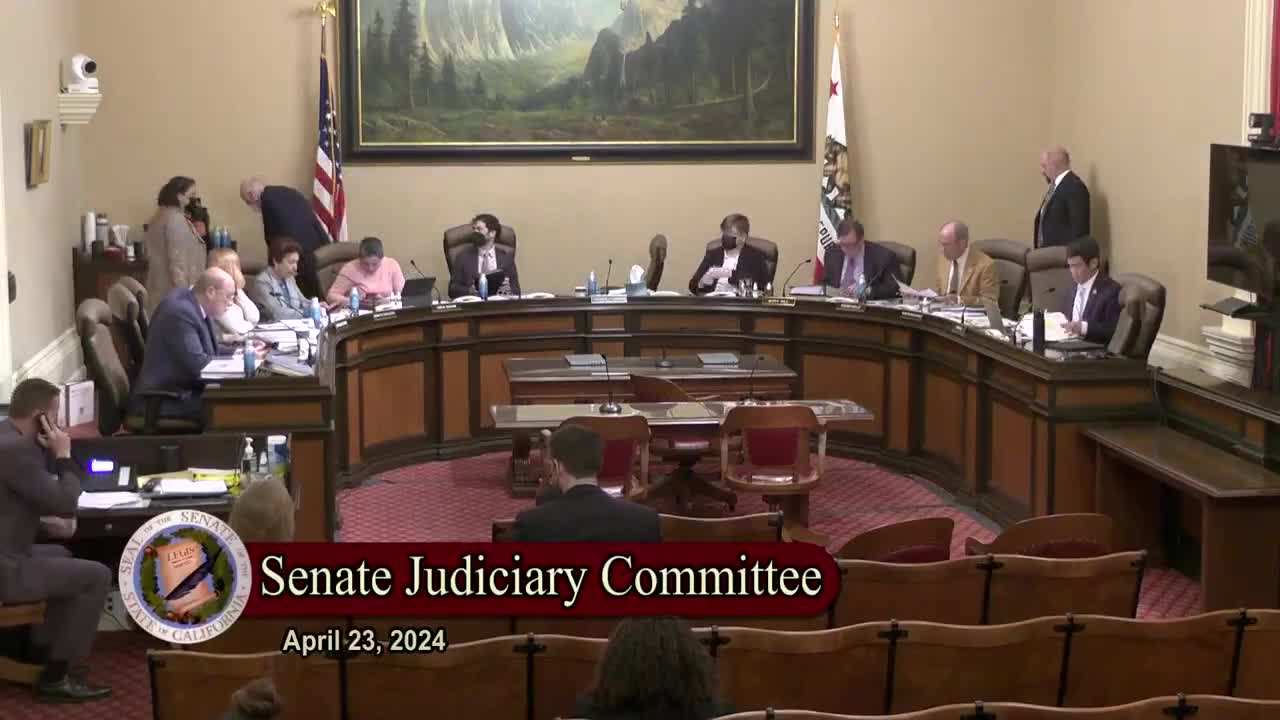 41SEC
Senate Standing Committee on Judiciary
Bill Author