SB 98: Education finance: local control funding formula: enrollment-based funding report.
- Session Year: 2023-2024
- House: Senate
- Latest Version Date: 2024-09-22
Current Status:
Passed
(2024-09-22: Chaptered by Secretary of State. Chapter 442, Statutes of 2024.)
Introduced
In Committee
First Chamber
In Committee
Second Chamber
Enacted
Existing law establishes a public school financing system that requires state funding for county superintendents of schools, school districts, and charter schools to be calculated pursuant to a local control funding formula, as specified, that includes average daily attendance as a component of that calculation for these local educational agencies. Existing law requires the Superintendent of Public Instruction, on or before February 20 of each year, to make a first principal apportionment of funds and, on or before July 2 of each year, to make a 2nd principal apportionment of funds to each local educational agency.
This bill would require the Legislative Analysts Office to submit a report to the Legislature, on or before January 1, 2026, on the effects of changing the pupil count methodology of the local control funding formula from average daily attendance to pupil enrollment. The bill would require the report, at a minimum, to analyze specified information, to the extent data is available, including, among other things, a review of research regarding evidence-based approaches to improving pupil attendance and the extent to which a states method of funding affects pupil attendance rates, the fiscal, programmatic, and administrative impacts of changing the pupil count methodology of the local control funding formula from average daily attendance to pupil enrollment, and the potential impacts on pupil attendance of changing the pupil count methodology of the local control funding formula from average daily attendance to pupil enrollment, as provided. The bill would require the report to include input from relevant stakeholders, as determined by the Legislative Analysts Office. The bill would repeal these provisions on January 1, 2027.
Existing law establishes a public school financing system that requires state funding for county superintendents of schools, school districts, and charter schools to be calculated pursuant to a local control funding formula, as specified, that includes average daily attendance as a component of that calculation for these local educational agencies. Existing law requires the Superintendent of Public Instruction, on or before February 20 of each year, to make a first principal apportionment of funds and, on or before July 2 of each year, to make a 2nd principal apportionment of funds to each local educational agency.
This bill would require the Legislative Analysts Office to submit a report to the Legislature, on or before January 1, 2026, on the effects of changing the pupil count methodology of the local control funding formula from average daily attendance to pupil enrollment. The bill would require the report, at a minimum, to analyze specified information, to the extent data is available, including, among other things, a review of research regarding evidence-based approaches to improving pupil attendance and the extent to which a states method of funding affects pupil attendance rates, and the fiscal, programmatic, and administrative impacts of changing the pupil count methodology of the local control funding formula from average daily attendance to pupil enrollment. enrollment, and the potential impacts on pupil attendance of changing the pupil count methodology of the local control funding formula from average daily attendance to pupil enrollment, as provided. The bill would require the report to include input from relevant stakeholders, as determined by the Legislative Analysts Office. The bill would repeal these provisions on January 1, 2027.
Existing law establishes a public school financing system that requires state funding for county superintendents of schools, school districts, and charter schools to be calculated pursuant to a local control funding formula, as specified, that includes average daily attendance as a component of that calculation for these local educational agencies. Existing law requires the Superintendent of Public Instruction, on or before February 20 of each year, to make a first principal apportionment of funds and, on or before July 2 of each year, to make a 2nd principal apportionment of funds to each local educational agency.
This bill would define average daily membership as the quotient of the aggregate enrollment days for all pupils in a school district, county office of education, or charter school, from transitional kindergarten to grade 12, inclusive, as applicable, divided by the total number of instructional days for the local educational agency in an academic year. The bill would require a local educational agencys average daily membership to be calculated using data from the same fiscal year or years that the local educational agency used to calculate its average daily attendance for purposes of state apportionment, as provided. For any fiscal year before the 202324 fiscal year for which average daily membership data is not available, the bill would require the Superintendent to use a local educational agencys census day enrollment count, as provided. The bill, commencing with the 202324 fiscal year, would require a local educational agency that submits enrollment data to the Superintendent and demonstrates a maintenance of effort to address chronic absenteeism, as provided, to receive as additional education funding the difference between what the local educational agency would have received under the local control funding formula based on average daily membership and what the local educational agency received under the local control funding formula based on average daily attendance for that fiscal year, as provided. The bill would make that maintenance of effort requirement subject to an annual audit and would provide that failure to meet the maintenance of effort requirement shall result in the loss of the additional education funding. The bill would require local educational agencies to use at least 30% of their additional education funding for local educational agency expenditures to address chronic absenteeism and habitual truancy, as provided.This bill would, for purposes of calculating a local educational agencys average daily membership, require the Superintendent to issue directives and guidance on determining the date of withdrawal for a pupil deemed habitually truant. The bill would require the Legislative Analysts Office to submit a report to the Legislature, on or before November 1, 2029, on the implementation of the average daily membership funding in local educational agencies selected by the Legislative Analysts Office, as provided. The bill would expressly state that funds to implement these provisions would be continuously appropriated in the annual Budget Act.This bill would require the Legislative Analysts Office to submit a report to the Legislature, on or before January 1, 2026, on the effects of changing the pupil count methodology of the local control funding formula from average daily attendance to pupil enrollment. The bill would require the report, at a minimum, to analyze specified information, including, among other things, a review of research regarding evidence-based approaches to improving pupil attendance and the extent to which a states method of funding affects pupil attendance rates, and the fiscal, programmatic, and administrative impacts of changing the pupil count methodology of the local control funding formula from average daily attendance to pupil enrollment. The bill would repeal these provisions on January 1, 2027.
Existing law establishes a public school financing system that requires state funding for county superintendents of schools, school districts, and charter schools to be calculated pursuant to a local control funding formula, as specified, that includes average daily attendance as a component of that calculation for these local educational agencies. Existing law requires the Superintendent of Public Instruction, on or before February 20 of each year, to make a first principal apportionment of funds and, on or before July 2 of each year, to make a 2nd principal apportionment of funds to each local educational agency.
This bill would define average daily membership as the quotient of the aggregate enrollment days for all pupils in a school district, county office of education, or charter school, from transitional kindergarten to grade 12, inclusive, as applicable, divided by the total number of instructional days for the local educational agency in an academic year. The bill would require a local educational agencys average daily membership to be calculated using data from the same fiscal year or years that the local educational agency used to calculate its average daily attendance for purposes of state apportionment, as provided. For any fiscal year before the 202324 fiscal year for which average daily membership data is not available, the bill would require the Superintendent to use a local educational agencys census day enrollment count, as provided. The bill, commencing with the 202324 fiscal year, would require a local educational agency that submits enrollment data to the Superintendent and demonstrates a maintenance of effort to address chronic absenteeism, as provided, to receive as additional education funding the difference between what the local educational agency would have received under the local control funding formula based on average daily membership and what the local educational agency received under the local control funding formula based on average daily attendance for that fiscal year, as provided. The bill would make that maintenance of effort requirement subject to an annual audit and would provide that failure to meet the maintenance of effort requirement shall result in the loss of the additional education funding. The bill would require local educational agencies to use at least 30% of their additional education funding for local educational agency expenditures to address chronic absenteeism and habitual truancy, as provided.
This bill would, for purposes of calculating a local educational agencys average daily membership, require the Superintendent to issue directives and guidance on determining the date of withdrawal for a pupil deemed habitually truant. The bill would require the Legislative Analysts Office to submit a report to the Legislature, on or before November 1, 2029, on the implementation of the average daily membership funding in local educational agencies selected by the Legislative Analysts Office, as provided. The bill would expressly state that funds to implement these provisions would be continuously appropriated in the annual Budget Act.
(a)On or before January 1, 2026, the Legislative Analysts Office shall submit a report to the Legislature, in compliance with Section 9795 of the Government Code, on the effects of changing the pupil count methodology of the local control funding formula from average daily attendance to pupil enrollment. The report, at a minimum, shall analyze all of the following, to the extent data is available:
(1)The legislative history of the change from funding excused absences to funding based on average daily attendance pursuant to Senate Bill 727 (Rosenthal), Chapter 855 of the Statutes of 1997, including legislative intent and any indications of inaccurate or inappropriate attendance reporting of excused absences.
(2)The impact on attendance of the change from funding excused absences to funding based on average daily attendance pursuant to Senate Bill 727 (Rosenthal), Chapter 855 of the Statutes of 1997, including statewide attendance, and the equity impact of this change, including attendance by pupil subgroup, and attendance at local educational agencies with high percentages of pupils who are English learners, low-income pupils, and foster youth.
(3)The programmatic changes made by local educational agencies to increase attendance after the switch to funding based on average daily attendance pursuant to Senate Bill 727 (Rosenthal), Chapter 855 of the Statutes of 1997.
(4)The methods used by other states to count pupils for education funding purposes and the ways in which other states create incentives for local educational agencies to encourage pupil attendance.
(5)A review of research regarding both of the following:
(A)Evidence-based approaches to improving pupil attendance.
(B)The extent to which a states method of funding affects pupil attendance rates.
(6)The fiscal, programmatic, and administrative impacts of changing the pupil count methodology of the local control funding formula from average daily attendance to pupil enrollment, including the effects on the state and local educational agencies.
(7)The potential impacts on pupil attendance of changing the pupil count methodology of the local control funding formula from average daily attendance to pupil enrollment, including the effects on the state and local educational agencies, including by pupil grade and pupil subgroups as described in Section 52052.
(8)How a change to enrollment-based funding would affect local educational agencies of varying sizes, locations, and pupil demographics.
(9)Alternative methods of changing the local control funding formula that would have a similar effect on local educational agencies serving a higher percentage of English learners, low-income pupils, and foster youth.
(10)Phase-in approaches to implement the cost of an enrollment-based funding model over several years that do not reduce the funding received by any local educational agency.
(11)If the pupil count methodology for the local control funding formula is changed, whether the state should continue using average daily attendance for the Proposition 98 funding calculation and other education programs, such as lottery funding.
(12)The impacts on Proposition 98 and the minimum funding guarantee set forth in Sections 8 and 8.5 of Article XVI of the California Constitution and its implementing statutes, and the ability of the local control funding formula with a pupil count methodology based on pupil enrollment to fund existing and ongoing public education obligations.
(b)The report required by subdivision (a) shall include input from relevant stakeholders, as determined by the Legislative Analysts Office.
(c)This section shall remain in effect only until January 1, 2027, and as of that date is repealed.
(a)On or before January 1, 2026, the Legislative Analysts Office shall submit a report to the Legislature, in compliance with Section 9795 of the Government Code, on the effects of changing the pupil count methodology of the local control funding formula from average daily attendance to pupil enrollment. The report, at a minimum, shall analyze all of the following: following, to the extent data is available:
(1)The legislative history of the change from funding excused absences to funding based on average daily attendance pursuant to Senate Bill 727 (Rosenthal), Chapter 855 of the Statutes of 1997, including legislative intent and any indications of inaccurate or inappropriate attendance reporting of excused absences.
(2)The impact on attendance of the change from funding excused absences to funding based on average daily attendance pursuant to Senate Bill 727 (Rosenthal), Chapter 855 of the Statutes of 1997, including statewide attendance, and the equity impact of this change, including attendance by pupil subgroup, and attendance at local educational agencies with high percentages of pupils who are English learners, low-income pupils, and foster youth.
(3)The programmatic changes made by local educational agencies to increase attendance after the switch to funding based on average daily attendance pursuant to Senate Bill 727 (Rosenthal), Chapter 855 of the Statutes of 1997.
(1)(4)The methods used by other states to count pupils for education funding purposes and the ways in which other states create incentives for local educational agencies to encourage pupil attendance.
(2)(5)A review of research regarding both of the following:
(A)Evidence-based approaches to improving pupil attendance.
(B)The extent to which a states method of funding affects pupil attendance rates.
(3)(6)The fiscal, programmatic, and administrative impacts of changing the pupil count methodology of the local control funding formula from average daily attendance to pupil enrollment, including the effects on the state and local educational agencies.
(7)The potential impacts on pupil attendance of changing the pupil count methodology of the local control funding formula from average daily attendance to pupil enrollment, including the effects on the state and local educational agencies, including by pupil grade and pupil subgroups as described in Section 52052.
(4)(8)How a change to enrollment-based funding would affect local educational agencies of varying sizes, locations, and pupil demographics.
(5)(9)Alternative methods of changing the local control funding formula that would have a similar effect on local educational agencies serving a higher percentage of English learners, low-income pupils, and foster youth.
(6)(10)Phase-in approaches to implement the cost of an enrollment-based funding model over several years. years that do not reduce the funding received by any local educational agency.
(7)(11)If the pupil count methodology for the local control funding formula is changed, whether the state should continue using average daily attendance for the Proposition 98 funding calculation and other education programs, such as special education and lottery funding.
(12)The impacts on Proposition 98 and the minimum funding guarantee set forth in Sections 8 and 8.5 of Article XVI of the California Constitution and its implementing statutes, and the ability of the local control funding formula with a pupil count methodology based on pupil enrollment to fund existing and ongoing public education obligations.
(b)The report required by subdivision (a) shall include input from relevant stakeholders, as determined by the Legislative Analysts Office.
(b)(c)This section shall remain in effect only until January 1, 2027, and as of that date is repealed.
(a)On or before January 1, 2026, the Legislative Analysts Office shall submit a report to the Legislature, in compliance with Section 9795 of the Government Code, on the effects of changing the pupil count methodology of the local control funding formula from average daily attendance to pupil enrollment. The report, at a minimum, shall analyze all of the following:
(1)The methods used by other states to count pupils for education funding purposes and the ways in which other states create incentives for local educational agencies to encourage pupil attendance.
(2)A review of research regarding both of the following:
(A)Evidence-based approaches to improving pupil attendance.
(B)The extent to which a states method of funding affects pupil attendance rates.
(3)The fiscal, programmatic, and administrative impacts of changing the pupil count methodology of the local control funding formula from average daily attendance to pupil enrollment, including the effects on the state and local educational agencies.
(4)How a change to enrollment-based funding would affect local educational agencies of varying sizes, locations, and pupil demographics.
(5)Alternative methods of changing the local control funding formula that would have a similar effect on local educational agencies serving a higher percentage of English learners, low-income pupils, and foster youth.
(6)Phase-in approaches to implement the cost of an enrollment-based funding model over several years.
(7)If the pupil count methodology for the local control funding formula is changed, whether the state should continue using average daily attendance for the Proposition 98 funding calculation and other education programs, such as special education and lottery funding.
(b)This section shall remain in effect only until January 1, 2027, and as of that date is repealed.
SECTION 1.Section 41338 is added to the Education Code, to read:41338.(a)For purposes of this section, the following terms have the following meanings: (1)Average daily membership means the quotient of the aggregate enrollment days for all pupils in a local educational agency, from transitional kindergarten to grade 12, inclusive, as applicable, divided by the total number of instructional days for the local educational agency in an academic year. A local educational agencys average daily membership shall be calculated using data from the same fiscal year or years that the local educational agency used to calculate its average daily attendance for purposes of state apportionment under Sections 2574 and 42238.02, as applicable. For any fiscal year before the 202324 fiscal year for which average daily membership data is not available, the Superintendent shall use a local educational agencys census day enrollment count, as certified in the California Longitudinal Pupil Achievement Data System. (2)Local educational agency means a school district, county office of education, or charter school. (b)Commencing with the 202324 fiscal year, and each fiscal year thereafter, a local educational agency that complies with the requirements of paragraph (1) of subdivision (c) shall receive as additional education funding, in addition to the amount apportioned pursuant to Section 2574 or 42238.02, as applicable, an amount equal to the difference between what the local educational agency would have received under the local control funding formula if the local funding formula were based on average daily membership instead of average daily attendance, and what the local educational agency received under the local control funding formula based on average daily attendance for that fiscal year. For the purpose of this calculation, the Superintendent shall apply the funding difference to the local control funding formula base, supplemental, and concentration grants for each local educational agency pursuant to Sections 2574 and 42238.02, as applicable. In no case shall a local educational agencys additional education funding be less than zero dollars ($0). (c)In order to be eligible for additional education funding under this section, a local educational agency shall comply with both of the following requirements: (1)Submit to the Superintendent by January 15 the unduplicated primary and short-term enrollments for their first term enrollment totals. Local educational agencies shall submit final enrollment data for the entire academic year as part of end-of-year submissions under timeframes and procedures established by the Superintendent. The Superintendent shall use the second data submission to settle-up final prior year funding in the following fiscal year. (2)Demonstrate a maintenance of effort to address chronic absenteeism and habitual truancy. To fulfill this requirement, a local educational agency shall maintain at least the same per-pupil spending level on staff who address chronic absenteeism and habitual truancy as the local educational agency did in the 201920 school year. The requirement of this paragraph shall be subject to the audit required pursuant to Section 41020. Failure to meet this requirement shall result in the loss of additional funding provided pursuant to this section. (d)At least 30 percent of the funds allocated pursuant to this section shall be used for purposes of local educational agency expenditures to address chronic absenteeism and habitual truancy by providing services and supports that have been determined to improve school attendance, or addressing the root causes that contribute to pupils being chronically absent or habitually truant. (e)Consistent with the requirements of Section 48240, local educational agencies shall continue to implement a system to accurately track pupil attendance in order to raise the awareness of the effects of truancy and chronic absenteeism, identify and address factors contributing to habitual truancy and chronic absenteeism, and ensure that pupils with attendance problems are identified as early as possible to provide applicable support services and interventions. (f)The Superintendent shall, for purposes of calculating a local educational agencys average daily membership pursuant to paragraph (1) of subdivision (a), issue directives and guidance on determining the date of withdrawal for a pupil deemed habitually truant pursuant to Section 48262.(g)Nothing in this section shall supersede or otherwise modify Section 48240, 48260, 52060, or 60901. (h)On or before November 1, 2029, the Legislative Analysts Office shall submit a report to the Legislature on the implementation of the funding provisions of this section that includes information from local educational agencies selected by the Legislative Analysts Office. The local educational agencies selected for this analysis shall provide the Legislative Analysts Office any information necessary, including, but not limited to, expenditure data, staffing information, and data on truancy and chronic absenteeism that is disaggregated by school and pupil subgroup.(i)Funds to implement this section shall be continuously appropriated in the annual Budget Act.(a)For purposes of this section, the following terms have the following meanings:
(1)Average daily membership means the quotient of the aggregate enrollment days for all pupils in a local educational agency, from transitional kindergarten to grade 12, inclusive, as applicable, divided by the total number of instructional days for the local educational agency in an academic year. A local educational agencys average daily membership shall be calculated using data from the same fiscal year or years that the local educational agency used to calculate its average daily attendance for purposes of state apportionment under Sections 2574 and 42238.02, as applicable. For any fiscal year before the 202324 fiscal year for which average daily membership data is not available, the Superintendent shall use a local educational agencys census day enrollment count, as certified in the California Longitudinal Pupil Achievement Data System.
(2)Local educational agency means a school district, county office of education, or charter school.
(b)Commencing with the 202324 fiscal year, and each fiscal year thereafter, a local educational agency that complies with the requirements of paragraph (1) of subdivision (c) shall receive as additional education funding, in addition to the amount apportioned pursuant to Section 2574 or 42238.02, as applicable, an amount equal to the difference between what the local educational agency would have received under the local control funding formula if the local funding formula were based on average daily membership instead of average daily attendance, and what the local educational agency received under the local control funding formula based on average daily attendance for that fiscal year. For the purpose of this calculation, the Superintendent shall apply the funding difference to the local control funding formula base, supplemental, and concentration grants for each local educational agency pursuant to Sections 2574 and 42238.02, as applicable. In no case shall a local educational agencys additional education funding be less than zero dollars ($0).
(c)In order to be eligible for additional education funding under this section, a local educational agency shall comply with both of the following requirements:
(1)Submit to the Superintendent by January 15 the unduplicated primary and short-term enrollments for their first term enrollment totals. Local educational agencies shall submit final enrollment data for the entire academic year as part of end-of-year submissions under timeframes and procedures established by the Superintendent. The Superintendent shall use the second data submission to settle-up final prior year funding in the following fiscal year.
(2)Demonstrate a maintenance of effort to address chronic absenteeism and habitual truancy. To fulfill this requirement, a local educational agency shall maintain at least the same per-pupil spending level on staff who address chronic absenteeism and habitual truancy as the local educational agency did in the 201920 school year. The requirement of this paragraph shall be subject to the audit required pursuant to Section 41020. Failure to meet this requirement shall result in the loss of additional funding provided pursuant to this section.
(d)At least 30 percent of the funds allocated pursuant to this section shall be used for purposes of local educational agency expenditures to address chronic absenteeism and habitual truancy by providing services and supports that have been determined to improve school attendance, or addressing the root causes that contribute to pupils being chronically absent or habitually truant.
(e)Consistent with the requirements of Section 48240, local educational agencies shall continue to implement a system to accurately track pupil attendance in order to raise the awareness of the effects of truancy and chronic absenteeism, identify and address factors contributing to habitual truancy and chronic absenteeism, and ensure that pupils with attendance problems are identified as early as possible to provide applicable support services and interventions.
(f)The Superintendent shall, for purposes of calculating a local educational agencys average daily membership pursuant to paragraph (1) of subdivision (a), issue directives and guidance on determining the date of withdrawal for a pupil deemed habitually truant pursuant to Section 48262.
(g)Nothing in this section shall supersede or otherwise modify Section 48240, 48260, 52060, or 60901.
(h)On or before November 1, 2029, the Legislative Analysts Office shall submit a report to the Legislature on the implementation of the funding provisions of this section that includes information from local educational agencies selected by the Legislative Analysts Office. The local educational agencies selected for this analysis shall provide the Legislative Analysts Office any information necessary, including, but not limited to, expenditure data, staffing information, and data on truancy and chronic absenteeism that is disaggregated by school and pupil subgroup.
(i)Funds to implement this section shall be continuously appropriated in the annual Budget Act.
|
Date
|
Status
|
|---|---|
| Sep 22, 2024 | Chaptered by Secretary of State. Chapter 442, Statutes of 2024. |
| Sep 22, 2024 | Approved by the Governor. |
| Sep 3, 2024 | Enrolled and presented to the Governor at 3 p.m. |
| Aug 27, 2024 | Assembly amendments concurred in. (Ayes 40. Noes 0. Page 5504.) Ordered to engrossing and enrolling. |
| Aug 26, 2024 | In Senate. Concurrence in Assembly amendments pending. |
| Aug 26, 2024 | Read third time. Passed. (Ayes 74. Noes 1. Page 6514.) Ordered to the Senate. |
| Aug 19, 2024 | Read second time. Ordered to third reading. |
| Aug 15, 2024 | From committee: Do pass. (Ayes 14. Noes 0.) (August 15). |
| Aug 7, 2024 | August 7 set for first hearing. Placed on suspense file. |
| Jun 17, 2024 | Read second time and amended. Re-referred to Com. on APPR. |
| Jun 13, 2024 | From committee: Do pass as amended and re-refer to Com. on APPR. with recommendation: To consent calendar. (Ayes 7. Noes 0.) (June 12). |
| May 14, 2024 | From committee with author's amendments. Read second time and amended. Re-referred to Com. on ED. |
| Jul 10, 2023 | July 12 set for first hearing canceled at the request of author. |
| Jun 1, 2023 | Referred to Com. on ED. |
| May 25, 2023 | In Assembly. Read first time. Held at Desk. |
| May 24, 2023 | Read third time. Passed. (Ayes 35. Noes 3. Page 1251.) Ordered to the Assembly. |
| May 18, 2023 | Read second time. Ordered to third reading. |
| May 18, 2023 | From committee: Do pass. (Ayes 6. Noes 1. Page 1160.) (May 18). |
| May 12, 2023 | Set for hearing May 18. |
| Apr 10, 2023 | April 10 hearing: Placed on APPR suspense file. |
| Mar 28, 2023 | Set for hearing April 10. |
| Mar 22, 2023 | From committee: Do pass and re-refer to Com. on APPR. (Ayes 6. Noes 1. Page 450.) (March 22). Re-referred to Com. on APPR. |
| Mar 2, 2023 | Set for hearing March 22. |
| Jan 25, 2023 | Referred to Com. on ED. |
| Jan 19, 2023 | From printer. May be acted upon on or after February 18. |
| Jan 18, 2023 | Introduced. Read first time. To Com. on RLS. for assignment. To print. |
|
Date
|
Description
|
Location
|
Votes
|
|
|---|---|---|---|---|
| Aug 27, 2024 | Unfinished Business SB98 Portantino Concurrence | Senate Floor |
Passed |
|
| Aug 26, 2024 | SB 98 Portantino Senate Third Reading By Addis | Assembly Floor |
Passed |
|
| Aug 15, 2024 | Do pass. | Assembly Standing Committee on Appropriations |
Passed |
|
| Jun 12, 2024 | Do pass as amended, and be re-referred to the Committee on [Appropriations] with recommendation: To Consent Calendar | Assembly Standing Committee on Education |
Passed |
|
| May 24, 2023 | Senate 3rd Reading SB98 Portantino | Senate Floor |
Passed |
|
| May 18, 2023 | Do pass | Senate Standing Committee on Appropriations |
Passed |
|
| Apr 10, 2023 | Placed on suspense file | Senate Standing Committee on Appropriations |
Passed |
|
| Mar 22, 2023 | Do pass, but first be re-referred to the Committee on [Appropriations] | Senate Standing Committee on Education |
Passed |
This list shows positions taken on this bill by organizations on the date displayed, which is linked to the original source.
Positions by individuals are not included.
|
Organization
|
Position
|
Date
|
|---|---|---|
| Alliance – ExpandLA | ** Support | |
| Alliance for A Better Community | ** Support | |
| American Federation of State, County, and Municipal Employees | ** Support | |
| Associated Administrators of Los Angeles | ** Support | |
| Boys and Girls Club of Carson | ** Support | |
| California Association Of School Business Officials | ** Against | |
| California Charter Schools Association | ** Support | |
| California Federation of Teachers, AFL-CIO | ** Support | |
| California Labor Federation | ** Support | |
| California School Boards Association | ** Against | |
| California School Employees Association | ** Support | |
| California Teamsters Public Affairs Council | ** Support | |
| Coalition For Human Immigrant Rights | ** Support | |
| Communities in Schools of Los Angeles | ** Support | |
| Community Coalition | ** Support | |
| Disability Rights California | ** Support | |
| Diversity in Leadership Institute | ** Support | |
| EduCare Foundation | ** Support | |
| Educators for Excellence Los Angeles | ** Support | |
| Generation Up | ** Support | |
| Kid City Hope Place | ** Support | |
| League Of Women Voters Of California | ** Support | |
| Los Angeles Area Chamber Of Commerce | ** Support | |
| Los Angeles County Democratic Party | ** Support | |
| Los Angeles Unified School District | ** Support | |
| Para Los Niños | ** Support | |
| Parent Engagement Academy | ** Support | |
| Parents Supporting Teachers | ** Support | |
| San Diego Unified School District | ** Support | |
| Service Employees International Union, California | ** Support | |
| State Superintendent of Public Instruction Tony Thurmond | ** Support |
SENATE RULES COMMITTEE Office of Senate Floor Analyses (916) 651-1520 Fax: (916) 327-4478 | SB 98 |
UNFINISHED BUSINESS
Bill No: SB 98
Author: Portantino (D)
Amended: 6/17/24
Vote: 21
SENATE EDUCATION COMMITTEE: 6-1, 3/22/23
AYES: Newman, Ochoa Bogh, Cortese, Glazer, McGuire, Smallwood-Cuevas
NOES: Wilk
SENATE APPROPRIATIONS COMMITTEE: 6-1, 5/18/23
AYES: Portantino, Ashby, Bradford, Seyarto, Wahab, Wiener
NOES: Jones
SENATE FLOOR: 35-3, 5/24/23
AYES: Allen, Alvarado-Gil, Archuleta, Ashby, Atkins, Becker, Blakespear, Bradford, Caballero, Cortese, Dahle, Dodd, Durazo, Eggman, Glazer, Gonzalez, Grove, Hurtado, Laird, McGuire, Menjivar, Min, Newman, Ochoa Bogh, Padilla, Portantino, Roth, Rubio, Seyarto, Skinner, Smallwood-Cuevas, Stern, Umberg, Wahab, Wiener
NOES: Jones, Niello, Wilk
NO VOTE RECORDED: Limón, Nguyen
ASSEMBLY FLOOR: 74-1, 8/26/24 - See last page for vote
SUBJECT: Education finance: local control funding formula: enrollment-based funding report
SOURCE: State Superintendent of Public Instruction Tony Thurmond
Los Angeles Unified School District
California School Employees Association
DIGEST:
This bill requires the Legislative Analyst's Office (LAO), on or before January 1, 2026, to submit a report to the Legislature on the effects of changing the pupil count methodology of the Local Control Funding Formula (LCFF) from average daily attendance (ADA) to pupil enrollment.
Assembly Amendments
strike all changes to the existing LCFF methodology and, instead, require the LAO to submit a report on the effects of changing the LCFF pupil count methodology from ADA to pupil enrollment.
ANALYSIS:
Existing law:
- Provides, as approved by the voters in November 1988, Proposition 98 which amended Section 8 of Article XVI of the California Constitution. Specifically, Proposition 98—commonly referred to as the minimum guarantee—added constitutional provisions setting forth rules for calculating a minimum annual funding level for K–14 education. The state meets the guarantee using both state General Fund and local property tax revenue.
- Establishes the LCFF. The LCFF establishes per-pupil funding targets, with adjustments for different student grade levels, and includes supplemental funding for LEAs serving students who are low-income, English learners, or foster youth. The LCFF replaced almost all sources of state funding for LEAs, including most categorical programs, with general purpose funding including few spending restrictions. The largest component of the LCFF is a base grant generated by each student. Current law establishes base grant target amounts for the 2013-14 fiscal year, which are increased each year by the Implicit Price Deflator for State and Local Government Purchases of Goods and Services for the United States.
The base grant target rates for each grade span for the 2022-23 fiscal year are as follows:
- $10,119 for grades K-3 (includes a 10.4 percent adjustment for class size reduction);
- $9,304 for grades 4-6;
- $9,580 for grades 7-8;
- $11,391 for grades 9-12 (includes a 2.6 percent adjustment for career technical education).
For each disadvantaged student (low-income, English learner, or foster youth), a district receives a supplemental grant equal to 20 percent of its adjusted base grant. A district serving a student population with more than 55 percent of disadvantaged students receives concentration grant funding equal to 50 percent of the adjusted base grant for each disadvantaged student above the 55 percent threshold.
The LCFF funds LEAs based on their ADA. Total ADA is defined as the total days of student attendance divided by the total days of instruction.
This bill requires the Legislative Analyst's Office (LAO), on or before January 1, 2026, to submit a report to the Legislature on the effects of changing the pupil count methodology of the LCFF from ADA to pupil enrollment.
Comments
- Need for the bill. According to the author, “California is one of six states that does not consider enrollment figures for determining state aid to school districts. Districts plan their budgets and expend funds based on enrollment but receive funds based on attendance. For example, if a school district enrolls 100 students but their attendance rate is 95%, the school district must still prepare as if 100 students will attend class every day.
“While school districts are morally and legally required to comply with compulsory education laws and conduct outreach to re-engage students who are chronically absent or habitually truant, California funds schools based on average daily attendance (ADA). As such, school districts do not receive funding if a student does not attend school on any given day despite having fixed educational, programmatic and operational costs.”
- Student enrollment and attendance in California are counted in varying ways and for varying purposes. Currently, LEAs collect data on the number of students they serve each year in three basic ways—census day enrollment counts, cumulative enrollment, and ADA.
Census day enrollment counts are taken on the first Wednesday in October (known as Census Day) to establish a baseline count of the students attending a particular school along with information such as race/ethnicity, whether the students are English learners, how many qualify for free and reduced-price meals, and more. Cumulative enrollment is collected at the end of the year and is used to measure chronic absenteeism and suspension and expulsion rates for the State School Dashboard. Finally, ADA is used to apportion funding for schools and is based on the days of school attended by students, not the number of students enrolled.
- California is one of a handful of states that allocates funding to LEAs based on attendance. While all states use an enrollment number of some kind to allocate revenue to LEAs on a per-pupil basis, California is one of only six states that use ADA. California established its ADA system in 1911, with the most notable change occurring in 1998 when the state stopped funding LEAs for excused student absences. The most common method used by other states is average daily membership, with LEAs funded based on an enrollment count averaged across the school year. Seat counts, where students are counted on a specified census day, days, or period, are also commonly used.
- Existing law provides attendance exceptions for districts in declining enrollment and for emergencies. While LEAs in California are generally funded based solely on attendance, there are exceptions in existing law. Further, the Legislature and Governor have taken recent actions through the state budget process to hold LEAs fiscally harmless for COVID-19 related absences.
For school districts with declining enrollment, existing law provides up to a three-year reprieve from ADA loss by using the greater of the ADA in the current year, prior year, or the average of the prior three years for funding purposes. This reprieve is an acknowledgment that school districts must make program and staffing decisions before data on enrollment and available state funding is available. Additionally, the state provides a waiver process (via Form J-13A) so that LEAs are not penalized for ADA losses due to a material decrease, school closure, or lost/destroyed records. In response to COVID-19, the 2020-21 Budget Act included a hold-harmless clause for calculating LCFF funding for the 2020-21 year by allowing 2020-21 funding to be based on 2019-20 ADA rather than 2020-21 ADA. Subsequent legislation amended the Budget Act to provide 2020-21 growth funding for LEAs that anticipated enrollment or ADA growth. Further, the 2022-23 Budget Act amended the LCFF calculation to consider the greater of a school district’s current year, prior year, or the average of three prior years’ ADA.
- Recent report on funding enrollment versus attendance identifies important tradeoffs and the need to continue to encourage student attendance and engagement. A March 2022 report by Policy Analysis for California Education (PACE), “Student Count Options for School Funding: Trade-offs and Policy Alternatives for California”, observes that changing the LCFF student count methodology creates tradeoffs and should be analyzed with other alternatives for increasing funding equity. Specifically, attendance-based funding incentivizes LEAs to reach out to families to ensure students show up to school. This incentive may be the reason why California ranks among the top 10 states nationally in student attendance, with a pre-COVID average of over 95 percent. However, LEAs serving more English-learner, low-income, and foster and homeless students tend to have lower attendance rates for multiple reasons, which results in additional fiscal penalties under the existing system.
After exploring California’s existing student count system, historical attendance figures, and various policy considerations, the report concludes the following:
“The method California uses to count students for funding purposes is an important decision that drives both resources and behaviors. California leaders should examine their policy goals related to fiscal stability, equity, attendance, and more in order to determine whether the current ADA-based funding system is helping to meet those goals. It is clear to us that a new count method, by itself, cannot achieve all goals. Switching from attendance to enrollment may help districts achieve greater fiscal stability, and it may help redistribute resources to school districts with greater student needs. It could also offer districts more flexibility around how to serve students instructionally—especially students who might learn better through a competency-based model. On the other hand, the current system includes a fiscal incentive that, most agree, encourages higher attendance, even if that attendance definition is relatively weak. If the state dispensed with this incentive, it would likely need to find other ways to drive positive practices related to student attendance and engagement.”
FISCAL EFFECT: Appropriation: No Fiscal Com.: No Local: No
According to the Assembly Appropriations Committee:
1) One-time costs to LAO in the low-hundreds-of-thousands of dollars to complete the report. While this bill would not require additional General Fund, as the LAO is funded within the Legislature's budget, it would require about 60% of an analyst's time over a calendar year to complete the report, in addition to other administrative costs. (According to LAO, its K-12 unit consists of four analysts.) The LAO notes this bill would result in reduced capacity for LAO to complete other requests or required reports during the time it takes to complete the report required by this bill, as LAO's budget is subject to the Legislature's constitutional spending cap.
2) Likely General Fund cost pressures to the California Department of Education (CDE) to provide information to LAO. Specifically, the bill requires LAO to analyze the impact of attendance legislation from 1997. LAO indicates it would request CDE share any data or files it has regarding attendance during that period.
SUPPORT: (Verified 8/27/24)
State Superintendent of Public Instruction Tony Thurmond (co-source)
Los Angeles Unified School District (co-source)
California School Employees Association (co-source)
Alliance for a Better Community
American Federation of State, County, and Municipal Employees
California Charter Schools Association
California Federation of Teachers AFL-CIO
California Labor Federation
California Teamsters Public Affairs Council
Disability Rights California
Generation Up
League of Women Voters of California
Los Angeles Area Chamber of Commerce
Los Angeles County Democratic Party
San Diego Unified School District
Service Employees International Union, California
OPPOSITION: (Verified 8/27/24)
None received
ASSEMBLY FLOOR: 74-1, 8/26/24
AYES: Addis, Aguiar-Curry, Alanis, Alvarez, Arambula, Bains, Bauer-Kahan, Bennett, Berman, Boerner, Bonta, Bryan, Calderon, Juan Carrillo, Wendy Carrillo, Chen, Connolly, Megan Dahle, Davies, Dixon, Flora, Mike Fong, Friedman, Gabriel, Gallagher, Garcia, Gipson, Grayson, Haney, Hart, Holden, Hoover, Irwin, Jackson, Jones-Sawyer, Kalra, Lackey, Lee, Low, Lowenthal, Maienschein, Mathis, McCarty, McKinnor, Muratsuchi, Stephanie Nguyen, Pacheco, Papan, Jim Patterson, Pellerin, Petrie-Norris, Quirk-Silva, Ramos, Rendon, Reyes, Luz Rivas, Rodriguez, Blanca Rubio, Santiago, Schiavo, Soria, Ta, Ting, Valencia, Villapudua, Waldron, Wallis, Ward, Weber, Wicks, Wilson, Wood, Zbur, Robert Rivas
NOES: Essayli
NO VOTE RECORDED: Cervantes, Ortega, Joe Patterson, Sanchez
Prepared by: Ian Johnson / ED. / (916) 651-4105
8/27/24 12:22:59
**** END ****
SENATE THIRD READING
STR Bill Id:SB 98
Author:(Portantino)
As Amended Ver:June 17, 2024
Majority vote
SUMMARY
Requires, on or before January 1, 2026, the Legislative Analyst's Office (LAO) to submit a report to the Legislature on the effects of changing the pupil count methodology of the Local Control Funding Formula (LCFF) from average daily attendance (ADA) to pupil enrollment.
Major Provisions
- Requires the report, at a minimum, to analyze the following, to the extent data is available:
- The legislative history, and the impact on attendance of the change from funding excused absences to funding based on ADA;
- The programmatic changes made by local educational agencies (LEAs) to increase attendance after the switch to funding based on ADA;
- The methods used by other states to count pupils for education funding purposes and the ways in which other states create incentives for LEAs to encourage pupil attendance;
- A review of relevant research;
- The fiscal, programmatic, and administrative impacts of changing the pupil count methodology of the LCFF from ADA to pupil enrollment, including the effects on the state and LEAs;
- The potential impacts on pupil attendance of changing the pupil count methodology of the LCFF from ADA to pupil enrollment;
- How a change to enrollment-based funding would affect LEAs of varying sizes, locations, and pupil demographics;
- Alternative methods of changing the LCFF that would have a similar effect on local educational agencies serving a higher percentage of English learners, low-income pupils, and foster youth;
- Phase-in approaches to implement the cost of an enrollment-based funding model over several years that do not reduce the funding received by any LEA; and
- If the pupil count methodology for the LCFF is changed, whether the state should continue using average daily attendance for the Proposition 98 funding calculation and other education programs, such as lottery funding.
COMMENTS
Student enrollment and attendance data collection. Currently, LEAs collect data on the number of students they serve each year in three basic ways—census day enrollment counts, cumulative enrollment, and ADA. Census day enrollment counts are taken on the first Wednesday in October (known as Census Day) to establish a baseline count of the students attending a particular school along with information such as race/ethnicity, whether the students are English learners, how many qualify for free- and reduced-price meals, and more. Cumulative enrollment is collected at the end of the year and is used to measure chronic absenteeism, suspension, and expulsion rates for the California School Dashboard. Finally, ADA is used to apportion funding for schools and is based on the days of school attended by students, not the number of students enrolled.
Excused absences. California's compulsory education law requires every child between the ages of six and 18 to attend school full-time and their parents and legal guardians are responsible for ensuring that they attend school. A student who is absent from school without a valid excuse on any day or is tardy for more than 30 minutes, or any combination thereof, for three days in a school year is considered a truant. Current law establishes excused absences for a number of reasons, including illness, quarantine, medical appointments, attending a funeral, jury duty, a court appearance, observation of a religious holiday or ceremony, spending time with an immediate family member who is an active duty member of the military. However, the state does not provide funding to LEAs for excused absences. Since 1997, California has based apportionment on attendance rather than enrollment. Prior to the passage of SB 727 (Rosenthal), Chapter 855, Statutes of 1997, California provided funding for excused absences based on a note from the parent documenting the absence as a valid reason, including illness, doctor's appointments, and funerals. Regrettably, the law was implemented differently across school districts, leading to significant ranges in rates of excused and unexcused absences. At the time, there were numerous reports of abuses of the system. SB 727 ended the state practice of reimbursing districts for days that students are absent from school for excused reasons. Since then attendance has improved, with the exception of during the COVID-19 pandemic.
Local Control Funding Formula. The LCFF was established in the 2013-14 fiscal year to provide a more equitable distribution of funding among school districts, charter schools, and COEs. The three main components of the LCFF for school districts and charter schools are the base, supplemental, and concentration grants. The amount of the base grant is different for four different grade spans and receives a statutory annual cost of living adjustment (COLA). The base grant for each school district and charter school, including the grade span adjustment, is multiplied by units of ADA. For school districts, funded ADA is equal to the greater of the current year ADA, the prior year ADA, or the average ADA of the three most recent prior fiscal years.
Moving from ADA to enrollment based funding has the potential to require a redistribution of Proposition 98 funding. By allocating LCFF funds based on enrollment instead of attendance, the overall costs of the LCFF could increase by an estimated $3.6 billion, according to the Senate Appropriations Committee. This potential increase is due to the fact that the vast majority of LEAs have enrollment that is higher than attendance, with rare exceptions. However, if the annual funding level for education (the Proposition 98 guarantee) was unchanged, there would ultimately be a reallocation of existing education resources—from LEAs with average or better ADA (95% or more of enrollment) to LEAs with below average ADA (less than 95% of enrollment). While most LEAs with below average attendance tend to serve higher proportions of students that are ELs, low-income, or foster youth, there are several exceptions (e.g., LEAs serving a low proportion of student needs with below average attendance). LEAs that have worked to improve and successfully increase their attendance rates have expressed concerns that their efforts will result in a lower increase in funding than other districts under this proposal and will be required to spend 30% of their increase in funding on attendance-related activities.
Chronic absenteeism has risen significantly in recent years. Chronic absence refers to missing so much school for any reason that a student is academically at risk. Chronic absence is defined as missing 10% or more of school for any reason, including excused absences, unexcused absences or truancy, and suspensions. Statewide chronic absence rates increased from 12% to a high of 30% in 2021-22 during the COVID-19 pandemic. In 2022-23, the overall chronic absence rate fell to 25%. Although this represents a decrease from the prior year, the rate is still more than double that of the rate prior to the pandemic.
California is one of a minority of states that allocates funding to LEAs based on attendance. While most states use a locally established enrollment data figure to allocate revenue to LEAs on a per-pupil basis, California is one of six states that use ADA. California established its ADA system in 1911, with the most notable change occurring in 1998 when the state stopped funding LEAs for excused student absences. The most common method used by other states is average daily membership, with LEAs funded based on an enrollment count averaged across the school year. Seat counts, where students are counted on a specified census day, days, or period, are also commonly used.
Concerns that attendance would decline under an enrollment-based funding model. The LCFF was adopted as a progressive funding system to increase equity by providing additional funding (supplemental and concentration grants) to LEAs serving larger portions of EL, low-income, and foster youth students. Supporters of moving to enrollment based funding argue that by redistributing LCFF funds to LEAs with lower than average attendance, this will further increase the equity of the LCFF across the state. However, as mentioned previously, if there is not an increase in the Proposition 98 Guarantee or an additional apportionment for this purpose, this will result in winners and losers – some school districts and charter schools would see an increase in their apportionment, while others would see a decrease. Further, a move to enrollment-based funding would remove the fiscal incentive for school districts and charter schools to do everything in their power to increase student attendance. Without this fiscal incentive, there is serious concern that existing rates of chronic absenteeism would continue to grow, particularly for student groups with the most challenges. This will likely lead to negative student outcomes and a widening of achievement gaps.
According to the Author
"California is one of six states that does not consider enrollment figures for determining state aid to school districts. Districts plan their budgets and expend funds based on enrollment but receive funds based on attendance. For example, if a school district enrolls 100 students but their attendance rate is 95%, the school district must still prepare as if 100 students will attend class every day.
While school districts are morally and legally required to comply with compulsory education laws and conduct outreach to re-engage students who are chronically absent or habitually truant, California funds schools based on average daily attendance (ADA). As such, school districts do not receive funding if a student does not attend school on any given day despite having fixed educational, programmatic and operational costs."
Arguments in Support
The League of Women Voters of California writes, "The League of Women Voters of California supports equitable access to quality education, the development of a school finance system that enables orderly, timely, and effective budgeting, and a state finance system that provides for equitable distribution of general-purpose funds based on student population.
The study would help determine whether an enrollment instead of an attendance-based system would effectively redistribute resources to school districts with greater student needs. It will provide evidence to reallocate funding to enable school districts to better assist chronically absent and habitually truant students by explicitly using services and support mechanisms that have been determined to improve conditions for these students."
Arguments in Opposition
None on file.
FISCAL COMMENTS
According to the Assembly Appropriations Committee:
- One-time costs to LAO in the low-hundreds-of-thousands of dollars to complete the report. While this bill would not require additional General Fund, as the LAO is funded within the Legislature's budget, it would require about 60% of an analyst's time over a calendar year to complete the report, in addition to other administrative costs. (According to LAO, its K-12 unit consists of four analysts.) The LAO notes this bill would result in reduced capacity for LAO to complete other requests or required reports during the time it takes to complete the report required by this bill, as LAO's budget is subject to the Legislature's constitutional spending cap.
- Likely General Fund cost pressures to the California Department of Education (CDE) to provide information to LAO. Specifically, the bill requires LAO to analyze the impact of attendance legislation from 1997. LAO indicates it would request CDE share any data or files it has regarding attendance during that period.
VOTES
SENATE FLOOR: 35-3-2
YES: Allen, Alvarado-Gil, Archuleta, Ashby, Atkins, Becker, Blakespear, Bradford, Caballero, Cortese, Dahle, Dodd, Durazo, Eggman, Glazer, Gonzalez, Grove, Hurtado, Laird, McGuire, Menjivar, Min, Newman, Ochoa Bogh, Padilla, Portantino, Roth, Rubio, Seyarto, Skinner, Smallwood-Cuevas, Stern, Umberg, Wahab, Wiener
NO: Jones, Niello, Wilk
ABS, ABST OR NV: Limón, Nguyen
ASM EDUCATION: 7-0-0
YES: Muratsuchi, Addis, Alvarez, Bonta, Flora, Hoover, McCarty
ASM APPROPRIATIONS: 14-0-1
YES: Wicks, Sanchez, Arambula, Bryan, Calderon, Wendy Carrillo, Dixon, Mike Fong, Grayson, Haney, Hart, Pellerin, Ta, Villapudua
ABS, ABST OR NV: Jim Patterson
UPDATED
VERSION: June 17, 2024
CONSULTANT: Marguerite Ries / ED. / (916) 319-2087 FN: 0003936
Date of Hearing: August 7, 2024
ASSEMBLY COMMITTEE ON APPROPRIATIONS
Buffy Wicks, Chair
SBPCA Bill Id:SB 98
Author:(Portantino) – As Amended Ver:June 17, 2024
Policy Committee: | Education | Vote: | 7 - 0 |
|
| ||
|
|
Urgency: No State Mandated Local Program: No Reimbursable: No
SUMMARY:
This bill requires, by January 1, 2026, the Legislative Analyst’s Office (LAO) to submit a report to the Legislature related to changing how per-student funding at K-12 schools is calculated.
Specifically, this bill requires LAO to submit a report on the effects of changing per-student funding from attendance-based funding to enrollment-based funding. The report is to be comprehensive and evaluate legislative history, other state’s approaches, research reviews, and various other elements. The bill requires input from relevant stakeholders, as determined by LAO.
FISCAL EFFECT:
- One-time costs to LAO in the low-hundreds-of-thousands of dollars to complete the report. While this bill would not require additional General Fund, as the LAO is funded within the Legislature’s budget, it would require about 60% of an analyst’s time over a calendar year to complete the report, in addition to other administrative costs. (According to LAO, its K-12 unit consists of four analysts.) The LAO notes this bill would result in reduced capacity for LAO to complete other requests or required reports during the time it takes to complete the report required by this bill, as LAO’s budget is subject to the Legislature’s constitutional spending cap.
- Likely General Fund cost pressures to the California Department of Education (CDE) to provide information to LAO. Specifically, the bill requires LAO to analyze the impact of attendance legislation from 1997. LAO indicates it would request CDE share any data or files it has regarding attendance during that period.
COMMENTS:
- Purpose. According to the Los Angeles Unified School District, a co-sponsor of this bill:
Schools face many fixed costs, including staff salaries and utilities and facilities costs, that do not fluctuate with attendance. Enrollment based funding promotes equity by recognizing the true cost of serving all students, including those who struggle to attend school. SB 98 will develop a plan to allow California to implement a more just and appropriate school funding system.
- Background. Since 1911, California has provided funding to local educational agencies (LEAs) based on the average number of students who attend school daily, known as “attendance-based” funding. That is, all else held equal, generally, an LEA with higher attendance rates would receive more per-student funding annually than an LEA with lower attendance rates. A student who attends school 100% of the time generates about $11,000 for its LEA annually, with increased funding if the students is low-income, an English learner, or a foster youth.
Most other states provide funding to LEAs based on the number of students enrolled at a school on a given day of the year, or a variation thereof, known as “enrollment-based” funding.
This bill requires LAO to submit a report to the Legislature related to changing how the state provides funding to LEAs from the attendance-based funding to enrollment-based funding. An earlier version of this bill would have required the state to switch from attendance-based funding to enrollment-based funding. The Senate Appropriations Committee estimated the cost to switch would be $3.6 billion Proposition 98 General Fund annually. This increase is because the vast majority of LEAs have enrollment that is higher than attendance, with rare exceptions. However, since the fund source for LEAs, Proposition 98 General Fund, is statutorily capped, any increase would be a redistribution of existing funds. In most cases, the redistribution would be from LEAs with higher attendance to those with lower attendance. LEAs with lower attendance tend to be those with higher portions of low-income students, English learner students, and foster youth.
- Related Legislation. AB 2707 (Fong) requires LAO, by January 1, 2026, to conduct a study evaluating various issues related to barriers to housing faced by California Community College students age 25 and older and students with dependents. The bill is pending on the Senate Appropriations Committee suspense file.
Analysis Prepared by: Natasha Collins / APPR. / (916) 319-2081
Date of Hearing: June 12, 2024
ASSEMBLY COMMITTEE ON EDUCATION
Al Muratsuchi, Chair
SBPCA Bill Id:SB 98
Author:(Portantino) – As Amended Ver:May 14, 2024
SENATE VOTE: 35-3
SUBJECT: Education finance: local control funding formula: enrollment-based funding report
SUMMARY: Requires, on or before January 1, 2026, the Legislative Analyst’s Office (LAO) to submit a report to the Legislature on the effects of changing the pupil count methodology of the Local Control Funding Formula (LCFF) from average daily attendance (ADA) to pupil enrollment. Specifically, this bill:
- Requires, on or before January 1, 2026, the LAO to submit a report to the Legislature, in compliance with Section 9795 of the Government Code, on the effects of changing the pupil count methodology of the LCFF from ADA to pupil enrollment.
- Requires the report, at a minimum, to analyze all of the following:
- The methods used by other states to count pupils for education funding purposes and the ways in which other states create incentives for local educational agencies (LEAs) to encourage pupil attendance;
- A review of research regarding both of the following:
- Evidence-based approaches to improving pupil attendance; and
- The extent to which a state’s method of funding affects pupil attendance rates.
- The fiscal, programmatic, and administrative impacts of changing the pupil count methodology of the LCFF from ADA to pupil enrollment, including the effects on the state and LEAs;
- How a change to enrollment-based funding would affect LEAs of varying sizes, locations, and pupil demographics;
- Alternative methods of changing the LCFF that would have a similar effect on local educational agencies serving a higher percentage of English learners (ELs), low-income pupils, and foster youth;
- Phase-in approaches to implement the cost of an enrollment-based funding model over several years; and
- If the pupil count methodology for the LCFF is changed, whether the state should continue using ADA for the Proposition 98 funding calculation and other education programs, such as special education and lottery funding.
- Repeals the requirement for a report as of January 1, 2027.
EXISTING LAW:
Establishes the LCFF, which, for school districts and charter schools, is comprised of the following components:
- A base grant of the following amounts per ADA in 2023-24:
- $10,951 for grades K-3, which includes a 10.4% grade span adjustment for class size reduction;
- $10,069 for grades 4-6;
- $10,367 for grades 7-8; and
- $12,327 for grades 9-12, which includes a 2.6% grade span adjustment for college and career readiness.
- A supplemental grant equal to 20% of the base grant for each pupil identified as either low-income (based on eligibility for free or reduced-price meals), an EL, or in foster care (“unduplicated pupils”).
- Defines eligible for “free or reduced-price meals” to mean determined to meet federal income eligibility criteria, either through completing an application for the federal National School Lunch Program (NSLP), or through an alternative household income data collection form, or deemed to be categorically eligible for free or reduced-price meals under the federal NSLP. (Education Code (EC) 42238.01(a))
- Requires the alternative household income data collection form to contain, at a minimum, all of the following information:
- Information sufficient to identify the pupil or pupils;
- Information sufficient to determine that the pupil or household meets federal eligibility criteria sufficient to qualify for either a free or reduced price meal under the Federal Richard B. Russell National School Lunch Act; and
- Certification that the information is true and correct by the pupil’s adult household member. (EC 42238.01(a)(5))
- A concentration grant based on the number of unduplicated pupils in excess of 55%, times 65%, of the district or charter school total enrollment. (EC 42238.02(f))
- Transitional Kindergarten (TK) add-on funding for school districts and charter schools equal to the TK add-on rate multiplied by the LEA’s current year TK ADA ($3,044 for the 2023-24 school year). (EC 42238.02(g)(2))
- Requires, upon full implementation of the LCFF, as a condition of receiving funds, school districts to maintain an average class enrollment for each schoolsite for kindergarten and grades 1 to 3, inclusive, of not more than 24 pupils, unless a collectively bargained alternative ratio is agreed to by the district. (EC 42238.02)
- ADA, defined as the total days of student attendance divided by the total days of instruction.
FISCAL EFFECT: According to the Senate Appropriations Committee (on a prior version of the bill):
- The California Department of Education (CDE) estimates that by using student enrollment instead of attendance, this bill could result in increased funding to schools of approximately $3.6 billion each year. These funds would be in addition to their LCFF entitlements. While the bill does not specify a fund source, staff assumes it would be the Proposition 98 General Fund. The bill provides that these funds would be continuously appropriated in the annual Budget Act.
- The CDE estimates ongoing General Fund costs of $1.48 million each year for various administrative activities to comply with this measure, including data collection, funding calculations, modification of existing systems, and providing technical assistance to LEAs.
COMMENTS:
Key provisions of the bill. This bill would require, on or before January 1, 2026, the LAO to submit a report to the Legislature on the effects of changing the pupil count methodology of the LCFF from ADA to pupil enrollment. An earlier version of the bill would have required the apportionment of the LCFF for LEAs to be calculated based on enrollment instead of attendance.
Need for the bill. According to the author, “California is one of six states that does not consider enrollment figures for determining state aid to school districts. Districts plan their budgets and expend funds based on enrollment but receive funds based on attendance. For example, if a school district enrolls 100 students but their attendance rate is 95%, the school district must still prepare as if 100 students will attend class every day.
While school districts are morally and legally required to comply with compulsory education laws and conduct outreach to re-engage students who are chronically absent or habitually truant, California funds schools based on average daily attendance (ADA). As such, school districts do not receive funding if a student does not attend school on any given day despite having fixed educational, programmatic and operational costs.”
Student enrollment and attendance data collection. Currently, LEAs collect data on the number of students they serve each year in three basic ways—census day enrollment counts, cumulative enrollment, and ADA.
Census day enrollment counts are taken on the first Wednesday in October (known as Census Day) to establish a baseline count of the students attending a particular school along with information such as race/ethnicity, whether the students are ELs, how many qualify for free- and reduced-price meals, and more. Cumulative enrollment is collected at the end of the year and is used to measure chronic absenteeism, suspension, and expulsion rates for the California School Dashboard. Finally, ADA is used to apportion funding for schools and is based on the days of school attended by students, not the number of students enrolled.
Local Control Funding Formula. The LCFF was established in the 2013-14 fiscal year to provide a more equitable distribution of funding among school districts, charter schools, and COEs. The three main components of the LCFF for school districts and charter schools are the base, supplemental, and concentration grants. The amount of the base grant is different for four different grade spans and receives a statutory annual cost of living adjustment (COLA). The following table shows the base grant amounts in 2013-14 and 2023-24:
Figure 1: LCFF Base Grant Targets by Grade Span and Fiscal Year (Existing Law)
Grade Span | 2013-14 | 2023-24 |
K-3 | $6,845 | $10,951* |
4-6 | $6,947 | $10,069 |
7-8 | $7,154 | $10,367 |
9-12 | $8,289 | $12,327* |
*Note: Includes the class size reduction and college and career readiness adjustments.
The base grant for each school district and charter school, including the grade span adjustment, is multiplied by units of ADA. For school districts, funded ADA is equal to the greater of the current year ADA, the prior year ADA, or the average ADA of the three most recent prior fiscal years.
In addition to the base grant, school districts and charter schools also receive funding for each enrolled pupil who is either an EL, low-income (as determined by eligibility for free- or reduced-price meals), or in foster care. These are referred to as "unduplicated" pupils because pupils who fall into more than one of these categories are counted only once for LCFF purposes. Districts and charter schools receive an additional 20% of the base grant amount for each unduplicated pupil.
The concentration grant is provided to districts and charter schools that have a significant concentration of unduplicated pupils. The concentration grant is provided whenever the enrollment of unduplicated pupils exceeds 55% of total enrollment. For each grade span, the grant is calculated by multiplying the base grant per ADA, times the total funded ADA, times the portion (if any) of UPP that exceeds 55%, times 65%.
TK add-on funding is provided to the LCFF entitlement for school districts and charter schools equal to the TK add-on rate multiplied by the LEA’s current year TK ADA ($3,044 for the 2023-24 school year).
Moving from ADA to enrollment based funding has the potential to require a redistribution of Proposition 98 funding. By allocating LCFF funds based on enrollment instead of attendance, the overall costs of the LCFF could increase by an estimated $3.6 billion, according to the Senate Appropriations Committee. This potential increase is due to the fact that the vast majority of LEAs have enrollment that is higher than attendance, with rare exceptions. However, if the annual funding level for education (the Proposition 98 guarantee) was unchanged, there would ultimately be a reallocation of existing education resources—from LEAs with average or better ADA (95% or more of enrollment) to LEAs with below average ADA (less than 95% of enrollment). While most LEAs with below average attendance tend to serve higher proportions of students that are ELs, low-income, or foster youth, there are several exceptions (e.g., LEAs serving a low proportion of student needs with below average attendance). LEAs that have worked to improve and successfully increase their attendance rates have expressed concerns that their efforts will result in a lower increase in funding than other districts under this proposal and will be required to spend 30% of their increase in funding on attendance-related activities.
Excused absences. California's compulsory education law requires every child between the ages of 6 and 18 to attend school full-time and their parents and legal guardians are responsible for ensuring that they attend school. A student who is absent from school without a valid excuse on any day or is tardy for more than 30 minutes, or any combination thereof, for three days in a school year is considered a truant.
Current law establishes excused absences for a number of reasons, including illness, quarantine, medical appointments, attending a funeral, jury duty, illness of the student’s child, a court appearance, observation of a religious holiday or ceremony, attendance at an educational conference, serving on a precinct board, spending time with an immediate family member who is an active duty member of the military, as well as for other reasons deemed to constitute a valid excuse by a school administrator based upon an individual student’s circumstances. However, the state does not provide funding to LEAs for excused absences.
Since 1997, California has based apportionment on attendance rather than enrollment. Prior to the passage of SB 727 (Rosenthal), Chapter 855, Statutes of 1997, California provided funding for excused absences based on a note from the parent documenting the absence as a valid reason, including illness, doctor’s appointments, and funerals. Regrettably, the law was implemented differently across school districts, leading to significant ranges in rates of excused and unexcused absences. At the time, there were numerous reports of abuses of the system. SB 727 ended the state practice of reimbursing districts for days that students are absent from school for excused reasons. Since then attendance has improved, with the exception of during the COVID-19 pandemic.
Declining enrollment and attendance during emergencies. While LEAs in California are generally funded based solely on attendance, there are exceptions in existing law. Further, the Legislature and Governor have taken recent actions through the state budget process to hold LEAs fiscally harmless for COVID-19 related absences.
For school districts with declining enrollment, existing law provides a one-year reprieve from ADA loss by using the greater of the current year, prior year ADA, or the average ADA of the three most recent prior fiscal years for funding purposes. This reprieve is an acknowledgment that school districts must make program and staffing decisions before data on enrollment and available state funding is available.
Additionally, the state provides a process (via Form J-13A) to serve as documentation of an LEAs compliance with instructional time laws and provide authority to maintain school for less than the required instructional days and minutes without incurring a fiscal penalty to the LEA’s LCFF funding due to a material decrease in attendance, school closure, or lost/destroyed records.
COVID-19 impact on attendance and apportionment. Attendance for apportionment was not collected for the 2020–21 fiscal year in response to the COVID-19 pandemic. SB 98, Chapter 24, Statutes of 2020, and SB 820, Chapter 110, Statutes of 2020, required that school districts, COEs, and continuing charter schools be funded on 2019–20 ADA, sometimes referred to as the “pandemic hold harmless.” Further, growing school districts and charter schools were authorized to request funding for growth, as specified.
Figure 2, below, “School District and Charter School ADA by Grade Level,” displays ADA prior to, during, and following the COVID-19 pandemic. The statewide decline in ADA from 2019-20 to 2021-22 was 8.5%. P-1 ADA represents attendance for all full school months between the start of the school year and December 31, while Annual ADA (AN) represents attendance for the full school year.
Statewide ADA has declined since 2019-20 for school districts, COEs, and charter schools. Prior to the pandemic, charter school ADA was growing, while school district ADA was declining. The average ADA change between 2019-20 and 2021-22 was fairly consistent across school districts, with 538 reporting ADA that was 5-15% lower than 2019-20 ADA. ADA changes among charter schools vary significantly. There are 125 charter schools that reported an ADA increase of 30% or more between 2019-20 and 2021-22, including 62 classroom-based charter schools that received SB 820 growth funding in 2020-21 and 57 nonclassroom-based charter schools.
Figure 2: School District and Charter School ADA by Grade Level

Source: CDE
As both student enrollment and attendance decline across California, many LEAs will experience a corresponding decline in funding.
Chronic absenteeism has risen significantly in recent years. Chronic absence refers to missing so much school for any reason that a student is academically at risk. Chronic absence is defined as missing 10% or more of school for any reason, including excused absences, unexcused absences or truancy, and suspensions.
Statewide chronic absence rates increased from 12% to a high of 30% in 2021-22 during the COVID-19 pandemic. In 2022-23, the overall chronic absence rate fell to 25%. Although this represents a decrease from the prior year, the rate is still more than double that of the rate prior to the pandemic.
Chronic absences have a disproportionate impact on different subgroups of students. Only 2% of the most affluent schools have extreme levels of chronic absence, compared to 60% of schools in which 75% or more of the students are socioeconomically disadvantaged. Students who are involved in the foster care system, are experiencing homelessness, and/or have been identified as having a disability have extraordinarily high levels of chronic absenteeism. In addition, Native American, Black, and Pacific Islander students also have especially high rates of chronic absences. See Figure 3 below. (Chang, 2024)
Chronic absenteeism also varies significantly by grade level. Kindergarten chronic absence increased from the pre-pandemic level of 16% to 40% in 2021-22 and remained at 36% in 2022-23, the highest level among all grade levels. High school chronic absenteeism increased from the pre-pandemic level of 16% to 30% at the height of the pandemic and dropped to 26% in 2022-23. (Chang, 2024)
Figure 3. Chronic Absenteeism Rates by Student Group and Year
Source: Unpacking California’s Chronic Absence Crisis Through 2022-23 (Chang, January 2024)
Potential to increase chronic absenteeism by expanding excused absences. Legislation in recent years has added to the list of excused absences for the purposes of a student’s mental health, participating in a cultural ceremony or event, and engaging in a civic or political event. Although each of these is worthwhile in themselves, the overall impact on student attendance must be considered. As noted above, a student’s absence from school for any reason may have negative impacts on their academic achievement over time.
Impact of the LCFF on student achievement. The LCFF changed the way resources were distributed to LEAs, but the most critical outcome measurements are related to changes in student achievement. According to a 2021 PPIC report, Targeted K–12 Funding and Student Outcomes: Evaluating the Local Control Funding Formula, “Test scores have seen modest improvements, and in particular, improvements have been much greater in the state’s highest-need districts. These trends over the past five years on the Smarter Balanced Assessment System (SBAC) suggest that additional LCFF funding leads to higher test scores; but a more definitive statement about cause and effect requires an empirical design that can account for other changes unrelated to the funding change.”
Low-income and non-low-income students meeting or exceeding grade-level standards saw modest increases for both groups, but larger ones among low-income students. In 2014–15, the first year the SBAC was administered, only 31% of low-income students met or exceeded standards in English Language Arts (ELA), compared to 64% of non-low-income students. For math, the gap was similar but the share meeting standards was even lower: only 21% of low-income students and 53% of non-low-income students. By 2019–20, the share of low-income students meeting or exceeding standards increased by 8 percentage points in ELA and 6.5 percentage points in math. Non-low-income students also saw progress, but at a slower rate: a 5.5 percentage point increase in ELA and a 5.9 percentage point increase in math. This implies the gap in proficiency is narrowing between low-income and non-low-income students by nearly 8% in ELA (2.5 percentage points) and 2% in math (0.6 percentage points).
Research on the first few years of LCFF documented sizable increases in 11th-grade test scores and graduation rates from the funding increases under the formula. The share of California students graduating from high school has slowly increased in recent years, rising from 82.7% in 2016–17 to 84.3% in 2019–20. However, there are notable gaps in these rates by student income and race; in 2019–20, 81% of low-income students graduated high school, compared to 91% among non-low-income students. Related to A-G completion rates, the highest-need districts that received the largest funding increases under LCFF have seen steady improvement, closing the gap in A–G completion relative to non-concentration districts by 9 percentage points. By comparison, the effect for the high-need districts (55%–80%) was 5 percentage points nine years after LCFF was first implemented.
California is one of a minority of states that allocates funding to LEAs based on attendance. While most states use a locally established enrollment data figure to allocate revenue to LEAs on a per-pupil basis, California is one of six states that use ADA. California established its ADA system in 1911, with the most notable change occurring in 1998, when the state stopped funding LEAs for excused student absences.
As shown in Figure 4, the most common method used by other states is average daily membership, with LEAs funded based on an enrollment count averaged across the school year. Seat counts, where students are counted on a specified census day, days, or period, are also commonly used.
Figure 4: Student Count Method by State
Student Count Method | States |
Average Daily Membership | Arkansas, Minnesota, Nebraska, New Hampshire, North Carolina, North Dakota, Oklahoma, Oregon, Pennsylvania, Rhode Island, South Carolina, Tennessee, Utah, Vermont, Virginia |
Single Seat Count Date | Colorado, Delaware, Connecticut, Indiana, Iowa, Kansas, Maryland, Massachusetts, Nevada, New Jersey, New York, South Dakota, West Virginia |
Multiple Seat Count Dates | Arizona, Georgia, Hawaii, Louisiana, Maine, Michigan, Montana, Washington, Wisconsin |
ADA | California, Idaho, Illinois, Kentucky, Mississippi, Missouri, Texas |
Single Seat Count Period | Alabama, Alaska, New Mexico, Wyoming |
Multiple Seat Count Periods | Florida, Ohio |
Source: Education Commission of the States
Report analyzing the benefits of either funding enrollment versus attendance identifies important tradeoffs and the need to continue to encourage student attendance and engagement. A March 2022 report by Policy Analysis for California Education (PACE), Student Count Options for School Funding: Trade-offs and Policy Alternatives for California, observes that changing the LCFF student count methodology creates tradeoffs and should be analyzed with other alternatives for increasing funding equity. Specifically, attendance-based funding incentivizes LEAs to reach out to families to ensure students show up to school. This incentive may be the reason why California ranks among the top 10 states nationally in student attendance, with a pre-COVID average of over 95%. However, LEAs serving more EL, low-income, and foster and homeless students tend to have lower attendance rates for multiple reasons, which results in additional fiscal penalties under the existing system.
After exploring California’s existing student count system, historical attendance figures, and various policy considerations, the report concludes the following:
The method California uses to count students for funding purposes is an important decision that drives both resources and behaviors. California leaders should examine their policy goals related to fiscal stability, equity, attendance, and more in order to determine whether the current ADA-based funding system is helping to meet those goals. It is clear to us that a new count method, by itself, cannot achieve all goals. Switching from attendance to enrollment may help districts achieve greater fiscal stability, and it may help redistribute resources to school districts with greater student needs. It could also offer districts more flexibility around how to serve students instructionally—especially students who might learn better through a competency-based model. On the other hand, the current system includes a fiscal incentive that, most agree, encourages higher attendance, even if that attendance definition is relatively weak. If the state dispensed with this incentive, it would likely need to find other ways to drive positive practices related to student attendance and engagement.
Concerns that attendance would decline under an enrollment-based funding model. The LCFF was adopted as a progressive funding system to increase equity by providing additional funding (supplemental and concentration grants) to LEAs serving larger portions of EL, low-income, and foster youth students. Supporters of moving to enrollment based funding argue that by redistributing LCFF funds to LEAs with lower than average attendance, this will further increase the equity of the LCFF across the state. However, as mentioned previously, if there is not an increase the Proposition 98 Guarantee or an additional apportionment for this purpose, this will result in winners and losers – some school districts and charter schools would see an increase in their apportionment, while others would see a decrease. Further, a move to enrollment-based funding would remove the fiscal incentive for school districts and charter schools to do everything in their power to increase student attendance. Without this fiscal incentive, there is serious concern that existing rates of chronic absenteeism would continue to grow, particularly for student groups with the most challenges. This will likely lead to negative student outcomes and a widening of achievement gaps.
More research and discussion are needed. As well-stated in the Senate Education Committee analysis of SB 830 (Portantino) of the 2021-22 Session (a proposal nearly identical to an earlier version of this bill, which would have required the apportionment of the LCFF for LEAs to be calculated based on enrollment instead of attendance), “As currently drafted, the fiscal, programmatic, and administrative impacts of this bill are difficult to assess. Further, stakeholders representing education management and labor organizations have expressed concerns that this bill is premature and requires more thoughtful consideration to avoid substantial unintended consequences. Lastly, the recent PACE report summarized above concludes that dispensing with the incentive for LEAs to ensure high attendance would necessitate that the state ‘find other ways to drive positive practices related to student attendance and engagement.’”
Recommended Committee Amendments. Staff recommends that the bill be amended as follows:
Require the report conducted by the LAO to include, to the extent data is available:
- The Legislative history of the change from funding excused absences to funding based on ADA pursuant to SB 727 (Rosenthal), Chapter 855, Statutes of 1997, including Legislative intent and any indications of inaccurate or inappropriate attendance reporting of excused absences;
- The impact on attendance of the change from funding excused absences to funding based on ADA pursuant to SB 727 (Rosenthal), Chapter 855, Statutes of 1997, including statewide attendance, and the equity impact of this change, including attendance by pupil subgroup, and attendance at local educational agencies with high percentages of pupils pursuant to EC 42238.02;
- The programmatic changes made by LEAs to increase attendance after the switch to funding based on ADA pursuant to SB 727 (Rosenthal), Chapter 855, Statutes of 1997;
- The potential impacts on pupil attendance of changing the pupil count methodology of the LCFF from ADA to pupil enrollment, including the effects on the state and LEAs, including by pupil grade and pupil subgroup pursuant to EC 52052;
- Phase-in approaches to implement the cost of an enrollment-based funding model over several years which does not reduce the funding received by any local educational agency;
- The impacts on Proposition 98 and the minimum funding guarantee set forth in Section 19 of Article 1 of the Constitution and its implementing statutes, and its ability to fund existing and ongoing public education obligations;
- Remove the reference of funding for special education in the study conducted by the LAO, “If the pupil count methodology for the local control funding formula is changed, whether the state should continue using average daily attendance for the Proposition 98 funding calculation and other education programs, such as
special education andlottery funding” due to the recent extensive review of and changes to the special education funding formulas in California; and - Input from relevant stakeholders as determined by the LAO.
Arguments in support. The League of Women Voters of California writes, “The League of Women Voters of California supports equitable access to quality education, the development of a school finance system that enables orderly, timely, and effective budgeting, and a state finance system that provides for equitable distribution of general-purpose funds based on student population.
The study would help determine whether an enrollment instead of an attendance-based system would effectively redistribute resources to school districts with greater student needs. It will provide evidence to reallocate funding to enable school districts to better assist chronically absent and habitually truant students by explicitly using services and support mechanisms that have been determined to improve conditions for these students.”
Related legislation. SB 830 (Portantino) of the 2021-22 Session would have defined ADM as the quotient of the enrollment days for pupils in a school district or COE divided by the total number of instructional days for the LEA. Commencing with the 2023–24 fiscal year, would have authorized a COE or school district to apply to the Superintendent of Public Instruction (SPI) for supplemental education funding based on the difference between what an LEA would have received under the LCFF based on ADM and what the LEA received under the LCFF based on ADA for that fiscal year. Would have required LEAs to use at least 30% of their supplemental education funding to address chronic absenteeism and habitual truancy. This bill was held in the Assembly Education Committee.
AB 1948 (Ting) of the 2021-22 Session would have required, commencing with the 2022–23 fiscal year, numerous changes to the calculation of the LCFF. This bill was held in the Senate Education Committee.
AB 1607 (Muratsuchi) of the 2021-22 Session would have required, commencing with the 2022-23 school year, any calculation of ADA for school districts, COEs and charter schools to be based on the quotient of the sum of the ADA for the current fiscal year and each of the previous two fiscal years, divided by three. This bill was held in the Assembly Education Committee.
AB 1609 (Muratsuchi) of the 2021-22 Session would have required, for the 2022-23 school year, the CDE to use the greater of the ADA from fiscal years 2019-20, 2020-21, 2021-22, or 2022-23 for purposes of apportionment under the LCFF for school districts, COEs, and charter schools. This bill was held in the Assembly Education Committee.
AB 1614 (Muratsuchi) of the 2021-22 Session would have increased the LCFF base grant amounts, as specified, commencing with the 2022-23 fiscal year. This bill was held in the Assembly Education Committee.
AB 2774 (Akilah Weber) of the 2021-22 Session would have redefined, commencing with the 2023–24 fiscal year, the definition of “unduplicated pupils” in the LCFF to include pupils who are included in the lowest performing subgroup or subgroups, as defined, based on the most recently available mathematics or language arts results on the California Assessment of Student Performance and Progress (CAASPP). This bill was held on the Assembly Floor.
SB 579 (Allen) of the 2021-22 Session would have required, for the 2021-22 fiscal year, the CDE to use the greater of the 2019–20 or 2021–22 fiscal year ADA for purposes of apportionment under the LCFF for school districts, COEs, and charter schools. For the 2022–23 fiscal year, would require the CDE to use the greater of the 2019–20, 2021–22, or 2022–23 fiscal year ADA for purposes of apportionment under the LCFF for school districts, COEs, and charter schools. This bill was held in the Assembly Education Committee.
SB 98, Chapter 24, Statutes of 2020, and SB 820, Chapter 110, Statutes of 2020, required that school districts, COE, and continuing charter schools are funded on 2019–20 ADA, as specified.
AB 39 (Muratsuchi) of the 2019-20 Session would have increased the school district and charter school LCFF base grant funding targets, and would have created a new grant-add on. This bill was held on the Senate Floor.
AB 575 (Shirley Weber) of the 2019-20 Session would have redefined, commencing with the 2019–20 fiscal year, the definition of “unduplicated pupils” in the LCFF to include pupils who are included in the lowest performing subgroup or subgroups, based on the most recently available mathematics or language arts results on the California Assessment of Student Performance and Progress (CAASPP). This bill was held in the Assembly Education Committee.
AB 1015 (Gipson) of the 2019-20 Session would have required, upon appropriation by the Legislature, the SPI to make an apportionment to LEAs that would equal the amounts apportioned in the supplemental grant provisions of the LCFF that are attributable to the number of enrolled reengaged opportunity youth, and would have required that the funds be used in a program established for this student population. Would have defined an eligible youth to include a high school pupil formerly identified as a dropout, an expelled pupil, or a pupil who has not been enrolled for at least 90 days irrespective of designation, including a pupil identified as a transfer pupil who has not reenrolled in a public elementary or secondary school for at least 90 days and a pupil who has been involved with the justice system. This bill was held in the Assembly Education Committee.
AB 1225 (Carrillo) of the 2019-20 Session would have added pupils experiencing homelessness to the categories of unduplicated pupils for the LCFF. Would have required that pupils experiencing homelessness who are also classified as foster youth be double counted for purposes of the LCFF, including the supplemental and concentration grants. This bill was held in the Assembly Education Committee.
AB 2808 (Muratsuchi) of the 2017-18 Session would have expressed the intent of the Legislature to enact legislation providing that, beginning in the 2019–20 fiscal year, the state begin to provide increases to the LCFF to address the existing inequities in per-pupil funding and fund California K–12 public schools at a level that is equal to, or above, the average of the top 10 states nationally by 2025 and, at a minimum, to maintain this level of funding indefinitely. This bill was held on the Assembly floor.
SB 727 (Rosenthal), Chapter 855, Statutes of 1997, simplifies school district paperwork and provides an incentive for schools to improve student attendance by ending the current state practice of reimbursing districts for days that students are absent from school for specified reasons. Adjusts funding formulas so those districts do not lose funding as a result of the change.
REGISTERED SUPPORT / OPPOSITION:
Support
AFSCME
Alliance for A Better Community
American Federation of State, County, and Municipal Employees
Boys & Girls Clubs of Carson
California Charter Schools Association
California Charter Schools Association (CCSA)
California Federation of Teachers AFL-CIO
California Labor Federation, AFL-CIO
California School Employees Association
California Teamsters Public Affairs Council
City of Oakland
Coalition for Humane Immigrant Rights (CHIRLA)
Communities in Schools of Los Angeles (CISLA)
Community Coalition
Disability Rights California
Diversity in Leadership Institute
Educare Foundation
Educators for Excellence - Los Angeles
Expanded Learning Alliance (EXPANDLA)
GenUp
Green DOT Public Schools California
Kid City Hope Place
League of Women Voters of California
Los Angeles Area Chamber of Commerce
Los Angeles County Democratic Party
Los Angeles Unified School District
Para Los Niños
Parent Engagement Academy
Partnership for Los Angeles Schools
San Diego Unified School District
Santa Barbara City College
Service Employees International Union, California
State Superintendent of Public Instruction Tony Thurmond
Opposition
None on file
Analysis Prepared by: Marguerite Ries / ED. / (916) 319-2087
SENATE RULES COMMITTEE Office of Senate Floor Analyses (916) 651-1520 Fax: (916) 327-4478 | SB 98 |
THIRD READING
Bill No: SB 98
Author: Portantino (D)
Introduced: 1/18/23
Vote: 21
SENATE EDUCATION COMMITTEE: 6-1, 3/22/23
AYES: Newman, Ochoa Bogh, Cortese, Glazer, McGuire, Smallwood-Cuevas
NOES: Wilk
SENATE APPROPRIATIONS COMMITTEE: 6-1, 5/18/23
AYES: Portantino, Ashby, Bradford, Seyarto, Wahab, Wiener
NOES: Jones
SUBJECT: Education finance: additional education funding
SOURCE: State Superintendent of Public Instruction Tony Thurmond
California School Employees Association
Los Angeles Unified School District
DIGEST:
This bill provides additional Local Control Funding Formula (LCFF) funding to local educational agencies (LEAs) based on a calculation of how much additional funding the LEA would receive if the student count methodology of the LCFF were based on enrollment instead of attendance.
ANALYSIS:
Existing law:
- Provides, as approved by the voters in November 1988, Proposition 98 which amended Section 8 of Article XVI of the California Constitution. Specifically, Proposition 98—commonly referred to as the minimum guarantee—added constitutional provisions setting forth rules for calculating a minimum annual funding level for K–14 education. The state meets the guarantee using both state General Fund and local property tax revenue.
- Establishes the LCFF. The LCFF establishes per-pupil funding targets, with adjustments for different student grade levels, and includes supplemental funding for LEAs serving students who are low-income, English learners, or foster youth. The LCFF replaced almost all sources of state funding for LEAs, including most categorical programs, with general purpose funding including few spending restrictions. The largest component of the LCFF is a base grant generated by each student. Current law establishes base grant target amounts for the 2013-14 fiscal year, which are increased each year by the Implicit Price Deflator for State and Local Government Purchases of Goods and Services for the United States.
The base grant target rates for each grade span for the 2022-23 fiscal year are as follows:
- $10,119 for grades K-3 (includes a 10.4 percent adjustment for class size reduction);
- $9,304 for grades 4-6;
- $9,580 for grades 7-8;
- $11,391 for grades 9-12 (includes a 2.6 percent adjustment for career technical education).
For each disadvantaged student (low-income, English leaner, or foster youth), a district receives a supplemental grant equal to 20 percent of its adjusted base grant. A district serving a student population with more than 55 percent of disadvantaged students receives concentration grant funding equal to 50 percent of the adjusted base grant for each disadvantaged student above the 55 percent threshold.
The LCFF funds LEAs based on their average daily attendance (ADA). Total ADA is defined as the total days of student attendance divided by the total days of instruction.
This bill:
- Defines “average daily membership” as the quotient of the aggregate enrollment days for all pupils in a LEA, from transitional kindergarten to grade 12, inclusive, as applicable, divided by the total number of instructional days for the LEA in an academic year. The data used for this calculation shall be from the same fiscal year used to calculate the LEA’s ADA.
- Requires that commencing with the 2023-24 fiscal year, LEAs receive additional education funding, in addition to their LCFF entitlement, in an amount equal to the difference between what the LEA would have received under the LCFF if it were based on average daily membership instead of ADA, and what the LEA received under the LCFF based on ADA for that fiscal year.
- Requires the Superintendent of Public Instruction (SPI), for the purpose of the additional education funding calculation, to apply the funding difference to the LCFF base, supplemental, and concentration grants for each LEA.
- Specifies that LEAs are eligible for the additional education funding if they meet the following requirements:
- Submit to the SPI by January 15, the unduplicated primary and short-term enrollments for their first term enrollment totals and final enrollment data for the entire academic year under timeframes and procedures established by the SPI.
- Demonstrate a maintenance of effort, subject to annual audit, to address chronic absenteeism and habitual truancy by maintaining at least the same per-pupil spending level on staff who address these issues as the LEA did in 2019-20.
- Requires that at least 30 percent of the additional education funds be used for LEA expenditures to address chronic absenteeism and habitual truancy by providing services and supports that have been determined to improve school attendance, or addressing the root causes that contribute to pupils being chronically absent or habitually truant.
- Requires LEAs to continue to implement a system to accurately track pupil attendance to raise the awareness of the effects of truancy and chronic absenteeism, identify and address factors contributing to habitual truancy and chronic absenteeism, and ensure that pupils with attendance problems are identified as early as possible to provide applicable support services and interventions.
- Requires the SPI, for purposes of calculating average daily membership, to issue directives and guidance on determining the date of withdrawal for a pupil deemed habitually truant.
- Requires the Legislative Analyst’s Office, by November 1, 2029, to submit a report to the Legislature on the implementation of the funding provisions of this bill that includes information from LEAs selected by the Legislative Analyst’s Office.
Comments
- Need for the bill. According to the author, “California is one of six states that does not consider enrollment figures for determining state aid to school districts. Districts plan their budgets and expend funds based on enrollment but receive funds based on attendance. For example, if a school district enrolls 100 students but their attendance rate is 95%, the school district must still prepare as if 100 students will attend class every day.
“While school districts are morally and legally required to comply with compulsory education laws and conduct outreach to re-engage students who are chronically absent or habitually truant, California funds schools based on average daily attendance (ADA). As such, school districts do not receive funding if a student does not attend school on any given day despite having fixed educational, programmatic and operational costs.”
- Student enrollment and attendance in California are counted in varying ways and for varying purposes. Currently, LEAs collect data on the number of students they serve each year in three basic ways—census day enrollment counts, cumulative enrollment, and ADA.
Census day enrollment counts are taken on the first Wednesday in October (known as Census Day) to establish a baseline count of the students attending a particular school along with information such as race/ethnicity, whether the students are English learners, how many qualify for free and reduced-price meals, and more. Cumulative enrollment is collected at the end of the year and is used to measure chronic absenteeism and suspension and expulsion rates for the State School Dashboard. Finally, ADA is used to apportion funding for schools and is based on the days of school attended by students, not the number of students enrolled.
- California is one of a handful of states that allocates funding to LEAs based on attendance. While all states use an enrollment number of some kind to allocate revenue to LEAs on a per-pupil basis, California is one of only six states that use ADA. California established its ADA system in 1911, with the most notable change occurring in 1998 when the state stopped funding LEAs for excused student absences.
The most common method used by other states is average daily membership, with LEAs funded based on an enrollment count averaged across the school year. Seat counts, where students are counted on a specified census day, days, or period, are also commonly used.
- Existing law provides attendance exceptions for districts in declining enrollment and for emergencies. While LEAs in California are generally funded based solely on attendance, there are exceptions in existing law. Further, the Legislature and Governor have taken recent actions through the state budget process to hold LEAs fiscally harmless for COVID-19 related absences.
For school districts with declining enrollment, existing law provides up to a three-year reprieve from ADA loss by using the greater of the ADA in the current year, prior year, or the average of the prior three years for funding purposes. This reprieve is an acknowledgment that school districts must make program and staffing decisions before data on enrollment and available state funding is available. Additionally, the state provides a waiver process (via Form J-13A) so that LEAs are not penalized for ADA losses due to a material decrease, school closure, or lost/destroyed records.
In response to COVID-19, the 2020-21 Budget Act included a hold-harmless clause for calculating LCFF funding for the 2020-21 year by allowing 2020-21 funding to be based on 2019-20 ADA rather than 2020-21 ADA. Subsequent legislation amended the Budget Act to provide 2020-21 growth funding for LEAs that anticipated enrollment or ADA growth. Further, the 2022-23 Budget Act amended the LCFF calculation to consider the greater of a school district’s current year, prior year, or the average of three prior years’ ADA.
- Recent report on funding enrollment versus attendance identifies important tradeoffs and the need to continue to encourage student attendance and engagement. A March 2022 report by Policy Analysis for California Education (PACE), “Student Count Options for School Funding: Trade-offs and Policy Alternatives for California”, observes that changing the LCFF student count methodology creates tradeoffs and should be analyzed with other alternatives for increasing funding equity. Specifically, attendance-based funding incentivizes LEAs to reach out to families to ensure students show up to school. This incentive may be the reason why California ranks among the top 10 states nationally in student attendance, with a pre-COVID average of over 95 percent. However, LEAs serving more English-learner, low-income, and foster and homeless students tend to have lower attendance rates for multiple reasons, which results in additional fiscal penalties under the existing system.
After exploring California’s existing student count system, historical attendance figures, and various policy considerations, the report concludes the following:
“The method California uses to count students for funding purposes is an important decision that drives both resources and behaviors. California leaders should examine their policy goals related to fiscal stability, equity, attendance, and more in order to determine whether the current ADA-based funding system is helping to meet those goals. It is clear to us that a new count method, by itself, cannot achieve all goals. Switching from attendance to enrollment may help districts achieve greater fiscal stability, and it may help redistribute resources to school districts with greater student needs. It could also offer districts more flexibility around how to serve students instructionally—especially students who might learn better through a competency-based model. On the other hand, the current system includes a fiscal incentive that, most agree, encourages higher attendance, even if that attendance definition is relatively weak. If the state dispensed with this incentive, it would likely need to find other ways to drive positive practices related to student attendance and engagement.”
- This bill redistributes school funding without increasing the minimum Proposition 98 guarantee. By allocating funds to schools based on enrollment instead of attendance, this bill increases General Fund costs within the Proposition 98 guarantee by around $3 billion. This is because all LEAs have enrollment that is higher than attendance, with rare exceptions. However, because the annual funding level for education (the Proposition 98 guarantee) would remain unchanged, this bill is ultimately a reallocation of existing education resources—from LEAs with average or better ADA (95 percent or more of enrollment) to LEAs with below average ADA (less than 95 percent of enrollment). While most LEAs with below average attendance tend to serve higher proportions of students that are English-learners, low-income, or foster youth, there are several exceptions (e.g. LEAs serving a low proportion of “at-risk” students while also having below average attendance).
- Directing funding to LEAs with greater student needs has merit, but are there alternative methods that require fewer policy tradeoffs? The LCFF was adopted as a progressive funding system to increase equity by providing additional funding (supplemental and concentration grants) to LEAs serving larger portions of English-learner, low-income, and foster youth students. By redistributing LCFF funding to LEAs with lower than average attendance, this bill would further increase the equity of the LCFF (with exceptions)—but at what cost? Most agree that the current system effectively incentivizes higher student attendance and removing this incentive could result in lower attendance, negatively impacting student outcomes and widening the achievement gap. The author appears to acknowledge this tradeoff by proposing a maintenance of effort and a seemingly arbitrary 30 percent ongoing spending requirement on personnel addressing absenteeism and truancy. This spending requirement, in essence, creates a new categorical program which cuts against the intent of the LCFF to encourage LEAs to identify their needs and develop goals locally.
Are there other ways in which to change the LCFF that increase equity and require fewer tradeoffs? For example, would increasing the amount of supplemental and concentration grants relative to the base grant or providing additional funding for “duplicated” students (e.g. students who are both English-learners and low-income or English-learners and foster youth) achieve the same equity goal while preserving the incentive for student attendance and the flexible premise of the LCFF?
FISCAL EFFECT: Appropriation: No Fiscal Com.: Yes Local: No
According to the Senate Appropriations Committee:
- The California Department of Education (CDE) estimates that by using student enrollment instead of attendance, this bill could result in increased funding to schools of approximately $3.6 billion each year. These funds would be in addition to their LCFF entitlements. While the bill does not specify a fund source, staff assumes it would be the Proposition 98 General Fund. The bill provides that these funds would be continuously appropriated in the annual Budget Act.
- The CDE estimates ongoing General Fund costs of $1.48 million each year for various administrative activities to comply with this measure, including data collection, funding calculations, modification of existing systems, and providing technical assistance to LEAs.
SUPPORT: (Verified 5/18/23)
State Superintendent of Public Instruction Tony Thurmond (co-source)
California School Employees Association (co-source)
Los Angeles Unified School District (co-source)
Alliance for a Better Community
American Federation of State, County, and Municipal Employees
California Charter Schools Association
California Federation of Teachers
California Labor Federation
California Teamsters Public Affairs Council
Disability Rights California
GenUp
League of Women Voters of California
Los Angeles Area Chamber of Commerce
Los Angeles County Democratic Party
San Diego Unified School District
Service Employees International Union
OPPOSITION: (Verified 5/18/23)
California School Boards Association
ARGUMENTS IN SUPPORT: The Los Angeles Unified School District, co-sponsor of this bill, states, “When students are facing trauma, economic uncertainty, or dangerous routes to school, the simple act of showing up to class is not so simple. SB 98 is a necessary measure to address existing flaws in the state’s funding system by providing more equitable funding so school districts across the state can meet students’ needs and address the root causes of absenteeism. School districts need these critical resources to ensure all students receive support to be in class and learning every day.
“SB 98 underscores the robust existing accountability requirements for school districts to track pupil attendance and examine chronic absenteeism data, provide truancy notification notices to parents, and continue the work of the School Attendance Review Boards to meet regularly to diagnose and resolve persistent student attendance or behavior issues.”
Prepared by: Ian Johnson / ED. / (916) 651-4105
5/20/23 12:41:08
**** END ****
SENATE COMMITTEE ON
Senator Anthony Portantino, Chair
2023 - 2024 Regular Session
SB 98 (Portantino) - Education finance: additional education funding
Version: | Policy Vote: |
Urgency: | Mandate: |
Hearing Date: | Consultant: |
Bill Summary:
This bill would provide supplemental funding to local educational agencies (LEAs) based on a calculation of how much additional funding the LEA would receive if the student count methodology of the Local Control Funding Formula (LCFF) were based on enrollment instead of attendance.
Fiscal Impact:
- The California Department of Education (CDE) estimates that by using student enrollment instead of attendance, this bill could result in increased funding to schools of approximately $3.6 billion each year. These funds would be in addition to their LCFF entitlements. While the bill does not specify a fund source, staff assumes it would be the Proposition 98 General Fund. The bill provides that these funds would be continuously appropriated in the annual Budget Act.
- The CDE estimates ongoing General Fund costs of $1.48 million each year for various administrative activities to comply with this measure, including data collection, funding calculations, modification of existing systems, and providing technical assistance to LEAs.
Background:
The LCFF establishes per-pupil funding targets, with adjustments for different student grade levels, and includes supplemental funding for LEAs serving students who are low-income, English learners, or foster youth. The LCFF replaced almost all sources of state funding for LEAs, including most categorical programs, with general purpose funding including few spending restrictions. LCFF funds are provided to LEAs based on their average daily attendance (ADA).
The LCFF is composed of a base grant generated by each student with the following target rates for each grade span for the 2022-23 fiscal year are as follows:
1) $10,119 for grades K-3 (includes a 10.4 percent adjustment for class size reduction);
2) $9,304 for grades 4-6;
3) $9,580 for grades 7-8;
4) $11,391 for grades 9-12 (includes a 2.6 percent adjustment for career technical education).
For each disadvantaged student, a district receives a supplemental grant equal to 20 percent of its adjusted base grant. A district serving a student population with more than 55 percent of disadvantaged students receives concentration grant funding equal to 50 percent of the adjusted base grant for each disadvantaged student above the 55 percent threshold.
Proposed Law:
This bill defines “average daily membership” as the quotient of the aggregate enrollment days for all pupils in a LEA, from transitional kindergarten to grade 12, inclusive, as applicable, divided by the total number of instructional days for the LEA in an academic year. The data used for this calculation shall be from the same fiscal year used to calculate the LEA’s ADA.
This bill requires that commencing with the 2023-24 fiscal year, LEAs receive additional education funding, in addition to their LCFF entitlement, in an amount equal to the difference between what the LEA would have received under the LCFF if it were based on average daily membership instead of ADA, and what the LEA received under the LCFF based on ADA for that fiscal year.
This bill requires the Superintendent of Public Instruction (SPI), for the purpose of the additional education funding calculation, to apply the funding difference to the LCFF base, supplemental, and concentration grants for each LEA. It also specifies that LEAs are eligible for the additional education funding if they meet the following requirements:
- Submit to the SPI by January 15, the unduplicated primary and short-term enrollments for their first term enrollment totals and final enrollment data for the entire academic year under timeframes and procedures established by the SPI.
- Demonstrate a maintenance of effort, subject to annual audit, to address chronic absenteeism and habitual truancy by maintaining at least the same per-pupil spending level on staff who address these issues as the LEA did in 2019-20.
This bill requires that at least 30 percent of the additional education funds be used for LEA expenditures to address chronic absenteeism and habitual truancy by providing services and supports that have been determined to improve school attendance, or addressing the root causes that contribute to pupils being chronically absent or habitually truant.
This bill requires LEAs to continue to implement a system to accurately track pupil attendance to raise the awareness of the effects of truancy and chronic absenteeism, identify and address factors contributing to habitual truancy and chronic absenteeism, and ensure that pupils with attendance problems are identified as early as possible to provide applicable support services and interventions. It also requires the SPI, for purposes of calculating average daily membership, to issue directives and guidance on determining the date of withdrawal for a pupil deemed habitually truant.
This bill requires the Legislative Analyst’s Office, by November 1, 2029, to submit a report to the Legislature on the implementation of the funding provisions of this bill that includes information from LEAs selected by the Legislative Analyst’s Office.
Related Legislation:
SB 830 (Portantino, 2022) was substantially similar to this bill and was held in the Assembly Education Committee.
Staff Comments:
By allocating LCFF funds based on enrollment instead of attendance, the CDE estimates that the bill would result in additional funding for schools of approximately $3.6 billion each year.
For school districts with declining enrollment, existing law provides up to a three-year reprieve from ADA loss by using the greater of the ADA in the current year, prior year, or the average of the prior three years for funding purposes. Additionally, in response to COVID-19, the 2020-21 Budget Act included a hold-harmless clause for calculating LCFF funding for the 2020-21 year by allowing 2020-21 funding to be based on 2019-20 ADA rather than 2020-21 ADA. Subsequent legislation amended the Budget Act to provide 2020-21 growth funding for LEAs that anticipated enrollment or ADA growth. Further, the 2022-23 Budget Act amended the LCFF calculation to consider the greater of a school district’s current year, prior year, or the average of three prior years’ ADA.
This bill requires that at least 30 percent of the additional education funds be used for LEA expenditures to address chronic absenteeism and habitual truancy by providing services and supports that have been determined to improve school attendance, or addressing the root causes that contribute to pupils being chronically absent or habitually truant.
-- END --
SENATE COMMITTEE ON EDUCATION
Senator Josh Newman, Chair
2023 - 2024 Regular
Bill No: Hearing Date: March 22, 2023
Author: | Portantino | ||
Version: |
| ||
Urgency: | Fiscal: | ||
Consultant: | |||
Subject: .
SUMMARY
This bill provides additional Local Control Funding Formula (LCFF) funding to local educational agencies (LEAs) based on a calculation of how much additional funding the LEA would receive if the student count methodology of the LCFF were based on enrollment instead of attendance.
BACKGROUND
Approved by the voters in November 1988, Proposition 98 amended Section 8 of Article XVI of the California Constitution. Specifically, Proposition 98—commonly referred to as the minimum guarantee—added constitutional provisions setting forth rules for calculating a minimum annual funding level for K–14 education. The state meets the guarantee using both state General Fund and local property tax revenue.
In 2013, the LCFF was enacted. The LCFF establishes per-pupil funding targets, with adjustments for different student grade levels, and includes supplemental funding for LEAs serving students who are low-income, English learners, or foster youth. The LCFF replaced almost all sources of state funding for LEAs, including most categorical programs, with general purpose funding including few spending restrictions.
The largest component of the LCFF is a base grant generated by each student. Current law establishes base grant target amounts for the 2013-14 fiscal year, which are increased each year by the Implicit Price Deflator for State and Local Government Purchases of Goods and Services for the United States.
The base grant target rates for each grade span for the 2022-23 fiscal year are as follows:
1) $10,119 for grades K-3 (includes a 10.4 percent adjustment for class size reduction);
2) $9,304 for grades 4-6;
3) $9,580 for grades 7-8;
4) $11,391 for grades 9-12 (includes a 2.6 percent adjustment for career technical education).
For each disadvantaged student (low-income, English leaner, or foster youth), a district receives a supplemental grant equal to 20 percent of its adjusted base grant. A district serving a student population with more than 55 percent of disadvantaged students receives concentration grant funding equal to 50 percent of the adjusted base grant for each disadvantaged student above the 55 percent threshold.
The LCFF funds LEAs based on their average daily attendance (ADA). Total ADA is defined as the total days of student attendance divided by the total days of instruction.
ANALYSIS
This bill:
- Defines “average daily membership” as the quotient of the aggregate enrollment days for all pupils in a LEA, from transitional kindergarten to grade 12, inclusive, as applicable, divided by the total number of instructional days for the LEA in an academic year. The data used for this calculation shall be from the same fiscal year used to calculate the LEA’s ADA.
- Requires that commencing with the 2023-24 fiscal year, LEAs receive additional education funding, in addition to their LCFF entitlement, in an amount equal to the difference between what the LEA would have received under the LCFF if it were based on average daily membership instead of ADA, and what the LEA received under the LCFF based on ADA for that fiscal year.
- Requires the Superintendent of Public Instruction (SPI), for the purpose of the additional education funding calculation, to apply the funding difference to the LCFF base, supplemental, and concentration grants for each LEA.
- Specifies that LEAs are eligible for the additional education funding if they meet the following requirements:
- Submit to the SPI by January 15, the unduplicated primary and short-term enrollments for their first term enrollment totals and final enrollment data for the entire academic year under timeframes and procedures established by the SPI.
- Demonstrate a maintenance of effort, subject to annual audit, to address chronic absenteeism and habitual truancy by maintaining at least the same per-pupil spending level on staff who address these issues as the LEA did in 2019-20.
- Requires that at least 30 percent of the additional education funds be used for LEA expenditures to address chronic absenteeism and habitual truancy by providing services and supports that have been determined to improve school attendance, or addressing the root causes that contribute to pupils being chronically absent or habitually truant.
- Requires LEAs to continue to implement a system to accurately track pupil attendance to raise the awareness of the effects of truancy and chronic absenteeism, identify and address factors contributing to habitual truancy and chronic absenteeism, and ensure that pupils with attendance problems are identified as early as possible to provide applicable support services and interventions.
- Requires the SPI, for purposes of calculating average daily membership, to issue directives and guidance on determining the date of withdrawal for a pupil deemed habitually truant.
- Requires the Legislative Analyst’s Office, by November 1, 2029, to submit a report to the Legislature on the implementation of the funding provisions of this bill that includes information from LEAs selected by the Legislative Analyst’s Office.
STAFF COMMENTS
- Need for the bill. According to the author, “California is one of six states that does not consider enrollment figures for determining state aid to school districts. Districts plan their budgets and expend funds based on enrollment but receive funds based on attendance. For example, if a school district enrolls 100 students but their attendance rate is 95%, the school district must still prepare as if 100 students will attend class every day.
“While school districts are morally and legally required to comply with compulsory education laws and conduct outreach to re-engage students who are chronically absent or habitually truant, California funds schools based on average daily attendance (ADA). As such, school districts do not receive funding if a student does not attend school on any given day despite having fixed educational, programmatic and operational costs.”
- Student enrollment and attendance in California are counted in varying ways and for varying purposes. Currently, LEAs collect data on the number of students they serve each year in three basic ways—census day enrollment counts, cumulative enrollment, and ADA.
Census day enrollment counts are taken on the first Wednesday in October (known as Census Day) to establish a baseline count of the students attending a particular school along with information such as race/ethnicity, whether the students are English learners, how many qualify for free and reduced-price meals, and more. Cumulative enrollment is collected at the end of the year and is used to measure chronic absenteeism and suspension and expulsion rates for the State School Dashboard. Finally, ADA is used to apportion funding for schools and is based on the days of school attended by students, not the number of students enrolled.
- California is one of a handful of states that allocates funding to LEAs based on attendance. While all states use an enrollment number of some kind to allocate revenue to LEAs on a per-pupil basis, California is one of only six states that use ADA. California established its ADA system in 1911, with the most notable change occurring in 1998 when the state stopped funding LEAs for excused student absences.
As shown in the table below, the most common method used by other states is average daily membership, with LEAs funded based on an enrollment count averaged across the school year. Seat counts, where students are counted on a specified census day, days, or period, are also commonly used.
Student Count Method | States |
Average Daily Membership | Arkansas, Minnesota, Nebraska, New Hampshire, North Carolina, North Dakota, Oklahoma, Oregon, Pennsylvania, Rhode Island, South Carolina, Tennessee, Utah, Vermont, Virginia |
Single Seat Count Date | Colorado, Delaware, Connecticut, Indiana, Iowa, Kansas, Maryland, Massachusetts, Nevada, New Jersey, New York, South Dakota, West Virginia |
Multiple Seat Count Dates | Arizona, Georgia, Hawaii, Louisiana, Maine, Michigan, Montana, Washington, Wisconsin |
ADA | California, Idaho, Illinois, Kentucky, Mississippi, Missouri, Texas |
Single Seat Count Period | Alabama, Alaska, New Mexico, Wyoming |
Multiple Seat Count Periods | Florida, Ohio |
- Existing law provides attendance exceptions for districts in declining enrollment and for emergencies. While LEAs in California are generally funded based solely on attendance, there are exceptions in existing law. Further, the Legislature and Governor have taken recent actions through the state budget process to hold LEAs fiscally harmless for COVID-19 related absences.
For school districts with declining enrollment, existing law provides up to a three-year reprieve from ADA loss by using the greater of the ADA in the current year, prior year, or the average of the prior three years for funding purposes. This reprieve is an acknowledgment that school districts must make program and staffing decisions before data on enrollment and available state funding is available. Additionally, the state provides a waiver process (via Form J-13A) so that LEAs are not penalized for ADA losses due to a material decrease, school closure, or lost/destroyed records.
In response to COVID-19, the 2020-21 Budget Act included a hold-harmless clause for calculating LCFF funding for the 2020-21 year by allowing 2020-21 funding to be based on 2019-20 ADA rather than 2020-21 ADA. Subsequent legislation amended the Budget Act to provide 2020-21 growth funding for LEAs that anticipated enrollment or ADA growth. Further, the 2022-23 Budget Act amended the LCFF calculation to consider the greater of a school district’s current year, prior year, or the average of three prior years’ ADA.
- Recent report on funding enrollment versus attendance identifies important tradeoffs and the need to continue to encourage student attendance and engagement. A March 2022 report by Policy Analysis for California Education (PACE), “Student Count Options for School Funding: Trade-offs and Policy Alternatives for California”, observes that changing the LCFF student count methodology creates tradeoffs and should be analyzed with other alternatives for increasing funding equity. Specifically, attendance-based funding incentivizes LEAs to reach out to families to ensure students show up to school. This incentive may be the reason why California ranks among the top 10 states nationally in student attendance, with a pre-COVID average of over 95 percent. However, LEAs serving more English-learner, low-income, and foster and homeless students tend to have lower attendance rates for multiple reasons, which results in additional fiscal penalties under the existing system.
After exploring California’s existing student count system, historical attendance figures, and various policy considerations, the report concludes the following:
“The method California uses to count students for funding purposes is an important decision that drives both resources and behaviors. California leaders should examine their policy goals related to fiscal stability, equity, attendance, and more in order to determine whether the current ADA-based funding system is helping to meet those goals. It is clear to us that a new count method, by itself, cannot achieve all goals. Switching from attendance to enrollment may help districts achieve greater fiscal stability, and it may help redistribute resources to school districts with greater student needs. It could also offer districts more flexibility around how to serve students instructionally—especially students who might learn better through a competency-based model. On the other hand, the current system includes a fiscal incentive that, most agree, encourages higher attendance, even if that attendance definition is relatively weak. If the state dispensed with this incentive, it would likely need to find other ways to drive positive practices related to student attendance and engagement.”
- This bill redistributes school funding without increasing the minimum Proposition 98 guarantee. By allocating funds to schools based on enrollment instead of attendance, this bill increases General Fund costs within the Proposition 98 guarantee by around $3 billion. This is because all LEAs have enrollment that is higher than attendance, with rare exceptions. However, because the annual funding level for education (the Proposition 98 guarantee) would remain unchanged, this bill is ultimately a reallocation of existing education resources—from LEAs with average or better ADA (95 percent or more of enrollment) to LEAs with below average ADA (less than 95 percent of enrollment). While most LEAs with below average attendance tend to serve higher proportions of students that are English-learners, low-income, or foster youth, there are several exceptions (e.g. LEAs serving a low proportion of “at-risk” students while also having below average attendance).
- Directing funding to LEAs with greater student needs has merit, but are there alternative methods that require fewer policy tradeoffs? The LCFF was adopted as a progressive funding system to increase equity by providing additional funding (supplemental and concentration grants) to LEAs serving larger portions of English-learner, low-income, and foster youth students. By redistributing LCFF funding to LEAs with lower than average attendance, this bill would further increase the equity of the LCFF (with exceptions)—but at what cost? Most agree that the current system effectively incentivizes higher student attendance and removing this incentive could result in lower attendance, negatively impacting student outcomes and widening the achievement gap. The author appears to acknowledge this tradeoff by proposing a maintenance of effort and a seemingly arbitrary 30 percent ongoing spending requirement on personnel addressing absenteeism and truancy. This spending requirement, in essence, creates a new categorical program which cuts against the intent of the LCFF to encourage LEAs to identify their needs and develop goals locally.
Are there other ways in which to change the LCFF that increase equity and require fewer tradeoffs? For example, would increasing the amount of supplemental and concentration grants relative to the base grant or providing additional funding for “duplicated” students (e.g. students who are both English-learners and low-income or English-learners and foster youth) achieve the same equity goal while preserving the incentive for student attendance and the flexible premise of the LCFF?
- Arguments in support. The Los Angeles Unified School District, co-sponsor of this bill, states, “When students are facing trauma, economic uncertainty, or dangerous routes to school, the simple act of showing up to class is not so simple. SB 98 is a necessary measure to address existing flaws in the state’s funding system by providing more equitable funding so school districts across the state can meet students’ needs and address the root causes of absenteeism. School districts need these critical resources to ensure all students receive support to be in class and learning every day.
“SB 98 underscores the robust existing accountability requirements for school districts to track pupil attendance and examine chronic absenteeism data, provide truancy notification notices to parents, and continue the work of the School Attendance Review Boards to meet regularly to diagnose and resolve persistent student attendance or behavior issues.”
- Arguments in opposition. The California Association of School Business Officials states, “Our concern stems from the approach that this bill takes to divert Proposition 98 funds, creating a new formula to generate supplemental resources, in a manner that can create unintended consequences for local education agencies (LEAs). The bill would provide additional funding to LEAs with lower attendance rates, without any state or county office of education analysis or review prior to distribution of funds to determine that LEAs with high chronic absenteeism rates have made strides in reducing their chronic absenteeism and/or truancy rates.
The bill also creates a new funding source outside of the LCFF, which will complicate how LEAs report all available funds on their local control and accountability plans (LCAPs) to address each statewide priority. Lastly, the bill allows for ‘supplanting’ of these resources, which will have varying results on how LEAs will determine how they address this one LCFF statewide priority, whether that is to spend additional funds on their current chronic absenteeism services and programs or maintain current funding and divert available local funds for other purposes, neither of which are tied to chronic absenteeism or truancy.”
- Prior legislation.
SB 830 (Portantino, 2022) was substantially similar to this bill. The bill was held in the Assembly Education Committee.
SUPPORT
State Superintendent of Public Instruction Tony Thurmond (co-sponsor)
California School Employees Association (co-sponsor)
Los Angeles Unified School District (co-sponsor)
Alliance – ExpandLA
Alliance for A Better Community
American Federation of State, County and Municipal Employees
Associated Administrators of Los Angeles
Boys and Girls Club of Carson
California Charter Schools Association
California Labor Federation
California School Employees Association
California State Council of Service Employees International Union
Coalition for Human Immigrant Rights
Communities in Schools of Los Angeles
Community Coalition
Diversity in Leadership Institute
EduCare Foundation
Educators for Excellence – Los Angeles
Generation Up
Kid City Hope Place
Los Angeles Area Chamber of Commerce
Para Los Niños
Parent Engagement Academy
Parents Supporting Teachers
San Diego Unified School District
OPPOSITION
California Association of School Business Officials
-- END --
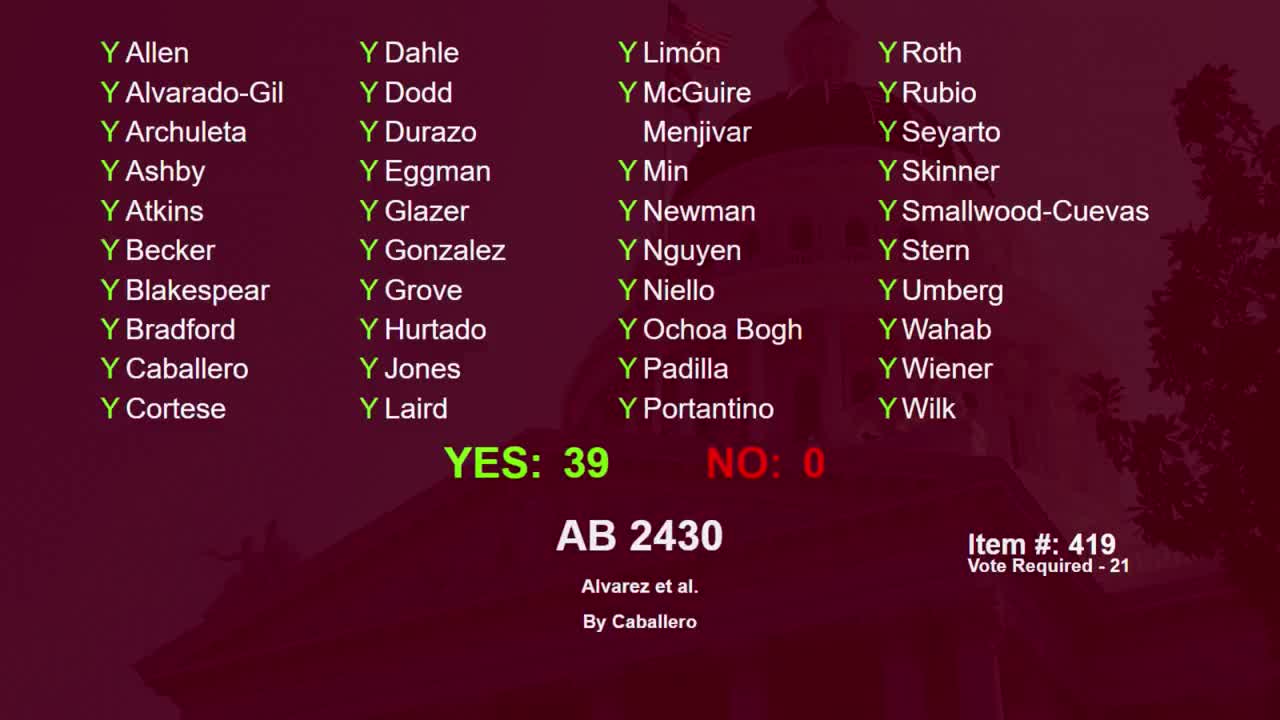

Bill Author

Bill Co-Author(s):