SB 983: Energy: gasoline stations and alternative fuel infrastructure.
- Session Year: 2023-2024
- House: Senate
- Latest Version Date: 2024-09-03
Current Status:
Failed
(2024-09-22: In Senate. Consideration of Governor's veto pending.)
Introduced
In Committee
First Chamber
In Committee
Second Chamber
Enacted
Existing law vests the State Energy Resources Conservation and Development Commission with jurisdiction over various energy-related matters.
This bill would require the commission, upon appropriation by the Legislature, to form the Alternative Fuels Infrastructure Taskforce to conduct a study on retail gasoline fueling stations and alternative fuels infrastructure, as provided. The bill would require the taskforce, on or before January 1, 2027, to submit to the Legislature a report on the study with information and recommendations. The bill would repeal its provisions on January 1, 2031.
Existing law vests the State Energy Resources Conservation and Development Commission with jurisdiction over various energy-related matters.
This bill would require the commission, upon appropriation by the Legislature, to form the Alternative Fuels Infrastructure Taskforce to conduct a study on retail gasoline fueling stations and alternative fuels infrastructure, as provided. The bill would require the taskforce, on or before January 1, 2027, to submit to the Legislature a report on the study with information and recommendations.
Existing law vests the State Energy Resources Conservation and Development Commission with jurisdiction over various energy-related matters.
This bill would require the commission, upon appropriation by the Legislature, to form the Alternative Fuels Infrastructure Taskforce to conduct a study on retail gasoline fueling stations and alternative fuels infrastructure, as provided. The bill would require the taskforce, on or before January 1, 2027, to submit to the Legislature a report on the study with recommendations.
Existing law vests the State Energy Resources Conservation and Development Commission with jurisdiction over various energy-related matters.
This bill would require the commission, upon appropriation by the Legislature, to form the Alternative Fuels Infrastructure Taskforce to conduct a study on retail gasoline fueling stations and alternative fuels infrastructure, as provided. The bill would require the taskforce, on or before January 1, 2027, to submit to the Legislature a report on the study with recommendations. Until the completion of the study and the submission of the report to the Legislature, the bill would prohibit a local government, including a charter city, from banning the construction or maintenance of retail gasoline fueling stations or alternative fuel infrastructure.
The bill would include findings that changes proposed by this bill address a matter of statewide concern rather than a municipal affair and, therefore, apply to all cities, including charter cities.Existing law vests the State Energy Resources Conservation and Development Commission with jurisdiction over various energy-related matters.
This bill would require the commission, upon appropriation by the Legislature, to form the Alternative Fuels Infrastructure Taskforce to conduct a study on retail gasoline fueling stations and alternative fuels infrastructure, as provided. The bill would require the taskforce, on or before January 1, 2027, to submit to the Legislature a report on the study with recommendations. Until the completion of the study and the submission of the report to the Legislature, the bill would prohibit a local government, including a charter city, from banning the construction or maintenance of retail gasoline fueling stations or alternative fuel infrastructure.
The bill would include findings that changes proposed by this bill address a matter of statewide concern rather than a municipal affair and, therefore, apply to all cities, including charter cities.
The Legislature finds and declares all of the following:
(a)There are over 10,000 retail gasoline fueling stations in California with over 95 percent of stations being operated by small business owners of both branded and independent stations.
(b)Almost 9,000 stations in California are connected to convenience stores that provide communities with access to a wide variety of food and beverage options.
(c)Over 60 percent of the owners are first generation, foreign-born immigrants, which is the highest of any industry in the United States.
(d)These stations provide nearly $6 billion in wages annually and paid nearly $10 billion in taxes to state and local governments in California.
(e)Gasoline fueling stations are a critical part of Californias transportation fueling infrastructure for consumers.
(f)A recent study from the Energy Institute at Haas titled Competitive Effects of Entry in Gasoline Markets (December 2023) examined the entry of over 1,000 new gas stations in Mexico from 2017 to 2022, inclusive, and found that each additional nearby competitor leads to lower prices for regular gasoline, premium gasoline, and diesel. The study also found suggestive evidence that increased competition has improved station quality.
(g)California should facilitate and accelerate alternative fuel infrastructure as the state estimates about 1,200,000 electric vehicle chargers will be needed by the year 2030, and currently only about 80,000 public chargers have been installed statewide.
(h)According to the State Energy Resources Conservation and Development Commission, only 66 retail hydrogen refueling stations for light-duty vehicles are open in the state with an additional 34 hydrogen refueling stations in permitting, construction, or commissioning phases.
(i)Continuing to reduce emissions of greenhouse gases is critical for the protection of all areas of the state, but especially for the states most disadvantaged communities, as those communities are affected first, and, most frequently, by the adverse impacts of climate change, including an increased frequency of extreme weather events, such as drought, heat, and flooding. The states most disadvantaged communities also are disproportionately impacted by the deleterious effects of climate change on public health.
(j)As the state pursues achieving its climate goals set in the California Global Warming Solutions Act of 2006 (Division 25.5 (commencing with Section 38500) of the Health and Safety Code), including Sections 38562.2 and 38566 of the Health and Safety Code, it is important to increase competition and to examine the existing infrastructure and how it can be used in conjunction with alternative fuel infrastructure.
SEC. 2.Section 25239 is added to the Public Resources Code, to read:25239.(a)For purposes of this section, the following definitions apply:
(1)Alternative fuel means electricity, hydrogen, or other zero-emission alternative fuel, as determined appropriated by the Alternative Fuels Infrastructure Taskforce, that is not a fossil fuel.
(2)Alternative fuel infrastructure means infrastructure for the fueling of alternative fuels.
(3)Retail gasoline fueling station means an establishment that offers for sale or sells gasoline or gasoline and diesel fuel to the public.
(4)Taskforce means the Alternative Fuels Infrastructure Taskforce established pursuant to subdivision (b).
(5)Tribal community means a community within a federally recognized California Native American tribe or nonfederally recognized Native American tribe.
(b)Upon appropriation by the Legislature, the commission shall form the Alternative Fuels Infrastructure Taskforce consisting of all of the following members:
(1)A representative of environmental justice communities.
(2)A representative from a national environmental organization with expertise in energy transition and economic sustainability policy.
(3)A representative with expertise in the federal Americans with Disabilities Act of 1990 (42 U.S.C. Sec. 12101 et seq.).
(4)A retail gasoline fueling station owner from a rural county.
(5)A retail gasoline fueling station owner from southern California.
(6)A retail gasoline fueling station owner from northern California.
(7)A representative of consumers.
(8)A representative of construction labor.
(9)An expert in electric vehicle charging infrastructure.
(10)An expert in hydrogen fueling infrastructure.
(11)A local government representative from a rural city or county.
(12)A local government representative from a northern California city or county.
(13)A local government representative from a southern California city or county.
(14)A lawyer with expertise in land use policy.
(15)A representative from a local publicly owned electric utility.
(16)A representative from an investor-owned utility.
(17)A representative from the commission.
(18)A representative from the Public Utilities Commission.
(19)A representative from the Governors Office of Business and Economic Development.
(20)A representative from the State Air Resources Board.
(21)A representative of tribal communities.
(c)(1)On or before January 1, 2027, the taskforce shall conduct a study, and submit to the Legislature a report on the study with information and recommendations, on all of the following:
(A)Existing fueling infrastructure and how it might be used in conjunction with alternative fuels infrastructure at retail gasoline fueling stations.
(B)Barriers to the development and construction of alternative fuels infrastructure at retail gasoline fueling stations.
(C)Best practices for compliance with the federal Americans with Disabilities Act of 1990 when developing and constructing alternative fuel infrastructure.
(D)Other infrastructure challenges to the development and construction of alternative fuels infrastructure at retail gasoline fueling stations.
(2)The submission of the report to the Legislature pursuant to paragraph (1) shall be in accordance with Section 9795 of the Government Code.
(d)This section shall remain in effect only until January 1, 2031, and as of that date is repealed.
The Legislature finds and declares all of the following:
(a)There are over 10,000 retail gasoline fueling stations in California with over 95 percent of stations being operated by small business owners of both branded and independent stations.
(b)Almost 9,000 stations in California are connected to convenience stores that provide communities with access to a wide variety of food and beverage options.
(c)Over 60 percent of the owners are first generation, foreign-born immigrants, which is the highest of any industry in the United States.
(d)These stations provide nearly $6 billion in wages annually and paid nearly $10 billion in taxes to state and local governments in California.
(e)Gasoline fueling stations are a critical part of Californias transportation fueling infrastructure for consumers.
(f)A recent study from the Energy Institute at Haas titled Competitive Effects of Entry in Gasoline Markets (December 2023) examined the entry of over 1,000 new gas stations in Mexico from 2017 to 2022, inclusive, and found that each additional nearby competitor leads to lower prices for regular gasoline, premium gasoline, and diesel. The study also found suggestive evidence that increased competition has improved station quality.
(g)California should facilitate and accelerate alternative fuel infrastructure as the state estimates about 1,200,000 electric vehicle chargers will be needed by the year 2030, and currently only about 80,000 public chargers have been installed statewide.
(h)According to the State Energy Resources Conservation and Development Commission, only 66 retail hydrogen refueling stations for light-duty vehicles are open in the state with an additional 34 hydrogen refueling stations in permitting, construction, or commissioning phases.
(i)Continuing to reduce emissions of greenhouse gases is critical for the protection of all areas of the state, but especially for the states most disadvantaged communities, as those communities are affected first, and, most frequently, by the adverse impacts of climate change, including an increased frequency of extreme weather events, such as drought, heat, and flooding. The states most disadvantaged communities also are disproportionately impacted by the deleterious effects of climate change on public health.
(j)As the state pursues achieving its climate goals set in the California Global Warming Solutions Act of 2006 (Division 25.5 (commencing with Section 38500) of the Health and Safety Code), including Sections 38562.2 and 38566 of the Health and Safety Code, it is important to increase competition and to examine the existing infrastructure and how it can be used in conjunction with alternative fuel infrastructure.
SEC. 2.Section 25239 is added to the Public Resources Code, to read:25239.(a)For purposes of this section, the following definitions apply:
(1)Alternative fuel means electricity, hydrogen, or other zero-emission alternative fuel, as determined appropriated by the Alternative Fuels Infrastructure Taskforce, that is not a fossil fuel.
(2)Alternative fuel infrastructure means infrastructure for the fueling of alternative fuels.
(3)Retail gasoline fueling station means an establishment that offers for sale or sells gasoline or gasoline and diesel fuel to the public.
(4)Taskforce means the Alternative Fuels Infrastructure Taskforce established pursuant to subdivision (b).
(5)Tribal community means a community within a federally recognized California Native American tribe or nonfederally recognized Native American tribe.
(b)Upon appropriation by the Legislature, the commission shall form the Alternative Fuels Infrastructure Taskforce consisting of all of the following members:
(1)A representative of environmental justice communities.
(2)A representative from a national environmental organization with expertise in energy transition and economic sustainability policy.
(3)A representative with expertise in the federal Americans with Disabilities Act of 1990 (42 U.S.C. Sec. 12101 et seq.).
(4)A retail gasoline fueling station owner from a rural county.
(5)A retail gasoline fueling station owner from southern California.
(6)A retail gasoline fueling station owner from northern California.
(7)A representative of consumers.
(8)A representative of construction labor.
(9)An expert in electric vehicle charging infrastructure.
(10)An expert in hydrogen fueling infrastructure.
(11)A local government representative from a rural city or county.
(12)A local government representative from a northern California city or county.
(13)A local government representative from a southern California city or county.
(14)A lawyer with expertise in land use policy.
(15)A representative from a local publicly owned electric utility.
(16)A representative from an investor-owned utility.
(17)A representative from the commission.
(18)A representative from the Public Utilities Commission.
(19)A representative from the Governors Office of Business and Economic Development.
(20)A representative from the State Air Resources Board.
(21)A representative of tribal communities.
(c)(1)On or before January 1, 2027, the taskforce shall conduct a study, and submit to the Legislature a report on the study with information and recommendations, on all of the following:
(A)Policies to facilitate and accelerate the development and construction of Existing fueling infrastructure and how it might be used in conjunction with alternative fuels infrastructure at retail gasoline fueling stations.
(B)Barriers to the accelerated development and construction of alternative fuels infrastructure at retail gasoline fueling stations.
(C)Best practices for compliance with the federal Americans with Disabilities Act of 1990 when developing and constructing alternative fuel infrastructure.
(D)Other infrastructure challenges that may delay to the development and construction of alternative fuels infrastructure at retail gasoline fueling stations.
(2)The submission of the report to the Legislature pursuant to paragraph (1) shall be in accordance with Section 9795 of the Government Code.
(d)This section shall remain in effect only until January 1, 2031, and as of that date is repealed.
The Legislature finds and declares all of the following:
(a)There are over 10,000 retail gasoline fueling stations in California with over 95 percent of stations being operated by small business owners of both branded and independent stations.
(b)Almost 9,000 stations in California are connected to convenience stores that provide communities with access to a wide variety of food and beverage options.
(c)Over 60 percent of the owners are first generation, foreign-born immigrants, which is the highest of any industry in the United States.
(d)These stations provide nearly $6 billion in wages annually and paid nearly $10 billion in taxes to state and local governments in California.
(e)Gasoline fueling stations are a critical part of Californias transportation fueling infrastructure for consumers.
(f)A recent study from the Energy Institute at Haas titled Competitive Effects of Entry in Gasoline Markets (December 2023) examined the entry of over 1,000 new gas stations in Mexico from 2017 to 2022, inclusive, and found that each additional nearby competitor leads to lower prices for regular gasoline, premium gasoline, and diesel. The study also found suggestive evidence that increased competition has improved station quality.
(g)California should facilitate and accelerate alternative fuel infrastructure as the state estimates about 1,200,000 electric vehicle chargers will be needed by the year 2030, and currently only about 80,000 public chargers have been installed statewide.
(h)According to the State Energy Resources Conservation and Development Commission, only 66 retail hydrogen refueling stations for light-duty vehicles are open in the state with an additional 34 hydrogen refueling stations in permitting, construction, or commissioning phases.
(i)Continuing to reduce emissions of greenhouse gases is critical for the protection of all areas of the state, but especially for the states most disadvantaged communities, as those communities are affected first, and, most frequently, by the adverse impacts of climate change, including an increased frequency of extreme weather events, such as drought, heat, and flooding. The states most disadvantaged communities also are disproportionately impacted by the deleterious effects of climate change on public health.
(j)As the state pursues achieving its climate goals set in the California Global Warming Solutions Act of 2006 (Division 25.5 (commencing with Section 38500) of the Health and Safety Code), including Sections 38562.2 and 38566 of the Health and Safety Code, it is important to increase competition and to examine the existing infrastructure and how it can be used in conjunction with alternative fuel infrastructure.
SEC. 2.Section 25239 is added to the Public Resources Code, to read:25239.(a)For purposes of this section, the following definitions apply:
(1)Alternative fuel means electricity, hydrogen, or other zero-emission alternative fuel, as determined appropriated by the Alternative Fuels Infrastructure Taskforce, that is not a fossil fuel.
(2)Alternative fuel infrastructure means infrastructure for the fueling of alternative fuels.
(3)Retail gasoline fueling station means an establishment that offers for sale or sells gasoline or gasoline and diesel fuel to the public.
(4)Taskforce means the Alternative Fuels Infrastructure Taskforce established pursuant to subdivision (b).
(5)Tribal community means a community within a federally recognized California Native American tribe or nonfederally recognized Native American tribe.
(b)Upon appropriation by the Legislature, the commission shall form the Alternative Fuels Infrastructure Taskforce consisting of all of the following members:
(1)A representative of environmental justice communities.
(2)A representative from a national environmental organization with expertise in energy transition and economic sustainability policy.
(3)A representative with expertise in the federal Americans with Disabilities Act of 1990 (42 U.S.C. Sec. 12101 et seq.).
(4)A retail gasoline fueling station owner from a rural county.
(5)A retail gasoline fueling station owner from southern California.
(6)A retail gasoline fueling station owner from northern California.
(7)A representative of consumers.
(8)A representative of construction labor.
(9)An expert in electric vehicle charging infrastructure.
(10)An expert in hydrogen fueling infrastructure.
(11)A local government representative from a rural city or county.
(12)A local government representative from a northern California city or county.
(13)A local government representative from a southern California city or county.
(14)A lawyer with expertise in land use policy.
(15)A representative from a local publicly owned electric utility.
(16)A representative from an investor-owned utility.
(17)A representative from the commission.
(18)A representative from the Public Utilities Commission.
(19)A representative from the Governors Office of Business and Economic Development.
(20)A representative from the State Air Resources Board.
(21)A representative of tribal communities.
(c)(1)On or before January 1, 2027, the taskforce shall conduct a study, and submit to the Legislature a report on the study with recommendations, on all of the following:
(A)Policies to facilitate and accelerate the development and construction of alternative fuels infrastructure at retail gasoline fueling stations.
(B)Barriers to the accelerated development and construction of alternative fuels infrastructure at retail gasoline fueling stations.
(C)Best practices for compliance with the federal Americans with Disabilities Act of 1990 when developing and constructing alternative fuel infrastructure.
(D)Other infrastructure challenges that may delay the development and construction of alternative fuels infrastructure at retail gasoline fueling stations.
(2)The submission of the report to the Legislature pursuant to paragraph (1) shall be in accordance with Section 9795 of the Government Code.
(d)This section shall remain in effect only until January 1, 2031, and as of that date is repealed.
The Legislature finds and declares all of the following:
(a)There are over 10,000 retail gasoline fueling stations in California with over 95 percent of stations being operated by small business owners of both branded and independent stations.
(b)Almost 9,000 stations in California are connected to convenience stores that provide communities with access to a wide variety of food and beverage options.
(c)Over 60 percent of the owners are first generation, foreign-born immigrants, which is the highest of any industry in the United States.
(d)These stations provide nearly $6 billion in wages annually and paid nearly $10 billion paid in taxes to state and local governments in California.
(e)Gasoline fueling stations are a critical part of Californias transportation fueling infrastructure for consumers.
(f)A recent study from the Energy Institute at Haas titled Competitive Effects of Entry in Gasoline Markets (December 2023) examined the entry of over 1,000 new gas stations in Mexico from 2017 to 2022, inclusive, and found that each additional nearby competitor leads to lower prices for regular gasoline, premium gasoline, and diesel. The study also found suggestive evidence that increased competition has improved station quality.
(g)California should facilitate and accelerate alternative fuel infrastructure as the state estimates about 1,200,000 electric vehicle chargers will be needed by the year 2030, and currently only about 80,000 public chargers have been installed statewide.
(h)According to the State Energy Resources Conservation and Development Commission, only 66 retail hydrogen refueling stations for light-duty vehicles are open in the state with an additional 34 hydrogen refueling stations in permitting, construction, or commissioning phases.
(i)Continuing to reduce emissions of greenhouse gases is critical for the protection of all areas of the state, but especially for the states most disadvantaged communities, as those communities are affected first, and, most frequently, by the adverse impacts of climate change, including an increased frequency of extreme weather events, such as drought, heat, and flooding. The states most disadvantaged communities also are disproportionately impacted by the deleterious effects of climate change on public health.
(j)As the state pursues achieving its climate goals set in the California Global Warming Solutions Act of 2006 (Division 25.5 (commencing with Section 38500) of the Health and Safety Code), including Sections 38562.2 and 38566 of the Health and Safety Code, it is important to increase competition and to examine the existing infrastructure and how it can be used in conjunction with alternative fuel infrastructure.
SEC. 2.Section 25239 is added to the Public Resources Code, to read:25239.(a)For purposes of this section, the following definitions apply:
(1)Alternative fuel means electricity, hydrogen, or other zero-emission alternative fuel, as determined appropriated by the Alternative Fuels Infrastructure Taskforce, that is not a fossil fuel.
(2)Alternative fuel infrastructure means infrastructure for the fueling of alternative fuels.
(3)Retail gasoline fueling station means an establishment that offers for sale or sells gasoline or gasoline and diesel fuel to the public.
(4)Taskforce means the Alternative Fuels Infrastructure Taskforce established pursuant to subdivision (b).
(b)Upon appropriation by the Legislature, the commission shall form the Alternative Fuels Infrastructure Taskforce consisting of all of the following: following members:
(1)A member representing representative of environmental justice communities.
(2)A representative from a national environmental organization with expertise in energy transition and economic sustainability policy.
(3)A representative with expertise in the federal Americans with Disabilities Act of 1990 (42 U.S.C. Sec. 12101 et seq.).
(4)A retail gasoline fueling station owner from a rural county.
(5)A retail gasoline fueling station owner from southern California.
(6)A retail gasoline fueling station owner from northern California.
(7)A member representing representative of consumers.
(8)A member representing representative of construction labor.
(9)A member with expertise An expert in electric vehicle charging infrastructure.
(10)A member with expertise An expert in hydrogen fueling infrastructure.
(11)A local government representative from a rural city or county.
(12)A local government representative from a northern California city or county.
(13)A local government representative from a southern California city or county.
(14)A lawyer with expertise in land use policy.
(15)A representative from a local publicly owned electric utility.
(16)A representative from an investor-owned utility.
(c)(1)On or before January 1, 2027, the taskforce shall conduct a study study, and shall submit to the Legislature a report on the study with recommendations recommendations, on all of the following:
(A)Policies to facilitate and accelerate the development and construction of alternative fuels infrastructure at retail gasoline fueling stations.
(B)Barriers to the accelerated development and construction of alternative fuels infrastructure at retail gasoline fueling stations.
(C)Best practices for compliance with the federal Americans with Disabilities Act of 1990 when developing and constructing alternative fuel infrastructure.
(D)Other infrastructure challenges that may delay the development and construction of alternative fuels infrastructure at retail gasoline fueling stations.
(2)The submission of the report to the Legislature pursuant to paragraph (1) shall be in accordance with Section 9795 of the Government Code.
(d)This section shall remain in effect only until January 1, 2031, and as of that date is repealed.
The Legislature finds and declares all of the following:
(a)There are over 10,000 retail gasoline fueling stations in California with over 95 percent of stations being operated by small business owners of both branded and independent stations.
(b)Almost 9,000 stations in California are connected to convenience stores that provide communities with access to a wide variety of food and beverage options.
(c)Over 60 percent of the owners are first generation, foreign-born immigrants, which is the highest of any industry in the United States.
(d)These stations provide nearly $6 billion in wages annually and nearly $10 billion paid in taxes to state and local governments in California.
(e)Gasoline fueling stations are a critical part of Californias transportation fueling infrastructure for consumers.
(f)A recent study from the Energy Institute at Hass Haas titled Competitive Effects of Entry in Gasoline Markets (December 2023) examined the entry of over 1,000 new gas stations in Mexico from 2017 to 2022, inclusive, and found that each additional nearby competitor leads to lower prices for regular gasoline, premium gasoline, and diesel. The study also found suggestive evidence that increased competition has improved station quality.
(g)California should facilitate and accelerate alternative fuel infrastructure as the state estimates about 1,200,000 electric vehicle chargers will be needed by the year 2030, and currently only about 80,000 public chargers have been installed statewide.
(h)According to the State Energy Resources Conservation and Development Commission, only 66 retail hydrogen refueling stations for light-duty vehicles are open in the state with an additional 34 hydrogen refueling stations in permitting, construction, or commissioning phases.
(i)Continuing to reduce emissions of greenhouse gases is critical for the protection of all areas of the state, but especially for the states most disadvantaged communities, as those communities are affected first, and, most frequently, by the adverse impacts of climate change, including an increased frequency of extreme weather events, such as drought, heat, and flooding. The states most disadvantaged communities also are disproportionately impacted by the deleterious effects of climate change on public health.
(j)As the state pursues achieving its climate goals set in the California Global Warming Solutions Act of 2006 (Division 25.5 (commencing with Section 38500) of the Health and Safety Code), including Section 38566 of, and Section 38562.2 of, Sections 38562.2 and 38566 of the Health and Safety Code, it is important to increase competition and to examine the existing infrastructure and how it can be used in conjunction with alternative fuel infrastructure.
SEC. 2.Section 25236 is added to the Public Resources Code, to read:25236.SEC. 2.Section 25239 is added to the Public Resources Code, to read:25239.(a)For purposes of this section, the following definitions apply:
(1)Alternative fuel means electricity, hydrogen, or other alternative fuel, as determined appropriated by the Alternative Fuels Infrastructure Taskforce, that is not a fossil fuel.
(2)Alternative fuel infrastructure means infrastructure for the fueling of alternative fuels.
(3)Retail gasoline fueling station means an establishment that offers for sale or sells gasoline or gasoline and diesel fuel to the public.
(4)Taskforce means the Alternative Fuels Infrastructure Taskforce established pursuant to subdivision (b).
(b)Upon appropriation by the Legislature, the commission shall form the Alternative Fuels Infrastructure Taskforce consisting of all of the following:
(1)A member representing environmental justice communities.
(2)A representative from a national environmental organization with expertise in energy transition and economic sustainability policy.
(3)A representative with expertise in the federal Americans with Disabilities Act of 1990 (42 U.S.C. Sec. 12101 et seq.).
(4)A retail gasoline fueling station owner from a rural county.
(5)A retail gasoline fueling station owner from southern California.
(6)A retail gasoline fueling station owner from northern California.
(7)A member representing consumers.
(8)A member representing construction labor.
(9)A member with expertise in electric vehicle charging infrastructure.
(10)A member with expertise in hydrogen fueling infrastructure.
(11)A local government representative from a rural city or county.
(12)A local government representative from a northern California city or county.
(13)A local government representative from a southern California city or county.
(14)A lawyer with expertise in land use policy.
(15)A representative from a local publicly owned electric utility.
(16)A representative from an investor-owned utility.
(c)(1)On or before January 1, 2027, the taskforce shall conduct a study and shall submit to the Legislature a report on the study with recommendations on all of the following:
(A)Policies to facilitate and accelerate the development and construction of alternative fuels infrastructure at retail gasoline fueling stations.
(B)Barriers to the accelerated development and construction of alternative fuels infrastructure at retail gasoline fueling stations.
(C)Best practices for compliance with the federal Americans with Disabilities Act of 1990 when developing and constructing alternative fuel infrastructure.
(D)Other infrastructure challenges that may delay the development and construction of alternative fuels infrastructure at retail gasoline fueling stations.
(2)The submission of the report to the Legislature pursuant to paragraph (1) shall be in accordance with Section 9795 of the Government Code.
(d)Between January 1, 2025 and the date of the completion of the study and the submission of the report to Legislature pursuant to subdivision (c), a local government, including a charter city, shall not ban the construction or maintenance of retail gasoline fueling stations or alternative fuel infrastructure.(e)(d)This section shall remain in effect only until January 1, 2031, and as of that date is repealed.
SEC. 3.The Legislature finds and declares that Section 2 of the bill addresses a matter of statewide concern rather than a municipal affair as that term is used in Section 5 of Article XI of the California Constitution. Therefore, Section 2 of this bill applies to all cities, including charter cities.The Legislature finds and declares all of the following:
(a)There are over 10,000 retail gasoline fueling stations in California with over 95 percent of stations being operated by small business owners of both branded and independent stations.
(b)Almost 9,000 stations in California are connected to convenience stores that provide communities with access to a wide variety of food and beverage options.
(c)Over 60 percent of the owners are first generation, foreign-born immigrants, which is the highest of any industry in the United States.
(d)These stations provide nearly $6 billion in wages annually and nearly $10 billion paid in taxes to state and local governments in California.
(e)Gasoline fueling stations are a critical part of Californias transportation fueling infrastructure for consumers.
(f)A recent study from the Energy Institute at Hass titled Competitive Effects of Entry in Gasoline Markets (December 2023) examined the entry of over 1,000 new gas stations in Mexico from 2017 to 2022, inclusive, and found that each additional nearby competitor leads to lower prices for regular gasoline, premium gasoline, and diesel. The study also found suggestive evidence that increased competition has improved station quality.
(g)California should facilitate and accelerate alternative fuel infrastructure as the state estimates about 1,200,000 electric vehicle chargers will be needed by the year 2030, and currently only about 80,000 public chargers have been installed statewide.
(h)According to the State Energy Resources Conservation and Development Commission, only 66 retail hydrogen refueling stations for light-duty vehicles are open in the state with an additional 34 hydrogen refueling stations in permitting, construction, or commissioning phases.
(i)Continuing to reduce emissions of greenhouse gases is critical for the protection of all areas of the state, but especially for the states most disadvantaged communities, as those communities are affected first, and, most frequently, by the adverse impacts of climate change, including an increased frequency of extreme weather events, such as drought, heat, and flooding. The states most disadvantaged communities also are disproportionately impacted by the deleterious effects of climate change on public health.
(j)As the state pursues achieving its climate goals set in the California Global Warming Solutions Act of 2006 (Division 25.5 (commencing with Section 38500) of the Health and Safety Code), including Section 38566 of, and Section 38562.2 of, the Health and Safety Code, it is important to increase competition and to examine the existing infrastructure and how it can be used in conjunction with alternative fuel infrastructure.
SEC. 2.Section 25236 is added to the Public Resources Code, to read:25236.(a)For purposes of this section, the following definitions apply:
(1)Alternative fuel means electricity, hydrogen, or other alternative fuel, as determined appropriated by the Alternative Fuels Infrastructure Taskforce, that is not a fossil fuel.
(2)Alternative fuel infrastructure means infrastructure for the fueling of alternative fuels.
(3)Retail gasoline fueling station means an establishment that offers for sale or sells gasoline or gasoline and diesel fuel to the public.
(4)Taskforce means the Alternative Fuels Infrastructure Taskforce established pursuant to subdivision (b).
(b)Upon appropriation by the Legislature, the commission shall form the Alternative Fuels Infrastructure Taskforce consisting of all of the following:
(1)A member representing environmental justice communities.
(2)A representative from a national environmental organization with expertise in energy transition and economic sustainability policy.
(3)A representative with expertise in the federal Americans with Disabilities Act of 1990 (42 U.S.C. Sec. 12101 et seq.).
(4)A retail gasoline fueling station owner from a rural county.
(5)A retail gasoline fueling station owner from southern California.
(6)A retail gasoline fueling station owner from northern California.
(7)A member representing consumers.
(8)A member representing labor.
(9)A member with expertise in electric vehicle charging infrastructure.
(10)A member with expertise in hydrogen fueling infrastructure.
(11)A local government representative from a rural city or county.
(12)A local government representative from a northern California city or county.
(13)A local government representative from a southern California city or county.
(14)A lawyer with expertise in land use policy.
(15)A representative from a local publicly owned electric utility.
(16)A representative from an investor-owned utility.
(c)(1)On or before January 1, 2027, the taskforce shall conduct a study and shall submit to the Legislature a report on the study with recommendations on all of the following:
(A)Policies to facilitate and accelerate the development and construction of alternative fuels infrastructure at retail gasoline fueling stations.
(B)Barriers to the accelerated development and construction of alternative fuels infrastructure at retail gasoline fueling stations.
(C)Best practices for compliance with the federal Americans with Disabilities Act of 1990 when developing and constructing alternative fuel infrastructure.
(D)Other infrastructure challenges that may delay the development and construction of alternative fuels infrastructure at retail gasoline fueling stations.
(2)The submission of the report to the Legislature pursuant to paragraph (1) shall be in accordance with Section 9795 of the Government Code.
(d)Between January 1, 2025 and the date of the completion of the study and the submission of the report to Legislature pursuant to subdivision (c), a local government, including a charter city, shall not ban the construction or maintenance of retail gasoline fueling stations or alternative fuel infrastructure.
(e)This section shall remain in effect only until January 1, 2031, and as of that date is repealed.
SEC. 3.The Legislature finds and declares that Section 2 of the bill addresses a matter of statewide concern rather than a municipal affair as that term is used in Section 5 of Article XI of the California Constitution. Therefore, Section 2 of this bill applies to all cities, including charter cities.
|
Date
|
Status
|
|---|---|
| Sep 22, 2024 | In Senate. Consideration of Governor's veto pending. |
| Sep 22, 2024 | Vetoed by the Governor. |
| Sep 9, 2024 | Enrolled and presented to the Governor at 3 p.m. |
| Aug 29, 2024 | Assembly amendments concurred in. (Ayes 36. Noes 0. Page 5637.) Ordered to engrossing and enrolling. |
| Aug 28, 2024 | In Senate. Concurrence in Assembly amendments pending. |
| Aug 28, 2024 | Read third time. Passed. (Ayes 74. Noes 0. Page 6717.) Ordered to the Senate. |
| Aug 20, 2024 | Read second time. Ordered to third reading. |
| Aug 19, 2024 | Read second time and amended. Ordered to second reading. |
| Aug 15, 2024 | From committee: Do pass as amended. (Ayes 11. Noes 0.) (August 15). |
| Aug 7, 2024 | August 7 set for first hearing. Placed on suspense file. |
| Jul 2, 2024 | From committee: Do pass and re-refer to Com. on APPR. with recommendation: To consent calendar. (Ayes 15. Noes 0.) (July 1). Re-referred to Com. on APPR. |
| Jun 24, 2024 | From committee with author's amendments. Read second time and amended. Re-referred to Com. on TRANS. |
| Jun 20, 2024 | From committee: Do pass and re-refer to Com. on TRANS. (Ayes 16. Noes 0.) (June 19). Re-referred to Com. on TRANS. |
| Jun 3, 2024 | Referred to Coms. on U. & E. and TRANS. |
| May 22, 2024 | In Assembly. Read first time. Held at Desk. |
| May 21, 2024 | Read third time. Passed. (Ayes 32. Noes 0. Page 4061.) Ordered to the Assembly. |
| May 16, 2024 | Read second time. Ordered to third reading. |
| May 16, 2024 | From committee: Do pass. (Ayes 7. Noes 0. Page 3966.) (May 16). |
| May 10, 2024 | Set for hearing May 16. |
| May 6, 2024 | May 6 hearing: Placed on APPR suspense file. |
| Apr 26, 2024 | Set for hearing May 6. |
| Apr 24, 2024 | From committee: Do pass and re-refer to Com. on APPR. (Ayes 11. Noes 0. Page 3732.) (April 23). Re-referred to Com. on APPR. |
| Apr 11, 2024 | Set for hearing April 23. |
| Apr 3, 2024 | Re-referred to Com. on TRANS. |
| Mar 21, 2024 | Read second time and amended. Re-referred to Com. on RLS. |
| Mar 20, 2024 | From committee: Do pass as amended and re-refer to Com. on RLS. (Ayes 13. Noes 0. Page 3348.) (March 19). |
| Mar 6, 2024 | Set for hearing March 19. |
| Feb 29, 2024 | From committee with author's amendments. Read second time and amended. Re-referred to Com. on E., U. & C. |
| Feb 21, 2024 | Referred to Coms. on E., U. & C. and L. GOV. |
| Jan 30, 2024 | From printer. May be acted upon on or after February 29. |
| Jan 29, 2024 | Introduced. Read first time. To Com. on RLS. for assignment. To print. |
|
Date
|
Description
|
Location
|
Votes
|
|
|---|---|---|---|---|
| Aug 29, 2024 | Unfinished Business SB983 Wahab et al. Concurrence | Senate Floor |
Passed |
|
| Aug 28, 2024 | SB 983 Wahab Senate Third Reading By Gabriel | Assembly Floor |
Passed |
|
| Aug 15, 2024 | Do pass as amended. | Assembly Standing Committee on Appropriations |
Passed |
|
| Jul 1, 2024 | Do pass and be re-referred to the Committee on [Appropriations] with recommendation: To Consent Calendar | Assembly Standing Committee on Transportation |
Passed |
|
| Jun 19, 2024 | Do pass and be re-referred to the Committee on [Transportation] | Assembly Standing Committee on Utilities and Energy |
Passed |
|
| May 21, 2024 | Senate 3rd Reading SB983 Wahab et al. | Senate Floor |
Passed |
|
| May 16, 2024 | Do pass | Senate Standing Committee on Appropriations |
Passed |
|
| May 6, 2024 | Placed on suspense file | Senate Standing Committee on Appropriations |
Passed |
|
| Apr 23, 2024 | Do pass, but first be re-referred to the Committee on [Appropriations] | Senate Standing Committee on Transportation |
Passed |
|
| Mar 19, 2024 | Do pass as amended, but first amend, and re-refer to the Committee on [Rules] | Senate Standing Committee on Energy, Utilities and Communications |
Passed |
This list shows positions taken on this bill by organizations on the date displayed, which is linked to the original source.
Positions by individuals are not included.
|
Organization
|
Position
|
Date
|
|---|---|---|
| Afghan American Business Alliance | ** Support | |
| African American Farmers of California | ** Support | |
| Alliance For Automotive Innovation | ** Support | |
| American Petroleum & Convenience Store Association | ** Support | |
| Asian Business Association of Los Angeles | ** Support | |
| Asian Business Association of Orange County | ** Support | |
| Asians in Energy | ** Support | |
| Bay Planning Coalition | ** Support | |
| California Alliance of Small Business Assoc. | ** Support | |
| California Alliance of Small Business Association | ** Support | |
| California Chamber Of Commerce | ** Support | |
| California Fuels And Convenience Alliance | ** Support | |
| California Hispanic Chamber Of Commerce | ** Support | |
| California Hydrogen Business Council | ** Support | |
| California Hydrogen Coalition | ** Support | |
| California League of Food Producers | ** Support | |
| California Manufacturing and Technology Association | ** Support | |
| California State Association Of Counties | ** Support | |
| California Tribal Business Alliance | ** Support | |
| Cambodian Chamber of Commerce | ** Support | |
| Carson Chamber of Commerce | ** Support | |
| Central Valley Latino Mayors and Elected Officials Coalition | ** Support | |
| City Of Hayward | ** Support | |
| Coalition of Filipino American Chambers of Commerce | ** Support | |
| Coalition of Filipino American, Greater Coachella Valley, Greater Conejo | ** Support | |
| Coastal Energy Alliance | ** Support | |
| Council of Business and Industries | ** Support | |
| East Bay Leadership Council | ** Support | |
| Ford | ** Support | |
| Greater Coachella Valley Chamber of Commerce | ** Support | |
| Greater Conejo Valley Chamber of Commerce | ** Support | |
| Industrial Association of Contra Costa County | ** Support | |
| Inland Empire Economic Partnership | ** Support | |
| Latin Business Association | ** Support | |
| League Of California Cities | ** Support | |
| Long Beach Area Chamber of Commerce | ** Support | |
| Los Angeles County Business Federation | ** Support | |
| Los Angeles Latino Chamber of Commerce | ** Support | |
| Moorpark Chamber of Commerce | ** Support | |
| Murrieta Wildomar Chamber of Commerce | ** Support | |
| Nisei Farmers League | ** Support | |
| Port Hueneme Chamber Of Commerce | ** Support | |
| Port Hueneme, Santa Monica, Santa Paula, Ventura, and Vietnamese | ** Support | |
| SAGE Monterey | ** Support | |
| San Gabriel Valley Economic Partnership | ** Support | |
| Santa Paula Chamber of Commerce | ** Support | |
| Si Se Puede Foundation | ** Support | |
| Southwest California Legislative Council | ** Support | |
| State Building and Construction Trades Council of California | ** Support | |
| The Climate Reality Project, Silicon Valley Chapters | ** Support | |
| Tri-County Chamber Alliance | ** Support | |
| Ventura Chamber of Commerce | ** Support | |
| Ventura County Coalition of Labor, Agriculture and Business | ** Support | |
| vietnamese american chamber of commerce | ** Support | |
| Western States Petroleum Association | ** Support |
SENATE RULES COMMITTEE Office of Senate Floor Analyses (916) 651-1520 Fax: (916) 327-4478 | SB 983 |
VETO
Bill No: SB 983
Author: Wahab (D), et al.
Enrolled: 9/3/24
Vote: 27
SENATE ENERGY, U. & C. COMMITTEE: 13-0, 3/19/24
AYES: Bradford, Ashby, Becker, Caballero, Dodd, Durazo, Eggman, Grove, Min, Newman, Rubio, Skinner, Wilk
NO VOTE RECORDED: Dahle, Gonzalez, Limón, Seyarto, Stern
SENATE TRANSPORTATION COMMITTEE: 11-0, 4/23/24
AYES: Cortese, Allen, Archuleta, Blakespear, Dahle, Dodd, Laird, Newman, Portantino, Seyarto, Umberg
NO VOTE RECORDED: Niello, Gonzalez, Limón, Nguyen
SENATE APPROPRIATIONS COMMITTEE: 7-0, 5/16/24
AYES: Caballero, Jones, Ashby, Becker, Bradford, Seyarto, Wahab
SENATE FLOOR: 32-0, 5/21/24
AYES: Alvarado-Gil, Archuleta, Ashby, Atkins, Blakespear, Bradford, Caballero, Cortese, Dahle, Dodd, Durazo, Eggman, Glazer, Grove, Hurtado, Jones, Laird, McGuire, Menjivar, Min, Newman, Ochoa Bogh, Padilla, Portantino, Roth, Rubio, Seyarto, Skinner, Smallwood-Cuevas, Umberg, Wahab, Wilk
NO VOTE RECORDED: Allen, Becker, Gonzalez, Limón, Nguyen, Niello, Stern, Wiener
SENATE FLOOR: 36-0, 8/29/24
AYES: Allen, Alvarado-Gil, Archuleta, Ashby, Atkins, Blakespear, Bradford, Caballero, Cortese, Dahle, Dodd, Durazo, Eggman, Glazer, Gonzalez, Grove, Hurtado, Jones, Laird, Limón, McGuire, Menjivar, Min, Newman, Ochoa Bogh, Padilla, Portantino, Roth, Rubio, Seyarto, Skinner, Smallwood-Cuevas, Umberg, Wahab, Wiener, Wilk
NO VOTE RECORDED: Becker, Nguyen, Niello, Stern
ASSEMBLY FLOOR: 74-0, 8/28/24 - See last page for vote
SUBJECT: Energy: gasoline stations and alternative fuel infrastructure
SOURCE: State Building and Construction Trades Council of California
DIGEST:
This bill requires the California Energy Commission (CEC) to convene an Alternative Fuels Infrastructure Taskforce, and it requires the task force to submit a report to the Legislature with recommendations for deploying alternative fuels infrastructure at existing gas stations.
ANALYSIS:
Existing law:
- Establishes the CEC as a five-member commission within the Natural Resources Agency and tasks the CEC with monitoring, analyzing, and making recommendations on statewide trends in the energy sector, including fuel supply and demand. (Public Resources Code §25200 et. seq.)
- Establishes the Petroleum Industry Information Reporting Act of 1980 (PIIRA), which establishes requirements for oil refiners and marketers to submit specified data to the CEC and requires the CEC to analyze this data to identify trends in demand and supply for petroleum, including factors influencing gasoline price changes. Existing law requires retail transportation fueling stations to report specified information about their sales of gasoline, diesel, and other fuels to the CEC. (Public Resources Code §25350 et. seq.)
- Requires the CEC to submit a report to the Legislature every three years assessing the reliability and pricing of transportation fuels, including transportation. Existing law requires this report to include an assessment of the availability of fuel retail outlets. (Public Resources Code §25371)
- Requires the CEC to conduct a statewide assessment every two years of electric vehicle (EV) charging infrastructure needed to support the levels of EV adoption required for the state to meet its goals of putting at least five million zero-emission vehicles (ZEVs) on California roads by 2030, and of reducing emissions of greenhouse gases (GHG) to 40 percent below 1990 levels by 2030. (Public Resources Code §25229)
This bill:
- Establishes a 21-member Alternative Fuels Infrastructure Taskforce at the CEC, upon appropriation by the Legislature, and specifies the types of members that must be appointed to each seat on the task force, which must include, but is not limited to representatives from environmental justice organizations, local governments, labor organizations, electric utilities, consumer groups, gas station owners, subject matter experts, tribal communities, and specified state agencies.
- Defines an “alternative fuel” as electricity, hydrogen, or any other non-fossil fuel as determined by the Alternative Fuels Infrastructure Taskforce.
- Requires the Alternative Fuels Infrastructure Taskforce to submit a study to the Legislature by January 1, 2027, with information and recommendations addressing the following:
- The use of existing fueling infrastructure in conjunction with alternative fueling infrastructure at gas stations.
- Barriers to deploying alternative fueling infrastructure at gas stations.
- Best practices for complying with the Americans with Disabilities Act of 1990 while deploying alternative fueling infrastructure.
- Other challenges that limit the deployment of alternative fueling infrastructure at gas stations.
- Sunsets this bill on January 1, 2031.
Background
- The ZEV transition poses unique challenges for gas station owners and operators. In 2022, the California Air Resources Board (CARB) adopted its Advanced Clean Cars II rule, which will require all new cars and light-duty trucks sold in California to be zero-emission by 2035. To the extent that ZEVs supplant petroleum-fueled cars, consumer demand for EV charging and clean fuels will increase as demand for petroleum declines. Gas station owners and operators are one segment of the economy that will face significant disruption as this transition occurs. Several cities have already adopted restrictions on permitting new gas stations within their jurisdictions. Gas station owners and operators also face substantial barriers to expanding EV charging at their facilities, including costs for re-designing stations, siting new infrastructure, and modifying business plans to account for the different costs and demand associated with zero-emission fuel sales. Without more coordinated plans to transition to ZEV fueling options, gas stations may face difficulty adopting new business models and local governments may lose opportunities to address equity issues associated with the ZEV transition and options for more closely aligning ZEV infrastructure deployment with driving patterns.
- What do drivers want? According to the federal Department of Energy, at least 80 percent of EV drivers charge their vehicle at home; however, surveys also show that nearly 60 percent of EV drivers with home charging also rely on public chargers more than one day each week. EV drivers who rent their home or reside at multifamily dwellings are more likely to exclusively rely on public charging. Drivers who have higher vehicle miles traveled are also more reliant on public charging. Multiple surveys of EV drivers in the United States have indicated that these drivers want EV chargers to be located along major highways and at gas stations. Surveys also indicate that EV drivers in the United States want EV charging stations to have amenities that more closely resemble those of existing gas stations: well-lit, covered charger bays, with bathrooms, convenience stores, and easy-to-read signs about the chargers’ speed and price for charging. While several charger stations with these features exist in California, they are not widespread and are largely sited only in regions with exceptionally high EV adoption. To the extent that this bill helps identify opportunities to better align EV charger deployment with driver preferences, this bill may support greater EV adoption and confidence in public charging.
Related/Prior Legislation
AB 1614 (Gabriel, 2023) would have required the CEC to, upon appropriations by the Legislature, consult with various stakeholders to conduct a study on the transitioning of retail gasoline fueling stations from providing gasoline to providing alternative fuels by January 1, 2027. The bill was vetoed.
AB 1074 (C. Garcia, 2015) would have required the CEC to develop a plan to deploy alternative fuel infrastructure to meet the state’s climate, emissions, and economic goals. The bill was held in the Assembly Appropriations Committee.
SBX1 2 (Skinner, Chapter 1, Statutes of 2023) modified PIIRA to require refineries to submit specified data regarding their economic performance to the CEC. The bill also required the CEC to assess the reliability of transportation fuels and retail outlets for those fuels.
SB 1322 (Allen, Chapter 374, Statutes of 2022) modified PIIRA to require refiners with multiple refineries operating in the state to submit certain data about their economic performance to the CEC. The bill also increased public access to data about refiners.
FISCAL EFFECT: Appropriation: No Fiscal Com.: Yes Local: No
According to the Assembly Appropriations Committee:
- The CEC estimates it will need approximately $900,000 over the roughly two years following the bill’s effective date, as follows:
- $300,000 for an outside professional mediation services to manage and resolve diverse and possibly conflicting views among task force members.
- $200,000 for outside professional editorial and research support.
- $200,000 for a half-time position to provide administrative support.
- $150,000 for task force member per-day compensation and operational support.
- $50,000 to purchase commercially available data on gasoline stations.
The CEC contends the appropriate fund sources would be both the Alternative and Renewable Fuels and Vehicle Technology Fund ($850,000) and the Energy Resources Programs Account (ERPA) ($50,000). However, because of the ongoing structural deficit within the ERPA Fund, the CEC cautions the fund may not be able to support even this limited amount of funding because it has an ongoing structural deficit.
- Alternative and Renewable Fuel and Vehicle Technology Fund (ARB) will experience new work as a member party to the taskforce and has identified the following required activities: participating in recurring taskforce meetings and preparing expert perspectives; soliciting input from experts not on the taskforce, and writing and editing portions of the report to the Legislature. ARB expects to dedicate one air pollution specialist to this effort, at an annual cost of approximately $220,000. ARB projects these annual costs to 2027 “and beyond,” though it is reasonable to expect these costs—like the CEC’s costs—to stop or significantly diminish once the report required by this bill is submitted to the Legislature, which this bill requires to occur by January 1, 2027.
SUPPORT: (Verified 9/24/24)
State Building and Construction Trades Council of California (source)
Afghan-American Business Alliance
African American Farmers of California
Alliance for Automotive Innovation
American Petroleum & Convenience Store Association
Asian Business Association of Los Angeles
Asian Business Association of Orange County
Asians in Energy
Bay Planning Coalition
California Alliance of Small Business Association
California Fuels and Convenience Alliance
California League of Food Producers
California Manufacturing and Technology Association
California State Association of Counties
Central Valley Latino Mayors and Elected Officials Coalition
Chamber of Commerce: California, California Hispanic, Cambodian, Carson,
Coalition of Filipino American, Greater Coachella Valley, Greater Conejo
Valley, Long Beach Area, Los Angeles Latino, Moorpark, Murrieta/Wildomar,
Port Hueneme, Santa Monica, Santa Paula, Ventura, and Vietnamese
American
City of Hayward
Coastal Energy Alliance
Council of Business and Industries
Ford
Inland Empire Economic Partnership
Latin Business Association
League of California Cities
Los Angeles County Business Federation
Nisei Farmers League
SAGE Monterey
San Gabriel Valley Economic Partnership
Si Se Puede Foundation
Southwest California Legislative Council
The Climate Reality Project, Silicon Valley Chapter
Tri-County Chamber Alliance
Ventura County Coalition of Labor, Agriculture, and Business
Western States Petroleum Association
OPPOSITION: (Verified 9/24/24)
None received
ARGUMENTS IN SUPPORT: According to the Author:
To meet Governor Newsom’s 2035 net-zero emissions goal and ensure that California promotes the use of alternative fuels, developing our alternative fueling infrastructure is essential. While we pursue these goals, it is essential to keep retail gas station owners –many of whom are first generation immigrants and small business owners— included in the conversation. SB 983 will ensure that we are finding the most cost-effective solution to reach our net-zero emissions goals by bringing experts and business owners together to add to our fuel infrastructure.
GOVERNOR'S VETO MESSAGE:
This bill would require the California Energy Commission (CEC) to form the Alternative Fuels Infrastructure Task Force to conduct a study with information and recommendations on existing fueling infrastructure and how it might be used in conjunction with alternative fuels infrastructure at retail gasoline fueling stations.
This bill's implementation would result in additional cost pressure on the CEC's primary operating fund. Additionally, many provisions of this bill are duplicative of existing law, which requires the CEC, in consultation with various state entities, to prepare a transportation fuels transition plan.
ASSEMBLY FLOOR: 74-0, 8/28/24
AYES: Aguiar-Curry, Alanis, Alvarez, Arambula, Bains, Bauer-Kahan, Bennett, Berman, Boerner, Bonta, Bryan, Calderon, Juan Carrillo, Wendy Carrillo, Chen, Connolly, Megan Dahle, Davies, Dixon, Essayli, Flora, Mike Fong, Friedman, Gabriel, Gallagher, Garcia, Gipson, Grayson, Haney, Hart, Holden, Hoover, Irwin, Jackson, Jones-Sawyer, Kalra, Lackey, Lee, Low, Lowenthal, Maienschein, Mathis, McCarty, McKinnor, Stephanie Nguyen, Pacheco, Papan, Jim Patterson, Joe Patterson, Pellerin, Petrie-Norris, Quirk-Silva, Ramos, Rendon, Reyes, Luz Rivas, Rodriguez, Blanca Rubio, Sanchez, Santiago, Schiavo, Soria, Ta, Ting, Valencia, Villapudua, Waldron, Wallis, Ward, Weber, Wicks, Wilson, Zbur, Robert Rivas
NO VOTE RECORDED: Addis, Cervantes, Muratsuchi, Ortega, Wood
Prepared by: Sarah Smith / E., U. & C. / (916) 651-4107
10/8/24 16:28:46
**** END ****
SENATE RULES COMMITTEE Office of Senate Floor Analyses (916) 651-1520 Fax: (916) 327-4478 | SB 983 |
UNFINISHED BUSINESS
Bill No: SB 983
Author: Wahab (D), et al.
Amended: 8/19/24
Vote: 21
SENATE ENERGY, U. & C. COMMITTEE: 13-0, 3/19/24
AYES: Bradford, Ashby, Becker, Caballero, Dodd, Durazo, Eggman, Grove, Min, Newman, Rubio, Skinner, Wilk
NO VOTE RECORDED: Dahle, Gonzalez, Limón, Seyarto, Stern
SENATE TRANSPORTATION COMMITTEE: 11-0, 4/23/24
AYES: Cortese, Allen, Archuleta, Blakespear, Dahle, Dodd, Laird, Newman, Portantino, Seyarto, Umberg
NO VOTE RECORDED: Niello, Gonzalez, Limón, Nguyen
SENATE APPROPRIATIONS COMMITTEE: 7-0, 5/16/24
AYES: Caballero, Jones, Ashby, Becker, Bradford, Seyarto, Wahab
SENATE FLOOR: 32-0, 5/21/24
AYES: Alvarado-Gil, Archuleta, Ashby, Atkins, Blakespear, Bradford, Caballero, Cortese, Dahle, Dodd, Durazo, Eggman, Glazer, Grove, Hurtado, Jones, Laird, McGuire, Menjivar, Min, Newman, Ochoa Bogh, Padilla, Portantino, Roth, Rubio, Seyarto, Skinner, Smallwood-Cuevas, Umberg, Wahab, Wilk
NO VOTE RECORDED: Allen, Becker, Gonzalez, Limón, Nguyen, Niello, Stern, Wiener
ASSEMBLY FLOOR: 74-0, 8/28/24 - See last page for vote
SUBJECT: Energy: gasoline stations and alternative fuel infrastructure
SOURCE: State Building and Construction Trades Council of California
DIGEST:
This bill requires the California Energy Commission (CEC) to convene an Alternative Fuels Infrastructure Taskforce, and it requires the task force to submit a report to the Legislature with recommendations for deploying alternative fuels infrastructure at existing gas stations.
Assembly Amendments
expand the membership of the Alternative Fuels Infrastructure Task Force to include specified representatives from tribal communities and state agencies and make technical, clarifying changes.
ANALYSIS:
Existing law:
- Establishes the CEC as a five-member commission within the Natural Resources Agency and tasks the CEC with monitoring, analyzing, and making recommendations on statewide trends in the energy sector, including fuel supply and demand. (Public Resources Code §25200 et. seq.)
- Establishes the Petroleum Industry Information Reporting Act of 1980 (PIIRA), which establishes requirements for oil refiners and marketers to submit specified data to the CEC and requires the CEC to analyze this data to identify trends in demand and supply for petroleum, including factors influencing gasoline price changes. Existing law requires retail transportation fueling stations to report specified information about their sales of gasoline, diesel, and other fuels to the CEC. (Public Resources Code §25350 et. seq.)
- Requires the CEC to submit a report to the Legislature every three years assessing the reliability and pricing of transportation fuels, including transportation. Existing law requires this report to include an assessment of the availability of fuel retail outlets. (Public Resources Code §25371)
- Requires the CEC to conduct a statewide assessment every two years of electric vehicle (EV) charging infrastructure needed to support the levels of EV adoption required for the state to meet its goals of putting at least five million zero-emission vehicles (ZEVs) on California roads by 2030, and of reducing emissions of greenhouse gases (GHG) to 40 percent below 1990 levels by 2030. (Public Resources Code §25229)
This bill:
- Establishes a 21-member Alternative Fuels Infrastructure Taskforce at the CEC, upon appropriation by the Legislature. This bill specifies the types of members that must be appointed to each seat on the task force, which must include, but is not limited to representatives from environmental justice organizations, local governments, labor organizations, electric utilities, consumer groups, gas station owners, subject matter experts, tribal communities, and specified state agencies.
- Defines an “alternative fuel” as electricity, hydrogen, or any other non-fossil fuel as determined by the Alternative Fuels Infrastructure Taskforce.
- Requires the Alternative Fuels Infrastructure Taskforce to submit a study to the Legislature by January 1, 2027, with information and recommendations addressing the following:
- The use of existing fueling infrastructure in conjunction with alternative fueling infrastructure at gas stations.
- Barriers to deploying alternative fueling infrastructure at gas stations.
- Best practices for complying with the Americans with Disabilities Act of 1990 while deploying alternative fueling infrastructure.
- Other challenges that limit the deployment of alternative fueling infrastructure at gas stations.
- Sunsets this bill on January 1, 2031.
Background
- The ZEV transition poses unique challenges for gas station owners and operators. In 2022, the California Air Resources Board (CARB) adopted its Advanced Clean Cars II rule, which will require all new cars and light-duty trucks sold in California to be zero-emission by 2035. To the extent that ZEVs supplant petroleum-fueled cars, consumer demand for EV charging and clean fuels will increase as demand for petroleum declines. Gas station owners and operators are one segment of the economy that will face significant disruption as this transition occurs. Several cities have already adopted restrictions on permitting new gas stations within their jurisdictions. Gas station owners and operators also face substantial barriers to expanding EV charging at their facilities, including costs for re-designing stations, siting new infrastructure, and modifying business plans to account for the different costs and demand associated with zero-emission fuel sales. Without more coordinated plans to transition to ZEV fueling options, gas stations may face difficulty adopting new business models and local governments may lose opportunities to address equity issues associated with the ZEV transition and options for more closely aligning ZEV infrastructure deployment with driving patterns.
- What do drivers want? According to the federal Department of Energy, at least 80 percent of EV drivers charge their vehicle at home; however, surveys also show that nearly 60 percent of EV drivers with home charging also rely on public chargers more than one day each week. EV drivers who rent their home or reside at multifamily dwellings are more likely to exclusively rely on public charging. Drivers who have higher vehicle miles traveled are also more reliant on public charging. Multiple surveys of EV drivers in the United States have indicated that these drivers want EV chargers to be located along major highways and at gas stations. Surveys also indicate that EV drivers in the United States want EV charging stations to have amenities that more closely resemble those of existing gas stations: well-lit, covered charger bays, with bathrooms, convenience stores, and easy-to-read signs about the chargers’ speed and price for charging. While several charger stations with these features exist in California, they are not widespread and are largely sited only in regions with exceptionally high EV adoption. To the extent that this bill helps identify opportunities to better align EV charger deployment with driver preferences, this bill may support greater EV adoption and confidence in public charging.
Related/Prior Legislation
AB 1614 (Gabriel, 2023) would have required the CEC to, upon appropriations by the Legislature, consult with various stakeholders to conduct a study on the transitioning of retail gasoline fueling stations from providing gasoline to providing alternative fuels by January 1, 2027. The bill was vetoed.
AB 1074 (C. Garcia, 2015) would have required the CEC to develop a plan to deploy alternative fuel infrastructure to meet the state’s climate, emissions, and economic goals. The bill was held in the Assembly Appropriations Committee.
SBX1 2 (Skinner, Chapter 1, Statutes of 2023) modified PIIRA to require refineries to submit specified data regarding their economic performance to the CEC. The bill also required the CEC to assess the reliability of transportation fuels and retail outlets for those fuels.
SB 1322 (Allen, Chapter 374, Statutes of 2022) modified PIIRA to require refiners with multiple refineries operating in the state to submit certain data about their economic performance to the CEC. The bill also increased public access to data about refiners.
FISCAL EFFECT: Appropriation: No Fiscal Com.: Yes Local: No
According to the Assembly Appropriations Committee:
- The CEC estimates it will need approximately $900,000 over the roughly two years following the bill’s effective date, as follows:
- $300,000 for an outside professional mediation services to manage and resolve diverse and possibly conflicting views among task force members.
- $200,000 for outside professional editorial and research support.
- $200,000 for a half-time position to provide administrative support.
- $150,000 for task force member per-day compensation and operational support.
- $50,000 to purchase commercially available data on gasoline stations.
The CEC contends the appropriate fund sources would be both the Alternative and Renewable Fuels and Vehicle Technology Fund ($850,000) and the Energy Resources Programs Account (ERPA) ($50,000). However, because of the ongoing structural deficit within the ERPA Fund, the CEC cautions the fund may not be able to support even this limited amount of funding because it has an ongoing structural deficit.
- ARB will experience new work as a member party to the taskforce and has identified the following required activities: participating in recurring taskforce meetings and preparing expert perspectives; soliciting input from experts not on the taskforce, and writing and editing portions of the report to the Legislature. ARB expects to dedicate one air pollution specialist to this effort, at an annual cost of approximately $220,000 (Alternative and Renewable Fuel and Vehicle Technology Fund). ARB projects these annual costs to 2027 “and beyond,” though it is reasonable to expect these costs—like the CEC’s costs—to stop or significantly diminish once the report required by this bill is submitted to the Legislature, which the bill requires to occur by January 1, 2027.
SUPPORT: (Verified 8/19/24)
State Building and Construction Trades Council of California (source)
Afghan-American Business Alliance
African American Farmers of California
Alliance for Automotive Innovation
American Petroleum & Convenience Store Association
Asian Business Association of Los Angeles
Asian Business Association of Orange County
Asians in Energy
Bay Planning Coalition
California Alliance of Small Business Association
California Fuels and Convenience Alliance
California League of Food Producers
California Manufacturing and Technology Association
California State Association of Counties
Central Valley Latino Mayors and Elected Officials Coalition
Chamber of Commerce: California, California Hispanic, Cambodian, Carson,
Coalition of Filipino American, Greater Coachella Valley, Greater Conejo
Valley, Long Beach Area, Los Angeles Latino, Moorpark, Murrieta/Wildomar,
Port Hueneme, Santa Monica, Santa Paula, Ventura, and Vietnamese
American
City of Hayward
Coastal Energy Alliance
Council of Business and Industries
Ford
Inland Empire Economic Partnership
Latin Business Association
League of California Cities
Los Angeles County Business Federation
Nisei Farmers League
SAGE Monterey
San Gabriel Valley Economic Partnership
Si Se Puede Foundation
Southwest California Legislative Council
The Climate Reality Project, Silicon Valley Chapter
Tri-County Chamber Alliance
Ventura County Coalition of Labor, Agriculture, and Business
Western States Petroleum Association
OPPOSITION: (Verified 8/19/24)
None received
ARGUMENTS IN SUPPORT: According to the Author:
To meet Governor Newsom’s 2035 net-zero emissions goal and ensure that California promotes the use of alternative fuels, developing our alternative fueling infrastructure is essential. While we pursue these goals, it is essential to keep retail gas station owners –many of whom are first generation immigrants and small business owners— included in the conversation. SB 983 will ensure that we are finding the most cost-effective solution to reach our net-zero emissions goals by bringing experts and business owners together to add to our fuel infrastructure.
ASSEMBLY FLOOR: 74-0, 8/28/24
AYES: Aguiar-Curry, Alanis, Alvarez, Arambula, Bains, Bauer-Kahan, Bennett, Berman, Boerner, Bonta, Bryan, Calderon, Juan Carrillo, Wendy Carrillo, Chen, Connolly, Megan Dahle, Davies, Dixon, Essayli, Flora, Mike Fong, Friedman, Gabriel, Gallagher, Garcia, Gipson, Grayson, Haney, Hart, Holden, Hoover, Irwin, Jackson, Jones-Sawyer, Kalra, Lackey, Lee, Low, Lowenthal, Maienschein, Mathis, McCarty, McKinnor, Stephanie Nguyen, Pacheco, Papan, Jim Patterson, Joe Patterson, Pellerin, Petrie-Norris, Quirk-Silva, Ramos, Rendon, Reyes, Luz Rivas, Rodriguez, Blanca Rubio, Sanchez, Santiago, Schiavo, Soria, Ta, Ting, Valencia, Villapudua, Waldron, Wallis, Ward, Weber, Wicks, Wilson, Zbur, Robert Rivas
NO VOTE RECORDED: Addis, Cervantes, Muratsuchi, Ortega, Wood
Prepared by: Sarah Smith / E., U. & C. / (916) 651-4107
8/28/24 22:39:37
**** END ****
SENATE THIRD READING
STR Bill Id:SB 983
Author:(Wahab)
As Amended Ver:August 19, 2024
Majority vote
SUMMARY
Requires the California Energy Commission (CEC), upon appropriation and by January 1, 2027, to convene an Alternative Fuels Infrastructure Taskforce, and requires the task force to submit a report to the Legislature with recommendations for deploying alternative fuels infrastructure at existing gas stations.
Major Provisions
The study is also to include information and recommendations on existing fueling infrastructure and how it might be used in conjunction with alternative fuels infrastructure, barriers to the development and construction of alternative fuels infrastructure at retail gasoline fueling stations, best practices for compliance with the federal Americans with Disabilities Act of 1990 (ADA) when developing and constructing alternative fuel infrastructure, and other infrastructure challenges to the development and construction of alternative fuels infrastructure at retail gasoline fueling stations.
The taskforce is to include the following membership: a) a representative of environmental justice communities, b) a representative from a national environmental organization with expertise in energy transition and economic sustainability policy, c) a representative with expertise in the ADA, d) a retail gasoline fueling station owner from each of the following—a rural county, Southern California and Northern California,e) a representative of consumers, f) a representative of construction labor,g) an expert in electric vehicle charging infrastructure, (h) an expert in hydrogen fueling infrastructure, i) local government representative from each of the following—a rural city or county, a Northern California city or county and a Southern California city or county, j) a lawyer with expertise in land use policy, k) a representative from each of the following—a local publicly owned electric utility, an investor-owned utility, the CEC, the California Public Utilities Commission (CPUC), the Governor's Office of Business and Economic Development (GO-Biz) and the California Air Resources Board (CARB), and l) a representative of tribal communities.
COMMENTS
The state has ambitious clean energy goals. Statute calls for a 40% reduction in statewide greenhouse gas (GHG) emissions by 2030, when compared to GHG emission levels in 1990, and for California to achieve carbon neutrality as soon as possible, but no later than 2045. Presumably achievement of those goals will require the near elimination of fossil fuel as a transportation fuel. Indeed, the Air Resources Board's "AB 32 Scoping Plan"—a regulatory roadmap to achieve GHG reductions—calls for a 94% reduction in demand for petroleum.
The state has long acknowledged achievement of these GHG emission reductions will harm the sectors of the economy tied to consumption and sale of petroleum products, including retail sellers. In fact, the economic analysis of the first iteration of ARB's AB 32 scoping plan, issued in 2008, identified net costs to retail gasoline stations as a result of the plan's implementation.
The state has dedicated significant resources to the installation of electric charging stations and, to a lesser extent, hydrogen fueling stations that will power vehicles that do not burn fossil fuels. For example, the CEC awards grants through the Clean Transportation Program for installation of such charging and fueling infrastructure. In some cases, these sites have included existing retail gasoline stations. In other cases, these sites have included shopping center parking lots, rest areas and parking structures, among others.
It is not clear how closely future vehicle "fueling" will mirror the existing retail gasoline station model. For now, at least, it takes much longer to charge an electric vehicle that it does to fuel a conventional gas-powered car with gasoline, and the business model of most gasoline stations is built around rapid fueling. Whether such a business model can profitably support electric vehicle charging, and whether the owners of such businesses want to do so, are open questions.
This bill seems to answer those open questions, in that it calls for the CEC to produce a study that informs and that recommends policies to facilitate the development of alternative fuels infrastructure at retail gasoline fueling stations.
According to the Author
According to the author, "To meet Governor Newsom's 2035 net-zero emissions goal and ensure that California promotes the use of alternative fuels, developing our alternative fueling infrastructure is essential. While we pursue these goals, it is essential to keep retail gas station owners – many of whom are first generation immigrants and small business owners – included in the conversation. SB 983 will ensure that we are finding the most cost-effective solution to reach our net-zero emissions goals by bringing experts and business owners together to add to our fuel infrastructure."
Arguments in Support
This bill is supported by a coalition of cities, counties, chambers of commerce, business and economic organizations, labor, petroleum, automobile, and hydrogen representatives, among others. Many of the organizations note convenience stores and fueling stations are a critical part of the state's transportation infrastructure, and that it is important to increase competition by examining the barriers to deploying new or updating existing infrastructure.
Arguments in Opposition
None on file.
FISCAL COMMENTS
According to the Assembly Committee on Appropriations, this bill will result in approximately $900,000 over two years to the CEC, and $220,000 to CARB. CARB projects these costs as annual and ongoing, though the Appropriations Committee analysis notes it is reasonable to expect these costs to CARB would significantly diminish once the report is submitted in 2027, similar to the CEC's cost diminishment.
VOTES
SENATE FLOOR: 32-0-8
YES: Alvarado-Gil, Archuleta, Ashby, Atkins, Blakespear, Bradford, Caballero, Cortese, Dahle, Dodd, Durazo, Eggman, Glazer, Grove, Hurtado, Jones, Laird, McGuire, Menjivar, Min, Newman, Ochoa Bogh, Padilla, Portantino, Roth, Rubio, Seyarto, Skinner, Smallwood-Cuevas, Umberg, Wahab, Wilk
ABS, ABST OR NV: Allen, Becker, Gonzalez, Limón, Nguyen, Niello, Stern, Wiener
ASM UTILITIES AND ENERGY: 16-0-0
YES: Petrie-Norris, Jim Patterson, Bauer-Kahan, Boerner, Calderon, Chen, Friedman, Hart, Holden, Joe Patterson, Reyes, Santiago, Ting, Wallis, Wood, Zbur
ASM TRANSPORTATION: 15-0-0
YES: Wilson, Davies, Aguiar-Curry, Berman, Juan Carrillo, Hart, Hoover, Jackson, Lowenthal, Papan, Sanchez, Ting, Wallis, Ward, Wicks
ASM APPROPRIATIONS: 11-0-4
YES: Wicks, Arambula, Bryan, Calderon, Wendy Carrillo, Mike Fong, Grayson, Haney, Hart, Pellerin, Villapudua
ABS, ABST OR NV: Sanchez, Dixon, Jim Patterson, Ta
UPDATED
VERSION: August 19, 2024
CONSULTANT: Laura Shybut / U. & E. / (916) 319-2083 FN: 0004073
Date of Hearing: August 7, 2024
ASSEMBLY COMMITTEE ON APPROPRIATIONS
Buffy Wicks, Chair
SBPCA Bill Id:SB 983
Author:(Wahab) – As Amended Ver:June 24, 2024
Policy Committee: | Utilities and Energy | Vote: | 16 - 0 |
Transportation | 15 - 0 | ||
|
|
Urgency: No State Mandated Local Program: No Reimbursable: No
SUMMARY:
This bill requires the California Energy Commission (CEC), upon appropriation and by January 1, 2027, to form the Alternative Fuels Infrastructure Taskforce to conduct a study, to be submitted to the Legislature, with recommendation on policies to facilitate and accelerate the development and construction of alternative fuels infrastructure at retail gasoline fueling stations.
The study is also to include recommendations on barriers to the accelerated development and construction of alternative fuels infrastructure at retail gasoline fueling stations, best practices for compliance with the federal Americans with Disabilities Act of 1990 (ADA) when developing and constructing alternative fuel infrastructure, and other infrastructure challenges that may delay the development and construction of alternative fuels infrastructure at retail gasoline fueling stations.
The taskforce is to include the following membership: (a) a representative of environmental justice communities, (b) a representative from a national environmental organization with expertise in energy transition and economic sustainability policy, (c) a representative with expertise in the ADA, (d) a retail gasoline fueling station owner from each of the following—a rural county, Southern California and Northern California,(e) a representative of consumers, (f) a representative of construction labor, (g) an expert in electric vehicle charging infrastructure, (h) an expert in hydrogen fueling infrastructure, (i) local government representative from each of the following—a rural city or county, a Northern California city or county and a Southern California city or county, (j) a lawyer with expertise in land use policy, (k) a representative from each of the following—a local publicly owned electric utility, an investor-owned utility, the CEC, the California Public Utilities Commission (CPUC), the Governor’s Office of Business and Economic Development (GO-Biz) and the Air Resources Board (ARB), and (l) a representative of tribal communities.
FISCAL EFFECT:
- The CEC estimates it will need approximately $900,000 over the roughly two years following the bill’s effective date, as follows:
- $300,000 for an outside professional mediation services to manage and resolve diverse and possibly conflicting views among task force members.
- $200,000 for outside professional editorial and research support.
- $200,000 for a half-time position to provide administrative support.
- $150,000 for task force member per-day compensation and operational support.
- $50,000 to purchase commercially available data on gasoline stations.
The CEC contends the appropriate fund sources would be both the Alternative and Renewable Fuels and Vehicle Technology Fund ($850,000) and the Energy Resources Programs Account (ERPA) ($50,000). However, because of the ongoing structural deficit within the ERPA Fund, the CEC cautions the fund may not be able to support even this limited amount of funding because it has an ongoing structural deficit.
- ARB will experience new work as a member party to the taskforce and has identified the following required activities: participating in recurring taskforce meetings and preparing expert perspectives; soliciting input from experts not on the taskforce, and writing and editing portions of the report to the Legislature. ARB expects to dedicate one air pollution specialist to this effort, at an annual cost of approximately $220,000 (Alternative and Renewable Fuel and Vehicle Technology Fund). ARB projects these annual costs to 2027 “and beyond,” though it is reasonable to expect these costs—like the CEC’s costs—to stop or significantly diminish once the report required by this bill is submitted to the Legislature, which the bill requires to occur by January 1, 2027.
COMMENTS:
- Purpose. The author describes this bill as ensuring retail gas station owners are included in conversations about how to achieve the state clean energy goals. The bill’s findings and declarations assert that, in achieving these goals, “it is important to increase competition and to examine the existing infrastructure and how it can be used in conjunction with alternative fuel infrastructure.”
- Background. The state has ambitious clean energy goals. Statute calls for a 40% reduction in statewide greenhouse gas (GHG) emissions by 2030, when compared to GHG emission levels in 1990, and for California to achieve carbon neutrality as soon as possible, but no later than 2045. Presumably achievement of those goals will require the near elimination of fossil fuel as a transportation fuel. Indeed, the Air Resources Board’s “AB 32 Scoping Plan”—a regulatory roadmap to achieve GHG reductions—calls for a 94% reduction in demand for petroleum.
The state has long acknowledged achievement of these GHG emission reductions will harm the sectors of the economy tied to consumption and sale of petroleum products, including retail sellers. In fact, the economic analysis of the first iteration of ARB’s AB 32 scoping plan, issued in 2008, identified net costs to retail gasoline stations as a result of the plan’s implementation.
The state has dedicated significant resources to the installation of electric charging stations and, to a lesser extent, hydrogen fueling stations that will power vehicles that do not burn fossil fuels. For example, the CEC awards grants through the Clean Transportation Program for installation of such charging and fueling infrastructure. In some cases, these sites have included existing retail gasoline stations. In other cases, these sites have included shopping center parking lots, rest areas and parking structures, among others.
It is not clear how closely future vehicle “fueling” will mirror the existing retail gasoline station model. For now, at least, it takes much longer to charge an electric vehicle that it does to fuel a conventional gas-powered car with gasoline, and the business model of most gasoline stations is built around rapid fueling. Whether such a business model can profitably support electric vehicle charging, and whether the owners of such businesses want to do so, are open questions.
This bill seems to answer those open questions, in that it calls for the CEC to produce a study that recommends policies to facilitate and accelerate the development and construction of alternative fuels infrastructure at retail gasoline fueling stations. The committee might want to consider amending the bill to leave the outcome of the study more open ended.
- Prior Legislation. AB 1529 (Gabriel), of this legislative session, requires the CEC to identify potential financial and regulatory incentives for gasoline stations to convert to electric vehicle charging stations. The bill failed to pass the Assembly Committee on Transportation.
AB 1614 (Gabriel), of this legislative session, would have required the CEC to, upon appropriations by the Legislature, consult with various stakeholders to conduct a study on transitioning retail gasoline fueling stations from providing gasoline to providing alternative fuels. The bill was vetoed by the Governor, who cited cost concerns and stated “many provisions of this bill are duplicative of existing law, which requires the CEC, in consultation with various state entities, to prepare a transportation fuels transition plan by December 31, 2024.”
Analysis Prepared by: Jay Dickenson / APPR. / (916) 319-2081
Date of Hearing: July 1, 2024
ASSEMBLY COMMITTEE ON TRANSPORTATION
Lori D. Wilson, Chair
SBPCA Bill Id:SB 983
Author:(Wahab) – As Amended Ver:March 21, 2024
SENATE VOTE: 32-0
SUBJECT: Energy: gasoline stations and alternative fuel infrastructure
SUMMARY: Requires the California Energy Commission (CEC) to form a 21-member Alternative Fuels Infrastructure Taskforce (Taskforce), upon appropriation by the Legislature, and requires the Taskforce to prepare a report with recommendations for deploying alternative fuels infrastructure at existing gas stations. Specifically, this bill:
- Specifies the backgrounds of members that the CEC must select for the Taskforce.
- Defines an “alternative fuel” as electricity, hydrogen, or other zero-emission alternative fuel, as determined appropriated by the Taskforce that is not a fossil fuel.
- Requires the Taskforce, on or before January 1, 2027, to conduct a study and submit to the Legislature a report on the study with recommendations on all of the following:
- Policies to facilitate and accelerate the development and construction of alternative fuels infrastructure at retail gasoline fueling stations;
- Barriers to the accelerated development and construction of alternative fuels infrastructure at retail gasoline fueling stations;
- Best practices for compliance with the federal Americans with Disabilities Act of 1990 when developing and constructing alternative fuel infrastructure; and,
- Other infrastructure challenges that may delay the development and construction of alternative fuels infrastructure at retail gasoline fueling stations.
- Sunsets this bill on January 1, 2031.
EXISTING LAW:
- Establishes the Petroleum Industry Information Reporting Act of 1980 (PIIRA), which establishes requirements for oil refiners and marketers to submit specified data to the CEC and requires the CEC to analyze this data to identify trends in demand and supply for petroleum, including factors influencing gasoline price changes. Existing law requires retail transportation fueling stations to report specified information about their sales of gasoline, diesel, and other fuels to the CEC. (Public Resources Code (PRC) 25350 et seq.)
- Requires the CEC to submit a report to the Legislature every three years assessing the reliability and pricing of transportation fuels. Existing law requires this report to include an assessment of the availability of fuel retail outlets. (PRC 25371)
- Establishes the Clean Transportation Program (CTP), administered by the CEC, to develop and deploy zero-emission technology and fuels in the marketplace through competitive grants, revolving loans, loan guarantees, loans, or other appropriate funding measures. (Health and Safety Code (HSC) 44271 and 44272)
- Requires the CEC, working with the California Air Resources Board (CARB) and the California Public Utilities Commission (CPUC), to prepare a biennial statewide assessment of electric vehicle (EV) charging infrastructure. (PRC 25229)
- Requires the CEC, in consultation with CARB, to assess whether charging station infrastructure is disproportionately deployed by population density, geographical area, or population income level. (PRC 25231)
- Requires the CEC and CARB to prepare an annual report on progress toward establishing a sufficient hydrogen-fueling network that provides the coverage and capacity to fuel vehicles requiring hydrogen fuel that are being placed into operation in the state. (HSC 43018.9(e)(8))
- Requires a city, county, or city and county to administratively approve applications to install EV charging stations or hydrogen-fueling stations through the issuance of building permits or similar nondiscretionary permits. Applications for hydrogen-fueling stations are limited to parcels that are either zoned for industrial or commercial development and do not contain any residential units or were previously developed with a service station, e.g., a retail gas (or other motor vehicle fuel) station. (Government Code 65850.7)
FISCAL EFFECT: According to the Senate Committee on Appropriations in its analysis of the March 21, 2024 version of this bill, this bill will result in one-time costs of approximately $900,000 to the CEC.
This bill has been expanded since Senate Appropriations prepared this fiscal analysis and may incur additional costs with the addition of representatives from other state agencies.
COMMENTS:
California climate legislation and regulations. The Legislature has set a number of goals to address climate change, including reducing statewide GHG emissions to 40% below the 1990 level by 2030. Nearly 40% of California's GHG emissions are generated by the transportation sector, which includes light-duty passenger as well as medium- and heavy duty (MHD) vehicles. In order to reduce transportation-related GHG emissions, the state has focused a significant amount of effort toward promoting the use of ZEVs.
In 2022, CARB adopted its Advanced Clean Cars II rule, which will require all new cars and light-duty trucks sold in California to be zero-emission (ZE) by 2035. Starting this year, CARB’s Advanced Clean Fleets (ACF) regulation sets ZE purchase requirements for certain fleets of MHD vehicles to replace internal combustion engine vehicles at the end of their useful life.
ZEV adoption and supporting charging and fueling infrastructure. Battery electric vehicles (BEVs, but more commonly and simply known as “EVs”) and hydrogen-powered fuel cell electric vehicles (FCEVs) are the two principal ZEV technologies that CARB’s various incentive programs and regulations have advanced. BEVs utilize electricity as a fuel to recharge the vehicle battery, which then discharges to power an electric motor, whereas FCEVs fuel up with hydrogen, which is subsequently converted to electricity by the vehicle to power its electric motor.
Among ZEVs and near-zero-emission (e.g., plug-in hybrids, or PHEVs) vehicles, BEV adoption has outpaced FCEV adoption across light-, medium-and heavy-duty sales. According to CARB and the DMV, as of 2024 Q1, over 1.3 million light-duty BEVs and over 490,000 light-duty Plug-in Hybrid BEVs were registered in California, compared to only about 17,800 light-duty FCEVs. For MHD ZEVs, at the end of 2023, BEVs made up almost 95% of all MHD ZEVs (3,581 BEVs and 203 FCEVs out of 3,784 total MHD ZEVs).
In support of ZEV adoption, the Clean Transportation Program (CTP, enacted under AB 118 (Núñez), Chapter 750, Statutes of 2007) provides funding to accelerate deployment of ZEV infrastructure, and to bolster manufacturing and workforce training to meet the state’s needs in growing a clean transportation and fuels market. The CTP is extended through July 1, 2035.
By the CEC’s count, California has approximately 105,000 EV chargers in the ground. The CEC projects that, a decade from now, the state will need 2.11 million chargers (including 83,000 direct-current (DC) fast chargers) to support the 15.2 million light-duty EVs expected on the road. According to 2023-2024 Investment Plan Update for CTP, the CEC has awarded more than $412 million for installation of new EV chargers over the program’s lifetime. The state has further committed $1.9 billion dollars over the next four years to build out EV chargers and, combined with funding from the federal government, utilities and other programs, expects to reach 250,000 chargers in a few years.
BEV drivers are experiencing the growing pains of the transition from gas to electricity as a fuel. EV charging is an experience unlike traditional gasoline or diesel fueling, as the time to recharge depends on the charging speed offered. For example, typical Level 1 charging provides 3.5-6.5 miles of driving range per hour of charging time and Level 2 charging about 14-35 miles per hour of charging time, whereas DC fast charging can provide a full charge in less than an hour (roughly 200-300 mile range). Charging speed will be a critical factor for customer convenience during the transition to EV charging. The longer the charging speeds, the more unlike the current transportation fueling experience the customer may be accustomed to, leading to greater potential frustration. News organizations report that current EV drivers are also frustrated by the limited availability and poor reliability of existing EV charging infrastructure, while potential EV owners are hesitant to buy electric for the same reasons.
Under existing statute, at least 15% of the CTP’s annual funds must also go towards hydrogen-fueling stations. At the end of 2023, there were 68 active hydrogen-fueling stations statewide. In the latest 2023 Annual Hydrogen Evaluation Report by the CEC and CARB, previous projections that 100 stations would be fully operational by the end of 2023 have now been pushed back to 2025 based on input from station developers. Unfortunately, several planned fueling stations have been canceled by station developers, and there have been closures of some existing stations for light-duty passenger vehicles by station operators.
FCEV drivers face similar issues as BEV drivers with limited station availability and poor equipment reliability. Across operational fueling stations, consumers frequently experience long wait times and occasional equipment failures. Station owners are evaluating strategies ranging from equipment improvements to changes in operational strategies and even workforce development to improve consumer experiences with hydrogen-fueling.
Driver preferences and problems going forward. Over decades of personal vehicle ownership, California drivers have become accustomed to a generally predictable experience re-fueling at gas stations. Across multiple surveys, EV drivers nationwide have expressed strong interest in having EV chargers located along major highways and at gas stations, with amenities that resemble those of existing gas stations: well-lit, covered charger bays, with bathrooms, convenience stores, and easy-to-read signs about the chargers’ speed and charging price. While charging stations with these features exist in the state, they are largely found only in regions with exceptionally high EV adoption rates.
One of the greatest challenges for widespread gas station-to-EV charging station conversion is the existence of, and consumer preference for, alternative charging methods, given the limited availability of DC fast chargers. Ninety-two percent of EV drivers prefer the option of charging at home to other public charging methods, such as at work, at shopping malls, or in any parking lot with chargers installed. Most all of these options reflect the long charging speeds for Level 1 and Level 2 chargers, allowing EV drivers to occupy themselves while they wait for their vehicle to charge. Another challenge is that the installation of EV charging equipment, particularly DC fast chargers, at existing gas stations may be constrained if extensive upgrades to grid capacity are required to support them.
Gas station conversions may be better suited for hydrogen fueling given it is much more akin to traditional fueling in terms of distribution and dispensing fuel. However, despite its outwards similarities to traditional fueling, hydrogen fueling stations still experience issues with hydrogen dispensing, such that station equipment reliability remains a challenge and frustration to FCEV drivers. Moreover, supply and distribution challenges may make it difficult to ensure sufficient supplies of hydrogen are available to fuel FCEVs at existing hydrogen fueling stations.
An uncertain future. The role of retail gas stations during the ZEV transition and thereafter is unclear. A 2021 report from McKinsey predicts that without a shift in the business model, the retail fuel industry will shrink in value across mature markets from $87 billion in 2019 to $79 billion in 2030. In anticipation of the transition, some larger companies are installing ZEV infrastructure alongside existing gasoline and diesel pumps. For example, General Motors, Pilot Flying J and EVgo have collaborated to provide EV charging stations at truck stops, with plans to install over 2,000 charging stations over the next few years. However, while some larger corporate owners are deploying EV chargers and hydrogen fueling at or near existing retail gas stations, many gas stations are owned and operated by branded independent or franchisee station owners and operators on leased land. These independent owners/operators lack the resources to invest in new EV charging or hydrogen fueling equipment to supplement or replace their existing gas and diesel pumps, including time and costs for re-designing stations, siting new infrastructure, training operators/technicians and modifying business plans to account for the different costs and demands associated with ZEV fuel sales.
According to the author, “To meet Governor Newsom’s 2035 net-zero emissions goal and ensure that California promotes the use of alternative fuels, developing our alternative fueling infrastructure is essential. While we pursue these goals, it is essential to keep retail gas station owners –many of whom are first generation immigrants and small business owners— included in the conversation. SB 983 will ensure that we are finding the most cost-effective solution to reach our net-zero emissions goals by bringing experts and business owners together to add to our fuel infrastructure.”
In support, the League of California Cities writes: “The current iteration [of the bill] creates a task force to examine how the state of California can expand its alternative fuel infrastructure in a cost-effective, environmentally conscious, and inclusive way. The task force will examine the feasibility of adding alternative fuel infrastructure to gasoline fueling stations, most of which are owned by single families. As representatives from local government are required members of the task force, this ensures that the interests of local municipalities as it relates to infrastructure, local streets, and roads funding, permitting authority, and local commerce are voiced.”
Committee comments: This bill requires the CEC to form a Taskforce to conduct a study and submit a report on the study to the Legislature by January 1, 2027, with recommendations for policies to accelerate alternative fuel infrastructure development at existing gas stations.
While CTP has provided funds to support deployment of ZEV infrastructure, it is not clear how many funding opportunities, if any, have been directed specifically towards the conversion of retail gas stations to support ZEV fuels, rather than construction of new, standalone EV charging and hydrogen fueling stations.
Efforts to promote the co-location of ZEV infrastructure at existing retail gas stations could provide a number of benefits to ZEV drivers, while advancing the state’s climate goals. The availability of amenities at gas stations aligns with driver preferences, and the availability of station staff may help smooth out a number of difficulties that new and experienced ZEV drivers encounter on a regular basis (e.g., general understanding of the charging/fueling process, station equipment reliability, etc.). To the extent that this bill helps identify opportunities to better align ZEV infrastructure deployment with driver preferences, this bill may support greater ZEV adoption.
Retail gas stations already exist where people drive and in proportion to transportation fueling demand. EV charging and hydrogen fueling applications for major transportation corridors to accommodate freight and longer distance driving, such as road trips, will be necessary to complete the state’s transition to zero-emission. Without more coordinated plans to transition to ZEV fueling options, gas stations may face difficulty adopting new business models and local governments may lose opportunities to address equity issues associated with the ZEV transition, while being left with stranded assets. This bill could provide data and recommendations on how to initiate this type of coordinated plan.
Related legislation: AB 1418 (Archuleta) of 2024 would require a city, county, or city and county to adopt an ordinance that creates an expedited, streamlined permitting process for hydrogen-fueling stations. Pending in Assembly Committee on Local Government.
AB 2147 (Mathis) of 2024 would require the CEC and CARB’s joint annual report on hydrogen fueling infrastructure in the state to include progress information on progress made on job creation and workforce development in support of a hydrogen-fueling network. Held in Assembly Appropriations Committee.
AB 1529 (Gabriel) of 2023 would have required the CEC to identify potential financial and regulatory incentives for gasoline stations to convert to EV charging stations. Died in Assembly Committee on Transportation.
AB 1614 (Gabriel) of 2023 would have required the CEC to, upon appropriations by the Legislature, consult with various stakeholders to conduct a study on the transitioning of retail gasoline fueling stations from providing gasoline to providing alternative fuels by January 1, 2027. Vetoed by the governor.
SBX1-2 (Skinner), Chapter 1, Statutes of 2023 modifies PIIRA to require refineries to submit specified data regarding their economic performance to the CEC. The bill also required the CEC to assess the reliability of transportation fuels and retail outlets for those fuels.
AB 1074 (C. Garcia) of 2015 would have required the CEC to develop a plan to deploy alternative fuel infrastructure to meet the state’s climate, emissions, and economic goals. Held in the Assembly Committee on Appropriations.
REGISTERED SUPPORT / OPPOSITION:
Support
Afghan American Business Alliance
African American Farmers of California
Alliance for Automotive Innovation
American Petroleum and Convenience Store Association
Asian Business Association of Los Angeles
Asians in Energy
Bay Planning Coalition
California Alliance of Small Business Association
California Chamber of Commerce
California Fuels and Convenience Alliance
California Hispanic Chamber of Commerce
California Hydrogen Business Council
California Hydrogen Coalition
California League of Food Producers
California Manufacturing Technology Association
Carson Chamber of Commerce
Central Valley Latino Mayors and Elected Officials Coalition
Coalition of Filipino-American Chambers of Commerce
Coastal Energy Alliance
East Bay Leadership Council
Greater Coachella Valley Chamber of Commerce
Greater Conejo Valley Chamber of Commerce
Industrial Association of Contra Costa County
Inland Empire Economic Partnership
Latin Business Association
League of California Cities
Long Beach Area Chamber of Commerce
Los Angeles County Business Federation
Los Angeles Latino Chamber of Commerce (UNREG)
Moorpark Chamber of Commerce
Murrieta Wildomar Chamber of Commerce
Nisei Farmers League
Port Hueneme Chamber of Commerce
San Gabriel Valley Economic Partnership
Santa Paula Chamber of Commerce
Southwest California Legislative Council
State Building and Construction Trades Council
Tri County Chamber Alliance
Ventura Chamber of Commerce
Ventura County Coalition of Labor, Agriculture and Business
Vietnamese American Chamber of Commerce
Western States Petroleum Association
Support If Amended
California Tribal Business Alliance
Opposition
None on file
Analysis Prepared by: Stephanie Choing / TRANS. / (916) 319-2093
Date of Hearing: June 19, 2024
ASSEMBLY COMMITTEE ON UTILITIES AND ENERGY
Cottie Petrie-Norris, Chair
SBPCA Bill Id:SB 983
Author:(Wahab) – As Amended Ver:March 21, 2024
SENATE VOTE: 32-0
SUBJECT: Energy: gasoline stations and alternative fuel infrastructure
SUMMARY: Requires the California Energy Commission (CEC) to convene an Alternative Fuels Infrastructure Taskforce, and it requires the task force to submit a report to the Legislature with recommendations for deploying alternative fuels infrastructure at existing gas stations.
Specifically, this bill:
- Requires the CEC to form a 16-member Alternative Fuels Infrastructure Taskforce, upon appropriation by the Legislature. This bill specifies the types of members that must be appointed to each seat on the task force, and this bill allows the CEC to select members meeting those criteria.
- Defines an “alternative fuel” as electricity, hydrogen, or other zero-emission alternative fuel, as determined appropriated by the Alternative Fuels Infrastructure Taskforce that is not a fossil fuel.
- Requires the Taskforce on or before January 1, 2027 to conduct a study and submit to the Legislature a report on the study with recommendations on all of the following:
- Policies to facilitate and accelerate the development and construction of alternative fuels infrastructure at retail gasoline fueling stations.
- Barriers to the accelerated development and construction of alternative fuels infrastructure at retail gasoline fueling stations.
- Best practices for compliance with the federal Americans with Disabilities Act of 1990 when developing and constructing alternative fuel infrastructure.
- Other infrastructure challenges that may delay the development and construction of alternative fuels infrastructure at retail gasoline fueling stations.
- Sunsets this bill on January 1, 2031.
EXISTING LAW:
- Establishes the CEC as a five-member commission within the Natural Resources Agency and tasks the CEC with monitoring, analyzing, and making recommendations on statewide trends in the energy sector, including fuel supply and demand. (Public Resources Code § 25200 et. seq.)
- Establishes the Petroleum Industry Information Reporting Act of 1980 (PIIRA), which establishes requirements for oil refiners and marketers to submit specified data to the CEC and requires the CEC to analyze this data to identify trends in demand and supply for petroleum, including factors influencing gasoline price changes. Existing law requires retail transportation fueling stations to report specified information about their sales of gasoline, diesel, and other fuels to the CEC. (Public Resources Code § 25350 et. seq.)
- Requires the CEC to submit a report to the Legislature every three years assessing the reliability and pricing of transportation fuels, including transportation. Existing law requires this report to include an assessment of the availability of fuel retail outlets. (Public Resources Code § 25371)
- Requires the CEC, working with the California Air Resources Board (CARB) and the California Public Utilities Commission (CPUC), to prepare a statewide assessment of the EV charging infrastructure needed to support the levels of EV adoption required for the state to meet its goals of putting at least five million zero-emission vehicles (ZEVs) on California roads by 2030, and of reducing emissions of greenhouse gases (GHG) to 40% below 1990 levels by 2030. (Public Resources Code § 25229)
- Requires the CEC, in consultation with CARB, to assess whether charging station infrastructure is disproportionately deployed by population density, geographical area, or population income level. (Public Resources Code § 25231)
FISCAL EFFECT: According to the Senate Committee on Appropriations, this bill will result in one-time costs of approximately $900,000 to the CEC.
BACKGROUND:
The ZEV transition – California’s transportation sector is currently the largest source of GHG emissions in the state and, in the interest of meeting the state’s emissions reduction targets, California has set a goal that 100% of new passenger vehicles sales will be ZEVs by 2035.[1] Meeting the state’s ZEV goals will require a significant increase in the number of light-, medium-, and heavy-duty ZEVs on the road and a drastic increase in the infrastructure to support these vehicles. Cumulative sales of ZEVs, which include EVs, in California reached 1.1 million in the first quarter of 2022, with ZEVs accounting for 16% of new car sales.
To support the rapid deployment of ZEVs, in 2018, the governor set a goal of having 250,000 chargers, including 10,000 direct current fast chargers, operating in California by 2025.[2] The CEC projects over 700,000 public and shared private chargers will be needed to support the charging needs of 5 million ZEVs, and nearly 1.2 million chargers would be required to support 8 million ZEVs, in 2030. An additional 157,000 chargers are needed to support 180,000 medium- and heavy-duty vehicles anticipated for 2030. At present, California has approximately 105,000 public and shared private chargers, including more than 11,000 direct current fast chargers (DCFCs).[3] With the recent approval of a $1.9 billion investment plan from the CEC’s Clean Transportation Program, the CEC expects the state to reach 250,000 chargers in the next few years as a result of new and previous investment plans, and funding from the federal government, utilities, and other programs.[4]
Chicken or the Egg – EV infrastructure deployment incentives are generally aligned to EV ownership. However, the lack of EV infrastructure in communities can influence those communities’ decisions to buy and use EVs. While lower rates of EV adoption can discourage companies from deploying charging infrastructure, the lack of charging infrastructure contributes to “range anxiety,” which leads drivers to avoid using and buying EVs due to a fear of not having a reliable charging location. Range anxiety is particularly concerning for drivers who regularly drive longer-than-average distances, including those with long commutes, rideshare drivers, and Californians living in rural areas. These drivers’ lack of reliable EV infrastructure can limit EV adoption, which subsequently disincentivizes further EV infrastructure deployment and limits potential emissions reduction benefits from transitioning drivers with higher vehicle miles from petroleum to electric-fueled cars.
COMMENTS:
- Author’s Statement. According to the author, “To meet Governor Newsom’s 2035 net-zero emissions goal and ensure that California promotes the use of alternative fuels, developing our alternative fueling infrastructure is essential. While we pursue these goals, it is essential to keep retail gas station owners – many of whom are first generation immigrants and small business owners – included in the conversation. SB 983 will ensure that we are finding the most cost-effective solution to reach our net-zero emissions goals by bringing experts and business owners together to add to our fuel infrastructure.”
- Acute Issues Facing Stations. In 2022, CARB adopted its Advanced Clean Cars II rule, which will require all new cars and light-duty trucks sold in California to be zero-emission by 2035. Gas station owners and operators are likely to face significant disruption as this transition occurs. A 2021 report from McKinsey predicts that without a shift in the business model, the retail fuel industry will shrink in value across mature markets from $87 billion in 2019 to $79 billion in 2030. This problem is particularly acute for independent gas station owners who do not have the benefit of a large corporation behind them to help with the transition, as is the case for branded independent or franchisee station owners and operators.
Already several cities have adopted restrictions on permitting new gas stations within their jurisdictions despite the reality that gas will still be a needed energy source in the state well into the future. Additionally, gas station owners and operators face substantial barriers to expanding EV charging at their facilities, including costs for re-designing stations, siting new infrastructure, workforce training, and modifying business plans to account for the different costs and demands associated with zero-emission fuel sales. Without more coordinated plans to transition to ZEV fueling options, gas stations may face difficulty adopting new business models and local governments may lose opportunities to address equity issues associated with the ZEV transition. This bill could provide data and recommendations on how to initiate this type of coordinated plan.
- Predictable Pumping. California drivers have become accustomed to a generally predictable and convenient experience purchasing transportation fuel at gasoline stations. The greater the disruption to this expected customer experience, the more lengthy, difficult, and costly the potential transition. Charging speed will be a critical factor for customer convenience during the transition to EV charging. The longer the charging speeds, the more unlike the current transportation fueling experience the customer may be accustomed to, leading to greater potential frustration. As a result, public charging that combines errands, such as charging located at grocery stores or movie theaters, or longer-term parking, such as charging at the workplace or home, has risen in popularity. The integration of EV chargers into the existing gasoline station infrastructure proves more challenging. Unless gas stations offer ultrafast charging technologies, customers may be required to spend an hour or more charging at the station. Charging duration may slow or limit the expansion of charging stations into the footprint of a business predicated on convenience. Installing ultrafast charging technology can be challenging, labor-intensive, and expensive, and existing infrastructure at most current gasoline station locations will require major electrical overhauls to support ultrahigh-speed EV charging.[5] Unless gas stations are along a major freeway corridor, they may have limited access to the high-powered electrical lines necessary to offer ultrafast charging and require extensive, costly infrastructure investments to connect. Companies are currently developing technologies that may smooth the conversion from gasoline stations to charging hubs, including battery-buffered charger technologies to facilitate ultrafast chargers, but viability of widespread implementation remains unclear.[6]
One of the greatest challenges for widespread gas station-to-EV charging station conversion is the existence of, and consumer preference for, alternative charging methods. Gas stations were the hubs for conventional transportation fuel retail, but EV drivers can charge their vehicles at work, at shopping malls, or in any parking lot with chargers installed, providing a range of alternative charging opportunities that has no comparison in the contemporary gasoline distribution system.[7]
Nevertheless, multiple surveys of EV drivers in the United States have indicated that these drivers want EV chargers to be located along major highways and at gas stations. Surveys also indicate that EV drivers in the United States want EV charging stations to have amenities that more closely resemble those of existing gas stations: well-lit, covered charger bays, with bathrooms, convenience stores, and easy-to-read signs about the chargers’ speed and charging price. While charger stations with these features exist in California, they are not widespread and are largely sited only in regions with exceptionally high EV adoption. To the extent that this bill helps identify opportunities to better align EV charger deployment with driver preferences, this bill may support greater EV adoption and confidence in public charging.
This is in addition to the option of charging at home, which 92% of EV drivers prefer to other charging methods. EV drivers may be apprehensive about using public EV chargers, with 34% of drivers who used DC fast charging expressing concerns about charging locations being too far apart or that chargers were frequently broken or insufficiently maintained, highlighting distribution and reliability issues in the current EV charging infrastructure.[8] However, home charging is only convenient if the EVs stay in relative proximity to the home. The state should also be contemplating EV charging applications for transit corridors to accommodate freight and longer distance driving, such as road trips. In such instances, developing EV charging hubs at existing gas stations may be practical.
- Workforce Focus. This bill would create a study with recommendations on retail gasoline fueling stations and alternative fuels infrastructure which could help gas station business owners and operators, consumers, and the state during the ZEV transition. The study would be led by a task force created by the CEC that includes relevant stakeholders.
While it is understood that the taskforce’s focus is on infrastructure, and workforce development might be outside of its scope, new alternative fuel infrastructure will require competent operators. The transition to alternative fuels will likely require some amount of workforce retraining and educational outreach to station owners and operators. Workforce training and education recommendations could be incorporated into the study called for in this measure, or considered by the Legislature in a future bill.
- Transportation Fuels Transition Plan. As part of SBX-12 (Skinner, Chapter 1, Statutes of 2023), the CEC was tasked alongside CARB to prepare a report discussing how to ensure petroleum and alternative fuels are affordable, reliable, equitable, and adequate. The report is due on or before December 31, 2024, and is being prepared through a multistakeholder, multiagency workgroup.[9] While the statute does not explicitly call out workforce, ownership, or station infrastructure, these all seem to be topics well within the scope of the Transition Plan. Moreover, statute allows the CEC and CARB to “determine the contents of the report.”[10] As such, it might be prudent for the author to align the efforts in this bill, and the study called for by the Taskforce particularly, with the already-underway work at the CEC.
- Prior Legislation.
AB 1529 (Gabriel, 2023) would have required the CEC to identify potential financial and regulatory incentives for gasoline stations to convert to EV charging stations. Status: Died – Assembly Committee on Transportation.
AB 1614 (Gabriel, 2023) would have required the CEC to, upon appropriations by the Legislature, consult with various stakeholders to conduct a study on the transitioning of retail gasoline fueling stations from providing gasoline to providing alternative fuels by January 1, 2027. Status: Vetoed.
SBX1-2 (Skinner) modified PIIRA to require refineries to submit specified data regarding their economic performance to the CEC. The bill also required the CEC to assess the reliability of transportation fuels and retail outlets for those fuels. Status: Chapter 1, Statutes of 2023
SB 1322 (Allen) modified PIIRA to require refiners with multiple refineries operating in the state to submit certain data about their economic performance to the CEC. The bill also increased public access to data about refiners. Status: Chapter 374, Statutes of 2022.
AB 1074 (C. Garcia, 2015) would have required the CEC to develop a plan to deploy alternative fuel infrastructure to meet the state’s climate, emissions, and economic goals. Status: Held in the Assembly Committee on Appropriations.
- Double referral. This bill is double referred; upon passage in this Committee, this bill will be referred to the Assembly Committee on Transportation.
REGISTERED SUPPORT / OPPOSITION:
Support
Afghan American Business Alliance
African American Farmers of California
Alliance for Automotive Innovation
American Petroleum and Convenience Store Association
Asian Business Association of Los Angeles
Asians in Energy
Bay Planning Coalition
California Alliance of Small Business Assoc.
California Chamber of Commerce
California Fuels and Convenience Alliance
California Hispanic Chamber of Commerce
California Hydrogen Business Council
California Hydrogen Coalition
California League of Food Producers
California Manufacturing Technology Association
California State Association of Counties (CSAC)
Carson Chamber of Commerce
Central Valley Latino Mayors and Elected Officials Coalition
Climate Reality Project - Silicon Valley Chapter
Coalition of Filipino American Chambers of Commerce
Coastal Energy Alliance
East Bay Leadership Council
Ford Motor Company
Greater Coachella Valley Chamber of Commerce
Greater Conejo Valley Chamber of Commerce
Hayward; City of
Industrial Association of Contra Costa County
Inland Empire Economic Partnership
Latin Business Association
League of California Cities
Long Beach Area Chamber of Commerce
Los Angeles County Business Federation
Los Angeles Latino Chamber of Commerce (UNREG)
Moorpark Chamber of Commerce
Murrieta Wildomar Chamber of Commerce
Nisei Farmers League
Port Hueneme Chamber of Commerce
San Gabriel Valley Economic Partnership
Santa Paula Chamber of Commerce
Southwest California Legislative Council
State Building and Construction Trades Council
Tri County Chamber Alliance
Ventura Chamber of Commerce
Ventura County Coalition of Labor, Agriculture and Business
Vietnamese American Chamber of Commerce
Western States Petroleum Association
Opposition
None on file.
Analysis Prepared by: Laura Shybut / U. & E. / (916) 319-2083
Executive Order N-79-20 ↑
Executive Order B-48-18 ↑
CEC; “Electric Vehicle Chargers in California”; https://www.energy.ca.gov/data-reports/energy-almanac/zero-emission-vehicle-and-infrastructure-statistics/electric-vehicle. ↑
CEC; “CEC Approves $1.9 Billion Plan to Expand Zero-Emission Transportation Infrastructure”; February 2024; https://www.energy.ca.gov/news/2024-02/cec-approves-19-billion-plan-expand-zero-emission-transportation-infrastructure ↑
Vox; “The death of the gas station”; April 2022; https://www.vox.com/recode/23023671/ev-charging-network-gas-station-fast-charger ↑
Electrek; “Here’s how gas stations can be transformed into superfast EV charging stations”; August 2022; https://electrek.co/2022/08/04/gas-stations-ev-charging/ ↑
McKinsey & Company; “Fuel retail in the age of new mobility”; April 2021; mckinsey.com/industries/oil-and-gas/our-insights/fuel-retail-in-the-age-of-new-mobility ↑
Plug In America; “2022 survey report”; https://pluginamerica.org/survey/ ↑
https://www.energy.ca.gov/event/workshop/2024-05/transportation-fuels-assessment-and-transportation-fuels-transition-plan ↑
PRC § 25371.3 ↑
SENATE RULES COMMITTEE Office of Senate Floor Analyses (916) 651-1520 Fax: (916) 327-4478 | SB 983 |
THIRD READING
Bill No: SB 983
Author: Wahab (D), et al.
Amended: 3/21/24
Vote: 21
SENATE ENERGY, U. & C. COMMITTEE: 13-0, 3/19/24
AYES: Bradford, Ashby, Becker, Caballero, Dodd, Durazo, Eggman, Grove, Min, Newman, Rubio, Skinner, Wilk
NO VOTE RECORDED: Dahle, Gonzalez, Limón, Seyarto, Stern
SENATE TRANSPORTATION COMMITTEE: 11-0, 4/23/24
AYES: Cortese, Allen, Archuleta, Blakespear, Dahle, Dodd, Laird, Newman, Portantino, Seyarto, Umberg
NO VOTE RECORDED: Niello, Gonzalez, Limón, Nguyen
SENATE APPROPRIATIONS COMMITTEE: 7-0, 5/16/24
AYES: Caballero, Jones, Ashby, Becker, Bradford, Seyarto, Wahab
SUBJECT: Energy: gasoline stations and alternative fuel infrastructure
SOURCE: State Building and Construction Trades Council of California
DIGEST:
This bill requires the California Energy Commission (CEC) to convene an Alternative Fuels Infrastructure Taskforce, and it requires the task force to submit a report to the Legislature with recommendations for deploying alternative fuels infrastructure at existing gas stations.
ANALYSIS:
Existing law:
- Establishes the CEC as a five-member commission within the Natural Resources Agency and tasks the CEC with monitoring, analyzing, and making recommendations on statewide trends in the energy sector, including fuel supply and demand.
- Establishes the Petroleum Industry Information Reporting Act of 1980 (PIIRA), which establishes requirements for oil refiners and marketers to submit specified data to the CEC and requires the CEC to analyze this data to identify trends in demand and supply for petroleum, including factors influencing gasoline price changes. Requires retail transportation fueling stations to report specified information about their sales of gasoline, diesel, and other fuels to the CEC.
- Requires the CEC to submit a report to the Legislature every three years assessing the reliability and pricing of transportation fuels, including transportation. Requires this report to include an assessment of the availability of fuel retail outlets.
- Requires the CEC to conduct a statewide assessment every two years of electric vehicle (EV) charging infrastructure needed to support the levels of EV adoption required for the state to meet its goals of putting at least five million zero-emission vehicles (ZEVs) on California roads by 2030, and of reducing emissions of greenhouse gases (GHG) to 40% below 1990 levels by 2030.
This bill:
- Makes findings and declarations of the Legislature, as specified, regarding retail gas stations and alternative fuel stations and infrastructure.
- Defines an “alternative fuel” as electricity, hydrogen, or other zero-emission alternative fuel, as determined appropriated by the Alternative Fuels Infrastructure Taskforce that is not a fossil fuel.
- Defines “alternative fuel infrastructure” as infrastructure for the fueling of alternative vehicles.
- Defines “retail gasoline fueling station” as an establishment that offers for sale or sells gasoline or gasoline and diesel fuel to the public.
- Defines “taskforce” to mean the Alternative Fuels Infrastructure Taskforce.
- Requires the CEC to form a 16-member Alternative Fuels Infrastructure Taskforce, upon appropriation by the Legislature, consisting of the following members:
- A representative of environmental justice communities;
- A representative from a national environmental organization with expertise in energy transition and economic sustainability policy;
- A representative with expertise in the federal Americans with Disabilities Act of 1990;
- A retail gasoline fueling station owner from a rural county;
- A retail gasoline fueling station owner from southern California;
- A retail gasoline fueling station owner from northern California;
- A representative of consumers;
- A representative of construction labor;
- An expert in electric vehicle charging infrastructure;
- An expert in hydrogen fueling infrastructure;
- A local government representative from a rural city or county;
- A local government representative from a northern California city or county;
- A local government representative from a southern California city or county;
- A lawyer with expertise in land use policy;
- A representative from a local publically owned electric utility; and
- A representative from an investor-owned utility.
- Requires the Taskforce on or before January 1, 2027 to conduct a study and submit to the Legislature a report on the study with recommendations on all of the following:
- Policies to facilitate and accelerate the development and construction of alternative fuels infrastructure at retail gasoline fueling stations.
- Barriers to the accelerated development and construction of alternative fuels infrastructure at retail gasoline fueling stations.
- Best practices for compliance with the federal Americans with Disabilities Act of 1990 when developing and constructing alternative fuel infrastructure.
- Other infrastructure challenges that may delay the development and construction of alternative fuels infrastructure at retail gasoline fueling stations.
- Sunsets this bill on January 1, 2031.
Comments
Purpose of the bill. According to the author, “To meet Governor Newsom’s 2035 net-zero emissions goal and ensure that California promotes the use of alternative fuels, developing our alternative fueling infrastructure is essential. While we pursue these goals, it is essential to keep retail gas station owners –many of whom are first generation immigrants and small business owners— included in the conversation. SB 983 will ensure that we are finding the most cost-effective solution to reach our net-zero emissions goals by bringing experts and business owners together to add to our fuel infrastructure.”
Infrastructure transition and looming challenges for gas station owners and operators. In 2022, the California Air Resources Board (CARB) adopted its Advanced Clean Cars II rule, which will require all new cars and light-duty trucks sold in California to be zero-emission by 2035. To meet this target, the California Energy Commission (CEC) estimates that the state will need 1.2 million EV chargers along with other alternative fueling infrastructure. Currently according to the CEC the state has just over 105,000 chargers installed and 68 light-duty hydrogen stations in operation. As the state gets closer to 2035 and ZEVs supplant petroleum-fueled cars, consumer demand for EV charging and clean fuels will increase as demand for petroleum declines. The American Petroleum & Convenience Store Association emphasizes this point in a support letter, “SB 983 allows California to ensure that our fuel infrastructure can match the growing demand for alternative fuel vehicles and achieve our goal of reducing greenhouse gas emissions.”
Gas station owners and operators are one segment of the economy that will face significant disruption as this transition occurs. A 2021 report from McKinsey predicts that without a shift in the business model, the retail fuel industry will shrink in value across mature markets from $87 billion in 2019 to $79 billion in 2030. This problem is particularly acute for independent gas station owners who do not have the benefit of a large corporation behind them to help with the transition, as is the case for branded independent or franchisee station owners and operators.
Already several cities have adopted restrictions on permitting new gas stations within their jurisdictions despite the reality that gas will still be a needed energy source in the state well into the future. Additionally, gas station owners and operators face substantial barriers to expanding EV charging at their facilities, including costs for re-designing stations, siting new infrastructure, workforce training, and modifying business plans to account for the different costs and demands associated with zero-emission fuel sales. Without more coordinated plans to transition to ZEV fueling options, gas stations may face difficulty adopting new business models and local governments may lose opportunities to address equity issues associated with the ZEV transition and options to more closely align ZEV infrastructure deployment with driving patterns. This bill could provide data and recommendations on how to initiate this type of coordinated plan.
A further goal identified by the author of this bill is to keep retail gas station owners - many of whom are small business owners and immigrants - included in the conversation about alternative fueling infrastructure. With this in mind, the author may wish to specify that the retail gas station owners included in the taskforce must be independent station owners and operators or must include at least one independent station owner and operator.
What do drivers prefer? According to the federal Department of Energy, at least 80 percent of EV drivers charge their vehicle at home. However, surveys also show that nearly 60 percent of EV drivers with home charging also rely on public chargers more than one day each week. EV drivers who rent their home or reside in multifamily dwellings are more likely to exclusively rely on public charging. Drivers who have higher vehicle miles traveled are also more reliant on public charging. Multiple surveys of EV drivers in the United States have indicated that these drivers want EV chargers to be located along major highways and at gas stations. Surveys also indicate that EV drivers in the United States want EV charging stations to have amenities that more closely resemble those of existing gas stations: well-lit, covered charger bays, with bathrooms, convenience stores, and easy-to-read signs about the chargers’ speed and price for charging. While charger stations with these features exist in California, they are not widespread and are largely sited only in regions with exceptionally high EV adoption. To the extent that this bill helps identify opportunities to better align EV charger deployment with driver preferences, this bill may support greater EV adoption and confidence in public charging.
Study and recommendations focus. This bill would create a study with recommendations on retail gasoline fueling stations and alternative fuels infrastructure which could help gas station business owners and operators, consumers, and the state during the ZEV transition. The study would be led by a task force created by the CEC that includes relevant stakeholders.
While it is important to ensure that the taskforce has freedom to explore this topic as concerns and needs arise, the author may wish to consider identifying some specific data they would like included in the study or sources that the taskforce should use as references. These specific data points could include a prospective economic viability analysis for fuel stations based on the types of fuel they offer, an economic analysis of a leasing model for EV chargers, the number of station owners interested in pursuing alternative fuel infrastructure installations, a projection of regions in the state that will most need alternative fuel infrastructure, or an assessment of utility upgrade needs by region. Useful sources that the taskforce may wish to reference include the SB 1000 (Lara, Chapter 368, Statutes of 2018) report on EV charger deployment distribution and the Clean Transportation Program Investment Plan both published by the CEC, and the federal DOE Alternative Fuels Data Center.
Further, the author may wish to include on the taskforce a member of the CEC who has worked on the Clean Transportation Program or SB 1000 report, as they could likely provide useful background and context, and someone with expertise in alternative fuel workforce development. The transition to alternative fuels will likely require some amount of workforce retraining and educational outreach to station owners and operators. While it is understood that the taskforce should focus on infrastructure, and workforce development might be outside of its scope, new alternative fuel infrastructure will require competent operators. Workforce training and education recommendations could be incorporated into this study or considered by the Legislature in a future bill.
FISCAL EFFECT: Appropriation: No Fiscal Com.: Yes Local: No
According to the Senate Appropriations Committee, “The CEC estimates one-time costs of approximately $900,000 over two years ($850,000 from the Alternative and Renewable Fuel and Vehicle Technology Fund [ARFVTF] and $50,000 from the Energy Resources Program Account [ERPA]) to convene the AFI Taskforce, conduct the study, and report to the Legislature by January 1, 2027.”
SUPPORT: (Verified 5/16/24)
State Building and Construction Trades Council of California (source)
Afghan American Business Alliance
African American Farmers of California
Alliance for Automotive Innovation
American Petroleum and Convenience Store Association
Asian Business Association of Los Angeles
Asians in Energy
Bay Planning Coalition
California Alliance of Small Business Assoc.
California Chamber of Commerce
California Fuels and Convenience Alliance
California Hispanic Chamber of Commerce
California Hydrogen Coalition
California League of Food Producers
California Manufacturing Technology Association
California State Association of Counties (CSAC)
Carson Chamber of Commerce
Central Valley Latino Mayors and Elected Officials Coalition
Climate Reality Project - Silicon Valley Chapter
Coalition of Filipino American Chambers of Commerce
Coastal Energy Alliance
Ford Motor Company
Greater Coachella Valley Chamber of Commerce
Greater Conejo Valley Chamber of Commerce
Hayward; City of
Inland Empire Economic Partnership
Latin Business Association
League of California Cities
Long Beach Area Chamber of Commerce
Los Angeles County Business Federation
Los Angeles Latino Chamber of Commerce
Moorpark Chamber of Commerce
Murrieta Wildomar Chamber of Commerce
Nisei Farmers League
Port Hueneme Chamber of Commerce
San Gabriel Valley Economic Partnership
Santa Paula Chamber of Commerce
Southwest California Legislative Council
Tri County Chamber Alliance
Ventura Chamber of Commerce
Ventura County Coalition of Labor, Agriculture and Business
Vietnamese American Chamber of Commerce
Western States Petroleum Association
OPPOSITION: (Verified 5/16/24)
Prepared by: Benjamin O'Brien-Hokanson / TRANS. / (916) 651-4121
5/17/24 11:56:21
**** END ****
SENATE COMMITTEE ON APPROPRIATIONS
Senator Anna Caballero, Chair
2023 - 2024 Regular Session
SB 983 (Wahab) - Energy: gasoline stations and alternative fuel infrastructure
Version: March 21, 2024 | Policy Vote: E., U. & C. 13 - 0, TRANS. 11 - 0 |
Urgency: No | Mandate: No |
Hearing Date: May 6, 2024 | Consultant: Mark McKenzie |
Bill Summary:
SB 983 would require the California Energy Resources Conservation and Development Commission (CEC), upon appropriation of funds by the Legislature, to convene an Alternative Fuels Infrastructure Taskforce (AFI Taskforce) that would conduct a study with recommendations regarding the deployment of zero-emission alternative fuels infrastructure at retail gas stations, as specified.
Fiscal Impact:
- The CEC estimates one-time costs of approximately $900,000 over two years ($850,000 from the Alternative and Renewable Fuel and Vehicle Technology Fund [ARFVTF] and $50,000 from the Energy Resources Program Account [ERPA]) to convene the AFI Taskforce, conduct the study, and report to the Legislature by January 1, 2027. See Staff Comments.
Background:
Existing law establishes the CEC within the Natural Resources Agency and tasks the Commission with monitoring, analyzing, and making recommendations on statewide trends in the energy sector, including fuel supply and demand. Existing law requires the CEC to conduct a statewide assessment every two years of electric vehicle (EV) charging infrastructure needed to support the levels of EV adoption required for the state to meet its goals of putting at least five million zero-emission vehicles (ZEVs) on California roads by 2030, and of reducing emissions of greenhouse gases (GHG) to 40 percent below 1990 levels by 2030.
In 2022, the California Air Resources Board (CARB) adopted its Advanced Clean Cars II rule, which will require all new cars and light-duty trucks sold in California to be zero-emission by 2035. To meet this target, the CEC estimates that the state will need 1.2 million EV chargers along with other alternative fueling infrastructure, but the state currently has just over 105,000 EV chargers and 68 light-duty hydrogen stations in operation. To the extent that ZEVs supplant petroleum-fueled cars, consumer demand for EV charging and clean fuels will increase as demand for petroleum declines. Gas station owners and operators are one segment of the economy that will face significant disruption as this transition occurs. Several cities have already adopted restrictions on permitting new gas stations within their jurisdictions. Gas station owners and operators also face substantial barriers to expanding EV charging at their facilities, including costs for re-designing stations, siting new infrastructure, and modifying business plans to account for the different costs and demand associated with zero-emission fuel sales. Without more coordinated plans to transition to ZEV fueling options, gas stations may face difficulty adopting new business models and local governments may lose opportunities to address equity issues associated with the ZEV transition and options for more closely aligning ZEV infrastructure deployment with driving patterns.
Proposed Law:
SB 983 would require the CEC, upon appropriation of funds from the Legislature, to form the AFI Taskforce, consisting of 16 specified stakeholders. The bill would require the AFI Taskforce to conduct a study with recommendations on all of the following and submit it to the Legislature by January 1, 2027:
- Policies to facilitate and accelerate the development and construction of alternative fuels infrastructure (defined as electricity, hydrogen, or other zero-emission alternative fuel, as determined appropriate by the AFI Taskforce) at retail gasoline fueling stations.
- Barriers to the accelerated development and construction of alternative fuels infrastructure at retail gasoline fueling stations.
- Best practices for compliance with the federal Americans with Disabilities Act of 1990 when developing and constructing alternative fuels infrastructure.
- Other infrastructure challenges that may delay the development and construction of alternative fuels infrastructure at retail gasoline fueling stations.
SB 983 includes a sunset clause that repeals the bill’s provisions on January 1, 2031.
Related Legislation:
AB 1614 (Gabriel), which was vetoed by Governor Newsom last year, would have required the CEC, upon appropriation by the Legislature, to coordinate and consult with specified stakeholders to conduct a study on the transitioning of retail gasoline fueling stations to provide alternative fuels by January 1, 2027. The veto message included the following statements:
This bill will result in additional costs to the General Fund and the CEC's primary operating fund, which is currently facing an ongoing structural deficit. This bill exacerbates the CEC's operating funds structural imbalance. Additionally, many provisions of this bill are duplicative of existing law, which requires the CEC, in consultation with various state entities, to prepare a transportation fuels transition plan by December 31, 2024.
With our state facing continuing economic risk and revenue uncertainty, it is important to remain disciplined when considering bills with significant fiscal implications, such as this measure.
Staff Comments:
The CEC estimate noted above includes approximately $450,000 in costs for Taskforce member and operational support, including mediation services, $200,000 for professional editorial and research support for the Taskforce report, $50,000 to purchase commercially available information on gasoline stations, and approximately $200,000 in CEC administrative staffing costs. The CEC indicates that the majority of the costs associated with this bill would come from the ARFVTF, but $50,000 is projected to come from the ERPA, which has a significant structural deficit. Despite CEC efforts to reduce ERPA spending by more than $37 million over four years, the ERPA is projected to be insolvent in 2024-25 without further action. Using ERPA to fund implementation of a portion of this bill would exacerbate the structural deficit and potentially create some General Fund cost pressures.
Staff notes that, to the extent funding is not appropriated in the near term, it is unlikely that the CEC would be able to convene the AFI Taskforce, complete the study, and report to the Legislature by January 1, 2027.
-- END --
SENATE COMMITTEE ON TRANSPORTATION
Senator Dave Cortese, Chair
2023 - 2024 Regular
Bill No: Hearing Date: 4/23/2024
Author: | Wahab | ||
Version: | 3/21/2024 Amended | ||
Urgency: | No | Fiscal: | Yes |
Consultant: | Benjamin O'Brien-Hokanson | ||
SUBJECT:
DIGEST: This bill requires the California Energy Commission (CEC) to convene an Alternative Fuels Infrastructure Taskforce, and it requires the task force to submit a report to the Legislature with recommendations for deploying alternative fuels infrastructure at existing gas stations.
ANALYSIS:
Existing law:
- Establishes the CEC as a five-member commission within the Natural Resources Agency and tasks the CEC with monitoring, analyzing, and making recommendations on statewide trends in the energy sector, including fuel supply and demand.
- Establishes the Petroleum Industry Information Reporting Act of 1980 (PIIRA), which establishes requirements for oil refiners and marketers to submit specified data to the CEC and requires the CEC to analyze this data to identify trends in demand and supply for petroleum, including factors influencing gasoline price changes. Existing law requires retail transportation fueling stations to report specified information about their sales of gasoline, diesel, and other fuels to the CEC.
- Requires the CEC to submit a report to the Legislature every three years assessing the reliability and pricing of transportation fuels, including transportation. Existing law requires this report to include an assessment of the availability of fuel retail outlets.
- Requires the CEC to conduct a statewide assessment every two years of electric vehicle (EV) charging infrastructure needed to support the levels of EV adoption required for the state to meet its goals of putting at least five million zero-emission vehicles (ZEVs) on California roads by 2030, and of reducing emissions of greenhouse gases (GHG) to 40% below 1990 levels by 2030.
This bill:
- Makes findings and declarations of the Legislature, as specified, regarding retail gas stations and alternative fuel stations and infrastructure.
- Defines an “alternative fuel” as electricity, hydrogen, or other zero-emission alternative fuel, as determined appropriated by the Alternative Fuels Infrastructure Taskforce that is not a fossil fuel.
- Defines “alternative fuel infrastructure” as infrastructure for the fueling of alternative vehicles.
- Defines “retail gasoline fueling station” as an establishment that offers for sale or sells gasoline or gasoline and diesel fuel to the public.
- Defines “taskforce” to mean the Alternative Fuels Infrastructure Taskforce.
- Requires the CEC to form a 16-member Alternative Fuels Infrastructure Taskforce, upon appropriation by the Legislature, consisting of the following members:
- A representative of environmental justice communities;
- A representative from a national environmental organization with expertise in energy transition and economic sustainability policy;
- A representative with expertise in the federal Americans with Disabilities Act of 1990;
- A retail gasoline fueling station owner from a rural county;
- A retail gasoline fueling station owner from southern California;
- A retail gasoline fueling station owner from northern California;
- A representative of consumers;
- A representative of construction labor;
- An expert in electric vehicle charging infrastructure;
- An expert in hydrogen fueling infrastructure;
- A local government representative from a rural city or county;
- A local government representative from a northern California city or county;
- A local government representative from a southern California city or county;
- A lawyer with expertise in land use policy;
- A representative from a local publically owned electric utility; and
- A representative from an investor-owned utility.
- Requires the Taskforce on or before January 1, 2027 to conduct a study and submit to the Legislature a report on the study with recommendations on all of the following:
- Policies to facilitate and accelerate the development and construction of alternative fuels infrastructure at retail gasoline fueling stations.
- Barriers to the accelerated development and construction of alternative fuels infrastructure at retail gasoline fueling stations.
- Best practices for compliance with the federal Americans with Disabilities Act of 1990 when developing and constructing alternative fuel infrastructure.
- Other infrastructure challenges that may delay the development and construction of alternative fuels infrastructure at retail gasoline fueling stations.
- Sunsets this bill on January 1, 2031.
COMMENTS:
- Purpose of the bill. According to the author, “To meet Governor Newsom’s 2035 net-zero emissions goal and ensure that California promotes the use of alternative fuels, developing our alternative fueling infrastructure is essential. While we pursue these goals, it is essential to keep retail gas station owners –many of whom are first generation immigrants and small business owners— included in the conversation. SB 983 will ensure that we are finding the most cost-effective solution to reach our net-zero emissions goals by bringing experts and business owners together to add to our fuel infrastructure.”
- Infrastructure transition and looming challenges for gas station owners and operators. In 2022, the California Air Resources Board (CARB) adopted its Advanced Clean Cars II rule, which will require all new cars and light-duty trucks sold in California to be zero-emission by 2035. To meet this target, the California Energy Commission (CEC) estimates that the state will need 1.2 million EV chargers along with other alternative fueling infrastructure. Currently according to the CEC the state has just over 105,000 chargers installed and 68 light-duty hydrogen stations in operation. As the state gets closer to 2035 and ZEVs supplant petroleum-fueled cars, consumer demand for EV charging and clean fuels will increase as demand for petroleum declines. The American Petroleum & Convenience Store Association emphasizes this point in a support letter, “SB 983 allows California to ensure that our fuel infrastructure can match the growing demand for alternative fuel vehicles and achieve our goal of reducing greenhouse gas emissions.”
Gas station owners and operators are one segment of the economy that will face significant disruption as this transition occurs. A 2021 report from McKinsey predicts that without a shift in the business model, the retail fuel industry will shrink in value across mature markets from $87 billion in 2019 to $79 billion in 2030. This problem is particularly acute for independent gas station owners who do not have the benefit of a large corporation behind them to help with the transition, as is the case for branded independent or franchisee station owners and operators.
Already several cities have adopted restrictions on permitting new gas stations within their jurisdictions despite the reality that gas will still be a needed energy source in the state well into the future. Additionally, gas station owners and operators face substantial barriers to expanding EV charging at their facilities, including costs for re-designing stations, siting new infrastructure, workforce training, and modifying business plans to account for the different costs and demands associated with zero-emission fuel sales. Without more coordinated plans to transition to ZEV fueling options, gas stations may face difficulty adopting new business models and local governments may lose opportunities to address equity issues associated with the ZEV transition and options to more closely align ZEV infrastructure deployment with driving patterns. This bill could provide data and recommendations on how to initiate this type of coordinated plan.
A further goal identified by the author of this bill is to keep retail gas station owners - many of whom are small business owners and immigrants - included in the conversation about alternative fueling infrastructure. With this in mind, the author may wish to specify that the retail gas station owners included in the taskforce must be independent station owners and operators or must include at least one independent station owner and operator.
- What do drivers prefer? According to the federal Department of Energy, at least 80 percent of EV drivers charge their vehicle at home. However, surveys also show that nearly 60 percent of EV drivers with home charging also rely on public chargers more than one day each week. EV drivers who rent their home or reside in multifamily dwellings are more likely to exclusively rely on public charging. Drivers who have higher vehicle miles traveled are also more reliant on public charging. Multiple surveys of EV drivers in the United States have indicated that these drivers want EV chargers to be located along major highways and at gas stations. Surveys also indicate that EV drivers in the United States want EV charging stations to have amenities that more closely resemble those of existing gas stations: well-lit, covered charger bays, with bathrooms, convenience stores, and easy-to-read signs about the chargers’ speed and price for charging. While charger stations with these features exist in California, they are not widespread and are largely sited only in regions with exceptionally high EV adoption. To the extent that this bill helps identify opportunities to better align EV charger deployment with driver preferences, this bill may support greater EV adoption and confidence in public charging.
- Study and recommendations focus. This bill would create a study with recommendations on retail gasoline fueling stations and alternative fuels infrastructure which could help gas station business owners and operators, consumers, and the state during the ZEV transition. The study would be led by a task force created by the CEC that includes relevant stakeholders.
While it is important to ensure that the taskforce has freedom to explore this topic as concerns and needs arise, the author may wish to consider identifying some specific data they would like included in the study or sources that the taskforce should use as references. These specific data points could include a prospective economic viability analysis for fuel stations based on the types of fuel they offer, an economic analysis of a leasing model for EV chargers, the number of station owners interested in pursuing alternative fuel infrastructure installations, a projection of regions in the state that will most need alternative fuel infrastructure, or an assessment of utility upgrade needs by region. Useful sources that the taskforce may wish to reference include the SB 1000 (Lara, 2018) report on EV charger deployment distribution and the Clean Transportation Program Investment Plan both published by the CEC, and the federal DOE Alternative Fuels Data Center.
Further, the author may wish to include on the taskforce a member of the CEC who has worked on the Clean Transportation Program or SB 1000 report, as they could likely provide useful background and context, and someone with expertise in alternative fuel workforce development. The transition to alternative fuels will likely require some amount of workforce retraining and educational outreach to station owners and operators. While it is understood that the taskforce should focus on infrastructure, and workforce development might be outside of its scope, new alternative fuel infrastructure will require competent operators. Workforce training and education recommendations could be incorporated into this study or considered by the Legislature in a future bill.
Related Legislation:
AB 1074 (C. Garcia, 2015) – Would have required the CEC to develop a plan to deploy alternative fuel infrastructure to meet the state’s climate, emissions, and economic goals. This bill was held in the Assembly Appropriations Committee.
SB 1000 (Lara, Chapter 368, Statutes of 2018) – Requires the CEC, as part of the development of the Clean Transportation Program Investment Plan, to assess whether EV charging stations are disproportionately distributed.
SB 1322 (Allen, Chapter 474, Statutes of 2022) – Modified PIIRA to require refiners with multiple refineries operating in the state to submit certain data about their economic performance to the CEC. The bill also increases public access to data about refiners.
AB 1614 (Gabriel, 2023) – Would have required the CEC to, upon appropriations by the Legislature, consult with various stakeholders to conduct a study on the transitioning of retail gasoline fueling stations from providing gasoline to providing alternative fuels by January 1, 2027. This bill was vetoed by the Governor.
SBX1 2 (Skinner, Chapter 1, Statutes of 2023) – Modified PIIRA to require refineries to submit specified data regarding their economic performance to the CEC. The bill also required the CEC to assess the reliability of transportation fuels and retail outlets for those fuels.
FISCAL EFFECT: Appropriation: No Fiscal Com.: Yes Local: No
POSITIONS: (Communicated to the committee before noon on Wednesday, April 17, 2024.)
SUPPORT:
State Building and Construction Trades Council of California (Sponsor)
Afghan American Business Alliance
African American Farmers of California
Alliance for Automotive Innovation
American Petroleum and Convenience Store Association
Asian Business Association of Los Angeles
Asians in Energy
Bay Planning Coalition
California Chamber of Commerce
California Fuels and Convenience Alliance
California Hispanic Chambers of Commerce
California Hydrogen Coalition
California League of Food Producers
California Manufacturing Technology Association
Carson Chamber of Commerce
Central Valley Latino Mayors and Elected Officials Coalition
Climate Reality Project – Silicon Valley Chapter
City of Hayward
Coalition of Filipino American Chambers of Commerce
Coastal Energy Alliance
Ford Motor Company
Inland Empire Economic Partnership
Latin Business Association
League of California Cities
Long Beach Area Chamber of Commerce
Los Angeles County Business Federation
Los Angeles Latino Chamber of Commerce
Moorpark Chamber of Commerce
Murrieta/Wildomar Chamber of Commerce
Nisei Farmers League
Port Hueneme Chamber of Commerce
San Gabriel Valley Economic Partnership
Santa Paula Chamber of Commerce
Southwest California Legislative Council
Tri County Chamber Alliance
Ventura Chamber of Commerce
Ventura County Coalition of Labor, Agriculture, and Business
Vietnamese American Chamber of Commerce
Western States Petroleum Association
OPPOSITION:
None received
-- END --
SENATE COMMITTEE ON ENERGY, UTILITIES AND COMMUNICATIONS
Senator Steven Bradford, Chair
2023 - 2024 Regular
Bill No: Hearing Date: 3/19/2024
Author: | |||
Version: | 2/29/2024 Amended | ||
Urgency: | Fiscal: | ||
Consultant: | |||
SUBJECT:
DIGEST: This bill requires the California Energy Commission (CEC) to convene an Alternative Fuels Infrastructure Taskforce, and it requires the task force to submit a report to the Legislature with recommendations for deploying alternative fuels infrastructure at gas stations.
ANALYSIS:
Existing law:
- Establishes the CEC as a five-member commission within the Natural Resources Agency and tasks the CEC with monitoring, analyzing, and making recommendations on statewide trends in the energy sector, including fuel supply and demand. (Public Resources Code §25200 et. seq.)
- Establishes the Petroleum Industry Information Reporting Act of 1980 (PIIRA), which establishes requirements for oil refiners and marketers to submit specified data to the CEC and requires the CEC to analyze this data to identify trends in demand and supply for petroleum, including factors influencing gasoline price changes. Existing law requires retail transportation fueling stations to report specified information about their sales of gasoline, diesel, and other fuels to the CEC. (Public Resources Code §25350 et. seq.)
- Requires the CEC to submit a report to the Legislature every three years assessing the reliability and pricing of transportation fuels, including transportation. Existing law requires this report to include an assessment of the availability of fuel retail outlets. (Public Resources Code §25371)
- Requires the CEC to conduct a statewide assessment every two years of electric vehicle (EV) charging infrastructure needed to support the levels of EV adoption required for the state to meet its goals of putting at least five million zero-emission vehicles (ZEVs) on California roads by 2030, and of reducing emissions of greenhouse gases (GHG) to 40 percent below 1990 levels by 2030. (Public Resources Code §25229)
This bill:
- Establishes a 16-member Alternative Fuels Infrastructure Taskforce at the CEC, upon appropriation by the Legislature. This bill specifies the types of members that must be appointed to each seat on the task force, and this bill allows the CEC to select members meeting those criteria.
- Defines an “alternative fuel” as electricity, hydrogen, or any other non-fossil fuel as determined by the Alternative Fuels Infrastructure Taskforce.
- Requires the Alternative Fuels Infrastructure Taskforce to submit a study to the Legislature by January 1, 2027, with recommendations addressing the following:
- Policies supporting the deployment of alternative fueling infrastructure at gas stations.
- Barriers to deploying alternative fueling infrastructure at gas stations.
- Best practices for complying with the Americans with Disabilities Act of 1990 while deploying alternative fueling infrastructure.
- Other challenges that limit the deployment of alternative fueling infrastructure at gas stations.
- Sunsets this bill on January 1, 2031.
Background
The ZEV transition poses unique challenges for gas station owners and operators.
In 2022, the California Air Resources Board (CARB) adopted its Advanced Clean Cars II rule, which will require all new cars and light-duty trucks sold in California to be zero-emission by 2035. To the extent that ZEVs supplant petroleum-fueled cars, consumer demand for EV charging and clean fuels will increase as demand for petroleum declines. Gas station owners and operators are one segment of the economy that will face significant disruption as this transition occurs. Several cities have already adopted restrictions on permitting new gas stations within their jurisdictions. Gas station owners and operators also face substantial barriers to expanding EV charging at their facilities, including costs for re-designing stations, siting new infrastructure, and modifying business plans to account for the different costs and demand associated with zero-emission fuel sales. Without more coordinated plans to transition to ZEV fueling options, gas stations may face difficulty adopting new business models and local governments may lose opportunities to address equity issues associated with the ZEV transition and options for more closely aligning ZEV infrastructure deployment with driving patterns.
What do drivers want? According to the federal Department of Energy, at least 80 percent of EV drivers charge their vehicle at home; however, surveys also show that nearly 60 percent of EV drivers with home charging also rely on public chargers more than one day each week. EV drivers who rent their home or reside at multifamily dwellings are more likely to exclusively rely on public charging. Drivers who have higher vehicle miles traveled are also more reliant on public charging. Multiple surveys of EV drivers in the United States have indicated that these drivers want EV chargers to be located along major highways and at gas stations. Surveys also indicate that EV drivers in the United States want EV charging stations to have amenities that more closely resemble those of existing gas stations: well-lit, covered charger bays, with bathrooms, convenience stores, and easy-to-read signs about the chargers’ speed and price for charging. While several charger stations with these features exist in California, they are not widespread and are largely sited only in regions with exceptionally high EV adoption. To the extent that this bill helps identify opportunities to better align EV charger deployment with driver preferences, this bill may support greater EV adoption and confidence in public charging.
Need for Amendments. As currently drafted, this bill’s definition of alternative fuels prohibits fossil fuels from consideration as alternative fuels; however, this bill does not clearly require these non-fossil fuels to be zero-emission resources. As a result, this bill’s definition of an alternative fuel may not fully align with existing ZEV infrastructure deployment efforts. The author and committee may wish to amend this bill’s definition of alternative fuels to clarify that it only includes zero-emission fuels.
Re-referral. Should this bill be approved by this committee, it will be re-referred to the Senate Committee on Rules.
Prior/Related Legislation
AB 1614 (Gabriel, 2023) would have required the CEC to, upon appropriations by the Legislature, consult with various stakeholders to conduct a study on the transitioning of retail gasoline fueling stations from providing gasoline to providing alternative fuels by January 1, 2027. The bill was vetoed.
AB 1074 (C. Garcia, 2015) would have required the CEC to develop a plan to deploy alternative fuel infrastructure to meet the state’s climate, emissions, and economic goals. The bill was held in the Assembly Appropriations Committee.
SBX1 2 (Skinner, Chapter 1, Statutes of 2023) modified PIIRA to require refineries to submit specified data regarding their economic performance to the CEC. The bill also required the CEC to assess the reliability of transportation fuels and retail outlets for those fuels.
SB 1322 (Allen, Chapter 374, Statutes of 2022) modified PIIRA to require refiners with multiple refineries operating in the state to submit certain data about their economic performance to the CEC. The bill also increased public access to data about refiners.
FISCAL EFFECT: Appropriation: Fiscal Com.: Local:
SUPPORT:
State Building and Construction Trades Council of California, Sponsor
California Alliance of Small Business Association
California Chamber of Commerce
California Fuels and Convenience Alliance
California League of Food Producers
California Manufacturing and Technology Association
Carson Chamber of Commerce
Greater Coachella Valley Chamber of Commerce
Inland Empire Economic Partnership
League of California Cities
Long Beach Area Chamber of Commerce
Los Angeles County Business Federation
Los Angeles Latino Chamber of Commerce
Murrieta/Wildomar Chamber of Commerce
San Gabriel Valley Economic Partnership
Southwest California Legislative Council
Western States Petroleum Association
OPPOSITION:
None received
ARGUMENTS IN SUPPORT: According to the Author:
To meet Governor Newsom’s 2035 net-zero emissions goal and ensure that California promotes the use of alternative fuels, developing our alternative fueling infrastructure is essential. While we pursue these goals, it is essential to keep retail gas station owners –many of whom are first generation immigrants and small business owners— included in the conversation. SB 983 will ensure that we are finding the most cost-effective solution to reach our net-zero emissions goals by bringing experts and business owners together to add to our fuel infrastructure.
-- END --
Discussed in Hearing
 2MIN
Senate Floor
 1MIN
Assembly Floor
 7MIN
Assembly Standing Committee on Utilities and Energy
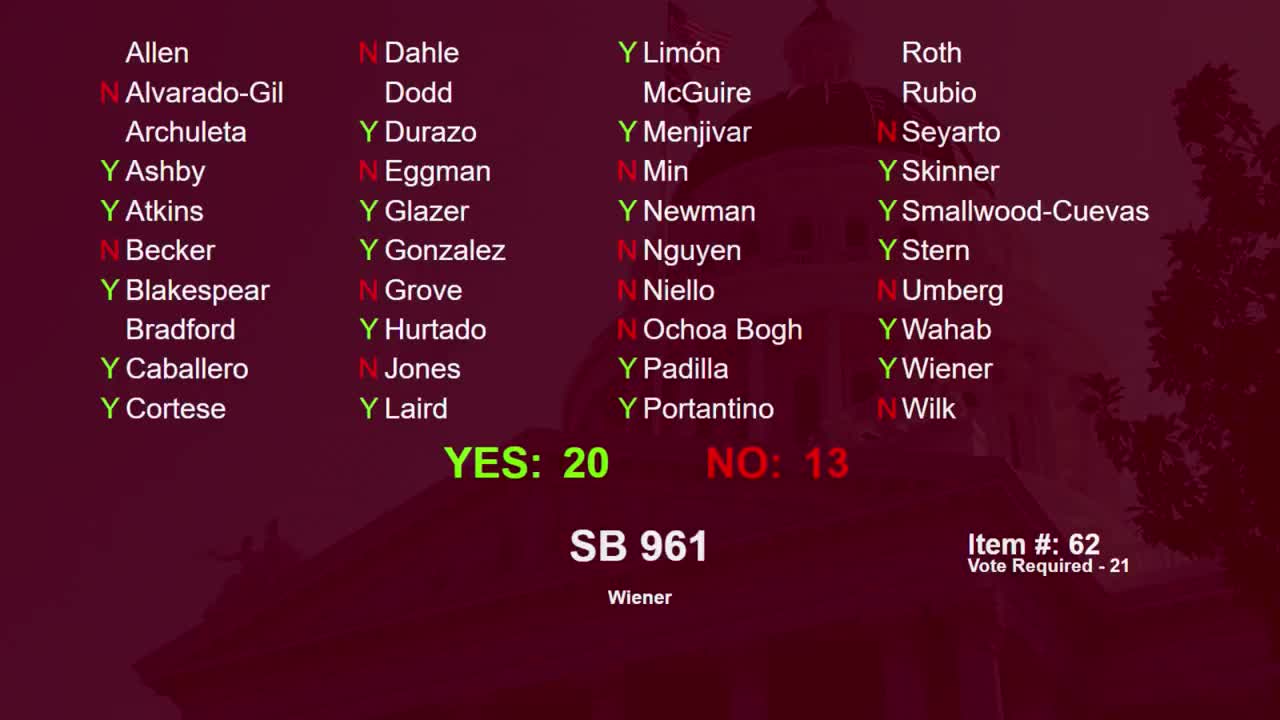 2MIN
Senate Floor
 7MIN
Senate Standing Committee on Transportation
 32SEC
Senate Standing Committee on Transportation
 19MIN
Senate Standing Committee on Energy, Utilities and Communications
Bill Author