SR 103
- Session Year: 2023-2024
- House: Senate
- Latest Version Date: 2024-08-16
Current Status:
Failed
(2024-08-15: Read. Adopted. (Ayes 38. Noes 0. Page 5074.))
Introduced
In Committee
First Chamber
In Committee
Second Chamber
Enacted
WHEREAS, A study published in December 2004 of social science textbooks used in California schools and universities by Lawrence DiStasi and the Italian American Textbook Committee, titled The Treatment of Italian Americans in California Textbooks, found that Italian American contributions were largely absent from elementary, secondary, and postsecondary textbooks used in California; and
WHEREAS, Italian Americans are the fifth largest ethnic group in America numbering roughly 26,000,000 people, with nearly 1,500,000 residing in California. For much of the 20th century, Italian Americans were the largest immigrant group in the United States, yet they are not extended proper credit for their role in shaping American culture; and
WHEREAS, As one of the countrys greatest success stories, Italian Americans made enormous contributions to our country and state. For example, Amadeo Pietro A.P. Giannini (The Giant of the West), born of Italian immigrant parents in San Jose in 1870, began establishing branches of his Bank of Italy in 1904 in the Italian neighborhoods across California, becoming the first branch banking system in the United States, which he renamed the Bank of America in 1930. The philosophy that spurred the success of Bank of America was to invest in common people to stimulate rapid economic growth. Mr. Gianninis investments include the movie industry, the Golden Gate Bridge, the Walt Disney Company, and much of todays agribusiness; and
WHEREAS, Italian immigrant Marco Fontana arrived in the United States in 1859 and started the California Packing Company under the Del Monte label. His cannery soon became the largest food processing company in the world. Domenico Ghirardelli settled in San Francisco during the Gold Rush and founded the Ghirardelli Chocolate empire. The movie industry, the fifth largest employer in the County of Los Angeles, owes much of its success to numerous Italian American artists, including Danny DeVito, John Travolta, Sylvester Stallone, Al Pacino, Vito Russo, Isabella Rossellini, Liza Minnelli, Anne Bancroft, Marisa Tomei, and many others. Italian Americans have served this country in governance as well, such as United States Representative Nancy Pelosi as Speaker of the House; and
WHEREAS, The wine industry in California owes much of its success to Italian Americans. Italian pioneers established the early wine industry in the California foothills of the Gold Country following the Gold Rush of 1848. In 1881, Italian immigrant Andrea Sbarboro founded the Italian Swiss Colony at Asti, a cooperative of Italian immigrants from the wine growing areas of northern Italy. The colony quickly became the largest winery in the Napa and Sonoma Valleys. Later Italian winemakers like Robert Mondavi and the Sebastiani family established world class status for California wines. Beginning in the 1940s, Ernest Gallo and Julio Gallo established the largest family owned winery in the United States in Californias central valley. Zinfandel might have disappeared had it not been resurrected by the Bob Trinchero family winery, the first to introduce white Zinfandel from their Sutter Home Winery in the Napa Valley; and
WHEREAS, Italian Americans were among the earliest and largest groups to settle in California, and they played a dominant role in the creation of the states agriculture, food processing, branch banking, fishing, and wine industries. Little-known facts regarding the experience and contributions of Italian Americans include the following: (1) Between 1880 and 1920, about 4,000,000 Italians immigrated to the United States and nearly one-third of Ellis Island immigrants were Italian. Restrictive immigration laws at that time were directly aimed at Italian immigrants and based on anti-Italian attitudes; and (2) Italians played a large role in the development of agriculture in California. Their control and development of fruit and vegetable industries in the central valley, truck farming in major urban centers, and their influence on the development of wine and grape industries left a legacy shared by us all; and
WHEREAS, Although Italians constituted the largest ethnic group in the American military during World War II, an estimated 600,000 Italian immigrants nationwide suffered wartime restrictions, including internment and arrest, curfews, travel restrictions, and seizure of their personal property. Some 10,000 Italian Americans were forced to relocate from coastal areas of California; and
WHEREAS, Italian American contributions to California and United States history can be easily incorporated in the current elementary and secondary curriculum content. Italian Americans played a vital role in shaping the cultural landscape of California. The story of California would be incomplete without telling the story of their distinctive contributions to the history and development of the state and the nation. Including Italian Americans in the educational experience would help provide better awareness and understanding of the unique cultural differences of this significant part of the states ethnic diversity and help overcome more than a century of prejudice against them; and
WHEREAS, In 1996, the Legislature established the California Italian American Task Force. The highest priority of the task force is the inclusion in the public school curriculum of Italian American history, achievements, and contributions; and
WHEREAS, Both Italian American heritage and the individual and collective contributions of Italian Americans deserve the states recognition and commendation and the designation of a month in their honor for collective reflection and celebration; now, therefore, be it
Resolved by the Senate of the State of California, That the Senate designates the month of October 2024, and every October thereafter, as Italian American Heritage Month; and be it further
Resolved, That the Senate encourages public schools to highlight and include Italian American achievements and contributions to the culture of California, and to take steps to promote the inclusion of the role and contributions of Italian Americans to the culture and history of California and the United States in the elementary and secondary social science textbooks during the revision process for those textbooks; and be it further
Resolved, That the Senate encourages public schools to include Italian Americans in ethnic studies courses; and be it further
Resolved, That the Secretary of the Senate transmit copies of this resolution to the author, members of the State Board of Education, the Instructional Quality Commission, and to school districts for appropriate distribution.
WHEREAS, A study published in December 2004 of social science textbooks used in California schools and universities by Lawrence DiStasi and the Italian American Textbook Committee, titled The Treatment of Italian Americans in California Textbooks, found that Italian American contributions were largely absent from elementary, secondary, and postsecondary textbooks used in California; and
WHEREAS, Italian Americans are the fifth largest ethnic group in America numbering roughly 26,000,000 people, with nearly 1,500,000 residing in California. For much of the 20th century, Italian Americans were the largest immigrant group in the United States, yet they are not extended proper credit for their role in shaping American culture; and
WHEREAS, As one of the countrys greatest success stories, Italian Americans made enormous contributions to our country and state. For example, Amadeo Pietro A.P. Giannini (The Giant of the West), born of Italian immigrant parents in San Jose in 1870, began establishing branches of his Bank of Italy in 1904 in the Italian neighborhoods across California, becoming the first branch banking system in the United States, which he renamed the Bank of America in 1930. The philosophy that spurred the success of Bank of America was to invest in common people to stimulate rapid economic growth. Mr. Gianninis investments include the movie industry, the Golden Gate Bridge, the Walt Disney Company, and much of todays agribusiness; and
WHEREAS, Italian immigrant Marco Fontana arrived in the United States in 1859 and started the California Packing Company under the Del Monte label. His cannery soon became the largest food processing company in the world. Domenico Ghirardelli settled in San Francisco during the Gold Rush and founded the Ghirardelli Chocolate empire. The movie industry, the fifth largest employer in the County of Los Angeles, owes much of its success to numerous Italian American artists, including Danny DeVito, John Travolta, Sylvester Stallone, Al Pacino, Vito Russo, Isabella Rossellini, Liza Minelli, Anne Bancroft, Marisa Tomei, and many others. Italian Americans have served this country in governance as well, such as United States Representative Nancy Pelosi as Speaker of the House; and
WHEREAS, The wine industry in California owes much of its success to Italian Americans. Italian pioneers established the early wine industry in the California foothills of the Gold Country following the Gold Rush of 1848. In 1881, Italian immigrant Andrea Sbarboro founded the Italian Swiss Colony at Asti, a cooperative of Italian immigrants from the wine growing areas of northern Italy. The colony quickly became the largest winery in the Napa and Sonoma Valleys. Later Italian winemakers like Robert Mondavi and the Sebastiani family established world class status for California wines. Beginning in the 1940s, Ernest Gallo and Julio Gallo established the largest family owned winery in the United States in Californias central valley. Zinfandel might have disappeared had it not been resurrected by the Bob Trinchero family winery, the first to introduce white Zinfandel from their Sutter Home Winery in the Napa Valley; and
WHEREAS, Italian Americans were among the earliest and largest groups to settle in California, and they played a dominant role in the creation of the states agriculture, food processing, branch banking, fishing, and wine industries. Little-known facts regarding the experience and contributions of Italian Americans include the following: (1) Between 1880 and 1920, about 4,000,000 Italians immigrated to the United States and nearly one-third of Ellis Island immigrants were Italian. Restrictive immigration laws at that time were directly aimed at Italian immigrants and based on anti-Italian attitudes; and (2) Italians played a large role in the development of agriculture in California. Their control and development of fruit and vegetable industries in the central valley, truck farming in major urban centers, and their influence on the development of wine and grape industries left a legacy shared by us all; and
WHEREAS, Although Italians constituted the largest ethnic group in the American military during World War II, an estimated 600,000 Italian immigrants nationwide suffered wartime restrictions, including internment and arrest, curfews, travel restrictions, and seizure of their personal property. Some 10,000 Italian Americans were forced to relocate from coastal areas of California; and
WHEREAS, Italian American contributions to California and United States history can be easily incorporated in the current elementary and secondary curriculum content. Italian Americans played a vital role in shaping the cultural landscape of California. The story of California would be incomplete without telling the story of their distinctive contributions to the history and development of the state and the nation. Including Italian Americans in the educational experience would help provide better awareness and understanding of the unique cultural differences of this significant part of the states ethnic diversity and help overcome more than a century of prejudice against them; and
WHEREAS, In 1996, the Legislature established the California Italian American Task Force. The highest priority of the task force is the inclusion in the public school curriculum of Italian American history, achievements, and contributions; and
WHEREAS, Both Italian American heritage and the individual and collective contributions of Italian Americans deserve the states recognition and commendation and the designation of a month in their honor for collective reflection and celebration; now, therefore, be it
Resolved by the Senate of the State of California, That the Senate designates the month of October 2024, and every October thereafter, as Italian American Heritage Month; and be it further
Resolved, That the Senate encourages public schools to highlight and include Italian American achievements and contributions to the culture of California, and to take steps to promote the inclusion of the role and contributions of Italian Americans to the culture and history of California and the United States in the elementary and secondary social science textbooks during the revision process for those textbooks; and be it further
Resolved, That the Senate encourages public schools to include Italian Americans in ethnic studies courses; and be it further
Resolved, That the Secretary of the Senate transmit copies of this resolution to the author, members of the State Board of Education, the Instructional Quality Commission, and to school districts for appropriate distribution.
|
Date
|
Status
|
|---|---|
| Aug 15, 2024 | Read. Adopted. (Ayes 38. Noes 0. Page 5074.) |
| Aug 14, 2024 | From committee: Be adopted. Ordered to third reading. (Ayes 4. Noes 0. Page 5064.) (August 14). |
| Aug 12, 2024 | Set for hearing August 14. |
| Aug 7, 2024 | Re-referred to Com. on ED. |
| Jul 2, 2024 | Introduced. Referred to Com. on RLS. |
|
Date
|
Description
|
Location
|
Votes
|
|
|---|---|---|---|---|
| Aug 15, 2024 | Senate 3rd Reading SR103 Portantino et al. | Senate Floor |
Passed |
|
| Aug 14, 2024 | Be adopted. Ordered to third reading | Senate Standing Committee on Education |
Passed |
This list shows positions taken on this bill by organizations on the date displayed, which is linked to the original source.
Positions by individuals are not included.
SENATE RULES COMMITTEE Office of Senate Floor Analyses (916) 651-1520 Fax: (916) 327-4478 | SR 103 |
THIRD READING
Bill No: SR 103
Author: Portantino (D), et al.
Introduced: 7/2/24
Vote: Majority
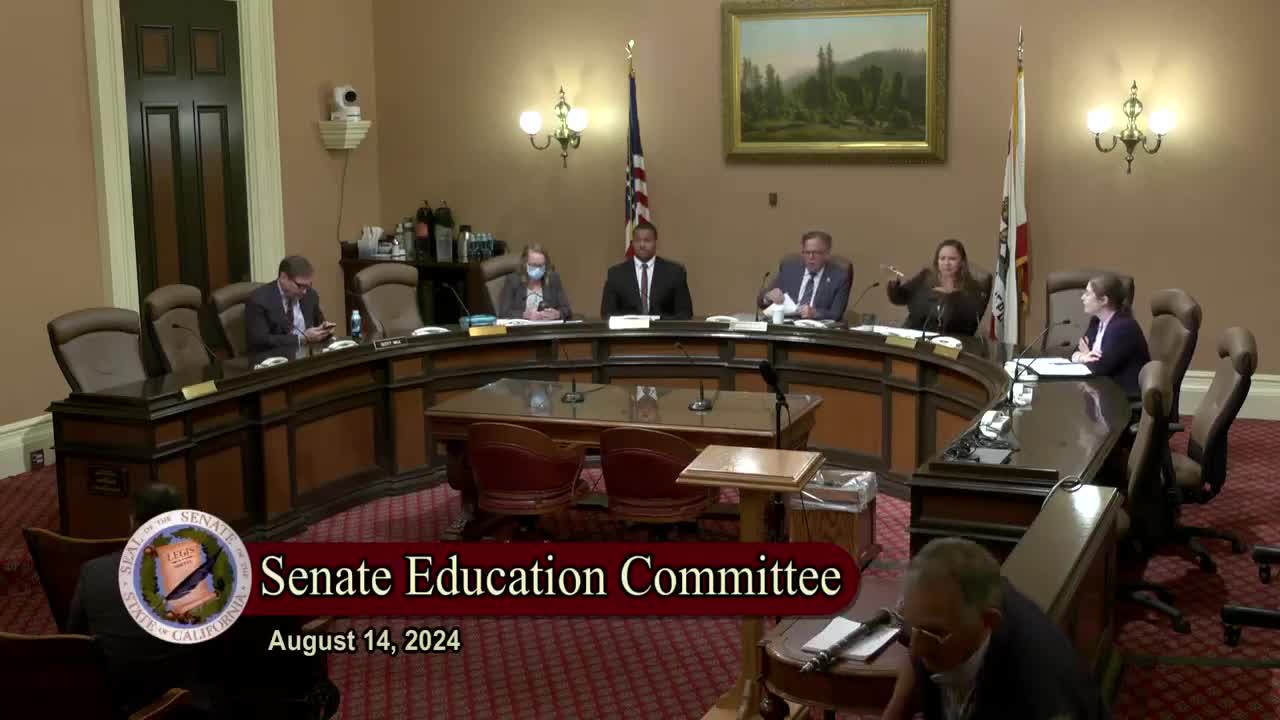
SENATE EDUCATION COMMITTEE: 4-0, 8/14/24
AYES: Newman, Ochoa Bogh, Cortese, Wilk
NO VOTE RECORDED: Glazer, Gonzalez, Smallwood-Cuevas
SUBJECT: Italian American Heritage Month
SOURCE: Author
DIGEST:
This resolution encourages public schools to include Italian Americans in ethnic studies courses and designates the month of October as Italian American Heritage Month.
ANALYSIS:
Existing law:
- Requires schools to offer beginning the 2025-26 school year, and with pupils graduating the 29-30 school year to have taken, at least a one-semester course in ethnic studies that meet one for four permitted options:
- A course based on the model curriculum developed by the Instructional Quality Commission (IQC).
- An existing ethnic studies course.
- An ethnic studies course taught as part of a course that has been approved as meeting the A–G requirements of the University of California (UC) and the California State University (CSU).
- A locally developed ethnic studies course approved by the governing board of the school district or the governing body of the charter school. (Education Code (EC) § 51225.3 (a)(1)(G)(ii))
- Requires the curriculum, instruction, and instructional materials for an ethnic studies or course, described in 1) above, to meet all of the following:
- Be appropriate for use with pupils of all races, religions, nationalities, genders, sexual orientations, and diverse ethnic and cultural backgrounds, pupils with disabilities, and English learners.
- Not reflect or promote, directly or indirectly, any bias, bigotry, or discrimination against any person or group of persons on the basis of any category of a protected class.
- Not teach or promote religious doctrine. (EC § 51225.3 (a)(1)(G)(vii))
- Prohibits a governing board from adopting any instructional materials for use in the schools that, in its determination, contain any matter reflecting adversely upon persons based on race or ethnicity, gender, religion, disability, nationality, sexual orientation, and occupation, and any sectarian or denominational doctrine or propaganda contrary to law. (EC § 60044)
- Requires all instructional materials adopted by any governing board for use in the schools shall be, to the satisfaction of the governing board, accurate, objective, current, and suited to the needs and comprehension of pupils at their respective grade levels. (EC § 60045)
This resolution:
- Makes the following findings:
- A study published in December 2004 of social science textbooks used in California schools and universities by Lawrence DiStasi and the Italian American Textbook Committee, titled The Treatment of Italian Americans in California Textbooks, found that Italian American contributions were largely absent from elementary, secondary, and postsecondary textbooks used in California.
- Italian Americans are the fifth largest ethnic group in America numbering roughly 26,000,000 people, with nearly 1,500,000 residing in California. For much of the 20th century, Italian Americans were the largest immigrant group in the United States, yet they are not extended proper credit for their role in shaping American culture.
- As one of the country’s greatest success stories, Italian Americans made enormous contributions to our country and state. For example, Amadeo Pietro “A.P.” Giannini (The Giant of the West), born of Italian immigrant parents in San Jose in 1870, began establishing branches of his Bank of Italy in 1904 in the Italian neighborhoods across California, becoming the first branch banking system in the United States, which he renamed the Bank of America in 1930. The philosophy that spurred the success of Bank of America was to invest in common people to stimulate rapid economic growth. Mr. Giannini’s investments include the movie industry, the Golden Gate Bridge, the Walt Disney Company, and much of today’s agribusiness.
- Italian immigrant Marco Fontana arrived in the United States in 1859 and started the California Packing Company under the Del Monte label. His cannery soon became the largest food processing company in the world. Domenico Ghirardelli settled in San Francisco during the Gold Rush and founded the Ghirardelli Chocolate empire. The movie industry, the fifth largest employer in the County of Los Angeles, owes much of its success to numerous Italian American artists, including Danny DeVito, John Travolta, Sylvester Stallone, Al Pacino, Vito Russo, Isabella Rossellini, Liza Minelli, Anne Bancroft, Marisa Tomei, and many others. Italian Americans have served this country in governance as well, such as United States Representative Nancy Pelosi as Speaker of the House.
- The wine industry in California owes much of its success to Italian Americans. Italian pioneers established the early wine industry in the California foothills of the Gold Country following the Gold Rush of 1848. In 1881, Italian immigrant Andrea Sbarboro founded the Italian Swiss Colony at Asti, a cooperative of Italian immigrants from the wine growing areas of northern Italy. The colony quickly became the largest winery in the Napa and Sonoma Valleys. Later Italian winemakers like Robert Mondavi and the Sebastiani family established world class status for California wines. Beginning in the 1940s, Ernest Gallo and Julio Gallo established the largest family owned winery in the United States in California’s Central Valley. Zinfandel might have disappeared had it not been resurrected by the Bob Trinchero family winery, the first to introduce white Zinfandel from their Sutter Home Winery in the Napa Valley.
- Italian Americans were among the earliest and largest groups to settle in California, and they played a dominant role in the creation of the state’s agriculture, food processing, branch banking, fishing, and wine industries. Little-known facts regarding the experience and contributions of Italian Americans include the following: (1) Between 1880 and 1920, about 4,000,000 Italians immigrated to the United States and nearly one-third of Ellis Island immigrants were Italian. Restrictive immigration laws at that time were directly aimed at Italian immigrants and based on anti-Italian attitudes; and (2) Italians played a large role in the development of agriculture in California. Their control and development of fruit and vegetable industries in the central valley, truck farming in major urban centers, and their influence on the development of wine and grape industries left a legacy shared by us all.
- Although Italians constituted the largest ethnic group in the American military during World War II, an estimated 600,000 Italian immigrants nationwide suffered wartime restrictions, including internment and arrest, curfews, travel restrictions, and seizure of their personal property. Some 10,000 Italian Americans were forced to relocate from coastal areas of California.
- Italian American contributions to California and United States history can be easily incorporated in the current elementary and secondary curriculum content. Italian Americans played a vital role in shaping the cultural landscape of California. The story of California would be incomplete without telling the story of their distinctive contributions to the history and development of the state and the nation. Including Italian Americans in the educational experience would help provide better awareness and understanding of the unique cultural differences of this significant part of the state’s ethnic diversity and help overcome more than a century of prejudice against them.
- In 1996, the Legislature established the California Italian American Task Force. The highest priority of the task force is the inclusion in the public school curriculum of Italian American history, achievements, and contributions.
- Both Italian American heritage and the individual and collective contributions of Italian Americans deserve the state’s recognition and commendation and the designation of a month in their honor for collective reflection and celebration.
- Resolves that:
- Encourages public schools to include Italian Americans in ethnic studies course.
- Designating October as Italian American Heritage Month.
Comments
- Need for the resolution. According to the author, “Italian Americans have been instrumental in shaping California’s history and culture, from pioneering the state’s agriculture and wine industries to establishing the first branch banking system in the U.S. and home of the first woman to be speaker of the house. Despite their significant contributions, their role has been largely under taught in educational curricula. SR 103 honors the Italian American legacy and encourages schools to include their achievements, ensuring their impact in California is properly recognized and celebrated.”
- How Curriculum, Standards, Frameworks, and Model Curricula Are Created and Adopted. The Legislature has vested the IQC and State Board of Education (SBE) with the authority to develop and adopt state curriculum and instructional materials. The IQC develops curriculum frameworks in each subject by convening expert panels, developing drafts, and holding public hearings to solicit input. Changes are frequently made in response to public comment. The SBE then adopts the frameworks in a public meeting. The SBE also adopts, in a public process, instructional materials aligned to those frameworks for grades K-8. These existing processes involve practitioners and experts who have an in-depth understanding of curriculum and instruction, including the full scope and sequence of the curriculum in each subject and at each grade level, constraints on instructional time and resources, and the relationship of curriculum to state assessments and other measures of student progress.
The Development of Ethnic Studies. In March 2018, the SBE adopted the ethnic studies model curriculum. The development process sparked controversy due to concerns over which groups the curriculum would include and some specifics in the initial draft. After public comment periods and revisions, the CDE recommended that the model curriculum expand the breadth and depth of the four foundational disciplines of ethnic studies—African American Studies, Asian American Studies, Chicana/o/x Latina/o/x Studies, and Native American Studies. Additionally, the CDE proposed updating and expanding existing resources to reflect California's diversity by offering instructional materials that include the voices of identities intersecting with ethnic studies, such as Arab Americans, Armenian Americans, Jewish Americans, and Sikh Americans.
It should be noted that the model curriculum adopted by the SBE is one of the four permitted types of ethnic studies courses a school may use to meet the ethnic studies graduation requirement.
- Ethnic Studies Courses Permitted By Statute. As part of AB 101 (Medina, Chapter 661, Statues of 2021), the Legislature permitted school district and charter school governing boards to meet the high school graduation requirements through a pupil’s completion of any of the following types of courses:
- An ethnics studies course based on the model curriculum approved by the SBE;
- An existing ethnic studies course (prior to the passage of AB 101 (Medina, Chapter 661, Statues of 2021) some districts already developed, adopted, and offered an ethnic studies course to students);
- An ethnic studies course taught as part of a course that has been approved as meeting the A–G requirements of the UC and the CSU (prior to the passage of AB 101 (Medina, Chapter 661, Statues of 2021) some districts had already developed, adopted and offered an ethnic studies course approved by the UC to meet the A-G requirement for social studies); or
- A locally developed ethnic studies course approved by the governing board of the school district or the governing body of the charter school that requires the proposed course to first be presented at a public meeting of the governing board of the school district or the governing body of the charter school, and to not be approved until a subsequent public meeting of the governing board or governing body at which the public has had the opportunity to express its views on the proposed course. (EC 51225.3 (a)(1)(G)(ii))
In addition to specifying the types of ethnic studies courses that a school district and charter school governing boards may approve to help students meet the high school graduation requirement, AB 101 (Medina, Chapter 661, Statutes of 2021) also specifies the curriculum, instruction, and instructional materials for all types of ethnic studies courses, listed in a) - d) above must meet all of the following:
- Be appropriate for use with pupils of all races, religions, nationalities, genders, sexual orientations, and diverse ethnic and cultural backgrounds, pupils with disabilities, and English learners.
- Not reflect or promote, directly or indirectly, any bias, bigotry, or discrimination against any person, or group of persons, on the basis of any category of a protected class.
- Not teach or promote religious doctrine. (EC 51225.3 (a)(1)(G)(vii))
Under existing law, local educational agency (LEAs) are permitted to adopt locally developed ethnic studies courses, as specified, which could include a locally developed ethnic studies course related to the history and contributions of Italian Americans. This resolution does not change exiting law.
- The California Italian American Taskforce (Taskforce). On August 5, 1996, a Resolution was passed in the California State Assembly calling for creating a statewide Italian American Taskforce to address the concerns of Italian American Californians. In creating the Taskforce, the Assembly Resolution recognized that Italian American immigrants were among the largest immigrant groups to settle in California and the entire United States, and today, they are the fifth largest ancestry group in the country. It also recognized that Italians were among the earliest pioneers of California and have been instrumental in the development of the country. According to the Taskforce, The Taskforce gave Italian Americans a historic opportunity to address their issues at the state government policy level, where many decisions that affect Italian Americans are made.
FISCAL EFFECT: Appropriation: No Fiscal Com.: No Local: No
SUPPORT: (Verified 8/14/24)
None received
OPPOSITION: (Verified 8/14/24)
Prepared by: Kordell Hampton / ED. / (916) 651-4105
8/14/24 16:40:29
**** END ****
SENATE COMMITTEE ON EDUCATION
Senator Josh Newman, Chair
2023 - 2024 Regular
Bill No: SR 103 Hearing Date: August 14, 2024
Author: | |||
Version: | July 2, 2024 | ||
Urgency: | No | Fiscal: | No |
Consultant: | Kordell Hampton | ||
Subject: Italian American Heritage Month.
SUMMARY
This resolution encourages public schools to include Italian Americans in ethnic studies courses and designates the month of October as Italian American Heritage Month.
BACKGROUND
Existing Law:
Education Code (EC)
- Requires schools to offer beginning the 2025-26 school year, and with pupils graduating the 29-30 school year to have taken, at least a one-semester course in ethnic studies that meet one for four permitted options:
- A course based on the model curriculum developed by the Instructional Quality Commission (IQC).
- An existing ethnic studies course.
- An ethnic studies course taught as part of a course that has been approved as meeting the A–G requirements of the University of California (UC) and the California State University (CSU).
- A locally developed ethnic studies course approved by the governing board of the school district or the governing body of the charter school. (EC § 51225.3 (a)(1)(G)(ii))
- Requires the curriculum, instruction, and instructional materials for an ethnic studies or course, described in 1) above, to meet all of the following:
- Be appropriate for use with pupils of all races, religions, nationalities, genders, sexual orientations, and diverse ethnic and cultural backgrounds, pupils with disabilities, and English learners.
- Not reflect or promote, directly or indirectly, any bias, bigotry, or discrimination against any person or group of persons on the basis of any category of a protected class.
- Not teach or promote religious doctrine. (EC § 51225.3 (a)(1)(G)(vii))
- Prohibits a governing board from adopting any instructional materials for use in the schools that, in its determination, contain any matter reflecting adversely upon persons based on race or ethnicity, gender, religion, disability, nationality, sexual orientation, and occupation, and any sectarian or denominational doctrine or propaganda contrary to law. (EC § 60044)
- Requires all instructional materials adopted by any governing board for use in the schools shall be, to the satisfaction of the governing board, accurate, objective, current, and suited to the needs and comprehension of pupils at their respective grade levels. (EC § 60045)
ANALYSIS
This resolution:
- Makes the following findings:
- A study published in December 2004 of social science textbooks used in California schools and universities by Lawrence DiStasi and the Italian American Textbook Committee, titled The Treatment of Italian Americans in California Textbooks, found that Italian American contributions were largely absent from elementary, secondary, and postsecondary textbooks used in California.
- Italian Americans are the fifth largest ethnic group in America numbering roughly 26,000,000 people, with nearly 1,500,000 residing in California. For much of the 20th century, Italian Americans were the largest immigrant group in the United States, yet they are not extended proper credit for their role in shaping American culture.
- As one of the country’s greatest success stories, Italian Americans made enormous contributions to our country and state. For example, Amadeo Pietro “A.P.” Giannini (The Giant of the West), born of Italian immigrant parents in San Jose in 1870, began establishing branches of his Bank of Italy in 1904 in the Italian neighborhoods across California, becoming the first branch banking system in the United States, which he renamed the Bank of America in 1930. The philosophy that spurred the success of Bank of America was to invest in common people to stimulate rapid economic growth. Mr. Giannini’s investments include the movie industry, the Golden Gate Bridge, the Walt Disney Company, and much of today’s agribusiness.
- Italian immigrant Marco Fontana arrived in the United States in 1859 and started the California Packing Company under the Del Monte label. His cannery soon became the largest food processing company in the world. Domenico Ghirardelli settled in San Francisco during the Gold Rush and founded the Ghirardelli Chocolate empire. The movie industry, the fifth largest employer in the County of Los Angeles, owes much of its success to numerous Italian American artists, including Danny DeVito, John Travolta, Sylvester Stallone, Al Pacino, Vito Russo, Isabella Rossellini, Liza Minelli, Anne Bancroft, Marisa Tomei, and many others. Italian Americans have served this country in governance as well, such as United States Representative Nancy Pelosi as Speaker of the House.
- The wine industry in California owes much of its success to Italian Americans. Italian pioneers established the early wine industry in the California foothills of the Gold Country following the Gold Rush of 1848. In 1881, Italian immigrant Andrea Sbarboro founded the Italian Swiss Colony at Asti, a cooperative of Italian immigrants from the wine growing areas of northern Italy. The colony quickly became the largest winery in the Napa and Sonoma Valleys. Later Italian winemakers like Robert Mondavi and the Sebastiani family established world class status for California wines. Beginning in the 1940s, Ernest Gallo and Julio Gallo established the largest family owned winery in the United States in California’s Central Valley. Zinfandel might have disappeared had it not been resurrected by the Bob Trinchero family winery, the first to introduce white Zinfandel from their Sutter Home Winery in the Napa Valley.
- Italian Americans were among the earliest and largest groups to settle in California, and they played a dominant role in the creation of the state’s agriculture, food processing, branch banking, fishing, and wine industries. Little-known facts regarding the experience and contributions of Italian Americans include the following: (1) Between 1880 and 1920, about 4,000,000 Italians immigrated to the United States and nearly one-third of Ellis Island immigrants were Italian. Restrictive immigration laws at that time were directly aimed at Italian immigrants and based on anti-Italian attitudes; and (2) Italians played a large role in the development of agriculture in California. Their control and development of fruit and vegetable industries in the central valley, truck farming in major urban centers, and their influence on the development of wine and grape industries left a legacy shared by us all.
- Although Italians constituted the largest ethnic group in the American military during World War II, an estimated 600,000 Italian immigrants nationwide suffered wartime restrictions, including internment and arrest, curfews, travel restrictions, and seizure of their personal property. Some 10,000 Italian Americans were forced to relocate from coastal areas of California.
- Italian American contributions to California and United States history can be easily incorporated in the current elementary and secondary curriculum content. Italian Americans played a vital role in shaping the cultural landscape of California. The story of California would be incomplete without telling the story of their distinctive contributions to the history and development of the state and the nation. Including Italian Americans in the educational experience would help provide better awareness and understanding of the unique cultural differences of this significant part of the state’s ethnic diversity and help overcome more than a century of prejudice against them.
- In 1996, the Legislature established the California Italian American Task Force. The highest priority of the task force is the inclusion in the public school curriculum of Italian American history, achievements, and contributions.
- Both Italian American heritage and the individual and collective contributions of Italian Americans deserve the state’s recognition and commendation and the designation of a month in their honor for collective reflection and celebration.
- Resolves that:
- Encourages public schools to include Italian Americans in ethnic studies course.
- Designating October as Italian American Heritage Month.
STAFF COMMENTS
- Need for the resolution. According to the author, “Italian Americans have been instrumental in shaping California’s history and culture, from pioneering the state’s agriculture and wine industries to establishing the first branch banking system in the U.S. and home of the first woman to be speaker of the house. Despite their significant contributions, their role has been largely under taught in educational curricula. SR 103 honors the Italian American legacy and encourages schools to include their achievements, ensuring their impact in California is properly recognized and celebrated.”
- How Curriculum, Standards, Frameworks, and Model Curricula Are Created and Adopted. The Legislature has vested the IQC and State Board of Education (SBE) with the authority to develop and adopt state curriculum and instructional materials. The IQC develops curriculum frameworks in each subject by convening expert panels, developing drafts, and holding public hearings to solicit input. Changes are frequently made in response to public comment. The SBE then adopts the frameworks in a public meeting. The SBE also adopts, in a public process, instructional materials aligned to those frameworks for grades K-8. These existing processes involve practitioners and experts who have an in-depth understanding of curriculum and instruction, including the full scope and sequence of the curriculum in each subject and at each grade level, constraints on instructional time and resources, and the relationship of curriculum to state assessments and other measures of student progress.
The Development of Ethnic Studies
In March 2018, the SBE adopted the ethnic studies model curriculum. The development process sparked controversy due to concerns over which groups the curriculum would include and some specifics in the initial draft. After public comment periods and revisions, the CDE recommended that the model curriculum expand the breadth and depth of the four foundational disciplines of ethnic studies—African American Studies, Asian American Studies, Chicana/o/x Latina/o/x Studies, and Native American Studies. Additionally, the CDE proposed updating and expanding existing resources to reflect California's diversity by offering instructional materials that include the voices of identities intersecting with ethnic studies, such as Arab Americans, Armenian Americans, Jewish Americans, and Sikh Americans.
It should be noted that the model curriculum adopted by the SBE is one of the four permitted types of ethnic studies courses a school may use to meet the ethnic studies graduation requirement.
- Ethnic Studies Courses Permitted By Statute. As part of AB 101 (Medina, Chapter 661, Statues of 2021), the Legislature permitted school district and charter school governing boards to meet the high school graduation requirements through a pupil’s completion of any of the following types of courses:
- An ethnics studies course based on the model curriculum approved by the SBE;
- An existing ethnic studies course (prior to the passage of AB 101 (Medina, Chapter 661, Statues of 2021) some districts already developed, adopted, and offered an ethnic studies course to students);
- An ethnic studies course taught as part of a course that has been approved as meeting the A–G requirements of the UC and the CSU (prior to the passage of AB 101 (Medina, Chapter 661, Statues of 2021) some districts had already developed, adopted and offered an ethnic studies course approved by the UC to meet the A-G requirement for social studies); or
- A locally developed ethnic studies course approved by the governing board of the school district or the governing body of the charter school that requires the proposed course to first be presented at a public meeting of the governing board of the school district or the governing body of the charter school, and to not be approved until a subsequent public meeting of the governing board or governing body at which the public has had the opportunity to express its views on the proposed course. (EC 51225.3 (a)(1)(G)(ii))
In addition to specifying the types of ethnic studies courses that a school district and charter school governing boards may approve to help students meet the high school graduation requirement, AB 101 (Medina, Chapter 661, Statutes of 2021) also specifies the curriculum, instruction, and instructional materials for all types of ethnic studies courses, listed in a) - d) above must meet all of the following:
- Be appropriate for use with pupils of all races, religions, nationalities, genders, sexual orientations, and diverse ethnic and cultural backgrounds, pupils with disabilities, and English learners.
- Not reflect or promote, directly or indirectly, any bias, bigotry, or discrimination against any person, or group of persons, on the basis of any category of a protected class.
- Not teach or promote religious doctrine. (EC 51225.3 (a)(1)(G)(vii))
Under existing law, local educational agency (LEAs) are permitted to adopt locally developed ethnic studies courses, as specified, which could include a locally developed ethnic studies course related to the history and contributions of Italian Americans. This resolution does not change exiting law.
SUPPORT
None received
OPPOSITION
None received
-- END --
Discussed in Hearing
View Older Hearings
Bill Author