SR 67
- Session Year: 2023-2024
- House: Senate
- Latest Version Date: 2024-03-19
Current Status:
Failed
(2024-03-18: Read. Adopted. (Ayes 40. Noes 0. Page 3324.))
Introduced
In Committee
First Chamber
In Committee
Second Chamber
Enacted
WHEREAS, The month of March 2024 is recognized as National Problem Gambling Awareness Month by the National Council on Problem Gambling, which was established in 1972, and its 35 state affiliates, including the California Council on Problem Gambling, established in 1986; and
WHEREAS, Gambling disorder is not only an addiction, but also a public health issue in which some problem gamblers experience both physical and mental health conditions. During the 20212022 fiscal year, hypertension, obesity, diabetes, and elevated alcohol and tobacco use were the most common cooccurring physical health problems among clients served in the California state-funded gambling treatment program, while mental health disorders, including depression, bipolar disorder, and anxiety were the most commonly reported cooccurring mental health conditions; and
WHEREAS, Gambling disorder is a treatable disease, and treatment is effective in minimizing the harm to individuals, families, and communities. The Office of Problem Gambling and the UCLA Gambling Studies Program currently operates the California Gambling Education and Treatment Services (CalGETS) program that, since 2009, has provided treatment services to almost 20,000 problem gamblers and others affected by a gambling disorder. CalGETS offers a diverse array of services including the Problem Gambling Helpline, text and chat support programs available in English, Spanish, Mandarin, and Cantonese and with translation for more than 200 other languages, group treatment, intensive outpatient and residential care, and self-help toolkits; and
WHEREAS, Gambling disorder is classified by the American Psychiatric Association as an addiction with similarities to the causes and consequences of alcohol and drug dependence, and is also recognized as the concealed disease, because problem gamblers do not exhibit visible signs of the addiction; and
WHEREAS, The Office of Problem Gamblings ongoing public awareness campaign promotes focus and self-empowerment for individuals when seeking treatment for a gambling disorder; and
WHEREAS, The Bureau of Gambling Control within the Department of Justice, the California Gambling Control Commission, the California State Lottery, California Friday Night Live Partnership, California Gaming Association, Media Solutions, NICOS Chinese Health Coalition, the UCLA Gambling Studies Program, Pechanga Development Corporation, California Consortium of Addiction Programs and Professionals, and the gambling disorder recovery community have joined with the Office of Problem Gambling, within the State Department of Public Health, and the California Council on Problem Gambling to raise awareness and urge Californians to take the first step by seeking help for gambling-related problems; now, therefore, be it
Resolved by the Senate of the State of California, That March 2024 is hereby recognized as Problem Gambling Awareness Month and the agencies and organizations described in this resolution are commended for their concerted effort to raise public awareness of problem gambling; and be it further
Resolved, That the Secretary of the Senate transmit copies of this resolution to the author for distribution.
|
Date
|
Status
|
|---|---|
| Mar 18, 2024 | Read. Adopted. (Ayes 40. Noes 0. Page 3324.) |
| Feb 29, 2024 | From committee: Ordered to third reading. |
| Feb 15, 2024 | Introduced. Referred to Com. on RLS. |
|
Date
|
Description
|
Location
|
Votes
|
|
|---|---|---|---|---|
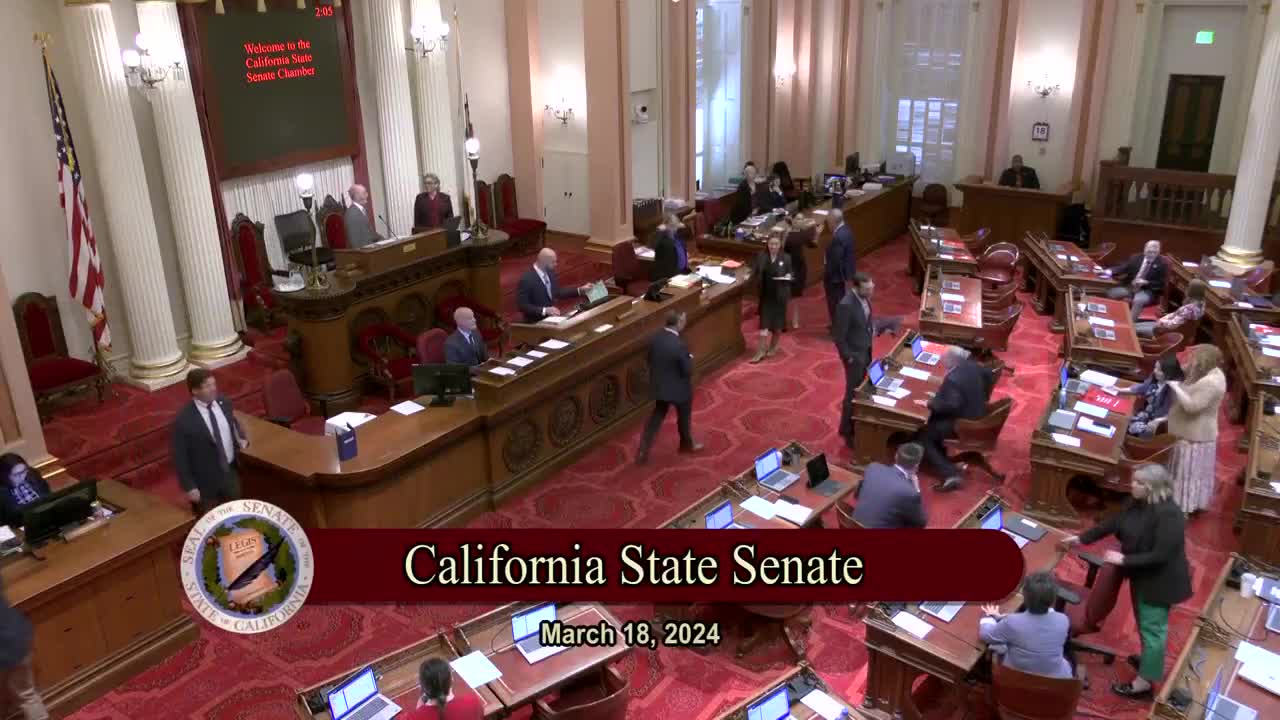
| Mar 18, 2024 | Senate 3rd Reading SR67 Dodd et al. | Senate Floor |
Passed |
This list shows positions taken on this bill by organizations on the date displayed, which is linked to the original source.
Positions by individuals are not included.
SENATE RULES COMMITTEE Office of Senate Floor Analyses (916) 651-1520 Fax: (916) 327-4478 | SR 67 |
THIRD READING
Bill No: SR 67
Author: Dodd (D), et al.
Introduced: 2/15/24
Vote: Majority
SUBJECT: National Gambling Awareness Month
SOURCE: California Council on Problem Gambling
DIGEST:
This resolution recognizes March 2024 as Problem Gambling Awareness Month.
ANALYSIS: This resolution makes the following legislative findings:
- The month of March 2024 is recognized as National Problem Gambling Awareness Month by the National Council on Problem Gambling, which was established in 1972, and its 35 state affiliates, including the California Council on Problem Gambling, established in 1986.
- Gambling disorder is not only an addiction, but also a public health issue in which some problem gamblers experience both physical and mental health conditions. During the 2021–2022 fiscal year, hypertension, obesity, diabetes, and elevated alcohol and tobacco use were the most common cooccurring physical health problems among clients served in the California state-funded gambling treatment program, while mental health disorders, including depression, bipolar disorder, and anxiety were the most commonly reported cooccurring mental health conditions.
- Gambling disorder is a treatable disease, and treatment is effective in minimizing the harm to individuals, families, and communities. The Office of Problem Gambling and the UCLA Gambling Studies Program currently operates the California Gambling Education and Treatment Services (CalGETS) program that, since 2009, has provided treatment services to almost 20,000 problem gamblers and others affected by a gambling disorder. CalGETS offers a diverse array of services including the Problem Gambling Helpline, text and chat support programs available in English, Spanish, Mandarin, and Cantonese and with translation for more than 200 other languages, group treatment, intensive outpatient and residential care, and self-help toolkits.
- Gambling disorder is classified by the American Psychiatric Association as an addiction with similarities to the causes and consequences of alcohol and drug dependence, and is also recognized as the “concealed disease,” because problem gamblers do not exhibit visible signs of the addiction.
- The Bureau of Gambling Control within the Department of Justice, the California Gambling Control Commission, the California State Lottery, California Friday Night Live Partnership, California Gaming Association, Media Solutions, NICOS Chinese Health Coalition, the UCLA Gambling Studies Program, Pechanga Development Corporation, California Consortium of Addiction Programs and Professionals, and the gambling disorder recovery community have joined with the Office of Problem Gambling, within the State Department of Public Health, and the California Council on Problem Gambling to raise awareness and urge Californians to take the first step by seeking help for gambling-related problems.
This resolution recognizes March 2024 as Problem Gambling Awareness Month, and commends the organizations described above for their concerted effort to raise public awareness of problem gambling.
Comments
According to the California Council on Problem Gambling states the following relative to Problem Gambling Awareness Month (PGAM),
PGAM began as a grassroots campaign in 1994, started by the National Council on Problem Gambling (NCPG), with the support of its state affiliates. It has since expanded to include promotion by a broad range of state and public health agencies, problem and responsible gambling organizations, and recovery groups.
PGAM is recognized by dozens of state and local legislatures, as well as numerous national agencies and organizations, and has an established record of successfully raising awareness, as measured by a discernible increase in help-seeking occurrences throughout the month of March, both in California and nationally.
During PGAM, stakeholders throughout the country hold conferences, air public service announcements, host screening days, run social media campaigns and engage in many other activities to increase the public awareness of problem gambling and the availability of prevention, treatment & recovery services.
Related/Prior Legislation
The following resolutions recognized March as Problem Gambling Awareness Month in California:
SR 16 (Dodd, 2023), adopted by the Senate.
SR 70 (Dodd, 2022), adopted by the Senate.
SR 78 (Dodd, 2020), adopted by the Senate.
SR 20 (Dodd, 2019), adopted by the Senate.
FISCAL EFFECT: Appropriation: No Fiscal Com.: No Local: No
SUPPORT: (Verified 2/27/24)
California Council on Problem Gambling (source)
OPPOSITION: (Verified 2/27/24)
None received
Prepared by: Jonas Austin / SFA / (916) 651-1520
2/28/24 9:44:00
**** END ****