ABX2 3: Transportation fuels: gasoline specifications.
- Session Year: 2023-2024
- House: Assembly
- Latest Version Date: 2024-09-26
Current Status:
Failed
(2024-10-14: From committee without further action.)
Introduced
In Committee
First Chamber
In Committee
Second Chamber
Enacted
The California Global Warming Solutions Act of 2006 establishes the State Air Resources Board as the state agency responsible for monitoring and regulating sources emitting greenhouse gases. The act requires the state board to approve a statewide greenhouse gas emissions limit equivalent to the statewide greenhouse gas emissions level in 1990 and to ensure the statewide greenhouse gas emissions are reduced to at least 40% below the statewide greenhouse gas emissions limit by 2030. The act authorizes the state board to include the use of market-based compliance mechanisms in its regulation of greenhouse gas emissions.
This bill would specify that transportation fuels are not subject to regulations implementing a market-based compliance mechanism for greenhouse gas emissions.
Existing law authorizes the state board to adopt and implement motor vehicle fuel specifications for the control of air contaminants and sources of air pollution. Existing law authorizes the state board to grant variances from the gasoline specifications, as provided.
This bill would require the state board to grant variances from gasoline specifications, including for gasoline imported from outside the state, whenever a refinery outage or other supply interruption would result in substantial short-term price increases, as specified.
Existing law requires the state board to establish, by regulation, maximum standards for volatility of gasoline, as provided. Pursuant to these authorities, the state board has adopted the California Reformulated Gasoline regulations, which include regulations establishing the maximum Reid vapor pressure of gasoline for various regions of the state at specified time periods.
This bill would require the state board to waive the Reid vapor pressure requirement on summer-blend gasoline under the California Reformulated Gasoline regulations and to allow for the early transition to winter-blend gasoline if the state board determines that the gasoline market is experiencing a sudden and unusual increase in gasoline prices.
Transportation fuels are not subject to regulations implementing a market-based compliance mechanism adopted pursuant to Section 38562 and Part 5 (commencing with Section 38570).
SEC. 2.Section 43013.2 of the Health and Safety Code is amended to read:43013.2.(a)(1)The Legislature finds and declares that variances from the state boards gasoline specifications may be needed if gasoline producers cannot meet the specifications as required due to circumstances beyond their reasonable control, or to prevent sudden increases in gasoline prices for California consumers and businesses, and that the state boards process for granting variances from fuel specifications should be clarified.
(2)It is the intent of the Legislature that the variance process consider the impacts of granting the variance on all parties, including the applicant, the public, the producers of complying fuel, and upon air quality.
(b)The state board may grant variances from gasoline specifications adopted by the state board pursuant to Sections 43013 and 43018. In granting a variance, the state board may impose fees and conditions. conditions and fees.
(c)The state board shall adopt regulations to implement this section in accordance with Chapter 3.5 (commencing with Section 11340) of Part 1 of Division 3 of Title 2 of the Government Code. The regulations shall establish guidelines for the consideration of variances and the imposition of fees and conditions. conditions and fees. Any fees or conditions conditions or fees shall be imposed in a fair and equitable manner consistent with the regulations. The regulations shall include methods for estimating excess emissions and factors to be considered in determining what is beyond the reasonable control of the applicant. The regulations also shall establish a schedule of fees to be paid by an applicant for a variance to cover the reasonable and necessary costs to the state board in processing the variance. The state board shall adopt initial regulations as emergency regulations after conducting at least one public workshop. The initial adoption of emergency regulations following January 1, 1996, shall be deemed to be an emergency and necessary for the immediate preservation of the public peace, health and safety, or general welfare.
(d)All variance fee revenues collected pursuant to this section by the state board, except those fees paid by an applicant for a variance to cover the reasonable and necessary costs to the state board for processing the variance, shall be transmitted to the Treasurer for deposit in the High Polluter Repair or Removal Account created pursuant to subdivision (a) of Section 44091. All money deposited in the account pursuant to this section shall be available, upon appropriation by the Legislature, to implement a program for accelerated retirement of light-duty vehicles to achieve the emission reductions required by the M-1 Strategy of the 1994 State Implementation Plan.
(e)In considering whether to grant a variance, and with regard to any fees and conditions conditions and fees that are imposed as part of the variance, the state board shall take into account whether granting the variance will place the applicant at a cost advantage over other persons, including those persons who produce complying gasoline.
(f)Any determination of the state board, or the executive officer of the state board pursuant to the authority delegated pursuant to Section 39516, regarding the issuance of any variance from gasoline specifications shall be based solely upon substantial evidence in the record of the variance proceeding. The variance shall be valid for a period not exceeding 120 days. The variance may be extended, subject to this section, for up to 90 additional days, upon a showing of need. The state board shall grant a variance only for the minimum period required to attain compliance.
(g)If a physical catastrophe occurs to a producer of complying gasoline, the state board may extend a variance upon the showing of need. Notwithstanding subdivision (f), any variance extension related to a physical catastrophe shall be approved by the state board. As used in this subdivision, physical catastrophe means a sudden unforeseen emergency beyond the reasonable control of the refiner, causing the severe reduction or total loss of one or more critical refinery units that materially impact the refiners ability to produce complying gasoline. Physical catastrophe does not include events that are not physical in nature such as design errors or omissions, financial or economic burdens, or any reduction in production that is not the direct result of qualifying physical damage.
(h)Notwithstanding any other law, except in the case of emergency variances, the state board shall provide at least 10 days public notice of its consideration of any variance or extension.
(i)Notwithstanding any other law, the state board shall grant variances from gasoline specifications adopted by the state board, including for the importation of gasoline from outside the state, whenever a refinery outage or other similar supply interruption would otherwise result in substantial short-term price increases for California consumers and businesses.
(j)Subdivisions (b) and (e) do not constitute a change in, but are declaratory of, existing law.
SEC. 3.Section 43830.5 is added to the Health and Safety Code, to read:43830.5.The state board shall waive the Reid vapor pressure requirement on summer-blend gasoline specified in Section 2262.4 of Title 13 of the California Code of Regulations and shall allow for the early transition to winter-blend gasoline to lower gasoline prices for California consumers and businesses if the state board determines that the gasoline market is experiencing a sudden and unusual increase in gasoline prices.
Transportation fuels are not subject to regulations implementing a market-based compliance mechanism adopted pursuant to Section 38562 and Part 5 (commencing with Section 38570).
SEC. 2.Section 43013.2 of the Health and Safety Code is amended to read:43013.2.(a) (1) The Legislature finds and declares that variances from the state boards gasoline specifications may be needed if gasoline producers cannot meet the specifications as required due to circumstances beyond their reasonable control, or to prevent sudden increases in gasoline prices for California consumers and businesses, and that the state boards process for granting variances from fuel specifications should be clarified.
(2)It is the intent of the Legislature that the variance process consider the impacts of granting the variance on all parties, including the applicant, the public, the producers of complying fuel, and upon air quality.
(b)The state board may grant variances from gasoline specifications adopted by the state board pursuant to Sections 43013 and 43018. In granting a variance, the state board may impose fees and conditions.
(c)The state board shall adopt regulations to implement this section in accordance with Chapter 3.5 (commencing with Section 11340) of Part 1 of Division 3 of Title 2 of the Government Code. The regulations shall establish guidelines for the consideration of variances and the imposition of fees and conditions. Any fees or conditions shall be imposed in a fair and equitable manner consistent with the regulations. The regulations shall include methods for estimating excess emissions and factors to be considered in determining what is beyond the reasonable control of the applicant. The regulations also shall establish a schedule of fees to be paid by an applicant for a variance to cover the reasonable and necessary costs to the state board in processing the variance. The state board shall adopt initial regulations as emergency regulations after conducting at least one public workshop. The initial adoption of emergency regulations following the effective date of this section January 1, 1996, shall be deemed to be an emergency and necessary for the immediate preservation of the public peace, health and safety, or general welfare.
(d)All variance fee revenues collected pursuant to this section by the state board, except those fees paid by an applicant for a variance to cover the reasonable and necessary costs to the state board for processing the variance, shall be transmitted to the Treasurer for deposit in the High Polluter Repair or Removal Account created pursuant to subdivision (a) of Section 44091. All money deposited in the account pursuant to this section shall be available, upon appropriation by the Legislature, to implement a program for accelerated retirement of light-duty vehicles to achieve the emission reductions required by the M-1 Strategy of the 1994 State Implementation Plan.
(e)In considering whether to grant a variance, and with regard to any fees and conditions that are imposed as part of the variance, the state board shall take into account whether granting the variance will place the applicant at a cost advantage over other persons, including those persons who produce complying gasoline.
(f)Any determination of the state board, or the executive officer of the state board pursuant to the authority delegated pursuant to Section 39516, regarding the issuance of any variance from gasoline specifications shall be based solely upon substantial evidence in the record of the variance proceeding. The variance shall be valid for a period not exceeding 120 days, commencing on or after March 1, 1996. days. The variance may be extended, subject to this section, for up to 90 additional days, upon a showing of need. The state board shall grant a variance only for the minimum period required to attain compliance.
(g)If a physical catastrophe occurs to a producer of complying gasoline, the state board may extend a variance upon the showing of need. Notwithstanding subdivision (f), any variance extension related to a physical catastrophe shall be approved by the state board. As used in this subdivision, physical catastrophe means a sudden unforeseen emergency beyond the reasonable control of the refiner, causing the severe reduction or total loss of one or more critical refinery units that materially impact the refiners ability to produce complying gasoline. Physical catastrophe does not include events which that are not physical in nature such as design errors or omissions, financial or economic burdens, or any reduction in production that is not the direct result of qualifying physical damage.
(h)Notwithstanding any other provision of law, except in the case of emergency variances, the state board shall provide at least 10 days public notice of its consideration of any variance or extension.
(i)Notwithstanding any other law, the state board shall grant variances from gasoline specifications adopted by the state board, including for the importation of gasoline from outside the state, whenever a refinery outage or other similar supply interruption would otherwise result in substantial short-term price increases for California consumers and businesses.
(i)(j)Subdivisions (b) and (e) do not constitute a change in, but are declaratory of, existing law.
SEC. 3.Section 43830.5 is added to the Health and Safety Code, to read:43830.5.The state board shall waive the Reid vapor pressure requirement on summer-blend gasoline specified in Section 2262.4 of Title 13 of the California Code of Regulations and shall allow for the early transition to winter-blend gasoline to lower gasoline prices for California consumers and businesses if the state board determines that the gasoline market is experiencing a sudden and unusual increase in gasoline prices.
|
Date
|
Status
|
|---|---|
| Oct 14, 2024 | From committee without further action. |
| Sep 26, 2024 | In committee: Set, first hearing. Held without recommendation. |
| Sep 26, 2024 | Re-referred to Com. on P. & G.S. |
| Sep 26, 2024 | From committee chair, with author's amendments: Amend, and re-refer to Com. on P. & G.S. Read second time and amended. |
| Sep 25, 2024 | Referred to Com. on P. & G.S. |
| Sep 25, 2024 | Read first time. |
| Sep 24, 2024 | Assembly Rule 56 suspended. |
| Sep 12, 2024 | From printer. |
| Sep 11, 2024 | Introduced. To print. |
This list shows positions taken on this bill by organizations on the date displayed, which is linked to the original source.
Positions by individuals are not included.
Date of Hearing: September 26, 2024
ASSEMBLY COMMITTEE ON PETROLEUM AND GASOLINE SUPPLY
Cottie Petrie-Norris, Chair
ABPCA Bill Id:ABX2 3 (
Author:Gallagher) – As Introduced Ver:September 11, 2024
SUBJECT: Transportation fuels: gasoline specifications
SUMMARY: Exempts transportation fuels from the cap and trade program administered by the California Air Resources Board (CARB). Requires CARB to change California-specific gasoline fuel blends during high price periods. And further requires CARB to waive requirements for summer-blend gasoline during periods of constrained supply and sudden price increases. Specifically, this bill:
- Exempts transportation fuels from the market-based, greenhouse gas emissions reduction compliance mechanism administered by CARB under its cap and trade authority.
- Requires CARB to grant variances from California reformulated gasoline specifications, including for the importing of fuels from out of state, when a refinery outage or other such gasoline supply disruption would result in substantial gasoline price increases.
- Expands codified findings and declarations of the Legislature related to when CARB may grant a variance in gasoline fuel specifications.
- Requires CARB to waive Reid vapor pressure (RVP) requirements to allow an early transition from summer to winter blend gasoline when CARB observes sudden increases in gasoline prices.
EXISTING LAW:
- Requires CARB to adopt a statewide greenhouse gas emission reduction limit for 2020 benchmarked to 1990 emissions levels and develop a scoping plan to achieve maximum feasible, cost-effective emissions reductions. (Health and Safety Code § 38500 et seq.).
- Requires that CARB ensure that statewide greenhouse gas emissions by 2030 are reduced to at least 40% below 1990 levels. (Health and Safety Code § 38566).
- Provides that it is the policy of the state that California achieve net zero greenhouse gas emissions as soon as possible, but no later than 2045; and that by 2045, anthropogenic greenhouse gas emissions are reduced by at least 85% below 1990 levels. (Health and Safety Code § 38562.2).
- Requires CARB to adopt motor vehicle fuel specification requirements for the control of air contaminants and air pollution where it is necessary, cost effective, and technologically feasible to do so. (Health and Safety Code § 43013).
- Authorizes CARB to grant variances from motor vehicle gasoline fuel specifications and requires a fee be assessed for fuel that would not meet specifications. (Health and Safety Code § 43013).
- Requires CARB to achieve maximum feasible emissions reduction from vehicles, including specified reduction in nitrous oxide (NOx), particulates, carbon monoxide, and other types of air pollution from vehicles. (Health and Safety Code § 43018).
FISCAL EFFECT: Unknown. This bill has not received a hearing from a fiscal committee.
BACKGROUND:
Cap and trade: a market-based greenhouse gas emissions reduction tool – California has relied upon the cap and trade program for more than a decade as one of its major tools to decarbonize the state’s economy, consistent with requirements in state law to do so. The cap and trade program does so by setting a declining limit on major sources of greenhouse gas emissions, allowing for tradeable compliance credits for regulated entities, and also incentivizing investments in technology and infrastructure that can achieve decarbonization. Approximately 80% of California’s greenhouse gas emissions are covered by the cap and trade program. The program is fundamentally a market-driven mechanism, in which allowances are issued by CARB that reflect the total amount of capped permissible emissions, and entities with regulated sources of emissions may trade these allowances as they seek to comply with the requirement to cover their emissions. Offsets may also be used to cover a limited amount of any one entity’s emissions. While costs of any regulatory program do exist, according to the LAO, evidence suggests the cap and trade program reduces emissions more cost-effectively than other state programs.[1] The overall function of this program is to demonstrate a continued, market-based price signal for regulated entities to account for the effect of their emissions, and act accordingly to reduce them.
California reformulated gasoline – For more than three decades, California has made specifications for the content of motor vehicle fuels — principally: gasoline, diesel, and ethanol. For gasoline, CARB has implemented a series of regulations over the past decades resulting in the specific, reformulated blend in California stations today. Phase 1, implemented in 1991, removed lead from gasoline and set fuel volatility requirements. Phase 2, implemented in 1996, required a lower level of fuel volatility and established requirements for sulfur, benzene, and a variety of other chemical fuel components. Phase 3, implemented in 1999, eliminated the fuel additive methyl tertiary-butyl ether (MTBE). All of these requirements reduced or eliminated components of fuels that posed a public health risk, and that could be removed while complying with the statutory mandate that CARB’s regulations optimize for feasibility and cost-effectiveness. Furthermore, each new specification incrementally reduced emissions of smog, toxic air contaminants, and other air pollutants. As a result, California Reformulated Gasoline Blendstock for Oxygenate Blending (CARBOB) gasoline specifications today are unique to California. While neighboring states, including Arizona, may require their own specifications, they are distinct from California’s specifications.
Summer-specific specifications. California also sets requirements specifically for fuels produced for use in the summer versus the winter. CARB has established a schedule when gasoline sold within each California air basin is subject to Reid vapor pressure (RVP) requirements. RVP is a measurement of the volatility of gasoline. Certain fuel components contribute to that volatility, such as butane, and summer gasoline contains less of these volatile compounds. With greater volatility, a fuel is more likely to evaporate and exacerbate air pollution; this is especially true in the summer when hotter temperatures lead to greater evaporation. RVP requirements cap the volatility of fuels during summertime, which is also peak smog season. Smog is formed by the reaction of nitrous oxide (NOx) and petroleum vapors in the lower atmosphere, and transportation fuels contribute heavily to the formation of smog. As the seasons change, the temperatures cool and gasoline is no longer subject to RVP requirements. Depending on the air basin, the cap on summer RVP begins between April 1 to June 1 each year and ends between September 30 to October 31 each year.
COMMENTS:
- Author’s statement. According to the author, “ABX2-3 is a multipronged and straightforward solution to provide immediate relief at the pump and address the state’s gasoline supply chain issues. Right now, California drivers are paying for both the Low Carbon Fuels Standard and Cap-and-Trade on every gallon of gas. This double-dipping is nothing more than a hidden tax that leaves working families struggling to make ends meet. Cap-and-Trade is estimated to add up to 30 cents per gallon to the current cost of gas. The LAO has estimated this could increase to 73 cents per gallon by 2031. It’s time we give Californians a break by removing transportation fuels from Cap-and-Trade and focusing on what actually works. ABX2-3 also gives the California Air Resources Board (CARB) the flexibility it needs to act fast when we’re facing supply shortages or refinery issues. Right now, CARB’s hands are tied when it comes to relaxing fuel blend rules or allowing more out-of-state gas into our market, even if that could prevent price spikes. This bill changes that, ensuring that when prices start skyrocketing, we can act quickly to keep costs down.”
- Technical Amendment Adoption. This committee received author’s amendments making minor, technical changes that correct drafting errors and add statutory clarity. These amendments will be adopted ahead of the committee hearing as author’s amendments.
- Who is subject to cap and trade? In 2015, fuel producers joined other industrial emitters, utilities, electricity generators, and others as entities subject to the cap and trade program. The transportation sector is the single-largest source of greenhouse gas emissions at approximately 40% of all state emissions. The transportation sector also is the source of the most smog-causing pollution and nearly all fine particulate matter pollution. California has clear, assertive statutory goals to reduce greenhouse gas emissions. It is therefore evident that reducing emissions in the transportation sector is necessary to achieve the state’s economy-wide emissions reduction requirements. This bill exempts transportation fuels from the state’s cap and trade program. While there’s general acknowledgment that the cap and trade program increases the cost of gasoline,[2] there is uncertainty that strictly removing these fuels from the program would lower retail gasoline prices or increase gasoline supply, short of an explicit directive requiring fuel producers to pass savings back to their customers. What is more certain is how exempting transportation fuels from this program would slow state progress in achieving emission reduction goals.
- When is CARBOB best? California’s gasoline specifications are one, longstanding part of state policy to reduce emissions and improve air quality. However, the state still has significant progress to be made. Two large, heavily-populated air basins — the San Joaquin Valley and the Los Angeles/South Coast basins — are in severe non-attainment of federal ozone standards. Several other California air basins, including the Los Angeles-San Bernardino, Riverside, and San Diego area basins are also in severe nonattainment for ozone. Volatile organic compounds (VOCs), nitrogen oxides (NOx), and carbon monoxide (CO) are precursor compounds to ozone formation, and arise largely from gasoline-fueled vehicle emissions. Moreover, other harmful emissions, including particulate matter and carbon dioxide, arise from gasoline-fueled vehicles. Several of the air basins above are not in attainment of federal air quality requirements for those other emissions, as with particulate matter.
The federal Clean Air Act imposes requirements on areas that are not in attainment of federal air quality requirements, and ultimately federal funding for transportation (e.g. from the Federal Highway Administration or Federal Transit Administration) may be withheld from states with areas out of attainment. The LAO estimates that in the 2024-2025 fiscal year, the state expects to receive $6.9 billion in federal transportation funds.
Under existing law, CARB has the authority to grant variances to California-specific gasoline if refiners are unable to meet specifications. CARB has done so on multiple occasions in the past. At each instance, the relevant refiner also paid a variance fee to fund reduction of emissions from vehicles, accounting for the increased emissions associated with non-CARBOB fuel. It is unclear whether requiring CARB to grant variances from CARBOB would improve gasoline market supply, and it is unclear at what cost to consumers and to their air quality, at this time. More information may be needed.
- When is summer’s sunset? In a typical year, summer gasoline blend requirements end in any given air basin by October 31. However, in 2022 and 2023, this was not the case. In both September 2022 [3] and September 2023,[4] Governor Newsom directed CARB to enable California refiners to transition to winter-blend gasoline earlier than would otherwise occur, with the objective of increasing fuel supply. CARB promptly issued regulatory advisories in both instances providing that, as a matter of enforcement discretion, it would allow the sale of winter blend gasoline from the date of issuance through October 31 of each year.[5], [6] Refiners were thus able to cease production of summer blend gasoline, with its additional requirements and lower volatility.
However, it is unclear what the effect of this shift was, both in terms of increased supply and increased emissions. According to the U.S. Energy Information Administration, in 2022, average weekly California retail gasoline prices peaked for the fall season in the first week of October (the peak for the year had already occurred in June). In 2023, average weekly retail gasoline prices similarly peaked for the year in the first week of October before beginning to drop. However, before the COVID-19 pandemic, this also occurred in 2019 when refiners were not allowed to switch to winter blend gasoline earlier than October 31. Furthermore, because summer blend gasoline contains marginally more energy, it is unclear what consumers lost in mileage due to the 2022 and 2023 early switches to winter blend.
- Transportation Fuels Assessment – an inspiration or a caution? In August 2024, the California Energy Commission (CEC) issued its first Transportation Fuels Assessment, as required by a provision of SBX1-2 (Skinner, Chapter 1, Statutes of 2023). The assessment included several potential strategies worthy of further analysis that could increase production of gasoline by modifying fuel standards, including modifying RVP requirements and allowing for the use of non-CARBOB fuel with a mitigation fee. However, as noted by the CEC in the September 19, 2024, informational hearing of this committee, the assessment was a point-in-time reflection of CEC analysis that has since continued to evolve. Relying on it as a complete analysis ready for immediate implementation understates the complexity of the issues in its scope.
- Need for amendments.
The problem at hand. This bill seeks to exempt transportation fuels from the cap and trade program, although emissions from that sector are the greatest single source of greenhouse gas emissions. It is at best unclear how California could achieve its emission reduction goals for this sector if its fuels are exempt from one of the state’s major policy decarbonization tools. Moreover, it is unclear how this exemption would result in greater gasoline supply or ensure any cost savings are passed through to consumers. In light of this, the committee recommends striking Section 1 of this bill.
How much, how soon? In the name of increasing supply, this bill also requires CARB to grant variances from California gasoline specifications when a refinery outage or other such gasoline supply disruption would result in substantial gasoline price increases — going beyond what has been done previously under existing law, which allows CARB to grant variances but subject to a fee for mitigating emissions. It is unclear whether the tradeoffs and risks associated with this proposal are worth any benefits. Given the lack of analysis of the full effect or precedent of this provision, the committee recommends striking Section 2 of this bill.
Clarifying earlier end to summer blend – when? This bill also requires CARB to waive summer blend requirements for gasoline when CARB determines there is a sudden increase in gasoline prices. However, as a result of SBX1-2 (Skinner, Chapter 1, Statutes of 2023), the CEC now receives a significant amount of data on the transportation fuels market. Governor Newsom referenced this in his 2023 letter directing that refiners be allowed to switch to winter blend gasoline before October 31. Therefore, the committee recommends that the CEC, not CARB, determine if gasoline markets are experiencing a sudden or unusual increase in gasoline prices before CARB must transition refiners to winter-blend gasoline earlier than would otherwise occur.
- Prior legislation.
AB 1265 (Gallagher, 2023) was nearly identical to this bill. Status: failed passage in the Assembly Transportation Committee.
SBX1-2 (Skinner) requires wide-ranging data reporting to the CEC by various specified entities in the California petroleum and transportation fuels supply chain, authorizes the CEC to establish a maximum gross gasoline refining margin and penalty on gasoline sold in the state, creates an independent Division of Petroleum Market Oversight, and required reporting to the Legislature, including a recurring transportation fuels assessment and a one-time transportation fuels transition plan. Status: Chapter 1, Statutes of 2023.
AB 1279 (Muratsuchi) establishes that it is state policy to achieve net zero greenhouse gas emissions reductions no later than 2045. Status: Chapter 337, Statutes of 2022.
AB 398 (Eduardo Garcia, et al.) extends the cap and trade authority of CARB through 2030, among many other provisions. Status: Chapter 135, Statutes of 2017.
AB 69 (Perea, 2013) would have delayed the date at which the transportation fuels industry became subject to cap and trade requirements for three years. Status: held in the Senate Rules Committee.
REGISTERED SUPPORT / OPPOSITION:
Support
None on file.
Opposition
None on file.
Analysis Prepared by: Laura Shybut / P. & G. S. /(916) 319-2083
Legislative Analyst’s Office, California’s Cap-and-Trade Program: Frequently Asked Question, October 24, 2023. ↑
For instance, the Legislative Analyst’s Office (LAO) has estimated that retail gasoline prices would increase by 9 cents per gallon for every $10 per metric ton of carbon dioxide equivalent that an allowance costs. Importantly, based on their review of research, they assume that the burden of additional fuel costs will fall completely on motorists. See: https://www.lao.ca.gov/letters/2017/fong-fuels-cap-and-trade.pdf ↑
Governor Newsom letter to CARB Chair Liane Randolph, September 30, 2022. ↑
Governor Newsom letter to CARB Chair Liane Randolph, CEC Chair David Hochschild, and DPMO Director Milder, September 27, 2023. ↑
California Air Resources Board, Regulatory Advisory: September 30, 2022; Early Transition to Winter-Blend Gasoline. ↑
California Air Resources Board, Regulatory Advisory: September 28, 2023; Early Transition to Winter-Blend Gasoline. ↑
Discussed in Hearing
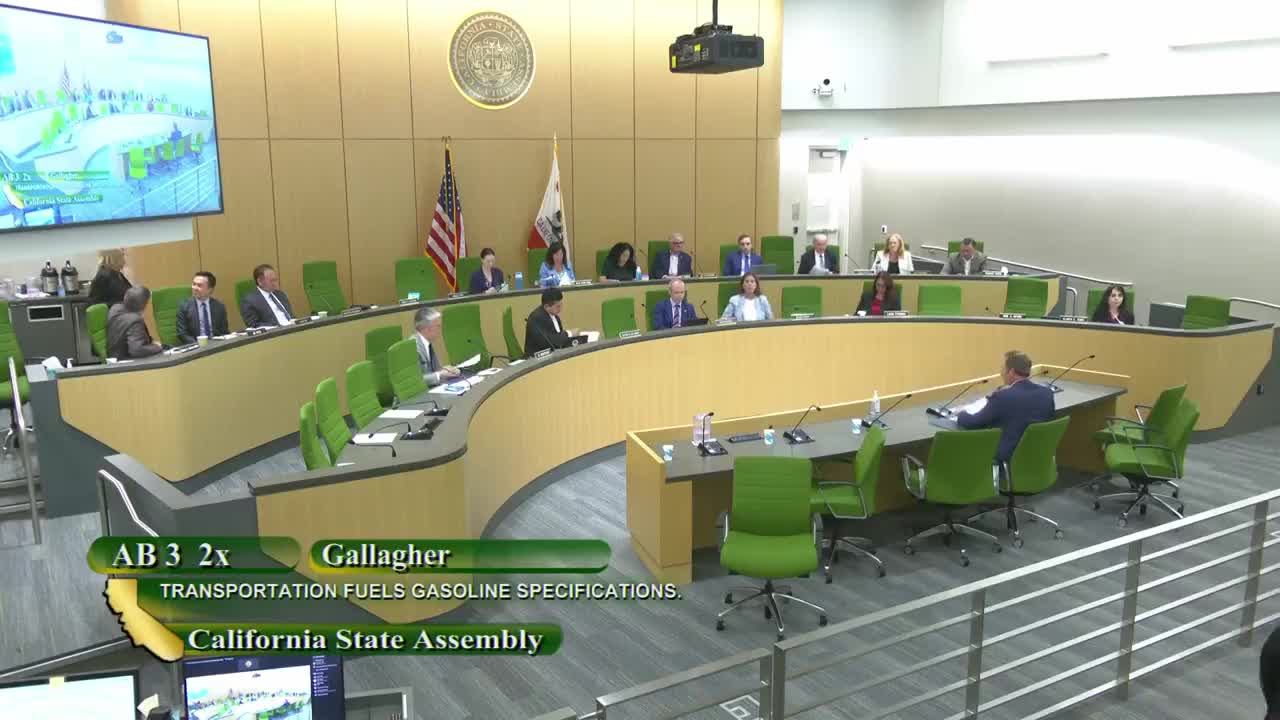 14MIN
Assembly Standing Committee on Petroleum and Gasoline Supply
Bill Author

Bill Co-Author(s):