AB 1002: Contractors: failure to pay wages: discipline.
- Session Year: 2025-2026
- House: Assembly
- Latest Version Date: 2025-10-10
Current Status:
Passed
(2025-10-10: Chaptered by Secretary of State - Chapter 567, Statutes of 2025.)
Introduced
In Committee
Awaiting First Chamber Vote
Passed First Chamber
In Committee
Awaiting Second Chamber Vote
Passed Second Chamber
Enacted
Existing law, the Contractors State License Law, establishes the Contractors State License Board to license and regulate contractors and establishes the registrar of contractors as the executive officer and secretary of the board. Existing law requires the registrar, upon receipt of the Labor Commissioners finding of a willful or deliberate violation of the Labor Code by a licensee or transmission to the board of citations or other actions taken by the Division of Occupational Safety and Health, to initiate disciplinary action against the licensee within 18 months.
This bill would authorize the Attorney General to bring a civil action to impose discipline upon, to deny an application for, or to deny continued maintenance of, a contractors license for failing to pay its workers the full amount of wages the workers are entitled to under state law or because the contractor has not fulfilled a wage judgment or is in violation of an injunction or court order regarding the payment of wages to its workers. The bill would require the Attorney General to notify the registrar before bringing a civil action and would authorize the board to intervene in a proceeding brought pursuant to the bills provisions. The bill would require a court to issue an order directing the registrar to suspend or revoke, to deny an application for, or to deny the continued maintenance of, a contractors license under terms specified by the court.
Existing law, the Contractors State License Law, establishes the Contractors State License Board to license and regulate contractors and establishes the registrar of contractors as the executive officer and secretary of the board. Existing law requires the registrar, upon receipt of the Labor Commissioners finding of a willful or deliberate violation of the Labor Code by a licensee or transmission to the board of citations or other actions taken by the Division of Occupational Safety and Health, to initiate disciplinary action against the licensee within 18 months.
This bill would authorize the Attorney General to bring a civil action for the temporary suspension or permanent revocation of to impose discipline upon, to deny an application for, or to deny continued maintenance of, a contractors license for failing to pay its workers the full amount of wages the workers are entitled to under state law or because the contractor has not fulfilled a wage judgment or is in violation of an injunction or court order regarding the payment of wages to its workers. The bill would also authorize the Attorney General to bring a civil action to bar the licensure or deny the relicensure of any contractor, officer, director, associate, partner, manager, responsible manager, or other qualifying individual of a contractor for those reasons. The bill would require the Attorney General to notify the registrar before bringing a civil action and would authorize the board to intervene in a proceeding brought pursuant to the bills provisions. The bill would require a court to issue an order directing the board to suspend a license or bar initial licensure or relicensure if the Attorney General establishes the defendant has failed to pay workers, has not fulfilled a wage judgment, or is in violation of an injunction or court order regarding payment of wages. registrar to suspend to revoke, or deny an application for, or to deny the continued maintenance of, a contractors license under terms specified by the court.
Existing law, the Contractors State License Law, establishes the Contractors State License Board to license and regulate contractors and establishes the Registrar of Contractors registrar of contractors as the executive officer and secretary of the board. Existing law requires the registrar, upon receipt of the Labor Commissioners finding of a willful or deliberate violation of the Labor Code by a licensee or transmission to the board of citations or other actions taken by the Division of Occupational Safety and Health, to initiate disciplinary action against the licensee within 18 months.
This bill would state the intent of the Legislature to enact subsequent legislation strengthening remedies against licensed contractors who repeatedly commit labor violations against workers. authorize the Attorney General to bring a civil action for the temporary suspension or permanent revocation of a contractors license for failing to pay its workers the full amount of wages the workers are entitled to under state law or because the contractor has not fulfilled a wage judgment or is in violation of an injunction or court order regarding the payment of wages to its workers. The bill would also authorize the Attorney General to bring a civil action to bar the licensure or deny the relicensure of any contractor, officer, director, associate, partner, manager, responsible manager, or other qualifying individual of a contractor for those reasons. The bill would require the Attorney General to notify the registrar before bringing a civil action and would authorize the board to intervene in a proceeding brought pursuant to the bills provisions. The bill would require a court to issue an order directing the board to suspend a license or bar initial licensure or relicensure if the Attorney General establishes the defendant has failed to pay workers, has not fulfilled a wage judgment, or is in violation of an injunction or court order regarding payment of wages.
Existing law, the Contractors State License Law, establishes the Contractors State License Board to license and regulate contractors and establishes the Registrar of Contractors as the executive officer and secretary of the board. Existing law requires the registrar, upon receipt of the Labor Commissioners finding of a willful or deliberate violation of the Labor Code by a licensee or transmission to the board of citations or other actions taken by the Division of Occupational Safety and Health, to initiate disciplinary action against the licensee within 18 months.
This bill would state the intent of the Legislature to enact subsequent legislation strengthening remedies against licensed contractors who repeatedly commit labor violations against workers.
(a)Notwithstanding any other provision of this chapter, the Attorney General may bring a civil action to impose discipline upon, to deny an application for, or to deny continued maintenance of, a contractors license. The civil action shall be brought on the grounds that a person has failed to pay its workers the full amount of wages that the workers are entitled to under state law, has not fulfilled a wage judgment, or is in violation of an injunction or court order regarding the payment of wages to its workers.
(b)The Attorney General shall notify the registrar at least 30 days prior to filing a civil complaint pursuant to subdivision (a). The Attorney Generals failure to provide this notice shall not constitute a defense to the action.
(c)The board may intervene in any court proceedings brought pursuant to this section within 60 days of the filing of the initial complaint. After that time, intervention shall be by leave of court upon good cause shown. If the board elects not to intervene, the election shall be deemed consent by the board to comply with any order of the court issued pursuant to subdivision (d) and to be subject to the courts jurisdiction to enforce the order, if necessary. No action or inaction under this section shall preclude the registrar from independently or concurrently proceeding administratively against the contractors license and obtaining administrative remedies for any violations not alleged in the Attorney Generals complaint, whether or not the board has intervened.
(d)Upon the Attorney General establishing the cause of action described in subdivision (a), the following shall apply:
(1)The relief granted shall be in the form of an order by the court directing the registrar to exercise its authority to suspend or revoke, to deny an application for, or to deny the continued maintenance of, a contractors license under terms specified by the court. In granting the relief, the court may consider both the severity and the form of relief imposed by the registrar in disciplinary actions taken by the registrar, making reasonable efforts to conform to the courts order.
(2)Any order for suspension, revocation, or application denial pursuant to this section shall be considered disciplinary action within the meaning of Section 7071.8 and legal action within the meaning of Section 7124.6, and, unless the court orders otherwise, the registrar shall determine the length of time prior to license reinstatement or reissuance pursuant to Section 7102, except that a license denied under this section is subject to the period prescribed in subdivision (a) of Section 486.
(e)Nothing in this section shall preclude or require the board to investigate a license for violations of this chapter pursuant to Sections 7011.7 and 7090 or require the board to afford notice or a hearing under the provisions of Chapter 5 (commencing with Section 11500) of Part 1 of Division 3 of Title 2 of the Government Code.
(f)A good faith mistake regarding which wage rate applies to a particular category of work, including, but not limited to, for purposes of payment of prevailing wages, shall not constitute a violation under this section.
SECTION 1.Section 7110.6 is added to the Business and Professions Code, to read:7110.6.(a)Notwithstanding any other provision of this chapter, the Attorney General may bring a civil action for the temporary suspension or permanent revocation of a contractors license on the basis that the contractor has failed to pay its workers the full amount of wages that the workers are entitled to under state law, or on the basis that the contractor has not fulfilled a wage judgment or is in violation of an injunction or court order regarding the payment of wages to its workers.(b)Notwithstanding any other provision of this chapter, the Attorney General may bring a civil action to bar the licensure, or deny the relicensure, of any contractor, officer, director, associate, partner, manager, responsible manager, or other qualifying individual of a contractor on the basis that the person or entity has failed to pay workers the full amount of wages that the workers are entitled to under state law or on the basis that the person or entity has not fulfilled a wage judgment or is in violation of an injunction or court order regarding the payment of wages to its workers.(c)Prior to bringing a civil action pursuant to subdivision (a) or (b), the Attorney General shall notify the registrar of contractors at least 30 days prior to filing a civil complaint. The Attorney Generals failure to provide this notice shall not constitute a defense to the action.(d)The board may intervene in any court proceedings brought pursuant to this section within 60 days of the filing of the initial complaint. After that time, intervention shall be by leave of court upon good cause shown. If the board elects not to intervene, the election shall be deemed consent by the board to comply with any order of the court issued pursuant to subdivision (e) and to be subject to the courts jurisdiction to enforce the order, if necessary. Nothing in this section shall preclude the board from independently or concurrently proceeding administratively against the contractors license and obtaining administrative remedies for any violations not alleged in the Attorney Generals complaint, whether or not the board has intervened. Nothing in this section shall preclude or require the board to investigate a license for violations of this chapter pursuant to Section 7011.7.(e)In a proceeding under this section, if the Attorney General establishes that a defendant has failed to pay workers the full amount of wages that the workers are entitled to under state law, or that a defendant has not fulfilled a wage judgment or is in violation of an injunction or court order regarding the payment of wages to its workers, the court shall issue an order directing the board to suspend a license or bar an initial licensure or relicensure. The court shall have discretion to determine the duration of any suspension or bar pursuant to the interests of justice. The court may order the Attorney General to provide proof of notice to the board under subdivision (c) before issuing its order.(a)Notwithstanding any other provision of this chapter, the Attorney General may bring a civil action for the temporary suspension or permanent revocation of a contractors license on the basis that the contractor has failed to pay its workers the full amount of wages that the workers are entitled to under state law, or on the basis that the contractor has not fulfilled a wage judgment or is in violation of an injunction or court order regarding the payment of wages to its workers.
(b)Notwithstanding any other provision of this chapter, the Attorney General may bring a civil action to bar the licensure, or deny the relicensure, of any contractor, officer, director, associate, partner, manager, responsible manager, or other qualifying individual of a contractor on the basis that the person or entity has failed to pay workers the full amount of wages that the workers are entitled to under state law or on the basis that the person or entity has not fulfilled a wage judgment or is in violation of an injunction or court order regarding the payment of wages to its workers.
(c)Prior to bringing a civil action pursuant to subdivision (a) or (b), the Attorney General shall notify the registrar of contractors at least 30 days prior to filing a civil complaint. The Attorney Generals failure to provide this notice shall not constitute a defense to the action.
(d)The board may intervene in any court proceedings brought pursuant to this section within 60 days of the filing of the initial complaint. After that time, intervention shall be by leave of court upon good cause shown. If the board elects not to intervene, the election shall be deemed consent by the board to comply with any order of the court issued pursuant to subdivision (e) and to be subject to the courts jurisdiction to enforce the order, if necessary. Nothing in this section shall preclude the board from independently or concurrently proceeding administratively against the contractors license and obtaining administrative remedies for any violations not alleged in the Attorney Generals complaint, whether or not the board has intervened. Nothing in this section shall preclude or require the board to investigate a license for violations of this chapter pursuant to Section 7011.7.
(e)In a proceeding under this section, if the Attorney General establishes that a defendant has failed to pay workers the full amount of wages that the workers are entitled to under state law, or that a defendant has not fulfilled a wage judgment or is in violation of an injunction or court order regarding the payment of wages to its workers, the court shall issue an order directing the board to suspend a license or bar an initial licensure or relicensure. The court shall have discretion to determine the duration of any suspension or bar pursuant to the interests of justice. The court may order the Attorney General to provide proof of notice to the board under subdivision (c) before issuing its order.
SECTION 1.It is the intent of the Legislature to enact subsequent legislation strengthening remedies against licensed contractors who repeatedly commit labor violations against workers. REVISIONS: HeadingLine 2.It is the intent of the Legislature to enact subsequent legislation strengthening remedies against licensed contractors who repeatedly commit labor violations against workers.
|
Date
|
Status
|
|---|---|
| Oct 10, 2025 | Chaptered by Secretary of State - Chapter 567, Statutes of 2025. |
| Oct 10, 2025 | Approved by the Governor. |
| Sep 15, 2025 | Enrolled and presented to the Governor at 4:30 p.m. |
| Sep 8, 2025 | Senate amendments concurred in. To Engrossing and Enrolling. (Ayes 73. Noes 2. Page 3035.). |
| Sep 4, 2025 | In Assembly. Concurrence in Senate amendments pending. |
| Sep 4, 2025 | Read third time. Passed. Ordered to the Assembly. (Ayes 34. Noes 2. Page 2503.). |
| Aug 29, 2025 | Read second time. Ordered to third reading. |
| Aug 29, 2025 | From committee: Do pass. (Ayes 7. Noes 0.) (August 29). |
| Aug 18, 2025 | In committee: Referred to suspense file. |
| Jul 16, 2025 | From committee: Do pass and re-refer to Com. on APPR. (Ayes 11. Noes 2.) (July 15). Re-referred to Com. on APPR. |
| Jul 7, 2025 | From committee: Do pass and re-refer to Com. on JUD. (Ayes 10. Noes 1.) (July 7). Re-referred to Com. on JUD. |
| Jun 26, 2025 | From committee chair, with author's amendments: Amend, and re-refer to committee. Read second time, amended, and re-referred to Com. on B. P. & E.D. |
| Jun 11, 2025 | Referred to Coms. on B. P. & E.D. and JUD. |
| Jun 3, 2025 | In Senate. Read first time. To Com. on RLS. for assignment. |
| Jun 2, 2025 | Read third time. Passed. Ordered to the Senate. (Ayes 74. Noes 1. Page 1911.) |
| May 27, 2025 | Read second time. Ordered to third reading. |
| May 23, 2025 | From committee: Do pass. (Ayes 13. Noes 0.) (May 23). |
| May 7, 2025 | In committee: Set, first hearing. Referred to APPR. suspense file. |
| Apr 30, 2025 | From committee: Do pass and re-refer to Com. on APPR. (Ayes 10. Noes 0.) (April 29). Re-referred to Com. on APPR. |
| Apr 30, 2025 | Coauthors revised. |
| Apr 22, 2025 | From committee: Do pass and re-refer to Com. on JUD. (Ayes 17. Noes 0.) (April 22). Re-referred to Com. on JUD. |
| Apr 1, 2025 | Re-referred to Com. on B. & P. |
| Mar 28, 2025 | From committee chair, with author's amendments: Amend, and re-refer to Com. on B. & P. Read second time and amended. |
| Mar 28, 2025 | Referred to Coms. on B. & P. and JUD. |
| Feb 21, 2025 | From printer. May be heard in committee March 23. |
| Feb 20, 2025 | Read first time. To print. |
|
Date
|
Description
|
Location
|
Votes
|
|
|---|---|---|---|---|
| Sep 8, 2025 | AB 1002 Gabriel Concurrence in Senate Amendments | Assembly Floor |
Passed |
|
| Sep 4, 2025 | Assembly 3rd Reading AB1002 Gabriel et al. By Durazo | Senate Floor |
Passed |
|
| Aug 29, 2025 | Do pass | Senate Standing Committee on Appropriations |
Passed |
|
| Aug 18, 2025 | Placed on suspense file | Senate Standing Committee on Appropriations |
Passed |
|
| Jul 15, 2025 | Do pass, but first be re-referred to the Committee on [Appropriations] | Senate Standing Committee on Judiciary |
Passed |
|
| Jul 7, 2025 | Do pass, but first be re-referred to the Committee on [Judiciary] | Senate Standing Committee on Business, Professions and Economic Development |
Passed |
|
| Jun 2, 2025 | AB 1002 Gabriel Assembly Third Reading | Assembly Floor |
Passed |
|
| May 23, 2025 | Do pass. | Assembly Standing Committee on Appropriations |
Passed |
|
| Apr 29, 2025 | Do pass and be re-referred to the Committee on [Appropriations] | Assembly Standing Committee on Judiciary |
Passed |
|
| Apr 22, 2025 | Do pass and be re-referred to the Committee on [Judiciary] | Assembly Standing Committee on Business and Professions |
Passed |
This list shows positions taken on this bill by organizations on the date displayed, which is linked to the original source.
Positions by individuals are not included.
|
Organization
|
Position
|
Date
|
|---|---|---|
| Asian Americans Advancing Justice Southern California | ** Support | |
| California Federation of Labor Unions, Afl-cio | ** Support | |
| California Rural Legal Assistance Foundation, Inc. | ** Support | |
| California State Association Of Electrical Workers | ** Support | |
| California State Pipe Trades Council | ** Support | |
| City Of Los Angeles | ** Support | |
| Contractors State License Board | ** Support | |
| Inland Empire Labor Council, AFL-CIO | ** Support | |
| Legal Aid At Work | ** Support | |
| Office of Attorney General Rob Bonta | ** Support | |
| Public Counsel | ** Support | |
| State Building & Construction Trades Council Of California | ** Support | |
| Teamsters California | ** Support | |
| Ventura County Young Democrats | ** Support | |
| Western Center on Law & Poverty, INC. | ** Support | |
| Western States Council Sheet Metal, Air, Rail And Transportation | ** Support | |
| Worksafe | ** Support |
CONCURRENCE IN SENATE AMENDMENTS
CSA1 Bill Id:AB 1002
Author:(Gabriel)
As Amended Ver:June 26, 2025
Majority vote
SUMMARY
Authorizes the Attorney General (AG) to bring a civil action to impose discipline upon, to deny an application for, or to deny continued maintenance of, a contractor license, as specified.
Senate Amendments
- Replace the contents of the bill with substantially similar provisions in a new section in the Business and Professions Code, Division 3, Chapter 9, relating to contractors.
- Specify that any order for suspension, revocation, or application denial pursuant to this bill shall be considered disciplinary action and legal action, as specified, and, unless the court orders otherwise, the registrar shall determine the length of time prior to license reinstatement or reissuance, except that a license denied under this section is subject to the period prescribed in existing law.
- Clarify that nothing in this bill precludes or requires the CSLB to investigate a license for violations of this bill or to afford notice or an administrative hearing.
- Specify that a good-faith mistake regarding which wage rate applies to a particular category of work, including, but not limited to, for purposes of payment of prevailing wages, shall not constitute a violation under this bill.
COMMENTS
The Contractors State License Board (CSLB) is responsible for the implementation and enforcement of the License Law, which governs the licensure, practice, and discipline of contractors in California. The CSLB is authorized to take disciplinary action against licensed and unlicensed contractors who have violated the License Law and is empowered to use an escalating scale of penalties, ranging from citations and fines (referred to as civil penalties) to license suspension and revocation. Current law authorizes the board to take disciplinary action against a licensee for violations of specified laws that fall outside the scope of the License Law. As it relates to this bill, the willful or deliberate disregard and violation of this state's labor laws constitutes a cause of action for disciplinary action against a licensee.
Although the Board does not independently investigate wage and hour violations, the board is a member of the Labor Enforcement Task Force (LETF), a coalition of governmental agencies whose mission is "to combat the underground economy in order to ensure safe working conditions and proper payment of wages for workers; to create an environment in which legitimate businesses can thrive; and to support the collection of all California taxes, fees, and penalties due from employers." According to the Board, the LETF inspects construction sites weekly to investigate license, wage, tax, and workplace safety compliance. The Labor Commissioner's office, also known as the Division of Labor Standards Enforcement, and the Division of Occupational Safety and Health within the Department of Industrial Relations are responsible for investigating labor violations and workplace safety and health hazards. By law, the Labor Commissioner is required to notify the Board when a licensed contractor is found to have willfully or deliberately violated any provision of the Labor Code within the jurisdiction of the Labor Commissioner. The CSLB must initiate disciplinary action within 18 months.
According to the proponents of this bill, "numerous companies in California have been the subject of multiple investigations that found violations of the Labor Code, including wage theft. Many of these have been settled through financial compensation but, for some companies, the penalty has apparently not proven to serve as a sufficient deterrent." For example, West Coast Drywall & Company, which the California Department of Justice sued in February 2024, had previously been investigated by the United States Department of Labor and required to pay $9,000 in back wages for 101 employees. A subsequent investigation revealed that the company again failed to pay workers overtime, instructed employees to falsify timecards, and asked workers to sign untrue statements that they were fully compensated. The company settled and agreed to pay nearly $1 million in back wages and damages for overtime violations.
This bill would authorize the AG to file a civil suit against a licensed contractor to seek as a remedy the suspension, revocation, or denial of a license. Currently, only the board may revoke, suspend, or otherwise discipline a contractor's license. This bill would require the AG to notify the board 30 days before filing a civil complaint, authorize the CSLB to intervene in any court proceedings within 60 days of initial filing, and require the court to issue an order directing the CSLB to exercise its authority to suspend a license or bar licensure if the AG establishes that the contractor failed to pay its workers the full amount of wages that they are entitled to.
According to the Author
"This bill is essential to protecting workers' wages and the economic security and dignity of every Californian. Bad faith efforts to repeatedly exploit our workforce and withhold hard-earned wages from Californians are unacceptable. We must take decisive action to keep our industries accountable and ensure that every worker in California receives the full pay they've earned. [This bill] sends a clear message that wage theft is not a tolerated business practice."
Arguments in Support
As the sponsor of this bill, the Office of Attorney General Rob Bonta writes in support:
CSLB has existing license suspension and revocation authority over its licensees in the construction industry where consumer protection is an important enforcement priority, and [this bill] would extend this enforcement authority to DOJ to combat serious and repeat wage theft and other wage and hour violations as well ... Currently, the DOJ does not have the independent authority to seek suspension or revocation of, or the attachment of conditions to, a defendant's contractor license when suing a licensed contractor for labor violations. Serious and repeat wage and hour violators like West Coast Drywall demonstrate that existing civil remedies are insufficient to deter illegal behavior that harms California's workers and the economy overall.[This bill] would allow DOJ to seek CSLB license, suspension or revocation, or the attachment of license conditions, and obtain these remedies, after giving the CSLB notice of the relevant complaint, and providing the CSLB the option of intervening in the action. [This bill] does not establish any new remedies; it merely permits DOJ, working with the CSLB, to obtain licensing remedies that only the CSLB can currently obtain. This bill also affirmatively retains judicial discretion over the final remedy.
Arguments in Opposition
There is no opposition on file.
FISCAL COMMENTS
According to the Senate Appropriations Committee:
- Unknown, potentially significant workload cost pressures to the state funded trial court system for any additional civil actions filed as a result of this bill (Trial Court Trust Fund, General Fund).
- The Contractors State License Board (CSLB) notes it already has the authority to take disciplinary action against wage theft and other labor violations, so anticipate any additional enforcement workload to be minor and absorbable.
- The Department of Justice (DOJ) notes that any workload resulting from this bill would be for client agency-driven workload on behalf of CSLB. It is unknown if or to what extent CSLB may opt to use the enforcement mechanism authorized in this bill, however DOJ's Worker Rights and & Fair Labor Section report that it already brings civil wage theft enforcement actions under existing law so does not anticipate additional costs resulting from this bill.
VOTES:
ASM BUSINESS AND PROFESSIONS: 17-0-1
YES: Berman, Flora, Ahrens, Alanis, Bains, Bauer-Kahan, Caloza, Chen, Elhawary, Hadwick, Haney, Irwin, Jackson, Krell, Lowenthal, Nguyen, Pellerin
ABS, ABST OR NV: Macedo
ASM JUDICIARY: 10-0-2
YES: Kalra, Dixon, Bryan, Connolly, Harabedian, Pacheco, Papan, Sanchez, Stefani, Zbur
ABS, ABST OR NV: Bauer-Kahan, Macedo
ASM APPROPRIATIONS: 13-0-2
YES: Wicks, Arambula, Calderon, Caloza, Dixon, Elhawary, Fong, Mark González, Hart, Pacheco, Pellerin, Solache, Ta
ABS, ABST OR NV: Sanchez, Tangipa
ASSEMBLY FLOOR: 74-1-4
YES: Addis, Aguiar-Curry, Ahrens, Alanis, Alvarez, Arambula, Ávila Farías, Bains, Bauer-Kahan, Bennett, Berman, Boerner, Bonta, Bryan, Calderon, Caloza, Carrillo, Chen, Connolly, Davies, Dixon, Elhawary, Flora, Fong, Gabriel, Gallagher, Garcia, Gipson, Jeff Gonzalez, Mark González, Hadwick, Haney, Harabedian, Hart, Hoover, Irwin, Jackson, Kalra, Krell, Lackey, Lee, Lowenthal, McKinnor, Muratsuchi, Nguyen, Ortega, Pacheco, Papan, Patel, Patterson, Pellerin, Petrie-Norris, Quirk-Silva, Ramos, Ransom, Celeste Rodriguez, Michelle Rodriguez, Rogers, Blanca Rubio, Sanchez, Schiavo, Schultz, Sharp-Collins, Solache, Soria, Stefani, Ta, Valencia, Wallis, Ward, Wicks, Wilson, Zbur, Rivas
NO: DeMaio
ABS, ABST OR NV: Castillo, Ellis, Macedo, Tangipa
UPDATED
VERSION: June 26, 2025
CONSULTANT: Kaitlin Curry / B. & P. / (916) 319-3301 FN: 0001654
SENATE RULES COMMITTEE Office of Senate Floor Analyses (916) 651-1520 Fax: (916) 327-4478 | AB 1002 |
THIRD READING
Bill No: AB 1002
Author: Gabriel (D), et al.
Amended: 6/26/25 in Senate
Vote: 21
SENATE BUS., PROF. & ECON. DEV. COMMITTEE: 10-1, 7/7/25
AYES: Ashby, Choi, Archuleta, Arreguín, Grayson, Menjivar, Smallwood-Cuevas, Strickland, Umberg, Weber Pierson
NOES: Niello
SENATE JUDICIARY COMMITTEE: 11-2, 7/15/25
AYES: Umberg, Allen, Arreguín, Ashby, Caballero, Durazo, Laird, Stern, Wahab, Weber Pierson, Wiener
NOES: Niello, Valladares
SENATE APPROPRIATIONS COMMITTEE: 7-0, 8/29/25
AYES: Caballero, Seyarto, Cabaldon, Dahle, Grayson, Richardson, Wahab
ASSEMBLY FLOOR: 74-1, 6/2/25 - See last page for vote
SUBJECT: Contractors: failure to pay wages: discipline
SOURCE: Attorney General Rob Bonta
DIGEST:
This bill a
uthorizes the Attorney General (AG) to bring civil action to impose discipline against a Contractors State License Board (CSLB) licensee or to deny the application for a license on grounds that the licensee or applicant failed to pay its workers in compliance with state law, has not fulfilled a wage judgement, or has violated an injunction or court order regarding wage payment. This bill specifies that the court may issue an order to the CSLB Registrar to suspend or revoke a license or deny an application for a license.
ANALYSIS:
Existing law:
- Establishes the CSLB to implement and enforce the Contractors State License Law (License Law). (Business and Professions Code (BPC) §§ 7000 et seq.)
- Authorizes CLSB to appoint a Registrar of Contractors to be the executive officer and secretary of the CSLB. (BPC § 7011)
- Requires CSLB licensees to notify the Registrar of any unsatisfied final judgment related to the construction activities of a licensee, or to the qualifications, functions, or duties of the license. (BPC § 7071.17(b)(1), (h))
- Specifies that if a licensee fails to notify the registrar in writing of any unsatisfied final judgment imposed on the licensee within 90 days, the license must be automatically suspended, as specified. (BPC § 7071.17(b)(1))
- Requires CSLB to suspend a license upon notification by any party having knowledge and proof of an outstanding judgement. (BPC § 7071.17(h))
- Provides that failure of a licensee to notify the Registrar of an unsatisfied final judgment, as specified, is cause for disciplinary action. (BPC § 7071.17(l))
- Requires the Registrar to initiate disciplinary action against a licensee within 18 months of receipt of Labor Commissioner’s finding of a willful or deliberate violation of the Labor Code, as specified. (BPC § 7110.5)
- Provides that any willful or fraudulent act by a contractor in which another is substantially injured constitutes cause for disciplinary action. (BPC § 7116)
- Specifies that willful or deliberate failure by any licensee to pay any moneys due for materials or services rendered, as specified, in connection with their operations as a contractor is cause for disciplinary action. (BPC § 7120)
- Requires a licensee to report to the registrar in writing within 90 days after the licensee knows of any civil action resulting in a final judgment, executed settlement agreement, or final arbitration award in which the licensee is named as a defendant or cross defendant that meets specified criteria. (BPC § 7071.20)
- Establishes the Division of Labor Standards Enforcement, under direction of the Labor Commissioner, sets forth its powers and duties regarding the enforcement of labor laws. (Labor Code (LAB) §§ 79 et seq.)
- Authorizes the Labor Commissioner to investigate employee complaints and to provide for a hearing in any action to recover wages, penalties, and other demands for compensation, as specified. (LAB § 98)
- Requires the Labor Commissioner to deliver a certified copy of the finding of the violation to the Registrar of the CSLB upon a finding by the Labor Commissioner that a willful or deliberate violation of any of the provisions of the Labor Code within the jurisdiction of the Labor Commissioner has been committed by a licensee in the course of such licensed activity. (LAB § 98.9)
- Requires an employer to discontinue business in this state, unless the employer has obtained a bond and filed a copy of the bond with the Labor Commissioner if a final judgment against an employer arising from the employer’s nonpayment of wages for work performed in this state remains unsatisfied 30 days after the appeal period expires and no appeal is pending. (LAB § 238)
This bill:
- Authorizes the Attorney General to bring a civil action to impose discipline upon, deny continued maintenance of, or deny an application for a license when a CSLB licensee or applicant for a license fails to pay wages according to state law, has not fulfilled a wage judgement, or is in violation of an injunction or court order regarding payment of wages. Requires the AG to notify the Registrar at least 30 days prior to filing a civil complaint.
- Prohibits CSLB from intervening in any court proceedings within 60 days of the initial complaint filing and specifies that the Registrar is not precluded from independently or concurrently proceeding with administrative discipline against the contractor for any violations not alleged in the Attorney General’s complaint.
- Specifies that a court order in response to the AG’s cause of action may include an order directing the Registrar to exercise authority to suspend or revoke a license, or deny continued maintenance or issuance of a license, and may include the length of time prior to reinstatement or authorize the Registrar to determine when a license may be issued or reinstated.
- Clarifies that a good faith mistake regarding which wage rate applies in a project subject to prevailing wage does not constitute a violation under this bill.
Background
The CSLB is responsible for the administration of the License Law, which governs the licensure, practice, and discipline of contractors in California. The CSLB is authorized to take disciplinary action against licensed contractors who have violated the License Law and to take disciplinary action against a licensee for violations of specified laws that fall outside the scope of the License Law. Disciplinary action may include license suspension, revocation, a stayed revocation with probationary conditions, a letter of admonishment, or a citation.
CSLB does not independently investigate wage and hour violations, but is a member of the Labor Enforcement Task Force (LETF), a coalition pf state agencies, including CSLB, DIR, the Division of Labor Standards Enforcement (DLSE), and the DOJ, among others, and led by the Department of Industrial Relations (DIR) that works with local and state agencies to ensure employees are paid according to labor law, have safe working conditions, and that businesses engage in fair competition through enforcing licensing and tax laws. According to the May 2023 LETF Report, 112 businesses were inspected in 2021 and 2022 and 41% were found to be out of compliance.
The Labor Commissioner is responsible for investigating Labor Code violations, including wage and hour laws. Upon any finding of willful or deliberate violation of the Labor Code within the Labor Commissioner’s jurisdiction, the Labor Commissioner is required to deliver a certified copy of any findings to CSLB (LAB § 98.9). CSLB then has 18 months to initiate disciplinary action against a licensee for those violations (BPC § 7110.5).
This bill would create an additional method of enforcing wage theft in construction by authorizing the AG to file a civil suit against a licensed contractor and seek discipline, including license suspension, revocation, or denial of a license, as a remedy for the violations.
FISCAL EFFECT: Appropriation: No Fiscal Com.: Yes Local: No
According to the Senate Committee on Appropriations, the bill will result in unknown, potentially significant workload cost pressures to the state funded trial court system for any additional civil actions filed as a result of this bill. The CSLB notes it already has the authority to take disciplinary action against wage theft and other labor violations, so anticipate any additional enforcement workload to be minor and absorbable. DOJ notes that any workload resulting from this bill would be for client agency-driven workload on behalf of CSLB. It is unknown if or to what extent CSLB may opt to use the enforcement mechanism authorized in this bill, however DOJ’s Worker Rights and & Fair Labor Section report that it already brings civil wage theft enforcement actions under existing law so does not anticipate additional costs resulting from this bill.
SUPPORT: (Verified 8/29/25)
Asian Americans Advancing Justice Southern California
Attorney General Rob Bonta
California Federation of Labor Unions, AFL-CIO
California State Association of Electrical Workers
California State Pipe Trades Council
City of Los Angeles
Contractors State License Board
State Building & Construction Trades Council of California
Teamsters California
Ventura County Young Democrats
Western Center on Law & Poverty, INC.
Western States Council Sheet Metal, Air, Rail and Transportation
OPPOSITION: (Verified 8/29/25)
None received
ARGUMENTS IN SUPPORT: Attorney General Rob Bonta (Sponsor) writes, “While California has strong worker protection statutes, these laws are only as effective to the extent that they are applied and enforced. CSLB has existing license suspension and revocation authority over its licensees in the construction industry where consumer protection is an important enforcement priority, and AB 1002 would extend this enforcement authority to DOJ to combat serious and repeat wage theft and other wage and hour violations as well.”
Multiple supporters state, “Contractors who may have otherwise repeatedly paid fines or avoided compliance will no longer be allowed to break the law and withhold wages from hardworking employees should they wish to continue doing business in California.”
Asian Americans Advancing Justice, Southern California writes, “Too often, contractors with repeated violations continue operating with impunity, while workers remain unpaid, intimidated, or silenced. This bill creates a mechanism to hold the worst repeat offenders accountable by empowering the California Department of Justice to seek license suspension, revocation, or conditions when pursuing civil action.”
The California Federation of Labor Unions AFL – CIO, writes “Wage theft ends up costing workers billions of dollars in stolen wages. It puts law-abiding employers at a disadvantage and costs taxpayers in lost revenue.”
The California State Association of Electrical Workers, the California State Pipe Trades Council, and the Western States Council of Sheet Metal Workers write in support, “When contractors engage in wage theft, it not only undermines workers’ livelihoods but also devalues the integrity of the entire skilled trades industry. Holding repeat offenders accountable is essential to protecting these workers and ensuring a level playing field for law-abiding contractors.”
The City of Los Angeles writes, “Enhancing enforcement mechanisms to combat employer misconduct would help improve the lives of workers across Los Angeles and level the playing field for businesses that comply with labor laws.”
The Contractors State License Board notes, “CSLB acknowledges the impact wage theft has on the construction industry and agrees that making license discipline a cause of civil action in wage violation cases could have a deterrent effect and help ensure workers are paid fairly.”
California Teamsters writes, “Companies that repeatedly steal from their employees do not deserve to continue operation without consequence. California has worked hard to afford workers strong rights, but we need AB 1002 to ensure those rights are adequately protected.”
ASSEMBLY FLOOR: 74-1, 6/2/25
AYES: Addis, Aguiar-Curry, Ahrens, Alanis, Alvarez, Arambula, Ávila Farías, Bains, Bauer-Kahan, Bennett, Berman, Boerner, Bonta, Bryan, Calderon, Caloza, Carrillo, Chen, Connolly, Davies, Dixon, Elhawary, Flora, Fong, Gabriel, Gallagher, Garcia, Gipson, Jeff Gonzalez, Mark González, Hadwick, Haney, Harabedian, Hart, Hoover, Irwin, Jackson, Kalra, Krell, Lackey, Lee, Lowenthal, McKinnor, Muratsuchi, Nguyen, Ortega, Pacheco, Papan, Patel, Patterson, Pellerin, Petrie-Norris, Quirk-Silva, Ramos, Ransom, Celeste Rodriguez, Michelle Rodriguez, Rogers, Blanca Rubio, Sanchez, Schiavo, Schultz, Sharp-Collins, Solache, Soria, Stefani, Ta, Valencia, Wallis, Ward, Wicks, Wilson, Zbur, Rivas
NOES: DeMaio
NO VOTE RECORDED: Castillo, Ellis, Macedo, Tangipa
Prepared by: Yeaphana La Marr / B., P. & E.D. /
8/30/25 12:32:26
SENATE COMMITTEE ON APPROPRIATIONS
Senator Anna Caballero, Chair
2025 - 2026 Regular Session
AB 1002 (Gabriel) - Contractors: failure to pay wages: discipline
Version: June 26, 2025 | Policy Vote: B., P. & E.D. 10 - 1, JUD. 11 - 2 |
Urgency: No | Mandate: No |
Hearing Date: August 18, 2025 | Consultant: Janelle Miyashiro |
Bill Summary:
AB 1002 authorizes the Attorney General (AG) to bring a civil action to impose discipline on a contractor’s license, deny application for a new license, or deny a renewal of a license for violations of the Labor Code related to withholding workers’ wages, as specified.
Fiscal Impact:
- Unknown, potentially significant workload cost pressures to the state funded trial court system for any additional civil actions filed as a result of this bill (Trial Court Trust Fund, General Fund).
- The Contractors State License Board (CSLB) notes it already has the authority to take disciplinary action against wage theft and other labor violations, so anticipate any additional enforcement workload to be minor and absorbable.
- The Department of Justice (DOJ) notes that any workload resulting from this bill would be for client agency-driven workload on behalf of CSLB. It is unknown if or to what extent CSLB may opt to use the enforcement mechanism authorized in this bill, however DOJ’s Worker Rights and & Fair Labor Section report that it already brings civil wage theft enforcement actions under existing law so does not anticipate additional costs resulting from this bill.
Background:
The CSLB is responsible for the administration of the Contractors License Law, which governs the licensure, practice, and discipline of contractors in California. Although CSLB does not independently investigate wage and hour violations, it is a member of the Labor Enforcement Task Force (LETF). LETF is a coalition led by the Department of Industrial Relations (DIR) that works with local and state agencies to ensure employees are paid according to labor law, have safe working conditions, and that businesses engage in fair competition through enforcing licensing and tax laws. LETF membership includes CSLB, DIR, the Division of Labor Standards Enforcement (DLSE), and the DOJ, among other statewide agencies. According to CSLB, LETF members conduct weekly sweeps at active job sites to verify employee wages and compliance with licensing, insurance, tax, and job safety requirements. According to the May 2023 Labor Enforcement Task Force Report, LETF inspected 112 businesses in 2021 and 2022, during which time, approximately 41% of businesses were found to be out of compliance.
Additionally, the DLSE (also known as the Labor Commissioner) is responsible for investigating labor violations, including wage and hour laws. The Labor Commissioner is required to deliver a certified copy to CSLB of any finding of willful or deliberate violation of the Labor Code within the Labor Commissioner’s jurisdiction. Upon receipt, CSLB has 18 months during which it must initiate disciplinary action against a licensee for those violations.
Proposed Law:
- Authorizes the AG to bring a civil action to impose discipline upon, deny an application for, or deny continued maintenance of, a contractor’s license. Provides that the civil action be brought on the grounds that a person has failed to pay its workers the full amount of wages that the workers are entitled to under state law, has not fulfilled a wage judgment, or is in violation of an injunction or court order regarding the payment of wages to its workers.
- Requires the AG to notify the CSLB Registrar at least 30 days prior to filing a civil complaint pursuant to the provisions of this bill. Provides that a failure by the AG to provide this notice shall not constitute a defense to the action.
- Authorizes CSLB to intervene in any court proceedings pursuant to the provisions of this bill within 60 days of the filing of the initial complaint.
- Specifies that the CSLB Registrar is not precluded from independently or concurrently proceeding with administrative discipline against the contractor for any violations not alleged in the AG’s complaint.
- Specifies that a court order in response to the AG’s cause of action may include an order directing the CSLB Registrar to exercise authority to suspend or revoke a license, or deny continued maintenance or issuance of a license and may include the length of time prior to reinstatement. In a case where the order does not order a length of time, authorizes the CSLB Registrar to determine when a license may be issued or reinstated.
- Clarifies that a good faith mistake regarding which wage rate applies in a project subject to prevailing wage does not constitute a violation under the provisions of this this bill.
Staff Comments:
The fiscal impact of this bill to the courts will depend on many unknown factors, including the number of cases filed and the factors unique to each case. An eight-hour court day costs approximately $10,500 in staff in workload. If court days exceed 10, costs to the trial courts could reach hundreds of thousands of dollars. In 2023–24, over 4.8 million cases were filed statewide in the superior courts. Filings increased over the past year, driven mostly by misdemeanors and infractions, and civil limited cases. The increase in filings from the previous year is greater than 5% for civil limited and unlimited, appellate division appeals, juvenile delinquency, misdemeanors and infractions, and probate. While the courts are not funded on a workload basis, an increase in workload could result in delayed court services and would put pressure on the General Fund to fund additional staff and resources and to increase the amount appropriated to backfill for trial court operations.
-- END --
Senator Thomas Umberg, Chair
2025-2026 Regular Session
Bill No: AB 1002 (Author:Gabriel)
Version: June 26, 2025
Hearing Date: July 15, 2025
Fiscal: Yes
Urgency: No
Consultant: ID
SUBJECT
Contractors: failure to pay wages: discipline
DIGEST
This bill permits the Attorney General to bring a civil action to deny or impose discipline upon a contractor’s license when a contractor fails to pay its workers, fails to fulfill a wage judgment, or is in violation of an injunction or court order relating to the payment of wages to its workers, as specified.
EXECUTIVE SUMMARY
California has some of the strongest protections across the country for workers and for ensuring they can be made whole when they are wronged by their employer. These laws include rules for a minimum wage, rest and meal breaks, overtime pay, and the timely payment of wages, and rules against retaliation for an employee asserting their rights. However, laws are only as good as the extent to which they are followed and enforced, and labor law violations continue to be a major problem across the state. While penalties for labor law violations include damages and civil and statutory penalties, in the construction industry, licensed contractors who are repeat offenders often still avoid any consequences for their license. AB 1002 would allow the Attorney General to bring a civil action to impose discipline upon a contractor’s license when they fail to pay its workers the full wages due to them under state law, fail to fulfill a wage judgment against the contractor, or is in violation of an injunction or court order regarding the payment of wages. AB 1002 would require that the Attorney General provide notice of the civil action to the Contractors State Licensing Board (CSLB) at least 30 days before filing the action, and would permit the board to intervene within 60 days of the filing of the action. AB 1002 is sponsored by the Attorney General of California, and has support from a variety of labor and trades organizations, the Contractors State Licensing Board, and a number of pro-worker nonprofits. The Committee has received not timely letters of opposition. AB 1002 previously passed out of the Senate Business, Professions, and Economic Development Committee by a vote of 10 to 1.
PROPOSED CHANGES TO THE LAW
Existing law:
- Establishes, until January 1, 2029, the CSLB under the Department of Consumer Affairs to implement and enforce the Contractors State License Law, including the licensing and regulation of contractors and home improvement salespersons. (Bus. & Prof. Code §§ 7000 et seq.)
- Authorizes the CSLB to appoint a registrar of contractors to be the executive officer and secretary of the CSLB. (Bus. & Prof. Code § 7011.)
- Exempts from the License Law work or operation on one undertaking or project by one or more contracts if the aggregate price for labor, materials, and all other items is less than $1,000 and the work or operation is considered of casual, minor, or inconsequential nature, and the work or operation does not require a building permit. (Bus. & Prof. Code § 7048.)
- Requires all licensees to notify the registrar in writing of any unsatisfied final judgment imposed on the licensee that is substantially related to the construction activities of a licensee, or to the qualifications, functions, or duties of the license. Specifies that, if a licensee fails to notify the registrar in writing of any unsatisfied final judgment imposed on the licensee within 90 days, the license must be automatically suspended, as specified. Requires the board to suspend a license upon notification by any party having knowledge of the outstanding judgment upon a showing of proof of the judgment. (Bus. & Prof. Code § 7071.17 (b)(1), (h).)
- Asserts that the failure of a licensee to notify the registrar of an unsatisfied final judgment, as specified, is cause for disciplinary action. (Bus. & Prof. Code § 7071.17 (l).)
- Requires the CSLB to promulgate regulations covering the assessment of civil penalties that consider the gravity of the violation, the good faith of the licensee or applicant for licensure being charged, and the history of previous violations. Except as otherwise provided, prohibits the CSLB from assessing a civil penalty that exceeds $8,000. Specifies that the CSLB may assess a civil penalty up to $30,000 for specified violations, including willful or deliberate disregard and violation of state and local building laws and committing workers’ compensation fraud. (Bus. & Prof. Code § 7099.2.)
- Specifies that willful or deliberate disregard and violation of the building laws of the state, or of any of the following, constitutes a cause for disciplinary action against a licensee:
- Business and Professions Code Sections 8550–8556 relating to structural pest control.
- Civil Code Sections 1689.5–1689.15 relating to home solicitation contracts or offers.
- The safety laws or labor laws or compensation insurance laws or Unemployment Insurance Code of the state.
- The Subletting and Subcontracting Fair Practices Act.
- Any provision of the Health and Safety Code or Water Code relating to the digging, boring, or drilling of water wells.
- Any provision of Article 2 of Chapter 3.1 of Division 5 of Title 1 of the Government Code relating to excavations and subsurface installations.
- Penal Code Section 374.3 or any substantially similar law or ordinance that is promulgated by a local government agency relating to illegal dumping.
- Any state or local law relating to the issuance of building permits. (Bus. & Prof. Code § 7110.)
- Requires the registrar to initiate disciplinary action against a licensee within 18 months from the date of the registrar’s receipt of a certified copy of the Labor Commissioner’s finding of a willful or deliberate violation of the Labor Code by a licensee or upon transmission to the CSLB of copies of any citations or other actions taken by the Division of Occupational Safety and Health, as specified. (Bus. & Prof. Code § 7110.5.)
- Asserts that the doing of any willful or fraudulent act by the licensee as a contractor in consequence of which another is substantially injured constitutes a cause for disciplinary action. (Bus. & Prof. Code § 7116.)
- Specifies that willful or deliberate failure by any licensee or agent or officer thereof, to pay any moneys, when due for any materials or services rendered in connection with their operations as a contractor, when they have the capacity to pay or when they received sufficient funds therefor as payment for the particular construction work, project, or operation for which the services or materials were rendered or purchased constitutes a cause for disciplinary action, as does the false denial of any such amount due or the validity of the claim thereof with intent to secure for themselves, their employer, or other person, any discount upon such indebtedness or with intent to hinder, delay, or defraud the person to whom such indebtedness is due. (Bus. & Prof. Code § 7120.)
- Requires a licensee to report to the registrar in writing within 90 days after the licensee has knowledge of any civil action resulting in a final judgment, executed settlement agreement, or final arbitration award in which the licensee is named as a defendant or cross-defendant that meets specified criteria. (Bus. & Prof. Code § 7071.20.)
- Establishes the Division of Labor Standards Enforcement, under the direction of the Labor Commissioner, within the Department of Industrial Relations and sets forth its powers and duties regarding the enforcement of labor laws. (Lab. Code §§ 79 et seq.)
- Authorizes the Labor Commissioner to investigate employee complaints and to provide for a hearing in any action to recover wages, penalties, and other demands for compensation, as specified. (Labor Code § 98.)
- Requires the Labor Commissioner to immediately, upon expiration of the period for appeals, deliver a certified copy of the finding of a violation to the registrar of the CSLB upon a finding by the Labor Commissioner that a contractor committed a willful or deliberate violation of any of the provisions of the Labor Code, within the jurisdiction of the Labor Commissioner. (Lab. Code § 98.9.)
- Requires an employer to discontinue business in this state, unless the employer has obtained a bond from a surety company admitted to do business in this state and has filed a copy of that bond with the Labor Commissioner, if a final judgment against an employer arising from the employer’s nonpayment of wages for work performed in this state remains unsatisfied after a period of 30 days after the time to appeal therefrom has expired and no appeal therefrom is pending. (Lab. Code § 238.)
- Specifies that, in any criminal proceeding against a person who has been issued a license to engage in a business or profession by a state agency pursuant to provisions of the Business and Professions Code or the Education Code, or the Chiropractic Initiative Act, the state agency which issued the license may voluntarily appear to furnish pertinent information, make recommendations regarding specific conditions of probation, or provide any other assistance necessary to promote the interests of justice and protect the interests of the public, or may be ordered by the court to do so, if the crime charged is substantially related to the qualifications, functions, or duties of a licensee. (Pen. Code § 23.)
This bill:
- Specifies that, notwithstanding any other provision of the State License Law, the Attorney General may bring a civil action to impose discipline upon, or deny an application or renewal for, a contractor’s license when the contractor fails to pay its workers the full amount of wages entitled to them under law, fails to fulfill a wage judgment, or is in violation of an injunction or court order regarding the payment of wages to its workers.
- Requires the Attorney General to notify the registrar at least 30 days prior to filing a civil complaint pursuant to (1), above, and specifies that the failure to provide this notice does not constitute a defense to the action.
- Permits the CSLB to intervene in any court proceeding pursuant to (1) within 60 days of the filing of the initial complaint, and specifies that, after that time, intervention must be by leave of court upon good cause shown. Specifies that, if the CSLB elects not to intervene, that election is deemed consent to comply with any order of the court that results from the civil action, and to be subject to the court’s jurisdiction to enforce that order if necessary. Specifies that no action or inaction by the CSLB precludes the registrar from independently or concurrently proceeding administratively against the contractor’s license and obtaining administrative remedies for any violations not alleged in the Attorney General’s complaint.
- Specifies that, upon the Attorney General establishing a cause of action pursuant to (1), the relief granted must be in the form of an order by the court directing the registrar to exercise its authority to suspend or revoke, to deny any application for, or to deny the continued maintenance of, a contractor’s license under terms specified by the court. Specifies that the court may consider both the severity and the form of relief imposed by the registrar in its disciplinary actions when granting relief, making reasonable efforts to conform to the court’s order.
- Specifies that any order for suspension, revocation, or application denial is to be considered disciplinary action and legal action within the meaning of existing provisions that require the CSLB to make public specified information of disciplinary actions, require a contractor with certain disciplinary actions against them file a contractor’s bond, and place time limits on the reinstatement of a contractor’s license when it has been suspended due to disciplinary actions.
- Specifies that nothing in its provisions precludes the CSLB from investigating, or requires it to investigate, a license for violations of the License Law, or to require the board to afford notice or a hearing under specified provisions of the Government Code.
- Specifies that a good faith mistake regarding which wage rate applies to a particular category of work, including but not limited to payment of prevailing wages, is not to be considered a violation under the bill’s provisions.
COMMENTS
- Author’s statement
According to the author:
This bill is essential to protecting workers’ wages and the economic security and dignity of every Californian. Bad faith efforts to repeatedly exploit our workforce and withhold hard-earned wages from Californians are unacceptable. We must take decisive action to keep our industries accountable and ensure that every worker in California receives the full pay they’ve earned. AB 1002 sends a clear message that wage theft is not a tolerated business practice in the construction industry.
- Wage theft and labor law violations are a major issue in California
California has some of the strongest protections across the country for workers and for ensuring they can be made whole when they are wronged by their employer. These laws include rules for a minimum wage, rest and meal breaks, overtime pay, and the timely payment of wages, and rules against retaliation for an employee asserting their rights. Many of California’s labor laws include statutory or civil penalties and fines for employers who violate them. These laws ensure that California’s workforce and economy are the strongest in the world and that workers’ rights, fair treatment and pay, and dignity are respected.
However, laws are only as good as the extent to which they are followed and enforced, and labor law violations continue to be a major problem across the state. A 2017 study found that 19.2% of low-wage workers experience minimum wage violations in California each year, with employers stealing almost two billion dollars from California workers every year though minimum wage violations.[1] Another study found even higher losses for California workers: across three metropolitan areas covering Los Angeles, San Diego, and the Bay Area, employers were estimated to have stolen an average of 2.3 to 4.6 billion dollars in earned wages from workers each year between 2014 and 2023.[2] Furthermore, the number of underpaid workers has more than doubled since 2014, with a dramatic increase of 56 percent from 2022 to 2023.[3] This wage theft disproportionately affects African American, Latinx, noncitizen, and women workers. Given these statistics, wage theft remains a bigger problem of theft in California than all other forms of theft.[4]
- California’s current wage laws and avenues for enforcement
The Labor Code outlines the minimum pay, rest and meal breaks, overtime pay, paid sick leave, and other rights and minimum requirements due to workers in California. When an employer does not comply with these requirements, it can result in an unpaid wage claim. Examples include when an employer pays an employee less than the minimum wage, fails to pay the employee for their overtime work, prohibits an employee from taking meal or rest breaks or their paid sick leave, or makes unauthorized deductions from an employee’s pay. In addition, some employers must pay workers their wages twice each calendar month on days designated in advance as regular paydays. (Lab. Code § 204.) When a worker is fired or terminated, an employer generally must pay the worker their final due wages immediately. (Lab. Code §§ 201-203.) When an employer fails to timely pay its workers, the worker can also bring a claim for nonpayment of wages. The Labor Code provides for various statutory and civil penalties for violations of its provisions, and also provides that, in an action for the nonpayment of wages, the court must award interest on all due and unpaid wages. (Lab. Code § 218.6.)
When an employer has failed to pay a worker what they are owed under the law, the worker generally must file a wage claim with the Labor Commissioner, sue for damages, or file a representative civil action against the employer through California’s Private Attorneys General Act (PAGA). A public prosecutor, which includes the Attorney General, a district attorney, a city attorney, a county counsel, or any other city or county prosecutor, can prosecute a civil or criminal violation of specified provisions of the Labor Code. (Lab. Code § 181(b).) When a worker files a wage claim with the Labor Commissioner, the Labor Commissioner can investigate and adjudicate the claim, issue a citation for certain labor law violations, or prosecute the claim themselves. (Lab. Code §§ 98, 1197, 98.3.)
When there is a final judgment against an employer, the Labor Code provides for a variety of mechanisms to ensure the employer satisfies the judgment. If a final judgment for unpaid wages remains unsatisfied after 30 days or more from the deadline to appeal the judgment and no appeal is pending on the judgment, the employer is prohibited from conducting any business in the state, unless it obtains a specified bond or has reached an accord with the holder of the judgment for payment. (Lab. Code § 238.) If an employer continues conducting business despite the unsatisfied judgment, the Labor Commissioner may order a stop order, or create a lien on any of the employer’s real or personal property in California. (Lab. Code §§ 238.1-238.3.) The employer may also be subject to a civil penalty of $2,500 and daily penalties when the employer has previously been assessed a civil penalty for an unsatisfied judgment. (Lab. Code § 238(f).)
Additionally, the Labor Commissioner must deliver a certified copy of a final determination for a labor violation to the Contractors State Licensing Board (CSLB) when the employer is a licensed contractor and they determine that the violation was willful or deliberate. (Lab. Code § 98.9.) Upon receipt, the CSLB has 18 months in which it must initiate disciplinary action against the contractor for these violations. (Bus. & Prof. Code § 7110.5.)
- The State Contractor Licensing Board (CSLB)
The CSLB is the agency housed within the Department of Consumer Affairs that is responsible for administering the State License Law that regulates and licenses contractors in the state. Contractors are individuals who undertake the construction, repair, alteration, improvement, or demolition of any building, highway, road, or other structure. (Bus. & Prof. Code § 7026.) Under California law, a contractor needs a license for construction projects valued at $1,000 or more. (Bus. & Prof. Code § 7027.2.) As is succinctly explained in the Senate Business and Professions Committee’s analysis:
The CSLB issues licenses to business entities and sole proprietors. Each license requires a qualifying individual (a “qualifier”) who satisfies the experience and examination requirements for licensure and directly supervises and controls construction work performed under the license.
The CSLB is authorized to take disciplinary action against licensed contractors who have violated the License Law and is empowered to use an escalating scale of penalties, ranging from citations and fines (referred to as civil penalties) to license suspension and revocation. Current law authorizes the board to take disciplinary action against a licensee for violations of specified laws that fall outside the scope of the License Law. Disciplinary action may include license suspension, revocation, stayed revocation with probationary conditions, letter of admonishment, and a citation that may include a fine and/or order of abatement.[5]
- AB 1002 proposes to allow the Attorney General to seek discipline related to a contractor’s license when they violate labor laws
According to the author, the current enforcement mechanisms for labor law are proving insufficient deterrents for repeat bad actors in the construction industry. These contractors have been subject to multiple investigations for labor law violations, and often are continually subject to legal actions for violations and continue to violate labor laws. Because the only consequences they suffer are financial penalties, often through settlements, such penalties are simply seen as the cost of doing business, and the contractors continue to violate the labor laws.
AB 1002 aims to provide the Attorney General additional tools to enforce the labor laws and deter bad actors. It accomplishes this by permitting the Attorney General to bring a civil action to impose discipline upon a contractor’s license when the contractor has failed to pay its workers their full wages, has failed to fulfill a wage judgment, or is in violation of an injunction or court order regarding the payment of wages to its workers. If the Attorney General establishes the cause of action, the court must direct the registrar to exercise its authority to suspend or revoke or deny the contractor’s license or license renewal. In granting this relief, the court may consider the severity and form of relief imposed by the registrar in disciplinary actions that it takes.
AB 1002 would require the Attorney General to notify the registrar at least 30 days before filing a civil complaint under the bill’s provisions, though a failure by the Attorney General to do so would not be a defense to the civil action. The CSLB would be permitted to intervene in the Attorney General’s civil action within 60 days of the filing of the Attorney General’s complaint, or for good cause by leave of the court at any time after that. However, the CSLB’s action or inaction, nor the suit itself, would preclude the CSLB from independently or concurrently investigating the contractor and initiating its own administrative proceeding against the contractor’s license.
If the Attorney General’s civil action results in an order for the suspension, revocation, or denial of a contractor’s license, that order would be considered a disciplinary action for the purposes of various provisions of the License Law that require the CSLB to make public certain information about disciplinary actions against licensees and specify the timelines and criteria for a licensee to have their license reinstated. AB 1002 excludes labor law violations that involve a good faith mistake regarding the applicable wage rate to a particular category of work, including a mistake regarding the payment of prevailing wages on a public works project.
Non-enforcement causes serious harm. When an employer violates labor law, it places law-abiding employers at a disadvantage, and if violations are not enforced, it incentivizes a race to the bottom as employers try to compete with their competitors in the market. Moreover, those employees wronged by violations or who have their wages stolen lose thousands of dollars every year, hurting their pocketbooks and livelihoods. Thus, enforcement is essential to ensuring California’s strong labor laws actually protect workers and society from harm. AB 1002 aims to increase enforcement of the labor laws by holding licensed contractors who violate the labor laws accountable through disciplinary actions upon their licenses. This may be in addition to or concurrent with actions meant to provide the aggrieved workers redress. As the Attorney General already has the authority and expertise to enforce the labor laws, this bill adds to those powers and deterrence tools with which the Attorney General may ensure compliance with the state’s labor laws and a more fair workplace.
- Arguments in support
According to the Attorney General, who is the sponsor of AB 1002:
In alignment with the intent of this bill to support California’s workers, the Attorney General works to protect California's workers, businesses, and taxpayers through the Department of Justice’s Worker Rights and Fair Labor Section. This section addresses systemic business practices that undermine the working conditions of California’s workers, particularly those who are most vulnerable to abuse. The Department also conducts both civil and criminal investigations and prosecutions to combat unlawful employment practices, including wage theft, independent contractor misclassification, unsafe working conditions, payroll tax evasion, and workers’ compensation insurance fraud.
While California has strong worker protection statutes, these laws are only as effective to the extent that they are applied and enforced. CSLB has existing license suspension and revocation authority over its licensees in the construction industry where consumer protection is an important enforcement priority, and AB 1002 would extend this enforcement authority to DOJ to combat serious and repeat wage theft and other wage and hour violations as well.
For example, the U.S. Department of Labor (DOL) filed its most recent lawsuit against West Coast Drywall & Company, Inc. for wage theft on August 10, 2016, following a previous enforcement action for failure to pay overtime in 2012. DOL settled its 2016 case on January 10, 2017, with West Coast paying $944,000 in back wages and damages to 1,069 employees working as drywall installers and painters, in addition to $50,500 in civil penalties for violations of the Fair Labor Standards Act.
Subsequently, California Attorney General Rob Bonta filed the state lawsuit against the same Southern California company for wage theft violations that allegedly began in 2019 or even earlier. In DOJ’s case, West Coast failed to pay employees wages owed, overtime wages, provide accurate and complete itemized wage statements, reimburse for tools and equipment, and provide mandated breaks for its field employees since at least August of 2019 and, according to the Attorney General’s complaint, continuing to at least 2024.
Currently, the DOJ does not have the independent authority to seek suspension or revocation of, or the attachment of conditions to, a defendant’s contractor license when suing a licensed contractor for labor violations. Serious and repeat wage and hour violators like West Coast Drywall demonstrate that existing civil remedies are insufficient to deter illegal behavior that harms California’s workers and the economy overall.
AB 1002 would allow DOJ to seek CSLB license, suspension or revocation, or the attachment of license conditions, and obtain these remedies, after giving the CSLB notice of the relevant complaint, and providing the CSLB the option of intervening in the action. AB 1002 does not establish any new remedies; it merely permits DOJ, working with the CSLB, to obtain licensing remedies that only the CSLB can currently obtain. This bill also affirmatively retains judicial discretion over the final remedy.
SUPPORT
Attorney General Rob Bonta (sponsor)
Asian Americans Advancing Justice Southern California
California Federation of Labor Unions, AFL-CIO
California State Association of Electrical Workers
California State Pipe Trades Council
Contractors State License Board
State Building & Construction Trades Council of California
Teamsters California
Ventura County Young Democrats
Western Center on Law & Poverty, Inc.
Western States Council Sheet Metal, Air, Rail and Transportation
OPPOSITION
None received
RELATED LEGISLATION
Pending Legislation:
SB 779 (Archuleta, 2025) increases the minimum civil penalties for violations related to unlicensed persons under the State License Law to at least $1,500, and imposes minimum civil penalties of at least $500 or $1,500 for other specified violations, and permits the CSLB to adjust the amounts for inflation every five years. AB 779 is currently pending before the Assembly Appropriations Committee.
SB 648 (Smallwood-Cuevas, 2025) authorizes the Labor Commissioner to investigate and issue a citation or initiate a civil action for a violation of state laws regarding tips, and specifies the procedures for issuing, contesting, or enforcing judgments for any such citation. SB 648 is currently pending before the Assembly Appropriations Committee.
SB 355 (Pérez, 2025) requires, if a judgment debtor to an order, decision, or award made by the Labor Commissioner fails to provide specified documentation to the Labor Commissioner within 60 days that the order, decision, or award becomes final, that the Department of Motor Vehicles must suspend the judgment debtor’s driver’s license within 90 days of a notice of the unsatisfied judgment, and provides for a civil penalty. SB 355 is currently pending before the Assembly Appropriations Committee.
SB 261 (Wahab, 2025) requires the Labor Commissioner to post to its website a copy of orders, decisions, or awards filed by the Labor Commissioner and the information of employers with unsatisfied judgments, as specified, and establishes a civil penalty for a final judgment for nonpayment of wages that remains unpaid for 180 days. SB 261 is currently pending before the Assembly Judiciary Committee.
AB 1234 (Ortega, 2025) revises the process for the Labor Commissioner to investigate and hear employee complaints, and would make other changes to the process by which a party may appeal an order, decision, or award made by the Labor Commissioner. AB 1234 is currently pending before this Committee and is set to be heard on the same day as this bill.
AB 485 (Ortega, 2025) requires state agencies to deny a new license or permit, or the renewal of an existing license or permit, for employers with outstanding wage theft judgments that have not obtained a surety bond or reached an accord with the affected employee to satisfy the judgment. AB 485 is currently pending before this Committee.
Prior Legislation:
AB 594 (Maienschein, Ch. 659, Stats. 2023) authorized the Attorney General, district attorneys, city attorneys, county counsel, or any other city prosecutors to enforce specified provisions of the Labor Code. AB 594 provided for its provisions to be repealed on January 1, 2029.
AB 2210 (Aguiar Curry, Ch. 128, Stats. 2020) extended from 6 months to 18 months the time period during which CSLB must bring disciplinary action against a contractor when it receives a copy of the Labor Commissioner’s finding that a contractor willfully or deliberately violated the Labor Code.
SB 588 (De León, Ch. 803, Stats. 2015) prohibited an employer from conducting business in the state when a final judgment against the employer for unpaid wages remains unsatisfied for 20 days after the deadline for appeal has expired and no appeal is pending, and provided the Labor Commissioner the authority to impose a lien on an employer’s personal and real property for the full amount of wages and other amounts due when the employer violates this provision.
PRIOR VOTES:
Senate Business, Professions and Economic Development Committee (Ayes 10, Noes 1)
Assembly Floor (Ayes 74, Noes 1)
Assembly Appropriations Committee (Ayes 13, Noes 0)
Assembly Judiciary Committee (Ayes 10, Noes 0)
Assembly Business and Professions Committee (Ayes 17, Noes 0)
**************
David Cooper & Teresa Kroeger, “Employers steal billions from workers’ paychecks each year,” Economic Policy Institute (May 10, 2017), https://www.epi.org/publication/employers-steal-billions-from-workers-paychecks-each-year/. ↑
Jake Barnes et al., Wage Theft in California: Minimum wage violations, 2014-2023, Rutgers School of Mgmt. and Lab. Rel. (May 2024), available at https://www.smlr.rutgers.edu/news-events/smlr-news/minimum-wage-theft-rises-sharply-california. ↑
Id. ↑
Ross Eisenbrey & Brady Meixell, “Wage theft is a much bigger problem than other forms of theft – but workers remain mostly unprotected,” Economic Policy Institute (Sept. 18, 2014), https://www.epi.org/publication/wage-theft-bigger-problem-forms-theft-workers/. ↑
Sen. Bus. Prof., & Econ, Dev. Comm. analysis of AB 1002 (2025-2026 reg. sess.) as amended Jun. 26, 2025. ↑
ASSEMBLY THIRD READING
ATR Bill Id:AB 1002
Author:(Gabriel)
As Amended Ver:March 28, 2025
Majority vote
SUMMARY
Authorizes the Attorney General (AG) to bring a civil action for the suspension, revocation, or denial of a contractor's license due to the contractor's failure to pay its workers.
Major Provisions
- Authorizes the AG to bring a civil action for the temporary suspension or permanent revocation of a contractor's license on the basis that the contractor has failed to pay its workers the full amount of wages that the workers are entitled to under state law, or on the basis that the contractor has not fulfilled a wage judgment or is in violation of an injunction or court order regarding the payment of wages to its workers.
- Authorizes the AG to bring a civil action to bar the licensure, or deny the relicensure, of any contractor, officer, director, associate, partner, manager, responsible manager, or other qualifying individual of a contractor on the basis that the person or entity has failed to pay workers the full amount of wages that the workers are entitled to under state law or on the basis that the person or entity has not fulfilled a wage judgment or is in violation of an injunction or court order regarding the payment of wages to its workers.
- Requires the AG to notify the Contractors State License Board (CSLB or board) at least 30 days prior to filing a civil complaint. Specifies that the AG's failure to provide notice to the registrar of contractors does not constitute a defense to the action.
- Authorizes the board to intervene in any court proceedings brought pursuant to this bill within 60 days of the filing of the initial complaint. After that time, intervention shall be by leave of court upon good cause shown. If the board elects not to intervene, the election must be deemed consent by the board to comply with any order of the court issued pursuant to this bill and to be subject to the court's jurisdiction to enforce the order, if necessary.
- Requires the court to issue an order directing the board to suspend a license or bar an initial licensure or relicensure if the AG establishes that a defendant has failed to pay workers the full amount of wages that the workers are entitled to under state law, or that a defendant has not fulfilled a wage judgment or is in violation of an injunction or court order regarding the payment of wages to its workers. The court may order the AG to provide proof of notice to the board before issuing its order.
- Gives the court discretion to determine the duration of any suspension or bar pursuant to the interests of justice.
COMMENTS
The CSLB is responsible for the implementation and enforcement of the License Law, which governs the licensure, practice, and discipline of contractors in California. A license is required for construction projects valued at $1,000 or more, including labor and materials. The CSLB is authorized to take disciplinary action against licensed and unlicensed contractors who have violated the License Law and is empowered to use an escalating scale of penalties, ranging from citations and fines (referred to as civil penalties) to license suspension and revocation. Current law authorizes the board to take disciplinary action against a licensee for violations of specified laws that fall outside the scope of the License Law. As it relates to this bill, the willful or deliberate disregard and violation of this state's labor laws constitutes a cause of action for disciplinary action against a licensee.
Although the Board does not independently investigate wage and hour violations, the board is a member of the Labor Enforcement Task Force (LETF), a coalition of governmental agencies whose mission is "to combat the underground economy in order to ensure safe working conditions and proper payment of wages for workers; to create an environment in which legitimate businesses can thrive; and to support the collection of all California taxes, fees, and penalties due from employers." According to the Board, the LETF inspects construction sites weekly to investigate license, wage, tax, and workplace safety compliance. The Labor Commissioner's office, also known as the Division of Labor Standards Enforcement, and the Division of Occupational Safety and Health within the Department of Industrial Relations are responsible for investigating labor violations and workplace safety and health hazards. By law, the Labor Commissioner is required to notify the Board when a licensed contractor is found to have willfully or deliberately violated any provision of the Labor Code within the jurisdiction of the Labor Commissioner. Upon receipt of such a finding, the CSLB must initiate disciplinary action against a licensee within 18 months.
According to the proponents of this bill, "numerous companies in California have been the subject of multiple investigations that found violations of the Labor Code, including wage theft. Many of these have been settled through financial compensation but, for some companies, the penalty has apparently not proven to serve as a sufficient deterrent." For example, West Coast Drywall & Company, which the California Department of Justice sued in February 2024, had previously been investigated by the United States Department of Labor and required to pay $9,000 in back wages for 101 employees. A subsequent investigation revealed that the company again failed to pay workers overtime, instructed employees to falsify timecards, and asked workers to sign untrue statements that they were fully compensated. The company settled and agreed to pay nearly $1 million in back wages and damages for overtime violations.
This bill would authorize the AG to file a civil suit against a licensed contractor to seek as a remedy the suspension, revocation, or denial of a license. This bill would require the AG to notify the board 30 days before filing a civil complaint, authorize the board to intervene in any court proceedings within 60 days of initial filing, and require the court to issue an order directing the board to suspend a license or bar licensure if the AG establishes that the contractor failed to pay its workers the full amount of wages that they are entitled to.
According to the Author
"This bill is essential to protecting workers' wages and the economic security and dignity of every Californian. Bad faith efforts to repeatedly exploit our workforce and withhold hard-earned wages from Californians are unacceptable. We must take decisive action to keep our industries accountable and ensure that every worker in California receives the full pay they've earned. [This bill] sends a clear message that wage theft is not a tolerated business practice."
Arguments in Support
As the sponsor of this bill, the Office of Attorney General Rob Bonta writes in support:
CSLB has existing license suspension and revocation authority over its licensees in the construction industry where consumer protection is an important enforcement priority, and [this bill] would extend this enforcement authority to DOJ to combat serious and repeat wage theft and other wage and hour violations as well ... Currently, the DOJ does not have the independent authority to seek suspension or revocation of, or the attachment of conditions to, a defendant's contractor license when suing a licensed contractor for labor violations. Serious and repeat wage and hour violators like West Coast Drywall demonstrate that existing civil remedies are insufficient to deter illegal behavior that harms California's workers and the economy overall.[This bill] would allow DOJ to seek CSLB license, suspension or revocation, or the attachment of license conditions, and obtain these remedies, after giving the CSLB notice of the relevant complaint, and providing the CSLB the option of intervening in the action. [This bill] does not establish any new remedies; it merely permits DOJ, working with the CSLB, to obtain licensing remedies that only the CSLB can currently obtain. This bill also affirmatively retains judicial discretion over the final remedy.
Arguments in Opposition
There is no opposition on file.
FISCAL COMMENTS
According to the Assembly Appropriations Committee:
- Possible costs (General Fund, special funds) to the Department of Justice (DOJ) of an unknown amount. Actual costs will depend on whether the AG pursues enforcement actions, and, if so, the level of additional staffing DOJ needs to handle the related workload. If DOJ hires staff to handle enforcement actions authorized by this bill, the department would incur significant costs, likely in the low hundreds of thousands of dollars annually at a minimum. If DOJ does not pursue enforcement as authorized by this bill, the department would likely not incur any costs.
- Negligible costs to the CSLB.
VOTES
ASM BUSINESS AND PROFESSIONS: 17-0-1
YES: Berman, Flora, Ahrens, Alanis, Bains, Bauer-Kahan, Caloza, Chen, Elhawary, Hadwick, Haney, Irwin, Jackson, Krell, Lowenthal, Nguyen, Pellerin
ABS, ABST OR NV: Macedo
ASM JUDICIARY: 10-0-2
YES: Kalra, Dixon, Bryan, Connolly, Harabedian, Pacheco, Papan, Sanchez, Stefani, Zbur
ABS, ABST OR NV: Bauer-Kahan, Macedo
ASM APPROPRIATIONS: 13-0-2
YES: Wicks, Arambula, Calderon, Caloza, Dixon, Elhawary, Fong, Mark González, Hart, Pacheco, Pellerin, Solache, Ta
ABS, ABST OR NV: Sanchez, Tangipa
UPDATED
VERSION: March 28, 2025
CONSULTANT: Kaitlin Curry / B. & P. / (916) 319-3301 FN: 0000881
Date of Hearing: May 7, 2025
ASSEMBLY COMMITTEE ON APPROPRIATIONS
Buffy Wicks, Chair
ABPCA Bill Id:AB 1002
Author:(Gabriel) – As Amended Ver:March 28, 2025
Policy Committee: | Business and Professions | Vote: | 17 - 0 |
Judiciary | 10 - 0 | ||
|
|
Urgency: No State Mandated Local Program: No Reimbursable: No
SUMMARY:
This bill authorizes the Attorney General (AG) to bring a civil action for the suspension, revocation, or denial of a contractor’s license due to the contractor’s failure to pay its workers.
Specifically, this bill:
- Authorizes the AG to bring a civil action for the temporary suspension or permanent revocation of a contractor’s license on the basis that the contractor has failed to pay its workers the full amount of wages the workers are entitled to under state law, or on the basis that the contractor has not fulfilled a wage judgment or is in violation of an injunction or court order regarding the payment of wages to its workers.
- Authorizes the AG to bring a civil action to bar the licensure, or deny the relicensure, of any contractor or specified individuals such as an officer or partner, on the same bases as in item 1, above.
- Requires the AG to notify the registrar of contractors at least 30 days prior to filing a civil complaint pursuant to items 1 or 2, above. Clarifies that the AG’s failure to provide this notice does not constitute a defense to the action.
- Authorizes the Contractors State License Board (CSLB) to intervene in any court proceeding brought pursuant to this section within 60 days of the filing of the initial complaint, as specified.
- Establishes that nothing in the bill precludes the CSLB from independently or concurrently proceeding administratively against the contractor’s license and obtaining administrative remedies for any violations not alleged in the AG’s complaint, whether or not the CSLB has intervened. Establishes that nothing in the bill precludes or requires the CSLB to investigate a license for violations, as specified.
- Requires the court to issue an order directing the CSLB to suspend a license or bar an initial licensure or relicensure if the AG establishes that a defendant has failed to pay workers the full amount of wages, or that a defendant has not fulfilled a wage judgment or is in violation of an injunction or court order regarding the payment of wages to its workers. The court may order the AG to provide proof of notice to the board before issuing its order.
- Grants the court discretion to determine the duration of any suspension or bar pursuant to the interests of justice.
FISCAL EFFECT:
- Possible costs (General Fund, special funds) to the Department of Justice (DOJ) of an unknown amount. Actual costs will depend on whether the AG pursues enforcement actions, and, if so, the level of additional staffing DOJ needs to handle the related workload. If DOJ hires staff to handle enforcement actions authorized by this bill, the department would incur significant costs, likely in the low hundreds of thousands of dollars annually at a minimum. If DOJ does not pursue enforcement as authorized by this bill, the department would likely not incur any costs.
- Negligible costs to the CSLB.
COMMENTS:
- Purpose. This bill is sponsored by California AG Rob Bonta. According to the author:
This bill is essential to protecting workers’ wages and the economic security and dignity of every Californian. Bad faith efforts to repeatedly exploit our workforce and withhold hard-earned wages from Californians are unacceptable. We must take decisive action to keep our industries accountable and ensure that every worker in California receives the full pay they’ve earned. [This bill] sends a clear message that wage theft is not a tolerated business practice.
- Background. Under the Labor Code, an employer engages in wage theft any time they withhold any amount of money owed to a worker, including paying under minimum wage, withholding tips, and refusing rest breaks. California workers, particularly construction workers, suffer from high rates of wage theft. According to the most recent report issued by the Bureau of Field Enforcement, the Department of Industrial Relations (DIR) issued $1.84 million in wage assessments in the construction industry during the 2020-21 fiscal year.
Existing law authorizes the Labor Commissioner to investigate and issue determinations for wage claims submitted by aggrieved workers. Additionally, workers may bring a civil claim in court on their own behalf to recover unpaid wages. Finally, the AG may bring a claim and seek restitution on behalf of aggrieved workers.
The CSLB, within the Department of Consumer Affairs, is responsible for the implementation and enforcement of the License Law, which governs the licensure, practice, and discipline of contractors in California. A license is required for construction projects valued at $1,000 or more, including labor and materials. Existing law authorizes the CSLB to take disciplinary action against licensed and unlicensed contractors who violate the License Law, ranging from citations and fines to license suspension and revocation. Existing law also authorizes the CSLB to take disciplinary action against a licensee for violations of specified laws that fall outside the License Law, including the willful or deliberate disregard and violation of the state’s labor laws.
Under existing law, when the Labor Commissioner determines a licensed contractor’s violation of any provision of the Labor Code was willful or deliberate, the CSLB must initiate disciplinary action against the licensed contractor. According the Assembly Judiciary analysis:
Many of the claims brought by the AG settle rather than reach final adjudication. In these cases, there is no ultimate finding that the contractor engaged in wage theft that the CSLB could use to suspend or revoke the contractor’s license. Therefore, even when faced with a repeat offender, both the AG and the board lack the ability to prevent future harms.
This bill authorizes the AG to initiate a civil suit against a licensed contractor to revoke, suspend, or bar a contractor’s license under specified circumstances.
- Related Legislation. AB 485 (Ortega), of this legislative session, requires a state agency to deny the license or permit of an employer subject to an unsatisfied final judgment for non-payment of wages. AB 485 is pending in this committee.
Analysis Prepared by: Jennifer Swenson / APPR. / (916) 319-2081
Date of Hearing: April 29, 2025
ASSEMBLY COMMITTEE ON JUDICIARY
Ash Kalra, Chair
ABPCA Bill Id:AB 1002
Author:(Gabriel) – As Amended Ver:March 28, 2025
SUBJECT: Contractors: failure to pay wages: discipline
KEY ISSUE: SHOULD THE ATTORNEY GENERAL BE AUTHORIZED TO BRING A CIVIL CLAIM TO SEEK THE REVOCATION, SUPSENSION, OR TEMPORARILY BAR A CONTRACTOR’S LICENSE WHEN THE LICENSEE ENGAGES IN WAGE THEFT?
SYNOPSIS
California workers, particularly construction workers, suffer from high rates of wage theft. According to the most recent report issued by the Bureau of Field Enforcement, the Department of Industrial Relations (DIR) issued $1,842,768.64 in wage assessments in the construction industry during the 2020 – 2021 fiscal year. There are a number of ways in which employers can be held accountable for wage theft, including through a claim filed by the worker with the Labor Commissioner, through a civil claim brought by the worker in court, or through a civil or criminal claim brought by the Attorney General. The Contractors State License Board (CSLB or board), housed under the Department of Consumer Affairs, issues and regulates contractors licenses in California. Existing law requires the Labor Commissioner to notify the board of wage theft determinations and requires the contractors themselves to notify the board of any final judgment in a civil wage theft claim, triggering potential adverse actions against the contractor by the board. However, many of the claims brought by the Attorney General settle rather than reach final adjudication. In these cases, there is no ultimate finding that the contractor engaged in wage theft that the CSLB could use to suspend or revoke the contractor’s license. Therefore, even when faced with a repeat offender, both the Attorney General and the board lack the ability to prevent future harms.
This bill would add a tool into the state’s licensed-contractor-accountability toolbox by authorizing the Attorney General to initiate a civil claim against a licensed contractor to revoke, suspend, or bar a contractor’s license under specified circumstances. This bill is sponsored by the Office of the Attorney General. It enjoys support from labor unions, workers’ rights and civil rights organizations. There is no known opposition. This bill was previously heard by the Assembly Committee on Business and Professions where it was approved on a vote of 17 – 0.
SUMMARY: Authorizes the Attorney General to bring a civil action for the suspension, revocation, or denial of a contractor’s license due to the contractor’s failure to pay its workers. Specifically, this bill:
- Authorizes the Attorney General to bring a civil action for the temporary suspension or permanent revocation of a contractor’s license on the basis that the contractor has failed to pay its workers the full amount of wages that the workers are entitled to under state law, or on the basis that the contractor has not fulfilled a wage judgment or is in violation of an injunction or court order regarding the payment of wages to its workers.
- Authorizes the Attorney General to bring a civil action to bar the licensure, or deny the relicensure, of any contractor, officer, director, associate, partner, manager, responsible manager, or other qualifying individual of a contractor on the basis that the person or entity has failed to pay workers the full amount of wages that the workers are entitled to under state law or on the basis that the person or entity has not fulfilled a wage judgment or is in violation of an injunction or court order regarding the payment of wages to its workers.
- Requires the Attorney General to notify the registrar of contractors at least 30 days prior to filing a civil complaint pursuant to 1) or 2). Clarifies that the Attorney General’s failure to provide this notice does not constitute a defense to the action.
- Authorizes the board to intervene in any court proceeding brought pursuant to this section within 60 days of the filing of the initial complaint. After 60 days, the court may grant the board leave to intervene upon a showing of good cause. Establishes that the board’s decision not to intervene is deemed consent by the board to comply with any order of the court issued pursuant to 6) and is subject to the court’s jurisdiction to enforce the order, if necessary.
- Establishes that nothing in the bill precludes the board from independently or concurrently proceeding administratively against the contractor’s license and obtaining administrative remedies for any violations not alleged in the Attorney General’s complaint, whether or not the board has intervened. Establishes that nothing in the bill precludes or requires the board to investigate a license for violations, as specified.
- Requires the court to issue an order directing the board to suspend a license or bar an initial licensure or relicensure if the Attorney General establishes that a defendant has failed to pay workers the full amount of wages that the workers are entitled to under state law, or that a defendant has not fulfilled a wage judgment or is in violation of an injunction or court order regarding the payment of wages to its workers.
- Grants the court discretion to determine the duration of any suspension or bar pursuant to the interests of justice.
- Authorizes the court to order the Attorney General to provide proof of notice to the board under 3) before issuing its order.
EXISTING LAW:
- Establishes, until January 1, 2029, the CSLB under the Department of Consumer Affairs (DCA) to implement and enforce the Contractors State License Law (License Law), which includes the licensing and regulation of contractors and home improvement salespersons. (Business and Professions Code Section 7000 et seq. Unless otherwise noted all further statutory references are to the Business and Professions Code.)
- Authorizes the board to appoint a registrar of contractors to be the executive officer and secretary of the CSLB. (Section 7011.)
- Exempts from the License Law a work or operation on one undertaking or project by one or more contracts if the aggregate price for labor, materials, and all other items is less than $1,000 that work or operation being considered of casual, minor, or inconsequential nature, and the work or operation does not require a building permit. (Section 7048.)
- Requires all licensees to notify the registrar in writing of any unsatisfied final judgment imposed on the licensee that is substantially related to the construction activities of a licensee, or to the qualifications, functions, or duties of the license. (Section 7071.17 (b)(1), (h).)
- Specifies that if a licensee fails to notify the registrar in writing of any unsatisfied final judgment imposed on the licensee within 90 days, the license must be automatically suspended, as specified. (Section 7071.17 (b)(1).)
- Requires the board to suspend a license upon notification by any party having knowledge of the outstanding judgment upon a showing of proof of the judgment. (Section 7071.17 (h).)
- Asserts that the failure of a licensee to notify the registrar of an unsatisfied final judgment, as specified, is cause for disciplinary action. (Section 7071.17 (l).)
- Requires the CSLB to promulgate regulations covering the assessment of civil penalties that consider the gravity of the violation, the good faith of the licensee or applicant for licensure being charged, and the history of previous violations. Except as otherwise provided, prohibits the CSLB from assessing a civil penalty that exceeds $8,000. Specifies that the CSLB may assess a civil penalty up to $30,000 for specified violations (e.g., willful or deliberate disregard and violation of state and local building laws; aiding or abetting an unlicensed person to violate the License Law; entering into a contract with an unlicensed person; and committing workers’ compensation fraud). (Section 7099.2.)
- Specifies that willful or deliberate disregard and violation of the building laws of the state, or of any of the following, constitutes a cause for disciplinary action against a licensee:
- Business and Professions Code Sections 8550–8556 relating to structural pest control.
- Civil Code Sections 1689.5–1689.15 relating to home solicitation contracts or offers.
- The safety laws or labor laws or compensation insurance laws or Unemployment Insurance Code of the state.
- The Subletting and Subcontracting Fair Practices Act.
- Any provision of the Health and Safety Code or Water Code relating to the digging, boring, or drilling of water wells.
- Any provision of Article 2 of Chapter 3.1 of Division 5 of Title 1 of the Government Code relating to excavations and subsurface installations.
- Penal Code Section 374.3 or any substantially similar law or ordinance that is promulgated by a local government agency relating to illegal dumping.
- Any state or local law relating to the issuance of building permits. (Section 7110.)
- Requires the registrar to initiate disciplinary action against a licensee within 18 months from the date of the registrar’s receipt of a certified copy of the Labor Commissioner’s finding of a willful or deliberate violation of the Labor Code by a licensee or upon transmission to the CSLB of copies of any citations or other actions taken by the Division of Occupational Safety and Health, as specified. (Section 7110.5.)
- Asserts that the doing of any willful or fraudulent act by the licensee as a contractor in consequence of which another is substantially injured constitutes a cause for disciplinary action. (Section 7116.)
- Specifies that willful or deliberate failure by any licensee or agent or officer thereof, to pay any moneys, when due for any materials or services rendered in connection with their operations as a contractor, when they have the capacity to pay or when they received sufficient funds therefor as payment for the particular construction work, project, or operation for which the services or materials were rendered or purchased constitutes a cause for disciplinary action, as does the false denial of any such amount due or the validity of the claim thereof with intent to secure for themselves, their employer, or other person, any discount upon such indebtedness or with intent to hinder, delay, or defraud the person to whom such indebtedness is due. (Section 7120.)
- Requires a licensee to report to the registrar in writing within 90 days after the licensee has knowledge of any civil action resulting in a final judgment, executed settlement agreement, or final arbitration award in which the licensee is named as a defendant or cross-defendant that meets specified criteria. (Section 7071.20.)
- Establishes the Division of Labor Standards Enforcement, under the direction of the Labor Commissioner, within the Department of Industrial Relations and sets forth its powers and duties regarding the enforcement of labor laws. (Labor Code Section 79 et seq.)
- Authorizes the Labor Commissioner to investigate employee complaints and to provide for a hearing in any action to recover wages, penalties, and other demands for compensation, as specified. (Labor Code Section 98.)
- Requires the Labor Commissioner to immediately, upon expiration of the period for review, as specified, deliver a certified copy of the finding of the violation to the registrar of the CSLB upon a finding by the Labor Commissioner that a willful or deliberate violation of any of the provisions of the Labor Code, within the jurisdiction of the Labor Commissioner, has been committed by a person licensed as a contractor in the course of such licensed activity. (Labor Code Section 98.9.)
- Requires an employer to discontinue business in this state, unless the employer has obtained a bond from a surety company admitted to do business in this state and has filed a copy of that bond with the Labor Commissioner, if a final judgment against an employer arising from the employer’s nonpayment of wages for work performed in this state remains unsatisfied after a period of 30 days after the time to appeal therefrom has expired and no appeal therefrom is pending. (Labor Code Section 238.)
- Specifies that in any criminal proceeding against a person who has been issued a license to engage in a business or profession by a state agency pursuant to provisions of the Business and Professions Code or the Education Code, or the Chiropractic Initiative Act, the state agency which issued the license may voluntarily appear to furnish pertinent information, make recommendations regarding specific conditions of probation, or provide any other assistance necessary to promote the interests of justice and protect the interests of the public, or may be ordered by the court to do so, if the crime charged is substantially related to the qualifications, functions, or duties of a licensee. (Penal Code Section 23.)
FISCAL EFFECT: As currently in print this bill is keyed fiscal.
COMMENTS: Under the Labor Code, an employer engages in wage theft any time they withhold any amount of money owed to a worker, including paying under minimum wage, withholding tips, and refusing rest breaks. (Labor Code Section 1182.12, Section 351, Section 226.7.) California workers, particularly construction workers, suffer from high rates of wage theft. According to the most recent report issued by the Bureau of Field Enforcement, the Department of Industrial Relations (DIR) issued $1,842,768.64 in wage assessments in the construction industry during the 2020 – 2021 fiscal year. (Department of Industrial Relations California Labor Commissioner’s Office, 2020 – 2021 Bureau of Field Enforcement Fiscal Year Report, p. 4 available at: https://www.dir.ca.gov/dlse/BOFE_LegReport2021.pdf.) According to the author:
This bill is essential to protecting workers’ wages and the economic security and dignity of every Californian. Bad faith efforts to repeatedly exploit our workforce and withhold hard-earned wages from Californians are unacceptable. We must take decisive action to keep our industries accountable and ensure that every worker in California receives the full pay they’ve earned. AB 1002 sends a clear message that wage theft is not a tolerated business practice.
There are a number of ways in which employers can be held legally accountable for wage theft. Labor Code Section 98 authorizes the Labor Commissioner to investigate and issue determinations for wage claims submitted by aggrieved workers. Additionally, workers can bring a civil claim in court on their own behalf to recover unpaid wages. Finally, the Attorney General can bring a claim and seek restitution on behalf of aggrieved workers.
The Contractors State License Board (CSLB or board), housed under the Department of Consumer Affairs, issues and regulates contractors licenses in California. Licensed contractors who fail to pay their workers’ wages risk disciplinary action by the board up to and including loss of their license. Under existing law, when the Labor Commissioner determines that a licensed contractor’s violation of any provision of the Labor Code was willful or deliberate, they are required to deliver the final determination to the CSLB. (Labor Code Section 98.9.) Business and Professions Code Section 7110.5 then requires the CSLB to initiate disciplinary action against the licensed contractor. However, many of the claims brought by the Attorney General settle rather than reach final adjudication. In these cases, there is no ultimate finding that the contractor engaged in wage theft that the board could use to suspend or revoke the contractor’s license. Therefore, even when faced with a repeat offender, both the Attorney General and the board lack the ability to prevent future harms for a significant portion of these wage claims.
This bill would add a tool into the state’s licensed-contractor-accountability toolbox by authorizing the Attorney General to initiate a civil claim against a licensed contractor to revoke, suspend, or bar a contractor’s license under specified circumstances. First, the bill would authorize the AG to bring a claim to temporarily suspend or permanently revoke a contractor’s license if the contractor either engaged in wage theft, has not complied with a wage judgement, or is violating a previously issued injunction relating to payment of workers’ wages. Second, the AG is authorized to bring a claim to bar the licensure, or deny the relicensure, of any contractor or specified individuals such as an officer or partner, on the same bases.
To avoid entirely usurping the role of the board, this bill requires the AG to provide notice to the CSLB at least 30 days before initiating a claim against a contractor. The board would then have 60 days to intervene. Finally, in the event that the AG successfully demonstrates that the contractor engaged in wage theft or otherwise failed to comply with a court order, the bill requires the court to direct the board to suspend or bar a contractor’s license. It would be up to the court in that event to decide how long the contractor’s license should be suspended or barred.
While the ultimate task to suspend, revoke, or deny a license would remain with the board, this bill arguably creates a pathway for the AG to circumvent the discretion to do so currently afforded to them under existing law. This appears to be a significant delegation of the board’s authority. Whether or not this is an advisable policy approach as it relates to the board itself is within the jurisdiction of the Business and Professions Committee, and as such not subject to discussion in this analysis. Nonetheless, especially in light of the comments and suggestions made by the prior Committee, the author may wish to consider enhancing the board’s role in the Attorney General’s litigation process.
It is worth noting that while this bill would allow the AG to suspend or revoke a contractor’s license who engages in wage theft, it would not grant relief for the affected workers. In order to obtain the money owed to the workers, the AG would need to file a separate claim, or the worker themselves could file a wage claim with the Labor Commissioner or a civil court claim. Instead, this bill seems appropriately structured to prevent future bad behavior by licensed contractors who engage in wage theft, and to offset some of the burden on the CSLB in disciplinary actions against licensees.
ARGUMENTS IN SUPPORT: This bill is sponsored by the Office of the Attorney General. It enjoys support from labor unions, workers’ rights and civil rights organizations. In support of the bill the Office of the Attorney General submits the following:
In alignment with the intent of this bill to support California’s workers, the Attorney General works to protect California's workers, businesses, and taxpayers through the Department of Justice’s Worker Rights and Fair Labor Section. This section addresses systemic business practices that undermine the working conditions of California’s workers, particularly those who are most vulnerable to abuse. The Department also conducts both civil and criminal investigations and prosecutions to combat unlawful employment practices, including wage theft, independent contractor misclassification, unsafe working conditions, payroll tax evasion, and workers’ compensation insurance fraud.
While California has strong worker protection statutes, these laws are only as effective to the extent that they are applied and enforced. CSLB has existing license suspension and revocation authority over its licensees in the construction industry where consumer protection is an important enforcement priority, and AB 1002 would extend this enforcement authority to DOJ to combat serious and repeat wage theft and other wage and hour violations as well.
For example, the U.S. Department of Labor (DOL) filed its most recent lawsuit against West Coast Drywall & Company, Inc. for wage theft on August 10, 2016, following a previous enforcement action for failure to pay overtime in 2012. DOL settled its 2016 case on January 10, 2017, with West Coast paying $944,000 in back wages and damages to 1,069 employees working as drywall installers and painters, in addition to $50,500 in civil penalties for violations of the Fair Labor Standards Act.
Subsequently, California Attorney General Rob Bonta filed the state lawsuit against the same Southern California company for wage theft violations that allegedly began in 2019 or even earlier. In DOJ’s case, West Coast failed to pay employees wages owed, overtime wages, provide accurate and complete itemized wage statements, reimburse for tools and equipment, and provide mandated breaks for its field employees since at least August of 2019 and, according to the Attorney General’s complaint, continuing to at least 2024.
Currently, the DOJ does not have the independent authority to seek suspension or revocation of, or the attachment of conditions to, a defendant’s contractor license when suing a licensed contractor for labor violations. Serious and repeat wage and hour violators like West Coast Drywall demonstrate that existing civil remedies are insufficient to deter illegal behavior that harms California’s workers and the economy overall.
AB 1002 would allow DOJ to seek CSLB license, suspension or revocation, or the attachment of license conditions, and obtain these remedies, after giving the CSLB notice of the relevant complaint, and providing the CSLB the option of intervening in the action. AB 1002 does not establish any new remedies; it merely permits DOJ, working with the CSLB, to obtain licensing remedies that only the CSLB can currently obtain. This bill also affirmatively retains judicial discretion over the final remedy.
REGISTERED SUPPORT / OPPOSITION:
Support
Attorney General Rob Bonta (sponsor)
California Rural Legal Assistance Foundation, INC.
California State Association of Electrical Workers
California State Pipe Trades Council
Inland Empire Labor Council, AFL-CIO
Legal Aid At Work
Public Counsel
Western Center on Law & Poverty, INC.
Western States Council Sheet Metal, Air, Rail and Transportation
Worksafe
Opposition
None on file
Analysis Prepared by: Manuela Boucher-de la Cadena / JUD. / (916) 319-2334
Date of Hearing:
ASSEMBLY COMMITTEE ON BUSINESS AND PROFESSIONS
Marc Berman, Chair
ABPCA Bill Id:AB 1002
Author:(Gabriel) – As Amended Ver:March 28, 2025
SUBJECT: Contractors: failure to pay wages: discipline.
SUMMARY: Authorizes the Attorney General (AG) to bring a civil action for the suspension, revocation, or denial of a contractor license on the basis that the defendant committed wage theft, and requires the court to issue an order directing the Contractors State License Board (CSLB or board) to suspend or deny a license, if the AG establishes that a defendant has committed wage theft.
EXISTING LAW:
- Establishes, until January 1, 2029, the CSLB under the Department of Consumer Affairs (DCA) to implement and enforce the Contractors State License Law (License Law), which includes the licensing and regulation of contractors and home improvement salespersons. (Business and Professions Code (BPC) §§ 7000 et seq.)
- Authorizes the board to appoint a registrar of contractors to be the executive officer and secretary of the CSLB. (BPC § 7011)
- Exempts from the License Law a work or operation on one undertaking or project by one or more contracts if the aggregate price for labor, materials, and all other items is less than $1,000 that work or operation being considered of casual, minor, or inconsequential nature, and the work or operation does not require a building permit. (BPC § 7048)
- Requires all licensees to notify the registrar in writing of any unsatisfied final judgment imposed on the licensee that is substantially related to the construction activities of a licensee, or to the qualifications, functions, or duties of the license. (BPC § 7071.17(b)(1), (h))
- Specifies that if a licensee fails to notify the registrar in writing of any unsatisfied final judgment imposed on the licensee within 90 days, the license must be automatically suspended, as specified. (BPC § 7071.17(b)(1))
- Requires the board to suspend a license upon notification by any party having knowledge of the outstanding judgment upon a showing of proof of the judgment. (BPC § 7071.17(h))
- Asserts that the failure of a licensee to notify the registrar of an unsatisfied final judgment, as specified, is cause for disciplinary action. (BPC § 7071.17(l))
- Requires the CSLB to promulgate regulations covering the assessment of civil penalties that consider the gravity of the violation, the good faith of the licensee or applicant for licensure being charged, and the history of previous violations. Except as otherwise provided, prohibits the CSLB from assessing a civil penalty that exceeds $8,000. Specifies that the CSLB may assess a civil penalty up to $30,000 for specified violations (e.g., willful or deliberate disregard and violation of state and local building laws; aiding or abetting an unlicensed person to violate the License Law; entering into a contract with an unlicensed person; and committing workers’ compensation fraud). (BPC § 7099.2)
- Specifies that willful or deliberate disregard and violation of the building laws of the state, or of any of the following, constitutes a cause for disciplinary action against a licensee:
- BPC §§ 8550–8556 relating to structural pest control.
- Civil Code §§ 1689.5–1689.15 relating to home solicitation contracts or offers.
- The safety laws or labor laws or compensation insurance laws or Unemployment Insurance Code of the state.
- The Subletting and Subcontracting Fair Practices Act.
- Any provision of the Health and Safety Code or Water Code relating to the digging, boring, or drilling of water wells.
- Any provision of Article 2 of Chapter 3.1 of Division 5 of Title 1 of the Government Code relating to excavations and subsurface installations.
- Section 374.3 of the Penal Code or any substantially similar law or ordinance that is promulgated by a local government agency relating to illegal dumping.
- Any state or local law relating to the issuance of building permits.
- (BPC § 7110)
- Requires the registrar to initiate disciplinary action against a licensee within 18 months from the date of the registrar’s receipt of a certified copy of the Labor Commissioner’s finding of a willful or deliberate violation of the Labor Code by a licensee or upon transmission to the CSLB of copies of any citations or other actions taken by the Division of Occupational Safety and Health, as specified. (BPC § 7110.5)
- Asserts that the doing of any willful or fraudulent act by the licensee as a contractor in consequence of which another is substantially injured constitutes a cause for disciplinary action. (BPC § 7116)
- Specifies that willful or deliberate failure by any licensee or agent or officer thereof, to pay any moneys, when due for any materials or services rendered in connection with their operations as a contractor, when they have the capacity to pay or when they received sufficient funds therefor as payment for the particular construction work, project, or operation for which the services or materials were rendered or purchased constitutes a cause for disciplinary action, as does the false denial of any such amount due or the validity of the claim thereof with intent to secure for themselves, their employer, or other person, any discount upon such indebtedness or with intent to hinder, delay, or defraud the person to whom such indebtedness is due. (BPC § 7120)
- Requires a licensee to report to the registrar in writing within 90 days after the licensee has knowledge of any civil action resulting in a final judgment, executed settlement agreement, or final arbitration award in which the licensee is named as a defendant or cross-defendant that meets specified criteria. (BPC § 7071.20)
- Establishes the Division of Labor Standards Enforcement, under the direction of the Labor Commissioner, within the Department of Industrial Relations and sets forth its powers and duties regarding the enforcement of labor laws. (Labor Code (LAB) §§ 79 et seq.)
- Authorizes the Labor Commissioner to investigate employee complaints and to provide for a hearing in any action to recover wages, penalties, and other demands for compensation, as specified. (LAB § 98)
- Requires the Labor Commissioner to immediately, upon expiration of the period for review, as specified, deliver a certified copy of the finding of the violation to the registrar of the CSLB upon a finding by the Labor Commissioner that a willful or deliberate violation of any of the provisions of the Labor Code, within the jurisdiction of the Labor Commissioner, has been committed by a person licensed as a contractor in the course of such licensed activity. (LAB § 98.9)
- Requires an employer to discontinue business in this state, unless the employer has obtained a bond from a surety company admitted to do business in this state and has filed a copy of that bond with the Labor Commissioner, if a final judgment against an employer arising from the employer’s nonpayment of wages for work performed in this state remains unsatisfied after a period of 30 days after the time to appeal therefrom has expired and no appeal therefrom is pending. (LAB § 238)
- Specifies that in any criminal proceeding against a person who has been issued a license to engage in a business or profession by a state agency pursuant to provisions of the Business and Professions Code or the Education Code, or the Chiropractic Initiative Act, the state agency which issued the license may voluntarily appear to furnish pertinent information, make recommendations regarding specific conditions of probation, or provide any other assistance necessary to promote the interests of justice and protect the interests of the public, or may be ordered by the court to do so, if the crime charged is substantially related to the qualifications, functions, or duties of a licensee. (Penal Code § 23)
- THIS BILL:
- Authorizes the AG to bring a civil action for the temporary suspension or permanent revocation of a contractor’s license on the basis that the contractor has failed to pay its workers the full amount of wages that the workers are entitled to under state law, or on the basis that the contractor has not fulfilled a wage judgment or is in violation of an injunction or court order regarding the payment of wages to its workers.
- Authorizes the AG to bring a civil action to bar the licensure, or deny the relicensure, of any contractor, officer, director, associate, partner, manager, responsible manager, or other qualifying individual of a contractor on the basis that the person or entity has failed to pay workers the full amount of wages that the workers are entitled to under state law or on the basis that the person or entity has not fulfilled a wage judgment or is in violation of an injunction or court order regarding the payment of wages to its workers.
- Requires the AG to notify the registrar of contractors at least 30 days prior to filing a civil complaint. Specifies that the AG’s failure to provide notice to the registrar of contractors does not constitute a defense to the action.
- Authorizes the board to intervene in any court proceedings brought pursuant to this bill within 60 days of the filing of the initial complaint. After that time, intervention shall be by leave of court upon good cause shown. If the board elects not to intervene, the election must be deemed consent by the board to comply with any order of the court issued pursuant to this bill and to be subject to the court’s jurisdiction to enforce the order, if necessary.
- Specifies that this bill does not preclude the board from independently or concurrently proceeding administratively against the contractor’s license and obtaining administrative remedies for any violations not alleged in the AG’s complaint, whether or not the board has intervened.
- Specifies that the board is not precluded nor required to investigate a license for violations of the License Law, as specified.
- Requires the court to issue an order directing the board to suspend a license or bar an initial licensure or relicensure if the AG establishes that a defendant has failed to pay workers the full amount of wages that the workers are entitled to under state law, or that a defendant has not fulfilled a wage judgment or is in violation of an injunction or court order regarding the payment of wages to its workers. The court may order the AG to provide proof of notice to the board before issuing its order.
- Gives the court discretion to determine the duration of any suspension or bar pursuant to the interests of justice.
FISCAL EFFECT: Unknown; this bill is keyed fiscal by the Legislative Counsel.
COMMENTS:
Purpose. This bill is sponsored by California Attorney General Rob Bonta. According to the author:
This bill is essential to protecting workers’ wages and the economic security and dignity of every Californian. Bad faith efforts to repeatedly exploit our workforce and withhold hard-earned wages from Californians are unacceptable. We must take decisive action to keep our industries accountable and ensure that every worker in California receives the full pay they’ve earned. [This bill] sends a clear message that wage theft is not a tolerated business practice.
Background. The CSLB is responsible for the implementation and enforcement of the License Law, which governs the licensure, practice, and discipline of contractors in California. A license is required for construction projects valued at $1,000 or more, including labor and materials. The CSLB issues licenses to business entities and sole proprietors. Each license requires a qualifying individual (a “qualifier”) who satisfies the experience and examination requirements for licensure and directly supervises and controls construction work performed under the license.
The CSLB is authorized to take disciplinary action against licensed and unlicensed contractors who have violated the License Law and is empowered to use an escalating scale of penalties, ranging from citations and fines (referred to as civil penalties) to license suspension and revocation. Current law authorizes the board to take disciplinary action against a licensee for violations of specified laws that fall outside the scope of the License Law. As it relates to this bill, the willful or deliberate disregard and violation of this state’s labor laws constitutes a cause of action for disciplinary action against a licensee. Although the Board does not independently investigate wage and hour violations, the board is a member of the Labor Enforcement Task Force (LETF), a coalition of governmental agencies whose mission is “to combat the underground economy in order to ensure safe working conditions and proper payment of wages for workers; to create an environment in which legitimate businesses can thrive; and to support the collection of all California taxes, fees, and penalties due from employers.”[1] According to the Board, the LETF inspects construction sites weekly to investigate license, wage, tax, and workplace safety compliance.[2] The Labor Commissioner’s office, also known as the Division of Labor Standards Enforcement, and the Division of Occupational Safety and Health within the Department of Industrial Relations are responsible for investigating labor violations and workplace safety and health hazards. By law, the Labor Commissioner is required to notify the Board when a licensed contractor is found to have willfully or deliberately violated any provision of the Labor Code within the jurisdiction of the Labor Commissioner. Upon receipt of such a finding, the CSLB must initiate disciplinary action against a licensee within 18 months.
According to the proponents of this bill, “numerous companies in California have been the subject of multiple investigations that found violations of the Labor Code, including wage theft. Many of these have been settled through financial compensation but, for some companies, the penalty has apparently not proven to serve as a sufficient deterrent.” In February 2024, the California Department of Justice filed a civil suit against West Coast Drywall & Company, Inc., a company with about 7,000 workers, alleging ongoing wage and hour violations, specifically that the company “failed to pay employees wages owed, overtime wages, provide accurate and complete itemized wage statements, reimburse for tools and equipment, and provide mandated breaks for its field employees since at least August of 2019.”[3] In 2012, the United States Department of Labor investigated the company and determined that they failed to pay overtime to drywall employees and painters, resulting in approximately $9,000 in back wages for 101 employees.[4] The company agreed to comply with the federal Fair Labor Standards Act, but a subsequent investigation by the United States Department of Labor revealed that the company again failed to pay workers overtime, instructed employees to falsify timecards, and asked workers to sign untrue statements that they were fully compensated.[5] The company settled and agreed to pay nearly $1 million in back wages and damages for overtime violations.
This bill would authorize the AG to file a civil suit against a licensed contractor to seek as a remedy the suspension, revocation, or denial of a license. This bill would require the AG to notify the board 30 days before filing a civil complaint, authorize the board to intervene in any court proceedings within 60 days of initial filing, and require the court to issue an order directing the board to suspend a license or bar licensure if the AG establishes that the contractor failed to pay its workers the full amount of wages that they are entitled to. The proponents assert that this bill would “be an important tool to address and prevent the exploitation of workers.”
Current Related Legislation. AB 485 (Ortega) requires state agencies to deny a new license or permit, or the renewal of an existing license or permit, for employers with outstanding wage theft judgments and have not obtained a surety bond or reached an accord with the affected employee to satisfy the judgment. That bill is pending in the Assembly Appropriations Committee.
Prior Related Legislation.
AB 2210 (Aguiar-Curry), Chapter 128, Statutes of 2020, extended from 180 days to 18 months the time that CSLB has to bring disciplinary action against a contractor for a contractor’s willful or deliberate violation of the Labor Code assessed by the Labor Commissioner.
SB 315 (Lieu), Chapter 392, Statutes of 2014, extended the period from 30 days to 180 days during which the CSLB must initiate disciplinary action against a licensee upon a finding by the Labor Commissioner of a willful and deliberate labor code violation.
SB 588 (De León), Chapter 803, Statutes of 2015, required an employer with an unsatisfied final judgment for non-payment of wages to cease business operations in California after 30 days unless the employer obtains a surety bond or reaches an accord with the unpaid worker.
ARGUMENTS IN SUPPORT:
As the sponsor of this bill, the Office of Attorney General Rob Bonta, writes in support:
CSLB has existing license suspension and revocation authority over its licensees in the construction industry where consumer protection is an important enforcement priority, and [this bill] would extend this enforcement authority to DOJ to combat serious and repeat wage theft and other wage and hour violations as well.
For example, the U.S. Department of Labor (DOL) filed its most recent lawsuit against West Coast Drywall & Company, Inc. for wage theft on August 10, 2016, following a previous enforcement action for failure to pay overtime in 2012. DOL settled its 2016 case on January 10, 2017, with West Coast paying $944,000 in back wages and damages to 1,069 employees working as drywall installers and painters, in addition to $50,500 in civil penalties for violations of the Fair Labor Standards Act.
Subsequently, California Attorney General Rob Bonta filed the state lawsuit against the same Southern California company for wage theft violations that allegedly began in 2019 or even earlier. In DOJ’s case, West Coast failed to pay employees wages owed, overtime wages, provide accurate and complete itemized wage statements, reimburse for tools and equipment, and provide mandated breaks for its field employees since at least August of 2019 and, according to the Attorney General’s complaint, continuing to at least 2024.
Currently, the DOJ does not have the independent authority to seek suspension or revocation of, or the attachment of conditions to, a defendant’s contractor license when suing a licensed contractor for labor violations. Serious and repeat wage and hour violators like West Coast Drywall demonstrate that existing civil remedies are insufficient to deter illegal behavior that harms California’s workers and the economy overall.
[This bill] would allow DOJ to seek CSLB license, suspension or revocation, or the attachment of license conditions, and obtain these remedies, after giving the CSLB notice of the relevant complaint, and providing the CSLB the option of intervening in the action. [This bill] does not establish any new remedies; it merely permits DOJ, working with the CSLB, to obtain licensing remedies that only the CSLB can currently obtain. This bill also affirmatively retains judicial discretion over the final remedy.
ARGUMENTS IN OPPOSITION:
There is no opposition on file.
POLICY ISSUE(S) FOR CONSIDERATION:
Delegation of board authority. The board currently has the sole authority to take disciplinary action (e.g., license probation, suspension, and revocation) against a contractor’s license. This bill would authorize the AG to effectively circumvent the board to suspend, revoke, or deny a license by allowing the AG to file a civil action against a contractor for that purpose and requiring the court order the CSLB to suspend or deny a license. The board would have no discretion to determine the appropriate level of enforcement action to take.
Departure from precedent. Under current law, if the Division of Labor Standards and Enforcement or the Division of Occupational Safety and Health finds that a contractor has violated a provision of the Labor Code, then the Labor Commissioner is required by law to notify the CSLB, and the CSLB must initiate disciplinary action against a licensee within 18 months. The proposal in this bill departs from this precedent by authorizing the AG to file a civil case to suspend or revoke, or bar the issuance or renewal of, a contractor’s license, and by requiring the court to issue an order mandating that the board take specific action against a license.
Ability to pay back wages. The board, as a condition of probation, may require that a licensee comply with a court order to pay back wages to injured employees. However, if the board is required to revoke a license, the board has no leverage to ensure that the employees are made whole. The court could stay the ruling to revoke a license, but it is unclear that they would.
Notification to the board. The board is authorized to take disciplinary action against a licensed contractor for violating the state’s labor laws, but can only do so to the extent that the board is aware that such violations have occurred. While existing law requires the Labor Commissioner to report findings of violations to the board, neither the courts, AG, nor licensees are required to report settlements or civil judgments related to wage violations, unless they have not been satisfied.
IMPLEMENTATION ISSUES:
Inconsistency. Subdivision (a) of the bill authorizes the AG to file a civil action against a contractor for the “the temporary suspension or permanent revocation of a contractor’s license,” and subdivision (b) authorizes the AG to bring a civil action to “bar the licensure, or deny the relicensure, of any contractor, officer, director, associate, partner, manager, responsible manager, or other qualifying individual of a contractor.” However, subdivision (e) specifies that if the AG establishes that a violation occurred, then the court must “issue an order directing the board to suspend a license or bar an initial licensure or relicensure.” Subdivision (e) does not authorize the court to issue an order for the permanent revocation of a license as contemplated in subdivision (a).
Breadth. While it has been expressed that it is the author’s intent for the AG’s authority to seek license suspension, revocation, or denial to be constrained to those contractors who have a history of wage violations, the bill currently does not specify that limitation.
REGISTERED SUPPORT:
Attorney General Rob Bonta (sponsor)
California Rural Legal Assistance Foundation, INC.
California State Association of Electrical Workers
California State Pipe Trades Council
Inland Empire Labor Council, AFL-CIO
Legal Aid at Work
Public Counsel
Western Center on Law & Poverty, INC.
Western States Council Sheet Metal, Air, Rail and Transportation
Worksafe
REGISTERED OPPOSITION:
There is no opposition on file.
Analysis Prepared by: Kaitlin Curry / B. & P. / (916) 319-3301
Department of Industrial Relations, Labor Enforcement Task Force Report to the Legislature 2023. ↑
Contracts State License Board, 2022-2024 Strategic Plan, at 11. ↑
California Department of Justice Office of the Attorney General, Attorney General Bonta Files Lawsuit Against Southern California Construction Company for Violating Labor Laws and Failing to Pay Wages Owed, https://oag.ca.gov/news/press-releases/attorney-general-bonta-files-lawsuit-against-southern-california-construction ↑
United States Department of Labor, US Labor Department sues SoCal drywall company to recover back wages, damages for approximately 1,500 employees; halt chronic overtime violations, https://www.dol.gov/newsroom/releases/whd/whd20160810. ↑
United States Department of Labor, California Drywall Company Pays $944,000 In Back Wages and Damages for Overtime Violations, https://www.dol.gov/newsroom/releases/whd/whd20180110. ↑
Discussed in Hearing
 1MIN
Assembly Floor
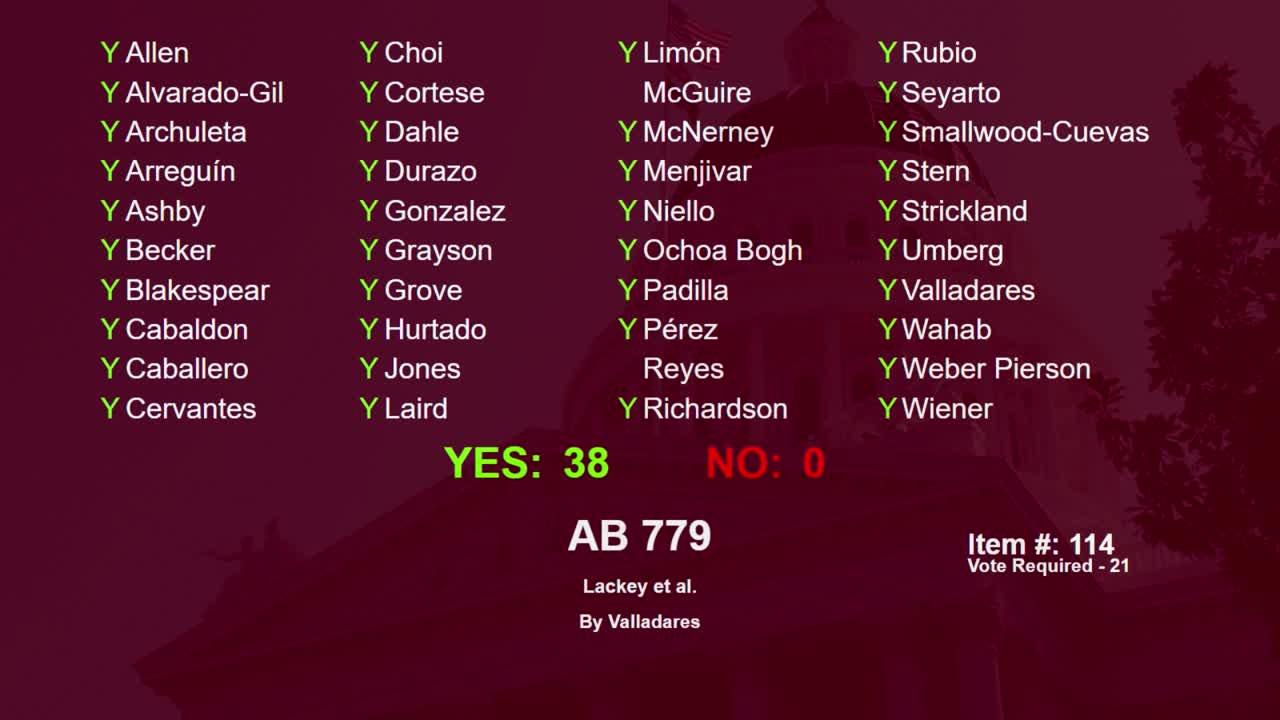 2MIN
Senate Floor
 5MIN
Senate Standing Committee on Judiciary
 12MIN
Senate Standing Committee on Business, Professions and Economic Development
 1MIN
Assembly Floor
 8MIN
Assembly Standing Committee on Judiciary
 8MIN
Assembly Standing Committee on Business and Professions
Bill Author