AB 1007: Land use: development project review.
- Session Year: 2025-2026
- House: Assembly
- Latest Version Date: 2025-10-10
Current Status:
Passed
(2025-10-10: Chaptered by Secretary of State - Chapter 502, Statutes of 2025.)
Introduced
In Committee
Awaiting First Chamber Vote
Passed First Chamber
In Committee
Awaiting Second Chamber Vote
Passed Second Chamber
Enacted
Existing law, the Permit Streamlining Act, requires a public agency that is the lead agency for a development project to approve or disapprove a development project within specified time periods. The act requires a public agency that is a responsible agency for specified development projects to approve or disapprove the project within 90 days of the date on which the lead agency has approved the project or within 90 days of the date on which the completed application has been received and accepted as complete by the lead agency, whichever is longer.
This bill would reduce the time period that a responsible agency is required to approve or disapprove a project, as described above, from 90 days to 45 days, except as provided. By increasing the duties of local officials, this bill would impose a state-mandated local program.
The bill would include findings that changes proposed by this bill address a matter of statewide concern rather than a municipal affair and, therefore, apply to all cities, including charter cities.
The California Constitution requires the state to reimburse local agencies and school districts for certain costs mandated by the state. Statutory provisions establish procedures for making that reimbursement.
This bill would provide that no reimbursement is required by this act for a specified reason.
Existing law, the Permit Streamlining Act, requires a public agency that is the lead agency for a development project to approve or disapprove a development project within specified time periods. The act requires a public agency, other than the California Coastal Commission, agency that is a responsible agency for specified development projects to approve or disapprove the project within 90 days of the date on which the lead agency has approved the project or within 90 days of the date on which the completed application has been received and accepted as complete by the lead agency, whichever is longer.
This bill would reduce the time period that a responsible agency is required to approve or disapprove a project, as described above, from 90 days to 45 days. days, except as provided. By increasing the duties of local officials, this bill would impose a state-mandated local program.
The bill would include findings that changes proposed by this bill address a matter of statewide concern rather than a municipal affair and, therefore, apply to all cities, including charter cities.
The California Constitution requires the state to reimburse local agencies and school districts for certain costs mandated by the state. Statutory provisions establish procedures for making that reimbursement.
This bill would provide that no reimbursement is required by this act for a specified reason.
Existing law, the Permit Streamlining Act, requires a public agency that is the lead agency for a development project to approve or disapprove a development project within specified time periods. The act requires a public agency, other than the California Coastal Commission, that is a responsible agency for specified development projects to approve or disapprove the project within 90 days of the date on which the lead agency has approved the project or within 90 days of the date on which the completed application has been received and accepted as complete by the lead agency, whichever is longer.
This bill would reduce the time period that a responsible agency is required to approve or disapprove a project, as described above, from 90 days to 45 days. By increasing the duties of local officials, this bill would impose a state-mandated local program.
The bill would include findings that changes proposed by this bill address a matter of statewide concern rather than a municipal affair and, therefore, apply to all cities, including charter cities.
The California Constitution requires the state to reimburse local agencies and school districts for certain costs mandated by the state. Statutory provisions establish procedures for making that reimbursement.
This bill would provide that no reimbursement is required by this act for a specified reason.
The Permit Streamlining Act requires a public agency that is the lead agency for a development project to approve or disapprove that project within specified time periods.This bill would make a nonsubstantive change to that provision.The Permit Streamlining Act requires a public agency that is the lead agency for a development project to approve or disapprove that project within specified time periods.
This bill would make a nonsubstantive change to that provision.
(a)Except as provided in subdivision (b), a public agency that is a responsible agency for a development project that has been approved by the lead agency shall approve or disapprove the development project within whichever of the following periods of time is longer:
(1)Within 180 days from the date on which the lead agency has approved the project.
(2)Within 180 days of the date on which the completed application for the development project has been received and accepted as complete by that responsible agency.
(b)Except as provided in subdivision (c), a public agency that is a responsible agency for a development project described in paragraph (2) or (3) of subdivision (a) of Section 65950 that has been approved by the lead agency shall approve or disapprove the development project within whichever of the following periods of time is longer:
(1)Within 45 days from the date on which the lead agency has approved the project.
(2)Within 45 days of the date on which the completed application for the development project has been received and accepted as complete by that responsible agency.
(c)(1)Where a responsible agency is either the California Coastal Commission or the San Francisco Bay Conservation and Development Commission for a development project described in paragraph (2) or (3) of subdivision (a) of Section 65950 that has been approved by the lead agency, that responsible agency shall approve or disapprove the development project within whichever of the following periods of time is longer:
(A)Within 90 days from the date on which the lead agency has approved the project.
(B)Within 90 days of the date on which the completed application for the development project has been received and accepted as complete by that responsible agency.
(2)Where the responsible agency is the State Water Resources Control Board or a California Regional Water Quality Control Board for a development project described in paragraph (2) or (3) of subdivision (a) of Section 65950 that has been approved by the lead agency, and the approval being sought from the responsible agency is either an individual waste discharge requirement or any certificate or statement required by any federal agency pursuant to the Federal Water Pollution Control Act (33 U.S.C. Sec. 1251 et seq.) or any other federal water quality control law, that responsible agency shall approve or disapprove the development project within whichever of the following periods of time is longer:
(A)Within 90 days from the date on which the lead agency has approved the project.
(B)Within 90 days of the date on which the completed application for the development project has been received and accepted as complete by that responsible agency.
(d)At the time a decision by a lead agency to disapprove a development project becomes final, applications for that project which are filed with responsible agencies shall be deemed withdrawn.
SEC. 2.The Legislature finds and declares that Section 1 of this act amending Section 65952 of the Government Code addresses a matter of statewide concern rather than a municipal affair as that term is used in Section 5 of Article XI of the California Constitution. Therefore, Section 1 of this act applies to all cities, including charter cities.
SEC. 3.No reimbursement is required by this act pursuant to Section 6 of Article XIIIB of the California Constitution because a local agency or school district has the authority to levy service charges, fees, or assessments sufficient to pay for the program or level of service mandated by this act, within the meaning of Section 17556 of the Government Code.
(a)Except as provided in subdivision (b), a public agency that is a responsible agency for a development project that has been approved by the lead agency shall approve or disapprove the development project within whichever of the following periods of time is longer:
(1)Within 180 days from the date on which the lead agency has approved the project.
(2)Within 180 days of the date on which the completed application for the development project has been received and accepted as complete by that responsible agency.
(b)Except as provided in subdivision (c), a public agency that is a responsible agency for a development project described in paragraph (2) or (3) of subdivision (a) of Section 65950 that has been approved by the lead agency shall approve or disapprove the development project within whichever of the following periods of time is longer:
(1)Within 45 days from the date on which the lead agency has approved the project.
(2)Within 45 days of the date on which the completed application for the development project has been received and accepted as complete by that responsible agency.
(c)(1)Where a responsible agency is either the California Coastal Commission or the San Francisco Bay Conservation and Development Commission for a development project described in paragraph (2) or (3) of subdivision (a) of Section 65950 that has been approved by the lead agency, that responsible agency shall approve or disapprove the development project within whichever of the following periods of time is longer:
(1)(A)Within 90 days from the date on which the lead agency has approved the project.
(2)(B)Within 90 days of the date on which the completed application for the development project has been received and accepted as complete by that responsible agency.
(2)Where the responsible agency is the State Water Resources Control Board or a California Regional Water Quality Control Board for a development project described in paragraph (2) or (3) of subdivision (a) of Section 65950 that has been approved by the lead agency, and the approval being sought from the responsible agency is either an individual waste discharge requirement or any certificate or statement required by any federal agency pursuant to the Federal Water Pollution Control Act (33 U.S.C. Sec. 1251 et seq.) or any other federal water quality control law, that responsible agency shall approve or disapprove the development project within whichever of the following periods of time is longer:
(A)Within 90 days from the date on which the lead agency has approved the project.
(B)Within 90 days of the date on which the completed application for the development project has been received and accepted as complete by that responsible agency.
(d)At the time a decision by a lead agency to disapprove a development project becomes final, applications for that project which are filed with responsible agencies shall be deemed withdrawn.
SEC. 2.The Legislature finds and declares that Section 1 of this act amending Section 65952 of the Government Code addresses a matter of statewide concern rather than a municipal affair as that term is used in Section 5 of Article XI of the California Constitution. Therefore, Section 1 of this act applies to all cities, including charter cities.
SEC. 3.No reimbursement is required by this act pursuant to Section 6 of Article XIIIB of the California Constitution because a local agency or school district has the authority to levy service charges, fees, or assessments sufficient to pay for the program or level of service mandated by this act, within the meaning of Section 17556 of the Government Code.
(a)Except as provided in subdivision (b), a public agency that is a responsible agency for a development project that has been approved by the lead agency shall approve or disapprove the development project within whichever of the following periods of time is longer:
(1)Within 180 days from the date on which the lead agency has approved the project.
(2)Within 180 days of the date on which the completed application for the development project has been received and accepted as complete by that responsible agency.
(b)A Except as provided in subdivision (c), a public agency that is a responsible agency for a development project described in paragraph (2) or (3) of subdivision (a) of Section 65950 that has been approved by the lead agency shall approve or disapprove the development project within whichever of the following periods of time is longer:
(1)Within 90 45 days from the date on which the lead agency has approved the project.
(2)Within 90 45 days of the date on which the completed application for the development project has been received and accepted as complete by that responsible agency.
(c)Where a responsible agency is either the California Coastal Commission or the San Francisco Bay Conservation and Development Commission for a development project described in paragraph (2) or (3) of subdivision (a) of Section 65950 that has been approved by the lead agency, that responsible agency shall approve or disapprove the development project within whichever of the following periods of time is longer:
(1)Within 90 days from the date on which the lead agency has approved the project.
(2)Within 90 days of the date on which the completed application for the development project has been received and accepted as complete by that responsible agency.
(c)(d)At the time a decision by a lead agency to disapprove a development project becomes final, applications for that project which are filed with responsible agencies shall be deemed withdrawn.
SEC. 2.The Legislature finds and declares that Section 1 of this act amending Section 65952 of the Government Code addresses a matter of statewide concern rather than a municipal affair as that term is used in Section 5 of Article XI of the California Constitution. Therefore, Section 1 of this act applies to all cities, including charter cities.
SEC. 3.No reimbursement is required by this act pursuant to Section 6 of Article XIIIB of the California Constitution because a local agency or school district has the authority to levy service charges, fees, or assessments sufficient to pay for the program or level of service mandated by this act, within the meaning of Section 17556 of the Government Code.
(a)Except as provided in subdivision (b), a public agency that is a responsible agency for a development project that has been approved by the lead agency shall approve or disapprove the development project within whichever of the following periods of time is longer:
(1)Within 180 days from the date on which the lead agency has approved the project.
(2)Within 180 days of the date on which the completed application for the development project has been received and accepted as complete by that responsible agency.
(b)A public agency other than the California Coastal Commission that is a responsible agency for a development project described in paragraph (2) or (3) of subdivision (a) of Section 65950 that has been approved by the lead agency shall approve or disapprove the development project within whichever of the following periods of time is longer:
(1)Within 90 45 days from the date on which the lead agency has approved the project.
(2)Within 90 45 days of the date on which the completed application for the development project has been received and accepted as complete by that responsible agency.
(c)At the time a decision by a lead agency to disapprove a development project becomes final, applications for that project which are filed with responsible agencies shall be deemed withdrawn.
SEC. 2.The Legislature finds and declares that Section 1 of this act amending Section 65952 of the Government Code addresses a matter of statewide concern rather than a municipal affair as that term is used in Section 5 of Article XI of the California Constitution. Therefore, Section 1 of this act applies to all cities, including charter cities.
SEC. 3.No reimbursement is required by this act pursuant to Section 6 of Article XIIIB of the California Constitution because a local agency or school district has the authority to levy service charges, fees, or assessments sufficient to pay for the program or level of service mandated by this act, within the meaning of Section 17556 of the Government Code.
SECTION 1.Section 65950 of the Government Code, as amended by Section 9 of Chapter 161 of the Statutes of 2021, is amended to read:65950.(a)A public agency that is the lead agency for a development project shall approve or disapprove the project within whichever of the following periods applies:(1)One hundred eighty days from the date of certification by the lead agency of the environmental impact report, if an environmental impact report is prepared pursuant to Section 21100 or 21151 of the Public Resources Code for the development project.(2)Ninety days from the date of certification by the lead agency of the environmental impact report, if an environmental impact report is prepared pursuant to Section 21100 or 21151 of the Public Resources Code for a development project defined in subdivision (c).(3)Sixty days from the date of certification by the lead agency of the environmental impact report, if an environmental impact report is prepared pursuant to Section 21100 or 21151 of the Public Resources Code for a development project defined in subdivision (c) and all of the following conditions are met:(A)At least 49 percent of the units in the development project are affordable to very low or low-income households, as defined by Sections 50105 and 50079.5 of the Health and Safety Code, respectively. Rents for the lower income units shall be set at an affordable rent, as that term is defined in Section 50053 of the Health and Safety Code, for at least 30 years. Owner-occupied units shall be available at an affordable housing cost, as that term is defined in Section 50052.5 of the Health and Safety Code.(B)Prior to the application being deemed complete for the development project pursuant to Article 3 (commencing with Section 65940), the lead agency received written notice from the project applicant that an application has been made or will be made for an allocation or commitment of financing, tax credits, bond authority, or other financial assistance from a public agency or federal agency, and the notice specifies the financial assistance that has been applied for or will be applied for and the deadline for application for that assistance, the requirement that one of the approvals of the development project by the lead agency is a prerequisite to the application for or approval of the application for financial assistance, and that the financial assistance is necessary for the project to be affordable as required pursuant to subparagraph (A).(C)There is confirmation that the application has been made to the public agency or federal agency prior to certification of the environmental impact report.(4)Sixty days from the date of adoption by the lead agency of the negative declaration, if a negative declaration is completed and adopted for the development project.(5)Sixty days from the determination by the lead agency that the project is exempt from the California Environmental Quality Act (Division 13 (commencing with Section 21000) of the Public Resources Code), if the project is exempt from that act.(b)This section does not preclude a project applicant and a public agency from mutually agreeing in writing to an extension of any time limit provided by this section pursuant to Section 65957.(c)For purposes of paragraphs (2) and (3) of subdivision (a) and Section 65952, development project means a housing development project, as defined in paragraph (3) of subdivision (b) of Section 65905.5.(d)For purposes of this section, lead agency and negative declaration have the same meaning as defined in Sections 21067 and 21064 of the Public Resources Code, respectively.(e)This section shall remain in effect only until January 1, 2030, and as of that date is repealed. REVISIONS: HeadingLines 2 and 3.(a)A public agency that is the lead agency for a development project shall approve or disapprove the project within whichever of the following periods is applicable: applies:
(1)One hundred eighty days from the date of certification by the lead agency of the environmental impact report, if an environmental impact report is prepared pursuant to Section 21100 or 21151 of the Public Resources Code for the development project.
(2)Ninety days from the date of certification by the lead agency of the environmental impact report, if an environmental impact report is prepared pursuant to Section 21100 or 21151 of the Public Resources Code for a development project defined in subdivision (c).
(3)Sixty days from the date of certification by the lead agency of the environmental impact report, if an environmental impact report is prepared pursuant to Section 21100 or 21151 of the Public Resources Code for a development project defined in subdivision (c) and all of the following conditions are met:
(A)At least 49 percent of the units in the development project are affordable to very low or low-income households, as defined by Sections 50105 and 50079.5 of the Health and Safety Code, respectively. Rents for the lower income units shall be set at an affordable rent, as that term is defined in Section 50053 of the Health and Safety Code, for at least 30 years. Owner-occupied units shall be available at an affordable housing cost, as that term is defined in Section 50052.5 of the Health and Safety Code.
(B)Prior to the application being deemed complete for the development project pursuant to Article 3 (commencing with Section 65940), the lead agency received written notice from the project applicant that an application has been made or will be made for an allocation or commitment of financing, tax credits, bond authority, or other financial assistance from a public agency or federal agency, and the notice specifies the financial assistance that has been applied for or will be applied for and the deadline for application for that assistance, the requirement that one of the approvals of the development project by the lead agency is a prerequisite to the application for or approval of the application for financial assistance, and that the financial assistance is necessary for the project to be affordable as required pursuant to subparagraph (A).
(C)There is confirmation that the application has been made to the public agency or federal agency prior to certification of the environmental impact report.
(4)Sixty days from the date of adoption by the lead agency of the negative declaration, if a negative declaration is completed and adopted for the development project.
(5)Sixty days from the determination by the lead agency that the project is exempt from the California Environmental Quality Act (Division 13 (commencing with Section 21000) of the Public Resources Code), if the project is exempt from that act.
(b)This section does not preclude a project applicant and a public agency from mutually agreeing in writing to an extension of any time limit provided by this section pursuant to Section 65957.
(c)For purposes of paragraphs (2) and (3) of subdivision (a) and Section 65952, development project means a housing development project, as defined in paragraph (3) of subdivision (b) of Section 65905.5.
(d)For purposes of this section, lead agency and negative declaration have the same meaning as defined in Sections 21067 and 21064 of the Public Resources Code, respectively.
(e)This section shall remain in effect only until January 1, 2030, and as of that date is repealed.
|
Date
|
Status
|
|---|---|
| Oct 10, 2025 | Chaptered by Secretary of State - Chapter 502, Statutes of 2025. |
| Oct 10, 2025 | Approved by the Governor. |
| Sep 24, 2025 | Enrolled and presented to the Governor at 3 p.m. |
| Sep 12, 2025 | Senate amendments concurred in. To Engrossing and Enrolling. (Ayes 80. Noes 0. Page 3385.). |
| Sep 12, 2025 | In Assembly. Concurrence in Senate amendments pending. |
| Sep 11, 2025 | Read third time. Passed. Ordered to the Assembly. (Ayes 40. Noes 0. Page 2933.). |
| Sep 9, 2025 | Ordered to special consent calendar. |
| Sep 8, 2025 | Read second time. Ordered to third reading. |
| Sep 5, 2025 | Read third time and amended. Ordered to second reading. |
| Sep 2, 2025 | Read second time. Ordered to third reading. |
| Aug 29, 2025 | Read second time and amended. Ordered returned to second reading. |
| Aug 29, 2025 | From committee: Amend, and do pass as amended. (Ayes 7. Noes 0.) (August 29). |
| Jul 14, 2025 | In committee: Referred to APPR. suspense file. |
| Jul 2, 2025 | From committee: Do pass and re-refer to Com. on APPR. with recommendation: To Consent Calendar. (Ayes 7. Noes 0.) (July 2). Re-referred to Com. on APPR. |
| Jun 4, 2025 | Referred to Com. on L. GOV. |
| May 23, 2025 | In Senate. Read first time. To Com. on RLS. for assignment. |
| May 23, 2025 | Read third time. Passed. Ordered to the Senate. (Ayes 71. Noes 0. Page 1663.) |
| May 15, 2025 | Read second time. Ordered to Consent Calendar. |
| May 14, 2025 | From committee: Do pass. To Consent Calendar. (Ayes 15. Noes 0.) (May 14). |
| Apr 30, 2025 | From committee: Do pass and re-refer to Com. on APPR. with recommendation: To Consent Calendar. (Ayes 10. Noes 0.) (April 30). Re-referred to Com. on APPR. |
| Apr 30, 2025 | Coauthors revised. |
| Apr 10, 2025 | Coauthors revised. |
| Apr 10, 2025 | From committee: Do pass and re-refer to Com. on H. & C.D. (Ayes 10. Noes 0.) (April 9). Re-referred to Com. on H. & C.D. |
| Mar 25, 2025 | Re-referred to Com. on L. GOV. |
| Mar 24, 2025 | From committee chair, with author's amendments: Amend, and re-refer to Com. on L. GOV. Read second time and amended. |
| Mar 24, 2025 | Referred to Coms. on L. GOV. and H. & C.D. |
| Feb 21, 2025 | From printer. May be heard in committee March 23. |
| Feb 20, 2025 | Read first time. To print. |
|
Date
|
Description
|
Location
|
Votes
|
|
|---|---|---|---|---|
| Sep 12, 2025 | AB 1007 Blanca Rubio Concurrence in Senate Amendments | Assembly Floor |
Passed |
|
| Sep 11, 2025 | Special Consent AB1007 Blanca Rubio et al. By Ashby | Senate Floor |
Passed |
|
| Aug 29, 2025 | Do pass as amended | Senate Standing Committee on Appropriations |
Passed |
|
| Jul 14, 2025 | Placed on suspense file | Senate Standing Committee on Appropriations |
Passed |
|
| Jul 2, 2025 | Do pass, but first be re-referred to the Committee on [Appropriations] with the recommendation: To Consent Calendar | Senate Standing Committee on Local Government |
Passed |
|
| May 23, 2025 | AB 1007 Blanca Rubio Consent Calendar Second Day Regular Session | Assembly Floor |
Passed |
|
| May 14, 2025 | Do pass. To Consent Calendar. | Assembly Standing Committee on Appropriations |
Passed |
|
| Apr 30, 2025 | Do pass and be re-referred to the Committee on [Appropriations] with recommendation: To Consent Calendar | Assembly Standing Committee on Housing and Community Development |
Passed |
|
| Apr 9, 2025 | Do pass and be re-referred to the Committee on [Housing and Community Development] | Assembly Standing Committee on Local Government |
Passed |
This list shows positions taken on this bill by organizations on the date displayed, which is linked to the original source.
Positions by individuals are not included.
|
Organization
|
Position
|
Date
|
|---|---|---|
| Abundant Housing LA | ** Support | |
| CA Assn of Winegrape Growers | ** Support | |
| California Apartment Association | ** Support | |
| California Association Of Realtors | ** Support | |
| California Building Industry Association | ** Support | |
| California Business Properties Association | ** Support | |
| California Business Roundtable | ** Support | |
| California Council For Affordable Housing | ** Support | |
| California Council For Environmental & Economic Balance | ** Support | |
| California Democratic Party | ** Support | |
| California Housing Partnership | ** Support | |
| California Nevada Cement Association | ** Support | |
| Circulate San Diego | ** Support | |
| East Bay Leadership Council | ** Support | |
| Habitat For Humanity California | ** Support | |
| Housing Leadership Council of San Mateo County | ** Support | |
| Inner City Law Center | ** Support | |
| Institute for Responsive Government Action | ** Support | |
| LeadingAge California | ** Support | |
| Lieutenant Governor Eleni Kounalakis | ** Support | |
| Monterey Bay Economic Partnership | ** Support | |
| NAIOP of California | ** Support | |
| Southern California Association Of Governments | ** Support | |
| Southern California Leadership Council | ** Support | |
| South Pasadena Residents for Responsible Growth | ** Support | |
| The Two Hundred | ** Support | |
| Tri County Chamber Alliance | ** Support |
CONCURRENCE IN SENATE AMENDMENTS
CSA1 Bill Id:AB 1007
Author:(Blanca Rubio)
As Amended Ver:September 5, 2025
Majority vote
SUMMARY
Expedites timelines for approval or disapproval by a public agency acting as the "responsible agency" for residential and mixed-use development projects.
Senate Amendments
Provides an exception to the requirement for the following public agencies to act on a proposed development within accelerated timeframes:
- Coastal Commission.
- Bay Area Conservation and Development Commission.
- State Water Resources Control Board, for specified projects.
- A California Regional Water Quality Control Board, for specified discharge permits.
Require the entities listed above to instead conform to the 90 day requirements in current law, as specified.
Makes technical and conforming changes.
COMMENTS
Zoning and approval processes. Local governments use their police power to enact zoning ordinances that establish the types of land uses that are allowed or authorized in an area. Zoning ordinances often identify a primary use for parcels in the area, as well as other uses that are allowed if they meet conditions imposed by the local government. They also set the standards and conditions that development must comply with in order to proceed.
Local governments have broad authority to define the specific approval processes needed to satisfy these considerations. Some housing projects can be permitted by city or county planning staff "ministerially" or without further approval from elected officials, but most large housing projects require "discretionary" approvals from local governments, such as a conditional use permit or a change in zoning laws. This process requires hearings by the local planning commission and public notice and may require additional approvals.
Permit Streamlining Act. The 1977 Permit Streamlining Act (PSA) requires public agencies to act fairly and promptly on applications for development permits, including housing. Public agencies must compile detailed lists of information that applicants for development projects must provide and explain the criteria they will use to review permit applications. Public agencies have 30 days to determine whether applications for development projects are complete; failure to act results in an application being "deemed complete."
Once a complete application for a development has been submitted, the PSA requires public officials to act within a specific time period after completing any environmental review documents required under the California Environmental Quality Act (CEQA), ranging from 60 to 180 days depending on the project and the environmental review required. If the public agency fails to approve or disapprove the application in the applicable time period, the application is "deemed approved," and the applicant may file suit in state court to order the local government to issue the permit.
Responsible agencies under the PSA. The PSA applies different requirements to "lead agencies and "responsible agencies. Lead agencies are the public agency with principal responsibility for carrying out or approving a project. Most often, particularly for housing projects, the lead agency is a city or county. The lead agency determines whether CEQA applies and prepares the relevant CEQA document. The timelines above apply to lead agencies.
A responsible agency is any other public agency with discretionary approval over part of the project, such as issuing a permit or license. Examples include water boards, air districts, utility providers, or agencies overseeing habitat or coastal resources. Once the lead agency has certified or adopted the CEQA document, responsible agencies must approve or disapprove qualifying projects within the longer of 180 days from the lead agency's approval, or 180 days from the date the responsible agency accepts the application as complete.
For housing development projects, a shorter PSA timeline applies:
- 90 days from the lead agency's approval; or
- 90 days from receipt of a complete application.
According to the Author
"AB 1007 takes aim at one of the biggest bottlenecks in the process—permit approvals. This bill cuts the time frame for responsible agencies to act on housing permit applications from 90 days to just 45.
"At the heart of the permitting process is the 'shot clock'—the countdown regulatory agencies must adhere to once an application is deemed complete. While prior legislation expedited the shot clock for lead agencies specifically for housing projects, but did not correspondingly shorten the clock for responsible agencies to act on a complete application and delays in the permit process. These holdups—especially for permits issued by state and regional agencies—have remained a stubborn obstacle to getting much-needed housing built.
"By aligning the shot clock across the board, AB 1007 aims to bring much-needed efficiency and predictability to the housing approval process, ensuring projects move forward faster and communities get the housing they desperately need."
Arguments in Support
California Building Industry Association, one of the sponsors of the bill, writes in support, "AB 1007 is a vital step toward ensuring that California can better meet the housing needs of its residents and by supporting this legislation, we can provide much-needed relief to families, seniors, and vulnerable populations struggling with housing insecurity. The passage of AB 1007 would help create long-term, effective solutions that will increase housing availability and affordability."
Arguments in Opposition
None on file.
FISCAL COMMENTS
According to the Senate Appropriations Committee:
"Any new costs for the Coastal Commission and the San Francisco Bay Conservation and Development Commission (BCDC) would be negligible. Staff notes that there could be other potential, but likely minor state costs to the extent that other state entities would meet the definition of a public agency acting as a responsible agency who would be responsible for acting on specified housing development applications. (various funds)
"Unknown local costs for cities and counties to comply with accelerated project approval deadlines. These costs are not state-reimbursable because local agencies have general authority to charge and adjust planning and permitting fees to cover their administrative expenses associated with new planning mandates, including expedited permitting requirements. (local funds)"
VOTES:
ASM LOCAL GOVERNMENT: 10-0-0
YES: Carrillo, Ta, Hoover, Pacheco, Ramos, Ransom, Blanca Rubio, Stefani, Ward, Wilson
ASM HOUSING AND COMMUNITY DEVELOPMENT: 10-0-2
YES: Haney, Patterson, Ávila Farías, Caloza, Garcia, Kalra, Lee, Quirk-Silva, Ta, Wicks
ABS, ABST OR NV: Tangipa, Wilson
ASM APPROPRIATIONS: 15-0-0
YES: Wicks, Sanchez, Arambula, Calderon, Caloza, Dixon, Elhawary, Fong, Mark González, Hart, Pacheco, Pellerin, Solache, Ta, Tangipa
ASSEMBLY FLOOR: 71-0-8
YES: Addis, Aguiar-Curry, Ahrens, Alanis, Alvarez, Arambula, Ávila Farías, Bains, Bauer-Kahan, Bennett, Berman, Boerner, Bonta, Calderon, Caloza, Carrillo, Castillo, Connolly, Davies, DeMaio, Dixon, Elhawary, Flora, Fong, Gabriel, Gallagher, Garcia, Gipson, Jeff Gonzalez, Mark González, Hadwick, Haney, Harabedian, Hart, Hoover, Irwin, Jackson, Kalra, Krell, Lackey, Lee, Lowenthal, Macedo, McKinnor, Muratsuchi, Ortega, Pacheco, Papan, Patel, Patterson, Pellerin, Petrie-Norris, Quirk-Silva, Ramos, Ransom, Celeste Rodriguez, Michelle Rodriguez, Rogers, Blanca Rubio, Schiavo, Solache, Soria, Stefani, Ta, Tangipa, Valencia, Wallis, Ward, Wilson, Zbur, Rivas
ABS, ABST OR NV: Bryan, Chen, Ellis, Nguyen, Sanchez, Schultz, Sharp-Collins, Wicks
UPDATED
VERSION: September 5, 2025
CONSULTANT: Linda Rios / L. GOV. / (916) 319-3958 FN: 0002055
SENATE RULES COMMITTEE Office of Senate Floor Analyses (916) 651-1520 Fax: (916) 327-4478 | AB 1007 |
THIRD READING
Bill No: AB 1007
Author: Blanca Rubio (D), et al.
Amended: 9/5/25 in Senate
Vote: 21
SENATE LOCAL GOVERNMENT COMMITTEE: 7-0, 7/2/25
AYES: Durazo, Choi, Arreguín, Cabaldon, Laird, Seyarto, Wiener
SENATE APPROPRIATIONS COMMITTEE: 7-0, 8/29/25
AYES: Caballero, Seyarto, Cabaldon, Dahle, Grayson, Richardson, Wahab
ASSEMBLY FLOOR: 71-0, 5/23/25 (Consent) - See last page for vote
SUBJECT: Land use: development project review
SOURCE: California Association of Realtors
California Building Industry Association
California Business Properties Association
California Business Roundtable
California Nevada Cement Association
Naiop of California
Southern California Leadership Council
DIGEST:
This bill shortens timelines for approval or disapproval by a public agency acting as the “responsible agency" for housing development projects.
Senate Floor Amendments of 9/5/25 exclude specified discharge permits issued by the State Water Resources Control Board (SWRCB) or a Regional Water Quality Control Board (RWQCB).
ANALYSIS:
Existing law:
- Allows, pursuant to the California Constitution, cities and counties to “make and enforce within its limits, all local, police, sanitary and other ordinances and regulations not in conflict with general laws.”
- Requires public agencies to act fairly and promptly on applications for development permits, including housing, under the Permit Streamlining Act (PSA), including that:
- Responsible agencies must approve or disapprove qualifying projects within the longer of 180 days from the lead agency’s approval, or the date the responsible agency accepts the application as complete.
- For housing development projects, 90 days from the lead agency’s approval, or the date the responsible agency accepts the application as complete.
- Establishes the following state agencies:
- The California Coastal Commission, which has specified authority over development within the Coastal Zone.
- The San Francisco Bay Conservation and Development Commission (SFBCDC), which has specified authority over development surrounding the San Francisco Bay.
- The SWRCB and nine RWQCBs, which collectively regulate water quality in the California through permitting and enforcement of the state’s Porter-Cologne Water Quality Control Act and the federal Clean Water Act.
This bill reduces the time period that a responsible agency is required to approve or disapprove a project, as described above, from 90 days to 45, except for the California Coastal Commission and SFBCDC, and for either an individual waste discharge requirement or any certificate or statement required by any federal agency pursuant to the Federal Water Pollution Control Act or any other federal water quality control law that is issued by SWRCB or a RWQCB.
Comments
Purpose of the bill. According to the author, “AB 1007 takes aim at one of the biggest bottlenecks in the process—permit approvals. This bill cuts the time frame for responsible agencies to act on housing permit applications from 90 days to just 45.
“At the heart of the permitting process is the ‘shot clock’—the countdown regulatory agencies must adhere to once an application is deemed complete. While prior legislation expedited the shot clock for lead agencies specifically for housing projects, but did not correspondingly shorten the clock for responsible agencies to act on a complete application and delays in the permit process. These holdups—especially for permits issued by state and regional agencies—have remained a stubborn obstacle to getting much-needed housing built.
“By aligning the shot clock across the board, AB 1007 aims to bring much-needed efficiency and predictability to the housing approval process, ensuring projects move forward faster and communities get the housing they desperately need.”
FISCAL EFFECT: Appropriation: No Fiscal Com.: Yes Local: Yes
According to the Senate Appropriations Committee:
- Any new costs for the Coastal Commission and the San Francisco Bay Conservation and Development Commission (BCDC) would be negligible. Staff notes that there could be other potential, but likely minor state costs to the extent that other state entities would meet the definition of a public agency acting as a responsible agency who would be responsible for acting on specified housing development applications. (various funds)
- Unknown local costs for cities and counties to comply with accelerated project approval deadlines. These costs are not state-reimbursable because local agencies have general authority to charge and adjust planning and permitting fees to cover their administrative expenses associated with new planning mandates, including expedited permitting requirements. (local funds)
SUPPORT: (Verified 9/7/25)
California Association of Realtors (co-source)
California Building Industry Association (co-source)
California Business Properties Association (co-source)
California Business Roundtable (co-source)
California Nevada Cement Association (co-source)
Naiop of California (co-source)
Southern California Leadership Council (co-source)
Abundant Housing LA
CA Assn of Winegrape Growers
California Apartment Association
California Council for Affordable Housing
California Council for Environmental & Economic Balance
California Democratic Party
California Housing Partnership
Circulate San Diego
East Bay Leadership Council
Habitat for Humanity California
Housing Leadership Council of San Mateo County
Inner City Law Center
Institute for Responsive Government Action
Leadingage California
Lieutenant Governor Eleni Kounalakis
Monterey Bay Economic Partnership
South Pasadena Residents for Responsible Growth
Southern California Association of Governments
The Two Hundred
Tri County Chamber Alliance
OPPOSITION: (Verified 9/7/25)
None received
ASSEMBLY FLOOR: 71-0, 5/23/25
AYES: Addis, Aguiar-Curry, Ahrens, Alanis, Alvarez, Arambula, Ávila Farías, Bains, Bauer-Kahan, Bennett, Berman, Boerner, Bonta, Calderon, Caloza, Carrillo, Castillo, Connolly, Davies, DeMaio, Dixon, Elhawary, Flora, Fong, Gabriel, Gallagher, Garcia, Gipson, Jeff Gonzalez, Mark González, Hadwick, Haney, Harabedian, Hart, Hoover, Irwin, Jackson, Kalra, Krell, Lackey, Lee, Lowenthal, Macedo, McKinnor, Muratsuchi, Ortega, Pacheco, Papan, Patel, Patterson, Pellerin, Petrie-Norris, Quirk-Silva, Ramos, Ransom, Celeste Rodriguez, Michelle Rodriguez, Rogers, Blanca Rubio, Schiavo, Solache, Soria, Stefani, Ta, Tangipa, Valencia, Wallis, Ward, Wilson, Zbur, Rivas
NO VOTE RECORDED: Bryan, Chen, Ellis, Nguyen, Sanchez, Schultz, Sharp-Collins, Wicks
Prepared by: Anton Favorini-Csorba / L. GOV. / (916) 651-4119
9/8/25 21:29:50
**** END ****
SENATE RULES COMMITTEE Office of Senate Floor Analyses (916) 651-1520 Fax: (916) 327-4478 | AB 1007 |
THIRD READING
Bill No: AB 1007
Author: Blanca Rubio (D), et al.
Amended: 8/29/25 in Senate
Vote: 21
SENATE LOCAL GOVERNMENT COMMITTEE: 7-0, 7/2/25
AYES: Durazo, Choi, Arreguín, Cabaldon, Laird, Seyarto, Wiener
SENATE APPROPRIATIONS COMMITTEE: 7-0, 8/29/25
AYES: Caballero, Seyarto, Cabaldon, Dahle, Grayson, Richardson, Wahab
SENATE APPROPRIATIONS COMMITTEE: 7-0, 8/29/25
AYES: Caballero, Seyarto, Cabaldon, Dahle, Grayson, Richardson, Wahab
ASSEMBLY FLOOR: 71-0, 5/23/25 (Consent) - See last page for vote
SUBJECT: Land use: development project review
SOURCE: California Association of Realtors
California Building Industry Association
California Business Properties Association
California Business Roundtable
California Nevada Cement Association
Naiop of California
Southern California Leadership Council
DIGEST:
This bill shortens timelines for approval or disapproval by a public agency acting as the “responsible agency" for housing development projects.
ANALYSIS:
Existing law:
- Allows, pursuant to the California Constitution, cities and counties to “make and enforce within its limits, all local, police, sanitary and other ordinances and regulations not in conflict with general laws.”
- Requires public agencies to act fairly and promptly on applications for development permits, including housing, under the Permit Streamlining Act (PSA), including that:
- Responsible agencies must approve or disapprove qualifying projects within the longer of 180 days from the lead agency’s approval, or the date the responsible agency accepts the application as complete.
- For housing development projects, 90 days from the lead agency’s approval, or the date the responsible agency accepts the application as complete.
- Establishes the following state agencies:
- The California Coastal Commission, which has specified authority over development within the Coastal Zone.
- The San Francisco Bay Conservation and Development Commission (SFBCDC), which has specified authority over development surrounding the San Francisco Bay.
This bill reduces the time period that a responsible agency is required to approve or disapprove a project, as described above, from 90 days to 45, except for the California Coastal Commission and SFBCDC.
Comments
Purpose of the bill. According to the author, “AB 1007 takes aim at one of the biggest bottlenecks in the process—permit approvals. This bill cuts the time frame for responsible agencies to act on housing permit applications from 90 days to just 45.
“At the heart of the permitting process is the ‘shot clock’—the countdown regulatory agencies must adhere to once an application is deemed complete. While prior legislation expedited the shot clock for lead agencies specifically for housing projects, but did not correspondingly shorten the clock for responsible agencies to act on a complete application and delays in the permit process. These holdups—especially for permits issued by state and regional agencies—have remained a stubborn obstacle to getting much-needed housing built.
“By aligning the shot clock across the board, AB 1007 aims to bring much-needed efficiency and predictability to the housing approval process, ensuring projects move forward faster and communities get the housing they desperately need.”
FISCAL EFFECT: Appropriation: No Fiscal Com.: Yes Local: Yes
According to the Senate Appropriations Committee:
- Any new costs for the Coastal Commission and the San Francisco Bay Conservation and Development Commission (BCDC) would be negligible. Staff notes that there could be other potential, but likely minor state costs to the extent that other state entities would meet the definition of a public agency acting as a responsible agency who would be responsible for acting on specified housing development applications. (various funds)
- Unknown local costs for cities and counties to comply with accelerated project approval deadlines. These costs are not state-reimbursable because local agencies have general authority to charge and adjust planning and permitting fees to cover their administrative expenses associated with new planning mandates, including expedited permitting requirements. (local funds)
SUPPORT: (Verified 8/30/25)
California Association of Realtors (co-source)
California Building Industry Association (co-source)
California Business Properties Association (co-source)
California Business Roundtable (co-source)
California Nevada Cement Association (CNCA) (co-source)
Naiop of California (co-source)
Southern California Leadership Council (co-source)
Abundant Housing LA
CA Assn of Winegrape Growers
California Apartment Association
California Council for Affordable Housing
California Council for Environmental & Economic Balance
California Democratic Party
California Housing Partnership
Circulate San Diego
East Bay Leadership Council
Habitat for Humanity California
Housing Leadership Council of San Mateo County
Inner City Law Center
Institute for Responsive Government Action
Leadingage California
Lieutenant Governor Eleni Kounalakis
Monterey Bay Economic Partnership
South Pasadena Residents for Responsible Growth
Southern California Association of Governments
The Two Hundred
Tri County Chamber Alliance
OPPOSITION: (Verified 8/30/25)
None received
ASSEMBLY FLOOR: 71-0, 5/23/25
AYES: Addis, Aguiar-Curry, Ahrens, Alanis, Alvarez, Arambula, Ávila Farías, Bains, Bauer-Kahan, Bennett, Berman, Boerner, Bonta, Calderon, Caloza, Carrillo, Castillo, Connolly, Davies, DeMaio, Dixon, Elhawary, Flora, Fong, Gabriel, Gallagher, Garcia, Gipson, Jeff Gonzalez, Mark González, Hadwick, Haney, Harabedian, Hart, Hoover, Irwin, Jackson, Kalra, Krell, Lackey, Lee, Lowenthal, Macedo, McKinnor, Muratsuchi, Ortega, Pacheco, Papan, Patel, Patterson, Pellerin, Petrie-Norris, Quirk-Silva, Ramos, Ransom, Celeste Rodriguez, Michelle Rodriguez, Rogers, Blanca Rubio, Schiavo, Solache, Soria, Stefani, Ta, Tangipa, Valencia, Wallis, Ward, Wilson, Zbur, Rivas
NO VOTE RECORDED: Bryan, Chen, Ellis, Nguyen, Sanchez, Schultz, Sharp-Collins, Wicks
Prepared by: Anton Favorini-Csorba / L. GOV. / (916) 651-4119
9/2/25 18:13:15
**** END ****
SENATE COMMITTEE ON APPROPRIATIONS
Senator Anna Caballero, Chair
2025 - 2026 Regular Session
AB 1007 (Blanca Rubio) - Land use: development project review
Version: March 24, 2025 | Policy Vote: L. GOV. 7 - 0 |
Urgency: No | Mandate: Yes |
Hearing Date: August 29, 2025 | Consultant: Mark McKenzie |
Bill Summary:
AB 1007 would accelerate the timeframes by which a public agency acting as a responsible agency must approve or disapprove certain residential and mixed-use development projects under the Permit Streamlining Act.
*********** ANALYSIS ADDENDUM – SUSPENSE FILE ***********
The following information is revised to reflect amendments
adopted by the committee on August 29, 2025
Fiscal Impact:
- Any new costs for the Coastal Commission and the San Francisco Bay Conservation and Development Commission (BCDC) would be negligible. Staff notes that there could be other potential, but likely minor state costs to the extent that other state entities would meet the definition of a public agency acting as a responsible agency who would be responsible for acting on specified housing development applications. (various funds)
- Unknown local costs for cities and counties to comply with accelerated project approval deadlines. These costs are not state-reimbursable because local agencies have general authority to charge and adjust planning and permitting fees to cover their administrative expenses associated with new planning mandates, including expedited permitting requirements. (local funds)
Author Amendments:
- Provide an exception to the requirement for a public agency to act on a proposed development within accelerated timeframes (reduced from 90 days to 45 days in the bill) for the Coastal Commission and BCDC, and require those entities to instead conform to the 90 day requirements in current law, as specified.
- Make technical changes necessary to avoid chaptering out provisions of AB 130 (Budget Committee), Chap. 22/2025, the recently enacted housing budget trailer bill.
-- END --
SENATE COMMITTEE ON APPROPRIATIONS
Senator Anna Caballero, Chair
2025 - 2026 Regular Session
AB 1007 (Blanca Rubio) - Land use: development project review
Version: March 24, 2025 | Policy Vote: L. GOV. 7 - 0 |
Urgency: No | Mandate: Yes |
Hearing Date: July 14, 2025 | Consultant: Mark McKenzie |
Bill Summary:
AB 1007 would accelerate the timeframes by which a public agency acting as a responsible agency must approve or disapprove certain residential and mixed-use development projects under the Permit Streamlining Act.
Fiscal Impact:
- The Coastal Commission estimates that it would incur costs of approximately $1.7 million annually for 8.0 PY of staff to implement an expedited agency workflow focused on meeting the proposed 45-day deadline to process and hear coastal development permits for qualifying housing development projects. Staff notes that, even with the additional resources, the Commission may be unable to meet the 45-day permit action deadline in certain circumstances, which may result in some projects that have adverse impacts on coastal resources being “deemed approved.” See Staff Comments. (General Fund)
- Unknown local costs for cities and counties to comply with accelerated project approval deadlines. These costs are not state-reimbursable because local agencies have general authority to charge and adjust planning and permitting fees to cover their administrative expenses associated with new planning mandates, including expediting permitting requirements. (local funds)
Background:
The Planning and Zoning Law requires every county and city to adopt a general plan that sets out the intensity (density) and location for planned uses in the area covered by the plan. Local zoning laws and building codes specify where housing may be built, as well as its density, quality, and style. Housing developers must obtain building permits from city and county planning departments and typically must gain approval from local planning commissions and city councils or county boards of supervisors.
The 1977 Permit Streamlining Act requires public agencies to act fairly and promptly on applications for development permits. Public agencies generally have 30 days to determine whether applications for development projects are complete and accepted for filing. Once a complete application has been submitted, the Act requires public officials to act within a specific time period after completing any environmental review documents required under the California Environmental Quality Act (CEQA), ranging from 60 to 180 days depending on the project and environmental review required. If the public agency fails to approve or disapprove an application within the applicable time period, the application is “deemed approved.”
The Permit Streamlining Act also sets deadlines for responsible agencies that are not the lead agency under CEQA, but have a role in approving a permit or other authorization for some aspect of the proposed project. Responsible agencies rely on the lead agency’s CEQA documentation to issue permits and make decisions. The Permit Streamlining Act requires responsible agencies to approve or disapprove a development project within 180 days of the date that either the lead agency approved the project or deemed the application complete, whichever is longer. For qualifying residential or primarily residential mixed-use projects, responsible agencies must approve or disapprove the project within 90 days. If the public agency fails to approve or disapprove the application in the relevant time period, the application is deemed approved and the applicant may sue to order the local government to issue the permit.
Existing law, the Coastal Act, calls for the protection and enhancement of public access and recreation, marine resources, environmentally sensitive habitat areas, marine water quality, agriculture, and scenic resources, and makes provisions for coastal-dependent industrial and energy development. New development in the coastal zone requires a coastal development permit either from a local government or the Coastal Commission. Local governments are required to prepare a local coastal plan (LCP) for the coastal zone portion of their jurisdiction. After an LCP has been reviewed and approved by the Coastal Commission as being consistent with the Coastal Act, the Commission’s regulatory authority over most types of new development is delegated to the local government, subject to limited appeals to the Commission. As noted above, any permits for new development in these jurisdictions requires approval by the Coastal Commission. Until recently, however, the Commission was exempt from the accelerated timeframes specified in the Permit Streamlining Act, for approving or disapproving a development project. Specifically, AB 130 (Budget Committee), Chap. 22/2025, a housing trailer bill enacted as part of the 2025-26 Budget, deleted the explicit exemption for the Coastal Commission.
Proposed Law:
AB 1007 would expedite the Permit Streamlining Act deadlines for a public agency acting as a responsible agency to approve or disapprove certain types of development projects. Specifically, this bill would require a responsible agency to approve or disapprove an application for a residential or mixed-use development within 45 days (rather than 90 days) of the date that either the lead agency approved the project or the responsible agency received and accepted the application as complete, whichever is longer.
Related Legislation:
AB 130 (Budget Committee), Chap. 22/2025, a recently enacted housing budget trailer bill, includes a provision that deletes an explicit exemption for the Coastal Commission, when acting as a responsible agency, to comply with the accelerated deadlines for approving or disapproving certain residential and mixed-use development projects within 90 days under the Permit Streamlining Act.
Staff Comments:
As noted above, AB 130, which was just chaptered on June 30, 2025, amended the Permit Streamlining Act to delete a provision exempting the Coastal Commission from requirements to expedite approval or disapproval of housing development projects, which currently requires the Commission, when acting as a responsible agency, to act on an application within 90 days. This bill would further accelerate that timeline by requiring the Coastal Commission to approve or disapprove certain housing development projects within 45 days. To implement the bill, the Commission indicates that it would establish a unit of eight personnel, at an annual cost of approximately $1.7 million, to create a separate expedited agency workflow to hear and process coastal development permits within the 45-day time period. Even with additional resources, the Commission indicates that the bill’s accelerated timelines for development project approvals would hinder its ability to properly review, analyze, revise, and agendize residential projects in the coastal zone for which the Commission is the responsible agency. In those jurisdictional segments of the coastal zone that are not covered by an approved LCP, the Commission must analyze a project for Coastal Act consistency, including public access, public viewsheds, sea level rise, and sensitive habitats. Although many projects are non-controversial and have minimal impacts, some are exceedingly complex and require extensive analysis and revisions to a project’s scope. In some cases, the accelerated timelines in this bill would result in development in the coastal zone being “deemed approved” by operation of the law, despite potentially significant adverse impacts to sensitive coastal resources, public coastal access, and sea level rise efforts.
Staff notes that there could be other potential state costs to the extent that other state entities would meet the definition of a public agency acting as a responsible agency, including potentially the State Water Board for water quality and wastewater discharge permits, and the Department of Toxic Substances Control for hazardous material mitigation permits. Any additional specific state-level costs have not been identified to date.
This bill would impose new costs on cities and counties by requiring public agencies to approve or disapprove development projects under accelerated timelines. Staff notes, however, that any local costs mandated by this bill would not be subject to state reimbursement because local agencies have the authority to charge and adjust planning and permitting fees as necessary to cover administrative costs. Existing law authorizes planning and zoning fees to “include the costs reasonably necessary to prepare and revise the plans and policies that a local agency is required to adopt before it can make any necessary findings and determinations.” Case law and previous decisions by the Commission on State Mandates support the position that local governments’ planning costs are not reimbursable when the state imposes new planning mandates.
Recommended Amendments:
Staff notes that AB 130 (Budget Committee), Chap. 22/2025, was recently enacted as a Housing budget trailer bill, and included a provision that amended Government Code 65952, which this bill would also amend. This bill should be amended to avoid chaptering out the changes enacted by AB 130. Specifically, this bill would currently re-enact the Coastal Commission exemption from the accelerated timelines specified in the Permit Streamlining Act.
-- END --
SENATE COMMITTEE ON LOCAL GOVERNMENT
Senator María Elena Durazo, Chair
2025 - 2026 Regular
Bill No: | AB 1007 | Hearing Date: | 7/2/25 |
Author: | Blanca Rubio | Fiscal: | Yes |
Version: | 3/24/25 | Consultant: | Favorini-Csorba |
Land use: development project review
Expedites timelines for approval or disapproval by a public agency acting as the “responsible agency" for housing development projects.
Background
The California Constitution allows cities and counties to “make and enforce within its limits, all local, police, sanitary and other ordinances and regulations not in conflict with general laws.” It is from this fundamental power (commonly called the police power) that cities and counties derive their authority to regulate behavior to preserve the health, safety, and welfare of the public—including land use authority.
Zoning and approval processes. Local governments use their police power to enact zoning ordinances that establish the types of land uses that are allowed or authorized in an area. Zoning ordinances often identify a primary use for parcels in the area, as well as other uses that are allowed if they meet conditions imposed by the local government. They also set the standards and conditions that development must comply with in order to proceed.
Local governments have broad authority to define the specific approval processes needed to satisfy these considerations. Some housing projects can be permitted by city or county planning staff “ministerially” or without further approval from elected officials, but most large housing projects require “discretionary” approvals from local governments, such as a conditional use permit or a change in zoning laws. This process requires hearings by the local planning commission and public notice and may require additional approvals.
Permit Streamlining Act. The 1977 Permit Streamlining Act (PSA) requires public agencies to act fairly and promptly on applications for development permits, including housing. Public agencies must compile detailed lists of information that applicants for development projects must provide and explain the criteria they will use to review permit applications. Public agencies have 30 days to determine whether applications for development projects are complete; failure to act results in an application being “deemed complete.”
Once a complete application for a development has been submitted, the PSA requires public officials to act within a specific time period after completing any environmental review documents required under the California Environmental Quality Act (CEQA), ranging from 60 to 180 days depending on the project and the environmental review required. If the public agency fails to approve or disapprove the application in the applicable time period, the application is “deemed approved,” and the applicant may file suit in state court to order the local government to issue the permit.
Responsible agencies under the PSA. The PSA applies different requirements to “lead agencies and “responsible agencies. Lead agencies are the public agency with principal responsibility for carrying out or approving a project. Most often, particularly for housing projects, the lead agency is a city or county. The lead agency determines whether CEQA applies and prepares the relevant CEQA document. The timelines above apply to lead agencies.
A responsible agency is any other public agency with discretionary approval over part of the project, such as issuing a permit or license. Examples include water boards, air districts, utility providers, or agencies overseeing habitat or coastal resources. Once the lead agency has certified or adopted the CEQA document, responsible agencies must approve or disapprove qualifying projects within the longer of 180 days from the lead agency’s approval, or 180 days from the date the responsible agency accepts the application as complete.
For housing development projects, a shorter PSA timeline applies:
- 90 days from the lead agency’s approval; or
- 90 days from receipt of a complete application.
It can take years for a housing project to receive the necessary land use approvals to move to the construction phase. For example, the table below indicates the average number of days for housing projects to go from a submitted application to entitled in 2023, based on data reported by local governments to the Department of Housing and Community Development.
Development Type | Single Family (Detached) | Single Family (Attached) | Accessory Dwelling Unit (ADU) | Mobile Home | Two to Four Units | Five or More Units |
Average time from submission to entitled (days) | 160 | 221 | 112 | 212 | 179 | 323 |
Several business groups want the Legislature to take further steps to expedite land use approvals.
Proposed Law
Assembly Bill 1007 reduces the timeline for approval or disapproval by a “responsible agency" for housing development projects from 90 days to 45 days following either the lead agency's approval, or the date the agency receives a complete application, whichever is later.
Comments
1. Purpose of the bill. According to the author, “AB 1007 takes aim at one of the biggest bottlenecks in the process—permit approvals. This bill cuts the time frame for responsible agencies to act on housing permit applications from 90 days to just 45.
“At the heart of the permitting process is the ‘shot clock’—the countdown regulatory agencies must adhere to once an application is deemed complete. While prior legislation expedited the shot clock for lead agencies specifically for housing projects, but did not correspondingly shorten the clock for responsible agencies to act on a complete application and delays in the permit process. These holdups—especially for permits issued by state and regional agencies—have remained a stubborn obstacle to getting much-needed housing built.
“By aligning the shot clock across the board, AB 1007 aims to bring much-needed efficiency and predictability to the housing approval process, ensuring projects move forward faster and communities get the housing they desperately need.”
2. Mandate. The California Constitution requires the state to reimburse local governments for the costs of new or expanded state mandated local programs. Because AB 1007 imposes new duties on local governments with respect to the approval of housing projects, Legislative Counsel says it imposes a new state mandate. AB 1007 disclaims the state’s responsibility for providing reimbursement by citing local governments’ authority to charge for the costs of implementing the bill’s provisions.
3. Charter city. The California Constitution allows cities that adopt charters to control their own “municipal affairs.” In all other matters, charter cities must follow the general, statewide laws. Because the Constitution doesn’t define “municipal affairs,” the courts determine whether a topic is a municipal affair or whether it’s an issue of statewide concern. AB 253 says that it applies to all cities, including charter cities. To support this assertion, the bill includes a legislative finding and declaration that its provisions address a matter of statewide concern.
Assembly Actions
Assembly Local Government Committee: 10-0
Assembly Housing and Community Development Committee: 10-0
Assembly Appropriations Committee: 15-2
Assembly Floor: 71-0
Support and Opposition
(6/27/25)
Support: California Association of Realtors (Co-Sponsor)
California Building Industry Association (Co-Sponsor)
California Business Properties Association (Co-Sponsor)
California Business Roundtable (Co-Sponsor)
California Nevada Cement Association (CNCA) (Co-Sponsor)
Naiop of California (Co-Sponsor)
Southern California Leadership Council (Co-Sponsor)
Abundant Housing LA
CA Assn of Winegrape Growers
California Apartment Association
California Council for Environmental & Economic Balance (CCEEB)
California Housing Partnership
Circulate San Diego
Habitat for Humanity California
Housing Leadership Council of San Mateo
Housing Leadership Council of San Mateo County
Institute for Responsive Government Action
Leadingage California
Lieutenant Governor Eleni Kounalakis
Monterey Bay Economic Partnership
South Pasadena Residents for Responsible Growth
Southern California Association of Governments (SCAG)
The Two Hundred
Tri County Chamber Alliance
Opposition: None Submitted
-- END --
Date of Hearing: May 14, 2025
ASSEMBLY COMMITTEE ON APPROPRIATIONS
Buffy Wicks, Chair
ABPCA Bill Id:AB 1007
Author:(Blanca Rubio) – As Amended Ver:March 24, 2025
Policy Committee: | Local Government | Vote: | 10 - 0 |
Housing and Community Development | 10 - 0 | ||
|
|
Urgency: No State Mandated Local Program: Yes Reimbursable: No
SUMMARY:
This bill requires a public agency acting as the “responsible agency" to approve or disapprove a residential or mixed-use development project within 45 days, rather than 90 days, from the date the lead agency approved the project or from the date the application for the project was accepted as complete by the responsible agency, whichever is longer.
FISCAL EFFECT:
No state costs. Ongoing local costs of an unknown amount to local agencies acting as responsible agencies to provide for the streamlined approval of an application for a qualified housing or mixed-use projects within 45 days. These costs are not state-reimbursable because local agencies have general authority to charge and adjust planning and permitting fees to offset increased costs associated with the provisions of this bill.
COMMENTS:
- Purpose. According to the author:
[This bill] takes aim at one of the biggest bottlenecks in the process—permit approvals. This bill cuts the time frame for responsible agencies to act on housing permit applications from 90 days to just 45.
At the heart of the permitting process is the ‘shot clock’—the countdown regulatory agencies must adhere to once an application is deemed complete. While prior legislation expedited the shot clock for lead agencies specifically for housing projects, it did not correspondingly shorten the clock for responsible agencies to act on a complete application and delays in the permit process. These holdups—especially for permits issued by state and regional agencies—have remained a stubborn obstacle to getting much-needed housing built. By aligning the shot clock across the board, [this bill] aims to bring much-needed efficiency and predictability to the housing approval process, ensuring projects move forward faster and communities get the housing they desperately need.
- Background. Existing law, the Permit Streamlining Act, requires the lead agency for a development project to approve or disapprove the development project within specified time periods. The act requires a public agency, other than the California Coastal Commission, that is a responsible agency for specified development projects to approve or disapprove the project within 90 days of the date on which the lead agency has approved the project or within 90 days of the date on which the completed application has been received and accepted as complete by the lead agency, whichever is longer.
A “lead agency” (usually a city or county) is the public agency with principal responsibility for carrying out or approving a project which may have a significant effect upon the environment. The lead agency is responsible for preparing the appropriate California Environmental Quality Act (CEQA) documents under specified timelines, generally either 60, 90, or 180 days, depending on the type of environmental review.
A “responsible agency” is a public agency, such as a water district or utility provider, other than the lead agency, with discretionary approval over part of a project that usually issues a specific permit or license. Once the lead agency has certified or adopted the CEQA document for a development project, responsible agencies must approve or disapprove qualifying projects within the longer of 180 days from the lead agency’s approval, or 180 days from the date the responsible agency accepts the application as complete. For qualifying residential or primarily residential mixed-use projects, a 90-day timeline applies.
This bill reduces the 90-day timeline to 45 days.
According to the California Building Industry Association, a cosponsor of the bill, “the shortened timeline [in this bill] allows builders to expedite vitally needed housing production. This approach is consistent with the Legislature’s approval of two other applicable shot clock timeframe reductions for lead agencies since 2019.”
Analysis Prepared by: Jennifer Swenson / APPR. / (916) 319-2081
Date of Hearing: April 30, 2024
ASSEMBLY COMMITTEE ON HOUSING AND COMMUNITY DEVELOPMENT
Matt Haney, Chair
ABPCA Bill Id:AB 1007 (
Author:Blanca Rubio) – As Amended Ver:March 24, 2025
SUBJECT: Land use: development project review
SUMMARY: Reduces the timeline for approval or disapproval by a “responsible agency" for residential and mixed-use development projects from 90 days to 45 days of either the lead agency's approval, or the date the agency receives a complete application, whichever is later.
EXISTING LAW:
- Establishes the Permit Streamlining Act (PSA). (Government Code (GOV) Sections 65920-65964.5)
- Establishes the California Environmental Quality Act (CEQA), which requires lead agencies to determine whether a project is exempt, prepare a Negative Declaration or Mitigated Negative Declaration for projects with no or mitigable impacts, or complete an Environmental Impact Report (EIR) for projects with significant environmental impacts. (Public Resources Code (PRC) 21000–21189)
- Defines “lead agency” to mean the public agency which has the principal responsibility for carrying out or approving a project which may have a significant effect upon the environment. (PRC 21067)
- Defines “responsible agency” to mean a public agency, other than the lead agency, which has responsibility for carrying out or approving a project. (PRC 21069)
- Requires lead and local agencies to prepare and certify an EIR for projects that may have a significant effect on the environment, and allows appeals of CEQA determinations made by nonelected bodies to the elected decision-making body, if one exists. (PRC 21100, 21151)
- Establishes statutory exemptions from CEQA for certain housing projects, including affordable infill housing, mixed-use or employment center projects in transit priority areas, and specific housing types in designated urban areas. (PRC 21155.4, 21159.20–21159.25, 21080.27)
- Requires ministerial approval, and thus exempts from CEQA, certain residential projects such as those qualified under (Wiener) Chapter 366, Statutes of 2017 /SB 423 (Wiener) Chapter 778, Statutes of 2023, AB 2011 (Wicks) Chapter 647, Statutes of 2022, and projects including accessory dwelling units, farmworker housing, and permanent supportive housing. (GOV 65912.100, 66323; Health and Safety Code (HSC) 17021.8, 50675.1.5)
- Requires a lead agency to approve or disapprove a project within the following timelines:
- 180 days from the date of certification of the environmental impact report (EIR) by the lead agency;
- 90 days from the date of certification of the EIR if the development project is either all residential units or is a mixed-use development consisting of residential and nonresidential uses, as specified;
- 60 days from the date of certification of the EIR by the lead agency for a development project that meets all of the following:
- The development project is either all residential units or is a mixed-use development consisting of residential and nonresidential uses, as specified;
- At least 49% of units in the development project are affordable to very low or low income households, as specified; and
- The lead agency has received notice that the project has submitted or will submit an application for financial assistance from a public agency or a federal agency, as specified.
- 60 days from the date of adoption by the lead agency of a Negative Declaration; or
- 60 days from the determination by the lead agency that the project is exempt from CEQA. (GOV § 65950)
- Prohibits a public agency to from disapproving an application for a development project in order to meet the time limits required in the PSA. Requires a local agency to specify the reason for a disapproval other than the failure to timely act in accordance with the time limits of the PSA. (GOV § 65952.2)
- Requires a public agency other than the California Coastal Commission that is a responsible agency for a residential or mixed-use development project that has been approved by the lead agency to approve or disapprove the development project within whichever of the following periods of time is longer:
- 90 days from the date on which the lead agency has approved the project; or
- 90 days from the date on which the completed application for the development project has been received and accepted as complete by that responsible agency. (GOV 65952)
FISCAL EFFECT: None.
COMMENTS:
Author’s Statement: According to the author, “AB 1007 takes aim at one of the biggest bottlenecks in the process—permit approvals. This bill cuts the time frame for responsible agencies to act on housing permit applications from 90 days to just 45.
At the heart of the permitting process is the ‘shot clock’—the countdown regulatory agencies must adhere to once an application is deemed complete. While prior legislation expedited the shot clock for lead agencies specifically for housing projects, but did not correspondingly shorten the clock for responsible agencies to act on a complete application and delays in the permit process. These holdups—especially for permits issued by state and regional agencies—have remained a stubborn obstacle to getting much-needed housing built.
By aligning the shot clock across the board, AB 1007 aims to bring much-needed efficiency and predictability to the housing approval process, ensuring projects move forward faster and communities get the housing they desperately need.”
Navigating the Housing Approvals Process: Planning for, and approving, new housing development is fundamentally a local responsibility. Under the California Constitution, cities and counties hold broad authority, known as the police power, to regulate land use in the interest of public health, safety, and welfare. Local governments exercise this authority through an entitlement process, which includes both discretionary and ministerial approvals. Gaining “entitlement” signals that a proposed housing project conforms to local zoning, land use policies, and design standards and, where applicable, complies with state environmental laws. Once a project receives entitlement, or approval, from the local planning department, it must obtain postentitlement permits, such as building, demolition, and grading permits. Postentitlement permits are related to the physical construction of the development proposal before construction can begin.
Navigating through the various stages of housing approval requires developers to invest time and resources early in the development process. A 2025 study found that California is the most expensive state for multifamily housing development, in part due to the long timeline it takes to go from an application to an approved project.[1] This report found that longer production timelines are strongly associated with higher costs, and the time to bring a project to completion in California is more than 22 months longer than the average time required in Texas.[2] To address this, the Legislature has enacted various laws to streamline, expedite, and standardize housing approvals, particularly for projects meeting objective standards. Despite the efforts to expedite local approvals for housing development proposals both at the entitlement and permitting stages, it still takes far too long to approve housing in California.
HCD identifies lengthy permit processing timelines and procedures as a governmental constraint to housing development. In HCD’s San Francisco Housing Policy and Practice Review, the department found that procedural complexities associated with housing entitlement and permitting are “not only a barrier to entry to new development professionals pursuing [housing] projects,” but they may also cause developers to exit housing markets with complex permitting ecosystems and pursue developments in neighboring jurisdictions with less complex procedural requirements instead.[3] For homeowners seeking to add gentle density to their property, bureaucratic hurdles and delays can result in project abandonment, further tightening the housing production pipeline.
2023 Housing Development Approvals Timeline[4]
Development Type | Average Days: Submitted to Entitled | Average Days: Entitled to Permitted | Average Days: Submitted to Approved |
Single Family (Detached) | 160 | 151 | 311 |
Single Family (Attached) | 221 | 93 | 314 |
Accessory Dwelling Unit (ADU) | 112 | 222 | 334 |
Mobile Home | 212 | 161 | 373 |
Two to Four Units | 179 | 345 | 524 |
Five or More Units | 323 | 377 | 700 |
The Role of CEQA: CEQA requires public agencies to identify, disclose, and, where feasible, mitigate the significant environmental impacts of proposed projects. The level of environmental review varies depending on a project’s potential impacts or its eligibility for exemption under CEQA. Projects may qualify for a statutory or categorical exemption, or, if not exempt, may require a Negative Declaration, Mitigated Negative Declaration (MND), or a full Environmental Impact Report (EIR). While categorical exemptions typically apply to project types that are unlikely to have significant environmental impacts, statutory exemptions may apply even if a project could result in significant impacts, based on policy decisions made by the Legislature.
While CEQA is intended to promote transparency and environmental protection, it also introduces time, complexity, and litigation risk, particularly for multifamily or infill housing projects. Developers and local governments often face challenges navigating CEQA’s technical requirements, including preparing lengthy documentation and coordinating among various departments and consultants. The law’s broad standing provisions allow virtually any party to file a lawsuit challenging the adequacy of a CEQA analysis, which can lead to costly and time-consuming delays even for projects that comply with all applicable state and local requirements. Furthermore, the threat of CEQA litigation may deter developers from pursuing certain scopes of housing development altogether. As a result, CEQA can serve not only as a tool for environmental protection but also, at times, as an instrument for opposition to new housing.
CEQA Exemptions for Housing Developments: Certain housing developments may be exempt from CEQA review altogether, including projects that are:
- Ministerial (i.e., those that do not involve discretionary approvals);
- Covered by statutory exemptions enacted by the Legislature; or
- Eligible for categorical exemptions under CEQA Guidelines.
These exemptions are intended to streamline the approval process for projects, typically those that are unlikely to result in significant environmental impacts, especially in urban areas. However, the criteria for these exemptions are often narrow and difficult to meet, particularly for larger or more complex projects. Projects must generally avoid sensitive environmental areas, such as wetlands or habitats for protected species, be located in areas with existing infrastructure, and often must meet strict density, affordability, and labor thresholds. Even when a project appears to meet exemption criteria, local agencies may err on the side of caution and opt to conduct a full environmental review out of concern for potential litigation. This dynamic can undermine the intended benefits of CEQA exemptions and prolong approval timelines even for low-impact housing developments. Developers and planners must therefore carefully assess whether an exemption is truly viable before relying on it in project planning.
The Permit Streamlining Act: Recognizing the challenges posed by extended approval timelines, the Legislature adopted the PSA to bring greater efficiency and predictability to the development review process. The PSA applies to all local governments, including charter cities, and is intended to protect applicants from unjustified delays. The PSA mandates a clear review process:
- Within 30 calendar days of receiving an application, a local agency must determine whether it is complete;
- If incomplete, the agency must provide a detailed list of deficiencies; and
- If complete, the application is formally accepted and PSA timelines begin.
Once an application is accepted as complete, the PSA sets strict timelines for lead agencies to approve or disapprove a project. A lead agency is the public agency with principal responsibility for carrying out or approving a project. Most often, this is a city or county. The lead agency determines whether CEQA applies and prepares the relevant CEQA document. The applicable deadline depends on the type of environmental review. If an agency fails to act within these deadlines and has met required public notice procedures, the project may be deemed approved.
Triggering Event | Lead Agency Deadline for Approval |
Certification of an EIR | 180 days |
Certification of an EIR for all-residential or primarily residential mixed-use projects | 90 days |
Certification of an EIR for certain affordable housing projects meeting specific criteria (49% affordability, public funding application, etc.) | 60 days |
Adoption of a Negative Declaration | 60 days |
Determination that project is CEQA-exempt | 60 days |
A responsible agency is any other public agency with discretionary approval over part of the project, such as issuing a permit or license. Examples include water boards, air districts, utility providers, or agencies overseeing habitat or coastal resources. Once the lead agency has certified or adopted the CEQA document, responsible agencies must approve or disapprove qualifying projects within the longer of 180 days from the lead agency’s approval, or 180 days from the date the responsible agency accepts the application as complete.
For qualifying residential or primarily residential mixed-use projects, a shorter PSA timeline applies:
- 90 days from the lead agency’s approval; or
- 90 days from receipt of a complete application.
This bill proposes to reduce this 90-day timeframe to 45 days for responsible agencies. At this stage, the lead agency has already completed the environmental review. Responsible agencies can impact the scope and contents of the environmental review by commenting on a CEQA document and providing consultation to the lead agency, when required. Once an environmental document is certified or adopted by the lead agency, the responsible agency may use the CEQA document to inform its decisions. The responsible agency’s role is generally narrower, focused on technical permits or resource-specific concerns. A 45-day approval deadline, as proposed, would encourage efficiency and reduce unnecessary bureaucratic delay without compromising environmental integrity.
The Legislature has taken steps to expedite the approval of housing and increase certainty in the housing approvals process. However, the entitlement and environmental review process remains a key bottleneck. Reducing responsible agency timelines to 45 days, as proposed in this bill, would be a targeted, practical step toward streamlining this complex process. It would acknowledge that once CEQA has been completed and a project has cleared its most rigorous review, additional agencies should act quickly and decisively. This is particularly important for housing developers who must juggle financing deadlines, contractor schedules, and fluctuating market conditions. A 45-day window for responsible agency approvals could close a key timing gap in the current system, helping housing projects stay on track and move forward with certainty and efficiency.
Arguments in Support: The California Building Industry Association, “AB 1007 (Rubio) aims to reform a component of California’s Permitting Streamlining Act (PSA) by reducing the time limit or “shot clock” for responsible agencies to act on permit applications for housing development projects from 90 days to 45 days. The shortened timeline allows builders to expedite vitally needed housing production. This approach is consistent with the Legislature’s approval of two other applicable shot clock timeframe reductions for lead agencies since 2019.”
Arguments in Opposition: None on file.
Double Referral: This bill was also referred to the Committee on Local Government, and passed on a vote of 10-0 on April 9, 2025.
REGISTERED SUPPORT / OPPOSITION:
Support
California Association of Realtors (Sponsor)
California Building Industry Association (Sponsor)
California Business Properties Association (Sponsor)
California Business Roundtable (Sponsor)
California Nevada Cement Association (Sponsor)
NAIOP of California (Sponsor)
Southern California Leadership Council (Sponsor)
California Apartment Association
California Council for Environmental & Economic Balance
Institute for Responsive Government Action
South Pasadena Residents for Responsible Growth
Opposition
None on file.
Analysis Prepared by: Dori Ganetsos / H. & C.D. / (916) 319-2085
https://www.rand.org/pubs/research_reports/RRA3743-1.html ↑
https://www.rand.org/pubs/research_reports/RRA3743-1.html ↑
HCD San Francisco Policy & Practice Review, Page 13. Published October 2023. Accessed from: https://www.hcd.ca.gov/policy-and-research/plans-and-reports ↑
Based on self-reported Annual Progress Report (APR) data provided by local governments to HCD for housing developments approved the year 2023. These timelines includes time where the applicant was responsible for responding to feedback or any corrections identified by the local government, so they are not entirely representative of the length of time that a local government spent reviewing any given development. https://www.hcd.ca.gov/planning-and-community-development/housing-element-implementation-and-apr-dashboard ↑
Date of Hearing: April 9, 2025
ASSEMBLY COMMITTEE ON LOCAL GOVERNMENT
Juan Carrillo, Chair
ABPCA Bill Id:AB 1007 (
Author:Blanca Rubio) – As Amended Ver:March 24, 2025
SUBJECT: Land use: development project review.
SUMMARY: Expedites timelines for approval or disapproval by a public agency acting as the “responsible agency" for residential and mixed-use development projects. Specifically, this bill:
- Requires a public agency, other than the California Coastal Commission, that is a responsible agency for a development project, that is residential units only, mixed-use development projects, transitional or supportive housing, or farmworker housing, as specified, that has been approved by the lead agency to approve or disapprove the development project within whichever of the following periods of time is longer:
- Within 45 days from the date on which the lead agency has approved the project; or
- Within 45 days of the date on which the completed application for the development project has been received and accepted as complete by that responsible agency.
- Finds and declares that the bill addresses a matter of statewide concern rather than a municipal affair, therefore the bill applies to all cities, including charter cities.
- Provides that no reimbursement is required by this bill because a local agency or school district has the authority to levy service charges, fees, or assessments sufficient to pay for the program or level of service mandated.
EXISTING LAW:
- Establishes the Permit Streamlining Act (PSA). [Government Code (GOV) § 65920-65964.5]
- Requires a public agency to determine if an application for a development project is complete within 30 days of receiving an application. If the application is determined to be incomplete, the lead agency shall provide the applicant with an exhaustive list of items that were not complete. If the local agency does not make a determination with 30 days of receiving an application for a development permit, then the application shall be deemed complete. (GOV § 65943)
- Defines “lead agency” to mean the public agency which has the principal responsibility for carrying out or approving a project which may have a significant effect upon the environment. [Public Resources Code (PRC) § 21067]
- Defines “responsible agency” to mean a public agency, other than the lead agency, which has responsibility for carrying out or approving a project. (PRC § 21069)
- Requires lead agencies to approve or disapprove a project within the following timelines:
- 180 days from the date of certification of the environmental impact report (EIR) by the lead agency.
- 90 days from the date of certification of the EIR if the development project is either all residential units or is a mixed use development consisting of residential and nonresidential uses, as specified.
- 60 days from the date of certification of the EIR by the lead agency for a development project that meets all of the following:
- The development project is either all residential units or is a mixed use development consisting of residential and nonresidential uses, as specified.
- At least 49% of units in the development project are affordable to very low or low income households, as specified.
- The lead agency has received notice that the project has submitted or will submit an application for financial assistance from a public agency or a federal agency, as specified.
- 60 days from the date of adoption by the lead agency of a Negative Declaration.
- 60 days from the determination by the lead agency that the project is exempt from California Environmental Quality Act (CEQA). (GOV § 65950)
- Prohibits a public agency to from disapproving an application for a development project in order to meet the time limits required in the PSA. Requires a local agency to specify the reason for a disapproval other than the failure to timely act in accordance with the time limits of the PSA. (GOV § 65952.2)
- Establishes CEQA. Under CEQA, a lead agency determines whether a project is exempt from CEQA. If a project has no effect on the environment or if it has effects that can be mitigated, the lead agency prepares a Negative Declaration or Mitigated Negative Declaration. If the project will have significant impacts, the lead agency prepares an EIR to evaluate and propose mitigation measures for any effects on the environment, including impacts or likely impacts to land, air, water, minerals, flora, fauna, ambient noise, and historic or aesthetic significance. (PRC § 21000-21189)
- Requires all lead agencies to prepare and certify the completed EIR on any project that may have significant effect on the environment. (PRC § 21100)
- Requires all local agencies to prepare and certify an EIR on any project that has significant effect on the environment, as defined. Allows the certification of an EIR, approval of a Negative Declaration or Mitigated Negative Declaration, or determination that a project is not subject to CEQA that is made by a nonelected decision-making body of a local lead agency to be appealed to the agency’s elected decision-making body, if any. (PRC § 21151)
- Statutory exemptions in CEQA include the following:
- Small residential housing projects with low environmental impact that are for affordable agriculture, affordable urban, or urban infill housing projects. (PRC § 21159.20-21159.24)
- Mixed-use, and "employment center" projects located within "transit priority areas," if the project is consistent with an adopted specific plan or other planning document that aligns transportation and housing elements to reduce greenhouse gas emissions. (PRC § 21155.4)
- Multi-family residential and mixed-use housing projects on infill sites within cities and unincorporated areas that are within urbanized areas or urban clusters. (PRC § 21159.25)
- Affordable housing projects and transitional housing projects for youth and young adults, as defined; low barrier navigation centers, and supportive housing located in the City of Los Angeles or unincorporated areas in the County of Los Angeles until 2030. (PRC § 21080.27)
- The following types of residential housing projects are eligible for ministerial approval and therefore not subject to CEQA:
- SB 35 (Wiener) Chapter 366, Statutes of 2017 /SB 423 (Wiener) Chapter 778, Statutes of 2023.
- Projects consistent with AB 2011 (Wicks) Chapter 647, Statutes of 2022 which include affordable housing projects in commercial zones. Law establish by AB 2011 (Wicks) requires eligible projects to pay prevailing wage to construction workers and requires projects of 50 units or more to participate in an apprenticeship program and make specified healthcare contributions for construction workers. (GOV § 65912.100)
- Accessory dwelling units and junior accessory dwelling units. (GOV § 66323)
- Farmworker housing. [Health and Safety Code (HSC) 17021.8]
- Permanent supportive housing. (HSC § 50675.1.5)
FISCAL EFFECT: This bill is keyed fiscal and contains a state-mandated local program.
COMMENTS:
- Bill Summary. This bill decreases the amount of time a responsible agency has to approve or disapprove a residential or specified mixed-use project from 90 days to 45 days. This deadline begins from the date a lead agency approves the development project or the date on which the completed application for the development project has been received and accepted as complete by the responsible agency, whichever is longer.
This bill is sponsored by the California Building Industry Association. - Author’s Statement. According to the author, “AB 1007 takes aim at one of the biggest bottlenecks in the process—permit approvals. This bill cuts the time frame for responsible agencies to act on housing permit applications from 90 days to just 45.
“At the heart of the permitting process is the ‘shot clock’—the countdown regulatory agencies must adhere to once an application is deemed complete. While prior legislation expedited the shot clock for lead agencies specifically for housing projects, but did not correspondingly shorten the clock for responsible agencies to act on a complete application and delays in the permit process. These holdups—especially for permits issued by state and regional agencies—have remained a stubborn obstacle to getting much-needed housing built.
“By aligning the shot clock across the board, AB 1007 aims to bring much-needed efficiency and predictability to the housing approval process, ensuring projects move forward faster and communities get the housing they desperately need.” - Police Powers. Planning for and approving new development is mainly a local responsibility. The California Constitution allows cities and counties to “make and enforce within its limits, all local, police, sanitary and other ordinances and regulations not in conflict with general laws.” It is from this fundamental power (commonly called the police power) that cities and counties derive their authority to regulate behavior to preserve the health, safety, and welfare of the public – including land use authority. Cities and counties enforce this land use authority through zoning regulations, as well as through an “entitlement process” for obtaining discretionary as well as ministerial approvals.
The scale of the proposed development, as well as the existing environmental setting determine the degree of local review that occurs. For larger developments, the local entitlement process commonly requires multiple discretionary decisions regarding the subdivision of land, environmental review pursuant to CEQA, and project review by the local agency’s legislative body (city council or county board) or by a planning commission delegated by the legislative body. - Permit Streamlining Act. The PSA applies to all public agencies, including charter cities, and was adopted to ensure that permit applicants for projects are not subjected to protracted and unjustified governmental delays in the processing of the applications for development projects. The Legislature, in enacting the PSA, declared that "there is a statewide need to ensure clear understanding of the specific requirements which must be met in connection with the approval of development projects and to expedite decisions on such projects."
Submittal of a project application is the first step in the streamlined permitting process. Within 30 calendar days of receiving an application, a local agency is required to respond to the applicant in writing with the determination of whether the application is complete and accepted for filing. If the application is deemed complete, the local agency proceeds with the evaluation of the project, but if the application is incomplete, the local agency is required to indicate in detail the deficiencies in the application.
All deadlines under the PSA begin from the day the application is accepted as complete or deemed complete. The completion date also starts the clock running on processing the application. If a city is acting as the lead agency for a project for which an EIR is prepared, then the city must approve or disapprove the project within 180 days from the date of the EIR's certification. The PSA specifies other time lines for approval or disapproval by the public agency, in coordination with specific CEQA actions, like whether a project is exempt from CEQA, the adoption of a negative declaration, or the certification of an EIR.
The PSA also contains timelines for approval of a development project for a responsible agency, once the project has been approved by the lead agency. "Development project" is defined as either a) residential units only; or, b) mixed-use developments consisting of residential and nonresidential uses in which the nonresidential uses are less than 50% of the total square footage of the development and are limited to neighborhood commercial uses and to the first floor of buildings that are two or more stories.
If approval or disapproval of a project by a lead agency does not occur within these deadlines, the project may be deemed approved provided the prescribed public notice requirements have been met. - And they’re off! – PSA Timelines for Public Agencies. Existing law requires a lead agency to approve or disapprove a project by the following deadlines:
- 180 days from the date a lead agency certifies a development project’s EIR.
- 90 days from the date a lead agency certifies an EIR for a development project that is all residential units or is a mixed use development consisting of residential and nonresidential uses in which the nonresidential uses are less than 50% of the total square footage of the development.
- 60 days from the date a lead agency certifies an EIR for a development project that is all residential units or is a mixed use development consisting of residential and nonresidential uses in which the nonresidential uses are less than 50% of the total square footage of the development, and meets all of the following:
- At least 49% of the units are affordable to very low or low-income households.
- Prior to the application being deemed complete, the lead agency received notice from the applicant that an application has been made or will be made for an allocation or commitment of financing, tax credit, bond authority, or financial assistance from a public agency or federal agency.
- There is confirmation that the application has been made to the public agency or federal agency prior to the certification of the EIR.
- 60 days from the date of adoption by the lead agency of the negative declaration.
- 60 days from the determination by the lead agency that the project is exempt from CEQA.
A public agency that is a responsible agency for a development project that has been approved by the lead agency shall approve or disapprove within the longer of the following timelines:
- 180 days from the date on which the lead agency has approved the development project.
- 180 days from the date on which the completed application for the development project has been received and accepted as complete by that responsible agency.
With the exception of the California Coastal Commission, a public agency that is a responsible agency for development projects that are all residential units or is a mixed use development consisting of residential and nonresidential uses in which the nonresidential uses are less than 50% of the total square footage of the development, the longer of following timelines will apply:
- Within 90 days from the date the lead agency has approved the development project.
- Within 90 days of the date on which the completed application for the development project has been received and accepted as complete by the responsible agency.
- The A, B, C’s of CEQA. CEQA is designed to (a) make government agencies and the public aware of the environmental impacts of a proposed project, (b) ensure the public can take part in the review process, and (c) identify and implement measures to mitigate or eliminate any negative impact the project may have on the environment. CEQA is enforced often by civil lawsuits that can challenge any project’s environmental review. Nonprofits, private individuals, public agencies, advocacy groups, and other organizations can all file lawsuits under CEQA.
- Housing and CEQA. A project is exempt from CEQA if it is ministerial (i.e., it does not involve discretionary decisions), or if there is a specific statutory or categorical exemption that applies to the project. Statutory exemptions are created by the Legislature and apply even if a project has the potential to significantly affect the environment. In contrast, categorical exemptions, which are listed in the CEQA guidelines, generally do not apply if there are significant environmental impacts associated with the project, including if (1) there is a reasonable possibility of a significant effect on the environment due to unusual circumstances; (2) significant cumulative impacts from projects of the same type will result; or (3) the project will have impacts on a uniquely sensitive environment.
Affordable housing, as a subset of housing, could be eligible for any of these exemptions so long as the project meets the specific criteria for a given exemption. These exemptions come with their own eligibility criteria, including that projects meet certain urban density and size requirements, avoid impacts on sensitive habitat, wildlife, and the environment, and are not on sensitive sites. - What’s the Difference? Shouldn’t They All be Responsible? A “lead agency” is the public agency that has the principal responsibility for carrying out or approving a project. The lead agency will determine whether the project is subject to CEQA or is exempt. If the project is subject to CEQA, then the lead agency will determine whether an EIR, Mitigated Negative Declaration, or Negative Declaration will be required for the project. The lead agency is responsible for preparing the appropriate CEQA document. Most often, the lead agency is a public agency that has general governmental powers and will be supervising or approving the project as a whole, like a city or county.
A “responsible agency” is the public agency, other than the lead agency, that has responsibility for carrying out or approving a project. For the purposes of CEQA, the term “responsible agency” can include any public agency, other than the lead agency, which have discretionary approval power over the project, typically in approving a permit. Commonly, responsible agencies are agencies with a single or limited purpose such as an air pollution control district, public or municipal utility, agencies that provide water or sewage services, or a “local enforcement agency”, which have the primary responsibility for ensuring the correct operation and closure of solid waste facilities in the state. State agencies can also be the responsible agency for certain types of projects that alter streambeds, affect habitats, or are adjacent to state highways.
Responsible agencies can impact the scope and contents of the analysis by commenting on a CEQA document and providing consultation to the lead agency, when required. Once an environmental document is certified or adopted by the lead agency, the responsible agency uses the CEQA document to inform their decisions. - Policy Considerations. The Committee may wish to consider the following:
- Timely Solution? Under the PSA, a lead agency is required to approve or disapprove a development project that is all residential units or specified mixed-use development projects within 90 days from the certification of an EIR, 60 days for projects where 49% of the units are affordable to lower income households and are receiving financial assistance from a public or federal agency, 60 days from the date of the adoption of a Negative Declaration, and 60 days for a determination that a development project is not subject to CEQA. This bill requires a responsible agency to approve or disapprove a project within 45 days of the lead agency approving the project which is half the time they currently have in existing law. The Committee may wish to consider if 45 days is enough time for a responsible agency to prudently consider a CEQA document and make a decision, specifically, EIRs which can be thousands of pages long.
- No Money, Mo’ Problems. In order to meet the timelines set out in this bill, a local agency may opt to increase staff and dedicate more resources to prudently meet the requirements of this bill. However, this bill provides that no reimbursement is required by this bill because a local agency or school district has the authority to levy service charges, fees, or assessments sufficient to pay for the program or level of service mandated. The Committee may wish to consider if 45 days strikes the right balance between expediting project approvals and an agency (potentially) increasing development fees to meet the requirements of the bill.
- Related Legislation. SB 489 (Arreguin) revises the definition of a “housing development project” to include an approval in connection with a housing development project or any necessary permit, review clearance, or agreement that is required as a condition of approval. This bill is currently under consideration in the Senate Rules Committee.
- Previous Legislation. AB 914 (Friedman) of 2023 would have established a two-year time limit, from the date the application is submitted, for a lead state agency to complete CEQA review and approve or deny an application for an electrical infrastructure project. This bill was held in the Assembly Appropriations Committee.
AB 2180 (Ting) Chapter 566, Statutes of 2016, expedited timelines for approval or disapproval by a public agency for certain types of development projects. - Arguments in Support. The California Building Industry Association, “AB 1007 (Rubio) aims to reform a component of California’s Permitting Streamlining Act (PSA) by reducing the time limit or “shot clock” for responsible agencies to act on permit applications for housing development projects from 90 days to 45 days. The shortened timeline allows builders to expedite vitally needed housing production. This approach is consistent with the Legislature’s approval of two other applicable shot clock timeframe reductions for lead agencies since 2019.”
- Arguments in Opposition. None on file.
- Double-Referral. This bill is double-referred to the Housing and Community Development.
REGISTERED SUPPORT / OPPOSITION:
Support
California Building Industry Association (Co-Sponsor)
California Business Properties Association (Co-Sponsor)
California Business Roundtable(Co-Sponsor)
California Nevada Cement Association(Co-Sponsor)
Naiop of California (Co-Sponsor)
California Association of Realtors
Opposition
None on file
Analysis Prepared by: Linda Rios / L. GOV. / (916) 319-3958
Discussed in Hearing
View Older Hearings
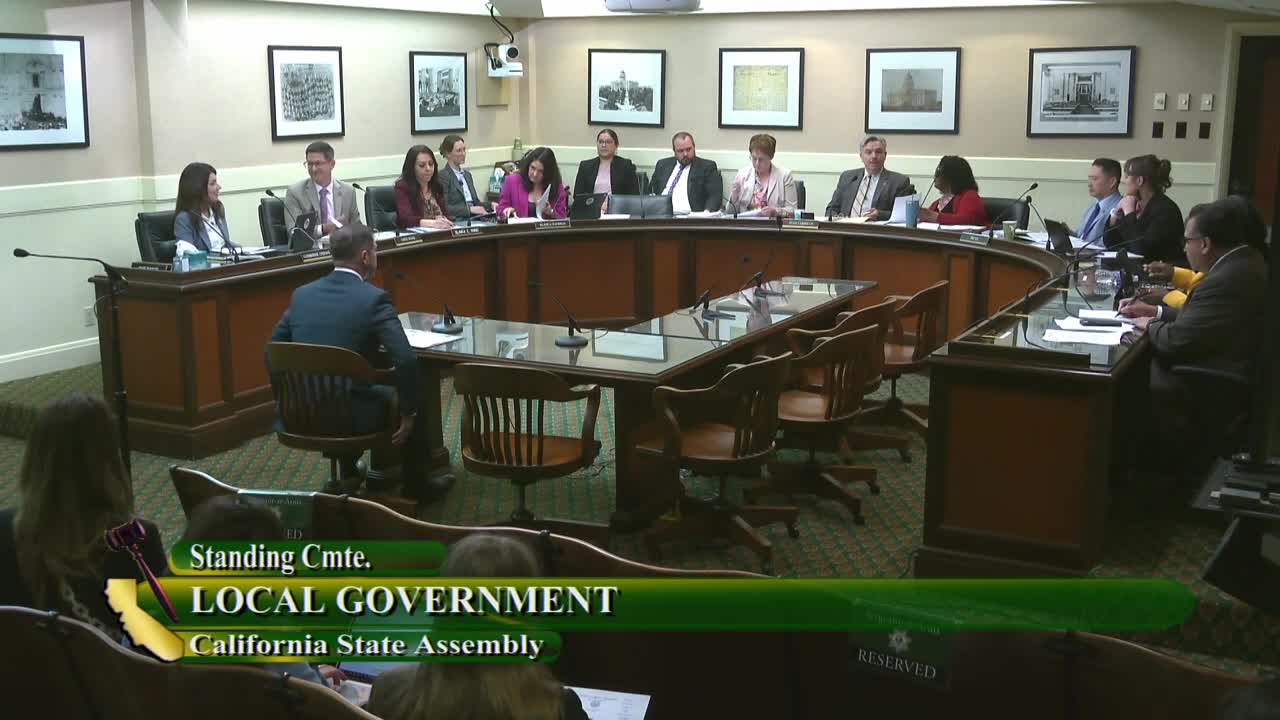
Bill Author


